[go: up one dir, main page]

WO2009149200A2 - Compositions and methods comprising variant microbial proteases - Google Patents

Compositions and methods comprising variant microbial proteases Download PDF

Info

Publication number
WO2009149200A2
WO2009149200A2 PCT/US2009/046156 US2009046156W WO2009149200A2 WO 2009149200 A2 WO2009149200 A2 WO 2009149200A2 US 2009046156 W US2009046156 W US 2009046156W WO 2009149200 A2 WO2009149200 A2 WO 2009149200A2
Authority
WO
WIPO (PCT)
Prior art keywords
subtilisin
bpn
protease
variant
detergent
Prior art date
Legal status (The legal status is an assumption and is not a legal conclusion. Google has not performed a legal analysis and makes no representation as to the accuracy of the status listed.)
Ceased
Application number
PCT/US2009/046156
Other languages
French (fr)
Other versions
WO2009149200A3 (en
Inventor
Joshua R. Basler
Luis G. Cascao-Pereira
David A. Estell
Jr. James T. Kellis
Current Assignee (The listed assignees may be inaccurate. Google has not performed a legal analysis and makes no representation or warranty as to the accuracy of the list.)
Danisco US Inc
Original Assignee
Danisco US Inc
Priority date (The priority date is an assumption and is not a legal conclusion. Google has not performed a legal analysis and makes no representation as to the accuracy of the date listed.)
Filing date
Publication date
Application filed by Danisco US Inc filed Critical Danisco US Inc
Priority to CN2009801204164A priority Critical patent/CN102046783A/en
Priority to EP09759359A priority patent/EP2297316A2/en
Priority to CA2726370A priority patent/CA2726370A1/en
Priority to AU2009256169A priority patent/AU2009256169A1/en
Priority to US12/996,538 priority patent/US20110251073A1/en
Priority to JP2011512621A priority patent/JP5647976B2/en
Priority to MX2010013121A priority patent/MX2010013121A/en
Priority to BRPI0915073A priority patent/BRPI0915073A2/en
Publication of WO2009149200A2 publication Critical patent/WO2009149200A2/en
Publication of WO2009149200A3 publication Critical patent/WO2009149200A3/en
Anticipated expiration legal-status Critical
Ceased legal-status Critical Current

Links

Classifications

    • CCHEMISTRY; METALLURGY
    • C12BIOCHEMISTRY; BEER; SPIRITS; WINE; VINEGAR; MICROBIOLOGY; ENZYMOLOGY; MUTATION OR GENETIC ENGINEERING
    • C12NMICROORGANISMS OR ENZYMES; COMPOSITIONS THEREOF; PROPAGATING, PRESERVING, OR MAINTAINING MICROORGANISMS; MUTATION OR GENETIC ENGINEERING; CULTURE MEDIA
    • C12N9/00Enzymes; Proenzymes; Compositions thereof; Processes for preparing, activating, inhibiting, separating or purifying enzymes
    • C12N9/14Hydrolases (3)
    • C12N9/48Hydrolases (3) acting on peptide bonds (3.4)
    • C12N9/50Proteinases, e.g. Endopeptidases (3.4.21-3.4.25)
    • C12N9/52Proteinases, e.g. Endopeptidases (3.4.21-3.4.25) derived from bacteria or Archaea
    • C12N9/54Proteinases, e.g. Endopeptidases (3.4.21-3.4.25) derived from bacteria or Archaea bacteria being Bacillus
    • AHUMAN NECESSITIES
    • A23FOODS OR FOODSTUFFS; TREATMENT THEREOF, NOT COVERED BY OTHER CLASSES
    • A23KFODDER
    • A23K20/00Accessory food factors for animal feeding-stuffs
    • A23K20/10Organic substances
    • A23K20/189Enzymes
    • CCHEMISTRY; METALLURGY
    • C11ANIMAL OR VEGETABLE OILS, FATS, FATTY SUBSTANCES OR WAXES; FATTY ACIDS THEREFROM; DETERGENTS; CANDLES
    • C11DDETERGENT COMPOSITIONS; USE OF SINGLE SUBSTANCES AS DETERGENTS; SOAP OR SOAP-MAKING; RESIN SOAPS; RECOVERY OF GLYCEROL
    • C11D3/00Other compounding ingredients of detergent compositions covered in group C11D1/00
    • C11D3/16Organic compounds
    • C11D3/38Products with no well-defined composition, e.g. natural products
    • C11D3/386Preparations containing enzymes, e.g. protease or amylase
    • CCHEMISTRY; METALLURGY
    • C11ANIMAL OR VEGETABLE OILS, FATS, FATTY SUBSTANCES OR WAXES; FATTY ACIDS THEREFROM; DETERGENTS; CANDLES
    • C11DDETERGENT COMPOSITIONS; USE OF SINGLE SUBSTANCES AS DETERGENTS; SOAP OR SOAP-MAKING; RESIN SOAPS; RECOVERY OF GLYCEROL
    • C11D3/00Other compounding ingredients of detergent compositions covered in group C11D1/00
    • C11D3/16Organic compounds
    • C11D3/38Products with no well-defined composition, e.g. natural products
    • C11D3/386Preparations containing enzymes, e.g. protease or amylase
    • C11D3/38681Chemically modified or immobilised enzymes
    • CCHEMISTRY; METALLURGY
    • C12BIOCHEMISTRY; BEER; SPIRITS; WINE; VINEGAR; MICROBIOLOGY; ENZYMOLOGY; MUTATION OR GENETIC ENGINEERING
    • C12NMICROORGANISMS OR ENZYMES; COMPOSITIONS THEREOF; PROPAGATING, PRESERVING, OR MAINTAINING MICROORGANISMS; MUTATION OR GENETIC ENGINEERING; CULTURE MEDIA
    • C12N9/00Enzymes; Proenzymes; Compositions thereof; Processes for preparing, activating, inhibiting, separating or purifying enzymes
    • C12N9/14Hydrolases (3)
    • C12N9/48Hydrolases (3) acting on peptide bonds (3.4)
    • C12N9/50Proteinases, e.g. Endopeptidases (3.4.21-3.4.25)
    • C12N9/52Proteinases, e.g. Endopeptidases (3.4.21-3.4.25) derived from bacteria or Archaea
    • CCHEMISTRY; METALLURGY
    • C11ANIMAL OR VEGETABLE OILS, FATS, FATTY SUBSTANCES OR WAXES; FATTY ACIDS THEREFROM; DETERGENTS; CANDLES
    • C11DDETERGENT COMPOSITIONS; USE OF SINGLE SUBSTANCES AS DETERGENTS; SOAP OR SOAP-MAKING; RESIN SOAPS; RECOVERY OF GLYCEROL
    • C11D2111/00Cleaning compositions characterised by the objects to be cleaned; Cleaning compositions characterised by non-standard cleaning or washing processes
    • C11D2111/10Objects to be cleaned
    • C11D2111/12Soft surfaces, e.g. textile
    • CCHEMISTRY; METALLURGY
    • C12BIOCHEMISTRY; BEER; SPIRITS; WINE; VINEGAR; MICROBIOLOGY; ENZYMOLOGY; MUTATION OR GENETIC ENGINEERING
    • C12YENZYMES
    • C12Y304/00Hydrolases acting on peptide bonds, i.e. peptidases (3.4)
    • C12Y304/21Serine endopeptidases (3.4.21)
    • C12Y304/21062Subtilisin (3.4.21.62)

Definitions

  • the present invention provides methods for protein engineering and variant proteases. Specifically, the invention provides methods utilizing site evaluation libraries. The present invention also provides subtilisin variants suitable for various uses.
  • Serine proteases are a subgroup of carbonyl hydrolases comprising a diverse class of enzymes having a wide range of specificities and biological functions.
  • Much research has been conducted on the subtilisins, due largely to their usefulness in cleaning and feed applications. Additional work has been focused on the adverse environmental conditions (e.g., exposure to oxidative agents, chelating agents, extremes of temperature and/or pH) which can adversely impact the functionality of these enzymes in various applications. Nonetheless, there remains a need in the art for enzyme systems that are able to resist these adverse conditions and retain or have improved activity over those currently known in the art.
  • proteins are modified in order to obtain desired protein properties.
  • the nucleotide sequence of a cloned gene encoding a protein is mutated and the modified gene is expressed to produce mutants, which are screened for activities of interest. Often, the mutant properties are compared with the properties of wild-type protein.
  • NP-hard problems are problems for which efficient polynomial-time algorithms are not currently known, and if any NP-hard problem could be solved, all NP-hard problems could be solved (See e.g., Pierce and Winfree, Protein Engineer., 15:779-782 [2002]).
  • Current strategies for building and screening libraries generally involve generating protein sequence diversity randomly across the whole sequence or in controlled random fashion at defined positions within the protein.
  • the present invention provides methods for protein engineering. Specifically, the invention provides methods utilizing site evaluation libraries. In particular, the present invention provides means to use information obtained about a number of desired properties, in order to rationally and efficiently design libraries that will optimize those properties. In some embodiments, the present invention provides means to design libraries that are improved for at least two desired properties.
  • the present invention provides means to identify positions within an amino acid sequence of a protein that are relevant in improving desired properties of the protein.
  • the present invention provides means to determine which mutations are desirable in order to produce proteins with these desired properties, as well as improved properties.
  • the present invention provides means to identify amino acid positions and mutations that have improvements of a particular percentage better than the wild-type protein (e.g., better than 110% of the wild-type for one property).
  • the present invention provides means to identify mutations that provide at least one much improved property and at least one additional property that is not significantly worse than the wild-type protein (e.g., better than 110% of wild-type for one property, yet not worse than 90% of wild-type for another property).
  • libraries are constructed based on this information.
  • the libraries are constructed using all of the identified mutations, while in some other embodiments, the libraries are constructed using a subset of the identified mutations. Indeed, it is not intended that the libraries be constrained to any particular number and/or type of mutations.
  • the present invention provides methods for protein engineering comprising the steps of: providing a library of protein variants; testing the library of protein variants for at least one property of interest in a test of interest; identifying a range of values for said the at least one property of interest; identifying a minimum within the range of values that is associated with a favorable outcome in the test of interest; and providing a plurality of protein variants having at least one mutation above said minimum in the range of the at least one property of interest, thereby providing a library of protein variants comprising at least one mutation, and wherein the library is enriched in members having a favorable outcome in the test of interest.
  • the favorable outcome corresponds to a value of greater than about 50%, about 60%, about 70%, about 80%, about 90%, or about 95% of a maximal value observed in the test set forth in the first step above.
  • more than one test of interest is used in the methods of the present invention.
  • the protein is an enzyme.
  • the enzyme is selected from proteases, transferases, metalloproteases, esterases, amylases, cellulases, oxidases, cutinases, and lipases.
  • the present invention also provides methods for protein engineering comprising the steps of: providing a library of protein variants; testing the library of protein variants for at least two properties of interest in a test of interest; identifying a range of values for the at least two properties of interest; identifying a minimum within the range of values that is associated with a favorable outcome in the test of interest; and providing a plurality of protein variants above the minimum of the range of the at least two properties of interest, thereby providing a library of protein variants enriched in members having the favorable outcome in the test of interest.
  • the favorable outcome corresponds to a value of greater than about 50%, about 60%, about 70%, about 80%, about 90%, or about 95% of a maximal value observed in the test set forth in the first step above.
  • the protein is an enzyme.
  • the enzyme is selected from proteases, transferases, metalloproteases, esterases, amylases, cellulases, oxidases, cutinases, and lipases.
  • the present invention also provides methods for protein engineering comprising the steps of: providing a wild-type protein and a library of protein variants of the wild-type protein; testing the library of protein variants and the wild-type protein for at least one property of interest in a test of interest; identifying a range of values for the at least one property of interest; identifying a minimum within the range of values that is associated with a favorable outcome in the test of interest; identifying the protein variants having a favorable outcome as compared to the results obtained for the wild-type, wherein the favorable outcome is an improved property of interest; and providing a plurality of protein variants above the minimum of the range of the at least one property of interest, thereby providing a library of improved protein variants enriched in members having the favorable outcome in the test of interest.
  • the methods further comprise the step of determining the performance index, wherein the performance index is determined by dividing the value obtained for each of the improved protein variants and the value obtained for the wild-type protein. In some particularly preferred embodiments, the methods further comprise the step of identifying the improved protein variants, wherein the improved protein variants achieve performance index values greater than 1.1 in the test of interest.
  • the protein is an enzyme. In some particularly preferred embodiments, the enzyme is selected from proteases, transferases, metalloproteases, esterases, amylases, cellulases, oxidases, cutinases, and lipases. In some alternative embodiments, the protein is selected from antibodies and growth factors.
  • the wild-type protein is a mature form an enzyme selected from proteases, transferases, metallopro teases, esterases, amylases, cellulases, oxidases, cutinases, and lipases.
  • the property of interest is selected from charge, wash performance, hard surface cleaning performance, solubility, thermal stability, storage stability, detergent stability, substrate binding, enzyme inhibition, expression level, reaction rate, and substrate degradation.
  • the wild-type protein and the protein variant are components of at least one detergent composition.
  • wash performance is tested in a detergent composition formulated into a powdered or liquid detergent having a pH of between 5 and 12.0.
  • the present invention also provides methods for producing an improved variant of a parent protein within a protein fold, comprising: assaying multiple variants of a test protein within the protein fold spanning a range of a property of interest in an assay of interest; identifying a minimum within the range of the property of interest that is associated with a favorable outcome in the assay of interest; assaying a parent protein of the protein fold in the assay of interest; and producing an improved variant of the parent protein by introducing an amino acid substitution is the parent protein such that the improved variant is above the minimum of the range of the property of interest.
  • the parent protein and the test protein are different.
  • the methods further comprise the step of determining the performance index, wherein the performance index is determined by dividing the value obtained for the improved protein variant and the value obtained for the parent protein.
  • the test proteins and the parent proteins are enzymes.
  • the enzymes are selected from proteases, transferases, metalloproteases, esterases, amylases, cellulases, oxidases, cutinases, and lipases.
  • the test and parent proteins are selected from antibodies and growth factors.
  • the parent protein is a mature form an enzyme selected from proteases, transferases, metalloproteases, esterases, amylases, cellulases, oxidases, cutinases, and lipases.
  • the property of interest is selected from charge, wash performance, hard surface cleaning performance, thermal stability, solubility, storage stability, detergent stability, substrate binding, enzyme inhibition, expression level, reaction rate, and substrate degradation.
  • the test and parent proteins are components of at least one detergent composition.
  • the improved protein variant is a component of a detergent composition.
  • wash performance is tested in a detergent composition formulated into a powdered or liquid detergent having a pH of between about 5 and about 12.0.
  • the present invention also provides isolated subtilisin variants of a Bacillus subtilisin, wherein the subtilisin variant is a mature form having proteolytic activity and comprising a substitution at one or more positions selected from positions: 1, 2, 3, 4, 5, 6, 7, 8, 9, 10, 11, 12, 13, 14, 15, 16, 17, 18, 19, 20, 21, 21, 22, 23, 24, 25, 26, 27, 28, 29, 30, 31, 33, 35, 36, 37, 39, 40, 41, 42, 43, 44, 45, 46, 47, 48, 49, 50, 51, 52, 53, 54, 55, 56, 57, 58, 59, 60, 62, 65, 66, 67, 71, 72, 73, 76, 77, 78, 79, 81, 82, 83, 84, 85, 86, 87, 88, 89, 90, 91, 92, 93, 94, 95, 96, 97, 98, 99, 101, 102, 103, 104, 105, 106, 107, 109, 110, 111, 112,
  • amyloliquefaciens subtilisin BPN' set forth as SEQ ID NO:2.
  • the one or more positions are selected from: 1, 2, 5, 6, 7, 8, 9, 10, 11, 12, 13, 14, 15, 16, 17, 18, 19, 20, 21, 21, 22, 23, 24, 25, 26, 28, 29, 30, 31, 33, 35, 36, 37, 39, 40, 41, 42, 43, 44, 45, 46, 47, 48, 49, 50, 51, 52, 53, 54, 55, 56, 57, 58, 59, 60, 62, 65, 66, 67, 71, 72, 73, 77, 78, 79, 81, 82, 83, 84, 85, 86, 87, 88, 89, 90, 91, 92, 93, 94, 95, 96, 97, 98, 99, 101, 102, 103, 104, 105, 106, 107, 109, 110, 111, 112, 113, 114, 115, 116, 118, 119, 122,
  • amyloliquefaciens subtilisin BPN' set forth as SEQ ID NO:2.
  • the one or more positions are selected from: 2, 3, 5, 6, 7, 8, 9, 10, 11, 12, 13, 14, 15, 16, 17, 19, 20, 21, 21, 22, 23, 25, 26, 28, 29, 30, 31, 33, 35, 36, 37, 39, 40, 41, 42, 44, 46, 47, 48, 49, 50, 51, 53, 54, 55, 56, 57, 58, 59, 60, 62, 65, 66, 67, 71, 73, 77, 78, 79, 81, 82, 83, 84, 85, 86, 88, 89, 90, 91, 92, 93, 94, 95, 96, 102, 105, 106, 110, 111, 112, 113, 114, 115, 116, 122, 123, 124, 125, 126, 128, 129, 131, 133, 134, 135, 136, 137, 139, 141,
  • subtilisin variant further comprises a substitution at one or more positions selected from 18, 52, 72, 117, 119, 127, 144, 185, 209 and 213, and wherein the positions are numbered by correspondence with the amino acid sequence of B. amyloliquefaciens subtilisin BPN' set forth as SEQ ID NO:2.
  • the substitution comprises one or more of the positions: AOOlC, AOOlD, AOOlE, AOOlF, AOOlG, AOOlH, AOOlI, AOOlK, AOOlL, AOOlM, AOOlN, AOOlQ, AOOlR, AOOlS, AOOlV, AOOlW, Q002A, Q002D, Q002E, Q002G, Q002S, S003A, S003D, S003F, S003G, S003I, S003K, S003L, S003M, S003N, S003P, S003Q, S003R, S003T, S003V, S003W, S003Y, P005C, P005E, P005G, P005N, P005Q, P005T, Y006A, Y006C, Y006E, Y006F,
  • the substitution comprises a combination selected from: Y021H-A045V-Y217E, Y021W-S101E-G128R-Y217Q, Y021H-Y217E, Y021H-A045V-S101N- Y217Q, Y021H-A045I-Y217E, Y021H-A045I-S101E-Y217Q, Y021W-A045I-S101E-Y217E, D036N- SlOlE- Y217L, Y021H-A045V-Y217Q, Y021H-A045I-S101E-Y217L, Y021H-A045I-Y217E, Y021H- Y217Q, Y021W-S101E-Y217L, Y021W-A045V-S101E-Y217L, Y021W
  • the substitution comprises a combination selected from: S024S- V028V-M050M-A092A-Q103E-A114G-V246V, S024S-V028V-M050V-A092A-Q103Q-A114 A- V246V, S024S-V028V-M050V-A092A-Q103Q-A114G-V246V, S024H-V028V-M050V-A092A- Q103Q-A114A-V246T, S024H-V028V-M050V-A092A-Q103E-A114A-V246V, S024H-V028V- M050V-A092A-Q103Q-A114G-V246V, S024H-V028V-M050M-A092A-Q103E-A114A-V246V, S024H-V028V- M050V
  • the substitution comprises a combination selected from: S024S-V028T-M050V-A092G- Q103E-A114G-V246T, SlOlN-Ml 19H, M119N-K213N-Y217L, Y217L, M119N-K213N, K213N, K213N-Y217Q, S101E-K213N-Y217E, SlOlE-Ml 19N- Y217L, Y217Q, SlOlN-Ml 19N-K213N- Y217E, SlOlN-Ml 19N-K213N-Y217L, Y021H-A045I-S101E-Y217L, SlOlE- Y217L, A045I-Y217Q, S101S-M119M-K213K-Y217L, Y021H-A045I-S101E-Y2
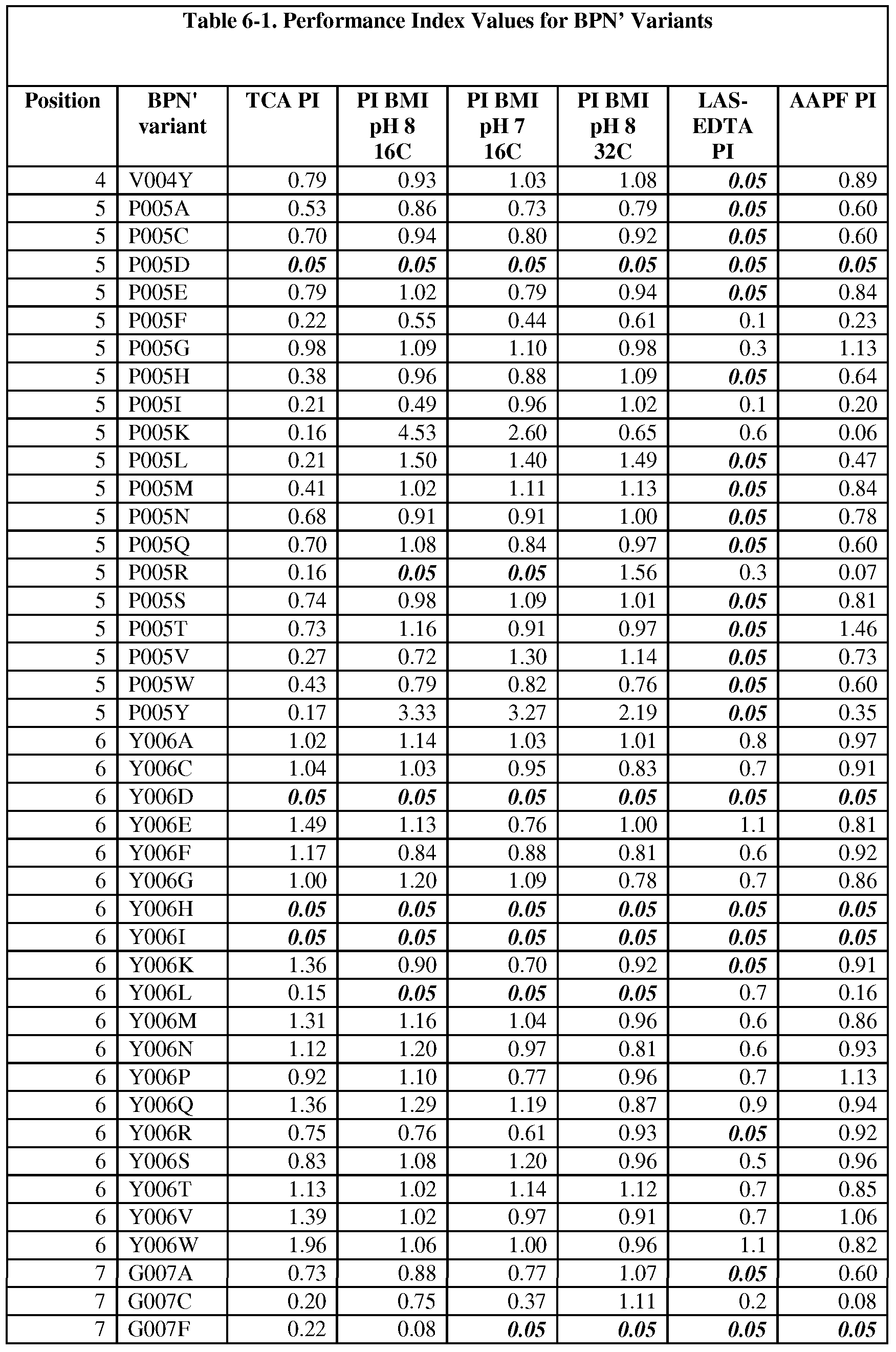
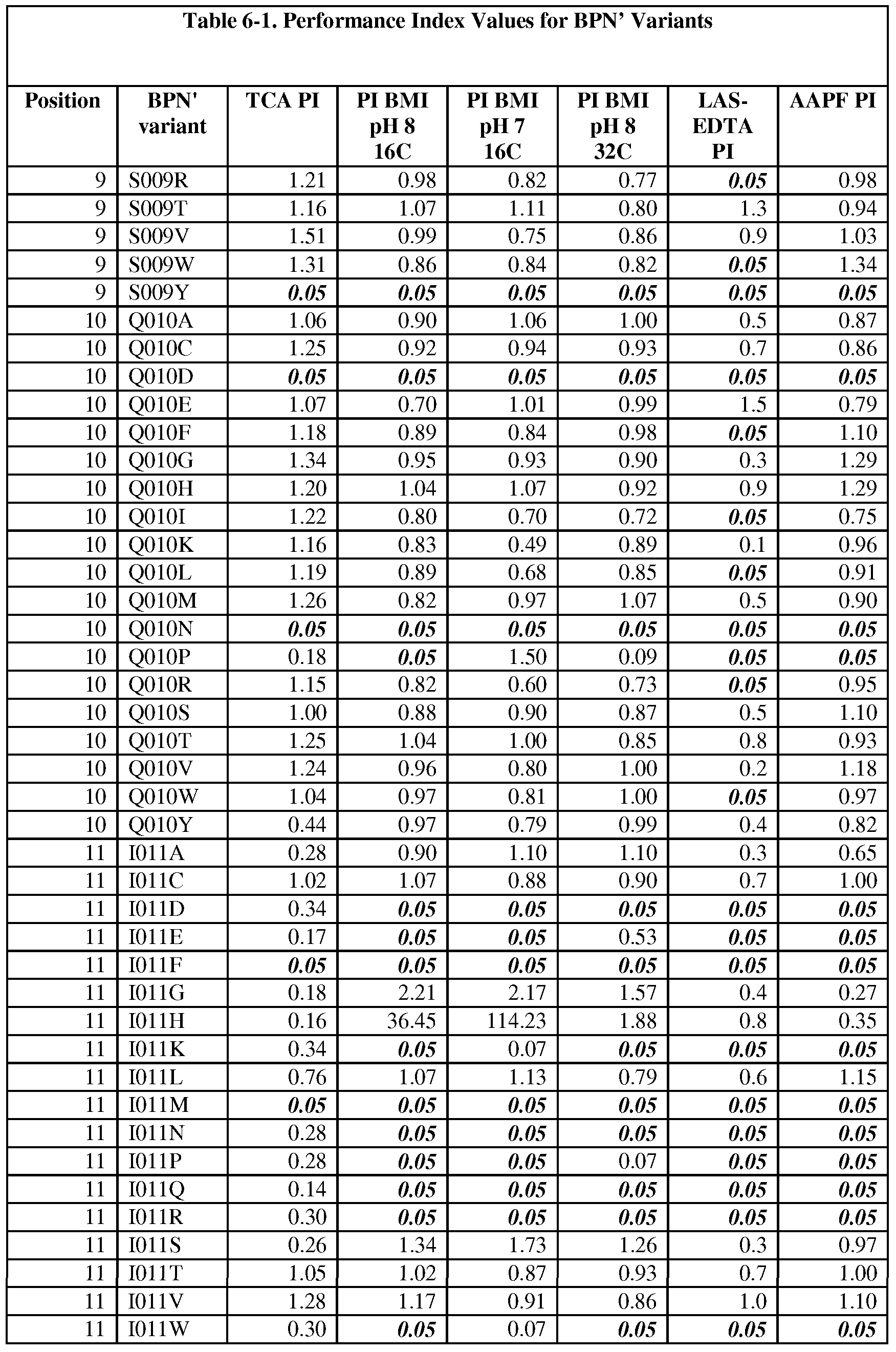
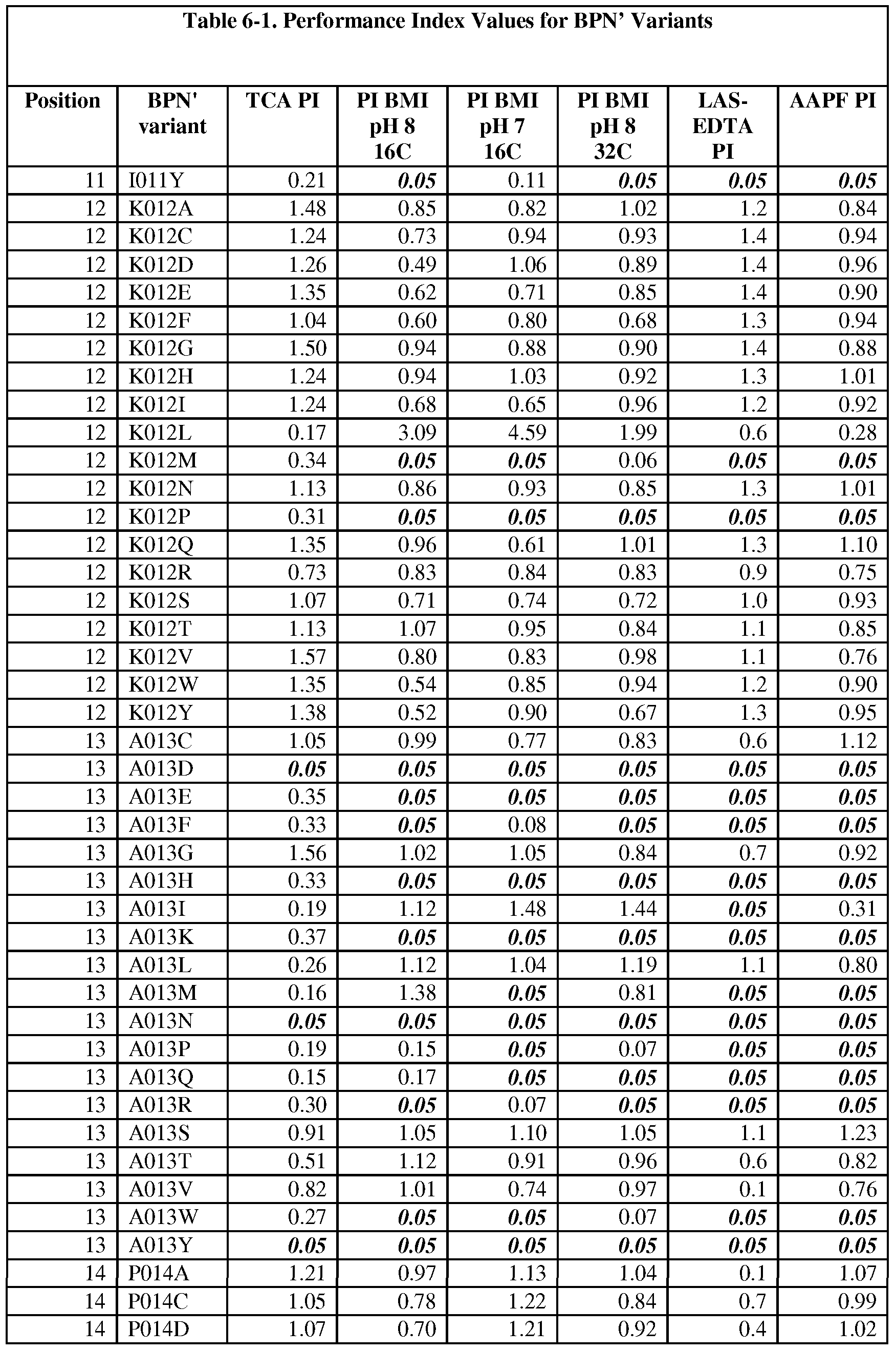
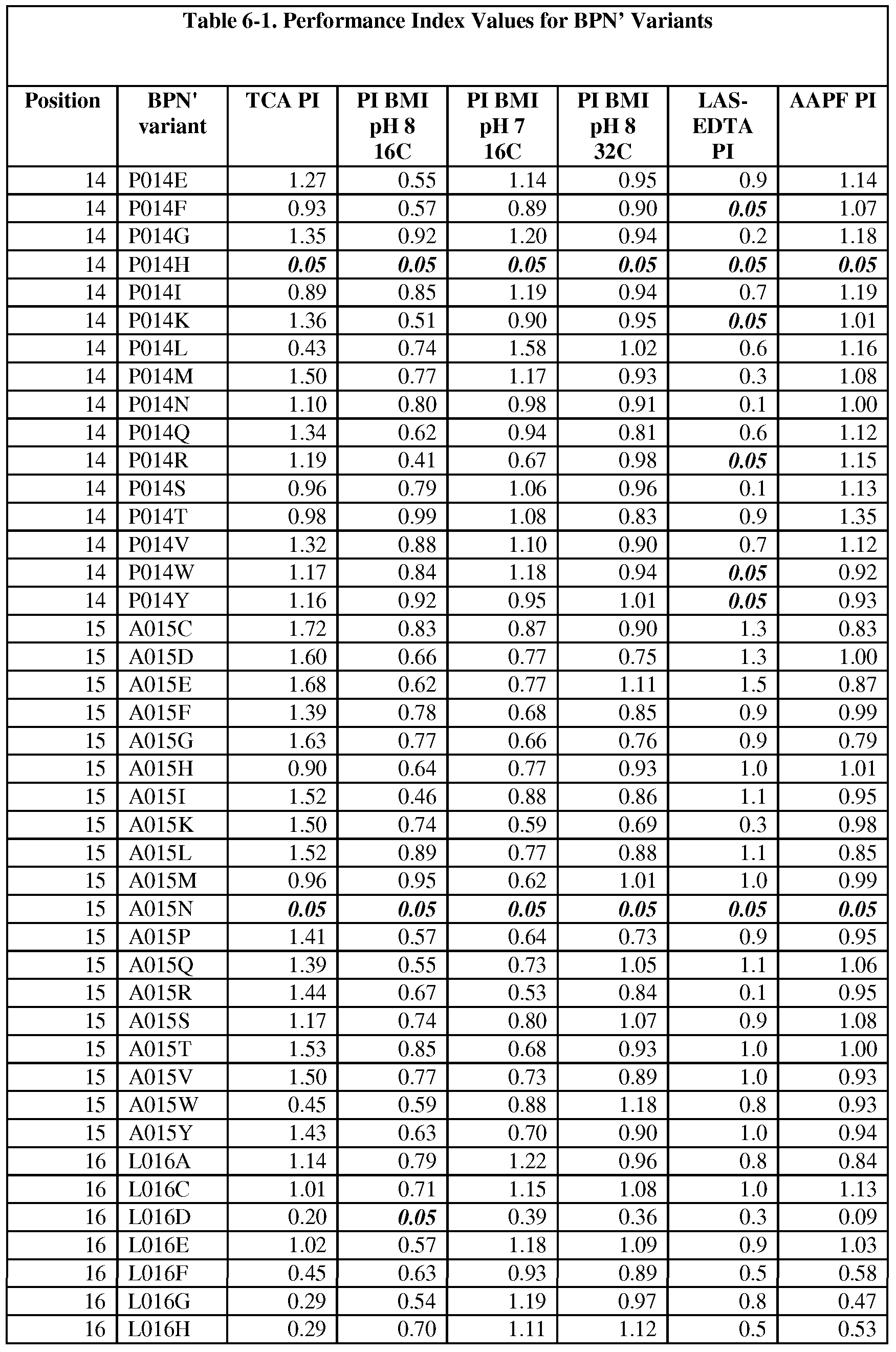
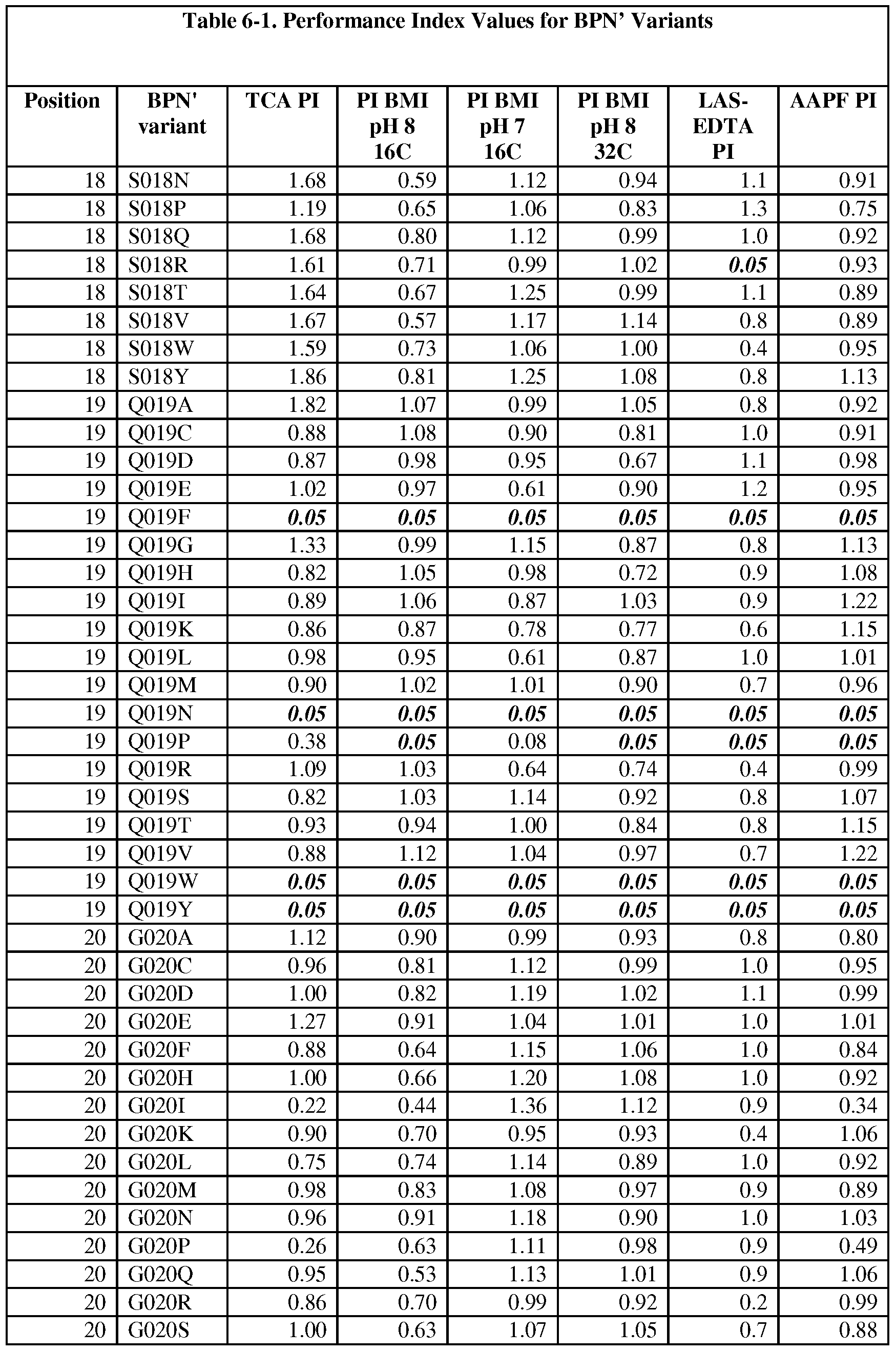
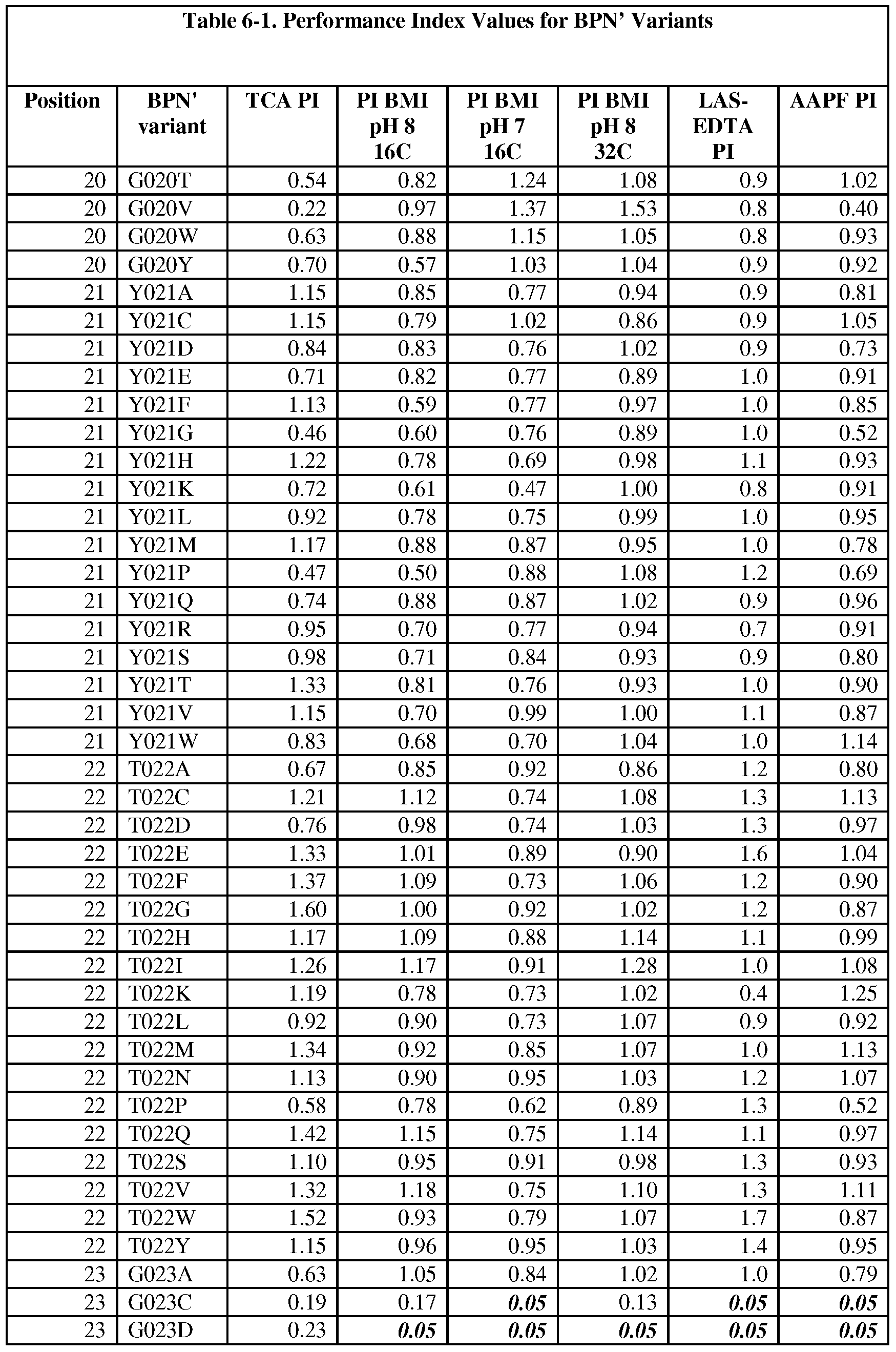
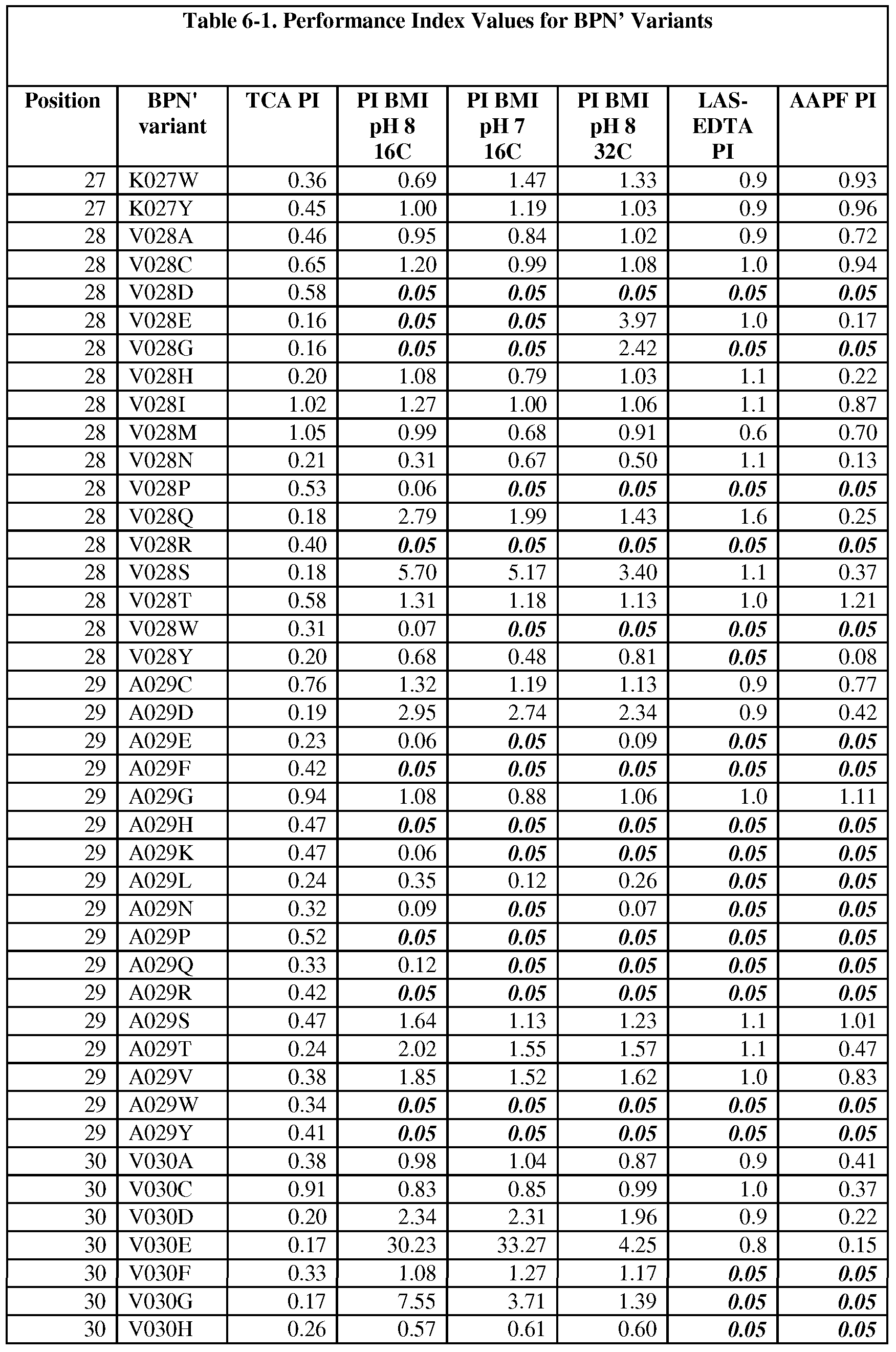
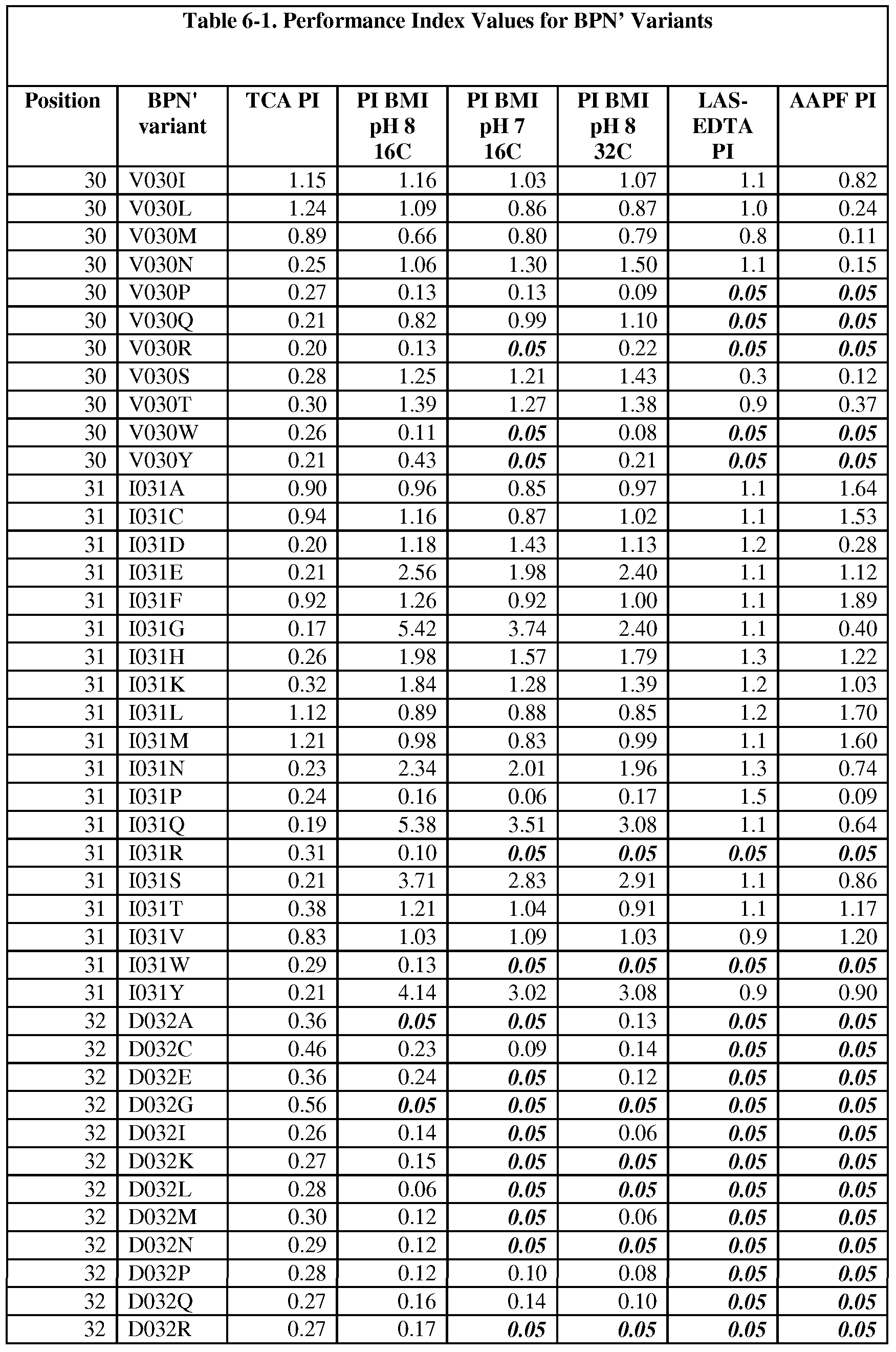
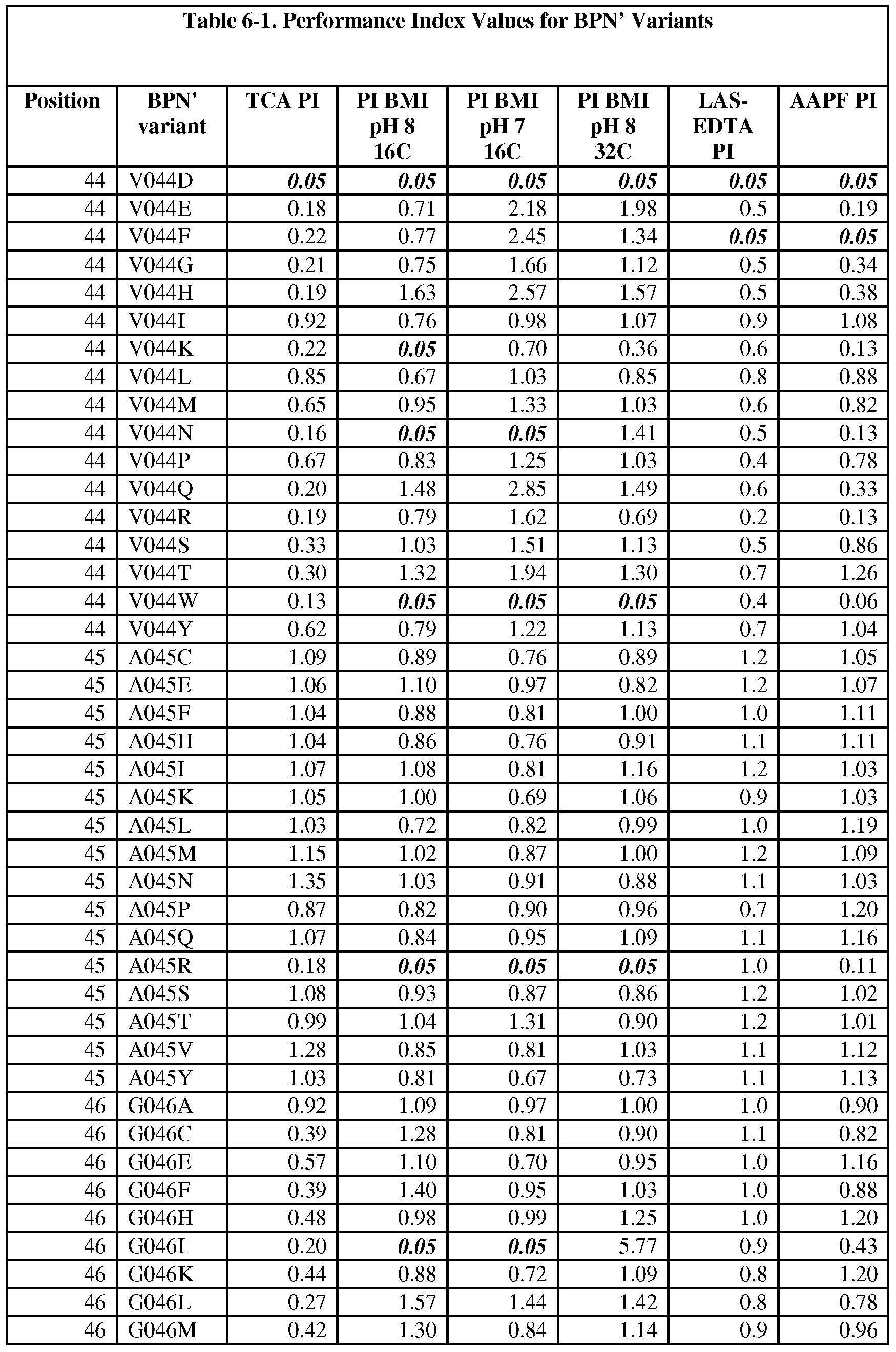
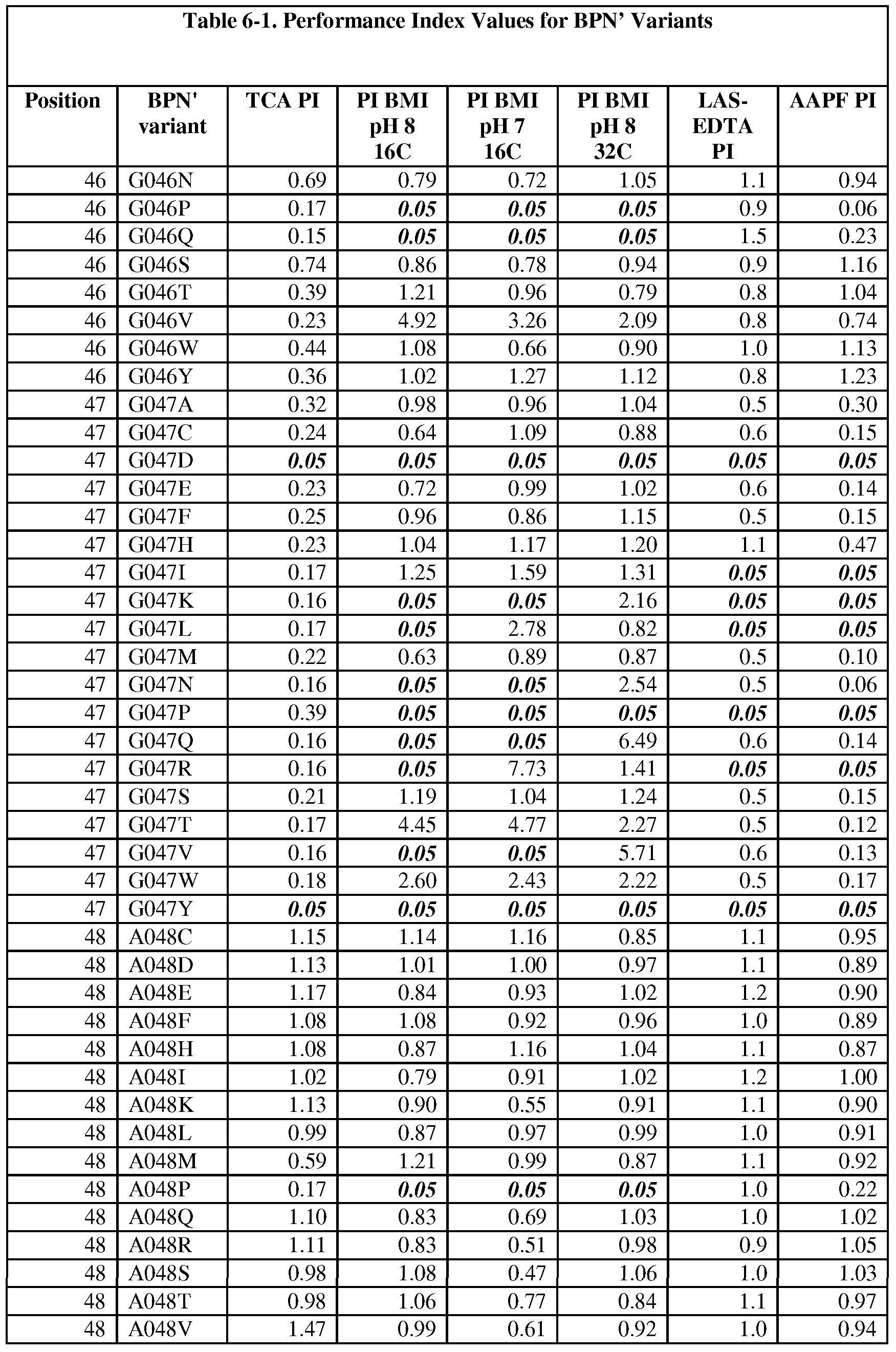
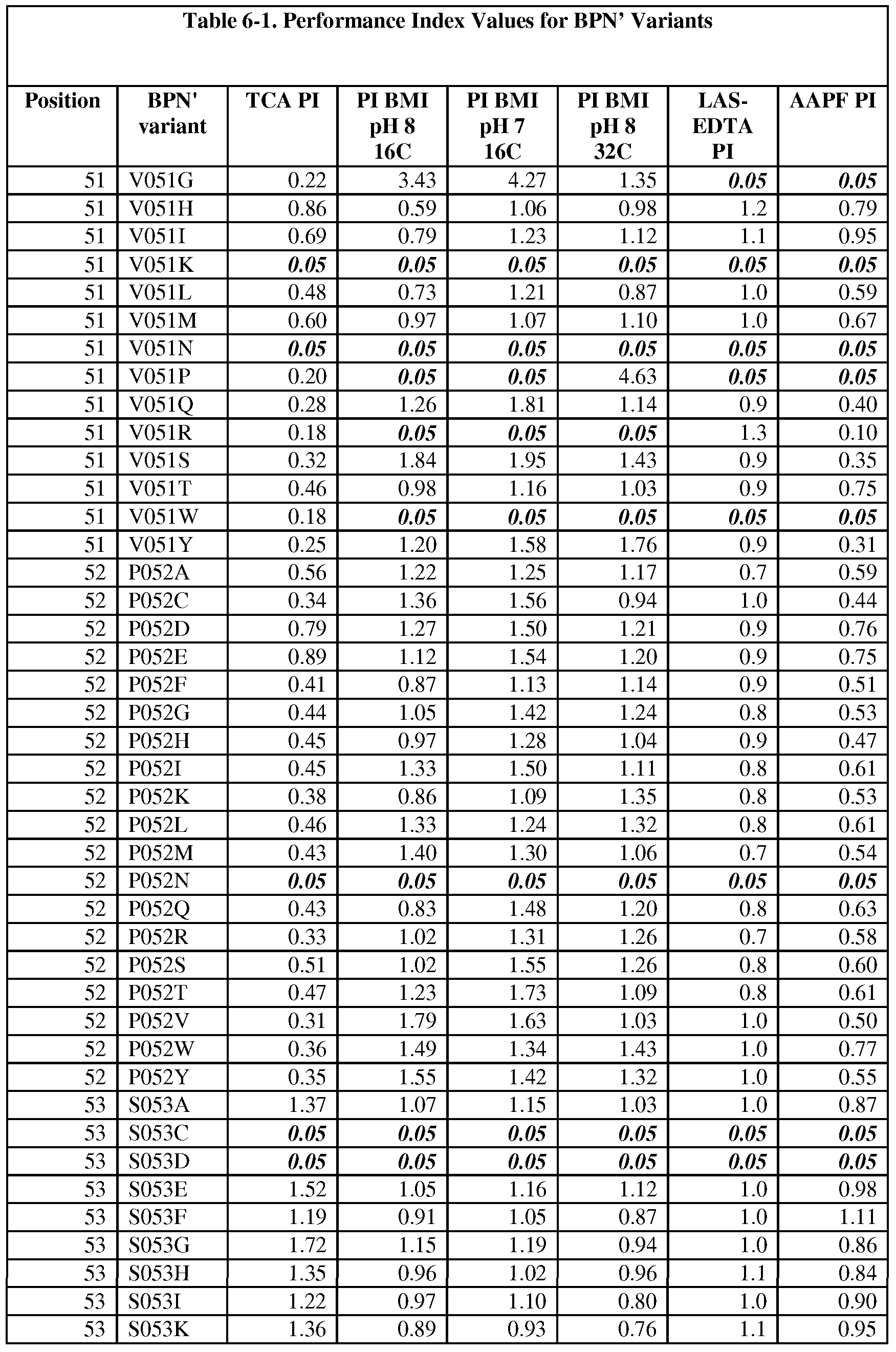
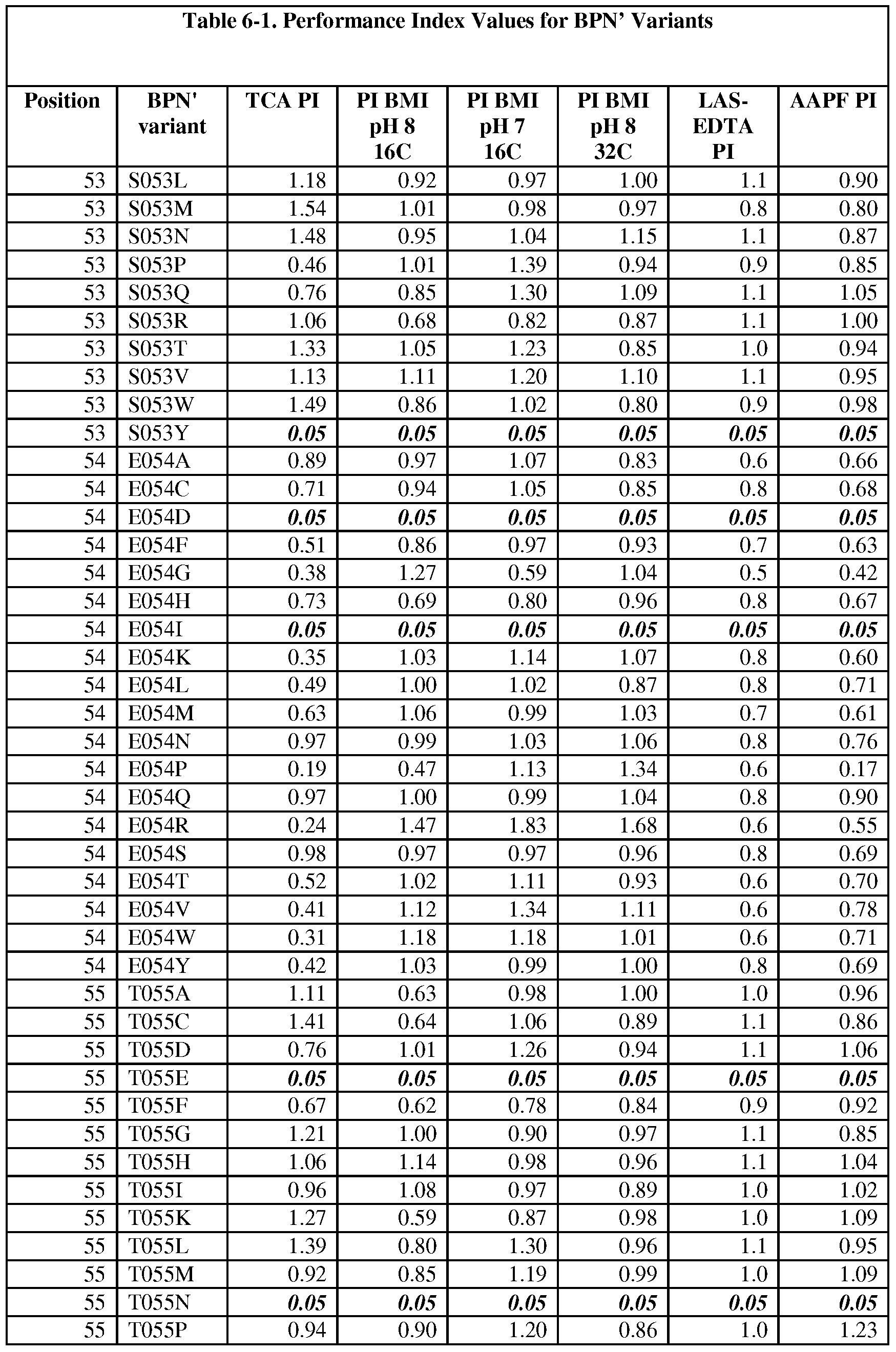
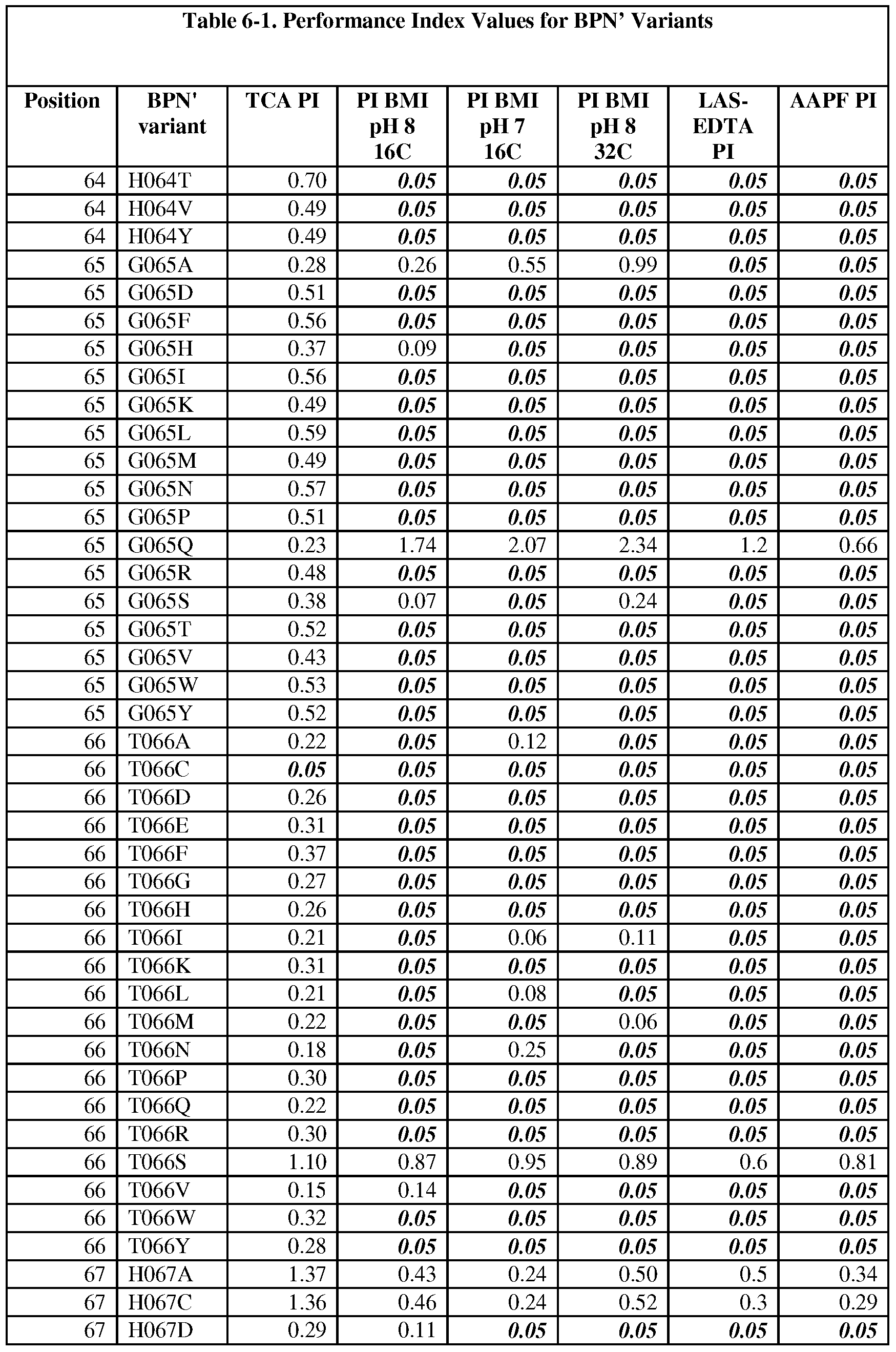
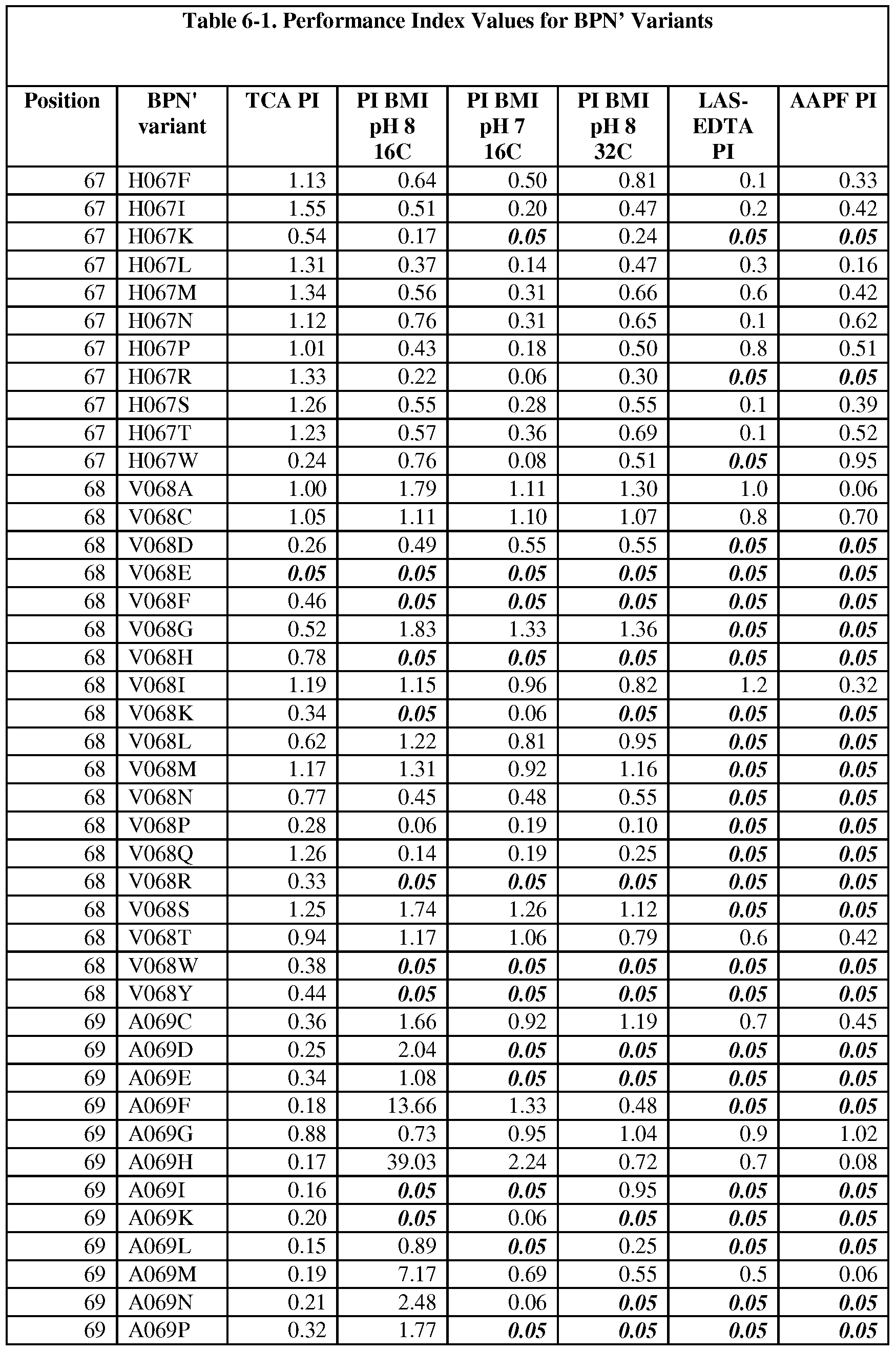
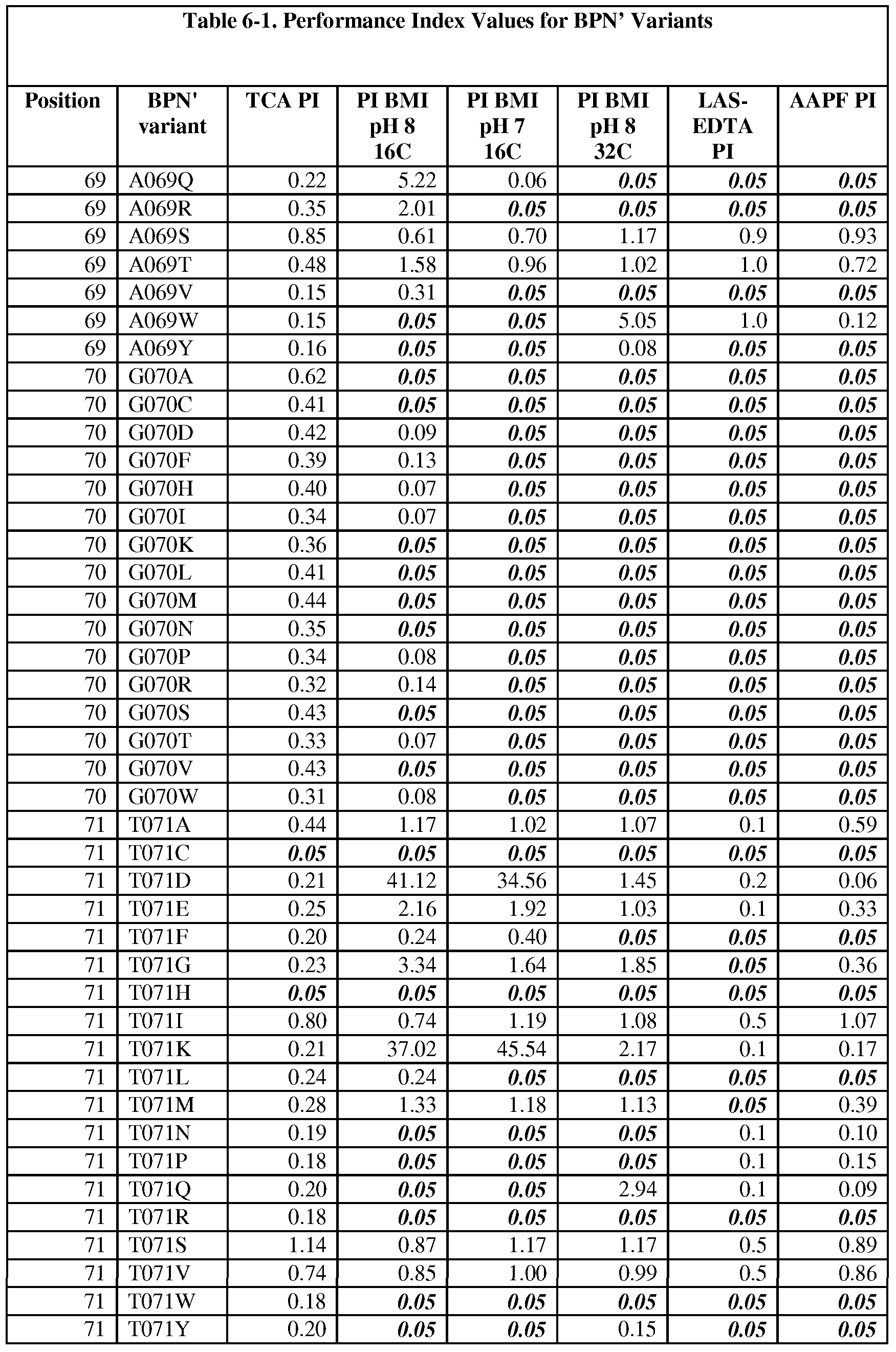
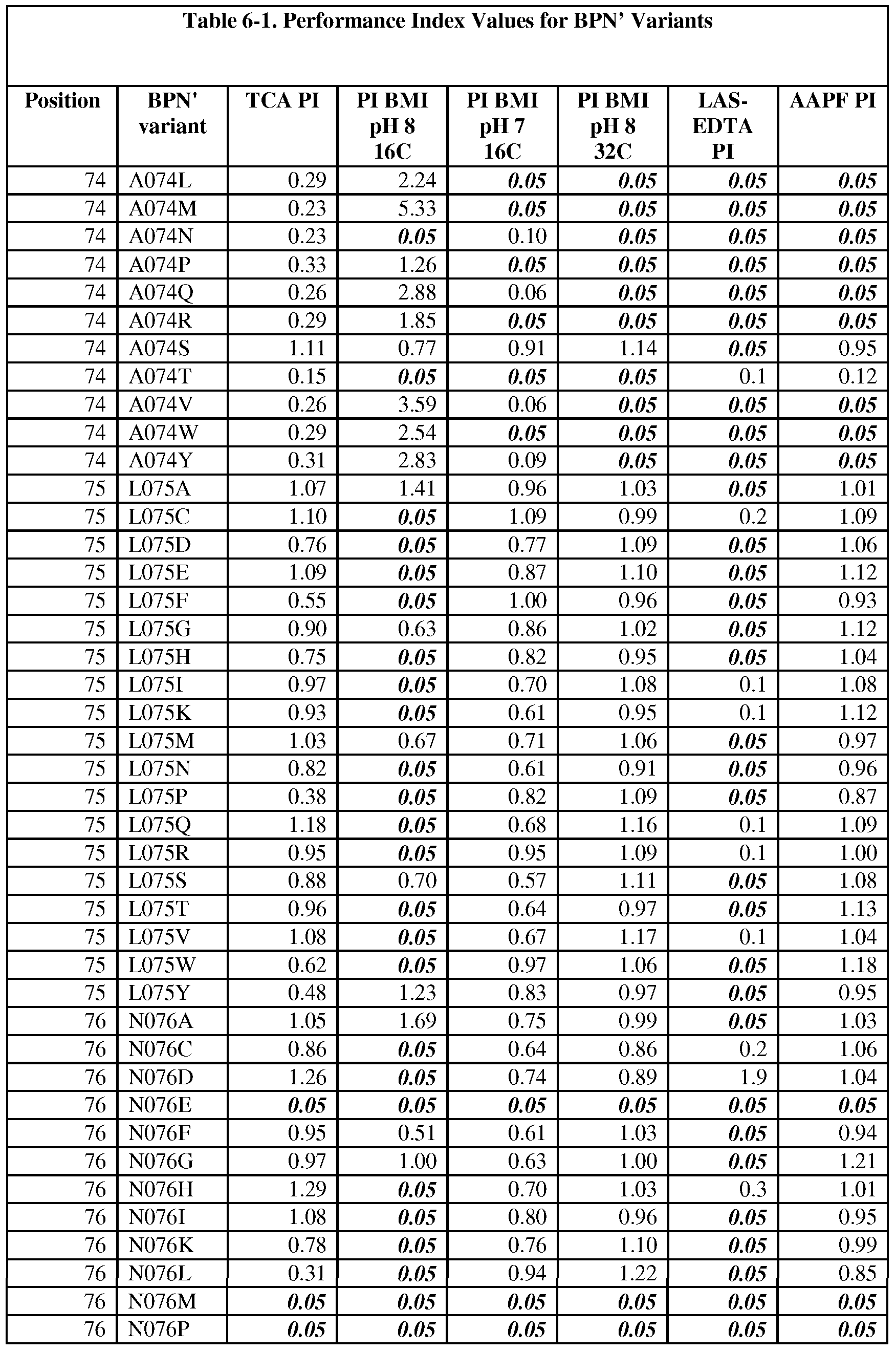
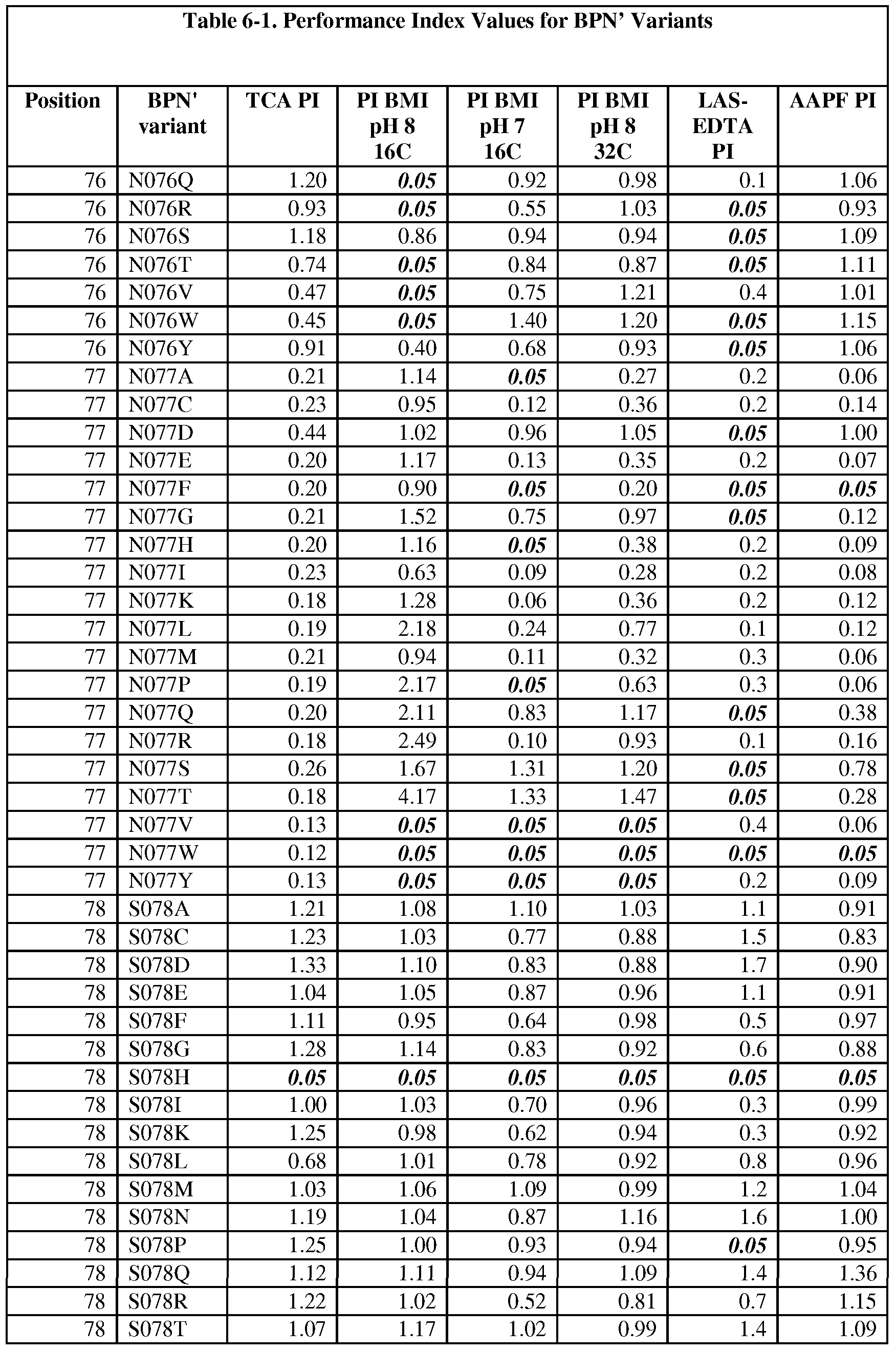
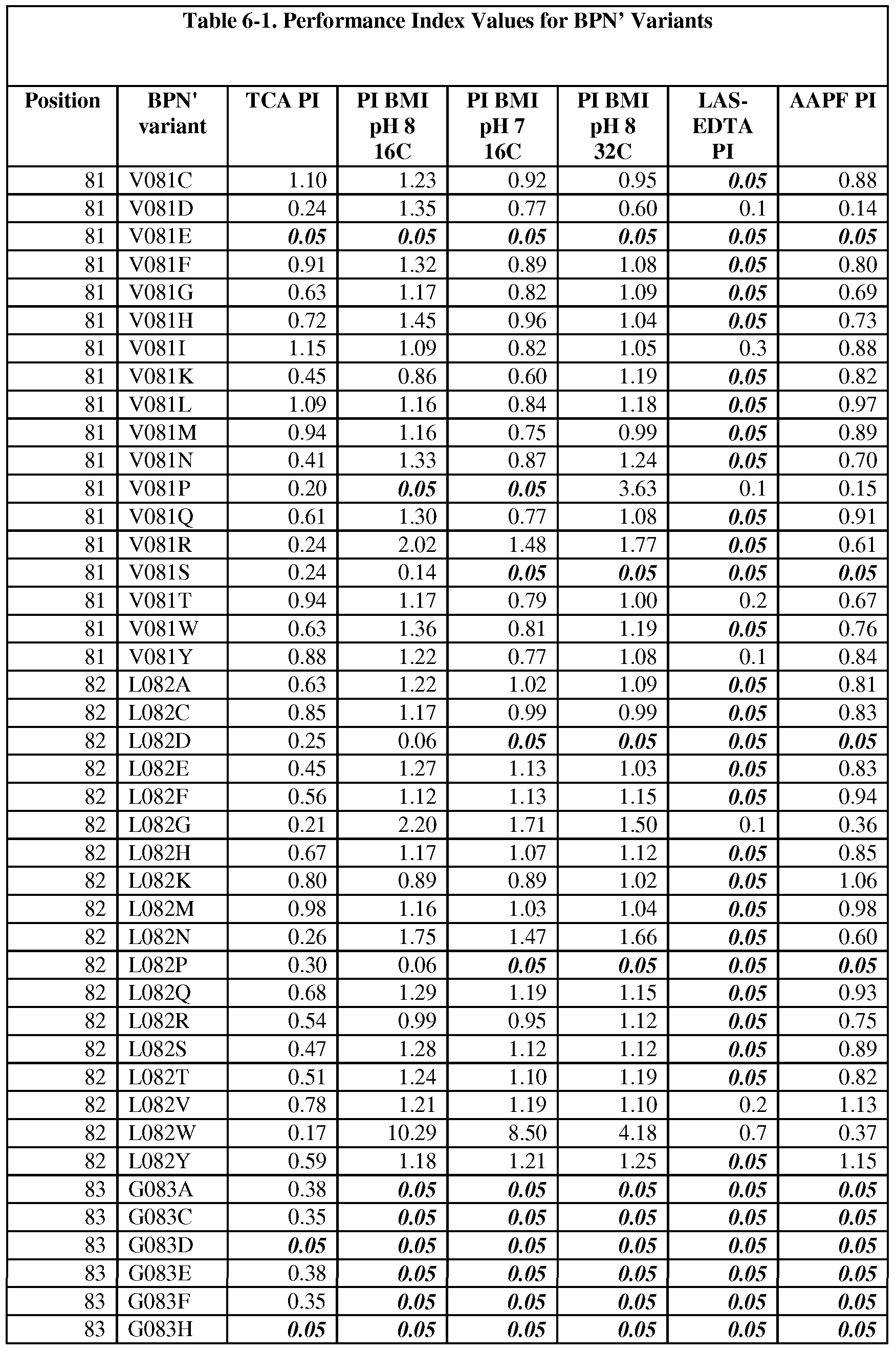
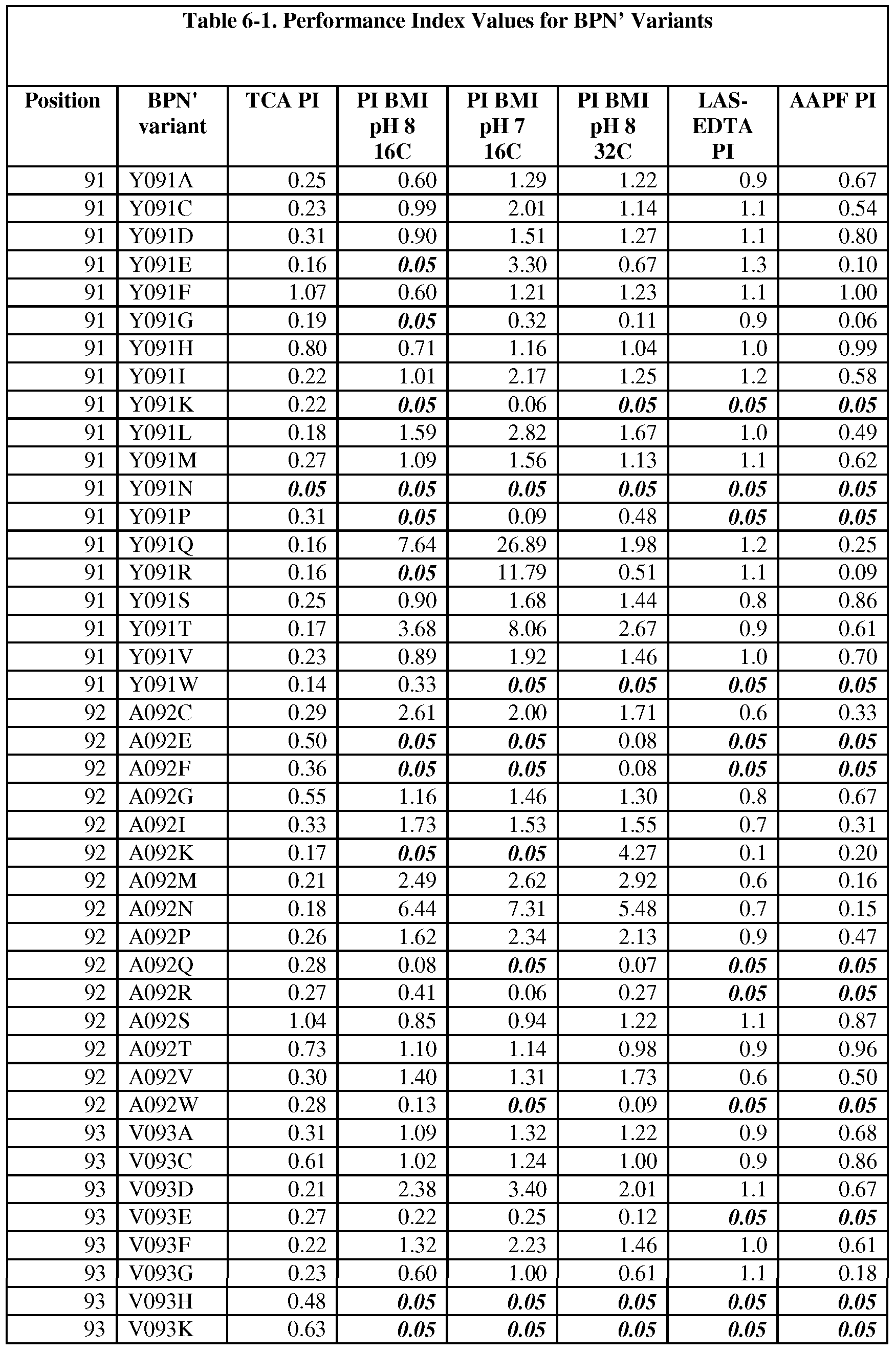
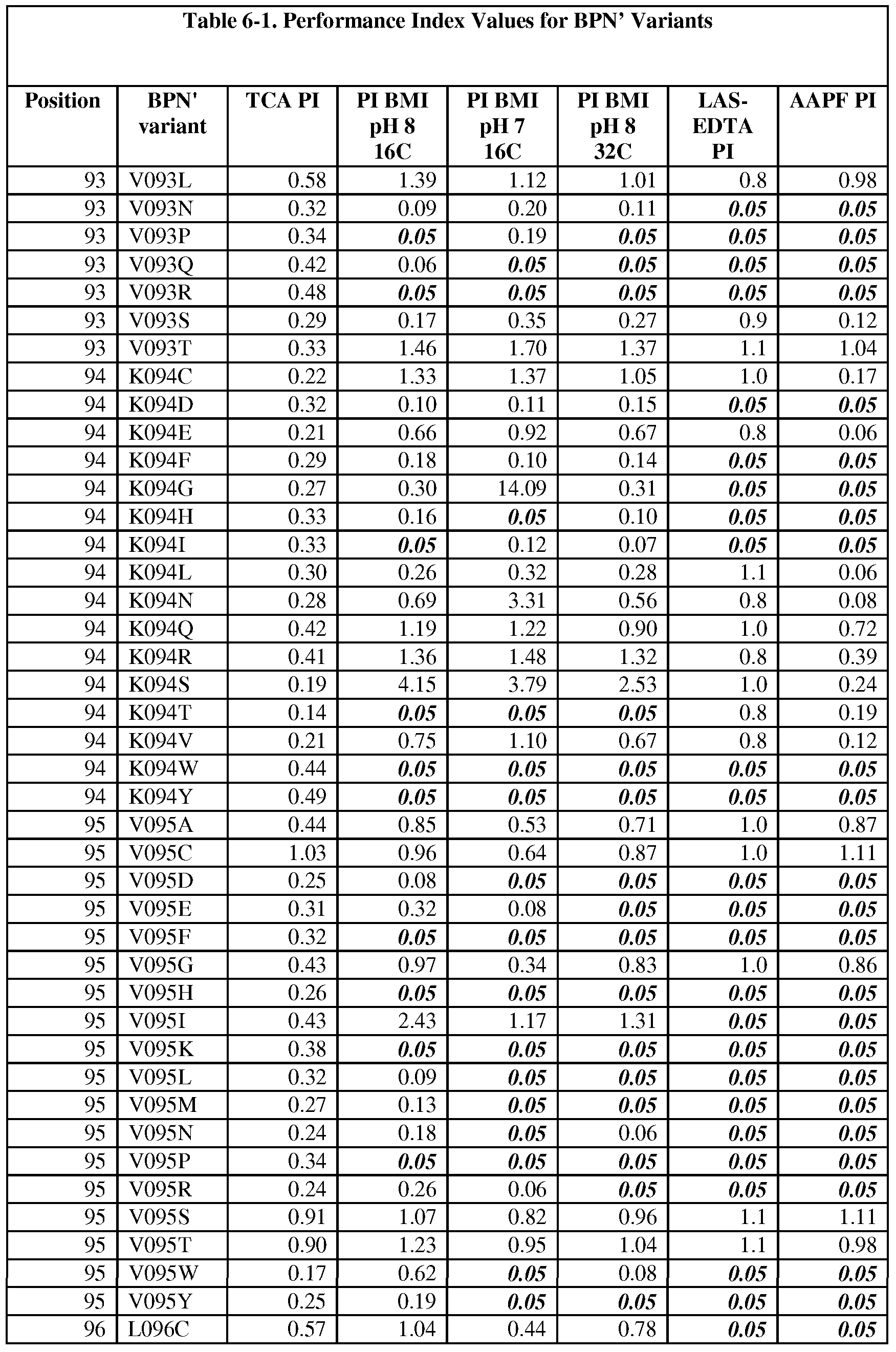
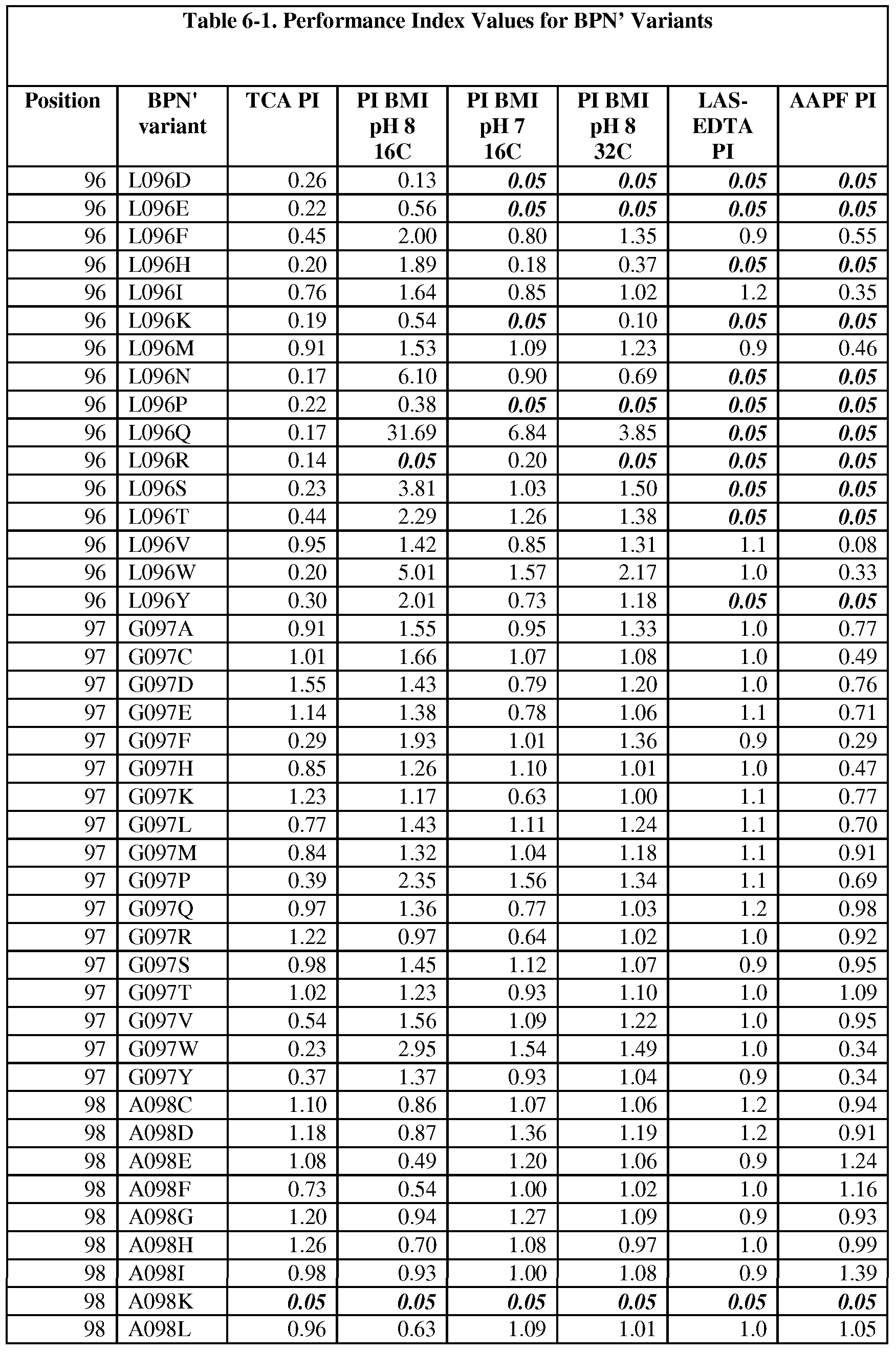
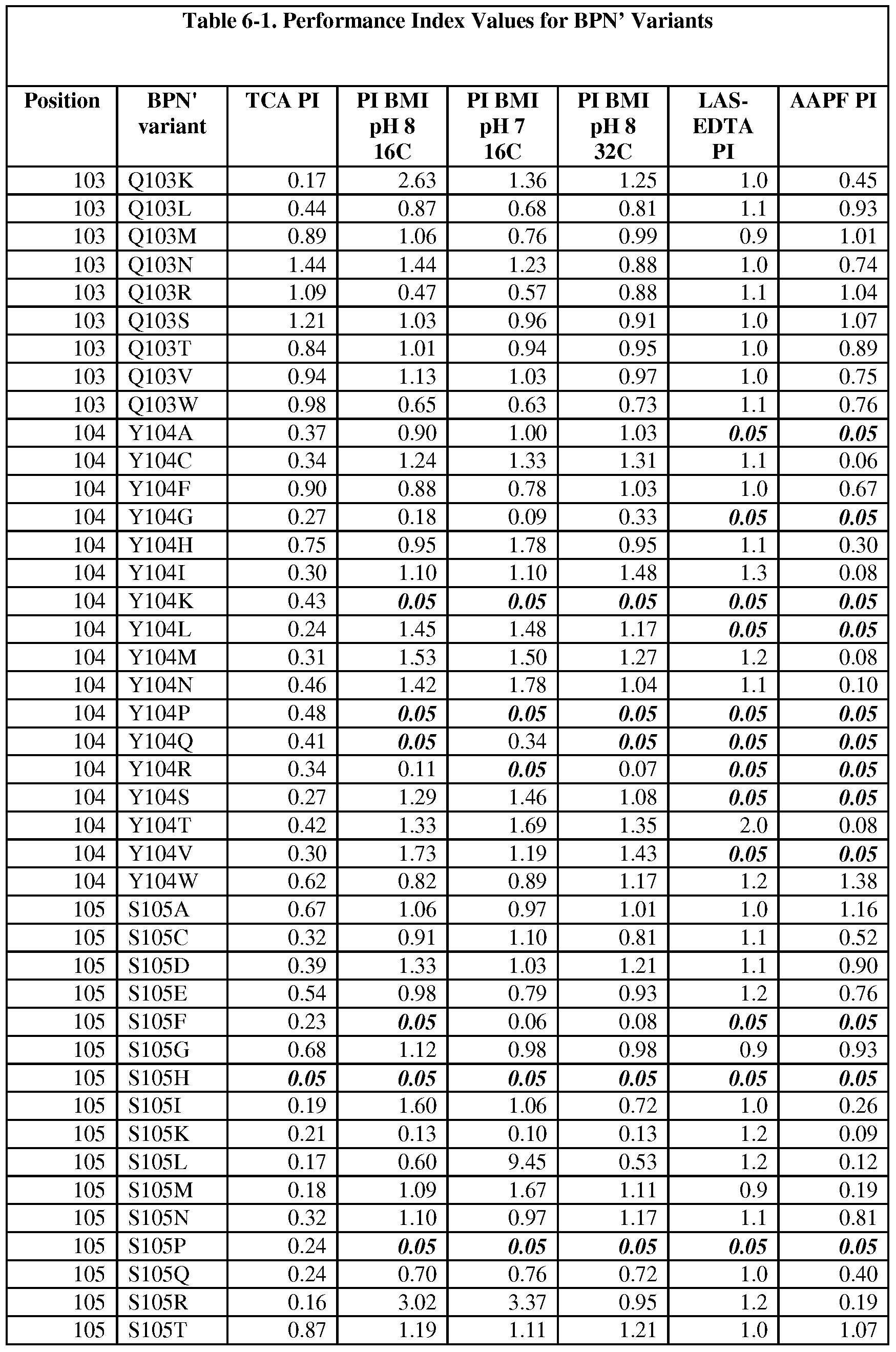
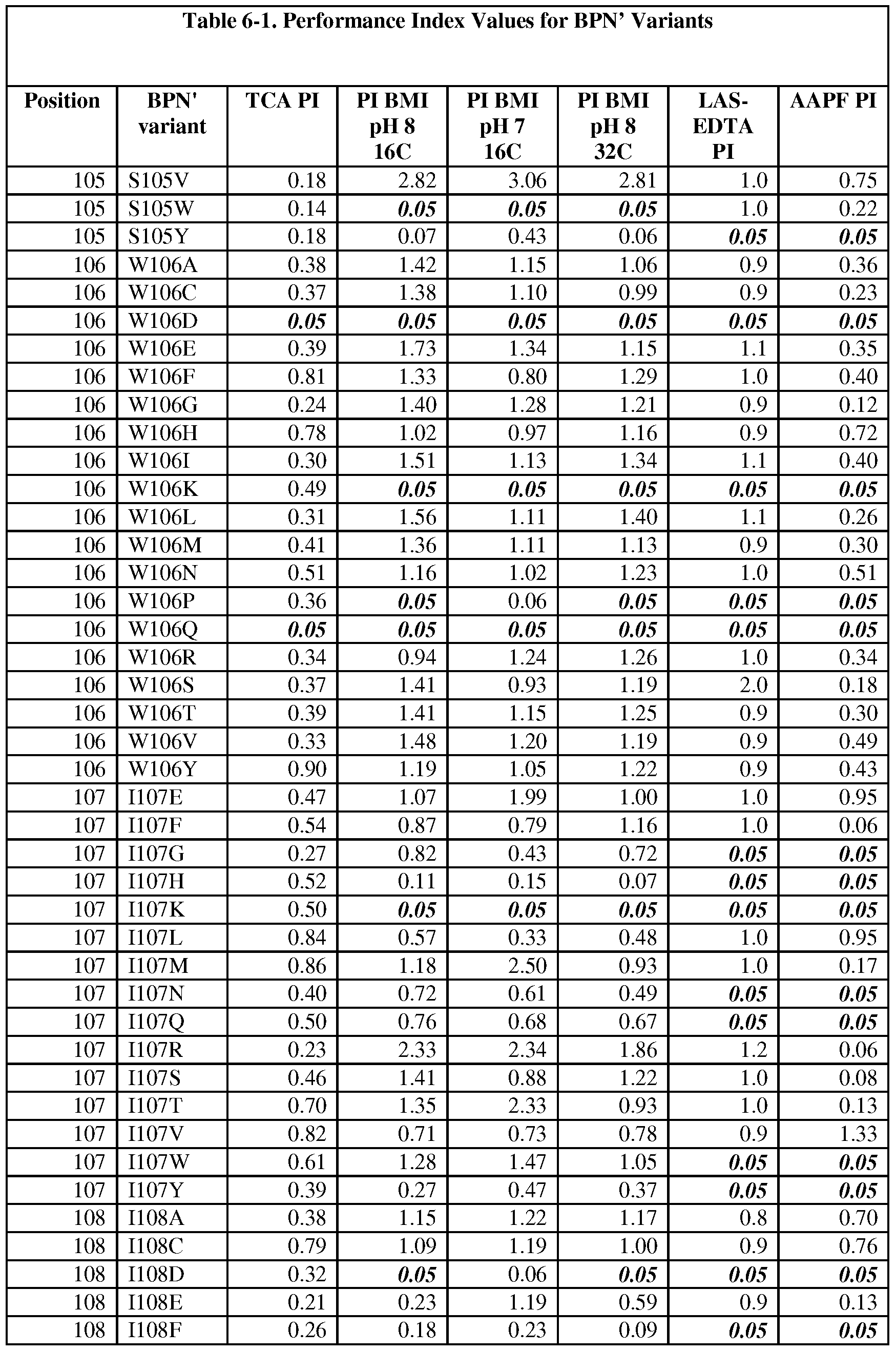
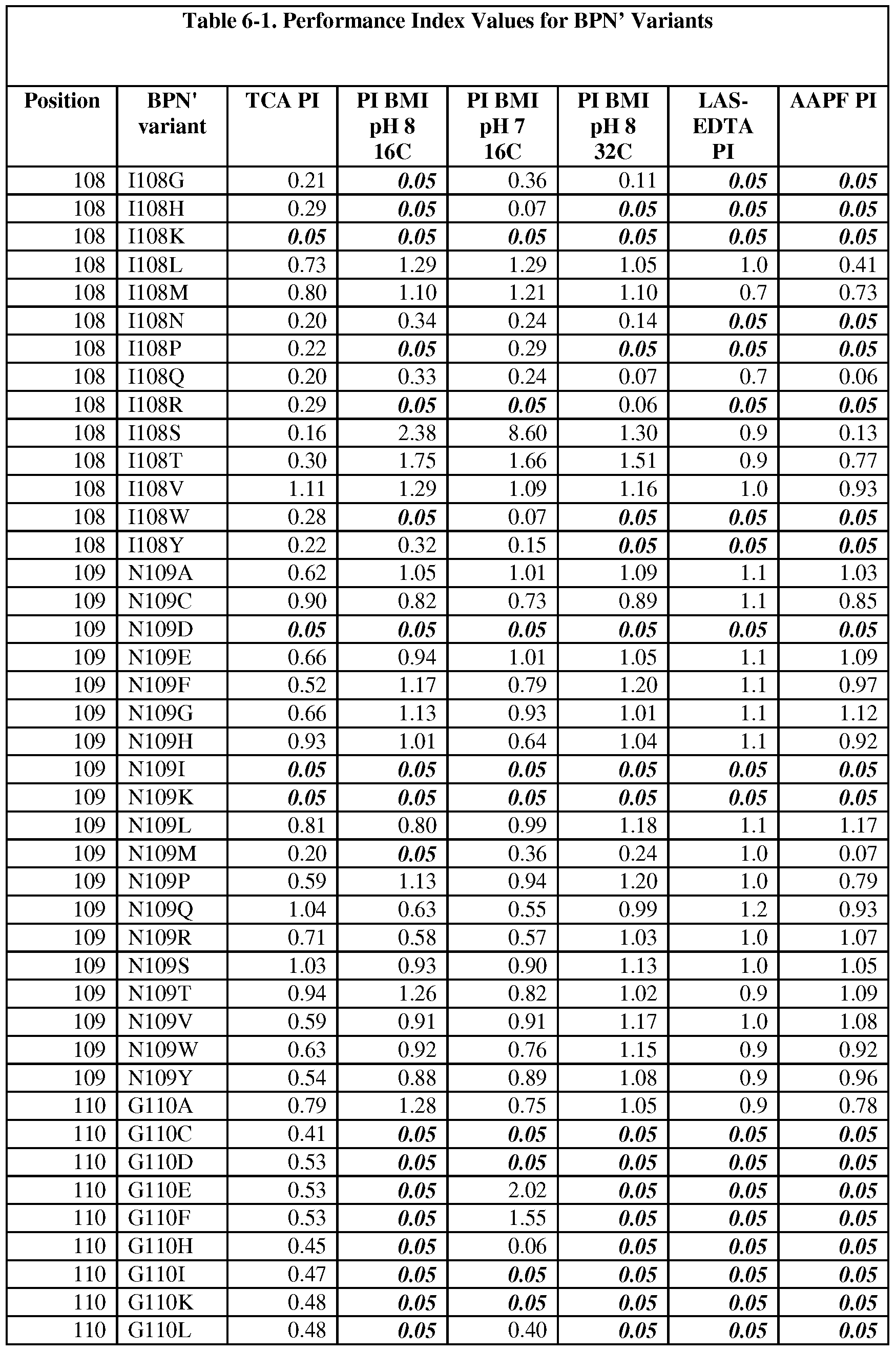
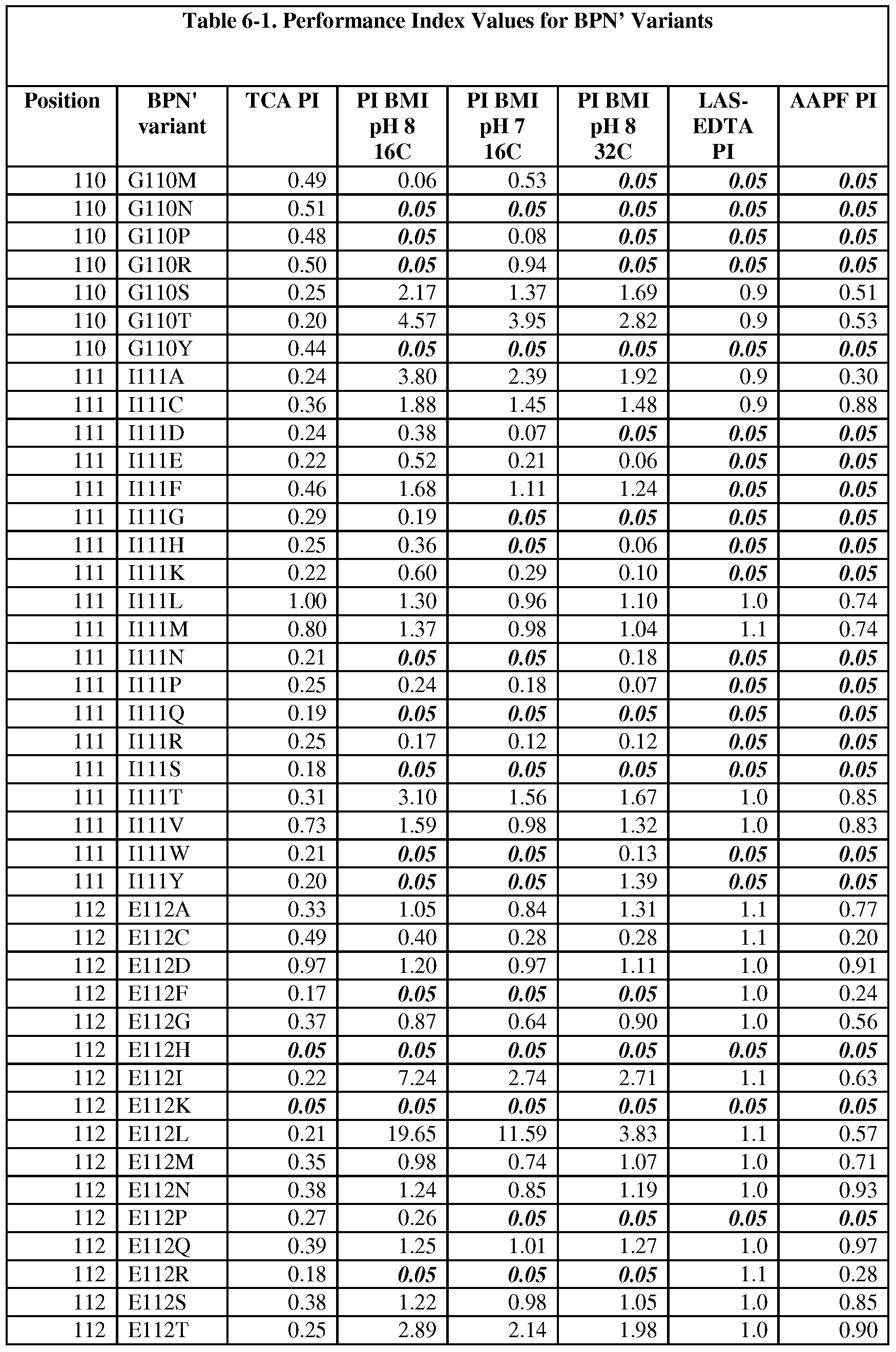
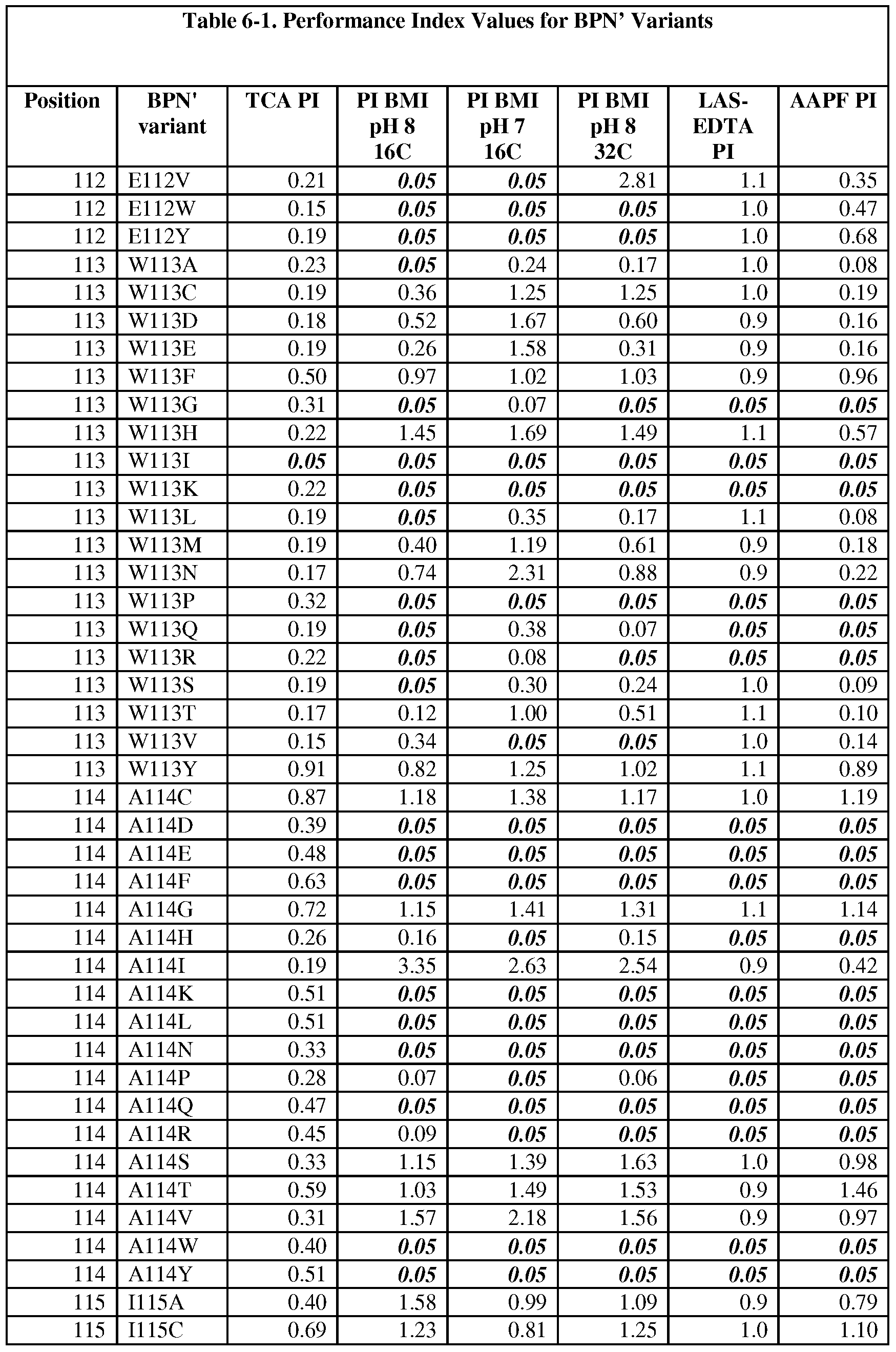
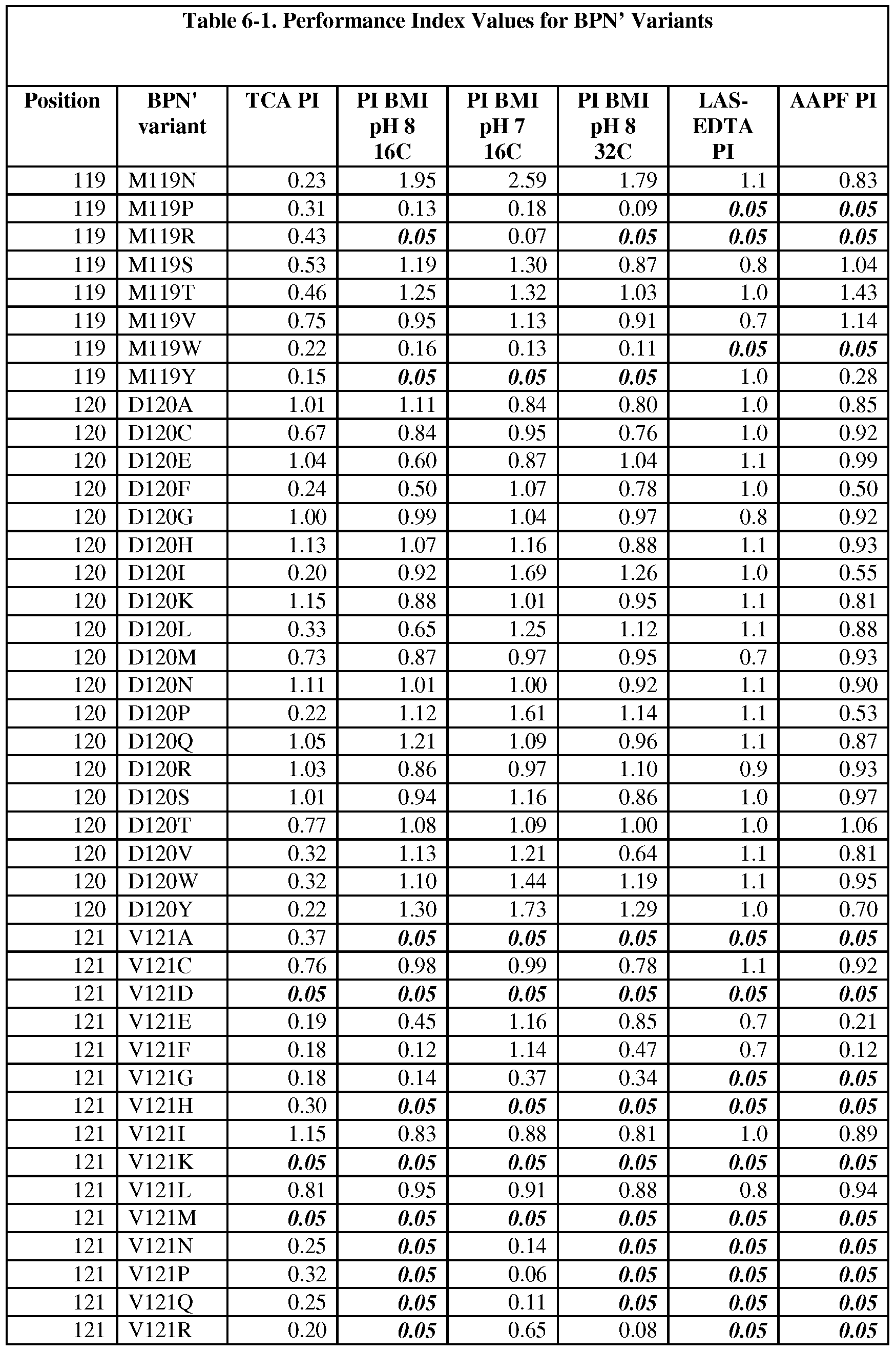
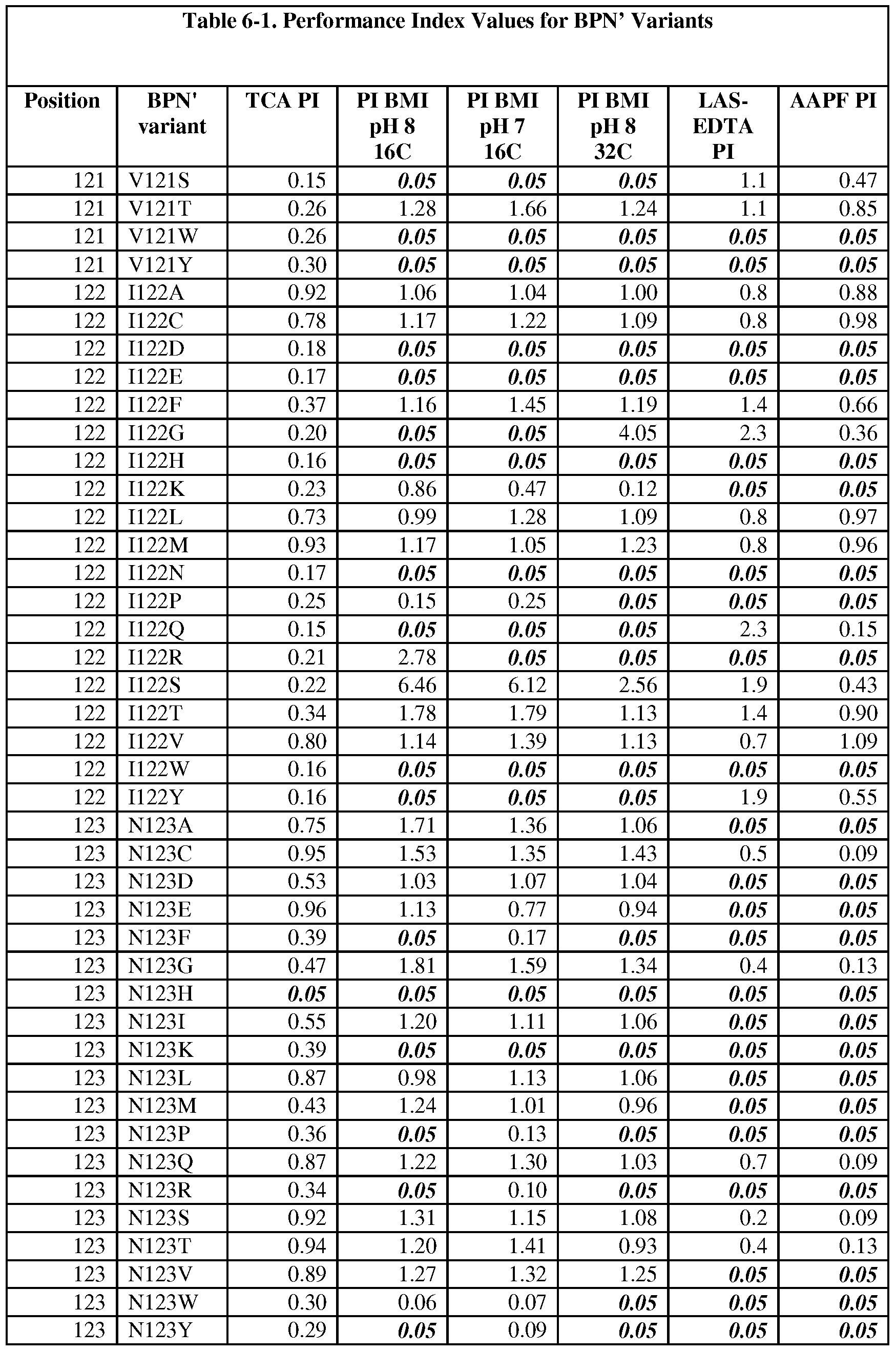
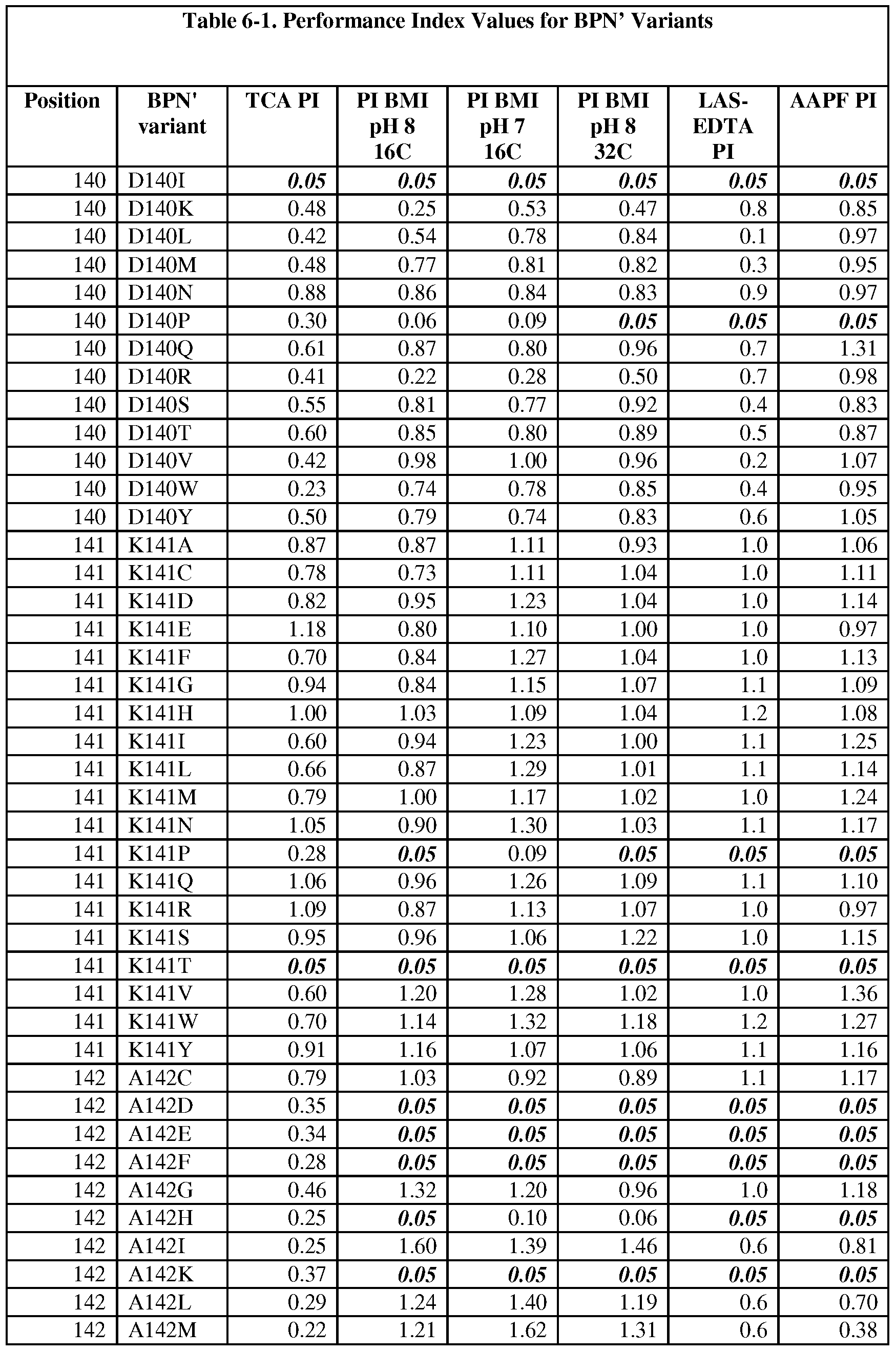
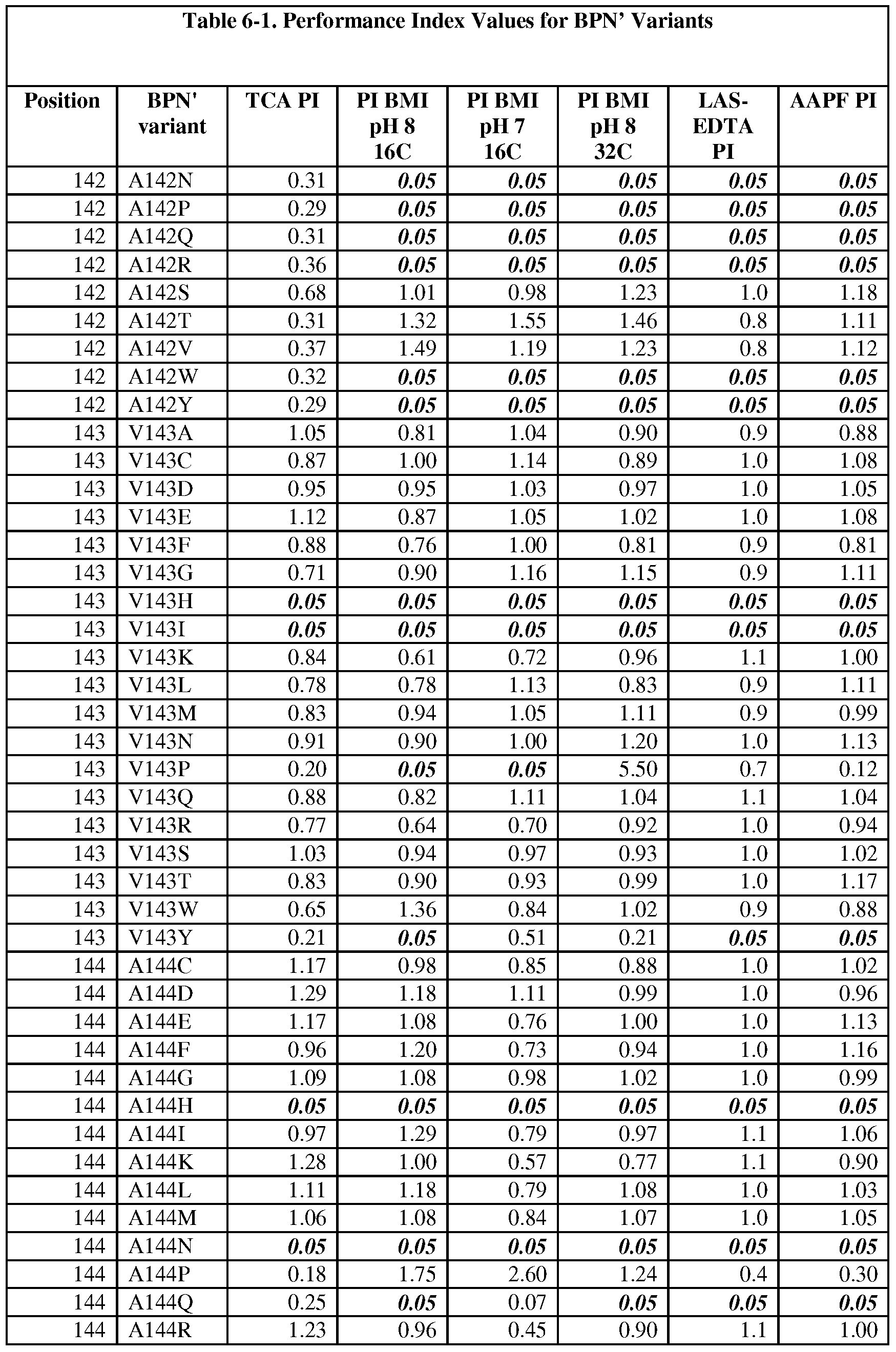
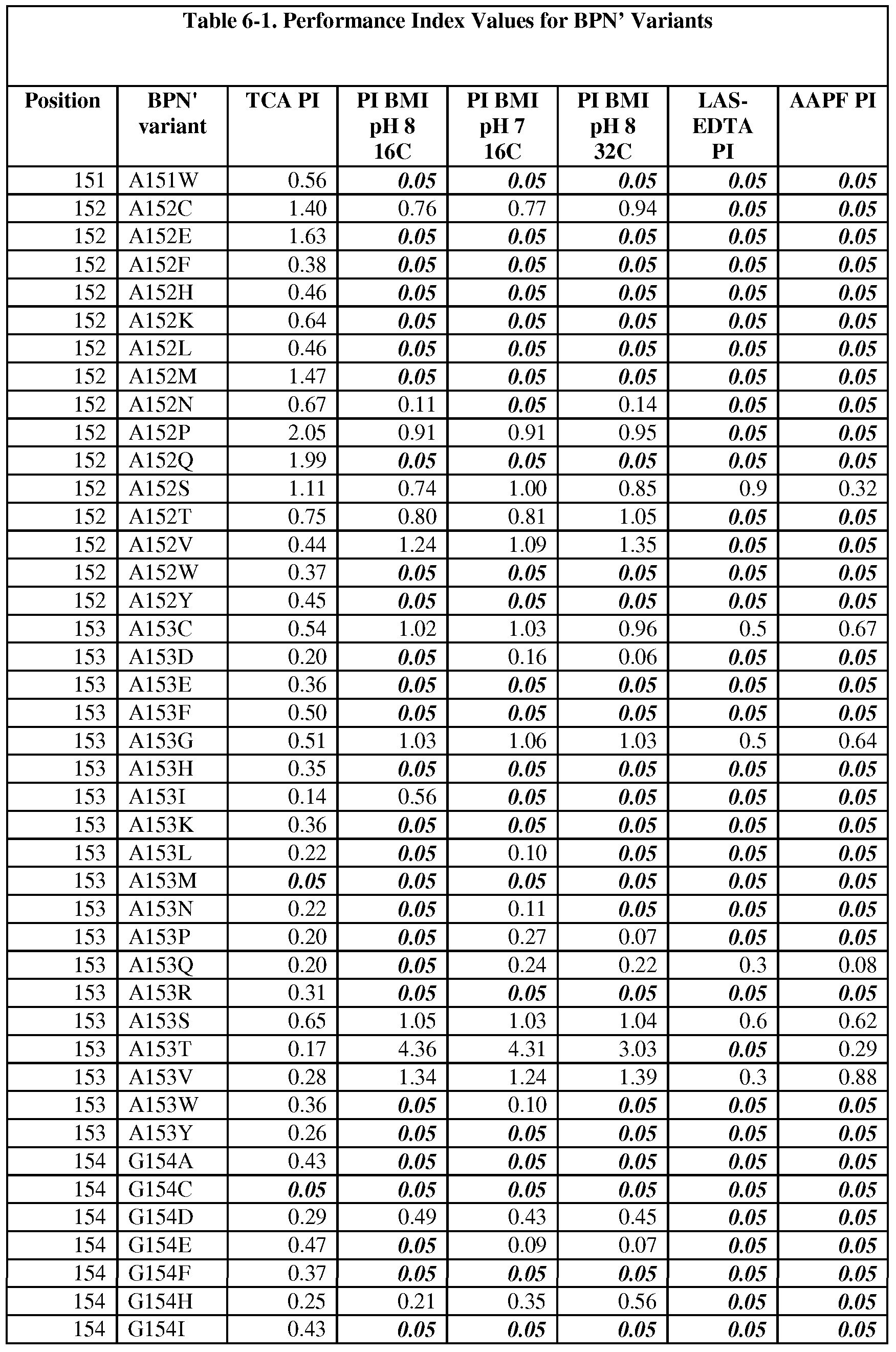
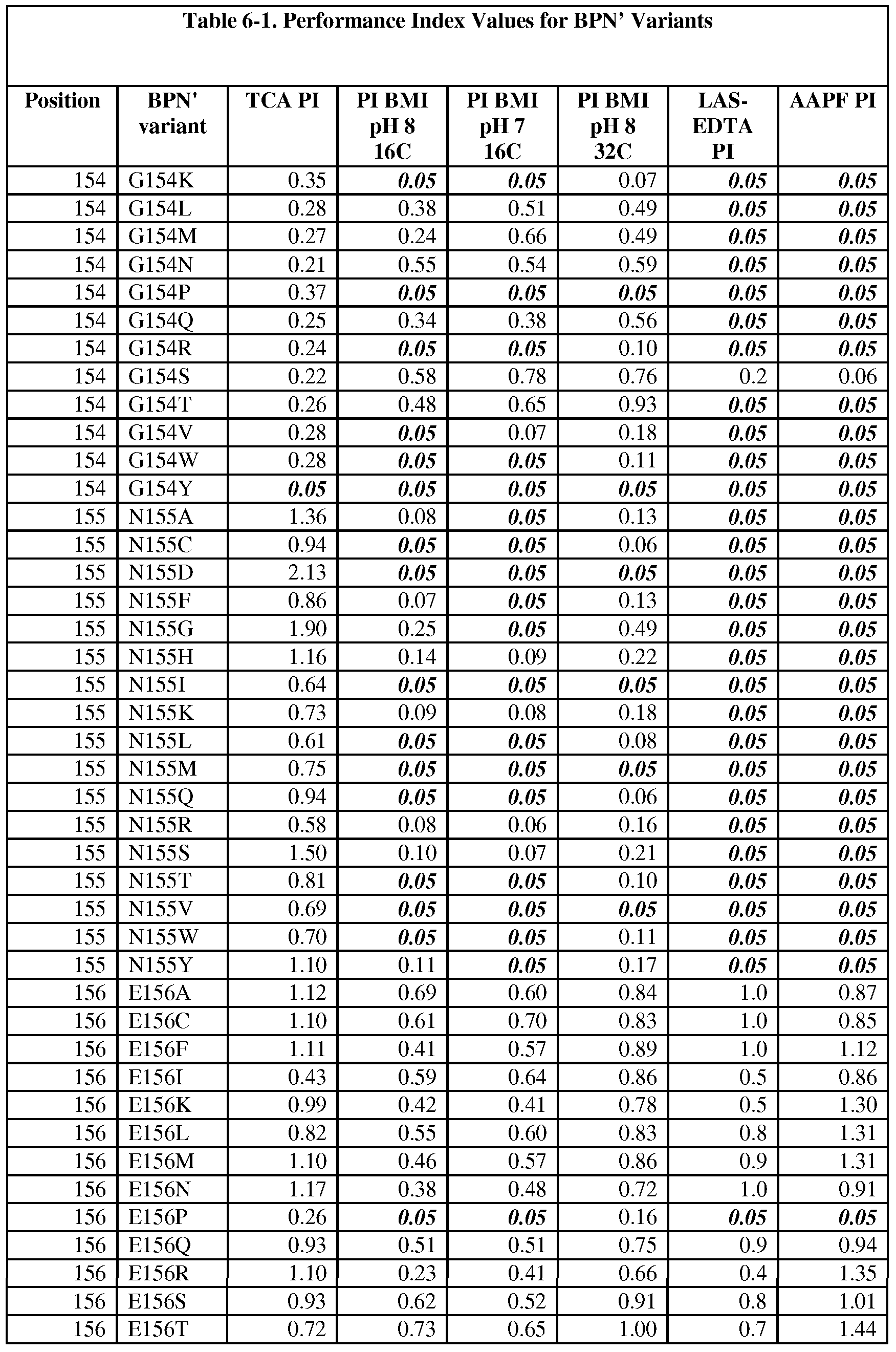
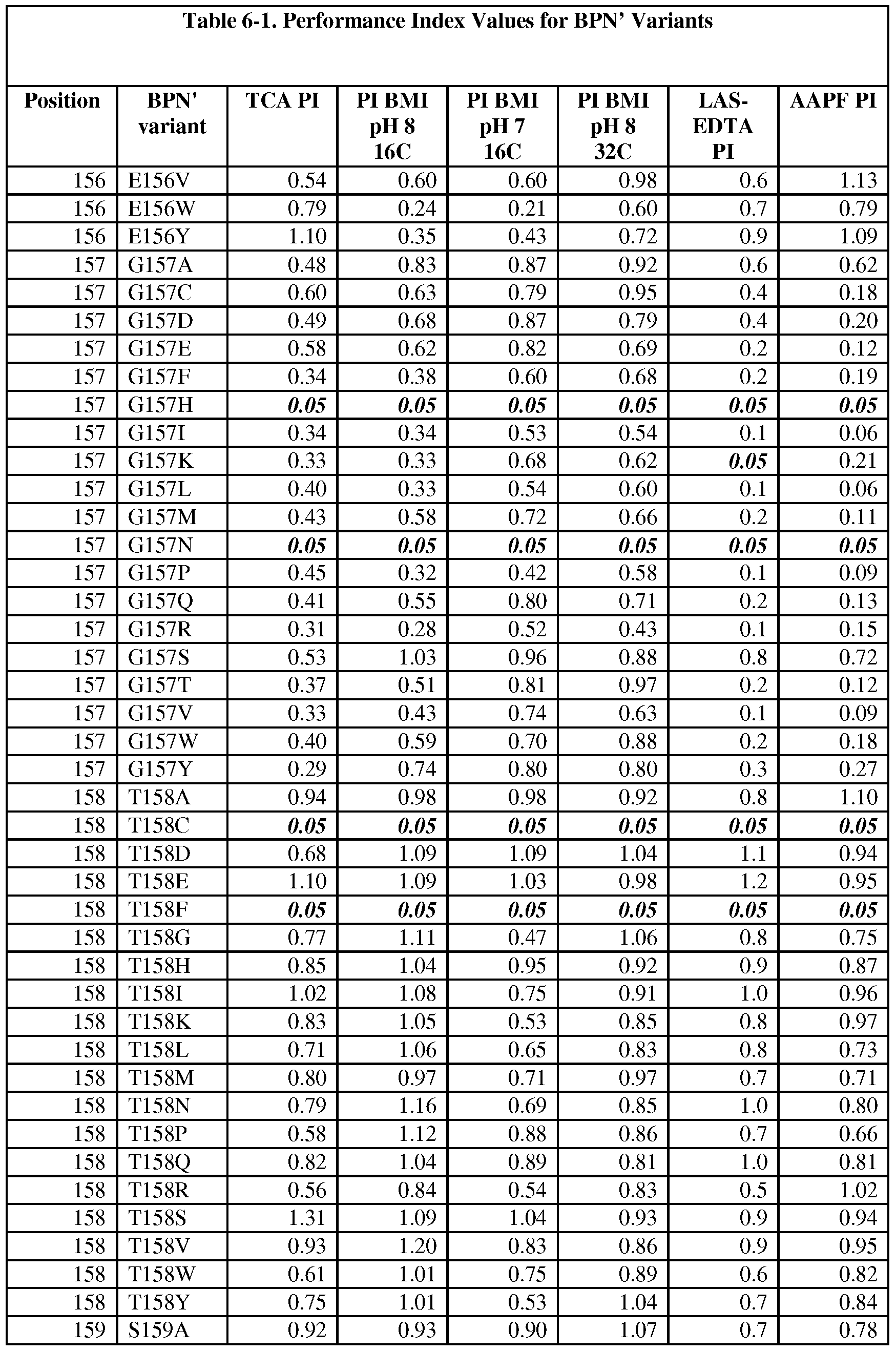
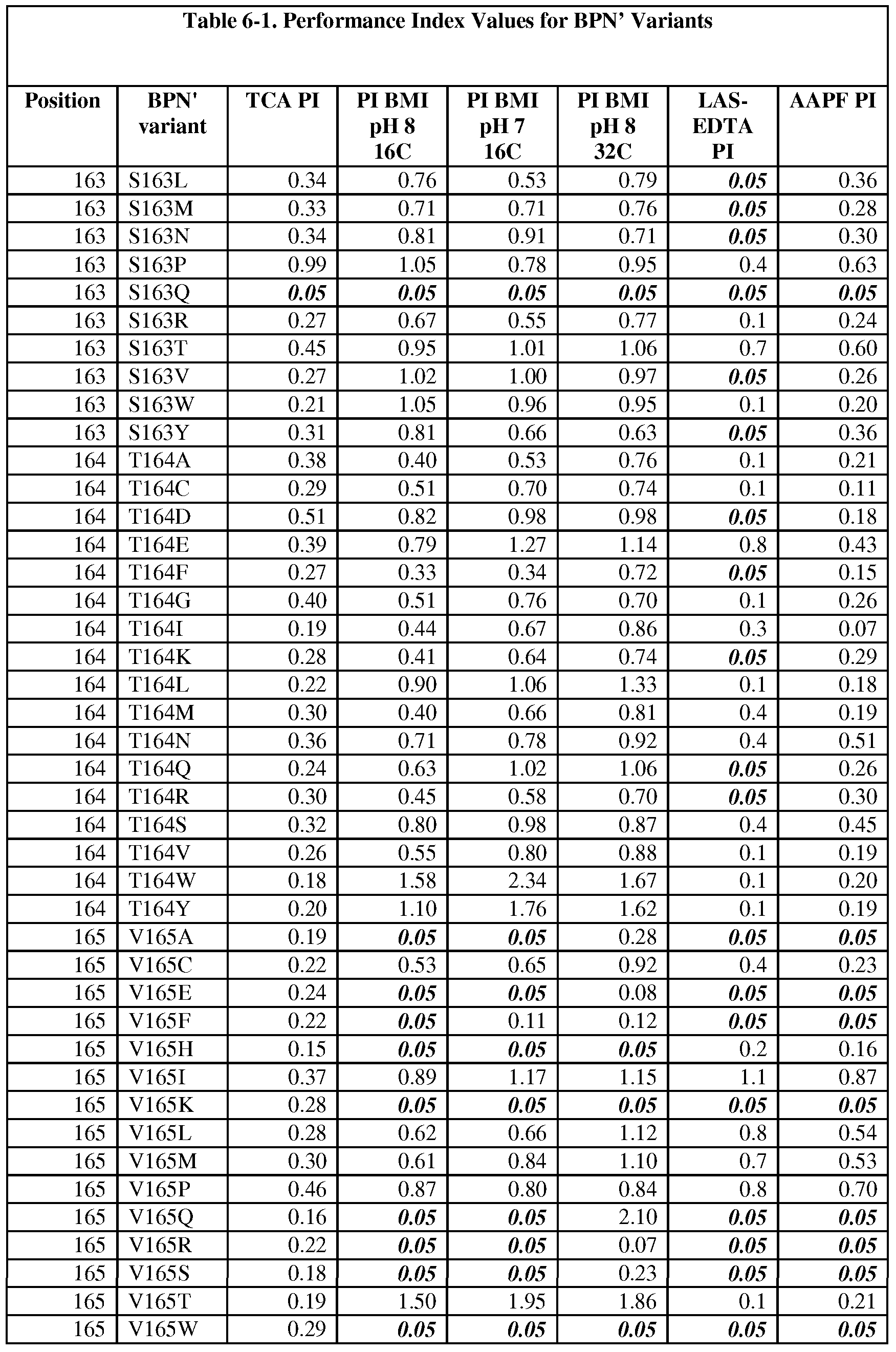
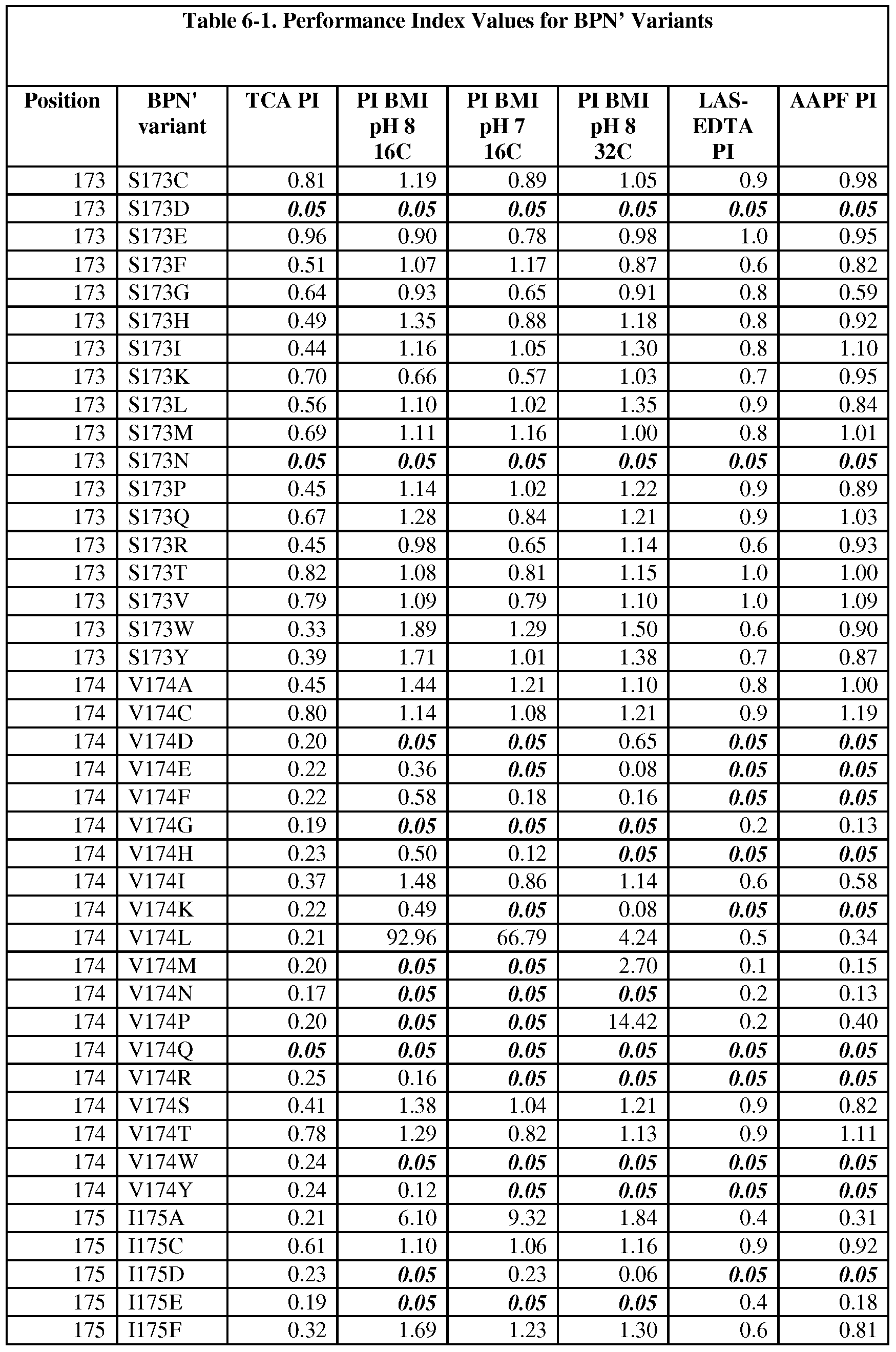
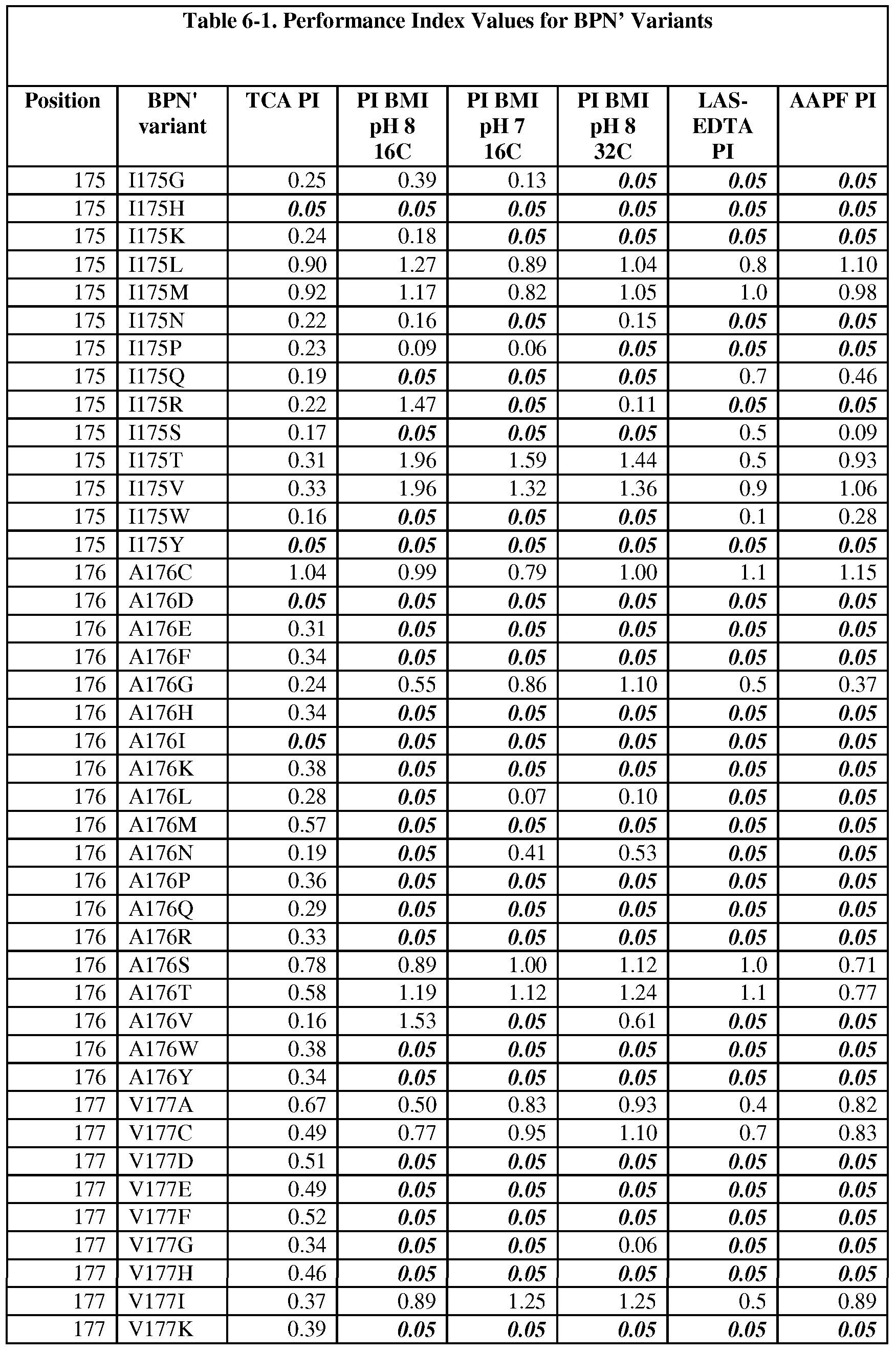
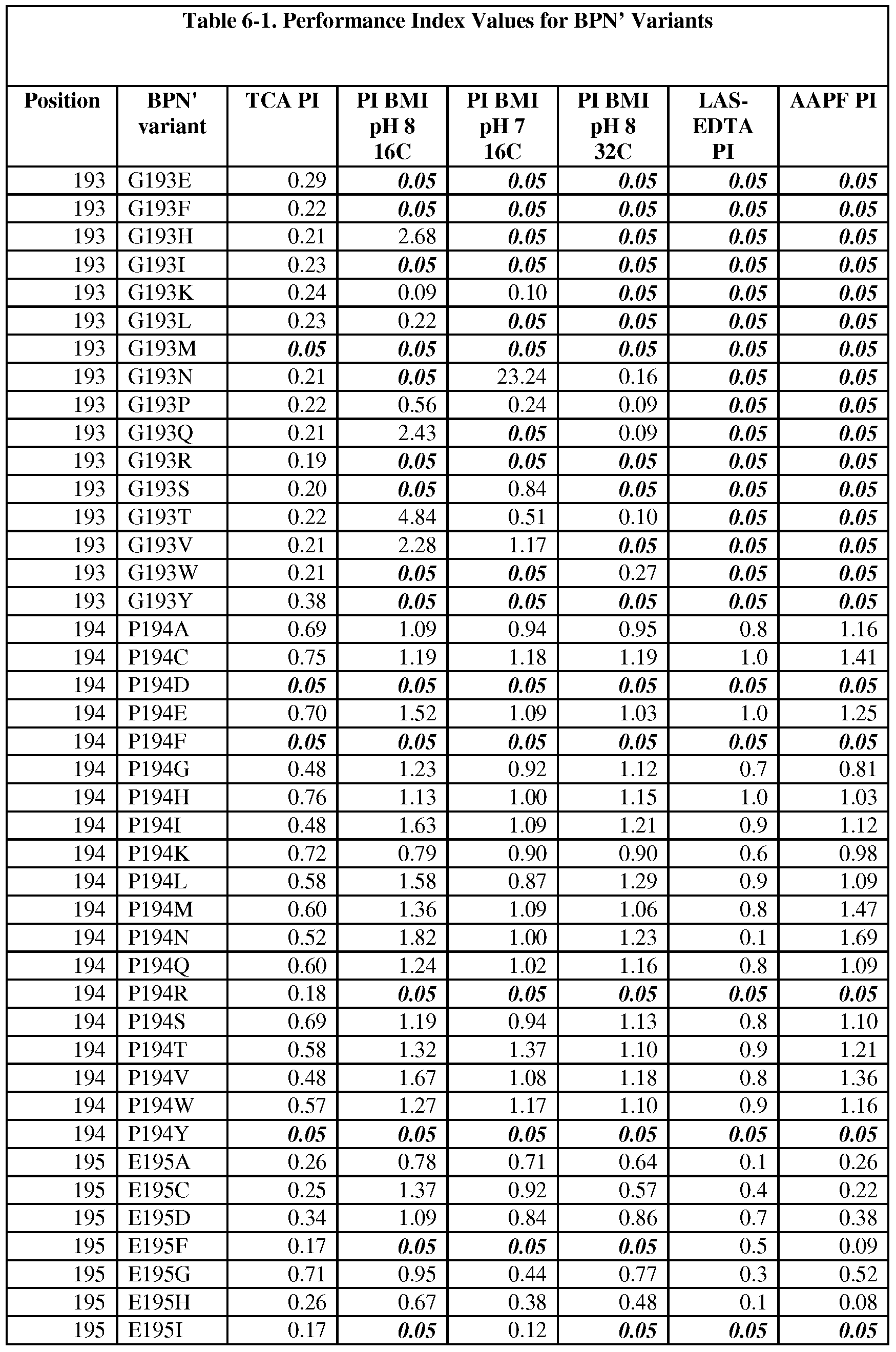
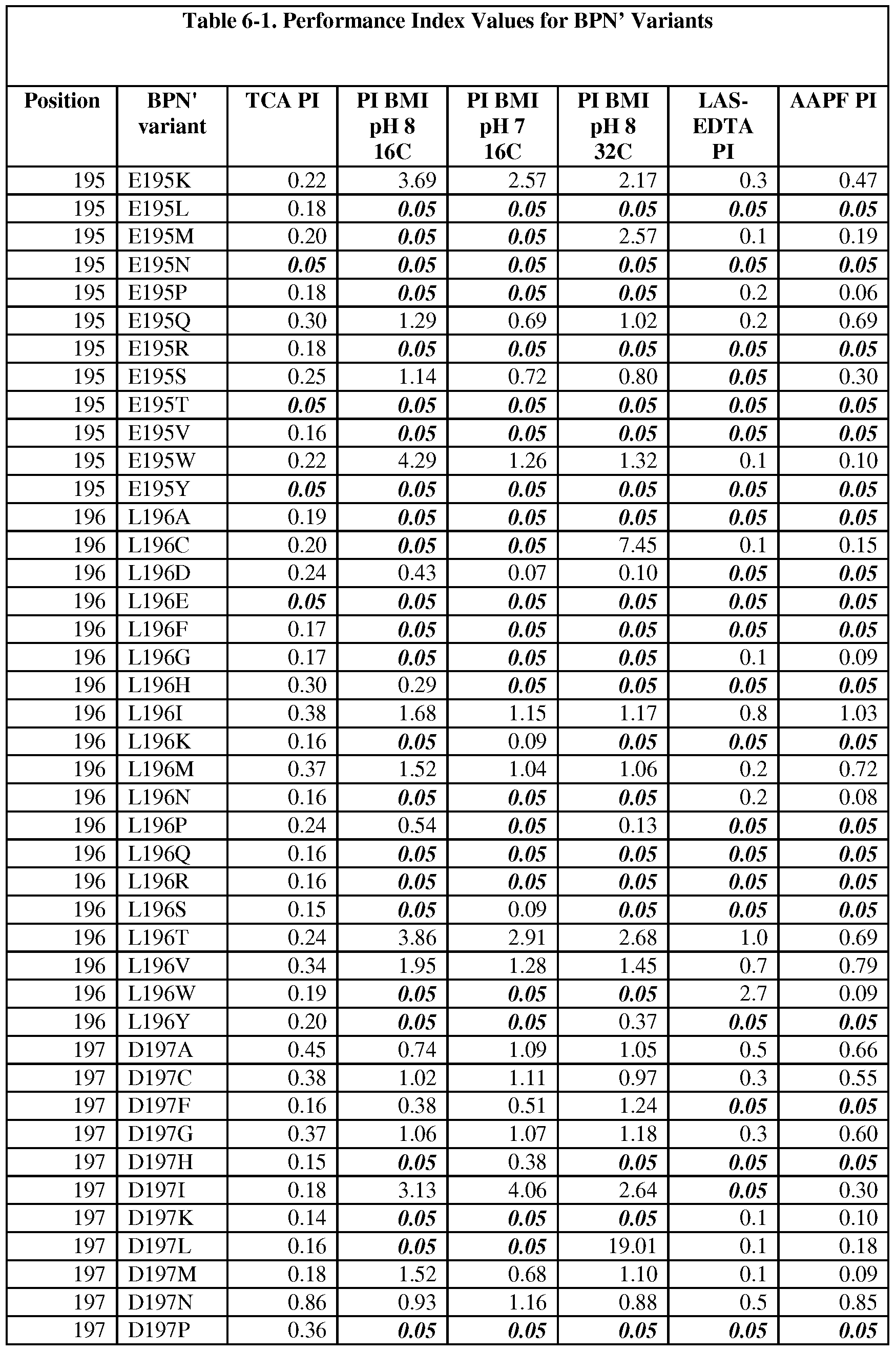
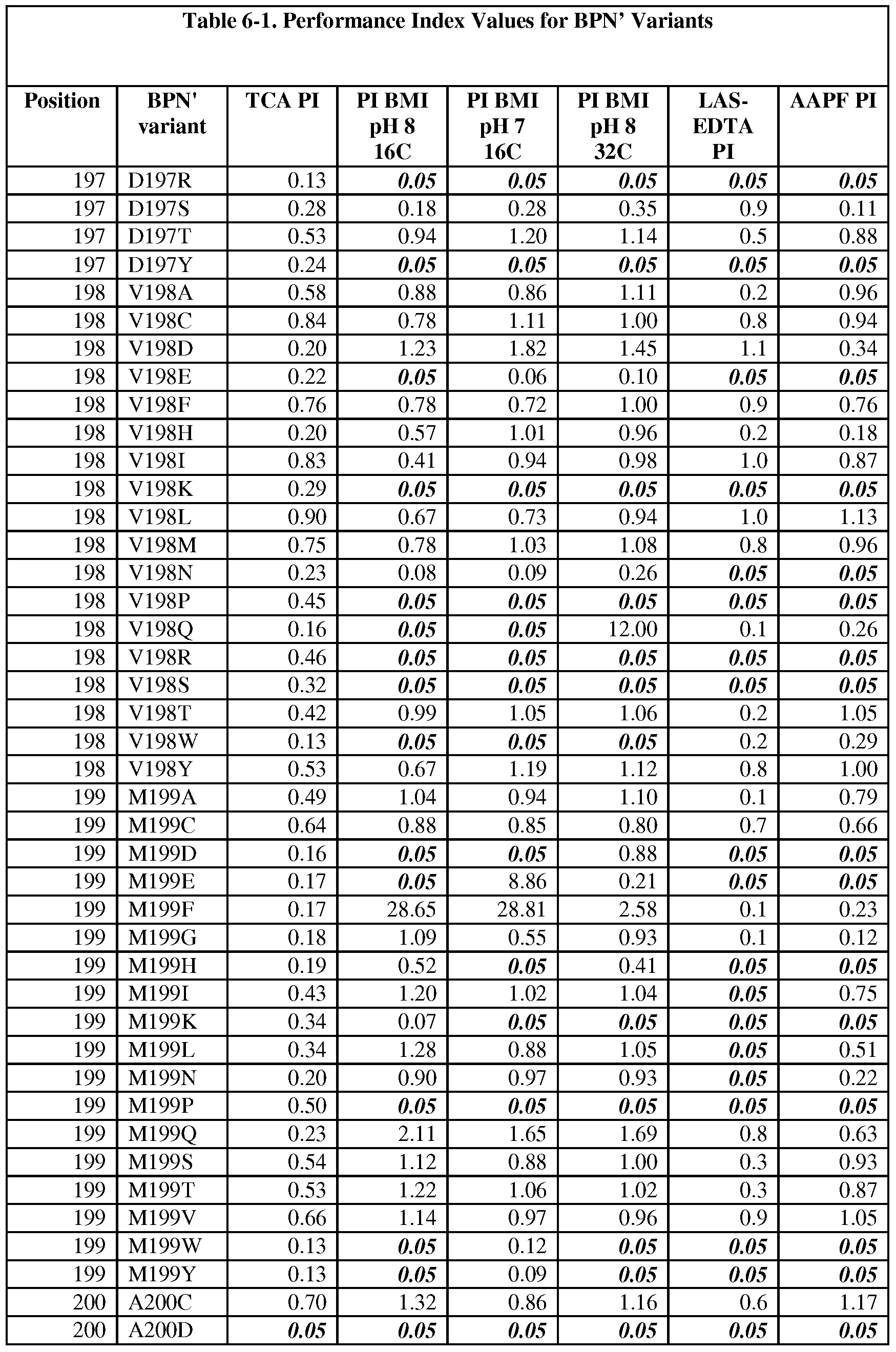
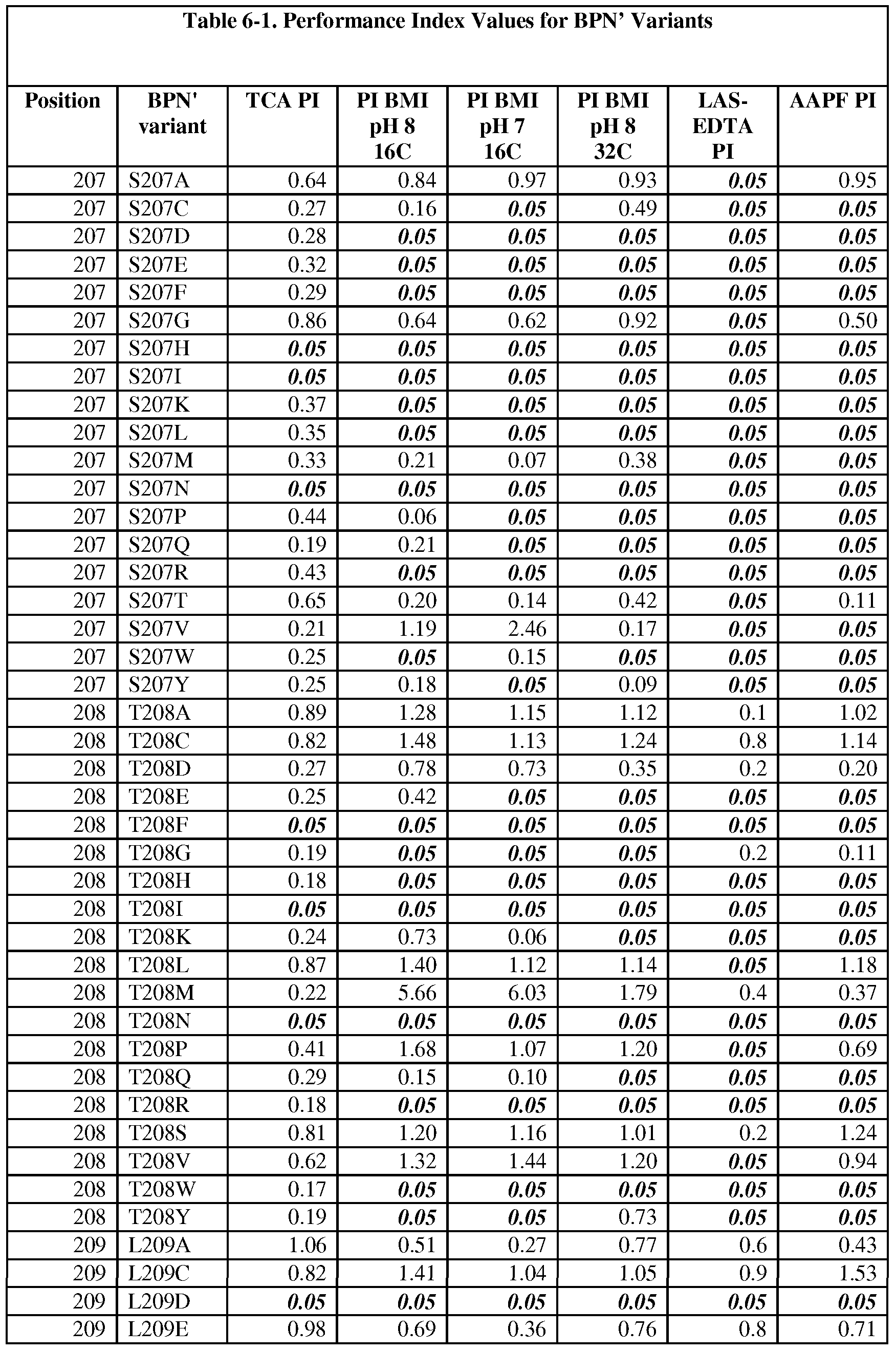
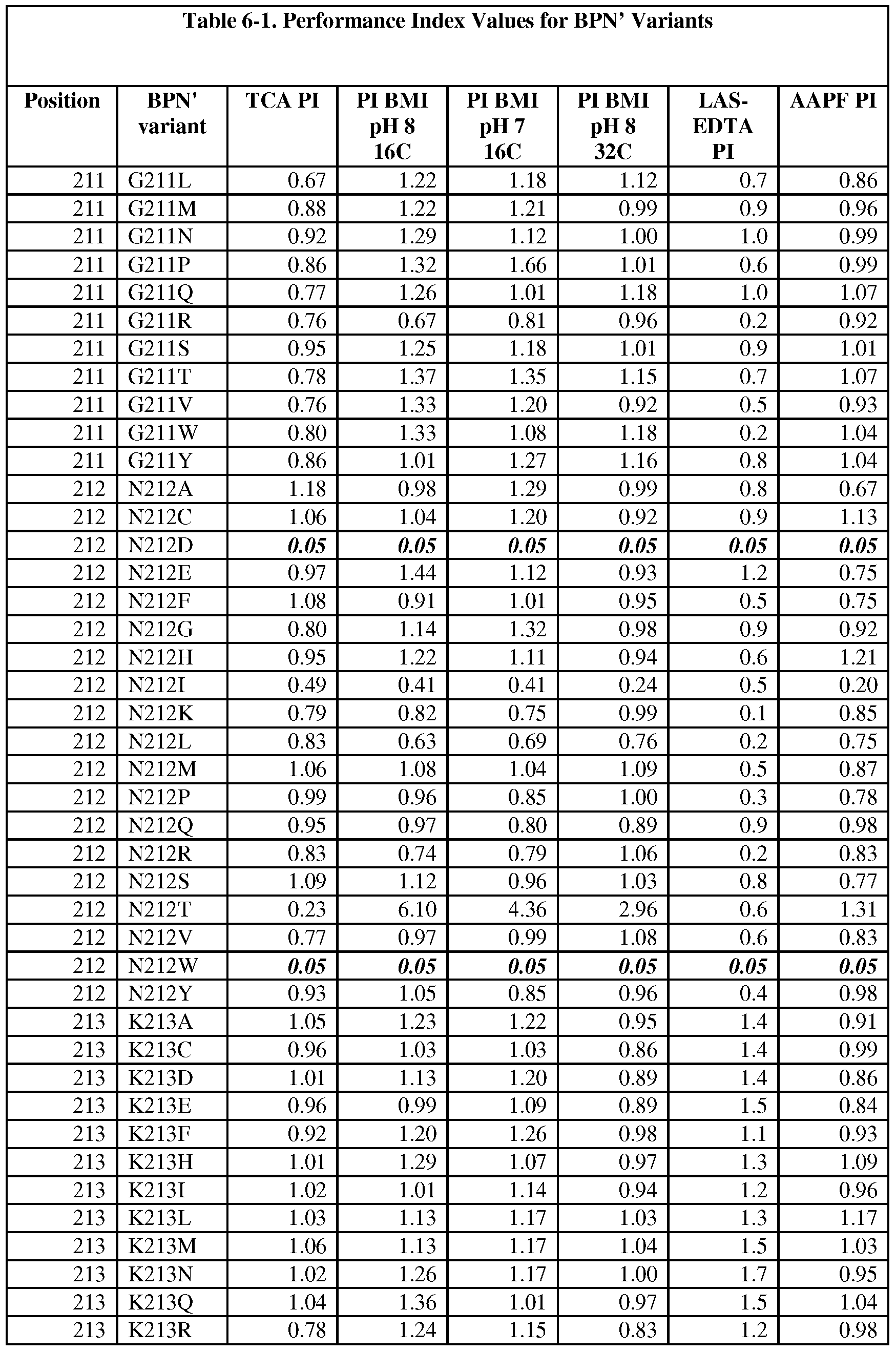
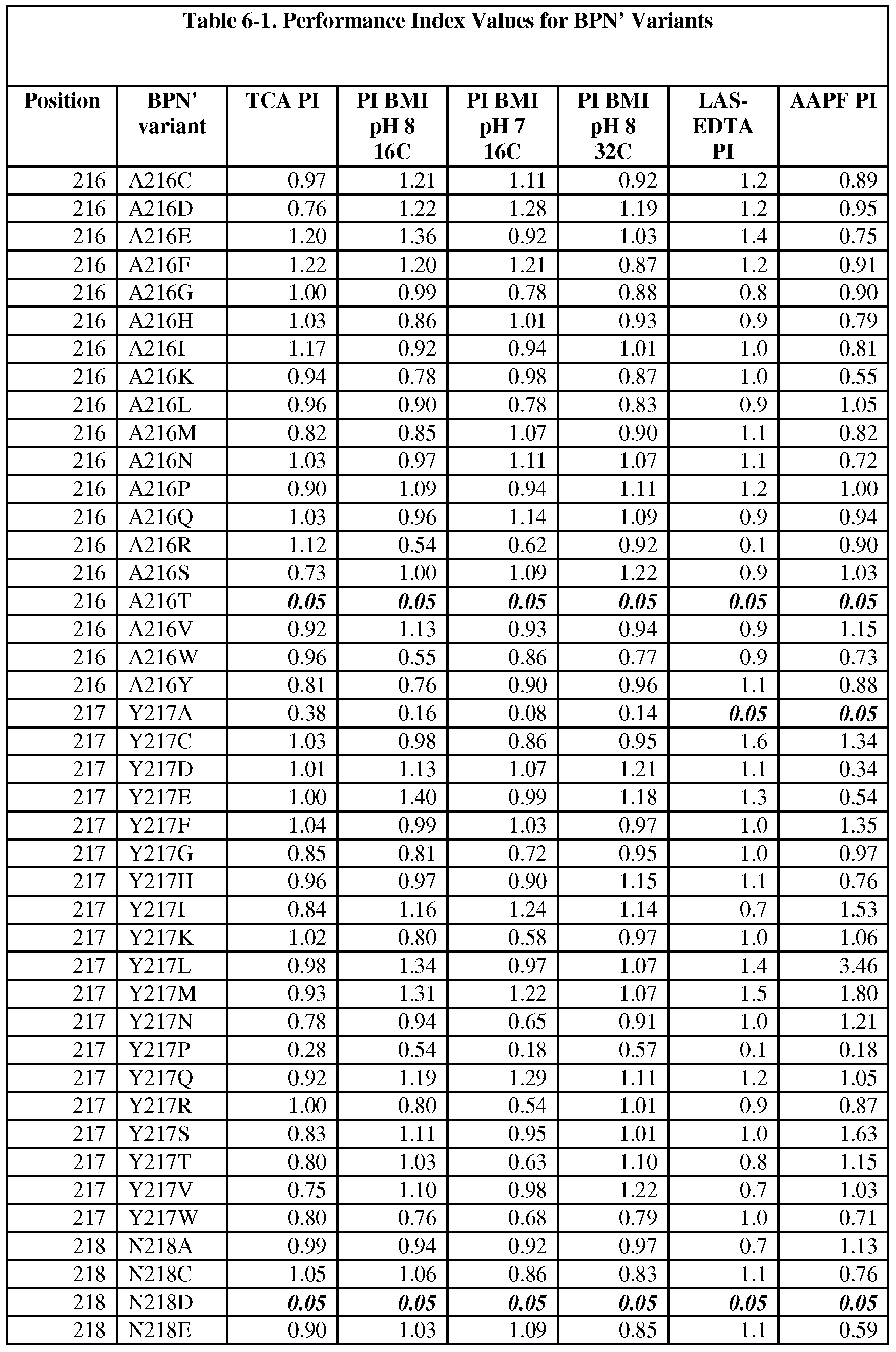
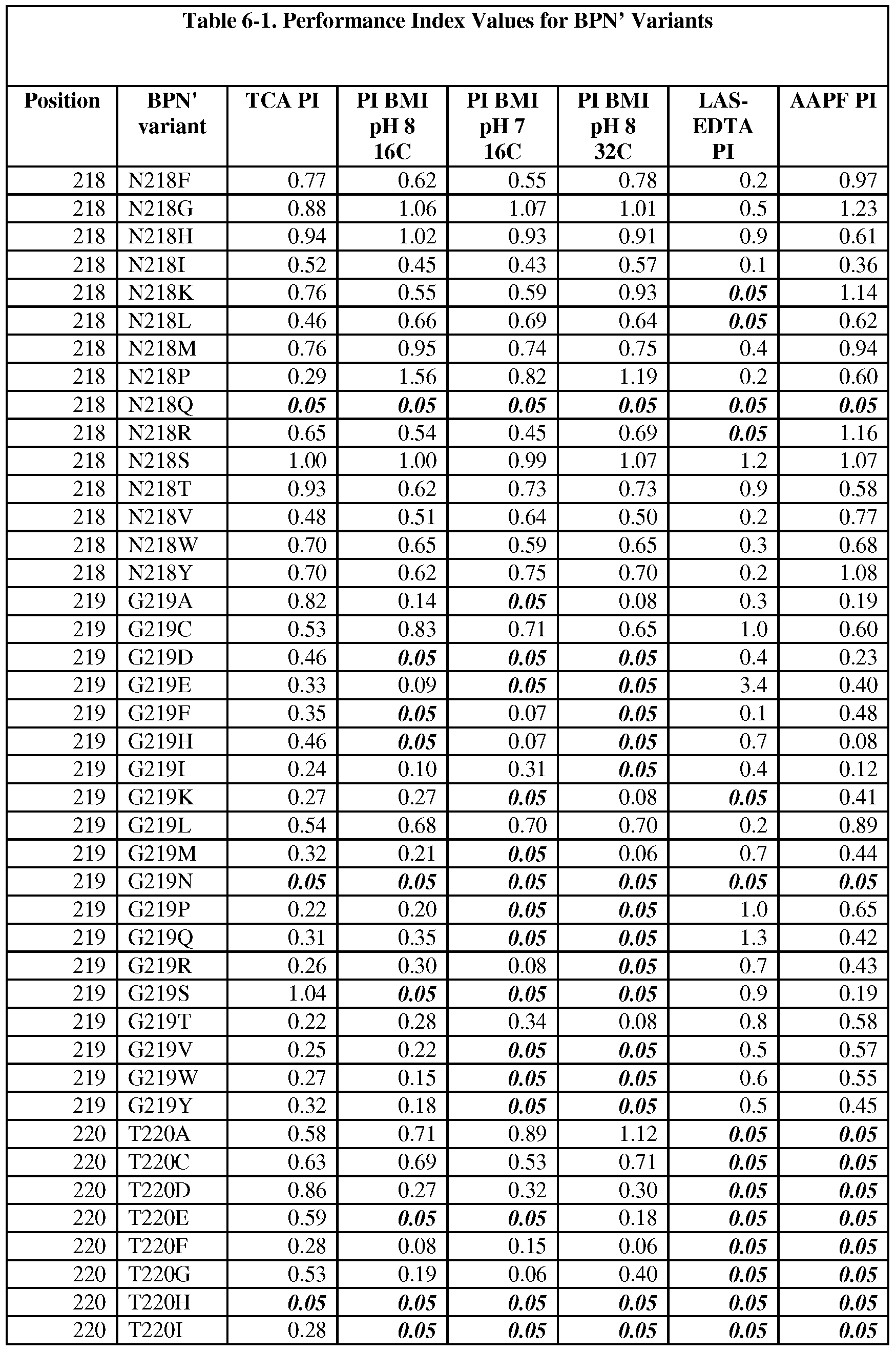
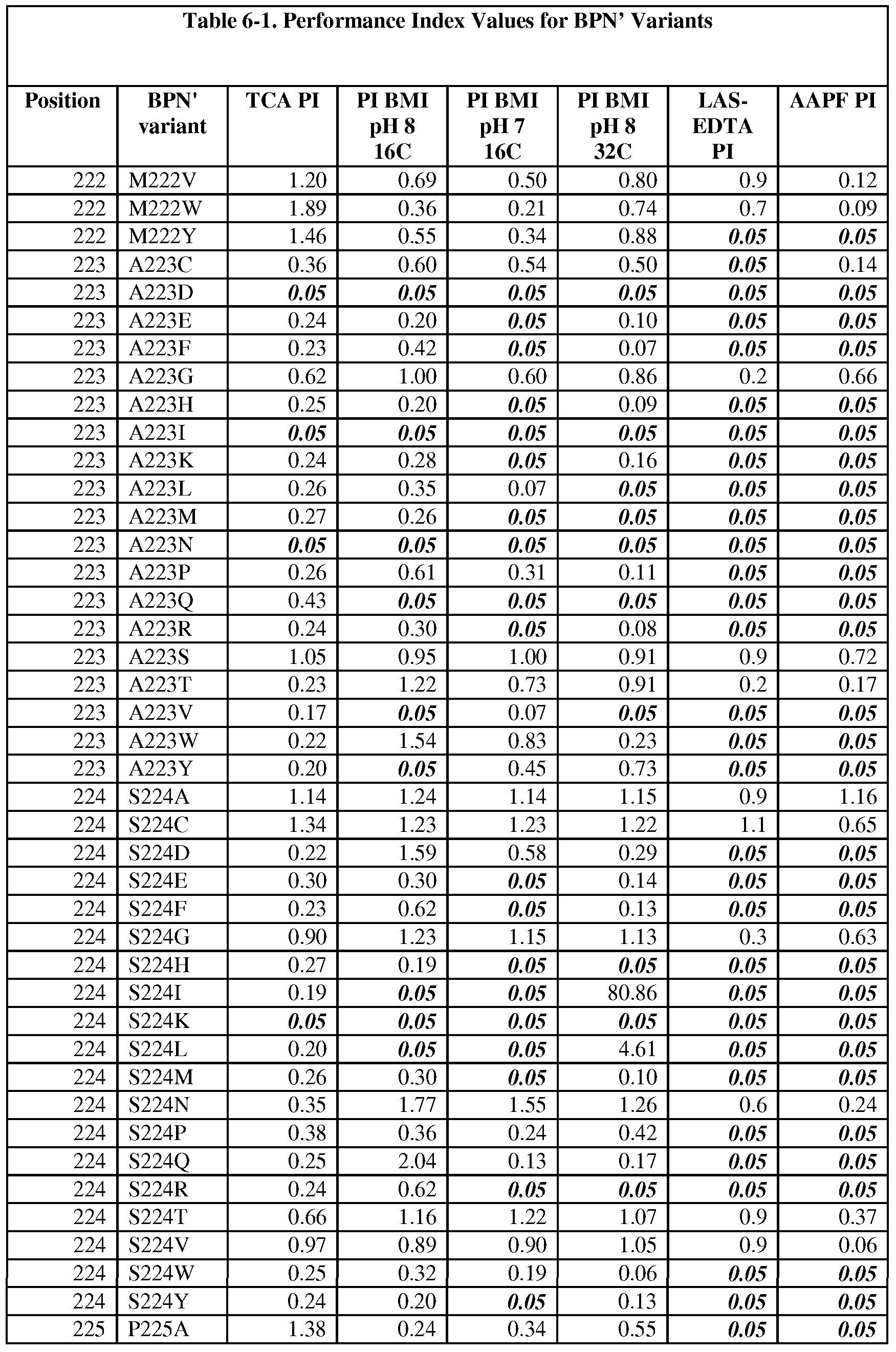
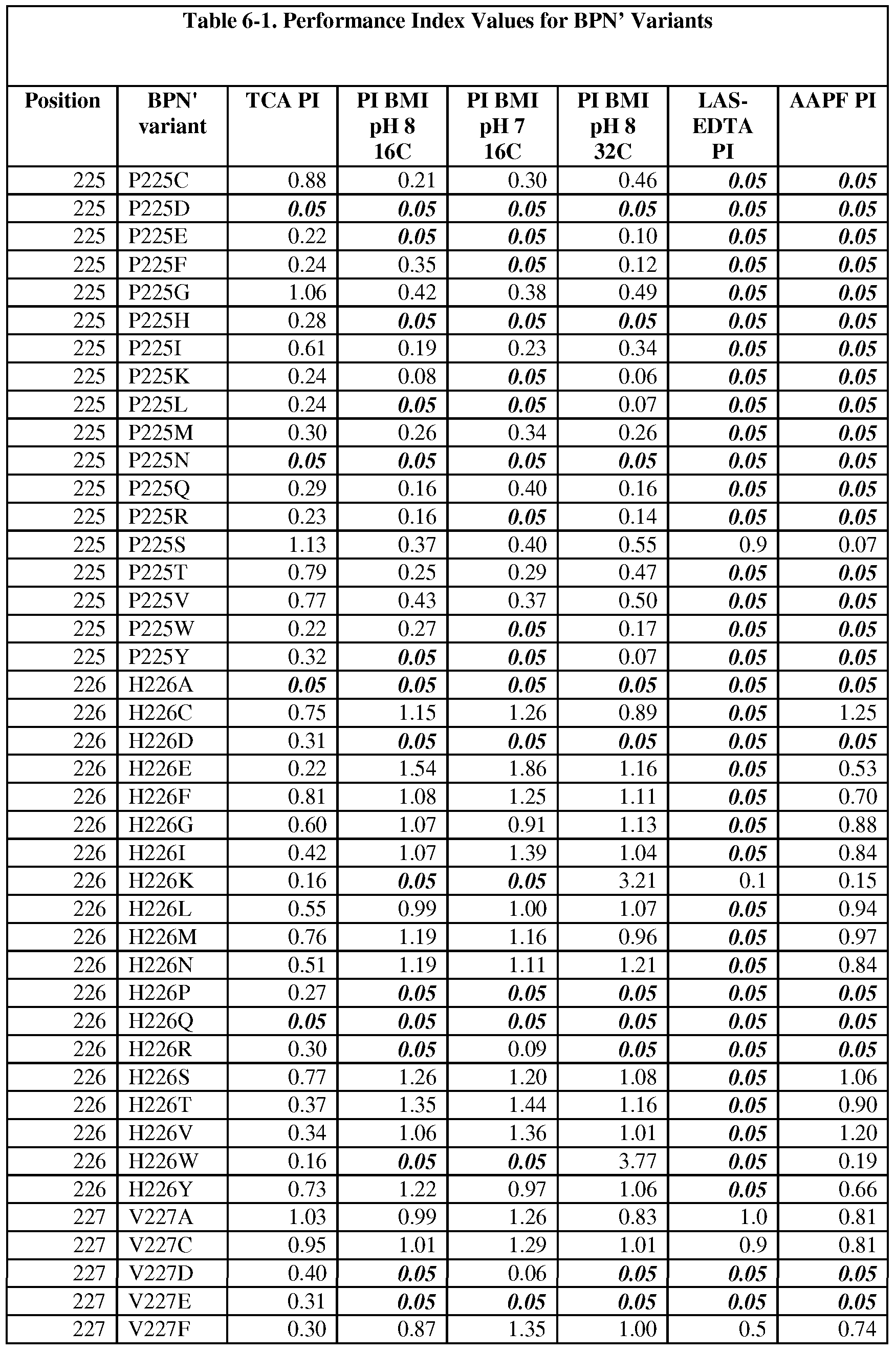
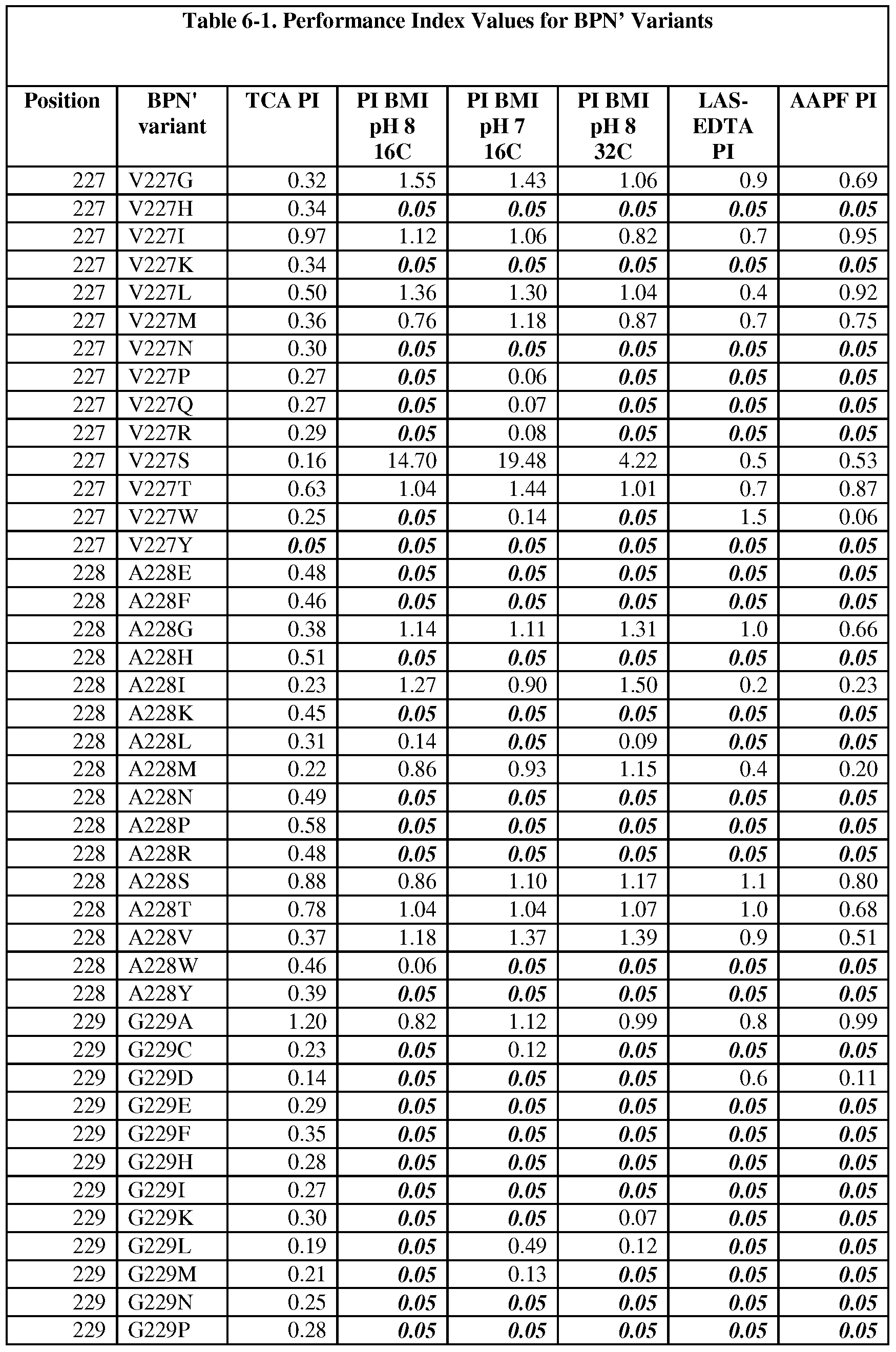
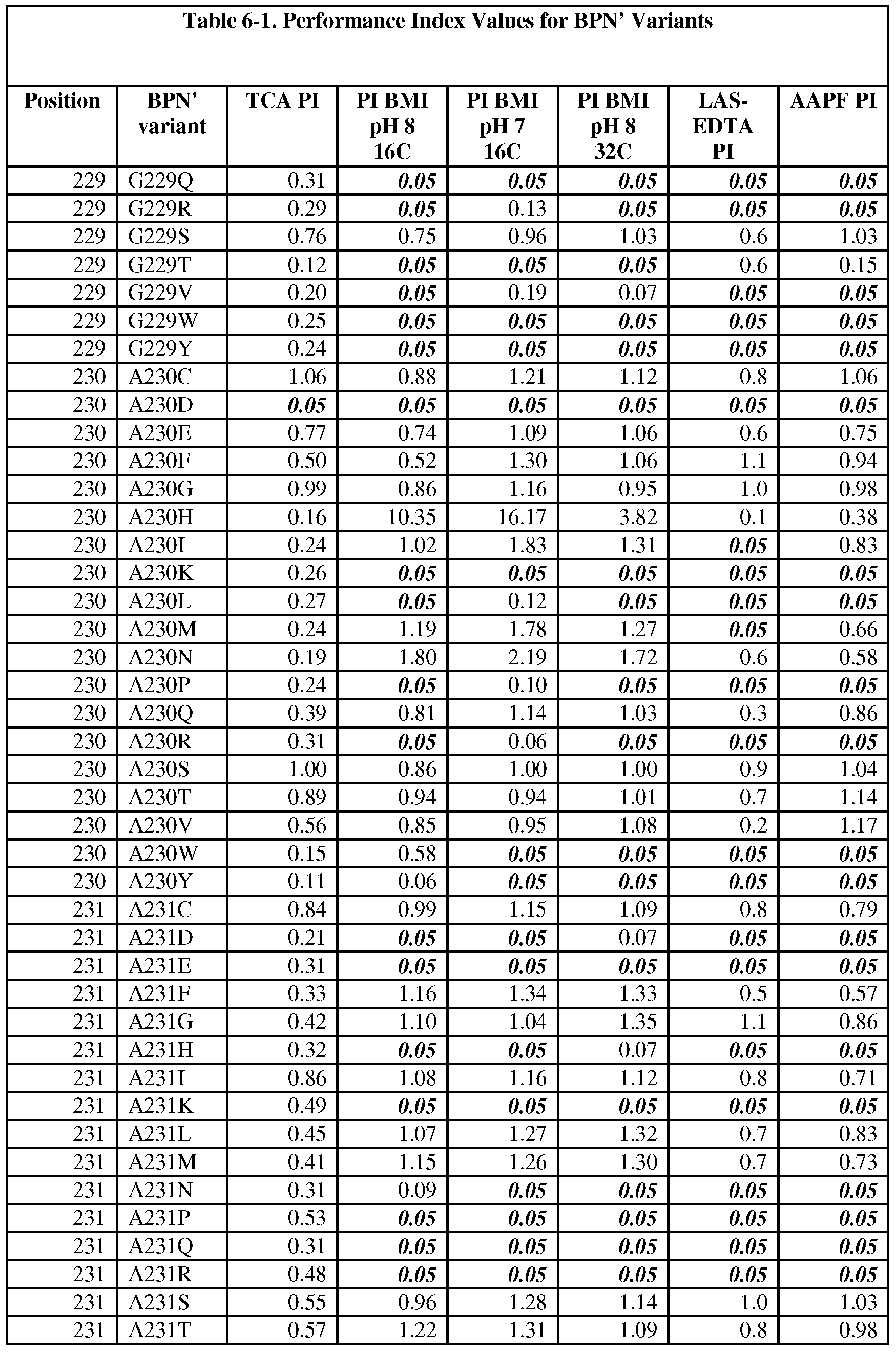
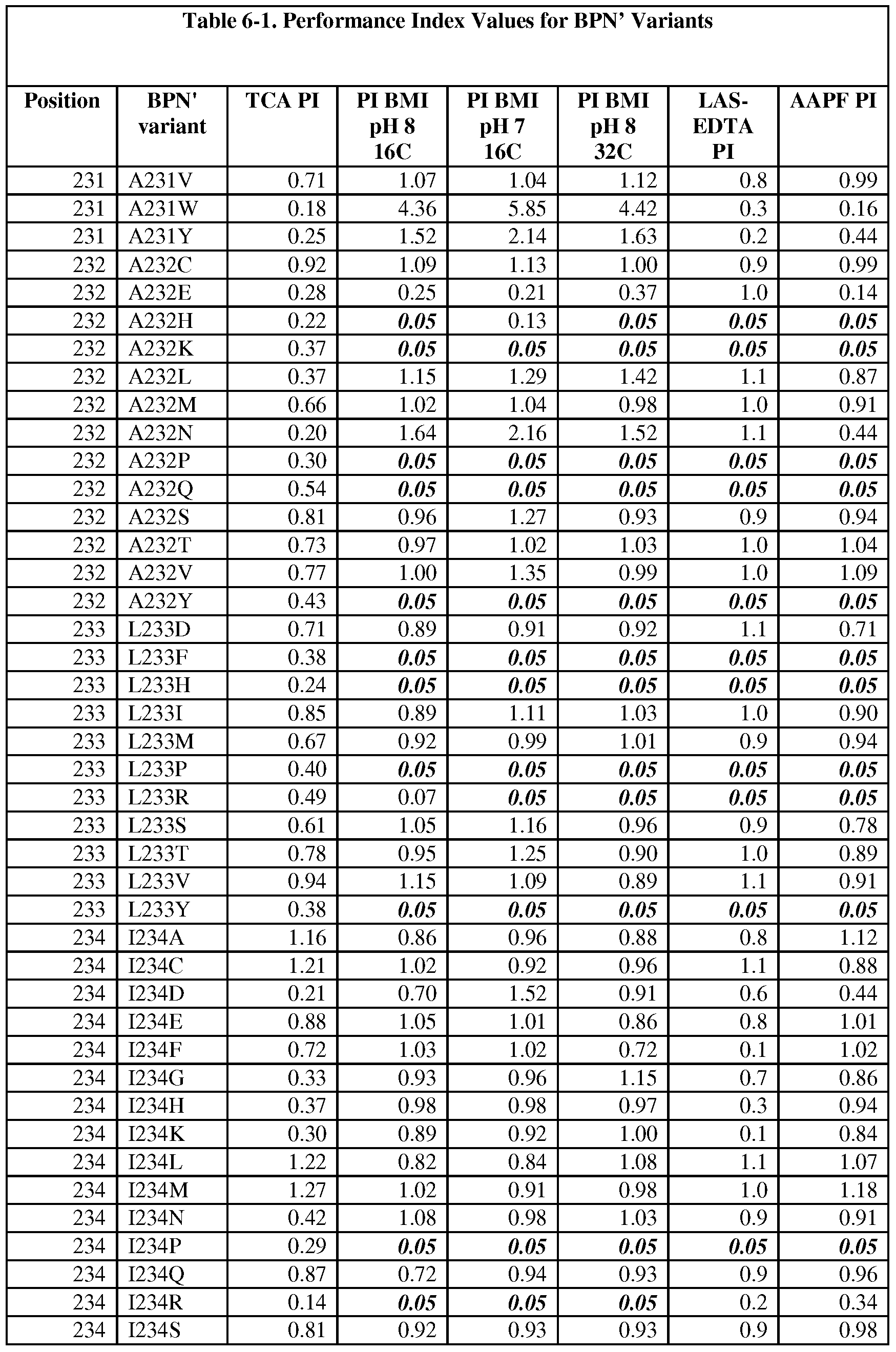
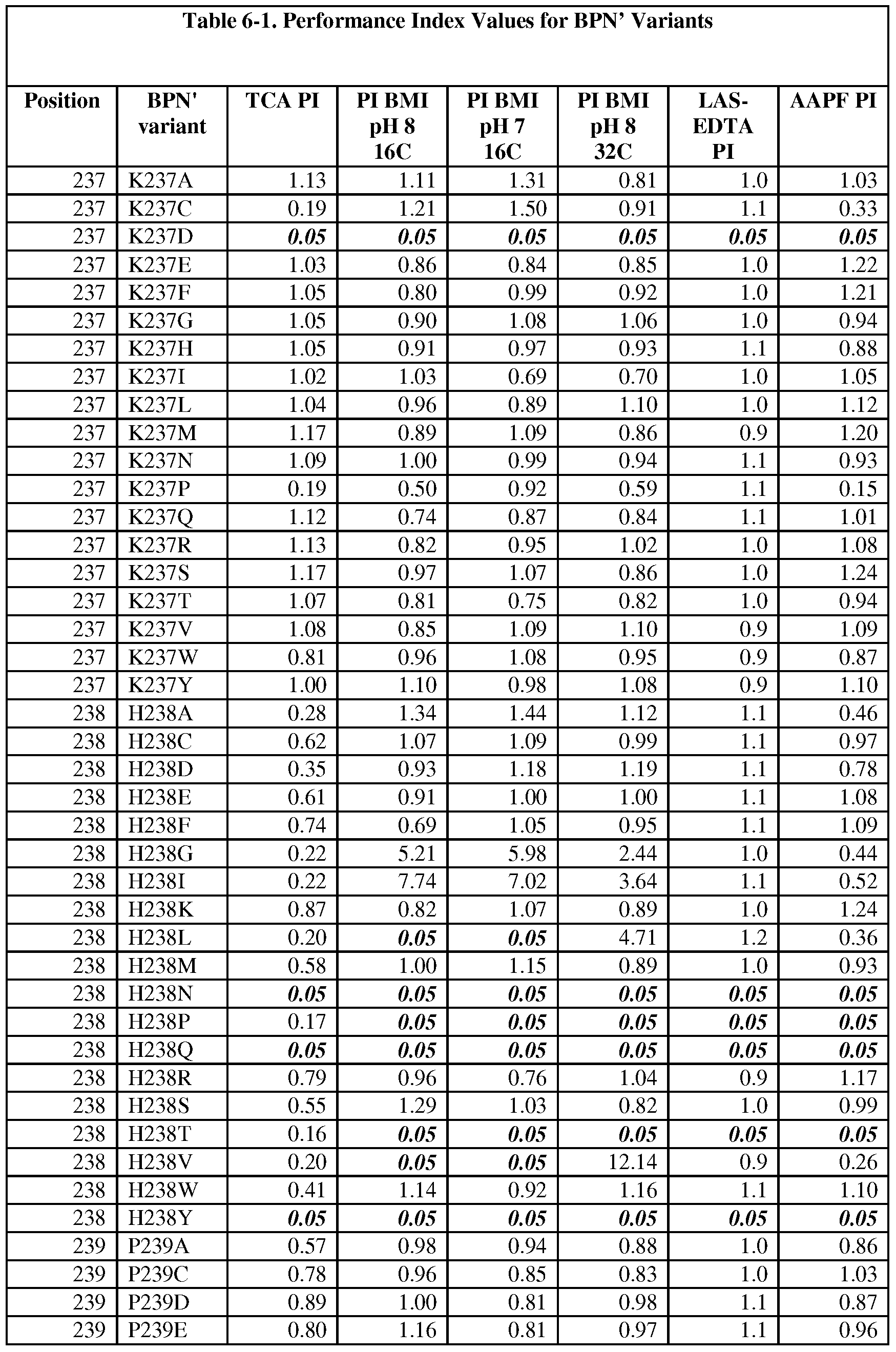
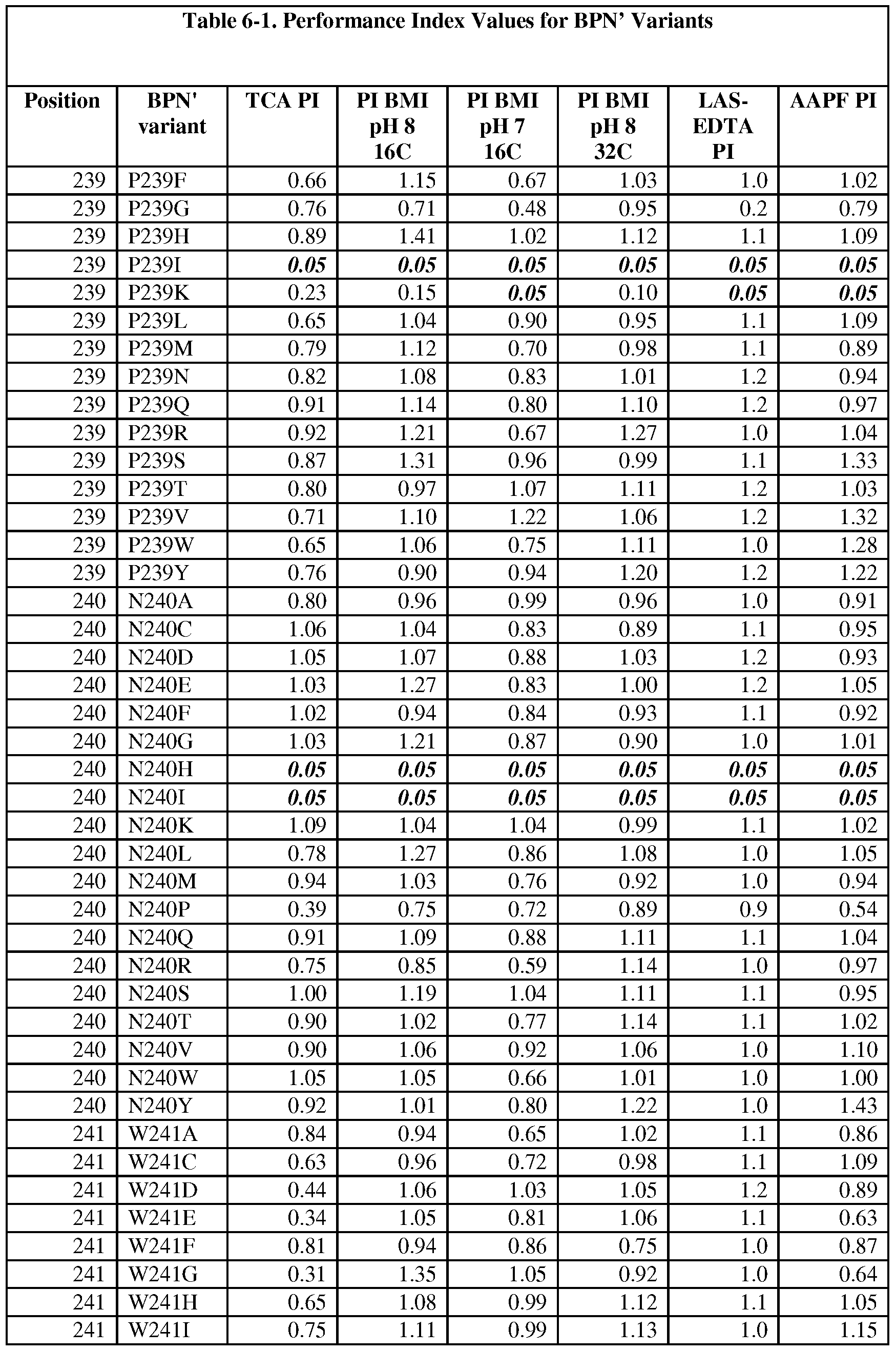
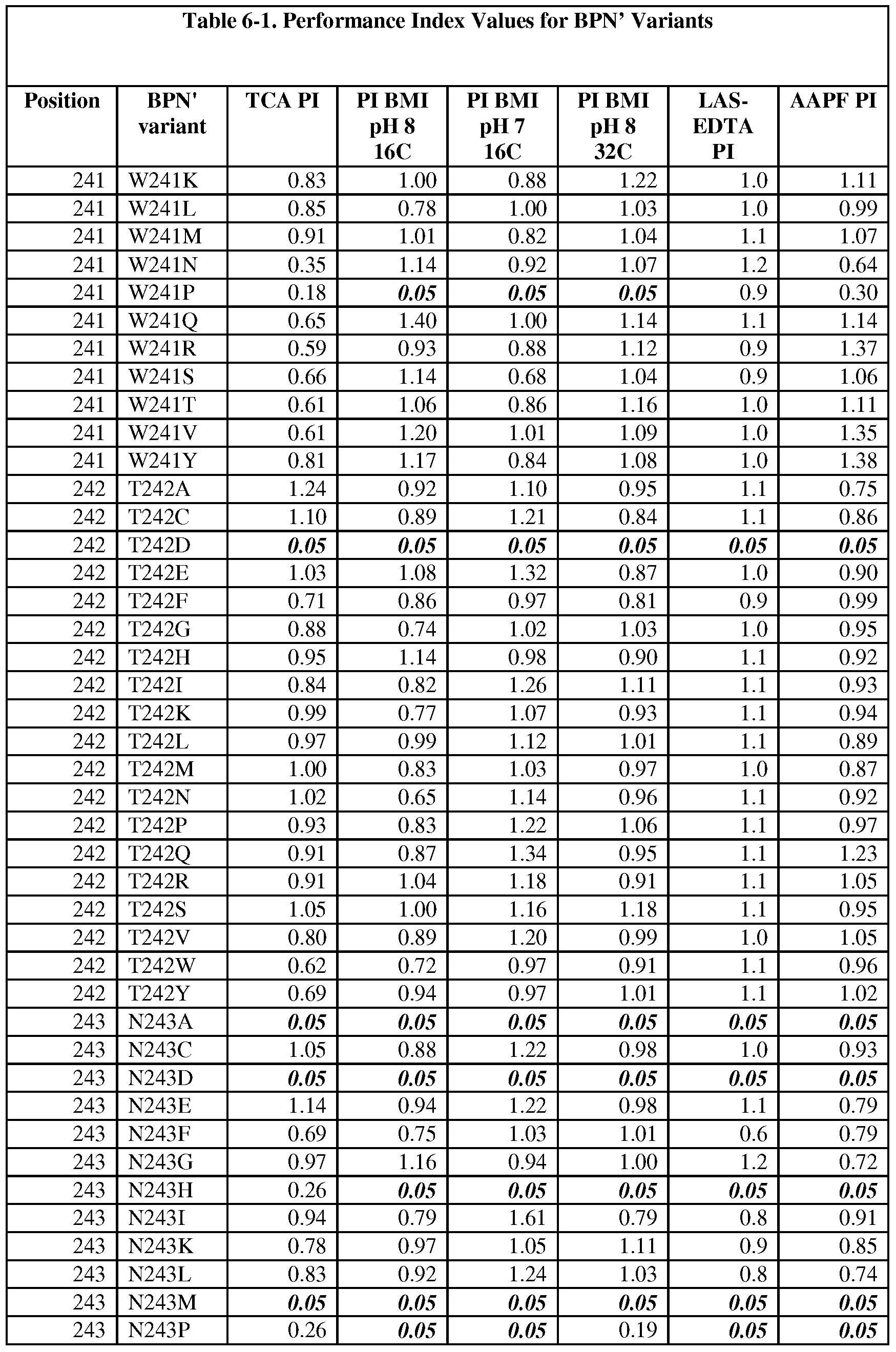
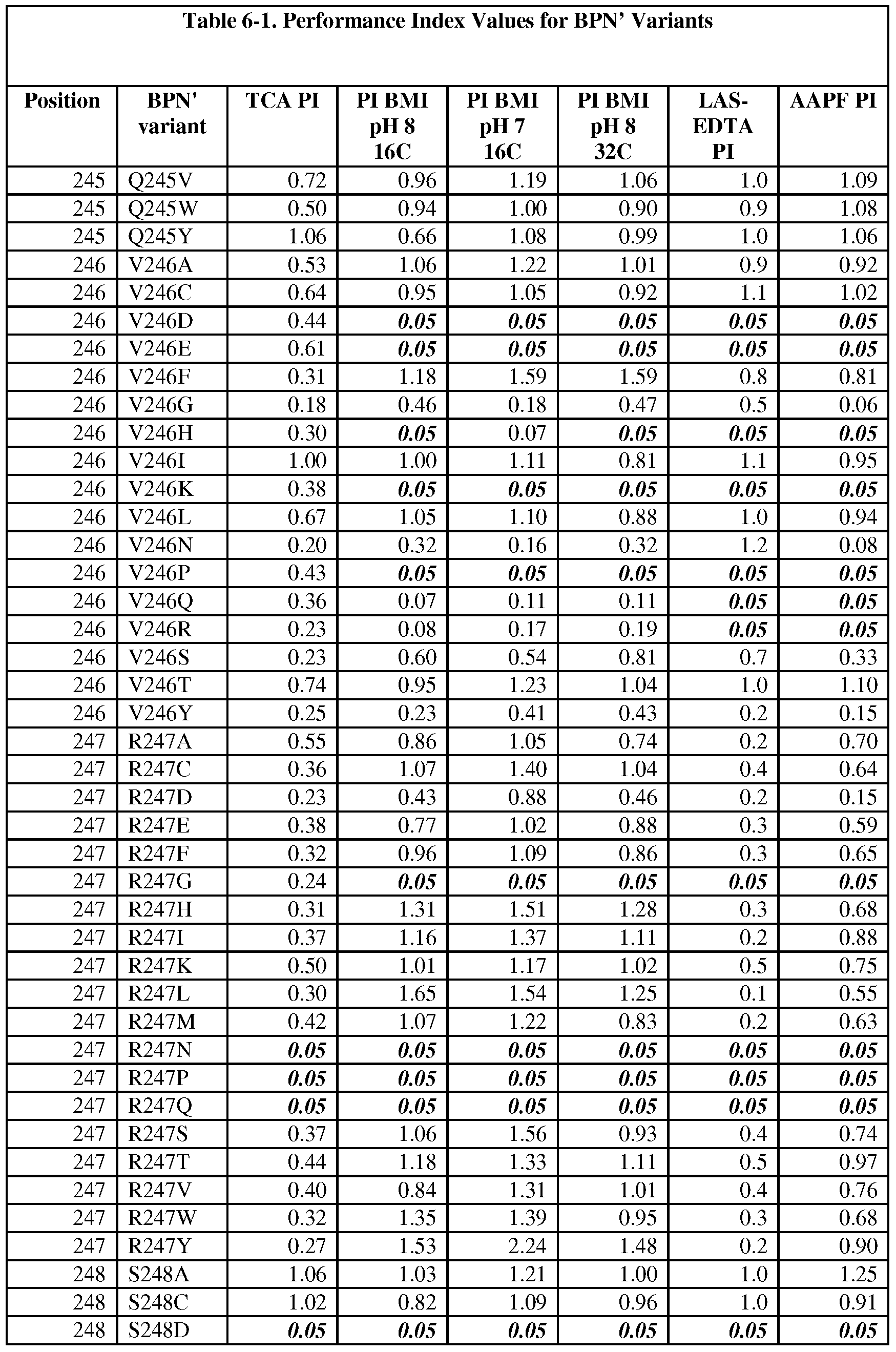
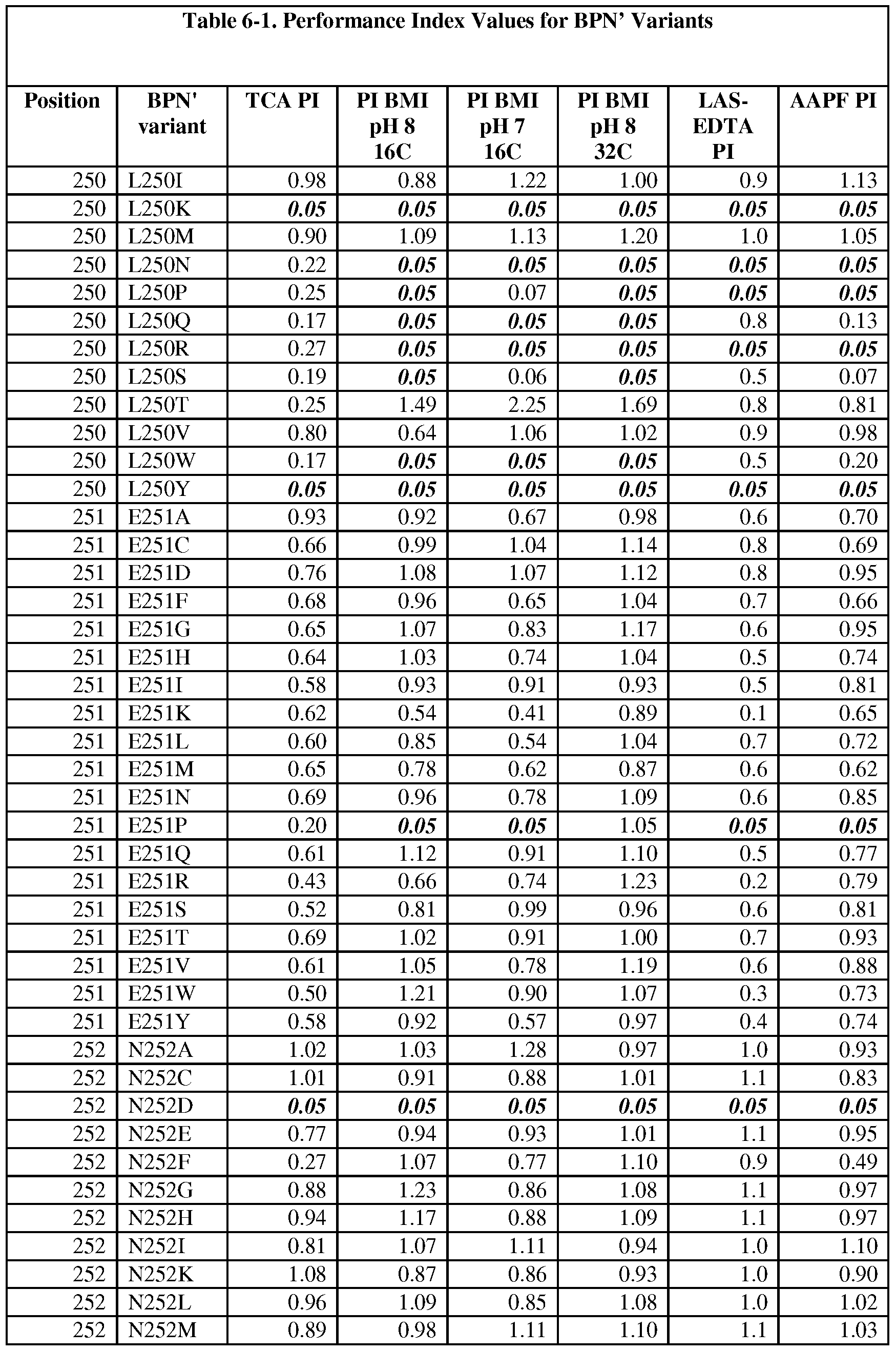
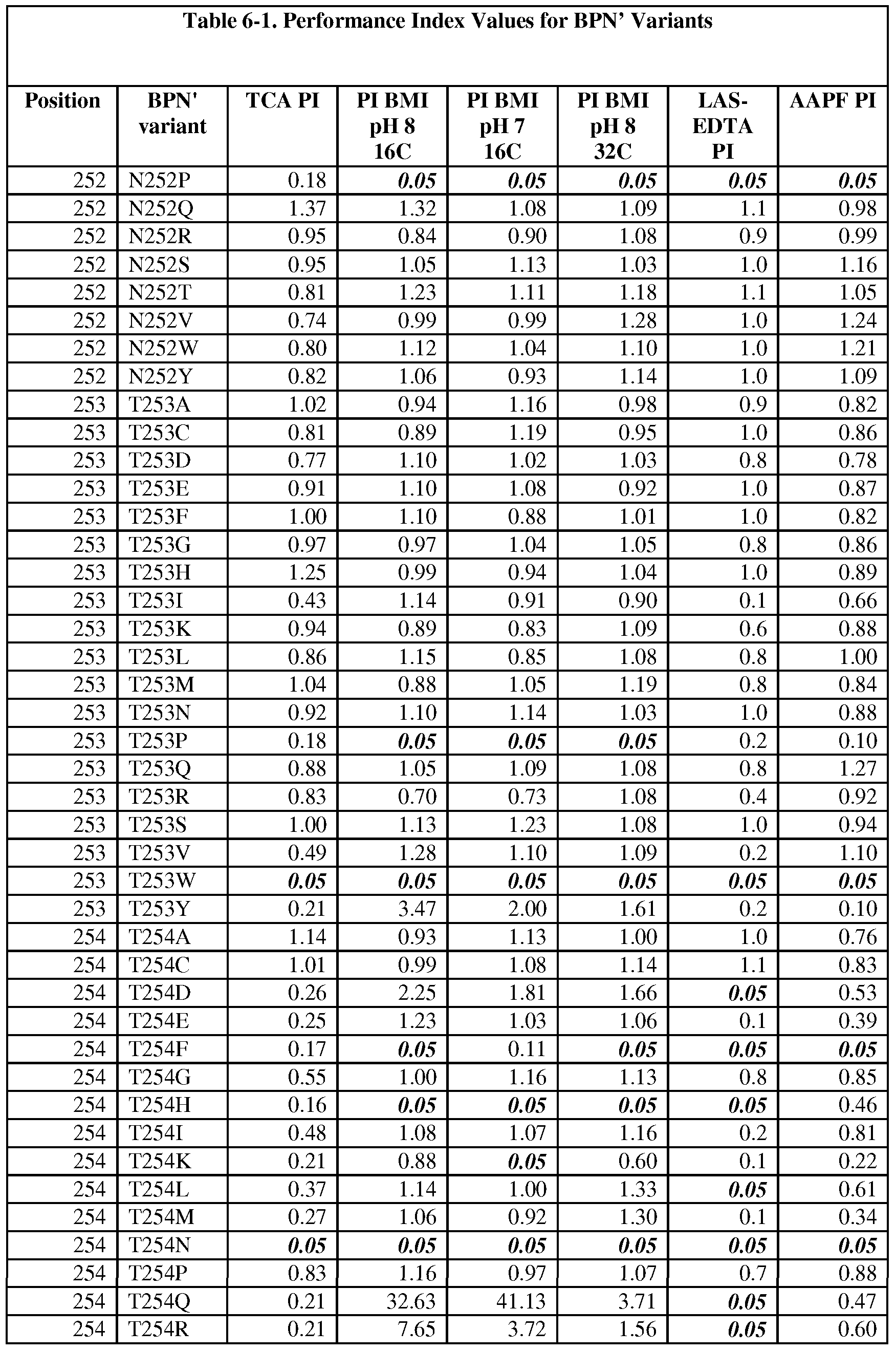
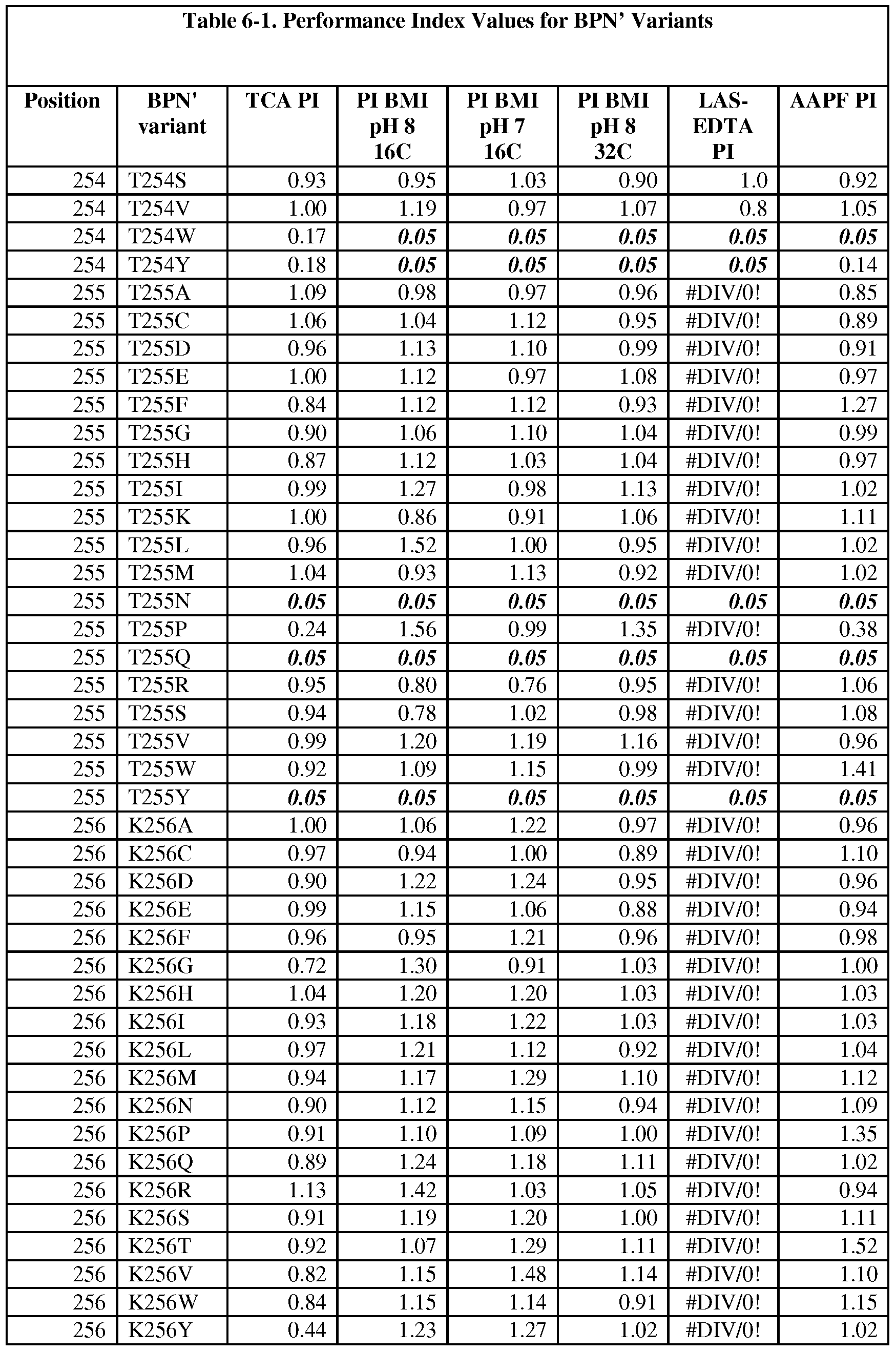
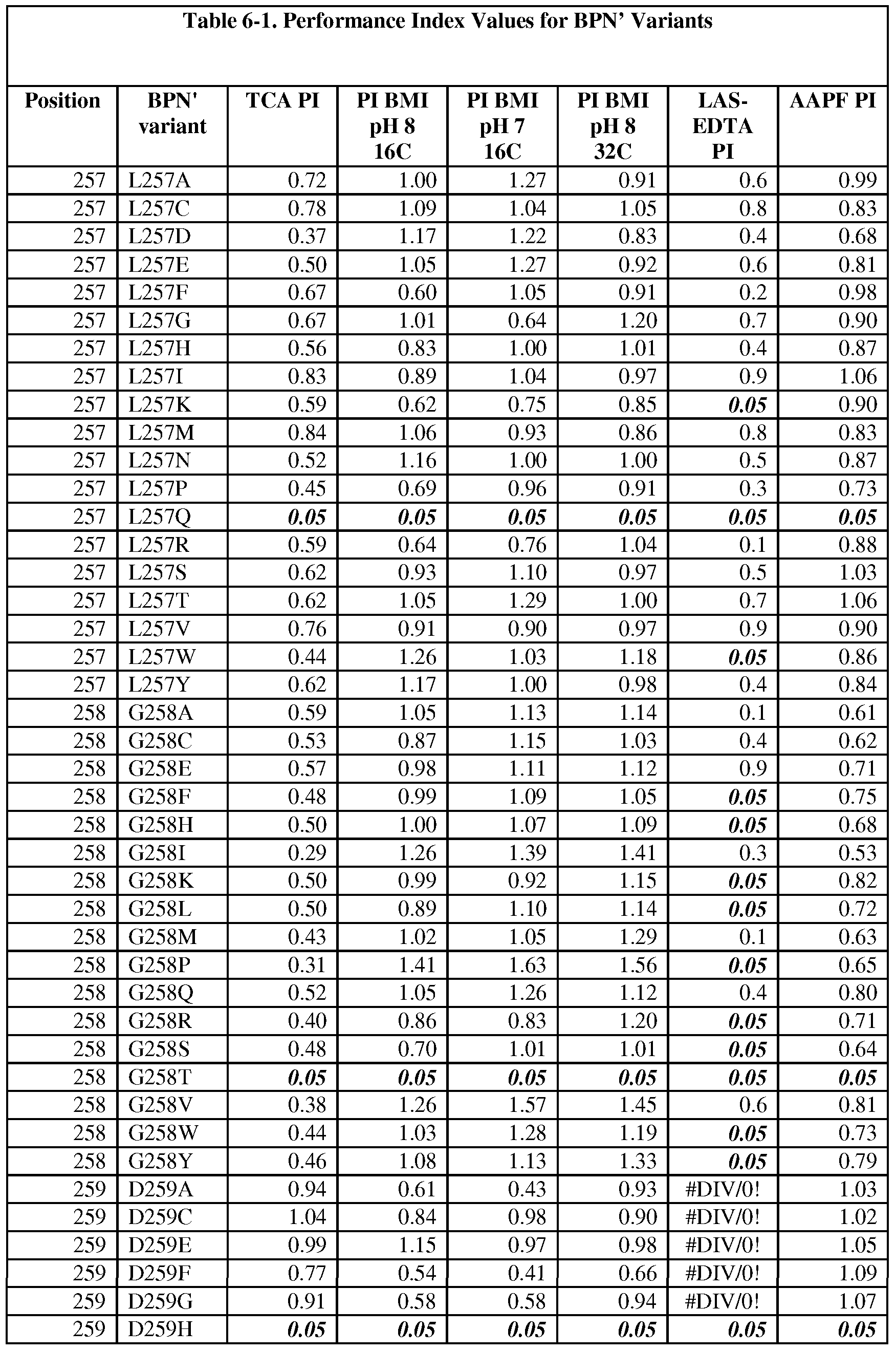
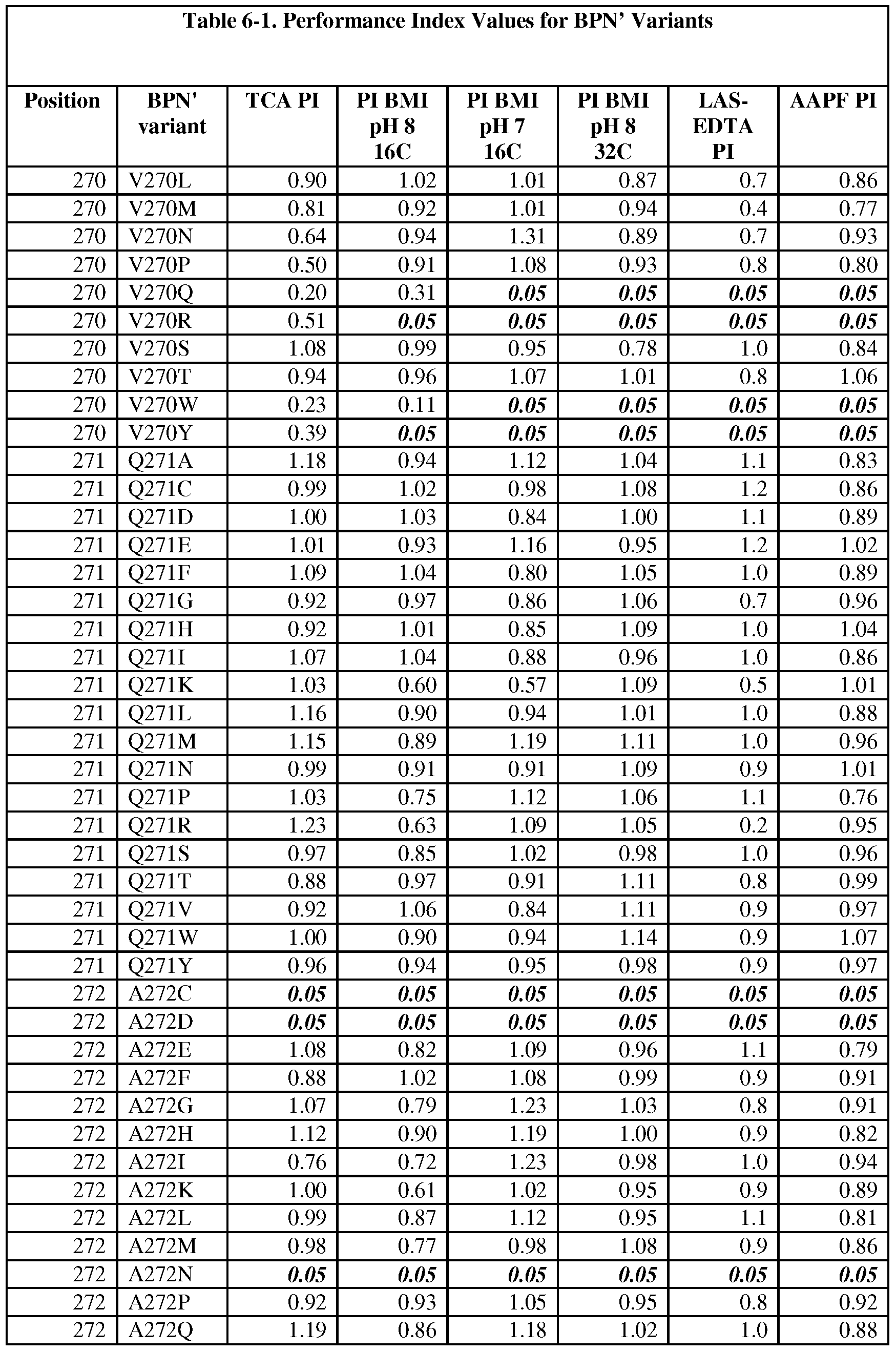
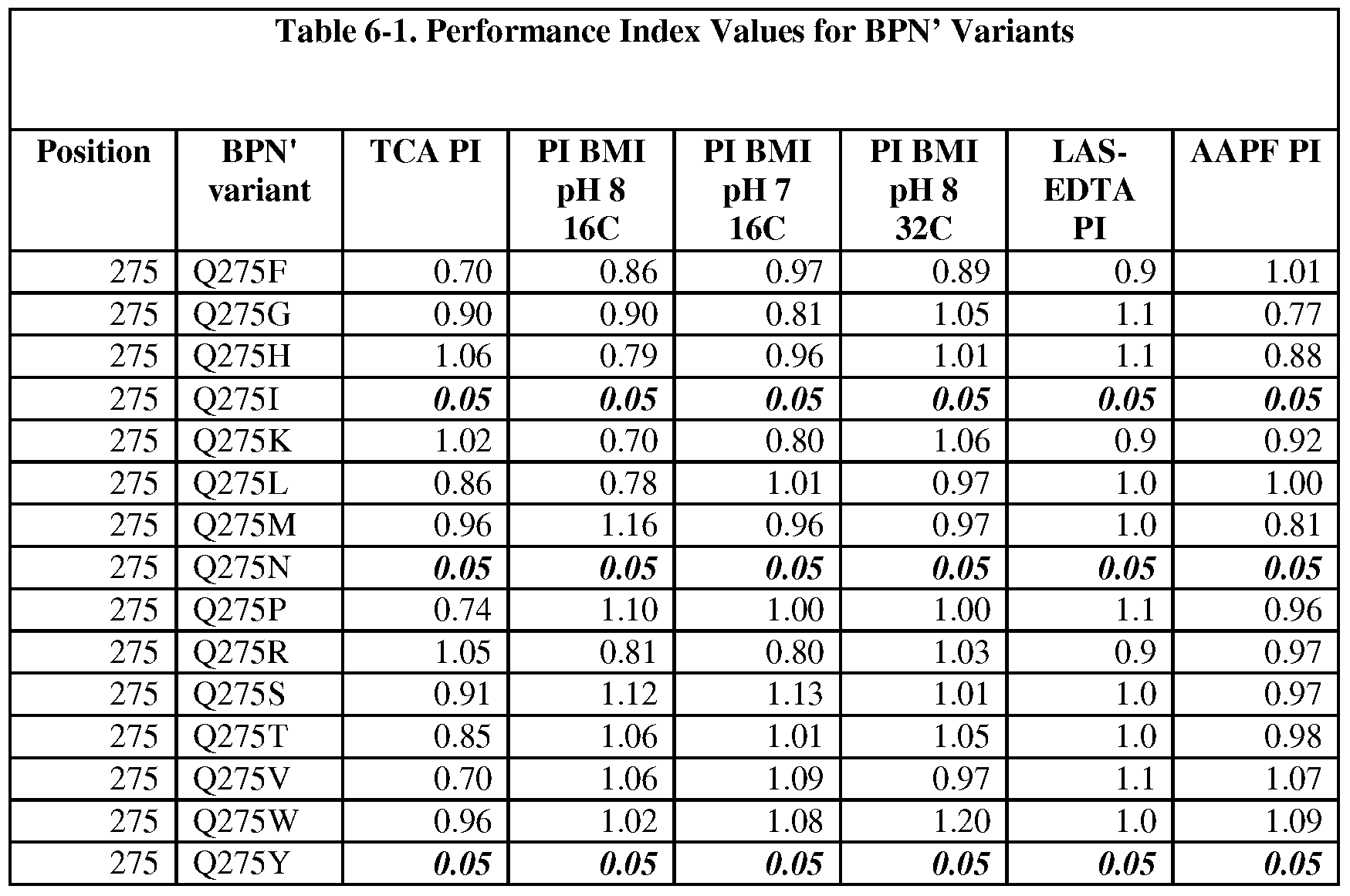
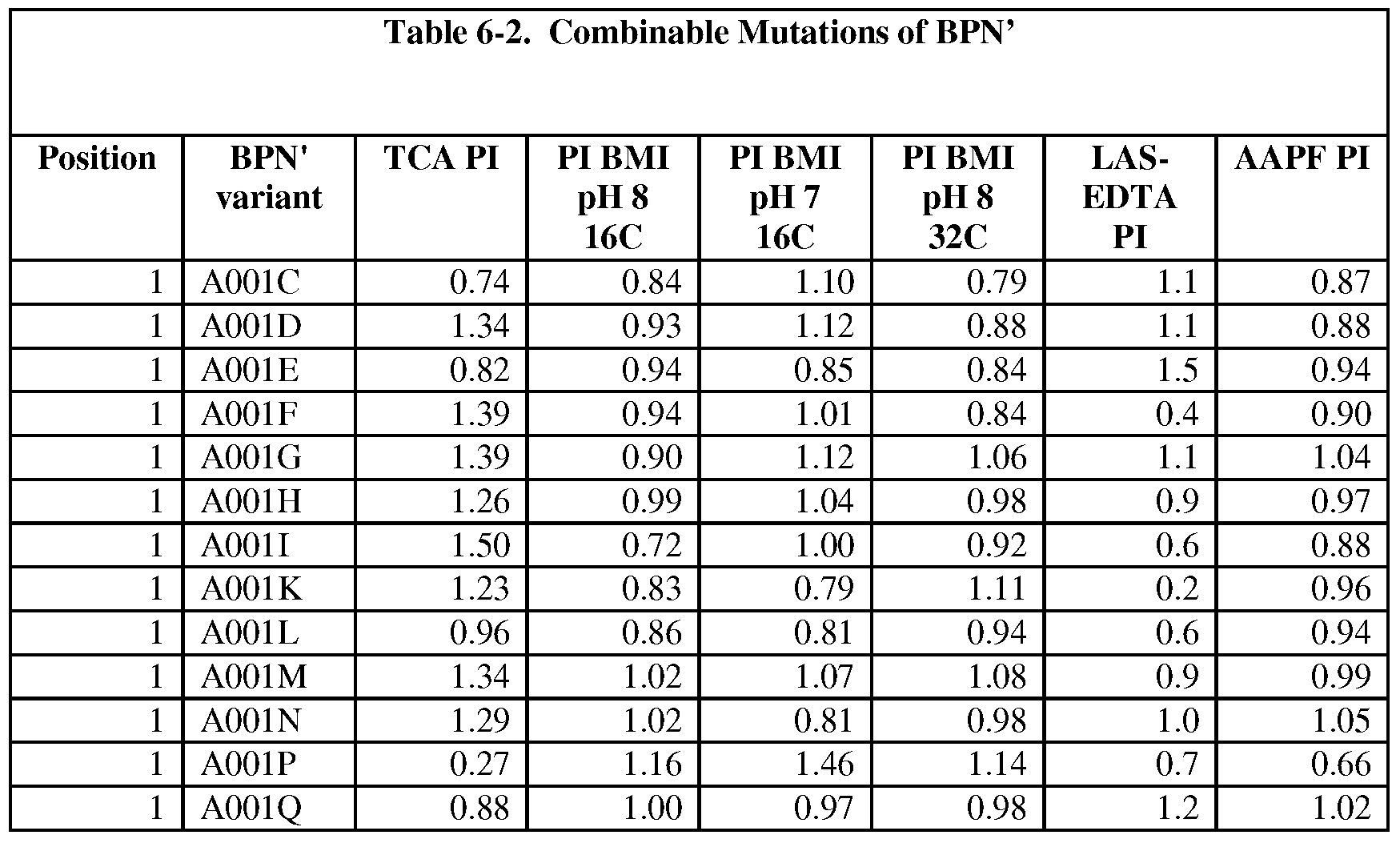
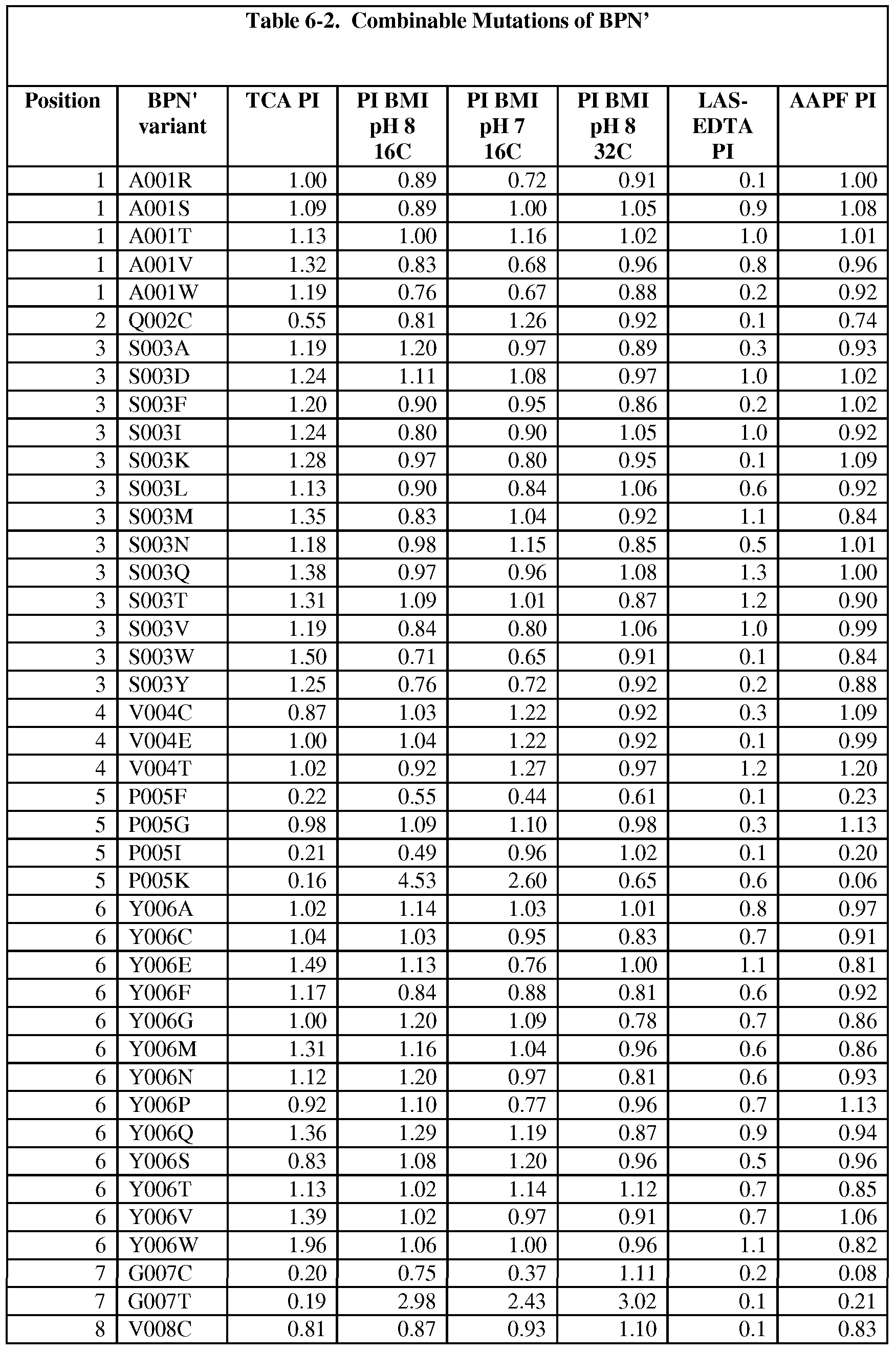
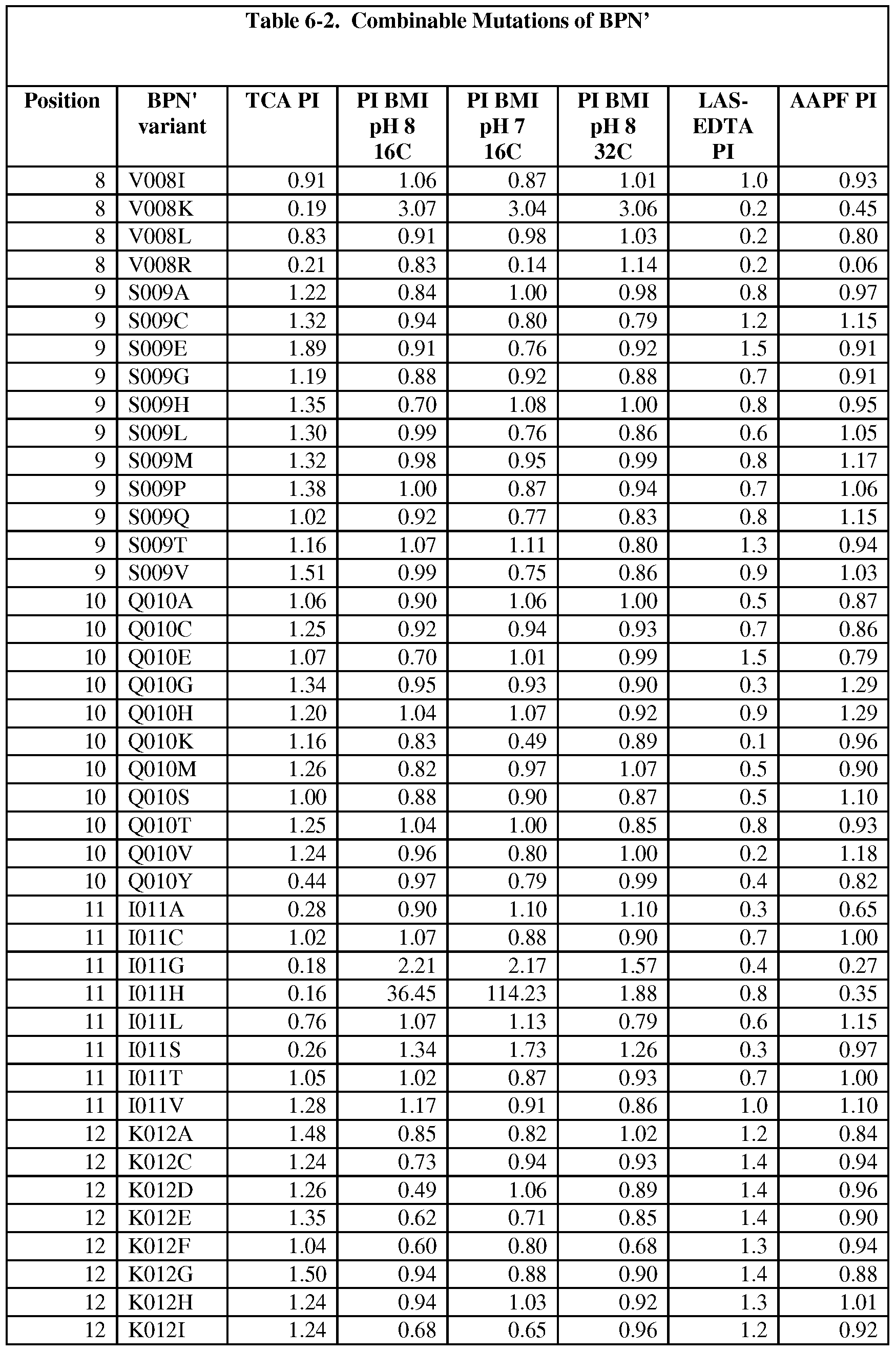
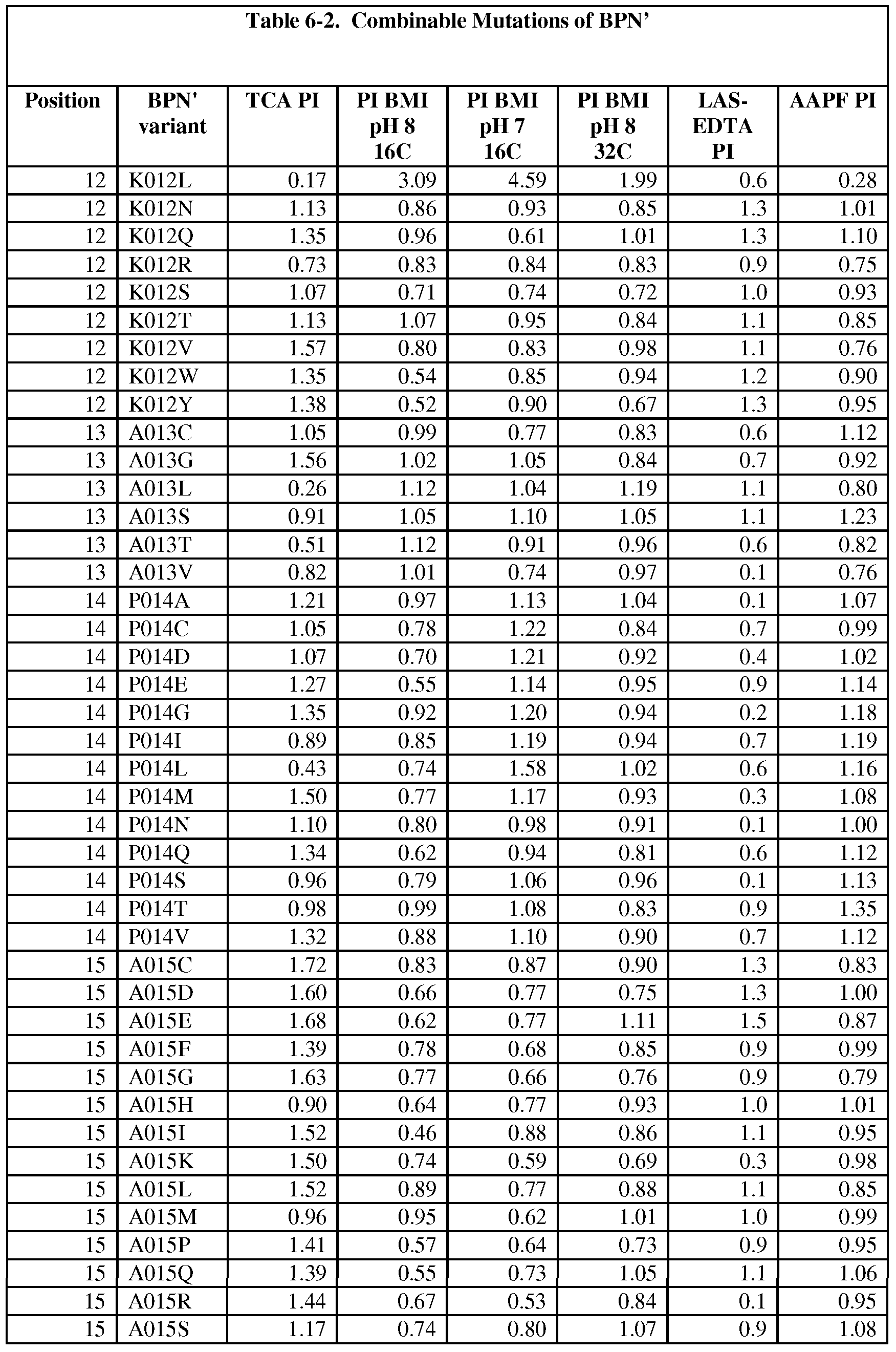
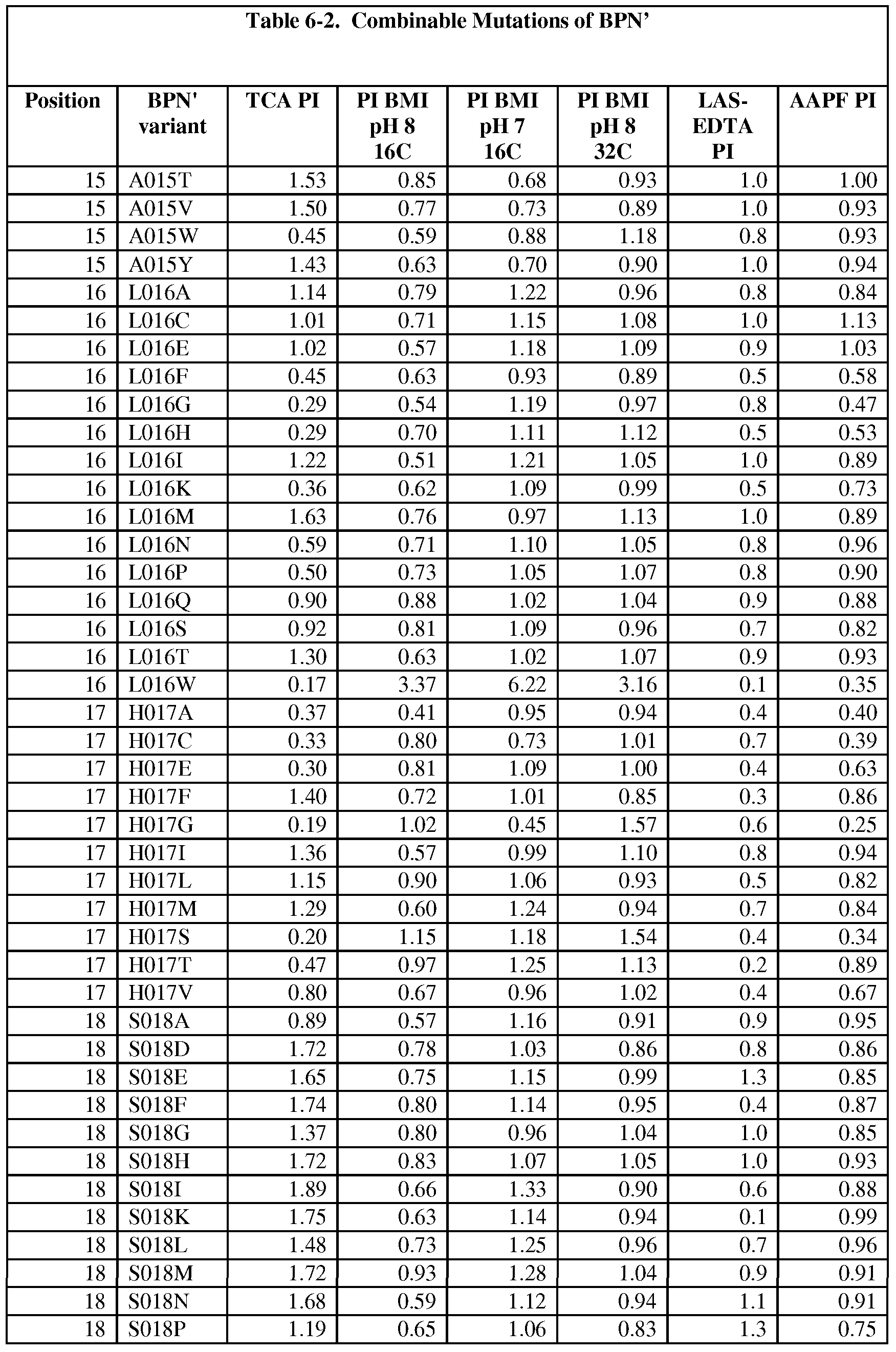
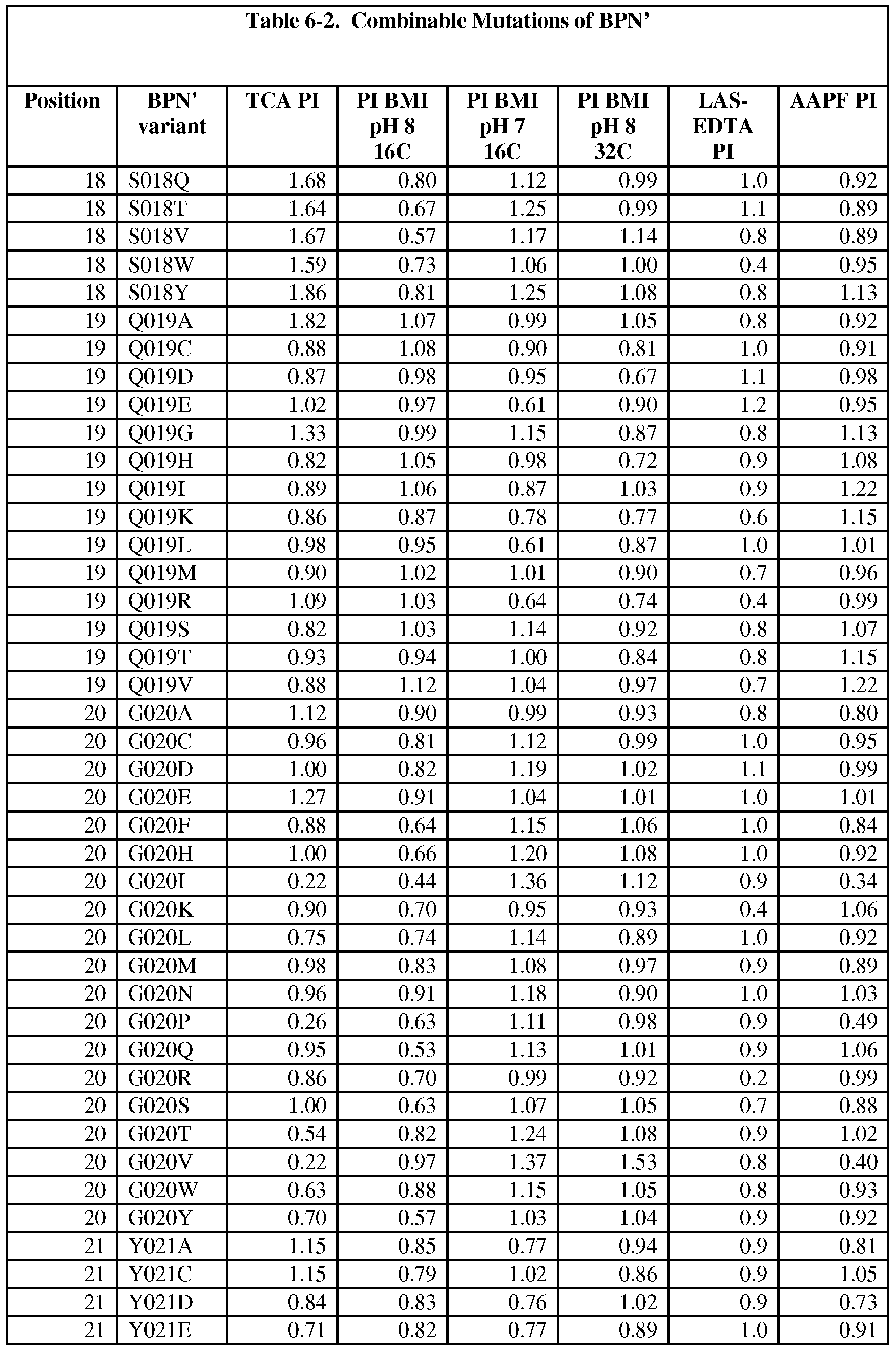
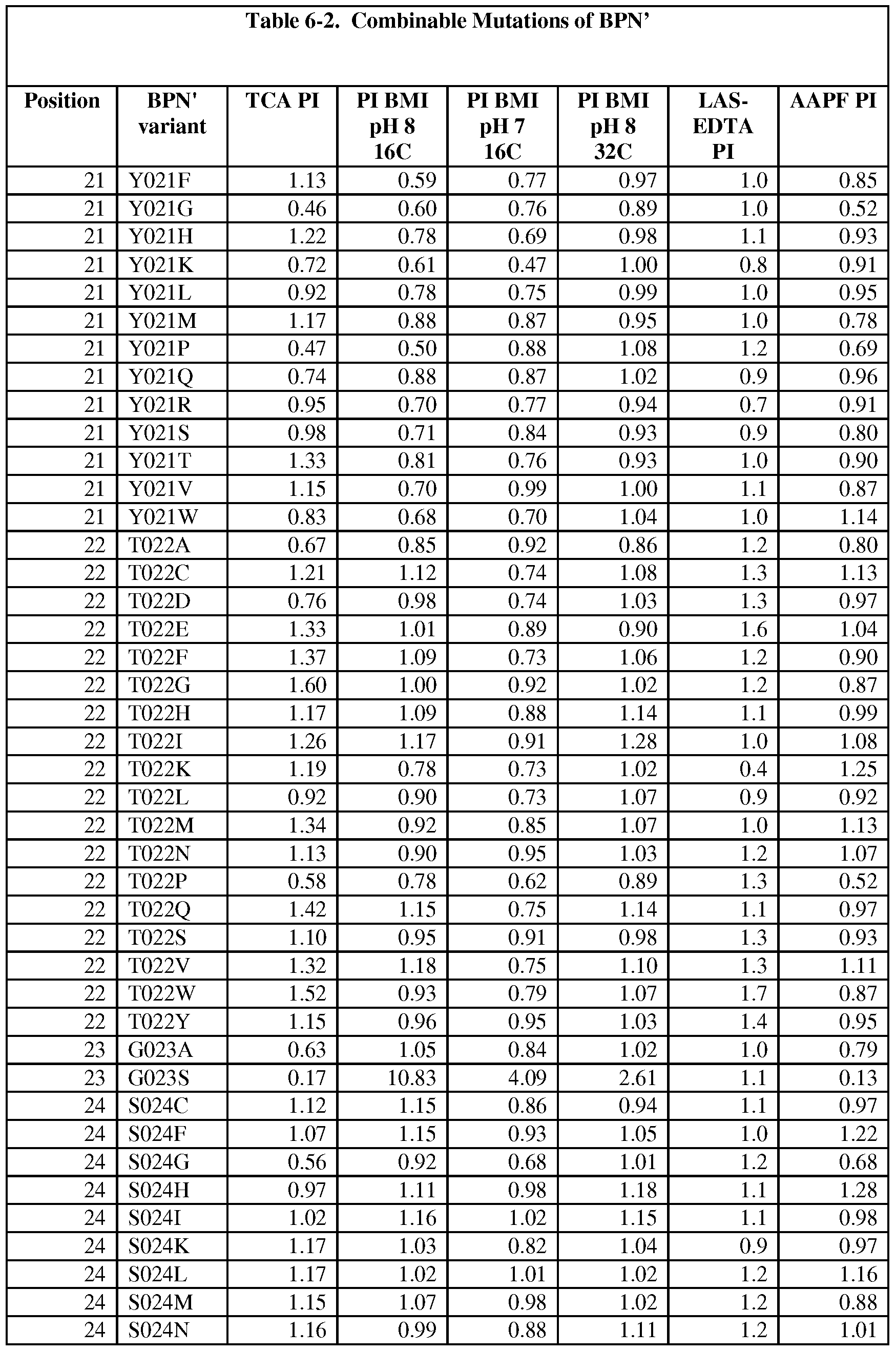
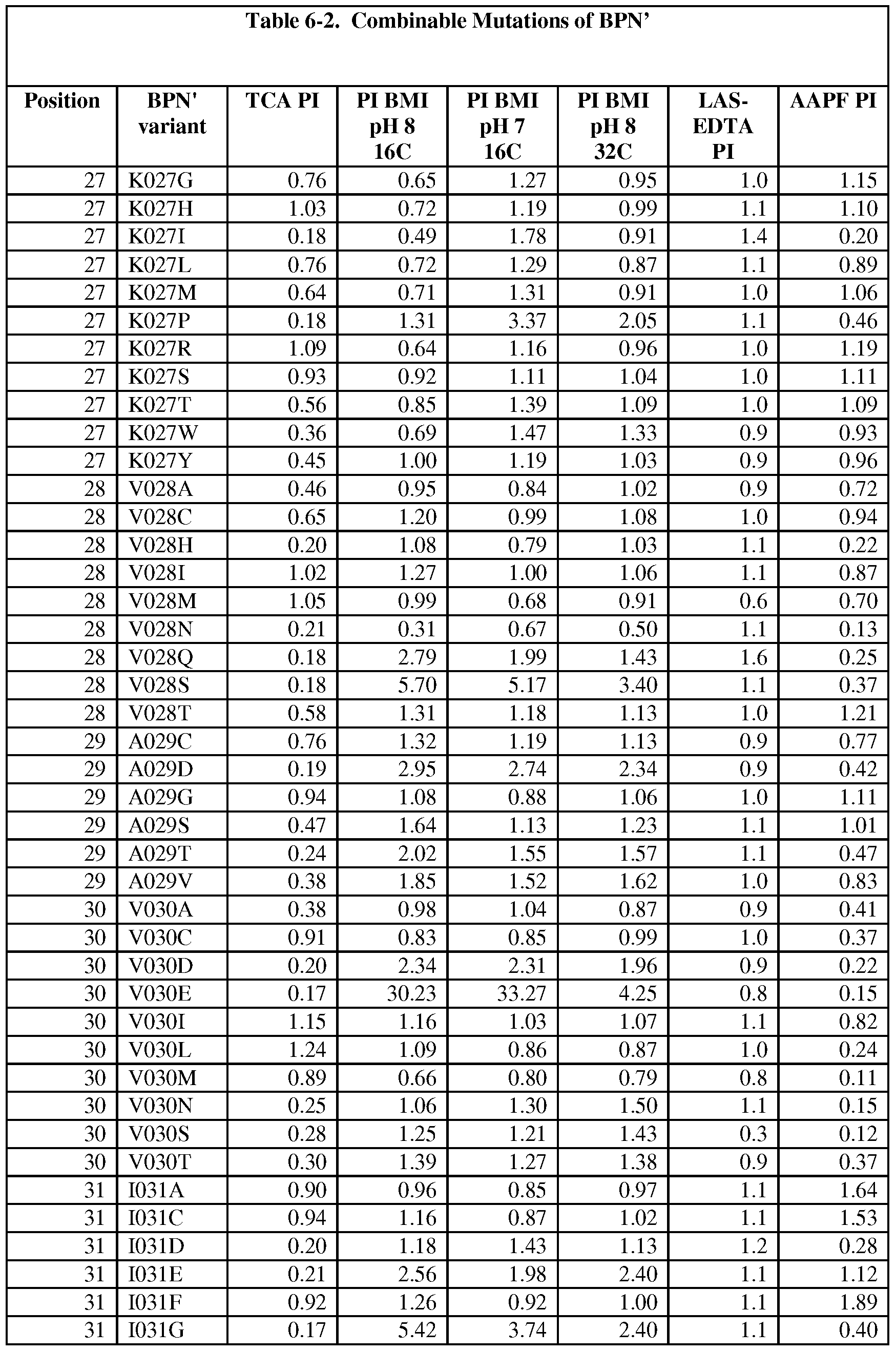
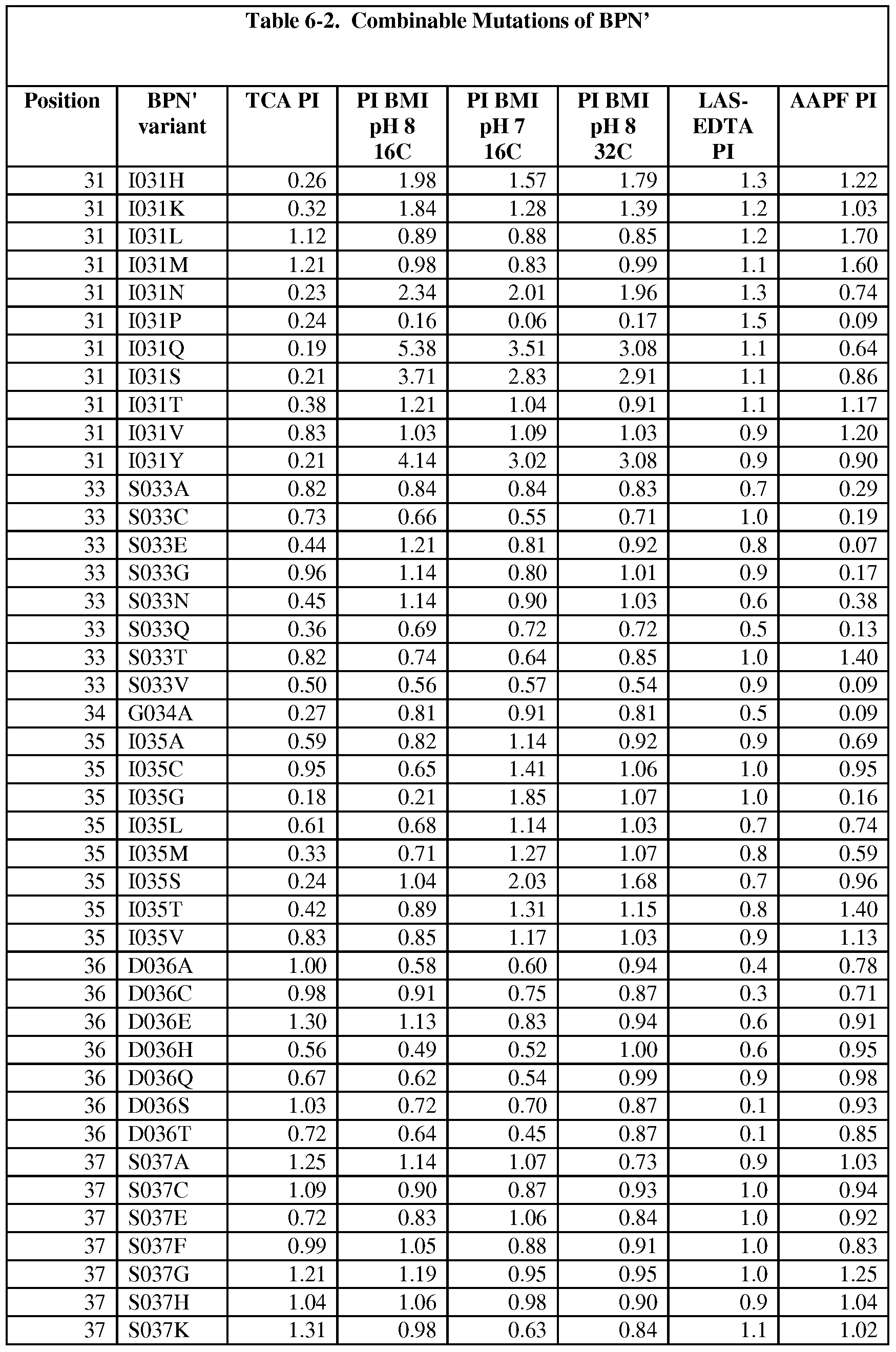
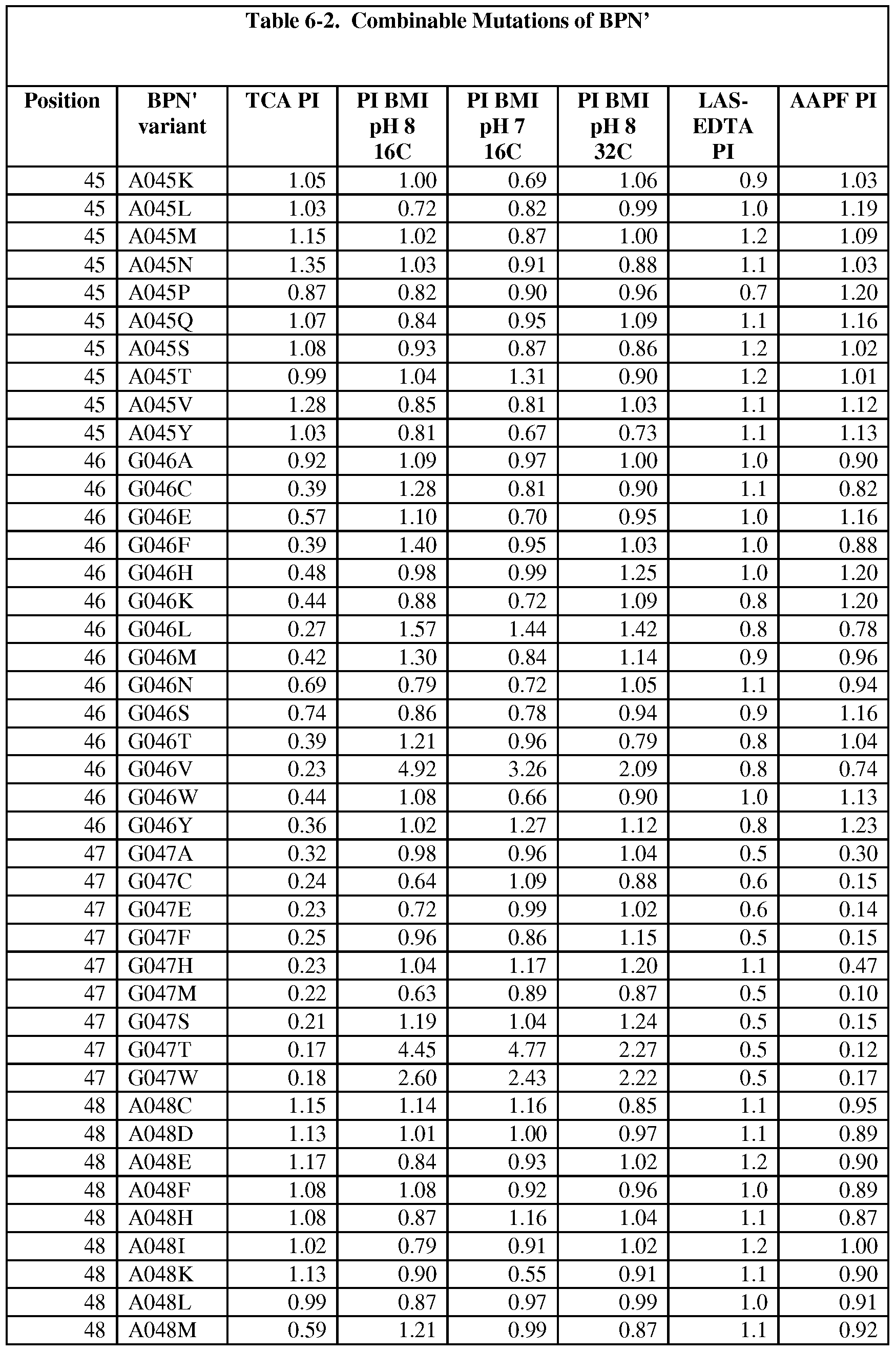
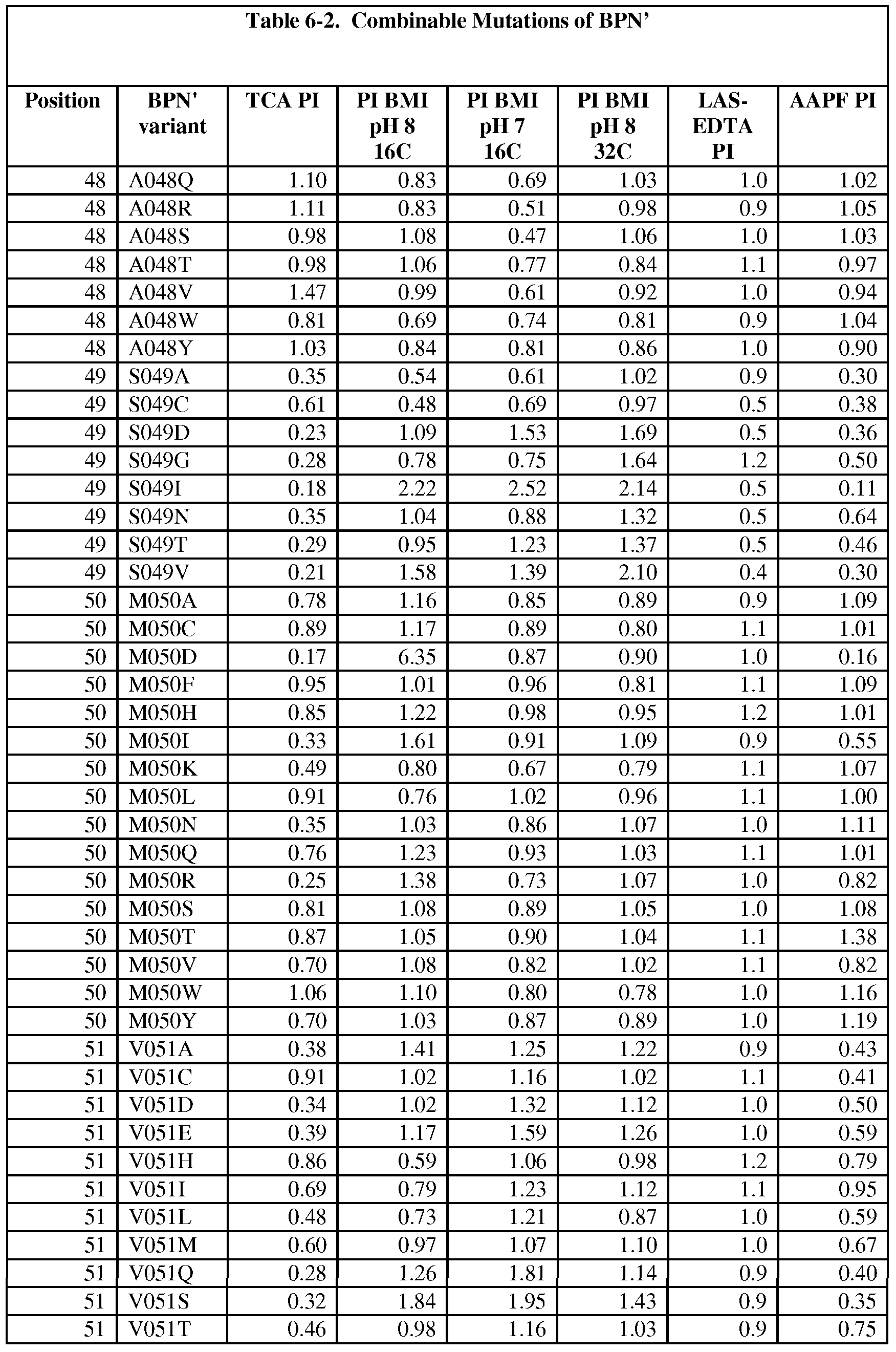
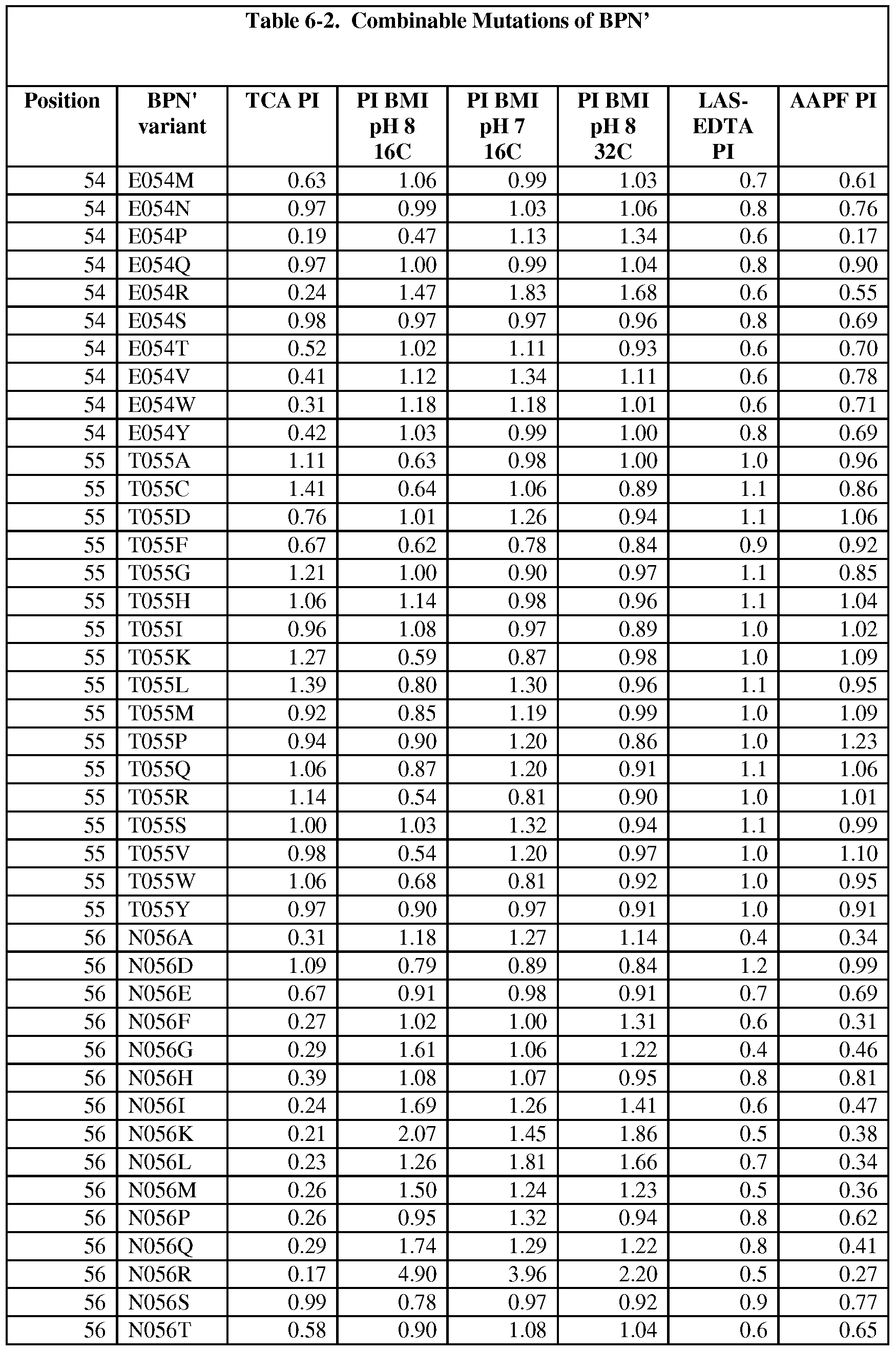
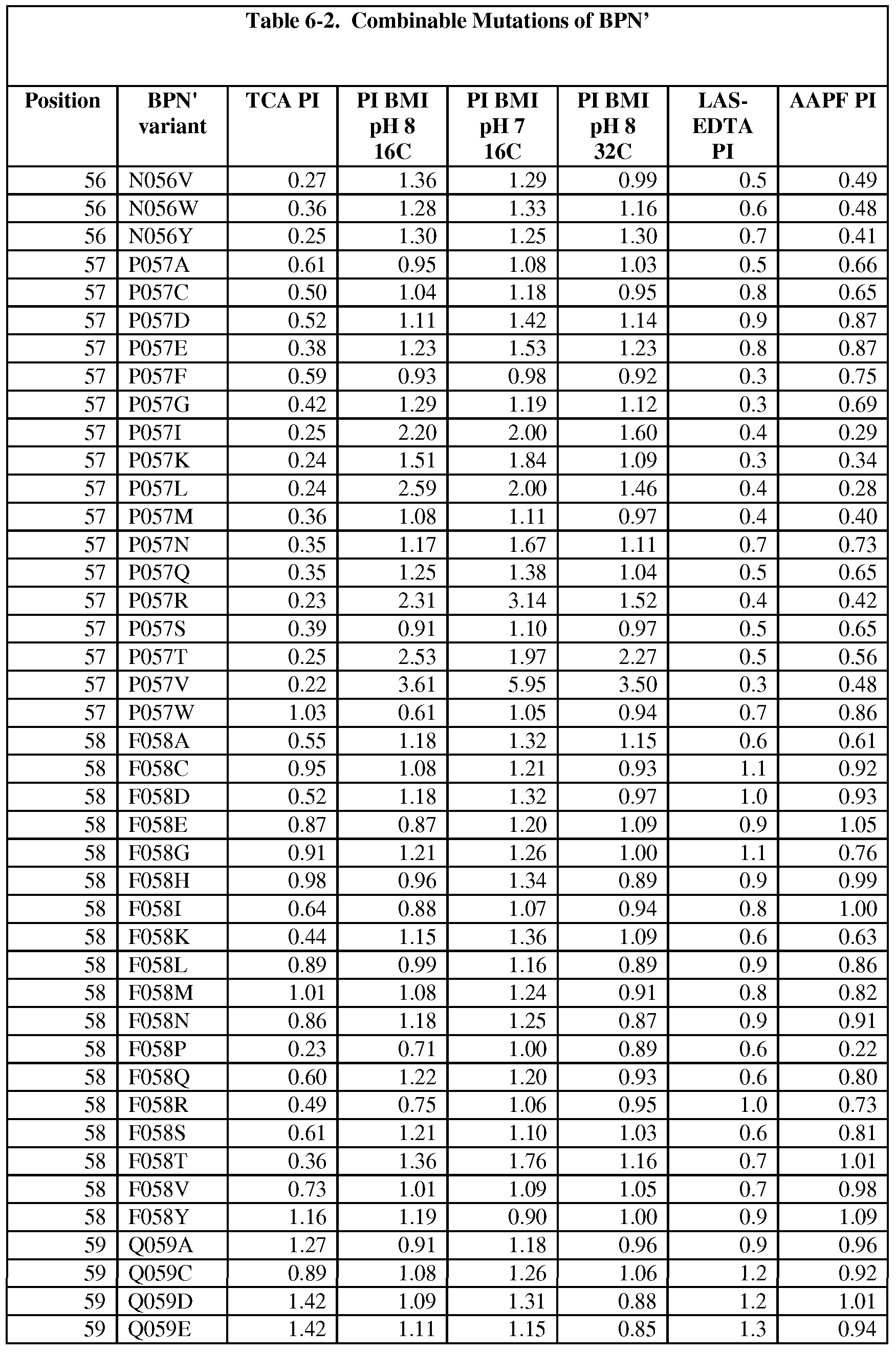
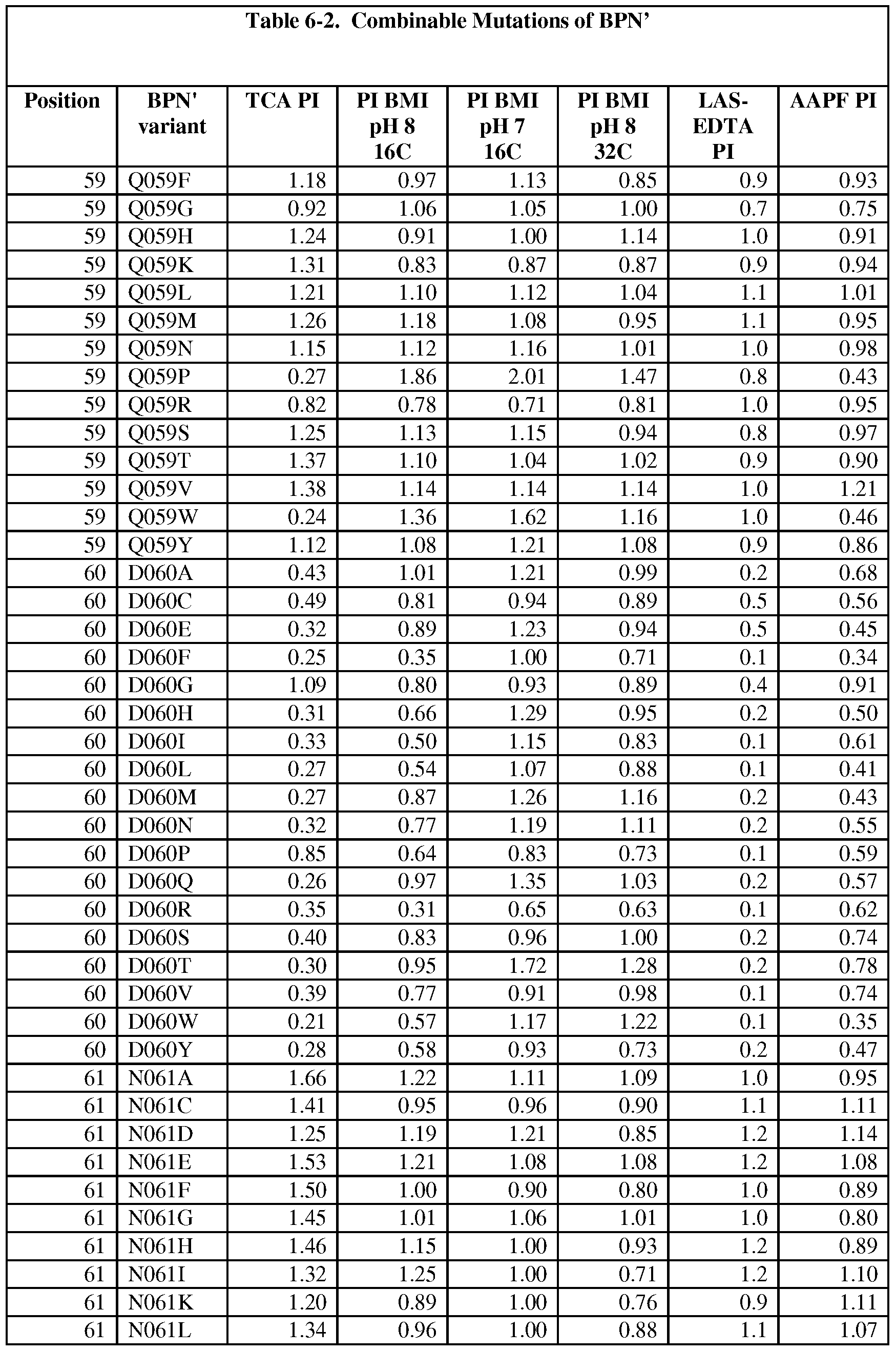
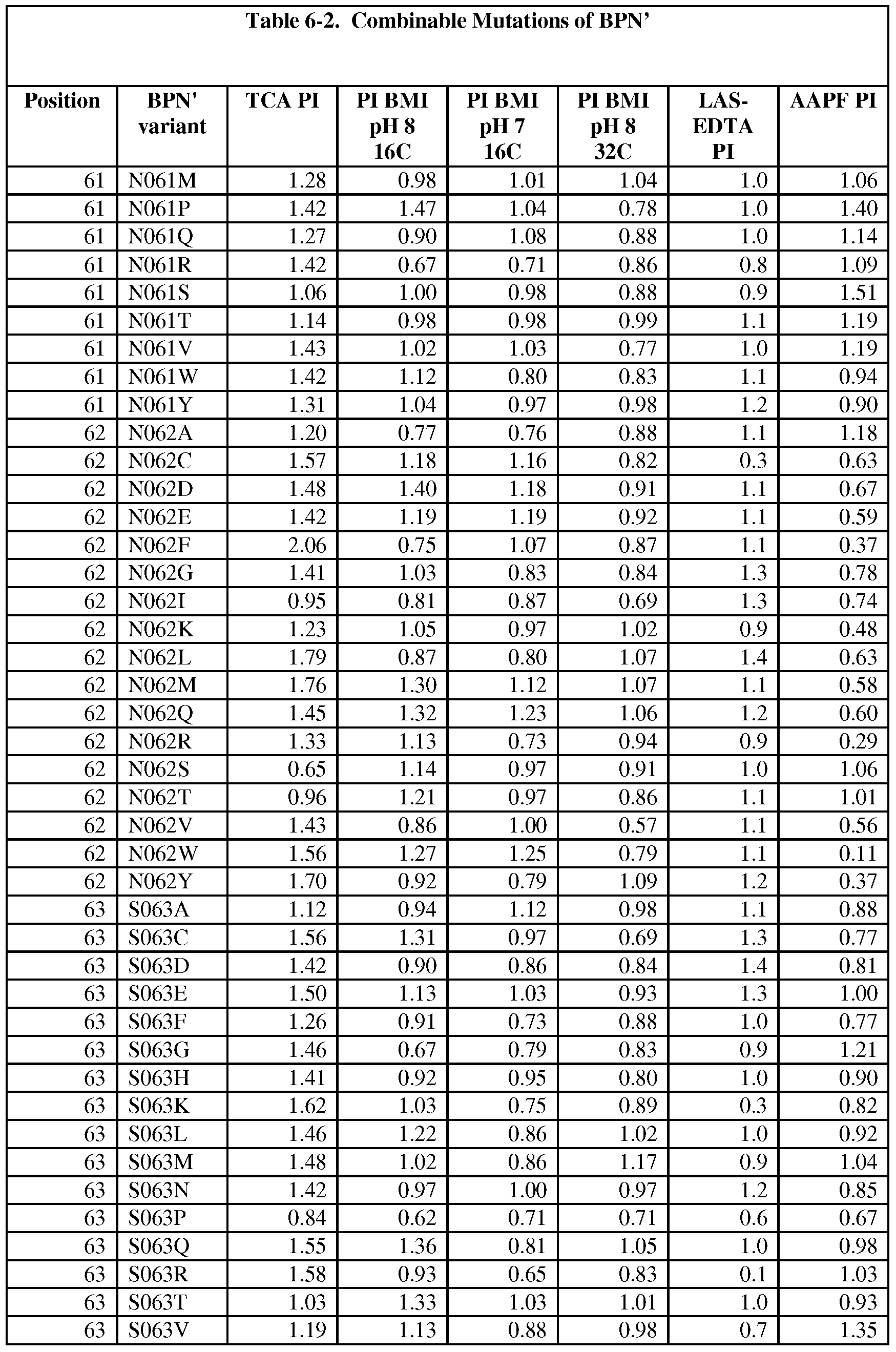
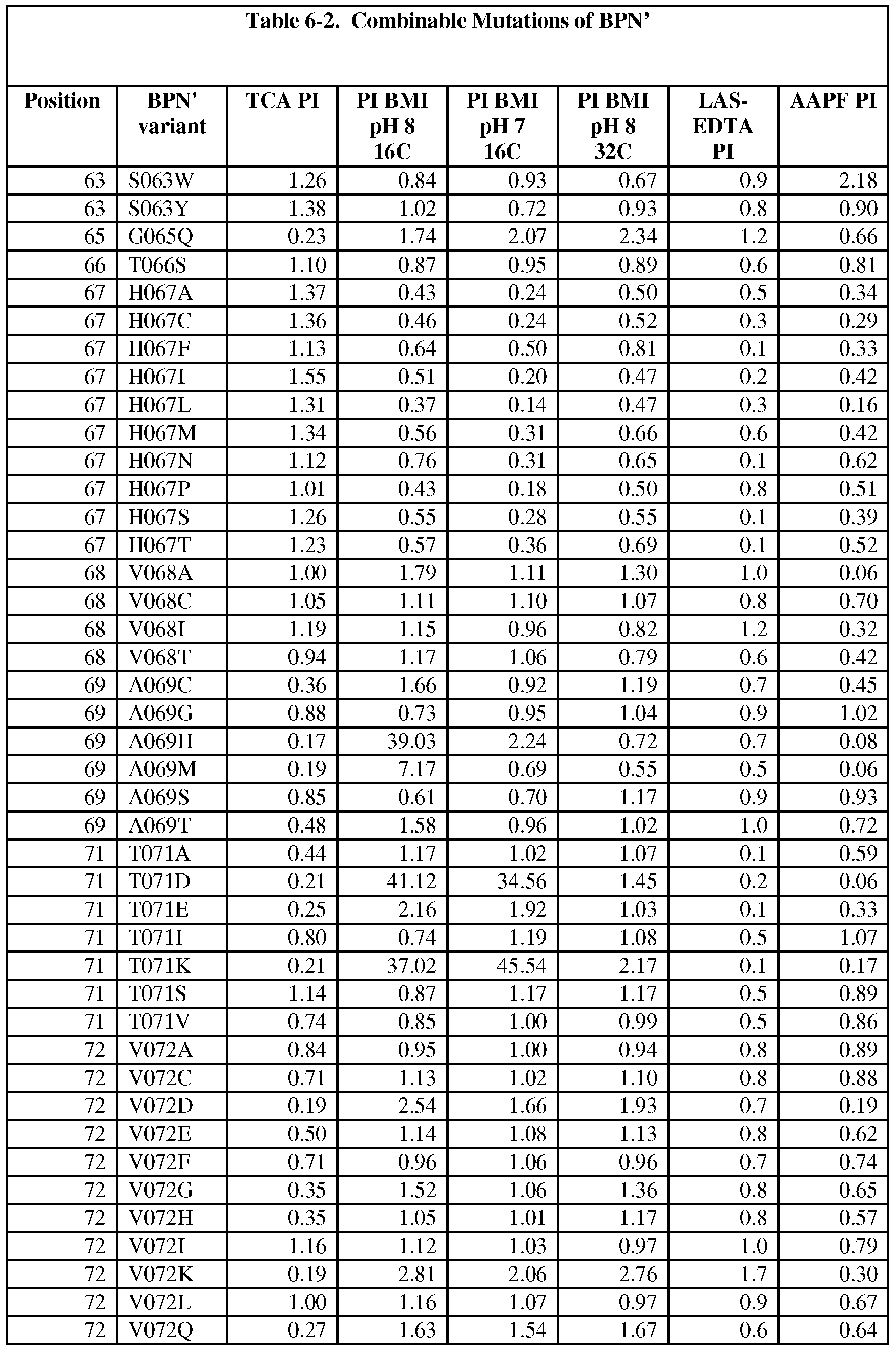
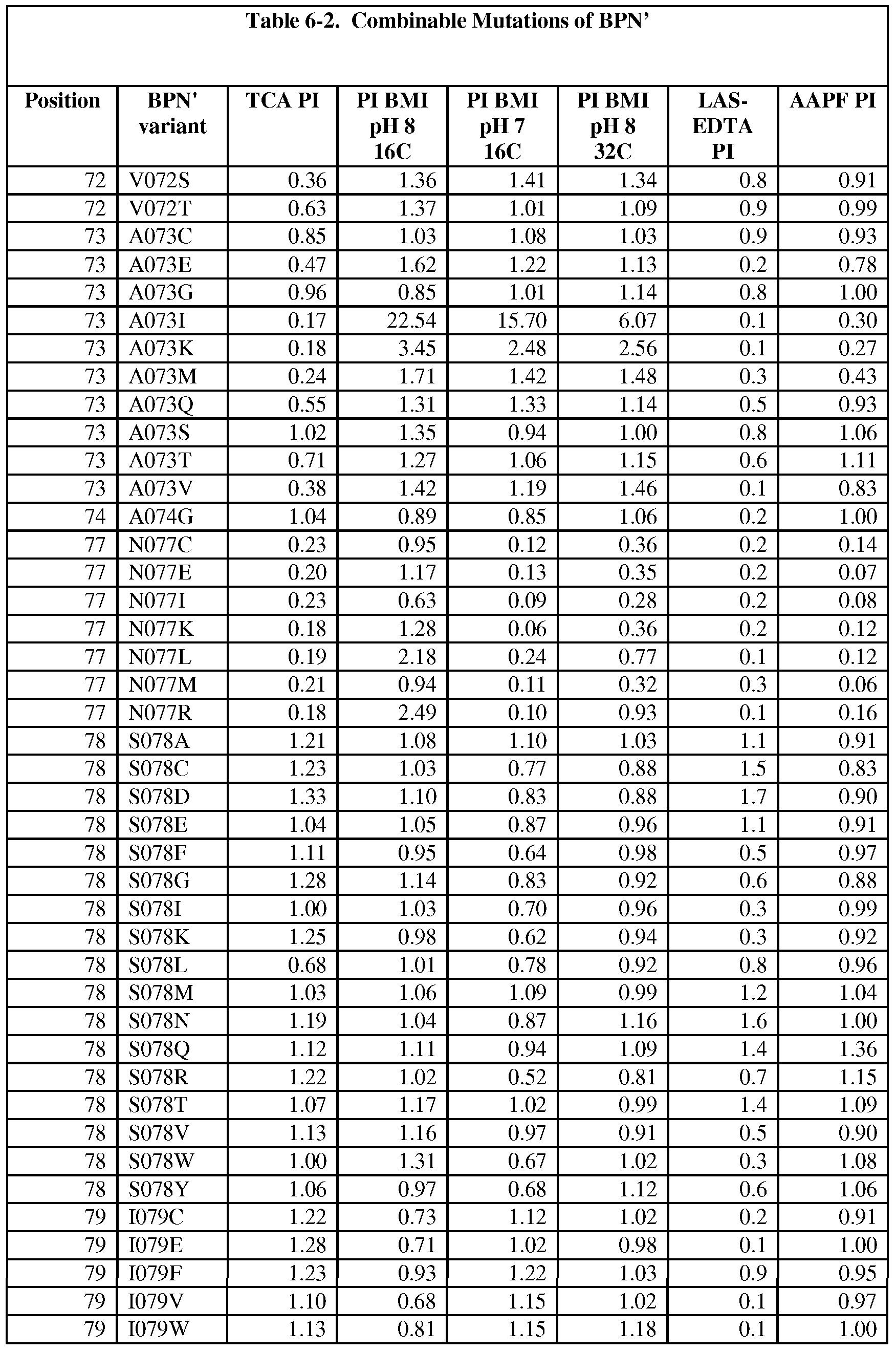
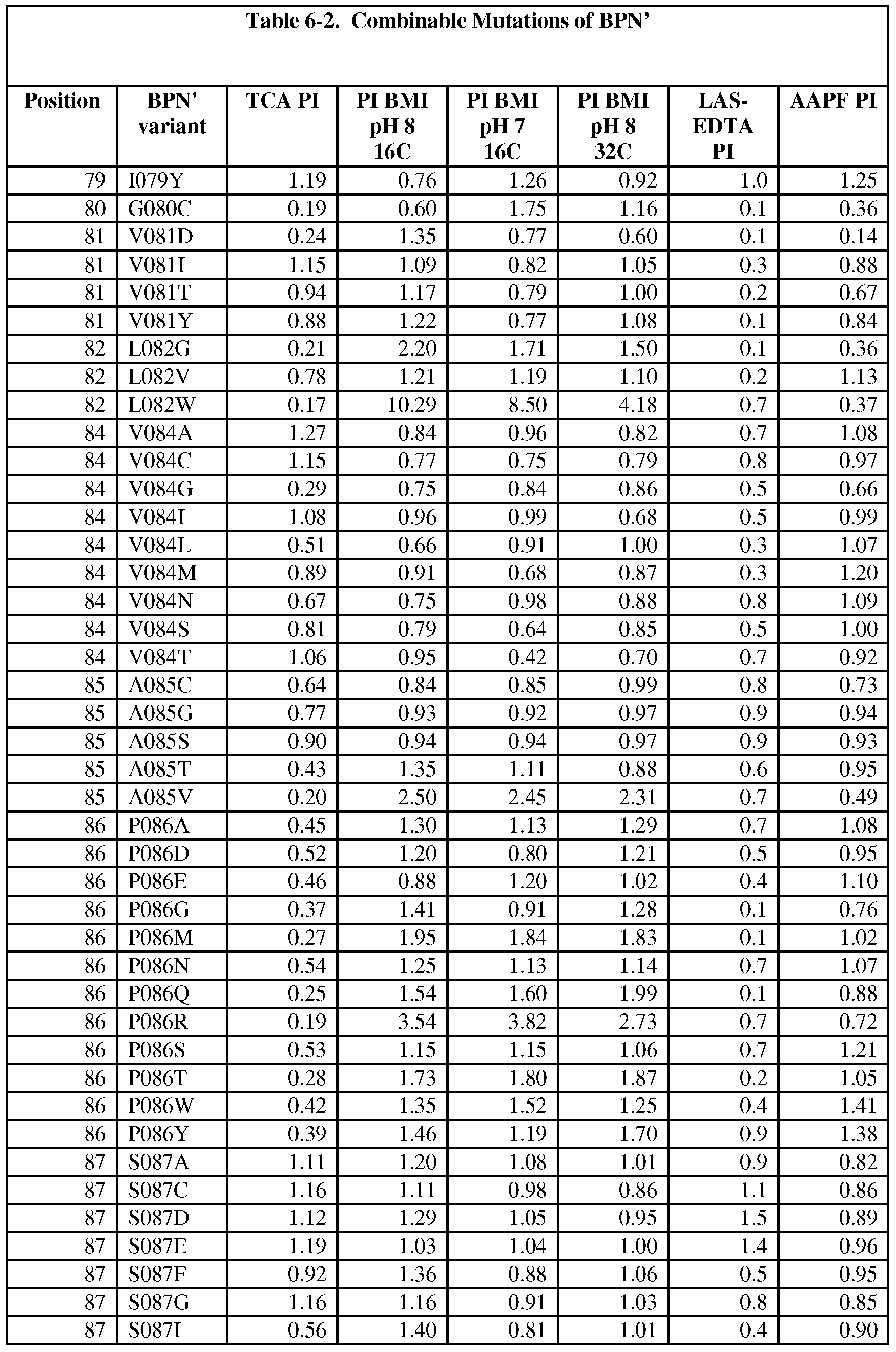
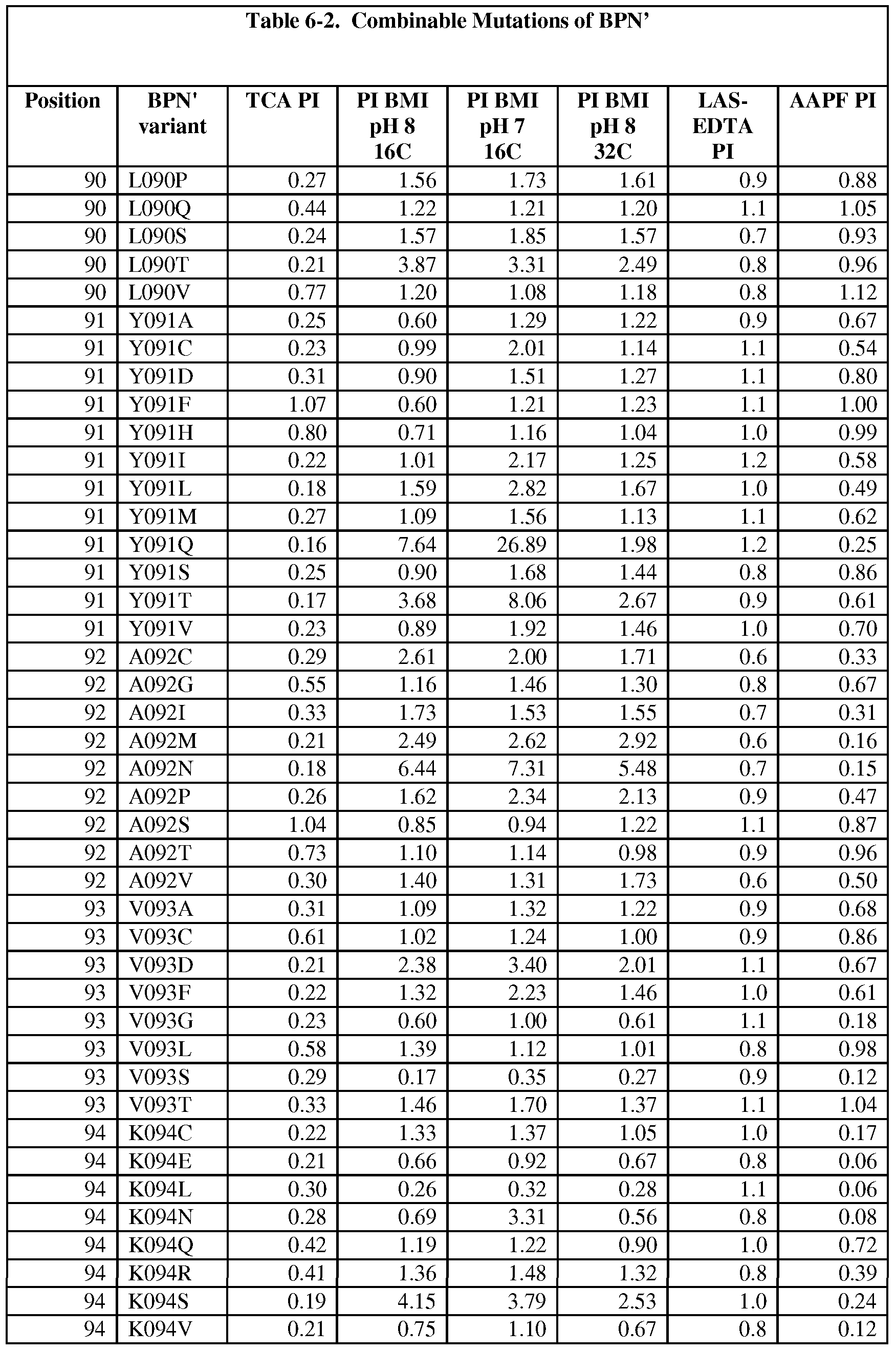
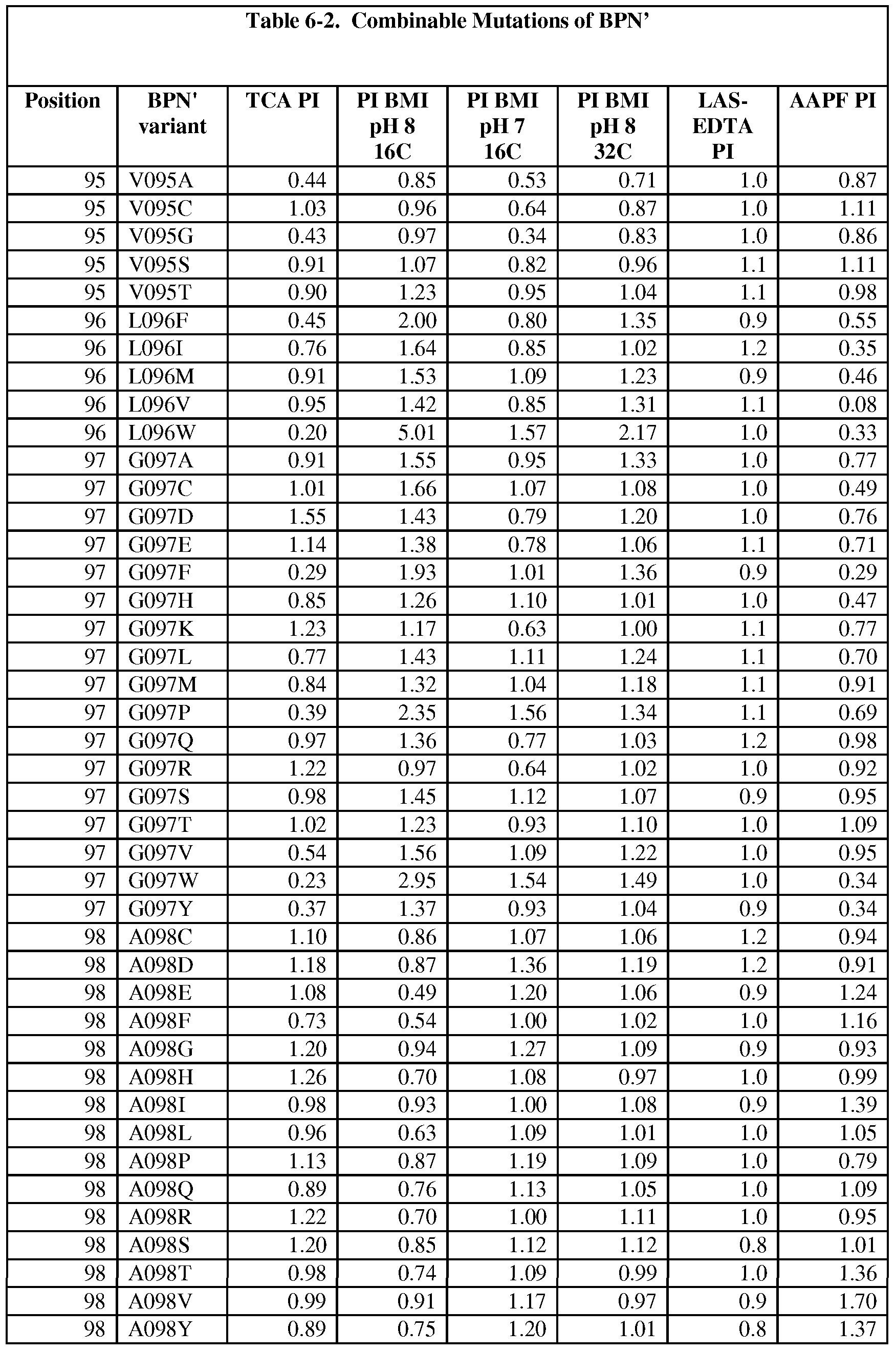
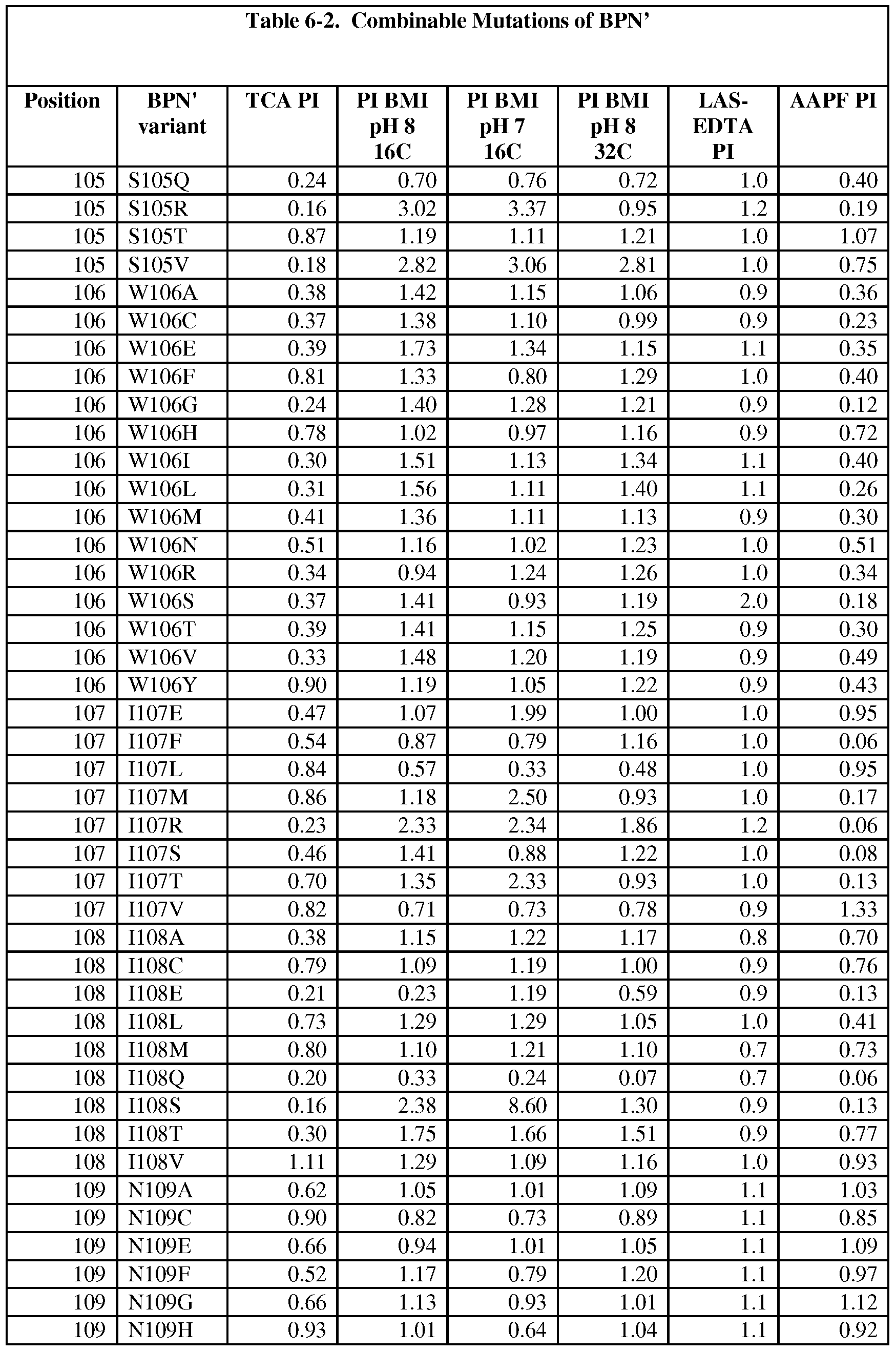
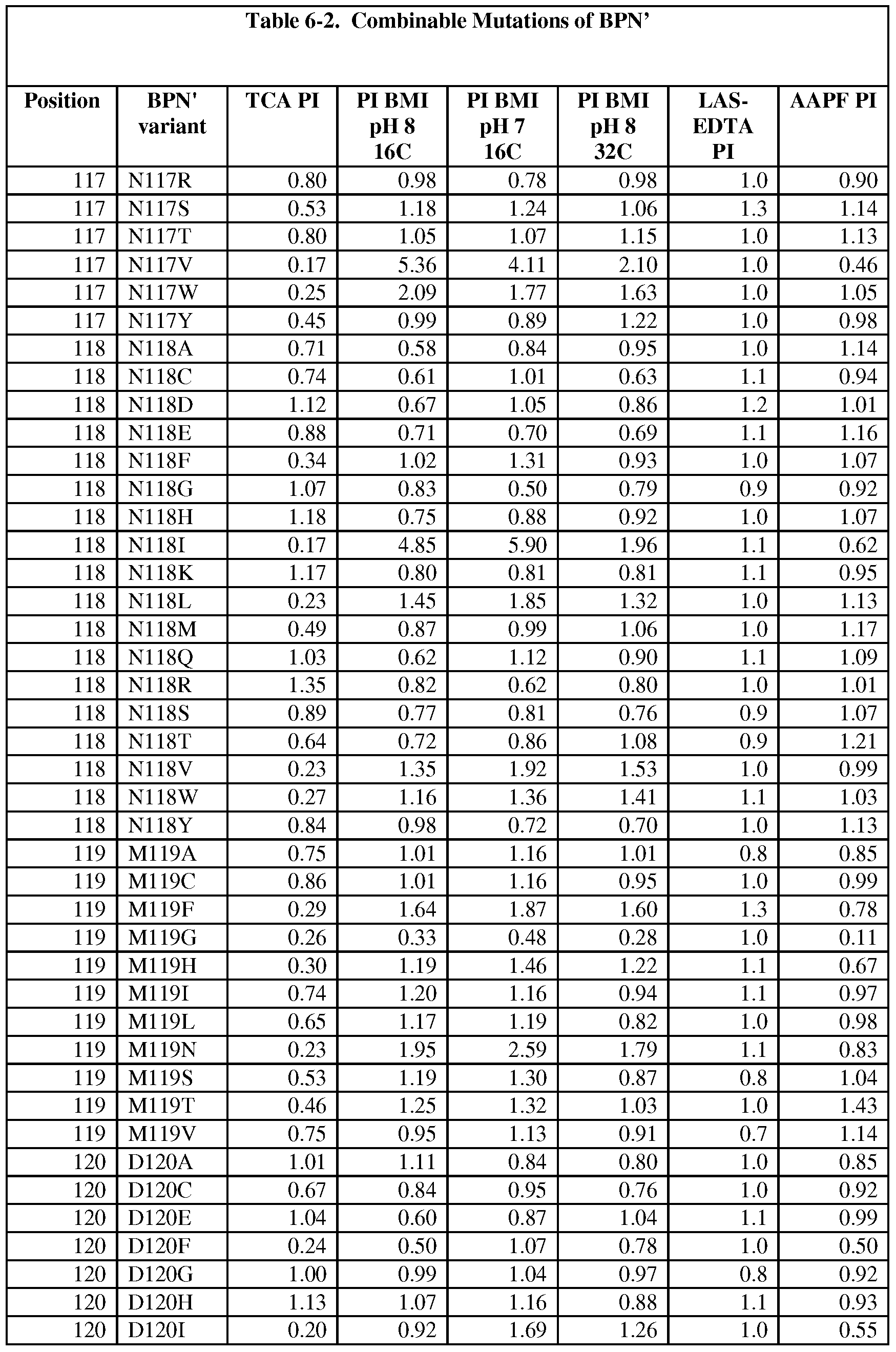
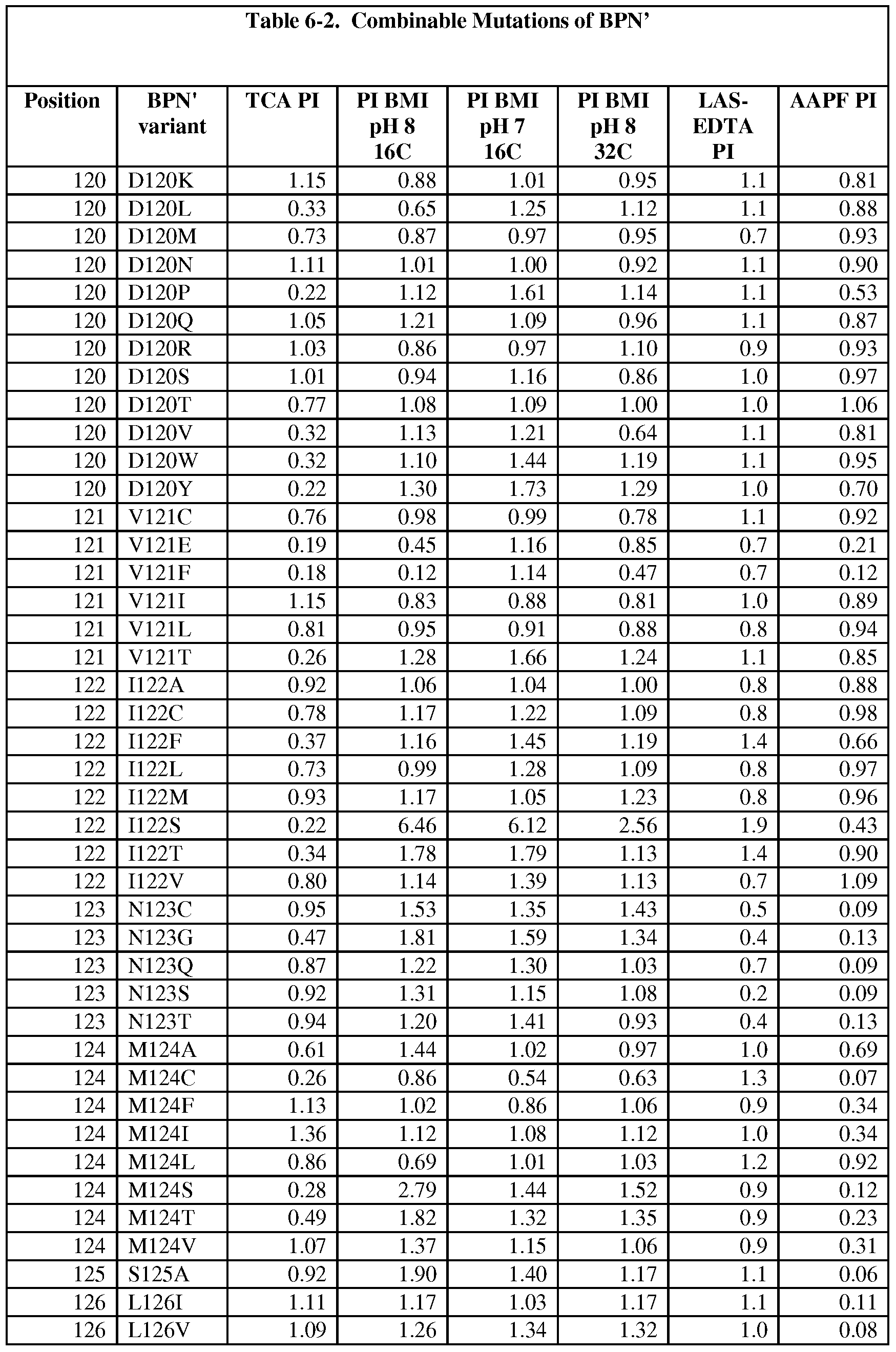
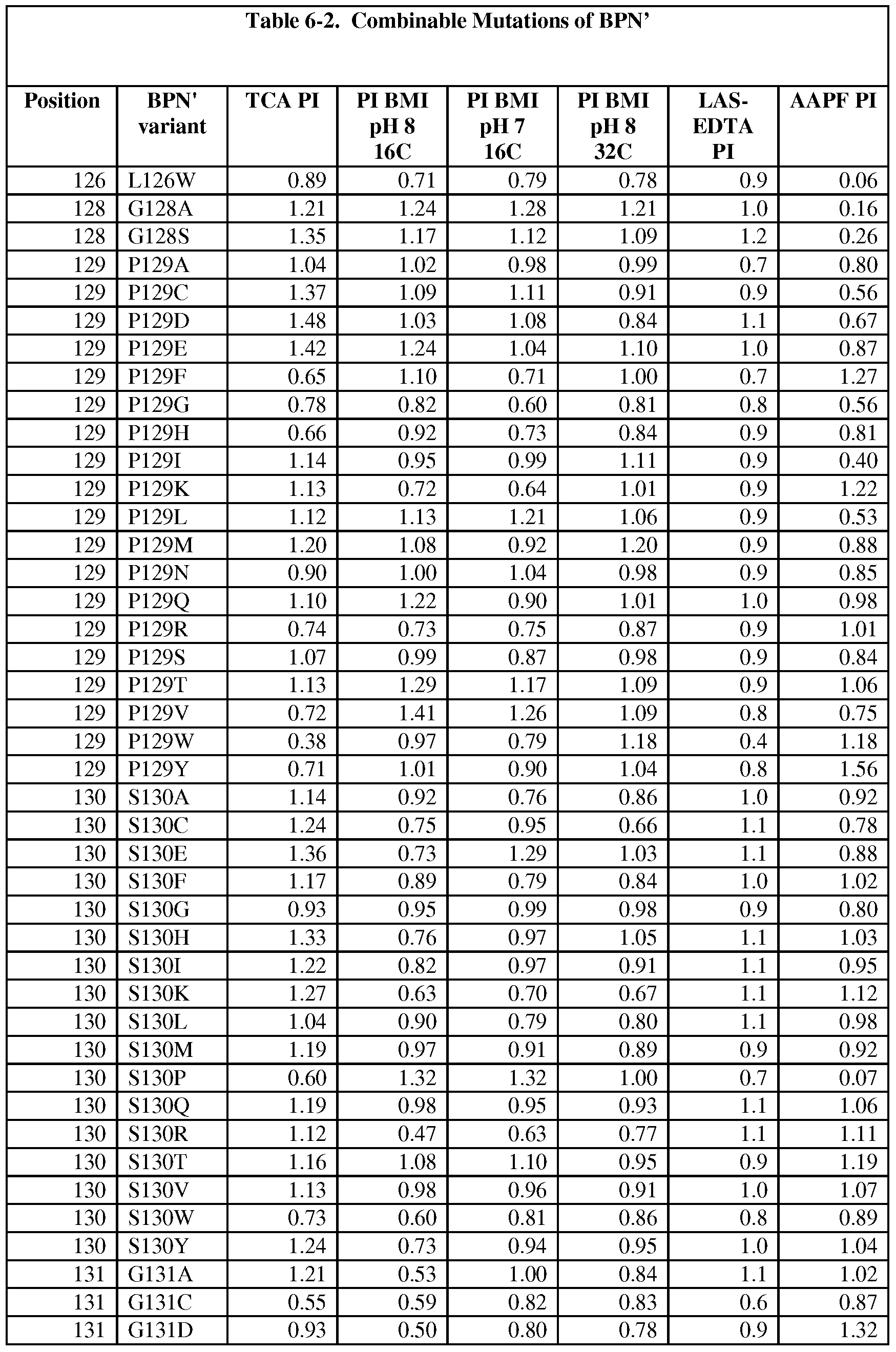
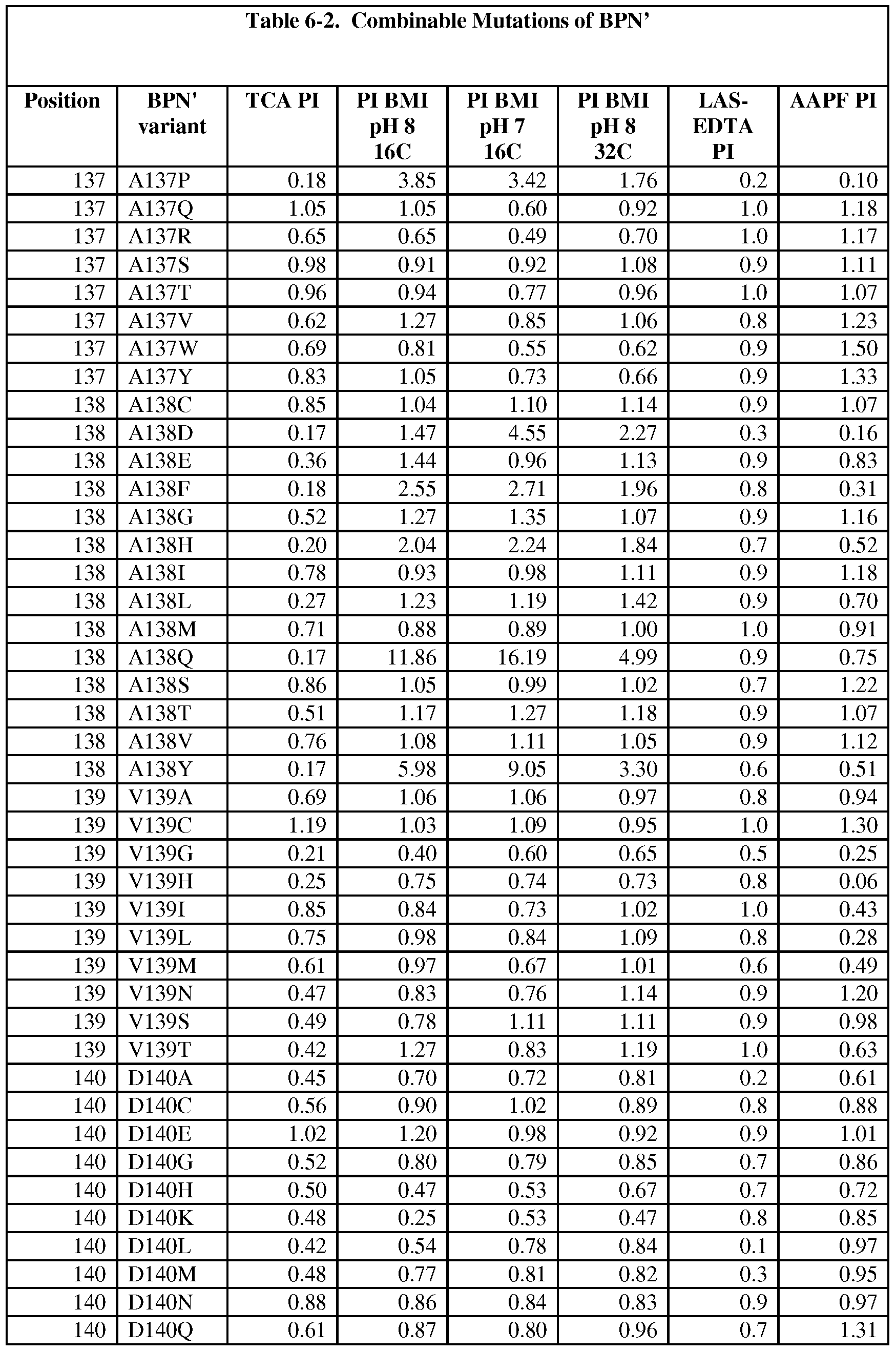
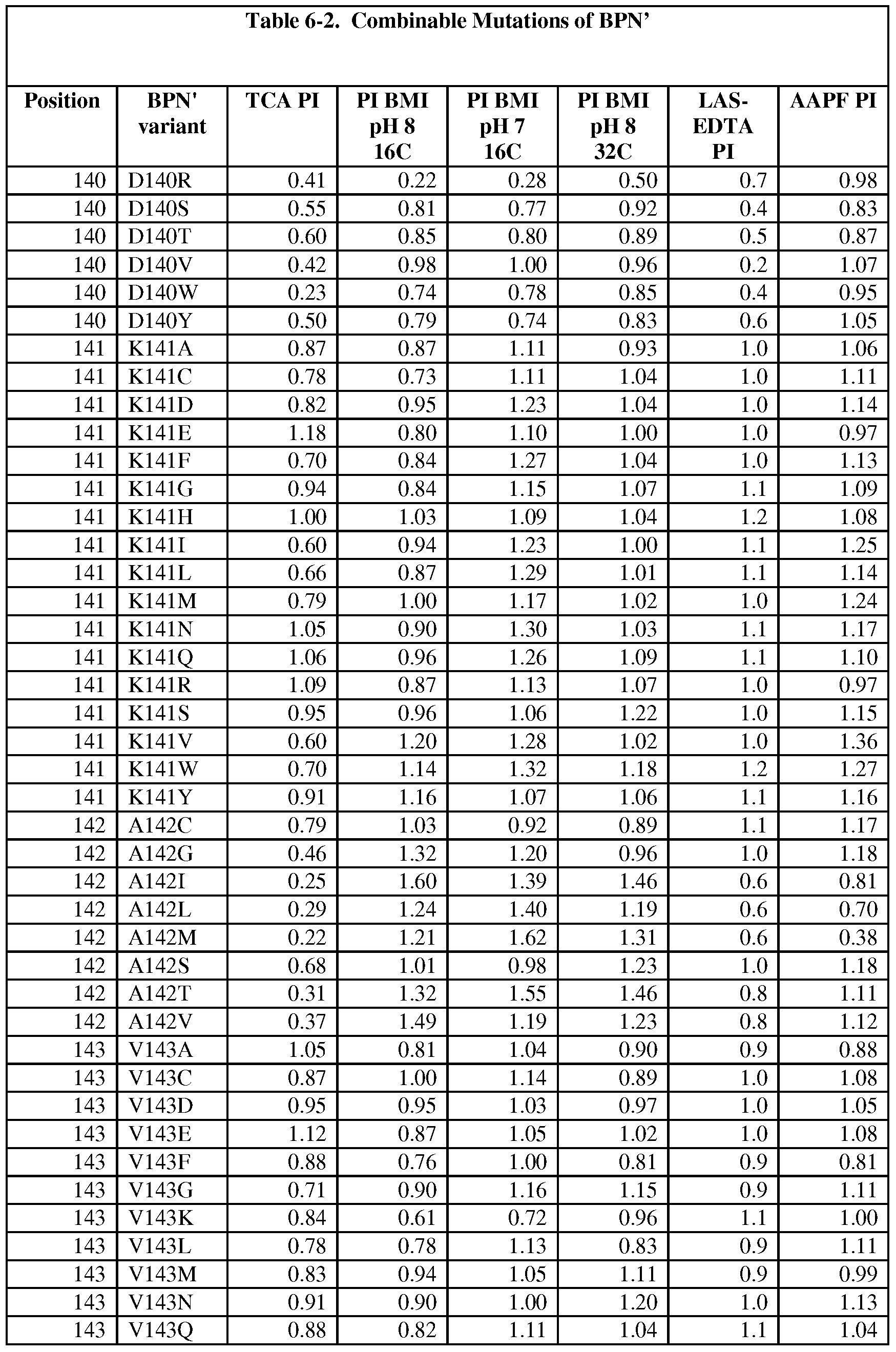
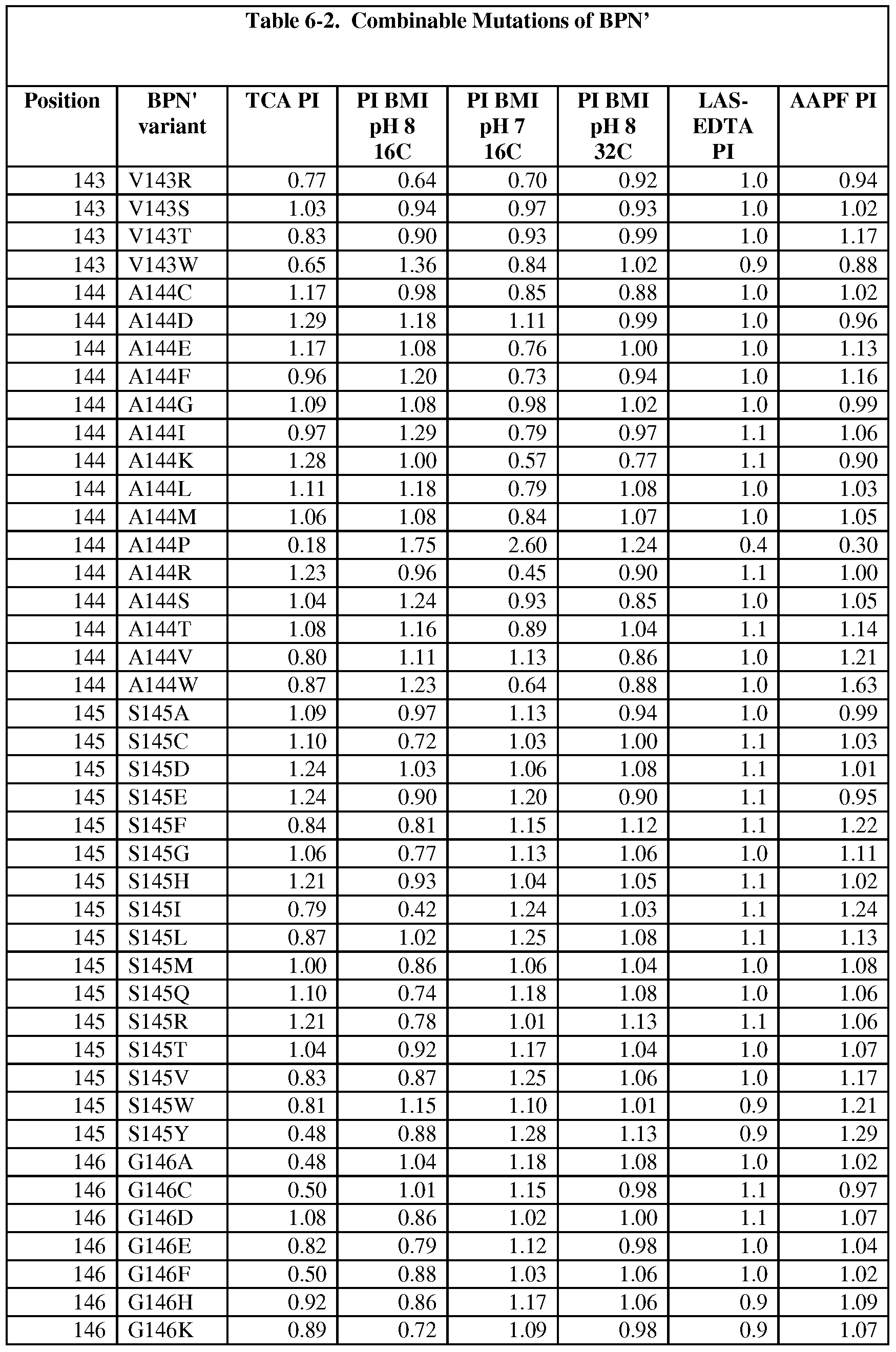
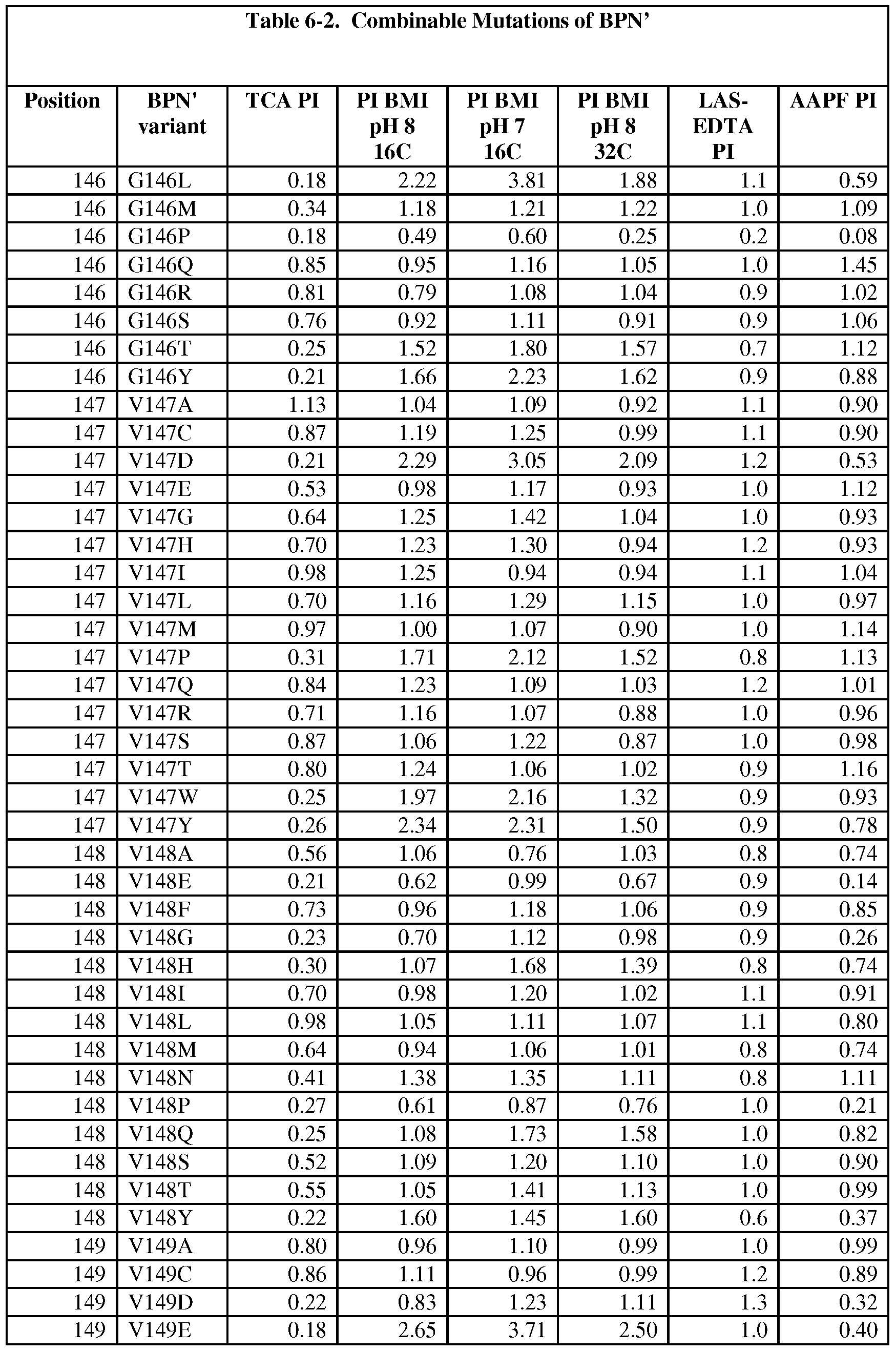
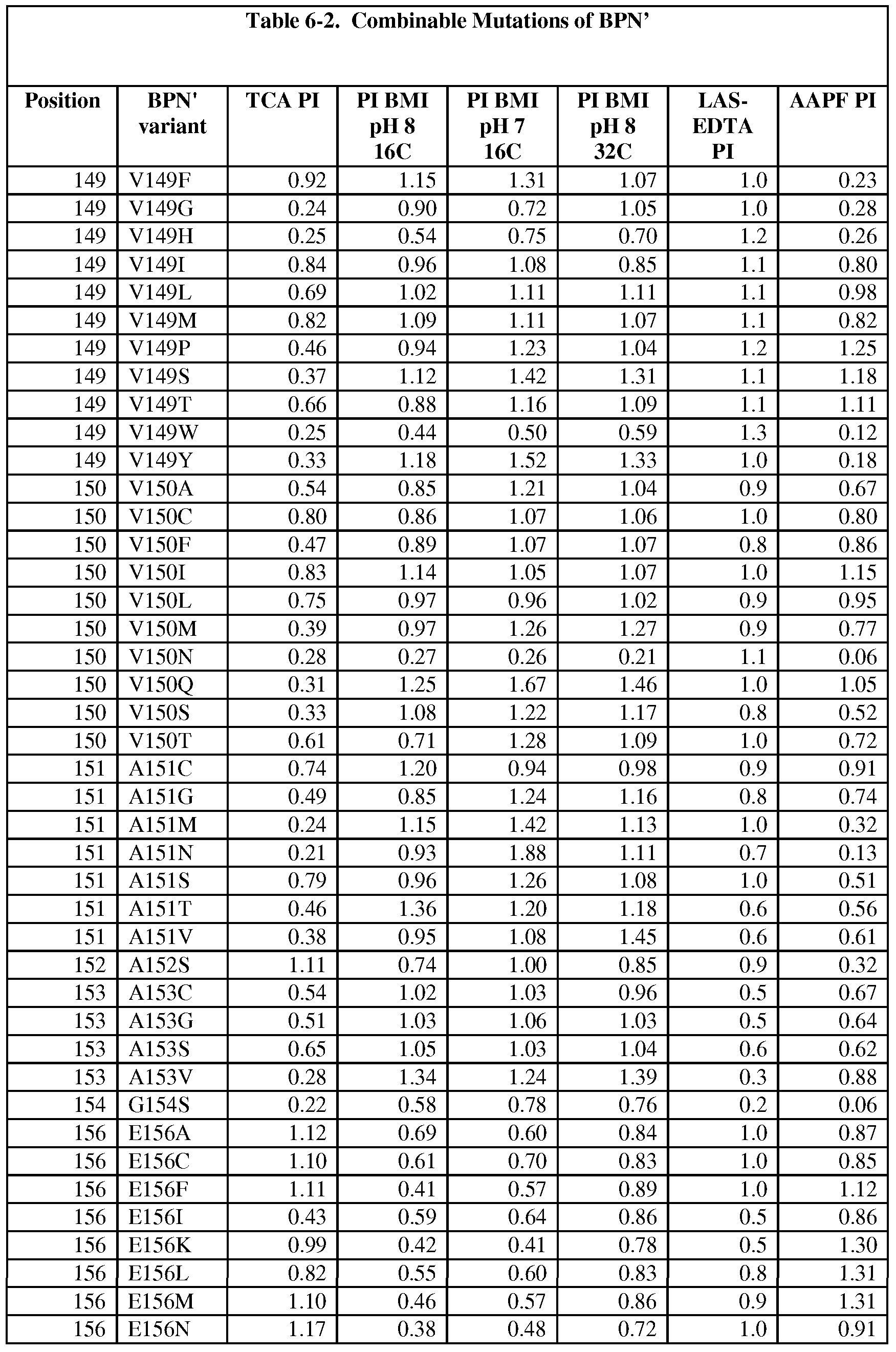
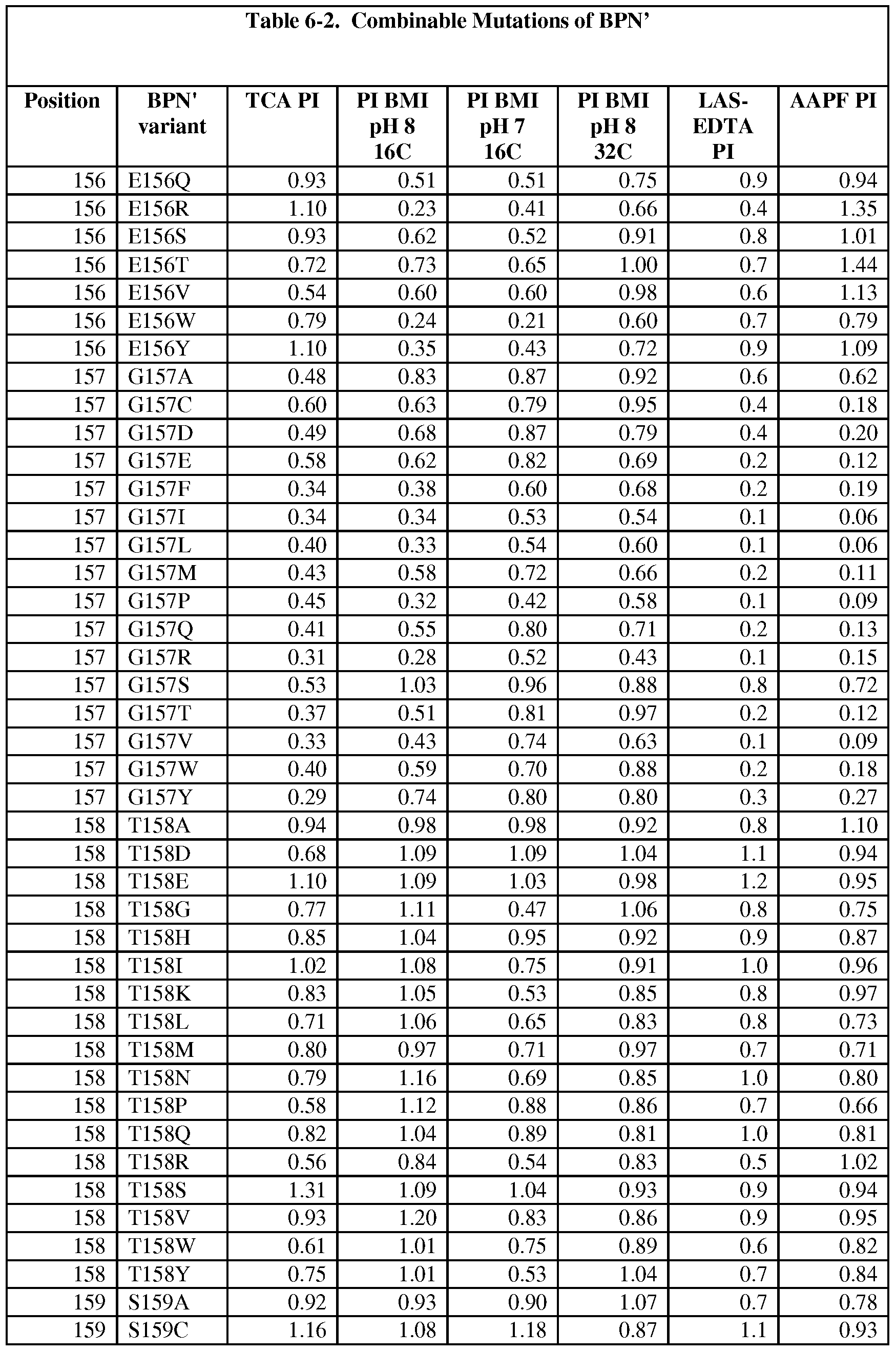
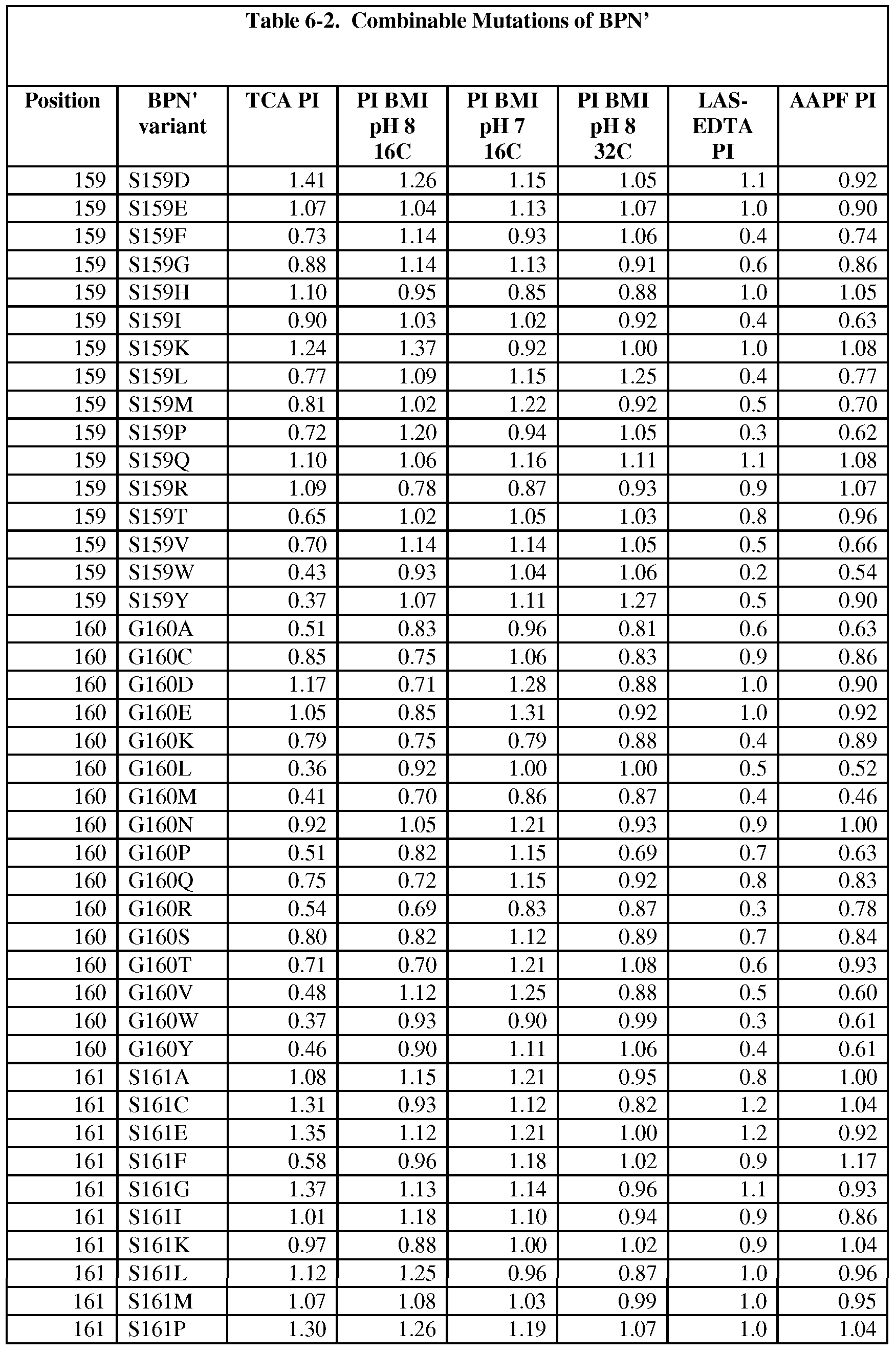
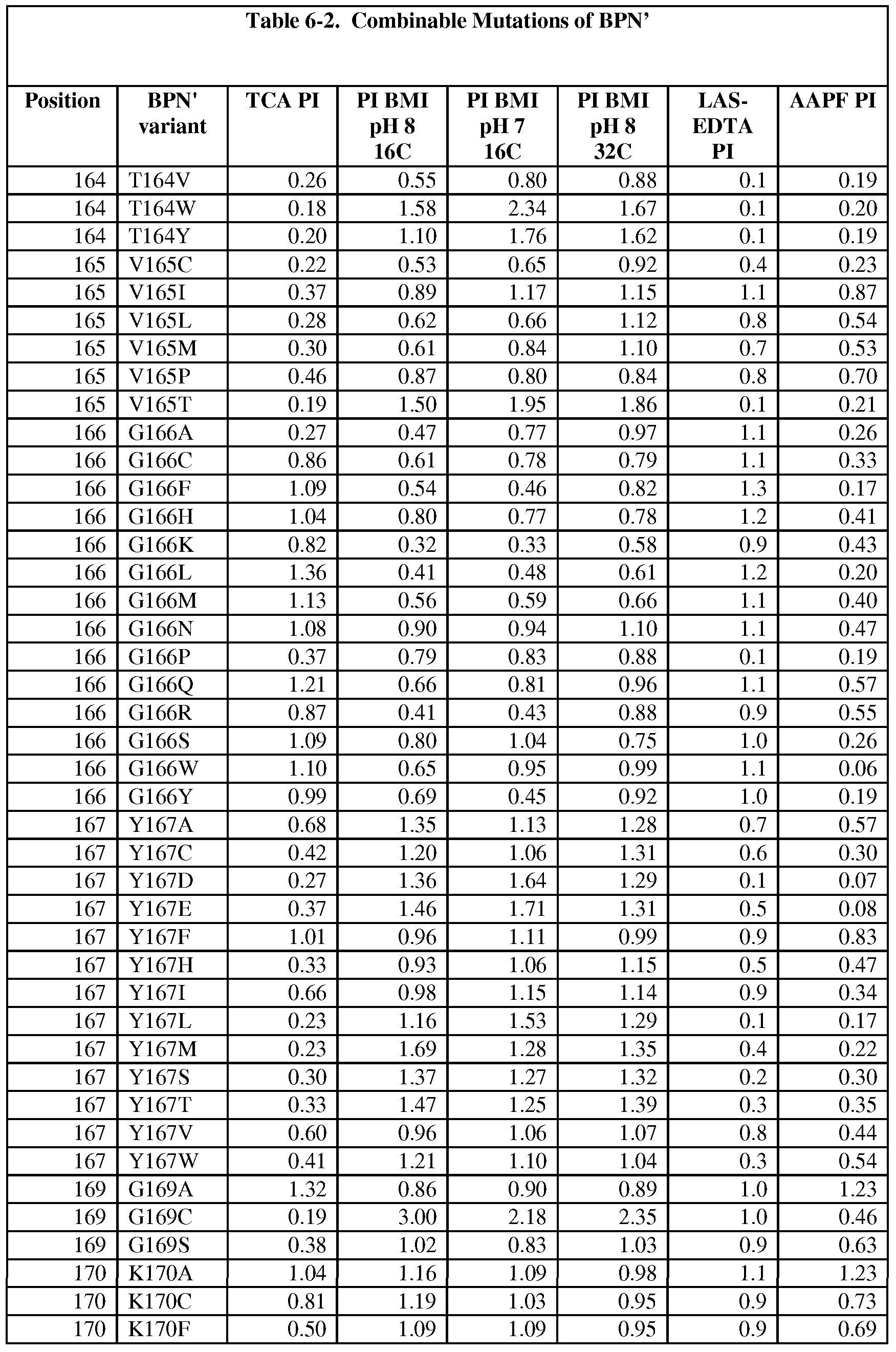
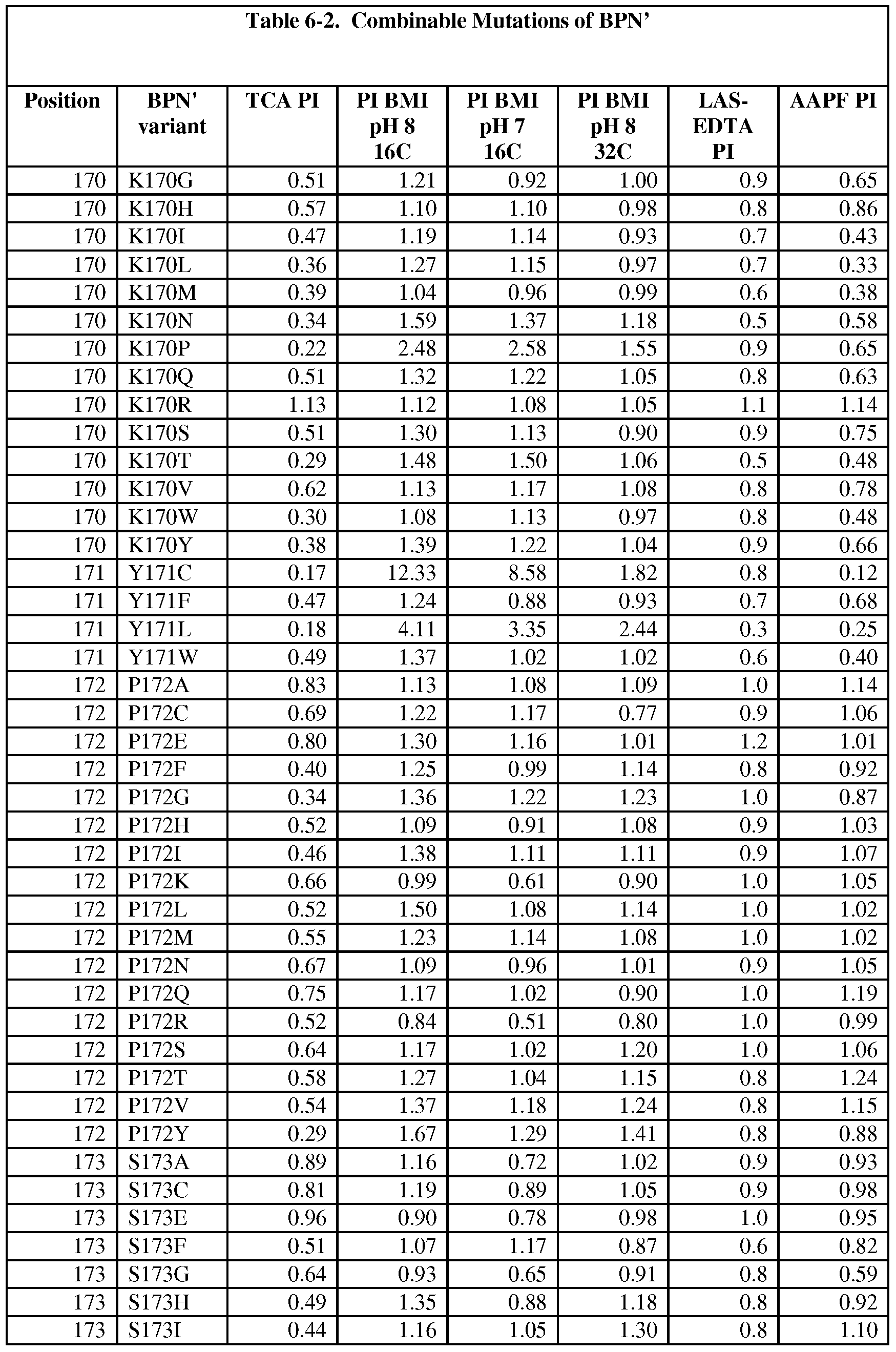
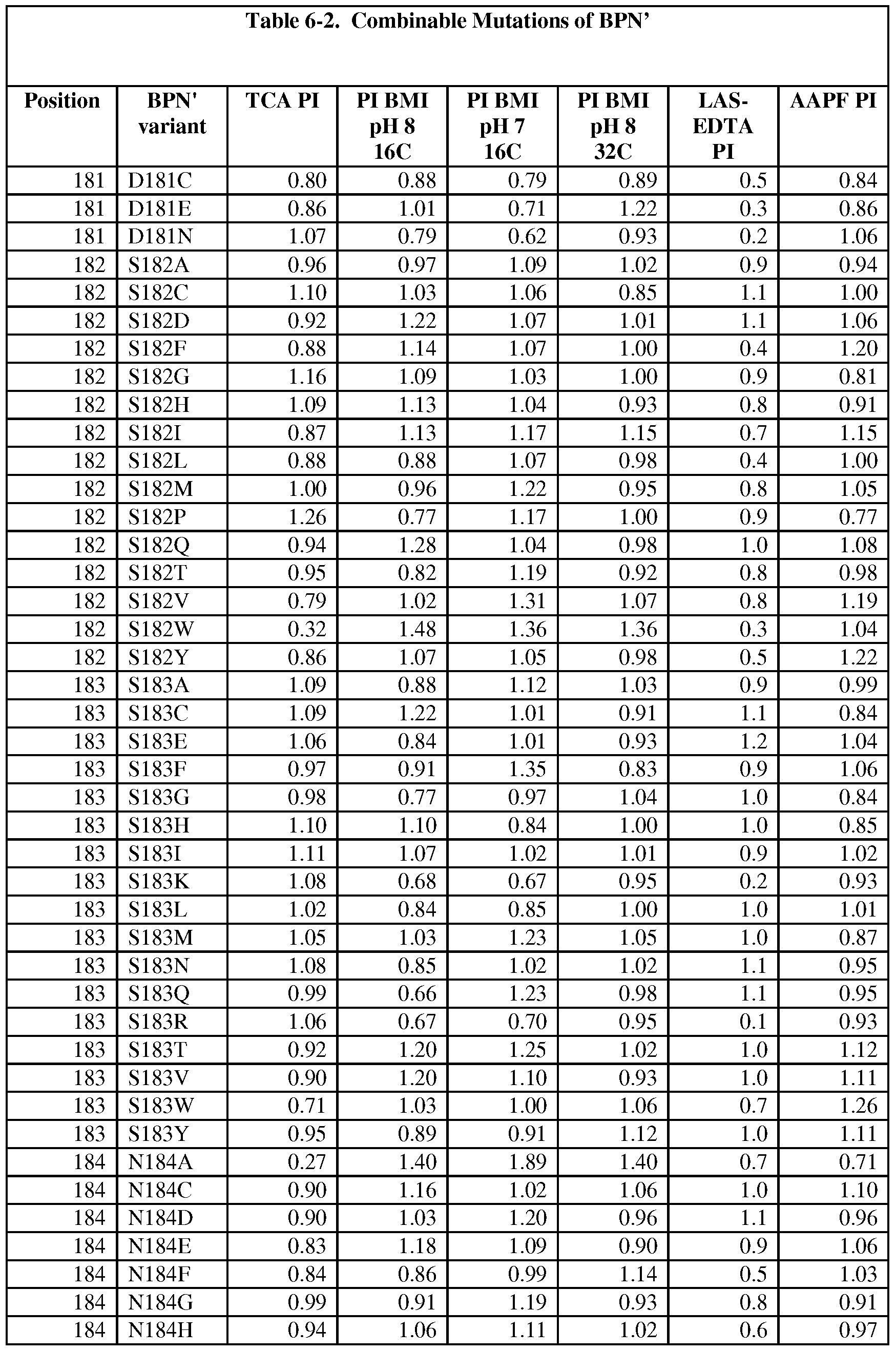
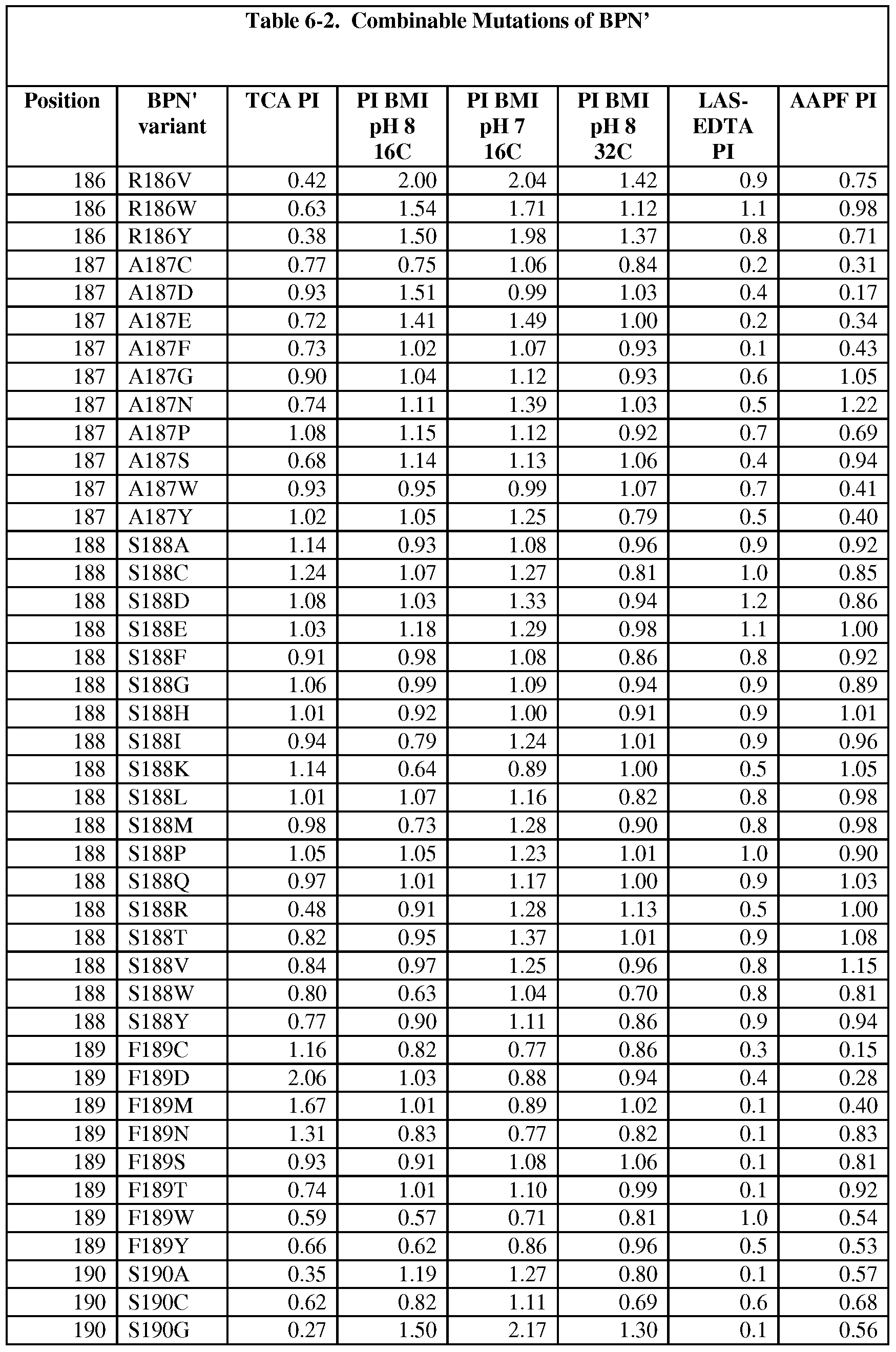
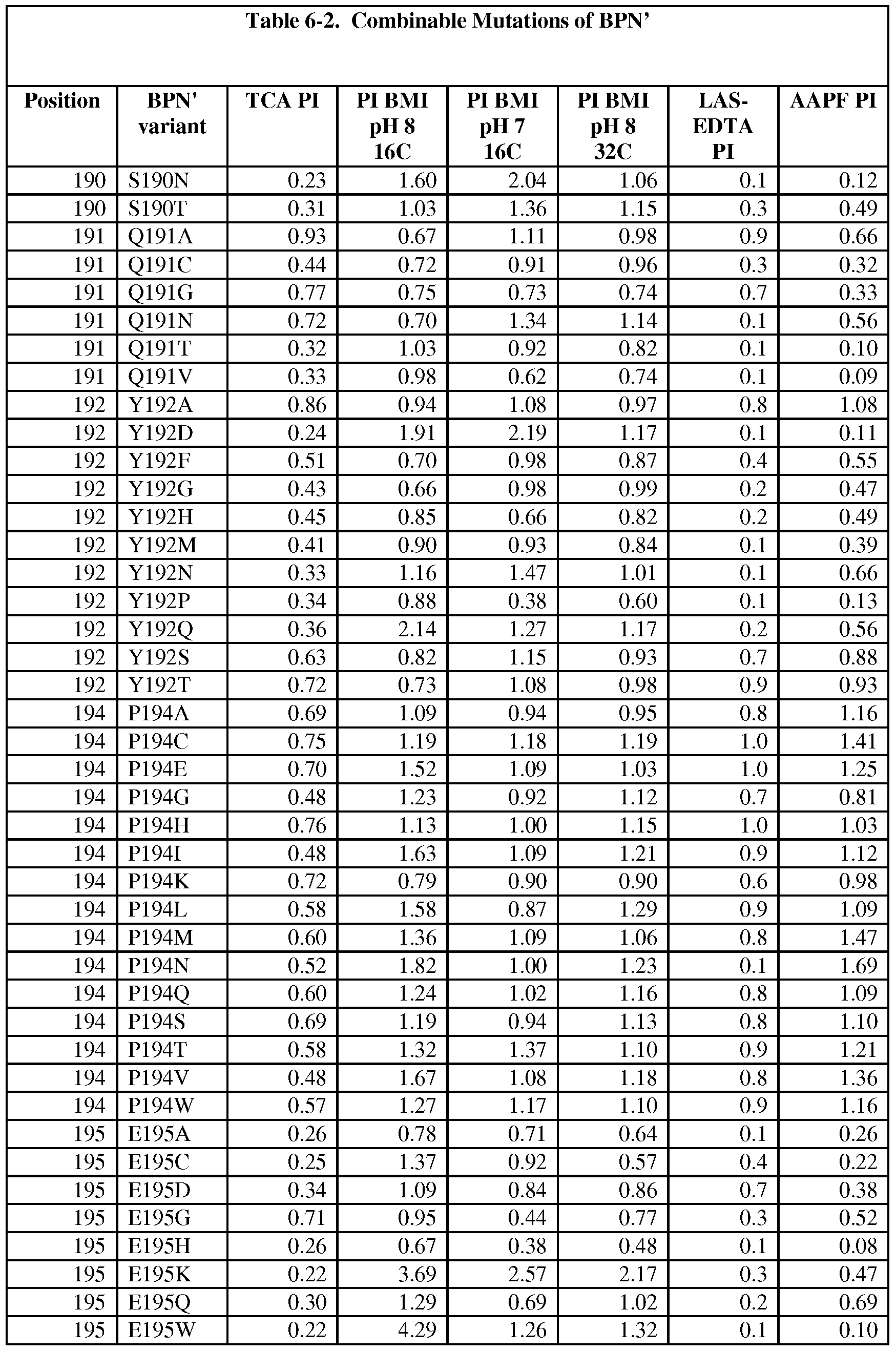
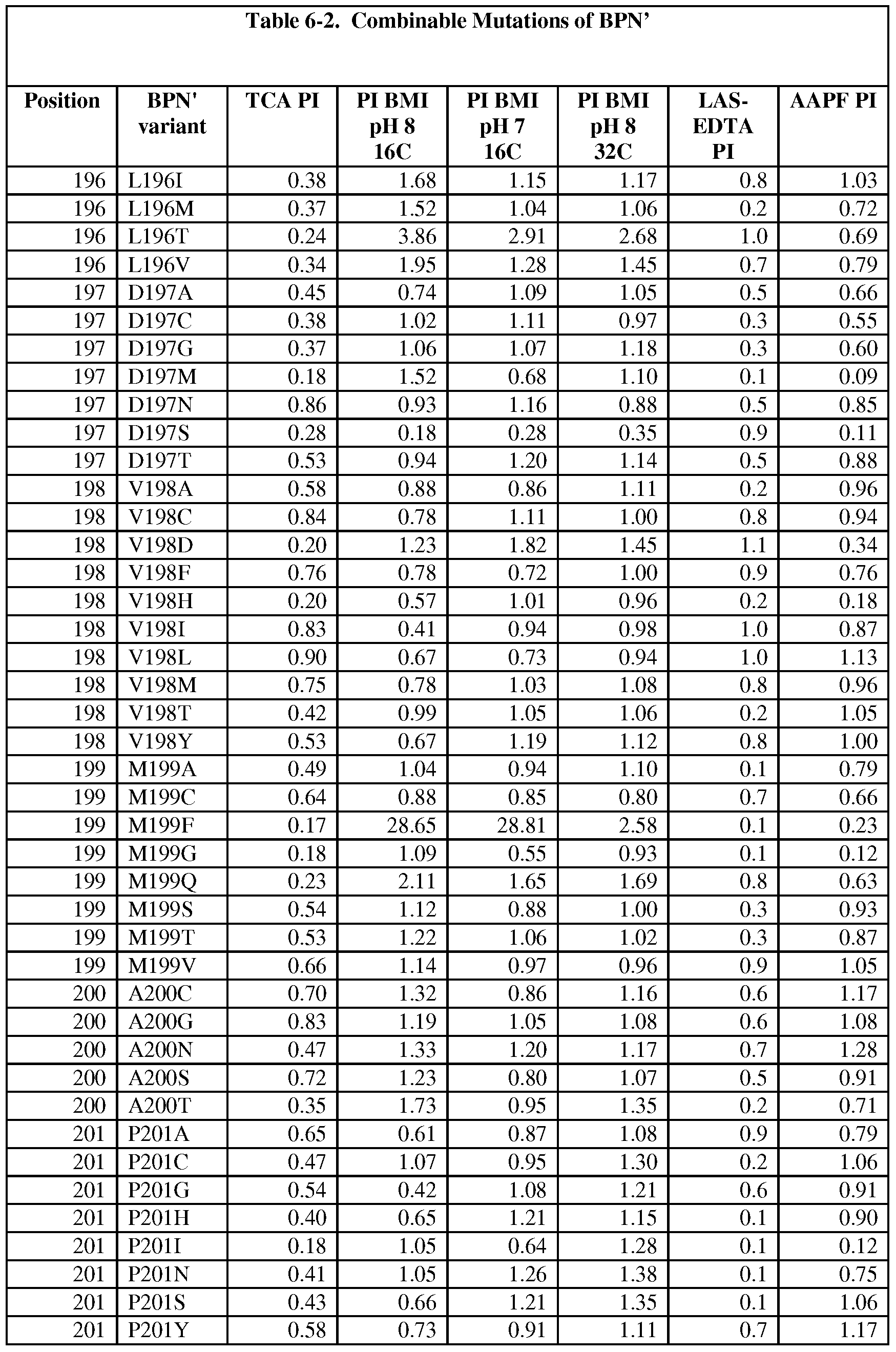
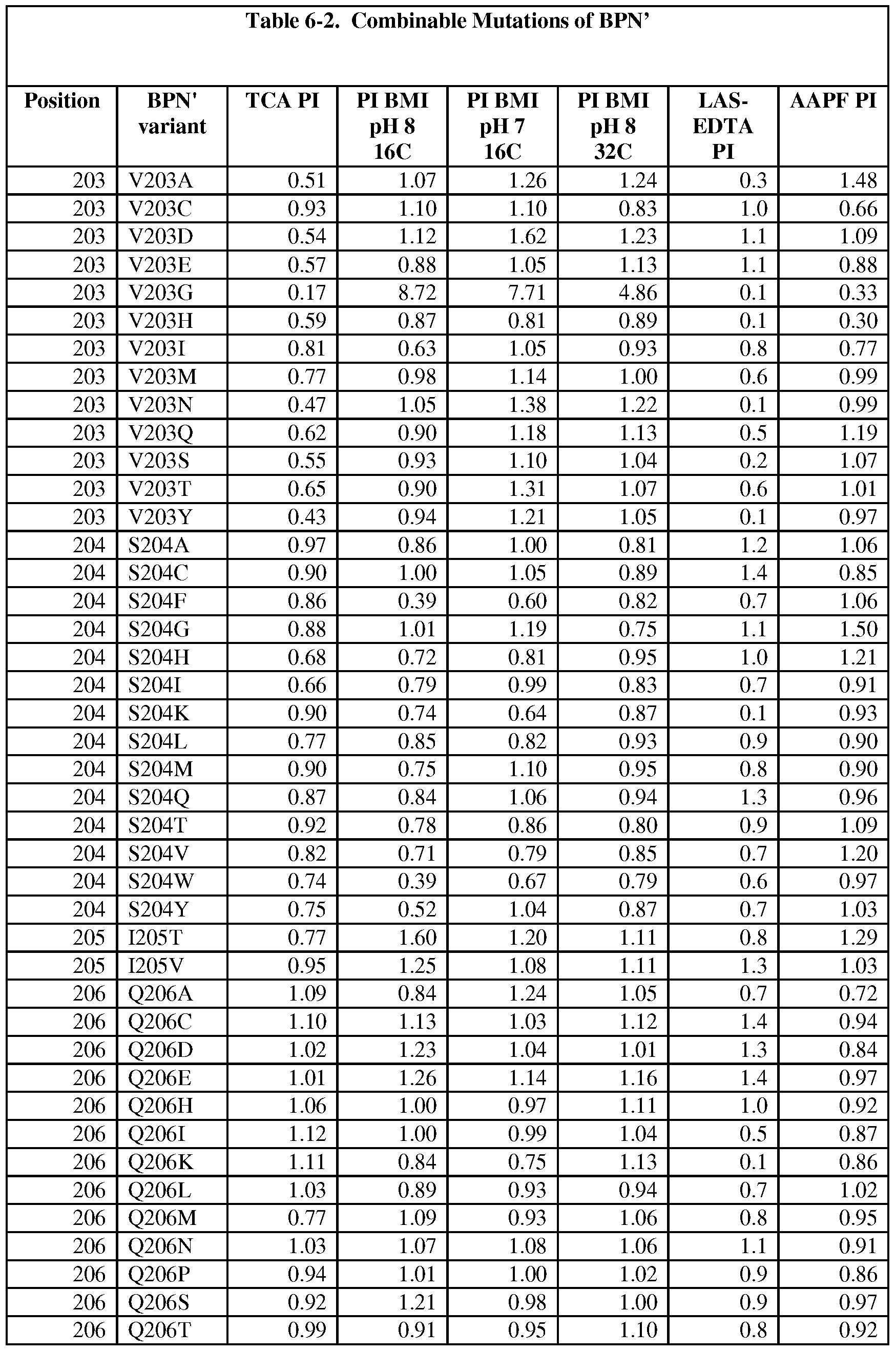
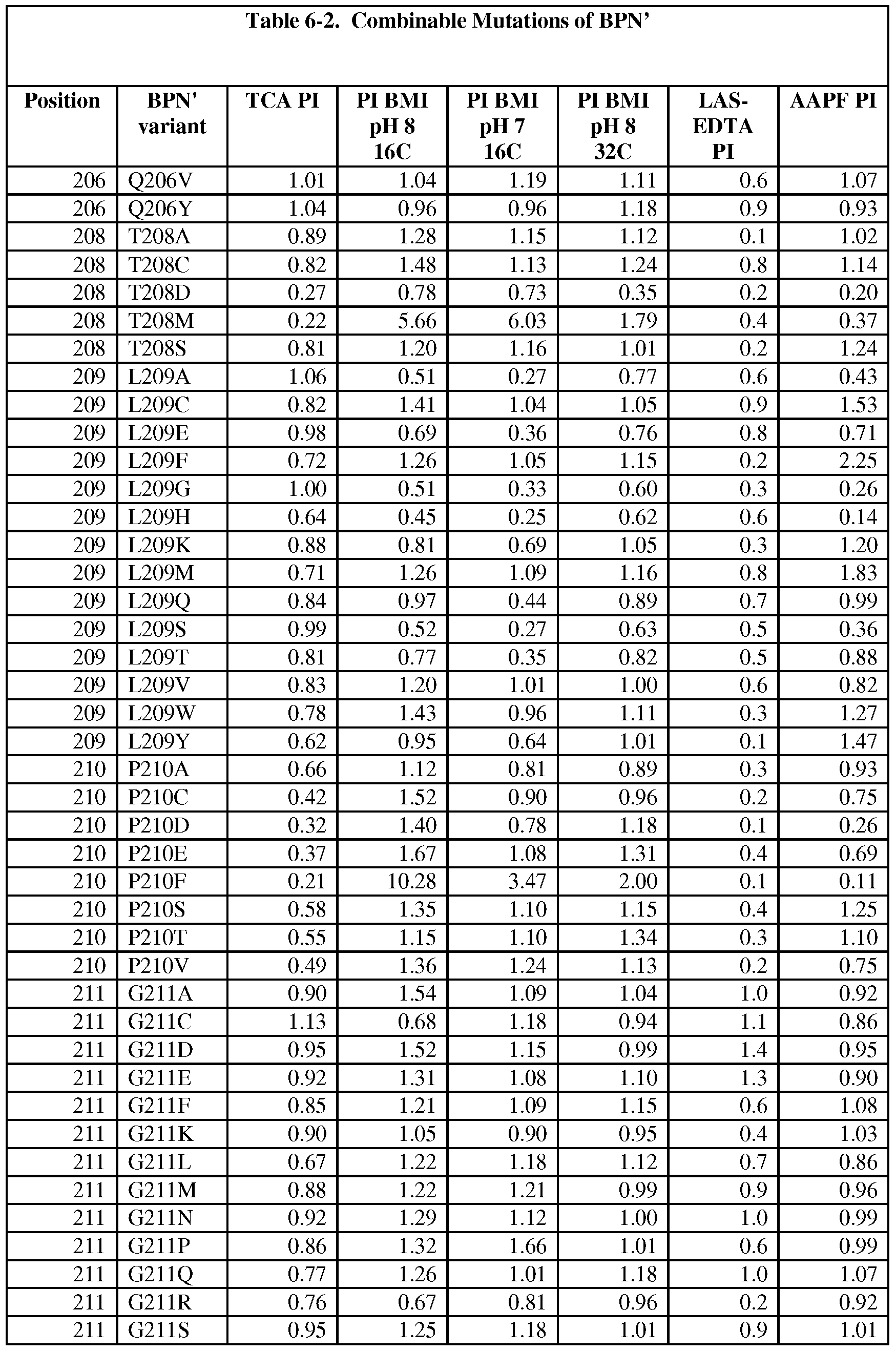
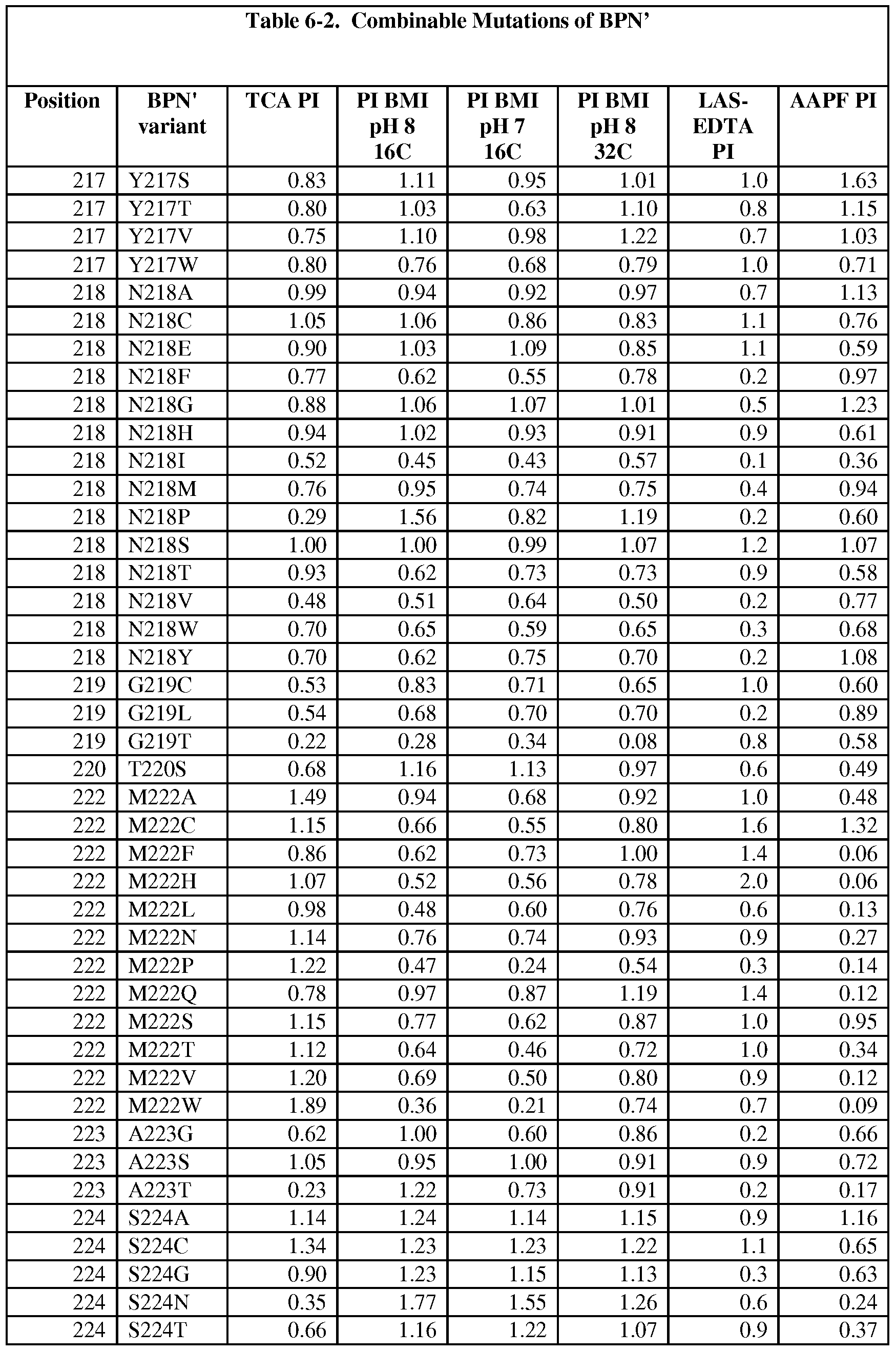
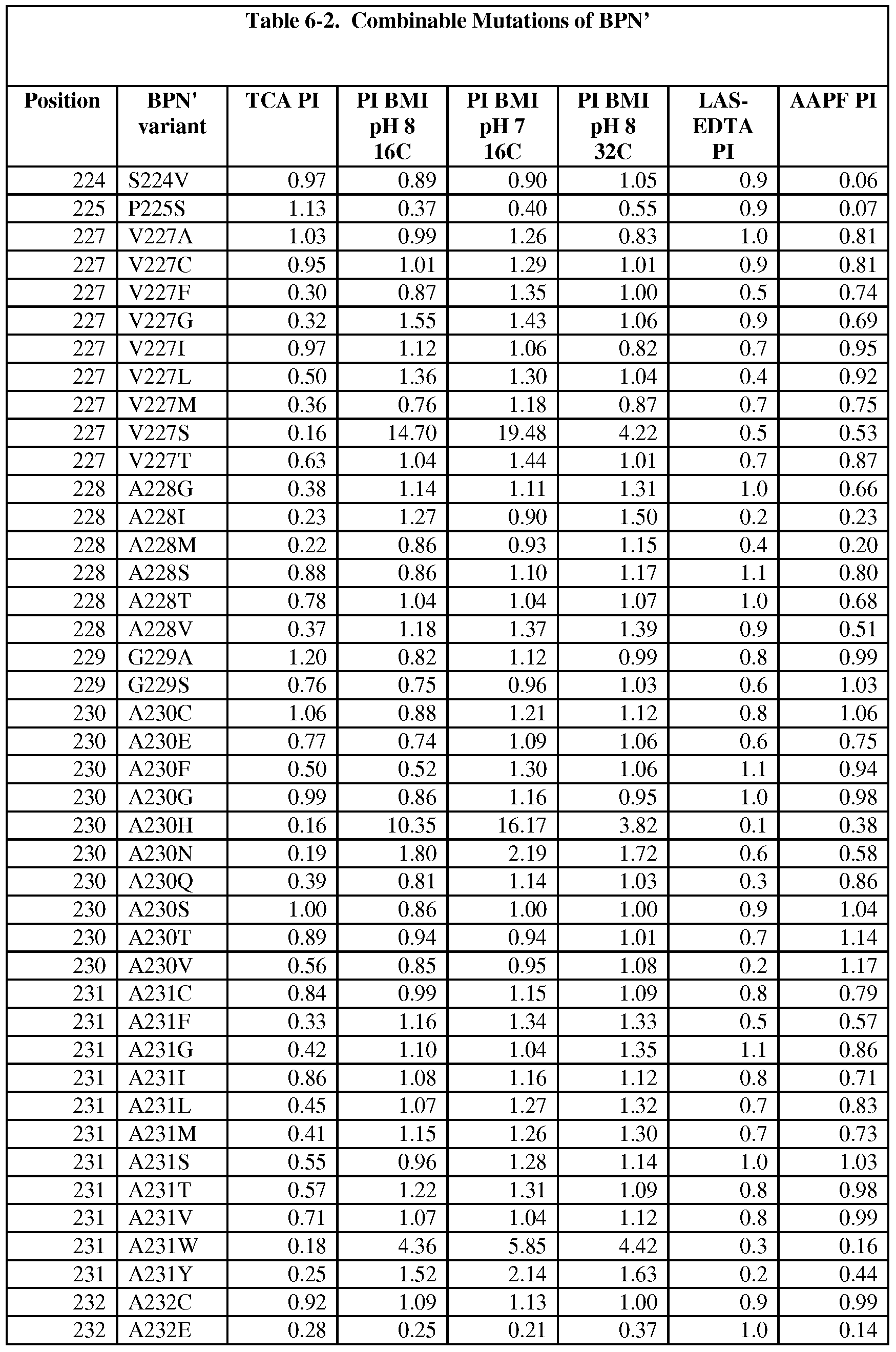
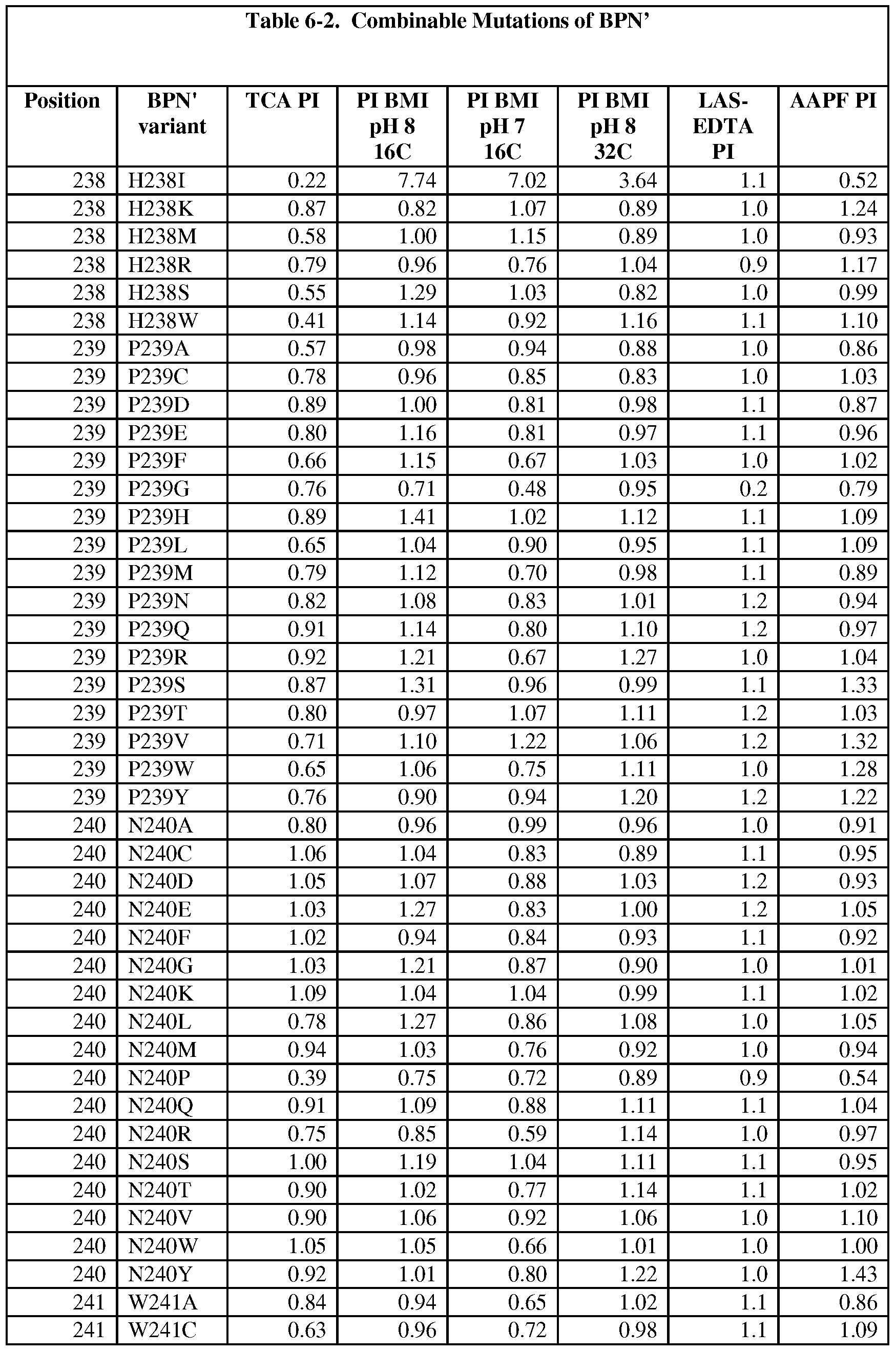
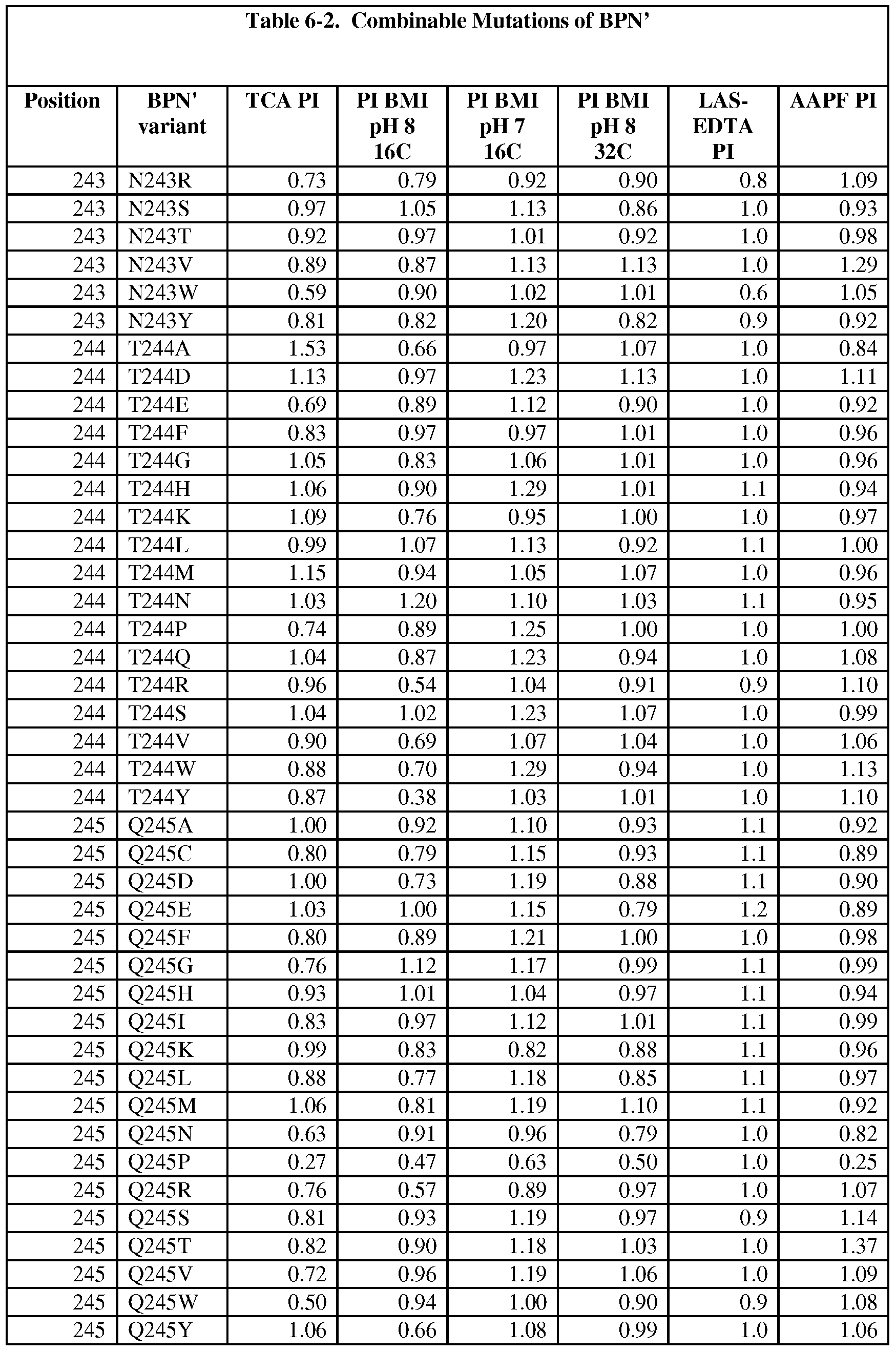
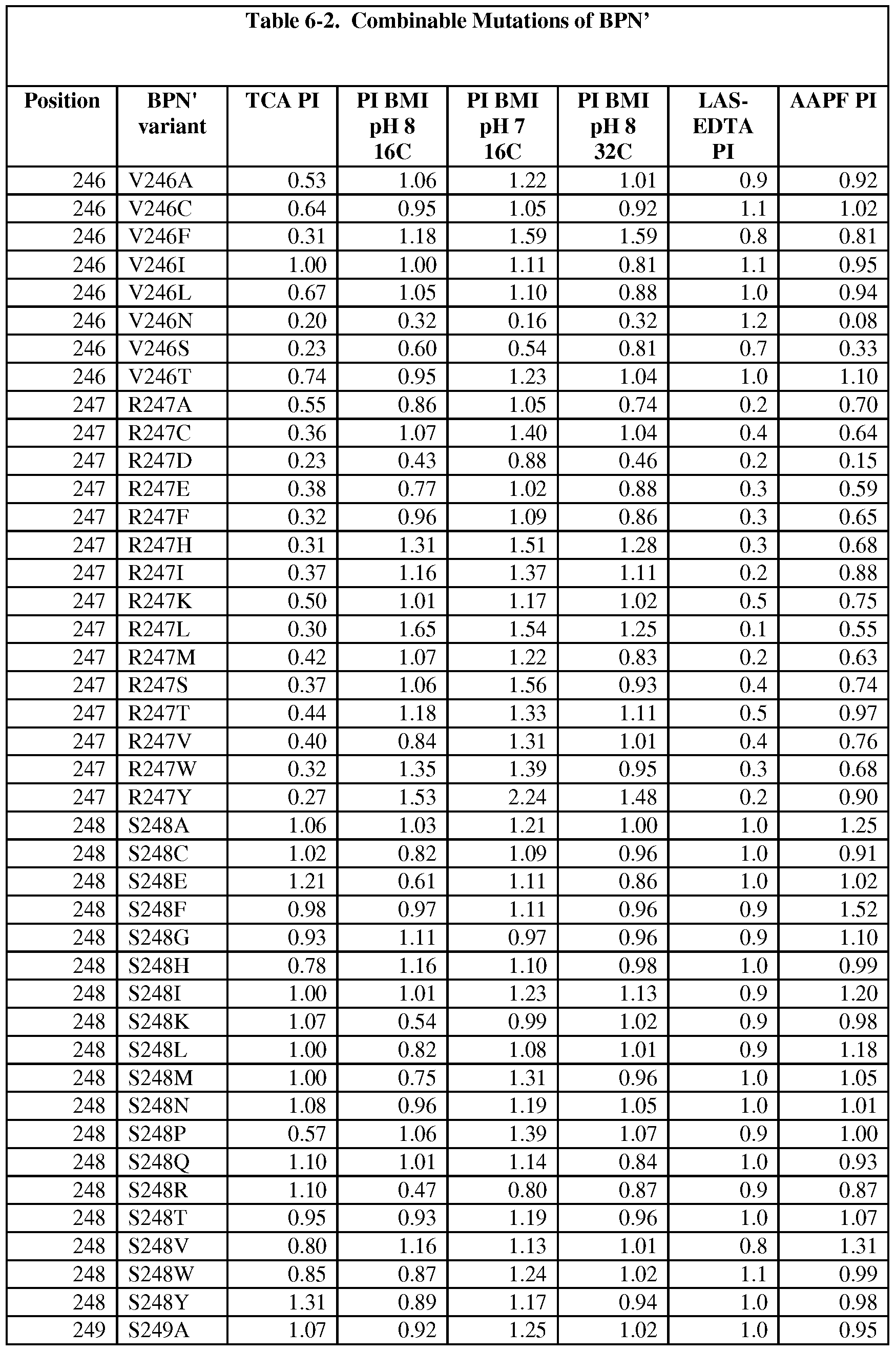
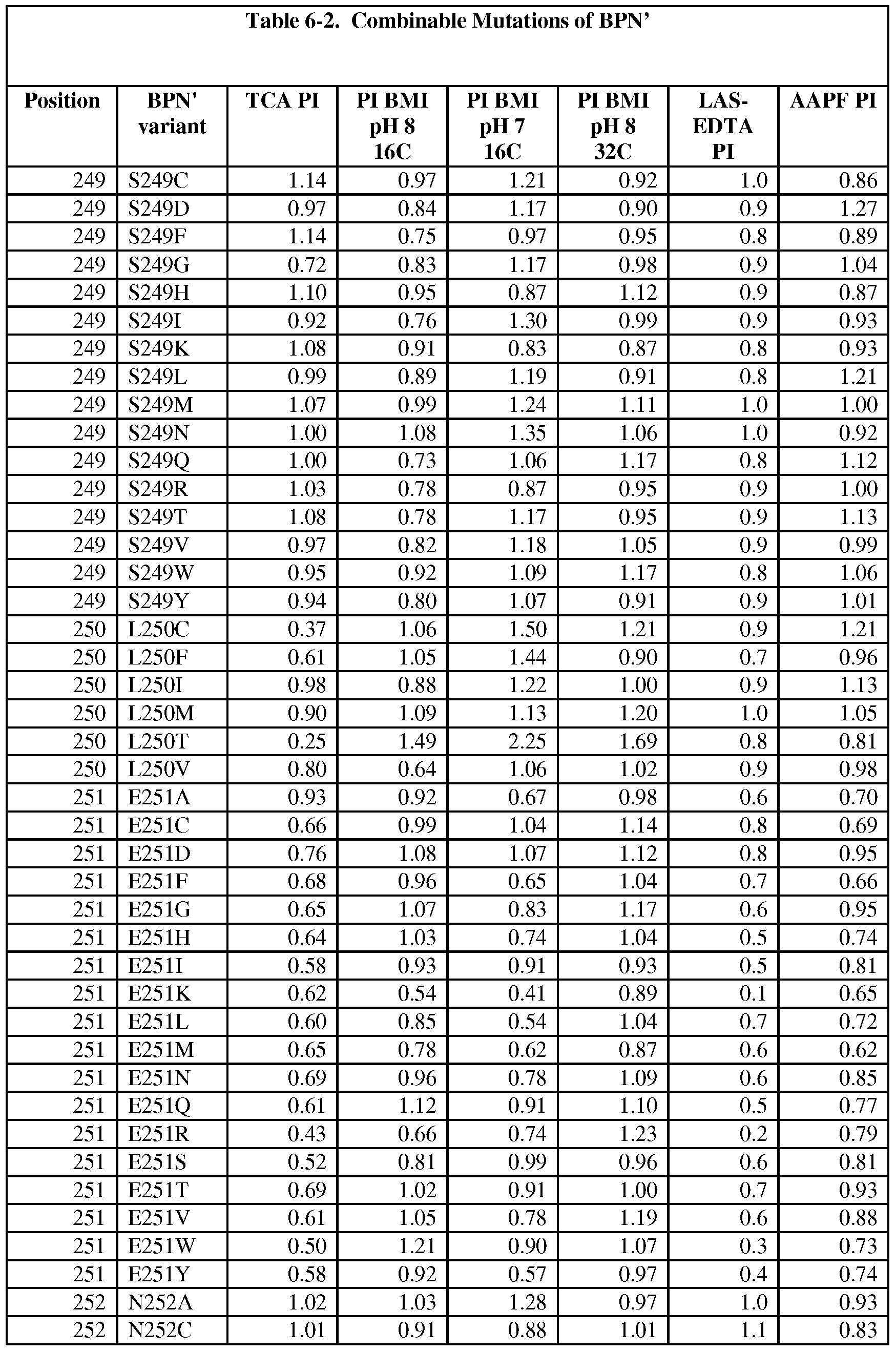
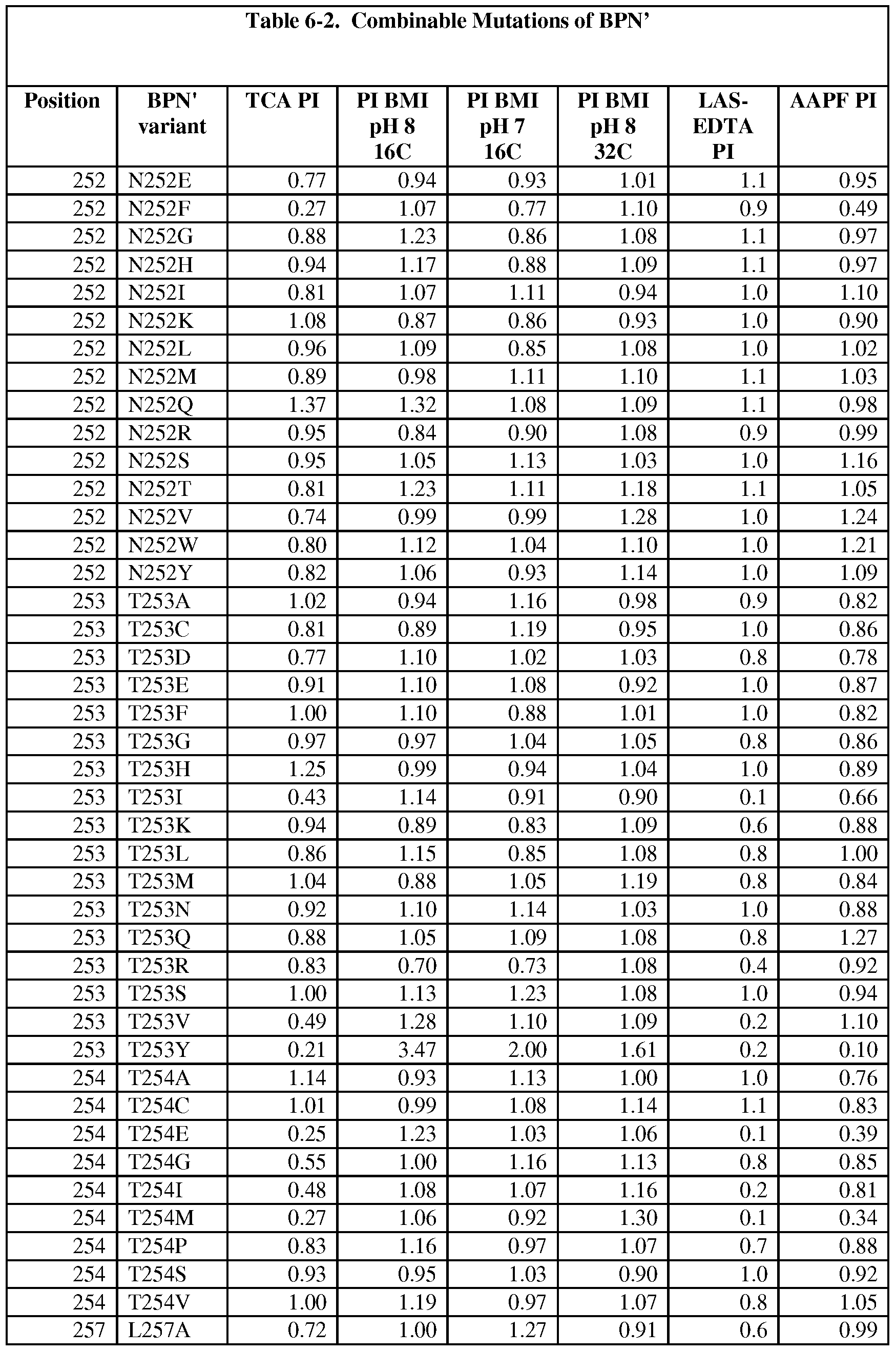
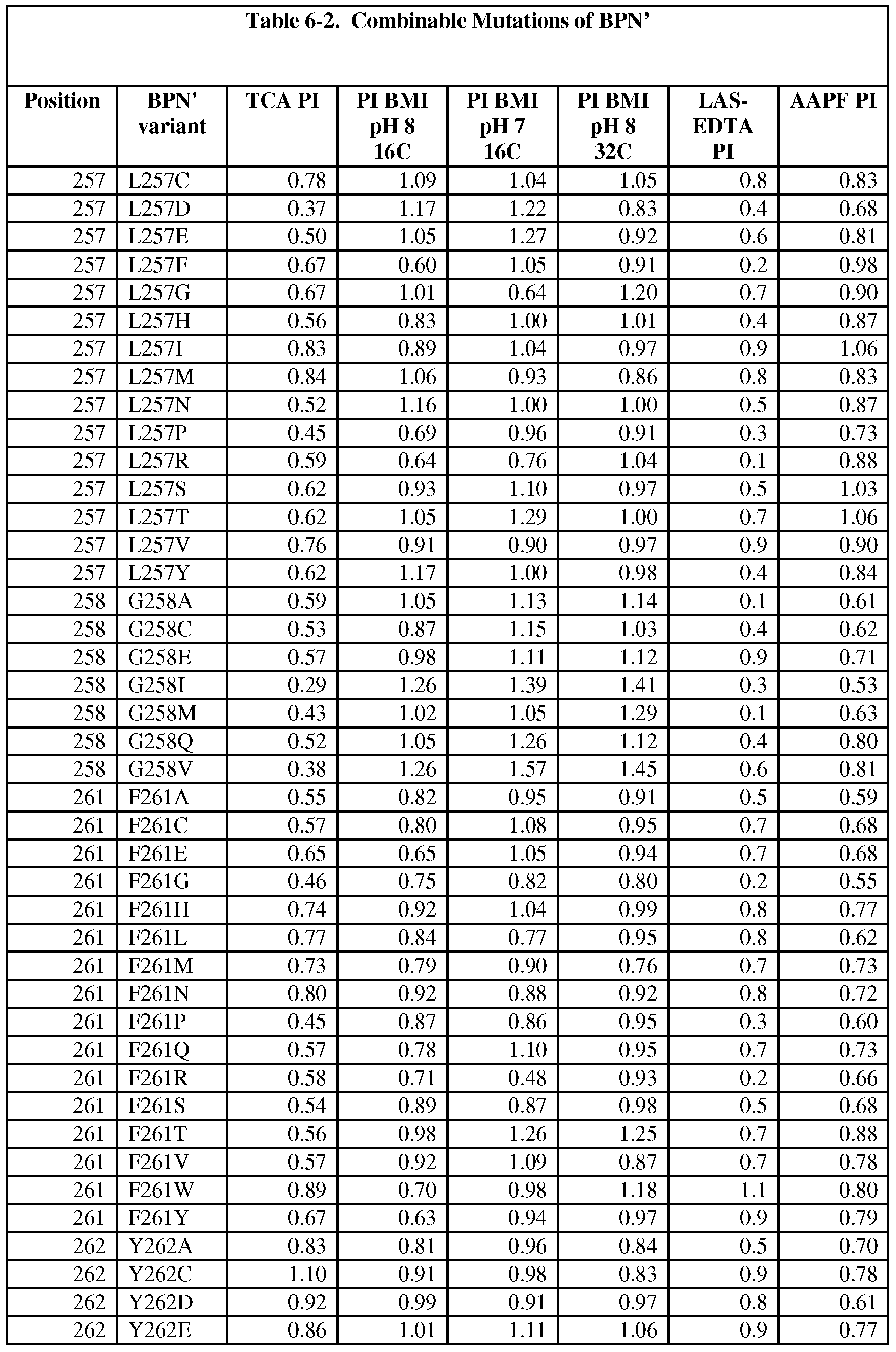
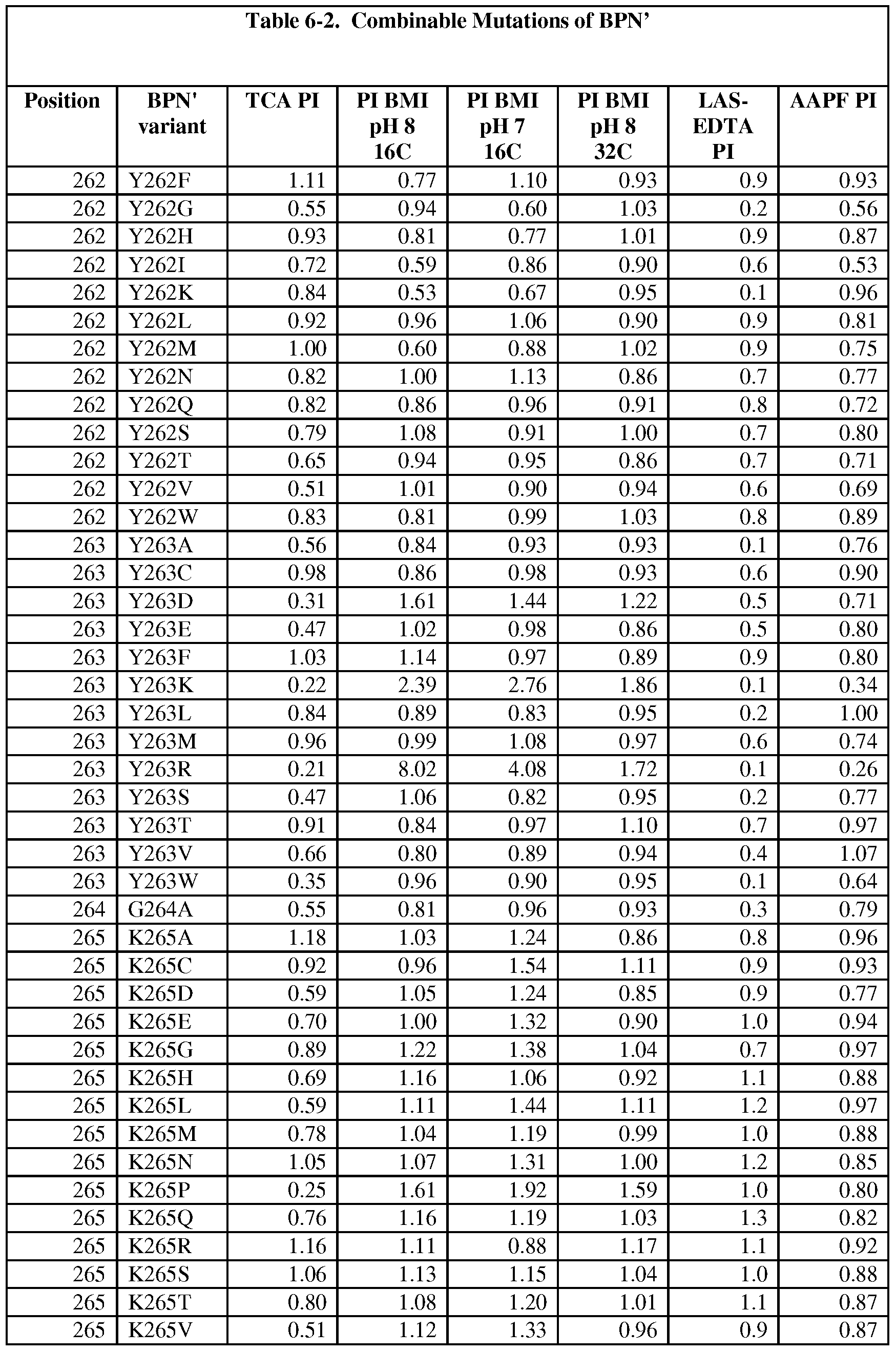
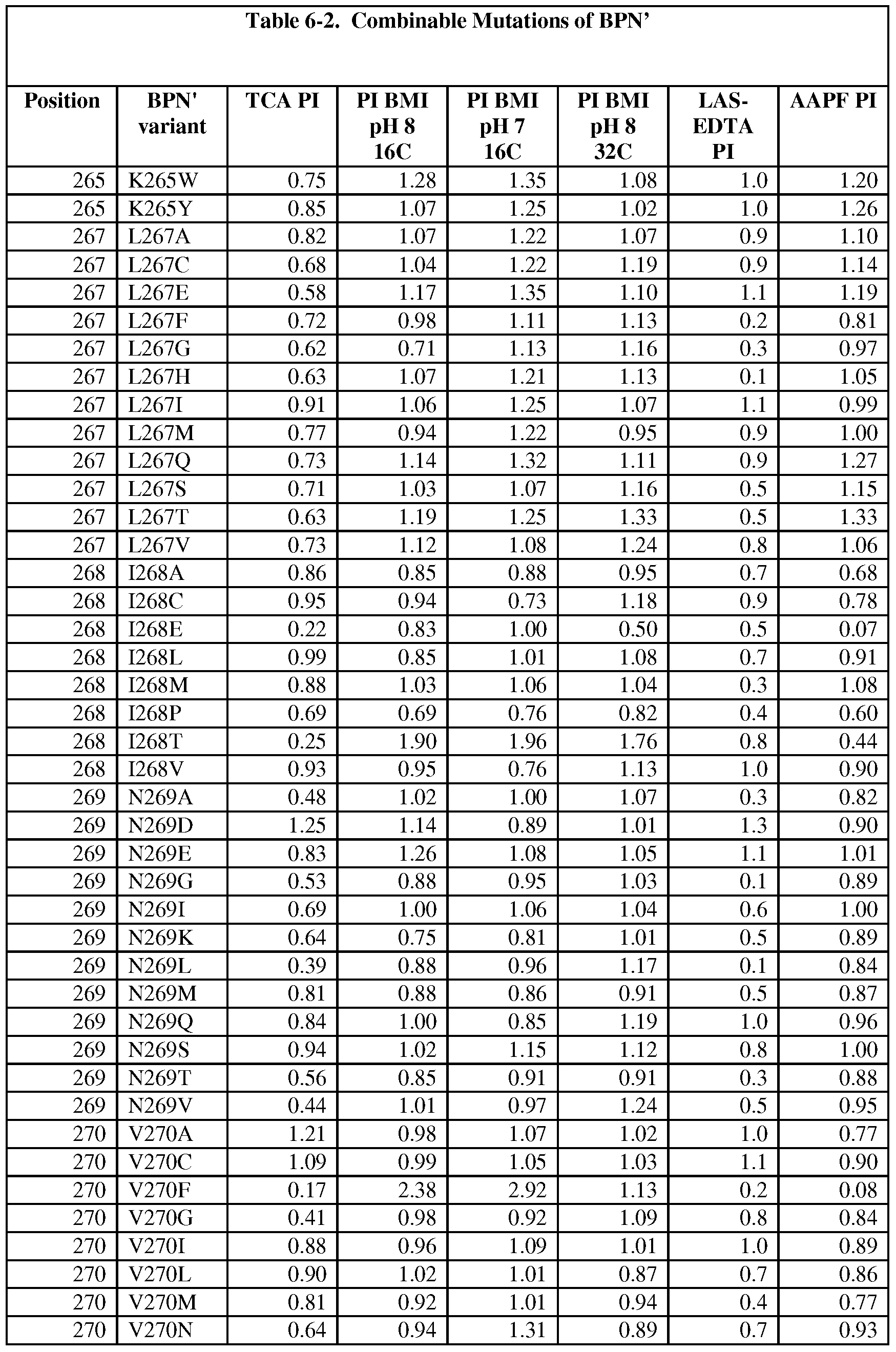
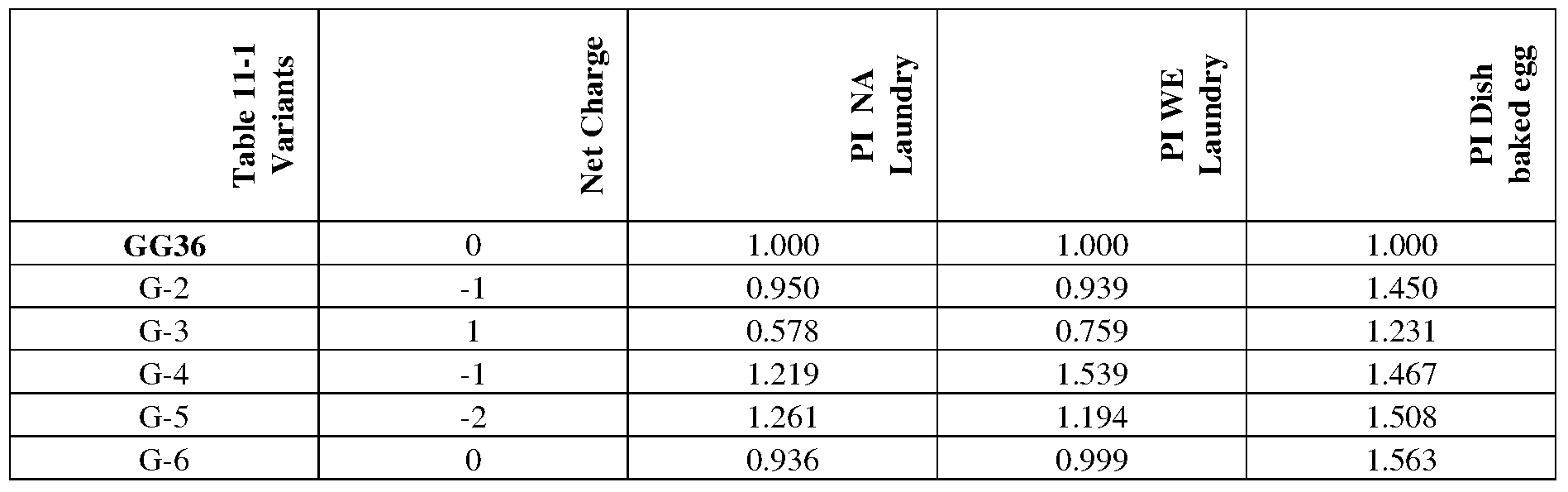
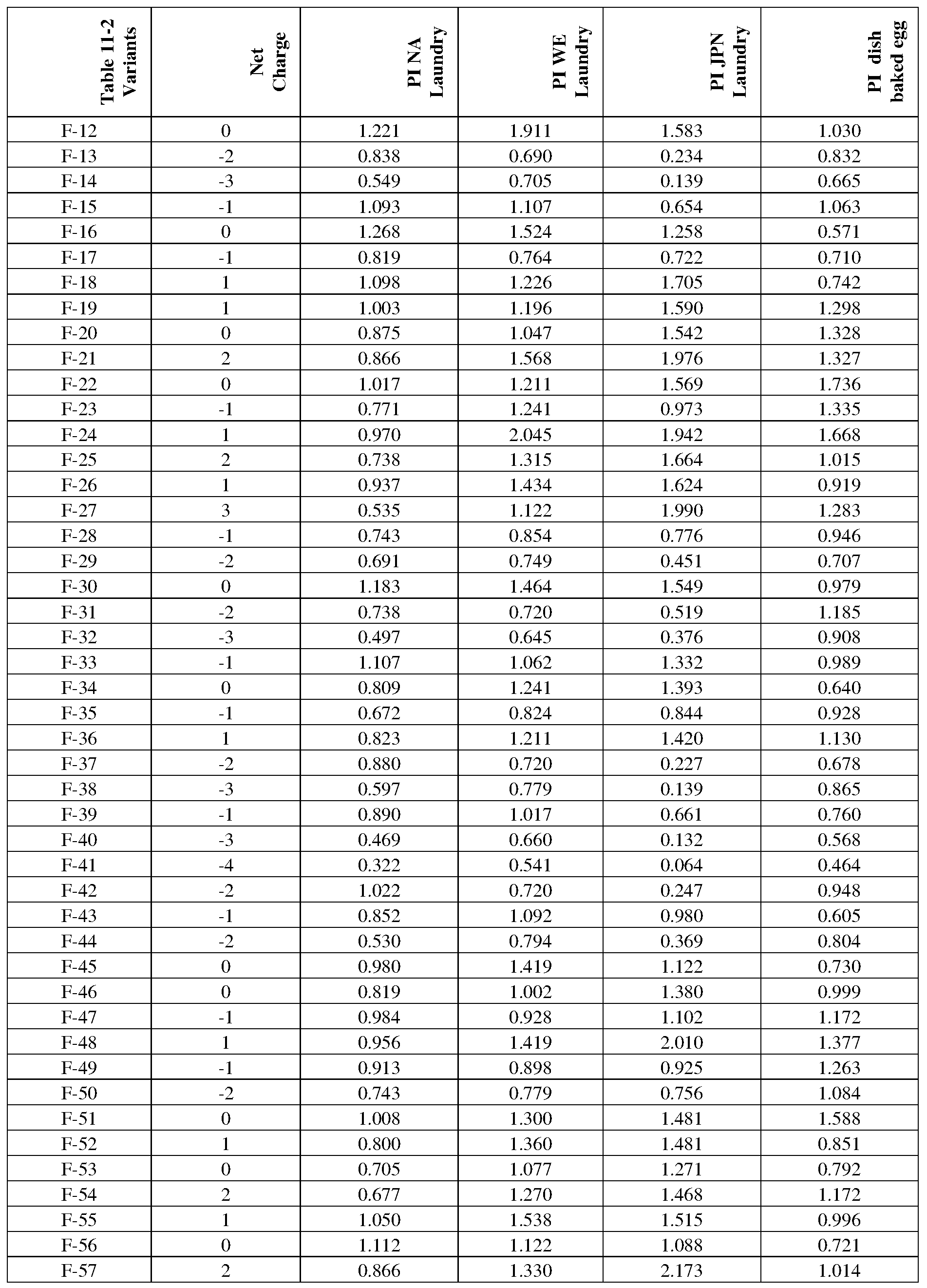
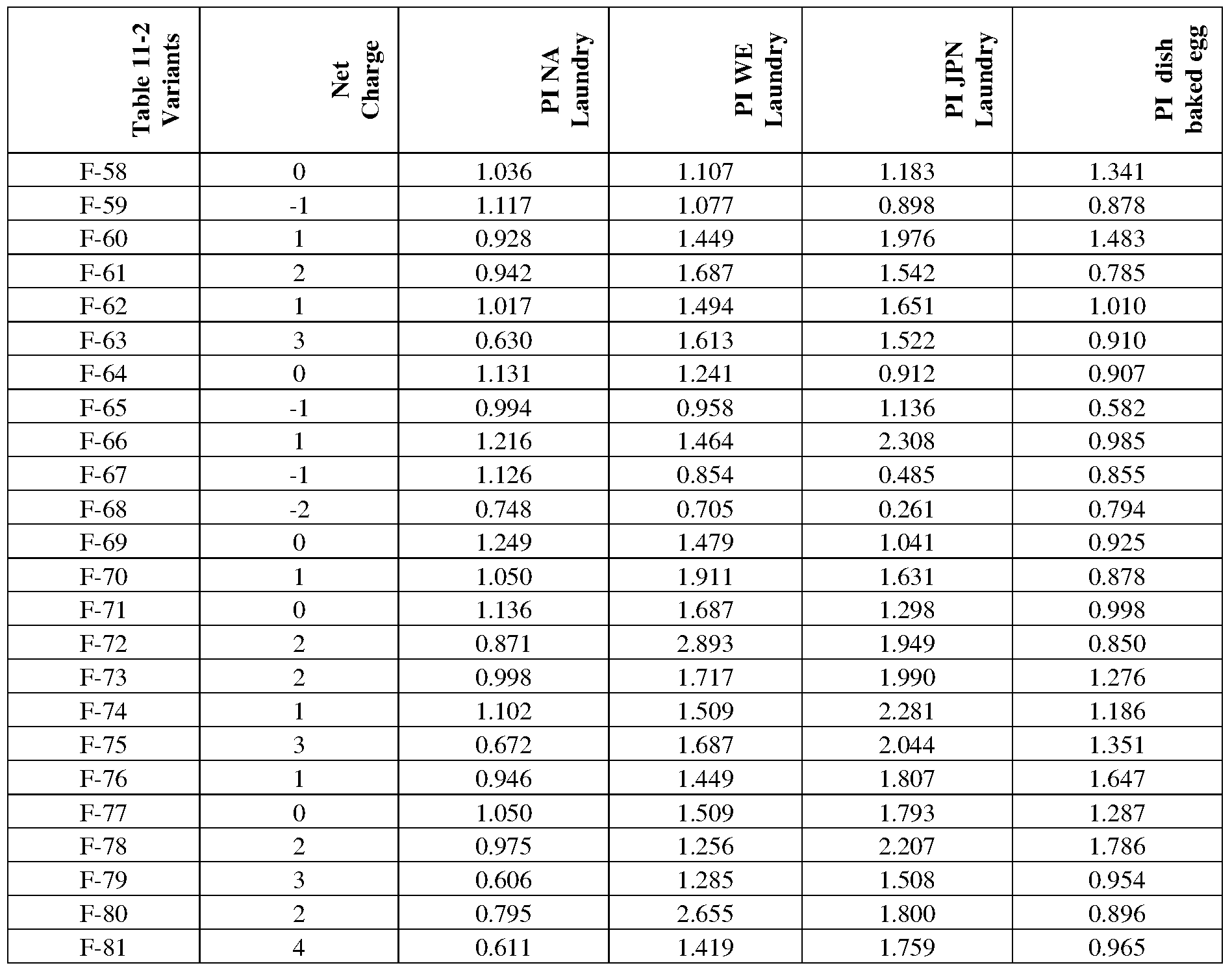
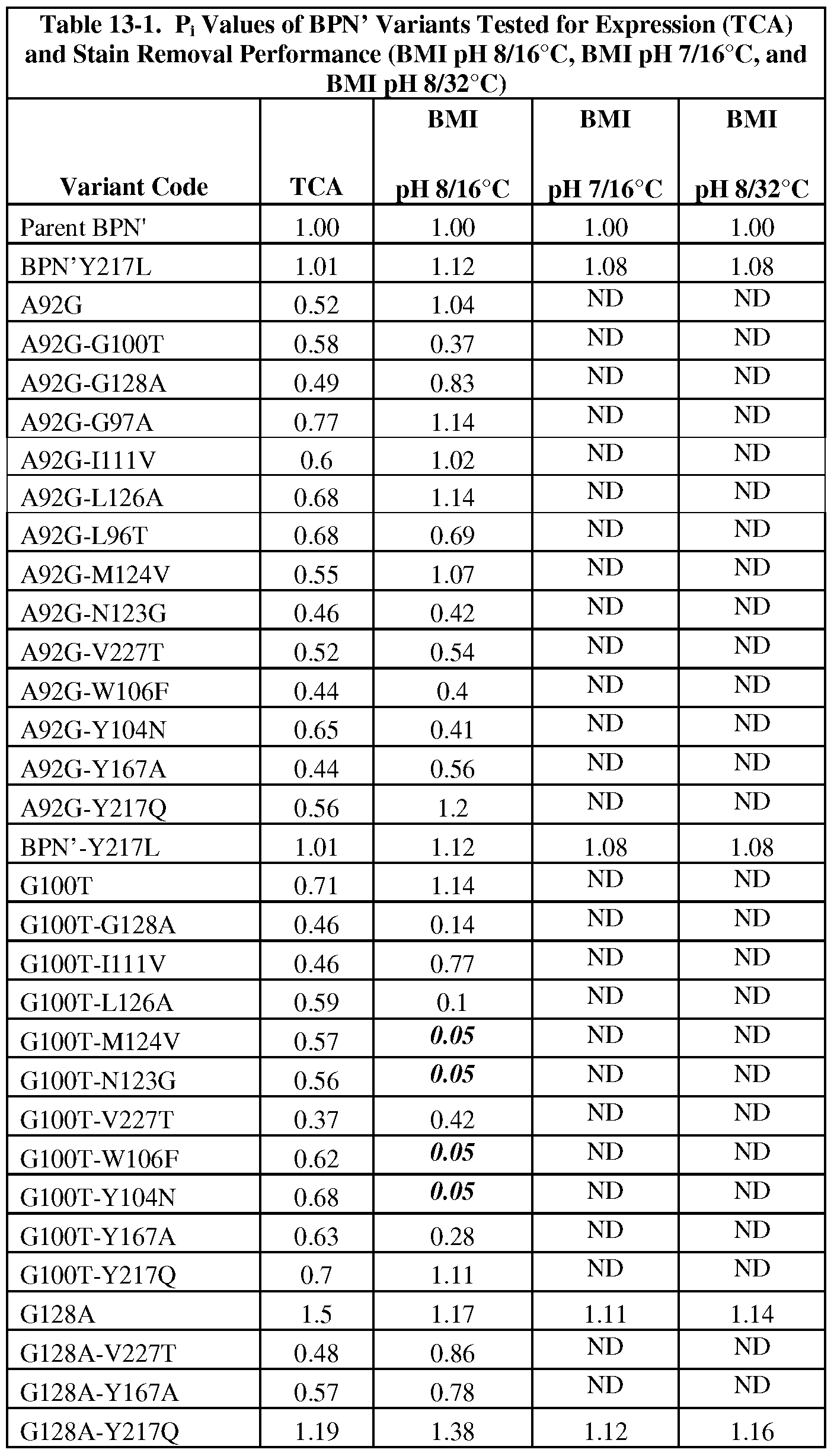
  • the present invention further provides the variants set forth in the Tables included in the Examples, as well as compositions comprising these variants.
  • the present invention provides isolated nucleic acids encoding the subtilisin variant, expression vectors comprising the nucleic acids, and host cells comprising the expression vector.
  • the present invention provides cleaning compositions comprising the subtilisin variant.
  • the cleaning composition is a laundry detergent.
  • the laundry detergent is a cold water detergent, a low pH detergent, or a compact detergent.
  • the present invention provides methods for producing a subtilisin variant of a Bacillus subtilisin, comprising: transforming a host cell with an expression vector comprising a nucleic acid encoding the subtilisin variant; and cultivating the transformed host cell under conditions suitable for the production of the subtilisin variant.
  • the methods further comprise the step of harvesting the produced subtilisin variant.
  • the host cell is a Bacillus species, and in a subset of these embodiments, the Bacillus species is B. subtilis.
  • the present invention provides a method of cleaning, comprising the step of contacting a surface and/or an article comprising a fabric with a cleaning composition comprising an isolated subtilisin variant.
  • the present invention provides methods for protease engineering comprising the steps of: a) providing a plurality of site evaluation libraries (SELs) each comprising a plurality of protease variants having distinct substitutions at an identical amino acid position of the protease; b) testing the protease variants of the SELs and a standard protease in a test of a property of interest; c) determining a performance index (PI) for each of the protease variants for the test; d) identifying two or more of the amino acid positions as non-restrictive positions, wherein at least one of the plurality of protease variants in each of two of the SELs has a PI greater than 0.5; and f) providing a multiple mutation library comprising a plurality of multiply-substituted protease variants each comprising substitutions in the two or more non-restrictive positions.
  • SELs site evaluation libraries
  • PI performance index
  • the test comprises two or more different assays selected from the group consisting of stain removal assays (microswatch), LAS stability assays, detergent stability assays, and specific activity assays.
  • the protease is selected from the group consisting of a bacterial serine protease, a bacterial subtilisin, and a bacterial neutral metalloprotease.
  • the present invention provides methods for producing a multiply substituted subtilisin variant of a Bacillus subtilisin, comprising: testing a plurality of singly-substituted subtilisin variants in a first test of a first property and a second test of a second property, wherein the property of a parent subtilisin is given a value of 1.0 in each test, a favorable first or second property has a value greater than 1.0, and an unduly unfavorable first or second property has a value less than about 0.80 or in some preferred embodiments, less than about 0.60; identifying a substitution in at least one of the singly-substituted subtilisin variants that is associated with a favorable first property and which is not associated with an unduly unfavorable second property; identifying a substitution in at least one of the singly-substituted subtilisin variants that is associated with a favorable second property and which is not associated with an unduly unfavorable first property; and introducing the
  • the methods further comprise testing the multiply-substituted subtilisin variant in the first test and the second test, wherein an improved subtilisin variant achieves a value of greater than 1.0 in both of the first and second tests, or a value of greater than 1.0 in the first test and a value of 0.80 to 1.0 in the second test.
  • the methods further comprise producing the improved subtilisin variant(s).
  • the first and second properties are negatively correlated.
  • a favorable first or second property has a value greater than about 1.2.
  • an unduly unfavorable first or second property has a value less than about 0.40.
  • the first property is stability, and the second property is wash performance.
  • the stability comprises stability in detergent and wash performance comprises blood milk ink (BMI) wash performance in detergent.
  • the parent bacterial subtilisin is a wild type mature form of a B. amyloliquefaciens subtilisin BPN' having an amino acid sequence set forth as SEQ ID NO:2.
  • the parent bacterial subtilisin is a wild type of a B. lentus GG36 subtilisin having an amino acid sequence set forth as SEQ ID NO:562, or a BPN" comprising a Y217L substitution (SEQ IDNO:565), alone or in combination with other modifications.
  • wash performance is tested in a powder or liquid detergent composition having a pH of between 5 and 12.0. It is not intended that the steps be limited to the exact order listed above, as any suitable order finds use in the present invention. However in some preferred embodiments, the substitutions are in positions in a parent subtilisin having a solvent accessible surface (SAS) of greater than about 50% or greater than about 65%.
  • SAS solvent accessible surface
  • FIG. IA provides a map of pHPLT- VAAcI
  • FIG. IB provides a map of pHPLT-
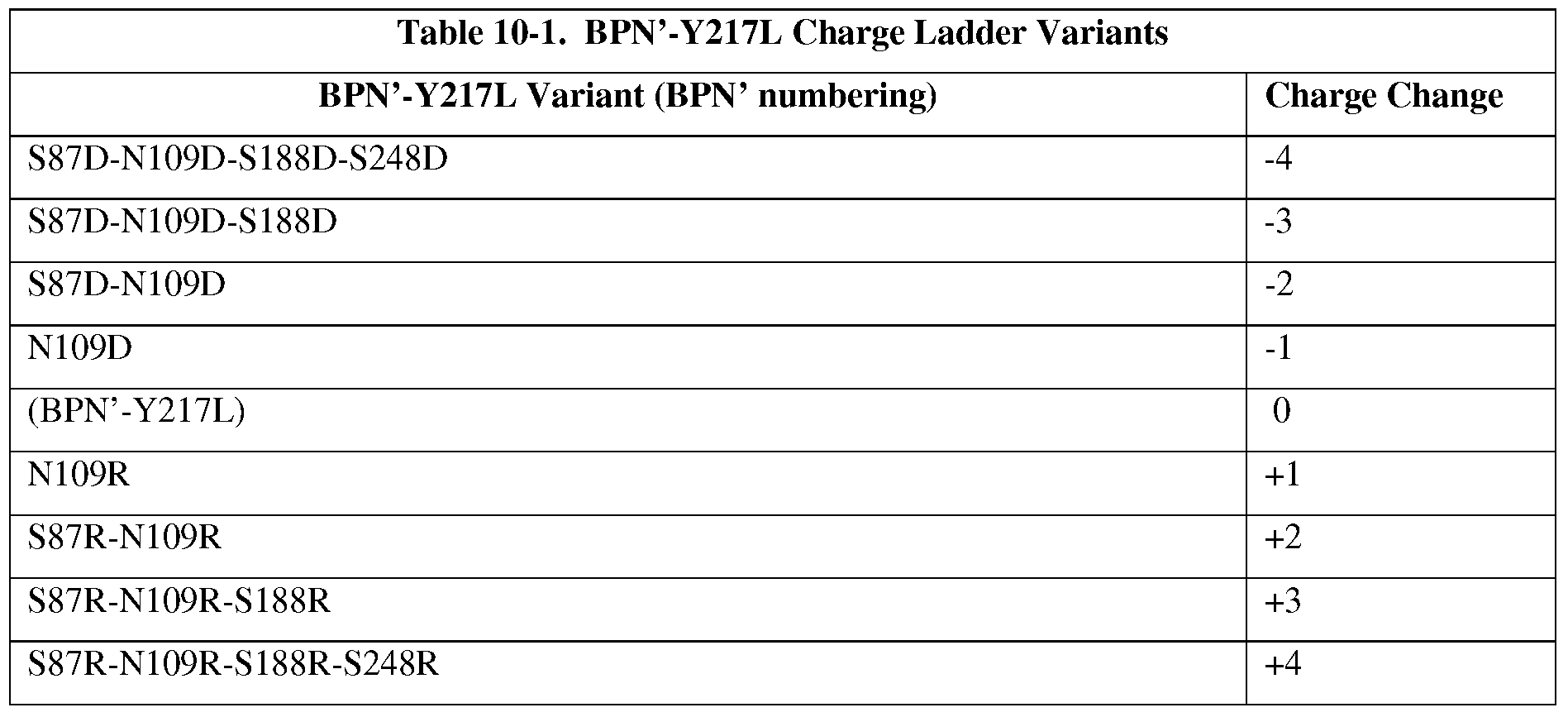
  • FIG. 2A depicts BMI cleaning performance of a BPN'-Y217L CCL in North American laundry detergent as a function of charge change.
  • FIG. 2B depicts BMI cleaning performance of a GG36 CCL in North American laundry detergent as a function of charge change.
  • FIG. 3 A depicts BMI cleaning performance of a BPN'-Y217L CCL in Western European liquid laundry detergent as a function of charge change.
  • FIG. 3B depicts BMI cleaning performance of a GG36 CCL in Western European liquid laundry detergent as a function of charge change.
  • FIG. 4A depicts BMI cleaning performance of a BPN'-Y217L CCL in Japanese powdered laundry detergent as a function of charge change.
  • FIG. 4B depicts BMI cleaning performance of a GG36 CCL in Japanese powdered laundry detergent as a function of charge change.
  • FIG. 5A depicts baked egg yolk cleaning performance of a BPN'-Y217L CCL in automatic dish washing detergent as a function of charge change.
  • FIG. 5B depicts baked egg yolk cleaning performance of a GG36 CCL in automatic dish washing detergent as a function of charge change.
  • FIG. 6 depicts LAS/EDTA stability as a function of net charge change relative to parent BPN' -
  • the present invention provides methods for protein engineering. Specifically, the invention provides methods utilizing site evaluation libraries.
  • the problem to be solved is to identify at least one protein sequence that meets or exceeds the minimum value required for a number of properties. This requires knowledge of mutations that are good for a particular property, as well as knowledge of those mutations that are bad for any of the desired properties.
  • the present invention provides means to meet the goal by identifying those positions in the protein that can be altered to improve the primary property and keep the values for other properties within desired limits.
  • the present invention provides means to evaluate all positions in a protein for all the properties of interest by building "site evaluation libraries" at each site.
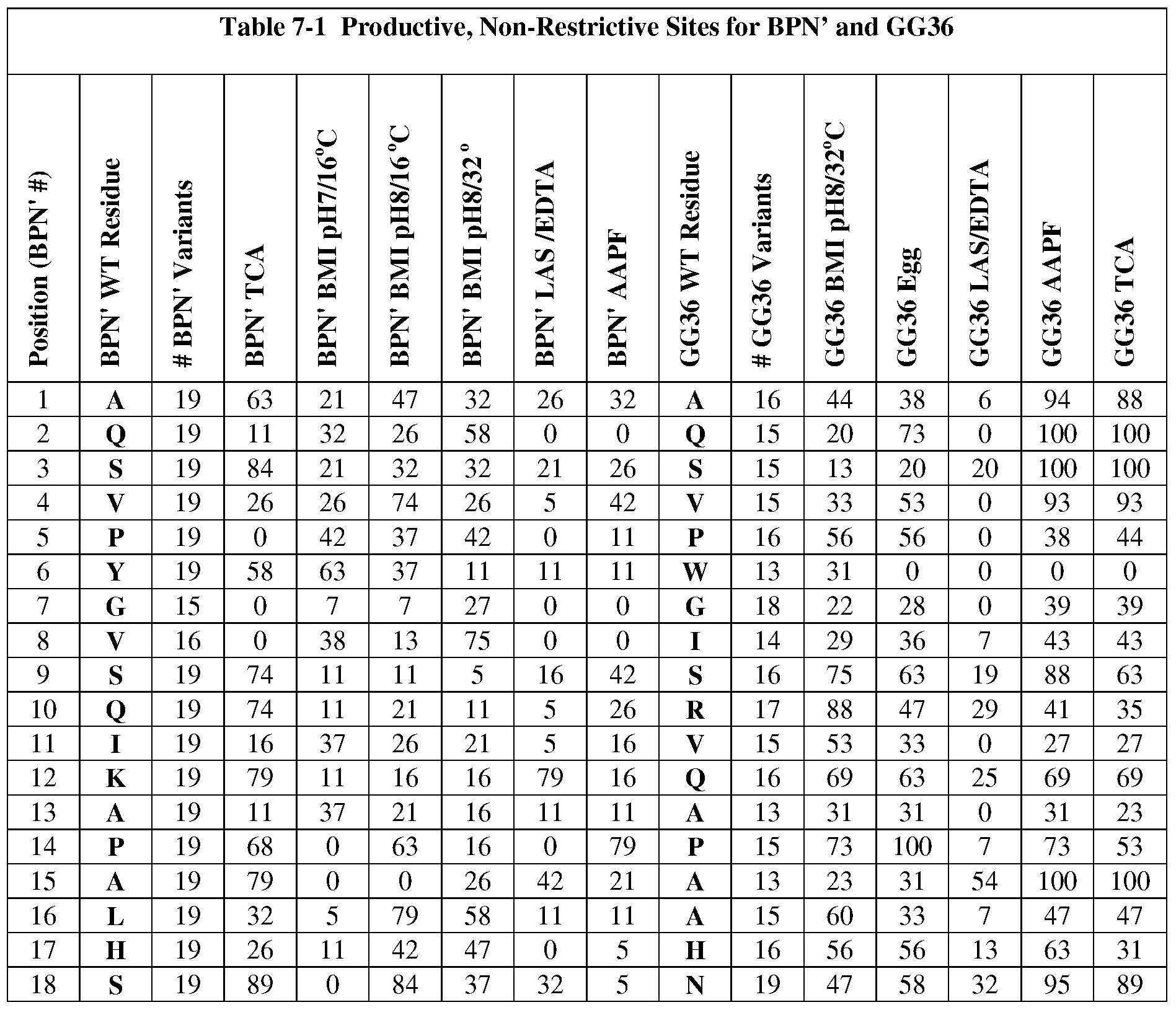
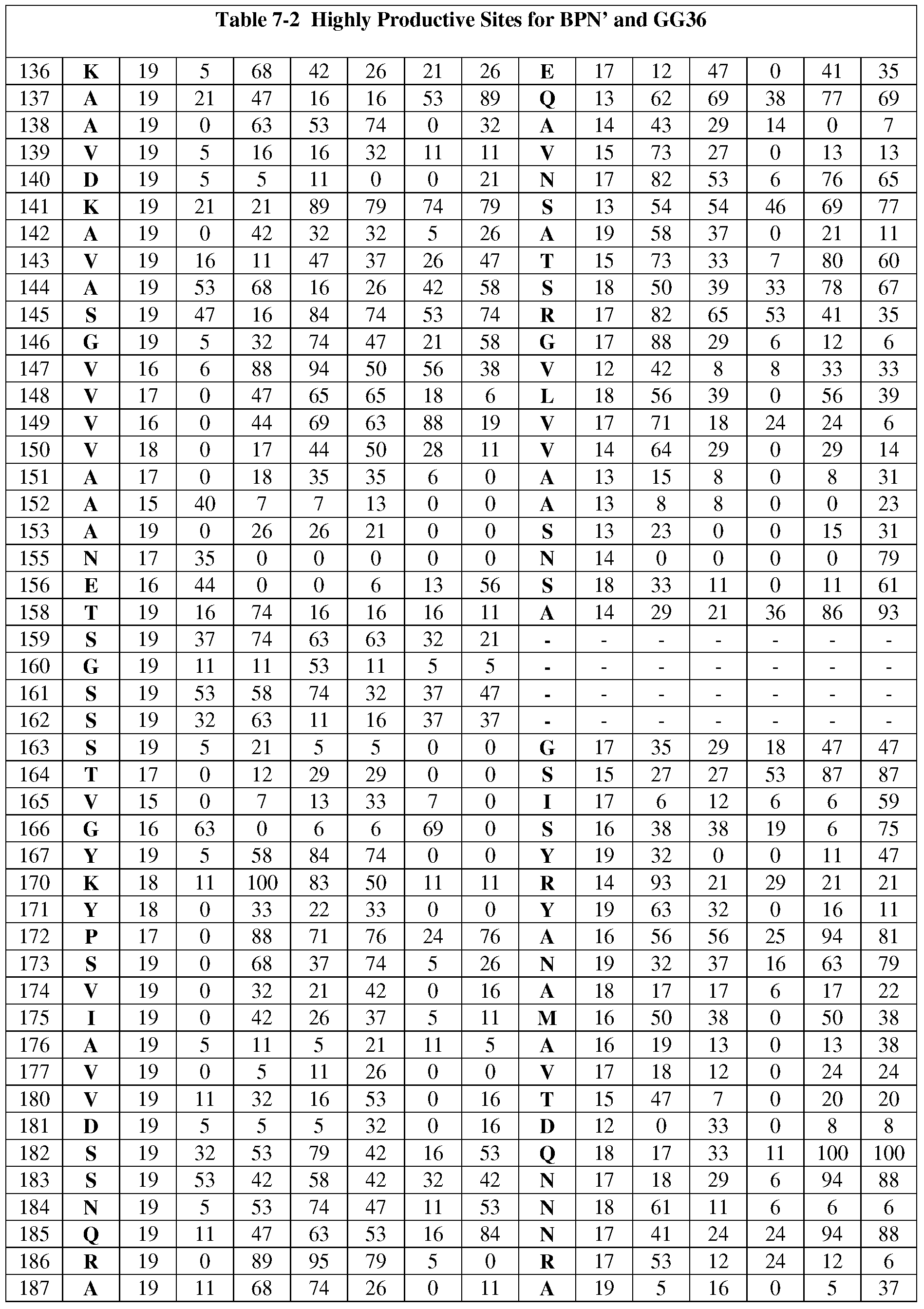
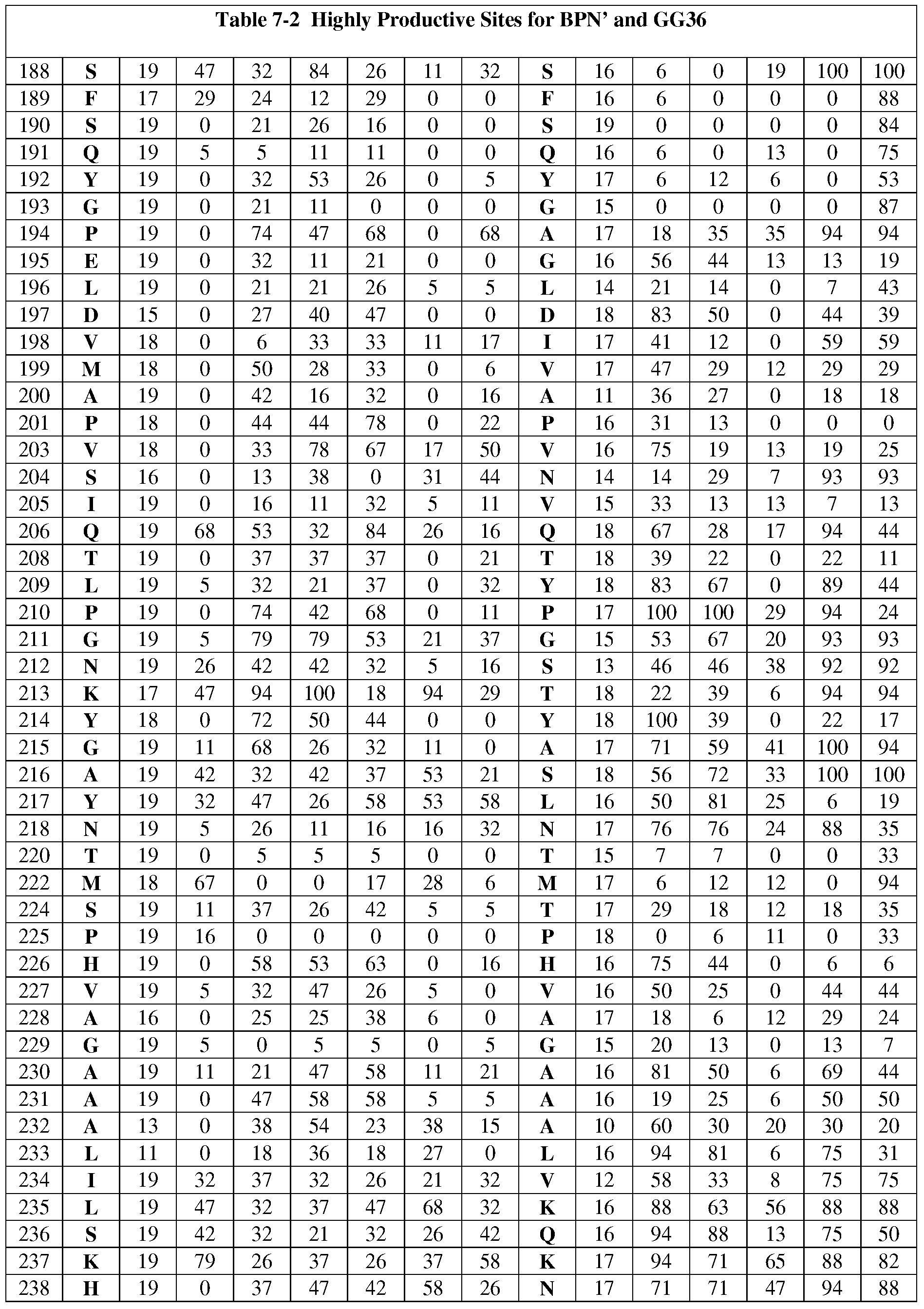
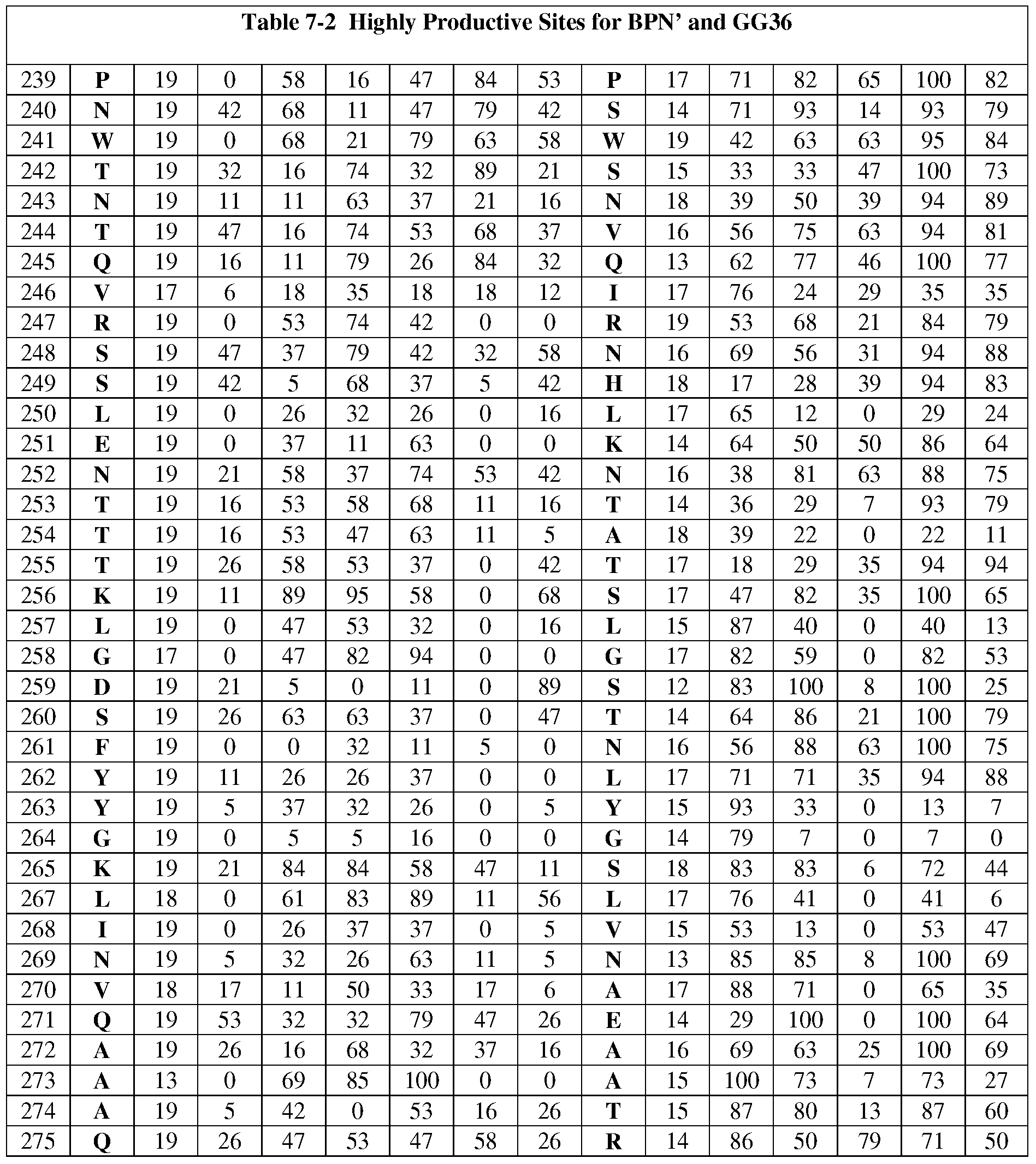
  • these libraries contain 9-19 mutations at each position, and are used to evaluate each position for use in engineering the protein and constructing libraries.
  • Each property is measured relative to the parent enzyme and an apparent free energy difference for each mutant vs. wild type is calculated.
  • delta delta G i.e., ⁇ G
  • apparent values are then used to determine additivity.
  • the Gibbs Free Energy for a process represents the maximum amount of work that can be performed by a system.
  • the change in Free energy relative to the parent enzyme ( ⁇ G ) is given as follows;
  • ⁇ G -RT In (k va ⁇ ant /k parent ) where k va ⁇ ant is the rate constant for the variant enzyme, and k parent is the rate constant for the parent enzyme, R is the Gas law constant and T is the absolute temperature.
  • k va ⁇ ant is the rate constant for the variant enzyme
  • k parent is the rate constant for the parent enzyme
  • R is the Gas law constant
  • T is the absolute temperature.
  • ⁇ G app may be expected to behave in a similar fashion as to ⁇ G for data distributions and additivity. However, since ⁇ G is the maximum amount of work that can be carried out by the variant compared to the parent enzyme, the quantity ⁇ G app will generally underestimate the ⁇ G and lead to results that appear synergistic in that the properties of two additive positions may be greater than the value predicted by adding their ⁇ G app values together.
  • the methods of the present invention used to design efficient libraries that were used to engineer multiple properties in parallel. Although certain enzymes are described herein, the methods apply to any protein of interest for engineering.
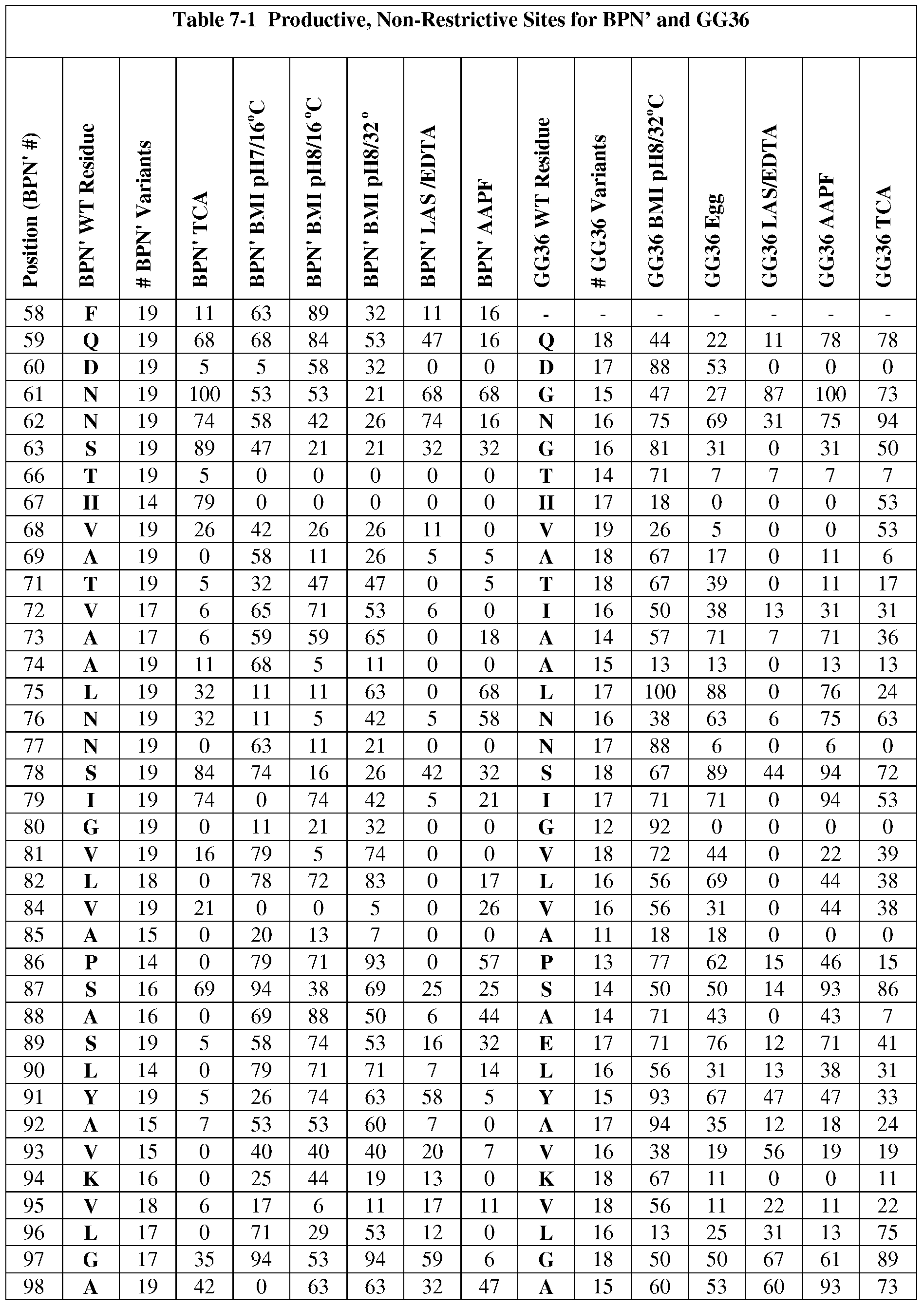
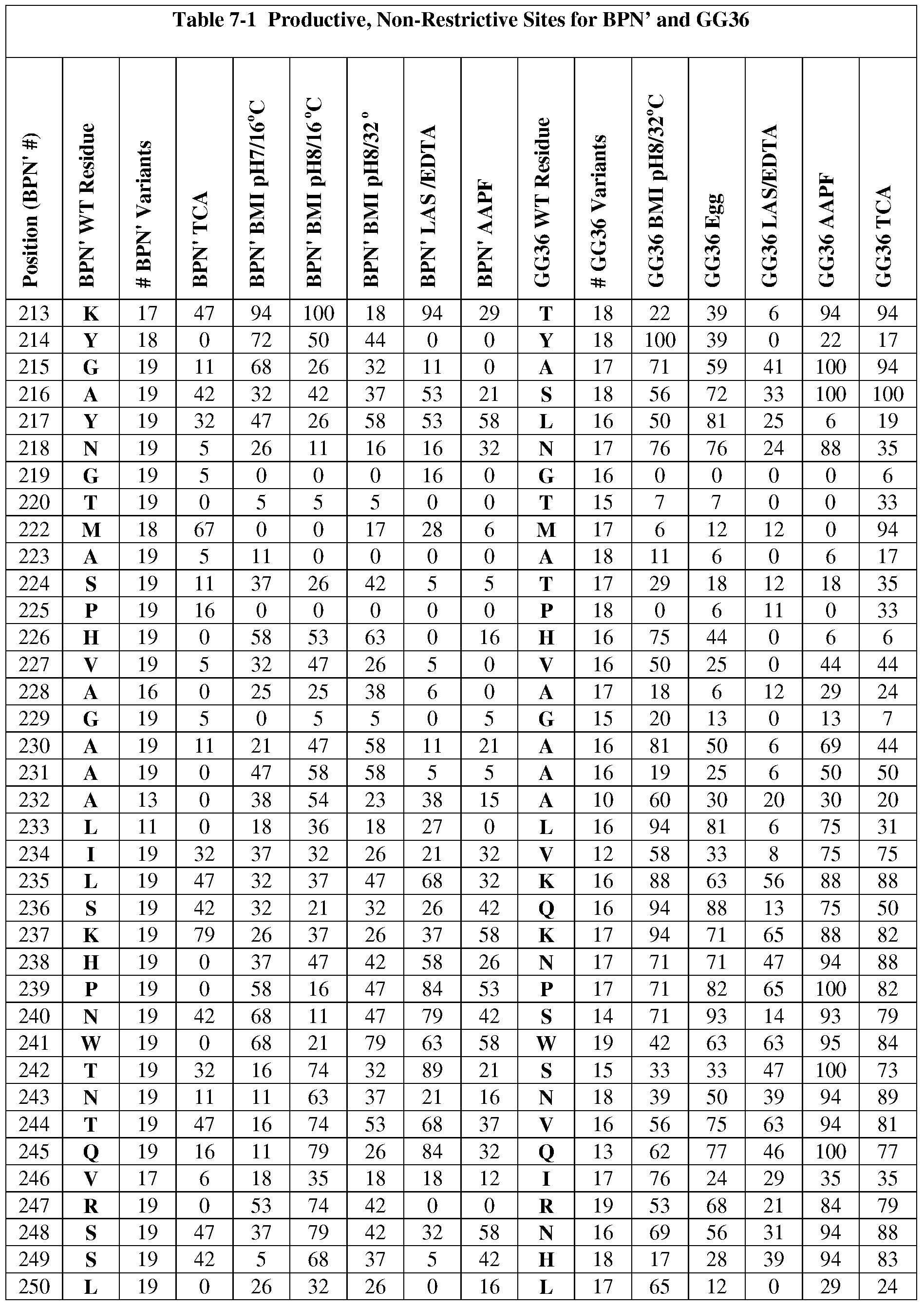
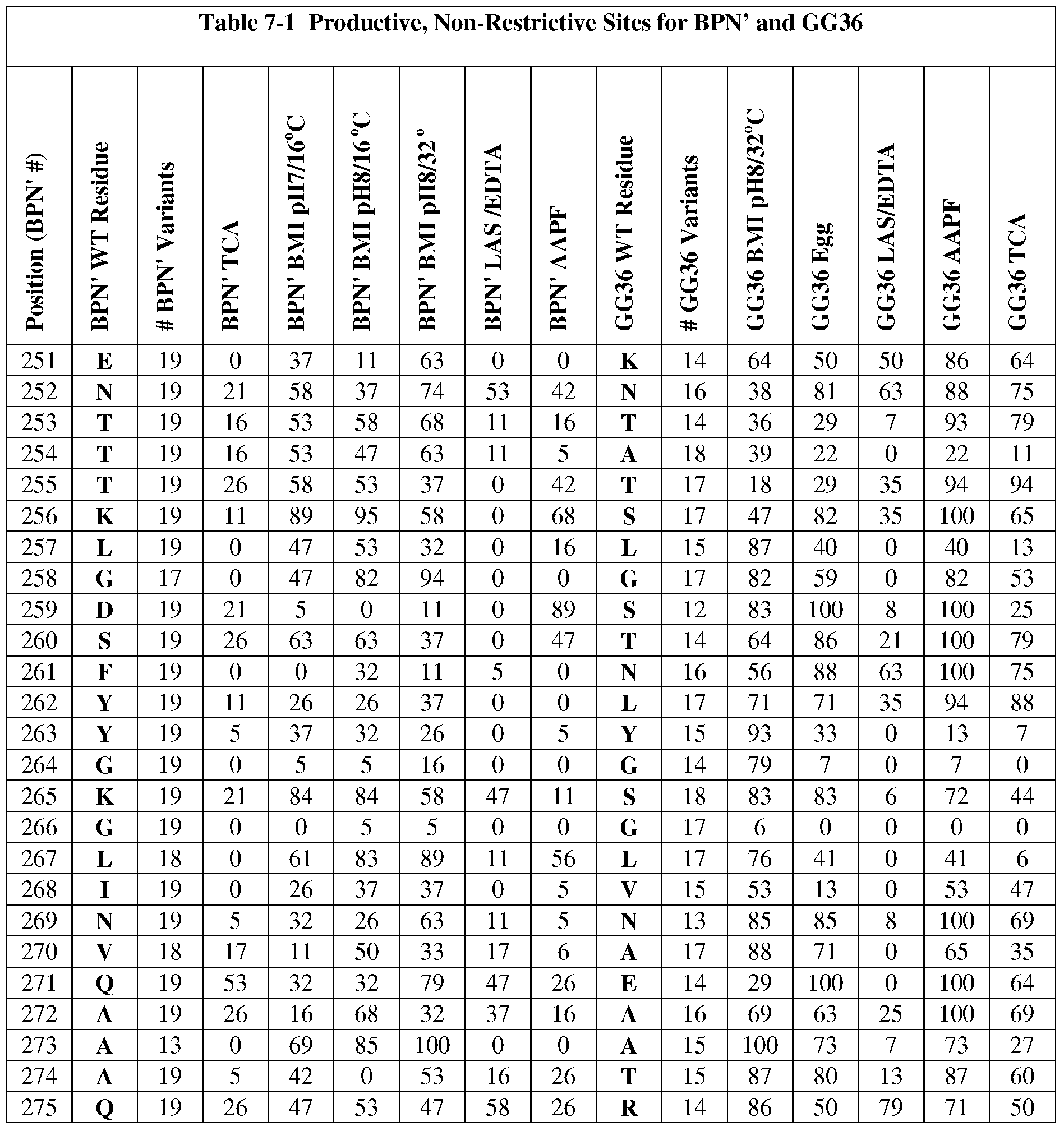
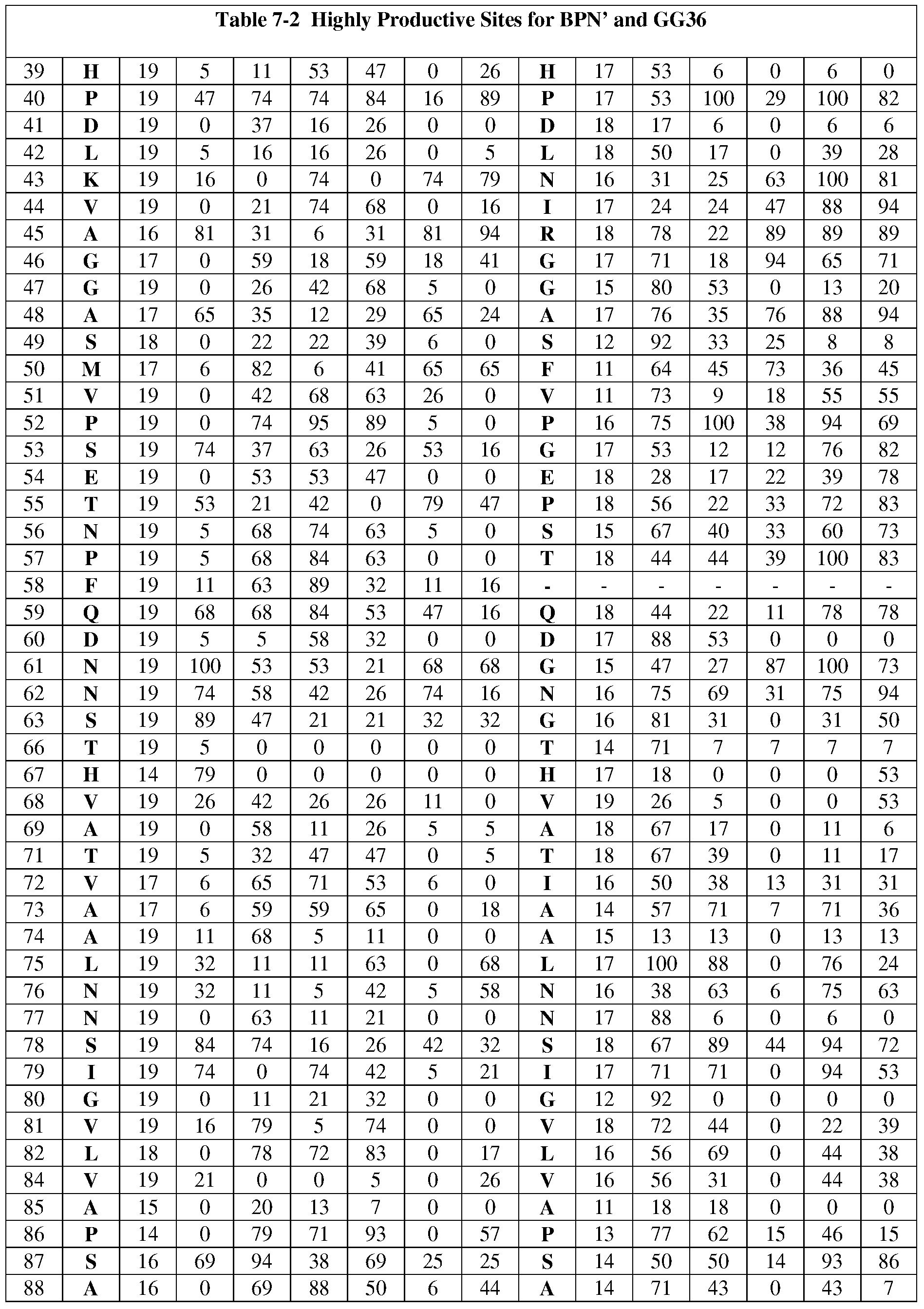
  • Site evaluation libraries (SELs) were built as described herein by introducing from 12 to 19 substitutions at each of the positions. The resulting mutations were analyzed using activity and stability assays. The wild type amino acid is listed as a reference point for every position.
  • measurements were used to determine the mean and standard deviation of ⁇ G app for the parent enzyme.
  • the parent mean ( ⁇ parent ) was normalized to 0, and the standard deviation (o parent ) for ⁇ G app was determined. These values were used as the reference for each property at each position of the molecule.
  • the site evaluation data were tested for evidence of correlation between properties.
  • the ⁇ G app values for each property were plotted versus each other property and correlation coefficients were calculated.
  • the two activity measurements on protein substrates were correlated. In order to analyze the positions within the amino acid sequence, two types of sites were defined.
  • a simplified protein engineering strategy is to build SELs and screen using a simple activity and/or stability screen.
  • the deleterious mutations are identified and those positions that have few deleterious mutations are used to build libraries and combinatorial mutations to improve multiple properties.
  • picking sites that are on the surface of the protein, have few interactions and are variable in sequence alignments provides a high proportion of productive sites. Sites that are on the interior of the molecule, have many contacts and are strongly conserved in evolution will have a high probability of having deleterious mutations and should be avoided. It is contemplated that any suitable method for analyzing sequence and/or structural information will find use in the present invention, including but not limited to computer and/or electronic methods and/or programs.
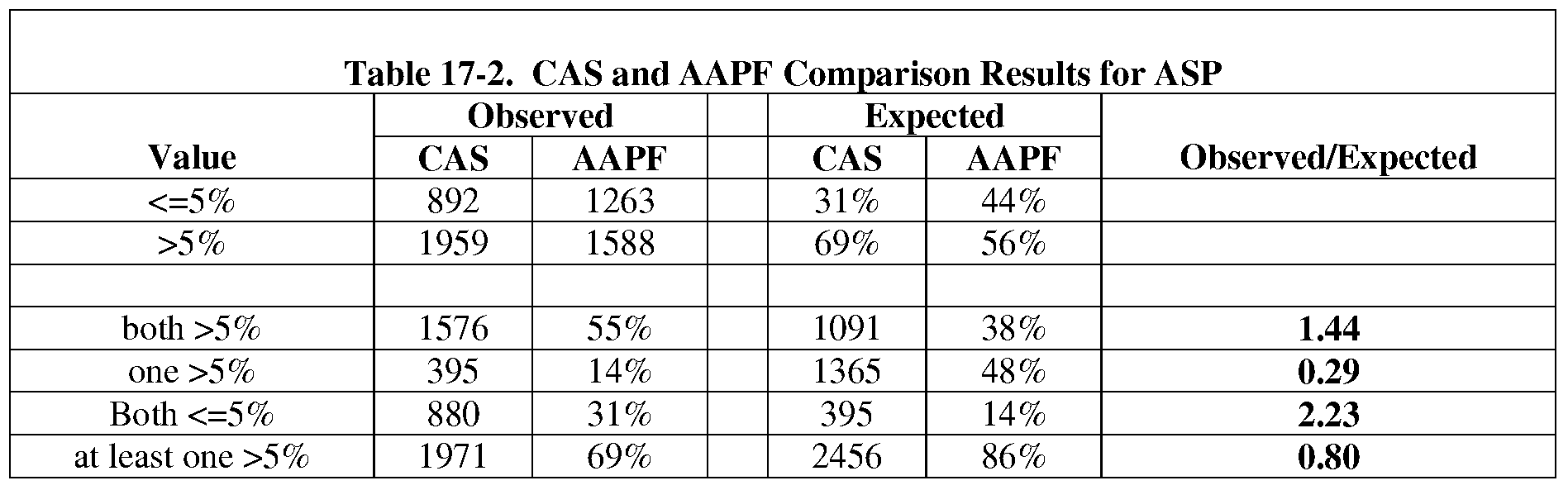
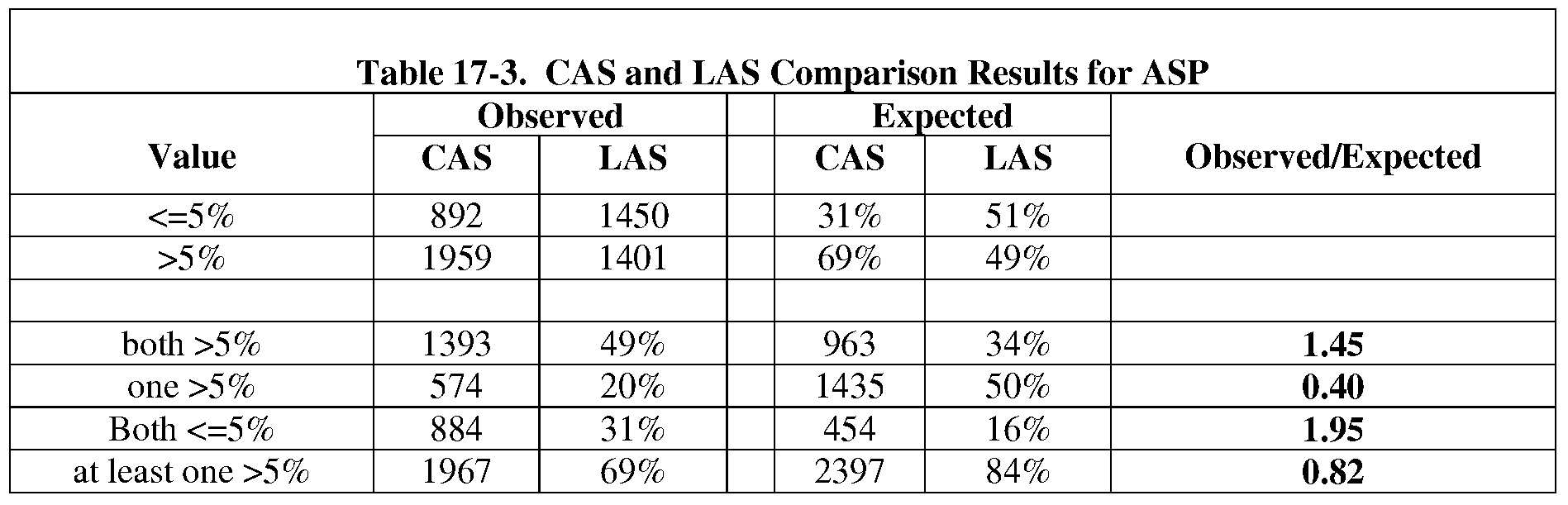
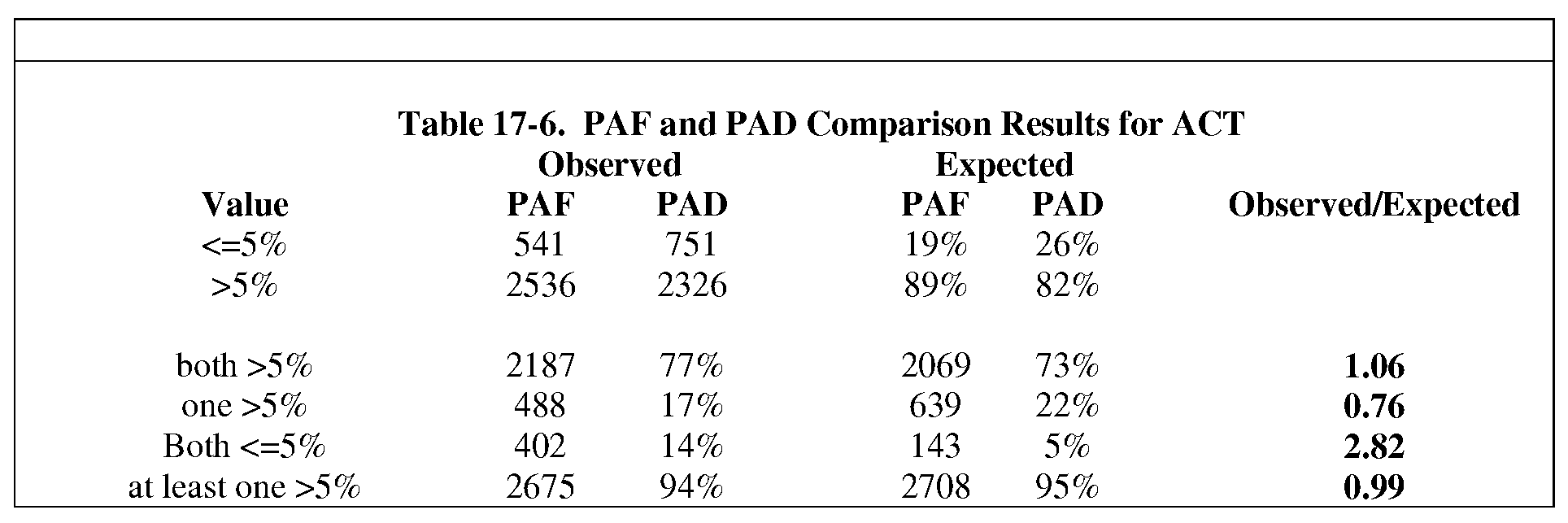
  • the methods provide pairwise comparisons of the numbers of variants with more than 5% wt activity and less than 5% activity for each of two properties, along with correlation coefficients for the two properties.
  • the site evaluation library data are used for combinatorial library design.
  • Traditional directed evolution builds random libraries and screens large numbers of library for single properties, combines these and repeats the process.
  • Bloom et al Curr. Opin. Struct. Biol., 15:447-452 [2005]
  • Bloom et al. Proc. Natl. Acad. Sci. USA 103:5869-5874 [2006]
  • Guo et al. Proc. Natl. Acad. Sci. USA 101 :9205-9210
  • the cleaning composition of the present invention are advantageously employed for example, in laundry applications, hard surface cleaning, automatic dishwashing applications, as well as cosmetic applications such as dentures, teeth, hair and skin.
  • the enzymes of the present invention are ideally suited for laundry applications.
  • the enzymes of the present invention may be employed in both granular and liquid compositions.
  • the variant proteases of the present invention also find use cleaning additive products.
  • low temperature solution cleaning applications find use.
  • the additive product may be, in its simplest form, one or more proteases.
  • the additive is packaged in dosage form for addition to a cleaning process.
  • any suitable single dosage form also finds use with the present invention, including but not limited to pills, tablets, gelcaps, or other single dosage units such as pre- measured powders or liquids.
  • filler(s) or carrier material(s) are included to increase the volume of such composition.
  • suitable filler or carrier materials include, but are not limited to, various salts of sulfate, carbonate and silicate as well as talc, clay and the like.
  • Suitable filler or carrier materials for liquid compositions include, but are not limited to water or low molecular weight primary and secondary alcohols including polyols and diols. Examples of such alcohols include, but are not limited to, methanol, ethanol, propanol and isopropanol.
  • the compositions contain from about 5% to about 90% of such materials.
  • Acidic fillers find use to reduce pH.
  • the cleaning additives include adjunct ingredients as more fully described below.
  • the present cleaning compositions and cleaning additives require an effective amount of at least one of the protease variants provided herein, alone or in combination with other proteases and/or additional enzymes.
  • the required level of enzyme is achieved by the addition of one or more protease variants of the present invention.
  • the present cleaning compositions will comprise at least about 0.0001 weight percent, from about 0.0001 to about 1, from about 0.001 to about 0.5, or even from about 0.01 to about 0.1 weight percent of at least one of the variant proteases of the present invention.
  • the cleaning compositions herein are typically formulated such that, during use in aqueous cleaning operations, the wash water will have a pH of from about 5.0 to about 11.5 or even from about
  • Liquid product formulations are typically formulated to have a neat pH from about 3.0 to about 9.0 or even from about 3 to about 5.
  • Granular laundry products are typically formulated to have a pH from about 9 to about 11.
  • Techniques for controlling pH at recommended usage levels include the use of buffers, alkalis, acids, etc., and are well known to those skilled in the art.
  • Suitable low pH cleaning compositions typically have a neat pH of from about 3 to about 5, and are typically free of surfactants that hydrolyze in such a pH environment.
  • surfactants include sodium alkyl sulfate surfactants that comprise at least one ethylene oxide moiety or even from about 1 to about 16 moles of ethylene oxide.
  • Such cleaning compositions typically comprise a sufficient amount of a pH modifier, such as sodium hydroxide, monoethanolamine or hydrochloric acid, to provide such cleaning composition with a neat pH of from about 3 to about 5.
  • a pH modifier such as sodium hydroxide, monoethanolamine or hydrochloric acid
  • Such compositions typically comprise at least one acid stable enzyme.
  • the compositions are liquids, while in other embodiments, they are solids.
  • the pH of such liquid compositions is typically measured as a neat pH.
  • the pH of such solid compositions is measured as a 10% solids solution of said composition wherein the solvent is distilled water. In these embodiments, all pH measurements are taken at 20°C.
  • the variant protease(s) when the variant protease(s) is/are employed in a granular composition or liquid, it is desirable for the variant protease to be in the form of an encapsulated particle to protect the variant protease from other components of the granular composition during storage.
  • encapsulation is also a means of controlling the availability of the variant protease during the cleaning process.
  • encapsulation enhances the performance of the variant protease(s) and/or additional enzymes.
  • the variant proteases of the present invention are encapsulated with any suitable encapsulating material known in the art.
  • the encapsulating material typically encapsulates at least part of the catalyst for the variant protease(s) of the present invention.
  • the encapsulating material is water-soluble and/or water-dispersible.
  • the encapsulating material has a glass transition temperature (Tg) of 0 0 C or higher. Glass transition temperature is described in more detail in WO 97/11151.
  • the encapsulating material is selected from consisting of carbohydrates, natural or synthetic gums, chitin, chitosan, cellulose and cellulose derivatives, silicates, phosphates, borates, polyvinyl alcohol, polyethylene glycol, paraffin waxes, and combinations thereof.
  • the encapsulating material When the encapsulating material is a carbohydrate, it is typically selected from monosaccharides, oligosaccharides, polysaccharides, and combinations thereof. Typically, the encapsulating material is a starch. Suitable starches are described in EP 0 922 499; US 4,977,252; US 5,354,559, and US 5,935,826.
  • the encapsulating material is a microsphere made from plastic such as thermoplastics, acrylonitrile, methacrylonitrile, polyacrylonitrile, polymethacrylonitrile and mixtures thereof; commercially available microspheres that find use include those supplied by EXPANCEL® (Stockviksverken, Sweden), and PM 6545, PM 6550, PM 7220, PM 7228, EXTENDOSPHERES®, LUXSIL®, Q-CEL®, and SPHERICEL® (PQ Corp., Valley Forge, PA).
  • EXPANCEL® Stockviksverken, Sweden
  • PM 6545, PM 6550, PM 7220, PM 7228, EXTENDOSPHERES®, LUXSIL®, Q-CEL®, and SPHERICEL® PQ Corp., Valley Forge, PA.
  • the variant proteases of the present invention find particular use in the cleaning industry, including, but not limited to laundry and dish detergents. These applications place enzymes under various environmental stresses.
  • detergent formulations used in different geographical areas have different concentrations of their relevant components present in the wash water.
  • a European detergent typically has about 4500-5000 ppm of detergent components in the wash water
  • a Japanese detergent typically has approximately 667 ppm of detergent components in the wash water.
  • detergents typically have about 975 ppm of detergent components present in the wash water.
  • a low detergent concentration system includes detergents where less than about 800 ppm of detergent components are present in the wash water.
  • Japanese detergents are typically considered low detergent concentration system as they have approximately 667 ppm of detergent components present in the wash water.
  • a medium detergent concentration includes detergents where between about 800 ppm and about
  • a high detergent concentration system includes detergents where greater than about 2000 ppm of detergent components are present in the wash water.
  • European detergents are generally considered to be high detergent concentration systems as they have approximately 4500-5000 ppm of detergent components in the wash water.
  • Latin American detergents are generally high suds phosphate builder detergents and the range of detergents used in Latin America can fall in both the medium and high detergent concentrations as they range from 1500 ppm to 6000 ppm of detergent components in the wash water. As mentioned above, Brazil typically has approximately 1500 ppm of detergent components present in the wash water. However, other high suds phosphate builder detergent geographies, not limited to other Latin American countries, may have high detergent concentration systems up to about 6000 ppm of detergent components present in the wash water.
  • concentrations of detergent compositions in typical wash solutions throughout the world varies from less than about 800 ppm of detergent composition ("low detergent concentration geographies"), for example about 667 ppm in Japan, to between about 800 ppm to about 2000 ppm ("medium detergent concentration geographies” ), for example about 975 ppm in U.S. and about 1500 ppm in Brazil, to greater than about 2000 ppm ("high detergent concentration geographies”), for example about 4500 ppm to about 5000 ppm in Europe and about 6000 ppm in high suds phosphate builder geographies.
  • low detergent concentration geographies for example about 667 ppm in Japan
  • intermediate detergent concentration geographies for example about 975 ppm in U.S. and about 1500 ppm in Brazil
  • high detergent concentration geographies for example about 4500 ppm to about 5000 ppm in Europe and about 6000 ppm in high suds phosphate builder geographies.
  • concentrations of the typical wash solutions are determined empirically. For example, in the U.S., a typical washing machine holds a volume of about 64.4 L of wash solution. Accordingly, in order to obtain a concentration of about 975 ppm of detergent within the wash solution about 62.79 g of detergent composition must be added to the 64.4 L of wash solution. This amount is the typical amount measured into the wash water by the consumer using the measuring cup provided with the detergent.
  • different geographies use different wash temperatures.
  • the temperature of the wash water in Japan is typically less than that used in Europe.
  • the temperature of the wash water in North America and Japan is typically between 10 and 30°C (e.g., about 20°C), whereas the temperature of wash water in Europe is typically between 30 and 60°C (e.g., about 40°C).
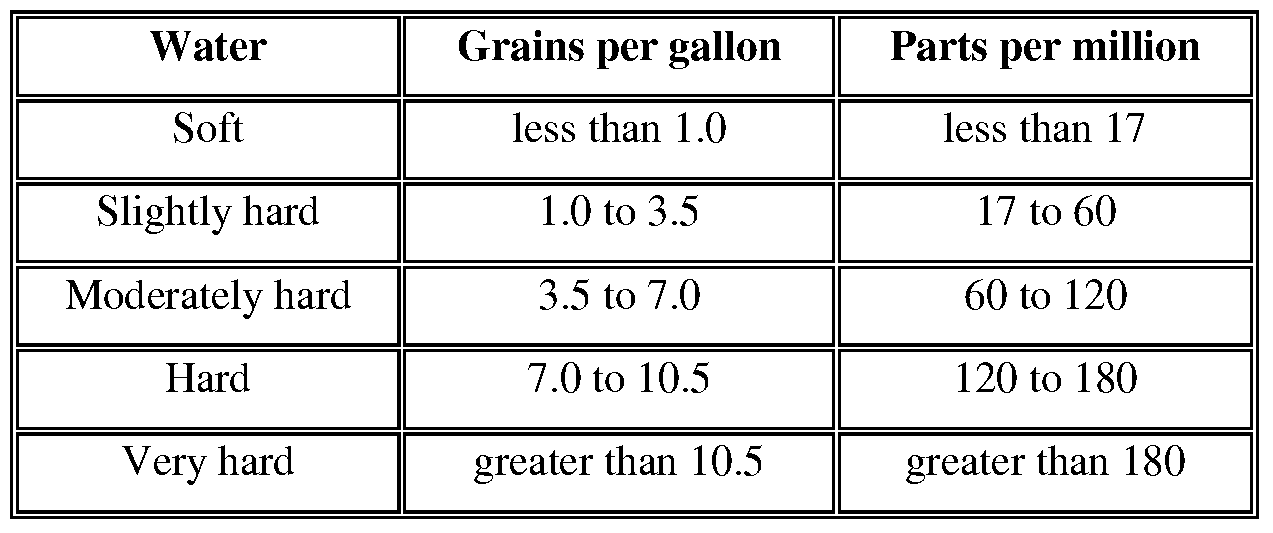
  • different geographies typically have different water hardness. Water hardness is usually described in terms of the grains per gallon mixed Ca 2+ Mg 2+ . Hardness is a measure of the amount of calcium (Ca + ) and magnesium (Mg + ) in the water. Most water in the United States is hard, but the degree of hardness varies.
  • Moderately hard (60-120 ppm) to hard (121-181 ppm) water has 60 to 181 parts per million (parts per million converted to grains per U.S. gallon is ppm # divided by 17.1 equals grains per gallon) of hardness minerals.
  • European water hardness is typically greater than 10.5 (for example 10.5-20.0) grains per gallon mixed Ca 2+ Mg 2+ (e.g., about 15 grains per gallon mixed Ca 2+ Mg 2+ ).
  • North American water hardness is typically greater than Japanese water hardness, but less than European water hardness.
  • North American water hardness can be between 3 tolO grains, 3-8 grains or about 6 grains.
  • Japanese water hardness is typically lower than North American water hardness, usually less than 4, for example 3 grains per gallon mixed Ca 2+ Mg 2+ .
  • the present invention provides variant proteases that show surprising wash performance in at least one set of wash conditions (e.g., water temperature, water hardness, and/or detergent concentration).
  • the variant proteases of the present invention are comparable in wash performance to other subtilisin proteases. In some embodiments, the variant proteases of the present invention exhibit enhanced wash performance as compared to subtilisin proteases currently commercially available. Thus, in some preferred embodiments of the present invention, the variant proteases provided herein exhibit enhanced oxidative stability, enhanced thermal stability, and/or enhanced chelator stability. In addition, the variant proteases of the present invention find use in cleaning compositions that do not include detergents, again either alone or in combination with builders and stabilizers.
  • the cleaning compositions comprise at least one variant protease of the present invention at a level from about 0.00001 % to about 10% by weight of the composition and the balance (e.g., about 99.999% to about 90.0%) comprising cleaning adjunct materials by weight of composition.
  • the cleaning compositions of the present invention comprises at least one variant protease at a level of about 0.0001 % to about 10%, about 0.001 % to about 5%, about 0.001 % to about 2%, about 0.005% to about 0.5% by weight of the composition and the balance of the cleaning composition (e.g., about 99.9999% to about 90.0%, about 99.999 % to about 98%, about 99.995% to about 99.5% by weight) comprising cleaning adjunct materials.
  • the balance of the cleaning composition e.g., about 99.9999% to about 90.0%, about 99.999 % to about 98%, about 99.995% to about 99.5% by weight
  • preferred cleaning compositions comprise one or more additional enzymes or enzyme derivatives which provide cleaning performance and/or fabric care benefits, in addition to one or more of the variant proteases provided herein.
  • additional enzymes or enzyme derivatives include, but are not limited to other proteases, lipases, cutinases, amylases, cellulases, peroxidases, oxidases (e.g. laccases), and/or mannanases.
  • Suitable proteases include those of animal, vegetable or microbial origin. In some particularly preferred embodiments, microbial proteases are used. In some embodiments, chemically or genetically modified mutants are included.
  • the protease is a serine protease, preferably an alkaline microbial protease or a trypsin-like protease. Examples of alkaline proteases include subtilisins, especially those derived from Bacillus (e.g., subtilisin, lentus, amyloliquefaciens, subtilisin Carlsberg, subtilisin 309, subtilisin 147 and subtilisin 168).
  • Additional examples include those mutant proteases described in U.S. Pat. Nos. RE 34,606, 5,955,340, 5,700,676, 6,312,936, and 6,482,628, all of which are incorporated herein by reference. Additional protease examples include, but are not limited to trypsin (e.g., of porcine or bovine origin), and the Fusarium protease described in WO 89/06270.
  • Preferred commercially available protease enzymes include MAXAT ASE®, MAXACALTM, MAXAPEMTM, OPTICLEAN®, OPTIMASE®, PROPERASE®, PURAFECT® and PURAFECT® OXP (Genencor); ALCALASE®, SAVINASE®, PRIMASE®, DURAZYMTM, RELASE® and ESPERASE® (Novozymes); and BLAPTM (Henkel Kilandit Stuttgart GmbH, Duesseldorf, Germany.
  • Various proteases are described in WO95/23221, WO 92/21760, and U.S. Pat. Nos. 5,801,039, 5,340,735, 5,500,364, 5,855,625, US RE 34,606, 5,955,340, 5,700,676, 6,312,936, and 6,482,628, and various other patents.
  • any suitable lipase finds use in the present invention.
  • Suitable lipases include, but are not limited to those of bacterial or fungal origin. Chemically or genetically modified mutants are encompassed by the present invention.
  • useful lipases include Humicola lanuginosa lipase (See e.g., EP 258 068, and EP 305 216), Rhizomucor miehei lipase (See e.g., EP 238 023), Candida lipase, such as C. antarctica lipase (e.g., the C. antarctica lipase A or B; See e.g., EP 214 761), a
  • Pseudomonas lipase such as P. alcaligenes and P. pseudoalcaligenes lipase (See e.g., EP 218 272), P. cepacia lipase (See e.g., EP 331 376), P. stutzeri lipase (See e.g., GB 1,372,034), P. fluorescens lipase, Bacillus lipase (e.g., B. subtilis lipase [Dartois et al., Biochem. Biophys. Acta 1131 :253-260 [1993]); B.
  • stearothermophilus lipase See e.g., JP 64/744992]; and B. pumilus lipase [See e.g., WO 91/16422]).
  • a number of cloned lipases find use in some embodiments of the present invention, including but not limited to Penicillium camembertii lipase (See, Yamaguchi et al., Gene 103:61-67 [1991]), Geotricum candidum lipase ⁇ See, Schimada ⁇ rf ⁇ /., J. Biochem., 106:383-388 [1989]), and various Rhizopus lipases such as R.
  • delem ⁇ r lipase See, Hass et ⁇ l., Gene 109:117-113 [1991]
  • SL R. niveus lipase Kugimiya et ⁇ l., Biosci. Biotech. Biochem. 56:716-719 [1992]
  • R. oryz ⁇ e lipase See, Hass et ⁇ l., Gene 109:117-113 [1991]
  • SL R. niveus lipase Kugimiya et ⁇ l., Biosci. Biotech. Biochem. 56:716-719 [1992]
  • R. oryz ⁇ e lipase See, Hass et ⁇ l., Gene 109:117-113 [1991]
  • SL R. niveus lipase Kugimiya et ⁇ l., Biosci. Biotech. Biochem. 56:716-719 [1992]
  • lipolytic enzymes such as cutinases also find use in some embodiments of the present invention, including but not limited to the cutinase derived from Pseudomon ⁇ s mendocin ⁇ (See,
  • lipases include commercially available lipases such as Ml LIPASETM,
  • the cleaning compositions of the present invention further comprise lipases at a level from about 0.00001 % to about 10% of additional lipase by weight of the composition and the balance of cleaning adjunct materials by weight of composition.
  • the cleaning compositions of the present invention also comprise, lipases at a level of about 0.0001 % to about 10%, about 0.001 % to about 5%, about 0.001 % to about 2%, about 0.005% to about 0.5% lipase by weight of the composition.
  • amylase alpha and/or beta
  • Suitable amylases include, but are not limited to those of bacterial or fungal origin. Chemically or genetically modified mutants are included in some embodiments.
  • Amylases that find use in the present invention include, but are not limited to ⁇ -amylases obtained from B. licheniformis (See e.g., GB 1,296,839).
  • Commercially available amylases that find use in the present invention include, but are not limited to DURAMYL®, TERMAMYL®, FUNGAMYL® and BANTM
  • the cleaning compositions of the present invention further comprise amylases at a level from about 0.00001 % to about 10% of additional amylase by weight of the composition and the balance of cleaning adjunct materials by weight of composition.
  • the cleaning compositions of the present invention also comprise, amylases at a level of about 0.0001 % to about 10%, about 0.001 % to about 5%, about 0.001 % to about
  • any suitable cellulase finds used in the cleaning compositions of the present invention.
  • Suitable cellulases include, but are not limited to those of bacterial or fungal origin. Chemically or genetically modified mutants are included in some embodiments.
  • Suitable cellulases include, but are not limited to Humicol ⁇ insolens cellulases (See e.g., U.S. Pat. No. 4,435,307).
  • Especially suitable cellulases are the cellulases having color care benefits (See e.g., EP 0 495 257).
  • cellulases that find use in the present include, but are not limited to CELLUZYME® (Novozymes), and KAC-500(B)TM (Kao Corporation).
  • cellulases are incorporated as portions or fragments of mature wild-type or variant cellulases, wherein a portion of the N-terminus is deleted (See e.g., U.S. Pat. No. 5,874,276).
  • the cleaning compositions of the present invention further comprise cellulases at a level from about 0.00001 % to about 10% of additional cellulase by weight of the composition and the balance of cleaning adjunct materials by weight of composition.
  • the cleaning compositions of the present invention also comprise cellulases at a level of about 0.0001 % to about 10%, about 0.001 % to about 5%, about 0.001% to about 2%, about 0.005% to about 0.5% cellulase by weight of the composition.
  • any mannanase suitable for use in detergent compositions also finds use in the present invention.
  • Suitable mannanases include, but are not limited to those of bacterial or fungal origin. Chemically or genetically modified mutants are included in some embodiments.
  • Various mannanases are known which find use in the present invention (See e.g., U.S. Pat. No. 6,566,114, U.S. Pat. No.6,602,842, and US Patent No. 6,440,991, all of which are incorporated herein by reference).
  • the cleaning compositions of the present invention further comprise mannanases at a level from about 0.00001 % to about 10% of additional mannanase by weight of the composition and the balance of cleaning adjunct materials by weight of composition.
  • the cleaning compositions of the present invention also comprise, mannanases at a level of about 0.0001 % to about 10%, about 0.001% to about 5%, about 0.001% to about 2%, about 0.005% to about 0.5% mannanase by weight of the composition.
  • peroxidases are used in combination with hydrogen peroxide or a source thereof (e.g., a percarbonate, perborate or persulfate) in the compositions of the present invention.
  • oxidases are used in combination with oxygen. Both types of enzymes are used for "solution bleaching" (i.e., to prevent transfer of a textile dye from a dyed fabric to another fabric when the fabrics are washed together in a wash liquor), preferably together with an enhancing agent (See e.g., WO 94/12621 and WO 95/01426).
  • Suitable peroxidases/oxidases include, but are not limited to those of plant, bacterial or fungal origin.
  • the cleaning compositions of the present invention further comprise peroxidase and/or oxidase enzymes at a level from about 0.00001% to about 10% of additional peroxidase and/or oxidase by weight of the composition and the balance of cleaning adjunct materials by weight of composition.
  • the cleaning compositions of the present invention also comprise, peroxidase and/or oxidase enzymes at a level of about 0.0001% to about 10%, about 0.001% to about 5%, about 0.001% to about 2%, about 0.005% to about 0.5% peroxidase and/or oxidase enzymes by weight of the composition.
  • additional enzymes find use, including but not limited to perhydrolases (See e.g., WO 05/056782).
  • mixtures of the above mentioned enzymes are encompassed herein, in particular one or more additional protease, amylase, lipase, mannanase, and/or at least one cellulase. Indeed, it is contemplated that various mixtures of these enzymes will find use in the present invention.
  • the varying levels of the variant protease(s) and one or more additional enzymes may both independently range to about 10%, the balance of the cleaning composition being cleaning adjunct materials. The specific selection of cleaning adjunct materials are readily made by considering the surface, item, or fabric to be cleaned, and the desired form of the composition for the cleaning conditions during use (e.g., through the wash detergent use).
  • cleaning adjunct materials include, but are not limited to, surfactants, builders, bleaches, bleach activators, bleach catalysts, other enzymes, enzyme stabilizing systems, chelants, optical brighteners, soil release polymers, dye transfer agents, dispersants, suds suppressors, dyes, perfumes, colorants, filler salts, hydrotropes, photoactivators, fluorescers, fabric conditioners, hydrolyzable surfactants, preservatives, anti-oxidants, anti-shrinkage agents, anti-wrinkle agents, germicides, fungicides, color speckles, silvercare, anti-tarnish and/or anti-corrosion agents, alkalinity sources, solubilizing agents, carriers, processing aids, pigments, and pH control agents (See e.g., U.S.
  • an effective amount of one or more variant protease(s) provided herein are included in compositions useful for cleaning a variety of surfaces in need of proteinaceous stain removal.
  • cleaning compositions include cleaning compositions for such applications as cleaning hard surfaces, fabrics, and dishes.
  • the present invention provides fabric cleaning compositions, while in other embodiments, the present invention provides non-fabric cleaning compositions.
  • the present invention also provides cleaning compositions suitable for personal care, including oral care (including dentrifices, toothpastes, mouthwashes, etc., as well as denture cleaning compositions), skin, and hair cleaning compositions. It is intended that the present invention encompass detergent compositions in any form (i.e., liquid, granular, bar, semi-solid, gels, emulsions, tablets, capsules, etc.).
  • compositions of the present invention preferably contain at least one surfactant and at least one builder compound, as well as one or more cleaning adjunct materials preferably selected from organic polymeric compounds, bleaching agents, additional enzymes, suds suppressors, dispersants, lime-soap dispersants, soil suspension and anti-redeposition agents and corrosion inhibitors.
  • cleaning adjunct materials preferably selected from organic polymeric compounds, bleaching agents, additional enzymes, suds suppressors, dispersants, lime-soap dispersants, soil suspension and anti-redeposition agents and corrosion inhibitors.
  • laundry compositions also contain softening agents (i.e., as additional cleaning adjunct materials).
  • the compositions of the present invention also find use detergent additive products in solid or liquid form.
  • the density of the laundry detergent compositions herein ranges from about 400 to about 1200 g/liter, while in other embodiments, it ranges from about 500 to about 950 g/liter of composition measured at 20°C.
  • the compositions of the invention preferably contain at least one surfactant and preferably at least one additional cleaning adjunct material selected from organic polymeric compounds, suds enhancing agents, group II metal ions, solvents, hydrotropes and additional enzymes.
  • compositions comprising at least one variant protease of the present invention are a compact granular fabric cleaning composition, while in other embodiments, the composition is a granular fabric cleaning composition useful in the laundering of colored fabrics, in further embodiments, the composition is a granular fabric cleaning composition which provides softening through the wash capacity, in additional embodiments, the composition is a heavy duty liquid fabric cleaning composition.
  • the compositions comprising at least one variant protease of the present invention are fabric cleaning compositions such as those described in U.S. Pat. Nos. 6,610,642 and 6,376,450.
  • the variant proteases of the present invention find use in granular laundry detergent compositions of particular utility under European or Japanese washing conditions (See e.g., U.S. Pat. No. 6,610,642).
  • the present invention provides hard surface cleaning compositions comprising at least one variant protease provided herein.
  • the compositions comprising at least one variant protease of the present invention is a hard surface cleaning composition such as those described in U.S. Pat. Nos. 6,610,642, 6,376,450, and 6,376,450.
  • the present invention provides dishwashing compositions comprising at least one variant protease provided herein.
  • the compositions comprising at least one variant protease of the present invention is a hard surface cleaning composition such as those in U.S. Pat. Nos. 6,610,642 and 6,376,450.
  • the present invention provides dishwashing compositions comprising at least one variant protease provided herein.
  • the compositions comprising at least one variant protease of the present invention comprise oral care compositions such as those in U.S. Pat. No. 6,376,450, and 6,376,450.
  • oral care compositions such as those in U.S. Pat. No. 6,376,450, and 6,376,450.
  • the cleaning compositions of the present invention are formulated into any suitable form and prepared by any process chosen by the formulator, non-limiting examples of which are described in U.S. Pat. Nos. 5,879,584, 5,691,297, 5,574,005, 5,569,645, 5,565,422, 5,516,448, 5,489,392, and 5,486,303, all of which are incorporated herein by reference.
  • the pH of such composition is adjusted via the addition of a material such as monoethanolamine or an acidic material such as HCl. While not essential for the purposes of the present invention, the non-limiting list of adjuncts illustrated hereinafter are suitable for use in the instant cleaning compositions.
  • these adjuncts are incorporated for example, to assist or enhance cleaning performance, for treatment of the substrate to be cleaned, or to modify the aesthetics of the cleaning composition as is the case with perfumes, colorants, dyes or the like. It is understood that such adjuncts are in addition to the variant proteases of the present invention. The precise nature of these additional components, and levels of incorporation thereof, will depend on the physical form of the composition and the nature of the cleaning operation for which it is to be used.
  • Suitable adjunct materials include, but are not limited to, surfactants, builders, chelating agents, dye transfer inhibiting agents, deposition aids, dispersants, additional enzymes, and enzyme stabilizers, catalytic materials, bleach activators, bleach boosters, hydrogen peroxide, sources of hydrogen peroxide, preformed peracids, polymeric dispersing agents, clay soil removal/anti-redeposition agents, brighteners, suds suppressors, dyes, perfumes, structure elasticizing agents, fabric softeners, carriers, hydrotropes, processing aids and/or pigments.
  • suitable examples of such other adjuncts and levels of use are found in U.S. Patent Nos. 5,576,282, 6,306,812, and 6,326,348, that are incorporated by reference.
  • the aforementioned adjunct ingredients may constitute the balance of the cleaning compositions of the present invention.
  • the cleaning compositions according to the present invention comprise a surfactant or surfactant system wherein the surfactant is selected from nonionic surfactants, anionic surfactants, cationic surfactants, ampholytic surfactants, zwitterionic surfactants, semi-polar nonionic surfactants and mixtures thereof.
  • the cleaning compositions of the present invention comprise one or more detergent builders or builder systems.
  • Builders include, but are not limited to, the alkali metal, ammonium and alkanolammonium salts of polyphosphates, alkali metal silicates, alkaline earth and alkali metal carbonates, aluminosilicate builders polycarboxylate compounds, ether hydroxypolycarboxylates, copolymers of maleic anhydride with ethylene or vinyl methyl ether, 1, 3, 5- trihydroxy benzene-2, 4, 6-trisulphonic acid, and carboxymethyloxysuccinic acid, the various alkali metal, ammonium and substituted ammonium salts of polyacetic acids such as ethylenediamine tetraacetic acid and nitrilotriacetic acid, as well as polycarboxylates such as mellitic acid, succinic acid, citric acid, oxydisuccinic acid, polymaleic acid, benzene 1,3,5-tricarboxylic acid, carboxymethyloxysuccinic acid, and soluble salts thereof.
  • the cleaning compositions herein contain a chelating agent.
  • Suitable chelating agents include copper, iron and/or manganese chelating agents and mixtures thereof.
  • the cleaning compositions provided herein contain a deposition aid.
  • Suitable deposition aids include, polyethylene glycol, polypropylene glycol, polycarboxylate, soil release polymers such as polytelephthalic acid, clays such as Kaolinite, montmorillonite, atapulgite, illite, bentonite, halloysite, and mixtures thereof.
  • the cleaning compositions of the present invention also include one or more dye transfer inhibiting agents.
  • Suitable polymeric dye transfer inhibiting agents include, but are not limited to, polyvinylpyrrolidone polymers, polyamine N-oxide polymers, copolymers of N- vinylpyrrolidone and N-vinylimidazole, polyvinyloxazolidones and polyvinylimidazoles or mixtures thereof.
  • the cleaning compositions of the present invention also contain dispersants.
  • Suitable water-soluble organic materials include the homo- or co-polymeric acids or their salts, in which the polycarboxylic acid comprises at least two carboxyl radicals separated from each other by not more than two carbon atoms.
  • the cleaning compositions comprise one or more detergent enzymes which provide cleaning performance and/or fabric care benefits.
  • suitable enzymes include, but are not limited to, hemicellulases, peroxidases, proteases, cellulases, xylanases, lipases, phospholipases, esterases, cutinases, pectinases, keratinases, reductases, oxidases, phenol oxidases, lipoxygenases, ligninases, pullulanases, tannases, pentosanases, malanases, ⁇ -glucanases, arabinosidases, hyaluronidase, chondroitinase, laccase, and amylases, or mixtures thereof.
  • a typical combination is cocktail of conventional applicable enzymes including at least one protease, at least one lipase, at least one cutinase, and/or at least one cellulase in conjunction with at
  • the enzymes used in the cleaning compositions are stabilized any suitable technique.
  • the enzymes employed herein are stabilized by the presence of water-soluble sources of calcium and/or magnesium ions in the finished compositions that provide such ions to the enzymes.
  • the cleaning compositions of the present invention include catalytic metal complexes.
  • One type of metal-containing bleach catalyst is a catalyst system comprising a transition metal cation of defined bleach catalytic activity, such as copper, iron, titanium, ruthenium, tungsten, molybdenum, or manganese cations, an auxiliary metal cation having little or no bleach catalytic activity, such as zinc or aluminum cations, and a sequestrate having defined stability constants for the catalytic and auxiliary metal cations, particularly ethylenediaminetetraacetic acid, ethylenediaminetetra (methylenephosphonic acid) and water-soluble salts thereof.
  • a transition metal cation of defined bleach catalytic activity such as copper, iron, titanium, ruthenium, tungsten, molybdenum, or manganese cations
  • an auxiliary metal cation having little or no bleach catalytic activity, such as zinc or aluminum cations
  • a sequestrate having defined stability constants for the cat
  • compositions herein are catalyzed by means of a manganese compound.
  • a manganese compound Such compounds and levels of use are well known in the art and include, for example, the manganese-based catalysts disclosed in U.S. Pat. No. 5,576,282.
  • cobalt bleach catalysts useful herein are known, and are described, for example, in U.S. Pat. Nos. 5,597,936, and 5,595,967.
  • cobalt bleach catalysts useful herein are known, and are described, for example, in U.S. Pat. Nos. 5,597,936, and 5,595,967.
  • Such cobalt catalysts are readily prepared by known procedures, such as taught for example in U.S. Pat. Nos. 5,597,936, and 5,595,967.
  • the compositions provided herein also suitably include a transition metal complex of a macropolycyclic rigid ligand (i.e., "MRL").
  • MRL macropolycyclic rigid ligand
  • the compositions and cleaning processes herein are adjustable, to provide on the order of at least one part per hundred million of the active MRL species in the aqueous washing medium, and will preferably provide from about 0.005 ppm to about 25 ppm, more preferably from about 0.05 ppm to about 10 ppm, and most preferably from about 0.1 ppm to about 5 ppm, of the MRL in the wash liquor.
  • Preferred transition-metals in the instant transition-metal bleach catalyst include manganese, iron and chromium.
  • Preferred MRLs herein are a special type of ultra-rigid ligand that is cross-bridged such as Sj ⁇ -diethyl-ljSjSj ⁇ -tetraazabicyclof ⁇ . ⁇ Jhexadecane.
  • Suitable transition metal MRLs are readily prepared by known procedures, such as taught for example in WO 00/332601, and U.S. Pat. No. 6,225,464.
  • the cleaning compositions of the present invention are formulated into any suitable form and prepared by any process chosen by the formulator, non-limiting examples of which are described in U.S. Pat. Nos. 5,879,584, 5,691,297, 5,574,005, 5,569,645, 5,516,448, 5,489,392, and 5,486,303, all of which are incorporated herein by reference.
  • the cleaning compositions disclosed herein of find use in cleaning a situs (e.g., a surface, dishware, or fabric).
  • a situs e.g., a surface, dishware, or fabric.
  • at least a portion of the situs is contacted with an embodiment of the present cleaning composition, in neat form or diluted in a wash liquor, and then the situs is optionally washed and/or rinsed.
  • "washing" includes but is not limited to, scrubbing, and mechanical agitation.
  • the cleaning compositions are typically employed at concentrations of from about 500 ppm to about 15,000 ppm in solution.
  • the wash solvent is water
  • the water temperature typically ranges from about 5°C to about 90°C and, when the situs comprises a fabric, the water to fabric mass ratio is typically from about 1 :1 to about 30: 1.
  • the present invention also provides compositions and methods utilizing various surfactants and surfactant blends to assess and improve the performance of proteases in detergent compositions.
  • various surfactants and surfactant blends to assess and improve the performance of proteases in detergent compositions.
  • LAS linear alkylbenzene sulfonate
  • AES alkylethoxy sulfate
  • AE alcohol ethoxylate
  • selecting a surfactant composition for optimum performance of a protease was not simply a matter of selecting the surfactant in which the protease was most stable. Rather, selecting an optimum surfactant composition was based on combining different surfactants in a ratio that provided the best overall cleaning results, wherein the mixture included surfactants that if used in the absence of other surfactants, would destabilize the protease.
  • a protease is able to function better in the presence of a first surfactant when a second surfactant is present but less well if a third surfactant is present.
  • a protease tolerates much higher levels of a first surfactant, depending on the ratio of a second and third surfactant.
  • the present compositions and methods provide detergent composition comprising at least one protease and a mixture of surfactants in a ratio preselected to promote the activity of the protease, wherein the surfactants are not selected simply by measuring the stability of the protease in each surfactant.
  • the protease is inactivated or exhibits reduced activity in the presence of a different ratio of the same surfactants, or in the presence of any subset of the surfactants but in the absence of at least one of the surfactants in the mixture.
  • the protease is inactivated or exhibits reduced activity in the presence of any one of the surfactants, in the absence of other surfactant present in the mixture.
  • the presence of a first surfactant allows the use of an increased amount of a second surfactant, wherein the same amount of the second surfactant in the absence of the first surfactant would inactivate or reduce the activity of the protease.
  • a first type of surfactant e.g., a non-ionic or anionic detergent
  • a second type of detergent permits the use of a second type of detergent, where the second type of detergent in the absence of the first type of surfactant would inactivate or reduce the activity of the protease.
  • Bacillus amyloliquefaciens subtilisin BPN'-Y217L (“FNA”; Genencor) was used, as well as variants of this enzyme.
  • FNA Bacillus amyloliquefaciens subtilisin BPN'-Y217L
  • the protease was active in a composition comprising a relatively small amount of AE and a larger amount of either AES or LAS, or both.
  • the protease was less active in a composition comprising only AES, only LAS, and particularly, only AE.
  • the preferred composition was not one that included only the single surfactant in which the protease was most active, but rather one that included at least two, and preferably all three surfactants, any one of which would inactivate or reduce the activity of the protease if used individually at a sufficient level.
  • the particular ratio of AES>LAS>AE appeared to produce the best result for this protease at the low temperature.
  • high temperatures i.e., 32°C
  • the protease was active in a composition comprising only AES, or AES in combination with LAS and a relatively small amount of AE.
  • the tolerance for AES increased at the higher temperature, making the inclusion of the other surfactants less important.
  • the protease activity after incubation was determined using AAPF-pNA substrate.
  • the melting point, Tm was measured of the enzyme in each detergent formulation.
  • four formulations were selected and tested in the Terg-O-Tometer for correlation to the 96-well assay results (See, Example 22).
  • nucleic acids are written left to right in 5' to 3' orientation; amino acid sequences are written left to right in amino to carboxy orientation, respectively. It is to be understood that this invention is not limited to the particular methodology, protocols, and reagents described, as these may vary, depending upon the context they are used by those of skill in the art.
  • proteolytic activity refers to a protein or peptide exhibiting the ability to hydrolyze peptides or substrates having peptide linkages.
  • Many well known procedures exist for measuring proteolytic activity Kalisz, "Microbial Proteinases,” In: Fiechter (ed.), Advances in Biochemical Engineering/Biotechnology. [1988]).
  • proteolytic activity may be ascertained by comparative assays which analyze the respective protease' s ability to hydrolyze a commercial substrate.
  • Exemplary substrates useful in the analysis of protease or proteolytic activity include, but are not limited to di-methyl casein (Sigma C-9801), bovine collagen (Sigma C-9879), bovine elastin (Sigma E-1625), and bovine keratin (ICN Biomedical 902111). Colorimetric assays utilizing these substrates are well known in the art (See e.g., WO 99/34011; and U.S. Pat. No. 6,376,450, both of which are incorporated herein by reference). The pNA assay (See e.g., Del Mar et al., Anal.
  • Biochem., 99:316-320 [1979]) also finds use in determining the active enzyme concentration for fractions collected during gradient elution.
  • This assay measures the rate at which p-mt ⁇ o aniline is released as the enzyme hydrolyzes the soluble synthetic substrate, succinyl-alanine-alanine-proline-phenylalanine-p-nitroanilide (sAAPF-pNA).
  • sAAPF-pNA succinyl-alanine-alanine-proline-phenylalanine-p-nitroanilide
  • absorbance measurements at 280 nm can be used to determine the total protein concentration.
  • the active enzyme/total-protein ratio gives the enzyme purity.
  • the genus Bacillus includes all species within the genus “Bacillus " as known to those of skill in the art, including but not limited to B. subtilis, B. licheniformis, B. lentus, B. brevis, B. stearothermophilus, B. alkalophilus, B. amyloliquefaciens, B. clausii, B. halodurans, B. megaterium, B. coagulans, B. circulans, B. lautus, and B. thuringiensis . It is recognized that the genus Bacillus continues to undergo taxonomical reorganization.
  • the genus include species that have been reclassified, including but not limited to such organisms as B. stearothermophilus, which is now named "Geobacillus stearothermophilus.”
  • B. stearothermophilus which is now named "Geobacillus stearothermophilus.”
  • the production of resistant endospores in the presence of oxygen is considered the defining feature of the genus Bacillus, although this characteristic also applies to the recently named Alicyclobacillus, Amphibacillus, Aneurinibacillus, Anoxybacillus, Brevibacillus, Filobacillus, Gracilibacillus, Halobacillus, Paenibacillus, Salibacillus, Thermobacillus, Ureibacillus, and Virgibacillus.
  • polynucleotide and “nucleic acid”, used interchangeably herein, refer to a polymeric form of nucleotides of any length, either ribonucleotides or deoxyribonucleo tides. These terms include, but are not limited to, a single-, double- or triple-stranded DNA, genomic DNA, cDNA, RNA, DNA- RNA hybrid, or a polymer comprising purine and pyrimidine bases, or other natural, chemically, biochemically modified, non-natural or derivatized nucleotide bases.
  • polynucleotides genes, gene fragments, chromosomal fragments, ESTs, exons, introns, mRNA, tRNA, rRNA, ribozymes, cDNA, recombinant polynucleotides, branched polynucleotides, plasmids, vectors, isolated DNA of any sequence, isolated RNA of any sequence, nucleic acid probes, and primers.
  • polynucleotides comprise modified nucleotides, such as methylated nucleotides and nucleotide analogs, uracyl, other sugars and linking groups such as fluororibose and thioate, and nucleotide branches.
  • the sequence of nucleotides is interrupted by non-nucleotide components.
  • DNA construct and "transforming DNA” are used interchangeably to refer to DNA used to introduce sequences into a host cell or organism.
  • the DNA may be generated in vitro by PCR or any other suitable technique(s) known to those in the art.
  • the DNA construct comprises a sequence of interest (e.g., as an incoming sequence).
  • the sequence is operably linked to additional elements such as control elements (e.g., promoters, etc.).
  • the DNA construct may further comprise a selectable marker. It may further comprise an incoming sequence flanked by homology boxes.
  • the transforming DNA comprises other non-homologous sequences, added to the ends (e.g., staffer sequences or flanks).
  • the ends of the incoming sequence are closed such that the transforming DNA forms a closed circle.
  • the transforming sequences may be wild-type, mutant or modified.
  • the DNA construct comprises sequences homologous to the host cell chromosome. In other embodiments, the DNA construct comprises non-homologous sequences. Once the DNA construct is assembled in vitro it may be used to: 1) insert heterologous sequences into a desired target sequence of a host cell, and/or 2) mutagenize a region of the host cell chromosome (i.e., replace an endogenous sequence with a heterologous sequence), 3) delete target genes, and/or 4) introduce a replicating plasmid into the host.
  • expression cassette and "expression vector” refer to nucleic acid constructs generated recombinantly or synthetically, with a series of specified nucleic acid elements that permit transcription of a particular nucleic acid in a target cell.
  • the recombinant expression cassette can be incorporated into a plasmid, chromosome, mitochondrial DNA, plastid DNA, virus, or nucleic acid fragment.
  • the recombinant expression cassette portion of an expression vector includes, among other sequences, a nucleic acid sequence to be transcribed and a promoter.
  • expression vectors have the ability to incorporate and express heterologous DNA fragments in a host cell.
  • vectors refers to a polynucleotide construct designed to introduce nucleic acids into one or more cell types. Vectors include cloning vectors, expression vectors, shuttle vectors, plasmids, cassettes and the like.
  • the polynucleotide construct comprises a DNA sequence encoding the protease (e.g., precursor or mature protease) that is operably linked to a suitable prosequence (e.g., secretory, etc.) capable of effecting the expression of the DNA in a suitable host.
  • a suitable prosequence e.g., secretory, etc.
  • plasmid refers to a circular double-stranded (ds) DNA construct used as a cloning vector, and which forms an extrachromosomal self -replicating genetic element in some eukaryotes or prokaryotes, or integrates into the host chromosome.
  • ds circular double-stranded
  • introduction refers to any method suitable for transferring the nucleic acid sequence into the cell. Such methods for introduction include but are not limited to protoplast fusion, transfection, transformation, conjugation, and transduction (See e.g., Ferrari et al., “Genetics, " in Hardwood et al, (eds.), Bacillus. Plenum Publishing Corp., pages 57-72, [1989]).
  • a nucleic acid is "operably linked" when it is placed into a functional relationship with another nucleic acid sequence.
  • DNA encoding a secretory leader i.e., a signal peptide
  • a promoter or enhancer is operably linked to a coding sequence if it affects the transcription of the sequence
  • a ribosome binding site is operably linked to a coding sequence if it is positioned so as to facilitate translation.
  • operably linked means that the DNA sequences being linked are contiguous, and, in the case of a secretory leader, contiguous and in reading phase. However, enhancers do not have to be contiguous. Linking is accomplished by ligation at convenient restriction sites. If such sites do not exist, the synthetic oligonucleotide adaptors or linkers are used in accordance with conventional practice.
  • gene refers to a polynucleotide (e.g., a DNA segment), that encodes a polypeptide and includes regions preceding and following the coding regions as well as intervening sequences (introns) between individual coding segments (exons).
  • homologous genes refers to a pair of genes from different, but usually related species, which correspond to each other and which are identical or very similar to each other.
  • the term encompasses genes that are separated by speciation (i.e., the development of new species) (e.g., orthologous genes), as well as genes that have been separated by genetic duplication (e.g., paralogous genes).
  • proteins are defined as having a common "fold” if they have the same major secondary structures in the same arrangement and with the same topological connections. Different proteins with the same fold often have peripheral elements of secondary structure and turn regions that differ in size and conformation. In some cases, these differing peripheral regions may comprise half the structure. Proteins placed together in the same fold category do not necessarily have a common evolutionary origin (e.g., structural similarities arising from the physics and chemistry of proteins favoring certain packing arrangements and chain topologies).
  • homology refers to sequence similarity or identity, with identity being preferred. This homology is determined using standard techniques known in the art (See e.g., Smith and Waterman, Adv. Appl. Math., 2:482 [1981]; Needleman and Wunsch, J. MoI. Biol., 48:443 [1970]; Pearson and Lipman, Proc. Natl. Acad. Sci. USA 85:2444 [1988]; programs such as GAP, BESTFIT, FASTA, and TFASTA in the Wisconsin Genetics Software Package (Genetics Computer Group, Madison, WI); and Devereux et al., Nucl. Acid Res., 12:387-395 [1984]).
  • an "analogous sequence” is one wherein the function of the gene is essentially the same as the gene based on the BPN' protease. Analogous sequences are determined by known methods of sequence alignment. A commonly used alignment method is BLAST, although as indicated above and below, there are other methods that also find use in aligning sequences.
  • PILEUP creates a multiple sequence alignment from a group of related sequences using progressive, pair-wise alignments. It can also plot a tree showing the clustering relationships used to create the alignment. PILEUP uses a simplification of the progressive alignment method of Feng and Doolittle (Feng and Doo little, J. MoI. Evol., 35:351-360 [1987]). The method is similar to that described by Higgins and Sharp (Higgins and Sharp, CABIOS 5: 151-153 [1989]).
  • Useful PILEUP parameters including a default gap weight of 3.00, a default gap length weight of 0.10, and weighted end gaps.
  • Another example of a useful algorithm is the BLAST algorithm, described by Altschul et ai,
  • the HSP S and HSP S2 parameters are dynamic values and are established by the program itself depending upon the composition of the particular sequence and composition of the particular database against which the sequence of interest is being searched. However, the values may be adjusted to increase sensitivity.
  • a % amino acid sequence identity value is determined by the number of matching identical residues divided by the total number of residues of the "longer" sequence in the aligned region. The "longer" sequence is the one having the most actual residues in the aligned region (gaps introduced by WU-Blast-2 to maximize the alignment score are ignored).
  • percent (%) nucleic acid sequence identity is defined as the percentage of nucleotide residues in a candidate sequence that are identical with the nucleotide residues of the starting sequence (i.e., the sequence of interest).
  • a preferred method utilizes the BLASTN module of WU-BLAST-2 set to the default parameters, with overlap span and overlap fraction set to 1 and 0.125, respectively.
  • recombinant includes reference to a cell or vector, that has been modified by the introduction of a heterologous nucleic acid sequence or that the cell is derived from a cell so modified.
  • recombinant cells express genes that are not found in identical form within the native (non-recombinant) form of the cell or express native genes that are otherwise abnormally expressed, under expressed or not expressed at all as a result of deliberate human intervention.
  • “Recombination,” “recombining,” and generating a “recombined” nucleic acid are generally the assembly of two or more nucleic acid fragments wherein the assembly gives rise to a chimeric gene.
  • mutant DNA sequences are generated with site saturation mutagenesis in at least one codon. In another preferred embodiment, site saturation mutagenesis is performed for two or more codons. In a further embodiment, mutant DNA sequences have more than about 50%, more than about 55%, more than about 60%, more than about 65%, more than about 70%, more than about 75%, more than about 80%, more than about 85%, more than about 90%, more than about 95%, or more than about 98% homology with the wild-type sequence. In alternative embodiments, mutant DNA is generated in vivo using any known mutagenic procedure such as, for example, radiation, nitrosoguanidine and the like. The desired DNA sequence is then isolated and used in the methods provided herein.
  • amplification and “gene amplification” refer to a process by which specific DNA sequences are disproportionately replicated such that the amplified gene becomes present in a higher copy number than was initially present in the genome.
  • selection of cells by growth in the presence of a drug results in the amplification of either the endogenous gene encoding the gene product required for growth in the presence of the drug or by amplification of exogenous (i.e., input) sequences encoding this gene product, or both.
  • a drug e.g., an inhibitor of an inhibitable enzyme
  • Template specificity is here distinguished from fidelity of replication (i.e., synthesis of the proper polynucleotide sequence) and nucleotide (ribo- or deoxyribo-) specificity. Template specificity is frequently described in terms of “target” specificity. Target sequences are “targets” in the sense that they are sought to be sorted out from other nucleic acid. Amplification techniques have been designed primarily for this sorting out.
  • the term "primer” refers to an oligonucleotide, whether occurring naturally as in a purified restriction digest or produced synthetically, which is capable of acting as a point of initiation of synthesis when placed under conditions in which synthesis of a primer extension product which is complementary to a nucleic acid strand is induced, (i.e., in the presence of nucleotides and an inducing agent such as DNA polymerase and at a suitable temperature and pH).
  • the primer is preferably single stranded for maximum efficiency in amplification, but may alternatively be double stranded. If double stranded, the primer is first treated to separate its strands before being used to prepare extension products.
  • the primer is an oligodeoxyribonucleotide.
  • the primer must be sufficiently long to prime the synthesis of extension products in the presence of the inducing agent. The exact lengths of the primers will depend on many factors, including temperature, source of primer and the use of the method.
  • probe refers to an oligonucleotide (i.e., a sequence of nucleotides), whether occurring naturally as in a purified restriction digest or produced synthetically, recombinantly or by PCR amplification, which is capable of hybridizing to another oligonucleotide of interest.
  • a probe may be single-stranded or double-stranded. Probes are useful in the detection, identification and isolation of particular gene sequences.
  • any probe used in the present invention will be labeled with any "reporter molecule,” so that is detectable in any detection system, including, but not limited to enzyme (e.g., ELISA, as well as enzyme-based histochemical assays), fluorescent, radioactive, and luminescent systems. It is not intended that the present invention be limited to any particular detection system or label.
  • the term "target,” when used in reference to the polymerase chain reaction refers to the region of nucleic acid bounded by the primers used for polymerase chain reaction. Thus, the "target” is sought to be sorted out from other nucleic acid sequences.
  • a “segment” is defined as a region of nucleic acid within the target sequence.
  • PCR polymerase chain reaction
  • the mixture is denatured and the primers then annealed to their complementary sequences within the target molecule.
  • the primers are extended with a polymerase so as to form a new pair of complementary strands.
  • the steps of denaturation, primer annealing and polymerase extension can be repeated many times (i.e., denaturation, annealing and extension constitute one "cycle”; there can be numerous "cycles") to obtain a high concentration of an amplified segment of the desired target sequence.
  • the length of the amplified segment of the desired target sequence is determined by the relative positions of the primers with respect to each other, and therefore, this length is a controllable parameter.
  • PCR polymerase chain reaction
  • amplification reagents refers to those reagents (deoxyribonucleotide triphosphates, buffer, etc.), needed for amplification except for primers, nucleic acid template and the amplification enzyme. Typically, amplification reagents along with other reaction components are placed and contained in a reaction vessel (test tube, microwell, etc.).
  • RT-PCR refers to the replication and amplification of RNA sequences. In this method, reverse transcription is coupled to PCR, most often using a one enzyme procedure in which a thermostable polymerase is employed, as described in U.S. Patent No. 5,322,770, herein incorporated by reference. In RT-PCR, the RNA template is converted to cDNA due to the reverse transcriptase activity of the polymerase, and then amplified using the polymerizing activity of the polymerase (i.e., as in other PCR methods).
  • restriction endonucleases and “restriction enzymes” refer to bacterial enzymes, each of which cut double-stranded DNA at or near a specific nucleotide sequence.
  • restriction site refers to a nucleotide sequence recognized and cleaved by a given restriction endonuclease and is frequently the site for insertion of DNA fragments.
  • restriction sites are engineered into the selective marker and into 5' and 3' ends of the DNA construct.
  • “Homologous recombination” means the exchange of DNA fragments between two DNA molecules or paired chromosomes at the site of identical or nearly identical nucleotide sequences. In a preferred embodiment, chromosomal integration is homologous recombination.
  • amino acid refers to peptide or protein sequences or portions thereof.
  • protein protein
  • peptide amino acid sequence
  • polypeptide amino acid sequence
  • protein of interest and “polypeptide of interest” refer to a protein/polypeptide that is desired and/or being assessed.
  • the protein of interest is expressed intracellularly, while in other embodiments, it is a secreted polypeptide.
  • these enzymes include the serine proteases of the present invention.
  • the protein of interest is a secreted polypeptide which is fused to a signal peptide (i.e., an amino -terminal extension on a protein to be secreted). Nearly all secreted proteins use an amino- terminal protein extension which plays a crucial role in the targeting to and translocation of precursor proteins across the membrane.
  • a polynucleotide is said to "encode" an RNA or a polypeptide if, in its native state or when manipulated by methods known to those of skill in the art, it can be transcribed and/or translated to produce the RNA, the polypeptide or a fragment thereof.
  • the anti-sense strand of such a nucleic acid is also said to encode the sequences.
  • a DNA can be transcribed by an RNA polymerase to produce RNA, but an RNA can be reverse transcribed by reverse transcriptase to produce a DNA.
  • a DNA can encode a RNA and vice versa.
  • “Host strain” or “host cell” refers to a suitable host for an expression vector comprising DNA according to the present invention.
  • An enzyme is "overexpressed" in a host cell if the enzyme is expressed in the cell at a higher level that the level at which it is expressed in a corresponding wild-type cell.
  • protein and “polypeptide” are used interchangeability herein.
  • the 3-letter code for amino acids as defined in conformity with the IUPAC-IUB Joint Commission on Biochemical Nomenclature (JCBN) is used through out this disclosure. It is also understood that a polypeptide may be coded for by more than one nucleotide sequence due to the degeneracy of the genetic code.
  • a "prosequence” is an amino acid sequence between the signal sequence and mature protease that is necessary for the secretion of the protease. Cleavage of the pro sequence results in a mature active protease.
  • signal sequence refers to any sequence of nucleotides and/or amino acids which may participate in the secretion of the mature or precursor forms of the protein.
  • This definition of signal sequence is a functional one, meant to include all those amino acid sequences encoded by the N-terminal portion of the protein gene, which participate in the effectuation of the secretion of protein. They are often, but not universally, bound to the N-terminal portion of a protein or to the N-terminal portion of a precursor protein.
  • the signal sequence may be endogenous or exogenous.
  • the signal sequence may be that normally associated with the protein (e.g., protease), or may be from a gene encoding another secreted protein.
  • One exemplary exogenous signal sequence comprises the first seven amino acid residues of the signal sequence from Bacillus subtilis subtilisin fused to the remainder of the signal sequence of the subtilisin horn Bacillus lentus (ATCC 21536).
  • hybrid signal sequence refers to signal sequences in which part of sequence is obtained from the expression host fused to the signal sequence of the gene to be expressed. In some embodiments, synthetic sequences are utilized.
  • mature form of a protein or peptide refers to the final functional form of the protein or peptide.
  • a mature form of the protease of the present invention includes at least the amino acid sequence identical to residue positions 1-275 of SEQ ID NO:2.
  • precursor form of a protein or peptide refers to a mature form of the protein having a prosequence operably linked to the amino or carbonyl terminus of the protein.
  • the precursor may also have a "signal" sequence operably linked, to the amino terminus of the prosequence.
  • the precursor may also have additional polynucleotides that are involved in post-translational activity (e.g., polynucleotides cleaved therefrom to leave the mature form of a protein or peptide).
  • Naturally occurring enzyme refers to an enzyme having the unmodified amino acid sequence identical to that found in nature.
  • Naturally occurring enzymes include native enzymes, those enzymes naturally expressed or found in the particular microorganism.
  • the terms "derived from” and “obtained from” refer to not only a protease produced or producible by a strain of the organism in question, but also a protease encoded by a DNA sequence isolated from such strain and produced in a host organism containing such DNA sequence. Additionally, the term refers to a protease which is encoded by a DNA sequence of synthetic and/or cDNA origin and which has the identifying characteristics of the protease in question.
  • a “derivative" within the scope of this definition generally retains the characteristic proteolytic activity observed in the wild-type, native or parent form to the extent that the derivative is useful for similar purposes as the wild-type, native or parent form.
  • Functional derivatives of serine protease encompass naturally occurring, synthetically or recombinantly produced peptides or peptide fragments which have the general characteristics of the serine protease of the present invention.
  • the term "functional derivative” refers to a derivative of a nucleic acid which has the functional characteristics of a nucleic acid which encodes serine protease.
  • Functional derivatives of a nucleic acid which encode serine protease of the present invention encompass naturally occurring, synthetically or recombinantly produced nucleic acids or fragments and encode serine protease characteristic of the present invention.
  • Wild type nucleic acid encoding serine proteases according to the invention include naturally occurring alleles and homologues based on the degeneracy of the genetic code known in the art.
  • nucleic acid or polypeptide sequences refers to the residues in the two sequences that are the same when aligned for maximum correspondence, as measured using one of the following sequence comparison or analysis algorithms.
  • sequence comparison or analysis algorithms refers to the alignment giving the highest percent identity score.
  • Percent sequence identity refers to the percentage of residues that are identical in the two sequences when the sequences are optimally aligned. Thus, 80% amino acid sequence identity means that 80% of the amino acids in two optimally aligned polypeptide sequences are identical.
  • substantially identical in the context of two nucleic acids or polypeptides thus refers to a polynucleotide or polypeptide that comprising at least about 70% sequence identity, preferably at least about 75%, preferably at least about 80%, preferably at least about 85%, preferably at least about 90%, preferably at least about 95% , preferably at least about 97% , preferably at least about 98%, and preferably at least about 99% sequence identity as compared to a reference sequence using the programs or algorithms (e.g., BLAST, ALIGN, CLUSTAL) using standard parameters.
  • One indication that two polypeptides are substantially identical is that the first polypeptide is immunologically cross-reactive with the second polypeptide.
  • polypeptides that differ by conservative amino acid substitutions are immunologically cross-reactive.
  • a polypeptide is substantially identical to a second polypeptide, for example, where the two peptides differ only by a conservative substitution.
  • Another indication that two nucleic acid sequences are substantially identical is that the two molecules hybridize to each other under stringent conditions (e.g., within a range of medium to high stringency).
  • equivalent refers to serine proteases enzymes that are encoded by a polynucleotide capable of hybridizing to the polynucleotide having the sequence as shown in SEQ ID NO: 1, under conditions of medium to maximum stringency.
  • being equivalent means that an equivalent mature serine protease comprises at least about 70%, at least about 75%, at least about
  • isolated refers to a material that is removed from its original environment (e.g., the natural environment if it is naturally occurring).
  • the material is said to be "purified" when it is present in a particular composition in a higher or lower concentration than exists in a naturally occurring or wild type organism or in combination with components not normally present upon expression from a naturally occurring or wild type organism.
  • a naturally- occurring polynucleotide or polypeptide present in a living animal is not isolated, but the same polynucleotide or polypeptide, separated from some or all of the coexisting materials in the natural system, is isolated.
  • such polynucleotides are part of a vector, and/or such polynucleotides or polypeptides are part of a composition, and still be isolated in that such vector or composition is not part of its natural environment.
  • a nucleic acid or protein is said to be purified, for example, if it gives rise to essentially one band in an electrophoretic gel or blot.
  • isolated when used in reference to a DNA sequence, refers to a DNA sequence that has been removed from its natural genetic milieu and is thus free of other extraneous or unwanted coding sequences, and is in a form suitable for use within genetically engineered protein production systems. Such isolated molecules are those that are separated from their natural environment and include cDNA and genomic clones. Isolated DNA molecules of the present invention are free of other genes with which they are ordinarily associated, but may include naturally occurring 5' and 3' untranslated regions such as promoters and terminators. The identification of associated regions will be evident to one of ordinary skill in the art (See e.g., Dynan and Tijan, Nature 316:774-78 [1985]).
  • an isolated DNA sequence is alternatively referred to as "a cloned DNA sequence".
  • isolated when used in reference to a protein, refers to a protein that is found in a condition other than its native environment. In a preferred form, the isolated protein is substantially free of other proteins, particularly other homologous proteins.
  • An isolated protein is more than about 10% pure, preferably more than about 20% pure, and even more preferably more than about 30% pure, as determined by SDS-PAGE.
  • Further aspects of the invention encompass the protein in a highly purified form (i.e., more than about 40% pure, more than about 60% pure, more than about 80% pure, more than about 90% pure, more than about 95% pure, more than about 97% pure, and even more than about 99% pure), as determined by SDS-PAGE.
  • combinatorial mutagenesis refers to methods in which libraries of variants of a starting sequence are generated.
  • the variants contain one or several mutations chosen from a predefined set of mutations.
  • the methods provide means to introduce random mutations which were not members of the predefined set of mutations.
  • the methods include those set forth in U.S. Patent Appln. Ser. No. 09/699.250, filed October 26, 2000, hereby incorporated by reference.
  • combinatorial mutagenesis methods encompass commercially available kits (e.g., QuikChange® Multisite, Stratagene, San Diego, CA).
  • library of mutants refers to a population of cells which are identical in most of their genome but include different homologues of one or more genes. Such libraries can be used, for example, to identify genes or operons with improved traits.
  • starting gene refers to a gene of interest that encodes a protein of interest that is to be improved and/or changed using the present invention.
  • MSA multiple sequence alignment
  • Clustal W an algorithm
  • the terms "consensus sequence” and “canonical sequence” refer to an archetypical amino acid sequence against which all variants of a particular protein or sequence of interest are compared. The terms also refer to a sequence that sets forth the nucleotides that are most often present in a DNA sequence of interest. For each position of a gene, the consensus sequence gives the amino acid that is most abundant in that position in the MSA.
  • Consensus mutation refers to a difference in the sequence of a starting gene and a consensus sequence. Consensus mutations are identified by comparing the sequences of the starting gene and the consensus sequence resulting from an MSA. In some embodiments, consensus mutations are introduced into the starting gene such that it becomes more similar to the consensus sequence. Consensus mutations also include amino acid changes that change an amino acid in a starting gene to an amino acid that is more frequently found in an MSA at that position relative to the frequency of that amino acid in the starting gene. Thus, the term consensus mutation comprises all single amino acid changes that replace an amino acid of the starting gene with an amino acid that is more abundant than the amino acid in the MSA.
  • the term “initial hit” refers to a variant that was identified by screening a combinatorial consensus mutagenesis library. In preferred embodiments, initial hits have improved performance characteristics, as compared to the starting gene.
  • improved hit refers to a variant that was identified by screening an enhanced combinatorial consensus mutagenesis library.
  • the terms “improving mutation” and “performance-enhancing mutation” refer to a mutation that leads to improved performance when it is introduced into the starting gene.
  • these mutations are identified by sequencing hits that were identified during the screening step of the method. In most embodiments, mutations that are more frequently found in hits are likely to be improving mutations, as compared to an unscreened combinatorial consensus mutagenesis library.
  • the term "enhanced combinatorial consensus mutagenesis library” refers to a CCM library that is designed and constructed based on screening and/or sequencing results from an earlier round of CCM mutagenesis and screening.
  • the enhanced CCM library is based on the sequence of an initial hit resulting from an earlier round of CCM.
  • the enhanced CCM is designed such that mutations that were frequently observed in initial hits from earlier rounds of mutagenesis and screening are favored. In some preferred embodiments, this is accomplished by omitting primers that encode performance -reducing mutations or by increasing the concentration of primers that encode performance-enhancing mutations relative to other primers that were used in earlier CCM libraries.
  • performance -reducing mutations refer to mutations in the combinatorial consensus mutagenesis library that are less frequently found in hits resulting from screening as compared to an unscreened combinatorial consensus mutagenesis library.
  • the screening process removes and/or reduces the abundance of variants that contain "performance-reducing mutations.”
  • the term "functional assay” refers to an assay that provides an indication of a protein's activity.
  • the term refers to assay systems in which a protein is analyzed for its ability to function in its usual capacity.
  • a functional assay involves determining the effectiveness of the enzyme in catalyzing a reaction.
  • target property refers to the property of the starting gene that is to be altered. It is not intended that the present invention be limited to any particular target property.
  • the target property is the stability of a gene product (e.g., resistance to denaturation, proteolysis or other degradative factors), while in other embodiments, the level of production in a production host is altered. Indeed, it is contemplated that any property of a starting gene will find use in the present invention.
  • properties include, but are not limited to, a property affecting binding to a polypeptide, a property conferred on a cell comprising a particular nucleic acid, a property affecting gene transcription (e.g., promoter strength, promoter recognition, promoter regulation, enhancer function), a property affecting RNA processing (e.g., RNA splicing, RNA stability, RNA conformation, and post-transcriptional modification), a property affecting translation (e.g., level, regulation, binding of mRNA to ribosomal proteins, post-translational modification).
  • a binding site for a transcription factor, polymerase, regulatory factor, etc., of a nucleic acid may be altered to produce desired characteristics or to identify undesirable characteristics.
  • polypeptide or grammatical equivalents thereof in the context of a polypeptide (including proteins), as used herein, refer to any characteristic or attribute of a polypeptide that can be selected or detected. These properties include, but are not limited to oxidative stability, substrate specificity, catalytic activity, thermal stability, alkaline stability, pH activity profile, resistance to proteolytic degradation, K M , k cat , k cat /k M ratio, protein folding, inducing an immune response, ability to bind to a ligand, ability to bind to a receptor, ability to be secreted, ability to be displayed on the surface of a cell, ability to oligomerize, ability to signal, ability to stimulate cell proliferation, ability to inhibit cell proliferation, ability to induce apoptosis, ability to be modified by phosphorylation or glycosylation, and/or ability to treat disease, etc.
  • the term "screening" has its usual meaning in the art and is, in general a multi-step process.
  • a mutant nucleic acid or variant polypeptide therefrom is provided.
  • a property of the mutant nucleic acid or variant polypeptide is determined.
  • the determined property is compared to a property of the corresponding precursor nucleic acid, to the property of the corresponding naturally occurring polypeptide or to the property of the starting material (e.g., the initial sequence) for the generation of the mutant nucleic acid.
  • the screening procedure for obtaining a nucleic acid or protein with an altered property depends upon the property of the starting material the modification of which the generation of the mutant nucleic acid is intended to facilitate.
  • the skilled artisan will therefore appreciate that the invention is not limited to any specific property to be screened for and that the following description of properties lists illustrative examples only. Methods for screening for any particular property are generally described in the art. For example, one can measure binding, pH, specificity, etc., before and after mutation, wherein a change indicates an alteration.
  • the screens are performed in a high-throughput manner, including multiple samples being screened simultaneously, including, but not limited to assays utilizing chips, phage display, and multiple substrates and/or indicators.
  • screens encompass selection steps in which variants of interest are enriched from a population of variants.
  • these embodiments include the selection of variants that confer a growth advantage to the host organism, as well as phage display or any other method of display, where variants can be captured from a population of variants based on their binding or catalytic properties.
  • a library of variants is exposed to stress (heat, protease, denaturation) and subsequently variants that are still intact are identified in a screen or enriched by selection. It is intended that the term encompass any suitable means for selection. Indeed, it is not intended that the present invention be limited to any particular method of screening.
  • targeted randomization refers to a process that produces a plurality of sequences where one or several positions have been randomized.
  • randomization is complete (i.e., all four nucleotides, A, T, G, and C can occur at a randomized position.
  • randomization of a nucleotide is limited to a subset of the four nucleotides.
  • Targeted randomization can be applied to one or several codons of a sequence, coding for one or several proteins of interest. When expressed, the resulting libraries produce protein populations in which one or more amino acid positions can contain a mixture of all 20 amino acids or a subset of amino acids, as determined by the randomization scheme of the randomized codon.
  • the individual members of a population resulting from targeted randomization differ in the number of amino acids, due to targeted or random insertion or deletion of codons.
  • synthetic amino acids are included in the protein populations produced.
  • the majority of members of a population resulting from targeted randomization show greater sequence homology to the consensus sequence than the starting gene.
  • the sequence encodes one or more proteins of interest.
  • the proteins have differing biological functions.
  • the incoming sequence comprises at least one selectable marker. This sequence can code for one or more proteins of interest. It can have other biological function. In many cases the incoming sequence will include a selectable marker, such as a gene that confers resistance to an antibiotic.
  • modified sequence and “modified genes” are used interchangeably herein to refer to a sequence that includes a deletion, insertion or interruption of naturally occurring nucleic acid sequence.
  • the expression product of the modified sequence is a truncated protein (e.g., if the modification is a deletion or interruption of the sequence).
  • the truncated protein retains biological activity.
  • the expression product of the modified sequence is an elongated protein (e.g., modifications comprising an insertion into the nucleic acid sequence).
  • an insertion leads to a truncated protein (e.g., when the insertion results in the formation of a stop codon).
  • an insertion may result in either a truncated protein or an elongated protein as an expression product.
  • mutant sequence and “mutant gene” are used interchangeably and refer to a sequence that has an alteration in at least one codon occurring in a host cell' s wild-type sequence.
  • the expression product of the mutant sequence is a protein with an altered amino acid sequence relative to the wild-type.
  • the expression product may have an altered functional capacity (e.g., enhanced enzymatic activity).
  • mutagenic primer or “mutagenic oligonucleotide” (used interchangeably herein) are intended to refer to oligonucleotide compositions which correspond to a portion of the template sequence and which are capable of hybridizing thereto. With respect to mutagenic primers, the primer will not precisely match the template nucleic acid, the mismatch or mismatches in the primer being used to introduce the desired mutation into the nucleic acid library.
  • non-mutagenic primer or “non-mutagenic oligonucleotide” refers to oligonucleotide compositions which will match precisely to the template nucleic acid. In one embodiment of the invention, only mutagenic primers are used.
  • the primers are designed so that for at least one region at which a mutagenic primer has been included, there is also non-mutagenic primer included in the oligonucleotide mixture.
  • a mixture of mutagenic primers and non-mutagenic primers corresponding to at least one of the mutagenic primers it is possible to produce a resulting nucleic acid library in which a variety of combinatorial mutational patterns are presented. For example, if it is desired that some of the members of the mutant nucleic acid library retain their precursor sequence at certain positions while other members are mutant at such sites, the non-mutagenic primers provide the ability to obtain a specific level of non-mutant members within the nucleic acid library for a given residue.
  • the methods of the invention employ mutagenic and non-mutagenic oligonucleotides which are generally between 10-50 bases in length, more preferably about 15-45 bases in length. However, it may be necessary to use primers that are either shorter than 10 bases or longer than 50 bases to obtain the mutagenesis result desired. With respect to corresponding mutagenic and non-mutagenic primers, it is not necessary that the corresponding oligonucleotides be of identical length, but only that there is overlap in the region corresponding to the mutation to be added. Primers may be added in a pre-defined ratio according to the present invention.
  • the resulting library have a significant level of a certain specific mutation and a lesser amount of a different mutation at the same or different site
  • by adjusting the amount of primer added it is possible to produce the desired biased library.
  • by adding lesser or greater amounts of non-mutagenic primers it is possible to adjust the frequency with which the corresponding mutation(s) are produced in the mutant nucleic acid library.
  • the phrase "contiguous mutations” refers to mutations which are presented within the same oligonucleotide primer. For example, contiguous mutations may be adjacent or nearby each other, however, they will be introduced into the resulting mutant template nucleic acids by the same primer.
  • the phrase “discontiguous mutations” refers to mutations which are presented in separate oligonucleotide primers. For example, discontiguous mutations will be introduced into the resulting mutant template nucleic acids by separately prepared oligonucleotide primers.
  • wild-type sequence or wild-type gene
  • wild-type sequence refers to a sequence that is native or naturally occurring in a host cell.
  • the wild-type sequence refers to a sequence of interest that is the starting point of a protein engineering project.
  • the wild-type sequence may encode either a homologous or heterologous protein.
  • a homologous protein is one the host cell would produce without intervention.
  • a heterologous protein is one that the host cell would not produce but for the intervention.
  • amino acid position numbers refer to those assigned to the mature
  • the invention is not limited to the mutation of this particular subtilisin but extends to precursor proteases containing amino acid residues at positions which are "equivalent” to the particular identified residues in the Bacillus amyloliquefaciens subtilisin.
  • the terms "modification” and “mutation” refers to any change or alteration in an amino acid sequence. It is intended that the term encompass substitutions, deletions, insertions, and/or replacement of amino acid side chains in an amino acid sequence of interest (e.g., a subtilisin sequence).
  • the term refers to immunoglobulins. Antibodies include but are not limited to immunoglobulins obtained directly from any species from which it is desirable to produce antibodies. In addition, the present invention encompasses modified antibodies. The term also refers to antibody fragments that retain the ability to bind to the epitope that the intact antibody binds and include polyclonal antibodies, monoclonal antibodies, chimeric antibodies, anti-idiotype (anti-ID) antibodies.
  • Antibody fragments include, but are not limited to the complementarity-determining regions (CDRs), single-chain fragment variable regions (scFv), heavy chain variable region (VH), light chain variable region (VL).
  • CDRs complementarity-determining regions
  • scFv single-chain fragment variable regions
  • VH heavy chain variable region
  • VL light chain variable region
  • Polyclonal and monoclonal antibodies are also encompassed by the present invention. Preferably, the antibodies are monoclonal antibodies.
  • oxidation stable refers to proteases of the present invention that retain a specified amount of enzymatic activity over a given period of time under conditions prevailing during the proteolytic, hydrolyzing, cleaning or other process of the invention, for example while exposed to or contacted with bleaching agents or oxidizing agents.
  • the proteases retain at least about 50%, about 60%, about 70%, about 75%, about 80%, about 85%, about 90%, about 92%, about 95%, about 96%, about 97%, about 98%, or about 99% proteolytic activity after contact with a bleaching or oxidizing agent over a given time period, for example, at least about 1 minute, about 3 minutes, about 5 minutes, about 8 minutes, about 12 minutes, about 16 minutes, about 20 minutes, etc.
  • the stability is measured as described in the Examples.
  • chelator stable refers to proteases of the present invention that retain a specified amount of enzymatic activity over a given period of time under conditions prevailing during the proteolytic, hydrolyzing, cleaning or other process of the invention, for example while exposed to or contacted with chelating agents.
  • the proteases retain at least about 50%, about 60%, about 70%, about 75%, about 80%, about 85%, about 90%, about 92%, about 95%, about 96%, about 97%, about 98%,or about 99% proteolytic activity after contact with a chelating agent over a given time period, for example, at least about 10 minutes, about 20 minutes, about 40 minutes, about 60 minutes, about 100 minutes, etc.
  • the chelator stability is measured as described in the Examples.
  • thermostability refers to proteases of the present invention that retain a specified amount of enzymatic activity after exposure to identified temperatures over a given period of time under conditions prevailing during the proteolytic, hydrolyzing, cleaning or other process of the invention, for example while exposed altered temperatures. Altered temperatures includes increased or decreased temperatures.
  • the proteases retain at least about 50%, about 60%, about 70%, about 75%, about 80%, about 85%, about 90%, about 92%, about 95%, about 96%, about 97%, about 98%, or about 99% proteolytic activity after exposure to altered temperatures over a given time period, for example, at least about 60 minutes, about 120 minutes, about 180 minutes, about 240 minutes, about 300 minutes, etc.
  • the thermostability is determined as described in the Examples.
  • impaired stability in the context of an oxidation, chelator, thermal and/or pH stable protease refers to a higher retained proteolytic activity over time as compared to other serine proteases (e.g., subtilisin proteases) and/or wild-type enzymes.
  • diminished stability in the context of an oxidation, chelator, thermal and/or pH stable protease refers to a lower retained proteolytic activity over time as compared to other serine proteases (e.g., subtilisin proteases) and/or wild-type enzymes.
  • cleaning activity refers to the cleaning performance achieved by the protease under conditions prevailing during the proteolytic, hydrolyzing, cleaning or other process of the invention.
  • cleaning performance is determined by the application of various cleaning assays concerning enzyme sensitive stains, for example grass, blood, milk, or egg protein as determined by various chromatographic, spectrophotometric or other quantitative methodologies after subjection of the stains to standard wash conditions.
  • Exemplary assays include, but are not limited to those described in WO 99/34011, and U.S. Pat. 6,605,458 (both of which are herein incorporated by reference), as well as those methods included in the Examples.
  • cleaning effective amount of a protease refers to the quantity of protease described hereinbefore that achieves a desired level of enzymatic activity in a specific cleaning composition. Such effective amounts are readily ascertained by one of ordinary skill in the art and are based on many factors, such as the particular protease used, the cleaning application, the specific composition of the cleaning composition, and whether a liquid or dry (e.g., granular, bar) composition is required, etc.
  • cleaning adjunct materials means any liquid, solid or gaseous material selected for the particular type of cleaning composition desired and the form of the product (e.g., liquid, granule, powder, bar, paste, spray, tablet, gel; or foam composition), which materials are also preferably compatible with the protease enzyme used in the composition.
  • granular compositions are in "compact” form, while in other embodiments, the liquid compositions are in a "concentrated” form.
  • enhanced performance in the context of cleaning activity refers to an increased or greater cleaning activity of certain enzyme sensitive stains such as egg, milk, grass or blood, as determined by usual evaluation after a standard wash cycle and/or multiple wash cycles.
  • diminished performance in the context of cleaning activity refers to an decreased or lesser cleaning activity of certain enzyme sensitive stains such as egg, milk, grass or blood, as determined by usual evaluation after a standard wash cycle.
  • subtilisin protease e.g., commercially available proteases
  • OPTIMASETM protease Genencor
  • PURAFECT TM protease products Genencor
  • SAVINASE SAVINASE TM protease (Novozymes)
  • BPN' -variants See e.g., U.S. Pat. No.
  • Re 34,606 RELASETM, DURAZYMETM, EVERLASETM, KANNASE TM protease (Novozymes), MAXACALTM, MAXAPEMTM, PROPERASE TM proteases (Genencor; See also, U.S. Pat. No. Re 34,606, and U.S. Pat. Nos. 5,700,676; 5,955,340; 6,312,936; and 6,482,628), and B. lentus variant protease products (e.g., those described in
  • subtilisin protease variants include, but are not limited to those having substitutions or deletions at residue positions equivalent to positions 76, 101, 103, 104, 120, 159, 167, 170, 194, 195, 217, 232, 235, 236, 245, 248, and/or 252 of BPN'.
  • Cleaning performance can be determined by comparing the proteases of the present invention with those subtilisin proteases in various cleaning assays concerning enzyme sensitive stains such as grass, blood or milk as determined by usual spectrophotometric or analytical methodologies after standard wash cycle conditions.
  • fabric cleaning compositions include hand and machine laundry detergent compositions including laundry additive compositions and compositions suitable for use in the soaking and/or pretreatment of stained fabrics (e.g., clothes, linens, and other textile materials).
  • non-fabric cleaning compositions include non-textile (i.e., fabric) surface cleaning compositions, including but not limited to dishwashing detergent compositions, oral cleaning compositions, denture cleaning compositions, and personal cleansing compositions.
  • inorganic filler salts are conventional ingredients of detergent compositions in powder form.
  • the filler salts are present in substantial amounts, typically about 17 to about 35% by weight of the total composition.
  • the filler salt is present in amounts not exceeding about 15% of the total composition.
  • the filler salt is present in amounts that do not exceed about 10%, or more preferably, about 5%, by weight of the composition.
  • the inorganic filler salts are selected from the alkali and alkaline-earth-metal salts of sulfates and chlorides.
  • a preferred filler salt is sodium sulfate.
  • surfactant refers to any compound generally recognized in the art as having surface active qualities. Surfactants generally include anionic, cationic, nonionic, and zwitterionic compounds, which are further described, herein.
  • the terms “contacting” and “exposing” refer to placing a surfactant and lipolytic enzyme in sufficient proximity an oily stain or oily soil to enable the enzyme and surfactant to at least partially decrease the amount of the stain or soil by producing fatty acids that are solubilized in the surfactant. Contacting may occur in a washing machine, a sink, on a body surface, etc.
  • RNA deoxyribonucleic acid
  • ssDNA single stranded DNA
  • dsDNA double stranded DNA
  • dNTP deoxyribonucleotide triphosphate
  • TCA trichloroacetic acid
  • this assay was performed using filtered culture supernatant from microtiter plates grown approximately 3 days at 37 0 C with shaking at 300 rpm and humidified aeration. In this assay 100 ⁇ L of a 0.25 M HCl solution was added to each well of a 96- well flat bottom microtiter plate. Subsequently, 25 ⁇ L aliquots of the filtered culture supernatants
  • the equipment used was a Biomek FX Robot (Beckman Coulter) and a SpectraMAX (type 340; Molecular Devices) MTP Reader; the MTP' s were from Costar (type 9017).
  • the equipment used was a Biomek FX Robot (Beckman Coulter) and a SpectraMAX type 340 (Molecular Devices) MTP Reader; and the MTPs were type 9017 (Costar). The calculations were performed by subtracting the blank (no TCA) from the test reading with
  • TCA to provide a relative measure of the protein content in the samples.
  • a standard curve can be created by calibrating the TCA readings with AAPF assays of clones with known conversion factors.
  • the TCA results are linear with respect to protein concentration from 50 to 500 protein per ml (ppm) and can thus be plotted directly against enzyme performance for the purpose of choosing good- performing variants.
  • the turbidity/light scatter increase in the samples correlates to the total amount of precipitable protein in the culture supernatant.
  • the reagent solutions used were: 100 mM Tris/HCl, pH 8.6, containing 0.005% TWEEN®-80 (Tris dilution buffer); 100 mM Tris buffer, pH 8.6, containing 10 mM CaCl 2 and 0.005% TWEEN®-80 (Tris/Ca buffer); and 160 mM suc-AAPF-pNA in DMSO (suc-AAPF-pNA stock solution) (Sigma: S-7388).
  • suc-AAPF-pNA working solution 1 ml suc-AAPF-pNA stock solution was added to 100 ml Tris/Ca buffer and mixed well for at least 10 seconds.
  • LAS and LAS/EDTA stability was measured after incubation of the test protease in the presence of LAS and LAS/EDTA respectively, as a function of residual activity determined using the AAPF assay.
  • TRIS buffer (free acid): Sigma T-1378); 6.35 g is dissolved in about 960 ml water; pH is adjusted to 8.2 with 4N HCl. Final concentration of TRIS is 52.5 mM.
  • a 0.063% LAS solution was prepared in 52.5 mM Tris buffer pH 8.2.
  • the suc-AAPF-pNA working solution was prepared by adding 1 ml of 100 mg/ml suc-AAPF-pNA stock solution (in DMSO) to 100 ml (100 mM) TRIS buffer, pH 8.6. To dilute the supernatants, flat-bottomed plates were filled with dilution buffer and an aliquot of the supernatant was added and mixed well. The dilution ratio depended on the concentration of the protease controls in the growth plates (AAPF activity). The desired protein concentration was 80 ppm.
  • the AAPF activity was then determined as described above.
  • the stability of the samples was determined by calculating the ration of the residual and initial AAPF activity as follows:
  • Residual Activity (%) [t-60 value]*100 / [t-l ⁇ value].
  • LAS linear alkylbene sulfonate, sodium dodecylbenzenesulfonate-DOBS
  • di-sodium EDTA was measured after incubation under defined conditions and the residual activity was determined using the AAPF assay.
  • the reagents used were dodecyllbenzene sulfonate, sodium salt (DOBS, Sigma No. D-
  • TWEEN®-80 (Sigma No. P-8074), di-sodium EDTA (Siegfried Handel No. 164599-02), HEPES (Sigma No. H-7523), unstress buffer: 50 mM HEPES (11.9 g/1) + 0.005% TWEEN®-80, pH 8.0, Stress buffer: 50 mM HEPES (11.9 g/1), 0.1% (w/v) DOBS (1 g/1), 10 mM EDTA (3.36 g/1), pH 8.0, reference protease and protease variant culture supernatants, containing 200 - 400 ⁇ g/ml protein.
  • V- or U-bottom MTP as dilution plates (Greiner 651101 and 650161 respectively), F-bottom MTP (Corning 9017) for unstress and LAS/EDTA buffer as well as for suc-AAPF-pNA plates, Biomek FX (Beckman Coulter), Spectramax Plus 384 MTP Reader (Molecular Devices), iEMS Incubator/Shaker (1 mm amplitude) (Thermo Electron Corporation), sealing tape: Nunc (236366)
  • the iEMS incubator/shaker (Thermo/Labsystems) was set at 29°C. Culture supernatants were diluted into plates containing unstress buffer to a concentration of ⁇ 25 ppm (master dilution plate). 20 ⁇ l of sample from the master dilution plate was added to plates containing 180 ⁇ l unstress buffer to give a final incubation concentration of 2.5 ppm. The contents were mixed and kept at room temperature and a AAPF assay was performed on this plate.
  • the stain removal performance of the protease variants was determined in commercially available detergents. Heat inactivation of commercial detergent formulas serves to destroy the enzymatic activity of any protein components while retaining the properties of non-enzymatic components. Thus this method was suitable for preparing commercially purchased detergents for use in testing the enzyme variants of the present invention.
  • Microswatches of W circular diameter were obtained from CFT. Single microswatches or two microswatches were placed vertically in each well of a 96-well MTP to expose the whole surface area (i.e., not flat on the bottom of the well).
  • Microswatches containing blood milk and ink (BMI) of 0.25 inch circular diameter were obtained from CFT. Before cutting of the swatches, the fabric (EMPA 116) was washed with water. One microswatch was vertically placed in each well of a 96-well microtiter plate in order to expose the whole surface area (i.e., not flat on the bottom of the well). The desired detergent solution was prepared as described herein. After equilibrating the Thermomixer at 25 0 C, 190 ⁇ l of detergent solution was added to each well of the MTP, containing microswatches.
  • the 96-well baked egg yolk substrate plates used in these assays were prepared from chicken egg yolks. Chicken egg yolks were separated from the whites, released from the membrane sac, and diluted 20% (vol/weight) with Milli-Q water. The diluted yolk was stirred for 15 min at room temperature using a magnetic stirrer. Five ⁇ L were carefully pipetted into the center of each well of a 96-well V-bottom plate (Costar #3894) using an 8 -channel pipette. The plates were baked at 90 0 C for 1 hour and cooled at room temperature. The baked egg yolk substrate plates were stored at room temperature and used within one week of preparation. Automatic dish detergents were prepared as described elsewhere in this document and pre-heated to 50 0 C.
  • a 190 ⁇ L aliquot of detergent was added to each well of the 96-well plate using an 8-channel pipette.
  • Ten ⁇ L of diluted enzyme was added to each well using a 96-channel pipetting device.
  • the plate was carefully sealed with an adhesive foil sealer and incubated at 50 0 C with shaking for 30 min.
  • 120 ⁇ L of the reaction mixture was transferred to a new 96-well flat-bottom plate, and the absorbance/light scattering was determined at 405 nm.
  • the absorbance/light scattering at 405 nm is proportional to egg yolk removal.
  • the MTP was sealed with adhesive foil and placed in the incubator for 30 minutes, with agitation. Following incubation, 100 ⁇ l of the solution from each well was transferred into a fresh MTP. This MTP was read at 405 nm using a SpectraMax MTP reader. Blank controls, as well as controls containing microswatches and detergent but no enzyme were also included.
  • This type of microswatch was pretreated using the fixation method described below.
  • 8 liters of distilled water were mixed well with 80 ml of 30% hydrogen peroxide using a ladle.
  • EMPA 116 swatches Forty pieces of EMPA 116 swatches were laid down in a fan-type distribution prior to being added into the solution to ensure uniform fixation. Using the ladle, the swatches were swirled in the solution for a total of 30 minutes, continuously for the first five minutes and occasionally for the remaining 25 minutes.
  • the solution was discarded and the swatches were rinsed 6 times with approximately 6 liters of distilled water per rinse. After the rinse the swatches were put on top of paper towels to dry. The air-dried swatches were then punched using a W circular die on an expulsion press. Finally, a single microswatch was put into each well of a 96-well MTP vertically to expose the whole surface area (i.e. not flat on the bottom of the well).
  • microswatch was pre-washed in deionised water for 20 minutes at ambient temperature. After the pre-washing step, the swatches were put on top of paper towels to dry. The air- dried swatches were then punched using a 1 A" circular die on an expulsion press. Finally two microswatches were put into each well of a 96-well MTP vertically to expose the whole surface area (i.e. not flat on the bottom of the well).
  • the stain removal performance of reference serine proteases and variants therefrom on microswatches was determined on a MTP scale in commercially available detergent (Calgonit 5 inl).
  • the reagents used were: 5 mM HEPES, pH 8.0 or 5 mM MOPS, pH 7 buffer, 3:1 Ca: Mg for medium water hardness.
  • the incubator was set at the desired temperature (16°C or 32°C). 10 ⁇ L samples from the master dilution plate of -10 ppm enzyme was added to BMI 2-swatch plates with 190 ⁇ L working detergent solutions listed above. The volume was adjusted to give final concentration of 0.5 ppm for variants in the assay plates. The plates were immediately transferred to iEMS incubators and incubated for 30 minutes with 1400 rpm shaking at given temperature. Following incubation, 100 ⁇ L of supernatant was transferred into a new 96-well plate and the absorbance was measured in MTP Reader at 405nm and/or 600nm. Control wells, containing 1 or 2 microswatches and detergent without the addition of protease samples were also included in the test. The measurement at 405 nm provides a higher value and tracks pigment removal, while the measurement at 600 nm tracks turbidity and cleaning.
  • the absorbance value obtained was corrected for the blank value (substrate without enzyme), providing a measure of hydrolytic activity.
  • the performance index was calculated.
  • the performance index compares the performance of the variant (actual value) and the standard enzyme (theoretical value) at the same protein concentration.
  • the theoretical values can be calculated, using the parameters of the Langmuir equation of the standard enzyme.
  • Samples of reference serine proteases variants thereof were obtained from filtered culture broth of cultures grown in MTP plates.
  • the equipment used was a Biomek FX Robot (Beckman Coulter), a SpectraMAX MTP Reader (type 340; Molecular Devices), an iEMS incubator/shaker (Thermo/Labsystems); F-bottom MTPs (Costar type 9017 used for reading reaction plates after incubation); and V-bottom MTPs (Greiner 651101 used for pre-dilution of supernatant).
  • the proteases hydrolyze the substrate and liberate pigment and insoluble particles from the substrate.
  • the rate of turbidity is a measure of enzyme activity.
  • suc-AAPF-pNA suc-AAPF-pNA
  • the specific activity on the suc-AAPF-pNA substrate was determined by dividing the proteolytic activity by the measured TCA-values of each sample, using the assays described above. Using these values, the relative specific activity was calculated (specific activity of variant/specific activity of reference protease).
  • the performance of the protease variants was tested under various automatic dishwashing conditions.
  • the compositions of the dish detergents are shown in the following Tables. These detergents are commercially available from wfk Testmaterials (www.testgewebe.de/en/products/detergents/) and are referred to by their wfk Testmaterials designations. These detergents were obtained from the source without the presence of enzymes, to permit analysis of the protease variants.
  • each of the stain types egg yolk, minced meat and egg, and egg with milk
  • the protocols for preparation of each of the stain types are provided below. Before the individual soil types were applied to the test dishes, the dishes were thoroughly washed. This was particularly necessary, as residues of certain persistent stains may still be present on the dishes from previous tests. New dishes were also subjected to three thorough washes before being used for the first time in a test.
  • the stainless steel sheets (10 x 15 cm; brushed on one side) used in these experiments were thoroughly washed at 95°C in a laboratory dishwasher with a high-alkalinity commercial detergent (e.g., ECOLAB ® detergent; Henkel) to provide sheets that were clean and grease-free. These sheets were deburred prior to their first use.
  • the sheets were dried for 30 minutes at 80 0 C in a thermal cabinet before being soiled with egg yolk.
  • the surfaces to be brushed were not touched prior to soiling. Also, no water stains or fluff on the surfaces were permitted.
  • the cooled sheets were weighed before soiling.
  • the egg yolks were prepared by separating the yolks of approximately 10-11 eggs (200 g of egg yolk) from the whites. The yolks were stirred with a fork in a glass beaker to homogenize the yolk suspension. The yolks were then strained (approximately 0.5 mm mesh) to remove coarse particles and any egg shell fragments.
  • a flat brush (2.5") was used to apply 2.0 ⁇ 0.1 g egg yolk suspension as uniformly as possible over an area of 140 cm 2 on the brushed sides of each of the stainless steel sheets, leaving an approximately 1 cm wide unsoiled rim (adhesive tape was used if needed).
  • the soiled sheets were dried horizontally (to prevent formation of droplets on the edges of the sheets), at room temperature for 4 hours (max. 24 hr).
  • the sheets were immersed for 30 seconds in boiling, demineralized water (using a holding device if necessary). Then the sheets were dried again for 30 min at 80 0 C. After drying and cooling, the sheets were weighed. After weighing, the sheets were left for at least 24 hrs (20 0 C, 40-60% relatively humidity) before submitting them to the wash test. In order to meet the testing requirements, only sheets with 1000 + 100 mg/140 cm 2 (egg yolk after denaturation) were used in the testing. After the wash tests were conducted, the sheets were dried for 30 min at 80 0 C in the thermal cabinet and weighed again after cooling. The percent cleaning performance was determined by dividing the mg of egg yolk released upon washing by the mg of denatured egg yolk applied and multiplying by 100.
  • dessert plates (Arzberg, 19 cm diameter, white, glazed porcelain) conforming to EN 50242, form 1495, No. 0219, were used.
  • a total of 225 g lean pork and beef (50:50 ratio) was finely chopped and maintained cool.
  • the mixture was twice run through a mincer. Temperatures above 35°C were avoided.
  • the 225 g of the minced meat was then mixed with 75 g of egg (white and yolk mixed together).
  • the preparation was then frozen for up to three months at -18°C, prior to use. If pork was not available, 100% beef was used, as these are interchangeable.
  • the minced meat and egg mixture (300 g) was brought to room temperature and mixed with 80 ml demineralized water.
  • the mixture was then homogenized for 2 min using a kitchen hand blender.
  • a fork was used to spread 3 g of the minced meat/egg/water mixture on each white porcelain plate, leaving an approximately 2 cm wide unsoiled margin around the rim.
  • the amount applied was 11.8 ⁇ 0.5 mg/cm 2 .
  • the plates were dried for 2 hours at 12O 0 C in a preheated thermal cabinet. As soon as the plates were cooled, they were ready for use. After conducting the dishwashing tests, the plates were sprayed with ninhydrin solution
  • the stainless steel sheets (10 x 15 cm; brushed on one side) used in these experiments were thoroughly washed at 95°C in a laboratory dishwasher with a high-alkalinity commercial detergent to remove grease and clean the sheets.
  • the sheets were polished dry with a cellulose cloth.
  • the surfaces to be brushed were not touched prior to soiling. Also, no water stains or fluff on the surfaces were permitted.
  • the sheets were placed in a thermal cabinet at 80 0 C, for 30 min. The cooled sheets were weighed before soiling.
  • the egg yolks and whites of whole raw eggs (3-4 eggs; approximately 160 g/egg) were placed in a bowl and beaten with an egg whisk. Then, 50 ml semi-skimmed milk (1.5% fat, ultra-high-temperature, homogenized) were added to the mixture. The milk and egg were mixed without generating froth.
  • a flat brush was used to uniformly distribute 1.0 ⁇ 0.1 g of the egg/milk mixture on the brushed side of the stainless steel sheets, using a balance to check the distribution. A margin of approximately 1.0 cm was left around the short sides of the sheets.
  • the soiled sheets were dried horizontally (to prevent formation of droplets on the edges of the sheets), at room temperature for 4 hours (max. 24 hr).
  • the sheets were then immersed for 30 seconds in boiling, demineralized water (using a holding device if necessary). Then the sheets were dried again for 30 min at 80 0 C. After drying and cooling the sheets were weighed. After weighing the sheets were left to sit for at least 24 hours (20 0 C, 40-60% relatively humidity) before submitting them to the wash test. In order to meet the testing requirements, only sheets with 190 + 10 mg egg yolk/milk were used.
  • the washing tests were performed in an automatic dishwasher (Miele model G690SC), equipped with soiled dishes and stainless steel sheets, prepared as described above. A defined amount of the detergent was used. The temperature tested was 50 0 C. The water hardness was 21° GH (German hardness). As described above, after washing the plates soiled with minced meat were visually assessed using a photo rating scale of 0 to 10, wherein "0" designated a completely dirty plate and "10" designated a clean plate. These values correspond to the stain or soil removal (SR) capability of the enzyme- containing detergent. The washed stainless steel plates soiled with egg yolk or egg yolk/milk were analyzed gravimetrically to determine the amount of residual stain after washing. The variant proteases were tested at a level of between 0 and 30 mg/active protein per wash.
  • SR stain or soil removal
  • Eglin c from the leech Hirudo medicinalis is a tight-binding protein inhibitor of subtilisins and ASP protease (Heinz et al., Biochemistry, 31 : 8755-66, 1992), and can therefore be used to measure enzyme concentration, which in turn permits specific activity to be calculated. Briefly, one measures the amount of enzyme inhibition produced by several known concentrations of eglin c. From this information, the concentration of eglin c required for complete inhibition is calculated. This is equivalent to the enzyme concentration in the sample.
  • Protease activity was measured using the chromogenic AAPF assay described above.
  • the gene for eglin c was synthesized and expressed in E. coli by standard methods. Its properties and inhibitory potency were the same as eglin c purchased from Sigma.
  • the concentration of an eglin c stock solution was determined by measuring the inhibition of a sample of Bacillus lentus subtilisin of known specific activity. Then the calibrated eglin c sample was used to determine the concentration and specific activity of subtilisin variants. These values were used to create normalized 96-well enzyme stock plates, where all of the variants were diluted to a common concentration.
  • the performance index compares the performance of the variant (actual value) and the standard or reference protease (theoretical value) at the same protein concentration.
  • the theoretical values can be calculated, using the parameters of the binding curve (i.e., Langmuir equation) of the standard protease.
  • the PI identifies winners, as well as variants that are less desirable for use under certain circumstances.
  • BPN' expression vector pHPLT-BPN' PCR fragments were obtained using standard conditions with TGO polymerase (Roche Diagnostics) using pJHIOlterm. Plasmid pJHIOl corresponds to pJHIOl (Ferrari et al., J Bacteriol, 154: 1513-5 [1983]) with the following fragment inserted in the EcoRI/BamHI site:
  • This fragment contains the BPN' gene with a fusion signal sequence (containing the first eight amino acids of the aprE signal sequence of B. subtilis followed by the BPN' signal sequence of B. amyloliquefaciens starting at the 9th amino acid).
  • This fragment was used as a template for a PCR reaction employing the following primers: AK04-14: GtcctctgttaacTTACTGAGCTGCCGCCTGTAC (SEQ ID NO:4) annealing to the 3' end of the BPN' mature gene, introducing a Hpal site downstream of the translational stop codon; and AK04-21.1 : TT ATGCG AGgctagcaaaaggagagggtaaagagtgagaagc (SEQ ID NO:5) annealing to the 5' end of the BPN' signal sequence introducing a Nhel site at the 5' end.
  • the PCR fragment obtained from this reaction was cleaned over a Qiagen PCR cleaning kit using standard conditions. After digesting the cleaned fragment with the restriction enzymes Nhel and Hpal under standard conditions, it was ligated into a Nhel/Hpal digested vector containing the LAT promoter (pHPLT-VAAcl, described inUS2006/0014265 and See FIG. 3A).
  • the pHPLT-BPN' ligation mixture was transformed into B. subtilis ( ⁇ aprE, ⁇ nprE, oppA, ⁇ spoIIE, degUHy32, ⁇ amyE: :(xylR,pxylA-comK) as described in WO 02/14490, incorporated herein by reference.
  • Selective growth of B. subtilis transformants harboring the pHPLT-BPN' vector See, FIG. 3B was performed in shake flasks containing 25 ml MBD medium (a MOPS based defined medium), with 20 mg/L neomycin.
  • the pHPLT-BPN' vector containing the BPN' expression cassette served as template DNA.
  • This vector contains a unique BgKl restriction site, which was utilized in SEL construction.
  • the method of mutagenesis was based on the codon- specific mutation approach.
  • NPS A, C, T or G
  • S C or G
  • Two additional primers that were used to construct the SELs contained a BgKl restriction site together with a portion of the pHPLT-BPN' DNA sequence flanking the BgKl restriction site. Construction of each SEL began with two primary PCR amplifications using the pHPLT-Bglll-
  • Phusion DNA polymerase 0.75 ⁇ L (2 units/ ⁇ L) DMSO, 100% 1 ⁇ L pHPLT-BPN' template DNA 1 ⁇ L (0.1 - 1 ng/ ⁇ L)
  • PCR was completed using a MJ Research (Location) PTC-200 Peltier thermal cycler with the following PCR program: 30 seconds 98°C, 30X (10 seconds 98°C, 20 seconds 55°C, 1 minute 72°C) and
  • the PCR fusion program was as follows: 30 seconds 98°C, 30X (10 seconds 98°C, 20 seconds 55°C, 2:05 minute 72°C) and 5 min 72°C using a MJ Research® PTC-200 Peltier thermal cycler.
  • the amplified linear 4.8 Kb fragment was purified using the Qiagen® Qiaquick PCR purification kit (Catalog No. 28106) and digested with the BgIII restriction enzyme to create cohesive ends on both sides of the fusion fragment.
  • the digestion reactions contained:
  • the ligation mixture was used to transform B. subtilis ( ⁇ aprE, ⁇ nprE, oppA, ⁇ spoIIE, degUHy32, ⁇ amyE::(xylR,pxylA-comK) as described in WO 02/14490, incorporated herein by reference.
  • B. subtilis ⁇ aprE, ⁇ nprE, oppA, ⁇ spoIIE, degUHy32, ⁇ amyE::(xylR,pxylA-comK
  • MOPS media containing neomycin and 1.25 g/L yeast extract
  • the library numbers ranged from 1 to 275. Each number represents the codon of the mature bpn' sequence that was randomly mutated.
  • Each library contained a maximum of 19 BPN' variants.
  • Synthetic BPN' multiple mutation libraries were produced by Geneart, Baseclear, and Bioke. Each synthetic BPN' multiple mutation library contained a mix of BPN' genes in which two or more selected codons of the mature sequence were randomly replaced by specific DNA sequences.
  • a BPN' combinatorial library could be designed in such a way that codon 22 of the mature sequence would be randomly substituted for DNA triplets coding for Thr, GIn, VaI or Tyr, codon 26 for VaI, GIn, Asn or Tyr, codon 31 for He, His, Tyr, or Asn and codon 48 for Ala, GIu, His or Asp.
  • the combinatorial library would contain a maximum of 256 BPN' combinatorial variants.
  • a typical BPN' multiple mutation library could contain up to thousands of unique BPN' variant genes.
  • Multiple mutation library fragments having terminal Aval and Hindlll sites See e.g., wild type BPN') were digested with Aval and Hindlll, gel-purified and cloned into the pHPLT vector by ligase reaction using Invitrogen® T4 DNA Ligase (Catalog No. 15224-025) as recommended by the manufacturer for general cloning of cohesive ends.
  • the wild type BPN' ⁇ v ⁇ l / Hindlll fragment The wild type BPN' ⁇ v ⁇ l / Hindlll fragment:
  • CTATCCAAAG CACGCTTCCT GGAAACAAAT ACGGGGCGTA CAACGGTACG TCAATGGCAT
  • CTCAAGTCCG CAGCAGTTTA GAAAACACCA CTACAAAACT TGGTGATTCT TTCTACTATG
  • the library DNA (BPN' library fragment mix cloned in pHPLT) was amplified using the TempliPhi kit (Amersham Catalog No. 25-6400).
  • l ⁇ L of the ligation reaction mix was mixed with 5 ⁇ L of sample buffer from the TempliPhi kit and heated for 3 minutes at 95°C to denature the DNA. The reaction was placed on ice to cool for 2 minutes and then spun down briefly. Next, 5 ⁇ L of reaction buffer and 0.2 ⁇ L of phi29 polymerase from the TempliPhi kit were added, and the reactions were incubated at 30°C in an MJ Research PCR machine for 4 hours.
  • the phi29 enzyme was heat inactivated by incubation at 65°C for 10 minutes.
  • 0.1 ⁇ L of the TempliPhi amplification reaction product was mixed with 500 ⁇ L of competent B. subtilis cells ( ⁇ aprE, ⁇ nprE, oppA, ⁇ spoIIE, degUHy32,
  • ⁇ amyE (xylR,pxylA-comK) followed by vigorous shaking at 37°C for 1 hour. After this time aliquots of 100 and 500 ⁇ L were plated on Hl-agar plates containing 20 ppm neomycin and 0.5% skim milk.
  • the following Table provides a list of some of the single substitutions used in the present invention.
  • the BPN' variant proteins were produced by growing the B. subtilis transformants in 96 well MTP at 37°C for 68 hours in MBD medium (a MOPS based defined medium).
  • MBD medium was made essentially as known in the art (See, Neidhardt et al., J. Bacteriol., 119: 736-7 '47 [1974]), except that NH 4 Cl 2 , FeSO 4 , and CaCl 2 were omitted from the base medium, 3 mM K 2 HPO 4 was used, and the base medium was supplemented with 60 mM urea, 75 g/L glucose, and 1 % soytone.
  • the micronutrients were made up as a IOOX stock solution containing in one liter, 400 mg FeSO 4 7H 2 O, 100 mg MnSO 4 .H 2 O, 100 mg ZnSO 4 7H 2 O, 50 mg CuCl 2 2H 2 O, 100 mg CoCl 2 6H 2 O, 100 mg NaMoO 4 2H 2 O, 100 mg Na 2 B 4 O 7 10H 2 O, 10 ml of IM CaCl 2 , and 10 ml of 0.5 M sodium citrate.
  • EXAMPLE 4 LAS Stability of BPN' Variants
  • LAS stability was measured by determining the AAPF activity before and after incubation in the presence of LAS at elevated temperature (45°C), using the methods described in Example 1.
  • the results of the following tables are shown as relative stability values in which the stability of the variant BPN' is compared to the wild-type BPN' enzyme.
  • the relative stability is the ratio of the variant residual activity to the wild-type residual activity. A value of greater than one indicates greater stability in the presence of LAS.
  • Table 4-1 contains the relative stability values of BPN' variants as compared to wild-type BPN'. As determined during development of the present invention, numerous BPN' variants had demonstrably higher stability in the presence of LAS as compared to the wild-type BPN'. In particular in the LAS stability assay of 92 BPN' sites examined, 40 sites (43%) were poor (deleterious) and 52 sites (57%) were good (beneficial). Moreover of the 1508 variants tested, 96 (6%) were superior (up), 196 (13%) were neutral (same), and 1216 (81%) were inferior (down).
  • the relative specific activity is the ratio of the variant specific activity to the wild-type specific activity.
  • a value greater than one indicates higher specific activity towards the AAPF substrate.
  • subtilisin to be engineered has an amino acid different from that of subtilisin BPN' at a particular position, this data find use in identifying at least one substitution that will alter the desired properties by identifying the best choice substitution, including substitution to the BPN' wild type amino acid.
  • Table 6-1 provides Performance index values (Pi) for 5,004 variants of subtilisin BPN' at 275 positions. Performance indices less than or equal to 0.05 were fixed to 0.05 and indicated in bold italics in the table. Also, for the stability measure, if the Performance index of activity in the stability assays was less than or equal to 0.05, the associated stability performance index was fixed to 0.05.
  • subtilisin BPN' variants which are Combinable Mutations for the 275 positions (2,907). These variants have Performance index values >0.5 for at least one property, and >0.05 for both properties.
  • results of experiments conducted to determine cleaning performance, LAS stability, AAPF activity and protein content (tests of properties of interest) of BPN', GG36 (GCI-P036) and variant proteases are compared.
  • PI performance index
  • PI classifications used herein include: Up mutations (PI > 1.0); Neutral mutations (PI > 0.5); Non-deleterious mutations (PI > 0.05); and Deleterious mutations (PI ⁇ 0.05).
  • Productive sites are those having at least one Up mutation for any property.
  • Productive, non- restrictive sites are those having >20% neutral mutations (PI > 0.5) and at least one Up mutation (PI > 1.0) for any property tested (besides protein expression).
  • PI > 0.5 neutral mutations
  • PI > 1.0 Up mutation
  • Highly productive sites are those having >20% Up mutations (PI > 1) for at least one property other than protein expression (TCA assay).
  • TCA assay TCA assay
  • Table 7-2 the results for variants that meet the definition of a highly productive site are shown as a percentage (%) of variants tested that meet the definition of an Up mutation (PI > 1).
  • Restrictive sites are those having less than 20% neutral mutations for activity and stability.
  • Table 7-3 the results for variants that meet the definition of a restrictive site are shown as a percentage (%) of variants evaluated that meet definition of a neutral mutation (PI > 0.5).
  • GG36 also referred to herein as B. lentus subtilisin
  • the expression plasmid pAC-GG36ci was assembled using the GG36 codon-improved gene fused at the eighth codon of the aprE signal sequence under the control of the consensus aprE promoter and the BPN' transcriptional terminator.
  • bold and italicized font indicates the consensus aprE promoter
  • standard font indicates the signal sequence
  • underlined font indicates the pro sequence
  • bold font indicates DNA that encodes the GG36 mature protease
  • underlined italicized font indicates the BPN' terminator.
  • the coding region of the GG36 mature protease is flanked by Kpnl and Xhol restriction sites for cloning purposes: atctcaaaaaaatgggtctactaaaatattactccatctattataataaattcacagaatagtcttttaagtaagtctactctgaattttttttaaaggaga gggtoaagagtgagaagcaaaaaattgtggatcgtcgcgtcgaccgcattgctgatttctgttgcttttagctcatccatcgcatccgctgctgaagaagc
  • the amino acid sequence of the GG36 precursor protein is provided below. In this sequence, bold indicates the mature GG36 protease:
  • amino acid sequence of the mature GG36 protease (SEQ ID NO:562) was used as the basis for making the variant libraries described herein:
  • the plasmid features as follows: Ori for B.
  • subtilis origin of replication from pUBHO
  • CAT chloramphenicol resistance gene from pC194
  • pMBl origin origin of replication from pBR322
  • bla beta-lactamase from pBR322
  • Short aprE promoter consensus transcriptional promoter
  • Signal Peptide signal peptide
  • Pro Peptide GG36 pro region
  • GG36ci Mature Peptide mature GG36 (replaced by the coding regions for each variant expressed in this study)
  • BPN' Terminator transcriptional terminator from subtilisin BPN' .
  • B. amyloliquefaciens subtilisin BPN'-Y217L (commercially available as PURAFECT® PRIME subtilisin; also referred to as "FNA") in B. subtilis are described.
  • the expression plasmid p AC-FN Are was assembled using the BPN'-Y217L gene, fused at the eighth codon of the aprE signal sequence under the control of the consensus aprE promoter and BPN' transcriptional terminator.
  • bold and italicized font indicates the consensus aprE promoter
  • standard font indicates the signal sequence
  • underlined font indicates the pro sequence
  • bold font indicates DNA that encodes the BPN'-Y217L mature protease
  • underlined italicized font indicates the BPN' terminator.
  • the coding region of the BPN'-Y217L mature protease contains the Kpnl and Xhol restriction sites for cloning purposes: gaattcatctcaaaaaaatgggtctactaaaatattattccatctattataataaattcacagaatagtcttttaagtaagtctactctgaattttttttaaaaaa
  • subtilis origin of replication from pUBl 10
  • CAT chloramphenicol resistance gene from pC194
  • pMBl origin origin of replication from pBR322
  • bla beta-lactamase from pBR322
  • Short aprE promoter consensus transcriptional promoter
  • Signal Peptide signal peptide
  • Pro Peptide BPN'-Y217L pro region
  • BPN'-Y217L Mature Peptide mature BPN'-Y217L (replaced by the coding regions for each variant expressed in this study)
  • BPN' Terminator transcriptional terminator from subtilisin BPN'.
  • This Example describes the methods used to express various recombinant enzymes of transformed B. subtilis.
  • B. subtilis clones containing BPN'-Y217L or GG36 expression vectors were replicated with a steel 96-well replicator from glycerol stocks into 96-well culture plates (BD, 353075) containing 200 ⁇ l of LB media + 25 ⁇ g/ml chloramphenicol, grown overnight at 37 0 C, 220 rpm in a humidified enclosure. A 200 ⁇ l aliquot from the overnight culture was used to inoculate 2000 ⁇ l defined media + 25 ⁇ g/ml chloramphenicol in 5ml plastic culture tubes.
  • the cultivation media was an enriched semi-defined media based on MOPS buffer, with urea as major nitrogen source, glucose as the main carbon source, and supplemented with 1% soytone for robust cell growth.
  • Culture tubes were incubated at 37°C, 220 rpm, for 60 hours. Following this incubation, the culture broths were centrifuged at greater than 8000 x RCF. The supernatant solution was decanted into 15ml polypropylene conical tubes for storage. No further purification or concentration was performed. Supernatant stocks were formulated to 40% propylene glycol final concentration for long-term stability and stored at 4°C.
  • This Example describes the production of enzyme charge ladders and combinatorial charge libraries.
  • Exemplary protease charge ladder variants are shown in the following tables and assayed as described herein. In these tables, the charge change is relative to the wild-type enzyme.
  • the pAC-GG36ci plasmid containing the codon-improved GG36 gene was sent to DNA 2.0, for the generation of combinatorial charge libraries (CCL). They were also provided with the Bacillus subtilis strain (genotype: AaprE, AnprE, AspoIIE, amyEwxylRPxylAcomK-phleo) for transformations. In addition a request was made to DNA2.0 Inc. for the generation of positional libraries at each of the four sites in GG36 protease that are shown in Table 10-3. Variants were supplied as glycerol stocks in 96- well plates.
  • the GG36 CCL was designed by identifying four well-distributed, surface-exposed, uncharged polar amino-acid residues outside the active site. These residues are Ser-85, Gln-107, Ser-182, and Asn- 242 (residues 87, 109, 188, and 248 in BPN' numbering).
  • An 81-member combinatorial library (G-I to G-81) was created by making all combinations of three possibilities at each site: wild-type, arginine, or aspartic acid.
  • the pAC-FNAre plasmid containing the BPN'-Y217L gene was sent to DNA 2.0 Inc. (Menlo Park, CA) for the generation of CCL. They were also provided with the Bacillus subtilis strain (genotype: AaprE, AnprE, AspoIIE, amyEwxylRPxylAcomK-phleo) for transformations. A request was made to DNA 2.0 Inc. for the generation of positional libraries at each of the four BPN' -Y217L protease sites that are shown in Table 10-4. Variants were supplied as glycerol stocks in 96- well plates.
  • the subtilisin BPN'-Y217L combinatorial charge library was designed by identifying four well- distributed, surface-exposed, uncharged polar amino-acid residues outside the active site. These residues are Ser-87, Asn-109, Ser-188, and Ser-248.
  • An 81-member combinatorial library (F-I to F-81) was created by making all combinations of three possibilities at each site: wild-type, arginine, or aspartic acid.
  • This Example describes the testing of BPN'-Y217L and GG36 variants in BMI microswatch and baked egg assays in detergents representing various market geographies (e.g., differing pH, T, and/or water hardness), in both laundry and automatic dishwashing applications, as described in Example 1.
  • FIG. 2A and 2B shows an optimum charge for BPN'-Y217L and GG36 respectively, in cleaning performance under North American laundry conditions using off-the-shelf, heat-inactivated TIDE® 2X detergent.
  • the left Y-axes shows microswatch cleaning performance, where a higher number indicates superior BMI stain removal.
  • the right Y-axes shows the performance index defined as cleaning performance of variants (filled symbols) relative to the parent molecule (unfilled symbols).
  • the horizontal lines indicate a performance index at either 2 or 3 standard deviations above the noise of the assay.
  • the BPN'-Y217L charge combinatorial library exhibits a charge optimum at zero charge changes with respect to the parent BPN'-Y217L while the GG36 CCL exhibits an optimum at negative two charges relative to the GG36 parent.
  • FIG. 3 A, 3B, 4A, 4B, 5A and 5B demonstrate that the location of the charge optimum is a function of the solution environment determined by detergent formulation, pH, temperature and ionic strength due to water hardness and detergent concentration.
  • the charge optimum for BPN'- Y217L CCL shifts dramatically from zero under North American laundry conditions to more positive charges under Western European and Japanese conditions.
  • the charge optimum is observed for both liquid and granular (powder) laundry detergent formulations.
  • protease charge variants e.g., GG36, BPN'-Y217L, etc
  • Final conductivity is a measure of ionic strength and is due to water hardness, detergent concentration and composition.
  • GG36 and BPN'-Y217L variants against baked egg stains under European and North American ADW detergent when carried out at pH 10.6 and conductivity of 3.0 mS/cm.
  • cleaning performance of charge variants is well correlated provided pH and conductivity are the same.
  • This Example describes determining the relationship between protein charge and stability in a reaction medium containing one or both of an anionic surfactant and a chelant.
  • an anionic surfactant and a chelant For the determination of protease activity of the stressed and unstressed samples, the suc-AAPF-pNA assay was used.
  • the BODIPY-starch assay was used. Residual LAS and EDTA from the stress plates do not affect the suc-AAPF-pNA or BODIPY-starch assays.
  • control buffer 50 mM HEPES, 0.005% Tween-80, pH 8.0
  • stress buffer 50 mM HEPES, 0.1% (w/v) LAS (dodecylbenzene-sulfonate, sodium salt, Sigma D-2525), 10 mM EDTA, pH 8.0.
  • Enzyme variants (20 ppm) were diluted 1 :20 into 96-well non-binding flat-bottom plate containing either control or stress buffer and mixed. The control plate was incubated at room temperature while the stress plate was immediately placed at 37°C for 30-60 min (depending on the stability of the enzyme being tested). Following incubation, enzyme activity was measured using suc-AAPF-pNA assay for proteases. The fraction of remaining or residual activity was equal to the reaction rate of the stressed sample divided by the reaction rate of the control sample. The parent enzymes and variants were found to be stable for 60 min in the control buffer.
  • FIG. 6 depicts LAS/EDTA stability as a function of net charge change relative to parent BPN'- Y217L, for a library containing 80 variants.
  • This library was designed and constructed according to the methods described in Example 2, to span several net charges relative to the parent BPN'-Y217L molecule.
  • accumulation of negative charges (up to -4) relative to parent BPN'-Y217L are beneficial for combined LAS/chelant stability. This is an example of optimizing a protein physical property, in this case net charge, for improving protein stability in a complex liquid laundry environment.
  • BPN' multiple mutation libraries were produced by Geneart or DNA 2.0, as described previously herein, using BPN' as the parent protein.
  • the BPN' variant proteins were also produced as described earlier. Protein concentration of culture supernatants was determined by TCA precipitation as described in Example 1.
  • the stain removal performance of the variants was tested in laundry applications on EMPA 116 swatches (BMI stain, CFT) at pH 8/16°C, pH 7/16°C and pH 8/32°C using methods described in Example 1, with the following modifications.
  • the test detergent used was heat inactivated TIDE® 2X Cold detergent (Procter & Gamble).
  • Heat inactivation of commercial detergent formulas serves to destroy the endogenous enzymatic activity of any protein components while retaining the properties of nonenzymatic components.
  • Heat inactivation of the detergents was performed by placing pre- weighed amounts of liquid detergent (in a glass bottle) in a water bath at 95°C for 2 hours. The detergent was purchased from local supermarket stores. Both unheated and heated detergents were assayed within 5 minutes of dissolving the detergent, in order to accurately determine percentage deactivated. Enzyme activity was tested by AAPF assay. Functionality of BPN' variants was quantified as a performance index (Pi) (i.e., the ratio of performance of a variant relative to parent BPN'). Results are shown in Table 13-1.
  • Ni performance index
  • BPN' variants showing a Pi value greater than or equal to 0.5 for one or more BMI stain removal performance tests and/or TCA precipitation showed improved cleaning benefits and/or expression.
  • Performance indices less than or equal to 0.05 were fixed to 0.05 and indicated in bold italics in the table.
  • BPN' As the parent protein, two site variants were generated at positions 217 and 222 (BPN' numbering) using fusion PCR.
  • the BPN' variant proteins were produced as described before. Protein concentration of culture supernatants was determined by TCA precipitation as described in Example 1.
  • the stain removal performance of the variants was tested in laundry applications on EMPA 116 swatches (BMI stain, CFT) at pH 8/16°C in heat-inactivated TIDE® 2X Cold (Procter & Gamble) using methods described in Example 1.
  • Functionality of BPN' variants was quantified as a performance index (Pi) (i.e., the ratio of performance of a variant relative to BPN'-Y217L. Results are shown in Table 14-1.
  • Bi performance index
  • the mature serine protease enzyme derived from Cellulomonas strain 69B4 (DSM 983316035) is 189 amino acids long, with a catalytic triad consisting of His32, Asp56, and Serl37, as shown below (with the catalytic triad indicated in bold and underline) :
  • the multiple mutation library was constructed as outlined in the Stratagene QCMS kit, with the exception of the primer concentration used in the reactions. Specifically, 1 ⁇ L of the methylated, purified pUC18-ASP plasmid (about 70 ng) was mixed with 15 ⁇ L of sterile distilled water, 1.5 ⁇ L of dNTP, 2.5 ⁇ L of 10x buffer, l ⁇ L of the enzyme blend and l.O ⁇ L mutant primer mix (for a total of 100 pmol of primers). The primer mix was prepared using lO ⁇ L of each of the eighteen mutant primers (100 pmol/ ⁇ L); adding 50ng of each primer for the library as recommended by Stratagene, resulted in fewer mutations in a previous round of mutagenesis.
  • the protocol was modified in the present round of mutagenesis to include a total of 100 pmol of primers in each reaction.
  • the cycling conditions were 95°C for 1 min, followed by 30 cycles of 95°C for 1 min, 55°C for 1 min, and 65°C for 12 min, in an MJ Research PTC2-200 thermocycler using thin-walled 0.2mL PCR tubes.
  • the reaction product was digested with l ⁇ L of Dpnl from the QCMS kit by incubating at 37°C overnight. An additional 0.5 ⁇ L of Dpnl was added, and the reaction was incubated for 1 hour.
  • the library DNA (mutagenized single stranded pUC18-ASP product) was electroporated into electrocompetent .E.co/z cells (Invitrogen®, Catalog No. C4040-52, One Shot® TOPlO ElectrocompTM E. coli, dam+) and growth of transformed cells was selected on agar plates containing 100 mg/L ampicillin resulting in the ASP multiple mutation library in E.coli cells. Colonies (tens of thousands) were harvested and the Qiagen spin miniprep DNA kit (Catalog No. 27106) was used for preparing the plasmid DNA by the steps outlined by the manufacturer. The miniprep DNA was eluted with 50 ⁇ L of Qiagen buffer EB provided in the kit.
  • ASP library fragment mix (Pstl x Hindll ⁇ ) was gel purified and cloned in the 4154 basepair HindKI x Pstl pHPLT vector fragment by a ligase reaction using Invitrogen® T4 DNA Ligase (Catalog No. 15224-025) as recommended by the manufacturer for cloning cohesive ends).
  • synthetic ASP library fragments were produced by GeneArt. These ASP library fragments were also digested with Pstl and Hindlll, purified and cloned in the 4154 basepair HindKI x Pstl pHPLT vector fragment by a ligase reaction.
  • the library DNA (ASP library fragment mix cloned in pHPLT) was amplified using the TempliPhi kit (Amersham Catalog No. 25- 6400).
  • l ⁇ L of the ligation reaction mix was mixed with 5 ⁇ L of sample buffer from the TempliPhi kit and heated for 3 minutes at 95°C to denature the DNA.
  • the reaction was placed on ice to cool for 2 minutes and then spun down briefly.
  • 5 ⁇ L of reaction buffer and 0.2 ⁇ L of phi29 polymerase from the TempliPhi kit were added, and the reactions were incubated at 30°C in an MJ Research PCR machine for 4 hours.
  • the phi29 enzyme was heat inactivated in the reactions by incubation at 65 °C for 10 min in the PCR machine.
  • TempliPhi amplification reaction product 0.1 ⁇ L of the TempliPhi amplification reaction product was mixed with 500 ⁇ L of competent B. subtilis cells (AaprE, AnprE, oppA, AspoIIE, degUHy32, AamyE::(xylR,pxylA-comK) followed by vigorous shaking at 37 0 C for 1 hour and 100 and 500 ⁇ L was plated on HI-agar plates containing 20 ppm neomycin sulfate (Sigma, Catalog No. N-1876; contains 732 ⁇ g neomycin per mg) and 0.5% skim milk. Ninety-five clones from the library were picked for sequencing.
  • the mutagenesis worked well, in that only 14% of the clones were equal to the backbone (parent) sequence (ASP with R014I-A064K-T086K-T116E-R123F), and about 3% of clones had extra mutations. The remaining sequenced clones (72%) were all mutants and of these about 94% were unique mutants.
  • the sequencing results for the library are provided below in Table 16-1.
  • HEPES giving a hardness and buffer strength of 6 gpg and 5 mM respectively.
  • the pH was adjusted to 8.2 with NaOH.
  • Reagent A 45.4 g Na 2 B 4 O 7 -IO H2O (Merck 6308) and 15 ml of 4N NaOH were dissolved together to a final volume of 1000 ml (by heating if needed)
  • keratin Prior to the incubations, keratin was sieved on a 100 ⁇ m sieve in small portions at a time. Then, 10 g of the ⁇ 100 ⁇ m keratin was stirred in detergent solution for at least 20 minutes at room temperature with regular adjustment of the pH to 8.2. Finally, the suspension was centrifuged for 20 minutes at room temperature (Sorvall, GSA rotor, 13,000 rpm). This procedure was then repeated. Finally, the wet sediment was suspended in detergent to a total volume of 200 ml, and the suspension was kept stirred during pipetting.
  • MTPs Prior to incubation, MTPs were filled with 200 ⁇ l substrate per well with a Biohit multichannel pipette and 1200 ⁇ l tip (6 dispenses of 200 ⁇ l and dispensed as fast as possible to avoid settling of keratin in the tips). Then, lO ⁇ l of the filtered culture was added to the substrate containing MTPs. The plates were covered with tape, placed in an incubator and incubated at 20 0 C for 3 hours at 350 rpm (New Brunswick Innova 4330). Following incubation, the plates were centrifuged for 3 minutes at 3000 rpm (Sigma 6K 15 centrifuge). About 15 minutes before removal of the first plate from the incubator, the TNBS reagent was prepared by mixing 1 ml TNBS solution per 50 ml of reagent A.
  • MTPs were filled with 60 ⁇ l TNBS reagent A per well. From the incubated plates, 10 ⁇ l was transferred to the MTPs with TNBS reagent A. The plates were covered with tape and shaken for 20 minutes in a bench shaker (BMG Thermostar) at room temperature and 500 rpm. Finally, 200 ⁇ l of reagent B was added to the wells, mixed for 1 minute on a shaker, and the absorbance at 405 nm was measured with the MTP-reader.
  • the obtained absorbance value was corrected for the blank value (substrate without enzyme).
  • the resulting absorbance provides a measure for the hydrolytic activity.
  • the performance index was calculated.
  • the performance index compares the performance of the variant (actual value) and the standard enzyme (theoretical value) at the same protein concentration.
  • the theoretical values can be calculated, using the parameters of the Langmuir equation of the standard enzyme.
  • the PI identifies winners, as well as variants that are less desirable for use under certain circumstances.
  • DMC Dimethylcasein
  • TNBS Picrylsulfonic acid
  • Reagent A 45.4 g Na 2 B 4 O 7 -IO H2O (Merck 6308) and 15 ml of 4N NaOH dissolved together to a final volume of 1000 ml (by heating if needed)
  • Reagent B 35.2 g NaH 2 PO 4 IH 2 O (Merck 6346) and 0.6 g Na 2 SO 3 (Merck 6657) dissolved together to a final volume of 1000 ml.
  • the TNBS reagent was prepared by mixing 1 ml TNBS solution per 50 ml of reagent A. MTPs were filled with 60 ⁇ l TNBS reagent A per well. The incubated plates were shaken for a few seconds, after which 10 ⁇ l were transferred to the MTPs with TNBS reagent A. The plates were covered with tape and shaken for 20 minutes in a bench shaker (BMG Thermostar) at room temperature and 500 rpm. Finally, 200 ⁇ l of reagent B were added to the wells, mixed for 1 minute on a shaker, and the absorbance at 405 nm was determined using an MTP reader.
  • BMG Thermostar bench shaker
  • the obtained absorbance value was corrected for the blank value (substrate without enzyme).
  • the resulting absorbance is a measure for the hydrolytic activity.
  • the (arbitrary) specific activity of a sample was calculated by dividing the absorbance and the determined protein concentration.
  • This assay is based on the dimethylcasein (DMC) hydrolysis, before and after heating of the buffered culture supernatant.
  • DMC dimethylcasein
  • the filtered culture supernatants were diluted to 20 ppm in PIPES buffer (based on the concentration of the controls in the growth plates). Then, 50 ⁇ l of each diluted supernatant were placed in the empty wells of a MTP. The MTP plate was incubated in an iEMS incubator/shaker HT (Thermo Labsystems) for 90 minutes at 60°C and 400 rpm. The plates were cooled on ice for 5 minutes. Then, 10 ⁇ l of the solution was added to a fresh MTP containing 200 ⁇ l DMC substrate/well. This MTP was covered with tape, shaken for a few seconds and placed in an oven at 37 0 C for 2 hours without agitation. The same detection method as used for the DMC hydrolysis assay was employed. Calculation of Thermostability:
  • the residual activity of a sample was expressed as the ratio of the final absorbance and the initial absorbance, both corrected for blanks.

Landscapes

  • Chemical & Material Sciences (AREA)
  • Life Sciences & Earth Sciences (AREA)
  • Engineering & Computer Science (AREA)
  • Health & Medical Sciences (AREA)
  • Organic Chemistry (AREA)
  • Wood Science & Technology (AREA)
  • Zoology (AREA)
  • Genetics & Genomics (AREA)
  • Bioinformatics & Cheminformatics (AREA)
  • General Health & Medical Sciences (AREA)
  • Biochemistry (AREA)
  • General Engineering & Computer Science (AREA)
  • Polymers & Plastics (AREA)
  • Biomedical Technology (AREA)
  • Biotechnology (AREA)
  • Molecular Biology (AREA)
  • Microbiology (AREA)
  • Medicinal Chemistry (AREA)
  • Chemical Kinetics & Catalysis (AREA)
  • Oil, Petroleum & Natural Gas (AREA)
  • Animal Husbandry (AREA)
  • Food Science & Technology (AREA)
  • Enzymes And Modification Thereof (AREA)
  • Detergent Compositions (AREA)
  • Micro-Organisms Or Cultivation Processes Thereof (AREA)
  • Fodder In General (AREA)
  • General Preparation And Processing Of Foods (AREA)
  • Coloring Foods And Improving Nutritive Qualities (AREA)

Abstract

The present invention provides methods for protein engineering. Specifically, the invention provides methods utilizing site evaluation libraries to design libraries that optimize two or more properties of a protein. The present invention also provides variant subtilisins suitable for various uses.

Description
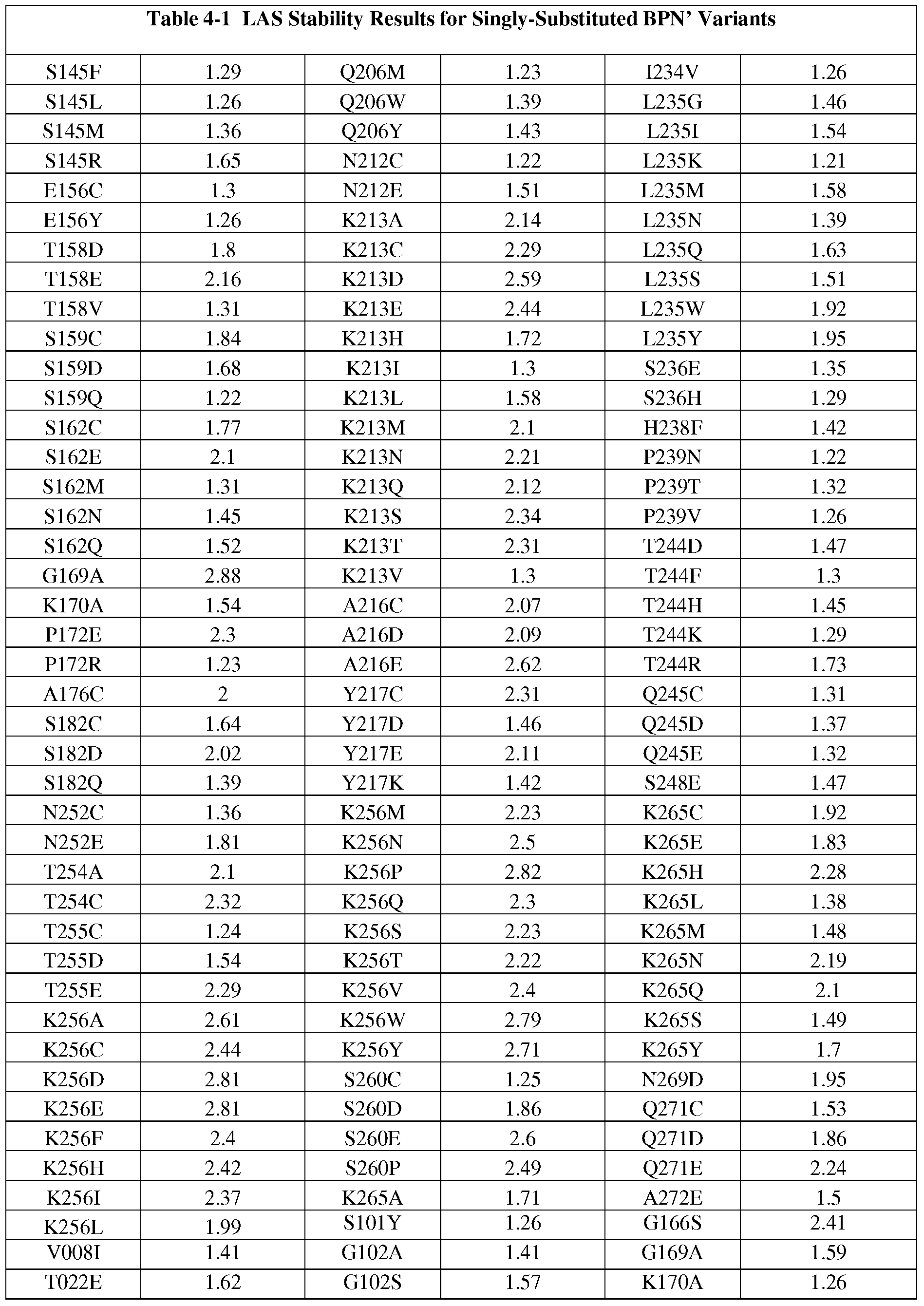
COMPOSITIONS AND METHODS COMPRISING VARIANT MICROBIAL PROTEASES
FIELD OF THE INVENTION
The present invention provides methods for protein engineering and variant proteases. Specifically, the invention provides methods utilizing site evaluation libraries. The present invention also provides subtilisin variants suitable for various uses.
BACKGROUND OF THE INVENTION
Serine proteases are a subgroup of carbonyl hydrolases comprising a diverse class of enzymes having a wide range of specificities and biological functions. Much research has been conducted on the subtilisins, due largely to their usefulness in cleaning and feed applications. Additional work has been focused on the adverse environmental conditions (e.g., exposure to oxidative agents, chelating agents, extremes of temperature and/or pH) which can adversely impact the functionality of these enzymes in various applications. Nonetheless, there remains a need in the art for enzyme systems that are able to resist these adverse conditions and retain or have improved activity over those currently known in the art.
Various protein engineering methods are known to those in the art. In general, proteins are modified in order to obtain desired protein properties. In most methods, the nucleotide sequence of a cloned gene encoding a protein is mutated and the modified gene is expressed to produce mutants, which are screened for activities of interest. Often, the mutant properties are compared with the properties of wild-type protein.
Historically, the protein design process has been approached as equivalent to the problem of finding in all of protein space the one best sequence for the desired application. This problem is extremely difficult and is "NP hard." In complexity theory, problems defined as being in class P, are considered easy and efficient, polynomial-time algorithms exist for their solution. NP-hard problems are problems for which efficient polynomial-time algorithms are not currently known, and if any NP-hard problem could be solved, all NP-hard problems could be solved (See e.g., Pierce and Winfree, Protein Engineer., 15:779-782 [2002]). Current strategies for building and screening libraries generally involve generating protein sequence diversity randomly across the whole sequence or in controlled random fashion at defined positions within the protein. These libraries generally have a large number of members that are "negative" with respect to the primary property of interest, and require large numbers be screened in order to find the relatively small numbers of positive mutations. Generally, negative mutations are ignored, and sequence information is only obtained for the positive members. Saturation mutagenesis (Estell et al., in World Biotech Report 1984, vol. 2: USA, Online
Publications, London [1984], pages 181-187; and Wells et al., Gene 34:315-323 [1985]) is one technique that can be used to search protein space for mutations that optimize several properties in a protein. Several groups have developed strategies for identifying sites to be changed by saturation mutagenesis (Reetz et al., Agnew. Chem. Int. Edn., 44:4192-4196 [2005]; Kato et al., J. MoI. Biol., 351 :683-692 [2005]; and Sandberg et al., Proc. Natl. Acad. Sci., 90:8367-8371 [1993]), but no general system for site identification has been proposed. In addition, because most protein engineering methods produce a great number of amino acid mutation options, screening of a large number of variants generally is required to produce a desired protein property. Generally, screening is repeated over and over to produce a beneficial variant. Thus, most methods are laborious and time-consuming. There is a continuing need in the art for protein engineering methods that are efficient and produce the desired results.
SUMMARY OF THE INVENTION
The present invention provides methods for protein engineering. Specifically, the invention provides methods utilizing site evaluation libraries. In particular, the present invention provides means to use information obtained about a number of desired properties, in order to rationally and efficiently design libraries that will optimize those properties. In some embodiments, the present invention provides means to design libraries that are improved for at least two desired properties.
The present invention provides means to identify positions within an amino acid sequence of a protein that are relevant in improving desired properties of the protein. In some particularly preferred embodiments, the present invention provides means to determine which mutations are desirable in order to produce proteins with these desired properties, as well as improved properties. In some additional particularly preferred embodiments, the present invention provides means to identify amino acid positions and mutations that have improvements of a particular percentage better than the wild-type protein (e.g., better than 110% of the wild-type for one property). In still further preferred embodiments, the present invention provides means to identify mutations that provide at least one much improved property and at least one additional property that is not significantly worse than the wild-type protein (e.g., better than 110% of wild-type for one property, yet not worse than 90% of wild-type for another property). In yet further preferred embodiments, libraries are constructed based on this information. In some embodiments, the libraries are constructed using all of the identified mutations, while in some other embodiments, the libraries are constructed using a subset of the identified mutations. Indeed, it is not intended that the libraries be constrained to any particular number and/or type of mutations.
The present invention provides methods for protein engineering comprising the steps of: providing a library of protein variants; testing the library of protein variants for at least one property of interest in a test of interest; identifying a range of values for said the at least one property of interest; identifying a minimum within the range of values that is associated with a favorable outcome in the test of interest; and providing a plurality of protein variants having at least one mutation above said minimum in the range of the at least one property of interest, thereby providing a library of protein variants comprising at least one mutation, and wherein the library is enriched in members having a favorable outcome in the test of interest. In some embodiments, the favorable outcome corresponds to a value of greater than about 50%, about 60%, about 70%, about 80%, about 90%, or about 95% of a maximal value observed in the test set forth in the first step above. In some alternative embodiments, more than one test of interest is used in the methods of the present invention. In some preferred embodiments, the protein is an enzyme. In some particularly preferred embodiments, the enzyme is selected from proteases, transferases, metalloproteases, esterases, amylases, cellulases, oxidases, cutinases, and lipases.
The present invention also provides methods for protein engineering comprising the steps of: providing a library of protein variants; testing the library of protein variants for at least two properties of interest in a test of interest; identifying a range of values for the at least two properties of interest; identifying a minimum within the range of values that is associated with a favorable outcome in the test of interest; and providing a plurality of protein variants above the minimum of the range of the at least two properties of interest, thereby providing a library of protein variants enriched in members having the favorable outcome in the test of interest. In some preferred embodiments, the favorable outcome corresponds to a value of greater than about 50%, about 60%, about 70%, about 80%, about 90%, or about 95% of a maximal value observed in the test set forth in the first step above. In some preferred embodiments, the protein is an enzyme. In some particularly preferred embodiments, the enzyme is selected from proteases, transferases, metalloproteases, esterases, amylases, cellulases, oxidases, cutinases, and lipases. The present invention also provides methods for protein engineering comprising the steps of: providing a wild-type protein and a library of protein variants of the wild-type protein; testing the library of protein variants and the wild-type protein for at least one property of interest in a test of interest; identifying a range of values for the at least one property of interest; identifying a minimum within the range of values that is associated with a favorable outcome in the test of interest; identifying the protein variants having a favorable outcome as compared to the results obtained for the wild-type, wherein the favorable outcome is an improved property of interest; and providing a plurality of protein variants above the minimum of the range of the at least one property of interest, thereby providing a library of improved protein variants enriched in members having the favorable outcome in the test of interest. In some preferred embodiments, the methods further comprise the step of determining the performance index, wherein the performance index is determined by dividing the value obtained for each of the improved protein variants and the value obtained for the wild-type protein. In some particularly preferred embodiments, the methods further comprise the step of identifying the improved protein variants, wherein the improved protein variants achieve performance index values greater than 1.1 in the test of interest. In some additional embodiments, the protein is an enzyme. In some particularly preferred embodiments, the enzyme is selected from proteases, transferases, metalloproteases, esterases, amylases, cellulases, oxidases, cutinases, and lipases. In some alternative embodiments, the protein is selected from antibodies and growth factors. In still additional preferred embodiments, the wild-type protein is a mature form an enzyme selected from proteases, transferases, metallopro teases, esterases, amylases, cellulases, oxidases, cutinases, and lipases. In some preferred embodiments, the property of interest is selected from charge, wash performance, hard surface cleaning performance, solubility, thermal stability, storage stability, detergent stability, substrate binding, enzyme inhibition, expression level, reaction rate, and substrate degradation. In some embodiments, the wild-type protein and the protein variant are components of at least one detergent composition. In some preferred embodiments, wash performance is tested in a detergent composition formulated into a powdered or liquid detergent having a pH of between 5 and 12.0. The present invention also provides methods for producing an improved variant of a parent protein within a protein fold, comprising: assaying multiple variants of a test protein within the protein fold spanning a range of a property of interest in an assay of interest; identifying a minimum within the range of the property of interest that is associated with a favorable outcome in the assay of interest; assaying a parent protein of the protein fold in the assay of interest; and producing an improved variant of the parent protein by introducing an amino acid substitution is the parent protein such that the improved variant is above the minimum of the range of the property of interest. In some preferred embodiments, the parent protein and the test protein are different. In some embodiments, the methods further comprise the step of determining the performance index, wherein the performance index is determined by dividing the value obtained for the improved protein variant and the value obtained for the parent protein. In some embodiments, the test proteins and the parent proteins are enzymes. In some particularly preferred embodiments, the enzymes are selected from proteases, transferases, metalloproteases, esterases, amylases, cellulases, oxidases, cutinases, and lipases. In some alternative embodiments, the test and parent proteins are selected from antibodies and growth factors. In still additional preferred embodiments, the parent protein is a mature form an enzyme selected from proteases, transferases, metalloproteases, esterases, amylases, cellulases, oxidases, cutinases, and lipases. In some preferred embodiments, the property of interest is selected from charge, wash performance, hard surface cleaning performance, thermal stability, solubility, storage stability, detergent stability, substrate binding, enzyme inhibition, expression level, reaction rate, and substrate degradation. In some embodiments, the test and parent proteins are components of at least one detergent composition. In some alternative embodiment, the improved protein variant is a component of a detergent composition. In some preferred embodiments, wash performance is tested in a detergent composition formulated into a powdered or liquid detergent having a pH of between about 5 and about 12.0.
The present invention also provides isolated subtilisin variants of a Bacillus subtilisin, wherein the subtilisin variant is a mature form having proteolytic activity and comprising a substitution at one or more positions selected from positions: 1, 2, 3, 4, 5, 6, 7, 8, 9, 10, 11, 12, 13, 14, 15, 16, 17, 18, 19, 20, 21, 21, 22, 23, 24, 25, 26, 27, 28, 29, 30, 31, 33, 35, 36, 37, 39, 40, 41, 42, 43, 44, 45, 46, 47, 48, 49, 50, 51, 52, 53, 54, 55, 56, 57, 58, 59, 60, 62, 65, 66, 67, 71, 72, 73, 76, 77, 78, 79, 81, 82, 83, 84, 85, 86, 87, 88, 89, 90, 91, 92, 93, 94, 95, 96, 97, 98, 99, 101, 102, 103, 104, 105, 106, 107, 109, 110, 111, 112, 113, 114, 115, 116, 117, 118, 119, 122, 123, 124, 125, 126, 127, 128, 129, 130, 131, 132, 133, 134, 135, 136, 137, 139, 141, 143, 144, 145, 146, 147, 148, 149, 150, 151, 152, 153, 156, 157, 158, 159, 160, 162, 163, 164, 165, 166, 167, 169, 170, 171, 172, 173, 174, 175, 176, 177, 178, 179, 180, 181, 182, 183, 184, 185, 186, 187, 188, 189, 190, 191, 192, 194, 195, 196, 197, 198, 199, 200, 201, 203, 204, 206, 207, 209, 210, 212, 213, 214, 215, 216, 217, 218, 219, 220, 222, 223, 224, 225, 228, 229, 230, 231, 232, 233, 234, 235, 236, 237, 238, 239, 240, 241, 242, 243, 244, 245, 246, 247, 248, 249, 250, 251, 252, 253, 254, 255, 256, 257, 258, 259, 260, 261, 262, 263, 264, 265, 267, 268, 269, 270, 271, 272, 273 and 274, wherein the positions are numbered by correspondence with the amino acid sequence of B. amyloliquefaciens subtilisin BPN' set forth as SEQ ID NO:2. In some embodiments, the one or more positions are selected from: 1, 2, 5, 6, 7, 8, 9, 10, 11, 12, 13, 14, 15, 16, 17, 18, 19, 20, 21, 21, 22, 23, 24, 25, 26, 28, 29, 30, 31, 33, 35, 36, 37, 39, 40, 41, 42, 43, 44, 45, 46, 47, 48, 49, 50, 51, 52, 53, 54, 55, 56, 57, 58, 59, 60, 62, 65, 66, 67, 71, 72, 73, 77, 78, 79, 81, 82, 83, 84, 85, 86, 87, 88, 89, 90, 91, 92, 93, 94, 95, 96, 97, 98, 99, 101, 102, 103, 104, 105, 106, 107, 109, 110, 111, 112, 113, 114, 115, 116, 118, 119, 122, 123, 124, 125, 126, 127, 128, 129, 131, 133, 134, 135, 136, 137, 139, 141, 143, 144, 145, 146, 147, 148, 149, 150, 151, 152, 153, 156, 157, 158, 159, 160, 162, 163, 164, 165, 166, 167, 169, 170, 171, 172, 173, 174, 175, 176, 177, 178, 179, 180, 181, 182, 183, 184, 185, 186, 187, 188, 189, 190, 191, 192, 194, 195, 196, 197, 198, 199, 200, 201, 203, 204, 206, 207, 212, 213, 214, 215, 216, 217, 218, 219, 220, 222, 223, 224, 225, 228, 229, 230, 231, 232, 233, 234, 235, 236, 237, 238, 239, 240, 241, 242, 243, 244, 245, 246, 247, 248, 249, 250, 251, 253, 254, 255, 256, 257, 258, 259, 260, 261, 262, 263, 264, 265, 267, 268, 269, 270, 271, 272, 273 and 274, and wherein the positions are numbered by correspondence with the amino acid sequence of B. amyloliquefaciens subtilisin BPN' set forth as SEQ ID NO:2. In some further embodiments, the one or more positions are selected from: 2, 3, 5, 6, 7, 8, 9, 10, 11, 12, 13, 14, 15, 16, 17, 19, 20, 21, 21, 22, 23, 25, 26, 28, 29, 30, 31, 33, 35, 36, 37, 39, 40, 41, 42, 44, 46, 47, 48, 49, 50, 51, 53, 54, 55, 56, 57, 58, 59, 60, 62, 65, 66, 67, 71, 73, 77, 78, 79, 81, 82, 83, 84, 85, 86, 88, 89, 90, 91, 92, 93, 94, 95, 96, 102, 105, 106, 110, 111, 112, 113, 114, 115, 116, 122, 123, 124, 125, 126, 128, 129, 131, 133, 134, 135, 136, 137, 139, 141, 143, 145, 146, 147, 148, 149, 150, 151, 152, 153, 156, 157, 158, 159, 160, 162, 165, 166, 167, 169, 170, 171, 173, 174, 175, 176, 177, 178, 179, 180, 181, 182, 183, 184, 186, 187, 189, 190, 191, 192, 194, 195, 196, 197, 198, 199, 200, 201, 203, 204, 206, 207, 212, 214, 216, 217, 218, 219, 220, 222, 223, 224, 225, 228, 229, 230, 231, 232, 233, 234, 235, 236, 237, 238, 239, 240, 241, 242, 243, 244, 245, 246, 247, 249, 250, 251, 253, 254, 255, 257, 258, 259, 260, 261, 262, 263, 264, 265, 267, 268, 269, 270, 271, 272, 273, and 274, and wherein the positions are numbered by correspondence with the amino acid sequence of B. amyloliquefaciens subtilisin BPN' set forth as SEQ ID NO:2. In some embodiments, the subtilisin variant further comprises a substitution at one or more positions selected from 18, 52, 72, 117, 119, 127, 144, 185, 209 and 213, and wherein the positions are numbered by correspondence with the amino acid sequence of B. amyloliquefaciens subtilisin BPN' set forth as SEQ ID NO:2. In some preferred embodiments, the substitution comprises one or more of the positions: AOOlC, AOOlD, AOOlE, AOOlF, AOOlG, AOOlH, AOOlI, AOOlK, AOOlL, AOOlM, AOOlN, AOOlQ, AOOlR, AOOlS, AOOlV, AOOlW, Q002A, Q002D, Q002E, Q002G, Q002S, S003A, S003D, S003F, S003G, S003I, S003K, S003L, S003M, S003N, S003P, S003Q, S003R, S003T, S003V, S003W, S003Y, P005C, P005E, P005G, P005N, P005Q, P005T, Y006A, Y006C, Y006E, Y006F, Y006G, Y006K, Y006M, Y006N, Y006P, Y006Q, Y006R, Y006T, Y006V, Y006W, S009A, S009C, S009E, S009F, S009G, S009H, S009K, S009L, S009M, S009P, S009Q, S009R, S009T, S009V, S009W, QOlOA, QOlOC, QOlOE, QOlOF, QOlOG, QOlOH, QOlOI, QOlOK, QOlOL, QOlOM, QOlOR, QOlOS, QOlOT, QOlOV, QOlOW, 1011C, 101 IL, 101 IT, 101 IV, 101 IY, K012A, K012C, K012D, K012E, K012F, K012G, K012H, K012I, K012N, K012Q, K012S, K012T, K012V, K012W, K012Y, A013C, A013F, A013G, A013H, A013L, A013R, A013S, A013T, A013V, P014A, P014C, P014D, P014E, P014F, P014G, P014I, P014K, P014L, P014M, P014N, P014Q, P014R, P014S, P014T, P014V, P014W, P014Y, A015C, A015D, A015E, A015F, A015G, A015H, A015I, A015K, A015L, A015M, A015P, A015Q, A015R, A015T, A015V, A015Y, L016A, L016C, L016I, L016M, L016Q, L016S, L016T, H017F, H017I, H017L, H017M, H017V, H017W, H017Y, S018A, S018E, S018F, S018G, S018H, S018I, S018K, S018L, S018M, S018N, S018P, S018Q, S018R, S018T, S018V, S018W, S018Y, Q019A, Q019C, Q019D, Q019E, Q019G, Q019I, Q019K, Q019M, Q019R, Q019T, Q019V, G020A, G020C, G020D, G020E, G020F, G020H, G020K, G020M, G020N, G020P, G020Q, G020R, G020S, G020W, Y021A, Y021C, Y021D, Y021E, Y021F, Y021G, Y021H, Y021K, Y021M, Y021R, Y021S, Y021T, Y021V, Y021W, T022A,
T022C, T022E, T022F, T022G, T022H, T022I, T022K, T022L, T022M, T022N, T022Q, T022S, T022V, T022W, T022Y, S024C, S024F, S024G, S024H, S024I, S024K , S024L, S024M, S024N, S024Q, S024R, S024T, S024W, S024Y, N025C, N025E, N025F, N025G, N025H, N025I, N025K, N025L, N025M, N025P, N025R, N025S, N025T, N025V, N025W, K027A, K027D, K027E, K027F, K027G, K027H, K027L, K027M, K027P, K027R, K027S, K027W, K027Y, S033A, S033F, S033G, S033H, S033P,
S033T, S033W, I035A, I035C, I035D, I035R, I035S, I035T, I035V, D036A, D036C, D036E, D036Q, D036S, D036W, S037A, S037C, S037E, S037F, S037G , S037H, S037K, S037L, S037M, S037P, S037Q, S037R, S037T, S037W, H039C, H039Q, H039T, H039V, P040A, P040C, P040E, P040F, P040G, P040G, P040H, P040I, P040K, P040L , P040M, P040N, P040Q, P040R, P040S, P040T, P040V, P040W, D041E, L042I, L042M, L042V, K043A, K043C, K043D, K043E, K043F, K043G, K043I, K043L, K043M, K043N, K043R, K043S, K043T, K043V, K043W, K043Y, V044A, V044C, V044I, V044L, V044M, V044P, V044S, V044T, A045C, A045E, A045F, A045H, A045I, A045K, A045L, A045M, A045N, A045P, A045Q, A045S, A045T, A045V, A045Y, G046A, G046C, G046E, G046H, G046K, G046M, G046N, G046Q, G046T, G046W, G046Y, A048C, A048D, A048E, A048F, A048H, A048I, A048K, A048L, A048M, A048Q, A048R, A048S, A048T, A048V, A048W, A048Y, M050A,
M050C, M050F, M050H, M050I, M050K, M050L, M050Q, M050R, M050S, M050T, M050V, M050W, M050Y, V051A, V051C, V051D, V051E, V051H, V051I , V051L, V051P, V051Q, P052C, P052D, P052E, P052F, P052H, P052I, P052K, P052L, P052Q, P052R, P052S, P052T, P052V, P052W, P052Y, S053E, S053F, S053G, S053H, S053I, S053K, S053L, S053M, S053N, S053Q, S053R, S053T, S053V, S053W, E054A, E054N, E054Q, E054S, T055A, T055C, T055D, T055F, T055G, T055H, T055I, T055K, T055M, T055P, T055Q, T055R, T055S, T055V, T055W, T055Y, N056D, N056M, N056P, N056Q, N056S, N056T, N056V, P057N, P057Q, P057T, P057V, P057W, F058C, F058E, F058G, F058H, F058L, F058M, F058N, F058Q, F058S, F058V, F058Y, Q059A, Q059C, Q059D, Q059E, Q059F, Q059G, Q059H, Q059K, Q059L, Q059M, Q059N, Q059P, Q059R, Q059S, Q059T, Q059V, Q059W, Q059Y, D060E, D060G, N062A, N062C, N062D, N062E, N062F, N062G, N062H, N062I, N062K, N062L, N062M, N062Q, N062R, N062S, N062T, N062V, N062W, N062Y, T066S, T066W, T066Y, H067A, H067C, H067F, H067I, H067L, H067M, H067N, H067P, H067R, H067S, H067T, T071I, T071Y, N077S, S078A, S078C, S078D, S078F, S078G, S078I, S078K, S078L, S078M, S078N, S078P, S078Q, S078R, S078T, S078V, S078W, S078Y, 1079 A, I079C, I079E, I079F, I079G, I079H, I079K, I079L, I079N, I079Q, I079R, I079S, I079T, I079V, I079W, I079Y, V081F, V081I, V081L, V081M, V081T, G083F, G083P, Q084A, Q084C, Q084H, Q084I, Q084N, Q084T, A085C, A085F, A085G, A085R, A085S, P086A, P086D, P086E, P086G, P086M, P086N, P086Q, P086R, P086S, P086T, P086W, P086Y, S089C, S089D, S089E, S089F, S089G, S089H, S089K, S089L, S089V, S089W, S089Y, L090A, L090D, L090E, L090G, L090H, L090M, L090Q, L090T, L090V, Y091A, Y091C, Y091D, Y091E, Y091F, Y091H, Y091I, Y091L, Y091M, Y091Q, Y091S, Y091T, Y091V, L096F, L096H, L096I, L096K, L096M, L096T, L096V, G097A, G097C, G097D, G097E, G097H, G097K, G097L, G097M, G097P, G097Q, G097R, G097S, G097T, G097V, A098C, A098D, A098F, A098G, A098H, A098I, A098L, A098P, A098Q, A098R, A098S, A098T, A098V, A098Y, D099C, D099E, D099I, D099K, D099L, D099N, D099P, D099Q, D099R, D099S, D099T, SlOlA, SlOlC, SlOlE, SlOlF, SlOlG, SlOlI, SlOlK, SlOlL, SlOlM, SlOlN, SlOlP, SlOlQ, SlOlR, SlOlT, SlOlV, SlOlY, G102A, G102C, G102E, G102F, G 1021, G102N, G102S, G102V, G102Y, Q103A, Q103C, Q103E, Q103F, Q103G, Q103I, Q103K, Q103L, Q103M, Q103N, Q103R, Q103S, Q103T, Q103V, Q103W, S105A, S105C, S105D, S105E, S105F, S105G, S 1051, S105K, S105L, S105M, S105N, S105P, S105R, S 105V, S105W, W106A, W106C, W106E, W106F, W106G, W106H, W 1061, W106L, W106M, W106N, W106R, W106S, W106T, W106V, W106Y, N109A, N109C, N109E, N109F, N109G, N109H, N109L, N109M, N109P, N109Q, N109R, N109S, N109T, N109V, N109W, N109Y, Il 11C, Il 1 IF, Il HL, H UM, Il UN, H UP, H UT, Il l lV, Il l lW, E1 12A, E112C, E112D, E112F, E112G, El 121, E112L, E112M, E112N, E112Q, E112R, E112S, E112T, El 12V, E112W, E112Y, W113D, W113E, WI BF5 WI BN5 WI BP5 WI BQ5 WI BS5 WI BV5 WI BY5 II ISEJI ISHJI ISNJI ISRJI IST, 1115V5 1115W5 1115Y5 Al 16C5 Al 16D5 Al 16E5 Al 16F5 Al 16G5 Al 16H5 Al 16I5 Al 16K5 Al 16L5 Al 16M5 Al 16N5 Al 16P5 Al 16Q5 Al 16R5 Al 16S5 Al 16T5 Al 16V5 Al 16W5 Al 16Y5 Nl 18A5 Nl 18C5 N118D, N118E, N118F, N118G, N118H, N118L N118K, N118L, N118M, N118Q, N118R, N118S, N118T, Nl 18V, N118W, N118Y, I122A, I122C, I122H, I122K, I122L, I122M, I122N, I122P, N123A, N123C, N123D, N123E, N123G, N123I, N123L, N123M, N123Q, N123S, N123T, N123V, M124C, M124D, M124I, M124L, M124S, M124T, M124V, M124W, S125A, S125C, S125E, S125F, S 1251, S125K, S125M, S125N, S125P, S125Q, S125R, S125T, S125W, L126A, L126C, L126I, L126K, L126N, L126R, L126S, L126T, L126V, L126W, L126Y, G127A, G127C, G127E, G127F, G127I, G127K, G127M, G127N, G127P, G127Q, G127S, G127T, G127V, G127W, G127Y, G128A, G128D, G128F, G128H, G128L, G128N, G128P, G128S, G128T, G128V, G128W, G128Y, P129A, P129C, P129D, P129E, P129F, P129G, P129I, P129K, P129L, P129M, P129N, P129Q, P129S, P129T, P129V, P129Y, G131A, G131C, G131E, G131F, G131K, G131L, G131M, G131N, G131P, G131Q, G131R, G131S, G131T, G131V, G131W, G131Y, A133C, A133D, A133E, A133F, A133G, A133I, A133K, A133L, A133M, A133P, A133R, A133S, A133T, A133V, A133W, A133Y, A134D, A134E, A134F, A134G, A134I, A134K, A134L, A134M, A134P, A134Q, A134R, A134S, A134T, A134V, A134W, L135D, L135E, L135M, L135R, L135W, L135Y, K136E, K136H, K136L, K136M, K136N, K136R, K136S, K136T, K136V, K136W, K136Y, A137C, A137E, A137F, A137H, A137K, A137L, A137M, A137N, A137P, A137Q, A137R, A137S, A137T, A137V, A137W, A137Y, V139C, Vl 391, V139L, V139N, V139S, V139T, K141A, K141C, K141D, K141E, K141F, K141G, K141H, K141I, K141L, K141M, K141N , K141Q, K141R, K141S, K141V, K141W, K141Y, V143A, V143C, V143D, V143E, V143F, V143G, V143K, V143L, V143M, V143N, V143Q, V143R, V143S, V143T, V143W, A144C, A144D, A144E, A144G, Al 441, A144K, A144L, A144M, A144R, A144S, A144T, A144V, A144W, S 145 A, S145C, S145D, S145E, S145F, S145G, S145H, S145I, S145L, S145M, S145Q, S145R, S145T, S145V, S145W, S145Y, G146A, G146C, G146D, G146E, G146M, G146Q, G146R, G146S, G146T, G146Y, A153S, G154L, G154P, G154T, E156A, E156C, E156F, E156K, E156L, E156N, E156Q, E156R, E156S, E156T, E156V, E156W, E156Y, T158A, T158D, T158E, T158G, T158H, T158I, T158K, T158L, T158M, T158N, T158Q, T158S, T158V, T158Y, S159A, S159C, S159D, S159E, S159G, S159H, S 1591, S159K, S159M, S159Q, S159R, S159T, G160D, G160E, G160K, G160N, G160P, G160Q, G160S, G160T, S162A, S162C, S162E, S162H, S162K, S162L, S162M, S162N, S162Q, S162R, S162T, S162V, S163G, S163P, Y167A, Y167F, Y167H, Y167I, P168D, P168G, P168I, P168M, P168S, P168Y, G169A, G169E, G169F, G169H, G 1691, G169M, G169N, G169R, G169T, G169V, G169Y, K170A, K170C, K170F, K170G, K170H, K170R, K170V, K170W, K170Y, Y171G, Y171K, Y171P, P172A, P172C, P172E, P172K, P172L, P172M, P172N, P172Q, P172R, P172S, P172T, P172V, P172Y, S173A, S173C, S173E, S 1731, S173T, S173V, V174C, V174F, V174H, V174R, V174T, I175G, I175L, I175M, I175R, I175T, I175V, A176C, A176E, A176F, A176K, A176M, A176S, A176Y, A179G , V180A, V180C, V180L, V180N, V180S, V180T, D181C, D181E, D181G, D181H, D181M, D181N, D181S, D181T, D181W, S182A, S182C, S182D, S182F, S182G, S182H, S 1821, S182K, S182M, S182P, S182Q, S182R, S182V, S182Y, S183A, S183C, S183E, S183F, S183G, S183H, S183I, S183K, S183L, S183M, S183N, S183Q, S183R, S183T, S183V, S183W, S183Y, N184C, N184D, N184E, N184G, N184H, N184K, N184L, N184M, N184Q, N184S, N184T, N184V, N184W, Q185A, Q185C, Q185E, Q185F, Q185G, Q185H, Q185I, Q185K, Q185L, Q185M, Q185N, Q185S, Q185T, Q185V, Q185W, R 1861, R186L, R186W, A187C, A187D, A187E, A187F, A187G, A187P, A187S, A187W, A187Y, S188A, S188C, S188D, S188E, S188F, S188G, S188H, S188I, S188K, S188L, S188M, S188P, S188Q, S188T, S188V, S188W, S188Y, S190F, S190H, S 1901, S190K, S191A, S191G, S191N, S191P, V192A, V192S, V192T, V192Y, G193F, G193H, G193I, G193N, G193P, G193R , G193T, P194C, P194E, P194H, P 1941, P194K, P194L, P194M, P194Q, P194T, P194V, P194W, L196A, M199P, M199S, A200C, A200G, A200K, A200Y, G202D, G202E, G202F, G202L, G202P, G202V, G202Y, Q206A, Q206C, Q206D, Q206E, Q206F, Q206G, Q206H, Q206I, Q206L, Q206M, Q206N, Q206P, Q206R, Q206S, Q206T, Q206V, Q206W, Q206Y, S207D, S207E, S207K, S207Q, S207T, S207V, P210A, P210C, P210S, P210T, N212A, N212C, N212E, N212F, N212G, N212H, N212K, N212L, N212M, N212P, N212Q, N212R, N212S, N212V, K213A, K213C, K213D, K213E, K213F, K213H, K213I , K213L, K213M, K213N, K213Q, K213R, K213S, K213T, K213V, K213Y, Y214W, G215A, G215C, G215D, G215E, G215I, G215M, G215N, G215Q, G215S, G215T, G215V, A216C, A216D, A216E, A216G, A216K, A216L, A216M, A216N, A216P, A216Q, A216R, A216S, A216V, A216W, Y217A, Y217C, Y217D, Y217E, Y217F, Y217G, Y217H, Y217I, Y217K, Y217L, Y217M, Y217N, Y217Q, Y217R, Y217S, Y217T, Y217V, Y217W, N218A, N218C, N218E, N218F, N218G, N218H, N218K, N218M, N218R, N218S, N218T, N218W, N218Y, G219A, G219C, G219D, G219H, G219I, G219M, G219P, G219Q, G219R, G219S, G219T, G219V, G219W, T220D, T220E, T220F, T220G, T220K, T220M, T220S, T220Y, A223E, A223F, A223L, A223M, A223R, A223S, A223V, A223W, A223Y,
S224A, S224C, S224F, S224G, S224H, S224M, S224N, S224Q, S224R, S224T, P225A, P225C, P225F, P225G, P225H, P225I, P225K, P225L, P225M, P225R, P225S, P225T, P225V, P225Y, A228P, A228R, A228S, A228T, A228W, G229A, G229H, G229I, G229S, A230C, A230E, A230G , A230Q, A230R, A230S, A230T, A230V, A231C, A231I, A231P, A231R, I234A, I234C, I234L, I234M, I234N, I234P, I234Q, I234S, I234T, I234V, L235A, L235C, L235G, L235I , L235K, L235M, L235N, L235Q, L235R, L235S, L235T, L235V, L235W, L235Y, S236A, S236C, S236D, S236E, S236G, S236H, S236N, S236Q, S236T, S236V, S236Y, K237A, K237E , K237F, K237G, K237H, K237I, K237L, K237M, K237N, K237Q, K237R, K237S, K237T, K237V, K237W, K237Y, H238C, H238D, H238E, H238F, H238M, H238R, H238S, P239C, P239D, P239E, P239F, P239H, P239L, P239M, P239N, P239Q, P239R, P239S, P239T, P239V, P239W, P239Y, N240A, N240C, N240D, N240F, N240G, N240K,
N240L, N240Q, N240R, N240S, N240T, N240V, N240W, N240Y, W241A, W241F, W241G, W241H, W241I, W241K, W241M, W241Q, W241T, W241V, T242A, T242C, T242E, T242F, T242G, T242K, T242M, T242N, T242P, T242R, T242S, T242W, T242Y, N243C, N243E, N243F, N243G, N243I, N243Q, N243S, N243T, N243V, N243W, N243Y, T244A, T244D, T244F, T244G, T244H, T244K, T244L, T244M, T244N, T244P, T244Q, T244R, T244S, T244V, T244W, T244Y, Q245A, Q245C, Q245D, Q245E, Q245H, Q245I, Q245K, Q245L, Q245M, Q245R, Q245T, Q245V, Q245Y, R247W, S248A, S248E, S248F, S248G, S248H, S248I, S248L, S248M, S248N, S248Q, S248R, S248T, S248V, S248W, S248Y, S249C, S249D, S249H, S249I, S249K, S249L, S249M, S249N, S249Q, S249R, S249T, S249V, S249W, S249Y, L250D, L250F, L250H, L250I, L250M, L250T, L250V, E251A, E251T, E251W, N252A, N252C, N252E, N252G, N252H, N252I, N252L, N252M, N252Q, N252R, N252S, N252T, N252V, N252Y, T253A, T253C, T253E, T253G, T253H, T253K, T253M, T253S, T253V, T254A, T254C, T254L, T254M, T254R, T254S, T254V, T255A, T255C, T255D, T255E, T255F, T255G, T255H, T255I, T255K, T255L, T255M, T255R, T255S, T255V, K256A, K256C, K256D, K256E, K256F, K256H, K256I, K256L, K256M, K256N, K256P, K256Q, K256R, K256S, K256T, K256V, K256W, K256Y, L257A, L257C, L257F, L257G, L257H, L257I, L257K, L257M, L257N, L257R, L257S, L257T, L257V, L257W, L257Y, G258Q, D259A, D259E, D259F, D259G, D259L, D259N, D259P, D259Q, D259R, D259S, D259T, D259V, D259W, D259Y, S260A, S260C, S260D, S260E, S260F, S260G, S260H, S260L, S260M, S260N, S260P, S260R, S260V, S260W, S260Y, F261H, F261W, Y262A, Y262C, Y262E, Y262F, Y262H, Y262L, Y262M, Y262N, Y263F, Y263M, Y263T, G264F, G264I, G264L, K265A, K265C, K265E, K265G, K265H, K265L, K265M, K265N, K265Q, K265R, K265S, K265W, K265Y, G266C, G266F, G266L, G266M, G266P, G266R, G266V, G266W, G266Y, L267A, L267C, L267E, L267G, L267H, L267I, L267M, L267N, L267Q, L267S, L267T, L267V, I268A, I268C, I268K, I268L, I268M, I268P, I268R, I268V, N269D, N269E, N269K, N269L, N269P, N269Q, N269S, Q271A, Q271C, Q271D, Q271E, Q271F, Q271G, Q271H, Q271I, Q271K, Q271L, Q271M, Q271N, Q271P, Q271R, Q271S, Q271T, Q271V, Q271W, Q271Y, A272E, A272F, A272G, A272H, A272K, A272L, A272M, A272N, A272Q, A272R, A272S, A272T, A272V, A272W, A272Y, A274C, A274D, A274F, A274G, A274H, A274I, A274K, A274L, A274Q, A274S, A274T, and A274V.
In some preferred embodiments, the substitution comprises a combination selected from: Y021H-A045V-Y217E, Y021W-S101E-G128R-Y217Q, Y021H-Y217E, Y021H-A045V-S101N- Y217Q, Y021H-A045I-Y217E, Y021H-A045I-S101E-Y217Q, Y021W-A045I-S101E-Y217E, D036N- SlOlE- Y217L, Y021H-A045V-Y217Q, Y021H-A045I-S101E-Y217L, Y021H-A045I-Y217E, Y021H- Y217Q, Y021W-S101E-Y217L, Y021W-A045V-S101E-Y217L, Y021H-A045V-S101E-Y217E, SlOlE- Y217L, Y021H-A045V-S101E-Y217Q, Y021H-Y217L, Y021W-A045I-S101N-Y217L, S101N-K213I- Y217Q, Y021W-S101N-Y217L, Y021H-S101E-Y217E, M119F-K213K-Y217Q, Y021W-A045V- Y217E, Y021W-A045I-Y217E, Ml 19F-K213I-Y217Q, Y021W-Y217E-N212S, Ml 19F-K213L-Y217E, K213I-Y217Q, A045I-Y217Q, Y021W-A045V-S101E-Y217Q, Y021H-A045V-S101E-Y217L, SlOlS- M119F-K213I-Y217Q, K213N-Y217Q, M119F-Y217Q, S024H-A092G-A114G, SlOlN-Ml 19F-K213I- Y217Q, S101N-K213L-Y217Q, SlOlN-Ml 19F-K213K-Y217L, SlOlN-Ml 19F-K213I-Y217L, Y021H- A045V-S101E, S101N-K213L-Y217E, A045V-Y217L, S101N-K213I-Y217L, SlOlS-Ml 19M-K213K- Y217L, Y021H-Y217L, S101E-K213L-Y217L, K213I-Y217E, SlOlN-Ml 19F- Y217E, Y021W-A045V- Y217L, A092G-A114G, S024H-A092G-Q103E, Y021W-S101E, V26Q-K213I, Y021H-S101N, SlOlE- K213N-Y217E. In some embodiments, the substitution comprises a combination selected from: S024S- V028V-M050M-A092A-Q103E-A114G-V246V, S024S-V028V-M050V-A092A-Q103Q-A114 A- V246V, S024S-V028V-M050V-A092A-Q103Q-A114G-V246V, S024H-V028V-M050V-A092A- Q103Q-A114A-V246T, S024H-V028V-M050V-A092A-Q103E-A114A-V246V, S024H-V028V- M050V-A092A-Q103Q-A114G-V246V, S024H-V028V-M050M-A092A-Q103E-A114A-V246V, S024H-V028V-M050M-A092A-Q103E-A114A-V246T, S024S-V028V-M050M-A092G-Q103Q- Al 14A- V246T, S024H- V028 V-M050M- A092A-Q 103Q- Al 14G- V246T, SlOl E-M 119N-K213N, S101N-K213I, SlOlN-Ml 19H, M119H-K213I-Y217L, S101N-M119H-K213N-Y217L, S101N-K213L- Y217E, M119N-K213N-Y217L, M119F-K213L-Y217E, S101P-K213N, S101N-M119H-K213N, S101N-M119F-K213I-Y217L, K213L, M119N-K213N, K213N, K213I-Y217E, SlOlN-Ml 19H-Y217Q, S101P-K213N-Y217L, M119N-K213I, K213N-Y217Q, M119H-K213N, S101N-K213L-Y217Q, SlOlP- K213N, S101E-K213N-Y217E, SlOlE-Ml 19H-K213I-Y217Q, SlOlE-Ml 19H-K213N, K213I-Y217Q, S101N-K213I-Y217Q, M119H-Y217Q, SlOlN-Ml 19N-K213N-Y217Q, M119H-K213I-Y217Q, K213I- Y217Q, SlOlE-Ml 19N- Y217L, M119F-K213L, M119H-K213N-Y217E, SlOlN-Ml 19N-K213N- Y217Q, SlOlN-Ml 19H-K213N-Y217Q, M119H-K213I-Y217Q, Y217Q, M119H-K213N-Y217Q,
SlOlN-Ml 19F- Y217E, M119F-Y217Q, SlOlN-Ml 19F-K213I-Y217Q, S101N-K213I-Y217L, SlOlN- M119H-K213N-Y217L, S101E-K213L-Y217L, S101N-K213N-Y217Q, SlOlN-Ml 19H-K213L, SlOlN-Ml 19H-K213I, S101P-K213N-Y217L, M119F-K213I-Y217Q, S101N-K213I-Y217Q, SlOlE- M119H-K213I-Y217L, SlOlN-Ml 19H-K213I-Y217Q, M119H-K213N-Y217E, S101N-M119N- K213N-Y217L, A048E-K213L, A048H-K213L, V026Q-A048Y-K213L, K213N, V026N-K213L, V026N-K213L, V026Y-K213N, A048D-K213N, V026Q-A048E-K213L, A048H-K213N, V026Q- A048H-K213L, A048H-K213L, K213L, K213N, V147D-K213L, K213I, V026Q-A048E-K213N, V026N-A048E-K213N, A048E-K213L, V026Y-A048E-K213I, A048D-K213N, K213I, A048H-K213N, V147D-K213N, Y021H-A045V-S101E-Y217L, Y021H-Y217L, Y021H-A045V-S101E-Y217Q, Y021H-A045I-S101E-Y217L, Y021H-Y217Q, Y021H-A045V-Y217E, A045V-Y217L, Y021H-A045V- S101N-Y217Q, Y021W-S101P-Y217L, Y021W-A045I-Y217E, Y021H-A045V-S101E-Y217E, Y021H- A045I-S101E-Y217L, Y021H-A045I-S101E-Y217Q, Y021H-A045V-Y217E, Y021W-S101E-Y217L, SlOlE- Y217L, Y021H-A045V-Y217Q, Y021H-Y217E, Y021W-Y217E-(N0212S), A045I-Y217Q, Y021H-A045V-Y217E, Y021W-A045V-S101E-Y217Q, Y021H-S101E-Y217E, Y021W-S101N- Y217L, S024S-V028V-M050M-A092A-Q103Q-A114A-V246T, Y021H-A045V-S101E, Y021W- A045V-S101E-Y217L, SlOlN-Ml 19H-K213K-Y217Q, S101S-M119N-K213N-Y217Q, Y021H- A045V-S101P-Y217L, S024S-V028V-M050M-A092A-Q103Q-A114G-V246T, SlOlS-Ml 19F-K213I- Y217Q, SlOlS-Ml 19M-K213K-Y217L, Y021H-A045I-S101E-Y217Q, Y021H-A045V-S101E-Y217E, Y021H-A045V-S101E, Y021H-Y217L, Y021H-A045I-Y217E, Y021W-A045I-S101E-Y217E, SlOlN- M119F-K213K-Y217L, SlOlE-Ml 19H-K213N-Y217E, Y021H-A045I-Y217E, S101S-M119H-K213L- Y217L, Y021H-Y217E, SlOlS-Ml 19F-K213K-Y217Q, and Y021H-A045I-S101E-Y217L. In some embodiments, the substitution comprises a combination selected from: S024S-V028T-M050V-A092G- Q103E-A114G-V246T, SlOlN-Ml 19H, M119N-K213N-Y217L, Y217L, M119N-K213N, K213N, K213N-Y217Q, S101E-K213N-Y217E, SlOlE-Ml 19N- Y217L, Y217Q, SlOlN-Ml 19N-K213N- Y217E, SlOlN-Ml 19N-K213N-Y217L, Y021H-A045I-S101E-Y217L, SlOlE- Y217L, A045I-Y217Q, S101S-M119M-K213K-Y217L, Y021H-A045I-S101E-Y217L.
The present invention further provides the variants set forth in the Tables included in the Examples, as well as compositions comprising these variants.
Also provided by the present invention are isolated nucleic acids encoding the subtilisin variant, expression vectors comprising the nucleic acids, and host cells comprising the expression vector. Moreover the present invention provides cleaning compositions comprising the subtilisin variant. In some embodiments, the cleaning composition is a laundry detergent. In some embodiments, the laundry detergent is a cold water detergent, a low pH detergent, or a compact detergent. Moreover the present invention provides methods for producing a subtilisin variant of a Bacillus subtilisin, comprising: transforming a host cell with an expression vector comprising a nucleic acid encoding the subtilisin variant; and cultivating the transformed host cell under conditions suitable for the production of the subtilisin variant. In some embodiments, the methods further comprise the step of harvesting the produced subtilisin variant. In some embodiments, the host cell is a Bacillus species, and in a subset of these embodiments, the Bacillus species is B. subtilis. Moreover the present invention provides a method of cleaning, comprising the step of contacting a surface and/or an article comprising a fabric with a cleaning composition comprising an isolated subtilisin variant.
Additionally the present invention provides methods for protease engineering comprising the steps of: a) providing a plurality of site evaluation libraries (SELs) each comprising a plurality of protease variants having distinct substitutions at an identical amino acid position of the protease; b) testing the protease variants of the SELs and a standard protease in a test of a property of interest; c) determining a performance index (PI) for each of the protease variants for the test; d) identifying two or more of the amino acid positions as non-restrictive positions, wherein at least one of the plurality of protease variants in each of two of the SELs has a PI greater than 0.5; and f) providing a multiple mutation library comprising a plurality of multiply-substituted protease variants each comprising substitutions in the two or more non-restrictive positions. In some embodiments, the test comprises two or more different assays selected from the group consisting of stain removal assays (microswatch), LAS stability assays, detergent stability assays, and specific activity assays. In some embodiments the protease is selected from the group consisting of a bacterial serine protease, a bacterial subtilisin, and a bacterial neutral metalloprotease.
In further embodiments, the present invention provides methods for producing a multiply substituted subtilisin variant of a Bacillus subtilisin, comprising: testing a plurality of singly-substituted subtilisin variants in a first test of a first property and a second test of a second property, wherein the property of a parent subtilisin is given a value of 1.0 in each test, a favorable first or second property has a value greater than 1.0, and an unduly unfavorable first or second property has a value less than about 0.80 or in some preferred embodiments, less than about 0.60; identifying a substitution in at least one of the singly-substituted subtilisin variants that is associated with a favorable first property and which is not associated with an unduly unfavorable second property; identifying a substitution in at least one of the singly-substituted subtilisin variants that is associated with a favorable second property and which is not associated with an unduly unfavorable first property; and introducing the substitution from the previous steps into a subtilisin to yield a multiply-substituted subtilisin variant. In some embodiments, the methods further comprise testing the multiply-substituted subtilisin variant in the first test and the second test, wherein an improved subtilisin variant achieves a value of greater than 1.0 in both of the first and second tests, or a value of greater than 1.0 in the first test and a value of 0.80 to 1.0 in the second test. In some embodiments, the methods further comprise producing the improved subtilisin variant(s). In some embodiments, the first and second properties are negatively correlated. In some embodiments, a favorable first or second property has a value greater than about 1.2. In some embodiments, an unduly unfavorable first or second property has a value less than about 0.40. In some embodiments, the first property is stability, and the second property is wash performance. In a subset of these the stability comprises stability in detergent and wash performance comprises blood milk ink (BMI) wash performance in detergent. In some embodiments, the parent bacterial subtilisin is a wild type mature form of a B. amyloliquefaciens subtilisin BPN' having an amino acid sequence set forth as SEQ ID NO:2. In other embodiments, the parent bacterial subtilisin is a wild type of a B. lentus GG36 subtilisin having an amino acid sequence set forth as SEQ ID NO:562, or a BPN" comprising a Y217L substitution (SEQ IDNO:565), alone or in combination with other modifications. In some embodiments of the present invention, wash performance is tested in a powder or liquid detergent composition having a pH of between 5 and 12.0. It is not intended that the steps be limited to the exact order listed above, as any suitable order finds use in the present invention. However in some preferred embodiments, the substitutions are in positions in a parent subtilisin having a solvent accessible surface (SAS) of greater than about 50% or greater than about 65%.
BRIEF DESCRIPTION OF THE DRAWINGS FIG. IA provides a map of pHPLT- VAAcI, while FIG. IB provides a map of pHPLT-
BPN'.
FIG. 2A depicts BMI cleaning performance of a BPN'-Y217L CCL in North American laundry detergent as a function of charge change. Similarly FIG. 2B depicts BMI cleaning performance of a GG36 CCL in North American laundry detergent as a function of charge change. FIG. 3 A depicts BMI cleaning performance of a BPN'-Y217L CCL in Western European liquid laundry detergent as a function of charge change. Similarly FIG. 3B depicts BMI cleaning performance of a GG36 CCL in Western European liquid laundry detergent as a function of charge change.
FIG. 4A depicts BMI cleaning performance of a BPN'-Y217L CCL in Japanese powdered laundry detergent as a function of charge change. Similarly FIG. 4B depicts BMI cleaning performance of a GG36 CCL in Japanese powdered laundry detergent as a function of charge change.
FIG. 5A depicts baked egg yolk cleaning performance of a BPN'-Y217L CCL in automatic dish washing detergent as a function of charge change. Similarly FIG. 5B depicts baked egg yolk cleaning performance of a GG36 CCL in automatic dish washing detergent as a function of charge change. FIG. 6 depicts LAS/EDTA stability as a function of net charge change relative to parent BPN' -
Y217L, for a library containing 80 variants.
DESCRIPTION OF THE INVENTION
The present invention provides methods for protein engineering. Specifically, the invention provides methods utilizing site evaluation libraries.
For practical purposes, it is not usually necessary to find the best sequence in a protein space in order to create a protein that is optimum for a particular application. For most applications, the problem to be solved is to identify at least one protein sequence that meets or exceeds the minimum value required for a number of properties. This requires knowledge of mutations that are good for a particular property, as well as knowledge of those mutations that are bad for any of the desired properties. The present invention provides means to meet the goal by identifying those positions in the protein that can be altered to improve the primary property and keep the values for other properties within desired limits.
The present invention provides means to evaluate all positions in a protein for all the properties of interest by building "site evaluation libraries" at each site. In preferred embodiments, these libraries contain 9-19 mutations at each position, and are used to evaluate each position for use in engineering the protein and constructing libraries. Each property is measured relative to the parent enzyme and an apparent free energy difference for each mutant vs. wild type is calculated. These delta delta G ("i.e., ΔΔG") apparent values are then used to determine additivity.
An ideal way to analyze variants would be through the difference in free energy for the variant versus the parent protein in the process of interest. The Gibbs Free Energy for a process represents the maximum amount of work that can be performed by a system. The change in Free energy relative to the parent enzyme (ΔΔ G ) is given as follows;
ΔΔ G = -RT In (kvaπant/kparent ) where kvaπant is the rate constant for the variant enzyme, and kparent is the rate constant for the parent enzyme, R is the Gas law constant and T is the absolute temperature. Most assays are not constructed to allow determination of true Free Energies, so we utilized a quantity
ΔΔ G app = -RT In ( Pvaπant/Pparent )
where Pvanant is the performance value for the variant and Pparent is the performance value for the parent enzyme under the same conditions. The ΔΔ G app values may be expected to behave in a similar fashion as to ΔΔ G for data distributions and additivity. However, since ΔΔ G is the maximum amount of work that can be carried out by the variant compared to the parent enzyme, the quantity ΔΔ G app will generally underestimate the ΔΔ G and lead to results that appear synergistic in that the properties of two additive positions may be greater than the value predicted by adding their ΔΔ G app values together.
The methods of the present invention used to design efficient libraries that were used to engineer multiple properties in parallel. Although certain enzymes are described herein, the methods apply to any protein of interest for engineering. Site evaluation libraries (SELs) were built as described herein by introducing from 12 to 19 substitutions at each of the positions. The resulting mutations were analyzed using activity and stability assays. The wild type amino acid is listed as a reference point for every position. For each property, measurements were used to determine the mean and standard deviation of ΔΔ G app for the parent enzyme. The parent mean (μ parent ) was normalized to 0, and the standard deviation (oparent ) for ΔΔ G app was determined. These values were used as the reference for each property at each position of the molecule. The site evaluation data were tested for evidence of correlation between properties. The ΔΔ G app values for each property were plotted versus each other property and correlation coefficients were calculated. The two activity measurements on protein substrates were correlated. In order to analyze the positions within the amino acid sequence, two types of sites were defined.
"Unproductive" sites have no mutant that is better than the parent enzyme, while "Productive" sites have at least one substitution that is better than the parent enzyme. The probability that a site will be Productive is given by the number of Productive sites divided by the total number of sites. Although the probability that any mutation will be better than the parent enzyme is low (i.e., 6%-28%) the probability that a given site will have at least one Up mutation is quite high.
It was of interest to determine how the Productive and Unproductive sites were distributed with respect to structural features (e.g., buried amino acids, interacting amino acids, positions near the active site, etc.) in the protease, as well as sequence sites that are conserved or changeable in evolution. To make this determination, the structure is examined and the sequence aligned with non-redundant homologs. As indicated in the Examples, deleterious mutations for any property are correlated with deleterious mutations for every other property, regardless of correlations of the properties. Only a small number of positions (5-10%) have mutations that are bad for all properties. These positions define the "fold" and are conserved in evolution. The implication of this is that although identification of beneficial mutations for any property requires a truly predictive screen for that property, identification of mutations likely to be deleterious for any property can be accomplished using ANY screen. A simplified protein engineering strategy is to build SELs and screen using a simple activity and/or stability screen. The deleterious mutations are identified and those positions that have few deleterious mutations are used to build libraries and combinatorial mutations to improve multiple properties. Also, picking sites that are on the surface of the protein, have few interactions and are variable in sequence alignments provides a high proportion of productive sites. Sites that are on the interior of the molecule, have many contacts and are strongly conserved in evolution will have a high probability of having deleterious mutations and should be avoided. It is contemplated that any suitable method for analyzing sequence and/or structural information will find use in the present invention, including but not limited to computer and/or electronic methods and/or programs.
The methods provide pairwise comparisons of the numbers of variants with more than 5% wt activity and less than 5% activity for each of two properties, along with correlation coefficients for the two properties.
Library Design
In some particularly preferred embodiments, the site evaluation library data are used for combinatorial library design. Traditional directed evolution builds random libraries and screens large numbers of library for single properties, combines these and repeats the process. As several investigators have found (See e.g., Bloom et al, Curr. Opin. Struct. Biol., 15:447-452 [2005]; Bloom et al., Proc. Natl. Acad. Sci. USA 103:5869-5874 [2006]; and Guo et al., Proc. Natl. Acad. Sci. USA 101 :9205-9210
[2004]), the accumulation of positive mutations for one property commonly leads to decreases in other properties. The probability that any mutation will be Up for any property is small, and the probability that any mutation will be Down is high (> 85%), and the probability that accumulating more than three (3) mutations that increase activity will result in a decrease in several other properties is quite high. This problem is avoided by using the site evaluation data to build libraries that would be good for multiple properties. Unproductive sites were not included in combinatorial libraries, and productive sites were further classified by the percentage of mutations that were up.
Cleaning Compositions The cleaning composition of the present invention are advantageously employed for example, in laundry applications, hard surface cleaning, automatic dishwashing applications, as well as cosmetic applications such as dentures, teeth, hair and skin. However, due to the unique advantages of increased effectiveness in lower temperature solutions, the enzymes of the present invention are ideally suited for laundry applications. Furthermore, the enzymes of the present invention may be employed in both granular and liquid compositions. The variant proteases of the present invention also find use cleaning additive products. In some embodiments, low temperature solution cleaning applications find use. The additive product may be, in its simplest form, one or more proteases. In some embodiments, the additive is packaged in dosage form for addition to a cleaning process. Any suitable single dosage form also finds use with the present invention, including but not limited to pills, tablets, gelcaps, or other single dosage units such as pre- measured powders or liquids. In some embodiments, filler(s) or carrier material(s) are included to increase the volume of such composition. Suitable filler or carrier materials include, but are not limited to, various salts of sulfate, carbonate and silicate as well as talc, clay and the like. Suitable filler or carrier materials for liquid compositions include, but are not limited to water or low molecular weight primary and secondary alcohols including polyols and diols. Examples of such alcohols include, but are not limited to, methanol, ethanol, propanol and isopropanol. In some embodiments, the compositions contain from about 5% to about 90% of such materials. Acidic fillers find use to reduce pH. Alternatively, the cleaning additives include adjunct ingredients as more fully described below.
The present cleaning compositions and cleaning additives require an effective amount of at least one of the protease variants provided herein, alone or in combination with other proteases and/or additional enzymes. The required level of enzyme is achieved by the addition of one or more protease variants of the present invention. Typically the present cleaning compositions will comprise at least about 0.0001 weight percent, from about 0.0001 to about 1, from about 0.001 to about 0.5, or even from about 0.01 to about 0.1 weight percent of at least one of the variant proteases of the present invention.
The cleaning compositions herein are typically formulated such that, during use in aqueous cleaning operations, the wash water will have a pH of from about 5.0 to about 11.5 or even from about
7.5 to about 10.5. Liquid product formulations are typically formulated to have a neat pH from about 3.0 to about 9.0 or even from about 3 to about 5. Granular laundry products are typically formulated to have a pH from about 9 to about 11. Techniques for controlling pH at recommended usage levels include the use of buffers, alkalis, acids, etc., and are well known to those skilled in the art. Suitable low pH cleaning compositions typically have a neat pH of from about 3 to about 5, and are typically free of surfactants that hydrolyze in such a pH environment. Such surfactants include sodium alkyl sulfate surfactants that comprise at least one ethylene oxide moiety or even from about 1 to about 16 moles of ethylene oxide. Such cleaning compositions typically comprise a sufficient amount of a pH modifier, such as sodium hydroxide, monoethanolamine or hydrochloric acid, to provide such cleaning composition with a neat pH of from about 3 to about 5. Such compositions typically comprise at least one acid stable enzyme. In some embodiments, the compositions are liquids, while in other embodiments, they are solids. The pH of such liquid compositions is typically measured as a neat pH. The pH of such solid compositions is measured as a 10% solids solution of said composition wherein the solvent is distilled water. In these embodiments, all pH measurements are taken at 20°C.
In some embodiments, when the variant protease(s) is/are employed in a granular composition or liquid, it is desirable for the variant protease to be in the form of an encapsulated particle to protect the variant protease from other components of the granular composition during storage. In addition, encapsulation is also a means of controlling the availability of the variant protease during the cleaning process. In some embodiments, encapsulation enhances the performance of the variant protease(s) and/or additional enzymes. In this regard, the variant proteases of the present invention are encapsulated with any suitable encapsulating material known in the art. In some embodiments, the encapsulating material typically encapsulates at least part of the catalyst for the variant protease(s) of the present invention. Typically, the encapsulating material is water-soluble and/or water-dispersible. In some embodiments, the encapsulating material has a glass transition temperature (Tg) of 00C or higher. Glass transition temperature is described in more detail in WO 97/11151. The encapsulating material is selected from consisting of carbohydrates, natural or synthetic gums, chitin, chitosan, cellulose and cellulose derivatives, silicates, phosphates, borates, polyvinyl alcohol, polyethylene glycol, paraffin waxes, and combinations thereof. When the encapsulating material is a carbohydrate, it is typically selected from monosaccharides, oligosaccharides, polysaccharides, and combinations thereof. Typically, the encapsulating material is a starch. Suitable starches are described in EP 0 922 499; US 4,977,252; US 5,354,559, and US 5,935,826. In some embodiments, the encapsulating material is a microsphere made from plastic such as thermoplastics, acrylonitrile, methacrylonitrile, polyacrylonitrile, polymethacrylonitrile and mixtures thereof; commercially available microspheres that find use include those supplied by EXPANCEL® (Stockviksverken, Sweden), and PM 6545, PM 6550, PM 7220, PM 7228, EXTENDOSPHERES®, LUXSIL®, Q-CEL®, and SPHERICEL® (PQ Corp., Valley Forge, PA). As described herein, the variant proteases of the present invention find particular use in the cleaning industry, including, but not limited to laundry and dish detergents. These applications place enzymes under various environmental stresses. The variant proteases of the present invention provide advantages over many currently used enzymes, due to their stability under various conditions.
Indeed, there are a variety of wash conditions including varying detergent formulations, wash water volumes, wash water temperatures, and lengths of wash time, to which proteases involved in washing are exposed. In addition, detergent formulations used in different geographical areas have different concentrations of their relevant components present in the wash water. For example, a European detergent typically has about 4500-5000 ppm of detergent components in the wash water, while a Japanese detergent typically has approximately 667 ppm of detergent components in the wash water. In North America, particularly the United States, detergents typically have about 975 ppm of detergent components present in the wash water. A low detergent concentration system includes detergents where less than about 800 ppm of detergent components are present in the wash water. Japanese detergents are typically considered low detergent concentration system as they have approximately 667 ppm of detergent components present in the wash water. A medium detergent concentration includes detergents where between about 800 ppm and about
2000ppm of detergent components are present in the wash water. North American detergents are generally considered to be medium detergent concentration systems as they have approximately 975 ppm of detergent components present in the wash water. Brazil typically has approximately 1500 ppm of detergent components present in the wash water. A high detergent concentration system includes detergents where greater than about 2000 ppm of detergent components are present in the wash water. European detergents are generally considered to be high detergent concentration systems as they have approximately 4500-5000 ppm of detergent components in the wash water.
Latin American detergents are generally high suds phosphate builder detergents and the range of detergents used in Latin America can fall in both the medium and high detergent concentrations as they range from 1500 ppm to 6000 ppm of detergent components in the wash water. As mentioned above, Brazil typically has approximately 1500 ppm of detergent components present in the wash water. However, other high suds phosphate builder detergent geographies, not limited to other Latin American countries, may have high detergent concentration systems up to about 6000 ppm of detergent components present in the wash water.
In light of the foregoing, it is evident that concentrations of detergent compositions in typical wash solutions throughout the world varies from less than about 800 ppm of detergent composition ("low detergent concentration geographies"), for example about 667 ppm in Japan, to between about 800 ppm to about 2000 ppm ("medium detergent concentration geographies" ), for example about 975 ppm in U.S. and about 1500 ppm in Brazil, to greater than about 2000 ppm ("high detergent concentration geographies"), for example about 4500 ppm to about 5000 ppm in Europe and about 6000 ppm in high suds phosphate builder geographies.
The concentrations of the typical wash solutions are determined empirically. For example, in the U.S., a typical washing machine holds a volume of about 64.4 L of wash solution. Accordingly, in order to obtain a concentration of about 975 ppm of detergent within the wash solution about 62.79 g of detergent composition must be added to the 64.4 L of wash solution. This amount is the typical amount measured into the wash water by the consumer using the measuring cup provided with the detergent.
As a further example, different geographies use different wash temperatures. The temperature of the wash water in Japan is typically less than that used in Europe. For example, the temperature of the wash water in North America and Japan is typically between 10 and 30°C (e.g., about 20°C), whereas the temperature of wash water in Europe is typically between 30 and 60°C (e.g., about 40°C). As a further example, different geographies typically have different water hardness. Water hardness is usually described in terms of the grains per gallon mixed Ca2+Mg2+. Hardness is a measure of the amount of calcium (Ca +) and magnesium (Mg +) in the water. Most water in the United States is hard, but the degree of hardness varies. Moderately hard (60-120 ppm) to hard (121-181 ppm) water has 60 to 181 parts per million (parts per million converted to grains per U.S. gallon is ppm # divided by 17.1 equals grains per gallon) of hardness minerals.
Figure imgf000021_0001
European water hardness is typically greater than 10.5 (for example 10.5-20.0) grains per gallon mixed Ca2+Mg2+ (e.g., about 15 grains per gallon mixed Ca2+Mg2+). North American water hardness is typically greater than Japanese water hardness, but less than European water hardness. For example, North American water hardness can be between 3 tolO grains, 3-8 grains or about 6 grains. Japanese water hardness is typically lower than North American water hardness, usually less than 4, for example 3 grains per gallon mixed Ca2+Mg2+. Accordingly, in some embodiments, the present invention provides variant proteases that show surprising wash performance in at least one set of wash conditions (e.g., water temperature, water hardness, and/or detergent concentration). In some embodiments, the variant proteases of the present invention are comparable in wash performance to other subtilisin proteases. In some embodiments, the variant proteases of the present invention exhibit enhanced wash performance as compared to subtilisin proteases currently commercially available. Thus, in some preferred embodiments of the present invention, the variant proteases provided herein exhibit enhanced oxidative stability, enhanced thermal stability, and/or enhanced chelator stability. In addition, the variant proteases of the present invention find use in cleaning compositions that do not include detergents, again either alone or in combination with builders and stabilizers. In some embodiments of the present invention, the cleaning compositions comprise at least one variant protease of the present invention at a level from about 0.00001 % to about 10% by weight of the composition and the balance (e.g., about 99.999% to about 90.0%) comprising cleaning adjunct materials by weight of composition. In other aspects of the present invention, the cleaning compositions of the present invention comprises at least one variant protease at a level of about 0.0001 % to about 10%, about 0.001 % to about 5%, about 0.001 % to about 2%, about 0.005% to about 0.5% by weight of the composition and the balance of the cleaning composition (e.g., about 99.9999% to about 90.0%, about 99.999 % to about 98%, about 99.995% to about 99.5% by weight) comprising cleaning adjunct materials.
In some embodiments, preferred cleaning compositions comprise one or more additional enzymes or enzyme derivatives which provide cleaning performance and/or fabric care benefits, in addition to one or more of the variant proteases provided herein. Such enzymes include, but are not limited to other proteases, lipases, cutinases, amylases, cellulases, peroxidases, oxidases (e.g. laccases), and/or mannanases.
Any other suitable protease finds use in the compositions of the present invention. Suitable proteases include those of animal, vegetable or microbial origin. In some particularly preferred embodiments, microbial proteases are used. In some embodiments, chemically or genetically modified mutants are included. In some embodiments, the protease is a serine protease, preferably an alkaline microbial protease or a trypsin-like protease. Examples of alkaline proteases include subtilisins, especially those derived from Bacillus (e.g., subtilisin, lentus, amyloliquefaciens, subtilisin Carlsberg, subtilisin 309, subtilisin 147 and subtilisin 168). Additional examples include those mutant proteases described in U.S. Pat. Nos. RE 34,606, 5,955,340, 5,700,676, 6,312,936, and 6,482,628, all of which are incorporated herein by reference. Additional protease examples include, but are not limited to trypsin (e.g., of porcine or bovine origin), and the Fusarium protease described in WO 89/06270. Preferred commercially available protease enzymes include MAXAT ASE®, MAXACAL™, MAXAPEM™, OPTICLEAN®, OPTIMASE®, PROPERASE®, PURAFECT® and PURAFECT® OXP (Genencor); ALCALASE®, SAVINASE®, PRIMASE®, DURAZYM™, RELASE® and ESPERASE® (Novozymes); and BLAP™ (Henkel Kommanditgesellschaft auf Aktien, Duesseldorf, Germany. Various proteases are described in WO95/23221, WO 92/21760, and U.S. Pat. Nos. 5,801,039, 5,340,735, 5,500,364, 5,855,625, US RE 34,606, 5,955,340, 5,700,676, 6,312,936, and 6,482,628, and various other patents.
In addition, any suitable lipase finds use in the present invention. Suitable lipases include, but are not limited to those of bacterial or fungal origin. Chemically or genetically modified mutants are encompassed by the present invention. Examples of useful lipases include Humicola lanuginosa lipase (See e.g., EP 258 068, and EP 305 216), Rhizomucor miehei lipase (See e.g., EP 238 023), Candida lipase, such as C. antarctica lipase (e.g., the C. antarctica lipase A or B; See e.g., EP 214 761), a
Pseudomonas lipase such as P. alcaligenes and P. pseudoalcaligenes lipase (See e.g., EP 218 272), P. cepacia lipase (See e.g., EP 331 376), P. stutzeri lipase (See e.g., GB 1,372,034), P. fluorescens lipase, Bacillus lipase (e.g., B. subtilis lipase [Dartois et al., Biochem. Biophys. Acta 1131 :253-260 [1993]); B. stearothermophilus lipase [See e.g., JP 64/744992]; and B. pumilus lipase [See e.g., WO 91/16422]). Furthermore, a number of cloned lipases find use in some embodiments of the present invention, including but not limited to Penicillium camembertii lipase (See, Yamaguchi et al., Gene 103:61-67 [1991]), Geotricum candidum lipase {See, Schimada <rf α/., J. Biochem., 106:383-388 [1989]), and various Rhizopus lipases such as R. delemαr lipase (See, Hass et αl., Gene 109:117-113 [1991]), SL R. niveus lipase (Kugimiya et αl., Biosci. Biotech. Biochem. 56:716-719 [1992]) and R. oryzαe lipase.
Other types of lipolytic enzymes such as cutinases also find use in some embodiments of the present invention, including but not limited to the cutinase derived from Pseudomonαs mendocinα (See,
WO 88/09367), and the cutinase derived from Fusαrium solαnipisi (See, WO 90/09446).
Additional suitable lipases include commercially available lipases such as Ml LIPASE™,
LUMA FAST™, and LIPOMAX™ (Genencor); LIPOLASE® and LIPOLASE® ULTRA (Novozymes); and LIPASE P™ "Amano" (Amano Pharmaceutical Co. Ltd., Japan). In some embodiments of the present invention, the cleaning compositions of the present invention further comprise lipases at a level from about 0.00001 % to about 10% of additional lipase by weight of the composition and the balance of cleaning adjunct materials by weight of composition. In other aspects of the present invention, the cleaning compositions of the present invention also comprise, lipases at a level of about 0.0001 % to about 10%, about 0.001 % to about 5%, about 0.001 % to about 2%, about 0.005% to about 0.5% lipase by weight of the composition.
Any amylase (alpha and/or beta) suitable for use in alkaline solutions also find use in some embodiments of the present invention. Suitable amylases include, but are not limited to those of bacterial or fungal origin. Chemically or genetically modified mutants are included in some embodiments.
Amylases that find use in the present invention, include, but are not limited to α-amylases obtained from B. licheniformis (See e.g., GB 1,296,839). Commercially available amylases that find use in the present invention include, but are not limited to DURAMYL®, TERMAMYL®, FUNGAMYL® and BAN™
(Novozymes) and RAPIDASE® and MAXAMYL® P (Genencor).
In some embodiments of the present invention, the cleaning compositions of the present invention further comprise amylases at a level from about 0.00001 % to about 10% of additional amylase by weight of the composition and the balance of cleaning adjunct materials by weight of composition. In other aspects of the present invention, the cleaning compositions of the present invention also comprise, amylases at a level of about 0.0001 % to about 10%, about 0.001 % to about 5%, about 0.001 % to about
2%, about 0.005% to about 0.5% amylase by weight of the composition.
In some further embodiments, any suitable cellulase finds used in the cleaning compositions of the present invention. Suitable cellulases include, but are not limited to those of bacterial or fungal origin. Chemically or genetically modified mutants are included in some embodiments. Suitable cellulases include, but are not limited to Humicolα insolens cellulases (See e.g., U.S. Pat. No. 4,435,307).
Especially suitable cellulases are the cellulases having color care benefits (See e.g., EP 0 495 257).
Commercially available cellulases that find use in the present include, but are not limited to CELLUZYME® (Novozymes), and KAC-500(B)™ (Kao Corporation). In some embodiments, cellulases are incorporated as portions or fragments of mature wild-type or variant cellulases, wherein a portion of the N-terminus is deleted (See e.g., U.S. Pat. No. 5,874,276). In some embodiments, the cleaning compositions of the present invention further comprise cellulases at a level from about 0.00001 % to about 10% of additional cellulase by weight of the composition and the balance of cleaning adjunct materials by weight of composition. In other aspects of the present invention, the cleaning compositions of the present invention also comprise cellulases at a level of about 0.0001 % to about 10%, about 0.001 % to about 5%, about 0.001% to about 2%, about 0.005% to about 0.5% cellulase by weight of the composition.
Any mannanase suitable for use in detergent compositions also finds use in the present invention. Suitable mannanases include, but are not limited to those of bacterial or fungal origin. Chemically or genetically modified mutants are included in some embodiments. Various mannanases are known which find use in the present invention (See e.g., U.S. Pat. No. 6,566,114, U.S. Pat. No.6,602,842, and US Patent No. 6,440,991, all of which are incorporated herein by reference). In some embodiments, the cleaning compositions of the present invention further comprise mannanases at a level from about 0.00001 % to about 10% of additional mannanase by weight of the composition and the balance of cleaning adjunct materials by weight of composition. In other aspects of the present invention, the cleaning compositions of the present invention also comprise, mannanases at a level of about 0.0001 % to about 10%, about 0.001% to about 5%, about 0.001% to about 2%, about 0.005% to about 0.5% mannanase by weight of the composition.
In some embodiments, peroxidases are used in combination with hydrogen peroxide or a source thereof (e.g., a percarbonate, perborate or persulfate) in the compositions of the present invention. In some alternative embodiments, oxidases are used in combination with oxygen. Both types of enzymes are used for "solution bleaching" (i.e., to prevent transfer of a textile dye from a dyed fabric to another fabric when the fabrics are washed together in a wash liquor), preferably together with an enhancing agent (See e.g., WO 94/12621 and WO 95/01426). Suitable peroxidases/oxidases include, but are not limited to those of plant, bacterial or fungal origin. Chemically or genetically modified mutants are included in some embodiments. In some embodiments, the cleaning compositions of the present invention further comprise peroxidase and/or oxidase enzymes at a level from about 0.00001% to about 10% of additional peroxidase and/or oxidase by weight of the composition and the balance of cleaning adjunct materials by weight of composition. In other aspects of the present invention, the cleaning compositions of the present invention also comprise, peroxidase and/or oxidase enzymes at a level of about 0.0001% to about 10%, about 0.001% to about 5%, about 0.001% to about 2%, about 0.005% to about 0.5% peroxidase and/or oxidase enzymes by weight of the composition.
In some embodiments, additional enzymes find use, including but not limited to perhydrolases (See e.g., WO 05/056782). In addition, in some particularly preferred embodiments, mixtures of the above mentioned enzymes are encompassed herein, in particular one or more additional protease, amylase, lipase, mannanase, and/or at least one cellulase. Indeed, it is contemplated that various mixtures of these enzymes will find use in the present invention. It is also contemplated that the varying levels of the variant protease(s) and one or more additional enzymes may both independently range to about 10%, the balance of the cleaning composition being cleaning adjunct materials. The specific selection of cleaning adjunct materials are readily made by considering the surface, item, or fabric to be cleaned, and the desired form of the composition for the cleaning conditions during use (e.g., through the wash detergent use).
Examples of suitable cleaning adjunct materials include, but are not limited to, surfactants, builders, bleaches, bleach activators, bleach catalysts, other enzymes, enzyme stabilizing systems, chelants, optical brighteners, soil release polymers, dye transfer agents, dispersants, suds suppressors, dyes, perfumes, colorants, filler salts, hydrotropes, photoactivators, fluorescers, fabric conditioners, hydrolyzable surfactants, preservatives, anti-oxidants, anti-shrinkage agents, anti-wrinkle agents, germicides, fungicides, color speckles, silvercare, anti-tarnish and/or anti-corrosion agents, alkalinity sources, solubilizing agents, carriers, processing aids, pigments, and pH control agents (See e.g., U.S. Pat. Nos. 6,610,642, 6,605,458, 5,705,464, 5,710,115, 5,698,504, 5,695,679, 5,686,014 and 5,646,101, all of which are incorporated herein by reference). Embodiments of specific cleaning composition materials are exemplified in detail below. In embodiments in which the cleaning adjunct materials are not compatible with the variant proteases of the present invention in the cleaning compositions, then suitable methods of keeping the cleaning adjunct materials and the protease(s) separated (i.e., not in contact with each other) until combination of the two components is appropriate are used. Such separation methods include any suitable method known in the art (e.g., gelcaps, encapulation, tablets, physical separation, etc.).
In some preferred embodiments, an effective amount of one or more variant protease(s) provided herein are included in compositions useful for cleaning a variety of surfaces in need of proteinaceous stain removal. Such cleaning compositions include cleaning compositions for such applications as cleaning hard surfaces, fabrics, and dishes. Indeed, in some embodiments, the present invention provides fabric cleaning compositions, while in other embodiments, the present invention provides non-fabric cleaning compositions. Notably, the present invention also provides cleaning compositions suitable for personal care, including oral care (including dentrifices, toothpastes, mouthwashes, etc., as well as denture cleaning compositions), skin, and hair cleaning compositions. It is intended that the present invention encompass detergent compositions in any form (i.e., liquid, granular, bar, semi-solid, gels, emulsions, tablets, capsules, etc.).
By way of example, several cleaning compositions wherein the variant proteases of the present invention find use are described in greater detail below. In embodiments in which the cleaning compositions of the present invention are formulated as compositions suitable for use in laundry machine washing method(s), the compositions of the present invention preferably contain at least one surfactant and at least one builder compound, as well as one or more cleaning adjunct materials preferably selected from organic polymeric compounds, bleaching agents, additional enzymes, suds suppressors, dispersants, lime-soap dispersants, soil suspension and anti-redeposition agents and corrosion inhibitors. In some embodiments, laundry compositions also contain softening agents (i.e., as additional cleaning adjunct materials). The compositions of the present invention also find use detergent additive products in solid or liquid form. Such additive products are intended to supplement and/or boost the performance of conventional detergent compositions and can be added at any stage of the cleaning process. In some embodiments, the density of the laundry detergent compositions herein ranges from about 400 to about 1200 g/liter, while in other embodiments, it ranges from about 500 to about 950 g/liter of composition measured at 20°C. In embodiments formulated as compositions for use in manual dishwashing methods, the compositions of the invention preferably contain at least one surfactant and preferably at least one additional cleaning adjunct material selected from organic polymeric compounds, suds enhancing agents, group II metal ions, solvents, hydrotropes and additional enzymes.
In some embodiments, various cleaning compositions such as those provided in U. S, Pat. No. 6,605,458 find use with the variant proteases of the present invention. Thus, in some embodiments, the compositions comprising at least one variant protease of the present invention is a compact granular fabric cleaning composition, while in other embodiments, the composition is a granular fabric cleaning composition useful in the laundering of colored fabrics, in further embodiments, the composition is a granular fabric cleaning composition which provides softening through the wash capacity, in additional embodiments, the composition is a heavy duty liquid fabric cleaning composition. In some embodiments, the compositions comprising at least one variant protease of the present invention are fabric cleaning compositions such as those described in U.S. Pat. Nos. 6,610,642 and 6,376,450. In addition, the variant proteases of the present invention find use in granular laundry detergent compositions of particular utility under European or Japanese washing conditions (See e.g., U.S. Pat. No. 6,610,642).
In some alternative embodiments, the present invention provides hard surface cleaning compositions comprising at least one variant protease provided herein. Thus, in some embodiments, the compositions comprising at least one variant protease of the present invention is a hard surface cleaning composition such as those described in U.S. Pat. Nos. 6,610,642, 6,376,450, and 6,376,450. In yet further embodiments, the present invention provides dishwashing compositions comprising at least one variant protease provided herein. Thus, in some embodiments, the compositions comprising at least one variant protease of the present invention is a hard surface cleaning composition such as those in U.S. Pat. Nos. 6,610,642 and 6,376,450. In still further embodiments, the present invention provides dishwashing compositions comprising at least one variant protease provided herein. In some further embodiments, the compositions comprising at least one variant protease of the present invention comprise oral care compositions such as those in U.S. Pat. No. 6,376,450, and 6,376,450. The formulations and descriptions of the compounds and cleaning adjunct materials contained in the aforementioned US Pat. Nos. 6,376,450, 6,605,458, 6,605,458, and 6,610,642, find use with the variant proteases provided herein.
The cleaning compositions of the present invention are formulated into any suitable form and prepared by any process chosen by the formulator, non-limiting examples of which are described in U.S. Pat. Nos. 5,879,584, 5,691,297, 5,574,005, 5,569,645, 5,565,422, 5,516,448, 5,489,392, and 5,486,303, all of which are incorporated herein by reference. When a low pH cleaning composition is desired, the pH of such composition is adjusted via the addition of a material such as monoethanolamine or an acidic material such as HCl. While not essential for the purposes of the present invention, the non-limiting list of adjuncts illustrated hereinafter are suitable for use in the instant cleaning compositions. In some embodiments, these adjuncts are incorporated for example, to assist or enhance cleaning performance, for treatment of the substrate to be cleaned, or to modify the aesthetics of the cleaning composition as is the case with perfumes, colorants, dyes or the like. It is understood that such adjuncts are in addition to the variant proteases of the present invention. The precise nature of these additional components, and levels of incorporation thereof, will depend on the physical form of the composition and the nature of the cleaning operation for which it is to be used. Suitable adjunct materials include, but are not limited to, surfactants, builders, chelating agents, dye transfer inhibiting agents, deposition aids, dispersants, additional enzymes, and enzyme stabilizers, catalytic materials, bleach activators, bleach boosters, hydrogen peroxide, sources of hydrogen peroxide, preformed peracids, polymeric dispersing agents, clay soil removal/anti-redeposition agents, brighteners, suds suppressors, dyes, perfumes, structure elasticizing agents, fabric softeners, carriers, hydrotropes, processing aids and/or pigments. In addition to the disclosure below, suitable examples of such other adjuncts and levels of use are found in U.S. Patent Nos. 5,576,282, 6,306,812, and 6,326,348, that are incorporated by reference. The aforementioned adjunct ingredients may constitute the balance of the cleaning compositions of the present invention.
In some embodiments, the cleaning compositions according to the present invention comprise a surfactant or surfactant system wherein the surfactant is selected from nonionic surfactants, anionic surfactants, cationic surfactants, ampholytic surfactants, zwitterionic surfactants, semi-polar nonionic surfactants and mixtures thereof. In some additional embodiments, the cleaning compositions of the present invention comprise one or more detergent builders or builder systems. Builders include, but are not limited to, the alkali metal, ammonium and alkanolammonium salts of polyphosphates, alkali metal silicates, alkaline earth and alkali metal carbonates, aluminosilicate builders polycarboxylate compounds, ether hydroxypolycarboxylates, copolymers of maleic anhydride with ethylene or vinyl methyl ether, 1, 3, 5- trihydroxy benzene-2, 4, 6-trisulphonic acid, and carboxymethyloxysuccinic acid, the various alkali metal, ammonium and substituted ammonium salts of polyacetic acids such as ethylenediamine tetraacetic acid and nitrilotriacetic acid, as well as polycarboxylates such as mellitic acid, succinic acid, citric acid, oxydisuccinic acid, polymaleic acid, benzene 1,3,5-tricarboxylic acid, carboxymethyloxysuccinic acid, and soluble salts thereof.
In some further embodiments, the cleaning compositions herein contain a chelating agent. Suitable chelating agents include copper, iron and/or manganese chelating agents and mixtures thereof.
In some still further embodiments, the cleaning compositions provided herein contain a deposition aid. Suitable deposition aids include, polyethylene glycol, polypropylene glycol, polycarboxylate, soil release polymers such as polytelephthalic acid, clays such as Kaolinite, montmorillonite, atapulgite, illite, bentonite, halloysite, and mixtures thereof. In some additional embodiments, the cleaning compositions of the present invention also include one or more dye transfer inhibiting agents. Suitable polymeric dye transfer inhibiting agents include, but are not limited to, polyvinylpyrrolidone polymers, polyamine N-oxide polymers, copolymers of N- vinylpyrrolidone and N-vinylimidazole, polyvinyloxazolidones and polyvinylimidazoles or mixtures thereof. In some still additional embodiments, the cleaning compositions of the present invention also contain dispersants. Suitable water-soluble organic materials include the homo- or co-polymeric acids or their salts, in which the polycarboxylic acid comprises at least two carboxyl radicals separated from each other by not more than two carbon atoms.
In some particularly preferred embodiments, the cleaning compositions comprise one or more detergent enzymes which provide cleaning performance and/or fabric care benefits. Examples of suitable enzymes include, but are not limited to, hemicellulases, peroxidases, proteases, cellulases, xylanases, lipases, phospholipases, esterases, cutinases, pectinases, keratinases, reductases, oxidases, phenol oxidases, lipoxygenases, ligninases, pullulanases, tannases, pentosanases, malanases, β-glucanases, arabinosidases, hyaluronidase, chondroitinase, laccase, and amylases, or mixtures thereof. A typical combination is cocktail of conventional applicable enzymes including at least one protease, at least one lipase, at least one cutinase, and/or at least one cellulase in conjunction with at least one amylase.
In some further embodiments, the enzymes used in the cleaning compositions are stabilized any suitable technique. In some embodiments, the enzymes employed herein are stabilized by the presence of water-soluble sources of calcium and/or magnesium ions in the finished compositions that provide such ions to the enzymes.
In some still further embodiments, the cleaning compositions of the present invention include catalytic metal complexes. One type of metal-containing bleach catalyst is a catalyst system comprising a transition metal cation of defined bleach catalytic activity, such as copper, iron, titanium, ruthenium, tungsten, molybdenum, or manganese cations, an auxiliary metal cation having little or no bleach catalytic activity, such as zinc or aluminum cations, and a sequestrate having defined stability constants for the catalytic and auxiliary metal cations, particularly ethylenediaminetetraacetic acid, ethylenediaminetetra (methylenephosphonic acid) and water-soluble salts thereof. Such catalysts are disclosed in U.S. Pat. No. 4,430,243.
In some embodiments, the compositions herein are catalyzed by means of a manganese compound. Such compounds and levels of use are well known in the art and include, for example, the manganese-based catalysts disclosed in U.S. Pat. No. 5,576,282. In addition, cobalt bleach catalysts useful herein are known, and are described, for example, in U.S. Pat. Nos. 5,597,936, and 5,595,967. Such cobalt catalysts are readily prepared by known procedures, such as taught for example in U.S. Pat. Nos. 5,597,936, and 5,595,967. In some embodiments, the compositions provided herein also suitably include a transition metal complex of a macropolycyclic rigid ligand (i.e., "MRL"). As a practical matter, and not by way of limitation, the compositions and cleaning processes herein are adjustable, to provide on the order of at least one part per hundred million of the active MRL species in the aqueous washing medium, and will preferably provide from about 0.005 ppm to about 25 ppm, more preferably from about 0.05 ppm to about 10 ppm, and most preferably from about 0.1 ppm to about 5 ppm, of the MRL in the wash liquor. Preferred transition-metals in the instant transition-metal bleach catalyst include manganese, iron and chromium. Preferred MRLs herein are a special type of ultra-rigid ligand that is cross-bridged such as Sj^-diethyl-ljSjSj^-tetraazabicyclofό.ό^Jhexadecane. Suitable transition metal MRLs are readily prepared by known procedures, such as taught for example in WO 00/332601, and U.S. Pat. No. 6,225,464.
As indicated above, the cleaning compositions of the present invention are formulated into any suitable form and prepared by any process chosen by the formulator, non-limiting examples of which are described in U.S. Pat. Nos. 5,879,584, 5,691,297, 5,574,005, 5,569,645, 5,516,448, 5,489,392, and 5,486,303, all of which are incorporated herein by reference.
The cleaning compositions disclosed herein of find use in cleaning a situs (e.g., a surface, dishware, or fabric). Typically, at least a portion of the situs is contacted with an embodiment of the present cleaning composition, in neat form or diluted in a wash liquor, and then the situs is optionally washed and/or rinsed. For purposes of the present invention, "washing" includes but is not limited to, scrubbing, and mechanical agitation. In some embodiments, the cleaning compositions are typically employed at concentrations of from about 500 ppm to about 15,000 ppm in solution. When the wash solvent is water, the water temperature typically ranges from about 5°C to about 90°C and, when the situs comprises a fabric, the water to fabric mass ratio is typically from about 1 :1 to about 30: 1.
In additional embodiments, the present invention also provides compositions and methods utilizing various surfactants and surfactant blends to assess and improve the performance of proteases in detergent compositions. Using experimental design software, a simplex lattice mixture experiment was designed to evaluate the activity of a protease in the presence of the most commonly used surfactants in liquid laundry detergents; namely linear alkylbenzene sulfonate (LAS), alkylethoxy sulfate (AES), and alcohol ethoxylate (AE). LAS and AES are anionic surfactants, while AE is a nonionic surfactant. Surprisingly, it was determined that selecting a surfactant composition for optimum performance of a protease was not simply a matter of selecting the surfactant in which the protease was most stable. Rather, selecting an optimum surfactant composition was based on combining different surfactants in a ratio that provided the best overall cleaning results, wherein the mixture included surfactants that if used in the absence of other surfactants, would destabilize the protease.
For example, it was determined that in some embodiments, a protease is able to function better in the presence of a first surfactant when a second surfactant is present but less well if a third surfactant is present. In additional embodiments, a protease tolerates much higher levels of a first surfactant, depending on the ratio of a second and third surfactant. The observation that enzymes can be used in the presence of different surfactants if the ratios of the surfactants are carefully selected is contrary to the conventional belief that enzymes must be used only in combination with surfactants that do not adversely affect their activity, limiting the use of enzymes to certain detergent compositions.
Based, in part, on the observations described herein, the present compositions and methods provide detergent composition comprising at least one protease and a mixture of surfactants in a ratio preselected to promote the activity of the protease, wherein the surfactants are not selected simply by measuring the stability of the protease in each surfactant. In some cases, the protease is inactivated or exhibits reduced activity in the presence of a different ratio of the same surfactants, or in the presence of any subset of the surfactants but in the absence of at least one of the surfactants in the mixture. In some cases, the protease is inactivated or exhibits reduced activity in the presence of any one of the surfactants, in the absence of other surfactant present in the mixture. Similarly, in some cases, the presence of a first surfactant allows the use of an increased amount of a second surfactant, wherein the same amount of the second surfactant in the absence of the first surfactant would inactivate or reduce the activity of the protease.
In addition, the presence of a first type of surfactant (e.g., a non-ionic or anionic detergent) permits the use of a second type of detergent, where the second type of detergent in the absence of the first type of surfactant would inactivate or reduce the activity of the protease.
In these experiments, Bacillus amyloliquefaciens subtilisin BPN'-Y217L ("FNA"; Genencor) was used, as well as variants of this enzyme. At low temperatures (i.e., 16°C) the protease was active in a composition comprising a relatively small amount of AE and a larger amount of either AES or LAS, or both. In comparison, the protease was less active in a composition comprising only AES, only LAS, and particularly, only AE. Therefore, the preferred composition was not one that included only the single surfactant in which the protease was most active, but rather one that included at least two, and preferably all three surfactants, any one of which would inactivate or reduce the activity of the protease if used individually at a sufficient level. The particular ratio of AES>LAS>AE appeared to produce the best result for this protease at the low temperature. In contrast, at high temperatures (i.e., 32°C) the protease was active in a composition comprising only AES, or AES in combination with LAS and a relatively small amount of AE. Thus, the tolerance for AES increased at the higher temperature, making the inclusion of the other surfactants less important. Several additional tests were also conducted. The protease activity after incubation was determined using AAPF-pNA substrate. The melting point, Tm, was measured of the enzyme in each detergent formulation. Finally, four formulations were selected and tested in the Terg-O-Tometer for correlation to the 96-well assay results (See, Example 22).
Definitions
Unless otherwise indicated, the practice of the present invention involves conventional techniques commonly used in molecular biology, protein engineering, microbiology, and recombinant DNA, which are within the skill of the art. Such techniques are known to those of skill in the art and are described in numerous texts and reference works (See e.g., Sambrook et al., "Molecular Cloning: A Laboratory Manual", Second Edition (Cold Spring Harbor), [1989]); and Ausubel et al., "Current Protocols in Molecular Biology" [1987]). All patents, patent applications, articles and publications mentioned herein, both supra and infra, are hereby expressly incorporated herein by reference.
Unless defined otherwise herein, all technical and scientific terms used herein have the same meaning as commonly understood by one of ordinary skill in the art to which this invention pertains. There are various dictionaries available and known to those in the art that provide definitions of these terms. Although any methods and materials similar or equivalent to those described herein find use in the practice of the present invention, the preferred methods and materials are described herein. Accordingly, the terms defined immediately below are more fully described by reference to the Specification as a whole. Also, as used herein, the singular "a", "an" and "the" includes the plural reference unless the context clearly indicates otherwise. Numeric ranges are inclusive of the numbers defining the range. Unless otherwise indicated, nucleic acids are written left to right in 5' to 3' orientation; amino acid sequences are written left to right in amino to carboxy orientation, respectively. It is to be understood that this invention is not limited to the particular methodology, protocols, and reagents described, as these may vary, depending upon the context they are used by those of skill in the art.
The practice of the present invention employs, unless otherwise indicated, conventional techniques of protein purification, molecular biology, microbiology, recombinant DNA techniques and protein sequencing, all of which are within the skill of those in the art. Furthermore, the headings provided herein are not limitations of the various aspects or embodiments of the invention which can be had by reference to the specification as a whole. Accordingly, the terms defined immediately below are more fully defined by reference to the specification as a whole. Nonetheless, in order to facilitate understanding of the invention, a number of terms are defined below.
As used herein, the terms "protease," and "proteolytic activity" refer to a protein or peptide exhibiting the ability to hydrolyze peptides or substrates having peptide linkages. Many well known procedures exist for measuring proteolytic activity (Kalisz, "Microbial Proteinases," In: Fiechter (ed.), Advances in Biochemical Engineering/Biotechnology. [1988]). For example, proteolytic activity may be ascertained by comparative assays which analyze the respective protease' s ability to hydrolyze a commercial substrate. Exemplary substrates useful in the analysis of protease or proteolytic activity, include, but are not limited to di-methyl casein (Sigma C-9801), bovine collagen (Sigma C-9879), bovine elastin (Sigma E-1625), and bovine keratin (ICN Biomedical 902111). Colorimetric assays utilizing these substrates are well known in the art (See e.g., WO 99/34011; and U.S. Pat. No. 6,376,450, both of which are incorporated herein by reference). The pNA assay (See e.g., Del Mar et al., Anal. Biochem., 99:316-320 [1979]) also finds use in determining the active enzyme concentration for fractions collected during gradient elution. This assay measures the rate at which p-mtτo aniline is released as the enzyme hydrolyzes the soluble synthetic substrate, succinyl-alanine-alanine-proline-phenylalanine-p-nitroanilide (sAAPF-pNA). The rate of production of yellow color from the hydrolysis reaction is measured at 410 nm on a spectrophotometer and is proportional to the active enzyme concentration. In addition, absorbance measurements at 280 nm can be used to determine the total protein concentration. The active enzyme/total-protein ratio gives the enzyme purity.
As used herein, "the genus Bacillus" includes all species within the genus "Bacillus " as known to those of skill in the art, including but not limited to B. subtilis, B. licheniformis, B. lentus, B. brevis, B. stearothermophilus, B. alkalophilus, B. amyloliquefaciens, B. clausii, B. halodurans, B. megaterium, B. coagulans, B. circulans, B. lautus, and B. thuringiensis . It is recognized that the genus Bacillus continues to undergo taxonomical reorganization. Thus, it is intended that the genus include species that have been reclassified, including but not limited to such organisms as B. stearothermophilus, which is now named "Geobacillus stearothermophilus." The production of resistant endospores in the presence of oxygen is considered the defining feature of the genus Bacillus, although this characteristic also applies to the recently named Alicyclobacillus, Amphibacillus, Aneurinibacillus, Anoxybacillus, Brevibacillus, Filobacillus, Gracilibacillus, Halobacillus, Paenibacillus, Salibacillus, Thermobacillus, Ureibacillus, and Virgibacillus.
The terms "polynucleotide" and "nucleic acid", used interchangeably herein, refer to a polymeric form of nucleotides of any length, either ribonucleotides or deoxyribonucleo tides. These terms include, but are not limited to, a single-, double- or triple-stranded DNA, genomic DNA, cDNA, RNA, DNA- RNA hybrid, or a polymer comprising purine and pyrimidine bases, or other natural, chemically, biochemically modified, non-natural or derivatized nucleotide bases. The following are non-limiting examples of polynucleotides: genes, gene fragments, chromosomal fragments, ESTs, exons, introns, mRNA, tRNA, rRNA, ribozymes, cDNA, recombinant polynucleotides, branched polynucleotides, plasmids, vectors, isolated DNA of any sequence, isolated RNA of any sequence, nucleic acid probes, and primers. In some embodiments, polynucleotides comprise modified nucleotides, such as methylated nucleotides and nucleotide analogs, uracyl, other sugars and linking groups such as fluororibose and thioate, and nucleotide branches. In alternative embodiments, the sequence of nucleotides is interrupted by non-nucleotide components.
As used herein, the terms "DNA construct" and "transforming DNA" are used interchangeably to refer to DNA used to introduce sequences into a host cell or organism. The DNA may be generated in vitro by PCR or any other suitable technique(s) known to those in the art. In particularly preferred embodiments, the DNA construct comprises a sequence of interest (e.g., as an incoming sequence). In some embodiments, the sequence is operably linked to additional elements such as control elements (e.g., promoters, etc.). The DNA construct may further comprise a selectable marker. It may further comprise an incoming sequence flanked by homology boxes. In a further embodiment, the transforming DNA comprises other non-homologous sequences, added to the ends (e.g., staffer sequences or flanks). In some embodiments, the ends of the incoming sequence are closed such that the transforming DNA forms a closed circle. The transforming sequences may be wild-type, mutant or modified. In some embodiments, the DNA construct comprises sequences homologous to the host cell chromosome. In other embodiments, the DNA construct comprises non-homologous sequences. Once the DNA construct is assembled in vitro it may be used to: 1) insert heterologous sequences into a desired target sequence of a host cell, and/or 2) mutagenize a region of the host cell chromosome (i.e., replace an endogenous sequence with a heterologous sequence), 3) delete target genes, and/or 4) introduce a replicating plasmid into the host.
As used herein, the terms "expression cassette" and "expression vector" refer to nucleic acid constructs generated recombinantly or synthetically, with a series of specified nucleic acid elements that permit transcription of a particular nucleic acid in a target cell. The recombinant expression cassette can be incorporated into a plasmid, chromosome, mitochondrial DNA, plastid DNA, virus, or nucleic acid fragment. Typically, the recombinant expression cassette portion of an expression vector includes, among other sequences, a nucleic acid sequence to be transcribed and a promoter. In preferred embodiments, expression vectors have the ability to incorporate and express heterologous DNA fragments in a host cell. Many prokaryotic and eukaryotic expression vectors are commercially available. Selection of appropriate expression vectors is within the knowledge of those of skill in the art. The term "expression cassette" is used interchangeably herein with "DNA construct," and their grammatical equivalents. Selection of appropriate expression vectors is within the knowledge of those of skill in the art. As used herein, the term "vector" refers to a polynucleotide construct designed to introduce nucleic acids into one or more cell types. Vectors include cloning vectors, expression vectors, shuttle vectors, plasmids, cassettes and the like. In some embodiments, the polynucleotide construct comprises a DNA sequence encoding the protease (e.g., precursor or mature protease) that is operably linked to a suitable prosequence (e.g., secretory, etc.) capable of effecting the expression of the DNA in a suitable host.
As used herein, the term "plasmid" refers to a circular double-stranded (ds) DNA construct used as a cloning vector, and which forms an extrachromosomal self -replicating genetic element in some eukaryotes or prokaryotes, or integrates into the host chromosome. As used herein in the context of introducing a nucleic acid sequence into a cell, the term
"introduced" refers to any method suitable for transferring the nucleic acid sequence into the cell. Such methods for introduction include but are not limited to protoplast fusion, transfection, transformation, conjugation, and transduction (See e.g., Ferrari et al., "Genetics, " in Hardwood et al, (eds.), Bacillus. Plenum Publishing Corp., pages 57-72, [1989]). As used herein, the terms "transformed" and "stably transformed" refers to a cell that has a non- native (heterologous) polynucleotide sequence integrated into its genome or as an episomal plasmid that is maintained for at least two generations.
A nucleic acid is "operably linked" when it is placed into a functional relationship with another nucleic acid sequence. For example, DNA encoding a secretory leader (i.e., a signal peptide), is operably linked to DNA for a polypeptide if it is expressed as a preprotein that participates in the secretion of the polypeptide; a promoter or enhancer is operably linked to a coding sequence if it affects the transcription of the sequence; or a ribosome binding site is operably linked to a coding sequence if it is positioned so as to facilitate translation. Generally, "operably linked" means that the DNA sequences being linked are contiguous, and, in the case of a secretory leader, contiguous and in reading phase. However, enhancers do not have to be contiguous. Linking is accomplished by ligation at convenient restriction sites. If such sites do not exist, the synthetic oligonucleotide adaptors or linkers are used in accordance with conventional practice.
As used herein the term "gene" refers to a polynucleotide (e.g., a DNA segment), that encodes a polypeptide and includes regions preceding and following the coding regions as well as intervening sequences (introns) between individual coding segments (exons).
As used herein, "homologous genes" refers to a pair of genes from different, but usually related species, which correspond to each other and which are identical or very similar to each other. The term encompasses genes that are separated by speciation (i.e., the development of new species) (e.g., orthologous genes), as well as genes that have been separated by genetic duplication (e.g., paralogous genes). As used herein, proteins are defined as having a common "fold" if they have the same major secondary structures in the same arrangement and with the same topological connections. Different proteins with the same fold often have peripheral elements of secondary structure and turn regions that differ in size and conformation. In some cases, these differing peripheral regions may comprise half the structure. Proteins placed together in the same fold category do not necessarily have a common evolutionary origin (e.g., structural similarities arising from the physics and chemistry of proteins favoring certain packing arrangements and chain topologies).
As used herein, "homology" refers to sequence similarity or identity, with identity being preferred. This homology is determined using standard techniques known in the art (See e.g., Smith and Waterman, Adv. Appl. Math., 2:482 [1981]; Needleman and Wunsch, J. MoI. Biol., 48:443 [1970]; Pearson and Lipman, Proc. Natl. Acad. Sci. USA 85:2444 [1988]; programs such as GAP, BESTFIT, FASTA, and TFASTA in the Wisconsin Genetics Software Package (Genetics Computer Group, Madison, WI); and Devereux et al., Nucl. Acid Res., 12:387-395 [1984]).
As used herein, an "analogous sequence" is one wherein the function of the gene is essentially the same as the gene based on the BPN' protease. Analogous sequences are determined by known methods of sequence alignment. A commonly used alignment method is BLAST, although as indicated above and below, there are other methods that also find use in aligning sequences.
One example of a useful algorithm is PILEUP. PILEUP creates a multiple sequence alignment from a group of related sequences using progressive, pair-wise alignments. It can also plot a tree showing the clustering relationships used to create the alignment. PILEUP uses a simplification of the progressive alignment method of Feng and Doolittle (Feng and Doo little, J. MoI. Evol., 35:351-360 [1987]). The method is similar to that described by Higgins and Sharp (Higgins and Sharp, CABIOS 5: 151-153 [1989]). Useful PILEUP parameters including a default gap weight of 3.00, a default gap length weight of 0.10, and weighted end gaps. Another example of a useful algorithm is the BLAST algorithm, described by Altschul et ai,
(Altschul et ai, J. MoI. Biol., 215:403-410, [1990]; and Karlin et ai, Proc. Natl. Acad. Sci. USA 90:5873-5787 [1993]). A particularly useful BLAST program is the WU-BLAST-2 program (See, Altschul et al., Meth. Enzymol., 266:460-480 [1996]). WU-BLAST-2 uses several search parameters, most of which are set to the default values. The adjustable parameters are set with the following values: overlap span =1, overlap fraction = 0.125, word threshold (T) = 11. The HSP S and HSP S2 parameters are dynamic values and are established by the program itself depending upon the composition of the particular sequence and composition of the particular database against which the sequence of interest is being searched. However, the values may be adjusted to increase sensitivity. A % amino acid sequence identity value is determined by the number of matching identical residues divided by the total number of residues of the "longer" sequence in the aligned region. The "longer" sequence is the one having the most actual residues in the aligned region (gaps introduced by WU-Blast-2 to maximize the alignment score are ignored).
Thus, "percent (%) nucleic acid sequence identity" is defined as the percentage of nucleotide residues in a candidate sequence that are identical with the nucleotide residues of the starting sequence (i.e., the sequence of interest). A preferred method utilizes the BLASTN module of WU-BLAST-2 set to the default parameters, with overlap span and overlap fraction set to 1 and 0.125, respectively.
As used herein, "recombinant" includes reference to a cell or vector, that has been modified by the introduction of a heterologous nucleic acid sequence or that the cell is derived from a cell so modified. Thus, for example, recombinant cells express genes that are not found in identical form within the native (non-recombinant) form of the cell or express native genes that are otherwise abnormally expressed, under expressed or not expressed at all as a result of deliberate human intervention. "Recombination," "recombining," and generating a "recombined" nucleic acid are generally the assembly of two or more nucleic acid fragments wherein the assembly gives rise to a chimeric gene.
In some preferred embodiments, mutant DNA sequences are generated with site saturation mutagenesis in at least one codon. In another preferred embodiment, site saturation mutagenesis is performed for two or more codons. In a further embodiment, mutant DNA sequences have more than about 50%, more than about 55%, more than about 60%, more than about 65%, more than about 70%, more than about 75%, more than about 80%, more than about 85%, more than about 90%, more than about 95%, or more than about 98% homology with the wild-type sequence. In alternative embodiments, mutant DNA is generated in vivo using any known mutagenic procedure such as, for example, radiation, nitrosoguanidine and the like. The desired DNA sequence is then isolated and used in the methods provided herein.
As used herein, the terms "amplification" and "gene amplification" refer to a process by which specific DNA sequences are disproportionately replicated such that the amplified gene becomes present in a higher copy number than was initially present in the genome. In some embodiments, selection of cells by growth in the presence of a drug (e.g., an inhibitor of an inhibitable enzyme) results in the amplification of either the endogenous gene encoding the gene product required for growth in the presence of the drug or by amplification of exogenous (i.e., input) sequences encoding this gene product, or both. "Amplification" is a special case of nucleic acid replication involving template specificity. It is to be contrasted with non-specific template replication (i.e., replication that is template-dependent but not dependent on a specific template). Template specificity is here distinguished from fidelity of replication (i.e., synthesis of the proper polynucleotide sequence) and nucleotide (ribo- or deoxyribo-) specificity. Template specificity is frequently described in terms of "target" specificity. Target sequences are "targets" in the sense that they are sought to be sorted out from other nucleic acid. Amplification techniques have been designed primarily for this sorting out. As used herein, the term "primer" refers to an oligonucleotide, whether occurring naturally as in a purified restriction digest or produced synthetically, which is capable of acting as a point of initiation of synthesis when placed under conditions in which synthesis of a primer extension product which is complementary to a nucleic acid strand is induced, (i.e., in the presence of nucleotides and an inducing agent such as DNA polymerase and at a suitable temperature and pH). The primer is preferably single stranded for maximum efficiency in amplification, but may alternatively be double stranded. If double stranded, the primer is first treated to separate its strands before being used to prepare extension products. Preferably, the primer is an oligodeoxyribonucleotide. The primer must be sufficiently long to prime the synthesis of extension products in the presence of the inducing agent. The exact lengths of the primers will depend on many factors, including temperature, source of primer and the use of the method.
As used herein, the term "probe" refers to an oligonucleotide (i.e., a sequence of nucleotides), whether occurring naturally as in a purified restriction digest or produced synthetically, recombinantly or by PCR amplification, which is capable of hybridizing to another oligonucleotide of interest. A probe may be single-stranded or double-stranded. Probes are useful in the detection, identification and isolation of particular gene sequences. It is contemplated that any probe used in the present invention will be labeled with any "reporter molecule," so that is detectable in any detection system, including, but not limited to enzyme (e.g., ELISA, as well as enzyme-based histochemical assays), fluorescent, radioactive, and luminescent systems. It is not intended that the present invention be limited to any particular detection system or label. As used herein, the term "target," when used in reference to the polymerase chain reaction, refers to the region of nucleic acid bounded by the primers used for polymerase chain reaction. Thus, the "target" is sought to be sorted out from other nucleic acid sequences. A "segment" is defined as a region of nucleic acid within the target sequence.
As used herein, the term "polymerase chain reaction" ("PCR") refers to the methods of U.S. Patent Nos. 4,683,195 4,683,202, and 4,965,188, hereby incorporated by reference, which include methods for increasing the concentration of a segment of a target sequence in a mixture of genomic DNA without cloning or purification. This process for amplifying the target sequence consists of introducing a large excess of two oligonucleotide primers to the DNA mixture containing the desired target sequence, followed by a precise sequence of thermal cycling in the presence of a DNA polymerase. The two primers are complementary to their respective strands of the double stranded target sequence. To effect amplification, the mixture is denatured and the primers then annealed to their complementary sequences within the target molecule. Following annealing, the primers are extended with a polymerase so as to form a new pair of complementary strands. The steps of denaturation, primer annealing and polymerase extension can be repeated many times (i.e., denaturation, annealing and extension constitute one "cycle"; there can be numerous "cycles") to obtain a high concentration of an amplified segment of the desired target sequence. The length of the amplified segment of the desired target sequence is determined by the relative positions of the primers with respect to each other, and therefore, this length is a controllable parameter. By virtue of the repeating aspect of the process, the method is referred to as the "polymerase chain reaction" (hereinafter "PCR"). Because the desired amplified segments of the target sequence become the predominant sequences (in terms of concentration) in the mixture, they are said to be "PCR amplified".
As used herein, the term "amplification reagents" refers to those reagents (deoxyribonucleotide triphosphates, buffer, etc.), needed for amplification except for primers, nucleic acid template and the amplification enzyme. Typically, amplification reagents along with other reaction components are placed and contained in a reaction vessel (test tube, microwell, etc.). As used herein, the term "RT-PCR" refers to the replication and amplification of RNA sequences. In this method, reverse transcription is coupled to PCR, most often using a one enzyme procedure in which a thermostable polymerase is employed, as described in U.S. Patent No. 5,322,770, herein incorporated by reference. In RT-PCR, the RNA template is converted to cDNA due to the reverse transcriptase activity of the polymerase, and then amplified using the polymerizing activity of the polymerase (i.e., as in other PCR methods).
As used herein, the terms "restriction endonucleases" and "restriction enzymes" refer to bacterial enzymes, each of which cut double-stranded DNA at or near a specific nucleotide sequence.
A "restriction site" refers to a nucleotide sequence recognized and cleaved by a given restriction endonuclease and is frequently the site for insertion of DNA fragments. In certain embodiments of the invention restriction sites are engineered into the selective marker and into 5' and 3' ends of the DNA construct.
"Homologous recombination" means the exchange of DNA fragments between two DNA molecules or paired chromosomes at the site of identical or nearly identical nucleotide sequences. In a preferred embodiment, chromosomal integration is homologous recombination. As used herein "amino acid" refers to peptide or protein sequences or portions thereof. The terms
"protein," "peptide," and "polypeptide" are used interchangeably.
As used herein, "protein of interest" and "polypeptide of interest" refer to a protein/polypeptide that is desired and/or being assessed. In some embodiments, the protein of interest is expressed intracellularly, while in other embodiments, it is a secreted polypeptide. In particularly preferred embodiments, these enzymes include the serine proteases of the present invention. In some embodiments, the protein of interest is a secreted polypeptide which is fused to a signal peptide (i.e., an amino -terminal extension on a protein to be secreted). Nearly all secreted proteins use an amino- terminal protein extension which plays a crucial role in the targeting to and translocation of precursor proteins across the membrane. This extension is proteolytically removed by a signal peptidase during or immediately following membrane transfer. A polynucleotide is said to "encode" an RNA or a polypeptide if, in its native state or when manipulated by methods known to those of skill in the art, it can be transcribed and/or translated to produce the RNA, the polypeptide or a fragment thereof. The anti-sense strand of such a nucleic acid is also said to encode the sequences. As is known in the art, a DNA can be transcribed by an RNA polymerase to produce RNA, but an RNA can be reverse transcribed by reverse transcriptase to produce a DNA. Thus a DNA can encode a RNA and vice versa.
"Host strain" or "host cell" refers to a suitable host for an expression vector comprising DNA according to the present invention.
An enzyme is "overexpressed" in a host cell if the enzyme is expressed in the cell at a higher level that the level at which it is expressed in a corresponding wild-type cell.
The terms "protein" and "polypeptide" are used interchangeability herein. The 3-letter code for amino acids as defined in conformity with the IUPAC-IUB Joint Commission on Biochemical Nomenclature (JCBN) is used through out this disclosure. It is also understood that a polypeptide may be coded for by more than one nucleotide sequence due to the degeneracy of the genetic code. A "prosequence" is an amino acid sequence between the signal sequence and mature protease that is necessary for the secretion of the protease. Cleavage of the pro sequence results in a mature active protease.
The term "signal sequence" or "signal peptide" refers to any sequence of nucleotides and/or amino acids which may participate in the secretion of the mature or precursor forms of the protein. This definition of signal sequence is a functional one, meant to include all those amino acid sequences encoded by the N-terminal portion of the protein gene, which participate in the effectuation of the secretion of protein. They are often, but not universally, bound to the N-terminal portion of a protein or to the N-terminal portion of a precursor protein. The signal sequence may be endogenous or exogenous. The signal sequence may be that normally associated with the protein (e.g., protease), or may be from a gene encoding another secreted protein. One exemplary exogenous signal sequence comprises the first seven amino acid residues of the signal sequence from Bacillus subtilis subtilisin fused to the remainder of the signal sequence of the subtilisin horn Bacillus lentus (ATCC 21536).
The term "hybrid signal sequence" refers to signal sequences in which part of sequence is obtained from the expression host fused to the signal sequence of the gene to be expressed. In some embodiments, synthetic sequences are utilized.
The term "mature" form of a protein or peptide refers to the final functional form of the protein or peptide. For example, a mature form of the protease of the present invention includes at least the amino acid sequence identical to residue positions 1-275 of SEQ ID NO:2.
The term "precursor" form of a protein or peptide refers to a mature form of the protein having a prosequence operably linked to the amino or carbonyl terminus of the protein. The precursor may also have a "signal" sequence operably linked, to the amino terminus of the prosequence. The precursor may also have additional polynucleotides that are involved in post-translational activity (e.g., polynucleotides cleaved therefrom to leave the mature form of a protein or peptide).
"Naturally occurring enzyme" refers to an enzyme having the unmodified amino acid sequence identical to that found in nature. Naturally occurring enzymes include native enzymes, those enzymes naturally expressed or found in the particular microorganism.
The terms "derived from" and "obtained from" refer to not only a protease produced or producible by a strain of the organism in question, but also a protease encoded by a DNA sequence isolated from such strain and produced in a host organism containing such DNA sequence. Additionally, the term refers to a protease which is encoded by a DNA sequence of synthetic and/or cDNA origin and which has the identifying characteristics of the protease in question.
A "derivative" within the scope of this definition generally retains the characteristic proteolytic activity observed in the wild-type, native or parent form to the extent that the derivative is useful for similar purposes as the wild-type, native or parent form. Functional derivatives of serine protease encompass naturally occurring, synthetically or recombinantly produced peptides or peptide fragments which have the general characteristics of the serine protease of the present invention.
The term "functional derivative" refers to a derivative of a nucleic acid which has the functional characteristics of a nucleic acid which encodes serine protease. Functional derivatives of a nucleic acid which encode serine protease of the present invention encompass naturally occurring, synthetically or recombinantly produced nucleic acids or fragments and encode serine protease characteristic of the present invention. Wild type nucleic acid encoding serine proteases according to the invention include naturally occurring alleles and homologues based on the degeneracy of the genetic code known in the art.
The term "identical" in the context of two nucleic acids or polypeptide sequences refers to the residues in the two sequences that are the same when aligned for maximum correspondence, as measured using one of the following sequence comparison or analysis algorithms. The term "optimal alignment" refers to the alignment giving the highest percent identity score.
"Percent sequence identity," "percent amino acid sequence identity," "percent gene sequence identity," and/or "percent nucleic acid/polynucleotide sequence identity," with respect to two amino acid, polynucleotide and/or gene sequences (as appropriate), refer to the percentage of residues that are identical in the two sequences when the sequences are optimally aligned. Thus, 80% amino acid sequence identity means that 80% of the amino acids in two optimally aligned polypeptide sequences are identical.
The phrase "substantially identical" in the context of two nucleic acids or polypeptides thus refers to a polynucleotide or polypeptide that comprising at least about 70% sequence identity, preferably at least about 75%, preferably at least about 80%, preferably at least about 85%, preferably at least about 90%, preferably at least about 95% , preferably at least about 97% , preferably at least about 98%, and preferably at least about 99% sequence identity as compared to a reference sequence using the programs or algorithms (e.g., BLAST, ALIGN, CLUSTAL) using standard parameters. One indication that two polypeptides are substantially identical is that the first polypeptide is immunologically cross-reactive with the second polypeptide. Typically, polypeptides that differ by conservative amino acid substitutions are immunologically cross-reactive. Thus, a polypeptide is substantially identical to a second polypeptide, for example, where the two peptides differ only by a conservative substitution. Another indication that two nucleic acid sequences are substantially identical is that the two molecules hybridize to each other under stringent conditions (e.g., within a range of medium to high stringency).
The phrase "equivalent," in this context, refers to serine proteases enzymes that are encoded by a polynucleotide capable of hybridizing to the polynucleotide having the sequence as shown in SEQ ID NO: 1, under conditions of medium to maximum stringency. For example, being equivalent means that an equivalent mature serine protease comprises at least about 70%, at least about 75%, at least about
80%, at least about 85%, at least about 90%, at least about 91 %, at least about 92%, at least about 93%, at least about 94%, at least about 95%, at least about 96%, at least about 97%, at least about 98%, and/or at least about 99% sequence identity to the mature BPN' serine protease having the amino acid sequence of SEQ ID NO:2. The term "isolated" or "purified" refers to a material that is removed from its original environment (e.g., the natural environment if it is naturally occurring). For example, the material is said to be "purified" when it is present in a particular composition in a higher or lower concentration than exists in a naturally occurring or wild type organism or in combination with components not normally present upon expression from a naturally occurring or wild type organism. For example, a naturally- occurring polynucleotide or polypeptide present in a living animal is not isolated, but the same polynucleotide or polypeptide, separated from some or all of the coexisting materials in the natural system, is isolated. In some embodiments, such polynucleotides are part of a vector, and/or such polynucleotides or polypeptides are part of a composition, and still be isolated in that such vector or composition is not part of its natural environment. In preferred embodiments, a nucleic acid or protein is said to be purified, for example, if it gives rise to essentially one band in an electrophoretic gel or blot.
The term "isolated", when used in reference to a DNA sequence, refers to a DNA sequence that has been removed from its natural genetic milieu and is thus free of other extraneous or unwanted coding sequences, and is in a form suitable for use within genetically engineered protein production systems. Such isolated molecules are those that are separated from their natural environment and include cDNA and genomic clones. Isolated DNA molecules of the present invention are free of other genes with which they are ordinarily associated, but may include naturally occurring 5' and 3' untranslated regions such as promoters and terminators. The identification of associated regions will be evident to one of ordinary skill in the art (See e.g., Dynan and Tijan, Nature 316:774-78 [1985]). The term "an isolated DNA sequence" is alternatively referred to as "a cloned DNA sequence". The term "isolated," when used in reference to a protein, refers to a protein that is found in a condition other than its native environment. In a preferred form, the isolated protein is substantially free of other proteins, particularly other homologous proteins. An isolated protein is more than about 10% pure, preferably more than about 20% pure, and even more preferably more than about 30% pure, as determined by SDS-PAGE. Further aspects of the invention encompass the protein in a highly purified form (i.e., more than about 40% pure, more than about 60% pure, more than about 80% pure, more than about 90% pure, more than about 95% pure, more than about 97% pure, and even more than about 99% pure), as determined by SDS-PAGE.
As used herein, the term, "combinatorial mutagenesis" refers to methods in which libraries of variants of a starting sequence are generated. In these libraries, the variants contain one or several mutations chosen from a predefined set of mutations. In addition, the methods provide means to introduce random mutations which were not members of the predefined set of mutations. In some embodiments, the methods include those set forth in U.S. Patent Appln. Ser. No. 09/699.250, filed October 26, 2000, hereby incorporated by reference. In alternative embodiments, combinatorial mutagenesis methods encompass commercially available kits (e.g., QuikChange® Multisite, Stratagene, San Diego, CA). As used herein, the term "library of mutants" refers to a population of cells which are identical in most of their genome but include different homologues of one or more genes. Such libraries can be used, for example, to identify genes or operons with improved traits.
As used herein, the term "starting gene" refers to a gene of interest that encodes a protein of interest that is to be improved and/or changed using the present invention. As used herein, the term "multiple sequence alignment" ("MSA") refers to the sequences of multiple homologs of a starting gene that are aligned using an algorithm (e.g., Clustal W).
As used herein, the terms "consensus sequence" and "canonical sequence" refer to an archetypical amino acid sequence against which all variants of a particular protein or sequence of interest are compared. The terms also refer to a sequence that sets forth the nucleotides that are most often present in a DNA sequence of interest. For each position of a gene, the consensus sequence gives the amino acid that is most abundant in that position in the MSA.
As used herein, the term "consensus mutation" refers to a difference in the sequence of a starting gene and a consensus sequence. Consensus mutations are identified by comparing the sequences of the starting gene and the consensus sequence resulting from an MSA. In some embodiments, consensus mutations are introduced into the starting gene such that it becomes more similar to the consensus sequence. Consensus mutations also include amino acid changes that change an amino acid in a starting gene to an amino acid that is more frequently found in an MSA at that position relative to the frequency of that amino acid in the starting gene. Thus, the term consensus mutation comprises all single amino acid changes that replace an amino acid of the starting gene with an amino acid that is more abundant than the amino acid in the MSA. As used herein, the term "initial hit" refers to a variant that was identified by screening a combinatorial consensus mutagenesis library. In preferred embodiments, initial hits have improved performance characteristics, as compared to the starting gene.
As used herein, the term "improved hit" refers to a variant that was identified by screening an enhanced combinatorial consensus mutagenesis library.
As used herein, the terms "improving mutation" and "performance-enhancing mutation" refer to a mutation that leads to improved performance when it is introduced into the starting gene. In some preferred embodiments, these mutations are identified by sequencing hits that were identified during the screening step of the method. In most embodiments, mutations that are more frequently found in hits are likely to be improving mutations, as compared to an unscreened combinatorial consensus mutagenesis library.
As used herein, the term "enhanced combinatorial consensus mutagenesis library" refers to a CCM library that is designed and constructed based on screening and/or sequencing results from an earlier round of CCM mutagenesis and screening. In some embodiments, the enhanced CCM library is based on the sequence of an initial hit resulting from an earlier round of CCM. In additional embodiments, the enhanced CCM is designed such that mutations that were frequently observed in initial hits from earlier rounds of mutagenesis and screening are favored. In some preferred embodiments, this is accomplished by omitting primers that encode performance -reducing mutations or by increasing the concentration of primers that encode performance-enhancing mutations relative to other primers that were used in earlier CCM libraries.
As used herein, the term "performance -reducing mutations" refer to mutations in the combinatorial consensus mutagenesis library that are less frequently found in hits resulting from screening as compared to an unscreened combinatorial consensus mutagenesis library. In preferred embodiments, the screening process removes and/or reduces the abundance of variants that contain "performance-reducing mutations."
As used herein, the term "functional assay" refers to an assay that provides an indication of a protein's activity. In particularly preferred embodiments, the term refers to assay systems in which a protein is analyzed for its ability to function in its usual capacity. For example, in the case of enzymes, a functional assay involves determining the effectiveness of the enzyme in catalyzing a reaction. As used herein, the term "target property" refers to the property of the starting gene that is to be altered. It is not intended that the present invention be limited to any particular target property. However, in some preferred embodiments, the target property is the stability of a gene product (e.g., resistance to denaturation, proteolysis or other degradative factors), while in other embodiments, the level of production in a production host is altered. Indeed, it is contemplated that any property of a starting gene will find use in the present invention. The term "property" or grammatical equivalents thereof in the context of a nucleic acid, as used herein, refer to any characteristic or attribute of a nucleic acid that can be selected or detected. These properties include, but are not limited to, a property affecting binding to a polypeptide, a property conferred on a cell comprising a particular nucleic acid, a property affecting gene transcription (e.g., promoter strength, promoter recognition, promoter regulation, enhancer function), a property affecting RNA processing (e.g., RNA splicing, RNA stability, RNA conformation, and post-transcriptional modification), a property affecting translation (e.g., level, regulation, binding of mRNA to ribosomal proteins, post-translational modification). For example, a binding site for a transcription factor, polymerase, regulatory factor, etc., of a nucleic acid may be altered to produce desired characteristics or to identify undesirable characteristics.
The term "property" or grammatical equivalents thereof in the context of a polypeptide (including proteins), as used herein, refer to any characteristic or attribute of a polypeptide that can be selected or detected. These properties include, but are not limited to oxidative stability, substrate specificity, catalytic activity, thermal stability, alkaline stability, pH activity profile, resistance to proteolytic degradation, KM, kcat, kcat/kM ratio, protein folding, inducing an immune response, ability to bind to a ligand, ability to bind to a receptor, ability to be secreted, ability to be displayed on the surface of a cell, ability to oligomerize, ability to signal, ability to stimulate cell proliferation, ability to inhibit cell proliferation, ability to induce apoptosis, ability to be modified by phosphorylation or glycosylation, and/or ability to treat disease, etc. As used herein, the term "screening" has its usual meaning in the art and is, in general a multi- step process. In the first step, a mutant nucleic acid or variant polypeptide therefrom is provided. In the second step, a property of the mutant nucleic acid or variant polypeptide is determined. In the third step, the determined property is compared to a property of the corresponding precursor nucleic acid, to the property of the corresponding naturally occurring polypeptide or to the property of the starting material (e.g., the initial sequence) for the generation of the mutant nucleic acid.
It will be apparent to the skilled artisan that the screening procedure for obtaining a nucleic acid or protein with an altered property depends upon the property of the starting material the modification of which the generation of the mutant nucleic acid is intended to facilitate. The skilled artisan will therefore appreciate that the invention is not limited to any specific property to be screened for and that the following description of properties lists illustrative examples only. Methods for screening for any particular property are generally described in the art. For example, one can measure binding, pH, specificity, etc., before and after mutation, wherein a change indicates an alteration. Preferably, the screens are performed in a high-throughput manner, including multiple samples being screened simultaneously, including, but not limited to assays utilizing chips, phage display, and multiple substrates and/or indicators. As used herein, in some embodiments, screens encompass selection steps in which variants of interest are enriched from a population of variants. Examples of these embodiments include the selection of variants that confer a growth advantage to the host organism, as well as phage display or any other method of display, where variants can be captured from a population of variants based on their binding or catalytic properties. In a preferred embodiment, a library of variants is exposed to stress (heat, protease, denaturation) and subsequently variants that are still intact are identified in a screen or enriched by selection. It is intended that the term encompass any suitable means for selection. Indeed, it is not intended that the present invention be limited to any particular method of screening.
As used herein, the term "targeted randomization" refers to a process that produces a plurality of sequences where one or several positions have been randomized. In some embodiments, randomization is complete (i.e., all four nucleotides, A, T, G, and C can occur at a randomized position. In alternative embodiments, randomization of a nucleotide is limited to a subset of the four nucleotides. Targeted randomization can be applied to one or several codons of a sequence, coding for one or several proteins of interest. When expressed, the resulting libraries produce protein populations in which one or more amino acid positions can contain a mixture of all 20 amino acids or a subset of amino acids, as determined by the randomization scheme of the randomized codon. In some embodiments, the individual members of a population resulting from targeted randomization differ in the number of amino acids, due to targeted or random insertion or deletion of codons. In further embodiments, synthetic amino acids are included in the protein populations produced. In some preferred embodiments, the majority of members of a population resulting from targeted randomization show greater sequence homology to the consensus sequence than the starting gene. In some embodiments, the sequence encodes one or more proteins of interest. In alternative embodiments, the proteins have differing biological functions. In some preferred embodiments, the incoming sequence comprises at least one selectable marker. This sequence can code for one or more proteins of interest. It can have other biological function. In many cases the incoming sequence will include a selectable marker, such as a gene that confers resistance to an antibiotic.
The terms "modified sequence" and "modified genes" are used interchangeably herein to refer to a sequence that includes a deletion, insertion or interruption of naturally occurring nucleic acid sequence. In some preferred embodiments, the expression product of the modified sequence is a truncated protein (e.g., if the modification is a deletion or interruption of the sequence). In some particularly preferred embodiments, the truncated protein retains biological activity. In alternative embodiments, the expression product of the modified sequence is an elongated protein (e.g., modifications comprising an insertion into the nucleic acid sequence). In some embodiments, an insertion leads to a truncated protein (e.g., when the insertion results in the formation of a stop codon). Thus, an insertion may result in either a truncated protein or an elongated protein as an expression product. As used herein, the terms "mutant sequence" and "mutant gene" are used interchangeably and refer to a sequence that has an alteration in at least one codon occurring in a host cell' s wild-type sequence. The expression product of the mutant sequence is a protein with an altered amino acid sequence relative to the wild-type. The expression product may have an altered functional capacity (e.g., enhanced enzymatic activity).
The terms "mutagenic primer" or "mutagenic oligonucleotide" (used interchangeably herein) are intended to refer to oligonucleotide compositions which correspond to a portion of the template sequence and which are capable of hybridizing thereto. With respect to mutagenic primers, the primer will not precisely match the template nucleic acid, the mismatch or mismatches in the primer being used to introduce the desired mutation into the nucleic acid library. As used herein, "non-mutagenic primer" or "non-mutagenic oligonucleotide" refers to oligonucleotide compositions which will match precisely to the template nucleic acid. In one embodiment of the invention, only mutagenic primers are used. In another preferred embodiment of the invention, the primers are designed so that for at least one region at which a mutagenic primer has been included, there is also non-mutagenic primer included in the oligonucleotide mixture. By adding a mixture of mutagenic primers and non-mutagenic primers corresponding to at least one of the mutagenic primers, it is possible to produce a resulting nucleic acid library in which a variety of combinatorial mutational patterns are presented. For example, if it is desired that some of the members of the mutant nucleic acid library retain their precursor sequence at certain positions while other members are mutant at such sites, the non-mutagenic primers provide the ability to obtain a specific level of non-mutant members within the nucleic acid library for a given residue. The methods of the invention employ mutagenic and non-mutagenic oligonucleotides which are generally between 10-50 bases in length, more preferably about 15-45 bases in length. However, it may be necessary to use primers that are either shorter than 10 bases or longer than 50 bases to obtain the mutagenesis result desired. With respect to corresponding mutagenic and non-mutagenic primers, it is not necessary that the corresponding oligonucleotides be of identical length, but only that there is overlap in the region corresponding to the mutation to be added. Primers may be added in a pre-defined ratio according to the present invention. For example, if it is desired that the resulting library have a significant level of a certain specific mutation and a lesser amount of a different mutation at the same or different site, by adjusting the amount of primer added, it is possible to produce the desired biased library. Alternatively, by adding lesser or greater amounts of non-mutagenic primers, it is possible to adjust the frequency with which the corresponding mutation(s) are produced in the mutant nucleic acid library.
As used herein, the phrase "contiguous mutations" refers to mutations which are presented within the same oligonucleotide primer. For example, contiguous mutations may be adjacent or nearby each other, however, they will be introduced into the resulting mutant template nucleic acids by the same primer. As used herein, the phrase "discontiguous mutations" refers to mutations which are presented in separate oligonucleotide primers. For example, discontiguous mutations will be introduced into the resulting mutant template nucleic acids by separately prepared oligonucleotide primers.
The terms "wild-type sequence," or "wild-type gene" are used interchangeably herein, to refer to a sequence that is native or naturally occurring in a host cell. In some embodiments, the wild-type sequence refers to a sequence of interest that is the starting point of a protein engineering project. The wild-type sequence may encode either a homologous or heterologous protein. A homologous protein is one the host cell would produce without intervention. A heterologous protein is one that the host cell would not produce but for the intervention. Unless otherwise indicated, the amino acid position numbers refer to those assigned to the mature
Bacillus amyloliquefaciens subtilisin sequence of SEQ ID NO:2. The invention, however, is not limited to the mutation of this particular subtilisin but extends to precursor proteases containing amino acid residues at positions which are "equivalent" to the particular identified residues in the Bacillus amyloliquefaciens subtilisin. As used herein, the terms "modification" and "mutation" refers to any change or alteration in an amino acid sequence. It is intended that the term encompass substitutions, deletions, insertions, and/or replacement of amino acid side chains in an amino acid sequence of interest (e.g., a subtilisin sequence). It is also intended that the term encompass chemical modification of an amino acid sequence of interest (e.g., a subtilisin sequence). As used herein, the term "antibodies" refers to immunoglobulins. Antibodies include but are not limited to immunoglobulins obtained directly from any species from which it is desirable to produce antibodies. In addition, the present invention encompasses modified antibodies. The term also refers to antibody fragments that retain the ability to bind to the epitope that the intact antibody binds and include polyclonal antibodies, monoclonal antibodies, chimeric antibodies, anti-idiotype (anti-ID) antibodies. Antibody fragments include, but are not limited to the complementarity-determining regions (CDRs), single-chain fragment variable regions (scFv), heavy chain variable region (VH), light chain variable region (VL). Polyclonal and monoclonal antibodies are also encompassed by the present invention. Preferably, the antibodies are monoclonal antibodies.
The term "oxidation stable" refers to proteases of the present invention that retain a specified amount of enzymatic activity over a given period of time under conditions prevailing during the proteolytic, hydrolyzing, cleaning or other process of the invention, for example while exposed to or contacted with bleaching agents or oxidizing agents. In some embodiments, the proteases retain at least about 50%, about 60%, about 70%, about 75%, about 80%, about 85%, about 90%, about 92%, about 95%, about 96%, about 97%, about 98%, or about 99% proteolytic activity after contact with a bleaching or oxidizing agent over a given time period, for example, at least about 1 minute, about 3 minutes, about 5 minutes, about 8 minutes, about 12 minutes, about 16 minutes, about 20 minutes, etc. In some embodiments, the stability is measured as described in the Examples.
The term "chelator stable" refers to proteases of the present invention that retain a specified amount of enzymatic activity over a given period of time under conditions prevailing during the proteolytic, hydrolyzing, cleaning or other process of the invention, for example while exposed to or contacted with chelating agents. In some embodiments, the proteases retain at least about 50%, about 60%, about 70%, about 75%, about 80%, about 85%, about 90%, about 92%, about 95%, about 96%, about 97%, about 98%,or about 99% proteolytic activity after contact with a chelating agent over a given time period, for example, at least about 10 minutes, about 20 minutes, about 40 minutes, about 60 minutes, about 100 minutes, etc. In some embodiments, the chelator stability is measured as described in the Examples.
The terms "thermally stable" and "thermostable" refer to proteases of the present invention that retain a specified amount of enzymatic activity after exposure to identified temperatures over a given period of time under conditions prevailing during the proteolytic, hydrolyzing, cleaning or other process of the invention, for example while exposed altered temperatures. Altered temperatures includes increased or decreased temperatures. In some embodiments, the proteases retain at least about 50%, about 60%, about 70%, about 75%, about 80%, about 85%, about 90%, about 92%, about 95%, about 96%, about 97%, about 98%, or about 99% proteolytic activity after exposure to altered temperatures over a given time period, for example, at least about 60 minutes, about 120 minutes, about 180 minutes, about 240 minutes, about 300 minutes, etc. In some embodiments, the thermostability is determined as described in the Examples.
The term "enhanced stability" in the context of an oxidation, chelator, thermal and/or pH stable protease refers to a higher retained proteolytic activity over time as compared to other serine proteases (e.g., subtilisin proteases) and/or wild-type enzymes. The term "diminished stability" in the context of an oxidation, chelator, thermal and/or pH stable protease refers to a lower retained proteolytic activity over time as compared to other serine proteases (e.g., subtilisin proteases) and/or wild-type enzymes.
The term "cleaning activity" refers to the cleaning performance achieved by the protease under conditions prevailing during the proteolytic, hydrolyzing, cleaning or other process of the invention. In some embodiments, cleaning performance is determined by the application of various cleaning assays concerning enzyme sensitive stains, for example grass, blood, milk, or egg protein as determined by various chromatographic, spectrophotometric or other quantitative methodologies after subjection of the stains to standard wash conditions. Exemplary assays include, but are not limited to those described in WO 99/34011, and U.S. Pat. 6,605,458 (both of which are herein incorporated by reference), as well as those methods included in the Examples. The term "cleaning effective amount" of a protease refers to the quantity of protease described hereinbefore that achieves a desired level of enzymatic activity in a specific cleaning composition. Such effective amounts are readily ascertained by one of ordinary skill in the art and are based on many factors, such as the particular protease used, the cleaning application, the specific composition of the cleaning composition, and whether a liquid or dry (e.g., granular, bar) composition is required, etc. The term "cleaning adjunct materials," as used herein, means any liquid, solid or gaseous material selected for the particular type of cleaning composition desired and the form of the product (e.g., liquid, granule, powder, bar, paste, spray, tablet, gel; or foam composition), which materials are also preferably compatible with the protease enzyme used in the composition. In some embodiments, granular compositions are in "compact" form, while in other embodiments, the liquid compositions are in a "concentrated" form.
The term "enhanced performance" in the context of cleaning activity refers to an increased or greater cleaning activity of certain enzyme sensitive stains such as egg, milk, grass or blood, as determined by usual evaluation after a standard wash cycle and/or multiple wash cycles. The term "diminished performance" in the context of cleaning activity refers to an decreased or lesser cleaning activity of certain enzyme sensitive stains such as egg, milk, grass or blood, as determined by usual evaluation after a standard wash cycle.
The term "comparative performance" in the context of cleaning activity refers to at least about 60%, at least about 70%, at least about 80% at least about 90%, or at least about 95% of the cleaning activity of a comparative subtilisin protease (e.g., commercially available proteases), including but not limited to OPTIMASE™ protease (Genencor), PURAFECT ™ protease products (Genencor), SAVINASE ™ protease (Novozymes), BPN' -variants (See e.g., U.S. Pat. No. Re 34,606), RELASE™, DURAZYME™, EVERLASE™, KANNASE ™ protease (Novozymes), MAXACAL™, MAXAPEM™, PROPERASE ™ proteases (Genencor; See also, U.S. Pat. No. Re 34,606, and U.S. Pat. Nos. 5,700,676; 5,955,340; 6,312,936; and 6,482,628), and B. lentus variant protease products (e.g., those described in
WO 92/21760, WO 95/23221 and/or WO 97/07770). Exemplary subtilisin protease variants include, but are not limited to those having substitutions or deletions at residue positions equivalent to positions 76, 101, 103, 104, 120, 159, 167, 170, 194, 195, 217, 232, 235, 236, 245, 248, and/or 252 of BPN'. Cleaning performance can be determined by comparing the proteases of the present invention with those subtilisin proteases in various cleaning assays concerning enzyme sensitive stains such as grass, blood or milk as determined by usual spectrophotometric or analytical methodologies after standard wash cycle conditions.
As used herein, "fabric cleaning compositions" include hand and machine laundry detergent compositions including laundry additive compositions and compositions suitable for use in the soaking and/or pretreatment of stained fabrics (e.g., clothes, linens, and other textile materials). As used herein, "non-fabric cleaning compositions" include non-textile (i.e., fabric) surface cleaning compositions, including but not limited to dishwashing detergent compositions, oral cleaning compositions, denture cleaning compositions, and personal cleansing compositions.
The "compact" form of the cleaning compositions herein is best reflected by density and, in terms of composition, by the amount of inorganic filler salt. Inorganic filler salts are conventional ingredients of detergent compositions in powder form. In conventional detergent compositions, the filler salts are present in substantial amounts, typically about 17 to about 35% by weight of the total composition. In contrast, in compact compositions, the filler salt is present in amounts not exceeding about 15% of the total composition. In some embodiments, the filler salt is present in amounts that do not exceed about 10%, or more preferably, about 5%, by weight of the composition. In some embodiments, the inorganic filler salts are selected from the alkali and alkaline-earth-metal salts of sulfates and chlorides. A preferred filler salt is sodium sulfate.
As used herein, the term "surfactant" refers to any compound generally recognized in the art as having surface active qualities. Surfactants generally include anionic, cationic, nonionic, and zwitterionic compounds, which are further described, herein.
As used herein, the terms "contacting" and "exposing" refer to placing a surfactant and lipolytic enzyme in sufficient proximity an oily stain or oily soil to enable the enzyme and surfactant to at least partially decrease the amount of the stain or soil by producing fatty acids that are solubilized in the surfactant. Contacting may occur in a washing machine, a sink, on a body surface, etc.
EXPERIMENTAL
The present invention is described in further detail in the following Examples which are not in any way intended to limit the scope of the invention as claimed. The attached Figures are meant to be considered as integral parts of the specification and description of the invention. The following Examples are offered to illustrate, but not to limit the claimed invention
In the experimental disclosure which follows, the following abbreviations apply: ppm (parts per million); M (molar); mM (millimolar); μM (micromolar); nM (nanomolar); mol (moles); mmol (millimoles); μmol (micro moles); nmol (nanomoles); gm (grams); mg (milligrams); μg (micrograms); pg (picograms); L (liters); ml and mL (milliliters); μl and μL (microliters); cm (centimeters); mm (millimeters); μm (micrometers); nm (nanometers); U (units); V (volts); MW (molecular weight); sec (seconds); min(s) (minute/minutes); h(s) and hr(s) (hour/hours); 0C. (degrees Centigrade); QS (quantity sufficient); ND (not done); NA (not applicable); rpm (revolutions per minute); H2O (water); dH2O (deionized water); (HCl (hydrochloric acid); aa (amino acid); bp (base pair); kb (kilobase pair); kD (kilodaltons); cDNA (copy or complementary DNA); DNA (deoxyribonucleic acid); ssDNA (single stranded DNA); dsDNA (double stranded DNA); dNTP (deoxyribonucleotide triphosphate); RNA
(ribonucleic acid); MgCl2 (magnesium chloride); NaCl (sodium chloride); w/v (weight to volume); v/v (volume to volume); g (gravity); OD (optical density); PI (performance index); Dulbecco's phosphate buffered solution (DPBS); SOC (2% Bacto-Tryptone, 0.5% Bacto Yeast Extract, 10 mM NaCl, 2.5 mM KCl); Terrific Broth (TB; 12 g/1 Bacto Tryptone, 24 g/1 glycerol, 2.31 g/1 KH2PO4, and 12.54 g/1 K2HPO4); OD280 (optical density at 280 nm); OD600 (optical density at 600 nm); A405 (absorbance at 405 nm); Vmax (the maximum initial velocity of an enzyme catalyzed reaction); PAGE (polyacrylamide gel electrophoresis); PBS (phosphate buffered saline [150 mM NaCl, 10 mM sodium phosphate buffer, pH 7.2]); PBST (PBS+0.25% TWEEN® 20); PEG (polyethylene glycol); PCR (polymerase chain reaction); RT-PCR (reverse transcription PCR); SDS (sodium dodecyl sulfate); Tris (tris(hydroxymethyl)aminomethane); HEPES (N-[2-Hydroxyethyl]piperazine-N-[2-ethanesulfonic acid]); HBS (HEPES buffered saline); Tris-HCl (tris [Hydroxymethyl]aminomethane -hydrochloride); Tricine
(N-[tris-(hydroxymethyl)-methyl]-glycine); CHES (2-(N-cyclo-hexylamino) ethane-sulfonic acid); TAPS (3-{ [tris-(hydroxymethyl)-methyl]-amino}-propanesulfonic acid); CAPS (3-(cyclo-hexylamino)- propane-sulfonic acid; DMSO (dimethyl sulfoxide); DTT (1,4-dithio-DL-threitol); SA (sinapinic acid (s,5-dimethoxy-4-hydroxy cinnamic acid); TCA (trichloroacetic acid); Glut and GSH (reduced glutathione); GSSG (oxidized glutathione); TCEP (Tris[2-carboxyethyl] phosphine); Ci (Curies); mCi (milliCuries); μCi (microCuries); HPLC (high pressure liquid chromatography); RP-HPLC (reverse phase high pressure liquid chromatography); TLC (thin layer chromatography); MALDI-TOF (matrix- assisted laser desorption/ionization— time of flight); Ts (tosyl); Bn (benzyl); Ph (phenyl); Ms (mesyl); Et (ethyl), Me (methyl); Taq (Thermus aquaticus DNA polymerase); Klenow (DNA polymerase I large (Klenow) fragment); EGTA (ethylene glycol-bis(β-aminoethyl ether) N, N, N', N'-tetraacetic acid); EDTA (ethylenediaminetetracetic acid); bla (β-lactamase or ampicillin-resistance gene); HDL (high density liquid); MJ Research (MJ Research, Reno, NV); Baseclear (Baseclear BV, Inc., Leiden, the Netherlands); PerSeptive (PerSeptive Biosystems, Framingham, MA); Thermo Finnig an (ThermoFinnigan, San Jose, CA); Argo (Argo BioAnalytica, Morris Plains, NJ);Seitz EKS (SeitzSchenk Filtersystems GmbH, Bad Kreuznach, Germany); Pall (Pall Corp., East Hills, NY); Spectrum (Spectrum Laboratories, Dominguez Rancho, CA); Molecular Structure (Molecular Structure Corp., Woodlands, TX); Accelrys (Accelrys, Inc., San Diego, CA); Chemical Computing (Chemical Computing Corp., Montreal, Canada); New Brunswick (New Brunswick Scientific, Co., Edison, NJ); CFT (Center for Test Materials, Vlaardingen, the Netherlands); Test Fabrics (Test Fabrics, Inc., West Pittiston, PA), Procter & Gamble (Procter & Gamble, Inc., Cincinnati, OH); GE Healthcare (GE Healthcare, Chalfont St. Giles, United Kingdom); OXOID (Oxoid, Basingstoke, Hampshire, UK); Megazyme (Megazyme International Ireland Ltd., Bray Business Park, Bray, Co., Wicklow, Ireland); Finnzymes (Finnzymes Oy, Espoo, Finland); Kelco (CP Kelco, Wilmington, DE); Corning (Corning Life Sciences, Corning, NY); (NEN (NEN Life Science Products, Boston, MA); Pharma AS (Pharma AS, Oslo, Norway); Dynal (Dynal, Oslo, Norway); Bio-Synthesis (Bio-Synthesis, Lewisville, TX); ATCC (American Type Culture Collection, Rockville, MD); Gibco/BRL (Gibco/BRL, Grand Island , NY); Sigma (Sigma Chemical Co, St. Louis, MO); Pharmacia (Pharmacia Biotech, Piscataway, NJ); NCBI (National Center for Biotechnology Information); Applied Biosystems (Applied Biosystems, Foster City, CA); BD Biosciences and/or Clontech (BD Biosciences CLONTECH Laboratories, Palo Alto, CA); Operon Technologies (Operon Technologies, Inc., Alameda, CA); MWG Biotech (MWG Biotech, High Point, NC); Oligos Etc (Oligos Etc. Inc, Wilsonville, OR); Bachem (Bachem Bioscience, Inc., King of Prussia, PA); Difco (Difco Laboratories, Detroit, MI); Mediatech (Mediatech, Herndon, VA; Santa Cruz (Santa Cruz Biotechnology, Inc., Santa Cruz, CA); Oxoid (Oxoid Inc., Ogdensburg, NY); Worthington (Worthington Biochemical Corp., Freehold, NJ); GIBCO BRL or Gibco BRL (Life Technologies, Inc., Gaithersburg, MD); Millipore (Millipore, Billerica, MA); Bio-Rad (Bio-Rad, Hercules, CA); Invitrogen (Invitrogen Corp., San Diego, CA); NEB (New England Biolabs, Ipswich, MA); Sigma (Sigma Chemical Co., St. Louis, MO); Pierce (Pierce Biotechnology, Rockford, IL); Takara (Takara Bio Inc. Otsu, Japan); Roche (Hoffmann-La Roche, Basel, Switzerland); EM Science (EM Science, Gibbstown, NJ); Qiagen (Qiagen, Inc., Valencia, CA); Biodesign (Biodesign Intl., Saco, Maine); Aptagen (Aptagen, Inc., Herndon, VA); Sorvall (Sorvall brand, from Kendro Laboratory Products, Asheville, NC); United States Testing (United States Testing Co., Hoboken, NJ);Molecular Devices (Molecular Devices, Corp., Sunnyvale, CA); R&D Systems (R&D Systems, Minneapolis, MN); Stratagene (Stratagene Cloning Systems, La Jolla, CA); Marsh (Marsh Biosciences, Rochester, NY); Geneart (Geneart GmbH, Regensburg, Germany); DNA2.0 (DNA2.0, Menlo Park, CA); Gene Oracle (Gene Oracle, Mountain View, CA); Bio-Tek (Bio-Tek Instruments, Winooski, VT); Biacore (Biacore, Inc., Piscataway, NJ); Bioke (Bioke, Leiden, The Netherlands); PeproTech (PeproTech, Rocky Hill, NJ); SynPep (SynPep,
Dublin, CA); New Objective (New Objective brand; Scientific Instrument Services, Inc., Ringoes, NJ); Waters (Waters, Inc., Milford, MA); Matrix Science (Matrix Science, Boston, MA); Dionex (Dionex, Corp., Sunnyvale, CA); Monsanto (Monsanto Co., St. Louis, MO); Wintershall (Wintershall AG, Kassel, Germany); BASF (BASF Co., Florham Park, NJ); Huntsman (Huntsman Petrochemical Corp., Salt Lake City, UT); Enichem (Enichem Iberica, Barcelona, Spain); Fluka Chemie AG (Fluka Chemie AG, Buchs, Switzerland); Gist-Brocades (Gist-Brocades, NV, Delft, the Netherlands); Dow Corning (Dow Corning Corp., Midland, MI); and Microsoft (Microsoft, Inc., Redmond, WA).
EXAMPLE 1 Assays
In the following Examples, various assays were used as set forth below for ease in reading. Any deviations from the protocols provided below are indicated in the Examples.
Aj TCA Assay for Protein Content Determination in 96-well Microtiter Plates For BPN' (e.g., reference protease) and BPN' variants, this assay was started using filtered culture supernatant from microtiter plates grown 3-4 days at 33 0C with shaking at 230 rpm and humidified aeration. A fresh 96-well flat bottom microtiter plate (MTP) was used for the assay. First, 100 μL/well of 0.25 N HCl was placed in each well. Then, 50 μL of filtered culture broth was added. The light scattering/absorbance at 405 nm (use 5 sec mixing mode in the plate reader) was then determined, in order to provide the "blank" reading. For the test, 100 μL/well of 15% (w/v) trichloroacetic acid (TCA) was placed in the plates and incubated between 5 and 30 min at room temperature. The light scattering/absorbance at 405 nm (use 5 sec mixing mode in the plate reader) was then determined.
For GG36 (e.g., reference protease) and variants thereof, this assay was performed using filtered culture supernatant from microtiter plates grown approximately 3 days at 37 0C with shaking at 300 rpm and humidified aeration. In this assay 100 μL of a 0.25 M HCl solution was added to each well of a 96- well flat bottom microtiter plate. Subsequently, 25 μL aliquots of the filtered culture supernatants
(containing the proteases) were added to wells. The light scattering/absorbance at 405 nm (using the 5 sec mixing mode in the plate reader) was then determined, in order to provide the "blank" reading. After this measurement, 100 μL of a 30% (w/v) TCA solution was added to each well and the microtiter plates were incubated between 5 and 15 minutes at room temperature. Finally, the resulting light scattering/absorbance at 405 nm (using the 5 sec mixing mode in the plate reader) was determined.
The equipment used was a Biomek FX Robot (Beckman Coulter) and a SpectraMAX (type 340; Molecular Devices) MTP Reader; the MTP' s were from Costar (type 9017). The equipment used was a Biomek FX Robot (Beckman Coulter) and a SpectraMAX type 340 (Molecular Devices) MTP Reader; and the MTPs were type 9017 (Costar). The calculations were performed by subtracting the blank (no TCA) from the test reading with
TCA to provide a relative measure of the protein content in the samples. If desired, a standard curve can be created by calibrating the TCA readings with AAPF assays of clones with known conversion factors. However, the TCA results are linear with respect to protein concentration from 50 to 500 protein per ml (ppm) and can thus be plotted directly against enzyme performance for the purpose of choosing good- performing variants. The turbidity/light scatter increase in the samples correlates to the total amount of precipitable protein in the culture supernatant.
Bj AAPF Protease Assay in 96-well Microtiter Plates
In order to determine the protease activity of the proteases and variants thereof of the present invention, the hydrolysis of N-succinyl-L-alanyl-L-alanyl-L-prolyl-L-phenyl-p-nitroanilide (sue- AAPF- pNA) was measured. The reagent solutions used were: 100 mM Tris/HCl, pH 8.6, containing 0.005% TWEEN®-80 (Tris dilution buffer); 100 mM Tris buffer, pH 8.6, containing 10 mM CaCl2 and 0.005% TWEEN®-80 (Tris/Ca buffer); and 160 mM suc-AAPF-pNA in DMSO (suc-AAPF-pNA stock solution) (Sigma: S-7388). To prepare a suc-AAPF-pNA working solution, 1 ml suc-AAPF-pNA stock solution was added to 100 ml Tris/Ca buffer and mixed well for at least 10 seconds. The assay was performed by adding 10 μl of diluted protease solution to each well, immediately followed by the addition of 190 μl 1 mg/ml suc-AAPF-pNA working solution. The solutions were mixed for 5 sec, and the absorbance change in kinetic mode (20 readings in 5 minutes) was read at 410 nm in an MTP reader, at 25°C. The protease activity was expressed as AU (activity = ΔOD min"1 ml"1).
C Surfactant and Chelant Stability Assays
LAS and LAS/EDTA stability was measured after incubation of the test protease in the presence of LAS and LAS/EDTA respectively, as a function of residual activity determined using the AAPF assay.
LAS Stability Method Reagents:
Dodecylbenzenesulfonate, Sodium salt (=LAS): Sigma D-2525 TWEEN®-80: Sigma P-8074
TRIS buffer (free acid): Sigma T-1378); 6.35 g is dissolved in about 960 ml water; pH is adjusted to 8.2 with 4N HCl. Final concentration of TRIS is 52.5 mM. LAS stock solution: Prepare a 10.5 % LAS solution in MQ water (=10.5 g per 100 ml MQ) TRIS buffer- 100 mM / pH 8.6 (10OmM Tris/0.005% Tween®-80) TRIS-Ca buffer, pH 8.6 (10OmM Tris/lOmM CaC12/0.005% Tween-®80)
Hardware:
Hat bottom MTPs (Costar No. 9017) Biomek FX
ASYS Multipipettor
Spectramax MTP Reader iEMS Incubator/Shaker
Innova 4330 Incubator/Shaker Biohit multichannel pipette
BMG Thermostar Shaker
A 0.063% LAS solution was prepared in 52.5 mM Tris buffer pH 8.2. The suc-AAPF-pNA working solution was prepared by adding 1 ml of 100 mg/ml suc-AAPF-pNA stock solution (in DMSO) to 100 ml (100 mM) TRIS buffer, pH 8.6. To dilute the supernatants, flat-bottomed plates were filled with dilution buffer and an aliquot of the supernatant was added and mixed well. The dilution ratio depended on the concentration of the protease controls in the growth plates (AAPF activity). The desired protein concentration was 80 ppm.
Ten μl of the diluted supernatant were added to 190 μl 0.063% LAS buffer/well. The MTP was covered with tape, shaken for a few seconds and placed in an incubator (Innova 4230) at 45°C for BPN' or GG36, for 60 minutes at 200 rpm agitation. The initial activity (?=10 minutes) was determined after 10 minutes of incubation by transferring 10 μl of the mixture in each well to a fresh MTP containing 190μl suc-AAPF-pNA work solution. These solutions were mixed well and the AAPF activity was measured using a MTP Reader (20 readings in 5 minutes and 25°C).
The final activity (t=60 minutes) was determined by removing another 10 μl of solution from the incubating plate after 60 minutes of incubation. The AAPF activity was then determined as described above. The stability of the samples was determined by calculating the ration of the residual and initial AAPF activity as follows:
Residual Activity (%) = [t-60 value]*100 / [t-lθ value].
LAS/EDTA Stability Method
The stability of protease variants in the presence of a representative anionic surfactant
(LAS=linear alkylbene sulfonate, sodium dodecylbenzenesulfonate-DOBS) and di-sodium EDTA was measured after incubation under defined conditions and the residual activity was determined using the AAPF assay. The reagents used were dodecyllbenzene sulfonate, sodium salt (DOBS, Sigma No. D-
2525), TWEEN®-80 (Sigma No. P-8074), di-sodium EDTA (Siegfried Handel No. 164599-02), HEPES (Sigma No. H-7523), unstress buffer: 50 mM HEPES (11.9 g/1) + 0.005% TWEEN®-80, pH 8.0, Stress buffer: 50 mM HEPES (11.9 g/1), 0.1% (w/v) DOBS (1 g/1), 10 mM EDTA (3.36 g/1), pH 8.0, reference protease and protease variant culture supernatants, containing 200 - 400 μg/ml protein. The equipment used was V- or U-bottom MTP as dilution plates (Greiner 651101 and 650161 respectively), F-bottom MTP (Corning 9017) for unstress and LAS/EDTA buffer as well as for suc-AAPF-pNA plates, Biomek FX (Beckman Coulter), Spectramax Plus 384 MTP Reader (Molecular Devices), iEMS Incubator/Shaker (1 mm amplitude) (Thermo Electron Corporation), sealing tape: Nunc (236366)
The iEMS incubator/shaker (Thermo/Labsystems) was set at 29°C. Culture supernatants were diluted into plates containing unstress buffer to a concentration of ~ 25 ppm (master dilution plate). 20 μl of sample from the master dilution plate was added to plates containing 180 μl unstress buffer to give a final incubation concentration of 2.5 ppm. The contents were mixed and kept at room temperature and a AAPF assay was performed on this plate. 20 μl of sample from the master dilution plate was also added to plates containing 180 μl stress buffer (50 mM HEPES (11.9 g/1), 0.1% (w/v) DOBS (1 g/1), 10 mM EDTA (3.36 g/1), pH 8.0). The solutions were mixed and immediately placed in 29°C iEMS shaker for 30 min at 400 rpm. Following 30 minutes of incubation, a AAPF assay was performed on the stress plate. The stability of the samples was determined by calculating the ratio of the residual and initial AAPF activity as follows: Residual Activity (%) = [mOD.min-1 stressed]*100 / [mOD. min-1 unstressed].
Dj Cleaning Performance Assays
The stain removal performance of the protease variants was determined in commercially available detergents. Heat inactivation of commercial detergent formulas serves to destroy the enzymatic activity of any protein components while retaining the properties of non-enzymatic components. Thus this method was suitable for preparing commercially purchased detergents for use in testing the enzyme variants of the present invention.
Micros watches:
Microswatches of W circular diameter were obtained from CFT. Single microswatches or two microswatches were placed vertically in each well of a 96-well MTP to expose the whole surface area (i.e., not flat on the bottom of the well).
BMI Microswatch Assay
Microswatches containing blood milk and ink (BMI) of 0.25 inch circular diameter were obtained from CFT. Before cutting of the swatches, the fabric (EMPA 116) was washed with water. One microswatch was vertically placed in each well of a 96-well microtiter plate in order to expose the whole surface area (i.e., not flat on the bottom of the well). The desired detergent solution was prepared as described herein. After equilibrating the Thermomixer at 250C, 190 μl of detergent solution was added to each well of the MTP, containing microswatches. To this mixture, 10 μl of the diluted enzyme solution was added so that the final enzyme concentration was 1 μg/ml (determined from BCA assay). The MTP was sealed with tape and placed in the incubator for 30 minutes, with agitation at 1400 rpm. Following incubation under the appropriate conditions, 100 μl of the solution from each well was transferred into a fresh MTP. The new MTP containing 100 μl of solution/well was read at 405 nm using a MTP SpectraMax reader. Blank controls, as well as a control containing two microswatches and detergent but no enzyme were also included.
Baked Egg Microswatch Assay
The 96-well baked egg yolk substrate plates used in these assays were prepared from chicken egg yolks. Chicken egg yolks were separated from the whites, released from the membrane sac, and diluted 20% (vol/weight) with Milli-Q water. The diluted yolk was stirred for 15 min at room temperature using a magnetic stirrer. Five μL were carefully pipetted into the center of each well of a 96-well V-bottom plate (Costar #3894) using an 8 -channel pipette. The plates were baked at 900C for 1 hour and cooled at room temperature. The baked egg yolk substrate plates were stored at room temperature and used within one week of preparation. Automatic dish detergents were prepared as described elsewhere in this document and pre-heated to 500C. A 190 μL aliquot of detergent was added to each well of the 96-well plate using an 8-channel pipette. Ten μL of diluted enzyme was added to each well using a 96-channel pipetting device. The plate was carefully sealed with an adhesive foil sealer and incubated at 500C with shaking for 30 min. Then, 120 μL of the reaction mixture was transferred to a new 96-well flat-bottom plate, and the absorbance/light scattering was determined at 405 nm. The absorbance/light scattering at 405 nm is proportional to egg yolk removal.
Egg Yolk Microswatch Assay
Automatic dish detergents were prepared as described elsewhere in this document. The equipment used included a New Brunswick Innova 4230 shaker/incubator and a SpectraMAX (type 340) MTP reader. The MTPs were obtained from Costar (type 9017). Aged egg yolk with pigment swatches (CS-38) were obtained from Center for Test Materials. Before cutting 0.25-inch circular microswatches, the fabric was washed with water. One microswatch was placed in each well of a 96-well microtiter plate. The test detergent was equilibrated at 500C. 190 μl of detergent solution was added to each well of the MTP, containing microswatches. To this mixture, 10 μl of the diluted enzyme solution was added. The MTP was sealed with adhesive foil and placed in the incubator for 30 minutes, with agitation. Following incubation, 100 μl of the solution from each well was transferred into a fresh MTP. This MTP was read at 405 nm using a SpectraMax MTP reader. Blank controls, as well as controls containing microswatches and detergent but no enzyme were also included.
"3K" Swatch Fixation
This type of microswatch was pretreated using the fixation method described below. In a 10 liter beaker, 8 liters of distilled water were mixed well with 80 ml of 30% hydrogen peroxide using a ladle.
Forty pieces of EMPA 116 swatches were laid down in a fan-type distribution prior to being added into the solution to ensure uniform fixation. Using the ladle, the swatches were swirled in the solution for a total of 30 minutes, continuously for the first five minutes and occasionally for the remaining 25 minutes.
After the fixation process, the solution was discarded and the swatches were rinsed 6 times with approximately 6 liters of distilled water per rinse. After the rinse the swatches were put on top of paper towels to dry. The air-dried swatches were then punched using a W circular die on an expulsion press. Finally, a single microswatch was put into each well of a 96-well MTP vertically to expose the whole surface area (i.e. not flat on the bottom of the well).
"Pre-washed" Swatch
This type of microswatch was pre-washed in deionised water for 20 minutes at ambient temperature. After the pre-washing step, the swatches were put on top of paper towels to dry. The air- dried swatches were then punched using a 1A" circular die on an expulsion press. Finally two microswatches were put into each well of a 96-well MTP vertically to expose the whole surface area (i.e. not flat on the bottom of the well).
Detergents
For North American (NA) and Western European (WE) heavy duty liquid laundry (HDL) detergents, heat inactivation was performed by placing pre-weighed liquid detergent (in a glass bottle) in a water bath at 95°C for 2 hours. The incubation time for heat inactivation of North American (NA) and Japanese (JPN) heavy duty granular laundry (HDG) detergent was 8 hours and that for Western European (WE) HDG detergent was 5 hours. The incubation time for heat inactivation of NA and WE auto dish washing (ADW) detergents was 8 hours. The detergents were purchased from local supermarket stores. Both un-heated and heated detergents were assayed within 5 minutes of dissolving the detergent to accurately determine percentage deactivated. Enzyme activity was tested by the AAPF assay.
Working solutions of detergents were made from the heat inactivated stocks. All of the detergents were commercially purchased detergents. Appropriate amounts of water hardness (6 gpg or 12 gpg) and buffer were added to the detergent solutions to match the desired conditions (Table 1-1). The solutions were mixed by vortexing or inverting the bottles.
Figure imgf000058_0001
* Abbreviations: Procter & Gamble (P&G); and Reckitt Benckiser (RB).
The stain removal performance of reference serine proteases and variants therefrom on microswatches was determined on a MTP scale in commercially available detergent (Calgonit 5 inl). The reagents used were: 5 mM HEPES, pH 8.0 or 5 mM MOPS, pH 7 buffer, 3:1 Ca: Mg for medium water hardness. (CaCl2: MgC12«6H2O); 15000 grains per gallon (gpg) stock diluted to 6 gpg, 2 BMI (blood/milk/ink) swatches per plate: EMPA-116 BMI cotton swatches processed by CFT: pre-rinsed and punched 2 swatches per well, and heat inactivated TIDE® 2X Cold off-the-shelf detergent in which lack of protease activity was confirmed.
Figure imgf000059_0001
The incubator was set at the desired temperature (16°C or 32°C). 10 μL samples from the master dilution plate of -10 ppm enzyme was added to BMI 2-swatch plates with 190 μL working detergent solutions listed above. The volume was adjusted to give final concentration of 0.5 ppm for variants in the assay plates. The plates were immediately transferred to iEMS incubators and incubated for 30 minutes with 1400 rpm shaking at given temperature. Following incubation, 100 μL of supernatant was transferred into a new 96-well plate and the absorbance was measured in MTP Reader at 405nm and/or 600nm. Control wells, containing 1 or 2 microswatches and detergent without the addition of protease samples were also included in the test. The measurement at 405 nm provides a higher value and tracks pigment removal, while the measurement at 600 nm tracks turbidity and cleaning.
Calculation of the Stain Removal Activity for All Microswatch Assay Methods:
The absorbance value obtained was corrected for the blank value (substrate without enzyme), providing a measure of hydrolytic activity. For each sample (variant) the performance index was calculated. The performance index compares the performance of the variant (actual value) and the standard enzyme (theoretical value) at the same protein concentration. In addition, the theoretical values can be calculated, using the parameters of the Langmuir equation of the standard enzyme.
Enzymes and Equipment
Samples of reference serine proteases variants thereof were obtained from filtered culture broth of cultures grown in MTP plates. The equipment used was a Biomek FX Robot (Beckman Coulter), a SpectraMAX MTP Reader (type 340; Molecular Devices), an iEMS incubator/shaker (Thermo/Labsystems); F-bottom MTPs (Costar type 9017 used for reading reaction plates after incubation); and V-bottom MTPs (Greiner 651101 used for pre-dilution of supernatant). In this assay, the proteases hydrolyze the substrate and liberate pigment and insoluble particles from the substrate. Thus the rate of turbidity is a measure of enzyme activity. Ej Relative Specific Activity of Proteases and Variants Thereof
[0100] In order to discriminate the protease variants, the apparent relative specific activity was calculated using suc-AAPF-pNA as a substrate, which enabled the comparison and ranking of the variants versus the wild-type or standard protease. The specific activity on the suc-AAPF-pNA substrate was determined by dividing the proteolytic activity by the measured TCA-values of each sample, using the assays described above. Using these values, the relative specific activity was calculated (specific activity of variant/specific activity of reference protease).
F. Dishwashing Performance
The performance of the protease variants was tested under various automatic dishwashing conditions. The compositions of the dish detergents are shown in the following Tables. These detergents are commercially available from wfk Testmaterials (www.testgewebe.de/en/products/detergents/) and are referred to by their wfk Testmaterials designations. These detergents were obtained from the source without the presence of enzymes, to permit analysis of the protease variants.
Figure imgf000060_0001
The protocols for preparation of each of the stain types (egg yolk, minced meat and egg, and egg with milk) are provided below. Before the individual soil types were applied to the test dishes, the dishes were thoroughly washed. This was particularly necessary, as residues of certain persistent stains may still be present on the dishes from previous tests. New dishes were also subjected to three thorough washes before being used for the first time in a test.
Preparation of Egg Yolk Stains on Stainless Steel
The stainless steel sheets (10 x 15 cm; brushed on one side) used in these experiments were thoroughly washed at 95°C in a laboratory dishwasher with a high-alkalinity commercial detergent (e.g., ECOLAB® detergent; Henkel) to provide sheets that were clean and grease-free. These sheets were deburred prior to their first use. The sheets were dried for 30 minutes at 800C in a thermal cabinet before being soiled with egg yolk. The surfaces to be brushed were not touched prior to soiling. Also, no water stains or fluff on the surfaces were permitted. The cooled sheets were weighed before soiling. The egg yolks were prepared by separating the yolks of approximately 10-11 eggs (200 g of egg yolk) from the whites. The yolks were stirred with a fork in a glass beaker to homogenize the yolk suspension. The yolks were then strained (approximately 0.5 mm mesh) to remove coarse particles and any egg shell fragments.
A flat brush (2.5") was used to apply 2.0 ± 0.1 g egg yolk suspension as uniformly as possible over an area of 140 cm2 on the brushed sides of each of the stainless steel sheets, leaving an approximately 1 cm wide unsoiled rim (adhesive tape was used if needed). The soiled sheets were dried horizontally (to prevent formation of droplets on the edges of the sheets), at room temperature for 4 hours (max. 24 hr).
To denaturate the egg yolk proteins, the sheets were immersed for 30 seconds in boiling, demineralized water (using a holding device if necessary). Then the sheets were dried again for 30 min at 800C. After drying and cooling, the sheets were weighed. After weighing, the sheets were left for at least 24 hrs (200C, 40-60% relatively humidity) before submitting them to the wash test. In order to meet the testing requirements, only sheets with 1000 + 100 mg/140 cm2 (egg yolk after denaturation) were used in the testing. After the wash tests were conducted, the sheets were dried for 30 min at 800C in the thermal cabinet and weighed again after cooling. The percent cleaning performance was determined by dividing the mg of egg yolk released upon washing by the mg of denatured egg yolk applied and multiplying by 100.
Preparation of Minced Meat and Egg Stains on Porcelain Plates
For these experiments, dessert plates (Arzberg, 19 cm diameter, white, glazed porcelain) conforming to EN 50242, form 1495, No. 0219, were used. A total of 225 g lean pork and beef (50:50 ratio) was finely chopped and maintained cool. The mixture was twice run through a mincer. Temperatures above 35°C were avoided. The 225 g of the minced meat was then mixed with 75 g of egg (white and yolk mixed together). The preparation was then frozen for up to three months at -18°C, prior to use. If pork was not available, 100% beef was used, as these are interchangeable. The minced meat and egg mixture (300 g) was brought to room temperature and mixed with 80 ml demineralized water. The mixture was then homogenized for 2 min using a kitchen hand blender. A fork was used to spread 3 g of the minced meat/egg/water mixture on each white porcelain plate, leaving an approximately 2 cm wide unsoiled margin around the rim. The amount applied was 11.8 ± 0.5 mg/cm2. The plates were dried for 2 hours at 12O0C in a preheated thermal cabinet. As soon as the plates were cooled, they were ready for use. After conducting the dishwashing tests, the plates were sprayed with ninhydrin solution
(prepared to 1 % in ethanol) for better identification of the minced meat protein residues. To promote the color reaction, the plates were heated for 10 min at 800C in the thermal cabinet. Evaluation of the washing performance was done by visually inspecting the color reactions of the minced meat residue with reference to the IKW photographic catalogue (IKW - The German Cosmetic, Toiletry, Perfumery and Detergent Association).
Preparation of Egg/Milk Stains on Stainless Steel
The stainless steel sheets (10 x 15 cm; brushed on one side) used in these experiments were thoroughly washed at 95°C in a laboratory dishwasher with a high-alkalinity commercial detergent to remove grease and clean the sheets. The sheets were polished dry with a cellulose cloth. The surfaces to be brushed were not touched prior to soiling. Also, no water stains or fluff on the surfaces were permitted. Before soiling, the sheets were placed in a thermal cabinet at 800C, for 30 min. The cooled sheets were weighed before soiling.
The egg yolks and whites of whole raw eggs (3-4 eggs; approximately 160 g/egg) were placed in a bowl and beaten with an egg whisk. Then, 50 ml semi-skimmed milk (1.5% fat, ultra-high-temperature, homogenized) were added to the mixture. The milk and egg were mixed without generating froth. A flat brush was used to uniformly distribute 1.0 ± 0.1 g of the egg/milk mixture on the brushed side of the stainless steel sheets, using a balance to check the distribution. A margin of approximately 1.0 cm was left around the short sides of the sheets. The soiled sheets were dried horizontally (to prevent formation of droplets on the edges of the sheets), at room temperature for 4 hours (max. 24 hr).
The sheets were then immersed for 30 seconds in boiling, demineralized water (using a holding device if necessary). Then the sheets were dried again for 30 min at 800C. After drying and cooling the sheets were weighed. After weighing the sheets were left to sit for at least 24 hours (200C, 40-60% relatively humidity) before submitting them to the wash test. In order to meet the testing requirements, only sheets with 190 + 10 mg egg yolk/milk were used.
After the wash tests were conducted, the sheets were dried for 30 min at 800C, in the thermal cabinet, and weighed again after cooling. The percentage cleaning performance was determined by dividing the mg of egg/milk released upon washing by the mg of egg/milk applied and multiplying by 100. Washing Equipment and Conditions
The washing tests were performed in an automatic dishwasher (Miele model G690SC), equipped with soiled dishes and stainless steel sheets, prepared as described above. A defined amount of the detergent was used. The temperature tested was 500C. The water hardness was 21° GH (German hardness). As described above, after washing the plates soiled with minced meat were visually assessed using a photo rating scale of 0 to 10, wherein "0" designated a completely dirty plate and "10" designated a clean plate. These values correspond to the stain or soil removal (SR) capability of the enzyme- containing detergent. The washed stainless steel plates soiled with egg yolk or egg yolk/milk were analyzed gravimetrically to determine the amount of residual stain after washing. The variant proteases were tested at a level of between 0 and 30 mg/active protein per wash.
G; Eglin C Inhibition Assay
As described herein, serine protease concentration and specific activity was determined by titration with an inhibitor. Eglin c from the leech Hirudo medicinalis is a tight-binding protein inhibitor of subtilisins and ASP protease (Heinz et al., Biochemistry, 31 : 8755-66, 1992), and can therefore be used to measure enzyme concentration, which in turn permits specific activity to be calculated. Briefly, one measures the amount of enzyme inhibition produced by several known concentrations of eglin c. From this information, the concentration of eglin c required for complete inhibition is calculated. This is equivalent to the enzyme concentration in the sample.
Protease activity was measured using the chromogenic AAPF assay described above. The gene for eglin c was synthesized and expressed in E. coli by standard methods. Its properties and inhibitory potency were the same as eglin c purchased from Sigma. The concentration of an eglin c stock solution was determined by measuring the inhibition of a sample of Bacillus lentus subtilisin of known specific activity. Then the calibrated eglin c sample was used to determine the concentration and specific activity of subtilisin variants. These values were used to create normalized 96-well enzyme stock plates, where all of the variants were diluted to a common concentration.
IL Performance Index
The performance index compares the performance of the variant (actual value) and the standard or reference protease (theoretical value) at the same protein concentration. In addition, the theoretical values can be calculated, using the parameters of the binding curve (i.e., Langmuir equation) of the standard protease. A performance index (PI) that is greater than 1 (PI>1) identifies a better variant as compared to the standard (e.g., wild-type), while a PI of 1 (PI=I) identifies a variant that performs the same as the standard, and a PI that is less than 1 (PI<1) identifies a variant that performs worse than the standard. Thus, the PI identifies winners, as well as variants that are less desirable for use under certain circumstances. EXAMPLE 2 Production of BPN' Protease in B. subtilis
In this Example, experiments conducted to produce BPN' protease in B. subtilis, are described. Transformation of plasmid pHPLT-BPN' into B. subtilis was performed as known in the art (See e.g., WO 02/14490, incorporated herein by reference). The DNA sequence (aprE-BPN' hybrid leader, BPN' pro and BPN' mature DNA sequence from B. amyloliquefaciens) provided below, encodes the BPN' precursor protein:
GTGAGAAGCAAAAAATTGTGGATCAGTTTGCTGTTTGCTTTAGCGTTAATCTTTACGATGGC GTTCGGCAGCACATCCTCTGCCCAGGCGGCAGGGAAATCAAACGGGGAAAAGAAATATATT GTCGGGTTTAAACAGACAATGAGCACGATGAGCGCCGCTAAGAAGAAAGATGTCATTTCTG AAAAAGGCGGGAAAGTGCAAAAGCAATTCAAATATGTAGACGCAGCTTCAGCTACATTAAA CGAAAAAGCTGTAAAAGAATTGAAAAAAGACCCGAGCGTCGCTTACGTTGAAGAAGATCAC GTAGCACATGCGTACGCGCAGTCCGTGCCTTACGGCGTATCACAAATTAAAGCCCCTGC TCTGCACTCTCAAGGCTACACTGGATCAAATGTTAAAGTAGCGGTTATCGACAGCGGT ATCGATTCTTCTCATCCTGATTTAAAGGTAGCAGGCGGAGCCAGCATGGTTCCTTCTG AAACAAATCCTTTCCAAGACAACAACTCTCACGGAACTCACGTTGCCGGCACAGTTGC GGCTCTTAATAACTCAATCGGTGTATTAGGCGTTGCGCCAAGCGCATCACTTTACGCT GTAAAAGTTCTCGGTGCTGACGGTTCCGGCCAATACAGCTGGATCATTAACGGAATCG AGTGGGCGATCGCAAACAATATGGACGTTATTAACATGAGCCTCGGCGGACCTTCTGG TTCTGCTGCTTTAAAAGCGGCAGTTGATAAAGCCGTTGCATCCGGCGTCGTAGTCGTT GCGGCAGCCGGTAACGAAGGCACTTCCGGCAGCTCAAGCACAGTGGGCTACCCTGGT AAATACCCTTCTGTCATTGCAGTAGGCGCTGTTGACAGCAGCAACCAAAGAGCATCTT TCTCAAGCGTAGGACCTGAGCTTGATGTCATGGCACCTGGCGTATCTATCCAAAGCAC GCTTCCTGGAAACAAATACGGGGCGTACAACGGTACGTCAATGGCATCTCCGCACGTT GCCGGAGCGGCTGCTTTGATTCTTTCTAAGCACCCGAACTGGACAAACACTCAAGTCC GCAGCAGTTTAGAAAACACCACTACAAAACTTGGTGATTCTTTCTACTATGGAAAAGG GCTGATCAACGTACAGGCGGCAGCTCAGTAA (SEQ ID NO: 1).
In the above sequence, bold indicates the DNA that encodes the mature protease, standard font indicates the leader sequence (aprE-BPN' hybrid leader), and the underlined indicates the pro sequences (BPN'). The amino acid sequence (aprE-BPN' hybrid leader, BPN' pro and BPN' mature DNA sequence) of the BPN' precursor protein is provided below. In this sequence, bold and underlined indicates the mature BPN' protease.
VRSKKLWISLLFALALIFTMAFGSTSSAQAAGKSNGEKKYIVGFKQTMSTMSAAKKKDVISEKG GKVOKOFKYVDAASATLNEKAVKELKKDPSVAYVEEDHVAHAYAQSVPYGVSQIKAPALHS QGYTGSNVKVAVIDSGIDSSHPDLKVAGGASMVPSETNPFQDNNSHGTHVAGTVAALNNSI GVLGVAPSASLYAVKVLGADGSGQYSWIINGIEWAIANNMDVINMSLGGPSGSAALKAAVD KAVASGVVVVAAAGNEGTSGSSSTVGYPGKYPSVIAVGAVDSSNQRASFSSVGPELDVMAP GVSIQSTLPGNKYGAYNGTSMASPHVAGAAALILSKHPNWTNTQVRSSLENTTTKLGDSFY YGKGLINVQAAAQ (SEQ ID NO:2)
Construction of BPN' expression vector (pHPLT-BPN') PCR fragments were obtained using standard conditions with TGO polymerase (Roche Diagnostics) using pJHIOlterm. Plasmid pJHIOl corresponds to pJHIOl (Ferrari et al., J Bacteriol, 154: 1513-5 [1983]) with the following fragment inserted in the EcoRI/BamHI site:
GAATTCCTCCATTTTCTTCTGCTATCAAAATAACAGACTCGTGATTTTCCAAACGAGCTTTCA AAAAAGCCTCTGCCCCTTGCAAATCGGATGCCTGTCTATAAAATTCCCGATATTGGCTTAAA CAGCGGCGCAATGGCGGCCGCATCTGATGTCTTTGCTTGGCGAATGTTCATCTTATTTCTTCC TCCCTCTCAATAATTTTTTCATTCTATCCCTTTTCTGTAAAGTTTATTTTTCAGAATACTTTTA TCATCATGCTTTGAAAAAATATCACGATAATATCCATTGTTCTCACGGAAGCACACGCAGGT CATTTGAACGAATTTTTTCGACAGGAATTTGCCGGGACTCAGGAGCATTTAACCTAAAAAAG CATGACATTTCAGCATAATGAACATTTACTCATGTCTATTTTCGTTCTTTTCTGTATGAAAAT AGTTATTTCGAGTCTCTACGGAAATAGCGAGAGATGATATACCTAAATAGAGATAAAATCA TCTCAAAAAAATGGGTCTACTAAAATATTATTCCATCTATTACAATAAATTCACAGAATAGT CTTTTAAGTAAGTCTACTCTGAATTTTTTTAAAAGGAGAGGGTAAAGAGTGAGAAGCAAAA AATTGTGGATCAGTTTGCTGTTTGCTTTAGCGTTAATCTTTACGATGGCGTTCGGCAGCACAT CCTCTGCCCAGGCGGCAGGGAAATCAAACGGGGAAAAGAAATATATTGTCGGGTTTAAACA GACAATGAGCACGATGAGCGCCGCTAAGAAGAAAGATGTCATTTCTGAAAAAGGCGGGAA AGTGCAAAAGCAATTCAAATATGTAGACGCAGCTTCAGCTACATTAAACGAAAAAGCTGTA AAAGAATTGAAAAAAGACCCGAGCGTCGCTTACGTTGAAGAAGATCACGTAGCACATGCGT ACGCGCAGTCCGTGCCTTACGGCGTATCACAAATTAAAGCCCCTGCTCTGCACTCTCAAGGC TACACTGGATCAAATGTTAAAGTAGCGGTTATCGACAGCGGTATCGATTCTTCTCATCCTGA TTTAAAGGTAGCAGGCGGAGCCAGCATGGTTCCTTCTGAAACAAATCCTTTCCAAGACAAC AACTCTCACGGAACTCACGTTGCCGGCACAGTTGCGGCTCTTAATAACTCAATCGGTGTATT AGGCGTTGCGCCAAGCGCATCACTTTACGCTGTAAAAGTTCTCGGTGCTGACGGTTCCGGCC AATACAGCTGGATCATTAACGGAATCGAGTGGGCGATCGCAAACAATATGGACGTTATTAA CATGAGCCTCGGCGGACCTTCTGGTTCTGCTGCTTTAAAAGCGGCAGTTGATAAAGCCGTTG CATCCGGCGTCGTAGTCGTTGCGGCAGCCGGTAACGAAGGCACTTCCGGCAGCTCAAGCAC AGTGGGCTACCCTGGTAAATACCCTTCTGTCATTGCAGTAGGCGCTGTTGACAGCAGCAACC AAAGAGCATCTTTCTCAAGCGTAGGACCTGAGCTTGATGTCATGGCACCTGGCGTATCTATC CAAAGCACGCTTCCTGGAAACAAATACGGGGCGTACAACGGTACGTCAATGGCATCTCCGC ACGTTGCCGGAGCGGCTGCTTTGATTCTTTCTAAGCACCCGAACTGGACAAACACTCAAGTC CGCAGCAGTTTAGAAAACACCACTACAAAACTTGGTGATTCTTTCTACTATGGAAAAGGGCT GATCAACGTACAGGCGGCAGCTCAGTAAAACATAAAAAACCGGCCTTGGCCCCGCCGGTTT TTTATTATTTTTCTTCCTCCGCATGTTCAATCCGCTCCATAATCGACGGATGGCTCCCTCTGA AAATTTTAACGAGAAACGGCGGGTTGACCCGGCTCAGTCCCGTAACGGCCAAGTCCTGAAA CGTCTCAATCGCCGCTTCCCGGTTTCCGGTCAGCTCAATGCCGTAACGGTCGGCGGCGTTTT CCTGATACCGGGAGACGGCATTCGTAATCGGATCC (SEQ ID NO:3).
This fragment contains the BPN' gene with a fusion signal sequence (containing the first eight amino acids of the aprE signal sequence of B. subtilis followed by the BPN' signal sequence of B. amyloliquefaciens starting at the 9th amino acid). This fragment was used as a template for a PCR reaction employing the following primers: AK04-14: GtcctctgttaacTTACTGAGCTGCCGCCTGTAC (SEQ ID NO:4) annealing to the 3' end of the BPN' mature gene, introducing a Hpal site downstream of the translational stop codon; and AK04-21.1 : TT ATGCG AGgctagcaaaaggagagggtaaagagtgagaagc (SEQ ID NO:5) annealing to the 5' end of the BPN' signal sequence introducing a Nhel site at the 5' end.
[01] The PCR fragment obtained from this reaction was cleaned over a Qiagen PCR cleaning kit using standard conditions. After digesting the cleaned fragment with the restriction enzymes Nhel and Hpal under standard conditions, it was ligated into a Nhel/Hpal digested vector containing the LAT promoter (pHPLT-VAAcl, described inUS2006/0014265 and See FIG. 3A).
Subsequently, the pHPLT-BPN' ligation mixture was transformed into B. subtilis (ΔaprE, ΔnprE, oppA, ΔspoIIE, degUHy32, ΔamyE: :(xylR,pxylA-comK) as described in WO 02/14490, incorporated herein by reference. Selective growth of B. subtilis transformants harboring the pHPLT-BPN' vector (See, FIG. 3B) was performed in shake flasks containing 25 ml MBD medium (a MOPS based defined medium), with 20 mg/L neomycin. Incubation of the transformed cells resulted in the production of secreted BPN' protease having proteolytic activity. Gel analysis was performed using NuPage Novex 10% Bis-Tris gels (Invitrogen®, Catalog No. NP0301BOX). To prepare samples for analysis, 2 volumes of supernatant were mixed with 1 volume IM HCl, 1 volume 4X LDS sample buffer (Invitrogen®, Catalog No. NP0007), and 1% PMSF (20 mg/ml), and subsequently heated for 10 minutes at 700C. Then, 25 μL of each sample was loaded onto the gel, together with 10 μL of SeeBlue plus 2 pre-stained protein standards (Invitrogen®, Catalog No.LC5925). The results clearly demonstrated that the BPN' cloning strategy described in this Example yielded active BPN' produced by B. subtilis.
EXAMPLE 3
Generation of BPN' Site Evaluation Libraries and Multiple Mutation Libraries In this Example, the construction of BPN' variants is described.
BPN' Site Evaluation Library (SEL) Construction
The pHPLT-BPN' vector containing the BPN' expression cassette served as template DNA. This vector contains a unique BgKl restriction site, which was utilized in SEL construction. Primers synthesized by Invitrogen® (desalted, 50 nmol scale) and listed in Table 7-1, were used to generate the libraries. To construct BPN' SELs, three PCR amplifications were performed: two mutagenesis PCRs to introduce the mutated codon of interest in the mature BPN' DNA sequence and a third PCR to fuse the two mutagenesis PCRs in order to construct the pHPLT-BPN' expression vector having the desired mutated codon in the mature BPN' sequence. The method of mutagenesis was based on the codon- specific mutation approach. In this method, the creation of all possible mutations at a time in a specific DNA triplet is performed using forward and reverse oligonucleotide primers with a length of 25 to 45 nucleotides enclosing a specific designed triple DNA sequence (NNS with N = A, C, T or G, and S = C or G) that corresponds with the sequence of the codon to be mutated. This guarantees random incorporation of nucleotides at that specific BPN' mature codon. The number listed in the primer name (Table 3-1) corresponds with the specific BPN' mature codon position. Two additional primers that were used to construct the SELs contained a BgKl restriction site together with a portion of the pHPLT-BPN' DNA sequence flanking the BgKl restriction site. Construction of each SEL began with two primary PCR amplifications using the pHPLT-Bglll-
FW primer and a specific BPN' reverse mutagenesis primer, and for the second PCR amplification the pHPLT-Bglll-RV primer and a specific BPN' forward mutagenesis primer (equal BPN' mature codon positions for the forward and reverse mutagenesis primers). The introduction of the mutations in the mature BPN' sequence was performed using Finnzymes Phusion High-Fidelity DNA Polymerase
(Catalog No. F-530L). All PCR amplifications were executed according to Finnzymes protocol supplied with the polymerase. The PCR conditions were as follows:
For primary PCR 1 : pHPLT-Bglll-FW primer and a specific BPN' reverse mutagenesis primer - both 1 μL (10 μM); and for primary PCR 2: pHPLT-Bglll-RV primer and a specific BPN' forward mutagenesis primer - both 1 μL (10 μM); in
5X Phusion HF buffer 10 μL
10 mM dNTP mixture 1 μL
Phusion DNA polymerase 0.75 μL (2 units/ μL) DMSO, 100% 1 μL pHPLT-BPN' template DNA 1 μL (0.1 - 1 ng/ μL)
Distilled, autoclaved water up to 50 μL
PCR was completed using a MJ Research (Location) PTC-200 Peltier thermal cycler with the following PCR program: 30 seconds 98°C, 30X (10 seconds 98°C, 20 seconds 55°C, 1 minute 72°C) and
5 min 72°C. The reactions resulted in two fragments of approximately 2 to 3 kB in length, which had about 30 nucleotide base overlap around the BPN' mature codon of interest. Fragments were fused in a third reaction using the two aforementioned fragments and the forward and reverse BgIII primers. The fusion PCR reaction was carried out as follows: pHPLT-Bglll-FW primer and pHPLT-Bglll-RV primer - both 1 μL (10 μM)
5X Phusion HF buffer 10 μL
10 mM dNTP mixture 1 μL
Phusion DNA polymares 0.75 μL (2 units/ μL)
DMSO, 100% 1 μL primary PCR 1 reaction mix 1 μL primary PCR 2 reaction mix 1 μL
Distilled, autoclaved water up to 50 μL
The PCR fusion program was as follows: 30 seconds 98°C, 30X (10 seconds 98°C, 20 seconds 55°C, 2:05 minute 72°C) and 5 min 72°C using a MJ Research® PTC-200 Peltier thermal cycler. The amplified linear 4.8 Kb fragment was purified using the Qiagen® Qiaquick PCR purification kit (Catalog No. 28106) and digested with the BgIII restriction enzyme to create cohesive ends on both sides of the fusion fragment. The digestion reactions contained:
- 35 μL purified linear DNA fragment - 4 μL React® 3 buffer (Invitrogen®)
- 1 μL BgIII, 10 units/ml (Invitrogen®) Reaction conditions: 1 hour, 300C.
Ligation of the BgIII digested and purified fragment yielded circular and multimeric DNA products containing the desired mutation, which were subsequently directly transformed into competent Bacillus subtilis:
- 30 μL of purified BgIII digested DNA fragment
- 8 μL T4 DNA Ligase buffer (Invitrogen® Catalog No. 46300-018)
- 1 μL T4 DNA Ligase, 1 unit/μL (Invitrogen® Catalog No. 15224-017) Reaction conditions: 16-20 hours, 16°C
The ligation mixture was used to transform B. subtilis (ΔaprE, ΔnprE, oppA, ΔspoIIE, degUHy32, ΔamyE::(xylR,pxylA-comK) as described in WO 02/14490, incorporated herein by reference. For each library, 96 single colonies were picked and grown in MOPS media containing neomycin and 1.25 g/L yeast extract, for sequence analysis (BaseClear) and screening purposes. The library numbers ranged from 1 to 275. Each number represents the codon of the mature bpn' sequence that was randomly mutated. Each library contained a maximum of 19 BPN' variants.
Figure imgf000068_0001
Figure imgf000069_0001
Figure imgf000070_0001
Figure imgf000071_0001
Figure imgf000072_0001
Figure imgf000073_0001
Figure imgf000074_0001
Figure imgf000075_0001
Figure imgf000076_0001
Figure imgf000077_0001
Figure imgf000079_0001
BPN' Multiple Mutation Library Construction
Synthetic BPN' multiple mutation libraries (or combinatorial libraries) were produced by Geneart, Baseclear, and Bioke. Each synthetic BPN' multiple mutation library contained a mix of BPN' genes in which two or more selected codons of the mature sequence were randomly replaced by specific DNA sequences. For example: a BPN' combinatorial library could be designed in such a way that codon 22 of the mature sequence would be randomly substituted for DNA triplets coding for Thr, GIn, VaI or Tyr, codon 26 for VaI, GIn, Asn or Tyr, codon 31 for He, His, Tyr, or Asn and codon 48 for Ala, GIu, His or Asp. In this example, the combinatorial library would contain a maximum of 256 BPN' combinatorial variants. However, a typical BPN' multiple mutation library could contain up to thousands of unique BPN' variant genes. Multiple mutation library fragments having terminal Aval and Hindlll sites (See e.g., wild type BPN') were digested with Aval and Hindlll, gel-purified and cloned into the pHPLT vector by ligase reaction using Invitrogen® T4 DNA Ligase (Catalog No. 15224-025) as recommended by the manufacturer for general cloning of cohesive ends. The wild type BPN'Λvαl / Hindlll fragment:
AAGACCCGAG CGTCGCTTAC GTTGAAGAAG ATCACGTAGC ACATGCGTAC GCGCAGTCCG
TGCCTTACGG CGTATCACAA ATTAAAGCCC CTGCTCTGCA CTCTCAAGGC TACACTGGAT
CAAATGTTAA AGTAGCGGTT ATCGACAGCG GTATCGATTC TTCTCATCCT GATTTAAAGG
TAGCAGGCGG AGCCAGCATG GTTCCTTCTG AAACAAATCC TTTCCAAGAC AACAACTCTC
ACGGAACTCA CGTTGCCGGC ACAGTTGCGG CTCTTAATAA CTCAATCGGT GTATTAGGCG TTGCGCCAAG CGCATCACTT TACGCTGTAA AAGTTCTCGG TGCTGACGGT TCCGGCCAAT
ACAGCTGGAT CATTAACGGA ATCGAGTGGG CGATCGCAAA CAATATGGAC GTTATTAACA
TGAGCCTCGG CGGACCTTCT GGTTCTGCTG CTTTAAAAGC GGCAGTTGAT AAAGCCGTTG
CATCCGGCGT CGTAGTCGTT GCGGCAGCCG GTAACGAAGG CACTTCCGGC AGCTCAAGCA
CAGTGGGCTA CCCTGGTAAA TACCCTTCTG TCATTGCAGT AGGCGCTGTT GACAGCAGCA ACCAAAGAGC ATCTTTCTCA AGCGTAGGAC CTGAGCTTGA TGTCATGGCA CCTGGCGTAT
CTATCCAAAG CACGCTTCCT GGAAACAAAT ACGGGGCGTA CAACGGTACG TCAATGGCAT
CTCCGCACGT TGCCGGAGCG GCTGCTTTGA TTCTTTCTAA GCACCCGAAC TGGACAAACA
CTCAAGTCCG CAGCAGTTTA GAAAACACCA CTACAAAACT TGGTGATTCT TTCTACTATG
GAAAAGGGCT GATCAACGTA CAGGCGGCAG CTCAGTAAGT TAACAGAGGA GGATTTCCT GAAGGAAATC CGTTTTTTTA TTTTAAGCΓΓ GGAGA (SEQ ID NO : 559)
To transform the ligation reaction mix, the library DNA (BPN' library fragment mix cloned in pHPLT) was amplified using the TempliPhi kit (Amersham Catalog No. 25-6400). For this purpose, lμL of the ligation reaction mix was mixed with 5μL of sample buffer from the TempliPhi kit and heated for 3 minutes at 95°C to denature the DNA. The reaction was placed on ice to cool for 2 minutes and then spun down briefly. Next, 5μL of reaction buffer and 0.2μL of phi29 polymerase from the TempliPhi kit were added, and the reactions were incubated at 30°C in an MJ Research PCR machine for 4 hours. The phi29 enzyme was heat inactivated by incubation at 65°C for 10 minutes. [02] For transformation of the libraries 0.1 μL of the TempliPhi amplification reaction product was mixed with 500 μL of competent B. subtilis cells (ΔaprE, ΔnprE, oppA, ΔspoIIE, degUHy32,
ΔamyE: :(xylR,pxylA-comK) followed by vigorous shaking at 37°C for 1 hour. After this time aliquots of 100 and 500 μL were plated on Hl-agar plates containing 20 ppm neomycin and 0.5% skim milk. The following Table provides a list of some of the single substitutions used in the present invention.
Figure imgf000082_0001
Figure imgf000083_0001
Figure imgf000084_0001
Figure imgf000085_0001
Figure imgf000086_0001
Figure imgf000087_0001
Figure imgf000088_0001
Figure imgf000089_0001
Figure imgf000090_0001
Preparation of Crude Enzyme Samples Containing BPN' Variants
The BPN' variant proteins were produced by growing the B. subtilis transformants in 96 well MTP at 37°C for 68 hours in MBD medium (a MOPS based defined medium). MBD medium was made essentially as known in the art (See, Neidhardt et al., J. Bacteriol., 119: 736-7 '47 [1974]), except that NH4Cl2, FeSO4, and CaCl2 were omitted from the base medium, 3 mM K2HPO4 was used, and the base medium was supplemented with 60 mM urea, 75 g/L glucose, and 1 % soytone. The micronutrients were made up as a IOOX stock solution containing in one liter, 400 mg FeSO4 7H2O, 100 mg MnSO4 .H2O, 100 mg ZnSO4 7H2O, 50 mg CuCl2 2H2O, 100 mg CoCl2 6H2O, 100 mg NaMoO4 2H2O, 100 mg Na2B4O7 10H2O, 10 ml of IM CaCl2, and 10 ml of 0.5 M sodium citrate. EXAMPLE 4 LAS Stability of BPN' Variants
In this Example, experiments conducted to assess the stability of various single-substitution BPN' variants and multiple-substitution BPN' variants in the presence of LAS are described. LAS stability was measured by determining the AAPF activity before and after incubation in the presence of LAS at elevated temperature (45°C), using the methods described in Example 1. The results of the following tables are shown as relative stability values in which the stability of the variant BPN' is compared to the wild-type BPN' enzyme. In particular the relative stability is the ratio of the variant residual activity to the wild-type residual activity. A value of greater than one indicates greater stability in the presence of LAS.
Table 4-1 contains the relative stability values of BPN' variants as compared to wild-type BPN'. As determined during development of the present invention, numerous BPN' variants had demonstrably higher stability in the presence of LAS as compared to the wild-type BPN'. In particular in the LAS stability assay of 92 BPN' sites examined, 40 sites (43%) were poor (deleterious) and 52 sites (57%) were good (beneficial). Moreover of the 1508 variants tested, 96 (6%) were superior (up), 196 (13%) were neutral (same), and 1216 (81%) were inferior (down).
Figure imgf000091_0001
Figure imgf000092_0001
Figure imgf000093_0001
Figure imgf000094_0001
Figure imgf000095_0001
Figure imgf000095_0002
Figure imgf000096_0001
Figure imgf000097_0001
Figure imgf000098_0001
EXAMPLE 5 Specific Activity of BPN'-Variants
In this Example, experiments conducted to determine the relative specific activity of BPN' and BPN' -variants is described. Specific activity towards AAPF was measured using methods provided in Example 1. In Table 5-1, results are shown as relative specific activity values in which the activity of BPN' variants is compared to activity of wild-type BPN'.
In particular the relative specific activity is the ratio of the variant specific activity to the wild-type specific activity. A value greater than one (PI>1) indicates higher specific activity towards the AAPF substrate.
EXAMPLE 6 Comparative Evaluation of BPN'-Variant Data
In this Example, results of experiments conducted to determine protein expression, stain removal activity, LAS stability, and AAPF activity (tests of properties of interest) of BPN' and BPN' -variants are described. The results were obtained using the methods described in Example 1. As described throughout, functionality of the BPN' variants was quantified as a performance index (PI), which is the ratio of performance of a variant to a parent protein. PI gradations used herein include: Up mutations (PI > 1.0); Neutral mutations (PI > 0.5); Non -deleterious mutations (PI > 0.05); and Deleterious mutations (PI < 0.05). "Combinable mutations" are those mutations for which the variant has Performance index values = 0.5 for at least one property, and >0.05 for all properties. Combinable mutations are mutations that can be combined to deliver proteins with appropriate Performance indices for one or more desired properties. Positions at which mutations occur are classed as follows: Non-restrictive positions have > 20% neutral mutations for at least one property; and Restrictive positions have < 20% neutral mutations for activity and stability.
These data find use in engineering any subtilisin. Even if the subtilisin to be engineered has an amino acid different from that of subtilisin BPN' at a particular position, this data find use in identifying at least one substitution that will alter the desired properties by identifying the best choice substitution, including substitution to the BPN' wild type amino acid.
Table 6-1 provides Performance index values (Pi) for 5,004 variants of subtilisin BPN' at 275 positions. Performance indices less than or equal to 0.05 were fixed to 0.05 and indicated in bold italics in the table. Also, for the stability measure, if the Performance index of activity in the stability assays was less than or equal to 0.05, the associated stability performance index was fixed to 0.05.
Figure imgf000100_0001
Figure imgf000102_0001
Figure imgf000103_0001
Figure imgf000104_0001
Figure imgf000105_0001
Figure imgf000106_0001
Figure imgf000107_0001
Figure imgf000108_0001
Figure imgf000109_0001
Figure imgf000110_0001
Figure imgf000111_0001
Figure imgf000112_0001
Figure imgf000113_0001
Figure imgf000114_0001
Figure imgf000115_0001
Figure imgf000116_0001
Figure imgf000117_0001
Figure imgf000118_0001
Figure imgf000119_0001
Figure imgf000120_0001
Figure imgf000121_0001
Figure imgf000122_0001
Figure imgf000123_0001
Figure imgf000124_0001
Figure imgf000125_0001
Figure imgf000126_0001
Figure imgf000127_0001
Figure imgf000128_0001
Figure imgf000129_0001
Figure imgf000130_0001
Figure imgf000131_0001
Figure imgf000132_0001
Figure imgf000133_0001
Figure imgf000134_0001
Figure imgf000135_0001
Figure imgf000136_0001
Figure imgf000137_0001
Figure imgf000138_0001
Figure imgf000139_0001
Figure imgf000140_0001
Figure imgf000141_0001
Figure imgf000142_0001
Figure imgf000143_0001
Figure imgf000144_0001
Figure imgf000145_0001
Figure imgf000146_0001
Figure imgf000147_0001
Figure imgf000148_0001
Figure imgf000149_0001
Figure imgf000150_0001
Figure imgf000151_0001
Figure imgf000152_0001
Figure imgf000153_0001
Figure imgf000154_0001
Figure imgf000155_0001
Figure imgf000156_0001
Figure imgf000157_0001
Figure imgf000158_0001
Figure imgf000159_0001
Figure imgf000160_0001
Figure imgf000161_0001
Figure imgf000162_0001
Figure imgf000163_0001
Figure imgf000164_0001
Figure imgf000165_0001
Figure imgf000166_0001
Figure imgf000167_0001
Figure imgf000168_0001
Figure imgf000169_0001
Figure imgf000170_0001
Figure imgf000171_0001
Figure imgf000172_0001
Figure imgf000173_0001
Figure imgf000174_0001
Figure imgf000175_0001
Figure imgf000176_0001
Figure imgf000177_0001
Figure imgf000178_0001
Figure imgf000179_0001
Figure imgf000180_0001
Figure imgf000181_0001
Figure imgf000182_0001
Figure imgf000183_0001
Figure imgf000184_0001
Figure imgf000185_0001
Figure imgf000186_0001
Figure imgf000187_0001
Figure imgf000188_0001
Figure imgf000189_0001
Figure imgf000190_0001
Figure imgf000191_0001
Figure imgf000192_0001
Figure imgf000193_0001
Figure imgf000194_0001
Figure imgf000195_0001
Figure imgf000196_0001
Figure imgf000197_0001
Figure imgf000198_0001
Figure imgf000199_0001
Figure imgf000200_0001
Figure imgf000201_0001
Figure imgf000202_0001
Figure imgf000203_0001
Figure imgf000204_0001
Figure imgf000205_0001
Figure imgf000206_0001
Figure imgf000207_0001
Figure imgf000208_0001
Figure imgf000209_0001
Figure imgf000210_0001
Figure imgf000211_0001
Figure imgf000212_0001
Figure imgf000213_0001
Figure imgf000214_0001
Figure imgf000215_0001
Figure imgf000216_0001
Figure imgf000217_0001
Figure imgf000218_0001
Figure imgf000219_0001
Combinable mutations:
Table 6-2 lists subtilisin BPN' variants which are Combinable Mutations for the 275 positions (2,907). These variants have Performance index values >0.5 for at least one property, and >0.05 for both properties.
Figure imgf000219_0002
Figure imgf000220_0001
Figure imgf000221_0001
Figure imgf000222_0001
Figure imgf000223_0001
Figure imgf000224_0001
Figure imgf000225_0001
Figure imgf000226_0001
Figure imgf000227_0001
Figure imgf000228_0001
Figure imgf000229_0001
Figure imgf000230_0001
Figure imgf000231_0001
Figure imgf000232_0001
Figure imgf000233_0001
Figure imgf000234_0001
Figure imgf000235_0001
Figure imgf000236_0001
Figure imgf000237_0001
Figure imgf000238_0001
Figure imgf000239_0001
Figure imgf000240_0001
Figure imgf000241_0001
Figure imgf000242_0001
Figure imgf000243_0001
Figure imgf000244_0001
Figure imgf000245_0001
Figure imgf000246_0001
Figure imgf000247_0001
Figure imgf000248_0001
Figure imgf000249_0001
Figure imgf000250_0001
Figure imgf000251_0001
Figure imgf000252_0001
Figure imgf000253_0001
Figure imgf000254_0001
Figure imgf000255_0001
Figure imgf000256_0001
Figure imgf000257_0001
Figure imgf000258_0001
Figure imgf000259_0001
Figure imgf000260_0001
Figure imgf000261_0001
Figure imgf000262_0001
Figure imgf000263_0001
Figure imgf000264_0001
Figure imgf000265_0001
Figure imgf000266_0001
Figure imgf000267_0001
Figure imgf000268_0001
Figure imgf000269_0001
Figure imgf000270_0001
Figure imgf000271_0001
Figure imgf000272_0001
Figure imgf000273_0001
Figure imgf000274_0001
Figure imgf000275_0001
Figure imgf000276_0001
Figure imgf000277_0001
Figure imgf000278_0001
Figure imgf000279_0001
Figure imgf000280_0001
Figure imgf000281_0001
Figure imgf000282_0001
Figure imgf000283_0001
Figure imgf000284_0001
Figure imgf000285_0001
Figure imgf000286_0001
Figure imgf000287_0001
Figure imgf000288_0001
EXAMPLE 7 Comparative Evaluation of Variant Protease Data
In this example, results of experiments conducted to determine cleaning performance, LAS stability, AAPF activity and protein content (tests of properties of interest) of BPN', GG36 (GCI-P036) and variant proteases are compared. As described throughout functionality of the variant proteases is quantified as a performance index (PI), which is the ratio of performance of a variant to a reference protease. PI classifications used herein include: Up mutations (PI > 1.0); Neutral mutations (PI > 0.5); Non-deleterious mutations (PI > 0.05); and Deleterious mutations (PI < 0.05).
Productive sites are those having at least one Up mutation for any property. Productive, non- restrictive sites are those having >20% neutral mutations (PI > 0.5) and at least one Up mutation (PI > 1.0) for any property tested (besides protein expression). In Table 7-1 below, the results for variants that meet the definition of a productive, non-restrictive site are shown as a percentage (%) of variants tested that meet the definition of an Up mutation (PI > 1).
Figure imgf000289_0001
Figure imgf000290_0001
Figure imgf000291_0001
Figure imgf000292_0001
Figure imgf000293_0001
Figure imgf000294_0001
Figure imgf000295_0001
Figure imgf000296_0001
Highly productive sites are those having >20% Up mutations (PI > 1) for at least one property other than protein expression (TCA assay). In Table 7-2 below, the results for variants that meet the definition of a highly productive site are shown as a percentage (%) of variants tested that meet the definition of an Up mutation (PI > 1).
Figure imgf000297_0001
Figure imgf000298_0001
Figure imgf000299_0001
Figure imgf000300_0001
Figure imgf000301_0001
Figure imgf000302_0001
Restrictive sites are those having less than 20% neutral mutations for activity and stability. In Table 7-3 below, the results for variants that meet the definition of a restrictive site are shown as a percentage (%) of variants evaluated that meet definition of a neutral mutation (PI > 0.5).
Figure imgf000303_0001
In short as determined during development of the present invention, 10 positions in the mature region of two reference subtilisins are restrictive positions for activity and stability. Thus the remaining 265 positions in the mature region of two reference subtilisins are nonrestrictive positions (> 20% neutral mutations) for activity and stability
EXAMPLE 8 Protease Production in B. subtilis
In this Example, experiments conducted to produce various proteases in B. subtilis are described. In particular, the methods used in the transformation of B. subtilis with expression vectors for GG36, and BPN'-Y217L are provided. Transformation was performed as known in the art (See e.g., WO 02/14490).
GG36 Protease Production
In this Example, experiments conducted to produce GG36 (also referred to herein as B. lentus subtilisin) in B. subtilis are provided. The expression plasmid pAC-GG36ci was assembled using the GG36 codon-improved gene fused at the eighth codon of the aprE signal sequence under the control of the consensus aprE promoter and the BPN' transcriptional terminator. In the sequence provided below, bold and italicized font indicates the consensus aprE promoter, standard font indicates the signal sequence, underlined font indicates the pro sequence, bold font indicates DNA that encodes the GG36 mature protease, and underlined italicized font indicates the BPN' terminator. The coding region of the GG36 mature protease is flanked by Kpnl and Xhol restriction sites for cloning purposes: atctcaaaaaaatgggtctactaaaatattactccatctattataataaattcacagaatagtcttttaagtaagtctactctgaatttttttaaaaggaga gggtoaagagtgagaagcaaaaaattgtggatcgtcgcgtcgaccgcattgctgatttctgttgcttttagctcatccatcgcatccgctgctgaagaagc
ttcttatattgaagaggatgcagaagtaactacaatggcgcaatcggtaccatggggaattagcagagtacaagccccagctgcacataaccgtgg attgacaggttctggtgtaaaagttgctgtccttgataccggtatttccactcatccagacttaaatattcgtggtggagctagctttgtaccaggg gaaccatccactcaagatggcaatggacatggcactcatgttgccggcacaatcgcggctcttaacaattcaattggtgttcttggcgtagcgcc aagcgcagaactatacgctgttaaagtattaggagcaagcggttcaggctctgtcagctctattgcccaaggattggaatgggcagggaacaa tggcatgcacgttgctaatcttagtttaggatctccttcgccaagtgccacacttgagcaagctgttaatagcgcgacttctagaggcgttcttgtt gtagcggcctctggaaattcaggtgcaggctcaatcagctatccggcccgttatgcgaacgctatggcagtcggagctactgaccaaaacaac aaccgcgccagcttttcacagtatggcgcagggcttgacattgtcgcaccaggtgtaaacgtgcagagcacttacccaggttcaacatatgcca gcttaaacggtacatcaatggctactcctcatgttgcaggtgcggctgcacttgttaaacaaaagaacccatcttggtccaatgtacaaatccgc aatcatcttaagaatacggcaactagcttaggaagcacaaacttgtatggaagcggacttgtcaatgcagaagctgcaactcgttaaαα^cttα actcgagataaaaaaccggccttggccccgccggttttttat (SEQ ID NO:560)
The amino acid sequence of the GG36 precursor protein is provided below. In this sequence, bold indicates the mature GG36 protease:
MRSKKLWIVASTALLISVAFSSSIASAAEEAKEKYLIGFNEQEAVSEFVEQVEANDEVAILSEEEE VEIELLHEFETIPVLSVELSPEDVDALELDPAISYIEEDAEVTTMAQSVPWGISRVQAPAAHNRG LTGSGVKVAVLDTGISTHPDLNIRGGASFVPGEPSTQDGNGHGTHVAGTIAALNNSIGVLG VAPSAELYAVKVLGASGSGSVSSIAQGLEWAGNNGMHVANLSLGSPSPSATLEQAVNSATS RGVLVVAASGNSGAGSISYPARYANAMAVGATDQNNNRASFSQYGAGLDIVAPGVNVQST YPGSTYASLNGTSMATPHVAGAAALVKQKNPSWSNVQIRNHLKNTATSLGSTNLYGSGLV NAEAATR (SEQ ID NO:561).
The amino acid sequence of the mature GG36 protease (SEQ ID NO:562) was used as the basis for making the variant libraries described herein:
AQSVPWGISRVQAPAAHNRGLTGSGVKVAVLDTGISTHPDLNIRGGASFVPGEPSTQDGNG HGTHVAGTIAALNNSIGVLGVAPSAELYAVKVLGASGSGSVSSIAQGLEWAGNNGMHVAN LSLGSPSPSATLEQAVNSATSRGVLVVAASGNSGAGSISYPARYANAMAVGATDQNNNRAS FSQYGAGLDIVAPGVNVQSTYPGSTYASLNGTSMATPHVAGAAALVKQKNPSWSNVQIRN HLKNTATSLGSTNLYGSGLVNAEAATR (SEQ ID NO:562).
Elements of plasmid pAC-GG36ci include: pUBl 10 = DNA fragment from plasmid pUBl 10 (McKenzie et al., Plasmid 15:93-103 [1986]), pBR322 = DNA fragment from plasmid pBR322 (Bolivar et al., Gene 2:95-113 [1977]), pC194 = DNA fragment from plasmid pC194 (Horinouchi et al., J Bacteriol, 150:815-825 [1982]). The plasmid features as follows: Ori for B. subtilis = origin of replication from pUBHO, CAT = chloramphenicol resistance gene from pC194, pMBl origin = origin of replication from pBR322, bla = beta-lactamase from pBR322, Short aprE promoter = consensus transcriptional promoter, Signal Peptide= signal peptide, Pro Peptide = GG36 pro region, GG36ci Mature Peptide = mature GG36 (replaced by the coding regions for each variant expressed in this study), BPN' Terminator = transcriptional terminator from subtilisin BPN' .
BPN'-Y217L (PURAFECT® PRIME Subtilisin) Protease Production
In this Example, experiments conducted to produce B. amyloliquefaciens subtilisin BPN'-Y217L (commercially available as PURAFECT® PRIME subtilisin; also referred to as "FNA") in B. subtilis are described. The expression plasmid p AC-FN Are was assembled using the BPN'-Y217L gene, fused at the eighth codon of the aprE signal sequence under the control of the consensus aprE promoter and BPN' transcriptional terminator. In the sequence provided below, bold and italicized font indicates the consensus aprE promoter, standard font indicates the signal sequence, underlined font indicates the pro sequence, bold font indicates DNA that encodes the BPN'-Y217L mature protease, and underlined italicized font indicates the BPN' terminator. The coding region of the BPN'-Y217L mature protease contains the Kpnl and Xhol restriction sites for cloning purposes: gaattcatctcaaaaaaatgggtctactaaaatattattccatctattataataaattcacagaatagtcttttaagtaagtctactctgaatttttttaaaa
^α^αg^g^tøαα^α^α^αα^cααααααrtgtgagaagcaaaaaattgtggatcagtttgctgtttgctttagcgttaatctttacgatggcgttcggc agcacatccagcgcgcaggctgcagggaaatcaaacggggaaaagaaatatattgtcgggtttaaacagacaatgagcacgatgagcgccgctaaga tgaaaaaagacccgagcgtcgcttacgttgaagaagatcacgtagcacacgcgtacgcgcagtccgtgccatatggcgtatcacaaattaaagccc ctgctctgcactctcaaggctacaccggttcaaatgttaaagtagcggttatcgacagcggtatcgattcttctcatccagatcttaaagtagcag gcggagccagcatggttccttctgaaacaaatcctttccaagacaacaactctcacggaacacacgttgctggtaccgttgcggctcttaataac tcaatcggtgtattaggcgttgcgccaagcgcatcactttacgctgtaaaagttctcggcgccgacggttccggccaatacagctggatcattaa cggaatcgagtgggcgatcgcaaacaatatggacgttattaacatgagcctcggcggaccgtccggttctgctgctttaaaagcggcagttgat aaagccgttgcatccggcgtcgtagtcgttgcggcagccggcaacgaaggcacttccggcagctcaagcacagtgggctaccctggtaaatac ccttctgtcattgcagtaggcgctgtcgacagcagcaaccaaagagcatctttctcaagcgtaggacctgagctcgatgtcatggcacctggcgt atctatccaaagcacgcttcctggaaacaaatacggcgcgttgaacggtacatcaatggcatctccgcacgttgccggagccgcggctttgatt ctttctaagcacccgaactggacaaacactcaagtccgcagctctctagaaaacaccactacaaaacttggtgattctttctactatggaaaag ggctgatcaatgtacaggcggcagctcagtaaααc?cgαgαtoαααααccggcc?tegccccgccggtf^to? (SEQ ID NO:563).
The amino acid sequence of the BPN'-Y217L precursor protein is provided below. In this sequence, bold indicates the mature BPN'-Y217L protease:
MRSKKLWISLLFALALIFTMAFGSTSSAQAAGKSNGEKKYIVGFKQTMSTMSAAKKKDVISEKG
GKVQKQFKYVDAASATLNEKAVKELKKDPSVAYVEEDHVAHAYAQSVPYGVSQIKAPALHS
QGYTGSNVKVAVIDSGIDSSHPDLKVAGGASMVPSETNPFQDNNSHGTHVAGTVAALNNSI
GVLGVAPSASLYAVKVLGADGSGQYSWIINGIEWAIANNMDVINMSLGGPSGSAALKAAVD
KAVASGVVVVAAAGNEGTSGSSSTVGYPGKYPSVIAVGAVDSSNQRASFSSVGPELDVMAP
GVSIQSTLPGNKYGALNGTSMASPHVAGAAALILSKHPNWTNTQVRSSLENTTTKLGDSFY
YGKGLINVQAAAQ (SEQ ID NO:564).
The amino acid sequence of the mature BPN'-Y217L protease was used as the basis for making the variant libraries described herein:
AQSVPYGVSQIKAPALHSQGYTGSNVKVAVIDSGIDSSHPDLKVAGGASMVPSETNPFQDN NSHGTHVAGTVAALNNSIGVLGVAPSASLYAVKVLGADGSGQYSWIINGIEWAIANNMDVI NMSLGGPSGSAALKAAVDKAVASGVVVVAAAGNEGTSGSSSTVGYPGKYPSVIAVGAVDSS NQRASFSSVGPELDVMAPGVSIQSTLPGNKYGALNGTSMASPHVAGAAALILSKHPNWTNT QVRSSLENTTTKLGDSFYYGKGLINVQAAAQ (SEQ ID NO:565).
Elements of plasmid pAC-FNAre include: pUBHO = DNA fragment from plasmid pUBHO (McKenzie et al., Plasmid 15:93-103, [1986]), pBR322 = DNA fragment from plasmid pBR322 (Bolivar et al., Gene 2:95-113 [1977]), pC194 = DNA fragment from plasmid pC194 (Horinouchi et cil, J. Bacteriol 150:815-825 [1982]). Plasmid features are as follows: Ori for B. subtilis = origin of replication from pUBl 10, CAT = chloramphenicol resistance gene from pC194, pMBl origin = origin of replication from pBR322, bla = beta-lactamase from pBR322, Short aprE promoter = consensus transcriptional promoter, Signal Peptide= signal peptide, Pro Peptide = BPN'-Y217L pro region, BPN'-Y217L Mature Peptide = mature BPN'-Y217L (replaced by the coding regions for each variant expressed in this study), BPN' Terminator = transcriptional terminator from subtilisin BPN'.
EXAMPLE 9 Expression of Enzyme Variants
This Example describes the methods used to express various recombinant enzymes of transformed B. subtilis.
Subtilisins - 2 ml scale
B. subtilis clones containing BPN'-Y217L or GG36 expression vectors were replicated with a steel 96-well replicator from glycerol stocks into 96-well culture plates (BD, 353075) containing 200 μl of LB media + 25 μg/ml chloramphenicol, grown overnight at 370C, 220 rpm in a humidified enclosure. A 200 μl aliquot from the overnight culture was used to inoculate 2000 μl defined media + 25μg/ml chloramphenicol in 5ml plastic culture tubes. The cultivation media was an enriched semi-defined media based on MOPS buffer, with urea as major nitrogen source, glucose as the main carbon source, and supplemented with 1% soytone for robust cell growth. Culture tubes were incubated at 37°C, 220 rpm, for 60 hours. Following this incubation, the culture broths were centrifuged at greater than 8000 x RCF. The supernatant solution was decanted into 15ml polypropylene conical tubes for storage. No further purification or concentration was performed. Supernatant stocks were formulated to 40% propylene glycol final concentration for long-term stability and stored at 4°C. EXAMPLE 10 Production of Enzyme Variants
This Example describes the production of enzyme charge ladders and combinatorial charge libraries.
Enzyme Charge Ladders
Multiple protein variants spanning a range of physical properties of interest are selected from existing libraries or are generated by site-directed mutagenesis techniques as known in the art (See e.g., US Pat. Appln. Ser. Nos, 10/576,331, 11/581,102, and 11/583,334). This defined set of probe proteins is then assayed in a test of interest.
Exemplary protease charge ladder variants are shown in the following tables and assayed as described herein. In these tables, the charge change is relative to the wild-type enzyme.
Figure imgf000307_0001
Figure imgf000308_0001
Enzyme Combinatorial Charge Libraries
Generation of B. lentus subtilisin (=GG36) Combinatorial Charge Libraries
The pAC-GG36ci plasmid containing the codon-improved GG36 gene was sent to DNA 2.0, for the generation of combinatorial charge libraries (CCL). They were also provided with the Bacillus subtilis strain (genotype: AaprE, AnprE, AspoIIE, amyEwxylRPxylAcomK-phleo) for transformations. In addition a request was made to DNA2.0 Inc. for the generation of positional libraries at each of the four sites in GG36 protease that are shown in Table 10-3. Variants were supplied as glycerol stocks in 96- well plates.
The GG36 CCL was designed by identifying four well-distributed, surface-exposed, uncharged polar amino-acid residues outside the active site. These residues are Ser-85, Gln-107, Ser-182, and Asn- 242 (residues 87, 109, 188, and 248 in BPN' numbering). An 81-member combinatorial library (G-I to G-81) was created by making all combinations of three possibilities at each site: wild-type, arginine, or aspartic acid.
Figure imgf000308_0002
Figure imgf000309_0001
Figure imgf000310_0001
Generation of B. amyloliquefaciens subtilisin BPN'-Y217L CCL
The pAC-FNAre plasmid containing the BPN'-Y217L gene was sent to DNA 2.0 Inc. (Menlo Park, CA) for the generation of CCL. They were also provided with the Bacillus subtilis strain (genotype: AaprE, AnprE, AspoIIE, amyEwxylRPxylAcomK-phleo) for transformations. A request was made to DNA 2.0 Inc. for the generation of positional libraries at each of the four BPN' -Y217L protease sites that are shown in Table 10-4. Variants were supplied as glycerol stocks in 96- well plates.
The subtilisin BPN'-Y217L combinatorial charge library was designed by identifying four well- distributed, surface-exposed, uncharged polar amino-acid residues outside the active site. These residues are Ser-87, Asn-109, Ser-188, and Ser-248. An 81-member combinatorial library (F-I to F-81) was created by making all combinations of three possibilities at each site: wild-type, arginine, or aspartic acid.
Figure imgf000311_0001
Figure imgf000312_0001
EXAMPLE 11 Variant BPN'-Y217L and GG36 Subtilisin Performance
This Example describes the testing of BPN'-Y217L and GG36 variants in BMI microswatch and baked egg assays in detergents representing various market geographies (e.g., differing pH, T, and/or water hardness), in both laundry and automatic dishwashing applications, as described in Example 1.
The above observations hold for other serine proteases such as the subtilisins BPN'-Y217L and GG36. For instance FIG. 2A and 2B shows an optimum charge for BPN'-Y217L and GG36 respectively, in cleaning performance under North American laundry conditions using off-the-shelf, heat-inactivated TIDE® 2X detergent. The left Y-axes shows microswatch cleaning performance, where a higher number indicates superior BMI stain removal. The right Y-axes shows the performance index defined as cleaning performance of variants (filled symbols) relative to the parent molecule (unfilled symbols). The horizontal lines indicate a performance index at either 2 or 3 standard deviations above the noise of the assay. The BPN'-Y217L charge combinatorial library (CCL) exhibits a charge optimum at zero charge changes with respect to the parent BPN'-Y217L while the GG36 CCL exhibits an optimum at negative two charges relative to the GG36 parent.
FIG. 3 A, 3B, 4A, 4B, 5A and 5B demonstrate that the location of the charge optimum is a function of the solution environment determined by detergent formulation, pH, temperature and ionic strength due to water hardness and detergent concentration. For instance the charge optimum for BPN'- Y217L CCL shifts dramatically from zero under North American laundry conditions to more positive charges under Western European and Japanese conditions. Moreover the charge optimum is observed for both liquid and granular (powder) laundry detergent formulations. Similarly, a charge optimum was observed for both BPN'-Y217L and GG36 CCL in automatic dish washing (ADW) detergent against (e.g., Reckitt Benckiser Calgonit 400C, 12 gpg, pH 10) baked egg as the enzyme substrate.
As demonstrated during development of the present invention, the cleaning performance of protease charge variants (e.g., GG36, BPN'-Y217L, etc) in different detergents is largely dominated by the working solution pH and conductivity. Final conductivity is a measure of ionic strength and is due to water hardness, detergent concentration and composition. For instance, there is a correlation between cleaning performance of GG36 and BPN'-Y217L variants against baked egg stains under European and North American ADW detergent when carried out at pH 10.6 and conductivity of 3.0 mS/cm. In particular, cleaning performance of charge variants is well correlated provided pH and conductivity are the same. This finding makes it possible to screen enzyme performance using a given detergent, for extrapolation of those results to another detergent of matching pH and conductivity. Likewise it is possible to screen enzyme performance in a buffer of matching pH and conductivity, for extrapolation of those results to a detergent exhibiting similar working pH and conductivity.
Figure imgf000313_0001
Figure imgf000314_0001
Figure imgf000315_0001
Figure imgf000316_0001
Figure imgf000317_0001
EXAMPLE 12 LAS and Chelant Stability
This Example describes determining the relationship between protein charge and stability in a reaction medium containing one or both of an anionic surfactant and a chelant. For the determination of protease activity of the stressed and unstressed samples, the suc-AAPF-pNA assay was used. For determination of the alpha-amylase activity of the stressed and unstressed samples, the BODIPY-starch assay was used. Residual LAS and EDTA from the stress plates do not affect the suc-AAPF-pNA or BODIPY-starch assays.
LAS / EDTA Stability
Reagents used included: control buffer: 50 mM HEPES, 0.005% Tween-80, pH 8.0; and stress buffer 50 mM HEPES, 0.1% (w/v) LAS (dodecylbenzene-sulfonate, sodium salt, Sigma D-2525), 10 mM EDTA, pH 8.0. Enzyme variants (20 ppm) were diluted 1 :20 into 96-well non-binding flat-bottom plate containing either control or stress buffer and mixed. The control plate was incubated at room temperature while the stress plate was immediately placed at 37°C for 30-60 min (depending on the stability of the enzyme being tested). Following incubation, enzyme activity was measured using suc-AAPF-pNA assay for proteases. The fraction of remaining or residual activity was equal to the reaction rate of the stressed sample divided by the reaction rate of the control sample. The parent enzymes and variants were found to be stable for 60 min in the control buffer.
FIG. 6 depicts LAS/EDTA stability as a function of net charge change relative to parent BPN'- Y217L, for a library containing 80 variants. This library was designed and constructed according to the methods described in Example 2, to span several net charges relative to the parent BPN'-Y217L molecule. As evidenced from the Figure, accumulation of negative charges (up to -4) relative to parent BPN'-Y217L, are beneficial for combined LAS/chelant stability. This is an example of optimizing a protein physical property, in this case net charge, for improving protein stability in a complex liquid laundry environment.
EXAMPLE 13 Stain Removal Performance of BPN' Multiple Mutation Library (MML) Variants
BPN' multiple mutation libraries (or combinatorial libraries) were produced by Geneart or DNA 2.0, as described previously herein, using BPN' as the parent protein. The BPN' variant proteins were also produced as described earlier. Protein concentration of culture supernatants was determined by TCA precipitation as described in Example 1. The stain removal performance of the variants was tested in laundry applications on EMPA 116 swatches (BMI stain, CFT) at pH 8/16°C, pH 7/16°C and pH 8/32°C using methods described in Example 1, with the following modifications. The test detergent used was heat inactivated TIDE® 2X Cold detergent (Procter & Gamble). Heat inactivation of commercial detergent formulas serves to destroy the endogenous enzymatic activity of any protein components while retaining the properties of nonenzymatic components. Heat inactivation of the detergents was performed by placing pre- weighed amounts of liquid detergent (in a glass bottle) in a water bath at 95°C for 2 hours. The detergent was purchased from local supermarket stores. Both unheated and heated detergents were assayed within 5 minutes of dissolving the detergent, in order to accurately determine percentage deactivated. Enzyme activity was tested by AAPF assay. Functionality of BPN' variants was quantified as a performance index (Pi) (i.e., the ratio of performance of a variant relative to parent BPN'). Results are shown in Table 13-1. BPN' variants showing a Pi value greater than or equal to 0.5 for one or more BMI stain removal performance tests and/or TCA precipitation showed improved cleaning benefits and/or expression. Performance indices less than or equal to 0.05 were fixed to 0.05 and indicated in bold italics in the table. For every variant with a TCA protein performance index less than or equal to 0.05, all values were fixed at 0.05. In this Table, "ND" indicates "not determined."
Figure imgf000319_0001
Figure imgf000320_0001
Figure imgf000321_0001
Figure imgf000322_0001
Figure imgf000323_0001
Figure imgf000324_0001
EXAMPLE 14 Stain Removal Performance of BPN' Two Site Variants
Using BPN' as the parent protein, two site variants were generated at positions 217 and 222 (BPN' numbering) using fusion PCR. The BPN' variant proteins were produced as described before. Protein concentration of culture supernatants was determined by TCA precipitation as described in Example 1. The stain removal performance of the variants was tested in laundry applications on EMPA 116 swatches (BMI stain, CFT) at pH 8/16°C in heat-inactivated TIDE® 2X Cold (Procter & Gamble) using methods described in Example 1. Functionality of BPN' variants was quantified as a performance index (Pi) (i.e., the ratio of performance of a variant relative to BPN'-Y217L. Results are shown in Table 14-1. BPN' variants showing a Pi value greater than or equal to 0.5 for the BMI stain removal performance tests and/or TCA precipitation showed improved cleaning benefits and/or expression.
Figure imgf000324_0002
EXAMPLE 15 ASP Protease Production in B. subtilis
Experiments conducted to produce 69B4 protease (also referred to herein as "ASP," "Asp," and "ASP protease," and "Asp protease") in B. subtilis are described in U.S. Pat. Appln. Ser. No. 10/576,331, incorporated herein by reference in its entirety. Briefly, the DNA sequence (synthetic ASP DNA sequence) provided below, with codon usage adapted for Bacillus species, encodes the wild type ASP precursor protein: ATGACACCACGAACTGTCACAAGAGCTCTGGCTGTGGCAACAGCAGCTGCTACACTCTTGG
CTGGGGGTATGGCAGCACAAGCTAACGAACCGGCTCCTCCAGGATCTGCATCAGCCCCTCC
ACGATTAGCTGAAAAACTTGACCCTGACTTACTTGAAGCAATGGAACGCGATCTGGGGTTA
GATGCAGAGGAAGCAGCTGCAACGTTAGCTTTTCAGCATGACGCAGCTGAAACGGGAGAGG
CTCTTGCTGAGGAACTCGACGAAGATTTCGCGGGCACGTGGGTTGAAGATGATGTGCTGTAT
GTTGCAACCACTGATGAAGATGCTGTTGAAGAAGTCGAAGGCGAAGGAGCAACTGCTGTGA
CTGTTGAGCATTCTCTTGCTGATTTAGAGGCGTGGAAGACGGTTTTGGATGCTGCGCTGGAG
GGTCATGATGATGTGCCTACGTGGTACGTCGACGTGCCTACGAATTCGGTAGTCGTTGCTGT
AAAGGCAGGAGCGCAGGATGTAGCTGCAGGACTTGTGGAAGGCGCTGATGTGCCATCAGAT
GCGGTCACTTTTGTAGAAACGGACGAAACGCCTAGAACGATGTTCGACGTAATTGGAGGC
AACGCATATACTATTGGCGGCCGGTCTAGATGTTCTATCGGATTCGCAGTAAACGGTG
GCTTCATTACTGCCGGTCACTGCGGAAGAACAGGAGCCACTACTGCCAATCCGACTGG
CACATTTGCAGGTAGCTCGTTTCCGGGAAATGATTATGCATTCGTCCGAACAGGGGCA
GGAGTAAATTTGCTTGCCCAAGTCAATAACTACTCGGGCGGCAGAGTCCAAGTAGCAG
GACATACGGCCGCACCAGTTGGATCTGCTGTATGCCGCTCAGGTAGCACTACAGGTTG
GCATTGCGGAACTATCACGGCGCTGAATTCGTCTGTCACGTATCCAGAGGGAACAGTC
CGAGGACTTATCCGCACGACGGTTTGTGCCGAACCAGGTGATAGCGGAGGTAGCCTTT
TAGCGGGAAATCAAGCCCAAGGTGTCACGTCAGGTGGTTCTGGAAATTGTCGGACGG
GGGGAACAACATTCTTTCAACCAGTCAACCCGATTTTGCAGGCTTACGGCCTGAGAAT
GATTACGACTGACTCTGGAAGTTCCCCTGCTCCAGCACCTACATCATGTACAGGCTACGC
AAGAACGTTCACAGGAACCCTCGCAGCAGGAAGAGCAGCAGCTCAACCGAACGGTAGCTAT
GTTCAGGTCAACCGGAGCGGTACACATTCCGTCTGTCTCAATGGACCTAGCGGTGCGGACTT
TGATTTGTATGTGCAGCGATGGAATGGCAGTAGCTGGGTAACCGTCGCTCAATCGACATCGC
CGGGAAGCAATGAAACCATTACGTACCGCGGAAATGCTGGATATTATCGCTACGTGGTTAA
CGCTGCGTCAGGATCAGGAGCTTACACAATGGGACTCACCCTCCCCTGA £SEQ ID NO:566)
In the above sequence, bold indicates the DNA that encodes the mature protease, standard font indicates the leader sequence, and the underline indicates the N-terminal and C-terminal prosequences. The mature serine protease enzyme derived from Cellulomonas strain 69B4 (DSM 983316035) is 189 amino acids long, with a catalytic triad consisting of His32, Asp56, and Serl37, as shown below (with the catalytic triad indicated in bold and underline) :
FDVIGGNAYT IGGRSRCSIG FAVNGGFITA GHCGRTGATT ANPTGTFAGS SFPGNDYAFV RTGAGVNLLA QVNNYSGGRV QVAGHTAAPV GSAVCRSGST TGWHCGTITA LNSSVTYPEG TVRGLIRTTV CAEPGDSGGS LLAGNQAQGV TSGGSGNCRT GGTTFFQPVN PILQAYGLRM ITTDSGSSP (SEQ ID NO:567)
EXAMPLE 16 Production of ASP Combinatorial Mutants and Multiple Mutation Libraries
In this Example, methods used to construct combinatorial mutants and multiple mutation libraries of ASP are described. Construction of combinatorial mutants of ASP is described in U.S. Patent Appln. Ser. No. 10/576,331. Multiple Mutation Library Construction
The multiple mutation library was constructed as outlined in the Stratagene QCMS kit, with the exception of the primer concentration used in the reactions. Specifically, 1 μL of the methylated, purified pUC18-ASP plasmid (about 70 ng) was mixed with 15μL of sterile distilled water, 1.5μL of dNTP, 2.5μL of 10x buffer, lμL of the enzyme blend and l.OμL mutant primer mix (for a total of 100 pmol of primers). The primer mix was prepared using lOμL of each of the eighteen mutant primers (100 pmol/μL); adding 50ng of each primer for the library as recommended by Stratagene, resulted in fewer mutations in a previous round of mutagenesis. Thus, the protocol was modified in the present round of mutagenesis to include a total of 100 pmol of primers in each reaction. The cycling conditions were 95°C for 1 min, followed by 30 cycles of 95°C for 1 min, 55°C for 1 min, and 65°C for 12 min, in an MJ Research PTC2-200 thermocycler using thin-walled 0.2mL PCR tubes. The reaction product was digested with lμL of Dpnl from the QCMS kit by incubating at 37°C overnight. An additional 0.5μL of Dpnl was added, and the reaction was incubated for 1 hour.
Subsequently, the library DNA (mutagenized single stranded pUC18-ASP product) was electroporated into electrocompetent .E.co/z cells (Invitrogen®, Catalog No. C4040-52, One Shot® TOPlO Electrocomp™ E. coli, dam+) and growth of transformed cells was selected on agar plates containing 100 mg/L ampicillin resulting in the ASP multiple mutation library in E.coli cells. Colonies (tens of thousands) were harvested and the Qiagen spin miniprep DNA kit (Catalog No. 27106) was used for preparing the plasmid DNA by the steps outlined by the manufacturer. The miniprep DNA was eluted with 50μL of Qiagen buffer EB provided in the kit.
Miniprep DNA was digested using the Pstl and Hindlll DNA restriction enzymes. The ASP library fragment mix (Pstl x Hindllϊ) was gel purified and cloned in the 4154 basepair HindKI x Pstl pHPLT vector fragment by a ligase reaction using Invitrogen® T4 DNA Ligase (Catalog No. 15224-025) as recommended by the manufacturer for cloning cohesive ends). In another approach, synthetic ASP library fragments were produced by GeneArt. These ASP library fragments were also digested with Pstl and Hindlll, purified and cloned in the 4154 basepair HindKI x Pstl pHPLT vector fragment by a ligase reaction.
To transform the ligation reaction mix directly into Bacillus cells, the library DNA (ASP library fragment mix cloned in pHPLT) was amplified using the TempliPhi kit (Amersham Catalog No. 25- 6400). For this purpose, lμL of the ligation reaction mix was mixed with 5μL of sample buffer from the TempliPhi kit and heated for 3 minutes at 95°C to denature the DNA. The reaction was placed on ice to cool for 2 minutes and then spun down briefly. Next, 5μL of reaction buffer and 0.2μL of phi29 polymerase from the TempliPhi kit were added, and the reactions were incubated at 30°C in an MJ Research PCR machine for 4 hours. The phi29 enzyme was heat inactivated in the reactions by incubation at 65 °C for 10 min in the PCR machine.
For transformation of the libraries into Bacillus, 0.1 μL of the TempliPhi amplification reaction product was mixed with 500 μL of competent B. subtilis cells (AaprE, AnprE, oppA, AspoIIE, degUHy32, AamyE::(xylR,pxylA-comK) followed by vigorous shaking at 370C for 1 hour and 100 and 500 μL was plated on HI-agar plates containing 20 ppm neomycin sulfate (Sigma, Catalog No. N-1876; contains 732 μg neomycin per mg) and 0.5% skim milk. Ninety-five clones from the library were picked for sequencing.
The mutagenesis worked well, in that only 14% of the clones were equal to the backbone (parent) sequence (ASP with R014I-A064K-T086K-T116E-R123F), and about 3% of clones had extra mutations. The remaining sequenced clones (72%) were all mutants and of these about 94% were unique mutants. The sequencing results for the library are provided below in Table 16-1.
Figure imgf000327_0001
Figure imgf000328_0001
EXAMPLE 17 Correlation of Deleterious Mutations for Multiple Properties
In this Example, the principle that deleterious mutations for any property are correlated with deleterious mutations for every other property, regardless of correlations of the properties is exemplified. As indicated herein, only a small number of positions (5-10%) have mutations that are bad for all properties. These positions define the protein fold and are conserved in evolution. The implication of this is that although identification of beneficial mutations for any property requires a truly predictive screen for that property, identification of mutations likely to be deleterious for any property can be accomplished using any screen, including but not limited to the methods provided herein. The variant enzymes were produced as described herein and within US Pat. Appln. Ser. Nos. 10/576,331, 10/581,014, 11/581,102, and 11/583,334, all of which are incorporated by reference in their entirety. The tables below provide pair-wise comparisons of the numbers of variants with more than 5% wt activity and less than 5% activity for each of two properties, along with correlation coefficients for the two properties. The assay systems used in this Example are also provided in the above referenced applications. The properties used herein were casein activity (CAS), keratin activity (KER), AAPF activity (AAPF), LAS stability (LAS) and thermal stability for ASP; and peracid formation (PAF) and peracid degradation (PAD) for ACT.
Keratin Hydrolysis Assay
In this assay system, the chemical and reagent solutions used were:
Keratin ICN 902111
Detergent 1.6 g. detergent was dissolved in 1000 ml water (pH = 8.2)
0.6 ml. CaC12/MgC12 of 10,000 gpg was also added, as well as 1190 mg
HEPES, giving a hardness and buffer strength of 6 gpg and 5 mM respectively.
The pH was adjusted to 8.2 with NaOH.
Picrylsulfonic acid (TNBS)
Sigma P-2297 (5% solution in water) Reagent A 45.4 g Na2B4O7-IO H2O (Merck 6308) and 15 ml of 4N NaOH were dissolved together to a final volume of 1000 ml (by heating if needed) Reagent B 35.2 g NaH2PO4 IH2O (Merck 6346) and 0.6 g Na2SO3 (Merck 6657) were dissolved together to a final volume of 1000 ml.
Method:
Prior to the incubations, keratin was sieved on a 100 μm sieve in small portions at a time. Then, 10 g of the < 100 μm keratin was stirred in detergent solution for at least 20 minutes at room temperature with regular adjustment of the pH to 8.2. Finally, the suspension was centrifuged for 20 minutes at room temperature (Sorvall, GSA rotor, 13,000 rpm). This procedure was then repeated. Finally, the wet sediment was suspended in detergent to a total volume of 200 ml, and the suspension was kept stirred during pipetting. Prior to incubation, MTPs were filled with 200 μl substrate per well with a Biohit multichannel pipette and 1200 μl tip (6 dispenses of 200 μl and dispensed as fast as possible to avoid settling of keratin in the tips). Then, lOμl of the filtered culture was added to the substrate containing MTPs. The plates were covered with tape, placed in an incubator and incubated at 20 0C for 3 hours at 350 rpm (New Brunswick Innova 4330). Following incubation, the plates were centrifuged for 3 minutes at 3000 rpm (Sigma 6K 15 centrifuge). About 15 minutes before removal of the first plate from the incubator, the TNBS reagent was prepared by mixing 1 ml TNBS solution per 50 ml of reagent A.
MTPs were filled with 60 μl TNBS reagent A per well. From the incubated plates, 10 μl was transferred to the MTPs with TNBS reagent A. The plates were covered with tape and shaken for 20 minutes in a bench shaker (BMG Thermostar) at room temperature and 500 rpm. Finally, 200 μl of reagent B was added to the wells, mixed for 1 minute on a shaker, and the absorbance at 405 nm was measured with the MTP-reader.
Calculation of the Keratin Hydrolyzing Activity
The obtained absorbance value was corrected for the blank value (substrate without enzyme). The resulting absorbance provides a measure for the hydrolytic activity. For each sample (variant) the performance index was calculated. The performance index compares the performance of the variant (actual value) and the standard enzyme (theoretical value) at the same protein concentration. In addition, the theoretical values can be calculated, using the parameters of the Langmuir equation of the standard enzyme. A performance index (PI) that is greater than 1 (PI>1) identifies a better variant as compared to the standard (e.g., wild-type), while a PI of 1 (PI=I) identifies a variant that performs the same as the standard, and a PI that is less than 1 (PI<1) identifies a variant that performs worse than the standard. Thus, the PI identifies winners, as well as variants that are less desirable for use under certain circumstances.
Dimethylcasein Hydrolysis Assay (96 wells)
In this assay system, the chemical and reagent solutions used were:
Dimethylcasein (DMC): Sigma C-9801
TWEEN®-80: Sigma P-8074
PIPES buffer (free acid): Sigma P-1851 ; 15.1 g was dissolved in about 960 ml water; pH is adjusted : to 7.0 with 4N NaOH, 1 ml 5% TWEEN®- 80 was added and the volume brought up to 1000 ml. The final concentration of PIPES and TWEEN®-80 is 50 mM and 0.005% respectively.
Picrylsulfonic acid (TNBS): Sigma P-2297 (5% solution in water)
Reagent A: 45.4 g Na2B4O7-IO H2O (Merck 6308) and 15 ml of 4N NaOH dissolved together to a final volume of 1000 ml (by heating if needed)
Reagent B : 35.2 g NaH2PO4 IH2O (Merck 6346) and 0.6 g Na2SO3 (Merck 6657) dissolved together to a final volume of 1000 ml. Method:
To prepare the substrate, 4 g DMC were dissolved in 400 ml PIPES buffer. The filtered culture supernatants were diluted with PIPES buffer; the final concentration of the controls in the growth plate was 20 ppm. Then, 10 μl of each diluted supernatant were added to 200 μl substrate in the wells of a MTP. The MTP plate was covered with tape, shaken for a few seconds and placed in an oven at 370C for 2 hours without agitation.
About 15 minutes before removal of the first plate from the oven, the TNBS reagent was prepared by mixing 1 ml TNBS solution per 50 ml of reagent A. MTPs were filled with 60 μl TNBS reagent A per well. The incubated plates were shaken for a few seconds, after which 10 μl were transferred to the MTPs with TNBS reagent A. The plates were covered with tape and shaken for 20 minutes in a bench shaker (BMG Thermostar) at room temperature and 500 rpm. Finally, 200 μl of reagent B were added to the wells, mixed for 1 minute on a shaker, and the absorbance at 405 nm was determined using an MTP reader.
Calculation of Dimethylcasein Hydrolyzing Activity:
The obtained absorbance value was corrected for the blank value (substrate without enzyme). The resulting absorbance is a measure for the hydrolytic activity. The (arbitrary) specific activity of a sample was calculated by dividing the absorbance and the determined protein concentration.
Thermostability Assay
This assay is based on the dimethylcasein (DMC) hydrolysis, before and after heating of the buffered culture supernatant. The same chemical and reagent solutions were used as described in the DMC hydrolysis assay.
Method:
The filtered culture supernatants were diluted to 20 ppm in PIPES buffer (based on the concentration of the controls in the growth plates). Then, 50 μl of each diluted supernatant were placed in the empty wells of a MTP. The MTP plate was incubated in an iEMS incubator/shaker HT (Thermo Labsystems) for 90 minutes at 60°C and 400 rpm. The plates were cooled on ice for 5 minutes. Then, 10 μl of the solution was added to a fresh MTP containing 200 μl DMC substrate/well. This MTP was covered with tape, shaken for a few seconds and placed in an oven at 37 0C for 2 hours without agitation. The same detection method as used for the DMC hydrolysis assay was employed. Calculation of Thermostability:
The residual activity of a sample was expressed as the ratio of the final absorbance and the initial absorbance, both corrected for blanks.
As indicated in the following Tables, the only properties that were found to be correlated (correlation coefficients > 0.5) were CAS, KER and AAPF for ASP. All of the others were not correlated (correlation coefficient <0.3). In spite of the fact that the properties were not correlated, the probability that a mutation would be deleterious for the two properties is much higher than expected by chance. Table 17-1 provides the calculated ratios of observed numbers of variants, and expected numbers of variants based on chance. Numbers that are greater than 1 indicate positive correlations, and numbers that are less than 1 indicate negative correlations.
Figure imgf000333_0001
Figure imgf000333_0002
Figure imgf000333_0003
Figure imgf000334_0001
Figure imgf000334_0002
Figure imgf000334_0003

Claims

CLAIMSWhat is claimed is:
1. An isolated subtilisin variant of a Bacillus subtilisin, wherein said subtilisin variant is a mature form having proteolytic activity and comprising a substitution at one or more positions selected from: 1, 2, 3, 4, 5, 6, 7, 8, 9, 10, 11, 12, 13, 14, 15, 16, 17, 18, 19, 20, 21, 21, 22, 23, 24, 25, 26, 27, 28, 29, 30, 31, 33, 35, 36, 37, 39, 40, 41, 42, 43, 44, 45, 46, 47, 48, 49, 50, 51, 52, 53, 54, 55, 56, 57, 58, 59, 60, 64, 65, 66, 67, 71, 72, 73, 76, 77, 78, 79, 81, 82, 83, 84, 85, 86, 87, 88, 89, 90, 91, 92, 93, 94, 95, 96, 97, 98, 99, 101, 102, 103, 104, 105, 106, 107, 109, 110, 111, 112, 113, 114, 115, 116, 117, 118, 119, 122, 124, 125, 126, 127, 128, 129, 130, 131, 132, 133, 134, 135, 136, 137, 139, 141, 143, 144, 145, 146, 147, 148, 149, 150, 151, 152, 153, 156, 157, 158, 159, 160, 162, 163, 164, 165, 166, 167, 169, 170, 171, 172, 173, 174, 175, 176, 177, 178, 179, 180, 181, 182, 183, 184, 185, 186, 187, 188, 189, 190, 191, 192, 194, 195, 196, 197, 198, 199, 200, 201, 203, 204, 206, 207, 209, 210, 212, 213, 214, 215, 216, 217, 218, 219, 220, 222, 223, 224, 225, 228, 229, 230, 231, 232, 233, 234, 235, 236, 237, 238, 239, 240, 241, 242, 243, 244, 245, 246, 247, 248, 249, 250, 251, 252, 253, 254, 255, 256, 257, 258, 259, 260, 261, 262, 263, 264, 265, 267, 268, 269, 270, 271, 272, 273 and 274, wherein said positions correspond to the amino acid sequence of B. amyloliquefaciens subtilisin BPN' set forth as SEQ ID NO:2.
2. The isolated subtilisin variant of Claim 1, wherein said one or more positions is selected from: 1, 2, 5, 6, 7, 8, 9, 10, 11, 12, 13, 14, 15, 16, 17, 18, 19, 20, 21, 21, 22, 23, 24, 25, 26, 28, 29, 30, 31, 33, 35, 36, 37, 39, 40, 41, 42, 43, 44, 45, 46, 47, 48, 49, 50, 51, 52, 53, 54, 55, 56, 57, 58, 59, 60, 64, 65, 66, 67, 71, 72, 73, 77, 78, 79, 81, 82, 83, 84, 85, 86, 87, 88, 89, 90, 91, 92, 93, 94, 95, 96, 97, 98, 99, 101, 102, 103, 104, 105, 106, 107, 109, 110, 111, 112, 113, 114, 115, 116, 118, 119, 122, 124, 125, 126, 127, 128, 129, 131, 133, 134, 135, 136, 137, 139, 141, 143, 144, 145, 146, 147, 148, 149, 150, 151, 152, 153, 156, 157, 158, 159, 160, 162, 163, 164, 165, 166, 167, 169, 170, 171, 172, 173, 174, 175, 176, 177, 178, 179, 180, 181, 182, 183, 184, 185, 186, 187, 188, 189, 190, 191, 192, 194, 195, 196, 197, 198, 199, 200, 201, 203, 204, 206, 207, 212, 213, 214, 215, 216, 217, 218, 219, 220, 222, 223, 224, 225, 228, 229, 230, 231, 232, 233, 234, 235, 236, 237, 238, 239, 240, 241, 242, 243, 244, 245, 246, 247, 248, 249, 250, 251, 253, 254, 255, 256, 257, 258, 259, 260, 261, 262, 263, 264, 265, 267, 268, 269, 270, 271, 272, 273 and 274, wherein said positions correspond to the amino acid sequence of B. amyloliquefaciens subtilisin BPN' set forth as SEQ ID NO:2.
3. The subtilisin variant of Claim 1, wherein said one or more positions are selected from 2, 3, 5, 6, 7, 8, 9, 10, 11, 12, 13, 14, 15, 16, 17, 19, 20, 21, 21, 22, 23, 25, 26, 28, 29, 30, 31, 33, 35, 36, 37, 39, 40, 41, 42, 44, 46, 47, 48, 49, 50, 51, 53, 54, 55, 56, 57, 58, 59, 60, 64, 65, 66, 67, 71, 73, 77, 78, 79, 81, 82, 83, 84, 85, 86, 88, 89, 90, 91, 92, 93, 94, 95, 96, 102, 105, 106, 110, 111, 112, 113, 114, 115, 116, 122, 124, 125, 128, 129, 131, 133, 134, 135, 136, 137, 139, 141, 143, 145, 146, 147, 148, 149, 150, 151, 152, 153, 156, 157, 158, 159, 160, 162, 165, 166, 167, 169, 170, 171, 173, 174, 175, 176, 177, 178, 179, 180, 181, 182, 183, 184, 186, 187, 189, 190, 191, 192, 194, 195, 196, 197, 198, 199, 200, 201, 203, 204, 206, 207, 212, 214, 216, 217, 218, 219, 220, 222, 223, 224, 225, 228, 229, 230, 231, 232, 233, 234, 235, 236, 237, 238, 239, 240, 241, 242, 243, 244, 245, 246, 247, 249, 250, 251, 253, 254, 255, 257, 258, 259, 260, 261, 262, 263, 264, 265, 267, 268, 269, 270, 271, 272, 273, and 274, wherein said positions correspond to the amino acid sequence of B. amyloliquefaciens subtilisin BPN' set forth as SEQ ID NO:2.
4. The subtilisin variant of Claim 1, wherein said subtilisin variant further comprises a substitution at one or more positions selected from the group consisting of: 18, 52, 72, 117, 119, 127, 144, 185, 209 and 213, wherein said positions correspond to the amino acid sequence of B. amyloliquefaciens subtilisin BPN' set forth as SEQ ID NO:2.
5. The subtilisin variant of Claim 1, wherein said substitution comprises one or more of: AOOlC, AOOlD, AOOlE, AOOlF, AOOlG, AOOlH, AOOlI, AOOlK, AOOlL, AOOlM, AOOlN, AOOlQ, AOOlR, AOOlS, AOOlV, AOOlW, Q002A, Q002D, Q002E, Q002G, Q002S, S003A, S003D, S003F, S003G, S003I, S003K, S003L, S003M, S003N, S003P, S003Q, S003R, S003T, S003V, S003W, S003Y, P005C, P005E, P005G, P005N, P005Q, P005T, Y006A, Y006C, Y006E, Y006F, Y006G, Y006K, Y006M, Y006N, Y006P, Y006Q, Y006R, Y006T, Y006V, Y006W, S009A, S009C, S009E, S009F, S009G, S009H, S009K, S009L, S009M, S009P, S009Q, S009R, S009T, S009V, S009W, QOlOA, QOlOC, QOlOE, QOlOF, QOlOG, QOlOH, QOlOI, QOlOK, QOlOL, QOlOM, QOlOR, QOlOS, QOlOT, QOlOV, QOlOW, 1011C, 101 IL, 101 IT, 101 IV, 101 IY, K012A, K012C, K012D, K012E, K012F, K012G, K012H, K012I, K012N, K012Q, K012S, K012T, K012V, K012W, K012Y, A013C, A013F, A013G, A013H, A013L, A013R, A013S, A013T, A013V, P014A, P014C, P014D, P014E, P014F, P014G, P014I, P014K, P014L, P014M, P014N, P014Q, P014R, P014S, P014T, P014V, P014W, P014Y, A015C, A015D, A015E, A015F, A015G, A015H, A015I, A015K, A015L, A015M, A015P, A015Q, A015R, A015T, A015V, A015Y, L016A, L016C, L016I, L016M, L016Q, L016S, L016T, H017F, H017I, H017L, H017M, H017V, H017W, H017Y, S018A, S018E, S018F, S018G, S018H, S018I, S018K, S018L, S018M, S018N, S018P, S018Q, S018R, S018T, S018V, S018W, S018Y, Q019A, Q019C, Q019D, Q019E, Q019G, Q019I, Q019K, Q019M, Q019R, Q019T, Q019V, G020A, G020C, G020D, G020E, G020F, G020H, G020K, G020M, G020N, G020P, G020Q, G020R, G020S, G020W, Y021A, Y021C, Y021D, Y021E, Y021F, Y021G, Y021H, Y021K, Y021M, Y021R, Y021S, Y021T, Y021V, Y021W, T022A, T022C, T022E, T022F, T022G, T022H, T022I, T022K, T022L, T022M, T022N, T022Q, T022S, T022V, T022W, T022Y, S024C, S024F, S024G, S024H, S024I, S024K , S024L, S024M, S024N, S024Q, S024R, S024T, S024W, S024Y, N025C, N025E, N025F, N025G, N025H, N025I, N025K, N025L, N025M, N025P, N025R, N025S, N025T, N025V, N025W, K027A, K027D, K027E, K027F, K027G, K027H, K027L, K027M, K027P, K027R, K027S, K027W, K027Y, D032A, D032C, D032E, D032G, D032I, D032K, D032L, D032M, D032N, D032R, D032S, D032T, D032V, D032Y, S033A, S033F, S033G, S033H, S033P, S033T, S033W, I035A, I035C, I035D, I035R, I035S, I035T, I035V, D036A, D036C, D036E, D036Q, D036S, D036W, S037A, S037C, S037E, S037F, S037G , S037H, S037K, S037L, S037M, S037P, S037Q, S037R, S037T, S037W, H039C, H039Q, H039T, H039V, P040A, P040C, P040E, P040F, P040G, P040G, P040H, P040I, P040K, P040L , P040M, P040N, P040Q, P040R, P040S, P040T, P040V, P040W, D041E, L042I, L042M, L042V, K043A, K043C, K043D, K043E, K043F, K043G, K043I, K043L, K043M, K043N, K043R, K043S, K043T, K043V, K043W, K043Y, V044A, V044C, V044I, V044L, V044M, V044P, V044S, V044T, A045C, A045E, A045F, A045H, A045I, A045K, A045L, A045M, A045N, A045P, A045Q, A045S, A045T, A045V, A045Y, G046A, G046C, G046E, G046H, G046K, G046M, G046N, G046Q, G046T, G046W, G046Y, A048C, A048D, A048E, A048F, A048H, A048I, A048K, A048L, A048M, A048Q, A048R, A048S, A048T, A048V, A048W, A048Y, M050A, M050C, M050F, M050H, M050I, M050K, M050L, M050Q, M050R, M050S, M050T, M050V, M050W, M050Y, V051A, V051C, V051D, V051E, V051H, V051I , V051L, V051P, V051Q, P052C, P052D, P052E, P052F, P052H, P052I, P052K, P052L, P052Q, P052R, P052S, P052T, P052V, P052W, P052Y, S053E, S053F, S053G, S053H, S053I, S053K, S053L, S053M, S053N, S053Q, S053R, S053T, S053V, S053W, E054A, E054N, E054Q, E054S, T055A, T055C, T055D, T055F, T055G, T055H, T055I, T055K, T055M, T055P, T055Q, T055R, T055S, T055V, T055W, T055Y, N056D, N056M, N056P, N056Q, N056S, N056T, N056V, P057N, P057Q, P057T, P057V, P057W, F058C, F058E, F058G, F058H, F058L, F058M, F058N, F058Q, F058S, F058V, F058Y, Q059A, Q059C, Q059D, Q059E, Q059F, Q059G, Q059H, Q059K, Q059L, Q059M, Q059N, Q059P, Q059R, Q059S, Q059T, Q059V, Q059W, Q059Y, D060E, D060G, H064C, H064D, H064F , H064I, H064L, H064M, H064Q, H064R, H064S, H064T, H064V, H064Y, T066S, T066W, T066Y, H067A, H067C, H067F, H067I, H067L, H067M, H067N, H067P, H067R, H067S, H067T, T071I, T071Y, N077S, S078A, S078C, S078D, S078F, S078G, S078I, S078K, S078L, S078M, S078N, S078P, S078Q, S078R, S078T, S078V, S078W, S078Y, I079A, I079C, I079E, I079F, I079G, I079H, I079K, I079L, I079N, I079Q, I079R, I079S, I079T, I079V, I079W, I079Y, V081F, V081I, V081L, V081M, V081T, G083F, G083P, Q084A, Q084C, Q084H, Q084I, Q084N, Q084T, A085C, A085F, A085G, A085R, A085S, P086A, P086D, P086E, P086G, P086M, P086N, P086Q, P086R, P086S, P086T, P086W, P086Y, S089C, S089D, S089E, S089F, S089G, S089H, S089K, S089L, S089V, S089W, S089Y, L090A, L090D, L090E, L090G, L090H, L090M, L090Q, L090T, L090V, Y091A, Y091C, Y091D, Y091E, Y091F, Y091H, Y091I, Y091L, Y091M, Y091Q, Y091S, Y091T, Y091V, L096F, L096H, L096I, L096K, L096M, L096T, L096V, G097A, G097C, G097D, G097E, G097H, G097K, G097L, G097M, G097P, G097Q, G097R, G097S, G097T, G097V, A098C, A098D, A098F, A098G, A098H, A098I, A098L, A098P, A098Q, A098R, A098S, A098T, A098V, A098Y, D099C, D099E, D099I, D099K, D099L, D099N, D099P, D099Q, D099R, D099S, D099T, SlOlA, SlOlC, SlOlE, SlOlF, SlOlG, SlOlI, SlOlK, SlOlL, SlOlM, SlOlN, SlOlP, SlOlQ, SlOlR, SlOlT, SlOlV, SlOlY, G102A, G102C, G102E, G102F, G102I, G102N, G102S, G102V, G102Y, Q103A, Q103C, Q103E, Q103F, Q103G, Q103I, Q103K, Q103L, Q103M, Q103N, Q103R, Q103S, Q103T, Q103V, Q103W, S105A, S105C, S105D, S105E, S105F, S105G, S105I, S105K, S105L, S105M, S105N, S105P, S105R, S105V, S105W, W106A, W106C, W106E, W106F, W106G, W106H, W106I, W106L, W106M, W106N, W106R, W106S, W106T, W106V, W106Y, N109A, N109C, N109E, N109F, N109G, N109H, N109L, N109M, N109P, N109Q, N109R, N109S, N109T, N109V, N109W, N109Y, Il HC, Il HF, Il HL, H UM, Il UN, Il HP, Il HT, Il 11V, Il HW, E112A, E112C, E112D, E112F, E112G, El 121, E112L, E112M, E112N, E112Q, E112R, E112S, E112T, E112V, E112W, E112Y, W113D, W113E, W113F, W113N, W113P, W113Q, W113S, Wl 13V, W113Y, I115E, I115H, I115N, I115R, I115T, Il 15V, I115W, I115Y, A116C, A116D, Al 16E, Al 16F, Al 16G, Al 16H, Al 161, Al 16K, Al 16L, Al 16M, Al 16N, Al 16P, Al 16Q, Al 16R, A116S, A116T, Al 16V, A116W, A116Y, N118A, N118C, N118D, N118E, N118F, N118G, N118H, Nl 181, N118K, N118L, N118M, N118Q, N118R, N118S, N118T, N118V, N118W, N118Y, I122A, I122C, I122H, I122K, I122L, I122M, I122N, I122P, M124C, M124D, M124I, M124L, M124S, M124T, M124V, M124W, S125A, S125C, S125E, S125F, S125I, S125K, S125M, S125N, S125P, S125Q, S125R, S125T, S125W, L126A, L126C, L126I, L126K, L126N, L126R, L126S, L126T, L126V, L126W, L126Y, G127A, G127C, G127E, G127F, G127I, G127K, G127M, G127N, G127P, G127Q, G127S, G127T, G127V, G127W, G127Y, G128A, G128D, G128F, G128H, G128L, G128N, G128P, G128S, G128T, G128V, G128W, G128Y, P129A, P129C, P129D, P129E, P129F, P129G, P129I, P129K, P129L, P129M, P129N, P129Q, P129S, P129T, P129V, P129Y, G131A, G131C, G131E, G131F, G131K, G131L, G131M, G131N, G131P, G131Q, G131R, G131S, G131T, G131V, G131W, G131Y, A133C, A133D, A133E, A133F, A133G, A133I, A133K, A133L, A133M, A133P, A133R, A133S, A133T, A133V, A133W, A133Y, A134D, A134E, A134F, A134G, A134I, A134K, A134L, A134M, A134P, A134Q, A134R, A134S, A134T, A134V, A134W, L135D, L135E, L135M, L135R, L135W, L135Y, K136E, K136H, K136L, K136M, K136N, K136R, K136S, K136T, K136V, K136W, K136Y, A137C, A137E, A137F, A137H, A137K, A137L, A137M, A137N, A137P, A137Q, A137R, A137S, A137T, A137V, A137W, A137Y, V139C, V139I, V139L, V139N, V139S, V139T, K141A, K141C, K141D, K141E, K141F, K141G, K141H, K141I, K141L, K141M, K141N , K141Q, K141R, K141S, K141V, K141W, K141Y, V143A, V143C, V143D, V143E, V143F, V143G, V143K, V143L, V143M, V143N, V143Q, V143R, V143S, V143T, V143W, A144C, A144D, A144E, A144G, A144I, A144K, A144L, A144M, A144R, A144S, A144T, A144V, A144W, S145A, S145C, S145D, S145E, S145F, S145G, S145H, S145I, S145L, S145M, S145Q, S145R, S145T, S145V, S145W, S145Y, G146A, G146C, G146D, G146E, G146M, G146Q, G146R, G146S, G146T, G146Y, A153S, G154L, G154P, G154T, E156A, E156C, E156F, E156K, E156L, E156N, E156Q, E156R, E156S, E156T, E156V, E156W, E156Y, T158A, T158D, T158E, T158G, T158H, T158I, T158K, T158L, T158M, T158N, T158Q, T158S, T158V, T158Y, S159A, S159C, S159D, S159E, S159G, S159H, S 1591, S159K, S159M, S159Q, S159R, S159T, G160D, G160E, G160K, G160N, G160P, G160Q, G160S, G160T, S162A, S162C, S162E, S162H, S162K, S162L, S162M, S162N, S162Q, S162R, S162T, S162V, S163G, S163P, Y167A, Y167F, Y167H, Y167I, P168D, P168G, P 1681, P168M, P168S, P168Y, G169A, G169E, G169F, G169H, G169I, G169M, G169N, G169R, G169T, G169V, G169Y, K170A, K170C, K170F, K170G, K170H, K170R, K170V, K170W, K170Y, Y171G, Y171K, Y171P, P172A, P172C, P172E, P172K, P172L, P172M, P172N, P172Q, P172R, P172S, P172T, P172V, P172Y, S173A, S173C, S173E, S173I, S173T, S173V, V174C, V174F, V174H, V174R, V174T, I175G, I175L, I175M, I175R, I175T, I175V, A176C, A176E, A176F, A176K, A176M, A176S, A176Y, A179G , V180A, V180C, V180L, V180N, V180S, V180T, D181C, D181E, D181G, D181H, D181M, D181N, D181S, D181T, D181W, S182A, S182C, S182D, S182F, S182G, S182H, S 1821, S182K, S182M, S182P, S182Q, S182R, S182V, S182Y, S183A, S183C, S183E, S183F, S183G, S183H, S183I, S183K, S183L, S183M, S183N, S183Q, S183R, S183T, S183V, S183W, S183Y, N184C, N184D, N184E, N184G, N184H, N184K, N184L, N184M, N184Q, N184S, N184T, N184V, N184W, Q185A, Q185C, Q185E, Q185F, Q185G, Q185H, Q185I, Q185K, Q185L, Q185M, Q185N, Q185S, Q185T, Q185V, Q185W, R186I, R186L, R186W, A187C, A187D, A187E, A187F, A187G, A187P, A187S, A187W, A187Y, S188A, S188C, S188D, S188E, S188F, S188G, S188H, S188I, S188K, S188L, S188M, S188P, S188Q, S188T, S188V, S188W, S188Y, S190F, S190H, S 1901, S190K, S191A, S191G, S191N, S191P, V192A, V192S, V192T, V192Y, G193F, G193H, G193I, G193N, G193P, G193R , G193T, P194C, P194E, P194H, P194I, P194K, P194L, P194M, P194Q, P194T, P194V, P194W, L196A, M199P, M199S, A200C, A200G, A200K, A200Y, G202D, G202E, G202F, G202L, G202P, G202V, G202Y, Q206A, Q206C, Q206D, Q206E, Q206F, Q206G, Q206H, Q206I, Q206L, Q206M, Q206N, Q206P, Q206R, Q206S, Q206T, Q206V, Q206W, Q206Y, S207D, S207E, S207K, S207Q, S207T, S207V, P210A, P210C, P210S, P210T, N212A, N212C, N212E, N212F, N212G, N212H, N212K, N212L, N212M, N212P, N212Q, N212R, N212S, N212V, K213A, K213C, K213D, K213E, K213F, K213H, K213I , K213L, K213M, K213N, K213Q, K213R, K213S, K213T, K213V, K213Y, Y214W, G215A, G215C, G215D, G215E, G215I, G215M, G215N, G215Q, G215S, G215T, G215V, A216C, A216D, A216E, A216G, A216K, A216L, A216M, A216N, A216P, A216Q, A216R, A216S, A216V, A216W, Y217A, Y217C, Y217D, Y217E, Y217F, Y217G, Y217H, Y217I, Y217K, Y217L, Y217M, Y217N, Y217Q, Y217R, Y217S, Y217T, Y217V, Y217W, N218A, N218C, N218E, N218F, N218G, N218H, N218K, N218M, N218R, N218S, N218T, N218W, N218Y, G219A, G219C, G219D, G219H, G219I, G219M, G219P, G219Q, G219R, G219S, G219T, G219V, G219W, T220D, T220E, T220F, T220G, T220K, T220M, T220S, T220Y, A223E, A223F, A223L, A223M, A223R, A223S, A223V, A223W, A223Y, S224A, S224C, S224F, S224G, S224H, S224M, S224N, S224Q, S224R, S224T, P225A, P225C, P225F, P225G, P225H, P225I, P225K, P225L, P225M, P225R, P225S, P225T, P225V, P225Y, A228P, A228R, A228S, A228T, A228W, G229A, G229H, G229I, G229S, A230C, A230E, A230G , A230Q, A230R, A230S, A230T, A230V, A231C, A231I, A231P, A231R, I234A, I234C, I234L, I234M, I234N, I234P, I234Q, I234S, I234T, I234V, L235A, L235C, L235G, L235I , L235K, L235M, L235N, L235Q, L235R, L235S, L235T, L235V, L235W, L235Y, S236A, S236C, S236D, S236E, S236G, S236H, S236N, S236Q, S236T, S236V, S236Y, K237A, K237E , K237F, K237G, K237H, K237I, K237L, K237M, K237N, K237Q, K237R, K237S, K237T, K237V, K237W, K237Y, H238C, H238D, H238E, H238F, H238M, H238R, H238S, P239C, P239D, P239E, P239F, P239H, P239L, P239M, P239N, P239Q, P239R, P239S, P239T, P239V, P239W, P239Y, N240A, N240C, N240D, N240F, N240G, N240K, N240L, N240Q, N240R, N240S, N240T, N240V, N240W, N240Y, W241A, W241F, W241G, W241H, W241I, W241K, W241M, W241Q, W241T, W241V, T242A, T242C, T242E, T242F, T242G, T242K, T242M, T242N, T242P, T242R, T242S, T242W, T242Y, N243C, N243E, N243F, N243G, N243I, N243Q, N243S, N243T, N243V, N243W, N243Y, T244A, T244D, T244F, T244G, T244H, T244K, T244L, T244M, T244N, T244P, T244Q, T244R, T244S, T244V, T244W, T244Y, Q245A, Q245C, Q245D, Q245E, Q245H, Q245I, Q245K, Q245L, Q245M, Q245R, Q245T, Q245V, Q245Y, R247W, S248A, S248E, S248F, S248G, S248H, S248I, S248L, S248M, S248N, S248Q, S248R, S248T, S248V, S248W, S248Y, S249C, S249D, S249H, S249I, S249K, S249L, S249M, S249N, S249Q, S249R, S249T, S249V, S249W, S249Y, L250D, L250F, L250H, L250I, L250M, L250T, L250V, E251A, E251T, E251W, N252A, N252C, N252E, N252G, N252H, N252I, N252L, N252M, N252Q, N252R, N252S, N252T, N252V, N252Y, T253A, T253C, T253E, T253G, T253H, T253K, T253M, T253S, T253V, T254A, T254C, T254L, T254M, T254R, T254S, T254V, T255A, T255C, T255D, T255E, T255F, T255G, T255H, T255I, T255K, T255L, T255M, T255R, T255S, T255V, K256A, K256C, K256D, K256E, K256F, K256H, K256I, K256L, K256M, K256N, K256P, K256Q, K256R, K256S, K256T, K256V, K256W, K256Y, L257A, L257C, L257F, L257G, L257H, L257I, L257K, L257M, L257N, L257R, L257S, L257T, L257V, L257W, L257Y, G258Q, D259A, D259E, D259F, D259G, D259L, D259N, D259P, D259Q, D259R, D259S, D259T, D259V, D259W, D259Y, S260A, S260C, S260D, S260E, S260F, S260G, S260H, S260L, S260M, S260N, S260P, S260R, S260V, S260W, S260Y, F261H, F261W, Y262A, Y262C, Y262E, Y262F, Y262H, Y262L, Y262M, Y262N, Y263F, Y263M, Y263T, G264F, G264I, G264L, K265A, K265C, K265E, K265G, K265H, K265L, K265M, K265N, K265Q, K265R, K265S, K265W, K265Y, G266C, G266F, G266L, G266M, G266P, G266R, G266V, G266W, G266Y, L267A, L267C, L267E, L267G, L267H, L267I, L267M, L267N, L267Q, L267S, L267T, L267V, 1268 A, I268C, I268K, I268L, I268M, I268P, I268R, I268V, N269D, N269E, N269K, N269L, N269P, N269Q, N269S, Q271A, Q271C, Q271D, Q271E, Q271F, Q271G, Q271H, Q271I, Q271K, Q271L, Q271M, Q271N, Q271P, Q271R, Q271S, Q271T, Q271V, Q271W, Q271Y, A272E, A272F, A272G, A272H, A272K, A272L, A272M, A272N, A272Q, A272R, A272S, A272T, A272V, A272W, A272Y, A274C, A274D, A274F, A274G, A274H, A274I, A274K, A274L, A274Q, A274S, A274T, and A274V, wherein said positions correspond to the amino acid sequence of B. amyloliquefaciens subtilisin BPN' set forth as SEQ ID NO:2.
6. The subtilisin variant of Claim 1, wherein said substitution comprises a combination of substitutions selected from: Y021H-Y217E, Y021H-Y217Q, SlOlE- Y217L, Y021H-Y217L, K213I- Y217Q, A045I-Y217Q, M119F-Y217Q, A045V-Y217L, Y021H-Y217L, K213I-Y217E, A092G-
Al 14G, Y021W-S101E, V26Q-K213I, and Y021H-S101N, wherein said positions correspond to the amino acid sequence of B. amyloliquefaciens subtilisin BPN' set forth as SEQ ID NO:2.
7. The subtilisin variant of Claim 1, wherein said substitution comprises a combination selected from: S101N-K213I, S101N-M119H, K213L, M119N-K213N, K213N, K213I-Y217E, M119N-K213I, K213N-Y217Q, M119H-K213N, S101P-K213N, M119H-Y217Q, K213I-Y217Q, M119F-K213L, Y217Q, M119F-Y217Q, A048E-K213L, A048H-K213L, K213N, V026N-K213L, V026N-K213L, V026Y-K213N, A048D-K213N, A048H-K213N, A048H-K213L, K213L, K213N, V147D-K213L, K213I, A048E-K213L, A048D-K213N, K213I, A048H-K213N, V147D-K213N, Y021H-Y217L, Y021H-Y217Q, A045V-Y217L, SlOlE- Y217L, Y021H-Y217E, A045I-Y217Q, Y021H-Y217L, Y021H-Y217E, wherein said positions correspond to the amino acid sequence of B. amyloliquefaciens subtilisin BPN' set forth as SEQ ID NO:2.
8. The subtilisin variant of Claim 1, wherein said substitution comprises a combination selected from: SlOlN-Ml 19H, Y217L, M119N-K213N, SlOlE- Y217L, A045I-Y217Q, wherein said positions correspond to the amino acid sequence of B. amyloliquefaciens subtilisin BPN' set forth as SEQ ID NO:2.
9. An isolated nucleic acid encoding the subtilisin variant set forth in Claim 1.
10. An expression vector comprising the nucleic acid of Claim 9.
11. A host cell comprising the expression vector set forth Claim 10.
12. A cleaning composition comprising the subtilisin variant of Claim 1.
13. Wherein said cleaning composition is a laundry detergent.
14. Wherein said laundry detergent is a cold water detergent, a low pH detergent, or a compact detergent.
15. A methods for producing a subtilisin variant of a Bacillus subtilisin, comprising the steps: a) transforming a host cell with an expression vector comprising a nucleic acid encoding the subtilisin variant of Claim 1 ; and b) cultivating the transformed host cell under conditions suitable for the production of the subtilisin variant, to produce a subtilisin variant.
16. The method of Claim 15, further comprising the step of harvesting the produced subtilisin variant.
17. The method of Claim 15, wherein said host cell is a Bacillus species.
18. The method of Claim 17, wherein said Bacillus species is B. subtilis.
19. A method of cleaning, comprising the step of contacting a surface and/or an article comprising a fabric with a cleaning composition comprising an isolated subtilisin variant of any of Claims 1-8.
20. A method for protease engineering comprising: a) providing a plurality of site evaluation libraries (SELs) each comprising a plurality of protease variants having distinct substitutions at an identical amino acid position of said protease; b) testing said protease variants of said SELs and a standard protease in a test of a property of interest; c) determining a performance index (PI) for each of said protease variants for said test; d) identifying two or more of said amino acid positions as non-restrictive positions, wherein at least one of said plurality of protease variants in each of two of said SELs has a PI greater than 0.5; and f) providing a multiple mutation library comprising a plurality of multiply-substituted protease variants each comprising substitutions in said two or more non-restrictive positions.
21. The method of Claim 20, wherein said test comprises two or more different assays selected from the group consisting of stain removal assays (microswatch), LAS stability, EDTA stability, detergent stability assays, and specific activity assays.
22. The method of either of Claims 20 and 21, wherein said protease is a bacterial subtilisin.
23. A method for producing a multiply substituted subtilisin variant of a Bacillus subtilisin, comprising: a) testing a plurality of singly- substituted subtilisin variants in a first test of a first property and a second test of a second property, wherein the property of a parent subtilisin is given a value of 1.0 in each test, a favorable first or second property has a value greater than 1.0, and an unduly unfavorable first or second property has a value less than about 0.80 or in some preferred embodiments, less than about 0.60; b) identifying a substitution in at least one of the singly-substituted subtilisin variants that is associated with a favorable first property and which is not associated with an unduly unfavorable second property; c) identifying a substitution in at least one of the singly-substituted subtilisin variants that is associated with a favorable second property and which is not associated with an unduly unfavorable first property; d) introducing the substitution from the previous steps into a subtilisin to yield a multiply- substituted subtilisin variant.
24. The method of Claim 23, further comprising testing the multiply-substituted subtilisin variant in the first test and the second test, wherein an improved subtilisin variant achieves a value of greater than 1.0 in both of said first and second tests, or a value of greater than 1.0 in the first test and a value of 0.80 to 1.0 in the second test.
25. The method of Claim 24, further comprising producing the improved subtilisin variant(s).
26. The method of Claim 25, wherein said first and second properties are negatively correlated.
27. The method of Claim 26, wherein a favorable first or second property has a value greater than about 1.2.
28. The method of Claim 24, wherein an unduly unfavorable first or second property has a value less than about 0.40.
29. The method of Claim 24, wherein the first property is stability, and the second property is wash performance.
30. The method of Claim 29, wherein said stability comprises stability in detergent and said wash performance comprises blood milk ink (BMI) wash performance in detergent.
31. The method of Claim 24, wherein wash performance is tested in a powder or liquid detergent composition having a pH of between 5 and 12.0.
32. The method of Claim 24, wherein the parent bacterial subtilisin is a wild type mature form of a B. amyloliquefaciens subtilisin BPN' having an amino acid sequence set forth as SEQ ID NO:2.
33. The method of Claim 24, wherein the positions are in a parent subtilisin having a solvent accessible surface (SAS) of greater than about 50%.
34. The method of Claim 33, wherein said one or more positions in a parent subtilisin are positions having a solvent accessible surface (SAS) of greater than about 65%.
PCT/US2009/046156 2008-06-06 2009-06-03 Compositions and methods comprising variant microbial proteases Ceased WO2009149200A2 (en)

Priority Applications (8)

Application Number Priority Date Filing Date Title
CN2009801204164A CN102046783A (en) 2008-06-06 2009-06-03 Compositions and methods comprising variant microbial proteases
EP09759359A EP2297316A2 (en) 2008-06-06 2009-06-03 Compositions and methods comprising variant microbial proteases
CA2726370A CA2726370A1 (en) 2008-06-06 2009-06-03 Compositions and methods comprising variant microbial proteases
AU2009256169A AU2009256169A1 (en) 2008-06-06 2009-06-03 Compositions and methods comprising variant microbial proteases
US12/996,538 US20110251073A1 (en) 2008-06-06 2009-06-03 Compositions And Methods Comprising Variant Microbial Proteases
JP2011512621A JP5647976B2 (en) 2008-06-06 2009-06-03 Compositions and methods comprising mutant microbial proteases
MX2010013121A MX2010013121A (en) 2008-06-06 2009-06-03 COMPOSITIONS AND METHODS THAT INCLUDE VARIOUS MICROBIAL PROTEASES.
BRPI0915073A BRPI0915073A2 (en) 2008-06-06 2009-06-03 compositions and methods comprising variant microbial proteases

Applications Claiming Priority (2)

Application Number Priority Date Filing Date Title
US5969508P 2008-06-06 2008-06-06
US61/059,695 2008-06-06

Publications (2)

Publication Number Publication Date
WO2009149200A2 true WO2009149200A2 (en) 2009-12-10
WO2009149200A3 WO2009149200A3 (en) 2010-07-29

Family

ID=41009802

Family Applications (3)

Application Number Title Priority Date Filing Date
PCT/US2009/046066 Ceased WO2009149144A2 (en) 2008-06-06 2009-06-03 Compositions and methods comprising variant microbial proteases
PCT/US2009/046067 Ceased WO2009149145A2 (en) 2008-06-06 2009-06-03 Compositions and methods comprising variant microbial proteases
PCT/US2009/046156 Ceased WO2009149200A2 (en) 2008-06-06 2009-06-03 Compositions and methods comprising variant microbial proteases

Family Applications Before (2)

Application Number Title Priority Date Filing Date
PCT/US2009/046066 Ceased WO2009149144A2 (en) 2008-06-06 2009-06-03 Compositions and methods comprising variant microbial proteases
PCT/US2009/046067 Ceased WO2009149145A2 (en) 2008-06-06 2009-06-03 Compositions and methods comprising variant microbial proteases

Country Status (13)

Country Link
US (12) US20110256609A1 (en)
EP (10) EP3173479A1 (en)
JP (8) JP2011524166A (en)
KR (3) KR20110015006A (en)
CN (7) CN104694519B (en)
AU (3) AU2009256169A1 (en)
BR (3) BRPI0915073A2 (en)
CA (3) CA2726451A1 (en)
DK (2) DK2297314T3 (en)
MX (6) MX2010013101A (en)
RU (2) RU2541786C2 (en)
WO (3) WO2009149144A2 (en)
ZA (1) ZA201008169B (en)

Cited By (95)

* Cited by examiner, † Cited by third party
Publication number Priority date Publication date Assignee Title
WO2011140364A1 (en) * 2010-05-06 2011-11-10 Danisco Us Inc. Compositions and methods comprising subtilisin variants
WO2012151480A3 (en) * 2011-05-05 2013-03-21 The Procter & Gamble Company Compositions and methods comprising serine protease variants
JP2013513385A (en) * 2009-12-09 2013-04-22 ダニスコ・ユーエス・インク Compositions and methods comprising protease variants
EP2607468A1 (en) 2011-12-20 2013-06-26 Henkel AG & Co. KGaA Detergent compositions comprising subtilase variants
WO2013092635A1 (en) 2011-12-20 2013-06-27 Novozymes A/S Subtilase variants and polynucleotides encoding same
WO2013120952A3 (en) * 2012-02-17 2014-02-06 Henkel Ag & Co. Kgaa Detergent compositions comprising subtilase variants
WO2014099523A1 (en) 2012-12-21 2014-06-26 Danisco Us Inc. Alpha-amylase variants
WO2014099525A1 (en) 2012-12-21 2014-06-26 Danisco Us Inc. Paenibacillus curdlanolyticus amylase, and methods of use, thereof
US20140193888A1 (en) * 2009-12-09 2014-07-10 The Procter & Gamble Company Fabric and home care products
WO2014164800A1 (en) 2013-03-11 2014-10-09 Danisco Us Inc. Alpha-amylase combinatorial variants
WO2014194032A1 (en) 2013-05-29 2014-12-04 Danisco Us Inc. Novel metalloproteases
WO2014194117A2 (en) 2013-05-29 2014-12-04 Danisco Us Inc. Novel metalloproteases
WO2014194034A2 (en) 2013-05-29 2014-12-04 Danisco Us Inc. Novel metalloproteases
WO2014194054A1 (en) 2013-05-29 2014-12-04 Danisco Us Inc. Novel metalloproteases
WO2014207224A1 (en) 2013-06-27 2014-12-31 Novozymes A/S Subtilase variants and polynucleotides encoding same
WO2015057619A1 (en) 2013-10-15 2015-04-23 Danisco Us Inc. Clay granule
WO2015073772A1 (en) 2013-11-14 2015-05-21 Danisco Us Inc. Stable enzymes by glycation reduction
WO2015089447A1 (en) 2013-12-13 2015-06-18 Danisco Us Inc. Serine proteases of the bacillus gibsonii-clade
WO2015089441A1 (en) 2013-12-13 2015-06-18 Danisco Us Inc. Serine proteases of bacillus species
WO2015095358A1 (en) 2013-12-18 2015-06-25 E. I. Du Pont De Nemours And Company Cationic poly alpha-1,3-glucan ethers
WO2015123323A1 (en) 2014-02-14 2015-08-20 E. I. Du Pont De Nemours And Company Poly-alpha-1,3-1,6-glucans for viscosity modification
WO2015138283A1 (en) 2014-03-11 2015-09-17 E. I. Du Pont De Nemours And Company Oxidized poly alpha-1,3-glucan as detergent builder
CN104946427A (en) * 2009-09-25 2015-09-30 诺维信公司 Use of protease variants
WO2015195960A1 (en) 2014-06-19 2015-12-23 E. I. Du Pont De Nemours And Company Compositions containing one or more poly alpha-1,3-glucan ether compounds
WO2015195777A1 (en) 2014-06-19 2015-12-23 E. I. Du Pont De Nemours And Company Compositions containing one or more poly alpha-1,3-glucan ether compounds
WO2016001450A3 (en) * 2014-07-04 2016-04-14 Novozymes A/S Subtilase variants and polynucleotides encoding same
WO2016061438A1 (en) 2014-10-17 2016-04-21 Danisco Us Inc. Serine proteases of bacillus species
WO2016065238A1 (en) 2014-10-24 2016-04-28 Danisco Us Inc. Method for producing alcohol by use of a tripeptidyl peptidase
WO2016069548A2 (en) 2014-10-27 2016-05-06 Danisco Us Inc. Serine proteases
WO2016069544A1 (en) 2014-10-27 2016-05-06 Danisco Us Inc. Serine proteases
WO2016069552A1 (en) 2014-10-27 2016-05-06 Danisco Us Inc. Serine proteases
WO2016069557A1 (en) 2014-10-27 2016-05-06 Danisco Us Inc. Serine proteases of bacillus species
WO2016069569A2 (en) 2014-10-27 2016-05-06 Danisco Us Inc. Serine proteases
WO2016087617A1 (en) * 2014-12-04 2016-06-09 Novozymes A/S Subtilase variants and polynucleotides encoding same
WO2016106011A1 (en) 2014-12-23 2016-06-30 E. I. Du Pont De Nemours And Company Enzymatically produced cellulose
WO2016201040A1 (en) 2015-06-09 2016-12-15 Danisco Us Inc. Water-triggered enzyme suspension
WO2016201069A1 (en) 2015-06-09 2016-12-15 Danisco Us Inc Low-density enzyme-containing particles
WO2016201044A1 (en) 2015-06-09 2016-12-15 Danisco Us Inc Osmotic burst encapsulates
WO2016205755A1 (en) 2015-06-17 2016-12-22 Danisco Us Inc. Bacillus gibsonii-clade serine proteases
WO2017079751A1 (en) 2015-11-05 2017-05-11 Danisco Us Inc Paenibacillus sp. mannanases
WO2017079756A1 (en) 2015-11-05 2017-05-11 Danisco Us Inc Paenibacillus and bacillus spp. mannanases
WO2017083228A1 (en) 2015-11-13 2017-05-18 E. I. Du Pont De Nemours And Company Glucan fiber compositions for use in laundry care and fabric care
WO2017083226A1 (en) 2015-11-13 2017-05-18 E. I. Du Pont De Nemours And Company Glucan fiber compositions for use in laundry care and fabric care
WO2017083229A1 (en) 2015-11-13 2017-05-18 E. I. Du Pont De Nemours And Company Glucan fiber compositions for use in laundry care and fabric care
WO2017100720A1 (en) 2015-12-09 2017-06-15 Danisco Us Inc. Alpha-amylase combinatorial variants
WO2017106676A1 (en) 2015-12-18 2017-06-22 Danisco Us Inc Polypeptides with endoglucanase activity and uses thereof
WO2017174536A1 (en) * 2016-04-06 2017-10-12 Henkel Ag & Co. Kgaa Novel protease with improved washing performance
WO2017210295A1 (en) 2016-05-31 2017-12-07 Danisco Us Inc. Protease variants and uses thereof
WO2017219011A1 (en) 2016-06-17 2017-12-21 Danisco Us Inc Protease variants and uses thereof
US9856466B2 (en) 2011-05-05 2018-01-02 Danisco Us Inc. Compositions and methods comprising serine protease variants
WO2018085524A2 (en) 2016-11-07 2018-05-11 Danisco Us Inc Laundry detergent composition
WO2018118950A1 (en) 2016-12-21 2018-06-28 Danisco Us Inc. Bacillus gibsonii-clade serine proteases
WO2018118917A1 (en) 2016-12-21 2018-06-28 Danisco Us Inc. Protease variants and uses thereof
WO2018169750A1 (en) 2017-03-15 2018-09-20 Danisco Us Inc Trypsin-like serine proteases and uses thereof
WO2018183662A1 (en) 2017-03-31 2018-10-04 Danisco Us Inc Delayed release enzyme formulations for bleach-containing detergents
US10093887B2 (en) 2008-11-11 2018-10-09 Danisco Us Inc. Compositions and methods comprising serine protease variants
WO2019006077A1 (en) 2017-06-30 2019-01-03 Danisco Us Inc Low-agglomeration, enzyme-containing particles
WO2019108599A1 (en) 2017-11-29 2019-06-06 Danisco Us Inc Subtilisin variants having improved stability
WO2019125683A1 (en) 2017-12-21 2019-06-27 Danisco Us Inc Enzyme-containing, hot-melt granules comprising a thermotolerant desiccant
WO2019156670A1 (en) 2018-02-08 2019-08-15 Danisco Us Inc. Thermally-resistant wax matrix particles for enzyme encapsulation
WO2019245704A1 (en) 2018-06-19 2019-12-26 Danisco Us Inc Subtilisin variants
WO2019245705A1 (en) 2018-06-19 2019-12-26 Danisco Us Inc Subtilisin variants
EP3587569A1 (en) 2014-03-21 2020-01-01 Danisco US Inc. Serine proteases of bacillus species
WO2020047215A1 (en) 2018-08-30 2020-03-05 Danisco Us Inc Enzyme-containing granules
WO2020068486A1 (en) 2018-09-27 2020-04-02 Danisco Us Inc Compositions for medical instrument cleaning
WO2020112599A1 (en) 2018-11-28 2020-06-04 Danisco Us Inc Subtilisin variants having improved stability
US10731111B2 (en) 2015-11-25 2020-08-04 Conopco, Inc. Liquid laundry detergent composition
WO2020242858A1 (en) 2019-05-24 2020-12-03 Danisco Us Inc Subtilisin variants and methods of use
WO2020247582A1 (en) 2019-06-06 2020-12-10 Danisco Us Inc Methods and compositions for cleaning
US10995304B2 (en) * 2014-12-15 2021-05-04 Novozymes A/S Subtilase variants
EP3872174A1 (en) 2015-05-13 2021-09-01 Danisco US Inc. Aprl-clade protease variants and uses thereof
WO2022047149A1 (en) 2020-08-27 2022-03-03 Danisco Us Inc Enzymes and enzyme compositions for cleaning
WO2022165107A1 (en) 2021-01-29 2022-08-04 Danisco Us Inc Compositions for cleaning and methods related thereto
WO2023278297A1 (en) 2021-06-30 2023-01-05 Danisco Us Inc Variant lipases and uses thereof
WO2023034486A2 (en) 2021-09-03 2023-03-09 Danisco Us Inc. Laundry compositions for cleaning
WO2023039270A2 (en) 2021-09-13 2023-03-16 Danisco Us Inc. Bioactive-containing granules
EP4163305A1 (en) 2013-12-16 2023-04-12 Nutrition & Biosciences USA 4, Inc. Use of poly alpha-1,3-glucan ethers as viscosity modifiers
WO2023114936A2 (en) 2021-12-16 2023-06-22 Danisco Us Inc. Subtilisin variants and methods of use
WO2023114932A2 (en) 2021-12-16 2023-06-22 Danisco Us Inc. Subtilisin variants and methods of use
WO2023114939A2 (en) 2021-12-16 2023-06-22 Danisco Us Inc. Subtilisin variants and methods of use
WO2023168234A1 (en) 2022-03-01 2023-09-07 Danisco Us Inc. Enzymes and enzyme compositions for cleaning
WO2023225459A2 (en) 2022-05-14 2023-11-23 Novozymes A/S Compositions and methods for preventing, treating, supressing and/or eliminating phytopathogenic infestations and infections
WO2023250301A1 (en) 2022-06-21 2023-12-28 Danisco Us Inc. Methods and compositions for cleaning comprising a polypeptide having thermolysin activity
WO2024050339A1 (en) 2022-09-02 2024-03-07 Danisco Us Inc. Mannanase variants and methods of use
WO2024050343A1 (en) 2022-09-02 2024-03-07 Danisco Us Inc. Subtilisin variants and methods related thereto
WO2024050346A1 (en) 2022-09-02 2024-03-07 Danisco Us Inc. Detergent compositions and methods related thereto
WO2024102698A1 (en) 2022-11-09 2024-05-16 Danisco Us Inc. Subtilisin variants and methods of use
EP4410941A1 (en) * 2023-02-01 2024-08-07 The Procter & Gamble Company Detergent compositions containing enzymes
WO2024163584A1 (en) 2023-02-01 2024-08-08 Danisco Us Inc. Subtilisin variants and methods of use
WO2024163600A1 (en) * 2023-02-01 2024-08-08 Danisco Us Inc. Subtilisin variants and methods of use
WO2024186819A1 (en) 2023-03-06 2024-09-12 Danisco Us Inc. Subtilisin variants and methods of use
WO2024191711A1 (en) 2023-03-16 2024-09-19 Nutrition & Biosciences USA 4, Inc. Brevibacillus fermentate extracts for cleaning and malodor control and use thereof
WO2025071996A1 (en) 2023-09-28 2025-04-03 Danisco Us Inc. Variant cutinase enzymes with improved solubility and uses thereof
WO2025085351A1 (en) 2023-10-20 2025-04-24 Danisco Us Inc. Subtilisin variants and methods of use
WO2026024921A1 (en) 2024-07-25 2026-01-29 The Procter & Gamble Company Detergent composition comprising a subtilisin variant and methods of use

Families Citing this family (38)

* Cited by examiner, † Cited by third party
Publication number Priority date Publication date Assignee Title
EP1523553B1 (en) * 2002-01-16 2009-12-02 Genencor International, Inc. Multiply-substituted protease variants
US20090060933A1 (en) * 2004-06-14 2009-03-05 Estell David A Proteases producing an altered immunogenic response and methods of making and using the same
MX2010013101A (en) 2008-06-06 2010-12-21 Danisco Inc Compositions and methods comprising variant microbial proteases.
CN103361196B (en) 2008-11-11 2016-01-27 宝洁公司 Comprise the bacillus subtilisin of one or more sudden changes capable of being combined
BR112012001681A2 (en) * 2009-07-16 2019-09-24 Graxo Group Ltd improved serum anti-albumin binding domains
US20120067373A1 (en) * 2010-04-15 2012-03-22 Philip Frank Souter Automatic Dishwashing Detergent Composition
MX2014006205A (en) * 2011-11-25 2014-07-14 Novozymes As Subtilase variants and polynucleotides encoding same.
WO2013120948A1 (en) * 2012-02-17 2013-08-22 Novozymes A/S Subtilisin variants and polynucleotides encoding same
US10647974B2 (en) 2013-06-27 2020-05-12 Novozymes A/S Subtilase variants and polynucleotides encoding same
DK3044313T3 (en) * 2013-09-12 2020-02-17 Danisco Us Inc COMPOSITIONS AND METHODS OF COMPREHENSIVE LG12 CLADE PROTEASE VARIETIES
WO2015112339A1 (en) 2014-01-22 2015-07-30 The Procter & Gamble Company Fabric treatment composition
EP3097172A1 (en) 2014-01-22 2016-11-30 The Procter & Gamble Company Method of treating textile fabrics
EP3097175B1 (en) 2014-01-22 2018-10-17 The Procter and Gamble Company Fabric treatment composition
WO2015112340A1 (en) 2014-01-22 2015-07-30 The Procter & Gamble Company Method of treating textile fabrics
US20160137956A1 (en) 2014-11-17 2016-05-19 The Procter & Gamble Company Benefit agent delivery compositions
ES3014600T3 (en) 2014-12-04 2025-04-23 Novozymes As Liquid cleaning compositions comprising protease variants
US10400230B2 (en) * 2014-12-19 2019-09-03 Novozymes A/S Protease variants and polynucleotides encoding same
CN107454914B (en) * 2015-03-12 2021-09-21 丹尼斯科美国公司 Compositions and methods comprising LG12 clade protease variants
PL3088502T3 (en) 2015-04-29 2018-10-31 The Procter & Gamble Company Method of treating a fabric
CN107548415A (en) 2015-04-29 2018-01-05 宝洁公司 Ways to Wash Fabrics
CN107820515A (en) 2015-04-29 2018-03-20 宝洁公司 Detergent composition
EP3088503B1 (en) 2015-04-29 2018-05-23 The Procter and Gamble Company Method of treating a fabric
WO2016176240A1 (en) 2015-04-29 2016-11-03 The Procter & Gamble Company Method of treating a fabric
CN109715791B (en) 2016-05-03 2023-07-14 丹尼斯科美国公司 Protease variants and uses thereof
CN110088261B (en) 2016-12-02 2022-05-06 宝洁公司 Cleaning compositions containing enzymes
US10550443B2 (en) 2016-12-02 2020-02-04 The Procter & Gamble Company Cleaning compositions including enzymes
DK3330349T3 (en) 2016-12-02 2024-07-15 Procter & Gamble CLEANING COMPOSITIONS INCLUDING ENZYMES
EP3485899A4 (en) * 2017-09-25 2020-05-20 Georgy Georgievich Chumburidze Thermostable composition with antiviral and antibacterial activity and use thereof
CN111019925B (en) * 2018-10-10 2022-08-23 上饶市康可得生物科技有限公司 Method for screening protease variants and protease variants obtained
US12270124B2 (en) 2018-10-10 2025-04-08 Shangrao Concord Pharmaceutical Co., Ltd Method for screening protease variant and obtained protease variant
CN109481336B (en) * 2018-12-19 2021-10-26 广州立白企业集团有限公司 Oral care compositions and uses thereof
IT201900023433A1 (en) 2019-12-10 2021-06-10 Lonati Spa WITHDRAWER DEVICE TO TAKE A TUBULAR KNITTED PRODUCT FROM A CIRCULAR MACHINE FOR KNITWEAR, Hosiery OR SIMILAR
US12497644B2 (en) * 2021-02-12 2025-12-16 Fresenius Kabi Ipsum S.R.L. Subtilisin variants and their use
CN112877304B (en) * 2021-03-15 2022-07-26 合肥师范学院 Construction and application of bacterial laccase mutant LacAT and expression strain thereof
CN114733656B (en) * 2022-04-25 2024-01-23 江苏泓润生物质能科技有限公司 Synchronous split-phase deslagging and impurity removing system for pretreated kitchen waste
WO2025072144A1 (en) * 2023-09-27 2025-04-03 Osprey Biopharmaceuticals, Inc. Polypeptides having human igg cleavage activity
CN117417922B (en) * 2023-12-13 2024-03-15 北京科为博生物科技有限公司 High-temperature-resistant alkaline protease and gene and application thereof
CN120197407B (en) * 2025-05-27 2025-08-12 南京华洲药业有限公司 A method and system for estimating and optimizing the dispersion stability of herbicide suspension concentrates

Family Cites Families (124)

* Cited by examiner, † Cited by third party
Publication number Priority date Publication date Assignee Title
GB1296839A (en) 1969-05-29 1972-11-22
GB1372034A (en) 1970-12-31 1974-10-30 Unilever Ltd Detergent compositions
DK187280A (en) 1980-04-30 1981-10-31 Novo Industri As RUIT REDUCING AGENT FOR A COMPLETE LAUNDRY
GR76237B (en) 1981-08-08 1984-08-04 Procter & Gamble
US4760025A (en) 1984-05-29 1988-07-26 Genencor, Inc. Modified enzymes and methods for making same
US5700676A (en) 1984-05-29 1997-12-23 Genencor International Inc. Modified subtilisins having amino acid alterations
US5411873A (en) * 1984-05-29 1995-05-02 Genencor, Inc. Process for producing heterologous polypeptides
US5972682A (en) 1984-05-29 1999-10-26 Genencor International, Inc. Enzymatically active modified subtilisins
US4683195A (en) 1986-01-30 1987-07-28 Cetus Corporation Process for amplifying, detecting, and/or-cloning nucleic acid sequences
US4683202A (en) 1985-03-28 1987-07-28 Cetus Corporation Process for amplifying nucleic acid sequences
US4965188A (en) 1986-08-22 1990-10-23 Cetus Corporation Process for amplifying, detecting, and/or cloning nucleic acid sequences using a thermostable enzyme
DK154572C (en) 1985-08-07 1989-04-24 Novo Industri As ENZYMATIC DETERGENT ADDITIVE, DETERGENT AND METHOD FOR WASHING TEXTILES
JPH0697997B2 (en) 1985-08-09 1994-12-07 ギスト ブロカデス ナ−ムロ−ゼ フエンノ−トチヤツプ New enzymatic detergent additive
DK122686D0 (en) 1986-03-17 1986-03-17 Novo Industri As PREPARATION OF PROTEINS
SG30639G (en) * 1986-04-30 1995-09-01 Genencor Int Non-human carbonyl hydrolase mutants DNA sequences and vectors encoding same and hosts transformed with said vectors
US5322770A (en) 1989-12-22 1994-06-21 Hoffman-Laroche Inc. Reverse transcription with thermostable DNA polymerases - high temperature reverse transcription
ES2058119T3 (en) 1986-08-29 1994-11-01 Novo Nordisk As ENZYMATIC DETERGENT ADDITIVE.
US4914031A (en) * 1987-04-10 1990-04-03 Amgen, Inc. Subtilisin analogs
EP0322429B1 (en) 1987-05-29 1994-10-19 Genencor International, Inc. Cutinase cleaning composition
DE3854249T2 (en) 1987-08-28 1996-02-29 Novonordisk As Recombinant Humicola Lipase and Process for the Production of Recombinant Humicola Lipases.
JPS6474992A (en) 1987-09-16 1989-03-20 Fuji Oil Co Ltd Dna sequence, plasmid and production of lipase
WO1989006270A1 (en) 1988-01-07 1989-07-13 Novo-Nordisk A/S Enzymatic detergent
WO1994002618A1 (en) * 1992-07-17 1994-02-03 Gist-Brocades N.V. High alkaline serine proteases
JP3079276B2 (en) 1988-02-28 2000-08-21 天野製薬株式会社 Recombinant DNA, Pseudomonas sp. Containing the same, and method for producing lipase using the same
US4977252A (en) 1988-03-11 1990-12-11 National Starch And Chemical Investment Holding Corporation Modified starch emulsifier characterized by shelf stability
WO1990009446A1 (en) 1989-02-17 1990-08-23 Plant Genetic Systems N.V. Cutinase
US5665587A (en) * 1989-06-26 1997-09-09 Novo Nordisk A/S Modified subtilisins and detergent compositions containing same
ES2227508T3 (en) 1989-06-26 2005-04-01 Unilever N.V. ENZYMATIC DETERGENT COMPOSITIONS.
DK316989D0 (en) * 1989-06-26 1989-06-26 Novo Nordisk As ENZYMES
KR100236540B1 (en) 1990-04-14 2000-01-15 레클로우크스 라우에르 Alkaline bacillus lipases, coding dna sequences thereof and bacilli which produce these lipases
US5354559A (en) 1990-05-29 1994-10-11 Grain Processing Corporation Encapsulation with starch hydrolyzate acid esters
US5766898A (en) * 1990-12-05 1998-06-16 Novo Nordisk A/S Proteins with changed epitopes and methods for the production thereof
SG52693A1 (en) 1991-01-16 1998-09-28 Procter & Gamble Detergent compositions with high activity cellulase and softening clays
US5340735A (en) 1991-05-29 1994-08-23 Cognis, Inc. Bacillus lentus alkaline protease variants with increased stability
DE4231726A1 (en) * 1992-09-23 1994-03-24 Cognis Bio Umwelt Mutated subtilisin-like serine proteases
CA2145420C (en) * 1992-09-24 2005-01-04 Stanley E. Mainzer Cleaning compositions containing novel alkaline proteases
WO1994012621A1 (en) 1992-12-01 1994-06-09 Novo Nordisk Enhancement of enzyme reactions
US5646101A (en) 1993-01-18 1997-07-08 The Procter & Gamble Company Machine dishwashing detergents containing an oxygen bleach and an anti-tarnishing mixture of a paraffin oil and sequestrant
DK77393D0 (en) 1993-06-29 1993-06-29 Novo Nordisk As ENZYMER ACTIVATION
US5698504A (en) 1993-07-01 1997-12-16 The Procter & Gamble Company Machine dishwashing composition containing oxygen bleach and paraffin oil and benzotriazole compound silver tarnishing inhibitors
US5486303A (en) 1993-08-27 1996-01-23 The Procter & Gamble Company Process for making high density detergent agglomerates using an anhydrous powder additive
HUT74222A (en) * 1993-09-15 1996-11-28 Procter & Gamble Subtilisin bpn' variants with decreased adsorption and increased hydrolysis
US6436690B1 (en) * 1993-09-15 2002-08-20 The Procter & Gamble Company BPN′ variants having decreased adsorption and increased hydrolysis wherein one or more loop regions are substituted
CA2173105C (en) * 1993-10-14 2003-05-27 Andre Baeck Protease-containing cleaning compositions
AU1253695A (en) * 1993-10-14 1995-05-04 Procter & Gamble Company, The Bleaching compositions comprising protease enzymes
MA23346A1 (en) * 1993-10-14 1995-04-01 Genencor Int VARIANTS OF THE SUB-USE
DE4342680A1 (en) 1993-12-15 1995-06-22 Pfeiffer Erich Gmbh & Co Kg Discharge device for media
US5861271A (en) 1993-12-17 1999-01-19 Fowler; Timothy Cellulase enzymes and systems for their expressions
US5691295A (en) 1995-01-17 1997-11-25 Cognis Gesellschaft Fuer Biotechnologie Mbh Detergent compositions
ATE512226T1 (en) 1994-02-24 2011-06-15 Henkel Ag & Co Kgaa IMPROVED ENZYMES AND DETERGENTS WITH IT
ES2364774T3 (en) 1994-02-24 2011-09-14 HENKEL AG &amp; CO. KGAA IMPROVED AND DETERGENT ENZYMES THAT CONTAIN THEM.
US5686014A (en) 1994-04-07 1997-11-11 The Procter & Gamble Company Bleach compositions comprising manganese-containing bleach catalysts
DE69527793T2 (en) 1994-06-17 2003-01-02 Genencor International, Inc. PLANT CELL WALL CLEANING METHODS OF COMPOSITION CONTAINING HEMICELLULASE ENZYME AND THEIR USE IN CLEANING METHODS
GB2294268A (en) 1994-07-07 1996-04-24 Procter & Gamble Bleaching composition for dishwasher use
GB9416841D0 (en) * 1994-08-19 1994-10-12 Finnfeeds Int Ltd An enzyme feed additive and animal feed including it
US5879584A (en) 1994-09-10 1999-03-09 The Procter & Gamble Company Process for manufacturing aqueous compositions comprising peracids
US5691297A (en) 1994-09-20 1997-11-25 The Procter & Gamble Company Process for making a high density detergent composition by controlling agglomeration within a dispersion index
US5489392A (en) 1994-09-20 1996-02-06 The Procter & Gamble Company Process for making a high density detergent composition in a single mixer/densifier with selected recycle streams for improved agglomerate properties
US5516448A (en) 1994-09-20 1996-05-14 The Procter & Gamble Company Process for making a high density detergent composition which includes selected recycle streams for improved agglomerate
ES2145315T3 (en) 1994-12-09 2000-07-01 Procter & Gamble COMPOSITION FOR AUTOMATIC DISHWASHERS CONTAINING PARTICLES OF DIACIL PEROXIDES.
US5534179A (en) 1995-02-03 1996-07-09 Procter & Gamble Detergent compositions comprising multiperacid-forming bleach activators
US5574005A (en) 1995-03-07 1996-11-12 The Procter & Gamble Company Process for producing detergent agglomerates from high active surfactant pastes having non-linear viscoelastic properties
US5569645A (en) 1995-04-24 1996-10-29 The Procter & Gamble Company Low dosage detergent composition containing optimum proportions of agglomerates and spray dried granules for improved flow properties
BR9609284A (en) 1995-06-16 1999-05-11 Procter & Gamble Automatic dishwashing compositions comprising cobalt catalysts
US5597936A (en) 1995-06-16 1997-01-28 The Procter & Gamble Company Method for manufacturing cobalt catalysts
US5565422A (en) 1995-06-23 1996-10-15 The Procter & Gamble Company Process for preparing a free-flowing particulate detergent composition having improved solubility
DE19530816A1 (en) 1995-08-23 1997-02-27 Cognis Bio Umwelt Use of mutant subtilisin protease in cosmetic products
US5576282A (en) 1995-09-11 1996-11-19 The Procter & Gamble Company Color-safe bleach boosters, compositions and laundry methods employing same
ATE321119T1 (en) 1995-09-18 2006-04-15 Procter & Gamble ODOR RELEASE SYSTEM
US5879564A (en) 1995-11-14 1999-03-09 Cytec Technology Corp. High performance polymer flocculating agents
MA24137A1 (en) 1996-04-16 1997-12-31 Procter & Gamble MANUFACTURE OF BRANCHED SURFACES.
AU4772697A (en) * 1996-11-04 1998-05-29 Novo Nordisk A/S Subtilase variants and compositions
CN1530443A (en) * 1996-11-04 2004-09-22 ŵ����÷�����޹�˾ subtilase variants and compositions
BR9808657A (en) 1997-03-07 2000-05-23 Procter & Gamble Improved methods of producing cross-linked macropolicycles
EP0973855B1 (en) 1997-03-07 2003-08-06 The Procter & Gamble Company Bleach compositions containing metal bleach catalyst, and bleach activators and/or organic percarboxylic acids
KR20010023448A (en) * 1997-08-29 2001-03-26 한센 핀 베네드, 안네 제헤르, 웨이콥 마리안느 Protease variants and compositions
RU2269572C2 (en) * 1997-10-23 2006-02-10 Джененкор Интернэшнл, Инк. Multisubstituted protease (variants)
MA25044A1 (en) 1997-10-23 2000-10-01 Procter & Gamble WASHING COMPOSITIONS CONTAINING MULTISUBSTITUTED PROTEASE VARIANTS.
US5935826A (en) 1997-10-31 1999-08-10 National Starch And Chemical Investment Holding Corporation Glucoamylase converted starch derivatives and their use as emulsifying and encapsulating agents
US6773907B2 (en) * 1997-11-21 2004-08-10 Peter Kamp Hansen Subtilase enzymes
BR9814236A (en) 1997-11-21 2000-10-03 Novo Nordisk As Subtilase enzyme, its variant, isolated DNA sequence, expression vector, host microbial cell, process to produce a subtilase or a subtilase variant, composition, and use of a subtilase or a subtilase variant.
DK1042501T3 (en) 1997-12-24 2007-08-13 Genencor Int Method for analyzing the washability of an enzyme
US6936249B1 (en) * 1998-04-15 2005-08-30 Genencor International, Inc. Proteins producing an altered immunogenic response and methods of making and using the same
CN100497614C (en) 1998-06-10 2009-06-10 诺沃奇梅兹有限公司 Mannanase
US6461849B1 (en) * 1998-10-13 2002-10-08 Novozymes, A/S Modified polypeptide
US6376450B1 (en) 1998-10-23 2002-04-23 Chanchal Kumar Ghosh Cleaning compositions containing multiply-substituted protease variants
JP2002531457A (en) 1998-11-30 2002-09-24 ザ、プロクター、エンド、ギャンブル、カンパニー Method for producing cross-linked tetraaza macrocycles
BRPI9916352B1 (en) * 1998-12-18 2016-04-19 Novozymes As subtilase enzyme isolated from subgroups i-s1 and i-s2, subtilase, isolated dna sequence, expression vector, microbial host cell, method for producing a subtilase or subtilase variant, composition, and use of a subtilase or a subtilase variant or an enzyme composition
JP4611528B2 (en) * 1998-12-18 2011-01-12 ノボザイムス アクティーゼルスカブ Subtilase enzyme subgroups I-S1 and I-S2 with additional amino acid residues in the active site loop region
AU772347B2 (en) * 1998-12-18 2004-04-22 Novozymes A/S Subtilase enzymes of the I-S1 and I-S2 sub-groups having an additional amino acid residue in an active site loop region
BR0010738A (en) * 1999-05-20 2002-02-19 Novozymes As Sub-group enzyme of subgroup i-s1 or i-s20, isolated subtilase enzyme, subtilase variant, isolated DNA sequence, expression vector, microbial host cell, microbial host, method for the production of a subtilase or a subtilase variant, composition, and, use of a subtilase or a subtilase variant
CZ2002212A3 (en) * 1999-07-22 2002-07-17 The Procter & Gamble Company Variants of subtilisin protease having amino acid substitutions in defined epitope regions
WO2001062884A1 (en) * 2000-02-23 2001-08-30 The Procter & Gamble Company Liquid laundry detergent compositions having enhanced clay removal benefits
US6902922B2 (en) * 2000-04-03 2005-06-07 Novozymes A/S Subtilisin variants
EP2258853B1 (en) * 2000-04-28 2016-06-08 Novozymes A/S Lipolytic enzyme variant
AU2001279254A1 (en) 2000-08-11 2002-02-25 Genencor International, Inc. Bacillus transformation, transformants and mutant libraries
US6541235B1 (en) * 2000-09-29 2003-04-01 University Of Maryland Biotechnology Institute Calcium free subtilisin mutants
US6440991B1 (en) 2000-10-02 2002-08-27 Wyeth Ethers of 7-desmethlrapamycin
US6582914B1 (en) 2000-10-26 2003-06-24 Genencor International, Inc. Method for generating a library of oligonucleotides comprising a controlled distribution of mutations
CA2441595C (en) * 2001-03-23 2012-07-03 Genencor International, Inc. Proteins producing an altered immunogenic response and methods of making and using the same
JP2005515180A (en) * 2001-11-13 2005-05-26 ザ プロクター アンド ギャンブル カンパニー Topically applied composition containing an enzyme stabilized with an inhibitor
AU2002353178C1 (en) * 2001-12-31 2011-02-03 Genencor International, Inc. Proteases producing an altered immunological response and methods of making and using the same
JP2005535284A (en) * 2001-12-31 2005-11-24 ジェネンコー・インターナショナル・インク Protease that produces a change in immune response, and method for producing and using the same
EP1523553B1 (en) * 2002-01-16 2009-12-02 Genencor International, Inc. Multiply-substituted protease variants
EP1530637B1 (en) * 2002-02-26 2010-02-10 Genencor International, Inc. Subtilisin carlsberg proteins with reduced immunogenicity
TWI319007B (en) * 2002-11-06 2010-01-01 Novozymes As Subtilase variants
US7888093B2 (en) * 2002-11-06 2011-02-15 Novozymes A/S Subtilase variants
US20040214737A1 (en) * 2003-04-25 2004-10-28 John Billman Foamy composition for pretreatment of stains on fabrics
WO2004096843A1 (en) * 2003-04-30 2004-11-11 Shigekazu Nakatsugawa Polypeptide capable of assisting digestive organ absorption
AU2004293826B2 (en) 2003-11-19 2009-09-17 Danisco Us Inc. Serine proteases, nucleic acids encoding serine enzymes and vectors and host cells incorporating same
EP2295554B1 (en) 2003-12-03 2012-11-28 Danisco US Inc. Perhydrolase
JP2007532117A (en) 2004-04-08 2007-11-15 ジェネンコー・インターナショナル・インク α-amylase mutant
DE102004027091A1 (en) * 2004-06-02 2005-12-29 Henkel Kgaa Performance enhanced alkaline protease variants and detergents and cleaners containing these performance enhanced alkaline protease variants
CN101218343B (en) * 2005-07-08 2013-11-06 诺维信公司 subtilisin variant
CN105200027B (en) 2005-10-12 2019-05-31 金克克国际有限公司 The purposes and preparation of the metalloprotease of stable storing
JP2009534022A (en) * 2006-04-20 2009-09-24 ノボザイムス アクティーゼルスカブ A sabinase variant with improved detergency against egg stains
JP2009537665A (en) * 2006-06-05 2009-10-29 ザ プロクター アンド ギャンブル カンパニー Enzyme stabilization
EP2059591B1 (en) * 2006-07-18 2012-09-05 Danisco US Inc. Dishwashing composition that contains a protease variant
MX2010013101A (en) * 2008-06-06 2010-12-21 Danisco Inc Compositions and methods comprising variant microbial proteases.
EP2589651A3 (en) * 2008-11-11 2013-08-28 Danisco US Inc. Compositions and methods comprising serine protease variants
CA2782891C (en) * 2009-12-09 2022-01-11 Danisco Us Inc. Compositions and methods comprising protease variants
EP3434764A3 (en) * 2009-12-09 2019-04-03 The Procter & Gamble Company Fabric and home care products
EP2551335A1 (en) * 2011-07-25 2013-01-30 The Procter & Gamble Company Enzyme stabilized liquid detergent composition
US20130123162A1 (en) * 2011-11-10 2013-05-16 The Procter & Gamble Company Consumer products

Non-Patent Citations (1)

* Cited by examiner, † Cited by third party
Title
None

Cited By (161)

* Cited by examiner, † Cited by third party
Publication number Priority date Publication date Assignee Title
US10093887B2 (en) 2008-11-11 2018-10-09 Danisco Us Inc. Compositions and methods comprising serine protease variants
CN104946427A (en) * 2009-09-25 2015-09-30 诺维信公司 Use of protease variants
US20140193888A1 (en) * 2009-12-09 2014-07-10 The Procter & Gamble Company Fabric and home care products
US12338416B2 (en) 2009-12-09 2025-06-24 The Procter & Gamble Company Fabric and home care products with cold water protease
JP2013513385A (en) * 2009-12-09 2013-04-22 ダニスコ・ユーエス・インク Compositions and methods comprising protease variants
JP2016028571A (en) * 2009-12-09 2016-03-03 ダニスコ・ユーエス・インク Compositions and methods comprising protease variants
US9157052B2 (en) 2009-12-09 2015-10-13 Danisco Us Inc. Methods for cleaning using a variant protease derived from subtilisin
JP2017079756A (en) * 2009-12-09 2017-05-18 ダニスコ・ユーエス・インク Compositions and methods comprising protease variants
US10900000B2 (en) 2009-12-09 2021-01-26 The Procter & Gamble Company Fabric and home care products comprising cold water proteases
US8728790B2 (en) 2009-12-09 2014-05-20 Danisco Us Inc. Compositions and methods comprising protease variants
EP3868881A3 (en) * 2010-05-06 2021-11-03 Danisco US Inc. Compositions and methods comprising subtilisin variants
CN103068977A (en) * 2010-05-06 2013-04-24 宝洁公司 Consumer products with protease variants
JP2016127822A (en) * 2010-05-06 2016-07-14 ダニスコ・ユーエス・インク Compositions and methods comprising subtilisin variants
CN105925555A (en) * 2010-05-06 2016-09-07 丹尼斯科美国公司 Compositions and methods comprising subtilisin variants
EP3095861A1 (en) * 2010-05-06 2016-11-23 The Procter and Gamble Company Consumer products with protease variants
US11447762B2 (en) 2010-05-06 2022-09-20 Danisco Us Inc. Bacillus lentus subtilisin protease variants and compositions comprising the same
EP2566960B1 (en) * 2010-05-06 2017-03-08 The Procter and Gamble Company Consumer products with protease variants
EP3418382A1 (en) * 2010-05-06 2018-12-26 Danisco US Inc. Compositions and methods comprising subtilisin variants
JP2013524855A (en) * 2010-05-06 2013-06-20 ザ プロクター アンド ギャンブル カンパニー Consumer products with protease variants
WO2011140364A1 (en) * 2010-05-06 2011-11-10 Danisco Us Inc. Compositions and methods comprising subtilisin variants
CN108410585A (en) * 2010-05-06 2018-08-17 宝洁公司 The consumer goods with ease variants
JP2018078904A (en) * 2010-05-06 2018-05-24 ダニスコ・ユーエス・インク Compositions and methods comprising subtilisin variants
JP2013527767A (en) * 2010-05-06 2013-07-04 ダニスコ・ユーエス・インク Compositions and methods comprising subtilisin variants
WO2012151480A3 (en) * 2011-05-05 2013-03-21 The Procter & Gamble Company Compositions and methods comprising serine protease variants
EP4230735A1 (en) * 2011-05-05 2023-08-23 Danisco US Inc. Compositions and methods comprising serine protease variants
EP3486319A3 (en) * 2011-05-05 2019-07-10 Danisco US Inc. Compositions and methods comprising serine protease variants
US9856466B2 (en) 2011-05-05 2018-01-02 Danisco Us Inc. Compositions and methods comprising serine protease variants
EP3323875A1 (en) 2011-12-20 2018-05-23 Henkel AG & Co. KGaA Detergent compositions comprising subtilase variants
WO2013092635A1 (en) 2011-12-20 2013-06-27 Novozymes A/S Subtilase variants and polynucleotides encoding same
EP2607468A1 (en) 2011-12-20 2013-06-26 Henkel AG & Co. KGaA Detergent compositions comprising subtilase variants
US20150031114A1 (en) * 2012-02-17 2015-01-29 Henkel Ag & Co. Kgaa Detergent compositions comprising subtilase variants
WO2013120952A3 (en) * 2012-02-17 2014-02-06 Henkel Ag & Co. Kgaa Detergent compositions comprising subtilase variants
WO2014099525A1 (en) 2012-12-21 2014-06-26 Danisco Us Inc. Paenibacillus curdlanolyticus amylase, and methods of use, thereof
EP3354728A1 (en) 2012-12-21 2018-08-01 Danisco US Inc. Alpha-amylase variants
WO2014099523A1 (en) 2012-12-21 2014-06-26 Danisco Us Inc. Alpha-amylase variants
EP3978604A1 (en) 2013-03-11 2022-04-06 Danisco US Inc. Alpha-amylase combinatorial variants
WO2014164800A1 (en) 2013-03-11 2014-10-09 Danisco Us Inc. Alpha-amylase combinatorial variants
WO2014164777A1 (en) 2013-03-11 2014-10-09 Danisco Us Inc. Alpha-amylase combinatorial variants
EP3336183A1 (en) 2013-03-11 2018-06-20 Danisco US Inc. Alpha-amylase conbinatorial variants
EP3882346A1 (en) 2013-05-29 2021-09-22 Danisco US Inc. Novel metalloproteases
EP4159854A1 (en) 2013-05-29 2023-04-05 Danisco US Inc Novel metalloproteases
EP3636662A1 (en) 2013-05-29 2020-04-15 Danisco US Inc. Novel metalloproteases
WO2014194032A1 (en) 2013-05-29 2014-12-04 Danisco Us Inc. Novel metalloproteases
WO2014194117A2 (en) 2013-05-29 2014-12-04 Danisco Us Inc. Novel metalloproteases
WO2014194034A2 (en) 2013-05-29 2014-12-04 Danisco Us Inc. Novel metalloproteases
WO2014194054A1 (en) 2013-05-29 2014-12-04 Danisco Us Inc. Novel metalloproteases
EP3260538A1 (en) 2013-05-29 2017-12-27 Danisco US Inc. Novel metalloproteases
WO2014207224A1 (en) 2013-06-27 2014-12-31 Novozymes A/S Subtilase variants and polynucleotides encoding same
WO2015057619A1 (en) 2013-10-15 2015-04-23 Danisco Us Inc. Clay granule
WO2015073772A1 (en) 2013-11-14 2015-05-21 Danisco Us Inc. Stable enzymes by glycation reduction
EP3910057A1 (en) 2013-12-13 2021-11-17 Danisco US Inc. Serine proteases of the bacillus gibsonii-clade
EP3514230A1 (en) 2013-12-13 2019-07-24 Danisco US Inc. Serine proteases of bacillus species
WO2015089441A1 (en) 2013-12-13 2015-06-18 Danisco Us Inc. Serine proteases of bacillus species
WO2015089447A1 (en) 2013-12-13 2015-06-18 Danisco Us Inc. Serine proteases of the bacillus gibsonii-clade
EP3553173A1 (en) 2013-12-13 2019-10-16 Danisco US Inc. Serine proteases of the bacillus gibsonii-clade
EP4163305A1 (en) 2013-12-16 2023-04-12 Nutrition & Biosciences USA 4, Inc. Use of poly alpha-1,3-glucan ethers as viscosity modifiers
WO2015095358A1 (en) 2013-12-18 2015-06-25 E. I. Du Pont De Nemours And Company Cationic poly alpha-1,3-glucan ethers
EP3789407A1 (en) 2013-12-18 2021-03-10 Nutrition & Biosciences USA 4, Inc. Cationic poly alpha-1,3-glucan ethers
WO2015123323A1 (en) 2014-02-14 2015-08-20 E. I. Du Pont De Nemours And Company Poly-alpha-1,3-1,6-glucans for viscosity modification
WO2015138283A1 (en) 2014-03-11 2015-09-17 E. I. Du Pont De Nemours And Company Oxidized poly alpha-1,3-glucan as detergent builder
EP4155398A1 (en) 2014-03-21 2023-03-29 Danisco US Inc. Serine proteases of bacillus species
EP3587569A1 (en) 2014-03-21 2020-01-01 Danisco US Inc. Serine proteases of bacillus species
WO2015195777A1 (en) 2014-06-19 2015-12-23 E. I. Du Pont De Nemours And Company Compositions containing one or more poly alpha-1,3-glucan ether compounds
WO2015195960A1 (en) 2014-06-19 2015-12-23 E. I. Du Pont De Nemours And Company Compositions containing one or more poly alpha-1,3-glucan ether compounds
EP3919599A1 (en) 2014-06-19 2021-12-08 Nutrition & Biosciences USA 4, Inc. Compositions containing one or more poly alpha-1,3-glucan ether compounds
US10626388B2 (en) 2014-07-04 2020-04-21 Novozymes A/S Subtilase variants and polynucleotides encoding same
US10920209B2 (en) 2014-07-04 2021-02-16 Novozymes A/S Subtilase variants having improved storage stability
WO2016001450A3 (en) * 2014-07-04 2016-04-14 Novozymes A/S Subtilase variants and polynucleotides encoding same
US11591586B2 (en) 2014-07-04 2023-02-28 Novozymes A/S Subtilase variants and polynucleotides encoding same
US12065680B2 (en) 2014-07-04 2024-08-20 Novozymes A/S Subtilase variants and polynucleotides encoding same
WO2016061438A1 (en) 2014-10-17 2016-04-21 Danisco Us Inc. Serine proteases of bacillus species
WO2016065238A1 (en) 2014-10-24 2016-04-28 Danisco Us Inc. Method for producing alcohol by use of a tripeptidyl peptidase
WO2016069569A2 (en) 2014-10-27 2016-05-06 Danisco Us Inc. Serine proteases
WO2016069557A1 (en) 2014-10-27 2016-05-06 Danisco Us Inc. Serine proteases of bacillus species
EP3550017A1 (en) 2014-10-27 2019-10-09 Danisco US Inc. Serine proteases
WO2016069548A2 (en) 2014-10-27 2016-05-06 Danisco Us Inc. Serine proteases
WO2016069544A1 (en) 2014-10-27 2016-05-06 Danisco Us Inc. Serine proteases
EP4403631A2 (en) 2014-10-27 2024-07-24 Danisco US Inc. Serine proteases
WO2016069552A1 (en) 2014-10-27 2016-05-06 Danisco Us Inc. Serine proteases
WO2016087617A1 (en) * 2014-12-04 2016-06-09 Novozymes A/S Subtilase variants and polynucleotides encoding same
US10683491B2 (en) 2014-12-04 2020-06-16 Novozymes A/S Subtilase variants and polynucleotides encoding same
US11591585B2 (en) 2014-12-04 2023-02-28 Novozymes A/S Subtilase variants and polynucleotides encoding same
EP3690037A1 (en) * 2014-12-04 2020-08-05 Novozymes A/S Subtilase variants and polynucleotides encoding same
RU2710720C2 (en) * 2014-12-04 2020-01-10 Новозимс А/С Subtilase variants and polynucleotides encoding same
US12529016B2 (en) 2014-12-15 2026-01-20 Novozymes A/S Subtilase variants
US10995304B2 (en) * 2014-12-15 2021-05-04 Novozymes A/S Subtilase variants
WO2016106011A1 (en) 2014-12-23 2016-06-30 E. I. Du Pont De Nemours And Company Enzymatically produced cellulose
EP4219704A2 (en) 2015-05-13 2023-08-02 Danisco US Inc Aprl-clade protease variants and uses thereof
EP3872174A1 (en) 2015-05-13 2021-09-01 Danisco US Inc. Aprl-clade protease variants and uses thereof
WO2016201069A1 (en) 2015-06-09 2016-12-15 Danisco Us Inc Low-density enzyme-containing particles
WO2016201040A1 (en) 2015-06-09 2016-12-15 Danisco Us Inc. Water-triggered enzyme suspension
WO2016201044A1 (en) 2015-06-09 2016-12-15 Danisco Us Inc Osmotic burst encapsulates
EP4234693A2 (en) 2015-06-17 2023-08-30 Danisco US Inc Bacillus gibsonii-clade serine proteases
WO2016205755A1 (en) 2015-06-17 2016-12-22 Danisco Us Inc. Bacillus gibsonii-clade serine proteases
EP4483721A2 (en) 2015-11-05 2025-01-01 Danisco US Inc. Paenibacillus and bacillus spp. mannanases
EP4141113A1 (en) 2015-11-05 2023-03-01 Danisco US Inc Paenibacillus sp. mannanases
WO2017079751A1 (en) 2015-11-05 2017-05-11 Danisco Us Inc Paenibacillus sp. mannanases
WO2017079756A1 (en) 2015-11-05 2017-05-11 Danisco Us Inc Paenibacillus and bacillus spp. mannanases
US10822574B2 (en) 2015-11-13 2020-11-03 Dupont Industrial Biosciences Usa, Llc Glucan fiber compositions for use in laundry care and fabric care
WO2017083226A1 (en) 2015-11-13 2017-05-18 E. I. Du Pont De Nemours And Company Glucan fiber compositions for use in laundry care and fabric care
WO2017083228A1 (en) 2015-11-13 2017-05-18 E. I. Du Pont De Nemours And Company Glucan fiber compositions for use in laundry care and fabric care
US10876074B2 (en) 2015-11-13 2020-12-29 Dupont Industrial Biosciences Usa, Llc Glucan fiber compositions for use in laundry care and fabric care
US10844324B2 (en) 2015-11-13 2020-11-24 Dupont Industrial Biosciences Usa, Llc Glucan fiber compositions for use in laundry care and fabric care
WO2017083229A1 (en) 2015-11-13 2017-05-18 E. I. Du Pont De Nemours And Company Glucan fiber compositions for use in laundry care and fabric care
US10731111B2 (en) 2015-11-25 2020-08-04 Conopco, Inc. Liquid laundry detergent composition
WO2017100720A1 (en) 2015-12-09 2017-06-15 Danisco Us Inc. Alpha-amylase combinatorial variants
EP3901257A1 (en) 2015-12-09 2021-10-27 Danisco US Inc. Alpha-amylase combinatorial variants
US12480110B2 (en) 2015-12-09 2025-11-25 Danisco Us Inc. Alpha-amylase combinatorial variants
US11920170B2 (en) 2015-12-09 2024-03-05 Danisco Us Inc. Alpha-amylase combinatorial variants
WO2017106676A1 (en) 2015-12-18 2017-06-22 Danisco Us Inc Polypeptides with endoglucanase activity and uses thereof
US10865401B2 (en) 2016-04-06 2020-12-15 Henkel Ag & Co. Kgaa Protease with improved washing performance
WO2017174536A1 (en) * 2016-04-06 2017-10-12 Henkel Ag & Co. Kgaa Novel protease with improved washing performance
WO2017210295A1 (en) 2016-05-31 2017-12-07 Danisco Us Inc. Protease variants and uses thereof
EP4151726A1 (en) 2016-06-17 2023-03-22 Danisco US Inc Protease variants and uses thereof
WO2017219011A1 (en) 2016-06-17 2017-12-21 Danisco Us Inc Protease variants and uses thereof
EP4527923A2 (en) 2016-06-17 2025-03-26 Danisco US Inc Protease variants and uses thereof
WO2018085524A2 (en) 2016-11-07 2018-05-11 Danisco Us Inc Laundry detergent composition
WO2018112123A1 (en) 2016-12-15 2018-06-21 Danisco Us Inc. Polypeptides with endoglucanase activity and uses thereof
WO2018118917A1 (en) 2016-12-21 2018-06-28 Danisco Us Inc. Protease variants and uses thereof
WO2018118950A1 (en) 2016-12-21 2018-06-28 Danisco Us Inc. Bacillus gibsonii-clade serine proteases
EP4424805A2 (en) 2016-12-21 2024-09-04 Danisco Us Inc Bacillus gibsonii-clade serine proteases
EP4520820A2 (en) 2016-12-21 2025-03-12 Danisco Us Inc Protease variants and uses thereof
EP4212622A2 (en) 2016-12-21 2023-07-19 Danisco US Inc. Bacillus gibsonii-clade serine proteases
WO2018169750A1 (en) 2017-03-15 2018-09-20 Danisco Us Inc Trypsin-like serine proteases and uses thereof
WO2018183662A1 (en) 2017-03-31 2018-10-04 Danisco Us Inc Delayed release enzyme formulations for bleach-containing detergents
WO2019006077A1 (en) 2017-06-30 2019-01-03 Danisco Us Inc Low-agglomeration, enzyme-containing particles
WO2019108599A1 (en) 2017-11-29 2019-06-06 Danisco Us Inc Subtilisin variants having improved stability
WO2019125683A1 (en) 2017-12-21 2019-06-27 Danisco Us Inc Enzyme-containing, hot-melt granules comprising a thermotolerant desiccant
WO2019156670A1 (en) 2018-02-08 2019-08-15 Danisco Us Inc. Thermally-resistant wax matrix particles for enzyme encapsulation
WO2019245705A1 (en) 2018-06-19 2019-12-26 Danisco Us Inc Subtilisin variants
WO2019245704A1 (en) 2018-06-19 2019-12-26 Danisco Us Inc Subtilisin variants
WO2020047215A1 (en) 2018-08-30 2020-03-05 Danisco Us Inc Enzyme-containing granules
WO2020068486A1 (en) 2018-09-27 2020-04-02 Danisco Us Inc Compositions for medical instrument cleaning
WO2020112599A1 (en) 2018-11-28 2020-06-04 Danisco Us Inc Subtilisin variants having improved stability
WO2020242858A1 (en) 2019-05-24 2020-12-03 Danisco Us Inc Subtilisin variants and methods of use
WO2020247582A1 (en) 2019-06-06 2020-12-10 Danisco Us Inc Methods and compositions for cleaning
WO2022047149A1 (en) 2020-08-27 2022-03-03 Danisco Us Inc Enzymes and enzyme compositions for cleaning
WO2022165107A1 (en) 2021-01-29 2022-08-04 Danisco Us Inc Compositions for cleaning and methods related thereto
WO2023278297A1 (en) 2021-06-30 2023-01-05 Danisco Us Inc Variant lipases and uses thereof
WO2023034486A2 (en) 2021-09-03 2023-03-09 Danisco Us Inc. Laundry compositions for cleaning
WO2023039270A2 (en) 2021-09-13 2023-03-16 Danisco Us Inc. Bioactive-containing granules
WO2023114939A2 (en) 2021-12-16 2023-06-22 Danisco Us Inc. Subtilisin variants and methods of use
WO2023114936A2 (en) 2021-12-16 2023-06-22 Danisco Us Inc. Subtilisin variants and methods of use
WO2023114932A2 (en) 2021-12-16 2023-06-22 Danisco Us Inc. Subtilisin variants and methods of use
WO2023168234A1 (en) 2022-03-01 2023-09-07 Danisco Us Inc. Enzymes and enzyme compositions for cleaning
WO2023225459A2 (en) 2022-05-14 2023-11-23 Novozymes A/S Compositions and methods for preventing, treating, supressing and/or eliminating phytopathogenic infestations and infections
WO2023250301A1 (en) 2022-06-21 2023-12-28 Danisco Us Inc. Methods and compositions for cleaning comprising a polypeptide having thermolysin activity
WO2024050339A1 (en) 2022-09-02 2024-03-07 Danisco Us Inc. Mannanase variants and methods of use
WO2024050346A1 (en) 2022-09-02 2024-03-07 Danisco Us Inc. Detergent compositions and methods related thereto
WO2024050343A1 (en) 2022-09-02 2024-03-07 Danisco Us Inc. Subtilisin variants and methods related thereto
WO2024102698A1 (en) 2022-11-09 2024-05-16 Danisco Us Inc. Subtilisin variants and methods of use
WO2024163600A1 (en) * 2023-02-01 2024-08-08 Danisco Us Inc. Subtilisin variants and methods of use
WO2024163695A1 (en) * 2023-02-01 2024-08-08 The Procter & Gamble Company Detergent compositions containing enzymes
WO2024163584A1 (en) 2023-02-01 2024-08-08 Danisco Us Inc. Subtilisin variants and methods of use
EP4410941A1 (en) * 2023-02-01 2024-08-07 The Procter & Gamble Company Detergent compositions containing enzymes
WO2024186819A1 (en) 2023-03-06 2024-09-12 Danisco Us Inc. Subtilisin variants and methods of use
WO2024191711A1 (en) 2023-03-16 2024-09-19 Nutrition & Biosciences USA 4, Inc. Brevibacillus fermentate extracts for cleaning and malodor control and use thereof
WO2025071996A1 (en) 2023-09-28 2025-04-03 Danisco Us Inc. Variant cutinase enzymes with improved solubility and uses thereof
WO2025085351A1 (en) 2023-10-20 2025-04-24 Danisco Us Inc. Subtilisin variants and methods of use
WO2026024921A1 (en) 2024-07-25 2026-01-29 The Procter & Gamble Company Detergent composition comprising a subtilisin variant and methods of use
WO2026024922A1 (en) 2024-07-25 2026-01-29 Danisco Us Inc. Subtilisin variants and methods of use

Also Published As

Publication number Publication date
EP2647701A2 (en) 2013-10-09
CN103382421A (en) 2013-11-06
JP6067221B2 (en) 2017-01-25
JP2011522537A (en) 2011-08-04
US10563189B2 (en) 2020-02-18
EP3173479A1 (en) 2017-05-31
WO2009149144A2 (en) 2009-12-10
US20240309352A1 (en) 2024-09-19
BRPI0913623A2 (en) 2015-08-04
EP2297314A2 (en) 2011-03-23
KR20110015004A (en) 2011-02-14
KR20110015006A (en) 2011-02-14
JP2018050618A (en) 2018-04-05
US20200190497A1 (en) 2020-06-18
MX2010013121A (en) 2011-01-21
EP2578680B1 (en) 2016-04-27
CA2726451A1 (en) 2009-12-10
EP2297314B1 (en) 2015-04-15
RU2010153866A (en) 2012-07-20
BRPI0913623A8 (en) 2017-10-03
US20150159147A1 (en) 2015-06-11
WO2009149145A3 (en) 2010-01-28
KR20110020245A (en) 2011-03-02
MX350188B (en) 2017-08-30
US20110256610A1 (en) 2011-10-20
EP2578679A1 (en) 2013-04-10
EP2297315A2 (en) 2011-03-23
US20110256609A1 (en) 2011-10-20
US12410420B2 (en) 2025-09-09
EP2947147A3 (en) 2015-12-23
RU2010154103A (en) 2012-07-20
CN103382420B (en) 2015-10-28
CN102112607A (en) 2011-06-29
WO2009149145A2 (en) 2009-12-10
US20180051269A1 (en) 2018-02-22
CN102046783A (en) 2011-05-04
MX2010013100A (en) 2010-12-21
JP5647976B2 (en) 2015-01-07
EP2578680A1 (en) 2013-04-10
JP2015211671A (en) 2015-11-26
US20110251073A1 (en) 2011-10-13
AU2009256169A1 (en) 2009-12-10
DK2297314T3 (en) 2015-07-13
BRPI0915681A2 (en) 2015-08-04
JP2013223499A (en) 2013-10-31
JP2011522539A (en) 2011-08-04
US20220025350A1 (en) 2022-01-27
EP2647702A2 (en) 2013-10-09
EP3095859A1 (en) 2016-11-23
US20150056682A1 (en) 2015-02-26
CN104130993A (en) 2014-11-05
WO2009149144A3 (en) 2010-04-15
JP6426391B2 (en) 2018-11-21
DK2578680T3 (en) 2016-08-15
EP2647702A3 (en) 2013-12-25
JP2015012864A (en) 2015-01-22
US20150247140A1 (en) 2015-09-03
RU2010153864A (en) 2012-07-20
MX383345B (en) 2025-03-13
US12448616B2 (en) 2025-10-21
JP2011524166A (en) 2011-09-01
AU2009256294A1 (en) 2009-12-10
BRPI0915073A2 (en) 2019-09-24
CA2726370A1 (en) 2009-12-10
CN102057043A (en) 2011-05-11
CN104694519B (en) 2023-10-27
CN102112607B (en) 2014-08-20
RU2541786C2 (en) 2015-02-20
US20150064767A1 (en) 2015-03-05
MX360255B (en) 2018-10-26
AU2009256295A1 (en) 2009-12-10
CN104130993B (en) 2018-10-23
CA2726450A1 (en) 2009-12-10
MX2010013101A (en) 2010-12-21
ZA201008169B (en) 2012-02-29
CN103382421B (en) 2016-01-20
EP2947147A2 (en) 2015-11-25
CN102057043B (en) 2015-03-04
WO2009149200A3 (en) 2010-07-29
CN104694519A (en) 2015-06-10
JP2013240327A (en) 2013-12-05
US20180223269A1 (en) 2018-08-09
EP2647701A3 (en) 2013-12-25
EP2297316A2 (en) 2011-03-23
CN103382420A (en) 2013-11-06

Similar Documents

Publication Publication Date Title
US12448616B2 (en) Compositions and methods comprising variant microbial proteases
EP2647692A2 (en) Compositions and methods comprising serine protease variants
AU2014201929A1 (en) Compositions and methods comprising variant microbial proteases
AU2014201928A1 (en) Compositions and methods comprising variant microbial proteases
AU2014202897A1 (en) Compositions and methods comprising variant microbial proteases

Legal Events

Date Code Title Description
WWE Wipo information: entry into national phase

Ref document number: 200980120416.4

Country of ref document: CN

121 Ep: the epo has been informed by wipo that ep was designated in this application
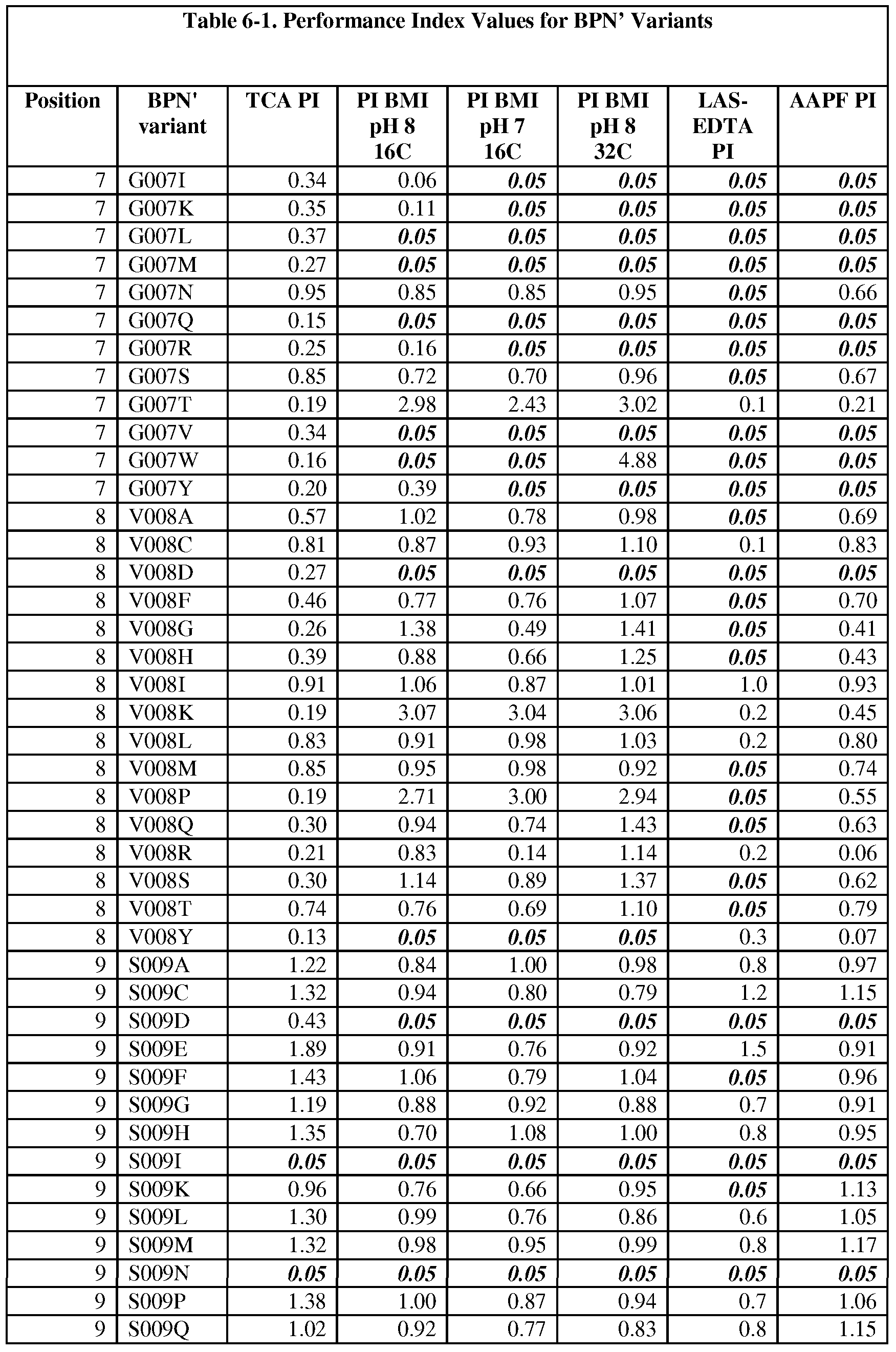
Ref document number: 09759359

Country of ref document: EP

Kind code of ref document: A2

WWE Wipo information: entry into national phase

Ref document number: 589082

Country of ref document: NZ

Ref document number: 2009256169

Country of ref document: AU

WWE Wipo information: entry into national phase

Ref document number: 7375/CHENP/2010

Country of ref document: IN

WWE Wipo information: entry into national phase

Ref document number: 2726370

Country of ref document: CA

Ref document number: MX/A/2010/013121

Country of ref document: MX

ENP Entry into the national phase

Ref document number: 2009256169

Country of ref document: AU

Date of ref document: 20090603

Kind code of ref document: A

ENP Entry into the national phase

Ref document number: 20107027454

Country of ref document: KR

Kind code of ref document: A

WWE Wipo information: entry into national phase

Ref document number: 2011512621

Country of ref document: JP

NENP Non-entry into the national phase

Ref country code: DE

WWE Wipo information: entry into national phase

Ref document number: 2009759359

Country of ref document: EP

WWE Wipo information: entry into national phase

Ref document number: 2010153864

Country of ref document: RU

WWE Wipo information: entry into national phase

Ref document number: 12996538

Country of ref document: US

ENP Entry into the national phase

Ref document number: PI0915073

Country of ref document: BR

Kind code of ref document: A2

Effective date: 20101206