WO2023250301A1 - Methods and compositions for cleaning comprising a polypeptide having thermolysin activity - Google Patents
Methods and compositions for cleaning comprising a polypeptide having thermolysin activity Download PDFInfo
- Publication number
- WO2023250301A1 WO2023250301A1 PCT/US2023/068672 US2023068672W WO2023250301A1 WO 2023250301 A1 WO2023250301 A1 WO 2023250301A1 US 2023068672 W US2023068672 W US 2023068672W WO 2023250301 A1 WO2023250301 A1 WO 2023250301A1
- Authority
- WO
- WIPO (PCT)
- Prior art keywords
- polypeptide
- fragrance
- composition
- detergent
- perfume
- Prior art date
- Legal status (The legal status is an assumption and is not a legal conclusion. Google has not performed a legal analysis and makes no representation as to the accuracy of the status listed.)
- Ceased
Links
Classifications
-
- C—CHEMISTRY; METALLURGY
- C11—ANIMAL OR VEGETABLE OILS, FATS, FATTY SUBSTANCES OR WAXES; FATTY ACIDS THEREFROM; DETERGENTS; CANDLES
- C11D—DETERGENT COMPOSITIONS; USE OF SINGLE SUBSTANCES AS DETERGENTS; SOAP OR SOAP-MAKING; RESIN SOAPS; RECOVERY OF GLYCEROL
- C11D3/00—Other compounding ingredients of detergent compositions covered in group C11D1/00
- C11D3/16—Organic compounds
- C11D3/38—Products with no well-defined composition, e.g. natural products
- C11D3/386—Preparations containing enzymes, e.g. protease or amylase
-
- C—CHEMISTRY; METALLURGY
- C11—ANIMAL OR VEGETABLE OILS, FATS, FATTY SUBSTANCES OR WAXES; FATTY ACIDS THEREFROM; DETERGENTS; CANDLES
- C11D—DETERGENT COMPOSITIONS; USE OF SINGLE SUBSTANCES AS DETERGENTS; SOAP OR SOAP-MAKING; RESIN SOAPS; RECOVERY OF GLYCEROL
- C11D3/00—Other compounding ingredients of detergent compositions covered in group C11D1/00
- C11D3/50—Perfumes
-
- C—CHEMISTRY; METALLURGY
- C11—ANIMAL OR VEGETABLE OILS, FATS, FATTY SUBSTANCES OR WAXES; FATTY ACIDS THEREFROM; DETERGENTS; CANDLES
- C11D—DETERGENT COMPOSITIONS; USE OF SINGLE SUBSTANCES AS DETERGENTS; SOAP OR SOAP-MAKING; RESIN SOAPS; RECOVERY OF GLYCEROL
- C11D2111/00—Cleaning compositions characterised by the objects to be cleaned; Cleaning compositions characterised by non-standard cleaning or washing processes
- C11D2111/10—Objects to be cleaned
- C11D2111/12—Soft surfaces, e.g. textile
Definitions
- the present disclosure relates to compositions and methods cleaning, for example hard surface and laundry cleaning and mitigation of malodor from a textile, hard surface, or dishware.
- sequence listing is submitted electronically via Patent Center as an XML formatted sequence listing with a file named 20230613 NB42099PCT SeqListing created on June 13, 2023 and having a size of 2,128 bytes and is filed concurrently with the specification.
- sequence listing contained in this XML formatted document is part of the specification and is herein incorporated by reference in its entirety.
- Another embodiment is directed to methods for cleaning an item, comprising contacting an item in need of cleaning with a composition comprising a) 0.2 to 100 parts per million (PPM) of a polypeptide having thermolysin activity; b) 0.00001% to about 2% of a fragrance; and c) at least one detergent adjuvant, and (ii) optionally rinsing the item.
- a composition comprising a) 0.2 to 100 parts per million (PPM) of a polypeptide having thermolysin activity; b) 0.00001% to about 2% of a fragrance; and c) at least one detergent adjuvant, and (ii) optionally rinsing the item.
- the disclosure further provides an enzyme-fragrance system comprising from about 0.2 to 100 PPM of a polypeptide having thermolysin activity; and from about 0.00001% to about 2% of a fragrance.
- an enzyme-fragrance system comprising from about 0.2 to 100 PPM of a polypeptide having thermolysin activity; and from about 0.00001% to about 2% of a fragrance.
- detergent compositions comprising, from about 0.2 to 100 PPM of a polypeptide having thermolysin activity, from about 0.00001% to about 2% of a fragrance, and optionally at least one detergent adjunct material.
- DESCRIPTION [0012]
- the present disclosure provides compositions (e.g. enzyme and detergent compositions) and methods using such compositions for the mitigation of malodor, for example, from an article, such as a hard surface or textile.
- the present disclosure also provides compositions (e.g.
- compositions generally employ the use of an enzyme-fragrance combination comprising at least one polypeptide having thermolysin activity and a perfume or a composition comprising a polypeptide having thermolysin activity and a perfume.
- the compositions also optionally comprise additional components of a cleaning detergent, such as one or more surfactants.
- malodor refers to any odor that is not desired or intended on an item, for example after cleaning.
- malodor include volatile compounds with a perceived unpleasant smell, which may be produced by microorganisms.
- the microorganisms may be gram positive or gram-negative bacteria (aerobic or anaerobic); algae, protozoa, and/or yeast or filamentous fungi.
- the malodor may be associated with one or more microorganisms, including one or more bacterial genera of Acinetobacter sp., Aeromicrobium sp., Brevundimonas sp., Microbacterium sp., Micrococcus luteus, Pseudomonas sp. (e.g. Pseudomonas fluorescens), Staphylococcus sp. (e.g. Staphylococcus epidermidis), and Stenotrophomonas sp., Streptomyces sp., Listeria sp., Streptococcus sp., and Escherichia sp.
- Acinetobacter sp. Aeromicrobium sp., Brevundimonas sp.
- Microbacterium sp. Micrococcus luteus
- Pseudomonas sp. e.g. Pseudomonas fluor
- fragrance effect refers to the human perception of a fragrance on a washed item, such as a fabric (e.g. laundered clothing).
- the fragrance effect of an enzyme- fragrance combination or composition comprising an enzyme- fragrance combination as provided herein can be analyzed, for example, by the use of a sensory evaluation, such as that described in Example 1, 2, or 5 below. Alternatively, the fragrance effect can be measured by GC-MS analysis and expressed quantitatively as a fragrance intensity.
- An increased fragrance effect can thus be expressed as an increased fragrance intensity, such that washing an item with a polypeptide having thermolysin activity and a fragrance or a composition comprising a polypeptide having thermolysin activity and a fragrance compared to a similar item not having been washed with the polypeptide having thermolysin activity and a fragrance or composition comprising a polypeptide having thermolysin activity and a fragrance, or compared to the same item prior to washing.
- “surface” means any surface, including hard, soft, and porous surfaces. Hard surfaces include, but are not limited to metal, glass, ceramics, wood, minerals (rock, stone, marble, granite), aggregate materials such as concrete, plastics, composite materials, hard rubber materials, and gypsum.
- the hard materials may be finished with enamels and paints.
- Hard surfaces are found, for example in water treatment and storage equipment and tanks; dairy and food processing equipment and facilities; medical equipment and facilities, such as surgical instruments and permanent and temporary implants; industrial pharmaceutical equipment and plants.
- Soft surfaces are, for example, hair and all types of textiles.
- Porous surfaces also may be found in certain ceramics as well as in membranes that are used for filtration.
- Other surfaces include, but are not limited to, ship hulls and swimming pools.
- Other surfaces may be biological surfaces, such as skin, keratin or internal organs.
- the textile or fabric may be in the form of knits, wovens, denims, non- wovens, felts, yarns, and towelling.
- the textile may be cellulose based such as natural cellulosics, including cotton, flax/linen, jute, ramie, sisal or coir or manmade cellulosics (e.g. originating from wood pulp) including viscose/rayon, cellulose acetate fibers (tricell), lyocell or blends thereof.
- the textile or fabric may also be non-cellulose based such as natural polyamides including wool, camel, cashmere, mohair, rabbit and silk or synthetic polymers such as nylon, aramid, polyester, acrylic, polypropylene and spandex/elastane, or blends thereof as well as blends of cellulose based and non-cellulose based fibers.
- non-cellulose based such as natural polyamides including wool, camel, cashmere, mohair, rabbit and silk or synthetic polymers such as nylon, aramid, polyester, acrylic, polypropylene and spandex/elastane, or blends thereof as well as blends of cellulose based and non-cellulose based fibers.
- blends are blends of cotton and/or rayon/viscose with one or more companion material such as wool, synthetic fiber (e.g. polyamide fiber, acrylic fiber, polyester fiber, polyvinyl chloride fiber, polyurethane fiber, polyurea fiber, aramid fiber), and/or cellulose-containing fiber (e.g.
- Fabric may be conventional washable laundry, for example stained household laundry.
- fabric or garment it is intended to include the broader term textiles as well.
- textile is used interchangeably with fabric and cloth.
- hard surface refers to any article having a hard surface including floors, tables, walls, roofs etc. as well as surfaces of hard objects such as cars (car wash), ship hulls, dishes (dishware), medical instruments, pipes, reservoirs, or holding tanks.
- wash cycle refers to a washing operation in which textiles are immersed in a wash liquor, mechanical action of some kind is applied to the textile to release stains or to facilitate flow of wash liquor in and out of the textile and finally the superfluous wash liquor is removed. After one or more wash cycles, the textile is generally rinsed and dried.
- wash liquor is defined herein as the solution or mixture of water and detergent components optionally including polypeptides having thermolysin activity and a perfume.
- polypeptides, compositions, and methods provided herein further have utility in a wide array of applications in which improving the fragrance effect of a given fragrance is desired, such as household cleaning, including in washing machines, dishwashers, and on household surfaces.
- Another embodiment is directed to a method of laundering a textile, where the method comprises contacting a textile with a polypeptide having thermolysin activity and a perfume, or a composition comprising a polypeptide having thermolysin activity and a perfume for an amount of time sufficient to prevent, reduce or remove a malodor from the textile and optionally rinsing the textile.
- the composition may contain a polypeptide having thermolysin activity in an amount of 0.002 to 5000 mg of protein, such as 0.005 to 1300 mg of protein, or 0.01 to 5000 mg of protein, or 0.01 to 1300 mg of protein, or 0.1 to 5000 mg of protein, or 1 to 1300 mg of protein, preferably 0.1 to 1300 mg of protein, more preferably 1 to 1300 mg of protein, even more preferably 10 to 500 mg of protein, per liter of wash liquor, or in the amount of at least 0.002 ppm active thermolysin.
- a polypeptide having thermolysin activity in an amount of 0.002 to 5000 mg of protein, such as 0.005 to 1300 mg of protein, or 0.01 to 5000 mg of protein, or 0.01 to 1300 mg of protein, or 0.1 to 5000 mg of protein, or 1 to 1300 mg of protein, preferably 0.1 to 1300 mg of protein, more preferably 1 to 1300 mg of protein, even more preferably 10 to 500 mg of protein, per liter of
- the detergent composition comprises a polypeptide having thermolysin activity in an amount to provide the thermolysin in a wash liquor in an amount of between 0.1 to 5000 ppm, between about 0.1 to 2500 ppm, between about 0.1 to 1500 ppm, between about 0.1 to 1300 ppm, between about 0.1 to 1000 ppm, between about 0.1 to 500 ppm, between 1 to 1300 ppm, between 10 to 1300 ppm, between about 10 and 500 PPM, between about 50 and 1300 ppm, between about 50 and 500 ppm in the wash liquor.
- compositions having a polypeptide having thermolysin activity and a perfume which find use in the methods provided herein, may comprise a perfume in an amount sufficient to provide a wash liquor an amount of perfume of about 0.001%, 0.0005%, 0.0002%, or 0.0001%.
- the composition comprises a thermolysin, a fragrance, and at least one additional detergent component, and optionally one or more additional enzymes.
- the thermolysin polypeptide for use in the methods and compositions herein includes any thermolysin polypeptide.
- thermolysin refers to enzymes with E.C.3.4.24.X, or any member of the M4 protease family as described in MEROPS - The Peptidase Data base (See, Rawlings et al., MEROPS: the peptidase database, Nucl Acids Res, 34 Database issue, D270-272 [2006]), of which thermolysin (TLN; EC 3.4.24.27) is the prototype.
- TNN EC 3.4.24.27
- the amino acid sequence of one embodiment of thermolysin is the neutral metallo endo- peptidase secreted from Bacillus thermoproteolyticus and the sequence set forth as UniProtKB/Swiss-Prot Accession No.
- homologous genes refers to a pair of genes from different, but usually related species, which correspond to each other and which are identical or very similar to each other.
- the term encompasses genes that are separated by speciation (i.e., the development of new species) (e.g., orthologous genes), as well as genes that have been separated by genetic duplication (e.g., paralogous genes).
- variant polypeptide refers to a polypeptide comprising an amino acid sequence that differs in at least one amino acid residue from the amino acid sequence of a parent or reference polypeptide (including but not limited to wild-type polypeptides).
- the genus Bacillus includes all species within the genus “Bacillus,” as known to those of skill in the art, including but not limited to B. subtilis, B. licheniformis, B. lentus, B. brevis, B. stearothermophilus, B. alkalophilus, B. amyloliquefaciens, B. clausii, B. halodurans, B. megaterium, B. coagulans, B. circulans, B. lautus, and B. thuringiensis. It is recognized that the genus Bacillus continues to undergo taxonomical reorganization.
- the genus include species that have been reclassified, including but not limited to such organisms as B. stearothermophilus, which is now named “Geobacillus stearothermophilus.”
- B. stearothermophilus which is now named “Geobacillus stearothermophilus.”
- the production of resistant endospores in the presence of oxygen is considered the defining feature of the genus Bacillus, although this characteristic also applies to the recently named Alicyclobacillus, Amphibacillus, Aneurinibacillus, Anoxybacillus, Brevibacillus, Filobacillus, Gracilibacillus, Halobacillus, Paenibacillus, Salibacillus, Thermobacillus, Ureibacillus, and Virgibacillus.
- the thermolysin has an amino acid sequence having at least 50%, 55%, 60%, 65%, 70%, 75%, 80%, 85%, 90%, 91%, 92%, 93%, 94%, 95%, 96%, 97%, 98%, 99% or 100% sequence identity to SEQ ID NO: 1 and has the ability to prevent, reduce or remove odor causing residues in laundry.
- the thermolysin has an amino acid sequence having at least 50%, 55%, 60%, 65%, 70%, 75%, 80%, 85%, 90%, 91%, 92%, 93%, 94%, 95%, 96%, 97%, 98%, 99% or 100% sequence identity to SEQ ID NO: 1 and has the ability to clean body soil stains.
- thermolysin has an amino acid sequence having at least 50%, 55%, 60%, 65%, 70%, 75%, 80%, 85%, 90%, 91%, 92%, 93%, 94%, 95%, 96%, 97%, 98%, 99% or 100% sequence identity to SEQ ID NO: 1 and has the ability to reduce malodor by 5%, 10%, 20%, 30%, 40%, 50%, 60%, 70%, 80%, 90%, or 100% relative to a control not treated with enzyme.
- thermallysin activity and “proteolytic activity” refers to a protein or polypeptide exhibiting the ability to hydrolyze peptides or substrates having peptide linkages.
- Methods for measuring proteolytic activity include comparative assays, which analyze the respective protease’s ability to hydrolyze a commercial substrate. Other methods include those provided herein.
- Exemplary substrates useful in the analysis of protease or proteolytic activity include, but are not limited to, di-methyl casein (Sigma C-9801), bovine collagen (Sigma C-9879), bovine elastin (Sigma E-1625), and bovine keratin (ICN Biomedical 902111). Colorimetric assays utilizing these substrates are well known in the art (See e.g., WO99/34011 and US 6,376,450).
- PILEUP creates a multiple sequence alignment from a group of related sequences using progressive, pair-wise alignments. It can also plot a tree showing the clustering relationships used to create the alignment. PILEUP uses a simplification of the progressive alignment method of Feng and Doolittle (See, Feng and Doolittle, J. Mol. Evol.35:351-360 [1987]).
- Useful PILEUP parameters include a default gap weight of 3.00, a default gap length weight of 0.10, and weighted end gaps.
- Other useful algorithm is the BLAST algorithms described by Altschul et al., (See, Altschul et al., J. Mol. Biol.215:403-410 [1990]; and Karlin and Altschul, Proc. Natl. Acad. Sci. USA 90:5873-5787 [1993]). The BLAST program uses several search parameters, most of which are set to the default values.
- homologous proteins or “homologous proteases” refers to proteins that have distinct similarity in primary, secondary, and/or tertiary structure. Protein homology can refer to the similarity in linear amino acid sequence when proteins are aligned. Homology can be determined by amino acid sequence alignment, e.g., using a program such as BLAST, MUSCLE, or CLUSTAL. Homologous search of protein sequences can be done using BLASTP and PSI-BLAST from NCBI BLAST with threshold (E-value cut-off) at 0.001.
- Amino acid sequences can be entered in a program such as the Vector NTI Advance suite and a Guide Tree can be created using the Neighbor Joining (NJ) method (Saitou and Nei, Mol Biol Evol, 4:406-425, 1987).
- NJ Neighbor Joining
- the tree construction can be calculated using Kimura’s correction for sequence distance and ignoring positions with gaps.
- a program such as AlignX can display the calculated distance values in parentheses following the molecule name displayed on the phylogenetic tree.
- a percent (%) amino acid sequence identity value is determined by the number of matching identical residues divided by the total number of residues of the "reference" sequence including any gaps created by the program for optimal/maximum alignment.
- SEQ ID NO: A is the “reference” sequence.
- BLAST algorithms refer the “reference” sequence as “query” sequence.
- CLUSTAL W algorithm is another example of a sequence alignment algorithm (See, Thompson et al., Nucleic Acids Res, 22:4673-4680, 1994).
- deletions occurring at either terminus are included.
- thermolysin for use herein includes those thermolysin polypeptides described in WO2015/066669.
- thermolysin polypeptide for use herein includes variants of thermolysin, including those disclosed in WO2014071410 and US20140099698, US201880073006, EP3260538, and US20180066244.
- Fragrances, or perfumes, for use in the compositions and methods herein include any fragrance/perfume available.
- fragrance or “perfume” includes raw materials and compositions, accords, scents and oils, for example essential oils.
- a wide variety of chemicals are known for fragrance (i.e., perfume) uses, including compounds such as aldehydes, ketones and esters.
- a perfume may be a blend of volatile compounds with different volatilities which can bind to receptors in the nose and therefore has a smell or odor, usually a pleasant one. These compounds are also known as odorants or fragrances. Most perfumes possess molar weights of up to approximately 200 g/mol, in some cases up to about 300 g/mol. Larger molecules are not volatile enough to be perceived by the human nose. [0054] The volatility of a compound describes how readily it vaporizes by way of evaporation or boiling. Perfume compounds vaporize, depending on their volatility, by evaporation at room temperature and atmospheric pressure.
- Volatility is often described using vapor pressure or boiling point, with a high vapor pressure or low boiling point indicating a high volatility. Although the volatility of a compound is related to its molecular weight, other factors such as structure and polarity also play a role, as does interaction between fragrance compounds.
- the most volatile fragrance compounds are referred to as top notes or head notes, whereas increasingly less volatile compounds are referred to as heart notes or middle notes, and the least volatile as base notes or back notes.
- the top notes are responsible for the first impression of a detergent, and the heart notes represent the characteristic smell.
- the base notes ensure the more substantial, long-lasting effect of the perfume.
- the top, heart (middle) and base notes may be grouped based in different criteria.
- fragrance compounds are classified according to an evaporation coefficient, with top notes having a coefficient of from 1 to 14, middle notes having a coefficient of from 15 to 60, and base notes having a coefficient of from 61 to 100.
- Information regarding fragrance compounds such as molecular weight, vapor pressure and boiling point may also indicate whether particular fragrance compounds are top notes, middle notes or base notes.
- the duration of the “freshness” or “cleanliness” effect provided by a perfume in a detergent composition is influenced by how fragrances and malodors are retained on the washed fabric.
- Laundry malodors can come from various sources, including human body odor as well as malodors from the environment such as kitchen odors, cigarettes, food stains, etc.
- Another important source of malodors is from microbes present in the textile, which can metabolize the substances transferred from the human body (sweat, dead cells, sebum, etc.) and generate malodors during drying, storage or wearing.
- Material type may also be an important factor in retaining and release of odor compounds.
- malodor compounds may be more effectively removed from cotton than from polyester. This is partly related to the polarity (hydrophilicity) of the odor compounds and that of the textile fibers, with cotton containing mainly highly polar cellulosic fibers, while fibers of polyester and wool are relatively non-polar compared to cotton fibers.
- the order of compound polarity of fragrance compounds from high to low is as follows: Amide > Acid > Alcohol > Ketone ⁇ Aldehyde > Ester > Alkane.
- Fragrance compounds used in laundry detergents may be chemical compounds from any of several different classes or essential oils or other natural compounds.
- the perfumes that may be used in the context of the present disclosure include all perfumes.
- synthetic or natural odorant substance compounds of the types esters, ethers, aldehydes (fragrance aldehydes, odorant aldehydes), ketones (fragrance ketones, odorant ketones), alcohols, hydrocarbons, acids, carbonic acid esters, aromatic hydrocarbons, aliphatic hydrocarbons, saturated and/or unsaturated hydrocarbons and mixtures of these may be used as perfume compounds.
- Individual fragrance compounds e.g. synthetic products of the ester, ether, aldehyde, ketone, alcohol, and hydrocarbon types, can be used as well as mixtures thereof.
- mixtures of different perfume compounds which together generate an attractive scent note.
- Such mixtures can also contain natural perfume mixtures such as those accessible from plant sources, e.g. pine, citrus, jasmine, patchouli, rose or ylang-ylang oil.
- Fragrances that find use in the compositions and methods herein include, but are not limited to those provided below.
- Suitable perfumes of the ester type include e.g.
- Odorant substance compounds of the hydrocarbon type include e.g. terpenes such as limonene and pinene.
- Suitable perfumes of the ether type include e.g. benzyl ethyl ether and ambroxan.
- Suitable perfume alcohols include e.g.10-undecen-1 -ol, 2,6-dimethyl heptan-2-ol, 2- methyl butanol, 2-methyl pentanol, 2-phenoxy ethanol, 2-phenyl propanol, 2-tert-butyl cyclohexanol, 3,5,5-trimethyl cyclohexanol, 3-hexanol, 3-methyl-5-phenyl pentanol, 3-octanol, 1 - octen-3-ol, 3-phenyl propanol, 4-heptenol, 4-isopropyl cyclohexanol, 4-tert-butyl cyclohexanol, 6,8-dimethyl-2-nonanol, 6-nonen-1 -ol, 9-dec
- Suitable perfume ketones can include all ketones that can lend a desired scent or a sensation of freshness. Mixtures of different ketones can also be used.
- the ketone can be selected from the group consisting of buccoxime, iso-jasmone, methyl-beta-naphthyl ketone, Moschus indanone, Tonalid/Moschus plus, alpha-damascone, beta-damascone, delta- damascone, isodamascone, damascenone, damarose, methyl dihydro jasmonate, menthone, carvone, campher, fenchone, alpha-ionene, beta-ionone, dihydro-beta-ionone, gamma-methyl ionone, fleuramone, dihydro jasmone, cis-jasmone, iso-E-Super, methyl cedrenyl ketone or methyl cedrylone,
- ketones may e.g. be selected from alpha-damascone, delta-damascone, isodamascone, carvone, gamma-methyl ionone, iso-E-super, 2,4,4,7-tetramethyl-oct-6-en-3- one,benzyl acetone, beta-damascone, damascenone, methyl dihydro jasmonate, methyl cedrylone, hedione and mixtures thereof.
- Suitable perfume aldehydes can be any aldehydes that produce a desired scent or a sensation of freshness. They may be individual aldehydes or mixtures of aldehydes.
- aldehydes are melonal, triplal, ligustral, adoxal, anis aldehyde, cymal, ethyl vanillin, florhydral, helional, heliotropine, hydroxy citronellal, koavone, laurin aldehyde, lyral, methyl nonyl acetaldehyde, para-tert-bucinal, phenyl acetaldehyde, undecylene aldehyde, vanillin, 2,6,10- trimethyl-9-andecenal, 3-dodecen-1 -al, alpha-n-amyl cinnamaldehyde, 4-methoxy benzaldehyde, benzaldehyde, 3-(4-tert-butylphenyl)-propanal, 2-methyl-3-(para-methoxy phenyl propanal), 2- methyl-4-(2,6,6-trimethyl-2(
- Preferred aldehydes may e.g. be selected from cis/trans-3,7-dimethyl-2,6-octadien-1 -al, heliotropin, 2,4,6-trimethyl-3-cyclohexene-1 - carboxaldehyde, 2,6-nonadienal, alpha-n-amyl cinnamaldehyde, alpha-n-hexyl cinnamaldehyde, para-tert-bucinal, lyral, cymal, methyl nonyl acetaldehyde, trans-2-nonenal, lilial, trans-2- nonenal and mixtures thereof.
- Perfume compounds may also be natural odorant mixtures such as those accessible from plant sources, e.g. pine, citrus, jasmine, patchouli, rose or ylang-ylang oil. Also suitable are muscat, sage oil, chamomile oil, clove oil, mint oil, cinnamon leaf oil, lime blossom oil, juniper berry oil, vetiver oil, olibanum (frankincense) oil, galbanum oil and labdanlum oil as well as orange blossom oil, neroli oil, orange peel oil and sandalwood oil.
- the perfume compounds may also be essential oils, e.g.
- angelica root oil anise oil, arnica blossom oil, basal oil, bay oil, champaca blossom oil, silver fir oil, silver fir cone oil, elemi oil, eucalyptus oil, fennel oil, spruce needle oil, geranium oil, gingergrass oil, guaiac wood oil, gurjun balsam oil, helichrysum oil, ho leaf oil, ginger oil, iris oil, cajeput oil, calmus oil, camphor oil, canaga oil, cardamom oil, cassia oil, copaiva balsam oil, coriander oil, spearmint oil, caraway oil, cumen oil, lavender oil, lemongrass oil, lime oil, mandarin oil, lemon balm oil, musk seed oil, myrrh oil, niaouli oil, origanum oil, palmarosa oil, peru balsam oil, petit grain oil, pepper oil, peppermint oil, pimento oil, rosemary oil, celery oil, spike oil, stemanis
- fragrance ingredients may be obtained from The International Fragrance Association (IFRA), which publishes a list of all fragrance ingredients used in consumer goods (ifrafragrance.org/initiatives/transparency/ifra-transparency-list).
- IFRA International Fragrance Association
- a plurality of perfume compounds e.g. those listed above or on the list maintained by the IFRA, may be included in a compositions provided herein in combination with the thermolysin polypeptide.
- the compositions of the invention may therefore e.g. contain three or more, such as four or more, five or more, six or more or seven or more different perfume components.
- compositions of the invention will typically contain one or more perfume components in a total amount (by weight) of from 0.0001 % to 2.5%, such as 0.001 -2%, e.g. 0.01 -1.5%, for example 0.1 -1 % percent, based on the total amount of perfume components and the total weight of the composition.
- the compositions provided herein will contain one or more perfume components in an amount sufficient to provide a concentration in a wash solution of between about 0.0000001% to about 2%.
- detergent compositions may, for example, be included in detergent compositions that are in the form of liquids, gels, powders, granulates, tablets, pods, pouches and soap bars.
- Perfume components may be incorporated into detergent compositions in physical forms and using methods known in the art, e.g. adding the perfume components as liquids, solid particles and/or microcapsules.
- detergent compositions which find use in the methods provided herein.
- the term “detergent composition” or “detergent formulation” is used in reference to a composition intended for use in a wash medium (e.g. a wash liquor) for the cleaning of soiled or dirty objects, including particular textile or non-textile objects or items.
- compositions of the present invention are not limited to any particular detergent composition or formulation.
- the detergents of the invention comprise at least one thermolysin or metalloprotease polypeptide (e.g. Proteinase T), a perfume and, in addition, one or more surfactants, transferase(s), hydrolytic enzymes, oxido reductases, builders (e.g., a builder salt), bleaching agents, bleach activators, bluing agents, fluorescent dyes, caking inhibitors, masking agents, enzyme activators, antioxidants, and/or solubilizers.
- thermolysin or metalloprotease polypeptide e.g. Proteinase T
- a perfume e.g., a perfume
- one or more surfactants e.g. Proteinase T
- transferase(s) e.g., oxido reductases
- builders e.g., a builder salt
- bleaching agents e.g., bleach activators, bluing agents,
- a builder salt is a mixture of a silicate salt and a phosphate salt, preferably with more silicate (e.g., sodium metasilicate) than phosphate (e.g., sodium tripolyphosphate).
- silicate e.g., sodium metasilicate
- phosphate e.g., sodium tripolyphosphate
- Some compositions of the invention such as, but not limited to, cleaning compositions or detergent compositions, do not contain any phosphate (e.g., phosphate salt or phosphate builder).
- the cleaning or detergent compositions of the present invention further comprise adjunct materials including, but not limited to, surfactants, builders, bleaches, bleach activators, bleach catalysts, other enzymes, enzyme stabilizing systems, chelants, optical brighteners, soil release polymers, dye transfer agents, dispersants, suds suppressors, dyes, colorants, filler salts, hydrotropes, photoactivators, fluorescers, fabric conditioners, hydrolyzable surfactants, preservatives, anti-oxidants, anti-shrinkage agents, anti- wrinkle agents, germicides, fungicides, color speckles, silvercare, anti-tarnish and/or anti- corrosion agents, alkalinity sources, solubilizing agents, carriers, processing aids, pigments, and pH control agents (See e.g., U.S.
- adjunct materials including, but not limited to, surfactants, builders, bleaches, bleach activators, bleach catalysts, other enzymes, enzyme stabilizing systems, chelants, optical brighteners, soil release polymers
- the detergent or cleaning compositions of the present invention are advantageously employed for example, in laundry applications, hard surface cleaning, dishwashing applications, as well as cosmetic applications such as dentures, teeth, hair and skin.
- the compositions of the present invention are ideally suited for laundry applications.
- the compositions of the present invention find use in granular and liquid compositions.
- Enzyme component weights are based on total active protein.
- the laundry detergent compositions described herein comprise from about 0.1% to about 60%, about 1% to about 50%, or about 5% to about 40% surfactant by weight of the composition.
- exemplary surfactants include, but are not limited to sodium dodecylbenzene sulfonate, C12-14 pareth-7, C12-15 pareth-7, sodium C12-15 pareth sulfate, C14-15 pareth-4, sodium laureth sulfate (e.g., Steol CS-370), sodium hydrogenated cocoate, C12 ethoxylates (Alfonic 1012-6, Hetoxol LA7, Hetoxol LA4), sodium alkyl benzene sulfonates (e.g., Nacconol 90G), and combinations and mixtures thereof.
- Nonionic surfactants include but are not limited to alcohol ethoxylate (AEO or AE), carboxylated alcohol ethoxylates, nonylphenol ethoxylate, alkylpolyglycoside, alkyldimethylamine oxide, ethoxylated fatty acid monoethanolamide, fatty acid monoethanolamide, polyhydroxy alkyl fatty acid amide (e.g., as described in WO92/06154), polyoxyethylene esters of fatty acids, polyoxyethylene sorbitan esters (e.g., TWEENs), polyoxyethylene alcohols, polyoxyethylene isoalcohols, polyoxyethylene ethers (e.g., TRITONs and BRIJ), polyoxyethylene esters, polyoxyethylene-p- tert-octylphenols or octylphenyl-ethylene oxide condensates (e.g., NONIDET P40), ethylene oxide condensates with fatty alcohols (e.g., LUBROL
- the laundry detergent compositions described herein further comprise a surfactant mixture that includes, but is not limited to 5-15% anionic surfactants, ⁇ 5% nonionic surfactants, cationic surfactants, phosphonates, soap, enzymes, perfume, butylphenyl methylpropionate, geraniol, zeolite, polycarboxylates, hexyl cinnamal, limonene, cationic surfactants, citronellol, and benzisothiazolinone.
- a surfactant mixture that includes, but is not limited to 5-15% anionic surfactants, ⁇ 5% nonionic surfactants, cationic surfactants, phosphonates, soap, enzymes, perfume, butylphenyl methylpropionate, geraniol, zeolite, polycarboxylates, hexyl cinnamal, limonene, cationic surfactants, citronellol, and benziso
- the laundry detergent compositions described herein may additionally include one or more detergent builders or builder systems, a complexing agent, a polymer, a bleaching system, a stabilizer, a foam booster, a suds suppressor, an anti-corrosion agent, a soil-suspending agent, an anti-soil redeposition agent, a dye, a bactericide, a hydrotope, an optical brightener, a fabric conditioner, and a perfume.
- a detergent builders or builder systems a complexing agent, a polymer, a bleaching system, a stabilizer, a foam booster, a suds suppressor, an anti-corrosion agent, a soil-suspending agent, an anti-soil redeposition agent, a dye, a bactericide, a hydrotope, an optical brightener, a fabric conditioner, and a perfume.
- the laundry detergent compositions described herein may also include additional enzymes selected from proteases, amylases, cellulases, lipases, mannanases, nucleases, pectinases, xyloglucanases, or perhydrolases, as provided in more detail herein. [0083] In some embodiments, the laundry detergent compositions described herein further comprises from about 1%, from about 3% to about 60% or even from about 5% to about 40% builder by weight of the cleaning composition.
- the builders form water-soluble hardness ion complexes (e.g., sequestering builders), such as citrates and polyphosphates (e.g., sodium tripolyphosphate and sodium tripolyphospate hexahydrate, potassium tripolyphosphate, and mixed sodium and potassium tripolyphosphate, etc.).
- sequestering builders such as citrates and polyphosphates (e.g., sodium tripolyphosphate and sodium tripolyphospate hexahydrate, potassium tripolyphosphate, and mixed sodium and potassium tripolyphosphate, etc.).
- Any suitable builder can find use in the compositions described herein, including those known in the art.
- the laundry detergent compositions described herein further comprise an adjunct ingredient including, but not limited to surfactants, builders, bleaches, bleach activators, bleach catalysts, additional enzymes, an enzyme stabilizer (including, for example, an enzyme stabilizing system), chelants, optical brighteners, soil release polymers, dye transfer agents, dye transfer inhibiting agents, catalytic materials, hydrogen peroxide, sources of hydrogen peroxide, preformed peracids, polymeric dispersing agents, clay soil removal agents, structure elasticizing agents, dispersants, suds suppressors, dyes, perfumes, colorants, filler salts, hydrotropes, photoactivators, fluorescers, fabric conditioners, hydrolyzable surfactants, solvents, preservatives, anti-oxidants, anti-shrinkage agents, anti-wrinkle agents, germicides, fungicides, color speckles, anti-corrosion agents, alkalinity sources, solubilizing agents, carriers, processing aids, pigments, pH control agents, and
- the enzymes employed herein are stabilized by the presence of water-soluble sources of zinc (II), calcium (II) and/or magnesium (II) ions in the finished compositions that provide such ions to the enzymes, as well as other metal ions (e.g., barium (II), scandium (II), iron (II), manganese (II), aluminum (III), tin (II), cobalt (II), copper (II), nickel (II), and oxovanadium (IV)).
- Chlorides and sulfates also find use in some embodiments. Exemplary oligosaccharides and polysaccharides (e.g., dextrins) are described, for example, in WO07145964.
- the laundry detergent compositions described herein contain reversible protease inhibitors selected from a boron- containing compound (e.g., borate, 4-formyl phenyl boronic acid, and phenyl-boronic acid derivatives, such as, e.g., are described in WO9641859); a peptide aldehyde (such as, e.g., is described in WO2009118375 and WO2013004636), and combinations thereof.
- a boron- containing compound e.g., borate, 4-formyl phenyl boronic acid, and phenyl-boronic acid derivatives, such as, e.g., are described in WO9641859
- a peptide aldehyde such as, e.g., is described in WO2009118375 and WO2013004636
- the cleaning compositions herein are typically formulated such that, during use in aqueous cleaning operations, the wash water will have a
- Liquid product formulations are typically formulated to have a neat pH from about 5.0 to about 9.0, more preferably from about 7.5 to about 9.
- Granular laundry products are typically formulated to have a pH from about 8.0 to about 11.0.
- Techniques for controlling pH at recommended usage levels include the use of buffers, alkalis, acids, etc., and are well known to those skilled in the art.
- Suitable high pH cleaning compositions typically have a neat pH of from about 9.0 to about 11.0, or even a neat pH of from 9.5 to 10.5.
- Such cleaning compositions typically comprise a sufficient amount of a pH modifier, such as sodium hydroxide, monoethanolamine, or hydrochloric acid, to provide such cleaning composition with a neat pH of from about 9.0 to about 11.0.
- Concentrations of detergent compositions in typical wash solutions throughout the world vary from less than about 800 ppm of detergent composition (“low detergent concentration geographies”), for example about 667 ppm in Japan, to between about 800 ppm to about 2000 ppm (“medium detergent concentration geographies”), for example about 975 ppm in U.S. and about 1500 ppm in Brazil, to greater than about 2000 ppm (“high detergent concentration geographies”), for example about 4500 ppm to about 5000 ppm in Europe and about 6000 ppm in high suds phosphate builder geographies.
- low detergent concentration geographies for example about 667 ppm in Japan
- intermediate detergent concentration geographies for example about 975 ppm in U.S. and about 1500 ppm in Brazil
- high detergent concentration geographies for example about 4500 ppm to about 5000 ppm in Europe and about 6000 ppm in high suds phosphate builder geographies.
- the detergent compositions described herein may be utilized at a temperature of from about 10oC to about 60oC, or from about 20oC to about 60oC, or from about 30oC to about 60oC, from about 40oC to about 60oC, from about 40oC to about 55oC, or all ranges within 10oC to 60oC.
- the detergent compositions described herein are used in “cold water washing” at temperatures of from about 10oC to about 40oC, or from about 20oC to about 30oC, from about 15oC to about 25oC, from about 15oC to about 35oC, or all ranges within 10oC to 40oC.
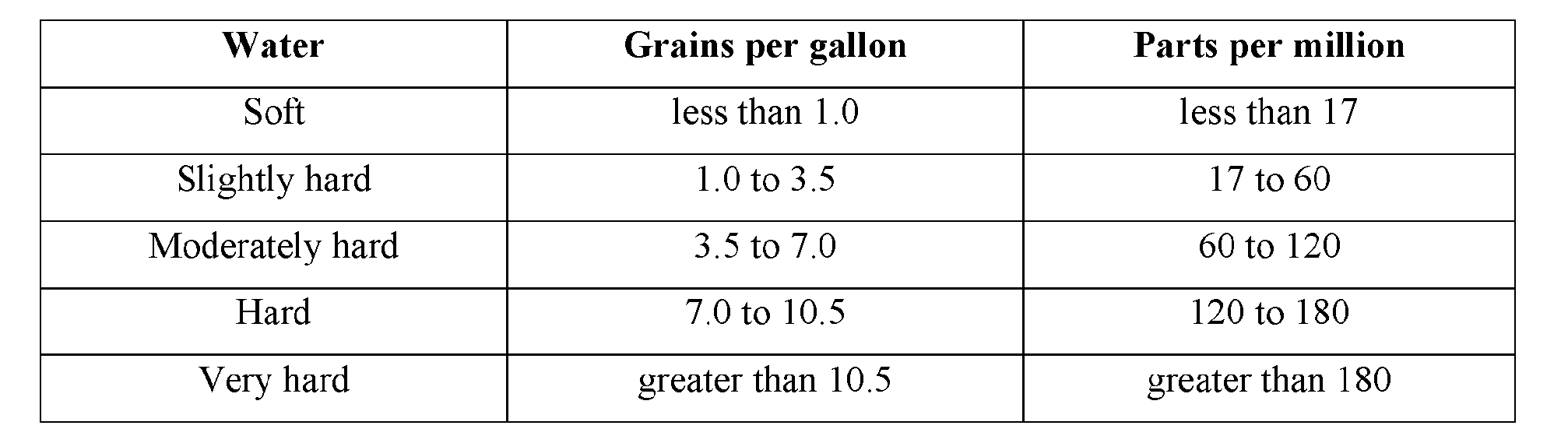
- Water hardness is usually described in terms of the grains per gallon mixed Ca 2+ /Mg 2+ .
- Hardness is a measure of the amount of calcium (Ca 2+ ) and magnesium (Mg 2+ ) in the water. Most water in the United States is hard, but the degree of hardness varies. Moderately hard (60- 120 ppm) to hard (121-181 ppm) water has 60 to 181 parts per million (parts per million converted to grains per U.S. gallon is ppm # divided by 17.1 equals grains per gallon) of hardness minerals. Table 1.
- European water hardness is typically greater than about 10.5 (for example about 10.5 to about 20.0) grains per gallon mixed Ca 2+ /Mg 2+ (e.g., about 15 grains per gallon mixed Ca 2+ /Mg 2+ ).
- North American water hardness is typically greater than Japanese water hardness, but less than European water hardness.
- North American water hardness can be between about 3 to about 10 grains, about 3 to about 8 grains or about 6 grains.
- Japanese water hardness is typically lower than North American water hardness, usually less than about 4, for example about 3 grains per gallon mixed Ca 2+ /Mg 2+ .
- the composition described herein comprises one or more additional enzyme.
- deoxyribonucleases and ribonucleases deoxyribonucleases and ribonucleases
- oxidases oxidoreductases, pectate lyases, pectin acetyl esterases, pectinases, pentosanases, peroxidases, phenoloxidases, phosphatases, phospholipases, phytases, polygalacturonases, polyesterases, additional proteases, pullulanases, reductases, rhamnogalacturonases, beta-glucanases, tannases, transglutaminases, xylan acetyl-esterases, xylanases, xyloglucanases, xylosidases, and any combination or mixture thereof.
- thermolysin polypeptides in some embodiments, are directed to a combination of enzymes (i.e., a “cocktail”) comprising enzymes like amylase, protease, lipase, mannanase, and/or nuclease in conjunction with one or more thermolysin polypeptides in the compositions provided herein.
- the compositions provided herein comprise a polypeptide having thermolysin activity in combination with a protease.
- the protease for use in combination with the thermolysin in the compositions of the instant disclosure include any polypeptide having protease activity.
- the additional protease is a serine protease.
- subtilisin proteases include those derived from for example, Bacillus (e.g., e.g., BPN’, Carlsberg, subtilisin 309, subtilisin 147, and subtilisin 168), or fungal origin, such as, for example, those described in US Patent No.8,362,222.
- Bacillus e.g., e.g., BPN’, Carlsberg, subtilisin 309, subtilisin 147, and subtilisin 168
- fungal origin such as, for example, those described in US Patent No.8,362,222.
- Exemplary additional proteases include but are not limited to those described in WO92/21760, WO95/23221, WO2008/010925, WO09/149200, WO09/149144, WO09/149145, WO 10/056640, WO10/056653, WO2010/0566356, WO11/072099, WO2011/13022, WO11/140364, WO 12/151534, WO2015/038792, WO2015/089447, WO2015/089441, WO 2017/215925, US Publ.
- PCT/US2015/021813 PCT/US2015/055900, PCT/US2015/057497, PCT/US2015/057492, PCT/US2015/057512, PCT/US2015/057526, PCT/US2015/057520, PCT/US2015/057502, PCT/US2016/022282, and PCT/US16/32514, International publications WO2016001449, WO2016087617, WO2016096714, WO2016203064, WO2017089093, and WO2019180111, as well as metalloproteases described in WO1999014341, WO1999033960, WO1999014342, WO1999034003, WO2007044993, WO2009058303, WO 2009058661, WO2014071410, WO2014194032, WO2014194034, WO 2014194054, and WO 2014/194117.
- Exemplary additional proteases include, but are not limited to trypsin (e.g., of porcine or bovine origin) and the Fusarium protease described in WO89/06270.
- Exemplary commercial proteases include, but are not limited to MAXATASE ® , MAXACAL TM , MAXAPEM TM , OPTICLEAN ® , OPTIMASE ® , PROPERASE ® , PURAFECT ® , PURAFECT ® OXP, PURAMAX TM , EXCELLASE TM , PREFERENZ TM proteases (e.g. P100, P110, P280), EFFECTENZ TM proteases (e.g.
- compositions provided herein comprise a polypeptide having thermolysin activity in combination with one or more amylases.
- the composition comprises from about 0.00001% to about 10%, about 0.0001% to about 10%, about 0.001% to about 5%, about 0.001% to about 2%, or about 0.005% to about 0.5% amylase by weight composition.
- Any amylase e.g., alpha and/or beta
- suitable for use in alkaline solutions may be useful to include in such composition.
- An exemplary amylase can be a chemically or genetically modified mutant.
- amylases include, but are not limited to those of bacterial or fungal origin, such as, for example, amylases described in GB 1,296,839, WO9100353, WO9402597, WO94183314, WO9510603, WO9526397, WO9535382, WO9605295, WO9623873, WO9623874, WO 9630481, WO9710342, WO9741213, WO9743424, WO9813481, WO 9826078, WO9902702, WO 9909183, WO9919467, WO9923211, WO9929876, WO9942567, WO 9943793, WO9943794, WO 9946399, WO0029560, WO0060058, WO0060059, WO0060060, WO 0114532, WO0134784, WO 0164852, WO0166712, WO0188107, WO0196537,
- Exemplary commercial amylases include, but are not limited to AMPLIFY®, DURAMYL ® , TERMAMYL ® , FUNGAMYL ® , STAINZYME ® , STAINZYME PLUS ® , STAINZYME PLUS ® , STAINZYME ULTRA ® EVITY ® , and BAN TM (Novozymes); EFFECTENZ TM S 1000, POWERASE TM , PREFERENZ TM S 100, PREFERENZ TM S 110, EXCELLENZ TM S 2000, RAPIDASE ® and MAXAMYL ® P (DuPont).
- the compositions provided herein comprise a polypeptide having thermolysin activity in combination with one or more lipases.
- the composition comprises from about 0.00001% to about 10%, about 0.0001% to about 10%, about 0.001% to about 5%, about 0.001% to about 2%, or about 0.005% to about 0.5% lipase by weight composition.
- An exemplary lipase can be a chemically or genetically modified mutant.
- Exemplary lipases include, but are not limited to, e.g., those of bacterial or fungal origin, such as, e.g., H. lanuginosa lipase (see, e.g., EP 258068 and EP 305216), T.
- lanuginosa lipase see, e.g., WO 2014/059360 and WO2015/010009
- Rhizomucor miehei lipase see, e.g., EP 238023
- Candida lipase such as C. antarctica lipase (e.g., C. antarctica lipase A or B) (see, e.g., EP 214761)
- Pseudomonas lipases such as P. alcaligenes and P. pseudoalcaligenes lipase (see, e.g., EP 218272), P. cepacia lipase (see, e.g., EP 331376), P.
- stutzeri lipase see, e.g., GB 1,372,034
- P. fluorescens lipase Bacillus lipase (e.g., B. subtilis lipase (Dartois et al., Biochem. Biophys. Acta 1131:253-260 (1993)), B. stearothermophilus lipase (see, e.g., JP 64/744992), and B. pumilus lipase (see, e.g., WO 91/16422)).
- Exemplary cloned lipases include, but are not limited to Penicillium camembertii lipase (See, Yamaguchi et al., Gene 103:61-67 (1991)), Geotrichum candidum lipase (See, Schimada et al., J. Biochem., 106:383-388 (1989)), and various Rhizopus lipases, such as, R. delemar lipase (See, Hass et al., Gene 109:117-113 (1991)), R. niveus lipase (Kugimiya et al., Biosci. Biotech. Biochem.56:716-719 (1992)) and R. oryzae lipase.
- Penicillium camembertii lipase See, Yamaguchi et al., Gene 103:61-67 (1991)
- Geotrichum candidum lipase See, Schimada et al., J. Biochem.,
- lipolytic enzymes such as cutinases
- Exemplary commercial lipases include, but are not limited to M1 LIPASE TM , LUMA FAST TM , and LIPOMAX TM (DuPont); LIPEX®, LIPOCLEAN ® , LIPOLASE ® and LIPOLASE ® ULTRA (Novozymes); and LIPASE P TM (Amano Pharmaceutical Co. Ltd).
- the compositions provided herein comprise a polypeptide having thermolysin activity in combination with one or more mannanases.
- the composition comprises from about 0.00001% to about 10%, about 0.0001% to about 10%, about 0.001% to about 5%, about 0.001% to about 2%, or about 0.005% to about 0.5% mannanase by weight composition.
- An exemplary mannanase can be a chemically or genetically modified mutant.
- Exemplary mannanases include, but are not limited to, those of bacterial or fungal origin, such as, for example, those described in WO 2016/007929; USPNs 6,566,114; 6,602,842; and 6,440,991: and US Provisional Appl.
- compositions and methods provided herein comprise a polypeptide having thermolysin activity and a perfume in combination with a nuclease, such as a DNase or RNase.
- Exemplary nucleases include, but are not limited to, those described in WO2015181287, WO2015155350, WO2016162556, WO2017162836, WO2017060475 (e.g. SEQ ID NO: 21), WO2018184816, WO2018177936, WO2018177938, WO2018/185269, WO2018185285, WO2018177203, WO2018184817, WO2019084349, WO2019084350, WO2019081721, WO2018076800, WO2018185267, WO2018185280, and WO2018206553.
- the laundry detergent compositions described herein comprise at least one chelating agent. Suitable chelating agents may include, but are not limited to copper, iron, and/or manganese chelating agents, and mixtures thereof. In some embodiments, the laundry detergent compositions described herein comprises from about 0.1% to about 15% or even from about 3.0% to about 10% chelating agent by weight of composition. [00102] In some still further embodiments, the laundry detergent compositions described herein comprise at least one deposition aid.
- Suitable polymeric dye transfer inhibiting agents include, but are not limited to, polyvinylpyrrolidone polymers, polyamine N-oxide polymers, copolymers of N-vinylpyrrolidone and N-vinylimidazole, polyvinyloxazolidones, and polyvinylimidazoles, or mixtures thereof.
- the laundry detergent compositions described herein comprise from about 0.0001% to about 10%, from about 0.01% to about 5%, or even from about 0.1% to about 3% dye transfer inhibiting agent by weight of composition.
- the laundry detergent compositions described herein comprise one or more silicates.
- the benefit of the combination of enzyme and fragrance was larger than would be expected for the sum of the individual effects for enzyme and fragrance.
- the benefit provided by the fragrance relative to detergent alone was 0.8
- the benefit provided by detergent+enzyme alone was 1.4
- the expected benefit of the combination of enzyme and fragrance would thus be expected to be around 2.2 (the sum of the individual benefits for enzyme and fragrance).
- the observed benefit of the enzyme fragrance combination was 2.9, larger than the value predicted by simple additivity of the individual effects.
- Laundry malodor was developed in situ in a Launder-Ometer washing machine model system as follows.
- Tryptic soy broth was inoculated with Staphylococcus epidermidis (ATCC 35984) and the culture was grown at 30 degrees Celsius and 250 RPM overnight in an incubator-shaker. The OD600 of the overnight culture was determined. With the resulting OD600 value, a solution of tryptic soy broth (TSB) and overnight culture was made such that the final cell suspension measured approximately 0.10-0.15 OD600 with a spectrophotometer, with media background subtracted. This cell suspension (75 mL per dish) was added to polystyrene petri dishes (VWR 25384-088) containing an autoclaved stainless steel plate designed for insertion into Launder-Ometer pots (AATCC SDL Atlas).
- the petri dishes with stainless steel plates were incubated at 30 degrees Celsius without agitation for 48 hours. After incubation, the liquid cell culture was discarded and the stainless steel plates were briefly allowed to dry in a laminar flow hood ( ⁇ 25 minutes). The coated stainless steel plates were then placed in a fresh sterile petri dish, rinsed with sterile PBS buffer, and then allowed to dry briefly again ( ⁇ 25 minutes). The coated Launder-Ometer plates were then placed into Launder-Ometer pots. In each Launder-Ometer pot, one coated plate and two uncoated, autoclaved stainless steel plates were placed, such that the three plates form an equilateral triangle.
- wash liquors were made as follows. All pots contained a solution of deionized water with added hardness to reach 100 PPM water hardness (3:1 Ca:Mg) as well as 0.5 g/L of Tide Original liquid detergent (Procter & Gamble).
- the “detergent only” wash solution contained no additional ingredients.
- the “+ fragrance” and “+ enzyme + fragrance” wash solutions additionally contained a 0.001% solution of a fragrance mixture (Skydive Mod, IFF).
- the “+ enzyme” and “+ enzyme + fragrance” wash solutions additionally contained thermolysin enzyme (Proteinase T, IFF) at a dosage of 80 PPM. All washes were carried out in the Launder-Ometer set to 25 degrees.
- Each pot was subjected to a 35 minute first wash cycle in the Launder-Ometer. Following the first wash, the wash liquor in each pot was poured off and replaced with a rinse solution of 200 mL DI water with 100 PPM water hardness (3:1 Ca:Mg). Each pot was subjected to an 8 minute first rinse cycle in the Launder-Ometer. Following the rinse cycle, the rinse solution was poured off and replaced with fresh wash solution of the same composition used in the first wash. Each pot was then subjected to a 35 minute second wash cycle in the Launder-Ometer. Following the second wash, the wash solution was poured off and replaced with fresh rinse solution, and then the pots were rinsed in a second 8 minute Launder-Ometer rinse cycle. The final rinse solution was poured off.
- a synthetic sweat solution (200mL), as described in Example 1, was added to each Launder-Ometer pot to promote odor development.
- the Launder-Ometer pots were sealed, rotated several times to mix, and then incubated at 30 degrees Celsius for 4 days with no agitation.
- the odor in the Launder-Ometer pots after 4 days was evaluated by an odor sensory panel of 9 participants.
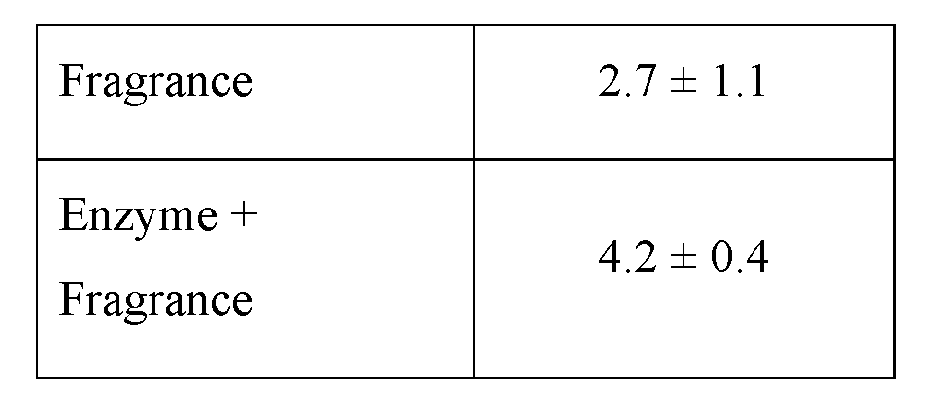
- the odor panel was asked to lift the lids of the Launder-Ometer pots and evaluate the odor of each pot on a scale from 1 (“smells bad”) to 5 (“smells good”). Results are shown in Table 4. [00123] Table 4. Odor panel evaluation of laundry malodor samples.
- the enzyme-fragrance mixture showed a substantial improvement in odor, far beyond the error in the experiment, and far beyond either enzyme or fragrance alone.
- the benefit of the combination of enzyme and fragrance was larger than would be expected for the sum of the individual effects for enzyme and fragrance.
- the benefit provided by the fragrance relative to detergent alone was 1.1
- the benefit provided by detergent+enzyme alone was 0.7
- the expected benefit of the combination of enzyme and fragrance would thus be expected to be around 1.8 (the sum of the individual benefits for enzyme and fragrance).
- Staphylococcus epidermidis cultures were grown for 48 hours in autoclaved 20 mL GC-MS vials (Agilent Technologies part number 5188-2753) following the same procedure as in Examples 1 and 2, with 4 mL of cell suspension in the GC-MS vials. After 48 hours, the residue coating the bottom of the vial was rinsed with PBS and then the PBS was removed. Then 4 mL of synthetic sweat solution, as in Example 1, was added to the vial and the vial was placed at 30 degrees C for 4 days with the cap screwed on (cap is Agilent Technologies part number 5188-2759).
- Samples were analyzed with Agilent 7890/5975 GC-MS system with a CTC GC PAL autosampler in SPME mode, using splitless mode starting at 40 degrees Celsius and ramping up to 240 degrees Celsius.
- the column was Zebron ZB-FFAP (30m x 0.32mm x 0.5 um).
- the SPME fiber used was a Supelco SPME fiber (blue tip - carboxen/PDMS 23 gauge).
- SPME GCMS results identified some of the odor compounds present in the laundry malodor model system such as ethanol, isopentyl alcohol, acetoin, acetic acid and isovaleric acid.
- Example 4 Some of the odor compounds present in the laundry malodor model system such as ethanol, isopentyl alcohol, acetoin, acetic acid and isovaleric acid.
- a washing solution was prepared consisting of 2 g/L of the model detergent (Table 6) in deionized water, as well as fragrance (Skydive Mod, IFF) at the following concentrations: 0.001%, 0.0005%, 0.0002%, 0.0001%, and unfragranced.
- the samples were prepared by adding fragrance to aliquots of the model detergent and then dissolving the model detergent in water.
- the solutions were put in scintillation vials (10 ml each). A volunteer odor sensory panel was asked to smell the solutions and score the solutions according to their perception of freshness (“How fresh does the sample smell?”) on a scale of 1 (neutral or not fresh) to 5 (very fresh) The results are shown in Table 7.
- damascone delta nitriles (e.g.3,7-dimethyl-6-octenenitrile) lactones (e.g. gamma undecalactone) aldehydes (e.g. undecanal), ethers (e.g. diphenyl oxide), or esters (e.g. isobornyl acetate).
- lactones e.g. gamma undecalactone
- aldehydes e.g. undecanal
- ethers e.g. diphenyl oxide
- esters e.g. isobornyl acetate
Landscapes
- Chemical & Material Sciences (AREA)
- Life Sciences & Earth Sciences (AREA)
- Engineering & Computer Science (AREA)
- Chemical Kinetics & Catalysis (AREA)
- Oil, Petroleum & Natural Gas (AREA)
- Wood Science & Technology (AREA)
- Organic Chemistry (AREA)
- Detergent Compositions (AREA)
Abstract
Description




Claims
Priority Applications (2)
| Application Number | Priority Date | Filing Date | Title |
|---|---|---|---|
| CN202380047139.9A CN119487167A (en) | 2022-06-21 | 2023-06-19 | Compositions and methods for cleaning comprising polypeptides having thermolysin activity |
| EP23741562.5A EP4544016A1 (en) | 2022-06-21 | 2023-06-19 | Methods and compositions for cleaning comprising a polypeptide having thermolysin activity |
Applications Claiming Priority (2)
| Application Number | Priority Date | Filing Date | Title |
|---|---|---|---|
| US202263353986P | 2022-06-21 | 2022-06-21 | |
| US63/353,986 | 2022-06-21 |
Publications (1)
| Publication Number | Publication Date |
|---|---|
| WO2023250301A1 true WO2023250301A1 (en) | 2023-12-28 |
Family
ID=87280375
Family Applications (1)
| Application Number | Title | Priority Date | Filing Date |
|---|---|---|---|
| PCT/US2023/068672 Ceased WO2023250301A1 (en) | 2022-06-21 | 2023-06-19 | Methods and compositions for cleaning comprising a polypeptide having thermolysin activity |
Country Status (3)
| Country | Link |
|---|---|
| EP (1) | EP4544016A1 (en) |
| CN (1) | CN119487167A (en) |
| WO (1) | WO2023250301A1 (en) |
Citations (185)
| Publication number | Priority date | Publication date | Assignee | Title |
|---|---|---|---|---|
| GB1296839A (en) | 1969-05-29 | 1972-11-22 | ||
| GB1372034A (en) | 1970-12-31 | 1974-10-30 | Unilever Ltd | Detergent compositions |
| US4246612A (en) | 1979-02-28 | 1981-01-20 | Barr & Stroud Limited | Optical raster scanning system |
| US4430243A (en) | 1981-08-08 | 1984-02-07 | The Procter & Gamble Company | Bleach catalyst compositions and use thereof in laundry bleaching and detergent compositions |
| US4435307A (en) | 1980-04-30 | 1984-03-06 | Novo Industri A/S | Detergent cellulase |
| EP0214761A2 (en) | 1985-08-07 | 1987-03-18 | Novo Nordisk A/S | An enzymatic detergent additive, a detergent, and a washing method |
| EP0218272A1 (en) | 1985-08-09 | 1987-04-15 | Gist-Brocades N.V. | Novel lipolytic enzymes and their use in detergent compositions |
| EP0238023A2 (en) | 1986-03-17 | 1987-09-23 | Novo Nordisk A/S | Process for the production of protein products in Aspergillus oryzae and a promoter for use in Aspergillus |
| EP0258068A2 (en) | 1986-08-29 | 1988-03-02 | Novo Nordisk A/S | Enzymatic detergent additive |
| WO1988009367A1 (en) | 1987-05-29 | 1988-12-01 | Genencor, Inc. | Cutinase cleaning composition |
| EP0305216A1 (en) | 1987-08-28 | 1989-03-01 | Novo Nordisk A/S | Recombinant Humicola lipase and process for the production of recombinant humicola lipases |
| US4810410A (en) | 1986-12-13 | 1989-03-07 | Interox Chemicals Limited | Bleach activation |
| JPS6474992A (en) | 1987-09-16 | 1989-03-20 | Fuji Oil Co Ltd | Dna sequence, plasmid and production of lipase |
| WO1989006270A1 (en) | 1988-01-07 | 1989-07-13 | Novo-Nordisk A/S | Enzymatic detergent |
| EP0331376A2 (en) | 1988-02-28 | 1989-09-06 | Amano Pharmaceutical Co., Ltd. | Recombinant DNA, bacterium of the genus pseudomonas containing it, and process for preparing lipase by using it |
| WO1990009446A1 (en) | 1989-02-17 | 1990-08-23 | Plant Genetic Systems N.V. | Cutinase |
| WO1991000353A2 (en) | 1989-06-29 | 1991-01-10 | Gist-Brocades N.V. | MUTANT MICROBIAL α-AMYLASES WITH INCREASED THERMAL, ACID AND/OR ALKALINE STABILITY |
| WO1991016422A1 (en) | 1990-04-14 | 1991-10-31 | Kali-Chemie Aktiengesellschaft | Alkaline bacillus lipases, coding dna sequences therefor and bacilli which produce these lipases |
| WO1992006154A1 (en) | 1990-09-28 | 1992-04-16 | The Procter & Gamble Company | Polyhydroxy fatty acid amide surfactants to enhance enzyme performance |
| EP0495257A1 (en) | 1991-01-16 | 1992-07-22 | The Procter & Gamble Company | Compact detergent compositions with high activity cellulase |
| WO1992021760A1 (en) | 1991-05-29 | 1992-12-10 | Cognis, Inc. | Mutant proteolytic enzymes from bacillus |
| US5227084A (en) | 1991-04-17 | 1993-07-13 | Lever Brothers Company, Division Of Conopco, Inc. | Concentrated detergent powder compositions |
| WO1994002597A1 (en) | 1992-07-23 | 1994-02-03 | Novo Nordisk A/S | MUTANT α-AMYLASE, DETERGENT, DISH WASHING AGENT, AND LIQUEFACTION AGENT |
| USRE34606E (en) | 1984-05-29 | 1994-05-10 | Genencor, Inc. | Modified enzymes and methods for making same |
| WO1994018314A1 (en) | 1993-02-11 | 1994-08-18 | Genencor International, Inc. | Oxidatively stable alpha-amylase |
| WO1995010603A1 (en) | 1993-10-08 | 1995-04-20 | Novo Nordisk A/S | Amylase variants |
| WO1995023221A1 (en) | 1994-02-24 | 1995-08-31 | Cognis, Inc. | Improved enzymes and detergents containing them |
| WO1995026397A1 (en) | 1994-03-29 | 1995-10-05 | Novo Nordisk A/S | Alkaline bacillus amylase |
| WO1995035382A2 (en) | 1994-06-17 | 1995-12-28 | Genecor International Inc. | NOVEL AMYLOLYTIC ENZYMES DERIVED FROM THE B. LICHENIFORMIS α-AMYLASE, HAVING IMPROVED CHARACTERISTICS |
| WO1996005295A2 (en) | 1994-08-11 | 1996-02-22 | Genencor International, Inc. | An improved cleaning composition |
| WO1996023873A1 (en) | 1995-02-03 | 1996-08-08 | Novo Nordisk A/S | Amylase variants |
| WO1996023874A1 (en) | 1995-02-03 | 1996-08-08 | Novo Nordisk A/S | A method of designing alpha-amylase mutants with predetermined properties |
| WO1996030481A1 (en) | 1995-03-24 | 1996-10-03 | Genencor International, Inc. | An improved laundry detergent composition comprising amylase |
| US5576282A (en) | 1995-09-11 | 1996-11-19 | The Procter & Gamble Company | Color-safe bleach boosters, compositions and laundry methods employing same |
| WO1996041859A1 (en) | 1995-06-13 | 1996-12-27 | Novo Nordisk A/S | 4-substituted-phenyl-boronic acids as enzyme stabilizers |
| US5595967A (en) | 1995-02-03 | 1997-01-21 | The Procter & Gamble Company | Detergent compositions comprising multiperacid-forming bleach activators |
| US5597936A (en) | 1995-06-16 | 1997-01-28 | The Procter & Gamble Company | Method for manufacturing cobalt catalysts |
| WO1997010342A1 (en) | 1995-09-13 | 1997-03-20 | Genencor International, Inc. | Alkaliphilic and thermophilic microorganisms and enzymes obtained therefrom |
| US5646101A (en) | 1993-01-18 | 1997-07-08 | The Procter & Gamble Company | Machine dishwashing detergents containing an oxygen bleach and an anti-tarnishing mixture of a paraffin oil and sequestrant |
| WO1997041213A1 (en) | 1996-04-30 | 1997-11-06 | Novo Nordisk A/S | α-AMYLASE MUTANTS |
| US5686014A (en) | 1994-04-07 | 1997-11-11 | The Procter & Gamble Company | Bleach compositions comprising manganese-containing bleach catalysts |
| WO1997043424A1 (en) | 1996-05-14 | 1997-11-20 | Genencor International, Inc. | MODIFIED α-AMYLASES HAVING ALTERED CALCIUM BINDING PROPERTIES |
| US5695679A (en) | 1994-07-07 | 1997-12-09 | The Procter & Gamble Company | Detergent compositions containing an organic silver coating agent to minimize silver training in ADW washing methods |
| US5698504A (en) | 1993-07-01 | 1997-12-16 | The Procter & Gamble Company | Machine dishwashing composition containing oxygen bleach and paraffin oil and benzotriazole compound silver tarnishing inhibitors |
| US5700676A (en) | 1984-05-29 | 1997-12-23 | Genencor International Inc. | Modified subtilisins having amino acid alterations |
| US5705464A (en) | 1995-06-16 | 1998-01-06 | The Procter & Gamble Company | Automatic dishwashing compositions comprising cobalt catalysts |
| US5710115A (en) | 1994-12-09 | 1998-01-20 | The Procter & Gamble Company | Automatic dishwashing composition containing particles of diacyl peroxides |
| WO1998013481A1 (en) | 1996-09-26 | 1998-04-02 | Novo Nordisk A/S | An enzyme with amylase activity |
| WO1998026078A1 (en) | 1996-12-09 | 1998-06-18 | Genencor International, Inc. | H mutant alpha-amylase enzymes |
| US5801039A (en) | 1994-02-24 | 1998-09-01 | Cognis Gesellschaft Fuer Bio Und Umwelttechnologie Mbh | Enzymes for detergents |
| US5855625A (en) | 1995-01-17 | 1999-01-05 | Henkel Kommanditgesellschaft Auf Aktien | Detergent compositions |
| WO1999002702A1 (en) | 1997-07-11 | 1999-01-21 | Genencor International, Inc. | MUTANT α-AMYLASE HAVING INTRODUCED THEREIN A DISULFIDE BOND |
| WO1999006521A1 (en) | 1997-08-02 | 1999-02-11 | The Procter & Gamble Company | Detergent tablet |
| US5874276A (en) | 1993-12-17 | 1999-02-23 | Genencor International, Inc. | Cellulase enzymes and systems for their expressions |
| WO1999009183A1 (en) | 1997-08-19 | 1999-02-25 | Genencor International, Inc. | MUTANT α-AMYLASE COMPRISING MODIFICATION AT RESIDUES CORRESPONDING TO A210, H405 AND/OR T412 IN $i(BACILLUS LICHENIFORMIS) |
| WO1999014341A2 (en) | 1997-09-15 | 1999-03-25 | Genencor International, Inc. | Proteases from gram-positive organisms |
| WO1999014342A1 (en) | 1997-09-15 | 1999-03-25 | Genencor International, Inc. | Proteases from gram-positive organisms |
| WO1999019467A1 (en) | 1997-10-13 | 1999-04-22 | Novo Nordisk A/S | α-AMYLASE MUTANTS |
| WO1999023211A1 (en) | 1997-10-30 | 1999-05-14 | Novo Nordisk A/S | α-AMYLASE MUTANTS |
| WO1999029876A2 (en) | 1997-12-09 | 1999-06-17 | Genencor International, Inc. | Mutant bacillus licheniformis alpha-amylase |
| WO1999034011A2 (en) | 1997-12-24 | 1999-07-08 | Genencor International, Inc. | Method of assaying for a preferred enzyme and/or detergent |
| WO1999034003A2 (en) | 1997-12-30 | 1999-07-08 | Genencor International, Inc. | Proteases from gram positive organisms |
| WO1999033960A2 (en) | 1997-12-30 | 1999-07-08 | Genencor International, Inc. | Proteases from gram positive organisms |
| WO1999042567A1 (en) | 1998-02-18 | 1999-08-26 | Novo Nordisk A/S | Alkaline bacillus amylase |
| WO1999043793A1 (en) | 1998-02-27 | 1999-09-02 | Novo Nordisk A/S | Amylolytic enzyme variants |
| WO1999043794A1 (en) | 1998-02-27 | 1999-09-02 | Novo Nordisk A/S | Maltogenic alpha-amylase variants |
| WO1999046399A1 (en) | 1998-03-09 | 1999-09-16 | Novo Nordisk A/S | Enzymatic preparation of glucose syrup from starch |
| US5955340A (en) | 1984-05-29 | 1999-09-21 | Genencor International, Inc. | Modified subtilisins having amino acid alterations |
| WO2000029560A1 (en) | 1998-11-16 | 2000-05-25 | Novozymes A/S | α-AMYLASE VARIANTS |
| WO2000060060A2 (en) | 1999-03-31 | 2000-10-12 | Novozymes A/S | Polypeptides having alkaline alpha-amylase activity and nucleic acids encoding same |
| WO2000060059A2 (en) | 1999-03-30 | 2000-10-12 | NovozymesA/S | Alpha-amylase variants |
| WO2000060058A2 (en) | 1999-03-31 | 2000-10-12 | Novozymes A/S | Polypeptides having alkaline alpha-amylase activity and nucleic acids encoding same |
| WO2001014532A2 (en) | 1999-08-20 | 2001-03-01 | Novozymes A/S | Alkaline bacillus amylase |
| WO2001034784A1 (en) | 1999-11-10 | 2001-05-17 | Novozymes A/S | Fungamyl-like alpha-amylase variants |
| WO2001064852A1 (en) | 2000-03-03 | 2001-09-07 | Novozymes A/S | Polypeptides having alkaline alpha-amylase activity and nucleic acids encoding same |
| WO2001066712A2 (en) | 2000-03-08 | 2001-09-13 | Novozymes A/S | Variants with altered properties |
| US6312936B1 (en) | 1997-10-23 | 2001-11-06 | Genencor International, Inc. | Multiply-substituted protease variants |
| WO2001088107A2 (en) | 2000-05-12 | 2001-11-22 | Novozymes A/S | Alpha-amylase variants with altered 1,6-activity |
| WO2001096537A2 (en) | 2000-06-14 | 2001-12-20 | Novozymes A/S | Pre-oxidized alpha-amylase |
| WO2002010355A2 (en) | 2000-08-01 | 2002-02-07 | Novozymes A/S | Alpha-amylase mutants with altered stability |
| WO2002031124A2 (en) | 2000-10-13 | 2002-04-18 | Novozymes A/S | Alpha-amylase variant with altered properties |
| US6376450B1 (en) | 1998-10-23 | 2002-04-23 | Chanchal Kumar Ghosh | Cleaning compositions containing multiply-substituted protease variants |
| US6440991B1 (en) | 2000-10-02 | 2002-08-27 | Wyeth | Ethers of 7-desmethlrapamycin |
| WO2002092797A2 (en) | 2001-05-15 | 2002-11-21 | Novozymes A/S | Alpha-amylase variant with altered properties |
| US6566114B1 (en) | 1998-06-10 | 2003-05-20 | Novozymes, A/S | Mannanases |
| US6602842B2 (en) | 1994-06-17 | 2003-08-05 | Genencor International, Inc. | Cleaning compositions containing plant cell wall degrading enzymes and their use in cleaning methods |
| US6605458B1 (en) | 1997-11-21 | 2003-08-12 | Novozymes A/S | Protease variants and compositions |
| WO2004055178A1 (en) | 2002-12-17 | 2004-07-01 | Novozymes A/S | Thermostable alpha-amylases |
| WO2004113551A1 (en) | 2003-06-25 | 2004-12-29 | Novozymes A/S | Process for the hydrolysis of starch |
| WO2005001064A2 (en) | 2003-06-25 | 2005-01-06 | Novozymes A/S | Polypeptides having alpha-amylase activity and polypeptides encoding same |
| WO2005003311A2 (en) | 2003-06-25 | 2005-01-13 | Novozymes A/S | Enzymes for starch processing |
| WO2005019443A2 (en) | 2003-08-22 | 2005-03-03 | Novozymes A/S | Fungal alpha-amylase variants |
| WO2005018336A1 (en) | 2003-08-22 | 2005-03-03 | Novozymes A/S | Process for preparing a dough comprising a starch-degrading glucogenic exo-amylase of family 13 |
| WO2005054475A1 (en) | 2003-12-03 | 2005-06-16 | Meiji Seika Kaisha, Ltd. | Endoglucanase stce and cellulase preparation containing the same |
| WO2005056787A1 (en) | 2003-12-08 | 2005-06-23 | Meiji Seika Kaisha, Ltd. | Surfactant-tolerant cellulase and method of converting the same |
| WO2005066338A1 (en) | 2004-01-08 | 2005-07-21 | Novozymes A/S | Amylase |
| WO2006002643A2 (en) | 2004-07-05 | 2006-01-12 | Novozymes A/S | Alpha-amylase variants with altered properties |
| WO2006012902A2 (en) | 2004-08-02 | 2006-02-09 | Novozymes A/S | Creation of diversity in polypeptides |
| WO2006012899A1 (en) | 2004-08-02 | 2006-02-09 | Novozymes A/S | Maltogenic alpha-amylase variants |
| WO2006031554A2 (en) | 2004-09-10 | 2006-03-23 | Novozymes North America, Inc. | Methods for preventing, removing, reducing, or disrupting biofilm |
| WO2006063594A1 (en) | 2004-12-15 | 2006-06-22 | Novozymes A/S | Alkaline bacillus amylase |
| WO2006066594A2 (en) | 2004-12-23 | 2006-06-29 | Novozymes A/S | Alpha-amylase variants |
| WO2006066596A2 (en) | 2004-12-22 | 2006-06-29 | Novozymes A/S | Hybrid enzymes consisting of an endo-amylase first amino acid sequence and a carbohydrate -binding module as second amino acid sequence |
| WO2006136161A2 (en) | 2005-06-24 | 2006-12-28 | Novozymes A/S | Amylases for pharmaceutical use |
| WO2007044993A2 (en) | 2005-10-12 | 2007-04-19 | Genencor International, Inc. | Use and production of storage-stable neutral metalloprotease |
| WO2007145964A2 (en) | 2006-06-05 | 2007-12-21 | The Procter & Gamble Company | Enzyme stabilizer |
| WO2008000825A1 (en) | 2006-06-30 | 2008-01-03 | Novozymes A/S | Bacterial alpha-amylase variants |
| WO2008010925A2 (en) | 2006-07-18 | 2008-01-24 | Danisco Us, Inc., Genencor Division | Protease variants active over a broad temperature range |
| WO2008088493A2 (en) | 2006-12-21 | 2008-07-24 | Danisco Us, Inc., Genencor Division | Compositions and uses for an alpha-amylase polypeptide of bacillus species 195 |
| WO2008092919A1 (en) | 2007-02-01 | 2008-08-07 | Novozymes A/S | Alpha-amylase and its use |
| WO2008101894A1 (en) | 2007-02-19 | 2008-08-28 | Novozymes A/S | Polypeptides with starch debranching activity |
| WO2008112459A2 (en) | 2007-03-09 | 2008-09-18 | Danisco Us Inc., Genencor Division | Alkaliphilic bacillus species a-amylase variants, compositions comprising a-amylase variants, and methods of use |
| US7449318B2 (en) | 2003-04-30 | 2008-11-11 | Danisco A/S, Genencor Division | Bacillus mHKcel cellulase |
| WO2009058661A1 (en) | 2007-10-31 | 2009-05-07 | Danisco Us Inc., Genencor Division | Use and production of citrate-stable neutral metalloproteases |
| WO2009058303A2 (en) | 2007-11-01 | 2009-05-07 | Danisco Us Inc., Genencor Division | Production of thermolysin and variants thereof and use in liquid detergents |
| WO2009061381A2 (en) | 2007-11-05 | 2009-05-14 | Danisco Us Inc., Genencor Division | Alpha-amylase variants with altered properties |
| WO2009061380A2 (en) | 2007-11-05 | 2009-05-14 | Danisco Us Inc., Genencor Division | VARIANTS OF BACILLUS sp. TS-23 ALPHA-AMYLASE WITH ALTERED PROPERTIES |
| WO2009100102A2 (en) | 2008-02-04 | 2009-08-13 | Danisco Us Inc., Genencor Division | Ts23 alpha-amylase variants with altered properties |
| EP2100949A1 (en) | 2008-03-14 | 2009-09-16 | The Procter and Gamble Company | Automatic dishwashing detergent composition |
| WO2009118375A2 (en) | 2008-03-26 | 2009-10-01 | Novozymes A/S | Stabilized liquid enzyme compositions |
| WO2009140504A1 (en) | 2008-05-16 | 2009-11-19 | Novozymes A/S | Polypeptides having alpha-amylase activity and polynucleotides encoding same |
| WO2009149419A2 (en) | 2008-06-06 | 2009-12-10 | Danisco Us Inc. | Variant alpha-amylases from bacillus subtilis and methods of use, thereof |
| WO2009149200A2 (en) | 2008-06-06 | 2009-12-10 | Danisco Us Inc. | Compositions and methods comprising variant microbial proteases |
| WO2010056653A2 (en) | 2008-11-11 | 2010-05-20 | Danisco Us Inc. | Proteases comprising one or more combinable mutations |
| WO2010056640A2 (en) | 2008-11-11 | 2010-05-20 | Danisco Us Inc. | Compositions and methods comprising serine protease variants |
| WO2010059413A2 (en) | 2008-11-20 | 2010-05-27 | Novozymes, Inc. | Polypeptides having amylolytic enhancing activity and polynucleotides encoding same |
| WO2010088447A1 (en) | 2009-01-30 | 2010-08-05 | Novozymes A/S | Polypeptides having alpha-amylase activity and polynucleotides encoding same |
| WO2010091221A1 (en) | 2009-02-06 | 2010-08-12 | Novozymes A/S | Polypeptides having alpha-amylase activity and polynucleotides encoding same |
| WO2010104675A1 (en) | 2009-03-10 | 2010-09-16 | Danisco Us Inc. | Bacillus megaterium strain dsm90-related alpha-amylases, and methods of use, thereof |
| WO2010115028A2 (en) | 2009-04-01 | 2010-10-07 | Danisco Us Inc. | Cleaning system comprising an alpha-amylase and a protease |
| WO2010117511A1 (en) | 2009-04-08 | 2010-10-14 | Danisco Us Inc. | Halomonas strain wdg195-related alpha-amylases, and methods of use, thereof |
| WO2011013022A1 (en) | 2009-07-28 | 2011-02-03 | Koninklijke Philips Electronics N.V. | Washing and sterilizing unit |
| WO2011072099A2 (en) | 2009-12-09 | 2011-06-16 | Danisco Us Inc. | Compositions and methods comprising protease variants |
| WO2011076123A1 (en) | 2009-12-22 | 2011-06-30 | Novozymes A/S | Compositions comprising boosting polypeptide and starch degrading enzyme and uses thereof |
| WO2011076897A1 (en) | 2009-12-22 | 2011-06-30 | Novozymes A/S | Use of amylase variants at low temperature |
| WO2011080354A1 (en) | 2010-01-04 | 2011-07-07 | Novozymes A/S | Alpha-amylases |
| WO2011098531A1 (en) | 2010-02-10 | 2011-08-18 | Novozymes A/S | Variants and compositions comprising variants with high stability in presence of a chelating agent |
| WO2011140364A1 (en) | 2010-05-06 | 2011-11-10 | Danisco Us Inc. | Compositions and methods comprising subtilisin variants |
| WO2012151534A1 (en) | 2011-05-05 | 2012-11-08 | Danisco Us Inc. | Compositions and methods comprising serine protease variants |
| WO2013004636A1 (en) | 2011-07-01 | 2013-01-10 | Novozymes A/S | Stabilized subtilisin composition |
| US8362222B2 (en) | 2009-07-08 | 2013-01-29 | Ab Enzymes Oy | Fungal protease and use thereof |
| WO2013063460A2 (en) | 2011-10-28 | 2013-05-02 | Danisco Us Inc. | Variant maltohexaose-forming alpha-amylase variants |
| US8530219B2 (en) | 2008-11-11 | 2013-09-10 | Danisco Us Inc. | Compositions and methods comprising a subtilisin variant |
| WO2013184577A1 (en) | 2012-06-08 | 2013-12-12 | Danisco Us Inc. | Alpha-amylase variants derived from the alpha amylase of cytophaga sp.amylase|(cspamy2). |
| WO2014059360A1 (en) | 2012-10-12 | 2014-04-17 | Danisco Us Inc. | Compositions and methods comprising a lipolytic enzyme variant |
| WO2014071410A1 (en) | 2012-11-05 | 2014-05-08 | Danisco Us Inc. | Compositions and methods comprising thermolysin protease variants |
| WO2014099523A1 (en) | 2012-12-21 | 2014-06-26 | Danisco Us Inc. | Alpha-amylase variants |
| WO2014164777A1 (en) | 2013-03-11 | 2014-10-09 | Danisco Us Inc. | Alpha-amylase combinatorial variants |
| WO2014194054A1 (en) | 2013-05-29 | 2014-12-04 | Danisco Us Inc. | Novel metalloproteases |
| WO2014194032A1 (en) | 2013-05-29 | 2014-12-04 | Danisco Us Inc. | Novel metalloproteases |
| WO2014194117A2 (en) | 2013-05-29 | 2014-12-04 | Danisco Us Inc. | Novel metalloproteases |
| WO2014194034A2 (en) | 2013-05-29 | 2014-12-04 | Danisco Us Inc. | Novel metalloproteases |
| WO2015010009A2 (en) | 2013-07-19 | 2015-01-22 | Danisco Us Inc. | Compositions and methods comprising a lipolytic enzyme variant |
| WO2015038792A1 (en) | 2013-09-12 | 2015-03-19 | Danisco Us Inc. | Compositions and methods comprising lg12-clade protease variants |
| WO2015066669A1 (en) | 2013-11-04 | 2015-05-07 | Danisco Us Inc. | Proteases in corn processing |
| WO2015077126A1 (en) | 2013-11-20 | 2015-05-28 | Danisco Us Inc. | Variant alpha-amylases having reduced susceptibility to protease cleavage, and methods of use, thereof |
| WO2015089441A1 (en) | 2013-12-13 | 2015-06-18 | Danisco Us Inc. | Serine proteases of bacillus species |
| WO2015089447A1 (en) | 2013-12-13 | 2015-06-18 | Danisco Us Inc. | Serine proteases of the bacillus gibsonii-clade |
| WO2015155350A1 (en) | 2014-04-11 | 2015-10-15 | Novozymes A/S | Detergent composition |
| WO2015181287A1 (en) | 2014-05-28 | 2015-12-03 | Novozymes A/S | Polypeptide having dnase activity for reducing static electricity |
| WO2016001449A1 (en) | 2014-07-04 | 2016-01-07 | Novozymes A/S | Subtilase variants and polynucleotides encoding same |
| WO2016007929A2 (en) | 2014-07-11 | 2016-01-14 | Danisco Us Inc. | Paenibacillus and bacillus spp. mannanases |
| WO2016087617A1 (en) | 2014-12-04 | 2016-06-09 | Novozymes A/S | Subtilase variants and polynucleotides encoding same |
| WO2016096714A1 (en) | 2014-12-15 | 2016-06-23 | Henkel Ag & Co. Kgaa | Detergent composition comprising subtilase variants |
| WO2016162556A1 (en) | 2015-04-10 | 2016-10-13 | Novozymes A/S | Laundry method, use of dnase and detergent composition |
| WO2016203064A2 (en) | 2015-10-28 | 2016-12-22 | Novozymes A/S | Detergent composition comprising protease and amylase variants |
| WO2017060475A2 (en) | 2015-10-07 | 2017-04-13 | Novozymes A/S | Polypeptides |
| WO2017089093A1 (en) | 2015-11-25 | 2017-06-01 | Unilever N.V. | A liquid detergent composition |
| WO2017162836A1 (en) | 2016-03-23 | 2017-09-28 | Novozymes A/S | Use of polypeptide having dnase activity for treating fabrics |
| WO2017215925A1 (en) | 2016-06-15 | 2017-12-21 | Henkel Ag & Co. Kgaa | Bacillus gibsonii protease and variants thereof |
| WO2018076800A1 (en) | 2016-10-24 | 2018-05-03 | 深圳有麦科技有限公司 | Method and system for asynchronously updating data |
| WO2018177938A1 (en) | 2017-03-31 | 2018-10-04 | Novozymes A/S | Polypeptides having dnase activity |
| WO2018177203A1 (en) | 2017-03-31 | 2018-10-04 | Novozymes A/S | Polypeptides having dnase activity |
| WO2018177936A1 (en) | 2017-03-31 | 2018-10-04 | Novozymes A/S | Polypeptides having dnase activity |
| WO2018184817A1 (en) | 2017-04-06 | 2018-10-11 | Novozymes A/S | Cleaning compositions and uses thereof |
| WO2018185280A1 (en) | 2017-04-06 | 2018-10-11 | Novozymes A/S | Cleaning compositions and uses thereof |
| WO2018185285A1 (en) | 2017-04-06 | 2018-10-11 | Novozymes A/S | Cleaning compositions and uses thereof |
| WO2018185269A1 (en) | 2017-04-06 | 2018-10-11 | Novozymes A/S | Cleaning compositions and uses thereof |
| WO2018184816A1 (en) | 2017-04-06 | 2018-10-11 | Novozymes A/S | Cleaning compositions and uses thereof |
| WO2018185267A1 (en) | 2017-04-06 | 2018-10-11 | Novozymes A/S | Cleaning compositions and uses thereof |
| WO2018206553A1 (en) | 2017-05-09 | 2018-11-15 | Novozymes A/S | Animal chew toy with dental care composition |
| WO2019081721A1 (en) | 2017-10-27 | 2019-05-02 | Novozymes A/S | Dnase variants |
| WO2019084349A1 (en) | 2017-10-27 | 2019-05-02 | The Procter & Gamble Company | Detergent compositions comprising polypeptide variants |
| WO2019180111A1 (en) | 2018-03-23 | 2019-09-26 | Novozymes A/S | Subtilase variants and compositions comprising same |
| WO2020247582A1 (en) * | 2019-06-06 | 2020-12-10 | Danisco Us Inc | Methods and compositions for cleaning |
-
2023
- 2023-06-19 CN CN202380047139.9A patent/CN119487167A/en active Pending
- 2023-06-19 WO PCT/US2023/068672 patent/WO2023250301A1/en not_active Ceased
- 2023-06-19 EP EP23741562.5A patent/EP4544016A1/en active Pending
Patent Citations (205)
| Publication number | Priority date | Publication date | Assignee | Title |
|---|---|---|---|---|
| GB1296839A (en) | 1969-05-29 | 1972-11-22 | ||
| GB1372034A (en) | 1970-12-31 | 1974-10-30 | Unilever Ltd | Detergent compositions |
| US4246612A (en) | 1979-02-28 | 1981-01-20 | Barr & Stroud Limited | Optical raster scanning system |
| US4435307A (en) | 1980-04-30 | 1984-03-06 | Novo Industri A/S | Detergent cellulase |
| US4430243A (en) | 1981-08-08 | 1984-02-07 | The Procter & Gamble Company | Bleach catalyst compositions and use thereof in laundry bleaching and detergent compositions |
| US5700676A (en) | 1984-05-29 | 1997-12-23 | Genencor International Inc. | Modified subtilisins having amino acid alterations |
| USRE34606E (en) | 1984-05-29 | 1994-05-10 | Genencor, Inc. | Modified enzymes and methods for making same |
| US5955340A (en) | 1984-05-29 | 1999-09-21 | Genencor International, Inc. | Modified subtilisins having amino acid alterations |
| EP0214761A2 (en) | 1985-08-07 | 1987-03-18 | Novo Nordisk A/S | An enzymatic detergent additive, a detergent, and a washing method |
| EP0218272A1 (en) | 1985-08-09 | 1987-04-15 | Gist-Brocades N.V. | Novel lipolytic enzymes and their use in detergent compositions |
| EP0238023A2 (en) | 1986-03-17 | 1987-09-23 | Novo Nordisk A/S | Process for the production of protein products in Aspergillus oryzae and a promoter for use in Aspergillus |
| EP0258068A2 (en) | 1986-08-29 | 1988-03-02 | Novo Nordisk A/S | Enzymatic detergent additive |
| US4810410A (en) | 1986-12-13 | 1989-03-07 | Interox Chemicals Limited | Bleach activation |
| WO1988009367A1 (en) | 1987-05-29 | 1988-12-01 | Genencor, Inc. | Cutinase cleaning composition |
| EP0305216A1 (en) | 1987-08-28 | 1989-03-01 | Novo Nordisk A/S | Recombinant Humicola lipase and process for the production of recombinant humicola lipases |
| JPS6474992A (en) | 1987-09-16 | 1989-03-20 | Fuji Oil Co Ltd | Dna sequence, plasmid and production of lipase |
| WO1989006270A1 (en) | 1988-01-07 | 1989-07-13 | Novo-Nordisk A/S | Enzymatic detergent |
| EP0331376A2 (en) | 1988-02-28 | 1989-09-06 | Amano Pharmaceutical Co., Ltd. | Recombinant DNA, bacterium of the genus pseudomonas containing it, and process for preparing lipase by using it |
| WO1990009446A1 (en) | 1989-02-17 | 1990-08-23 | Plant Genetic Systems N.V. | Cutinase |
| WO1991000353A2 (en) | 1989-06-29 | 1991-01-10 | Gist-Brocades N.V. | MUTANT MICROBIAL α-AMYLASES WITH INCREASED THERMAL, ACID AND/OR ALKALINE STABILITY |
| WO1991016422A1 (en) | 1990-04-14 | 1991-10-31 | Kali-Chemie Aktiengesellschaft | Alkaline bacillus lipases, coding dna sequences therefor and bacilli which produce these lipases |
| WO1992006154A1 (en) | 1990-09-28 | 1992-04-16 | The Procter & Gamble Company | Polyhydroxy fatty acid amide surfactants to enhance enzyme performance |
| EP0495257A1 (en) | 1991-01-16 | 1992-07-22 | The Procter & Gamble Company | Compact detergent compositions with high activity cellulase |
| US5227084A (en) | 1991-04-17 | 1993-07-13 | Lever Brothers Company, Division Of Conopco, Inc. | Concentrated detergent powder compositions |
| US5340735A (en) | 1991-05-29 | 1994-08-23 | Cognis, Inc. | Bacillus lentus alkaline protease variants with increased stability |
| WO1992021760A1 (en) | 1991-05-29 | 1992-12-10 | Cognis, Inc. | Mutant proteolytic enzymes from bacillus |
| US5500364A (en) | 1991-05-29 | 1996-03-19 | Cognis, Inc. | Bacillus lentus alkaline protease varints with enhanced stability |
| WO1994002597A1 (en) | 1992-07-23 | 1994-02-03 | Novo Nordisk A/S | MUTANT α-AMYLASE, DETERGENT, DISH WASHING AGENT, AND LIQUEFACTION AGENT |
| US5646101A (en) | 1993-01-18 | 1997-07-08 | The Procter & Gamble Company | Machine dishwashing detergents containing an oxygen bleach and an anti-tarnishing mixture of a paraffin oil and sequestrant |
| WO1994018314A1 (en) | 1993-02-11 | 1994-08-18 | Genencor International, Inc. | Oxidatively stable alpha-amylase |
| US5698504A (en) | 1993-07-01 | 1997-12-16 | The Procter & Gamble Company | Machine dishwashing composition containing oxygen bleach and paraffin oil and benzotriazole compound silver tarnishing inhibitors |
| WO1995010603A1 (en) | 1993-10-08 | 1995-04-20 | Novo Nordisk A/S | Amylase variants |
| US5874276A (en) | 1993-12-17 | 1999-02-23 | Genencor International, Inc. | Cellulase enzymes and systems for their expressions |
| US5801039A (en) | 1994-02-24 | 1998-09-01 | Cognis Gesellschaft Fuer Bio Und Umwelttechnologie Mbh | Enzymes for detergents |
| WO1995023221A1 (en) | 1994-02-24 | 1995-08-31 | Cognis, Inc. | Improved enzymes and detergents containing them |
| WO1995026397A1 (en) | 1994-03-29 | 1995-10-05 | Novo Nordisk A/S | Alkaline bacillus amylase |
| US5686014A (en) | 1994-04-07 | 1997-11-11 | The Procter & Gamble Company | Bleach compositions comprising manganese-containing bleach catalysts |
| US6602842B2 (en) | 1994-06-17 | 2003-08-05 | Genencor International, Inc. | Cleaning compositions containing plant cell wall degrading enzymes and their use in cleaning methods |
| WO1995035382A2 (en) | 1994-06-17 | 1995-12-28 | Genecor International Inc. | NOVEL AMYLOLYTIC ENZYMES DERIVED FROM THE B. LICHENIFORMIS α-AMYLASE, HAVING IMPROVED CHARACTERISTICS |
| US5695679A (en) | 1994-07-07 | 1997-12-09 | The Procter & Gamble Company | Detergent compositions containing an organic silver coating agent to minimize silver training in ADW washing methods |
| WO1996005295A2 (en) | 1994-08-11 | 1996-02-22 | Genencor International, Inc. | An improved cleaning composition |
| US5710115A (en) | 1994-12-09 | 1998-01-20 | The Procter & Gamble Company | Automatic dishwashing composition containing particles of diacyl peroxides |
| US5855625A (en) | 1995-01-17 | 1999-01-05 | Henkel Kommanditgesellschaft Auf Aktien | Detergent compositions |
| US5595967A (en) | 1995-02-03 | 1997-01-21 | The Procter & Gamble Company | Detergent compositions comprising multiperacid-forming bleach activators |
| WO1996023873A1 (en) | 1995-02-03 | 1996-08-08 | Novo Nordisk A/S | Amylase variants |
| WO1996023874A1 (en) | 1995-02-03 | 1996-08-08 | Novo Nordisk A/S | A method of designing alpha-amylase mutants with predetermined properties |
| WO1996030481A1 (en) | 1995-03-24 | 1996-10-03 | Genencor International, Inc. | An improved laundry detergent composition comprising amylase |
| WO1996041859A1 (en) | 1995-06-13 | 1996-12-27 | Novo Nordisk A/S | 4-substituted-phenyl-boronic acids as enzyme stabilizers |
| US5705464A (en) | 1995-06-16 | 1998-01-06 | The Procter & Gamble Company | Automatic dishwashing compositions comprising cobalt catalysts |
| US5597936A (en) | 1995-06-16 | 1997-01-28 | The Procter & Gamble Company | Method for manufacturing cobalt catalysts |
| US5576282A (en) | 1995-09-11 | 1996-11-19 | The Procter & Gamble Company | Color-safe bleach boosters, compositions and laundry methods employing same |
| WO1997010342A1 (en) | 1995-09-13 | 1997-03-20 | Genencor International, Inc. | Alkaliphilic and thermophilic microorganisms and enzymes obtained therefrom |
| WO1997041213A1 (en) | 1996-04-30 | 1997-11-06 | Novo Nordisk A/S | α-AMYLASE MUTANTS |
| WO1997043424A1 (en) | 1996-05-14 | 1997-11-20 | Genencor International, Inc. | MODIFIED α-AMYLASES HAVING ALTERED CALCIUM BINDING PROPERTIES |
| WO1998013481A1 (en) | 1996-09-26 | 1998-04-02 | Novo Nordisk A/S | An enzyme with amylase activity |
| WO1998026078A1 (en) | 1996-12-09 | 1998-06-18 | Genencor International, Inc. | H mutant alpha-amylase enzymes |
| WO1999002702A1 (en) | 1997-07-11 | 1999-01-21 | Genencor International, Inc. | MUTANT α-AMYLASE HAVING INTRODUCED THEREIN A DISULFIDE BOND |
| WO1999006521A1 (en) | 1997-08-02 | 1999-02-11 | The Procter & Gamble Company | Detergent tablet |
| WO1999009183A1 (en) | 1997-08-19 | 1999-02-25 | Genencor International, Inc. | MUTANT α-AMYLASE COMPRISING MODIFICATION AT RESIDUES CORRESPONDING TO A210, H405 AND/OR T412 IN $i(BACILLUS LICHENIFORMIS) |
| WO1999014341A2 (en) | 1997-09-15 | 1999-03-25 | Genencor International, Inc. | Proteases from gram-positive organisms |
| WO1999014342A1 (en) | 1997-09-15 | 1999-03-25 | Genencor International, Inc. | Proteases from gram-positive organisms |
| WO1999019467A1 (en) | 1997-10-13 | 1999-04-22 | Novo Nordisk A/S | α-AMYLASE MUTANTS |
| US6482628B1 (en) | 1997-10-23 | 2002-11-19 | Genencor International, Inc. | Multiply-substituted protease variants |
| US6312936B1 (en) | 1997-10-23 | 2001-11-06 | Genencor International, Inc. | Multiply-substituted protease variants |
| WO1999023211A1 (en) | 1997-10-30 | 1999-05-14 | Novo Nordisk A/S | α-AMYLASE MUTANTS |
| US6605458B1 (en) | 1997-11-21 | 2003-08-12 | Novozymes A/S | Protease variants and compositions |
| WO1999029876A2 (en) | 1997-12-09 | 1999-06-17 | Genencor International, Inc. | Mutant bacillus licheniformis alpha-amylase |
| WO1999034011A2 (en) | 1997-12-24 | 1999-07-08 | Genencor International, Inc. | Method of assaying for a preferred enzyme and/or detergent |
| WO1999034003A2 (en) | 1997-12-30 | 1999-07-08 | Genencor International, Inc. | Proteases from gram positive organisms |
| WO1999033960A2 (en) | 1997-12-30 | 1999-07-08 | Genencor International, Inc. | Proteases from gram positive organisms |
| WO1999042567A1 (en) | 1998-02-18 | 1999-08-26 | Novo Nordisk A/S | Alkaline bacillus amylase |
| WO1999043793A1 (en) | 1998-02-27 | 1999-09-02 | Novo Nordisk A/S | Amylolytic enzyme variants |
| WO1999043794A1 (en) | 1998-02-27 | 1999-09-02 | Novo Nordisk A/S | Maltogenic alpha-amylase variants |
| WO1999046399A1 (en) | 1998-03-09 | 1999-09-16 | Novo Nordisk A/S | Enzymatic preparation of glucose syrup from starch |
| US6566114B1 (en) | 1998-06-10 | 2003-05-20 | Novozymes, A/S | Mannanases |
| US6376450B1 (en) | 1998-10-23 | 2002-04-23 | Chanchal Kumar Ghosh | Cleaning compositions containing multiply-substituted protease variants |
| WO2000029560A1 (en) | 1998-11-16 | 2000-05-25 | Novozymes A/S | α-AMYLASE VARIANTS |
| WO2000060059A2 (en) | 1999-03-30 | 2000-10-12 | NovozymesA/S | Alpha-amylase variants |
| WO2000060060A2 (en) | 1999-03-31 | 2000-10-12 | Novozymes A/S | Polypeptides having alkaline alpha-amylase activity and nucleic acids encoding same |
| WO2000060058A2 (en) | 1999-03-31 | 2000-10-12 | Novozymes A/S | Polypeptides having alkaline alpha-amylase activity and nucleic acids encoding same |
| WO2001014532A2 (en) | 1999-08-20 | 2001-03-01 | Novozymes A/S | Alkaline bacillus amylase |
| WO2001034784A1 (en) | 1999-11-10 | 2001-05-17 | Novozymes A/S | Fungamyl-like alpha-amylase variants |
| WO2001064852A1 (en) | 2000-03-03 | 2001-09-07 | Novozymes A/S | Polypeptides having alkaline alpha-amylase activity and nucleic acids encoding same |
| WO2001066712A2 (en) | 2000-03-08 | 2001-09-13 | Novozymes A/S | Variants with altered properties |
| US6610642B2 (en) | 2000-04-20 | 2003-08-26 | The Procter And Gamble Company | Cleaning compositions containing multiply-substituted protease variants |
| WO2001088107A2 (en) | 2000-05-12 | 2001-11-22 | Novozymes A/S | Alpha-amylase variants with altered 1,6-activity |
| WO2001096537A2 (en) | 2000-06-14 | 2001-12-20 | Novozymes A/S | Pre-oxidized alpha-amylase |
| WO2002010355A2 (en) | 2000-08-01 | 2002-02-07 | Novozymes A/S | Alpha-amylase mutants with altered stability |
| US6440991B1 (en) | 2000-10-02 | 2002-08-27 | Wyeth | Ethers of 7-desmethlrapamycin |
| WO2002031124A2 (en) | 2000-10-13 | 2002-04-18 | Novozymes A/S | Alpha-amylase variant with altered properties |
| WO2002092797A2 (en) | 2001-05-15 | 2002-11-21 | Novozymes A/S | Alpha-amylase variant with altered properties |
| WO2004055178A1 (en) | 2002-12-17 | 2004-07-01 | Novozymes A/S | Thermostable alpha-amylases |
| US7449318B2 (en) | 2003-04-30 | 2008-11-11 | Danisco A/S, Genencor Division | Bacillus mHKcel cellulase |
| US7833773B2 (en) | 2003-04-30 | 2010-11-16 | Danisco Us Inc. | Bacillus mHKcel cellulase |
| WO2005003311A2 (en) | 2003-06-25 | 2005-01-13 | Novozymes A/S | Enzymes for starch processing |
| WO2005001064A2 (en) | 2003-06-25 | 2005-01-06 | Novozymes A/S | Polypeptides having alpha-amylase activity and polypeptides encoding same |
| WO2004113551A1 (en) | 2003-06-25 | 2004-12-29 | Novozymes A/S | Process for the hydrolysis of starch |
| WO2005019443A2 (en) | 2003-08-22 | 2005-03-03 | Novozymes A/S | Fungal alpha-amylase variants |
| WO2005018336A1 (en) | 2003-08-22 | 2005-03-03 | Novozymes A/S | Process for preparing a dough comprising a starch-degrading glucogenic exo-amylase of family 13 |
| WO2005054475A1 (en) | 2003-12-03 | 2005-06-16 | Meiji Seika Kaisha, Ltd. | Endoglucanase stce and cellulase preparation containing the same |
| WO2005056787A1 (en) | 2003-12-08 | 2005-06-23 | Meiji Seika Kaisha, Ltd. | Surfactant-tolerant cellulase and method of converting the same |
| WO2005066338A1 (en) | 2004-01-08 | 2005-07-21 | Novozymes A/S | Amylase |
| WO2006002643A2 (en) | 2004-07-05 | 2006-01-12 | Novozymes A/S | Alpha-amylase variants with altered properties |
| WO2006012899A1 (en) | 2004-08-02 | 2006-02-09 | Novozymes A/S | Maltogenic alpha-amylase variants |
| WO2006012902A2 (en) | 2004-08-02 | 2006-02-09 | Novozymes A/S | Creation of diversity in polypeptides |
| WO2006031554A2 (en) | 2004-09-10 | 2006-03-23 | Novozymes North America, Inc. | Methods for preventing, removing, reducing, or disrupting biofilm |
| WO2006063594A1 (en) | 2004-12-15 | 2006-06-22 | Novozymes A/S | Alkaline bacillus amylase |
| WO2006066596A2 (en) | 2004-12-22 | 2006-06-29 | Novozymes A/S | Hybrid enzymes consisting of an endo-amylase first amino acid sequence and a carbohydrate -binding module as second amino acid sequence |
| WO2006066594A2 (en) | 2004-12-23 | 2006-06-29 | Novozymes A/S | Alpha-amylase variants |
| WO2006136161A2 (en) | 2005-06-24 | 2006-12-28 | Novozymes A/S | Amylases for pharmaceutical use |
| WO2007044993A2 (en) | 2005-10-12 | 2007-04-19 | Genencor International, Inc. | Use and production of storage-stable neutral metalloprotease |
| US20180066244A1 (en) | 2005-10-12 | 2018-03-08 | Danisco Us Inc | Use and production of storage-stable neutral metalloprotease |
| WO2007145964A2 (en) | 2006-06-05 | 2007-12-21 | The Procter & Gamble Company | Enzyme stabilizer |
| WO2008000825A1 (en) | 2006-06-30 | 2008-01-03 | Novozymes A/S | Bacterial alpha-amylase variants |
| WO2008010925A2 (en) | 2006-07-18 | 2008-01-24 | Danisco Us, Inc., Genencor Division | Protease variants active over a broad temperature range |
| WO2008088493A2 (en) | 2006-12-21 | 2008-07-24 | Danisco Us, Inc., Genencor Division | Compositions and uses for an alpha-amylase polypeptide of bacillus species 195 |
| WO2008092919A1 (en) | 2007-02-01 | 2008-08-07 | Novozymes A/S | Alpha-amylase and its use |
| WO2008101894A1 (en) | 2007-02-19 | 2008-08-28 | Novozymes A/S | Polypeptides with starch debranching activity |
| WO2008112459A2 (en) | 2007-03-09 | 2008-09-18 | Danisco Us Inc., Genencor Division | Alkaliphilic bacillus species a-amylase variants, compositions comprising a-amylase variants, and methods of use |
| WO2009058661A1 (en) | 2007-10-31 | 2009-05-07 | Danisco Us Inc., Genencor Division | Use and production of citrate-stable neutral metalloproteases |
| WO2009058303A2 (en) | 2007-11-01 | 2009-05-07 | Danisco Us Inc., Genencor Division | Production of thermolysin and variants thereof and use in liquid detergents |
| US20140099698A1 (en) | 2007-11-01 | 2014-04-10 | Danisco Us Inc. | Thermolysin variants and detergent compositions therewith |
| US20120009651A1 (en) * | 2007-11-01 | 2012-01-12 | Danisco Us Inc. | Production of Thermolysin and Variants Thereof and Use In Liquid Detergents |
| WO2009061380A2 (en) | 2007-11-05 | 2009-05-14 | Danisco Us Inc., Genencor Division | VARIANTS OF BACILLUS sp. TS-23 ALPHA-AMYLASE WITH ALTERED PROPERTIES |
| WO2009061381A2 (en) | 2007-11-05 | 2009-05-14 | Danisco Us Inc., Genencor Division | Alpha-amylase variants with altered properties |
| WO2009100102A2 (en) | 2008-02-04 | 2009-08-13 | Danisco Us Inc., Genencor Division | Ts23 alpha-amylase variants with altered properties |
| EP2100949A1 (en) | 2008-03-14 | 2009-09-16 | The Procter and Gamble Company | Automatic dishwashing detergent composition |
| WO2009118375A2 (en) | 2008-03-26 | 2009-10-01 | Novozymes A/S | Stabilized liquid enzyme compositions |
| WO2009140504A1 (en) | 2008-05-16 | 2009-11-19 | Novozymes A/S | Polypeptides having alpha-amylase activity and polynucleotides encoding same |
| WO2009149419A2 (en) | 2008-06-06 | 2009-12-10 | Danisco Us Inc. | Variant alpha-amylases from bacillus subtilis and methods of use, thereof |
| WO2009149200A2 (en) | 2008-06-06 | 2009-12-10 | Danisco Us Inc. | Compositions and methods comprising variant microbial proteases |
| WO2009149145A2 (en) | 2008-06-06 | 2009-12-10 | Danisco Us Inc., Genencor Division | Compositions and methods comprising variant microbial proteases |
| WO2009149144A2 (en) | 2008-06-06 | 2009-12-10 | Danisco Us Inc. | Compositions and methods comprising variant microbial proteases |
| WO2010056640A2 (en) | 2008-11-11 | 2010-05-20 | Danisco Us Inc. | Compositions and methods comprising serine protease variants |
| US8530219B2 (en) | 2008-11-11 | 2013-09-10 | Danisco Us Inc. | Compositions and methods comprising a subtilisin variant |
| WO2010056653A2 (en) | 2008-11-11 | 2010-05-20 | Danisco Us Inc. | Proteases comprising one or more combinable mutations |
| WO2010059413A2 (en) | 2008-11-20 | 2010-05-27 | Novozymes, Inc. | Polypeptides having amylolytic enhancing activity and polynucleotides encoding same |
| WO2010088447A1 (en) | 2009-01-30 | 2010-08-05 | Novozymes A/S | Polypeptides having alpha-amylase activity and polynucleotides encoding same |
| WO2010091221A1 (en) | 2009-02-06 | 2010-08-12 | Novozymes A/S | Polypeptides having alpha-amylase activity and polynucleotides encoding same |
| WO2010104675A1 (en) | 2009-03-10 | 2010-09-16 | Danisco Us Inc. | Bacillus megaterium strain dsm90-related alpha-amylases, and methods of use, thereof |
| WO2010115028A2 (en) | 2009-04-01 | 2010-10-07 | Danisco Us Inc. | Cleaning system comprising an alpha-amylase and a protease |
| WO2010115021A2 (en) | 2009-04-01 | 2010-10-07 | Danisco Us Inc. | Compositions and methods comprising alpha-amylase variants with altered properties |
| WO2010117511A1 (en) | 2009-04-08 | 2010-10-14 | Danisco Us Inc. | Halomonas strain wdg195-related alpha-amylases, and methods of use, thereof |
| US8362222B2 (en) | 2009-07-08 | 2013-01-29 | Ab Enzymes Oy | Fungal protease and use thereof |
| WO2011013022A1 (en) | 2009-07-28 | 2011-02-03 | Koninklijke Philips Electronics N.V. | Washing and sterilizing unit |
| WO2011072099A2 (en) | 2009-12-09 | 2011-06-16 | Danisco Us Inc. | Compositions and methods comprising protease variants |
| WO2011076897A1 (en) | 2009-12-22 | 2011-06-30 | Novozymes A/S | Use of amylase variants at low temperature |
| WO2011076123A1 (en) | 2009-12-22 | 2011-06-30 | Novozymes A/S | Compositions comprising boosting polypeptide and starch degrading enzyme and uses thereof |
| WO2011087836A2 (en) | 2009-12-22 | 2011-07-21 | Novozymes A/S | Pullulanase variants and uses thereof |
| WO2011082425A2 (en) | 2010-01-04 | 2011-07-07 | Novozymes A/S | Alpha-amylase variants and polynucleotides encoding same |
| WO2011080352A1 (en) | 2010-01-04 | 2011-07-07 | Novozymes A/S | Alpha-amylases |
| WO2011082429A1 (en) | 2010-01-04 | 2011-07-07 | Novozymes A/S | Alpha-amylases |
| WO2011080353A1 (en) | 2010-01-04 | 2011-07-07 | Novozymes A/S | Stabilization of alpha-amylases towards calcium depletion and acidic ph |
| WO2011080354A1 (en) | 2010-01-04 | 2011-07-07 | Novozymes A/S | Alpha-amylases |
| WO2011098531A1 (en) | 2010-02-10 | 2011-08-18 | Novozymes A/S | Variants and compositions comprising variants with high stability in presence of a chelating agent |
| WO2011140364A1 (en) | 2010-05-06 | 2011-11-10 | Danisco Us Inc. | Compositions and methods comprising subtilisin variants |
| WO2012151534A1 (en) | 2011-05-05 | 2012-11-08 | Danisco Us Inc. | Compositions and methods comprising serine protease variants |
| WO2013004636A1 (en) | 2011-07-01 | 2013-01-10 | Novozymes A/S | Stabilized subtilisin composition |
| WO2013063460A2 (en) | 2011-10-28 | 2013-05-02 | Danisco Us Inc. | Variant maltohexaose-forming alpha-amylase variants |
| WO2013184577A1 (en) | 2012-06-08 | 2013-12-12 | Danisco Us Inc. | Alpha-amylase variants derived from the alpha amylase of cytophaga sp.amylase|(cspamy2). |
| WO2014059360A1 (en) | 2012-10-12 | 2014-04-17 | Danisco Us Inc. | Compositions and methods comprising a lipolytic enzyme variant |
| US20160060611A1 (en) * | 2012-11-05 | 2016-03-03 | Danisco Us Inc. | Compositions and methods comprising thermolysin protease variants |
| WO2014071410A1 (en) | 2012-11-05 | 2014-05-08 | Danisco Us Inc. | Compositions and methods comprising thermolysin protease variants |
| WO2014099523A1 (en) | 2012-12-21 | 2014-06-26 | Danisco Us Inc. | Alpha-amylase variants |
| WO2014164777A1 (en) | 2013-03-11 | 2014-10-09 | Danisco Us Inc. | Alpha-amylase combinatorial variants |
| WO2014194034A2 (en) | 2013-05-29 | 2014-12-04 | Danisco Us Inc. | Novel metalloproteases |
| WO2014194117A2 (en) | 2013-05-29 | 2014-12-04 | Danisco Us Inc. | Novel metalloproteases |
| EP3260538A1 (en) | 2013-05-29 | 2017-12-27 | Danisco US Inc. | Novel metalloproteases |
| WO2014194032A1 (en) | 2013-05-29 | 2014-12-04 | Danisco Us Inc. | Novel metalloproteases |
| US20180073006A1 (en) | 2013-05-29 | 2018-03-15 | Danisco Us Inc. | Novel metalloproteases |
| WO2014194054A1 (en) | 2013-05-29 | 2014-12-04 | Danisco Us Inc. | Novel metalloproteases |
| WO2015010009A2 (en) | 2013-07-19 | 2015-01-22 | Danisco Us Inc. | Compositions and methods comprising a lipolytic enzyme variant |
| WO2015038792A1 (en) | 2013-09-12 | 2015-03-19 | Danisco Us Inc. | Compositions and methods comprising lg12-clade protease variants |
| WO2015066669A1 (en) | 2013-11-04 | 2015-05-07 | Danisco Us Inc. | Proteases in corn processing |
| WO2015077126A1 (en) | 2013-11-20 | 2015-05-28 | Danisco Us Inc. | Variant alpha-amylases having reduced susceptibility to protease cleavage, and methods of use, thereof |
| WO2015089447A1 (en) | 2013-12-13 | 2015-06-18 | Danisco Us Inc. | Serine proteases of the bacillus gibsonii-clade |
| WO2015089441A1 (en) | 2013-12-13 | 2015-06-18 | Danisco Us Inc. | Serine proteases of bacillus species |
| WO2015155350A1 (en) | 2014-04-11 | 2015-10-15 | Novozymes A/S | Detergent composition |
| WO2015181287A1 (en) | 2014-05-28 | 2015-12-03 | Novozymes A/S | Polypeptide having dnase activity for reducing static electricity |
| WO2016001449A1 (en) | 2014-07-04 | 2016-01-07 | Novozymes A/S | Subtilase variants and polynucleotides encoding same |
| WO2016007929A2 (en) | 2014-07-11 | 2016-01-14 | Danisco Us Inc. | Paenibacillus and bacillus spp. mannanases |
| WO2016087617A1 (en) | 2014-12-04 | 2016-06-09 | Novozymes A/S | Subtilase variants and polynucleotides encoding same |
| WO2016096714A1 (en) | 2014-12-15 | 2016-06-23 | Henkel Ag & Co. Kgaa | Detergent composition comprising subtilase variants |
| WO2016162556A1 (en) | 2015-04-10 | 2016-10-13 | Novozymes A/S | Laundry method, use of dnase and detergent composition |
| WO2017060475A2 (en) | 2015-10-07 | 2017-04-13 | Novozymes A/S | Polypeptides |
| WO2016203064A2 (en) | 2015-10-28 | 2016-12-22 | Novozymes A/S | Detergent composition comprising protease and amylase variants |
| WO2017089093A1 (en) | 2015-11-25 | 2017-06-01 | Unilever N.V. | A liquid detergent composition |
| WO2017162836A1 (en) | 2016-03-23 | 2017-09-28 | Novozymes A/S | Use of polypeptide having dnase activity for treating fabrics |
| WO2017215925A1 (en) | 2016-06-15 | 2017-12-21 | Henkel Ag & Co. Kgaa | Bacillus gibsonii protease and variants thereof |
| WO2018076800A1 (en) | 2016-10-24 | 2018-05-03 | 深圳有麦科技有限公司 | Method and system for asynchronously updating data |
| WO2018177938A1 (en) | 2017-03-31 | 2018-10-04 | Novozymes A/S | Polypeptides having dnase activity |
| WO2018177203A1 (en) | 2017-03-31 | 2018-10-04 | Novozymes A/S | Polypeptides having dnase activity |
| WO2018177936A1 (en) | 2017-03-31 | 2018-10-04 | Novozymes A/S | Polypeptides having dnase activity |
| WO2018185280A1 (en) | 2017-04-06 | 2018-10-11 | Novozymes A/S | Cleaning compositions and uses thereof |
| WO2018184817A1 (en) | 2017-04-06 | 2018-10-11 | Novozymes A/S | Cleaning compositions and uses thereof |
| WO2018185285A1 (en) | 2017-04-06 | 2018-10-11 | Novozymes A/S | Cleaning compositions and uses thereof |
| WO2018185269A1 (en) | 2017-04-06 | 2018-10-11 | Novozymes A/S | Cleaning compositions and uses thereof |
| WO2018184816A1 (en) | 2017-04-06 | 2018-10-11 | Novozymes A/S | Cleaning compositions and uses thereof |
| WO2018185267A1 (en) | 2017-04-06 | 2018-10-11 | Novozymes A/S | Cleaning compositions and uses thereof |
| WO2018206553A1 (en) | 2017-05-09 | 2018-11-15 | Novozymes A/S | Animal chew toy with dental care composition |
| WO2019081721A1 (en) | 2017-10-27 | 2019-05-02 | Novozymes A/S | Dnase variants |
| WO2019084349A1 (en) | 2017-10-27 | 2019-05-02 | The Procter & Gamble Company | Detergent compositions comprising polypeptide variants |
| WO2019084350A1 (en) | 2017-10-27 | 2019-05-02 | The Procter & Gamble Company | Detergent compositions comprising polypeptide variants |
| WO2019180111A1 (en) | 2018-03-23 | 2019-09-26 | Novozymes A/S | Subtilase variants and compositions comprising same |
| WO2020247582A1 (en) * | 2019-06-06 | 2020-12-10 | Danisco Us Inc | Methods and compositions for cleaning |
Non-Patent Citations (19)
| Title |
|---|
| ALTSCHUL ET AL., J. MOL. BIOL., vol. 215, 1990, pages 403 - 410 |
| ALTSCHUL ET AL., NUCLEIC ACIDS RES, vol. 25, 1997, pages 3389 - 3402 |
| ALTSCHUL ET AL.: "Gapped BLAST and PSI BLAST a new generation of protein database search programs", NUCLEIC ACIDS RES, vol. 25, no. 17, 1997, pages 3389 - 402, XP002905950, DOI: 10.1093/nar/25.17.3389 |
| DARTOIS ET AL., BIOCHEM. BIOPHYS. ACTA, vol. 1131, 1993, pages 253 - 260 |
| DEL MAR ET AL., ANAL BIOCHEM, vol. 99, 1979, pages 316 - 320 |
| DEVEREUX ET AL., NUCL. ACID RES., vol. 12, 1984, pages 387 - 395 |
| FENGDOOLITTLE, J. MOL. EVOL., vol. 35, 1987, pages 351 - 360 |
| HIGGINSSHARP, CABIOS, vol. 5, 1989, pages 151 - 153 |
| KARLINALTSCHUL, PROC. NATL. ACAD. SCI. USA, vol. 90, 1993, pages 5873 - 5787 |
| KUGIMIYA ET AL., BIOSCI. BIOTECH. BIOCHEM., vol. 56, 1992, pages 716 - 719 |
| MATTICK, J.S.: "Extracellular DNA required for bacterial biofilm formation", SCIENCE, vol. 295, 2002, pages 1487 |
| PEARSONLIPMAN, PROC. NATL. ACAD. SCI. USA, vol. 85, 1988, pages 2444 |
| RAWLINGS ET AL.: "MEROPS: the peptidase database", NUCL ACIDS RES, vol. 34, 2006, pages D270 - 272 |
| SAITOUNEI, MOLBIOL EVOL, vol. 4, 1987, pages 406 - 425 |
| SCHAFFER ET AL., NUCLEIC ACIDS RES, vol. 29, 2001, pages 2994 - 3005 |
| SCHIMADA ET AL., J. BIOCHEM., vol. 106, 1989, pages 383 - 388 |
| SMITHWATERMAN, ADV. APPL. MATH., vol. 2, 1981, pages 482 |
| THOMPSON ET AL., NUCLEIC ACIDS RES, vol. 22, 1994, pages 4673 - 4680 |
| YAMAGUCHI ET AL., GENE, vol. 109, 1991, pages 117 - 113 |
Also Published As
| Publication number | Publication date |
|---|---|
| EP4544016A1 (en) | 2025-04-30 |
| CN119487167A (en) | 2025-02-18 |
Similar Documents
| Publication | Publication Date | Title |
|---|---|---|
| JP7625024B2 (en) | Polypeptides | |
| EP3362556B1 (en) | Polypeptide variants | |
| EP2361300B1 (en) | Compositions and methods comprising a subtilisin variant | |
| JP2018138028A (en) | Compositions and methods comprising thermolysin protease variants | |
| CN109415665A (en) | Detergent composition and application thereof | |
| CN110651030A (en) | Cleaning compositions and their uses | |
| CN109312271A (en) | Detergent composition and use thereof | |
| KR20230038179A (en) | Cleaning compositions and uses thereof | |
| JP2013515139A (en) | Detergent composition containing lipase from Thermobifida fusca and method of use | |
| JP2016506237A (en) | Compositions and methods comprising lipolytic enzyme variants | |
| CN109715792A (en) | Subtilase variants and the polynucleotides that it is encoded | |
| US20220306968A1 (en) | Methods and compositions for cleaning | |
| EP4232539A2 (en) | Use of polypeptides having dnase activity | |
| CN114787329A (en) | Detergent composition | |
| CN104603265A (en) | Detergent compositions comprising metalloproteases | |
| WO2023250301A1 (en) | Methods and compositions for cleaning comprising a polypeptide having thermolysin activity | |
| US20240376409A1 (en) | Fragrance bead composition and use thereof | |
| EP4486876A1 (en) | Dnase variants and compositions | |
| US20240034961A1 (en) | Enzymes and enzyme compositions for cleaning | |
| EP4638687A2 (en) | Detergent composition comprising catalase and amylase | |
| RU2575602C2 (en) | Compositions and methods, including subtilisin versions | |
| AU2024252152A1 (en) | Compositions comprising polypeptides having alkaline phosphatase activity | |
| KR20250153782A (en) | Washing and cleaning agents containing dispersins and fragrances |
Legal Events
| Date | Code | Title | Description |
|---|---|---|---|
| 121 | Ep: the epo has been informed by wipo that ep was designated in this application |
Ref document number: 23741562 Country of ref document: EP Kind code of ref document: A1 |
|
| WWE | Wipo information: entry into national phase |
Ref document number: 202380047139.9 Country of ref document: CN |
|
| WWE | Wipo information: entry into national phase |
Ref document number: 2023741562 Country of ref document: EP |
|
| NENP | Non-entry into the national phase |
Ref country code: DE |
|
| ENP | Entry into the national phase |
Ref document number: 2023741562 Country of ref document: EP Effective date: 20250121 |
|
| WWP | Wipo information: published in national office |
Ref document number: 202380047139.9 Country of ref document: CN |
|
| WWP | Wipo information: published in national office |
Ref document number: 2023741562 Country of ref document: EP |