WO2020008024A1 - Cleaning compositions and uses thereof - Google Patents
Cleaning compositions and uses thereof Download PDFInfo
- Publication number
- WO2020008024A1 WO2020008024A1 PCT/EP2019/068076 EP2019068076W WO2020008024A1 WO 2020008024 A1 WO2020008024 A1 WO 2020008024A1 EP 2019068076 W EP2019068076 W EP 2019068076W WO 2020008024 A1 WO2020008024 A1 WO 2020008024A1
- Authority
- WO
- WIPO (PCT)
- Prior art keywords
- seq
- sequence identity
- polypeptide shown
- polypeptide
- rnase
- Prior art date
- Legal status (The legal status is an assumption and is not a legal conclusion. Google has not performed a legal analysis and makes no representation as to the accuracy of the status listed.)
- Ceased
Links
Classifications
-
- C—CHEMISTRY; METALLURGY
- C11—ANIMAL OR VEGETABLE OILS, FATS, FATTY SUBSTANCES OR WAXES; FATTY ACIDS THEREFROM; DETERGENTS; CANDLES
- C11D—DETERGENT COMPOSITIONS; USE OF SINGLE SUBSTANCES AS DETERGENTS; SOAP OR SOAP-MAKING; RESIN SOAPS; RECOVERY OF GLYCEROL
- C11D3/00—Other compounding ingredients of detergent compositions covered in group C11D1/00
- C11D3/16—Organic compounds
- C11D3/38—Products with no well-defined composition, e.g. natural products
- C11D3/386—Preparations containing enzymes, e.g. protease or amylase
Definitions
- the present invention relates to compositions such as cleaning compositions comprising a mix of enzymes.
- the invention further relates, use of compositions comprising such enzymes in cleaning processes and/or for cleaning of stains, methods for removal or reduction of stains.
- Enzymes have been used in detergents for decades. Usually a cocktail of various enzymes is added to detergent compositions, wherein each enzyme targets a specific substrate, e.g. amylases are active towards starch stains, proteases on protein stains and so forth. Textile surfaces and hard surfaces, such as dishes or the inner space of a laundry machine enduring several wash cycles, become soiled with many different types of soiling which may be composed of proteins, grease, starch etc.
- One type of soiling may be polysaccharides e.g. PNAG (poly-N- acetylglucosamine), DNA, RNA and proteins.
- organic stains such as polysaccharides, e.g. PNAG, RNA, lipids and other organic substances still present challenges.
- Organic stains may be sticky or glueing, which when present on textile may give rise to redeposition or backstaining of soil, resulting in a greying of the textile.
- Another drawback of organic stains is malodor, as various malodor-related molecules are often associated with organic stains and can adhere to polysaccharides extracellular DNA (eDNA), RNA and proteins.
- eDNA extracellular DNA
- RNA extracellular DNA
- the present invention relates to a cleaning composition comprising a dispersin, an RNase and a cleaning component.
- the invention further relates to compositions in particular to cleaning compositions comprising at least 1 ppm dispersin and at least 1 ppm RNase and a cleaning component, wherein the cleaning component is selected from
- the invention further relates to the use of a cleaning composition comprising a dispersin, an RNase and a cleaning component for cleaning of an item, wherein the item is a textile or a surface.
- the invention further relates to a method of formulating a cleaning composition comprising combining a dispersin, an RNase and at least one cleaning component.
- the invention further relates to a kit intended for deep cleaning, wherein the kit comprises a solution of an enzyme mixture comprising a dispersin, an RNase and optionally a protease.
- the invention further relates to a method of cleaning of an item, comprising the steps of:
- a) contacting the item with a cleaning composition comprising a dispersin, an RNase and a cleaning component; and optionally
- the item is preferably a textile.
- the invention further relates to a method of cleaning of an item, comprising the steps of: a) contacting the item with a solution comprising an enzyme mixture comprising a dispersin and an RNase and optionally a protease; and a cleaning component, wherein the cleaning component is selected from 1 to 70 wt% of at least one a surfactant; 1 to 20 wt% of at least one builder; and 1 to 10 wt% of at least one bleach component; and optionally b) rinsing the item, wherein the item is preferably a textile.
- the invention also relates to a kit intended for deep cleaning, wherein the kit comprises a solution of an enzyme mixture comprising a dispersin and an RNase.
- Biofilm is produced by any group of microorganisms in which cells stick to each other or stick to a surface, such as a textile, dishware or hard surface or another kind of surface. These adherent cells are frequently embedded within a self-produced matrix of extracellular polymeric substance (EPS).
- EPS extracellular polymeric substance
- Biofilm EPS is a polymeric conglomeration generally composed of extracellular DNA, RNA, proteins, and polysaccharides. Biofilms may form on living or non-living surfaces.
- the microbial cells growing in a biofilm are physiologically distinct from planktonic cells of the same organism, which, by contrast, are single-cells that may float or swim in a liquid medium.
- Bacteria living in a biofilm usually have significantly different properties from planktonic bacteria of the same species, as the dense and protected environment of the film allows them to cooperate and interact in various ways.
- One benefit of this environment for the microorganisms is increased resistance to detergents and antibiotics, as the dense extracellular matrix and the outer layer of cells protect the interior of the community.
- biofilm-producing bacteria In laundry and textiles, examples of biofilm-producing bacteria can be found among the following species: Acinetobactersp., Aeromicrobium sp., Brevundimonas sp., Microbacterium sp.,
- Micrococcus luteus Pseudomonas sp., Staphylococcus epidermidis, and Stenotrophomonas sp.
- biofilm-producing bacteria can be found among the following species: Acinetobacter sp., Aeromicrobium sp., Brevundimonas sp., Microbacterium sp.,
- the biofilm-producing strain is Brevundimonas sp. In one aspect, the biofilm-producing strain is Pseudomonas alcaliphila or Pseudomonas fluorescens. In one aspect, the biofilm-producing strain is Staphylococcus aureus.
- “deep cleaning” is meant disruption or removal of components of organic matter, e.g. biofilm, such as PNAG, RNA, proteins, polysaccharides or other components present in the organic matter.
- cleaning component refers to e.g. detergent adjunct ingredients that are different from the dispersin and RNase enzymes.
- additional cleaning components e.g. adjunct components, and levels of incorporation thereof, will depend on the physical form of the composition and the nature of the operation for which it is to be used.
- Suitable cleaning components e.g.
- adjunct materials include, but are not limited to the components described below such as surfactants, builders, flocculating aid, chelating agents, dye transfer inhibitors, other enzymes, enzyme stabilizers, enzyme inhibitors, catalytic materials, bleach activators, hydrogen peroxide, sources of hydrogen peroxide, preformed peracids, polymeric agents, clay soil removal/anti-redeposition agents, brighteners, suds suppressors, dyes, perfumes, structure elasticizing agents, fabric softeners, carriers, hydrotropes, builders and co-builders, fabric hueing agents, anti-foaming agents, dispersants, processing aids, and/or pigments.
- surfactants include, but are not limited to the components described below such as surfactants, builders, flocculating aid, chelating agents, dye transfer inhibitors, other enzymes, enzyme stabilizers, enzyme inhibitors, catalytic materials, bleach activators, hydrogen peroxide, sources of hydrogen peroxide, preformed peracids, polymeric agents, clay soil removal/anti-redeposition
- cleaning composition refers to compositions that find use in the removal of undesired compounds from items to be cleaned, such as textiles.
- the cleaning composition may be used to e.g. clean textiles for both household cleaning and industrial cleaning.
- the term encompasses any materials/compounds selected for the particular type of cleaning composition desired and the form of the product (e.g., liquid, gel, powder, granulate, paste, or spray compositions) and includes, but is not limited to, detergent compositions (e.g., liquid and/or solid laundry detergents and fine fabric detergents; fabric fresheners; fabric softeners; and textile and laundry pre-spotters/pretreatment).
- the cleaning composition may contain one or more additional enzymes (such as proteases, amylases, lipases, cutinases, cellulases, endoglucanases, xyloglucanases, pectinases, pectin lyases, xanthanases, peroxidases, haloperoxygenases, catalases and mannanases, or any mixture thereof), and/or cleaning components, e.g.
- additional enzymes such as proteases, amylases, lipases, cutinases, cellulases, endoglucanases, xyloglucanases, pectinases, pectin lyases, xanthanases, peroxidases, haloperoxygenases, catalases and mannanases, or any mixture thereof
- cleaning components e.g.
- detergent adjunct ingredients such as surfactants, builders, chelators or chelating agents, bleach system or bleach components, polymers, fabric conditioners, foam boosters, suds suppressors, dyes, perfume, tannish inhibitors, optical brighteners, bactericides, fungicides, soil suspending agents, anticorrosion agents, enzyme inhibitors or stabilizers, enzyme activators, transferase(s), hydrolytic enzymes, oxidoreductases, bluing agents and fluorescent dyes, antioxidants, and solubilizers.
- enzyme detergency benefit is defined herein as the advantageous effect an enzyme may add to a detergent compared to the same detergent without the enzyme.
- Important detergency benefits which can be provided by enzymes are stain removal with no or very little visible soils after washing and/or cleaning, prevention or reduction of redeposition of soils released in the washing process (an effect that also is termed anti-redeposition), restoring fully or partly the whiteness of textiles which originally were white but after repeated use and wash have obtained a greyish or yellowish appearance (an effect that also is termed whitening).
- Textile care benefits which are not directly related to catalytic stain removal or prevention of redeposition of soils, are also important for enzyme detergency benefits.
- Examples of such textile care benefits are prevention or reduction of dye transfer from one textile to another textile or another part of the same textile (an effect that is also termed dye transfer inhibition or anti-backstaining), removal of protruding or broken fibers from a textile surface to decrease pilling tendencies or remove already existing pills or fuzz (an effect that also is termed anti-pilling), improvement of the textile-softness, colour clarification of the textile and removal of particulate soils which are trapped in the fibers of the textile.
- Enzymatic bleaching is a further enzyme detergency benefit where the catalytic activity generally is used to catalyze the formation of bleaching component such as hydrogen peroxide or other peroxides or other bleaching species.
- hard surface cleaning is defined herein as cleaning of hard surfaces wherein hard surfaces may include floors, tables, walls, roofs etc. as well as surfaces of hard objects such as cars (car wash) and dishes (dish wash). Dish washing includes but is not limited to cleaning of plates, cups, glasses, bowls, cutlery such as spoons, knives, forks, serving utensils, ceramics, plastics, metals, china, glass and acrylics.
- wash performance is used as an enzyme’s ability to remove stains present on the object to be cleaned during e.g. wash or hard surface cleaning.
- the term“whiteness” is defined herein as a measure or the greying or yellowing of a textile. Loss of whiteness may be due to removal of optical brighteners/hueing agents. Greying and yellowing can be due to soil redeposition, body soils, colouring from e.g. iron and copper ions or dye transfer. Loss of whiteness can be related to one or several issues from the list below: colourant or dye effects; incomplete stain removal (e.g. body soils, sebum etc.); redeposition (greying, yellowing or other discolourations of the object) (removed soils reassociate with other parts of textile, soiled or unsoiled); chemical changes in textile during application; and clarification or brightening of colours.
- laundering relates to both household laundering and industrial laundering and means the process of treating textiles with a solution containing a cleaning or detergent composition of the present invention.
- the laundering process can for example be carried out using e.g. a household or an industrial washing machine or can be carried out by hand.
- malodor is meant an odor which is not desired on clean items.
- the cleaned item should smell fresh and clean without malodors adhered to the item.
- malodor is due to compounds with an unpleasant smell, which may be produced by microorganisms.
- unpleasant smells can be sweat or body odor adhered to an item which has been in contact with human or animal.
- malodor can be the odor from spices, which sticks to items, for example curry or other exotic spices which smell strongly.
- mature polypeptide means a polypeptide in its final form following translation and any post-translational modifications, such as N-terminal processing, C-terminal truncation, glycosylation, phosphorylation, etc.
- Sequence identity The relatedness between two amino acid sequences or between two nucleotide sequences is described by the parameter“sequence identity”.
- sequence identity is determined using the Needleman-Wunsch algorithm (Needleman and Wunsch, 1970, J. Mol. Biol. 48: 443-453) as implemented in the Needle program of the EMBOSS package (EMBOSS: The European Molecular Biology Open Software Suite, Rice et al., 2000, Trends Genet. 16: 276-277), preferably version 6.6.0 or later.
- the parameters used are a gap open penalty of 10, a gap extension penalty of 0.5, and the EBLOSUM62 (EMBOSS version of BLOSUM62) substitution matrix.
- the output of Needle labeled“longest identity” (obtained using the -nobrief option) is used as the percent identity and is calculated as follows:
- the term“textile” means any textile material including yarns, yarn intermediates, fibers, non-woven materials, natural materials, synthetic materials, and any other textile material, fabrics made of these materials and products made from fabrics (e.g., garments and other articles).
- the textile or fabric may be in the form of knits, wovens, denims, non-wovens, felts, yarns, and towelling.
- the textile may be cellulose based such as natural cellulosics, including cotton, flax/linen, jute, ramie, sisal or coir or manmade cellulosics (e.g. originating from wood pulp) including viscose/rayon, cellulose acetate fibers (tricell), lyocell or blends thereof.
- the textile or fabric may also be non-cellulose based such as natural polyamides including wool, camel, cashmere, mohair, rabbit and silk or synthetic polymers such as nylon, aramid, polyester, acrylic, polypropylene and spandex/elastane, or blends thereof as well as blends of cellulose based and non-cellulose based fibers.
- non-cellulose based such as natural polyamides including wool, camel, cashmere, mohair, rabbit and silk or synthetic polymers such as nylon, aramid, polyester, acrylic, polypropylene and spandex/elastane, or blends thereof as well as blends of cellulose based and non-cellulose based fibers.
- blends are blends of cotton and/or rayon/viscose with one or more companion material such as wool, synthetic fiber (e.g. polyamide fiber, acrylic fiber, polyester fiber, polyvinyl chloride fiber, polyurethane fiber, polyurea fiber, aramid fiber), and/or cellulose-containing fiber (e.g.
- Fabric may be conventional washable laundry, for example stained household laundry.
- fabric or garment it is intended to include the broader term textiles as well.
- variant means a polypeptide having the activity of the parent or precursor polypeptide and comprising an alteration, i.e. , a substitution, insertion, and/or deletion, at one or more (e.g., several) positions compared to the precursor or parent polypeptide.
- a substitution means replacement of the amino acid occupying a position with a different amino acid;
- a deletion means removal of the amino acid occupying a position;
- an insertion means adding an amino acid adjacent to and immediately following the amino acid occupying a position.
- Nomenclature For purposes of the present invention, the nomenclature [E/Q] or [EQ] means that the amino acid at this position may be a glutamic acid (Glu, E) or a glutamine (Gin, Q).
- the nomenclature [V/G/A/l] or [VGAI] means that the amino acid at this position may be a valine (Val, V), glycine (Gly, G), alanine (Ala, A) or isoleucine (lie, I), and so forth for other combinations as described herein.
- the amino acid X is defined such that it may be any of the 20 natural amino acids.
- substitution of a threonine at position 220 with alanine is designated as“T220A”.
- Multiple substitutions may be separated by addition marks (“+”), e.g.,“T220A + G229V”, representing substitutions at positions 220 and 229 of threonine (T) with alanine (A) and glycine (G) with valine (V), respectively.
- Multiple substitutions may alternatively be listed with individual mutations separated by a space or a comma.
- Alternative substitutions in a particular position may be indicated with a slash ( ”). For example, substitution of threonine in position 220 with either alanine, valine or leucine many be designated“T220A/V/L”
- the composition of the invention is preferably a cleaning composition, comprising at least one dispersin and at least one RNase.
- a cleaning composition comprising at least one dispersin and at least one RNase.
- examples of useful dispersins and RNase are mentioned below in the section“Polypeptides having hexosaminidase activity” and“Polypeptides having RNase activity”.
- the compositions of the invention comprising a blend of dispersin and RNase are effective in reducing or removing organic stains such as polysaccharides and RNA.
- a combination of a dispersin and an RNase provides superior deep-cleaning properties in a model detergent as compared to the individual enzymes, i.e. there is a synergistic effect of the enzyme combination. It is contemplated that this may be the result of the different EPS components targeted by these enzymes being localized in complex macromolecular structures which shield each other from enzymatic hydrolysis, and that use of the two different enzymes allows these complex structures to be degraded, thereby facilitating removal of the EPS biofilm.
- hexosaminidase includes“dispersin” and the abbreviation“Dsp”, and means a polypeptide having hexosaminidase activity, EC 3.2.1 ., that catalyzes the hydrolysis of b-1 ,6- glycosidic linkages of N-acetyl-glucosamine polymers found e.g. in biofilm.
- the term hexosaminidase includes polypeptides having N-acetylglucosaminidase activity and b-N- acetylglucosaminidase activity.
- polypeptide having hexosaminidase activity may be used interchangeably with the term hexosaminidases and similarly the term“polypeptide having b-N-acetylglucosaminidase activity” may be used interchangeably with the term b-N- acetylglucosaminidases.
- hexosaminidase activity is determined according to the procedure described in Assay I.
- the polypeptide having hexosaminidase activity is a dispersin.
- the polypeptide having hexosaminidase activity is a b-N-acetylglucosaminidase targeting poly-b-1 ,6- N-acetylglucosamine.
- the invention relates to a composition
- a composition comprising a protease, a hexosaminidase, preferably a b-N-acetylglucosaminidase e.g. a dispersin, and a cleaning component.
- composition comprising a hexosaminidase, preferably a b-N-acetylglucosaminidase e.g. a dispersin, polypeptide wherein the polypeptide is selected from the group consisting of polypeptides:
- a polypeptide having at least 60%, e.g., at least 65%, at least 70%, at least 75%, at least 80%, at least 81 %, at least 82%, at least 83%, at least 84%, at least 85%, at least 86%, at least 87%, at least 88%, at least 89%, at least 90%, at least 91 %, at least 92%, at least 93%, at least 94%, at least 95%, at least 96%, at least 97%, at least 98%, at least 99%, or 100% sequence identity to the polypeptide shown in SEQ ID NO: 3,
- a polypeptide having at least 60%, e.g., at least 65%, at least 70%, at least 75%, at least 80%, at least 81 %, at least 82%, at least 83%, at least 84%, at least 85%, at least 86%, at least 87%, at least 88%, at least 89%, at least 90%, at least 91 %, at least 92%, at least 93%, at least 94%, at least 95%, at least 96%, at least 97%, at least 98%, at least 99%, or 100% sequence identity to the polypeptide shown in SEQ ID NO: 4,
- polypeptide having at least 60%, e.g., at least 65%, at least 70%, at least 75%, at least 80%, at least 81 %, at least 82%, at least 83%, at least 84%, at least 85%, at least 86%, at least 87%, at least 88%, at least 89%, at least 90%, at least 91 %, at least 92%, at least 93%, at least 94%, at least 95%, at least 96%, at least 97%, at least 98%, at least 99%, or 100% sequence identity to the polypeptide shown in SEQ ID NO: 5,
- polypeptide having at least 60%, e.g., at least 65%, at least 70%, at least 75%, at least
- a polypeptide having at least 60%, e.g., at least 65%, at least 70%, at least 75%, at least 80%, at least 81 %, at least 82%, at least 83%, at least 84%, at least 85%, at least 86%, at least 87%, at least 88%, at least 89%, at least 90%, at least 91 %, at least 92%, at least 93%, at least 94%, at least 95%, at least 96%, at least 97%, at least 98%, at least 99%, or 100% sequence identity to the polypeptide shown in SEQ ID NO: 7,
- a polypeptide having at least 60%, e.g., at least 65%, at least 70%, at least 75%, at least 80%, at least 81 %, at least 82%, at least 83%, at least 84%, at least 85%, at least 86%, at least 87%, at least 88%, at least 89%, at least 90%, at least 91 %, at least 92%, at least 93%, at least 94%, at least 95%, at least 96%, at least 97%, at least 98%, at least 99%, or 100% sequence identity to the polypeptide shown in SEQ ID NO: 8,
- a polypeptide having at least 60%, e.g., at least 65%, at least 70%, at least 75%, at least 80%, at least 81 %, at least 82%, at least 83%, at least 84%, at least 85%, at least 86%, at least 87%, at least 88%, at least 89%, at least 90%, at least 91 %, at least 92%, at least 93%, at least 94%, at least 95%, at least 96%, at least 97%, at least 98%, at least 99%, or 100% sequence identity to the polypeptide shown in SEQ ID NO: 9,
- a polypeptide having at least 60%, e.g., at least 65%, at least 70%, at least 75%, at least 80%, at least 81 %, at least 82%, at least 83%, at least 84%, at least 85%, at least 86%, at least 87%, at least 88%, at least 89%, at least 90%, at least 91 %, at least 92%, at least 93%, at least 94%, at least 95%, at least 96%, at least 97%, at least 98%, at least 99%, or 100% sequence identity to the polypeptide shown in SEQ ID NO: 10,
- polypeptide having at least 60%, e.g., at least 65%, at least 70%, at least 75%, at least 80%, at least 81 %, at least 82%, at least 83%, at least 84%, at least 85%, at least 86%, at least 87%, at least 88%, at least 89%, at least 90%, at least 91 %, at least 92%, at least 93%, at least 94%, at least 95%, at least 96%, at least 97%, at least 98%, at least 99%, or 100% sequence identity to the polypeptide shown in SEQ ID NO: 1 1 ,
- a polypeptide having at least 60%, e.g., at least 65%, at least 70%, at least 75%, at least 80%, at least 81 %, at least 82%, at least 83%, at least 84%, at least 85%, at least 86%, at least 87%, at least 88%, at least 89%, at least 90%, at least 91 %, at least 92%, at least 93%, at least 94%, at least 95%, at least 96%, at least 97%, at least 98%, at least 99%, or 100% sequence identity to the polypeptide shown in SEQ ID NO: 15,
- a polypeptide having at least 60%, e.g., at least 65%, at least 70%, at least 75%, at least 80%, at least 81 %, at least 82%, at least 83%, at least 84%, at least 85%, at least 86%, at least 87%, at least 88%, at least 89%, at least 90%, at least 91 %, at least 92%, at least 93%, at least 94%, at least 95%, at least 96%, at least 97%, at least 98%, at least 99%, or 100% sequence identity to the polypeptide shown in SEQ ID NO: 16,
- a polypeptide having at least 60%, e.g., at least 65%, at least 70%, at least 75%, at least 80%, at least 81 %, at least 82%, at least 83%, at least 84%, at least 85%, at least 86%, at least 87%, at least 88%, at least 89%, at least 90%, at least 91 %, at least 92%, at least 93%, at least 94%, at least 95%, at least 96%, at least 97%, at least 98%, at least 99%, or 100% sequence identity to the polypeptide shown in SEQ ID NO: 17,
- a polypeptide having at least 60%, e.g., at least 65%, at least 70%, at least 75%, at least 80%, at least 81 %, at least 82%, at least 83%, at least 84%, at least 85%, at least 86%, at least 87%, at least 88%, at least 89%, at least 90%, at least 91 %, at least 92%, at least 93%, at least 94%, at least 95%, at least 96%, at least 97%, at least 98%, at least 99%, or 100% sequence identity to the polypeptide shown in SEQ ID NO: 18, and wherein the polypeptide cleaves b-substituted N-acetyl glucosaminide,
- a polypeptide having at least 60%, e.g., at least 65%, at least 70%, at least 75%, at least 80%, at least 81 %, at least 82%, at least 83%, at least 84%, at least 85%, at least 86%, at least 87%, at least 88%, at least 89%, at least 90%, at least 91 %, at least 92%, at least 93%, at least 94%, at least 95%, at least 96%, at least 97%, at least 98%, at least 99%, or 100% sequence identity to the polypeptide shown in SEQ ID NO: 19, and wherein the polypeptide cleaves b-substituted N-acetyl glucosaminide,
- polypeptide having at least 60%, e.g., at least 65%, at least 70%, at least 75%, at least
- a polypeptide having at least 60%, e.g., at least 65%, at least 70%, at least 75%, at least 80%, at least 81 %, at least 82%, at least 83%, at least 84%, at least 85%, at least 86%, at least 87%, at least 88%, at least 89%, at least 90%, at least 91 %, at least 92%, at least 93%, at least 94%, at least 95%, at least 96%, at least 97%, at least 98%, at least 99%, or 100% sequence identity to the polypeptide shown in SEQ ID NO: 22, and wherein the polypeptide cleaves b-substituted N-acetyl glucosaminide, and
- a polypeptide having at least 60%, e.g., at least 65%, at least 70%, at least 75%, at least 80%, at least 81 %, at least 82%, at least 83%, at least 84%, at least 85%, at least 86%, at least 87%, at least 88%, at least 89%, at least 90%, at least 91 %, at least 92%, at least 93%, at least 94%, at least 95%, at least 96%, at least 97%, at least 98%, at least 99%, or 100% sequence identity to the polypeptide shown in SEQ ID NO: 23 and wherein the polypeptide cleaves b-substituted N-acetyl glucosaminide.
- a polypeptide having hexosaminidase activity may be obtained from microorganisms of any genus.
- the hexosaminidase or the b-N-acetylglucosaminidase targeting poly-b- 1 ,6-N-acetylglucosamine e.g. a dispersin is obtained from Terribacillus, Curtobacterium, Aggregatibacter, Haemophilus , Actinobacillus, Lactobacillus or Staphylococcus preferably Terribacillus or Lactobacillus.
- it may e.g. be obtained from Neisseria, Otariodibacter, Lactococcus, Frigoribacterium, Basfia, Weissella, Macrococcus or Leuconostoc.
- the dispersin polypeptide of the invention comprises the motif [EQ][N RSHA][YVFL][AGSTC][IVLF][EAQYN][SN] (SEQ ID NO: 51 ), and/or the motif GXDE (SEQ ID NO: 52), where“X” can be any naturally occurring amino acid.
- the dispersin polypeptide comprises one, two, three, four or five motifs selected from the group consisting of: [VIM][LIV]G[GAV]DE[VI][PSA] (SEQ ID NO: 53), WND[SQR][IVL][TLVM] (SEQ ID NO: 54), QSTL (SEQ ID NO: 55), NKFFY (SEQ ID NO: 56) and NLD[DR]S (SEQ ID NO: 57).
- the dispersin polypeptide comprises one, two, three or four motifs selected from the group consisting of: ARAYYPV (SEQ ID NO: 58), AWNDGID (SEQ ID NO: 59), DDQNVGI (SEQ ID NO: 60) and DPRIH (SEQ ID NO: 61 ).
- the dispersin polypeptide comprises one, two or three motifs selected from the group consisting of: HFHIGG (SEQ ID NO: 62), FLHLHF (SEQ ID NO: 63) and DHENYA (SEQ ID NO: 64).
- the dispersin polypeptide may comprise the motif having SEQ ID NO: 51 and/or the motif having SEQ ID NO: 52, together with:
- the polypeptide is an Aggregatibacter polypeptide, e.g., a polypeptide obtained from Aggregatibacter actinomycetemcomitans.
- the polypeptide is a polypeptide having at least 60%, at least 65%, at least 70%, at least 75%, at least 80%, at least 85%, at least 90%, at least 91 %, at least 92%, at least 93%, at least 94%, at least 95%, at least
- the polypeptide is a Haemophilus polypeptide, e.g., a polypeptide obtained from Haemophilus sputorum.
- the polypeptide is a polypeptide having at least 60%, at least 65%, at least 70%, at least 75%, at least 80%, at least 85%, at least 90%, at least 91 %, at least 92%, at least 93%, at least 94%, at least 95%, at least 96%, at least 97%, at least 98%, at least 99% or 100% sequence identity to SEQ ID NO: 2 and is obtained from Haemophilus preferably Haemophilus sputorum.
- the polypeptide is an Actinobacillus polypeptide, e.g., a polypeptide obtained from Actinobacillus suis.
- the polypeptide is a polypeptide having at least 60%, at least 65%, at least 70%, at least 75%, at least 80%, at least 85%, at least 90%, at least 91 %, at least 92%, at least 93%, at least 94%, at least 95%, at least 96%, at least 97%, at least 98%, at least 99% or 100% sequence identity to SEQ ID NO: 3 and is obtained from Actinobacillus preferably Actinobacillus suis.
- the polypeptide is an Actinobacillus polypeptide, e.g., a polypeptide obtained from Actinobacillus capsulatus DSM 19761.
- the polypeptide is a polypeptide having at least 60%, at least 65%, at least 70%, at least 75%, at least 80%, at least
- the polypeptide is an Actinobacillus polypeptide, e.g., a polypeptide obtained from Actinobacillus equuli subsp. equuli.
- the polypeptide is a polypeptide having at least 60%, at least 65%, at least 70%, at least 75%, at least 80%, at least
- the polypeptide is an Aggregatibacter polypeptide, e.g., a polypeptide obtained from Aggregatibacter actinomycetemcomitans.
- the polypeptide is a polypeptide having at least 60%, at least 65%, at least 70%, at least 75%, at least 80%, at least 85%, at least 90%, at least 91%, at least 92%, at least 93%, at least 94%, at least 95%, at least 96%, at least 97%, at least 98%, at least 99% or 100% sequence identity to SEQ ID NO: 6 and is obtained from Aggregatibacter preferably Aggregatibacter actinomycetemcomitans.
- the polypeptide is an Aggregatibacter polypeptide, e.g., a polypeptide obtained from Aggregatibacter actinomycetemcomitans.
- the polypeptide is a polypeptide having at least 60%, at least 65%, at least 70%, at least 75%, at least 80%, at least 85%, at least 90%, at least 91 %, at least 92%, at least 93%, at least 94%, at least 95%, at least 96%, at least 97%, at least 98%, at least 99% or 100% sequence identity to SEQ ID NO: 7 and is obtained from Aggregatibacter preferably Aggregatibacter actinomycetemcomitans.
- the polypeptide is an Actinobacillus polypeptide, e.g., a polypeptide obtained from Actinobacillus pleuropneumoniae.
- the polypeptide is a polypeptide having at least 60%, at least 65%, at least 70%, at least 75%, at least 80%, at least
- the polypeptide is a Curtobacterium polypeptide, e.g., a polypeptide obtained from Curtobacterium oceanosedimentum.
- the polypeptide is a polypeptide having at least 60%, at least 65%, at least 70%, at least 75%, at least 80%, at least
- the polypeptide is a Curtobacterium polypeptide, e.g., a polypeptide obtained from Curtobacterium flaccumfaciens.
- the polypeptide is a polypeptide having at least 60%, at least 65%, at least 70%, at least 75%, at least 80%, at least
- the polypeptide is a Curtobacterium polypeptide, e.g., a polypeptide obtained from Curtobacterium luteum.
- the polypeptide is a polypeptide having at least 60%, at least 65%, at least 70%, at least 75%, at least 80%, at least 85%, at least 90%, at least 91 %, at least 92%, at least 93%, at least 94%, at least 95%, at least 96%, at least 97%, at least 98%, at least 99% or 100% sequence identity to SEQ ID NO: 11 and is obtained from Curtobacterium preferably Curtobacterium luteum.
- the polypeptide is a Curtobacterium polypeptide, e.g., a polypeptide obtained from Curtobacterium oceanosedimentum.
- the polypeptide is a polypeptide having at least 60%, at least 65%, at least 70%, at least 75%, at least 80%, at least
- the polypeptide is a Curtobacterium polypeptide, e.g., a polypeptide obtained from Curtobacterium Ieaf154.
- the polypeptide is a polypeptide having at least 60%, at least 65%, at least 70%, at least 75%, at least 80%, at least 85%, at least 90%, at least 91 %, at least 92%, at least 93%, at least 94%, at least 95%, at least 96%, at least 97%, at least 98%, at least 99% or 100% sequence identity to SEQ ID NO: 13 and is obtained from Curtobacterium preferably Curtobacterium Ieaf154.
- the polypeptide having hexosaminidase activity is a Terribacillus polypeptide, e.g., a polypeptide obtained from Terribacillus saccharophilus.
- the polypeptide is a polypeptide having at least 60%, at least 65%, at least 70%, at least 75%, at least 80%, at least 85%, at least 90%, at least 91 %, at least 92%, at least 93%, at least 94%, at least 95%, at least 96%, at least 97%, at least 98%, at least 99% or 100% sequence identity to SEQ ID NO: 14 and is obtained from Terribacillus preferably Terribacillus saccharophilus.
- the polypeptide is a Terribacillus polypeptide, e.g., a polypeptide obtained from Terribacillus goriensis.
- the polypeptide is a polypeptide having at least 60%, at least 65%, at least 70%, at least 75%, at least 80%, at least 85%, at least 90%, at least 91%, at least 92%, at least 93%, at least 94%, at least 95%, at least 96%, at least 97%, at least 98%, at least 99% or 100% sequence identity to SEQ ID NO: 15 and is obtained from Terribacillus preferably Terribacillus goriensis.
- the polypeptide is a Terribacillus polypeptide, e.g., a polypeptide obtained from Terribacillus saccharophilus.
- the polypeptide is a polypeptide having at least 60%, at least 65%, at least 70%, at least 75%, at least 80%, at least 85%, at least 90%, at least 91 %, at least 92%, at least 93%, at least 94%, at least 95%, at least 96%, at least 97%, at least 98%, at least 99% or 100% sequence identity to SEQ ID NO: 16 and is obtained from Terribacillus preferably Terribacillus saccharophilus.
- the polypeptide is a Terribacillus polypeptide, e.g., a polypeptide obtained from Terribacillus saccharophilus.
- the polypeptide is a polypeptide having at least 60%, at least 65%, at least 70%, at least 75%, at least 80%, at least 85%, at least 90%, at least 91 %, at least 92%, at least 93%, at least 94%, at least 95%, at least 96%, at least 97%, at least 98%, at least 99% or 100% sequence identity to SEQ ID NO: 17 and is obtained from Terribacillus preferably Terribacillus saccharophilus.
- the polypeptide is a Terribacillus polypeptide, e.g., a polypeptide obtained from Terribacillus saccharophilus.
- the polypeptide is a polypeptide having at least 60%, at least 65%, at least 70%, at least 75%, at least 80%, at least 85%, at least 90%, at least 91 %, at least 92%, at least 93%, at least 94%, at least 95%, at least 96%, at least 97%, at least 98%, at least 99% or 100% sequence identity to SEQ ID NO: 18 and is obtained from
- the polypeptide is a Lactobacillus polypeptide, e.g., a polypeptide obtained from Lactobacillus paraplantarum.
- the polypeptide is a polypeptide having at least 60%, at least 65%, at least 70%, at least 75%, at least 80%, at least 85%, at least 90%, at least 91 %, at least 92%, at least 93%, at least 94%, at least 95%, at least 96%, at least 97%, at least 98%, at least 99% or 100% sequence identity to SEQ ID NO: 19 and is obtained from Lactobacillus, preferably Lactobacillus paraplantarum.
- the polypeptide is a Lactobacillus polypeptide, e.g., a polypeptide obtained from Lactobacillus apinorum.
- the polypeptide is a polypeptide having at least 60%, at least 65%, at least 70%, at least 75%, at least 80%, at least 85%, at least 90%, at least 91 %, at least 92%, at least 93%, at least 94%, at least 95%, at least 96%, at least 97%, at least 98%, at least 99% or 100% sequence identity to SEQ ID NO: 20 and is obtained from Lactobacillus, preferably Lactobacillus apinorum.
- the polypeptide is a Lactobacillus polypeptide, e.g., a polypeptide obtained from Lactobacillus paraplantarum.
- the polypeptide is a polypeptide having at least 60%, at least 65%, at least 70%, at least 75%, at least 80%, at least 85%, at least 90%, at least 91 %, at least 92%, at least 93%, at least 94%, at least 95%, at least 96%, at least 97%, at least 98%, at least 99% or 100% sequence identity to SEQ ID NO: 21 and is obtained from Lactobacillus, preferably Lactobacillus paraplantarum.
- the polypeptide is a Staphylococcus polypeptide, e.g., a polypeptide obtained from Staphylococcus cohnii.
- the polypeptide is a polypeptide having at least 60%, at least 65%, at least 70%, at least 75%, at least 80%, at least 85%, at least 90%, at least 91 %, at least 92%, at least 93%, at least 94%, at least 95%, at least 96%, at least 97%, at least 98%, at least 99% or 100% sequence identity to SEQ ID NO: 22 and is obtained from Staphylococcus, preferably Staphylococcus cohnii.
- the polypeptide is a Staphylococcus polypeptide, e.g., a polypeptide obtained from Staphylococcus fleurettii.
- the polypeptide is a polypeptide having at least 60%, at least 65%, at least 70%, at least 75%, at least 80%, at least 85%, at least 90%, at least 91 %, at least 92%, at least 93%, at least 94%, at least 95%, at least 96%, at least 97%, at least 98%, at least 99% or 100% sequence identity to SEQ ID NO: 23 and is obtained from Staphylococcus, preferably Staphylococcus fleurettii.
- the polypeptides useful in the present invention belong to the Glycoside Hydrolase family 20 (GH20, www.cazy.org).
- This family includes dispersins such as Dispersin B (DspB) which is b-N- acetylglucosaminidases belonging to the Glycoside Hydrolase 20 family.
- DspB Dispersin B
- the dispersin can be included in the cleaning composition of the present invention at a level of from 0.01 to 1000 ppm, from 0.1 to 1000 ppm, from 1 ppm to 1000 ppm, from 10 ppm to 1000 ppm, from 50 ppm to 1000 ppm, from 100 ppm to 1000 ppm, from 150 ppm to 1000 ppm, from 200 ppm to 1000 ppm, from 250 ppm to 1000 ppm, from 250 ppm to 750 ppm, from 250 ppm to 500 ppm based on active enzyme protein.
- the dispersin can be included in the wash liquor solution of the present invention at a level of from 0.00001 ppm to 10 ppm, from 0.00002 ppm to 10 ppm, from 0.0001 ppm to 10 ppm, from 0.0002 ppm to 10 ppm, from 0.001 ppm to 10 ppm a from 0.002 ppm to 10 ppm, from 0.01 ppm to 10 ppm, from 0.02 ppm to 10 ppm, from 0.1 ppm to 10 ppm, from 0.2 ppm to 10 ppm, from 0.5 ppm to 5 ppm based on active enzyme protein.
- Nucleases is a common term for enzymes capable of cleaving the phosphodiester bonds between monomers of nucleic acids. Exonucleases digest nucleic acids from the ends. Endonucleases act on regions in the middle of target molecules. Nucleases are further subcategorized as deoxyribonucleases acting on DNA and ribonucleases acting on RNA.
- compositions e.g. cleaning compositions, comprising a blend of at least one polypeptide having hexosaminidase activity (dispersin) and at least one polypeptide having RNase activity (RNase).
- the composition comprises one polypeptide having both hexosaminidase activity (dispersin) and RNase activity.
- composition of the invention may include nucleases selected from E.C. 3.1.30.1 or E.C. 3.1 .30.2.
- nucleases having RNase activity is the endonuclease from Serratia marcescens, which is commercially available under the name Benzonase® (available from Sigma-Aldrich).
- nucleases that may be included in a composition of the invention are listed below, although the invention is not limited to those listed below.
- the dispersins above may be combined with any of the RNases below to form a blend to be added to a composition according to the invention.
- RNase is an abbreviation of the term ribonuclease, which means a nuclease having RNase activity (EC 3.1.27) that catalyzes the degradation of RNA into smaller components. Ribonucleases can be divided into endoribonucleases and exoribonucleases. In one embodiment, the present invention relates to e.g. endoribonucleases. For purposes of the present invention, RNase activity is determined according to the procedure described in Assay II.
- the RNase to be incorporated in a composition of the invention includes RNases from the PF00545 family of RNases, e.g.
- RNase Barnase Swiss Prot P00648 (SEQ ID NO 29) or closely related homologues having at least 60%, at least 65%, at least 70%, at least 75%, at least 80%, at least 85%, at least 90%, at least 95%, at least 98%, at least 99% or 100% sequence identity to the amino acid sequence shown in SEQ ID 29.
- RNases Physarum polycephalum RNase, RNase alpha, RNase III, RNase C, RNase H, RNase
- RNase E RNase L or Retroviral RNase H.
- the RNase is any of the following RNase A (Bovine pancreas) UniProt
- RNase having at least 80%, or at least 85% or at least 90% or at least 95% or at least 98% sequence identity hereto.
- the RNase may be obtainable from Paenibacillus e.g. Paenibacillus sp-18057, Paenibacillus sp-62770, Paenibacillus sp-18006, Paenibacillus sp-62724, Paenibacillus tundrae.
- the RNase may be obtained from Amycolatopsis azurea, Acremonium alcalophilum, Erwinia persicina, Saccharothrix sp-62935, Saccharopolyspora endophytica, Amycolatopsis circi, Alkalimonas sp-62516, Nonomuraea dietziae, Bacillus, e.g. Bacillus subtilus, Trichoderma, e.g. Trichoderma harzianum, or Cadophora, e.g. Cadophora malorum.
- the RNase comprises any one or more of the following motifs EYTV (SEQ ID NO 43), [YRF]E[AYFWC]D (SEQ ID NO 44), IGGD (SEQ ID NO 45), YPH, HTGA (SEQ ID NO 46) or DRV.
- compositions comprising a polypeptide having RNase activity, optionally wherein the polypeptide comprises one or more, optionally all, of the motifs EYTV (SEQ ID NO 43), [YRF]E[AYFWC]D (SEQ ID NO 44), IGGD (SEQ ID NO 45), YPH, HTGA (SEQ ID NO 46) or DRV and wherein the polypeptide is selected from the group of polypeptides:
- polypeptide having at least 60%, at least 65%, at least 70%, at least 75%, at least 80%, at least 85%, at least 90%, at least 95%, at least 98%, at least 99% or 100% sequence identity to the polypeptide shown in SEQ ID NO: 25,
- polypeptide having at least 60%, at least 65%, at least 70%, at least 75%, at least 80%, at least 85%, at least 90%, at least 95%, at least 98%, at least 99% or 100% sequence identity to the polypeptide shown in SEQ ID NO: 26,
- polypeptide having at least 60%, at least 65%, at least 70%, at least 75%, at least 80%, at least 85%, at least 90%, at least 95%, at least 98%, at least 99% or 100% sequence identity to the polypeptide shown in SEQ ID NO: 27,
- polypeptide having at least 60%, at least 65%, at least 70%, at least 75%, at least 80%, at least 85%, at least 90%, at least 95%, at least 98%, at least 99% or 100% sequence identity to the polypeptide shown in SEQ ID NO: 31 ,
- polypeptide having at least 60%, at least 65%, at least 70%, at least 75%, at least 80%, at least 85%, at least 90%, at least 95%, at least 98%, at least 99% or 100% sequence identity to the polypeptide shown in SEQ ID NO: 32,
- polypeptide having at least 60%, at least 65%, at least 70%, at least 75%, at least 80%, at least 85%, at least 90%, at least 95%, at least 98%, at least 99% or 100% sequence identity to the polypeptide shown in SEQ ID NO: 33,
- polypeptide having at least 60%, at least 65%, at least 70%, at least 75%, at least 80%, at least 85%, at least 90%, at least 95%, at least 98%, at least 99% or 100% sequence identity to the polypeptide shown in SEQ ID NO: 34,
- polypeptide having at least 60%, at least 65%, at least 70%, at least 75%, at least 80%, at least 85%, at least 90%, at least 95%, at least 98%, at least 99% or 100% sequence identity to the polypeptide shown in SEQ ID NO: 35,
- L a polypeptide having at least 60%, at least 65%, at least 70%, at least 75%, at least 80%, at least 85%, at least 90%, at least 95%, at least 98%, at least 99% or 100% sequence identity to the polypeptide shown in SEQ ID NO: 36,
- polypeptide having at least 60%, at least 65%, at least 70%, at least 75%, at least 80%, at least 85%, at least 90%, at least 95%, at least 98%, at least 99% or 100% sequence identity to the polypeptide shown in SEQ ID NO: 37,
- polypeptide having at least 60%, at least 65%, at least 70%, at least 75%, at least 80%, at least 85%, at least 90%, at least 95%, at least 98%, at least 99% or 100% sequence identity to the polypeptide shown in SEQ ID NO: 38,
- polypeptide having at least 60%, at least 65%, at least 70%, at least 75%, at least 80%, at least 85%, at least 90%, at least 95%, at least 98%, at least 99% or 100% sequence identity to the polypeptide shown in SEQ ID NO: 39,
- polypeptide having at least 60%, at least 65%, at least 70%, at least 75%, at least 80%, at least 85%, at least 90%, at least 95%, at least 98%, at least 99% or 100% sequence identity to the polypeptide shown in SEQ ID NO: 40,
- polypeptide having at least 60%, at least 65%, at least 70%, at least 75%, at least 80%, at least 85%, at least 90%, at least 95%, at least 98%, at least 99% or 100% sequence identity to the polypeptide shown in SEQ ID NO: 48,
- polypeptide having at least 60%, at least 65%, at least 70%, at least 75%, at least 80%, at least 85%, at least 90%, at least 95%, at least 98%, at least 99% or 100% sequence identity to the polypeptide shown in SEQ ID NO: 49, and
- polypeptide having at least 60%, at least 65%, at least 70%, at least 75%, at least 80%, at least 85%, at least 90%, at least 95%, at least 98%, at least 99% or 100% sequence identity to the polypeptide shown in SEQ ID NO: 50.
- the present invention relates to compositions comprising a polypeptide obtainable from Paenibacillus sp-18057 and having a sequence identity to the polypeptide shown in SEQ ID NO: 24 of at least 60%, e.g., at least 65%, at least 70%, at least 75%, at least 80%, at least 85%, at least 90%, at least 95%, at least 96%, at least 97%, at least 98%, at least 99%, or 100% and which have RNase activity.
- the polypeptides differ by up to 10 amino acids, e.g., 1 , 2, 3, 4, 5, 6, 7, 8, 9, or 10, from the mature polypeptide shown in SEQ ID NO: 24.
- the present invention relates to compositions comprising a polypeptide obtainable from Paenibacillus sp-62770 and having a sequence identity to the polypeptide shown in SEQ ID NO: 25 of at least 60%, e.g., at least 65%, at least 70%, at least 75%, at least 80%, at least 85%, at least 90%, at least 95%, at least 96%, at least 97%, at least 98%, at least 99%, or 100% and which have RNase activity.
- the polypeptides differ by up to 10 amino acids, e.g., 1 , 2, 3, 4, 5, 6, 7, 8, 9, or 10, from the mature polypeptide shown in SEQ ID NO: 25.
- the present invention relates to compositions comprising a polypeptide obtainable from Amycolatopsis azurea and having a sequence identity to the polypeptide shown in SEQ ID NO: 26 of at least 60%, e.g., at least 65%, at least 70%, at least 75%, at least 80%, at least 85%, at least 90%, at least 95%, at least 96%, at least 97%, at least 98%, at least 99%, or 100% and which have RNase activity.
- the polypeptides differ by up to 10 amino acids, e.g., 1 , 2, 3, 4, 5, 6, 7, 8, 9, or 10, from the mature polypeptide shown in SEQ ID NO: 26.
- the present invention relates to compositions comprising a polypeptide obtainable from Enviromental sample community E and having a sequence identity to the polypeptide shown in SEQ ID NO: 27 of at least 60%, e.g., at least 65%, at least 70%, at least 75%, at least 80%, at least 85%, at least 90%, at least 95%, at least 96%, at least 97%, at least 98%, at least 99%, or 100% and which have RNase activity.
- the polypeptides differ by up to 10 amino acids, e.g., 1 , 2, 3, 4, 5, 6, 7, 8, 9, or 10, from the mature polypeptide shown in SEQ ID NO: 27.
- the present invention relates to compositions comprising a polypeptide obtainable from Acremonium alcalophilum and having a sequence identity to the polypeptide shown in SEQ ID NO: 28 of at least 60%, e.g., at least 65%, at least 70%, at least 75%, at least 80%, at least 85%, at least 90%, at least 95%, at least 96%, at least 97%, at least 98%, at least 99%, or 100% and which have RNase activity.
- the polypeptides differ by up to 10 amino acids, e.g., 1 , 2, 3, 4, 5, 6, 7, 8, 9, or 10, from the mature polypeptide shown in SEQ ID NO: 28.
- the present invention relates to compositions comprising a polypeptide obtainable from Stenotrophomonas rhizophila and having a sequence identity to the polypeptide shown in SEQ ID NO: 30 of at least 60%, e.g., at least 65%, at least 70%, at least 75%, at least 80%, at least 85%, at least 90%, at least 95%, at least 96%, at least 97%, at least 98%, at least 99%, or 100% and which have RNase activity.
- the polypeptides differ by up to 10 amino acids, e.g., 1 , 2, 3, 4, 5, 6, 7, 8, 9, or 10, from the mature polypeptide shown in SEQ ID NO: 30.
- the present invention relates to compositions comprising a polypeptide obtainable from Erwinia persicina and having a sequence identity to the polypeptide shown in SEQ ID NO: 31 of at least 60%, e.g., at least 65%, at least 70%, at least 75%, at least 80%, at least 85%, at least 90%, at least 95%, at least 96%, at least 97%, at least 98%, at least 99%, or 100% and which have RNase activity.
- the polypeptides differ by up to 10 amino acids, e.g., 1 , 2, 3, 4, 5, 6, 7, 8, 9, or 10, from the mature polypeptide shown in SEQ ID NO: 31 .
- the present invention relates to compositions comprising a polypeptide obtainable from Paenibacillus tundrae and having a sequence identity to the polypeptide shown in SEQ ID NO: 32 of at least 60%, e.g., at least 65%, at least 70%, at least 75%, at least 80%, at least 85%, at least 90%, at least 95%, at least 96%, at least 97%, at least 98%, at least 99%, or 100% and which have RNase activity.
- the polypeptides differ by up to 10 amino acids, e.g., 1 , 2, 3, 4, 5, 6, 7, 8, 9, or 10, from the mature polypeptide shown in SEQ ID NO: 32.
- the present invention relates to compositions comprising a polypeptide obtainable from Saccharothrix sp-62935 and having a sequence identity to the polypeptide shown in SEQ ID NO: 33 of at least 60%, e.g., at least 65%, at least 70%, at least 75%, at least 80%, at least 85%, at least 90%, at least 95%, at least 96%, at least 97%, at least 98%, at least 99%, or 100% and which have RNase activity.
- the polypeptides differ by up to 10 amino acids, e.g., 1 , 2, 3, 4, 5, 6, 7, 8, 9, or 10, from the mature polypeptide shown in SEQ ID NO: 33.
- the present invention relates to compositions comprising a polypeptide obtainable from Saccharopolyspora endophytica and having a sequence identity to the polypeptide shown in SEQ ID NO: 34 of at least 60%, e.g., at least 65%, at least 70%, at least 75%, at least 80%, at least 85%, at least 90%, at least 95%, at least 96%, at least 97%, at least 98%, at least 99%, or 100% and which have RNase activity.
- the polypeptides differ by up to 10 amino acids, e.g., 1 , 2, 3, 4, 5, 6, 7, 8, 9, or 10, from the mature polypeptide shown in SEQ ID NO: 34.
- the present invention relates to compositions comprising a polypeptide obtainable from Amycolatopsis circi and having a sequence identity to the polypeptide shown in SEQ ID NO: 35 of at least 60%, e.g., at least 65%, at least 70%, at least 75%, at least 80%, at least 85%, at least 90%, at least 95%, at least 96%, at least 97%, at least 98%, at least 99%, or 100% and which have RNase activity.
- the polypeptides differ by up to 10 amino acids, e.g., 1 , 2, 3, 4, 5, 6, 7, 8, 9, or 10, from the mature polypeptide shown in SEQ ID NO: 35.
- the present invention relates to compositions comprising a polypeptide obtainable from Paenibacillus sp-62770 and having a sequence identity to the polypeptide shown in SEQ ID NO: 36 of at least 60%, e.g., at least 65%, at least 70%, at least 75%, at least 80%, at least 85%, at least 90%, at least 95%, at least 96%, at least 97%, at least 98%, at least 99%, or 100% and which have RNase activity.
- the polypeptides differ by up to 10 amino acids, e.g., 1 , 2, 3, 4, 5, 6, 7, 8, 9, or 10, from the mature polypeptide shown in SEQ ID NO: 36.
- the present invention relates to compositions comprising a polypeptide obtainable from Paenibacillus sp-18006 and having a sequence identity to the polypeptide shown in SEQ ID NO: 37 of at least 60%, e.g., at least 65%, at least 70%, at least 75%, at least 80%, at least 85%, at least 90%, at least 95%, at least 96%, at least 97%, at least 98%, at least 99%, or 100% and which have RNase activity.
- the polypeptides differ by up to 10 amino acids, e.g., 1 , 2, 3, 4, 5, 6, 7, 8, 9, or 10, from the mature polypeptide shown in SEQ ID NO: 37.
- the present invention relates to compositions comprising a polypeptide obtainable from Paenibacillus sp-62724 and having a sequence identity to the polypeptide shown in SEQ ID NO: 38 of at least 60%, e.g., at least 65%, at least 70%, at least 75%, at least 80%, at least 85%, at least 90%, at least 95%, at least 96%, at least 97%, at least 98%, at least 99%, or 100% and which have RNase activity.
- the polypeptides differ by up to 10 amino acids, e.g., 1 , 2, 3, 4, 5, 6, 7, 8, 9, or 10, from the mature polypeptide shown in SEQ ID NO: 38.
- the present invention relates to compositions comprising a polypeptide obtainable from Alkalimonas sp-62516 and having a sequence identity to the polypeptide shown in SEQ ID NO: 39 of at least 60%, e.g., at least 65%, at least 70%, at least 75%, at least 80%, at least 85%, at least 90%, at least 95%, at least 96%, at least 97%, at least 98%, at least 99%, or 100% and which have RNase activity.
- the polypeptides differ by up to 10 amino acids, e.g., 1 , 2, 3, 4, 5, 6, 7, 8, 9, or 10, from the mature polypeptide shown in SEQ ID NO: 39.
- the present invention relates to compositions comprising a polypeptide obtainable from Nonomuraea dietziae and having a sequence identity to the polypeptide shown in SEQ ID NO: 40 of at least 60%, e.g., at least 65%, at least 70%, at least 75%, at least 80%, at least 85%, at least 90%, at least 95%, at least 96%, at least 97%, at least 98%, at least 99%, or 100% and which have RNase activity.
- the polypeptides differ by up to 10 amino acids, e.g., 1 , 2, 3, 4, 5, 6, 7, 8, 9, or 10, from the mature polypeptide shown in SEQ ID NO: 40.
- the present invention relates to compositions comprising a polypeptide obtainable from Trichoderma harzianum and having a sequence identity to the polypeptide shown in SEQ ID NO: 41 of at least 60%, e.g., at least 65%, at least 70%, at least 75%, at least 80%, at least 85%, at least 90%, at least 95%, at least 96%, at least 97%, at least 98%, at least 99%, or 100% and which have RNase activity.
- the polypeptides differ by up to 10 amino acids, e.g., 1 , 2, 3, 4, 5, 6, 7, 8, 9, or 10, from the mature polypeptide shown in SEQ ID NO: 41 .
- the present invention relates to compositions comprising a polypeptide obtainable from Fusarium solani and having a sequence identity to the polypeptide shown in SEQ ID NO: 42 of at least 60%, e.g., at least 65%, at least 70%, at least 75%, at least 80%, at least 85%, at least 90%, at least 95%, at least 96%, at least 97%, at least 98%, at least 99%, or 100% and which have RNase activity.
- the polypeptides differ by up to 10 amino acids, e.g., 1 , 2, 3, 4, 5, 6, 7, 8, 9, or 10, from the mature polypeptide shown in SEQ ID NO: 42.
- the present invention relates to compositions comprising a polypeptide obtainable from Bacillus subtilis and having a sequence identity to the polypeptide shown in SEQ ID NO: 48 of at least 60%, e.g., at least 65%, at least 70%, at least 75%, at least 80%, at least 85%, at least 90%, at least 95%, at least 96%, at least 97%, at least 98%, at least 99%, or 100% and which have RNase activity.
- the polypeptides differ by up to 10 amino acids, e.g., 1 , 2, 3, 4, 5, 6, 7, 8, 9, or 10, from the mature polypeptide shown in SEQ ID NO: 48.
- the present invention relates to compositions comprising a polypeptide obtainable from e and having a sequence identity to the polypeptide shown in SEQ ID NO: 49 of at least 60%, e.g., at least 65%, at least 70%, at least 75%, at least 80%, at least 85%, at least 90%, at least 95%, at least 96%, at least 97%, at least 98%, at least 99%, or 100% and which have RNase activity.
- the polypeptides differ by up to 10 amino acids, e.g., 1 , 2, 3, 4, 5, 6, 7, 8, 9, or 10, from the mature polypeptide shown in SEQ ID NO: 49.
- the present invention relates to compositions comprising a polypeptide obtainable from Cadophora malorum and having a sequence identity to the polypeptide shown in SEQ ID NO: 50 of at least 60%, e.g., at least 65%, at least 70%, at least 75%, at least 80%, at least 85%, at least 90%, at least 95%, at least 96%, at least 97%, at least 98%, at least 99%, or 100% and which have RNase activity.
- the polypeptides differ by up to 10 amino acids, e.g., 1 , 2, 3, 4, 5, 6, 7, 8, 9, or 10, from the mature polypeptide shown in SEQ ID NO: 50.
- the RNase can be included in the cleaning composition of the present invention at a level of from 0.01 to 1000 ppm, from 0.1 to 1000 ppm, from 1 ppm to 1000 ppm, from 10 ppm to 1000 ppm, from 50 ppm to 1000 ppm, from 100 ppm to 1000 ppm, from 150 ppm to 1000 ppm, from 200 ppm to 1000 ppm, from 250 ppm to 1000 ppm, from 250 ppm to 750 ppm, from 250 ppm to 500 ppm based on active enzyme protein.
- the RNase can be included in the wash liquor solution of the present invention at a level of from 0.00001 ppm to 10 ppm, from 0.00002 ppm to 10 ppm, from 0.0001 ppm to 10 ppm, from 0.0002 ppm to 10 ppm, from 0.001 ppm to 10 ppm a from 0.002 ppm to 10 ppm, from 0.01 ppm to 10 ppm, from 0.02 ppm to 10 ppm, from 0.1 ppm to 10 ppm, from 0.2 ppm to 10 ppm, from 0.5 ppm to 5 ppm based on active enzyme protein.
- the invention relates to cleaning e.g. detergent compositions comprising an enzyme combination of the present invention in combination with one or more additional cleaning composition components.
- additional components are within the skill of the artisan and includes conventional ingredients, including the exemplary non-limiting components set forth below.
- An enzyme blend of the current invention comprises a dispersin and an RNase.
- One embodiment of the invention relates to a cleaning composition comprising a dispersin, an RNase and a cleaning component.
- the dispersin is preferably microbial, preferably obtained from bacteria or fungi.
- One embodiment of the invention relates to a cleaning composition comprising a dispersin, an RNase and a cleaning component, wherein the dispersin is microbial preferably bacteria or fungi.
- the dispersin is obtained from bacteria.
- a cleaning composition comprising a dispersin, an RNase and a cleaning component, wherein the dispersin is obtained from Terribacillus, Curtobacterium, Aggregatibacter, Haemophilus, Actinobacillus, Lactobacillus or Staphylococcus, preferably Terribacillus or Lactobacillus.
- the RNase is preferably obtained from the genus Paenibacillus e.g. Paenibacillus sp-
- the RNase may be obtained from Amycolatopsis azurea, Acremonium alcalophilum, Erwinia persicina, Saccharothrix sp-62935, Saccharopolyspora endophytica,
- Amycolatopsis circi Alkalimonas sp-62516, Nonomuraea dietziae, Trichoderma harzianum or
- One embodiment of the invention relates to a cleaning composition
- a cleaning composition comprising a dispersin, an RNase and a cleaning component, wherein the dispersin is obtained from
- Staphylococcus preferably Terribacillus or Lactobacillus and wherein the RNase is selected from
- RNases obtained from Paenibacillus e.g. Paenibacillus sp-18057, Paenibacillus sp-62770,
- Paenibacillus sp-18006 Paenibacillus sp-62724 and Amycolatopsis azurea, Acremonium alcalophilum, Erwinia persicina, Saccharothrix sp-62935, Saccharopolyspora endophytica,
- Amycolatopsis circi Alkalimonas sp-62516, Nonomuraea dietziae, Trichoderma harzianum and
- One embodiment of the invention relates to a cleaning composition
- a cleaning composition comprising a dispersin, an RNase and a cleaning component, wherein the dispersin is obtained from
- polypeptide having at least 60%, at least 65%, at least 70%, at least 75% at least 80%, at least 85%, at least 90%, at least 95%, at least 98%, at least 99% or 100% sequence identity to the polypeptide shown in SEQ ID NO: 25,
- polypeptide having at least 60%, at least 65%, at least 70%, at least 75% at least 80%, at least 85%, at least 90%, at least 95%, at least 98%, at least 99% or 100% sequence identity to the polypeptide shown in SEQ ID NO: 26,
- polypeptide having at least 60%, at least 65%, at least 70%, at least 75% at least 80%, at least 85%, at least 90%, at least 95%, at least 98%, at least 99% or 100% sequence identity to the polypeptide shown in SEQ ID NO: 27,
- polypeptide having at least 60%, at least 65%, at least 70%, at least 75% at least 80%, at least 85%, at least 90%, at least 95%, at least 98%, at least 99% or 100% sequence identity to the polypeptide shown in SEQ ID NO: 28;
- polypeptide having at least 60%, at least 65%, at least 70%, at least 75% at least 80%, at least 85%, at least 90%, at least 95%, at least 98%, at least 99% or 100% sequence identity to the polypeptide shown in SEQ ID NO: 29;
- polypeptide having at least 60%, at least 65%, at least 70%, at least 75%, at least 80%, at least 85%, at least 90%, at least 95%, at least 98%, at least 99% or 100% sequence identity to the polypeptide shown in SEQ ID NO: 30;
- polypeptide having at least 60%, at least 65%, at least 70%, at least 75%, at least 80%, at least 85%, at least 90%, at least 95%, at least 98%, at least 99% or 100% sequence identity to the polypeptide shown in SEQ ID NO: 31 ;
- polypeptide having at least 60%, at least 65%, at least 70%, at least 75%, at least 80%, at least 85%, at least 90%, at least 95%, at least 98%, at least 99% or 100% sequence identity to the polypeptide shown in SEQ ID NO: 32;
- polypeptide having at least 60%, at least 65%, at least 70%, at least 75%, at least 80%, at least 85%, at least 90%, at least 95%, at least 98%, at least 99% or 100% sequence identity to the polypeptide shown in SEQ ID NO: 33;
- polypeptide having at least 60%, at least 65%, at least 70%, at least 75%, at least 80%, at least 85%, at least 90%, at least 95%, at least 98%, at least 99% or 100% sequence identity to the polypeptide shown in SEQ ID NO: 34;
- polypeptide having at least 60%, at least 65%, at least 70%, at least 75%, at least 80%, at least 85%, at least 90%, at least 95%, at least 98%, at least 99% or 100% sequence identity to the polypeptide shown in SEQ ID NO: 37;
- polypeptide having at least 60%, at least 65%, at least 70%, at least 75%, at least 80%, at least 85%, at least 90%, at least 95%, at least 98%, at least 99% or 100% sequence identity to the polypeptide shown in SEQ ID NO: 38;
- polypeptide having at least 60%, at least 65%, at least 70%, at least 75%, at least 80%, at least 85%, at least 90%, at least 95%, at least 98%, at least 99% or 100% sequence identity to the polypeptide shown in SEQ ID NO: 39;
- polypeptide having at least 60%, at least 65%, at least 70%, at least 75%, at least 80%, at least 85%, at least 90%, at least 95%, at least 98%, at least 99% or 100% sequence identity to the polypeptide shown in SEQ ID NO: 40;
- polypeptide having at least 60%, at least 65%, at least 70%, at least 75%, at least 80%, at least 85%, at least 90%, at least 95%, at least 98%, at least 99% or 100% sequence identity to the polypeptide shown in SEQ ID NO: 41 ;
- polypeptide having at least 60%, at least 65%, at least 70%, at least 75%, at least 80%, at least 85%, at least 90%, at least 95%, at least 98%, at least 99% or 100% sequence identity to the polypeptide shown in SEQ ID NO: 42;
- polypeptide having at least 60%, at least 65%, at least 70%, at least 75%, at least 80%, at least 85%, at least 90%, at least 95%, at least 98%, at least 99% or 100% sequence identity to the polypeptide shown in SEQ ID NO: 48;
- polypeptide having at least 60%, at least 65%, at least 70%, at least 75%, at least 80%, at least 85%, at least 90%, at least 95%, at least 98%, at least 99% or 100% sequence identity to the polypeptide shown in SEQ ID NO: 49;
- polypeptide having at least 60%, at least 65%, at least 70%, at least 75%, at least 80%, at least 85%, at least 90%, at least 95%, at least 98%, at least 99% or 100% sequence identity to the polypeptide shown in SEQ ID NO: 50.
- One embodiment of the invention relates to a cleaning composition
- a cleaning composition comprising a dispersin, an RNase and a cleaning component, wherein the dispersin is obtained from Terribacillus, wherein the RNase is selected from;
- polypeptide having at least 60%, at least 65%, at least 70%, at least 75% at least 80%, at least 85%, at least 90%, at least 95%, at least 98%, at least 99% or 100% sequence identity to the polypeptide shown in SEQ ID NO: 26,
- polypeptide having at least 60%, at least 65%, at least 70%, at least 75% at least 80%, at least 85%, at least 90%, at least 95%, at least 98%, at least 99% or 100% sequence identity to the polypeptide shown in SEQ ID NO: 27;
- polypeptide having at least 60%, at least 65%, at least 70%, at least 75% at least 80%, at least 85%, at least 90%, at least 95%, at least 98%, at least 99% or 100% sequence identity to the polypeptide shown in SEQ ID NO: 28;
- polypeptide having at least 60%, at least 65%, at least 70%, at least 75% at least 80%, at least 85%, at least 90%, at least 95%, at least 98%, at least 99% or 100% sequence identity to the polypeptide shown in SEQ ID NO: 29;
- polypeptide having at least 60%, at least 65%, at least 70%, at least 75%, at least 80%, at least 85%, at least 90%, at least 95%, at least 98%, at least 99% or 100% sequence identity to the polypeptide shown in SEQ ID NO: 30;
- polypeptide having at least 60%, at least 65%, at least 70%, at least 75%, at least 80%, at least 85%, at least 90%, at least 95%, at least 98%, at least 99% or 100% sequence identity to the polypeptide shown in SEQ ID NO: 31 ;
- polypeptide having at least 60%, at least 65%, at least 70%, at least 75%, at least 80%, at least 85%, at least 90%, at least 95%, at least 98%, at least 99% or 100% sequence identity to the polypeptide shown in SEQ ID NO: 32;
- polypeptide having at least 60%, at least 65%, at least 70%, at least 75%, at least 80%, at least 85%, at least 90%, at least 95%, at least 98%, at least 99% or 100% sequence identity to the polypeptide shown in SEQ ID NO: 33;
- polypeptide having at least 60%, at least 65%, at least 70%, at least 75%, at least 80%, at least 85%, at least 90%, at least 95%, at least 98%, at least 99% or 100% sequence identity to the polypeptide shown in SEQ ID NO: 34;
- L a polypeptide having at least 60%, at least 65%, at least 70%, at least 75%, at least 80%, at least 85%, at least 90%, at least 95%, at least 98%, at least 99% or 100% sequence identity to the polypeptide shown in SEQ ID NO: 35;
- polypeptide having at least 60%, at least 65%, at least 70%, at least 75%, at least 80%, at least 85%, at least 90%, at least 95%, at least 98%, at least 99% or 100% sequence identity to the polypeptide shown in SEQ ID NO: 38;
- polypeptide having at least 60%, at least 65%, at least 70%, at least 75%, at least 80%, at least 85%, at least 90%, at least 95%, at least 98%, at least 99% or 100% sequence identity to the polypeptide shown in SEQ ID NO: 39;
- polypeptide having at least 60%, at least 65%, at least 70%, at least 75%, at least 80%, at least 85%, at least 90%, at least 95%, at least 98%, at least 99% or 100% sequence identity to the polypeptide shown in SEQ ID NO: 40;
- polypeptide having at least 60%, at least 65%, at least 70%, at least 75%, at least 80%, at least 85%, at least 90%, at least 95%, at least 98%, at least 99% or 100% sequence identity to the polypeptide shown in SEQ ID NO: 41 ;
- polypeptide having at least 60%, at least 65%, at least 70%, at least 75%, at least 80%, at least 85%, at least 90%, at least 95%, at least 98%, at least 99% or 100% sequence identity to the polypeptide shown in SEQ ID NO: 42;
- polypeptide having at least 60%, at least 65%, at least 70%, at least 75%, at least 80%, at least 85%, at least 90%, at least 95%, at least 98%, at least 99% or 100% sequence identity to the polypeptide shown in SEQ ID NO: 48;
- polypeptide having at least 60%, at least 65%, at least 70%, at least 75%, at least 80%, at least 85%, at least 90%, at least 95%, at least 98%, at least 99% or 100% sequence identity to the polypeptide shown in SEQ ID NO: 49;
- polypeptide having at least 60%, at least 65%, at least 70%, at least 75%, at least 80%, at least 85%, at least 90%, at least 95%, at least 98%, at least 99% or 100% sequence identity to the polypeptide shown in SEQ ID NO: 50.
- One embodiment of the invention relates to a cleaning composition
- a cleaning composition comprising a dispersin, an RNase and a cleaning component, wherein the dispersin is obtained from Lactobacillus , wherein the RNase is selected from;
- polypeptide having at least 60%, at least 65%, at least 70%, at least 75% at least 80%, at least 85%, at least 90%, at least 95%, at least 98%, at least 99% or 100% sequence identity to the polypeptide shown in SEQ ID NO: 27;
- polypeptide having at least 60%, at least 65%, at least 70%, at least 75% at least 80%, at least 85%, at least 90%, at least 95%, at least 98%, at least 99% or 100% sequence identity to the polypeptide shown in SEQ ID NO: 28;
- polypeptide having at least 60%, at least 65%, at least 70%, at least 75% at least 80%, at least 85%, at least 90%, at least 95%, at least 98%, at least 99% or 100% sequence identity to the polypeptide shown in SEQ ID NO: 29;
- polypeptide having at least 60%, at least 65%, at least 70%, at least 75%, at least 80%, at least 85%, at least 90%, at least 95%, at least 98%, at least 99% or 100% sequence identity to the polypeptide shown in SEQ ID NO: 30;
- polypeptide having at least 60%, at least 65%, at least 70%, at least 75%, at least 80%, at least 85%, at least 90%, at least 95%, at least 98%, at least 99% or 100% sequence identity to the polypeptide shown in SEQ ID NO: 31 ;
- polypeptide having at least 60%, at least 65%, at least 70%, at least 75%, at least 80%, at least 85%, at least 90%, at least 95%, at least 98%, at least 99% or 100% sequence identity to the polypeptide shown in SEQ ID NO: 32;
- polypeptide having at least 60%, at least 65%, at least 70%, at least 75%, at least 80%, at least 85%, at least 90%, at least 95%, at least 98%, at least 99% or 100% sequence identity to the polypeptide shown in SEQ ID NO: 33;
- polypeptide having at least 60%, at least 65%, at least 70%, at least 75%, at least 80%, at least 85%, at least 90%, at least 95%, at least 98%, at least 99% or 100% sequence identity to the polypeptide shown in SEQ ID NO: 34;
- L a polypeptide having at least 60%, at least 65%, at least 70%, at least 75%, at least 80%, at least 85%, at least 90%, at least 95%, at least 98%, at least 99% or 100% sequence identity to the polypeptide shown in SEQ ID NO: 35;
- polypeptide having at least 60%, at least 65%, at least 70%, at least 75%, at least 80%, at least 85%, at least 90%, at least 95%, at least 98%, at least 99% or 100% sequence identity to the polypeptide shown in SEQ ID NO: 36;
- polypeptide having at least 60%, at least 65%, at least 70%, at least 75%, at least 80%, at least 85%, at least 90%, at least 95%, at least 98%, at least 99% or 100% sequence identity to the polypeptide shown in SEQ ID NO: 39;
- polypeptide having at least 60%, at least 65%, at least 70%, at least 75%, at least 80%, at least 85%, at least 90%, at least 95%, at least 98%, at least 99% or 100% sequence identity to the polypeptide shown in SEQ ID NO: 40;
- polypeptide having at least 60%, at least 65%, at least 70%, at least 75%, at least 80%, at least 85%, at least 90%, at least 95%, at least 98%, at least 99% or 100% sequence identity to the polypeptide shown in SEQ ID NO: 41 ;
- polypeptide having at least 60%, at least 65%, at least 70%, at least 75%, at least 80%, at least 85%, at least 90%, at least 95%, at least 98%, at least 99% or 100% sequence identity to the polypeptide shown in SEQ ID NO: 42;
- polypeptide having at least 60%, at least 65%, at least 70%, at least 75%, at least 80%, at least 85%, at least 90%, at least 95%, at least 98%, at least 99% or 100% sequence identity to the polypeptide shown in SEQ ID NO: 48;
- polypeptide having at least 60%, at least 65%, at least 70%, at least 75%, at least 80%, at least 85%, at least 90%, at least 95%, at least 98%, at least 99% or 100% sequence identity to the polypeptide shown in SEQ ID NO: 49;
- polypeptide having at least 60%, at least 65%, at least 70%, at least 75%, at least 80%, at least 85%, at least 90%, at least 95%, at least 98%, at least 99% or 100% sequence identity to the polypeptide shown in SEQ ID NO: 50.
- the RNases preferably comprise one or more of the motif(s) EYTV (SEQ ID NO 43), [YRF]E[AYFWC]D (SEQ ID NO 44), IGGD (SEQ ID NO 45), YPH, HTGA (SEQ ID NO 46) or DRV.
- One embodiment of the invention relates to a cleaning composition
- a cleaning composition comprising a dispersin, an RNase and a cleaning component, wherein the RNase comprise one or more of the motifs EYTV (SEQ ID NO 43), [YRF]E[AYFWC]D (SEQ ID NO 44), IGGD (SEQ ID NO 45), YPH, HTGA (SEQ ID NO 46), DRV) and wherein the dispersin is selected from the group of polypeptides: a) a polypeptide having at least 60%, at least 65%, at least 70%, at least 75% at least 80%, at least 85%, at least 90%, at least 95%, at least 98%, at least 99% or 100% sequence identity to the polypeptide shown in SEQ ID NO: 1 ,
- polypeptide having at least 60%, at least 65%, at least 70%, at least 75% at least 80%, at least 85%, at least 90%, at least 95%, at least 98%, at least 99% or 100% sequence identity to the polypeptide shown in SEQ ID NO: 4,
- polypeptide having at least 60%, at least 65%, at least 70%, at least 75% at least 80%, at least 85%, at least 90%, at least 95%, at least 98%, at least 99% or 100% sequence identity to the polypeptide shown in SEQ ID NO: 5,
- polypeptide having at least 60%, at least 65%, at least 70%, at least 75% at least 80%, at least 85%, at least 90%, at least 95%, at least 98%, at least 99% or 100% sequence identity to the polypeptide shown in SEQ ID NO: 6,
- polypeptide having at least 60%, at least 65%, at least 70%, at least 75% at least 80%, at least 85%, at least 90%, at least 95%, at least 98%, at least 99% or 100% sequence identity to the polypeptide shown in SEQ ID NO: 7,
- polypeptide having at least 60%, at least 65%, at least 70%, at least 75% at least 80%, at least 85%, at least 90%, at least 95%, at least 98%, at least 99% or 100% sequence identity to the polypeptide shown in SEQ ID NO: 8,
- polypeptide having at least 60%, at least 65%, at least 70%, at least 75% at least 80%, at least 85%, at least 90%, at least 95%, at least 98%, at least 99% or 100% sequence identity to the polypeptide shown in SEQ ID NO: 9,
- polypeptide having at least 60%, at least 65%, at least 70%, at least 75% at least 80%, at least 85%, at least 90%, at least 95%, at least 98%, at least 99% or 100% sequence identity to the polypeptide shown in SEQ ID NO: 10,
- polypeptide having at least 60%, at least 65%, at least 70%, at least 75% at least 80%, at least 85%, at least 90%, at least 95%, at least 98%, at least 99% or 100% sequence identity to the polypeptide shown in SEQ ID NO: 1 1 ,
- L a polypeptide having at least 60%, at least 65%, at least 70%, at least 75% at least 80%, at least 85%, at least 90%, at least 95%, at least 98%, at least 99% or 100% sequence identity to the polypeptide shown in SEQ ID NO: 12,
- polypeptide having at least 60%, at least 65%, at least 70%, at least 75% at least 80%, at least 85%, at least 90%, at least 95%, at least 98%, at least 99% or 100% sequence identity to the polypeptide shown in SEQ ID NO: 13,
- polypeptide having at least 60%, at least 65%, at least 70%, at least 75% at least 80%, at least 85%, at least 90%, at least 95%, at least 98%, at least 99% or 100% sequence identity to the polypeptide shown in SEQ ID NO: 16,
- polypeptide having at least 60%, at least 65%, at least 70%, at least 75% at least 80%, at least 85%, at least 90%, at least 95%, at least 98%, at least 99% or 100% sequence identity to the polypeptide shown in SEQ ID NO: 17,
- polypeptide having at least 60%, at least 65%, at least 70%, at least 75% at least 80%, at least 85%, at least 90%, at least 95%, at least 98%, at least 99% or 100% sequence identity to the polypeptide shown in SEQ ID NO: 18,
- polypeptide having at least 60%, at least 65%, at least 70%, at least 75% at least 80%, at least 85%, at least 90%, at least 95%, at least 98%, at least 99% or 100% sequence identity to the polypeptide shown in SEQ ID NO: 19,
- polypeptide having at least 60%, at least 65%, at least 70%, at least 75% at least 80%, at least 85%, at least 90%, at least 95%, at least 98%, at least 99% or 100% sequence identity to the polypeptide shown in SEQ ID NO: 20,
- polypeptide having at least 60%, at least 65%, at least 70%, at least 75% at least 80%, at least 85%, at least 90%, at least 95%, at least 98%, at least 99% or 100% sequence identity to the polypeptide shown in SEQ ID NO: 21 ,
- polypeptide having at least 60%, at least 65%, at least 70%, at least 75% at least 80%, at least 85%, at least 90%, at least 95%, at least 98%, at least 99% or 100% sequence identity to the polypeptide shown in SEQ ID NO: 22, and
- w a polypeptide having at least 60%, at least 65%, at least 70%, at least 75% at least 80%, at least 85%, at least 90%, at least 95%, at least 98%, at least 99% or 100% sequence identity to the polypeptide shown in SEQ ID NO: 23.
- One embodiment of the invention relates to a cleaning composition comprising a dispersin, an RNase and a cleaning component, wherein the dispersin has at least 60%, at least 65%, at least 70%, at least 75%, at least 80%, at least 85%, at least 90%, at least 95%, at least 98%, at least 99% or 100% sequence identity to the amino acid sequence shown in SEQ ID NO 1.
- a cleaning composition comprising a dispersin, an RNase and a cleaning component, wherein the dispersin has at least 60%, at least 65%, at least 70%, at least 75%, at least 80%, at least 85%, at least 90%, at least 95%, at least 98%, at least 99% or
- One embodiment of the invention relates to a cleaning composition
- a cleaning composition comprising a dispersin, an RNase and a cleaning component, wherein the dispersin has at least 60%, at least 65%, at least 70%, at least 75%, at least 80%, at least 85%, at least 90%, at least 95%, at least 98%, at least 99% or 100% sequence identity to the amino acid sequence shown in SEQ ID NO 3.
- One embodiment of the invention relates to a cleaning composition
- a cleaning composition comprising a dispersin, an RNase and a cleaning component, wherein the dispersin has at least 60%, at least 65%, at least 70%, at least 75%, at least 80%, at least 85%, at least 90%, at least 95%, at least 98%, at least 99% or 100% sequence identity to the amino acid sequence shown in SEQ ID NO 4.
- One embodiment of the invention relates to a cleaning composition comprising a dispersin, an RNase and a cleaning component, wherein the dispersin has at least 60%, at least 65%, at least 70%, at least 75%, at least 80%, at least 85%, at least 90%, at least 95%, at least 98%, at least 99% or 100% sequence identity to the amino acid sequence shown in SEQ ID NO 5.
- a cleaning composition comprising a dispersin, an RNase and a cleaning component, wherein the dispersin has at least 60%, at least 65%, at least 70%, at least 75%, at least 80%, at least 85%, at least
- One embodiment of the invention relates to a cleaning composition
- a cleaning composition comprising a dispersin, an RNase and a cleaning component, wherein the dispersin has at least 60%, at least 65%, at least 70%, at least 75%, at least 80%, at least 85%, at least
- One embodiment of the invention relates to a cleaning composition
- a cleaning composition comprising a dispersin, an RNase and a cleaning component, wherein the dispersin has at least 60%, at least 65%, at least 70%, at least 75%, at least 80%, at least 85%, at least
- One embodiment of the invention relates to a cleaning composition
- a cleaning composition comprising a dispersin, an RNase and a cleaning component, wherein the dispersin has at least 60%, at least 65%, at least 70%, at least 75%, at least 80%, at least 85%, at least
- One embodiment of the invention relates to a cleaning composition
- a cleaning composition comprising a dispersin, an RNase and a cleaning component, wherein the dispersin has at least 60%, at least 65%, at least 70%, at least 75%, at least 80%, at least 85%, at least
- One embodiment of the invention relates to a cleaning composition
- a cleaning composition comprising a dispersin, an RNase and a cleaning component, wherein the dispersin has at least 60%, at least 65%, at least 70%, at least 75%, at least 80%, at least 85%, at least
- One embodiment of the invention relates to a cleaning composition
- a cleaning composition comprising a dispersin, an RNase and a cleaning component, wherein the dispersin has at least 60%, at least 65%, at least 70%, at least 75%, at least 80%, at least 85%, at least
- One embodiment of the invention relates to a cleaning composition
- a cleaning composition comprising a dispersin, an RNase and a cleaning component, wherein the dispersin has at least 60%, at least 65%, at least 70%, at least 75%, at least 80%, at least 85%, at least
- One embodiment of the invention relates to a cleaning composition
- a cleaning composition comprising a dispersin, an RNase and a cleaning component, wherein the dispersin has at least 60%, at least 65%, at least 70%, at least 75%, at least 80%, at least 85%, at least
- One embodiment of the invention relates to a cleaning composition
- a cleaning composition comprising a dispersin, an RNase and a cleaning component, wherein the dispersin has at least 60%, at least 65%, at least 70%, at least 75%, at least 80%, at least 85%, at least
- One embodiment of the invention relates to a cleaning composition
- a cleaning composition comprising a dispersin, an RNase and a cleaning component, wherein the dispersin has at least 60%, at least 65%, at least 70%, at least 75%, at least 80%, at least 85%, at least
- One embodiment of the invention relates to a cleaning composition
- a cleaning composition comprising a dispersin, an RNase and a cleaning component, wherein the dispersin has at least 60%, at least 65%, at least 70%, at least 75%, at least 80%, at least 85%, at least
- One embodiment of the invention relates to a cleaning composition
- a cleaning composition comprising a dispersin, an RNase and a cleaning component, wherein the dispersin has at least 60%, at least 65%, at least 70%, at least 75%, at least 80%, at least 85%, at least
- One embodiment of the invention relates to a cleaning composition
- a cleaning composition comprising a dispersin, an RNase and a cleaning component, wherein the dispersin has at least 60%, at least 65%, at least 70%, at least 75%, at least 80%, at least 85%, at least
- One embodiment of the invention relates to a cleaning composition
- a cleaning composition comprising a dispersin, an RNase and a cleaning component, wherein the dispersin has at least 60%, at least 65%, at least 70%, at least 75%, at least 80%, at least 85%, at least
- One embodiment of the invention relates to a cleaning composition
- a cleaning composition comprising a dispersin, an RNase and a cleaning component, wherein the dispersin has at least 60%, at least 65%, at least 70%, at least 75%, at least 80%, at least 85%, at least
- One embodiment of the invention relates to a cleaning composition
- a cleaning composition comprising a dispersin, an RNase and a cleaning component, wherein the dispersin has at least 60%, at least 65%, at least 70%, at least 75%, at least 80%, at least 85%, at least
- One embodiment of the invention relates to a cleaning composition comprising a dispersin, an RNase and a cleaning component, wherein the dispersin has at least 60%, at least 65%, at least 70%, at least 75%, at least 80%, at least 85%, at least 90%, at least 95%, at least 98%, at least 99% or 100% sequence identity to the amino acid sequence shown in SEQ ID NO 23.
- One embodiment of the invention relates to a cleaning composition
- a cleaning composition comprising a dispersin, an RNase and a cleaning component, wherein the dispersin has at least 60%, at least 65%, at least 70%, at least 75%, at least 80%, at least 85%, at least 90%, at least 95%, at least 98%, at least 99% or 100% sequence identity to the amino acid sequence shown in SEQ ID NO 1 and wherein the RNase is selected from the group consisting of RNases comprising an amino acid sequence with;
- One embodiment of the invention relates to a cleaning composition
- a cleaning composition comprising a dispersin, an RNase and a cleaning component, wherein the dispersin has at least 60%, at least 65%, at least 70%, at least 75%, at least 80%, at least 85%, at least 90%, at least 95%, at least 98%, at least 99% or 100% sequence identity to the amino acid sequence shown in SEQ ID NO 2 and wherein the RNase is selected from the group consisting of RNases comprising an amino acid sequence with;
- One embodiment of the invention relates to a cleaning composition
- a cleaning composition comprising a dispersin, an RNase and a cleaning component, wherein the dispersin has at least 60%, at least 65%, at least 70%, at least 75%, at least 80%, at least 85%, at least 90%, at least 95%, at least 98%, at least 99% or 100% sequence identity to the amino acid sequence shown in SEQ ID NO 3 and wherein the RNase is selected from the group consisting of RNases comprising an amino acid sequence with;
- One embodiment of the invention relates to a cleaning composition
- a cleaning composition comprising a dispersin, an RNase and a cleaning component, wherein the dispersin has at least 60%, at least 65%, at least 70%, at least 75%, at least 80%, at least 85%, at least 90%, at least 95%, at least 98%, at least 99% or 100% sequence identity to the amino acid sequence shown in SEQ ID NO 4 and wherein the RNase is selected from the group consisting of RNases comprising an amino acid sequence with;
- One embodiment of the invention relates to a cleaning composition
- a cleaning composition comprising a dispersin, an RNase and a cleaning component, wherein the dispersin has at least 60%, at least 65%, at least 70%, at least 75%, at least 80%, at least 85%, at least 90%, at least 95%, at least 98%, at least 99% or 100% sequence identity to the amino acid sequence shown in SEQ ID NO 5 and wherein the RNase is selected from the group consisting of RNases comprising an amino acid sequence with;
- One embodiment of the invention relates to a cleaning composition
- a cleaning composition comprising a dispersin, an RNase and a cleaning component, wherein the dispersin has at least 60%, at least 65%, at least 70%, at least 75%, at least 80%, at least 85%, at least 90%, at least 95%, at least 98%, at least 99% or 100% sequence identity to the amino acid sequence shown in SEQ ID NO 6 and wherein the RNase is selected from the group consisting of RNases comprising an amino acid sequence with;
- One embodiment of the invention relates to a cleaning composition
- a cleaning composition comprising a dispersin, an RNase and a cleaning component, wherein the dispersin has at least 60%, at least 65%, at least 70%, at least 75%, at least 80%, at least 85%, at least 90%, at least 95%, at least 98%, at least 99% or 100% sequence identity to the amino acid sequence shown in SEQ ID NO 7 and wherein the RNase is selected from the group consisting of RNases comprising an amino acid sequence with;
- One embodiment of the invention relates to a cleaning composition
- a cleaning composition comprising a dispersin, an RNase and a cleaning component, wherein the dispersin has at least 60%, at least 65%, at least 70%, at least 75%, at least 80%, at least 85%, at least 90%, at least 95%, at least 98%, at least 99% or 100% sequence identity to the amino acid sequence shown in SEQ ID NO 8 and wherein the RNase is selected from the group consisting of RNases comprising an amino acid sequence with;
- One embodiment of the invention relates to a cleaning composition
- a cleaning composition comprising a dispersin, an RNase and a cleaning component, wherein the dispersin has at least 60%, at least 65%, at least 70%, at least 75%, at least 80%, at least 85%, at least 90%, at least 95%, at least 98%, at least 99% or 100% sequence identity to the amino acid sequence shown in SEQ ID NO 9 and wherein the RNase is selected from the group consisting of RNases comprising an amino acid sequence with;
- One embodiment of the invention relates to a cleaning composition
- a cleaning composition comprising a dispersin, an RNase and a cleaning component, wherein the dispersin has at least 60%, at least 65%, at least 70%, at least 75%, at least 80%, at least 85%, at least 90%, at least 95%, at least 98%, at least 99% or 100% sequence identity to the amino acid sequence shown in SEQ ID NO 10 and wherein the RNase is selected from the group consisting of RNases comprising an amino acid sequence with;
- One embodiment of the invention relates to a cleaning composition
- a cleaning composition comprising a dispersin, an RNase and a cleaning component, wherein the dispersin has at least 60%, at least 65%, at least 70%, at least 75%, at least 80%, at least 85%, at least 90%, at least 95%, at least 98%, at least 99% or 100% sequence identity to the amino acid sequence shown in SEQ ID NO 1 1 and wherein the RNase is selected from the group consisting of RNases comprising an amino acid sequence with;
- One embodiment of the invention relates to a cleaning composition
- a cleaning composition comprising a dispersin, an RNase and a cleaning component, wherein the dispersin has at least 60%, at least 65%, at least 70%, at least 75%, at least 80%, at least 85%, at least 90%, at least 95%, at least 98%, at least 99% or 100% sequence identity to the amino acid sequence shown in SEQ ID NO 12 and wherein the RNase is selected from the group consisting of RNases comprising an amino acid sequence with;
- One embodiment of the invention relates to a cleaning composition
- a cleaning composition comprising a dispersin, an RNase and a cleaning component, wherein the dispersin has at least 60%, at least 65%, at least 70%, at least 75%, at least 80%, at least 85%, at least 90%, at least 95%, at least 98%, at least 99% or 100% sequence identity to the amino acid sequence shown in SEQ ID NO 13 and wherein the RNase is selected from the group consisting of RNases comprising an amino acid sequence with;
- One embodiment of the invention relates to a cleaning composition
- a cleaning composition comprising a dispersin, an RNase and a cleaning component, wherein the dispersin has at least 60%, at least 65%, at least 70%, at least 75%, at least 80%, at least 85%, at least 90%, at least 95%, at least 98%, at least 99% or 100% sequence identity to the amino acid sequence shown in SEQ ID NO 14 and wherein the RNase is selected from the group consisting of RNases comprising an amino acid sequence with;
- One embodiment of the invention relates to a cleaning composition
- a cleaning composition comprising a dispersin, an RNase and a cleaning component, wherein the dispersin has at least 60%, at least 65%, at least 70%, at least 75%, at least 80%, at least 85%, at least 90%, at least 95%, at least 98%, at least 99% or 100% sequence identity to the amino acid sequence shown in SEQ ID NO 15 and wherein the RNase is selected from the group consisting of RNases comprising an amino acid sequence with;
- One embodiment of the invention relates to a cleaning composition
- a cleaning composition comprising a dispersin, an RNase and a cleaning component, wherein the dispersin has at least 60%, at least 65%, at least 70%, at least 75%, at least 80%, at least 85%, at least 90%, at least 95%, at least 98%, at least 99% or 100% sequence identity to the amino acid sequence shown in SEQ ID NO 16 and wherein the RNase is selected from the group consisting of RNases comprising an amino acid sequence with;
- One embodiment of the invention relates to a cleaning composition
- a cleaning composition comprising a dispersin, an RNase and a cleaning component, wherein the dispersin has at least 60%, at least 65%, at least 70%, at least 75%, at least 80%, at least 85%, at least 90%, at least 95%, at least 98%, at least 99% or 100% sequence identity to the amino acid sequence shown in SEQ ID NO 17 and wherein the RNase is selected from the group consisting of RNases comprising an amino acid sequence with;
- One embodiment of the invention relates to a cleaning composition
- a cleaning composition comprising a dispersin, an RNase and a cleaning component, wherein the dispersin has at least 60%, at least 65%, at least 70%, at least 75%, at least 80%, at least 85%, at least 90%, at least 95%, at least 98%, at least 99% or 100% sequence identity to the amino acid sequence shown in SEQ ID NO 18 and wherein the RNase is selected from the group consisting of RNases comprising an amino acid sequence with;
- One embodiment of the invention relates to a cleaning composition
- a cleaning composition comprising a dispersin, an RNase and a cleaning component, wherein the dispersin has at least 60%, at least 65%, at least 70%, at least 75%, at least 80%, at least 85%, at least 90%, at least 95%, at least 98%, at least 99% or 100% sequence identity to the amino acid sequence shown in SEQ ID NO 19 and wherein the RNase is selected from the group consisting of RNases comprising an amino acid sequence with;
- One embodiment of the invention relates to a cleaning composition
- a cleaning composition comprising a dispersin, an RNase and a cleaning component, wherein the dispersin has at least 60%, at least 65%, at least 70%, at least 75%, at least 80%, at least 85%, at least 90%, at least 95%, at least 98%, at least 99% or 100% sequence identity to the amino acid sequence shown in SEQ ID NO 20 and wherein the RNase is selected from the group consisting of RNases comprising an amino acid sequence with;
- One embodiment of the invention relates to a cleaning composition
- a cleaning composition comprising a dispersin, an RNase and a cleaning component, wherein the dispersin has at least 60%, at least 65%, at least 70%, at least 75%, at least 80%, at least 85%, at least 90%, at least 95%, at least 98%, at least 99% or 100% sequence identity to the amino acid sequence shown in SEQ ID NO 21 and wherein the RNase is selected from the group consisting of RNases comprising an amino acid sequence with;
- One embodiment of the invention relates to a cleaning composition
- a cleaning composition comprising a dispersin, an RNase and a cleaning component, wherein the dispersin has at least 60%, at least 65%, at least 70%, at least 75%, at least 80%, at least 85%, at least 90%, at least 95%, at least 98%, at least 99% or 100% sequence identity to the amino acid sequence shown in SEQ ID NO 22 and wherein the RNase is selected from the group consisting of RNases comprising an amino acid sequence with;
- One embodiment of the invention relates to a cleaning composition
- a cleaning composition comprising a dispersin, an RNase and a cleaning component, wherein the dispersin has at least 60%, at least 65%, at least 70%, at least 75%, at least 80%, at least 85%, at least 90%, at least 95%, at least 98%, at least 99% or 100% sequence identity to the amino acid sequence shown in SEQ ID NO 23 and wherein the RNase is selected from the group consisting of RNases comprising an amino acid sequence with;
- composition comprising;
- a dispersin selected from: a polypeptide having at least 60%, at least 65%, at least
- polypeptide shown in SEQ ID NO: 8 a polypeptide having at least 60%, at least 65%, at least 70%, at least 75%, at least 80%, at least 85%, at least 90%, at least 95%, at least 98%, at least 99% or 100% sequence identity to the polypeptide shown in SEQ ID NO: 9, a polypeptide having at least 60%, at least 65%, at least 70%, at least 75%, at least 80%, at least 85%, at least 90%, at least 95%, at least 98%, at least 99% or 100% sequence identity to the polypeptide shown in SEQ ID NO: 10, a polypeptide having at least 60%, at least 65%, at least
- polypeptide shown in SEQ ID NO: 12 99% or 100% sequence identity to the polypeptide shown in SEQ ID NO: 12, a polypeptide having at least 60%, at least 65%, at least 70%, at least 75%, at least
- polypeptide shown in SEQ ID NO: 13 a polypeptide having at least 60%, at least 65%, at least 70%, at least 75%, at least 80%, at least
- polypeptide shown in SEQ ID NO: 18 99% or 100% sequence identity to the polypeptide shown in SEQ ID NO: 18, a polypeptide having at least 60%, at least 65%, at least 70%, at least 75%, at least
- polypeptide shown in SEQ ID NO: 19 a polypeptide having at least 60%, at least 65%, at least 70%, at least 75%, at least 80%, at least
- an RNase comprising one or more of the motifs EYTV (SEQ ID NO 43), [YRF]E[AYFWC]D (SEQ ID NO 44), IGGD (SEQ ID NO 45), YPH, HTGA (SEQ ID NO 46) or DRV;
- an RNase selected from the group consisting of; a polypeptide having at least 60%, at least 65%, at least 70%, at least 75%, at least 80%, at least 85%, at least 90%, at least 95%, at least 98%, at least 99% or 100% sequence identity to the polypeptide shown in SEQ ID NO: 24, a polypeptide having at least 60%, at least 65%, at least 70%, at least 75%, at least 80%, at least 85%, at least 90%, at least 95%, at least 98%, at least 99% or 100% sequence identity to the polypeptide shown in SEQ ID NO: 24, a polypeptide having at least 60%, at least
- polypeptide shown in SEQ ID NO: 27 99% or 100% sequence identity to the polypeptide shown in SEQ ID NO: 27, a polypeptide having at least 60%, at least 65%, at least 70%, at least 75%, at least
- polypeptide shown in SEQ ID NO: 28 a polypeptide having at least 60%, at least 65%, at least 70%, at least 75%, at least 80%, at least
- polypeptide shown in SEQ ID NO: 32 a polypeptide having at least 60%, at least 65%, at least 70%, at least 75%, at least 80%, at least 85%, at least 90%, at least 95%, at least 98%, at least 99% or 100% sequence identity to the polypeptide shown in SEQ ID NO: 33, a polypeptide having at least 60%, at least 65%, at least 70%, at least 75%, at least 80%, at least
- polypeptide shown in SEQ ID NO: 38 99% or 100% sequence identity to the polypeptide shown in SEQ ID NO: 38, a polypeptide having at least 60%, at least 65%, at least 70%, at least 75%, at least
- polypeptide shown in SEQ ID NO: 39 a polypeptide having at least 60%, at least 65%, at least 70%, at least 75%, at least 80%, at least
- polypeptide shown in SEQ ID NO: 49 99% or 100% sequence identity to the polypeptide shown in SEQ ID NO: 49, and a polypeptide having at least 60%, at least 65%, at least 70%, at least 75%, at least 80%, at least 85%, at least 90%, at least 95%, at least 98%, at least 99% or
- an RNase selected from the group of RNases comprised in E.C.3.1.26.X, where X
- RNase 1 , 2, 3, 4, 5, 6, 7, 8, 9, 10, 1 1 , 12 or 13, preferably Physarum polycephalum RNase, RNase alpha, RNase III, RNase C, RNase H, RNase H 11 , RNase P, RNase IV, RNase P4, RNase M5, RNase poly-U specific, RNase IX, RNase Z, RNase E, RNase L or Retroviral RNase H;
- the RNase and dispersin may be included in the cleaning composition of the present invention at a level of from 0.01 to 1000 ppm, from 0.1 to 1000 ppm, from 1 ppm to 1000 ppm, from 10 ppm to 1000 ppm, from 50 ppm to 1000 ppm, from 100 ppm to 1000 ppm, from 150 ppm to 1000 ppm, from 200 ppm to 1000 ppm s from 250 ppm to 1000 ppm, from 250 ppm to 750 ppm, from 250 ppm to 500 ppm based on active enzymes protein.
- the dispersins above may be combined with RNase to form a blend to be added to the wash liquor solution according to the invention.
- the concentration of the dispersin in the wash liquor solution is typically in the range of from 0.00001 ppm to 10 ppm, from 0.00002 ppm to 10 ppm, from 0.0001 ppm to 10 ppm, from 0.0002 ppm to 10 ppm, from 0.001 ppm to 10 ppm s from 0.002 ppm to 10 ppm, from 0.01 ppm to 10 ppm, from 0.02 ppm to 10 ppm, 0.1 ppm to 10 ppm, from 0.2 ppm to 10 ppm, or from 0.5 ppm to 5 ppm, based on active enzyme protein.
- the concentration of the RNase in the wash liquor solution is typically in the range of from 0.00001 ppm to 10 ppm, from 0.00002 ppm to 10 ppm, from 0.0001 ppm to 10 ppm, from 0.0002 ppm to 10 ppm, from 0.001 ppm to 10 ppm s from 0.002 ppm to 10 ppm, from 0.01 ppm to 10 ppm, from 0.02 ppm to 10 ppm, 0.1 ppm to 10 ppm, from 0.2ppm to 10 ppm, or from 0.5 ppm to 5 ppm.
- the dispersins may be combined with any of the RNases mentioned above to form a blend to be added to a composition according to the invention.
- One embodiment relates to a cleaning composition
- a cleaning composition comprising a dispersin, an RNase and at least one cleaning component, wherein the amount of dispersin in the composition is from 0.01 to 1000 ppm and the amount of RNase is from 0.01 to 1000 ppm.
- One aspect relates to a method of formulating a cleaning composition comprising a dispersin, an RNase and at least one cleaning component, comprising combining a dispersin, an RNase and at least one cleaning component.
- cleaning components may include, for textile care, the consideration of the type of textile to be cleaned, the type and/or degree of soiling, the temperature at which cleaning is to take place, and the formulation of the detergent product.
- components mentioned below are categorized by general header according to a particular functionality, this is not to be construed as a limitation, as a component may comprise additional functionalities as will be appreciated by the skilled artisan.
- the cleaning composition may comprise one or more surfactants, which may be anionic and/or cationic and/or non-ionic and/or semi-polar and/or zwitterionic, or a mixture thereof.
- the detergent composition includes a mixture of one or more nonionic surfactants and one or more anionic surfactants.
- the surfactant(s) is/are typically present at a level of from about 1 % to 70% by weight, such as about 1 wt% to about 40 wt%, or about 3 wt% to about 20 wt%, or about 3 wt% to about 10 wt%.
- the surfactant(s) is/are chosen based on the desired cleaning application, and may include any conventional surfactant(s) known in the art.
- the detergent When included therein the detergent will usually contain from about 1% to about 70% by weight of an anionic surfactant, such as from about 5 wt % to about 50 wt %, including from about 5 wt % to about 20 wt %, or from about 15 wt % to about 20 wt %, or from about 20 wt % to about 25 wt % or at least 30 wt%, at least 40 wt% or at least 50 wt% of an anionic surfactant.
- an anionic surfactant such as from about 5 wt % to about 50 wt %, including from about 5 wt % to about 20 wt %, or from about 15 wt % to about 20 wt %, or from about 20 wt % to about 25 wt % or at least 30 wt%, at least 40 wt% or at least 50 wt% of an anionic surfactant.
- Non-limiting examples of anionic surfactants include sulfates and sulfonates, in particular, alkylbenzenesulfonates, such as linear alkylbenzenesulfonates (LAS), isomers of LAS, branched alkylbenzenesulfonates (BABS), phenylalkanesulfonates, alpha-olefinsulfonates (AOS), olefin sulfonates, alkene sulfonates, alkane-2, 3-diylbis(sulfates), hydroxyalkanesulfonates and disulfonates, alkyl sulfates (AS) such as sodium dodecyl sulfate (SDS), fatty alcohol sulfates (FAS), primary alcohol sulfates (PAS), alcohol ethersulfates (AES or AEOS or FES, also known as alcohol ethoxysulfates or fatty alcohol ether sul
- the detergent When included therein the detergent will usually contain from about 1% to about 40% by weigh of a cationic surfactant, for example from about 0.5% to about 30%, in particular from about 1% to about 20%, from about 3% to about 10%, such as from about 3% to about 5%, from about 8% to about 12% or from about 10% to about 12%.
- a cationic surfactant for example from about 0.5% to about 30%, in particular from about 1% to about 20%, from about 3% to about 10%, such as from about 3% to about 5%, from about 8% to about 12% or from about 10% to about 12%.
- Non-limiting examples of cationic surfactants include alkyldimethylethanolamine quat (ADMEAQ), cetyltrimethylammonium bromide (CTAB), dimethyldistearylammonium chloride (DSDMAC), and alkylbenzyldimethylammonium, alkyl quaternary ammonium compounds, alkoxylated quaternary ammonium (AQA) compounds, ester quats, and combinations thereof.
- ADMEAQ alkyldimethylethanolamine quat
- CAB cetyltrimethylammonium bromide
- DMDMAC dimethyldistearylammonium chloride
- AQA alkoxylated quaternary ammonium
- the detergent When included therein the detergent will usually contain from about 0.2% to about 40% by weight of a nonionic surfactant, for example from about 0.5 wt% to about 30 wt %, in particular from about 1 wt % to about 20 wt %, from about 3 wt % to about 10 wt %, such as from about 3% wt to about 5 wt %, from about 8 wt % to about 12 wt %, or from about 10 wt % to about 12 wt %.
- a nonionic surfactant for example from about 0.5 wt% to about 30 wt %, in particular from about 1 wt % to about 20 wt %, from about 3 wt % to about 10 wt %, such as from about 3% wt to about 5 wt %, from about 8 wt % to about 12 wt %, or from about 10 wt % to about 12 wt
- Nonlimiting examples of nonionic surfactants include alcohol ethoxylates (AE or AEO), alcohol propoxylates, propoxylated fatty alcohols (PFA), alkoxylated fatty acid alkyl esters, such as ethoxylated and/or propoxylated fatty acid alkyl esters, alkylphenol ethoxylates (APE), nonylphenol ethoxylates (NPE), alkylpolyglycosides (APG), alkoxylated amines, fatty acid monoethanolamides (FAM), fatty acid diethanolamides (FADA), ethoxylated fatty acid monoethanolamides (EFAM), propoxylated fatty acid monoethanolamides (PFAM), polyhydroxyalkyl fatty acid amides, or N-acyl N-alkyl derivatives of glucosamine (glucamides, GA, or fatty acid glucamides, FAGA), as well as products available under the trade names SPAN and TWEEN, and combinations thereof.
- the detergent When included therein the detergent will usually contain from about 0.01 % to about 10 % by weight of a semipolar surfactant.
- semipolar surfactants include amine oxides (AO) such as alkyldimethylamineoxide, N-(coco alkyl)-N,N-dimethylamine oxide and N- (tallow-alkyl)-N,N-bis(2-hydroxyethyl)amine oxide, , and combinations thereof.
- AO amine oxides
- the detergent When included therein the detergent will usually contain from about 0.01 % to about 10 % by weight of a zwitterionic surfactant.
- zwitterionic surfactants include betaines such as alkyldimethylbetaines, sulfobetaines, and combinations thereof.
- more than one surfactant is present in the cleaning composition, e.g.at least one anionic and at least one non-ionic surfactant.
- the amount of all surfactant present (total amount) i.e. the amount of anionic, non-ionic, zwitterionic and cationic surfactant present is preferably from about 1 wt% to 80 wt% by weight, such as about 1 wt% to 70 wt%, such as about 1 wt% to 50 wt% such as about 1 wt% to about 40 wt%, or about 5 wt% to about 40 wt%, or about 10 wt% to about 60 wt%.
- the ratio between the surfactants present depends on the specific composition but the weight ratios may be, when an anionic and a non-ionic surfactant are included in the composition, a weight ratio of the anionic to nonionic surfactant from 30:1 to 10:1 , 20:1 to 1 :10, 25: 1 to 1 :2, or 20:1 to 1 :5.
- One embodiment relates to a cleaning composition
- a cleaning composition comprising dispersin and RNase, wherein the cleaning component is at least one surfactant, preferably anionic and/or nonionic, preferably wherein the composition comprises from 1 to 70 wt%, preferably from 5 to 40 wt % surfactant, wherein the surfactant preferably is selected from alkylbenzenesulfonates e.g. LAS, alkyl sulfates (AS) and mixtures thereof, preferably the cleaning composition comprises at least 20 wt % alkylbenzenesulfonate surfactant.
- the cleaning component is at least one surfactant, preferably anionic and/or nonionic, preferably wherein the composition comprises from 1 to 70 wt%, preferably from 5 to 40 wt % surfactant, wherein the surfactant preferably is selected from alkylbenzenesulfonates e.g. LAS, alkyl sulfates (AS) and mixtures thereof
- One embodiment relates to a cleaning composition comprising dispersin and RNase, wherein the cleaning composition comprises at least one anionic surfactant and wherein the cleaning composition additionally comprises a nonionic surfactant, and preferably wherein the weight ratio of the anionic to nonionic surfactant is from 25: 1 to 1 :2 or from 1 .5:1 to 1 :10.
- the detergent composition may contain about 0-65% by weight, such as about 5 wt% to about 50 wt% of a detergent builder or co-builder, or a mixture thereof.
- the level of builder is typically 40 wt% to 65 wt%, particularly 50 wt% to 65 wt%.
- the builder and/or co- builder may particularly be a chelating agent that forms water-soluble complexes with Ca and Mg. Any builder and/or co-builder known in the art for use in cleaning detergents may be utilized.
- Nonlimiting examples of builders include zeolites, diphosphates (pyrophosphates), triphosphates such as sodium triphosphate (STP or STPP), carbonates such as sodium carbonate, soluble silicates such as sodium metasilicate, layered silicates (e.g., SKS-6 from Hoechst), ethanolamines such as 2-aminoethan-1 -ol (MEA), diethanolamine (DEA, also known as 2,2’-iminodiethan-1 -ol), triethanolamine (TEA, also known as 2,2’,2”-nitrilotriethan-1 -ol), and (carboxymethyl)inulin (CMI), and combinations thereof.
- zeolites such as 2-aminoethan-1 -ol (MEA), diethanolamine (DEA, also known as 2,2’-iminodiethan-1 -ol), triethanolamine (TEA, also known as 2,2’,2”-nitrilotriethan-1 -ol), and (carboxymethyl
- the detergent composition may also contain 0-50% by weight, such as about 5% to about 30%, of a detergent co-builder.
- the detergent composition may include a co-builder alone, or in combination with a builder, for example a zeolite builder.
- co-builders include homopolymers of polyacrylates or copolymers thereof, such as poly(acrylic acid) (PAA) or copoly (acrylic acid/maleic acid) (PAA/PMA).
- PAA/PMA poly(acrylic acid)
- Further non-limiting examples include citrate, chelators such as aminocarboxylates, aminopolycarboxylates and phosphonates, and alkyl- or alkenylsuccinic acid.
- NTA 2,2’,2”-nitrilotriacetic acid
- EDTA ethylenediaminetetraacetic acid
- DTPA diethylenetriaminepentaacetic acid
- IDS iminodisuccinic acid
- EDDS ethylenediamine-N,N’-disuccinic acid
- MGDA methylglycinediacetic acid
- GLDA glutamic acid-N,N-diacetic acid
- HEDP ethylenediaminetetra(methylenephosphonic acid)
- DTMPA or DTPMPA N-(2- hydroxyethyl)iminodiacetic acid
- ASMA aspartic acid-N-monoacetic acid
- ASDA aspartic acid-N,N- diacetic acid
- ASDA aspartic acid-N-monopropionic acid
- ASMA aspartic acid-N-monopropionic acid
- the detergent may contain 0-30% by weight, such as about 1wt% to about 20 wt%, of a bleaching system.
- a bleaching system comprising components known in the art for use in cleaning detergents may be utilized. Suitable bleaching system components include sources of hydrogen peroxide; sources of peracids; and bleach catalysts or boosters.
- Sources of hydrogen peroxide are inorganic persalts, including alkali metal salts such as sodium percarbonate and sodium perborates (usually mono- or tetrahydrate), and hydrogen peroxide— urea (1/1 ).
- Peracids may be (a) incorporated directly as preformed peracids or (b) formed in situ in the wash liquor from hydrogen peroxide and a bleach activator (perhydrolysis) or (c) formed in situ in the wash liquor from hydrogen peroxide and a perhydrolase and a suitable substrate for the latter, e.g., an ester.
- Suitable preformed peracids include, but are not limited to, peroxycarboxylic acids such as peroxybenzoic acid and its ring-substituted derivatives, peroxy-onaphthoic acid, peroxyphthalic acid, peroxylauric acid, peroxystearic acid, e-phthalimidoperoxycaproic acid [phthalimidoperoxyhexanoic acid (PAP)], and o-carboxybenzamidoperoxycaproic acid; aliphatic and aromatic diperoxydicarboxylic acids such as diperoxydodecanedioic acid, diperoxyazelaic acid, diperoxysebacic acid, diperoxybrassylic acid, 2-decyldiperoxybutanedioic acid, and diperoxyphthalic, -isophthalic and -terephthalic acids; perimidic acids; peroxymonosulfuric acid; peroxydisulfuric acid; peroxyphosphoric acid
- Suitable bleach activators include those belonging to the class of esters, amides, imides, nitriles or anhydrides and, where applicable, salts thereof. Suitable examples are tetraacetylethylenediamine (TAED), sodium 4-[(3, 5, 5-trimethylhexanoyl)oxy]benzene-1 -sulfonate (ISONOBS), sodium 4-(dodecanoyloxy)benzene-1 -sulfonate (LOBS), sodium 4- (decanoyloxy)benzene-l -sulfonate, 4-(decanoyloxy)benzoic acid (DOBA), sodium 4- (nonanoyloxy)benzene-l -sulfonate (NOBS), and/or those disclosed in W098/17767.
- TAED tetraacetylethylenediamine
- ISONOBS sodium 4-[(3, 5, 5-trimethylhexanoyl)oxy]benzene-1 -sulfonate
- ATC acetyl triethyl citrate
- ATC or a short chain triglyceride like triacetin has the advantage that they are environmentally friendly.
- acetyl triethyl citrate and triacetin have good hydrolytical stability in the product upon storage and are efficient bleach activators.
- ATC is multifunctional, as the citrate released in the perhydrolysis reaction may function as a builder.
- the bleaching system may also include a bleach catalyst or booster.
- bleach catalysts that may be used in the compositions of the present invention include manganese oxalate, manganese acetate, manganese-collagen, cobalt-amine catalysts and manganese triazacyclononane (MnTACN) catalysts; particularly preferred are complexes of manganese with 1 ,4,7-trimethyl-1 ,4,7-triazacyclononane (Me3-
- TACN 1 ,2,4, 7-tetramethyl-1 ,4,7-triazacyclononane
- Me3-TACN such as the dinuclear manganese complex [(Me3-TACN)Mn(0)3Mn(Me3-TACN)](PF6)2, and [2,2',2"-nitrilotris(ethane-1 ,2-diylazanylylidene-KN-methanylylidene)triphenolato- K30]manganese(lll).
- the bleach catalysts may also be other metal compounds; such as iron or cobalt complexes.
- an organic bleach catalyst or bleach booster may be used having one of the following formulae:
- each R1 is independently a branched alkyl group containing from 9 to 24 carbons or linear alkyl group containing from 1 1 to 24 carbons, preferably each R1 is independently a branched alkyl group containing from 9 to 18 carbons or linear alkyl group containing from 1 1 to 18 carbons, more preferably each R1 is independently selected from the group consisting of 2-propylheptyl, 2-butyloctyl, 2-pentylnonyl, 2-hexyldecyl, dodecyl, tetradecyl, hexadecyl, octadecyl, isononyl, isodecyl, isotridecyl and isopentadecyl.
- Suitable bleaching systems are described, e.g. in W02007/087258, W02007/087244, W02007/087259, EP1867708 (Vitamin K) and W02007/087242.
- Suitable photobleaches may for example be sulfonated zinc or aluminium phthalocyanines.
- Metal care agents may prevent or reduce the tarnishing, corrosion or oxidation of metals, including aluminium, stainless steel and non-ferrous metals, such as silver and copper. Suitable examples include one or more of the following:
- benzatriazoles including benzotriazole or bis-benzotriazole and substituted derivatives thereof.
- Benzotriazole derivatives are those compounds in which the available substitution sites on the aromatic ring are partially or completely substituted.
- Suitable substituents include linear or branch-chain Ci-C20- alkyl groups (e.g., C1-C20- alkyl groups) and hydroxyl, thio, phenyl or halogen such as fluorine, chlorine, bromine and iodine.
- metal salts and complexes chosen from the group consisting of zinc, manganese, titanium, zirconium, hafnium, vanadium, cobalt, gallium and cerium salts and/or complexes, the metals being in one of the oxidation states II, III, IV, V or VI.
- suitable metal salts and/or metal complexes may be chosen from the group consisting of Mn(ll) sulphate, Mn(ll) citrate, Mn(ll) stearate, Mn(ll) acetylacetonate, K A TiF6 (e.g., K2T 6), K A ZrF6 (e.g., K2ZrF6), CoS04,
- Co(NOs)2 and Ce(NOs)3, zinc salts for example zinc sulphate, hydrozincite or zinc acetate.
- silicates including sodium or potassium silicate, sodium disilicate, sodium metasilicate, crystalline phyllosilicate and mixtures thereof.
- composition of the invention comprises from 0.1 to 5% by weight of the composition of a metal care agent, preferably the metal care agent is a zinc salt.
- the detergent may contain 0-10% by weight, for example 0-5% by weight, such as about 0.5 to about 5%, or about 3% to about 5%, of a hydrotrope.
- Any hydrotrope known in the art for use in detergents may be utilized.
- Non-limiting examples of hydrotropes include sodium benzenesulfonate, sodium p-toluene sulfonate (STS), sodium xylene sulfonate (SXS), sodium cumene sulfonate (SCS), sodium cymene sulfonate, amine oxides, alcohols and polyglycolethers, sodium hydroxynaphthoate, sodium hydroxynaphthalene sulfonate, sodium ethylhexyl sulfate, and combinations thereof.
- the detergent may contain 0-10% by weight, such as 0.5-5%, 2-5%, 0.5-2% or 0.2-1 % of a polymer. Any polymer known in the art for use in detergents may be utilized.
- the polymer may function as a co-builder as mentioned above, or may provide antiredeposition, fiber protection, soil release, dye transfer inhibition, grease cleaning and/or anti-foaming properties. Some polymers may have more than one of the above-mentioned properties.
- Exemplary polymers include (carboxymethyl)cellulose (CMC), poly(vinyl alcohol) (PVA), poly(vinylpyrrolidone) (PVP), poly(ethyleneglycol) or poly(ethylene oxide) (PEG), ethoxylated poly(ethyleneimine), carboxymethyl inulin (CMI), and polycarboxylates such as PAA, PAA/PMA, poly-aspartic acid, and lauryl methacrylate/acrylic acid copolymers , hydrophobically modified CMC (HM-CMC) and silicones, copolymers of terephthalic acid and oligomeric glycols, copolymers of poly(ethylene terephthalate) and poly(oxyethene terephthalate) (PET-POET), PVP, poly(vinylimidazole) (PVI), poly(vinylpyridine-N-oxide) (PVPO or PVPNO) and polyvinylpyrrolidone-vinylimidazole
- Suitable examples include PVP-K15, PVP-K30, ChromaBond S-400, ChromaBond S- 403E and Chromabond S-100 from Ashland Aqualon, and Sokalan® HP 165, Sokalan® HP 50 (Dispersing agent), Sokalan® HP 53 (Dispersing agent), Sokalan® HP 59 (Dispersing agent), Sokalan® HP 56 (dye transfer inhibitor), Sokalan® HP 66 K (dye transfer inhibitor) from BASF.
- Further exemplary polymers include sulfonated polycarboxylates, polyethylene oxide and polypropylene oxide (PEO- PPO) and diquaternium ethoxy sulfate.
- exemplary polymers are disclosed in, e.g., WO 2006/130575. Salts of the above-mentioned polymers are also contemplated. Particularly preferred polymer is ethoxylated homopolymer Sokalan® HP 20 from BASF, which helps to prevent redeposition of soil in the wash liquor. Fabric hueinq agents
- the detergent compositions of the present invention may also include fabric hueing agents such as dyes or pigments, which when formulated in detergent compositions can deposit onto a fabric when said fabric is contacted with a wash liquor comprising said detergent compositions and thus altering the tint of said fabric through absorption/reflection of visible light.
- fabric hueing agents alter the tint of a surface as they absorb at least a portion of the visible light spectrum.
- Suitable fabric hueing agents include dyes and dye-clay conjugates, and may also include pigments.
- Suitable dyes include small molecule dyes and polymeric dyes.
- Suitable small molecule dyes include small molecule dyes selected from the group consisting of dyes falling into the Colour Index (C.l.) classifications of Direct Blue, Direct Red, Direct Violet, Acid Blue, Acid Red, Acid Violet, Basic Blue, Basic Violet and Basic Red, or mixtures thereof, for example as described in W02005/03274, W02005/03275, W02005/03276 and EP1876226 (hereby incorporated by reference).
- the detergent composition preferably comprises from about 0.00003 wt% to about 0.2 wt%, from about 0.00008 wt% to about 0.05 wt%, or even from about 0.0001 wt% to about 0.04 wt% fabric hueing agent.
- the composition may comprise from 0.0001 wt% to 0.2 wt% fabric hueing agent, this may be especially preferred when the composition is in the form of a unit dose pouch.
- Suitable hueing agents are also disclosed in, e.g. WO 2007/087257 and W02007/087243.
- the detergent additive as well as the detergent composition may comprise one or more additional enzymes such as one or more lipase, cutinase, an amylase, carbohydrase, cellulase, pectinase, mannanase, arabinase, galactanase, xylanase, oxidase, e.g., a laccase, and/or peroxidase.
- additional enzymes such as one or more lipase, cutinase, an amylase, carbohydrase, cellulase, pectinase, mannanase, arabinase, galactanase, xylanase, oxidase, e.g., a laccase, and/or peroxidase.
- the properties of the selected enzyme(s) should be compatible with the selected detergent, (i.e., pH-optimum, compatibility with other enzymatic and non-enzymatic ingredients, etc.), and the enzyme(s) should be present in effective amounts.
- Suitable proteases may be of any origin, but are preferably of bacterial or fungal origin, optionally in the form of protein engineered or chemically modified mutants.
- the protease may be an alkaline protease, such as a serine protease or a metalloprotease.
- a serine protease may for example be of the S1 family, such as trypsin, or the S8 family such as a subtilisin.
- a metalloprotease may for example be a thermolysin, e.g. from the M4 family, or another metalloprotease such as those from the M5, M7 or M8 families.
- subtilis refers to a sub-group of serine proteases according to Siezen et al.
- Serine proteases are a subgroup of proteases characterized by having a serine in the active site, which forms a covalent adduct with the substrate.
- the subtilases may be divided into six subdivisions, the Subtilisin family, the Thermitase family, the Proteinase K family, the Lantibiotic peptidase family, the Kexin family and the Pyrolysin family.
- proteases suitable for detergent use may be obtained from a variety of organisms, including fungi such as Aspergillus
- detergent proteases have generally been obtained from bacteria and in particular from Bacillus.
- Bacillus species from which subtilases have been derived include Bacillus lentus, Bacillus alkalophilus, Bacillus subtilis, Bacillus amyloliquefaciens, Bacillus licheniformis, Bacillus pumilus and Bacillus gibsonii.
- Particular subtilisins include subtilisin lentus, subtilisin Novo, subtilisin Carlsberg, subtilisin BPN’, subtilisin 309, subtilisin 147 and subtilisin 168 and e.g. protease PD138 (described in WO 93/18140).
- Other useful proteases are e.g. those described in WO 01/16285 and WO 02/16547.
- trypsin-like proteases examples include the Fusarium protease described in WO 94/25583 and WO 2005/040372, and the chymotrypsin proteases derived from Cellumonas described in WO 2005/052161 and WO 2005/052146.
- metalloproteases include the neutral metalloproteases described in WO 2007/044993 such as those derived from Bacillus amyloliquefaciens, as well as e.g. the metalloproteases described in WO 2015/158723 and WO 2016/075078.
- proteases are the variants described in WO 89/06279 WO 92/19729, WO 96/34946, WO 98/201 15, WO 98/201 16, WO 99/11768, WO 01/44452, WO 03/006602, WO 2004/003186, WO 2004/041979, WO 2007/006305, WO 201 1/036263, WO 2014/207227, WO 2016/087617 and WO 2016/174234.
- Preferred protease variants may, for example, comprise one or more of the mutations selected from the group consisting of: S3T, V4I, S9R, S9E, A15T, S24G, S24R, K27R, N42R, S55P, G59E, G59D, N60D, N60E, V66A, N74D, S85R, A96S, S97G, S97D, S97A, S97SD, S99E, S99D, S99G, S99M, S99N, S99R, S99H, S101A, V102I, V102Y, V102N, S104A, G116V, G116R, H1 18D, H1 18N, A120S, S126L, P127Q, S128A, S154D, A156E, G157D, G157P, S158E, Y161A, R164S, Q176E, N179E, S182E, Q185N, A188P, G189E
- Protease variants having one or more of these mutations are preferably variants of the Bacillus lentus protease (Savinase®, also known as subtilisin 309) shown in SEQ ID NO: 1 of WO 2016/001449 or of the Bacillus amyloliquefaciens protease (BPN’) shown in SEQ ID NO: 2 of WO 2016/001449.
- Bacillus lentus protease (Savinase®, also known as subtilisin 309) shown in SEQ ID NO: 1 of WO 2016/001449 or of the Bacillus amyloliquefaciens protease (BPN’) shown in SEQ ID NO: 2 of WO 2016/001449.
- Such protease variants preferably have at least 80% sequence identity to SEQ ID NO: 1 or to SEQ ID NO: 2 of WO 2016/001449.
- protease of interest is the alkaline protease from Bacillus lentus DSM 5483, as described for example in WO 91/02792, and variants thereof which are described for example in WO 92/21760, WO 95/23221 , EP 1921 147, EP 1921 148 and WO 2016/09671 1.
- the protease may alternatively be a variant of the TY145 protease having SEQ ID NO: 1 of WO 2004/067737, for example a variant comprising a substitution at one or more positions corresponding to positions 27, 109, 11 1 , 171 , 173, 174, 175, 180, 182, 184, 198, 199 and 297 of SEQ ID NO: 1 of WO 2004/067737, wherein said protease variant has a sequence identity of at least 75% but less than 100% to SEQ ID NO: 1 of WO 2004/067737.
- TY145 variants of interest are described in e.g. WO 2015/014790, WO 2015/014803, WO 2015/014804, WO 2016/097350, WO 2016/097352, WO 2016/097357 and WO 2016/097354.
- proteases examples include:
- variants of SEQ ID NO: 1 of WO 2016/001449 comprising two or more substitutions selected from the group consisting of S9E, N43R, N76D, Q206L, Y209W, S259D and L262E, for example a variant with the substitutions S9E, N43R, N76D, V205I, Q206L, Y209W, S259D, N261W and L262E, or with the substitutions S9E, N43R, N76D, N185E, S188E, Q191 N, A194P, Q206L, Y209W, S259D and L262E, wherein position numbers are based on the numbering of SEQ ID NO: 2 of WO 2016/001449;
- Suitable commercially available protease enzymes include those sold under the trade names Alcalase®, DuralaseTM, DurazymTM, Relase®, Relase® Ultra, Savinase®, Savinase® Ultra, PrimaseTM, Polarzyme®, Kannase®, Liquanase®, Liquanase® Ultra, Ovozyme®, Coronase®, Coronase® Ultra, Blaze®, Blaze Evity® 100T, Blaze Evity® 125T, Blaze Evity® 150T, Blaze Evity® 200T, Neutrase®, Everlase®, Esperase®, Progress® Uno, Progress® In and Progress® Excel (Novozymes A/S), those sold under the tradename MaxataseTM, MaxacalTM, Maxapem®, Purafect® Ox, Purafect® OxP, Puramax®, FN2TM, FN3TM, FN4 ex TM, Excellase®, ExcellenzTM P1000
- Suitable cellulases include those of bacterial or fungal origin. Chemically modified or protein engineered mutants are included. Suitable cellulases include cellulases from the genera Bacillus, Pseudomonas, Humicola, Fusarium, Thielavia, Acremonium, e.g., the fungal cellulases produced from Humicola insolens, Myceliophthora thermophila and Fusarium oxysporum disclosed in US 4,435,307, US 5,648,263, US 5,691 ,178, US 5,776,757 and WO 89/09259.
- cellulases are the alkaline or neutral cellulases having colour care benefits.
- Examples of such cellulases are cellulases described in EP 0 495 257, EP 0 531 372, WO 96/1 1262, WO 96/29397, WO 98/08940.
- Other examples are cellulase variants such as those described in WO 94/07998, EP 0 531 315, US 5,457,046, US 5,686,593, US 5,763,254, WO 95/24471 , WO 98/12307 and W099/001544.
- cellulases are endo-beta-1 ,4-glucanase enzyme having a sequence of at least 97% identity to the amino acid sequence of position 1 to position 773 of SEQ ID NO:2 of WO 2002/099091 or a family 44 xyloglucanase, which a xyloglucanase enzyme having a sequence of at least 60% identity to positions 40-559 of SEQ ID NO: 2 of WO 2001/062903.
- cellulases include CelluzymeTM, and CarezymeTM (Novozymes A/S) Carezyme PremiumTM (Novozymes A/S), Celluclean TM (Novozymes A/S), Celluclean ClassicTM (Novozymes A/S), CellusoftTM (Novozymes A/S), WhitezymeTM (Novozymes A/S), ClazinaseTM, and Puradax HATM (Genencor International Inc.), and KAC-500(B)TM (Kao Corporation).
- Suitable mannanases include those of bacterial or fungal origin. Chemically or genetically modified mutants are included.
- the mannanase may be an alkaline mannanase of Family 5 or 26. It may be a wild-type from Bacillus or Humicola, particularly B. agaradhaerens, B. licheniformis, B. halodurans, B. clausii, or H. insolens.
- Suitable mannanases are described in WO 1999/064619. A commercially available mannanase is Mannaway (Novozymes A/S).
- Suitable peroxidases/oxidases include those of plant, bacterial or fungal origin. Chemically modified or protein engineered mutants are included. Examples of useful peroxidases include peroxidases from Coprinus, e.g., from C. cinereus, and variants thereof as those described in WO 93/24618, WO 95/10602, and WO 98/15257. Commercially available peroxidases include GuardzymeTM (Novozymes A/S).
- Suitable lipases and cutinases include those of bacterial or fungal origin. Chemically modified or protein engineered mutant enzymes are included. Examples include lipase from Thermomyces, e.g. from T. lanuginosus (previously named Humicola lanuginosa) as described in EP258068 and EP305216, cutinase from Humicola, e.g. H. insolens (WO96/13580), lipase from strains of Pseudomonas (some of these now renamed to Burkholderia), e.g. P. alcaligenes or P. pseudoalcaligenes (EP218272), P. cepacia (EP331376), P. sp.
- Thermomyces e.g. from T. lanuginosus (previously named Humicola lanuginosa) as described in EP258068 and EP305216
- cutinase from Humicola e.g. H
- strain SD705 (W095/06720 & W096/27002), P. wisconsinensis (WO96/12012), GDSL-type Streptomyces lipases (W010/065455), cutinase from Magnaporthe grisea (W010/107560), cutinase from Pseudomonas mendocina (US5,389,536), lipase from Thermobifida fusca (W011/084412), Geobacillus stearothermophilus lipase (W011/084417), lipase from Bacillus subtilis (W01 1/084599), and lipase from Streptomyces griseus (W01 1/150157) and S.
- Preferred commercial lipase products include LipolaseTM, LipexTM; LipolexTM and LipocleanTM (Novozymes A/S), Lumafast (originally from Genencor) and Lipomax (originally from Gist-Brocades).
- lipases sometimes referred to as acyltransferases or perhydrolases, e.g. acyltransferases with homology to Candida antarctica lipase A (WO10/1 11 143), acyltransferase from Mycobacterium smegmatis (WO05/56782), perhydrolases from the CE 7 family (WO09/67279), and variants of the M. smegmatis perhydrolase in particular the S54V variant used in the commercial product Gentle Power Bleach from Huntsman Textile Effects Pte Ltd (W010/100028).
- amylases include alpha-amylases and/or glucoamylases and may be of bacterial or fungal origin. Chemically modified or protein engineered mutants are included. Amylases include, for example, alpha-amylases obtained from Bacillus, e.g., a special strain of Bacillus licheniformis, described in more detail in GB 1 ,296,839.
- Suitable amylases include amylases having SEQ ID NO: 2 in WO 95/10603 or variants having 90% sequence identity to SEQ ID NO: 3 thereof. Preferred variants are described in WO 94/02597, WO 94/18314, WO 97/43424 and SEQ ID NO: 4 of WO 99/019467, such as variants with substitutions in one or more of the following positions: 15, 23, 105, 106, 124, 128, 133, 154, 156, 178, 179, 181 , 188, 190, 197, 201 , 202, 207, 208, 209, 211 , 243, 264, 304, 305, 391 , 408, and 444.
- amylases having SEQ ID NO: 6 in WO 02/010355 or variants thereof having 90% sequence identity to SEQ ID NO: 6.
- Preferred variants of SEQ ID NO: 6 are those having a deletion in positions 181 and 182 and a substitution in position 193.
- amylases which are suitable are hybrid alpha-amylase comprising residues 1 -33 of the alpha-amylase derived from B. amyloliquefaciens shown in SEQ ID NO: 6 of WO 2006/066594 and residues 36-483 of the B. licheniformis alpha-amylase shown in SEQ ID NO: 4 of WO 2006/066594 or variants having 90% sequence identity thereof.
- Preferred variants of this hybrid alpha-amylase are those having a substitution, a deletion or an insertion in one of more of the following positions: G48, T49, G107, H156, A181 , N190, M197, 1201 , A209 and Q264.
- hybrid alpha-amylase comprising residues 1-33 of the alpha-amylase derived from B. amyloliquefaciens shown in SEQ ID NO: 6 of WO 2006/066594 and residues 36- 483 of SEQ ID NO: 4 are those having the substitutions:
- amylases which are suitable are amylases having SEQ ID NO: 6 in WO 99/019467 or variants thereof having 90% sequence identity to SEQ ID NO: 6.
- Preferred variants of SEQ ID NO: 6 are those having a substitution, a deletion or an insertion in one or more of the following positions: R181 , G182, H183, G184, N195, I206, E212, E216 and K269.
- Particularly preferred amylases are those having deletion in positions R181 and G182, or positions H183 and G184.
- Additional amylases which can be used are those having SEQ ID NO: 1 , SEQ ID NO: 3, SEQ ID NO: 2 or SEQ ID NO: 7 of WO 96/023873 or variants thereof having 90% sequence identity to SEQ ID NO: 1 , SEQ ID NO: 2, SEQ ID NO: 3 or SEQ ID NO: 7.
- Preferred variants of SEQ ID NO: 1 , SEQ ID NO: 2, SEQ ID NO: 3 or SEQ ID NO: 7 are those having a substitution, a deletion or an insertion in one or more of the following positions: 140, 181 , 182, 183, 184, 195, 206, 212, 243, 260, 269, 304 and 476, using SEQ ID 2 of WO 96/023873 for numbering. More preferred variants are those having a deletion in two positions selected from 181 , 182, 183 and 184, such as 181 and 182, 182 and 183, or positions 183 and 184.
- Most preferred amylase variants of SEQ ID NO: 1 , SEQ ID NO: 2 or SEQ ID NO: 7 are those having a deletion in positions 183 and 184 and a substitution in one or more of positions 140, 195, 206, 243, 260, 304 and 476.
- amylases which can be used are amylases having SEQ ID NO: 2 of WO 08/153815, SEQ ID NO: 10 in WO 01/66712 or variants thereof having 90% sequence identity to SEQ ID NO: 2 of WO 08/153815 or 90% sequence identity to SEQ ID NO: 10 in WO 01/66712.
- Preferred variants of SEQ ID NO: 10 in WO 01/66712 are those having a substitution, a deletion or an insertion in one of more of the following positions: 176, 177, 178, 179, 190, 201 , 207, 21 1 and 264.
- amylases having SEQ ID NO: 2 of WO 09/061380 or variants having 90% sequence identity to SEQ ID NO: 2 thereof.
- Preferred variants of SEQ ID NO: 2 are those having a truncation of the C-terminus and/or a substitution, a deletion or an insertion in one of more of the following positions: Q87, Q98, S125, N128, T131 , T165, K178, R180, S 181 , T182, G183, M201 , F202, N225, S243, N272, N282, Y305, R309, D319, Q320, Q359, K444 and G475.
- More preferred variants of SEQ ID NO: 2 are those having the substitution in one of more of the following positions: Q87E,R, Q98R, S125A, N128C, T131 I, T165I, K178L, T182G, M201 L, F202Y, N225E,R, N272E,R, S243Q,A,E,D, Y305R, R309A, Q320R, Q359E, K444E and G475K and/or deletion in position R180 and/or S181 or of T182 and/or G183.
- Most preferred amylase variants of SEQ ID NO: 2 are those having the substitutions:
- variants are C-terminally truncated and optionally further comprises a substitution at position 243 and/or a deletion at position 180 and/or position 181.
- amylases having SEQ ID NO: 1 ofW013184577 or variants having 90% sequence identity to SEQ ID NO: 1 thereof.
- Preferred variants of SEQ ID NO: 1 are those having a substitution, a deletion or an insertion in one of more of the following positions: K176, R178, G179, T180, G181 , E187, N192, M199, I203, S241 , R458, T459, D460, G476 and G477.
- More preferred variants of SEQ ID NO: 1 are those having the substitution in one of more of the following positions: K176L, E187P, N192FYH, M199L, I203YF, S241 QADN, R458N, T459S, D460T, G476K and G477K and/or deletion in position R178 and/or S179 or of T180 and/or G181.
- Most preferred amylase variants of SEQ ID NO: 1 are those having the substitutions:
- variants optionally further comprise a substitution at position 241 and/or a deletion at position 178 and/or position 179.
- amylases having SEQ ID NO: 1 ofW010104675 or variants having 90% sequence identity to SEQ ID NO: 1 thereof.
- Preferred variants of SEQ ID NO: 1 are those having a substitution, a deletion or an insertion in one of more of the following positions: N21 , D97, V128 K177, R179, S180, 1181 , G182, M200, L204, E242, G477 and G478.
- SEQ ID NO: 1 More preferred variants of SEQ ID NO: 1 are those having the substitution in one of more of the following positions: N21 D, D97N, V128I K177L, M200L, L204YF, E242QA, G477K and G478K and/or deletion in position R179 and/or S180 or of 1181 and/or G182. Most preferred amylase variants of SEQ ID NO: 1 are those having the substitutions:
- variants optionally further comprise a substitution at position 200 and/or a deletion at position 180 and/or position 181.
- amylases are the alpha-amylase having SEQ ID NO: 12 in WO01/66712 or a variant having at least 90% sequence identity to SEQ ID NO: 12.
- Preferred amylase variants are those having a substitution, a deletion or an insertion in one of more of the following positions of SEQ I D NO: 12 in WO01/66712: R28, R1 18, N 174; R181 , G182, D183, G184, G186, W189, N195, M202, Y298, N299, K302, S303, N306, R310, N314; R320, H324, E345, Y396, R400, W439, R444, N445, K446, Q449, R458, N471 , N484.
- Particular preferred amylases include variants having a deletion of D183 and G184 and having the substitutions R118K, N195F, R320K and R458K, and a variant additionally having substitutions in one or more position selected from the group: M9, G149, G182, G186, M202, T257, Y295, N299, M323, E345 and A339, most preferred a variant that additionally has substitutions in all these positions.
- amylase variants such as those described in WO2011/098531 , WQ2013/001078 and WO2013/001087.
- Commercially available amylases are DuramylTM, TermamylTM, FungamylTM, StainzymeTM, Stainzyme PlusTM, NatalaseTM, Liquozyme X and BANTM (from Novozymes A/S), and RapidaseTM, PurastarTM/EffectenzTM, Powerase, Preferenz S1000, Preferenz S100 and Preferenz S1 10 (from Genencor International Inc./DuPont).
- a suitable peroxidase according to the invention is a peroxidase enzyme comprised by the enzyme classification EC 1 .1 1 .1 .7, as set out by the Nomenclature Committee of the International Union of Biochemistry and Molecular Biology (IUBMB), or any fragment derived therefrom, exhibiting peroxidase activity.
- IUBMB Nomenclature Committee of the International Union of Biochemistry and Molecular Biology
- Suitable peroxidases include those of plant, bacterial or fungal origin. Chemically modified or protein engineered mutants are included. Examples of useful peroxidases include peroxidases from Coprinopsis, e.g., from C. cinerea (EP 179,486), and variants thereof as those described in WO 93/24618, WO 95/10602, and WO 98/15257.
- a suitable peroxidase includes a haloperoxidase enzyme, such as chloroperoxidase, bromoperoxidase and compounds exhibiting chloroperoxidase or bromoperoxidase activity.
- Haloperoxidases are classified according to their specificity for halide ions. Chloroperoxidases (E.C. 1.1 1.1.10) catalyze formation of hypochlorite from chloride ions.
- the haloperoxidase is a vanadium haloperoxidase, i.e., a vanadate-containing haloperoxidase.
- Haloperoxidases have been isolated from many different fungi, in particularfrom the fungus group dematiaceous hyphomycetes, such as Caldariomyces, e.g., C. fumago, Alternaria, Curvularia, e.g., C. verruculosa and C. inaequalis, Drechslera, Ulocladium and Botrytis.
- Caldariomyces e.g., C. fumago
- Alternaria Curvularia
- Curvularia e.g., C. verruculosa and C. inaequalis
- Drechslera Ulocladium and Botrytis.
- Haloperoxidases have also been isolated from bacteria such as Pseudomonas, e.g., P. pyrrocinia and Streptomyces, e.g., S. aureofaciens.
- a suitable oxidase includes in particular, any laccase enzyme comprised by the enzyme classification EC 1.10.3.2, or any fragment derived therefrom exhibiting laccase activity, or a compound exhibiting a similar activity, such as a catechol oxidase (EC 1.10.3.1 ), an o- aminophenol oxidase (EC 1.10.3.4), or a bilirubin oxidase (EC 1.3.3.5).
- Preferred laccase enzymes are enzymes of microbial origin. The enzymes may be derived from plants, bacteria or fungi (including filamentous fungi and yeasts). Suitable examples from fungi include a laccase derivable from a strain of Aspergillus, Neurospora, e.g., N.
- crassa Podospora, Botrytis, Collybia, Fomes, Lentinus, Pleurotus, Trametes, e.g., T. villosa and T. versicolor, Rhizoctonia, e.g., R. solani, Coprinopsis, e.g., C. cinerea, C. comatus, C. friesii, and C. plicatilis, Psathyrella, e.g., P. condelleana, Panaeolus, e.g., P. papilionaceus, Myceliophthora, e.g., M. thermophila, Schytalidium, e.g., S.
- thermophilum Polyporus, e.g., P. pinsitus, Phlebia, e.g., P. radiata (WO 92/01046), or Coriolus, e.g., C. hirsutus (JP 2238885).
- Suitable examples from bacteria include a laccase derivable from a strain of Bacillus.
- a laccase derived from Coprinopsis or Myceliophthora is preferred; in particular, a laccase derived from Coprinopsis cinerea, as disclosed in WO 97/08325; or from Myceliophthora thermophila, as disclosed in WO 95/33836.
- the cleaning compositions of the present invention can also contain dispersants.
- powdered detergents may comprise dispersants.
- Suitable water-soluble organic materials include the homo- or co-polymeric acids or their salts, in which the polycarboxylic acid comprises at least two carboxyl radicals separated from each other by not more than two carbon atoms.
- Suitable dispersants are for example described in Powdered Detergents, Surfactant science series volume 71 , Marcel Dekker, Inc.
- the cleaning compositions of the present invention may also include one or more dye transfer inhibiting agents.
- Suitable polymeric dye transfer inhibiting agents include, but are not limited to, polyvinylpyrrolidone polymers, polyamine N-oxide polymers, copolymers of N- vinylpyrrolidone and N-vinylimidazole, polyvinyloxazolidones and polyvinylimidazoles or mixtures thereof.
- the dye transfer inhibiting agents may be present at levels from about 0.0001 % to about 10%, from about 0.01 % to about 5% or even from about 0.1 % to about 3% by weight of the composition.
- the cleaning compositions of the present invention will preferably also contain additional components that may tint articles being cleaned, such as fluorescent whitening agent or optical brighteners. Where present the brightener is preferably at a level of about 0.01 % to about 0.5%.
- any fluorescent whitening agent suitable for use in a laundry detergent composition may be used in the composition of the present invention.
- the most commonly used fluorescent whitening agents are those belonging to the classes of diaminostilbene-sulfonic acid derivatives, diarylpyrazoline derivatives and bisphenyl-distyryl derivatives.
- Examples of the diaminostilbene- sulfonic acid derivative type of fluorescent whitening agents include the sodium salts of: 4,4'-bis-
- Tinopal CBS available from Ciba-Geigy AG, Basel, Switzerland.
- Tinopal DMS is the disodium salt of 4,4'-bis-(2-morpholino-4-anilino-s-triazin-6-ylamino) stilbene-2,2'-disulfonate.
- Tinopal CBS is the disodium salt of 2,2'-bis-(phenyl-styryl)-disulfonate.
- fluorescent whitening agents is the commercially available Parawhite KX, supplied by Paramount Minerals and Chemicals, Mumbai, India.
- fluorescers suitable for use in the invention include the 1 -3- diaryl pyrazolines and the 7-alkylaminocoumarins. Suitable fluorescent brightener levels include lower levels of from about 0.01 , from 0.05, from about 0.1 or even from about 0.2 wt % to upper levels of 0.5 or even 0.75 wt%.
- the cleaning compositions of the present invention may also include one or more soil release polymers which aid the removal of soils from fabrics such as cotton and polyester based fabrics, in particular the removal of hydrophobic soils from polyester based fabrics.
- the soil release polymers may for example be nonionic or anionic terephthalte based polymers, polyvinyl caprolactam and related copolymers, vinyl graft copolymers, polyester polyamides see for example Chapter 7 in Powdered Detergents, Surfactant science series volume 71 , Marcel Dekker, Inc.
- Another type of soil release polymers is amphiphilic alkoxylated grease cleaning polymers comprising a core structure and a plurality of alkoxylate groups attached to that core structure.
- the core structure may comprise a polyalkylenimine structure or a polyalkanolamine structure as described in detail in WO 2009/087523 (hereby incorporated by reference).
- random graft co-polymers are suitable soil release polymers. Suitable graft co-polymers are described in more detail in WO 2007/138054, WO 2006/108856 and WO 2006/113314 (hereby incorporated by reference).
- Suitable polyethylene glycol polymers include random graft co-polymers comprising: (i) hydrophilic backbone comprising polyethylene glycol; and (ii) side chain(s) selected from the group consisting of: C4-C25 alkyl group, polypropylene, polybutylene, vinyl ester of a saturated C1-C6 mono-carboxylic acid, Cl-C 6 alkyl ester of acrylic or methacrylic acid, and mixtures thereof.
- Suitable polyethylene glycol polymers have a polyethylene glycol backbone with random grafted polyvinyl acetate side chains. The average molecular weight of the polyethylene glycol backbone can be in the range of from 2,000 Da to 20,000 Da, or from 4,000 Da to 8,000 Da.
- the molecular weight ratio of the polyethylene glycol backbone to the polyvinyl acetate side chains can be in the range of from 1 : 1 to 1 :5, or from 1 : 1.2 to 1 :2.
- the average number of graft sites per ethylene oxide units can be less than 1 , or less than 0.8, the average number of graft sites per ethylene oxide units can be in the range of from 0.5 to 0.9, or the average number of graft sites per ethylene oxide units can be in the range of from 0.1 to 0.5, or from 0.2 to 0.4.
- a suitable polyethylene glycol polymer is Sokalan HP22.
- Suitable soil release polymers are substituted polysaccharide structures especially substituted cellulosic structures such as modified cellulose deriviatives such as those described in EP 1867808 or WO 2003/040279 (both are hereby incorporated by reference).
- Suitable cellulosic polymers include cellulose, cellulose ethers, cellulose esters, cellulose amides and mixtures thereof.
- Suitable cellulosic polymers include anionically modified cellulose, nonionically modified cellulose, cationically modified cellulose, zwitterionically modified cellulose, and mixtures thereof.
- Suitable cellulosic polymers include methyl cellulose, carboxy methyl cellulose, ethyl cellulose, hydroxyl ethyl cellulose, hydroxyl propyl methyl cellulose, ester carboxy methyl cellulose, and mixtures thereof.
Landscapes
- Chemical & Material Sciences (AREA)
- Life Sciences & Earth Sciences (AREA)
- Engineering & Computer Science (AREA)
- Chemical Kinetics & Catalysis (AREA)
- Oil, Petroleum & Natural Gas (AREA)
- Wood Science & Technology (AREA)
- Organic Chemistry (AREA)
- Detergent Compositions (AREA)
Abstract
The present invention relates to compositions such as cleaning compositions comprising a mix of enzymes, in particular a dispersin and an RNase. The invention further relates to use of compositions comprising such enzymes in cleaning processes and/or for deep cleaning of organic soiling, and methods for removal or reduction of components of organic matter.
Description
CLEANING COMPOSITIONS AND USES THEREOF
Reference to a Sequence Listing
This application contains a Sequence Listing in computer readable form, which is incorporated herein by reference.
BACKGROUND OF THE INVENTION
The present invention relates to compositions such as cleaning compositions comprising a mix of enzymes. The invention further relates, use of compositions comprising such enzymes in cleaning processes and/or for cleaning of stains, methods for removal or reduction of stains.
Description of the Related Art
Enzymes have been used in detergents for decades. Usually a cocktail of various enzymes is added to detergent compositions, wherein each enzyme targets a specific substrate, e.g. amylases are active towards starch stains, proteases on protein stains and so forth. Textile surfaces and hard surfaces, such as dishes or the inner space of a laundry machine enduring several wash cycles, become soiled with many different types of soiling which may be composed of proteins, grease, starch etc. One type of soiling may be polysaccharides e.g. PNAG (poly-N- acetylglucosamine), DNA, RNA and proteins.
In spite of the effectiveness of currently available commercial enzymes, organic stains such as polysaccharides, e.g. PNAG, RNA, lipids and other organic substances still present challenges. Organic stains may be sticky or glueing, which when present on textile may give rise to redeposition or backstaining of soil, resulting in a greying of the textile. Another drawback of organic stains is malodor, as various malodor-related molecules are often associated with organic stains and can adhere to polysaccharides extracellular DNA (eDNA), RNA and proteins. Further, when dirty laundry items are washed together with less dirty laundry items the dirt present in the wash liquor tends to stick to organic stains, thus the laundry item can be more“soiled” after wash than before wash. This effect is known as redeposition. There is still a need for cleaning compositions that address such challenges.
SUMMARY OF THE INVENTION
The present invention relates to a cleaning composition comprising a dispersin, an RNase and a cleaning component. The invention further relates to compositions in particular to cleaning compositions comprising at least 1 ppm dispersin and at least 1 ppm RNase and a cleaning component, wherein the cleaning component is selected from
a. 1 to 70 wt% of at least one a surfactant;
b. 1 to 20 wt% of at least one builder; and
c. 1 to 10 wt% of at least one bleach component
The invention further relates to the use of a cleaning composition comprising a dispersin, an RNase and a cleaning component for cleaning of an item, wherein the item is a textile or a surface. The invention further relates to a method of formulating a cleaning composition comprising combining a dispersin, an RNase and at least one cleaning component. The invention further relates to a kit intended for deep cleaning, wherein the kit comprises a solution of an enzyme mixture comprising a dispersin, an RNase and optionally a protease. The invention further relates to a method of cleaning of an item, comprising the steps of:
a) contacting the item with a cleaning composition comprising a dispersin, an RNase and a cleaning component; and optionally
b) rinsing the item,
wherein the item is preferably a textile.
The invention further relates to a method of cleaning of an item, comprising the steps of: a) contacting the item with a solution comprising an enzyme mixture comprising a dispersin and an RNase and optionally a protease; and a cleaning component, wherein the cleaning component is selected from 1 to 70 wt% of at least one a surfactant; 1 to 20 wt% of at least one builder; and 1 to 10 wt% of at least one bleach component; and optionally b) rinsing the item, wherein the item is preferably a textile. The invention also relates to a kit intended for deep cleaning, wherein the kit comprises a solution of an enzyme mixture comprising a dispersin and an RNase.
Definitions
“Biofilm” is produced by any group of microorganisms in which cells stick to each other or stick to a surface, such as a textile, dishware or hard surface or another kind of surface. These adherent cells are frequently embedded within a self-produced matrix of extracellular polymeric substance (EPS). Biofilm EPS is a polymeric conglomeration generally composed of extracellular DNA, RNA, proteins, and polysaccharides. Biofilms may form on living or non-living surfaces. The microbial cells growing in a biofilm are physiologically distinct from planktonic cells of the same organism, which, by contrast, are single-cells that may float or swim in a liquid medium. Bacteria living in a biofilm usually have significantly different properties from planktonic bacteria of the same species, as the dense and protected environment of the film allows them to cooperate and interact in various ways. One benefit of this environment for the microorganisms is increased resistance to detergents and antibiotics, as the dense extracellular matrix and the outer layer of cells protect the interior of the community.
In laundry and textiles, examples of biofilm-producing bacteria can be found among the following species: Acinetobactersp., Aeromicrobium sp., Brevundimonas sp., Microbacterium sp.,
Micrococcus luteus, Pseudomonas sp., Staphylococcus epidermidis, and Stenotrophomonas sp.
On hard surfaces, examples of biofilm-producing bacteria can be found among the following species: Acinetobacter sp., Aeromicrobium sp., Brevundimonas sp., Microbacterium sp.,
Micrococcus luteus, Pseudomonas sp., Staphylococcus epidermidis, Staphylococcus aureus and
Stenotrophomonas sp. In one aspect, the biofilm-producing strain is Brevundimonas sp. In one aspect, the biofilm-producing strain is Pseudomonas alcaliphila or Pseudomonas fluorescens. In one aspect, the biofilm-producing strain is Staphylococcus aureus.
By the term“deep cleaning” is meant disruption or removal of components of organic matter, e.g. biofilm, such as PNAG, RNA, proteins, polysaccharides or other components present in the organic matter.
Cleaning component: The term“cleaning component” refers to e.g. detergent adjunct ingredients that are different from the dispersin and RNase enzymes. The precise nature of these additional cleaning components, e.g. adjunct components, and levels of incorporation thereof, will depend on the physical form of the composition and the nature of the operation for which it is to be used. Suitable cleaning components, e.g. adjunct materials, include, but are not limited to the components described below such as surfactants, builders, flocculating aid, chelating agents, dye transfer inhibitors, other enzymes, enzyme stabilizers, enzyme inhibitors, catalytic materials, bleach activators, hydrogen peroxide, sources of hydrogen peroxide, preformed peracids, polymeric agents, clay soil removal/anti-redeposition agents, brighteners, suds suppressors, dyes, perfumes, structure elasticizing agents, fabric softeners, carriers, hydrotropes, builders and co-builders, fabric hueing agents, anti-foaming agents, dispersants, processing aids, and/or pigments.
Cleaning composition: The term“cleaning composition” refers to compositions that find use in the removal of undesired compounds from items to be cleaned, such as textiles. The cleaning composition may be used to e.g. clean textiles for both household cleaning and industrial cleaning. The term encompasses any materials/compounds selected for the particular type of cleaning composition desired and the form of the product (e.g., liquid, gel, powder, granulate, paste, or spray compositions) and includes, but is not limited to, detergent compositions (e.g., liquid and/or solid laundry detergents and fine fabric detergents; fabric fresheners; fabric softeners; and textile and laundry pre-spotters/pretreatment). In addition to containing the enzymes, the cleaning composition may contain one or more additional enzymes (such as proteases, amylases, lipases, cutinases, cellulases, endoglucanases, xyloglucanases, pectinases, pectin lyases, xanthanases, peroxidases, haloperoxygenases, catalases and mannanases, or any mixture thereof), and/or cleaning components, e.g. detergent adjunct ingredients such as surfactants, builders, chelators or chelating agents, bleach system or bleach components, polymers, fabric conditioners, foam boosters, suds suppressors, dyes, perfume, tannish inhibitors, optical brighteners, bactericides, fungicides, soil suspending agents, anticorrosion agents, enzyme inhibitors or stabilizers, enzyme activators, transferase(s), hydrolytic enzymes, oxidoreductases, bluing agents and fluorescent dyes, antioxidants, and solubilizers.
The term“enzyme detergency benefit” is defined herein as the advantageous effect an enzyme may add to a detergent compared to the same detergent without the enzyme. Important detergency benefits which can be provided by enzymes are stain removal with no or very little
visible soils after washing and/or cleaning, prevention or reduction of redeposition of soils released in the washing process (an effect that also is termed anti-redeposition), restoring fully or partly the whiteness of textiles which originally were white but after repeated use and wash have obtained a greyish or yellowish appearance (an effect that also is termed whitening). Textile care benefits, which are not directly related to catalytic stain removal or prevention of redeposition of soils, are also important for enzyme detergency benefits. Examples of such textile care benefits are prevention or reduction of dye transfer from one textile to another textile or another part of the same textile (an effect that is also termed dye transfer inhibition or anti-backstaining), removal of protruding or broken fibers from a textile surface to decrease pilling tendencies or remove already existing pills or fuzz (an effect that also is termed anti-pilling), improvement of the textile-softness, colour clarification of the textile and removal of particulate soils which are trapped in the fibers of the textile. Enzymatic bleaching is a further enzyme detergency benefit where the catalytic activity generally is used to catalyze the formation of bleaching component such as hydrogen peroxide or other peroxides or other bleaching species.
The term“hard surface cleaning” is defined herein as cleaning of hard surfaces wherein hard surfaces may include floors, tables, walls, roofs etc. as well as surfaces of hard objects such as cars (car wash) and dishes (dish wash). Dish washing includes but is not limited to cleaning of plates, cups, glasses, bowls, cutlery such as spoons, knives, forks, serving utensils, ceramics, plastics, metals, china, glass and acrylics.
The term“wash performance” is used as an enzyme’s ability to remove stains present on the object to be cleaned during e.g. wash or hard surface cleaning.
The term“whiteness” is defined herein as a measure or the greying or yellowing of a textile. Loss of whiteness may be due to removal of optical brighteners/hueing agents. Greying and yellowing can be due to soil redeposition, body soils, colouring from e.g. iron and copper ions or dye transfer. Loss of whiteness can be related to one or several issues from the list below: colourant or dye effects; incomplete stain removal (e.g. body soils, sebum etc.); redeposition (greying, yellowing or other discolourations of the object) (removed soils reassociate with other parts of textile, soiled or unsoiled); chemical changes in textile during application; and clarification or brightening of colours.
The term“laundering” relates to both household laundering and industrial laundering and means the process of treating textiles with a solution containing a cleaning or detergent composition of the present invention. The laundering process can for example be carried out using e.g. a household or an industrial washing machine or can be carried out by hand.
By the term’’malodor” is meant an odor which is not desired on clean items. The cleaned item should smell fresh and clean without malodors adhered to the item. One example of malodor is due to compounds with an unpleasant smell, which may be produced by microorganisms. Another example of unpleasant smells can be sweat or body odor adhered to an item which has
been in contact with human or animal. Another example of malodor can be the odor from spices, which sticks to items, for example curry or other exotic spices which smell strongly.
The term“mature polypeptide” means a polypeptide in its final form following translation and any post-translational modifications, such as N-terminal processing, C-terminal truncation, glycosylation, phosphorylation, etc.
Sequence identity: The relatedness between two amino acid sequences or between two nucleotide sequences is described by the parameter“sequence identity”. For purposes of the present invention, the sequence identity between two amino acid sequences is determined using the Needleman-Wunsch algorithm (Needleman and Wunsch, 1970, J. Mol. Biol. 48: 443-453) as implemented in the Needle program of the EMBOSS package (EMBOSS: The European Molecular Biology Open Software Suite, Rice et al., 2000, Trends Genet. 16: 276-277), preferably version 6.6.0 or later. The parameters used are a gap open penalty of 10, a gap extension penalty of 0.5, and the EBLOSUM62 (EMBOSS version of BLOSUM62) substitution matrix. The output of Needle labeled“longest identity” (obtained using the -nobrief option) is used as the percent identity and is calculated as follows:
(Identical Residues x 100)/(Length of Alignment - Total Number of Gaps in Alignment)
The term“textile” means any textile material including yarns, yarn intermediates, fibers, non-woven materials, natural materials, synthetic materials, and any other textile material, fabrics made of these materials and products made from fabrics (e.g., garments and other articles). The textile or fabric may be in the form of knits, wovens, denims, non-wovens, felts, yarns, and towelling. The textile may be cellulose based such as natural cellulosics, including cotton, flax/linen, jute, ramie, sisal or coir or manmade cellulosics (e.g. originating from wood pulp) including viscose/rayon, cellulose acetate fibers (tricell), lyocell or blends thereof. The textile or fabric may also be non-cellulose based such as natural polyamides including wool, camel, cashmere, mohair, rabbit and silk or synthetic polymers such as nylon, aramid, polyester, acrylic, polypropylene and spandex/elastane, or blends thereof as well as blends of cellulose based and non-cellulose based fibers. Examples of blends are blends of cotton and/or rayon/viscose with one or more companion material such as wool, synthetic fiber (e.g. polyamide fiber, acrylic fiber, polyester fiber, polyvinyl chloride fiber, polyurethane fiber, polyurea fiber, aramid fiber), and/or cellulose-containing fiber (e.g. rayon/viscose, ramie, flax/linen, jute, cellulose acetate fiber, lyocell). Fabric may be conventional washable laundry, for example stained household laundry. When the term fabric or garment is used, it is intended to include the broader term textiles as well.
The term“variant” means a polypeptide having the activity of the parent or precursor polypeptide and comprising an alteration, i.e. , a substitution, insertion, and/or deletion, at one or more (e.g., several) positions compared to the precursor or parent polypeptide. A substitution means replacement of the amino acid occupying a position with a different amino acid; a deletion means removal of the amino acid occupying a position; and an insertion means adding an amino acid adjacent to and immediately following the amino acid occupying a position.
Nomenclature: For purposes of the present invention, the nomenclature [E/Q] or [EQ] means that the amino acid at this position may be a glutamic acid (Glu, E) or a glutamine (Gin, Q). Likewise, the nomenclature [V/G/A/l] or [VGAI] means that the amino acid at this position may be a valine (Val, V), glycine (Gly, G), alanine (Ala, A) or isoleucine (lie, I), and so forth for other combinations as described herein. Unless otherwise limited further, the amino acid X is defined such that it may be any of the 20 natural amino acids.
For an amino acid substitution, the following nomenclature is used: Original amino acid, position, substituted amino acid. For example, the substitution of a threonine at position 220 with alanine is designated as“T220A”. Multiple substitutions may be separated by addition marks (“+”), e.g.,“T220A + G229V”, representing substitutions at positions 220 and 229 of threonine (T) with alanine (A) and glycine (G) with valine (V), respectively. Multiple substitutions may alternatively be listed with individual mutations separated by a space or a comma. Alternative substitutions in a particular position may be indicated with a slash ( ”). For example, substitution of threonine in position 220 with either alanine, valine or leucine many be designated“T220A/V/L”
DETAILED DESCRIPTION OF THE INVENTION
The composition of the invention is preferably a cleaning composition, comprising at least one dispersin and at least one RNase. Examples of useful dispersins and RNase are mentioned below in the section“Polypeptides having hexosaminidase activity” and“Polypeptides having RNase activity”. The compositions of the invention comprising a blend of dispersin and RNase are effective in reducing or removing organic stains such as polysaccharides and RNA.
As shown in the examples herein, it has been found that a combination of a dispersin and an RNase provides superior deep-cleaning properties in a model detergent as compared to the individual enzymes, i.e. there is a synergistic effect of the enzyme combination. It is contemplated that this may be the result of the different EPS components targeted by these enzymes being localized in complex macromolecular structures which shield each other from enzymatic hydrolysis, and that use of the two different enzymes allows these complex structures to be degraded, thereby facilitating removal of the EPS biofilm.
Polypeptides having hexosaminidase activity (hexosaminidases)
The term hexosaminidase includes“dispersin” and the abbreviation“Dsp”, and means a polypeptide having hexosaminidase activity, EC 3.2.1 ., that catalyzes the hydrolysis of b-1 ,6- glycosidic linkages of N-acetyl-glucosamine polymers found e.g. in biofilm. The term hexosaminidase includes polypeptides having N-acetylglucosaminidase activity and b-N- acetylglucosaminidase activity. The term“polypeptide having hexosaminidase activity” may be used interchangeably with the term hexosaminidases and similarly the term“polypeptide having b-N-acetylglucosaminidase activity” may be used interchangeably with the term b-N- acetylglucosaminidases. For purposes of the present invention, hexosaminidase activity is
determined according to the procedure described in Assay I. In a preferred embodiment, the polypeptide having hexosaminidase activity is a dispersin. In a preferred embodiment, the polypeptide having hexosaminidase activity is a b-N-acetylglucosaminidase targeting poly-b-1 ,6- N-acetylglucosamine.
In one embodiment, the invention relates to a composition comprising a protease, a hexosaminidase, preferably a b-N-acetylglucosaminidase e.g. a dispersin, and a cleaning component.
One embodiment of the invention relates to a composition comprising a hexosaminidase, preferably a b-N-acetylglucosaminidase e.g. a dispersin, polypeptide wherein the polypeptide is selected from the group consisting of polypeptides:
a) a polypeptide having at least 60%, e.g., at least 65%, at least 70%, at least 75%, at least 80%, at least 81 %, at least 82%, at least 83%, at least 84%, at least 85%, at least 86%, at least 87%, at least 88%, at least 89%, at least 90%, at least 91 %, at least 92%, at least 93%, at least 94%, at least 95%, at least 96%, at least 97%, at least 98%, at least 99%, or 100% sequence identity to the polypeptide shown in SEQ ID NO: 1 ,
b) a polypeptide having at least 60%, e.g., at least 65%, at least 70%, at least 75%, at least 80%, at least 81 %, at least 82%, at least 83%, at least 84%, at least 85%, at least 86%, at least 87%, at least 88%, at least 89%, at least 90%, at least 91 %, at least 92%, at least 93%, at least 94%, at least 95%, at least 96%, at least 97%, at least 98%, at least 99%, or 100% sequence identity to the polypeptide shown in SEQ ID NO: 2,
c) a polypeptide having at least 60%, e.g., at least 65%, at least 70%, at least 75%, at least 80%, at least 81 %, at least 82%, at least 83%, at least 84%, at least 85%, at least 86%, at least 87%, at least 88%, at least 89%, at least 90%, at least 91 %, at least 92%, at least 93%, at least 94%, at least 95%, at least 96%, at least 97%, at least 98%, at least 99%, or 100% sequence identity to the polypeptide shown in SEQ ID NO: 3,
d) a polypeptide having at least 60%, e.g., at least 65%, at least 70%, at least 75%, at least 80%, at least 81 %, at least 82%, at least 83%, at least 84%, at least 85%, at least 86%, at least 87%, at least 88%, at least 89%, at least 90%, at least 91 %, at least 92%, at least 93%, at least 94%, at least 95%, at least 96%, at least 97%, at least 98%, at least 99%, or 100% sequence identity to the polypeptide shown in SEQ ID NO: 4,
e) a polypeptide having at least 60%, e.g., at least 65%, at least 70%, at least 75%, at least 80%, at least 81 %, at least 82%, at least 83%, at least 84%, at least 85%, at least 86%, at least 87%, at least 88%, at least 89%, at least 90%, at least 91 %, at least 92%, at least 93%, at least 94%, at least 95%, at least 96%, at least 97%, at least 98%, at least 99%, or 100% sequence identity to the polypeptide shown in SEQ ID NO: 5,
f) a polypeptide having at least 60%, e.g., at least 65%, at least 70%, at least 75%, at least
80%, at least 81 %, at least 82%, at least 83%, at least 84%, at least 85%, at least 86%, at least 87%, at least 88%, at least 89%, at least 90%, at least 91 %, at least 92%, at least
93%, at least 94%, at least 95%, at least 96%, at least 97%, at least 98%, at least 99%, or 100% sequence identity to the polypeptide shown in SEQ ID NO: 6,
g) a polypeptide having at least 60%, e.g., at least 65%, at least 70%, at least 75%, at least 80%, at least 81 %, at least 82%, at least 83%, at least 84%, at least 85%, at least 86%, at least 87%, at least 88%, at least 89%, at least 90%, at least 91 %, at least 92%, at least 93%, at least 94%, at least 95%, at least 96%, at least 97%, at least 98%, at least 99%, or 100% sequence identity to the polypeptide shown in SEQ ID NO: 7,
h) a polypeptide having at least 60%, e.g., at least 65%, at least 70%, at least 75%, at least 80%, at least 81 %, at least 82%, at least 83%, at least 84%, at least 85%, at least 86%, at least 87%, at least 88%, at least 89%, at least 90%, at least 91 %, at least 92%, at least 93%, at least 94%, at least 95%, at least 96%, at least 97%, at least 98%, at least 99%, or 100% sequence identity to the polypeptide shown in SEQ ID NO: 8,
i) a polypeptide having at least 60%, e.g., at least 65%, at least 70%, at least 75%, at least 80%, at least 81 %, at least 82%, at least 83%, at least 84%, at least 85%, at least 86%, at least 87%, at least 88%, at least 89%, at least 90%, at least 91 %, at least 92%, at least 93%, at least 94%, at least 95%, at least 96%, at least 97%, at least 98%, at least 99%, or 100% sequence identity to the polypeptide shown in SEQ ID NO: 9,
j) a polypeptide having at least 60%, e.g., at least 65%, at least 70%, at least 75%, at least 80%, at least 81 %, at least 82%, at least 83%, at least 84%, at least 85%, at least 86%, at least 87%, at least 88%, at least 89%, at least 90%, at least 91 %, at least 92%, at least 93%, at least 94%, at least 95%, at least 96%, at least 97%, at least 98%, at least 99%, or 100% sequence identity to the polypeptide shown in SEQ ID NO: 10,
k) a polypeptide having at least 60%, e.g., at least 65%, at least 70%, at least 75%, at least 80%, at least 81 %, at least 82%, at least 83%, at least 84%, at least 85%, at least 86%, at least 87%, at least 88%, at least 89%, at least 90%, at least 91 %, at least 92%, at least 93%, at least 94%, at least 95%, at least 96%, at least 97%, at least 98%, at least 99%, or 100% sequence identity to the polypeptide shown in SEQ ID NO: 1 1 ,
L) a polypeptide having at least 60%, e.g., at least 65%, at least 70%, at least 75%, at least 80%, at least 81 %, at least 82%, at least 83%, at least 84%, at least 85%, at least 86%, at least 87%, at least 88%, at least 89%, at least 90%, at least 91 %, at least 92%, at least 93%, at least 94%, at least 95%, at least 96%, at least 97%, at least 98%, at least 99%, or 100% sequence identity to the polypeptide shown in SEQ ID NO: 12,
m) a polypeptide having at least 60%, e.g., at least 65%, at least 70%, at least 75%, at least 80%, at least 81 %, at least 82%, at least 83%, at least 84%, at least 85%, at least 86%, at least 87%, at least 88%, at least 89%, at least 90%, at least 91 %, at least 92%, at least 93%, at least 94%, at least 95%, at least 96%, at least 97%, at least 98%, at least 99%, or 100% sequence identity to the polypeptide shown in SEQ ID NO: 13,
n) a polypeptide having at least 60%, e.g., at least 65%, at least 70%, at least 75%, at least 80%, at least 81 %, at least 82%, at least 83%, at least 84%, at least 85%, at least 86%, at least 87%, at least 88%, at least 89%, at least 90%, at least 91 %, at least 92%, at least 93%, at least 94%, at least 95%, at least 96%, at least 97%, at least 98%, at least 99%, or 100% sequence identity to the polypeptide shown in SEQ ID NO: 14,
o) a polypeptide having at least 60%, e.g., at least 65%, at least 70%, at least 75%, at least 80%, at least 81 %, at least 82%, at least 83%, at least 84%, at least 85%, at least 86%, at least 87%, at least 88%, at least 89%, at least 90%, at least 91 %, at least 92%, at least 93%, at least 94%, at least 95%, at least 96%, at least 97%, at least 98%, at least 99%, or 100% sequence identity to the polypeptide shown in SEQ ID NO: 15,
p) a polypeptide having at least 60%, e.g., at least 65%, at least 70%, at least 75%, at least 80%, at least 81 %, at least 82%, at least 83%, at least 84%, at least 85%, at least 86%, at least 87%, at least 88%, at least 89%, at least 90%, at least 91 %, at least 92%, at least 93%, at least 94%, at least 95%, at least 96%, at least 97%, at least 98%, at least 99%, or 100% sequence identity to the polypeptide shown in SEQ ID NO: 16,
q) a polypeptide having at least 60%, e.g., at least 65%, at least 70%, at least 75%, at least 80%, at least 81 %, at least 82%, at least 83%, at least 84%, at least 85%, at least 86%, at least 87%, at least 88%, at least 89%, at least 90%, at least 91 %, at least 92%, at least 93%, at least 94%, at least 95%, at least 96%, at least 97%, at least 98%, at least 99%, or 100% sequence identity to the polypeptide shown in SEQ ID NO: 17,
r) a polypeptide having at least 60%, e.g., at least 65%, at least 70%, at least 75%, at least 80%, at least 81 %, at least 82%, at least 83%, at least 84%, at least 85%, at least 86%, at least 87%, at least 88%, at least 89%, at least 90%, at least 91 %, at least 92%, at least 93%, at least 94%, at least 95%, at least 96%, at least 97%, at least 98%, at least 99%, or 100% sequence identity to the polypeptide shown in SEQ ID NO: 18, and wherein the polypeptide cleaves b-substituted N-acetyl glucosaminide,
s) a polypeptide having at least 60%, e.g., at least 65%, at least 70%, at least 75%, at least 80%, at least 81 %, at least 82%, at least 83%, at least 84%, at least 85%, at least 86%, at least 87%, at least 88%, at least 89%, at least 90%, at least 91 %, at least 92%, at least 93%, at least 94%, at least 95%, at least 96%, at least 97%, at least 98%, at least 99%, or 100% sequence identity to the polypeptide shown in SEQ ID NO: 19, and wherein the polypeptide cleaves b-substituted N-acetyl glucosaminide,
t) a polypeptide having at least 60%, e.g., at least 65%, at least 70%, at least 75%, at least
80%, at least 81 %, at least 82%, at least 83%, at least 84%, at least 85%, at least 86%, at least 87%, at least 88%, at least 89%, at least 90%, at least 91 %, at least 92%, at least
93%, at least 94%, at least 95%, at least 96%, at least 97%, at least 98%, at least 99%, or 100% sequence identity to the polypeptide shown in SEQ ID NO: 20, and wherein the polypeptide cleaves b-substituted N-acetyl glucosaminide,
u) a polypeptide having at least 60%, e.g., at least 65%, at least 70%, at least 75%, at least 80%, at least 81 %, at least 82%, at least 83%, at least 84%, at least 85%, at least 86%, at least 87%, at least 88%, at least 89%, at least 90%, at least 91 %, at least 92%, at least 93%, at least 94%, at least 95%, at least 96%, at least 97%, at least 98%, at least 99%, or 100% sequence identity to the polypeptide shown in SEQ ID NO: 21 , and wherein the polypeptide cleaves b-substituted N-acetyl glucosaminide,
v) a polypeptide having at least 60%, e.g., at least 65%, at least 70%, at least 75%, at least 80%, at least 81 %, at least 82%, at least 83%, at least 84%, at least 85%, at least 86%, at least 87%, at least 88%, at least 89%, at least 90%, at least 91 %, at least 92%, at least 93%, at least 94%, at least 95%, at least 96%, at least 97%, at least 98%, at least 99%, or 100% sequence identity to the polypeptide shown in SEQ ID NO: 22, and wherein the polypeptide cleaves b-substituted N-acetyl glucosaminide, and
w) a polypeptide having at least 60%, e.g., at least 65%, at least 70%, at least 75%, at least 80%, at least 81 %, at least 82%, at least 83%, at least 84%, at least 85%, at least 86%, at least 87%, at least 88%, at least 89%, at least 90%, at least 91 %, at least 92%, at least 93%, at least 94%, at least 95%, at least 96%, at least 97%, at least 98%, at least 99%, or 100% sequence identity to the polypeptide shown in SEQ ID NO: 23 and wherein the polypeptide cleaves b-substituted N-acetyl glucosaminide.
A polypeptide having hexosaminidase activity may be obtained from microorganisms of any genus. Preferably the hexosaminidase or the b-N-acetylglucosaminidase targeting poly-b- 1 ,6-N-acetylglucosamine e.g. a dispersin is obtained from Terribacillus, Curtobacterium, Aggregatibacter, Haemophilus , Actinobacillus, Lactobacillus or Staphylococcus preferably Terribacillus or Lactobacillus. Alternatively, it may e.g. be obtained from Neisseria, Otariodibacter, Lactococcus, Frigoribacterium, Basfia, Weissella, Macrococcus or Leuconostoc.
In a preferred embodiment, the dispersin polypeptide of the invention comprises the motif [EQ][N RSHA][YVFL][AGSTC][IVLF][EAQYN][SN] (SEQ ID NO: 51 ), and/or the motif GXDE (SEQ ID NO: 52), where“X” can be any naturally occurring amino acid.
In a particular embodiment, the dispersin polypeptide comprises one, two, three, four or five motifs selected from the group consisting of: [VIM][LIV]G[GAV]DE[VI][PSA] (SEQ ID NO: 53), WND[SQR][IVL][TLVM] (SEQ ID NO: 54), QSTL (SEQ ID NO: 55), NKFFY (SEQ ID NO: 56) and NLD[DR]S (SEQ ID NO: 57).
In another embodiment, the dispersin polypeptide comprises one, two, three or four motifs selected from the group consisting of: ARAYYPV (SEQ ID NO: 58), AWNDGID (SEQ ID NO: 59), DDQNVGI (SEQ ID NO: 60) and DPRIH (SEQ ID NO: 61 ).
In a further embodiment, the dispersin polypeptide comprises one, two or three motifs selected from the group consisting of: HFHIGG (SEQ ID NO: 62), FLHLHF (SEQ ID NO: 63) and DHENYA (SEQ ID NO: 64).
In a particular embodiment, the dispersin polypeptide may comprise the motif having SEQ ID NO: 51 and/or the motif having SEQ ID NO: 52, together with:
any one or more of the motifs having SEQ ID NOS: 53-57,
any one or more of the motifs having SEQ ID NOS: 58-61 , or
any one or more of the motifs having SEQ ID NOS: 62-24.
In one aspect, the polypeptide is an Aggregatibacter polypeptide, e.g., a polypeptide obtained from Aggregatibacter actinomycetemcomitans. In a preferred aspect, the polypeptide is a polypeptide having at least 60%, at least 65%, at least 70%, at least 75%, at least 80%, at least 85%, at least 90%, at least 91 %, at least 92%, at least 93%, at least 94%, at least 95%, at least
96%, at least 97%, at least 98%, at least 99% or 100% sequence identity to SEQ ID NO: 1 and is obtained from Aggregatibacter preferably Aggregatibacter actinomycetemcomitans.
In another aspect, the polypeptide is a Haemophilus polypeptide, e.g., a polypeptide obtained from Haemophilus sputorum. In a preferred aspect, the polypeptide is a polypeptide having at least 60%, at least 65%, at least 70%, at least 75%, at least 80%, at least 85%, at least 90%, at least 91 %, at least 92%, at least 93%, at least 94%, at least 95%, at least 96%, at least 97%, at least 98%, at least 99% or 100% sequence identity to SEQ ID NO: 2 and is obtained from Haemophilus preferably Haemophilus sputorum.
In another aspect, the polypeptide is an Actinobacillus polypeptide, e.g., a polypeptide obtained from Actinobacillus suis. In a preferred aspect, the polypeptide is a polypeptide having at least 60%, at least 65%, at least 70%, at least 75%, at least 80%, at least 85%, at least 90%, at least 91 %, at least 92%, at least 93%, at least 94%, at least 95%, at least 96%, at least 97%, at least 98%, at least 99% or 100% sequence identity to SEQ ID NO: 3 and is obtained from Actinobacillus preferably Actinobacillus suis.
In another aspect, the polypeptide is an Actinobacillus polypeptide, e.g., a polypeptide obtained from Actinobacillus capsulatus DSM 19761. In a preferred aspect, the polypeptide is a polypeptide having at least 60%, at least 65%, at least 70%, at least 75%, at least 80%, at least
85%, at least 90%, at least 91 %, at least 92%, at least 93%, at least 94%, at least 95%, at least
96%, at least 97%, at least 98%, at least 99% or 100% sequence identity to SEQ ID NO: 4 and is obtained from Actinobacillus preferably Actinobacillus capsulatus DSM 19761.
In another aspect, the polypeptide is an Actinobacillus polypeptide, e.g., a polypeptide obtained from Actinobacillus equuli subsp. equuli. In a preferred aspect, the polypeptide is a polypeptide having at least 60%, at least 65%, at least 70%, at least 75%, at least 80%, at least
85%, at least 90%, at least 91%, at least 92%, at least 93%, at least 94%, at least 95%, at least
96%, at least 97%, at least 98%, at least 99% or 100% sequence identity to SEQ ID NO: 5 and is obtained from Actinobacillus preferably Actinobacillus equuli subsp. equuli.
In another aspect, the polypeptide is an Aggregatibacter polypeptide, e.g., a polypeptide obtained from Aggregatibacter actinomycetemcomitans. In a preferred aspect, the polypeptide is a polypeptide having at least 60%, at least 65%, at least 70%, at least 75%, at least 80%, at least
85%, at least 90%, at least 91%, at least 92%, at least 93%, at least 94%, at least 95%, at least 96%, at least 97%, at least 98%, at least 99% or 100% sequence identity to SEQ ID NO: 6 and is obtained from Aggregatibacter preferably Aggregatibacter actinomycetemcomitans.
In another aspect, the polypeptide is an Aggregatibacter polypeptide, e.g., a polypeptide obtained from Aggregatibacter actinomycetemcomitans. In a preferred aspect, the polypeptide is a polypeptide having at least 60%, at least 65%, at least 70%, at least 75%, at least 80%, at least 85%, at least 90%, at least 91 %, at least 92%, at least 93%, at least 94%, at least 95%, at least 96%, at least 97%, at least 98%, at least 99% or 100% sequence identity to SEQ ID NO: 7 and is obtained from Aggregatibacter preferably Aggregatibacter actinomycetemcomitans.
In another aspect, the polypeptide is an Actinobacillus polypeptide, e.g., a polypeptide obtained from Actinobacillus pleuropneumoniae. In a preferred aspect, the polypeptide is a polypeptide having at least 60%, at least 65%, at least 70%, at least 75%, at least 80%, at least
85%, at least 90%, at least 91 %, at least 92%, at least 93%, at least 94%, at least 95%, at least
96%, at least 97%, at least 98%, at least 99% or 100% sequence identity to SEQ ID NO: 8 and is obtained from Actinobacillus preferably Actinobacillus pleuropneumoniae.
In another aspect, the polypeptide is a Curtobacterium polypeptide, e.g., a polypeptide obtained from Curtobacterium oceanosedimentum. In a preferred aspect, the polypeptide is a polypeptide having at least 60%, at least 65%, at least 70%, at least 75%, at least 80%, at least
85%, at least 90%, at least 91 %, at least 92%, at least 93%, at least 94%, at least 95%, at least
96%, at least 97%, at least 98%, at least 99% or 100% sequence identity to SEQ ID NO: 9 and is obtained from Curtobacterium preferably Curtobacterium oceanosedimentum.
In another aspect, the polypeptide is a Curtobacterium polypeptide, e.g., a polypeptide obtained from Curtobacterium flaccumfaciens. In a preferred aspect, the polypeptide is a polypeptide having at least 60%, at least 65%, at least 70%, at least 75%, at least 80%, at least
85%, at least 90%, at least 91 %, at least 92%, at least 93%, at least 94%, at least 95%, at least
96%, at least 97%, at least 98%, at least 99% or 100% sequence identity to SEQ ID NO: 10 and is obtained from Curtobacterium preferably Curtobacterium flaccumfaciens.
In another aspect, the polypeptide is a Curtobacterium polypeptide, e.g., a polypeptide obtained from Curtobacterium luteum. In a preferred aspect, the polypeptide is a polypeptide having at least 60%, at least 65%, at least 70%, at least 75%, at least 80%, at least 85%, at least 90%, at least 91 %, at least 92%, at least 93%, at least 94%, at least 95%, at least 96%, at least 97%, at least 98%, at least 99% or 100% sequence identity to SEQ ID NO: 11 and is obtained from Curtobacterium preferably Curtobacterium luteum.
In another aspect, the polypeptide is a Curtobacterium polypeptide, e.g., a polypeptide obtained from Curtobacterium oceanosedimentum. In a preferred aspect, the polypeptide is a polypeptide having at least 60%, at least 65%, at least 70%, at least 75%, at least 80%, at least
85%, at least 90%, at least 91 %, at least 92%, at least 93%, at least 94%, at least 95%, at least
96%, at least 97%, at least 98%, at least 99% or 100% sequence identity to SEQ ID NO: 12 and is obtained from Curtobacterium preferably Curtobacterium oceanosedimentum.
In another aspect, the polypeptide is a Curtobacterium polypeptide, e.g., a polypeptide obtained from Curtobacterium Ieaf154. In a preferred aspect, the polypeptide is a polypeptide having at least 60%, at least 65%, at least 70%, at least 75%, at least 80%, at least 85%, at least 90%, at least 91 %, at least 92%, at least 93%, at least 94%, at least 95%, at least 96%, at least 97%, at least 98%, at least 99% or 100% sequence identity to SEQ ID NO: 13 and is obtained from Curtobacterium preferably Curtobacterium Ieaf154.
In another aspect, the polypeptide having hexosaminidase activity is a Terribacillus polypeptide, e.g., a polypeptide obtained from Terribacillus saccharophilus. In a preferred aspect, the polypeptide is a polypeptide having at least 60%, at least 65%, at least 70%, at least 75%, at least 80%, at least 85%, at least 90%, at least 91 %, at least 92%, at least 93%, at least 94%, at least 95%, at least 96%, at least 97%, at least 98%, at least 99% or 100% sequence identity to SEQ ID NO: 14 and is obtained from Terribacillus preferably Terribacillus saccharophilus.
In another aspect, the polypeptide is a Terribacillus polypeptide, e.g., a polypeptide obtained from Terribacillus goriensis. In a preferred aspect, the polypeptide is a polypeptide having at least 60%, at least 65%, at least 70%, at least 75%, at least 80%, at least 85%, at least 90%, at least 91%, at least 92%, at least 93%, at least 94%, at least 95%, at least 96%, at least 97%, at least 98%, at least 99% or 100% sequence identity to SEQ ID NO: 15 and is obtained from Terribacillus preferably Terribacillus goriensis.
In another aspect, the polypeptide is a Terribacillus polypeptide, e.g., a polypeptide obtained from Terribacillus saccharophilus. In a preferred aspect, the polypeptide is a polypeptide having at least 60%, at least 65%, at least 70%, at least 75%, at least 80%, at least 85%, at least 90%, at least 91 %, at least 92%, at least 93%, at least 94%, at least 95%, at least 96%, at least 97%, at least 98%, at least 99% or 100% sequence identity to SEQ ID NO: 16 and is obtained from Terribacillus preferably Terribacillus saccharophilus.
In another aspect, the polypeptide is a Terribacillus polypeptide, e.g., a polypeptide obtained from Terribacillus saccharophilus. In a preferred aspect, the polypeptide is a polypeptide having at least 60%, at least 65%, at least 70%, at least 75%, at least 80%, at least 85%, at least 90%, at least 91 %, at least 92%, at least 93%, at least 94%, at least 95%, at least 96%, at least 97%, at least 98%, at least 99% or 100% sequence identity to SEQ ID NO: 17 and is obtained from Terribacillus preferably Terribacillus saccharophilus.
In another aspect, the polypeptide is a Terribacillus polypeptide, e.g., a polypeptide obtained from Terribacillus saccharophilus. In a preferred aspect, the polypeptide is a polypeptide having at least 60%, at least 65%, at least 70%, at least 75%, at least 80%, at least 85%, at least 90%, at least 91 %, at least 92%, at least 93%, at least 94%, at least 95%, at least 96%, at least 97%, at least 98%, at least 99% or 100% sequence identity to SEQ ID NO: 18 and is obtained from
Terribacillus preferably Terribacillus saccharophilus.
In another aspect, the polypeptide is a Lactobacillus polypeptide, e.g., a polypeptide obtained from Lactobacillus paraplantarum. In a preferred aspect, the polypeptide is a polypeptide having at least 60%, at least 65%, at least 70%, at least 75%, at least 80%, at least 85%, at least 90%, at least 91 %, at least 92%, at least 93%, at least 94%, at least 95%, at least 96%, at least 97%, at least 98%, at least 99% or 100% sequence identity to SEQ ID NO: 19 and is obtained from Lactobacillus, preferably Lactobacillus paraplantarum.
In another aspect, the polypeptide is a Lactobacillus polypeptide, e.g., a polypeptide obtained from Lactobacillus apinorum. In a preferred aspect, the polypeptide is a polypeptide having at least 60%, at least 65%, at least 70%, at least 75%, at least 80%, at least 85%, at least 90%, at least 91 %, at least 92%, at least 93%, at least 94%, at least 95%, at least 96%, at least 97%, at least 98%, at least 99% or 100% sequence identity to SEQ ID NO: 20 and is obtained from Lactobacillus, preferably Lactobacillus apinorum.
In another aspect, the polypeptide is a Lactobacillus polypeptide, e.g., a polypeptide obtained from Lactobacillus paraplantarum. In a preferred aspect, the polypeptide is a polypeptide having at least 60%, at least 65%, at least 70%, at least 75%, at least 80%, at least 85%, at least 90%, at least 91 %, at least 92%, at least 93%, at least 94%, at least 95%, at least 96%, at least 97%, at least 98%, at least 99% or 100% sequence identity to SEQ ID NO: 21 and is obtained from Lactobacillus, preferably Lactobacillus paraplantarum.
In another aspect, the polypeptide is a Staphylococcus polypeptide, e.g., a polypeptide obtained from Staphylococcus cohnii. In a preferred aspect, the polypeptide is a polypeptide having at least 60%, at least 65%, at least 70%, at least 75%, at least 80%, at least 85%, at least 90%, at least 91 %, at least 92%, at least 93%, at least 94%, at least 95%, at least 96%, at least 97%, at least 98%, at least 99% or 100% sequence identity to SEQ ID NO: 22 and is obtained from Staphylococcus, preferably Staphylococcus cohnii.
In another aspect, the polypeptide is a Staphylococcus polypeptide, e.g., a polypeptide obtained from Staphylococcus fleurettii. In a preferred aspect, the polypeptide is a polypeptide having at least 60%, at least 65%, at least 70%, at least 75%, at least 80%, at least 85%, at least 90%, at least 91 %, at least 92%, at least 93%, at least 94%, at least 95%, at least 96%, at least 97%, at least 98%, at least 99% or 100% sequence identity to SEQ ID NO: 23 and is obtained from Staphylococcus, preferably Staphylococcus fleurettii.
The polypeptides useful in the present invention belong to the Glycoside Hydrolase family 20 (GH20, www.cazy.org). This family includes dispersins such as Dispersin B (DspB) which is b-N- acetylglucosaminidases belonging to the Glycoside Hydrolase 20 family.
The dispersin can be included in the cleaning composition of the present invention at a level of from 0.01 to 1000 ppm, from 0.1 to 1000 ppm, from 1 ppm to 1000 ppm, from 10 ppm to 1000 ppm, from 50 ppm to 1000 ppm, from 100 ppm to 1000 ppm, from 150 ppm to 1000 ppm, from 200 ppm to 1000 ppm, from 250 ppm to 1000 ppm, from 250 ppm to 750 ppm, from 250 ppm to 500 ppm based on active enzyme protein.
The dispersin can be included in the wash liquor solution of the present invention at a level of from 0.00001 ppm to 10 ppm, from 0.00002 ppm to 10 ppm, from 0.0001 ppm to 10 ppm, from 0.0002 ppm to 10 ppm, from 0.001 ppm to 10 ppma from 0.002 ppm to 10 ppm, from 0.01 ppm to 10 ppm, from 0.02 ppm to 10 ppm, from 0.1 ppm to 10 ppm, from 0.2 ppm to 10 ppm, from 0.5 ppm to 5 ppm based on active enzyme protein.
Polypeptides having RNase activity (RNasel
Nucleases is a common term for enzymes capable of cleaving the phosphodiester bonds between monomers of nucleic acids. Exonucleases digest nucleic acids from the ends. Endonucleases act on regions in the middle of target molecules. Nucleases are further subcategorized as deoxyribonucleases acting on DNA and ribonucleases acting on RNA.
The present invention relates to compositions, e.g. cleaning compositions, comprising a blend of at least one polypeptide having hexosaminidase activity (dispersin) and at least one polypeptide having RNase activity (RNase). Alternatively, the composition comprises one polypeptide having both hexosaminidase activity (dispersin) and RNase activity.
The composition of the invention may include nucleases selected from E.C. 3.1.30.1 or E.C. 3.1 .30.2. One example of a nuclease having RNase activity is the endonuclease from Serratia marcescens, which is commercially available under the name Benzonase® (available from Sigma-Aldrich).
Some suitable nucleases that may be included in a composition of the invention are listed below, although the invention is not limited to those listed below.
The dispersins above may be combined with any of the RNases below to form a blend to be added to a composition according to the invention.
The term“RNase” is an abbreviation of the term ribonuclease, which means a nuclease having RNase activity (EC 3.1.27) that catalyzes the degradation of RNA into smaller components. Ribonucleases can be divided into endoribonucleases and exoribonucleases. In one embodiment, the present invention relates to e.g. endoribonucleases. For purposes of the present invention, RNase activity is determined according to the procedure described in Assay II. Preferably the RNase to be incorporated in a composition of the invention includes RNases from the PF00545 family of RNases, e.g. the RNase Barnase, Swiss Prot P00648 (SEQ ID NO 29) or closely related homologues having at least 60%, at least 65%, at least 70%, at least 75%, at least 80%, at least 85%, at least 90%, at least 95%, at least 98%, at least 99% or 100% sequence identity to the amino acid sequence shown in SEQ ID 29.
In one embodiment, the RNase to be added to a composition of the invention is selected from RNases with E.C.3.1.26.X, where X = 1 , 2, 3, 4, 5, 6, 7, 8, 9, 10, 1 1 , 12 or 13, e.g. the
RNases: Physarum polycephalum RNase, RNase alpha, RNase III, RNase C, RNase H, RNase
H 11 , RNase P, RNase IV, RNase P4, RNase M5, RNase poly-U specific, RNase IX, RNase Z,
RNase E, RNase L or Retroviral RNase H. The RNase may also be selected from EC.3.1.27.Y,
where Y= 1 , 2, 3, 4, 5, 6, 7, 8, 9 or 10, e.g. the RNases: RNase T(2), Bacillus subtilis RNase, RNase T(1 ), RNase U(2), Pancreatic RNase, RNase A, RNase I, Enterobacter RNase, RNase F, RNase V, rRNA endonuclease and e.g. RNase B Glycoprotein standard from bovine pancreas.
In one embodiment, the RNase is any of the following RNase A (Bovine pancreas) UniProt
- P61823, RNase HI (E. coli) Uniprot- P0A7Y4, RNase Hll (E. coli) UniProt - P10442, RNase III (E. coli) UniProt - P0A7Y0, RNase T 1 (A. oryzae) UniProt - P00651 , RNase T2 (A. oryzae) Uniprot
- P10281 or closely related homologues, e.g. RNase having at least 80%, or at least 85% or at least 90% or at least 95% or at least 98% sequence identity hereto.
The RNase may be obtainable from Paenibacillus e.g. Paenibacillus sp-18057, Paenibacillus sp-62770, Paenibacillus sp-18006, Paenibacillus sp-62724, Paenibacillus tundrae. Alternatively, the RNase may be obtained from Amycolatopsis azurea, Acremonium alcalophilum, Erwinia persicina, Saccharothrix sp-62935, Saccharopolyspora endophytica, Amycolatopsis circi, Alkalimonas sp-62516, Nonomuraea dietziae, Bacillus, e.g. Bacillus subtilus, Trichoderma, e.g. Trichoderma harzianum, or Cadophora, e.g. Cadophora malorum.
In a preferred embodiment, the RNase comprises any one or more of the following motifs EYTV (SEQ ID NO 43), [YRF]E[AYFWC]D (SEQ ID NO 44), IGGD (SEQ ID NO 45), YPH, HTGA (SEQ ID NO 46) or DRV.
One embodiment of the invention relates to a composition comprising a polypeptide having RNase activity, optionally wherein the polypeptide comprises one or more, optionally all, of the motifs EYTV (SEQ ID NO 43), [YRF]E[AYFWC]D (SEQ ID NO 44), IGGD (SEQ ID NO 45), YPH, HTGA (SEQ ID NO 46) or DRV and wherein the polypeptide is selected from the group of polypeptides:
a) a polypeptide having at least 60%, at least 65%, at least 70%, at least 75%, at least 80%, at least 85%, at least 90%, at least 95%, at least 98%, at least 99% or 100% sequence identity to the polypeptide shown in SEQ ID NO: 24,
b) a polypeptide having at least 60%, at least 65%, at least 70%, at least 75%, at least 80%, at least 85%, at least 90%, at least 95%, at least 98%, at least 99% or 100% sequence identity to the polypeptide shown in SEQ ID NO: 25,
c) a polypeptide having at least 60%, at least 65%, at least 70%, at least 75%, at least 80%, at least 85%, at least 90%, at least 95%, at least 98%, at least 99% or 100% sequence identity to the polypeptide shown in SEQ ID NO: 26,
d) a polypeptide having at least 60%, at least 65%, at least 70%, at least 75%, at least 80%, at least 85%, at least 90%, at least 95%, at least 98%, at least 99% or 100% sequence identity to the polypeptide shown in SEQ ID NO: 27,
e) a polypeptide having at least 60%, at least 65%, at least 70%, at least 75%, at least 80%, at least 85%, at least 90%, at least 95%, at least 98%, at least 99% or 100% sequence identity to the polypeptide shown in SEQ ID NO: 28,
f) a polypeptide having at least 60%, at least 65%, at least 70%, at least 75%, at least 80%, at least 85%, at least 90%, at least 95%, at least 98%, at least 99% or 100% sequence identity to the polypeptide shown in SEQ ID NO: 30,
g) a polypeptide having at least 60%, at least 65%, at least 70%, at least 75%, at least 80%, at least 85%, at least 90%, at least 95%, at least 98%, at least 99% or 100% sequence identity to the polypeptide shown in SEQ ID NO: 31 ,
h) a polypeptide having at least 60%, at least 65%, at least 70%, at least 75%, at least 80%, at least 85%, at least 90%, at least 95%, at least 98%, at least 99% or 100% sequence identity to the polypeptide shown in SEQ ID NO: 32,
i) a polypeptide having at least 60%, at least 65%, at least 70%, at least 75%, at least 80%, at least 85%, at least 90%, at least 95%, at least 98%, at least 99% or 100% sequence identity to the polypeptide shown in SEQ ID NO: 33,
j) a polypeptide having at least 60%, at least 65%, at least 70%, at least 75%, at least 80%, at least 85%, at least 90%, at least 95%, at least 98%, at least 99% or 100% sequence identity to the polypeptide shown in SEQ ID NO: 34,
k) a polypeptide having at least 60%, at least 65%, at least 70%, at least 75%, at least 80%, at least 85%, at least 90%, at least 95%, at least 98%, at least 99% or 100% sequence identity to the polypeptide shown in SEQ ID NO: 35,
L) a polypeptide having at least 60%, at least 65%, at least 70%, at least 75%, at least 80%, at least 85%, at least 90%, at least 95%, at least 98%, at least 99% or 100% sequence identity to the polypeptide shown in SEQ ID NO: 36,
m) a polypeptide having at least 60%, at least 65%, at least 70%, at least 75%, at least 80%, at least 85%, at least 90%, at least 95%, at least 98%, at least 99% or 100% sequence identity to the polypeptide shown in SEQ ID NO: 37,
n) a polypeptide having at least 60%, at least 65%, at least 70%, at least 75%, at least 80%, at least 85%, at least 90%, at least 95%, at least 98%, at least 99% or 100% sequence identity to the polypeptide shown in SEQ ID NO: 38,
o) a polypeptide having at least 60%, at least 65%, at least 70%, at least 75%, at least 80%, at least 85%, at least 90%, at least 95%, at least 98%, at least 99% or 100% sequence identity to the polypeptide shown in SEQ ID NO: 39,
p) a polypeptide having at least 60%, at least 65%, at least 70%, at least 75%, at least 80%, at least 85%, at least 90%, at least 95%, at least 98%, at least 99% or 100% sequence identity to the polypeptide shown in SEQ ID NO: 40,
q) a polypeptide having at least 60%, at least 65%, at least 70%, at least 75%, at least 80%, at least 85%, at least 90%, at least 95%, at least 98%, at least 99% or 100% sequence identity to the polypeptide shown in SEQ ID NO: 41 ,
r) a polypeptide having at least 60%, at least 65%, at least 70%, at least 75%, at least 80%, at least 85%, at least 90%, at least 95%, at least 98%, at least 99% or 100% sequence identity to the polypeptide shown in SEQ ID NO: 42,
s) a polypeptide having at least 60%, at least 65%, at least 70%, at least 75%, at least 80%, at least 85%, at least 90%, at least 95%, at least 98%, at least 99% or 100% sequence identity to the polypeptide shown in SEQ ID NO: 48,
t) a polypeptide having at least 60%, at least 65%, at least 70%, at least 75%, at least 80%, at least 85%, at least 90%, at least 95%, at least 98%, at least 99% or 100% sequence identity to the polypeptide shown in SEQ ID NO: 49, and
u) a polypeptide having at least 60%, at least 65%, at least 70%, at least 75%, at least 80%, at least 85%, at least 90%, at least 95%, at least 98%, at least 99% or 100% sequence identity to the polypeptide shown in SEQ ID NO: 50.
In some preferred embodiments of the invention a dispersin of the invention is combined with an RNase wherein the RNase is any of the following:
In some embodiments, the present invention relates to compositions comprising a polypeptide obtainable from Paenibacillus sp-18057 and having a sequence identity to the polypeptide shown in SEQ ID NO: 24 of at least 60%, e.g., at least 65%, at least 70%, at least 75%, at least 80%, at least 85%, at least 90%, at least 95%, at least 96%, at least 97%, at least 98%, at least 99%, or 100% and which have RNase activity. In one aspect, the polypeptides differ by up to 10 amino acids, e.g., 1 , 2, 3, 4, 5, 6, 7, 8, 9, or 10, from the mature polypeptide shown in SEQ ID NO: 24.
In some embodiments, the present invention relates to compositions comprising a polypeptide obtainable from Paenibacillus sp-62770 and having a sequence identity to the polypeptide shown in SEQ ID NO: 25 of at least 60%, e.g., at least 65%, at least 70%, at least 75%, at least 80%, at least 85%, at least 90%, at least 95%, at least 96%, at least 97%, at least 98%, at least 99%, or 100% and which have RNase activity. In one aspect, the polypeptides differ by up to 10 amino acids, e.g., 1 , 2, 3, 4, 5, 6, 7, 8, 9, or 10, from the mature polypeptide shown in SEQ ID NO: 25.
In some embodiments, the present invention relates to compositions comprising a polypeptide obtainable from Amycolatopsis azurea and having a sequence identity to the polypeptide shown in SEQ ID NO: 26 of at least 60%, e.g., at least 65%, at least 70%, at least 75%, at least 80%, at least 85%, at least 90%, at least 95%, at least 96%, at least 97%, at least 98%, at least 99%, or 100% and which have RNase activity. In one aspect, the polypeptides differ by up to 10 amino acids, e.g., 1 , 2, 3, 4, 5, 6, 7, 8, 9, or 10, from the mature polypeptide shown in SEQ ID NO: 26.
In some embodiments, the present invention relates to compositions comprising a polypeptide obtainable from Enviromental sample community E and having a sequence identity to the polypeptide shown in SEQ ID NO: 27 of at least 60%, e.g., at least 65%, at least 70%, at least 75%, at least 80%, at least 85%, at least 90%, at least 95%, at least 96%, at least 97%, at least 98%, at least 99%, or 100% and which have RNase activity. In one aspect, the polypeptides differ
by up to 10 amino acids, e.g., 1 , 2, 3, 4, 5, 6, 7, 8, 9, or 10, from the mature polypeptide shown in SEQ ID NO: 27.
In some embodiments, the present invention relates to compositions comprising a polypeptide obtainable from Acremonium alcalophilum and having a sequence identity to the polypeptide shown in SEQ ID NO: 28 of at least 60%, e.g., at least 65%, at least 70%, at least 75%, at least 80%, at least 85%, at least 90%, at least 95%, at least 96%, at least 97%, at least 98%, at least 99%, or 100% and which have RNase activity. In one aspect, the polypeptides differ by up to 10 amino acids, e.g., 1 , 2, 3, 4, 5, 6, 7, 8, 9, or 10, from the mature polypeptide shown in SEQ ID NO: 28.
In some embodiments, the present invention relates to compositions comprising a polypeptide obtainable from Stenotrophomonas rhizophila and having a sequence identity to the polypeptide shown in SEQ ID NO: 30 of at least 60%, e.g., at least 65%, at least 70%, at least 75%, at least 80%, at least 85%, at least 90%, at least 95%, at least 96%, at least 97%, at least 98%, at least 99%, or 100% and which have RNase activity. In one aspect, the polypeptides differ by up to 10 amino acids, e.g., 1 , 2, 3, 4, 5, 6, 7, 8, 9, or 10, from the mature polypeptide shown in SEQ ID NO: 30.
In some embodiments, the present invention relates to compositions comprising a polypeptide obtainable from Erwinia persicina and having a sequence identity to the polypeptide shown in SEQ ID NO: 31 of at least 60%, e.g., at least 65%, at least 70%, at least 75%, at least 80%, at least 85%, at least 90%, at least 95%, at least 96%, at least 97%, at least 98%, at least 99%, or 100% and which have RNase activity. In one aspect, the polypeptides differ by up to 10 amino acids, e.g., 1 , 2, 3, 4, 5, 6, 7, 8, 9, or 10, from the mature polypeptide shown in SEQ ID NO: 31 .
In some embodiments, the present invention relates to compositions comprising a polypeptide obtainable from Paenibacillus tundrae and having a sequence identity to the polypeptide shown in SEQ ID NO: 32 of at least 60%, e.g., at least 65%, at least 70%, at least 75%, at least 80%, at least 85%, at least 90%, at least 95%, at least 96%, at least 97%, at least 98%, at least 99%, or 100% and which have RNase activity. In one aspect, the polypeptides differ by up to 10 amino acids, e.g., 1 , 2, 3, 4, 5, 6, 7, 8, 9, or 10, from the mature polypeptide shown in SEQ ID NO: 32.
In some embodiments, the present invention relates to compositions comprising a polypeptide obtainable from Saccharothrix sp-62935 and having a sequence identity to the polypeptide shown in SEQ ID NO: 33 of at least 60%, e.g., at least 65%, at least 70%, at least 75%, at least 80%, at least 85%, at least 90%, at least 95%, at least 96%, at least 97%, at least 98%, at least 99%, or 100% and which have RNase activity. In one aspect, the polypeptides differ by up to 10 amino acids, e.g., 1 , 2, 3, 4, 5, 6, 7, 8, 9, or 10, from the mature polypeptide shown in SEQ ID NO: 33.
In some embodiments, the present invention relates to compositions comprising a polypeptide obtainable from Saccharopolyspora endophytica and having a sequence identity to the polypeptide shown in SEQ ID NO: 34 of at least 60%, e.g., at least 65%, at least 70%, at least
75%, at least 80%, at least 85%, at least 90%, at least 95%, at least 96%, at least 97%, at least 98%, at least 99%, or 100% and which have RNase activity. In one aspect, the polypeptides differ by up to 10 amino acids, e.g., 1 , 2, 3, 4, 5, 6, 7, 8, 9, or 10, from the mature polypeptide shown in SEQ ID NO: 34.
In some embodiments, the present invention relates to compositions comprising a polypeptide obtainable from Amycolatopsis circi and having a sequence identity to the polypeptide shown in SEQ ID NO: 35 of at least 60%, e.g., at least 65%, at least 70%, at least 75%, at least 80%, at least 85%, at least 90%, at least 95%, at least 96%, at least 97%, at least 98%, at least 99%, or 100% and which have RNase activity. In one aspect, the polypeptides differ by up to 10 amino acids, e.g., 1 , 2, 3, 4, 5, 6, 7, 8, 9, or 10, from the mature polypeptide shown in SEQ ID NO: 35.
In some embodiments, the present invention relates to compositions comprising a polypeptide obtainable from Paenibacillus sp-62770 and having a sequence identity to the polypeptide shown in SEQ ID NO: 36 of at least 60%, e.g., at least 65%, at least 70%, at least 75%, at least 80%, at least 85%, at least 90%, at least 95%, at least 96%, at least 97%, at least 98%, at least 99%, or 100% and which have RNase activity. In one aspect, the polypeptides differ by up to 10 amino acids, e.g., 1 , 2, 3, 4, 5, 6, 7, 8, 9, or 10, from the mature polypeptide shown in SEQ ID NO: 36.
In some embodiments, the present invention relates to compositions comprising a polypeptide obtainable from Paenibacillus sp-18006 and having a sequence identity to the polypeptide shown in SEQ ID NO: 37 of at least 60%, e.g., at least 65%, at least 70%, at least 75%, at least 80%, at least 85%, at least 90%, at least 95%, at least 96%, at least 97%, at least 98%, at least 99%, or 100% and which have RNase activity. In one aspect, the polypeptides differ by up to 10 amino acids, e.g., 1 , 2, 3, 4, 5, 6, 7, 8, 9, or 10, from the mature polypeptide shown in SEQ ID NO: 37.
In some embodiments, the present invention relates to compositions comprising a polypeptide obtainable from Paenibacillus sp-62724 and having a sequence identity to the polypeptide shown in SEQ ID NO: 38 of at least 60%, e.g., at least 65%, at least 70%, at least 75%, at least 80%, at least 85%, at least 90%, at least 95%, at least 96%, at least 97%, at least 98%, at least 99%, or 100% and which have RNase activity. In one aspect, the polypeptides differ by up to 10 amino acids, e.g., 1 , 2, 3, 4, 5, 6, 7, 8, 9, or 10, from the mature polypeptide shown in SEQ ID NO: 38.
In some embodiments, the present invention relates to compositions comprising a polypeptide obtainable from Alkalimonas sp-62516 and having a sequence identity to the polypeptide shown in SEQ ID NO: 39 of at least 60%, e.g., at least 65%, at least 70%, at least 75%, at least 80%, at least 85%, at least 90%, at least 95%, at least 96%, at least 97%, at least 98%, at least 99%, or 100% and which have RNase activity. In one aspect, the polypeptides differ by up to 10 amino acids, e.g., 1 , 2, 3, 4, 5, 6, 7, 8, 9, or 10, from the mature polypeptide shown in SEQ ID NO: 39.
In some embodiments, the present invention relates to compositions comprising a polypeptide obtainable from Nonomuraea dietziae and having a sequence identity to the polypeptide shown in SEQ ID NO: 40 of at least 60%, e.g., at least 65%, at least 70%, at least 75%, at least 80%, at least 85%, at least 90%, at least 95%, at least 96%, at least 97%, at least 98%, at least 99%, or
100% and which have RNase activity. In one aspect, the polypeptides differ by up to 10 amino acids, e.g., 1 , 2, 3, 4, 5, 6, 7, 8, 9, or 10, from the mature polypeptide shown in SEQ ID NO: 40.
In some embodiments, the present invention relates to compositions comprising a polypeptide obtainable from Trichoderma harzianum and having a sequence identity to the polypeptide shown in SEQ ID NO: 41 of at least 60%, e.g., at least 65%, at least 70%, at least 75%, at least 80%, at least 85%, at least 90%, at least 95%, at least 96%, at least 97%, at least 98%, at least 99%, or 100% and which have RNase activity. In one aspect, the polypeptides differ by up to 10 amino acids, e.g., 1 , 2, 3, 4, 5, 6, 7, 8, 9, or 10, from the mature polypeptide shown in SEQ ID NO: 41 .
In some embodiments, the present invention relates to compositions comprising a polypeptide obtainable from Fusarium solani and having a sequence identity to the polypeptide shown in SEQ ID NO: 42 of at least 60%, e.g., at least 65%, at least 70%, at least 75%, at least 80%, at least 85%, at least 90%, at least 95%, at least 96%, at least 97%, at least 98%, at least 99%, or 100% and which have RNase activity. In one aspect, the polypeptides differ by up to 10 amino acids, e.g., 1 , 2, 3, 4, 5, 6, 7, 8, 9, or 10, from the mature polypeptide shown in SEQ ID NO: 42.
In some embodiments, the present invention relates to compositions comprising a polypeptide obtainable from Bacillus subtilis and having a sequence identity to the polypeptide shown in SEQ ID NO: 48 of at least 60%, e.g., at least 65%, at least 70%, at least 75%, at least 80%, at least 85%, at least 90%, at least 95%, at least 96%, at least 97%, at least 98%, at least 99%, or 100% and which have RNase activity. In one aspect, the polypeptides differ by up to 10 amino acids, e.g., 1 , 2, 3, 4, 5, 6, 7, 8, 9, or 10, from the mature polypeptide shown in SEQ ID NO: 48.
In some embodiments, the present invention relates to compositions comprising a polypeptide obtainable from e and having a sequence identity to the polypeptide shown in SEQ ID NO: 49 of at least 60%, e.g., at least 65%, at least 70%, at least 75%, at least 80%, at least 85%, at least 90%, at least 95%, at least 96%, at least 97%, at least 98%, at least 99%, or 100% and which have RNase activity. In one aspect, the polypeptides differ by up to 10 amino acids, e.g., 1 , 2, 3, 4, 5, 6, 7, 8, 9, or 10, from the mature polypeptide shown in SEQ ID NO: 49.
In some embodiments, the present invention relates to compositions comprising a polypeptide obtainable from Cadophora malorum and having a sequence identity to the polypeptide shown in SEQ ID NO: 50 of at least 60%, e.g., at least 65%, at least 70%, at least 75%, at least 80%, at least 85%, at least 90%, at least 95%, at least 96%, at least 97%, at least 98%, at least 99%, or 100% and which have RNase activity. In one aspect, the polypeptides differ by up to 10 amino acids, e.g., 1 , 2, 3, 4, 5, 6, 7, 8, 9, or 10, from the mature polypeptide shown in SEQ ID NO: 50.
The RNase can be included in the cleaning composition of the present invention at a level of from 0.01 to 1000 ppm, from 0.1 to 1000 ppm, from 1 ppm to 1000 ppm, from 10 ppm to 1000 ppm, from 50 ppm to 1000 ppm, from 100 ppm to 1000 ppm, from 150 ppm to 1000 ppm, from 200 ppm to 1000 ppm, from 250 ppm to 1000 ppm, from 250 ppm to 750 ppm, from 250 ppm to 500 ppm based on active enzyme protein.
The RNase can be included in the wash liquor solution of the present invention at a level of from 0.00001 ppm to 10 ppm, from 0.00002 ppm to 10 ppm, from 0.0001 ppm to 10 ppm, from 0.0002 ppm to 10 ppm, from 0.001 ppm to 10 ppma from 0.002 ppm to 10 ppm, from 0.01 ppm to 10 ppm, from 0.02 ppm to 10 ppm, from 0.1 ppm to 10 ppm, from 0.2 ppm to 10 ppm, from 0.5 ppm to 5 ppm based on active enzyme protein.
Composition
The invention relates to cleaning e.g. detergent compositions comprising an enzyme combination of the present invention in combination with one or more additional cleaning composition components. The choice of additional components is within the skill of the artisan and includes conventional ingredients, including the exemplary non-limiting components set forth below. An enzyme blend of the current invention comprises a dispersin and an RNase. One embodiment of the invention relates to a cleaning composition comprising a dispersin, an RNase and a cleaning component.
The dispersin is preferably microbial, preferably obtained from bacteria or fungi. One embodiment of the invention relates to a cleaning composition comprising a dispersin, an RNase and a cleaning component, wherein the dispersin is microbial preferably bacteria or fungi.
In one embodiment, the dispersin is obtained from bacteria. One embodiment of the invention relates to a cleaning composition comprising a dispersin, an RNase and a cleaning component, wherein the dispersin is obtained from Terribacillus, Curtobacterium, Aggregatibacter, Haemophilus, Actinobacillus, Lactobacillus or Staphylococcus, preferably Terribacillus or Lactobacillus.
The RNase is preferably obtained from the genus Paenibacillus e.g. Paenibacillus sp-
18057, Paenibacillus sp-62770, Paenibacillus sp-18006, Paenibacillus sp-62724, Paenibacillus tundrae. Alternatively, the RNase may be obtained from Amycolatopsis azurea, Acremonium alcalophilum, Erwinia persicina, Saccharothrix sp-62935, Saccharopolyspora endophytica,
Amycolatopsis circi, Alkalimonas sp-62516, Nonomuraea dietziae, Trichoderma harzianum or
Fusarium solani. One embodiment of the invention relates to a cleaning composition comprising a dispersin, an RNase and a cleaning component, wherein the dispersin is obtained from
Terribacillus, Curtobacterium, Aggregatibacter, Haemophilus, Actinobacillus, Lactobacillus or
Staphylococcus preferably Terribacillus or Lactobacillus and wherein the RNase is selected from
RNases obtained from Paenibacillus e.g. Paenibacillus sp-18057, Paenibacillus sp-62770,
Paenibacillus sp-18006, Paenibacillus sp-62724 and Amycolatopsis azurea, Acremonium alcalophilum, Erwinia persicina, Saccharothrix sp-62935, Saccharopolyspora endophytica,
Amycolatopsis circi, Alkalimonas sp-62516, Nonomuraea dietziae, Trichoderma harzianum and
Fusarium solani. One embodiment of the invention relates to a cleaning composition comprising a dispersin, an RNase and a cleaning component, wherein the dispersin is obtained from
Terribacillus, Curtobacterium, Aggregatibacter, Haemophilus, Actinobacillus, Lactobacillus or
Staphylococcus preferably Terribacillus or Lactobacillus and wherein the RNase is selected from; a) a polypeptide having at least 60%, at least 65%, at least 70%, at least 75% at least 80%, at least 85%, at least 90%, at least 95%, at least 98%, at least 99% or 100% sequence identity to the polypeptide shown in SEQ ID NO: 24,
b) a polypeptide having at least 60%, at least 65%, at least 70%, at least 75% at least 80%, at least 85%, at least 90%, at least 95%, at least 98%, at least 99% or 100% sequence identity to the polypeptide shown in SEQ ID NO: 25,
c) a polypeptide having at least 60%, at least 65%, at least 70%, at least 75% at least 80%, at least 85%, at least 90%, at least 95%, at least 98%, at least 99% or 100% sequence identity to the polypeptide shown in SEQ ID NO: 26,
d) a polypeptide having at least 60%, at least 65%, at least 70%, at least 75% at least 80%, at least 85%, at least 90%, at least 95%, at least 98%, at least 99% or 100% sequence identity to the polypeptide shown in SEQ ID NO: 27,
e) a polypeptide having at least 60%, at least 65%, at least 70%, at least 75% at least 80%, at least 85%, at least 90%, at least 95%, at least 98%, at least 99% or 100% sequence identity to the polypeptide shown in SEQ ID NO: 28;
f) a polypeptide having at least 60%, at least 65%, at least 70%, at least 75% at least 80%, at least 85%, at least 90%, at least 95%, at least 98%, at least 99% or 100% sequence identity to the polypeptide shown in SEQ ID NO: 29;
g) a polypeptide having at least 60%, at least 65%, at least 70%, at least 75%, at least 80%, at least 85%, at least 90%, at least 95%, at least 98%, at least 99% or 100% sequence identity to the polypeptide shown in SEQ ID NO: 30;
h) a polypeptide having at least 60%, at least 65%, at least 70%, at least 75%, at least 80%, at least 85%, at least 90%, at least 95%, at least 98%, at least 99% or 100% sequence identity to the polypeptide shown in SEQ ID NO: 31 ;
i) a polypeptide having at least 60%, at least 65%, at least 70%, at least 75%, at least 80%, at least 85%, at least 90%, at least 95%, at least 98%, at least 99% or 100% sequence identity to the polypeptide shown in SEQ ID NO: 32;
j) a polypeptide having at least 60%, at least 65%, at least 70%, at least 75%, at least 80%, at least 85%, at least 90%, at least 95%, at least 98%, at least 99% or 100% sequence identity to the polypeptide shown in SEQ ID NO: 33;
k) a polypeptide having at least 60%, at least 65%, at least 70%, at least 75%, at least 80%, at least 85%, at least 90%, at least 95%, at least 98%, at least 99% or 100% sequence identity to the polypeptide shown in SEQ ID NO: 34;
L) a polypeptide having at least 60%, at least 65%, at least 70%, at least 75%, at least 80%, at least 85%, at least 90%, at least 95%, at least 98%, at least 99% or 100% sequence identity to the polypeptide shown in SEQ ID NO: 35;
m) a polypeptide having at least 60%, at least 65%, at least 70%, at least 75%, at least 80%, at least 85%, at least 90%, at least 95%, at least 98%, at least 99% or 100% sequence identity to the polypeptide shown in SEQ ID NO: 36;
n) a polypeptide having at least 60%, at least 65%, at least 70%, at least 75%, at least 80%, at least 85%, at least 90%, at least 95%, at least 98%, at least 99% or 100% sequence identity to the polypeptide shown in SEQ ID NO: 37;
o) a polypeptide having at least 60%, at least 65%, at least 70%, at least 75%, at least 80%, at least 85%, at least 90%, at least 95%, at least 98%, at least 99% or 100% sequence identity to the polypeptide shown in SEQ ID NO: 38;
p) a polypeptide having at least 60%, at least 65%, at least 70%, at least 75%, at least 80%, at least 85%, at least 90%, at least 95%, at least 98%, at least 99% or 100% sequence identity to the polypeptide shown in SEQ ID NO: 39;
q) a polypeptide having at least 60%, at least 65%, at least 70%, at least 75%, at least 80%, at least 85%, at least 90%, at least 95%, at least 98%, at least 99% or 100% sequence identity to the polypeptide shown in SEQ ID NO: 40;
r) a polypeptide having at least 60%, at least 65%, at least 70%, at least 75%, at least 80%, at least 85%, at least 90%, at least 95%, at least 98%, at least 99% or 100% sequence identity to the polypeptide shown in SEQ ID NO: 41 ;
s) a polypeptide having at least 60%, at least 65%, at least 70%, at least 75%, at least 80%, at least 85%, at least 90%, at least 95%, at least 98%, at least 99% or 100% sequence identity to the polypeptide shown in SEQ ID NO: 42;
t) a polypeptide having at least 60%, at least 65%, at least 70%, at least 75%, at least 80%, at least 85%, at least 90%, at least 95%, at least 98%, at least 99% or 100% sequence identity to the polypeptide shown in SEQ ID NO: 48;
u) a polypeptide having at least 60%, at least 65%, at least 70%, at least 75%, at least 80%, at least 85%, at least 90%, at least 95%, at least 98%, at least 99% or 100% sequence identity to the polypeptide shown in SEQ ID NO: 49; and
v) a polypeptide having at least 60%, at least 65%, at least 70%, at least 75%, at least 80%, at least 85%, at least 90%, at least 95%, at least 98%, at least 99% or 100% sequence identity to the polypeptide shown in SEQ ID NO: 50.
One embodiment of the invention relates to a cleaning composition comprising a dispersin, an RNase and a cleaning component, wherein the dispersin is obtained from Terribacillus, wherein the RNase is selected from;
a) a polypeptide having at least 60%, at least 65%, at least 70%, at least 75% at least 80%, at least 85%, at least 90%, at least 95%, at least 98%, at least 99% or 100% sequence identity to the polypeptide shown in SEQ ID NO: 24,
b) a polypeptide having at least 60%, at least 65%, at least 70%, at least 75% at least 80%, at least 85%, at least 90%, at least 95%, at least 98%, at least 99% or 100% sequence identity to the polypeptide shown in SEQ ID NO: 25,
c) a polypeptide having at least 60%, at least 65%, at least 70%, at least 75% at least 80%, at least 85%, at least 90%, at least 95%, at least 98%, at least 99% or 100% sequence identity to the polypeptide shown in SEQ ID NO: 26,
d) a polypeptide having at least 60%, at least 65%, at least 70%, at least 75% at least 80%, at least 85%, at least 90%, at least 95%, at least 98%, at least 99% or 100% sequence identity to the polypeptide shown in SEQ ID NO: 27;
e) a polypeptide having at least 60%, at least 65%, at least 70%, at least 75% at least 80%, at least 85%, at least 90%, at least 95%, at least 98%, at least 99% or 100% sequence identity to the polypeptide shown in SEQ ID NO: 28;
f) a polypeptide having at least 60%, at least 65%, at least 70%, at least 75% at least 80%, at least 85%, at least 90%, at least 95%, at least 98%, at least 99% or 100% sequence identity to the polypeptide shown in SEQ ID NO: 29;
g) a polypeptide having at least 60%, at least 65%, at least 70%, at least 75%, at least 80%, at least 85%, at least 90%, at least 95%, at least 98%, at least 99% or 100% sequence identity to the polypeptide shown in SEQ ID NO: 30;
h) a polypeptide having at least 60%, at least 65%, at least 70%, at least 75%, at least 80%, at least 85%, at least 90%, at least 95%, at least 98%, at least 99% or 100% sequence identity to the polypeptide shown in SEQ ID NO: 31 ;
i) a polypeptide having at least 60%, at least 65%, at least 70%, at least 75%, at least 80%, at least 85%, at least 90%, at least 95%, at least 98%, at least 99% or 100% sequence identity to the polypeptide shown in SEQ ID NO: 32;
j) a polypeptide having at least 60%, at least 65%, at least 70%, at least 75%, at least 80%, at least 85%, at least 90%, at least 95%, at least 98%, at least 99% or 100% sequence identity to the polypeptide shown in SEQ ID NO: 33;
k) a polypeptide having at least 60%, at least 65%, at least 70%, at least 75%, at least 80%, at least 85%, at least 90%, at least 95%, at least 98%, at least 99% or 100% sequence identity to the polypeptide shown in SEQ ID NO: 34;
L) a polypeptide having at least 60%, at least 65%, at least 70%, at least 75%, at least 80%, at least 85%, at least 90%, at least 95%, at least 98%, at least 99% or 100% sequence identity to the polypeptide shown in SEQ ID NO: 35;
m) a polypeptide having at least 60%, at least 65%, at least 70%, at least 75%, at least 80%, at least 85%, at least 90%, at least 95%, at least 98%, at least 99% or 100% sequence identity to the polypeptide shown in SEQ ID NO: 36;
n) a polypeptide having at least 60%, at least 65%, at least 70%, at least 75%, at least 80%, at least 85%, at least 90%, at least 95%, at least 98%, at least 99% or 100% sequence identity to the polypeptide shown in SEQ ID NO: 37;
o) a polypeptide having at least 60%, at least 65%, at least 70%, at least 75%, at least 80%, at least 85%, at least 90%, at least 95%, at least 98%, at least 99% or 100% sequence identity to the polypeptide shown in SEQ ID NO: 38;
p) a polypeptide having at least 60%, at least 65%, at least 70%, at least 75%, at least 80%, at least 85%, at least 90%, at least 95%, at least 98%, at least 99% or 100% sequence identity to the polypeptide shown in SEQ ID NO: 39;
q) a polypeptide having at least 60%, at least 65%, at least 70%, at least 75%, at least 80%, at least 85%, at least 90%, at least 95%, at least 98%, at least 99% or 100% sequence identity to the polypeptide shown in SEQ ID NO: 40;
r) a polypeptide having at least 60%, at least 65%, at least 70%, at least 75%, at least 80%, at least 85%, at least 90%, at least 95%, at least 98%, at least 99% or 100% sequence identity to the polypeptide shown in SEQ ID NO: 41 ;
s) a polypeptide having at least 60%, at least 65%, at least 70%, at least 75%, at least 80%, at least 85%, at least 90%, at least 95%, at least 98%, at least 99% or 100% sequence identity to the polypeptide shown in SEQ ID NO: 42;
t) a polypeptide having at least 60%, at least 65%, at least 70%, at least 75%, at least 80%, at least 85%, at least 90%, at least 95%, at least 98%, at least 99% or 100% sequence identity to the polypeptide shown in SEQ ID NO: 48;
u) a polypeptide having at least 60%, at least 65%, at least 70%, at least 75%, at least 80%, at least 85%, at least 90%, at least 95%, at least 98%, at least 99% or 100% sequence identity to the polypeptide shown in SEQ ID NO: 49; and
v) a polypeptide having at least 60%, at least 65%, at least 70%, at least 75%, at least 80%, at least 85%, at least 90%, at least 95%, at least 98%, at least 99% or 100% sequence identity to the polypeptide shown in SEQ ID NO: 50.
One embodiment of the invention relates to a cleaning composition comprising a dispersin, an RNase and a cleaning component, wherein the dispersin is obtained from Lactobacillus , wherein the RNase is selected from;
a) a polypeptide having at least 60%, at least 65%, at least 70%, at least 75% at least 80%, at least 85%, at least 90%, at least 95%, at least 98%, at least 99% or 100% sequence identity to the polypeptide shown in SEQ ID NO: 24,
b) a polypeptide having at least 60%, at least 65%, at least 70%, at least 75% at least 80%, at least 85%, at least 90%, at least 95%, at least 98%, at least 99% or 100% sequence identity to the polypeptide shown in SEQ ID NO: 25,
c) a polypeptide having at least 60%, at least 65%, at least 70%, at least 75% at least 80%, at least 85%, at least 90%, at least 95%, at least 98%, at least 99% or 100% sequence identity to the polypeptide shown in SEQ ID NO: 26,
d) a polypeptide having at least 60%, at least 65%, at least 70%, at least 75% at least 80%, at least 85%, at least 90%, at least 95%, at least 98%, at least 99% or 100% sequence identity to the polypeptide shown in SEQ ID NO: 27;
e) a polypeptide having at least 60%, at least 65%, at least 70%, at least 75% at least 80%, at least 85%, at least 90%, at least 95%, at least 98%, at least 99% or 100% sequence identity to the polypeptide shown in SEQ ID NO: 28;
f) a polypeptide having at least 60%, at least 65%, at least 70%, at least 75% at least 80%, at least 85%, at least 90%, at least 95%, at least 98%, at least 99% or 100% sequence identity to the polypeptide shown in SEQ ID NO: 29;
g) a polypeptide having at least 60%, at least 65%, at least 70%, at least 75%, at least 80%, at least 85%, at least 90%, at least 95%, at least 98%, at least 99% or 100% sequence identity to the polypeptide shown in SEQ ID NO: 30;
h) a polypeptide having at least 60%, at least 65%, at least 70%, at least 75%, at least 80%, at least 85%, at least 90%, at least 95%, at least 98%, at least 99% or 100% sequence identity to the polypeptide shown in SEQ ID NO: 31 ;
i) a polypeptide having at least 60%, at least 65%, at least 70%, at least 75%, at least 80%, at least 85%, at least 90%, at least 95%, at least 98%, at least 99% or 100% sequence identity to the polypeptide shown in SEQ ID NO: 32;
j) a polypeptide having at least 60%, at least 65%, at least 70%, at least 75%, at least 80%, at least 85%, at least 90%, at least 95%, at least 98%, at least 99% or 100% sequence identity to the polypeptide shown in SEQ ID NO: 33;
k) a polypeptide having at least 60%, at least 65%, at least 70%, at least 75%, at least 80%, at least 85%, at least 90%, at least 95%, at least 98%, at least 99% or 100% sequence identity to the polypeptide shown in SEQ ID NO: 34;
L) a polypeptide having at least 60%, at least 65%, at least 70%, at least 75%, at least 80%, at least 85%, at least 90%, at least 95%, at least 98%, at least 99% or 100% sequence identity to the polypeptide shown in SEQ ID NO: 35;
m) a polypeptide having at least 60%, at least 65%, at least 70%, at least 75%, at least 80%, at least 85%, at least 90%, at least 95%, at least 98%, at least 99% or 100% sequence identity to the polypeptide shown in SEQ ID NO: 36;
n) a polypeptide having at least 60%, at least 65%, at least 70%, at least 75%, at least 80%, at least 85%, at least 90%, at least 95%, at least 98%, at least 99% or 100% sequence identity to the polypeptide shown in SEQ ID NO: 37;
o) a polypeptide having at least 60%, at least 65%, at least 70%, at least 75%, at least 80%, at least 85%, at least 90%, at least 95%, at least 98%, at least 99% or 100% sequence identity to the polypeptide shown in SEQ ID NO: 38;
p) a polypeptide having at least 60%, at least 65%, at least 70%, at least 75%, at least 80%, at least 85%, at least 90%, at least 95%, at least 98%, at least 99% or 100% sequence identity to the polypeptide shown in SEQ ID NO: 39;
q) a polypeptide having at least 60%, at least 65%, at least 70%, at least 75%, at least 80%, at least 85%, at least 90%, at least 95%, at least 98%, at least 99% or 100% sequence identity to the polypeptide shown in SEQ ID NO: 40;
r) a polypeptide having at least 60%, at least 65%, at least 70%, at least 75%, at least 80%, at least 85%, at least 90%, at least 95%, at least 98%, at least 99% or 100% sequence identity to the polypeptide shown in SEQ ID NO: 41 ;
s) a polypeptide having at least 60%, at least 65%, at least 70%, at least 75%, at least 80%, at least 85%, at least 90%, at least 95%, at least 98%, at least 99% or 100% sequence identity to the polypeptide shown in SEQ ID NO: 42;
t) a polypeptide having at least 60%, at least 65%, at least 70%, at least 75%, at least 80%, at least 85%, at least 90%, at least 95%, at least 98%, at least 99% or 100% sequence identity to the polypeptide shown in SEQ ID NO: 48;
u) a polypeptide having at least 60%, at least 65%, at least 70%, at least 75%, at least 80%, at least 85%, at least 90%, at least 95%, at least 98%, at least 99% or 100% sequence identity to the polypeptide shown in SEQ ID NO: 49; and
v) a polypeptide having at least 60%, at least 65%, at least 70%, at least 75%, at least 80%, at least 85%, at least 90%, at least 95%, at least 98%, at least 99% or 100% sequence identity to the polypeptide shown in SEQ ID NO: 50.
The RNases preferably comprise one or more of the motif(s) EYTV (SEQ ID NO 43), [YRF]E[AYFWC]D (SEQ ID NO 44), IGGD (SEQ ID NO 45), YPH, HTGA (SEQ ID NO 46) or DRV.
One embodiment of the invention relates to a cleaning composition comprising a dispersin, an RNase and a cleaning component, wherein the RNase comprise one or more of the motifs EYTV (SEQ ID NO 43), [YRF]E[AYFWC]D (SEQ ID NO 44), IGGD (SEQ ID NO 45), YPH, HTGA (SEQ ID NO 46), DRV) and wherein the dispersin is selected from the group of polypeptides: a) a polypeptide having at least 60%, at least 65%, at least 70%, at least 75% at least 80%, at least 85%, at least 90%, at least 95%, at least 98%, at least 99% or 100% sequence identity to the polypeptide shown in SEQ ID NO: 1 ,
b) a polypeptide having at least 60%, at least 65%, at least 70%, at least 75% at least 80%, at least 85%, at least 90%, at least 95%, at least 98%, at least 99% or 100% sequence identity to the polypeptide shown in SEQ ID NO: 2,
c) a polypeptide having at least 60%, at least 65%, at least 70%, at least 75% at least 80%, at least 85%, at least 90%, at least 95%, at least 98%, at least 99% or 100% sequence identity to the polypeptide shown in SEQ ID NO: 3,
d) a polypeptide having at least 60%, at least 65%, at least 70%, at least 75% at least 80%, at least 85%, at least 90%, at least 95%, at least 98%, at least 99% or 100% sequence identity to the polypeptide shown in SEQ ID NO: 4,
e) a polypeptide having at least 60%, at least 65%, at least 70%, at least 75% at least 80%, at least 85%, at least 90%, at least 95%, at least 98%, at least 99% or 100% sequence identity to the polypeptide shown in SEQ ID NO: 5,
f) a polypeptide having at least 60%, at least 65%, at least 70%, at least 75% at least 80%, at least 85%, at least 90%, at least 95%, at least 98%, at least 99% or 100% sequence identity to the polypeptide shown in SEQ ID NO: 6,
g) a polypeptide having at least 60%, at least 65%, at least 70%, at least 75% at least 80%, at least 85%, at least 90%, at least 95%, at least 98%, at least 99% or 100% sequence identity to the polypeptide shown in SEQ ID NO: 7,
h) a polypeptide having at least 60%, at least 65%, at least 70%, at least 75% at least 80%, at least 85%, at least 90%, at least 95%, at least 98%, at least 99% or 100% sequence identity to the polypeptide shown in SEQ ID NO: 8,
i) a polypeptide having at least 60%, at least 65%, at least 70%, at least 75% at least 80%, at least 85%, at least 90%, at least 95%, at least 98%, at least 99% or 100% sequence identity to the polypeptide shown in SEQ ID NO: 9,
j) a polypeptide having at least 60%, at least 65%, at least 70%, at least 75% at least 80%, at least 85%, at least 90%, at least 95%, at least 98%, at least 99% or 100% sequence identity to the polypeptide shown in SEQ ID NO: 10,
k) a polypeptide having at least 60%, at least 65%, at least 70%, at least 75% at least 80%, at least 85%, at least 90%, at least 95%, at least 98%, at least 99% or 100% sequence identity to the polypeptide shown in SEQ ID NO: 1 1 ,
L) a polypeptide having at least 60%, at least 65%, at least 70%, at least 75% at least 80%, at least 85%, at least 90%, at least 95%, at least 98%, at least 99% or 100% sequence identity to the polypeptide shown in SEQ ID NO: 12,
m) a polypeptide having at least 60%, at least 65%, at least 70%, at least 75% at least 80%, at least 85%, at least 90%, at least 95%, at least 98%, at least 99% or 100% sequence identity to the polypeptide shown in SEQ ID NO: 13,
n) a polypeptide having at least 60%, at least 65%, at least 70%, at least 75% at least 80%, at least 85%, at least 90%, at least 95%, at least 98%, at least 99% or 100% sequence identity to the polypeptide shown in SEQ ID NO: 14,
o) a polypeptide having at least 60%, at least 65%, at least 70%, at least 75% at least 80%, at least 85%, at least 90%, at least 95%, at least 98%, at least 99% or 100% sequence identity to the polypeptide shown in SEQ ID NO: 15,
p) a polypeptide having at least 60%, at least 65%, at least 70%, at least 75% at least 80%, at least 85%, at least 90%, at least 95%, at least 98%, at least 99% or 100% sequence identity to the polypeptide shown in SEQ ID NO: 16,
q) a polypeptide having at least 60%, at least 65%, at least 70%, at least 75% at least 80%, at least 85%, at least 90%, at least 95%, at least 98%, at least 99% or 100% sequence identity to the polypeptide shown in SEQ ID NO: 17,
r) a polypeptide having at least 60%, at least 65%, at least 70%, at least 75% at least 80%, at least 85%, at least 90%, at least 95%, at least 98%, at least 99% or 100% sequence identity to the polypeptide shown in SEQ ID NO: 18,
s) a polypeptide having at least 60%, at least 65%, at least 70%, at least 75% at least 80%, at least 85%, at least 90%, at least 95%, at least 98%, at least 99% or 100% sequence identity to the polypeptide shown in SEQ ID NO: 19,
t) a polypeptide having at least 60%, at least 65%, at least 70%, at least 75% at least 80%, at least 85%, at least 90%, at least 95%, at least 98%, at least 99% or 100% sequence identity to the polypeptide shown in SEQ ID NO: 20,
u) a polypeptide having at least 60%, at least 65%, at least 70%, at least 75% at least 80%, at least 85%, at least 90%, at least 95%, at least 98%, at least 99% or 100% sequence identity to the polypeptide shown in SEQ ID NO: 21 ,
v) a polypeptide having at least 60%, at least 65%, at least 70%, at least 75% at least 80%, at least 85%, at least 90%, at least 95%, at least 98%, at least 99% or 100% sequence identity to the polypeptide shown in SEQ ID NO: 22, and
w) a polypeptide having at least 60%, at least 65%, at least 70%, at least 75% at least 80%, at least 85%, at least 90%, at least 95%, at least 98%, at least 99% or 100% sequence identity to the polypeptide shown in SEQ ID NO: 23.
One embodiment of the invention relates to a cleaning composition comprising a dispersin, an RNase and a cleaning component, wherein the dispersin has at least 60%, at least 65%, at least 70%, at least 75%, at least 80%, at least 85%, at least 90%, at least 95%, at least 98%, at least 99% or 100% sequence identity to the amino acid sequence shown in SEQ ID NO 1. One embodiment of the invention relates to a cleaning composition comprising a dispersin, an RNase and a cleaning component, wherein the dispersin has at least 60%, at least 65%, at least 70%, at least 75%, at least 80%, at least 85%, at least 90%, at least 95%, at least 98%, at least 99% or
100% sequence identity to the amino acid sequence shown in SEQ ID NO 2. One embodiment of the invention relates to a cleaning composition comprising a dispersin, an RNase and a cleaning component, wherein the dispersin has at least 60%, at least 65%, at least 70%, at least 75%, at least 80%, at least 85%, at least 90%, at least 95%, at least 98%, at least 99% or 100% sequence
identity to the amino acid sequence shown in SEQ ID NO 3. One embodiment of the invention relates to a cleaning composition comprising a dispersin, an RNase and a cleaning component, wherein the dispersin has at least 60%, at least 65%, at least 70%, at least 75%, at least 80%, at least 85%, at least 90%, at least 95%, at least 98%, at least 99% or 100% sequence identity to the amino acid sequence shown in SEQ ID NO 4. One embodiment of the invention relates to a cleaning composition comprising a dispersin, an RNase and a cleaning component, wherein the dispersin has at least 60%, at least 65%, at least 70%, at least 75%, at least 80%, at least 85%, at least 90%, at least 95%, at least 98%, at least 99% or 100% sequence identity to the amino acid sequence shown in SEQ ID NO 5. One embodiment of the invention relates to a cleaning composition comprising a dispersin, an RNase and a cleaning component, wherein the dispersin has at least 60%, at least 65%, at least 70%, at least 75%, at least 80%, at least 85%, at least
90%, at least 95%, at least 98%, at least 99% or 100% sequence identity to the amino acid sequence shown in SEQ ID NO 6. One embodiment of the invention relates to a cleaning composition comprising a dispersin, an RNase and a cleaning component, wherein the dispersin has at least 60%, at least 65%, at least 70%, at least 75%, at least 80%, at least 85%, at least
90%, at least 95%, at least 98%, at least 99% or 100% sequence identity to the amino acid sequence shown in SEQ ID NO 7. One embodiment of the invention relates to a cleaning composition comprising a dispersin, an RNase and a cleaning component, wherein the dispersin has at least 60%, at least 65%, at least 70%, at least 75%, at least 80%, at least 85%, at least
90%, at least 95%, at least 98%, at least 99% or 100% sequence identity to the amino acid sequence shown in SEQ ID NO 8. One embodiment of the invention relates to a cleaning composition comprising a dispersin, an RNase and a cleaning component, wherein the dispersin has at least 60%, at least 65%, at least 70%, at least 75%, at least 80%, at least 85%, at least
90%, at least 95%, at least 98%, at least 99% or 100% sequence identity to the amino acid sequence shown in SEQ ID NO 9. One embodiment of the invention relates to a cleaning composition comprising a dispersin, an RNase and a cleaning component, wherein the dispersin has at least 60%, at least 65%, at least 70%, at least 75%, at least 80%, at least 85%, at least
90%, at least 95%, at least 98%, at least 99% or 100% sequence identity to the amino acid sequence shown in SEQ ID NO 10. One embodiment of the invention relates to a cleaning composition comprising a dispersin, an RNase and a cleaning component, wherein the dispersin has at least 60%, at least 65%, at least 70%, at least 75%, at least 80%, at least 85%, at least
90%, at least 95%, at least 98%, at least 99% or 100% sequence identity to the amino acid sequence shown in SEQ ID NO 11. One embodiment of the invention relates to a cleaning composition comprising a dispersin, an RNase and a cleaning component, wherein the dispersin has at least 60%, at least 65%, at least 70%, at least 75%, at least 80%, at least 85%, at least
90%, at least 95%, at least 98%, at least 99% or 100% sequence identity to the amino acid sequence shown in SEQ ID NO 12. One embodiment of the invention relates to a cleaning composition comprising a dispersin, an RNase and a cleaning component, wherein the dispersin
has at least 60%, at least 65%, at least 70%, at least 75%, at least 80%, at least 85%, at least
90%, at least 95%, at least 98%, at least 99% or 100% sequence identity to the amino acid sequence shown in SEQ ID NO 13. One embodiment of the invention relates to a cleaning composition comprising a dispersin, an RNase and a cleaning component, wherein the dispersin has at least 60%, at least 65%, at least 70%, at least 75%, at least 80%, at least 85%, at least
90%, at least 95%, at least 98%, at least 99% or 100% sequence identity to the amino acid sequence shown in SEQ ID NO 14. One embodiment of the invention relates to a cleaning composition comprising a dispersin, an RNase and a cleaning component, wherein the dispersin has at least 60%, at least 65%, at least 70%, at least 75%, at least 80%, at least 85%, at least
90%, at least 95%, at least 98%, at least 99% or 100% sequence identity to the amino acid sequence shown in SEQ ID NO 15. One embodiment of the invention relates to a cleaning composition comprising a dispersin, an RNase and a cleaning component, wherein the dispersin has at least 60%, at least 65%, at least 70%, at least 75%, at least 80%, at least 85%, at least
90%, at least 95%, at least 98%, at least 99% or 100% sequence identity to the amino acid sequence shown in SEQ ID NO 16. One embodiment of the invention relates to a cleaning composition comprising a dispersin, an RNase and a cleaning component, wherein the dispersin has at least 60%, at least 65%, at least 70%, at least 75%, at least 80%, at least 85%, at least
90%, at least 95%, at least 98%, at least 99% or 100% sequence identity to the amino acid sequence shown in SEQ ID NO 17. One embodiment of the invention relates to a cleaning composition comprising a dispersin, an RNase and a cleaning component, wherein the dispersin has at least 60%, at least 65%, at least 70%, at least 75%, at least 80%, at least 85%, at least
90%, at least 95%, at least 98%, at least 99% or 100% sequence identity to the amino acid sequence shown in SEQ ID NO 18. One embodiment of the invention relates to a cleaning composition comprising a dispersin, an RNase and a cleaning component, wherein the dispersin has at least 60%, at least 65%, at least 70%, at least 75%, at least 80%, at least 85%, at least
90%, at least 95%, at least 98%, at least 99% or 100% sequence identity to the amino acid sequence shown in SEQ ID NO 19. One embodiment of the invention relates to a cleaning composition comprising a dispersin, an RNase and a cleaning component, wherein the dispersin has at least 60%, at least 65%, at least 70%, at least 75%, at least 80%, at least 85%, at least
90%, at least 95%, at least 98%, at least 99% or 100% sequence identity to the amino acid sequence shown in SEQ ID NO 20. One embodiment of the invention relates to a cleaning composition comprising a dispersin, an RNase and a cleaning component, wherein the dispersin has at least 60%, at least 65%, at least 70%, at least 75%, at least 80%, at least 85%, at least
90%, at least 95%, at least 98%, at least 99% or 100% sequence identity to the amino acid sequence shown in SEQ ID NO 21. One embodiment of the invention relates to a cleaning composition comprising a dispersin, an RNase and a cleaning component, wherein the dispersin has at least 60%, at least 65%, at least 70%, at least 75%, at least 80%, at least 85%, at least
90%, at least 95%, at least 98%, at least 99% or 100% sequence identity to the amino acid
sequence shown in SEQ ID NO 22. One embodiment of the invention relates to a cleaning composition comprising a dispersin, an RNase and a cleaning component, wherein the dispersin has at least 60%, at least 65%, at least 70%, at least 75%, at least 80%, at least 85%, at least 90%, at least 95%, at least 98%, at least 99% or 100% sequence identity to the amino acid sequence shown in SEQ ID NO 23.
One embodiment of the invention relates to a cleaning composition comprising a dispersin, an RNase and a cleaning component, wherein the dispersin has at least 60%, at least 65%, at least 70%, at least 75%, at least 80%, at least 85%, at least 90%, at least 95%, at least 98%, at least 99% or 100% sequence identity to the amino acid sequence shown in SEQ ID NO 1 and wherein the RNase is selected from the group consisting of RNases comprising an amino acid sequence with;
i) at least 60%, at least 65%, at least 70%, at least 75%, at least 80%, at least 85%, at least 90%, at least 95%, at least 98%, at least 99% or 100% sequence identity to the polypeptide shown in SEQ ID NO: 24,
ii) at least 60%, at least 65%, at least 70%, at least 75%, at least 80%, at least 85%, at least 90%, at least 95%, at least 98%, at least 99% or 100% sequence identity to the polypeptide shown in SEQ ID NO: 25,
iii) at least 60%, at least 65%, at least 70%, at least 75%, at least 80%, at least 85%, at least 90%, at least 95%, at least 98%, at least 99% or 100% sequence identity to the polypeptide shown in SEQ ID NO: 26,
iv) at least 60%, at least 65%, at least 70%, at least 75%, at least 80%, at least 85%, at least 90%, at least 95%, at least 98%, at least 99% or 100% sequence identity to the polypeptide shown in SEQ ID NO: 27,
v) at least 60%, at least 65%, at least 70%, at least 75%, at least 80%, at least 85%, at least 90%, at least 95%, at least 98%, at least 99% or 100% sequence identity to the polypeptide shown in SEQ ID NO: 28,
vi) at least 60%, at least 65%, at least 70%, at least 75%, at least 80%, at least 85%, at least 90%, at least 95%, at least 98%, at least 99% or 100% sequence identity to the polypeptide shown in SEQ ID NO: 29,
vii) at least 60%, at least 65%, at least 70%, at least 75%, at least 80%, at least 85%, at least 90%, at least 95%, at least 98%, at least 99% or 100% sequence identity to the polypeptide shown in SEQ ID NO: 30,
viii) at least 60%, at least 65%, at least 70%, at least 75%, at least 80%, at least 85%, at least 90%, at least 95%, at least 98%, at least 99% or 100% sequence identity to the polypeptide shown in SEQ ID NO: 31 ,
ix) at least 60%, at least 65%, at least 70%, at least 75%, at least 80%, at least 85%, at least 90%, at least 95%, at least 98%, at least 99% or 100% sequence identity to the polypeptide shown in SEQ ID NO: 32,
x) at least 60%, at least 65%, at least 70%, at least 75%, at least 80%, at least 85%, at least 90%, at least 95%, at least 98%, at least 99% or 100% sequence identity to the polypeptide shown in SEQ ID NO: 33,
xi) at least 60%, at least 65%, at least 70%, at least 75%, at least 80%, at least 85%, at least 90%, at least 95%, at least 98%, at least 99% or 100% sequence identity to the polypeptide shown in SEQ ID NO: 34,
xii) at least 60%, at least 65%, at least 70%, at least 75%, at least 80%, at least 85%, at least 90%, at least 95%, at least 98%, at least 99% or 100% sequence identity to the polypeptide shown in SEQ ID NO: 35,
xiii) at least 60%, at least 65%, at least 70%, at least 75%, at least 80%, at least 85%, at least 90%, at least 95%, at least 98%, at least 99% or 100% sequence identity to the polypeptide shown in SEQ ID NO: 36,
xiv) at least 60%, at least 65%, at least 70%, at least 75%, at least 80%, at least 85%, at least 90%, at least 95%, at least 98%, at least 99% or 100% sequence identity to the polypeptide shown in SEQ ID NO: 37,
xv) at least 60%, at least 65%, at least 70%, at least 75%, at least 80%, at least 85%, at least 90%, at least 95%, at least 98%, at least 99% or 100% sequence identity to the polypeptide shown in SEQ ID NO: 38,
xvi) at least 60%, at least 65%, at least 70%, at least 75%, at least 80%, at least 85%, at least 90%, at least 95%, at least 98%, at least 99% or 100% sequence identity to the polypeptide shown in SEQ ID NO: 39,
xvii) at least 60%, at least 65%, at least 70%, at least 75%, at least 80%, at least 85%, at least 90%, at least 95%, at least 98%, at least 99% or 100% sequence identity to the polypeptide shown in SEQ ID NO: 40,
xviii) at least 60%, at least 65%, at least 70%, at least 75%, at least 80%, at least 85%, at least 90%, at least 95%, at least 98%, at least 99% or 100% sequence identity to the polypeptide shown in SEQ ID NO: 41 ,
xix) at least 60%, at least 65%, at least 70%, at least 75%, at least 80%, at least 85%, at least 90%, at least 95%, at least 98%, at least 99% or 100% sequence identity to the polypeptide shown in SEQ ID NO: 42,
xx) at least 60%, at least 65%, at least 70%, at least 75%, at least 80%, at least 85%, at least 90%, at least 95%, at least 98%, at least 99% or 100% sequence identity to the polypeptide shown in SEQ ID NO: 48,
xxi) at least 60%, at least 65%, at least 70%, at least 75%, at least 80%, at least 85%, at least 90%, at least 95%, at least 98%, at least 99% or 100% sequence identity to the polypeptide shown in SEQ ID NO: 49, and
xxii) at least 60%, at least 65%, at least 70%, at least 75%, at least 80%, at least 85%, at least 90%, at least 95%, at least 98%, at least 99% or 100% sequence identity to the polypeptide shown in SEQ ID NO: 50.
One embodiment of the invention relates to a cleaning composition comprising a dispersin, an RNase and a cleaning component, wherein the dispersin has at least 60%, at least 65%, at least 70%, at least 75%, at least 80%, at least 85%, at least 90%, at least 95%, at least 98%, at least 99% or 100% sequence identity to the amino acid sequence shown in SEQ ID NO 2 and wherein the RNase is selected from the group consisting of RNases comprising an amino acid sequence with;
i) at least 60%, at least 65%, at least 70%, at least 75%, at least 80%, at least 85%, at least 90%, at least 95%, at least 98%, at least 99% or 100% sequence identity to the polypeptide shown in SEQ ID NO: 24,
ii) at least 60%, at least 65%, at least 70%, at least 75%, at least 80%, at least 85%, at least 90%, at least 95%, at least 98%, at least 99% or 100% sequence identity to the polypeptide shown in SEQ ID NO: 25,
iii) at least 60%, at least 65%, at least 70%, at least 75%, at least 80%, at least 85%, at least 90%, at least 95%, at least 98%, at least 99% or 100% sequence identity to the polypeptide shown in SEQ ID NO: 26,
iv) at least 60%, at least 65%, at least 70%, at least 75%, at least 80%, at least 85%, at least 90%, at least 95%, at least 98%, at least 99% or 100% sequence identity to the polypeptide shown in SEQ ID NO: 27,
v) at least 60%, at least 65%, at least 70%, at least 75%, at least 80%, at least 85%, at least 90%, at least 95%, at least 98%, at least 99% or 100% sequence identity to the polypeptide shown in SEQ ID NO: 28,
vi) at least 60%, at least 65%, at least 70%, at least 75%, at least 80%, at least 85%, at least 90%, at least 95%, at least 98%, at least 99% or 100% sequence identity to the polypeptide shown in SEQ ID NO: 29,
vii) at least 60%, at least 65%, at least 70%, at least 75%, at least 80%, at least 85%, at least 90%, at least 95%, at least 98%, at least 99% or 100% sequence identity to the polypeptide shown in SEQ ID NO: 30,
viii) at least 60%, at least 65%, at least 70%, at least 75%, at least 80%, at least 85%, at least 90%, at least 95%, at least 98%, at least 99% or 100% sequence identity to the polypeptide shown in SEQ ID NO: 31 ,
ix) at least 60%, at least 65%, at least 70%, at least 75%, at least 80%, at least 85%, at least 90%, at least 95%, at least 98%, at least 99% or 100% sequence identity to the polypeptide shown in SEQ ID NO: 32,
x) at least 60%, at least 65%, at least 70%, at least 75%, at least 80%, at least 85%, at least 90%, at least 95%, at least 98%, at least 99% or 100% sequence identity to the polypeptide shown in SEQ ID NO: 33,
xi) at least 60%, at least 65%, at least 70%, at least 75%, at least 80%, at least 85%, at least 90%, at least 95%, at least 98%, at least 99% or 100% sequence identity to the polypeptide shown in SEQ ID NO: 34,
xii) at least 60%, at least 65%, at least 70%, at least 75%, at least 80%, at least 85%, at least 90%, at least 95%, at least 98%, at least 99% or 100% sequence identity to the polypeptide shown in SEQ ID NO: 35,
xiii) at least 60%, at least 65%, at least 70%, at least 75%, at least 80%, at least 85%, at least 90%, at least 95%, at least 98%, at least 99% or 100% sequence identity to the polypeptide shown in SEQ ID NO: 36,
xiv) at least 60%, at least 65%, at least 70%, at least 75%, at least 80%, at least 85%, at least 90%, at least 95%, at least 98%, at least 99% or 100% sequence identity to the polypeptide shown in SEQ ID NO: 37,
xv) at least 60%, at least 65%, at least 70%, at least 75%, at least 80%, at least 85%, at least 90%, at least 95%, at least 98%, at least 99% or 100% sequence identity to the polypeptide shown in SEQ ID NO: 38,
xvi) at least 60%, at least 65%, at least 70%, at least 75%, at least 80%, at least 85%, at least 90%, at least 95%, at least 98%, at least 99% or 100% sequence identity to the polypeptide shown in SEQ ID NO: 39,
xvii) at least 60%, at least 65%, at least 70%, at least 75%, at least 80%, at least 85%, at least 90%, at least 95%, at least 98%, at least 99% or 100% sequence identity to the polypeptide shown in SEQ ID NO: 40,
xviii) at least 60%, at least 65%, at least 70%, at least 75%, at least 80%, at least 85%, at least 90%, at least 95%, at least 98%, at least 99% or 100% sequence identity to the polypeptide shown in SEQ ID NO: 41 ,
xix) at least 60%, at least 65%, at least 70%, at least 75%, at least 80%, at least 85%, at least 90%, at least 95%, at least 98%, at least 99% or 100% sequence identity to the polypeptide shown in SEQ ID NO: 42,
xx) at least 60%, at least 65%, at least 70%, at least 75%, at least 80%, at least 85%, at least 90%, at least 95%, at least 98%, at least 99% or 100% sequence identity to the polypeptide shown in SEQ ID NO: 48,
xxi) at least 60%, at least 65%, at least 70%, at least 75%, at least 80%, at least 85%, at least 90%, at least 95%, at least 98%, at least 99% or 100% sequence identity to the polypeptide shown in SEQ ID NO: 49, and
xxii) at least 60%, at least 65%, at least 70%, at least 75%, at least 80%, at least 85%, at least 90%, at least 95%, at least 98%, at least 99% or 100% sequence identity to the polypeptide shown in SEQ ID NO: 50.
One embodiment of the invention relates to a cleaning composition comprising a dispersin, an RNase and a cleaning component, wherein the dispersin has at least 60%, at least 65%, at least 70%, at least 75%, at least 80%, at least 85%, at least 90%, at least 95%, at least 98%, at least 99% or 100% sequence identity to the amino acid sequence shown in SEQ ID NO 3 and wherein the RNase is selected from the group consisting of RNases comprising an amino acid sequence with;
i) at least 60%, at least 65%, at least 70%, at least 75%, at least 80%, at least 85%, at least 90%, at least 95%, at least 98%, at least 99% or 100% sequence identity to the polypeptide shown in SEQ ID NO: 24,
ii) at least 60%, at least 65%, at least 70%, at least 75%, at least 80%, at least 85%, at least 90%, at least 95%, at least 98%, at least 99% or 100% sequence identity to the polypeptide shown in SEQ ID NO: 25,
iii) at least 60%, at least 65%, at least 70%, at least 75%, at least 80%, at least 85%, at least 90%, at least 95%, at least 98%, at least 99% or 100% sequence identity to the polypeptide shown in SEQ ID NO: 26,
iv) at least 60%, at least 65%, at least 70%, at least 75%, at least 80%, at least 85%, at least 90%, at least 95%, at least 98%, at least 99% or 100% sequence identity to the polypeptide shown in SEQ ID NO: 27,
v) at least 60%, at least 65%, at least 70%, at least 75%, at least 80%, at least 85%, at least 90%, at least 95%, at least 98%, at least 99% or 100% sequence identity to the polypeptide shown in SEQ ID NO: 28,
vi) at least 60%, at least 65%, at least 70%, at least 75%, at least 80%, at least 85%, at least 90%, at least 95%, at least 98%, at least 99% or 100% sequence identity to the polypeptide shown in SEQ ID NO: 29,
vii) at least 60%, at least 65%, at least 70%, at least 75%, at least 80%, at least 85%, at least 90%, at least 95%, at least 98%, at least 99% or 100% sequence identity to the polypeptide shown in SEQ ID NO: 30,
viii) at least 60%, at least 65%, at least 70%, at least 75%, at least 80%, at least 85%, at least 90%, at least 95%, at least 98%, at least 99% or 100% sequence identity to the polypeptide shown in SEQ ID NO: 31 ,
ix) at least 60%, at least 65%, at least 70%, at least 75%, at least 80%, at least 85%, at least 90%, at least 95%, at least 98%, at least 99% or 100% sequence identity to the polypeptide shown in SEQ ID NO: 32,
x) at least 60%, at least 65%, at least 70%, at least 75%, at least 80%, at least 85%, at least 90%, at least 95%, at least 98%, at least 99% or 100% sequence identity to the polypeptide shown in SEQ ID NO: 33,
xi) at least 60%, at least 65%, at least 70%, at least 75%, at least 80%, at least 85%, at least 90%, at least 95%, at least 98%, at least 99% or 100% sequence identity to the polypeptide shown in SEQ ID NO: 34,
xii) at least 60%, at least 65%, at least 70%, at least 75%, at least 80%, at least 85%, at least 90%, at least 95%, at least 98%, at least 99% or 100% sequence identity to the polypeptide shown in SEQ ID NO: 35,
xiii) at least 60%, at least 65%, at least 70%, at least 75%, at least 80%, at least 85%, at least 90%, at least 95%, at least 98%, at least 99% or 100% sequence identity to the polypeptide shown in SEQ ID NO: 36,
xiv) at least 60%, at least 65%, at least 70%, at least 75%, at least 80%, at least 85%, at least 90%, at least 95%, at least 98%, at least 99% or 100% sequence identity to the polypeptide shown in SEQ ID NO: 37,
xv) at least 60%, at least 65%, at least 70%, at least 75%, at least 80%, at least 85%, at least 90%, at least 95%, at least 98%, at least 99% or 100% sequence identity to the polypeptide shown in SEQ ID NO: 38,
xvi) at least 60%, at least 65%, at least 70%, at least 75%, at least 80%, at least 85%, at least 90%, at least 95%, at least 98%, at least 99% or 100% sequence identity to the polypeptide shown in SEQ ID NO: 39,
xvii) at least 60%, at least 65%, at least 70%, at least 75%, at least 80%, at least 85%, at least 90%, at least 95%, at least 98%, at least 99% or 100% sequence identity to the polypeptide shown in SEQ ID NO: 40,
xviii) at least 60%, at least 65%, at least 70%, at least 75%, at least 80%, at least 85%, at least 90%, at least 95%, at least 98%, at least 99% or 100% sequence identity to the polypeptide shown in SEQ ID NO: 41 ,
xix) at least 60%, at least 65%, at least 70%, at least 75%, at least 80%, at least 85%, at least 90%, at least 95%, at least 98%, at least 99% or 100% sequence identity to the polypeptide shown in SEQ ID NO: 42,
xx) at least 60%, at least 65%, at least 70%, at least 75%, at least 80%, at least 85%, at least 90%, at least 95%, at least 98%, at least 99% or 100% sequence identity to the polypeptide shown in SEQ ID NO: 48,
xxi) at least 60%, at least 65%, at least 70%, at least 75%, at least 80%, at least 85%, at least 90%, at least 95%, at least 98%, at least 99% or 100% sequence identity to the polypeptide shown in SEQ ID NO: 49, and
xxii) at least 60%, at least 65%, at least 70%, at least 75%, at least 80%, at least 85%, at least 90%, at least 95%, at least 98%, at least 99% or 100% sequence identity to the polypeptide shown in SEQ ID NO: 50.
One embodiment of the invention relates to a cleaning composition comprising a dispersin, an RNase and a cleaning component, wherein the dispersin has at least 60%, at least 65%, at least 70%, at least 75%, at least 80%, at least 85%, at least 90%, at least 95%, at least 98%, at least 99% or 100% sequence identity to the amino acid sequence shown in SEQ ID NO 4 and wherein the RNase is selected from the group consisting of RNases comprising an amino acid sequence with;
i) at least 60%, at least 65%, at least 70%, at least 75%, at least 80%, at least 85%, at least 90%, at least 95%, at least 98%, at least 99% or 100% sequence identity to the polypeptide shown in SEQ ID NO: 24,
ii) at least 60%, at least 65%, at least 70%, at least 75%, at least 80%, at least 85%, at least 90%, at least 95%, at least 98%, at least 99% or 100% sequence identity to the polypeptide shown in SEQ ID NO: 25,
iii) at least 60%, at least 65%, at least 70%, at least 75%, at least 80%, at least 85%, at least 90%, at least 95%, at least 98%, at least 99% or 100% sequence identity to the polypeptide shown in SEQ ID NO: 26,
iv) at least 60%, at least 65%, at least 70%, at least 75%, at least 80%, at least 85%, at least 90%, at least 95%, at least 98%, at least 99% or 100% sequence identity to the polypeptide shown in SEQ ID NO: 27,
v) at least 60%, at least 65%, at least 70%, at least 75%, at least 80%, at least 85%, at least 90%, at least 95%, at least 98%, at least 99% or 100% sequence identity to the polypeptide shown in SEQ ID NO: 28,
vi) at least 60%, at least 65%, at least 70%, at least 75%, at least 80%, at least 85%, at least 90%, at least 95%, at least 98%, at least 99% or 100% sequence identity to the polypeptide shown in SEQ ID NO: 29,
vii) at least 60%, at least 65%, at least 70%, at least 75%, at least 80%, at least 85%, at least 90%, at least 95%, at least 98%, at least 99% or 100% sequence identity to the polypeptide shown in SEQ ID NO: 30,
viii) at least 60%, at least 65%, at least 70%, at least 75%, at least 80%, at least 85%, at least 90%, at least 95%, at least 98%, at least 99% or 100% sequence identity to the polypeptide shown in SEQ ID NO: 31 ,
ix) at least 60%, at least 65%, at least 70%, at least 75%, at least 80%, at least 85%, at least 90%, at least 95%, at least 98%, at least 99% or 100% sequence identity to the polypeptide shown in SEQ ID NO: 32,
x) at least 60%, at least 65%, at least 70%, at least 75%, at least 80%, at least 85%, at least 90%, at least 95%, at least 98%, at least 99% or 100% sequence identity to the polypeptide shown in SEQ ID NO: 33,
xi) at least 60%, at least 65%, at least 70%, at least 75%, at least 80%, at least 85%, at least 90%, at least 95%, at least 98%, at least 99% or 100% sequence identity to the polypeptide shown in SEQ ID NO: 34,
xii) at least 60%, at least 65%, at least 70%, at least 75%, at least 80%, at least 85%, at least 90%, at least 95%, at least 98%, at least 99% or 100% sequence identity to the polypeptide shown in SEQ ID NO: 35,
xiii) at least 60%, at least 65%, at least 70%, at least 75%, at least 80%, at least 85%, at least 90%, at least 95%, at least 98%, at least 99% or 100% sequence identity to the polypeptide shown in SEQ ID NO: 36,
xiv) at least 60%, at least 65%, at least 70%, at least 75%, at least 80%, at least 85%, at least 90%, at least 95%, at least 98%, at least 99% or 100% sequence identity to the polypeptide shown in SEQ ID NO: 37,
xv) at least 60%, at least 65%, at least 70%, at least 75%, at least 80%, at least 85%, at least 90%, at least 95%, at least 98%, at least 99% or 100% sequence identity to the polypeptide shown in SEQ ID NO: 38,
xvi) at least 60%, at least 65%, at least 70%, at least 75%, at least 80%, at least 85%, at least 90%, at least 95%, at least 98%, at least 99% or 100% sequence identity to the polypeptide shown in SEQ ID NO: 39,
xvii) at least 60%, at least 65%, at least 70%, at least 75%, at least 80%, at least 85%, at least 90%, at least 95%, at least 98%, at least 99% or 100% sequence identity to the polypeptide shown in SEQ ID NO: 40,
xviii) at least 60%, at least 65%, at least 70%, at least 75%, at least 80%, at least 85%, at least 90%, at least 95%, at least 98%, at least 99% or 100% sequence identity to the polypeptide shown in SEQ ID NO: 41 ,
xix) at least 60%, at least 65%, at least 70%, at least 75%, at least 80%, at least 85%, at least 90%, at least 95%, at least 98%, at least 99% or 100% sequence identity to the polypeptide shown in SEQ ID NO: 42,
xx) at least 60%, at least 65%, at least 70%, at least 75%, at least 80%, at least 85%, at least 90%, at least 95%, at least 98%, at least 99% or 100% sequence identity to the polypeptide shown in SEQ ID NO: 48,
xxi) at least 60%, at least 65%, at least 70%, at least 75%, at least 80%, at least 85%, at least 90%, at least 95%, at least 98%, at least 99% or 100% sequence identity to the polypeptide shown in SEQ ID NO: 49, and
xxii) at least 60%, at least 65%, at least 70%, at least 75%, at least 80%, at least 85%, at least 90%, at least 95%, at least 98%, at least 99% or 100% sequence identity to the polypeptide shown in SEQ ID NO: 50.
One embodiment of the invention relates to a cleaning composition comprising a dispersin, an RNase and a cleaning component, wherein the dispersin has at least 60%, at least 65%, at least 70%, at least 75%, at least 80%, at least 85%, at least 90%, at least 95%, at least 98%, at least 99% or 100% sequence identity to the amino acid sequence shown in SEQ ID NO 5 and wherein the RNase is selected from the group consisting of RNases comprising an amino acid sequence with;
i) at least 60%, at least 65%, at least 70%, at least 75%, at least 80%, at least 85%, at least 90%, at least 95%, at least 98%, at least 99% or 100% sequence identity to the polypeptide shown in SEQ ID NO: 24,
ii) at least 60%, at least 65%, at least 70%, at least 75%, at least 80%, at least 85%, at least 90%, at least 95%, at least 98%, at least 99% or 100% sequence identity to the polypeptide shown in SEQ ID NO: 25,
iii) at least 60%, at least 65%, at least 70%, at least 75%, at least 80%, at least 85%, at least 90%, at least 95%, at least 98%, at least 99% or 100% sequence identity to the polypeptide shown in SEQ ID NO: 26,
iv) at least 60%, at least 65%, at least 70%, at least 75%, at least 80%, at least 85%, at least 90%, at least 95%, at least 98%, at least 99% or 100% sequence identity to the polypeptide shown in SEQ ID NO: 27,
v) at least 60%, at least 65%, at least 70%, at least 75%, at least 80%, at least 85%, at least 90%, at least 95%, at least 98%, at least 99% or 100% sequence identity to the polypeptide shown in SEQ ID NO: 28,
vi) at least 60%, at least 65%, at least 70%, at least 75%, at least 80%, at least 85%, at least 90%, at least 95%, at least 98%, at least 99% or 100% sequence identity to the polypeptide shown in SEQ ID NO: 29,
vii) at least 60%, at least 65%, at least 70%, at least 75%, at least 80%, at least 85%, at least 90%, at least 95%, at least 98%, at least 99% or 100% sequence identity to the polypeptide shown in SEQ ID NO: 30,
viii) at least 60%, at least 65%, at least 70%, at least 75%, at least 80%, at least 85%, at least 90%, at least 95%, at least 98%, at least 99% or 100% sequence identity to the polypeptide shown in SEQ ID NO: 31 ,
ix) at least 60%, at least 65%, at least 70%, at least 75%, at least 80%, at least 85%, at least 90%, at least 95%, at least 98%, at least 99% or 100% sequence identity to the polypeptide shown in SEQ ID NO: 32,
x) at least 60%, at least 65%, at least 70%, at least 75%, at least 80%, at least 85%, at least 90%, at least 95%, at least 98%, at least 99% or 100% sequence identity to the polypeptide shown in SEQ ID NO: 33,
xi) at least 60%, at least 65%, at least 70%, at least 75%, at least 80%, at least 85%, at least 90%, at least 95%, at least 98%, at least 99% or 100% sequence identity to the polypeptide shown in SEQ ID NO: 34,
xii) at least 60%, at least 65%, at least 70%, at least 75%, at least 80%, at least 85%, at least 90%, at least 95%, at least 98%, at least 99% or 100% sequence identity to the polypeptide shown in SEQ ID NO: 35,
xiii) at least 60%, at least 65%, at least 70%, at least 75%, at least 80%, at least 85%, at least 90%, at least 95%, at least 98%, at least 99% or 100% sequence identity to the polypeptide shown in SEQ ID NO: 36,
xiv) at least 60%, at least 65%, at least 70%, at least 75%, at least 80%, at least 85%, at least 90%, at least 95%, at least 98%, at least 99% or 100% sequence identity to the polypeptide shown in SEQ ID NO: 37,
xv) at least 60%, at least 65%, at least 70%, at least 75%, at least 80%, at least 85%, at least 90%, at least 95%, at least 98%, at least 99% or 100% sequence identity to the polypeptide shown in SEQ ID NO: 38,
xvi) at least 60%, at least 65%, at least 70%, at least 75%, at least 80%, at least 85%, at least 90%, at least 95%, at least 98%, at least 99% or 100% sequence identity to the polypeptide shown in SEQ ID NO: 39,
xvii) at least 60%, at least 65%, at least 70%, at least 75%, at least 80%, at least 85%, at least 90%, at least 95%, at least 98%, at least 99% or 100% sequence identity to the polypeptide shown in SEQ ID NO: 40,
xviii) at least 60%, at least 65%, at least 70%, at least 75%, at least 80%, at least 85%, at least 90%, at least 95%, at least 98%, at least 99% or 100% sequence identity to the polypeptide shown in SEQ ID NO: 41 ,
xix) at least 60%, at least 65%, at least 70%, at least 75%, at least 80%, at least 85%, at least 90%, at least 95%, at least 98%, at least 99% or 100% sequence identity to the polypeptide shown in SEQ ID NO: 42,
xx) at least 60%, at least 65%, at least 70%, at least 75%, at least 80%, at least 85%, at least 90%, at least 95%, at least 98%, at least 99% or 100% sequence identity to the polypeptide shown in SEQ ID NO: 48,
xxi) at least 60%, at least 65%, at least 70%, at least 75%, at least 80%, at least 85%, at least 90%, at least 95%, at least 98%, at least 99% or 100% sequence identity to the polypeptide shown in SEQ ID NO: 49, and
xxii) at least 60%, at least 65%, at least 70%, at least 75%, at least 80%, at least 85%, at least 90%, at least 95%, at least 98%, at least 99% or 100% sequence identity to the polypeptide shown in SEQ ID NO: 50.
One embodiment of the invention relates to a cleaning composition comprising a dispersin, an RNase and a cleaning component, wherein the dispersin has at least 60%, at least 65%, at least 70%, at least 75%, at least 80%, at least 85%, at least 90%, at least 95%, at least 98%, at least 99% or 100% sequence identity to the amino acid sequence shown in SEQ ID NO 6 and wherein the RNase is selected from the group consisting of RNases comprising an amino acid sequence with;
i) at least 60%, at least 65%, at least 70%, at least 75%, at least 80%, at least 85%, at least 90%, at least 95%, at least 98%, at least 99% or 100% sequence identity to the polypeptide shown in SEQ ID NO: 24,
ii) at least 60%, at least 65%, at least 70%, at least 75%, at least 80%, at least 85%, at least 90%, at least 95%, at least 98%, at least 99% or 100% sequence identity to the polypeptide shown in SEQ ID NO: 25,
iii) at least 60%, at least 65%, at least 70%, at least 75%, at least 80%, at least 85%, at least 90%, at least 95%, at least 98%, at least 99% or 100% sequence identity to the polypeptide shown in SEQ ID NO: 26,
iv) at least 60%, at least 65%, at least 70%, at least 75%, at least 80%, at least 85%, at least 90%, at least 95%, at least 98%, at least 99% or 100% sequence identity to the polypeptide shown in SEQ ID NO: 27,
v) at least 60%, at least 65%, at least 70%, at least 75%, at least 80%, at least 85%, at least 90%, at least 95%, at least 98%, at least 99% or 100% sequence identity to the polypeptide shown in SEQ ID NO: 28,
vi) at least 60%, at least 65%, at least 70%, at least 75%, at least 80%, at least 85%, at least 90%, at least 95%, at least 98%, at least 99% or 100% sequence identity to the polypeptide shown in SEQ ID NO: 29,
vii) at least 60%, at least 65%, at least 70%, at least 75%, at least 80%, at least 85%, at least 90%, at least 95%, at least 98%, at least 99% or 100% sequence identity to the polypeptide shown in SEQ ID NO: 30,
viii) at least 60%, at least 65%, at least 70%, at least 75%, at least 80%, at least 85%, at least 90%, at least 95%, at least 98%, at least 99% or 100% sequence identity to the polypeptide shown in SEQ ID NO: 31 ,
ix) at least 60%, at least 65%, at least 70%, at least 75%, at least 80%, at least 85%, at least 90%, at least 95%, at least 98%, at least 99% or 100% sequence identity to the polypeptide shown in SEQ ID NO: 32,
x) at least 60%, at least 65%, at least 70%, at least 75%, at least 80%, at least 85%, at least 90%, at least 95%, at least 98%, at least 99% or 100% sequence identity to the polypeptide shown in SEQ ID NO: 33,
xi) at least 60%, at least 65%, at least 70%, at least 75%, at least 80%, at least 85%, at least 90%, at least 95%, at least 98%, at least 99% or 100% sequence identity to the polypeptide shown in SEQ ID NO: 34,
xii) at least 60%, at least 65%, at least 70%, at least 75%, at least 80%, at least 85%, at least 90%, at least 95%, at least 98%, at least 99% or 100% sequence identity to the polypeptide shown in SEQ ID NO: 35,
xiii) at least 60%, at least 65%, at least 70%, at least 75%, at least 80%, at least 85%, at least 90%, at least 95%, at least 98%, at least 99% or 100% sequence identity to the polypeptide shown in SEQ ID NO: 36,
xiv) at least 60%, at least 65%, at least 70%, at least 75%, at least 80%, at least 85%, at least 90%, at least 95%, at least 98%, at least 99% or 100% sequence identity to the polypeptide shown in SEQ ID NO: 37,
xv) at least 60%, at least 65%, at least 70%, at least 75%, at least 80%, at least 85%, at least 90%, at least 95%, at least 98%, at least 99% or 100% sequence identity to the polypeptide shown in SEQ ID NO: 38,
xvi) at least 60%, at least 65%, at least 70%, at least 75%, at least 80%, at least 85%, at least 90%, at least 95%, at least 98%, at least 99% or 100% sequence identity to the polypeptide shown in SEQ ID NO: 39,
xvii) at least 60%, at least 65%, at least 70%, at least 75%, at least 80%, at least 85%, at least 90%, at least 95%, at least 98%, at least 99% or 100% sequence identity to the polypeptide shown in SEQ ID NO: 40,
xviii) at least 60%, at least 65%, at least 70%, at least 75%, at least 80%, at least 85%, at least 90%, at least 95%, at least 98%, at least 99% or 100% sequence identity to the polypeptide shown in SEQ ID NO: 41 ,
xix) at least 60%, at least 65%, at least 70%, at least 75%, at least 80%, at least 85%, at least 90%, at least 95%, at least 98%, at least 99% or 100% sequence identity to the polypeptide shown in SEQ ID NO: 42,
xx) at least 60%, at least 65%, at least 70%, at least 75%, at least 80%, at least 85%, at least 90%, at least 95%, at least 98%, at least 99% or 100% sequence identity to the polypeptide shown in SEQ ID NO: 48,
xxi) at least 60%, at least 65%, at least 70%, at least 75%, at least 80%, at least 85%, at least 90%, at least 95%, at least 98%, at least 99% or 100% sequence identity to the polypeptide shown in SEQ ID NO: 49, and
xxii) at least 60%, at least 65%, at least 70%, at least 75%, at least 80%, at least 85%, at least 90%, at least 95%, at least 98%, at least 99% or 100% sequence identity to the polypeptide shown in SEQ ID NO: 50.
One embodiment of the invention relates to a cleaning composition comprising a dispersin, an RNase and a cleaning component, wherein the dispersin has at least 60%, at least 65%, at least 70%, at least 75%, at least 80%, at least 85%, at least 90%, at least 95%, at least 98%, at least 99% or 100% sequence identity to the amino acid sequence shown in SEQ ID NO 7 and wherein the RNase is selected from the group consisting of RNases comprising an amino acid sequence with;
i) at least 60%, at least 65%, at least 70%, at least 75%, at least 80%, at least 85%, at least 90%, at least 95%, at least 98%, at least 99% or 100% sequence identity to the polypeptide shown in SEQ ID NO: 24,
ii) at least 60%, at least 65%, at least 70%, at least 75%, at least 80%, at least 85%, at least 90%, at least 95%, at least 98%, at least 99% or 100% sequence identity to the polypeptide shown in SEQ ID NO: 25,
iii) at least 60%, at least 65%, at least 70%, at least 75%, at least 80%, at least 85%, at least 90%, at least 95%, at least 98%, at least 99% or 100% sequence identity to the polypeptide shown in SEQ ID NO: 26,
iv) at least 60%, at least 65%, at least 70%, at least 75%, at least 80%, at least 85%, at least 90%, at least 95%, at least 98%, at least 99% or 100% sequence identity to the polypeptide shown in SEQ ID NO: 27,
v) at least 60%, at least 65%, at least 70%, at least 75%, at least 80%, at least 85%, at least 90%, at least 95%, at least 98%, at least 99% or 100% sequence identity to the polypeptide shown in SEQ ID NO: 28,
vi) at least 60%, at least 65%, at least 70%, at least 75%, at least 80%, at least 85%, at least 90%, at least 95%, at least 98%, at least 99% or 100% sequence identity to the polypeptide shown in SEQ ID NO: 29,
vii) at least 60%, at least 65%, at least 70%, at least 75%, at least 80%, at least 85%, at least 90%, at least 95%, at least 98%, at least 99% or 100% sequence identity to the polypeptide shown in SEQ ID NO: 30,
viii) at least 60%, at least 65%, at least 70%, at least 75%, at least 80%, at least 85%, at least 90%, at least 95%, at least 98%, at least 99% or 100% sequence identity to the polypeptide shown in SEQ ID NO: 31 ,
ix) at least 60%, at least 65%, at least 70%, at least 75%, at least 80%, at least 85%, at least 90%, at least 95%, at least 98%, at least 99% or 100% sequence identity to the polypeptide shown in SEQ ID NO: 32,
x) at least 60%, at least 65%, at least 70%, at least 75%, at least 80%, at least 85%, at least 90%, at least 95%, at least 98%, at least 99% or 100% sequence identity to the polypeptide shown in SEQ ID NO: 33,
xi) at least 60%, at least 65%, at least 70%, at least 75%, at least 80%, at least 85%, at least 90%, at least 95%, at least 98%, at least 99% or 100% sequence identity to the polypeptide shown in SEQ ID NO: 34,
xii) at least 60%, at least 65%, at least 70%, at least 75%, at least 80%, at least 85%, at least 90%, at least 95%, at least 98%, at least 99% or 100% sequence identity to the polypeptide shown in SEQ ID NO: 35,
xiii) at least 60%, at least 65%, at least 70%, at least 75%, at least 80%, at least 85%, at least 90%, at least 95%, at least 98%, at least 99% or 100% sequence identity to the polypeptide shown in SEQ ID NO: 36,
xiv) at least 60%, at least 65%, at least 70%, at least 75%, at least 80%, at least 85%, at least 90%, at least 95%, at least 98%, at least 99% or 100% sequence identity to the polypeptide shown in SEQ ID NO: 37,
xv) at least 60%, at least 65%, at least 70%, at least 75%, at least 80%, at least 85%, at least 90%, at least 95%, at least 98%, at least 99% or 100% sequence identity to the polypeptide shown in SEQ ID NO: 38,
xvi) at least 60%, at least 65%, at least 70%, at least 75%, at least 80%, at least 85%, at least 90%, at least 95%, at least 98%, at least 99% or 100% sequence identity to the polypeptide shown in SEQ ID NO: 39,
xvii) at least 60%, at least 65%, at least 70%, at least 75%, at least 80%, at least 85%, at least 90%, at least 95%, at least 98%, at least 99% or 100% sequence identity to the polypeptide shown in SEQ ID NO: 40,
xviii) at least 60%, at least 65%, at least 70%, at least 75%, at least 80%, at least 85%, at least 90%, at least 95%, at least 98%, at least 99% or 100% sequence identity to the polypeptide shown in SEQ ID NO: 41 ,
xix) at least 60%, at least 65%, at least 70%, at least 75%, at least 80%, at least 85%, at least 90%, at least 95%, at least 98%, at least 99% or 100% sequence identity to the polypeptide shown in SEQ ID NO: 42,
xx) at least 60%, at least 65%, at least 70%, at least 75%, at least 80%, at least 85%, at least 90%, at least 95%, at least 98%, at least 99% or 100% sequence identity to the polypeptide shown in SEQ ID NO: 48,
xxi) at least 60%, at least 65%, at least 70%, at least 75%, at least 80%, at least 85%, at least 90%, at least 95%, at least 98%, at least 99% or 100% sequence identity to the polypeptide shown in SEQ ID NO: 49, and
xxii) at least 60%, at least 65%, at least 70%, at least 75%, at least 80%, at least 85%, at least 90%, at least 95%, at least 98%, at least 99% or 100% sequence identity to the polypeptide shown in SEQ ID NO: 50.
One embodiment of the invention relates to a cleaning composition comprising a dispersin, an RNase and a cleaning component, wherein the dispersin has at least 60%, at least 65%, at least 70%, at least 75%, at least 80%, at least 85%, at least 90%, at least 95%, at least 98%, at least 99% or 100% sequence identity to the amino acid sequence shown in SEQ ID NO 8 and wherein the RNase is selected from the group consisting of RNases comprising an amino acid sequence with;
i) at least 60%, at least 65%, at least 70%, at least 75%, at least 80%, at least 85%, at least 90%, at least 95%, at least 98%, at least 99% or 100% sequence identity to the polypeptide shown in SEQ ID NO: 24,
ii) at least 60%, at least 65%, at least 70%, at least 75%, at least 80%, at least 85%, at least 90%, at least 95%, at least 98%, at least 99% or 100% sequence identity to the polypeptide shown in SEQ ID NO: 25,
iii) at least 60%, at least 65%, at least 70%, at least 75%, at least 80%, at least 85%, at least 90%, at least 95%, at least 98%, at least 99% or 100% sequence identity to the polypeptide shown in SEQ ID NO: 26,
iv) at least 60%, at least 65%, at least 70%, at least 75%, at least 80%, at least 85%, at least 90%, at least 95%, at least 98%, at least 99% or 100% sequence identity to the polypeptide shown in SEQ ID NO: 27,
v) at least 60%, at least 65%, at least 70%, at least 75%, at least 80%, at least 85%, at least 90%, at least 95%, at least 98%, at least 99% or 100% sequence identity to the polypeptide shown in SEQ ID NO: 28,
vi) at least 60%, at least 65%, at least 70%, at least 75%, at least 80%, at least 85%, at least 90%, at least 95%, at least 98%, at least 99% or 100% sequence identity to the polypeptide shown in SEQ ID NO: 29,
vii) at least 60%, at least 65%, at least 70%, at least 75%, at least 80%, at least 85%, at least 90%, at least 95%, at least 98%, at least 99% or 100% sequence identity to the polypeptide shown in SEQ ID NO: 30,
viii) at least 60%, at least 65%, at least 70%, at least 75%, at least 80%, at least 85%, at least 90%, at least 95%, at least 98%, at least 99% or 100% sequence identity to the polypeptide shown in SEQ ID NO: 31 ,
ix) at least 60%, at least 65%, at least 70%, at least 75%, at least 80%, at least 85%, at least 90%, at least 95%, at least 98%, at least 99% or 100% sequence identity to the polypeptide shown in SEQ ID NO: 32,
x) at least 60%, at least 65%, at least 70%, at least 75%, at least 80%, at least 85%, at least 90%, at least 95%, at least 98%, at least 99% or 100% sequence identity to the polypeptide shown in SEQ ID NO: 33,
xi) at least 60%, at least 65%, at least 70%, at least 75%, at least 80%, at least 85%, at least 90%, at least 95%, at least 98%, at least 99% or 100% sequence identity to the polypeptide shown in SEQ ID NO: 34,
xii) at least 60%, at least 65%, at least 70%, at least 75%, at least 80%, at least 85%, at least 90%, at least 95%, at least 98%, at least 99% or 100% sequence identity to the polypeptide shown in SEQ ID NO: 35,
xiii) at least 60%, at least 65%, at least 70%, at least 75%, at least 80%, at least 85%, at least 90%, at least 95%, at least 98%, at least 99% or 100% sequence identity to the polypeptide shown in SEQ ID NO: 36,
xiv) at least 60%, at least 65%, at least 70%, at least 75%, at least 80%, at least 85%, at least 90%, at least 95%, at least 98%, at least 99% or 100% sequence identity to the polypeptide shown in SEQ ID NO: 37,
xv) at least 60%, at least 65%, at least 70%, at least 75%, at least 80%, at least 85%, at least 90%, at least 95%, at least 98%, at least 99% or 100% sequence identity to the polypeptide shown in SEQ ID NO: 38,
xvi) at least 60%, at least 65%, at least 70%, at least 75%, at least 80%, at least 85%, at least 90%, at least 95%, at least 98%, at least 99% or 100% sequence identity to the polypeptide shown in SEQ ID NO: 39,
xvii) at least 60%, at least 65%, at least 70%, at least 75%, at least 80%, at least 85%, at least 90%, at least 95%, at least 98%, at least 99% or 100% sequence identity to the polypeptide shown in SEQ ID NO: 40,
xviii) at least 60%, at least 65%, at least 70%, at least 75%, at least 80%, at least 85%, at least 90%, at least 95%, at least 98%, at least 99% or 100% sequence identity to the polypeptide shown in SEQ ID NO: 41 ,
xix) at least 60%, at least 65%, at least 70%, at least 75%, at least 80%, at least 85%, at least 90%, at least 95%, at least 98%, at least 99% or 100% sequence identity to the polypeptide shown in SEQ ID NO: 42,
xx) at least 60%, at least 65%, at least 70%, at least 75%, at least 80%, at least 85%, at least 90%, at least 95%, at least 98%, at least 99% or 100% sequence identity to the polypeptide shown in SEQ ID NO: 48,
xxi) at least 60%, at least 65%, at least 70%, at least 75%, at least 80%, at least 85%, at least 90%, at least 95%, at least 98%, at least 99% or 100% sequence identity to the polypeptide shown in SEQ ID NO: 49, and
xxii) at least 60%, at least 65%, at least 70%, at least 75%, at least 80%, at least 85%, at least 90%, at least 95%, at least 98%, at least 99% or 100% sequence identity to the polypeptide shown in SEQ ID NO: 50.
One embodiment of the invention relates to a cleaning composition comprising a dispersin, an RNase and a cleaning component, wherein the dispersin has at least 60%, at least 65%, at least 70%, at least 75%, at least 80%, at least 85%, at least 90%, at least 95%, at least 98%, at least 99% or 100% sequence identity to the amino acid sequence shown in SEQ ID NO 9 and wherein the RNase is selected from the group consisting of RNases comprising an amino acid sequence with;
i) at least 60%, at least 65%, at least 70%, at least 75%, at least 80%, at least 85%, at least 90%, at least 95%, at least 98%, at least 99% or 100% sequence identity to the polypeptide shown in SEQ ID NO: 24,
ii) at least 60%, at least 65%, at least 70%, at least 75%, at least 80%, at least 85%, at least 90%, at least 95%, at least 98%, at least 99% or 100% sequence identity to the polypeptide shown in SEQ ID NO: 25,
iii) at least 60%, at least 65%, at least 70%, at least 75%, at least 80%, at least 85%, at least 90%, at least 95%, at least 98%, at least 99% or 100% sequence identity to the polypeptide shown in SEQ ID NO: 26,
iv) at least 60%, at least 65%, at least 70%, at least 75%, at least 80%, at least 85%, at least 90%, at least 95%, at least 98%, at least 99% or 100% sequence identity to the polypeptide shown in SEQ ID NO: 27,
v) at least 60%, at least 65%, at least 70%, at least 75%, at least 80%, at least 85%, at least 90%, at least 95%, at least 98%, at least 99% or 100% sequence identity to the polypeptide shown in SEQ ID NO: 28,
vi) at least 60%, at least 65%, at least 70%, at least 75%, at least 80%, at least 85%, at least 90%, at least 95%, at least 98%, at least 99% or 100% sequence identity to the polypeptide shown in SEQ ID NO: 29,
vii) at least 60%, at least 65%, at least 70%, at least 75%, at least 80%, at least 85%, at least 90%, at least 95%, at least 98%, at least 99% or 100% sequence identity to the polypeptide shown in SEQ ID NO: 30,
viii) at least 60%, at least 65%, at least 70%, at least 75%, at least 80%, at least 85%, at least 90%, at least 95%, at least 98%, at least 99% or 100% sequence identity to the polypeptide shown in SEQ ID NO: 31 ,
ix) at least 60%, at least 65%, at least 70%, at least 75%, at least 80%, at least 85%, at least 90%, at least 95%, at least 98%, at least 99% or 100% sequence identity to the polypeptide shown in SEQ ID NO: 32,
x) at least 60%, at least 65%, at least 70%, at least 75%, at least 80%, at least 85%, at least 90%, at least 95%, at least 98%, at least 99% or 100% sequence identity to the polypeptide shown in SEQ ID NO: 33,
xi) at least 60%, at least 65%, at least 70%, at least 75%, at least 80%, at least 85%, at least 90%, at least 95%, at least 98%, at least 99% or 100% sequence identity to the polypeptide shown in SEQ ID NO: 34,
xii) at least 60%, at least 65%, at least 70%, at least 75%, at least 80%, at least 85%, at least 90%, at least 95%, at least 98%, at least 99% or 100% sequence identity to the polypeptide shown in SEQ ID NO: 35,
xiii) at least 60%, at least 65%, at least 70%, at least 75%, at least 80%, at least 85%, at least 90%, at least 95%, at least 98%, at least 99% or 100% sequence identity to the polypeptide shown in SEQ ID NO: 36,
xiv) at least 60%, at least 65%, at least 70%, at least 75%, at least 80%, at least 85%, at least 90%, at least 95%, at least 98%, at least 99% or 100% sequence identity to the polypeptide shown in SEQ ID NO: 37,
xv) at least 60%, at least 65%, at least 70%, at least 75%, at least 80%, at least 85%, at least 90%, at least 95%, at least 98%, at least 99% or 100% sequence identity to the polypeptide shown in SEQ ID NO: 38,
xvi) at least 60%, at least 65%, at least 70%, at least 75%, at least 80%, at least 85%, at least 90%, at least 95%, at least 98%, at least 99% or 100% sequence identity to the polypeptide shown in SEQ ID NO: 39,
xvii) at least 60%, at least 65%, at least 70%, at least 75%, at least 80%, at least 85%, at least 90%, at least 95%, at least 98%, at least 99% or 100% sequence identity to the polypeptide shown in SEQ ID NO: 40,
xviii) at least 60%, at least 65%, at least 70%, at least 75%, at least 80%, at least 85%, at least 90%, at least 95%, at least 98%, at least 99% or 100% sequence identity to the polypeptide shown in SEQ ID NO: 41 ,
xix) at least 60%, at least 65%, at least 70%, at least 75%, at least 80%, at least 85%, at least 90%, at least 95%, at least 98%, at least 99% or 100% sequence identity to the polypeptide shown in SEQ ID NO: 42,
xx) at least 60%, at least 65%, at least 70%, at least 75%, at least 80%, at least 85%, at least 90%, at least 95%, at least 98%, at least 99% or 100% sequence identity to the polypeptide shown in SEQ ID NO: 48,
xxi) at least 60%, at least 65%, at least 70%, at least 75%, at least 80%, at least 85%, at least 90%, at least 95%, at least 98%, at least 99% or 100% sequence identity to the polypeptide shown in SEQ ID NO: 49, and
xxii) at least 60%, at least 65%, at least 70%, at least 75%, at least 80%, at least 85%, at least 90%, at least 95%, at least 98%, at least 99% or 100% sequence identity to the polypeptide shown in SEQ ID NO: 50.
One embodiment of the invention relates to a cleaning composition comprising a dispersin, an RNase and a cleaning component, wherein the dispersin has at least 60%, at least 65%, at least 70%, at least 75%, at least 80%, at least 85%, at least 90%, at least 95%, at least 98%, at least 99% or 100% sequence identity to the amino acid sequence shown in SEQ ID NO 10 and wherein the RNase is selected from the group consisting of RNases comprising an amino acid sequence with;
i) at least 60%, at least 65%, at least 70%, at least 75%, at least 80%, at least 85%, at least 90%, at least 95%, at least 98%, at least 99% or 100% sequence identity to the polypeptide shown in SEQ ID NO: 24,
ii) at least 60%, at least 65%, at least 70%, at least 75%, at least 80%, at least 85%, at least 90%, at least 95%, at least 98%, at least 99% or 100% sequence identity to the polypeptide shown in SEQ ID NO: 25,
iii) at least 60%, at least 65%, at least 70%, at least 75%, at least 80%, at least 85%, at least 90%, at least 95%, at least 98%, at least 99% or 100% sequence identity to the polypeptide shown in SEQ ID NO: 26,
iv) at least 60%, at least 65%, at least 70%, at least 75%, at least 80%, at least 85%, at least 90%, at least 95%, at least 98%, at least 99% or 100% sequence identity to the polypeptide shown in SEQ ID NO: 27,
v) at least 60%, at least 65%, at least 70%, at least 75%, at least 80%, at least 85%, at least 90%, at least 95%, at least 98%, at least 99% or 100% sequence identity to the polypeptide shown in SEQ ID NO: 28,
vi) at least 60%, at least 65%, at least 70%, at least 75%, at least 80%, at least 85%, at least 90%, at least 95%, at least 98%, at least 99% or 100% sequence identity to the polypeptide shown in SEQ ID NO: 29,
vii) at least 60%, at least 65%, at least 70%, at least 75%, at least 80%, at least 85%, at least 90%, at least 95%, at least 98%, at least 99% or 100% sequence identity to the polypeptide shown in SEQ ID NO: 30,
viii) at least 60%, at least 65%, at least 70%, at least 75%, at least 80%, at least 85%, at least 90%, at least 95%, at least 98%, at least 99% or 100% sequence identity to the polypeptide shown in SEQ ID NO: 31 ,
ix) at least 60%, at least 65%, at least 70%, at least 75%, at least 80%, at least 85%, at least 90%, at least 95%, at least 98%, at least 99% or 100% sequence identity to the polypeptide shown in SEQ ID NO: 32,
x) at least 60%, at least 65%, at least 70%, at least 75%, at least 80%, at least 85%, at least 90%, at least 95%, at least 98%, at least 99% or 100% sequence identity to the polypeptide shown in SEQ ID NO: 33,
xi) at least 60%, at least 65%, at least 70%, at least 75%, at least 80%, at least 85%, at least 90%, at least 95%, at least 98%, at least 99% or 100% sequence identity to the polypeptide shown in SEQ ID NO: 34,
xii) at least 60%, at least 65%, at least 70%, at least 75%, at least 80%, at least 85%, at least 90%, at least 95%, at least 98%, at least 99% or 100% sequence identity to the polypeptide shown in SEQ ID NO: 35,
xiii) at least 60%, at least 65%, at least 70%, at least 75%, at least 80%, at least 85%, at least 90%, at least 95%, at least 98%, at least 99% or 100% sequence identity to the polypeptide shown in SEQ ID NO: 36,
xiv) at least 60%, at least 65%, at least 70%, at least 75%, at least 80%, at least 85%, at least 90%, at least 95%, at least 98%, at least 99% or 100% sequence identity to the polypeptide shown in SEQ ID NO: 37,
xv) at least 60%, at least 65%, at least 70%, at least 75%, at least 80%, at least 85%, at least 90%, at least 95%, at least 98%, at least 99% or 100% sequence identity to the polypeptide shown in SEQ ID NO: 38,
xvi) at least 60%, at least 65%, at least 70%, at least 75%, at least 80%, at least 85%, at least 90%, at least 95%, at least 98%, at least 99% or 100% sequence identity to the polypeptide shown in SEQ ID NO: 39,
xvii) at least 60%, at least 65%, at least 70%, at least 75%, at least 80%, at least 85%, at least 90%, at least 95%, at least 98%, at least 99% or 100% sequence identity to the polypeptide shown in SEQ ID NO: 40,
xviii) at least 60%, at least 65%, at least 70%, at least 75%, at least 80%, at least 85%, at least 90%, at least 95%, at least 98%, at least 99% or 100% sequence identity to the polypeptide shown in SEQ ID NO: 41 ,
xix) at least 60%, at least 65%, at least 70%, at least 75%, at least 80%, at least 85%, at least 90%, at least 95%, at least 98%, at least 99% or 100% sequence identity to the polypeptide shown in SEQ ID NO: 42,
xx) at least 60%, at least 65%, at least 70%, at least 75%, at least 80%, at least 85%, at least 90%, at least 95%, at least 98%, at least 99% or 100% sequence identity to the polypeptide shown in SEQ ID NO: 48,
xxi) at least 60%, at least 65%, at least 70%, at least 75%, at least 80%, at least 85%, at least 90%, at least 95%, at least 98%, at least 99% or 100% sequence identity to the polypeptide shown in SEQ ID NO: 49, and
xxii) at least 60%, at least 65%, at least 70%, at least 75%, at least 80%, at least 85%, at least 90%, at least 95%, at least 98%, at least 99% or 100% sequence identity to the polypeptide shown in SEQ ID NO: 50.
One embodiment of the invention relates to a cleaning composition comprising a dispersin, an RNase and a cleaning component, wherein the dispersin has at least 60%, at least 65%, at least 70%, at least 75%, at least 80%, at least 85%, at least 90%, at least 95%, at least 98%, at least 99% or 100% sequence identity to the amino acid sequence shown in SEQ ID NO 1 1 and wherein the RNase is selected from the group consisting of RNases comprising an amino acid sequence with;
i) at least 60%, at least 65%, at least 70%, at least 75%, at least 80%, at least 85%, at least 90%, at least 95%, at least 98%, at least 99% or 100% sequence identity to the polypeptide shown in SEQ ID NO: 24,
ii) at least 60%, at least 65%, at least 70%, at least 75%, at least 80%, at least 85%, at least 90%, at least 95%, at least 98%, at least 99% or 100% sequence identity to the polypeptide shown in SEQ ID NO: 25,
iii) at least 60%, at least 65%, at least 70%, at least 75%, at least 80%, at least 85%, at least 90%, at least 95%, at least 98%, at least 99% or 100% sequence identity to the polypeptide shown in SEQ ID NO: 26,
iv) at least 60%, at least 65%, at least 70%, at least 75%, at least 80%, at least 85%, at least 90%, at least 95%, at least 98%, at least 99% or 100% sequence identity to the polypeptide shown in SEQ ID NO: 27,
v) at least 60%, at least 65%, at least 70%, at least 75%, at least 80%, at least 85%, at least 90%, at least 95%, at least 98%, at least 99% or 100% sequence identity to the polypeptide shown in SEQ ID NO: 28,
vi) at least 60%, at least 65%, at least 70%, at least 75%, at least 80%, at least 85%, at least 90%, at least 95%, at least 98%, at least 99% or 100% sequence identity to the polypeptide shown in SEQ ID NO: 29,
vii) at least 60%, at least 65%, at least 70%, at least 75%, at least 80%, at least 85%, at least 90%, at least 95%, at least 98%, at least 99% or 100% sequence identity to the polypeptide shown in SEQ ID NO: 30,
viii) at least 60%, at least 65%, at least 70%, at least 75%, at least 80%, at least 85%, at least 90%, at least 95%, at least 98%, at least 99% or 100% sequence identity to the polypeptide shown in SEQ ID NO: 31 ,
ix) at least 60%, at least 65%, at least 70%, at least 75%, at least 80%, at least 85%, at least 90%, at least 95%, at least 98%, at least 99% or 100% sequence identity to the polypeptide shown in SEQ ID NO: 32,
x) at least 60%, at least 65%, at least 70%, at least 75%, at least 80%, at least 85%, at least 90%, at least 95%, at least 98%, at least 99% or 100% sequence identity to the polypeptide shown in SEQ ID NO: 33,
xi) at least 60%, at least 65%, at least 70%, at least 75%, at least 80%, at least 85%, at least 90%, at least 95%, at least 98%, at least 99% or 100% sequence identity to the polypeptide shown in SEQ ID NO: 34,
xii) at least 60%, at least 65%, at least 70%, at least 75%, at least 80%, at least 85%, at least 90%, at least 95%, at least 98%, at least 99% or 100% sequence identity to the polypeptide shown in SEQ ID NO: 35,
xiii) at least 60%, at least 65%, at least 70%, at least 75%, at least 80%, at least 85%, at least 90%, at least 95%, at least 98%, at least 99% or 100% sequence identity to the polypeptide shown in SEQ ID NO: 36,
xiv) at least 60%, at least 65%, at least 70%, at least 75%, at least 80%, at least 85%, at least 90%, at least 95%, at least 98%, at least 99% or 100% sequence identity to the polypeptide shown in SEQ ID NO: 37,
xv) at least 60%, at least 65%, at least 70%, at least 75%, at least 80%, at least 85%, at least 90%, at least 95%, at least 98%, at least 99% or 100% sequence identity to the polypeptide shown in SEQ ID NO: 38,
xvi) at least 60%, at least 65%, at least 70%, at least 75%, at least 80%, at least 85%, at least 90%, at least 95%, at least 98%, at least 99% or 100% sequence identity to the polypeptide shown in SEQ ID NO: 39,
xvii) at least 60%, at least 65%, at least 70%, at least 75%, at least 80%, at least 85%, at least 90%, at least 95%, at least 98%, at least 99% or 100% sequence identity to the polypeptide shown in SEQ ID NO: 40,
xviii) at least 60%, at least 65%, at least 70%, at least 75%, at least 80%, at least 85%, at least 90%, at least 95%, at least 98%, at least 99% or 100% sequence identity to the polypeptide shown in SEQ ID NO: 41 ,
xix) at least 60%, at least 65%, at least 70%, at least 75%, at least 80%, at least 85%, at least 90%, at least 95%, at least 98%, at least 99% or 100% sequence identity to the polypeptide shown in SEQ ID NO: 42,
xx) at least 60%, at least 65%, at least 70%, at least 75%, at least 80%, at least 85%, at least 90%, at least 95%, at least 98%, at least 99% or 100% sequence identity to the polypeptide shown in SEQ ID NO: 48,
xxi) at least 60%, at least 65%, at least 70%, at least 75%, at least 80%, at least 85%, at least 90%, at least 95%, at least 98%, at least 99% or 100% sequence identity to the polypeptide shown in SEQ ID NO: 49, and
xxii) at least 60%, at least 65%, at least 70%, at least 75%, at least 80%, at least 85%, at least 90%, at least 95%, at least 98%, at least 99% or 100% sequence identity to the polypeptide shown in SEQ ID NO: 50.
One embodiment of the invention relates to a cleaning composition comprising a dispersin, an RNase and a cleaning component, wherein the dispersin has at least 60%, at least 65%, at least 70%, at least 75%, at least 80%, at least 85%, at least 90%, at least 95%, at least 98%, at least 99% or 100% sequence identity to the amino acid sequence shown in SEQ ID NO 12 and wherein the RNase is selected from the group consisting of RNases comprising an amino acid sequence with;
i) at least 60%, at least 65%, at least 70%, at least 75%, at least 80%, at least 85%, at least 90%, at least 95%, at least 98%, at least 99% or 100% sequence identity to the polypeptide shown in SEQ ID NO: 24,
ii) at least 60%, at least 65%, at least 70%, at least 75%, at least 80%, at least 85%, at least 90%, at least 95%, at least 98%, at least 99% or 100% sequence identity to the polypeptide shown in SEQ ID NO: 25,
iii) at least 60%, at least 65%, at least 70%, at least 75%, at least 80%, at least 85%, at least 90%, at least 95%, at least 98%, at least 99% or 100% sequence identity to the polypeptide shown in SEQ ID NO: 26,
iv) at least 60%, at least 65%, at least 70%, at least 75%, at least 80%, at least 85%, at least 90%, at least 95%, at least 98%, at least 99% or 100% sequence identity to the polypeptide shown in SEQ ID NO: 27,
v) at least 60%, at least 65%, at least 70%, at least 75%, at least 80%, at least 85%, at least 90%, at least 95%, at least 98%, at least 99% or 100% sequence identity to the polypeptide shown in SEQ ID NO: 28,
vi) at least 60%, at least 65%, at least 70%, at least 75%, at least 80%, at least 85%, at least 90%, at least 95%, at least 98%, at least 99% or 100% sequence identity to the polypeptide shown in SEQ ID NO: 29,
vii) at least 60%, at least 65%, at least 70%, at least 75%, at least 80%, at least 85%, at least 90%, at least 95%, at least 98%, at least 99% or 100% sequence identity to the polypeptide shown in SEQ ID NO: 30,
viii) at least 60%, at least 65%, at least 70%, at least 75%, at least 80%, at least 85%, at least 90%, at least 95%, at least 98%, at least 99% or 100% sequence identity to the polypeptide shown in SEQ ID NO: 31 ,
ix) at least 60%, at least 65%, at least 70%, at least 75%, at least 80%, at least 85%, at least 90%, at least 95%, at least 98%, at least 99% or 100% sequence identity to the polypeptide shown in SEQ ID NO: 32,
x) at least 60%, at least 65%, at least 70%, at least 75%, at least 80%, at least 85%, at least 90%, at least 95%, at least 98%, at least 99% or 100% sequence identity to the polypeptide shown in SEQ ID NO: 33,
xi) at least 60%, at least 65%, at least 70%, at least 75%, at least 80%, at least 85%, at least 90%, at least 95%, at least 98%, at least 99% or 100% sequence identity to the polypeptide shown in SEQ ID NO: 34,
xii) at least 60%, at least 65%, at least 70%, at least 75%, at least 80%, at least 85%, at least 90%, at least 95%, at least 98%, at least 99% or 100% sequence identity to the polypeptide shown in SEQ ID NO: 35,
xiii) at least 60%, at least 65%, at least 70%, at least 75%, at least 80%, at least 85%, at least 90%, at least 95%, at least 98%, at least 99% or 100% sequence identity to the polypeptide shown in SEQ ID NO: 36,
xiv) at least 60%, at least 65%, at least 70%, at least 75%, at least 80%, at least 85%, at least 90%, at least 95%, at least 98%, at least 99% or 100% sequence identity to the polypeptide shown in SEQ ID NO: 37,
xv) at least 60%, at least 65%, at least 70%, at least 75%, at least 80%, at least 85%, at least 90%, at least 95%, at least 98%, at least 99% or 100% sequence identity to the polypeptide shown in SEQ ID NO: 38,
xvi) at least 60%, at least 65%, at least 70%, at least 75%, at least 80%, at least 85%, at least 90%, at least 95%, at least 98%, at least 99% or 100% sequence identity to the polypeptide shown in SEQ ID NO: 39,
xvii) at least 60%, at least 65%, at least 70%, at least 75%, at least 80%, at least 85%, at least 90%, at least 95%, at least 98%, at least 99% or 100% sequence identity to the polypeptide shown in SEQ ID NO: 40,
xviii) at least 60%, at least 65%, at least 70%, at least 75%, at least 80%, at least 85%, at least 90%, at least 95%, at least 98%, at least 99% or 100% sequence identity to the polypeptide shown in SEQ ID NO: 41 ,
xix) at least 60%, at least 65%, at least 70%, at least 75%, at least 80%, at least 85%, at least 90%, at least 95%, at least 98%, at least 99% or 100% sequence identity to the polypeptide shown in SEQ ID NO: 42,
xx) at least 60%, at least 65%, at least 70%, at least 75%, at least 80%, at least 85%, at least 90%, at least 95%, at least 98%, at least 99% or 100% sequence identity to the polypeptide shown in SEQ ID NO: 48,
xxi) at least 60%, at least 65%, at least 70%, at least 75%, at least 80%, at least 85%, at least 90%, at least 95%, at least 98%, at least 99% or 100% sequence identity to the polypeptide shown in SEQ ID NO: 49, and
xxii) at least 60%, at least 65%, at least 70%, at least 75%, at least 80%, at least 85%, at least 90%, at least 95%, at least 98%, at least 99% or 100% sequence identity to the polypeptide shown in SEQ ID NO: 50.
One embodiment of the invention relates to a cleaning composition comprising a dispersin, an RNase and a cleaning component, wherein the dispersin has at least 60%, at least 65%, at least 70%, at least 75%, at least 80%, at least 85%, at least 90%, at least 95%, at least 98%, at least 99% or 100% sequence identity to the amino acid sequence shown in SEQ ID NO 13 and wherein the RNase is selected from the group consisting of RNases comprising an amino acid sequence with;
i) at least 60%, at least 65%, at least 70%, at least 75%, at least 80%, at least 85%, at least 90%, at least 95%, at least 98%, at least 99% or 100% sequence identity to the polypeptide shown in SEQ ID NO: 24,
ii) at least 60%, at least 65%, at least 70%, at least 75%, at least 80%, at least 85%, at least 90%, at least 95%, at least 98%, at least 99% or 100% sequence identity to the polypeptide shown in SEQ ID NO: 25,
iii) at least 60%, at least 65%, at least 70%, at least 75%, at least 80%, at least 85%, at least 90%, at least 95%, at least 98%, at least 99% or 100% sequence identity to the polypeptide shown in SEQ ID NO: 26,
iv) at least 60%, at least 65%, at least 70%, at least 75%, at least 80%, at least 85%, at least 90%, at least 95%, at least 98%, at least 99% or 100% sequence identity to the polypeptide shown in SEQ ID NO: 27,
v) at least 60%, at least 65%, at least 70%, at least 75%, at least 80%, at least 85%, at least 90%, at least 95%, at least 98%, at least 99% or 100% sequence identity to the polypeptide shown in SEQ ID NO: 28,
vi) at least 60%, at least 65%, at least 70%, at least 75%, at least 80%, at least 85%, at least 90%, at least 95%, at least 98%, at least 99% or 100% sequence identity to the polypeptide shown in SEQ ID NO: 29,
vii) at least 60%, at least 65%, at least 70%, at least 75%, at least 80%, at least 85%, at least 90%, at least 95%, at least 98%, at least 99% or 100% sequence identity to the polypeptide shown in SEQ ID NO: 30,
viii) at least 60%, at least 65%, at least 70%, at least 75%, at least 80%, at least 85%, at least 90%, at least 95%, at least 98%, at least 99% or 100% sequence identity to the polypeptide shown in SEQ ID NO: 31 ,
ix) at least 60%, at least 65%, at least 70%, at least 75%, at least 80%, at least 85%, at least 90%, at least 95%, at least 98%, at least 99% or 100% sequence identity to the polypeptide shown in SEQ ID NO: 32,
x) at least 60%, at least 65%, at least 70%, at least 75%, at least 80%, at least 85%, at least 90%, at least 95%, at least 98%, at least 99% or 100% sequence identity to the polypeptide shown in SEQ ID NO: 33,
xi) at least 60%, at least 65%, at least 70%, at least 75%, at least 80%, at least 85%, at least 90%, at least 95%, at least 98%, at least 99% or 100% sequence identity to the polypeptide shown in SEQ ID NO: 34,
xii) at least 60%, at least 65%, at least 70%, at least 75%, at least 80%, at least 85%, at least 90%, at least 95%, at least 98%, at least 99% or 100% sequence identity to the polypeptide shown in SEQ ID NO: 35,
xiii) at least 60%, at least 65%, at least 70%, at least 75%, at least 80%, at least 85%, at least 90%, at least 95%, at least 98%, at least 99% or 100% sequence identity to the polypeptide shown in SEQ ID NO: 36,
xiv) at least 60%, at least 65%, at least 70%, at least 75%, at least 80%, at least 85%, at least 90%, at least 95%, at least 98%, at least 99% or 100% sequence identity to the polypeptide shown in SEQ ID NO: 37,
xv) at least 60%, at least 65%, at least 70%, at least 75%, at least 80%, at least 85%, at least 90%, at least 95%, at least 98%, at least 99% or 100% sequence identity to the polypeptide shown in SEQ ID NO: 38,
xvi) at least 60%, at least 65%, at least 70%, at least 75%, at least 80%, at least 85%, at least 90%, at least 95%, at least 98%, at least 99% or 100% sequence identity to the polypeptide shown in SEQ ID NO: 39,
xvii) at least 60%, at least 65%, at least 70%, at least 75%, at least 80%, at least 85%, at least 90%, at least 95%, at least 98%, at least 99% or 100% sequence identity to the polypeptide shown in SEQ ID NO: 40,
xviii) at least 60%, at least 65%, at least 70%, at least 75%, at least 80%, at least 85%, at least 90%, at least 95%, at least 98%, at least 99% or 100% sequence identity to the polypeptide shown in SEQ ID NO: 41 ,
xix) at least 60%, at least 65%, at least 70%, at least 75%, at least 80%, at least 85%, at least 90%, at least 95%, at least 98%, at least 99% or 100% sequence identity to the polypeptide shown in SEQ ID NO: 42,
xx) at least 60%, at least 65%, at least 70%, at least 75%, at least 80%, at least 85%, at least 90%, at least 95%, at least 98%, at least 99% or 100% sequence identity to the polypeptide shown in SEQ ID NO: 48,
xxi) at least 60%, at least 65%, at least 70%, at least 75%, at least 80%, at least 85%, at least 90%, at least 95%, at least 98%, at least 99% or 100% sequence identity to the polypeptide shown in SEQ ID NO: 49, and
xxii) at least 60%, at least 65%, at least 70%, at least 75%, at least 80%, at least 85%, at least 90%, at least 95%, at least 98%, at least 99% or 100% sequence identity to the polypeptide shown in SEQ ID NO: 50.
One embodiment of the invention relates to a cleaning composition comprising a dispersin, an RNase and a cleaning component, wherein the dispersin has at least 60%, at least 65%, at least 70%, at least 75%, at least 80%, at least 85%, at least 90%, at least 95%, at least 98%, at least 99% or 100% sequence identity to the amino acid sequence shown in SEQ ID NO 14 and wherein the RNase is selected from the group consisting of RNases comprising an amino acid sequence with;
i) at least 60%, at least 65%, at least 70%, at least 75%, at least 80%, at least 85%, at least 90%, at least 95%, at least 98%, at least 99% or 100% sequence identity to the polypeptide shown in SEQ ID NO: 24,
ii) at least 60%, at least 65%, at least 70%, at least 75%, at least 80%, at least 85%, at least 90%, at least 95%, at least 98%, at least 99% or 100% sequence identity to the polypeptide shown in SEQ ID NO: 25,
iii) at least 60%, at least 65%, at least 70%, at least 75%, at least 80%, at least 85%, at least 90%, at least 95%, at least 98%, at least 99% or 100% sequence identity to the polypeptide shown in SEQ ID NO: 26,
iv) at least 60%, at least 65%, at least 70%, at least 75%, at least 80%, at least 85%, at least 90%, at least 95%, at least 98%, at least 99% or 100% sequence identity to the polypeptide shown in SEQ ID NO: 27,
v) at least 60%, at least 65%, at least 70%, at least 75%, at least 80%, at least 85%, at least 90%, at least 95%, at least 98%, at least 99% or 100% sequence identity to the polypeptide shown in SEQ ID NO: 28,
vi) at least 60%, at least 65%, at least 70%, at least 75%, at least 80%, at least 85%, at least 90%, at least 95%, at least 98%, at least 99% or 100% sequence identity to the polypeptide shown in SEQ ID NO: 29,
vii) at least 60%, at least 65%, at least 70%, at least 75%, at least 80%, at least 85%, at least 90%, at least 95%, at least 98%, at least 99% or 100% sequence identity to the polypeptide shown in SEQ ID NO: 30,
viii) at least 60%, at least 65%, at least 70%, at least 75%, at least 80%, at least 85%, at least 90%, at least 95%, at least 98%, at least 99% or 100% sequence identity to the polypeptide shown in SEQ ID NO: 31 ,
ix) at least 60%, at least 65%, at least 70%, at least 75%, at least 80%, at least 85%, at least 90%, at least 95%, at least 98%, at least 99% or 100% sequence identity to the polypeptide shown in SEQ ID NO: 32,
x) at least 60%, at least 65%, at least 70%, at least 75%, at least 80%, at least 85%, at least 90%, at least 95%, at least 98%, at least 99% or 100% sequence identity to the polypeptide shown in SEQ ID NO: 33,
xi) at least 60%, at least 65%, at least 70%, at least 75%, at least 80%, at least 85%, at least 90%, at least 95%, at least 98%, at least 99% or 100% sequence identity to the polypeptide shown in SEQ ID NO: 34,
xii) at least 60%, at least 65%, at least 70%, at least 75%, at least 80%, at least 85%, at least 90%, at least 95%, at least 98%, at least 99% or 100% sequence identity to the polypeptide shown in SEQ ID NO: 35,
xiii) at least 60%, at least 65%, at least 70%, at least 75%, at least 80%, at least 85%, at least 90%, at least 95%, at least 98%, at least 99% or 100% sequence identity to the polypeptide shown in SEQ ID NO: 36,
xiv) at least 60%, at least 65%, at least 70%, at least 75%, at least 80%, at least 85%, at least 90%, at least 95%, at least 98%, at least 99% or 100% sequence identity to the polypeptide shown in SEQ ID NO: 37,
xv) at least 60%, at least 65%, at least 70%, at least 75%, at least 80%, at least 85%, at least 90%, at least 95%, at least 98%, at least 99% or 100% sequence identity to the polypeptide shown in SEQ ID NO: 38,
xvi) at least 60%, at least 65%, at least 70%, at least 75%, at least 80%, at least 85%, at least 90%, at least 95%, at least 98%, at least 99% or 100% sequence identity to the polypeptide shown in SEQ ID NO: 39,
xvii) at least 60%, at least 65%, at least 70%, at least 75%, at least 80%, at least 85%, at least 90%, at least 95%, at least 98%, at least 99% or 100% sequence identity to the polypeptide shown in SEQ ID NO: 40,
xviii) at least 60%, at least 65%, at least 70%, at least 75%, at least 80%, at least 85%, at least 90%, at least 95%, at least 98%, at least 99% or 100% sequence identity to the polypeptide shown in SEQ ID NO: 41 ,
xix) at least 60%, at least 65%, at least 70%, at least 75%, at least 80%, at least 85%, at least 90%, at least 95%, at least 98%, at least 99% or 100% sequence identity to the polypeptide shown in SEQ ID NO: 42,
xx) at least 60%, at least 65%, at least 70%, at least 75%, at least 80%, at least 85%, at least 90%, at least 95%, at least 98%, at least 99% or 100% sequence identity to the polypeptide shown in SEQ ID NO: 48,
xxi) at least 60%, at least 65%, at least 70%, at least 75%, at least 80%, at least 85%, at least 90%, at least 95%, at least 98%, at least 99% or 100% sequence identity to the polypeptide shown in SEQ ID NO: 49, and
xxii) at least 60%, at least 65%, at least 70%, at least 75%, at least 80%, at least 85%, at least 90%, at least 95%, at least 98%, at least 99% or 100% sequence identity to the polypeptide shown in SEQ ID NO: 50.
One embodiment of the invention relates to a cleaning composition comprising a dispersin, an RNase and a cleaning component, wherein the dispersin has at least 60%, at least 65%, at least 70%, at least 75%, at least 80%, at least 85%, at least 90%, at least 95%, at least 98%, at least 99% or 100% sequence identity to the amino acid sequence shown in SEQ ID NO 15 and wherein the RNase is selected from the group consisting of RNases comprising an amino acid sequence with;
i) at least 60%, at least 65%, at least 70%, at least 75%, at least 80%, at least 85%, at least 90%, at least 95%, at least 98%, at least 99% or 100% sequence identity to the polypeptide shown in SEQ ID NO: 24,
ii) at least 60%, at least 65%, at least 70%, at least 75%, at least 80%, at least 85%, at least 90%, at least 95%, at least 98%, at least 99% or 100% sequence identity to the polypeptide shown in SEQ ID NO: 25,
iii) at least 60%, at least 65%, at least 70%, at least 75%, at least 80%, at least 85%, at least 90%, at least 95%, at least 98%, at least 99% or 100% sequence identity to the polypeptide shown in SEQ ID NO: 26,
iv) at least 60%, at least 65%, at least 70%, at least 75%, at least 80%, at least 85%, at least 90%, at least 95%, at least 98%, at least 99% or 100% sequence identity to the polypeptide shown in SEQ ID NO: 27,
v) at least 60%, at least 65%, at least 70%, at least 75%, at least 80%, at least 85%, at least 90%, at least 95%, at least 98%, at least 99% or 100% sequence identity to the polypeptide shown in SEQ ID NO: 28,
vi) at least 60%, at least 65%, at least 70%, at least 75%, at least 80%, at least 85%, at least 90%, at least 95%, at least 98%, at least 99% or 100% sequence identity to the polypeptide shown in SEQ ID NO: 29,
vii) at least 60%, at least 65%, at least 70%, at least 75%, at least 80%, at least 85%, at least 90%, at least 95%, at least 98%, at least 99% or 100% sequence identity to the polypeptide shown in SEQ ID NO: 30,
viii) at least 60%, at least 65%, at least 70%, at least 75%, at least 80%, at least 85%, at least 90%, at least 95%, at least 98%, at least 99% or 100% sequence identity to the polypeptide shown in SEQ ID NO: 31 ,
ix) at least 60%, at least 65%, at least 70%, at least 75%, at least 80%, at least 85%, at least 90%, at least 95%, at least 98%, at least 99% or 100% sequence identity to the polypeptide shown in SEQ ID NO: 32,
x) at least 60%, at least 65%, at least 70%, at least 75%, at least 80%, at least 85%, at least 90%, at least 95%, at least 98%, at least 99% or 100% sequence identity to the polypeptide shown in SEQ ID NO: 33,
xi) at least 60%, at least 65%, at least 70%, at least 75%, at least 80%, at least 85%, at least 90%, at least 95%, at least 98%, at least 99% or 100% sequence identity to the polypeptide shown in SEQ ID NO: 34,
xii) at least 60%, at least 65%, at least 70%, at least 75%, at least 80%, at least 85%, at least 90%, at least 95%, at least 98%, at least 99% or 100% sequence identity to the polypeptide shown in SEQ ID NO: 35,
xiii) at least 60%, at least 65%, at least 70%, at least 75%, at least 80%, at least 85%, at least 90%, at least 95%, at least 98%, at least 99% or 100% sequence identity to the polypeptide shown in SEQ ID NO: 36,
xiv) at least 60%, at least 65%, at least 70%, at least 75%, at least 80%, at least 85%, at least 90%, at least 95%, at least 98%, at least 99% or 100% sequence identity to the polypeptide shown in SEQ ID NO: 37,
xv) at least 60%, at least 65%, at least 70%, at least 75%, at least 80%, at least 85%, at least 90%, at least 95%, at least 98%, at least 99% or 100% sequence identity to the polypeptide shown in SEQ ID NO: 38,
xvi) at least 60%, at least 65%, at least 70%, at least 75%, at least 80%, at least 85%, at least 90%, at least 95%, at least 98%, at least 99% or 100% sequence identity to the polypeptide shown in SEQ ID NO: 39,
xvii) at least 60%, at least 65%, at least 70%, at least 75%, at least 80%, at least 85%, at least 90%, at least 95%, at least 98%, at least 99% or 100% sequence identity to the polypeptide shown in SEQ ID NO: 40,
xviii) at least 60%, at least 65%, at least 70%, at least 75%, at least 80%, at least 85%, at least 90%, at least 95%, at least 98%, at least 99% or 100% sequence identity to the polypeptide shown in SEQ ID NO: 41 ,
xix) at least 60%, at least 65%, at least 70%, at least 75%, at least 80%, at least 85%, at least 90%, at least 95%, at least 98%, at least 99% or 100% sequence identity to the polypeptide shown in SEQ ID NO: 42,
xx) at least 60%, at least 65%, at least 70%, at least 75%, at least 80%, at least 85%, at least 90%, at least 95%, at least 98%, at least 99% or 100% sequence identity to the polypeptide shown in SEQ ID NO: 48,
xxi) at least 60%, at least 65%, at least 70%, at least 75%, at least 80%, at least 85%, at least 90%, at least 95%, at least 98%, at least 99% or 100% sequence identity to the polypeptide shown in SEQ ID NO: 49, and
xxii) at least 60%, at least 65%, at least 70%, at least 75%, at least 80%, at least 85%, at least 90%, at least 95%, at least 98%, at least 99% or 100% sequence identity to the polypeptide shown in SEQ ID NO: 50.
One embodiment of the invention relates to a cleaning composition comprising a dispersin, an RNase and a cleaning component, wherein the dispersin has at least 60%, at least 65%, at least 70%, at least 75%, at least 80%, at least 85%, at least 90%, at least 95%, at least 98%, at least 99% or 100% sequence identity to the amino acid sequence shown in SEQ ID NO 16 and wherein the RNase is selected from the group consisting of RNases comprising an amino acid sequence with;
i) at least 60%, at least 65%, at least 70%, at least 75%, at least 80%, at least 85%, at least 90%, at least 95%, at least 98%, at least 99% or 100% sequence identity to the polypeptide shown in SEQ ID NO: 24,
ii) at least 60%, at least 65%, at least 70%, at least 75%, at least 80%, at least 85%, at least 90%, at least 95%, at least 98%, at least 99% or 100% sequence identity to the polypeptide shown in SEQ ID NO: 25,
iii) at least 60%, at least 65%, at least 70%, at least 75%, at least 80%, at least 85%, at least 90%, at least 95%, at least 98%, at least 99% or 100% sequence identity to the polypeptide shown in SEQ ID NO: 26,
iv) at least 60%, at least 65%, at least 70%, at least 75%, at least 80%, at least 85%, at least 90%, at least 95%, at least 98%, at least 99% or 100% sequence identity to the polypeptide shown in SEQ ID NO: 27,
v) at least 60%, at least 65%, at least 70%, at least 75%, at least 80%, at least 85%, at least 90%, at least 95%, at least 98%, at least 99% or 100% sequence identity to the polypeptide shown in SEQ ID NO: 28,
vi) at least 60%, at least 65%, at least 70%, at least 75%, at least 80%, at least 85%, at least 90%, at least 95%, at least 98%, at least 99% or 100% sequence identity to the polypeptide shown in SEQ ID NO: 29,
vii) at least 60%, at least 65%, at least 70%, at least 75%, at least 80%, at least 85%, at least 90%, at least 95%, at least 98%, at least 99% or 100% sequence identity to the polypeptide shown in SEQ ID NO: 30,
viii) at least 60%, at least 65%, at least 70%, at least 75%, at least 80%, at least 85%, at least 90%, at least 95%, at least 98%, at least 99% or 100% sequence identity to the polypeptide shown in SEQ ID NO: 31 ,
ix) at least 60%, at least 65%, at least 70%, at least 75%, at least 80%, at least 85%, at least 90%, at least 95%, at least 98%, at least 99% or 100% sequence identity to the polypeptide shown in SEQ ID NO: 32,
x) at least 60%, at least 65%, at least 70%, at least 75%, at least 80%, at least 85%, at least 90%, at least 95%, at least 98%, at least 99% or 100% sequence identity to the polypeptide shown in SEQ ID NO: 33,
xi) at least 60%, at least 65%, at least 70%, at least 75%, at least 80%, at least 85%, at least 90%, at least 95%, at least 98%, at least 99% or 100% sequence identity to the polypeptide shown in SEQ ID NO: 34,
xii) at least 60%, at least 65%, at least 70%, at least 75%, at least 80%, at least 85%, at least 90%, at least 95%, at least 98%, at least 99% or 100% sequence identity to the polypeptide shown in SEQ ID NO: 35,
xiii) at least 60%, at least 65%, at least 70%, at least 75%, at least 80%, at least 85%, at least 90%, at least 95%, at least 98%, at least 99% or 100% sequence identity to the polypeptide shown in SEQ ID NO: 36,
xiv) at least 60%, at least 65%, at least 70%, at least 75%, at least 80%, at least 85%, at least 90%, at least 95%, at least 98%, at least 99% or 100% sequence identity to the polypeptide shown in SEQ ID NO: 37,
xv) at least 60%, at least 65%, at least 70%, at least 75%, at least 80%, at least 85%, at least 90%, at least 95%, at least 98%, at least 99% or 100% sequence identity to the polypeptide shown in SEQ ID NO: 38,
xvi) at least 60%, at least 65%, at least 70%, at least 75%, at least 80%, at least 85%, at least 90%, at least 95%, at least 98%, at least 99% or 100% sequence identity to the polypeptide shown in SEQ ID NO: 39,
xvii) at least 60%, at least 65%, at least 70%, at least 75%, at least 80%, at least 85%, at least 90%, at least 95%, at least 98%, at least 99% or 100% sequence identity to the polypeptide shown in SEQ ID NO: 40,
xviii) at least 60%, at least 65%, at least 70%, at least 75%, at least 80%, at least 85%, at least 90%, at least 95%, at least 98%, at least 99% or 100% sequence identity to the polypeptide shown in SEQ ID NO: 41 ,
xix) at least 60%, at least 65%, at least 70%, at least 75%, at least 80%, at least 85%, at least 90%, at least 95%, at least 98%, at least 99% or 100% sequence identity to the polypeptide shown in SEQ ID NO: 42,
xx) at least 60%, at least 65%, at least 70%, at least 75%, at least 80%, at least 85%, at least 90%, at least 95%, at least 98%, at least 99% or 100% sequence identity to the polypeptide shown in SEQ ID NO: 48,
xxi) at least 60%, at least 65%, at least 70%, at least 75%, at least 80%, at least 85%, at least 90%, at least 95%, at least 98%, at least 99% or 100% sequence identity to the polypeptide shown in SEQ ID NO: 49, and
xxii) at least 60%, at least 65%, at least 70%, at least 75%, at least 80%, at least 85%, at least 90%, at least 95%, at least 98%, at least 99% or 100% sequence identity to the polypeptide shown in SEQ ID NO: 50.
One embodiment of the invention relates to a cleaning composition comprising a dispersin, an RNase and a cleaning component, wherein the dispersin has at least 60%, at least 65%, at least 70%, at least 75%, at least 80%, at least 85%, at least 90%, at least 95%, at least 98%, at least 99% or 100% sequence identity to the amino acid sequence shown in SEQ ID NO 17 and wherein the RNase is selected from the group consisting of RNases comprising an amino acid sequence with;
i) at least 60%, at least 65%, at least 70%, at least 75%, at least 80%, at least 85%, at least 90%, at least 95%, at least 98%, at least 99% or 100% sequence identity to the polypeptide shown in SEQ ID NO: 24,
ii) at least 60%, at least 65%, at least 70%, at least 75%, at least 80%, at least 85%, at least 90%, at least 95%, at least 98%, at least 99% or 100% sequence identity to the polypeptide shown in SEQ ID NO: 25,
iii) at least 60%, at least 65%, at least 70%, at least 75%, at least 80%, at least 85%, at least 90%, at least 95%, at least 98%, at least 99% or 100% sequence identity to the polypeptide shown in SEQ ID NO: 26,
iv) at least 60%, at least 65%, at least 70%, at least 75%, at least 80%, at least 85%, at least 90%, at least 95%, at least 98%, at least 99% or 100% sequence identity to the polypeptide shown in SEQ ID NO: 27,
v) at least 60%, at least 65%, at least 70%, at least 75%, at least 80%, at least 85%, at least 90%, at least 95%, at least 98%, at least 99% or 100% sequence identity to the polypeptide shown in SEQ ID NO: 28,
vi) at least 60%, at least 65%, at least 70%, at least 75%, at least 80%, at least 85%, at least 90%, at least 95%, at least 98%, at least 99% or 100% sequence identity to the polypeptide shown in SEQ ID NO: 29,
vii) at least 60%, at least 65%, at least 70%, at least 75%, at least 80%, at least 85%, at least 90%, at least 95%, at least 98%, at least 99% or 100% sequence identity to the polypeptide shown in SEQ ID NO: 30,
viii) at least 60%, at least 65%, at least 70%, at least 75%, at least 80%, at least 85%, at least 90%, at least 95%, at least 98%, at least 99% or 100% sequence identity to the polypeptide shown in SEQ ID NO: 31 ,
ix) at least 60%, at least 65%, at least 70%, at least 75%, at least 80%, at least 85%, at least 90%, at least 95%, at least 98%, at least 99% or 100% sequence identity to the polypeptide shown in SEQ ID NO: 32,
x) at least 60%, at least 65%, at least 70%, at least 75%, at least 80%, at least 85%, at least 90%, at least 95%, at least 98%, at least 99% or 100% sequence identity to the polypeptide shown in SEQ ID NO: 33,
xi) at least 60%, at least 65%, at least 70%, at least 75%, at least 80%, at least 85%, at least 90%, at least 95%, at least 98%, at least 99% or 100% sequence identity to the polypeptide shown in SEQ ID NO: 34,
xii) at least 60%, at least 65%, at least 70%, at least 75%, at least 80%, at least 85%, at least 90%, at least 95%, at least 98%, at least 99% or 100% sequence identity to the polypeptide shown in SEQ ID NO: 35,
xiii) at least 60%, at least 65%, at least 70%, at least 75%, at least 80%, at least 85%, at least 90%, at least 95%, at least 98%, at least 99% or 100% sequence identity to the polypeptide shown in SEQ ID NO: 36,
xiv) at least 60%, at least 65%, at least 70%, at least 75%, at least 80%, at least 85%, at least 90%, at least 95%, at least 98%, at least 99% or 100% sequence identity to the polypeptide shown in SEQ ID NO: 37,
xv) at least 60%, at least 65%, at least 70%, at least 75%, at least 80%, at least 85%, at least 90%, at least 95%, at least 98%, at least 99% or 100% sequence identity to the polypeptide shown in SEQ ID NO: 38,
xvi) at least 60%, at least 65%, at least 70%, at least 75%, at least 80%, at least 85%, at least 90%, at least 95%, at least 98%, at least 99% or 100% sequence identity to the polypeptide shown in SEQ ID NO: 39,
xvii) at least 60%, at least 65%, at least 70%, at least 75%, at least 80%, at least 85%, at least 90%, at least 95%, at least 98%, at least 99% or 100% sequence identity to the polypeptide shown in SEQ ID NO: 40,
xviii) at least 60%, at least 65%, at least 70%, at least 75%, at least 80%, at least 85%, at least 90%, at least 95%, at least 98%, at least 99% or 100% sequence identity to the polypeptide shown in SEQ ID NO: 41 ,
xix) at least 60%, at least 65%, at least 70%, at least 75%, at least 80%, at least 85%, at least 90%, at least 95%, at least 98%, at least 99% or 100% sequence identity to the polypeptide shown in SEQ ID NO: 42,
xx) at least 60%, at least 65%, at least 70%, at least 75%, at least 80%, at least 85%, at least 90%, at least 95%, at least 98%, at least 99% or 100% sequence identity to the polypeptide shown in SEQ ID NO: 48,
xxi) at least 60%, at least 65%, at least 70%, at least 75%, at least 80%, at least 85%, at least 90%, at least 95%, at least 98%, at least 99% or 100% sequence identity to the polypeptide shown in SEQ ID NO: 49, and
xxii) at least 60%, at least 65%, at least 70%, at least 75%, at least 80%, at least 85%, at least 90%, at least 95%, at least 98%, at least 99% or 100% sequence identity to the polypeptide shown in SEQ ID NO: 50.
One embodiment of the invention relates to a cleaning composition comprising a dispersin, an RNase and a cleaning component, wherein the dispersin has at least 60%, at least 65%, at least 70%, at least 75%, at least 80%, at least 85%, at least 90%, at least 95%, at least 98%, at least 99% or 100% sequence identity to the amino acid sequence shown in SEQ ID NO 18 and wherein the RNase is selected from the group consisting of RNases comprising an amino acid sequence with;
i) at least 60%, at least 65%, at least 70%, at least 75%, at least 80%, at least 85%, at least 90%, at least 95%, at least 98%, at least 99% or 100% sequence identity to the polypeptide shown in SEQ ID NO: 24,
ii) at least 60%, at least 65%, at least 70%, at least 75%, at least 80%, at least 85%, at least 90%, at least 95%, at least 98%, at least 99% or 100% sequence identity to the polypeptide shown in SEQ ID NO: 25,
iii) at least 60%, at least 65%, at least 70%, at least 75%, at least 80%, at least 85%, at least 90%, at least 95%, at least 98%, at least 99% or 100% sequence identity to the polypeptide shown in SEQ ID NO: 26,
iv) at least 60%, at least 65%, at least 70%, at least 75%, at least 80%, at least 85%, at least 90%, at least 95%, at least 98%, at least 99% or 100% sequence identity to the polypeptide shown in SEQ ID NO: 27,
v) at least 60%, at least 65%, at least 70%, at least 75%, at least 80%, at least 85%, at least 90%, at least 95%, at least 98%, at least 99% or 100% sequence identity to the polypeptide shown in SEQ ID NO: 28,
vi) at least 60%, at least 65%, at least 70%, at least 75%, at least 80%, at least 85%, at least 90%, at least 95%, at least 98%, at least 99% or 100% sequence identity to the polypeptide shown in SEQ ID NO: 29,
vii) at least 60%, at least 65%, at least 70%, at least 75%, at least 80%, at least 85%, at least 90%, at least 95%, at least 98%, at least 99% or 100% sequence identity to the polypeptide shown in SEQ ID NO: 30,
viii) at least 60%, at least 65%, at least 70%, at least 75%, at least 80%, at least 85%, at least 90%, at least 95%, at least 98%, at least 99% or 100% sequence identity to the polypeptide shown in SEQ ID NO: 31 ,
ix) at least 60%, at least 65%, at least 70%, at least 75%, at least 80%, at least 85%, at least 90%, at least 95%, at least 98%, at least 99% or 100% sequence identity to the polypeptide shown in SEQ ID NO: 32,
x) at least 60%, at least 65%, at least 70%, at least 75%, at least 80%, at least 85%, at least 90%, at least 95%, at least 98%, at least 99% or 100% sequence identity to the polypeptide shown in SEQ ID NO: 33,
xi) at least 60%, at least 65%, at least 70%, at least 75%, at least 80%, at least 85%, at least 90%, at least 95%, at least 98%, at least 99% or 100% sequence identity to the polypeptide shown in SEQ ID NO: 34,
xii) at least 60%, at least 65%, at least 70%, at least 75%, at least 80%, at least 85%, at least 90%, at least 95%, at least 98%, at least 99% or 100% sequence identity to the polypeptide shown in SEQ ID NO: 35,
xiii) at least 60%, at least 65%, at least 70%, at least 75%, at least 80%, at least 85%, at least 90%, at least 95%, at least 98%, at least 99% or 100% sequence identity to the polypeptide shown in SEQ ID NO: 36,
xiv) at least 60%, at least 65%, at least 70%, at least 75%, at least 80%, at least 85%, at least 90%, at least 95%, at least 98%, at least 99% or 100% sequence identity to the polypeptide shown in SEQ ID NO: 37,
xv) at least 60%, at least 65%, at least 70%, at least 75%, at least 80%, at least 85%, at least 90%, at least 95%, at least 98%, at least 99% or 100% sequence identity to the polypeptide shown in SEQ ID NO: 38,
xvi) at least 60%, at least 65%, at least 70%, at least 75%, at least 80%, at least 85%, at least 90%, at least 95%, at least 98%, at least 99% or 100% sequence identity to the polypeptide shown in SEQ ID NO: 39,
xvii) at least 60%, at least 65%, at least 70%, at least 75%, at least 80%, at least 85%, at least 90%, at least 95%, at least 98%, at least 99% or 100% sequence identity to the polypeptide shown in SEQ ID NO: 40,
xviii) at least 60%, at least 65%, at least 70%, at least 75%, at least 80%, at least 85%, at least 90%, at least 95%, at least 98%, at least 99% or 100% sequence identity to the polypeptide shown in SEQ ID NO: 41 ,
xix) at least 60%, at least 65%, at least 70%, at least 75%, at least 80%, at least 85%, at least 90%, at least 95%, at least 98%, at least 99% or 100% sequence identity to the polypeptide shown in SEQ ID NO: 42,
xx) at least 60%, at least 65%, at least 70%, at least 75%, at least 80%, at least 85%, at least 90%, at least 95%, at least 98%, at least 99% or 100% sequence identity to the polypeptide shown in SEQ ID NO: 48,
xxi) at least 60%, at least 65%, at least 70%, at least 75%, at least 80%, at least 85%, at least 90%, at least 95%, at least 98%, at least 99% or 100% sequence identity to the polypeptide shown in SEQ ID NO: 49, and
xxii) at least 60%, at least 65%, at least 70%, at least 75%, at least 80%, at least 85%, at least 90%, at least 95%, at least 98%, at least 99% or 100% sequence identity to the polypeptide shown in SEQ ID NO: 50.
One embodiment of the invention relates to a cleaning composition comprising a dispersin, an RNase and a cleaning component, wherein the dispersin has at least 60%, at least 65%, at least 70%, at least 75%, at least 80%, at least 85%, at least 90%, at least 95%, at least 98%, at least 99% or 100% sequence identity to the amino acid sequence shown in SEQ ID NO 19 and wherein the RNase is selected from the group consisting of RNases comprising an amino acid sequence with;
i) at least 60%, at least 65%, at least 70%, at least 75%, at least 80%, at least 85%, at least 90%, at least 95%, at least 98%, at least 99% or 100% sequence identity to the polypeptide shown in SEQ ID NO: 24,
ii) at least 60%, at least 65%, at least 70%, at least 75%, at least 80%, at least 85%, at least 90%, at least 95%, at least 98%, at least 99% or 100% sequence identity to the polypeptide shown in SEQ ID NO: 25,
iii) at least 60%, at least 65%, at least 70%, at least 75%, at least 80%, at least 85%, at least 90%, at least 95%, at least 98%, at least 99% or 100% sequence identity to the polypeptide shown in SEQ ID NO: 26,
iv) at least 60%, at least 65%, at least 70%, at least 75%, at least 80%, at least 85%, at least 90%, at least 95%, at least 98%, at least 99% or 100% sequence identity to the polypeptide shown in SEQ ID NO: 27,
v) at least 60%, at least 65%, at least 70%, at least 75%, at least 80%, at least 85%, at least 90%, at least 95%, at least 98%, at least 99% or 100% sequence identity to the polypeptide shown in SEQ ID NO: 28,
vi) at least 60%, at least 65%, at least 70%, at least 75%, at least 80%, at least 85%, at least 90%, at least 95%, at least 98%, at least 99% or 100% sequence identity to the polypeptide shown in SEQ ID NO: 29,
vii) at least 60%, at least 65%, at least 70%, at least 75%, at least 80%, at least 85%, at least 90%, at least 95%, at least 98%, at least 99% or 100% sequence identity to the polypeptide shown in SEQ ID NO: 30,
viii) at least 60%, at least 65%, at least 70%, at least 75%, at least 80%, at least 85%, at least 90%, at least 95%, at least 98%, at least 99% or 100% sequence identity to the polypeptide shown in SEQ ID NO: 31 ,
ix) at least 60%, at least 65%, at least 70%, at least 75%, at least 80%, at least 85%, at least 90%, at least 95%, at least 98%, at least 99% or 100% sequence identity to the polypeptide shown in SEQ ID NO: 32,
x) at least 60%, at least 65%, at least 70%, at least 75%, at least 80%, at least 85%, at least 90%, at least 95%, at least 98%, at least 99% or 100% sequence identity to the polypeptide shown in SEQ ID NO: 33,
xi) at least 60%, at least 65%, at least 70%, at least 75%, at least 80%, at least 85%, at least 90%, at least 95%, at least 98%, at least 99% or 100% sequence identity to the polypeptide shown in SEQ ID NO: 34,
xii) at least 60%, at least 65%, at least 70%, at least 75%, at least 80%, at least 85%, at least 90%, at least 95%, at least 98%, at least 99% or 100% sequence identity to the polypeptide shown in SEQ ID NO: 35,
xiii) at least 60%, at least 65%, at least 70%, at least 75%, at least 80%, at least 85%, at least 90%, at least 95%, at least 98%, at least 99% or 100% sequence identity to the polypeptide shown in SEQ ID NO: 36,
xiv) at least 60%, at least 65%, at least 70%, at least 75%, at least 80%, at least 85%, at least 90%, at least 95%, at least 98%, at least 99% or 100% sequence identity to the polypeptide shown in SEQ ID NO: 37,
xv) at least 60%, at least 65%, at least 70%, at least 75%, at least 80%, at least 85%, at least 90%, at least 95%, at least 98%, at least 99% or 100% sequence identity to the polypeptide shown in SEQ ID NO: 38,
xvi) at least 60%, at least 65%, at least 70%, at least 75%, at least 80%, at least 85%, at least 90%, at least 95%, at least 98%, at least 99% or 100% sequence identity to the polypeptide shown in SEQ ID NO: 39,
xvii) at least 60%, at least 65%, at least 70%, at least 75%, at least 80%, at least 85%, at least 90%, at least 95%, at least 98%, at least 99% or 100% sequence identity to the polypeptide shown in SEQ ID NO: 40,
xviii) at least 60%, at least 65%, at least 70%, at least 75%, at least 80%, at least 85%, at least 90%, at least 95%, at least 98%, at least 99% or 100% sequence identity to the polypeptide shown in SEQ ID NO: 41 ,
xix) at least 60%, at least 65%, at least 70%, at least 75%, at least 80%, at least 85%, at least 90%, at least 95%, at least 98%, at least 99% or 100% sequence identity to the polypeptide shown in SEQ ID NO: 42,
xx) at least 60%, at least 65%, at least 70%, at least 75%, at least 80%, at least 85%, at least 90%, at least 95%, at least 98%, at least 99% or 100% sequence identity to the polypeptide shown in SEQ ID NO: 48,
xxi) at least 60%, at least 65%, at least 70%, at least 75%, at least 80%, at least 85%, at least 90%, at least 95%, at least 98%, at least 99% or 100% sequence identity to the polypeptide shown in SEQ ID NO: 49, and
xxii) at least 60%, at least 65%, at least 70%, at least 75%, at least 80%, at least 85%, at least 90%, at least 95%, at least 98%, at least 99% or 100% sequence identity to the polypeptide shown in SEQ ID NO: 50.
One embodiment of the invention relates to a cleaning composition comprising a dispersin, an RNase and a cleaning component, wherein the dispersin has at least 60%, at least 65%, at least 70%, at least 75%, at least 80%, at least 85%, at least 90%, at least 95%, at least 98%, at least 99% or 100% sequence identity to the amino acid sequence shown in SEQ ID NO 20 and wherein the RNase is selected from the group consisting of RNases comprising an amino acid sequence with;
i) at least 60%, at least 65%, at least 70%, at least 75%, at least 80%, at least 85%, at least 90%, at least 95%, at least 98%, at least 99% or 100% sequence identity to the polypeptide shown in SEQ ID NO: 24,
ii) at least 60%, at least 65%, at least 70%, at least 75%, at least 80%, at least 85%, at least 90%, at least 95%, at least 98%, at least 99% or 100% sequence identity to the polypeptide shown in SEQ ID NO: 25,
iii) at least 60%, at least 65%, at least 70%, at least 75%, at least 80%, at least 85%, at least 90%, at least 95%, at least 98%, at least 99% or 100% sequence identity to the polypeptide shown in SEQ ID NO: 26,
iv) at least 60%, at least 65%, at least 70%, at least 75%, at least 80%, at least 85%, at least 90%, at least 95%, at least 98%, at least 99% or 100% sequence identity to the polypeptide shown in SEQ ID NO: 27,
v) at least 60%, at least 65%, at least 70%, at least 75%, at least 80%, at least 85%, at least 90%, at least 95%, at least 98%, at least 99% or 100% sequence identity to the polypeptide shown in SEQ ID NO: 28,
vi) at least 60%, at least 65%, at least 70%, at least 75%, at least 80%, at least 85%, at least 90%, at least 95%, at least 98%, at least 99% or 100% sequence identity to the polypeptide shown in SEQ ID NO: 29,
vii) at least 60%, at least 65%, at least 70%, at least 75%, at least 80%, at least 85%, at least 90%, at least 95%, at least 98%, at least 99% or 100% sequence identity to the polypeptide shown in SEQ ID NO: 30,
viii) at least 60%, at least 65%, at least 70%, at least 75%, at least 80%, at least 85%, at least 90%, at least 95%, at least 98%, at least 99% or 100% sequence identity to the polypeptide shown in SEQ ID NO: 31 ,
ix) at least 60%, at least 65%, at least 70%, at least 75%, at least 80%, at least 85%, at least 90%, at least 95%, at least 98%, at least 99% or 100% sequence identity to the polypeptide shown in SEQ ID NO: 32,
x) at least 60%, at least 65%, at least 70%, at least 75%, at least 80%, at least 85%, at least 90%, at least 95%, at least 98%, at least 99% or 100% sequence identity to the polypeptide shown in SEQ ID NO: 33,
xi) at least 60%, at least 65%, at least 70%, at least 75%, at least 80%, at least 85%, at least 90%, at least 95%, at least 98%, at least 99% or 100% sequence identity to the polypeptide shown in SEQ ID NO: 34,
xii) at least 60%, at least 65%, at least 70%, at least 75%, at least 80%, at least 85%, at least 90%, at least 95%, at least 98%, at least 99% or 100% sequence identity to the polypeptide shown in SEQ ID NO: 35,
xiii) at least 60%, at least 65%, at least 70%, at least 75%, at least 80%, at least 85%, at least 90%, at least 95%, at least 98%, at least 99% or 100% sequence identity to the polypeptide shown in SEQ ID NO: 36,
xiv) at least 60%, at least 65%, at least 70%, at least 75%, at least 80%, at least 85%, at least 90%, at least 95%, at least 98%, at least 99% or 100% sequence identity to the polypeptide shown in SEQ ID NO: 37,
xv) at least 60%, at least 65%, at least 70%, at least 75%, at least 80%, at least 85%, at least 90%, at least 95%, at least 98%, at least 99% or 100% sequence identity to the polypeptide shown in SEQ ID NO: 38,
xvi) at least 60%, at least 65%, at least 70%, at least 75%, at least 80%, at least 85%, at least 90%, at least 95%, at least 98%, at least 99% or 100% sequence identity to the polypeptide shown in SEQ ID NO: 39,
xvii) at least 60%, at least 65%, at least 70%, at least 75%, at least 80%, at least 85%, at least 90%, at least 95%, at least 98%, at least 99% or 100% sequence identity to the polypeptide shown in SEQ ID NO: 40,
xviii) at least 60%, at least 65%, at least 70%, at least 75%, at least 80%, at least 85%, at least 90%, at least 95%, at least 98%, at least 99% or 100% sequence identity to the polypeptide shown in SEQ ID NO: 41 ,
xix) at least 60%, at least 65%, at least 70%, at least 75%, at least 80%, at least 85%, at least 90%, at least 95%, at least 98%, at least 99% or 100% sequence identity to the polypeptide shown in SEQ ID NO: 42,
xx) at least 60%, at least 65%, at least 70%, at least 75%, at least 80%, at least 85%, at least 90%, at least 95%, at least 98%, at least 99% or 100% sequence identity to the polypeptide shown in SEQ ID NO: 48,
xxi) at least 60%, at least 65%, at least 70%, at least 75%, at least 80%, at least 85%, at least 90%, at least 95%, at least 98%, at least 99% or 100% sequence identity to the polypeptide shown in SEQ ID NO: 49, and
xxii) at least 60%, at least 65%, at least 70%, at least 75%, at least 80%, at least 85%, at least 90%, at least 95%, at least 98%, at least 99% or 100% sequence identity to the polypeptide shown in SEQ ID NO: 50.
One embodiment of the invention relates to a cleaning composition comprising a dispersin, an RNase and a cleaning component, wherein the dispersin has at least 60%, at least 65%, at least 70%, at least 75%, at least 80%, at least 85%, at least 90%, at least 95%, at least 98%, at least 99% or 100% sequence identity to the amino acid sequence shown in SEQ ID NO 21 and wherein the RNase is selected from the group consisting of RNases comprising an amino acid sequence with;
i) at least 60%, at least 65%, at least 70%, at least 75%, at least 80%, at least 85%, at least 90%, at least 95%, at least 98%, at least 99% or 100% sequence identity to the polypeptide shown in SEQ ID NO: 24,
ii) at least 60%, at least 65%, at least 70%, at least 75%, at least 80%, at least 85%, at least 90%, at least 95%, at least 98%, at least 99% or 100% sequence identity to the polypeptide shown in SEQ ID NO: 25,
iii) at least 60%, at least 65%, at least 70%, at least 75%, at least 80%, at least 85%, at least 90%, at least 95%, at least 98%, at least 99% or 100% sequence identity to the polypeptide shown in SEQ ID NO: 26,
iv) at least 60%, at least 65%, at least 70%, at least 75%, at least 80%, at least 85%, at least 90%, at least 95%, at least 98%, at least 99% or 100% sequence identity to the polypeptide shown in SEQ ID NO: 27,
v) at least 60%, at least 65%, at least 70%, at least 75%, at least 80%, at least 85%, at least 90%, at least 95%, at least 98%, at least 99% or 100% sequence identity to the polypeptide shown in SEQ ID NO: 28,
vi) at least 60%, at least 65%, at least 70%, at least 75%, at least 80%, at least 85%, at least 90%, at least 95%, at least 98%, at least 99% or 100% sequence identity to the polypeptide shown in SEQ ID NO: 29,
vii) at least 60%, at least 65%, at least 70%, at least 75%, at least 80%, at least 85%, at least 90%, at least 95%, at least 98%, at least 99% or 100% sequence identity to the polypeptide shown in SEQ ID NO: 30,
viii) at least 60%, at least 65%, at least 70%, at least 75%, at least 80%, at least 85%, at least 90%, at least 95%, at least 98%, at least 99% or 100% sequence identity to the polypeptide shown in SEQ ID NO: 31 ,
ix) at least 60%, at least 65%, at least 70%, at least 75%, at least 80%, at least 85%, at least 90%, at least 95%, at least 98%, at least 99% or 100% sequence identity to the polypeptide shown in SEQ ID NO: 32,
x) at least 60%, at least 65%, at least 70%, at least 75%, at least 80%, at least 85%, at least 90%, at least 95%, at least 98%, at least 99% or 100% sequence identity to the polypeptide shown in SEQ ID NO: 33,
xi) at least 60%, at least 65%, at least 70%, at least 75%, at least 80%, at least 85%, at least 90%, at least 95%, at least 98%, at least 99% or 100% sequence identity to the polypeptide shown in SEQ ID NO: 34,
xii) at least 60%, at least 65%, at least 70%, at least 75%, at least 80%, at least 85%, at least 90%, at least 95%, at least 98%, at least 99% or 100% sequence identity to the polypeptide shown in SEQ ID NO: 35,
xiii) at least 60%, at least 65%, at least 70%, at least 75%, at least 80%, at least 85%, at least 90%, at least 95%, at least 98%, at least 99% or 100% sequence identity to the polypeptide shown in SEQ ID NO: 36,
xiv) at least 60%, at least 65%, at least 70%, at least 75%, at least 80%, at least 85%, at least 90%, at least 95%, at least 98%, at least 99% or 100% sequence identity to the polypeptide shown in SEQ ID NO: 37,
xv) at least 60%, at least 65%, at least 70%, at least 75%, at least 80%, at least 85%, at least 90%, at least 95%, at least 98%, at least 99% or 100% sequence identity to the polypeptide shown in SEQ ID NO: 38,
xvi) at least 60%, at least 65%, at least 70%, at least 75%, at least 80%, at least 85%, at least 90%, at least 95%, at least 98%, at least 99% or 100% sequence identity to the polypeptide shown in SEQ ID NO: 39,
xvii) at least 60%, at least 65%, at least 70%, at least 75%, at least 80%, at least 85%, at least 90%, at least 95%, at least 98%, at least 99% or 100% sequence identity to the polypeptide shown in SEQ ID NO: 40,
xviii) at least 60%, at least 65%, at least 70%, at least 75%, at least 80%, at least 85%, at least 90%, at least 95%, at least 98%, at least 99% or 100% sequence identity to the polypeptide shown in SEQ ID NO: 41 ,
xix) at least 60%, at least 65%, at least 70%, at least 75%, at least 80%, at least 85%, at least 90%, at least 95%, at least 98%, at least 99% or 100% sequence identity to the polypeptide shown in SEQ ID NO: 42,
xx) at least 60%, at least 65%, at least 70%, at least 75%, at least 80%, at least 85%, at least 90%, at least 95%, at least 98%, at least 99% or 100% sequence identity to the polypeptide shown in SEQ ID NO: 48,
xxi) at least 60%, at least 65%, at least 70%, at least 75%, at least 80%, at least 85%, at least 90%, at least 95%, at least 98%, at least 99% or 100% sequence identity to the polypeptide shown in SEQ ID NO: 49, and
xxii) at least 60%, at least 65%, at least 70%, at least 75%, at least 80%, at least 85%, at least 90%, at least 95%, at least 98%, at least 99% or 100% sequence identity to the polypeptide shown in SEQ ID NO: 50.
One embodiment of the invention relates to a cleaning composition comprising a dispersin, an RNase and a cleaning component, wherein the dispersin has at least 60%, at least 65%, at least 70%, at least 75%, at least 80%, at least 85%, at least 90%, at least 95%, at least 98%, at least 99% or 100% sequence identity to the amino acid sequence shown in SEQ ID NO 22 and wherein the RNase is selected from the group consisting of RNases comprising an amino acid sequence with;
i) at least 60%, at least 65%, at least 70%, at least 75%, at least 80%, at least 85%, at least 90%, at least 95%, at least 98%, at least 99% or 100% sequence identity to the polypeptide shown in SEQ ID NO: 24,
ii) at least 60%, at least 65%, at least 70%, at least 75%, at least 80%, at least 85%, at least 90%, at least 95%, at least 98%, at least 99% or 100% sequence identity to the polypeptide shown in SEQ ID NO: 25,
iii) at least 60%, at least 65%, at least 70%, at least 75%, at least 80%, at least 85%, at least 90%, at least 95%, at least 98%, at least 99% or 100% sequence identity to the polypeptide shown in SEQ ID NO: 26,
iv) at least 60%, at least 65%, at least 70%, at least 75%, at least 80%, at least 85%, at least 90%, at least 95%, at least 98%, at least 99% or 100% sequence identity to the polypeptide shown in SEQ ID NO: 27,
v) at least 60%, at least 65%, at least 70%, at least 75%, at least 80%, at least 85%, at least 90%, at least 95%, at least 98%, at least 99% or 100% sequence identity to the polypeptide shown in SEQ ID NO: 28,
vi) at least 60%, at least 65%, at least 70%, at least 75%, at least 80%, at least 85%, at least 90%, at least 95%, at least 98%, at least 99% or 100% sequence identity to the polypeptide shown in SEQ ID NO: 29,
vii) at least 60%, at least 65%, at least 70%, at least 75%, at least 80%, at least 85%, at least 90%, at least 95%, at least 98%, at least 99% or 100% sequence identity to the polypeptide shown in SEQ ID NO: 30,
viii) at least 60%, at least 65%, at least 70%, at least 75%, at least 80%, at least 85%, at least 90%, at least 95%, at least 98%, at least 99% or 100% sequence identity to the polypeptide shown in SEQ ID NO: 31 ,
ix) at least 60%, at least 65%, at least 70%, at least 75%, at least 80%, at least 85%, at least 90%, at least 95%, at least 98%, at least 99% or 100% sequence identity to the polypeptide shown in SEQ ID NO: 32,
x) at least 60%, at least 65%, at least 70%, at least 75%, at least 80%, at least 85%, at least 90%, at least 95%, at least 98%, at least 99% or 100% sequence identity to the polypeptide shown in SEQ ID NO: 33,
xi) at least 60%, at least 65%, at least 70%, at least 75%, at least 80%, at least 85%, at least 90%, at least 95%, at least 98%, at least 99% or 100% sequence identity to the polypeptide shown in SEQ ID NO: 34,
xii) at least 60%, at least 65%, at least 70%, at least 75%, at least 80%, at least 85%, at least 90%, at least 95%, at least 98%, at least 99% or 100% sequence identity to the polypeptide shown in SEQ ID NO: 35,
xiii) at least 60%, at least 65%, at least 70%, at least 75%, at least 80%, at least 85%, at least 90%, at least 95%, at least 98%, at least 99% or 100% sequence identity to the polypeptide shown in SEQ ID NO: 36,
xiv) at least 60%, at least 65%, at least 70%, at least 75%, at least 80%, at least 85%, at least 90%, at least 95%, at least 98%, at least 99% or 100% sequence identity to the polypeptide shown in SEQ ID NO: 37,
xv) at least 60%, at least 65%, at least 70%, at least 75%, at least 80%, at least 85%, at least 90%, at least 95%, at least 98%, at least 99% or 100% sequence identity to the polypeptide shown in SEQ ID NO: 38,
xvi) at least 60%, at least 65%, at least 70%, at least 75%, at least 80%, at least 85%, at least 90%, at least 95%, at least 98%, at least 99% or 100% sequence identity to the polypeptide shown in SEQ ID NO: 39,
xvii) at least 60%, at least 65%, at least 70%, at least 75%, at least 80%, at least 85%, at least 90%, at least 95%, at least 98%, at least 99% or 100% sequence identity to the polypeptide shown in SEQ ID NO: 40,
xviii) at least 60%, at least 65%, at least 70%, at least 75%, at least 80%, at least 85%, at least 90%, at least 95%, at least 98%, at least 99% or 100% sequence identity to the polypeptide shown in SEQ ID NO: 41 ,
xix) at least 60%, at least 65%, at least 70%, at least 75%, at least 80%, at least 85%, at least 90%, at least 95%, at least 98%, at least 99% or 100% sequence identity to the polypeptide shown in SEQ ID NO: 42,
xx) at least 60%, at least 65%, at least 70%, at least 75%, at least 80%, at least 85%, at least 90%, at least 95%, at least 98%, at least 99% or 100% sequence identity to the polypeptide shown in SEQ ID NO: 48,
xxi) at least 60%, at least 65%, at least 70%, at least 75%, at least 80%, at least 85%, at least 90%, at least 95%, at least 98%, at least 99% or 100% sequence identity to the polypeptide shown in SEQ ID NO: 49, and
xxii) at least 60%, at least 65%, at least 70%, at least 75%, at least 80%, at least 85%, at least 90%, at least 95%, at least 98%, at least 99% or 100% sequence identity to the polypeptide shown in SEQ ID NO: 50.
One embodiment of the invention relates to a cleaning composition comprising a dispersin, an RNase and a cleaning component, wherein the dispersin has at least 60%, at least 65%, at least 70%, at least 75%, at least 80%, at least 85%, at least 90%, at least 95%, at least 98%, at least 99% or 100% sequence identity to the amino acid sequence shown in SEQ ID NO 23 and wherein the RNase is selected from the group consisting of RNases comprising an amino acid sequence with;
i) at least 60%, at least 65%, at least 70%, at least 75%, at least 80%, at least 85%, at least 90%, at least 95%, at least 98%, at least 99% or 100% sequence identity to the polypeptide shown in SEQ ID NO: 24,
ii) at least 60%, at least 65%, at least 70%, at least 75%, at least 80%, at least 85%, at least 90%, at least 95%, at least 98%, at least 99% or 100% sequence identity to the polypeptide shown in SEQ ID NO: 25,
iii) at least 60%, at least 65%, at least 70%, at least 75%, at least 80%, at least 85%, at least 90%, at least 95%, at least 98%, at least 99% or 100% sequence identity to the polypeptide shown in SEQ ID NO: 26,
iv) at least 60%, at least 65%, at least 70%, at least 75%, at least 80%, at least 85%, at least 90%, at least 95%, at least 98%, at least 99% or 100% sequence identity to the polypeptide shown in SEQ ID NO: 27,
v) at least 60%, at least 65%, at least 70%, at least 75%, at least 80%, at least 85%, at least 90%, at least 95%, at least 98%, at least 99% or 100% sequence identity to the polypeptide shown in SEQ ID NO: 28,
vi) at least 60%, at least 65%, at least 70%, at least 75%, at least 80%, at least 85%, at least 90%, at least 95%, at least 98%, at least 99% or 100% sequence identity to the polypeptide shown in SEQ ID NO: 29,
vii) at least 60%, at least 65%, at least 70%, at least 75%, at least 80%, at least 85%, at least 90%, at least 95%, at least 98%, at least 99% or 100% sequence identity to the polypeptide shown in SEQ ID NO: 30,
viii) at least 60%, at least 65%, at least 70%, at least 75%, at least 80%, at least 85%, at least 90%, at least 95%, at least 98%, at least 99% or 100% sequence identity to the polypeptide shown in SEQ ID NO: 31 ,
ix) at least 60%, at least 65%, at least 70%, at least 75%, at least 80%, at least 85%, at least 90%, at least 95%, at least 98%, at least 99% or 100% sequence identity to the polypeptide shown in SEQ ID NO: 32,
x) at least 60%, at least 65%, at least 70%, at least 75%, at least 80%, at least 85%, at least 90%, at least 95%, at least 98%, at least 99% or 100% sequence identity to the polypeptide shown in SEQ ID NO: 33,
xi) at least 60%, at least 65%, at least 70%, at least 75%, at least 80%, at least 85%, at least 90%, at least 95%, at least 98%, at least 99% or 100% sequence identity to the polypeptide shown in SEQ ID NO: 34,
xii) at least 60%, at least 65%, at least 70%, at least 75%, at least 80%, at least 85%, at least 90%, at least 95%, at least 98%, at least 99% or 100% sequence identity to the polypeptide shown in SEQ ID NO: 35,
xiii) at least 60%, at least 65%, at least 70%, at least 75%, at least 80%, at least 85%, at least 90%, at least 95%, at least 98%, at least 99% or 100% sequence identity to the polypeptide shown in SEQ ID NO: 36,
xiv) at least 60%, at least 65%, at least 70%, at least 75%, at least 80%, at least 85%, at least 90%, at least 95%, at least 98%, at least 99% or 100% sequence identity to the polypeptide shown in SEQ ID NO: 37,
xv) at least 60%, at least 65%, at least 70%, at least 75%, at least 80%, at least 85%, at least 90%, at least 95%, at least 98%, at least 99% or 100% sequence identity to the polypeptide shown in SEQ ID NO: 38,
xvi) at least 60%, at least 65%, at least 70%, at least 75%, at least 80%, at least 85%, at least 90%, at least 95%, at least 98%, at least 99% or 100% sequence identity to the polypeptide shown in SEQ ID NO: 39,
xvii) at least 60%, at least 65%, at least 70%, at least 75%, at least 80%, at least 85%, at least 90%, at least 95%, at least 98%, at least 99% or 100% sequence identity to the polypeptide shown in SEQ ID NO: 40,
xviii) at least 60%, at least 65%, at least 70%, at least 75%, at least 80%, at least 85%, at least 90%, at least 95%, at least 98%, at least 99% or 100% sequence identity to the polypeptide shown in SEQ ID NO: 41 ,
xix) at least 60%, at least 65%, at least 70%, at least 75%, at least 80%, at least 85%, at least 90%, at least 95%, at least 98%, at least 99% or 100% sequence identity to the polypeptide shown in SEQ ID NO: 42,
xx) at least 60%, at least 65%, at least 70%, at least 75%, at least 80%, at least 85%, at least 90%, at least 95%, at least 98%, at least 99% or 100% sequence identity to the polypeptide shown in SEQ ID NO: 48,
xxi) at least 60%, at least 65%, at least 70%, at least 75%, at least 80%, at least 85%, at least 90%, at least 95%, at least 98%, at least 99% or 100% sequence identity to the polypeptide shown in SEQ ID NO: 49, and
xxii) at least 60%, at least 65%, at least 70%, at least 75%, at least 80%, at least 85%, at least 90%, at least 95%, at least 98%, at least 99% or 100% sequence identity to the polypeptide shown in SEQ ID NO: 50.
One embodiment if the invention relates to a composition comprising;
a) at least 0.001 ppm, e.g. at least 0.1 ppm or at least 1 ppm of at least one polypeptide having dispersin activity, wherein the dispersin is selected for the group consisting of: i) a dispersin obtained from Terribacillus,
ii) a dispersin obtained from Curtobacteriurrr,
iii) a dispersin obtained from Aggregatibacter,
iv) a dispersin obtained from Haemophilus,
v) a dispersin obtained from Actinobacillus,
vi) a dispersin obtained from Lactobacillus,
i) a dispersin obtained from or Staphylococcus,
ii) a dispersin selected from: a polypeptide having at least 60%, at least 65%, at least
70%, at least 75%, at least 80%, at least 85%, at least 90%, at least 95%, at least
98%, at least 99% or 100% sequence identity to the polypeptide shown in SEQ ID
NO: 1 , a polypeptide having at least 60%, at least 65%, at least 70%, at least 75%, at least 80%, at least 85%, at least 90%, at least 95%, at least 98%, at least 99% or 100% sequence identity to the polypeptide shown in SEQ ID NO: 2, a polypeptide having at least 60%, at least 65%, at least 70%, at least 75%, at least
80%, at least 85%, at least 90%, at least 95%, at least 98%, at least 99% or 100% sequence identity to the polypeptide shown in SEQ ID NO: 3, a polypeptide having at least 60%, at least 65%, at least 70%, at least 75%, at least 80%, at least 85%, at least 90%, at least 95%, at least 98%, at least 99% or 100% sequence identity to the polypeptide shown in SEQ ID NO: 4, a polypeptide having at least 60%, at least 65%, at least 70%, at least 75%, at least 80%, at least 85%, at least 90%, at least 95%, at least 98%, at least 99% or 100% sequence identity to the polypeptide shown in SEQ ID NO: 5, a polypeptide having at least 60%, at least 65%, at least
70%, at least 75%, at least 80%, at least 85%, at least 90%, at least 95%, at least
98%, at least 99% or 100% sequence identity to the polypeptide shown in SEQ ID
NO: 6, a polypeptide having at least 60%, at least 65%, at least 70%, at least 75%, at least 80%, at least 85%, at least 90%, at least 95%, at least 98%, at least 99% or 100% sequence identity to the polypeptide shown in SEQ ID NO: 7, a polypeptide having at least 60%, at least 65%, at least 70%, at least 75%, at least
80%, at least 85%, at least 90%, at least 95%, at least 98%, at least 99% or 100% sequence identity to the polypeptide shown in SEQ ID NO: 8, a polypeptide having at least 60%, at least 65%, at least 70%, at least 75%, at least 80%, at least 85%, at least 90%, at least 95%, at least 98%, at least 99% or 100% sequence identity
to the polypeptide shown in SEQ ID NO: 9, a polypeptide having at least 60%, at least 65%, at least 70%, at least 75%, at least 80%, at least 85%, at least 90%, at least 95%, at least 98%, at least 99% or 100% sequence identity to the polypeptide shown in SEQ ID NO: 10, a polypeptide having at least 60%, at least 65%, at least
70%, at least 75%, at least 80%, at least 85%, at least 90%, at least 95%, at least
98%, at least 99% or 100% sequence identity to the polypeptide shown in SEQ ID
NO: 11 , a polypeptide having at least 60%, at least 65%, at least 70%, at least
75%, at least 80%, at least 85%, at least 90%, at least 95%, at least 98%, at least
99% or 100% sequence identity to the polypeptide shown in SEQ ID NO: 12, a polypeptide having at least 60%, at least 65%, at least 70%, at least 75%, at least
80%, at least 85%, at least 90%, at least 95%, at least 98%, at least 99% or 100% sequence identity to the polypeptide shown in SEQ ID NO: 13, a polypeptide having at least 60%, at least 65%, at least 70%, at least 75%, at least 80%, at least
85%, at least 90%, at least 95%, at least 98%, at least 99% or 100% sequence identity to the polypeptide shown in SEQ ID NO: 14, a polypeptide having at least
60%, at least 65%, at least 70%, at least 75%, at least 80%, at least 85%, at least
90%, at least 95%, at least 98%, at least 99% or 100% sequence identity to the polypeptide shown in SEQ ID NO: 15, a polypeptide having at least 60%, at least
65%, at least 70%, at least 75%, at least 80%, at least 85%, at least 90%, at least
95%, at least 98%, at least 99% or 100% sequence identity to the polypeptide shown in SEQ ID NO: 16, a polypeptide having at least 60%, at least 65%, at least
70%, at least 75%, at least 80%, at least 85%, at least 90%, at least 95%, at least
98%, at least 99% or 100% sequence identity to the polypeptide shown in SEQ ID
NO: 17, a polypeptide having at least 60%, at least 65%, at least 70%, at least
75%, at least 80%, at least 85%, at least 90%, at least 95%, at least 98%, at least
99% or 100% sequence identity to the polypeptide shown in SEQ ID NO: 18, a polypeptide having at least 60%, at least 65%, at least 70%, at least 75%, at least
80%, at least 85%, at least 90%, at least 95%, at least 98%, at least 99% or 100% sequence identity to the polypeptide shown in SEQ ID NO: 19, a polypeptide having at least 60%, at least 65%, at least 70%, at least 75%, at least 80%, at least
85%, at least 90%, at least 95%, at least 98%, at least 99% or 100% sequence identity to the polypeptide shown in SEQ ID NO: 20, a polypeptide having at least
60%, at least 65%, at least 70%, at least 75%, at least 80%, at least 85%, at least
90%, at least 95%, at least 98%, at least 99% or 100% sequence identity to the polypeptide shown in SEQ ID NO: 21 , a polypeptide having at least 60%, at least
65%, at least 70%, at least 75%, at least 80%, at least 85%, at least 90%, at least
95%, at least 98%, at least 99% or 100% sequence identity to the polypeptide shown in SEQ ID NO: 22 and a polypeptide having at least 60%, at least 65%, at
least 70%, at least 75%, at least 80%, at least 85%, at least 90%, at least 95%, at least 98%, at least 99% or 100% sequence identity to the polypeptide shown in SEQ ID NO: 23, , and
b) at least 0.001 ppm, e.g. at least 0.1 ppm or at least 1 ppm of one or more RNase, wherein the RNase is selected from the group consisting of;
i) an RNase comprising one or more of the motifs EYTV (SEQ ID NO 43), [YRF]E[AYFWC]D (SEQ ID NO 44), IGGD (SEQ ID NO 45), YPH, HTGA (SEQ ID NO 46) or DRV;
ii) an RNase selected from the group consisting of; a polypeptide having at least 60%, at least 65%, at least 70%, at least 75%, at least 80%, at least 85%, at least 90%, at least 95%, at least 98%, at least 99% or 100% sequence identity to the polypeptide shown in SEQ ID NO: 24, a polypeptide having at least 60%, at least
65%, at least 70%, at least 75%, at least 80%, at least 85%, at least 90%, at least
95%, at least 98%, at least 99% or 100% sequence identity to the polypeptide shown in SEQ ID NO: 25, a polypeptide having at least 60%, at least 65%, at least
70%, at least 75%, at least 80%, at least 85%, at least 90%, at least 95%, at least
98%, at least 99% or 100% sequence identity to the polypeptide shown in SEQ ID
NO: 26, a polypeptide having at least 60%, at least 65%, at least 70%, at least
75%, at least 80%, at least 85%, at least 90%, at least 95%, at least 98%, at least
99% or 100% sequence identity to the polypeptide shown in SEQ ID NO: 27, a polypeptide having at least 60%, at least 65%, at least 70%, at least 75%, at least
80%, at least 85%, at least 90%, at least 95%, at least 98%, at least 99% or 100% sequence identity to the polypeptide shown in SEQ ID NO: 28, a polypeptide having at least 60%, at least 65%, at least 70%, at least 75%, at least 80%, at least
85%, at least 90%, at least 95%, at least 98%, at least 99% or 100% sequence identity to the polypeptide shown in SEQ ID NO: 28, a polypeptide having at least
60%, at least 65%, at least 70%, at least 75%, at least 80%, at least 85%, at least
90%, at least 95%, at least 98%, at least 99% or 100% sequence identity to the polypeptide shown in SEQ ID NO: 29, a polypeptide having at least 60%, at least
65%, at least 70%, at least 75%, at least 80%, at least 85%, at least 90%, at least
95%, at least 98%, at least 99% or 100% sequence identity to the polypeptide shown in SEQ ID NO: 30, a polypeptide having at least 60%, at least 65%, at least
70%, at least 75%, at least 80%, at least 85%, at least 90%, at least 95%, at least
98%, at least 99% or 100% sequence identity to the polypeptide shown in SEQ ID
NO: 31 , a polypeptide having at least 60%, at least 65%, at least 70%, at least
75%, at least 80%, at least 85%, at least 90%, at least 95%, at least 98%, at least
99% or 100% sequence identity to the polypeptide shown in SEQ ID NO: 32, a polypeptide having at least 60%, at least 65%, at least 70%, at least 75%, at least
80%, at least 85%, at least 90%, at least 95%, at least 98%, at least 99% or 100% sequence identity to the polypeptide shown in SEQ ID NO: 33, a polypeptide having at least 60%, at least 65%, at least 70%, at least 75%, at least 80%, at least
85%, at least 90%, at least 95%, at least 98%, at least 99% or 100% sequence identity to the polypeptide shown in SEQ ID NO: 34, a polypeptide having at least
60%, at least 65%, at least 70%, at least 75%, at least 80%, at least 85%, at least
90%, at least 95%, at least 98%, at least 99% or 100% sequence identity to the polypeptide shown in SEQ ID NO: 35, a polypeptide having at least 60%, at least
65%, at least 70%, at least 75%, at least 80%, at least 85%, at least 90%, at least
95%, at least 98%, at least 99% or 100% sequence identity to the polypeptide shown in SEQ ID NO: 36, a polypeptide having at least 60%, at least 65%, at least
70%, at least 75%, at least 80%, at least 85%, at least 90%, at least 95%, at least
98%, at least 99% or 100% sequence identity to the polypeptide shown in SEQ ID
NO: 37, a polypeptide having at least 60%, at least 65%, at least 70%, at least
75%, at least 80%, at least 85%, at least 90%, at least 95%, at least 98%, at least
99% or 100% sequence identity to the polypeptide shown in SEQ ID NO: 38, a polypeptide having at least 60%, at least 65%, at least 70%, at least 75%, at least
80%, at least 85%, at least 90%, at least 95%, at least 98%, at least 99% or 100% sequence identity to the polypeptide shown in SEQ ID NO: 39, a polypeptide having at least 60%, at least 65%, at least 70%, at least 75%, at least 80%, at least
85%, at least 90%, at least 95%, at least 98%, at least 99% or 100% sequence identity to the polypeptide shown in SEQ ID NO: 40, a polypeptide having at least
60%, at least 65%, at least 70%, at least 75%, at least 80%, at least 85%, at least
90%, at least 95%, at least 98%, at least 99% or 100% sequence identity to the polypeptide shown in SEQ ID NO: 41 , a polypeptide having at least 60%, at least
65%, at least 70%, at least 75%, at least 80%, at least 85%, at least 90%, at least
95%, at least 98%, at least 99% or 100% sequence identity to the polypeptide shown in SEQ ID NO: 42, a polypeptide having at least 60%, at least 65%, at least
70%, at least 75%, at least 80%, at least 85%, at least 90%, at least 95%, at least
98%, at least 99% or 100% sequence identity to the polypeptide shown in SEQ ID
NO: 48, a polypeptide having at least 60%, at least 65%, at least 70%, at least
75%, at least 80%, at least 85%, at least 90%, at least 95%, at least 98%, at least
99% or 100% sequence identity to the polypeptide shown in SEQ ID NO: 49, and a polypeptide having at least 60%, at least 65%, at least 70%, at least 75%, at least 80%, at least 85%, at least 90%, at least 95%, at least 98%, at least 99% or
100% sequence identity to the polypeptide shown in SEQ ID NO: 50;
iii) an RNase selected from the group of RNases comprised in E.C.3.1.26.X, where X
= 1 , 2, 3, 4, 5, 6, 7, 8, 9, 10, 1 1 , 12 or 13, preferably Physarum polycephalum
RNase, RNase alpha, RNase III, RNase C, RNase H, RNase H 11 , RNase P, RNase IV, RNase P4, RNase M5, RNase poly-U specific, RNase IX, RNase Z, RNase E, RNase L or Retroviral RNase H;
iv) an RNase selected from the group of RNases comprised in EC.3.1.27.Y, where Y= 1 , 2, 3, 4, 5, 6, 7, 8, 9 or 10, preferably RNase T(2), Bacillus subtilis RNase, RNase T(1 ), RNase U(2), Pancreatic RNase, RNase A, RNase I, Enterobacter RNase, RNase F, RNase V, rRNA endonuclease or RNase B; and c) at least one cleaning component, preferably selected from surfactants, builders, bleach components, polymers and dispersing agents.
The RNase and dispersin may be included in the cleaning composition of the present invention at a level of from 0.01 to 1000 ppm, from 0.1 to 1000 ppm, from 1 ppm to 1000 ppm, from 10 ppm to 1000 ppm, from 50 ppm to 1000 ppm, from 100 ppm to 1000 ppm, from 150 ppm to 1000 ppm, from 200 ppm to 1000 ppms from 250 ppm to 1000 ppm, from 250 ppm to 750 ppm, from 250 ppm to 500 ppm based on active enzymes protein. The dispersins above may be combined with RNase to form a blend to be added to the wash liquor solution according to the invention. The concentration of the dispersin in the wash liquor solution is typically in the range of from 0.00001 ppm to 10 ppm, from 0.00002 ppm to 10 ppm, from 0.0001 ppm to 10 ppm, from 0.0002 ppm to 10 ppm, from 0.001 ppm to 10 ppms from 0.002 ppm to 10 ppm, from 0.01 ppm to 10 ppm, from 0.02 ppm to 10 ppm, 0.1 ppm to 10 ppm, from 0.2 ppm to 10 ppm, or from 0.5 ppm to 5 ppm, based on active enzyme protein. The concentration of the RNase in the wash liquor solution is typically in the range of from 0.00001 ppm to 10 ppm, from 0.00002 ppm to 10 ppm, from 0.0001 ppm to 10 ppm, from 0.0002 ppm to 10 ppm, from 0.001 ppm to 10 ppms from 0.002 ppm to 10 ppm, from 0.01 ppm to 10 ppm, from 0.02 ppm to 10 ppm, 0.1 ppm to 10 ppm, from 0.2ppm to 10 ppm, or from 0.5 ppm to 5 ppm. The dispersins may be combined with any of the RNases mentioned above to form a blend to be added to a composition according to the invention.
One embodiment relates to a cleaning composition comprising a dispersin, an RNase and at least one cleaning component, wherein the amount of dispersin in the composition is from 0.01 to 1000 ppm and the amount of RNase is from 0.01 to 1000 ppm.
One aspect relates to a method of formulating a cleaning composition comprising a dispersin, an RNase and at least one cleaning component, comprising combining a dispersin, an RNase and at least one cleaning component.
The choice of cleaning components may include, for textile care, the consideration of the type of textile to be cleaned, the type and/or degree of soiling, the temperature at which cleaning is to take place, and the formulation of the detergent product. Although components mentioned below are categorized by general header according to a particular functionality, this is not to be construed as a limitation, as a component may comprise additional functionalities as will be appreciated by the skilled artisan.
Surfactants
The cleaning composition may comprise one or more surfactants, which may be anionic and/or cationic and/or non-ionic and/or semi-polar and/or zwitterionic, or a mixture thereof. In a particular embodiment, the detergent composition includes a mixture of one or more nonionic surfactants and one or more anionic surfactants. The surfactant(s) is/are typically present at a level of from about 1 % to 70% by weight, such as about 1 wt% to about 40 wt%, or about 3 wt% to about 20 wt%, or about 3 wt% to about 10 wt%.
The surfactant(s) is/are chosen based on the desired cleaning application, and may include any conventional surfactant(s) known in the art.
When included therein the detergent will usually contain from about 1% to about 70% by weight of an anionic surfactant, such as from about 5 wt % to about 50 wt %, including from about 5 wt % to about 20 wt %, or from about 15 wt % to about 20 wt %, or from about 20 wt % to about 25 wt % or at least 30 wt%, at least 40 wt% or at least 50 wt% of an anionic surfactant. Non-limiting examples of anionic surfactants include sulfates and sulfonates, in particular, alkylbenzenesulfonates, such as linear alkylbenzenesulfonates (LAS), isomers of LAS, branched alkylbenzenesulfonates (BABS), phenylalkanesulfonates, alpha-olefinsulfonates (AOS), olefin sulfonates, alkene sulfonates, alkane-2, 3-diylbis(sulfates), hydroxyalkanesulfonates and disulfonates, alkyl sulfates (AS) such as sodium dodecyl sulfate (SDS), fatty alcohol sulfates (FAS), primary alcohol sulfates (PAS), alcohol ethersulfates (AES or AEOS or FES, also known as alcohol ethoxysulfates or fatty alcohol ether sulfates), secondary alkanesulfonates (SAS), paraffin sulfonates (PS), ester sulfonates, sulfonated fatty acid glycerol esters, alpha-sulfo fatty acid methyl esters (alpha-SFMe or SES) including methyl ester sulfonate (MES), alkyl- or alkenylsuccinic acid, dodecenyl/tetradecenyl succinic acid (DTSA), fatty acid derivatives of amino acids, diesters and monoesters of sulfo-succinic acid or salt of fatty acids (soap), and combinations thereof.
When included therein the detergent will usually contain from about 1% to about 40% by weigh of a cationic surfactant, for example from about 0.5% to about 30%, in particular from about 1% to about 20%, from about 3% to about 10%, such as from about 3% to about 5%, from about 8% to about 12% or from about 10% to about 12%. Non-limiting examples of cationic surfactants include alkyldimethylethanolamine quat (ADMEAQ), cetyltrimethylammonium bromide (CTAB), dimethyldistearylammonium chloride (DSDMAC), and alkylbenzyldimethylammonium, alkyl quaternary ammonium compounds, alkoxylated quaternary ammonium (AQA) compounds, ester quats, and combinations thereof.
When included therein the detergent will usually contain from about 0.2% to about 40% by weight of a nonionic surfactant, for example from about 0.5 wt% to about 30 wt %, in particular from about 1 wt % to about 20 wt %, from about 3 wt % to about 10 wt %, such as from about 3% wt to about 5 wt %, from about 8 wt % to about 12 wt %, or from about 10 wt % to about 12 wt %. Nonlimiting examples of nonionic surfactants include alcohol ethoxylates (AE or AEO), alcohol
propoxylates, propoxylated fatty alcohols (PFA), alkoxylated fatty acid alkyl esters, such as ethoxylated and/or propoxylated fatty acid alkyl esters, alkylphenol ethoxylates (APE), nonylphenol ethoxylates (NPE), alkylpolyglycosides (APG), alkoxylated amines, fatty acid monoethanolamides (FAM), fatty acid diethanolamides (FADA), ethoxylated fatty acid monoethanolamides (EFAM), propoxylated fatty acid monoethanolamides (PFAM), polyhydroxyalkyl fatty acid amides, or N-acyl N-alkyl derivatives of glucosamine (glucamides, GA, or fatty acid glucamides, FAGA), as well as products available under the trade names SPAN and TWEEN, and combinations thereof.
When included therein the detergent will usually contain from about 0.01 % to about 10 % by weight of a semipolar surfactant. Non-limiting examples of semipolar surfactants include amine oxides (AO) such as alkyldimethylamineoxide, N-(coco alkyl)-N,N-dimethylamine oxide and N- (tallow-alkyl)-N,N-bis(2-hydroxyethyl)amine oxide, , and combinations thereof.
When included therein the detergent will usually contain from about 0.01 % to about 10 % by weight of a zwitterionic surfactant. Non-limiting examples of zwitterionic surfactants include betaines such as alkyldimethylbetaines, sulfobetaines, and combinations thereof.
Typically, more than one surfactant is present in the cleaning composition, e.g.at least one anionic and at least one non-ionic surfactant. Preferably the amount of all surfactant present (total amount) i.e. the amount of anionic, non-ionic, zwitterionic and cationic surfactant present is preferably from about 1 wt% to 80 wt% by weight, such as about 1 wt% to 70 wt%, such as about 1 wt% to 50 wt% such as about 1 wt% to about 40 wt%, or about 5 wt% to about 40 wt%, or about 10 wt% to about 60 wt%. The ratio between the surfactants present depends on the specific composition but the weight ratios may be, when an anionic and a non-ionic surfactant are included in the composition, a weight ratio of the anionic to nonionic surfactant from 30:1 to 10:1 , 20:1 to 1 :10, 25: 1 to 1 :2, or 20:1 to 1 :5.
One embodiment relates to a cleaning composition comprising dispersin and RNase, wherein the cleaning component is at least one surfactant, preferably anionic and/or nonionic, preferably wherein the composition comprises from 1 to 70 wt%, preferably from 5 to 40 wt % surfactant, wherein the surfactant preferably is selected from alkylbenzenesulfonates e.g. LAS, alkyl sulfates (AS) and mixtures thereof, preferably the cleaning composition comprises at least 20 wt % alkylbenzenesulfonate surfactant.
One embodiment relates to a cleaning composition comprising dispersin and RNase, wherein the cleaning composition comprises at least one anionic surfactant and wherein the cleaning composition additionally comprises a nonionic surfactant, and preferably wherein the weight ratio of the anionic to nonionic surfactant is from 25: 1 to 1 :2 or from 1 .5:1 to 1 :10.
Builders and Co-Builders
The detergent composition may contain about 0-65% by weight, such as about 5 wt% to about 50 wt% of a detergent builder or co-builder, or a mixture thereof. In a dish wash detergent, the level of builder is typically 40 wt% to 65 wt%, particularly 50 wt% to 65 wt%. The builder and/or co-
builder may particularly be a chelating agent that forms water-soluble complexes with Ca and Mg. Any builder and/or co-builder known in the art for use in cleaning detergents may be utilized. Nonlimiting examples of builders include zeolites, diphosphates (pyrophosphates), triphosphates such as sodium triphosphate (STP or STPP), carbonates such as sodium carbonate, soluble silicates such as sodium metasilicate, layered silicates (e.g., SKS-6 from Hoechst), ethanolamines such as 2-aminoethan-1 -ol (MEA), diethanolamine (DEA, also known as 2,2’-iminodiethan-1 -ol), triethanolamine (TEA, also known as 2,2’,2”-nitrilotriethan-1 -ol), and (carboxymethyl)inulin (CMI), and combinations thereof.
The detergent composition may also contain 0-50% by weight, such as about 5% to about 30%, of a detergent co-builder. The detergent composition may include a co-builder alone, or in combination with a builder, for example a zeolite builder. Non-limiting examples of co-builders include homopolymers of polyacrylates or copolymers thereof, such as poly(acrylic acid) (PAA) or copoly (acrylic acid/maleic acid) (PAA/PMA). Further non-limiting examples include citrate, chelators such as aminocarboxylates, aminopolycarboxylates and phosphonates, and alkyl- or alkenylsuccinic acid. Additional specific examples include 2,2’,2”-nitrilotriacetic acid (NTA), ethylenediaminetetraacetic acid (EDTA), diethylenetriaminepentaacetic acid (DTPA), iminodisuccinic acid (IDS), ethylenediamine-N,N’-disuccinic acid (EDDS), methylglycinediacetic acid (MGDA), glutamic acid-N,N-diacetic acid (GLDA), 1 -hydroxyethane-1 ,1 -diphosphonic acid (HEDP), ethylenediaminetetra(methylenephosphonic acid) (EDTMPA), diethylenetriaminepentakis(methylenephosphonic acid) (DTMPA or DTPMPA), N-(2- hydroxyethyl)iminodiacetic acid (EDG), aspartic acid-N-monoacetic acid (ASMA), aspartic acid-N,N- diacetic acid (ASDA), aspartic acid-N-monopropionic acid (ASMP), iminodisuccinic acid (IDA), N-(2- sulfomethyl)-aspartic acid (SMAS), N-(2-sulfoethyl)-aspartic acid (SEAS), N-(2-sulfomethyl)- glutamic acid (SMGL), N-(2-sulfoethyl)-glutamic acid (SEGL), N-methyliminodiacetic acid (MIDA), a- alanine-N,N-diacetic acid (a-ALDA), serine-N,N-diacetic acid (SEDA), isoserine-N,N-diacetic acid (ISDA), phenylalanine-N,N-diacetic acid (PHDA), anthranilic acid-N,N-diacetic acid (ANDA), sulfanilic acid-N,N-diacetic acid (SLDA) , taurine-N,N-diacetic acid (TUDA) and sulfomethyl-N,N- diacetic acid (SMDA), N-(2-hydroxyethyl)ethylenediamine-N,N’,N”-triacetic acid (HEDTA), diethanolglycine (DEG), diethylenetriamine penta(methylenephosphonic acid) (DTPMP), aminotris(methylenephosphonic acid) (ATMP), and combinations and salts thereof. Further exemplary builders and/or co-builders are described in, e.g., WO 09/102854, US 5977053
Bleaching Systems
The detergent may contain 0-30% by weight, such as about 1wt% to about 20 wt%, of a bleaching system. Any bleaching system comprising components known in the art for use in cleaning detergents may be utilized. Suitable bleaching system components include sources of hydrogen peroxide; sources of peracids; and bleach catalysts or boosters.
Sources of hydrogen peroxide:
Suitable sources of hydrogen peroxide are inorganic persalts, including alkali metal salts such as sodium percarbonate and sodium perborates (usually mono- or tetrahydrate), and hydrogen peroxide— urea (1/1 ).
Sources of peracids:
Peracids may be (a) incorporated directly as preformed peracids or (b) formed in situ in the wash liquor from hydrogen peroxide and a bleach activator (perhydrolysis) or (c) formed in situ in the wash liquor from hydrogen peroxide and a perhydrolase and a suitable substrate for the latter, e.g., an ester.
a) Suitable preformed peracids include, but are not limited to, peroxycarboxylic acids such as peroxybenzoic acid and its ring-substituted derivatives, peroxy-onaphthoic acid, peroxyphthalic acid, peroxylauric acid, peroxystearic acid, e-phthalimidoperoxycaproic acid [phthalimidoperoxyhexanoic acid (PAP)], and o-carboxybenzamidoperoxycaproic acid; aliphatic and aromatic diperoxydicarboxylic acids such as diperoxydodecanedioic acid, diperoxyazelaic acid, diperoxysebacic acid, diperoxybrassylic acid, 2-decyldiperoxybutanedioic acid, and diperoxyphthalic, -isophthalic and -terephthalic acids; perimidic acids; peroxymonosulfuric acid; peroxydisulfuric acid; peroxyphosphoric acid; peroxysilicic acid; and mixtures of said compounds. It is understood that the peracids mentioned may in some cases be best added as suitable salts, such as alkali metal salts (e.g., Oxone®) or alkaline earth-metal salts.
b) Suitable bleach activators include those belonging to the class of esters, amides, imides, nitriles or anhydrides and, where applicable, salts thereof. Suitable examples are tetraacetylethylenediamine (TAED), sodium 4-[(3, 5, 5-trimethylhexanoyl)oxy]benzene-1 -sulfonate (ISONOBS), sodium 4-(dodecanoyloxy)benzene-1 -sulfonate (LOBS), sodium 4- (decanoyloxy)benzene-l -sulfonate, 4-(decanoyloxy)benzoic acid (DOBA), sodium 4- (nonanoyloxy)benzene-l -sulfonate (NOBS), and/or those disclosed in W098/17767. A particular family of bleach activators of interest was disclosed in EP624154 and particularly preferred in that family is acetyl triethyl citrate (ATC). ATC or a short chain triglyceride like triacetin has the advantage that they are environmentally friendly. Furthermore, acetyl triethyl citrate and triacetin have good hydrolytical stability in the product upon storage and are efficient bleach activators. Finally, ATC is multifunctional, as the citrate released in the perhydrolysis reaction may function as a builder.
Bleach catalysts and boosters
The bleaching system may also include a bleach catalyst or booster.
Some non-limiting examples of bleach catalysts that may be used in the compositions of the present invention include manganese oxalate, manganese acetate, manganese-collagen, cobalt-amine catalysts and manganese triazacyclononane (MnTACN) catalysts; particularly preferred are complexes of manganese with 1 ,4,7-trimethyl-1 ,4,7-triazacyclononane (Me3-
TACN) or 1 ,2,4, 7-tetramethyl-1 ,4,7-triazacyclononane (Me4-TACN), in particular Me3-TACN,
such as the dinuclear manganese complex [(Me3-TACN)Mn(0)3Mn(Me3-TACN)](PF6)2, and [2,2',2"-nitrilotris(ethane-1 ,2-diylazanylylidene-KN-methanylylidene)triphenolato- K30]manganese(lll). The bleach catalysts may also be other metal compounds; such as iron or cobalt complexes.
In some embodiments, where a source of a peracid is included, an organic bleach catalyst or bleach booster may be used having one of the following formulae:
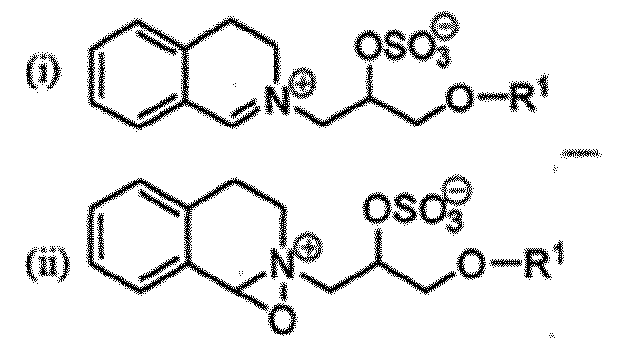
(iii) and mixtures thereof; wherein each R1 is independently a branched alkyl group containing from 9 to 24 carbons or linear alkyl group containing from 1 1 to 24 carbons, preferably each R1 is independently a branched alkyl group containing from 9 to 18 carbons or linear alkyl group containing from 1 1 to 18 carbons, more preferably each R1 is independently selected from the group consisting of 2-propylheptyl, 2-butyloctyl, 2-pentylnonyl, 2-hexyldecyl, dodecyl, tetradecyl, hexadecyl, octadecyl, isononyl, isodecyl, isotridecyl and isopentadecyl.
Other exemplary bleaching systems are described, e.g. in W02007/087258, W02007/087244, W02007/087259, EP1867708 (Vitamin K) and W02007/087242. Suitable photobleaches may for example be sulfonated zinc or aluminium phthalocyanines.
Metal care agents
Metal care agents may prevent or reduce the tarnishing, corrosion or oxidation of metals, including aluminium, stainless steel and non-ferrous metals, such as silver and copper. Suitable examples include one or more of the following:
(a) benzatriazoles, including benzotriazole or bis-benzotriazole and substituted derivatives thereof. Benzotriazole derivatives are those compounds in which the available substitution sites on the aromatic ring are partially or completely substituted. Suitable substituents include linear or branch-chain Ci-C20- alkyl groups (e.g., C1-C20- alkyl groups) and hydroxyl, thio, phenyl or halogen such as fluorine, chlorine, bromine and iodine.
(b) metal salts and complexes chosen from the group consisting of zinc, manganese, titanium, zirconium, hafnium, vanadium, cobalt, gallium and cerium salts and/or complexes, the metals being in one of the oxidation states II, III, IV, V or VI. In one aspect, suitable metal salts and/or metal complexes may be chosen from the group consisting of Mn(ll) sulphate, Mn(ll) citrate, Mn(ll) stearate, Mn(ll) acetylacetonate, KATiF6 (e.g., K2T 6), KAZrF6 (e.g., K2ZrF6), CoS04,
Co(NOs)2 and Ce(NOs)3, zinc salts, for example zinc sulphate, hydrozincite or zinc acetate.;
(c) silicates, including sodium or potassium silicate, sodium disilicate, sodium metasilicate, crystalline phyllosilicate and mixtures thereof.
Further suitable organic and inorganic redox-active substances that act as silver/copper corrosion inhibitors are disclosed in WO 94/26860 and WO 94/26859. Preferably the composition of the invention comprises from 0.1 to 5% by weight of the composition of a metal care agent, preferably the metal care agent is a zinc salt.
Hvdrotropes
The detergent may contain 0-10% by weight, for example 0-5% by weight, such as about 0.5 to about 5%, or about 3% to about 5%, of a hydrotrope. Any hydrotrope known in the art for use in detergents may be utilized. Non-limiting examples of hydrotropes include sodium benzenesulfonate, sodium p-toluene sulfonate (STS), sodium xylene sulfonate (SXS), sodium cumene sulfonate (SCS), sodium cymene sulfonate, amine oxides, alcohols and polyglycolethers, sodium hydroxynaphthoate, sodium hydroxynaphthalene sulfonate, sodium ethylhexyl sulfate, and combinations thereof.
Polymers
The detergent may contain 0-10% by weight, such as 0.5-5%, 2-5%, 0.5-2% or 0.2-1 % of a polymer. Any polymer known in the art for use in detergents may be utilized. The polymer may function as a co-builder as mentioned above, or may provide antiredeposition, fiber protection, soil release, dye transfer inhibition, grease cleaning and/or anti-foaming properties. Some polymers may have more than one of the above-mentioned properties. Exemplary polymers include (carboxymethyl)cellulose (CMC), poly(vinyl alcohol) (PVA), poly(vinylpyrrolidone) (PVP), poly(ethyleneglycol) or poly(ethylene oxide) (PEG), ethoxylated poly(ethyleneimine), carboxymethyl inulin (CMI), and polycarboxylates such as PAA, PAA/PMA, poly-aspartic acid, and lauryl methacrylate/acrylic acid copolymers , hydrophobically modified CMC (HM-CMC) and silicones, copolymers of terephthalic acid and oligomeric glycols, copolymers of poly(ethylene terephthalate) and poly(oxyethene terephthalate) (PET-POET), PVP, poly(vinylimidazole) (PVI), poly(vinylpyridine-N-oxide) (PVPO or PVPNO) and polyvinylpyrrolidone-vinylimidazole (PVPVI). Suitable examples include PVP-K15, PVP-K30, ChromaBond S-400, ChromaBond S- 403E and Chromabond S-100 from Ashland Aqualon, and Sokalan® HP 165, Sokalan® HP 50 (Dispersing agent), Sokalan® HP 53 (Dispersing agent), Sokalan® HP 59 (Dispersing agent), Sokalan® HP 56 (dye transfer inhibitor), Sokalan® HP 66 K (dye transfer inhibitor) from BASF. Further exemplary polymers include sulfonated polycarboxylates, polyethylene oxide and polypropylene oxide (PEO- PPO) and diquaternium ethoxy sulfate. Other exemplary polymers are disclosed in, e.g., WO 2006/130575. Salts of the above-mentioned polymers are also contemplated. Particularly preferred polymer is ethoxylated homopolymer Sokalan® HP 20 from BASF, which helps to prevent redeposition of soil in the wash liquor.
Fabric hueinq agents
The detergent compositions of the present invention may also include fabric hueing agents such as dyes or pigments, which when formulated in detergent compositions can deposit onto a fabric when said fabric is contacted with a wash liquor comprising said detergent compositions and thus altering the tint of said fabric through absorption/reflection of visible light. Fluorescent whitening agents emit at least some visible light. In contrast, fabric hueing agents alter the tint of a surface as they absorb at least a portion of the visible light spectrum. Suitable fabric hueing agents include dyes and dye-clay conjugates, and may also include pigments. Suitable dyes include small molecule dyes and polymeric dyes. Suitable small molecule dyes include small molecule dyes selected from the group consisting of dyes falling into the Colour Index (C.l.) classifications of Direct Blue, Direct Red, Direct Violet, Acid Blue, Acid Red, Acid Violet, Basic Blue, Basic Violet and Basic Red, or mixtures thereof, for example as described in W02005/03274, W02005/03275, W02005/03276 and EP1876226 (hereby incorporated by reference). The detergent composition preferably comprises from about 0.00003 wt% to about 0.2 wt%, from about 0.00008 wt% to about 0.05 wt%, or even from about 0.0001 wt% to about 0.04 wt% fabric hueing agent. The composition may comprise from 0.0001 wt% to 0.2 wt% fabric hueing agent, this may be especially preferred when the composition is in the form of a unit dose pouch. Suitable hueing agents are also disclosed in, e.g. WO 2007/087257 and W02007/087243.
Enzymes
The detergent additive as well as the detergent composition may comprise one or more additional enzymes such as one or more lipase, cutinase, an amylase, carbohydrase, cellulase, pectinase, mannanase, arabinase, galactanase, xylanase, oxidase, e.g., a laccase, and/or peroxidase.
In general, the properties of the selected enzyme(s) should be compatible with the selected detergent, (i.e., pH-optimum, compatibility with other enzymatic and non-enzymatic ingredients, etc.), and the enzyme(s) should be present in effective amounts.
Proteases
Suitable proteases may be of any origin, but are preferably of bacterial or fungal origin, optionally in the form of protein engineered or chemically modified mutants. The protease may be an alkaline protease, such as a serine protease or a metalloprotease. A serine protease may for example be of the S1 family, such as trypsin, or the S8 family such as a subtilisin. A metalloprotease may for example be a thermolysin, e.g. from the M4 family, or another metalloprotease such as those from the M5, M7 or M8 families.
The term "subtilases" refers to a sub-group of serine proteases according to Siezen et al.,
Protein Eng. 4 (1991 ) 719-737 and Siezen et al., Protein Sci. 6 (1997) 501-523. Serine proteases are a subgroup of proteases characterized by having a serine in the active site, which forms a
covalent adduct with the substrate. The subtilases may be divided into six subdivisions, the Subtilisin family, the Thermitase family, the Proteinase K family, the Lantibiotic peptidase family, the Kexin family and the Pyrolysin family.
Although proteases suitable for detergent use may be obtained from a variety of organisms, including fungi such as Aspergillus, detergent proteases have generally been obtained from bacteria and in particular from Bacillus. Examples of Bacillus species from which subtilases have been derived include Bacillus lentus, Bacillus alkalophilus, Bacillus subtilis, Bacillus amyloliquefaciens, Bacillus licheniformis, Bacillus pumilus and Bacillus gibsonii. Particular subtilisins include subtilisin lentus, subtilisin Novo, subtilisin Carlsberg, subtilisin BPN’, subtilisin 309, subtilisin 147 and subtilisin 168 and e.g. protease PD138 (described in WO 93/18140). Other useful proteases are e.g. those described in WO 01/16285 and WO 02/16547.
Examples of trypsin-like proteases include the Fusarium protease described in WO 94/25583 and WO 2005/040372, and the chymotrypsin proteases derived from Cellumonas described in WO 2005/052161 and WO 2005/052146.
Examples of metalloproteases include the neutral metalloproteases described in WO 2007/044993 such as those derived from Bacillus amyloliquefaciens, as well as e.g. the metalloproteases described in WO 2015/158723 and WO 2016/075078.
Examples of useful proteases are the variants described in WO 89/06279 WO 92/19729, WO 96/34946, WO 98/201 15, WO 98/201 16, WO 99/11768, WO 01/44452, WO 03/006602, WO 2004/003186, WO 2004/041979, WO 2007/006305, WO 201 1/036263, WO 2014/207227, WO 2016/087617 and WO 2016/174234. Preferred protease variants may, for example, comprise one or more of the mutations selected from the group consisting of: S3T, V4I, S9R, S9E, A15T, S24G, S24R, K27R, N42R, S55P, G59E, G59D, N60D, N60E, V66A, N74D, S85R, A96S, S97G, S97D, S97A, S97SD, S99E, S99D, S99G, S99M, S99N, S99R, S99H, S101A, V102I, V102Y, V102N, S104A, G116V, G116R, H1 18D, H1 18N, A120S, S126L, P127Q, S128A, S154D, A156E, G157D, G157P, S158E, Y161A, R164S, Q176E, N179E, S182E, Q185N, A188P, G189E, V193M, N198D, V199I, Q200L, Y203W, S206G, L21 1 Q, L21 1 D, N212D, N212S, M216S, A226V, K229L, Q230H, Q239R, N246K, S253D, N255W, N255D, N255E, L256E, L256D T268A and R269H, wherein position numbers correspond to positions of the Bacillus lentus protease shown in SEQ ID NO: 1 of WO 2016/001449. Protease variants having one or more of these mutations are preferably variants of the Bacillus lentus protease (Savinase®, also known as subtilisin 309) shown in SEQ ID NO: 1 of WO 2016/001449 or of the Bacillus amyloliquefaciens protease (BPN’) shown in SEQ ID NO: 2 of WO 2016/001449. Such protease variants preferably have at least 80% sequence identity to SEQ ID NO: 1 or to SEQ ID NO: 2 of WO 2016/001449.
Another protease of interest is the alkaline protease from Bacillus lentus DSM 5483, as described for example in WO 91/02792, and variants thereof which are described for example in WO 92/21760, WO 95/23221 , EP 1921 147, EP 1921 148 and WO 2016/09671 1.
The protease may alternatively be a variant of the TY145 protease having SEQ ID NO: 1 of WO 2004/067737, for example a variant comprising a substitution at one or more positions corresponding to positions 27, 109, 11 1 , 171 , 173, 174, 175, 180, 182, 184, 198, 199 and 297 of SEQ ID NO: 1 of WO 2004/067737, wherein said protease variant has a sequence identity of at least 75% but less than 100% to SEQ ID NO: 1 of WO 2004/067737. TY145 variants of interest are described in e.g. WO 2015/014790, WO 2015/014803, WO 2015/014804, WO 2016/097350, WO 2016/097352, WO 2016/097357 and WO 2016/097354.
Examples of preferred proteases include:
(a) variants of SEQ ID NO: 1 of WO 2016/001449 comprising two or more substitutions selected from the group consisting of S9E, N43R, N76D, Q206L, Y209W, S259D and L262E, for example a variant with the substitutions S9E, N43R, N76D, V205I, Q206L, Y209W, S259D, N261W and L262E, or with the substitutions S9E, N43R, N76D, N185E, S188E, Q191 N, A194P, Q206L, Y209W, S259D and L262E, wherein position numbers are based on the numbering of SEQ ID NO: 2 of WO 2016/001449;
(b) a variant of the polypeptide of SEQ ID NO: 1 of WO 2016/001449 with the mutation S99SE, wherein position numbers are based on the numbering of SEQ ID NO: 2 of WO 2016/001449;
(c) a variant of the polypeptide of SEQ ID NO: 1 of WO 2016/001449 with the mutation S99AD, wherein position numbers are based on the numbering of SEQ ID NO: 2 of WO 2016/001449;
(d) a variant of the polypeptide of SEQ ID NO: 1 of WO 2016/001449 with the substitutions Y167A+R170S+A194P, wherein position numbers are based on the numbering of SEQ ID NO: 2 of WO 2016/001449;
(e) a variant of the polypeptide of SEQ ID NO: 1 of WO 2016/001449 with the substitutions S9R+A15T+V68A+N218D+Q245R, wherein position numbers are based on the numbering of SEQ ID NO: 2 of WO 2016/001449;
(f) a variant of the polypeptide of SEQ ID NO: 1 of WO 2016/001449 with the substitutions S9R+A15T+G61 E+V68A+A194P+V205I+Q245R+N261 D, wherein position numbers are based on the numbering of SEQ ID NO: 2 of WO 2016/001449;
(g) a variant of the polypeptide of SEQ ID NO: 1 of WO 2016/001449 with the substitutions S99D+S101 R/E+S103A+V104I+G160S; for example a variant of SEQ ID NO: 1 of WO 2016/001449 with the substitutions S3T+V4I+S99D+S101 E+S103A+V104I+G160S+V205I, wherein position numbers are based on the numbering of SEQ ID NO: 2 of WO 2016/001449;
(h) a variant of the polypeptide of SEQ ID NO: 2 of WO 2016/001449 with the substitutions S24G+S53G+S78N+S101 N+G128A/S+Y217Q, wherein position numbers are based on the numbering of SEQ ID NO: 2 of WO 2016/001449;
(i) the polypeptide disclosed in GENESEQP under accession number BER84782, corresponding to SEQ ID NO: 302 in WO 2017/210295;
(j) a variant of the polypeptide of SEQ ID NO: 1 of WO 2016/001449 with the substitutions S99D+S101 E+S103A+V104I+S156D+G160S+L262E, wherein position numbers are based on the numbering of SEQ ID NO: 2 of WO 2016/001449;
(k) a variant of the polypeptide of SEQ ID NO: 1 of WO 2016/001449 with the substitutions S9R+A15T+G61 E+V68A+N76D+S99G+N218D+Q245R, wherein position numbers are based on the numbering of SEQ ID NO: 2 of WO 2016/001449;
(L) a variant of the polypeptide of SEQ ID NO: 1 of WO 2016/001449 with the substitutions V68A+S106A, wherein position numbers are based on the numbering of SEQ ID NO: 2 of WO 2016/001449;
(m) a variant of the polypeptide of SEQ ID NO: 1 of WO 2004/067737 with the substitutions S27K+N109K+S1 1 1 E+S171 E+S173P+G174K+S175P+F180Y+G182A+L184F+ Q198E+N199+T297P, wherein position numbers are based on the numbering of SEQ ID NO: 1 of WO 2004/067737.
Suitable commercially available protease enzymes include those sold under the trade names Alcalase®, Duralase™, Durazym™, Relase®, Relase® Ultra, Savinase®, Savinase® Ultra, Primase™, Polarzyme®, Kannase®, Liquanase®, Liquanase® Ultra, Ovozyme®, Coronase®, Coronase® Ultra, Blaze®, Blaze Evity® 100T, Blaze Evity® 125T, Blaze Evity® 150T, Blaze Evity® 200T, Neutrase®, Everlase®, Esperase®, Progress® Uno, Progress® In and Progress® Excel (Novozymes A/S), those sold under the tradename Maxatase™, Maxacal™, Maxapem®, Purafect® Ox, Purafect® OxP, Puramax®, FN2™, FN3™, FN4ex™, Excellase®, Excellenz™ P1000, Excellenz™ P1250, Eraser™, Preferenz® P100, Purafect Prime, Preferenz P1 10™, Effectenz P1000™, Purafect®, Effectenz P1050™, Purafect® Ox, Effectenz™ P2000, Purafast™, Properase®, Opticlean™ and Optimase® (Danisco/DuPont), BLAP (sequence shown in Figure 29 of US 5352604) and variants hereof (Henkel AG), and KAP ( Bacillus al alophilus subtilisin) from Kao.
Cellulases
Suitable cellulases include those of bacterial or fungal origin. Chemically modified or protein engineered mutants are included. Suitable cellulases include cellulases from the genera Bacillus, Pseudomonas, Humicola, Fusarium, Thielavia, Acremonium, e.g., the fungal cellulases produced from Humicola insolens, Myceliophthora thermophila and Fusarium oxysporum disclosed in US 4,435,307, US 5,648,263, US 5,691 ,178, US 5,776,757 and WO 89/09259.
Especially suitable cellulases are the alkaline or neutral cellulases having colour care benefits. Examples of such cellulases are cellulases described in EP 0 495 257, EP 0 531 372, WO 96/1 1262, WO 96/29397, WO 98/08940. Other examples are cellulase variants such as those described in WO 94/07998, EP 0 531 315, US 5,457,046, US 5,686,593, US 5,763,254, WO 95/24471 , WO 98/12307 and W099/001544.
Other cellulases are endo-beta-1 ,4-glucanase enzyme having a sequence of at least 97% identity to the amino acid sequence of position 1 to position 773 of SEQ ID NO:2 of WO 2002/099091 or a family 44 xyloglucanase, which a xyloglucanase enzyme having a sequence of at least 60% identity to positions 40-559 of SEQ ID NO: 2 of WO 2001/062903.
Commercially available cellulases include Celluzyme™, and Carezyme™ (Novozymes A/S) Carezyme Premium™ (Novozymes A/S), Celluclean ™ (Novozymes A/S), Celluclean Classic™ (Novozymes A/S), Cellusoft™ (Novozymes A/S), Whitezyme™ (Novozymes A/S), Clazinase™, and Puradax HA™ (Genencor International Inc.), and KAC-500(B)™ (Kao Corporation).
Mannanases
Suitable mannanases include those of bacterial or fungal origin. Chemically or genetically modified mutants are included. The mannanase may be an alkaline mannanase of Family 5 or 26. It may be a wild-type from Bacillus or Humicola, particularly B. agaradhaerens, B. licheniformis, B. halodurans, B. clausii, or H. insolens. Suitable mannanases are described in WO 1999/064619. A commercially available mannanase is Mannaway (Novozymes A/S).
Peroxi dases/Oxi dases
Suitable peroxidases/oxidases include those of plant, bacterial or fungal origin. Chemically modified or protein engineered mutants are included. Examples of useful peroxidases include peroxidases from Coprinus, e.g., from C. cinereus, and variants thereof as those described in WO 93/24618, WO 95/10602, and WO 98/15257. Commercially available peroxidases include Guardzyme™ (Novozymes A/S).
Lipases and Cutinases
Suitable lipases and cutinases include those of bacterial or fungal origin. Chemically modified or protein engineered mutant enzymes are included. Examples include lipase from Thermomyces, e.g. from T. lanuginosus (previously named Humicola lanuginosa) as described in EP258068 and EP305216, cutinase from Humicola, e.g. H. insolens (WO96/13580), lipase from strains of Pseudomonas (some of these now renamed to Burkholderia), e.g. P. alcaligenes or P. pseudoalcaligenes (EP218272), P. cepacia (EP331376), P. sp. strain SD705 (W095/06720 & W096/27002), P. wisconsinensis (WO96/12012), GDSL-type Streptomyces lipases (W010/065455), cutinase from Magnaporthe grisea (W010/107560), cutinase from Pseudomonas mendocina (US5,389,536), lipase from Thermobifida fusca (W011/084412), Geobacillus stearothermophilus lipase (W011/084417), lipase from Bacillus subtilis (W01 1/084599), and lipase from Streptomyces griseus (W01 1/150157) and S. pristinaespiralis (W012/137147).
Other examples are lipase variants such as those described in EP407225, WO92/05249, WO94/01541 , W094/25578, W095/14783, WO95/30744, W095/35381 , W095/22615,
W096/00292, W097/04079, W097/07202, WO00/34450, WO00/60063, W001/92502,
W007/87508 and WO09/109500.
Preferred commercial lipase products include Lipolase™, Lipex™; Lipolex™ and Lipoclean™ (Novozymes A/S), Lumafast (originally from Genencor) and Lipomax (originally from Gist-Brocades).
Still other examples are lipases sometimes referred to as acyltransferases or perhydrolases, e.g. acyltransferases with homology to Candida antarctica lipase A (WO10/1 11 143), acyltransferase from Mycobacterium smegmatis (WO05/56782), perhydrolases from the CE 7 family (WO09/67279), and variants of the M. smegmatis perhydrolase in particular the S54V variant used in the commercial product Gentle Power Bleach from Huntsman Textile Effects Pte Ltd (W010/100028).
Amylases
Suitable amylases include alpha-amylases and/or glucoamylases and may be of bacterial or fungal origin. Chemically modified or protein engineered mutants are included. Amylases include, for example, alpha-amylases obtained from Bacillus, e.g., a special strain of Bacillus licheniformis, described in more detail in GB 1 ,296,839.
Suitable amylases include amylases having SEQ ID NO: 2 in WO 95/10603 or variants having 90% sequence identity to SEQ ID NO: 3 thereof. Preferred variants are described in WO 94/02597, WO 94/18314, WO 97/43424 and SEQ ID NO: 4 of WO 99/019467, such as variants with substitutions in one or more of the following positions: 15, 23, 105, 106, 124, 128, 133, 154, 156, 178, 179, 181 , 188, 190, 197, 201 , 202, 207, 208, 209, 211 , 243, 264, 304, 305, 391 , 408, and 444.
Different suitable amylases include amylases having SEQ ID NO: 6 in WO 02/010355 or variants thereof having 90% sequence identity to SEQ ID NO: 6. Preferred variants of SEQ ID NO: 6 are those having a deletion in positions 181 and 182 and a substitution in position 193.
Other amylases which are suitable are hybrid alpha-amylase comprising residues 1 -33 of the alpha-amylase derived from B. amyloliquefaciens shown in SEQ ID NO: 6 of WO 2006/066594 and residues 36-483 of the B. licheniformis alpha-amylase shown in SEQ ID NO: 4 of WO 2006/066594 or variants having 90% sequence identity thereof. Preferred variants of this hybrid alpha-amylase are those having a substitution, a deletion or an insertion in one of more of the following positions: G48, T49, G107, H156, A181 , N190, M197, 1201 , A209 and Q264. Most preferred variants of the hybrid alpha-amylase comprising residues 1-33 of the alpha-amylase derived from B. amyloliquefaciens shown in SEQ ID NO: 6 of WO 2006/066594 and residues 36- 483 of SEQ ID NO: 4 are those having the substitutions:
M197T;
H 156Y+A181T+N 190F+A209V+Q264S; or
G48A+T49I+G107A+H156Y+A181T+N190F+I201 F+A209V+Q264S.
Further amylases which are suitable are amylases having SEQ ID NO: 6 in WO 99/019467 or variants thereof having 90% sequence identity to SEQ ID NO: 6. Preferred variants of SEQ ID NO: 6 are those having a substitution, a deletion or an insertion in one or more of the following positions: R181 , G182, H183, G184, N195, I206, E212, E216 and K269. Particularly preferred amylases are those having deletion in positions R181 and G182, or positions H183 and G184.
Additional amylases which can be used are those having SEQ ID NO: 1 , SEQ ID NO: 3, SEQ ID NO: 2 or SEQ ID NO: 7 of WO 96/023873 or variants thereof having 90% sequence identity to SEQ ID NO: 1 , SEQ ID NO: 2, SEQ ID NO: 3 or SEQ ID NO: 7. Preferred variants of SEQ ID NO: 1 , SEQ ID NO: 2, SEQ ID NO: 3 or SEQ ID NO: 7 are those having a substitution, a deletion or an insertion in one or more of the following positions: 140, 181 , 182, 183, 184, 195, 206, 212, 243, 260, 269, 304 and 476, using SEQ ID 2 of WO 96/023873 for numbering. More preferred variants are those having a deletion in two positions selected from 181 , 182, 183 and 184, such as 181 and 182, 182 and 183, or positions 183 and 184. Most preferred amylase variants of SEQ ID NO: 1 , SEQ ID NO: 2 or SEQ ID NO: 7 are those having a deletion in positions 183 and 184 and a substitution in one or more of positions 140, 195, 206, 243, 260, 304 and 476.
Other amylases which can be used are amylases having SEQ ID NO: 2 of WO 08/153815, SEQ ID NO: 10 in WO 01/66712 or variants thereof having 90% sequence identity to SEQ ID NO: 2 of WO 08/153815 or 90% sequence identity to SEQ ID NO: 10 in WO 01/66712. Preferred variants of SEQ ID NO: 10 in WO 01/66712 are those having a substitution, a deletion or an insertion in one of more of the following positions: 176, 177, 178, 179, 190, 201 , 207, 21 1 and 264.
Further suitable amylases are amylases having SEQ ID NO: 2 of WO 09/061380 or variants having 90% sequence identity to SEQ ID NO: 2 thereof. Preferred variants of SEQ ID NO: 2 are those having a truncation of the C-terminus and/or a substitution, a deletion or an insertion in one of more of the following positions: Q87, Q98, S125, N128, T131 , T165, K178, R180, S 181 , T182, G183, M201 , F202, N225, S243, N272, N282, Y305, R309, D319, Q320, Q359, K444 and G475. More preferred variants of SEQ ID NO: 2 are those having the substitution in one of more of the following positions: Q87E,R, Q98R, S125A, N128C, T131 I, T165I, K178L, T182G, M201 L, F202Y, N225E,R, N272E,R, S243Q,A,E,D, Y305R, R309A, Q320R, Q359E, K444E and G475K and/or deletion in position R180 and/or S181 or of T182 and/or G183. Most preferred amylase variants of SEQ ID NO: 2 are those having the substitutions:
N 128C+K178L+T182G+Y305R+G475K;
N 128C+K178L+T182G+F202Y+Y305R+D319T+G475K;
S 125A+N 128C+K178L+T182G+Y305R+G475K; or
S125A+N 128C+T1311+T165I+K178L+T182G+Y305R+G475K wherein the variants are C-terminally truncated and optionally further comprises a substitution at position 243 and/or a deletion at position 180 and/or position 181.
Further suitable amylases are amylases having SEQ ID NO: 1 ofW013184577 or variants having 90% sequence identity to SEQ ID NO: 1 thereof. Preferred variants of SEQ ID NO: 1 are those having a substitution, a deletion or an insertion in one of more of the following positions: K176, R178, G179, T180, G181 , E187, N192, M199, I203, S241 , R458, T459, D460, G476 and G477. More preferred variants of SEQ ID NO: 1 are those having the substitution in one of more of the following positions: K176L, E187P, N192FYH, M199L, I203YF, S241 QADN, R458N, T459S, D460T, G476K and G477K and/or deletion in position R178 and/or S179 or of T180 and/or G181. Most preferred amylase variants of SEQ ID NO: 1 are those having the substitutions:
E187P+I203Y+G476K
E187P+I203Y+R458N+T459S+D460T+G476K
wherein the variants optionally further comprise a substitution at position 241 and/or a deletion at position 178 and/or position 179.
Further suitable amylases are amylases having SEQ ID NO: 1 ofW010104675 or variants having 90% sequence identity to SEQ ID NO: 1 thereof. Preferred variants of SEQ ID NO: 1 are those having a substitution, a deletion or an insertion in one of more of the following positions: N21 , D97, V128 K177, R179, S180, 1181 , G182, M200, L204, E242, G477 and G478. More preferred variants of SEQ ID NO: 1 are those having the substitution in one of more of the following positions: N21 D, D97N, V128I K177L, M200L, L204YF, E242QA, G477K and G478K and/or deletion in position R179 and/or S180 or of 1181 and/or G182. Most preferred amylase variants of SEQ ID NO: 1 are those having the substitutions:
N21 D+D97N+V128I
wherein the variants optionally further comprise a substitution at position 200 and/or a deletion at position 180 and/or position 181.
Other suitable amylases are the alpha-amylase having SEQ ID NO: 12 in WO01/66712 or a variant having at least 90% sequence identity to SEQ ID NO: 12. Preferred amylase variants are those having a substitution, a deletion or an insertion in one of more of the following positions of SEQ I D NO: 12 in WO01/66712: R28, R1 18, N 174; R181 , G182, D183, G184, G186, W189, N195, M202, Y298, N299, K302, S303, N306, R310, N314; R320, H324, E345, Y396, R400, W439, R444, N445, K446, Q449, R458, N471 , N484. Particular preferred amylases include variants having a deletion of D183 and G184 and having the substitutions R118K, N195F, R320K and R458K, and a variant additionally having substitutions in one or more position selected from the group: M9, G149, G182, G186, M202, T257, Y295, N299, M323, E345 and A339, most preferred a variant that additionally has substitutions in all these positions.
Other examples are amylase variants such as those described in WO2011/098531 , WQ2013/001078 and WO2013/001087.
Commercially available amylases are Duramyl™, Termamyl™, Fungamyl™, Stainzyme™, Stainzyme Plus™, Natalase™, Liquozyme X and BAN™ (from Novozymes A/S), and Rapidase™, Purastar™/Effectenz™, Powerase, Preferenz S1000, Preferenz S100 and Preferenz S1 10 (from Genencor International Inc./DuPont).
Peroxidases/Oxidases
A suitable peroxidase according to the invention is a peroxidase enzyme comprised by the enzyme classification EC 1 .1 1 .1 .7, as set out by the Nomenclature Committee of the International Union of Biochemistry and Molecular Biology (IUBMB), or any fragment derived therefrom, exhibiting peroxidase activity.
Suitable peroxidases include those of plant, bacterial or fungal origin. Chemically modified or protein engineered mutants are included. Examples of useful peroxidases include peroxidases from Coprinopsis, e.g., from C. cinerea (EP 179,486), and variants thereof as those described in WO 93/24618, WO 95/10602, and WO 98/15257.
A suitable peroxidase includes a haloperoxidase enzyme, such as chloroperoxidase, bromoperoxidase and compounds exhibiting chloroperoxidase or bromoperoxidase activity. Haloperoxidases are classified according to their specificity for halide ions. Chloroperoxidases (E.C. 1.1 1.1.10) catalyze formation of hypochlorite from chloride ions. Preferably, the haloperoxidase is a vanadium haloperoxidase, i.e., a vanadate-containing haloperoxidase. Haloperoxidases have been isolated from many different fungi, in particularfrom the fungus group dematiaceous hyphomycetes, such as Caldariomyces, e.g., C. fumago, Alternaria, Curvularia, e.g., C. verruculosa and C. inaequalis, Drechslera, Ulocladium and Botrytis.
Haloperoxidases have also been isolated from bacteria such as Pseudomonas, e.g., P. pyrrocinia and Streptomyces, e.g., S. aureofaciens.
A suitable oxidase includes in particular, any laccase enzyme comprised by the enzyme classification EC 1.10.3.2, or any fragment derived therefrom exhibiting laccase activity, or a compound exhibiting a similar activity, such as a catechol oxidase (EC 1.10.3.1 ), an o- aminophenol oxidase (EC 1.10.3.4), or a bilirubin oxidase (EC 1.3.3.5). Preferred laccase enzymes are enzymes of microbial origin. The enzymes may be derived from plants, bacteria or fungi (including filamentous fungi and yeasts). Suitable examples from fungi include a laccase derivable from a strain of Aspergillus, Neurospora, e.g., N. crassa, Podospora, Botrytis, Collybia, Fomes, Lentinus, Pleurotus, Trametes, e.g., T. villosa and T. versicolor, Rhizoctonia, e.g., R. solani, Coprinopsis, e.g., C. cinerea, C. comatus, C. friesii, and C. plicatilis, Psathyrella, e.g., P. condelleana, Panaeolus, e.g., P. papilionaceus, Myceliophthora, e.g., M. thermophila, Schytalidium, e.g., S. thermophilum, Polyporus, e.g., P. pinsitus, Phlebia, e.g., P. radiata (WO 92/01046), or Coriolus, e.g., C. hirsutus (JP 2238885). Suitable examples from bacteria include a laccase derivable from a strain of Bacillus. A laccase derived from Coprinopsis or
Myceliophthora is preferred; in particular, a laccase derived from Coprinopsis cinerea, as disclosed in WO 97/08325; or from Myceliophthora thermophila, as disclosed in WO 95/33836.
Dispersants
The cleaning compositions of the present invention can also contain dispersants. In particular, powdered detergents may comprise dispersants. Suitable water-soluble organic materials include the homo- or co-polymeric acids or their salts, in which the polycarboxylic acid comprises at least two carboxyl radicals separated from each other by not more than two carbon atoms. Suitable dispersants are for example described in Powdered Detergents, Surfactant science series volume 71 , Marcel Dekker, Inc.
Dye Transfer Inhibiting Agents
The cleaning compositions of the present invention may also include one or more dye transfer inhibiting agents. Suitable polymeric dye transfer inhibiting agents include, but are not limited to, polyvinylpyrrolidone polymers, polyamine N-oxide polymers, copolymers of N- vinylpyrrolidone and N-vinylimidazole, polyvinyloxazolidones and polyvinylimidazoles or mixtures thereof. When present in a subject composition, the dye transfer inhibiting agents may be present at levels from about 0.0001 % to about 10%, from about 0.01 % to about 5% or even from about 0.1 % to about 3% by weight of the composition.
Fluorescent whitening agent
The cleaning compositions of the present invention will preferably also contain additional components that may tint articles being cleaned, such as fluorescent whitening agent or optical brighteners. Where present the brightener is preferably at a level of about 0.01 % to about 0.5%.
Any fluorescent whitening agent suitable for use in a laundry detergent composition may be used in the composition of the present invention. The most commonly used fluorescent whitening agents are those belonging to the classes of diaminostilbene-sulfonic acid derivatives, diarylpyrazoline derivatives and bisphenyl-distyryl derivatives. Examples of the diaminostilbene- sulfonic acid derivative type of fluorescent whitening agents include the sodium salts of: 4,4'-bis-
(2-diethanolamino-4-anilino-s-triazin-6-ylamino) stilbene-2,2'-disulfonate, 4,4'-bis-(2,4-dianilino- s-triazin-6-ylamino) stilbene-2.2'-disulfonate, 4,4'-bis-(2-anilino-4-(N-methyl-N-2-hydroxy- ethylamino)-s-triazin-6-ylamino) stilbene-2,2'-disulfonate, 4,4'-bis-(4-phenyl-1 ,2,3-triazol-2- yl)stilbene-2,2'-disulfonate and sodium 5-(2H-naphtho[1 ,2-d][1 ,2,3]triazol-2-yl)-2-[(E)-2- phenylvinyljbenzenesulfonate. Preferred fluorescent whitening agents are Tinopal DMS and
Tinopal CBS available from Ciba-Geigy AG, Basel, Switzerland. Tinopal DMS is the disodium salt of 4,4'-bis-(2-morpholino-4-anilino-s-triazin-6-ylamino) stilbene-2,2'-disulfonate. Tinopal CBS is the disodium salt of 2,2'-bis-(phenyl-styryl)-disulfonate. Also preferred are fluorescent whitening agents is the commercially available Parawhite KX, supplied by Paramount Minerals and
Chemicals, Mumbai, India. Other fluorescers suitable for use in the invention include the 1 -3- diaryl pyrazolines and the 7-alkylaminocoumarins. Suitable fluorescent brightener levels include lower levels of from about 0.01 , from 0.05, from about 0.1 or even from about 0.2 wt % to upper levels of 0.5 or even 0.75 wt%.
Soil release polymers
The cleaning compositions of the present invention may also include one or more soil release polymers which aid the removal of soils from fabrics such as cotton and polyester based fabrics, in particular the removal of hydrophobic soils from polyester based fabrics. The soil release polymers may for example be nonionic or anionic terephthalte based polymers, polyvinyl caprolactam and related copolymers, vinyl graft copolymers, polyester polyamides see for example Chapter 7 in Powdered Detergents, Surfactant science series volume 71 , Marcel Dekker, Inc. Another type of soil release polymers is amphiphilic alkoxylated grease cleaning polymers comprising a core structure and a plurality of alkoxylate groups attached to that core structure. The core structure may comprise a polyalkylenimine structure or a polyalkanolamine structure as described in detail in WO 2009/087523 (hereby incorporated by reference). Furthermore, random graft co-polymers are suitable soil release polymers. Suitable graft co-polymers are described in more detail in WO 2007/138054, WO 2006/108856 and WO 2006/113314 (hereby incorporated by reference). Suitable polyethylene glycol polymers include random graft co-polymers comprising: (i) hydrophilic backbone comprising polyethylene glycol; and (ii) side chain(s) selected from the group consisting of: C4-C25 alkyl group, polypropylene, polybutylene, vinyl ester of a saturated C1-C6 mono-carboxylic acid, Cl-C 6 alkyl ester of acrylic or methacrylic acid, and mixtures thereof. Suitable polyethylene glycol polymers have a polyethylene glycol backbone with random grafted polyvinyl acetate side chains. The average molecular weight of the polyethylene glycol backbone can be in the range of from 2,000 Da to 20,000 Da, or from 4,000 Da to 8,000 Da. The molecular weight ratio of the polyethylene glycol backbone to the polyvinyl acetate side chains can be in the range of from 1 : 1 to 1 :5, or from 1 : 1.2 to 1 :2. The average number of graft sites per ethylene oxide units can be less than 1 , or less than 0.8, the average number of graft sites per ethylene oxide units can be in the range of from 0.5 to 0.9, or the average number of graft sites per ethylene oxide units can be in the range of from 0.1 to 0.5, or from 0.2 to 0.4. A suitable polyethylene glycol polymer is Sokalan HP22. Other soil release polymers are substituted polysaccharide structures especially substituted cellulosic structures such as modified cellulose deriviatives such as those described in EP 1867808 or WO 2003/040279 (both are hereby incorporated by reference). Suitable cellulosic polymers include cellulose, cellulose ethers, cellulose esters, cellulose amides and mixtures thereof. Suitable cellulosic polymers include anionically modified cellulose, nonionically modified cellulose, cationically modified cellulose, zwitterionically modified cellulose, and mixtures thereof. Suitable cellulosic polymers
include methyl cellulose, carboxy methyl cellulose, ethyl cellulose, hydroxyl ethyl cellulose, hydroxyl propyl methyl cellulose, ester carboxy methyl cellulose, and mixtures thereof.
Anti-redeposition agents
The cleaning compositions of the present invention may also include one or more antiredeposition agents such as carboxymethylcellulose (CMC), polyvinyl alcohol (PVA), polyvinylpyrrolidone (PVP), polyoxyethylene and/or polyethyleneglycol (PEG), homopolymers of acrylic acid, copolymers of acrylic acid and maleic acid, and ethoxylated polyethyleneimines. The cellulose-based polymers described under soil release polymers above may also function as antiredeposition agents.
Rheology Modifiers
The cleaning compositions of the present invention may also include one or more rheology modifiers, structurants or thickeners, as distinct from viscosity reducing agents. The rheology modifiers are selected from the group consisting of non-polymeric crystalline, hydroxy-functional materials, polymeric rheology modifiers which impart shear thinning characteristics to the aqueous liquid matrix of a liquid detergent composition. The rheology and viscosity of the detergent can be modified and adjusted by methods known in the art, for example as shown in EP 2169040.
Other suitable cleaning composition components include, but are not limited to, antishrink agents, anti-wrinkling agents, bactericides, binders, carriers, dyes, enzyme stabilizers, fabric softeners, fillers, foam regulators, hydrotropes, perfumes, pigments, sod suppressors, solvents, and structurants for liquid detergents and/or structure elasticizing agents.
Formulation of detergent products
The cleaning composition of the invention may be in any convenient form, e.g., a bar, a homogenous tablet, a tablet having two or more layers, a pouch having one or more compartments, a regular or compact powder, a granule, a paste, a gel, or a regular, compact or concentrated liquid.
Pouches can be configured as single or multicompartments. They can be of any form, shape and material which is suitable for hold the composition, e.g. without allowing the release of the composition to release of the composition from the pouch prior to water contact. The pouch is made from water soluble film which encloses an inner volume. Said inner volume can be divided into compartments of the pouch. Preferred films are polymeric materials preferably polymers which are formed into a film or sheet. Preferred polymers, copolymers or derivates thereof are selected polyacrylates, and water soluble acrylate copolymers, methyl cellulose, carboxy methyl cellulose, sodium dextrin, ethyl cellulose, hydroxyethyl cellulose, hydroxypropyl methyl cellulose, malto dextrin, poly methacrylates, most preferably polyvinyl alcohol copolymers and, hydroxypropyl methyl cellulose (HPMC). Preferably the level of polymer in the film for example PVA is at least about 60%.
Preferred average molecular weight will typically be about 20,000 to about 150,000. Films can also be of blended compositions comprising hydrolytically degradable and water soluble polymer blends such as polylactide and polyvinyl alcohol (known under the Trade reference M8630 as sold by MonoSol LLC, Indiana, USA) plus plasticisers like glycerol, ethylene glycerol, propylene glycol, sorbitol and mixtures thereof. The pouches can comprise a solid laundry cleaning composition or part components and/or a liquid cleaning composition or part components separated by the water soluble film. The compartment for liquid components can be different in composition than compartments containing solids: US2009/0011970 A1.
Detergent ingredients can be separated physically from each other by compartments in water dissolvable pouches or in different layers of tablets. Thereby negative storage interaction between components can be avoided. Different dissolution profiles of each of the compartments can also give rise to delayed dissolution of selected components in the wash solution.
A liquid or gel detergent, which is not unit dosed, may be aqueous, typically containing at least 20% by weight and up to 95% water, such as up to about 70% water, up to about 65% water, up to about 55% water, up to about 45% water, up to about 35% water. Other types of liquids, including without limitation, alkanols, amines, diols, ethers and polyols may be included in an aqueous liquid or gel. An aqueous liquid or gel detergent may contain from 0-30% organic solvent. A liquid or gel detergent may be non-aqueous.
Granular detergent formulations
Non-dusting granulates may be produced, e.g. as disclosed in US 4,106,991 and 4,661 ,452 and may optionally be coated by methods known in the art. Examples of waxy coating materials are poly(ethylene oxide) products (polyethyleneglycol, PEG) with mean molar weights of 1000 to 20000; ethoxylated nonylphenols having from 16 to 50 ethylene oxide units; ethoxylated fatty alcohols in which the alcohol contains from 12 to 20 carbon atoms and in which there are 15 to 80 ethylene oxide units; fatty alcohols; fatty acids; and mono- and di- and triglycerides of fatty acids. Examples of film-forming coating materials suitable for application by fluid bed techniques are given in GB 1483591. Liquid enzyme preparations may, for instance, be stabilized by adding a polyol such as propylene glycol, a sugar or sugar alcohol, lactic acid or boric acid according to established methods. Protected enzymes may be prepared according to the method disclosed in EP 238,216.
The dispersin and RNase may be formulated as a granule for example as a co-granule that combines one or more enzymes. Each enzyme will then be present in more granules securing a more uniform distribution of enzymes in the detergent. This also reduces the physical segregation of different enzymes due to different particle sizes. Methods for producing multi-enzyme co-granulate for the detergent industry is disclosed in the IP.com disclosure IPCOM000200739D.
Another example of formulation of enzymes by the use of co-granulates are disclosed in WO
2013/188331 , which relates to a detergent composition comprising (a) a multi-enzyme co- granule;
(b) less than 10 wt zeolite (anhydrous basis); and (c) less than 10 wt phosphate salt (anhydrous
basis), wherein said enzyme co-granule comprises from 10 to 98 wt% moisture sink component and the composition additionally comprises from 20 to 80 wt% detergent moisture sink component. The multi-enzyme co-granule may comprise an enzyme of the invention and one or more enzymes selected from the group consisting of proteases, lipases, cellulases, xyloglucanases, perhydrolases, peroxidases, lipoxygenases, laccases, hemicellulases, proteases, cellulases, cellobiose dehydrogenases, xylanases, phospho lipases, esterases, cutinases, pectinases, mannanases, pectate lyases, keratinases, reductases, oxidases, phenoloxidases, ligninases, pullulanases, tannases, pentosanases, lichenases glucanases, arabinosidases, hyaluronidase, chondroitinase, amylases, and mixtures thereof. WO 2013/188331 also relates to a method of treating and/or cleaning a surface, preferably a fabric surface comprising the steps of (i) contacting said surface with the detergent composition as claimed and described herein in aqueous wash liquor, (ii) rinsing and/or drying the surface.
An embodiment of the invention relates to an enzyme granule/particle comprising the dispersin and RNase. The granule is composed of a core, and optionally one or more coatings (outer layers) surrounding the core. Typically, the granule/particle size, measured as equivalent spherical diameter (volume based average particle size), of the granule is 20-2000 pm, particularly 50-1500 pm, 100-1500 pm or 250-1200 pm. The core may include additional materials such as fillers, fibre materials (cellulose or synthetic fibres), stabilizing agents, solubilising agents, suspension agents, viscosity regulating agents, light spheres, plasticizers, salts, lubricants and fragrances. The core may include binders, such as synthetic polymer, wax, fat, or carbohydrate. The core may comprise a salt of a multivalent cation, a reducing agent, an antioxidant, a peroxide decomposing catalyst and/or an acidic buffer component, typically as a homogenous blend. The core may consist of an inert particle with the enzyme absorbed into it, or applied onto the surface, e.g., by fluid bed coating. The core may have a diameter of 20-2000 pm, particularly 50-1500 pm, 100-1500 pm or 250-1200 pm. The core can be prepared by granulating a blend of the ingredients, e.g., by a method comprising granulation techniques such as crystallization, precipitation, pan-coating, fluid bed coating, fluid bed agglomeration, rotary atomization, extrusion, prilling, spheronization, size reduction methods, drum granulation, and/or high shear granulation.
Methods for preparing the core can be found in Handbook of Powder Technology; Particle size enlargement by C. E. Capes; Volume 1 ; 1980; Elsevier.
The core of the enzyme granule/particle may be surrounded by at least one coating, e.g., to improve the storage stability, to reduce dust formation during handling, or for colouring the granule.
The optional coating(s) may include a salt coating, or other suitable coating materials, such as polyethylene glycol (PEG), methyl hydroxy-propyl cellulose (MHPC) and polyvinyl alcohol (PVA).
Examples of enzyme granules with multiple coatings are shown in WO 93/07263 and WO 97/23606.
The coating may be applied in an amount of at least 0.1 % by weight of the core, e.g., at least 0.5%,
1 % or 5%. The amount may be at most 100%, 70%, 50%, 40% or 30%. The coating is preferably at least 0.1 pm thick, particularly at least 0.5 pm, at least 1 pm or at least 5 pm. In a one embodiment,
the thickness of the coating is below 100 pm. In another embodiment, the thickness of the coating is below 60 gm. In an even more particular embodiment the total thickness of the coating is below 40 pm. The coating should encapsulate the core unit by forming a substantially continuous layer. A substantially continuous layer is to be understood as a coating having few or no holes, so that the core unit it is encapsulating/enclosing has few or none uncoated areas. The layer or coating should be homogeneous in thickness. The coating can further contain other materials as known in the art, e.g., fillers, antisticking agents, pigments, dyes, plasticizers and/or binders, such as titanium dioxide, kaolin, calcium carbonate or talc. A salt coating may comprise at least 60% by weight w/w of a salt, e.g., at least 65%, at least 70%, at least 75%, at least 80%, at least 85%, at least 90%, at least 95% or at least 99% by weight w/w. The salt may be added from a salt solution where the salt is completely dissolved or from a salt suspension wherein the fine particles is less than 50 pm, such as less than
10 pm or less than 5 pm. The salt coating may comprise a single salt or a mixture of two or more salts. The salt may be water soluble, and may have a solubility at least 0.1 grams in 100 g of water at 20°C, preferably at least 0.5 g per 100 g water, e.g., at least 1 g per 100 g water, e.g., at least 5 g per 100 g water. The salt may be an inorganic salt, e.g., salts of sulfate, sulfite, phosphate, phosphonate, nitrate, chloride or carbonate or salts of simple organic acids (less than 10 carbon atoms, e.g., 6 or less carbon atoms) such as citrate, malonate or acetate. Examples of cations in these salts are alkali or earth alkali metal ions, the ammonium ion or metal ions of the first transition series, such as sodium, potassium, magnesium, calcium, zinc or aluminium. Examples of anions include chloride, bromide, iodide, sulfate, sulfite, bisulfite, thiosulfate, phosphate, monobasic phosphate, dibasic phosphate, hypophosphite, dihydrogen pyrophosphate, tetraborate, borate, carbonate, bicarbonate, metasilicate, citrate, malate, maleate, malonate, succinate, lactate, formate, acetate, butyrate, propionate, benzoate, tartrate, ascorbate or gluconate. In particular alkali- or earth alkali metal salts of sulfate, sulfite, phosphate, phosphonate, nitrate, chloride or carbonate or salts of simple organic acids such as citrate, malonate or acetate may be used. The salt in the coating may have a constant humidity at 20°C above 60%, particularly above 70%, above 80% or above 85%, or it may be another hydrate form of such a salt {e.g., anhydrate). The salt coating may be as described in WO 00/01793 or WO 2006/034710. Specific examples of suitable salts are NaCI (CH2o°c=76%),
Na2C03 (CH2O°C=92%), NaNOs (CH20°c=73%), Na2HP04 (CH20°c=95%), Na3P04 (CH25°c=92%),
NH4CI (CH20°C = 79.5%), (NH4)2HP0 (CH20°C = 93,0%), NH4H2P0 (CH20°c = 93.1 %), (NH4)2S04
(CH20°C=81 .1 %), KOI (CH20°C=85%), K2HP04 (CH20°C=92%), KH2P0 (CH20°C=96.5%), KN03
(CH20°C=93.5%), Na2S04 (CH20°c=93%), K2S0 (CH20°c=98%), KHS0 (CH20-c=86%), MgS04
(CH2O°C=90%), ZnS04 (CH2O°C=90%) and sodium citrate (CH25°c=86%). Other examples include
NaH2P04, (NH4)H2P04, CUS04, Mg(N03)2 and magnesium acetate. The salt may be in anhydrous form, or it may be a hydrated salt, i.e. a crystalline salt hydrate with bound water(s) of crystallization, such as described in WO 99/32595. Specific examples include anhydrous sodium sulfate (Na2S04), anhydrous magnesium sulfate (MgS04), magnesium sulfate heptahydrate (MgS047H20), zinc sulfate heptahydrate (ZnS047H20), sodium phosphate dibasic heptahydrate (Na2HP047H20),
magnesium nitrate hexahydrate (Mg(N03)2(6H20)), sodium citrate dihydrate and magnesium acetate tetrahydrate. Preferably the salt is applied as a solution of the salt, e.g., using a fluid bed.
One embodiment of the present invention provides a granule, which comprises:
(a) a core comprising a dispersin and an RNase, and optionally
(b) a coating consisting of one or more layer(s) surrounding the core.
One embodiment of the invention relates to a granule, which comprises:
(a) a core comprising a dispersin and an RNase wherein the RNase is selected from the group consisting of RNases comprising an amino acid sequence with;
i) at least 60%, at least 65%, at least 70%, at least 75%, at least 80%, at least 85%, at least 90%, at least 95%, at least 98%, at least 99% or 100% sequence identity to the polypeptide shown in SEQ ID NO: 24,
ii) at least 60%, at least 65%, at least 70%, at least 75%, at least 80%, at least 85%, at least 90%, at least 95%, at least 98%, at least 99% or 100% sequence identity to the polypeptide shown in SEQ ID NO: 25,
iii) at least 60%, at least 65%, at least 70%, at least 75%, at least 80%, at least 85%, at least 90%, at least 95%, at least 98%, at least 99% or 100% sequence identity to the polypeptide shown in SEQ ID NO: 26,
iv) at least 60%, at least 65%, at least 70%, at least 75%, at least 80%, at least 85%, at least 90%, at least 95%, at least 98%, at least 99% or 100% sequence identity to the polypeptide shown in SEQ ID NO: 27,
v) at least 60%, at least 65%, at least 70%, at least 75%, at least 80%, at least 85%, at least 90%, at least 95%, at least 98%, at least 99% or 100% sequence identity to the polypeptide shown in SEQ ID NO: 28, and
vi) at least 60%, at least 65%, at least 70%, at least 75%, at least 80%, at least 85%, at least 90%, at least 95%, at least 98%, at least 99% or 100% sequence identity to the polypeptide shown in SEQ ID NO: 29,
vii) at least 60%, at least 65%, at least 70%, at least 75%, at least 80%, at least 85%, at least 90%, at least 95%, at least 98%, at least 99% or 100% sequence identity to the polypeptide shown in SEQ ID NO: 30,
viii) at least 60%, at least 65%, at least 70%, at least 75%, at least 80%, at least 85%, at least 90%, at least 95%, at least 98%, at least 99% or 100% sequence identity to the polypeptide shown in SEQ ID NO: 31 ,
ix) at least 60%, at least 65%, at least 70%, at least 75%, at least 80%, at least 85%, at least 90%, at least 95%, at least 98%, at least 99% or 100% sequence identity to the polypeptide shown in SEQ ID NO: 32,
x) at least 60%, at least 65%, at least 70%, at least 75%, at least 80%, at least 85%, at least 90%, at least 95%, at least 98%, at least 99% or 100% sequence identity to the polypeptide shown in SEQ ID NO: 33,
xi) at least 60%, at least 65%, at least 70%, at least 75%, at least 80%, at least 85%, at least 90%, at least 95%, at least 98%, at least 99% or 100% sequence identity to the polypeptide shown in SEQ ID NO: 34,
xii) at least 60%, at least 65%, at least 70%, at least 75%, at least 80%, at least 85%, at least 90%, at least 95%, at least 98%, at least 99% or 100% sequence identity to the polypeptide shown in SEQ ID NO: 35,
xiii) at least 60%, at least 65%, at least 70%, at least 75%, at least 80%, at least 85%, at least 90%, at least 95%, at least 98%, at least 99% or 100% sequence identity to the polypeptide shown in SEQ ID NO: 36,
xiv) at least 60%, at least 65%, at least 70%, at least 75%, at least 80%, at least 85%, at least 90%, at least 95%, at least 98%, at least 99% or 100% sequence identity to the polypeptide shown in SEQ ID NO: 37,
xv) at least 60%, at least 65%, at least 70%, at least 75%, at least 80%, at least 85%, at least 90%, at least 95%, at least 98%, at least 99% or 100% sequence identity to the polypeptide shown in SEQ ID NO: 38,
xvi) at least 60%, at least 65%, at least 70%, at least 75%, at least 80%, at least 85%, at least 90%, at least 95%, at least 98%, at least 99% or 100% sequence identity to the polypeptide shown in SEQ ID NO: 39,
xvii) at least 60%, at least 65%, at least 70%, at least 75%, at least 80%, at least 85%, at least 90%, at least 95%, at least 98%, at least 99% or 100% sequence identity to the polypeptide shown in SEQ ID NO: 40,
xviii) at least 60%, at least 65%, at least 70%, at least 75%, at least 80%, at least 85%, at least 90%, at least 95%, at least 98%, at least 99% or 100% sequence identity to the polypeptide shown in SEQ ID NO: 41 ,
xix) at least 60%, at least 65%, at least 70%, at least 75%, at least 80%, at least 85%, at least 90%, at least 95%, at least 98%, at least 99% or 100% sequence identity to the polypeptide shown in SEQ ID NO: 42,
xx) at least 60%, at least 65%, at least 70%, at least 75%, at least 80%, at least 85%, at least 90%, at least 95%, at least 98%, at least 99% or 100% sequence identity to the polypeptide shown in SEQ ID NO: 48,
xxi) at least 60%, at least 65%, at least 70%, at least 75%, at least 80%, at least 85%, at least 90%, at least 95%, at least 98%, at least 99% or 100% sequence identity to the polypeptide shown in SEQ ID NO: 49, and
xxii) at least 60%, at least 65%, at least 70%, at least 75%, at least 80%, at least 85%, at least 90%, at least 95%, at least 98%, at least 99% or 100% sequence identity to the polypeptide shown in SEQ ID NO: 50;
and wherein the dispersin has at least 60%, at least 65%, at least 70%, at least 75%, at least 80%, at least 85%, at least 90%, at least 95%, at least 98%, at least 99% or 100% sequence identity to the amino acid sequence shown in SEQ ID NO 1 , and optionally (b) a coating consisting of one or more layer(s) surrounding the core.
One embodiment of the invention relates to a granule, which comprises:
(a) a core comprising a dispersin and an RNase wherein the RNase is selected from the group consisting of RNases comprising an amino acid sequence with;
i) at least 60%, at least 65%, at least 70%, at least 75%, at least 80%, at least 85%, at least 90%, at least 95%, at least 98%, at least 99% or 100% sequence identity to the polypeptide shown in SEQ ID NO: 24,
ii) at least 60%, at least 65%, at least 70%, at least 75%, at least 80%, at least 85%, at least 90%, at least 95%, at least 98%, at least 99% or 100% sequence identity to the polypeptide shown in SEQ ID NO: 25,
iii) at least 60%, at least 65%, at least 70%, at least 75%, at least 80%, at least 85%, at least 90%, at least 95%, at least 98%, at least 99% or 100% sequence identity to the polypeptide shown in SEQ ID NO: 26,
iv) at least 60%, at least 65%, at least 70%, at least 75%, at least 80%, at least 85%, at least 90%, at least 95%, at least 98%, at least 99% or 100% sequence identity to the polypeptide shown in SEQ ID NO: 27,
v) at least 60%, at least 65%, at least 70%, at least 75%, at least 80%, at least 85%, at least 90%, at least 95%, at least 98%, at least 99% or 100% sequence identity to the polypeptide shown in SEQ ID NO: 28,
vi) at least 60%, at least 65%, at least 70%, at least 75%, at least 80%, at least 85%, at least 90%, at least 95%, at least 98%, at least 99% or 100% sequence identity to the polypeptide shown in SEQ ID NO: 29,
vii) at least 60%, at least 65%, at least 70%, at least 75%, at least 80%, at least 85%, at least 90%, at least 95%, at least 98%, at least 99% or 100% sequence identity to the polypeptide shown in SEQ ID NO: 30,
viii) at least 60%, at least 65%, at least 70%, at least 75%, at least 80%, at least 85%, at least 90%, at least 95%, at least 98%, at least 99% or 100% sequence identity to the polypeptide shown in SEQ ID NO: 31 ,
ix) at least 60%, at least 65%, at least 70%, at least 75%, at least 80%, at least 85%, at least 90%, at least 95%, at least 98%, at least 99% or 100% sequence identity to the polypeptide shown in SEQ ID NO: 32,
x) at least 60%, at least 65%, at least 70%, at least 75%, at least 80%, at least 85%, at least 90%, at least 95%, at least 98%, at least 99% or 100% sequence identity to the polypeptide shown in SEQ ID NO: 33,
xi) at least 60%, at least 65%, at least 70%, at least 75%, at least 80%, at least 85%, at least 90%, at least 95%, at least 98%, at least 99% or 100% sequence identity to the polypeptide shown in SEQ ID NO: 34,
xii) at least 60%, at least 65%, at least 70%, at least 75%, at least 80%, at least 85%, at least 90%, at least 95%, at least 98%, at least 99% or 100% sequence identity to the polypeptide shown in SEQ ID NO: 35,
xiii) at least 60%, at least 65%, at least 70%, at least 75%, at least 80%, at least 85%, at least 90%, at least 95%, at least 98%, at least 99% or 100% sequence identity to the polypeptide shown in SEQ ID NO: 36,
xiv) at least 60%, at least 65%, at least 70%, at least 75%, at least 80%, at least 85%, at least 90%, at least 95%, at least 98%, at least 99% or 100% sequence identity to the polypeptide shown in SEQ ID NO: 37,
xv) at least 60%, at least 65%, at least 70%, at least 75%, at least 80%, at least 85%, at least 90%, at least 95%, at least 98%, at least 99% or 100% sequence identity to the polypeptide shown in SEQ ID NO: 38,
xvi) at least 60%, at least 65%, at least 70%, at least 75%, at least 80%, at least 85%, at least 90%, at least 95%, at least 98%, at least 99% or 100% sequence identity to the polypeptide shown in SEQ ID NO: 39,
xvii) at least 60%, at least 65%, at least 70%, at least 75%, at least 80%, at least 85%, at least 90%, at least 95%, at least 98%, at least 99% or 100% sequence identity to the polypeptide shown in SEQ ID NO: 40,
xviii) at least 60%, at least 65%, at least 70%, at least 75%, at least 80%, at least 85%, at least 90%, at least 95%, at least 98%, at least 99% or 100% sequence identity to the polypeptide shown in SEQ ID NO: 41 ,
xix) at least 60%, at least 65%, at least 70%, at least 75%, at least 80%, at least 85%, at least 90%, at least 95%, at least 98%, at least 99% or 100% sequence identity to the polypeptide shown in SEQ ID NO: 42,
xx) at least 60%, at least 65%, at least 70%, at least 75%, at least 80%, at least 85%, at least 90%, at least 95%, at least 98%, at least 99% or 100% sequence identity to the polypeptide shown in SEQ ID NO: 48,
xxi) at least 60%, at least 65%, at least 70%, at least 75%, at least 80%, at least 85%, at least 90%, at least 95%, at least 98%, at least 99% or 100% sequence identity to the polypeptide shown in SEQ ID NO: 49, and
xxii) at least 60%, at least 65%, at least 70%, at least 75%, at least 80%, at least 85%, at least 90%, at least 95%, at least 98%, at least 99% or 100% sequence identity to the polypeptide shown in SEQ ID NO: 50;
and wherein the dispersin has at least 60%, at least 65%, at least 70%, at least 75%, at least 80%, at least 85%, at least 90%, at least 95%, at least 98%, at least 99% or 100% sequence identity to the amino acid sequence shown in SEQ ID NO 2, and optionally (b) a coating consisting of one or more layer(s) surrounding the core.
One embodiment of the invention relates to a granule, which comprises:
(a) a core comprising a dispersin and an RNase wherein the RNase is selected from the group consisting of RNases comprising an amino acid sequence with;
i) at least 60%, at least 65%, at least 70%, at least 75%, at least 80%, at least 85%, at least 90%, at least 95%, at least 98%, at least 99% or 100% sequence identity to the polypeptide shown in SEQ ID NO: 24,
ii) at least 60%, at least 65%, at least 70%, at least 75%, at least 80%, at least 85%, at least 90%, at least 95%, at least 98%, at least 99% or 100% sequence identity to the polypeptide shown in SEQ ID NO: 25,
iii) at least 60%, at least 65%, at least 70%, at least 75%, at least 80%, at least 85%, at least 90%, at least 95%, at least 98%, at least 99% or 100% sequence identity to the polypeptide shown in SEQ ID NO: 26,
iv) at least 60%, at least 65%, at least 70%, at least 75%, at least 80%, at least 85%, at least 90%, at least 95%, at least 98%, at least 99% or 100% sequence identity to the polypeptide shown in SEQ ID NO: 27,
v) at least 60%, at least 65%, at least 70%, at least 75%, at least 80%, at least 85%, at least 90%, at least 95%, at least 98%, at least 99% or 100% sequence identity to the polypeptide shown in SEQ ID NO: 28,
vi) at least 60%, at least 65%, at least 70%, at least 75%, at least 80%, at least 85%, at least 90%, at least 95%, at least 98%, at least 99% or 100% sequence identity to the polypeptide shown in SEQ ID NO: 29,
vii) at least 60%, at least 65%, at least 70%, at least 75%, at least 80%, at least 85%, at least 90%, at least 95%, at least 98%, at least 99% or 100% sequence identity to the polypeptide shown in SEQ ID NO: 30,
viii) at least 60%, at least 65%, at least 70%, at least 75%, at least 80%, at least 85%, at least 90%, at least 95%, at least 98%, at least 99% or 100% sequence identity to the polypeptide shown in SEQ ID NO: 31 ,
ix) at least 60%, at least 65%, at least 70%, at least 75%, at least 80%, at least 85%, at least 90%, at least 95%, at least 98%, at least 99% or 100% sequence identity to the polypeptide shown in SEQ ID NO: 32,
x) at least 60%, at least 65%, at least 70%, at least 75%, at least 80%, at least 85%, at least 90%, at least 95%, at least 98%, at least 99% or 100% sequence identity to the polypeptide shown in SEQ ID NO: 33,
xi) at least 60%, at least 65%, at least 70%, at least 75%, at least 80%, at least 85%, at least 90%, at least 95%, at least 98%, at least 99% or 100% sequence identity to the polypeptide shown in SEQ ID NO: 34,
xii) at least 60%, at least 65%, at least 70%, at least 75%, at least 80%, at least 85%, at least 90%, at least 95%, at least 98%, at least 99% or 100% sequence identity to the polypeptide shown in SEQ ID NO: 35,
xiii) at least 60%, at least 65%, at least 70%, at least 75%, at least 80%, at least 85%, at least 90%, at least 95%, at least 98%, at least 99% or 100% sequence identity to the polypeptide shown in SEQ ID NO: 36,
xiv) at least 60%, at least 65%, at least 70%, at least 75%, at least 80%, at least 85%, at least 90%, at least 95%, at least 98%, at least 99% or 100% sequence identity to the polypeptide shown in SEQ ID NO: 37,
xv) at least 60%, at least 65%, at least 70%, at least 75%, at least 80%, at least 85%, at least 90%, at least 95%, at least 98%, at least 99% or 100% sequence identity to the polypeptide shown in SEQ ID NO: 38,
xvi) at least 60%, at least 65%, at least 70%, at least 75%, at least 80%, at least 85%, at least 90%, at least 95%, at least 98%, at least 99% or 100% sequence identity to the polypeptide shown in SEQ ID NO: 39,
xvii) at least 60%, at least 65%, at least 70%, at least 75%, at least 80%, at least 85%, at least 90%, at least 95%, at least 98%, at least 99% or 100% sequence identity to the polypeptide shown in SEQ ID NO: 40,
xviii) at least 60%, at least 65%, at least 70%, at least 75%, at least 80%, at least 85%, at least 90%, at least 95%, at least 98%, at least 99% or 100% sequence identity to the polypeptide shown in SEQ ID NO: 41 ,
xix) at least 60%, at least 65%, at least 70%, at least 75%, at least 80%, at least 85%, at least 90%, at least 95%, at least 98%, at least 99% or 100% sequence identity to the polypeptide shown in SEQ ID NO: 42,
xx) at least 60%, at least 65%, at least 70%, at least 75%, at least 80%, at least 85%, at least 90%, at least 95%, at least 98%, at least 99% or 100% sequence identity to the polypeptide shown in SEQ ID NO: 48,
xxi) at least 60%, at least 65%, at least 70%, at least 75%, at least 80%, at least 85%, at least 90%, at least 95%, at least 98%, at least 99% or 100% sequence identity to the polypeptide shown in SEQ ID NO: 49, and
xxii) at least 60%, at least 65%, at least 70%, at least 75%, at least 80%, at least 85%, at least 90%, at least 95%, at least 98%, at least 99% or 100% sequence identity to the polypeptide shown in SEQ ID NO: 50;
and wherein the dispersin has at least 60%, at least 65%, at least 70%, at least 75%, at least 80%, at least 85%, at least 90%, at least 95%, at least 98%, at least 99% or 100% sequence identity to the amino acid sequence shown in SEQ ID NO 3, and optionally (b) a coating consisting of one or more layer(s) surrounding the core.
One embodiment of the invention relates to a granule, which comprises:
(a) a core comprising a dispersin and an RNase wherein the RNase is selected from the group consisting of polypeptide RNases comprising an amino acid sequence with;
i) at least 60%, at least 65%, at least 70%, at least 75%, at least 80%, at least 85%, at least 90%, at least 95%, at least 98%, at least 99% or 100% sequence identity to the polypeptide shown in SEQ ID NO: 24,
ii) at least 60%, at least 65%, at least 70%, at least 75%, at least 80%, at least 85%, at least 90%, at least 95%, at least 98%, at least 99% or 100% sequence identity to the polypeptide shown in SEQ ID NO: 25,
iii) at least 60%, at least 65%, at least 70%, at least 75%, at least 80%, at least 85%, at least 90%, at least 95%, at least 98%, at least 99% or 100% sequence identity to the polypeptide shown in SEQ ID NO: 26,
iv) at least 60%, at least 65%, at least 70%, at least 75%, at least 80%, at least 85%, at least 90%, at least 95%, at least 98%, at least 99% or 100% sequence identity to the polypeptide shown in SEQ ID NO: 27,
v) at least 60%, at least 65%, at least 70%, at least 75%, at least 80%, at least 85%, at least 90%, at least 95%, at least 98%, at least 99% or 100% sequence identity to the polypeptide shown in SEQ ID NO: 28,
vi) at least 60%, at least 65%, at least 70%, at least 75%, at least 80%, at least 85%, at least 90%, at least 95%, at least 98%, at least 99% or 100% sequence identity to the polypeptide shown in SEQ ID NO: 29,
vii) at least 60%, at least 65%, at least 70%, at least 75%, at least 80%, at least 85%, at least 90%, at least 95%, at least 98%, at least 99% or 100% sequence identity to the polypeptide shown in SEQ ID NO: 30,
viii) at least 60%, at least 65%, at least 70%, at least 75%, at least 80%, at least 85%, at least 90%, at least 95%, at least 98%, at least 99% or 100% sequence identity to the polypeptide shown in SEQ ID NO: 31 ,
ix) at least 60%, at least 65%, at least 70%, at least 75%, at least 80%, at least 85%, at least 90%, at least 95%, at least 98%, at least 99% or 100% sequence identity to the polypeptide shown in SEQ ID NO: 32,
x) at least 60%, at least 65%, at least 70%, at least 75%, at least 80%, at least 85%, at least 90%, at least 95%, at least 98%, at least 99% or 100% sequence identity to the polypeptide shown in SEQ ID NO: 33,
xi) at least 60%, at least 65%, at least 70%, at least 75%, at least 80%, at least 85%, at least 90%, at least 95%, at least 98%, at least 99% or 100% sequence identity to the polypeptide shown in SEQ ID NO: 34,
xii) at least 60%, at least 65%, at least 70%, at least 75%, at least 80%, at least 85%, at least 90%, at least 95%, at least 98%, at least 99% or 100% sequence identity to the polypeptide shown in SEQ ID NO: 35,
xiii) at least 60%, at least 65%, at least 70%, at least 75%, at least 80%, at least 85%, at least 90%, at least 95%, at least 98%, at least 99% or 100% sequence identity to the polypeptide shown in SEQ ID NO: 36,
xiv) at least 60%, at least 65%, at least 70%, at least 75%, at least 80%, at least 85%, at least 90%, at least 95%, at least 98%, at least 99% or 100% sequence identity to the polypeptide shown in SEQ ID NO: 37,
xv) at least 60%, at least 65%, at least 70%, at least 75%, at least 80%, at least 85%, at least 90%, at least 95%, at least 98%, at least 99% or 100% sequence identity to the polypeptide shown in SEQ ID NO: 38,
xvi) at least 60%, at least 65%, at least 70%, at least 75%, at least 80%, at least 85%, at least 90%, at least 95%, at least 98%, at least 99% or 100% sequence identity to the polypeptide shown in SEQ ID NO: 39,
xvii) at least 60%, at least 65%, at least 70%, at least 75%, at least 80%, at least 85%, at least 90%, at least 95%, at least 98%, at least 99% or 100% sequence identity to the polypeptide shown in SEQ ID NO: 40,
xviii) at least 60%, at least 65%, at least 70%, at least 75%, at least 80%, at least 85%, at least 90%, at least 95%, at least 98%, at least 99% or 100% sequence identity to the polypeptide shown in SEQ ID NO: 41 ,
xix) at least 60%, at least 65%, at least 70%, at least 75%, at least 80%, at least 85%, at least 90%, at least 95%, at least 98%, at least 99% or 100% sequence identity to the polypeptide shown in SEQ ID NO: 42,
xx) at least 60%, at least 65%, at least 70%, at least 75%, at least 80%, at least 85%, at least 90%, at least 95%, at least 98%, at least 99% or 100% sequence identity to the polypeptide shown in SEQ ID NO: 48,
xxi) at least 60%, at least 65%, at least 70%, at least 75%, at least 80%, at least 85%, at least 90%, at least 95%, at least 98%, at least 99% or 100% sequence identity to the polypeptide shown in SEQ ID NO: 49, and
xxii) at least 60%, at least 65%, at least 70%, at least 75%, at least 80%, at least 85%, at least 90%, at least 95%, at least 98%, at least 99% or 100% sequence identity to the polypeptide shown in SEQ ID NO: 50;
and wherein the dispersin has at least 60%, at least 65%, at least 70%, at least 75%, at least 80%, at least 85%, at least 90%, at least 95%, at least 98%, at least 99% or 100% sequence identity to the amino acid sequence shown in SEQ ID NO 4, and optionally (b) a coating consisting of one or more layer(s) surrounding the core.
One embodiment of the invention relates to a granule, which comprises:
(a) a core comprising a dispersin and an RNase wherein the RNase is selected from the group consisting of RNases comprising an amino acid sequence with;
i) at least 60%, at least 65%, at least 70%, at least 75%, at least 80%, at least 85%, at least 90%, at least 95%, at least 98%, at least 99% or 100% sequence identity to the polypeptide shown in SEQ ID NO: 24,
ii) at least 60%, at least 65%, at least 70%, at least 75%, at least 80%, at least 85%, at least 90%, at least 95%, at least 98%, at least 99% or 100% sequence identity to the polypeptide shown in SEQ ID NO: 25,
iii) at least 60%, at least 65%, at least 70%, at least 75%, at least 80%, at least 85%, at least 90%, at least 95%, at least 98%, at least 99% or 100% sequence identity to the polypeptide shown in SEQ ID NO: 26,
iv) at least 60%, at least 65%, at least 70%, at least 75%, at least 80%, at least 85%, at least 90%, at least 95%, at least 98%, at least 99% or 100% sequence identity to the polypeptide shown in SEQ ID NO: 27,
v) at least 60%, at least 65%, at least 70%, at least 75%, at least 80%, at least 85%, at least 90%, at least 95%, at least 98%, at least 99% or 100% sequence identity to the polypeptide shown in SEQ ID NO: 28,
vi) at least 60%, at least 65%, at least 70%, at least 75%, at least 80%, at least 85%, at least 90%, at least 95%, at least 98%, at least 99% or 100% sequence identity to the polypeptide shown in SEQ ID NO: 29,
vii) at least 60%, at least 65%, at least 70%, at least 75%, at least 80%, at least 85%, at least 90%, at least 95%, at least 98%, at least 99% or 100% sequence identity to the polypeptide shown in SEQ ID NO: 30,
viii) at least 60%, at least 65%, at least 70%, at least 75%, at least 80%, at least 85%, at least 90%, at least 95%, at least 98%, at least 99% or 100% sequence identity to the polypeptide shown in SEQ ID NO: 31 ,
ix) at least 60%, at least 65%, at least 70%, at least 75%, at least 80%, at least 85%, at least 90%, at least 95%, at least 98%, at least 99% or 100% sequence identity to the polypeptide shown in SEQ ID NO: 32,
x) at least 60%, at least 65%, at least 70%, at least 75%, at least 80%, at least 85%, at least 90%, at least 95%, at least 98%, at least 99% or 100% sequence identity to the polypeptide shown in SEQ ID NO: 33,
xi) at least 60%, at least 65%, at least 70%, at least 75%, at least 80%, at least 85%, at least 90%, at least 95%, at least 98%, at least 99% or 100% sequence identity to the polypeptide shown in SEQ ID NO: 34,
xii) at least 60%, at least 65%, at least 70%, at least 75%, at least 80%, at least 85%, at least 90%, at least 95%, at least 98%, at least 99% or 100% sequence identity to the polypeptide shown in SEQ ID NO: 35,
xiii) at least 60%, at least 65%, at least 70%, at least 75%, at least 80%, at least 85%, at least 90%, at least 95%, at least 98%, at least 99% or 100% sequence identity to the polypeptide shown in SEQ ID NO: 36,
xiv) at least 60%, at least 65%, at least 70%, at least 75%, at least 80%, at least 85%, at least 90%, at least 95%, at least 98%, at least 99% or 100% sequence identity to the polypeptide shown in SEQ ID NO: 37,
xv) at least 60%, at least 65%, at least 70%, at least 75%, at least 80%, at least 85%, at least 90%, at least 95%, at least 98%, at least 99% or 100% sequence identity to the polypeptide shown in SEQ ID NO: 38,
xvi) at least 60%, at least 65%, at least 70%, at least 75%, at least 80%, at least 85%, at least 90%, at least 95%, at least 98%, at least 99% or 100% sequence identity to the polypeptide shown in SEQ ID NO: 39,
xvii) at least 60%, at least 65%, at least 70%, at least 75%, at least 80%, at least 85%, at least 90%, at least 95%, at least 98%, at least 99% or 100% sequence identity to the polypeptide shown in SEQ ID NO: 40,
xviii) at least 60%, at least 65%, at least 70%, at least 75%, at least 80%, at least 85%, at least 90%, at least 95%, at least 98%, at least 99% or 100% sequence identity to the polypeptide shown in SEQ ID NO: 41 ,
xix) at least 60%, at least 65%, at least 70%, at least 75%, at least 80%, at least 85%, at least 90%, at least 95%, at least 98%, at least 99% or 100% sequence identity to the polypeptide shown in SEQ ID NO: 42,
xx) at least 60%, at least 65%, at least 70%, at least 75%, at least 80%, at least 85%, at least 90%, at least 95%, at least 98%, at least 99% or 100% sequence identity to the polypeptide shown in SEQ ID NO: 48,
xxi) at least 60%, at least 65%, at least 70%, at least 75%, at least 80%, at least 85%, at least 90%, at least 95%, at least 98%, at least 99% or 100% sequence identity to the polypeptide shown in SEQ ID NO: 49, and
xxii) at least 60%, at least 65%, at least 70%, at least 75%, at least 80%, at least 85%, at least 90%, at least 95%, at least 98%, at least 99% or 100% sequence identity to the polypeptide shown in SEQ ID NO: 50;
and wherein the dispersin has at least 60%, at least 65%, at least 70%, at least 75%, at least 80%, at least 85%, at least 90%, at least 95%, at least 98%, at least 99% or 100% sequence identity to the amino acid sequence shown in SEQ ID NO 5, and optionally (b) a coating consisting of one or more layer(s) surrounding the core.
One embodiment of the invention relates to a granule, which comprises:
(a) a core comprising a dispersin and an RNase wherein the RNase is selected from the group consisting of RNases comprising an amino acid sequence with;
i) at least 60%, at least 65%, at least 70%, at least 75%, at least 80%, at least 85%, at least 90%, at least 95%, at least 98%, at least 99% or 100% sequence identity to the polypeptide shown in SEQ ID NO: 24,
ii) at least 60%, at least 65%, at least 70%, at least 75%, at least 80%, at least 85%, at least 90%, at least 95%, at least 98%, at least 99% or 100% sequence identity to the polypeptide shown in SEQ ID NO: 25,
iii) at least 60%, at least 65%, at least 70%, at least 75%, at least 80%, at least 85%, at least 90%, at least 95%, at least 98%, at least 99% or 100% sequence identity to the polypeptide shown in SEQ ID NO: 26,
iv) at least 60%, at least 65%, at least 70%, at least 75%, at least 80%, at least 85%, at least 90%, at least 95%, at least 98%, at least 99% or 100% sequence identity to the polypeptide shown in SEQ ID NO: 27,
v) at least 60%, at least 65%, at least 70%, at least 75%, at least 80%, at least 85%, at least 90%, at least 95%, at least 98%, at least 99% or 100% sequence identity to the polypeptide shown in SEQ ID NO: 28,
vi) at least 60%, at least 65%, at least 70%, at least 75%, at least 80%, at least 85%, at least 90%, at least 95%, at least 98%, at least 99% or 100% sequence identity to the polypeptide shown in SEQ ID NO: 29,
vii) at least 60%, at least 65%, at least 70%, at least 75%, at least 80%, at least 85%, at least 90%, at least 95%, at least 98%, at least 99% or 100% sequence identity to the polypeptide shown in SEQ ID NO: 30,
viii) at least 60%, at least 65%, at least 70%, at least 75%, at least 80%, at least 85%, at least 90%, at least 95%, at least 98%, at least 99% or 100% sequence identity to the polypeptide shown in SEQ ID NO: 31 ,
ix) at least 60%, at least 65%, at least 70%, at least 75%, at least 80%, at least 85%, at least 90%, at least 95%, at least 98%, at least 99% or 100% sequence identity to the polypeptide shown in SEQ ID NO: 32,
x) at least 60%, at least 65%, at least 70%, at least 75%, at least 80%, at least 85%, at least 90%, at least 95%, at least 98%, at least 99% or 100% sequence identity to the polypeptide shown in SEQ ID NO: 33,
xi) at least 60%, at least 65%, at least 70%, at least 75%, at least 80%, at least 85%, at least 90%, at least 95%, at least 98%, at least 99% or 100% sequence identity to the polypeptide shown in SEQ ID NO: 34,
xii) at least 60%, at least 65%, at least 70%, at least 75%, at least 80%, at least 85%, at least 90%, at least 95%, at least 98%, at least 99% or 100% sequence identity to the polypeptide shown in SEQ ID NO: 35,
xiii) at least 60%, at least 65%, at least 70%, at least 75%, at least 80%, at least 85%, at least 90%, at least 95%, at least 98%, at least 99% or 100% sequence identity to the polypeptide shown in SEQ ID NO: 36,
xiv) at least 60%, at least 65%, at least 70%, at least 75%, at least 80%, at least 85%, at least 90%, at least 95%, at least 98%, at least 99% or 100% sequence identity to the polypeptide shown in SEQ ID NO: 37,
xv) at least 60%, at least 65%, at least 70%, at least 75%, at least 80%, at least 85%, at least 90%, at least 95%, at least 98%, at least 99% or 100% sequence identity to the polypeptide shown in SEQ ID NO: 38,
xvi) at least 60%, at least 65%, at least 70%, at least 75%, at least 80%, at least 85%, at least 90%, at least 95%, at least 98%, at least 99% or 100% sequence identity to the polypeptide shown in SEQ ID NO: 39,
xvii) at least 60%, at least 65%, at least 70%, at least 75%, at least 80%, at least 85%, at least 90%, at least 95%, at least 98%, at least 99% or 100% sequence identity to the polypeptide shown in SEQ ID NO: 40,
xviii) at least 60%, at least 65%, at least 70%, at least 75%, at least 80%, at least 85%, at least 90%, at least 95%, at least 98%, at least 99% or 100% sequence identity to the polypeptide shown in SEQ ID NO: 41 ,
xix) at least 60%, at least 65%, at least 70%, at least 75%, at least 80%, at least 85%, at least 90%, at least 95%, at least 98%, at least 99% or 100% sequence identity to the polypeptide shown in SEQ ID NO: 42,
xx) at least 60%, at least 65%, at least 70%, at least 75%, at least 80%, at least 85%, at least 90%, at least 95%, at least 98%, at least 99% or 100% sequence identity to the polypeptide shown in SEQ ID NO: 48,
xxi) at least 60%, at least 65%, at least 70%, at least 75%, at least 80%, at least 85%, at least 90%, at least 95%, at least 98%, at least 99% or 100% sequence identity to the polypeptide shown in SEQ ID NO: 49, and
xxii) at least 60%, at least 65%, at least 70%, at least 75%, at least 80%, at least 85%, at least 90%, at least 95%, at least 98%, at least 99% or 100% sequence identity to the polypeptide shown in SEQ ID NO: 50;
and wherein the dispersin has at least 60%, at least 65%, at least 70%, at least 75%, at least 80%, at least 85%, at least 90%, at least 95%, at least 98%, at least 99% or 100% sequence identity to the amino acid sequence shown in SEQ ID NO 6, and optionally (b) a coating consisting of one or more layer(s) surrounding the core.
One embodiment of the invention relates to a granule, which comprises:
(a) a core comprising a dispersin and an RNase wherein the RNase is selected from the group consisting of RNases comprising an amino acid sequence with;
i) at least 60%, at least 65%, at least 70%, at least 75%, at least 80%, at least 85%, at least 90%, at least 95%, at least 98%, at least 99% or 100% sequence identity to the polypeptide shown in SEQ ID NO: 24,
ii) at least 60%, at least 65%, at least 70%, at least 75%, at least 80%, at least 85%, at least 90%, at least 95%, at least 98%, at least 99% or 100% sequence identity to the polypeptide shown in SEQ ID NO: 25,
iii) at least 60%, at least 65%, at least 70%, at least 75%, at least 80%, at least 85%, at least 90%, at least 95%, at least 98%, at least 99% or 100% sequence identity to the polypeptide shown in SEQ ID NO: 26,
iv) at least 60%, at least 65%, at least 70%, at least 75%, at least 80%, at least 85%, at least 90%, at least 95%, at least 98%, at least 99% or 100% sequence identity to the polypeptide shown in SEQ ID NO: 27,
v) at least 60%, at least 65%, at least 70%, at least 75%, at least 80%, at least 85%, at least 90%, at least 95%, at least 98%, at least 99% or 100% sequence identity to the polypeptide shown in SEQ ID NO: 28,
vi) at least 60%, at least 65%, at least 70%, at least 75%, at least 80%, at least 85%, at least 90%, at least 95%, at least 98%, at least 99% or 100% sequence identity to the polypeptide shown in SEQ ID NO: 29,
vii) at least 60%, at least 65%, at least 70%, at least 75%, at least 80%, at least 85%, at least 90%, at least 95%, at least 98%, at least 99% or 100% sequence identity to the polypeptide shown in SEQ ID NO: 30,
viii) at least 60%, at least 65%, at least 70%, at least 75%, at least 80%, at least 85%, at least 90%, at least 95%, at least 98%, at least 99% or 100% sequence identity to the polypeptide shown in SEQ ID NO: 31 ,
ix) at least 60%, at least 65%, at least 70%, at least 75%, at least 80%, at least 85%, at least 90%, at least 95%, at least 98%, at least 99% or 100% sequence identity to the polypeptide shown in SEQ ID NO: 32,
x) at least 60%, at least 65%, at least 70%, at least 75%, at least 80%, at least 85%, at least 90%, at least 95%, at least 98%, at least 99% or 100% sequence identity to the polypeptide shown in SEQ ID NO: 33,
xi) at least 60%, at least 65%, at least 70%, at least 75%, at least 80%, at least 85%, at least 90%, at least 95%, at least 98%, at least 99% or 100% sequence identity to the polypeptide shown in SEQ ID NO: 34,
xii) at least 60%, at least 65%, at least 70%, at least 75%, at least 80%, at least 85%, at least 90%, at least 95%, at least 98%, at least 99% or 100% sequence identity to the polypeptide shown in SEQ ID NO: 35,
xiii) at least 60%, at least 65%, at least 70%, at least 75%, at least 80%, at least 85%, at least 90%, at least 95%, at least 98%, at least 99% or 100% sequence identity to the polypeptide shown in SEQ ID NO: 36,
xiv) at least 60%, at least 65%, at least 70%, at least 75%, at least 80%, at least 85%, at least 90%, at least 95%, at least 98%, at least 99% or 100% sequence identity to the polypeptide shown in SEQ ID NO: 37,
xv) at least 60%, at least 65%, at least 70%, at least 75%, at least 80%, at least 85%, at least 90%, at least 95%, at least 98%, at least 99% or 100% sequence identity to the polypeptide shown in SEQ ID NO: 38,
xvi) at least 60%, at least 65%, at least 70%, at least 75%, at least 80%, at least 85%, at least 90%, at least 95%, at least 98%, at least 99% or 100% sequence identity to the polypeptide shown in SEQ ID NO: 39,
xvii) at least 60%, at least 65%, at least 70%, at least 75%, at least 80%, at least 85%, at least 90%, at least 95%, at least 98%, at least 99% or 100% sequence identity to the polypeptide shown in SEQ ID NO: 40,
xviii) at least 60%, at least 65%, at least 70%, at least 75%, at least 80%, at least 85%, at least 90%, at least 95%, at least 98%, at least 99% or 100% sequence identity to the polypeptide shown in SEQ ID NO: 41 ,
xix) at least 60%, at least 65%, at least 70%, at least 75%, at least 80%, at least 85%, at least 90%, at least 95%, at least 98%, at least 99% or 100% sequence identity to the polypeptide shown in SEQ ID NO: 42,
xx) at least 60%, at least 65%, at least 70%, at least 75%, at least 80%, at least 85%, at least 90%, at least 95%, at least 98%, at least 99% or 100% sequence identity to the polypeptide shown in SEQ ID NO: 48,
xxi) at least 60%, at least 65%, at least 70%, at least 75%, at least 80%, at least 85%, at least 90%, at least 95%, at least 98%, at least 99% or 100% sequence identity to the polypeptide shown in SEQ ID NO: 49, and
xxii) at least 60%, at least 65%, at least 70%, at least 75%, at least 80%, at least 85%, at least 90%, at least 95%, at least 98%, at least 99% or 100% sequence identity to the polypeptide shown in SEQ ID NO: 50;
and wherein the dispersin has at least 60%, at least 65%, at least 70%, at least 75%, at least 80%, at least 85%, at least 90%, at least 95%, at least 98%, at least 99% or 100% sequence identity to the amino acid sequence shown in SEQ ID NO 7, and optionally
(c) a coating consisting of one or more layer(s) surrounding the core.
One embodiment of the invention relates to a granule, which comprises:
(a) a core comprising a dispersin and an RNase wherein the RNase is selected from the group consisting of RNases comprising an amino acid sequence with;
i) at least 60%, at least 65%, at least 70%, at least 75%, at least 80%, at least 85%, at least 90%, at least 95%, at least 98%, at least 99% or 100% sequence identity to the polypeptide shown in SEQ ID NO: 24,
ii) at least 60%, at least 65%, at least 70%, at least 75%, at least 80%, at least 85%, at least 90%, at least 95%, at least 98%, at least 99% or 100% sequence identity to the polypeptide shown in SEQ ID NO: 25,
iii) at least 60%, at least 65%, at least 70%, at least 75%, at least 80%, at least 85%, at least 90%, at least 95%, at least 98%, at least 99% or 100% sequence identity to the polypeptide shown in SEQ ID NO: 26,
iv) at least 60%, at least 65%, at least 70%, at least 75%, at least 80%, at least 85%, at least 90%, at least 95%, at least 98%, at least 99% or 100% sequence identity to the polypeptide shown in SEQ ID NO: 27,
v) at least 60%, at least 65%, at least 70%, at least 75%, at least 80%, at least 85%, at least 90%, at least 95%, at least 98%, at least 99% or 100% sequence identity to the polypeptide shown in SEQ ID NO: 28,
vi) at least 60%, at least 65%, at least 70%, at least 75%, at least 80%, at least 85%, at least 90%, at least 95%, at least 98%, at least 99% or 100% sequence identity to the polypeptide shown in SEQ ID NO: 29,
vii) at least 60%, at least 65%, at least 70%, at least 75%, at least 80%, at least 85%, at least 90%, at least 95%, at least 98%, at least 99% or 100% sequence identity to the polypeptide shown in SEQ ID NO: 30,
viii) at least 60%, at least 65%, at least 70%, at least 75%, at least 80%, at least 85%, at least 90%, at least 95%, at least 98%, at least 99% or 100% sequence identity to the polypeptide shown in SEQ ID NO: 31 ,
ix) at least 60%, at least 65%, at least 70%, at least 75%, at least 80%, at least 85%, at least 90%, at least 95%, at least 98%, at least 99% or 100% sequence identity to the polypeptide shown in SEQ ID NO: 32,
x) at least 60%, at least 65%, at least 70%, at least 75%, at least 80%, at least 85%, at least 90%, at least 95%, at least 98%, at least 99% or 100% sequence identity to the polypeptide shown in SEQ ID NO: 33,
xi) at least 60%, at least 65%, at least 70%, at least 75%, at least 80%, at least 85%, at least 90%, at least 95%, at least 98%, at least 99% or 100% sequence identity to the polypeptide shown in SEQ ID NO: 34,
xii) at least 60%, at least 65%, at least 70%, at least 75%, at least 80%, at least 85%, at least 90%, at least 95%, at least 98%, at least 99% or 100% sequence identity to the polypeptide shown in SEQ ID NO: 35,
xiii) at least 60%, at least 65%, at least 70%, at least 75%, at least 80%, at least 85%, at least 90%, at least 95%, at least 98%, at least 99% or 100% sequence identity to the polypeptide shown in SEQ ID NO: 36,
xiv) at least 60%, at least 65%, at least 70%, at least 75%, at least 80%, at least 85%, at least 90%, at least 95%, at least 98%, at least 99% or 100% sequence identity to the polypeptide shown in SEQ ID NO: 37,
xv) at least 60%, at least 65%, at least 70%, at least 75%, at least 80%, at least 85%, at least 90%, at least 95%, at least 98%, at least 99% or 100% sequence identity to the polypeptide shown in SEQ ID NO: 38,
xvi) at least 60%, at least 65%, at least 70%, at least 75%, at least 80%, at least 85%, at least 90%, at least 95%, at least 98%, at least 99% or 100% sequence identity to the polypeptide shown in SEQ ID NO: 39,
xvii) at least 60%, at least 65%, at least 70%, at least 75%, at least 80%, at least 85%, at least 90%, at least 95%, at least 98%, at least 99% or 100% sequence identity to the polypeptide shown in SEQ ID NO: 40,
xviii) at least 60%, at least 65%, at least 70%, at least 75%, at least 80%, at least 85%, at least 90%, at least 95%, at least 98%, at least 99% or 100% sequence identity to the polypeptide shown in SEQ ID NO: 41 ,
xix) at least 60%, at least 65%, at least 70%, at least 75%, at least 80%, at least 85%, at least 90%, at least 95%, at least 98%, at least 99% or 100% sequence identity to the polypeptide shown in SEQ ID NO: 42,
xx) at least 60%, at least 65%, at least 70%, at least 75%, at least 80%, at least 85%, at least 90%, at least 95%, at least 98%, at least 99% or 100% sequence identity to the polypeptide shown in SEQ ID NO: 48,
xxi) at least 60%, at least 65%, at least 70%, at least 75%, at least 80%, at least 85%, at least 90%, at least 95%, at least 98%, at least 99% or 100% sequence identity to the polypeptide shown in SEQ ID NO: 49, and
xxii) at least 60%, at least 65%, at least 70%, at least 75%, at least 80%, at least 85%, at least 90%, at least 95%, at least 98%, at least 99% or 100% sequence identity to the polypeptide shown in SEQ ID NO: 50;
and wherein the dispersin has at least 60%, at least 65%, at least 70%, at least 75%, at least 80%, at least 85%, at least 90%, at least 95%, at least 98%, at least 99% or 100% sequence identity to the amino acid sequence shown in SEQ ID NO 8, and optionally
(b) a coating consisting of one or more layer(s) surrounding the core.
One embodiment of the invention relates to a granule, which comprises:
(a) a core comprising a dispersin and an RNase wherein the RNase is selected from the group consisting of RNases comprising an amino acid sequence with;
i) at least 60%, at least 65%, at least 70%, at least 75%, at least 80%, at least 85%, at least 90%, at least 95%, at least 98%, at least 99% or 100% sequence identity to the polypeptide shown in SEQ ID NO: 24,
ii) at least 60%, at least 65%, at least 70%, at least 75%, at least 80%, at least 85%, at least 90%, at least 95%, at least 98%, at least 99% or 100% sequence identity to the polypeptide shown in SEQ ID NO: 25,
iii) at least 60%, at least 65%, at least 70%, at least 75%, at least 80%, at least 85%, at least 90%, at least 95%, at least 98%, at least 99% or 100% sequence identity to the polypeptide shown in SEQ ID NO: 26,
iv) at least 60%, at least 65%, at least 70%, at least 75%, at least 80%, at least 85%, at least 90%, at least 95%, at least 98%, at least 99% or 100% sequence identity to the polypeptide shown in SEQ ID NO: 27,
v) at least 60%, at least 65%, at least 70%, at least 75%, at least 80%, at least 85%, at least 90%, at least 95%, at least 98%, at least 99% or 100% sequence identity to the polypeptide shown in SEQ ID NO: 28,
vi) at least 60%, at least 65%, at least 70%, at least 75%, at least 80%, at least 85%, at least 90%, at least 95%, at least 98%, at least 99% or 100% sequence identity to the polypeptide shown in SEQ ID NO: 29,
vii) at least 60%, at least 65%, at least 70%, at least 75%, at least 80%, at least 85%, at least 90%, at least 95%, at least 98%, at least 99% or 100% sequence identity to the polypeptide shown in SEQ ID NO: 30,
viii) at least 60%, at least 65%, at least 70%, at least 75%, at least 80%, at least 85%, at least 90%, at least 95%, at least 98%, at least 99% or 100% sequence identity to the polypeptide shown in SEQ ID NO: 31 ,
ix) at least 60%, at least 65%, at least 70%, at least 75%, at least 80%, at least 85%, at least 90%, at least 95%, at least 98%, at least 99% or 100% sequence identity to the polypeptide shown in SEQ ID NO: 32,
x) at least 60%, at least 65%, at least 70%, at least 75%, at least 80%, at least 85%, at least 90%, at least 95%, at least 98%, at least 99% or 100% sequence identity to the polypeptide shown in SEQ ID NO: 33,
xi) at least 60%, at least 65%, at least 70%, at least 75%, at least 80%, at least 85%, at least 90%, at least 95%, at least 98%, at least 99% or 100% sequence identity to the polypeptide shown in SEQ ID NO: 34,
xii) at least 60%, at least 65%, at least 70%, at least 75%, at least 80%, at least 85%, at least 90%, at least 95%, at least 98%, at least 99% or 100% sequence identity to the polypeptide shown in SEQ ID NO: 35,
xiii) at least 60%, at least 65%, at least 70%, at least 75%, at least 80%, at least 85%, at least 90%, at least 95%, at least 98%, at least 99% or 100% sequence identity to the polypeptide shown in SEQ ID NO: 36,
xiv) at least 60%, at least 65%, at least 70%, at least 75%, at least 80%, at least 85%, at least 90%, at least 95%, at least 98%, at least 99% or 100% sequence identity to the polypeptide shown in SEQ ID NO: 37,
xv) at least 60%, at least 65%, at least 70%, at least 75%, at least 80%, at least 85%, at least 90%, at least 95%, at least 98%, at least 99% or 100% sequence identity to the polypeptide shown in SEQ ID NO: 38,
xvi) at least 60%, at least 65%, at least 70%, at least 75%, at least 80%, at least 85%, at least 90%, at least 95%, at least 98%, at least 99% or 100% sequence identity to the polypeptide shown in SEQ ID NO: 39,
xvii) at least 60%, at least 65%, at least 70%, at least 75%, at least 80%, at least 85%, at least 90%, at least 95%, at least 98%, at least 99% or 100% sequence identity to the polypeptide shown in SEQ ID NO: 40,
xviii) at least 60%, at least 65%, at least 70%, at least 75%, at least 80%, at least 85%, at least 90%, at least 95%, at least 98%, at least 99% or 100% sequence identity to the polypeptide shown in SEQ ID NO: 41 ,
xix) at least 60%, at least 65%, at least 70%, at least 75%, at least 80%, at least 85%, at least 90%, at least 95%, at least 98%, at least 99% or 100% sequence identity to the polypeptide shown in SEQ ID NO: 42,
xx) at least 60%, at least 65%, at least 70%, at least 75%, at least 80%, at least 85%, at least 90%, at least 95%, at least 98%, at least 99% or 100% sequence identity to the polypeptide shown in SEQ ID NO: 48,
xxi) at least 60%, at least 65%, at least 70%, at least 75%, at least 80%, at least 85%, at least 90%, at least 95%, at least 98%, at least 99% or 100% sequence identity to the polypeptide shown in SEQ ID NO: 49, and
xxii) at least 60%, at least 65%, at least 70%, at least 75%, at least 80%, at least 85%, at least 90%, at least 95%, at least 98%, at least 99% or 100% sequence identity to the polypeptide shown in SEQ ID NO: 50;
and wherein the dispersin has at least 60%, at least 65%, at least 70%, at least 75%, at least 80%, at least 85%, at least 90%, at least 95%, at least 98%, at least 99% or 100% sequence identity to the amino acid sequence shown in SEQ ID NO 9, and optionally
(c) a coating consisting of one or more layer(s) surrounding the core.
One embodiment of the invention relates to a granule, which comprises:
(a) a core comprising a dispersin and an RNase wherein the RNase is selected from the group consisting of RNases comprising an amino acid sequence with;
i) at least 60%, at least 65%, at least 70%, at least 75%, at least 80%, at least 85%, at least 90%, at least 95%, at least 98%, at least 99% or 100% sequence identity to the polypeptide shown in SEQ ID NO: 24,
ii) at least 60%, at least 65%, at least 70%, at least 75%, at least 80%, at least 85%, at least 90%, at least 95%, at least 98%, at least 99% or 100% sequence identity to the polypeptide shown in SEQ ID NO: 25,
iii) at least 60%, at least 65%, at least 70%, at least 75%, at least 80%, at least 85%, at least 90%, at least 95%, at least 98%, at least 99% or 100% sequence identity to the polypeptide shown in SEQ ID NO: 26,
iv) at least 60%, at least 65%, at least 70%, at least 75%, at least 80%, at least 85%, at least 90%, at least 95%, at least 98%, at least 99% or 100% sequence identity to the polypeptide shown in SEQ ID NO: 27,
v) at least 60%, at least 65%, at least 70%, at least 75%, at least 80%, at least 85%, at least 90%, at least 95%, at least 98%, at least 99% or 100% sequence identity to the polypeptide shown in SEQ ID NO: 28,
vi) at least 60%, at least 65%, at least 70%, at least 75%, at least 80%, at least 85%, at least 90%, at least 95%, at least 98%, at least 99% or 100% sequence identity to the polypeptide shown in SEQ ID NO: 29,
vii) at least 60%, at least 65%, at least 70%, at least 75%, at least 80%, at least 85%, at least 90%, at least 95%, at least 98%, at least 99% or 100% sequence identity to the polypeptide shown in SEQ ID NO: 30,
viii) at least 60%, at least 65%, at least 70%, at least 75%, at least 80%, at least 85%, at least 90%, at least 95%, at least 98%, at least 99% or 100% sequence identity to the polypeptide shown in SEQ ID NO: 31 ,
ix) at least 60%, at least 65%, at least 70%, at least 75%, at least 80%, at least 85%, at least 90%, at least 95%, at least 98%, at least 99% or 100% sequence identity to the polypeptide shown in SEQ ID NO: 32,
x) at least 60%, at least 65%, at least 70%, at least 75%, at least 80%, at least 85%, at least 90%, at least 95%, at least 98%, at least 99% or 100% sequence identity to the polypeptide shown in SEQ ID NO: 33,
xi) at least 60%, at least 65%, at least 70%, at least 75%, at least 80%, at least 85%, at least 90%, at least 95%, at least 98%, at least 99% or 100% sequence identity to the polypeptide shown in SEQ ID NO: 34,
xii) at least 60%, at least 65%, at least 70%, at least 75%, at least 80%, at least 85%, at least 90%, at least 95%, at least 98%, at least 99% or 100% sequence identity to the polypeptide shown in SEQ ID NO: 35,
xiii) at least 60%, at least 65%, at least 70%, at least 75%, at least 80%, at least 85%, at least 90%, at least 95%, at least 98%, at least 99% or 100% sequence identity to the polypeptide shown in SEQ ID NO: 36,
xiv) at least 60%, at least 65%, at least 70%, at least 75%, at least 80%, at least 85%, at least 90%, at least 95%, at least 98%, at least 99% or 100% sequence identity to the polypeptide shown in SEQ ID NO: 37,
xv) at least 60%, at least 65%, at least 70%, at least 75%, at least 80%, at least 85%, at least 90%, at least 95%, at least 98%, at least 99% or 100% sequence identity to the polypeptide shown in SEQ ID NO: 38,
xvi) at least 60%, at least 65%, at least 70%, at least 75%, at least 80%, at least 85%, at least 90%, at least 95%, at least 98%, at least 99% or 100% sequence identity to the polypeptide shown in SEQ ID NO: 39,
xvii) at least 60%, at least 65%, at least 70%, at least 75%, at least 80%, at least 85%, at least 90%, at least 95%, at least 98%, at least 99% or 100% sequence identity to the polypeptide shown in SEQ ID NO: 40,
xviii) at least 60%, at least 65%, at least 70%, at least 75%, at least 80%, at least 85%, at least 90%, at least 95%, at least 98%, at least 99% or 100% sequence identity to the polypeptide shown in SEQ ID NO: 41 ,
xix) at least 60%, at least 65%, at least 70%, at least 75%, at least 80%, at least 85%, at least 90%, at least 95%, at least 98%, at least 99% or 100% sequence identity to the polypeptide shown in SEQ ID NO: 42,
xx) at least 60%, at least 65%, at least 70%, at least 75%, at least 80%, at least 85%, at least 90%, at least 95%, at least 98%, at least 99% or 100% sequence identity to the polypeptide shown in SEQ ID NO: 48,
xxi) at least 60%, at least 65%, at least 70%, at least 75%, at least 80%, at least 85%, at least 90%, at least 95%, at least 98%, at least 99% or 100% sequence identity to the polypeptide shown in SEQ ID NO: 49, and
xxii) at least 60%, at least 65%, at least 70%, at least 75%, at least 80%, at least 85%, at least 90%, at least 95%, at least 98%, at least 99% or 100% sequence identity to the polypeptide shown in SEQ ID NO: 50;
and wherein the dispersin has at least 60%, at least 65%, at least 70%, at least 75%, at least 80%, at least 85%, at least 90%, at least 95%, at least 98%, at least 99% or 100% sequence identity to the amino acid sequence shown in SEQ ID NO 10, and optionally (c) a coating consisting of one or more layer(s) surrounding the core.
One embodiment of the invention relates to a granule, which comprises:
(a) a core comprising a dispersin and an RNase wherein the RNase is selected from the group consisting of RNases comprising an amino acid sequence with;
i) at least 60%, at least 65%, at least 70%, at least 75%, at least 80%, at least 85%, at least 90%, at least 95%, at least 98%, at least 99% or 100% sequence identity to the polypeptide shown in SEQ ID NO: 24,
ii) at least 60%, at least 65%, at least 70%, at least 75%, at least 80%, at least 85%, at least 90%, at least 95%, at least 98%, at least 99% or 100% sequence identity to the polypeptide shown in SEQ ID NO: 25,
iii) at least 60%, at least 65%, at least 70%, at least 75%, at least 80%, at least 85%, at least 90%, at least 95%, at least 98%, at least 99% or 100% sequence identity to the polypeptide shown in SEQ ID NO: 26,
iv) at least 60%, at least 65%, at least 70%, at least 75%, at least 80%, at least 85%, at least 90%, at least 95%, at least 98%, at least 99% or 100% sequence identity to the polypeptide shown in SEQ ID NO: 27,
v) at least 60%, at least 65%, at least 70%, at least 75%, at least 80%, at least 85%, at least 90%, at least 95%, at least 98%, at least 99% or 100% sequence identity to the polypeptide shown in SEQ ID NO: 28,
vi) at least 60%, at least 65%, at least 70%, at least 75%, at least 80%, at least 85%, at least 90%, at least 95%, at least 98%, at least 99% or 100% sequence identity to the polypeptide shown in SEQ ID NO: 29,
vii) at least 60%, at least 65%, at least 70%, at least 75%, at least 80%, at least 85%, at least 90%, at least 95%, at least 98%, at least 99% or 100% sequence identity to the polypeptide shown in SEQ ID NO: 30,
viii) at least 60%, at least 65%, at least 70%, at least 75%, at least 80%, at least 85%, at least 90%, at least 95%, at least 98%, at least 99% or 100% sequence identity to the polypeptide shown in SEQ ID NO: 31 ,
ix) at least 60%, at least 65%, at least 70%, at least 75%, at least 80%, at least 85%, at least 90%, at least 95%, at least 98%, at least 99% or 100% sequence identity to the polypeptide shown in SEQ ID NO: 32,
x) at least 60%, at least 65%, at least 70%, at least 75%, at least 80%, at least 85%, at least 90%, at least 95%, at least 98%, at least 99% or 100% sequence identity to the polypeptide shown in SEQ ID NO: 33,
xi) at least 60%, at least 65% , at least 70%, at least 75%, at least 80%, at least 85%, at least 90%, at least 95%, at least 98%, at least 99% or 100% sequence identity to the polypeptide shown in SEQ ID NO: 34,
xii) at least 60%, at least 65% , at least 70%, at least 75%, at least 80%, at least 85%, at least 90%, at least 95%, at least 98%, at least 99% or 100% sequence identity to the polypeptide shown in SEQ ID NO: 35,
xiii) at least 60%, at least 65% , at least 70%, at least 75%, at least 80%, at least 85%, at least 90%, at least 95%, at least 98%, at least 99% or 100% sequence identity to the polypeptide shown in SEQ ID NO: 36,
xiv) at least 60%, at least 65% , at least 70%, at least 75%, at least 80%, at least 85%, at least 90%, at least 95%, at least 98%, at least 99% or 100% sequence identity to the polypeptide shown in SEQ ID NO: 37,
xv) at least 60%, at least 65% , at least 70%, at least 75%, at least 80%, at least 85%, at least 90%, at least 95%, at least 98%, at least 99% or 100% sequence identity to the polypeptide shown in SEQ ID NO: 38,
xvi) at least 60%, at least 65% , at least 70%, at least 75%, at least 80%, at least 85%, at least 90%, at least 95%, at least 98%, at least 99% or 100% sequence identity to the polypeptide shown in SEQ ID NO: 39,
xvii) at least 60%, at least 65% , at least 70%, at least 75%, at least 80%, at least 85%, at least 90%, at least 95%, at least 98%, at least 99% or 100% sequence identity to the polypeptide shown in SEQ ID NO: 40,
xviii) at least 60%, at least 65% , at least 70%, at least 75%, at least 80%, at least 85%, at least 90%, at least 95%, at least 98%, at least 99% or 100% sequence identity to the polypeptide shown in SEQ ID NO: 41 ,
xix) at least 60%, at least 65% , at least 70%, at least 75%, at least 80%, at least 85%, at least 90%, at least 95%, at least 98%, at least 99% or 100% sequence identity to the polypeptide shown in SEQ ID NO: 42,
xx) at least 60%, at least 65% , at least 70%, at least 75%, at least 80%, at least 85%, at least 90%, at least 95%, at least 98%, at least 99% or 100% sequence identity to the polypeptide shown in SEQ ID NO: 48,
xxi) at least 60%, at least 65% , at least 70%, at least 75%, at least 80%, at least 85%, at least 90%, at least 95%, at least 98%, at least 99% or 100% sequence identity to the polypeptide shown in SEQ ID NO: 49, and
xxii) at least 60%, at least 65% , at least 70%, at least 75%, at least 80%, at least 85%, at least 90%, at least 95%, at least 98%, at least 99% or 100% sequence identity to the polypeptide shown in SEQ ID NO: 50;
and wherein the dispersin has at least 60%, at least 65%, at least 70%, at least 75%, at least 80%, at least 85%, at least 90%, at least 95%, at least 98%, at least 99% or 100% sequence identity to the amino acid sequence shown in SEQ ID NO 11 , and optionally (c) a coating consisting of one or more layer(s) surrounding the core.
One embodiment of the invention relates to a granule, which comprises:
(a) a core comprising a dispersin and an RNase wherein the RNase is selected from the group consisting of RNases comprising an amino acid sequence with;
i) at least 60%, at least 65%, at least 70%, at least 75%, at least 80%, at least 85%, at least 90%, at least 95%, at least 98%, at least 99% or 100% sequence identity to the polypeptide shown in SEQ ID NO: 24,
ii) at least 60%, at least 65%, at least 70%, at least 75%, at least 80%, at least 85%, at least 90%, at least 95%, at least 98%, at least 99% or 100% sequence identity to the polypeptide shown in SEQ ID NO: 25,
iii) at least 60%, at least 65%, at least 70%, at least 75%, at least 80%, at least 85%, at least 90%, at least 95%, at least 98%, at least 99% or 100% sequence identity to the polypeptide shown in SEQ ID NO: 26,
iv) at least 60%, at least 65%, at least 70%, at least 75%, at least 80%, at least 85%, at least 90%, at least 95%, at least 98%, at least 99% or 100% sequence identity to the polypeptide shown in SEQ ID NO: 27,
v) at least 60%, at least 65%, at least 70%, at least 75%, at least 80%, at least 85%, at least 90%, at least 95%, at least 98%, at least 99% or 100% sequence identity to the polypeptide shown in SEQ ID NO: 28,
vi) at least 60%, at least 65%, at least 70%, at least 75%, at least 80%, at least 85%, at least 90%, at least 95%, at least 98%, at least 99% or 100% sequence identity to the polypeptide shown in SEQ ID NO: 29,
vii) at least 60%, at least 65%, at least 70%, at least 75%, at least 80%, at least 85%, at least 90%, at least 95%, at least 98%, at least 99% or 100% sequence identity to the polypeptide shown in SEQ ID NO: 30,
viii) at least 60%, at least 65%, at least 70%, at least 75%, at least 80%, at least 85%, at least 90%, at least 95%, at least 98%, at least 99% or 100% sequence identity to the polypeptide shown in SEQ ID NO: 31 ,
ix) at least 60%, at least 65%, at least 70%, at least 75%, at least 80%, at least 85%, at least 90%, at least 95%, at least 98%, at least 99% or 100% sequence identity to the polypeptide shown in SEQ ID NO: 32,
x) at least 60%, at least 65%, at least 70%, at least 75%, at least 80%, at least 85%, at least 90%, at least 95%, at least 98%, at least 99% or 100% sequence identity to the polypeptide shown in SEQ ID NO: 33,
xi) at least 60%, at least 65%, at least 70%, at least 75%, at least 80%, at least 85%, at least 90%, at least 95%, at least 98%, at least 99% or 100% sequence identity to the polypeptide shown in SEQ ID NO: 34,
xii) at least 60%, at least 65%, at least 70%, at least 75%, at least 80%, at least 85%, at least 90%, at least 95%, at least 98%, at least 99% or 100% sequence identity to the polypeptide shown in SEQ ID NO: 35,
xiii) at least 60%, at least 65%, at least 70%, at least 75%, at least 80%, at least 85%, at least 90%, at least 95%, at least 98%, at least 99% or 100% sequence identity to the polypeptide shown in SEQ ID NO: 36,
xiv) at least 60%, at least 65%, at least 70%, at least 75%, at least 80%, at least 85%, at least 90%, at least 95%, at least 98%, at least 99% or 100% sequence identity to the polypeptide shown in SEQ ID NO: 37,
xv) at least 60%, at least 65%, at least 70%, at least 75%, at least 80%, at least 85%, at least 90%, at least 95%, at least 98%, at least 99% or 100% sequence identity to the polypeptide shown in SEQ ID NO: 38,
xvi) at least 60%, at least 65%, at least 70%, at least 75%, at least 80%, at least 85%, at least 90%, at least 95%, at least 98%, at least 99% or 100% sequence identity to the polypeptide shown in SEQ ID NO: 39,
xvii) at least 60%, at least 65%, at least 70%, at least 75%, at least 80%, at least 85%, at least 90%, at least 95%, at least 98%, at least 99% or 100% sequence identity to the polypeptide shown in SEQ ID NO: 40,
xviii) at least 60%, at least 65%, at least 70%, at least 75%, at least 80%, at least 85%, at least 90%, at least 95%, at least 98%, at least 99% or 100% sequence identity to the polypeptide shown in SEQ ID NO: 41 ,
xix) at least 60%, at least 65%, at least 70%, at least 75%, at least 80%, at least 85%, at least 90%, at least 95%, at least 98%, at least 99% or 100% sequence identity to the polypeptide shown in SEQ ID NO: 42,
xx) at least 60%, at least 65%, at least 70%, at least 75%, at least 80%, at least 85%, at least 90%, at least 95%, at least 98%, at least 99% or 100% sequence identity to the polypeptide shown in SEQ ID NO: 48,
xxi) at least 60%, at least 65%, at least 70%, at least 75%, at least 80%, at least 85%, at least 90%, at least 95%, at least 98%, at least 99% or 100% sequence identity to the polypeptide shown in SEQ ID NO: 49, and
xxii) at least 60%, at least 65%, at least 70%, at least 75%, at least 80%, at least 85%, at least 90%, at least 95%, at least 98%, at least 99% or 100% sequence identity to the polypeptide shown in SEQ ID NO: 50;
and wherein the dispersin has at least 60%, at least 65%, at least 70%, at least 75%, at least 80%, at least 85%, at least 90%, at least 95%, at least 98%, at least 99% or 100% sequence identity to the amino acid sequence shown in SEQ ID NO 12, and optionally (c) a coating consisting of one or more layer(s) surrounding the core.
One embodiment of the invention relates to a granule, which comprises:
(a) a core comprising a dispersin and an RNase wherein the RNase is selected from the group consisting of RNases comprising an amino acid sequence with;
i) at least 60%, at least 65%, at least 70%, at least 75%, at least 80%, at least 85%, at least 90%, at least 95%, at least 98%, at least 99% or 100% sequence identity to the polypeptide shown in SEQ ID NO: 24,
ii) at least 60%, at least 65%, at least 70%, at least 75%, at least 80%, at least 85%, at least 90%, at least 95%, at least 98%, at least 99% or 100% sequence identity to the polypeptide shown in SEQ ID NO: 25,
iii) at least 60%, at least 65%, at least 70%, at least 75%, at least 80%, at least 85%, at least 90%, at least 95%, at least 98%, at least 99% or 100% sequence identity to the polypeptide shown in SEQ ID NO: 26,
iv) at least 60%, at least 65%, at least 70%, at least 75%, at least 80%, at least 85%, at least 90%, at least 95%, at least 98%, at least 99% or 100% sequence identity to the polypeptide shown in SEQ ID NO: 27,
v) at least 60%, at least 65%, at least 70%, at least 75%, at least 80%, at least 85%, at least 90%, at least 95%, at least 98%, at least 99% or 100% sequence identity to the polypeptide shown in SEQ ID NO: 28,
vi) at least 60%, at least 65%, at least 70%, at least 75%, at least 80%, at least 85%, at least 90%, at least 95%, at least 98%, at least 99% or 100% sequence identity to the polypeptide shown in SEQ ID NO: 29,
vii) at least 60%, at least 65%, at least 70%, at least 75%, at least 80%, at least 85%, at least 90%, at least 95%, at least 98%, at least 99% or 100% sequence identity to the polypeptide shown in SEQ ID NO: 30,
viii) at least 60%, at least 65%, at least 70%, at least 75%, at least 80%, at least 85%, at least 90%, at least 95%, at least 98%, at least 99% or 100% sequence identity to the polypeptide shown in SEQ ID NO: 31 ,
ix) at least 60%, at least 65%, at least 70%, at least 75%, at least 80%, at least 85%, at least 90%, at least 95%, at least 98%, at least 99% or 100% sequence identity to the polypeptide shown in SEQ ID NO: 32,
x) at least 60%, at least 65%, at least 70%, at least 75%, at least 80%, at least 85%, at least 90%, at least 95%, at least 98%, at least 99% or 100% sequence identity to the polypeptide shown in SEQ ID NO: 33,
xi) at least 60%, at least 65% , at least 70%, at least 75%, at least 80%, at least 85%, at least 90%, at least 95%, at least 98%, at least 99% or 100% sequence identity to the polypeptide shown in SEQ ID NO: 34,
xii) at least 60%, at least 65% , at least 70%, at least 75%, at least 80%, at least 85%, at least 90%, at least 95%, at least 98%, at least 99% or 100% sequence identity to the polypeptide shown in SEQ ID NO: 35,
xiii) at least 60%, at least 65% , at least 70%, at least 75%, at least 80%, at least 85%, at least 90%, at least 95%, at least 98%, at least 99% or 100% sequence identity to the polypeptide shown in SEQ ID NO: 36,
xiv) at least 60%, at least 65% , at least 70%, at least 75%, at least 80%, at least 85%, at least 90%, at least 95%, at least 98%, at least 99% or 100% sequence identity to the polypeptide shown in SEQ ID NO: 37,
xv) at least 60%, at least 65% , at least 70%, at least 75%, at least 80%, at least 85%, at least 90%, at least 95%, at least 98%, at least 99% or 100% sequence identity to the polypeptide shown in SEQ ID NO: 38,
xvi) at least 60%, at least 65% , at least 70%, at least 75%, at least 80%, at least 85%, at least 90%, at least 95%, at least 98%, at least 99% or 100% sequence identity to the polypeptide shown in SEQ ID NO: 39,
xvii) at least 60%, at least 65% , at least 70%, at least 75%, at least 80%, at least 85%, at least 90%, at least 95%, at least 98%, at least 99% or 100% sequence identity to the polypeptide shown in SEQ ID NO: 40,
xviii) at least 60%, at least 65% , at least 70%, at least 75%, at least 80%, at least 85%, at least 90%, at least 95%, at least 98%, at least 99% or 100% sequence identity to the polypeptide shown in SEQ ID NO: 41 ,
xix) at least 60%, at least 65% , at least 70%, at least 75%, at least 80%, at least 85%, at least 90%, at least 95%, at least 98%, at least 99% or 100% sequence identity to the polypeptide shown in SEQ ID NO: 42,
xx) at least 60%, at least 65% , at least 70%, at least 75%, at least 80%, at least 85%, at least 90%, at least 95%, at least 98%, at least 99% or 100% sequence identity to the polypeptide shown in SEQ ID NO: 48,
xxi) at least 60%, at least 65% , at least 70%, at least 75%, at least 80%, at least 85%, at least 90%, at least 95%, at least 98%, at least 99% or 100% sequence identity to the polypeptide shown in SEQ ID NO: 49, and
xxii) at least 60%, at least 65% , at least 70%, at least 75%, at least 80%, at least 85%, at least 90%, at least 95%, at least 98%, at least 99% or 100% sequence identity to the polypeptide shown in SEQ ID NO: 50;
and wherein the dispersin has at least 60%, at least 65%, at least 70%, at least 75%, at least 80%, at least 85%, at least 90%, at least 95%, at least 98%, at least 99% or 100% sequence identity to the amino acid sequence shown in SEQ ID NO 13, and optionally (c) a coating consisting of one or more layer(s) surrounding the core.
One embodiment of the invention relates to a granule, which comprises:
(a) a core comprising a dispersin and an RNase wherein the RNase is selected from the group consisting of RNases comprising an amino acid sequence with;
i) at least 60%, at least 65%, at least 70%, at least 75%, at least 80%, at least 85%, at least 90%, at least 95%, at least 98%, at least 99% or 100% sequence identity to the polypeptide shown in SEQ ID NO: 24,
ii) at least 60%, at least 65%, at least 70%, at least 75%, at least 80%, at least 85%, at least 90%, at least 95%, at least 98%, at least 99% or 100% sequence identity to the polypeptide shown in SEQ ID NO: 25,
iii) at least 60%, at least 65%, at least 70%, at least 75%, at least 80%, at least 85%, at least 90%, at least 95%, at least 98%, at least 99% or 100% sequence identity to the polypeptide shown in SEQ ID NO: 26,
iv) at least 60%, at least 65%, at least 70%, at least 75%, at least 80%, at least 85%, at least 90%, at least 95%, at least 98%, at least 99% or 100% sequence identity to the polypeptide shown in SEQ ID NO: 27,
v) at least 60%, at least 65%, at least 70%, at least 75%, at least 80%, at least 85%, at least 90%, at least 95%, at least 98%, at least 99% or 100% sequence identity to the polypeptide shown in SEQ ID NO: 28,
vi) at least 60%, at least 65%, at least 70%, at least 75%, at least 80%, at least 85%, at least 90%, at least 95%, at least 98%, at least 99% or 100% sequence identity to the polypeptide shown in SEQ ID NO: 29,
vii) at least 60%, at least 65%, at least 70%, at least 75%, at least 80%, at least 85%, at least 90%, at least 95%, at least 98%, at least 99% or 100% sequence identity to the polypeptide shown in SEQ ID NO: 30,
viii) at least 60%, at least 65%, at least 70%, at least 75%, at least 80%, at least 85%, at least 90%, at least 95%, at least 98%, at least 99% or 100% sequence identity to the polypeptide shown in SEQ ID NO: 31 ,
ix) at least 60%, at least 65%, at least 70%, at least 75%, at least 80%, at least 85%, at least 90%, at least 95%, at least 98%, at least 99% or 100% sequence identity to the polypeptide shown in SEQ ID NO: 32,
x) at least 60%, at least 65%, at least 70%, at least 75%, at least 80%, at least 85%, at least 90%, at least 95%, at least 98%, at least 99% or 100% sequence identity to the polypeptide shown in SEQ ID NO: 33,
xi) at least 60%, at least 65%, at least 70%, at least 75%, at least 80%, at least 85%, at least 90%, at least 95%, at least 98%, at least 99% or 100% sequence identity to the polypeptide shown in SEQ ID NO: 34,
xii) at least 60%, at least 65%, at least 70%, at least 75%, at least 80%, at least 85%, at least 90%, at least 95%, at least 98%, at least 99% or 100% sequence identity to the polypeptide shown in SEQ ID NO: 35,
xiii) at least 60%, at least 65%, at least 70%, at least 75%, at least 80%, at least 85%, at least 90%, at least 95%, at least 98%, at least 99% or 100% sequence identity to the polypeptide shown in SEQ ID NO: 36,
xiv) at least 60%, at least 65%, at least 70%, at least 75%, at least 80%, at least 85%, at least 90%, at least 95%, at least 98%, at least 99% or 100% sequence identity to the polypeptide shown in SEQ ID NO: 37,
xv) at least 60%, at least 65%, at least 70%, at least 75%, at least 80%, at least 85%, at least 90%, at least 95%, at least 98%, at least 99% or 100% sequence identity to the polypeptide shown in SEQ ID NO: 38,
xvi) at least 60%, at least 65%, at least 70%, at least 75%, at least 80%, at least 85%, at least 90%, at least 95%, at least 98%, at least 99% or 100% sequence identity to the polypeptide shown in SEQ ID NO: 39,
xvii) at least 60%, at least 65%, at least 70%, at least 75%, at least 80%, at least 85%, at least 90%, at least 95%, at least 98%, at least 99% or 100% sequence identity to the polypeptide shown in SEQ ID NO: 40,
xviii) at least 60%, at least 65%, at least 70%, at least 75%, at least 80%, at least 85%, at least 90%, at least 95%, at least 98%, at least 99% or 100% sequence identity to the polypeptide shown in SEQ ID NO: 41 ,
xix) at least 60%, at least 65%, at least 70%, at least 75%, at least 80%, at least 85%, at least 90%, at least 95%, at least 98%, at least 99% or 100% sequence identity to the polypeptide shown in SEQ ID NO: 42,
xx) at least 60%, at least 65%, at least 70%, at least 75%, at least 80%, at least 85%, at least 90%, at least 95%, at least 98%, at least 99% or 100% sequence identity to the polypeptide shown in SEQ ID NO: 48,
xxi) at least 60%, at least 65%, at least 70%, at least 75%, at least 80%, at least 85%, at least 90%, at least 95%, at least 98%, at least 99% or 100% sequence identity to the polypeptide shown in SEQ ID NO: 49, and
xxii) at least 60%, at least 65%, at least 70%, at least 75%, at least 80%, at least 85%, at least 90%, at least 95%, at least 98%, at least 99% or 100% sequence identity to the polypeptide shown in SEQ ID NO: 50;
and wherein the dispersin has at least 60%, at least 65%, at least 70%, at least 75%, at least 80%, at least 85%, at least 90%, at least 95%, at least 98%, at least 99% or 100% sequence identity to the amino acid sequence shown in SEQ ID NO 14, and optionally (b) a coating consisting of one or more layer(s) surrounding the core.
One embodiment of the invention relates to a granule, which comprises:
(a) a core comprising a dispersin and an RNase wherein the RNase is selected from the group consisting of RNases comprising an amino acid sequence with;
i) at least 60%, at least 65%, at least 70%, at least 75%, at least 80%, at least 85%, at least 90%, at least 95%, at least 98%, at least 99% or 100% sequence identity to the polypeptide shown in SEQ ID NO: 24,
ii) at least 60%, at least 65%, at least 70%, at least 75%, at least 80%, at least 85%, at least 90%, at least 95%, at least 98%, at least 99% or 100% sequence identity to the polypeptide shown in SEQ ID NO: 25,
iii) at least 60%, at least 65%, at least 70%, at least 75%, at least 80%, at least 85%, at least 90%, at least 95%, at least 98%, at least 99% or 100% sequence identity to the polypeptide shown in SEQ ID NO: 26,
iv) at least 60%, at least 65%, at least 70%, at least 75%, at least 80%, at least 85%, at least 90%, at least 95%, at least 98%, at least 99% or 100% sequence identity to the polypeptide shown in SEQ ID NO: 27,
v) at least 60%, at least 65%, at least 70%, at least 75%, at least 80%, at least 85%, at least 90%, at least 95%, at least 98%, at least 99% or 100% sequence identity to the polypeptide shown in SEQ ID NO: 28,
vi) at least 60%, at least 65%, at least 70%, at least 75%, at least 80%, at least 85%, at least 90%, at least 95%, at least 98%, at least 99% or 100% sequence identity to the polypeptide shown in SEQ ID NO: 29,
vii) at least 60%, at least 65%, at least 70%, at least 75%, at least 80%, at least 85%, at least 90%, at least 95%, at least 98%, at least 99% or 100% sequence identity to the polypeptide shown in SEQ ID NO: 30,
viii) at least 60%, at least 65%, at least 70%, at least 75%, at least 80%, at least 85%, at least 90%, at least 95%, at least 98%, at least 99% or 100% sequence identity to the polypeptide shown in SEQ ID NO: 31 ,
ix) at least 60%, at least 65%, at least 70%, at least 75%, at least 80%, at least 85%, at least 90%, at least 95%, at least 98%, at least 99% or 100% sequence identity to the polypeptide shown in SEQ ID NO: 32,
x) at least 60%, at least 65%, at least 70%, at least 75%, at least 80%, at least 85%, at least 90%, at least 95%, at least 98%, at least 99% or 100% sequence identity to the polypeptide shown in SEQ ID NO: 33,
xi) at least 60%, at least 65% , at least 70%, at least 75%, at least 80%, at least 85%, at least 90%, at least 95%, at least 98%, at least 99% or 100% sequence identity to the polypeptide shown in SEQ ID NO: 34,
xii) at least 60%, at least 65% , at least 70%, at least 75%, at least 80%, at least 85%, at least 90%, at least 95%, at least 98%, at least 99% or 100% sequence identity to the polypeptide shown in SEQ ID NO: 35,
xiii) at least 60%, at least 65% , at least 70%, at least 75%, at least 80%, at least 85%, at least 90%, at least 95%, at least 98%, at least 99% or 100% sequence identity to the polypeptide shown in SEQ ID NO: 36,
xiv) at least 60%, at least 65% , at least 70%, at least 75%, at least 80%, at least 85%, at least 90%, at least 95%, at least 98%, at least 99% or 100% sequence identity to the polypeptide shown in SEQ ID NO: 37,
xv) at least 60%, at least 65% , at least 70%, at least 75%, at least 80%, at least 85%, at least 90%, at least 95%, at least 98%, at least 99% or 100% sequence identity to the polypeptide shown in SEQ ID NO: 38,
xvi) at least 60%, at least 65% , at least 70%, at least 75%, at least 80%, at least 85%, at least 90%, at least 95%, at least 98%, at least 99% or 100% sequence identity to the polypeptide shown in SEQ ID NO: 39,
xvii) at least 60%, at least 65% , at least 70%, at least 75%, at least 80%, at least 85%, at least 90%, at least 95%, at least 98%, at least 99% or 100% sequence identity to the polypeptide shown in SEQ ID NO: 40,
xviii) at least 60%, at least 65% , at least 70%, at least 75%, at least 80%, at least 85%, at least 90%, at least 95%, at least 98%, at least 99% or 100% sequence identity to the polypeptide shown in SEQ ID NO: 41 ,
xix) at least 60%, at least 65% , at least 70%, at least 75%, at least 80%, at least 85%, at least 90%, at least 95%, at least 98%, at least 99% or 100% sequence identity to the polypeptide shown in SEQ ID NO: 42,
xx) at least 60%, at least 65% , at least 70%, at least 75%, at least 80%, at least 85%, at least 90%, at least 95%, at least 98%, at least 99% or 100% sequence identity to the polypeptide shown in SEQ ID NO: 48,
xxi) at least 60%, at least 65% , at least 70%, at least 75%, at least 80%, at least 85%, at least 90%, at least 95%, at least 98%, at least 99% or 100% sequence identity to the polypeptide shown in SEQ ID NO: 49, and
xxii) at least 60%, at least 65% , at least 70%, at least 75%, at least 80%, at least 85%, at least 90%, at least 95%, at least 98%, at least 99% or 100% sequence identity to the polypeptide shown in SEQ ID NO: 50;
and wherein the dispersin has at least 60%, at least 65%, at least 70%, at least 75%, at least 80%, at least 85%, at least 90%, at least 95%, at least 98%, at least 99% or 100% sequence identity to the amino acid sequence shown in SEQ ID NO 15, and optionally (b) a coating consisting of one or more layer(s) surrounding the core.
One embodiment of the invention relates to a granule, which comprises:
(a) a core comprising a dispersin and an RNase wherein the RNase is selected from the group consisting of RNases comprising an amino acid sequence with;
i) at least 60%, at least 65%, at least 70%, at least 75%, at least 80%, at least 85%, at least 90%, at least 95%, at least 98%, at least 99% or 100% sequence identity to the polypeptide shown in SEQ ID NO: 24,
ii) at least 60%, at least 65%, at least 70%, at least 75%, at least 80%, at least 85%, at least 90%, at least 95%, at least 98%, at least 99% or 100% sequence identity to the polypeptide shown in SEQ ID NO: 25,
iii) at least 60%, at least 65%, at least 70%, at least 75%, at least 80%, at least 85%, at least 90%, at least 95%, at least 98%, at least 99% or 100% sequence identity to the polypeptide shown in SEQ ID NO: 26,
iv) at least 60%, at least 65%, at least 70%, at least 75%, at least 80%, at least 85%, at least 90%, at least 95%, at least 98%, at least 99% or 100% sequence identity to the polypeptide shown in SEQ ID NO: 27,
v) at least 60%, at least 65%, at least 70%, at least 75%, at least 80%, at least 85%, at least 90%, at least 95%, at least 98%, at least 99% or 100% sequence identity to the polypeptide shown in SEQ ID NO: 28,
vi) at least 60%, at least 65%, at least 70%, at least 75%, at least 80%, at least 85%, at least 90%, at least 95%, at least 98%, at least 99% or 100% sequence identity to the polypeptide shown in SEQ ID NO: 29,
vii) at least 60%, at least 65%, at least 70%, at least 75%, at least 80%, at least 85%, at least 90%, at least 95%, at least 98%, at least 99% or 100% sequence identity to the polypeptide shown in SEQ ID NO: 30,
viii) at least 60%, at least 65%, at least 70%, at least 75%, at least 80%, at least 85%, at least 90%, at least 95%, at least 98%, at least 99% or 100% sequence identity to the polypeptide shown in SEQ ID NO: 31 ,
ix) at least 60%, at least 65%, at least 70%, at least 75%, at least 80%, at least 85%, at least 90%, at least 95%, at least 98%, at least 99% or 100% sequence identity to the polypeptide shown in SEQ ID NO: 32,
x) at least 60%, at least 65%, at least 70%, at least 75%, at least 80%, at least 85%, at least 90%, at least 95%, at least 98%, at least 99% or 100% sequence identity to the polypeptide shown in SEQ ID NO: 33,
xi) at least 60%, at least 65%, at least 70%, at least 75%, at least 80%, at least 85%, at least 90%, at least 95%, at least 98%, at least 99% or 100% sequence identity to the polypeptide shown in SEQ ID NO: 34,
xii) at least 60%, at least 65%, at least 70%, at least 75%, at least 80%, at least 85%, at least 90%, at least 95%, at least 98%, at least 99% or 100% sequence identity to the polypeptide shown in SEQ ID NO: 35,
xiii) at least 60%, at least 65%, at least 70%, at least 75%, at least 80%, at least 85%, at least 90%, at least 95%, at least 98%, at least 99% or 100% sequence identity to the polypeptide shown in SEQ ID NO: 36,
xiv) at least 60%, at least 65%, at least 70%, at least 75%, at least 80%, at least 85%, at least 90%, at least 95%, at least 98%, at least 99% or 100% sequence identity to the polypeptide shown in SEQ ID NO: 37,
xv) at least 60%, at least 65%, at least 70%, at least 75%, at least 80%, at least 85%, at least 90%, at least 95%, at least 98%, at least 99% or 100% sequence identity to the polypeptide shown in SEQ ID NO: 38,
xvi) at least 60%, at least 65%, at least 70%, at least 75%, at least 80%, at least 85%, at least 90%, at least 95%, at least 98%, at least 99% or 100% sequence identity to the polypeptide shown in SEQ ID NO: 39,
xvii) at least 60%, at least 65%, at least 70%, at least 75%, at least 80%, at least 85%, at least 90%, at least 95%, at least 98%, at least 99% or 100% sequence identity to the polypeptide shown in SEQ ID NO: 40,
xviii) at least 60%, at least 65%, at least 70%, at least 75%, at least 80%, at least 85%, at least 90%, at least 95%, at least 98%, at least 99% or 100% sequence identity to the polypeptide shown in SEQ ID NO: 41 ,
xix) at least 60%, at least 65%, at least 70%, at least 75%, at least 80%, at least 85%, at least 90%, at least 95%, at least 98%, at least 99% or 100% sequence identity to the polypeptide shown in SEQ ID NO: 42,
xx) at least 60%, at least 65%, at least 70%, at least 75%, at least 80%, at least 85%, at least 90%, at least 95%, at least 98%, at least 99% or 100% sequence identity to the polypeptide shown in SEQ ID NO: 48,
xxi) at least 60%, at least 65%, at least 70%, at least 75%, at least 80%, at least 85%, at least 90%, at least 95%, at least 98%, at least 99% or 100% sequence identity to the polypeptide shown in SEQ ID NO: 49, and
xxii) at least 60%, at least 65%, at least 70%, at least 75%, at least 80%, at least 85%, at least 90%, at least 95%, at least 98%, at least 99% or 100% sequence identity to the polypeptide shown in SEQ ID NO: 50;
and wherein the dispersin has at least 60%, at least 65%, at least 70%, at least 75%, at least 80%, at least 85%, at least 90%, at least 95%, at least 98%, at least 99% or 100% sequence identity to the amino acid sequence shown in SEQ ID NO 16, and optionally (b) a coating consisting of one or more layer(s) surrounding the core.
One embodiment of the invention relates to a granule, which comprises:
(a) a core comprising a dispersin and an RNase wherein the RNase is selected from the group consisting of RNases comprising an amino acid sequence with;
i) at least 60%, at least 65%, at least 70%, at least 75%, at least 80%, at least 85%, at least 90%, at least 95%, at least 98%, at least 99% or 100% sequence identity to the polypeptide shown in SEQ ID NO: 24,
ii) at least 60%, at least 65%, at least 70%, at least 75%, at least 80%, at least 85%, at least 90%, at least 95%, at least 98%, at least 99% or 100% sequence identity to the polypeptide shown in SEQ ID NO: 25,
iii) at least 60%, at least 65%, at least 70%, at least 75%, at least 80%, at least 85%, at least 90%, at least 95%, at least 98%, at least 99% or 100% sequence identity to the polypeptide shown in SEQ ID NO: 26,
iv) at least 60%, at least 65%, at least 70%, at least 75%, at least 80%, at least 85%, at least 90%, at least 95%, at least 98%, at least 99% or 100% sequence identity to the polypeptide shown in SEQ ID NO: 27,
v) at least 60%, at least 65%, at least 70%, at least 75%, at least 80%, at least 85%, at least 90%, at least 95%, at least 98%, at least 99% or 100% sequence identity to the polypeptide shown in SEQ ID NO: 28,
vi) at least 60%, at least 65%, at least 70%, at least 75%, at least 80%, at least 85%, at least 90%, at least 95%, at least 98%, at least 99% or 100% sequence identity to the polypeptide shown in SEQ ID NO: 29,
vii) at least 60%, at least 65%, at least 70%, at least 75%, at least 80%, at least 85%, at least 90%, at least 95%, at least 98%, at least 99% or 100% sequence identity to the polypeptide shown in SEQ ID NO: 30,
viii) at least 60%, at least 65%, at least 70%, at least 75%, at least 80%, at least 85%, at least 90%, at least 95%, at least 98%, at least 99% or 100% sequence identity to the polypeptide shown in SEQ ID NO: 31 ,
ix) at least 60%, at least 65%, at least 70%, at least 75%, at least 80%, at least 85%, at least 90%, at least 95%, at least 98%, at least 99% or 100% sequence identity to the polypeptide shown in SEQ ID NO: 32,
x) at least 60%, at least 65%, at least 70%, at least 75%, at least 80%, at least 85%, at least 90%, at least 95%, at least 98%, at least 99% or 100% sequence identity to the polypeptide shown in SEQ ID NO: 33,
xi) at least 60%, at least 65% , at least 70%, at least 75%, at least 80%, at least 85%, at least 90%, at least 95%, at least 98%, at least 99% or 100% sequence identity to the polypeptide shown in SEQ ID NO: 34,
xii) at least 60%, at least 65% , at least 70%, at least 75%, at least 80%, at least 85%, at least 90%, at least 95%, at least 98%, at least 99% or 100% sequence identity to the polypeptide shown in SEQ ID NO: 35,
xiii) at least 60%, at least 65% , at least 70%, at least 75%, at least 80%, at least 85%, at least 90%, at least 95%, at least 98%, at least 99% or 100% sequence identity to the polypeptide shown in SEQ ID NO: 36,
xiv) at least 60%, at least 65% , at least 70%, at least 75%, at least 80%, at least 85%, at least 90%, at least 95%, at least 98%, at least 99% or 100% sequence identity to the polypeptide shown in SEQ ID NO: 37,
xv) at least 60%, at least 65% , at least 70%, at least 75%, at least 80%, at least 85%, at least 90%, at least 95%, at least 98%, at least 99% or 100% sequence identity to the polypeptide shown in SEQ ID NO: 38,
xvi) at least 60%, at least 65% , at least 70%, at least 75%, at least 80%, at least 85%, at least 90%, at least 95%, at least 98%, at least 99% or 100% sequence identity to the polypeptide shown in SEQ ID NO: 39,
xvii) at least 60%, at least 65% , at least 70%, at least 75%, at least 80%, at least 85%, at least 90%, at least 95%, at least 98%, at least 99% or 100% sequence identity to the polypeptide shown in SEQ ID NO: 40,
xviii) at least 60%, at least 65% , at least 70%, at least 75%, at least 80%, at least 85%, at least 90%, at least 95%, at least 98%, at least 99% or 100% sequence identity to the polypeptide shown in SEQ ID NO: 41 ,
xix) at least 60%, at least 65% , at least 70%, at least 75%, at least 80%, at least 85%, at least 90%, at least 95%, at least 98%, at least 99% or 100% sequence identity to the polypeptide shown in SEQ ID NO: 42,
xx) at least 60%, at least 65% , at least 70%, at least 75%, at least 80%, at least 85%, at least 90%, at least 95%, at least 98%, at least 99% or 100% sequence identity to the polypeptide shown in SEQ ID NO: 48,
xxi) at least 60%, at least 65% , at least 70%, at least 75%, at least 80%, at least 85%, at least 90%, at least 95%, at least 98%, at least 99% or 100% sequence identity to the polypeptide shown in SEQ ID NO: 49, and
xxii) at least 60%, at least 65% , at least 70%, at least 75%, at least 80%, at least 85%, at least 90%, at least 95%, at least 98%, at least 99% or 100% sequence identity to the polypeptide shown in SEQ ID NO: 50;
and wherein the dispersin has at least 60%, at least 65%, at least 70%, at least 75%, at least 80%, at least 85%, at least 90%, at least 95%, at least 98%, at least 99% or 100% sequence identity to the amino acid sequence shown in SEQ ID NO 17, and optionally (b) a coating consisting of one or more layer(s) surrounding the core.
One embodiment of the invention relates to a granule, which comprises:
(a) a core comprising a dispersin and an RNase wherein the RNase is selected from the group consisting of RNases comprising an amino acid sequence with;
i) at least 60%, at least 65%, at least 70%, at least 75%, at least 80%, at least 85%, at least 90%, at least 95%, at least 98%, at least 99% or 100% sequence identity to the polypeptide shown in SEQ ID NO: 24,
ii) at least 60%, at least 65%, at least 70%, at least 75%, at least 80%, at least 85%, at least 90%, at least 95%, at least 98%, at least 99% or 100% sequence identity to the polypeptide shown in SEQ ID NO: 25,
iii) at least 60%, at least 65%, at least 70%, at least 75%, at least 80%, at least 85%, at least 90%, at least 95%, at least 98%, at least 99% or 100% sequence identity to the polypeptide shown in SEQ ID NO: 26,
iv) at least 60%, at least 65%, at least 70%, at least 75%, at least 80%, at least 85%, at least 90%, at least 95%, at least 98%, at least 99% or 100% sequence identity to the polypeptide shown in SEQ ID NO: 27,
v) at least 60%, at least 65%, at least 70%, at least 75%, at least 80%, at least 85%, at least 90%, at least 95%, at least 98%, at least 99% or 100% sequence identity to the polypeptide shown in SEQ ID NO: 28,
vi) at least 60%, at least 65%, at least 70%, at least 75%, at least 80%, at least 85%, at least 90%, at least 95%, at least 98%, at least 99% or 100% sequence identity to the polypeptide shown in SEQ ID NO: 29,
vii) at least 60%, at least 65%, at least 70%, at least 75%, at least 80%, at least 85%, at least 90%, at least 95%, at least 98%, at least 99% or 100% sequence identity to the polypeptide shown in SEQ ID NO: 30,
viii) at least 60%, at least 65%, at least 70%, at least 75%, at least 80%, at least 85%, at least 90%, at least 95%, at least 98%, at least 99% or 100% sequence identity to the polypeptide shown in SEQ ID NO: 31 ,
ix) at least 60%, at least 65%, at least 70%, at least 75%, at least 80%, at least 85%, at least 90%, at least 95%, at least 98%, at least 99% or 100% sequence identity to the polypeptide shown in SEQ ID NO: 32,
x) at least 60%, at least 65%, at least 70%, at least 75%, at least 80%, at least 85%, at least 90%, at least 95%, at least 98%, at least 99% or 100% sequence identity to the polypeptide shown in SEQ ID NO: 33,
xi) at least 60%, at least 65%, at least 70%, at least 75%, at least 80%, at least 85%, at least 90%, at least 95%, at least 98%, at least 99% or 100% sequence identity to the polypeptide shown in SEQ ID NO: 34,
xii) at least 60%, at least 65%, at least 70%, at least 75%, at least 80%, at least 85%, at least 90%, at least 95%, at least 98%, at least 99% or 100% sequence identity to the polypeptide shown in SEQ ID NO: 35,
xiii) at least 60%, at least 65%, at least 70%, at least 75%, at least 80%, at least 85%, at least 90%, at least 95%, at least 98%, at least 99% or 100% sequence identity to the polypeptide shown in SEQ ID NO: 36,
xiv) at least 60%, at least 65%, at least 70%, at least 75%, at least 80%, at least 85%, at least 90%, at least 95%, at least 98%, at least 99% or 100% sequence identity to the polypeptide shown in SEQ ID NO: 37,
xv) at least 60%, at least 65%, at least 70%, at least 75%, at least 80%, at least 85%, at least 90%, at least 95%, at least 98%, at least 99% or 100% sequence identity to the polypeptide shown in SEQ ID NO: 38,
xvi) at least 60%, at least 65%, at least 70%, at least 75%, at least 80%, at least 85%, at least 90%, at least 95%, at least 98%, at least 99% or 100% sequence identity to the polypeptide shown in SEQ ID NO: 39,
xvii) at least 60%, at least 65%, at least 70%, at least 75%, at least 80%, at least 85%, at least 90%, at least 95%, at least 98%, at least 99% or 100% sequence identity to the polypeptide shown in SEQ ID NO: 40,
xviii) at least 60%, at least 65%, at least 70%, at least 75%, at least 80%, at least 85%, at least 90%, at least 95%, at least 98%, at least 99% or 100% sequence identity to the polypeptide shown in SEQ ID NO: 41 ,
xix) at least 60%, at least 65%, at least 70%, at least 75%, at least 80%, at least 85%, at least 90%, at least 95%, at least 98%, at least 99% or 100% sequence identity to the polypeptide shown in SEQ ID NO: 42,
xx) at least 60%, at least 65%, at least 70%, at least 75%, at least 80%, at least 85%, at least 90%, at least 95%, at least 98%, at least 99% or 100% sequence identity to the polypeptide shown in SEQ ID NO: 48,
xxi) at least 60%, at least 65%, at least 70%, at least 75%, at least 80%, at least 85%, at least 90%, at least 95%, at least 98%, at least 99% or 100% sequence identity to the polypeptide shown in SEQ ID NO: 49, and
xxii) at least 60%, at least 65%, at least 70%, at least 75%, at least 80%, at least 85%, at least 90%, at least 95%, at least 98%, at least 99% or 100% sequence identity to the polypeptide shown in SEQ ID NO: 50;
and wherein the dispersin has at least 60%, at least 65%, at least 70%, at least 75%, at least 80%, at least 85%, at least 90%, at least 95%, at least 98%, at least 99% or 100% sequence identity to the amino acid sequence shown in SEQ ID NO 18, and optionally (b) a coating consisting of one or more layer(s) surrounding the core.
One embodiment of the invention relates to a granule, which comprises:
(a) a core comprising a dispersin and an RNase wherein the RNase is selected from the group consisting of RNases comprising an amino acid sequence with;
i) at least 60%, at least 65%, at least 70%, at least 75%, at least 80%, at least 85%, at least 90%, at least 95%, at least 98%, at least 99% or 100% sequence identity to the polypeptide shown in SEQ ID NO: 24,
ii) at least 60%, at least 65%, at least 70%, at least 75%, at least 80%, at least 85%, at least 90%, at least 95%, at least 98%, at least 99% or 100% sequence identity to the polypeptide shown in SEQ ID NO: 25,
iii) at least 60%, at least 65%, at least 70%, at least 75%, at least 80%, at least 85%, at least 90%, at least 95%, at least 98%, at least 99% or 100% sequence identity to the polypeptide shown in SEQ ID NO: 26,
iv) at least 60%, at least 65%, at least 70%, at least 75%, at least 80%, at least 85%, at least 90%, at least 95%, at least 98%, at least 99% or 100% sequence identity to the polypeptide shown in SEQ ID NO: 27,
v) at least 60%, at least 65%, at least 70%, at least 75%, at least 80%, at least 85%, at least 90%, at least 95%, at least 98%, at least 99% or 100% sequence identity to the polypeptide shown in SEQ ID NO: 28,
vi) at least 60%, at least 65%, at least 70%, at least 75%, at least 80%, at least 85%, at least 90%, at least 95%, at least 98%, at least 99% or 100% sequence identity to the polypeptide shown in SEQ ID NO: 29,
vii) at least 60%, at least 65%, at least 70%, at least 75%, at least 80%, at least 85%, at least 90%, at least 95%, at least 98%, at least 99% or 100% sequence identity to the polypeptide shown in SEQ ID NO: 30,
viii) at least 60%, at least 65%, at least 70%, at least 75%, at least 80%, at least 85%, at least 90%, at least 95%, at least 98%, at least 99% or 100% sequence identity to the polypeptide shown in SEQ ID NO: 31 ,
ix) at least 60%, at least 65%, at least 70%, at least 75%, at least 80%, at least 85%, at least 90%, at least 95%, at least 98%, at least 99% or 100% sequence identity to the polypeptide shown in SEQ ID NO: 32,
x) at least 60%, at least 65%, at least 70%, at least 75%, at least 80%, at least 85%, at least 90%, at least 95%, at least 98%, at least 99% or 100% sequence identity to the polypeptide shown in SEQ ID NO: 33,
xi) at least 60%, at least 65%, at least 70%, at least 75%, at least 80%, at least 85%, at least 90%, at least 95%, at least 98%, at least 99% or 100% sequence identity to the polypeptide shown in SEQ ID NO: 34,
xii) at least 60%, at least 65%, at least 70%, at least 75%, at least 80%, at least 85%, at least 90%, at least 95%, at least 98%, at least 99% or 100% sequence identity to the polypeptide shown in SEQ ID NO: 35,
xiii) at least 60%, at least 65%, at least 70%, at least 75%, at least 80%, at least 85%, at least 90%, at least 95%, at least 98%, at least 99% or 100% sequence identity to the polypeptide shown in SEQ ID NO: 36,
xiv) at least 60%, at least 65%, at least 70%, at least 75%, at least 80%, at least 85%, at least 90%, at least 95%, at least 98%, at least 99% or 100% sequence identity to the polypeptide shown in SEQ ID NO: 37,
xv) at least 60%, at least 65%, at least 70%, at least 75%, at least 80%, at least 85%, at least 90%, at least 95%, at least 98%, at least 99% or 100% sequence identity to the polypeptide shown in SEQ ID NO: 38,
xvi) at least 60%, at least 65%, at least 70%, at least 75%, at least 80%, at least 85%, at least 90%, at least 95%, at least 98%, at least 99% or 100% sequence identity to the polypeptide shown in SEQ ID NO: 39,
xvii) at least 60%, at least 65%, at least 70%, at least 75%, at least 80%, at least 85%, at least 90%, at least 95%, at least 98%, at least 99% or 100% sequence identity to the polypeptide shown in SEQ ID NO: 40,
xviii) at least 60%, at least 65%, at least 70%, at least 75%, at least 80%, at least 85%, at least 90%, at least 95%, at least 98%, at least 99% or 100% sequence identity to the polypeptide shown in SEQ ID NO: 41 ,
xix) at least 60%, at least 65%, at least 70%, at least 75%, at least 80%, at least 85%, at least 90%, at least 95%, at least 98%, at least 99% or 100% sequence identity to the polypeptide shown in SEQ ID NO: 42,
xx) at least 60%, at least 65%, at least 70%, at least 75%, at least 80%, at least 85%, at least 90%, at least 95%, at least 98%, at least 99% or 100% sequence identity to the polypeptide shown in SEQ ID NO: 48,
xxi) at least 60%, at least 65%, at least 70%, at least 75%, at least 80%, at least 85%, at least 90%, at least 95%, at least 98%, at least 99% or 100% sequence identity to the polypeptide shown in SEQ ID NO: 49, and
xxii) at least 60%, at least 65%, at least 70%, at least 75%, at least 80%, at least 85%, at least 90%, at least 95%, at least 98%, at least 99% or 100% sequence identity to the polypeptide shown in SEQ ID NO: 50;
and wherein the dispersin has at least 60%, at least 65%, at least 70%, at least 75%, at least 80%, at least 85%, at least 90%, at least 95%, at least 98%, at least 99% or 100% sequence identity to the amino acid sequence shown in SEQ ID NO 19, and optionally (b) a coating consisting of one or more layer(s) surrounding the core.
One embodiment of the invention relates to a granule, which comprises:
(a) a core comprising a dispersin and an RNase wherein the RNase is selected from the group consisting of RNases comprising an amino acid sequence with;
i) at least 60%, at least 65%, at least 70%, at least 75%, at least 80%, at least 85%, at least 90%, at least 95%, at least 98%, at least 99% or 100% sequence identity to the polypeptide shown in SEQ ID NO: 24,
ii) at least 60%, at least 65%, at least 70%, at least 75%, at least 80%, at least 85%, at least 90%, at least 95%, at least 98%, at least 99% or 100% sequence identity to the polypeptide shown in SEQ ID NO: 25,
iii) at least 60%, at least 65%, at least 70%, at least 75%, at least 80%, at least 85%, at least 90%, at least 95%, at least 98%, at least 99% or 100% sequence identity to the polypeptide shown in SEQ ID NO: 26,
iv) at least 60%, at least 65%, at least 70%, at least 75%, at least 80%, at least 85%, at least 90%, at least 95%, at least 98%, at least 99% or 100% sequence identity to the polypeptide shown in SEQ ID NO: 27,
v) at least 60%, at least 65%, at least 70%, at least 75%, at least 80%, at least 85%, at least 90%, at least 95%, at least 98%, at least 99% or 100% sequence identity to the polypeptide shown in SEQ ID NO: 28,
vi) at least 60%, at least 65%, at least 70%, at least 75%, at least 80%, at least 85%, at least 90%, at least 95%, at least 98%, at least 99% or 100% sequence identity to the polypeptide shown in SEQ ID NO: 29,
vii) at least 60%, at least 65%, at least 70%, at least 75%, at least 80%, at least 85%, at least 90%, at least 95%, at least 98%, at least 99% or 100% sequence identity to the polypeptide shown in SEQ ID NO: 30,
viii) at least 60%, at least 65%, at least 70%, at least 75%, at least 80%, at least 85%, at least 90%, at least 95%, at least 98%, at least 99% or 100% sequence identity to the polypeptide shown in SEQ ID NO: 31 ,
ix) at least 60%, at least 65%, at least 70%, at least 75%, at least 80%, at least 85%, at least 90%, at least 95%, at least 98%, at least 99% or 100% sequence identity to the polypeptide shown in SEQ ID NO: 32,
x) at least 60%, at least 65%, at least 70%, at least 75%, at least 80%, at least 85%, at least 90%, at least 95%, at least 98%, at least 99% or 100% sequence identity to the polypeptide shown in SEQ ID NO: 33,
xi) at least 60%, at least 65%, at least 70%, at least 75%, at least 80%, at least 85%, at least 90%, at least 95%, at least 98%, at least 99% or 100% sequence identity to the polypeptide shown in SEQ ID NO: 34,
xii) at least 60%, at least 65%, at least 70%, at least 75%, at least 80%, at least 85%, at least 90%, at least 95%, at least 98%, at least 99% or 100% sequence identity to the polypeptide shown in SEQ ID NO: 35,
xiii) at least 60%, at least 65%, at least 70%, at least 75%, at least 80%, at least 85%, at least 90%, at least 95%, at least 98%, at least 99% or 100% sequence identity to the polypeptide shown in SEQ ID NO: 36,
xiv) at least 60%, at least 65%, at least 70%, at least 75%, at least 80%, at least 85%, at least 90%, at least 95%, at least 98%, at least 99% or 100% sequence identity to the polypeptide shown in SEQ ID NO: 37,
xv) at least 60%, at least 65%, at least 70%, at least 75%, at least 80%, at least 85%, at least 90%, at least 95%, at least 98%, at least 99% or 100% sequence identity to the polypeptide shown in SEQ ID NO: 38,
xvi) at least 60%, at least 65%, at least 70%, at least 75%, at least 80%, at least 85%, at least 90%, at least 95%, at least 98%, at least 99% or 100% sequence identity to the polypeptide shown in SEQ ID NO: 39,
xvii) at least 60%, at least 65%, at least 70%, at least 75%, at least 80%, at least 85%, at least 90%, at least 95%, at least 98%, at least 99% or 100% sequence identity to the polypeptide shown in SEQ ID NO: 40,
xviii) at least 60%, at least 65%, at least 70%, at least 75%, at least 80%, at least 85%, at least 90%, at least 95%, at least 98%, at least 99% or 100% sequence identity to the polypeptide shown in SEQ ID NO: 41 ,
xix) at least 60%, at least 65%, at least 70%, at least 75%, at least 80%, at least 85%, at least 90%, at least 95%, at least 98%, at least 99% or 100% sequence identity to the polypeptide shown in SEQ ID NO: 42,
xx) at least 60%, at least 65%, at least 70%, at least 75%, at least 80%, at least 85%, at least 90%, at least 95%, at least 98%, at least 99% or 100% sequence identity to the polypeptide shown in SEQ ID NO: 48,
xxi) at least 60%, at least 65%, at least 70%, at least 75%, at least 80%, at least 85%, at least 90%, at least 95%, at least 98%, at least 99% or 100% sequence identity to the polypeptide shown in SEQ ID NO: 49, and
xxii) at least 60%, at least 65%, at least 70%, at least 75%, at least 80%, at least 85%, at least 90%, at least 95%, at least 98%, at least 99% or 100% sequence identity to the polypeptide shown in SEQ ID NO: 50;
and wherein the dispersin has at least 60%, at least 65%, at least 70%, at least 75%, at least 80%, at least 85%, at least 90%, at least 95%, at least 98%, at least 99% or 100% sequence identity to the amino acid sequence shown in SEQ ID NO 20, and optionally (b) a coating consisting of one or more layer(s) surrounding the core.
One embodiment of the invention relates to a granule, which comprises:
(a) a core comprising a dispersin and an RNase wherein the RNase is selected from the group consisting of RNases comprising an amino acid sequence with;
i) at least 60%, at least 65%, at least 70%, at least 75%, at least 80%, at least 85%, at least 90%, at least 95%, at least 98%, at least 99% or 100% sequence identity to the polypeptide shown in SEQ ID NO: 24,
ii) at least 60%, at least 65%, at least 70%, at least 75%, at least 80%, at least 85%, at least 90%, at least 95%, at least 98%, at least 99% or 100% sequence identity to the polypeptide shown in SEQ ID NO: 25,
iii) at least 60%, at least 65%, at least 70%, at least 75%, at least 80%, at least 85%, at least 90%, at least 95%, at least 98%, at least 99% or 100% sequence identity to the polypeptide shown in SEQ ID NO: 26,
iv) at least 60%, at least 65%, at least 70%, at least 75%, at least 80%, at least 85%, at least 90%, at least 95%, at least 98%, at least 99% or 100% sequence identity to the polypeptide shown in SEQ ID NO: 27,
v) at least 60%, at least 65%, at least 70%, at least 75%, at least 80%, at least 85%, at least 90%, at least 95%, at least 98%, at least 99% or 100% sequence identity to the polypeptide shown in SEQ ID NO: 28,
vi) at least 60%, at least 65%, at least 70%, at least 75%, at least 80%, at least 85%, at least 90%, at least 95%, at least 98%, at least 99% or 100% sequence identity to the polypeptide shown in SEQ ID NO: 29,
vii) at least 60%, at least 65%, at least 70%, at least 75%, at least 80%, at least 85%, at least 90%, at least 95%, at least 98%, at least 99% or 100% sequence identity to the polypeptide shown in SEQ ID NO: 30,
viii) at least 60%, at least 65%, at least 70%, at least 75%, at least 80%, at least 85%, at least 90%, at least 95%, at least 98%, at least 99% or 100% sequence identity to the polypeptide shown in SEQ ID NO: 31 ,
ix) at least 60%, at least 65%, at least 70%, at least 75%, at least 80%, at least 85%, at least 90%, at least 95%, at least 98%, at least 99% or 100% sequence identity to the polypeptide shown in SEQ ID NO: 32,
x) at least 60%, at least 65%, at least 70%, at least 75%, at least 80%, at least 85%, at least 90%, at least 95%, at least 98%, at least 99% or 100% sequence identity to the polypeptide shown in SEQ ID NO: 33,
xi) at least 60%, at least 65% , at least 70%, at least 75%, at least 80%, at least 85%, at least 90%, at least 95%, at least 98%, at least 99% or 100% sequence identity to the polypeptide shown in SEQ ID NO: 34,
xii) at least 60%, at least 65% , at least 70%, at least 75%, at least 80%, at least 85%, at least 90%, at least 95%, at least 98%, at least 99% or 100% sequence identity to the polypeptide shown in SEQ ID NO: 35,
xiii) at least 60%, at least 65% , at least 70%, at least 75%, at least 80%, at least 85%, at least 90%, at least 95%, at least 98%, at least 99% or 100% sequence identity to the polypeptide shown in SEQ ID NO: 36,
xiv) at least 60%, at least 65% , at least 70%, at least 75%, at least 80%, at least 85%, at least 90%, at least 95%, at least 98%, at least 99% or 100% sequence identity to the polypeptide shown in SEQ ID NO: 37,
xv) at least 60%, at least 65% , at least 70%, at least 75%, at least 80%, at least 85%, at least 90%, at least 95%, at least 98%, at least 99% or 100% sequence identity to the polypeptide shown in SEQ ID NO: 38,
xvi) at least 60%, at least 65% , at least 70%, at least 75%, at least 80%, at least 85%, at least 90%, at least 95%, at least 98%, at least 99% or 100% sequence identity to the polypeptide shown in SEQ ID NO: 39,
xvii) at least 60%, at least 65% , at least 70%, at least 75%, at least 80%, at least 85%, at least 90%, at least 95%, at least 98%, at least 99% or 100% sequence identity to the polypeptide shown in SEQ ID NO: 40,
xviii) at least 60%, at least 65% , at least 70%, at least 75%, at least 80%, at least 85%, at least 90%, at least 95%, at least 98%, at least 99% or 100% sequence identity to the polypeptide shown in SEQ ID NO: 41 ,
xix) at least 60%, at least 65% , at least 70%, at least 75%, at least 80%, at least 85%, at least 90%, at least 95%, at least 98%, at least 99% or 100% sequence identity to the polypeptide shown in SEQ ID NO: 42,
xx) at least 60%, at least 65% , at least 70%, at least 75%, at least 80%, at least 85%, at least 90%, at least 95%, at least 98%, at least 99% or 100% sequence identity to the polypeptide shown in SEQ ID NO: 48,
xxi) at least 60%, at least 65% , at least 70%, at least 75%, at least 80%, at least 85%, at least 90%, at least 95%, at least 98%, at least 99% or 100% sequence identity to the polypeptide shown in SEQ ID NO: 49, and
xxii) at least 60%, at least 65% , at least 70%, at least 75%, at least 80%, at least 85%, at least 90%, at least 95%, at least 98%, at least 99% or 100% sequence identity to the polypeptide shown in SEQ ID NO: 50;
and wherein the dispersin has at least 60%, at least 65%, at least 70%, at least 75%, at least 80%, at least 85%, at least 90%, at least 95%, at least 98%, at least 99% or 100% sequence identity to the amino acid sequence shown in SEQ ID NO 21 , and optionally (b) a coating consisting of one or more layer(s) surrounding the core.
One embodiment of the invention relates to a granule, which comprises:
(a) a core comprising a dispersin and an RNase wherein the RNase is selected from the group consisting of RNases comprising an amino acid sequence with;
i) at least 60%, at least 65%, at least 70%, at least 75%, at least 80%, at least 85%, at least 90%, at least 95%, at least 98%, at least 99% or 100% sequence identity to the polypeptide shown in SEQ ID NO: 24,
ii) at least 60%, at least 65%, at least 70%, at least 75%, at least 80%, at least 85%, at least 90%, at least 95%, at least 98%, at least 99% or 100% sequence identity to the polypeptide shown in SEQ ID NO: 25,
iii) at least 60%, at least 65%, at least 70%, at least 75%, at least 80%, at least 85%, at least 90%, at least 95%, at least 98%, at least 99% or 100% sequence identity to the polypeptide shown in SEQ ID NO: 26,
iv) at least 60%, at least 65%, at least 70%, at least 75%, at least 80%, at least 85%, at least 90%, at least 95%, at least 98%, at least 99% or 100% sequence identity to the polypeptide shown in SEQ ID NO: 27,
v) at least 60%, at least 65%, at least 70%, at least 75%, at least 80%, at least 85%, at least 90%, at least 95%, at least 98%, at least 99% or 100% sequence identity to the polypeptide shown in SEQ ID NO: 28,
vi) at least 60%, at least 65%, at least 70%, at least 75%, at least 80%, at least 85%, at least 90%, at least 95%, at least 98%, at least 99% or 100% sequence identity to the polypeptide shown in SEQ ID NO: 29,
vii) at least 60%, at least 65%, at least 70%, at least 75%, at least 80%, at least 85%, at least 90%, at least 95%, at least 98%, at least 99% or 100% sequence identity to the polypeptide shown in SEQ ID NO: 30,
viii) at least 60%, at least 65%, at least 70%, at least 75%, at least 80%, at least 85%, at least 90%, at least 95%, at least 98%, at least 99% or 100% sequence identity to the polypeptide shown in SEQ ID NO: 31 ,
ix) at least 60%, at least 65%, at least 70%, at least 75%, at least 80%, at least 85%, at least 90%, at least 95%, at least 98%, at least 99% or 100% sequence identity to the polypeptide shown in SEQ ID NO: 32,
x) at least 60%, at least 65%, at least 70%, at least 75%, at least 80%, at least 85%, at least 90%, at least 95%, at least 98%, at least 99% or 100% sequence identity to the polypeptide shown in SEQ ID NO: 33,
xi) at least 60%, at least 65%, at least 70%, at least 75%, at least 80%, at least 85%, at least 90%, at least 95%, at least 98%, at least 99% or 100% sequence identity to the polypeptide shown in SEQ ID NO: 34,
xii) at least 60%, at least 65%, at least 70%, at least 75%, at least 80%, at least 85%, at least 90%, at least 95%, at least 98%, at least 99% or 100% sequence identity to the polypeptide shown in SEQ ID NO: 35,
xiii) at least 60%, at least 65%, at least 70%, at least 75%, at least 80%, at least 85%, at least 90%, at least 95%, at least 98%, at least 99% or 100% sequence identity to the polypeptide shown in SEQ ID NO: 36,
xiv) at least 60%, at least 65%, at least 70%, at least 75%, at least 80%, at least 85%, at least 90%, at least 95%, at least 98%, at least 99% or 100% sequence identity to the polypeptide shown in SEQ ID NO: 37,
xv) at least 60%, at least 65%, at least 70%, at least 75%, at least 80%, at least 85%, at least 90%, at least 95%, at least 98%, at least 99% or 100% sequence identity to the polypeptide shown in SEQ ID NO: 38,
xvi) at least 60%, at least 65%, at least 70%, at least 75%, at least 80%, at least 85%, at least 90%, at least 95%, at least 98%, at least 99% or 100% sequence identity to the polypeptide shown in SEQ ID NO: 39,
xvii) at least 60%, at least 65%, at least 70%, at least 75%, at least 80%, at least 85%, at least 90%, at least 95%, at least 98%, at least 99% or 100% sequence identity to the polypeptide shown in SEQ ID NO: 40,
xviii) at least 60%, at least 65%, at least 70%, at least 75%, at least 80%, at least 85%, at least 90%, at least 95%, at least 98%, at least 99% or 100% sequence identity to the polypeptide shown in SEQ ID NO: 41 ,
xix) at least 60%, at least 65%, at least 70%, at least 75%, at least 80%, at least 85%, at least 90%, at least 95%, at least 98%, at least 99% or 100% sequence identity to the polypeptide shown in SEQ ID NO: 42,
xx) at least 60%, at least 65%, at least 70%, at least 75%, at least 80%, at least 85%, at least 90%, at least 95%, at least 98%, at least 99% or 100% sequence identity to the polypeptide shown in SEQ ID NO: 48,
xxi) at least 60%, at least 65%, at least 70%, at least 75%, at least 80%, at least 85%, at least 90%, at least 95%, at least 98%, at least 99% or 100% sequence identity to the polypeptide shown in SEQ ID NO: 49, and
xxii) at least 60%, at least 65%, at least 70%, at least 75%, at least 80%, at least 85%, at least 90%, at least 95%, at least 98%, at least 99% or 100% sequence identity to the polypeptide shown in SEQ ID NO: 50;
and wherein the dispersin has at least 60%, at least 65%, at least 70%, at least 75%, at least 80%, at least 85%, at least 90%, at least 95%, at least 98%, at least 99% or 100% sequence identity to the amino acid sequence shown in SEQ ID NO 22, and optionally (b) a coating consisting of one or more layer(s) surrounding the core.
One embodiment of the invention relates to a granule, which comprises:
(a) a core comprising a dispersin and an RNase wherein the RNase is selected from the group consisting of RNases comprising an amino acid sequence with;
i) at least 60%, at least 65%, at least 70%, at least 75%, at least 80%, at least 85%, at least 90%, at least 95%, at least 98%, at least 99% or 100% sequence identity to the polypeptide shown in SEQ ID NO: 24,
ii) at least 60%, at least 65%, at least 70%, at least 75%, at least 80%, at least 85%, at least 90%, at least 95%, at least 98%, at least 99% or 100% sequence identity to the polypeptide shown in SEQ ID NO: 25,
iii) at least 60%, at least 65%, at least 70%, at least 75%, at least 80%, at least 85%, at least 90%, at least 95%, at least 98%, at least 99% or 100% sequence identity to the polypeptide shown in SEQ ID NO: 26,
iv) at least 60%, at least 65%, at least 70%, at least 75%, at least 80%, at least 85%, at least 90%, at least 95%, at least 98%, at least 99% or 100% sequence identity to the polypeptide shown in SEQ ID NO: 27,
v) at least 60%, at least 65%, at least 70%, at least 75%, at least 80%, at least 85%, at least 90%, at least 95%, at least 98%, at least 99% or 100% sequence identity to the polypeptide shown in SEQ ID NO: 28,
vi) at least 60%, at least 65%, at least 70%, at least 75%, at least 80%, at least 85%, at least 90%, at least 95%, at least 98%, at least 99% or 100% sequence identity to the polypeptide shown in SEQ ID NO: 29,
vii) at least 60%, at least 65%, at least 70%, at least 75%, at least 80%, at least 85%, at least 90%, at least 95%, at least 98%, at least 99% or 100% sequence identity to the polypeptide shown in SEQ ID NO: 30,
viii) at least 60%, at least 65%, at least 70%, at least 75%, at least 80%, at least 85%, at least 90%, at least 95%, at least 98%, at least 99% or 100% sequence identity to the polypeptide shown in SEQ ID NO: 31 ,
ix) at least 60%, at least 65%, at least 70%, at least 75%, at least 80%, at least 85%, at least 90%, at least 95%, at least 98%, at least 99% or 100% sequence identity to the polypeptide shown in SEQ ID NO: 32,
x) at least 60%, at least 65%, at least 70%, at least 75%, at least 80%, at least 85%, at least 90%, at least 95%, at least 98%, at least 99% or 100% sequence identity to the polypeptide shown in SEQ ID NO: 33,
xi) at least 60%, at least 65% , at least 70%, at least 75%, at least 80%, at least 85%, at least 90%, at least 95%, at least 98%, at least 99% or 100% sequence identity to the polypeptide shown in SEQ ID NO: 34,
xii) at least 60%, at least 65% , at least 70%, at least 75%, at least 80%, at least 85%, at least 90%, at least 95%, at least 98%, at least 99% or 100% sequence identity to the polypeptide shown in SEQ ID NO: 35,
xiii) at least 60%, at least 65% , at least 70%, at least 75%, at least 80%, at least 85%, at least 90%, at least 95%, at least 98%, at least 99% or 100% sequence identity to the polypeptide shown in SEQ ID NO: 36,
xiv) at least 60%, at least 65% , at least 70%, at least 75%, at least 80%, at least 85%, at least 90%, at least 95%, at least 98%, at least 99% or 100% sequence identity to the polypeptide shown in SEQ ID NO: 37,
xv) at least 60%, at least 65% , at least 70%, at least 75%, at least 80%, at least 85%, at least 90%, at least 95%, at least 98%, at least 99% or 100% sequence identity to the polypeptide shown in SEQ ID NO: 38,
xvi) at least 60%, at least 65% , at least 70%, at least 75%, at least 80%, at least 85%, at least 90%, at least 95%, at least 98%, at least 99% or 100% sequence identity to the polypeptide shown in SEQ ID NO: 39,
xvii) at least 60%, at least 65% , at least 70%, at least 75%, at least 80%, at least 85%, at least 90%, at least 95%, at least 98%, at least 99% or 100% sequence identity to the polypeptide shown in SEQ ID NO: 40,
xviii) at least 60%, at least 65% , at least 70%, at least 75%, at least 80%, at least 85%, at least 90%, at least 95%, at least 98%, at least 99% or 100% sequence identity to the polypeptide shown in SEQ ID NO: 41 ,
xix) at least 60%, at least 65% , at least 70%, at least 75%, at least 80%, at least 85%, at least 90%, at least 95%, at least 98%, at least 99% or 100% sequence identity to the polypeptide shown in SEQ ID NO: 42,
xx) at least 60%, at least 65% , at least 70%, at least 75%, at least 80%, at least 85%, at least 90%, at least 95%, at least 98%, at least 99% or 100% sequence identity to the polypeptide shown in SEQ ID NO: 48,
xxi) at least 60%, at least 65% , at least 70%, at least 75%, at least 80%, at least 85%, at least 90%, at least 95%, at least 98%, at least 99% or 100% sequence identity to the polypeptide shown in SEQ ID NO: 49, and
xxii) at least 60%, at least 65% , at least 70%, at least 75%, at least 80%, at least 85%, at least 90%, at least 95%, at least 98%, at least 99% or 100% sequence identity to the polypeptide shown in SEQ ID NO: 50;
and wherein the dispersin has at least 60%, at least 65%, at least 70%, at least 75%, at least 80%, at least 85%, at least 90%, at least 95%, at least 98%, at least 99% or 100% sequence identity to the amino acid sequence shown in SEQ ID NO 23, and optionally (b) a coating consisting of one or more layer(s) surrounding the core.
Uses
The present invention is also directed to methods for using the compositions in e.g. cleaning of laundry/textiles/fabrics (household laundry and industrial laundry) and for hard surface cleaning (e.g. automatic dishwashing, ADW, car wash, and industrial surface cleaning).
The cleaning e.g. detergent composition of the present invention may be formulated, for example, as a hand or machine laundry composition including a laundry additive composition suitable for pre-treatment of stained fabrics and a rinse added fabric softener composition, or be formulated as a cleaning e.g. detergent composition for use in general household hard surface cleaning operations, or be formulated for hand or machine dishwashing operations. In a specific aspect, the present invention provides a detergent additive comprising one or more enzymes as described herein.
The compositions of the invention comprise a blend of dispersin and RNase, and effectively reduce or remove organic components, such as RNA and PNAG from surfaces such as textiles and hard surfaces e.g. dishes. One embodiment of the invention relates to the use of a cleaning composition comprising a dispersin, an RNase and at least one cleaning component for reduction or removal of stains, such as PNAG and RNA, from an item, wherein the item is a textile or a hard surface.
One embodiment of the invention relates to the use of a cleaning composition comprising a dispersin and an RNase for reduction or removal of stains such as RNA and PNAG from an item, such as a textile. One embodiment of the invention relates to the use of a cleaning composition comprising a dispersin and an RNase for cleaning when the cleaning composition is applied in e.g. a laundry process.
One embodiment of the invention relates to the use of a cleaning composition comprising a dispersin and RNase for reduction of redeposition or reduction of malodor.
One embodiment of the invention relates to the use of a cleaning composition comprising a dispersin and RNase for reduction of redeposition or reduction of malodor when the cleaning composition is applied in e.g. a laundry process. One embodiment of the invention relates to the use of a cleaning composition comprising a dispersin and RNase for reduction of redeposition or reduction of malodor on an item e.g. a textile. In one embodiment, the composition is an antiredeposition composition.
One embodiment of the invention relates to the use of a cleaning composition comprising a dispersin and an RNase for cleaning of an item or reduction of redeposition or malodor, wherein the RNase is selected from the group consisting of polypeptides comprising;
i) a polypeptide having at least 60%, at least 65%, at least 70%, at least 75%, at least 80%, at least 85%, at least 90%, at least 95%, at least 98%, at least 99% or 100% sequence identity to the polypeptide shown in SEQ ID NO: 24,
ii) a polypeptide having at least 60%, at least 65%, at least 70%, at least 75%, at least 80%, at least 85%, at least 90%, at least 95%, at least 98%, at least 99% or 100% sequence identity to the polypeptide shown in SEQ ID NO: 25,
iii) a polypeptide having at least 60%, at least 65%, at least 70%, at least 75%, at least 80%, at least 85%, at least 90%, at least 95%, at least 98%, at least 99% or 100% sequence identity to the polypeptide shown in SEQ ID NO: 26,
iv) a polypeptide having at least 60%, at least 65%, at least 70%, at least 75%, at least 80%, at least 85%, at least 90%, at least 95%, at least 98%, at least 99% or 100% sequence identity to the polypeptide shown in SEQ ID NO: 27,
v) a polypeptide having at least 60%, at least 65%, at least 70%, at least 75%, at least 80%, at least 85%, at least 90%, at least 95%, at least 98%, at least 99% or 100% sequence identity to the polypeptide shown in SEQ ID NO: 28,
vi) a polypeptide having at least 60%, at least 65%, at least 70%, at least 75%, at least 80%, at least 85%, at least 90%, at least 95%, at least 98%, at least 99% or 100% sequence identity to the polypeptide shown in SEQ ID NO: 29,
vii) a polypeptide having at least 60%, at least 65%, at least 70%, at least 75%, at least 80%, at least 85%, at least 90%, at least 95%, at least 98%, at least 99% or 100% sequence identity to the polypeptide shown in SEQ ID NO: 30,
viii) a polypeptide having at least 60%, at least 65%, at least 70%, at least 75%, at least 80%, at least 85%, at least 90%, at least 95%, at least 98%, at least 99% or 100% sequence identity to the polypeptide shown in SEQ ID NO: 31 ,
ix) a polypeptide having at least 60%, at least 65%, at least 70%, at least 75%, at least 80%, at least 85%, at least 90%, at least 95%, at least 98%, at least 99% or 100% sequence identity to the polypeptide shown in SEQ ID NO: 32,
x) a polypeptide having at least 60%, at least 65%, at least 70%, at least 75%, at least 80%, at least 85%, at least 90%, at least 95%, at least 98%, at least 99% or 100% sequence identity to the polypeptide shown in SEQ ID NO: 33,
xi) a polypeptide having at least 60%, at least 65%, at least 70%, at least 75%, at least 80%, at least 85%, at least 90%, at least 95%, at least 98%, at least 99% or 100% sequence identity to the polypeptide shown in SEQ ID NO: 34,
xii) a polypeptide having at least 60%, at least 65%, at least 70%, at least 75%, at least 80%, at least 85%, at least 90%, at least 95%, at least 98%, at least 99% or 100% sequence identity to the polypeptide shown in SEQ ID NO: 35,
xiii) a polypeptide having at least 60%, at least 65%, at least 70%, at least 75%, at least 80%, at least 85%, at least 90%, at least 95%, at least 98%, at least 99% or 100% sequence identity to the polypeptide shown in SEQ ID NO: 36, xiv) a polypeptide having at least 60%, at least 65%, at least 70%, at least 75%, at least 80%, at least 85%, at least 90%, at least 95%, at least 98%, at least 99% or 100% sequence identity to the polypeptide shown in SEQ ID NO: 37, xv) a polypeptide having at least 60%, at least 65%, at least 70%, at least 75%, at least 80%, at least 85%, at least 90%, at least 95%, at least 98%, at least 99% or 100% sequence identity to the polypeptide shown in SEQ ID NO: 38, xvi) a polypeptide having at least 60%, at least 65%, at least 70%, at least 75%, at least 80%, at least 85%, at least 90%, at least 95%, at least 98%, at least 99% or 100% sequence identity to the polypeptide shown in SEQ ID NO: 39, xvii) a polypeptide having at least 60%, at least 65%, at least 70%, at least 75%, at least 80%, at least 85%, at least 90%, at least 95%, at least 98%, at least 99% or 100% sequence identity to the polypeptide shown in SEQ ID NO: 40, xviii) a polypeptide having at least 60%, at least 65%, at least 70%, at least 75%, at least 80%, at least 85%, at least 90%, at least 95%, at least 98%, at least 99% or 100% sequence identity to the polypeptide shown in SEQ ID NO: 41 , xix) a polypeptide having at least 60%, at least 65%, at least 70%, at least 75%, at least 80%, at least 85%, at least 90%, at least 95%, at least 98%, at least 99% or 100% sequence identity to the polypeptide shown in SEQ ID NO: 42, xx) a polypeptide having at least 60%, at least 65%, at least 70%, at least 75%, at least 80%, at least 85%, at least 90%, at least 95%, at least 98%, at least 99% or 100% sequence identity to the polypeptide shown in SEQ ID NO: 48, xxi) a polypeptide having at least 60%, at least 65%, at least 70%, at least 75%, at least 80%, at least 85%, at least 90%, at least 95%, at least 98%, at least 99% or 100% sequence identity to the polypeptide shown in SEQ ID NO: 49, and xxii) a polypeptide having at least 60%, at least 65%, at least 70%, at least 75%, at least 80%, at least 85%, at least 90%, at least 95%, at least 98%, at least 99% or 100% sequence identity to the polypeptide shown in SEQ ID NO: 50.
One embodiment of the invention relates to the use of a cleaning composition comprising a dispersin and an RNase for cleaning of an item or reduction of redeposition or malodor, wherein the RNase is selected from the group consisting of polypeptides comprising;
i) a polypeptide having at least 60%, at least 65%, at least 70%, at least 75%, at least 80%, at least 85%, at least 90%, at least 95%, at least 98%, at least 99% or 100% sequence identity to the polypeptide shown in SEQ ID NO: 24,
ii) a polypeptide having at least 60%, at least 65%, at least 70%, at least 75%, at least 80%, at least 85%, at least 90%, at least 95%, at least 98%, at least 99% or 100% sequence identity to the polypeptide shown in SEQ ID NO: 25,
iii) a polypeptide having at least 60%, at least 65%, at least 70%, at least 75%, at least 80%, at least 85%, at least 90%, at least 95%, at least 98%, at least 99% or 100% sequence identity to the polypeptide shown in SEQ ID NO: 26,
iv) a polypeptide having at least 60%, at least 65%, at least 70%, at least 75%, at least 80%, at least 85%, at least 90%, at least 95%, at least 98%, at least 99% or 100% sequence identity to the polypeptide shown in SEQ ID NO: 27,
v) a polypeptide having at least 60%, at least 65%, at least 70%, at least 75%, at least 80%, at least 85%, at least 90%, at least 95%, at least 98%, at least 99% or 100% sequence identity to the polypeptide shown in SEQ ID NO: 28,
vi) a polypeptide having at least 60%, at least 65%, at least 70%, at least 75%, at least 80%, at least 85%, at least 90%, at least 95%, at least 98%, at least 99% or 100% sequence identity to the polypeptide shown in SEQ ID NO: 29,
vii) a polypeptide having at least 60%, at least 65%, at least 70%, at least 75%, at least 80%, at least 85%, at least 90%, at least 95%, at least 98%, at least 99% or 100% sequence identity to the polypeptide shown in SEQ ID NO: 30,
viii) a polypeptide having at least 60%, at least 65%, at least 70%, at least 75%, at least 80%, at least 85%, at least 90%, at least 95%, at least 98%, at least 99% or 100% sequence identity to the polypeptide shown in SEQ ID NO: 31 ,
ix) a polypeptide having at least 60%, at least 65%, at least 70%, at least 75%, at least 80%, at least 85%, at least 90%, at least 95%, at least 98%, at least 99% or 100% sequence identity to the polypeptide shown in SEQ ID NO: 32,
x) a polypeptide having at least 60%, at least 65%, at least 70%, at least 75%, at least 80%, at least 85%, at least 90%, at least 95%, at least 98%, at least 99% or 100% sequence identity to the polypeptide shown in SEQ ID NO: 33,
xi) a polypeptide having at least 60%, at least 65%, at least 70%, at least 75%, at least 80%, at least 85%, at least 90%, at least 95%, at least 98%, at least 99% or 100% sequence identity to the polypeptide shown in SEQ ID NO: 34,
xii) a polypeptide having at least 60%, at least 65%, at least 70%, at least 75%, at least 80%, at least 85%, at least 90%, at least 95%, at least 98%, at least 99% or 100% sequence identity to the polypeptide shown in SEQ ID NO: 35,
xiii) a polypeptide having at least 60%, at least 65%, at least 70%, at least 75%, at least 80%, at least 85%, at least 90%, at least 95%, at least 98%, at least 99% or 100% sequence identity to the polypeptide shown in SEQ ID NO: 36,
xiv) a polypeptide having at least 60%, at least 65%, at least 70%, at least 75%, at least 80%, at least 85%, at least 90%, at least 95%, at least 98%, at least 99% or 100% sequence identity to the polypeptide shown in SEQ ID NO: 37, xv) a polypeptide having at least 60%, at least 65%, at least 70%, at least 75%, at least 80%, at least 85%, at least 90%, at least 95%, at least 98%, at least 99% or 100% sequence identity to the polypeptide shown in SEQ ID NO: 38, xvi) a polypeptide having at least 60%, at least 65%, at least 70%, at least 75%, at least 80%, at least 85%, at least 90%, at least 95%, at least 98%, at least 99% or 100% sequence identity to the polypeptide shown in SEQ ID NO: 39, xvii) a polypeptide having at least 60%, at least 65%, at least 70%, at least 75%, at least 80%, at least 85%, at least 90%, at least 95%, at least 98%, at least 99% or 100% sequence identity to the polypeptide shown in SEQ ID NO: 40, xviii) a polypeptide having at least 60%, at least 65%, at least 70%, at least 75%, at least 80%, at least 85%, at least 90%, at least 95%, at least 98%, at least 99% or 100% sequence identity to the polypeptide shown in SEQ ID NO: 41 , xix) a polypeptide having at least 60%, at least 65%, at least 70%, at least 75%, at least 80%, at least 85%, at least 90%, at least 95%, at least 98%, at least 99% or 100% sequence identity to the polypeptide shown in SEQ ID NO: 42, xx) a polypeptide having at least 60%, at least 65%, at least 70%, at least 75%, at least 80%, at least 85%, at least 90%, at least 95%, at least 98%, at least 99% or 100% sequence identity to the polypeptide shown in SEQ ID NO: 48, xxi) a polypeptide having at least 60%, at least 65%, at least 70%, at least 75%, at least 80%, at least 85%, at least 90%, at least 95%, at least 98%, at least 99% or 100% sequence identity to the polypeptide shown in SEQ ID NO: 49, and xxii) a polypeptide having at least 60%, at least 65%, at least 70%, at least 75%, at least 80%, at least 85%, at least 90%, at least 95%, at least 98%, at least 99% or 100% sequence identity to the polypeptide shown in SEQ ID NO: 50, and wherein the dispersin comprises a polypeptide having at least 60%, at least 65%, at least 70%, at least 75%, at least 80%, at least 85%, at least 90%, at least 95%, at least
98%, at least 99% or 100% sequence identity to the amino acid sequence shown in SEQ
ID NO 1 .
One embodiment of the invention relates to the use of a cleaning composition comprising a dispersin and an RNase for cleaning of an item or reduction of redeposition or malodor, wherein the RNase is selected from the group consisting of polypeptides comprising;
i) a polypeptide having at least 60%, at least 65%, at least 70%, at least 75%, at least 80%, at least 85%, at least 90%, at least 95%, at least 98%, at least 99% or 100% sequence identity to the polypeptide shown in SEQ ID NO: 24,
ii) a polypeptide having at least 60%, at least 65%, at least 70%, at least 75%, at least 80%, at least 85%, at least 90%, at least 95%, at least 98%, at least 99% or 100% sequence identity to the polypeptide shown in SEQ ID NO: 25,
iii) a polypeptide having at least 60%, at least 65%, at least 70%, at least 75%, at least 80%, at least 85%, at least 90%, at least 95%, at least 98%, at least 99% or 100% sequence identity to the polypeptide shown in SEQ ID NO: 26,
iv) a polypeptide having at least 60%, at least 65%, at least 70%, at least 75%, at least 80%, at least 85%, at least 90%, at least 95%, at least 98%, at least 99% or 100% sequence identity to the polypeptide shown in SEQ ID NO: 27,
v) a polypeptide having at least 60%, at least 65%, at least 70%, at least 75%, at least 80%, at least 85%, at least 90%, at least 95%, at least 98%, at least 99% or 100% sequence identity to the polypeptide shown in SEQ ID NO: 28,
vi) a polypeptide having at least 60%, at least 65%, at least 70%, at least 75%, at least 80%, at least 85%, at least 90%, at least 95%, at least 98%, at least 99% or 100% sequence identity to the polypeptide shown in SEQ ID NO: 29,
vii) a polypeptide having at least 60%, at least 65%, at least 70%, at least 75%, at least 80%, at least 85%, at least 90%, at least 95%, at least 98%, at least 99% or 100% sequence identity to the polypeptide shown in SEQ ID NO: 30,
viii) a polypeptide having at least 60%, at least 65%, at least 70%, at least 75%, at least 80%, at least 85%, at least 90%, at least 95%, at least 98%, at least 99% or 100% sequence identity to the polypeptide shown in SEQ ID NO: 31 ,
ix) a polypeptide having at least 60%, at least 65%, at least 70%, at least 75%, at least 80%, at least 85%, at least 90%, at least 95%, at least 98%, at least 99% or 100% sequence identity to the polypeptide shown in SEQ ID NO: 32,
x) a polypeptide having at least 60%, at least 65%, at least 70%, at least 75%, at least 80%, at least 85%, at least 90%, at least 95%, at least 98%, at least 99% or 100% sequence identity to the polypeptide shown in SEQ ID NO: 33,
xi) a polypeptide having at least 60%, at least 65%, at least 70%, at least 75%, at least 80%, at least 85%, at least 90%, at least 95%, at least 98%, at least 99% or 100% sequence identity to the polypeptide shown in SEQ ID NO: 34,
xii) a polypeptide having at least 60%, at least 65%, at least 70%, at least 75%, at least 80%, at least 85%, at least 90%, at least 95%, at least 98%, at least 99% or 100% sequence identity to the polypeptide shown in SEQ ID NO: 35,
xiii) a polypeptide having at least 60%, at least 65%, at least 70%, at least 75%, at least 80%, at least 85%, at least 90%, at least 95%, at least 98%, at least 99% or 100% sequence identity to the polypeptide shown in SEQ ID NO: 36,
xiv) a polypeptide having at least 60%, at least 65%, at least 70%, at least 75%, at least 80%, at least 85%, at least 90%, at least 95%, at least 98%, at least 99% or 100% sequence identity to the polypeptide shown in SEQ ID NO: 37, xv) a polypeptide having at least 60%, at least 65%, at least 70%, at least 75%, at least 80%, at least 85%, at least 90%, at least 95%, at least 98%, at least 99% or 100% sequence identity to the polypeptide shown in SEQ ID NO: 38, xvi) a polypeptide having at least 60%, at least 65%, at least 70%, at least 75%, at least 80%, at least 85%, at least 90%, at least 95%, at least 98%, at least 99% or 100% sequence identity to the polypeptide shown in SEQ ID NO: 39, xvii) a polypeptide having at least 60%, at least 65%, at least 70%, at least 75%, at least 80%, at least 85%, at least 90%, at least 95%, at least 98%, at least 99% or 100% sequence identity to the polypeptide shown in SEQ ID NO: 40, xviii) a polypeptide having at least 60%, at least 65%, at least 70%, at least 75%, at least 80%, at least 85%, at least 90%, at least 95%, at least 98%, at least 99% or 100% sequence identity to the polypeptide shown in SEQ ID NO: 41 , xix) a polypeptide having at least 60%, at least 65%, at least 70%, at least 75%, at least 80%, at least 85%, at least 90%, at least 95%, at least 98%, at least 99% or 100% sequence identity to the polypeptide shown in SEQ ID NO: 42, xx) a polypeptide having at least 60%, at least 65%, at least 70%, at least 75%, at least 80%, at least 85%, at least 90%, at least 95%, at least 98%, at least 99% or 100% sequence identity to the polypeptide shown in SEQ ID NO: 48, xxi) a polypeptide having at least 60%, at least 65%, at least 70%, at least 75%, at least 80%, at least 85%, at least 90%, at least 95%, at least 98%, at least 99% or 100% sequence identity to the polypeptide shown in SEQ ID NO: 49, and xxii) a polypeptide having at least 60%, at least 65%, at least 70%, at least 75%, at least 80%, at least 85%, at least 90%, at least 95%, at least 98%, at least 99% or 100% sequence identity to the polypeptide shown in SEQ ID NO: 50, and wherein the dispersin comprises a polypeptide having at least 60%, at least 65%, at least 70%, at least 75%, at least 80%, at least 85%, at least 90%, at least 95%, at least
98%, at least 99% or 100% sequence identity to the amino acid sequence shown in SEQ
ID NO 2.
One embodiment of the invention relates to the use of a cleaning composition comprising a dispersin and an RNase for cleaning of an item or reduction of redeposition or malodor, wherein the RNase is selected from the group consisting of polypeptides comprising;
i) a polypeptide having at least 60%, at least 65%, at least 70%, at least 75%, at least 80%, at least 85%, at least 90%, at least 95%, at least 98%, at least 99% or 100% sequence identity to the polypeptide shown in SEQ ID NO: 24,
ii) a polypeptide having at least 60%, at least 65%, at least 70%, at least 75%, at least 80%, at least 85%, at least 90%, at least 95%, at least 98%, at least 99% or 100% sequence identity to the polypeptide shown in SEQ ID NO: 25,
iii) a polypeptide having at least 60%, at least 65%, at least 70%, at least 75%, at least 80%, at least 85%, at least 90%, at least 95%, at least 98%, at least 99% or 100% sequence identity to the polypeptide shown in SEQ ID NO: 26,
iv) a polypeptide having at least 60%, at least 65%, at least 70%, at least 75%, at least 80%, at least 85%, at least 90%, at least 95%, at least 98%, at least 99% or 100% sequence identity to the polypeptide shown in SEQ ID NO: 27,
v) a polypeptide having at least 60%, at least 65%, at least 70%, at least 75%, at least 80%, at least 85%, at least 90%, at least 95%, at least 98%, at least 99% or 100% sequence identity to the polypeptide shown in SEQ ID NO: 28,
vi) a polypeptide having at least 60%, at least 65%, at least 70%, at least 75%, at least 80%, at least 85%, at least 90%, at least 95%, at least 98%, at least 99% or 100% sequence identity to the polypeptide shown in SEQ ID NO: 29,
vii) a polypeptide having at least 60%, at least 65%, at least 70%, at least 75%, at least 80%, at least 85%, at least 90%, at least 95%, at least 98%, at least 99% or 100% sequence identity to the polypeptide shown in SEQ ID NO: 30,
viii) a polypeptide having at least 60%, at least 65%, at least 70%, at least 75%, at least 80%, at least 85%, at least 90%, at least 95%, at least 98%, at least 99% or 100% sequence identity to the polypeptide shown in SEQ ID NO: 31 ,
ix) a polypeptide having at least 60%, at least 65%, at least 70%, at least 75%, at least 80%, at least 85%, at least 90%, at least 95%, at least 98%, at least 99% or 100% sequence identity to the polypeptide shown in SEQ ID NO: 32,
x) a polypeptide having at least 60%, at least 65%, at least 70%, at least 75%, at least 80%, at least 85%, at least 90%, at least 95%, at least 98%, at least 99% or 100% sequence identity to the polypeptide shown in SEQ ID NO: 33,
xi) a polypeptide having at least 60%, at least 65%, at least 70%, at least 75%, at least 80%, at least 85%, at least 90%, at least 95%, at least 98%, at least 99% or 100% sequence identity to the polypeptide shown in SEQ ID NO: 34,
xii) a polypeptide having at least 60%, at least 65%, at least 70%, at least 75%, at least 80%, at least 85%, at least 90%, at least 95%, at least 98%, at least 99% or 100% sequence identity to the polypeptide shown in SEQ ID NO: 35,
xiii) a polypeptide having at least 60%, at least 65%, at least 70%, at least 75%, at least 80%, at least 85%, at least 90%, at least 95%, at least 98%, at least 99% or 100% sequence identity to the polypeptide shown in SEQ ID NO: 36,
xiv) a polypeptide having at least 60%, at least 65%, at least 70%, at least 75%, at least 80%, at least 85%, at least 90%, at least 95%, at least 98%, at least 99% or 100% sequence identity to the polypeptide shown in SEQ ID NO: 37, xv) a polypeptide having at least 60%, at least 65%, at least 70%, at least 75%, at least 80%, at least 85%, at least 90%, at least 95%, at least 98%, at least 99% or 100% sequence identity to the polypeptide shown in SEQ ID NO: 38, xvi) a polypeptide having at least 60%, at least 65%, at least 70%, at least 75%, at least 80%, at least 85%, at least 90%, at least 95%, at least 98%, at least 99% or 100% sequence identity to the polypeptide shown in SEQ ID NO: 39, xvii) a polypeptide having at least 60%, at least 65%, at least 70%, at least 75%, at least 80%, at least 85%, at least 90%, at least 95%, at least 98%, at least 99% or 100% sequence identity to the polypeptide shown in SEQ ID NO: 40, xviii) a polypeptide having at least 60%, at least 65%, at least 70%, at least 75%, at least 80%, at least 85%, at least 90%, at least 95%, at least 98%, at least 99% or 100% sequence identity to the polypeptide shown in SEQ ID NO: 41 , xix) a polypeptide having at least 60%, at least 65%, at least 70%, at least 75%, at least 80%, at least 85%, at least 90%, at least 95%, at least 98%, at least 99% or 100% sequence identity to the polypeptide shown in SEQ ID NO: 42, xx) a polypeptide having at least 60%, at least 65%, at least 70%, at least 75%, at least 80%, at least 85%, at least 90%, at least 95%, at least 98%, at least 99% or 100% sequence identity to the polypeptide shown in SEQ ID NO: 48, xxi) a polypeptide having at least 60%, at least 65%, at least 70%, at least 75%, at least 80%, at least 85%, at least 90%, at least 95%, at least 98%, at least 99% or 100% sequence identity to the polypeptide shown in SEQ ID NO: 49, and xxii) a polypeptide having at least 60%, at least 65%, at least 70%, at least 75%, at least 80%, at least 85%, at least 90%, at least 95%, at least 98%, at least 99% or 100% sequence identity to the polypeptide shown in SEQ ID NO: 50, and wherein the dispersin comprises a polypeptide having at least 60%, at least 65%, at least 70%, at least 75%, at least 80%, at least 85%, at least 90%, at least 95%, at least
98%, at least 99% or 100% sequence identity to the amino acid sequence shown in SEQ
ID NO 3.
One embodiment of the invention relates to the use of a cleaning composition comprising a dispersin and an RNase for cleaning of an item or reduction of redeposition or malodor, wherein the RNase is selected from the group consisting of polypeptides comprising;
i) a polypeptide having at least 60%, at least 65%, at least 70%, at least 75%, at least 80%, at least 85%, at least 90%, at least 95%, at least 98%, at least 99% or 100% sequence identity to the polypeptide shown in SEQ ID NO: 24,
ii) a polypeptide having at least 60%, at least 65%, at least 70%, at least 75%, at least 80%, at least 85%, at least 90%, at least 95%, at least 98%, at least 99% or 100% sequence identity to the polypeptide shown in SEQ ID NO: 25,
iii) a polypeptide having at least 60%, at least 65%, at least 70%, at least 75%, at least 80%, at least 85%, at least 90%, at least 95%, at least 98%, at least 99% or 100% sequence identity to the polypeptide shown in SEQ ID NO: 26,
iv) a polypeptide having at least 60%, at least 65%, at least 70%, at least 75%, at least 80%, at least 85%, at least 90%, at least 95%, at least 98%, at least 99% or 100% sequence identity to the polypeptide shown in SEQ ID NO: 27,
v) a polypeptide having at least 60%, at least 65%, at least 70%, at least 75%, at least 80%, at least 85%, at least 90%, at least 95%, at least 98%, at least 99% or 100% sequence identity to the polypeptide shown in SEQ ID NO: 28,
vi) a polypeptide having at least 60%, at least 65%, at least 70%, at least 75%, at least 80%, at least 85%, at least 90%, at least 95%, at least 98%, at least 99% or 100% sequence identity to the polypeptide shown in SEQ ID NO: 29,
vii) a polypeptide having at least 60%, at least 65%, at least 70%, at least 75%, at least 80%, at least 85%, at least 90%, at least 95%, at least 98%, at least 99% or 100% sequence identity to the polypeptide shown in SEQ ID NO: 30,
viii) a polypeptide having at least 60%, at least 65%, at least 70%, at least 75%, at least 80%, at least 85%, at least 90%, at least 95%, at least 98%, at least 99% or 100% sequence identity to the polypeptide shown in SEQ ID NO: 31 ,
ix) a polypeptide having at least 60%, at least 65%, at least 70%, at least 75%, at least 80%, at least 85%, at least 90%, at least 95%, at least 98%, at least 99% or 100% sequence identity to the polypeptide shown in SEQ ID NO: 32,
x) a polypeptide having at least 60%, at least 65%, at least 70%, at least 75%, at least 80%, at least 85%, at least 90%, at least 95%, at least 98%, at least 99% or 100% sequence identity to the polypeptide shown in SEQ ID NO: 33,
xi) a polypeptide having at least 60%, at least 65%, at least 70%, at least 75%, at least 80%, at least 85%, at least 90%, at least 95%, at least 98%, at least 99% or 100% sequence identity to the polypeptide shown in SEQ ID NO: 34,
xii) a polypeptide having at least 60%, at least 65%, at least 70%, at least 75%, at least 80%, at least 85%, at least 90%, at least 95%, at least 98%, at least 99% or 100% sequence identity to the polypeptide shown in SEQ ID NO: 35,
xiii) a polypeptide having at least 60%, at least 65%, at least 70%, at least 75%, at least 80%, at least 85%, at least 90%, at least 95%, at least 98%, at least 99% or 100% sequence identity to the polypeptide shown in SEQ ID NO: 36,
xiv) a polypeptide having at least 60%, at least 65%, at least 70%, at least 75%, at least 80%, at least 85%, at least 90%, at least 95%, at least 98%, at least 99% or 100% sequence identity to the polypeptide shown in SEQ ID NO: 37, xv) a polypeptide having at least 60%, at least 65%, at least 70%, at least 75%, at least 80%, at least 85%, at least 90%, at least 95%, at least 98%, at least 99% or 100% sequence identity to the polypeptide shown in SEQ ID NO: 38, xvi) a polypeptide having at least 60%, at least 65%, at least 70%, at least 75%, at least 80%, at least 85%, at least 90%, at least 95%, at least 98%, at least 99% or 100% sequence identity to the polypeptide shown in SEQ ID NO: 39, xvii) a polypeptide having at least 60%, at least 65%, at least 70%, at least 75%, at least 80%, at least 85%, at least 90%, at least 95%, at least 98%, at least 99% or 100% sequence identity to the polypeptide shown in SEQ ID NO: 40, xviii) a polypeptide having at least 60%, at least 65%, at least 70%, at least 75%, at least 80%, at least 85%, at least 90%, at least 95%, at least 98%, at least 99% or 100% sequence identity to the polypeptide shown in SEQ ID NO: 41 , xix) a polypeptide having at least 60%, at least 65%, at least 70%, at least 75%, at least 80%, at least 85%, at least 90%, at least 95%, at least 98%, at least 99% or 100% sequence identity to the polypeptide shown in SEQ ID NO: 42, xx) a polypeptide having at least 60%, at least 65%, at least 70%, at least 75%, at least 80%, at least 85%, at least 90%, at least 95%, at least 98%, at least 99% or 100% sequence identity to the polypeptide shown in SEQ ID NO: 48, xxi) a polypeptide having at least 60%, at least 65%, at least 70%, at least 75%, at least 80%, at least 85%, at least 90%, at least 95%, at least 98%, at least 99% or 100% sequence identity to the polypeptide shown in SEQ ID NO: 49, and xxii) a polypeptide having at least 60%, at least 65%, at least 70%, at least 75%, at least 80%, at least 85%, at least 90%, at least 95%, at least 98%, at least 99% or 100% sequence identity to the polypeptide shown in SEQ ID NO: 50, and wherein the dispersin comprises a polypeptide having at least 60%, at least 65%, at least 70%, at least 75%, at least 80%, at least 85%, at least 90%, at least 95%, at least
98%, at least 99% or 100% sequence identity to the amino acid sequence shown in SEQ
ID NO 4.
One embodiment of the invention relates to the use of a cleaning composition comprising a dispersin and an RNase for cleaning of an item or reduction of redeposition or malodor, wherein the RNase is selected from the group consisting of polypeptides comprising;
i) a polypeptide having at least 60%, at least 65%, at least 70%, at least 75%, at least 80%, at least 85%, at least 90%, at least 95%, at least 98%, at least 99% or 100% sequence identity to the polypeptide shown in SEQ ID NO: 24,
ii) a polypeptide having at least 60%, at least 65%, at least 70%, at least 75%, at least 80%, at least 85%, at least 90%, at least 95%, at least 98%, at least 99% or 100% sequence identity to the polypeptide shown in SEQ ID NO: 25,
iii) a polypeptide having at least 60%, at least 65%, at least 70%, at least 75%, at least 80%, at least 85%, at least 90%, at least 95%, at least 98%, at least 99% or 100% sequence identity to the polypeptide shown in SEQ ID NO: 26,
iv) a polypeptide having at least 60%, at least 65%, at least 70%, at least 75%, at least 80%, at least 85%, at least 90%, at least 95%, at least 98%, at least 99% or 100% sequence identity to the polypeptide shown in SEQ ID NO: 27,
v) a polypeptide having at least 60%, at least 65%, at least 70%, at least 75%, at least 80%, at least 85%, at least 90%, at least 95%, at least 98%, at least 99% or 100% sequence identity to the polypeptide shown in SEQ ID NO: 28,
vi) a polypeptide having at least 60%, at least 65%, at least 70%, at least 75%, at least 80%, at least 85%, at least 90%, at least 95%, at least 98%, at least 99% or 100% sequence identity to the polypeptide shown in SEQ ID NO: 29,
vii) a polypeptide having at least 60%, at least 65%, at least 70%, at least 75%, at least 80%, at least 85%, at least 90%, at least 95%, at least 98%, at least 99% or 100% sequence identity to the polypeptide shown in SEQ ID NO: 30,
viii) a polypeptide having at least 60%, at least 65%, at least 70%, at least 75%, at least 80%, at least 85%, at least 90%, at least 95%, at least 98%, at least 99% or 100% sequence identity to the polypeptide shown in SEQ ID NO: 31 ,
ix) a polypeptide having at least 60%, at least 65%, at least 70%, at least 75%, at least 80%, at least 85%, at least 90%, at least 95%, at least 98%, at least 99% or 100% sequence identity to the polypeptide shown in SEQ ID NO: 32,
x) a polypeptide having at least 60%, at least 65%, at least 70%, at least 75%, at least 80%, at least 85%, at least 90%, at least 95%, at least 98%, at least 99% or 100% sequence identity to the polypeptide shown in SEQ ID NO: 33,
xi) a polypeptide having at least 60%, at least 65%, at least 70%, at least 75%, at least 80%, at least 85%, at least 90%, at least 95%, at least 98%, at least 99% or 100% sequence identity to the polypeptide shown in SEQ ID NO: 34,
xii) a polypeptide having at least 60%, at least 65%, at least 70%, at least 75%, at least 80%, at least 85%, at least 90%, at least 95%, at least 98%, at least 99% or 100% sequence identity to the polypeptide shown in SEQ ID NO: 35,
xiii) a polypeptide having at least 60%, at least 65%, at least 70%, at least 75%, at least 80%, at least 85%, at least 90%, at least 95%, at least 98%, at least 99% or 100% sequence identity to the polypeptide shown in SEQ ID NO: 36,
xiv) a polypeptide having at least 60%, at least 65%, at least 70%, at least 75%, at least 80%, at least 85%, at least 90%, at least 95%, at least 98%, at least 99% or 100% sequence identity to the polypeptide shown in SEQ ID NO: 37, xv) a polypeptide having at least 60%, at least 65%, at least 70%, at least 75%, at least 80%, at least 85%, at least 90%, at least 95%, at least 98%, at least 99% or 100% sequence identity to the polypeptide shown in SEQ ID NO: 38, xvi) a polypeptide having at least 60%, at least 65%, at least 70%, at least 75%, at least 80%, at least 85%, at least 90%, at least 95%, at least 98%, at least 99% or 100% sequence identity to the polypeptide shown in SEQ ID NO: 39, xvii) a polypeptide having at least 60%, at least 65%, at least 70%, at least 75%, at least 80%, at least 85%, at least 90%, at least 95%, at least 98%, at least 99% or 100% sequence identity to the polypeptide shown in SEQ ID NO: 40, xviii) a polypeptide having at least 60%, at least 65%, at least 70%, at least 75%, at least 80%, at least 85%, at least 90%, at least 95%, at least 98%, at least 99% or 100% sequence identity to the polypeptide shown in SEQ ID NO: 41 , xix) a polypeptide having at least 60%, at least 65%, at least 70%, at least 75%, at least 80%, at least 85%, at least 90%, at least 95%, at least 98%, at least 99% or 100% sequence identity to the polypeptide shown in SEQ ID NO: 42, xx) a polypeptide having at least 60%, at least 65%, at least 70%, at least 75%, at least 80%, at least 85%, at least 90%, at least 95%, at least 98%, at least 99% or 100% sequence identity to the polypeptide shown in SEQ ID NO: 48, xxi) a polypeptide having at least 60%, at least 65%, at least 70%, at least 75%, at least 80%, at least 85%, at least 90%, at least 95%, at least 98%, at least 99% or 100% sequence identity to the polypeptide shown in SEQ ID NO: 49, and xxii) a polypeptide having at least 60%, at least 65%, at least 70%, at least 75%, at least 80%, at least 85%, at least 90%, at least 95%, at least 98%, at least 99% or 100% sequence identity to the polypeptide shown in SEQ ID NO: 50, and wherein the dispersin comprises a polypeptide having at least 60%, at least 65%, at least 70%, at least 75%, at least 80%, at least 85%, at least 90%, at least 95%, at least
98%, at least 99% or 100% sequence identity to the amino acid sequence shown in SEQ
ID NO 5.
One embodiment of the invention relates to the use of a cleaning composition comprising a dispersin and an RNase for cleaning of an item or reduction of redeposition or malodor, wherein the RNase is selected from the group consisting of polypeptides comprising;
i) a polypeptide having at least 60%, at least 65%, at least 70%, at least 75%, at least 80%, at least 85%, at least 90%, at least 95%, at least 98%, at least 99% or 100% sequence identity to the polypeptide shown in SEQ ID NO: 24,
ii) a polypeptide having at least 60%, at least 65%, at least 70%, at least 75%, at least 80%, at least 85%, at least 90%, at least 95%, at least 98%, at least 99% or 100% sequence identity to the polypeptide shown in SEQ ID NO: 25,
iii) a polypeptide having at least 60%, at least 65%, at least 70%, at least 75%, at least 80%, at least 85%, at least 90%, at least 95%, at least 98%, at least 99% or 100% sequence identity to the polypeptide shown in SEQ ID NO: 26,
iv) a polypeptide having at least 60%, at least 65%, at least 70%, at least 75%, at least 80%, at least 85%, at least 90%, at least 95%, at least 98%, at least 99% or 100% sequence identity to the polypeptide shown in SEQ ID NO: 27,
v) a polypeptide having at least 60%, at least 65%, at least 70%, at least 75%, at least 80%, at least 85%, at least 90%, at least 95%, at least 98%, at least 99% or 100% sequence identity to the polypeptide shown in SEQ ID NO: 28,
vi) a polypeptide having at least 60%, at least 65%, at least 70%, at least 75%, at least 80%, at least 85%, at least 90%, at least 95%, at least 98%, at least 99% or 100% sequence identity to the polypeptide shown in SEQ ID NO: 29,
vii) a polypeptide having at least 60%, at least 65%, at least 70%, at least 75%, at least 80%, at least 85%, at least 90%, at least 95%, at least 98%, at least 99% or 100% sequence identity to the polypeptide shown in SEQ ID NO: 30,
viii) a polypeptide having at least 60%, at least 65%, at least 70%, at least 75%, at least 80%, at least 85%, at least 90%, at least 95%, at least 98%, at least 99% or 100% sequence identity to the polypeptide shown in SEQ ID NO: 31 ,
ix) a polypeptide having at least 60%, at least 65%, at least 70%, at least 75%, at least 80%, at least 85%, at least 90%, at least 95%, at least 98%, at least 99% or 100% sequence identity to the polypeptide shown in SEQ ID NO: 32,
x) a polypeptide having at least 60%, at least 65%, at least 70%, at least 75%, at least 80%, at least 85%, at least 90%, at least 95%, at least 98%, at least 99% or 100% sequence identity to the polypeptide shown in SEQ ID NO: 33,
xi) a polypeptide having at least 60%, at least 65%, at least 70%, at least 75%, at least 80%, at least 85%, at least 90%, at least 95%, at least 98%, at least 99% or 100% sequence identity to the polypeptide shown in SEQ ID NO: 34,
xii) a polypeptide having at least 60%, at least 65%, at least 70%, at least 75%, at least 80%, at least 85%, at least 90%, at least 95%, at least 98%, at least 99% or 100% sequence identity to the polypeptide shown in SEQ ID NO: 35,
xiii) a polypeptide having at least 60%, at least 65%, at least 70%, at least 75%, at least 80%, at least 85%, at least 90%, at least 95%, at least 98%, at least 99% or 100% sequence identity to the polypeptide shown in SEQ ID NO: 36,
xiv) a polypeptide having at least 60%, at least 65%, at least 70%, at least 75%, at least 80%, at least 85%, at least 90%, at least 95%, at least 98%, at least 99% or 100% sequence identity to the polypeptide shown in SEQ ID NO: 37, xv) a polypeptide having at least 60%, at least 65%, at least 70%, at least 75%, at least 80%, at least 85%, at least 90%, at least 95%, at least 98%, at least 99% or 100% sequence identity to the polypeptide shown in SEQ ID NO: 38, xvi) a polypeptide having at least 60%, at least 65%, at least 70%, at least 75%, at least 80%, at least 85%, at least 90%, at least 95%, at least 98%, at least 99% or 100% sequence identity to the polypeptide shown in SEQ ID NO: 39, xvii) a polypeptide having at least 60%, at least 65%, at least 70%, at least 75%, at least 80%, at least 85%, at least 90%, at least 95%, at least 98%, at least 99% or 100% sequence identity to the polypeptide shown in SEQ ID NO: 40, xviii) a polypeptide having at least 60%, at least 65%, at least 70%, at least 75%, at least 80%, at least 85%, at least 90%, at least 95%, at least 98%, at least 99% or 100% sequence identity to the polypeptide shown in SEQ ID NO: 41 , xix) a polypeptide having at least 60%, at least 65%, at least 70%, at least 75%, at least 80%, at least 85%, at least 90%, at least 95%, at least 98%, at least 99% or 100% sequence identity to the polypeptide shown in SEQ ID NO: 42, xx) a polypeptide having at least 60%, at least 65%, at least 70%, at least 75%, at least 80%, at least 85%, at least 90%, at least 95%, at least 98%, at least 99% or 100% sequence identity to the polypeptide shown in SEQ ID NO: 48, xxi) a polypeptide having at least 60%, at least 65%, at least 70%, at least 75%, at least 80%, at least 85%, at least 90%, at least 95%, at least 98%, at least 99% or 100% sequence identity to the polypeptide shown in SEQ ID NO: 49, and xxii) a polypeptide having at least 60%, at least 65%, at least 70%, at least 75%, at least 80%, at least 85%, at least 90%, at least 95%, at least 98%, at least 99% or 100% sequence identity to the polypeptide shown in SEQ ID NO: 50, and wherein the dispersin comprises a polypeptide having at least 60%, at least 65%, at least 70%, at least 75%, at least 80%, at least 85%, at least 90%, at least 95%, at least
98%, at least 99% or 100% sequence identity to the amino acid sequence shown in SEQ
ID NO 6.
One embodiment of the invention relates to the use of a cleaning composition comprising a dispersin and an RNase for cleaning of an item or reduction of redeposition or malodor, wherein the RNase is selected from the group consisting of polypeptides comprising;
i) a polypeptide having at least 60%, at least 65%, at least 70%, at least 75%, at least 80%, at least 85%, at least 90%, at least 95%, at least 98%, at least 99% or 100% sequence identity to the polypeptide shown in SEQ ID NO: 24,
ii) a polypeptide having at least 60%, at least 65%, at least 70%, at least 75%, at least 80%, at least 85%, at least 90%, at least 95%, at least 98%, at least 99% or 100% sequence identity to the polypeptide shown in SEQ ID NO: 25,
iii) a polypeptide having at least 60%, at least 65%, at least 70%, at least 75%, at least 80%, at least 85%, at least 90%, at least 95%, at least 98%, at least 99% or 100% sequence identity to the polypeptide shown in SEQ ID NO: 26,
iv) a polypeptide having at least 60%, at least 65%, at least 70%, at least 75%, at least 80%, at least 85%, at least 90%, at least 95%, at least 98%, at least 99% or 100% sequence identity to the polypeptide shown in SEQ ID NO: 27,
v) a polypeptide having at least 60%, at least 65%, at least 70%, at least 75%, at least 80%, at least 85%, at least 90%, at least 95%, at least 98%, at least 99% or 100% sequence identity to the polypeptide shown in SEQ ID NO: 28,
vi) a polypeptide having at least 60%, at least 65%, at least 70%, at least 75%, at least 80%, at least 85%, at least 90%, at least 95%, at least 98%, at least 99% or 100% sequence identity to the polypeptide shown in SEQ ID NO: 29,
vii) a polypeptide having at least 60%, at least 65%, at least 70%, at least 75%, at least 80%, at least 85%, at least 90%, at least 95%, at least 98%, at least 99% or 100% sequence identity to the polypeptide shown in SEQ ID NO: 30,
viii) a polypeptide having at least 60%, at least 65%, at least 70%, at least 75%, at least 80%, at least 85%, at least 90%, at least 95%, at least 98%, at least 99% or 100% sequence identity to the polypeptide shown in SEQ ID NO: 31 ,
ix) a polypeptide having at least 60%, at least 65%, at least 70%, at least 75%, at least 80%, at least 85%, at least 90%, at least 95%, at least 98%, at least 99% or 100% sequence identity to the polypeptide shown in SEQ ID NO: 32,
x) a polypeptide having at least 60%, at least 65%, at least 70%, at least 75%, at least 80%, at least 85%, at least 90%, at least 95%, at least 98%, at least 99% or 100% sequence identity to the polypeptide shown in SEQ ID NO: 33,
xi) a polypeptide having at least 60%, at least 65%, at least 70%, at least 75%, at least 80%, at least 85%, at least 90%, at least 95%, at least 98%, at least 99% or 100% sequence identity to the polypeptide shown in SEQ ID NO: 34,
xii) a polypeptide having at least 60%, at least 65%, at least 70%, at least 75%, at least 80%, at least 85%, at least 90%, at least 95%, at least 98%, at least 99% or 100% sequence identity to the polypeptide shown in SEQ ID NO: 35,
xiii) a polypeptide having at least 60%, at least 65%, at least 70%, at least 75%, at least 80%, at least 85%, at least 90%, at least 95%, at least 98%, at least 99% or 100% sequence identity to the polypeptide shown in SEQ ID NO: 36,
xiv) a polypeptide having at least 60%, at least 65%, at least 70%, at least 75%, at least 80%, at least 85%, at least 90%, at least 95%, at least 98%, at least 99% or 100% sequence identity to the polypeptide shown in SEQ ID NO: 37, xv) a polypeptide having at least 60%, at least 65%, at least 70%, at least 75%, at least 80%, at least 85%, at least 90%, at least 95%, at least 98%, at least 99% or 100% sequence identity to the polypeptide shown in SEQ ID NO: 38, xvi) a polypeptide having at least 60%, at least 65%, at least 70%, at least 75%, at least 80%, at least 85%, at least 90%, at least 95%, at least 98%, at least 99% or 100% sequence identity to the polypeptide shown in SEQ ID NO: 39, xvii) a polypeptide having at least 60%, at least 65%, at least 70%, at least 75%, at least 80%, at least 85%, at least 90%, at least 95%, at least 98%, at least 99% or 100% sequence identity to the polypeptide shown in SEQ ID NO: 40, xviii) a polypeptide having at least 60%, at least 65%, at least 70%, at least 75%, at least 80%, at least 85%, at least 90%, at least 95%, at least 98%, at least 99% or 100% sequence identity to the polypeptide shown in SEQ ID NO: 41 , xix) a polypeptide having at least 60%, at least 65%, at least 70%, at least 75%, at least 80%, at least 85%, at least 90%, at least 95%, at least 98%, at least 99% or 100% sequence identity to the polypeptide shown in SEQ ID NO: 42, xx) a polypeptide having at least 60%, at least 65%, at least 70%, at least 75%, at least 80%, at least 85%, at least 90%, at least 95%, at least 98%, at least 99% or 100% sequence identity to the polypeptide shown in SEQ ID NO: 48, xxi) a polypeptide having at least 60%, at least 65%, at least 70%, at least 75%, at least 80%, at least 85%, at least 90%, at least 95%, at least 98%, at least 99% or 100% sequence identity to the polypeptide shown in SEQ ID NO: 49, and xxii) a polypeptide having at least 60%, at least 65%, at least 70%, at least 75%, at least 80%, at least 85%, at least 90%, at least 95%, at least 98%, at least 99% or 100% sequence identity to the polypeptide shown in SEQ ID NO: 50, and wherein the dispersin comprises a polypeptide having at least 60%, at least 65%, at least 70%, at least 75%, at least 80%, at least 85%, at least 90%, at least 95%, at least
98%, at least 99% or 100% sequence identity to the amino acid sequence shown in SEQ
ID NO 7.
One embodiment of the invention relates to the use of a cleaning composition comprising a dispersin and an RNase for cleaning of an item or reduction of redeposition or malodor, wherein the RNase is selected from the group consisting of polypeptides comprising;
i) a polypeptide having at least 60%, at least 65%, at least 70%, at least 75%, at least 80%, at least 85%, at least 90%, at least 95%, at least 98%, at least 99% or 100% sequence identity to the polypeptide shown in SEQ ID NO: 24,
ii) a polypeptide having at least 60%, at least 65%, at least 70%, at least 75%, at least 80%, at least 85%, at least 90%, at least 95%, at least 98%, at least 99% or 100% sequence identity to the polypeptide shown in SEQ ID NO: 25,
iii) a polypeptide having at least 60%, at least 65%, at least 70%, at least 75%, at least 80%, at least 85%, at least 90%, at least 95%, at least 98%, at least 99% or 100% sequence identity to the polypeptide shown in SEQ ID NO: 26,
iv) a polypeptide having at least 60%, at least 65%, at least 70%, at least 75%, at least 80%, at least 85%, at least 90%, at least 95%, at least 98%, at least 99% or 100% sequence identity to the polypeptide shown in SEQ ID NO: 27,
v) a polypeptide having at least 60%, at least 65%, at least 70%, at least 75%, at least 80%, at least 85%, at least 90%, at least 95%, at least 98%, at least 99% or 100% sequence identity to the polypeptide shown in SEQ ID NO: 28,
vi) a polypeptide having at least 60%, at least 65%, at least 70%, at least 75%, at least 80%, at least 85%, at least 90%, at least 95%, at least 98%, at least 99% or 100% sequence identity to the polypeptide shown in SEQ ID NO: 29,
vii) a polypeptide having at least 60%, at least 65%, at least 70%, at least 75%, at least 80%, at least 85%, at least 90%, at least 95%, at least 98%, at least 99% or 100% sequence identity to the polypeptide shown in SEQ ID NO: 30,
viii) a polypeptide having at least 60%, at least 65%, at least 70%, at least 75%, at least 80%, at least 85%, at least 90%, at least 95%, at least 98%, at least 99% or 100% sequence identity to the polypeptide shown in SEQ ID NO: 31 ,
ix) a polypeptide having at least 60%, at least 65%, at least 70%, at least 75%, at least 80%, at least 85%, at least 90%, at least 95%, at least 98%, at least 99% or 100% sequence identity to the polypeptide shown in SEQ ID NO: 32,
x) a polypeptide having at least 60%, at least 65%, at least 70%, at least 75%, at least 80%, at least 85%, at least 90%, at least 95%, at least 98%, at least 99% or 100% sequence identity to the polypeptide shown in SEQ ID NO: 33,
xi) a polypeptide having at least 60%, at least 65%, at least 70%, at least 75%, at least 80%, at least 85%, at least 90%, at least 95%, at least 98%, at least 99% or 100% sequence identity to the polypeptide shown in SEQ ID NO: 34,
xii) a polypeptide having at least 60%, at least 65%, at least 70%, at least 75%, at least 80%, at least 85%, at least 90%, at least 95%, at least 98%, at least 99% or 100% sequence identity to the polypeptide shown in SEQ ID NO: 35,
xiii) a polypeptide having at least 60%, at least 65%, at least 70%, at least 75%, at least 80%, at least 85%, at least 90%, at least 95%, at least 98%, at least 99% or 100% sequence identity to the polypeptide shown in SEQ ID NO: 36,
xiv) a polypeptide having at least 60%, at least 65%, at least 70%, at least 75%, at least 80%, at least 85%, at least 90%, at least 95%, at least 98%, at least 99% or 100% sequence identity to the polypeptide shown in SEQ ID NO: 37, xv) a polypeptide having at least 60%, at least 65%, at least 70%, at least 75%, at least 80%, at least 85%, at least 90%, at least 95%, at least 98%, at least 99% or 100% sequence identity to the polypeptide shown in SEQ ID NO: 38, xvi) a polypeptide having at least 60%, at least 65%, at least 70%, at least 75%, at least 80%, at least 85%, at least 90%, at least 95%, at least 98%, at least 99% or 100% sequence identity to the polypeptide shown in SEQ ID NO: 39, xvii) a polypeptide having at least 60%, at least 65%, at least 70%, at least 75%, at least 80%, at least 85%, at least 90%, at least 95%, at least 98%, at least 99% or 100% sequence identity to the polypeptide shown in SEQ ID NO: 40, xviii) a polypeptide having at least 60%, at least 65%, at least 70%, at least 75%, at least 80%, at least 85%, at least 90%, at least 95%, at least 98%, at least 99% or 100% sequence identity to the polypeptide shown in SEQ ID NO: 41 , xix) a polypeptide having at least 60%, at least 65%, at least 70%, at least 75%, at least 80%, at least 85%, at least 90%, at least 95%, at least 98%, at least 99% or 100% sequence identity to the polypeptide shown in SEQ ID NO: 42, xx) a polypeptide having at least 60%, at least 65%, at least 70%, at least 75%, at least 80%, at least 85%, at least 90%, at least 95%, at least 98%, at least 99% or 100% sequence identity to the polypeptide shown in SEQ ID NO: 48, xxi) a polypeptide having at least 60%, at least 65%, at least 70%, at least 75%, at least 80%, at least 85%, at least 90%, at least 95%, at least 98%, at least 99% or 100% sequence identity to the polypeptide shown in SEQ ID NO: 49, and xxii) a polypeptide having at least 60%, at least 65%, at least 70%, at least 75%, at least 80%, at least 85%, at least 90%, at least 95%, at least 98%, at least 99% or 100% sequence identity to the polypeptide shown in SEQ ID NO: 50, and wherein the dispersin comprises a polypeptide having at least 60%, at least 65%, at least 70%, at least 75%, at least 80%, at least 85%, at least 90%, at least 95%, at least
98%, at least 99% or 100% sequence identity to the amino acid sequence shown in SEQ
ID NO 8.
One embodiment of the invention relates to the use of a cleaning composition comprising a dispersin and an RNase for cleaning of an item or reduction of redeposition or malodor, wherein the RNase is selected from the group consisting of polypeptides comprising;
i) a polypeptide having at least 60%, at least 65%, at least 70%, at least 75%, at least 80%, at least 85%, at least 90%, at least 95%, at least 98%, at least 99% or 100% sequence identity to the polypeptide shown in SEQ ID NO: 24,
ii) a polypeptide having at least 60%, at least 65%, at least 70%, at least 75%, at least 80%, at least 85%, at least 90%, at least 95%, at least 98%, at least 99% or 100% sequence identity to the polypeptide shown in SEQ ID NO: 25,
iii) a polypeptide having at least 60%, at least 65%, at least 70%, at least 75%, at least 80%, at least 85%, at least 90%, at least 95%, at least 98%, at least 99% or 100% sequence identity to the polypeptide shown in SEQ ID NO: 26,
iv) a polypeptide having at least 60%, at least 65%, at least 70%, at least 75%, at least 80%, at least 85%, at least 90%, at least 95%, at least 98%, at least 99% or 100% sequence identity to the polypeptide shown in SEQ ID NO: 27,
v) a polypeptide having at least 60%, at least 65%, at least 70%, at least 75%, at least 80%, at least 85%, at least 90%, at least 95%, at least 98%, at least 99% or 100% sequence identity to the polypeptide shown in SEQ ID NO: 28,
vi) a polypeptide having at least 60%, at least 65%, at least 70%, at least 75%, at least 80%, at least 85%, at least 90%, at least 95%, at least 98%, at least 99% or 100% sequence identity to the polypeptide shown in SEQ ID NO: 29,
vii) a polypeptide having at least 60%, at least 65%, at least 70%, at least 75%, at least 80%, at least 85%, at least 90%, at least 95%, at least 98%, at least 99% or 100% sequence identity to the polypeptide shown in SEQ ID NO: 30,
viii) a polypeptide having at least 60%, at least 65%, at least 70%, at least 75%, at least 80%, at least 85%, at least 90%, at least 95%, at least 98%, at least 99% or 100% sequence identity to the polypeptide shown in SEQ ID NO: 31 ,
ix) a polypeptide having at least 60%, at least 65%, at least 70%, at least 75%, at least 80%, at least 85%, at least 90%, at least 95%, at least 98%, at least 99% or 100% sequence identity to the polypeptide shown in SEQ ID NO: 32,
x) a polypeptide having at least 60%, at least 65%, at least 70%, at least 75%, at least 80%, at least 85%, at least 90%, at least 95%, at least 98%, at least 99% or 100% sequence identity to the polypeptide shown in SEQ ID NO: 33,
xi) a polypeptide having at least 60%, at least 65%, at least 70%, at least 75%, at least 80%, at least 85%, at least 90%, at least 95%, at least 98%, at least 99% or 100% sequence identity to the polypeptide shown in SEQ ID NO: 34,
xii) a polypeptide having at least 60%, at least 65%, at least 70%, at least 75%, at least 80%, at least 85%, at least 90%, at least 95%, at least 98%, at least 99% or 100% sequence identity to the polypeptide shown in SEQ ID NO: 35,
xiii) a polypeptide having at least 60%, at least 65%, at least 70%, at least 75%, at least 80%, at least 85%, at least 90%, at least 95%, at least 98%, at least 99% or 100% sequence identity to the polypeptide shown in SEQ ID NO: 36,
xiv) a polypeptide having at least 60%, at least 65%, at least 70%, at least 75%, at least 80%, at least 85%, at least 90%, at least 95%, at least 98%, at least 99% or 100% sequence identity to the polypeptide shown in SEQ ID NO: 37, xv) a polypeptide having at least 60%, at least 65%, at least 70%, at least 75%, at least 80%, at least 85%, at least 90%, at least 95%, at least 98%, at least 99% or 100% sequence identity to the polypeptide shown in SEQ ID NO: 38, xvi) a polypeptide having at least 60%, at least 65%, at least 70%, at least 75%, at least 80%, at least 85%, at least 90%, at least 95%, at least 98%, at least 99% or 100% sequence identity to the polypeptide shown in SEQ ID NO: 39, xvii) a polypeptide having at least 60%, at least 65%, at least 70%, at least 75%, at least 80%, at least 85%, at least 90%, at least 95%, at least 98%, at least 99% or 100% sequence identity to the polypeptide shown in SEQ ID NO: 40, xviii) a polypeptide having at least 60%, at least 65%, at least 70%, at least 75%, at least 80%, at least 85%, at least 90%, at least 95%, at least 98%, at least 99% or 100% sequence identity to the polypeptide shown in SEQ ID NO: 41 , xix) a polypeptide having at least 60%, at least 65%, at least 70%, at least 75%, at least 80%, at least 85%, at least 90%, at least 95%, at least 98%, at least 99% or 100% sequence identity to the polypeptide shown in SEQ ID NO: 42, xx) a polypeptide having at least 60%, at least 65%, at least 70%, at least 75%, at least 80%, at least 85%, at least 90%, at least 95%, at least 98%, at least 99% or 100% sequence identity to the polypeptide shown in SEQ ID NO: 48, xxi) a polypeptide having at least 60%, at least 65%, at least 70%, at least 75%, at least 80%, at least 85%, at least 90%, at least 95%, at least 98%, at least 99% or 100% sequence identity to the polypeptide shown in SEQ ID NO: 49, and xxii) a polypeptide having at least 60%, at least 65%, at least 70%, at least 75%, at least 80%, at least 85%, at least 90%, at least 95%, at least 98%, at least 99% or 100% sequence identity to the polypeptide shown in SEQ ID NO: 50, and wherein the dispersin comprises a polypeptide having at least 60%, at least 65%, at least 70%, at least 75%, at least 80%, at least 85%, at least 90%, at least 95%, at least
98%, at least 99% or 100% sequence identity to the amino acid sequence shown in SEQ
ID NO 9.
One embodiment of the invention relates to the use of a cleaning composition comprising a dispersin and an RNase for cleaning of an item or reduction of redeposition or malodor, wherein the RNase is selected from the group consisting of polypeptides comprising;
i) a polypeptide having at least 60%, at least 65%, at least 70%, at least 75%, at least 80%, at least 85%, at least 90%, at least 95%, at least 98%, at least 99% or 100% sequence identity to the polypeptide shown in SEQ ID NO: 24,
ii) a polypeptide having at least 60%, at least 65%, at least 70%, at least 75%, at least 80%, at least 85%, at least 90%, at least 95%, at least 98%, at least 99% or 100% sequence identity to the polypeptide shown in SEQ ID NO: 25,
iii) a polypeptide having at least 60%, at least 65%, at least 70%, at least 75%, at least 80%, at least 85%, at least 90%, at least 95%, at least 98%, at least 99% or 100% sequence identity to the polypeptide shown in SEQ ID NO: 26,
iv) a polypeptide having at least 60%, at least 65%, at least 70%, at least 75%, at least 80%, at least 85%, at least 90%, at least 95%, at least 98%, at least 99% or 100% sequence identity to the polypeptide shown in SEQ ID NO: 27,
v) a polypeptide having at least 60%, at least 65%, at least 70%, at least 75%, at least 80%, at least 85%, at least 90%, at least 95%, at least 98%, at least 99% or 100% sequence identity to the polypeptide shown in SEQ ID NO: 28,
vi) a polypeptide having at least 60%, at least 65%, at least 70%, at least 75%, at least 80%, at least 85%, at least 90%, at least 95%, at least 98%, at least 99% or 100% sequence identity to the polypeptide shown in SEQ ID NO: 29,
vii) a polypeptide having at least 60%, at least 65%, at least 70%, at least 75%, at least 80%, at least 85%, at least 90%, at least 95%, at least 98%, at least 99% or 100% sequence identity to the polypeptide shown in SEQ ID NO: 30,
viii) a polypeptide having at least 60%, at least 65%, at least 70%, at least 75%, at least 80%, at least 85%, at least 90%, at least 95%, at least 98%, at least 99% or 100% sequence identity to the polypeptide shown in SEQ ID NO: 31 ,
ix) a polypeptide having at least 60%, at least 65%, at least 70%, at least 75%, at least 80%, at least 85%, at least 90%, at least 95%, at least 98%, at least 99% or 100% sequence identity to the polypeptide shown in SEQ ID NO: 32,
x) a polypeptide having at least 60%, at least 65%, at least 70%, at least 75%, at least 80%, at least 85%, at least 90%, at least 95%, at least 98%, at least 99% or 100% sequence identity to the polypeptide shown in SEQ ID NO: 33,
xi) a polypeptide having at least 60%, at least 65%, at least 70%, at least 75%, at least 80%, at least 85%, at least 90%, at least 95%, at least 98%, at least 99% or 100% sequence identity to the polypeptide shown in SEQ ID NO: 34,
xii) a polypeptide having at least 60%, at least 65%, at least 70%, at least 75%, at least 80%, at least 85%, at least 90%, at least 95%, at least 98%, at least 99% or 100% sequence identity to the polypeptide shown in SEQ ID NO: 35,
xiii) a polypeptide having at least 60%, at least 65%, at least 70%, at least 75%, at least 80%, at least 85%, at least 90%, at least 95%, at least 98%, at least 99% or 100% sequence identity to the polypeptide shown in SEQ ID NO: 36,
xiv) a polypeptide having at least 60%, at least 65%, at least 70%, at least 75%, at least 80%, at least 85%, at least 90%, at least 95%, at least 98%, at least 99% or 100% sequence identity to the polypeptide shown in SEQ ID NO: 37, xv) a polypeptide having at least 60%, at least 65%, at least 70%, at least 75%, at least 80%, at least 85%, at least 90%, at least 95%, at least 98%, at least 99% or 100% sequence identity to the polypeptide shown in SEQ ID NO: 38, xvi) a polypeptide having at least 60%, at least 65%, at least 70%, at least 75%, at least 80%, at least 85%, at least 90%, at least 95%, at least 98%, at least 99% or 100% sequence identity to the polypeptide shown in SEQ ID NO: 39, xvii) a polypeptide having at least 60%, at least 65%, at least 70%, at least 75%, at least 80%, at least 85%, at least 90%, at least 95%, at least 98%, at least 99% or 100% sequence identity to the polypeptide shown in SEQ ID NO: 40, xviii) a polypeptide having at least 60%, at least 65%, at least 70%, at least 75%, at least 80%, at least 85%, at least 90%, at least 95%, at least 98%, at least 99% or 100% sequence identity to the polypeptide shown in SEQ ID NO: 41 , xix) a polypeptide having at least 60%, at least 65%, at least 70%, at least 75%, at least 80%, at least 85%, at least 90%, at least 95%, at least 98%, at least 99% or 100% sequence identity to the polypeptide shown in SEQ ID NO: 42, xx) a polypeptide having at least 60%, at least 65%, at least 70%, at least 75%, at least 80%, at least 85%, at least 90%, at least 95%, at least 98%, at least 99% or 100% sequence identity to the polypeptide shown in SEQ ID NO: 48, xxi) a polypeptide having at least 60%, at least 65%, at least 70%, at least 75%, at least 80%, at least 85%, at least 90%, at least 95%, at least 98%, at least 99% or 100% sequence identity to the polypeptide shown in SEQ ID NO: 49, and xxii) a polypeptide having at least 60%, at least 65%, at least 70%, at least 75%, at least 80%, at least 85%, at least 90%, at least 95%, at least 98%, at least 99% or 100% sequence identity to the polypeptide shown in SEQ ID NO: 50, and wherein the dispersin comprises a polypeptide having at least 60%, at least 65%, at least 70%, at least 75%, at least 80%, at least 85%, at least 90%, at least 95%, at least
98%, at least 99% or 100% sequence identity to the amino acid sequence shown in SEQ
ID NO 10.
One embodiment of the invention relates to the use of a cleaning composition comprising a dispersin and an RNase for cleaning of an item or reduction of redeposition or malodor, wherein the RNase is selected from the group consisting of polypeptides comprising;
i) a polypeptide having at least 60%, at least 65%, at least 70%, at least 75%, at least 80%, at least 85%, at least 90%, at least 95%, at least 98%, at least 99% or 100% sequence identity to the polypeptide shown in SEQ ID NO: 24,
ii) a polypeptide having at least 60%, at least 65%, at least 70%, at least 75%, at least 80%, at least 85%, at least 90%, at least 95%, at least 98%, at least 99% or 100% sequence identity to the polypeptide shown in SEQ ID NO: 25,
iii) a polypeptide having at least 60%, at least 65%, at least 70%, at least 75%, at least 80%, at least 85%, at least 90%, at least 95%, at least 98%, at least 99% or 100% sequence identity to the polypeptide shown in SEQ ID NO: 26,
iv) a polypeptide having at least 60%, at least 65%, at least 70%, at least 75%, at least 80%, at least 85%, at least 90%, at least 95%, at least 98%, at least 99% or 100% sequence identity to the polypeptide shown in SEQ ID NO: 27,
v) a polypeptide having at least 60%, at least 65%, at least 70%, at least 75%, at least 80%, at least 85%, at least 90%, at least 95%, at least 98%, at least 99% or 100% sequence identity to the polypeptide shown in SEQ ID NO: 28,
vi) a polypeptide having at least 60%, at least 65%, at least 70%, at least 75%, at least 80%, at least 85%, at least 90%, at least 95%, at least 98%, at least 99% or 100% sequence identity to the polypeptide shown in SEQ ID NO: 29,
vii) a polypeptide having at least 60%, at least 65%, at least 70%, at least 75%, at least 80%, at least 85%, at least 90%, at least 95%, at least 98%, at least 99% or 100% sequence identity to the polypeptide shown in SEQ ID NO: 30,
viii) a polypeptide having at least 60%, at least 65%, at least 70%, at least 75%, at least 80%, at least 85%, at least 90%, at least 95%, at least 98%, at least 99% or 100% sequence identity to the polypeptide shown in SEQ ID NO: 31 ,
ix) a polypeptide having at least 60%, at least 65%, at least 70%, at least 75%, at least 80%, at least 85%, at least 90%, at least 95%, at least 98%, at least 99% or 100% sequence identity to the polypeptide shown in SEQ ID NO: 32,
x) a polypeptide having at least 60%, at least 65%, at least 70%, at least 75%, at least 80%, at least 85%, at least 90%, at least 95%, at least 98%, at least 99% or 100% sequence identity to the polypeptide shown in SEQ ID NO: 33,
xi) a polypeptide having at least 60%, at least 65%, at least 70%, at least 75%, at least 80%, at least 85%, at least 90%, at least 95%, at least 98%, at least 99% or 100% sequence identity to the polypeptide shown in SEQ ID NO: 34,
xii) a polypeptide having at least 60%, at least 65%, at least 70%, at least 75%, at least 80%, at least 85%, at least 90%, at least 95%, at least 98%, at least 99% or 100% sequence identity to the polypeptide shown in SEQ ID NO: 35,
xiii) a polypeptide having at least 60%, at least 65%, at least 70%, at least 75%, at least 80%, at least 85%, at least 90%, at least 95%, at least 98%, at least 99% or 100% sequence identity to the polypeptide shown in SEQ ID NO: 36,
xiv) a polypeptide having at least 60%, at least 65%, at least 70%, at least 75%, at least 80%, at least 85%, at least 90%, at least 95%, at least 98%, at least 99% or 100% sequence identity to the polypeptide shown in SEQ ID NO: 37, xv) a polypeptide having at least 60%, at least 65%, at least 70%, at least 75%, at least 80%, at least 85%, at least 90%, at least 95%, at least 98%, at least 99% or 100% sequence identity to the polypeptide shown in SEQ ID NO: 38, xvi) a polypeptide having at least 60%, at least 65%, at least 70%, at least 75%, at least 80%, at least 85%, at least 90%, at least 95%, at least 98%, at least 99% or 100% sequence identity to the polypeptide shown in SEQ ID NO: 39, xvii) a polypeptide having at least 60%, at least 65%, at least 70%, at least 75%, at least 80%, at least 85%, at least 90%, at least 95%, at least 98%, at least 99% or 100% sequence identity to the polypeptide shown in SEQ ID NO: 40, xviii) a polypeptide having at least 60%, at least 65%, at least 70%, at least 75%, at least 80%, at least 85%, at least 90%, at least 95%, at least 98%, at least 99% or 100% sequence identity to the polypeptide shown in SEQ ID NO: 41 , xix) a polypeptide having at least 60%, at least 65%, at least 70%, at least 75%, at least 80%, at least 85%, at least 90%, at least 95%, at least 98%, at least 99% or 100% sequence identity to the polypeptide shown in SEQ ID NO: 42, xx) a polypeptide having at least 60%, at least 65%, at least 70%, at least 75%, at least 80%, at least 85%, at least 90%, at least 95%, at least 98%, at least 99% or 100% sequence identity to the polypeptide shown in SEQ ID NO: 48, xxi) a polypeptide having at least 60%, at least 65%, at least 70%, at least 75%, at least 80%, at least 85%, at least 90%, at least 95%, at least 98%, at least 99% or 100% sequence identity to the polypeptide shown in SEQ ID NO: 49, and xxii) a polypeptide having at least 60%, at least 65%, at least 70%, at least 75%, at least 80%, at least 85%, at least 90%, at least 95%, at least 98%, at least 99% or 100% sequence identity to the polypeptide shown in SEQ ID NO: 50, and wherein the dispersin comprises a polypeptide having at least 60%, at least 65%, at least 70%, at least 75%, at least 80%, at least 85%, at least 90%, at least 95%, at least
98%, at least 99% or 100% sequence identity to the amino acid sequence shown in SEQ
ID NO 1 1.
One embodiment of the invention relates to the use of a cleaning composition comprising a dispersin and an RNase for cleaning of an item or reduction of redeposition or malodor, wherein the RNase is selected from the group consisting of polypeptides comprising;
i) a polypeptide having at least 60%, at least 65%, at least 70%, at least 75%, at least 80%, at least 85%, at least 90%, at least 95%, at least 98%, at least 99% or 100% sequence identity to the polypeptide shown in SEQ ID NO: 24,
ii) a polypeptide having at least 60%, at least 65%, at least 70%, at least 75%, at least 80%, at least 85%, at least 90%, at least 95%, at least 98%, at least 99% or 100% sequence identity to the polypeptide shown in SEQ ID NO: 25,
iii) a polypeptide having at least 60%, at least 65%, at least 70%, at least 75%, at least 80%, at least 85%, at least 90%, at least 95%, at least 98%, at least 99% or 100% sequence identity to the polypeptide shown in SEQ ID NO: 26,
iv) a polypeptide having at least 60%, at least 65%, at least 70%, at least 75%, at least 80%, at least 85%, at least 90%, at least 95%, at least 98%, at least 99% or 100% sequence identity to the polypeptide shown in SEQ ID NO: 27,
v) a polypeptide having at least 60%, at least 65%, at least 70%, at least 75%, at least 80%, at least 85%, at least 90%, at least 95%, at least 98%, at least 99% or 100% sequence identity to the polypeptide shown in SEQ ID NO: 28,
vi) a polypeptide having at least 60%, at least 65%, at least 70%, at least 75%, at least 80%, at least 85%, at least 90%, at least 95%, at least 98%, at least 99% or 100% sequence identity to the polypeptide shown in SEQ ID NO: 29,
vii) a polypeptide having at least 60%, at least 65%, at least 70%, at least 75%, at least 80%, at least 85%, at least 90%, at least 95%, at least 98%, at least 99% or 100% sequence identity to the polypeptide shown in SEQ ID NO: 30,
viii) a polypeptide having at least 60%, at least 65%, at least 70%, at least 75%, at least 80%, at least 85%, at least 90%, at least 95%, at least 98%, at least 99% or 100% sequence identity to the polypeptide shown in SEQ ID NO: 31 ,
ix) a polypeptide having at least 60%, at least 65%, at least 70%, at least 75%, at least 80%, at least 85%, at least 90%, at least 95%, at least 98%, at least 99% or 100% sequence identity to the polypeptide shown in SEQ ID NO: 32,
x) a polypeptide having at least 60%, at least 65%, at least 70%, at least 75%, at least 80%, at least 85%, at least 90%, at least 95%, at least 98%, at least 99% or 100% sequence identity to the polypeptide shown in SEQ ID NO: 33,
xi) a polypeptide having at least 60%, at least 65%, at least 70%, at least 75%, at least 80%, at least 85%, at least 90%, at least 95%, at least 98%, at least 99% or 100% sequence identity to the polypeptide shown in SEQ ID NO: 34,
xii) a polypeptide having at least 60%, at least 65%, at least 70%, at least 75%, at least 80%, at least 85%, at least 90%, at least 95%, at least 98%, at least 99% or 100% sequence identity to the polypeptide shown in SEQ ID NO: 35,
xiii) a polypeptide having at least 60%, at least 65%, at least 70%, at least 75%, at least 80%, at least 85%, at least 90%, at least 95%, at least 98%, at least 99% or 100% sequence identity to the polypeptide shown in SEQ ID NO: 36,
xiv) a polypeptide having at least 60%, at least 65%, at least 70%, at least 75%, at least 80%, at least 85%, at least 90%, at least 95%, at least 98%, at least 99% or 100% sequence identity to the polypeptide shown in SEQ ID NO: 37, xv) a polypeptide having at least 60%, at least 65%, at least 70%, at least 75%, at least 80%, at least 85%, at least 90%, at least 95%, at least 98%, at least 99% or 100% sequence identity to the polypeptide shown in SEQ ID NO: 38, xvi) a polypeptide having at least 60%, at least 65%, at least 70%, at least 75%, at least 80%, at least 85%, at least 90%, at least 95%, at least 98%, at least 99% or 100% sequence identity to the polypeptide shown in SEQ ID NO: 39, xvii) a polypeptide having at least 60%, at least 65%, at least 70%, at least 75%, at least 80%, at least 85%, at least 90%, at least 95%, at least 98%, at least 99% or 100% sequence identity to the polypeptide shown in SEQ ID NO: 40, xviii) a polypeptide having at least 60%, at least 65%, at least 70%, at least 75%, at least 80%, at least 85%, at least 90%, at least 95%, at least 98%, at least 99% or 100% sequence identity to the polypeptide shown in SEQ ID NO: 41 , xix) a polypeptide having at least 60%, at least 65%, at least 70%, at least 75%, at least 80%, at least 85%, at least 90%, at least 95%, at least 98%, at least 99% or 100% sequence identity to the polypeptide shown in SEQ ID NO: 42, xx) a polypeptide having at least 60%, at least 65%, at least 70%, at least 75%, at least 80%, at least 85%, at least 90%, at least 95%, at least 98%, at least 99% or 100% sequence identity to the polypeptide shown in SEQ ID NO: 48, xxi) a polypeptide having at least 60%, at least 65%, at least 70%, at least 75%, at least 80%, at least 85%, at least 90%, at least 95%, at least 98%, at least 99% or 100% sequence identity to the polypeptide shown in SEQ ID NO: 49, and xxii) a polypeptide having at least 60%, at least 65%, at least 70%, at least 75%, at least 80%, at least 85%, at least 90%, at least 95%, at least 98%, at least 99% or 100% sequence identity to the polypeptide shown in SEQ ID NO: 50, and wherein the dispersin comprises a polypeptide having at least 60%, at least 65%, at least 70%, at least 75%, at least 80%, at least 85%, at least 90%, at least 95%, at least
98%, at least 99% or 100% sequence identity to the amino acid sequence shown in SEQ
ID NO 12.
One embodiment of the invention relates to the use of a cleaning composition comprising a dispersin and an RNase for cleaning of an item or reduction of redeposition or malodor, wherein the RNase is selected from the group consisting of polypeptides comprising;
i) a polypeptide having at least 60%, at least 65%, at least 70%, at least 75%, at least 80%, at least 85%, at least 90%, at least 95%, at least 98%, at least 99% or 100% sequence identity to the polypeptide shown in SEQ ID NO: 24,
ii) a polypeptide having at least 60%, at least 65%, at least 70%, at least 75%, at least 80%, at least 85%, at least 90%, at least 95%, at least 98%, at least 99% or 100% sequence identity to the polypeptide shown in SEQ ID NO: 25,
iii) a polypeptide having at least 60%, at least 65%, at least 70%, at least 75%, at least 80%, at least 85%, at least 90%, at least 95%, at least 98%, at least 99% or 100% sequence identity to the polypeptide shown in SEQ ID NO: 26,
iv) a polypeptide having at least 60%, at least 65%, at least 70%, at least 75%, at least 80%, at least 85%, at least 90%, at least 95%, at least 98%, at least 99% or 100% sequence identity to the polypeptide shown in SEQ ID NO: 27,
v) a polypeptide having at least 60%, at least 65%, at least 70%, at least 75%, at least 80%, at least 85%, at least 90%, at least 95%, at least 98%, at least 99% or 100% sequence identity to the polypeptide shown in SEQ ID NO: 28,
vi) a polypeptide having at least 60%, at least 65%, at least 70%, at least 75%, at least 80%, at least 85%, at least 90%, at least 95%, at least 98%, at least 99% or 100% sequence identity to the polypeptide shown in SEQ ID NO: 29,
vii) a polypeptide having at least 60%, at least 65%, at least 70%, at least 75%, at least 80%, at least 85%, at least 90%, at least 95%, at least 98%, at least 99% or 100% sequence identity to the polypeptide shown in SEQ ID NO: 30,
viii) a polypeptide having at least 60%, at least 65%, at least 70%, at least 75%, at least 80%, at least 85%, at least 90%, at least 95%, at least 98%, at least 99% or 100% sequence identity to the polypeptide shown in SEQ ID NO: 31 ,
ix) a polypeptide having at least 60%, at least 65%, at least 70%, at least 75%, at least 80%, at least 85%, at least 90%, at least 95%, at least 98%, at least 99% or 100% sequence identity to the polypeptide shown in SEQ ID NO: 32,
x) a polypeptide having at least 60%, at least 65%, at least 70%, at least 75%, at least 80%, at least 85%, at least 90%, at least 95%, at least 98%, at least 99% or 100% sequence identity to the polypeptide shown in SEQ ID NO: 33,
xi) a polypeptide having at least 60%, at least 65%, at least 70%, at least 75%, at least 80%, at least 85%, at least 90%, at least 95%, at least 98%, at least 99% or 100% sequence identity to the polypeptide shown in SEQ ID NO: 34,
xii) a polypeptide having at least 60%, at least 65%, at least 70%, at least 75%, at least 80%, at least 85%, at least 90%, at least 95%, at least 98%, at least 99% or 100% sequence identity to the polypeptide shown in SEQ ID NO: 35,
xiii) a polypeptide having at least 60%, at least 65%, at least 70%, at least 75%, at least 80%, at least 85%, at least 90%, at least 95%, at least 98%, at least 99% or 100% sequence identity to the polypeptide shown in SEQ ID NO: 36,
xiv) a polypeptide having at least 60%, at least 65%, at least 70%, at least 75%, at least 80%, at least 85%, at least 90%, at least 95%, at least 98%, at least 99% or 100% sequence identity to the polypeptide shown in SEQ ID NO: 37, xv) a polypeptide having at least 60%, at least 65%, at least 70%, at least 75%, at least 80%, at least 85%, at least 90%, at least 95%, at least 98%, at least 99% or 100% sequence identity to the polypeptide shown in SEQ ID NO: 38, xvi) a polypeptide having at least 60%, at least 65%, at least 70%, at least 75%, at least 80%, at least 85%, at least 90%, at least 95%, at least 98%, at least 99% or 100% sequence identity to the polypeptide shown in SEQ ID NO: 39, xvii) a polypeptide having at least 60%, at least 65%, at least 70%, at least 75%, at least 80%, at least 85%, at least 90%, at least 95%, at least 98%, at least 99% or 100% sequence identity to the polypeptide shown in SEQ ID NO: 40, xviii) a polypeptide having at least 60%, at least 65%, at least 70%, at least 75%, at least 80%, at least 85%, at least 90%, at least 95%, at least 98%, at least 99% or 100% sequence identity to the polypeptide shown in SEQ ID NO: 41 , xix) a polypeptide having at least 60%, at least 65%, at least 70%, at least 75%, at least 80%, at least 85%, at least 90%, at least 95%, at least 98%, at least 99% or 100% sequence identity to the polypeptide shown in SEQ ID NO: 42, xx) a polypeptide having at least 60%, at least 65%, at least 70%, at least 75%, at least 80%, at least 85%, at least 90%, at least 95%, at least 98%, at least 99% or 100% sequence identity to the polypeptide shown in SEQ ID NO: 48, xxi) a polypeptide having at least 60%, at least 65%, at least 70%, at least 75%, at least 80%, at least 85%, at least 90%, at least 95%, at least 98%, at least 99% or 100% sequence identity to the polypeptide shown in SEQ ID NO: 49, and xxii) a polypeptide having at least 60%, at least 65%, at least 70%, at least 75%, at least 80%, at least 85%, at least 90%, at least 95%, at least 98%, at least 99% or 100% sequence identity to the polypeptide shown in SEQ ID NO: 50, and wherein the dispersin comprises a polypeptide having at least 60%, at least 65%, at least 70%, at least 75%, at least 80%, at least 85%, at least 90%, at least 95%, at least
98%, at least 99% or 100% sequence identity to the amino acid sequence shown in SEQ
ID NO 13.
One embodiment of the invention relates to the use of a cleaning composition comprising a dispersin and an RNase for cleaning of an item or reduction of redeposition or malodor, wherein the RNase is selected from the group consisting of polypeptides comprising;
i) a polypeptide having at least 60%, at least 65%, at least 70%, at least 75%, at least 80%, at least 85%, at least 90%, at least 95%, at least 98%, at least 99% or 100% sequence identity to the polypeptide shown in SEQ ID NO: 24,
ii) a polypeptide having at least 60%, at least 65%, at least 70%, at least 75%, at least 80%, at least 85%, at least 90%, at least 95%, at least 98%, at least 99% or 100% sequence identity to the polypeptide shown in SEQ ID NO: 25,
iii) a polypeptide having at least 60%, at least 65%, at least 70%, at least 75%, at least 80%, at least 85%, at least 90%, at least 95%, at least 98%, at least 99% or 100% sequence identity to the polypeptide shown in SEQ ID NO: 26,
iv) a polypeptide having at least 60%, at least 65%, at least 70%, at least 75%, at least 80%, at least 85%, at least 90%, at least 95%, at least 98%, at least 99% or 100% sequence identity to the polypeptide shown in SEQ ID NO: 27,
v) a polypeptide having at least 60%, at least 65%, at least 70%, at least 75%, at least 80%, at least 85%, at least 90%, at least 95%, at least 98%, at least 99% or 100% sequence identity to the polypeptide shown in SEQ ID NO: 28,
vi) a polypeptide having at least 60%, at least 65%, at least 70%, at least 75%, at least 80%, at least 85%, at least 90%, at least 95%, at least 98%, at least 99% or 100% sequence identity to the polypeptide shown in SEQ ID NO: 29,
vii) a polypeptide having at least 60%, at least 65%, at least 70%, at least 75%, at least 80%, at least 85%, at least 90%, at least 95%, at least 98%, at least 99% or 100% sequence identity to the polypeptide shown in SEQ ID NO: 30,
viii) a polypeptide having at least 60%, at least 65%, at least 70%, at least 75%, at least 80%, at least 85%, at least 90%, at least 95%, at least 98%, at least 99% or 100% sequence identity to the polypeptide shown in SEQ ID NO: 31 ,
ix) a polypeptide having at least 60%, at least 65%, at least 70%, at least 75%, at least 80%, at least 85%, at least 90%, at least 95%, at least 98%, at least 99% or 100% sequence identity to the polypeptide shown in SEQ ID NO: 32,
x) a polypeptide having at least 60%, at least 65%, at least 70%, at least 75%, at least 80%, at least 85%, at least 90%, at least 95%, at least 98%, at least 99% or 100% sequence identity to the polypeptide shown in SEQ ID NO: 33,
xi) a polypeptide having at least 60%, at least 65%, at least 70%, at least 75%, at least 80%, at least 85%, at least 90%, at least 95%, at least 98%, at least 99% or 100% sequence identity to the polypeptide shown in SEQ ID NO: 34,
xii) a polypeptide having at least 60%, at least 65%, at least 70%, at least 75%, at least 80%, at least 85%, at least 90%, at least 95%, at least 98%, at least 99% or 100% sequence identity to the polypeptide shown in SEQ ID NO: 35,
xiii) a polypeptide having at least 60%, at least 65%, at least 70%, at least 75%, at least 80%, at least 85%, at least 90%, at least 95%, at least 98%, at least 99% or 100% sequence identity to the polypeptide shown in SEQ ID NO: 36,
xiv) a polypeptide having at least 60%, at least 65%, at least 70%, at least 75%, at least 80%, at least 85%, at least 90%, at least 95%, at least 98%, at least 99% or 100% sequence identity to the polypeptide shown in SEQ ID NO: 37, xv) a polypeptide having at least 60%, at least 65%, at least 70%, at least 75%, at least 80%, at least 85%, at least 90%, at least 95%, at least 98%, at least 99% or 100% sequence identity to the polypeptide shown in SEQ ID NO: 38, xvi) a polypeptide having at least 60%, at least 65%, at least 70%, at least 75%, at least 80%, at least 85%, at least 90%, at least 95%, at least 98%, at least 99% or 100% sequence identity to the polypeptide shown in SEQ ID NO: 39, xvii) a polypeptide having at least 60%, at least 65%, at least 70%, at least 75%, at least 80%, at least 85%, at least 90%, at least 95%, at least 98%, at least 99% or 100% sequence identity to the polypeptide shown in SEQ ID NO: 40, xviii) a polypeptide having at least 60%, at least 65%, at least 70%, at least 75%, at least 80%, at least 85%, at least 90%, at least 95%, at least 98%, at least 99% or 100% sequence identity to the polypeptide shown in SEQ ID NO: 41 , xix) a polypeptide having at least 60%, at least 65%, at least 70%, at least 75%, at least 80%, at least 85%, at least 90%, at least 95%, at least 98%, at least 99% or 100% sequence identity to the polypeptide shown in SEQ ID NO: 42, xx) a polypeptide having at least 60%, at least 65%, at least 70%, at least 75%, at least 80%, at least 85%, at least 90%, at least 95%, at least 98%, at least 99% or 100% sequence identity to the polypeptide shown in SEQ ID NO: 48, xxi) a polypeptide having at least 60%, at least 65%, at least 70%, at least 75%, at least 80%, at least 85%, at least 90%, at least 95%, at least 98%, at least 99% or 100% sequence identity to the polypeptide shown in SEQ ID NO: 49, and xxii) a polypeptide having at least 60%, at least 65%, at least 70%, at least 75%, at least 80%, at least 85%, at least 90%, at least 95%, at least 98%, at least 99% or 100% sequence identity to the polypeptide shown in SEQ ID NO: 50, and wherein the dispersin comprises a polypeptide having at least 60%, at least 65%, at least 70%, at least 75%, at least 80%, at least 85%, at least 90%, at least 95%, at least
98%, at least 99% or 100% sequence identity to the amino acid sequence shown in SEQ
ID NO 14.
One embodiment of the invention relates to the use of a cleaning composition comprising a dispersin and an RNase for cleaning of an item or reduction of redeposition or malodor, wherein the RNase is selected from the group consisting of polypeptides comprising;
i) a polypeptide having at least 60%, at least 65%, at least 70%, at least 75%, at least 80%, at least 85%, at least 90%, at least 95%, at least 98%, at least 99% or 100% sequence identity to the polypeptide shown in SEQ ID NO: 24,
ii) a polypeptide having at least 60%, at least 65%, at least 70%, at least 75%, at least 80%, at least 85%, at least 90%, at least 95%, at least 98%, at least 99% or 100% sequence identity to the polypeptide shown in SEQ ID NO: 25,
iii) a polypeptide having at least 60%, at least 65%, at least 70%, at least 75%, at least 80%, at least 85%, at least 90%, at least 95%, at least 98%, at least 99% or 100% sequence identity to the polypeptide shown in SEQ ID NO: 26,
iv) a polypeptide having at least 60%, at least 65%, at least 70%, at least 75%, at least 80%, at least 85%, at least 90%, at least 95%, at least 98%, at least 99% or 100% sequence identity to the polypeptide shown in SEQ ID NO: 27,
v) a polypeptide having at least 60%, at least 65%, at least 70%, at least 75%, at least 80%, at least 85%, at least 90%, at least 95%, at least 98%, at least 99% or 100% sequence identity to the polypeptide shown in SEQ ID NO: 28,
vi) a polypeptide having at least 60%, at least 65%, at least 70%, at least 75%, at least 80%, at least 85%, at least 90%, at least 95%, at least 98%, at least 99% or 100% sequence identity to the polypeptide shown in SEQ ID NO: 29,
vii) a polypeptide having at least 60%, at least 65%, at least 70%, at least 75%, at least 80%, at least 85%, at least 90%, at least 95%, at least 98%, at least 99% or 100% sequence identity to the polypeptide shown in SEQ ID NO: 30,
viii) a polypeptide having at least 60%, at least 65%, at least 70%, at least 75%, at least 80%, at least 85%, at least 90%, at least 95%, at least 98%, at least 99% or 100% sequence identity to the polypeptide shown in SEQ ID NO: 31 ,
ix) a polypeptide having at least 60%, at least 65%, at least 70%, at least 75%, at least 80%, at least 85%, at least 90%, at least 95%, at least 98%, at least 99% or 100% sequence identity to the polypeptide shown in SEQ ID NO: 32,
x) a polypeptide having at least 60%, at least 65%, at least 70%, at least 75%, at least 80%, at least 85%, at least 90%, at least 95%, at least 98%, at least 99% or 100% sequence identity to the polypeptide shown in SEQ ID NO: 33,
xi) a polypeptide having at least 60%, at least 65%, at least 70%, at least 75%, at least 80%, at least 85%, at least 90%, at least 95%, at least 98%, at least 99% or 100% sequence identity to the polypeptide shown in SEQ ID NO: 34,
xii) a polypeptide having at least 60%, at least 65%, at least 70%, at least 75%, at least 80%, at least 85%, at least 90%, at least 95%, at least 98%, at least 99% or 100% sequence identity to the polypeptide shown in SEQ ID NO: 35,
xiii) a polypeptide having at least 60%, at least 65%, at least 70%, at least 75%, at least 80%, at least 85%, at least 90%, at least 95%, at least 98%, at least 99% or 100% sequence identity to the polypeptide shown in SEQ ID NO: 36,
xiv) a polypeptide having at least 60%, at least 65%, at least 70%, at least 75%, at least 80%, at least 85%, at least 90%, at least 95%, at least 98%, at least 99% or 100% sequence identity to the polypeptide shown in SEQ ID NO: 37, xv) a polypeptide having at least 60%, at least 65%, at least 70%, at least 75%, at least 80%, at least 85%, at least 90%, at least 95%, at least 98%, at least 99% or 100% sequence identity to the polypeptide shown in SEQ ID NO: 38, xvi) a polypeptide having at least 60%, at least 65%, at least 70%, at least 75%, at least 80%, at least 85%, at least 90%, at least 95%, at least 98%, at least 99% or 100% sequence identity to the polypeptide shown in SEQ ID NO: 39, xvii) a polypeptide having at least 60%, at least 65%, at least 70%, at least 75%, at least 80%, at least 85%, at least 90%, at least 95%, at least 98%, at least 99% or 100% sequence identity to the polypeptide shown in SEQ ID NO: 40, xviii) a polypeptide having at least 60%, at least 65%, at least 70%, at least 75%, at least 80%, at least 85%, at least 90%, at least 95%, at least 98%, at least 99% or 100% sequence identity to the polypeptide shown in SEQ ID NO: 41 , xix) a polypeptide having at least 60%, at least 65%, at least 70%, at least 75%, at least 80%, at least 85%, at least 90%, at least 95%, at least 98%, at least 99% or 100% sequence identity to the polypeptide shown in SEQ ID NO: 42, xx) a polypeptide having at least 60%, at least 65%, at least 70%, at least 75%, at least 80%, at least 85%, at least 90%, at least 95%, at least 98%, at least 99% or 100% sequence identity to the polypeptide shown in SEQ ID NO: 48, xxi) a polypeptide having at least 60%, at least 65%, at least 70%, at least 75%, at least 80%, at least 85%, at least 90%, at least 95%, at least 98%, at least 99% or 100% sequence identity to the polypeptide shown in SEQ ID NO: 49, and xxii) a polypeptide having at least 60%, at least 65%, at least 70%, at least 75%, at least 80%, at least 85%, at least 90%, at least 95%, at least 98%, at least 99% or 100% sequence identity to the polypeptide shown in SEQ ID NO: 50, and wherein the dispersin comprises a polypeptide having at least 60%, at least 65%, at least 70%, at least 75%, at least 80%, at least 85%, at least 90%, at least 95%, at least
98%, at least 99% or 100% sequence identity to the amino acid sequence shown in SEQ
ID NO 15.
One embodiment of the invention relates to the use of a cleaning composition comprising a dispersin and an RNase for cleaning of an item or reduction of redeposition or malodor, wherein the RNase is selected from the group consisting of polypeptides comprising;
i) a polypeptide having at least 60%, at least 65%, at least 70%, at least 75%, at least 80%, at least 85%, at least 90%, at least 95%, at least 98%, at least 99% or 100% sequence identity to the polypeptide shown in SEQ ID NO: 24,
ii) a polypeptide having at least 60%, at least 65%, at least 70%, at least 75%, at least 80%, at least 85%, at least 90%, at least 95%, at least 98%, at least 99% or 100% sequence identity to the polypeptide shown in SEQ ID NO: 25,
iii) a polypeptide having at least 60%, at least 65%, at least 70%, at least 75%, at least 80%, at least 85%, at least 90%, at least 95%, at least 98%, at least 99% or 100% sequence identity to the polypeptide shown in SEQ ID NO: 26,
iv) a polypeptide having at least 60%, at least 65%, at least 70%, at least 75%, at least 80%, at least 85%, at least 90%, at least 95%, at least 98%, at least 99% or 100% sequence identity to the polypeptide shown in SEQ ID NO: 27,
v) a polypeptide having at least 60%, at least 65%, at least 70%, at least 75%, at least 80%, at least 85%, at least 90%, at least 95%, at least 98%, at least 99% or 100% sequence identity to the polypeptide shown in SEQ ID NO: 28,
vi) a polypeptide having at least 60%, at least 65%, at least 70%, at least 75%, at least 80%, at least 85%, at least 90%, at least 95%, at least 98%, at least 99% or 100% sequence identity to the polypeptide shown in SEQ ID NO: 29,
vii) a polypeptide having at least 60%, at least 65%, at least 70%, at least 75%, at least 80%, at least 85%, at least 90%, at least 95%, at least 98%, at least 99% or 100% sequence identity to the polypeptide shown in SEQ ID NO: 30,
viii) a polypeptide having at least 60%, at least 65%, at least 70%, at least 75%, at least 80%, at least 85%, at least 90%, at least 95%, at least 98%, at least 99% or 100% sequence identity to the polypeptide shown in SEQ ID NO: 31 ,
ix) a polypeptide having at least 60%, at least 65%, at least 70%, at least 75%, at least 80%, at least 85%, at least 90%, at least 95%, at least 98%, at least 99% or 100% sequence identity to the polypeptide shown in SEQ ID NO: 32,
x) a polypeptide having at least 60%, at least 65%, at least 70%, at least 75%, at least 80%, at least 85%, at least 90%, at least 95%, at least 98%, at least 99% or 100% sequence identity to the polypeptide shown in SEQ ID NO: 33,
xi) a polypeptide having at least 60%, at least 65%, at least 70%, at least 75%, at least 80%, at least 85%, at least 90%, at least 95%, at least 98%, at least 99% or 100% sequence identity to the polypeptide shown in SEQ ID NO: 34,
xii) a polypeptide having at least 60%, at least 65%, at least 70%, at least 75%, at least 80%, at least 85%, at least 90%, at least 95%, at least 98%, at least 99% or 100% sequence identity to the polypeptide shown in SEQ ID NO: 35,
xiii) a polypeptide having at least 60%, at least 65%, at least 70%, at least 75%, at least 80%, at least 85%, at least 90%, at least 95%, at least 98%, at least 99% or 100% sequence identity to the polypeptide shown in SEQ ID NO: 36,
xiv) a polypeptide having at least 60%, at least 65%, at least 70%, at least 75%, at least 80%, at least 85%, at least 90%, at least 95%, at least 98%, at least 99% or 100% sequence identity to the polypeptide shown in SEQ ID NO: 37, xv) a polypeptide having at least 60%, at least 65%, at least 70%, at least 75%, at least 80%, at least 85%, at least 90%, at least 95%, at least 98%, at least 99% or 100% sequence identity to the polypeptide shown in SEQ ID NO: 38, xvi) a polypeptide having at least 60%, at least 65%, at least 70%, at least 75%, at least 80%, at least 85%, at least 90%, at least 95%, at least 98%, at least 99% or 100% sequence identity to the polypeptide shown in SEQ ID NO: 39, xvii) a polypeptide having at least 60%, at least 65%, at least 70%, at least 75%, at least 80%, at least 85%, at least 90%, at least 95%, at least 98%, at least 99% or 100% sequence identity to the polypeptide shown in SEQ ID NO: 40, xviii) a polypeptide having at least 60%, at least 65%, at least 70%, at least 75%, at least 80%, at least 85%, at least 90%, at least 95%, at least 98%, at least 99% or 100% sequence identity to the polypeptide shown in SEQ ID NO: 41 , xix) a polypeptide having at least 60%, at least 65%, at least 70%, at least 75%, at least 80%, at least 85%, at least 90%, at least 95%, at least 98%, at least 99% or 100% sequence identity to the polypeptide shown in SEQ ID NO: 42, xx) a polypeptide having at least 60%, at least 65%, at least 70%, at least 75%, at least 80%, at least 85%, at least 90%, at least 95%, at least 98%, at least 99% or 100% sequence identity to the polypeptide shown in SEQ ID NO: 48, xxi) a polypeptide having at least 60%, at least 65%, at least 70%, at least 75%, at least 80%, at least 85%, at least 90%, at least 95%, at least 98%, at least 99% or 100% sequence identity to the polypeptide shown in SEQ ID NO: 49, and xxii) a polypeptide having at least 60%, at least 65%, at least 70%, at least 75%, at least 80%, at least 85%, at least 90%, at least 95%, at least 98%, at least 99% or 100% sequence identity to the polypeptide shown in SEQ ID NO: 50, and wherein the dispersin comprises a polypeptide having at least 60%, at least 65%, at least 70%, at least 75%, at least 80%, at least 85%, at least 90%, at least 95%, at least
98%, at least 99% or 100% sequence identity to the amino acid sequence shown in SEQ
ID NO 16.
One embodiment of the invention relates to the use of a cleaning composition comprising a dispersin and an RNase for cleaning of an item or reduction of redeposition or malodor, wherein the RNase is selected from the group consisting of polypeptides comprising;
i) a polypeptide having at least 60%, at least 65%, at least 70%, at least 75%, at least 80%, at least 85%, at least 90%, at least 95%, at least 98%, at least 99% or 100% sequence identity to the polypeptide shown in SEQ ID NO: 24,
ii) a polypeptide having at least 60%, at least 65%, at least 70%, at least 75%, at least 80%, at least 85%, at least 90%, at least 95%, at least 98%, at least 99% or 100% sequence identity to the polypeptide shown in SEQ ID NO: 25,
iii) a polypeptide having at least 60%, at least 65%, at least 70%, at least 75%, at least 80%, at least 85%, at least 90%, at least 95%, at least 98%, at least 99% or 100% sequence identity to the polypeptide shown in SEQ ID NO: 26,
iv) a polypeptide having at least 60%, at least 65%, at least 70%, at least 75%, at least 80%, at least 85%, at least 90%, at least 95%, at least 98%, at least 99% or 100% sequence identity to the polypeptide shown in SEQ ID NO: 27,
v) a polypeptide having at least 60%, at least 65%, at least 70%, at least 75%, at least 80%, at least 85%, at least 90%, at least 95%, at least 98%, at least 99% or 100% sequence identity to the polypeptide shown in SEQ ID NO: 28,
vi) a polypeptide having at least 60%, at least 65%, at least 70%, at least 75%, at least 80%, at least 85%, at least 90%, at least 95%, at least 98%, at least 99% or 100% sequence identity to the polypeptide shown in SEQ ID NO: 29,
vii) a polypeptide having at least 60%, at least 65%, at least 70%, at least 75%, at least 80%, at least 85%, at least 90%, at least 95%, at least 98%, at least 99% or 100% sequence identity to the polypeptide shown in SEQ ID NO: 30,
viii) a polypeptide having at least 60%, at least 65%, at least 70%, at least 75%, at least 80%, at least 85%, at least 90%, at least 95%, at least 98%, at least 99% or 100% sequence identity to the polypeptide shown in SEQ ID NO: 31 ,
ix) a polypeptide having at least 60%, at least 65%, at least 70%, at least 75%, at least 80%, at least 85%, at least 90%, at least 95%, at least 98%, at least 99% or 100% sequence identity to the polypeptide shown in SEQ ID NO: 32,
x) a polypeptide having at least 60%, at least 65%, at least 70%, at least 75%, at least 80%, at least 85%, at least 90%, at least 95%, at least 98%, at least 99% or 100% sequence identity to the polypeptide shown in SEQ ID NO: 33,
xi) a polypeptide having at least 60%, at least 65%, at least 70%, at least 75%, at least 80%, at least 85%, at least 90%, at least 95%, at least 98%, at least 99% or 100% sequence identity to the polypeptide shown in SEQ ID NO: 34,
xii) a polypeptide having at least 60%, at least 65%, at least 70%, at least 75%, at least 80%, at least 85%, at least 90%, at least 95%, at least 98%, at least 99% or 100% sequence identity to the polypeptide shown in SEQ ID NO: 35,
xiii) a polypeptide having at least 60%, at least 65%, at least 70%, at least 75%, at least 80%, at least 85%, at least 90%, at least 95%, at least 98%, at least 99% or 100% sequence identity to the polypeptide shown in SEQ ID NO: 36,
xiv) a polypeptide having at least 60%, at least 65%, at least 70%, at least 75%, at least 80%, at least 85%, at least 90%, at least 95%, at least 98%, at least 99% or 100% sequence identity to the polypeptide shown in SEQ ID NO: 37, xv) a polypeptide having at least 60%, at least 65%, at least 70%, at least 75%, at least 80%, at least 85%, at least 90%, at least 95%, at least 98%, at least 99% or 100% sequence identity to the polypeptide shown in SEQ ID NO: 38, xvi) a polypeptide having at least 60%, at least 65%, at least 70%, at least 75%, at least 80%, at least 85%, at least 90%, at least 95%, at least 98%, at least 99% or 100% sequence identity to the polypeptide shown in SEQ ID NO: 39, xvii) a polypeptide having at least 60%, at least 65%, at least 70%, at least 75%, at least 80%, at least 85%, at least 90%, at least 95%, at least 98%, at least 99% or 100% sequence identity to the polypeptide shown in SEQ ID NO: 40, xviii) a polypeptide having at least 60%, at least 65%, at least 70%, at least 75%, at least 80%, at least 85%, at least 90%, at least 95%, at least 98%, at least 99% or 100% sequence identity to the polypeptide shown in SEQ ID NO: 41 , xix) a polypeptide having at least 60%, at least 65%, at least 70%, at least 75%, at least 80%, at least 85%, at least 90%, at least 95%, at least 98%, at least 99% or 100% sequence identity to the polypeptide shown in SEQ ID NO: 42, xx) a polypeptide having at least 60%, at least 65%, at least 70%, at least 75%, at least 80%, at least 85%, at least 90%, at least 95%, at least 98%, at least 99% or 100% sequence identity to the polypeptide shown in SEQ ID NO: 48, xxi) a polypeptide having at least 60%, at least 65%, at least 70%, at least 75%, at least 80%, at least 85%, at least 90%, at least 95%, at least 98%, at least 99% or 100% sequence identity to the polypeptide shown in SEQ ID NO: 49, and xxii) a polypeptide having at least 60%, at least 65%, at least 70%, at least 75%, at least 80%, at least 85%, at least 90%, at least 95%, at least 98%, at least 99% or 100% sequence identity to the polypeptide shown in SEQ ID NO: 50, and wherein the dispersin comprises a polypeptide having at least 60%, at least 65%, at least 70%, at least 75%, at least 80%, at least 85%, at least 90%, at least 95%, at least
98%, at least 99% or 100% sequence identity to the amino acid sequence shown in SEQ
ID NO 17.
One embodiment of the invention relates to the use of a cleaning composition comprising a dispersin and an RNase for cleaning of an item or reduction of redeposition or malodor, wherein the RNase is selected from the group consisting of polypeptides comprising;
i) a polypeptide having at least 60%, at least 65%, at least 70%, at least 75%, at least 80%, at least 85%, at least 90%, at least 95%, at least 98%, at least 99% or 100% sequence identity to the polypeptide shown in SEQ ID NO: 24,
ii) a polypeptide having at least 60%, at least 65%, at least 70%, at least 75%, at least 80%, at least 85%, at least 90%, at least 95%, at least 98%, at least 99% or 100% sequence identity to the polypeptide shown in SEQ ID NO: 25,
iii) a polypeptide having at least 60%, at least 65%, at least 70%, at least 75%, at least 80%, at least 85%, at least 90%, at least 95%, at least 98%, at least 99% or 100% sequence identity to the polypeptide shown in SEQ ID NO: 26,
iv) a polypeptide having at least 60%, at least 65%, at least 70%, at least 75%, at least 80%, at least 85%, at least 90%, at least 95%, at least 98%, at least 99% or 100% sequence identity to the polypeptide shown in SEQ ID NO: 27,
v) a polypeptide having at least 60%, at least 65%, at least 70%, at least 75%, at least 80%, at least 85%, at least 90%, at least 95%, at least 98%, at least 99% or 100% sequence identity to the polypeptide shown in SEQ ID NO: 28,
vi) a polypeptide having at least 60%, at least 65%, at least 70%, at least 75%, at least 80%, at least 85%, at least 90%, at least 95%, at least 98%, at least 99% or 100% sequence identity to the polypeptide shown in SEQ ID NO: 29,
vii) a polypeptide having at least 60%, at least 65%, at least 70%, at least 75%, at least 80%, at least 85%, at least 90%, at least 95%, at least 98%, at least 99% or 100% sequence identity to the polypeptide shown in SEQ ID NO: 30,
viii) a polypeptide having at least 60%, at least 65%, at least 70%, at least 75%, at least 80%, at least 85%, at least 90%, at least 95%, at least 98%, at least 99% or 100% sequence identity to the polypeptide shown in SEQ ID NO: 31 ,
ix) a polypeptide having at least 60%, at least 65%, at least 70%, at least 75%, at least 80%, at least 85%, at least 90%, at least 95%, at least 98%, at least 99% or 100% sequence identity to the polypeptide shown in SEQ ID NO: 32,
x) a polypeptide having at least 60%, at least 65%, at least 70%, at least 75%, at least 80%, at least 85%, at least 90%, at least 95%, at least 98%, at least 99% or 100% sequence identity to the polypeptide shown in SEQ ID NO: 33,
xi) a polypeptide having at least 60%, at least 65%, at least 70%, at least 75%, at least 80%, at least 85%, at least 90%, at least 95%, at least 98%, at least 99% or 100% sequence identity to the polypeptide shown in SEQ ID NO: 34,
xii) a polypeptide having at least 60%, at least 65%, at least 70%, at least 75%, at least 80%, at least 85%, at least 90%, at least 95%, at least 98%, at least 99% or 100% sequence identity to the polypeptide shown in SEQ ID NO: 35,
xiii) a polypeptide having at least 60%, at least 65%, at least 70%, at least 75%, at least 80%, at least 85%, at least 90%, at least 95%, at least 98%, at least 99% or 100% sequence identity to the polypeptide shown in SEQ ID NO: 36,
xiv) a polypeptide having at least 60%, at least 65%, at least 70%, at least 75%, at least 80%, at least 85%, at least 90%, at least 95%, at least 98%, at least 99% or 100% sequence identity to the polypeptide shown in SEQ ID NO: 37, xv) a polypeptide having at least 60%, at least 65%, at least 70%, at least 75%, at least 80%, at least 85%, at least 90%, at least 95%, at least 98%, at least 99% or 100% sequence identity to the polypeptide shown in SEQ ID NO: 38, xvi) a polypeptide having at least 60%, at least 65%, at least 70%, at least 75%, at least 80%, at least 85%, at least 90%, at least 95%, at least 98%, at least 99% or 100% sequence identity to the polypeptide shown in SEQ ID NO: 39, xvii) a polypeptide having at least 60%, at least 65%, at least 70%, at least 75%, at least 80%, at least 85%, at least 90%, at least 95%, at least 98%, at least 99% or 100% sequence identity to the polypeptide shown in SEQ ID NO: 40, xviii) a polypeptide having at least 60%, at least 65%, at least 70%, at least 75%, at least 80%, at least 85%, at least 90%, at least 95%, at least 98%, at least 99% or 100% sequence identity to the polypeptide shown in SEQ ID NO: 41 , xix) a polypeptide having at least 60%, at least 65%, at least 70%, at least 75%, at least 80%, at least 85%, at least 90%, at least 95%, at least 98%, at least 99% or 100% sequence identity to the polypeptide shown in SEQ ID NO: 42, xx) a polypeptide having at least 60%, at least 65%, at least 70%, at least 75%, at least 80%, at least 85%, at least 90%, at least 95%, at least 98%, at least 99% or 100% sequence identity to the polypeptide shown in SEQ ID NO: 48, xxi) a polypeptide having at least 60%, at least 65%, at least 70%, at least 75%, at least 80%, at least 85%, at least 90%, at least 95%, at least 98%, at least 99% or 100% sequence identity to the polypeptide shown in SEQ ID NO: 49, and xxii) a polypeptide having at least 60%, at least 65%, at least 70%, at least 75%, at least 80%, at least 85%, at least 90%, at least 95%, at least 98%, at least 99% or 100% sequence identity to the polypeptide shown in SEQ ID NO: 50, and wherein the dispersin comprises a polypeptide having at least 60%, at least 65%, at least 70%, at least 75%, at least 80%, at least 85%, at least 90%, at least 95%, at least
98%, at least 99% or 100% sequence identity to the amino acid sequence shown in SEQ
ID NO 18.
One embodiment of the invention relates to the use of a cleaning composition comprising a dispersin and an RNase for cleaning of an item or reduction of redeposition or malodor, wherein the RNase is selected from the group consisting of polypeptides comprising;
i) a polypeptide having at least 60%, at least 65%, at least 70%, at least 75%, at least 80%, at least 85%, at least 90%, at least 95%, at least 98%, at least 99% or 100% sequence identity to the polypeptide shown in SEQ ID NO: 24,
ii) a polypeptide having at least 60%, at least 65%, at least 70%, at least 75%, at least 80%, at least 85%, at least 90%, at least 95%, at least 98%, at least 99% or 100% sequence identity to the polypeptide shown in SEQ ID NO: 25,
iii) a polypeptide having at least 60%, at least 65%, at least 70%, at least 75%, at least 80%, at least 85%, at least 90%, at least 95%, at least 98%, at least 99% or 100% sequence identity to the polypeptide shown in SEQ ID NO: 26,
iv) a polypeptide having at least 60%, at least 65%, at least 70%, at least 75%, at least 80%, at least 85%, at least 90%, at least 95%, at least 98%, at least 99% or 100% sequence identity to the polypeptide shown in SEQ ID NO: 27,
v) a polypeptide having at least 60%, at least 65%, at least 70%, at least 75%, at least 80%, at least 85%, at least 90%, at least 95%, at least 98%, at least 99% or 100% sequence identity to the polypeptide shown in SEQ ID NO: 28,
vi) a polypeptide having at least 60%, at least 65%, at least 70%, at least 75%, at least 80%, at least 85%, at least 90%, at least 95%, at least 98%, at least 99% or 100% sequence identity to the polypeptide shown in SEQ ID NO: 29,
vii) a polypeptide having at least 60%, at least 65%, at least 70%, at least 75%, at least 80%, at least 85%, at least 90%, at least 95%, at least 98%, at least 99% or 100% sequence identity to the polypeptide shown in SEQ ID NO: 30,
viii) a polypeptide having at least 60%, at least 65%, at least 70%, at least 75%, at least 80%, at least 85%, at least 90%, at least 95%, at least 98%, at least 99% or 100% sequence identity to the polypeptide shown in SEQ ID NO: 31 ,
ix) a polypeptide having at least 60%, at least 65%, at least 70%, at least 75%, at least 80%, at least 85%, at least 90%, at least 95%, at least 98%, at least 99% or 100% sequence identity to the polypeptide shown in SEQ ID NO: 32,
x) a polypeptide having at least 60%, at least 65%, at least 70%, at least 75%, at least 80%, at least 85%, at least 90%, at least 95%, at least 98%, at least 99% or 100% sequence identity to the polypeptide shown in SEQ ID NO: 33,
xi) a polypeptide having at least 60%, at least 65%, at least 70%, at least 75%, at least 80%, at least 85%, at least 90%, at least 95%, at least 98%, at least 99% or 100% sequence identity to the polypeptide shown in SEQ ID NO: 34,
xii) a polypeptide having at least 60%, at least 65%, at least 70%, at least 75%, at least 80%, at least 85%, at least 90%, at least 95%, at least 98%, at least 99% or 100% sequence identity to the polypeptide shown in SEQ ID NO: 35,
xiii) a polypeptide having at least 60%, at least 65%, at least 70%, at least 75%, at least 80%, at least 85%, at least 90%, at least 95%, at least 98%, at least 99% or 100% sequence identity to the polypeptide shown in SEQ ID NO: 36,
xiv) a polypeptide having at least 60%, at least 65%, at least 70%, at least 75%, at least 80%, at least 85%, at least 90%, at least 95%, at least 98%, at least 99% or 100% sequence identity to the polypeptide shown in SEQ ID NO: 37, xv) a polypeptide having at least 60%, at least 65%, at least 70%, at least 75%, at least 80%, at least 85%, at least 90%, at least 95%, at least 98%, at least 99% or 100% sequence identity to the polypeptide shown in SEQ ID NO: 38, xvi) a polypeptide having at least 60%, at least 65%, at least 70%, at least 75%, at least 80%, at least 85%, at least 90%, at least 95%, at least 98%, at least 99% or 100% sequence identity to the polypeptide shown in SEQ ID NO: 39, xvii) a polypeptide having at least 60%, at least 65%, at least 70%, at least 75%, at least 80%, at least 85%, at least 90%, at least 95%, at least 98%, at least 99% or 100% sequence identity to the polypeptide shown in SEQ ID NO: 40, xviii) a polypeptide having at least 60%, at least 65%, at least 70%, at least 75%, at least 80%, at least 85%, at least 90%, at least 95%, at least 98%, at least 99% or 100% sequence identity to the polypeptide shown in SEQ ID NO: 41 , xix) a polypeptide having at least 60%, at least 65%, at least 70%, at least 75%, at least 80%, at least 85%, at least 90%, at least 95%, at least 98%, at least 99% or 100% sequence identity to the polypeptide shown in SEQ ID NO: 42, xx) a polypeptide having at least 60%, at least 65%, at least 70%, at least 75%, at least 80%, at least 85%, at least 90%, at least 95%, at least 98%, at least 99% or 100% sequence identity to the polypeptide shown in SEQ ID NO: 48, xxi) a polypeptide having at least 60%, at least 65%, at least 70%, at least 75%, at least 80%, at least 85%, at least 90%, at least 95%, at least 98%, at least 99% or 100% sequence identity to the polypeptide shown in SEQ ID NO: 49, and xxii) a polypeptide having at least 60%, at least 65%, at least 70%, at least 75%, at least 80%, at least 85%, at least 90%, at least 95%, at least 98%, at least 99% or 100% sequence identity to the polypeptide shown in SEQ ID NO: 50, and wherein the dispersin comprises a polypeptide having at least 60%, at least 65%, at least 70%, at least 75%, at least 80%, at least 85%, at least 90%, at least 95%, at least
98%, at least 99% or 100% sequence identity to the amino acid sequence shown in SEQ
ID NO 19.
One embodiment of the invention relates to the use of a cleaning composition comprising a dispersin and an RNase for cleaning of an item or reduction of redeposition or malodor, wherein the RNase is selected from the group consisting of polypeptides comprising;
i) a polypeptide having at least 60%, at least 65%, at least 70%, at least 75%, at least 80%, at least 85%, at least 90%, at least 95%, at least 98%, at least 99% or 100% sequence identity to the polypeptide shown in SEQ ID NO: 24,
ii) a polypeptide having at least 60%, at least 65%, at least 70%, at least 75%, at least 80%, at least 85%, at least 90%, at least 95%, at least 98%, at least 99% or 100% sequence identity to the polypeptide shown in SEQ ID NO: 25,
iii) a polypeptide having at least 60%, at least 65%, at least 70%, at least 75%, at least 80%, at least 85%, at least 90%, at least 95%, at least 98%, at least 99% or 100% sequence identity to the polypeptide shown in SEQ ID NO: 26,
iv) a polypeptide having at least 60%, at least 65%, at least 70%, at least 75%, at least 80%, at least 85%, at least 90%, at least 95%, at least 98%, at least 99% or 100% sequence identity to the polypeptide shown in SEQ ID NO: 27,
v) a polypeptide having at least 60%, at least 65%, at least 70%, at least 75%, at least 80%, at least 85%, at least 90%, at least 95%, at least 98%, at least 99% or 100% sequence identity to the polypeptide shown in SEQ ID NO: 28,
vi) a polypeptide having at least 60%, at least 65%, at least 70%, at least 75%, at least 80%, at least 85%, at least 90%, at least 95%, at least 98%, at least 99% or 100% sequence identity to the polypeptide shown in SEQ ID NO: 29,
vii) a polypeptide having at least 60%, at least 65%, at least 70%, at least 75%, at least 80%, at least 85%, at least 90%, at least 95%, at least 98%, at least 99% or 100% sequence identity to the polypeptide shown in SEQ ID NO: 30,
viii) a polypeptide having at least 60%, at least 65%, at least 70%, at least 75%, at least 80%, at least 85%, at least 90%, at least 95%, at least 98%, at least 99% or 100% sequence identity to the polypeptide shown in SEQ ID NO: 31 ,
ix) a polypeptide having at least 60%, at least 65%, at least 70%, at least 75%, at least 80%, at least 85%, at least 90%, at least 95%, at least 98%, at least 99% or 100% sequence identity to the polypeptide shown in SEQ ID NO: 32,
x) a polypeptide having at least 60%, at least 65%, at least 70%, at least 75%, at least 80%, at least 85%, at least 90%, at least 95%, at least 98%, at least 99% or 100% sequence identity to the polypeptide shown in SEQ ID NO: 33,
xi) a polypeptide having at least 60%, at least 65%, at least 70%, at least 75%, at least 80%, at least 85%, at least 90%, at least 95%, at least 98%, at least 99% or 100% sequence identity to the polypeptide shown in SEQ ID NO: 34,
xii) a polypeptide having at least 60%, at least 65%, at least 70%, at least 75%, at least 80%, at least 85%, at least 90%, at least 95%, at least 98%, at least 99% or 100% sequence identity to the polypeptide shown in SEQ ID NO: 35,
xiii) a polypeptide having at least 60%, at least 65%, at least 70%, at least 75%, at least 80%, at least 85%, at least 90%, at least 95%, at least 98%, at least 99% or 100% sequence identity to the polypeptide shown in SEQ ID NO: 36,
xiv) a polypeptide having at least 60%, at least 65%, at least 70%, at least 75%, at least 80%, at least 85%, at least 90%, at least 95%, at least 98%, at least 99% or 100% sequence identity to the polypeptide shown in SEQ ID NO: 37, xv) a polypeptide having at least 60%, at least 65%, at least 70%, at least 75%, at least 80%, at least 85%, at least 90%, at least 95%, at least 98%, at least 99% or 100% sequence identity to the polypeptide shown in SEQ ID NO: 38, xvi) a polypeptide having at least 60%, at least 65%, at least 70%, at least 75%, at least 80%, at least 85%, at least 90%, at least 95%, at least 98%, at least 99% or 100% sequence identity to the polypeptide shown in SEQ ID NO: 39, xvii) a polypeptide having at least 60%, at least 65%, at least 70%, at least 75%, at least 80%, at least 85%, at least 90%, at least 95%, at least 98%, at least 99% or 100% sequence identity to the polypeptide shown in SEQ ID NO: 40, xviii) a polypeptide having at least 60%, at least 65%, at least 70%, at least 75%, at least 80%, at least 85%, at least 90%, at least 95%, at least 98%, at least 99% or 100% sequence identity to the polypeptide shown in SEQ ID NO: 41 , xix) a polypeptide having at least 60%, at least 65%, at least 70%, at least 75%, at least 80%, at least 85%, at least 90%, at least 95%, at least 98%, at least 99% or 100% sequence identity to the polypeptide shown in SEQ ID NO: 42, xx) a polypeptide having at least 60%, at least 65%, at least 70%, at least 75%, at least 80%, at least 85%, at least 90%, at least 95%, at least 98%, at least 99% or 100% sequence identity to the polypeptide shown in SEQ ID NO: 48, xxi) a polypeptide having at least 60%, at least 65%, at least 70%, at least 75%, at least 80%, at least 85%, at least 90%, at least 95%, at least 98%, at least 99% or 100% sequence identity to the polypeptide shown in SEQ ID NO: 49, and xxii) a polypeptide having at least 60%, at least 65%, at least 70%, at least 75%, at least 80%, at least 85%, at least 90%, at least 95%, at least 98%, at least 99% or 100% sequence identity to the polypeptide shown in SEQ ID NO: 50, and wherein the dispersin comprises a polypeptide having at least 60%, at least 65%, at least 70%, at least 75%, at least 80%, at least 85%, at least 90%, at least 95%, at least
98%, at least 99% or 100% sequence identity to the amino acid sequence shown in SEQ
ID NO 20.
One embodiment of the invention relates to the use of a cleaning composition comprising a dispersin and an RNase for cleaning of an item or reduction of redeposition or malodor, wherein the RNase is selected from the group consisting of polypeptides comprising;
i) a polypeptide having at least 60%, at least 65%, at least 70%, at least 75%, at least 80%, at least 85%, at least 90%, at least 95%, at least 98%, at least 99% or 100% sequence identity to the polypeptide shown in SEQ ID NO: 24,
ii) a polypeptide having at least 60%, at least 65%, at least 70%, at least 75%, at least 80%, at least 85%, at least 90%, at least 95%, at least 98%, at least 99% or 100% sequence identity to the polypeptide shown in SEQ ID NO: 25,
iii) a polypeptide having at least 60%, at least 65%, at least 70%, at least 75%, at least 80%, at least 85%, at least 90%, at least 95%, at least 98%, at least 99% or 100% sequence identity to the polypeptide shown in SEQ ID NO: 26,
iv) a polypeptide having at least 60%, at least 65%, at least 70%, at least 75%, at least 80%, at least 85%, at least 90%, at least 95%, at least 98%, at least 99% or 100% sequence identity to the polypeptide shown in SEQ ID NO: 27,
v) a polypeptide having at least 60%, at least 65%, at least 70%, at least 75%, at least 80%, at least 85%, at least 90%, at least 95%, at least 98%, at least 99% or 100% sequence identity to the polypeptide shown in SEQ ID NO: 28,
vi) a polypeptide having at least 60%, at least 65%, at least 70%, at least 75%, at least 80%, at least 85%, at least 90%, at least 95%, at least 98%, at least 99% or 100% sequence identity to the polypeptide shown in SEQ ID NO: 29,
vii) a polypeptide having at least 60%, at least 65%, at least 70%, at least 75%, at least 80%, at least 85%, at least 90%, at least 95%, at least 98%, at least 99% or 100% sequence identity to the polypeptide shown in SEQ ID NO: 30,
viii) a polypeptide having at least 60%, at least 65%, at least 70%, at least 75%, at least 80%, at least 85%, at least 90%, at least 95%, at least 98%, at least 99% or 100% sequence identity to the polypeptide shown in SEQ ID NO: 31 ,
ix) a polypeptide having at least 60%, at least 65%, at least 70%, at least 75%, at least 80%, at least 85%, at least 90%, at least 95%, at least 98%, at least 99% or 100% sequence identity to the polypeptide shown in SEQ ID NO: 32,
x) a polypeptide having at least 60%, at least 65%, at least 70%, at least 75%, at least 80%, at least 85%, at least 90%, at least 95%, at least 98%, at least 99% or 100% sequence identity to the polypeptide shown in SEQ ID NO: 33,
xi) a polypeptide having at least 60%, at least 65%, at least 70%, at least 75%, at least 80%, at least 85%, at least 90%, at least 95%, at least 98%, at least 99% or 100% sequence identity to the polypeptide shown in SEQ ID NO: 34,
xii) a polypeptide having at least 60%, at least 65%, at least 70%, at least 75%, at least 80%, at least 85%, at least 90%, at least 95%, at least 98%, at least 99% or 100% sequence identity to the polypeptide shown in SEQ ID NO: 35,
xiii) a polypeptide having at least 60%, at least 65%, at least 70%, at least 75%, at least 80%, at least 85%, at least 90%, at least 95%, at least 98%, at least 99% or 100% sequence identity to the polypeptide shown in SEQ ID NO: 36,
xiv) a polypeptide having at least 60%, at least 65%, at least 70%, at least 75%, at least 80%, at least 85%, at least 90%, at least 95%, at least 98%, at least 99% or 100% sequence identity to the polypeptide shown in SEQ ID NO: 37, xv) a polypeptide having at least 60%, at least 65%, at least 70%, at least 75%, at least 80%, at least 85%, at least 90%, at least 95%, at least 98%, at least 99% or 100% sequence identity to the polypeptide shown in SEQ ID NO: 38, xvi) a polypeptide having at least 60%, at least 65%, at least 70%, at least 75%, at least 80%, at least 85%, at least 90%, at least 95%, at least 98%, at least 99% or 100% sequence identity to the polypeptide shown in SEQ ID NO: 39, xvii) a polypeptide having at least 60%, at least 65%, at least 70%, at least 75%, at least 80%, at least 85%, at least 90%, at least 95%, at least 98%, at least 99% or 100% sequence identity to the polypeptide shown in SEQ ID NO: 40, xviii) a polypeptide having at least 60%, at least 65%, at least 70%, at least 75%, at least 80%, at least 85%, at least 90%, at least 95%, at least 98%, at least 99% or 100% sequence identity to the polypeptide shown in SEQ ID NO: 41 , xix) a polypeptide having at least 60%, at least 65%, at least 70%, at least 75%, at least 80%, at least 85%, at least 90%, at least 95%, at least 98%, at least 99% or 100% sequence identity to the polypeptide shown in SEQ ID NO: 42, xx) a polypeptide having at least 60%, at least 65%, at least 70%, at least 75%, at least 80%, at least 85%, at least 90%, at least 95%, at least 98%, at least 99% or 100% sequence identity to the polypeptide shown in SEQ ID NO: 48, xxi) a polypeptide having at least 60%, at least 65%, at least 70%, at least 75%, at least 80%, at least 85%, at least 90%, at least 95%, at least 98%, at least 99% or 100% sequence identity to the polypeptide shown in SEQ ID NO: 49, and xxii) a polypeptide having at least 60%, at least 65%, at least 70%, at least 75%, at least 80%, at least 85%, at least 90%, at least 95%, at least 98%, at least 99% or 100% sequence identity to the polypeptide shown in SEQ ID NO: 50, and wherein the dispersin comprises a polypeptide having at least 60%, at least 65%, at least 70%, at least 75%, at least 80%, at least 85%, at least 90%, at least 95%, at least
98%, at least 99% or 100% sequence identity to the amino acid sequence shown in SEQ
ID NO 21.
One embodiment of the invention relates to the use of a cleaning composition comprising a dispersin and an RNase for cleaning of an item or reduction of redeposition or malodor, wherein the RNase is selected from the group consisting of polypeptides comprising;
i) a polypeptide having at least 60%, at least 65%, at least 70%, at least 75%, at least 80%, at least 85%, at least 90%, at least 95%, at least 98%, at least 99% or 100% sequence identity to the polypeptide shown in SEQ ID NO: 24,
ii) a polypeptide having at least 60%, at least 65%, at least 70%, at least 75%, at least 80%, at least 85%, at least 90%, at least 95%, at least 98%, at least 99% or 100% sequence identity to the polypeptide shown in SEQ ID NO: 25,
iii) a polypeptide having at least 60%, at least 65%, at least 70%, at least 75%, at least 80%, at least 85%, at least 90%, at least 95%, at least 98%, at least 99% or 100% sequence identity to the polypeptide shown in SEQ ID NO: 26,
iv) a polypeptide having at least 60%, at least 65%, at least 70%, at least 75%, at least 80%, at least 85%, at least 90%, at least 95%, at least 98%, at least 99% or 100% sequence identity to the polypeptide shown in SEQ ID NO: 27,
v) a polypeptide having at least 60%, at least 65%, at least 70%, at least 75%, at least 80%, at least 85%, at least 90%, at least 95%, at least 98%, at least 99% or 100% sequence identity to the polypeptide shown in SEQ ID NO: 28,
vi) a polypeptide having at least 60%, at least 65%, at least 70%, at least 75%, at least 80%, at least 85%, at least 90%, at least 95%, at least 98%, at least 99% or 100% sequence identity to the polypeptide shown in SEQ ID NO: 29,
vii) a polypeptide having at least 60%, at least 65%, at least 70%, at least 75%, at least 80%, at least 85%, at least 90%, at least 95%, at least 98%, at least 99% or 100% sequence identity to the polypeptide shown in SEQ ID NO: 30,
viii) a polypeptide having at least 60%, at least 65%, at least 70%, at least 75%, at least 80%, at least 85%, at least 90%, at least 95%, at least 98%, at least 99% or 100% sequence identity to the polypeptide shown in SEQ ID NO: 31 ,
ix) a polypeptide having at least 60%, at least 65%, at least 70%, at least 75%, at least 80%, at least 85%, at least 90%, at least 95%, at least 98%, at least 99% or 100% sequence identity to the polypeptide shown in SEQ ID NO: 32,
x) a polypeptide having at least 60%, at least 65%, at least 70%, at least 75%, at least 80%, at least 85%, at least 90%, at least 95%, at least 98%, at least 99% or 100% sequence identity to the polypeptide shown in SEQ ID NO: 33,
xi) a polypeptide having at least 60%, at least 65%, at least 70%, at least 75%, at least 80%, at least 85%, at least 90%, at least 95%, at least 98%, at least 99% or 100% sequence identity to the polypeptide shown in SEQ ID NO: 34,
xii) a polypeptide having at least 60%, at least 65%, at least 70%, at least 75%, at least 80%, at least 85%, at least 90%, at least 95%, at least 98%, at least 99% or 100% sequence identity to the polypeptide shown in SEQ ID NO: 35,
xiii) a polypeptide having at least 60%, at least 65%, at least 70%, at least 75%, at least 80%, at least 85%, at least 90%, at least 95%, at least 98%, at least 99% or 100% sequence identity to the polypeptide shown in SEQ ID NO: 36,
xiv) a polypeptide having at least 60%, at least 65%, at least 70%, at least 75%, at least 80%, at least 85%, at least 90%, at least 95%, at least 98%, at least 99% or 100% sequence identity to the polypeptide shown in SEQ ID NO: 37, xv) a polypeptide having at least 60%, at least 65%, at least 70%, at least 75%, at least 80%, at least 85%, at least 90%, at least 95%, at least 98%, at least 99% or 100% sequence identity to the polypeptide shown in SEQ ID NO: 38, xvi) a polypeptide having at least 60%, at least 65%, at least 70%, at least 75%, at least 80%, at least 85%, at least 90%, at least 95%, at least 98%, at least 99% or 100% sequence identity to the polypeptide shown in SEQ ID NO: 39, xvii) a polypeptide having at least 60%, at least 65%, at least 70%, at least 75%, at least 80%, at least 85%, at least 90%, at least 95%, at least 98%, at least 99% or 100% sequence identity to the polypeptide shown in SEQ ID NO: 40, xviii) a polypeptide having at least 60%, at least 65%, at least 70%, at least 75%, at least 80%, at least 85%, at least 90%, at least 95%, at least 98%, at least 99% or 100% sequence identity to the polypeptide shown in SEQ ID NO: 41 , xix) a polypeptide having at least 60%, at least 65%, at least 70%, at least 75%, at least 80%, at least 85%, at least 90%, at least 95%, at least 98%, at least 99% or 100% sequence identity to the polypeptide shown in SEQ ID NO: 42, xx) a polypeptide having at least 60%, at least 65%, at least 70%, at least 75%, at least 80%, at least 85%, at least 90%, at least 95%, at least 98%, at least 99% or 100% sequence identity to the polypeptide shown in SEQ ID NO: 48, xxi) a polypeptide having at least 60%, at least 65%, at least 70%, at least 75%, at least 80%, at least 85%, at least 90%, at least 95%, at least 98%, at least 99% or 100% sequence identity to the polypeptide shown in SEQ ID NO: 49, and xxii) a polypeptide having at least 60%, at least 65%, at least 70%, at least 75%, at least 80%, at least 85%, at least 90%, at least 95%, at least 98%, at least 99% or 100% sequence identity to the polypeptide shown in SEQ ID NO: 50, and wherein the dispersin comprises a polypeptide having at least 60%, at least 65%, at least 70%, at least 75%, at least 80%, at least 85%, at least 90%, at least 95%, at least
98%, at least 99% or 100% sequence identity to the amino acid sequence shown in SEQ
ID NO 22.
One embodiment of the invention relates to the use of a cleaning composition comprising a dispersin and an RNase for cleaning of an item or reduction of redeposition or malodor, wherein the RNase is selected from the group consisting of polypeptides comprising;
i) a polypeptide having at least 60%, at least 65%, at least 70%, at least 75%, at least 80%, at least 85%, at least 90%, at least 95%, at least 98%, at least 99% or 100% sequence identity to the polypeptide shown in SEQ ID NO: 24,
ii) a polypeptide having at least 60%, at least 65%, at least 70%, at least 75%, at least 80%, at least 85%, at least 90%, at least 95%, at least 98%, at least 99% or 100% sequence identity to the polypeptide shown in SEQ ID NO: 25,
iii) a polypeptide having at least 60%, at least 65%, at least 70%, at least 75%, at least 80%, at least 85%, at least 90%, at least 95%, at least 98%, at least 99% or 100% sequence identity to the polypeptide shown in SEQ ID NO: 26,
iv) a polypeptide having at least 60%, at least 65%, at least 70%, at least 75%, at least 80%, at least 85%, at least 90%, at least 95%, at least 98%, at least 99% or 100% sequence identity to the polypeptide shown in SEQ ID NO: 27,
v) a polypeptide having at least 60%, at least 65%, at least 70%, at least 75%, at least 80%, at least 85%, at least 90%, at least 95%, at least 98%, at least 99% or 100% sequence identity to the polypeptide shown in SEQ ID NO: 28,
vi) a polypeptide having at least 60%, at least 65%, at least 70%, at least 75%, at least 80%, at least 85%, at least 90%, at least 95%, at least 98%, at least 99% or 100% sequence identity to the polypeptide shown in SEQ ID NO: 29,
vii) a polypeptide having at least 60%, at least 65%, at least 70%, at least 75%, at least 80%, at least 85%, at least 90%, at least 95%, at least 98%, at least 99% or 100% sequence identity to the polypeptide shown in SEQ ID NO: 30,
viii) a polypeptide having at least 60%, at least 65%, at least 70%, at least 75%, at least 80%, at least 85%, at least 90%, at least 95%, at least 98%, at least 99% or 100% sequence identity to the polypeptide shown in SEQ ID NO: 31 ,
ix) a polypeptide having at least 60%, at least 65%, at least 70%, at least 75%, at least 80%, at least 85%, at least 90%, at least 95%, at least 98%, at least 99% or 100% sequence identity to the polypeptide shown in SEQ ID NO: 32,
x) a polypeptide having at least 60%, at least 65%, at least 70%, at least 75%, at least 80%, at least 85%, at least 90%, at least 95%, at least 98%, at least 99% or 100% sequence identity to the polypeptide shown in SEQ ID NO: 33,
xi) a polypeptide having at least 60%, at least 65%, at least 70%, at least 75%, at least 80%, at least 85%, at least 90%, at least 95%, at least 98%, at least 99% or 100% sequence identity to the polypeptide shown in SEQ ID NO: 34,
xii) a polypeptide having at least 60%, at least 65%, at least 70%, at least 75%, at least 80%, at least 85%, at least 90%, at least 95%, at least 98%, at least 99% or 100% sequence identity to the polypeptide shown in SEQ ID NO: 35,
xiii) a polypeptide having at least 60%, at least 65%, at least 70%, at least 75%, at least 80%, at least 85%, at least 90%, at least 95%, at least 98%, at least 99% or 100% sequence identity to the polypeptide shown in SEQ ID NO: 36,
xiv) a polypeptide having at least 60%, at least 65%, at least 70%, at least 75%, at least 80%, at least 85%, at least 90%, at least 95%, at least 98%, at least 99% or 100% sequence identity to the polypeptide shown in SEQ ID NO: 37, xv) a polypeptide having at least 60%, at least 65%, at least 70%, at least 75%, at least 80%, at least 85%, at least 90%, at least 95%, at least 98%, at least 99% or 100% sequence identity to the polypeptide shown in SEQ ID NO: 38, xvi) a polypeptide having at least 60%, at least 65%, at least 70%, at least 75%, at least 80%, at least 85%, at least 90%, at least 95%, at least 98%, at least 99% or 100% sequence identity to the polypeptide shown in SEQ ID NO: 39, xvii) a polypeptide having at least 60%, at least 65%, at least 70%, at least 75%, at least 80%, at least 85%, at least 90%, at least 95%, at least 98%, at least 99% or 100% sequence identity to the polypeptide shown in SEQ ID NO: 40, xviii) a polypeptide having at least 60%, at least 65%, at least 70%, at least 75%, at least 80%, at least 85%, at least 90%, at least 95%, at least 98%, at least 99% or 100% sequence identity to the polypeptide shown in SEQ ID NO: 41 , xix) a polypeptide having at least 60%, at least 65%, at least 70%, at least 75%, at least 80%, at least 85%, at least 90%, at least 95%, at least 98%, at least 99% or 100% sequence identity to the polypeptide shown in SEQ ID NO: 42, xx) a polypeptide having at least 60%, at least 65%, at least 70%, at least 75%, at least 80%, at least 85%, at least 90%, at least 95%, at least 98%, at least 99% or 100% sequence identity to the polypeptide shown in SEQ ID NO: 48, xxi) a polypeptide having at least 60%, at least 65%, at least 70%, at least 75%, at least 80%, at least 85%, at least 90%, at least 95%, at least 98%, at least 99% or 100% sequence identity to the polypeptide shown in SEQ ID NO: 49, and xxii) a polypeptide having at least 60%, at least 65%, at least 70%, at least 75%, at least 80%, at least 85%, at least 90%, at least 95%, at least 98%, at least 99% or 100% sequence identity to the polypeptide shown in SEQ ID NO: 50, and wherein the dispersin comprises a polypeptide having at least 60%, at least 65%, at least 70%, at least 75%, at least 80%, at least 85%, at least 90%, at least 95%, at least 98%, at least 99% or 100% sequence identity to the amino acid sequence shown in SEQ ID NO 23.
The invention further relates to a method of deep cleaning of an item, comprising the steps of: a) contacting the item with a cleaning composition comprising a dispersin, an RNase and a cleaning component; and optionally
b) rinsing the item,
wherein the item is preferably a textile.
The invention further relates to a method of cleaning of an item, comprising the steps of:
a) contacting the item with a cleaning composition comprising a dispersin, wherein the dispersin comprises a polypeptide having at least 60%, at least 65%, at least 70%, at least 75%, at least 80%, at least 85%, at least 90%, at least 95%, at least 98%, at least 99% or 100% sequence identity to the amino acid sequence shown in SEQ ID NO 1 , and an RNase, wherein the RNase is selected from the group consisting of polypeptides comprising;
i) a polypeptide having at least 60%, at least 65%, at least 70%, at least 75%, at least 80%, at least 85%, at least 90%, at least 95%, at least 98%, at least 99% or 100% sequence identity to the polypeptide shown in SEQ ID NO: 24, ii) a polypeptide having at least 60%, at least 65%, at least 70%, at least 75%, at least 80%, at least 85%, at least 90%, at least 95%, at least 98%, at least 99% or 100% sequence identity to the polypeptide shown in SEQ ID NO: 25, iii) a polypeptide having at least 60%, at least 65%, at least 70%, at least 75%, at least 80%, at least 85%, at least 90%, at least 95%, at least 98%, at least 99% or 100% sequence identity to the polypeptide shown in SEQ ID NO: 26, iv) a polypeptide having at least 60%, at least 65%, at least 70%, at least 75%, at least 80%, at least 85%, at least 90%, at least 95%, at least 98%, at least 99% or 100% sequence identity to the polypeptide shown in SEQ ID NO: 27, v) a polypeptide having at least 60%, at least 65%, at least 70%, at least 75%, at least 80%, at least 85%, at least 90%, at least 95%, at least 98%, at least 99% or 100% sequence identity to the polypeptide shown in SEQ ID NO: 28, vi) a polypeptide having at least 60%, at least 65%, at least 70%, at least 75%, at least 80%, at least 85%, at least 90%, at least 95%, at least 98%, at least 99% or 100% sequence identity to the polypeptide shown in SEQ ID NO: 29, vii) a polypeptide having at least 60%, at least 65%, at least 70%, at least 75%, at least 80%, at least 85%, at least 90%, at least 95%, at least 98%, at least 99% or 100% sequence identity to the polypeptide shown in SEQ ID NO: 30, viii) a polypeptide having at least 60%, at least 65%, at least 70%, at least 75%, at least 80%, at least 85%, at least 90%, at least 95%, at least 98%, at least 99% or 100% sequence identity to the polypeptide shown in SEQ ID NO: 31 , ix) a polypeptide having at least 60%, at least 65%, at least 70%, at least 75%, at least 80%, at least 85%, at least 90%, at least 95%, at least 98%, at least 99% or 100% sequence identity to the polypeptide shown in SEQ ID NO: 32, x) a polypeptide having at least 60%, at least 65%, at least 70%, at least 75%, at least 80%, at least 85%, at least 90%, at least 95%, at least 98%, at least 99% or 100% sequence identity to the polypeptide shown in SEQ ID NO: 33, xi) a polypeptide having at least 60%, at least 65%, at least 70%, at least 75%, at least 80%, at least 85%, at least 90%, at least 95%, at least 98%, at least 99% or
100% sequence identity to the polypeptide shown in SEQ ID NO: 34,
xii) a polypeptide having at least 60%, at least 65%, at least 70%, at least 75%, at least 80%, at least 85%, at least 90%, at least 95%, at least 98%, at least 99% or 100% sequence identity to the polypeptide shown in SEQ ID NO: 35, xiii) a polypeptide having at least 60%, at least 65%, at least 70%, at least 75%, at least 80%, at least 85%, at least 90%, at least 95%, at least 98%, at least 99% or 100% sequence identity to the polypeptide shown in SEQ ID NO: 36, xiv) a polypeptide having at least 60%, at least 65%, at least 70%, at least 75%, at least 80%, at least 85%, at least 90%, at least 95%, at least 98%, at least 99% or 100% sequence identity to the polypeptide shown in SEQ ID NO: 37, xv) a polypeptide having at least 60%, at least 65%, at least 70%, at least 75%, at least 80%, at least 85%, at least 90%, at least 95%, at least 98%, at least 99% or 100% sequence identity to the polypeptide shown in SEQ ID NO: 38, xvi) a polypeptide having at least 60%, at least 65%, at least 70%, at least 75%, at least 80%, at least 85%, at least 90%, at least 95%, at least 98%, at least 99% or 100% sequence identity to the polypeptide shown in SEQ ID NO: 39, xvii) a polypeptide having at least 60%, at least 65%, at least 70%, at least 75%, at least 80%, at least 85%, at least 90%, at least 95%, at least 98%, at least 99% or 100% sequence identity to the polypeptide shown in SEQ ID NO: 40, xviii) a polypeptide having at least 60%, at least 65%, at least 70%, at least 75%, at least 80%, at least 85%, at least 90%, at least 95%, at least 98%, at least 99% or 100% sequence identity to the polypeptide shown in SEQ ID NO: 41 , xix) a polypeptide having at least 60%, at least 65%, at least 70%, at least 75%, at least 80%, at least 85%, at least 90%, at least 95%, at least 98%, at least 99% or 100% sequence identity to the polypeptide shown in SEQ ID NO: 42, xx) a polypeptide having at least 60%, at least 65%, at least 70%, at least 75%, at least 80%, at least 85%, at least 90%, at least 95%, at least 98%, at least 99% or 100% sequence identity to the polypeptide shown in SEQ ID NO: 48, xxi) a polypeptide having at least 60%, at least 65%, at least 70%, at least 75%, at least 80%, at least 85%, at least 90%, at least 95%, at least 98%, at least 99% or 100% sequence identity to the polypeptide shown in SEQ ID NO: 49, and xxii) a polypeptide having at least 60%, at least 65%, at least 70%, at least 75%, at least 80%, at least 85%, at least 90%, at least 95%, at least 98%, at least 99% or 100% sequence identity to the polypeptide shown in SEQ ID NO: 50, and a cleaning component; and optionally
b) rinsing the item,
wherein the item is preferably a textile.
The invention further relates to a method of cleaning of an item, comprising the steps of:
a) contacting the item with a cleaning composition comprising a dispersin, wherein the dispersin comprises a polypeptide having at least 60%, at least 65%, at least 70%, at least 75%, at least 80%, at least 85%, at least 90%, at least 95%, at least 98%, at least 99% or 100% sequence identity to the amino acid sequence shown in SEQ ID NO 2, and an RNase, wherein the RNase is selected from the group consisting of polypeptides comprising;
i) a polypeptide having at least 60%, at least 65%, at least 70%, at least 75%, at least 80%, at least 85%, at least 90%, at least 95%, at least 98%, at least 99% or 100% sequence identity to the polypeptide shown in SEQ ID NO: 24, ii) a polypeptide having at least 60%, at least 65%, at least 70%, at least 75%, at least 80%, at least 85%, at least 90%, at least 95%, at least 98%, at least 99% or 100% sequence identity to the polypeptide shown in SEQ ID NO: 25, iii) a polypeptide having at least 60%, at least 65%, at least 70%, at least 75%, at least 80%, at least 85%, at least 90%, at least 95%, at least 98%, at least 99% or 100% sequence identity to the polypeptide shown in SEQ ID NO: 26, iv) a polypeptide having at least 60%, at least 65%, at least 70%, at least 75%, at least 80%, at least 85%, at least 90%, at least 95%, at least 98%, at least 99% or 100% sequence identity to the polypeptide shown in SEQ ID NO: 27, v) a polypeptide having at least 60%, at least 65%, at least 70%, at least 75%, at least 80%, at least 85%, at least 90%, at least 95%, at least 98%, at least 99% or 100% sequence identity to the polypeptide shown in SEQ ID NO: 28, vi) a polypeptide having at least 60%, at least 65%, at least 70%, at least 75%, at least 80%, at least 85%, at least 90%, at least 95%, at least 98%, at least 99% or 100% sequence identity to the polypeptide shown in SEQ ID NO: 29, vii) a polypeptide having at least 60%, at least 65%, at least 70%, at least 75%, at least 80%, at least 85%, at least 90%, at least 95%, at least 98%, at least 99% or 100% sequence identity to the polypeptide shown in SEQ ID NO: 30, viii) a polypeptide having at least 60%, at least 65%, at least 70%, at least 75%, at least 80%, at least 85%, at least 90%, at least 95%, at least 98%, at least 99% or 100% sequence identity to the polypeptide shown in SEQ ID NO: 31 , ix) a polypeptide having at least 60%, at least 65%, at least 70%, at least 75%, at least 80%, at least 85%, at least 90%, at least 95%, at least 98%, at least 99% or 100% sequence identity to the polypeptide shown in SEQ ID NO: 32, x) a polypeptide having at least 60%, at least 65%, at least 70%, at least 75%, at least 80%, at least 85%, at least 90%, at least 95%, at least 98%, at least 99% or 100% sequence identity to the polypeptide shown in SEQ ID NO: 33, xi) a polypeptide having at least 60%, at least 65%, at least 70%, at least 75%, at least 80%, at least 85%, at least 90%, at least 95%, at least 98%, at least 99% or
100% sequence identity to the polypeptide shown in SEQ ID NO: 34,
xii) a polypeptide having at least 60%, at least 65%, at least 70%, at least 75%, at least 80%, at least 85%, at least 90%, at least 95%, at least 98%, at least 99% or 100% sequence identity to the polypeptide shown in SEQ ID NO: 35, xiii) a polypeptide having at least 60%, at least 65%, at least 70%, at least 75%, at least 80%, at least 85%, at least 90%, at least 95%, at least 98%, at least 99% or 100% sequence identity to the polypeptide shown in SEQ ID NO: 36, xiv) a polypeptide having at least 60%, at least 65%, at least 70%, at least 75%, at least 80%, at least 85%, at least 90%, at least 95%, at least 98%, at least 99% or 100% sequence identity to the polypeptide shown in SEQ ID NO: 37, xv) a polypeptide having at least 60%, at least 65%, at least 70%, at least 75%, at least 80%, at least 85%, at least 90%, at least 95%, at least 98%, at least 99% or 100% sequence identity to the polypeptide shown in SEQ ID NO: 38, xvi) a polypeptide having at least 60%, at least 65%, at least 70%, at least 75%, at least 80%, at least 85%, at least 90%, at least 95%, at least 98%, at least 99% or 100% sequence identity to the polypeptide shown in SEQ ID NO: 39, xvii) a polypeptide having at least 60%, at least 65%, at least 70%, at least 75%, at least 80%, at least 85%, at least 90%, at least 95%, at least 98%, at least 99% or 100% sequence identity to the polypeptide shown in SEQ ID NO: 40, xviii) a polypeptide having at least 60%, at least 65%, at least 70%, at least 75%, at least 80%, at least 85%, at least 90%, at least 95%, at least 98%, at least 99% or 100% sequence identity to the polypeptide shown in SEQ ID NO: 41 , xix) a polypeptide having at least 60%, at least 65%, at least 70%, at least 75%, at least 80%, at least 85%, at least 90%, at least 95%, at least 98%, at least 99% or 100% sequence identity to the polypeptide shown in SEQ ID NO: 42, xx) a polypeptide having at least 60%, at least 65%, at least 70%, at least 75%, at least 80%, at least 85%, at least 90%, at least 95%, at least 98%, at least 99% or 100% sequence identity to the polypeptide shown in SEQ ID NO: 48, xxi) a polypeptide having at least 60%, at least 65%, at least 70%, at least 75%, at least 80%, at least 85%, at least 90%, at least 95%, at least 98%, at least 99% or 100% sequence identity to the polypeptide shown in SEQ ID NO: 49, and xxii) a polypeptide having at least 60%, at least 65%, at least 70%, at least 75%, at least 80%, at least 85%, at least 90%, at least 95%, at least 98%, at least 99% or 100% sequence identity to the polypeptide shown in SEQ ID NO: 50, and a cleaning component; and optionally
b) rinsing the item,
wherein the item is preferably a textile.
The invention further relates to a method of cleaning of an item, comprising the steps of:
a) contacting the item with a cleaning composition comprising a dispersin, wherein the dispersin comprises a polypeptide having at least 60%, at least 65%, at least 70%, at least 75%, at least 80%, at least 85%, at least 90%, at least 95%, at least 98%, at least 99% or 100% sequence identity to the amino acid sequence shown in SEQ ID NO 3, and an RNase, wherein the RNase is selected from the group consisting of polypeptides comprising;
i) a polypeptide having at least 60%, at least 65%, at least 70%, at least 75%, at least 80%, at least 85%, at least 90%, at least 95%, at least 98%, at least 99% or 100% sequence identity to the polypeptide shown in SEQ ID NO: 24, ii) a polypeptide having at least 60%, at least 65%, at least 70%, at least 75%, at least 80%, at least 85%, at least 90%, at least 95%, at least 98%, at least 99% or 100% sequence identity to the polypeptide shown in SEQ ID NO: 25, iii) a polypeptide having at least 60%, at least 65%, at least 70%, at least 75%, at least 80%, at least 85%, at least 90%, at least 95%, at least 98%, at least 99% or 100% sequence identity to the polypeptide shown in SEQ ID NO: 26, iv) a polypeptide having at least 60%, at least 65%, at least 70%, at least 75%, at least 80%, at least 85%, at least 90%, at least 95%, at least 98%, at least 99% or 100% sequence identity to the polypeptide shown in SEQ ID NO: 27, v) a polypeptide having at least 60%, at least 65%, at least 70%, at least 75%, at least 80%, at least 85%, at least 90%, at least 95%, at least 98%, at least 99% or 100% sequence identity to the polypeptide shown in SEQ ID NO: 28, vi) a polypeptide having at least 60%, at least 65%, at least 70%, at least 75%, at least 80%, at least 85%, at least 90%, at least 95%, at least 98%, at least 99% or 100% sequence identity to the polypeptide shown in SEQ ID NO: 29, vii) a polypeptide having at least 60%, at least 65%, at least 70%, at least 75%, at least 80%, at least 85%, at least 90%, at least 95%, at least 98%, at least 99% or 100% sequence identity to the polypeptide shown in SEQ ID NO: 30, viii) a polypeptide having at least 60%, at least 65%, at least 70%, at least 75%, at least 80%, at least 85%, at least 90%, at least 95%, at least 98%, at least 99% or 100% sequence identity to the polypeptide shown in SEQ ID NO: 31 , ix) a polypeptide having at least 60%, at least 65%, at least 70%, at least 75%, at least 80%, at least 85%, at least 90%, at least 95%, at least 98%, at least 99% or 100% sequence identity to the polypeptide shown in SEQ ID NO: 32, x) a polypeptide having at least 60%, at least 65%, at least 70%, at least 75%, at least 80%, at least 85%, at least 90%, at least 95%, at least 98%, at least 99% or 100% sequence identity to the polypeptide shown in SEQ ID NO: 33, xi) a polypeptide having at least 60%, at least 65%, at least 70%, at least 75%, at least 80%, at least 85%, at least 90%, at least 95%, at least 98%, at least 99% or
100% sequence identity to the polypeptide shown in SEQ ID NO: 34,
xii) a polypeptide having at least 60%, at least 65%, at least 70%, at least 75%, at least 80%, at least 85%, at least 90%, at least 95%, at least 98%, at least 99% or 100% sequence identity to the polypeptide shown in SEQ ID NO: 35, xiii) a polypeptide having at least 60%, at least 65%, at least 70%, at least 75%, at least 80%, at least 85%, at least 90%, at least 95%, at least 98%, at least 99% or 100% sequence identity to the polypeptide shown in SEQ ID NO: 36, xiv) a polypeptide having at least 60%, at least 65%, at least 70%, at least 75%, at least 80%, at least 85%, at least 90%, at least 95%, at least 98%, at least 99% or 100% sequence identity to the polypeptide shown in SEQ ID NO: 37, xv) a polypeptide having at least 60%, at least 65%, at least 70%, at least 75%, at least 80%, at least 85%, at least 90%, at least 95%, at least 98%, at least 99% or 100% sequence identity to the polypeptide shown in SEQ ID NO: 38, xvi) a polypeptide having at least 60%, at least 65%, at least 70%, at least 75%, at least 80%, at least 85%, at least 90%, at least 95%, at least 98%, at least 99% or 100% sequence identity to the polypeptide shown in SEQ ID NO: 39, xvii) a polypeptide having at least 60%, at least 65%, at least 70%, at least 75%, at least 80%, at least 85%, at least 90%, at least 95%, at least 98%, at least 99% or 100% sequence identity to the polypeptide shown in SEQ ID NO: 40, xviii) a polypeptide having at least 60%, at least 65%, at least 70%, at least 75%, at least 80%, at least 85%, at least 90%, at least 95%, at least 98%, at least 99% or 100% sequence identity to the polypeptide shown in SEQ ID NO: 41 , xix) a polypeptide having at least 60%, at least 65%, at least 70%, at least 75%, at least 80%, at least 85%, at least 90%, at least 95%, at least 98%, at least 99% or 100% sequence identity to the polypeptide shown in SEQ ID NO: 42, xx) a polypeptide having at least 60%, at least 65%, at least 70%, at least 75%, at least 80%, at least 85%, at least 90%, at least 95%, at least 98%, at least 99% or 100% sequence identity to the polypeptide shown in SEQ ID NO: 48, xxi) a polypeptide having at least 60%, at least 65%, at least 70%, at least 75%, at least 80%, at least 85%, at least 90%, at least 95%, at least 98%, at least 99% or 100% sequence identity to the polypeptide shown in SEQ ID NO: 49, and xxii) a polypeptide having at least 60%, at least 65%, at least 70%, at least 75%, at least 80%, at least 85%, at least 90%, at least 95%, at least 98%, at least 99% or 100% sequence identity to the polypeptide shown in SEQ ID NO: 50, and a cleaning component; and optionally
b) rinsing the item,
wherein the item is preferably a textile.
The invention further relates to a method of cleaning of an item, comprising the steps of:
a) contacting the item with a cleaning composition comprising a dispersin, wherein the dispersin comprises a polypeptide having at least 60%, at least 65%, at least 70%, at least 75%, at least 80%, at least 85%, at least 90%, at least 95%, at least 98%, at least 99% or 100% sequence identity to the amino acid sequence shown in SEQ ID NO 4, and an RNase, wherein the RNase is selected from the group consisting of polypeptides comprising;
i) a polypeptide having at least 60%, at least 65%, at least 70%, at least 75%, at least 80%, at least 85%, at least 90%, at least 95%, at least 98%, at least 99% or 100% sequence identity to the polypeptide shown in SEQ ID NO: 24, ii) a polypeptide having at least 60%, at least 65%, at least 70%, at least 75%, at least 80%, at least 85%, at least 90%, at least 95%, at least 98%, at least 99% or 100% sequence identity to the polypeptide shown in SEQ ID NO: 25, iii) a polypeptide having at least 60%, at least 65%, at least 70%, at least 75%, at least 80%, at least 85%, at least 90%, at least 95%, at least 98%, at least 99% or 100% sequence identity to the polypeptide shown in SEQ ID NO: 26, iv) a polypeptide having at least 60%, at least 65%, at least 70%, at least 75%, at least 80%, at least 85%, at least 90%, at least 95%, at least 98%, at least 99% or 100% sequence identity to the polypeptide shown in SEQ ID NO: 27, v) a polypeptide having at least 60%, at least 65%, at least 70%, at least 75%, at least 80%, at least 85%, at least 90%, at least 95%, at least 98%, at least 99% or 100% sequence identity to the polypeptide shown in SEQ ID NO: 28, vi) a polypeptide having at least 60%, at least 65%, at least 70%, at least 75%, at least 80%, at least 85%, at least 90%, at least 95%, at least 98%, at least 99% or 100% sequence identity to the polypeptide shown in SEQ ID NO: 29, vii) a polypeptide having at least 60%, at least 65%, at least 70%, at least 75%, at least 80%, at least 85%, at least 90%, at least 95%, at least 98%, at least 99% or 100% sequence identity to the polypeptide shown in SEQ ID NO: 30, viii) a polypeptide having at least 60%, at least 65%, at least 70%, at least 75%, at least 80%, at least 85%, at least 90%, at least 95%, at least 98%, at least 99% or 100% sequence identity to the polypeptide shown in SEQ ID NO: 31 , ix) a polypeptide having at least 60%, at least 65%, at least 70%, at least 75%, at least 80%, at least 85%, at least 90%, at least 95%, at least 98%, at least 99% or 100% sequence identity to the polypeptide shown in SEQ ID NO: 32, x) a polypeptide having at least 60%, at least 65%, at least 70%, at least 75%, at least 80%, at least 85%, at least 90%, at least 95%, at least 98%, at least 99% or 100% sequence identity to the polypeptide shown in SEQ ID NO: 33, xi) a polypeptide having at least 60%, at least 65%, at least 70%, at least 75%, at least 80%, at least 85%, at least 90%, at least 95%, at least 98%, at least 99% or
100% sequence identity to the polypeptide shown in SEQ ID NO: 34,
xii) a polypeptide having at least 60%, at least 65%, at least 70%, at least 75%, at least 80%, at least 85%, at least 90%, at least 95%, at least 98%, at least 99% or 100% sequence identity to the polypeptide shown in SEQ ID NO: 35, xiii) a polypeptide having at least 60%, at least 65%, at least 70%, at least 75%, at least 80%, at least 85%, at least 90%, at least 95%, at least 98%, at least 99% or 100% sequence identity to the polypeptide shown in SEQ ID NO: 36, xiv) a polypeptide having at least 60%, at least 65%, at least 70%, at least 75%, at least 80%, at least 85%, at least 90%, at least 95%, at least 98%, at least 99% or 100% sequence identity to the polypeptide shown in SEQ ID NO: 37, xv) a polypeptide having at least 60%, at least 65%, at least 70%, at least 75%, at least 80%, at least 85%, at least 90%, at least 95%, at least 98%, at least 99% or 100% sequence identity to the polypeptide shown in SEQ ID NO: 38, xvi) a polypeptide having at least 60%, at least 65%, at least 70%, at least 75%, at least 80%, at least 85%, at least 90%, at least 95%, at least 98%, at least 99% or 100% sequence identity to the polypeptide shown in SEQ ID NO: 39, xvii) a polypeptide having at least 60%, at least 65%, at least 70%, at least 75%, at least 80%, at least 85%, at least 90%, at least 95%, at least 98%, at least 99% or 100% sequence identity to the polypeptide shown in SEQ ID NO: 40, xviii) a polypeptide having at least 60%, at least 65%, at least 70%, at least 75%, at least 80%, at least 85%, at least 90%, at least 95%, at least 98%, at least 99% or 100% sequence identity to the polypeptide shown in SEQ ID NO: 41 , xix) a polypeptide having at least 60%, at least 65%, at least 70%, at least 75%, at least 80%, at least 85%, at least 90%, at least 95%, at least 98%, at least 99% or 100% sequence identity to the polypeptide shown in SEQ ID NO: 42, xx) a polypeptide having at least 60%, at least 65%, at least 70%, at least 75%, at least 80%, at least 85%, at least 90%, at least 95%, at least 98%, at least 99% or 100% sequence identity to the polypeptide shown in SEQ ID NO: 48, xxi) a polypeptide having at least 60%, at least 65%, at least 70%, at least 75%, at least 80%, at least 85%, at least 90%, at least 95%, at least 98%, at least 99% or 100% sequence identity to the polypeptide shown in SEQ ID NO: 49, and xxii) a polypeptide having at least 60%, at least 65%, at least 70%, at least 75%, at least 80%, at least 85%, at least 90%, at least 95%, at least 98%, at least 99% or 100% sequence identity to the polypeptide shown in SEQ ID NO: 50, and a cleaning component; and optionally
b) rinsing the item,
wherein the item is preferably a textile.
The invention further relates to a method of cleaning of an item, comprising the steps of:
a) contacting the item with a cleaning composition comprising a dispersin, wherein the dispersin comprises a polypeptide having at least 60%, at least 65%, at least 70%, at least 75%, at least 80%, at least 85%, at least 90%, at least 95%, at least 98%, at least 99% or 100% sequence identity to the amino acid sequence shown in SEQ ID NO 5, and an RNase, wherein the RNase is selected from the group consisting of polypeptides comprising;
i) a polypeptide having at least 60%, at least 65%, at least 70%, at least 75%, at least 80%, at least 85%, at least 90%, at least 95%, at least 98%, at least 99% or 100% sequence identity to the polypeptide shown in SEQ ID NO: 24, ii) a polypeptide having at least 60%, at least 65%, at least 70%, at least 75%, at least 80%, at least 85%, at least 90%, at least 95%, at least 98%, at least 99% or 100% sequence identity to the polypeptide shown in SEQ ID NO: 25, iii) a polypeptide having at least 60%, at least 65%, at least 70%, at least 75%, at least 80%, at least 85%, at least 90%, at least 95%, at least 98%, at least 99% or 100% sequence identity to the polypeptide shown in SEQ ID NO: 26, iv) a polypeptide having at least 60%, at least 65%, at least 70%, at least 75%, at least 80%, at least 85%, at least 90%, at least 95%, at least 98%, at least 99% or 100% sequence identity to the polypeptide shown in SEQ ID NO: 27, v) a polypeptide having at least 60%, at least 65%, at least 70%, at least 75%, at least 80%, at least 85%, at least 90%, at least 95%, at least 98%, at least 99% or 100% sequence identity to the polypeptide shown in SEQ ID NO: 28, vi) a polypeptide having at least 60%, at least 65%, at least 70%, at least 75%, at least 80%, at least 85%, at least 90%, at least 95%, at least 98%, at least 99% or 100% sequence identity to the polypeptide shown in SEQ ID NO: 29, vii) a polypeptide having at least 60%, at least 65%, at least 70%, at least 75%, at least 80%, at least 85%, at least 90%, at least 95%, at least 98%, at least 99% or 100% sequence identity to the polypeptide shown in SEQ ID NO: 30, viii) a polypeptide having at least 60%, at least 65%, at least 70%, at least 75%, at least 80%, at least 85%, at least 90%, at least 95%, at least 98%, at least 99% or 100% sequence identity to the polypeptide shown in SEQ ID NO: 31 , ix) a polypeptide having at least 60%, at least 65%, at least 70%, at least 75%, at least 80%, at least 85%, at least 90%, at least 95%, at least 98%, at least 99% or 100% sequence identity to the polypeptide shown in SEQ ID NO: 32, x) a polypeptide having at least 60%, at least 65%, at least 70%, at least 75%, at least 80%, at least 85%, at least 90%, at least 95%, at least 98%, at least 99% or 100% sequence identity to the polypeptide shown in SEQ ID NO: 33, xi) a polypeptide having at least 60%, at least 65%, at least 70%, at least 75%, at least 80%, at least 85%, at least 90%, at least 95%, at least 98%, at least 99% or
100% sequence identity to the polypeptide shown in SEQ ID NO: 34,
xii) a polypeptide having at least 60%, at least 65%, at least 70%, at least 75%, at least 80%, at least 85%, at least 90%, at least 95%, at least 98%, at least 99% or 100% sequence identity to the polypeptide shown in SEQ ID NO: 35, xiii) a polypeptide having at least 60%, at least 65%, at least 70%, at least 75%, at least 80%, at least 85%, at least 90%, at least 95%, at least 98%, at least 99% or 100% sequence identity to the polypeptide shown in SEQ ID NO: 36, xiv) a polypeptide having at least 60%, at least 65%, at least 70%, at least 75%, at least 80%, at least 85%, at least 90%, at least 95%, at least 98%, at least 99% or 100% sequence identity to the polypeptide shown in SEQ ID NO: 37, xv) a polypeptide having at least 60%, at least 65%, at least 70%, at least 75%, at least 80%, at least 85%, at least 90%, at least 95%, at least 98%, at least 99% or 100% sequence identity to the polypeptide shown in SEQ ID NO: 38, xvi) a polypeptide having at least 60%, at least 65%, at least 70%, at least 75%, at least 80%, at least 85%, at least 90%, at least 95%, at least 98%, at least 99% or 100% sequence identity to the polypeptide shown in SEQ ID NO: 39, xvii) a polypeptide having at least 60%, at least 65%, at least 70%, at least 75%, at least 80%, at least 85%, at least 90%, at least 95%, at least 98%, at least 99% or 100% sequence identity to the polypeptide shown in SEQ ID NO: 40, xviii) a polypeptide having at least 60%, at least 65%, at least 70%, at least 75%, at least 80%, at least 85%, at least 90%, at least 95%, at least 98%, at least 99% or 100% sequence identity to the polypeptide shown in SEQ ID NO: 41 , xix) a polypeptide having at least 60%, at least 65%, at least 70%, at least 75%, at least 80%, at least 85%, at least 90%, at least 95%, at least 98%, at least 99% or 100% sequence identity to the polypeptide shown in SEQ ID NO: 42, xx) a polypeptide having at least 60%, at least 65%, at least 70%, at least 75%, at least 80%, at least 85%, at least 90%, at least 95%, at least 98%, at least 99% or 100% sequence identity to the polypeptide shown in SEQ ID NO: 48, xxi) a polypeptide having at least 60%, at least 65%, at least 70%, at least 75%, at least 80%, at least 85%, at least 90%, at least 95%, at least 98%, at least 99% or 100% sequence identity to the polypeptide shown in SEQ ID NO: 49, and xxii) a polypeptide having at least 60%, at least 65%, at least 70%, at least 75%, at least 80%, at least 85%, at least 90%, at least 95%, at least 98%, at least 99% or 100% sequence identity to the polypeptide shown in SEQ ID NO: 50, and a cleaning component; and optionally
b) rinsing the item,
wherein the item is preferably a textile.
The invention further relates to a method of cleaning of an item, comprising the steps of:
a) contacting the item with a cleaning composition comprising a dispersin, wherein the dispersin comprises a polypeptide having at least 60%, at least 65%, at least 70%, at least 75%, at least 80%, at least 85%, at least 90%, at least 95%, at least 98%, at least 99% or 100% sequence identity to the amino acid sequence shown in SEQ ID NO 6, and an RNase, wherein the RNase is selected from the group consisting of polypeptides comprising;
i) a polypeptide having at least 60%, at least 65%, at least 70%, at least 75%, at least 80%, at least 85%, at least 90%, at least 95%, at least 98%, at least 99% or 100% sequence identity to the polypeptide shown in SEQ ID NO: 24, ii) a polypeptide having at least 60%, at least 65%, at least 70%, at least 75%, at least 80%, at least 85%, at least 90%, at least 95%, at least 98%, at least 99% or 100% sequence identity to the polypeptide shown in SEQ ID NO: 25, iii) a polypeptide having at least 60%, at least 65%, at least 70%, at least 75%, at least 80%, at least 85%, at least 90%, at least 95%, at least 98%, at least 99% or 100% sequence identity to the polypeptide shown in SEQ ID NO: 26, iv) a polypeptide having at least 60%, at least 65%, at least 70%, at least 75%, at least 80%, at least 85%, at least 90%, at least 95%, at least 98%, at least 99% or 100% sequence identity to the polypeptide shown in SEQ ID NO: 27, v) a polypeptide having at least 60%, at least 65%, at least 70%, at least 75%, at least 80%, at least 85%, at least 90%, at least 95%, at least 98%, at least 99% or 100% sequence identity to the polypeptide shown in SEQ ID NO: 28, vi) a polypeptide having at least 60%, at least 65%, at least 70%, at least 75%, at least 80%, at least 85%, at least 90%, at least 95%, at least 98%, at least 99% or 100% sequence identity to the polypeptide shown in SEQ ID NO: 29, vii) a polypeptide having at least 60%, at least 65%, at least 70%, at least 75%, at least 80%, at least 85%, at least 90%, at least 95%, at least 98%, at least 99% or 100% sequence identity to the polypeptide shown in SEQ ID NO: 30, viii) a polypeptide having at least 60%, at least 65%, at least 70%, at least 75%, at least 80%, at least 85%, at least 90%, at least 95%, at least 98%, at least 99% or 100% sequence identity to the polypeptide shown in SEQ ID NO: 31 , ix) a polypeptide having at least 60%, at least 65%, at least 70%, at least 75%, at least 80%, at least 85%, at least 90%, at least 95%, at least 98%, at least 99% or 100% sequence identity to the polypeptide shown in SEQ ID NO: 32, x) a polypeptide having at least 60%, at least 65%, at least 70%, at least 75%, at least 80%, at least 85%, at least 90%, at least 95%, at least 98%, at least 99% or 100% sequence identity to the polypeptide shown in SEQ ID NO: 33, xi) a polypeptide having at least 60%, at least 65%, at least 70%, at least 75%, at least 80%, at least 85%, at least 90%, at least 95%, at least 98%, at least 99% or
100% sequence identity to the polypeptide shown in SEQ ID NO: 34,
xii) a polypeptide having at least 60%, at least 65%, at least 70%, at least 75%, at least 80%, at least 85%, at least 90%, at least 95%, at least 98%, at least 99% or 100% sequence identity to the polypeptide shown in SEQ ID NO: 35, xiii) a polypeptide having at least 60%, at least 65%, at least 70%, at least 75%, at least 80%, at least 85%, at least 90%, at least 95%, at least 98%, at least 99% or 100% sequence identity to the polypeptide shown in SEQ ID NO: 36, xiv) a polypeptide having at least 60%, at least 65%, at least 70%, at least 75%, at least 80%, at least 85%, at least 90%, at least 95%, at least 98%, at least 99% or 100% sequence identity to the polypeptide shown in SEQ ID NO: 37, xv) a polypeptide having at least 60%, at least 65%, at least 70%, at least 75%, at least 80%, at least 85%, at least 90%, at least 95%, at least 98%, at least 99% or 100% sequence identity to the polypeptide shown in SEQ ID NO: 38, xvi) a polypeptide having at least 60%, at least 65%, at least 70%, at least 75%, at least 80%, at least 85%, at least 90%, at least 95%, at least 98%, at least 99% or 100% sequence identity to the polypeptide shown in SEQ ID NO: 39, xvii) a polypeptide having at least 60%, at least 65%, at least 70%, at least 75%, at least 80%, at least 85%, at least 90%, at least 95%, at least 98%, at least 99% or 100% sequence identity to the polypeptide shown in SEQ ID NO: 40, xviii) a polypeptide having at least 60%, at least 65%, at least 70%, at least 75%, at least 80%, at least 85%, at least 90%, at least 95%, at least 98%, at least 99% or 100% sequence identity to the polypeptide shown in SEQ ID NO: 41 , xix) a polypeptide having at least 60%, at least 65%, at least 70%, at least 75%, at least 80%, at least 85%, at least 90%, at least 95%, at least 98%, at least 99% or 100% sequence identity to the polypeptide shown in SEQ ID NO: 42, xx) a polypeptide having at least 60%, at least 65%, at least 70%, at least 75%, at least 80%, at least 85%, at least 90%, at least 95%, at least 98%, at least 99% or 100% sequence identity to the polypeptide shown in SEQ ID NO: 48, xxi) a polypeptide having at least 60%, at least 65%, at least 70%, at least 75%, at least 80%, at least 85%, at least 90%, at least 95%, at least 98%, at least 99% or 100% sequence identity to the polypeptide shown in SEQ ID NO: 49, and xxii) a polypeptide having at least 60%, at least 65%, at least 70%, at least 75%, at least 80%, at least 85%, at least 90%, at least 95%, at least 98%, at least 99% or 100% sequence identity to the polypeptide shown in SEQ ID NO: 50, and a cleaning component; and optionally
b) rinsing the item,
wherein the item is preferably a textile.
The invention further relates to a method of cleaning of an item, comprising the steps of:
a) contacting the item with a cleaning composition comprising a dispersin, wherein the dispersin comprises a polypeptide having at least 60%, at least 65%, at least 70%, at least 75%, at least 80%, at least 85%, at least 90%, at least 95%, at least 98%, at least 99% or 100% sequence identity to the amino acid sequence shown in SEQ ID NO 7, and an RNase, wherein the RNase is selected from the group consisting of polypeptides comprising;
i) a polypeptide having at least 60%, at least 65%, at least 70%, at least 75%, at least 80%, at least 85%, at least 90%, at least 95%, at least 98%, at least 99% or 100% sequence identity to the polypeptide shown in SEQ ID NO: 24, ii) a polypeptide having at least 60%, at least 65%, at least 70%, at least 75%, at least 80%, at least 85%, at least 90%, at least 95%, at least 98%, at least 99% or 100% sequence identity to the polypeptide shown in SEQ ID NO: 25, iii) a polypeptide having at least 60%, at least 65%, at least 70%, at least 75%, at least 80%, at least 85%, at least 90%, at least 95%, at least 98%, at least 99% or 100% sequence identity to the polypeptide shown in SEQ ID NO: 26, iv) a polypeptide having at least 60%, at least 65%, at least 70%, at least 75%, at least 80%, at least 85%, at least 90%, at least 95%, at least 98%, at least 99% or 100% sequence identity to the polypeptide shown in SEQ ID NO: 27, v) a polypeptide having at least 60%, at least 65%, at least 70%, at least 75%, at least 80%, at least 85%, at least 90%, at least 95%, at least 98%, at least 99% or 100% sequence identity to the polypeptide shown in SEQ ID NO: 28, vi) a polypeptide having at least 60%, at least 65%, at least 70%, at least 75%, at least 80%, at least 85%, at least 90%, at least 95%, at least 98%, at least 99% or 100% sequence identity to the polypeptide shown in SEQ ID NO: 29, vii) a polypeptide having at least 60%, at least 65%, at least 70%, at least 75%, at least 80%, at least 85%, at least 90%, at least 95%, at least 98%, at least 99% or 100% sequence identity to the polypeptide shown in SEQ ID NO: 30, viii) a polypeptide having at least 60%, at least 65%, at least 70%, at least 75%, at least 80%, at least 85%, at least 90%, at least 95%, at least 98%, at least 99% or 100% sequence identity to the polypeptide shown in SEQ ID NO: 31 , ix) a polypeptide having at least 60%, at least 65%, at least 70%, at least 75%, at least 80%, at least 85%, at least 90%, at least 95%, at least 98%, at least 99% or 100% sequence identity to the polypeptide shown in SEQ ID NO: 32, x) a polypeptide having at least 60%, at least 65%, at least 70%, at least 75%, at least 80%, at least 85%, at least 90%, at least 95%, at least 98%, at least 99% or 100% sequence identity to the polypeptide shown in SEQ ID NO: 33, xi) a polypeptide having at least 60%, at least 65%, at least 70%, at least 75%, at least 80%, at least 85%, at least 90%, at least 95%, at least 98%, at least 99% or
100% sequence identity to the polypeptide shown in SEQ ID NO: 34,
xii) a polypeptide having at least 60%, at least 65%, at least 70%, at least 75%, at least 80%, at least 85%, at least 90%, at least 95%, at least 98%, at least 99% or 100% sequence identity to the polypeptide shown in SEQ ID NO: 35, xiii) a polypeptide having at least 60%, at least 65%, at least 70%, at least 75%, at least 80%, at least 85%, at least 90%, at least 95%, at least 98%, at least 99% or 100% sequence identity to the polypeptide shown in SEQ ID NO: 36, xiv) a polypeptide having at least 60%, at least 65%, at least 70%, at least 75%, at least 80%, at least 85%, at least 90%, at least 95%, at least 98%, at least 99% or 100% sequence identity to the polypeptide shown in SEQ ID NO: 37, xv) a polypeptide having at least 60%, at least 65%, at least 70%, at least 75%, at least 80%, at least 85%, at least 90%, at least 95%, at least 98%, at least 99% or 100% sequence identity to the polypeptide shown in SEQ ID NO: 38, xvi) a polypeptide having at least 60%, at least 65%, at least 70%, at least 75%, at least 80%, at least 85%, at least 90%, at least 95%, at least 98%, at least 99% or 100% sequence identity to the polypeptide shown in SEQ ID NO: 39, xvii) a polypeptide having at least 60%, at least 65%, at least 70%, at least 75%, at least 80%, at least 85%, at least 90%, at least 95%, at least 98%, at least 99% or 100% sequence identity to the polypeptide shown in SEQ ID NO: 40, xviii) a polypeptide having at least 60%, at least 65%, at least 70%, at least 75%, at least 80%, at least 85%, at least 90%, at least 95%, at least 98%, at least 99% or 100% sequence identity to the polypeptide shown in SEQ ID NO: 41 , xix) a polypeptide having at least 60%, at least 65%, at least 70%, at least 75%, at least 80%, at least 85%, at least 90%, at least 95%, at least 98%, at least 99% or 100% sequence identity to the polypeptide shown in SEQ ID NO: 42, xx) a polypeptide having at least 60%, at least 65%, at least 70%, at least 75%, at least 80%, at least 85%, at least 90%, at least 95%, at least 98%, at least 99% or 100% sequence identity to the polypeptide shown in SEQ ID NO: 48, xxi) a polypeptide having at least 60%, at least 65%, at least 70%, at least 75%, at least 80%, at least 85%, at least 90%, at least 95%, at least 98%, at least 99% or 100% sequence identity to the polypeptide shown in SEQ ID NO: 49, and xxii) a polypeptide having at least 60%, at least 65%, at least 70%, at least 75%, at least 80%, at least 85%, at least 90%, at least 95%, at least 98%, at least 99% or 100% sequence identity to the polypeptide shown in SEQ ID NO: 50, and a cleaning component; and optionally
b) rinsing the item,
wherein the item is preferably a textile.
The invention further relates to a method of cleaning of an item, comprising the steps of:
a) contacting the item with a cleaning composition comprising a dispersin, wherein the dispersin comprises a polypeptide having at least 60%, at least 65%, at least 70%, at least 75%, at least 80%, at least 85%, at least 90%, at least 95%, at least 98%, at least 99% or 100% sequence identity to the amino acid sequence shown in SEQ ID NO 8, and an RNase, wherein the RNase is selected from the group consisting of polypeptides comprising;
i) a polypeptide having at least 60%, at least 65%, at least 70%, at least 75%, at least 80%, at least 85%, at least 90%, at least 95%, at least 98%, at least 99% or 100% sequence identity to the polypeptide shown in SEQ ID NO: 24, ii) a polypeptide having at least 60%, at least 65%, at least 70%, at least 75%, at least 80%, at least 85%, at least 90%, at least 95%, at least 98%, at least 99% or 100% sequence identity to the polypeptide shown in SEQ ID NO: 25, iii) a polypeptide having at least 60%, at least 65%, at least 70%, at least 75%, at least 80%, at least 85%, at least 90%, at least 95%, at least 98%, at least 99% or 100% sequence identity to the polypeptide shown in SEQ ID NO: 26, iv) a polypeptide having at least 60%, at least 65%, at least 70%, at least 75%, at least 80%, at least 85%, at least 90%, at least 95%, at least 98%, at least 99% or 100% sequence identity to the polypeptide shown in SEQ ID NO: 27, v) a polypeptide having at least 60%, at least 65%, at least 70%, at least 75%, at least 80%, at least 85%, at least 90%, at least 95%, at least 98%, at least 99% or 100% sequence identity to the polypeptide shown in SEQ ID NO: 28, vi) a polypeptide having at least 60%, at least 65%, at least 70%, at least 75%, at least 80%, at least 85%, at least 90%, at least 95%, at least 98%, at least 99% or 100% sequence identity to the polypeptide shown in SEQ ID NO: 29, vii) a polypeptide having at least 60%, at least 65%, at least 70%, at least 75%, at least 80%, at least 85%, at least 90%, at least 95%, at least 98%, at least 99% or 100% sequence identity to the polypeptide shown in SEQ ID NO: 30, viii) a polypeptide having at least 60%, at least 65%, at least 70%, at least 75%, at least 80%, at least 85%, at least 90%, at least 95%, at least 98%, at least 99% or 100% sequence identity to the polypeptide shown in SEQ ID NO: 31 , ix) a polypeptide having at least 60%, at least 65%, at least 70%, at least 75%, at least 80%, at least 85%, at least 90%, at least 95%, at least 98%, at least 99% or 100% sequence identity to the polypeptide shown in SEQ ID NO: 32, x) a polypeptide having at least 60%, at least 65%, at least 70%, at least 75%, at least 80%, at least 85%, at least 90%, at least 95%, at least 98%, at least 99% or 100% sequence identity to the polypeptide shown in SEQ ID NO: 33, xi) a polypeptide having at least 60%, at least 65%, at least 70%, at least 75%, at least 80%, at least 85%, at least 90%, at least 95%, at least 98%, at least 99% or
100% sequence identity to the polypeptide shown in SEQ ID NO: 34,
xii) a polypeptide having at least 60%, at least 65%, at least 70%, at least 75%, at least 80%, at least 85%, at least 90%, at least 95%, at least 98%, at least 99% or 100% sequence identity to the polypeptide shown in SEQ ID NO: 35, xiii) a polypeptide having at least 60%, at least 65%, at least 70%, at least 75%, at least 80%, at least 85%, at least 90%, at least 95%, at least 98%, at least 99% or 100% sequence identity to the polypeptide shown in SEQ ID NO: 36, xiv) a polypeptide having at least 60%, at least 65%, at least 70%, at least 75%, at least 80%, at least 85%, at least 90%, at least 95%, at least 98%, at least 99% or 100% sequence identity to the polypeptide shown in SEQ ID NO: 37, xv) a polypeptide having at least 60%, at least 65%, at least 70%, at least 75%, at least 80%, at least 85%, at least 90%, at least 95%, at least 98%, at least 99% or 100% sequence identity to the polypeptide shown in SEQ ID NO: 38, xvi) a polypeptide having at least 60%, at least 65%, at least 70%, at least 75%, at least 80%, at least 85%, at least 90%, at least 95%, at least 98%, at least 99% or 100% sequence identity to the polypeptide shown in SEQ ID NO: 39, xvii) a polypeptide having at least 60%, at least 65%, at least 70%, at least 75%, at least 80%, at least 85%, at least 90%, at least 95%, at least 98%, at least 99% or 100% sequence identity to the polypeptide shown in SEQ ID NO: 40, xviii) a polypeptide having at least 60%, at least 65%, at least 70%, at least 75%, at least 80%, at least 85%, at least 90%, at least 95%, at least 98%, at least 99% or 100% sequence identity to the polypeptide shown in SEQ ID NO: 41 , xix) a polypeptide having at least 60%, at least 65%, at least 70%, at least 75%, at least 80%, at least 85%, at least 90%, at least 95%, at least 98%, at least 99% or 100% sequence identity to the polypeptide shown in SEQ ID NO: 42, xx) a polypeptide having at least 60%, at least 65%, at least 70%, at least 75%, at least 80%, at least 85%, at least 90%, at least 95%, at least 98%, at least 99% or 100% sequence identity to the polypeptide shown in SEQ ID NO: 48, xxi) a polypeptide having at least 60%, at least 65%, at least 70%, at least 75%, at least 80%, at least 85%, at least 90%, at least 95%, at least 98%, at least 99% or 100% sequence identity to the polypeptide shown in SEQ ID NO: 49, and xxii) a polypeptide having at least 60%, at least 65%, at least 70%, at least 75%, at least 80%, at least 85%, at least 90%, at least 95%, at least 98%, at least 99% or 100% sequence identity to the polypeptide shown in SEQ ID NO: 50, and a cleaning component; and optionally
b) rinsing the item,
wherein the item is preferably a textile.
The invention further relates to a method of cleaning of an item, comprising the steps of:
a) contacting the item with a cleaning composition comprising a dispersin, wherein the dispersin comprises a polypeptide having at least 60%, at least 65%, at least 70%, at least 75%, at least 80%, at least 85%, at least 90%, at least 95%, at least 98%, at least 99% or 100% sequence identity to the amino acid sequence shown in SEQ ID NO 9, and an RNase, wherein the RNase is selected from the group consisting of polypeptides comprising;
i) a polypeptide having at least 60%, at least 65%, at least 70%, at least 75%, at least 80%, at least 85%, at least 90%, at least 95%, at least 98%, at least 99% or 100% sequence identity to the polypeptide shown in SEQ ID NO: 24, ii) a polypeptide having at least 60%, at least 65%, at least 70%, at least 75%, at least 80%, at least 85%, at least 90%, at least 95%, at least 98%, at least 99% or 100% sequence identity to the polypeptide shown in SEQ ID NO: 25, iii) a polypeptide having at least 60%, at least 65%, at least 70%, at least 75%, at least 80%, at least 85%, at least 90%, at least 95%, at least 98%, at least 99% or 100% sequence identity to the polypeptide shown in SEQ ID NO: 26, iv) a polypeptide having at least 60%, at least 65%, at least 70%, at least 75%, at least 80%, at least 85%, at least 90%, at least 95%, at least 98%, at least 99% or 100% sequence identity to the polypeptide shown in SEQ ID NO: 27, v) a polypeptide having at least 60%, at least 65%, at least 70%, at least 75%, at least 80%, at least 85%, at least 90%, at least 95%, at least 98%, at least 99% or 100% sequence identity to the polypeptide shown in SEQ ID NO: 28, vi) a polypeptide having at least 60%, at least 65%, at least 70%, at least 75%, at least 80%, at least 85%, at least 90%, at least 95%, at least 98%, at least 99% or 100% sequence identity to the polypeptide shown in SEQ ID NO: 29, vii) a polypeptide having at least 60%, at least 65%, at least 70%, at least 75%, at least 80%, at least 85%, at least 90%, at least 95%, at least 98%, at least 99% or 100% sequence identity to the polypeptide shown in SEQ ID NO: 30, viii) a polypeptide having at least 60%, at least 65%, at least 70%, at least 75%, at least 80%, at least 85%, at least 90%, at least 95%, at least 98%, at least 99% or 100% sequence identity to the polypeptide shown in SEQ ID NO: 31 , ix) a polypeptide having at least 60%, at least 65%, at least 70%, at least 75%, at least 80%, at least 85%, at least 90%, at least 95%, at least 98%, at least 99% or 100% sequence identity to the polypeptide shown in SEQ ID NO: 32, x) a polypeptide having at least 60%, at least 65%, at least 70%, at least 75%, at least 80%, at least 85%, at least 90%, at least 95%, at least 98%, at least 99% or 100% sequence identity to the polypeptide shown in SEQ ID NO: 33, xi) a polypeptide having at least 60%, at least 65%, at least 70%, at least 75%, at least 80%, at least 85%, at least 90%, at least 95%, at least 98%, at least 99% or
100% sequence identity to the polypeptide shown in SEQ ID NO: 34,
xii) a polypeptide having at least 60%, at least 65%, at least 70%, at least 75%, at least 80%, at least 85%, at least 90%, at least 95%, at least 98%, at least 99% or 100% sequence identity to the polypeptide shown in SEQ ID NO: 35, xiii) a polypeptide having at least 60%, at least 65%, at least 70%, at least 75%, at least 80%, at least 85%, at least 90%, at least 95%, at least 98%, at least 99% or 100% sequence identity to the polypeptide shown in SEQ ID NO: 36, xiv) a polypeptide having at least 60%, at least 65%, at least 70%, at least 75%, at least 80%, at least 85%, at least 90%, at least 95%, at least 98%, at least 99% or 100% sequence identity to the polypeptide shown in SEQ ID NO: 37, xv) a polypeptide having at least 60%, at least 65%, at least 70%, at least 75%, at least 80%, at least 85%, at least 90%, at least 95%, at least 98%, at least 99% or 100% sequence identity to the polypeptide shown in SEQ ID NO: 38, xvi) a polypeptide having at least 60%, at least 65%, at least 70%, at least 75%, at least 80%, at least 85%, at least 90%, at least 95%, at least 98%, at least 99% or 100% sequence identity to the polypeptide shown in SEQ ID NO: 39, xvii) a polypeptide having at least 60%, at least 65%, at least 70%, at least 75%, at least 80%, at least 85%, at least 90%, at least 95%, at least 98%, at least 99% or 100% sequence identity to the polypeptide shown in SEQ ID NO: 40, xviii) a polypeptide having at least 60%, at least 65%, at least 70%, at least 75%, at least 80%, at least 85%, at least 90%, at least 95%, at least 98%, at least 99% or 100% sequence identity to the polypeptide shown in SEQ ID NO: 41 , xix) a polypeptide having at least 60%, at least 65%, at least 70%, at least 75%, at least 80%, at least 85%, at least 90%, at least 95%, at least 98%, at least 99% or 100% sequence identity to the polypeptide shown in SEQ ID NO: 42, xx) a polypeptide having at least 60%, at least 65%, at least 70%, at least 75%, at least 80%, at least 85%, at least 90%, at least 95%, at least 98%, at least 99% or 100% sequence identity to the polypeptide shown in SEQ ID NO: 48, xxi) a polypeptide having at least 60%, at least 65%, at least 70%, at least 75%, at least 80%, at least 85%, at least 90%, at least 95%, at least 98%, at least 99% or 100% sequence identity to the polypeptide shown in SEQ ID NO: 49, and xxii) a polypeptide having at least 60%, at least 65%, at least 70%, at least 75%, at least 80%, at least 85%, at least 90%, at least 95%, at least 98%, at least 99% or 100% sequence identity to the polypeptide shown in SEQ ID NO: 50, and a cleaning component; and optionally
b) rinsing the item,
wherein the item is preferably a textile.
The invention further relates to a method of cleaning of an item, comprising the steps of:
a) contacting the item with a cleaning composition comprising a dispersin, wherein the dispersin comprises a polypeptide having at least 60%, at least 65%, at least 70%, at least 75%, at least 80%, at least 85%, at least 90%, at least 95%, at least 98%, at least 99% or 100% sequence identity to the amino acid sequence shown in SEQ ID NO 10, and an RNase, wherein the RNase is selected from the group consisting of polypeptides comprising;
i) a polypeptide having at least 60%, at least 65%, at least 70%, at least 75%, at least 80%, at least 85%, at least 90%, at least 95%, at least 98%, at least 99% or 100% sequence identity to the polypeptide shown in SEQ ID NO: 24, ii) a polypeptide having at least 60%, at least 65%, at least 70%, at least 75%, at least 80%, at least 85%, at least 90%, at least 95%, at least 98%, at least 99% or 100% sequence identity to the polypeptide shown in SEQ ID NO: 25, iii) a polypeptide having at least 60%, at least 65%, at least 70%, at least 75%, at least 80%, at least 85%, at least 90%, at least 95%, at least 98%, at least 99% or 100% sequence identity to the polypeptide shown in SEQ ID NO: 26, iv) a polypeptide having at least 60%, at least 65%, at least 70%, at least 75%, at least 80%, at least 85%, at least 90%, at least 95%, at least 98%, at least 99% or 100% sequence identity to the polypeptide shown in SEQ ID NO: 27, v) a polypeptide having at least 60%, at least 65%, at least 70%, at least 75%, at least 80%, at least 85%, at least 90%, at least 95%, at least 98%, at least 99% or 100% sequence identity to the polypeptide shown in SEQ ID NO: 28, vi) a polypeptide having at least 60%, at least 65%, at least 70%, at least 75%, at least 80%, at least 85%, at least 90%, at least 95%, at least 98%, at least 99% or 100% sequence identity to the polypeptide shown in SEQ ID NO: 29, vii) a polypeptide having at least 60%, at least 65%, at least 70%, at least 75%, at least 80%, at least 85%, at least 90%, at least 95%, at least 98%, at least 99% or 100% sequence identity to the polypeptide shown in SEQ ID NO: 30, viii) a polypeptide having at least 60%, at least 65%, at least 70%, at least 75%, at least 80%, at least 85%, at least 90%, at least 95%, at least 98%, at least 99% or 100% sequence identity to the polypeptide shown in SEQ ID NO: 31 , ix) a polypeptide having at least 60%, at least 65%, at least 70%, at least 75%, at least 80%, at least 85%, at least 90%, at least 95%, at least 98%, at least 99% or 100% sequence identity to the polypeptide shown in SEQ ID NO: 32, x) a polypeptide having at least 60%, at least 65%, at least 70%, at least 75%, at least 80%, at least 85%, at least 90%, at least 95%, at least 98%, at least 99% or 100% sequence identity to the polypeptide shown in SEQ ID NO: 33, xi) a polypeptide having at least 60%, at least 65%, at least 70%, at least 75%, at least 80%, at least 85%, at least 90%, at least 95%, at least 98%, at least 99% or
100% sequence identity to the polypeptide shown in SEQ ID NO: 34,
xii) a polypeptide having at least 60%, at least 65%, at least 70%, at least 75%, at least 80%, at least 85%, at least 90%, at least 95%, at least 98%, at least 99% or 100% sequence identity to the polypeptide shown in SEQ ID NO: 35, xiii) a polypeptide having at least 60%, at least 65%, at least 70%, at least 75%, at least 80%, at least 85%, at least 90%, at least 95%, at least 98%, at least 99% or 100% sequence identity to the polypeptide shown in SEQ ID NO: 36, xiv) a polypeptide having at least 60%, at least 65%, at least 70%, at least 75%, at least 80%, at least 85%, at least 90%, at least 95%, at least 98%, at least 99% or 100% sequence identity to the polypeptide shown in SEQ ID NO: 37, xv) a polypeptide having at least 60%, at least 65%, at least 70%, at least 75%, at least 80%, at least 85%, at least 90%, at least 95%, at least 98%, at least 99% or 100% sequence identity to the polypeptide shown in SEQ ID NO: 38, xvi) a polypeptide having at least 60%, at least 65%, at least 70%, at least 75%, at least 80%, at least 85%, at least 90%, at least 95%, at least 98%, at least 99% or 100% sequence identity to the polypeptide shown in SEQ ID NO: 39, xvii) a polypeptide having at least 60%, at least 65%, at least 70%, at least 75%, at least 80%, at least 85%, at least 90%, at least 95%, at least 98%, at least 99% or 100% sequence identity to the polypeptide shown in SEQ ID NO: 40, xviii) a polypeptide having at least 60%, at least 65%, at least 70%, at least 75%, at least 80%, at least 85%, at least 90%, at least 95%, at least 98%, at least 99% or 100% sequence identity to the polypeptide shown in SEQ ID NO: 41 , xix) a polypeptide having at least 60%, at least 65%, at least 70%, at least 75%, at least 80%, at least 85%, at least 90%, at least 95%, at least 98%, at least 99% or 100% sequence identity to the polypeptide shown in SEQ ID NO: 42, xx) a polypeptide having at least 60%, at least 65%, at least 70%, at least 75%, at least 80%, at least 85%, at least 90%, at least 95%, at least 98%, at least 99% or 100% sequence identity to the polypeptide shown in SEQ ID NO: 48, xxi) a polypeptide having at least 60%, at least 65%, at least 70%, at least 75%, at least 80%, at least 85%, at least 90%, at least 95%, at least 98%, at least 99% or 100% sequence identity to the polypeptide shown in SEQ ID NO: 49, and xxii) a polypeptide having at least 60%, at least 65%, at least 70%, at least 75%, at least 80%, at least 85%, at least 90%, at least 95%, at least 98%, at least 99% or 100% sequence identity to the polypeptide shown in SEQ ID NO: 50, and a cleaning component; and optionally
b) rinsing the item,
wherein the item is preferably a textile.
The invention further relates to a method of cleaning of an item, comprising the steps of:
a) contacting the item with a cleaning composition comprising a dispersin, wherein the dispersin comprises a polypeptide having at least 60%, at least 65%, at least 70%, at least 75%, at least 80%, at least 85%, at least 90%, at least 95%, at least 98%, at least 99% or 100% sequence identity to the amino acid sequence shown in SEQ ID NO 1 1 , and an RNase, wherein the RNase is selected from the group consisting of polypeptides comprising;
i) a polypeptide having at least 60%, at least 65%, at least 70%, at least 75%, at least 80%, at least 85%, at least 90%, at least 95%, at least 98%, at least 99% or 100% sequence identity to the polypeptide shown in SEQ ID NO: 24, ii) a polypeptide having at least 60%, at least 65%, at least 70%, at least 75%, at least 80%, at least 85%, at least 90%, at least 95%, at least 98%, at least 99% or 100% sequence identity to the polypeptide shown in SEQ ID NO: 25, iii) a polypeptide having at least 60%, at least 65%, at least 70%, at least 75%, at least 80%, at least 85%, at least 90%, at least 95%, at least 98%, at least 99% or 100% sequence identity to the polypeptide shown in SEQ ID NO: 26, iv) a polypeptide having at least 60%, at least 65%, at least 70%, at least 75%, at least 80%, at least 85%, at least 90%, at least 95%, at least 98%, at least 99% or 100% sequence identity to the polypeptide shown in SEQ ID NO: 27, v) a polypeptide having at least 60%, at least 65%, at least 70%, at least 75%, at least 80%, at least 85%, at least 90%, at least 95%, at least 98%, at least 99% or 100% sequence identity to the polypeptide shown in SEQ ID NO: 28, vi) a polypeptide having at least 60%, at least 65%, at least 70%, at least 75%, at least 80%, at least 85%, at least 90%, at least 95%, at least 98%, at least 99% or 100% sequence identity to the polypeptide shown in SEQ ID NO: 29, vii) a polypeptide having at least 60%, at least 65%, at least 70%, at least 75%, at least 80%, at least 85%, at least 90%, at least 95%, at least 98%, at least 99% or 100% sequence identity to the polypeptide shown in SEQ ID NO: 30, viii) a polypeptide having at least 60%, at least 65%, at least 70%, at least 75%, at least 80%, at least 85%, at least 90%, at least 95%, at least 98%, at least 99% or 100% sequence identity to the polypeptide shown in SEQ ID NO: 31 , ix) a polypeptide having at least 60%, at least 65%, at least 70%, at least 75%, at least 80%, at least 85%, at least 90%, at least 95%, at least 98%, at least 99% or 100% sequence identity to the polypeptide shown in SEQ ID NO: 32, x) a polypeptide having at least 60%, at least 65%, at least 70%, at least 75%, at least 80%, at least 85%, at least 90%, at least 95%, at least 98%, at least 99% or 100% sequence identity to the polypeptide shown in SEQ ID NO: 33, xi) a polypeptide having at least 60%, at least 65%, at least 70%, at least 75%, at least 80%, at least 85%, at least 90%, at least 95%, at least 98%, at least 99% or
100% sequence identity to the polypeptide shown in SEQ ID NO: 34,
xii) a polypeptide having at least 60%, at least 65%, at least 70%, at least 75%, at least 80%, at least 85%, at least 90%, at least 95%, at least 98%, at least 99% or 100% sequence identity to the polypeptide shown in SEQ ID NO: 35, xiii) a polypeptide having at least 60%, at least 65%, at least 70%, at least 75%, at least 80%, at least 85%, at least 90%, at least 95%, at least 98%, at least 99% or 100% sequence identity to the polypeptide shown in SEQ ID NO: 36, xiv) a polypeptide having at least 60%, at least 65%, at least 70%, at least 75%, at least 80%, at least 85%, at least 90%, at least 95%, at least 98%, at least 99% or 100% sequence identity to the polypeptide shown in SEQ ID NO: 37, xv) a polypeptide having at least 60%, at least 65%, at least 70%, at least 75%, at least 80%, at least 85%, at least 90%, at least 95%, at least 98%, at least 99% or 100% sequence identity to the polypeptide shown in SEQ ID NO: 38, xvi) a polypeptide having at least 60%, at least 65%, at least 70%, at least 75%, at least 80%, at least 85%, at least 90%, at least 95%, at least 98%, at least 99% or 100% sequence identity to the polypeptide shown in SEQ ID NO: 39, xvii) a polypeptide having at least 60%, at least 65%, at least 70%, at least 75%, at least 80%, at least 85%, at least 90%, at least 95%, at least 98%, at least 99% or 100% sequence identity to the polypeptide shown in SEQ ID NO: 40, xviii) a polypeptide having at least 60%, at least 65%, at least 70%, at least 75%, at least 80%, at least 85%, at least 90%, at least 95%, at least 98%, at least 99% or 100% sequence identity to the polypeptide shown in SEQ ID NO: 41 , xix) a polypeptide having at least 60%, at least 65%, at least 70%, at least 75%, at least 80%, at least 85%, at least 90%, at least 95%, at least 98%, at least 99% or 100% sequence identity to the polypeptide shown in SEQ ID NO: 42, xx) a polypeptide having at least 60%, at least 65%, at least 70%, at least 75%, at least 80%, at least 85%, at least 90%, at least 95%, at least 98%, at least 99% or 100% sequence identity to the polypeptide shown in SEQ ID NO: 48, xxi) a polypeptide having at least 60%, at least 65%, at least 70%, at least 75%, at least 80%, at least 85%, at least 90%, at least 95%, at least 98%, at least 99% or 100% sequence identity to the polypeptide shown in SEQ ID NO: 49, and xxii) a polypeptide having at least 60%, at least 65%, at least 70%, at least 75%, at least 80%, at least 85%, at least 90%, at least 95%, at least 98%, at least 99% or 100% sequence identity to the polypeptide shown in SEQ ID NO: 50, and a cleaning component; and optionally
b) rinsing the item,
wherein the item is preferably a textile.
The invention further relates to a method of cleaning of an item, comprising the steps of:
a) contacting the item with a cleaning composition comprising a dispersin, wherein the dispersin comprises a polypeptide having at least 60%, at least 65%, at least 70%, at least 75%, at least 80%, at least 85%, at least 90%, at least 95%, at least 98%, at least 99% or 100% sequence identity to the amino acid sequence shown in SEQ ID NO 12, and an RNase, wherein the RNase is selected from the group consisting of polypeptides comprising;
i) a polypeptide having at least 60%, at least 65%, at least 70%, at least 75%, at least 80%, at least 85%, at least 90%, at least 95%, at least 98%, at least 99% or 100% sequence identity to the polypeptide shown in SEQ ID NO: 24, ii) a polypeptide having at least 60%, at least 65%, at least 70%, at least 75%, at least 80%, at least 85%, at least 90%, at least 95%, at least 98%, at least 99% or 100% sequence identity to the polypeptide shown in SEQ ID NO: 25, iii) a polypeptide having at least 60%, at least 65%, at least 70%, at least 75%, at least 80%, at least 85%, at least 90%, at least 95%, at least 98%, at least 99% or 100% sequence identity to the polypeptide shown in SEQ ID NO: 26, iv) a polypeptide having at least 60%, at least 65%, at least 70%, at least 75%, at least 80%, at least 85%, at least 90%, at least 95%, at least 98%, at least 99% or 100% sequence identity to the polypeptide shown in SEQ ID NO: 27, v) a polypeptide having at least 60%, at least 65%, at least 70%, at least 75%, at least 80%, at least 85%, at least 90%, at least 95%, at least 98%, at least 99% or 100% sequence identity to the polypeptide shown in SEQ ID NO: 28, vi) a polypeptide having at least 60%, at least 65%, at least 70%, at least 75%, at least 80%, at least 85%, at least 90%, at least 95%, at least 98%, at least 99% or 100% sequence identity to the polypeptide shown in SEQ ID NO: 29, vii) a polypeptide having at least 60%, at least 65%, at least 70%, at least 75%, at least 80%, at least 85%, at least 90%, at least 95%, at least 98%, at least 99% or 100% sequence identity to the polypeptide shown in SEQ ID NO: 30, viii) a polypeptide having at least 60%, at least 65%, at least 70%, at least 75%, at least 80%, at least 85%, at least 90%, at least 95%, at least 98%, at least 99% or 100% sequence identity to the polypeptide shown in SEQ ID NO: 31 , ix) a polypeptide having at least 60%, at least 65%, at least 70%, at least 75%, at least 80%, at least 85%, at least 90%, at least 95%, at least 98%, at least 99% or 100% sequence identity to the polypeptide shown in SEQ ID NO: 32, x) a polypeptide having at least 60%, at least 65%, at least 70%, at least 75%, at least 80%, at least 85%, at least 90%, at least 95%, at least 98%, at least 99% or 100% sequence identity to the polypeptide shown in SEQ ID NO: 33, xi) a polypeptide having at least 60%, at least 65%, at least 70%, at least 75%, at least 80%, at least 85%, at least 90%, at least 95%, at least 98%, at least 99% or
100% sequence identity to the polypeptide shown in SEQ ID NO: 34,
xii) a polypeptide having at least 60%, at least 65%, at least 70%, at least 75%, at least 80%, at least 85%, at least 90%, at least 95%, at least 98%, at least 99% or 100% sequence identity to the polypeptide shown in SEQ ID NO: 35, xiii) a polypeptide having at least 60%, at least 65%, at least 70%, at least 75%, at least 80%, at least 85%, at least 90%, at least 95%, at least 98%, at least 99% or 100% sequence identity to the polypeptide shown in SEQ ID NO: 36, xiv) a polypeptide having at least 60%, at least 65%, at least 70%, at least 75%, at least 80%, at least 85%, at least 90%, at least 95%, at least 98%, at least 99% or 100% sequence identity to the polypeptide shown in SEQ ID NO: 37, xv) a polypeptide having at least 60%, at least 65%, at least 70%, at least 75%, at least 80%, at least 85%, at least 90%, at least 95%, at least 98%, at least 99% or 100% sequence identity to the polypeptide shown in SEQ ID NO: 38, xvi) a polypeptide having at least 60%, at least 65%, at least 70%, at least 75%, at least 80%, at least 85%, at least 90%, at least 95%, at least 98%, at least 99% or 100% sequence identity to the polypeptide shown in SEQ ID NO: 39, xvii) a polypeptide having at least 60%, at least 65%, at least 70%, at least 75%, at least 80%, at least 85%, at least 90%, at least 95%, at least 98%, at least 99% or 100% sequence identity to the polypeptide shown in SEQ ID NO: 40, xviii) a polypeptide having at least 60%, at least 65%, at least 70%, at least 75%, at least 80%, at least 85%, at least 90%, at least 95%, at least 98%, at least 99% or 100% sequence identity to the polypeptide shown in SEQ ID NO: 41 , xix) a polypeptide having at least 60%, at least 65%, at least 70%, at least 75%, at least 80%, at least 85%, at least 90%, at least 95%, at least 98%, at least 99% or 100% sequence identity to the polypeptide shown in SEQ ID NO: 42, xx) a polypeptide having at least 60%, at least 65%, at least 70%, at least 75%, at least 80%, at least 85%, at least 90%, at least 95%, at least 98%, at least 99% or 100% sequence identity to the polypeptide shown in SEQ ID NO: 48, xxi) a polypeptide having at least 60%, at least 65%, at least 70%, at least 75%, at least 80%, at least 85%, at least 90%, at least 95%, at least 98%, at least 99% or 100% sequence identity to the polypeptide shown in SEQ ID NO: 49, and xxii) a polypeptide having at least 60%, at least 65%, at least 70%, at least 75%, at least 80%, at least 85%, at least 90%, at least 95%, at least 98%, at least 99% or 100% sequence identity to the polypeptide shown in SEQ ID NO: 50, and a cleaning component; and optionally
b) rinsing the item,
wherein the item is preferably a textile.
The invention further relates to a method of cleaning of an item, comprising the steps of:
a) contacting the item with a cleaning composition comprising a dispersin, wherein the dispersin comprises a polypeptide having at least 60%, at least 65%, at least 70%, at least 75%, at least 80%, at least 85%, at least 90%, at least 95%, at least 98%, at least 99% or 100% sequence identity to the amino acid sequence shown in SEQ ID NO 13, and an RNase, wherein the RNase is selected from the group consisting of polypeptides comprising;
i) a polypeptide having at least 60%, at least 65%, at least 70%, at least 75%, at least 80%, at least 85%, at least 90%, at least 95%, at least 98%, at least 99% or 100% sequence identity to the polypeptide shown in SEQ ID NO: 24, ii) a polypeptide having at least 60%, at least 65%, at least 70%, at least 75%, at least 80%, at least 85%, at least 90%, at least 95%, at least 98%, at least 99% or 100% sequence identity to the polypeptide shown in SEQ ID NO: 25, iii) a polypeptide having at least 60%, at least 65%, at least 70%, at least 75%, at least 80%, at least 85%, at least 90%, at least 95%, at least 98%, at least 99% or 100% sequence identity to the polypeptide shown in SEQ ID NO: 26, iv) a polypeptide having at least 60%, at least 65%, at least 70%, at least 75%, at least 80%, at least 85%, at least 90%, at least 95%, at least 98%, at least 99% or 100% sequence identity to the polypeptide shown in SEQ ID NO: 27, v) a polypeptide having at least 60%, at least 65%, at least 70%, at least 75%, at least 80%, at least 85%, at least 90%, at least 95%, at least 98%, at least 99% or 100% sequence identity to the polypeptide shown in SEQ ID NO: 28, vi) a polypeptide having at least 60%, at least 65%, at least 70%, at least 75%, at least 80%, at least 85%, at least 90%, at least 95%, at least 98%, at least 99% or 100% sequence identity to the polypeptide shown in SEQ ID NO: 29, vii) a polypeptide having at least 60%, at least 65%, at least 70%, at least 75%, at least 80%, at least 85%, at least 90%, at least 95%, at least 98%, at least 99% or 100% sequence identity to the polypeptide shown in SEQ ID NO: 30, viii) a polypeptide having at least 60%, at least 65%, at least 70%, at least 75%, at least 80%, at least 85%, at least 90%, at least 95%, at least 98%, at least 99% or 100% sequence identity to the polypeptide shown in SEQ ID NO: 31 , ix) a polypeptide having at least 60%, at least 65%, at least 70%, at least 75%, at least 80%, at least 85%, at least 90%, at least 95%, at least 98%, at least 99% or 100% sequence identity to the polypeptide shown in SEQ ID NO: 32, x) a polypeptide having at least 60%, at least 65%, at least 70%, at least 75%, at least 80%, at least 85%, at least 90%, at least 95%, at least 98%, at least 99% or 100% sequence identity to the polypeptide shown in SEQ ID NO: 33, xi) a polypeptide having at least 60%, at least 65%, at least 70%, at least 75%, at least 80%, at least 85%, at least 90%, at least 95%, at least 98%, at least 99% or
100% sequence identity to the polypeptide shown in SEQ ID NO: 34,
xii) a polypeptide having at least 60%, at least 65%, at least 70%, at least 75%, at least 80%, at least 85%, at least 90%, at least 95%, at least 98%, at least 99% or 100% sequence identity to the polypeptide shown in SEQ ID NO: 35, xiii) a polypeptide having at least 60%, at least 65%, at least 70%, at least 75%, at least 80%, at least 85%, at least 90%, at least 95%, at least 98%, at least 99% or 100% sequence identity to the polypeptide shown in SEQ ID NO: 36, xiv) a polypeptide having at least 60%, at least 65%, at least 70%, at least 75%, at least 80%, at least 85%, at least 90%, at least 95%, at least 98%, at least 99% or 100% sequence identity to the polypeptide shown in SEQ ID NO: 37, xv) a polypeptide having at least 60%, at least 65%, at least 70%, at least 75%, at least 80%, at least 85%, at least 90%, at least 95%, at least 98%, at least 99% or 100% sequence identity to the polypeptide shown in SEQ ID NO: 38, xvi) a polypeptide having at least 60%, at least 65%, at least 70%, at least 75%, at least 80%, at least 85%, at least 90%, at least 95%, at least 98%, at least 99% or 100% sequence identity to the polypeptide shown in SEQ ID NO: 39, xvii) a polypeptide having at least 60%, at least 65%, at least 70%, at least 75%, at least 80%, at least 85%, at least 90%, at least 95%, at least 98%, at least 99% or 100% sequence identity to the polypeptide shown in SEQ ID NO: 40, xviii) a polypeptide having at least 60%, at least 65%, at least 70%, at least 75%, at least 80%, at least 85%, at least 90%, at least 95%, at least 98%, at least 99% or 100% sequence identity to the polypeptide shown in SEQ ID NO: 41 , xix) a polypeptide having at least 60%, at least 65%, at least 70%, at least 75%, at least 80%, at least 85%, at least 90%, at least 95%, at least 98%, at least 99% or 100% sequence identity to the polypeptide shown in SEQ ID NO: 42, xx) a polypeptide having at least 60%, at least 65%, at least 70%, at least 75%, at least 80%, at least 85%, at least 90%, at least 95%, at least 98%, at least 99% or 100% sequence identity to the polypeptide shown in SEQ ID NO: 48, xxi) a polypeptide having at least 60%, at least 65%, at least 70%, at least 75%, at least 80%, at least 85%, at least 90%, at least 95%, at least 98%, at least 99% or 100% sequence identity to the polypeptide shown in SEQ ID NO: 49, and xxii) a polypeptide having at least 60%, at least 65%, at least 70%, at least 75%, at least 80%, at least 85%, at least 90%, at least 95%, at least 98%, at least 99% or 100% sequence identity to the polypeptide shown in SEQ ID NO: 50, and a cleaning component; and optionally
b) rinsing the item,
wherein the item is preferably a textile.
The invention further relates to a method of cleaning of an item, comprising the steps of:
a) contacting the item with a cleaning composition comprising a dispersin, wherein the dispersin comprises a polypeptide having at least 60%, at least 65%, at least 70%, at least 75%, at least 80%, at least 85%, at least 90%, at least 95%, at least 98%, at least 99% or 100% sequence identity to the amino acid sequence shown in SEQ ID NO 14, and an RNase, wherein the RNase is selected from the group consisting of polypeptides comprising;
i) a polypeptide having at least 60%, at least 65%, at least 70%, at least 75%, at least 80%, at least 85%, at least 90%, at least 95%, at least 98%, at least 99% or 100% sequence identity to the polypeptide shown in SEQ ID NO: 24, ii) a polypeptide having at least 60%, at least 65%, at least 70%, at least 75%, at least 80%, at least 85%, at least 90%, at least 95%, at least 98%, at least 99% or 100% sequence identity to the polypeptide shown in SEQ ID NO: 25, iii) a polypeptide having at least 60%, at least 65%, at least 70%, at least 75%, at least 80%, at least 85%, at least 90%, at least 95%, at least 98%, at least 99% or 100% sequence identity to the polypeptide shown in SEQ ID NO: 26, iv) a polypeptide having at least 60%, at least 65%, at least 70%, at least 75%, at least 80%, at least 85%, at least 90%, at least 95%, at least 98%, at least 99% or 100% sequence identity to the polypeptide shown in SEQ ID NO: 27, v) a polypeptide having at least 60%, at least 65%, at least 70%, at least 75%, at least 80%, at least 85%, at least 90%, at least 95%, at least 98%, at least 99% or 100% sequence identity to the polypeptide shown in SEQ ID NO: 28, vi) a polypeptide having at least 60%, at least 65%, at least 70%, at least 75%, at least 80%, at least 85%, at least 90%, at least 95%, at least 98%, at least 99% or 100% sequence identity to the polypeptide shown in SEQ ID NO: 29, vii) a polypeptide having at least 60%, at least 65%, at least 70%, at least 75%, at least 80%, at least 85%, at least 90%, at least 95%, at least 98%, at least 99% or 100% sequence identity to the polypeptide shown in SEQ ID NO: 30, viii) a polypeptide having at least 60%, at least 65%, at least 70%, at least 75%, at least 80%, at least 85%, at least 90%, at least 95%, at least 98%, at least 99% or 100% sequence identity to the polypeptide shown in SEQ ID NO: 31 , ix) a polypeptide having at least 60%, at least 65%, at least 70%, at least 75%, at least 80%, at least 85%, at least 90%, at least 95%, at least 98%, at least 99% or 100% sequence identity to the polypeptide shown in SEQ ID NO: 32, x) a polypeptide having at least 60%, at least 65%, at least 70%, at least 75%, at least 80%, at least 85%, at least 90%, at least 95%, at least 98%, at least 99% or 100% sequence identity to the polypeptide shown in SEQ ID NO: 33, xi) a polypeptide having at least 60%, at least 65%, at least 70%, at least 75%, at least 80%, at least 85%, at least 90%, at least 95%, at least 98%, at least 99% or
100% sequence identity to the polypeptide shown in SEQ ID NO: 34,
xii) a polypeptide having at least 60%, at least 65%, at least 70%, at least 75%, at least 80%, at least 85%, at least 90%, at least 95%, at least 98%, at least 99% or 100% sequence identity to the polypeptide shown in SEQ ID NO: 35, xiii) a polypeptide having at least 60%, at least 65%, at least 70%, at least 75%, at least 80%, at least 85%, at least 90%, at least 95%, at least 98%, at least 99% or 100% sequence identity to the polypeptide shown in SEQ ID NO: 36, xiv) a polypeptide having at least 60%, at least 65%, at least 70%, at least 75%, at least 80%, at least 85%, at least 90%, at least 95%, at least 98%, at least 99% or 100% sequence identity to the polypeptide shown in SEQ ID NO: 37, xv) a polypeptide having at least 60%, at least 65%, at least 70%, at least 75%, at least 80%, at least 85%, at least 90%, at least 95%, at least 98%, at least 99% or 100% sequence identity to the polypeptide shown in SEQ ID NO: 38, xvi) a polypeptide having at least 60%, at least 65%, at least 70%, at least 75%, at least 80%, at least 85%, at least 90%, at least 95%, at least 98%, at least 99% or 100% sequence identity to the polypeptide shown in SEQ ID NO: 39, xvii) a polypeptide having at least 60%, at least 65%, at least 70%, at least 75%, at least 80%, at least 85%, at least 90%, at least 95%, at least 98%, at least 99% or 100% sequence identity to the polypeptide shown in SEQ ID NO: 40, xviii) a polypeptide having at least 60%, at least 65%, at least 70%, at least 75%, at least 80%, at least 85%, at least 90%, at least 95%, at least 98%, at least 99% or 100% sequence identity to the polypeptide shown in SEQ ID NO: 41 , xix) a polypeptide having at least 60%, at least 65%, at least 70%, at least 75%, at least 80%, at least 85%, at least 90%, at least 95%, at least 98%, at least 99% or 100% sequence identity to the polypeptide shown in SEQ ID NO: 42, xx) a polypeptide having at least 60%, at least 65%, at least 70%, at least 75%, at least 80%, at least 85%, at least 90%, at least 95%, at least 98%, at least 99% or 100% sequence identity to the polypeptide shown in SEQ ID NO: 48, xxi) a polypeptide having at least 60%, at least 65%, at least 70%, at least 75%, at least 80%, at least 85%, at least 90%, at least 95%, at least 98%, at least 99% or 100% sequence identity to the polypeptide shown in SEQ ID NO: 49, and xxii) a polypeptide having at least 60%, at least 65%, at least 70%, at least 75%, at least 80%, at least 85%, at least 90%, at least 95%, at least 98%, at least 99% or 100% sequence identity to the polypeptide shown in SEQ ID NO: 50, and a cleaning component; and optionally
b) rinsing the item,
wherein the item is preferably a textile.
The invention further relates to a method of cleaning of an item, comprising the steps of:
a) contacting the item with a cleaning composition comprising a dispersin, wherein the dispersin comprises a polypeptide having at least 60%, at least 65%, at least 70%, at least 75%, at least 80%, at least 85%, at least 90%, at least 95%, at least 98%, at least 99% or 100% sequence identity to the amino acid sequence shown in SEQ ID NO 15, and an RNase, wherein the RNase is selected from the group consisting of polypeptides comprising;
i) a polypeptide having at least 60%, at least 65%, at least 70%, at least 75%, at least 80%, at least 85%, at least 90%, at least 95%, at least 98%, at least 99% or 100% sequence identity to the polypeptide shown in SEQ ID NO: 24, ii) a polypeptide having at least 60%, at least 65%, at least 70%, at least 75%, at least 80%, at least 85%, at least 90%, at least 95%, at least 98%, at least 99% or 100% sequence identity to the polypeptide shown in SEQ ID NO: 25, iii) a polypeptide having at least 60%, at least 65%, at least 70%, at least 75%, at least 80%, at least 85%, at least 90%, at least 95%, at least 98%, at least 99% or 100% sequence identity to the polypeptide shown in SEQ ID NO: 26, iv) a polypeptide having at least 60%, at least 65%, at least 70%, at least 75%, at least 80%, at least 85%, at least 90%, at least 95%, at least 98%, at least 99% or 100% sequence identity to the polypeptide shown in SEQ ID NO: 27, v) a polypeptide having at least 60%, at least 65%, at least 70%, at least 75%, at least 80%, at least 85%, at least 90%, at least 95%, at least 98%, at least 99% or 100% sequence identity to the polypeptide shown in SEQ ID NO: 28, vi) a polypeptide having at least 60%, at least 65%, at least 70%, at least 75%, at least 80%, at least 85%, at least 90%, at least 95%, at least 98%, at least 99% or 100% sequence identity to the polypeptide shown in SEQ ID NO: 29, vii) a polypeptide having at least 60%, at least 65%, at least 70%, at least 75%, at least 80%, at least 85%, at least 90%, at least 95%, at least 98%, at least 99% or 100% sequence identity to the polypeptide shown in SEQ ID NO: 30, viii) a polypeptide having at least 60%, at least 65%, at least 70%, at least 75%, at least 80%, at least 85%, at least 90%, at least 95%, at least 98%, at least 99% or 100% sequence identity to the polypeptide shown in SEQ ID NO: 31 , ix) a polypeptide having at least 60%, at least 65%, at least 70%, at least 75%, at least 80%, at least 85%, at least 90%, at least 95%, at least 98%, at least 99% or 100% sequence identity to the polypeptide shown in SEQ ID NO: 32, x) a polypeptide having at least 60%, at least 65%, at least 70%, at least 75%, at least 80%, at least 85%, at least 90%, at least 95%, at least 98%, at least 99% or 100% sequence identity to the polypeptide shown in SEQ ID NO: 33, xi) a polypeptide having at least 60%, at least 65%, at least 70%, at least 75%, at least 80%, at least 85%, at least 90%, at least 95%, at least 98%, at least 99% or
100% sequence identity to the polypeptide shown in SEQ ID NO: 34,
xii) a polypeptide having at least 60%, at least 65%, at least 70%, at least 75%, at least 80%, at least 85%, at least 90%, at least 95%, at least 98%, at least 99% or 100% sequence identity to the polypeptide shown in SEQ ID NO: 35, xiii) a polypeptide having at least 60%, at least 65%, at least 70%, at least 75%, at least 80%, at least 85%, at least 90%, at least 95%, at least 98%, at least 99% or 100% sequence identity to the polypeptide shown in SEQ ID NO: 36, xiv) a polypeptide having at least 60%, at least 65%, at least 70%, at least 75%, at least 80%, at least 85%, at least 90%, at least 95%, at least 98%, at least 99% or 100% sequence identity to the polypeptide shown in SEQ ID NO: 37, xv) a polypeptide having at least 60%, at least 65%, at least 70%, at least 75%, at least 80%, at least 85%, at least 90%, at least 95%, at least 98%, at least 99% or 100% sequence identity to the polypeptide shown in SEQ ID NO: 38, xvi) a polypeptide having at least 60%, at least 65%, at least 70%, at least 75%, at least 80%, at least 85%, at least 90%, at least 95%, at least 98%, at least 99% or 100% sequence identity to the polypeptide shown in SEQ ID NO: 39, xvii) a polypeptide having at least 60%, at least 65%, at least 70%, at least 75%, at least 80%, at least 85%, at least 90%, at least 95%, at least 98%, at least 99% or 100% sequence identity to the polypeptide shown in SEQ ID NO: 40, xviii) a polypeptide having at least 60%, at least 65%, at least 70%, at least 75%, at least 80%, at least 85%, at least 90%, at least 95%, at least 98%, at least 99% or 100% sequence identity to the polypeptide shown in SEQ ID NO: 41 , xix) a polypeptide having at least 60%, at least 65%, at least 70%, at least 75%, at least 80%, at least 85%, at least 90%, at least 95%, at least 98%, at least 99% or 100% sequence identity to the polypeptide shown in SEQ ID NO: 42, xx) a polypeptide having at least 60%, at least 65%, at least 70%, at least 75%, at least 80%, at least 85%, at least 90%, at least 95%, at least 98%, at least 99% or 100% sequence identity to the polypeptide shown in SEQ ID NO: 48, xxi) a polypeptide having at least 60%, at least 65%, at least 70%, at least 75%, at least 80%, at least 85%, at least 90%, at least 95%, at least 98%, at least 99% or 100% sequence identity to the polypeptide shown in SEQ ID NO: 49, and xxii) a polypeptide having at least 60%, at least 65%, at least 70%, at least 75%, at least 80%, at least 85%, at least 90%, at least 95%, at least 98%, at least 99% or 100% sequence identity to the polypeptide shown in SEQ ID NO: 50, and a cleaning component; and optionally
b) rinsing the item,
wherein the item is preferably a textile.
The invention further relates to a method of cleaning of an item, comprising the steps of:
a) contacting the item with a cleaning composition comprising a dispersin, wherein the dispersin comprises a polypeptide having at least 60%, at least 65%, at least 70%, at least 75%, at least 80%, at least 85%, at least 90%, at least 95%, at least 98%, at least 99% or 100% sequence identity to the amino acid sequence shown in SEQ ID NO 16, and an RNase, wherein the RNase is selected from the group consisting of polypeptides comprising;
i) a polypeptide having at least 60%, at least 65%, at least 70%, at least 75%, at least 80%, at least 85%, at least 90%, at least 95%, at least 98%, at least 99% or 100% sequence identity to the polypeptide shown in SEQ ID NO: 24, ii) a polypeptide having at least 60%, at least 65%, at least 70%, at least 75%, at least 80%, at least 85%, at least 90%, at least 95%, at least 98%, at least 99% or 100% sequence identity to the polypeptide shown in SEQ ID NO: 25, iii) a polypeptide having at least 60%, at least 65%, at least 70%, at least 75%, at least 80%, at least 85%, at least 90%, at least 95%, at least 98%, at least 99% or 100% sequence identity to the polypeptide shown in SEQ ID NO: 26, iv) a polypeptide having at least 60%, at least 65%, at least 70%, at least 75%, at least 80%, at least 85%, at least 90%, at least 95%, at least 98%, at least 99% or 100% sequence identity to the polypeptide shown in SEQ ID NO: 27, v) a polypeptide having at least 60%, at least 65%, at least 70%, at least 75%, at least 80%, at least 85%, at least 90%, at least 95%, at least 98%, at least 99% or 100% sequence identity to the polypeptide shown in SEQ ID NO: 28, vi) a polypeptide having at least 60%, at least 65%, at least 70%, at least 75%, at least 80%, at least 85%, at least 90%, at least 95%, at least 98%, at least 99% or 100% sequence identity to the polypeptide shown in SEQ ID NO: 29, vii) a polypeptide having at least 60%, at least 65%, at least 70%, at least 75%, at least 80%, at least 85%, at least 90%, at least 95%, at least 98%, at least 99% or 100% sequence identity to the polypeptide shown in SEQ ID NO: 30, viii) a polypeptide having at least 60%, at least 65%, at least 70%, at least 75%, at least 80%, at least 85%, at least 90%, at least 95%, at least 98%, at least 99% or 100% sequence identity to the polypeptide shown in SEQ ID NO: 31 , ix) a polypeptide having at least 60%, at least 65%, at least 70%, at least 75%, at least 80%, at least 85%, at least 90%, at least 95%, at least 98%, at least 99% or 100% sequence identity to the polypeptide shown in SEQ ID NO: 32, x) a polypeptide having at least 60%, at least 65%, at least 70%, at least 75%, at least 80%, at least 85%, at least 90%, at least 95%, at least 98%, at least 99% or 100% sequence identity to the polypeptide shown in SEQ ID NO: 33, xi) a polypeptide having at least 60%, at least 65%, at least 70%, at least 75%, at least 80%, at least 85%, at least 90%, at least 95%, at least 98%, at least 99% or
100% sequence identity to the polypeptide shown in SEQ ID NO: 34,
xii) a polypeptide having at least 60%, at least 65%, at least 70%, at least 75%, at least 80%, at least 85%, at least 90%, at least 95%, at least 98%, at least 99% or 100% sequence identity to the polypeptide shown in SEQ ID NO: 35, xiii) a polypeptide having at least 60%, at least 65%, at least 70%, at least 75%, at least 80%, at least 85%, at least 90%, at least 95%, at least 98%, at least 99% or 100% sequence identity to the polypeptide shown in SEQ ID NO: 36, xiv) a polypeptide having at least 60%, at least 65%, at least 70%, at least 75%, at least 80%, at least 85%, at least 90%, at least 95%, at least 98%, at least 99% or 100% sequence identity to the polypeptide shown in SEQ ID NO: 37, xv) a polypeptide having at least 60%, at least 65%, at least 70%, at least 75%, at least 80%, at least 85%, at least 90%, at least 95%, at least 98%, at least 99% or 100% sequence identity to the polypeptide shown in SEQ ID NO: 38, xvi) a polypeptide having at least 60%, at least 65%, at least 70%, at least 75%, at least 80%, at least 85%, at least 90%, at least 95%, at least 98%, at least 99% or 100% sequence identity to the polypeptide shown in SEQ ID NO: 39, xvii) a polypeptide having at least 60%, at least 65%, at least 70%, at least 75%, at least 80%, at least 85%, at least 90%, at least 95%, at least 98%, at least 99% or 100% sequence identity to the polypeptide shown in SEQ ID NO: 40, xviii) a polypeptide having at least 60%, at least 65%, at least 70%, at least 75%, at least 80%, at least 85%, at least 90%, at least 95%, at least 98%, at least 99% or 100% sequence identity to the polypeptide shown in SEQ ID NO: 41 , xix) a polypeptide having at least 60%, at least 65%, at least 70%, at least 75%, at least 80%, at least 85%, at least 90%, at least 95%, at least 98%, at least 99% or 100% sequence identity to the polypeptide shown in SEQ ID NO: 42, xx) a polypeptide having at least 60%, at least 65%, at least 70%, at least 75%, at least 80%, at least 85%, at least 90%, at least 95%, at least 98%, at least 99% or 100% sequence identity to the polypeptide shown in SEQ ID NO: 48, xxi) a polypeptide having at least 60%, at least 65%, at least 70%, at least 75%, at least 80%, at least 85%, at least 90%, at least 95%, at least 98%, at least 99% or 100% sequence identity to the polypeptide shown in SEQ ID NO: 49, and xxii) a polypeptide having at least 60%, at least 65%, at least 70%, at least 75%, at least 80%, at least 85%, at least 90%, at least 95%, at least 98%, at least 99% or 100% sequence identity to the polypeptide shown in SEQ ID NO: 50, and a cleaning component; and optionally
b) rinsing the item,
wherein the item is preferably a textile.
The invention further relates to a method of cleaning of an item, comprising the steps of:
a) contacting the item with a cleaning composition comprising a dispersin, wherein the dispersin comprises a polypeptide having at least 60%, at least 65%, at least 70%, at least 75%, at least 80%, at least 85%, at least 90%, at least 95%, at least 98%, at least 99% or 100% sequence identity to the amino acid sequence shown in SEQ ID NO 17, and an RNase, wherein the RNase is selected from the group consisting of polypeptides comprising;
i) a polypeptide having at least 60%, at least 65%, at least 70%, at least 75%, at least 80%, at least 85%, at least 90%, at least 95%, at least 98%, at least 99% or 100% sequence identity to the polypeptide shown in SEQ ID NO: 24, ii) a polypeptide having at least 60%, at least 65%, at least 70%, at least 75%, at least 80%, at least 85%, at least 90%, at least 95%, at least 98%, at least 99% or 100% sequence identity to the polypeptide shown in SEQ ID NO: 25, iii) a polypeptide having at least 60%, at least 65%, at least 70%, at least 75%, at least 80%, at least 85%, at least 90%, at least 95%, at least 98%, at least 99% or 100% sequence identity to the polypeptide shown in SEQ ID NO: 26, iv) a polypeptide having at least 60%, at least 65%, at least 70%, at least 75%, at least 80%, at least 85%, at least 90%, at least 95%, at least 98%, at least 99% or 100% sequence identity to the polypeptide shown in SEQ ID NO: 27, v) a polypeptide having at least 60%, at least 65%, at least 70%, at least 75%, at least 80%, at least 85%, at least 90%, at least 95%, at least 98%, at least 99% or 100% sequence identity to the polypeptide shown in SEQ ID NO: 28, vi) a polypeptide having at least 60%, at least 65%, at least 70%, at least 75%, at least 80%, at least 85%, at least 90%, at least 95%, at least 98%, at least 99% or 100% sequence identity to the polypeptide shown in SEQ ID NO: 29, vii) a polypeptide having at least 60%, at least 65%, at least 70%, at least 75%, at least 80%, at least 85%, at least 90%, at least 95%, at least 98%, at least 99% or 100% sequence identity to the polypeptide shown in SEQ ID NO: 30, viii) a polypeptide having at least 60%, at least 65%, at least 70%, at least 75%, at least 80%, at least 85%, at least 90%, at least 95%, at least 98%, at least 99% or 100% sequence identity to the polypeptide shown in SEQ ID NO: 31 , ix) a polypeptide having at least 60%, at least 65%, at least 70%, at least 75%, at least 80%, at least 85%, at least 90%, at least 95%, at least 98%, at least 99% or 100% sequence identity to the polypeptide shown in SEQ ID NO: 32, x) a polypeptide having at least 60%, at least 65%, at least 70%, at least 75%, at least 80%, at least 85%, at least 90%, at least 95%, at least 98%, at least 99% or 100% sequence identity to the polypeptide shown in SEQ ID NO: 33, xi) a polypeptide having at least 60%, at least 65%, at least 70%, at least 75%, at least 80%, at least 85%, at least 90%, at least 95%, at least 98%, at least 99% or
100% sequence identity to the polypeptide shown in SEQ ID NO: 34,
xii) a polypeptide having at least 60%, at least 65%, at least 70%, at least 75%, at least 80%, at least 85%, at least 90%, at least 95%, at least 98%, at least 99% or 100% sequence identity to the polypeptide shown in SEQ ID NO: 35, xiii) a polypeptide having at least 60%, at least 65%, at least 70%, at least 75%, at least 80%, at least 85%, at least 90%, at least 95%, at least 98%, at least 99% or 100% sequence identity to the polypeptide shown in SEQ ID NO: 36, xiv) a polypeptide having at least 60%, at least 65%, at least 70%, at least 75%, at least 80%, at least 85%, at least 90%, at least 95%, at least 98%, at least 99% or 100% sequence identity to the polypeptide shown in SEQ ID NO: 37, xv) a polypeptide having at least 60%, at least 65%, at least 70%, at least 75%, at least 80%, at least 85%, at least 90%, at least 95%, at least 98%, at least 99% or 100% sequence identity to the polypeptide shown in SEQ ID NO: 38, xvi) a polypeptide having at least 60%, at least 65%, at least 70%, at least 75%, at least 80%, at least 85%, at least 90%, at least 95%, at least 98%, at least 99% or 100% sequence identity to the polypeptide shown in SEQ ID NO: 39, xvii) a polypeptide having at least 60%, at least 65%, at least 70%, at least 75%, at least 80%, at least 85%, at least 90%, at least 95%, at least 98%, at least 99% or 100% sequence identity to the polypeptide shown in SEQ ID NO: 40, xviii) a polypeptide having at least 60%, at least 65%, at least 70%, at least 75%, at least 80%, at least 85%, at least 90%, at least 95%, at least 98%, at least 99% or 100% sequence identity to the polypeptide shown in SEQ ID NO: 41 , xix) a polypeptide having at least 60%, at least 65%, at least 70%, at least 75%, at least 80%, at least 85%, at least 90%, at least 95%, at least 98%, at least 99% or 100% sequence identity to the polypeptide shown in SEQ ID NO: 42, xx) a polypeptide having at least 60%, at least 65%, at least 70%, at least 75%, at least 80%, at least 85%, at least 90%, at least 95%, at least 98%, at least 99% or 100% sequence identity to the polypeptide shown in SEQ ID NO: 48, xxi) a polypeptide having at least 60%, at least 65%, at least 70%, at least 75%, at least 80%, at least 85%, at least 90%, at least 95%, at least 98%, at least 99% or 100% sequence identity to the polypeptide shown in SEQ ID NO: 49, and xxii) a polypeptide having at least 60%, at least 65%, at least 70%, at least 75%, at least 80%, at least 85%, at least 90%, at least 95%, at least 98%, at least 99% or 100% sequence identity to the polypeptide shown in SEQ ID NO: 50, and a cleaning component; and optionally
b) rinsing the item,
wherein the item is preferably a textile.
The invention further relates to a method of cleaning of an item, comprising the steps of:
a) contacting the item with a cleaning composition comprising a dispersin, wherein the dispersin comprises a polypeptide having at least 60%, at least 65%, at least 70%, at least 75%, at least 80%, at least 85%, at least 90%, at least 95%, at least 98%, at least 99% or 100% sequence identity to the amino acid sequence shown in SEQ ID NO 18, and an RNase, wherein the RNase is selected from the group consisting of polypeptides comprising;
i) a polypeptide having at least 60%, at least 65%, at least 70%, at least 75%, at least 80%, at least 85%, at least 90%, at least 95%, at least 98%, at least 99% or 100% sequence identity to the polypeptide shown in SEQ ID NO: 24, ii) a polypeptide having at least 60%, at least 65%, at least 70%, at least 75%, at least 80%, at least 85%, at least 90%, at least 95%, at least 98%, at least 99% or 100% sequence identity to the polypeptide shown in SEQ ID NO: 25, iii) a polypeptide having at least 60%, at least 65%, at least 70%, at least 75%, at least 80%, at least 85%, at least 90%, at least 95%, at least 98%, at least 99% or 100% sequence identity to the polypeptide shown in SEQ ID NO: 26, iv) a polypeptide having at least 60%, at least 65%, at least 70%, at least 75%, at least 80%, at least 85%, at least 90%, at least 95%, at least 98%, at least 99% or 100% sequence identity to the polypeptide shown in SEQ ID NO: 27, v) a polypeptide having at least 60%, at least 65%, at least 70%, at least 75%, at least 80%, at least 85%, at least 90%, at least 95%, at least 98%, at least 99% or 100% sequence identity to the polypeptide shown in SEQ ID NO: 28, vi) a polypeptide having at least 60%, at least 65%, at least 70%, at least 75%, at least 80%, at least 85%, at least 90%, at least 95%, at least 98%, at least 99% or 100% sequence identity to the polypeptide shown in SEQ ID NO: 29, vii) a polypeptide having at least 60%, at least 65%, at least 70%, at least 75%, at least 80%, at least 85%, at least 90%, at least 95%, at least 98%, at least 99% or 100% sequence identity to the polypeptide shown in SEQ ID NO: 30, viii) a polypeptide having at least 60%, at least 65%, at least 70%, at least 75%, at least 80%, at least 85%, at least 90%, at least 95%, at least 98%, at least 99% or 100% sequence identity to the polypeptide shown in SEQ ID NO: 31 , ix) a polypeptide having at least 60%, at least 65%, at least 70%, at least 75%, at least 80%, at least 85%, at least 90%, at least 95%, at least 98%, at least 99% or 100% sequence identity to the polypeptide shown in SEQ ID NO: 32, x) a polypeptide having at least 60%, at least 65%, at least 70%, at least 75%, at least 80%, at least 85%, at least 90%, at least 95%, at least 98%, at least 99% or 100% sequence identity to the polypeptide shown in SEQ ID NO: 33, xi) a polypeptide having at least 60%, at least 65%, at least 70%, at least 75%, at least 80%, at least 85%, at least 90%, at least 95%, at least 98%, at least 99% or
100% sequence identity to the polypeptide shown in SEQ ID NO: 34,
xii) a polypeptide having at least 60%, at least 65%, at least 70%, at least 75%, at least 80%, at least 85%, at least 90%, at least 95%, at least 98%, at least 99% or 100% sequence identity to the polypeptide shown in SEQ ID NO: 35, xiii) a polypeptide having at least 60%, at least 65%, at least 70%, at least 75%, at least 80%, at least 85%, at least 90%, at least 95%, at least 98%, at least 99% or 100% sequence identity to the polypeptide shown in SEQ ID NO: 36, xiv) a polypeptide having at least 60%, at least 65%, at least 70%, at least 75%, at least 80%, at least 85%, at least 90%, at least 95%, at least 98%, at least 99% or 100% sequence identity to the polypeptide shown in SEQ ID NO: 37, xv) a polypeptide having at least 60%, at least 65%, at least 70%, at least 75%, at least 80%, at least 85%, at least 90%, at least 95%, at least 98%, at least 99% or 100% sequence identity to the polypeptide shown in SEQ ID NO: 38, xvi) a polypeptide having at least 60%, at least 65%, at least 70%, at least 75%, at least 80%, at least 85%, at least 90%, at least 95%, at least 98%, at least 99% or 100% sequence identity to the polypeptide shown in SEQ ID NO: 39, xvii) a polypeptide having at least 60%, at least 65%, at least 70%, at least 75%, at least 80%, at least 85%, at least 90%, at least 95%, at least 98%, at least 99% or 100% sequence identity to the polypeptide shown in SEQ ID NO: 40, xviii) a polypeptide having at least 60%, at least 65%, at least 70%, at least 75%, at least 80%, at least 85%, at least 90%, at least 95%, at least 98%, at least 99% or 100% sequence identity to the polypeptide shown in SEQ ID NO: 41 , xix) a polypeptide having at least 60%, at least 65%, at least 70%, at least 75%, at least 80%, at least 85%, at least 90%, at least 95%, at least 98%, at least 99% or 100% sequence identity to the polypeptide shown in SEQ ID NO: 42, xx) a polypeptide having at least 60%, at least 65%, at least 70%, at least 75%, at least 80%, at least 85%, at least 90%, at least 95%, at least 98%, at least 99% or 100% sequence identity to the polypeptide shown in SEQ ID NO: 48, xxi) a polypeptide having at least 60%, at least 65%, at least 70%, at least 75%, at least 80%, at least 85%, at least 90%, at least 95%, at least 98%, at least 99% or 100% sequence identity to the polypeptide shown in SEQ ID NO: 49, and xxii) a polypeptide having at least 60%, at least 65%, at least 70%, at least 75%, at least 80%, at least 85%, at least 90%, at least 95%, at least 98%, at least 99% or 100% sequence identity to the polypeptide shown in SEQ ID NO: 50, and a cleaning component; and optionally
b) rinsing the item,
wherein the item is preferably a textile.
The invention further relates to a method of cleaning of an item, comprising the steps of:
a) contacting the item with a cleaning composition comprising a dispersin, wherein the dispersin comprises a polypeptide having at least 60%, at least 65%, at least 70%, at least 75%, at least 80%, at least 85%, at least 90%, at least 95%, at least 98%, at least 99% or 100% sequence identity to the amino acid sequence shown in SEQ ID NO 19, and an RNase, wherein the RNase is selected from the group consisting of polypeptides comprising;
i) a polypeptide having at least 60%, at least 65%, at least 70%, at least 75%, at least 80%, at least 85%, at least 90%, at least 95%, at least 98%, at least 99% or 100% sequence identity to the polypeptide shown in SEQ ID NO: 24, ii) a polypeptide having at least 60%, at least 65%, at least 70%, at least 75%, at least 80%, at least 85%, at least 90%, at least 95%, at least 98%, at least 99% or 100% sequence identity to the polypeptide shown in SEQ ID NO: 25, iii) a polypeptide having at least 60%, at least 65%, at least 70%, at least 75%, at least 80%, at least 85%, at least 90%, at least 95%, at least 98%, at least 99% or 100% sequence identity to the polypeptide shown in SEQ ID NO: 26, iv) a polypeptide having at least 60%, at least 65%, at least 70%, at least 75%, at least 80%, at least 85%, at least 90%, at least 95%, at least 98%, at least 99% or 100% sequence identity to the polypeptide shown in SEQ ID NO: 27, v) a polypeptide having at least 60%, at least 65%, at least 70%, at least 75%, at least 80%, at least 85%, at least 90%, at least 95%, at least 98%, at least 99% or 100% sequence identity to the polypeptide shown in SEQ ID NO: 28, vi) a polypeptide having at least 60%, at least 65%, at least 70%, at least 75%, at least 80%, at least 85%, at least 90%, at least 95%, at least 98%, at least 99% or 100% sequence identity to the polypeptide shown in SEQ ID NO: 29, vii) a polypeptide having at least 60%, at least 65%, at least 70%, at least 75%, at least 80%, at least 85%, at least 90%, at least 95%, at least 98%, at least 99% or 100% sequence identity to the polypeptide shown in SEQ ID NO: 30, viii) a polypeptide having at least 60%, at least 65%, at least 70%, at least 75%, at least 80%, at least 85%, at least 90%, at least 95%, at least 98%, at least 99% or 100% sequence identity to the polypeptide shown in SEQ ID NO: 31 , ix) a polypeptide having at least 60%, at least 65%, at least 70%, at least 75%, at least 80%, at least 85%, at least 90%, at least 95%, at least 98%, at least 99% or 100% sequence identity to the polypeptide shown in SEQ ID NO: 32, x) a polypeptide having at least 60%, at least 65%, at least 70%, at least 75%, at least 80%, at least 85%, at least 90%, at least 95%, at least 98%, at least 99% or 100% sequence identity to the polypeptide shown in SEQ ID NO: 33, xi) a polypeptide having at least 60%, at least 65%, at least 70%, at least 75%, at least 80%, at least 85%, at least 90%, at least 95%, at least 98%, at least 99% or
100% sequence identity to the polypeptide shown in SEQ ID NO: 34,
xii) a polypeptide having at least 60%, at least 65%, at least 70%, at least 75%, at least 80%, at least 85%, at least 90%, at least 95%, at least 98%, at least 99% or 100% sequence identity to the polypeptide shown in SEQ ID NO: 35, xiii) a polypeptide having at least 60%, at least 65%, at least 70%, at least 75%, at least 80%, at least 85%, at least 90%, at least 95%, at least 98%, at least 99% or 100% sequence identity to the polypeptide shown in SEQ ID NO: 36, xiv) a polypeptide having at least 60%, at least 65%, at least 70%, at least 75%, at least 80%, at least 85%, at least 90%, at least 95%, at least 98%, at least 99% or 100% sequence identity to the polypeptide shown in SEQ ID NO: 37, xv) a polypeptide having at least 60%, at least 65%, at least 70%, at least 75%, at least 80%, at least 85%, at least 90%, at least 95%, at least 98%, at least 99% or 100% sequence identity to the polypeptide shown in SEQ ID NO: 38, xvi) a polypeptide having at least 60%, at least 65%, at least 70%, at least 75%, at least 80%, at least 85%, at least 90%, at least 95%, at least 98%, at least 99% or 100% sequence identity to the polypeptide shown in SEQ ID NO: 39, xvii) a polypeptide having at least 60%, at least 65%, at least 70%, at least 75%, at least 80%, at least 85%, at least 90%, at least 95%, at least 98%, at least 99% or 100% sequence identity to the polypeptide shown in SEQ ID NO: 40, xviii) a polypeptide having at least 60%, at least 65%, at least 70%, at least 75%, at least 80%, at least 85%, at least 90%, at least 95%, at least 98%, at least 99% or 100% sequence identity to the polypeptide shown in SEQ ID NO: 41 , xix) a polypeptide having at least 60%, at least 65%, at least 70%, at least 75%, at least 80%, at least 85%, at least 90%, at least 95%, at least 98%, at least 99% or 100% sequence identity to the polypeptide shown in SEQ ID NO: 42, xx) a polypeptide having at least 60%, at least 65%, at least 70%, at least 75%, at least 80%, at least 85%, at least 90%, at least 95%, at least 98%, at least 99% or 100% sequence identity to the polypeptide shown in SEQ ID NO: 48, xxi) a polypeptide having at least 60%, at least 65%, at least 70%, at least 75%, at least 80%, at least 85%, at least 90%, at least 95%, at least 98%, at least 99% or 100% sequence identity to the polypeptide shown in SEQ ID NO: 49, and xxii) a polypeptide having at least 60%, at least 65%, at least 70%, at least 75%, at least 80%, at least 85%, at least 90%, at least 95%, at least 98%, at least 99% or 100% sequence identity to the polypeptide shown in SEQ ID NO: 50, and a cleaning component; and optionally
b) rinsing the item,
wherein the item is preferably a textile.
The invention further relates to a method of cleaning of an item, comprising the steps of:
a) contacting the item with a cleaning composition comprising a dispersin, wherein the dispersin comprises a polypeptide having at least 60%, at least 65%, at least 70%, at least 75%, at least 80%, at least 85%, at least 90%, at least 95%, at least 98%, at least 99% or 100% sequence identity to the amino acid sequence shown in SEQ ID NO 20, and an RNase, wherein the RNase is selected from the group consisting of polypeptides comprising;
i) a polypeptide having at least 60%, at least 65%, at least 70%, at least 75%, at least 80%, at least 85%, at least 90%, at least 95%, at least 98%, at least 99% or 100% sequence identity to the polypeptide shown in SEQ ID NO: 24, ii) a polypeptide having at least 60%, at least 65%, at least 70%, at least 75%, at least 80%, at least 85%, at least 90%, at least 95%, at least 98%, at least 99% or 100% sequence identity to the polypeptide shown in SEQ ID NO: 25, iii) a polypeptide having at least 60%, at least 65%, at least 70%, at least 75%, at least 80%, at least 85%, at least 90%, at least 95%, at least 98%, at least 99% or 100% sequence identity to the polypeptide shown in SEQ ID NO: 26, iv) a polypeptide having at least 60%, at least 65%, at least 70%, at least 75%, at least 80%, at least 85%, at least 90%, at least 95%, at least 98%, at least 99% or 100% sequence identity to the polypeptide shown in SEQ ID NO: 27, v) a polypeptide having at least 60%, at least 65%, at least 70%, at least 75%, at least 80%, at least 85%, at least 90%, at least 95%, at least 98%, at least 99% or 100% sequence identity to the polypeptide shown in SEQ ID NO: 28, vi) a polypeptide having at least 60%, at least 65%, at least 70%, at least 75%, at least 80%, at least 85%, at least 90%, at least 95%, at least 98%, at least 99% or 100% sequence identity to the polypeptide shown in SEQ ID NO: 29, vii) a polypeptide having at least 60%, at least 65%, at least 70%, at least 75%, at least 80%, at least 85%, at least 90%, at least 95%, at least 98%, at least 99% or 100% sequence identity to the polypeptide shown in SEQ ID NO: 30, viii) a polypeptide having at least 60%, at least 65%, at least 70%, at least 75%, at least 80%, at least 85%, at least 90%, at least 95%, at least 98%, at least 99% or 100% sequence identity to the polypeptide shown in SEQ ID NO: 31 , ix) a polypeptide having at least 60%, at least 65%, at least 70%, at least 75%, at least 80%, at least 85%, at least 90%, at least 95%, at least 98%, at least 99% or 100% sequence identity to the polypeptide shown in SEQ ID NO: 32, x) a polypeptide having at least 60%, at least 65%, at least 70%, at least 75%, at least 80%, at least 85%, at least 90%, at least 95%, at least 98%, at least 99% or 100% sequence identity to the polypeptide shown in SEQ ID NO: 33, xi) a polypeptide having at least 60%, at least 65%, at least 70%, at least 75%, at least 80%, at least 85%, at least 90%, at least 95%, at least 98%, at least 99% or
100% sequence identity to the polypeptide shown in SEQ ID NO: 34,
xii) a polypeptide having at least 60%, at least 65%, at least 70%, at least 75%, at least 80%, at least 85%, at least 90%, at least 95%, at least 98%, at least 99% or 100% sequence identity to the polypeptide shown in SEQ ID NO: 35, xiii) a polypeptide having at least 60%, at least 65%, at least 70%, at least 75%, at least 80%, at least 85%, at least 90%, at least 95%, at least 98%, at least 99% or 100% sequence identity to the polypeptide shown in SEQ ID NO: 36, xiv) a polypeptide having at least 60%, at least 65%, at least 70%, at least 75%, at least 80%, at least 85%, at least 90%, at least 95%, at least 98%, at least 99% or 100% sequence identity to the polypeptide shown in SEQ ID NO: 37, xv) a polypeptide having at least 60%, at least 65%, at least 70%, at least 75%, at least 80%, at least 85%, at least 90%, at least 95%, at least 98%, at least 99% or 100% sequence identity to the polypeptide shown in SEQ ID NO: 38, xvi) a polypeptide having at least 60%, at least 65%, at least 70%, at least 75%, at least 80%, at least 85%, at least 90%, at least 95%, at least 98%, at least 99% or 100% sequence identity to the polypeptide shown in SEQ ID NO: 39, xvii) a polypeptide having at least 60%, at least 65%, at least 70%, at least 75%, at least 80%, at least 85%, at least 90%, at least 95%, at least 98%, at least 99% or 100% sequence identity to the polypeptide shown in SEQ ID NO: 40, xviii) a polypeptide having at least 60%, at least 65%, at least 70%, at least 75%, at least 80%, at least 85%, at least 90%, at least 95%, at least 98%, at least 99% or 100% sequence identity to the polypeptide shown in SEQ ID NO: 41 , xix) a polypeptide having at least 60%, at least 65%, at least 70%, at least 75%, at least 80%, at least 85%, at least 90%, at least 95%, at least 98%, at least 99% or 100% sequence identity to the polypeptide shown in SEQ ID NO: 42, xx) a polypeptide having at least 60%, at least 65%, at least 70%, at least 75%, at least 80%, at least 85%, at least 90%, at least 95%, at least 98%, at least 99% or 100% sequence identity to the polypeptide shown in SEQ ID NO: 48, xxi) a polypeptide having at least 60%, at least 65%, at least 70%, at least 75%, at least 80%, at least 85%, at least 90%, at least 95%, at least 98%, at least 99% or 100% sequence identity to the polypeptide shown in SEQ ID NO: 49, and xxii) a polypeptide having at least 60%, at least 65%, at least 70%, at least 75%, at least 80%, at least 85%, at least 90%, at least 95%, at least 98%, at least 99% or 100% sequence identity to the polypeptide shown in SEQ ID NO: 50, and a cleaning component; and optionally
b) rinsing the item,
wherein the item is preferably a textile.
The invention further relates to a method of cleaning of an item, comprising the steps of:
a) contacting the item with a cleaning composition comprising a dispersin, wherein the dispersin comprises a polypeptide having at least 60%, at least 65%, at least 70%, at least 75%, at least 80%, at least 85%, at least 90%, at least 95%, at least 98%, at least 99% or 100% sequence identity to the amino acid sequence shown in SEQ ID NO 21 , and an RNase, wherein the RNase is selected from the group consisting of polypeptides comprising;
i) a polypeptide having at least 60%, at least 65%, at least 70%, at least 75%, at least 80%, at least 85%, at least 90%, at least 95%, at least 98%, at least 99% or 100% sequence identity to the polypeptide shown in SEQ ID NO: 24, ii) a polypeptide having at least 60%, at least 65%, at least 70%, at least 75%, at least 80%, at least 85%, at least 90%, at least 95%, at least 98%, at least 99% or 100% sequence identity to the polypeptide shown in SEQ ID NO: 25, iii) a polypeptide having at least 60%, at least 65%, at least 70%, at least 75%, at least 80%, at least 85%, at least 90%, at least 95%, at least 98%, at least 99% or 100% sequence identity to the polypeptide shown in SEQ ID NO: 26, iv) a polypeptide having at least 60%, at least 65%, at least 70%, at least 75%, at least 80%, at least 85%, at least 90%, at least 95%, at least 98%, at least 99% or 100% sequence identity to the polypeptide shown in SEQ ID NO: 27, v) a polypeptide having at least 60%, at least 65%, at least 70%, at least 75%, at least 80%, at least 85%, at least 90%, at least 95%, at least 98%, at least 99% or 100% sequence identity to the polypeptide shown in SEQ ID NO: 28, vi) a polypeptide having at least 60%, at least 65%, at least 70%, at least 75%, at least 80%, at least 85%, at least 90%, at least 95%, at least 98%, at least 99% or 100% sequence identity to the polypeptide shown in SEQ ID NO: 29, vii) a polypeptide having at least 60%, at least 65%, at least 70%, at least 75%, at least 80%, at least 85%, at least 90%, at least 95%, at least 98%, at least 99% or 100% sequence identity to the polypeptide shown in SEQ ID NO: 30, viii) a polypeptide having at least 60%, at least 65%, at least 70%, at least 75%, at least 80%, at least 85%, at least 90%, at least 95%, at least 98%, at least 99% or 100% sequence identity to the polypeptide shown in SEQ ID NO: 31 , ix) a polypeptide having at least 60%, at least 65%, at least 70%, at least 75%, at least 80%, at least 85%, at least 90%, at least 95%, at least 98%, at least 99% or 100% sequence identity to the polypeptide shown in SEQ ID NO: 32, x) a polypeptide having at least 60%, at least 65%, at least 70%, at least 75%, at least 80%, at least 85%, at least 90%, at least 95%, at least 98%, at least 99% or 100% sequence identity to the polypeptide shown in SEQ ID NO: 33, xi) a polypeptide having at least 60%, at least 65%, at least 70%, at least 75%, at least 80%, at least 85%, at least 90%, at least 95%, at least 98%, at least 99% or
100% sequence identity to the polypeptide shown in SEQ ID NO: 34,
xii) a polypeptide having at least 60%, at least 65%, at least 70%, at least 75%, at least 80%, at least 85%, at least 90%, at least 95%, at least 98%, at least 99% or 100% sequence identity to the polypeptide shown in SEQ ID NO: 35, xiii) a polypeptide having at least 60%, at least 65%, at least 70%, at least 75%, at least 80%, at least 85%, at least 90%, at least 95%, at least 98%, at least 99% or 100% sequence identity to the polypeptide shown in SEQ ID NO: 36, xiv) a polypeptide having at least 60%, at least 65%, at least 70%, at least 75%, at least 80%, at least 85%, at least 90%, at least 95%, at least 98%, at least 99% or 100% sequence identity to the polypeptide shown in SEQ ID NO: 37, xv) a polypeptide having at least 60%, at least 65%, at least 70%, at least 75%, at least 80%, at least 85%, at least 90%, at least 95%, at least 98%, at least 99% or 100% sequence identity to the polypeptide shown in SEQ ID NO: 38, xvi) a polypeptide having at least 60%, at least 65%, at least 70%, at least 75%, at least 80%, at least 85%, at least 90%, at least 95%, at least 98%, at least 99% or 100% sequence identity to the polypeptide shown in SEQ ID NO: 39, xvii) a polypeptide having at least 60%, at least 65%, at least 70%, at least 75%, at least 80%, at least 85%, at least 90%, at least 95%, at least 98%, at least 99% or 100% sequence identity to the polypeptide shown in SEQ ID NO: 40, xviii) a polypeptide having at least 60%, at least 65%, at least 70%, at least 75%, at least 80%, at least 85%, at least 90%, at least 95%, at least 98%, at least 99% or 100% sequence identity to the polypeptide shown in SEQ ID NO: 41 , xix) a polypeptide having at least 60%, at least 65%, at least 70%, at least 75%, at least 80%, at least 85%, at least 90%, at least 95%, at least 98%, at least 99% or 100% sequence identity to the polypeptide shown in SEQ ID NO: 42, xx) a polypeptide having at least 60%, at least 65%, at least 70%, at least 75%, at least 80%, at least 85%, at least 90%, at least 95%, at least 98%, at least 99% or 100% sequence identity to the polypeptide shown in SEQ ID NO: 48, xxi) a polypeptide having at least 60%, at least 65%, at least 70%, at least 75%, at least 80%, at least 85%, at least 90%, at least 95%, at least 98%, at least 99% or 100% sequence identity to the polypeptide shown in SEQ ID NO: 49, and xxii) a polypeptide having at least 60%, at least 65%, at least 70%, at least 75%, at least 80%, at least 85%, at least 90%, at least 95%, at least 98%, at least 99% or 100% sequence identity to the polypeptide shown in SEQ ID NO: 50, and a cleaning component; and optionally
b) rinsing the item,
wherein the item is preferably a textile.
The invention further relates to a method of cleaning of an item, comprising the steps of:
a) contacting the item with a cleaning composition comprising a dispersin, wherein the dispersin comprises a polypeptide having at least 60%, at least 65%, at least 70%, at least 75%, at least 80%, at least 85%, at least 90%, at least 95%, at least 98%, at least 99% or 100% sequence identity to the amino acid sequence shown in SEQ ID NO 22, and an RNase, wherein the RNase is selected from the group consisting of polypeptides comprising;
i) a polypeptide having at least 60%, at least 65%, at least 70%, at least 75%, at least 80%, at least 85%, at least 90%, at least 95%, at least 98%, at least 99% or 100% sequence identity to the polypeptide shown in SEQ ID NO: 24, ii) a polypeptide having at least 60%, at least 65%, at least 70%, at least 75%, at least 80%, at least 85%, at least 90%, at least 95%, at least 98%, at least 99% or 100% sequence identity to the polypeptide shown in SEQ ID NO: 25, iii) a polypeptide having at least 60%, at least 65%, at least 70%, at least 75%, at least 80%, at least 85%, at least 90%, at least 95%, at least 98%, at least 99% or 100% sequence identity to the polypeptide shown in SEQ ID NO: 26, iv) a polypeptide having at least 60%, at least 65%, at least 70%, at least 75%, at least 80%, at least 85%, at least 90%, at least 95%, at least 98%, at least 99% or 100% sequence identity to the polypeptide shown in SEQ ID NO: 27, v) a polypeptide having at least 60%, at least 65%, at least 70%, at least 75%, at least 80%, at least 85%, at least 90%, at least 95%, at least 98%, at least 99% or 100% sequence identity to the polypeptide shown in SEQ ID NO: 28, vi) a polypeptide having at least 60%, at least 65%, at least 70%, at least 75%, at least 80%, at least 85%, at least 90%, at least 95%, at least 98%, at least 99% or 100% sequence identity to the polypeptide shown in SEQ ID NO: 29, vii) a polypeptide having at least 60%, at least 65%, at least 70%, at least 75%, at least 80%, at least 85%, at least 90%, at least 95%, at least 98%, at least 99% or 100% sequence identity to the polypeptide shown in SEQ ID NO: 30, viii) a polypeptide having at least 60%, at least 65%, at least 70%, at least 75%, at least 80%, at least 85%, at least 90%, at least 95%, at least 98%, at least 99% or 100% sequence identity to the polypeptide shown in SEQ ID NO: 31 , ix) a polypeptide having at least 60%, at least 65%, at least 70%, at least 75%, at least 80%, at least 85%, at least 90%, at least 95%, at least 98%, at least 99% or 100% sequence identity to the polypeptide shown in SEQ ID NO: 32, x) a polypeptide having at least 60%, at least 65%, at least 70%, at least 75%, at least 80%, at least 85%, at least 90%, at least 95%, at least 98%, at least 99% or 100% sequence identity to the polypeptide shown in SEQ ID NO: 33, xi) a polypeptide having at least 60%, at least 65%, at least 70%, at least 75%, at least 80%, at least 85%, at least 90%, at least 95%, at least 98%, at least 99% or
100% sequence identity to the polypeptide shown in SEQ ID NO: 34,
xii) a polypeptide having at least 60%, at least 65%, at least 70%, at least 75%, at least 80%, at least 85%, at least 90%, at least 95%, at least 98%, at least 99% or 100% sequence identity to the polypeptide shown in SEQ ID NO: 35, xiii) a polypeptide having at least 60%, at least 65%, at least 70%, at least 75%, at least 80%, at least 85%, at least 90%, at least 95%, at least 98%, at least 99% or 100% sequence identity to the polypeptide shown in SEQ ID NO: 36, xiv) a polypeptide having at least 60%, at least 65%, at least 70%, at least 75%, at least 80%, at least 85%, at least 90%, at least 95%, at least 98%, at least 99% or 100% sequence identity to the polypeptide shown in SEQ ID NO: 37, xv) a polypeptide having at least 60%, at least 65%, at least 70%, at least 75%, at least 80%, at least 85%, at least 90%, at least 95%, at least 98%, at least 99% or 100% sequence identity to the polypeptide shown in SEQ ID NO: 38, xvi) a polypeptide having at least 60%, at least 65%, at least 70%, at least 75%, at least 80%, at least 85%, at least 90%, at least 95%, at least 98%, at least 99% or 100% sequence identity to the polypeptide shown in SEQ ID NO: 39, xvii) a polypeptide having at least 60%, at least 65%, at least 70%, at least 75%, at least 80%, at least 85%, at least 90%, at least 95%, at least 98%, at least 99% or 100% sequence identity to the polypeptide shown in SEQ ID NO: 40, xviii) a polypeptide having at least 60%, at least 65%, at least 70%, at least 75%, at least 80%, at least 85%, at least 90%, at least 95%, at least 98%, at least 99% or 100% sequence identity to the polypeptide shown in SEQ ID NO: 41 , xix) a polypeptide having at least 60%, at least 65%, at least 70%, at least 75%, at least 80%, at least 85%, at least 90%, at least 95%, at least 98%, at least 99% or 100% sequence identity to the polypeptide shown in SEQ ID NO: 42, xx) a polypeptide having at least 60%, at least 65%, at least 70%, at least 75%, at least 80%, at least 85%, at least 90%, at least 95%, at least 98%, at least 99% or 100% sequence identity to the polypeptide shown in SEQ ID NO: 48, xxi) a polypeptide having at least 60%, at least 65%, at least 70%, at least 75%, at least 80%, at least 85%, at least 90%, at least 95%, at least 98%, at least 99% or 100% sequence identity to the polypeptide shown in SEQ ID NO: 49, and xxii) a polypeptide having at least 60%, at least 65%, at least 70%, at least 75%, at least 80%, at least 85%, at least 90%, at least 95%, at least 98%, at least 99% or 100% sequence identity to the polypeptide shown in SEQ ID NO: 50, and a cleaning component; and optionally
b) rinsing the item,
wherein the item is preferably a textile.
The invention further relates to a method of cleaning of an item, comprising the steps of:
a) contacting the item with a cleaning composition comprising a dispersin, wherein the dispersin comprises a polypeptide having at least 60%, at least 65%, at least 70%, at least 75%, at least 80%, at least 85%, at least 90%, at least 95%, at least 98%, at least 99% or 100% sequence identity to the amino acid sequence shown in SEQ ID NO 23, and an RNase, wherein the RNase is selected from the group consisting of polypeptides comprising;
i) a polypeptide having at least 60%, at least 65%, at least 70%, at least 75%, at least 80%, at least 85%, at least 90%, at least 95%, at least 98%, at least 99% or 100% sequence identity to the polypeptide shown in SEQ ID NO: 24, ii) a polypeptide having at least 60%, at least 65%, at least 70%, at least 75%, at least 80%, at least 85%, at least 90%, at least 95%, at least 98%, at least 99% or 100% sequence identity to the polypeptide shown in SEQ ID NO: 25, iii) a polypeptide having at least 60%, at least 65%, at least 70%, at least 75%, at least 80%, at least 85%, at least 90%, at least 95%, at least 98%, at least 99% or 100% sequence identity to the polypeptide shown in SEQ ID NO: 26, iv) a polypeptide having at least 60%, at least 65%, at least 70%, at least 75%, at least 80%, at least 85%, at least 90%, at least 95%, at least 98%, at least 99% or 100% sequence identity to the polypeptide shown in SEQ ID NO: 27, v) a polypeptide having at least 60%, at least 65%, at least 70%, at least 75%, at least 80%, at least 85%, at least 90%, at least 95%, at least 98%, at least 99% or 100% sequence identity to the polypeptide shown in SEQ ID NO: 28, vi) a polypeptide having at least 60%, at least 65%, at least 70%, at least 75%, at least 80%, at least 85%, at least 90%, at least 95%, at least 98%, at least 99% or 100% sequence identity to the polypeptide shown in SEQ ID NO: 29, vii) a polypeptide having at least 60%, at least 65%, at least 70%, at least 75%, at least 80%, at least 85%, at least 90%, at least 95%, at least 98%, at least 99% or 100% sequence identity to the polypeptide shown in SEQ ID NO: 30, viii) a polypeptide having at least 60%, at least 65%, at least 70%, at least 75%, at least 80%, at least 85%, at least 90%, at least 95%, at least 98%, at least 99% or 100% sequence identity to the polypeptide shown in SEQ ID NO: 31 , ix) a polypeptide having at least 60%, at least 65%, at least 70%, at least 75%, at least 80%, at least 85%, at least 90%, at least 95%, at least 98%, at least 99% or 100% sequence identity to the polypeptide shown in SEQ ID NO: 32, x) a polypeptide having at least 60%, at least 65%, at least 70%, at least 75%, at least 80%, at least 85%, at least 90%, at least 95%, at least 98%, at least 99% or 100% sequence identity to the polypeptide shown in SEQ ID NO: 33, xi) a polypeptide having at least 60%, at least 65%, at least 70%, at least 75%, at least 80%, at least 85%, at least 90%, at least 95%, at least 98%, at least 99% or
100% sequence identity to the polypeptide shown in SEQ ID NO: 34,
xii) a polypeptide having at least 60%, at least 65%, at least 70%, at least 75%, at least 80%, at least 85%, at least 90%, at least 95%, at least 98%, at least 99% or 100% sequence identity to the polypeptide shown in SEQ ID NO: 35, xiii) a polypeptide having at least 60%, at least 65%, at least 70%, at least 75%, at least 80%, at least 85%, at least 90%, at least 95%, at least 98%, at least 99% or 100% sequence identity to the polypeptide shown in SEQ ID NO: 36, xiv) a polypeptide having at least 60%, at least 65%, at least 70%, at least 75%, at least 80%, at least 85%, at least 90%, at least 95%, at least 98%, at least 99% or 100% sequence identity to the polypeptide shown in SEQ ID NO: 37, xv) a polypeptide having at least 60%, at least 65%, at least 70%, at least 75%, at least 80%, at least 85%, at least 90%, at least 95%, at least 98%, at least 99% or 100% sequence identity to the polypeptide shown in SEQ ID NO: 38, xvi) a polypeptide having at least 60%, at least 65%, at least 70%, at least 75%, at least 80%, at least 85%, at least 90%, at least 95%, at least 98%, at least 99% or 100% sequence identity to the polypeptide shown in SEQ ID NO: 39, xvii) a polypeptide having at least 60%, at least 65%, at least 70%, at least 75%, at least 80%, at least 85%, at least 90%, at least 95%, at least 98%, at least 99% or 100% sequence identity to the polypeptide shown in SEQ ID NO: 40, xviii) a polypeptide having at least 60%, at least 65%, at least 70%, at least 75%, at least 80%, at least 85%, at least 90%, at least 95%, at least 98%, at least 99% or 100% sequence identity to the polypeptide shown in SEQ ID NO: 41 , xix) a polypeptide having at least 60%, at least 65%, at least 70%, at least 75%, at least 80%, at least 85%, at least 90%, at least 95%, at least 98%, at least 99% or 100% sequence identity to the polypeptide shown in SEQ ID NO: 42, xx) a polypeptide having at least 60%, at least 65%, at least 70%, at least 75%, at least 80%, at least 85%, at least 90%, at least 95%, at least 98%, at least 99% or 100% sequence identity to the polypeptide shown in SEQ ID NO: 48, xxi) a polypeptide having at least 60%, at least 65%, at least 70%, at least 75%, at least 80%, at least 85%, at least 90%, at least 95%, at least 98%, at least 99% or 100% sequence identity to the polypeptide shown in SEQ ID NO: 49, and xxii) a polypeptide having at least 60%, at least 65%, at least 70%, at least 75%, at least 80%, at least 85%, at least 90%, at least 95%, at least 98%, at least 99% or 100% sequence identity to the polypeptide shown in SEQ ID NO: 50, and a cleaning component; and optionally
b) rinsing the item,
wherein the item is preferably a textile.
The invention further relates to a kit intended for deep cleaning, wherein the kit comprises a solution of an enzyme mixture comprising a dispersin and an RNase.
The dispersin is preferably selected from polypeptides having at least 60%, at least 65%, at least 70%, at least 75%, at least 80%, at least 85%, at least 90%, at least 95%, at least 98%, at least 99% or 100% sequence identity to the amino acid sequence shown in SEQ ID NOs 1 to SEQ ID NOs 23, and the RNase is selected from the group consisting of polypeptides comprising;
i) a polypeptide having at least 60%, at least 65%, at least 70%, at least 75%, at least 80%, at least 85%, at least 90%, at least 95%, at least 98%, at least 99% or 100% sequence identity to the polypeptide shown in SEQ ID NO: 24, ii) a polypeptide having at least 60%, at least 65%, at least 70%, at least 75%, at least 80%, at least 85%, at least 90%, at least 95%, at least 98%, at least 99% or 100% sequence identity to the polypeptide shown in SEQ ID NO: 25, iii) a polypeptide having at least 60%, at least 65%, at least 70%, at least 75%, at least 80%, at least 85%, at least 90%, at least 95%, at least 98%, at least 99% or 100% sequence identity to the polypeptide shown in SEQ ID NO: 26, iv) a polypeptide having at least 60%, at least 65%, at least 70%, at least 75%, at least 80%, at least 85%, at least 90%, at least 95%, at least 98%, at least 99% or 100% sequence identity to the polypeptide shown in SEQ ID NO: 27, v) a polypeptide having at least 60%, at least 65%, at least 70%, at least 75%, at least 80%, at least 85%, at least 90%, at least 95%, at least 98%, at least 99% or 100% sequence identity to the polypeptide shown in SEQ ID NO: 28, vi) a polypeptide having at least 60%, at least 65%, at least 70%, at least 75%, at least 80%, at least 85%, at least 90%, at least 95%, at least 98%, at least 99% or 100% sequence identity to the polypeptide shown in SEQ ID NO: 29, vii) a polypeptide having at least 60%, at least 65%, at least 70%, at least 75%, at least 80%, at least 85%, at least 90%, at least 95%, at least 98%, at least 99% or 100% sequence identity to the polypeptide shown in SEQ ID NO: 30, viii) a polypeptide having at least 60%, at least 65%, at least 70%, at least 75%, at least 80%, at least 85%, at least 90%, at least 95%, at least 98%, at least 99% or 100% sequence identity to the polypeptide shown in SEQ ID NO: 31 , ix) a polypeptide having at least 60%, at least 65%, at least 70%, at least 75%, at least 80%, at least 85%, at least 90%, at least 95%, at least 98%, at least 99% or 100% sequence identity to the polypeptide shown in SEQ ID NO: 32, x) a polypeptide having at least 60%, at least 65%, at least 70%, at least 75%, at least 80%, at least 85%, at least 90%, at least 95%, at least 98%, at least 99% or 100% sequence identity to the polypeptide shown in SEQ ID NO: 33, xi) a polypeptide having at least 60%, at least 65%, at least 70%, at least 75%, at least 80%, at least 85%, at least 90%, at least 95%, at least 98%, at least 99% or 100% sequence identity to the polypeptide shown in SEQ ID NO: 34,
xii) a polypeptide having at least 60%, at least 65%, at least 70%, at least 75%, at least 80%, at least 85%, at least 90%, at least 95%, at least 98%, at least 99% or 100% sequence identity to the polypeptide shown in SEQ ID NO: 35,
xiii) a polypeptide having at least 60%, at least 65%, at least 70%, at least 75%, at least 80%, at least 85%, at least 90%, at least 95%, at least 98%, at least 99% or 100% sequence identity to the polypeptide shown in SEQ ID NO: 36,
xiv) a polypeptide having at least 60%, at least 65%, at least 70%, at least 75%, at least 80%, at least 85%, at least 90%, at least 95%, at least 98%, at least 99% or 100% sequence identity to the polypeptide shown in SEQ ID NO: 37,
xv) a polypeptide having at least 60%, at least 65%, at least 70%, at least 75%, at least 80%, at least 85%, at least 90%, at least 95%, at least 98%, at least 99% or 100% sequence identity to the polypeptide shown in SEQ ID NO: 38,
xvi) a polypeptide having at least 60%, at least 65%, at least 70%, at least 75%, at least 80%, at least 85%, at least 90%, at least 95%, at least 98%, at least 99% or 100% sequence identity to the polypeptide shown in SEQ ID NO: 39,
xvii) a polypeptide having at least 60%, at least 65%, at least 70%, at least 75%, at least 80%, at least 85%, at least 90%, at least 95%, at least 98%, at least 99% or 100% sequence identity to the polypeptide shown in SEQ ID NO: 40,
xviii) a polypeptide having at least 60%, at least 65%, at least 70%, at least 75%, at least 80%, at least 85%, at least 90%, at least 95%, at least 98%, at least 99% or 100% sequence identity to the polypeptide shown in SEQ ID NO: 41 ,
xix) a polypeptide having at least 60%, at least 65%, at least 70%, at least 75%, at least 80%, at least 85%, at least 90%, at least 95%, at least 98%, at least 99% or 100% sequence identity to the polypeptide shown in SEQ ID NO: 42
xx) a polypeptide having at least 60%, at least 65%, at least 70%, at least 75%, at least 80%, at least 85%, at least 90%, at least 95%, at least 98%, at least 99% or 100% sequence identity to the polypeptide shown in SEQ ID NO: 48,
xxi) a polypeptide having at least 60%, at least 65%, at least 70%, at least 75%, at least 80%, at least 85%, at least 90%, at least 95%, at least 98%, at least 99% or 100% sequence identity to the polypeptide shown in SEQ ID NO: 49, and xxii) a polypeptide having at least 60%, at least 65%, at least 70%, at least 75%, at least 80%, at least 85%, at least 90%, at least 95%, at least 98%, at least 99% or 100% sequence identity to the polypeptide shown in SEQ ID NO: 50.
EXAMPLES
Assays
Assay I: testing of hexosaminidase (Dispersin) activity
The hexosaminidase activity may be determined using 4-nitrophenyl N-acetyl-3-D- glucosaminide (Sigma-Aldrich) as substrate. The enzymatic reaction is performed in triplicate in a 96 well flat bottom polystyrene microtiter plate (Thermo Scientific) with the following conditions: 50 mM 2-(N-morpholino)ethanesulfonic acid pH 6 buffer, 1.5 mg/ml 4-nitrophenyl N-acetyl-3-D- glucosaminide and 20 pg/ml purified enzyme sample in a total reaction volume of 100 pi. Blank samples without polypeptide are run in parallel. The reactions are carried out at 37°C in a Thermomixer comfort (Eppendorf). After 10 minutes of incubation, 5 pi 1 M NaOH is added to each reaction mixture to stop the enzymatic reaction. The absorbance is read at 405 nm using a POLARstar Omega plate reader (BMG LABTECH) to estimate the formation of 4-nitrophenolate ion released due to enzymatic hydrolysis of the 4-nitrophenyl N-acetyl-3-D-glucosaminide substrate.
Assay II: testing RNase activity
RNase activity may be determined by fluorescence using a fluorescence-quenched oligonucleotides probe. This probe emits a signal after nuclease degradation according to the manual from the supplier (RNase alert kit, Integrated DNA Technology, Coralville, Iowa, USA). Briefly, RNase is diluted in water hardness 15°dH to obtain a concentration of 2 ppm, and 5mI of the substrate is added to 95 mI of the RNase sample. A kinetic curve is measured for 10 min at 22°C using a Clariostar microplate reader (excitation 490nm, emission at 520nm).
Example 1
Synergistic effect between dispersin and commercial RNase A on deep-cleaning in liquid model detergent on EPS swatches
A PNAG-producing Pseudomonas fluorescens isolate was used as a model microorganism in the present example. The strain was restreaked on Tryptone Soya Agar (TSA)
(pH 7.3) (CM0131 ; Oxoid Ltd, Basingstoke, UK) and incubated at 23°C. The strain was then inoculated into 500ml DURAN® laboratory bottles containing T-broth (10 g/L Bacto-tryptone, 5 g/L NaCI) and incubated statically for 3 days at 26°C. The cultures were subsequently pelleted by centrifugation (10min, 6000g), resuspended in 3M NaCI and incubated for 15min at ambient temperature to extract the surface-associated EPS (extracellular polymeric substances). The
EPS-containing supernatants obtained after an additional centrifugation step (4min, 10000g,
25°C) were pooled and stored at -20°C until further use (termed crude EPS).
For testing wash performance, 50ul aliquots of the crude EPS were spotted on sterile textile swatches (WFK20A, wfk Testgewebe GmbH, Germany) and incubated for 15 min at
ambient temperature. Swatches spotted with sterile 3M NaCI were included as controls. The swatches (sterile or with EPS) were placed in 50 ml_ test tubes and 10 mL of wash liquor (15°dH water with 0.2 g/L Ferric oxide nanopowder (Sigma-Aldrich, #544884)) and 3.33g/L liquid model A detergent (12% LAS, 1 1 % AEO Biosoft N25-7 (Nl), 5% AEOS (SLES), 6% MPG (monopropylene glycol), 3% ethanol, 3% TEA, 2.75% coco soap, 2.75% soya soap, 2% glycerol, 2% sodium hydroxide, 2% sodium citrate, 1 % sodium formate, 0.2% DTMPA and 0.2% PCA (copoly(acrylic acid/maleic acid)) (all percentages are w/w)) and 0.2 pg/ml dispersin (SEQ ID NO: 16) and/or 5.0 pg/ml RNase A (ThermoFisher Scientific, # EN0531 ) was added to each tube. Washes without enzyme were included as controls. The test tubes were placed in a Stuart rotator and incubated for 1 hour at 30°C at 20rpm. The wash liquor was then removed, and the swatches were rinsed twice with 15°dH water and dried on filter paper over night. The tristimulus light intensity (Y) values were measured using a handheld Minolta CR-300, and are displayed in Table
1 belOW. Wash performance, WP (DU— Y(swatches washed with enzyme) — Y(swatches washed without enzyme)) and the wash performance synergies, WPsyn (DU (cocktail) - DU (sum of individual enzyme treatments)) are also indicated.
Table 1. Synergistic effect of dispersin (SEQ ID NO: 16) and commercial RNase A (ThermoFisher Scientific, # EN0531 ) on cleaning in model A detergent on EPS swatches
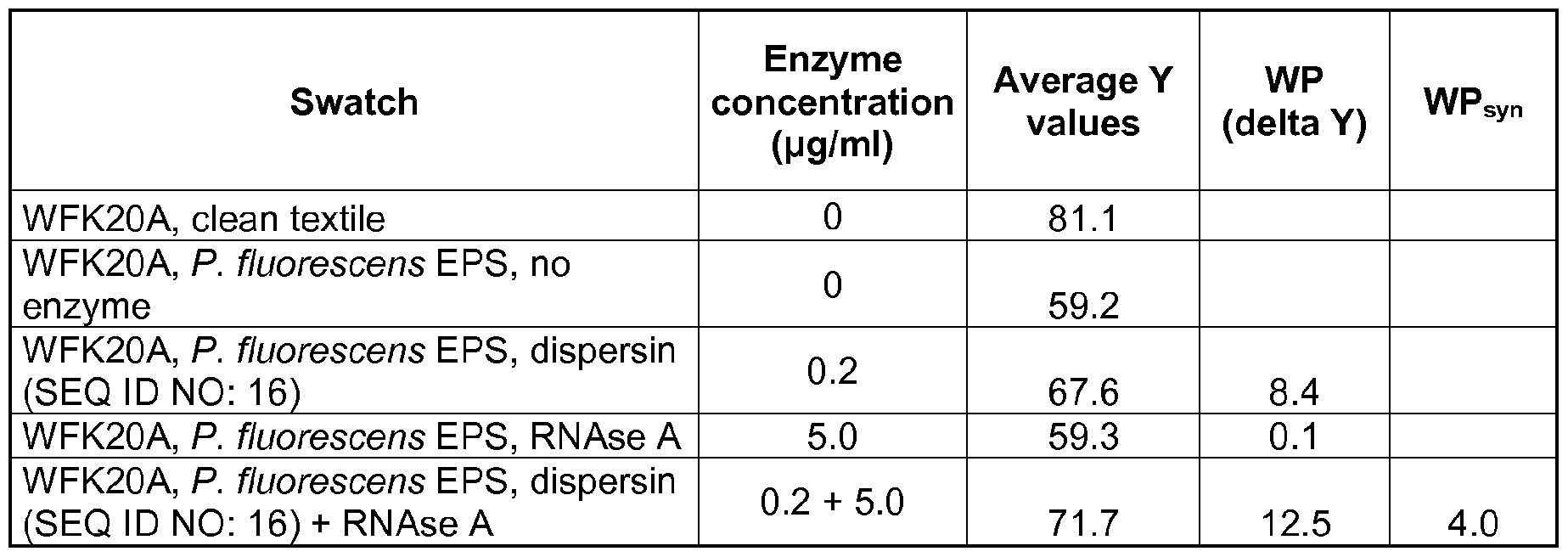
Example 2
Synergistic effect between dispersin and RNase on deep-cleaning in liquid model detergent on EPS swatches
EPS was extracted from Pseudomonas fluorescens much as described above, with a few alterations: The strain was inoculated and incubated statically in 500ml DURAN® laboratory bottles containing T-broth (10 g/L Bacto-tryptone, 5 g/L NaCI) for 7 days at ambient temperature prior to harvesting. The biofilm pellicles were subsequently retrieved and pelleted by centrifugation (10min, 6000g), resuspended in 3M NaCI and incubated for 15min at ambient temperature. Then cells were then pelleted again and resuspended in fresh 3M NaCI and incubated an additional 15min at ambient temperature. The EPS-containing supernatants obtained after a final centrifugation step (4min, 10000g, 25°C) were pooled and stored at -20°C
until further use (termed crude EPS).
For testing wash performance, 50ul aliquots of the crude EPS were spotted on sterile textile swatches (WFK20A) and incubated for 15 min at ambient temperature. Swatches spotted with sterile 3M NaCI were included as controls. The swatches (sterile or with EPS) were placed in 50 ml_ test tubes and 10 ml_ of wash liquor (15°dH water with 0.2 g/L Ferric oxide nanopowder (Sigma-Aldrich, #544884)) and 3.33g/L liquid model A detergent (12% LAS, 1 1 % AEO Biosoft N25-7 (Nl), 5% AEOS (SLES), 6% MPG (monopropylene glycol), 3% ethanol, 3% TEA, 2.75% coco soap, 2.75% soya soap, 2% glycerol, 2% sodium hydroxide, 2% sodium citrate, 1 % sodium formate, 0.2% DTMPA and 0.2% PCA (all percentages are w/w)) and 0.02 pg/ml dispersin (SEQ ID NO: 17) and/or 0.2 pg/ml RNase (SEQ ID NO: 47) was added to each tube. Washes without enzyme were included as controls. The test tubes were placed in a Stuart rotator and incubated for 1 hour at 30°C at 20rpm. The wash liquor was then removed, and the swatches were rinsed twice with 15°dH water and dried on filter paper over night. The remission (REM460nm) values were measured using a Datacolor 800V spectrophotometer and are displayed in Table 2. Delta values
(RE M4®^nm(swatches washed with enzyme) — REM^^nrT1(swatches washed without enzyme)) 3HCl thG W3Sh rqGΪOGGPQPOQ synergies, WPsynergy (ARE M460nm (cocktail) - ARE M460nm (sum of individual enzyme treatments)) 3Gb 3lS0 indicated.
Table 2. Synergistic effect of dispersin (SEQ ID NO: 17) and RNase (SEQ ID NO: 47) on cleaning in model A detergent on EPS swatches
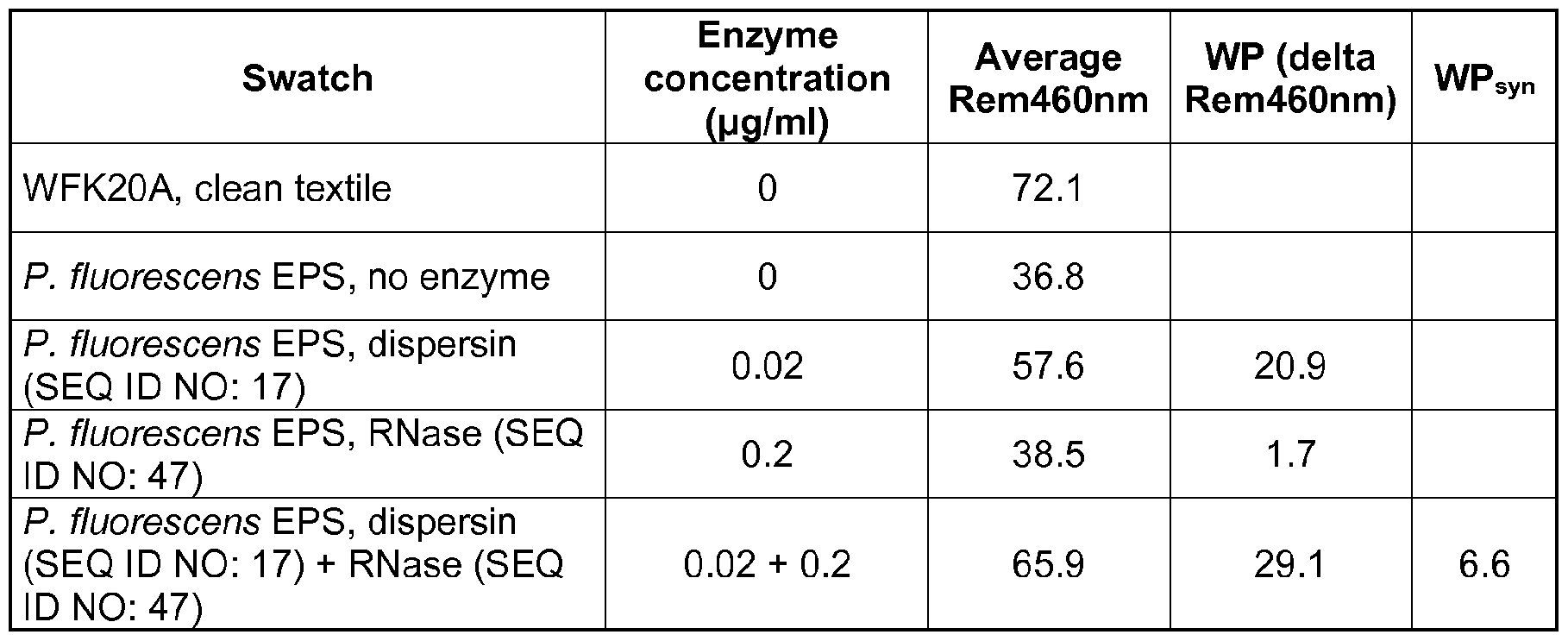
As seen in Tables 1 and 2, an enzyme cocktail comprising dispersin and RNase provides superior deep-cleaning properties in model A detergent as compared to the individual enzymes, given that the wash performance of the enzyme cocktail (WP (cocktail)) exceeds the sum of the performances seen for of the individual enzymes (WP (enzyme 1 ) + WP(enzyme 2)), i.e. WPsyn > 0. This clearly indicates that there is a synergetic effect between the two enzymes on the deep cleaning properties in model A. This also suggests that the different EPS components targeted by these enzymes are localized in complex macromolecular structures, which shield each other from enzymatic hydrolysis.
Claims
1. A cleaning composition comprising a dispersin, an RNase and a cleaning component.
2. A cleaning composition according to claim 1 , wherein the dispersin is microbial, preferably obtained from bacteria.
3. A cleaning composition according to claim 2, wherein the dispersin is obtained from Terribacillus, Curtobacterium, Aggregatibacter, Haemophilus, Actinobacillus, Lactobacillus or Staphylococcus, Neisseria, Otariodibacter, Lactococcus, Frigoribacterium, Basfia, Weissella, Macrococcus or Leuconostoc, preferably Terribacillus or Lactobacillus.
4. A cleaning composition according to any of the preceding claims, wherein the dispersin comprises the motif [EQ][NRSHA][YVFL][AGSTC][IVLF][EAQYN][SN] (SEQ ID NO: 51 ) and/or the motif GXDE (SEQ ID NO: 52).
5. The cleaning composition according to any of the preceding claims, wherein the dispersin polypeptide is:
a) a polypeptide comprising one, two, three, four or five motifs selected from the group consisting of [VIM][LIV]G[GAV]DE[VI][PSA] (SEQ ID NO: 53), WND[SQR][IVL][TLVM] (SEQ ID NO: 54), QSTL (SEQ ID NO: 55), NKFFY (SEQ ID NO: 56) and NLD[DR]S (SEQ ID NO: 57);
b) a polypeptide comprising one, two, three or four motifs selected from the group consisting of ARAYYPV (SEQ ID NO: 58), AWNDGID (SEQ ID NO: 59), DDQNVGI (SEQ ID NO: 60) and DPRIH (SEQ ID NO: 61 ); or
c) a polypeptide comprising one, two or three motifs selected from the group consisting of HFHIGG (SEQ ID NO: 62), FLHLHF (SEQ ID NO: 63) and DHENYA (SEQ ID NO: 64).
6. A cleaning composition of any of the preceding claims, wherein the dispersin catalyzes the hydrolysis of b-1 ,6-glycosidic linkages of N-acetyl-glucosamine polymers.
7. A cleaning composition according to any of the preceding claims, wherein the RNase belongs to EC 3.1.27.
8. A cleaning composition according to any of the preceding claims, wherein the RNase comprises one or more or all the motifs EYTV (SEQ ID NO 43), [YRF]E[AYFWC]D (SEQ ID NO 44), IGGD (SEQ ID NO 45), YPH, HTGA (SEQ ID NO 46) or DRV.
9. A cleaning composition according to any of the preceding claims, wherein the RNase is selected from the group consisting of RNases comprising an amino acid sequence with;
i) at least 60%, at least 65%, at least 70%, at least 75%, at least 80%, at least 85%, at least 90%, at least 95%, at least 98%, at least 99% or 100% sequence identity to the polypeptide shown in SEQ ID NO: 24,
ii) at least 60%, at least 65%, at least 70%, at least 75%, at least 80%, at least 85%, at least 90%, at least 95%, at least 98%, at least 99% or 100% sequence identity to the polypeptide shown in SEQ ID NO: 25,
iii) at least 60%, at least 65%, at least 70%, at least 75%, at least 80%, at least 85%, at least 90%, at least 95%, at least 98%, at least 99% or 100% sequence identity to the polypeptide shown in SEQ ID NO: 26,
iv) at least 60%, at least 65%, at least 70%, at least 75%, at least 80%, at least 85%, at least 90%, at least 95%, at least 98%, at least 99% or 100% sequence identity to the polypeptide shown in SEQ ID NO: 27,
v) at least 60%, at least 65%, at least 70%, at least 75%, at least 80%, at least 85%, at least 90%, at least 95%, at least 98%, at least 99% or 100% sequence identity to the polypeptide shown in SEQ ID NO: 28,
vi) at least 60%, at least 65%, at least 70%, at least 75%, at least 80%, at least 85%, at least 90%, at least 95%, at least 98%, at least 99% or 100% sequence identity to the polypeptide shown in SEQ ID NO: 29,
vii) at least 60%, at least 65%, at least 70%, at least 75%, at least 80%, at least 85%, at least 90%, at least 95%, at least 98%, at least 99% or 100% sequence identity to the polypeptide shown in SEQ ID NO: 30,
viii) at least 60%, at least 65%, at least 70%, at least 75%, at least 80%, at least 85%, at least 90%, at least 95%, at least 98%, at least 99% or 100% sequence identity to the polypeptide shown in SEQ ID NO: 31 ,
ix) at least 60%, at least 65%, at least 70%, at least 75%, at least 80%, at least 85%, at least 90%, at least 95%, at least 98%, at least 99% or 100% sequence identity to the polypeptide shown in SEQ ID NO: 32,
x) at least 60%, at least 65%, at least 70%, at least 75%, at least 80%, at least 85%, at least 90%, at least 95%, at least 98%, at least 99% or 100% sequence identity to the polypeptide shown in SEQ ID NO: 33,
xi) at least 60%, at least 65%, at least 70%, at least 75%, at least 80%, at least 85%, at least 90%, at least 95%, at least 98%, at least 99% or 100% sequence identity to the polypeptide shown in SEQ ID NO: 34,
xii) at least 60%, at least 65%, at least 70%, at least 75%, at least 80%, at least 85%, at least 90%, at least 95%, at least 98%, at least 99% or 100% sequence identity to the polypeptide shown in SEQ ID NO: 35,
xiii) at least 60%, at least 65%, at least 70%, at least 75%, at least 80%, at least 85%, at least 90%, at least 95%, at least 98%, at least 99% or 100% sequence identity to the polypeptide shown in SEQ ID NO: 36,
xiv) at least 60%, at least 65%, at least 70%, at least 75%, at least 80%, at least 85%, at least 90%, at least 95%, at least 98%, at least 99% or 100% sequence identity to the polypeptide shown in SEQ ID NO: 37,
xv) at least 60%, at least 65%, at least 70%, at least 75%, at least 80%, at least 85%, at least 90%, at least 95%, at least 98%, at least 99% or 100% sequence identity to the polypeptide shown in SEQ ID NO: 38,
xvi) at least 60%, at least 65%, at least 70%, at least 75%, at least 80%, at least 85%, at least 90%, at least 95%, at least 98%, at least 99% or 100% sequence identity to the polypeptide shown in SEQ ID NO: 39,
xvii) at least 60%, at least 65%, at least 70%, at least 75%, at least 80%, at least 85%, at least 90%, at least 95%, at least 98%, at least 99% or 100% sequence identity to the polypeptide shown in SEQ ID NO: 40,
xviii) at least 60%, at least 65%, at least 70%, at least 75%, at least 80%, at least 85%, at least 90%, at least 95%, at least 98%, at least 99% or 100% sequence identity to the polypeptide shown in SEQ ID NO: 41 ,
xix) at least 60%, at least 65%, at least 70%, at least 75%, at least 80%, at least 85%, at least 90%, at least 95%, at least 98%, at least 99% or 100% sequence identity to the polypeptide shown in SEQ ID NO: 42,
xx) at least 60%, at least 65%, at least 70%, at least 75%, at least 80%, at least 85%, at least 90%, at least 95%, at least 98%, at least 99% or 100% sequence identity to the polypeptide shown in SEQ ID NO: 48,
xxi) at least 60%, at least 65%, at least 70%, at least 75%, at least 80%, at least 85%, at least 90%, at least 95%, at least 98%, at least 99% or 100% sequence identity to the polypeptide shown in SEQ ID NO: 49, and
xxii) at least 60%, at least 65%, at least 70%, at least 75%, at least 80%, at least 85%, at least 90%, at least 95%, at least 98%, at least 99% or 100% sequence identity to the polypeptide shown in SEQ ID NO: 50
10. A cleaning composition according to any of the preceding claims wherein the amount of dispersin in the composition is from 0.01 to 1000 ppm and the amount of RNase is from 0.01 to 1000 ppm based on active enzyme protein.
1 1. A cleaning composition according to any of the preceding claims, wherein the cleaning component is selected from the group consisting of surfactants, preferably anionic and/or nonionic surfactants, builders and bleach components.
12. Use of a cleaning composition according to any of claims 1 to 11 for cleaning of an item, wherein the item is a textile or a surface.
13. A method of formulating a cleaning composition according to any of claims 1 to 1 1 comprising combining a dispersin, an RNase and at least one cleaning component.
14. A kit intended for deep cleaning, wherein the kit comprises a solution of an enzyme mixture comprising a dispersin, an RNase and optionally a protease.
15. A method of cleaning of an item, comprising the steps of:
a) contacting the item with a cleaning composition according to any of claims 1 to
1 1 ; and optionally
b) rinsing the item,
wherein the item is preferably a textile.
Applications Claiming Priority (4)
| Application Number | Priority Date | Filing Date | Title |
|---|---|---|---|
| EP18182172.9 | 2018-07-06 | ||
| EP18182172 | 2018-07-06 | ||
| EP18183476.3 | 2018-07-13 | ||
| EP18183476 | 2018-07-13 |
Publications (1)
| Publication Number | Publication Date |
|---|---|
| WO2020008024A1 true WO2020008024A1 (en) | 2020-01-09 |
Family
ID=67180791
Family Applications (1)
| Application Number | Title | Priority Date | Filing Date |
|---|---|---|---|
| PCT/EP2019/068076 Ceased WO2020008024A1 (en) | 2018-07-06 | 2019-07-05 | Cleaning compositions and uses thereof |
Country Status (1)
| Country | Link |
|---|---|
| WO (1) | WO2020008024A1 (en) |
Cited By (42)
| Publication number | Priority date | Publication date | Assignee | Title |
|---|---|---|---|---|
| EP3892708A1 (en) * | 2020-04-06 | 2021-10-13 | Henkel AG & Co. KGaA | Cleaning compositions comprising dispersin variants |
| WO2022094588A1 (en) | 2020-10-29 | 2022-05-05 | The Procter & Gamble Company | Cleaning compositions containing alginate lyase enzymes |
| WO2022136389A1 (en) | 2020-12-23 | 2022-06-30 | Basf Se | Amphiphilic alkoxylated polyamines and their uses |
| WO2022189521A1 (en) | 2021-03-12 | 2022-09-15 | Novozymes A/S | Polypeptide variants |
| EP4060036A1 (en) | 2021-03-15 | 2022-09-21 | Novozymes A/S | Polypeptide variants |
| EP4060010A2 (en) | 2021-03-15 | 2022-09-21 | The Procter & Gamble Company | Cleaning compositions containing polypeptide variants |
| WO2022194673A1 (en) | 2021-03-15 | 2022-09-22 | Novozymes A/S | Dnase variants |
| WO2022235720A1 (en) | 2021-05-05 | 2022-11-10 | The Procter & Gamble Company | Methods for making cleaning compositions and detecting soils |
| EP4108767A1 (en) | 2021-06-22 | 2022-12-28 | The Procter & Gamble Company | Cleaning or treatment compositions containing nuclease enzymes |
| WO2023064749A1 (en) | 2021-10-14 | 2023-04-20 | The Procter & Gamble Company | A fabric and home care product comprising cationic soil release polymer and lipase enzyme |
| WO2023165950A1 (en) | 2022-03-04 | 2023-09-07 | Novozymes A/S | Dnase variants and compositions |
| EP4273209A1 (en) | 2022-05-04 | 2023-11-08 | The Procter & Gamble Company | Machine-cleaning compositions containing enzymes |
| EP4273210A1 (en) | 2022-05-04 | 2023-11-08 | The Procter & Gamble Company | Detergent compositions containing enzymes |
| EP4321603A1 (en) | 2022-08-11 | 2024-02-14 | The Procter & Gamble Company | Laundry detergent composition |
| EP4321604A1 (en) | 2022-08-08 | 2024-02-14 | The Procter & Gamble Company | A fabric and home care composition comprising surfactant and a polyester |
| WO2024094800A1 (en) | 2022-11-04 | 2024-05-10 | The Procter & Gamble Company | Fabric and home care composition |
| WO2024094803A1 (en) | 2022-11-04 | 2024-05-10 | The Procter & Gamble Company | Fabric and home care composition |
| WO2024094802A1 (en) | 2022-11-04 | 2024-05-10 | The Procter & Gamble Company | Fabric and home care composition |
| WO2024119298A1 (en) | 2022-12-05 | 2024-06-13 | The Procter & Gamble Company | Fabric and home care composition comprising a polyalkylenecarbonate compound |
| EP4386074A1 (en) | 2022-12-16 | 2024-06-19 | The Procter & Gamble Company | Fabric and home care composition |
| WO2024129520A1 (en) | 2022-12-12 | 2024-06-20 | The Procter & Gamble Company | Fabric and home care composition |
| EP4410941A1 (en) | 2023-02-01 | 2024-08-07 | The Procter & Gamble Company | Detergent compositions containing enzymes |
| WO2024213513A1 (en) | 2023-04-12 | 2024-10-17 | Novozymes A/S | Compositions comprising polypeptides having alkaline phosphatase activity |
| EP4458933A1 (en) | 2023-05-05 | 2024-11-06 | The Procter & Gamble Company | A fabric and home care composition comprising a propoxylated polyol |
| EP4458932A1 (en) | 2023-05-04 | 2024-11-06 | The Procter & Gamble Company | A fabric and home care composition |
| EP4481027A1 (en) | 2023-06-19 | 2024-12-25 | The Procter & Gamble Company | Cleaning compositions containing enzymes |
| EP4484536A1 (en) | 2023-06-26 | 2025-01-01 | The Procter & Gamble Company | Fabric and home care composition |
| EP4488351A1 (en) | 2023-07-03 | 2025-01-08 | The Procter & Gamble Company | Compositions containing a porphyrin binding protein |
| EP4549540A1 (en) | 2023-11-02 | 2025-05-07 | The Procter & Gamble Company | Fabric and home care composition |
| EP4549541A1 (en) | 2023-11-02 | 2025-05-07 | The Procter & Gamble Company | Fabric and home care composition |
| EP4553137A1 (en) | 2023-11-08 | 2025-05-14 | The Procter & Gamble Company | A fabric and home care composition comprising a polyester |
| EP4570892A1 (en) | 2023-12-15 | 2025-06-18 | The Procter & Gamble Company | A laundry detergent composition |
| EP4570893A1 (en) | 2023-12-15 | 2025-06-18 | The Procter & Gamble Company | Fabric and home care composition |
| EP4610340A1 (en) | 2024-03-01 | 2025-09-03 | The Procter & Gamble Company | A laundry detergent composition comprising a polyester |
| EP4624554A1 (en) | 2024-03-26 | 2025-10-01 | The Procter & Gamble Company | Fabric care compositions |
| EP4624555A1 (en) | 2024-03-26 | 2025-10-01 | The Procter & Gamble Company | Fabric and home care compositions |
| WO2025213357A1 (en) | 2024-04-09 | 2025-10-16 | The Procter & Gamble Company | Particulate fabric care composition |
| EP4636063A1 (en) | 2024-04-19 | 2025-10-22 | The Procter & Gamble Company | A unit dose laundry detergent product |
| WO2025217909A1 (en) | 2024-04-19 | 2025-10-23 | The Procter & Gamble Company | Particulate fabric care product |
| EP4660287A1 (en) | 2024-06-06 | 2025-12-10 | The Procter & Gamble Company | Use of a polysaccharide ester in a laundry detergent composition |
| EP4663733A1 (en) | 2024-06-10 | 2025-12-17 | The Procter & Gamble Company | Use of a graft polymer in a laundering process |
| EP4663732A1 (en) | 2024-06-10 | 2025-12-17 | The Procter & Gamble Company | Use of graft polymer in a laundry detergent composition |
Citations (156)
| Publication number | Priority date | Publication date | Assignee | Title |
|---|---|---|---|---|
| GB1296839A (en) | 1969-05-29 | 1972-11-22 | ||
| GB1483591A (en) | 1973-07-23 | 1977-08-24 | Novo Industri As | Process for coating water soluble or water dispersible particles by means of the fluid bed technique |
| US4106991A (en) | 1976-07-07 | 1978-08-15 | Novo Industri A/S | Enzyme granulate composition and process for forming enzyme granulates |
| US4435307A (en) | 1980-04-30 | 1984-03-06 | Novo Industri A/S | Detergent cellulase |
| EP0179486A2 (en) | 1984-10-26 | 1986-04-30 | Suntory Limited | Process for producing peroxidase |
| EP0218272A1 (en) | 1985-08-09 | 1987-04-15 | Gist-Brocades N.V. | Novel lipolytic enzymes and their use in detergent compositions |
| US4661452A (en) | 1984-05-29 | 1987-04-28 | Novo Industri A/S | Enzyme containing granulates useful as detergent additives |
| EP0238216A1 (en) | 1986-02-20 | 1987-09-23 | Albright & Wilson Limited | Protected enzyme systems |
| EP0258068A2 (en) | 1986-08-29 | 1988-03-02 | Novo Nordisk A/S | Enzymatic detergent additive |
| EP0305216A1 (en) | 1987-08-28 | 1989-03-01 | Novo Nordisk A/S | Recombinant Humicola lipase and process for the production of recombinant humicola lipases |
| WO1989006279A1 (en) | 1988-01-07 | 1989-07-13 | Novo-Nordisk A/S | Mutated subtilisin genes |
| EP0331376A2 (en) | 1988-02-28 | 1989-09-06 | Amano Pharmaceutical Co., Ltd. | Recombinant DNA, bacterium of the genus pseudomonas containing it, and process for preparing lipase by using it |
| WO1989009259A1 (en) | 1988-03-24 | 1989-10-05 | Novo-Nordisk A/S | A cellulase preparation |
| JPH02238885A (en) | 1989-03-13 | 1990-09-21 | Oji Paper Co Ltd | Phenol oxidase genetically recombinant DNA, microorganisms transformed with the recombinant DNA, culture thereof, and method for producing phenol oxidase |
| EP0407225A1 (en) | 1989-07-07 | 1991-01-09 | Unilever Plc | Enzymes and enzymatic detergent compositions |
| WO1991002792A1 (en) | 1989-08-25 | 1991-03-07 | Henkel Research Corporation | Alkaline proteolytic enzyme and method of production |
| WO1992001046A1 (en) | 1990-07-06 | 1992-01-23 | Valtion Teknillinen Tutkimuskeskus | Laccase production by recombinant organisms |
| WO1992005249A1 (en) | 1990-09-13 | 1992-04-02 | Novo Nordisk A/S | Lipase variants |
| EP0495257A1 (en) | 1991-01-16 | 1992-07-22 | The Procter & Gamble Company | Compact detergent compositions with high activity cellulase |
| WO1992019729A1 (en) | 1991-05-01 | 1992-11-12 | Novo Nordisk A/S | Stabilized enzymes and detergent compositions |
| WO1992021760A1 (en) | 1991-05-29 | 1992-12-10 | Cognis, Inc. | Mutant proteolytic enzymes from bacillus |
| EP0531315A1 (en) | 1990-05-09 | 1993-03-17 | Novo Nordisk As | ENZYME CAPABLE OF DEGRADING CELLULOSE OR HEMICELLULOSE. |
| EP0531372A1 (en) | 1990-05-09 | 1993-03-17 | Novo Nordisk As | PREPARATION OF CELLULASE COMPRISING AN ENDOGLUCANASE ENZYME. |
| WO1993007263A2 (en) | 1991-10-07 | 1993-04-15 | Genencor International, Inc. | Coated enzyme containing granule |
| WO1993018140A1 (en) | 1992-03-04 | 1993-09-16 | Novo Nordisk A/S | Novel proteases |
| WO1993024618A1 (en) | 1992-06-01 | 1993-12-09 | Novo Nordisk A/S | Peroxidase variants with improved hydrogen peroxide stability |
| WO1994001541A1 (en) | 1992-07-06 | 1994-01-20 | Novo Nordisk A/S | C. antarctica lipase and lipase variants |
| WO1994002597A1 (en) | 1992-07-23 | 1994-02-03 | Novo Nordisk A/S | MUTANT α-AMYLASE, DETERGENT, DISH WASHING AGENT, AND LIQUEFACTION AGENT |
| WO1994007998A1 (en) | 1992-10-06 | 1994-04-14 | Novo Nordisk A/S | Cellulase variants |
| WO1994018314A1 (en) | 1993-02-11 | 1994-08-18 | Genencor International, Inc. | Oxidatively stable alpha-amylase |
| WO1994025578A1 (en) | 1993-04-27 | 1994-11-10 | Gist-Brocades N.V. | New lipase variants for use in detergent applications |
| WO1994025583A1 (en) | 1993-05-05 | 1994-11-10 | Novo Nordisk A/S | A recombinant trypsin-like protease |
| EP0624154A1 (en) | 1991-12-13 | 1994-11-17 | The Procter & Gamble Company | Acylated citrate esters as peracid precursors |
| WO1994026859A1 (en) | 1993-05-08 | 1994-11-24 | Henkel Kommanditgesellschaft Auf Aktien | Silver-corrosion protection agent (i) |
| WO1994026860A1 (en) | 1993-05-08 | 1994-11-24 | Henkel Kommanditgesellschaft Auf Aktien | Silver-corrosion protection agent (ii) |
| US5389536A (en) | 1986-11-19 | 1995-02-14 | Genencor, Inc. | Lipase from Pseudomonas mendocina having cutinase activity |
| WO1995006720A1 (en) | 1993-08-30 | 1995-03-09 | Showa Denko K.K. | Novel lipase, microorganism producing the lipase, process for producing the lipase, and use of the lipase |
| WO1995010602A1 (en) | 1993-10-13 | 1995-04-20 | Novo Nordisk A/S | H2o2-stable peroxidase variants |
| WO1995010603A1 (en) | 1993-10-08 | 1995-04-20 | Novo Nordisk A/S | Amylase variants |
| WO1995014783A1 (en) | 1993-11-24 | 1995-06-01 | Showa Denko K.K. | Lipase gene and variant lipase |
| WO1995022615A1 (en) | 1994-02-22 | 1995-08-24 | Novo Nordisk A/S | A method of preparing a variant of a lipolytic enzyme |
| WO1995023221A1 (en) | 1994-02-24 | 1995-08-31 | Cognis, Inc. | Improved enzymes and detergents containing them |
| WO1995024471A1 (en) | 1994-03-08 | 1995-09-14 | Novo Nordisk A/S | Novel alkaline cellulases |
| WO1995030744A2 (en) | 1994-05-04 | 1995-11-16 | Genencor International Inc. | Lipases with improved surfactant resistance |
| WO1995033836A1 (en) | 1994-06-03 | 1995-12-14 | Novo Nordisk Biotech, Inc. | Phosphonyldipeptides useful in the treatment of cardiovascular diseases |
| WO1995035381A1 (en) | 1994-06-20 | 1995-12-28 | Unilever N.V. | Modified pseudomonas lipases and their use |
| WO1996000292A1 (en) | 1994-06-23 | 1996-01-04 | Unilever N.V. | Modified pseudomonas lipases and their use |
| WO1996011262A1 (en) | 1994-10-06 | 1996-04-18 | Novo Nordisk A/S | An enzyme and enzyme preparation with endoglucanase activity |
| WO1996012012A1 (en) | 1994-10-14 | 1996-04-25 | Solvay S.A. | Lipase, microorganism producing same, method for preparing said lipase and uses thereof |
| WO1996013580A1 (en) | 1994-10-26 | 1996-05-09 | Novo Nordisk A/S | An enzyme with lipolytic activity |
| WO1996023873A1 (en) | 1995-02-03 | 1996-08-08 | Novo Nordisk A/S | Amylase variants |
| WO1996027002A1 (en) | 1995-02-27 | 1996-09-06 | Novo Nordisk A/S | Novel lipase gene and process for the production of lipase with the use of the same |
| WO1996029397A1 (en) | 1995-03-17 | 1996-09-26 | Novo Nordisk A/S | Novel endoglucanases |
| WO1996034946A1 (en) | 1995-05-05 | 1996-11-07 | Novo Nordisk A/S | Protease variants and compositions |
| WO1997004079A1 (en) | 1995-07-14 | 1997-02-06 | Novo Nordisk A/S | A modified enzyme with lipolytic activity |
| WO1997007202A1 (en) | 1995-08-11 | 1997-02-27 | Novo Nordisk A/S | Novel lipolytic enzymes |
| WO1997008325A2 (en) | 1995-08-25 | 1997-03-06 | Novo Nordisk Biotech, Inc. | Purified coprinus laccases and nucleic acids encoding same |
| WO1997023606A1 (en) | 1995-12-22 | 1997-07-03 | Genencor International, Inc. | Enzyme containing coated granules |
| US5648263A (en) | 1988-03-24 | 1997-07-15 | Novo Nordisk A/S | Methods for reducing the harshness of a cotton-containing fabric |
| WO1997043424A1 (en) | 1996-05-14 | 1997-11-20 | Genencor International, Inc. | MODIFIED α-AMYLASES HAVING ALTERED CALCIUM BINDING PROPERTIES |
| WO1998008940A1 (en) | 1996-08-26 | 1998-03-05 | Novo Nordisk A/S | A novel endoglucanase |
| WO1998012307A1 (en) | 1996-09-17 | 1998-03-26 | Novo Nordisk A/S | Cellulase variants |
| WO1998015257A1 (en) | 1996-10-08 | 1998-04-16 | Novo Nordisk A/S | Diaminobenzoic acid derivatives as dye precursors |
| WO1998017767A1 (en) | 1996-10-18 | 1998-04-30 | The Procter & Gamble Company | Detergent compositions |
| WO1998020115A1 (en) | 1996-11-04 | 1998-05-14 | Novo Nordisk A/S | Subtilase variants and compositions |
| WO1998020116A1 (en) | 1996-11-04 | 1998-05-14 | Novo Nordisk A/S | Subtilase variants and compositions |
| WO1999001544A1 (en) | 1997-07-04 | 1999-01-14 | Novo Nordisk A/S | FAMILY 6 ENDO-1,4-β-GLUCANASE VARIANTS AND CLEANING COMPOSIT IONS CONTAINING THEM |
| WO1999011768A1 (en) | 1997-08-29 | 1999-03-11 | Novo Nordisk A/S | Protease variants and compositions |
| WO1999019467A1 (en) | 1997-10-13 | 1999-04-22 | Novo Nordisk A/S | α-AMYLASE MUTANTS |
| WO1999032595A1 (en) | 1997-12-20 | 1999-07-01 | Genencor International, Inc. | Granule with hydrated barrier material |
| US5977053A (en) | 1995-07-31 | 1999-11-02 | Bayer Ag | Detergents and cleaners containing iminodisuccinates |
| WO1999064619A2 (en) | 1998-06-10 | 1999-12-16 | Novozymes A/S | Novel mannanases |
| WO2000001793A1 (en) | 1998-06-30 | 2000-01-13 | Novozymes A/S | A new improved enzyme containing granule |
| WO2000034450A1 (en) | 1998-12-04 | 2000-06-15 | Novozymes A/S | Cutinase variants |
| WO2000060063A1 (en) | 1999-03-31 | 2000-10-12 | Novozymes A/S | Lipase variant |
| WO2001016285A2 (en) | 1999-08-31 | 2001-03-08 | Novozymes A/S | Novel proteases and variants thereof |
| WO2001044452A1 (en) | 1999-12-15 | 2001-06-21 | Novozymes A/S | Subtilase variants having an improved wash performance on egg stains |
| WO2001062903A1 (en) | 2000-02-24 | 2001-08-30 | Novozymes A/S | Family 44 xyloglucanases |
| WO2001066712A2 (en) | 2000-03-08 | 2001-09-13 | Novozymes A/S | Variants with altered properties |
| WO2001092502A1 (en) | 2000-06-02 | 2001-12-06 | Novozymes A/S | Cutinase variants |
| WO2002010355A2 (en) | 2000-08-01 | 2002-02-07 | Novozymes A/S | Alpha-amylase mutants with altered stability |
| WO2002016547A2 (en) | 2000-08-21 | 2002-02-28 | Novozymes A/S | Subtilase enzymes |
| WO2002099091A2 (en) | 2001-06-06 | 2002-12-12 | Novozymes A/S | Endo-beta-1,4-glucanase from bacillus |
| WO2003006602A2 (en) | 2001-07-12 | 2003-01-23 | Novozymes A/S | Subtilase variants |
| WO2003040279A1 (en) | 2001-11-09 | 2003-05-15 | Unilever Plc | Polymers for laundry applications |
| WO2004003186A2 (en) | 2002-06-26 | 2004-01-08 | Novozymes A/S | Subtilases and subtilase variants having altered immunogenicity |
| WO2004041979A2 (en) | 2002-11-06 | 2004-05-21 | Novozymes A/S | Subtilase variants |
| WO2004067737A2 (en) | 2003-01-30 | 2004-08-12 | Novozymes A/S | Subtilases |
| WO2005003276A1 (en) | 2003-06-18 | 2005-01-13 | Unilever Plc | Laundry treatment compositions |
| WO2005003275A1 (en) | 2003-06-18 | 2005-01-13 | Unilever Plc | Laundry treatment compositions |
| WO2005003274A1 (en) | 2003-06-18 | 2005-01-13 | Unilever Plc | Laundry treatment compositions |
| WO2005040372A1 (en) | 2003-10-23 | 2005-05-06 | Novozymes A/S | Protease with improved stability in detergents |
| WO2005052161A2 (en) | 2003-11-19 | 2005-06-09 | Genencor International, Inc. | Serine proteases, nucleic acids encoding serine enzymes and vectors and host cells incorporating same |
| WO2005056782A2 (en) | 2003-12-03 | 2005-06-23 | Genencor International, Inc. | Perhydrolase |
| WO2006034710A1 (en) | 2004-09-27 | 2006-04-06 | Novozymes A/S | Enzyme granules |
| WO2006066594A2 (en) | 2004-12-23 | 2006-06-29 | Novozymes A/S | Alpha-amylase variants |
| WO2006108856A2 (en) | 2005-04-15 | 2006-10-19 | Basf Aktiengesellschaft | Amphiphilic water-soluble alkoxylated polyalkylenimines with an internal polyethylene oxide block and an external polypropylene oxide block |
| WO2006113314A1 (en) | 2005-04-15 | 2006-10-26 | The Procter & Gamble Company | Liquid laundry detergent compositions with modified polyethyleneimine polymers and lipase enzyme |
| WO2006130575A2 (en) | 2005-05-31 | 2006-12-07 | The Procter & Gamble Company | Polymer-containing detergent compositions and their use |
| WO2007006305A1 (en) | 2005-07-08 | 2007-01-18 | Novozymes A/S | Subtilase variants |
| WO2007044993A2 (en) | 2005-10-12 | 2007-04-19 | Genencor International, Inc. | Use and production of storage-stable neutral metalloprotease |
| WO2007087258A2 (en) | 2006-01-23 | 2007-08-02 | The Procter & Gamble Company | A composition comprising a lipase and a bleach catalyst |
| WO2007087243A2 (en) | 2006-01-23 | 2007-08-02 | The Procter & Gamble Company | Detergent compositions |
| WO2007087259A2 (en) | 2006-01-23 | 2007-08-02 | The Procter & Gamble Company | Enzyme and photobleach containing compositions |
| WO2007087257A2 (en) | 2006-01-23 | 2007-08-02 | The Procter & Gamble Company | Enzyme and fabric hueing agent containing compositions |
| WO2007087508A2 (en) | 2006-01-23 | 2007-08-02 | Novozymes A/S | Lipase variants |
| WO2007087244A2 (en) | 2006-01-23 | 2007-08-02 | The Procter & Gamble Company | Detergent compositions |
| WO2007087242A2 (en) | 2006-01-23 | 2007-08-02 | The Procter & Gamble Company | A composition comprising a lipase and a bleach catalyst |
| WO2007138054A1 (en) | 2006-05-31 | 2007-12-06 | The Procter & Gamble Company | Cleaning compositions with amphiphilic graft polymers based on polyalkylene oxides and vinyl esters |
| EP1867808A1 (en) | 2006-06-06 | 2007-12-19 | Brose Schliesssysteme GmbH & Co. KG | Motor vehicle lock |
| EP1867708A1 (en) | 2006-06-16 | 2007-12-19 | The Procter and Gamble Company | Detergent Compositions |
| EP1876226A1 (en) | 2006-07-07 | 2008-01-09 | The Procter and Gamble Company | Detergent compositions |
| WO2008153815A2 (en) | 2007-05-30 | 2008-12-18 | Danisco Us, Inc., Genencor Division | Variants of an alpha-amylase with improved production levels in fermentation processes |
| US20090011970A1 (en) | 2007-07-02 | 2009-01-08 | Marc Francois Theophile Evers | Laundry multi-compartment pouch composition |
| WO2009061380A2 (en) | 2007-11-05 | 2009-05-14 | Danisco Us Inc., Genencor Division | VARIANTS OF BACILLUS sp. TS-23 ALPHA-AMYLASE WITH ALTERED PROPERTIES |
| WO2009067279A1 (en) | 2007-11-21 | 2009-05-28 | E.I. Du Pont De Nemours And Company | Production of peracids using an enzyme having perhydrolysis activity |
| WO2009087523A2 (en) | 2008-01-04 | 2009-07-16 | The Procter & Gamble Company | A laundry detergent composition comprising glycosyl hydrolase |
| WO2009102854A1 (en) | 2008-02-15 | 2009-08-20 | The Procter & Gamble Company | Cleaning compositions |
| WO2009109500A1 (en) | 2008-02-29 | 2009-09-11 | Novozymes A/S | Polypeptides having lipase activity and polynucleotides encoding same |
| EP2169040A1 (en) | 2008-09-30 | 2010-03-31 | The Procter and Gamble Company | Liquid detergent compositions exhibiting two or multicolor effect |
| WO2010065455A2 (en) | 2008-12-01 | 2010-06-10 | Danisco Us Inc. | Enzymes with lipase activity |
| WO2010100028A2 (en) | 2009-03-06 | 2010-09-10 | Huntsman Advanced Materials (Switzerland) Gmbh | Enzymatic textile bleach-whitening methods |
| WO2010104675A1 (en) | 2009-03-10 | 2010-09-16 | Danisco Us Inc. | Bacillus megaterium strain dsm90-related alpha-amylases, and methods of use, thereof |
| WO2010107560A2 (en) | 2009-03-18 | 2010-09-23 | Danisco Us Inc. | Fungal cutinase from magnaporthe grisea |
| WO2010111143A2 (en) | 2009-03-23 | 2010-09-30 | Danisco Us Inc. | Cal a-related acyltransferases and methods of use, thereof |
| WO2011036263A1 (en) | 2009-09-25 | 2011-03-31 | Novozymes A/S | Subtilase variants |
| WO2011084412A1 (en) | 2009-12-21 | 2011-07-14 | Danisco Us Inc. | Detergent compositions containing thermobifida fusca lipase and methods of use thereof |
| WO2011084599A1 (en) | 2009-12-21 | 2011-07-14 | Danisco Us Inc. | Detergent compositions containing bacillus subtilis lipase and methods of use thereof |
| WO2011084417A1 (en) | 2009-12-21 | 2011-07-14 | Danisco Us Inc. | Detergent compositions containing geobacillus stearothermophilus lipase and methods of use thereof |
| WO2011098531A1 (en) | 2010-02-10 | 2011-08-18 | Novozymes A/S | Variants and compositions comprising variants with high stability in presence of a chelating agent |
| WO2011150157A2 (en) | 2010-05-28 | 2011-12-01 | Danisco Us Inc. | Detergent compositions containing streptomyces griseus lipase and methods of use thereof |
| WO2012137147A1 (en) | 2011-04-08 | 2012-10-11 | Danisco Us, Inc. | Compositions |
| WO2013001078A1 (en) | 2011-06-30 | 2013-01-03 | Novozymes A/S | Alpha-amylase variants |
| WO2013001087A2 (en) | 2011-06-30 | 2013-01-03 | Novozymes A/S | Method for screening alpha-amylases |
| WO2013184577A1 (en) | 2012-06-08 | 2013-12-12 | Danisco Us Inc. | Alpha-amylase variants derived from the alpha amylase of cytophaga sp.amylase|(cspamy2). |
| WO2013188331A1 (en) | 2012-06-11 | 2013-12-19 | The Procter & Gamble Company | Detergent composition |
| WO2014207227A1 (en) | 2013-06-27 | 2014-12-31 | Novozymes A/S | Subtilase variants and polynucleotides encoding same |
| WO2015014803A1 (en) | 2013-07-29 | 2015-02-05 | Novozymes A/S | Protease variants and polynucleotides encoding same |
| WO2015014804A1 (en) | 2013-07-29 | 2015-02-05 | Novozymes A/S | Protease variants and polynucleotides encoding same |
| WO2015014790A2 (en) | 2013-07-29 | 2015-02-05 | Novozymes A/S | Protease variants and polynucleotides encoding same |
| WO2015158723A1 (en) | 2014-04-14 | 2015-10-22 | Novozymes A/S | Metalloprotease from chryseobacterium |
| WO2016001449A1 (en) | 2014-07-04 | 2016-01-07 | Novozymes A/S | Subtilase variants and polynucleotides encoding same |
| WO2016075078A2 (en) | 2014-11-10 | 2016-05-19 | Novozymes A/S | Metalloproteases and uses thereof |
| WO2016087617A1 (en) | 2014-12-04 | 2016-06-09 | Novozymes A/S | Subtilase variants and polynucleotides encoding same |
| WO2016096711A2 (en) | 2014-12-15 | 2016-06-23 | Novozymes A/S | Subtilase variants |
| WO2016097350A1 (en) | 2014-12-19 | 2016-06-23 | Novozymes A/S | Protease variants and polynucleotides encoding same |
| WO2016097352A1 (en) | 2014-12-19 | 2016-06-23 | Novozymes A/S | Protease variants and polynucleotides encoding same |
| WO2016097354A1 (en) | 2014-12-19 | 2016-06-23 | Novozymes A/S | Protease variants and polynucleotides encoding same |
| WO2016097357A1 (en) | 2014-12-19 | 2016-06-23 | Novozymes A/S | Protease variants and polynucleotides encoding same |
| WO2016176240A1 (en) * | 2015-04-29 | 2016-11-03 | The Procter & Gamble Company | Method of treating a fabric |
| WO2016176280A1 (en) * | 2015-04-29 | 2016-11-03 | The Procter & Gamble Company | Method of treating a fabric |
| WO2016176296A1 (en) * | 2015-04-29 | 2016-11-03 | The Procter & Gamble Company | Method of laundering a fabric |
| WO2016174234A2 (en) | 2015-04-29 | 2016-11-03 | Novozymes A/S | Polypeptides suitable for detergent |
| WO2017210295A1 (en) | 2016-05-31 | 2017-12-07 | Danisco Us Inc. | Protease variants and uses thereof |
| WO2017207770A1 (en) * | 2016-06-03 | 2017-12-07 | Novozymes A/S | Cleaning compositions comprising enzymes |
| WO2017214236A1 (en) * | 2016-06-09 | 2017-12-14 | The Procter & Gamble Company | Cleaning compositions including nuclease enzyme and amines |
-
2019
- 2019-07-05 WO PCT/EP2019/068076 patent/WO2020008024A1/en not_active Ceased
Patent Citations (165)
| Publication number | Priority date | Publication date | Assignee | Title |
|---|---|---|---|---|
| GB1296839A (en) | 1969-05-29 | 1972-11-22 | ||
| GB1483591A (en) | 1973-07-23 | 1977-08-24 | Novo Industri As | Process for coating water soluble or water dispersible particles by means of the fluid bed technique |
| US4106991A (en) | 1976-07-07 | 1978-08-15 | Novo Industri A/S | Enzyme granulate composition and process for forming enzyme granulates |
| US4435307A (en) | 1980-04-30 | 1984-03-06 | Novo Industri A/S | Detergent cellulase |
| US4661452A (en) | 1984-05-29 | 1987-04-28 | Novo Industri A/S | Enzyme containing granulates useful as detergent additives |
| EP0179486A2 (en) | 1984-10-26 | 1986-04-30 | Suntory Limited | Process for producing peroxidase |
| EP0218272A1 (en) | 1985-08-09 | 1987-04-15 | Gist-Brocades N.V. | Novel lipolytic enzymes and their use in detergent compositions |
| EP0238216A1 (en) | 1986-02-20 | 1987-09-23 | Albright & Wilson Limited | Protected enzyme systems |
| EP0258068A2 (en) | 1986-08-29 | 1988-03-02 | Novo Nordisk A/S | Enzymatic detergent additive |
| US5389536A (en) | 1986-11-19 | 1995-02-14 | Genencor, Inc. | Lipase from Pseudomonas mendocina having cutinase activity |
| EP0305216A1 (en) | 1987-08-28 | 1989-03-01 | Novo Nordisk A/S | Recombinant Humicola lipase and process for the production of recombinant humicola lipases |
| WO1989006279A1 (en) | 1988-01-07 | 1989-07-13 | Novo-Nordisk A/S | Mutated subtilisin genes |
| EP0331376A2 (en) | 1988-02-28 | 1989-09-06 | Amano Pharmaceutical Co., Ltd. | Recombinant DNA, bacterium of the genus pseudomonas containing it, and process for preparing lipase by using it |
| US5691178A (en) | 1988-03-22 | 1997-11-25 | Novo Nordisk A/S | Fungal cellulase composition containing alkaline CMC-endoglucanase and essentially no cellobiohydrolase |
| WO1989009259A1 (en) | 1988-03-24 | 1989-10-05 | Novo-Nordisk A/S | A cellulase preparation |
| US5776757A (en) | 1988-03-24 | 1998-07-07 | Novo Nordisk A/S | Fungal cellulase composition containing alkaline CMC-endoglucanase and essentially no cellobiohydrolase and method of making thereof |
| US5648263A (en) | 1988-03-24 | 1997-07-15 | Novo Nordisk A/S | Methods for reducing the harshness of a cotton-containing fabric |
| JPH02238885A (en) | 1989-03-13 | 1990-09-21 | Oji Paper Co Ltd | Phenol oxidase genetically recombinant DNA, microorganisms transformed with the recombinant DNA, culture thereof, and method for producing phenol oxidase |
| EP0407225A1 (en) | 1989-07-07 | 1991-01-09 | Unilever Plc | Enzymes and enzymatic detergent compositions |
| US5352604A (en) | 1989-08-25 | 1994-10-04 | Henkel Research Corporation | Alkaline proteolytic enzyme and method of production |
| WO1991002792A1 (en) | 1989-08-25 | 1991-03-07 | Henkel Research Corporation | Alkaline proteolytic enzyme and method of production |
| EP0531315A1 (en) | 1990-05-09 | 1993-03-17 | Novo Nordisk As | ENZYME CAPABLE OF DEGRADING CELLULOSE OR HEMICELLULOSE. |
| EP0531372A1 (en) | 1990-05-09 | 1993-03-17 | Novo Nordisk As | PREPARATION OF CELLULASE COMPRISING AN ENDOGLUCANASE ENZYME. |
| US5686593A (en) | 1990-05-09 | 1997-11-11 | Novo Nordisk A/S | Enzyme capable of degrading cellulose or hemicellulose |
| US5763254A (en) | 1990-05-09 | 1998-06-09 | Novo Nordisk A/S | Enzyme capable of degrading cellulose or hemicellulose |
| US5457046A (en) | 1990-05-09 | 1995-10-10 | Novo Nordisk A/S | Enzyme capable of degrading cellullose or hemicellulose |
| WO1992001046A1 (en) | 1990-07-06 | 1992-01-23 | Valtion Teknillinen Tutkimuskeskus | Laccase production by recombinant organisms |
| WO1992005249A1 (en) | 1990-09-13 | 1992-04-02 | Novo Nordisk A/S | Lipase variants |
| EP0495257A1 (en) | 1991-01-16 | 1992-07-22 | The Procter & Gamble Company | Compact detergent compositions with high activity cellulase |
| WO1992019729A1 (en) | 1991-05-01 | 1992-11-12 | Novo Nordisk A/S | Stabilized enzymes and detergent compositions |
| WO1992021760A1 (en) | 1991-05-29 | 1992-12-10 | Cognis, Inc. | Mutant proteolytic enzymes from bacillus |
| WO1993007263A2 (en) | 1991-10-07 | 1993-04-15 | Genencor International, Inc. | Coated enzyme containing granule |
| EP0624154A1 (en) | 1991-12-13 | 1994-11-17 | The Procter & Gamble Company | Acylated citrate esters as peracid precursors |
| WO1993018140A1 (en) | 1992-03-04 | 1993-09-16 | Novo Nordisk A/S | Novel proteases |
| WO1993024618A1 (en) | 1992-06-01 | 1993-12-09 | Novo Nordisk A/S | Peroxidase variants with improved hydrogen peroxide stability |
| WO1994001541A1 (en) | 1992-07-06 | 1994-01-20 | Novo Nordisk A/S | C. antarctica lipase and lipase variants |
| WO1994002597A1 (en) | 1992-07-23 | 1994-02-03 | Novo Nordisk A/S | MUTANT α-AMYLASE, DETERGENT, DISH WASHING AGENT, AND LIQUEFACTION AGENT |
| WO1994007998A1 (en) | 1992-10-06 | 1994-04-14 | Novo Nordisk A/S | Cellulase variants |
| WO1994018314A1 (en) | 1993-02-11 | 1994-08-18 | Genencor International, Inc. | Oxidatively stable alpha-amylase |
| WO1994025578A1 (en) | 1993-04-27 | 1994-11-10 | Gist-Brocades N.V. | New lipase variants for use in detergent applications |
| WO1994025583A1 (en) | 1993-05-05 | 1994-11-10 | Novo Nordisk A/S | A recombinant trypsin-like protease |
| WO1994026860A1 (en) | 1993-05-08 | 1994-11-24 | Henkel Kommanditgesellschaft Auf Aktien | Silver-corrosion protection agent (ii) |
| WO1994026859A1 (en) | 1993-05-08 | 1994-11-24 | Henkel Kommanditgesellschaft Auf Aktien | Silver-corrosion protection agent (i) |
| WO1995006720A1 (en) | 1993-08-30 | 1995-03-09 | Showa Denko K.K. | Novel lipase, microorganism producing the lipase, process for producing the lipase, and use of the lipase |
| WO1995010603A1 (en) | 1993-10-08 | 1995-04-20 | Novo Nordisk A/S | Amylase variants |
| WO1995010602A1 (en) | 1993-10-13 | 1995-04-20 | Novo Nordisk A/S | H2o2-stable peroxidase variants |
| WO1995014783A1 (en) | 1993-11-24 | 1995-06-01 | Showa Denko K.K. | Lipase gene and variant lipase |
| WO1995022615A1 (en) | 1994-02-22 | 1995-08-24 | Novo Nordisk A/S | A method of preparing a variant of a lipolytic enzyme |
| WO1995023221A1 (en) | 1994-02-24 | 1995-08-31 | Cognis, Inc. | Improved enzymes and detergents containing them |
| EP1921147A2 (en) | 1994-02-24 | 2008-05-14 | Henkel Kommanditgesellschaft auf Aktien | Improved enzymes and detergents containing them |
| EP1921148A2 (en) | 1994-02-24 | 2008-05-14 | Henkel Kommanditgesellschaft auf Aktien | Improved enzymes and detergents containing them |
| WO1995024471A1 (en) | 1994-03-08 | 1995-09-14 | Novo Nordisk A/S | Novel alkaline cellulases |
| WO1995030744A2 (en) | 1994-05-04 | 1995-11-16 | Genencor International Inc. | Lipases with improved surfactant resistance |
| WO1995033836A1 (en) | 1994-06-03 | 1995-12-14 | Novo Nordisk Biotech, Inc. | Phosphonyldipeptides useful in the treatment of cardiovascular diseases |
| WO1995035381A1 (en) | 1994-06-20 | 1995-12-28 | Unilever N.V. | Modified pseudomonas lipases and their use |
| WO1996000292A1 (en) | 1994-06-23 | 1996-01-04 | Unilever N.V. | Modified pseudomonas lipases and their use |
| WO1996011262A1 (en) | 1994-10-06 | 1996-04-18 | Novo Nordisk A/S | An enzyme and enzyme preparation with endoglucanase activity |
| WO1996012012A1 (en) | 1994-10-14 | 1996-04-25 | Solvay S.A. | Lipase, microorganism producing same, method for preparing said lipase and uses thereof |
| WO1996013580A1 (en) | 1994-10-26 | 1996-05-09 | Novo Nordisk A/S | An enzyme with lipolytic activity |
| WO1996023873A1 (en) | 1995-02-03 | 1996-08-08 | Novo Nordisk A/S | Amylase variants |
| WO1996027002A1 (en) | 1995-02-27 | 1996-09-06 | Novo Nordisk A/S | Novel lipase gene and process for the production of lipase with the use of the same |
| WO1996029397A1 (en) | 1995-03-17 | 1996-09-26 | Novo Nordisk A/S | Novel endoglucanases |
| WO1996034946A1 (en) | 1995-05-05 | 1996-11-07 | Novo Nordisk A/S | Protease variants and compositions |
| WO1997004079A1 (en) | 1995-07-14 | 1997-02-06 | Novo Nordisk A/S | A modified enzyme with lipolytic activity |
| US5977053A (en) | 1995-07-31 | 1999-11-02 | Bayer Ag | Detergents and cleaners containing iminodisuccinates |
| WO1997007202A1 (en) | 1995-08-11 | 1997-02-27 | Novo Nordisk A/S | Novel lipolytic enzymes |
| WO1997008325A2 (en) | 1995-08-25 | 1997-03-06 | Novo Nordisk Biotech, Inc. | Purified coprinus laccases and nucleic acids encoding same |
| WO1997023606A1 (en) | 1995-12-22 | 1997-07-03 | Genencor International, Inc. | Enzyme containing coated granules |
| WO1997043424A1 (en) | 1996-05-14 | 1997-11-20 | Genencor International, Inc. | MODIFIED α-AMYLASES HAVING ALTERED CALCIUM BINDING PROPERTIES |
| WO1998008940A1 (en) | 1996-08-26 | 1998-03-05 | Novo Nordisk A/S | A novel endoglucanase |
| WO1998012307A1 (en) | 1996-09-17 | 1998-03-26 | Novo Nordisk A/S | Cellulase variants |
| WO1998015257A1 (en) | 1996-10-08 | 1998-04-16 | Novo Nordisk A/S | Diaminobenzoic acid derivatives as dye precursors |
| WO1998017767A1 (en) | 1996-10-18 | 1998-04-30 | The Procter & Gamble Company | Detergent compositions |
| WO1998020115A1 (en) | 1996-11-04 | 1998-05-14 | Novo Nordisk A/S | Subtilase variants and compositions |
| WO1998020116A1 (en) | 1996-11-04 | 1998-05-14 | Novo Nordisk A/S | Subtilase variants and compositions |
| WO1999001544A1 (en) | 1997-07-04 | 1999-01-14 | Novo Nordisk A/S | FAMILY 6 ENDO-1,4-β-GLUCANASE VARIANTS AND CLEANING COMPOSIT IONS CONTAINING THEM |
| WO1999011768A1 (en) | 1997-08-29 | 1999-03-11 | Novo Nordisk A/S | Protease variants and compositions |
| WO1999019467A1 (en) | 1997-10-13 | 1999-04-22 | Novo Nordisk A/S | α-AMYLASE MUTANTS |
| WO1999032595A1 (en) | 1997-12-20 | 1999-07-01 | Genencor International, Inc. | Granule with hydrated barrier material |
| WO1999064619A2 (en) | 1998-06-10 | 1999-12-16 | Novozymes A/S | Novel mannanases |
| WO2000001793A1 (en) | 1998-06-30 | 2000-01-13 | Novozymes A/S | A new improved enzyme containing granule |
| WO2000034450A1 (en) | 1998-12-04 | 2000-06-15 | Novozymes A/S | Cutinase variants |
| WO2000060063A1 (en) | 1999-03-31 | 2000-10-12 | Novozymes A/S | Lipase variant |
| WO2001016285A2 (en) | 1999-08-31 | 2001-03-08 | Novozymes A/S | Novel proteases and variants thereof |
| WO2001044452A1 (en) | 1999-12-15 | 2001-06-21 | Novozymes A/S | Subtilase variants having an improved wash performance on egg stains |
| WO2001062903A1 (en) | 2000-02-24 | 2001-08-30 | Novozymes A/S | Family 44 xyloglucanases |
| WO2001066712A2 (en) | 2000-03-08 | 2001-09-13 | Novozymes A/S | Variants with altered properties |
| WO2001092502A1 (en) | 2000-06-02 | 2001-12-06 | Novozymes A/S | Cutinase variants |
| WO2002010355A2 (en) | 2000-08-01 | 2002-02-07 | Novozymes A/S | Alpha-amylase mutants with altered stability |
| WO2002016547A2 (en) | 2000-08-21 | 2002-02-28 | Novozymes A/S | Subtilase enzymes |
| WO2002099091A2 (en) | 2001-06-06 | 2002-12-12 | Novozymes A/S | Endo-beta-1,4-glucanase from bacillus |
| WO2003006602A2 (en) | 2001-07-12 | 2003-01-23 | Novozymes A/S | Subtilase variants |
| WO2003040279A1 (en) | 2001-11-09 | 2003-05-15 | Unilever Plc | Polymers for laundry applications |
| WO2004003186A2 (en) | 2002-06-26 | 2004-01-08 | Novozymes A/S | Subtilases and subtilase variants having altered immunogenicity |
| WO2004041979A2 (en) | 2002-11-06 | 2004-05-21 | Novozymes A/S | Subtilase variants |
| WO2004067737A2 (en) | 2003-01-30 | 2004-08-12 | Novozymes A/S | Subtilases |
| WO2005003276A1 (en) | 2003-06-18 | 2005-01-13 | Unilever Plc | Laundry treatment compositions |
| WO2005003275A1 (en) | 2003-06-18 | 2005-01-13 | Unilever Plc | Laundry treatment compositions |
| WO2005003274A1 (en) | 2003-06-18 | 2005-01-13 | Unilever Plc | Laundry treatment compositions |
| WO2005040372A1 (en) | 2003-10-23 | 2005-05-06 | Novozymes A/S | Protease with improved stability in detergents |
| WO2005052161A2 (en) | 2003-11-19 | 2005-06-09 | Genencor International, Inc. | Serine proteases, nucleic acids encoding serine enzymes and vectors and host cells incorporating same |
| WO2005052146A2 (en) | 2003-11-19 | 2005-06-09 | Genencor International, Inc. | Serine proteases, nucleic acids encoding serine enzymes and vectors and host cells incorporating same |
| WO2005056782A2 (en) | 2003-12-03 | 2005-06-23 | Genencor International, Inc. | Perhydrolase |
| WO2006034710A1 (en) | 2004-09-27 | 2006-04-06 | Novozymes A/S | Enzyme granules |
| WO2006066594A2 (en) | 2004-12-23 | 2006-06-29 | Novozymes A/S | Alpha-amylase variants |
| WO2006108856A2 (en) | 2005-04-15 | 2006-10-19 | Basf Aktiengesellschaft | Amphiphilic water-soluble alkoxylated polyalkylenimines with an internal polyethylene oxide block and an external polypropylene oxide block |
| WO2006113314A1 (en) | 2005-04-15 | 2006-10-26 | The Procter & Gamble Company | Liquid laundry detergent compositions with modified polyethyleneimine polymers and lipase enzyme |
| WO2006130575A2 (en) | 2005-05-31 | 2006-12-07 | The Procter & Gamble Company | Polymer-containing detergent compositions and their use |
| WO2007006305A1 (en) | 2005-07-08 | 2007-01-18 | Novozymes A/S | Subtilase variants |
| WO2007044993A2 (en) | 2005-10-12 | 2007-04-19 | Genencor International, Inc. | Use and production of storage-stable neutral metalloprotease |
| WO2007087258A2 (en) | 2006-01-23 | 2007-08-02 | The Procter & Gamble Company | A composition comprising a lipase and a bleach catalyst |
| WO2007087243A2 (en) | 2006-01-23 | 2007-08-02 | The Procter & Gamble Company | Detergent compositions |
| WO2007087259A2 (en) | 2006-01-23 | 2007-08-02 | The Procter & Gamble Company | Enzyme and photobleach containing compositions |
| WO2007087257A2 (en) | 2006-01-23 | 2007-08-02 | The Procter & Gamble Company | Enzyme and fabric hueing agent containing compositions |
| WO2007087508A2 (en) | 2006-01-23 | 2007-08-02 | Novozymes A/S | Lipase variants |
| WO2007087244A2 (en) | 2006-01-23 | 2007-08-02 | The Procter & Gamble Company | Detergent compositions |
| WO2007087242A2 (en) | 2006-01-23 | 2007-08-02 | The Procter & Gamble Company | A composition comprising a lipase and a bleach catalyst |
| WO2007138054A1 (en) | 2006-05-31 | 2007-12-06 | The Procter & Gamble Company | Cleaning compositions with amphiphilic graft polymers based on polyalkylene oxides and vinyl esters |
| EP1867808A1 (en) | 2006-06-06 | 2007-12-19 | Brose Schliesssysteme GmbH & Co. KG | Motor vehicle lock |
| EP1867708A1 (en) | 2006-06-16 | 2007-12-19 | The Procter and Gamble Company | Detergent Compositions |
| EP1876226A1 (en) | 2006-07-07 | 2008-01-09 | The Procter and Gamble Company | Detergent compositions |
| WO2008153815A2 (en) | 2007-05-30 | 2008-12-18 | Danisco Us, Inc., Genencor Division | Variants of an alpha-amylase with improved production levels in fermentation processes |
| US20090011970A1 (en) | 2007-07-02 | 2009-01-08 | Marc Francois Theophile Evers | Laundry multi-compartment pouch composition |
| WO2009061380A2 (en) | 2007-11-05 | 2009-05-14 | Danisco Us Inc., Genencor Division | VARIANTS OF BACILLUS sp. TS-23 ALPHA-AMYLASE WITH ALTERED PROPERTIES |
| WO2009067279A1 (en) | 2007-11-21 | 2009-05-28 | E.I. Du Pont De Nemours And Company | Production of peracids using an enzyme having perhydrolysis activity |
| WO2009087523A2 (en) | 2008-01-04 | 2009-07-16 | The Procter & Gamble Company | A laundry detergent composition comprising glycosyl hydrolase |
| WO2009102854A1 (en) | 2008-02-15 | 2009-08-20 | The Procter & Gamble Company | Cleaning compositions |
| WO2009109500A1 (en) | 2008-02-29 | 2009-09-11 | Novozymes A/S | Polypeptides having lipase activity and polynucleotides encoding same |
| EP2169040A1 (en) | 2008-09-30 | 2010-03-31 | The Procter and Gamble Company | Liquid detergent compositions exhibiting two or multicolor effect |
| WO2010065455A2 (en) | 2008-12-01 | 2010-06-10 | Danisco Us Inc. | Enzymes with lipase activity |
| WO2010100028A2 (en) | 2009-03-06 | 2010-09-10 | Huntsman Advanced Materials (Switzerland) Gmbh | Enzymatic textile bleach-whitening methods |
| WO2010104675A1 (en) | 2009-03-10 | 2010-09-16 | Danisco Us Inc. | Bacillus megaterium strain dsm90-related alpha-amylases, and methods of use, thereof |
| WO2010107560A2 (en) | 2009-03-18 | 2010-09-23 | Danisco Us Inc. | Fungal cutinase from magnaporthe grisea |
| WO2010111143A2 (en) | 2009-03-23 | 2010-09-30 | Danisco Us Inc. | Cal a-related acyltransferases and methods of use, thereof |
| WO2011036263A1 (en) | 2009-09-25 | 2011-03-31 | Novozymes A/S | Subtilase variants |
| WO2011084412A1 (en) | 2009-12-21 | 2011-07-14 | Danisco Us Inc. | Detergent compositions containing thermobifida fusca lipase and methods of use thereof |
| WO2011084599A1 (en) | 2009-12-21 | 2011-07-14 | Danisco Us Inc. | Detergent compositions containing bacillus subtilis lipase and methods of use thereof |
| WO2011084417A1 (en) | 2009-12-21 | 2011-07-14 | Danisco Us Inc. | Detergent compositions containing geobacillus stearothermophilus lipase and methods of use thereof |
| WO2011098531A1 (en) | 2010-02-10 | 2011-08-18 | Novozymes A/S | Variants and compositions comprising variants with high stability in presence of a chelating agent |
| WO2011150157A2 (en) | 2010-05-28 | 2011-12-01 | Danisco Us Inc. | Detergent compositions containing streptomyces griseus lipase and methods of use thereof |
| WO2012137147A1 (en) | 2011-04-08 | 2012-10-11 | Danisco Us, Inc. | Compositions |
| WO2013001078A1 (en) | 2011-06-30 | 2013-01-03 | Novozymes A/S | Alpha-amylase variants |
| WO2013001087A2 (en) | 2011-06-30 | 2013-01-03 | Novozymes A/S | Method for screening alpha-amylases |
| WO2013184577A1 (en) | 2012-06-08 | 2013-12-12 | Danisco Us Inc. | Alpha-amylase variants derived from the alpha amylase of cytophaga sp.amylase|(cspamy2). |
| WO2013188331A1 (en) | 2012-06-11 | 2013-12-19 | The Procter & Gamble Company | Detergent composition |
| WO2014207227A1 (en) | 2013-06-27 | 2014-12-31 | Novozymes A/S | Subtilase variants and polynucleotides encoding same |
| WO2015014803A1 (en) | 2013-07-29 | 2015-02-05 | Novozymes A/S | Protease variants and polynucleotides encoding same |
| WO2015014804A1 (en) | 2013-07-29 | 2015-02-05 | Novozymes A/S | Protease variants and polynucleotides encoding same |
| WO2015014790A2 (en) | 2013-07-29 | 2015-02-05 | Novozymes A/S | Protease variants and polynucleotides encoding same |
| WO2015158723A1 (en) | 2014-04-14 | 2015-10-22 | Novozymes A/S | Metalloprotease from chryseobacterium |
| WO2016001449A1 (en) | 2014-07-04 | 2016-01-07 | Novozymes A/S | Subtilase variants and polynucleotides encoding same |
| WO2016075078A2 (en) | 2014-11-10 | 2016-05-19 | Novozymes A/S | Metalloproteases and uses thereof |
| WO2016087617A1 (en) | 2014-12-04 | 2016-06-09 | Novozymes A/S | Subtilase variants and polynucleotides encoding same |
| WO2016096711A2 (en) | 2014-12-15 | 2016-06-23 | Novozymes A/S | Subtilase variants |
| WO2016097350A1 (en) | 2014-12-19 | 2016-06-23 | Novozymes A/S | Protease variants and polynucleotides encoding same |
| WO2016097352A1 (en) | 2014-12-19 | 2016-06-23 | Novozymes A/S | Protease variants and polynucleotides encoding same |
| WO2016097354A1 (en) | 2014-12-19 | 2016-06-23 | Novozymes A/S | Protease variants and polynucleotides encoding same |
| WO2016097357A1 (en) | 2014-12-19 | 2016-06-23 | Novozymes A/S | Protease variants and polynucleotides encoding same |
| WO2016176240A1 (en) * | 2015-04-29 | 2016-11-03 | The Procter & Gamble Company | Method of treating a fabric |
| WO2016176280A1 (en) * | 2015-04-29 | 2016-11-03 | The Procter & Gamble Company | Method of treating a fabric |
| WO2016176296A1 (en) * | 2015-04-29 | 2016-11-03 | The Procter & Gamble Company | Method of laundering a fabric |
| WO2016174234A2 (en) | 2015-04-29 | 2016-11-03 | Novozymes A/S | Polypeptides suitable for detergent |
| WO2017210295A1 (en) | 2016-05-31 | 2017-12-07 | Danisco Us Inc. | Protease variants and uses thereof |
| WO2017207770A1 (en) * | 2016-06-03 | 2017-12-07 | Novozymes A/S | Cleaning compositions comprising enzymes |
| WO2017214236A1 (en) * | 2016-06-09 | 2017-12-14 | The Procter & Gamble Company | Cleaning compositions including nuclease enzyme and amines |
Non-Patent Citations (6)
| Title |
|---|
| C. E. CAPES: "Powdered Detergents, Surfactant science series", vol. 71, 1980, MARCEL DEKKER, INC. |
| DATABASE UniProt [online] 25 October 2017 (2017-10-25), "RecName: Full=Ribonuclease {ECO:0000256|PIRNR:PIRNR001013}; EC=3.1.27.- {ECO:0000256|PIRNR:PIRNR001013};", XP002787263, retrieved from EBI accession no. UNIPROT:A0A231QZM6 Database accession no. A0A231QZM6 * |
| NEEDLEMANWUNSCH, J. MOL. BIOL., vol. 48, 1970, pages 443 - 453 |
| RICE ET AL.: "EMBOSS: The European Molecular Biology Open Software Suite", TRENDS GENET., vol. 16, 2000, pages 276 - 277, XP004200114, DOI: doi:10.1016/S0168-9525(00)02024-2 |
| SIEZEN ET AL., PROTEIN ENG., vol. 4, 1991, pages 719 - 737 |
| SIEZEN ET AL., PROTEIN SCI., vol. 6, 1997, pages 501 - 523 |
Cited By (68)
| Publication number | Priority date | Publication date | Assignee | Title |
|---|---|---|---|---|
| US11732220B2 (en) | 2020-04-06 | 2023-08-22 | Henkel Ag & Co. Kgaa | Cleaning compositions comprising dispersin variants |
| EP3892708A1 (en) * | 2020-04-06 | 2021-10-13 | Henkel AG & Co. KGaA | Cleaning compositions comprising dispersin variants |
| WO2022094588A1 (en) | 2020-10-29 | 2022-05-05 | The Procter & Gamble Company | Cleaning compositions containing alginate lyase enzymes |
| WO2022094163A1 (en) | 2020-10-29 | 2022-05-05 | The Procter & Gamble Company | Cleaning composition comprising alginate lyase enzymes |
| WO2022094589A1 (en) | 2020-10-29 | 2022-05-05 | The Procter & Gamble Company | Cleaning compositions containing alginase enzymes |
| WO2022094590A1 (en) | 2020-10-29 | 2022-05-05 | The Procter & Gamble Company | Cleaning compositions containing alginate lyase enzymes |
| WO2022094164A1 (en) | 2020-10-29 | 2022-05-05 | The Procter & Gamble Company | Cleaning composition comprising alginate lyase enzymes |
| WO2022136389A1 (en) | 2020-12-23 | 2022-06-30 | Basf Se | Amphiphilic alkoxylated polyamines and their uses |
| WO2022189521A1 (en) | 2021-03-12 | 2022-09-15 | Novozymes A/S | Polypeptide variants |
| EP4060036A1 (en) | 2021-03-15 | 2022-09-21 | Novozymes A/S | Polypeptide variants |
| WO2022194668A1 (en) | 2021-03-15 | 2022-09-22 | Novozymes A/S | Polypeptide variants |
| WO2022194673A1 (en) | 2021-03-15 | 2022-09-22 | Novozymes A/S | Dnase variants |
| WO2022197512A1 (en) | 2021-03-15 | 2022-09-22 | The Procter & Gamble Company | Cleaning compositions containing polypeptide variants |
| EP4060010A2 (en) | 2021-03-15 | 2022-09-21 | The Procter & Gamble Company | Cleaning compositions containing polypeptide variants |
| WO2022235720A1 (en) | 2021-05-05 | 2022-11-10 | The Procter & Gamble Company | Methods for making cleaning compositions and detecting soils |
| EP4095223A1 (en) | 2021-05-05 | 2022-11-30 | The Procter & Gamble Company | Methods for making cleaning compositions and for detecting soils |
| WO2022272255A1 (en) | 2021-06-22 | 2022-12-29 | The Procter & Gamble Company | Cleaning or treatment compositions containing nuclease enzymes |
| EP4108767A1 (en) | 2021-06-22 | 2022-12-28 | The Procter & Gamble Company | Cleaning or treatment compositions containing nuclease enzymes |
| WO2023064749A1 (en) | 2021-10-14 | 2023-04-20 | The Procter & Gamble Company | A fabric and home care product comprising cationic soil release polymer and lipase enzyme |
| WO2023165950A1 (en) | 2022-03-04 | 2023-09-07 | Novozymes A/S | Dnase variants and compositions |
| EP4273209A1 (en) | 2022-05-04 | 2023-11-08 | The Procter & Gamble Company | Machine-cleaning compositions containing enzymes |
| EP4273210A1 (en) | 2022-05-04 | 2023-11-08 | The Procter & Gamble Company | Detergent compositions containing enzymes |
| WO2023215680A1 (en) | 2022-05-04 | 2023-11-09 | The Procter & Gamble Company | Machine-cleaning compositions containing enzymes |
| WO2023215679A1 (en) | 2022-05-04 | 2023-11-09 | The Procter & Gamble Company | Detergent compositions containing enzymes |
| EP4321604A1 (en) | 2022-08-08 | 2024-02-14 | The Procter & Gamble Company | A fabric and home care composition comprising surfactant and a polyester |
| WO2024036126A1 (en) | 2022-08-08 | 2024-02-15 | The Procter & Gamble Company | A fabric and home care composition comprising surfactant and a polyester |
| EP4321603A1 (en) | 2022-08-11 | 2024-02-14 | The Procter & Gamble Company | Laundry detergent composition |
| WO2024094800A1 (en) | 2022-11-04 | 2024-05-10 | The Procter & Gamble Company | Fabric and home care composition |
| WO2024094803A1 (en) | 2022-11-04 | 2024-05-10 | The Procter & Gamble Company | Fabric and home care composition |
| WO2024094802A1 (en) | 2022-11-04 | 2024-05-10 | The Procter & Gamble Company | Fabric and home care composition |
| WO2024119298A1 (en) | 2022-12-05 | 2024-06-13 | The Procter & Gamble Company | Fabric and home care composition comprising a polyalkylenecarbonate compound |
| WO2024129520A1 (en) | 2022-12-12 | 2024-06-20 | The Procter & Gamble Company | Fabric and home care composition |
| EP4386074A1 (en) | 2022-12-16 | 2024-06-19 | The Procter & Gamble Company | Fabric and home care composition |
| WO2024163695A1 (en) | 2023-02-01 | 2024-08-08 | The Procter & Gamble Company | Detergent compositions containing enzymes |
| EP4410941A1 (en) | 2023-02-01 | 2024-08-07 | The Procter & Gamble Company | Detergent compositions containing enzymes |
| WO2024213513A1 (en) | 2023-04-12 | 2024-10-17 | Novozymes A/S | Compositions comprising polypeptides having alkaline phosphatase activity |
| EP4458932A1 (en) | 2023-05-04 | 2024-11-06 | The Procter & Gamble Company | A fabric and home care composition |
| EP4458933A1 (en) | 2023-05-05 | 2024-11-06 | The Procter & Gamble Company | A fabric and home care composition comprising a propoxylated polyol |
| WO2024233240A1 (en) | 2023-05-05 | 2024-11-14 | The Procter & Gamble Company | A fabric and home care composition comprising a propoxylated polyol |
| WO2024263486A2 (en) | 2023-06-19 | 2024-12-26 | The Procter & Gamble Company | Cleaning compositions containing enzymes |
| EP4481027A1 (en) | 2023-06-19 | 2024-12-25 | The Procter & Gamble Company | Cleaning compositions containing enzymes |
| EP4484536A1 (en) | 2023-06-26 | 2025-01-01 | The Procter & Gamble Company | Fabric and home care composition |
| WO2025006207A1 (en) | 2023-06-26 | 2025-01-02 | The Procter & Gamble Company | Fabric and home care composition |
| EP4488351A1 (en) | 2023-07-03 | 2025-01-08 | The Procter & Gamble Company | Compositions containing a porphyrin binding protein |
| WO2025010322A1 (en) | 2023-07-03 | 2025-01-09 | The Procter & Gamble Company | Compositions containing a porphyrin binding protein |
| EP4549540A1 (en) | 2023-11-02 | 2025-05-07 | The Procter & Gamble Company | Fabric and home care composition |
| EP4549541A1 (en) | 2023-11-02 | 2025-05-07 | The Procter & Gamble Company | Fabric and home care composition |
| WO2025096273A1 (en) | 2023-11-02 | 2025-05-08 | The Procter & Gamble Company | Fabric and home care composition |
| WO2025096272A1 (en) | 2023-11-02 | 2025-05-08 | The Procter & Gamble Company | Fabric and home care composition |
| WO2025101680A1 (en) | 2023-11-08 | 2025-05-15 | The Procter & Gamble Company | A fabric and home care composition comprising a polyester |
| EP4553137A1 (en) | 2023-11-08 | 2025-05-14 | The Procter & Gamble Company | A fabric and home care composition comprising a polyester |
| EP4570892A1 (en) | 2023-12-15 | 2025-06-18 | The Procter & Gamble Company | A laundry detergent composition |
| EP4570893A1 (en) | 2023-12-15 | 2025-06-18 | The Procter & Gamble Company | Fabric and home care composition |
| WO2025128415A1 (en) | 2023-12-15 | 2025-06-19 | The Procter & Gamble Company | A laundry detergent composition |
| WO2025128416A1 (en) | 2023-12-15 | 2025-06-19 | The Procter & Gamble Company | Fabric and home care composition |
| EP4610340A1 (en) | 2024-03-01 | 2025-09-03 | The Procter & Gamble Company | A laundry detergent composition comprising a polyester |
| WO2025207301A1 (en) | 2024-03-26 | 2025-10-02 | The Procter & Gamble Company | Fabric and home care compositions |
| EP4624555A1 (en) | 2024-03-26 | 2025-10-01 | The Procter & Gamble Company | Fabric and home care compositions |
| EP4624554A1 (en) | 2024-03-26 | 2025-10-01 | The Procter & Gamble Company | Fabric care compositions |
| WO2025207550A1 (en) | 2024-03-26 | 2025-10-02 | The Procter & Gamble Company | Fabric care compositions |
| WO2025213357A1 (en) | 2024-04-09 | 2025-10-16 | The Procter & Gamble Company | Particulate fabric care composition |
| EP4636063A1 (en) | 2024-04-19 | 2025-10-22 | The Procter & Gamble Company | A unit dose laundry detergent product |
| WO2025217909A1 (en) | 2024-04-19 | 2025-10-23 | The Procter & Gamble Company | Particulate fabric care product |
| WO2025221588A1 (en) | 2024-04-19 | 2025-10-23 | The Procter & Gamble Company | A unit dose laundry detergent product |
| EP4660287A1 (en) | 2024-06-06 | 2025-12-10 | The Procter & Gamble Company | Use of a polysaccharide ester in a laundry detergent composition |
| WO2025255062A1 (en) | 2024-06-06 | 2025-12-11 | The Procter & Gamble Company | Use of a polysaccharide ester in a laundry detergent composition |
| EP4663733A1 (en) | 2024-06-10 | 2025-12-17 | The Procter & Gamble Company | Use of a graft polymer in a laundering process |
| EP4663732A1 (en) | 2024-06-10 | 2025-12-17 | The Procter & Gamble Company | Use of graft polymer in a laundry detergent composition |
Similar Documents
| Publication | Publication Date | Title |
|---|---|---|
| US12012573B2 (en) | Cleaning compositions and uses thereof | |
| US12270012B2 (en) | Detergent compositions and uses thereof | |
| EP3967756B1 (en) | Detergent compositions and uses thereof | |
| EP3818138B1 (en) | Cleaning compositions and uses thereof | |
| EP3607044B1 (en) | Cleaning compositions and uses thereof | |
| EP3478811B1 (en) | Cleaning compositions and uses thereof | |
| WO2020008024A1 (en) | Cleaning compositions and uses thereof | |
| WO2020002608A1 (en) | Detergent compositions and uses thereof | |
| WO2020070063A2 (en) | Detergent compositions and uses thereof | |
| EP3607043A1 (en) | Cleaning compositions and uses thereof | |
| EP3607037A1 (en) | Cleaning compositions and uses thereof | |
| WO2018184817A1 (en) | Cleaning compositions and uses thereof | |
| EP3607042A1 (en) | Cleaning compositions and uses thereof | |
| US20230048546A1 (en) | Cleaning compositions comprising dispersins vi | |
| WO2020074545A1 (en) | Cleaning compositions and uses thereof | |
| WO2019076800A1 (en) | Cleaning compositions and uses thereof |
Legal Events
| Date | Code | Title | Description |
|---|---|---|---|
| 121 | Ep: the epo has been informed by wipo that ep was designated in this application |
Ref document number: 19736377 Country of ref document: EP Kind code of ref document: A1 |
|
| NENP | Non-entry into the national phase |
Ref country code: DE |
|
| 122 | Ep: pct application non-entry in european phase |
Ref document number: 19736377 Country of ref document: EP Kind code of ref document: A1 |