WO1994026860A1 - Silver-corrosion protection agent (ii) - Google Patents
Silver-corrosion protection agent (ii) Download PDFInfo
- Publication number
- WO1994026860A1 WO1994026860A1 PCT/EP1994/001387 EP9401387W WO9426860A1 WO 1994026860 A1 WO1994026860 A1 WO 1994026860A1 EP 9401387 W EP9401387 W EP 9401387W WO 9426860 A1 WO9426860 A1 WO 9426860A1
- Authority
- WO
- WIPO (PCT)
- Prior art keywords
- weight
- silver
- composition according
- alkyl
- agent
- Prior art date
- Legal status (The legal status is an assumption and is not a legal conclusion. Google has not performed a legal analysis and makes no representation as to the accuracy of the status listed.)
- Ceased
Links
Classifications
-
- C—CHEMISTRY; METALLURGY
- C11—ANIMAL OR VEGETABLE OILS, FATS, FATTY SUBSTANCES OR WAXES; FATTY ACIDS THEREFROM; DETERGENTS; CANDLES
- C11D—DETERGENT COMPOSITIONS; USE OF SINGLE SUBSTANCES AS DETERGENTS; SOAP OR SOAP-MAKING; RESIN SOAPS; RECOVERY OF GLYCEROL
- C11D3/00—Other compounding ingredients of detergent compositions covered in group C11D1/00
- C11D3/16—Organic compounds
- C11D3/38—Products with no well-defined composition, e.g. natural products
- C11D3/386—Preparations containing enzymes, e.g. protease or amylase
- C11D3/38609—Protease or amylase in solid compositions only
-
- C—CHEMISTRY; METALLURGY
- C11—ANIMAL OR VEGETABLE OILS, FATS, FATTY SUBSTANCES OR WAXES; FATTY ACIDS THEREFROM; DETERGENTS; CANDLES
- C11D—DETERGENT COMPOSITIONS; USE OF SINGLE SUBSTANCES AS DETERGENTS; SOAP OR SOAP-MAKING; RESIN SOAPS; RECOVERY OF GLYCEROL
- C11D17/00—Detergent materials or soaps characterised by their shape or physical properties
- C11D17/0039—Coated compositions or coated components in the compositions, (micro)capsules
-
- C—CHEMISTRY; METALLURGY
- C11—ANIMAL OR VEGETABLE OILS, FATS, FATTY SUBSTANCES OR WAXES; FATTY ACIDS THEREFROM; DETERGENTS; CANDLES
- C11D—DETERGENT COMPOSITIONS; USE OF SINGLE SUBSTANCES AS DETERGENTS; SOAP OR SOAP-MAKING; RESIN SOAPS; RECOVERY OF GLYCEROL
- C11D17/00—Detergent materials or soaps characterised by their shape or physical properties
- C11D17/0047—Detergents in the form of bars or tablets
- C11D17/0065—Solid detergents containing builders
- C11D17/0073—Tablets
- C11D17/0091—Dishwashing tablets
-
- C—CHEMISTRY; METALLURGY
- C11—ANIMAL OR VEGETABLE OILS, FATS, FATTY SUBSTANCES OR WAXES; FATTY ACIDS THEREFROM; DETERGENTS; CANDLES
- C11D—DETERGENT COMPOSITIONS; USE OF SINGLE SUBSTANCES AS DETERGENTS; SOAP OR SOAP-MAKING; RESIN SOAPS; RECOVERY OF GLYCEROL
- C11D17/00—Detergent materials or soaps characterised by their shape or physical properties
- C11D17/06—Powder; Flakes; Free-flowing mixtures; Sheets
- C11D17/065—High-density particulate detergent compositions
-
- C—CHEMISTRY; METALLURGY
- C11—ANIMAL OR VEGETABLE OILS, FATS, FATTY SUBSTANCES OR WAXES; FATTY ACIDS THEREFROM; DETERGENTS; CANDLES
- C11D—DETERGENT COMPOSITIONS; USE OF SINGLE SUBSTANCES AS DETERGENTS; SOAP OR SOAP-MAKING; RESIN SOAPS; RECOVERY OF GLYCEROL
- C11D3/00—Other compounding ingredients of detergent compositions covered in group C11D1/00
- C11D3/0005—Other compounding ingredients characterised by their effect
- C11D3/0042—Reducing agents
-
- C—CHEMISTRY; METALLURGY
- C11—ANIMAL OR VEGETABLE OILS, FATS, FATTY SUBSTANCES OR WAXES; FATTY ACIDS THEREFROM; DETERGENTS; CANDLES
- C11D—DETERGENT COMPOSITIONS; USE OF SINGLE SUBSTANCES AS DETERGENTS; SOAP OR SOAP-MAKING; RESIN SOAPS; RECOVERY OF GLYCEROL
- C11D3/00—Other compounding ingredients of detergent compositions covered in group C11D1/00
- C11D3/0005—Other compounding ingredients characterised by their effect
- C11D3/0073—Anticorrosion compositions
-
- C—CHEMISTRY; METALLURGY
- C11—ANIMAL OR VEGETABLE OILS, FATS, FATTY SUBSTANCES OR WAXES; FATTY ACIDS THEREFROM; DETERGENTS; CANDLES
- C11D—DETERGENT COMPOSITIONS; USE OF SINGLE SUBSTANCES AS DETERGENTS; SOAP OR SOAP-MAKING; RESIN SOAPS; RECOVERY OF GLYCEROL
- C11D3/00—Other compounding ingredients of detergent compositions covered in group C11D1/00
- C11D3/02—Inorganic compounds ; Elemental compounds
- C11D3/04—Water-soluble compounds
- C11D3/046—Salts
-
- C—CHEMISTRY; METALLURGY
- C11—ANIMAL OR VEGETABLE OILS, FATS, FATTY SUBSTANCES OR WAXES; FATTY ACIDS THEREFROM; DETERGENTS; CANDLES
- C11D—DETERGENT COMPOSITIONS; USE OF SINGLE SUBSTANCES AS DETERGENTS; SOAP OR SOAP-MAKING; RESIN SOAPS; RECOVERY OF GLYCEROL
- C11D3/00—Other compounding ingredients of detergent compositions covered in group C11D1/00
- C11D3/02—Inorganic compounds ; Elemental compounds
- C11D3/04—Water-soluble compounds
- C11D3/046—Salts
- C11D3/048—Nitrates or nitrites
-
- C—CHEMISTRY; METALLURGY
- C11—ANIMAL OR VEGETABLE OILS, FATS, FATTY SUBSTANCES OR WAXES; FATTY ACIDS THEREFROM; DETERGENTS; CANDLES
- C11D—DETERGENT COMPOSITIONS; USE OF SINGLE SUBSTANCES AS DETERGENTS; SOAP OR SOAP-MAKING; RESIN SOAPS; RECOVERY OF GLYCEROL
- C11D3/00—Other compounding ingredients of detergent compositions covered in group C11D1/00
- C11D3/02—Inorganic compounds ; Elemental compounds
- C11D3/12—Water-insoluble compounds
- C11D3/1213—Oxides or hydroxides, e.g. Al2O3, TiO2, CaO or Ca(OH)2
-
- C—CHEMISTRY; METALLURGY
- C11—ANIMAL OR VEGETABLE OILS, FATS, FATTY SUBSTANCES OR WAXES; FATTY ACIDS THEREFROM; DETERGENTS; CANDLES
- C11D—DETERGENT COMPOSITIONS; USE OF SINGLE SUBSTANCES AS DETERGENTS; SOAP OR SOAP-MAKING; RESIN SOAPS; RECOVERY OF GLYCEROL
- C11D3/00—Other compounding ingredients of detergent compositions covered in group C11D1/00
- C11D3/02—Inorganic compounds ; Elemental compounds
- C11D3/12—Water-insoluble compounds
- C11D3/122—Sulfur-containing, e.g. sulfates, sulfites or gypsum
-
- C—CHEMISTRY; METALLURGY
- C11—ANIMAL OR VEGETABLE OILS, FATS, FATTY SUBSTANCES OR WAXES; FATTY ACIDS THEREFROM; DETERGENTS; CANDLES
- C11D—DETERGENT COMPOSITIONS; USE OF SINGLE SUBSTANCES AS DETERGENTS; SOAP OR SOAP-MAKING; RESIN SOAPS; RECOVERY OF GLYCEROL
- C11D3/00—Other compounding ingredients of detergent compositions covered in group C11D1/00
- C11D3/16—Organic compounds
- C11D3/20—Organic compounds containing oxygen
- C11D3/2003—Alcohols; Phenols
- C11D3/2065—Polyhydric alcohols
-
- C—CHEMISTRY; METALLURGY
- C11—ANIMAL OR VEGETABLE OILS, FATS, FATTY SUBSTANCES OR WAXES; FATTY ACIDS THEREFROM; DETERGENTS; CANDLES
- C11D—DETERGENT COMPOSITIONS; USE OF SINGLE SUBSTANCES AS DETERGENTS; SOAP OR SOAP-MAKING; RESIN SOAPS; RECOVERY OF GLYCEROL
- C11D3/00—Other compounding ingredients of detergent compositions covered in group C11D1/00
- C11D3/16—Organic compounds
- C11D3/20—Organic compounds containing oxygen
- C11D3/2075—Carboxylic acids-salts thereof
- C11D3/2079—Monocarboxylic acids-salts thereof
-
- C—CHEMISTRY; METALLURGY
- C11—ANIMAL OR VEGETABLE OILS, FATS, FATTY SUBSTANCES OR WAXES; FATTY ACIDS THEREFROM; DETERGENTS; CANDLES
- C11D—DETERGENT COMPOSITIONS; USE OF SINGLE SUBSTANCES AS DETERGENTS; SOAP OR SOAP-MAKING; RESIN SOAPS; RECOVERY OF GLYCEROL
- C11D3/00—Other compounding ingredients of detergent compositions covered in group C11D1/00
- C11D3/16—Organic compounds
- C11D3/20—Organic compounds containing oxygen
- C11D3/2075—Carboxylic acids-salts thereof
- C11D3/2086—Hydroxy carboxylic acids-salts thereof
-
- C—CHEMISTRY; METALLURGY
- C11—ANIMAL OR VEGETABLE OILS, FATS, FATTY SUBSTANCES OR WAXES; FATTY ACIDS THEREFROM; DETERGENTS; CANDLES
- C11D—DETERGENT COMPOSITIONS; USE OF SINGLE SUBSTANCES AS DETERGENTS; SOAP OR SOAP-MAKING; RESIN SOAPS; RECOVERY OF GLYCEROL
- C11D3/00—Other compounding ingredients of detergent compositions covered in group C11D1/00
- C11D3/16—Organic compounds
- C11D3/20—Organic compounds containing oxygen
- C11D3/2096—Heterocyclic compounds
-
- C—CHEMISTRY; METALLURGY
- C11—ANIMAL OR VEGETABLE OILS, FATS, FATTY SUBSTANCES OR WAXES; FATTY ACIDS THEREFROM; DETERGENTS; CANDLES
- C11D—DETERGENT COMPOSITIONS; USE OF SINGLE SUBSTANCES AS DETERGENTS; SOAP OR SOAP-MAKING; RESIN SOAPS; RECOVERY OF GLYCEROL
- C11D3/00—Other compounding ingredients of detergent compositions covered in group C11D1/00
- C11D3/16—Organic compounds
- C11D3/26—Organic compounds containing nitrogen
- C11D3/28—Heterocyclic compounds containing nitrogen in the ring
-
- C—CHEMISTRY; METALLURGY
- C11—ANIMAL OR VEGETABLE OILS, FATS, FATTY SUBSTANCES OR WAXES; FATTY ACIDS THEREFROM; DETERGENTS; CANDLES
- C11D—DETERGENT COMPOSITIONS; USE OF SINGLE SUBSTANCES AS DETERGENTS; SOAP OR SOAP-MAKING; RESIN SOAPS; RECOVERY OF GLYCEROL
- C11D3/00—Other compounding ingredients of detergent compositions covered in group C11D1/00
- C11D3/16—Organic compounds
- C11D3/26—Organic compounds containing nitrogen
- C11D3/30—Amines; Substituted amines ; Quaternized amines
-
- C—CHEMISTRY; METALLURGY
- C11—ANIMAL OR VEGETABLE OILS, FATS, FATTY SUBSTANCES OR WAXES; FATTY ACIDS THEREFROM; DETERGENTS; CANDLES
- C11D—DETERGENT COMPOSITIONS; USE OF SINGLE SUBSTANCES AS DETERGENTS; SOAP OR SOAP-MAKING; RESIN SOAPS; RECOVERY OF GLYCEROL
- C11D3/00—Other compounding ingredients of detergent compositions covered in group C11D1/00
- C11D3/16—Organic compounds
- C11D3/26—Organic compounds containing nitrogen
- C11D3/33—Amino carboxylic acids
-
- C—CHEMISTRY; METALLURGY
- C11—ANIMAL OR VEGETABLE OILS, FATS, FATTY SUBSTANCES OR WAXES; FATTY ACIDS THEREFROM; DETERGENTS; CANDLES
- C11D—DETERGENT COMPOSITIONS; USE OF SINGLE SUBSTANCES AS DETERGENTS; SOAP OR SOAP-MAKING; RESIN SOAPS; RECOVERY OF GLYCEROL
- C11D3/00—Other compounding ingredients of detergent compositions covered in group C11D1/00
- C11D3/16—Organic compounds
- C11D3/34—Organic compounds containing sulfur
- C11D3/349—Organic compounds containing sulfur additionally containing nitrogen atoms, e.g. nitro, nitroso, amino, imino, nitrilo, nitrile groups containing compounds or their derivatives or thio urea
-
- C—CHEMISTRY; METALLURGY
- C11—ANIMAL OR VEGETABLE OILS, FATS, FATTY SUBSTANCES OR WAXES; FATTY ACIDS THEREFROM; DETERGENTS; CANDLES
- C11D—DETERGENT COMPOSITIONS; USE OF SINGLE SUBSTANCES AS DETERGENTS; SOAP OR SOAP-MAKING; RESIN SOAPS; RECOVERY OF GLYCEROL
- C11D3/00—Other compounding ingredients of detergent compositions covered in group C11D1/00
- C11D3/16—Organic compounds
- C11D3/36—Organic compounds containing phosphorus
- C11D3/361—Phosphonates, phosphinates or phosphonites
-
- C—CHEMISTRY; METALLURGY
- C11—ANIMAL OR VEGETABLE OILS, FATS, FATTY SUBSTANCES OR WAXES; FATTY ACIDS THEREFROM; DETERGENTS; CANDLES
- C11D—DETERGENT COMPOSITIONS; USE OF SINGLE SUBSTANCES AS DETERGENTS; SOAP OR SOAP-MAKING; RESIN SOAPS; RECOVERY OF GLYCEROL
- C11D3/00—Other compounding ingredients of detergent compositions covered in group C11D1/00
- C11D3/39—Organic or inorganic per-compounds
- C11D3/3902—Organic or inorganic per-compounds combined with specific additives
- C11D3/3905—Bleach activators or bleach catalysts
- C11D3/3907—Organic compounds
-
- C—CHEMISTRY; METALLURGY
- C11—ANIMAL OR VEGETABLE OILS, FATS, FATTY SUBSTANCES OR WAXES; FATTY ACIDS THEREFROM; DETERGENTS; CANDLES
- C11D—DETERGENT COMPOSITIONS; USE OF SINGLE SUBSTANCES AS DETERGENTS; SOAP OR SOAP-MAKING; RESIN SOAPS; RECOVERY OF GLYCEROL
- C11D3/00—Other compounding ingredients of detergent compositions covered in group C11D1/00
- C11D3/16—Organic compounds
- C11D3/20—Organic compounds containing oxygen
- C11D3/2003—Alcohols; Phenols
- C11D3/2041—Dihydric alcohols
- C11D3/2058—Dihydric alcohols aromatic
-
- C—CHEMISTRY; METALLURGY
- C11—ANIMAL OR VEGETABLE OILS, FATS, FATTY SUBSTANCES OR WAXES; FATTY ACIDS THEREFROM; DETERGENTS; CANDLES
- C11D—DETERGENT COMPOSITIONS; USE OF SINGLE SUBSTANCES AS DETERGENTS; SOAP OR SOAP-MAKING; RESIN SOAPS; RECOVERY OF GLYCEROL
- C11D3/00—Other compounding ingredients of detergent compositions covered in group C11D1/00
- C11D3/16—Organic compounds
- C11D3/34—Organic compounds containing sulfur
- C11D3/3472—Organic compounds containing sulfur additionally containing -COOH groups or derivatives thereof
Definitions
- active oxygen compounds are mainly used in modern low-alkaline machine dishwashing detergents of the new generation of detergents together with bleach activators.
- These modern agents generally consist of the following functional components: builder component (complexing agent / dispersant), alkali carrier, bleaching system (bleach + bleach activator), enzymes and wetting agents (surfactants).
- Coupler and / or developer compounds known from oxidative dyeing are also particularly suitable.
- the organic redox-active substances described above are particularly suitable for preventing silver corrosion if they are contained in alkaline cleaners for the automatic cleaning of dishes. This is all the more surprising since the effectiveness of these silver corrosion protection agents is not impaired by the presence of oxygen-based bleaching agents usually present in lower-alkaline cleaners.
- the organic redox-active substances are preferably present in the compositions according to the invention in a total amount of 0.05 to 6% by weight, preferably 0.2 to 2.5% by weight, based on the total composition.
- polymeric alkali metal phosphates which may be in the form of their alkaline neutral or acidic sodium or potassium salts.
- examples include: tetrasodium diphosphate, disodium dihydrogen diphosphate, pentasodium triphosphate, so-called sodium hexametaphosphate and the corresponding potassium salts or mixtures of sodium hexametaphosphate and the corresponding potassium salts or mixtures of sodium and potassium salts.
- the amounts of phosphate are in the range of up to about 30% by weight, based on the total agent; however, the agents according to the invention are preferably free of such phosphates.
- the agents according to the invention preferably additionally contain the alkali carriers contained in conventional low-alkaline machine dishwashing detergents, such as. B. alkali silicates, alkali carbonates and / or alkali hydrogen carbonates.
- Alkali silicates can be present in amounts of up to 30% by weight all the means.
- the use of the highly alkaline metasilicates as alkali carriers is preferably dispensed with.
- surfactants in particular low-foaming nonionic surfactants, can also be added to the agents according to the invention, which improve the detachment of fatty food residues, as wetting agents, as granulating aids or as dispersing aids for better, homogeneous distribution of the aforementioned silver corrosion inhibitors in the washing liquor and on the Silver surfaces serve.
- Their amount is then up to 5% by weight, preferably up to 2% by weight.
- Extremely low-foam connections are usually used. These preferably include Ci2-Cl8 _ alkyl polyethylene glycol polypropylene glycol ether, each containing up to 8 moles of ethylene oxide and propylene oxide units in the molecule.
- the pre-granules are then mixed with the still missing components of the dishwashing detergent, including organic redox-active substances, to form the finished product.
- the mixing time is both in the preliminary stage of the compacting mixture under the influence of liquid components and in the subsequent final mixture with the other components in the range of a few minutes, for example in the range of 1 to 5 minutes.
- Ci2-Ci4-fatty alcohol ethoxylate (2E0) (Dehydol LS2 from Henkel) 1 0.75 1 1 0.75 1 1 0.75 1
- Trisodium citrate dihydrate 25 43 38 25 43 38 24 43 38 24
- the low-alkaline basic product (see above) was first dissolved and the solution heated to 65 ° C.
- the bleach and the bleach activator were used immediately before the measurement and / or the silver anticorrosive agent is added.
- the electrochemical measurement was then carried out. During the electrochemical experiments, the electrolyte solutions were heated to 65 ° C and flushed with air.
Landscapes
- Chemical & Material Sciences (AREA)
- Wood Science & Technology (AREA)
- Life Sciences & Earth Sciences (AREA)
- Engineering & Computer Science (AREA)
- Chemical Kinetics & Catalysis (AREA)
- Oil, Petroleum & Natural Gas (AREA)
- Organic Chemistry (AREA)
- Inorganic Chemistry (AREA)
- Health & Medical Sciences (AREA)
- Emergency Medicine (AREA)
- Detergent Compositions (AREA)
- Preventing Corrosion Or Incrustation Of Metals (AREA)
- Anti-Oxidant Or Stabilizer Compositions (AREA)
Abstract
Description
"Silberkorrosionsschutzmittel II" "Silver Corrosion Protection Agent II"
Es ist eine allgemein bekannte Tatsache, daß Silber, auch dann, wenn es nicht in Gebrauch ist, "anläuft". Es ist nur eine Frage der Zeit, bis es dunkle, bräunliche, bläuliche bis blauschwarze Flecken bekommt oder sich insgesamt verfärbt und damit im üblichen Sprachgebrauch "angelaufen" ist.It is a well known fact that silver "tarnishes" even when it is not in use. It is only a matter of time before it gets dark, brownish, bluish to bluish-black spots or becomes discolored overall and thus "tarnished" in common usage.
Auch bei der maschinellen Reinigung von TafelSilber treten in der Praxis immer wieder Probleme in Form von Anlaufen und Verfärben der Silberober¬ flächen auf. Silber kann hier auf schwefelhaltige Substanzen, die im Spül¬ wasser gelöst bzw. dispergiert sind, reagieren, denn bei der Reinigung von Geschirr in Haushaltsgeschirrspülmaschinen (HGSM) werden Speisereste und damit u. a. auch Senf, Erbsen, Ei und sonstige schwefelhaltige Verbindun¬ gen in die Spülflotte eingebracht. Auch die während des maschinellen Spü- lens viel höheren Temperaturen und die längeren Kontaktzeiten mit den schwefelhaltigen Speiseresten begünstigen im Vergleich zum manuellen Spü¬ len das Anlaufen von Silber. Durch den intensiven Reinigungsprozeß in der Spülmaschine wird die Silberoberfläche außerdem vollständig entfettet und dadurch empfindlicher gegenüber chemischen Einflüssen.Problems also arise in the form of tarnishing and discoloration of the silver surfaces in machine cleaning of table silver. Silver can react here to sulfur-containing substances, which are dissolved or dispersed in the rinsing water, because when cleaning dishes in household dishwashers (HGSM) food residues and thus u. a. mustard, peas, egg and other sulfur-containing compounds are also introduced into the washing liquor. The much higher temperatures during machine washing and the longer contact times with the sulfur-containing food residues also favor the tarnishing of silver compared to manual washing. Due to the intensive cleaning process in the dishwasher, the silver surface is also completely degreased and therefore more sensitive to chemical influences.
Bei der Anwendung aktivchlorhaltiger Reiniger kann das Anlaufen durch schwefelhaltige Verbindungen weitgehend verhindert werden, da diese Ver¬ bindungen durch Oxidation der sulfidischen Funktionen in Sekundärreaktion zu Sulfonen oder Sulfaten umgesetzt werden.When using active chlorine-containing cleaners, tarnishing can be largely prevented by sulfur-containing compounds, since these compounds are converted into sulfones or sulfates by oxidation of the sulfidic functions in a secondary reaction.
Das Problem des Silberanlaufens wurde jedoch wieder aktuell, als alterna¬ tiv zu den Aktivchlorverbindungen AktivsauerstoffVerbindungen, wie bei¬ spielsweise Natriumperborat oder Natriumpercarbonat eingesetzt wurden, welche zur Beseitigung bleichbarer Anschmutzungen, wie beispielsweise Teeflecken/Teebeläge, Kaffeerückstände, Farbstoffe aus Gemüse, Lippen¬ stiftreste und dergleichen dienen.The problem of silver tarnishing, however, became topical again when, as an alternative to the active chlorine compounds, active oxygen compounds, such as sodium perborate or sodium percarbonate, were used, which are used to remove bleachable soiling, for example Tea stains / tea deposits, coffee residues, vegetable dyes, lipstick residues and the like are used.
Diese AktivsauerstoffVerbindungen werden vor allem in modernen niederal¬ kalischen maschinellen Spülmitteln der neuen Reinigergeneration zusammen mit Bleichaktivatoren eingesetzt. Diese modernen Mittel bestehen im all¬ gemeinen aus den folgenden Funktionsbausteinen: Builderkomponente (Kom¬ plexbildner/Dispergiermittel), Alkaliträger, Bleichsystem (Bleichmittel + Bleichaktivator), Enzyme und Netzmittel (Tenside).These active oxygen compounds are mainly used in modern low-alkaline machine dishwashing detergents of the new generation of detergents together with bleach activators. These modern agents generally consist of the following functional components: builder component (complexing agent / dispersant), alkali carrier, bleaching system (bleach + bleach activator), enzymes and wetting agents (surfactants).
Auf die veränderten Rezepturparameter der neuen aktivchlorfreien Reini¬ gergeneration mit abgesenkten pH-Werten und aktivierter Sauerstoffbleiche reagieren die Silberoberflächen grundsätzlich empfindlicher. Während des maschinellen Spülens setzen diese Mittel im Reinigungsgang das eigentlich bleichende Agens Wasserstoffperoxid bzw. Aktivsauerstoff frei. Die blei¬ chende Wirkung der aktivsauerstoffhaltigen Reiniger wird durch Bleichakti¬ vatoren verstärkt, so daß schon bei niedrigen Temperaturen eine gute Bleichwirkung erzielt wird. In Gegenwart dieser Bleichaktivatoren bildet sich als reaktive Zwischenverbindung Peressigsäure. Unter diesen verän¬ derten Spülbedingungen bilden sich in Gegenwart von Silber nicht nur sul¬ fidische, sondern durch den oxidierenden Angriff der intermediär gebilde¬ ten Peroxide bzw. des AktivsauerStoffs bevorzugt oxidische Beläge auf den Silberoberflächen. Unter hoher Salzbelastung können zusätzlich chloridi¬ sche Beläge entstehen. Verstärkt wird das Anlaufen des Silbers außerdem durch höhere Restwasserhärten während des Reinigungsganges.The silver surfaces are generally more sensitive to the changed recipe parameters of the new generation of active chlorine-free cleaners with lowered pH values and activated oxygen bleaching. During machine rinsing, these agents release the actual bleaching agent hydrogen peroxide or active oxygen in the cleaning cycle. The bleaching effect of the active oxygen-containing cleaners is enhanced by bleach activators, so that a good bleaching effect is achieved even at low temperatures. In the presence of these bleach activators, peracetic acid forms as a reactive intermediate. Under these changed rinsing conditions, in the presence of silver not only oxidic deposits, but preferably oxidic deposits on the silver surfaces due to the oxidizing attack of the intermediately formed peroxides or the active oxygen substance are formed. If the salt load is high, chloridic deposits can additionally develop. The tarnishing of the silver is also reinforced by higher residual water hardness during the cleaning cycle.
Die Vermeidung der Silberkorrosion, d.h. die Bildung sulfidischer, oxidi¬ scher oder chloridischer Beläge auf Silber ist das Thema zahlreicher Ver¬ öffentlichungen. Die Korrosion von Silber wird in diesen Beschreibungen vor allem durch sogenannte Silberschutzmittel verhindert.Avoiding silver corrosion, i.e. The formation of sulfidic, oxidic or chloride deposits on silver is the subject of numerous publications. The corrosion of silver is prevented in these descriptions primarily by so-called silver protection agents.
Aus der britischen Patentschrift GB 1 131 738 sind alkalische Geschirr- spülmittεl bekannt, die als Korrosionsinhibitor für Silber Benzotriazole enthalten. In der amerikanischen Patentschrift US 3 549 539 werden stark alkalische, maschinell anwendbare Geschirreinigungsmittel beschrieben, die als Oxidationsmittel u.a. Perborat mit einem organischen Bleichaktivator enthalten können. Als AnlaufVerhinderungsmittel werden Zusätze u.a. eben¬ falls von Benzotriazol und auch Eisen(III)chlorid empfohlen. Dabei werden pH-Werte von vorzugsweise 7 - 11,5 genannt. In den europäischen Patent¬ schriften EP 135 226 und EP 135 227 werden schwach alkalische, maschinell anwendbare Geschirrspülmittel mit einem Gehalt an Peroxyverbindungen und Aktivatoren beschrieben, die als Silberschutzmittel u.a. Benzotriazole und Fettsäuren enthalten können. Schließlich ist aus der deutschen Offenle- gungsschrift DE 41 28 672 bekannt, daß Peroxyverbindungen, die durch Zu¬ satz bekannter organischer Bleichaktivatoren aktiviert werden, in stark alkalischen Reinigungsmitteln das Anlaufen von Silberteilen verhindern.From British patent specification GB 1 131 738, alkaline dishwashing detergents are known which contain benzotriazoles as a corrosion inhibitor for silver. In the American patent US 3 549 539 strong describes alkaline, machine-applicable dishwashing detergents, which can contain, among other things, perborate with an organic bleach activator as the oxidizing agent. Additions of benzotriazole and iron (III) chloride, among others, are recommended as anti-tarnish agents. PH values of preferably 7-11.5 are mentioned. European patent specifications EP 135 226 and EP 135 227 describe weakly alkaline, machine-usable dishwashing detergents containing peroxy compounds and activators, which may contain, among other things, benzotriazoles and fatty acids as silver preservatives. Finally, it is known from German Offenlegungsschrift DE 41 28 672 that peroxy compounds which are activated by addition of known organic bleach activators prevent silver parts from tarnishing in strongly alkaline cleaning agents.
Überraschenderweise wurde nun gefunden, daß organische redoxaktive Sub¬ stanzen, insbesondere die üblicherweise in Oxidationsfärbemitteln verwen¬ deten, bisher noch nicht als Silberkorrosionsschutzmittel beschriebenen Kuppler- und/oder Entwicklerverbindungen die Korrosion von Silber in ma¬ schinellen Geschirrspülmaschinen wirksam verhindern.Surprisingly, it has now been found that organic redox-active substances, in particular the coupler and / or developer compounds which are usually used in oxidation colorants and have not hitherto been described as silver corrosion inhibitors, effectively prevent the corrosion of silver in machine dishwashers.
Gegenstand der Erfindung ist die Verwendung von organischen redoxaktiven Substanzen in Geschirreinigerzubereitungen als Silberkorrosionsschutzmit¬ tel.The invention relates to the use of organic redox-active substances in dishwashing detergent preparations as silver corrosion protection agents.
Das Wort "Korrosion" ist in seiner weitesten in der Chemie gebräuchlichen Bedeutung auszulegen, insbesondere soll hier "Korrosion" für jede visuell gerade noch erkennbare Veränderung einer Meta11Oberfläche, hier Silber, stehen, sei es z. B. eine punktuelle Verfärbung, sei es z. B. ein großflä¬ chiges Anlaufen.The word "corrosion" is to be interpreted in its broadest use in chemistry. In particular, "corrosion" should stand for every visually just recognizable change in a metal surface, here silver. B. a selective discoloration, be it z. B. a large area tarnishing.
"Organische redoxaktive Substanzen" sind solche organischen Substanzen, die einer leicht ablaufenden reversiblen Oxidation und/oder Reduktion zu¬ gänglich sind. So fallen beispielsweise typische Komplexierungsmittel wie z. B. EDTA oder Hydroxyethandiphosphonsäure und verwandte Verbindungen nicht unter diese Definition. Als im Sinne der Erfindung typische "organische redoxaktive Substanzen" sind z. B. Ascorbinsäure (Vitamin C), Indol, Methionin (α-Amino- 7-methyl- ercaptobuttersäure) zu nennen."Organic redox-active substances" are those organic substances which are accessible to easily reversible oxidation and / or reduction. For example, typical complexing agents such. B. EDTA or hydroxyethane diphosphonic acid and related compounds do not fall under this definition. As typical in the sense of the invention "organic redox-active substances" z. As ascorbic acid (vitamin C), indole, methionine (α-amino-7-methyl-ercaptobutyric acid).
Ebenfalls eignen sich N-Mono-(Cι-C4-alkyl)-glycine, z.B. N-Mono-methyl- glycin und N,N-Di-(Cι-C4-alkyl)-glycine, z.B. N,N-Dimethylglycin und 2-Phenylglycin.Also suitable are N-mono- (C 1 -C 4 -alkyl) glycines, e.g. N-mono-methyl-glycine and N, N-di- (-C-C4-alkyl) -glycine, e.g. N, N-dimethylglycine and 2-phenylglycine.
Auch bestimmte aus der oxidativen Färberei bekannte Kuppler- und/oder Ent¬ wicklerverbindungen eignen sich in besonderer Weise.Certain coupler and / or developer compounds known from oxidative dyeing are also particularly suitable.
Die vorzugsweise verwendeten organischen Substanzen zur Verhinderung der Silberkorrosion sind Kuppler- und/oder Entwicklerverbindungen ausgewählt aus der Gruppe der Diaminopyridine, Aminohydroxypyridine, Dihydroxypyri- dine, heterocyclisehen Hydrazone, Aminohydroxypyrimidine, Dihydroxypyri i- dine, Tetraaminopyrimidine, Triaminohydroxypyrimidine, Diaminodihydroxy- pyrimidine, Dihydroxynaphtaline, Napthole, Pyrazolone, Hydroxychinoline, Aminochinoline, der primären aromatischen Amine, die in ortho-, meta- oder para-Position eine weitere freie oder mit Cι-C4-Alkyl- oder C2-C4~Hydroxy- alkylgruppen substituierte Hydroxy- oder Aminogruppe haben, und der Di¬ oder Trihydroxybenzole.The preferably used organic substances to prevent the corrosion of silver are coupler and / or developer compound chosen from the group of diaminopyridines, aminohydroxypyridines, Dihydroxypyri- dine, heterocyclisehen hydrazones, aminohydroxypyrimidines, Dihydroxypyri i- dine, tetraaminopyrimidines, triaminohydroxypyrimidines, Diaminodihydroxy- pyrimidines Dihydroxynaphtaline, naphthols , Pyrazolones, hydroxyquinolines, aminoquinolines, the primary aromatic amines, which have a further free or substituted with C 1 -C 4 -alkyl or C2-C4 ~ hydroxyalkyl groups in the ortho, meta or para position, and the di or trihydroxybenzenes.
Die erfindungsgemäß zur Verhinderung der Silberkorrosion verwendeten Ent¬ wickler- und Kupplerverbindungen sind die üblicherweise in Oxidationsfär- bemitteln eingesetzten Substanzen aus den obengenannten Gruppen. Beispiele für solche Entwickler- und Kupplerverbindungen finden sich z.B. in "Venkataraman, The Che istry of synthetic dyes, Vol. V, Academic Press New York/London, 1971, Seiten 478 - 495", sowie in der dort zitierten Litera¬ tur. Besonders zur Verhinderung der Silberkorrosion geeignet sind die Ent¬ wickler- bzw. Kupplerverbindungen ausgewählt aus der Gruppe p-Hydroxyphe- nylglycin, 2,4-Diaminophenol, 5-Chlor-2,3-pyridindiol, l-(p-Aminophenyl)- morpholin, Hydrochinon, Brenzcatechin, Hydroxyhydrochinon, Gallussäure, Phloroglucin, Pyrogallol. Die organischen redoxaktiven Substanzen sind vorzugsweise gecoatet, d.h. vollständig mit einem wasserdichten, bei den Reinigungstemperaturen aber leichtlöslichen Material überzogen, um ihre vorzeitige Zersetzung oder Oxidation bei der Lagerung zu verhindern. Bevorzugte Coating aterial en, die nach bekannten Verfahren, etwa Schmelzcoatingverfahren nach Sandwik aus der Lebensmittelindustrie, aufgebracht werden, sind Paraffine, Mikro- wachse, Wachse natürlichen Ursprungs wie Carnaubawachs, Candell lawachs, Bienenwachs, höherschmelzende Alkohole wie beispielsweise Hexadecanol, Seifen oder Fettsäuren. Dabei wird das bei Raumtemperatur feste Coating- material in geschmolzenem Zustand auf das zu coatende Material aufge¬ bracht, z.B. indem feinteiliges zu coatendes Material in kontinuierlichem Strom durch eine ebenfalls kontinuierlich erzeugte Sprühnebelzone des ge¬ schmolzenen Coating aterials geschleudert wird. Der Schmelzpunkt muß so gewählt sein, daß sich das Coatingmaterial während der anschließenden Ver¬ wendung der Silberkorrosionsschutzmittel in der Geschirrspülmaschine leicht löst bzw. schnell aufschmilzt. Der Schmelzpunkt sollte daher für die meisten Anwendungen idealerweise im Bereich zwischen 45°C und 65°C und bevorzugt im Bereich 50°C bis 60°C liegen.The developer and coupler compounds used according to the invention to prevent silver corrosion are the substances from the abovementioned groups that are usually used in oxidation dyeing agents. Examples of such developer and coupler compounds can be found, for example, in "Venkataraman, The Che istry of synthetic dyes, Vol. V, Academic Press New York / London, 1971, pages 478-495", and in the literature cited there. The developer or coupler compounds selected from the group p-hydroxyphenylglycine, 2,4-diaminophenol, 5-chloro-2,3-pyridinediol, 1- (p-aminophenyl) morpholine are particularly suitable for preventing silver corrosion , Hydroquinone, pyrocatechol, hydroxyhydroquinone, gallic acid, phloroglucin, pyrogallol. The organic redox-active substances are preferably coated, ie completely covered with a waterproof material which is easily soluble at the cleaning temperatures, in order to prevent their premature decomposition or oxidation during storage. Preferred coating materials which are applied by known processes, such as melt coating processes according to Sandwik from the food industry, are paraffins, micro waxes, waxes of natural origin such as carnauba wax, candell law wax, beeswax, higher-melting alcohols such as hexadecanol, soaps or fatty acids. The coating material, which is solid at room temperature, is applied in a molten state to the material to be coated, for example by spinning finely divided material to be coated in a continuous stream through a spray zone of the molten coating material, which is also continuously generated. The melting point must be selected so that the coating material easily dissolves or quickly melts in the dishwasher during the subsequent use of the silver corrosion protection agents. The melting point should therefore ideally be in the range between 45 ° C and 65 ° C and preferably in the range 50 ° C to 60 ° C for most applications.
Insbesondere eignen sich die oben beschriebenen organischen redoxaktiven Substanzen jedoch zur Verhinderung der Silberkorrosion, wenn sie in nie¬ deralkalischen Reinigern zum maschinellen Reinigen von Geschirr enthalten sind. Dies ist um so überraschender, als diese Silberkorrosionsschutzmit¬ tel in ihrer Wirkung nicht durch die Anwesenheit von üblicherweise in niederalkalischen Reinigern enthaltenen Bleichmitteln auf Sauerstoffbasis beeinträchtigt werden.However, the organic redox-active substances described above are particularly suitable for preventing silver corrosion if they are contained in alkaline cleaners for the automatic cleaning of dishes. This is all the more surprising since the effectiveness of these silver corrosion protection agents is not impaired by the presence of oxygen-based bleaching agents usually present in lower-alkaline cleaners.
Ein weiterer Erfindungsgegenstand sind deshalb niederalkalische Mittel zum maschinellen Reinigen von Geschirr, deren 1 Gew.-%ige Lösungen einen pH- Wert von 8 bis 11,5, vorzugsweise 9 bis 10,5 aufweisen, enthaltend 15 bis 60 Gew.-%, vorzugsweise 30 bis 50 Gew.-% einer wasserlöslichen Builderkom- ponente, 5 bis 25 Gew.-%, vorzugsweise 10 bis 15 Gew.-% eines Bleichmit¬ tels auf Sauerstoffbasis, 1 bis 10 Gew.-%, vorzugsweise 2 bis 6 Gew.-% eines organischen Bleichmittelaktivators, 0,1 bis 5 Gew.-%, vorzugsweise 0,5 bis 2,5 Gew.-% eines Enzyms, jeweils bezogen auf das gesamte Mittel, und Silberkorrosionsschutzmittel, wobei als Silberkorrosionsschutzmittel eine organische redoxaktive Substanz enthalten ist. Insbesondere eignen sich Ascorbinsäure, Indol, Methionin, N-Mono-(Cι-C4-alkyl)-glycin, N,N*-Di-(Cι-C4-alkyl)-glycin und 2-Phenylglycin, vor allem aber Kuppler- und/oder Entwicklerverbindungen ausgewählt aus der Gruppe der Dia inopyri- dine, Aminohydroxypyridine, Dihydroxypyridine, heterocycTischen Hydrazone, Aminohydroxypyrimidine, Dihydroxypyrimidine, Tetraaminopyrimidine, Tri- aminohydroxypyrimidine, Diaminodihydroxypyri idine, Dihydroxynaphtaline, Naphtole, Pyrazolone, Hydroxychinoline, Aminochinoline, der primären aro¬ matischen Amine, die in ortho-, meta- oder para-Position eine weitere freie oder mit Cι-C4-Alkyl- oder C2-C4-Hydroxalkylgruppen substituierte Hydroxy- oder Aminogruppe haben und der Di- oder Trihydroxybenzole.Another subject of the invention is therefore low-alkaline agents for machine cleaning of dishes, the 1% by weight solutions of which have a pH of 8 to 11.5, preferably 9 to 10.5, containing 15 to 60% by weight, preferably 30 to 50% by weight of a water-soluble builder component, 5 to 25% by weight, preferably 10 to 15% by weight of an oxygen-based bleach, 1 to 10% by weight, preferably 2 to 6% by weight. -% an organic bleach activator, 0.1 to 5% by weight, preferably 0.5 to 2.5% by weight of an enzyme, in each case based on the total agent, and silver corrosion inhibitor, an organic redox-active substance being contained as the silver corrosion inhibitor. In particular, ascorbic acid, indole, methionine, N-mono- (-C-C4-alkyl) -glycine, N, N * -Di- (-C-C4-alkyl) -glycine and 2-phenylglycine, but especially coupler and / or developing agents selected from the group of slide inopyri- dine, aminohydroxypyridines, dihydroxypyridines, heterocycTischen hydrazones, aminohydroxypyrimidines, dihydroxypyrimidines, tetraaminopyrimidines, tri- aminohydroxypyrimidines, Diaminodihydroxypyri idine, Dihydroxynaphtaline, naphthols, pyrazolones, hydroxyquinolines, aminoquinolines, primary aro¬ matic amines, which have in the ortho, meta or para position a further free or with C-C4-alkyl or C2-C4-hydroxyalkyl groups substituted hydroxy or amino group and the di- or trihydroxybenzenes.
Bevorzugte Geschirreinigungsmittel enthalten Kuppler- und/oder Entwick¬ lerverbindungen ausgewählt aus der Gruppe p-Hydroxyphenylglycin, 2,4-Di- aminophenol, 5-Chlor-2,3-pyridin, l-(p-Aminophenyl)-morpholin, Hydrochi- non, Brenzcatechin, Hydroxyhydrochinon, Gallussäure, Phloroglucin, Pyro- gallol sowie deren Mischungen.Preferred dishwashing detergents contain coupler and / or developer compounds selected from the group p-hydroxyphenylglycine, 2,4-diaminophenol, 5-chloro-2,3-pyridine, l- (p-aminophenyl) morpholine, hydroquinone , Pyrocatechol, hydroxyhydroquinone, gallic acid, phloroglucin, pyrogallol and mixtures thereof.
Vorzugsweise sind die organischen redoxaktiven Substanzen in den erfin¬ dungsgemäßen Mitteln in einer Gesamtmenge von 0,05 bis 6 Gew.-%, vorzugs¬ weise 0,2 bis 2,5 Gew.-%, bezogen auf das gesamte Mittel, enthalten.The organic redox-active substances are preferably present in the compositions according to the invention in a total amount of 0.05 to 6% by weight, preferably 0.2 to 2.5% by weight, based on the total composition.
Als wasserlösliche Builderkomponenten kommen prinzipiell alle in maschi¬ nellen Geschirreinigungsmitteln üblicherweise eingesetzten Builder in Frage, z. B. polymere Alkaliphosphate, die in Form ihrer alkalischen neu¬ tralen oder sauren Natrium- oder Kaliumsalze vorliegen können. Beispiele hierfür sind: Tetranatriumdiphosphat, Dinatriumdihydrogendiphosphat, Pen- tanatriu triphosphat, sogenanntes Natriumhexametaphosphat sowie die ent¬ sprechenden Kaliumsalze bzw. Gemische aus Natriumhexametaphosphat sowie die entsprechenden Kaliumsalze bzw. Gemische aus Natrium- und Kaliumsal- zen. Die Mengen an Phosphat liegen im Bereich von bis zu etwa 30 Gew.-%, bezogen auf das gesamte Mittel; vorzugsweise sind die erfindungsgemäßen Mittel jedoch frei von solchen Phosphaten. Weitere mögliche wasserlösliche Bu lderkomponenten sind z. B. organische Polymere nativen oder syntheti¬ schen Ursprungs, vor allem Polycarboxylate, die insbesondere in Hartwas¬ sersystemen als Co-Builder wirken. In Betracht kommen beispielsweise Polyacrylsäuren und Copolymere aus Maleinsäureanhydrid und Acrylsäure so¬ wie die Natriumsalze dieser Polymersäuren. Handelsübliche Produkte sind z.B. Sokalan(R) CP 5 und PA 30 von BASF, Alcosperse(R) 175 oder 177 von Alco, LMW(R) 45 N und SP02 N von Norsohaas. Zu den nativen Polymeren ge¬ hören beispielsweise oxidierte Stärke (z. B. Deutsche Patentanmeldung P 4228786.3) und Polyaminosäuren wie Polygluta insäure oder Polyaspara- ginsäure, z. B. der Firmen Cygnus bzw. SRCHEM.In principle, all builders usually used in machine dishwashing detergents are suitable as water-soluble builder components, eg. B. polymeric alkali metal phosphates, which may be in the form of their alkaline neutral or acidic sodium or potassium salts. Examples include: tetrasodium diphosphate, disodium dihydrogen diphosphate, pentasodium triphosphate, so-called sodium hexametaphosphate and the corresponding potassium salts or mixtures of sodium hexametaphosphate and the corresponding potassium salts or mixtures of sodium and potassium salts. Zen. The amounts of phosphate are in the range of up to about 30% by weight, based on the total agent; however, the agents according to the invention are preferably free of such phosphates. Other possible water-soluble Bu lder components are such. B. organic polymers of native or synthetic origin, especially polycarboxylates, which act in particular in hard water systems as co-builders. For example, polyacrylic acids and copolymers of maleic anhydride and acrylic acid as well as the sodium salts of these polymer acids are suitable. Commercial products include Sokalan ( R ) CP 5 and PA 30 from BASF, Alcosperse ( R ) 175 or 177 from Alco, LMW ( R ) 45 N and SP02 N from Norsohaas. The native polymers include, for example, oxidized starch (eg German patent application P 4228786.3) and polyamino acids such as polyglutanic acid or polyaspartic acid, e.g. B. from the companies Cygnus and SRCHEM.
Weitere mögliche Builderkomponenten sind natürlich vorkommende Hydroxy- carbonsäuren wie z. B. Mono-, Dihydroxybernsteinsäure, α-Hydroxypropion¬ säure und Gluconsäure. Bevorzugte Builderkomponenten sind die Salze der Citronensäure, insbesondere Natriumeitrat. Als Natriumeitrat kommen was¬ serfreies Trinatriumcitrat bzw. vorzugsweise Trinatriumcitratdihydrat in Betracht. Trinatriumcitratdihydrat kann als fein- oder grobkristallines Pulver eingesetzt werden. In Abhängigkeit vom letztlich in den erfindungsgemäßen Mitteln eingestellten pH-Wert können auch die zu Citrat korrespondierenden Säuren vorliegen.Other possible builder components are naturally occurring hydroxy carboxylic acids such as. B. mono-, dihydroxysuccinic acid, α-hydroxypropionic acid and gluconic acid. Preferred builder components are the salts of citric acid, especially sodium citrate. Water-free trisodium citrate or preferably trisodium citrate dihydrate are suitable as sodium citrate. Trisodium citrate dihydrate can be used as a fine or coarse crystalline powder. Depending on the pH ultimately set in the agents according to the invention, the acids corresponding to citrate can also be present.
Als Bleichmittel auf Sauerstoffbasis kommen in erster Linie Natriu perbo- rat ono- und -tetrahydrat oder Natriumpercarbonat in Betracht. Der Einsatz von Natriumpercarbonat hat Vorteile, da sich dieses besonders günstig auf das Korrosionsverhalten an Gläsern auswirkt. Das Bleichmittel auf Sauer¬ stoffbasis ist deshalb vorzugsweise ein Percarbonat-Salz, insbesondere Natriumpercarbonat. Da Aktivsauerstoff erst bei erhöhten Temperaturen von allein seine volle Wirkung entfaltet, werden zu seiner Aktivierung in der Geschirrspülmaschine sogenannte Bleichmittelaktivatoren eingesetzt. Als organische Bleich ittelaktivatoren dienen z.B. PAG (Pentaacetylglucose), DADHT (l,5-Diacetyl-2,4-dioxo-hexahydro-l,3,5-triazin) und ISA (Isatosäu- reanhydrid), vorzugsweise jedoch N,N,N' ,N'-Tetraacetylethylendiamin (TAED). Überdies kann auch der Zusatz geringer Mengen bekannter Bleich¬ mittelStabilisatoren wie beispielsweise von Phosphonaten, Boraten bzw. Metaboraten und Metasilikaten sowie Magnesiumsalzen wie Magnesiumsulfat zweckdienlich sein.Sodium perborate ono- and tetrahydrate or sodium percarbonate are primarily considered as bleaching agents based on oxygen. The use of sodium percarbonate has advantages because it has a particularly favorable effect on the corrosion behavior on glasses. The oxygen-based bleach is therefore preferably a percarbonate salt, in particular sodium percarbonate. Since active oxygen only develops its full effect on its own at elevated temperatures, so-called bleach activators are used to activate it in the dishwasher. PAG (pentaacetylglucose), DADHT (l, 5-diacetyl-2,4-dioxo-hexahydro-l, 3,5-triazine) and ISA (isato acid) are used as organic bleach activators. reanhydride), but preferably N, N, N ', N'-tetraacetylethylene diamine (TAED). In addition, the addition of small amounts of known bleach stabilizers such as, for example, phosphonates, borates or metaborates and metasilicates and magnesium salts such as magnesium sulfate can also be useful.
Zur besseren Ablösung Eiweiß-, Fett- oder Stärke-haltiger Speisereste enthalten die erfindungsgemäßen Geschirreinigungsmittel Enzyme wie Proteasen, Amylasen, Lipasen und Cellulasen, beispielsweise Proteasen wie BLAP(R) 140 der Firma Henkel; 0ptimase(R) -M-440, 0ptimase(R) -M-330, 0ρticlean(R) -M-375, 0pticlean(R) -M-250 der Firma Solvay Enzymes; Maxacal(R) CX 450.000, Maxapem(R) der Firma Ibis; Savinase(R) 4,0 T, 6,0 T, 8,0 T der Firma Novo; Esperase(R) T der Firma Ibis und Amylasen wie TermamyH ) 60 T, 90 T der Firma Novo; Amylase-LT(R) der Firma Solvay Enzymes oder Maxamyl(R) P 5000, CXT 5000 oder CXT 2900 der Firma Ibis; Lipasen wie Lipolase(R) 30 T der Firm Novo; Cellulasen wie Celluzym(R) 0,7 T der Firma Novo Nordisk. Vorzugsweise enthalten die Geschirreinigungs¬ mittel Proteasen und/oder Amylasen.For better detachment of food residues containing protein, fat or starch, the dishwashing detergents according to the invention contain enzymes such as proteases, amylases, lipases and cellulases, for example proteases such as BLAP ( R ) 140 from Henkel; 0ptimase ( R ) -M-440, 0ptimase ( R ) -M-330, 0ρticlean ( R ) -M-375, 0pticlean ( R ) -M-250 from Solvay Enzymes; Maxacal ( R ) CX 450,000, Maxapem ( R ) from Ibis; Savinase ( R ) 4.0 T, 6.0 T, 8.0 T from Novo; Esperase ( R ) T from Ibis and amylases such as TermamyH) 60 T, 90 T from Novo; Amylase-LT ( R ) from Solvay Enzymes or Maxamyl ( R ) P 5000, CXT 5000 or CXT 2900 from Ibis; Lipases such as Lipolase ( R ) 30 T from Novo; Cellulases such as Celluzym ( R ) 0.7 T from Novo Nordisk. The dishwashing agents preferably contain proteases and / or amylases.
Vorzugsweise enthalten die erfindungsgemäßen Mittel zusätzlich die in üb¬ lichen niederalkalischen maschinellen Geschirreinigungsmitteln enthaltenen Alkaliträger wie z. B. Alkalisilikate, Alkalicarbonate und/oder Alkalihy- drogencarbonate. Zu den üblicherweise eingesetzten Alkaliträgern zählen Carbonate, Hydrogencarbonate und Alkalisilikate mit einem Molverhältnis SiÜ2 / M2O (M = Alkaliatom) von 1,5 : 1 bis 2,5 : 1. Alkalisilikate können dabei in Mengen von bis zu 30 Gew.- , bezogen auf das gesamte Mittel, enthalten sein. Auf den Einsatz der hoch alkalischen Metasilikate als Al¬ kaliträger wird vorzugsweise verzichtet. Das in den erfindungsgemäßen Mitteln bevorzugt eingesetzte Alkaliträgersystem ist ein Gemisch aus im wesentlichen Carbonat und Hydrogencarbonat, vorzugsweise Natriumcarbonat und Hydrogencarbonat, das in einer Menge von bis zu 60 Gew.-%, vorzugs¬ weise 10 bis 40 Gew.-% bezogen auf das gesamte Mittel, enthalten ist. Je nachdem, welcher pH-Wert letztendlich gewünscht bzw. eingestellt wird, variiert das Verhältnis von eingesetztem Carbonat und eingesetztem Hydro- gencarbonat; üblicherweise wird jedoch ein Überschuß an Natriumhydrogen- carbonat eingesetzt, so daß das Gewichtsverhältnis zwischen Hydrogencar¬ bonat und Carbonat im allgemeinen 1 : 1 bis 15 : 1 beträgt.The agents according to the invention preferably additionally contain the alkali carriers contained in conventional low-alkaline machine dishwashing detergents, such as. B. alkali silicates, alkali carbonates and / or alkali hydrogen carbonates. The alkali carriers usually used include carbonates, bicarbonates and alkali silicates with a SiÜ2 / M2O molar ratio (M = alkali atom) of 1.5: 1 to 2.5: 1. Alkali silicates can be present in amounts of up to 30% by weight all the means. The use of the highly alkaline metasilicates as alkali carriers is preferably dispensed with. The alkali carrier system preferably used in the agents according to the invention is a mixture of essentially carbonate and hydrogen carbonate, preferably sodium carbonate and hydrogen carbonate, in an amount of up to 60% by weight, preferably 10 to 40% by weight, based on the total Means, is included. Depending on which pH is ultimately desired or set, the ratio of carbonate and hydrocarbon used varies. gene carbonate; Usually, however, an excess of sodium hydrogen carbonate is used, so that the weight ratio between hydrogen carbonate and carbonate is generally 1: 1 to 15: 1.
Den erfindungsgemäßen Mitteln können gegebenenfalls auch noch Tenside, insbesondere schwach schäumende nichtionische Tenside zugesetzt werden, die der besseren Ablösung fetthaltiger Speisereste, als Netzmittel, als Granulierhilfsmittel oder als Dispergierhilfsmittel zur besseren, homoge¬ nen Verteilung der vorgenannten Silberkorrosionsschutzmittel in der Spül¬ flotte und auf den Silberoberflächen dienen. Ihre Menge beträgt dann bis zu 5 Gew.-%, vorzugsweise bis zu 2 Gew.-%. Üblicherweise werden extrem schaumarme Verbindungen eingesetzt. Hierzu zählen vorzugsweise Ci2-Cl8_ Alkylpolyethylenglykol-polypropylenglykolether mit jeweils bei zu 8 Mol Ethylenoxid- und Propylenoxideinheiten im Molekül. Man kann aber auch an¬ dere, als schaumarm bekannte nichtionische Tenside verwenden, wie z. B. Cχ2-Ci8-Alkylpolyethylenglykol-polybutylenglykolether mit jeweils bis zu 8 Mol Ethylenoxid- und Butylenoxideinheiten im Molekül, endgruppenverschlos- sene Alkylpolyalkylenglykolmischether sowie die zwar schäumenden, aber ökologisch attraktiven C8-Ci4-Alkylpolyglucoside mit einem Polymerisie- rungsgrad von etwa 1 - 4 (z. B. APG(R) 225 und APG(R) 600 der Firma Henkel) und/oder Ci2-Ci4-Alkylpolyethylenglykole mit 3 - 8 Ethylenoxid- einheiten im Molekül. Es sollte eine gebleichte Qualität verwendet werden, da sonst ein braunes Granulat entsteht. Ebenfalls geeignet sind Tenside aus der Familie der Glucamide wie zum Beispiel Alkyl-N-Methyl-Glucamide (Alkyl = Fettalkohol mit der C-Kettenlänge C6-C14). Es ist teilweise vor¬ teilhaft, wenn die beschriebenen Tenside als Gemische eingesetzt werden, z. B. die Kombination Alkylpolyglykosid mit Fettalkoholethoxylaten oder Glucamide mit Alkylpolyglykosiden usw.If appropriate, surfactants, in particular low-foaming nonionic surfactants, can also be added to the agents according to the invention, which improve the detachment of fatty food residues, as wetting agents, as granulating aids or as dispersing aids for better, homogeneous distribution of the aforementioned silver corrosion inhibitors in the washing liquor and on the Silver surfaces serve. Their amount is then up to 5% by weight, preferably up to 2% by weight. Extremely low-foam connections are usually used. These preferably include Ci2-Cl8 _ alkyl polyethylene glycol polypropylene glycol ether, each containing up to 8 moles of ethylene oxide and propylene oxide units in the molecule. However, it is also possible to use other nonionic surfactants known as low-foam, such as. B. Cχ2-Ci8-alkylpolyethylene glycol-polybutylene glycol ether, each with up to 8 moles of ethylene oxide and butylene oxide units in the molecule, end-capped alkylpolyalkylene glycol mixed ethers and the foaming but ecologically attractive C8-Ci4-alkylpolyglucosides with a degree of polymerization of about 1 - 4 ( eg APG ( R ) 225 and APG ( R ) 600 from Henkel) and / or Ci2-Ci4-alkyl polyethylene glycols with 3 - 8 ethylene oxide units in the molecule. Bleached quality should be used, otherwise brown granules will result. Also suitable are surfactants from the family of glucamides, such as, for example, alkyl-N-methyl-glucamides (alkyl = fatty alcohol with the C chain length C6-C14). It is advantageous in some cases if the surfactants described are used as mixtures, e.g. B. the combination of alkyl polyglycoside with fatty alcohol ethoxylates or glucamides with alkyl polyglycosides etc.
Sofern die Reinigungsmittel bei der Anwendung zu stark schäumen, können ihnen noch bis zu 6 Gew.-%, vorzugsweise etwa 0,5 bis 4 Gew.-% einer schaumdrückenden Verbindung, vorzugsweise aus der Gruppe der Silikonöle, Gemische aus Silikonöl und hydrophobierter Kieselsäure, Paraffinöl/Guer- betalkohole, Paraffine, hydrophobierter Kieselsäure, der Bisstearinsäure- amide und sonstiger weiterer bekannter im Handel erhältliche Entschäumer zugesetzt werden. Weitere fakultative Zusatzstoffe sind z. B. Parfümöle.If the cleaning agents foam too much during use, they can still contain up to 6% by weight, preferably about 0.5 to 4% by weight, of a foam-suppressing compound, preferably from the group of silicone oils, mixtures of silicone oil and hydrophobized silica, Paraffin oil / Guerbet alcohols, paraffins, hydrophobized silica, the bisstearic acid amides and other other known commercially available defoamers can be added. Other optional additives are e.g. B. Perfume oils.
Die erfindungsgemäßen Geschirrspülmittel liegen vorzugsweise als pulver- förmige, granuläre oder tablettenförmige Präparate vor, die in an sich üblicher Weise, beispielsweise durch Mischen, Granulieren, Walzenkompak¬ tieren und/oder durch Sprühtrocknung hergestellt werden können.The dishwashing detergents according to the invention are preferably in the form of powdery, granular or tablet-like preparations which can be prepared in a conventional manner, for example by mixing, granulating, roller compacting and / or by spray drying.
Zur Herstellung von erfindungsgemäßen Reinigungsmitteln in Tablettenform geht man vorzugsweise derart vor, daß man alle Bestandteile in einem Mi¬ scher miteinander vermischt und das Gemisch mittels herkömmlicher Tablet¬ tenpressen, beispielsweise Exzenterpressen oder Rundläuferpressen, mit Preßdrucken im Bereich von 200 • 10-5 Pa bis 1 500 • 10^ Pa verpresst. Man erhält so problemlos bruchfeste und dennoch unter Anwendungsbedingungen ausreichend schnell lösliche Tabletten mit Biegefestigkeit von normaler¬ weise über 150 N. Vorzugsweise weist eine derart hergestellte Tablette ein Gewicht von 15 g bis 40 g, insbesondere von 20 g bis 30 g auf, bei einem Durchmesser von 35 mm bis 40 mm.For the preparation of cleaning agents according to the invention in tablet form, the procedure is preferably such that all constituents are mixed with one another in a mixer and the mixture is used by means of conventional tablet presses, for example eccentric presses or rotary presses, with pressures in the range from 200 • 10-5 Pa to 1 500 • 10 ^ Pa pressed. In this way, unbreakable tablets are obtained which, under application conditions, dissolve sufficiently quickly and have a flexural strength of normally more than 150 N. A tablet produced in this way preferably has a weight of 15 g to 40 g, in particular 20 g to 30 g, with a diameter from 35 mm to 40 mm.
Die Herstellung der Maschinengeschirrspülmittel in Form von nicht stau¬ benden, lagerstabil rieselfähigen Pulvern und/oder Granulaten mit hohen Schüttdichten im Bereich von 750 bis 1000 g/1 kennzeichnet sich dadurch, daß man in einer ersten Verfahrensteilstufe die Builder-Komponenten mit wenigstens einem Anteil flüssiger Mischungskomponenten unter Erhöhung der Schüttdichte dieses Vorgemisches vermischt und nachfolgend - gewünschten- falls nach einer Zwischentrocknung - die weiteren Bestandteile des Ma- schinengeschirrspülmittels, darunter organische redoxaktive Substanzen, mit dem so gewonnenen Vorgemisch vereinigt.The production of machine dishwashing detergents in the form of non-dusting, storage-stable, free-flowing powders and / or granules with high bulk densities in the range from 750 to 1000 g / l is characterized in that in a first process stage, the builder components are at least partially liquid Mixing components mixed with increasing the bulk density of this premix and subsequently - if desired after an intermediate drying - the further components of the dishwasher detergent, including organic redox-active substances, combined with the premix obtained in this way.
Da ein eventueller Alkalicarbonat-Gehalt die Alkalität des Produktes stark beeinflußt, muß die Zwischentrocknung so durchgeführt werden, daß der Zerfall des Natriumbicarbonats zu Natriumcarbonat möglichst gering (oder zumindest möglichst konstant) ist. Ein zusätzlich durch die Trocknung entstehender Natriumcarbonat-Anteil müßte nämlich bei der Formulierung der Granulat-Rezeptur berücksichtigt werden. Niedrige Trocknungstemperaturen wirken dabei nicht nur dem Natriumbicarbonat-Zerfall entgegen, sondern erhöhen auch die Löslichkeit des granulierten Reinigungsmittels bei der Anwendung. Vorteilhaft ist daher beim Trocknen eine Zulufttemperatur, die einerseits zur Vermeidung des Bicarbonat-Zerfalls so gering wie möglich sein sollte und die andererseits so hoch wie nötig sein muß, um ein Pro¬ dukt mit guten Lagereigenschaften zu erhalten. Bevorzugt ist beim Trocknen eine Zulufttemperatur von ca. 80°C. Das Granulat selbst sollte nicht auf Temperaturen über etwa 60°C erhitzt werden. In der ersten Teilstufe des Mischverfahrens wird der Builder in der Regel in Abmischung mit wenigstens einer weiteren Komponente des Geschirrspülmittels mit den Flüssigkompo¬ nenten beaufschlagt. In Betracht kommt hier beispielsweise eine Vorstufe, in der die Builder-Komponente in Abmischung mit Perborat mit den flüssigen nichtionischen Tensiden und/oder der Lösung der Duftstoffe beaufschlagt und innig vermischt wird. Nachfolgend werden die restlichen Komponenten zugegeben und das Gesamtgemisch in der Mischvorrichtung durchgearbeitet und homogenisiert. Die Mitverwendung zusätzlicher Flüssigkeitsmengen, insbesondere also der Einsatz von zusätzlichem Wasser, ist hier in der Regel nicht erforderlich. Das angefallene Stoffgemisch liegt dann als rieselfähiges nicht staubendes Pulver der gewünschten hohen Schüttdichte etwa im Bereich von 750 bis 1000 g/1 vor.Since a possible alkali carbonate content strongly influences the alkalinity of the product, the intermediate drying must be carried out so that the decomposition of the sodium bicarbonate to sodium carbonate is as low as possible (or at least as constant as possible). An additional sodium carbonate portion resulting from the drying would have to be in the formulation of Granulate recipe are taken into account. Low drying temperatures not only counteract sodium bicarbonate decay, but also increase the solubility of the granulated detergent during use. It is therefore advantageous for drying to have a supply air temperature which, on the one hand, should be as low as possible to avoid bicarbonate decomposition and, on the other hand, must be as high as necessary in order to obtain a product with good storage properties. A supply air temperature of approximately 80 ° C. is preferred during drying. The granules themselves should not be heated to temperatures above about 60 ° C. In the first sub-stage of the mixing process, the builder is generally charged with the liquid components in admixture with at least one further component of the dishwashing detergent. For example, a precursor may be considered in which the builder component, mixed with perborate, is acted upon by the liquid nonionic surfactants and / or the solution of the fragrances and mixed intimately. The remaining components are then added and the entire mixture is worked through and homogenized in the mixing device. The use of additional amounts of liquid, in particular the use of additional water, is generally not necessary here. The mixture of substances obtained is then in the form of a free-flowing, dust-free powder of the desired high bulk density in the range from 750 to 1000 g / l.
Die Vorgranulate werden dann mit den noch fehlenden Komponenten des Ge¬ schirrspülmittels, darunter organische redoxaktive Substanzen, zum Fer¬ tigprodukt abgemischt. Die Mischzeit liegt in allen hier dargestellten Fällen sowohl in der Vorstufe der verdichtenden Abmischung unter Einfluß von Flüssigkomponenten wie in der nachfolgenden Endabmischung mit den weiteren Komponenten im Bereich weniger Minuten, beispielsweise im Bereich von 1 bis 5 Minuten.The pre-granules are then mixed with the still missing components of the dishwashing detergent, including organic redox-active substances, to form the finished product. In all the cases shown here, the mixing time is both in the preliminary stage of the compacting mixture under the influence of liquid components and in the subsequent final mixture with the other components in the range of a few minutes, for example in the range of 1 to 5 minutes.
In einer besonderen Ausführungsform kann es bei der Herstellung von feinen Granulatkörnern zweckmäßig sein, durch Abpudern der Oberfläche des geb l¬ deten Granulatkorns eine weiterführende Stabilisierung und Egalisierung einzustellen. Geeignet sind hierzu insbesondere geringe Anteile an Was¬ serglaspulver bzw. pulverför igem Alkalicarbonat.In a particular embodiment, it may be expedient in the production of fine granules to further stabilize and level out by powdering the surface of the granules formed adjust. Small portions of water glass powder or powdered alkali carbonate are particularly suitable for this purpose.
Die zu verwendenden Mittel können sowohl in Haushaltsgeschirrspülmaschinen wie in gewerblichen Spülmaschinen eingesetzt werden. Die Zugabe erfolgt von Hand oder mittels geeigneten Dosiervorrichtungen. Die Anwendungskonzentrationen in der Reinigungsflotte betragen etwa 2 bis 8 g/1, vorzugsweise 2 bis 5 g/1.The agents to be used can be used both in household dishwashers and in commercial dishwashers. They are added by hand or using suitable dosing devices. The application concentrations in the cleaning liquor are about 2 to 8 g / 1, preferably 2 to 5 g / 1.
Das Spülprogramm wird im allgemeinen durch einige auf den Reinigungsgang folgende Zwischenspülgänge mit klarem Wasser und einem Klarspülgang mit einem gebräuchlichem Klarspülmittel ergänzt und beendet. Nach dem Trocknen erhält man nicht nur ein völlig sauberes und in hygienischer Hinsicht einwandfreies Geschirr, sondern vor allem auch hellglänzende Silberbe¬ steckteile. The rinse program is generally supplemented and ended with a few intermediate rinse cycles with clear water and a rinse cycle with a common rinse aid following the cleaning cycle. After drying, not only are completely clean dishes which are impeccable from a hygienic point of view, but above all also bright silver silver cutlery.
B e i s p e l eB e i s p e l e
Silberlöffel (Typ WMF, Hotelbesteck, Form Berlin) wurden mit einem Sil¬ berreiniger gereinigt, mit Benzin entfettet und getrocknet. Jeweils drei Löffel wurden dann in den Besteckkorb einer Haushaltsgeschirrspülmaschine (HGSM) Typ Bosch S 712 gegeben. Das Reinigungsprogramm (65°C, 16°dH) wurde nun gestartet und dem Reinigungsgang 50 g einer Anschmutzung (-0 sowie 30 g des Reinigers direkt in die Maschine dosiert. Nach Beendigung des Spül- und Trocknungsvorganges wurden die HGSM für 10 Minuten geöffnet, die Ma¬ schine wieder geschlossen und erneut in der gleichen Weise gespült. Nach dem 10. Spülgang wurden die Löffel entnommen und bewertet. Dazu wurden die Anlauffarben im Bereich von 0 bis 4 bewertet:Silver spoons (type WMF, hotel cutlery, form Berlin) were cleaned with a silver cleaner, degreased with gasoline and dried. Three spoons each were then placed in the cutlery basket of a Bosch S 712 household dishwasher (HGSM). The cleaning program (65 ° C, 16 ° dH) was now started and 50 g of a soiling (-0 and 30 g of the detergent) were metered directly into the machine. After the rinsing and drying process had ended, the HGSM were opened for 10 minutes, The machine was closed again and rinsed again in the same way. After the 10th rinse cycle, the spoons were removed and evaluated.
0 = kein Anlaufen, 1 = ganz/leichte Gelbfärbung, 2 = stärkere Gelbfärbung, 3 = ganzflächige Gold- bis Braunfärbung, 4 = Violett- bis Schwarzfärbung der Löffel; Werte im oberen linken Teil der Tabellen 1 bis 3.0 = no tarnishing, 1 = whole / slight yellowing, 2 = stronger yellowing, 3 = all-over gold to brown coloring, 4 = violet to black coloring of the spoons; Values in the upper left part of Tables 1 to 3.
Gleichzeitig wurde die Entfernung von Teeanschmutzung auf Porzellangut beurteilt. Hier lag die Benotung zwischen 0 und 10 mit 0 = keine Tee-Ent¬ fernung und 10 = vollständige Tee-Entfernung; Werte im unteren rechten Teil der Tabellen 1 bis 3.At the same time, the removal of tea stains on porcelain was assessed. Here the rating was between 0 and 10 with 0 = no tea removal and 10 = complete tea removal; Values in the lower right part of Tables 1 to 3.
(1) Zusammensetzung der Ansch utzunq(1) Composition of the protection
Ketchup: 25 gKetchup: 25 g
Senf (extra scharf) 25 gMustard (extra hot) 25 g
Bratensoße: 25 gGravy: 25 g
Kartoffelstärke: 5 gPotato starch: 5 g
Benzoesäure: 1 9Benzoic acid: 1 9
Eigelb: 3 StückEgg yolk: 3 pieces
Milch: 1/2 1Milk: 1/2 1
Margarine: 92 gMargarine: 92 g
Stadtwasser: 608 ml Herstellung der TeeanschmutzungCity water: 608 ml Production of tea soiling
In einem Wasseraufbereitungskessel werden 16 1 kaltes Stadtwasser (16°d) kurz zum Sieden erhitzt. Man läßt 96 g Schwarzen Tee im Nylonnetz bei ge¬ schlossenem Deckel für 5 Minuten ziehen und überführt den Tee in eine Tauchapparatur mit Heizung und Rührwerk.16 l of cold city water (16 ° d) are briefly heated to boiling in a water treatment boiler. 96 g of black tea are left to draw in the nylon net with the lid closed for 5 minutes and the tea is transferred to a dipping apparatus with heating and stirrer.
60 Teetassen werden 25 mal im Ein-Minuten-Takt bei 70°C in den vorberei¬ teten Teesud getaucht. Anschließend werden die Tassen abgehängt und mit der Öffnung nach unten zum Trocknen auf ein Blech gelegt.60 teacups are immersed 25 times in one-minute intervals at 70 ° C in the prepared tea infusion. The cups are then removed and placed on a tray with the opening facing down to dry.
ReiniqerzusarnmensetzunoReiniqerzusammmensetzuno
Zuerst wurde folgendes niederalkalisches Grundprodukt hergestellt, dessenFirst the following low alkaline base product was produced, the
1 Gew.-%ige Lösung in destilliertem Wasser einen pH-Wert von 9,5 ergab:1% by weight solution in distilled water had a pH of 9.5:
56.0 % Trinatriumcitrat-dihydrat56.0% trisodium citrate dihydrate
36.1 % Natriu hydrogencarbonat 6,1 % Natriumcarbonat, wasserfrei36.1% sodium hydrogen carbonate 6.1% sodium carbonate, anhydrous
1,8 % Gemisch nichtionischer Tenside aus APG 225 (Cs-Cio-Alkyloligoglu- cosid) und Dehydol(R) LS2 (Ci2-Ci4-Fettalkohol-2E0-ethoxylat) (1:1)1.8% mixture of non-ionic surfactants from APG 225 (Cs-Cio-alkyl oligoglu-coside) and dehydol ( R ) LS2 (Ci2-Ci4-fatty alcohol-2E0-ethoxylate) (1: 1)
Mit diesem Grundprodukt wurden die mit der nachfolgenden Rezeptur vorge¬ gebenen Testvariationen durchgeführt. Die Ergebnisse sind den Tabellen 1 bis 3 zu entnehmen.The test variations specified with the following recipe were carried out with this basic product. The results are shown in Tables 1 to 3.
81 - 86 Gew.-% Grundprodukt81-86% by weight of base product
12 Gew.-% Natriumpercarbonat12% by weight sodium percarbonate
0 - 10 Gew.-% TAED0-10% by weight TAED
0 - 3 Gew.-% Brenzcatechin, Gallussäure oder Hydrochinon0 - 3% by weight catechol, gallic acid or hydroquinone
1 Gew.-% Protease1 wt% protease
1 Gew.-% Amylase Tabelle 1 Teereiniouno / Silberkorrosionsschutz1 wt% amylase Table 1 Teereiniouno / silver corrosion protection
Maschine: Bosch S 712 Tee: 1 keine ReinigungMachine: Bosch S 712 tea: 1 no cleaning
Dosierung: 30 g 10 optimale ReinigungDosage: 30 g 10 optimal cleaning
Programm: 65 °C Universal Silber: 0 kein AnlaufProgram: 65 ° C Universal Silver: 0 no start
Wasserhärte: 16 °dH 4 starker AnlaufWater hardness: 16 ° dH 4 strong start

TAED Tabelle 2 Teereiniouno / SilierkorrosionsschutzTAED Table 2 Teereiniouno / silage corrosion protection
Maschine: Bosch S 712 Tee: 1 keine Reinigung Dosierung: 30 g 10 optimale Reinigung Programm: 65 °C Universal Silber: 0 kein Anlauf Wasserhärte: 16 βdH 4 starker AnlaufMachine: Bosch S 712 tea: 1 no cleaning dosage: 30 g 10 optimal cleaning program: 65 ° C universal silver: 0 no start water hardness: 16 β dH 4 strong start

TAED Tabelle 3 Teereiniouno / SilberkorrosionsschutzTAED Table 3 Teereiniouno / silver corrosion protection
Maschine: Bosch S 712 Tee: 1 = keine ReinigungMachine: Bosch S 712 Tee: 1 = no cleaning
Dosierung: 30 g 10 = optimale ReinigungDosage: 30 g 10 = optimal cleaning
Programm: 65 βC Universal Silber: 0 •= kein AnlaufProgram: 65 β C Universal Silver: 0 • = no start
Wasserhärte: 16 °dH 4 « starker AnlaufWater hardness: 16 ° dH 4 «strong start
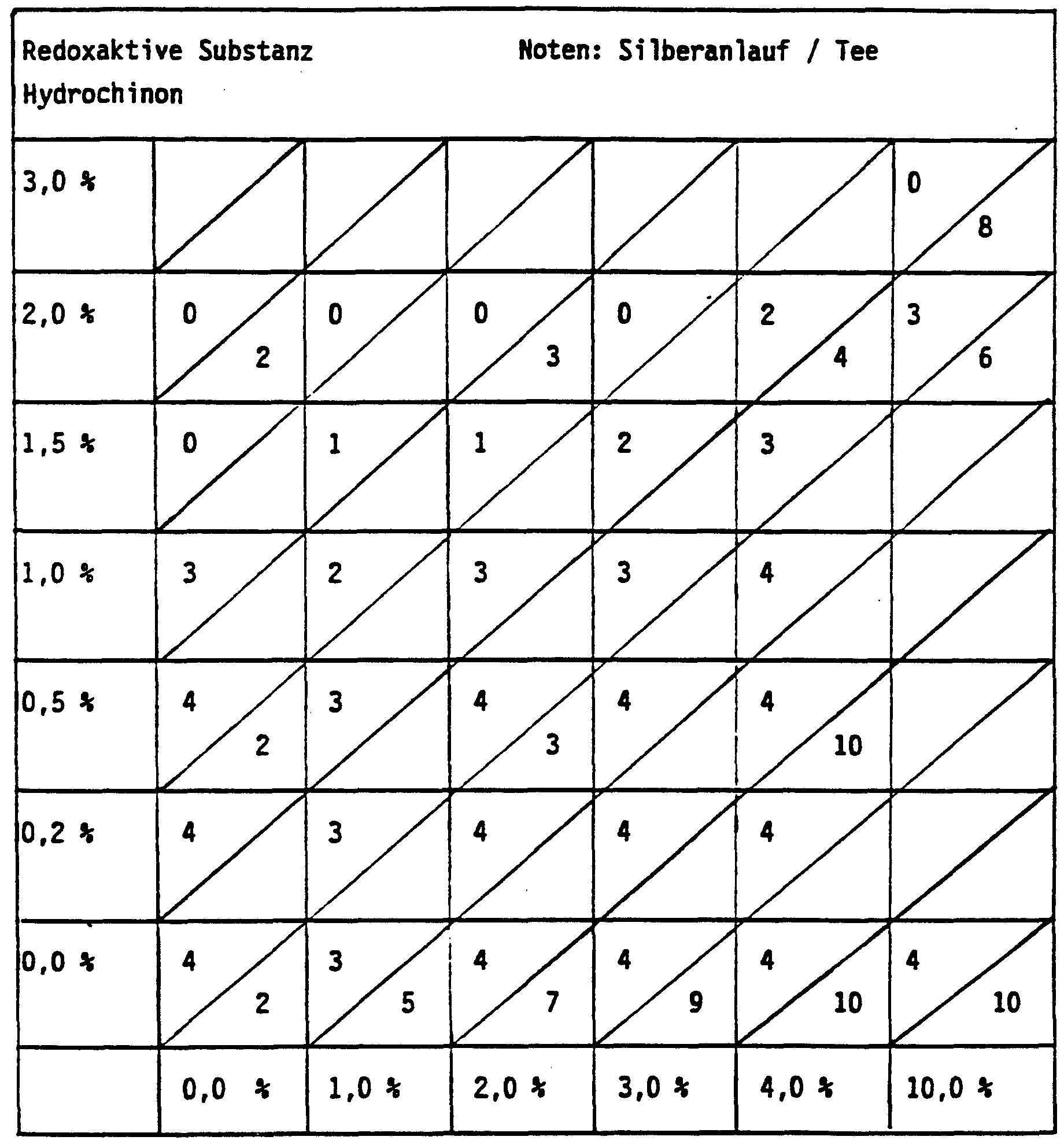
TAED Desweiteren wurden maschinelle Geschirrspülmittel der folgenden Zusammen¬ setzungen hergestellt (siehe Tabelle 4). Als Silberkorrosionsschutzmittel wurden dabei die Verbindungen A - M eingesetzt: A: p-Hydroxyphenylglycin B: 2,4-Diaminophenol C: 5-Chlor-2,3-pyridindiol D: l-(p-Aminophenyl)-morpholin E: Ascorbinsäure F: N-Monomethylglycin G: N,N-Dimethylglycin H: 2-Hydroxy-4-aminopyrimidin I: 2,4-Dihydroxy-5-methylpyrimidin K: Indol L: Methionin M: 2-Phenylglycin TAED Machine dishwashing detergents of the following compositions were also prepared (see Table 4). The compounds A - M were used as silver corrosion inhibitors: A: p-hydroxyphenylglycine B: 2,4-diaminophenol C: 5-chloro-2,3-pyridinediol D: 1- (p-aminophenyl) morpholine E: ascorbic acid F: N-monomethylglycine G: N, N-dimethylglycine H: 2-hydroxy-4-aminopyrimidine I: 2,4-dihydroxy-5-methylpyrimidine K: indole L: methionine M: 2-phenylglycine
Tabelle 4 (alle Angaben in Gew.-%)Table 4 (all data in% by weight)
1 2 3 4 5 6 7 8 9 101 2 3 4 5 6 7 8 9 10
Soda - 27 8 - 26 8 - 26 8 -Soda - 27 8 - 26 8 - 26 8 -
Na-hydrogencarbonat - - 31 - - 30 - - 30 -Na hydrogen carbonate - - 31 - - 30 - - 30 -
Na-disilikat 35 20 - 35 20 - 35 20 - 34Na disilicate 35 20 - 35 20 - 35 20 - 34
Trinatriu citrat-dihydrat 40 25,5 44 40 25,5 44 39 25,5 43 39Trinatriu citrate dihydrate 40 25.5 44 40 25.5 44 39 25.5 43 39
PolycarboxylatPolycarboxylate
(Sokalan CP5 der Fa. BASF) 10 10 - 10 10 - 10 10 - 10(Sokalan CP5 from BASF) 10 10-10 10-10 10-10
Na-percarbonat - 10 10 - 10 10 - 10 10 -Na percarbonate - 10 10 - 10 10 - 10 10 -
Na-perborat- onohydrat 7 - - 7 - - 7 - - 7Na perborate onohydrate 7 - - 7 - - 7 - - 7
TAED 2 3 2 2 3 2 2 3 2 2TAED 2 3 2 2 3 2 2 3 2 2
Ci2-Ci4-Fettalkoholethoxylat-(2E0) (Dehydol LS2 der Fa. Henkel) 1 0,75 1 1 0,75 1 1 0,75 1Ci2-Ci4-fatty alcohol ethoxylate (2E0) (Dehydol LS2 from Henkel) 1 0.75 1 1 0.75 1 1 0.75 1
Cn-Cin-Alkyloligoglucosid (APG 225 der Fa. Henkel) 1 0,75 1 1 0,75 1 1 0,75 1Cn-Cin-alkyl oligoglucoside (APG 225 from Henkel) 1 0.75 1 1 0.75 1 1 0.75 1
Protease 1.5 1 1 1,5 1 1 1.5 1 1,5Protease 1.5 1 1 1.5 1 1 1.5 1 1.5
Amylase 1.5 1 1 1.5 1 1 1.5 1 1,5Amylase 1.5 1 1 1.5 1 1 1.5 1 1.5
Silberkorrosionsschutzmittel A-M (A) (B) (C) (0) (E) (F) (G) (H) (I) (K) 1 1 1 1 2 2 2 2 3 pH-Wert einer l%igen wäßrigen 10,5 11 9,5 10,5 11 9,5 10,5 11 9,5 10,5 Lösung Silver corrosion inhibitor AM (A) (B) (C) (0) (E) (F) (G) (H) (I) (K) 1 1 1 1 2 2 2 2 3 pH value of a 1% aqueous 10 , 5 11 9.5 10.5 11 9.5 10.5 11 9.5 10.5 solution
Fortsetzung Tabelle 4 (alle Angaben in Gew.-%)Continuation of table 4 (all figures in% by weight)
' 11 12 13 14 15 16 17 18 19 20'11 12 13 14 15 16 17 18 19 20
Soda 26 8 - 25,5 8 - 26 7 - 26Soda 26 8 - 25.5 8 - 26 7 - 26
Na-hydrogencarbonat - 30 - - 29 - - 29 - -Na hydrogen carbonate - 30 - - 29 - - 29 - -
Na-disilikat 19,5 - 34 19 - 34 18,5 - 34 18,5Na disilicate 19.5 - 34 19 - 34 18.5 - 34 18.5
Trinatriumcitrat-dihydrat 25 43 38 25 43 38 24 43 38 24Trisodium citrate dihydrate 25 43 38 25 43 38 24 43 38 24
PolycarboxylatPolycarboxylate
(Sokalan CP5 der Fa. BASF) 10 - 10 10 - 10 10 - 9 10(Sokalan CP5 from BASF) 10 - 10 10 - 10 10 - 9 10
Na-percarbonat 10 10 - 10 10 - 10 10 - 10Na percarbonate 10 10 - 10 10 - 10 10 - 10
Na-perborat-monohydrat - - 7 - - 7 - - 7 -Na perborate monohydrate - - 7 - - 7 - - 7 -
TAED 3 2 2 3 2 2 3 2 2 3TAED 3 2 2 3 2 2 3 2 2 3
Fettalkoholethoxylat 0,75 1 1 0,75 1 1 0,75 1 1 0,75 (Dehydol LS2 der Fa. Henkel)Fatty alcohol ethoxylate 0.75 1 1 0.75 1 1 0.75 1 1 0.75 (Dehydol LS2 from Henkel)
AlkyloligoglucosidAlkyl oligoglucoside
(APG 225 der Fa. Henkel) 0,75 1 1 0,75 1 1 0,75 1 1 0,75(APG 225 from Henkel) 0.75 1 1 0.75 1 1 0.75 1 1 0.75
Protease 1 1 1.5 1 1 1,5 1 1 1.5 1Protease 1 1 1.5 1 1 1.5 1 1 1.5 1
A ylase 1 1 1.5 1 1 1.5 1 1 1,5 1A ylase 1 1 1.5 1 1 1.5 1 1 1.5 1
Silberkorrosionsschutzmittel A-M (L) (M) (A) (B (C) (D) (E) (F) (G) (H) 3 3 4 4 4 4 5 5 5 5 pH-Wert einer l%igen wäßrigen 11 9,5 10,5 11 9,5 10,5 11 9,5 10,5 11 Lösung Silver corrosion protection agent AM (L) (M) (A) (B (C) (D) (E) (F) (G) (H) 3 3 4 4 4 4 5 5 5 5 pH value of a 1% aqueous solution 11 9.5 10.5 11 9.5 10.5 11 9.5 10.5 11 solution
Die Silberlöffel wurden durchweg mit 0 bis 1, d.h. "kein bis sehr schwa¬ ches Anlaufen", bewertet. Identische Zusammensetzungen, jedoch jeweils ohne Silberkorrosionsschutzmittel A - D verursachten auf Silberlöffeln Gelb- bis Violettfärbungen (Bewertung: 2 bis 4).The silver spoons were consistently rated 0 to 1, i.e. "no to very weak tarnishing", rated. Identical compositions, but without silver corrosion inhibitor A - D in each case caused yellow to violet colors on silver spoons (rating: 2 to 4).
Elektrochemische MessungenElectrochemical measurements
Probenvorbereitung:Sample preparation:
Für die Untersuchungen wurde als Probenmaterial anstelle von Silberbesteck Silberdraht (d = 2 mm, 99,99 %ig) verwendet. Von diesem Silberdraht wurden jeweils ca. 10 cm lange Stücke abgeschnitten und der in die Meßlösung ein¬ tauchende Teil der Probe mit SiC-Schleifpapier (600er Körnung) geschlif¬ fen. Anschließend wurden die Proben gut mit bidestiliiertem Wasser gepult und evtl. anhaftende Schleifreste mit einem fusselfreien Tuch abgewischt. Dieser Vorgang wurde gegebenenfalls mehrfach wiederholt, bis die Probe optisch einen einwandfreien Eindruck hinterließ. Nach dem Schleifen der Proben wurden diese sofort für die Messung verwendet, um einer Reaktion des metallischen Silbers mit der Laborluft zuvorzukommen. Die effektive, in die Lösung eingetauchte Probenoberfläche betrug 0,70 cm^.For the investigations, silver wire (d = 2 mm, 99.99%) was used as the sample material instead of silver cutlery. Approximately 10 cm long pieces were cut from this silver wire and the part of the sample immersed in the measuring solution was sanded with SiC sandpaper (600 grit). The samples were then rinsed well with bidistilled water and any adhering grinding residues were wiped off with a lint-free cloth. This process was repeated several times, if necessary, until the sample optically left a perfect impression. After grinding the samples, they were used immediately for the measurement in order to pre-empt a reaction of the metallic silver with the laboratory air. The effective sample surface immersed in the solution was 0.70 cm ^.
Elektrolyte und Elektroden:Electrolytes and electrodes:
Die Experimente wurden in einer Duran-Glaszelle durchgeführt. Als Meßelek¬ troden dienten die erwähnten Silberdrähte (A = 0,70 cm2). Die Gegenelek¬ trode bestand aus einem Goldblech (99,99 %ig) mit einer Fläche von 1 cm^. Als Bezugselektrode wurde auf Grund der alkalischen Elektrolytlösungen eine Hg/Hg0/0,1 m NaOH-Elektrode gewählt, die über eine Haber-Luggin-Ka¬ pillare mit den Elektrolyten verbunden war. Die Messungen wurden mit 5 g/1 Reiniger in Leitungswasser von 16°d und einer Salzbelastung von ca. 600 mg (Trockenrückstand) durchgeführt.The experiments were carried out in a Duran glass cell. The silver wires mentioned (A = 0.70 cm 2) served as measuring electrodes. The counterelectrode consisted of a gold plate (99.99% pure) with an area of 1 cm ^. On the basis of the alkaline electrolyte solutions, a Hg / Hg0 / 0.1 m NaOH electrode was chosen as the reference electrode, which was connected to the electrolytes via a Haber-Luggin capillary. The measurements were carried out with 5 g / 1 cleaner in tap water of 16 ° d and a salt load of approx. 600 mg (dry residue).
Beim Ansetzen der Reinigerlösungen wurde zunächst das niederalkalische Grundprodukt (siehe oben) gelöst und die Lösung auf 65°C erhitzt. Direkt vor der Messung wurden das Bleichmittel und der Bleichmittelaktivator und/oder das Silberkorrosionsschutzmittel zugegeben. Danach erfolgte die elektrochemische Messung. Während der elektrochemischen Experimente wurden die Elektrolytlösungen auf 65°C temperiert und mit Luft gespült.When preparing the cleaning solutions, the low-alkaline basic product (see above) was first dissolved and the solution heated to 65 ° C. The bleach and the bleach activator were used immediately before the measurement and / or the silver anticorrosive agent is added. The electrochemical measurement was then carried out. During the electrochemical experiments, the electrolyte solutions were heated to 65 ° C and flushed with air.
Apparatur und Aufnahme der Meßkurven:Equipment and recording of the measurement curves:
Zur Aufnahme der Stromspannungskurven wurde das Elektrodenpotential aus¬ gehend von - 0,62, V bezogen auf die Standardwasserstoffelektrode (SHE), mit einer konstanten Geschwindigkeit erhöht. Nach einer Erhöhung von ins¬ gesamt 1,1 V wurde das Potential anschließend mit gleicher Geschwindigkeit erniedrigt. Hierzu diente ein Standardpotentiostat bestehend aus Mitkopp¬ lungsverstärker, Differenzverstärker, Addierer und Impedanzwandler, sowie ein Funktionsgenerator (Prodis 16 der Firma Intelligent Controls CLZ GmbH).In order to record the current-voltage curves, the electrode potential was increased at a constant speed starting from -0.62, V based on the standard hydrogen electrode (SHE). After a total increase of 1.1 V, the potential was subsequently lowered at the same rate. A standard potentiostat consisting of a positive feedback amplifier, differential amplifier, adder and impedance converter and a function generator (Prodis 16 from Intelligent Controls CLZ GmbH) were used for this purpose.
Ergebnisse:Results:
Die Charakterisierung des Korrosionsverhaltens erfolgte an Hand von Strom¬ spannungskurven. Wesentliche Informationen kommen dabei aus dem Nulldurch¬ gang der Stromspannungskurve (Ruhepotential, das sich auch ohne äußere Potentialbeeinflußung von selbst einstellt) und der Steigung der Kurve am Nulldurchgang (reziproker Polarisationswiderstand) E. Heitz, R. Henkhaus, A. Rahmel, "Korrosionskunde im Experiment" Verlag Chemie (1983), Seiten 31 ff; H. Kaesche, "Die Korrosion der Metalle", 2. Auflage, Springer Verlag (1979), Seiten 117 ff. Dabei verschiebt sich durch den Zusatz des Silber¬ korrosionsschutzmittels das Potential des Nulldurchgangs zu niedrigeren Werten und die Steigung nimmt ab. Also wird die Silberkorrosion durch den Zusatz der Silberkorrosionsschutzmittel auch elektrochemisch meßbar erheb¬ lich reduziert. The corrosion behavior was characterized on the basis of current-voltage curves. Essential information comes from the zero crossing of the current voltage curve (rest potential, which arises automatically even without external influence on the potential) and the slope of the curve at the zero crossing (reciprocal polarization resistance) E. Heitz, R. Henkhaus, A. Rahmel, "Corrosion Science in Experiment "Verlag Chemie (1983), pages 31 ff; H. Kaesche, "The Corrosion of Metals", 2nd edition, Springer Verlag (1979), pages 117 ff. The addition of the silver corrosion inhibitor shifts the potential for zero crossing to lower values and the slope decreases. The silver corrosion is thus also considerably reduced by the addition of the silver corrosion protection agents.
Zusammensetzung Lage Nulldurchgang Steigung im Reiniger E (mV) (SHE) Nulldurchgang di/dE (mA/V)Composition position zero crossing slope in the cleaner E (mV) (SHE) zero crossing di / dE (mA / V)
Grundprodukt (86 %) 319 0,5 + 12 % Percarbonat + 2 % Hydrochinon Base product (86%) 319 0.5 + 12% percarbonate + 2% hydroquinone
Claims
Priority Applications (5)
| Application Number | Priority Date | Filing Date | Title |
|---|---|---|---|
| DK94917579T DK0697036T3 (en) | 1993-05-08 | 1994-05-02 | Silver corrosion protection agent II |
| JP6524888A JPH08509778A (en) | 1993-05-08 | 1994-05-02 | Silver corrosion protection agent (▲ II ▼) |
| PL94311624A PL177935B1 (en) | 1993-05-08 | 1994-05-02 | Agent for protecting silver ii against corrosion |
| DE59408548T DE59408548D1 (en) | 1993-05-08 | 1994-05-02 | SILVER CORROSION PROTECTIVE II |
| EP94917579A EP0697036B1 (en) | 1993-05-08 | 1994-05-02 | Silver-corrosion protection agent (ii) |
Applications Claiming Priority (4)
| Application Number | Priority Date | Filing Date | Title |
|---|---|---|---|
| DE19934315397 DE4315397A1 (en) | 1993-05-08 | 1993-05-08 | Cleaning composition preventing tarnishing of table silver in dishwashing machines |
| DEP4315397.6 | 1993-05-08 | ||
| DE19934338724 DE4338724A1 (en) | 1993-11-12 | 1993-11-12 | Organic redox substances used in dishwashing compsns. |
| DEP4338724.1 | 1993-11-12 |
Publications (1)
| Publication Number | Publication Date |
|---|---|
| WO1994026860A1 true WO1994026860A1 (en) | 1994-11-24 |
Family
ID=25925738
Family Applications (1)
| Application Number | Title | Priority Date | Filing Date |
|---|---|---|---|
| PCT/EP1994/001387 Ceased WO1994026860A1 (en) | 1993-05-08 | 1994-05-02 | Silver-corrosion protection agent (ii) |
Country Status (11)
| Country | Link |
|---|---|
| EP (1) | EP0697036B1 (en) |
| JP (1) | JPH08509778A (en) |
| AT (1) | ATE182615T1 (en) |
| CA (1) | CA2162459A1 (en) |
| CZ (1) | CZ287850B6 (en) |
| DE (1) | DE59408548D1 (en) |
| DK (1) | DK0697036T3 (en) |
| ES (1) | ES2134944T3 (en) |
| HU (2) | HU218008B (en) |
| PL (1) | PL177935B1 (en) |
| WO (1) | WO1994026860A1 (en) |
Cited By (175)
| Publication number | Priority date | Publication date | Assignee | Title |
|---|---|---|---|---|
| WO1995017493A1 (en) * | 1993-12-23 | 1995-06-29 | Henkel Kommanditgesellschaft Auf Aktien | Enzyme preparation containing a corrosion protecting agent for silver |
| US5468410A (en) * | 1993-10-14 | 1995-11-21 | Angevaare; Petrus A. | Purine class compounds in detergent compositions |
| US5480576A (en) * | 1993-10-14 | 1996-01-02 | Lever Brothers Company, Division Of Conopco, Inc. | 1,3-N azole containing detergent compositions |
| WO1996022353A1 (en) * | 1995-01-20 | 1996-07-25 | Henkel Kommanditgesellschaft Auf Aktien | Cleaning product containing an anti-corrosion agent for silver |
| WO1996037596A1 (en) * | 1995-05-22 | 1996-11-28 | Henkel Kommanditgesellschaft Auf Aktien | Diswasher detergent with agents providing protection against the corrosion of silver |
| WO1996037593A1 (en) * | 1995-05-22 | 1996-11-28 | Henkel Kommanditgesellschaft Auf Aktien | Acid granulates containing redox-active substances |
| EP0826768A1 (en) * | 1996-08-07 | 1998-03-04 | Henkel Kommanditgesellschaft auf Aktien | Granular components containing benzotriazole for automatic dishwashing compositions, and method of making them |
| WO1999054431A1 (en) * | 1998-04-22 | 1999-10-28 | Henkel Kommanditgesellschaft Auf Aktien | Coated detergent components |
| EP0842257B1 (en) * | 1995-07-13 | 2000-12-27 | Benckiser N.V. | Dish washer product in tablet form |
| WO2001023507A1 (en) * | 1999-09-30 | 2001-04-05 | Henkel Kommanditgesellschaft Auf Aktien | Machine-based silver cleaning agents |
| WO2005105966A1 (en) * | 2004-04-28 | 2005-11-10 | The Procter & Gamble Company | Antioxidant compositions |
| WO2006018107A1 (en) * | 2004-08-18 | 2006-02-23 | Henkel Kommanditgesellschaft Auf Aktien | Detergents and cleaning agents comprising a rinsing agent and sulphurous amino acids |
| WO2007141527A1 (en) | 2006-06-07 | 2007-12-13 | Reckitt Benckiser N. V. | Detergent composition |
| WO2008087420A1 (en) | 2007-01-18 | 2008-07-24 | Reckitt Benckiser N.V. | Dosage element and a method of manufacturing a dosage element |
| WO2009040544A1 (en) | 2007-09-28 | 2009-04-02 | Reckitt Benckiser N.V. | Detergent composition |
| EP2100948A1 (en) | 2008-03-14 | 2009-09-16 | The Procter and Gamble Company | Automatic dishwashing detergent composition |
| EP2100949A1 (en) | 2008-03-14 | 2009-09-16 | The Procter and Gamble Company | Automatic dishwashing detergent composition |
| EP2166092A1 (en) | 2008-09-18 | 2010-03-24 | The Procter and Gamble Company | Detergent composition |
| WO2010043854A1 (en) | 2008-10-14 | 2010-04-22 | Reckitt Benckiser N.V. | Dishwashing composition |
| EP2216393A1 (en) | 2009-02-09 | 2010-08-11 | The Procter & Gamble Company | Detergent composition |
| WO2010116139A1 (en) | 2009-04-09 | 2010-10-14 | Reckitt Benckiser N.V. | Detergent composition |
| EP2261313A2 (en) | 2005-11-07 | 2010-12-15 | Reckitt Benckiser N.V. | Composition |
| WO2011001170A1 (en) | 2009-07-02 | 2011-01-06 | Reckitt Benckiser N.V. | Compositions |
| WO2011027170A2 (en) | 2009-09-07 | 2011-03-10 | Reckitt Benckiser N.V. | Detergent composition |
| EP2031093A3 (en) * | 2007-08-31 | 2011-04-13 | Clariant Finance (BVI) Limited | Corrosion inhibitors containing non-ionic tensides |
| WO2011042737A1 (en) | 2009-10-09 | 2011-04-14 | Reckitt Benckiser N.V. | Detergent composition |
| EP2031094A3 (en) * | 2007-08-31 | 2011-04-20 | Clariant Finance (BVI) Limited | Corrosion inhibitors containing anionic tensides |
| EP2333040A1 (en) | 2009-12-10 | 2011-06-15 | The Procter & Gamble Company | Detergent composition |
| WO2011072099A2 (en) | 2009-12-09 | 2011-06-16 | Danisco Us Inc. | Compositions and methods comprising protease variants |
| WO2011071994A2 (en) | 2009-12-10 | 2011-06-16 | The Procter & Gamble Company | Detergent composition |
| WO2011071997A1 (en) | 2009-12-10 | 2011-06-16 | The Procter & Gamble Company | Automatic dishwashing product and use thereof |
| WO2011084319A1 (en) | 2009-12-10 | 2011-07-14 | The Procter & Gamble Company | Detergent composition |
| WO2011084412A1 (en) | 2009-12-21 | 2011-07-14 | Danisco Us Inc. | Detergent compositions containing thermobifida fusca lipase and methods of use thereof |
| WO2011084417A1 (en) | 2009-12-21 | 2011-07-14 | Danisco Us Inc. | Detergent compositions containing geobacillus stearothermophilus lipase and methods of use thereof |
| WO2011084599A1 (en) | 2009-12-21 | 2011-07-14 | Danisco Us Inc. | Detergent compositions containing bacillus subtilis lipase and methods of use thereof |
| EP2361964A1 (en) | 2010-02-25 | 2011-08-31 | The Procter & Gamble Company | Detergent composition |
| WO2011110849A1 (en) | 2010-03-09 | 2011-09-15 | Reckitt Benckiser N.V. | Detergent composition |
| WO2011130222A2 (en) | 2010-04-15 | 2011-10-20 | Danisco Us Inc. | Compositions and methods comprising variant proteases |
| WO2011150157A2 (en) | 2010-05-28 | 2011-12-01 | Danisco Us Inc. | Detergent compositions containing streptomyces griseus lipase and methods of use thereof |
| WO2012025740A1 (en) | 2010-08-27 | 2012-03-01 | Reckitt Benckiser N.V. | Detergent composition comprising manganese-oxalate |
| US8173587B2 (en) | 2006-08-04 | 2012-05-08 | Reckitt Benckiser N.V. | Detergent composition |
| US8183024B2 (en) | 2008-11-11 | 2012-05-22 | Danisco Us Inc. | Compositions and methods comprising a subtilisin variant |
| WO2012066344A1 (en) | 2010-11-19 | 2012-05-24 | Reckitt Benckiser N.V. | Dyed coated bleach materials |
| WO2012066341A2 (en) | 2010-11-19 | 2012-05-24 | Reckitt Benckiser N.V. | Coated bleach materials |
| WO2012085534A1 (en) | 2010-12-21 | 2012-06-28 | Reckitt Benckiser N.V. | Bleach catalyst particle |
| WO2012123719A1 (en) | 2011-03-14 | 2012-09-20 | Reckitt Benckiser N.V. | Detergent composition with improved drying performance |
| WO2012131390A2 (en) | 2011-03-31 | 2012-10-04 | Reckitt Benckiser N.V. | Detergent composition |
| WO2012149317A1 (en) | 2011-04-29 | 2012-11-01 | Danisco Us Inc. | Detergent compositions containing bacillus agaradhaerens mannanase and methods of use thereof |
| WO2012149333A1 (en) | 2011-04-29 | 2012-11-01 | Danisco Us Inc. | Detergent compositions containing bacillus sp. mannanase and methods of use thereof |
| WO2012149325A1 (en) | 2011-04-29 | 2012-11-01 | Danisco Us Inc. | Detergent compositions containing geobacillus tepidamans mannanase and methods of use thereof |
| WO2013033318A1 (en) | 2011-08-31 | 2013-03-07 | Danisco Us Inc. | Compositions and methods comprising a lipolytic enzyme variant |
| EP2589651A2 (en) | 2008-11-11 | 2013-05-08 | Danisco US Inc. | Compositions and methods comprising serine protease variants |
| WO2013064811A1 (en) | 2011-10-31 | 2013-05-10 | Reckitt Benckiser N.V. | Stable aqueous pap suspension |
| WO2013092276A1 (en) | 2011-12-22 | 2013-06-27 | Unilever N.V. | Detergent composition comprising glutamic-n,n-diacetate, water and bleaching agent |
| WO2013096653A1 (en) | 2011-12-22 | 2013-06-27 | Danisco Us Inc. | Compositions and methods comprising a lipolytic enzyme variant |
| WO2014011845A1 (en) | 2012-07-11 | 2014-01-16 | The Procter & Gamble Company | Dishwashing composition with improved protection against aluminum corrosion |
| WO2014059360A1 (en) | 2012-10-12 | 2014-04-17 | Danisco Us Inc. | Compositions and methods comprising a lipolytic enzyme variant |
| WO2014071410A1 (en) | 2012-11-05 | 2014-05-08 | Danisco Us Inc. | Compositions and methods comprising thermolysin protease variants |
| WO2014100018A1 (en) | 2012-12-19 | 2014-06-26 | Danisco Us Inc. | Novel mannanase, compositions and methods of use thereof |
| WO2014100100A1 (en) | 2012-12-20 | 2014-06-26 | The Procter & Gamble Company | Detergent composition with silicate coated bleach |
| WO2014194117A2 (en) | 2013-05-29 | 2014-12-04 | Danisco Us Inc. | Novel metalloproteases |
| WO2014194034A2 (en) | 2013-05-29 | 2014-12-04 | Danisco Us Inc. | Novel metalloproteases |
| WO2014194032A1 (en) | 2013-05-29 | 2014-12-04 | Danisco Us Inc. | Novel metalloproteases |
| WO2014194054A1 (en) | 2013-05-29 | 2014-12-04 | Danisco Us Inc. | Novel metalloproteases |
| WO2014198547A2 (en) | 2013-06-12 | 2014-12-18 | Unilever N.V. | Pourable detergent composition comprising suspended particles |
| WO2015038792A1 (en) | 2013-09-12 | 2015-03-19 | Danisco Us Inc. | Compositions and methods comprising lg12-clade protease variants |
| WO2015089441A1 (en) | 2013-12-13 | 2015-06-18 | Danisco Us Inc. | Serine proteases of bacillus species |
| WO2015089447A1 (en) | 2013-12-13 | 2015-06-18 | Danisco Us Inc. | Serine proteases of the bacillus gibsonii-clade |
| WO2016061438A1 (en) | 2014-10-17 | 2016-04-21 | Danisco Us Inc. | Serine proteases of bacillus species |
| WO2016069557A1 (en) | 2014-10-27 | 2016-05-06 | Danisco Us Inc. | Serine proteases of bacillus species |
| WO2016069544A1 (en) | 2014-10-27 | 2016-05-06 | Danisco Us Inc. | Serine proteases |
| WO2016069569A2 (en) | 2014-10-27 | 2016-05-06 | Danisco Us Inc. | Serine proteases |
| WO2016069552A1 (en) | 2014-10-27 | 2016-05-06 | Danisco Us Inc. | Serine proteases |
| WO2016069548A2 (en) | 2014-10-27 | 2016-05-06 | Danisco Us Inc. | Serine proteases |
| EP3031894A1 (en) | 2008-11-11 | 2016-06-15 | Danisco US Inc. | Proteases comprising one or more combinable mutations |
| US9434932B2 (en) | 2011-06-30 | 2016-09-06 | Novozymes A/S | Alpha-amylase variants |
| US9434915B2 (en) | 2008-11-11 | 2016-09-06 | Danisco Us Inc. | Compositions and methods comprising a subtilisin variant |
| EP3067410A2 (en) | 2008-02-15 | 2016-09-14 | The Procter and Gamble Company | Cleaning compositions |
| WO2016145428A1 (en) | 2015-03-12 | 2016-09-15 | Danisco Us Inc | Compositions and methods comprising lg12-clade protease variants |
| WO2016205755A1 (en) | 2015-06-17 | 2016-12-22 | Danisco Us Inc. | Bacillus gibsonii-clade serine proteases |
| WO2017079751A1 (en) | 2015-11-05 | 2017-05-11 | Danisco Us Inc | Paenibacillus sp. mannanases |
| WO2017079756A1 (en) | 2015-11-05 | 2017-05-11 | Danisco Us Inc | Paenibacillus and bacillus spp. mannanases |
| WO2017148989A1 (en) | 2016-03-02 | 2017-09-08 | Unilever N.V. | Pourable detergent suspension comprising a dyed fluid phase and suspended particles |
| WO2017148990A1 (en) | 2016-03-02 | 2017-09-08 | Unilever N.V. | Detergent composition in the form of a suspension |
| WO2017148985A1 (en) | 2016-03-02 | 2017-09-08 | Unilever N.V. | Pourable detergent composition |
| WO2017153528A1 (en) | 2016-03-11 | 2017-09-14 | Unilever N.V. | Pourable detergent suspension comprising bleach catalyst granules |
| WO2017192692A1 (en) | 2016-05-03 | 2017-11-09 | Danisco Us Inc | Protease variants and uses thereof |
| WO2017192300A1 (en) | 2016-05-05 | 2017-11-09 | Danisco Us Inc | Protease variants and uses thereof |
| WO2017210295A1 (en) | 2016-05-31 | 2017-12-07 | Danisco Us Inc. | Protease variants and uses thereof |
| WO2017219011A1 (en) | 2016-06-17 | 2017-12-21 | Danisco Us Inc | Protease variants and uses thereof |
| WO2018118917A1 (en) | 2016-12-21 | 2018-06-28 | Danisco Us Inc. | Protease variants and uses thereof |
| WO2018118950A1 (en) | 2016-12-21 | 2018-06-28 | Danisco Us Inc. | Bacillus gibsonii-clade serine proteases |
| WO2018169750A1 (en) | 2017-03-15 | 2018-09-20 | Danisco Us Inc | Trypsin-like serine proteases and uses thereof |
| WO2018177938A1 (en) | 2017-03-31 | 2018-10-04 | Novozymes A/S | Polypeptides having dnase activity |
| WO2018178061A1 (en) | 2017-03-31 | 2018-10-04 | Novozymes A/S | Polypeptides having rnase activity |
| WO2018177936A1 (en) | 2017-03-31 | 2018-10-04 | Novozymes A/S | Polypeptides having dnase activity |
| WO2018177203A1 (en) | 2017-03-31 | 2018-10-04 | Novozymes A/S | Polypeptides having dnase activity |
| WO2018184873A1 (en) | 2017-04-06 | 2018-10-11 | Novozymes A/S | Detergent compositions and uses thereof |
| WO2018185280A1 (en) | 2017-04-06 | 2018-10-11 | Novozymes A/S | Cleaning compositions and uses thereof |
| WO2018185285A1 (en) | 2017-04-06 | 2018-10-11 | Novozymes A/S | Cleaning compositions and uses thereof |
| WO2018185150A1 (en) | 2017-04-04 | 2018-10-11 | Novozymes A/S | Polypeptides |
| WO2018184816A1 (en) | 2017-04-06 | 2018-10-11 | Novozymes A/S | Cleaning compositions and uses thereof |
| WO2018185181A1 (en) | 2017-04-04 | 2018-10-11 | Novozymes A/S | Glycosyl hydrolases |
| WO2018184818A1 (en) | 2017-04-06 | 2018-10-11 | Novozymes A/S | Cleaning compositions and uses thereof |
| WO2018184817A1 (en) | 2017-04-06 | 2018-10-11 | Novozymes A/S | Cleaning compositions and uses thereof |
| WO2018185267A1 (en) | 2017-04-06 | 2018-10-11 | Novozymes A/S | Cleaning compositions and uses thereof |
| WO2018185269A1 (en) | 2017-04-06 | 2018-10-11 | Novozymes A/S | Cleaning compositions and uses thereof |
| WO2018206811A1 (en) | 2017-05-12 | 2018-11-15 | Unilever N.V. | Automatic dishwashing detergent composition |
| WO2018206812A1 (en) | 2017-05-12 | 2018-11-15 | Unilever N.V. | Phosphate-free automatic dishwashing detergent composition |
| WO2019076800A1 (en) | 2017-10-16 | 2019-04-25 | Novozymes A/S | Cleaning compositions and uses thereof |
| WO2019086532A1 (en) | 2017-11-01 | 2019-05-09 | Novozymes A/S | Methods for cleaning medical devices |
| WO2019086528A1 (en) | 2017-11-01 | 2019-05-09 | Novozymes A/S | Polypeptides and compositions comprising such polypeptides |
| WO2019086530A1 (en) | 2017-11-01 | 2019-05-09 | Novozymes A/S | Polypeptides and compositions comprising such polypeptides |
| WO2019108599A1 (en) | 2017-11-29 | 2019-06-06 | Danisco Us Inc | Subtilisin variants having improved stability |
| WO2019233696A1 (en) | 2018-06-04 | 2019-12-12 | Reckitt Benckiser Finish B.V. | Composition |
| WO2019245705A1 (en) | 2018-06-19 | 2019-12-26 | Danisco Us Inc | Subtilisin variants |
| WO2019245704A1 (en) | 2018-06-19 | 2019-12-26 | Danisco Us Inc | Subtilisin variants |
| EP3587569A1 (en) | 2014-03-21 | 2020-01-01 | Danisco US Inc. | Serine proteases of bacillus species |
| WO2020002604A1 (en) | 2018-06-28 | 2020-01-02 | Novozymes A/S | Detergent compositions and uses thereof |
| WO2020002608A1 (en) | 2018-06-29 | 2020-01-02 | Novozymes A/S | Detergent compositions and uses thereof |
| WO2020007863A1 (en) | 2018-07-02 | 2020-01-09 | Novozymes A/S | Cleaning compositions and uses thereof |
| WO2020007875A1 (en) | 2018-07-03 | 2020-01-09 | Novozymes A/S | Cleaning compositions and uses thereof |
| WO2020008043A1 (en) | 2018-07-06 | 2020-01-09 | Novozymes A/S | Cleaning compositions and uses thereof |
| WO2020008024A1 (en) | 2018-07-06 | 2020-01-09 | Novozymes A/S | Cleaning compositions and uses thereof |
| WO2020046613A1 (en) | 2018-08-30 | 2020-03-05 | Danisco Us Inc | Compositions comprising a lipolytic enzyme variant and methods of use thereof |
| WO2020068486A1 (en) | 2018-09-27 | 2020-04-02 | Danisco Us Inc | Compositions for medical instrument cleaning |
| WO2020070014A1 (en) | 2018-10-02 | 2020-04-09 | Novozymes A/S | Cleaning composition comprising anionic surfactant and a polypeptide having rnase activity |
| WO2020070063A2 (en) | 2018-10-01 | 2020-04-09 | Novozymes A/S | Detergent compositions and uses thereof |
| WO2020070011A1 (en) | 2018-10-02 | 2020-04-09 | Novozymes A/S | Cleaning composition |
| WO2020070209A1 (en) | 2018-10-02 | 2020-04-09 | Novozymes A/S | Cleaning composition |
| WO2020074545A1 (en) | 2018-10-11 | 2020-04-16 | Novozymes A/S | Cleaning compositions and uses thereof |
| WO2020074499A1 (en) | 2018-10-09 | 2020-04-16 | Novozymes A/S | Cleaning compositions and uses thereof |
| WO2020074498A1 (en) | 2018-10-09 | 2020-04-16 | Novozymes A/S | Cleaning compositions and uses thereof |
| EP3647397A1 (en) | 2018-10-31 | 2020-05-06 | Henkel AG & Co. KGaA | Cleaning compositions containing dispersins iv |
| EP3647398A1 (en) | 2018-10-31 | 2020-05-06 | Henkel AG & Co. KGaA | Cleaning compositions containing dispersins v |
| WO2020104320A1 (en) | 2018-11-19 | 2020-05-28 | Reckitt Benckiser Finish B.V. | Composition |
| WO2020112599A1 (en) | 2018-11-28 | 2020-06-04 | Danisco Us Inc | Subtilisin variants having improved stability |
| WO2020127796A2 (en) | 2018-12-21 | 2020-06-25 | Novozymes A/S | Polypeptides having peptidoglycan degrading activity and polynucleotides encoding same |
| WO2020127775A1 (en) | 2018-12-21 | 2020-06-25 | Novozymes A/S | Detergent pouch comprising metalloproteases |
| WO2020152044A1 (en) | 2019-01-22 | 2020-07-30 | Reckitt Benckiser Finish B.V. | Method of forming an automatic dishwashing pouch, vacuum forming system and pouch |
| EP3696264A1 (en) | 2013-07-19 | 2020-08-19 | Danisco US Inc. | Compositions and methods comprising a lipolytic enzyme variant |
| WO2020242858A1 (en) | 2019-05-24 | 2020-12-03 | Danisco Us Inc | Subtilisin variants and methods of use |
| WO2021063560A1 (en) | 2019-09-30 | 2021-04-08 | Unilever Ip Holdings B.V. | Machine dishwasher capsule with three compartments |
| WO2021122118A1 (en) | 2019-12-20 | 2021-06-24 | Henkel Ag & Co. Kgaa | Cleaning compositions comprising dispersins vi |
| WO2021122121A1 (en) | 2019-12-20 | 2021-06-24 | Henkel Ag & Co. Kgaa | Cleaning compositions comprising dispersins ix |
| WO2021122120A2 (en) | 2019-12-20 | 2021-06-24 | Henkel Ag & Co. Kgaa | Cleaning compositions comprising dispersins viii |
| WO2021122117A1 (en) | 2019-12-20 | 2021-06-24 | Henkel Ag & Co. Kgaa | Cleaning composition coprising a dispersin and a carbohydrase |
| WO2021130167A1 (en) | 2019-12-23 | 2021-07-01 | Novozymes A/S | Enzyme compositions and uses thereof |
| WO2021146255A1 (en) | 2020-01-13 | 2021-07-22 | Danisco Us Inc | Compositions comprising a lipolytic enzyme variant and methods of use thereof |
| WO2021148364A1 (en) | 2020-01-23 | 2021-07-29 | Novozymes A/S | Enzyme compositions and uses thereof |
| EP3872174A1 (en) | 2015-05-13 | 2021-09-01 | Danisco US Inc. | Aprl-clade protease variants and uses thereof |
| WO2021170398A1 (en) | 2020-02-28 | 2021-09-02 | Unilever Ip Holdings B.V. | Dishwash detergent product |
| WO2021170427A1 (en) | 2020-02-28 | 2021-09-02 | Unilever Ip Holdings B.V. | Dishwash detergent product |
| EP3892708A1 (en) | 2020-04-06 | 2021-10-13 | Henkel AG & Co. KGaA | Cleaning compositions comprising dispersin variants |
| WO2021214059A1 (en) | 2020-04-21 | 2021-10-28 | Novozymes A/S | Cleaning compositions comprising polypeptides having fructan degrading activity |
| WO2021228957A1 (en) | 2020-05-14 | 2021-11-18 | Reckitt Benckiser Finish B.V. | Solid composition |
| WO2021228961A1 (en) | 2020-05-14 | 2021-11-18 | Reckitt Benckiser Finish B.V. | Solid composition |
| EP3936593A1 (en) | 2020-07-08 | 2022-01-12 | Henkel AG & Co. KGaA | Cleaning compositions and uses thereof |
| US11266289B2 (en) | 2014-08-05 | 2022-03-08 | Reckitt Benckiser (Brands) Limited | Automatic washing machine and method |
| WO2022084303A2 (en) | 2020-10-20 | 2022-04-28 | Novozymes A/S | Use of polypeptides having dnase activity |
| WO2022161793A1 (en) | 2021-01-29 | 2022-08-04 | Unilever Ip Holdings B.V. | Professional machine dishwash detergent liquid |
| WO2023114932A2 (en) | 2021-12-16 | 2023-06-22 | Danisco Us Inc. | Subtilisin variants and methods of use |
| WO2023114939A2 (en) | 2021-12-16 | 2023-06-22 | Danisco Us Inc. | Subtilisin variants and methods of use |
| WO2023114936A2 (en) | 2021-12-16 | 2023-06-22 | Danisco Us Inc. | Subtilisin variants and methods of use |
| WO2024050346A1 (en) | 2022-09-02 | 2024-03-07 | Danisco Us Inc. | Detergent compositions and methods related thereto |
| WO2024050343A1 (en) | 2022-09-02 | 2024-03-07 | Danisco Us Inc. | Subtilisin variants and methods related thereto |
| WO2024050339A1 (en) | 2022-09-02 | 2024-03-07 | Danisco Us Inc. | Mannanase variants and methods of use |
| WO2024102698A1 (en) | 2022-11-09 | 2024-05-16 | Danisco Us Inc. | Subtilisin variants and methods of use |
| WO2024126495A1 (en) | 2022-12-14 | 2024-06-20 | Reckitt Benckiser Finish B.V. | Solid unit dose detergent composition |
| WO2024163584A1 (en) | 2023-02-01 | 2024-08-08 | Danisco Us Inc. | Subtilisin variants and methods of use |
| WO2024186819A1 (en) | 2023-03-06 | 2024-09-12 | Danisco Us Inc. | Subtilisin variants and methods of use |
| WO2025011917A1 (en) | 2023-07-11 | 2025-01-16 | Unilever Ip Holdings B.V. | Machine dishwash detergent composition |
| WO2025085351A1 (en) | 2023-10-20 | 2025-04-24 | Danisco Us Inc. | Subtilisin variants and methods of use |
| US12291696B2 (en) | 2017-11-01 | 2025-05-06 | Henkel Ag & Co. Kgaa | Cleaning compositions containing Dispersins III |
| WO2026024922A1 (en) | 2024-07-25 | 2026-01-29 | Danisco Us Inc. | Subtilisin variants and methods of use |
Families Citing this family (8)
| Publication number | Priority date | Publication date | Assignee | Title |
|---|---|---|---|---|
| JP5561987B2 (en) * | 2009-09-30 | 2014-07-30 | 小林製薬株式会社 | Denture cleaning agent |
| DE102010006099A1 (en) * | 2010-01-28 | 2011-08-18 | EXCOR Korrosionsforschung GmbH, 01067 | Composition of vapor phase corrosion inhibitors, process for their preparation and their use for temporary corrosion protection |
| JP5641759B2 (en) * | 2010-03-31 | 2014-12-17 | 小林製薬株式会社 | Denture cleaning agent |
| ES2694398T3 (en) | 2010-05-06 | 2018-12-20 | Danisco Us Inc. | Compositions and methods comprising subtilisin variants |
| DK2705146T3 (en) | 2011-05-05 | 2019-03-04 | Danisco Us Inc | COMPOSITIONS AND PROCEDURES INCLUDING SERINE PROTEASE VARIABLES |
| MX2018011995A (en) | 2016-12-01 | 2019-01-24 | Clariant Int Ltd | Use of a composition containing at least one biodegradable sugar-amide-compound in combination with at least one sulfur-based synergist for corrosion inhibition of a metallic equipment in oilfield applications. |
| WO2025174581A1 (en) * | 2024-02-15 | 2025-08-21 | Rohm And Haas Company | Automatic dishwashing composition with gallic acid (salt) |
| WO2025178722A1 (en) * | 2024-02-20 | 2025-08-28 | Rohm And Haas Company | Automatic dishwashing composition with 1,2,4-trihydroxybenzene (salt) |
Citations (5)
| Publication number | Priority date | Publication date | Assignee | Title |
|---|---|---|---|---|
| US2788329A (en) * | 1953-12-02 | 1957-04-09 | American Cyanamid Co | Surface active composition containing a corrosion inhibitor |
| US3549539A (en) * | 1967-10-23 | 1970-12-22 | Lever Brothers Ltd | Dishwashing powders |
| US3759829A (en) * | 1966-04-06 | 1973-09-18 | Monsanto Co | Functional fluid compositions |
| EP0135226A2 (en) * | 1983-08-15 | 1985-03-27 | Unilever N.V. | Enzymatic machine-dishwashing compositions |
| EP0504091A1 (en) * | 1991-03-15 | 1992-09-16 | Cleantabs A/S | A phosphate-free automatic dishwashing composition |
Family Cites Families (3)
| Publication number | Priority date | Publication date | Assignee | Title |
|---|---|---|---|---|
| US4859358A (en) * | 1988-06-09 | 1989-08-22 | The Procter & Gamble Company | Liquid automatic dishwashing compositions containing metal salts of hydroxy fatty acids providing silver protection |
| DE4232170C2 (en) * | 1992-09-25 | 1999-09-16 | Henkel Kgaa | Weakly alkaline dish detergent |
| AU5860194A (en) * | 1993-01-18 | 1994-08-15 | Unilever Plc | Machine dishwashing composition containing a corrosion inhibitor |
-
1994
- 1994-05-02 HU HU9503201A patent/HU218008B/en not_active IP Right Cessation
- 1994-05-02 WO PCT/EP1994/001387 patent/WO1994026860A1/en not_active Ceased
- 1994-05-02 CA CA002162459A patent/CA2162459A1/en not_active Abandoned
- 1994-05-02 HU HU9503200A patent/HU218021B/en not_active IP Right Cessation
- 1994-05-02 PL PL94311624A patent/PL177935B1/en unknown
- 1994-05-02 ES ES94917579T patent/ES2134944T3/en not_active Expired - Lifetime
- 1994-05-02 CZ CZ19952625A patent/CZ287850B6/en not_active IP Right Cessation
- 1994-05-02 EP EP94917579A patent/EP0697036B1/en not_active Expired - Lifetime
- 1994-05-02 DE DE59408548T patent/DE59408548D1/en not_active Expired - Lifetime
- 1994-05-02 JP JP6524888A patent/JPH08509778A/en active Pending
- 1994-05-02 DK DK94917579T patent/DK0697036T3/en active
- 1994-05-02 AT AT94917579T patent/ATE182615T1/en not_active IP Right Cessation
Patent Citations (5)
| Publication number | Priority date | Publication date | Assignee | Title |
|---|---|---|---|---|
| US2788329A (en) * | 1953-12-02 | 1957-04-09 | American Cyanamid Co | Surface active composition containing a corrosion inhibitor |
| US3759829A (en) * | 1966-04-06 | 1973-09-18 | Monsanto Co | Functional fluid compositions |
| US3549539A (en) * | 1967-10-23 | 1970-12-22 | Lever Brothers Ltd | Dishwashing powders |
| EP0135226A2 (en) * | 1983-08-15 | 1985-03-27 | Unilever N.V. | Enzymatic machine-dishwashing compositions |
| EP0504091A1 (en) * | 1991-03-15 | 1992-09-16 | Cleantabs A/S | A phosphate-free automatic dishwashing composition |
Cited By (239)
| Publication number | Priority date | Publication date | Assignee | Title |
|---|---|---|---|---|
| US5468410A (en) * | 1993-10-14 | 1995-11-21 | Angevaare; Petrus A. | Purine class compounds in detergent compositions |
| US5480576A (en) * | 1993-10-14 | 1996-01-02 | Lever Brothers Company, Division Of Conopco, Inc. | 1,3-N azole containing detergent compositions |
| US5783545A (en) * | 1993-12-23 | 1998-07-21 | Henkel Kommanditgesellschaft Auf Aktien | Enzyme preparation containing a silver corrosion inhibitor |
| WO1995017493A1 (en) * | 1993-12-23 | 1995-06-29 | Henkel Kommanditgesellschaft Auf Aktien | Enzyme preparation containing a corrosion protecting agent for silver |
| WO1996022353A1 (en) * | 1995-01-20 | 1996-07-25 | Henkel Kommanditgesellschaft Auf Aktien | Cleaning product containing an anti-corrosion agent for silver |
| WO1996037596A1 (en) * | 1995-05-22 | 1996-11-28 | Henkel Kommanditgesellschaft Auf Aktien | Diswasher detergent with agents providing protection against the corrosion of silver |
| WO1996037593A1 (en) * | 1995-05-22 | 1996-11-28 | Henkel Kommanditgesellschaft Auf Aktien | Acid granulates containing redox-active substances |
| US6194368B1 (en) | 1995-07-13 | 2001-02-27 | Joh A. Benckiser, Gmbh | Dishwasher product in tablet form |
| EP0842257B1 (en) * | 1995-07-13 | 2000-12-27 | Benckiser N.V. | Dish washer product in tablet form |
| EP0826768A1 (en) * | 1996-08-07 | 1998-03-04 | Henkel Kommanditgesellschaft auf Aktien | Granular components containing benzotriazole for automatic dishwashing compositions, and method of making them |
| WO1999054431A1 (en) * | 1998-04-22 | 1999-10-28 | Henkel Kommanditgesellschaft Auf Aktien | Coated detergent components |
| WO2001023507A1 (en) * | 1999-09-30 | 2001-04-05 | Henkel Kommanditgesellschaft Auf Aktien | Machine-based silver cleaning agents |
| US7084100B2 (en) | 2004-04-28 | 2006-08-01 | The Procter & Gamble Company | Antioxidant compositions |
| WO2005105966A1 (en) * | 2004-04-28 | 2005-11-10 | The Procter & Gamble Company | Antioxidant compositions |
| WO2006018107A1 (en) * | 2004-08-18 | 2006-02-23 | Henkel Kommanditgesellschaft Auf Aktien | Detergents and cleaning agents comprising a rinsing agent and sulphurous amino acids |
| EP3327109A1 (en) | 2005-11-07 | 2018-05-30 | Reckitt Benckiser Finish B.V. | Composition |
| EP2261313A2 (en) | 2005-11-07 | 2010-12-15 | Reckitt Benckiser N.V. | Composition |
| WO2007141527A1 (en) | 2006-06-07 | 2007-12-13 | Reckitt Benckiser N. V. | Detergent composition |
| US8173587B2 (en) | 2006-08-04 | 2012-05-08 | Reckitt Benckiser N.V. | Detergent composition |
| WO2008087420A1 (en) | 2007-01-18 | 2008-07-24 | Reckitt Benckiser N.V. | Dosage element and a method of manufacturing a dosage element |
| EP2390200A1 (en) | 2007-01-18 | 2011-11-30 | Reckitt Benckiser N.V. | Dosage element and a method of manufacturing a dosage element |
| EP2031093A3 (en) * | 2007-08-31 | 2011-04-13 | Clariant Finance (BVI) Limited | Corrosion inhibitors containing non-ionic tensides |
| EP2031094A3 (en) * | 2007-08-31 | 2011-04-20 | Clariant Finance (BVI) Limited | Corrosion inhibitors containing anionic tensides |
| WO2009040544A1 (en) | 2007-09-28 | 2009-04-02 | Reckitt Benckiser N.V. | Detergent composition |
| EP3067410A2 (en) | 2008-02-15 | 2016-09-14 | The Procter and Gamble Company | Cleaning compositions |
| EP2100947A1 (en) | 2008-03-14 | 2009-09-16 | The Procter and Gamble Company | Automatic dishwashing detergent composition |
| EP2660308A2 (en) | 2008-03-14 | 2013-11-06 | The Procter & Gamble Company | Automatic dishwashing detergent composition |
| EP2100950A1 (en) | 2008-03-14 | 2009-09-16 | The Procter and Gamble Company | Automatic dishwashing detergent composition |
| EP2660309A2 (en) | 2008-03-14 | 2013-11-06 | The Procter & Gamble Company | Automatic dishwashing detergent composition |
| DE202008018427U1 (en) | 2008-03-14 | 2013-09-17 | The Procter & Gamble Company | Automatic dishwashing detergent composition |
| EP3660137A1 (en) | 2008-03-14 | 2020-06-03 | The Procter and Gamble Company | Automatic dishwashing detergent composition |
| US10844327B2 (en) | 2008-03-14 | 2020-11-24 | The Procter & Gamble Company | Automatic dishwashing detergent composition |
| EP2660307A2 (en) | 2008-03-14 | 2013-11-06 | The Procter & Gamble Company | Automatic dishwashing detergent composition |
| US8980814B2 (en) | 2008-03-14 | 2015-03-17 | The Procter & Gamble Company | Automatic dishwashing detergent composition |
| DE202008018427U9 (en) | 2008-03-14 | 2015-10-29 | The Procter & Gamble Company | Automatic dishwashing detergent composition |
| EP2100949A1 (en) | 2008-03-14 | 2009-09-16 | The Procter and Gamble Company | Automatic dishwashing detergent composition |
| EP2100948A1 (en) | 2008-03-14 | 2009-09-16 | The Procter and Gamble Company | Automatic dishwashing detergent composition |
| EP3208327A1 (en) | 2008-03-14 | 2017-08-23 | The Procter & Gamble Company | Automatic dishwashing detergent composition |
| US8680034B2 (en) | 2008-03-14 | 2014-03-25 | The Procter & Gamble Company | Automatic dishwashing detergent composition |
| EP2166092A1 (en) | 2008-09-18 | 2010-03-24 | The Procter and Gamble Company | Detergent composition |
| WO2010043854A1 (en) | 2008-10-14 | 2010-04-22 | Reckitt Benckiser N.V. | Dishwashing composition |
| US9434915B2 (en) | 2008-11-11 | 2016-09-06 | Danisco Us Inc. | Compositions and methods comprising a subtilisin variant |
| US8183024B2 (en) | 2008-11-11 | 2012-05-22 | Danisco Us Inc. | Compositions and methods comprising a subtilisin variant |
| US10093887B2 (en) | 2008-11-11 | 2018-10-09 | Danisco Us Inc. | Compositions and methods comprising serine protease variants |
| EP2647692A2 (en) | 2008-11-11 | 2013-10-09 | Danisco US Inc. | Compositions and methods comprising serine protease variants |
| EP3031894A1 (en) | 2008-11-11 | 2016-06-15 | Danisco US Inc. | Proteases comprising one or more combinable mutations |
| EP2589651A2 (en) | 2008-11-11 | 2013-05-08 | Danisco US Inc. | Compositions and methods comprising serine protease variants |
| EP2216393A1 (en) | 2009-02-09 | 2010-08-11 | The Procter & Gamble Company | Detergent composition |
| WO2010090915A1 (en) | 2009-02-09 | 2010-08-12 | The Procter & Gamble Company | Detergent composition |
| EP3998328A1 (en) | 2009-02-09 | 2022-05-18 | The Procter & Gamble Company | Detergent composition |
| WO2010116139A1 (en) | 2009-04-09 | 2010-10-14 | Reckitt Benckiser N.V. | Detergent composition |
| WO2011001170A1 (en) | 2009-07-02 | 2011-01-06 | Reckitt Benckiser N.V. | Compositions |
| WO2011027170A2 (en) | 2009-09-07 | 2011-03-10 | Reckitt Benckiser N.V. | Detergent composition |
| WO2011042737A1 (en) | 2009-10-09 | 2011-04-14 | Reckitt Benckiser N.V. | Detergent composition |
| EP3255132A1 (en) | 2009-10-09 | 2017-12-13 | Reckitt Benckiser Finish B.V. | Detergent composition |
| EP3599279A1 (en) | 2009-12-09 | 2020-01-29 | Danisco US Inc. | Compositions and methods comprising protease variants |
| WO2011072099A2 (en) | 2009-12-09 | 2011-06-16 | Danisco Us Inc. | Compositions and methods comprising protease variants |
| EP3190183A1 (en) | 2009-12-09 | 2017-07-12 | Danisco US Inc. | Compositions and methods comprising protease variants |
| WO2011071997A1 (en) | 2009-12-10 | 2011-06-16 | The Procter & Gamble Company | Automatic dishwashing product and use thereof |
| WO2011072017A2 (en) | 2009-12-10 | 2011-06-16 | The Procter & Gamble Company | Detergent composition |
| WO2011084319A1 (en) | 2009-12-10 | 2011-07-14 | The Procter & Gamble Company | Detergent composition |
| EP2333040A1 (en) | 2009-12-10 | 2011-06-15 | The Procter & Gamble Company | Detergent composition |
| WO2011071994A2 (en) | 2009-12-10 | 2011-06-16 | The Procter & Gamble Company | Detergent composition |
| WO2011084412A1 (en) | 2009-12-21 | 2011-07-14 | Danisco Us Inc. | Detergent compositions containing thermobifida fusca lipase and methods of use thereof |
| WO2011084417A1 (en) | 2009-12-21 | 2011-07-14 | Danisco Us Inc. | Detergent compositions containing geobacillus stearothermophilus lipase and methods of use thereof |
| WO2011084599A1 (en) | 2009-12-21 | 2011-07-14 | Danisco Us Inc. | Detergent compositions containing bacillus subtilis lipase and methods of use thereof |
| EP2361964A1 (en) | 2010-02-25 | 2011-08-31 | The Procter & Gamble Company | Detergent composition |
| WO2011110850A1 (en) | 2010-03-09 | 2011-09-15 | Reckitt Benckiser N.V | Compression process for producing a bleach containing product |
| WO2011110849A1 (en) | 2010-03-09 | 2011-09-15 | Reckitt Benckiser N.V. | Detergent composition |
| WO2011130222A2 (en) | 2010-04-15 | 2011-10-20 | Danisco Us Inc. | Compositions and methods comprising variant proteases |
| WO2011150157A2 (en) | 2010-05-28 | 2011-12-01 | Danisco Us Inc. | Detergent compositions containing streptomyces griseus lipase and methods of use thereof |
| WO2012025740A1 (en) | 2010-08-27 | 2012-03-01 | Reckitt Benckiser N.V. | Detergent composition comprising manganese-oxalate |
| WO2012066341A2 (en) | 2010-11-19 | 2012-05-24 | Reckitt Benckiser N.V. | Coated bleach materials |
| WO2012066344A1 (en) | 2010-11-19 | 2012-05-24 | Reckitt Benckiser N.V. | Dyed coated bleach materials |
| WO2012085534A1 (en) | 2010-12-21 | 2012-06-28 | Reckitt Benckiser N.V. | Bleach catalyst particle |
| US9617500B2 (en) | 2011-03-14 | 2017-04-11 | Reckitt Benckiser Finish B.V. | Detergent composition with improved drying performance |
| US9157050B2 (en) | 2011-03-14 | 2015-10-13 | Reckitt Benckiser N.V. | Detergent composition with improved drying performance |
| WO2012123719A1 (en) | 2011-03-14 | 2012-09-20 | Reckitt Benckiser N.V. | Detergent composition with improved drying performance |
| US9540591B2 (en) | 2011-03-31 | 2017-01-10 | Reckitt Benckiser Finish B.V. | Detergent composition |
| WO2012131390A2 (en) | 2011-03-31 | 2012-10-04 | Reckitt Benckiser N.V. | Detergent composition |
| US10017721B2 (en) | 2011-03-31 | 2018-07-10 | Reckitt Benckiser Finish B.V. | Detergent composition |
| WO2012149317A1 (en) | 2011-04-29 | 2012-11-01 | Danisco Us Inc. | Detergent compositions containing bacillus agaradhaerens mannanase and methods of use thereof |
| WO2012149333A1 (en) | 2011-04-29 | 2012-11-01 | Danisco Us Inc. | Detergent compositions containing bacillus sp. mannanase and methods of use thereof |
| WO2012149325A1 (en) | 2011-04-29 | 2012-11-01 | Danisco Us Inc. | Detergent compositions containing geobacillus tepidamans mannanase and methods of use thereof |
| US10752889B2 (en) | 2011-06-30 | 2020-08-25 | Novozymes A/S | Alpha-amylase variants |
| US9434932B2 (en) | 2011-06-30 | 2016-09-06 | Novozymes A/S | Alpha-amylase variants |
| US10167458B2 (en) | 2011-06-30 | 2019-01-01 | Novozymes A/S | Alpha-amylase variants |
| US11091748B2 (en) | 2011-06-30 | 2021-08-17 | Novozymes A/S | Alpha-amylase variants |
| US12012623B2 (en) | 2011-06-30 | 2024-06-18 | Novozymes A/S | Alpha-amylase variants |
| WO2013033318A1 (en) | 2011-08-31 | 2013-03-07 | Danisco Us Inc. | Compositions and methods comprising a lipolytic enzyme variant |
| WO2013064811A1 (en) | 2011-10-31 | 2013-05-10 | Reckitt Benckiser N.V. | Stable aqueous pap suspension |
| WO2013092276A1 (en) | 2011-12-22 | 2013-06-27 | Unilever N.V. | Detergent composition comprising glutamic-n,n-diacetate, water and bleaching agent |
| WO2013096653A1 (en) | 2011-12-22 | 2013-06-27 | Danisco Us Inc. | Compositions and methods comprising a lipolytic enzyme variant |
| WO2014011845A1 (en) | 2012-07-11 | 2014-01-16 | The Procter & Gamble Company | Dishwashing composition with improved protection against aluminum corrosion |
| WO2014059360A1 (en) | 2012-10-12 | 2014-04-17 | Danisco Us Inc. | Compositions and methods comprising a lipolytic enzyme variant |
| WO2014071410A1 (en) | 2012-11-05 | 2014-05-08 | Danisco Us Inc. | Compositions and methods comprising thermolysin protease variants |
| WO2014100018A1 (en) | 2012-12-19 | 2014-06-26 | Danisco Us Inc. | Novel mannanase, compositions and methods of use thereof |
| WO2014100100A1 (en) | 2012-12-20 | 2014-06-26 | The Procter & Gamble Company | Detergent composition with silicate coated bleach |
| WO2014194034A2 (en) | 2013-05-29 | 2014-12-04 | Danisco Us Inc. | Novel metalloproteases |
| WO2014194054A1 (en) | 2013-05-29 | 2014-12-04 | Danisco Us Inc. | Novel metalloproteases |
| EP3636662A1 (en) | 2013-05-29 | 2020-04-15 | Danisco US Inc. | Novel metalloproteases |
| EP4159854A1 (en) | 2013-05-29 | 2023-04-05 | Danisco US Inc | Novel metalloproteases |
| EP3260538A1 (en) | 2013-05-29 | 2017-12-27 | Danisco US Inc. | Novel metalloproteases |
| WO2014194117A2 (en) | 2013-05-29 | 2014-12-04 | Danisco Us Inc. | Novel metalloproteases |
| EP3882346A1 (en) | 2013-05-29 | 2021-09-22 | Danisco US Inc. | Novel metalloproteases |
| WO2014194032A1 (en) | 2013-05-29 | 2014-12-04 | Danisco Us Inc. | Novel metalloproteases |
| WO2014198547A2 (en) | 2013-06-12 | 2014-12-18 | Unilever N.V. | Pourable detergent composition comprising suspended particles |
| EP3696264A1 (en) | 2013-07-19 | 2020-08-19 | Danisco US Inc. | Compositions and methods comprising a lipolytic enzyme variant |
| WO2015038792A1 (en) | 2013-09-12 | 2015-03-19 | Danisco Us Inc. | Compositions and methods comprising lg12-clade protease variants |
| EP3653707A1 (en) | 2013-09-12 | 2020-05-20 | Danisco US Inc. | Compositions and methods comprising lg12-clade protease variants |
| EP3514230A1 (en) | 2013-12-13 | 2019-07-24 | Danisco US Inc. | Serine proteases of bacillus species |
| EP3553173A1 (en) | 2013-12-13 | 2019-10-16 | Danisco US Inc. | Serine proteases of the bacillus gibsonii-clade |
| EP3910057A1 (en) | 2013-12-13 | 2021-11-17 | Danisco US Inc. | Serine proteases of the bacillus gibsonii-clade |
| WO2015089441A1 (en) | 2013-12-13 | 2015-06-18 | Danisco Us Inc. | Serine proteases of bacillus species |
| WO2015089447A1 (en) | 2013-12-13 | 2015-06-18 | Danisco Us Inc. | Serine proteases of the bacillus gibsonii-clade |
| EP3587569A1 (en) | 2014-03-21 | 2020-01-01 | Danisco US Inc. | Serine proteases of bacillus species |
| EP4155398A1 (en) | 2014-03-21 | 2023-03-29 | Danisco US Inc. | Serine proteases of bacillus species |
| US11266289B2 (en) | 2014-08-05 | 2022-03-08 | Reckitt Benckiser (Brands) Limited | Automatic washing machine and method |
| WO2016061438A1 (en) | 2014-10-17 | 2016-04-21 | Danisco Us Inc. | Serine proteases of bacillus species |
| WO2016069552A1 (en) | 2014-10-27 | 2016-05-06 | Danisco Us Inc. | Serine proteases |
| EP3550017A1 (en) | 2014-10-27 | 2019-10-09 | Danisco US Inc. | Serine proteases |
| WO2016069569A2 (en) | 2014-10-27 | 2016-05-06 | Danisco Us Inc. | Serine proteases |
| EP4403631A2 (en) | 2014-10-27 | 2024-07-24 | Danisco US Inc. | Serine proteases |
| WO2016069557A1 (en) | 2014-10-27 | 2016-05-06 | Danisco Us Inc. | Serine proteases of bacillus species |
| WO2016069544A1 (en) | 2014-10-27 | 2016-05-06 | Danisco Us Inc. | Serine proteases |
| WO2016069548A2 (en) | 2014-10-27 | 2016-05-06 | Danisco Us Inc. | Serine proteases |
| EP3611259A1 (en) | 2015-03-12 | 2020-02-19 | Danisco US Inc. | Compositions and methods comprising lg12-clade protease variants |
| WO2016145428A1 (en) | 2015-03-12 | 2016-09-15 | Danisco Us Inc | Compositions and methods comprising lg12-clade protease variants |
| EP3872174A1 (en) | 2015-05-13 | 2021-09-01 | Danisco US Inc. | Aprl-clade protease variants and uses thereof |
| EP4219704A2 (en) | 2015-05-13 | 2023-08-02 | Danisco US Inc | Aprl-clade protease variants and uses thereof |
| EP4234693A2 (en) | 2015-06-17 | 2023-08-30 | Danisco US Inc | Bacillus gibsonii-clade serine proteases |
| WO2016205755A1 (en) | 2015-06-17 | 2016-12-22 | Danisco Us Inc. | Bacillus gibsonii-clade serine proteases |
| WO2017079756A1 (en) | 2015-11-05 | 2017-05-11 | Danisco Us Inc | Paenibacillus and bacillus spp. mannanases |
| EP4141113A1 (en) | 2015-11-05 | 2023-03-01 | Danisco US Inc | Paenibacillus sp. mannanases |
| WO2017079751A1 (en) | 2015-11-05 | 2017-05-11 | Danisco Us Inc | Paenibacillus sp. mannanases |
| EP4483721A2 (en) | 2015-11-05 | 2025-01-01 | Danisco US Inc. | Paenibacillus and bacillus spp. mannanases |
| WO2017148985A1 (en) | 2016-03-02 | 2017-09-08 | Unilever N.V. | Pourable detergent composition |
| WO2017148989A1 (en) | 2016-03-02 | 2017-09-08 | Unilever N.V. | Pourable detergent suspension comprising a dyed fluid phase and suspended particles |
| WO2017148990A1 (en) | 2016-03-02 | 2017-09-08 | Unilever N.V. | Detergent composition in the form of a suspension |
| WO2017153528A1 (en) | 2016-03-11 | 2017-09-14 | Unilever N.V. | Pourable detergent suspension comprising bleach catalyst granules |
| WO2017192692A1 (en) | 2016-05-03 | 2017-11-09 | Danisco Us Inc | Protease variants and uses thereof |
| EP3845642A1 (en) | 2016-05-05 | 2021-07-07 | Danisco US Inc. | Protease variants and uses thereof |
| WO2017192300A1 (en) | 2016-05-05 | 2017-11-09 | Danisco Us Inc | Protease variants and uses thereof |
| WO2017210295A1 (en) | 2016-05-31 | 2017-12-07 | Danisco Us Inc. | Protease variants and uses thereof |
| WO2017219011A1 (en) | 2016-06-17 | 2017-12-21 | Danisco Us Inc | Protease variants and uses thereof |
| EP4151726A1 (en) | 2016-06-17 | 2023-03-22 | Danisco US Inc | Protease variants and uses thereof |
| EP4527923A2 (en) | 2016-06-17 | 2025-03-26 | Danisco US Inc | Protease variants and uses thereof |
| WO2018118917A1 (en) | 2016-12-21 | 2018-06-28 | Danisco Us Inc. | Protease variants and uses thereof |
| EP4520820A2 (en) | 2016-12-21 | 2025-03-12 | Danisco Us Inc | Protease variants and uses thereof |
| WO2018118950A1 (en) | 2016-12-21 | 2018-06-28 | Danisco Us Inc. | Bacillus gibsonii-clade serine proteases |
| EP4212622A2 (en) | 2016-12-21 | 2023-07-19 | Danisco US Inc. | Bacillus gibsonii-clade serine proteases |
| EP4424805A2 (en) | 2016-12-21 | 2024-09-04 | Danisco Us Inc | Bacillus gibsonii-clade serine proteases |
| WO2018169750A1 (en) | 2017-03-15 | 2018-09-20 | Danisco Us Inc | Trypsin-like serine proteases and uses thereof |
| WO2018177938A1 (en) | 2017-03-31 | 2018-10-04 | Novozymes A/S | Polypeptides having dnase activity |
| WO2018178061A1 (en) | 2017-03-31 | 2018-10-04 | Novozymes A/S | Polypeptides having rnase activity |
| WO2018177936A1 (en) | 2017-03-31 | 2018-10-04 | Novozymes A/S | Polypeptides having dnase activity |
| WO2018177203A1 (en) | 2017-03-31 | 2018-10-04 | Novozymes A/S | Polypeptides having dnase activity |
| WO2018185181A1 (en) | 2017-04-04 | 2018-10-11 | Novozymes A/S | Glycosyl hydrolases |
| WO2018185150A1 (en) | 2017-04-04 | 2018-10-11 | Novozymes A/S | Polypeptides |
| WO2018185285A1 (en) | 2017-04-06 | 2018-10-11 | Novozymes A/S | Cleaning compositions and uses thereof |
| WO2018184817A1 (en) | 2017-04-06 | 2018-10-11 | Novozymes A/S | Cleaning compositions and uses thereof |
| WO2018184818A1 (en) | 2017-04-06 | 2018-10-11 | Novozymes A/S | Cleaning compositions and uses thereof |
| WO2018185267A1 (en) | 2017-04-06 | 2018-10-11 | Novozymes A/S | Cleaning compositions and uses thereof |
| WO2018184816A1 (en) | 2017-04-06 | 2018-10-11 | Novozymes A/S | Cleaning compositions and uses thereof |
| EP3626809A1 (en) | 2017-04-06 | 2020-03-25 | Novozymes A/S | Cleaning compositions and uses thereof |
| WO2018185280A1 (en) | 2017-04-06 | 2018-10-11 | Novozymes A/S | Cleaning compositions and uses thereof |
| WO2018184873A1 (en) | 2017-04-06 | 2018-10-11 | Novozymes A/S | Detergent compositions and uses thereof |
| WO2018185269A1 (en) | 2017-04-06 | 2018-10-11 | Novozymes A/S | Cleaning compositions and uses thereof |
| EP3967756A1 (en) | 2017-04-06 | 2022-03-16 | Novozymes A/S | Detergent compositions and uses thereof |
| WO2018206811A1 (en) | 2017-05-12 | 2018-11-15 | Unilever N.V. | Automatic dishwashing detergent composition |
| WO2018206812A1 (en) | 2017-05-12 | 2018-11-15 | Unilever N.V. | Phosphate-free automatic dishwashing detergent composition |
| WO2019076800A1 (en) | 2017-10-16 | 2019-04-25 | Novozymes A/S | Cleaning compositions and uses thereof |
| US12291696B2 (en) | 2017-11-01 | 2025-05-06 | Henkel Ag & Co. Kgaa | Cleaning compositions containing Dispersins III |
| WO2019086532A1 (en) | 2017-11-01 | 2019-05-09 | Novozymes A/S | Methods for cleaning medical devices |
| WO2019086528A1 (en) | 2017-11-01 | 2019-05-09 | Novozymes A/S | Polypeptides and compositions comprising such polypeptides |
| WO2019086530A1 (en) | 2017-11-01 | 2019-05-09 | Novozymes A/S | Polypeptides and compositions comprising such polypeptides |
| EP4379029A1 (en) | 2017-11-01 | 2024-06-05 | Novozymes A/S | Polypeptides and compositions comprising such polypeptides |
| WO2019108599A1 (en) | 2017-11-29 | 2019-06-06 | Danisco Us Inc | Subtilisin variants having improved stability |
| WO2019233696A1 (en) | 2018-06-04 | 2019-12-12 | Reckitt Benckiser Finish B.V. | Composition |
| WO2019245705A1 (en) | 2018-06-19 | 2019-12-26 | Danisco Us Inc | Subtilisin variants |
| WO2019245704A1 (en) | 2018-06-19 | 2019-12-26 | Danisco Us Inc | Subtilisin variants |
| WO2020002604A1 (en) | 2018-06-28 | 2020-01-02 | Novozymes A/S | Detergent compositions and uses thereof |
| WO2020002608A1 (en) | 2018-06-29 | 2020-01-02 | Novozymes A/S | Detergent compositions and uses thereof |
| WO2020007863A1 (en) | 2018-07-02 | 2020-01-09 | Novozymes A/S | Cleaning compositions and uses thereof |
| WO2020007875A1 (en) | 2018-07-03 | 2020-01-09 | Novozymes A/S | Cleaning compositions and uses thereof |
| WO2020008043A1 (en) | 2018-07-06 | 2020-01-09 | Novozymes A/S | Cleaning compositions and uses thereof |
| WO2020008024A1 (en) | 2018-07-06 | 2020-01-09 | Novozymes A/S | Cleaning compositions and uses thereof |
| WO2020046613A1 (en) | 2018-08-30 | 2020-03-05 | Danisco Us Inc | Compositions comprising a lipolytic enzyme variant and methods of use thereof |
| WO2020068486A1 (en) | 2018-09-27 | 2020-04-02 | Danisco Us Inc | Compositions for medical instrument cleaning |
| WO2020070063A2 (en) | 2018-10-01 | 2020-04-09 | Novozymes A/S | Detergent compositions and uses thereof |
| WO2020070011A1 (en) | 2018-10-02 | 2020-04-09 | Novozymes A/S | Cleaning composition |
| WO2020070209A1 (en) | 2018-10-02 | 2020-04-09 | Novozymes A/S | Cleaning composition |
| WO2020070014A1 (en) | 2018-10-02 | 2020-04-09 | Novozymes A/S | Cleaning composition comprising anionic surfactant and a polypeptide having rnase activity |
| WO2020074499A1 (en) | 2018-10-09 | 2020-04-16 | Novozymes A/S | Cleaning compositions and uses thereof |
| WO2020074498A1 (en) | 2018-10-09 | 2020-04-16 | Novozymes A/S | Cleaning compositions and uses thereof |
| WO2020074545A1 (en) | 2018-10-11 | 2020-04-16 | Novozymes A/S | Cleaning compositions and uses thereof |
| WO2020088957A1 (en) | 2018-10-31 | 2020-05-07 | Henkel Ag & Co. Kgaa | Cleaning compositions containing dispersins iv |
| WO2020088958A1 (en) | 2018-10-31 | 2020-05-07 | Henkel Ag & Co. Kgaa | Cleaning compositions containing dispersins v |
| EP3647397A1 (en) | 2018-10-31 | 2020-05-06 | Henkel AG & Co. KGaA | Cleaning compositions containing dispersins iv |
| EP3647398A1 (en) | 2018-10-31 | 2020-05-06 | Henkel AG & Co. KGaA | Cleaning compositions containing dispersins v |
| WO2020104320A1 (en) | 2018-11-19 | 2020-05-28 | Reckitt Benckiser Finish B.V. | Composition |
| WO2020112599A1 (en) | 2018-11-28 | 2020-06-04 | Danisco Us Inc | Subtilisin variants having improved stability |
| WO2020127796A2 (en) | 2018-12-21 | 2020-06-25 | Novozymes A/S | Polypeptides having peptidoglycan degrading activity and polynucleotides encoding same |
| WO2020127775A1 (en) | 2018-12-21 | 2020-06-25 | Novozymes A/S | Detergent pouch comprising metalloproteases |
| WO2020152044A1 (en) | 2019-01-22 | 2020-07-30 | Reckitt Benckiser Finish B.V. | Method of forming an automatic dishwashing pouch, vacuum forming system and pouch |
| WO2020242858A1 (en) | 2019-05-24 | 2020-12-03 | Danisco Us Inc | Subtilisin variants and methods of use |
| WO2021063560A1 (en) | 2019-09-30 | 2021-04-08 | Unilever Ip Holdings B.V. | Machine dishwasher capsule with three compartments |
| WO2021122118A1 (en) | 2019-12-20 | 2021-06-24 | Henkel Ag & Co. Kgaa | Cleaning compositions comprising dispersins vi |
| WO2021122121A1 (en) | 2019-12-20 | 2021-06-24 | Henkel Ag & Co. Kgaa | Cleaning compositions comprising dispersins ix |
| WO2021122120A2 (en) | 2019-12-20 | 2021-06-24 | Henkel Ag & Co. Kgaa | Cleaning compositions comprising dispersins viii |
| WO2021122117A1 (en) | 2019-12-20 | 2021-06-24 | Henkel Ag & Co. Kgaa | Cleaning composition coprising a dispersin and a carbohydrase |
| WO2021130167A1 (en) | 2019-12-23 | 2021-07-01 | Novozymes A/S | Enzyme compositions and uses thereof |
| WO2021146255A1 (en) | 2020-01-13 | 2021-07-22 | Danisco Us Inc | Compositions comprising a lipolytic enzyme variant and methods of use thereof |
| WO2021148364A1 (en) | 2020-01-23 | 2021-07-29 | Novozymes A/S | Enzyme compositions and uses thereof |
| WO2021170398A1 (en) | 2020-02-28 | 2021-09-02 | Unilever Ip Holdings B.V. | Dishwash detergent product |
| WO2021170427A1 (en) | 2020-02-28 | 2021-09-02 | Unilever Ip Holdings B.V. | Dishwash detergent product |
| EP3892708A1 (en) | 2020-04-06 | 2021-10-13 | Henkel AG & Co. KGaA | Cleaning compositions comprising dispersin variants |
| WO2021214059A1 (en) | 2020-04-21 | 2021-10-28 | Novozymes A/S | Cleaning compositions comprising polypeptides having fructan degrading activity |
| WO2021228961A1 (en) | 2020-05-14 | 2021-11-18 | Reckitt Benckiser Finish B.V. | Solid composition |
| WO2021228957A1 (en) | 2020-05-14 | 2021-11-18 | Reckitt Benckiser Finish B.V. | Solid composition |
| EP3936593A1 (en) | 2020-07-08 | 2022-01-12 | Henkel AG & Co. KGaA | Cleaning compositions and uses thereof |
| WO2022008387A1 (en) | 2020-07-08 | 2022-01-13 | Henkel Ag & Co. Kgaa | Cleaning compositions and uses thereof |
| WO2022084303A2 (en) | 2020-10-20 | 2022-04-28 | Novozymes A/S | Use of polypeptides having dnase activity |
| WO2022161793A1 (en) | 2021-01-29 | 2022-08-04 | Unilever Ip Holdings B.V. | Professional machine dishwash detergent liquid |
| WO2023114939A2 (en) | 2021-12-16 | 2023-06-22 | Danisco Us Inc. | Subtilisin variants and methods of use |
| WO2023114932A2 (en) | 2021-12-16 | 2023-06-22 | Danisco Us Inc. | Subtilisin variants and methods of use |
| WO2023114936A2 (en) | 2021-12-16 | 2023-06-22 | Danisco Us Inc. | Subtilisin variants and methods of use |
| WO2024050339A1 (en) | 2022-09-02 | 2024-03-07 | Danisco Us Inc. | Mannanase variants and methods of use |
| WO2024050343A1 (en) | 2022-09-02 | 2024-03-07 | Danisco Us Inc. | Subtilisin variants and methods related thereto |
| WO2024050346A1 (en) | 2022-09-02 | 2024-03-07 | Danisco Us Inc. | Detergent compositions and methods related thereto |
| WO2024102698A1 (en) | 2022-11-09 | 2024-05-16 | Danisco Us Inc. | Subtilisin variants and methods of use |
| WO2024126495A1 (en) | 2022-12-14 | 2024-06-20 | Reckitt Benckiser Finish B.V. | Solid unit dose detergent composition |
| WO2024163584A1 (en) | 2023-02-01 | 2024-08-08 | Danisco Us Inc. | Subtilisin variants and methods of use |
| WO2024186819A1 (en) | 2023-03-06 | 2024-09-12 | Danisco Us Inc. | Subtilisin variants and methods of use |
| WO2025011917A1 (en) | 2023-07-11 | 2025-01-16 | Unilever Ip Holdings B.V. | Machine dishwash detergent composition |
| WO2025011919A1 (en) | 2023-07-11 | 2025-01-16 | Unilever Ip Holdings B.V. | Machine dishwash detergent composition |
| WO2025085351A1 (en) | 2023-10-20 | 2025-04-24 | Danisco Us Inc. | Subtilisin variants and methods of use |
| WO2026024922A1 (en) | 2024-07-25 | 2026-01-29 | Danisco Us Inc. | Subtilisin variants and methods of use |
| WO2026024921A1 (en) | 2024-07-25 | 2026-01-29 | The Procter & Gamble Company | Detergent composition comprising a subtilisin variant and methods of use |
Also Published As
| Publication number | Publication date |
|---|---|
| HU218021B (en) | 2000-05-28 |
| DK0697036T3 (en) | 2000-01-31 |
| CZ262595A3 (en) | 1996-02-14 |
| HU9503201D0 (en) | 1995-12-28 |
| HUT73028A (en) | 1996-06-28 |
| DE59408548D1 (en) | 1999-09-02 |
| EP0697036B1 (en) | 1999-07-28 |
| CZ287850B6 (en) | 2001-02-14 |
| PL311624A1 (en) | 1996-03-04 |
| ES2134944T3 (en) | 1999-10-16 |
| JPH08509778A (en) | 1996-10-15 |
| HUT73025A (en) | 1996-06-28 |
| ATE182615T1 (en) | 1999-08-15 |
| HU9503200D0 (en) | 1996-01-29 |
| PL177935B1 (en) | 2000-01-31 |
| CA2162459A1 (en) | 1994-11-24 |
| HU218008B (en) | 2000-05-28 |
| EP0697036A1 (en) | 1996-02-21 |
Similar Documents
| Publication | Publication Date | Title |
|---|---|---|
| EP0697036B1 (en) | Silver-corrosion protection agent (ii) | |
| EP0697035B1 (en) | Silver-corrosion protection agent (i) | |
| DE69808885T2 (en) | METHOD FOR RINSING DISHES | |
| EP1076683B1 (en) | Solid machine dishwashing detergent with phosphate and crystalline lamellar silicates | |
| DE4112075C2 (en) | ||
| US5888954A (en) | Corrosion inhibitors for silver | |
| DE60026135T2 (en) | Process for the treatment of tissue with a detergent tablet containing an ion exchange resin | |
| DE19518695A1 (en) | Acid granules containing redox-active substances | |
| DE4315397A1 (en) | Cleaning composition preventing tarnishing of table silver in dishwashing machines | |
| WO1996037596A1 (en) | Diswasher detergent with agents providing protection against the corrosion of silver | |
| WO1996012783A1 (en) | Crystalline layered silicates in washing agents for use in dish washers | |
| DE4325922A1 (en) | Silver corrosion protection agent I | |
| DE4338724A1 (en) | Organic redox substances used in dishwashing compsns. | |
| DE202023001670U1 (en) | Co-granules, detergents and cleaning agents containing these and their use | |
| EP0872543A2 (en) | Corrosion-inhibiting cleaning composition | |
| EP0846155B1 (en) | Use of lipases in low-alkaline mechanical dishwashing agents | |
| EP0876465B1 (en) | Dishwasher detergent | |
| WO1996022353A1 (en) | Cleaning product containing an anti-corrosion agent for silver | |
| DE19960096A1 (en) | Particulate rinse aid and machine dishwashing detergent | |
| DE19531197A1 (en) | Use of lipases, opt. combined with org. acid, in low-alkaline dishwasher agents | |
| DE2242157A1 (en) | PHOSPHATE-FREE DETERGENTS CONTAINING OLEFINSULFONATE | |
| DE20221701U1 (en) | Decalcifying tablet, useful for hard surface, preferably toilets, comprises color coated carrier, calcium solubles, sequestering agent, bleaching agent, surfactant, binders, dispersing agent and drying agent | |
| EP0845524A2 (en) | Improved bleaching performance using tungstates and molybdates | |
| DE19925511A1 (en) | Production of a bleach-catalytically active combination of active ingredients |
Legal Events
| Date | Code | Title | Description |
|---|---|---|---|
| AK | Designated states |
Kind code of ref document: A1 Designated state(s): CA CZ HU JP PL US |
|
| AL | Designated countries for regional patents |
Kind code of ref document: A1 Designated state(s): AT BE CH DE DK ES FR GB GR IE IT LU MC NL PT SE |
|
| DFPE | Request for preliminary examination filed prior to expiration of 19th month from priority date (pct application filed before 20040101) | ||
| 121 | Ep: the epo has been informed by wipo that ep was designated in this application | ||
| WWE | Wipo information: entry into national phase |
Ref document number: PV1995-2625 Country of ref document: CZ |
|
| WWE | Wipo information: entry into national phase |
Ref document number: 1994917579 Country of ref document: EP |
|
| WWE | Wipo information: entry into national phase |
Ref document number: 2162459 Country of ref document: CA |
|
| ENP | Entry into the national phase |
Ref document number: 1996 545832 Country of ref document: US Date of ref document: 19960111 Kind code of ref document: A |
|
| WWP | Wipo information: published in national office |
Ref document number: PV1995-2625 Country of ref document: CZ |
|
| WWP | Wipo information: published in national office |
Ref document number: 1994917579 Country of ref document: EP |
|
| WWG | Wipo information: grant in national office |
Ref document number: 1994917579 Country of ref document: EP |
|
| WWG | Wipo information: grant in national office |
Ref document number: PV1995-2625 Country of ref document: CZ |