CN111108183A - Enzyme slurry composition - Google Patents
Enzyme slurry composition Download PDFInfo
- Publication number
- CN111108183A CN111108183A CN201880042716.4A CN201880042716A CN111108183A CN 111108183 A CN111108183 A CN 111108183A CN 201880042716 A CN201880042716 A CN 201880042716A CN 111108183 A CN111108183 A CN 111108183A
- Authority
- CN
- China
- Prior art keywords
- enzyme
- ala
- gly
- leu
- val
- Prior art date
- Legal status (The legal status is an assumption and is not a legal conclusion. Google has not performed a legal analysis and makes no representation as to the accuracy of the status listed.)
- Pending
Links
Classifications
-
- C—CHEMISTRY; METALLURGY
- C11—ANIMAL OR VEGETABLE OILS, FATS, FATTY SUBSTANCES OR WAXES; FATTY ACIDS THEREFROM; DETERGENTS; CANDLES
- C11D—DETERGENT COMPOSITIONS; USE OF SINGLE SUBSTANCES AS DETERGENTS; SOAP OR SOAP-MAKING; RESIN SOAPS; RECOVERY OF GLYCEROL
- C11D3/00—Other compounding ingredients of detergent compositions covered in group C11D1/00
- C11D3/16—Organic compounds
- C11D3/38—Products with no well-defined composition, e.g. natural products
- C11D3/386—Preparations containing enzymes, e.g. protease or amylase
- C11D3/38672—Granulated or coated enzymes
-
- C—CHEMISTRY; METALLURGY
- C11—ANIMAL OR VEGETABLE OILS, FATS, FATTY SUBSTANCES OR WAXES; FATTY ACIDS THEREFROM; DETERGENTS; CANDLES
- C11D—DETERGENT COMPOSITIONS; USE OF SINGLE SUBSTANCES AS DETERGENTS; SOAP OR SOAP-MAKING; RESIN SOAPS; RECOVERY OF GLYCEROL
- C11D11/00—Special methods for preparing compositions containing mixtures of detergents
- C11D11/0082—Special methods for preparing compositions containing mixtures of detergents one or more of the detergent ingredients being in a liquefied state, e.g. slurry, paste or melt, and the process resulting in solid detergent particles such as granules, powders or beads
-
- C—CHEMISTRY; METALLURGY
- C11—ANIMAL OR VEGETABLE OILS, FATS, FATTY SUBSTANCES OR WAXES; FATTY ACIDS THEREFROM; DETERGENTS; CANDLES
- C11D—DETERGENT COMPOSITIONS; USE OF SINGLE SUBSTANCES AS DETERGENTS; SOAP OR SOAP-MAKING; RESIN SOAPS; RECOVERY OF GLYCEROL
- C11D17/00—Detergent materials or soaps characterised by their shape or physical properties
- C11D17/0008—Detergent materials or soaps characterised by their shape or physical properties aqueous liquid non soap compositions
- C11D17/0013—Liquid compositions with insoluble particles in suspension
-
- C—CHEMISTRY; METALLURGY
- C11—ANIMAL OR VEGETABLE OILS, FATS, FATTY SUBSTANCES OR WAXES; FATTY ACIDS THEREFROM; DETERGENTS; CANDLES
- C11D—DETERGENT COMPOSITIONS; USE OF SINGLE SUBSTANCES AS DETERGENTS; SOAP OR SOAP-MAKING; RESIN SOAPS; RECOVERY OF GLYCEROL
- C11D17/00—Detergent materials or soaps characterised by their shape or physical properties
- C11D17/0047—Detergents in the form of bars or tablets
-
- C—CHEMISTRY; METALLURGY
- C11—ANIMAL OR VEGETABLE OILS, FATS, FATTY SUBSTANCES OR WAXES; FATTY ACIDS THEREFROM; DETERGENTS; CANDLES
- C11D—DETERGENT COMPOSITIONS; USE OF SINGLE SUBSTANCES AS DETERGENTS; SOAP OR SOAP-MAKING; RESIN SOAPS; RECOVERY OF GLYCEROL
- C11D3/00—Other compounding ingredients of detergent compositions covered in group C11D1/00
- C11D3/02—Inorganic compounds ; Elemental compounds
- C11D3/04—Water-soluble compounds
- C11D3/046—Salts
-
- C—CHEMISTRY; METALLURGY
- C11—ANIMAL OR VEGETABLE OILS, FATS, FATTY SUBSTANCES OR WAXES; FATTY ACIDS THEREFROM; DETERGENTS; CANDLES
- C11D—DETERGENT COMPOSITIONS; USE OF SINGLE SUBSTANCES AS DETERGENTS; SOAP OR SOAP-MAKING; RESIN SOAPS; RECOVERY OF GLYCEROL
- C11D3/00—Other compounding ingredients of detergent compositions covered in group C11D1/00
- C11D3/02—Inorganic compounds ; Elemental compounds
- C11D3/04—Water-soluble compounds
- C11D3/046—Salts
- C11D3/048—Nitrates or nitrites
-
- C—CHEMISTRY; METALLURGY
- C11—ANIMAL OR VEGETABLE OILS, FATS, FATTY SUBSTANCES OR WAXES; FATTY ACIDS THEREFROM; DETERGENTS; CANDLES
- C11D—DETERGENT COMPOSITIONS; USE OF SINGLE SUBSTANCES AS DETERGENTS; SOAP OR SOAP-MAKING; RESIN SOAPS; RECOVERY OF GLYCEROL
- C11D3/00—Other compounding ingredients of detergent compositions covered in group C11D1/00
- C11D3/16—Organic compounds
- C11D3/20—Organic compounds containing oxygen
- C11D3/2075—Carboxylic acids-salts thereof
-
- C—CHEMISTRY; METALLURGY
- C11—ANIMAL OR VEGETABLE OILS, FATS, FATTY SUBSTANCES OR WAXES; FATTY ACIDS THEREFROM; DETERGENTS; CANDLES
- C11D—DETERGENT COMPOSITIONS; USE OF SINGLE SUBSTANCES AS DETERGENTS; SOAP OR SOAP-MAKING; RESIN SOAPS; RECOVERY OF GLYCEROL
- C11D3/00—Other compounding ingredients of detergent compositions covered in group C11D1/00
- C11D3/16—Organic compounds
- C11D3/20—Organic compounds containing oxygen
- C11D3/22—Carbohydrates or derivatives thereof
- C11D3/222—Natural or synthetic polysaccharides, e.g. cellulose, starch, gum, alginic acid or cyclodextrin
-
- C—CHEMISTRY; METALLURGY
- C11—ANIMAL OR VEGETABLE OILS, FATS, FATTY SUBSTANCES OR WAXES; FATTY ACIDS THEREFROM; DETERGENTS; CANDLES
- C11D—DETERGENT COMPOSITIONS; USE OF SINGLE SUBSTANCES AS DETERGENTS; SOAP OR SOAP-MAKING; RESIN SOAPS; RECOVERY OF GLYCEROL
- C11D3/00—Other compounding ingredients of detergent compositions covered in group C11D1/00
- C11D3/16—Organic compounds
- C11D3/38—Products with no well-defined composition, e.g. natural products
- C11D3/386—Preparations containing enzymes, e.g. protease or amylase
-
- C—CHEMISTRY; METALLURGY
- C11—ANIMAL OR VEGETABLE OILS, FATS, FATTY SUBSTANCES OR WAXES; FATTY ACIDS THEREFROM; DETERGENTS; CANDLES
- C11D—DETERGENT COMPOSITIONS; USE OF SINGLE SUBSTANCES AS DETERGENTS; SOAP OR SOAP-MAKING; RESIN SOAPS; RECOVERY OF GLYCEROL
- C11D3/00—Other compounding ingredients of detergent compositions covered in group C11D1/00
- C11D3/16—Organic compounds
- C11D3/38—Products with no well-defined composition, e.g. natural products
- C11D3/386—Preparations containing enzymes, e.g. protease or amylase
- C11D3/38609—Protease or amylase in solid compositions only
-
- C—CHEMISTRY; METALLURGY
- C12—BIOCHEMISTRY; BEER; SPIRITS; WINE; VINEGAR; MICROBIOLOGY; ENZYMOLOGY; MUTATION OR GENETIC ENGINEERING
- C12N—MICROORGANISMS OR ENZYMES; COMPOSITIONS THEREOF; PROPAGATING, PRESERVING, OR MAINTAINING MICROORGANISMS; MUTATION OR GENETIC ENGINEERING; CULTURE MEDIA
- C12N9/00—Enzymes; Proenzymes; Compositions thereof; Processes for preparing, activating, inhibiting, separating or purifying enzymes
- C12N9/10—Transferases (2.)
- C12N9/12—Transferases (2.) transferring phosphorus containing groups, e.g. kinases (2.7)
-
- C—CHEMISTRY; METALLURGY
- C12—BIOCHEMISTRY; BEER; SPIRITS; WINE; VINEGAR; MICROBIOLOGY; ENZYMOLOGY; MUTATION OR GENETIC ENGINEERING
- C12N—MICROORGANISMS OR ENZYMES; COMPOSITIONS THEREOF; PROPAGATING, PRESERVING, OR MAINTAINING MICROORGANISMS; MUTATION OR GENETIC ENGINEERING; CULTURE MEDIA
- C12N9/00—Enzymes; Proenzymes; Compositions thereof; Processes for preparing, activating, inhibiting, separating or purifying enzymes
- C12N9/14—Hydrolases (3)
-
- C—CHEMISTRY; METALLURGY
- C12—BIOCHEMISTRY; BEER; SPIRITS; WINE; VINEGAR; MICROBIOLOGY; ENZYMOLOGY; MUTATION OR GENETIC ENGINEERING
- C12N—MICROORGANISMS OR ENZYMES; COMPOSITIONS THEREOF; PROPAGATING, PRESERVING, OR MAINTAINING MICROORGANISMS; MUTATION OR GENETIC ENGINEERING; CULTURE MEDIA
- C12N9/00—Enzymes; Proenzymes; Compositions thereof; Processes for preparing, activating, inhibiting, separating or purifying enzymes
- C12N9/14—Hydrolases (3)
- C12N9/16—Hydrolases (3) acting on ester bonds (3.1)
- C12N9/18—Carboxylic ester hydrolases (3.1.1)
- C12N9/20—Triglyceride splitting, e.g. by means of lipase
-
- C—CHEMISTRY; METALLURGY
- C12—BIOCHEMISTRY; BEER; SPIRITS; WINE; VINEGAR; MICROBIOLOGY; ENZYMOLOGY; MUTATION OR GENETIC ENGINEERING
- C12N—MICROORGANISMS OR ENZYMES; COMPOSITIONS THEREOF; PROPAGATING, PRESERVING, OR MAINTAINING MICROORGANISMS; MUTATION OR GENETIC ENGINEERING; CULTURE MEDIA
- C12N9/00—Enzymes; Proenzymes; Compositions thereof; Processes for preparing, activating, inhibiting, separating or purifying enzymes
- C12N9/14—Hydrolases (3)
- C12N9/24—Hydrolases (3) acting on glycosyl compounds (3.2)
- C12N9/2402—Hydrolases (3) acting on glycosyl compounds (3.2) hydrolysing O- and S- glycosyl compounds (3.2.1)
- C12N9/2405—Glucanases
- C12N9/2408—Glucanases acting on alpha -1,4-glucosidic bonds
- C12N9/2411—Amylases
-
- C—CHEMISTRY; METALLURGY
- C12—BIOCHEMISTRY; BEER; SPIRITS; WINE; VINEGAR; MICROBIOLOGY; ENZYMOLOGY; MUTATION OR GENETIC ENGINEERING
- C12N—MICROORGANISMS OR ENZYMES; COMPOSITIONS THEREOF; PROPAGATING, PRESERVING, OR MAINTAINING MICROORGANISMS; MUTATION OR GENETIC ENGINEERING; CULTURE MEDIA
- C12N9/00—Enzymes; Proenzymes; Compositions thereof; Processes for preparing, activating, inhibiting, separating or purifying enzymes
- C12N9/14—Hydrolases (3)
- C12N9/24—Hydrolases (3) acting on glycosyl compounds (3.2)
- C12N9/2402—Hydrolases (3) acting on glycosyl compounds (3.2) hydrolysing O- and S- glycosyl compounds (3.2.1)
- C12N9/2405—Glucanases
- C12N9/2434—Glucanases acting on beta-1,4-glucosidic bonds
- C12N9/2437—Cellulases (3.2.1.4; 3.2.1.74; 3.2.1.91; 3.2.1.150)
-
- C—CHEMISTRY; METALLURGY
- C12—BIOCHEMISTRY; BEER; SPIRITS; WINE; VINEGAR; MICROBIOLOGY; ENZYMOLOGY; MUTATION OR GENETIC ENGINEERING
- C12N—MICROORGANISMS OR ENZYMES; COMPOSITIONS THEREOF; PROPAGATING, PRESERVING, OR MAINTAINING MICROORGANISMS; MUTATION OR GENETIC ENGINEERING; CULTURE MEDIA
- C12N9/00—Enzymes; Proenzymes; Compositions thereof; Processes for preparing, activating, inhibiting, separating or purifying enzymes
- C12N9/14—Hydrolases (3)
- C12N9/24—Hydrolases (3) acting on glycosyl compounds (3.2)
- C12N9/2402—Hydrolases (3) acting on glycosyl compounds (3.2) hydrolysing O- and S- glycosyl compounds (3.2.1)
- C12N9/2477—Hemicellulases not provided in a preceding group
- C12N9/2488—Mannanases
Landscapes
- Chemical & Material Sciences (AREA)
- Life Sciences & Earth Sciences (AREA)
- Engineering & Computer Science (AREA)
- Organic Chemistry (AREA)
- Wood Science & Technology (AREA)
- Health & Medical Sciences (AREA)
- Oil, Petroleum & Natural Gas (AREA)
- Chemical Kinetics & Catalysis (AREA)
- Zoology (AREA)
- Bioinformatics & Cheminformatics (AREA)
- Genetics & Genomics (AREA)
- Molecular Biology (AREA)
- Microbiology (AREA)
- Biochemistry (AREA)
- General Engineering & Computer Science (AREA)
- General Health & Medical Sciences (AREA)
- Biotechnology (AREA)
- Biomedical Technology (AREA)
- Medicinal Chemistry (AREA)
- Emergency Medicine (AREA)
- Inorganic Chemistry (AREA)
- Enzymes And Modification Thereof (AREA)
- Detergent Compositions (AREA)
Abstract
本发明提供了包含酶颗粒、水溶性盐和天然聚合物粘度调节剂的水性酶浆液。The present invention provides aqueous enzyme slurries comprising enzyme particles, water-soluble salts, and natural polymeric viscosity modifiers.
Description
Technical Field
The present invention relates to an enzyme slurry composition having excellent stability and reduced production cost.
Background
Detergent compositions often contain enzymes along with other components such as surfactants. A variety of different enzymes can be used in such detergent compositions to aid in cleaning substrates such as laundry or dishware. The enzymes may include proteases to break down proteinaceous materials, lipases to break down fatty materials, and amylases to break down carbohydrate-based materials.
During the preparation of the detergent composition, the enzyme is usually added as a solution in liquid form or as a granulate in solid form. The active enzyme may be contained in large quantities in the granules, while the concentration of the liquid enzyme product (enzyme activity) is limited by the solubility of the enzyme. At the same time, liquid enzyme products require expensive formulation ingredients to maintain reasonable enzyme stability.
Disclosure of Invention
In a first aspect, the present invention provides an enzyme slurry composition comprising
(a) Enzyme granules;
(b) water soluble salts of sodium, potassium, magnesium, zinc or ammonium;
(c) xanthan gum, guar gum, locust bean gum, welan gum (welan gum), gellan gum (gellan gum), alginate, carrageenan, or microcrystalline cellulose; and
(d) and (3) water.
In one embodiment, the enzyme particle is a spray-dried enzyme or enzyme crystal.
In another aspect, the invention provides a soap or detergent bar comprising enzyme particles, such as enzyme crystals.
Other aspects and embodiments of the invention will be apparent from the description and examples.
Detailed Description
The aqueous enzyme slurry of the present invention is in the form of a product having enzyme particles suspended in an aqueous stabilizing solution. Viscosity modifiers are added to maintain a uniform distribution of the enzyme granules in the slurry, even after long term storage.
The enzyme slurry dissolves quickly after addition to the detergent manufacturing process and can therefore be used without affecting the customer's detergent manufacturing process. The dissolution time of the enzyme slurry in the detergent formulation can be even further reduced by the addition of enzyme inhibitors.
The enzyme stability of the enzyme slurry is superior compared to conventional liquid product versions. Furthermore, the relative amount of active enzyme can be higher than in conventional liquid product formats, and therefore the production cost per enzyme activity is lower. Since the amount of water in the enzyme slurry is typically about 60% w/w to 80% w/w, the cost of formulation ingredients is lower.
Enzyme granules
The enzyme slurry of the present invention comprises enzyme granules. The enzyme particle may contain one or more enzymes, as described below. The different enzymes may be mixed or separated (e.g. arranged in layers) in the enzyme particle.
The enzyme granule is any enzyme form in solid particulate form. It may be an enzyme crystal, an enzyme precipitate, a sprayed or lyophilized enzyme or any form of granulated enzyme. Typically, the enzyme granules have a particle size, measured as equivalent spherical diameter (volume based average particle size), of less than 2mm, preferably less than 1mm, less than 0.5mm, less than 0.25mm, or less than 0.1 mm; and higher than 0.05 μm, preferably higher than 0.1 μm, higher than 0.5 μm, higher than 1 μm, higher than 5 μm or higher than 10 μm.
In a preferred embodiment, the particle size of the enzyme particles is from 0.5 μm to 100 μm.
The enzyme particle comprises at least 1% w/w enzyme protein, preferably at least 5% w/w enzyme protein, at least 10% w/w enzyme protein, at least 20% w/w enzyme protein, at least 30% w/w enzyme protein, at least 40% w/w enzyme protein, at least 50% w/w enzyme protein, at least 60% w/w enzyme protein, at least 70% w/w enzyme protein, at least 80% w/w enzyme protein or at least 90% w/w enzyme protein.
In a preferred embodiment, the enzyme particle is an enzyme crystal, or the enzyme protein is in crystal form.
The enzymatic crystallization can be carried out in a variety of ways as known in the art (e.g., as described in WO 91/09943 or WO 94/22903).
The enzymes may be formulated in enzyme granules as known in the art for solid enzyme formulations, e.g. formulations for reducing dust, improving stability and or altering the release rate of the enzyme. The enzyme particles may also be formulated in a matrix or coated with an agent that inhibits the enzyme particles from dissolving in the PVOH/film solution used to make the water-soluble film.
The enzyme molecules on the surface of the enzyme particle may also be cross-linked, like CLEC (cross-linked enzyme crystals) or CLEA (cross-linked enzyme aggregates).
Water-soluble salt
One or more water soluble salts are added to the (aqueous) enzyme slurry composition to avoid dissolution of the enzyme granules in the aqueous slurry after storage. The water soluble salt is a salt of sodium, potassium, magnesium, zinc or ammonium. Preferred salts are the sulfate, nitrate, chloride, acetate, citrate and forms.
In one embodiment, the water soluble salt is selected from the group consisting of: sodium sulfate, potassium sulfate, magnesium sulfate, zinc sulfate, ammonium sulfate, sodium nitrate, potassium nitrate, calcium nitrate, magnesium nitrate, zinc nitrate, ammonium nitrate, sodium chloride, potassium chloride, calcium chloride, magnesium chloride, zinc chloride, ammonium chloride, sodium acetate, potassium acetate, calcium acetate, magnesium acetate, zinc acetate, ammonium acetate, sodium citrate, potassium citrate, calcium citrate, magnesium citrate, zinc citrate, ammonium citrate, sodium formate, potassium formate, calcium formate, magnesium formate, zinc formate, and ammonium formate.
The water soluble salt is added to the enzyme slurry in an amount sufficient to avoid dissolution of the enzyme granules after storage. This is easy to measure, since the residual enzyme activity after storage is reduced if the enzyme particles are dissolved.
A suitable amount of water soluble salt is at least 1% w/w. The upper limit is the solubility limit of the salt, e.g. 10% w/w.
Viscosity modifiers and other ingredients
To avoid sedimentation of the enzyme particles, the enzyme slurry of the invention comprises a viscosity modifier, such as a natural polymer. Preferably, the viscosity modifier is selected from the group consisting of: alginates, carrageenan, xanthan gum, guar gum, locust bean gum, welan gum, gellan gum and microcrystalline cellulose.
The viscosity modifier is added to the enzyme slurry in an amount sufficient to avoid settling of the enzyme particles after storage of the slurry. How much viscosity modifier is needed is adjusted according to the desired storage time (e.g., four weeks). As shown in example 2, this can be determined by incubating samples with different amounts of viscosity modifier for a desired time and then measuring the sedimentation curve.
Suitable amounts of viscosity modifier are at least 0.1% w/w, for example at least 0.25% w/w, depending on the type of viscosity modifier. The upper limit is determined by the viscosity level that can be tolerated in the application, for example 2.5% w/w.
The enzyme slurry may also contain preservatives, such as phenoxyethanol, sorbates, or benzoates, to avoid microbial contamination/degradation after storage.
Water is used as the carrier liquid in the enzyme slurry. The exact amount of water depends on the amount of other components in the enzyme slurry, but the enzyme slurry contains at least 50% w/w water. In one embodiment, the amount of water is at least 60% w/w, preferably at least 70% w/w, more preferably at least 80% w/w, and most preferably at least 90%. In a preferred embodiment, the moisture content is 50% w/w to 90% w/w, 60% to 90%, or 70% to 90%.
One or more enzymes
The enzyme granules (see above) used in the enzyme slurry of the invention comprise one or more enzymes, in particular enzymes suitable for inclusion in laundry or dishwashing detergents (detergent enzymes), such as proteases (e.g. subtilisins or metalloproteinases), lipases, cutinases, amylases, carbohydrases, cellulases, pectinases, mannanases, arabinases, galactanases, xanthanases, xylanases, dnases, perhydrolases, oxidoreductases (e.g. laccases, peroxidases, peroxyhydroxy fatty acid hydroxylase) and/or haloperoxidases).
Preferred detergent enzymes are proteases (e.g. subtilisin or metalloproteases), lipases, amylases, lyases, cellulases, pectinases, mannanases, dnases, perhydrolases and oxidoreductases (e.g. laccases, peroxidases, hydroperoxy fatty acid hydroxylase epoxidases and/or haloperoxidases); or a combination thereof.
More preferred detergent enzymes are proteases (e.g. subtilisin or metalloprotease), lipases, amylases, cellulases, pectinases, and mannanases; or a combination thereof.
The enzyme particles may be included in the enzyme slurry by adding separate particles each comprising one enzyme, or by adding combined particles comprising two or more of these enzymes.
Protease enzyme
The protease used in the present invention is a serine protease, such as a subtilisin, a metalloprotease, and/or a trypsin-like protease. Preferably, the protease is a subtilisin or a metalloprotease; more preferably, the protease is subtilisin.
Serine proteases are enzymes which catalyze the hydrolysis of peptide bonds and present an essential serine residue at the active site (White, Handler and Smith,1973 "Principles of Biochemistry", "fifth edition, McGraw-Hill Book Company, N.Y., p.271-272). Subtilisins include, preferably consist of, the subgroups I-S1 and I-S2, as described by Siezen et al, Protein Engng. [ Protein engineering ]4(1991) 719-; and Siezen et al, Protein Science 6(1997)501- > 523[ Protein Science ]. Since the structure of the active site of serine proteases is highly conserved, subtilisins according to the invention may functionally correspond to the subtilases (subtilases) of the specified subgroup as proposed by Siezen et al (supra).
The subtilisin may be of animal, plant or microbial origin, including chemically or genetically modified mutants (protein engineered variants), preferably an alkaline microbial subtilisin. Examples of subtilisins are those derived from Bacillus, such as subtilisin Novo, subtilisin Carlsberg, subtilisin BPN', subtilisin 309, subtilisin 147 and subtilisin 168 (described in WO 89/06279) and protease PD138(WO 93/18140). Examples are described in WO 98/020115, WO 01/44452, WO01/58275, WO 01/58276, WO 03/006602 and WO 04/099401.
Examples of further useful proteases are the variants described in WO 92/19729, WO 96/034946, WO 98/20115, WO98/20116, WO 99/011768, WO 01/44452, WO 03/006602, WO 04/03186, WO 04/041979, WO07/006305, WO 11/036263, WO 11/036264, especially variants with substitutions in one or more of the following positions: 3.4, 9, 15, 27, 36, 43, 57, 61, 62, 68, 76, 87, 95, 96, 97, 98, 99, 100, 101, 102, 103, 104, 106, 118, 120, 123, 128, 129, 130, 156, 158, 160, 161, 167, 170, 182, 185, 188, 191, 194, 195, 199, 204, 205, 206, 209, 212, 217, 218, 224, 232, 235, 236, 245, 248, 252, 261, 262, 274, and 275 (using BPN' numbering).
The protease may comprise a substitution at one or more positions corresponding to 171, 173, 175, 179 or 180 of SEQ ID NO 3 of WO 2004/067737.
More preferred protease variants may comprise one or more of the following substitutions: S3T, V4I, S9R, S9E, a15T, K27R, S36D, N43R, G61E, G61D, N62D, N62E, V68A, N76D, N87S, R, 97E, A98S, S99G, S99D, S99A, S99AD, S101E, S101D, S101G, S101M, S103M, V104M, S106M, G118M, H120M, N123, S128M, P129M, S130, S M, a 36156, a 261G 160, G261, N72, N120, N261Q 72, N261Q 72, N245N 72, N36, N72, N261Q 261, N72, N235, N72, N36, N72, N261, N38, N72, N68, N72, N38, N72, N36, N68M, N72, N68, N72.
Examples of commercially available proteases include those sold under the following trade names: alcalaseTM、RelaseTM、RelaseTMUltra、SavinaseTM、SavinaseTMUltra、DuralaseTM、DurazymTM、EverlaseTM、PrimaseTM、PolarzymeTM、KannaseTM、LiquanaseTM、LiquanaseTMUltra、OvozymeTM、CoronaseTM、CoronaseTMUltra、BlazeTM、Blaze EvityTM100T、Blaze EvityTM125T、BlazeEvityTM150T、NeutraseTM、EsperaseTM、CarnivalTM、Progress UnoTMAnd Progress ExcelTM(Novozymes A/S); those sold under the trade name MaxataseTM、MaxacalTM、PuramaxTM、FN2TM、FN3TM、FN4TM、ExcellaseTM、MaxapemTM、Purafect OxTM、PurafectOxPTM、EffectenzTMP1050、EffectenzTMP1060、ExcellenzTMP1000、ExcellenzTMP1250、EraserTM、PreferenzTMP100、Purafect PrimeTM、PreferenzTMP110、EffectenzTMP1000、PurafectTM、EffectenzTMP2000、PurafastTM、ProperaseTM、OpticleanTMAnd OptimaseTM(Jencoco (Genencor)/Danesco (Danisco)/DuPont (DuPont)); axappemTM(Gist-Brocases N.V.); BLAP (the sequence shown in fig. 29 of US 5352604) and its variants (hangao corporation (Henkel AG)); and KAP (Bacillus alcalophilus Bacillus subtilis protein) from KaoAn enzyme).
Lyase enzymes
The lyase may be a pectin lyase derived from Bacillus, in particular Bacillus licheniformis or Bacillus mucoagaricus (B.agaradhaeerens), or a variant derived from any of these sources, e.g.as described in US6124127, WO 99/027083, WO 99/027084, WO 02/006442, WO 02/092741, WO 03/095638, the commercially available pectin lyase being XPectTM;PectawashTMAnd PectawayTM(Novixin Co.).
Mannanase
The mannanase may be an alkaline mannanase of family 5 or 26. It may be a wild type from the genus Bacillus or Humicola, in particular Bacillus mucosae, Bacillus licheniformis, Bacillus alkalophilus, Bacillus clausii or Humicola insolens. Suitable mannanases are described in WO 99/064619. The commercially available mannanase is MannawayTM(Novozymes A/S) and MannastarTM(DuPont Co.).
Cellulase enzymes
Suitable cellulases include those of bacterial or fungal origin. Chemically modified mutants or protein engineered mutants are included. Suitable cellulases include cellulases from bacillus, pseudomonas, humicola, fusarium, clostridium, acremonium, such as fungal cellulases produced by humicola insolens, myceliophthora thermophila and fusarium oxysporum as disclosed in US 4,435,307, US 5,648,263, US 5,691,178, US 5,776,757 and WO 89/09259.
Especially suitable cellulases are the alkaline or neutral cellulases having color care benefits. Examples of such cellulases are the cellulases described in EP 0495257, EP 0531372, WO 96/11262, WO 96/29397, WO 98/08940. Further examples are cellulase variants, such as those described in WO 94/07998, EP 0531315, US 5,457,046, US 5,686,593, US 5,763,254, WO 95/24471, WO 98/12307 and PCT/DK 98/00299.
Commercially available cellulases include CelluzymeTM、CarezymeTM、Carezyme PremiumTM、WhitezymeTMAnd CellucleanTM(Novixin Co.); clazinaseTM、RevitalenzTMAnd Puradax HATM(DuPont corporation); biotouchTMDCL and FCL (AB enzyme); and KAC-500(B)TM(Kao corporation).
Lipase and cutinase
Suitable lipases and cutinases include those of bacterial or fungal origin. Chemically modified mutants or protein engineered mutants are included. Examples include lipases from the genus thermophilic fungi (Thermomyces), such as from Thermomyces lanuginosus (t. lanuginosus) as described in EP 258068 and EP 305216 (previously named humicola lanuginosus); cutinases from the genus Humicola, such as the specific Humicola species described in WO 96/13580; pseudomonas lipases, for example from Pseudomonas alcaligenes (P.alcaligenes) or Pseudomonas pseudoalcaligenes (P.pseudoalcaligenes) (EP 218272), Pseudomonas cepacia (P.cepacia) (EP 331376), Pseudomonas stutzeri (GB1,372,034), Pseudomonas fluorescens (P.fluoroscens), Pseudomonas sp.sp.SD 705(WO 95/06720 and WO 96/27002), Pseudomonas wisconsinensis (P.wisconsinensis) (WO 96/12012); bacillus lipases are, for example, from Bacillus subtilis (Dartois et al, 1993, Biochemica et Biophysica Acta [ journal of biochemistry and biophysics ],1131:253-360), Bacillus stearothermophilus (JP 64/744992) or Bacillus pumilus (WO 91/16422).
Further examples are lipase variants such as those described in WO 92/05249, WO 94/01541, EP 407225, EP 260105, WO 95/35381, WO 96/00292, WO 95/30744, WO 94/25578, WO 95/14783, WO 95/22615, WO 97/04079, WO 97/07202, WO 00/060063, WO 2007/087508 and WO 2009/109500.
Preferred commercially available lipases include LipolaseTM、Lipolase UltraTMAnd LipexTM;LecitaseTM,LipolexTM;LipocleanTM,LipoprimeTM(Nuoweixin)Company). Other commercially available lipases include Lumafast (dupont); lipomax (Gister-Brooks/DuPont) and Bacillus lipases from Solvay.
Amylase
Suitable amylases (α and/or β) include those of bacterial or fungal origin, including chemically modified or protein engineered mutants, amylases include, for example, α amylase obtained from Bacillus (e.g., the particular strain of Bacillus licheniformis described in more detail in GB1,296,839).
Examples of suitable amylases include the amylase having SEQ ID NO. 2 of WO 95/10603 or a variant thereof having 90% sequence identity to SEQ ID NO. 3. Preferred variants are described in WO 94/02597, WO 94/18314, WO97/43424 and in SEQ ID No. 4 of WO 99/019467, as variants having substitutions in one or more of the following positions: 15. 23, 105, 106, 124, 128, 133, 154, 156, 178, 179, 181, 188, 190, 197, 201, 202, 207, 208, 209, 211, 243, 264, 304, 305, 391, 408, and 444.
Different suitable amylases include those having SEQ ID No. 6 in WO 02/010355 or a variant thereof having 90% sequence identity to SEQ ID No. 6 preferred variants of SEQ ID No. 6 are those having a deletion in positions 181 and 182 and a substitution in position 193 other suitable amylases are hybrid α -amylases including residues 1-33 of the bacillus amyloliquefaciens-derived α -amylase shown in SEQ ID No. 6 of WO 2006/066594 and residues 36-483 of the bacillus licheniformis α -amylase shown in SEQ ID No. 4 of WO 2006/066594 or variants thereof having 90% sequence identity preferred variants of this hybrid α -amylase are those having a substitution, deletion or insertion in one or more of the following positions G48, T49, G107, H156, a181, N190, M197, I201, a209 and q46264 preferred variants comprising bacillus amyloliquefaciens-derived from SEQ ID No. α of WO 2006/066594, G24-amylase having substitutions of residues α -483 and preferably variants of the following bacillus amyloliquefaciens-derived from SEQ ID No. α:
M197T;
H156Y + a181T + N190F + a209V + Q264S; or
G48A+T49I+G107A+H156Y+A181T+N190F+I201F+A209V+Q264S。
Further suitable amylases are those having SEQ ID NO 6 of WO 99/019467 or variants thereof having 90% sequence identity to SEQ ID NO 6. Preferred variants of SEQ ID No. 6 are those having a substitution, deletion or insertion in one or more of the following positions: r181, G182, H183, G184, N195, I206, E212, E216 and K269. Particularly preferred amylases are those having a deletion in positions R181 and G182, or positions H183 and G184.
Further amylases which may be used are those having SEQ ID NO 1, SEQ ID NO 3, SEQ ID NO 2 or SEQ ID NO 7 of WO 96/023873 or variants thereof having 90% sequence identity to SEQ ID NO 1, SEQ ID NO 2, SEQ ID NO 3 or SEQ ID NO 7. Preferred variants of SEQ ID NO 1, SEQ ID NO 2, SEQ ID NO 3 or SEQ ID NO 7 are those having substitutions, deletions or insertions in one or more of the following positions: 140. 181, 182, 183, 184, 195, 206, 212, 243, 260, 269, 304, and 476. More preferred variants are those having deletions at positions 181 and 182 or positions 183 and 184. The most preferred amylase variants of SEQ ID NO 1, SEQ ID NO 2 or SEQ ID NO 7 are those having a deletion in positions 183 and 184 and a substitution in one or more of positions 140, 195, 206, 243, 260, 304 and 476.
Other amylases which may be used are those having SEQ ID NO 2 of WO 08/153815, SEQ ID NO 10 of WO01/66712 or variants thereof having 90% sequence identity to SEQ ID NO 2 of WO 08/153815 or 90% sequence identity to SEQ ID NO 10 of WO 01/66712. Preferred variants of SEQ ID No. 10 in WO01/66712 are those having substitutions, deletions or insertions in one or more of the following positions: 176. 177, 178, 179, 190, 201, 207, 211 and 264.
Further suitable amylases are those of SEQ ID NO. 2 of WO 09/061380 or variants thereof having 90% sequence identity with SEQ ID NO. 2. Preferred variants of SEQ ID No. 2 are those having a C-terminal truncation and/or substitution, deletion or insertion in one or more of the following positions: q87, Q98, S125, N128, T131, T165, K178, R180, S181, T182, G183, M201, F202, N225, S243, N272, N282, Y305, R309, D319, Q320, Q359, K444, and G475. More preferred variants of SEQ ID No. 2 are those having a substitution at one or more of the following positions: Q87E, R, Q98R, S125A, N128C, T131I, T165I, K178L, T182G, M201L, F202Y, N225E, R, N272E, R, S243 35243 243Q, a, E, D, Y305R, R309A, Q320R, Q359E, K444E, and G475K, and/or those having deletions at positions R180 and/or S181 or T182 and/or G183. The most preferred amylase variants of SEQ ID NO 2 are those having the following substitutions:
N128C+K178L+T182G+Y305R+G475K;
N128C+K178L+T182G+F202Y+Y305R+D319T+G475K;
S125A + N128C + K178L + T182G + Y305R + G475K; or
S125A + N128C + T131I + T165I + K178L + T182G + Y305R + G475K, wherein the variant is C-terminally truncated and optionally further comprises a substitution at position 243 and/or a deletion at position 180 and/or position 181.
Further suitable amylases are α -amylases with SEQ ID NO 12 in WO01/66712 or variants having at least 90% sequence identity with SEQ ID NO 12 preferred amylase variants are those having substitutions, deletions or insertions in one or more of the following positions in SEQ ID NO 12 in WO 01/66712R 28, R118, N174, R181, G182, D183, G184, G186, W189, N195, M202, Y298, N299, K302, S303, N306, R310, N314, R320, H324, E345, Y396, R400, W439, R444, N445, K446, Q449, R458, N471, N484. particularly preferred amylases include variants having deletions of D183 and G and having substitutions R118, N195F, R320 and R K, and further variants having substitutions R184, G257, G186, G202, G186, G62, G184 and G184 in one or more of these variants are most preferably variants having substitutions M202, G186, G202, preferably M202, G62, G1.
Other examples are amylase variants such as those described in WO 2011/098531, WO 2013/001078 and WO 2013/001087.
A commercially available amylase is StainzymeTM;Stainzyme PlusTM;DuramylTM、TermamylTM、Termamyl UltraTM;NatalaseTM、FungamylTMAnd BANTM(Novit Co.), RapidaseTMAnd PurastarTM/EffectenzTM、PoweraseTM、AmplifyTM、Amplify PrimeTM、PreferenzTMS100 and PreferenzTMS110 (dupont).
Deoxyribonuclease (DNase)
Suitable deoxyribonucleases (dnases) are any enzymes that catalyze hydrolytic cleavage of phosphodiester bonds in the DNA backbone, thereby degrading DNA. According to the present invention, dnases obtainable from bacteria are preferred; in particular, dnases obtainable from bacillus are preferred; in particular, DNases obtainable from Bacillus subtilis or Bacillus licheniformis are preferred. Examples of such dnases are described in patent application WO 2011/098579 or PCT/EP 2013/075922.
Perhydrolase
Suitable perhydrolases are capable of catalyzing perhydrolysis reactions that result in the production of peracids from carboxylic acid ester (acyl) substrates in the presence of a peroxide source (e.g., hydrogen peroxide). Although many enzymes perform the reaction at low levels, perhydrolases exhibit high perhydrolysis: hydrolysis ratio (typically greater than 1). Suitable perhydrolases may be of plant, bacterial or fungal origin. Chemically modified mutants or protein engineered mutants are included.
Examples of useful perhydrolases include naturally-occurring mycobacterial perhydrolases or variants thereof. One exemplary enzyme is derived from mycobacterium smegmatis. Such enzymes, their enzymatic properties, their structures and variants thereof are described in WO 2005/056782, WO2008/063400, US 2008/145353 and US 2007167344.
Oxidase/peroxidase
Suitable oxidases and peroxidases (or oxidoreductases) include various carbohydrate oxidases, laccases, peroxidases, and haloperoxidases.
Suitable peroxidases include those comprised by the enzyme classification EC 1.11.1.7 as set out by the nomenclature Commission of the International Union of Biochemistry and Molecular Biology (IUBMB), or any fragment derived therefrom which exhibits peroxidase activity.
Suitable peroxidases include those of plant, bacterial or fungal origin. Chemically modified mutants or protein engineered mutants are included. Examples of useful peroxidases include peroxidases from Coprinus, for example Coprinus cinereus (C.cinerea) (EP 179,486), and variants thereof, such as those described in WO 93/24618, WO 95/10602 and WO 98/15257.
Peroxidases for use in the invention also include haloperoxidases, such as chloroperoxidase, bromoperoxidase and compounds exhibiting chloroperoxidase or bromoperoxidase activity. Haloperoxidases are classified according to their specificity for halide ions. Chloroperoxidase (e.c.1.11.1.10) catalyzes the formation of hypochlorite from chloride ions.
In one embodiment, the haloperoxidase is a chloroperoxidase. Preferably, the haloperoxidase is a vanadium haloperoxidase, i.e. a vanadate-containing haloperoxidase. In a preferred method of the invention, the vanadate-containing haloperoxidase is combined with a source of chloride ions.
Haloperoxidases have been isolated from a number of different fungi, in particular from the group of the fungi hyphomycetes, such as the genera Caldariomyces (e.g. Hemeromyces coaliphora), Alternaria, Curvularia (e.g. Curvularia verruculosa) and Curvularia inequality (C.inaegus), Helminthosporium, Geobacillus and Botrytis.
Haloperoxidases have also been isolated from bacteria such as the genera Pseudomonas, such as P.pyrrolidonia, and Streptomyces, such as S.aureofaciens.
In a preferred embodiment, the haloperoxidase may be derived from curvularia, in particular curvularia verruculosa (curvularia verruculosa) or curvularia inequala, such as curvularia inequala CBS 102.42 described in WO 95/27046; or Curvularia verruculosa CBS 147.63 or Curvularia verruculosa CBS 444.70 as described in WO 97/04102; or derived from Drechslerahartlebiii as described in WO 01/79459, from Trypehella crassa (Dendryphiellasalina) as described in WO 01/79458, from Phaeotrichonicscotalarie as described in WO 01/79461 or from Genichosporium species as described in WO 01/79460.
The oxidases according to the invention include in particular any laccase enzyme encompassed by the enzyme classification EC 1.10.3.2 or fragments exhibiting laccase activity derived therefrom, or compounds exhibiting similar activity, such as catechol oxidase (EC1.10.3.1), o-aminophenol oxidase (EC 1.10.3.4) or bilirubin oxidase (EC 1.3.3.5).
Preferred laccases are enzymes of microbial origin. The enzyme may be derived from plants, bacteria or fungi (including filamentous fungi and yeasts).
Suitable examples from fungi include laccases that may be derived from the following strains: aspergillus, neurospora (e.g., neurospora crassa), sphaerotheca, botrytis, lysimachia (colleibia), Fomes (Fomes), lentinus, pleurotus, trametes (e.g., trametes hirsutella and trametes versicolor), rhizoctonia (e.g., rhizoctonia solani (r. solani)), coprinus (e.g., coprinus cinereus, coprinus pilosus (c.comatus), coprinus floridus (c.friesii), and c.icatilis), podophyllum (psammophila) (e.g., podophyllum leucotrichum (p.condurana)), plenopus (e.g., podophyllum tricornutum (p.papiliacus)), myceliophthora (e.g., myceliophthora thermophilus), Schytalidium (e.g., s thermophilus), physalsolium (e.g., p.pinus), polyporus pinus (e.g., pinus), podophyllum (e.g., pinus), trichoderma guanidium (wo.857.857.g., trichoderma), or podophyllum (p.g., trichoderma).
Suitable examples from bacteria include laccases which may be derived from strains of bacillus.
Preferred are laccases derived from Coprinus or myceliophthora; in particular laccase derived from Coprinus cinereus, as disclosed in WO 97/08325; or from myceliophthora thermophila, as disclosed in WO 95/33836.
Examples of other oxidases include, but are not limited to, amino acid oxidases, glucose oxidases, lactate oxidases, galactose oxidases, polyol oxidases (e.g., WO 2008/051491), and aldehyde oxidases. The oxidase and its corresponding substrate may be used as a hydrogen peroxide generating enzyme system, thereby acting as a source of hydrogen peroxide. Several enzymes, such as peroxidases, haloperoxidases, and perhydrolases require a source of hydrogen peroxide. Other examples of such combinations of oxidase and substrate are readily identified by one of ordinary skill in the art by studying EC 1.1.3._, EC1.2.3._, EC 1.4.3._, and EC 1.5.3._ or similar classes (under the international biochemical association).
As mentioned above, amino acid changes may be of a minor nature, i.e., conservative amino acid substitutions or insertions that do not significantly affect the folding and/or activity of the protein; typically a small deletion of 1-30 amino acids; small amino-terminal or carboxy-terminal extensions, such as an amino-terminal methionine residue; a small linker peptide of up to 20-25 residues; or a small extension that facilitates purification by altering the net charge or another function (e.g., a polyhistidine segment, an epitope, or a binding domain).
Examples of conservative substitutions are within the following groups: basic amino acids (arginine, lysine and histidine), acidic amino acids (glutamic acid and aspartic acid), polar amino acids (glutamine and asparagine), hydrophobic amino acids (leucine, isoleucine and valine), aromatic amino acids (phenylalanine, tryptophan and tyrosine) and small amino acids (glycine, alanine, serine, threonine and methionine). Amino acid substitutions which do not generally alter specific activity are known in The art and are described, for example, by H.Neurath and R.L.Hill,1979, in The Proteins, Academic Press, N.Y.. Common substitutions are Ala/Ser, Val/Ile, Asp/Glu, Thr/Ser, Ala/Gly, Ala/Thr, Ser/Asn, Ala/Val, Ser/Gly, Tyr/Phe, Ala/Pro, Lys/Arg, Asp/Asn, Leu/Ile, Leu/Val, Ala/Glu and Asp/Gly.
Essential amino acids in polypeptides can be identified according to procedures known in the art, such as site-directed mutagenesis or alanine-scanning mutagenesis (Cunningham and Wells,1989, Science 244: 1081-1085). In the latter technique, a single alanine mutation is introduced at each residue in the molecule, and the resulting mutant molecules are tested for enzymatic activity to identify amino acid residues that are critical to the activity of the molecule. See also, Hilton et al, 1996, J.biol.chem. [ J.Biol ]271: 4699-4708. The active site of an enzyme or other biological interaction can also be determined by physical analysis of the structure, as determined by the following technique: nuclear magnetic resonance, crystallography, electron diffraction, or photoaffinity labeling, along with mutating putative contact site amino acids. See, e.g., de Vos et al, 1992, Science [ Science ]255: 306-); smith et al, 1992, J.mol.biol. [ J.Mol.224: 899-); uradav (Wlodaver) et al, 1992, fast-acting FeBS Lett. (FeBS Lett.)309: 59-64. The identity of the essential amino acids can also be inferred from alignment with the relevant polypeptide.
Single or multiple amino acid substitutions, deletions and/or insertions can be made and tested using known mutagenesis, recombination and/or shuffling methods, followed by a related screening procedure, such as that described by Reidhaar-Olson and Sauer,1988, Science [ Science ]241: 53-57; bowie and Sauer,1989, Proc. Natl. Acad. Sci. USA [ Proc. Natl. Acad. Sci. ]86: 2152-2156; WO 95/17413; or those disclosed in WO 95/22625. Other methods that can be used include error-prone PCR, phage display (e.g., Lowman et al, 1991, Biochemistry [ Biochemistry ]30: 10832-) -10837; U.S. Pat. No. 5,223,409; WO 92/06204), and region-directed mutagenesis (Derbyshire et al, 1986, Gene [ Gene ]46: 145; Ner et al, 1988, DNA7: 127).
The degree of relatedness between two amino acid sequences is described by the parameter "sequence identity". For The purposes of The present invention, The sequence identity between two amino acid sequences is determined using The Needman-Wunsch algorithm (Needleman and Wunsch,1970, J.Mol.biol. [ J.M. biol. ]48: 443-. The parameters used are the gap opening penalty of 10, the gap extension penalty of 0.5, and the EBLOSUM62 (EMBOSS version of BLOSUM 62) substitution matrix. The output of the "longest identity" of the nidel label (obtained using the non-reduced (-nobrief) option) was used as a percentage of identity and was calculated as follows: (same residue x 100)/(alignment length-total number of gaps in alignment).
Enzyme stabilizers/inhibitors:
as mentioned above, the one or more enzymes may be stabilized using conventional stabilizers, such as polyols (e.g.glycerol), (mono-, di-or tri-) propylene glycol, sugar alcohols, polypropylene glycols and/or polyethylene glycols, preferably polyethylene glycols or polypropylene glycols having a molecular weight in the range of 200-1000; or compounds which act by temporarily reducing the protease activity (reversible inhibitors).
Thus, the compositions of the present invention may also comprise protease inhibitors/stabilizers which are reversible inhibitors of protease activity (e.g., serine protease activity). Preferably, the protease inhibitor is a (reversible) subtilisin inhibitor. In particular, the protease inhibitor may be a peptide aldehyde, a boronic acid (boronic acid) or a boronic acid (boronic acid); or a derivative of any of these.
The inhibition constant Ki (mol/L) of the protease inhibitor on serine protease can be from 1E-12 to 1E-03; more preferably from 1E-11 to 1E-04; even more preferably from 1E-10 to 1E-05; even more preferably from 1E-10 to 1E-06; and most preferably from 1E-09 to 1E-07.
Boric acid
The protease inhibitor may be boronic acid or a derivative thereof; preferably phenylboronic acid or a derivative thereof. In an embodiment of the present invention, the phenyl boronic acid derivative has the following formula:
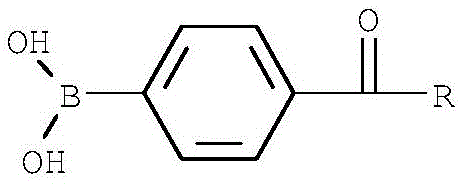
wherein R is selected from the group consisting of: hydrogen, hydroxy, C1-C6 alkyl, substituted C1-C6 alkyl, C1-C6 alkenyl, and substituted C1-C6 alkenyl. Preferably, R is hydrogen, CH3, CH3CH2, or CH3CH2CH 2.
In a preferred embodiment, the protease inhibitor (phenyl boronic acid derivative) is 4-formyl-phenyl-boronic acid (4-FPBA).
In another embodiment, the protease inhibitor is selected from the group consisting of: thiophene-2-boronic acid, thiophene-3-boronic acid, acetamidophenylboronic acid, benzofuran-2-boronic acid, naphthalene-1-boronic acid, naphthalene-2-boronic acid, 2-FPBA, 3-FBPA, 4-FPBA, 1-thianthrene boronic acid, 4-dibenzofuranboronic acid, 5-methylthiophene-2-boronic acid, thianaphtheneboronic acid (thioapronitrile acid), furan-2-boronic acid, furan-3-boronic acid, 4 biphenyl-diboronic acid (4,4 biphenol-diborinic acid), 6-hydroxy-2-naphthalene (6-hydroxy-2-naphthalene), 4- (methylthio) phenylboronic acid, 4 (trimethyl-silyl) phenylboronic acid, 3-bromothiopheneboronic acid, 4-methylthiothiopheneboronic acid, 2-naphthylboronic acid, 5-bromothiopheneboronic acid, 5-chlorothienylboronic acid, dimethylthienylboronic acid, 2-bromophenylboronic acid, 3-chlorophenylboronic acid, 3-methoxy-2-thiophene, p-methyl-phenethylboronic acid, 2-thianthrenylboronic acid, dibenzothiopheneboronic acid, 4-carboxyphenylboronic acid, 9-anthracenylboronic acid, 3, 5-dichlorophenylboronic acid, diphenylboronic anhydride, o-chlorophenylboronic acid, p-chlorophenylboronic acid, m-bromophenylboronic acid, p-fluorophenylboronic acid, p-tolylboronic acid, o-tolylboronic acid, octylboronic acid, 1,3, 5-trimethylphenylboronic acid, 3-chloro-4-fluorophenylboronic acid, 3-aminophenylboronic acid, 3, 5-di- (trifluoromethyl) phenylboronic acid, 3-chlorophenyl boronic acid, 2, 4-dichlorophenylboronic acid, and 4-methoxyphenylboronic acid.
Additional boronic acid derivatives suitable as protease inhibitors in detergent compositions are described in US 4,963,655, US 5,159,060, WO 95/12655, WO 95/29223, WO 92/19707, WO 94/04653, WO 94/04654, US 5442100, US 5488157 and US 5472628.
Peptide aldehydes or ketones
The protease stabilizer may have the formula: p- (a) y-L- (B) x-B0-R, wherein:
r is H (hydrogen), CH3、CX3、CHX2Or CH2And (4) X. Preferably, R ═ H such that the stabilizer is a peptide aldehyde having the formula P- (a) y-L- (B) x-B0-H;
x is a halogen atom, in particular F (fluorine);
b0 is a single amino acid residue having the L-or D-configuration of formula-NH-ch (r) -C (═ O) -;
x is 1,2 or 3;
bx is independently a single amino acid residue each linked via its C-terminus to the next B or to B0;
l is absent or independently a linker having the formula-C (═ O) -, -C (═ O) -, -C (═ S) -or-C (═ S) -C (═ O) -;
a is absent or independently a single amino acid residue linked to L via the N-terminus of the amino acid if L is absent;
p is selected from the group consisting of: hydrogen, or an N-terminal protecting group if L is absent;
y is 0,1 or 2,
r is independently selected from the group consisting of: c optionally substituted by one or more identical or different substituents R1-6Alkyl radical, C6-10Aryl or C7-10Aralkyl group;
r' is independently selected from the group consisting of: halogen, -OH, -OR ", -SH, -SR", -NH2、-NHR”、-NR”2、-CO2H、-CONH2、-CONHR”、-CONR”2、-NHC(=N)NH2(ii) a And
r' is C1-6An alkyl group.
x may be 1,2 or 3 and thus B may be 1,2 or 3 amino acid residues, respectively. Thus, B may represent B1, B2-B1 or B3-B2-B1, wherein B3, B2 and B1 each represent an amino acid residue. y may be 0,1 or 2, thus a may be absent, or 1 or 2 amino acid residues having the formula a1 or a2-a1, respectively, wherein a2 and a1 each represent an amino acid residue.
B0 may be a single amino acid residue with L-or D-configuration linked to H via the C-terminus of the amino acid. B0 has the formula-NH-ch (R) -C (═ O) -, where R is C1-6Alkyl radical, C6-10Aryl or C7-10Arylalkyl side chains, such as methyl, ethyl, propyl, isopropyl, butyl, isobutyl, phenyl or benzyl, and wherein R may optionally be substituted with one or more identical or different substituents R'. Specific examples of B0 are the D-or L-form of arginine (Arg), 3, 4-dihydroxyphenylalanine, isoleucine (Ile), leucine (Leu), methionine (Met), norleucine (Nle), norvaline (Nva), phenylalanine (Phe), meta-tyrosine, para-tyrosine (Tyr), and valine (Val). One specific example is when B0 is leucine, methionine, phenylalanine, para-tyrosine, and valine.
B1, which is linked to B0 via the C-terminus of the amino acid, may be an aliphatic, hydrophobic, and/or neutral amino acid. Examples of B1 are alanine (Ala), cysteine (Cys), glycine (Gly), isoleucine (Ile), leucine (Leu), norleucine (Nle), norvaline (Nva), proline (Pro), serine (Ser), threonine (Thr), and valine (Val). Specific examples of B1 are alanine, glycine, isoleucine, leucine, and valine. One specific example is when B1 is alanine, glycine or valine.
B2, which is attached to B1 via the C-terminus of the amino acid, if present, may be an aliphatic, hydrophobic, neutral, and/or polar amino acid. Examples of B2 are alanine (Ala), arginine (Arg), tendriline (Cpd), cysteine (Cys), glycine (Gly), isoleucine (Ile), leucine (Leu), norleucine (Nle), norvaline (Nva), phenylalanine (Phe), proline (Pro), serine (Ser), threonine (Thr), and valine (Val). Specific examples of B2 are alanine, arginine, capreomycin, glycine, isoleucine, leucine, phenylalanine, and valine. One specific example is when B2 is arginine, glycine, leucine, phenylalanine, or valine.
B3 (if present) attached to B2 via the C-terminus of the amino acid may be a large, aliphatic, aromatic, hydrophobic, and/or neutral amino acid. Examples of B3 are isoleucine (Ile), leucine (Leu), norleucine (Nle), norvaline (Nva), phenylalanine (Phe), phenylglycine, tyrosine (Tyr), tryptophan (Trp), and valine (Val). Specific examples of B3 are leucine, phenylalanine, tyrosine, and tryptophan.
The linking group L may be absent or selected from the group consisting of: -C (═ O) -, -C (═ S) -or-C (═ S) -C (═ O) -. A particular embodiment of the invention is when L is absent or is a carbonyl group-C (═ O) -.
A1 (if present) attached to L via the N-terminus of the amino acid may be an aliphatic, aromatic, hydrophobic, neutral, and/or polar amino acid. Examples of a1 are alanine (Ala), arginine (Arg), tendriline (Cpd), glycine (Gly), isoleucine (Ile), leucine (Leu), norleucine (Nle), norvaline (Nva), phenylalanine (Phe), threonine (Thr), tyrosine (Tyr), tryptophan (Trp), and valine (Val). Specific examples of a1 are alanine, arginine, glycine, leucine, phenylalanine, tyrosine, tryptophan, and valine. One specific example is when B2 is leucine, phenylalanine, tyrosine, or tryptophan.
The a2 residue (if present) attached to a1 via the N-terminus of the amino acid may be a large, aliphatic, aromatic, hydrophobic and/or neutral amino acid. Examples of a2 are arginine (Arg), isoleucine (Ile), leucine (Leu), norleucine (Nle), norvaline (Nva), phenylalanine (Phe), phenylglycine, tyrosine (Tyr), tryptophan (Trp), and valine (Val). Specific examples of a2 are phenylalanine and tyrosine.
The N-terminal protecting group P, if present, may be selected from formyl, acetyl (Ac), benzoyl (Bz), trifluoroacetyl, methoxysuccinyl, aromatic and aliphatic carbamic acidsEthyl ester protecting groups such as fluorenylmethoxycarbonyl (Fmoc), methoxycarbonyl (Moc), (fluoromethoxy) carbonyl, benzyloxycarbonyl (Cbz), tert-butoxycarbonyl (Boc), and adamantyloxycarbonyl; p-methoxybenzylcarbonyl, benzyl (Bn), p-methoxybenzyl (PMB), p-methoxyphenyl (PMP), methoxyacetyl, methylaminocarbonyl, methylsulfonyl, ethylsulfonyl, benzylsulfonyl, methylphosphamide (meop (oh) (═ O)), and benzylphosphoramide (PhCH)2OP(OH)(=O))。
In the case of a tripeptide aldehyde with a protecting group (i.e. x ═ 2, L is absent and a is absent), P is preferably acetyl, methoxycarbonyl, benzyloxycarbonyl, methylaminocarbonyl, methylsulfonyl, benzylsulfonyl and benzylphosphoramido. In the case of tetrapeptide aldehydes with protecting groups (i.e. x ═ 3, L is absent and a is absent), P is preferably acetyl, methoxycarbonyl, methylsulfonyl, ethylsulfonyl and methylphosphatamido.
Suitable peptide aldehydes are described in WO 94/04651, WO 95/25791, WO 98/13458, WO98/13459, WO 98/13460, WO 98/13461, WO 98/13462, WO 07/141736, WO 07/145963, WO 09/118375, WO 10/055052 and WO 11/036153. More specifically, the peptide aldehyde may be Cbz-Arg-Ala-Tyr-H, Ac-Gly-Ala-Tyr-H, Cbz-Gly-Ala-Tyr-H, Cbz-Gly-Ala-Tyr-CF3、Cbz-Gly-Ala-Leu-H、Cbz-Val-Ala-Leu-H、Cbz-Val-Ala-Leu-CF3、Moc-Val-Ala-Leu-CF3、Cbz-Gly-Ala-Phe-H、Cbz-Gly-Ala-Phe-CF3、Cbz-Gly-Ala-Val-H、Cbz-Gly-Gly-Tyr-H、Cbz-Gly-Gly-Phe-H、Cbz-Arg-Val-Tyr-H、Cbz-Leu-Val-Tyr-H、Ac-Leu-Gly-Ala-Tyr-H、Ac-Phe-Gly-Ala-Tyr-H、Ac-Tyr-Gly-Ala-Tyr-H、Ac-Phe-Gly-Ala-Leu-H、Ac-Phe-Gly-Ala-Phe-H、Ac-Phe-Gly-Val-Tyr-H、Ac-Phe-Gly-Ala-Met-H、Ac-Trp-Leu-Val-Tyr-H、MeO-CO-Val-Ala-Leu-H、MeNCO-Val-Ala-Leu-H、MeO-CO-Phe-Gly-Ala-Leu-H、MeO-CO-Phe-Gly-Ala-Phe-H、MeSO2-Phe-Gly-Ala-Leu-H、MeSO2-Val-Ala-Leu-H、PhCH2O-P(OH)(O)-Val-Ala-Leu-H、EtSO2-Phe-Gly-Ala-Leu-H、PhCH2SO2-Val-Ala-Leu-H、PhCH2O-P(OH)(O)-Leu-Ala-Leu-H、PhCH2O-P (OH) (O) -Phe-Ala-Leu-H or MeO-P (OH) (O) -Leu-Gly-Ala-Leu-H. A preferred stabilizer for use in the liquid composition of the present invention is Cbz-Gly-Ala-Tyr-H, or a bisulfite adduct thereof, wherein Cbz is benzyloxycarbonyl.
Further examples of such peptide aldehydes include α -MAPI, β -MAPI, Phe-C (═ O) -Arg-Val-Tyr-H, Phe-C (═ O) -Gly-Tyr-H, Phe-C (═ O) -Gly-Ala-Phe-H, Phe-C (═ O) -Gly-Ala-Tyr-H, Phe-C (═ O) -Gly-Ala-L-H, Phe-C (═ O) -Gly-Ala-Nva-H, Phe-C (═ O) -Gly-Ala-Nle-H, Tyr-C (═ O) -Arg-Val-Tyr-H, Tyr-C (═ O) -Gly-Ala-Tyr-H, Phe-C (═ S) -Arg-Val-H, Phe-C (═ S) -Arg-Val-Tyr-3-C (═ S) -Gly-Ala-Tyr-H, antalgi, 4642, somatostatin a, C-73784, chymostatin, C-chymotrypsin B, and chymotrypsin C-proteinase.
The protease stabilizer may be a bisulfite adduct of a peptide aldehyde as described above, e.g. as described in WO 2013/004636. The adduct may have the formula P- (A) y-L- (B) x-N (H) -CHR-CH (OH) -SO3M, wherein P, A, y, L, B, x and R are as defined above, and M is H or an alkali metal, preferably Na or K.
The aqueous solution of the bisulfite adduct can be prepared by reacting the corresponding peptide aldehyde with sodium bisulfite (sodium bisulfite, NaHSO)3) Potassium hydrogen sulfite (KHSO)3) By carrying out the reaction by known methods, for example, as described in WO 98/47523; US6,500,802; US 5,436,229; am, chem, soc, american society of chemistry](1978)100,1228, respectively; org. synth, col. [ organic synthetic corpus]Volume 7: 361.
Particularly preferred peptide aldehyde protease stabilizers have the formula P-B3-B2-B1-B0-H, or have the formula P-B3-B2-B1-N (H) -CHR-CHOH-SO3The bisulfite adduct of M, wherein
i) H is hydrogen;
ii) B0 is a single amino acid residue having the L-or D-configuration of formula-NH-ch (r) -C (═ O) -;
iii) B1 and B2 are independently a single amino acid residue;
iv) B3 is a single amino acid residue, or absent;
v) R is independently selected from the group consisting of: c optionally substituted by one or more identical or different substituents R1-6Alkyl radical, C6-10Aryl or C7-10Aralkyl group;
vi) R' is independently selected from the group consisting of: halogen, -OH, -OR ", -SH, -SR", -NH2、-NHR”、-NR”2、-CO2H、-CONH2、-CONHR”、-CONR”2、-NHC(=N)NH2;
vii) R' is C1-6An alkyl group;
viii) P is an N-terminal protecting group, preferably methoxycarbonyl (Moc) or benzyloxycarbonyl (Cbz); and
ix) M is H or an alkali metal, preferably Na or K.
In an even more preferred embodiment, the peptide aldehyde protease stabilizer has the formula P-B2-B1-B0-H or has the formula P-B2-B1-N (H) -CHR-CHOH-SO3An adduct of M, wherein
i) H is hydrogen;
ii) B0 is a single amino acid residue having the L-or D-configuration of formula-NH-ch (r) -C (═ O) -;
iii) B1 and B2 are independently a single amino acid residue;
iv) R is independently selected from the group consisting of: c optionally substituted by one or more identical or different substituents R1-6Alkyl radical, C6-10Aryl or C7-10Aralkyl group;
v) R' is independently selected from the group consisting of: halogen, -OH, -OR ", -SH, -SR", -NH2、-NHR”、-NR”2、-CO2H、-CONH2、-CONHR”、-CONR”2、-NHC(=N)NH2;
vi) R' is C1-6An alkyl group;
vii) P is an N-terminal protecting group, preferably methoxycarbonyl (Moc) or benzyloxycarbonyl (Cbz); and
viii) M is H or an alkali metal, preferably Na or K.
Preferred embodiments of B0, B1, B2, B3 and P are as described above.
The molar ratio of the above-mentioned peptide aldehyde (or bisulfite adduct) to the protease may be at least 1:1 or 1.5:1, and it may be less than 1000:1, more preferably less than 500:1, even more preferably from 100:1 to 2:1 or from 20:1 to 2:1, or most preferably, the molar ratio is from 10:1 to 2: 1.
Formate salts (e.g., sodium formate) and formic acid also show good effects as protease activity inhibitors. The formate salt may be used in conjunction with the protease inhibitors described above, as shown in WO 2013/004635. Formate is present in the slurry composition in an amount of at least 0.1% w/w or 0.5% w/w, such as at least 1.0%, at least 1.2% or at least 1.5%. The amount is typically less than 5% w/w, less than 4% or less than 3%.
In embodiments, the protease is a metalloprotease and the inhibitor is a metalloprotease inhibitor, e.g., a protein hydrolysate-based inhibitor (e.g., as described in WO 2008/134343).
Detergent composition
The enzyme slurry of the invention may be added to and form part of any detergent composition in any form, such as liquid detergents, and soap and detergent bars (e.g. synthetic detergent bars). Soap and detergent bar compositions are described in more detail below.
The enzyme slurry (as described above) may be prepared in a manner corresponding to from 0.0001% to 5% (w/w) Active Enzyme Protein (AEP); preferably from 0.0005% to 5%, more preferably from 0.0005% to 2%, more preferably from 0.0005% to 1%, even more preferably from 0.001% to 1%, and most preferably from 0.005% to 1% (w/w) active enzyme protein.
The liquid detergent composition has a physical form, which is not a solid (or gas). It may be a pourable liquid, a paste, a pourable gel or a non-pourable gel. It may be isotropic or structural, preferably isotropic. It may be a formulation for washing in an automatic washing machine or for hand washing, or for (automatic) dishwashing. It may also be a personal care product such as a shampoo, toothpaste, or hand soap.
The liquid detergent composition typically contains at least 20% water and up to 95% water by weight, for example up to 70% water, up to 50% water, up to 40% water, or up to 30% water. Other types of liquids, including but not limited to alkanols, amines, glycols, ethers, and polyols may be included in the aqueous liquid detergent. The aqueous liquid detergent may contain from 0 to 30% of an organic solvent.
The choice of detergent component may include (for textile care) the type of textile to be cleaned, the type and/or degree of soil, the temperature at which cleaning is carried out, and considerations of the formulation of the detergent product. Although the components mentioned below are classified by general headings according to specific functionality, this is not to be construed as a limitation, as the components may contain additional functionality as will be appreciated by the skilled person.
The selection of additional components is within the ability of the skilled artisan and includes conventional ingredients, including the exemplary non-limiting components described below.
Surface active agent
The detergent composition may comprise one or more surfactants, which may be anionic and/or cationic and/or nonionic and/or semi-polar and/or zwitterionic, or mixtures thereof. In particular embodiments, the detergent composition comprises a mixture of one or more nonionic surfactants and one or more anionic surfactants. The one or more surfactants are typically present at a level of from about 0.1% to 60% (such as from about 1% to about 40%, or from about 3% to about 20%, or from about 3% to about 10%) by weight. The surfactant or surfactants are selected based on the desired cleaning application and include any conventional surfactant or surfactants known in the art. Any surfactant known in the art for use in detergents may be utilized.
When included therein, the detergent will typically comprise from about 1% to about 40% by weight (such AS from about 5% to about 30%, including from about 5% to about 15%, or from about 20% to about 25%) of an anionic surfactant non-limiting examples of anionic surfactants include sulfates and sulfonates, in particular linear alkyl benzene sulfonate (LAS), isomers of LAS, Branched Alkyl Benzene Sulfonate (BABS), phenyl alkane sulfonate, α -olefin sulfonate (AOS), olefin sulfonates, alkene sulfonates, alkane-2, 3-diylbis (sulfates), hydroxyalkane sulfonates and disulfonates, Alkyl Sulfates (AS) such AS Sodium Dodecyl Sulfate (SDS), Fatty Alcohol Sulfates (FAS), Primary Alcohol Sulfates (PAS), alcohol ether sulfates (AES or AEOS or FES, also known AS alcohol ethoxy sulfates or fatty alcohol ether sulfates), Secondary Alkane Sulfonates (SAS), Paraffin Sulfonates (PS), ester sulfonates, sulfonated fatty acid glycerides, α -sulfonated fatty acid methyl esters (α -SFMe or SES) including alkyl sulfonic acid methyl esters or SES, fatty acid monoesters, fatty acid succinic acid monoesters, fatty acid monoesters, and decene derivatives thereof, and succinic acid derivatives thereof.
When included therein, the detergent will typically comprise from about 0.1% to about 10% by weight of a cationic surfactant. Non-limiting examples of cationic surfactants include alkyl dimethyl ethanol quaternary amine (ADMEAQ), Cetyl Trimethyl Ammonium Bromide (CTAB), dimethyl distearyl ammonium chloride (DSDMAC), and alkyl benzyl dimethyl ammonium, alkyl quaternary ammonium compounds, Alkoxylated Quaternary Ammonium (AQA) compounds, and combinations thereof.
When included therein, the detergent will typically comprise from about 0.2% to about 40% (e.g., from about 0.5% to about 30%, particularly from about 1% to about 20%, from about 3% to about 10%, such as from about 3% to about 5%, or from about 8% to about 12%) by weight of nonionic surfactant. Non-limiting examples of nonionic surfactants include alcohol ethoxylates (AE or AEO), alcohol propoxylates, Propoxylated Fatty Alcohols (PFA), alkoxylated fatty acid alkyl esters (e.g., ethoxylated and/or propoxylated fatty acid alkyl esters), alkylphenol ethoxylates (APE), nonylphenol ethoxylates (NPE), Alkylpolyglycosides (APG), alkoxylated amines, fatty Acid Monoethanolamide (FAM), Fatty Acid Diethanolamide (FADA), Ethoxylated Fatty Acid Monoethanolamide (EFAM), Propoxylated Fatty Acid Monoethanolamide (PFAM), polyhydroxy alkyl fatty acid amide, or N-acyl N-alkyl derivatives of glucosamine (glucamide (GA), or Fatty Acid Glucamide (FAGA)), as well as products available under the trade names SPAN and TWEEN, and combinations thereof.
When included therein, the detergent will typically comprise from about 0.1% to about 20% by weight of a semi-polar surfactant. Non-limiting examples of semi-polar surfactants include Amine Oxides (AO) (such as alkyl dimethyl amine oxides), N- (cocoalkyl) -N, N-dimethyl amine oxide, and N- (tallow-alkyl) -N, N-bis (2-hydroxyethyl) amine oxide, fatty acid alkanolamides and ethoxylated fatty acid alkanolamides, and combinations thereof.
When included therein, the detergent will typically comprise from about 0.1% to about 10% by weight of a zwitterionic surfactant. Non-limiting examples of zwitterionic surfactants include betaines, alkyl dimethyl betaines, sulfobetaines, and combinations thereof.
Hydrotropic agent
Hydrotropes are compounds that dissolve hydrophobic compounds in aqueous solutions (or conversely, polar materials in a non-polar environment). Typically, hydrotropes have both hydrophilic and hydrophobic characteristics (so-called amphiphilic character, as known from surfactants); however, the molecular structure of hydrotropes is often not conducive to spontaneous self-aggregation, as reviewed, for example, by Hodgdon and Kaler (2007), Current Opinion in Colloid & Interface Science [ New colloidal & Interface Science ]12: 121-. Hydrotropes do not exhibit a critical concentration above which self-aggregation and lipid formation into micelles, lamellae or other well-defined mesophases as found with surfactants occur. In contrast, many hydrotropes exhibit a continuous type of aggregation process in which the aggregate size grows with increasing concentration. However, many hydrotropes alter the phase behavior, stability, and colloidal characteristics of systems containing materials of both polar and non-polar character, including mixtures of water, oils, surfactants, and polymers. Hydrotropes are routinely used in a variety of industries ranging from pharmaceutical, personal care, food to technical applications. The use of hydrotropes in detergent compositions allows, for example, for more concentrated surfactant formulations (such as during the compaction of liquid detergents by removal of water) without causing undesirable phenomena such as phase separation or high viscosity.
The detergent may comprise 0-5%, such as from about 0.5% to about 5%, or from about 3% to about 5%, by weight, of hydrotrope. Any hydrotrope known in the art for use in detergents can be utilized. Non-limiting examples of hydrotropes include sodium benzene sulfonate, sodium p-toluene sulfonate (STS), Sodium Xylene Sulfonate (SXS), Sodium Cumene Sulfonate (SCS), sodium cymene sulfonate, amine oxides, alcohols and polyethylene glycol ethers, sodium hydroxynaphthalene formate, sodium hydroxynaphthalene sulfonate, sodium ethylhexyl sulfate, and combinations thereof.
Builders and co-builders
The detergent composition may contain from about 0-65%, such as from about 5% to about 50%, by weight, of a detergent builder or co-builder, or mixtures thereof. In dishwashing detergents, the level of builder is typically from 40% to 65%, especially from 50% to 65%. The builder and/or co-builder may in particular be a chelating agent that forms a water-soluble complex with Ca and Mg ions. Any builder and/or co-builder known in the art for use in laundry detergents may be utilized. Non-limiting examples of builders include citrate, diphosphate (pyrophosphate), triphosphate, such as sodium triphosphate (STP or STPP), carbonate, such as sodium carbonate, ethanolamine, such as 2-aminoethan-1-ol (MEA), diethanolamine (DEA, also known as iminodiethanol), triethanolamine (TEA, also known as 2,2' -nitrotriethanolamine), and carboxymethyl inulin (CMI), and combinations thereof.
The detergent composition may also contain 0-50% (such as from about 5% to about 30%) by weight of a detergent co-builder, or mixtures thereof, the detergent composition may include a co-builder, alone or in combination with a builder (e.g., a citrate builder). non-limiting examples of co-builders include homopolymers of polyacrylates or copolymers thereof, such as poly (acrylic acid) (PAA) or co-poly (acrylic acid/maleic acid) (PMA). additional non-limiting examples include citrates, chelants (such as aminocarboxylates, aminopolycarboxylates, and phosphates), and alkyl or alkenyl succinic acids.additional specific examples include 2,2', 2 "-nitrilotriacetic acid (NTA), ethylenediaminetetraacetic acid (EDTA), diethylenetriaminepentaacetic acid (DTPA), iminodisuccinic acid (IDS), ethylenediamine-N, N' -disuccinic acid (EDDS), methylglycine diacetic acid (MGDA), glutamic-N, N-diacetic acid (GLDA), 1-hydroxyethane-1, 1-diphosphonic acid (hefa), ethylenediaminetetra- (methylenephosphonic acid) (mppa), diethylenetriamine (PHDA), diethylenetriamine (PHDA), ethylenediamine-N-diacetic acid (GLDA), ethylenediamine-N-2-glutamic acid (PHDA), ethylenediamine-N-ethyl-2-glutamic acid (PHDA), ethylenediamine-2-iminodiacetic acid (EDTA), ethylenediamine-2-N-2-iminodiacetic acid (PHDA), ethylenediamine-N-2-N-2-iminodiacetic acid (PHDA), ethylenediamine-N-glutamic acid (PHDA), ethylenediamine-N-p-N-2-N-disodium-N-p-disodium-N-disodium-N-disodium-p-disodium (EDTA), ethylenediamine-p-N-disodium (EDTA), ethylenediamine-N-.
Polymer and method of making same
The detergent may contain 0-10% (e.g., 0.5% -5%, 2% -5%, 0.5% -2%, or 0.2% -1%) by weight of the polymer. Any polymer known in the art for use in detergents may be utilized. The polymer may function as a co-builder as mentioned above, or may provide anti-redeposition, fibre protection, soil release, dye transfer inhibition, oil cleaning and/or suds suppression properties. Some polymers may have more than one of the above-mentioned properties and/or more than one of the below-mentioned motifs. Exemplary polymers include (carboxymethyl) cellulose (CMC), poly (vinyl alcohol) (PVA), poly (vinylpyrrolidone) (PVP), poly (ethylene glycol) or poly (ethylene oxide) (PEG), ethoxylated poly (ethyleneimine), carboxymethyl inulin (CMI), and polycarboxylates such as PAA, PAA/PMA, poly-aspartic acid, and lauryl methacrylate/acrylic acid copolymers, hydrophobically modified CMC (HM-CMC) and silicone, copolymers of terephthalic acid and oligoethylene glycol, copolymers of poly (ethylene terephthalate) and poly (ethylene oxide terephthalate) (PET-POET), PVP, poly (vinylimidazole) (PVI), poly (vinylpyridine-N-oxide) (PVPO or PVPNO), and polyvinylpyrrolidone-vinylimidazole (PVPVI). Additional exemplary polymers include sulfonated polycarboxylates, polyethylene oxide and polypropylene oxide (PEO-PPO), and diquaternary ammonium ethoxysulfate. Other exemplary polymers are disclosed in, for example, WO 2006/130575 and US 5,955,415. Salts of the above-mentioned polymers are also contemplated.
Fabric toner
The detergent composition of the present invention may also comprise a fabric hueing agent, such as a dye or pigment, which when formulated in a detergent composition, may deposit on a fabric when said fabric is contacted with a wash liquor which comprises said detergent composition and which therefore changes the colour of said fabric by absorption/reflection of visible light. Optical brighteners emit at least some visible light. In contrast, when fabric hueing agents absorb at least part of the visible spectrum, they change the color of the surface. Suitable fabric hueing agents include dyes and dye-clay conjugates, and may also include pigments. Suitable dyes include small molecule dyes and polymeric dyes. Suitable small molecule dyes include small molecule dyes selected from the group consisting of the following dyes falling into the color Index (color Index) (c.i.): direct blue, direct red, direct violet, acid blue, acid red, acid violet, basic blue, basic violet and basic red, or mixtures thereof, for example as described in WO 2005/03274, WO 2005/03275, WO2005/03276 and EP 1876226 (incorporated herein by reference). The detergent composition preferably comprises from 0.0001% w/w to 0.2% w/w fabric hueing agent. Suitable toners are also disclosed in, for example, WO 2007/087257 and WO 2007/087243.
Auxiliary materials
Any detergent component known in the art for use in laundry detergents may also be utilized. Other optional detergent components include anti-corrosion agents, anti-shrinkage agents, anti-soil redeposition agents, anti-wrinkle agents, bactericides, binders, corrosion inhibitors, disintegrants/disintegrating agents, dyes, enzyme stabilizers (including the above mentioned enzyme stabilizers/inhibitors, CMC and/or polyols such as propylene glycol), fabric conditioners (including clays), fillers/processing aids, optical brighteners/optical brighteners, suds boosters, suds (foam) regulators, perfumes, soil suspending agents, softeners, suds suppressors, tarnish inhibitors and wicking agents, alone or in combination. Any ingredient known in the art for use in laundry detergents may be utilized. The choice of such ingredients is well within the skill of the artisan.
Dispersing agentThe detergent composition of the invention may also contain a dispersant. Suitable water-soluble organic materials include homo-or co-polymeric acids or salts thereof, wherein the polycarboxylic acid comprises at least two carboxyl groups separated from each other by not more than two carbon atoms. Suitable dispersants are described, for example, in Powdered Detergents]Surface science series]Vol 71, Markel Dekker, Inc.
Dye transfer inhibitorsThe detergent compositions of the invention may also comprise one or more dye transfer inhibiting agents. Suitable polymeric dye transfer inhibiting agents include, but are not limited to, polyvinylpyrrolidone polymers, polyamine N-oxide polymers, copolymers of N-vinylpyrrolidone and N-vinylimidazole, polyvinyloxazolidone and polyvinylimidazole, or mixtures thereof. When present in the subject compositions, the dye transfer inhibiting agents may be by weight of the compositionPresent at a level of from about 0.0001% to about 10%, from about 0.01% to about 5%, or even from about 0.1% to about 3%.
Fluorescent whitening agentThe detergent compositions of the invention will preferably also contain additional components which may colour the articles being cleaned, such as optical brighteners or optical brighteners. When present, the brightener is preferably present at a level of about 0.01% to about 0.5%. Any fluorescent whitening agent suitable for use in laundry detergent compositions may be used in the compositions of the present invention. The most commonly used fluorescent whitening agents are those belonging to the following classes: diaminostilbene-sulfonic acid derivatives, diarylpyrazoline derivatives and diphenyl-distyryl derivatives. Examples of diaminostilbene-sulphonic acid derivative types of optical brighteners include the following sodium salts: 4,4' -bis- (2-diethanolamino-4-anilino-s-triazin-6-ylamino) stilbene-2, 2' -disulfonate, 4' -bis- (2, 4-dianilino-s-triazin-6-ylamino) stilbene-2, 2' -disulfonate, 4' -bis- (2-anilino-4- (N-methyl-N-2-hydroxy-ethylamino) -s-triazin-6-ylamino) stilbene-2, 2' -disulfonate, 4' -bis- (4-phenyl-1, 2, 3-triazol-2-yl) stilbene-2, 2' -disulfonate and 5- (2H-naphtho [1,2-d ]][1,2,3]Triazol-2-yl) -2- [ (E) -2-phenylvinyl]Sodium benzenesulfonate. Preferred optical brighteners are Tianlibao (Tinopal) DMS and Tianlibao CBS available from Ciba-Geigy AG (Basel, Switzerland). Heliotrope DMS is the disodium salt of 4,4 '-bis- (2-morpholino-4-anilino-s-triazin-6-ylamino) stilbene-2, 2' -disulfonate. Celecoxib CBS is the disodium salt of 2,2' -bis- (phenyl-styryl) -disulfonate. It is also preferred that the optical brightener is commercially available as ParawhiteKX, supplied by Palamon Minerals and chemicals, Inc., of Monmour, India. Other fluorescers suitable for use in the present invention include 1-3-diarylpyrazolines and 7-aminoalkylcoumarins.
Suitable levels of fluorescent brightener include lower levels from about 0.01, from 0.05, from about 0.1, or even higher levels from about 0.2% w/w to 0.5 or even 0.75% w/w.
Soil release polymersThe detergent composition of the invention may also comprise one or more ofSoil release polymers which assist in the removal of soils from fabrics such as cotton or polyester based fabrics, particularly hydrophobic soils from polyester based fabrics. The soil release polymers may be, for example, nonionic or anionic terephthalate-based polymers, polyvinylcaprolactams and related copolymers, vinyl graft copolymers, polyester polyamides, see, for example, PowdededDetergens]Surface science series]Vol 71, Chapter 7, Massel Dekker. Another type of soil release polymer is an amphiphilic alkoxylated greasy cleaning polymer comprising a core structure and a plurality of alkoxylated groups attached to the core structure. The core structure may comprise a polyalkyleneimine structure or a polyalkanolamine structure as described in detail in WO 2009/087523 (incorporated herein by reference). In addition, random graft copolymers are suitable soil release polymers. Suitable graft copolymers are described in more detail in WO 2007/138054, WO 2006/108856 and WO2006/113314 (incorporated herein by reference). Other soil release polymers are substituted polysaccharide structures, especially substituted cellulose structures, such as modified cellulose derivatives, such as those described in EP 1867808 or WO2003/040279 (both incorporated herein by reference). Suitable cellulosic polymers include cellulose, cellulose ethers, cellulose esters, cellulose amides, and mixtures thereof. Suitable cellulosic polymers include anionically modified cellulose, non-ionically modified cellulose, cationically modified cellulose, zwitterionic modified cellulose, and mixtures thereof. Suitable cellulosic polymers include methyl cellulose, carboxymethyl cellulose, ethyl cellulose, hydroxyethyl cellulose, hydroxypropyl methyl cellulose, ester carboxymethyl cellulose, and mixtures thereof.
Anti-redeposition agent: the detergent compositions of the present invention may also comprise one or more antiredeposition agents such as carboxymethylcellulose (CMC), polyvinyl alcohol (PVA), polyvinylpyrrolidone (PVP), polyoxyethylene and/or polyethylene glycol (PEG), homopolymers of acrylic acid, copolymers of acrylic acid and maleic acid and ethoxylated polyethyleneimine. The above description is under the soil release polymerThe cellulose-based polymers described may also function as anti-redeposition agents.
Rheology modifierIs a structurant or thickener, distinct from a viscosity reducer. The rheology modifier is selected from the group consisting of: non-polymeric crystalline, hydroxyl functional materials, polymeric rheology modifiers that impart shear thinning characteristics to the aqueous liquid phase matrix of the composition. The rheology and viscosity of the detergent may be modified and adjusted by methods known in the art, for example, as shown in EP 2169040.
Other suitable adjuvantsIncluding but not limited to shrink proofing agents, anti-wrinkling agents, bactericides, binders, carriers, dyes, enzyme stabilizers, fabric softeners, fillers, foam modulators, hydrotropes, perfumes, pigments, suds suppressors, solvents, and structurants and/or structure elasticizing agents for liquid detergents.
Bleaching system
Examples of liquid detergents combining bleach and enzyme include, for example, US 5,275,753 and WO 99/00478. The detergent may contain 0-50% of a bleaching system. Any bleaching system known in the art for use in laundry detergents may be utilized. Suitable bleach system components include bleach catalysts such as MnTACN, photobleaches, bleach activators, sources of hydrogen peroxide such as sodium percarbonate and sodium perborate, preformed peracids, and mixtures thereof.
Soap and detergent bars
Laundry soap and detergent bars may comprise surfactants (e.g. anionic synthetic surfactants), builders (e.g. complexing agents such as EDTA and HEDP (1-hydroxyethane 1, 1-diphosphonic acid)), polymeric soil release agents, detergent sequestrants, polyols (such as glycerol), pH control compounds, stabilizers, fillers, dyes, colorants, dye transfer inhibitors, alkoxylated polycarbonates, suds suppressors, structurants, binders, leachants, bleach activators, clay removal agents, anti-redeposition agents, polymeric dispersing agents, brighteners, fabric softeners, perfumes and/or other compounds known in the art.
The laundry soap bars of the present invention can be processed in conventional laundry soap bar manufacturing equipment such as, but not limited to: mixers, mills, plotters, extruders, cutters, and packers. The soap and detergent bars of the present invention are not limited to being made by any single process.
The enzyme granule may be present in the laundry soap bar in an amount of from 0.00001% w/w to 2.0% w/w. Typical amounts are in the range from 0.0001% to 0.4%, preferably in the range from 0.001% to 0.1%, most preferably in the range from 0.004% to 0.08% by weight of the total composition of the laundry soap bar.
When the enzyme slurry is used in the manufacture of soap or detergent bars, it is advantageous that the enzyme particles (e.g. enzyme crystals) do not dissolve during the manufacturing process. Soap and detergent bars with such undissolved enzyme particles exhibit higher residual enzyme activity after storage compared to soap and detergent bars made with dissolved enzyme. Preferably, the soap and detergent bars comprise enzyme crystals, as shown in example 5.
Polyhydric alcohols
Polyols, which are useful ingredients in washing bars, are characterized by water solubility, a carbon backbone length of between C2 and C6, and a plurality of hydroxyl groups, preferably between 2 and 6 hydroxyl groups per molecule.
Polyols useful herein include, but are not limited to, 1, 2-butanediol, 3-chloro-1, 2-propanediol, ethylene glycol, 1, 2-hexanediol, glycerol (glycerin), mannose, propylene glycol, sorbitol, sucrose, and mixtures thereof. The polyol level will typically be between 0.5% and 10%, and preferably between 1% and 5%, and more preferably between 1.5% and 3% by weight of the final bar composition.
Glycerol
During soap manufacture, the glycerin is either removed for commercial reasons or it is left in the soap. Thus, the soap may be described as either a high glycerin or low glycerin soap. Low glycerin soap contains from 0 to 2% glycerin, and if more glycerin is needed, it can be added during soap manufacture while the soap is still liquid, ensuring proper absorption on or to the soap noodles (soap nodles). In a particular embodiment, the laundry soap bar comprises from 1% to 6% glycerin. In a more specific embodiment of the present invention, the laundry soap bar comprises from 2% to 5% glycerin by weight of the total laundry soap bar. In a most preferred embodiment, the laundry soap bar comprises about 4% glycerin.
pH controlling compounds
It has been found that it may be necessary to lower the pH to improve the stability of the enzyme. The pH control agent may be any suitable compound capable of controlling pH. In one embodiment, the pH controlling agent is an acid.
In a particular embodiment, the pH controlling compound may be selected from the group consisting of fatty acids, acetic acid, aconitic acid, adipic acid, arachidic acid, arachidonic acid, aspartic acid, behenic acid, butyric acid, capric acid, caproic acid, cerotic acid, citric acid, formic acid, fumaric acid, glutamic acid, glutaric acid, glyceric acid-3-phosphate, glyoxylic acid, isocitric acid, α -ketoglutaric acid, lactic acid, lauric acid, linoleic acid, linolenic acid, maleic acid, malic acid, malonic acid, myristic acid, oleic acid, oxalic acid, oxaloacetic acid, palmitic acid, palmitoleic acid, phosphatidic acid, phosphoenolpyruvic acid, pimelic acid, propionic acid, pyruvic acid, stearic acid, succinic acid, tartaric acid, and valeric acid.
The pH control agent will typically be present at a level of between 0.01% and 8%, preferably between 0.1% and 6%, more preferably between 0.2% and 2% by weight of the final bar composition.
Water content
Moisture provides acceptable feel and other physical characteristics of the laundry soap bar. Moisture may be added to the premix by including with the ingredients and/or adding as free water to the premix. The laundry soap bar contains a water (moisture) content of less than 30% w/w of the final laundry soap bar, or from 10% to 30%, preferably from 20% to 30% of the final laundry soap bar.
Soap
Soaps contain water-soluble salts of higher fatty acids. The soap may be from animal and/or vegetable sources. Soaps can be made by direct saponification of fats and oils or by neutralization of free fatty acids. Suitable soaps are the sodium, potassium, ammonium, and alkylammonium salts of higher fatty acids containing from about 8 to about 24 carbon atoms, such as from 12 to about 18 carbon atoms. In a particular embodiment, the soap is selected from sodium and potassium salts of mixtures of fatty acids derived from coconut oil and tallow, such as sodium or potassium tallow and palm oil. Additionally, nut oils, such as coconut or palm kernel oil, may be added in amounts of 5% to 30% by weight of the final bar.
Synthetic surfactants
Synthetic anionic surfactants suitable for use in washing bars include water soluble salts of organic sulfur reaction products, preferably alkali metal, ammonium and alkylammonium salts, having in their molecular structure an alkyl group containing from about 10 to about 20 carbon atoms, and a sulfonic acid or sulfate ester group. Examples of groups of synthetic surfactants are sodium and potassium alkyl sulfates, especially those obtained by sulfating higher alcohols (C8-18 carbon atoms), such as those produced by reducing glycerides of tallow or coconut oil; and sodium and potassium alkyl benzene sulfonates in which the alkyl group contains from about 9 to about 15 carbon atoms in a straight or branched chain configuration. Of particular interest are linear alkyl benzene sulfonates (LAS) in which the average number of carbon atoms in the alkyl group is from about 11 to 13, abbreviated as C11-13 LAS. Alkali metal salts, especially sodium salts, of these surfactants are preferred.
Other examples of anionic syndets suitable for use herein are sodium alkyl glyceryl ether sulfonate (AES), especially those ethers of higher alcohols derived from tallow and coconut oil; sodium coconut oil fatty acid monoglyceride sulfonate and sodium coconut oil fatty acid monoglyceride sulfate; and sodium or potassium salts of alkyl ethylene oxide ether sulfates containing from about 1 to about 10 units of ethylene oxide per molecule and wherein the alkyl group contains from about 10 to about 20 carbon atoms.
In addition, suitable anionic synthetic detergents include water soluble salts of esters of α -sulfonated fatty acids containing from about 6 to about 20 carbon atoms in the fatty acid group and from about 1 to about 10 carbon atoms in the ester group, water soluble salts of 2-acyloxyalkyl-1-sulfonic acids containing from about 2 to about 9 carbon atoms in the acyl group and from 9 to about 23 carbon atoms in the alkyl moiety, water soluble salts of alkenes and paraffin sulfonates containing from about 12 to about 20 carbon atoms, and water soluble salts of β -alkoxyalkylsulfonates containing from about 1 to about 3 carbon atoms in the alkyl group and from about 8 to about 20 carbon atoms in the alkyl moiety.
Examples of preferred anionic synthetic surfactants are C10-18 Alkyl Sulfate (AS), C10-18 linear alkyl benzene sulfonate (LAS), C10-14 alkyl glyceryl ether sulfonate (AES), and mixtures thereof.
Examples of ingredients contained in conventional laundry soap bars (syndet bars) are:
linear alkylbenzene sulphonate, coco fatty alcohol sulphate, soda ash, calcium carbonate, coco fatty alcohol, TiO2, cellulase, diethylenetriamine (methylene phosphonic acid), coco monoethanolamide, fluorescent whitening agent, substituted methylcellulose, perfume, moisture.
Examples of detergent ingredients contained in conventional laundry soap bars (combi bars) are:
LAS, soap, cellulase, protease, borax, sodium silicate, citric acid, sodium carbonate, glycerol, propylene glycerol, sugar (sorbitol), MgSO4Soda ash, talc and moisture.
Some embodiments of the invention include:
example 1. an enzyme slurry composition comprising:
(a) enzyme granules;
(b) water soluble salts of sodium, potassium, magnesium, zinc or ammonium; and
(c) xanthan gum, guar gum, locust bean gum, welan gum, gellan gum, alginate, carrageenan or microcrystalline cellulose; and
(d) and (3) water.
Example 2. the enzyme slurry according to example 1, comprising xanthan gum, guar gum, locust bean gum, welan gum, gellan gum, alginate, carrageenan or microcrystalline cellulose in an amount of 0.1% w/w to 2.5% w/w.
Example 3. the enzyme slurry according to example 1, comprising xanthan gum, guar gum, locust bean gum, welan gum, gellan gum, alginate, carrageenan or microcrystalline cellulose in an amount of 0.25% w/w to 2.5% w/w.
Embodiment 4. the enzyme slurry according to any one of embodiments 1-3, comprising a water soluble salt in an amount of at least 1-10% w/w.
Embodiment 5. the enzyme slurry according to any one of embodiments 1-4, comprising enzyme particles in an amount of at least 1% w/w.
Embodiment 6. the enzyme slurry according to any one of embodiments 1-4, comprising enzyme particles in an amount of at least 5% w/w.
Embodiment 7. the enzyme slurry according to any one of embodiments 1-6, comprising at least 1% w/w active enzyme protein.
Embodiment 8. the enzyme slurry according to any one of embodiments 1-6, comprising 1-50% w/w active enzyme protein.
Example 9. the enzyme slurry according to any one of examples 1-6, comprising 1-25% w/w active enzyme protein.
Embodiment 10. the enzyme slurry according to any one of embodiments 1-6, comprising at least 5% w/w active enzyme protein.
Embodiment 11. the enzyme slurry according to any one of embodiments 1-6, comprising at least 5% w/w to 50% w/w active enzyme protein.
Embodiment 12. the enzyme slurry according to any one of embodiments 1-6, comprising at least 5-25% w/w active enzyme protein.
Embodiment 13 the enzyme slurry of any one of embodiments 1-12, wherein the enzyme is selected from proteases (e.g., subtilisins or metalloproteinases), lipases, cutinases, amylases, carbohydrases, cellulases, pectinases, mannanases, arabinases, galactanases, xanthanases, xylanases, dnases, perhydrolases, oxidoreductases (e.g., laccases, peroxidases, hydroperoxy fatty acid hydroxylase epoxidases, and/or haloperoxidases).
Embodiment 14. the enzyme slurry according to any one of embodiments 1-12, wherein the enzyme is selected from the group consisting of a protease, a lipase, an amylase, a cellulase, a pectinase, a mannanase, and/or a dnase.
Embodiment 15 the enzyme slurry of any one of embodiments 1-12, wherein the enzyme is a protease, such as subtilisin.
Embodiment 16 the enzyme slurry of any one of embodiments 1-15, wherein the enzyme granules comprise enzyme crystals.
Embodiment 17. the enzyme slurry of any one of embodiments 1-15, wherein the enzyme granules consist of enzyme crystals.
Embodiment 18 the enzyme slurry of any one of embodiments 1-15, wherein the enzyme granules comprise spray-dried enzyme.
Embodiment 19 the enzyme slurry of any one of embodiments 1-15, wherein the enzyme granules consist of a spray-dried enzyme composition.
Embodiment 20. the enzyme slurry according to any one of embodiments 1-19, comprising more than one enzyme.
Embodiment 21. the enzyme slurry of any one of embodiments 1-20, further comprising a polyol selected from the group consisting of: glycerol, (mono-, di-or tri-) propylene glycol, sugar alcohols, polypropylene glycol and/or polyethylene glycol, preferably polyethylene glycol or polypropylene glycol having a molecular weight in the range of 200 to 800.
Embodiment 22. the enzyme slurry of any one of embodiments 1-21, wherein the polyol is glycerol.
Embodiment 23. the enzyme slurry of any one of embodiments 1-21, wherein the polyol is (mono, di, or tri) propylene glycol.
Embodiment 24. the enzyme slurry of any one of embodiments 1-21, wherein the polyol is a sugar alcohol, such as sorbitol.
Embodiment 25. the enzyme slurry of any one of embodiments 1-21, wherein the polyol is polyethylene glycol, preferably polyethylene glycol having a molecular weight in the range of 200 to 800.
Embodiment 26. the enzyme slurry of any one of embodiments 1-21, wherein the polyol is a polypropylene glycol, preferably a polypropylene glycol having a molecular weight in the range of 200 to 800.
Embodiment 27. the enzyme slurry of any one of embodiments 1-26, wherein the water soluble salt of sodium is selected from the group consisting of: sodium sulfate, sodium nitrate, sodium chloride, sodium acetate, sodium citrate, and sodium formate.
Embodiment 28. the enzyme slurry of any one of embodiments 1-27, wherein the water soluble salt of potassium is selected from the group consisting of: potassium sulfate, potassium nitrate, potassium chloride, potassium acetate, potassium citrate, and potassium formate.
Embodiment 29. the enzyme slurry of any one of embodiments 1-28, wherein the water soluble salt of calcium is selected from the group consisting of: calcium nitrate, calcium chloride, calcium acetate, calcium citrate, and calcium formate.
Embodiment 30. the enzyme slurry of any one of embodiments 1-29, wherein the water soluble salt of magnesium is selected from the group consisting of: magnesium sulfate, magnesium nitrate, magnesium chloride, magnesium acetate, magnesium citrate, and magnesium formate.
Embodiment 31. the enzyme slurry of any one of embodiments 1-30, wherein the water soluble salt of zinc is selected from the group consisting of: zinc sulfate, zinc nitrate, zinc chloride, zinc acetate, zinc citrate, and zinc formate.
Embodiment 32. the enzyme slurry of any one of embodiments 1-31, wherein the water soluble salt of ammonium is selected from the group consisting of: ammonium sulfate, ammonium nitrate, ammonium chloride, ammonium acetate, ammonium citrate, and ammonium formate.
Embodiment 33. the enzyme slurry of any one of embodiments 1-26, wherein the water soluble salt is selected from the group consisting of: sodium sulfate, potassium sulfate, magnesium sulfate, zinc sulfate, and ammonium sulfate.
Embodiment 34. the enzyme slurry of any one of embodiments 1-26, wherein the water soluble salt is selected from the group consisting of: sodium nitrate, potassium nitrate, calcium nitrate, magnesium nitrate, zinc nitrate and ammonium nitrate.
Embodiment 35. the enzyme slurry of any one of embodiments 1-26, wherein the water soluble salt is selected from the group consisting of: sodium chloride, potassium chloride, calcium chloride, magnesium chloride, zinc chloride, ammonium chloride.
Embodiment 36. the enzyme slurry of any one of embodiments 1-26, wherein the water soluble salt is selected from the group consisting of: sodium acetate, potassium acetate, calcium acetate, magnesium acetate, zinc acetate, ammonium acetate.
Embodiment 37. the enzyme slurry of any one of embodiments 1-26, wherein the water soluble salt is selected from the group consisting of: sodium citrate, potassium citrate, calcium citrate, magnesium citrate, zinc citrate and ammonium citrate.
Embodiment 38 the enzyme slurry of any one of embodiments 1-26, wherein the water soluble salt is selected from the group consisting of: sodium formate, potassium formate, calcium formate, magnesium formate, zinc formate, and ammonium formate.
Embodiment 39. the enzyme slurry of any one of embodiments 1-38, further comprising an enzyme inhibitor.
Example 40 the enzyme slurry of example 39, wherein the enzyme is a protease and the enzyme inhibitor is a peptide aldehyde protease inhibitor, such as Z-GAY-H.
Example 41 the enzyme slurry of example 39, wherein the enzyme is a protease and the enzyme inhibitor is a boronic acid protease inhibitor, such as 4-FPBA.
Embodiment 42 the enzyme slurry of embodiment 39 or 40, wherein the enzyme inhibitor has the formula P- (a) y-L-Bx-B0-R or a bisulfite adduct thereof, wherein:
a) r is H (hydrogen), CH3、CX3、CHX2Or CH2X;
b) X is a halogen atom;
c) b0 is a single amino acid residue having the formula-NH-ch (r) -C (═ O) -;
d) x is 1,2 or 3;
e) bx (B1, B2, B3) is independently a single amino acid residue each linked via its C-terminus to the next B or to B0;
f) l is absent or independently a linker having the formula-C (═ O) -, -C (═ O) -, -C (═ S) -or-C (═ S) -C (═ O) -;
g) a is absent or independently a single amino acid residue linked to L via the N-terminus of the amino acid if L is absent;
h) p is selected from the group consisting of: hydrogen, or an N-terminal protecting group if L is absent;
i) y is 0,1 or 2;
j) r is independently selected from the group consisting of: c optionally substituted by one or more identical or different substituents R1-6Alkyl radical, C6-10Aryl or C7-10An arylalkyl group;
k) r' is independently selected from the group consisting of: halogen, -OH, -OR ", -SH, -SR", -NH2、-NHR”、-NR”2、-CO2H、-CONH2、-CONHR”、-CONR”2、-NHC(=N)NH2(ii) a And
l) R' is C1-6An alkyl group.
m) x may be 1,2 or 3.
Embodiment 43. the enzyme slurry of embodiment 42, wherein x ═ 2, L is absent, a is absent, and P is P-methoxycarbonyl (Moc) or benzyloxycarbonyl (Cbz).
Example 44 the enzyme slurry of example 39 or 40, wherein the enzyme inhibitor is a peptide aldehyde having the formula P-B3-B2-B1-B0-H or a peptide aldehyde having the formula P-B3-B2-B1-N (H) -CHR-CHOH-SO3The bisulfite adduct of M, wherein
a) H is hydrogen;
b) b0 is a single amino acid residue having the formula-NH-ch (r) -C (═ O) -;
c) b1 and B2 are independently a single amino acid residue;
d) b3 is a single amino acid residue, or absent;
d) r is independently selected from the group consisting of: optionally one or more of the same orC substituted by different substituents R1-6Alkyl radical, C6-10Aryl or C7-10An arylalkyl group;
e) r' is independently selected from the group consisting of: halogen, -OH, -OR ", -SH, -SR", -NH2、-NHR”、-NR”2、-CO2H、-CONH2、-CONHR”、-CONR”2、-NHC(=N)NH2;
f) R' is C1-6An alkyl group;
g) p is an N-terminal protecting group; and
h) m is H or an alkali metal, preferably Na or K.
Example 45 the enzyme slurry of example 39 or 40, wherein the enzyme inhibitor is a peptide aldehyde having the formula P-B2-B1-B0-H or a peptide aldehyde having the formula P-B2-B1-N (H) -CHR-CHOH-SO3The bisulfite adduct of M, wherein
a) H is hydrogen;
b) b0 is a single amino acid residue having the formula-NH-ch (r) -C (═ O) -;
c) b1 and B2 are independently a single amino acid residue;
d) r is independently selected from the group consisting of: c optionally substituted by one or more identical or different substituents R1-6Alkyl radical, C6-10Aryl or C7-10An arylalkyl group;
e) r' is independently selected from the group consisting of: halogen, -OH, -OR ", -SH, -SR", -NH2、-NHR”、-NR”2、-CO2H、-CONH2、-CONHR”、-CONR”2、-NHC(=N)NH2;
f) R' is C1-6An alkyl group;
g) p is an N-terminal protecting group; and
h) m is H or an alkali metal, preferably Na or K.
Example 46. the enzyme slurry of example 39 or 40, wherein the enzyme inhibitor is a peptide aldehyde having the formula P-B2-B1-B0-H or having the formula P-B2-B1-B0-SO3The bisulfite adduct of M, wherein
a) H is hydrogen;
b) b0 is Phe, Tyr or Leu;
c) b1 and B2 are independently a single amino acid residue;
d) p is an N-terminal protecting group; and
e) m is H or an alkali metal, preferably Na or K.
Embodiment 47 the enzyme slurry of any one of embodiments 42-44, wherein B3 is leucine, phenylalanine, tyrosine, or tryptophan.
Embodiment 48 the enzyme slurry of embodiment 47, wherein B3 is leucine, phenylalanine, or tyrosine.
Embodiment 49 the enzyme slurry of any one of embodiments 42-48, wherein B0 is leucine, methionine, phenylalanine, para-tyrosine, or valine.
Example 50 the enzyme slurry of example 49, wherein B0 is leucine, phenylalanine, or p-tyrosine.
Embodiment 51 the enzyme slurry of any one of embodiments 42-50, wherein B1 is alanine, glycine, or valine.
Embodiment 52 the enzyme slurry of any one of embodiments 42-51, wherein B2 is arginine, glycine, leucine, phenylalanine, or valine.
Example 53 the enzyme slurry of example 52 wherein B2 is arginine, glycine or valine.
Embodiment 54. the enzyme slurry of any one of embodiments 44-53, wherein P is P-methoxycarbonyl (Moc) or benzyloxycarbonyl (Cbz).
Embodiment 55. the enzyme slurry of embodiment 39 or 40, wherein the enzyme inhibitor is Cbz-Arg-Ala-Tyr-H, Ac-Gly-Ala-Tyr-H, Cbz-Gly-Ala-Tyr-H, Cbz-Gly-Ala-Tyr-CF3、Cbz-Gly-Ala-Leu-H、Cbz-Val-Ala-Leu-H、Cbz-Val-Ala-Leu-CF3、Moc-Val-Ala-Leu-CF3、Cbz-Gly-Ala-Phe-H、Cbz-Gly-Ala-Phe-CF3、Cbz-Gly-Ala-Val-H、Cbz-Gly-Gly-Tyr-H、Cbz-Gly-Gly-Phe-H、Cbz-Arg-Val-Tyr-H、Cbz-Leu-Val-Tyr-H、Ac-Leu-Gly-Ala-Tyr-H、Ac-Phe-Gly-Ala-Tyr-H、Ac-Tyr-Gly-Ala-Tyr-H、Ac-Phe-Gly-Ala-Leu-H、Ac-Phe-Gly-Ala-Phe-H、Ac-Phe-Gly-Val-Tyr-H、Ac-Phe-Gly-Ala-Met-H、Ac-Trp-Leu-Val-Tyr-H、MeO-CO-Val-Ala-Leu-H、MeNCO-Val-Ala-Leu-H、MeO-CO-Phe-Gly-Ala-Leu-H、MeO-CO-Phe-Gly-Ala-Phe-H、MeSO2-Phe-Gly-Ala-Leu-H、MeSO2-Val-Ala-Leu-H、PhCH2O-P(OH)(O)-Val-Ala-Leu-H、EtSO2-Phe-Gly-Ala-Leu-H、PhCH2SO2-Val-Ala-Leu-H、PhCH2O-P(OH)(O)-Leu-Ala-Leu-H、PhCH2O-P (OH) (O) -Phe-Ala-Leu-H or MeO-P (OH) (O) -Leu-Gly-Ala-Leu-H, or the bisulfite adduct of any of these, wherein Cbz is benzyloxycarbonyl and Moc is methoxycarbonyl.
Embodiment 56 the enzyme slurry of embodiment 39 or 40, wherein the enzyme inhibitor is Cbz-Arg-Ala-Tyr-H, Ac-Gly-Ala-Tyr-H, Cbz-Gly-Ala-Tyr-H, Cbz-Gly-Ala-Tyr-CF3、Cbz-Gly-Ala-Leu-H、Cbz-Val-Ala-Leu-H、Cbz-Val-Ala-Leu-CF3、Moc-Val-Ala-Leu-CF3、Cbz-Gly-Ala-Phe-H、Cbz-Gly-Ala-Phe-CF3、Cbz-Gly-Ala-Val-H、Cbz-Gly-Gly-Tyr-H、Cbz-Gly-Gly-Phe-H、Cbz-Arg-Val-Tyr-H、Cbz-Leu-Val-Tyr-H、MeO-CO-Val-Ala-Leu-H、MeNCO-Val-Ala-Leu-H、MeSO2-Val-Ala-Leu-H、PhCH2O-P(OH)(O)-Val-Ala-Leu-H、PhCH2SO2-Val-Ala-Leu-H、PhCH2O-P (OH) (O) -Leu-Ala-Leu-H or PhCH2O-P (OH) (O) -Phe-Ala-Leu-H, or a bisulfite adduct of any of these, wherein Cbz is benzyloxycarbonyl and Moc is methoxycarbonyl.
Embodiment 57 the enzyme slurry of embodiment 39 or 40, wherein the enzyme inhibitor is Cbz-Gly-Ala-Tyr-H or Moc-Val-Ala-Leu-H, or a bisulfite adduct thereof, wherein Cbz is benzyloxycarbonyl and Moc is methoxycarbonyl.
Example 58. a method of making an enzyme-containing detergent composition, the method comprising adding an enzyme slurry to an aqueous composition comprising one or more detergent ingredients, such as a surfactant and/or builder.
Embodiment 59. the method of embodiment 58, wherein the enzyme slurry is as defined in any one of embodiments 1-57.
Embodiment 60. the method of embodiment 58 or 59, wherein the aqueous composition is agitated to aid in the dissolution of the enzyme slurry.
Example 61. a soap or detergent bar comprising enzyme particles.
Embodiment 62. the soap or detergent bar of embodiment 61 wherein the enzyme particles are enzyme crystals.
Embodiment 62. the soap or detergent bar of embodiment 61 or 62 wherein the enzyme is a protease.
Embodiment 63. a process for the preparation of an enzyme containing soap or detergent bar comprising adding an enzyme slurry according to any of embodiments 1 to 57 to a soap or detergent bar premix composition consisting of one or more detergent ingredients, such as surfactant, soap and/or glycerine.
Embodiment 64. the method of embodiment 63, wherein the enzyme granules of the enzyme slurry are not dissolved during the manufacturing process.
Embodiment 65. the method of embodiment 63 or 64, wherein the enzyme particles of the enzyme slurry are enzyme crystals.
Embodiment 66. the method of any one of embodiments 63-65, wherein the enzyme is a protease.
The invention is further described by the following examples, which should not be construed as limiting the scope of the invention.
Examples of the invention
Protease inhibitors (also referred to simply as "inhibitors" in the examples):
Cbz-Gly-Ala-NHCH(CH2C6H4pOH)CH(OH)(SO3) Na, where Cbz is benzyloxycarbonyl (bisulfite/bisulfite form of peptide aldehyde).
Protease 1 used in the examples below is Savinase having the amino acid sequence shown in SEQ ID NO 1TM. Protease 2 is another protease having the amino acid sequence shown in SEQ ID NO. 2. 'Active enzyme protein' means an enzyme protein exhibiting catalytic activity.
The preparation process of the enzyme slurry can be divided into three steps:
1. all ingredients except the viscosity modifier and enzyme granules were mixed in water to make a premix. Stirring was carried out at room temperature using an anchor stirrer.
2. The viscosity modifier was added gradually over 10min while stirring at gradually increasing speed up to 800 rpm. Stirring was maintained with an anchor stirrer at room temperature for 1 h.
3. The enzyme granule concentrate is added to the mixture. After stirring the final mixture at 800rpm with an anchor stirrer for 16h at room temperature, the product was ready.
Example 1
Effect of Xanthan Gum concentration on the Settlement Curve of the Crystal enzyme slurry
Crystal protease slurry mixtures were prepared with various concentrations of xanthan gum. The formulation of each mixture is set forth in table 1.
TABLE 1 formulation of mixtures of different xanthan gum concentrations

After 8 weeks of storage at 25 ℃, sedimentation of the protease particles was observed and evaluated by calculating the percentage of clear liquid in the test vial (supernatant length versus total slurry length) (table 2). The results show that low sedimentation can be obtained using a xanthan gum concentration of about 0.125% w/w. When higher amounts of xanthan gum were used, little settling occurred.
TABLE 2 Settlement curves (25 ℃ C.) for crystalline savinase slurries of various xanthan gum concentrations
| % transparent liquid | Mixture 1 | Mixture 2 | Mixture 3 | Mixture 4 | Mixture 5 |
| 1 week | 41% | 12% | 0% | 0% | 0% |
| 2 weeks | 62% | 27% | 10% | 0% | 0% |
| 4 weeks | 66% | 38% | 7% | 3% | 0% |
| 8 weeks | 67% | 33% | 12% | 2% | 0% |
Example 2
Rapid dissolution of enzyme slurries in liquid detergents with additives
In order to reduce the process time in detergent manufacture, it is desirable to achieve rapid dissolution of enzyme slurries in commercial liquid detergents. Crystal protease slurries with protease inhibitors and/or PEG400 as additives were investigated to evaluate the time required for complete dissolution in commercial detergents (table 3).
TABLE 3 formulation of the crystalline protease slurry with or without additives.


The results show that the addition of DSAA can significantly reduce the dissolution time of the crystalline savinase slurry in three liquid detergents, two of which are commercially available in the chinese market (table 4). In all given liquid detergents, increasing the temperature to 50 ℃ can further reduce the dissolution time to within 1 h. It was also noted that the crystal enzyme slurry was completely dissolved in a given detergent after several days without stirring (data not shown here). The addition of PEG did not improve the effect in terms of dissolution rate.
TABLE 4 dissolution time of crystalline protease slurry in liquid detergent (agitation)

N.A.: is not obtained.
Detergent 1 was a Chinese standard liquid detergent base (Standard liquid detergent base of China) CN20 based on standard formulations.
Detergent 2 was a commercial liquid detergent, LibyQuanxiao (LibyQuanxiao) detergent, purchased in Supermarket 1 month in 2015.
Detergent 3 is a commercial liquid detergent Blue moon deep cleaning (Blue moon deep Clean) detergent purchased in supermarket 1 month in 2015.
Example 3
Effect of salt on the Settlement Curve of a Crystal enzyme slurry
Enzyme slurries require water soluble salts, such as potassium or sodium salts, to prevent dissolution of the enzyme granules after storage in the slurry. Different types and concentrations of salt were investigated to elucidate its effect on the sedimentation curve of the crystalline protease slurry (table 5).
Table 5 formulation of a mixture of crystal Savinase slurry and salt.


The results show that 2.5%, 5%, 10% potassium acetate and 5% sodium formate have no difference in their effect on the sedimentation curve. At the same concentration (based on visual inspection), sodium formate had the same effect on the sedimentation curve as potassium acetate.
Example 4
Stability of the enzyme slurry itself
The stability of the crystal protease slurry itself in various formulations was evaluated. This indicates that they are all very stable and comparable to commercial liquid protease products (table 6). Savinase event 16L contains a protease inhibitor, whereas Savinase16L does not.
TABLE 6 stability of the crystalline protease slurry itself in various formulations.

N.A.: is not obtained.
Example 5
Laundry soap bars
The soap bar is made by mixing solubilized protease 2 or crystalline protease 2 with the soap material using the following steps:
1. pre-pressing the soap particles into smaller soap particles in a Sunlab Sampler-U of a table type 1-kg batch size die pressing (plodding) machine;
2. 1kg of soap was added to a Murenking SM-168S kitchen mixer, then the following were added and mixed in the mixer for 10 minutes:
(a)30g glycerol and 2g protease 2 solution comprising 0.17% w/w protease inhibitor and 5% w/w protease 2 (dissolved enzyme protein); or
(b)2g protease 2 crystal slurry, said solution comprising 5% w/w sodium formate, 0.17% w/w protease inhibitor and 5% w/w protease 2 (crystal enzyme protein);
3. opening Sunlab Sampler-U, adding the mixture in step 2 into a hopper, and pressing into fine soap particles; repeating twice;
4. the Sunlab Sampler-U sieve was replaced with a high shear sieve (16 mesh, 1.2mm apart) and then the soap particles were pressed into thin soap noodles; repeating twice;
5. change Sampler-U back to normal sieve (5 mm diameter holes) and press soap slivers into soap pellets; repeating twice;
6. turning on the heater to heat and maintain the container at 40 ℃; when ready, add a container at the head of Sampler-U to set up in extrusion mode;
7. opening Sampler-U, and adding soap particles into the hopper; adjusting the speed or barrel temperature as necessary to allow smooth extrusion of the soap bars without cracking; and
8. the extruded soap bars were cut to length such that each soap piece weighed about 50g and placed in plastic bags for storage.
Table 7 enzyme stability of solubilized and crystalline proteases in soap bars.
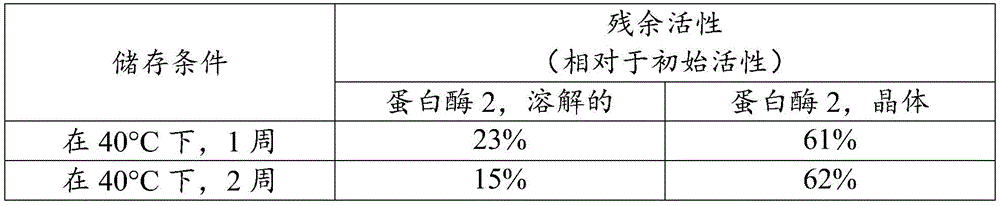
As shown in table 7, enzyme stability in the soap bar was much better when using enzyme crystals compared to using dissolved enzyme.
Sequence listing
<110> Novozymes corporation (Novozymes A/S)
<120> enzyme slurry composition
<130>14521-WO-PCT[2]
<160>11
<170> PatentIn 3.5 edition
<210>1
<211>269
<212>PRT
<213> Bacillus lentus
<400>1
Ala Gln Ser Val Pro Trp Gly Ile Ser Arg Val Gln Ala Pro Ala Ala
1 5 10 15
His Asn Arg Gly Leu Thr Gly Ser Gly Val Lys Val Ala Val Leu Asp
20 25 30
Thr Gly Ile Ser Thr His Pro Asp Leu Asn Ile Arg Gly Gly Ala Ser
35 40 45
Phe Val Pro Gly Glu Pro Ser Thr Gln Asp Gly Asn Gly His Gly Thr
50 55 60
His Val Ala Gly Thr Ile Ala Ala Leu Asn Asn Ser Ile Gly Val Leu
65 70 75 80
Gly Val Ala Pro Ser Ala Glu Leu Tyr Ala Val Lys Val Leu Gly Ala
85 90 95
Ser Gly Ser Gly Ser Val Ser Ser Ile Ala Gln Gly Leu Glu Trp Ala
100 105 110
Gly Asn Asn Gly Met His Val Ala Asn Leu Ser Leu Gly Ser Pro Ser
115 120 125
Pro Ser Ala Thr Leu Glu Gln Ala Val Asn Ser Ala Thr Ser Arg Gly
130 135 140
Val Leu Val Val Ala Ala Ser Gly Asn Ser Gly Ala Gly Ser Ile Ser
145 150 155 160
Tyr Pro Ala Arg Tyr Ala Asn Ala Met Ala Val Gly Ala Thr AspGln
165 170 175
Asn Asn Asn Arg Ala Ser Phe Ser Gln Tyr Gly Ala Gly Leu Asp Ile
180 185 190
Val Ala Pro Gly Val Asn Val Gln Ser Thr Tyr Pro Gly Ser Thr Tyr
195 200 205
Ala Ser Leu Asn Gly Thr Ser Met Ala Thr Pro His Val Ala Gly Ala
210 215 220
Ala Ala Leu Val Lys Gln Lys Asn Pro Ser Trp Ser Asn Val Gln Ile
225 230 235 240
Arg Asn His Leu Lys Asn Thr Ala Thr Ser Leu Gly Ser Thr Asn Leu
245 250 255
Tyr Gly Ser Gly Leu Val Asn Ala Glu Ala Ala Thr Arg
260 265
<210>2
<211>269
<212>PRT
<213> Artificial
<220>
<223> variants of SEQ ID NO:1
<400>2
Ala Gln Ser Val Pro Trp Gly Ile Glu Arg Val Gln Ala Pro Ala Ala
1 5 10 15
His Asn Arg Gly Leu Thr Gly Ser Gly Val Lys Val Ala Val Leu Asp
20 25 30
Thr Gly Ile Ser Thr His Pro Asp Leu Arg Ile Arg Gly Gly Ala Ser
35 40 45
Phe Val Pro Gly Glu Pro Ser Thr Gln Asp Gly Asn Gly His Gly Thr
50 55 60
His Val Ala Gly Thr Ile Ala Ala Leu Asp Asn Ser Ile Gly Val Leu
65 70 75 80
Gly Val Ala Pro Ser Ala Glu Leu Tyr Ala Val Lys Val Leu Gly Ala
85 90 95
Ser Gly Ser Gly Ser Val Ser Ser Ile Ala Gln Gly Leu Glu Trp Ala
100 105 110
Gly Asn Asn Gly Met His Val Ala Asn Leu Ser Leu Gly Ser Pro Ser
115 120 125
Pro Ser Ala Thr Leu Glu Gln Ala Val Asn Ser Ala Thr Ser Arg Gly
130 135 140
Val Leu Val Val Ala Ala Ser Gly Asn Ser Gly Ala Gly Ser Ile Ser
145 150 155 160
Tyr Pro Ala Arg Tyr Ala Asn Ala Met Ala Val Gly Ala Thr Asp Gln
165 170 175
Asn Asn Asn Arg Ala Ser Phe Ser Gln Tyr Gly Ala Gly Leu Asp Ile
180 185 190
Val Ala Pro Gly Val Asn Ile Leu Ser Thr Trp Pro Gly Ser Thr Tyr
195 200 205
Ala Ser Leu Asn Gly Thr Ser Met Ala Thr Pro His Val Ala Gly Ala
210 215 220
Ala Ala Leu Val Lys Gln Lys Asn Pro Ser Trp Ser Asn Val Gln Ile
225 230 235 240
Arg Asn His Leu Lys Asn Thr Ala Thr Ser Leu Gly Asp Thr Trp Glu
245 250 255
Tyr Gly Ser Gly Leu Val Asn Ala Glu Ala Ala Thr Arg
260 265
<210>3
<211>4
<212>PRT
<213> Artificial
<220>
<223> subtilisin inhibitor
<220>
<221> features not yet classified
<222>(1)..(1)
<223> acetyl-Leu
<220>
<221> features not yet classified
<222>(4)..(4)
<223>Tyr-H
<400>3
Leu Gly Ala Tyr
1
<210>4
<211>4
<212>PRT
<213> Artificial
<220>
<223> subtilisin inhibitor
<220>
<221> features not yet classified
<222>(1)..(1)
<223> acetyl-Phe
<220>
<221> features not yet classified
<222>(4)..(4)
<223>Tyr-H
<400>4
Phe Gly Ala Tyr
1
<210>5
<211>4
<212>PRT
<213> Artificial
<220>
<223> subtilisin inhibitor
<220>
<221> features not yet classified
<222>(1)..(1)
<223> acetyl-Tyr
<220>
<221> features not yet classified
<222>(4)..(4)
<223>Tyr-H
<400>5
Tyr Gly Ala Tyr
1
<210>6
<211>4
<212>PRT
<213> Artificial
<220>
<223> subtilisin inhibitor
<220>
<221> features not yet classified
<222>(1)..(1)
<223> acetyl-Phe, MeO-CO-Phe, MeSO2-Phe, or EtSO2-Phe
<220>
<221> features not yet classified
<222>(4)..(4)
<223>Leu-H
<400>6
Phe Gly Ala Leu
1
<210>7
<211>4
<212>PRT
<213> Artificial
<220>
<223> subtilisin inhibitor
<220>
<221> features not yet classified
<222>(1)..(1)
<223> acetyl-Phe or MeO-CO-Phe
<220>
<221> features not yet classified
<222>(4)..(4)
<223>Tyr-H
<400>7
Phe Gly Ala Phe
1
<210>8
<211>4
<212>PRT
<213> Artificial
<220>
<223> subtilisin inhibitor
<220>
<221> features not yet classified
<222>(1)..(1)
<223> acetyl-Phe
<220>
<221> features not yet classified
<222>(4)..(4)
<223>Tyr-H
<400>8
Phe Gly Val Tyr
1
<210>9
<211>4
<212>PRT
<213> Artificial
<220>
<223> subtilisin inhibitor
<220>
<221> features not yet classified
<222>(1)..(1)
<223> acetyl-Phe
<220>
<221> features not yet classified
<222>(4)..(4)
<223>Met-H
<400>9
Phe Gly Ala Met
1
<210>10
<211>4
<212>PRT
<213> Artificial
<220>
<223> subtilisin inhibitor
<220>
<221> features not yet classified
<222>(1)..(1)
<223> acetyl-Trp
<220>
<221> features not yet classified
<222>(4)..(4)
<223>Tyr-H
<400>10
Trp Leu Val Tyr
1
<210>11
<211>4
<212>PRT
<213> Artificial
<220>
<223> subtilisin inhibitor
<220>
<221> features not yet classified
<222>(1)..(1)
<223>MeO-P(OH)(O)-Leu
<220>
<221> features not yet classified
<222>(4)..(4)
<223>Leu-H
<400>11
Leu Gly Ala Leu
1
Claims (20)
Applications Claiming Priority (3)
| Application Number | Priority Date | Filing Date | Title |
|---|---|---|---|
| CNPCT/CN2017/091000 | 2017-06-30 | ||
| CN2017091000 | 2017-06-30 | ||
| PCT/EP2018/067227 WO2019002356A1 (en) | 2017-06-30 | 2018-06-27 | Enzyme slurry composition |
Publications (1)
| Publication Number | Publication Date |
|---|---|
| CN111108183A true CN111108183A (en) | 2020-05-05 |
Family
ID=62778915
Family Applications (1)
| Application Number | Title | Priority Date | Filing Date |
|---|---|---|---|
| CN201880042716.4A Pending CN111108183A (en) | 2017-06-30 | 2018-06-27 | Enzyme slurry composition |
Country Status (4)
| Country | Link |
|---|---|
| US (1) | US20200181542A1 (en) |
| EP (1) | EP3645692B1 (en) |
| CN (1) | CN111108183A (en) |
| WO (1) | WO2019002356A1 (en) |
Cited By (1)
| Publication number | Priority date | Publication date | Assignee | Title |
|---|---|---|---|---|
| CN117449114A (en) * | 2023-11-06 | 2024-01-26 | 山东银鹰股份有限公司 | Preparation method of cotton pulp for medical food-grade cellulose ether |
Families Citing this family (19)
| Publication number | Priority date | Publication date | Assignee | Title |
|---|---|---|---|---|
| US20220325204A1 (en) | 2019-08-27 | 2022-10-13 | Novozymes A/S | Detergent composition |
| EP4031644A1 (en) | 2019-09-19 | 2022-07-27 | Novozymes A/S | Detergent composition |
| EP4237525A1 (en) | 2020-10-28 | 2023-09-06 | Novozymes A/S | Use of lipoxygenase |
| WO2022106404A1 (en) | 2020-11-18 | 2022-05-27 | Novozymes A/S | Combination of proteases |
| WO2022106400A1 (en) | 2020-11-18 | 2022-05-27 | Novozymes A/S | Combination of immunochemically different proteases |
| WO2022199418A1 (en) | 2021-03-26 | 2022-09-29 | Novozymes A/S | Detergent composition with reduced polymer content |
| US20240417709A1 (en) | 2021-10-12 | 2024-12-19 | Novozymes A/S | Endoglucanase with improved stability |
| WO2023116569A1 (en) | 2021-12-21 | 2023-06-29 | Novozymes A/S | Composition comprising a lipase and a booster |
| US20250179393A1 (en) | 2022-03-02 | 2025-06-05 | Novozymes A/S | Use of xyloglucanase for improvement of sustainability of detergents |
| GB202210371D0 (en) * | 2022-07-14 | 2022-08-31 | Reckitt Benckiser Finish Bv | Detergents |
| EP4605507A1 (en) | 2022-10-20 | 2025-08-27 | Novozymes A/S | Lipid removal in detergents |
| EP4630529A1 (en) | 2022-12-05 | 2025-10-15 | Novozymes A/S | A composition comprising a lipase and a peptide |
| CN120322453A (en) * | 2022-12-14 | 2025-07-15 | 诺维信公司 | High Strength Liquid Protease Formulations |
| JP2026501223A (en) | 2022-12-23 | 2026-01-14 | ノボザイムス アクティーゼルスカブ | Detergent composition containing catalase and amylase |
| EP4655371A1 (en) | 2023-01-23 | 2025-12-03 | Novozymes A/S | Cleaning compositions and uses thereof |
| WO2024194245A1 (en) | 2023-03-21 | 2024-09-26 | Novozymes A/S | Detergent compositions based on biosurfactants |
| WO2025088003A1 (en) | 2023-10-24 | 2025-05-01 | Novozymes A/S | Use of xyloglucanase for replacement of optical brightener |
| WO2026017636A1 (en) | 2024-07-17 | 2026-01-22 | Novozymes A/S | Compositions comprising combination of enzymes |
| WO2024254620A2 (en) | 2024-08-01 | 2024-12-12 | Novozymes A/S | Protease for diagnostics |
Citations (6)
| Publication number | Priority date | Publication date | Assignee | Title |
|---|---|---|---|---|
| EP0450702A2 (en) * | 1990-04-06 | 1991-10-09 | Unilever N.V. | Process for preparing liquid enzymatic detergent compositions |
| EP0506791A1 (en) * | 1989-12-21 | 1992-10-07 | Novo Nordisk As | ENZYMED PREPARATION AND DETERGENT CONTAINING SUCH A PREPARATION. |
| CA2297443A1 (en) * | 1999-01-28 | 2000-07-28 | Henkel Kommanditgesellschaft Auf Aktien | Multiphase detergent tablets |
| WO2009102854A1 (en) * | 2008-02-15 | 2009-08-20 | The Procter & Gamble Company | Cleaning compositions |
| CN101522878A (en) * | 2006-10-06 | 2009-09-02 | 诺维信公司 | Detergent compositions and the use of enzyme combinations therein |
| CA2850079A1 (en) * | 2011-10-28 | 2013-05-02 | Danisco Us Inc. | Variant maltohexaose-forming alpha-amylase variants |
Family Cites Families (152)
| Publication number | Priority date | Publication date | Assignee | Title |
|---|---|---|---|---|
| GB1296839A (en) | 1969-05-29 | 1972-11-22 | ||
| GB1372034A (en) | 1970-12-31 | 1974-10-30 | Unilever Ltd | Detergent compositions |
| DK187280A (en) | 1980-04-30 | 1981-10-31 | Novo Industri As | RUIT REDUCING AGENT FOR A COMPLETE LAUNDRY |
| JPS61104784A (en) | 1984-10-26 | 1986-05-23 | Suntory Ltd | Production of peroxidase |
| JPH0697997B2 (en) | 1985-08-09 | 1994-12-07 | ギスト ブロカデス ナ−ムロ−ゼ フエンノ−トチヤツプ | New enzymatic detergent additive |
| ES2058119T3 (en) | 1986-08-29 | 1994-11-01 | Novo Nordisk As | ENZYMATIC DETERGENT ADDITIVE. |
| NZ221627A (en) | 1986-09-09 | 1993-04-28 | Genencor Inc | Preparation of enzymes, modifications, catalytic triads to alter ratios or transesterification/hydrolysis ratios |
| DE3854249T2 (en) | 1987-08-28 | 1996-02-29 | Novonordisk As | Recombinant Humicola Lipase and Process for the Production of Recombinant Humicola Lipases. |
| JPS6474992A (en) | 1987-09-16 | 1989-03-20 | Fuji Oil Co Ltd | Dna sequence, plasmid and production of lipase |
| DK6488D0 (en) | 1988-01-07 | 1988-01-07 | Novo Industri As | ENZYMES |
| JP3079276B2 (en) | 1988-02-28 | 2000-08-21 | 天野製薬株式会社 | Recombinant DNA, Pseudomonas sp. Containing the same, and method for producing lipase using the same |
| EP0406314B1 (en) | 1988-03-24 | 1993-12-01 | Novo Nordisk A/S | A cellulase preparation |
| US5776757A (en) | 1988-03-24 | 1998-07-07 | Novo Nordisk A/S | Fungal cellulase composition containing alkaline CMC-endoglucanase and essentially no cellobiohydrolase and method of making thereof |
| US5159060A (en) | 1988-05-27 | 1992-10-27 | Mayo Foundation For Medical Education And Research | Cytotoxic boronic acid peptide analogs |
| US4963655A (en) | 1988-05-27 | 1990-10-16 | Mayo Foundation For Medical Education And Research | Boron analogs of amino acid/peptide protease inhibitors |
| US5223409A (en) | 1988-09-02 | 1993-06-29 | Protein Engineering Corp. | Directed evolution of novel binding proteins |
| US5275753A (en) | 1989-01-10 | 1994-01-04 | The Procter & Gamble Company | Stabilized alkaline liquid detergent compositions containing enzyme and peroxygen bleach |
| JPH02238885A (en) | 1989-03-13 | 1990-09-21 | Oji Paper Co Ltd | Phenol oxidase genetically recombinant DNA, microorganisms transformed with the recombinant DNA, culture thereof, and method for producing phenol oxidase |
| GB8915658D0 (en) | 1989-07-07 | 1989-08-23 | Unilever Plc | Enzymes,their production and use |
| DE69033388T2 (en) | 1989-08-25 | 2000-05-11 | Henkel Research Corp., Santa Rosa | ALKALINE PROTEOLYTIC ENZYME AND METHOD FOR PRODUCING THE SAME |
| EP0506866B1 (en) | 1989-12-21 | 1993-10-20 | Novo Nordisk A/S | Method for crystallization of enzymes |
| KR100236540B1 (en) | 1990-04-14 | 2000-01-15 | 레클로우크스 라우에르 | Alkaline bacillus lipases, coding dna sequences thereof and bacilli which produce these lipases |
| AU639570B2 (en) | 1990-05-09 | 1993-07-29 | Novozymes A/S | A cellulase preparation comprising an endoglucanase enzyme |
| DK115890D0 (en) | 1990-05-09 | 1990-05-09 | Novo Nordisk As | ENZYME |
| FI903443A7 (en) | 1990-07-06 | 1992-01-07 | Valtion Teknillinen | FRAMSTAELLNING AV LACKAS GENOM RECOMBINANTORGANISMER. |
| DK0548228T3 (en) | 1990-09-13 | 1999-05-10 | Novo Nordisk As | lipase variants |
| IL99552A0 (en) | 1990-09-28 | 1992-08-18 | Ixsys Inc | Compositions containing procaryotic cells,a kit for the preparation of vectors useful for the coexpression of two or more dna sequences and methods for the use thereof |
| SG52693A1 (en) | 1991-01-16 | 1998-09-28 | Procter & Gamble | Detergent compositions with high activity cellulase and softening clays |
| CA2109526C (en) | 1991-04-30 | 1998-01-20 | Dwight M. Peterson | Liquid detergents with an aryl boroic acid |
| ES2121014T3 (en) | 1991-05-01 | 1998-11-16 | Novo Nordisk As | STABILIZED ENZYMES AND DETERGENT COMPOSITIONS. |
| DK28792D0 (en) | 1992-03-04 | 1992-03-04 | Novo Nordisk As | NEW ENZYM |
| DK72992D0 (en) | 1992-06-01 | 1992-06-01 | Novo Nordisk As | ENZYME |
| DK88892D0 (en) | 1992-07-06 | 1992-07-06 | Novo Nordisk As | CONNECTION |
| DE69334295D1 (en) | 1992-07-23 | 2009-11-12 | Novo Nordisk As | MUTIER -g (a) -AMYLASE, DETERGENT AND DISHWASHER |
| US5442100A (en) | 1992-08-14 | 1995-08-15 | The Procter & Gamble Company | β-aminoalkyl and β-N-peptidylaminoalkyl boronic acids |
| EP0583536B1 (en) | 1992-08-14 | 1997-03-05 | The Procter & Gamble Company | Liquid detergents containing an alpha-amino boronic acid |
| US5354491A (en) | 1992-08-14 | 1994-10-11 | The Procter & Gamble Company | Liquid detergent compositions containing protease and certain β-aminoalkylboronic acids and esters |
| DE69217934T2 (en) | 1992-08-14 | 1997-09-04 | The Procter & Gamble Co., Cincinnati, Ohio | Liquid detergent containing peptide aldehyde |
| EP1431389A3 (en) | 1992-10-06 | 2004-06-30 | Novozymes A/S | Cellulase variants |
| ATE175235T1 (en) | 1993-02-11 | 1999-01-15 | Genencor Int | OXIDATIVELY STABLE ALPHA-AMYLASE |
| DK39693D0 (en) | 1993-04-02 | 1993-04-02 | Novo Nordisk As | ENZYME |
| AU673078B2 (en) | 1993-04-27 | 1996-10-24 | Genencor International, Inc. | New lipase variants for use in detergent applications |
| JP2859520B2 (en) | 1993-08-30 | 1999-02-17 | ノボ ノルディスク アクティーゼルスカブ | Lipase, microorganism producing the same, method for producing lipase, and detergent composition containing lipase |
| JPH09503916A (en) | 1993-10-08 | 1997-04-22 | ノボ ノルディスク アクティーゼルスカブ | Amylase variant |
| US5817495A (en) | 1993-10-13 | 1998-10-06 | Novo Nordisk A/S | H2 O2 -stable peroxidase variants |
| US5431842A (en) | 1993-11-05 | 1995-07-11 | The Procter & Gamble Company | Liquid detergents with ortho-substituted phenylboronic acids for inhibition of proteolytic enzyme |
| JPH07143883A (en) | 1993-11-24 | 1995-06-06 | Showa Denko Kk | Lipase gene and mutant lipase |
| DE4343591A1 (en) | 1993-12-21 | 1995-06-22 | Evotec Biosystems Gmbh | Process for the evolutionary design and synthesis of functional polymers based on shape elements and shape codes |
| US5605793A (en) | 1994-02-17 | 1997-02-25 | Affymax Technologies N.V. | Methods for in vitro recombination |
| ATE222604T1 (en) | 1994-02-22 | 2002-09-15 | Novozymes As | METHOD FOR PRODUCING A VARIANT OF A LIPOLYTIC ENZYME |
| US5436229A (en) | 1994-03-04 | 1995-07-25 | Eli Lilly And Company | Bisulfite adducts of arginine aldehydes |
| DE69536145D1 (en) | 1994-03-08 | 2011-04-07 | Novozymes As | Novel alkaline cellulases |
| WO1995025791A1 (en) | 1994-03-22 | 1995-09-28 | The Procter & Gamble Company | Protease enzyme manufacture using non-protein protease inhibitors |
| NL9401048A (en) | 1994-03-31 | 1995-11-01 | Stichting Scheikundig Onderzoe | Haloperoxidases. |
| US5834415A (en) | 1994-04-26 | 1998-11-10 | Novo Nordisk A/S | Naphthalene boronic acids |
| WO1995030744A2 (en) | 1994-05-04 | 1995-11-16 | Genencor International Inc. | Lipases with improved surfactant resistance |
| DK0765394T3 (en) | 1994-06-03 | 2001-12-10 | Novozymes As | Purified Myceliopthora laccases and nucleic acids encoding them |
| WO1995035381A1 (en) | 1994-06-20 | 1995-12-28 | Unilever N.V. | Modified pseudomonas lipases and their use |
| WO1996000292A1 (en) | 1994-06-23 | 1996-01-04 | Unilever N.V. | Modified pseudomonas lipases and their use |
| EP1995303A3 (en) | 1994-10-06 | 2008-12-31 | Novozymes A/S | Enzyme preparation with endoglucanase activity |
| BE1008998A3 (en) | 1994-10-14 | 1996-10-01 | Solvay | Lipase, microorganism producing the preparation process for the lipase and uses thereof. |
| AU3697995A (en) | 1994-10-26 | 1996-05-23 | Novo Nordisk A/S | An enzyme with lipolytic activity |
| AR000862A1 (en) | 1995-02-03 | 1997-08-06 | Novozymes As | VARIANTS OF A MOTHER-AMYLASE, A METHOD TO PRODUCE THE SAME, A DNA STRUCTURE AND A VECTOR OF EXPRESSION, A CELL TRANSFORMED BY SUCH A DNA STRUCTURE AND VECTOR, A DETERGENT ADDITIVE, DETERGENT COMPOSITION, A COMPOSITION FOR AND A COMPOSITION FOR THE ELIMINATION OF |
| JPH08228778A (en) | 1995-02-27 | 1996-09-10 | Showa Denko Kk | Novel lipase gene and method for producing lipase using the same |
| CN1182451A (en) | 1995-03-17 | 1998-05-20 | 诺沃挪第克公司 | Novel endoglucanases |
| BR9608149B1 (en) | 1995-05-05 | 2012-01-24 | processes for effecting mutation in DNA encoding a subtilase enzyme or its pre- or pre-enzyme and for the manufacture of a mutant subtilase enzyme. | |
| WO1997007202A1 (en) | 1995-08-11 | 1997-02-27 | Novo Nordisk A/S | Novel lipolytic enzymes |
| DE69636754T2 (en) | 1995-07-14 | 2007-10-11 | Novozymes, Inc., Davis | HALOPEROXIDASES FROM CURVULARIA VERRUCULOSA AND NUCLEIC ACIDS COATING THEREOF |
| WO1997004078A1 (en) | 1995-07-14 | 1997-02-06 | Novo Nordisk A/S | A modified enzyme with lipolytic activity |
| DE19528059A1 (en) | 1995-07-31 | 1997-02-06 | Bayer Ag | Detergent and cleaning agent with imino disuccinates |
| US6008029A (en) | 1995-08-25 | 1999-12-28 | Novo Nordisk Biotech Inc. | Purified coprinus laccases and nucleic acids encoding the same |
| US5763385A (en) | 1996-05-14 | 1998-06-09 | Genencor International, Inc. | Modified α-amylases having altered calcium binding properties |
| WO1998008940A1 (en) | 1996-08-26 | 1998-03-05 | Novo Nordisk A/S | A novel endoglucanase |
| DE69735767T2 (en) | 1996-09-17 | 2007-04-05 | Novozymes A/S | cellulase |
| US6165966A (en) * | 1996-09-24 | 2000-12-26 | The Procter & Gamble Company | Liquid detergents containing proteolytic enzyme and protease inhibitors |
| BR9712114A (en) | 1996-09-24 | 1999-08-31 | Procter & Gamble | Liquid laundry detergent compositions containing proteolytic enzyme and protease inhibitors. |
| EP0929639B1 (en) | 1996-09-24 | 2002-11-13 | The Procter & Gamble Company | Liquid detergents containing proteolytic enzyme, peptide aldehyde and calcium ions |
| US6162783A (en) | 1996-09-24 | 2000-12-19 | The Procter & Gamble Company | Liquid detergents containing proteolytic enzyme and protease inhibitors |
| EP0929636B1 (en) | 1996-09-24 | 2002-12-04 | The Procter & Gamble Company | Liquid detergents containing proteolytic enzyme, peptide aldehyde and a source of boric acid |
| JP2000503340A (en) | 1996-09-24 | 2000-03-21 | ザ、プロクター、エンド、ギャンブル、カンパニー | Liquid detergent containing proteolytic enzymes and protease inhibitors |
| WO1998015257A1 (en) | 1996-10-08 | 1998-04-16 | Novo Nordisk A/S | Diaminobenzoic acid derivatives as dye precursors |
| AU4772697A (en) | 1996-11-04 | 1998-05-29 | Novo Nordisk A/S | Subtilase variants and compositions |
| CN1530443A (en) | 1996-11-04 | 2004-09-22 | ŵ����÷������˾ | subtilase variants and compositions |
| ATE309264T1 (en) | 1997-04-18 | 2005-11-15 | Cephalon Inc | PEPTIDYL-2-AMINO-1HYDROXYALKANSULPHONIC ACIDS AS CYSTEINE PROTEASE INHIBITORS |
| JP2002507230A (en) | 1997-06-27 | 2002-03-05 | ザ、プロクター、エンド、ギャンブル、カンパニー | Non-aqueous liquid detergent composition containing enzyme particles |
| US5955415A (en) | 1997-08-04 | 1999-09-21 | Lever Brothers Company, Division Of Conopco, Inc. | Detergent compositions containing polyethyleneimines for enhanced peroxygen bleach stability |
| DE69839076T2 (en) | 1997-08-29 | 2009-01-22 | Novozymes A/S | PROTEASE VERSIONS AND COMPOSITIONS |
| EP2206768B1 (en) | 1997-10-13 | 2015-04-01 | Novozymes A/S | Alpha-amylase mutants |
| DE19749749A1 (en) * | 1997-11-11 | 1999-05-12 | Henkel Kgaa | Process for the preparation of stable and rapidly disintegrating detergent tablets |
| WO1999027084A1 (en) | 1997-11-24 | 1999-06-03 | Novo Nordisk A/S | Novel pectate lyases |
| WO1999027083A1 (en) | 1997-11-24 | 1999-06-03 | Novo Nordisk A/S | PECTIN DEGRADING ENZYMES FROM $i(BACILLUS LICHENIFORMIS) |
| US6124127A (en) | 1997-11-24 | 2000-09-26 | Novo Nordisk A/S | Pectate lyase |
| CN100497614C (en) | 1998-06-10 | 2009-06-10 | 诺沃奇梅兹有限公司 | Mannanase |
| KR20010108379A (en) | 1999-03-31 | 2001-12-07 | 피아 스타르 | Lipase variant |
| CN101974375B (en) | 1999-12-15 | 2014-07-02 | 诺沃奇梅兹有限公司 | Subtilase variants having an improved wash performance on egg stains |
| DK1257176T3 (en) | 2000-02-08 | 2008-08-18 | Dsm Ip Assets Bv | Use of acid-stable proteases in animal feed |
| JP5571274B2 (en) | 2000-03-08 | 2014-08-13 | ノボザイムス アクティーゼルスカブ | Variants with altered properties |
| CA2300630A1 (en) * | 2000-03-14 | 2000-08-21 | Henkel Kommanditgesellschaft Auf Aktien | Washing and cleaning agent shaped bodies with improved solubility |
| WO2001079463A2 (en) | 2000-04-14 | 2001-10-25 | Novozymes A/S | Nucleic acids encoding polypeptides having haloperoxidase activity |
| AU2001246404A1 (en) | 2000-04-14 | 2001-10-30 | Novozymes A/S | Polypeptides having haloperoxidase activity |
| WO2001079464A2 (en) | 2000-04-14 | 2001-10-25 | Novozymes A/S | Nucleic acids encoding polypeptides having haloperoxidase activity |
| AU2001246402A1 (en) | 2000-04-14 | 2001-10-30 | Novozymes A/S | Polypeptides having haloperoxidase activity |
| AU2001281736A1 (en) | 2000-07-19 | 2002-01-30 | Novozymes A/S | Cell-wall degrading enzyme variants |
| JP4855632B2 (en) | 2000-08-01 | 2012-01-18 | ノボザイムス アクティーゼルスカブ | Α-Amylase mutants with altered properties |
| EP1389228B1 (en) | 2001-05-14 | 2009-03-11 | Novozymes A/S | Detergent compositions comprising bacillus subtilis pectate lyases |
| DK200101090A (en) | 2001-07-12 | 2001-08-16 | Novozymes As | Subtilase variants |
| GB0127036D0 (en) | 2001-11-09 | 2002-01-02 | Unilever Plc | Polymers for laundry applications |
| WO2003095638A1 (en) | 2002-05-14 | 2003-11-20 | Novozymes A/S | Pectate lyase variants |
| CN101597601B (en) | 2002-06-26 | 2013-06-05 | 诺维信公司 | Subtilases and subtilase variants having altered immunogenicity |
| TWI319007B (en) | 2002-11-06 | 2010-01-01 | Novozymes As | Subtilase variants |
| WO2004067737A2 (en) | 2003-01-30 | 2004-08-12 | Novozymes A/S | Subtilases |
| DE602004016314D1 (en) | 2003-05-07 | 2008-10-16 | Maxygen Inc | ENZYM VARIANTS OF SUBTILISIN (SUBTILASES) |
| GB0314210D0 (en) | 2003-06-18 | 2003-07-23 | Unilever Plc | Laundry treatment compositions |
| GB0314211D0 (en) | 2003-06-18 | 2003-07-23 | Unilever Plc | Laundry treatment compositions |
| CA2529726A1 (en) | 2003-06-18 | 2005-01-13 | Unilever Plc | Laundry treatment compositions |
| US7754460B2 (en) | 2003-12-03 | 2010-07-13 | Danisco Us Inc. | Enzyme for the production of long chain peracid |
| EP2295554B1 (en) | 2003-12-03 | 2012-11-28 | Danisco US Inc. | Perhydrolase |
| CA2593920A1 (en) | 2004-12-23 | 2006-06-29 | Novozymes A/S | Alpha-amylase variants |
| BRPI0609363A2 (en) | 2005-04-15 | 2010-03-30 | Procter & Gamble | cleaning compositions with alkoxylated polyalkylene imines |
| PL1869155T3 (en) | 2005-04-15 | 2011-03-31 | Procter & Gamble | Liquid laundry detergent compositions with modified polyethyleneimine polymers and lipase enzyme |
| EP1888734A2 (en) | 2005-05-31 | 2008-02-20 | The Procter and Gamble Company | Polymer-containing detergent compositions and their use |
| CN101218343B (en) | 2005-07-08 | 2013-11-06 | 诺维信公司 | subtilisin variant |
| EP2248882A1 (en) | 2006-01-23 | 2010-11-10 | The Procter and Gamble Company | Enzyme and fabric hueing agent containing compositions |
| ES2629332T3 (en) | 2006-01-23 | 2017-08-08 | Novozymes A/S | Lipase variants |
| EP1976967A2 (en) | 2006-01-23 | 2008-10-08 | The Procter and Gamble Company | Detergent compositions |
| DE102006018780A1 (en) * | 2006-04-20 | 2007-10-25 | Henkel Kgaa | Granules of a sensitive detergent or cleaning agent ingredient |
| DE602007007945D1 (en) | 2006-05-31 | 2010-09-02 | Basf Se | AMPHIPHILYPROPOLYMERS BASED ON POLYALKYLENE OXIDES AND VINYL REAGENTS |
| JP2009537665A (en) | 2006-06-05 | 2009-10-29 | ザ プロクター アンド ギャンブル カンパニー | Enzyme stabilization |
| JP2009540042A (en) | 2006-06-05 | 2009-11-19 | ザ プロクター アンド ギャンブル カンパニー | Enzyme stabilization |
| DE202006009003U1 (en) | 2006-06-06 | 2007-10-25 | BROSE SCHLIEßSYSTEME GMBH & CO. KG | Motor vehicle lock |
| EP1876226B1 (en) | 2006-07-07 | 2011-03-23 | The Procter & Gamble Company | Detergent compositions |
| EP2426199A3 (en) | 2006-10-20 | 2012-08-22 | Danisco US Inc. | Polyol oxidases |
| EP2147098B1 (en) | 2007-04-30 | 2013-07-17 | Danisco US Inc. | Use of protein hydrolysates to stabilize metalloprotease detergent formulations |
| EP2155869A2 (en) | 2007-05-30 | 2010-02-24 | Danisco US, INC., Genencor Division | Variants of an alpha-amylase with improved production levels in fermentation processes |
| WO2009000605A1 (en) * | 2007-06-22 | 2008-12-31 | Unilever N.V. | Granular enzymatic detergent compositions |
| AU2008325250B2 (en) | 2007-11-05 | 2013-06-13 | Danisco Us Inc. | Variants of Bacillus sp. TS-23 alpha-amylase with altered properties |
| RU2470069C2 (en) | 2008-01-04 | 2012-12-20 | Дзе Проктер Энд Гэмбл Компани | Laundry detergent composition containing glycosyl hydrolase |
| EP2250259B1 (en) | 2008-02-29 | 2016-08-31 | Novozymes A/S | Polypeptides having lipase activity and polynucleotides encoding same |
| EP3725797A1 (en) | 2008-03-26 | 2020-10-21 | Novozymes A/S | Stabilized liquid enzyme compositions |
| EP2169040B1 (en) | 2008-09-30 | 2012-04-11 | The Procter & Gamble Company | Liquid detergent compositions exhibiting two or multicolor effect |
| EP2358857B1 (en) | 2008-11-13 | 2017-05-03 | Novozymes A/S | Detergent composition |
| US20120252106A1 (en) | 2009-09-25 | 2012-10-04 | Novozymes A/S | Use of Protease Variants |
| BR112012006281A2 (en) | 2009-09-25 | 2019-09-24 | Novozymes As | "particulate detergent composition, use of the detergent composition, and methods for preparing a detergent composition and for removing egg-containing dirt from a dirty article." |
| CA2775045A1 (en) | 2009-09-25 | 2011-03-31 | Novozymes A/S | Subtilase variants for use in detergent and cleaning compositions |
| MX369096B (en) | 2010-02-10 | 2019-10-29 | Novozymes As | Variants and compositions comprising variants with high stability in presence of a chelating agent. |
| GB2477914B (en) | 2010-02-12 | 2012-01-04 | Univ Newcastle | Compounds and methods for biofilm disruption and prevention |
| WO2013001078A1 (en) | 2011-06-30 | 2013-01-03 | Novozymes A/S | Alpha-amylase variants |
| EP4026901B1 (en) | 2011-06-30 | 2025-01-22 | Novozymes A/S | Method for screening alpha-amylases |
| KR101956895B1 (en) | 2011-07-01 | 2019-03-12 | 노보자임스 에이/에스 | Stabilized subtilisin composition |
| BR112013033816A2 (en) | 2011-07-01 | 2017-02-14 | Novozymes A / S | boron free liquid detergent composition |
| US10400230B2 (en) * | 2014-12-19 | 2019-09-03 | Novozymes A/S | Protease variants and polynucleotides encoding same |
| WO2016201040A1 (en) * | 2015-06-09 | 2016-12-15 | Danisco Us Inc. | Water-triggered enzyme suspension |
-
2018
- 2018-06-27 CN CN201880042716.4A patent/CN111108183A/en active Pending
- 2018-06-27 EP EP18734801.6A patent/EP3645692B1/en active Active
- 2018-06-27 WO PCT/EP2018/067227 patent/WO2019002356A1/en not_active Ceased
- 2018-06-27 US US16/623,578 patent/US20200181542A1/en active Pending
Patent Citations (7)
| Publication number | Priority date | Publication date | Assignee | Title |
|---|---|---|---|---|
| EP0506791A1 (en) * | 1989-12-21 | 1992-10-07 | Novo Nordisk As | ENZYMED PREPARATION AND DETERGENT CONTAINING SUCH A PREPARATION. |
| EP0450702A2 (en) * | 1990-04-06 | 1991-10-09 | Unilever N.V. | Process for preparing liquid enzymatic detergent compositions |
| CA2297443A1 (en) * | 1999-01-28 | 2000-07-28 | Henkel Kommanditgesellschaft Auf Aktien | Multiphase detergent tablets |
| CN101522878A (en) * | 2006-10-06 | 2009-09-02 | 诺维信公司 | Detergent compositions and the use of enzyme combinations therein |
| WO2009102854A1 (en) * | 2008-02-15 | 2009-08-20 | The Procter & Gamble Company | Cleaning compositions |
| CN101945988A (en) * | 2008-02-15 | 2011-01-12 | 宝洁公司 | cleaning composition |
| CA2850079A1 (en) * | 2011-10-28 | 2013-05-02 | Danisco Us Inc. | Variant maltohexaose-forming alpha-amylase variants |
Cited By (1)
| Publication number | Priority date | Publication date | Assignee | Title |
|---|---|---|---|---|
| CN117449114A (en) * | 2023-11-06 | 2024-01-26 | 山东银鹰股份有限公司 | Preparation method of cotton pulp for medical food-grade cellulose ether |
Also Published As
| Publication number | Publication date |
|---|---|
| US20200181542A1 (en) | 2020-06-11 |
| WO2019002356A1 (en) | 2019-01-03 |
| EP3645692A1 (en) | 2020-05-06 |
| EP3645692B1 (en) | 2025-12-31 |
Similar Documents
| Publication | Publication Date | Title |
|---|---|---|
| CN111108183A (en) | Enzyme slurry composition | |
| EP2074205B2 (en) | Detergent compositions and the use of enzyme combinations therein | |
| JP6997082B2 (en) | Detergent composition containing protease and amylase mutant | |
| ES2794837T3 (en) | Detergent Compositions Comprising Polypeptides Having Xanthan Degrading Activity | |
| CN113302296A (en) | Subtilase variants and compositions comprising the same | |
| CN111479919A (en) | Polypeptides and compositions comprising such polypeptides | |
| CN106232795A (en) | Composition of detergent | |
| CN114729285A (en) | Use of deoxyribonuclease in detergent compositions | |
| CN106459847A (en) | Detergent composition | |
| JP7084868B2 (en) | Washing method, use of polypeptide and detergent composition | |
| US20250084346A1 (en) | Encapsulated solid enzyme product | |
| CN106471110A (en) | Improved non-protease enzyme stabilization | |
| CN113302270A (en) | Low pH powder detergent compositions | |
| CN113302295A (en) | Powder detergent composition | |
| WO2022089571A1 (en) | Detergent composition and cleaning method | |
| US20250207116A1 (en) | Hexosaminidase variants and compositions | |
| JP2025507855A (en) | DNase variants and compositions | |
| US20190218479A1 (en) | Stabilized Liquid Peroxide Compositions |
Legal Events
| Date | Code | Title | Description |
|---|---|---|---|
| PB01 | Publication | ||
| PB01 | Publication | ||
| SE01 | Entry into force of request for substantive examination | ||
| SE01 | Entry into force of request for substantive examination |