EP3385362A1 - Detergent compositions comprising fungal mannanases - Google Patents
Detergent compositions comprising fungal mannanases Download PDFInfo
- Publication number
- EP3385362A1 EP3385362A1 EP17164904.9A EP17164904A EP3385362A1 EP 3385362 A1 EP3385362 A1 EP 3385362A1 EP 17164904 A EP17164904 A EP 17164904A EP 3385362 A1 EP3385362 A1 EP 3385362A1
- Authority
- EP
- European Patent Office
- Prior art keywords
- seq
- detergent
- amino acid
- detergent composition
- enzyme
- Prior art date
- Legal status (The legal status is an assumption and is not a legal conclusion. Google has not performed a legal analysis and makes no representation as to the accuracy of the status listed.)
- Withdrawn
Links
- 239000003599 detergent Substances 0.000 title claims abstract description 187
- 239000000203 mixture Substances 0.000 title claims abstract description 164
- 108010055059 beta-Mannosidase Proteins 0.000 title claims abstract description 114
- 102100032487 Beta-mannosidase Human genes 0.000 title claims abstract description 101
- 230000002538 fungal effect Effects 0.000 title abstract description 38
- 229920000057 Mannan Polymers 0.000 claims abstract description 48
- 238000000034 method Methods 0.000 claims abstract description 34
- 230000000593 degrading effect Effects 0.000 claims abstract description 19
- 102000004190 Enzymes Human genes 0.000 claims description 105
- 108090000790 Enzymes Proteins 0.000 claims description 105
- 229940088598 enzyme Drugs 0.000 claims description 102
- -1 pectatlyase Proteins 0.000 claims description 71
- 125000003275 alpha amino acid group Chemical group 0.000 claims description 58
- 230000000694 effects Effects 0.000 claims description 50
- 239000007788 liquid Substances 0.000 claims description 49
- 102000013142 Amylases Human genes 0.000 claims description 31
- 108010065511 Amylases Proteins 0.000 claims description 31
- 235000019418 amylase Nutrition 0.000 claims description 31
- 108091005804 Peptidases Proteins 0.000 claims description 21
- 239000004365 Protease Substances 0.000 claims description 19
- 102000004882 Lipase Human genes 0.000 claims description 17
- 108090001060 Lipase Proteins 0.000 claims description 17
- 239000004367 Lipase Substances 0.000 claims description 17
- 235000019421 lipase Nutrition 0.000 claims description 17
- 239000000843 powder Substances 0.000 claims description 17
- 239000004753 textile Substances 0.000 claims description 15
- 239000007787 solid Substances 0.000 claims description 14
- 239000004382 Amylase Substances 0.000 claims description 10
- 230000008569 process Effects 0.000 claims description 9
- 102000003992 Peroxidases Human genes 0.000 claims description 8
- 108010005400 cutinase Proteins 0.000 claims description 8
- 239000008187 granular material Substances 0.000 claims description 7
- 102000004316 Oxidoreductases Human genes 0.000 claims description 6
- 108090000854 Oxidoreductases Proteins 0.000 claims description 6
- 108010059892 Cellulase Proteins 0.000 claims description 5
- 229940106157 cellulase Drugs 0.000 claims description 5
- 101710152845 Arabinogalactan endo-beta-1,4-galactanase Proteins 0.000 claims description 3
- 101710121765 Endo-1,4-beta-xylanase Proteins 0.000 claims description 3
- 101710147028 Endo-beta-1,4-galactanase Proteins 0.000 claims description 3
- 108010029541 Laccase Proteins 0.000 claims description 3
- 108010059820 Polygalacturonase Proteins 0.000 claims description 3
- 108010089934 carbohydrase Proteins 0.000 claims description 3
- 108010093305 exopolygalacturonase Proteins 0.000 claims description 3
- 108040007629 peroxidase activity proteins Proteins 0.000 claims description 3
- 102100037486 Reverse transcriptase/ribonuclease H Human genes 0.000 claims 1
- 238000004140 cleaning Methods 0.000 abstract description 18
- 230000004048 modification Effects 0.000 abstract description 14
- 238000012986 modification Methods 0.000 abstract description 14
- 230000015556 catabolic process Effects 0.000 abstract description 5
- 238000006731 degradation reaction Methods 0.000 abstract description 5
- 108090000623 proteins and genes Proteins 0.000 description 62
- 239000003795 chemical substances by application Substances 0.000 description 40
- 210000004027 cell Anatomy 0.000 description 36
- XLYOFNOQVPJJNP-UHFFFAOYSA-N water Substances O XLYOFNOQVPJJNP-UHFFFAOYSA-N 0.000 description 34
- 241001123668 Verticillium dahliae Species 0.000 description 31
- 108090000765 processed proteins & peptides Proteins 0.000 description 31
- 229910001868 water Inorganic materials 0.000 description 31
- 229920000642 polymer Polymers 0.000 description 30
- 108020004414 DNA Proteins 0.000 description 28
- 239000004744 fabric Substances 0.000 description 27
- 102000004169 proteins and genes Human genes 0.000 description 27
- WQZGKKKJIJFFOK-QTVWNMPRSA-N D-mannopyranose Chemical compound OC[C@H]1OC(O)[C@@H](O)[C@@H](O)[C@@H]1O WQZGKKKJIJFFOK-QTVWNMPRSA-N 0.000 description 26
- OSKIPPQETUTOMW-YHLOVPAPSA-N N-[(2R,3R,4R,5S,6R)-5-[(2S,3R,4R,5S,6R)-3-Acetamido-5-[(2R,3S,4S,5R,6R)-4-[(2R,3S,4S,5S,6R)-3-[(2S,3S,4S,5S,6R)-4,5-dihydroxy-6-(hydroxymethyl)-3-[(2R,3S,4S,5S,6R)-3,4,5-trihydroxy-6-(hydroxymethyl)oxan-2-yl]oxyoxan-2-yl]oxy-4,5-dihydroxy-6-(hydroxymethyl)oxan-2-yl]oxy-6-[[(2S,3S,4S,5R,6R)-6-[[(2S,3S,4S,5S,6R)-4,5-dihydroxy-6-(hydroxymethyl)-3-[(2R,3S,4S,5S,6R)-3,4,5-trihydroxy-6-(hydroxymethyl)oxan-2-yl]oxyoxan-2-yl]oxymethyl]-3,5-dihydroxy-4-[(2R,3S,4S,5S,6R)-3,4,5-trihydroxy-6-(hydroxymethyl)oxan-2-yl]oxyoxan-2-yl]oxymethyl]-3,5-dihydroxyoxan-2-yl]oxy-4-hydroxy-6-(hydroxymethyl)oxan-2-yl]oxy-2,4-dihydroxy-6-(hydroxymethyl)oxan-3-yl]acetamide Chemical compound O[C@@H]1[C@@H](NC(=O)C)[C@H](O)O[C@H](CO)[C@H]1O[C@H]1[C@H](NC(C)=O)[C@@H](O)[C@H](O[C@@H]2[C@H]([C@@H](O[C@@H]3[C@H]([C@@H](O)[C@H](O)[C@@H](CO)O3)O[C@@H]3[C@H]([C@@H](O)[C@H](O)[C@@H](CO)O3)O[C@@H]3[C@H]([C@@H](O)[C@H](O)[C@@H](CO)O3)O)[C@H](O)[C@@H](CO[C@@H]3[C@H]([C@@H](O[C@@H]4[C@H]([C@@H](O)[C@H](O)[C@@H](CO)O4)O)[C@H](O)[C@@H](CO[C@@H]4[C@H]([C@@H](O)[C@H](O)[C@@H](CO)O4)O[C@@H]4[C@H]([C@@H](O)[C@H](O)[C@@H](CO)O4)O)O3)O)O2)O)[C@@H](CO)O1 OSKIPPQETUTOMW-YHLOVPAPSA-N 0.000 description 26
- UQBIAGWOJDEOMN-UHFFFAOYSA-N 2-O-(2-O-(alpha-D-mannopyranosyl)-alpha-D-mannopyranosyl)-D-mannopyranose Natural products OC1C(O)C(CO)OC(O)C1OC1C(OC2C(C(O)C(O)C(CO)O2)O)C(O)C(O)C(CO)O1 UQBIAGWOJDEOMN-UHFFFAOYSA-N 0.000 description 25
- DINOPBPYOCMGGD-VEDJBHDQSA-N Man(a1-2)Man(a1-2)Man(a1-3)[Man(a1-2)Man(a1-3)[Man(a1-2)Man(a1-6)]Man(a1-6)]Man(b1-4)GlcNAc(b1-4)GlcNAc Chemical compound O[C@@H]1[C@@H](NC(=O)C)C(O)O[C@H](CO)[C@H]1O[C@H]1[C@H](NC(C)=O)[C@@H](O)[C@H](O[C@H]2[C@H]([C@@H](O[C@@H]3[C@H]([C@@H](O)[C@H](O)[C@@H](CO)O3)O[C@@H]3[C@H]([C@@H](O)[C@H](O)[C@@H](CO)O3)O[C@@H]3[C@H]([C@@H](O)[C@H](O)[C@@H](CO)O3)O)[C@H](O)[C@@H](CO[C@@H]3[C@H]([C@@H](O[C@@H]4[C@H]([C@@H](O)[C@H](O)[C@@H](CO)O4)O[C@@H]4[C@H]([C@@H](O)[C@H](O)[C@@H](CO)O4)O)[C@H](O)[C@@H](CO[C@@H]4[C@H]([C@@H](O)[C@H](O)[C@@H](CO)O4)O[C@@H]4[C@H]([C@@H](O)[C@H](O)[C@@H](CO)O4)O)O3)O)O2)O)[C@@H](CO)O1 DINOPBPYOCMGGD-VEDJBHDQSA-N 0.000 description 25
- 102000004196 processed proteins & peptides Human genes 0.000 description 23
- 241000259810 Acremonium thermophilum Species 0.000 description 22
- 239000007844 bleaching agent Substances 0.000 description 22
- 229920001184 polypeptide Polymers 0.000 description 22
- 241001184659 Melanocarpus albomyces Species 0.000 description 21
- 229940025131 amylases Drugs 0.000 description 21
- 241000228425 Malbranchea cinnamomea Species 0.000 description 20
- 102000035195 Peptidases Human genes 0.000 description 20
- 239000004094 surface-active agent Substances 0.000 description 20
- 244000299461 Theobroma cacao Species 0.000 description 19
- 239000000975 dye Substances 0.000 description 19
- 239000000126 substance Substances 0.000 description 19
- 241000499912 Trichoderma reesei Species 0.000 description 18
- 239000000463 material Substances 0.000 description 18
- 238000006467 substitution reaction Methods 0.000 description 18
- 125000003729 nucleotide group Chemical group 0.000 description 17
- 239000000344 soap Substances 0.000 description 17
- 108010084185 Cellulases Proteins 0.000 description 16
- 102000005575 Cellulases Human genes 0.000 description 16
- 108091034117 Oligonucleotide Proteins 0.000 description 16
- 235000009470 Theobroma cacao Nutrition 0.000 description 16
- 235000014113 dietary fatty acids Nutrition 0.000 description 16
- 239000000194 fatty acid Substances 0.000 description 16
- 229930195729 fatty acid Natural products 0.000 description 16
- 239000002773 nucleotide Substances 0.000 description 16
- 239000002689 soil Substances 0.000 description 16
- 239000000243 solution Substances 0.000 description 16
- 239000013612 plasmid Substances 0.000 description 15
- 102000040430 polynucleotide Human genes 0.000 description 15
- 108091033319 polynucleotide Proteins 0.000 description 15
- 239000002157 polynucleotide Substances 0.000 description 15
- 238000005406 washing Methods 0.000 description 15
- 239000002299 complementary DNA Substances 0.000 description 14
- 238000012217 deletion Methods 0.000 description 14
- 230000037430 deletion Effects 0.000 description 14
- 108020004705 Codon Proteins 0.000 description 13
- 239000002253 acid Substances 0.000 description 13
- 229920002678 cellulose Polymers 0.000 description 13
- 239000003752 hydrotrope Substances 0.000 description 13
- FWMNVWWHGCHHJJ-SKKKGAJSSA-N 4-amino-1-[(2r)-6-amino-2-[[(2r)-2-[[(2r)-2-[[(2r)-2-amino-3-phenylpropanoyl]amino]-3-phenylpropanoyl]amino]-4-methylpentanoyl]amino]hexanoyl]piperidine-4-carboxylic acid Chemical compound C([C@H](C(=O)N[C@H](CC(C)C)C(=O)N[C@H](CCCCN)C(=O)N1CCC(N)(CC1)C(O)=O)NC(=O)[C@H](N)CC=1C=CC=CC=1)C1=CC=CC=C1 FWMNVWWHGCHHJJ-SKKKGAJSSA-N 0.000 description 12
- DNIAPMSPPWPWGF-UHFFFAOYSA-N Propylene glycol Chemical compound CC(O)CO DNIAPMSPPWPWGF-UHFFFAOYSA-N 0.000 description 12
- 238000003556 assay Methods 0.000 description 12
- 238000004061 bleaching Methods 0.000 description 12
- 239000001913 cellulose Substances 0.000 description 12
- 238000009472 formulation Methods 0.000 description 12
- 239000012634 fragment Substances 0.000 description 12
- 238000004519 manufacturing process Methods 0.000 description 12
- 150000003839 salts Chemical class 0.000 description 12
- PEDCQBHIVMGVHV-UHFFFAOYSA-N Glycerine Chemical compound OCC(O)CO PEDCQBHIVMGVHV-UHFFFAOYSA-N 0.000 description 11
- 150000004665 fatty acids Chemical class 0.000 description 11
- 239000000835 fiber Substances 0.000 description 11
- 230000014509 gene expression Effects 0.000 description 11
- 239000000047 product Substances 0.000 description 11
- 235000019419 proteases Nutrition 0.000 description 11
- 238000012360 testing method Methods 0.000 description 11
- 241000932614 Acremonium alcalophilum Species 0.000 description 10
- 241001626676 Aspergillus nishimurae Species 0.000 description 10
- 241001503103 Gymnascella citrina Species 0.000 description 10
- 108010076504 Protein Sorting Signals Proteins 0.000 description 10
- 229920001577 copolymer Polymers 0.000 description 10
- 239000000499 gel Substances 0.000 description 10
- 229920002134 Carboxymethyl cellulose Polymers 0.000 description 9
- 241000588724 Escherichia coli Species 0.000 description 9
- LFQSCWFLJHTTHZ-UHFFFAOYSA-N Ethanol Chemical compound CCO LFQSCWFLJHTTHZ-UHFFFAOYSA-N 0.000 description 9
- 241000879295 Fusarium equiseti Species 0.000 description 9
- 241000124061 Plectosphaerella cucumerina Species 0.000 description 9
- HEMHJVSKTPXQMS-UHFFFAOYSA-M Sodium hydroxide Chemical compound [OH-].[Na+] HEMHJVSKTPXQMS-UHFFFAOYSA-M 0.000 description 9
- 102000004139 alpha-Amylases Human genes 0.000 description 9
- 108090000637 alpha-Amylases Proteins 0.000 description 9
- KRKNYBCHXYNGOX-UHFFFAOYSA-N citric acid Chemical compound OC(=O)CC(O)(C(O)=O)CC(O)=O KRKNYBCHXYNGOX-UHFFFAOYSA-N 0.000 description 9
- 239000006081 fluorescent whitening agent Substances 0.000 description 9
- LUEWUZLMQUOBSB-GFVSVBBRSA-N mannan Chemical class O[C@H]1[C@@H](O)[C@H](O)[C@@H](CO)O[C@H]1O[C@@H]1[C@@H](CO)O[C@@H](O[C@@H]2[C@H](O[C@@H](O[C@H]3[C@H](O[C@@H](O)[C@@H](O)[C@H]3O)CO)[C@@H](O)[C@H]2O)CO)[C@H](O)[C@H]1O LUEWUZLMQUOBSB-GFVSVBBRSA-N 0.000 description 9
- 239000000758 substrate Substances 0.000 description 9
- 239000013598 vector Substances 0.000 description 9
- 239000000654 additive Substances 0.000 description 8
- 229940024171 alpha-amylase Drugs 0.000 description 8
- 229920002451 polyvinyl alcohol Polymers 0.000 description 8
- 230000003248 secreting effect Effects 0.000 description 8
- OMDQUFIYNPYJFM-XKDAHURESA-N (2r,3r,4s,5r,6s)-2-(hydroxymethyl)-6-[[(2r,3s,4r,5s,6r)-4,5,6-trihydroxy-3-[(2s,3s,4s,5s,6r)-3,4,5-trihydroxy-6-(hydroxymethyl)oxan-2-yl]oxyoxan-2-yl]methoxy]oxane-3,4,5-triol Chemical compound O[C@@H]1[C@@H](O)[C@@H](O)[C@@H](CO)O[C@@H]1OC[C@@H]1[C@@H](O[C@H]2[C@H]([C@@H](O)[C@H](O)[C@@H](CO)O2)O)[C@H](O)[C@H](O)[C@H](O)O1 OMDQUFIYNPYJFM-XKDAHURESA-N 0.000 description 7
- 241000223259 Trichoderma Species 0.000 description 7
- 239000012190 activator Substances 0.000 description 7
- 125000000539 amino acid group Chemical group 0.000 description 7
- 150000001413 amino acids Chemical class 0.000 description 7
- 239000000872 buffer Substances 0.000 description 7
- 239000001768 carboxy methyl cellulose Substances 0.000 description 7
- 235000010948 carboxy methyl cellulose Nutrition 0.000 description 7
- 239000008112 carboxymethyl-cellulose Substances 0.000 description 7
- 229940105329 carboxymethylcellulose Drugs 0.000 description 7
- 238000006243 chemical reaction Methods 0.000 description 7
- 230000029087 digestion Effects 0.000 description 7
- 239000013604 expression vector Substances 0.000 description 7
- 230000001965 increasing effect Effects 0.000 description 7
- 238000003780 insertion Methods 0.000 description 7
- 230000037431 insertion Effects 0.000 description 7
- 238000005259 measurement Methods 0.000 description 7
- 239000002304 perfume Substances 0.000 description 7
- 239000000049 pigment Substances 0.000 description 7
- 239000000523 sample Substances 0.000 description 7
- 230000009466 transformation Effects 0.000 description 7
- 241000193744 Bacillus amyloliquefaciens Species 0.000 description 6
- 229920000742 Cotton Polymers 0.000 description 6
- 108091028043 Nucleic acid sequence Proteins 0.000 description 6
- 229920000297 Rayon Polymers 0.000 description 6
- UIIMBOGNXHQVGW-UHFFFAOYSA-M Sodium bicarbonate Chemical compound [Na+].OC([O-])=O UIIMBOGNXHQVGW-UHFFFAOYSA-M 0.000 description 6
- 108090000787 Subtilisin Proteins 0.000 description 6
- 230000000996 additive effect Effects 0.000 description 6
- 239000002585 base Substances 0.000 description 6
- 230000027455 binding Effects 0.000 description 6
- 150000001875 compounds Chemical class 0.000 description 6
- 238000002955 isolation Methods 0.000 description 6
- 150000004965 peroxy acids Chemical class 0.000 description 6
- 229920001223 polyethylene glycol Polymers 0.000 description 6
- 238000002360 preparation method Methods 0.000 description 6
- 238000002415 sodium dodecyl sulfate polyacrylamide gel electrophoresis Methods 0.000 description 6
- 238000012546 transfer Methods 0.000 description 6
- 241000193830 Bacillus <bacterium> Species 0.000 description 5
- 241000194108 Bacillus licheniformis Species 0.000 description 5
- 239000006171 Britton–Robinson buffer Substances 0.000 description 5
- 241000223218 Fusarium Species 0.000 description 5
- 108091092195 Intron Proteins 0.000 description 5
- 108010006035 Metalloproteases Proteins 0.000 description 5
- 102000005741 Metalloproteases Human genes 0.000 description 5
- 241001465754 Metazoa Species 0.000 description 5
- 108700020962 Peroxidase Proteins 0.000 description 5
- 239000002202 Polyethylene glycol Substances 0.000 description 5
- 229920002125 Sokalan® Polymers 0.000 description 5
- 101710135785 Subtilisin-like protease Proteins 0.000 description 5
- 108010056079 Subtilisins Proteins 0.000 description 5
- 102000005158 Subtilisins Human genes 0.000 description 5
- 239000007983 Tris buffer Substances 0.000 description 5
- 238000002835 absorbance Methods 0.000 description 5
- 125000000217 alkyl group Chemical group 0.000 description 5
- KGBXLFKZBHKPEV-UHFFFAOYSA-N boric acid Chemical compound OB(O)O KGBXLFKZBHKPEV-UHFFFAOYSA-N 0.000 description 5
- 239000002738 chelating agent Substances 0.000 description 5
- 239000003153 chemical reaction reagent Substances 0.000 description 5
- 238000010367 cloning Methods 0.000 description 5
- 239000002270 dispersing agent Substances 0.000 description 5
- 238000004453 electron probe microanalysis Methods 0.000 description 5
- UFZOPKFMKMAWLU-UHFFFAOYSA-N ethoxy(methyl)phosphinic acid Chemical compound CCOP(C)(O)=O UFZOPKFMKMAWLU-UHFFFAOYSA-N 0.000 description 5
- 108020001507 fusion proteins Proteins 0.000 description 5
- 102000037865 fusion proteins Human genes 0.000 description 5
- 150000004676 glycans Chemical class 0.000 description 5
- 239000004615 ingredient Substances 0.000 description 5
- 101150026430 manA gene Proteins 0.000 description 5
- 108010020132 microbial serine proteinases Proteins 0.000 description 5
- 239000002736 nonionic surfactant Substances 0.000 description 5
- 230000003287 optical effect Effects 0.000 description 5
- 238000002888 pairwise sequence alignment Methods 0.000 description 5
- 229920000728 polyester Polymers 0.000 description 5
- 229920005862 polyol Polymers 0.000 description 5
- 150000003077 polyols Chemical class 0.000 description 5
- 229920000036 polyvinylpyrrolidone Polymers 0.000 description 5
- 239000001267 polyvinylpyrrolidone Substances 0.000 description 5
- 235000013855 polyvinylpyrrolidone Nutrition 0.000 description 5
- QUCDWLYKDRVKMI-UHFFFAOYSA-M sodium;3,4-dimethylbenzenesulfonate Chemical compound [Na+].CC1=CC=C(S([O-])(=O)=O)C=C1C QUCDWLYKDRVKMI-UHFFFAOYSA-M 0.000 description 5
- 241000894007 species Species 0.000 description 5
- 239000003381 stabilizer Substances 0.000 description 5
- 239000011550 stock solution Substances 0.000 description 5
- 238000003860 storage Methods 0.000 description 5
- 238000013518 transcription Methods 0.000 description 5
- 230000035897 transcription Effects 0.000 description 5
- WEAPVABOECTMGR-UHFFFAOYSA-N triethyl 2-acetyloxypropane-1,2,3-tricarboxylate Chemical group CCOC(=O)CC(C(=O)OCC)(OC(C)=O)CC(=O)OCC WEAPVABOECTMGR-UHFFFAOYSA-N 0.000 description 5
- LENZDBCJOHFCAS-UHFFFAOYSA-N tris Chemical compound OCC(N)(CO)CO LENZDBCJOHFCAS-UHFFFAOYSA-N 0.000 description 5
- PQHYOGIRXOKOEJ-UHFFFAOYSA-N 2-(1,2-dicarboxyethylamino)butanedioic acid Chemical compound OC(=O)CC(C(O)=O)NC(C(O)=O)CC(O)=O PQHYOGIRXOKOEJ-UHFFFAOYSA-N 0.000 description 4
- UHPMCKVQTMMPCG-UHFFFAOYSA-N 5,8-dihydroxy-2-methoxy-6-methyl-7-(2-oxopropyl)naphthalene-1,4-dione Chemical compound CC1=C(CC(C)=O)C(O)=C2C(=O)C(OC)=CC(=O)C2=C1O UHPMCKVQTMMPCG-UHFFFAOYSA-N 0.000 description 4
- 235000014469 Bacillus subtilis Nutrition 0.000 description 4
- 241000196324 Embryophyta Species 0.000 description 4
- 229920000926 Galactomannan Polymers 0.000 description 4
- MHAJPDPJQMAIIY-UHFFFAOYSA-N Hydrogen peroxide Chemical compound OO MHAJPDPJQMAIIY-UHFFFAOYSA-N 0.000 description 4
- CSNNHWWHGAXBCP-UHFFFAOYSA-L Magnesium sulfate Chemical compound [Mg+2].[O-][S+2]([O-])([O-])[O-] CSNNHWWHGAXBCP-UHFFFAOYSA-L 0.000 description 4
- 229920003171 Poly (ethylene oxide) Polymers 0.000 description 4
- 239000004372 Polyvinyl alcohol Substances 0.000 description 4
- 102000012479 Serine Proteases Human genes 0.000 description 4
- 108010022999 Serine Proteases Proteins 0.000 description 4
- CDBYLPFSWZWCQE-UHFFFAOYSA-L Sodium Carbonate Chemical compound [Na+].[Na+].[O-]C([O-])=O CDBYLPFSWZWCQE-UHFFFAOYSA-L 0.000 description 4
- FAPWRFPIFSIZLT-UHFFFAOYSA-M Sodium chloride Chemical compound [Na+].[Cl-] FAPWRFPIFSIZLT-UHFFFAOYSA-M 0.000 description 4
- 150000007513 acids Chemical class 0.000 description 4
- NIXOWILDQLNWCW-UHFFFAOYSA-N acrylic acid group Chemical group C(C=C)(=O)O NIXOWILDQLNWCW-UHFFFAOYSA-N 0.000 description 4
- 239000013543 active substance Substances 0.000 description 4
- 150000001412 amines Chemical class 0.000 description 4
- 239000003945 anionic surfactant Substances 0.000 description 4
- 230000008827 biological function Effects 0.000 description 4
- 238000009835 boiling Methods 0.000 description 4
- 239000004327 boric acid Substances 0.000 description 4
- 239000003054 catalyst Substances 0.000 description 4
- 150000001768 cations Chemical class 0.000 description 4
- 101150052795 cbh-1 gene Proteins 0.000 description 4
- 230000008859 change Effects 0.000 description 4
- 238000004851 dishwashing Methods 0.000 description 4
- 230000002255 enzymatic effect Effects 0.000 description 4
- 239000013613 expression plasmid Substances 0.000 description 4
- 239000002979 fabric softener Substances 0.000 description 4
- 239000000945 filler Substances 0.000 description 4
- 239000006260 foam Substances 0.000 description 4
- 230000006870 function Effects 0.000 description 4
- 230000004927 fusion Effects 0.000 description 4
- 235000011187 glycerol Nutrition 0.000 description 4
- 239000003112 inhibitor Substances 0.000 description 4
- 230000002401 inhibitory effect Effects 0.000 description 4
- JVTAAEKCZFNVCJ-UHFFFAOYSA-N lactic acid Chemical compound CC(O)C(O)=O JVTAAEKCZFNVCJ-UHFFFAOYSA-N 0.000 description 4
- 230000000670 limiting effect Effects 0.000 description 4
- 230000000813 microbial effect Effects 0.000 description 4
- 229910052757 nitrogen Inorganic materials 0.000 description 4
- 150000002891 organic anions Chemical class 0.000 description 4
- 229920001282 polysaccharide Polymers 0.000 description 4
- 239000005017 polysaccharide Substances 0.000 description 4
- 230000035484 reaction time Effects 0.000 description 4
- 230000010076 replication Effects 0.000 description 4
- 108010038196 saccharide-binding proteins Proteins 0.000 description 4
- 235000000346 sugar Nutrition 0.000 description 4
- 238000011282 treatment Methods 0.000 description 4
- URAYPUMNDPQOKB-UHFFFAOYSA-N triacetin Chemical compound CC(=O)OCC(OC(C)=O)COC(C)=O URAYPUMNDPQOKB-UHFFFAOYSA-N 0.000 description 4
- QTBSBXVTEAMEQO-UHFFFAOYSA-N Acetic acid Chemical compound CC(O)=O QTBSBXVTEAMEQO-UHFFFAOYSA-N 0.000 description 3
- 102000057234 Acyl transferases Human genes 0.000 description 3
- 108700016155 Acyl transferases Proteins 0.000 description 3
- 241001465318 Aspergillus terreus Species 0.000 description 3
- 241000194103 Bacillus pumilus Species 0.000 description 3
- 240000008564 Boehmeria nivea Species 0.000 description 3
- 102000053602 DNA Human genes 0.000 description 3
- IAZDPXIOMUYVGZ-UHFFFAOYSA-N Dimethylsulphoxide Chemical compound CS(C)=O IAZDPXIOMUYVGZ-UHFFFAOYSA-N 0.000 description 3
- KCXVZYZYPLLWCC-UHFFFAOYSA-N EDTA Chemical compound OC(=O)CN(CC(O)=O)CCN(CC(O)=O)CC(O)=O KCXVZYZYPLLWCC-UHFFFAOYSA-N 0.000 description 3
- DBVJJBKOTRCVKF-UHFFFAOYSA-N Etidronic acid Chemical compound OP(=O)(O)C(O)(C)P(O)(O)=O DBVJJBKOTRCVKF-UHFFFAOYSA-N 0.000 description 3
- 229920002581 Glucomannan Polymers 0.000 description 3
- 241000223198 Humicola Species 0.000 description 3
- 241001480714 Humicola insolens Species 0.000 description 3
- DGAQECJNVWCQMB-PUAWFVPOSA-M Ilexoside XXIX Chemical compound C[C@@H]1CC[C@@]2(CC[C@@]3(C(=CC[C@H]4[C@]3(CC[C@@H]5[C@@]4(CC[C@@H](C5(C)C)OS(=O)(=O)[O-])C)C)[C@@H]2[C@]1(C)O)C)C(=O)O[C@H]6[C@@H]([C@H]([C@@H]([C@H](O6)CO)O)O)O.[Na+] DGAQECJNVWCQMB-PUAWFVPOSA-M 0.000 description 3
- 229920000161 Locust bean gum Polymers 0.000 description 3
- ABLZXFCXXLZCGV-UHFFFAOYSA-N Phosphorous acid Chemical class OP(O)=O ABLZXFCXXLZCGV-UHFFFAOYSA-N 0.000 description 3
- 239000004952 Polyamide Substances 0.000 description 3
- 102000007056 Recombinant Fusion Proteins Human genes 0.000 description 3
- 108010008281 Recombinant Fusion Proteins Proteins 0.000 description 3
- BGRWYDHXPHLNKA-UHFFFAOYSA-N Tetraacetylethylenediamine Chemical compound CC(=O)N(C(C)=O)CCN(C(C)=O)C(C)=O BGRWYDHXPHLNKA-UHFFFAOYSA-N 0.000 description 3
- GSEJCLTVZPLZKY-UHFFFAOYSA-N Triethanolamine Chemical compound OCCN(CCO)CCO GSEJCLTVZPLZKY-UHFFFAOYSA-N 0.000 description 3
- 238000004220 aggregation Methods 0.000 description 3
- 101150069003 amdS gene Proteins 0.000 description 3
- 125000000129 anionic group Chemical group 0.000 description 3
- 230000000844 anti-bacterial effect Effects 0.000 description 3
- 239000003899 bactericide agent Substances 0.000 description 3
- 230000008901 benefit Effects 0.000 description 3
- 239000011230 binding agent Substances 0.000 description 3
- 230000004071 biological effect Effects 0.000 description 3
- 239000006229 carbon black Substances 0.000 description 3
- 238000005119 centrifugation Methods 0.000 description 3
- 235000019219 chocolate Nutrition 0.000 description 3
- 150000002191 fatty alcohols Chemical class 0.000 description 3
- 238000000855 fermentation Methods 0.000 description 3
- 230000004151 fermentation Effects 0.000 description 3
- 229920000578 graft copolymer Polymers 0.000 description 3
- 229920001519 homopolymer Polymers 0.000 description 3
- 230000002209 hydrophobic effect Effects 0.000 description 3
- 230000001939 inductive effect Effects 0.000 description 3
- 235000010420 locust bean gum Nutrition 0.000 description 3
- 239000000711 locust bean gum Substances 0.000 description 3
- 239000003550 marker Substances 0.000 description 3
- 239000002609 medium Substances 0.000 description 3
- 229920000609 methyl cellulose Polymers 0.000 description 3
- 239000001923 methylcellulose Substances 0.000 description 3
- 235000010981 methylcellulose Nutrition 0.000 description 3
- 244000005700 microbiome Species 0.000 description 3
- 235000013336 milk Nutrition 0.000 description 3
- 239000008267 milk Substances 0.000 description 3
- 210000004080 milk Anatomy 0.000 description 3
- 229920000847 nonoxynol Polymers 0.000 description 3
- 150000007523 nucleic acids Chemical class 0.000 description 3
- 239000000137 peptide hydrolase inhibitor Substances 0.000 description 3
- 229920002006 poly(N-vinylimidazole) polymer Polymers 0.000 description 3
- 229920000058 polyacrylate Polymers 0.000 description 3
- 229920002647 polyamide Polymers 0.000 description 3
- 239000002964 rayon Substances 0.000 description 3
- 239000013074 reference sample Substances 0.000 description 3
- 150000003384 small molecules Chemical class 0.000 description 3
- 239000011734 sodium Substances 0.000 description 3
- 229910052708 sodium Inorganic materials 0.000 description 3
- 235000017557 sodium bicarbonate Nutrition 0.000 description 3
- 229910000030 sodium bicarbonate Inorganic materials 0.000 description 3
- 235000019832 sodium triphosphate Nutrition 0.000 description 3
- 239000008399 tap water Substances 0.000 description 3
- 235000020679 tap water Nutrition 0.000 description 3
- 238000000844 transformation Methods 0.000 description 3
- VXWBQOJISHAKKM-UHFFFAOYSA-N (4-formylphenyl)boronic acid Chemical compound OB(O)C1=CC=C(C=O)C=C1 VXWBQOJISHAKKM-UHFFFAOYSA-N 0.000 description 2
- LIPJWTMIUOLEJU-UHFFFAOYSA-N 2-(1,2-diamino-2-phenylethenyl)benzenesulfonic acid Chemical class NC(=C(C=1C(=CC=CC1)S(=O)(=O)O)N)C1=CC=CC=C1 LIPJWTMIUOLEJU-UHFFFAOYSA-N 0.000 description 2
- SMZOUWXMTYCWNB-UHFFFAOYSA-N 2-(2-methoxy-5-methylphenyl)ethanamine Chemical compound COC1=CC=C(C)C=C1CCN SMZOUWXMTYCWNB-UHFFFAOYSA-N 0.000 description 2
- VKZRWSNIWNFCIQ-UHFFFAOYSA-N 2-[2-(1,2-dicarboxyethylamino)ethylamino]butanedioic acid Chemical compound OC(=O)CC(C(O)=O)NCCNC(C(O)=O)CC(O)=O VKZRWSNIWNFCIQ-UHFFFAOYSA-N 0.000 description 2
- NSMMFSKPGXCMOE-UHFFFAOYSA-N 2-[2-(2-sulfophenyl)ethenyl]benzenesulfonic acid Chemical compound OS(=O)(=O)C1=CC=CC=C1C=CC1=CC=CC=C1S(O)(=O)=O NSMMFSKPGXCMOE-UHFFFAOYSA-N 0.000 description 2
- CIEZZGWIJBXOTE-UHFFFAOYSA-N 2-[bis(carboxymethyl)amino]propanoic acid Chemical compound OC(=O)C(C)N(CC(O)=O)CC(O)=O CIEZZGWIJBXOTE-UHFFFAOYSA-N 0.000 description 2
- GTXVUMKMNLRHKO-UHFFFAOYSA-N 2-[carboxymethyl(2-sulfoethyl)amino]acetic acid Chemical compound OC(=O)CN(CC(O)=O)CCS(O)(=O)=O GTXVUMKMNLRHKO-UHFFFAOYSA-N 0.000 description 2
- XWSGEVNYFYKXCP-UHFFFAOYSA-N 2-[carboxymethyl(methyl)amino]acetic acid Chemical compound OC(=O)CN(C)CC(O)=O XWSGEVNYFYKXCP-UHFFFAOYSA-N 0.000 description 2
- 241001019659 Acremonium <Plectosphaerellaceae> Species 0.000 description 2
- IJGRMHOSHXDMSA-UHFFFAOYSA-N Atomic nitrogen Chemical compound N#N IJGRMHOSHXDMSA-UHFFFAOYSA-N 0.000 description 2
- 241000193422 Bacillus lentus Species 0.000 description 2
- 241000194107 Bacillus megaterium Species 0.000 description 2
- 244000063299 Bacillus subtilis Species 0.000 description 2
- 108091005658 Basic proteases Proteins 0.000 description 2
- UXVMQQNJUSDDNG-UHFFFAOYSA-L Calcium chloride Chemical compound [Cl-].[Cl-].[Ca+2] UXVMQQNJUSDDNG-UHFFFAOYSA-L 0.000 description 2
- 241001619326 Cephalosporium Species 0.000 description 2
- LZZYPRNAOMGNLH-UHFFFAOYSA-M Cetrimonium bromide Chemical compound [Br-].CCCCCCCCCCCCCCCC[N+](C)(C)C LZZYPRNAOMGNLH-UHFFFAOYSA-M 0.000 description 2
- KRKNYBCHXYNGOX-UHFFFAOYSA-K Citrate Chemical compound [O-]C(=O)CC(O)(CC([O-])=O)C([O-])=O KRKNYBCHXYNGOX-UHFFFAOYSA-K 0.000 description 2
- 108091026890 Coding region Proteins 0.000 description 2
- 241000766691 Coniochaeta ligniaria Species 0.000 description 2
- 240000000491 Corchorus aestuans Species 0.000 description 2
- 235000011777 Corchorus aestuans Nutrition 0.000 description 2
- 235000010862 Corchorus capsularis Nutrition 0.000 description 2
- QXNVGIXVLWOKEQ-UHFFFAOYSA-N Disodium Chemical class [Na][Na] QXNVGIXVLWOKEQ-UHFFFAOYSA-N 0.000 description 2
- 239000001856 Ethyl cellulose Substances 0.000 description 2
- ZZSNKZQZMQGXPY-UHFFFAOYSA-N Ethyl cellulose Chemical compound CCOCC1OC(OC)C(OCC)C(OCC)C1OC1C(O)C(O)C(OC)C(CO)O1 ZZSNKZQZMQGXPY-UHFFFAOYSA-N 0.000 description 2
- IAYPIBMASNFSPL-UHFFFAOYSA-N Ethylene oxide Chemical group C1CO1 IAYPIBMASNFSPL-UHFFFAOYSA-N 0.000 description 2
- 241000223221 Fusarium oxysporum Species 0.000 description 2
- 229920002324 Galactoglucomannan Polymers 0.000 description 2
- 108700007698 Genetic Terminator Regions Proteins 0.000 description 2
- 229920002907 Guar gum Polymers 0.000 description 2
- 229920000663 Hydroxyethyl cellulose Polymers 0.000 description 2
- 229920001202 Inulin Polymers 0.000 description 2
- 240000006240 Linum usitatissimum Species 0.000 description 2
- 235000004431 Linum usitatissimum Nutrition 0.000 description 2
- 229920000433 Lyocell Polymers 0.000 description 2
- 241000187480 Mycobacterium smegmatis Species 0.000 description 2
- FSVCELGFZIQNCK-UHFFFAOYSA-N N,N-bis(2-hydroxyethyl)glycine Chemical compound OCCN(CCO)CC(O)=O FSVCELGFZIQNCK-UHFFFAOYSA-N 0.000 description 2
- QPCDCPDFJACHGM-UHFFFAOYSA-N N,N-bis{2-[bis(carboxymethyl)amino]ethyl}glycine Chemical compound OC(=O)CN(CC(O)=O)CCN(CC(=O)O)CCN(CC(O)=O)CC(O)=O QPCDCPDFJACHGM-UHFFFAOYSA-N 0.000 description 2
- 241001226034 Nectria <echinoderm> Species 0.000 description 2
- 235000019483 Peanut oil Nutrition 0.000 description 2
- 229920002319 Poly(methyl acrylate) Polymers 0.000 description 2
- 229920002873 Polyethylenimine Polymers 0.000 description 2
- OFOBLEOULBTSOW-UHFFFAOYSA-N Propanedioic acid Natural products OC(=O)CC(O)=O OFOBLEOULBTSOW-UHFFFAOYSA-N 0.000 description 2
- 229940124158 Protease/peptidase inhibitor Drugs 0.000 description 2
- 241000589516 Pseudomonas Species 0.000 description 2
- 240000004808 Saccharomyces cerevisiae Species 0.000 description 2
- 235000014680 Saccharomyces cerevisiae Nutrition 0.000 description 2
- DBMJMQXJHONAFJ-UHFFFAOYSA-M Sodium laurylsulphate Chemical compound [Na+].CCCCCCCCCCCCOS([O-])(=O)=O DBMJMQXJHONAFJ-UHFFFAOYSA-M 0.000 description 2
- 229920002334 Spandex Polymers 0.000 description 2
- KKEYFWRCBNTPAC-UHFFFAOYSA-N Terephthalic acid Chemical compound OC(=O)C1=CC=C(C(O)=O)C=C1 KKEYFWRCBNTPAC-UHFFFAOYSA-N 0.000 description 2
- 241000223258 Thermomyces lanuginosus Species 0.000 description 2
- 241001313536 Thermothelomyces thermophila Species 0.000 description 2
- 108090000631 Trypsin Proteins 0.000 description 2
- 102000004142 Trypsin Human genes 0.000 description 2
- 241001447693 Verticillium longisporum Species 0.000 description 2
- JLCPHMBAVCMARE-UHFFFAOYSA-N [3-[[3-[[3-[[3-[[3-[[3-[[3-[[3-[[3-[[3-[[3-[[5-(2-amino-6-oxo-1H-purin-9-yl)-3-[[3-[[3-[[3-[[3-[[3-[[5-(2-amino-6-oxo-1H-purin-9-yl)-3-[[5-(2-amino-6-oxo-1H-purin-9-yl)-3-hydroxyoxolan-2-yl]methoxy-hydroxyphosphoryl]oxyoxolan-2-yl]methoxy-hydroxyphosphoryl]oxy-5-(5-methyl-2,4-dioxopyrimidin-1-yl)oxolan-2-yl]methoxy-hydroxyphosphoryl]oxy-5-(6-aminopurin-9-yl)oxolan-2-yl]methoxy-hydroxyphosphoryl]oxy-5-(6-aminopurin-9-yl)oxolan-2-yl]methoxy-hydroxyphosphoryl]oxy-5-(6-aminopurin-9-yl)oxolan-2-yl]methoxy-hydroxyphosphoryl]oxy-5-(6-aminopurin-9-yl)oxolan-2-yl]methoxy-hydroxyphosphoryl]oxyoxolan-2-yl]methoxy-hydroxyphosphoryl]oxy-5-(5-methyl-2,4-dioxopyrimidin-1-yl)oxolan-2-yl]methoxy-hydroxyphosphoryl]oxy-5-(4-amino-2-oxopyrimidin-1-yl)oxolan-2-yl]methoxy-hydroxyphosphoryl]oxy-5-(5-methyl-2,4-dioxopyrimidin-1-yl)oxolan-2-yl]methoxy-hydroxyphosphoryl]oxy-5-(5-methyl-2,4-dioxopyrimidin-1-yl)oxolan-2-yl]methoxy-hydroxyphosphoryl]oxy-5-(6-aminopurin-9-yl)oxolan-2-yl]methoxy-hydroxyphosphoryl]oxy-5-(6-aminopurin-9-yl)oxolan-2-yl]methoxy-hydroxyphosphoryl]oxy-5-(4-amino-2-oxopyrimidin-1-yl)oxolan-2-yl]methoxy-hydroxyphosphoryl]oxy-5-(4-amino-2-oxopyrimidin-1-yl)oxolan-2-yl]methoxy-hydroxyphosphoryl]oxy-5-(4-amino-2-oxopyrimidin-1-yl)oxolan-2-yl]methoxy-hydroxyphosphoryl]oxy-5-(6-aminopurin-9-yl)oxolan-2-yl]methoxy-hydroxyphosphoryl]oxy-5-(4-amino-2-oxopyrimidin-1-yl)oxolan-2-yl]methyl [5-(6-aminopurin-9-yl)-2-(hydroxymethyl)oxolan-3-yl] hydrogen phosphate Polymers Cc1cn(C2CC(OP(O)(=O)OCC3OC(CC3OP(O)(=O)OCC3OC(CC3O)n3cnc4c3nc(N)[nH]c4=O)n3cnc4c3nc(N)[nH]c4=O)C(COP(O)(=O)OC3CC(OC3COP(O)(=O)OC3CC(OC3COP(O)(=O)OC3CC(OC3COP(O)(=O)OC3CC(OC3COP(O)(=O)OC3CC(OC3COP(O)(=O)OC3CC(OC3COP(O)(=O)OC3CC(OC3COP(O)(=O)OC3CC(OC3COP(O)(=O)OC3CC(OC3COP(O)(=O)OC3CC(OC3COP(O)(=O)OC3CC(OC3COP(O)(=O)OC3CC(OC3COP(O)(=O)OC3CC(OC3COP(O)(=O)OC3CC(OC3COP(O)(=O)OC3CC(OC3COP(O)(=O)OC3CC(OC3COP(O)(=O)OC3CC(OC3CO)n3cnc4c(N)ncnc34)n3ccc(N)nc3=O)n3cnc4c(N)ncnc34)n3ccc(N)nc3=O)n3ccc(N)nc3=O)n3ccc(N)nc3=O)n3cnc4c(N)ncnc34)n3cnc4c(N)ncnc34)n3cc(C)c(=O)[nH]c3=O)n3cc(C)c(=O)[nH]c3=O)n3ccc(N)nc3=O)n3cc(C)c(=O)[nH]c3=O)n3cnc4c3nc(N)[nH]c4=O)n3cnc4c(N)ncnc34)n3cnc4c(N)ncnc34)n3cnc4c(N)ncnc34)n3cnc4c(N)ncnc34)O2)c(=O)[nH]c1=O JLCPHMBAVCMARE-UHFFFAOYSA-N 0.000 description 2
- 241001231403 [Nectria] haematococca Species 0.000 description 2
- YDONNITUKPKTIG-UHFFFAOYSA-N [Nitrilotris(methylene)]trisphosphonic acid Chemical compound OP(O)(=O)CN(CP(O)(O)=O)CP(O)(O)=O YDONNITUKPKTIG-UHFFFAOYSA-N 0.000 description 2
- 230000002378 acidificating effect Effects 0.000 description 2
- 108700014220 acyltransferase activity proteins Proteins 0.000 description 2
- 150000004996 alkyl benzenes Chemical class 0.000 description 2
- 150000008051 alkyl sulfates Chemical class 0.000 description 2
- 150000001408 amides Chemical class 0.000 description 2
- AVKUERGKIZMTKX-NJBDSQKTSA-N ampicillin Chemical compound C1([C@@H](N)C(=O)N[C@H]2[C@H]3SC([C@@H](N3C2=O)C(O)=O)(C)C)=CC=CC=C1 AVKUERGKIZMTKX-NJBDSQKTSA-N 0.000 description 2
- 229960000723 ampicillin Drugs 0.000 description 2
- 239000002518 antifoaming agent Substances 0.000 description 2
- 239000004760 aramid Substances 0.000 description 2
- 239000012131 assay buffer Substances 0.000 description 2
- 230000001580 bacterial effect Effects 0.000 description 2
- 229940092714 benzenesulfonic acid Drugs 0.000 description 2
- 230000031018 biological processes and functions Effects 0.000 description 2
- 238000005282 brightening Methods 0.000 description 2
- 239000001110 calcium chloride Substances 0.000 description 2
- 235000011148 calcium chloride Nutrition 0.000 description 2
- 229910001628 calcium chloride Inorganic materials 0.000 description 2
- 238000011088 calibration curve Methods 0.000 description 2
- 150000001720 carbohydrates Chemical class 0.000 description 2
- 235000014633 carbohydrates Nutrition 0.000 description 2
- 125000004432 carbon atom Chemical group C* 0.000 description 2
- 230000003197 catalytic effect Effects 0.000 description 2
- 239000003093 cationic surfactant Substances 0.000 description 2
- 229920002301 cellulose acetate Polymers 0.000 description 2
- 239000004927 clay Substances 0.000 description 2
- 239000011248 coating agent Substances 0.000 description 2
- 238000000576 coating method Methods 0.000 description 2
- 238000001816 cooling Methods 0.000 description 2
- 238000005260 corrosion Methods 0.000 description 2
- 239000012228 culture supernatant Substances 0.000 description 2
- 239000008367 deionised water Substances 0.000 description 2
- 229910021641 deionized water Inorganic materials 0.000 description 2
- 238000011033 desalting Methods 0.000 description 2
- ZBCBWPMODOFKDW-UHFFFAOYSA-N diethanolamine Chemical compound OCCNCCO ZBCBWPMODOFKDW-UHFFFAOYSA-N 0.000 description 2
- 235000011180 diphosphates Nutrition 0.000 description 2
- PMPJQLCPEQFEJW-GNTLFSRWSA-L disodium;2-[(z)-2-[4-[4-[(z)-2-(2-sulfonatophenyl)ethenyl]phenyl]phenyl]ethenyl]benzenesulfonate Chemical compound [Na+].[Na+].[O-]S(=O)(=O)C1=CC=CC=C1\C=C/C1=CC=C(C=2C=CC(\C=C/C=3C(=CC=CC=3)S([O-])(=O)=O)=CC=2)C=C1 PMPJQLCPEQFEJW-GNTLFSRWSA-L 0.000 description 2
- VUJGKADZTYCLIL-YHPRVSEPSA-L disodium;5-[(4-anilino-6-morpholin-4-yl-1,3,5-triazin-2-yl)amino]-2-[(e)-2-[4-[(4-anilino-6-morpholin-4-yl-1,3,5-triazin-2-yl)amino]-2-sulfonatophenyl]ethenyl]benzenesulfonate Chemical compound [Na+].[Na+].C=1C=C(\C=C\C=2C(=CC(NC=3N=C(N=C(NC=4C=CC=CC=4)N=3)N3CCOCC3)=CC=2)S([O-])(=O)=O)C(S(=O)(=O)[O-])=CC=1NC(N=C(N=1)N2CCOCC2)=NC=1NC1=CC=CC=C1 VUJGKADZTYCLIL-YHPRVSEPSA-L 0.000 description 2
- 238000004090 dissolution Methods 0.000 description 2
- POULHZVOKOAJMA-UHFFFAOYSA-N dodecanoic acid Chemical compound CCCCCCCCCCCC(O)=O POULHZVOKOAJMA-UHFFFAOYSA-N 0.000 description 2
- DUYCTCQXNHFCSJ-UHFFFAOYSA-N dtpmp Chemical compound OP(=O)(O)CN(CP(O)(O)=O)CCN(CP(O)(=O)O)CCN(CP(O)(O)=O)CP(O)(O)=O DUYCTCQXNHFCSJ-UHFFFAOYSA-N 0.000 description 2
- 238000010410 dusting Methods 0.000 description 2
- NFDRPXJGHKJRLJ-UHFFFAOYSA-N edtmp Chemical compound OP(O)(=O)CN(CP(O)(O)=O)CCN(CP(O)(O)=O)CP(O)(O)=O NFDRPXJGHKJRLJ-UHFFFAOYSA-N 0.000 description 2
- JBKVHLHDHHXQEQ-UHFFFAOYSA-N epsilon-caprolactam Chemical compound O=C1CCCCCN1 JBKVHLHDHHXQEQ-UHFFFAOYSA-N 0.000 description 2
- 229920001249 ethyl cellulose Polymers 0.000 description 2
- 235000019325 ethyl cellulose Nutrition 0.000 description 2
- 230000001747 exhibiting effect Effects 0.000 description 2
- 108010066429 galactomannanase Proteins 0.000 description 2
- 229930182830 galactose Natural products 0.000 description 2
- 230000002068 genetic effect Effects 0.000 description 2
- 239000001087 glyceryl triacetate Substances 0.000 description 2
- 235000013773 glyceryl triacetate Nutrition 0.000 description 2
- KWIUHFFTVRNATP-UHFFFAOYSA-N glycine betaine Chemical compound C[N+](C)(C)CC([O-])=O KWIUHFFTVRNATP-UHFFFAOYSA-N 0.000 description 2
- 239000004519 grease Substances 0.000 description 2
- 230000012010 growth Effects 0.000 description 2
- 239000000665 guar gum Substances 0.000 description 2
- 235000010417 guar gum Nutrition 0.000 description 2
- 229960002154 guar gum Drugs 0.000 description 2
- 239000008233 hard water Substances 0.000 description 2
- 238000010438 heat treatment Methods 0.000 description 2
- 229920003088 hydroxypropyl methyl cellulose Polymers 0.000 description 2
- 150000003949 imides Chemical class 0.000 description 2
- 238000011534 incubation Methods 0.000 description 2
- 229940029339 inulin Drugs 0.000 description 2
- 239000004310 lactic acid Substances 0.000 description 2
- 235000014655 lactic acid Nutrition 0.000 description 2
- 239000004337 magnesium citrate Substances 0.000 description 2
- 229910052943 magnesium sulfate Inorganic materials 0.000 description 2
- 235000019341 magnesium sulphate Nutrition 0.000 description 2
- VZCYOOQTPOCHFL-UPHRSURJSA-N maleic acid Chemical compound OC(=O)\C=C/C(O)=O VZCYOOQTPOCHFL-UPHRSURJSA-N 0.000 description 2
- 239000011976 maleic acid Substances 0.000 description 2
- 125000000311 mannosyl group Chemical group C1([C@@H](O)[C@@H](O)[C@H](O)[C@H](O1)CO)* 0.000 description 2
- 239000011159 matrix material Substances 0.000 description 2
- BDAGIHXWWSANSR-UHFFFAOYSA-N methanoic acid Natural products OC=O BDAGIHXWWSANSR-UHFFFAOYSA-N 0.000 description 2
- 230000035772 mutation Effects 0.000 description 2
- 230000007935 neutral effect Effects 0.000 description 2
- 102000039446 nucleic acids Human genes 0.000 description 2
- 108020004707 nucleic acids Proteins 0.000 description 2
- 230000037361 pathway Effects 0.000 description 2
- 239000000312 peanut oil Substances 0.000 description 2
- HWGNBUXHKFFFIH-UHFFFAOYSA-I pentasodium;[oxido(phosphonatooxy)phosphoryl] phosphate Chemical compound [Na+].[Na+].[Na+].[Na+].[Na+].[O-]P([O-])(=O)OP([O-])(=O)OP([O-])([O-])=O HWGNBUXHKFFFIH-UHFFFAOYSA-I 0.000 description 2
- 229960003330 pentetic acid Drugs 0.000 description 2
- HXITXNWTGFUOAU-UHFFFAOYSA-N phenylboronic acid Chemical class OB(O)C1=CC=CC=C1 HXITXNWTGFUOAU-UHFFFAOYSA-N 0.000 description 2
- 229920005646 polycarboxylate Polymers 0.000 description 2
- 230000004481 post-translational protein modification Effects 0.000 description 2
- 125000002924 primary amino group Chemical group [H]N([H])* 0.000 description 2
- 210000001938 protoplast Anatomy 0.000 description 2
- 238000000746 purification Methods 0.000 description 2
- 239000012521 purified sample Substances 0.000 description 2
- 239000002994 raw material Substances 0.000 description 2
- 230000002829 reductive effect Effects 0.000 description 2
- 230000001105 regulatory effect Effects 0.000 description 2
- 108091008146 restriction endonucleases Proteins 0.000 description 2
- 230000000717 retained effect Effects 0.000 description 2
- 238000012216 screening Methods 0.000 description 2
- 238000012163 sequencing technique Methods 0.000 description 2
- 150000004760 silicates Chemical class 0.000 description 2
- 239000002002 slurry Substances 0.000 description 2
- 229910000029 sodium carbonate Inorganic materials 0.000 description 2
- 239000011780 sodium chloride Substances 0.000 description 2
- 229940079842 sodium cumenesulfonate Drugs 0.000 description 2
- 159000000000 sodium salts Chemical class 0.000 description 2
- 229940048842 sodium xylenesulfonate Drugs 0.000 description 2
- KVCGISUBCHHTDD-UHFFFAOYSA-M sodium;4-methylbenzenesulfonate Chemical compound [Na+].CC1=CC=C(S([O-])(=O)=O)C=C1 KVCGISUBCHHTDD-UHFFFAOYSA-M 0.000 description 2
- QEKATQBVVAZOAY-UHFFFAOYSA-M sodium;4-propan-2-ylbenzenesulfonate Chemical compound [Na+].CC(C)C1=CC=C(S([O-])(=O)=O)C=C1 QEKATQBVVAZOAY-UHFFFAOYSA-M 0.000 description 2
- 239000002904 solvent Substances 0.000 description 2
- 238000003756 stirring Methods 0.000 description 2
- 150000005846 sugar alcohols Chemical class 0.000 description 2
- 150000008163 sugars Chemical class 0.000 description 2
- 150000003871 sulfonates Chemical class 0.000 description 2
- 150000003467 sulfuric acid derivatives Chemical class 0.000 description 2
- 239000006228 supernatant Substances 0.000 description 2
- 239000000375 suspending agent Substances 0.000 description 2
- 229920002994 synthetic fiber Polymers 0.000 description 2
- VZCYOOQTPOCHFL-UHFFFAOYSA-N trans-butenedioic acid Natural products OC(=O)C=CC(O)=O VZCYOOQTPOCHFL-UHFFFAOYSA-N 0.000 description 2
- 230000014616 translation Effects 0.000 description 2
- 229960002622 triacetin Drugs 0.000 description 2
- 239000012588 trypsin Substances 0.000 description 2
- 229920002554 vinyl polymer Polymers 0.000 description 2
- 210000002268 wool Anatomy 0.000 description 2
- 239000010457 zeolite Substances 0.000 description 2
- 239000002888 zwitterionic surfactant Substances 0.000 description 2
- LLSHAMSYHZEJBZ-BYPYZUCNSA-N (2s)-2-(2-sulfoethylamino)butanedioic acid Chemical compound OC(=O)C[C@@H](C(O)=O)NCCS(O)(=O)=O LLSHAMSYHZEJBZ-BYPYZUCNSA-N 0.000 description 1
- UWRLZJRHSWQCQV-YFKPBYRVSA-N (2s)-2-(2-sulfoethylamino)pentanedioic acid Chemical compound OC(=O)CC[C@@H](C(O)=O)NCCS(O)(=O)=O UWRLZJRHSWQCQV-YFKPBYRVSA-N 0.000 description 1
- HWXFTWCFFAXRMQ-JTQLQIEISA-N (2s)-2-[bis(carboxymethyl)amino]-3-phenylpropanoic acid Chemical compound OC(=O)CN(CC(O)=O)[C@H](C(O)=O)CC1=CC=CC=C1 HWXFTWCFFAXRMQ-JTQLQIEISA-N 0.000 description 1
- DCCWEYXHEXDZQW-BYPYZUCNSA-N (2s)-2-[bis(carboxymethyl)amino]butanedioic acid Chemical compound OC(=O)C[C@@H](C(O)=O)N(CC(O)=O)CC(O)=O DCCWEYXHEXDZQW-BYPYZUCNSA-N 0.000 description 1
- PSBDWGZCVUAZQS-UHFFFAOYSA-N (dimethylsulfonio)acetate Chemical compound C[S+](C)CC([O-])=O PSBDWGZCVUAZQS-UHFFFAOYSA-N 0.000 description 1
- 108091032973 (ribonucleotides)n+m Proteins 0.000 description 1
- OSSNTDFYBPYIEC-UHFFFAOYSA-N 1-ethenylimidazole Chemical compound C=CN1C=CN=C1 OSSNTDFYBPYIEC-UHFFFAOYSA-N 0.000 description 1
- HZAXFHJVJLSVMW-UHFFFAOYSA-N 2-Aminoethan-1-ol Chemical compound NCCO HZAXFHJVJLSVMW-UHFFFAOYSA-N 0.000 description 1
- PFBBCIYIKJWDIN-BUHFOSPRSA-N 2-[(e)-tetradec-1-enyl]butanedioic acid Chemical compound CCCCCCCCCCCC\C=C\C(C(O)=O)CC(O)=O PFBBCIYIKJWDIN-BUHFOSPRSA-N 0.000 description 1
- URDCARMUOSMFFI-UHFFFAOYSA-N 2-[2-[bis(carboxymethyl)amino]ethyl-(2-hydroxyethyl)amino]acetic acid Chemical compound OCCN(CC(O)=O)CCN(CC(O)=O)CC(O)=O URDCARMUOSMFFI-UHFFFAOYSA-N 0.000 description 1
- JKMHFZQWWAIEOD-UHFFFAOYSA-N 2-[4-(2-hydroxyethyl)piperazin-1-yl]ethanesulfonic acid Chemical compound OCC[NH+]1CCN(CCS([O-])(=O)=O)CC1 JKMHFZQWWAIEOD-UHFFFAOYSA-N 0.000 description 1
- MHOFGBJTSNWTDT-UHFFFAOYSA-M 2-[n-ethyl-4-[(6-methoxy-3-methyl-1,3-benzothiazol-3-ium-2-yl)diazenyl]anilino]ethanol;methyl sulfate Chemical compound COS([O-])(=O)=O.C1=CC(N(CCO)CC)=CC=C1N=NC1=[N+](C)C2=CC=C(OC)C=C2S1 MHOFGBJTSNWTDT-UHFFFAOYSA-M 0.000 description 1
- PUAQLLVFLMYYJJ-UHFFFAOYSA-N 2-aminopropiophenone Chemical compound CC(N)C(=O)C1=CC=CC=C1 PUAQLLVFLMYYJJ-UHFFFAOYSA-N 0.000 description 1
- WDMUXYQIMRDWRC-UHFFFAOYSA-N 2-hydroxy-3,4-dinitrobenzoic acid Chemical compound OC(=O)C1=CC=C([N+]([O-])=O)C([N+]([O-])=O)=C1O WDMUXYQIMRDWRC-UHFFFAOYSA-N 0.000 description 1
- GHCZTIFQWKKGSB-UHFFFAOYSA-N 2-hydroxypropane-1,2,3-tricarboxylic acid;phosphoric acid Chemical compound OP(O)(O)=O.OC(=O)CC(O)(C(O)=O)CC(O)=O GHCZTIFQWKKGSB-UHFFFAOYSA-N 0.000 description 1
- ZTGKHKPZSMMHNM-UHFFFAOYSA-N 3-(2-phenylethenyl)benzene-1,2-disulfonic acid Chemical compound OS(=O)(=O)C1=CC=CC(C=CC=2C=CC=CC=2)=C1S(O)(=O)=O ZTGKHKPZSMMHNM-UHFFFAOYSA-N 0.000 description 1
- ODAKQJVOEZMLOD-UHFFFAOYSA-N 3-[bis(carboxymethyl)amino]-2-hydroxypropanoic acid Chemical compound OC(=O)C(O)CN(CC(O)=O)CC(O)=O ODAKQJVOEZMLOD-UHFFFAOYSA-N 0.000 description 1
- MHKLKWCYGIBEQF-UHFFFAOYSA-N 4-(1,3-benzothiazol-2-ylsulfanyl)morpholine Chemical compound C1COCCN1SC1=NC2=CC=CC=C2S1 MHKLKWCYGIBEQF-UHFFFAOYSA-N 0.000 description 1
- OSWFIVFLDKOXQC-UHFFFAOYSA-N 4-(3-methoxyphenyl)aniline Chemical compound COC1=CC=CC(C=2C=CC(N)=CC=2)=C1 OSWFIVFLDKOXQC-UHFFFAOYSA-N 0.000 description 1
- GAUWGYGVFJBRRR-UHFFFAOYSA-N 4-decanoyloxybenzenesulfonic acid Chemical compound CCCCCCCCCC(=O)OC1=CC=C(S(O)(=O)=O)C=C1 GAUWGYGVFJBRRR-UHFFFAOYSA-N 0.000 description 1
- QTMHHQFADWIZCP-UHFFFAOYSA-N 4-decanoyloxybenzoic acid Chemical compound CCCCCCCCCC(=O)OC1=CC=C(C(O)=O)C=C1 QTMHHQFADWIZCP-UHFFFAOYSA-N 0.000 description 1
- CAERUOHSFJZTJD-UHFFFAOYSA-N 4-dodecanoyloxybenzenesulfonic acid Chemical compound CCCCCCCCCCCC(=O)OC1=CC=C(S(O)(=O)=O)C=C1 CAERUOHSFJZTJD-UHFFFAOYSA-N 0.000 description 1
- VNEUMNOZRFLRPI-UHFFFAOYSA-N 4-nonanoyloxybenzenesulfonic acid Chemical compound CCCCCCCCC(=O)OC1=CC=C(S(O)(=O)=O)C=C1 VNEUMNOZRFLRPI-UHFFFAOYSA-N 0.000 description 1
- UXEKKQRJIGKQNP-UHFFFAOYSA-N 5-(4-phenyltriazol-2-yl)-2-[2-[4-(4-phenyltriazol-2-yl)-2-sulfophenyl]ethenyl]benzenesulfonic acid Chemical compound OS(=O)(=O)C1=CC(N2N=C(C=N2)C=2C=CC=CC=2)=CC=C1C=CC(C(=C1)S(O)(=O)=O)=CC=C1N(N=1)N=CC=1C1=CC=CC=C1 UXEKKQRJIGKQNP-UHFFFAOYSA-N 0.000 description 1
- WNUUEQSIAHJIGU-UHFFFAOYSA-N 5-[[4-anilino-6-[2-hydroxyethyl(methyl)amino]-1,3,5-triazin-2-yl]amino]-2-[2-[4-[[4-anilino-6-[2-hydroxyethyl(methyl)amino]-1,3,5-triazin-2-yl]amino]-2-sulfophenyl]ethenyl]benzenesulfonic acid Chemical compound N=1C(NC=2C=C(C(C=CC=3C(=CC(NC=4N=C(N=C(NC=5C=CC=CC=5)N=4)N(C)CCO)=CC=3)S(O)(=O)=O)=CC=2)S(O)(=O)=O)=NC(N(CCO)C)=NC=1NC1=CC=CC=C1 WNUUEQSIAHJIGU-UHFFFAOYSA-N 0.000 description 1
- CNGYZEMWVAWWOB-VAWYXSNFSA-N 5-[[4-anilino-6-[bis(2-hydroxyethyl)amino]-1,3,5-triazin-2-yl]amino]-2-[(e)-2-[4-[[4-anilino-6-[bis(2-hydroxyethyl)amino]-1,3,5-triazin-2-yl]amino]-2-sulfophenyl]ethenyl]benzenesulfonic acid Chemical compound N=1C(NC=2C=C(C(\C=C\C=3C(=CC(NC=4N=C(N=C(NC=5C=CC=CC=5)N=4)N(CCO)CCO)=CC=3)S(O)(=O)=O)=CC=2)S(O)(=O)=O)=NC(N(CCO)CCO)=NC=1NC1=CC=CC=C1 CNGYZEMWVAWWOB-VAWYXSNFSA-N 0.000 description 1
- UZJGVXSQDRSSHU-UHFFFAOYSA-N 6-(1,3-dioxoisoindol-2-yl)hexaneperoxoic acid Chemical compound C1=CC=C2C(=O)N(CCCCCC(=O)OO)C(=O)C2=C1 UZJGVXSQDRSSHU-UHFFFAOYSA-N 0.000 description 1
- QTBSBXVTEAMEQO-UHFFFAOYSA-M Acetate Chemical compound CC([O-])=O QTBSBXVTEAMEQO-UHFFFAOYSA-M 0.000 description 1
- 101000899859 Acetivibrio thermocellus (strain ATCC 27405 / DSM 1237 / JCM 9322 / NBRC 103400 / NCIMB 10682 / NRRL B-4536 / VPI 7372) Endoglucanase 1 Proteins 0.000 description 1
- 229920002126 Acrylic acid copolymer Polymers 0.000 description 1
- 229920002972 Acrylic fiber Polymers 0.000 description 1
- 241000203809 Actinomycetales Species 0.000 description 1
- 244000198134 Agave sisalana Species 0.000 description 1
- 241000235349 Ascomycota Species 0.000 description 1
- 241000228212 Aspergillus Species 0.000 description 1
- 241001513093 Aspergillus awamori Species 0.000 description 1
- 241000789823 Aspergillus calidoustus Species 0.000 description 1
- 241001507865 Aspergillus fischeri Species 0.000 description 1
- 241000351920 Aspergillus nidulans Species 0.000 description 1
- 241000228245 Aspergillus niger Species 0.000 description 1
- 240000006439 Aspergillus oryzae Species 0.000 description 1
- 235000002247 Aspergillus oryzae Nutrition 0.000 description 1
- 241000306560 Aspergillus udagawae Species 0.000 description 1
- 241000304886 Bacilli Species 0.000 description 1
- 241001328119 Bacillus gibsonii Species 0.000 description 1
- 101001016801 Bacillus mannanilyticus (strain DSM 16130 / JCM 10596 / AM-001) Mannan endo-1,4-beta-mannosidase A and B Proteins 0.000 description 1
- 101000740449 Bacillus subtilis (strain 168) Biotin/lipoyl attachment protein Proteins 0.000 description 1
- 241000894006 Bacteria Species 0.000 description 1
- 108010062877 Bacteriocins Proteins 0.000 description 1
- BTBUEUYNUDRHOZ-UHFFFAOYSA-N Borate Chemical compound [O-]B([O-])[O-] BTBUEUYNUDRHOZ-UHFFFAOYSA-N 0.000 description 1
- 241000283690 Bos taurus Species 0.000 description 1
- 241001453380 Burkholderia Species 0.000 description 1
- 241000589513 Burkholderia cepacia Species 0.000 description 1
- 101000957803 Caldicellulosiruptor saccharolyticus Endo-1,4-beta-glucanase Proteins 0.000 description 1
- 241000282836 Camelus dromedarius Species 0.000 description 1
- KXDHJXZQYSOELW-UHFFFAOYSA-N Carbamic acid Chemical class NC(O)=O KXDHJXZQYSOELW-UHFFFAOYSA-N 0.000 description 1
- 241000088530 Chaetomium sp. Species 0.000 description 1
- 241000260803 Chaetomium sp. CQ31 Species 0.000 description 1
- RKWGIWYCVPQPMF-UHFFFAOYSA-N Chloropropamide Chemical compound CCCNC(=O)NS(=O)(=O)C1=CC=C(Cl)C=C1 RKWGIWYCVPQPMF-UHFFFAOYSA-N 0.000 description 1
- 241000123346 Chrysosporium Species 0.000 description 1
- 241001674013 Chrysosporium lucknowense Species 0.000 description 1
- 108090000317 Chymotrypsin Proteins 0.000 description 1
- 241000221760 Claviceps Species 0.000 description 1
- 241000221751 Claviceps purpurea Species 0.000 description 1
- 241001480006 Clavicipitaceae Species 0.000 description 1
- 241000222511 Coprinus Species 0.000 description 1
- 244000251987 Coprinus macrorhizus Species 0.000 description 1
- 241000800403 Crassicarpon hotsonii Species 0.000 description 1
- FBPFZTCFMRRESA-FSIIMWSLSA-N D-Glucitol Natural products OC[C@H](O)[C@H](O)[C@@H](O)[C@H](O)CO FBPFZTCFMRRESA-FSIIMWSLSA-N 0.000 description 1
- FBPFZTCFMRRESA-JGWLITMVSA-N D-glucitol Chemical compound OC[C@H](O)[C@@H](O)[C@H](O)[C@H](O)CO FBPFZTCFMRRESA-JGWLITMVSA-N 0.000 description 1
- 102000016559 DNA Primase Human genes 0.000 description 1
- 108010092681 DNA Primase Proteins 0.000 description 1
- 102000004163 DNA-directed RNA polymerases Human genes 0.000 description 1
- 108090000626 DNA-directed RNA polymerases Proteins 0.000 description 1
- 229920001353 Dextrin Polymers 0.000 description 1
- 239000004375 Dextrin Substances 0.000 description 1
- 101710111935 Endo-beta-1,4-glucanase Proteins 0.000 description 1
- 101710126559 Endoglucanase EG-II Proteins 0.000 description 1
- 108010067770 Endopeptidase K Proteins 0.000 description 1
- 101710098247 Exoglucanase 1 Proteins 0.000 description 1
- 101710098246 Exoglucanase 2 Proteins 0.000 description 1
- BDAGIHXWWSANSR-UHFFFAOYSA-M Formate Chemical compound [O-]C=O BDAGIHXWWSANSR-UHFFFAOYSA-M 0.000 description 1
- 241000221778 Fusarium fujikuroi Species 0.000 description 1
- 241000223195 Fusarium graminearum Species 0.000 description 1
- 241000786450 Fusarium langsethiae Species 0.000 description 1
- 241001451172 Fusarium pseudograminearum Species 0.000 description 1
- 241000567178 Fusarium venenatum Species 0.000 description 1
- 241000233732 Fusarium verticillioides Species 0.000 description 1
- 108700028146 Genetic Enhancer Elements Proteins 0.000 description 1
- 241000193385 Geobacillus stearothermophilus Species 0.000 description 1
- 108010073178 Glucan 1,4-alpha-Glucosidase Proteins 0.000 description 1
- 102100022624 Glucoamylase Human genes 0.000 description 1
- WQZGKKKJIJFFOK-GASJEMHNSA-N Glucose Natural products OC[C@H]1OC(O)[C@H](O)[C@@H](O)[C@@H]1O WQZGKKKJIJFFOK-GASJEMHNSA-N 0.000 description 1
- 241000223199 Humicola grisea Species 0.000 description 1
- 239000004354 Hydroxyethyl cellulose Substances 0.000 description 1
- 241000221775 Hypocreales Species 0.000 description 1
- 241000257212 Hypocreomycetidae Species 0.000 description 1
- 102220624340 Interferon alpha-8_A15T_mutation Human genes 0.000 description 1
- 239000007836 KH2PO4 Substances 0.000 description 1
- 102100027612 Kallikrein-11 Human genes 0.000 description 1
- 101710172072 Kexin Proteins 0.000 description 1
- 241000235058 Komagataella pastoris Species 0.000 description 1
- JVTAAEKCZFNVCJ-UHFFFAOYSA-M Lactate Chemical compound CC(O)C([O-])=O JVTAAEKCZFNVCJ-UHFFFAOYSA-M 0.000 description 1
- GUBGYTABKSRVRQ-QKKXKWKRSA-N Lactose Natural products OC[C@H]1O[C@@H](O[C@H]2[C@H](O)[C@@H](O)C(O)O[C@@H]2CO)[C@H](O)[C@@H](O)[C@H]1O GUBGYTABKSRVRQ-QKKXKWKRSA-N 0.000 description 1
- 108091026898 Leader sequence (mRNA) Proteins 0.000 description 1
- 101710098556 Lipase A Proteins 0.000 description 1
- 101710099648 Lysosomal acid lipase/cholesteryl ester hydrolase Proteins 0.000 description 1
- 102100026001 Lysosomal acid lipase/cholesteryl ester hydrolase Human genes 0.000 description 1
- 241001444203 Madurella mycetomatis Species 0.000 description 1
- 241001344131 Magnaporthe grisea Species 0.000 description 1
- 229920002774 Maltodextrin Polymers 0.000 description 1
- 239000005913 Maltodextrin Substances 0.000 description 1
- 101710136501 Mannan endo-1,4-beta-mannosidase Proteins 0.000 description 1
- 108010052285 Membrane Proteins Proteins 0.000 description 1
- 102000018697 Membrane Proteins Human genes 0.000 description 1
- 241000223201 Metarhizium Species 0.000 description 1
- 241000318910 Metarhizium acridum Species 0.000 description 1
- 241000223250 Metarhizium anisopliae Species 0.000 description 1
- 241000223608 Microascaceae Species 0.000 description 1
- 241000223607 Microascales Species 0.000 description 1
- 241001661345 Moesziomyces antarcticus Species 0.000 description 1
- 241000226677 Myceliophthora Species 0.000 description 1
- JYXGIOKAKDAARW-UHFFFAOYSA-N N-(2-hydroxyethyl)iminodiacetic acid Chemical compound OCCN(CC(O)=O)CC(O)=O JYXGIOKAKDAARW-UHFFFAOYSA-N 0.000 description 1
- WHNWPMSKXPGLAX-UHFFFAOYSA-N N-Vinyl-2-pyrrolidone Chemical compound C=CN1CCCC1=O WHNWPMSKXPGLAX-UHFFFAOYSA-N 0.000 description 1
- 150000001204 N-oxides Chemical class 0.000 description 1
- 241000147158 Nectriaceae Species 0.000 description 1
- 241000124176 Neocosmospora Species 0.000 description 1
- 239000006057 Non-nutritive feed additive Substances 0.000 description 1
- 108091092724 Noncoding DNA Proteins 0.000 description 1
- 239000004677 Nylon Substances 0.000 description 1
- 108700026244 Open Reading Frames Proteins 0.000 description 1
- 241001529432 Ophiocordyceps Species 0.000 description 1
- 241001248610 Ophiocordyceps sinensis Species 0.000 description 1
- BPQQTUXANYXVAA-UHFFFAOYSA-N Orthosilicate Chemical compound [O-][Si]([O-])([O-])[O-] BPQQTUXANYXVAA-UHFFFAOYSA-N 0.000 description 1
- 102100034574 P protein Human genes 0.000 description 1
- 239000002033 PVDF binder Substances 0.000 description 1
- 241001326562 Pezizomycotina Species 0.000 description 1
- 241000124058 Plectosphaerella Species 0.000 description 1
- 229920002504 Poly(2-vinylpyridine-N-oxide) Polymers 0.000 description 1
- 229920000805 Polyaspartic acid Polymers 0.000 description 1
- 229920002396 Polyurea Polymers 0.000 description 1
- 108010029485 Protein Isoforms Proteins 0.000 description 1
- 102000001708 Protein Isoforms Human genes 0.000 description 1
- 101710194948 Protein phosphatase PhpP Proteins 0.000 description 1
- 241001310934 Pseudogymnoascus Species 0.000 description 1
- 241000168225 Pseudomonas alcaligenes Species 0.000 description 1
- 241000589755 Pseudomonas mendocina Species 0.000 description 1
- 241000589630 Pseudomonas pseudoalcaligenes Species 0.000 description 1
- 241000577556 Pseudomonas wisconsinensis Species 0.000 description 1
- 229920001131 Pulp (paper) Polymers 0.000 description 1
- 101710081551 Pyrolysin Proteins 0.000 description 1
- 230000004570 RNA-binding Effects 0.000 description 1
- 108020004511 Recombinant DNA Proteins 0.000 description 1
- 108091028664 Ribonucleotide Proteins 0.000 description 1
- 241000282849 Ruminantia Species 0.000 description 1
- 241000132889 Scedosporium Species 0.000 description 1
- 241000852049 Scedosporium apiospermum Species 0.000 description 1
- 108091081021 Sense strand Proteins 0.000 description 1
- MTCFGRXMJLQNBG-UHFFFAOYSA-N Serine Natural products OCC(N)C(O)=O MTCFGRXMJLQNBG-UHFFFAOYSA-N 0.000 description 1
- 108020004682 Single-Stranded DNA Proteins 0.000 description 1
- 239000004115 Sodium Silicate Substances 0.000 description 1
- PMZURENOXWZQFD-UHFFFAOYSA-L Sodium Sulfate Chemical compound [Na+].[Na+].[O-]S([O-])(=O)=O PMZURENOXWZQFD-UHFFFAOYSA-L 0.000 description 1
- 239000004280 Sodium formate Substances 0.000 description 1
- 241001326533 Sordariomycetes Species 0.000 description 1
- 241001279361 Stachybotrys Species 0.000 description 1
- 241001279364 Stachybotrys chartarum Species 0.000 description 1
- 241000557470 Stachybotrys chlorohalonata Species 0.000 description 1
- 229920002472 Starch Polymers 0.000 description 1
- 241000187747 Streptomyces Species 0.000 description 1
- 241000187392 Streptomyces griseus Species 0.000 description 1
- 241001518258 Streptomyces pristinaespiralis Species 0.000 description 1
- 241000187180 Streptomyces sp. Species 0.000 description 1
- ULUAUXLGCMPNKK-UHFFFAOYSA-N Sulfobutanedioic acid Chemical compound OC(=O)CC(C(O)=O)S(O)(=O)=O ULUAUXLGCMPNKK-UHFFFAOYSA-N 0.000 description 1
- 239000012505 Superdex™ Substances 0.000 description 1
- 108700005078 Synthetic Genes Proteins 0.000 description 1
- 241000203780 Thermobifida fusca Species 0.000 description 1
- 108090001109 Thermolysin Proteins 0.000 description 1
- 241000223257 Thermomyces Species 0.000 description 1
- 101100236489 Thermothelomyces thermophilus man9 gene Proteins 0.000 description 1
- 241001494489 Thielavia Species 0.000 description 1
- 241000182985 Thielavia australiensis Species 0.000 description 1
- 108091036066 Three prime untranslated region Proteins 0.000 description 1
- 102000004357 Transferases Human genes 0.000 description 1
- 108090000992 Transferases Proteins 0.000 description 1
- 241001460073 Trichoderma asperellum Species 0.000 description 1
- 241000894120 Trichoderma atroviride Species 0.000 description 1
- 241000596490 Trichoderma citrinoviride Species 0.000 description 1
- 241000223260 Trichoderma harzianum Species 0.000 description 1
- 241000223262 Trichoderma longibrachiatum Species 0.000 description 1
- 241001342725 Trichoderma parareesei Species 0.000 description 1
- 241001149558 Trichoderma virens Species 0.000 description 1
- 101710152431 Trypsin-like protease Proteins 0.000 description 1
- 102220470553 Tryptase delta_Q87E_mutation Human genes 0.000 description 1
- 241001474928 Ustilaginoidea virens Species 0.000 description 1
- 241001474927 Villosiclava Species 0.000 description 1
- 108020005202 Viral DNA Proteins 0.000 description 1
- 241000235015 Yarrowia lipolytica Species 0.000 description 1
- 229910021536 Zeolite Inorganic materials 0.000 description 1
- 238000010521 absorption reaction Methods 0.000 description 1
- 108010048241 acetamidase Proteins 0.000 description 1
- 230000002411 adverse Effects 0.000 description 1
- 239000011543 agarose gel Substances 0.000 description 1
- 230000002776 aggregation Effects 0.000 description 1
- 150000001298 alcohols Chemical class 0.000 description 1
- 150000001299 aldehydes Chemical class 0.000 description 1
- 229910052783 alkali metal Inorganic materials 0.000 description 1
- 238000004458 analytical method Methods 0.000 description 1
- 150000008064 anhydrides Chemical class 0.000 description 1
- 235000019728 animal nutrition Nutrition 0.000 description 1
- 238000000137 annealing Methods 0.000 description 1
- 230000003254 anti-foaming effect Effects 0.000 description 1
- 230000000692 anti-sense effect Effects 0.000 description 1
- 229940053200 antiepileptics fatty acid derivative Drugs 0.000 description 1
- 239000003963 antioxidant agent Substances 0.000 description 1
- 239000007864 aqueous solution Substances 0.000 description 1
- 229920006231 aramid fiber Polymers 0.000 description 1
- 229920003235 aromatic polyamide Polymers 0.000 description 1
- MSWZFWKMSRAUBD-UHFFFAOYSA-N beta-D-galactosamine Natural products NC1C(O)OC(CO)C(O)C1O MSWZFWKMSRAUBD-UHFFFAOYSA-N 0.000 description 1
- WQZGKKKJIJFFOK-VFUOTHLCSA-N beta-D-glucose Chemical compound OC[C@H]1O[C@@H](O)[C@H](O)[C@@H](O)[C@@H]1O WQZGKKKJIJFFOK-VFUOTHLCSA-N 0.000 description 1
- 229960003237 betaine Drugs 0.000 description 1
- 235000013949 black currant juice Nutrition 0.000 description 1
- 239000008280 blood Substances 0.000 description 1
- 210000004369 blood Anatomy 0.000 description 1
- 239000001045 blue dye Substances 0.000 description 1
- 229910021538 borax Inorganic materials 0.000 description 1
- ZADPBFCGQRWHPN-UHFFFAOYSA-N boronic acid Chemical compound OBO ZADPBFCGQRWHPN-UHFFFAOYSA-N 0.000 description 1
- 150000001642 boronic acid derivatives Chemical class 0.000 description 1
- 102220350531 c.80A>G Human genes 0.000 description 1
- 238000004364 calculation method Methods 0.000 description 1
- 150000004649 carbonic acid derivatives Chemical class 0.000 description 1
- 239000000969 carrier Substances 0.000 description 1
- 210000000085 cashmere Anatomy 0.000 description 1
- 125000002091 cationic group Chemical group 0.000 description 1
- 229920003086 cellulose ether Polymers 0.000 description 1
- 229920003174 cellulose-based polymer Polymers 0.000 description 1
- 235000013339 cereals Nutrition 0.000 description 1
- 235000011967 chocolate pudding Nutrition 0.000 description 1
- 230000002759 chromosomal effect Effects 0.000 description 1
- 210000000349 chromosome Anatomy 0.000 description 1
- 239000012459 cleaning agent Substances 0.000 description 1
- 239000003086 colorant Substances 0.000 description 1
- 239000013065 commercial product Substances 0.000 description 1
- 239000008139 complexing agent Substances 0.000 description 1
- 238000003926 complexometric titration Methods 0.000 description 1
- 239000012468 concentrated sample Substances 0.000 description 1
- 239000000470 constituent Substances 0.000 description 1
- 239000013068 control sample Substances 0.000 description 1
- 230000001276 controlling effect Effects 0.000 description 1
- 239000000498 cooling water Substances 0.000 description 1
- 230000007797 corrosion Effects 0.000 description 1
- 238000005520 cutting process Methods 0.000 description 1
- 229930007927 cymene Natural products 0.000 description 1
- 230000003247 decreasing effect Effects 0.000 description 1
- 229920006237 degradable polymer Polymers 0.000 description 1
- 230000003111 delayed effect Effects 0.000 description 1
- 238000004925 denaturation Methods 0.000 description 1
- 230000036425 denaturation Effects 0.000 description 1
- 239000005547 deoxyribonucleotide Substances 0.000 description 1
- 125000002637 deoxyribonucleotide group Chemical group 0.000 description 1
- 239000000645 desinfectant Substances 0.000 description 1
- 238000011161 development Methods 0.000 description 1
- 235000019425 dextrin Nutrition 0.000 description 1
- 150000005690 diesters Chemical class 0.000 description 1
- 235000005911 diet Nutrition 0.000 description 1
- 230000037213 diet Effects 0.000 description 1
- GSPKZYJPUDYKPI-UHFFFAOYSA-N diethoxy sulfate Chemical compound CCOOS(=O)(=O)OOCC GSPKZYJPUDYKPI-UHFFFAOYSA-N 0.000 description 1
- 239000006047 digesta Substances 0.000 description 1
- 235000019621 digestibility Nutrition 0.000 description 1
- 229940079919 digestives enzyme preparation Drugs 0.000 description 1
- 239000012470 diluted sample Substances 0.000 description 1
- 238000010790 dilution Methods 0.000 description 1
- 239000012895 dilution Substances 0.000 description 1
- REZZEXDLIUJMMS-UHFFFAOYSA-M dimethyldioctadecylammonium chloride Chemical compound [Cl-].CCCCCCCCCCCCCCCCCC[N+](C)(C)CCCCCCCCCCCCCCCCCC REZZEXDLIUJMMS-UHFFFAOYSA-M 0.000 description 1
- 150000002009 diols Chemical class 0.000 description 1
- HNPSIPDUKPIQMN-UHFFFAOYSA-N dioxosilane;oxo(oxoalumanyloxy)alumane Chemical compound O=[Si]=O.O=[Al]O[Al]=O HNPSIPDUKPIQMN-UHFFFAOYSA-N 0.000 description 1
- 239000001177 diphosphate Substances 0.000 description 1
- XPPKVPWEQAFLFU-UHFFFAOYSA-J diphosphate(4-) Chemical class [O-]P([O-])(=O)OP([O-])([O-])=O XPPKVPWEQAFLFU-UHFFFAOYSA-J 0.000 description 1
- 229940042399 direct acting antivirals protease inhibitors Drugs 0.000 description 1
- 239000007884 disintegrant Substances 0.000 description 1
- VTIIJXUACCWYHX-UHFFFAOYSA-L disodium;carboxylatooxy carbonate Chemical compound [Na+].[Na+].[O-]C(=O)OOC([O-])=O VTIIJXUACCWYHX-UHFFFAOYSA-L 0.000 description 1
- 239000006185 dispersion Substances 0.000 description 1
- GRWZHXKQBITJKP-UHFFFAOYSA-L dithionite(2-) Chemical compound [O-]S(=O)S([O-])=O GRWZHXKQBITJKP-UHFFFAOYSA-L 0.000 description 1
- 125000005066 dodecenyl group Chemical group C(=CCCCCCCCCCC)* 0.000 description 1
- GMSCBRSQMRDRCD-UHFFFAOYSA-N dodecyl 2-methylprop-2-enoate Chemical compound CCCCCCCCCCCCOC(=O)C(C)=C GMSCBRSQMRDRCD-UHFFFAOYSA-N 0.000 description 1
- 230000002222 downregulating effect Effects 0.000 description 1
- 102220500059 eIF5-mimic protein 2_S54V_mutation Human genes 0.000 description 1
- 108010091371 endoglucanase 1 Proteins 0.000 description 1
- 108010091384 endoglucanase 2 Proteins 0.000 description 1
- 108010092450 endoglucanase Z Proteins 0.000 description 1
- 239000003623 enhancer Substances 0.000 description 1
- 230000007613 environmental effect Effects 0.000 description 1
- 230000007515 enzymatic degradation Effects 0.000 description 1
- 239000003248 enzyme activator Substances 0.000 description 1
- 239000002532 enzyme inhibitor Substances 0.000 description 1
- 150000002148 esters Chemical class 0.000 description 1
- 150000002169 ethanolamines Chemical class 0.000 description 1
- HGVHMIAKUYLQLL-UHFFFAOYSA-N ethene;propane-1,2,3-triol Chemical compound C=C.OCC(O)CO HGVHMIAKUYLQLL-UHFFFAOYSA-N 0.000 description 1
- RTZKZFJDLAIYFH-UHFFFAOYSA-N ether Substances CCOCC RTZKZFJDLAIYFH-UHFFFAOYSA-N 0.000 description 1
- 150000002170 ethers Chemical class 0.000 description 1
- 238000011156 evaluation Methods 0.000 description 1
- 230000005284 excitation Effects 0.000 description 1
- 238000002474 experimental method Methods 0.000 description 1
- 238000000605 extraction Methods 0.000 description 1
- 238000005562 fading Methods 0.000 description 1
- 235000019387 fatty acid methyl ester Nutrition 0.000 description 1
- 235000021197 fiber intake Nutrition 0.000 description 1
- 239000000706 filtrate Substances 0.000 description 1
- 238000001914 filtration Methods 0.000 description 1
- 239000012530 fluid Substances 0.000 description 1
- 239000007850 fluorescent dye Substances 0.000 description 1
- 238000005187 foaming Methods 0.000 description 1
- 235000013305 food Nutrition 0.000 description 1
- 235000019253 formic acid Nutrition 0.000 description 1
- 239000000417 fungicide Substances 0.000 description 1
- 238000002523 gelfiltration Methods 0.000 description 1
- 230000001295 genetical effect Effects 0.000 description 1
- 229960002442 glucosamine Drugs 0.000 description 1
- 239000008103 glucose Substances 0.000 description 1
- 239000004220 glutamic acid Substances 0.000 description 1
- 150000002334 glycols Chemical class 0.000 description 1
- 239000010931 gold Substances 0.000 description 1
- 229910052737 gold Inorganic materials 0.000 description 1
- 239000001963 growth medium Substances 0.000 description 1
- 238000003306 harvesting Methods 0.000 description 1
- 150000002373 hemiacetals Chemical class 0.000 description 1
- 239000007970 homogeneous dispersion Substances 0.000 description 1
- 230000007062 hydrolysis Effects 0.000 description 1
- 238000006460 hydrolysis reaction Methods 0.000 description 1
- 230000003301 hydrolyzing effect Effects 0.000 description 1
- 235000019447 hydroxyethyl cellulose Nutrition 0.000 description 1
- 239000001866 hydroxypropyl methyl cellulose Substances 0.000 description 1
- 235000010979 hydroxypropyl methyl cellulose Nutrition 0.000 description 1
- UFVKGYZPFZQRLF-UHFFFAOYSA-N hydroxypropyl methyl cellulose Chemical compound OC1C(O)C(OC)OC(CO)C1OC1C(O)C(O)C(OC2C(C(O)C(OC3C(C(O)C(O)C(CO)O3)O)C(CO)O2)O)C(CO)O1 UFVKGYZPFZQRLF-UHFFFAOYSA-N 0.000 description 1
- 235000015243 ice cream Nutrition 0.000 description 1
- 230000005847 immunogenicity Effects 0.000 description 1
- 238000000338 in vitro Methods 0.000 description 1
- 230000005764 inhibitory process Effects 0.000 description 1
- 230000000977 initiatory effect Effects 0.000 description 1
- 229910052500 inorganic mineral Inorganic materials 0.000 description 1
- 229910017053 inorganic salt Inorganic materials 0.000 description 1
- 230000003993 interaction Effects 0.000 description 1
- 239000000543 intermediate Substances 0.000 description 1
- 238000005342 ion exchange Methods 0.000 description 1
- 238000004255 ion exchange chromatography Methods 0.000 description 1
- 239000008101 lactose Substances 0.000 description 1
- 238000004900 laundering Methods 0.000 description 1
- 238000002386 leaching Methods 0.000 description 1
- 150000002632 lipids Chemical class 0.000 description 1
- 238000011068 loading method Methods 0.000 description 1
- 238000003760 magnetic stirring Methods 0.000 description 1
- 229940035034 maltodextrin Drugs 0.000 description 1
- 101150014265 man1 gene Proteins 0.000 description 1
- 230000013011 mating Effects 0.000 description 1
- 239000012528 membrane Substances 0.000 description 1
- 108010003855 mesentericopeptidase Proteins 0.000 description 1
- 229910052751 metal Inorganic materials 0.000 description 1
- 239000002184 metal Substances 0.000 description 1
- 150000004702 methyl esters Chemical class 0.000 description 1
- 230000011987 methylation Effects 0.000 description 1
- 238000007069 methylation reaction Methods 0.000 description 1
- 108010009355 microbial metalloproteinases Proteins 0.000 description 1
- 238000003801 milling Methods 0.000 description 1
- 239000011707 mineral Substances 0.000 description 1
- 235000010755 mineral Nutrition 0.000 description 1
- 238000002156 mixing Methods 0.000 description 1
- 210000000050 mohair Anatomy 0.000 description 1
- 150000004682 monohydrates Chemical class 0.000 description 1
- 229910000402 monopotassium phosphate Inorganic materials 0.000 description 1
- 108091005763 multidomain proteins Proteins 0.000 description 1
- MGFYIUFZLHCRTH-UHFFFAOYSA-N nitrilotriacetic acid Chemical compound OC(=O)CN(CC(O)=O)CC(O)=O MGFYIUFZLHCRTH-UHFFFAOYSA-N 0.000 description 1
- 239000004745 nonwoven fabric Substances 0.000 description 1
- SNQQPOLDUKLAAF-UHFFFAOYSA-N nonylphenol Chemical class CCCCCCCCCC1=CC=CC=C1O SNQQPOLDUKLAAF-UHFFFAOYSA-N 0.000 description 1
- 235000021238 nutrient digestion Nutrition 0.000 description 1
- 229920001778 nylon Polymers 0.000 description 1
- 239000003921 oil Substances 0.000 description 1
- 235000019198 oils Nutrition 0.000 description 1
- JRZJOMJEPLMPRA-UHFFFAOYSA-N olefin Natural products CCCCCCCC=C JRZJOMJEPLMPRA-UHFFFAOYSA-N 0.000 description 1
- 229920001542 oligosaccharide Polymers 0.000 description 1
- 238000005457 optimization Methods 0.000 description 1
- 239000011368 organic material Substances 0.000 description 1
- 239000003960 organic solvent Substances 0.000 description 1
- HFPZCAJZSCWRBC-UHFFFAOYSA-N p-cymene Chemical compound CC(C)C1=CC=C(C)C=C1 HFPZCAJZSCWRBC-UHFFFAOYSA-N 0.000 description 1
- 239000012188 paraffin wax Substances 0.000 description 1
- 239000000813 peptide hormone Substances 0.000 description 1
- 150000002978 peroxides Chemical class 0.000 description 1
- JRKICGRDRMAZLK-UHFFFAOYSA-L peroxydisulfate Chemical compound [O-]S(=O)(=O)OOS([O-])(=O)=O JRKICGRDRMAZLK-UHFFFAOYSA-L 0.000 description 1
- 150000004968 peroxymonosulfuric acids Chemical class 0.000 description 1
- 125000005342 perphosphate group Chemical group 0.000 description 1
- 238000005191 phase separation Methods 0.000 description 1
- 239000008363 phosphate buffer Substances 0.000 description 1
- IEQIEDJGQAUEQZ-UHFFFAOYSA-N phthalocyanine Chemical compound N1C(N=C2C3=CC=CC=C3C(N=C3C4=CC=CC=C4C(=N4)N3)=N2)=C(C=CC=C2)C2=C1N=C1C2=CC=CC=C2C4=N1 IEQIEDJGQAUEQZ-UHFFFAOYSA-N 0.000 description 1
- 235000007628 plant based diet Nutrition 0.000 description 1
- 229920003023 plastic Polymers 0.000 description 1
- 239000004033 plastic Substances 0.000 description 1
- 239000004014 plasticizer Substances 0.000 description 1
- 229920000196 poly(lauryl methacrylate) Polymers 0.000 description 1
- 230000008488 polyadenylation Effects 0.000 description 1
- 229920000768 polyamine Polymers 0.000 description 1
- 108010064470 polyaspartate Proteins 0.000 description 1
- 229920000515 polycarbonate Polymers 0.000 description 1
- 239000004417 polycarbonate Substances 0.000 description 1
- 229920000139 polyethylene terephthalate Polymers 0.000 description 1
- 239000005020 polyethylene terephthalate Substances 0.000 description 1
- 229920000193 polymethacrylate Polymers 0.000 description 1
- 229920001155 polypropylene Polymers 0.000 description 1
- 229920001451 polypropylene glycol Polymers 0.000 description 1
- 150000004804 polysaccharides Polymers 0.000 description 1
- 229920001296 polysiloxane Polymers 0.000 description 1
- 229920000136 polysorbate Polymers 0.000 description 1
- 229920006306 polyurethane fiber Polymers 0.000 description 1
- 239000004800 polyvinyl chloride Substances 0.000 description 1
- 229920000915 polyvinyl chloride Polymers 0.000 description 1
- 229920002981 polyvinylidene fluoride Polymers 0.000 description 1
- 235000021395 porridge Nutrition 0.000 description 1
- 239000004300 potassium benzoate Substances 0.000 description 1
- GNSKLFRGEWLPPA-UHFFFAOYSA-M potassium dihydrogen phosphate Chemical compound [K+].OP(O)([O-])=O GNSKLFRGEWLPPA-UHFFFAOYSA-M 0.000 description 1
- VZOPRCCTKLAGPN-ZFJVMAEJSA-L potassium;sodium;(2r,3r)-2,3-dihydroxybutanedioate;tetrahydrate Chemical compound O.O.O.O.[Na+].[K+].[O-]C(=O)[C@H](O)[C@@H](O)C([O-])=O VZOPRCCTKLAGPN-ZFJVMAEJSA-L 0.000 description 1
- 239000003755 preservative agent Substances 0.000 description 1
- 239000004405 propyl p-hydroxybenzoate Substances 0.000 description 1
- 235000019833 protease Nutrition 0.000 description 1
- 238000001742 protein purification Methods 0.000 description 1
- 235000011962 puddings Nutrition 0.000 description 1
- 125000001453 quaternary ammonium group Chemical group 0.000 description 1
- 238000010188 recombinant method Methods 0.000 description 1
- 230000003362 replicative effect Effects 0.000 description 1
- 239000002336 ribonucleotide Substances 0.000 description 1
- 125000002652 ribonucleotide group Chemical group 0.000 description 1
- 102200131574 rs11556620 Human genes 0.000 description 1
- 102220036452 rs137882485 Human genes 0.000 description 1
- 102200065573 rs140660066 Human genes 0.000 description 1
- 102200118280 rs33918343 Human genes 0.000 description 1
- 102200004009 rs36096184 Human genes 0.000 description 1
- 102220243297 rs374524755 Human genes 0.000 description 1
- 102200128586 rs397508464 Human genes 0.000 description 1
- 102220005204 rs63750783 Human genes 0.000 description 1
- 102220289974 rs757282628 Human genes 0.000 description 1
- 102220123717 rs759057581 Human genes 0.000 description 1
- 102200025035 rs786203989 Human genes 0.000 description 1
- 102220099575 rs878853725 Human genes 0.000 description 1
- 102220160907 rs886062986 Human genes 0.000 description 1
- 235000014438 salad dressings Nutrition 0.000 description 1
- 239000012488 sample solution Substances 0.000 description 1
- 210000002374 sebum Anatomy 0.000 description 1
- 230000028327 secretion Effects 0.000 description 1
- 239000002453 shampoo Substances 0.000 description 1
- 235000015424 sodium Nutrition 0.000 description 1
- 229940077386 sodium benzenesulfonate Drugs 0.000 description 1
- 239000001509 sodium citrate Substances 0.000 description 1
- NLJMYIDDQXHKNR-UHFFFAOYSA-K sodium citrate Chemical compound O.O.[Na+].[Na+].[Na+].[O-]C(=O)CC(O)(CC([O-])=O)C([O-])=O NLJMYIDDQXHKNR-UHFFFAOYSA-K 0.000 description 1
- HLBBKKJFGFRGMU-UHFFFAOYSA-M sodium formate Chemical compound [Na+].[O-]C=O HLBBKKJFGFRGMU-UHFFFAOYSA-M 0.000 description 1
- 235000019254 sodium formate Nutrition 0.000 description 1
- 235000019795 sodium metasilicate Nutrition 0.000 description 1
- 229940045872 sodium percarbonate Drugs 0.000 description 1
- 235000011006 sodium potassium tartrate Nutrition 0.000 description 1
- NTHWMYGWWRZVTN-UHFFFAOYSA-N sodium silicate Chemical compound [Na+].[Na+].[O-][Si]([O-])=O NTHWMYGWWRZVTN-UHFFFAOYSA-N 0.000 description 1
- 229910052911 sodium silicate Inorganic materials 0.000 description 1
- 229910052938 sodium sulfate Inorganic materials 0.000 description 1
- 235000011152 sodium sulphate Nutrition 0.000 description 1
- 239000004328 sodium tetraborate Substances 0.000 description 1
- 235000010339 sodium tetraborate Nutrition 0.000 description 1
- DGSDBJMBHCQYGN-UHFFFAOYSA-M sodium;2-ethylhexyl sulfate Chemical compound [Na+].CCCCC(CC)COS([O-])(=O)=O DGSDBJMBHCQYGN-UHFFFAOYSA-M 0.000 description 1
- OMSMEHWLFJLBSH-UHFFFAOYSA-M sodium;2-hydroxynaphthalene-1-carboxylate Chemical compound [Na+].C1=CC=CC2=C(C([O-])=O)C(O)=CC=C21 OMSMEHWLFJLBSH-UHFFFAOYSA-M 0.000 description 1
- LIAJJWHZAFEJEZ-UHFFFAOYSA-M sodium;2-hydroxynaphthalene-1-sulfonate Chemical compound [Na+].C1=CC=CC2=C(S([O-])(=O)=O)C(O)=CC=C21 LIAJJWHZAFEJEZ-UHFFFAOYSA-M 0.000 description 1
- AXMCIYLNKNGNOT-UHFFFAOYSA-N sodium;3-[[4-[(4-dimethylazaniumylidenecyclohexa-2,5-dien-1-ylidene)-[4-[ethyl-[(3-sulfophenyl)methyl]amino]phenyl]methyl]-n-ethylanilino]methyl]benzenesulfonate Chemical compound [Na+].C=1C=C(C(=C2C=CC(C=C2)=[N+](C)C)C=2C=CC(=CC=2)N(CC)CC=2C=C(C=CC=2)S([O-])(=O)=O)C=CC=1N(CC)CC1=CC=CC(S(O)(=O)=O)=C1 AXMCIYLNKNGNOT-UHFFFAOYSA-N 0.000 description 1
- GSYPNDDXWAZDJB-UHFFFAOYSA-M sodium;4-(3,5,5-trimethylhexanoyloxy)benzenesulfonate Chemical compound [Na+].CC(C)(C)CC(C)CC(=O)OC1=CC=C(S([O-])(=O)=O)C=C1 GSYPNDDXWAZDJB-UHFFFAOYSA-M 0.000 description 1
- MZSDGDXXBZSFTG-UHFFFAOYSA-M sodium;benzenesulfonate Chemical compound [Na+].[O-]S(=O)(=O)C1=CC=CC=C1 MZSDGDXXBZSFTG-UHFFFAOYSA-M 0.000 description 1
- MWNQXXOSWHCCOZ-UHFFFAOYSA-L sodium;oxido carbonate Chemical compound [Na+].[O-]OC([O-])=O MWNQXXOSWHCCOZ-UHFFFAOYSA-L 0.000 description 1
- 239000013042 solid detergent Substances 0.000 description 1
- 239000000600 sorbitol Substances 0.000 description 1
- 125000006850 spacer group Chemical group 0.000 description 1
- 239000004759 spandex Substances 0.000 description 1
- 238000001228 spectrum Methods 0.000 description 1
- 230000002269 spontaneous effect Effects 0.000 description 1
- 238000010186 staining Methods 0.000 description 1
- 238000010561 standard procedure Methods 0.000 description 1
- 239000008107 starch Substances 0.000 description 1
- 235000019698 starch Nutrition 0.000 description 1
- 239000008223 sterile water Substances 0.000 description 1
- 229940117986 sulfobetaine Drugs 0.000 description 1
- BDHFUVZGWQCTTF-UHFFFAOYSA-M sulfonate Chemical compound [O-]S(=O)=O BDHFUVZGWQCTTF-UHFFFAOYSA-M 0.000 description 1
- 150000003457 sulfones Chemical class 0.000 description 1
- 239000012209 synthetic fiber Substances 0.000 description 1
- 229920001059 synthetic polymer Polymers 0.000 description 1
- 229940095064 tartrate Drugs 0.000 description 1
- KKEYFWRCBNTPAC-UHFFFAOYSA-L terephthalate(2-) Chemical compound [O-]C(=O)C1=CC=C(C([O-])=O)C=C1 KKEYFWRCBNTPAC-UHFFFAOYSA-L 0.000 description 1
- 238000010998 test method Methods 0.000 description 1
- 150000004685 tetrahydrates Chemical class 0.000 description 1
- 108010031354 thermitase Proteins 0.000 description 1
- 230000005030 transcription termination Effects 0.000 description 1
- 238000010361 transduction Methods 0.000 description 1
- 230000026683 transduction Effects 0.000 description 1
- 238000001890 transfection Methods 0.000 description 1
- 238000013519 translation Methods 0.000 description 1
- 150000003626 triacylglycerols Chemical class 0.000 description 1
- UFTFJSFQGQCHQW-UHFFFAOYSA-N triformin Chemical compound O=COCC(OC=O)COC=O UFTFJSFQGQCHQW-UHFFFAOYSA-N 0.000 description 1
- 235000011178 triphosphate Nutrition 0.000 description 1
- 239000001226 triphosphate Substances 0.000 description 1
- 125000002264 triphosphate group Chemical class [H]OP(=O)(O[H])OP(=O)(O[H])OP(=O)(O[H])O* 0.000 description 1
- VRVDFJOCCWSFLI-UHFFFAOYSA-K trisodium 3-[[4-[(6-anilino-1-hydroxy-3-sulfonatonaphthalen-2-yl)diazenyl]-5-methoxy-2-methylphenyl]diazenyl]naphthalene-1,5-disulfonate Chemical compound [Na+].[Na+].[Na+].COc1cc(N=Nc2cc(c3cccc(c3c2)S([O-])(=O)=O)S([O-])(=O)=O)c(C)cc1N=Nc1c(O)c2ccc(Nc3ccccc3)cc2cc1S([O-])(=O)=O VRVDFJOCCWSFLI-UHFFFAOYSA-K 0.000 description 1
- 229960004418 trolamine Drugs 0.000 description 1
- 238000000108 ultra-filtration Methods 0.000 description 1
- 235000013311 vegetables Nutrition 0.000 description 1
- 125000000391 vinyl group Chemical group [H]C([*])=C([H])[H] 0.000 description 1
- 230000003612 virological effect Effects 0.000 description 1
- 229920003169 water-soluble polymer Polymers 0.000 description 1
- 150000003751 zinc Chemical class 0.000 description 1
Images


Classifications
-
- C—CHEMISTRY; METALLURGY
- C11—ANIMAL OR VEGETABLE OILS, FATS, FATTY SUBSTANCES OR WAXES; FATTY ACIDS THEREFROM; DETERGENTS; CANDLES
- C11D—DETERGENT COMPOSITIONS; USE OF SINGLE SUBSTANCES AS DETERGENTS; SOAP OR SOAP-MAKING; RESIN SOAPS; RECOVERY OF GLYCEROL
- C11D3/00—Other compounding ingredients of detergent compositions covered in group C11D1/00
- C11D3/16—Organic compounds
- C11D3/38—Products with no well-defined composition, e.g. natural products
- C11D3/386—Preparations containing enzymes, e.g. protease or amylase
- C11D3/38636—Preparations containing enzymes, e.g. protease or amylase containing enzymes other than protease, amylase, lipase, cellulase, oxidase or reductase
Definitions
- This invention relates to novel detergent compositions comprising fungal mannanase enzymes.
- the detergent compositions comprising fungal mannanases are useful in laundry and cleaning applications wherein degradation or modification of mannan is desired.
- the invention also relates to the use of said detergent compositions in laundry and cleaning applications as well as a method for degrading mannan.
- Mannans are mannose containing polysaccharides found in various plants. Mannans are poorly soluble in an aqueous environment and their physicochemical properties give rise to viscous dispersions. Additionally, mannans have high water- binding capacity. All of these characteristics cause problems in several industries including brewing, baking, animal nutrition, and laundry and cleaning applications.
- ß-mannans In plant based diets different ß-mannans are present and depending on their amounts and properties they can compromise nutrient digestion, microbial colonisation and growth performance. Enzymatic degradation of mannans reduces digesta viscosity of high water soluble mannans and leads to production of manno-oligosaccharides that may form water-insoluble linear mannans present in leguminoseae. Mannanase increases average daily gain, feed efficiency, weight uniformity and livability in all monogastric animals.
- mannan is a contributing factor to viscosity of gut contents and it thereby adversely affects the feed digestibility and animal growth rate.
- mannan represents a substantial component of fiber intake and a more complete digestion of mannan would facilitate higher feed conversion efficiencies.
- detergent compositions comprising mannanase can be used to degrade mannan.
- mannanases that are stable in varying storage and use conditions while still showing good mannan degrading activity is difficult.
- a detergent composition comprising at least one enzyme having an amino acid sequence having at least 80% sequence identity to the amino acid sequence of SEQ ID NO: 3 (Man1), and/or at least 80% sequence identity to the amino acid sequence of SEQ ID NO: 9 (Man3), and/or at least 80% sequence identity to the amino acid sequence of SEQ ID NO: 12 (Man 5).
- the at least one enzyme comprises an amino acid sequence having at least 81%, at least 82%, at least 83%, at least 84%, at least 85%, at least 86%, at least 87%, at least 88%, at least 89%, at least 90%, at least 91%, at least 92%, at least 93%, at least 94%, at least 95%, at least 96%, at least 97%, at least 98%, or at least 99% sequence identity to the amino acid sequence of SEQ ID NO: 3 (Man1).
- the at least one enzyme comprises an amino acid sequence having at least 81%, at least 82%, at least 83%, at least 84%, at least 85%, at least 86%, at least 87%, at least 88%, at least 89%, at least 90%, at least 91%, at least 92%, at least 93%, at least 94%, at least 95%, at least 96%, at least 97%, at least 98%, or at least 99% sequence identity to, the amino acid sequence of SEQ ID NO: 9 (Man3).
- the at least one enzyme comprises an amino acid sequence having at least 75%, at least 76%, at least 77%, at least 78%, at least 79%, at least 80%, at least 81%, at least 82%, at least 83%, at least 84%, at least 85%, at least 86%, at least 87%, at least 88%, at least 89%, at least 90%, at least 91%, at least 92%, at least 93%, at least 94%, at least 95%, at least 96%, at least 97%, at least 98%, or at least 99% sequence identity to the amino acid sequence of SEQ ID NO: 12 (Man5).
- the at least one enzyme has mannan degrading activity.
- the mannanases comprised in the detergent composition of the invention are suitable for degrading and modifying mannan containing material in various chemical environments, preferably in detergent compositions.
- the detergent composition further comprises one or more additional enzymes selected from the group consisting of protease, lipase, cutinase, amylase, carbohydrase, cellulase, pectinase, pectatlyase, mannanase, arabinase, galactanase, xylanase, oxidase, xanthanase, laccase, and/or peroxidase, preferably selected from the group consisting of proteases, amylases, cellulases and lipases.
- additional enzymes selected from the group consisting of protease, lipase, cutinase, amylase, carbohydrase, cellulase, pectinase, pectatlyase, mannanase, arabinase, galactanase, xylanase, oxidase, xanthanase, lac
- the detergent composition is in form of a bar, a homogenous tablet, a tablet having two or more layers, a pouch having one or more compartments, a regular or compact powder, a granule, a paste, a gel, or a regular, compact or concentrated liquid.
- the detergent composition can be a laundry detergent composition, preferably a liquid or solid laundry detergent composition.
- the present invention furthermore relates to the use of the detergent composition as herein disclosed for degrading mannan.
- the present invention relates to the use of the detergent composition as herein disclosed in a laundry process.
- the present invention furthermore relates to a method for removing a stain from a surface, comprising contacting the surface with a detergent composition as herein disclosed.
- the present invention also relates to a method for degrading mannan comprising applying a detergent composition as herein disclosed to a stain comprising mannan, preferably wherein the stain is on the surface of a textile.
- isolated means a substance in a form or environment that does not occur in nature.
- isolated substances include (1) any non-naturally occurring substance, (2) any substance including any enzyme, variant, nucleic acid, protein, peptide or cofactor, that is at least partially removed from one or more or all of the naturally occurring constituents with which it is associated in nature; (3) any substance modified by the hand of man relative to that substance found in nature; or (4) any substance modified by increasing or decreasing the amount of the substance relative to other components with which it is naturally associated (e.g., recombinant production in a host cell; one or multiple copies of a gene encoding the substance; and use of an alternative promoter to the promoter naturally associated with the gene encoding the substance).
- a polypeptide, enzyme, polynucleotide, host cell or composition of the invention is isolated.
- fragment means a protein or a polynucleotide having one or more amino acids or nucleotides deleted.
- a fragment includes both single stranded and double stranded DNA of any length.
- a fragment may be an active fragment which has the biological function, such as enzyme activity or regulatory activity, of the protein or the polynucleotide.
- a fragment may also be an inactive fragment, i.e. it does not have one or more biological effects of the native protein or polynucleotide.
- variant means a fragment of sequence (nucleotide or amino acid) inserted or deleted by one or more nucleotides/amino acids or which is chemically modified.
- a "peptide” and a “polypeptide” are amino acid sequences including a plurality of consecutive polymerized amino acid residues.
- peptides are molecules including up to 20 amino acid residues, and polypeptides include more than 20 amino acid residues.
- the peptide or polypeptide may include modified amino acid residues, naturally occurring amino acid residues not encoded by a codon, and non-naturally occurring amino acid residues.
- a "protein” may refer to a peptide or a polypeptide of any size.
- a protein may be an enzyme, a protein, an antibody, a membrane protein, a peptide hormone, regulator, or any other protein.
- polynucleotide denotes a single- or double-stranded polymer of deoxyribonucleotide or ribonucleotide bases read from the 5' to the 3' end.
- Polynucleotides include RNA and DNA, and may be isolated from natural sources, synthesized in vitro, or prepared from a combination of natural and synthetic molecules.
- modification refers to modification in a coding or a non-coding region of the polynucleotide, such as a regulatory sequence, 5' untranslated region, 3' untranslated region, up-regulating genetic element, down-regulating genetic element, enhancer, suppressor, promoter, exon, or intron region.
- the modification may in some embodiments be only structural, having no effect on the biological effect, action or function of the polynucleotide.
- the modification is a structural modification which provides a change in the biological effect, action or function of the polynucleotide. Such a modification may enhance, suppress or change the biological function of the polynucleotide.
- identity means the percentage of exact matches of amino acid residues between two aligned sequences over the number of positions where there are residues present in both sequences. When one sequence has a residue with no corresponding residue in the other sequence, the alignment program allows a gap in the alignment, and that position is not counted in the denominator of the identity calculation. Identity is a value determined with the Pairwise Sequence Alignment tool EMBOSS Needle at the EMBL-EBI website (www.ebi.ac.uk/Tools/psa/emboss_needle/).
- host cell means any cell type that is susceptible to transformation, transfection, transduction, mating, crossing or the like with a nucleic acid construct or expression vector comprising a polynucleotide.
- host cell encompasses any progeny that is not identical due to mutations that occur during replication.
- Non-limiting examples of a host cell are fungal cells, filamentous fungal cells from Division Ascomycota, Subdivision Pezizomycotina; preferably from the group consisting of members of the Class Sordariomycetes, Subclass Hypocreomycetidae, Orders Hypocreales and Microascales and Aspergillus, Chrysosporium, Myceliophthora and Humicola; more preferably from the group consisting of Families Hypocreacea, Nectriaceae, Clavicipitaceae, Microascaceae, and Genera Trichoderma (anamorph of Hypocrea), Fusarium, Gibberella, Nectria, Stachybotrys, Claviceps, Metarhizium, Villosiclava, Ophiocordyceps, Cephalosporium, and Scedosporium; more preferably from the group consisting of Trichoderma reesei (Hypocrea jecorina), T.
- citrinoviridae T. longibrachiatum, T. virens, T. harzianum, T. asperellum, T. atroviridae, T. parareesei,, Fusarium oxysporum, F. gramineanum, F. pseudograminearum, F. venenatum, Gibberella fujikuroi, G. moniliformis, G. zeaea, Nectria (Haematonectria) haematococca, Stachybotrys chartarum, S. chlorohalonata, Claviceps purpurea, Metarhizium acridum, M.
- Non-limiting examples of a host cell are bacterial cells, preferably gram positive Bacilli (e.g. Bacillus subtilis, B. licheniformis, B. megaterium, B.
- amyloliquefaciens B. pumilus
- gram negative bacteria e.g. Escherichia coli
- actinomycetales e.g. Streptomyces sp.
- yeasts e.g. Saccharomyces cerevisiae, Pichia pastoris, Yarrowia lipolytica
- the host cell is a fungal cell, preferably a filamentous fungal cell, such as Trichoderma or Trichoderma reesei.
- a fungal cell preferably a gram positive Bacillus cell, such as B . subtilis, B. licheniformis, B. megaterium, B. amyloliquefaciens, B. pumilus.
- a “recombinant cell” or “recombinant host cell” refers to a cell or host cell that has been genetically modified or altered to comprise a nucleic acid sequence which is not native to said cell or host cell.
- the genetical modification comprises integrating the polynucleotide in the genome of the host cell.
- the polynucleotide is exogenous in the host cell.
- expression includes any step involved in the production of a polypeptide in a host cell including, but not limited to, transcription, translation, post-translational modification, and secretion. Expression may be followed by the harvesting, i.e. recovering, the host cells or the expressed product.
- expression vector denotes a DNA molecule, linear or circular, that comprises a segment encoding a polypeptide of interest operably linked to additional segments that provide for its transcription. Such additional segments may include promoter and terminator sequences, and may optionally include one or more origins of replication, one or more selectable markers, an enhancer, a polyadenylation signal, carrier and the like.
- Expression vectors are generally derived from plasmid or viral DNA, or may contain elements of both.
- the expression vector may be any expression vector that is conveniently subjected to recombinant DNA procedures, and the choice of vector will often depend on the host cell into which the vector is to be introduced.
- the vector may be an autonomously replicating vector, i.e.
- the vector which exists as an extrachromosomal entity, the replication of which is independent of chromosomal replication, e.g. a plasmid.
- the vector may be one which, when introduced into a host cell, is integrated into the host cell genome and replicated together with the chromosome(s) into which it has been integrated.
- polynucleotide is expressed by the specific source (homologous expression), or by a cell in which a gene from the source has been inserted (heterologous expression).
- enzyme composition means either a conventional enzymatic fermentation product, possibly isolated and purified, from a single species of a microorganism, such preparation usually comprising a number of different enzymatic activities; or a mixture of monocomponent enzymes, preferably enzymes derived from fungal or fungal species by using conventional recombinant techniques, which enzymes have been fermented and possibly isolated and purified separately and which may originate from different species, preferably fungal or fungal species or the fermentation product of a microorganism which acts as a host cell for production of a recombinant mannanase, but which microorganism simultaneously produces other enzymes.
- operably linked when referring to DNA segments, denotes that the segments are arranged so that they function in concert for their intended purposes, e.g. transcription initiates in the promoter and proceeds through the coding segment to the terminator
- promoter denotes a portion of a gene containing DNA sequences that provide for the binding of RNA polymerase and initiation of transcription. Promoter sequences are commonly, but not always, found in the 5' non-coding regions of genes.
- secretory signal sequence denotes a DNA sequence that encodes a polypeptide (a "secretory peptide") that, as a component of a larger polypeptide, directs the larger polypeptide through a secretory pathway of a host cell in which it is produced.
- the secretory signal sequence can be native or it can be replaced with secretory signal sequence or carrier sequence from another source.
- the larger peptide may be cleaved to remove the secretory peptide during transit through the secretory pathway.
- core region denotes a domain of an enzyme, which may or may not have been modified or altered, but which has retained its original activity; the catalytic domain as known in the art has remained functional.
- the core region of a mannanase according to the invention corresponds to the amino acids aligned with the amino acids shown in the Tables 5 and 8.
- linker or “spacer” is meant a polypeptide comprising at least two amino acids which may be present between the domains of a multidomain protein, for example an enzyme comprising an enzyme core and a binding domain such as a carbohydrate binding module (CBM) or any other enzyme hybrid, or between two proteins or polypeptides produced as a fusion polypeptide, for example a fusion protein comprising two core enzymes.
- CBM carbohydrate binding module
- the fusion protein of an enzyme core with a CBM is provided by fusing a DNA sequence encoding the enzyme core, a DNA sequence encoding the linker and a DNA sequence encoding the CBM sequentially into one open reading frame and expressing this construct.
- detergent composition includes unless otherwise indicated, granular or powder-form all-purpose or heavy-duty washing agents, especially cleaning detergents; liquid, gel or paste-form all-purpose washing agents, especially the so- called heavy-duty liquid (HDL) types; liquid fine-fabric detergents; hand dishwashing agents or light duty dishwashing agents, especially those of the high-foaming type; machine dishwashing agents, including the various tablet, granular, liquid and rinse-aid types for household and institutional use; liquid cleaning and disinfecting agents, car or carpet shampoos, bathroom cleaners; metal cleaners; as well as cleaning auxiliaries such as bleach additives and "stain-stick" or pre-treat types.
- HDL heavy-duty liquid
- machine dishwashing agents including the various tablet, granular, liquid and rinse-aid types for household and institutional use
- liquid cleaning and disinfecting agents car or carpet shampoos, bathroom cleaners; metal cleaners; as well as cleaning auxiliaries such as bleach additives and "stain-stick" or pre-treat types.
- detergent composition and "detergent formulation” are used in reference to mixtures which are intended for use in a wash medium for the cleaning of soiled objects.
- the term is used in reference to laundering fabrics and/or garments (e.g., “laundry detergents”).
- laundry detergents e.g., "laundry detergents”
- the term refers to other detergents, such as those used to clean dishes, cutlery, etc. (e.g., "dishwashing detergents”). It is not intended that the present invention be limited to any particular detergent formulation or composition.
- the term encompasses detergents that may contain, e.g., surfactants, builders, chelators or chelating agents, bleach system or bleach components, polymers, fabric conditioners, foam boosters, suds suppressors, dyes, perfume, tannish inhibitors, optical brighteners, bactericides, fungicides, soil suspending agents, anticorrosion agents, enzyme inhibitors or stabilizers, enzyme activators, transferase(s), hydrolytic enzymes, oxido reductases, bluing agents and fluorescent dyes, antioxidants, and solubilizers.
- detergents may contain, e.g., surfactants, builders, chelators or chelating agents, bleach system or bleach components, polymers, fabric conditioners, foam boosters, suds suppressors, dyes, perfume, tannish inhibitors, optical brighteners, bactericides, fungicides, soil suspending agents, anticorrosion agents, enzyme inhibitors or stabilizers, enzyme activators, transferase(s), hydrolytic
- the term "textile” means any textile material including yarns, yarn intermediates, fibers, non-woven materials, natural materials, synthetic materials, and any other textile material, fabrics made of these materials and products made from fabrics (e.g., garments and other articles).
- the textile or fabric may be in the form of knits, wovens, denims, non-wovens, felts, yarns, and towelling.
- the textile may be cellulose based such as natural cellulosics, including cotton, flax/linen, jute, ramie, sisal or coir or manmade cellulosics (e.g.
- the textile or fabric may also be non-cellulose based such as natural polyamides including wool, camel, cashmere, mohair, rabit and silk or synthetic polymer such as nylon, aramid, polyester, acrylic, polypropylen and spandex/elastane, or blends thereof as well as blend of cellulose based and non-cellulose based fibers.
- non-cellulose based such as natural polyamides including wool, camel, cashmere, mohair, rabit and silk or synthetic polymer such as nylon, aramid, polyester, acrylic, polypropylen and spandex/elastane, or blends thereof as well as blend of cellulose based and non-cellulose based fibers.
- blends are blends of cotton and/or rayon/viscose with one or more companion material such as wool, synthetic fibers (e.g.
- Fabric may be conventional washable laundry, for example stained household laundry.
- fabric or garment it is intended to include the broader term textiles as well.
- the term "stability" includes storage stability and stability during use, e.g. during a wash process (in wash stability) and reflects the stability of the protease variant according to the invention as a function of time e.g. how much activity is retained when the protease is kept in solution, in particular in a detergent solution.
- the stability is influenced by many factors e.g. pH, temperature, detergent composition e.g. amount of builder, surfactants etc.
- the protease stability may be measured using the 'stability assay' as described in the Materials and Methods section herein.
- improved stability or “increased stability” is defined herein as a variant protease displaying an increased stability in solutions, relative to the stability of the parent protease.
- improved stability and “increased stability” includes “improved chemical stability”, “detergent stability” or “improved detergent stability.
- the enzyme comprised in the detergent composition of present invention can be a recombinant fusion protein which, in addition to having the amino acid sequence having mannanase activity, comprises at least one of: an amino acid sequence providing a secretory signal sequence; an amino acid sequence which facilitates purification, such as an affinity tag or His-tag; an amino acid sequence which enhances production, such as an amino acid sequence which is a carrier or CBM; an amino acid sequence having an enzyme activity; and an amino acid sequence providing for the fusion protein with binding affinity, such as a carbohydrate binding moiety.
- the CBM, carbohydrate binding moiety, as a carrier is advantageous e.g. in Trichoderma production.
- the CBM may also be a fragment of another protein or enzyme derived from the same or different organism as the mannanase.
- the amino acid sequence having mannanase activity may be connected to the other functionality of the fusion protein via a linker sequence. Fusion proteins can be engineered to modify properties or production of the mannanase.
- the mannanase part is connected to the other amino acid sequence with a linker.
- the present invention relates to novel detergent compositions comprising fungal mannanase enzymes.
- the detergent compositions comprising fungal mannanases are useful in laundry and cleaning applications wherein degradation or modification of mannan is desired.
- the invention also relates to the use of said detergent compositions in laundry and cleaning applications as well as a method for degrading mannan.
- mannan refers to polysaccharides consisting of a mannose backbone linked together by ⁇ -1,4-linkages with side-chains of galactose attached to the backbone by ⁇ -1,6-linkages.
- Mannans comprise plant based material such as guar gum and locust bean gum.
- Glucomannans are polysaccharides having a backbone of more or less regularly alternating ⁇ -1,4 linked mannose and glucose
- galactomannans and galactoglucomannans are mannans and glucomannans with alpha-1,6 linked galactose sidebranches.
- mannanase or "galactomannanase” denotes a mannanase enzyme defined according to the art as mannan endo-1,4-beta-mannosidase and having the alternative names beta-mannanase and endo-1,4-mannanase and catalysing hydrolysis of 1,4-beta-D-mannosidic linkages in mannans, galactomannans, glucomannans, and galactoglucomannans. Mannanases are classified according to the Enzyme Nomenclature as EC 3.2.1.78.
- Mannanase activity refers to the mannan degrading activity of a polypeptide. Degrading or modifying as used herein means that mannose units are hydrolyzed from the mannan polysaccharide by the mannanase.
- the mannan degrading activity of the polypeptides according to present invention can be tested according to standard test procedures known in the art.
- Example 6 provides an example of a standard method for determining mannanase activity.
- the detergent composition of the present invention comprises at least one enzyme having an amino acid sequence having at least 80% sequence identity to the amino acid sequence of SEQ ID NO: 3 (Man 1), and/or 80% sequence identity to the amino acid sequence of SEQ ID NO: 9 (Man 3), and/or 80% sequence identity to the amino acid sequence of SEQ ID NO: 12 (Man 5).
- the at least one enzyme comprises an amino acid sequence having at least 81%, at least 82%, at least 83%, at least 84%, at least 85%, at least 86%, at least 87%, at least 88%, at least 89%, at least 90%, at least 91%, at least 92%, at least 93%, at least 94%, at least 95%, at least 96%, at least 97%, at least 98%, or at least 99% sequence identity to SEQ ID NO: 3 (Man 1).
- the at least one enzyme comprises an amino acid sequence having at least 81%, at least 82%, at least 83%, at least 84%, at least 85%, at least 86%, at least 87%, at least 88%, at least 89%, at least 90%, at least 91%, at least 92%, at least 93%, at least 94%, at least 95%, at least 96%, at least 97%, at least 98%, or at least 99% sequence identity to, SEQ ID NO: 9 (Man 3).
- the at least one enzyme comprises an amino acid sequence having at least 75%, at least 76%, at least 77%, at least 78%, at least 79%, at least 80%, at least 81%, at least 82%, at least 83%, at least 84%, at least 85%, at least 86%, at least 87%, at least 88%, at least 89%, at least 90%, at least 91%, at least 92%, at least 93%, at least 94%, at least 95%, at least 96%, at least 97%, at least 98%, or at least 99% sequence identity to, SEQ ID NO: 12 (Man 5).
- the at least one enzyme has mannan degrading activity.
- the mannanases comprised in the detergent composition of the invention are suitable for degrading and modifying mannan containing material in various chemical environments, preferably in detergent compositions.
- the detergent composition further comprises one or more additional enzymes selected from the group consisting of protease, lipase, cutinase, amylase, carbohydrase, cellulase, pectinase, pectatlyase, mannanase, arabinase, galactanase, xylanase, oxidase, xanthanase, laccase, and/or peroxidase, preferably selected from the group consisting of proteases, amylases, cellulases and lipases.
- additional enzymes selected from the group consisting of protease, lipase, cutinase, amylase, carbohydrase, cellulase, pectinase, pectatlyase, mannanase, arabinase, galactanase, xylanase, oxidase, xanthanase, lac
- the properties of the selected enzyme(s) should be compatible with the selected detergent, (i.e ., pH-optimum, compatibility with other enzymatic and non-enzymatic ingredients, etc.), and the enzyme(s) should be present in effective amounts.
- Suitable cellulases include those of fungal or fungal origin. Chemically modified or protein engineered mutants are included. Suitable cellulases include cellulases from the genera Bacillus, Pseudomonas , Humicola , Fusarium, Thielavia , Acremonium, e.g., the fungal cellulases produced from Humicola insolens, Myceliophthora thermophila and Fusarium oxysporum disclosed in US 4,435,307 , US 5,648,263 , US 5,691,178 , US 5,776,757 and WO 89/09259 . Especially suitable cellulases are the alkaline or neutral cellulases having color care benefits.
- cellulases examples include cellulases described in EP 0 495 257 , EP 0 531 372 , WO 96/11262 , WO 96/29397 , WO 98/08940 .
- Other examples are cellulase variants such as those described in WO 94/07998 , EP 0 531 315 , US 5,457,046 , US 5,686,593 , US 5,763,254 , WO 95/24471 , WO 98/12307 and PCT/DK98/00299 .
- _Example of cellulases exhibiting endo-beta-1,4-glucanase activity are those having described in WO02/099091 .
- _Other examples of cellulases include the family 45 cellulases described in WO96/29397 , and especially variants thereof having substitution, insertion and/or deletion at one or more of the positions corresponding to the following positions in SEQ ID NO
- Suitable proteases include those of fungal, fungal, plant, viral or animal origin e.g. vegetable or microbial origin. Microbial origin is preferred. Chemically modified or protein engineered mutants are included. It may be an alkaline protease, such as a serine protease or a metalloprotease. A serine protease may for example be of the S1 family, such as trypsin, or the S8 family such as subtilisin. A metalloproteases protease may for example be a thermolysin from e.g. family M4 or other metalloprotease such as those from M5, M7 or M8 families.
- subtilases refers to a sub-group of serine protease according to Siezen et al., Protein Engng. 4 (1991) 719-737 and Siezen et al. Protein Science 6 (1997) 501-523 .
- Serine proteases are a subgroup of proteases characterized by having a serine in the active site, which forms a covalent adduct with the substrate.
- the subtilases may be divided into 6 sub-divisions, i.e. the Subtilisin family, the Thermitase family, the Proteinase K family, the Lantibiotic peptidase family, the Kexin family and the Pyrolysin family.
- subtilases are those derived from Bacillus such as Bacillus lentus , B. alkalophilus, B. subtilis , B. amyloliquefaciens, Bacillus pumilus and Bacillus gibsonii described in; US7262042 and WO09/021867 , and subtilisin lentus , subtilisin Novo, subtilisin Carlsberg, Bacillus licheniformis , subtilisin BPN ', subtilisin 309, subtilisin 147 and subtilisin 168 described in WO89/06279 and protease PD138 described in ( WO93/18140 ).
- proteases may be those described in WO92/175177 , WO01/016285 , WO02/026024 and WO02/016547 .
- trypsin-like proteases are trypsin (e.g. of porcine or bovine origin) and the Fusarium protease described in WO89/06270 , WO94/25583 and WO05/040372 , and the chymotrypsin proteases derived from Cellumonas described in WO05/052161 and WO05/052146 .
- a further preferred protease is the alkaline protease from Bacillus lentus DSM 5483, as described for example in WO95/23221 , and variants thereof, which are described in WO92/21760 , WO95/23221 , EP1921147 and EP1921148 .
- metalloproteases are the neutral metalloprotease as described in WO07/044993 (Genencor Int.) such as those derived from Bacillus amyloliquefaciens.
- Examples of useful proteases are the variants described in: WO92/19729 , WO96/034946 , WO98/20115 , WO98/20116 , WO99/011768 , WO01/44452 , WO03/006602 , WO04/03186 , WO04/041979 , WO07/006305 , WO11/036263 , WO11/036264 , especially the variants with substitutions in one or more of the following positions: 3, 4, 9, 15, 27, 36, 57, 68, 76, 87, 95, 96, 97, 98, 99, 100, 101, 102, 103, 104, 106, 118, 120, 123, 128, 129, 130, 160, 167, 170, 194, 195, 199, 205, 206, 217, 218, 222, 224, 232, 235, 236, 245, 248, 252 and 274 using the BPN' numbering.
- subtilase variants may comprise the mutations: S3T, V4I, S9R, A15T, K27R, *36D, V68A, N76D, N87S,R, *97E, A98S, S99G,D,A, S99AD, S101G,M,R S103A, V104I,Y,N, S106A, G118V,R, H120D,N, N123S, S128L, P129Q, S130A, G160D, Y167A, R170S, A194P, G195E, V199M, V205I, L217D, N218D, M222S, A232V, K235L, Q236H, Q245R, N252K, T274A (using BPN' numbering).
- Suitable commercially available protease enzymes include those sold under the trade names Alcalase®, Duralase Tm , Durazym Tm , Relase®, Relase® Ultra, Savinase®, Savinase® Ultra, Primase®, Polarzyme®, Kannase®, Liquanase®, Liquanase® Ultra, Ovozyme®, Coronase®, Coronase® Ultra, Neutrase®, Everlase® and Esperase® (Novozymes A/S), those sold under the tradename Maxatase®, Maxacal®, Maxapem®, Purafect®, Purafect Prime®, Prefer-enz Tm , Purafect MA®, Purafect Ox®, Purafect OxP®, Puramax®, Properase®, Effectenz Tm , FN2®, FN3®, FN4®, Excellase®,, Opticlean® and Optimase® (Danisco/DuPont), A
- Suitable lipases and cutinases include those of fungal or fungal origin. Chemically modified or protein engineered mutant enzymes are included. Examples include lipase from Thermomyces, e.g. from T. lanuginosus (previously named Humicola lanuginosa ) as described in EP258068 and EP305216 , cutinase from Humicola , e.g. H. insolens ( WO96/13580 ), lipase from strains of Pseudomonas (some of these now renamed to Burkholderia ), e.g. P . alcaligenes or P . pseudoalcaligenes ( EP218272 ), P .
- Thermomyces e.g. from T. lanuginosus (previously named Humicola lanuginosa ) as described in EP258068 and EP305216
- cutinase from Humicola e.g. H. insolens
- pristinaespiralis ( WO12/137147 ).
- Other examples are lipase variants such as those described in EP407225 , WO92/05249 , WO94/01541 , WO94/25578 , WO95/14783 , WO95/30744 , WO95/35381 , WO95/22615 , WO96/00292 , WO97/04079 , WO97/07202 , WO00/34450 , WO00/60063 , WO01/92502 , WO07/87508 and WO09/109500 .
- Preferred commercial lipase products include include LipolaseTM, LipexTM; LipolexTM and LipocleanTM (Novozymes A/S), Lumafast (originally from Genencor) and Lipomax (originally from Gist-Brocades). Still other examples are lipases sometimes referred to as acyltransferases or perhydrolases, e.g. acyltransferases with homology to Candida antarctica lipase A ( WO10/111143 ), acyltransferase from Mycobacterium smegmatis ( WO05/56782 ), perhydrolases from the CE 7 family ( WO09/67279 ), and variants of the M . smegmatis perhydrolase in particular the S54V variant used in the commercial product Gentle Power Bleach from Huntsman Textile Effects Pte Ltd ( WO10/100028 ).
- Suitable amylases which can be used together with subtilase variants of the invention may be an alpha-amylase or a glucoamylase and may be of fungal or fungal origin. Chemically modified or protein engineered mutants are included.
- Amylases include, for example, alpha-amylases obtained from Bacillus, e.g., a special strain of Bacillus licheniformis , described in more detail in GB 1,296,839 .
- Suitable amylases include amylases having SEQ ID NO: 3 in WO 95/10603 or variants having 90% sequence identity to SEQ ID NO: 3 thereof. Preferred variants are described in WO 94/02597 , WO 94/18314 , WO 97/43424 and SEQ ID NO: 4 of WO 99/019467 , such as variants with substitutions in one or more of the following positions: 15, 23, 105, 106, 124, 128, 133, 154, 156, 178, 179, 181, 188, 190, 197, 201, 202, 207, 208, 209, 211, 243, 264, 304, 305, 391, 408, and 444.
- amylases having SEQ ID NO: 6 in WO 02/010355 or variants thereof having 90% sequence identity thereto.
- Preferred variants are those having a deletion in positions 181 and 182 and a substitution in position 193.
- amylases which are suitable are hybrid alpha-amylase comprising residues 1-33 of the alpha-amylase derived from B . amyloliquefaciens shown in SEQ ID NO: 6 of WO 2006/066594 and residues 36-483 of the B . licheniformis alpha-amylase shown in SEQ ID NO: 4 of WO 2006/066594 or variants having 90% sequence identity thereof.
- Preferred variants of this hybrid alpha-amylase are those having a substitution, a deletion or an insertion in one of more of the following positions: G48, T49, G107, H156, A181, N190, M197, I201, A209 and Q264.
- amylases which are suitable are amylases having SEQ ID NO: 6 in WO 99/019467 or variants thereof having 90% sequence identity to SEQ ID NO: 6.
- Preferred variants of SEQ ID NO: 6 are those having a substitution, a deletion or an insertion in one or more of the following positions: R181, G182, H183, G184, N195, I206, E212, E216 and K269.
- Particularly preferred amylases are those having deletion in positions R181 and G182, or positions H183 and G184.
- Additional amylases which can be used are those having SEQ ID NO: 1, SEQ ID NO: 3, SEQ ID NO: 2 or SEQ ID NO: 7 of WO 96/023873 or variants thereof having 90% sequence identity to SEQ ID NO: 1, SEQ ID NO: 2, SEQ ID NO: 3 or SEQ ID NO: 7.
- Preferred variants of SEQ ID NO: 1, SEQ ID NO: 2, SEQ ID NO: 3 or SEQ ID NO: 7 are those having a substitution, a deletion or an insertion in one or more of the following positions: 140, 181, 182, 183, 184, 195, 206, 212, 243, 260, 269, 304 and 476.
- More preferred variants are those having a deletion in positions 181 and 182 or positions 183 and 184.
- Most preferred amylase variants of SEQ ID NO: 1, SEQ ID NO: 2 or SEQ ID NO: 7 are those having a deletion in positions 183 and 184 and a substitution in one or more of positions 140, 195, 206, 243, 260, 304 and 476.
- amylases which can be used are amylases having SEQ ID NO: 2 of WO 08/153815 , SEQ ID NO: 10 in WO 01/66712 or variants thereof having 90% sequence identity to SEQ ID NO: 2 of WO 08/153815 or 90% sequence identity to SEQ ID NO: 10 in WO 01/66712 .
- Preferred variants of SEQ ID NO: 10 in WO 01/66712 are those having a substitution, a deletion or an insertion in one of more of the following positions: 176, 177, 178, 179, 190,201,207,211 and 264.
- amylases having SEQ ID NO: 2 of WO 09/061380 or variants having 90% sequence identity to SEQ ID NO: 2 thereof.
- Preferred variants of SEQ ID NO: 2 are those having a truncation of the C-terminus and/or a substitution, a deletion or an insertion in one of more of the following positions: Q87, Q98, S125, N128, T131, T165, K178, R180, S181, T182, G183, M201, F202, N225, S243, N272, N282, Y305, R309, D319, Q320, Q359, K444 and G475.
- More preferred variants of SEQ ID NO: 2 are those having the substitution in one of more of the following positions: Q87E,R, Q98R, S125A, N128C, T131I, T165I, K178L, T182G, M201L, F202Y, N225E,R, N272E,R, S243Q,A,E,D, Y305R, R309A, Q320R, Q359E, K444E and G475K and/or deletion in position R180 and/or S181 or of T182 and/or G183.
- Most preferred amylase variants of SEQ ID NO: 2 are those having the substitutions:
- amylases are the alpha-amylase having SEQ ID NO: 12 in WO01/66712 or a variant having at least 90% sequence identity to SEQ ID NO: 12.
- Preferred amylase variants are those having a substitution, a deletion or an insertion in one of more of the following positions of SEQ ID NO: 12 in WO01/66712 : R28, R118, N174; R181, G182, D183, G184, G186, W189, N195, M202, Y298, N299, K302, S303, N306, R310, N314; R320, H324, E345, Y396, R400, W439, R444, N445, K446, Q449, R458, N471, N484.
- Particular preferred amylases include variants having a deletion of D183 and G184 and having the substitutions R118K, N195F, R320K and R458K, and a variant additionally having substitutions in one or more position selected from the group: M9, G149, G182, G186, M202, T257, Y295, N299, M323, E345 and A339, most preferred a variant that additionally has substitutions in all these positions.
- amylase variants such as those described in WO2011/098531 , WO2013/001078 and WO2013/001087 .
- amylases are OuramylTM, TermamylTM, FungamylTM, StainzymeTM, Stainzyme PlusTM, NatalaseTM, Liquozyme X and BANTM (from Novozymes A/S), and RapidaseTM, PurastarTM/EffectenzTM, Powerase and Preferenz S100 (from Genencor International Inc./DuPont).
- Suitable peroxidases/oxidases include those of plant, fungal or fungal origin. Chemically modified or protein engineered mutants are included. Examples of useful peroxidases include peroxidases from Coprinus, e.g., from C. cinereus, and variants thereof as those described in WO 93/24618 , WO 95/10602 , and WO 98/15257 . Commercially available peroxidases include GuardzymeTM (Novozymes A/S).
- the detergent enzyme(s) may be included in a detergent composition by adding separate additives containing one or more enzymes, or by adding a combined additive comprising all of these enzymes.
- a detergent additive of the invention i.e., a separate additive or a combined additive
- Preferred detergent additive formulations are granulates, in particular non-dusting granulates, liquids, in particular stabilized liquids, or slurries.
- Non-dusting granulates may be produced, e.g ., as disclosed in US 4,106,991 and 4,661,452 and may optionally be coated by methods known in the art.
- waxy coating materials are poly(ethylene oxide) products (polyethyleneglycol, PEG) with mean molar weights of 1000 to 20000; ethoxylated nonylphenols having from 16 to 50 ethylene oxide units; ethoxylated fatty alcohols in which the alcohol contains from 12 to 20 carbon atoms and in which there are 15 to 80 ethylene oxide units; fatty alcohols; fatty acids; and mono- and di- and triglycerides of fatty acids.
- PEG poly(ethylene oxide) products
- PEG polyethyleneglycol
- Liquid enzyme preparations may, for instance, be stabilized by adding a polyol such as propylene glycol, a sugar or sugar alcohol, lactic acid or boric acid according to established methods.
- Protected enzymes may be prepared according to the method disclosed in EP 238,216 .
- a composition for use in solid laundry detergent may include 0.000001% - 5%, such as 0.000005%-2%, such as 0.00001%-1%, such as 0.00001%-0,1% of enzyme protein by weight of the composition.
- a composition for use in laundry liquid may include 0.000001% - 3%, such as 0.000005 - 1 %, such as 0.00001 %-0,01 % of enzyme protein by weight of the composition.
- a composition for use in automatic dishwash may include 0.000001% - 5%, such as 0.000005%-2%, such as 0.00001%-1%, such as 0.00001%-0,1% of enzyme protein by weight of the composition.
- the enzyme(s) of the detergent composition of the invention may be stabilized using conventional stabilizing agents, e.g., a polyol such as propylene glycol or glycerol, a sugar or sugar alcohol, lactic acid, boric acid, or a boric acid derivative, e.g., an aromatic borate ester, or a phenyl boronic acid derivative such as 4-formylphenyl boronic acid, and the composition may be formulated as described in, for example, WO92/19709 and WO92/19708 .
- a polyol such as propylene glycol or glycerol
- a sugar or sugar alcohol lactic acid, boric acid, or a boric acid derivative, e.g., an aromatic borate ester, or a phenyl boronic acid derivative such as 4-formylphenyl boronic acid
- the invention is directed to detergent compositions comprising an enzyme of the present invention in combination with one or more additional cleaning composition components.
- additional components is within the skill of the artisan and includes conventional ingredients, including the exemplary non-limiting components set forth below.
- the choice of components may include, for textile care, the consideration of the type of textile to be cleaned, the type and/or degree of soiling, the temperature at which cleaning is to take place, and the formulation of the detergent product.
- components mentioned below are categorized by general header according to a particular functionality, this is not to be construed as a limitation, as a component may comprise additional functionalities as will be appreciated by the skilled artisan.
- the detergent composition may comprise one or more surfactants, which may be anionic and/or cationic and/or non-ionic and/or semi-polar and/or zwitterionic, or a mixture thereof.
- the detergent composition includes a mixture of one or more nonionic surfactants and one or more anionic surfactants.
- the surfactant(s) is typically present at a level of from about 0.1 % to 60% by weight, such as about 1% to about 40%, or about 3% to about 20%, or about 3% to about 10%.
- the surfactant(s) is chosen based on the desired cleaning application, and includes any conventional surfactant(s) known in the art. Any surfactant known in the art for use in detergents may be utilized.
- the detergent When included therein the detergent will usually contain from about 1% to about 40% by weight, such as from about 5% to about 30%, including from about 5% to about 15%, or from about 20% to about 25% of an anionic surfactant.
- anionic surfactants include sulfates and sulfonates, in particular, linear alkylbenzenesulfonates (LAS), isomers of LAS, branched alkylbenzenesulfonates (BABS), phenylalkanesulfonates, alpha-olefinsulfonates (AOS), olefin sulfonates, alkene sulfonates, alkane-2,3-diylbis(sulfates), hydroxyalkanesulfonates and disulfonates, alkyl sulfates (AS) such as sodium dodecyl sulfate (SDS), fatty alcohol sulfates (FAS), primary alcohol sulfates (PAS),
- the detergent When included therein the detergent will usually contain from about 0% to about 10% by weight of a cationic surfactant.
- cationic surfactants include alklydimethylethanolamine quat (ADMEAQ), cetyltrimethylammonium bromide (CTAB), dimethyldistearylammonium chloride (DSDMAC), and alkylbenzyldimethylammonium, alkyl quaternary ammonium compounds, alkoxylated quaternary ammonium (AQA) compounds, and combinations thereof.
- the detergent When included therein the detergent will usually contain from about 0.2% to about 40% by weight of a non-ionic surfactant, for example from about 0.5% to about 30%, in particular from about 1% to about 20%, from about 3% to about 10%, such as from about 3% to about 5%, or from about 8% to about 12%.
- a non-ionic surfactant for example from about 0.5% to about 30%, in particular from about 1% to about 20%, from about 3% to about 10%, such as from about 3% to about 5%, or from about 8% to about 12%.
- Non-limiting examples of non-ionic surfactants include alcohol ethoxylates (AE or AEO), alcohol propoxylates, propoxylated fatty alcohols (PFA), alkoxylated fatty acid alkyl esters, such as ethoxylated and/or propoxylated fatty acid alkyl esters, alkylphenol ethoxylates (APE), nonylphenol ethoxylates (NPE), alkylpolyglycosides (APG), alkoxylated amines, fatty acid monoethanolamides (FAM), fatty acid diethanolamides (FADA), ethoxylated fatty acid monoethanolamides (EFAM), propoxylated fatty acid monoethanolamides (PFAM), polyhydroxy alkyl fatty acid amides, or N -acyl N -alkyl derivatives of glucosamine (glucamides, GA, or fatty acid glucamide, FAGA), as well as products available under the trade names SPAN and TWEEN,
- the detergent When included therein the detergent will usually contain from about 0% to about 10% by weight of a semipolar surfactant.
- semipolar surfactants include amine oxides (AO) such as alkyldimethylamineoxide, N -(coco alkyl)- N,N -dimethylamine oxide and N-(tallow-alkyl)-N,N-bis(2-hydroxyethyl)amine oxide, fatty acid alkanolamides and ethoxylated fatty acid alkanolamides, and combinations thereof.
- AO amine oxides
- AO amine oxides
- AO such as alkyldimethylamineoxide, N -(coco alkyl)- N,N -dimethylamine oxide and N-(tallow-alkyl)-N,N-bis(2-hydroxyethyl)amine oxide, fatty acid alkanolamides and ethoxylated fatty acid alkanolamides, and combinations thereof.
- a hydrotrope is a compound that solubilises hydrophobic compounds in aqueous solutions (or oppositely, polar substances in a non-polar environment).
- hydrotropes typically have both hydrophilic and a hydrophobic character (so-called amphiphilic properties as known from surfactants); however the molecular structure of hydrotropes generally do not favor spontaneous self-aggregation.
- Hydrotropes do not display a critical concentration above which self-aggregation occurs as found for surfactants and lipids forming miceller, lamellar or other well defined meso-phases. Instead, many hydrotropes show a continuous-type aggregation process where the sizes of aggregates grow as concentration increases.
- hydrotropes alter the phase behavior, stability, and colloidal properties of systems containing substances of polar and non-polar character, including mixtures of water, oil, surfactants, and polymers.
- Hydrotropes are classically used across industries from pharma, personal care, food, to technical applications.
- Use of hydrotropes in detergent compositions allow for example more concentrated formulations of surfactants (as in the process of compacting liquid detergents by removing water) without inducing undesired phenomena such as phase separation or high viscosity.
- the detergent may contain 0-5% by weight, such as about 0.5 to about 5%, or about 3% to about 5%, of a hydrotrope.
- a hydrotrope Any hydrotrope known in the art for use in detergents may be utilized.
- Non-limiting examples of hydrotropes include sodium benzene sulfonate, sodium p-toluene sulfonate (STS), sodium xylene sulfonate (SXS), sodium cumene sulfonate (SCS), sodium cymene sulfonate, amine oxides, alcohols and polyglycolethers, sodium hydroxynaphthoate, sodium hydroxynaphthalene sulfonate, sodium ethylhexyl sulfate, and combinations thereof.
- the detergent composition may contain about 0-65% by weight, such as about 5% to about 45% of a detergent builder or co-builder, or a mixture thereof.
- the level of builder is typically 40-65%, particularly 50-65%.
- the builder and/or co-builder may particularly be a chelating agent that forms water-soluble complexes with Ca and Mg. Any builder and/or co-builder known in the art for use in laundry detergents may be utilized.
- Non-limiting examples of builders include zeolites, diphosphates (pyrophosphates), triphosphates such as sodium triphosphate (STP or STPP), carbonates such as sodium carbonate, soluble silicates such as sodium metasilicate, layered silicates ( e.g ., SKS-6 from Hoechst), ethanolamines such as 2-aminoethan-1-ol (MEA), diethanolamine (DEA, also known as iminodiethanol), triethanolamine (TEA, also known as 2,2',2"-nitrilotriethanol), and carboxymethyl inulin (CMI), and combinations thereof.
- zeolites such as 2-aminoethan-1-ol (MEA), diethanolamine (DEA, also known as iminodiethanol), triethanolamine (TEA, also known as 2,2',2"-nitrilotriethanol), and carboxymethyl inulin (CMI), and combinations thereof.
- pyrophosphates pyrophosphates
- the detergent composition may also contain 0-20% by weight, such as about 5% to about 10%, of a detergent co-builder, or a mixture thereof.
- the detergent composition may include include a co-builder alone, or in combination with a builder, for example a zeolite builder.
- co-builders include homopolymers of polyacrylates or copolymers thereof, such as poly(acrylic acid) (PAA) or copoly(acrylic acid/maleic acid) (PAA/PMA).
- PAA/PMA poly(acrylic acid)
- Further non-limiting examples include citrate, chelators such as aminocarboxylates, aminopolycarboxylates and phosphonates, and alkyl-or alkenylsuccinic acid.
- NTA 2,2',2"-nitrilotriacetic acid
- EDTA ethylenediaminetetraacetic acid
- DTPA diethylenetriaminepentaacetic acid
- IDS iminodisuccinic acid
- EDDS ethylenediamine- N,N '-disuccinic acid
- MGDA methylglycinediacetic acid
- GLDA glutamic acid-N,N-diacetic acid
- HEDP 1-hydroxyethane-1,1-diphosphonic acid
- EDTMPA ethylenediaminetetra-(methylenephosphonic acid)
- DTPMPA or DTMPA diethylenetriaminepentakis(methylenephosphonic acid)
- EDG N-(2-hydroxyethyl)iminodiacetic acid
- ASMA aspartic acid- N -monoacetic acid
- ASDA aspartic acid-N,N-diacetic acid
- ASMP aspartic acid- N -mono
- the detergent may contain 0-50% by weight, such as about 0.1% to about 25%, of a bleaching system.
- a bleaching system Any bleaching system known in the art for use in laundry detergents may be utilized.
- Suitable bleaching system components include bleaching catalysts, photobleaches, bleach activators, sources of hydrogen peroxide such as sodium percarbonate and sodium perborates, preformed peracids and mixtures thereof.
- Suitable preformed peracids include, but are not limited to, peroxycarboxylic acids and salts, percarbonic acids and salts, perimidic acids and salts, peroxymonosulfuric acids and salts, for example, Oxone (R), and mixtures thereof.
- Non-limiting examples of bleaching systems include peroxide-based bleaching systems, which may comprise, for example, an inorganic salt, including alkali metal salts such as sodium salts of perborate (usually mono- or tetra-hydrate), percarbonate, persulfate, perphosphate, persilicate salts, in combination with a peracid-forming bleach activator.
- the term bleach activator is meant herein as a compound which reacts with peroxygen bleach like hydrogen peroxide to form a peracid. The peracid thus formed constitutes the activated bleach.
- Suitable bleach activators to be used herein include those belonging to the class of esters amides, imides or anhydrides.
- Suitable examples are tetracetylethylene diamine (TAED), sodium 4-[(3,5,5-trimethylhexanoyl)oxy]benzene sulfonate (ISONOBS), diperoxy dodecanoic acid, 4-(dodecanoyloxy)benzenesulfonate (LOBS), 4-(decanoyloxy)benzenesulfonate, 4-(decanoyloxy)benzoate (DOBS), 4-(nonanoyloxy)-benzenesulfonate (NOBS), and/or those disclosed in WO98/17767 .
- TAED tetracetylethylene diamine
- ISONOBS sodium 4-[(3,5,5-trimethylhexanoyl)oxy]benzene sulfonate
- DOBS 4-(decanoyloxy)benzenesulfonate
- NOBS 4-(nonanoyloxy)-benzenesulfonate
- ATC acetyl triethyl citrate
- ATC or a short chain triglyceride like triacetin has the advantage that it is environmental friendly as it eventually degrades into citric acid and alcohol.
- acetyl triethyl citrate and triacetin has a good hydrolytical stability in the product upon storage and it is an efficient bleach activator.
- ATC provides a good building capacity to the laundry additive.
- the bleaching system may comprise peroxyacids of, for example, the amide, imide, or sulfone type.
- the bleaching system may also comprise peracids such as 6-(phthalimido)peroxyhexanoic acid (PAP).
- PAP 6-(phthalimido)peroxyhexanoic acid
- the bleaching system may also include a bleach catalyst.
- the bleach component may be an organic catalyst selected from the group consisting of organic catalysts having the following formulae:
- the detergent may contain 0-10% by weight, such as 0.5-5%, 2-5%, 0.5-2% or 0.2-1% of a polymer. Any polymer known in the art for use in detergents may be utilized.
- the polymer may function as a co-builder as mentioned above, or may provide antiredeposition, fiber protection, soil release, dye transfer inhibition, grease cleaning and/or anti-foaming properties. Some polymers may have more than one of the above-mentioned properties and/or more than one of the below-mentioned motifs.
- Exemplary polymers include (carboxymethyl)cellulose (CMC), poly(vinyl alcohol) (PVA), poly(vinylpyrrolidone) (PVP), poly(ethyleneglycol) or poly(ethylene oxide) (PEG), ethoxylated poly(ethyleneimine), carboxymethyl inulin (CMI), and polycarboxylates such as PAA, PAA/PMA, poly-aspartic acid, and lauryl methacrylate/acrylic acid copolymers , hydrophobically modified CMC (HM-CMC) and silicones, copolymers of terephthalic acid and oligomeric glycols, copolymers of poly(ethylene terephthalate) and poly(oxyethene terephthalate) (PET-POET), PVP, poly(vinylimidazole) (PVI), poly(vinylpyridine- N -oxide) (PVPO or PVPNO) and polyvinylpyrrolidone-vinylimidazo
- exemplary polymers include sulfonated polycarboxylates, polyethylene oxide and polypropylene oxide (PEO-PPO) and diquaternium ethoxy sulfate.
- PEO-PPO polypropylene oxide
- diquaternium ethoxy sulfate diquaternium ethoxy sulfate.
- Other exemplary polymers are disclosed in, e.g., WO 2006/130575 . Salts of the above-mentioned polymers are also contemplated.
- the detergent compositions of the present invention may also include fabric hueing agents such as dyes or pigments, which when formulated in detergent compositions can deposit onto a fabric when said fabric is contacted with a wash liquor comprising said detergent compositions and thus altering the tint of said fabric through absorption/reflection of visible light.
- fabric hueing agents alter the tint of a surface as they absorb at least a portion of the visible light spectrum.
- Suitable fabric hueing agents include dyes and dye-clay conjugates, and may also include pigments.
- Suitable dyes include small molecule dyes and polymeric dyes.
- Suitable small molecule dyes include small molecule dyes selected from the group consisting of dyes falling into the Colour Index (C.I.) classifications of Direct Blue, Direct Red, Direct Violet, Acid Blue, Acid Red, Acid Violet, Basic Blue, Basic Violet and Basic Red, or mixtures thereof, for example as described in WO2005/03274 , WO2005/03275 , WO2005/03276 and EP1876226 (hereby incorporated by reference).
- the detergent composition preferably comprises from about 0.00003 wt% to about 0.2 wt%, from about 0.00008 wt% to about 0.05 wt%, or even from about 0.0001 wt% to about 0.04 wt% fabric hueing agent.
- the composition may comprise from 0.0001 wt% to 0.2 wt% fabric hueing agent, this may be especially preferred when the composition is in the form of a unit dose pouch.
- Suitable hueing agents are also disclosed in, e.g. WO 2007/087257 and WO2007/087243 .
- detergent components known in the art for use in laundry detergents may also be utilized.
- Other optional detergent components include anti-corrosion agents, anti-shrink agents, anti-soil redeposition agents, anti-wrinkling agents, bactericides, binders, corrosion inhibitors, disintegrants/disintegration agents, dyes, enzyme stabilizers (including boric acid, borates, CMC, and/or polyols such as propylene glycol), fabric conditioners including clays, fillers/processing aids, fluorescent whitening agents/optical brighteners, foam boosters, foam (suds) regulators, perfumes, soil-suspending agents, softeners, suds suppressors, tarnish inhibitors, and wicking agents, either alone or in combination.
- Dispersants can also contain dispersants.
- powdered detergents may comprise dispersants.
- Suitable water-soluble organic materials include the homo- or co-polymeric acids or their salts, in which the polycarboxylic acid comprises at least two carboxyl radicals separated from each other by not more than two carbon atoms. Suitable dispersants are for example described in Powdered Detergents, Surfactant science series volume 71, Marcel Dekker, Inc.
- the detergent compositions of the present invention may also include one or more dye transfer inhibiting agents.
- Suitable polymeric dye transfer inhibiting agents include, but are not limited to, polyvinylpyrrolidone polymers, polyamine N-oxide polymers, copolymers of N-vinylpyrrolidone and N-vinylimidazole, polyvinyloxazolidones and polyvinylimidazoles or mixtures thereof.
- the dye transfer inhibiting agents may be present at levels from about 0.0001 % to about 10%, from about 0.01% to about 5% or even from about 0.1 % to about 3% by weight of the composition.
- Fluorescent whitening agent The detergent compositions of the present invention will preferably also contain additional components that may tint articles being cleaned, such as fluorescent whitening agent or optical brighteners. Where present the brightener is preferably at a level of about 0,01% to about 0,5%. Any fluorescent whitening agent suitable for use in a laundry detergent composition may be used in the composition of the present invention. The most commonly used fluorescent whitening agents are those belonging to the classes of diaminostilbene-sulphonic acid derivatives, diarylpyrazoline derivatives and bisphenyl-distyryl derivatives.
- diaminostilbene-sulphonic acid derivative type of fluorescent whitening agents include the sodium salts of: 4,4'-bis-(2-diethanolamino-4-anilino-s-triazin-6-ylamino)stilbene-2,2'-disulphonate; 4,4'-bis-(2,4-dianilino-s-triazin-6-ylamino) stilbene-2.2'-disulphonate; 4,4'-bis-(2-anilino-4(N-methyl-N-2-hydroxy-ethylamino)-s-triazin-6-ylamino)stilbene-2,2'-disulphonate, 4,4'-bis-(4-phenyl-2,1,3-triazol-2-yl)stilbene-2,2'-disulphonate; 4,4'-bis-(2-anilino-4(1-methyl-2-hydroxy-ethylamino)-s-triazin-6-ylamino) stilbene-2,2'-disul
- Preferred fluorescent whitening agents are Tinopal DMS and Tinopal CBS available from Ciba-Geigy AG, Basel, Switzerland.
- Tinopal DMS is the disodium salt of 4,4'-bis-(2-morpholino-4 anilino-s-triazin-6-ylamino) stilbene disulphonate.
- Tinopal CBS is the disodium salt of 2,2'-bis-(phenyl-styryl) disulphonate.
- fluorescent whitening agents is the commercially available Parawhite KX, supplied by Paramount Minerals and Chemicals, Mumbai, India.
- Other fluorescers suitable for use in the invention include the 1-3-diaryl pyrazolines and the 7-alkylaminocoumarins.
- Suitable fluorescent brightener levels include lower levels of from about 0.01, from 0.05, from about 0.1 or even from about 0.2 wt % to upper levels of 0.5 or even 0.75 wt%.
- the detergent compositions of the present invention may also include one or more soil release polymers which aid the removal of soils from fabrics such as cotton and polyester based fabrics, in particular the removal of hydrophobic soils from polyester based fabrics.
- the soil release polymers may for example be nonionic or anionic terephthalte based polymers, polyvinyl caprolactam and related copolymers, vinyl graft copolymers, polyester polyamides see for example Chapter 7 in Powdered Detergents, Surfactant science series volume 71, Marcel Dekker, Inc.
- Another type of soil release polymers are amphiphilic alkoxylated grease cleaning polymers comprising a core structure and a plurality of alkoxylate groups attached to that core structure.
- the core structure may comprise a polyalkylenimine structure or a polyalkanolamine structure as described in detail in WO 2009/087523 (hereby incorporated by reference).
- random graft co-polymers are suitable soil release polymers Suitable graft co-polymers are described in more detail in WO 2007/138054 , WO 2006/108856 and WO 2006/113314 (hereby incorporated by reference).
- Other soil release polymers are substituted polysaccharide structures especially substituted cellulosic structures such as modified cellulose deriviatives such as those described in EP 1867808 or WO 2003/040279 (both are hereby incorporated by reference).
- Suitable cellulosic polymers include cellulose, cellulose ethers, cellulose esters, cellulose amides and mixtures thereof. Suitable cellulosic polymers include anionically modified cellulose, nonionically modified cellulose, cationically modified cellulose, zwitterionically modified cellulose, and mixtures thereof. Suitable cellulosic polymers include methyl cellulose, carboxy methyl cellulose, ethyl cellulose, hydroxyl ethyl cellulose, hydroxyl propyl methyl cellulose, ester carboxy methyl cellulose, and mixtures thereof.
- the detergent compositions of the present invention may also include one or more anti-redeposition agents such as carboxymethylcellulose (CMC), polyvinyl alcohol (PVA), polyvinylpyrrolidone (PVP), polyoxyethylene and/or polyethyleneglycol (PEG), homopolymers of acrylic acid, copolymers of acrylic acid and maleic acid, and ethoxylated polyethyleneimines.
- CMC carboxymethylcellulose
- PVA polyvinyl alcohol
- PVP polyvinylpyrrolidone
- PEG polyethyleneglycol
- homopolymers of acrylic acid copolymers of acrylic acid and maleic acid
- the cellulose based polymers described under soil release polymers above may also function as anti-redeposition agents.
- adjunct materials include, but are not limited to, anti-shrink agents, anti-wrinkling agents, bactericides, binders, carriers, dyes, enzyme stabilizers, fabric softeners, fillers, foam regulators, hydrotropes, perfumes, pigments, sod suppressors, solvents, and structurants for liquid detergents and/or structure elasticizing agents.
- the detergent composition is in form of a bar, a homogenous tablet, a tablet having two or more layers, a pouch having one or more compartments, a regular or compact powder, a granule, a paste, a gel, or a regular, compact or concentrated liquid.
- the detergent composition can be a laundry detergent composition, preferably a liquid or solid laundry detergent composition.
- detergent formulation forms such as layers (same or different phases), pouches, as well as forms for machine dosing unit.
- Pouches can be configured as single or multicompartments. It can be of any form, shape and material which is suitable for hold the composition, e.g. without allowing the release of the composition from the pouch prior to water contact.
- the pouch is made from water soluble film which encloses an inner volume. Said inner volume can be devided into compartments of the pouch.
- Preferred films are polymeric materials preferably polymers which are formed into a film or sheet.
- Preferred polymers, copolymers or derivates therof are selected polyacrylates, and water soluble acrylate copolymers, methyl cellulose, carboxy methyl cellulose, sodium dextrin, ethyl cellulose, hydroxyethyl cellulose, hydroxypropyl methyl cellulose, malto dextrin, poly methacrylates, most preferably polyvinyl alcohol copolymers and, hydroxyprpyl methyl cellulose (HPMC).
- the level of polymer in the film for example PVA is at least about 60%.
- Preferred average molecular weight will typically be about 20,000 to about 150,000.
- Films can also be of blend compositions comprising hydrolytically degradable and water soluble polymer blends such as polyactide and polyvinyl alcohol (known under the Trade reference M8630 as sold by Chris Craft In. Prod. Of Gary, Ind., US) plus plasticisers like glycerol, ethylene glycerol, Propylene glycol, sorbitol and mixtures thereof.
- the pouches can comprise a solid laundry detergent composition or part components and/or a liquid cleaning composition or part components separated by the water soluble film.
- the compartment for liquid components can be different in composition than compartments containing solids. Ref: ( US2009/0011970 A1 ).
- Detergent ingredients can be separated physically from each other by compartments in water dissolvable pouches or in different layers of tablets. Thereby negative storage interaction between components can be avoided. Different dissolution profiles of each of the compartments can also give rise to delayed dissolution of selected components in the wash solution.
- a liquid or gel detergent which is not unit dosed, may be aqueous, typically containing at least 20% by weight and up to 95% water, such as up to about 70% water, up to about 65% water, up to about 55% water, up to about 45% water, up to about 35% water.
- Other types of liquids including without limitation, alkanols, amines, diols, ethers and polyols may be included in an aqueous liquid or gel.
- An aqueous liquid or gel detergent may contain from 0-30% organic solvent.
- a liquid or gel detergent may be non-aqueous.
- the detergent compositions of present invention may be provided in the form of laundry soap bars and used for hand washing laundry, fabrics and/or textiles.
- laundry soap bar includes laundry bars, soap bars, combo bars, syndet bars and detergent bars.
- the types of bar usually differ in the type of surfactant they contain, and the term laundry soap bar includes those containing soaps from fatty acids and/or synthetic soaps.
- the laundry soap bar has a physical form which is solid and not a liquid, gel or a powder at room temperature.
- the term solid is defined as a physical form which does not significantly change over time, i.e. if a solid object (e.g. laundry soap bar) is placed inside a container, the solid object does not change to fill the container it is placed in.
- the bar is a solid typically in bar form but can be in other solid shapes such as round or oval.
- the laundry soap bar may contain one or more additional enzymes, protease inhibitors such as peptide aldehydes (or hydrosulfite adduct or hemiacetal adduct), boric acid, borate, borax and/or phenylboronic acid derivatives such as 4-formylphenylboronic acid, one or more soaps or synthetic surfactants, polyols such as glycerine, pH controlling compounds such as fatty acids, citric acid, acetic acid and/or formic acid, and/or a salt of a monovalent cation and an organic anion wherein the monovalent cation may be for example Na + , K + or NH 4 + and the organic anion may be for example formate, acetate, citrate or lactate such that the salt of a monovalent cation and an organic anion may be, for example, sodium formate.
- protease inhibitors such as peptide aldehydes (or hydrosulfite adduct or hem
- the laundry soap bar may also contain complexing agents like EDTA and HEDP, perfumes and/or different type of fillers, surfactants e.g. anionic synthetic surfactants, builders, polymeric soil release agents, detergent chelators, stabilizing agents, fillers, dyes, colorants, dye transfer inhibitors, alkoxylated polycarbonates, suds suppressers, structurants, binders, leaching agents, bleaching activators, clay soil removal agents, anti-redeposition agents, polymeric dispersing agents, brighteners, fabric softeners, perfumes and/or other compounds known in the art.
- the laundry soap bar may be processed in conventional laundry soap bar making equipment such as but not limited to: mixers, plodders, e.g a two stage vacuum plodder, extruders, cutters, logo-stampers, cooling tunnels and wrappers.
- the invention is not limited to preparing the laundry soap bars by any single method.
- the premix of the invention may be added to the soap at different stages of the process.
- the premix containing a soap, an enzyme, optionally one or more additional enzymes, a protease inhibitor, and a salt of a monovalent cation and an organic anion may be prepared and and the mixture is then plodded.
- the enzyme and optional additional enzymes may be added at the same time as the protease inhibitor for example in liquid form.
- the process may further comprise the steps of milling, extruding, cutting, stamping, cooling and/or wrapping.
- the present invention furthermore relates to different uses of the detergent composition as herein disclosed, such as for degrading mannan and for use in a laundry process.
- the present invention furthermore relates to a method for removing a stain from a surface, comprising contacting the surface with a detergent composition as herein disclosed.
- the present invention also relates to a method for degrading mannan comprising applying a detergent composition as herein disclosed to mannan, preferably wherein the mannan is on the surface of a textile. By degrading mannan attached to the textile or fabric, dirt or soil bound to mannan is released and not capable of binding again to the mannan or mannan stains.
- mannanases that retain activity in temperatures above ambient temperature and in acidic pH is advantageous for applications wherein mannan degradation is required in such conditions.
- the mannanase comprised in the detergent compositions of present invention hydrolyses endo-beta-1,4-mannosidic linkages randomly.
- the mannanase comprised in the detergent compositions of present invention is obtainable or derivable from a fungal source.
- the mannanase comprised in the detergent compositions of present invention is fused with at least one further polypeptide, thus forming a fusion polypeptide.
- the mannanase can be connected to the further polypeptide with a linker.
- the fusion polypeptide or the further polypeptide may have other catalytic or binding activities in addition to those of mannanase.
- the further polypeptide comprises or consists of carbohydrate binding module, which is optionally a fragment of another protein or enzyme derived from the same or different organism as the mannanase.
- Example 2 PCR-cloning of Malbrachea cinnamomea ALKO4122 man1 and man12 , Verticillium dahliae RF8261 man2 and man3 , Melanocarpus albomyces ALKO4237 man5 and man17 , and Acremonium thermophilum ALKO4245 man27 mannanases.
- Standard molecular biology methods were used in the isolation and enzyme treatments of DNA (e.g. isolation of plasmid DNA, digestion of DNA to produce DNA fragments), in E. coli transformations, sequencing etc.
- the basic methods used were either as described by the enzyme, reagent or kit manufacturer or as described in the standard molecular biology handbook, e.g. Sambrook and Russell (2001). Isolation of genomic DNA was performed as described in detail by Raeder and Broda (1985).
- Plasmid pALK4042 consists of pBluescript II KS+ vector and about 4.5 kb DNA fragment from ALKO4122 including the mannanase gene. The genes were amplified by PCR with primers described in Table 3.
- the PCR mixture contained 1x HF Buffer for Phusion HF Polymerase (NEB/BioNordika, Finland), 0.2 mMdNTP mix (Thermo Fisher Scientific, Finland), 1 ⁇ M each primer, 3% DMSO (Thermo Fisher Scientific), 1 unit of Phusion High-Fidelity Polymerase (NEB/BioNordika, Finland) and 1-2 ⁇ g genomic DNA or 50 - 200 ng of plasmid DNA as templates.
- the conditions for the PCR reactions were the following: 30 sec initial denaturation at 98 °C, followed by 28 cycles of 10 sec at 98 °C, 30 sec annealing at one of the following 45/50/55/60 °C, 45 sec extension at 72 °C and the final extension at 72 °C for 7 min.
- Primer combination described in Table 3 produced specific DNA product having the expected size.
- the PCR product was isolated from agarose gel with GenJet Gel Extraction Kit (Thermo Fisher Scientific) according to manufacturer's instructions, digested with Sacll and Bam HI restriction enzymes (Thermo Fisher Scientific) and cloned into an expression vector cleaved with Sacll and Bam HI.
- Ligation mixtures were transformed into Escherichia coli XL1-Blue (AH Diagnostics) or XL10-Gold (Agilent) cells and plated on LB (Luria-Bertani) plates containing 50-100 ⁇ g/ml ampicillin.
- coli colonies were collected from the plates and DNA was isolated with GenJet Plasmid Miniprep Kit (Thermo Fisher Scientific). Positive clones were screened using restriction digestions and they were shown to contain inserts of expected sizes.
- the full-length genes encoding the mannanases man1 , man2 , man3 , man5 , man12, man17 and man27 were sequenced and the plasmids were named pALK4073, pALK4070, pALK4071, pALK4271, pALK4080 and pALK4270, respectively (For details see Example 4).
- Table 4 The relevant information on the genes and the deduced amino protein sequences (SEQ ID NOs: 1, 3, 4, 6, 7, 9, 10, 12, 25, 27, 31, 33, 34, 36) are summarized in Table 4 and Table 5, respectively.
- Table 3 The oligonucleotides used as PCR primers to amplify mannanase genes from Malbranchea cinnamomea ALKO4122, Verticillium dahliae RF8261, Melanocarpus albomyces ALKO4237, Acremonium thermophilum ALKO4245 and plasmid pALK4042.
- Man protein Origin No of aas Length of ss (a CBM Core (aa-aa) Predicted (Da), ss not included (b Predicted pl, ss not included SEQ ID NO Man1 M. cinnamomea 410 18 No 44487 5.37 3 Man2 V. dahliae 397 22 No 41589 4.56 6 Man3 V. dahliae 401 17 No 43488 4.71 9 Man5 M. albomyces 416 20 No 44670 4.51 12 Man12 M. cinnamomea 355 17 No 37959 4.26 27 Man17 M. albomyces 476 22 Yes 143-476 50420 4.42 33 Man27 A.
- thermophilum 379 18 No 39046 4.86 36 (a The prediction on the signal sequence was made using the program SignalP v3.0, NN/HMM (Nielsen et al ., 1997; Nielsen & Krogh, 1998; Bendtsen et al ., 2004). (b The predicted signal sequence was not included. The prediction was made using Clone Manager Professional version 9 for Windows, Sci-Ed Software.
- Organism and accession number Identity (%) Man1 78.9 Aspergillus terreus , Q0C8J3 (1 99.5 Malbranchea cinnamomea, BBN39104 (2 Man2 100 Verticillium dahliae, G2XHW3_VERDV (1 63.4 Myriococcum thermophilum , BBA64714 (2 Man3 100 Verticillium dahliae , G2XBE5_VERDV (VDAG_07477) (1 Aspergillus terreus , BBW96507 (2 69.4 Man5 99.3 Chaetomium sp.
- Standard molecular biology methods were used in the isolation and enzyme treatments of DNA (e.g. isolation of plasmid DNA, digestion of DNA to produce DNA fragments), in E. coli transformations, sequencing etc.
- the basic methods used were either as described by the enzyme, reagent or kit manufacturer or as described in the standard molecular biology handbook, e.g. Sambrook and Russell (2001). Isolation of genomic DNA was performed as described in detail by Raeder and Broda (1985).
- Man8, man9, man 10, man11, man13, man29 and man30 from Acremonium alcalophilum, Fusarium equiseti RF6318, Acremonium thermophilum ALKO4245, Verticillium dahliae RF8261, Aspergillus nishimurae RH3949, Plectosphaerella cucmerina and Gymnascella citrina respectively, were ordered from GenScript as synthetic constructs without introns and with codon optimization for Trichoderma reesei.
- Plasmid DNAs obtained from GenScript including the genes man8, man9, man10, man11, man13, man29 and man30 were re-suspended in sterile water, digested with Sacll and Bam HI restriction enzymes (Thermo Fisher Scientific) according to manufacturer's instructions and cloned into an expression vector cleaved with Sacll and Bam HI.
- Ligation mixtures were transformed into Escherichia coli XL1-Blue (AH Diagnostics) and plated on LB (Luria-Bertani) plates containing 50-100 ⁇ g/ml ampicillin.
- Several E. coli colonies were collected from the plates and DNA was isolated with GenJet Plasmid Miniprep Kit (Thermo Fisher Scientific).
- the plasmid DNAs including the aforementioned genes delivered by GenScript were also transformed into XL10-Gold E. coli cells (Agilent) and deposited into DSMZ strain collections.
- the relevant information on the genes and the deduced amino protein sequences are summarized in Table 7 and Table 8, respectively.
- coli strains RF12388, RF12389, RF12390, RF12391, RF12392 and RF12393 including the plasmids pALK4443, pALK4444, pALK4445, pALK4446, pALK4447 and pALK4448, respectively were deposited to the DSM collection under the accession numbers DSM 32434, DSM 32435, DSM 32436,DSM 32437, DSM 32438 and DSM 32439 respectively.
- Table 7 Table 7.
- Man protein No of aas Length of ss (a CBM Core (aa-aa) Predicted (Da), ss not included (b Predicted pl, ss not included (b SEQ ID NO Man8 469 21 Yes 22-392 49497 4.36 15 Man9 446 18 Yes 19-387 47728 5.05 18 Man10 416 19 No 44403 4.97 21 Man11 492 19 Yes 20-401 51903 5.16 24 Man13 376 21 No 39351 5.09 30 Man29 401 18 No 43738 4.55 39 Man30 411 18 No 44747 5.83 42 (a The prediction on the signal sequence was made using the program SignalP v3.0, NN/HMM (Nielsen et al ., 1997; Nielsen & Krogh, 1998; Bendtsen et al ., 2004). (b The predicted signal sequence was not included. The prediction was made using Clone Manager Professional version 9 for Windows, Sci-Ed Software.
- NCBI BLAST+ (EMBL-EBI, NCBI BLAST+ - Sequence Similarity Search, UniProt Knowledgebase, BLOSUM62, Gap open 11, Gap extend 1)
- EMBOSS Needle (EMBL-EBI, EMBOSS-Needle - Pairwise Sequence Alignment, BLOSUM62, Gap open 10, Gap extend 0.5) for determining the degree of identity.
- Organism and accession number Identity (%) Man8 Verticillium longisporum, A0A0G4LAG4_9PEZI (1 69.0 Nectria haematococca, BBX16347 (2 67.7 Man9 Fusarium langsethiae, A0A0M9ES31_9HYPO (1 92.2 Fusarium graminearum, CEF88482.1 (2 91.1 Man10 Coniochaeta ligniaria, A0A1J7I5A7_9PEZI (1 69.6 Thielavia australiensis , BBN39719 (2 67.0 Man11 Verticillium longisporum , A0A0G4MTC5_9PEZI (1 99.8 Nectria haematococca, BBX16347 (2 64.7 Man13 Aspergillus
- Expression plasmids were constructed for production of recombinant mannanase Man1, Man2, Man3, Man5, Man8, Man9, Man10, Man11, Man12, Man13, Man17, Man27, Man29 and Man30 from Malbranchea cinnamomea ALKO4122, Verticillium dahliae RF8261, Melanocarpus albomyces ALKO4237, Acremonium alcalophilum, Fusarium equiseti RF6318, Acremonium thermophilum ALKO4245, Verticillium dahliae RF8261, Aspergillus nishimurae RH3949, Plectosphaerella cucumerina and Gymnascella citrina (See Examples 2, 3), respectively in Trichoderma reesei.
- the expression plasmids constructed are listed in Table 10.
- the recombinant mannanase genes including their own signal sequences, were fused to the T. reesei cel7A / cbh1 promoter.
- the transcription termination was ensured by the T. reesei cel7A / cbh1 terminator and the A. nidulans amdS marker gene was used for selection of the transformants as described in Paloheimo et al. (2003).
- the linear expression cassettes ( Fig. 1 ) were isolated from the vector backbones after Not I or Eco RI digestions and were transformed into T. reesei protoplasts. The host strains used, do not produce any of the four major T .
- CBHI reesei cellulases
- EGI reesei cellulases
- the transformations were performed as in Penttilä et al. (1987) with the modifications described in Karhunen et al. (1993), selecting acetamidase as a sole nitrogen source (amdS marker gene).
- the transformants were purified on selection plates through single conidia prior to sporulating them on PD. Table 10.
- the expression cassettes constructed to produce Man1, Man2, Man3, Man5, Man8, Man9, Man10, Man11, Man12, Man13, Man17, Man27, Man29 and Man30 recombinant proteins from Malbranchea cinnamomea ALKO4122, Verticillium dahliae RF8261, Melanocarpus albomyces ALKO4237, Acremonium alcalophilum, Fusarium equiseti RF6318, Acremonium thermophilum ALKO4245,, Aspergillus nishimurae RH3949, Plectosphaerella cucumerina and Gymnascella citrina in Trichoderma reesei.
- the overall structure of the expression cassettes was as described in Fig. 1.
- Mannanase protein Expression plasmid Expression cassette (a Man1 pALK4073 7.0 kb Not I Man3 pALK4071 6.7 kb Not I Man5 pALK4081 6.8 kb Not I Man8 pALK4363 6.8 kb Not I Man9 pALK4091 6.7 kb Not I Man10 pALK4084 6.6 kb Not I Man11 pALK4090 6.8 kb Not I Man12 pALK4271 6.6 kb Not I Man13 pALK4413 6.5 kb Not I Man17 pALK4080 7.1 kb Eco RI Man27 pALK4270 6.7 kb Not I Man29 pALK4411 6.6 Not I Man30 pALK4412 6.6 Not I (a The expression cassette for T . reesei transformation was isolated from vector backbone by using Not I or Eco RI digestions.
- the mannanase production of the transformants was analyzed from the culture supernatants of the shake flask cultivations.
- the transformants were inoculated from the PD slants to shake flasks containing 50 ml of complex lactose-based cellulase inducing medium (Joutsjoki at al. 1993) buffered with 5% KH 2 PO 4 .
- the mannanase protein production of the transformants was analyzed from culture supernatants after growing them for 7 days at 30 °C, 250 rpm. Heterologous production of recombinant proteins was analyzed by SDS-PAGE with subsequent Coomassie staining. The best producing transformants were chosen to be cultivated in laboratory scale bioreactors.
- the transformants were cultivated in bioreactors either on batch or by additional feeding type of process under protein inducing conditions at a typical mesophilic fungal cultivation temperature and slightly acidic conditions. The cultivation was continued until depletion of the medium sugars or until suitable yield was reached. The supernatants were recovered for application tests by centrifugation or by filtration.
- Enzyme content of the purified sample was determined using UV absorbance 280 nm measurements. Excitation coefficients for each mannanases were calculated on the bases of amino acid sequence of the enzyme by using ExPASy Server http://web.expasy.org/protparam/. (Gasteiger E. et al. 2005). Other mannanases were purified using the same protocol but changing the buffer composition in desalting and ion exchange steps. Buffer compositions are shown in Table 11. Table 11.
- Mannanase Buffers used in ion exchange chromatography Man1 20 mM Tris pH 7 Man3 20 mM MES pH 6 Man5 20 mM Hepes pH 7 Man8 20 mM MES pH 6 Man9 20 mM MES pH 6,5 Man10 20 mM MES pH 6,5 Man11 20 mM MES pH 6 Man12 20 mM MES pH 6 Man13 20 mM MES pH 6,5 Purified samples were above 95% pure.
- the pH profiles of purified mannanases were determined using the beta-mannazyme tablet assay Azurine-crosslinked carob galactomannan (T-MNZ 11/14) from Megazyme with minor modifications to suggested protocol.
- the linearity of the assay was checked with each purified enzymes.
- the assay was performed in 40 mM Britton-Robinson buffer adjusted to pH values between 4 and 11.
- the enzyme solution was diluted into the assay buffer and 500 ⁇ l of enzyme solution was equilibrated at 50°C water bath for 5 min before adding one substrate tablet. After 10 minutes, the reaction was stopped by adding 10 ml 2% Tris pH 12.
- the reaction tubes were left at room temperature for 5 min, stirred and the liquid filtered through a Whatman No.1 paper filter.
- Relative activity (%) of mannanase is calculated by dividing mannanase activity of a sample by the mannanase activity of a reference sample.
- the reference sample is a sample at the optimal pH.
- the reference sample is a sample at the optimal temperature.
- the temperature optimum of purifed mannanases was determined using the beta-mannazyme tablet assay Azurine-crosslinked carob galactomannan (T-MNZ 11/14) from Megazyme with minor modifications to suggested protocol.
- the assay was performed at temperatures varying between 30-90°C for 10 minutes in 40 mM Britton-Robinson buffer pH7. Enzyme activity was reported as relative activity where the activity at temperature optimum was set to 100%.
- the temperature profiles were shown in Figures 2-3 . Molecule weight determined in SDS PAGE gel, temperature and pH optimum of enzymes are shown in Table 12.
- Mannanase activity was measured as the release of reducing sugars from galactomannan (0.3 w/w-%) at 50°C and pH 7.0 using 5 min reaction time. The amount of released reducing carbohydrates was determined spectrophotometrically using dinitrosalicylic acid. Substrate (0,3 w/w-%) used in the assay was prepared as follows: 0.6 g of locust bean gum (Sigma G-0753) was blended in 50 mM sodium citrate buffer pH 7 (or citrate phosphate buffer pH 7) at about 80 °C using a heating magnetic stirrer and heated up to boiling point.
- the solution was cooled and let to dissolve overnight in a cold room (2 - 8 °C) with continuous stirring after which insoluble residues were removed by centrifugation. After that solution was filled up to 200 ml volume with the buffer. Substrate was stored as frozen and melted by heating in a boiling water bath to about 80 °C, cooled to room temperature and mixed carefully before use.
- DNS reagent used in the assay was prepared by dissolving 50 g of 3.5- dinitrosalisylic acid (Sigma D-550) in about 4 liter of water. With continuous magnetic stirring 80.0 g of NaOH was gradually added and let to dissolve. An amount of 1500 g of Rochelle Salt (K-Na-tartrate, Merck 8087) was added in small portions with continuous stirring.
- the reaction was started by adding 1.8 ml of substrate solution to two test tubes and let to equilibrate at 50 °C for 5 minutes, after which 200 ⁇ l of suitably diluted enzyme solution was added to one of the tubes, mixed well with vortex mixer and incubated exactly for 5 min at 50 °C. Enzyme blanks didn't need to be equilibrated or incubated.
- sample solution 200 ⁇ l was added to the enzyme blank tubes. Both tubes were placed in a boiling water bath. After boiling for exactly 5 minutes, the tubes were placed in a cooling water bath and allowed to cool to room temperature. The absorbance of sample was measured against the enzyme blank at 540 nm and activity was read from the calibration curve and multiplied by the dilution factor. A suitable diluted sample yielded an absorbance difference of 0.15 - 0.4. Standard curve was prepared from 20 mM mannose stock solution by dissolving 360 mg of mannose (SigmaM-6020, stored in a desiccator) to 100 ml of assay buffer and diluted to solutions containing 3, 6, 10 and 14 ⁇ mol/ml of mannose.
- MNU mannanase unit
- Mannanase dosages were in range 0 - 0.4 % of detergent weight, the amount depending on test and the strength of enzyme preparation. For the evaluation the dosages were calculated as enzyme activity units (MNU) per ml wash liquor. Activity was measured as described in Example 6. Control sample contained the detergent solution but no mannanase.
- MNU enzyme activity units
- Fungal mannanases Man1, Man3 and Man5 produced in Trichoderma were tested for their ability to remove mannanase sensitive standard stains at 40 °C and water hardness of 16°dH with commercial bleach detergent powder.
- Test system was similar to that described in Example 7, except commercial bleach detergent powder was used at concentration of 4,2 g per liter of wash liquor and pH of the wash liquor was approx. 9.5.
- Protease Savinase® 16 L (0.5 w/w %) and amylase Stainzyme® 12 L (0.4 w/w %) were added into hard water used in test, since the detergent didn't contain any enzymes.
- Man1 preparation produced in Trichoderma was tested in OMO Color liquid obtained from local super market and compared to commercial mannanase preparation Mannaway® 4,0 L.
- Mannanase preparations were added 0.5 w/w-% in detergents and samples were incubated in plastic tubes with caps at 37°C for 5 or 8 weeks. The activity was measured at certain intervals by activity assay described in Example 6 except using 30 min incubation time.
- the results in Omo Color ( Fig. 13 ) show that Man1 had considerably better stability compared to Mannaway® 4.0 L.
- the results of the stability experiments show that the mannanase according to the invention was stable in detergents for several weeks even when stored at high temperature like 37°C.
- the stability of the mannanase according to the invention (Man1) in liquid detergent is considerably improved compared to a commercial bacterial mannanase.
- Example 10 Wash performance of liquid detergent compositions according to the invention
- a liquid washing agent with the following composition was used as base formulation (all values in weight percent): Chemical name Active substance raw material [%] Active substance detergent formulation [%] Water demin. 100 Rest Alkyl benzene sulfonic acid 96 2-7 Anionic surfactants 70 6-10 C12-C18 Fatty acid sodium salt 30 1-4 Nonionic surfactants 100 4-7 Phosphonates 40 0,1-2 Citric acid 100 1-3 NaOH 50 1-4 Boronic acid 100 0,1-2 Antifoaming agent 100 0,01-1 Glycerol 100 1-3 Enzymes 100 0,1-2 Preserving agent 100 0,05-1 Ethanol 93 0,5-2 Optical brightener 90 0,01-1 Perfume 100 0,1-1 Dye 100 0,001-0,1
- the pH of the detergent composition was between 8,2-8,6.
- liquid detergent compositions 1 - 3 were prepared by adding respective enzymes as indicated below:
- the wash was performed as follows according to the AISE Method: 3,5 kg Clean ballast cloth, 4 SBL Cloths, Miele washing machine, 20°C and 40°C Short program. All mannanases were added in the same amounts based on total protein content.
- the dosing ratio of the liquid washing agent was 4.0 grams per liter of washing liquor.
- the washing procedure was performed for 60 minutes at a temperature of 20°C and 40°C, the water having a water hardness between 15.5 and 16.5° (German degrees of hardness).
- the results obtained are the difference values between the remission units obtained with the detergents and the remission units obtained with the detergent containing the commercially available reference mannanase (Mannaway 4.0L, obtained from Novozymes).
- a positive value therefore indicates an improved wash performance of the detergent compositions comprising the mannanases of present invention compared to the same detergent composition comprising the reference mannanase.
- Within the washing test a large range of stains were tested.
- the whiteness i.e. the brightening of the stains, was determined photometrically as an indication of wash performance.
- a Minolta CM508d spectrometer device was used, which was calibrated beforehand using a white standard provided with the unit.
- the results obtained are the difference values between the remission units obtained with the detergents and the remission units obtained with the detergent containing the enzyme combinations. A positive value therefore indicates an improved wash performance due to the enzyme combinations present in the detergent.
- Mannanases of the present invention in detergent compositions show improved performance on a variety of mannan comprising stains. Table 13 Stain Man1 Man3 Man5 Chocolate creme (EMPA 160 [CO]) n.d. 1,5 1,5 Starch/Pigment (WFK 10R [CO]) n.d. 0,6 1,3 Black currant juice (CFT CS12 [CO]) 1,0 0,9 2,5 Groundnutoil, pigments, high milk (CFT C10 [CO]) n.d.
- Example 11 Wash performance of powder detergent compositions according to the invention
- the wash performance of powder detergent compositions according to present invention was determined by using standardized stains obtainable from CFT (Center for Testmaterials) B.V., Vlaardingen, Netherlands (“CFT”), Eidgenössische Material- und Anlagenweg Testmaterialien AG [Federal materials and testing agency, Testmaterials], St. Gallen, Switzerland (“EMPA”), Warwick Equest Ltd Unit 55, Consett Business Park, Consett, County Durham (“Equest”).
- a solid washing agent with the following composition was used as base formulation (all values in weight percent): Chemical Name Active substance raw material [%] Active substance detergent formulation [%] Water demin. 100 1-4 Alkyl benzene sulfonic acid 97 9-13 Nonionic surfactants 100 4-7 Percarbonates 88 9-13 TAED 92 1-5 Phosphonates 60 0,1-3 Polyacrylates 45 1-4 Soduim silicate 40 5-10 Sodium carbonate 100 18-22 Carboxymethylcellulose 69 1-4 Soil release polymer 100 0,1-1 Optical brightener 70 0,1-1 Antifoaming agent t.q. 0,01-1 Sodium sulfate 100 22-30 Enzymes 100 0,1-1 Perfume 100 0,1-1 NaOH 100 0,1-1 Rest - 1-4
- solid detergent compositions 4 and 5 were prepared by adding respective enzymes as indicated below:
- the wash was performed as follows according to the AISE Method: 3,5 kg Clean ballast cloth, 4 SBL Cloths, Miele washing machine, 20°C and 40°C Short program. All mannanases were added in the same amounts based on total protein content.
- the dosing ratio of the powder washing agent was 3.8 grams per liter of washing liquor.
- the washing procedure was performed for 60 minutes at a temperature of 20°C and 40°C, the water having a water hardness between 15.5 and 16.5° (German degrees of hardness).
- the whiteness i.e. the brightening of the stains, was determined photometrically as an indication of wash performance.
- a Minolta CM508d spectrometer device was used, which was calibrated beforehand using a white standard provided with the unit.
- the results obtained are the difference values between the remission units obtained with the detergents and the remission units obtained with the detergent containing the reference mannanase (Mannaway 4.0L, obtained from Novozymes).
- a positive value therefore indicates an improved wash performance of the mannanases in the detergent.
- Mannanases of the invention show improved performance on several stains in table 14. Therefore, it is evident from table 14 that mannanases according to the invention show improved wash performance.
- Table 14 Stain Man1 Man5 Milk/Carbon black (H-MR-B [CO]) n.d. 1,4 Pudding (EMPA 165 [CO]) 0,6 1,6 Porridge (EMPA 163 [CO]) n.d.
- At least one component of the compositions of the invention has a different chemical, structural or physical characteristic compared to the corresponding natural component from which the at least one component is derived from.
- said characteristic is at least one of uniform size, homogeneous dispersion, different isoform, different codon degeneracy, different post-translational modification, different methylation, different tertiary or quaternary structure, different enzyme activity, different affinity, different binding activity, and different immunogenicity
Landscapes
- Chemical & Material Sciences (AREA)
- Life Sciences & Earth Sciences (AREA)
- Engineering & Computer Science (AREA)
- Chemical Kinetics & Catalysis (AREA)
- Oil, Petroleum & Natural Gas (AREA)
- Wood Science & Technology (AREA)
- Organic Chemistry (AREA)
- Detergent Compositions (AREA)
Abstract
This invention relates to novel detergent compositions comprising fungal mannanase enzymes. The detergent compositions comprising fungal mannanases are useful in laundry and cleaning applications wherein degradation or modification of mannan is desired. The invention also relates to the use of said detergent compositions in laundry and cleaning applications as well as a method for degrading mannan.
Description
- This invention relates to novel detergent compositions comprising fungal mannanase enzymes. The detergent compositions comprising fungal mannanases are useful in laundry and cleaning applications wherein degradation or modification of mannan is desired. The invention also relates to the use of said detergent compositions in laundry and cleaning applications as well as a method for degrading mannan.
- Mannans are mannose containing polysaccharides found in various plants. Mannans are poorly soluble in an aqueous environment and their physicochemical properties give rise to viscous dispersions. Additionally, mannans have high water- binding capacity. All of these characteristics cause problems in several industries including brewing, baking, animal nutrition, and laundry and cleaning applications.
- In plant based diets different ß-mannans are present and depending on their amounts and properties they can compromise nutrient digestion, microbial colonisation and growth performance. Enzymatic degradation of mannans reduces digesta viscosity of high water soluble mannans and leads to production of manno-oligosaccharides that may form water-insoluble linear mannans present in leguminoseae. Mannanase increases average daily gain, feed efficiency, weight uniformity and livability in all monogastric animals.
- For animal feed applications, such as feed for monogastric animals with cereal diets, mannan is a contributing factor to viscosity of gut contents and it thereby adversely affects the feed digestibility and animal growth rate. For ruminants, mannan represents a substantial component of fiber intake and a more complete digestion of mannan would facilitate higher feed conversion efficiencies.
- For laundry and cleaning applications detergent compositions comprising mannanase can be used to degrade mannan. However, providing mannanases that are stable in varying storage and use conditions while still showing good mannan degrading activity is difficult.
- It is an object of the present invention to provide detergent compositions comprising novel enzymes exhibiting mannanase activity when applied in these detergent compositions. It is a further object of the present invention to provide detergent compositions having increased stain removal performance on mannan containing stains.
- According to the first aspect of the invention there is provided a detergent composition comprising at least one enzyme having an amino acid sequence having at least 80% sequence identity to the amino acid sequence of SEQ ID NO: 3 (Man1), and/or at least 80% sequence identity to the amino acid sequence of SEQ ID NO: 9 (Man3), and/or at least 80% sequence identity to the amino acid sequence of SEQ ID NO: 12 (Man 5).
- In one embodiment of the invention the at least one enzyme comprises an amino acid sequence having at least 81%, at least 82%, at least 83%, at least 84%, at least 85%, at least 86%, at least 87%, at least 88%, at least 89%, at least 90%, at least 91%, at least 92%, at least 93%, at least 94%, at least 95%, at least 96%, at least 97%, at least 98%, or at least 99% sequence identity to the amino acid sequence of SEQ ID NO: 3 (Man1).
- In one embodiment of the invention the at least one enzyme comprises an amino acid sequence having at least 81%, at least 82%, at least 83%, at least 84%, at least 85%, at least 86%, at least 87%, at least 88%, at least 89%, at least 90%, at least 91%, at least 92%, at least 93%, at least 94%, at least 95%, at least 96%, at least 97%, at least 98%, or at least 99% sequence identity to, the amino acid sequence of SEQ ID NO: 9 (Man3).
- In one embodiment of the invention the at least one enzyme comprises an amino acid sequence having at least 75%, at least 76%, at least 77%, at least 78%, at least 79%, at least 80%, at least 81%, at least 82%, at least 83%, at least 84%, at least 85%, at least 86%, at least 87%, at least 88%, at least 89%, at least 90%, at least 91%, at least 92%, at least 93%, at least 94%, at least 95%, at least 96%, at least 97%, at least 98%, or at least 99% sequence identity to the amino acid sequence of SEQ ID NO: 12 (Man5).
- In a further embodiment of the invention the at least one enzyme has mannan degrading activity. The mannanases comprised in the detergent composition of the invention are suitable for degrading and modifying mannan containing material in various chemical environments, preferably in detergent compositions.
- In one embodiment of the present invention the detergent composition further comprises one or more additional enzymes selected from the group consisting of protease, lipase, cutinase, amylase, carbohydrase, cellulase, pectinase, pectatlyase, mannanase, arabinase, galactanase, xylanase, oxidase, xanthanase, laccase, and/or peroxidase, preferably selected from the group consisting of proteases, amylases, cellulases and lipases.
- In a further embodiment of the present invention the detergent composition is in form of a bar, a homogenous tablet, a tablet having two or more layers, a pouch having one or more compartments, a regular or compact powder, a granule, a paste, a gel, or a regular, compact or concentrated liquid. In one embodiment the detergent composition can be a laundry detergent composition, preferably a liquid or solid laundry detergent composition.
- The present invention furthermore relates to the use of the detergent composition as herein disclosed for degrading mannan.
- In a further embodiment the present invention relates to the use of the detergent composition as herein disclosed in a laundry process.
- The present invention furthermore relates to a method for removing a stain from a surface, comprising contacting the surface with a detergent composition as herein disclosed.
- The present invention also relates to a method for degrading mannan comprising applying a detergent composition as herein disclosed to a stain comprising mannan, preferably wherein the stain is on the surface of a textile.
-
-
Fig 1 schematically shows the expression cassettes used in the transformation of Trichoderma reesei protoplasts for overproducing the recombinant mannanase proteins. The mannanase genes were under the control of T. reesei cel7A/cbh1 promoter (pcbh1) and the termination of the transcription was ensured by using T. reesei cel7A/cbh1 terminator sequence (tcbh1). The amdS gene was included as a transformation marker. -
Figure 2 describes the temperature profile of recombinant Man1, Man3, Man5 and Man8 mannanase assayed in 40 mM Britton-Robinsonbuffer pH 7 using 10 min reaction time, Azurine-crosslinked carob galactomannan was used as a substrate. All measurements were made at least duplicates. The data points are averages of separate measurements. -
Fig 3 describes the temperature profile of recombinant Man9, Man10, Man11 and Man13 mannanase assayed in 40 mM Britton-Robinsonbuffer pH 7 using 10 min reaction time, Azurine-crosslinked carob galactomannan was used as a substrate. All measurements were made at least duplicates. The data points are averages of separate measurements. -
Figure 4a and4b describes the effect of pH on the activity of recombinant Man1, Man3, Man5 and Man8 mannanase and Man9, Man10, Man11 and Man12 mannanase, respectively, in 40 mM Britton-Robinson buffer atpH 4 topH 11. Reaction temperature was 50°C and the reaction time was 10 min. Azurine-crosslinked carob galactomannan was used as a substrate. All measurements were made at least duplicates. The data points are averages of separate measurements. -
Fig 5 shows SDS PAGE analysis of fungal mannanases. -
Fig 6 describes the stain removal performance of Man1, Man3 and Man5 as an increase of lightness (sum of ΔL*of 3 stains) in the presence of 4.4 g/l of Commercial heavy duty liquid detergent A at 40°C, 16 °dH, 60 min, pH approx. 8.2 and enzymes dosed as activity units -
Fig 7 describes the stain removal performance of Man8, Man9 and Man11 as an increase of lightness (sum of ΔL*of 3 stains) in the presence of 4.4 g/l of Commercial heavy duty liquid detergent A at 40°C, 16 °dH, 60 min, pH approx. 8.2 and enzymes dosed as activity units -
Fig 8 describes the stain removal performance of Man10, Man12 and Man13 as an increase of lightness (sum of ΔL*of 3 stains) in the presence of 4.4 g/l of Commercial heavy duty liquid detergent A at 40°C, 16 °dH, 60 min, pH approx. 8.2 and enzymes dosed as enzymes dosed as activity units. -
Fig 9 describes the stain removal performance of Man29 and Man30 as an increase of lightness (sum of ΔL*of 2 stains) in the presence of 5 g/l of Commercial heavy duty liquid detergent at 40°C, 16 °dH, 60 min, pH approx. 8.2 -8.3 and enzymes dosed as activity units. -
Fig 10 describes the stain removal performance of Man1, Man3 and Man5 as an increase of lightness (sum of ΔL*of 3 stains) in the presence of 3.8 g/l of Commercial color detergent powder at 40°C, 16 °dH, 60 min, pH approx. 10 and enzymes dosed as activity units. -
Fig 11 describes the stain removal performance of Man8, Man9, Man11 and Man12 as an increase of lightness (sum of ΔL*of 3 stains) in the presence of 3.8 g/l of Commercial color detergent powder at 40°C, 16 °dH, 60 min, pH approx. 10 and enzymes dosed as activity units. -
Fig 12 describes the stain removal performance of Man1, Man3 and Man5 as an increase of lightness (sum of ΔL* of 3 stains) in the presence of 4,2 g/l of Commercial bleach detergent powder at 40°C, 16 °dH, 60 min, pH approx. 9.5 and enzymes dosed as activity units. -
Fig 13 describes the stability of Man1 in liquid detergent (OMO Color) at 37°C. Commercial preparation Mannaway® 4,0 L was used for comparison. -
- SEQ ID NO: 1 nucleotide sequence of man1 gene
- SEQ ID NO: 2 cDNA sequence of man1
- SEQ ID NO: 3 deduced amino acid sequence of Man1
- SEQ ID NO: 4 nucleotide sequence of man2 gene
- SEQ ID NO: 5 cDNA sequence of man2man2
- SEQ ID NO: 6 deduced amino acid sequence of Man2
- SEQ ID NO: 7 nucleotide sequence of man3 gene
- SEQ ID NO: 8 cDNA sequence of man3
- SEQ ID NO: 9 deduced amino acid sequence of Man3
- SEQ ID NO: 10 nucleotide sequence of man5 gene
- SEQ ID NO: 11 cDNA sequence of man5
- SEQ ID NO: 12 deduced amino acid sequence of Man5
- SEQ ID NO: 13 nucleotide sequence of man8 gene
- SEQ ID NO: 14 codon optimized cDNA sequence of man8
- SEQ ID NO: 15 deduced amino acid sequence of Man8
- SEQ ID NO: 16 nucleotide sequence of man9 gene
- SEQ ID NO: 17 codon optimized cDNA sequence of man9
- SEQ ID NO: 18 deduced amino acid sequence of Man9
- SEQ ID NO: 19 nucleotide sequence of man10 gene
- SEQ ID NO: 20 codon optimized cDNA sequence of man10
- SEQ ID NO: 21 deduced amino acid sequence of Man10
- SEQ ID NO: 22 nucleotide sequence of man11 gene
- SEQ ID NO: 23 codon optimized cDNA sequence of man11
- SEQ ID NO: 24 deduced amino acid sequence of Man11
- SEQ ID NO: 25 nucleotide sequence of man12 gene
- SEQ ID NO: 26 cDNA sequence of man12
- SEQ ID NO: 27 deduced amino acid sequence of Man12
- SEQ ID NO: 28 nucleotide sequence of man13 gene
- SEQ ID NO: 29 codon optimized cDNA sequence of man13
- SEQ ID NO: 30 deduced amino acid sequence of Man13
- SEQ ID NO: 31 nucleotide sequence of man17 gene
- SEQ ID NO: 32 cDNA sequence of man17
- SEQ ID NO: 33 deduced amino acid sequence of Man17
- SEQ ID NO: 34 nucleotide sequence of man27 gene
- SEQ ID NO: 35 cDNA sequence of man27
- SEQ ID NO: 36 deduced amino acid sequence of Man27
- SEQ ID NO: 37 nucleotide sequence of man29 gene
- SEQ ID NO: 38 codon optimized cDNA sequence of man29
- SEQ ID NO: 39 deduced amino acid sequence of Man29
- SEQ ID NO: 40 nucleotide sequence of man30 gene
- SEQ ID NO: 41 codon optimized cDNA sequence of man30
- SEQ ID NO: 42 deduced amino acid sequence of Man30
- SEQ ID NO: 43 oligonucleotide Mc_Man for
- SEQ ID NO: 44 oligonucleotide Mc_Man rev
- SEQ ID NO: 45 oligonucleotide MANP5
- SEQ ID NO: 46 oligonucleotide MANP6
- SEQ ID NO: 47 oligonucleotide Vd_Man3_for
- SEQ ID NO: 48 oligonucleotide Vd_Man3_rev
- SEQ ID NO: 49 oligonucleotide Vd_Man2_for
- SEQ ID NO: 50 oligonucleotide Vd_Man2_rev
- SEQ ID NO: 51 oligonucleotide Ma_man2_for
- SEQ ID NO: 52 oligonucleotide Ma_Man2_rev
- SEQ ID NO: 53 oligonucleotide Ma_Man1for2
- SEQ ID NO: 54 oligonucleotide Ma_Man1rev
- SEQ ID NO: 55 oligonucleotide MANP3
- SEQ ID NO: 56 oligonucleotide MANP4
- As used herein, "isolated" means a substance in a form or environment that does not occur in nature. Non-limiting examples of isolated substances include (1) any non-naturally occurring substance, (2) any substance including any enzyme, variant, nucleic acid, protein, peptide or cofactor, that is at least partially removed from one or more or all of the naturally occurring constituents with which it is associated in nature; (3) any substance modified by the hand of man relative to that substance found in nature; or (4) any substance modified by increasing or decreasing the amount of the substance relative to other components with which it is naturally associated (e.g., recombinant production in a host cell; one or multiple copies of a gene encoding the substance; and use of an alternative promoter to the promoter naturally associated with the gene encoding the substance).In an embodiment a polypeptide, enzyme, polynucleotide, host cell or composition of the invention is isolated.
- As used herein, the term "comprising" includes the broader meanings of "including", "containing", and "comprehending", as well as the narrower expressions "consisting of" and "consisting only of".
- As used herein, "fragment" means a protein or a polynucleotide having one or more amino acids or nucleotides deleted. In the context of DNA, a fragment includes both single stranded and double stranded DNA of any length. A fragment may be an active fragment which has the biological function, such as enzyme activity or regulatory activity, of the protein or the polynucleotide. A fragment may also be an inactive fragment, i.e. it does not have one or more biological effects of the native protein or polynucleotide.
- As used herein, "variant" means a fragment of sequence (nucleotide or amino acid) inserted or deleted by one or more nucleotides/amino acids or which is chemically modified.
- As used herein, a "peptide" and a "polypeptide" are amino acid sequences including a plurality of consecutive polymerized amino acid residues. For purpose of this invention, peptides are molecules including up to 20 amino acid residues, and polypeptides include more than 20 amino acid residues. The peptide or polypeptide may include modified amino acid residues, naturally occurring amino acid residues not encoded by a codon, and non-naturally occurring amino acid residues. As used herein, a "protein" may refer to a peptide or a polypeptide of any size. A protein may be an enzyme, a protein, an antibody, a membrane protein, a peptide hormone, regulator, or any other protein.
- The term "polynucleotide" denotes a single- or double-stranded polymer of deoxyribonucleotide or ribonucleotide bases read from the 5' to the 3' end. Polynucleotides include RNA and DNA, and may be isolated from natural sources, synthesized in vitro, or prepared from a combination of natural and synthetic molecules.
- As used herein, "modification", "modified", and similar terms in the context of polynucleotides refer to modification in a coding or a non-coding region of the polynucleotide, such as a regulatory sequence, 5' untranslated region, 3' untranslated region, up-regulating genetic element, down-regulating genetic element, enhancer, suppressor, promoter, exon, or intron region. The modification may in some embodiments be only structural, having no effect on the biological effect, action or function of the polynucleotide. In other embodiments the modification is a structural modification which provides a change in the biological effect, action or function of the polynucleotide. Such a modification may enhance, suppress or change the biological function of the polynucleotide.
- As used herein, "identity" means the percentage of exact matches of amino acid residues between two aligned sequences over the number of positions where there are residues present in both sequences. When one sequence has a residue with no corresponding residue in the other sequence, the alignment program allows a gap in the alignment, and that position is not counted in the denominator of the identity calculation. Identity is a value determined with the Pairwise Sequence Alignment tool EMBOSS Needle at the EMBL-EBI website (www.ebi.ac.uk/Tools/psa/emboss_needle/).
- As used herein, "host cell" means any cell type that is susceptible to transformation, transfection, transduction, mating, crossing or the like with a nucleic acid construct or expression vector comprising a polynucleotide. The term "host cell" encompasses any progeny that is not identical due to mutations that occur during replication. Non-limiting examples of a host cell are fungal cells, filamentous fungal cells from Division Ascomycota, Subdivision Pezizomycotina; preferably from the group consisting of members of the Class Sordariomycetes, Subclass Hypocreomycetidae, Orders Hypocreales and Microascales and Aspergillus, Chrysosporium, Myceliophthora and Humicola; more preferably from the group consisting of Families Hypocreacea, Nectriaceae, Clavicipitaceae, Microascaceae, and Genera Trichoderma (anamorph of Hypocrea), Fusarium, Gibberella, Nectria, Stachybotrys, Claviceps, Metarhizium, Villosiclava, Ophiocordyceps, Cephalosporium, and Scedosporium; more preferably from the group consisting of Trichoderma reesei (Hypocrea jecorina), T. citrinoviridae, T. longibrachiatum, T. virens, T. harzianum, T. asperellum, T. atroviridae, T. parareesei,, Fusarium oxysporum, F. gramineanum, F. pseudograminearum, F. venenatum, Gibberella fujikuroi, G. moniliformis, G. zeaea, Nectria (Haematonectria) haematococca, Stachybotrys chartarum, S. chlorohalonata, Claviceps purpurea, Metarhizium acridum, M. anisopliae, Villosiclava virens, Ophiocordyceps sinensis, Acremonium (Cephalosporium) chrysogenum, and Scedosporium apiospermum, and Aspergillus niger, Aspergillus awamori, Aspergillus oryzae, Chrysosporium lucknowense, Myceliophthora thermophila, Humicola insolens, and Humicola grisea, most preferably Trichoderma reesei. Non-limiting examples of a host cell are bacterial cells, preferably gram positive Bacilli (e.g. Bacillus subtilis, B. licheniformis, B. megaterium, B. amyloliquefaciens, B. pumilus), gram negative bacteria (e.g. Escherichia coli), actinomycetales (e.g. Streptomyces sp.) and yeasts (e.g. Saccharomyces cerevisiae, Pichia pastoris, Yarrowia lipolytica).In an example embodiment of the host cell is a fungal cell, preferably a filamentous fungal cell, such as Trichoderma or Trichoderma reesei. In an example embodiment of the host cell is a fungal cell, preferably a gram positive Bacillus cell, such as B. subtilis, B. licheniformis, B. megaterium, B. amyloliquefaciens, B. pumilus.
- A "recombinant cell" or "recombinant host cell" refers to a cell or host cell that has been genetically modified or altered to comprise a nucleic acid sequence which is not native to said cell or host cell. In an embodiment the genetical modification comprises integrating the polynucleotide in the genome of the host cell. In another embodiment the polynucleotide is exogenous in the host cell.
- As used herein, "expression" includes any step involved in the production of a polypeptide in a host cell including, but not limited to, transcription, translation, post-translational modification, and secretion. Expression may be followed by the harvesting, i.e. recovering, the host cells or the expressed product.
- The term "expression vector" denotes a DNA molecule, linear or circular, that comprises a segment encoding a polypeptide of interest operably linked to additional segments that provide for its transcription. Such additional segments may include promoter and terminator sequences, and may optionally include one or more origins of replication, one or more selectable markers, an enhancer, a polyadenylation signal, carrier and the like. Expression vectors are generally derived from plasmid or viral DNA, or may contain elements of both. The expression vector may be any expression vector that is conveniently subjected to recombinant DNA procedures, and the choice of vector will often depend on the host cell into which the vector is to be introduced. Thus, the vector may be an autonomously replicating vector, i.e. a vector, which exists as an extrachromosomal entity, the replication of which is independent of chromosomal replication, e.g. a plasmid. Alternatively, the vector may be one which, when introduced into a host cell, is integrated into the host cell genome and replicated together with the chromosome(s) into which it has been integrated.
- The term "recombinant produced" or "recombinantly produced" used herein in connection with production of a polypeptide or protein is defined according to the standard definition in the art.
- The term "obtained from" and "obtainable" as used herein in connection with a specific microbial source, means that the polynucleotide is expressed by the specific source (homologous expression), or by a cell in which a gene from the source has been inserted (heterologous expression).
- The term "enzyme composition" means either a conventional enzymatic fermentation product, possibly isolated and purified, from a single species of a microorganism, such preparation usually comprising a number of different enzymatic activities; or a mixture of monocomponent enzymes, preferably enzymes derived from fungal or fungal species by using conventional recombinant techniques, which enzymes have been fermented and possibly isolated and purified separately and which may originate from different species, preferably fungal or fungal species or the fermentation product of a microorganism which acts as a host cell for production of a recombinant mannanase, but which microorganism simultaneously produces other enzymes.
- The term "operably linked", when referring to DNA segments, denotes that the segments are arranged so that they function in concert for their intended purposes, e.g. transcription initiates in the promoter and proceeds through the coding segment to the terminator
- The term "promoter" denotes a portion of a gene containing DNA sequences that provide for the binding of RNA polymerase and initiation of transcription. Promoter sequences are commonly, but not always, found in the 5' non-coding regions of genes.
- The term "secretory signal sequence" denotes a DNA sequence that encodes a polypeptide (a "secretory peptide") that, as a component of a larger polypeptide, directs the larger polypeptide through a secretory pathway of a host cell in which it is produced. The secretory signal sequence can be native or it can be replaced with secretory signal sequence or carrier sequence from another source. Depending on the host cell, the larger peptide may be cleaved to remove the secretory peptide during transit through the secretory pathway.
- The term "core region" denotes a domain of an enzyme, which may or may not have been modified or altered, but which has retained its original activity; the catalytic domain as known in the art has remained functional. The core region of a mannanase according to the invention corresponds to the amino acids aligned with the amino acids shown in the Tables 5 and 8.By the term "linker" or "spacer" is meant a polypeptide comprising at least two amino acids which may be present between the domains of a multidomain protein, for example an enzyme comprising an enzyme core and a binding domain such as a carbohydrate binding module (CBM) or any other enzyme hybrid, or between two proteins or polypeptides produced as a fusion polypeptide, for example a fusion protein comprising two core enzymes. For example, the fusion protein of an enzyme core with a CBM is provided by fusing a DNA sequence encoding the enzyme core, a DNA sequence encoding the linker and a DNA sequence encoding the CBM sequentially into one open reading frame and expressing this construct.
- The term "detergent composition", includes unless otherwise indicated, granular or powder-form all-purpose or heavy-duty washing agents, especially cleaning detergents; liquid, gel or paste-form all-purpose washing agents, especially the so- called heavy-duty liquid (HDL) types; liquid fine-fabric detergents; hand dishwashing agents or light duty dishwashing agents, especially those of the high-foaming type; machine dishwashing agents, including the various tablet, granular, liquid and rinse-aid types for household and institutional use; liquid cleaning and disinfecting agents, car or carpet shampoos, bathroom cleaners; metal cleaners; as well as cleaning auxiliaries such as bleach additives and "stain-stick" or pre-treat types. The terms "detergent composition" and "detergent formulation" are used in reference to mixtures which are intended for use in a wash medium for the cleaning of soiled objects. In some embodiments, the term is used in reference to laundering fabrics and/or garments (e.g., "laundry detergents"). In alternative embodiments, the term refers to other detergents, such as those used to clean dishes, cutlery, etc. (e.g., "dishwashing detergents"). It is not intended that the present invention be limited to any particular detergent formulation or composition. It is intended that in addition to the variants according to the invention, the term encompasses detergents that may contain, e.g., surfactants, builders, chelators or chelating agents, bleach system or bleach components, polymers, fabric conditioners, foam boosters, suds suppressors, dyes, perfume, tannish inhibitors, optical brighteners, bactericides, fungicides, soil suspending agents, anticorrosion agents, enzyme inhibitors or stabilizers, enzyme activators, transferase(s), hydrolytic enzymes, oxido reductases, bluing agents and fluorescent dyes, antioxidants, and solubilizers.
- The term "textile" means any textile material including yarns, yarn intermediates, fibers, non-woven materials, natural materials, synthetic materials, and any other textile material, fabrics made of these materials and products made from fabrics (e.g., garments and other articles). The textile or fabric may be in the form of knits, wovens, denims, non-wovens, felts, yarns, and towelling. The textile may be cellulose based such as natural cellulosics, including cotton, flax/linen, jute, ramie, sisal or coir or manmade cellulosics (e.g. originating from wood pulp) including viscose/rayon, ramie, cellulose acetate fibers (tricell), lyocell or blends thereof. The textile or fabric may also be non-cellulose based such as natural polyamides including wool, camel, cashmere, mohair, rabit and silk or synthetic polymer such as nylon, aramid, polyester, acrylic, polypropylen and spandex/elastane, or blends thereof as well as blend of cellulose based and non-cellulose based fibers. Examples of blends are blends of cotton and/or rayon/viscose with one or more companion material such as wool, synthetic fibers (e.g. polyamide fibers, acrylic fibers, polyester fibers, polyvinyl alcohol fibers, polyvinyl chloride fibers, polyurethane fibers, polyurea fibers, aramid fibers), and cellulose-containing fibers (e.g. rayon/viscose, ramie, flax/linen, jute, cellulose acetate fibers, lyocell). Fabric may be conventional washable laundry, for example stained household laundry. When the term fabric or garment is used it is intended to include the broader term textiles as well.
- The term "stability" includes storage stability and stability during use, e.g. during a wash process (in wash stability) and reflects the stability of the protease variant according to the invention as a function of time e.g. how much activity is retained when the protease is kept in solution, in particular in a detergent solution. The stability is influenced by many factors e.g. pH, temperature, detergent composition e.g. amount of builder, surfactants etc. The protease stability may be measured using the 'stability assay' as described in the Materials and Methods section herein. The term "improved stability" or "increased stability" is defined herein as a variant protease displaying an increased stability in solutions, relative to the stability of the parent protease. The terms "improved stability" and "increased stability" includes "improved chemical stability", "detergent stability" or "improved detergent stability.
- The enzyme comprised in the detergent composition of present invention can be a recombinant fusion protein which, in addition to having the amino acid sequence having mannanase activity, comprises at least one of: an amino acid sequence providing a secretory signal sequence; an amino acid sequence which facilitates purification, such as an affinity tag or His-tag; an amino acid sequence which enhances production, such as an amino acid sequence which is a carrier or CBM; an amino acid sequence having an enzyme activity; and an amino acid sequence providing for the fusion protein with binding affinity, such as a carbohydrate binding moiety.
- The CBM, carbohydrate binding moiety, as a carrier is advantageous e.g. in Trichoderma production. The CBM may also be a fragment of another protein or enzyme derived from the same or different organism as the mannanase. The amino acid sequence having mannanase activity may be connected to the other functionality of the fusion protein via a linker sequence. Fusion proteins can be engineered to modify properties or production of the mannanase. In an embodiment the mannanase part is connected to the other amino acid sequence with a linker.
- The present invention relates to novel detergent compositions comprising fungal mannanase enzymes. The detergent compositions comprising fungal mannanases are useful in laundry and cleaning applications wherein degradation or modification of mannan is desired. The invention also relates to the use of said detergent compositions in laundry and cleaning applications as well as a method for degrading mannan.
- As used herein, the term "mannan" refers to polysaccharides consisting of a mannose backbone linked together by β-1,4-linkages with side-chains of galactose attached to the backbone by α-1,6-linkages. Mannans comprise plant based material such as guar gum and locust bean gum. Glucomannans are polysaccharides having a backbone of more or less regularly alternating β-1,4 linked mannose and glucose, galactomannans and galactoglucomannans are mannans and glucomannans with alpha-1,6 linked galactose sidebranches.
- As used herein, the term "mannanase" or "galactomannanase" denotes a mannanase enzyme defined according to the art as mannan endo-1,4-beta-mannosidase and having the alternative names beta-mannanase and endo-1,4-mannanase and catalysing hydrolysis of 1,4-beta-D-mannosidic linkages in mannans, galactomannans, glucomannans, and galactoglucomannans. Mannanases are classified according to the Enzyme Nomenclature as EC 3.2.1.78.
- "Mannanase activity" as used herein refers to the mannan degrading activity of a polypeptide. Degrading or modifying as used herein means that mannose units are hydrolyzed from the mannan polysaccharide by the mannanase. The mannan degrading activity of the polypeptides according to present invention can be tested according to standard test procedures known in the art. Example 6 provides an example of a standard method for determining mannanase activity.
- According to the first aspect the detergent composition of the present invention comprises at least one enzyme having an amino acid sequence having at least 80% sequence identity to the amino acid sequence of SEQ ID NO: 3 (Man 1), and/or 80% sequence identity to the amino acid sequence of SEQ ID NO: 9 (Man 3), and/or 80% sequence identity to the amino acid sequence of SEQ ID NO: 12 (Man 5).
- In one embodiment of the invention the at least one enzyme comprises an amino acid sequence having at least 81%, at least 82%, at least 83%, at least 84%, at least 85%, at least 86%, at least 87%, at least 88%, at least 89%, at least 90%, at least 91%, at least 92%, at least 93%, at least 94%, at least 95%, at least 96%, at least 97%, at least 98%, or at least 99% sequence identity to SEQ ID NO: 3 (Man 1).
- In one embodiment of the invention the at least one enzyme comprises an amino acid sequence having at least 81%, at least 82%, at least 83%, at least 84%, at least 85%, at least 86%, at least 87%, at least 88%, at least 89%, at least 90%, at least 91%, at least 92%, at least 93%, at least 94%, at least 95%, at least 96%, at least 97%, at least 98%, or at least 99% sequence identity to, SEQ ID NO: 9 (Man 3).
- In one embodiment of the invention the at least one enzyme comprises an amino acid sequence having at least 75%, at least 76%, at least 77%, at least 78%, at least 79%, at least 80%, at least 81%, at least 82%, at least 83%, at least 84%, at least 85%, at least 86%, at least 87%, at least 88%, at least 89%, at least 90%, at least 91%, at least 92%, at least 93%, at least 94%, at least 95%, at least 96%, at least 97%, at least 98%, or at least 99% sequence identity to, SEQ ID NO: 12 (Man 5).
- In a further embodiment of the invention the at least one enzyme has mannan degrading activity. The mannanases comprised in the detergent composition of the invention are suitable for degrading and modifying mannan containing material in various chemical environments, preferably in detergent compositions.
- In one embodiment of the present invention the detergent composition further comprises one or more additional enzymes selected from the group consisting of protease, lipase, cutinase, amylase, carbohydrase, cellulase, pectinase, pectatlyase, mannanase, arabinase, galactanase, xylanase, oxidase, xanthanase, laccase, and/or peroxidase, preferably selected from the group consisting of proteases, amylases, cellulases and lipases.
- In general the properties of the selected enzyme(s) should be compatible with the selected detergent, (i.e., pH-optimum, compatibility with other enzymatic and non-enzymatic ingredients, etc.), and the enzyme(s) should be present in effective amounts.
- Suitable cellulases include those of fungal or fungal origin. Chemically modified or protein engineered mutants are included. Suitable cellulases include cellulases from the genera Bacillus, Pseudomonas, Humicola, Fusarium, Thielavia, Acremonium, e.g., the fungal cellulases produced from Humicola insolens, Myceliophthora thermophila and Fusarium oxysporum disclosed in
US 4,435,307 ,US 5,648,263 ,US 5,691,178 ,US 5,776,757 andWO 89/09259 EP 0 495 257EP 0 531 372WO 96/11262 WO 96/29397 WO 98/08940 WO 94/07998 EP 0 531 315 ,US 5,457,046 ,US 5,686,593 ,US 5,763,254 ,WO 95/24471 WO 98/12307 PCT/DK98/00299 WO02/099091 WO96/29397 WO 02/099091 - Suitable proteases include those of fungal, fungal, plant, viral or animal origin e.g. vegetable or microbial origin. Microbial origin is preferred. Chemically modified or protein engineered mutants are included. It may be an alkaline protease, such as a serine protease or a metalloprotease. A serine protease may for example be of the S1 family, such as trypsin, or the S8 family such as subtilisin. A metalloproteases protease may for example be a thermolysin from e.g. family M4 or other metalloprotease such as those from M5, M7 or M8 families.
- The term "subtilases" refers to a sub-group of serine protease according to Siezen et al., Protein Engng. 4 (1991) 719-737 and Siezen et al. Protein Science 6 (1997) 501-523. Serine proteases are a subgroup of proteases characterized by having a serine in the active site, which forms a covalent adduct with the substrate. The subtilases may be divided into 6 sub-divisions, i.e. the Subtilisin family, the Thermitase family, the Proteinase K family, the Lantibiotic peptidase family, the Kexin family and the Pyrolysin family. Examples of subtilases are those derived from Bacillus such as Bacillus lentus, B. alkalophilus, B. subtilis, B. amyloliquefaciens, Bacillus pumilus and Bacillus gibsonii described in;
US7262042 andWO09/021867 WO89/06279 WO93/18140 WO92/175177 WO01/016285 WO02/026024 WO02/016547 WO89/06270 WO94/25583 WO05/040372 WO05/052161 WO05/052146 WO95/23221 WO92/21760 WO95/23221 EP1921147 andEP1921148 . Examples of metalloproteases are the neutral metalloprotease as described inWO07/044993 - Examples of useful proteases are the variants described in:
WO92/19729 WO96/034946 WO98/20115 WO98/20116 WO99/011768 WO01/44452 WO03/006602 WO04/03186 WO04/041979 WO07/006305 WO11/036263 WO11/036264 US5352604 ) and variants hereof (Henkel AG) and KAP (Bacillus alkalophilus subtilisin) from Kao. - Suitable lipases and cutinases include those of fungal or fungal origin. Chemically modified or protein engineered mutant enzymes are included. Examples include lipase from Thermomyces, e.g. from T. lanuginosus (previously named Humicola lanuginosa) as described in
EP258068 EP305216 WO96/13580 EP218272 EP331376 WO95/06720 WO96/27002 WO96/12012 WO10/065455 WO10/107560 US5,389,536 ), lipase from Thermobifida fusca (WO11/084412 WO11/084417 WO11/084599 WO11/150157 WO12/137147 EP407225 WO92/05249 WO94/01541 WO94/25578 WO95/14783 WO95/30744 WO95/35381 WO95/22615 WO96/00292 WO97/04079 WO97/07202 WO00/34450 WO00/60063 WO01/92502 WO07/87508 WO09/109500 WO10/111143 WO05/56782 CE 7 family (WO09/67279 WO10/100028 - Suitable amylases which can be used together with subtilase variants of the invention may be an alpha-amylase or a glucoamylase and may be of fungal or fungal origin. Chemically modified or protein engineered mutants are included. Amylases include, for example, alpha-amylases obtained from Bacillus, e.g., a special strain of Bacillus licheniformis, described in more detail in
GB 1,296,839 - Suitable amylases include amylases having SEQ ID NO: 3 in
WO 95/10603 WO 94/02597 WO 94/18314 WO 97/43424 WO 99/019467 - Different suitable amylases include amylases having SEQ ID NO: 6 in
WO 02/010355 - Other amylases, which are suitable are hybrid alpha-amylase comprising residues 1-33 of the alpha-amylase derived from B. amyloliquefaciens shown in SEQ ID NO: 6 of
WO 2006/066594 and residues 36-483 of the B. licheniformis alpha-amylase shown in SEQ ID NO: 4 ofWO 2006/066594 or variants having 90% sequence identity thereof. Preferred variants of this hybrid alpha-amylase are those having a substitution, a deletion or an insertion in one of more of the following positions: G48, T49, G107, H156, A181, N190, M197, I201, A209 and Q264. Most preferred variants of the hybrid alpha-amylase comprising residues 1-33 of the alpha-amylase derived from B. amyloliquefaciens shown in SEQ ID NO: 6 ofWO 2006/066594 and residues 36-483 of SEQ ID NO: 4 ofWO2006/066594 are those having the substitutions: - M197T;
- H156Y+A181T+N190F+A209V+Q264S; or
- G48A+T49I+G107A+H156Y+A181T+N190F+I201F+A209V+Q264S.
- Further amylases which are suitable are amylases having SEQ ID NO: 6 in
WO 99/019467 - Additional amylases which can be used are those having SEQ ID NO: 1, SEQ ID NO: 3, SEQ ID NO: 2 or SEQ ID NO: 7 of
WO 96/023873 - Other amylases which can be used are amylases having SEQ ID NO: 2 of
WO 08/153815 WO 01/66712 WO 08/153815 WO 01/66712 WO 01/66712 - Further suitable amylases are amylases having SEQ ID NO: 2 of
WO 09/061380 - N128C+K178L+T182G+Y305R+G475K;
- N128C+K178L+T182G+F202Y+Y305R+D319T+G475K;
- S125A+N128C+K178L+T182G+Y305R+G475K; or
- S125A+N128C+T131I+T165I+K178L+T182G+Y305R+G475K wherein the variants are C-terminally truncated and optionally further comprises a substitution at position 243 and/or a deletion at position 180 and/or position 181.
- Other suitable amylases are the alpha-amylase having SEQ ID NO: 12 in
WO01/66712 WO01/66712 - Other examples are amylase variants such as those described in
WO2011/098531 ,WO2013/001078 andWO2013/001087 . - Commercially available amylases are Ouramyl™, Termamyl™, Fungamyl™, Stainzyme™, Stainzyme Plus™, Natalase™, Liquozyme X and BAN™ (from Novozymes A/S), and Rapidase™, Purastar™/Effectenz™, Powerase and Preferenz S100 (from Genencor International Inc./DuPont).
- Suitable peroxidases/oxidases include those of plant, fungal or fungal origin. Chemically modified or protein engineered mutants are included. Examples of useful peroxidases include peroxidases from Coprinus, e.g., from C. cinereus, and variants thereof as those described in
WO 93/24618 WO 95/10602 WO 98/15257
The detergent enzyme(s) may be included in a detergent composition by adding separate additives containing one or more enzymes, or by adding a combined additive comprising all of these enzymes. A detergent additive of the invention, i.e., a separate additive or a combined additive, can be formulated, for example, as a granulate, liquid, slurry, etc. Preferred detergent additive formulations are granulates, in particular non-dusting granulates, liquids, in particular stabilized liquids, or slurries. Non-dusting granulates may be produced, e.g., as disclosed inUS 4,106,991 and4,661,452 and may optionally be coated by methods known in the art. Examples of waxy coating materials are poly(ethylene oxide) products (polyethyleneglycol, PEG) with mean molar weights of 1000 to 20000; ethoxylated nonylphenols having from 16 to 50 ethylene oxide units; ethoxylated fatty alcohols in which the alcohol contains from 12 to 20 carbon atoms and in which there are 15 to 80 ethylene oxide units; fatty alcohols; fatty acids; and mono- and di- and triglycerides of fatty acids. Examples of film-forming coating materials suitable for application by fluid bed techniques are given inGB 1483591 EP 238,216 - A composition for use in solid laundry detergent, for example, may include 0.000001% - 5%, such as 0.000005%-2%, such as 0.00001%-1%, such as 0.00001%-0,1% of enzyme protein by weight of the composition.
- A composition for use in laundry liquid, for example, may include 0.000001% - 3%, such as 0.000005 - 1 %, such as 0.00001 %-0,01 % of enzyme protein by weight of the composition.
- A composition for use in automatic dishwash, for example, may include 0.000001% - 5%, such as 0.000005%-2%, such as 0.00001%-1%, such as 0.00001%-0,1% of enzyme protein by weight of the composition.
- The enzyme(s) of the detergent composition of the invention may be stabilized using conventional stabilizing agents, e.g., a polyol such as propylene glycol or glycerol, a sugar or sugar alcohol, lactic acid, boric acid, or a boric acid derivative, e.g., an aromatic borate ester, or a phenyl boronic acid derivative such as 4-formylphenyl boronic acid, and the composition may be formulated as described in, for example,
WO92/19709 WO92/19708 - In one embodiment, the invention is directed to detergent compositions comprising an enzyme of the present invention in combination with one or more additional cleaning composition components. The choice of additional components is within the skill of the artisan and includes conventional ingredients, including the exemplary non-limiting components set forth below.
- The choice of components may include, for textile care, the consideration of the type of textile to be cleaned, the type and/or degree of soiling, the temperature at which cleaning is to take place, and the formulation of the detergent product. Although components mentioned below are categorized by general header according to a particular functionality, this is not to be construed as a limitation, as a component may comprise additional functionalities as will be appreciated by the skilled artisan.
- The detergent composition may comprise one or more surfactants, which may be anionic and/or cationic and/or non-ionic and/or semi-polar and/or zwitterionic, or a mixture thereof. In a particular embodiment, the detergent composition includes a mixture of one or more nonionic surfactants and one or more anionic surfactants. The surfactant(s) is typically present at a level of from about 0.1 % to 60% by weight, such as about 1% to about 40%, or about 3% to about 20%, or about 3% to about 10%. The surfactant(s) is chosen based on the desired cleaning application, and includes any conventional surfactant(s) known in the art. Any surfactant known in the art for use in detergents may be utilized.
- When included therein the detergent will usually contain from about 1% to about 40% by weight, such as from about 5% to about 30%, including from about 5% to about 15%, or from about 20% to about 25% of an anionic surfactant. Non-limiting examples of anionic surfactants include sulfates and sulfonates, in particular, linear alkylbenzenesulfonates (LAS), isomers of LAS, branched alkylbenzenesulfonates (BABS), phenylalkanesulfonates, alpha-olefinsulfonates (AOS), olefin sulfonates, alkene sulfonates, alkane-2,3-diylbis(sulfates), hydroxyalkanesulfonates and disulfonates, alkyl sulfates (AS) such as sodium dodecyl sulfate (SDS), fatty alcohol sulfates (FAS), primary alcohol sulfates (PAS), alcohol ethersulfates (AES or AEOS or FES, also known as alcohol ethoxysulfates or fatty alcohol ether sulfates), secondary alkanesulfonates (SAS), paraffin sulfonates (PS), ester sulfonates, sulfonated fatty acid glycerol esters, alpha-sulfo fatty acid methyl esters (alpha-SFMe or SES) including methyl ester sulfonate (MES), alkyl- or alkenylsuccinic acid, dodecenyl/tetradecenyl succinic acid (DTSA), fatty acid derivatives of amino acids, diesters and monoesters of sulfo-succinic acid or soap, and combinations thereof.
- When included therein the detergent will usually contain from about 0% to about 10% by weight of a cationic surfactant. Non-limiting examples of cationic surfactants include alklydimethylethanolamine quat (ADMEAQ), cetyltrimethylammonium bromide (CTAB), dimethyldistearylammonium chloride (DSDMAC), and alkylbenzyldimethylammonium, alkyl quaternary ammonium compounds, alkoxylated quaternary ammonium (AQA) compounds, and combinations thereof.
- When included therein the detergent will usually contain from about 0.2% to about 40% by weight of a non-ionic surfactant, for example from about 0.5% to about 30%, in particular from about 1% to about 20%, from about 3% to about 10%, such as from about 3% to about 5%, or from about 8% to about 12%. Non-limiting examples of non-ionic surfactants include alcohol ethoxylates (AE or AEO), alcohol propoxylates, propoxylated fatty alcohols (PFA), alkoxylated fatty acid alkyl esters, such as ethoxylated and/or propoxylated fatty acid alkyl esters, alkylphenol ethoxylates (APE), nonylphenol ethoxylates (NPE), alkylpolyglycosides (APG), alkoxylated amines, fatty acid monoethanolamides (FAM), fatty acid diethanolamides (FADA), ethoxylated fatty acid monoethanolamides (EFAM), propoxylated fatty acid monoethanolamides (PFAM), polyhydroxy alkyl fatty acid amides, or N-acyl N-alkyl derivatives of glucosamine (glucamides, GA, or fatty acid glucamide, FAGA), as well as products available under the trade names SPAN and TWEEN, and combinations thereof.
- When included therein the detergent will usually contain from about 0% to about 10% by weight of a semipolar surfactant. Non-limiting examples of semipolar surfactants include amine oxides (AO) such as alkyldimethylamineoxide, N-(coco alkyl)-N,N-dimethylamine oxide and N-(tallow-alkyl)-N,N-bis(2-hydroxyethyl)amine oxide, fatty acid alkanolamides and ethoxylated fatty acid alkanolamides, and combinations thereof.
When included therein the detergent will usually contain from about 0% to about 10% by weight of a zwitterionic surfactant. Non-limiting examples of zwitterionic surfactants include betaine, alkyldimethylbetaine, sulfobetaine, and combinations thereof. - A hydrotrope is a compound that solubilises hydrophobic compounds in aqueous solutions (or oppositely, polar substances in a non-polar environment). Typically, hydrotropes have both hydrophilic and a hydrophobic character (so-called amphiphilic properties as known from surfactants); however the molecular structure of hydrotropes generally do not favor spontaneous self-aggregation. Hydrotropes do not display a critical concentration above which self-aggregation occurs as found for surfactants and lipids forming miceller, lamellar or other well defined meso-phases. Instead, many hydrotropes show a continuous-type aggregation process where the sizes of aggregates grow as concentration increases. However, many hydrotropes alter the phase behavior, stability, and colloidal properties of systems containing substances of polar and non-polar character, including mixtures of water, oil, surfactants, and polymers. Hydrotropes are classically used across industries from pharma, personal care, food, to technical applications. Use of hydrotropes in detergent compositions allow for example more concentrated formulations of surfactants (as in the process of compacting liquid detergents by removing water) without inducing undesired phenomena such as phase separation or high viscosity.
- The detergent may contain 0-5% by weight, such as about 0.5 to about 5%, or about 3% to about 5%, of a hydrotrope. Any hydrotrope known in the art for use in detergents may be utilized. Non-limiting examples of hydrotropes include sodium benzene sulfonate, sodium p-toluene sulfonate (STS), sodium xylene sulfonate (SXS), sodium cumene sulfonate (SCS), sodium cymene sulfonate, amine oxides, alcohols and polyglycolethers, sodium hydroxynaphthoate, sodium hydroxynaphthalene sulfonate, sodium ethylhexyl sulfate, and combinations thereof.
- The detergent composition may contain about 0-65% by weight, such as about 5% to about 45% of a detergent builder or co-builder, or a mixture thereof. In a dish wash detergent, the level of builder is typically 40-65%, particularly 50-65%. The builder and/or co-builder may particularly be a chelating agent that forms water-soluble complexes with Ca and Mg. Any builder and/or co-builder known in the art for use in laundry detergents may be utilized. Non-limiting examples of builders include zeolites, diphosphates (pyrophosphates), triphosphates such as sodium triphosphate (STP or STPP), carbonates such as sodium carbonate, soluble silicates such as sodium metasilicate, layered silicates (e.g., SKS-6 from Hoechst), ethanolamines such as 2-aminoethan-1-ol (MEA), diethanolamine (DEA, also known as iminodiethanol), triethanolamine (TEA, also known as 2,2',2"-nitrilotriethanol), and carboxymethyl inulin (CMI), and combinations thereof.
- The detergent composition may also contain 0-20% by weight, such as about 5% to about 10%, of a detergent co-builder, or a mixture thereof. The detergent composition may include include a co-builder alone, or in combination with a builder, for example a zeolite builder. Non-limiting examples of co-builders include homopolymers of polyacrylates or copolymers thereof, such as poly(acrylic acid) (PAA) or copoly(acrylic acid/maleic acid) (PAA/PMA). Further non-limiting examples include citrate, chelators such as aminocarboxylates, aminopolycarboxylates and phosphonates, and alkyl-or alkenylsuccinic acid. Additional specific examples include 2,2',2"-nitrilotriacetic acid (NTA), ethylenediaminetetraacetic acid (EDTA), diethylenetriaminepentaacetic acid (DTPA), iminodisuccinic acid (IDS), ethylenediamine-N,N'-disuccinic acid (EDDS), methylglycinediacetic acid (MGDA), glutamic acid-N,N-diacetic acid (GLDA), 1-hydroxyethane-1,1-diphosphonic acid (HEDP), ethylenediaminetetra-(methylenephosphonic acid) (EDTMPA), diethylenetriaminepentakis(methylenephosphonic acid) (DTPMPA or DTMPA), N-(2-hydroxyethyl)iminodiacetic acid (EDG), aspartic acid-N-monoacetic acid (ASMA), aspartic acid-N,N-diacetic acid (ASDA), aspartic acid-N-monopropionic acid (ASMP), iminodisuccinic acid (IDA), N-(2-sulfomethyl)-aspartic acid (SMAS), N-(2-sulfoethyl)-aspartic acid (SEAS), N-(2-sulfomethyl)-glutamic acid (SMGL), N-(2-sulfoethyl)-glutamic acid (SEGL), N-methyliminodiacetic acid (MIDA), α-alanine-N, N-diacetic acid (α-ALDA), serine-N,N-diacetic acid (SEDA), isoserine-N,N-diacetic acid (ISDA), phenylalanine-N,N-diacetic acid (PHDA), anthranilic acid-N,N-diacetic acid (ANDA), sulfanilic acid-N,N-diacetic acid (SLDA), taurine-N,N-diacetic acid (TUDA) and sulfomethyl-N,N-diacetic acid (SMDA), N-(2-hydroxyethyl)-ethylidenediamine-N,N',N'-triacetate (HEDTA), diethanolglycine (DEG), diethylenetriamine penta(methylenephosphonic acid) (DTPMP), aminotris(methylenephosphonic acid) (ATMP), and combinations and salts thereof. Further exemplary builders and/or co-builders are described in, e.g.,
WO 09/102854 US 5977053 - The detergent may contain 0-50% by weight, such as about 0.1% to about 25%, of a bleaching system. Any bleaching system known in the art for use in laundry detergents may be utilized. Suitable bleaching system components include bleaching catalysts, photobleaches, bleach activators, sources of hydrogen peroxide such as sodium percarbonate and sodium perborates, preformed peracids and mixtures thereof. Suitable preformed peracids include, but are not limited to, peroxycarboxylic acids and salts, percarbonic acids and salts, perimidic acids and salts, peroxymonosulfuric acids and salts, for example, Oxone (R), and mixtures thereof. Non-limiting examples of bleaching systems include peroxide-based bleaching systems, which may comprise, for example, an inorganic salt, including alkali metal salts such as sodium salts of perborate (usually mono- or tetra-hydrate), percarbonate, persulfate, perphosphate, persilicate salts, in combination with a peracid-forming bleach activator. The term bleach activator is meant herein as a compound which reacts with peroxygen bleach like hydrogen peroxide to form a peracid. The peracid thus formed constitutes the activated bleach. Suitable bleach activators to be used herein include those belonging to the class of esters amides, imides or anhydrides. Suitable examples are tetracetylethylene diamine (TAED), sodium 4-[(3,5,5-trimethylhexanoyl)oxy]benzene sulfonate (ISONOBS), diperoxy dodecanoic acid, 4-(dodecanoyloxy)benzenesulfonate (LOBS), 4-(decanoyloxy)benzenesulfonate, 4-(decanoyloxy)benzoate (DOBS), 4-(nonanoyloxy)-benzenesulfonate (NOBS), and/or those disclosed in
WO98/17767 EP624154 - (i)

- (ii)

- (iii) and mixtures thereof; wherein each R1 is independently a branched alkyl group containing from 9 to 24 carbons or linear alkyl group containing from 11 to 24 carbons, preferably each R1 is independently a branched alkyl group containing from 9 to 18 carbons or linear alkyl group containing from 11 to 18 carbons, more preferably each R1 is independently selected from the group consisting of 2-propylheptyl, 2-butyloctyl, 2-pentylnonyl, 2-hexyldecyl, n-dodecyl, n-tetradecyl, n-hexadecyl, n-octadecyl, iso-nonyl, iso-decyl, iso-tridecyl and iso-pentadecyl. Other exemplary bleaching systems are described, e.g. in
WO2007/087258 ,WO2007/087244 ,WO2007/087259 andWO2007/087242 . Suitable photobleaches may for example be sulfonated zinc phthalocyanine - The detergent may contain 0-10% by weight, such as 0.5-5%, 2-5%, 0.5-2% or 0.2-1% of a polymer. Any polymer known in the art for use in detergents may be utilized. The polymer may function as a co-builder as mentioned above, or may provide antiredeposition, fiber protection, soil release, dye transfer inhibition, grease cleaning and/or anti-foaming properties. Some polymers may have more than one of the above-mentioned properties and/or more than one of the below-mentioned motifs. Exemplary polymers include (carboxymethyl)cellulose (CMC), poly(vinyl alcohol) (PVA), poly(vinylpyrrolidone) (PVP), poly(ethyleneglycol) or poly(ethylene oxide) (PEG), ethoxylated poly(ethyleneimine), carboxymethyl inulin (CMI), and polycarboxylates such as PAA, PAA/PMA, poly-aspartic acid, and lauryl methacrylate/acrylic acid copolymers , hydrophobically modified CMC (HM-CMC) and silicones, copolymers of terephthalic acid and oligomeric glycols, copolymers of poly(ethylene terephthalate) and poly(oxyethene terephthalate) (PET-POET), PVP, poly(vinylimidazole) (PVI), poly(vinylpyridine-N-oxide) (PVPO or PVPNO) and polyvinylpyrrolidone-vinylimidazole (PVPVI). Further exemplary polymers include sulfonated polycarboxylates, polyethylene oxide and polypropylene oxide (PEO-PPO) and diquaternium ethoxy sulfate. Other exemplary polymers are disclosed in, e.g.,
WO 2006/130575 . Salts of the above-mentioned polymers are also contemplated. - The detergent compositions of the present invention may also include fabric hueing agents such as dyes or pigments, which when formulated in detergent compositions can deposit onto a fabric when said fabric is contacted with a wash liquor comprising said detergent compositions and thus altering the tint of said fabric through absorption/reflection of visible light. Fluorescent whitening agents emit at least some visible light. In contrast, fabric hueing agents alter the tint of a surface as they absorb at least a portion of the visible light spectrum. Suitable fabric hueing agents include dyes and dye-clay conjugates, and may also include pigments. Suitable dyes include small molecule dyes and polymeric dyes. Suitable small molecule dyes include small molecule dyes selected from the group consisting of dyes falling into the Colour Index (C.I.) classifications of Direct Blue, Direct Red, Direct Violet, Acid Blue, Acid Red, Acid Violet, Basic Blue, Basic Violet and Basic Red, or mixtures thereof, for example as described in
WO2005/03274 WO2005/03275 WO2005/03276 EP1876226 (hereby incorporated by reference). The detergent composition preferably comprises from about 0.00003 wt% to about 0.2 wt%, from about 0.00008 wt% to about 0.05 wt%, or even from about 0.0001 wt% to about 0.04 wt% fabric hueing agent. The composition may comprise from 0.0001 wt% to 0.2 wt% fabric hueing agent, this may be especially preferred when the composition is in the form of a unit dose pouch. Suitable hueing agents are also disclosed in, e.g.WO 2007/087257 andWO2007/087243 . - Any detergent components known in the art for use in laundry detergents may also be utilized. Other optional detergent components include anti-corrosion agents, anti-shrink agents, anti-soil redeposition agents, anti-wrinkling agents, bactericides, binders, corrosion inhibitors, disintegrants/disintegration agents, dyes, enzyme stabilizers (including boric acid, borates, CMC, and/or polyols such as propylene glycol), fabric conditioners including clays, fillers/processing aids, fluorescent whitening agents/optical brighteners, foam boosters, foam (suds) regulators, perfumes, soil-suspending agents, softeners, suds suppressors, tarnish inhibitors, and wicking agents, either alone or in combination. Any ingredient known in the art for use in laundry detergents may be utilized. The choice of such ingredients is well within the skill of the artisan.
Dispersants: The detergent compositions of the present invention can also contain dispersants. In particular powdered detergents may comprise dispersants. Suitable water-soluble organic materials include the homo- or co-polymeric acids or their salts, in which the polycarboxylic acid comprises at least two carboxyl radicals separated from each other by not more than two carbon atoms. Suitable dispersants are for example described in Powdered Detergents, Surfactant science series volume 71, Marcel Dekker, Inc. - Dye Transfer Inhibiting Agents: The detergent compositions of the present invention may also include one or more dye transfer inhibiting agents. Suitable polymeric dye transfer inhibiting agents include, but are not limited to, polyvinylpyrrolidone polymers, polyamine N-oxide polymers, copolymers of N-vinylpyrrolidone and N-vinylimidazole, polyvinyloxazolidones and polyvinylimidazoles or mixtures thereof. When present in a subject composition, the dye transfer inhibiting agents may be present at levels from about 0.0001 % to about 10%, from about 0.01% to about 5% or even from about 0.1 % to about 3% by weight of the composition.
- Fluorescent whitening agent: The detergent compositions of the present invention will preferably also contain additional components that may tint articles being cleaned, such as fluorescent whitening agent or optical brighteners. Where present the brightener is preferably at a level of about 0,01% to about 0,5%. Any fluorescent whitening agent suitable for use in a laundry detergent composition may be used in the composition of the present invention. The most commonly used fluorescent whitening agents are those belonging to the classes of diaminostilbene-sulphonic acid derivatives, diarylpyrazoline derivatives and bisphenyl-distyryl derivatives. Examples of the diaminostilbene-sulphonic acid derivative type of fluorescent whitening agents include the sodium salts of: 4,4'-bis-(2-diethanolamino-4-anilino-s-triazin-6-ylamino)stilbene-2,2'-disulphonate; 4,4'-bis-(2,4-dianilino-s-triazin-6-ylamino) stilbene-2.2'-disulphonate; 4,4'-bis-(2-anilino-4(N-methyl-N-2-hydroxy-ethylamino)-s-triazin-6-ylamino)stilbene-2,2'-disulphonate, 4,4'-bis-(4-phenyl-2,1,3-triazol-2-yl)stilbene-2,2'-disulphonate; 4,4'-bis-(2-anilino-4(1-methyl-2-hydroxy-ethylamino)-s-triazin-6-ylamino) stilbene-2,2'-disulphonate and 2-(stilbyl-4"-naptho-1.,2':4,5)-1,2,3-trizole-2"-sulphonate. Preferred fluorescent whitening agents are Tinopal DMS and Tinopal CBS available from Ciba-Geigy AG, Basel, Switzerland. Tinopal DMS is the disodium salt of 4,4'-bis-(2-morpholino-4 anilino-s-triazin-6-ylamino) stilbene disulphonate. Tinopal CBS is the disodium salt of 2,2'-bis-(phenyl-styryl) disulphonate. Also preferred are fluorescent whitening agents is the commercially available Parawhite KX, supplied by Paramount Minerals and Chemicals, Mumbai, India. Other fluorescers suitable for use in the invention include the 1-3-diaryl pyrazolines and the 7-alkylaminocoumarins. Suitable fluorescent brightener levels include lower levels of from about 0.01, from 0.05, from about 0.1 or even from about 0.2 wt % to upper levels of 0.5 or even 0.75 wt%.
- Soil release polymers: The detergent compositions of the present invention may also include one or more soil release polymers which aid the removal of soils from fabrics such as cotton and polyester based fabrics, in particular the removal of hydrophobic soils from polyester based fabrics. The soil release polymers may for example be nonionic or anionic terephthalte based polymers, polyvinyl caprolactam and related copolymers, vinyl graft copolymers, polyester polyamides see for
example Chapter 7 in Powdered Detergents, Surfactant science series volume 71, Marcel Dekker, Inc. Another type of soil release polymers are amphiphilic alkoxylated grease cleaning polymers comprising a core structure and a plurality of alkoxylate groups attached to that core structure. The core structure may comprise a polyalkylenimine structure or a polyalkanolamine structure as described in detail inWO 2009/087523 (hereby incorporated by reference). Furthermore random graft co-polymers are suitable soil release polymers Suitable graft co-polymers are described in more detail inWO 2007/138054 ,WO 2006/108856 andWO 2006/113314 (hereby incorporated by reference). Other soil release polymers are substituted polysaccharide structures especially substituted cellulosic structures such as modified cellulose deriviatives such as those described inEP 1867808 orWO 2003/040279 (both are hereby incorporated by reference). Suitable cellulosic polymers include cellulose, cellulose ethers, cellulose esters, cellulose amides and mixtures thereof. Suitable cellulosic polymers include anionically modified cellulose, nonionically modified cellulose, cationically modified cellulose, zwitterionically modified cellulose, and mixtures thereof. Suitable cellulosic polymers include methyl cellulose, carboxy methyl cellulose, ethyl cellulose, hydroxyl ethyl cellulose, hydroxyl propyl methyl cellulose, ester carboxy methyl cellulose, and mixtures thereof. - Anti-redeposition agents: The detergent compositions of the present invention may also include one or more anti-redeposition agents such as carboxymethylcellulose (CMC), polyvinyl alcohol (PVA), polyvinylpyrrolidone (PVP), polyoxyethylene and/or polyethyleneglycol (PEG), homopolymers of acrylic acid, copolymers of acrylic acid and maleic acid, and ethoxylated polyethyleneimines. The cellulose based polymers described under soil release polymers above may also function as anti-redeposition agents.
- Other suitable adjunct materials include, but are not limited to, anti-shrink agents, anti-wrinkling agents, bactericides, binders, carriers, dyes, enzyme stabilizers, fabric softeners, fillers, foam regulators, hydrotropes, perfumes, pigments, sod suppressors, solvents, and structurants for liquid detergents and/or structure elasticizing agents.
- In a further embodiment of the present invention the detergent composition is in form of a bar, a homogenous tablet, a tablet having two or more layers, a pouch having one or more compartments, a regular or compact powder, a granule, a paste, a gel, or a regular, compact or concentrated liquid. In one embodiment the detergent composition can be a laundry detergent composition, preferably a liquid or solid laundry detergent composition. There are a number of detergent formulation forms such as layers (same or different phases), pouches, as well as forms for machine dosing unit.
- Pouches can be configured as single or multicompartments. It can be of any form, shape and material which is suitable for hold the composition, e.g. without allowing the release of the composition from the pouch prior to water contact. The pouch is made from water soluble film which encloses an inner volume. Said inner volume can be devided into compartments of the pouch. Preferred films are polymeric materials preferably polymers which are formed into a film or sheet. Preferred polymers, copolymers or derivates therof are selected polyacrylates, and water soluble acrylate copolymers, methyl cellulose, carboxy methyl cellulose, sodium dextrin, ethyl cellulose, hydroxyethyl cellulose, hydroxypropyl methyl cellulose, malto dextrin, poly methacrylates, most preferably polyvinyl alcohol copolymers and, hydroxyprpyl methyl cellulose (HPMC). Preferably the level of polymer in the film for example PVA is at least about 60%. Preferred average molecular weight will typically be about 20,000 to about 150,000. Films can also be of blend compositions comprising hydrolytically degradable and water soluble polymer blends such as polyactide and polyvinyl alcohol (known under the Trade reference M8630 as sold by Chris Craft In. Prod. Of Gary, Ind., US) plus plasticisers like glycerol, ethylene glycerol, Propylene glycol, sorbitol and mixtures thereof. The pouches can comprise a solid laundry detergent composition or part components and/or a liquid cleaning composition or part components separated by the water soluble film. The compartment for liquid components can be different in composition than compartments containing solids. Ref: (
US2009/0011970 A1 ). - Detergent ingredients can be separated physically from each other by compartments in water dissolvable pouches or in different layers of tablets. Thereby negative storage interaction between components can be avoided. Different dissolution profiles of each of the compartments can also give rise to delayed dissolution of selected components in the wash solution.
- A liquid or gel detergent, which is not unit dosed, may be aqueous, typically containing at least 20% by weight and up to 95% water, such as up to about 70% water, up to about 65% water, up to about 55% water, up to about 45% water, up to about 35% water. Other types of liquids, including without limitation, alkanols, amines, diols, ethers and polyols may be included in an aqueous liquid or gel. An aqueous liquid or gel detergent may contain from 0-30% organic solvent. A liquid or gel detergent may be non-aqueous.
- The detergent compositions of present invention may be provided in the form of laundry soap bars and used for hand washing laundry, fabrics and/or textiles. The term laundry soap bar includes laundry bars, soap bars, combo bars, syndet bars and detergent bars. The types of bar usually differ in the type of surfactant they contain, and the term laundry soap bar includes those containing soaps from fatty acids and/or synthetic soaps. The laundry soap bar has a physical form which is solid and not a liquid, gel or a powder at room temperature. The term solid is defined as a physical form which does not significantly change over time, i.e. if a solid object (e.g. laundry soap bar) is placed inside a container, the solid object does not change to fill the container it is placed in. The bar is a solid typically in bar form but can be in other solid shapes such as round or oval.
- The laundry soap bar may contain one or more additional enzymes, protease inhibitors such as peptide aldehydes (or hydrosulfite adduct or hemiacetal adduct), boric acid, borate, borax and/or phenylboronic acid derivatives such as 4-formylphenylboronic acid, one or more soaps or synthetic surfactants, polyols such as glycerine, pH controlling compounds such as fatty acids, citric acid, acetic acid and/or formic acid, and/or a salt of a monovalent cation and an organic anion wherein the monovalent cation may be for example Na+, K+ or NH4 + and the organic anion may be for example formate, acetate, citrate or lactate such that the salt of a monovalent cation and an organic anion may be, for example, sodium formate.
- The laundry soap bar may also contain complexing agents like EDTA and HEDP, perfumes and/or different type of fillers, surfactants e.g. anionic synthetic surfactants, builders, polymeric soil release agents, detergent chelators, stabilizing agents, fillers, dyes, colorants, dye transfer inhibitors, alkoxylated polycarbonates, suds suppressers, structurants, binders, leaching agents, bleaching activators, clay soil removal agents, anti-redeposition agents, polymeric dispersing agents, brighteners, fabric softeners, perfumes and/or other compounds known in the art.
- The laundry soap bar may be processed in conventional laundry soap bar making equipment such as but not limited to: mixers, plodders, e.g a two stage vacuum plodder, extruders, cutters, logo-stampers, cooling tunnels and wrappers. The invention is not limited to preparing the laundry soap bars by any single method. The premix of the invention may be added to the soap at different stages of the process. For example, the premix containing a soap, an enzyme, optionally one or more additional enzymes, a protease inhibitor, and a salt of a monovalent cation and an organic anion may be prepared and and the mixture is then plodded. The enzyme and optional additional enzymes may be added at the same time as the protease inhibitor for example in liquid form. Besides the mixing step and the plodding step, the process may further comprise the steps of milling, extruding, cutting, stamping, cooling and/or wrapping.
- The present invention furthermore relates to different uses of the detergent composition as herein disclosed, such as for degrading mannan and for use in a laundry process.
- The present invention furthermore relates to a method for removing a stain from a surface, comprising contacting the surface with a detergent composition as herein disclosed.
The present invention also relates to a method for degrading mannan comprising applying a detergent composition as herein disclosed to mannan, preferably wherein the mannan is on the surface of a textile. By degrading mannan attached to the textile or fabric, dirt or soil bound to mannan is released and not capable of binding again to the mannan or mannan stains. - Providing mannanases that retain activity in temperatures above ambient temperature and in acidic pH is advantageous for applications wherein mannan degradation is required in such conditions. In an embodiment the mannanase comprised in the detergent compositions of present invention hydrolyses endo-beta-1,4-mannosidic linkages randomly. In an embodiment the mannanase comprised in the detergent compositions of present invention is obtainable or derivable from a fungal source. In an embodiment the mannanase comprised in the detergent compositions of present invention is fused with at least one further polypeptide, thus forming a fusion polypeptide. The mannanase can be connected to the further polypeptide with a linker. The fusion polypeptide or the further polypeptide may have other catalytic or binding activities in addition to those of mannanase. In an embodiment the further polypeptide comprises or consists of carbohydrate binding module, which is optionally a fragment of another protein or enzyme derived from the same or different organism as the mannanase.
- The following examples are provided to illustrate various aspects of the present invention. They are not intended to limit the invention, which is defined by the accompanying claims.
- For identification of new beta-1,4-mannanases public databases (NCBI, EBI) and selected proprietary and public genomes were screened. All proprietary and public genomes used in this work are shown in Table 1. All hits were grouped and finally 14 genes of fungal origin were selected for cloning in Trichoderma reesei (Table 2).
Table 1: List of proprietary and public genomes used for screening of beta-1,4-mannanases. Identification numbers of proprietary strains, genome sources and identification of strains used for public genomes are shown. Species Strain Genome Genome origin Melanocarpus albomyces ALKO4237 ROAL Acremonium thermophilum ALKO4245 ROAL Fusarium equiseti RF6318 ROAL Verticillium dahliae RF8261 JGI(a VdLs.17 Malbranchea cinnamomea ALKO4122 Genozymes(b CBS 343.55 Aspergillus nishimurae RH3949 AB Enzymes Acremonium alcalophilum JGI(a Gymnascella citrina JGI(a NRRL 5970 Plectosphaerella cucumerina JGI(a DS2psM2a2 (a Joint Genome Institute (United States Department of Energy) at http://genome.jgi.doe.gov/
(b Genozymes project (Genozymes for Bioproducts and Bioprocesses Development) at http://www.fungalgenomics.caTable 2: List of genes selected for cloning in Trichoderma reesei. Predicted PFAM domains and amino acid lengths of the proteins are shown. Sequence ID Species GH family Length Man1 Malbranchea cinnamomea 5 410 aa Man2 Verticillium dahliae 5 397 aa Man3 Verticillium dahliae 5 401 aa Man5 Melanocarpus albomyces 5 416 aa Man8 Acremonium alcalophilum 5 469 aa Man9 Fusarium equisetii 5 446 aa Man10 Acremonium thermophilum 5 416 aa Man11 Verticillium dahliae 5 492 aa Man12 Malbranchea cinnamomea 5 355 aa Man13 Aspergillus nishimurae 5 376 aa Man17 Melanocarpus albomyces 26 476 aa Man27 Acremonium thermophilum 5 379 aa Man29 Plectosphaerella cucumerina 5 401 aa Man30 Gymnascella citrina 5 411 aa - Standard molecular biology methods were used in the isolation and enzyme treatments of DNA (e.g. isolation of plasmid DNA, digestion of DNA to produce DNA fragments), in E. coli transformations, sequencing etc. The basic methods used were either as described by the enzyme, reagent or kit manufacturer or as described in the standard molecular biology handbook, e.g. Sambrook and Russell (2001). Isolation of genomic DNA was performed as described in detail by Raeder and Broda (1985). After analyzing the sequence data from the fungal strains Malbranchea cinnamomea ALKO4122, Verticillium dahliae RF8261, and Melanocarpus albomyces ALKO4237 and Acremonium thermophilum ALKO4245 (see Example 1) 7 mannanase genes from the analyzed genomes were selected for PCR-cloning. The genes encoding mannanases man2 and man3 were PCR-cloned using genomic DNA of RF8261 as a template. Mannanase genes man5 and man17 were cloned using ALKO4237 genomic DNA as template. Man27 was cloned using ALKO4245 genomic DNA and man12 using ALKO4122 genomicDNA as templates. The gene encoding mannanase man1 was PCR-cloned using plasmid pALK4042 as a template. Plasmid pALK4042 consists of pBluescript II KS+ vector and about 4.5 kb DNA fragment from ALKO4122 including the mannanase gene. The genes were amplified by PCR with primers described in Table 3. The PCR mixture contained 1x HF Buffer for Phusion HF Polymerase (NEB/BioNordika, Finland), 0.2 mMdNTP mix (Thermo Fisher Scientific, Finland), 1 µM each primer, 3% DMSO (Thermo Fisher Scientific), 1 unit of Phusion High-Fidelity Polymerase (NEB/BioNordika, Finland) and 1-2 µg genomic DNA or 50 - 200 ng of plasmid DNA as templates. The conditions for the PCR reactions were the following: 30 sec initial denaturation at 98 °C, followed by 28 cycles of 10 sec at 98 °C, 30 sec annealing at one of the following 45/50/55/60 °C, 45 sec extension at 72 °C and the final extension at 72 °C for 7 min.
- Primer combination described in Table 3 produced specific DNA product having the expected size. The PCR product was isolated from agarose gel with GenJet Gel Extraction Kit (Thermo Fisher Scientific) according to manufacturer's instructions, digested with Sacll and BamHI restriction enzymes (Thermo Fisher Scientific) and cloned into an expression vector cleaved with Sacll and BamHI. Ligation mixtures were transformed into Escherichia coli XL1-Blue (AH Diagnostics) or XL10-Gold (Agilent) cells and plated on LB (Luria-Bertani) plates containing 50-100 µg/ml ampicillin. Several E. coli colonies were collected from the plates and DNA was isolated with GenJet Plasmid Miniprep Kit (Thermo Fisher Scientific). Positive clones were screened using restriction digestions and they were shown to contain inserts of expected sizes. The full-length genes encoding the mannanases man1, man2, man3, man5, man12, man17 and man27 were sequenced and the plasmids were named pALK4073, pALK4070, pALK4071, pALK4271, pALK4080 and pALK4270, respectively (For details see Example 4). The relevant information on the genes and the deduced amino protein sequences (SEQ ID NOs: 1, 3, 4, 6, 7, 9, 10, 12, 25, 27, 31, 33, 34, 36) are summarized in Table 4 and Table 5, respectively.
Table 3. The oligonucleotides used as PCR primers to amplify mannanase genes from Malbranchea cinnamomea ALKO4122, Verticillium dahliae RF8261, Melanocarpus albomyces ALKO4237, Acremonium thermophilum ALKO4245 and plasmid pALK4042. Template, DNA from Oligonucleotides Length (bp) Sequence(a SEQ ID NO: pALK4042 Mc_Man for 53 
43 pALK4042 Mc_Man rev 36 
44 ALKO4122 Malbranchea cinnamomea MANP5 60 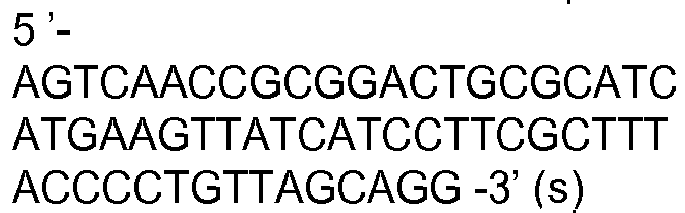
45 ALKO4122 Malbranchea cinnamomea MANP6 52 
46 RF8261 Verticillium dahliae Vd_Man3_for 48 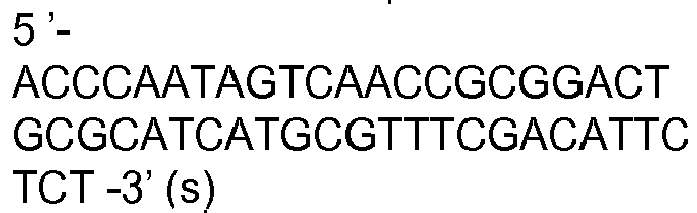
47 RF8261 Verticillium dahliae Vd_Man3_rev 37 
48 RF8261 Verticillium dahliae Vd_Man2_for 47 
49 RF8261 Verticillium dahliae Vd_Man2_rev 38 
50 ALKO4237 Melanocarpus albomyces Ma_man2_for 53 
51 ALKO4237 Melanocarpus albomyces Ma_Man2_rev 39 
52 ALKO4237 Melanocarpus albomyces Ma_Man1for2 47 
53 ALKO4237 Melanocarpus albomyces Ma_Man1rev 41 
54 ALKO4245 Acremonium thermophilum MANP3 60 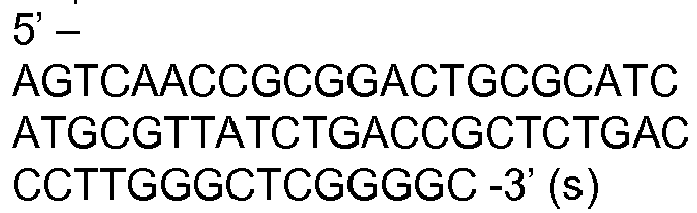
55 ALKO4245 Acremonium thermophilum MANP4 54 
56 (a "s" in the parenthesis = sense strand, "as" = antisense strand. Table 4. The summary on the mannanase encoding genes of Malbranchea cinnamomea ALKO4122, Verticillium dahliae RF8261, Melanocarpus albomyces ALKO4237 and Acremonium thermophilum ALKO4245. Gene Origin Length with introns (bp)(a Coding region (bp)(b No of putative introns Lengths of putative introns (bp) SEQ ID NO man1 M. cinnamomea 1686 1230 4 119, 124, 121, 89 1 man2 V. dahliae 1330 1191 2 65, 71 4 man3 V. dahliae 1388 1203 2 83, 99 7 man5 M. albomyces 1397 1248 2 81, 65 10 man 12M. cinnamomea 1275 1065 3 73, 63, 71 25 man17 M. albomyces 1761 1428 4 63,69, 103, 95 31 man27 A. thermophilum 1360 1137 2 107, 113 34 (a The STOP codon is included
(b The STOP codon is not includedTable 5. The summary of the amino acid sequences deduced from the mannanase encoding gene sequences of Malbranchea cinnamomea ALKO4122, Verticillium dahliae RF8261, Melanocarpus albomyces ALKO4237 and Acremonium thermophilum ALKO4245. Man protein Origin No of aas Length of ss (a CBM Core (aa-aa) Predicted (Da), ss not included (b Predicted pl, ss not included SEQ ID NO Man1 M. cinnamomea 410 18 No 44487 5.37 3 Man2 V. dahliae 397 22 No 41589 4.56 6 Man3 V. dahliae 401 17 No 43488 4.71 9 Man5 M. albomyces 416 20 No 44670 4.51 12 Man12 M. cinnamomea 355 17 No 37959 4.26 27 Man17 M. albomyces 476 22 Yes 143-476 50420 4.42 33 Man27 A. thermophilum 379 18 No 39046 4.86 36 (a The prediction on the signal sequence was made using the program SignalP v3.0, NN/HMM (Nielsen et al., 1997; Nielsen & Krogh, 1998; Bendtsen et al., 2004).
(b The predicted signal sequence was not included. The prediction was made using CloneManager Professional version 9 for Windows, Sci-Ed Software. - The comparison of the deduced mannanase sequences Man1 and Man12 from Malbranchea cinnamomea ALKO4122, Man2 and Man3 from Verticillium dahliae RF8261, Man5 and Man17 from Melanocarpus albomyces ALKO4237 and Man27 from Acremonium thermophilum ALKO4245 to the databases is shown in Table 6.
Table 6. The highest identity sequences to the deduced Man1, Man2, Man3 Man5, Man12, Man17 and Man27 amino acid sequences from Malbranchea cinnamomea ALKO4122, Verticillium dahliae RF8261, Melanocarpus albomyces ALKO4237 andAcremonium thermophilum ALKO4245. The full-length amino acid sequences including the signal sequences were aligned. The database searches were performed at https:Hwww.ebi.ac.uk/Tools/sss/ncbiblast/https://www.ebi.ac.uk/Tools/psa/emboss_needle/ using NCBI BLAST+ (EMBL-EBI, NCBI BLAST+ - Sequence Similarity Search, UniProt Knowledgebase, BLOSUM62, Gap open 11, Gap extend 1), and EMBOSS Needle (EMBL-EBI, EMBOSS-Needle - Pairwise Sequence Alignment, BLOSUM62, Gap open 10, Gap extend 0.5) for determining the degree of identity. Searches were also performed with https://usgene.sequencebase.com/ using Matrix PAM30, Gap open 9 and Gap extend 1. Organism and accession number Identity (%) Man1 78.9 Aspergillus terreus, Q0C8J3 (1 99.5 Malbranchea cinnamomea, BBN39104 (2 Man2 100 Verticillium dahliae, G2XHW3_VERDV (1 63.4 Myriococcum thermophilum, BBA64714 (2 Man3 100 Verticillium dahliae, G2XBE5_VERDV (VDAG_07477) (1 Aspergillus terreus, BBW96507 (2 69.4 Man5 99.3 Chaetomium sp. CQ31, G9BZJ2_9PEZI (1 99.3 Chaetomium sp., BAL41820 (2 Man12 46.1 Pseudogymnoascus sp, A0A1B8DBN0_9PEZI (1100 Malbranchea cinnamomea, BBN39199 (2 Man17 81.5 Madurella mycetomatis, A0A175W047_9PEZI (1 99.8 Melanocarpus albomyces, BDB24260 (2 Man27 75.5 Coniochaeta ligniaria, A0A1J7JVW4_9PEZI (1100 Acremonium thermophilum, BDB18590 (2 (1 Search performed using NCBI BLAST+ (EMBL-EBI, NCBI BLAST+ - Sequence Similarity Search, UniProt Knowledgebase, BLOSUM62, Gap open 11, Gap extend 1), and EMBOSS Needle (EMBL-EBI, EMBOSS-Needle - Pairwise Sequence Alignment, BLOSUM62, Gap open 10, Gap extend 0.5) for determining the degree of identity.
(2 Search performed with SequenceBase database https://usgene.sequencebase.com/ - Standard molecular biology methods were used in the isolation and enzyme treatments of DNA (e.g. isolation of plasmid DNA, digestion of DNA to produce DNA fragments), in E. coli transformations, sequencing etc. The basic methods used were either as described by the enzyme, reagent or kit manufacturer or as described in the standard molecular biology handbook, e.g. Sambrook and Russell (2001). Isolation of genomic DNA was performed as described in detail by Raeder and Broda (1985). Man8, man9,
man 10, man11, man13, man29 and man30 from Acremonium alcalophilum, Fusarium equiseti RF6318, Acremonium thermophilum ALKO4245, Verticillium dahliae RF8261,Aspergillus nishimurae RH3949, Plectosphaerella cucmerina and Gymnascella citrina respectively, were ordered from GenScript as synthetic constructs without introns and with codon optimization for Trichoderma reesei. - Plasmid DNAs obtained from GenScript including the genes man8, man9, man10, man11, man13, man29 and man30 were re-suspended in sterile water, digested with Sacll and BamHI restriction enzymes (Thermo Fisher Scientific) according to manufacturer's instructions and cloned into an expression vector cleaved with Sacll and BamHI. Ligation mixtures were transformed into Escherichia coli XL1-Blue (AH Diagnostics) and plated on LB (Luria-Bertani) plates containing 50-100 µg/ml ampicillin. Several E. coli colonies were collected from the plates and DNA was isolated with GenJet Plasmid Miniprep Kit (Thermo Fisher Scientific). Positive clones were screened using restriction digestions and they were shown to contain inserts of expected sizes. The full-length genes encoding the Acremonium alcalophilum man8, Fusarium equiseti man9, Acremonium thermophilum man10 and Verticillium dahliae man11 mannanases, and fusion sites to the expression plasmid of Aspergillus nishimurae man13, Plectosphaerella cucumerina man29 and Gymnascella citrina man30 mannanase genes were sequenced and the plasmids were named pALK4363, pALK4091, pALK4084, pALK4090, pALK4413, pALK4411 and pALK4412 respectively (For details see Example 4). The plasmid DNAs including the aforementioned genes delivered by GenScript were also transformed into XL10-Gold E. coli cells (Agilent) and deposited into DSMZ strain collections. The relevant information on the genes and the deduced amino protein sequences (SEQ ID NOs: 14, 17, 20, 23, 29, 38 and 41) are summarized in Table 7 and Table 8, respectively. The E. coli strains RF12388, RF12389, RF12390, RF12391, RF12392 and RF12393 including the plasmids pALK4443, pALK4444, pALK4445, pALK4446, pALK4447 and pALK4448, respectively were deposited to the DSM collection under the accession numbers DSM 32434, DSM 32435, DSM 32436,DSM 32437, DSM 32438 and DSM 32439 respectively.
Table 7. The summary on the mannanase encoding synthetic genes designed based on sequences obtained from Acremonium alcalophilum, Fusarium equiseti RF6318, Acremonium thermophilum ALKO4245, Verticillium dahliae RF8261, Aspergillus nishimurae RH3949, Plectosphaerella cucumerina and Gymnascella citrina. Gene Length without introns (bp)(a SEQ ID NO man8 1410 14 man9 1341 17 man10 1251 20 man11 1479 23 man13 1131 29 man29 1206 38 man30 1236 41 (a The STOP codon is included Table 8. The summary of the amino acid sequences deduced from the mannanase encoding gene sequences from Acremonium alcalophilum, Fusarium equiseti RF6318, Acremonium thermophilum ALKO4245, Verticillium dahliae RF8261, Aspergillus nishimurae RH3949, Plectosphaerella cucumerina and Gymnascella citrina. Man protein No of aas Length of ss (a CBM Core (aa-aa) Predicted (Da), ss not included (b Predicted pl, ss not included (b SEQ ID NO Man8 469 21 Yes 22-392 49497 4.36 15 Man9 446 18 Yes 19-387 47728 5.05 18 Man10 416 19 No 44403 4.97 21 Man11 492 19 Yes 20-401 51903 5.16 24 Man13 376 21 No 39351 5.09 30 Man29 401 18 No 43738 4.55 39 Man30 411 18 No 44747 5.83 42 (a The prediction on the signal sequence was made using the program SignalP v3.0, NN/HMM (Nielsen et al., 1997; Nielsen & Krogh, 1998; Bendtsen et al., 2004).
(b The predicted signal sequence was not included. The prediction was made using CloneManager Professional version 9 for Windows, Sci-Ed Software. - The comparison of the deduced mannanase sequences Man8, Man9, Man10, Man11, Man13, Man29 and Man30 from Acremonium alcalophilum, Fusarium equiseti RF6318, Acremonium thermophilum ALKO4245, Verticillium dahliae RF8261, Aspergillus nishimurae RH3949, Plectosphaerella cucumerina and Gymnascella citrina respectively, to the databases is shown in Table 9.
Table 9. The highest identity sequences to the deduced Man8, Man9, Man10, Man11, Man13, Man29 and Man30 amino acid sequences from Acremonium alcalophilum, Fusarium equiseti RF6318, Acremonium thermophilum ALKO4245, Verticillium dahliae RF8261, Aspergillus nishimurae RH3949, Plectosphaerella cucumerina and Gymnascella citrina. The full-length amino acid sequence including the signal sequenceswere aligned. The database searches were performed at https://www.ebi.ac.uk/Tools/sss/ncbiblast/ and https://www.ebi.ac.uk/Tools/psa/emboss_needle/ using NCBI BLAST+ (EMBL-EBI, NCBI BLAST+ - Sequence Similarity Search, UniProt Knowledgebase, BLOSUM62, Gap open 11, Gap extend 1), and EMBOSS Needle (EMBL-EBI, EMBOSS-Needle - Pairwise Sequence Alignment, BLOSUM62, Gap open 10, Gap extend 0.5) for determining the degree of identity. Searches were also performed with https://usgene.sequencebase.com/ using Matrix PAM30, Gap open 9 and Gap extend 1. Organism and accession number Identity (%) Man8 Verticillium longisporum, A0A0G4LAG4_9PEZI (1 69.0 Nectria haematococca, BBX16347 (2 67.7 Man9 Fusarium langsethiae, A0A0M9ES31_9HYPO (1 92.2 Fusarium graminearum, CEF88482.1 (2 91.1 Man10 Coniochaeta ligniaria, A0A1J7I5A7_9PEZI (1 69.6 Thielavia australiensis, BBN39719 (2 67.0 Man11 Verticillium longisporum, A0A0G4MTC5_9PEZI (1 99.8 Nectria haematococca, BBX16347 (2 64.7 Man13 Aspergillus udagawae, AOAOK8LCG6_9EURO (1 90.7 Neosartorya fischeri, BBX16429 (2 87.8 Man29 Verticillium dahliae, G2XBE5_VERDV (1 79.4 Aspergillus terreus, BBW96507 (2 66.9 Man30 Aspergillus calidoustus, A0A0U5GVM4_9EURO (1 77.4 Malbranchea cinnamomea, BBN39104 (2 88.6 (1 Search performed using NCBI BLAST+ (EMBL-EBI, NCBI BLAST+ - Sequence Similarity Search, UniProt Knowledgebase, BLOSUM62, Gap open 11, Gap extend 1), and EMBOSS Needle (EMBL-EBI, EMBOSS-Needle - Pairwise Sequence Alignment, BLOSUM62, Gap open 10, Gap extend 0.5) for determining the degree of identity.
(2 Search performed with SequenceBase database https://usgene.sequencebase.com/ - Expression plasmids were constructed for production of recombinant mannanase Man1, Man2, Man3, Man5, Man8, Man9, Man10, Man11, Man12, Man13, Man17, Man27, Man29 and Man30 from Malbranchea cinnamomea ALKO4122, Verticillium dahliae RF8261, Melanocarpus albomyces ALKO4237, Acremonium alcalophilum, Fusarium equiseti RF6318, Acremonium thermophilum ALKO4245, Verticillium dahliae RF8261, Aspergillus nishimurae RH3949, Plectosphaerella cucumerina and Gymnascella citrina (See Examples 2, 3), respectively in Trichoderma reesei. The expression plasmids constructed are listed in Table 10. The recombinant mannanase genes , including their own signal sequences, were fused to the T. reesei cel7A/cbh1 promoter. The transcription termination was ensured by the T. reesei cel7A/cbh1 terminator and the A. nidulans amdS marker gene was used for selection of the transformants as described in Paloheimo et al. (2003). The linear expression cassettes (
Fig. 1 ) were isolated from the vector backbones after NotI or EcoRI digestions and were transformed into T. reesei protoplasts. The host strains used, do not produce any of the four major T. reesei cellulases (CBHI, CBHII, EGI, EGII). The transformations were performed as in Penttilä et al. (1987) with the modifications described in Karhunen et al. (1993), selecting acetamidase as a sole nitrogen source (amdS marker gene). The transformants were purified on selection plates through single conidia prior to sporulating them on PD.Table 10. The expression cassettes constructed to produce Man1, Man2, Man3, Man5, Man8, Man9, Man10, Man11, Man12, Man13, Man17, Man27, Man29 and Man30 recombinant proteins from Malbranchea cinnamomea ALKO4122, Verticillium dahliae RF8261, Melanocarpus albomyces ALKO4237, Acremonium alcalophilum, Fusarium equiseti RF6318, Acremonium thermophilum ALKO4245,, Aspergillus nishimurae RH3949, Plectosphaerella cucumerina and Gymnascella citrina in Trichoderma reesei. The overall structure of the expression cassettes was as described in Fig. 1. Mannanase protein Expression plasmid Expression cassette (a Man1 pALK4073 7.0 kb NotI Man3 pALK4071 6.7 kb NotI Man5 pALK4081 6.8 kb NotI Man8 pALK4363 6.8 kb NotI Man9 pALK4091 6.7 kb NotI Man10 pALK4084 6.6 kb NotI Man11 pALK4090 6.8 kb NotI Man12 pALK4271 6.6 kb NotI Man13 pALK4413 6.5 kb NotI Man17 pALK4080 7.1 kb EcoRI Man27 pALK4270 6.7 kb NotI Man29 pALK4411 6.6 NotI Man30 pALK4412 6.6 NotI (a The expression cassette for T. reesei transformation was isolated from vector backbone by using NotI or EcoRI digestions. - The mannanase production of the transformants was analyzed from the culture supernatants of the shake flask cultivations. The transformants were inoculated from the PD slants to shake flasks containing 50 ml of complex lactose-based cellulase inducing medium (Joutsjoki at al. 1993) buffered with 5% KH2PO4. The mannanase protein production of the transformants was analyzed from culture supernatants after growing them for 7 days at 30 °C, 250 rpm. Heterologous production of recombinant proteins was analyzed by SDS-PAGE with subsequent Coomassie staining. The best producing transformants were chosen to be cultivated in laboratory scale bioreactors. The transformants were cultivated in bioreactors either on batch or by additional feeding type of process under protein inducing conditions at a typical mesophilic fungal cultivation temperature and slightly acidic conditions. The cultivation was continued until depletion of the medium sugars or until suitable yield was reached. The supernatants were recovered for application tests by centrifugation or by filtration.
- Cells and solids were removed from the fermentation culture medium by centrifugation for 10 min, 4000 g at 4°C. The supernatant of 10 ml was used for protein purification. The sample was filtered through 0.44 µm PVDF membrane (Millex-HV, Merck Millipore Ltd,Carrigtwohill, IRL). The filtrate was loaded onto a HiPrep 26/10 Desalting column (GE Healthcare, Uppsala, Sweden) equilibrated in 20
mM Tris pH 7. The desalted sample was then loaded onto a 5 ml HiTrap Q HP column (GE Healthcare, Uppsala, Sweden) pre-equilibrated with 20mM Tris pH 7. After sample loading, the column was washed with the same buffer for 20 ml. Proteins were eluted withlinear salt gradient 20 mM Tris, 500mM NaCl pH 7 in 15 CVs. Fractions of 5 ml were collected and analyzed on SDS-PAGE. The fractions containing target protein were combined and concentrated to 2ml using Vivaspin mM NaCl pH Table 11. Mannanase Buffers used in ion exchange chromatography Man1 20 mM Tris pH 7Man3 20 mM MES pH 6Man5 20 mM Hepes pH 7Man8 20 mM MES pH 6Man9 20 mM MES pH Man10 20 mM MES pH Man11 20 mM MES pH 6Man12 20 mM MES pH 6Man13 20 mM MES pH Purified samples were above 95% pure. - The pH profiles of purified mannanases were determined using the beta-mannazyme tablet assay Azurine-crosslinked carob galactomannan (T-
MNZ 11/14) from Megazyme with minor modifications to suggested protocol. The linearity of the assay was checked with each purified enzymes. The assay was performed in 40 mM Britton-Robinson buffer adjusted to pH values between 4 and 11. The enzyme solution was diluted into the assay buffer and 500µl of enzyme solution was equilibrated at 50°C water bath for 5 min before adding one substrate tablet. After 10 minutes, the reaction was stopped by adding 10ml 2% Tris pH 12. The reaction tubes were left at room temperature for 5 min, stirred and the liquid filtered through a Whatman No.1 paper filter. Release of blue dye from the substrate was quantified by measuring the absorbance at 595 nm. Enzyme activity at each pH was reported as relative activity where the activity at the pH optimum was set to 100%. The pH profiles were shown inFigures 4a and4b . Relative activity (%) of mannanase is calculated by dividing mannanase activity of a sample by the mannanase activity of a reference sample. In the case of pH profile, the reference sample is a sample at the optimal pH. In the case of temperature profile the reference sample is a sample at the optimal temperature. - The temperature optimum of purifed mannanases was determined using the beta-mannazyme tablet assay Azurine-crosslinked carob galactomannan (T-
MNZ 11/14) from Megazyme with minor modifications to suggested protocol. The assay was performed at temperatures varying between 30-90°C for 10 minutes in 40 mM Britton-Robinson buffer pH7. Enzyme activity was reported as relative activity where the activity at temperature optimum was set to 100%. The temperature profiles were shown inFigures 2-3 . Molecule weight determined in SDS PAGE gel, temperature and pH optimum of enzymes are shown in Table 12.Table 12 MW SDS PAGE pH optimum Temperature optimum Man1 40-60 kDa 5-7 50°C - 60°C Man3 40-60 kDa 5-8 40°C - 60°C Man5 40-60 kDa 5-8 50°C - 70°C Man8 50-70 kDa 6-9 40°C - 60°C Man9 50-70 kDa 5-9 40°C - 60°C Man10 45-60 kDa 5-8 50°C - 70°C Man11 50-90 kDa 5-8 50°C - 70°C Man12 30-40 kDa 4-8 50°C - 70°C - Mannanase activity (MNU) was measured as the release of reducing sugars from galactomannan (0.3 w/w-%) at 50°C and pH 7.0 using 5 min reaction time. The amount of released reducing carbohydrates was determined spectrophotometrically using dinitrosalicylic acid. Substrate (0,3 w/w-%) used in the assay was prepared as follows: 0.6 g of locust bean gum (Sigma G-0753) was blended in 50 mM sodium citrate buffer pH 7 (or citrate phosphate buffer pH 7) at about 80 °C using a heating magnetic stirrer and heated up to boiling point. The solution was cooled and let to dissolve overnight in a cold room (2 - 8 °C) with continuous stirring after which insoluble residues were removed by centrifugation. After that solution was filled up to 200 ml volume with the buffer. Substrate was stored as frozen and melted by heating in a boiling water bath to about 80 °C, cooled to room temperature and mixed carefully before use. DNS reagent used in the assay was prepared by dissolving 50 g of 3.5- dinitrosalisylic acid (Sigma D-550) in about 4 liter of water. With continuous magnetic stirring 80.0 g of NaOH was gradually added and let to dissolve. An amount of 1500 g of Rochelle Salt (K-Na-tartrate, Merck 8087) was added in small portions with continuous stirring. The solution that might have been cautiously warmed to a maximum temperature of 45 °C., was cooled to room temperature and filled up to 5000 ml. After that it was filtered through
Whatman 1 filter paper and stored in a dark bottle at room temperature. The reaction was started by adding 1.8 ml of substrate solution to two test tubes and let to equilibrate at 50 °C for 5 minutes, after which 200 µl of suitably diluted enzyme solution was added to one of the tubes, mixed well with vortex mixer and incubated exactly for 5 min at 50 °C. Enzyme blanks didn't need to be equilibrated or incubated. The reaction was stopped by adding 3.0 ml of DNS reagent into both tubes and mixed. 200 µl of sample solution was added to the enzyme blank tubes. Both tubes were placed in a boiling water bath. After boiling for exactly 5 minutes, the tubes were placed in a cooling water bath and allowed to cool to room temperature. The absorbance of sample was measured against the enzyme blank at 540 nm and activity was read from the calibration curve and multiplied by the dilution factor. A suitable diluted sample yielded an absorbance difference of 0.15 - 0.4. Standard curve was prepared from 20 mM mannose stock solution by dissolving 360 mg of mannose (SigmaM-6020, stored in a desiccator) to 100 ml of assay buffer and diluted to solutions containing 3, 6, 10 and 14 µmol/ml of mannose. Standards were handled like the samples except for incubation at 50°C. The absorbances were measured against the reagent blank (containing buffer instead of mannose) at 540nm. A calibration curve was prepared for every series of assays. One mannanase unit (MNU) was defined as the amount of enzyme that produces reductive carbohydrates having a reductive power corresponding to one nmol of mannose from galactomannan in one second under the assay conditions (1 MNU = 1 nkat). - Cultivation samples of fungal mannanases (Man1, Man3, Man5, Man8, Man9, Man10, Man11, Man12,Man13, Man29 and Man30) produced in Trichoderma (as described in Example 4), were tested for their ability to remove mannanase sensitive standard stains at 40 °C and water hardness of 16°dH with commercial detergents without bleaching agents. The following artificially soiled test cloths from Center for testmaterial B.V. (the Netherlands) were used withMan1, Man3, Man5, Man8, Man9, Man10, Man11, Man12 and Man13 cultivation samples: Chocolate pudding mannanase sensitive on cotton (E-165), Locust bean gum, with pigment on cotton (C-S-73) and Guar gum with carbon black on cotton (C-S-43). With Man29 and Man30 cultivation samples stains E-165 and C-S-73 were used. The fabric was cut in 6 cm x 6 cm swatches and 2 pieces of each were used in test. Commercial heavy duty liquid detergent A containing all other enzymes except mannanase was used at concentration of 4.4 g per liter of wash liquor, commercial heavy duty liquid detergent B was used 5.0 g/l and commercial color detergent powder without enzymes was used at 3.8 g/l. Detergent containing wash liquors we prepared in synthetic tap water with hardness of 16 °dH. Protease Savinase® 16 L (0.5 w/w %) and amylase Stainzyme® 12 L (0.4 w/w %) was added into hard water used with commercial heavy duty liquid detergent B and commercial color detergent powder. The liquid detergent already contained amylase and protease. The pH of the wash liquor of Color detergent powder was approx. 10 and with the liquid detergent approx. 8.2 - 8.3. Mannanase dosages were in range 0 - 0.4 % of detergent weight, the amount depending on test and the strength of enzyme preparation. For the evaluation the dosages were calculated as enzyme activity units (MNU) per ml wash liquor. Activity was measured as described in Example 6. Control sample contained the detergent solution but no mannanase.
- For synthetic tap water with hardness of 16 °dH the following stock solutions were prepared in deionized water (Milli-Q or equivalent):
- Stock solution with 1000 °d Calcium-hardness: CaCl2 x 2 H2O (1.02382.1000, Merck KGaA, Germany) 26,22 g/l
- Stock solution with 200 °d Magnesium-hardness: MgSO4 x 7 H2O (1.05886.1000, Merck KGaA, Germany) 8,79 g/l H2O
- NaHCO3 stock solution: NaHCO3 (1.06329.1000 Merck KGaA, Germany) 29,6 g/l
- Fungal mannanases Man1, Man3 and Man5 produced in Trichoderma (as described in Example 4) were tested for their ability to remove mannanase sensitive standard stains at 40 °C and water hardness of 16°dH with commercial bleach detergent powder. Test system was similar to that described in Example 7, except commercial bleach detergent powder was used at concentration of 4,2 g per liter of wash liquor and pH of the wash liquor was approx. 9.5. Protease Savinase® 16 L (0.5 w/w %) and amylase Stainzyme® 12 L (0.4 w/w %) were added into hard water used in test, since the detergent didn't contain any enzymes. The color of the swatches after treatment was measured and results calculated as sum of ΔL* of each 3 stains as described in Example 7. The results obtained with commercial bleach containing detergent (
Fig. 12 ) show that mannanases Man1, Man3 and Man5 increased the stain removal efficiency considerably. In previous tests also cultivations samples of Man8, Man9 and Man11 and Man12 were performing with bleach detergent (data not shown). - The stability of Man1 preparation produced in Trichoderma (as described in Example 4) was tested in OMO Color liquid obtained from local super market and compared to commercial mannanase
preparation Mannaway® Fig. 13 ) show that Man1 had considerably better stability compared to Mannaway® 4.0 L. The results of the stability experiments show that the mannanase according to the invention was stable in detergents for several weeks even when stored at high temperature like 37°C. The stability of the mannanase according to the invention (Man1) in liquid detergent is considerably improved compared to a commercial bacterial mannanase. - The wash performance of liquid detergent compositions according to present invention was determined by using standardized stains obtainable from CFT (Center for Testmaterials) B.V., Vlaardingen, Netherlands ("CFT"), Eidgenössische Material- und Prüfanstalt Testmaterialien AG [Federal materials and testing agency, Testmaterials], St. Gallen, Switzerland ("EMPA"), Warwick Equest Ltd Unit 55, Consett Business Park, Consett, County Durham ("Equest").
- A liquid washing agent with the following composition was used as base formulation (all values in weight percent):
Chemical name Active substance raw material [%] Active substance detergent formulation [%] Water demin. 100 Rest Alkyl benzene sulfonic acid 96 2-7 Anionic surfactants 70 6-10 C12-C18 Fatty acid sodium salt 30 1-4 Nonionic surfactants 100 4-7 Phosphonates 40 0,1-2 Citric acid 100 1-3 NaOH 50 1-4 Boronic acid 100 0,1-2 Antifoaming agent 100 0,01-1 Glycerol 100 1-3 Enzymes 100 0,1-2 Preserving agent 100 0,05-1 Ethanol 93 0,5-2 Optical brightener 90 0,01-1 Perfume 100 0,1-1 Dye 100 0,001-0,1 - The pH of the detergent composition was between 8,2-8,6.
- Based on this base formulation, liquid detergent compositions 1 - 3 were prepared by adding respective enzymes as indicated below:
- Composition 1: Enzyme according to SEQ ID NO: 3 (Man 1)
- Composition 2: Enzyme according to SEQ ID NO: 9 (Man 3)
- Composition 3: Enzyme according to SEQ ID NO: 12 (Man 5)
- The wash was performed as follows according to the AISE Method: 3,5 kg Clean ballast cloth, 4 SBL Cloths, Miele washing machine, 20°C and 40°C Short program. All mannanases were added in the same amounts based on total protein content.
- The dosing ratio of the liquid washing agent was 4.0 grams per liter of washing liquor. The washing procedure was performed for 60 minutes at a temperature of 20°C and 40°C, the water having a water hardness between 15.5 and 16.5° (German degrees of hardness).
- The results obtained are the difference values between the remission units obtained with the detergents and the remission units obtained with the detergent containing the commercially available reference mannanase (Mannaway 4.0L, obtained from Novozymes). A positive value therefore indicates an improved wash performance of the detergent compositions comprising the mannanases of present invention compared to the same detergent composition comprising the reference mannanase. Within the washing test a large range of stains were tested.
- The whiteness, i.e. the brightening of the stains, was determined photometrically as an indication of wash performance. A Minolta CM508d spectrometer device was used, which was calibrated beforehand using a white standard provided with the unit.
- The results obtained are the difference values between the remission units obtained with the detergents and the remission units obtained with the detergent containing the enzyme combinations. A positive value therefore indicates an improved wash performance due to the enzyme combinations present in the detergent. Mannanases of the present invention in detergent compositions show improved performance on a variety of mannan comprising stains.
Table 13 Stain Man1 Man3 Man5 Chocolate creme (EMPA 160 [CO]) n.d. 1,5 1,5 Starch/Pigment (WFK 10R [CO]) n.d. 0,6 1,3 Black currant juice (CFT CS12 [CO]) 1,0 0,9 2,5 Groundnutoil, pigments, high milk (CFT C10 [CO]) n.d. 0,9 1,0 Blood (aged) (CFT CS01 [CO]) n.d. 1,5 1,1 Chocolate Icecream L [CO] (EQUEST) n.d. n.d. 1,2 Cocoa [CO] (EQUEST) 0,9 1,3 n.d. - The wash performance of powder detergent compositions according to present invention was determined by using standardized stains obtainable from CFT (Center for Testmaterials) B.V., Vlaardingen, Netherlands ("CFT"), Eidgenössische Material- und Prüfanstalt Testmaterialien AG [Federal materials and testing agency, Testmaterials], St. Gallen, Switzerland ("EMPA"), Warwick Equest Ltd Unit 55, Consett Business Park, Consett, County Durham ("Equest").
- A solid washing agent with the following composition was used as base formulation (all values in weight percent):
Chemical Name Active substance raw material [%] Active substance detergent formulation [%] Water demin. 100 1-4 Alkyl benzene sulfonic acid 97 9-13 Nonionic surfactants 100 4-7 Percarbonates 88 9-13 TAED 92 1-5 Phosphonates 60 0,1-3 Polyacrylates 45 1-4 Soduim silicate 40 5-10 Sodium carbonate 100 18-22 Carboxymethylcellulose 69 1-4 Soil release polymer 100 0,1-1 Optical brightener 70 0,1-1 Antifoaming agent t.q. 0,01-1 Sodium sulfate 100 22-30 Enzymes 100 0,1-1 Perfume 100 0,1-1 NaOH 100 0,1-1 Rest - 1-4 - Based on this base formulation,
solid detergent compositions - Composition 4: Enzyme according to SEQ ID NO: 3 (Man1)
- Composition 5: Enzyme according to SEQ ID NO: 12 (Man5)
- The wash was performed as follows according to the AISE Method: 3,5 kg Clean ballast cloth, 4 SBL Cloths, Miele washing machine, 20°C and 40°C Short program. All mannanases were added in the same amounts based on total protein content.
- The dosing ratio of the powder washing agent was 3.8 grams per liter of washing liquor. The washing procedure was performed for 60 minutes at a temperature of 20°C and 40°C, the water having a water hardness between 15.5 and 16.5° (German degrees of hardness). The whiteness, i.e. the brightening of the stains, was determined photometrically as an indication of wash performance. A Minolta CM508d spectrometer device was used, which was calibrated beforehand using a white standard provided with the unit.
- The results obtained are the difference values between the remission units obtained with the detergents and the remission units obtained with the detergent containing the reference mannanase (Mannaway 4.0L, obtained from Novozymes). A positive value therefore indicates an improved wash performance of the mannanases in the detergent. Mannanases of the invention show improved performance on several stains in table 14. Therefore, it is evident from table 14 that mannanases according to the invention show improved wash performance.
Table 14 Stain Man1 Man5 Milk/Carbon black (H-MR-B [CO]) n.d. 1,4 Pudding (EMPA 165 [CO]) 0,6 1,6 Porridge (EMPA 163 [CO]) n.d. 0,5 Sebum BEY with carbon black (CFT CS32 [CO]) n.d. 0,7 Lipstick, diluted, Red (CFT CS216 [CO]) n.d. 0,9 Chocolate drink, pure (CFT CS44 [CO]) n.d. 1,4 Groundnutoil, pigments, high milk (CFT C10 [CO]) 0,6 1,6 Salad dressing, with natural black (CFT CS06 [CO]) n.d. 0,5 - Without limiting the scope and interpretation of the patent claims, certain technical effects of one or more of the aspects or embodiments disclosed herein are listed in the following: A technical effect is degradation or modification of mannan. Another technical effect is provision of mannanase which has good storage stability.
- The foregoing description has provided by way of non-limiting examples of particular implementations and embodiments of the invention a full and informative description of the best mode presently contemplated by the inventors for carrying out the invention. It is however clear to a person skilled in the art that the invention is not restricted to details of the embodiments presented above, but that it can be implemented in other embodiments using equivalent means without deviating from the characteristics of the invention.
- Furthermore, some of the features of the above-disclosed aspects and embodiments of this invention may be used to advantage without the corresponding use of other features. As such, the foregoing description should be considered as merely illustrative of the principles of the present invention, and not in limitation thereof. Hence, the scope of the invention is only restricted by the appended patent claims.
- In an embodiment at least one component of the compositions of the invention has a different chemical, structural or physical characteristic compared to the corresponding natural component from which the at least one component is derived from. In an embodiment said characteristic is at least one of uniform size, homogeneous dispersion, different isoform, different codon degeneracy, different post-translational modification, different methylation, different tertiary or quaternary structure, different enzyme activity, different affinity, different binding activity, and different immunogenicity


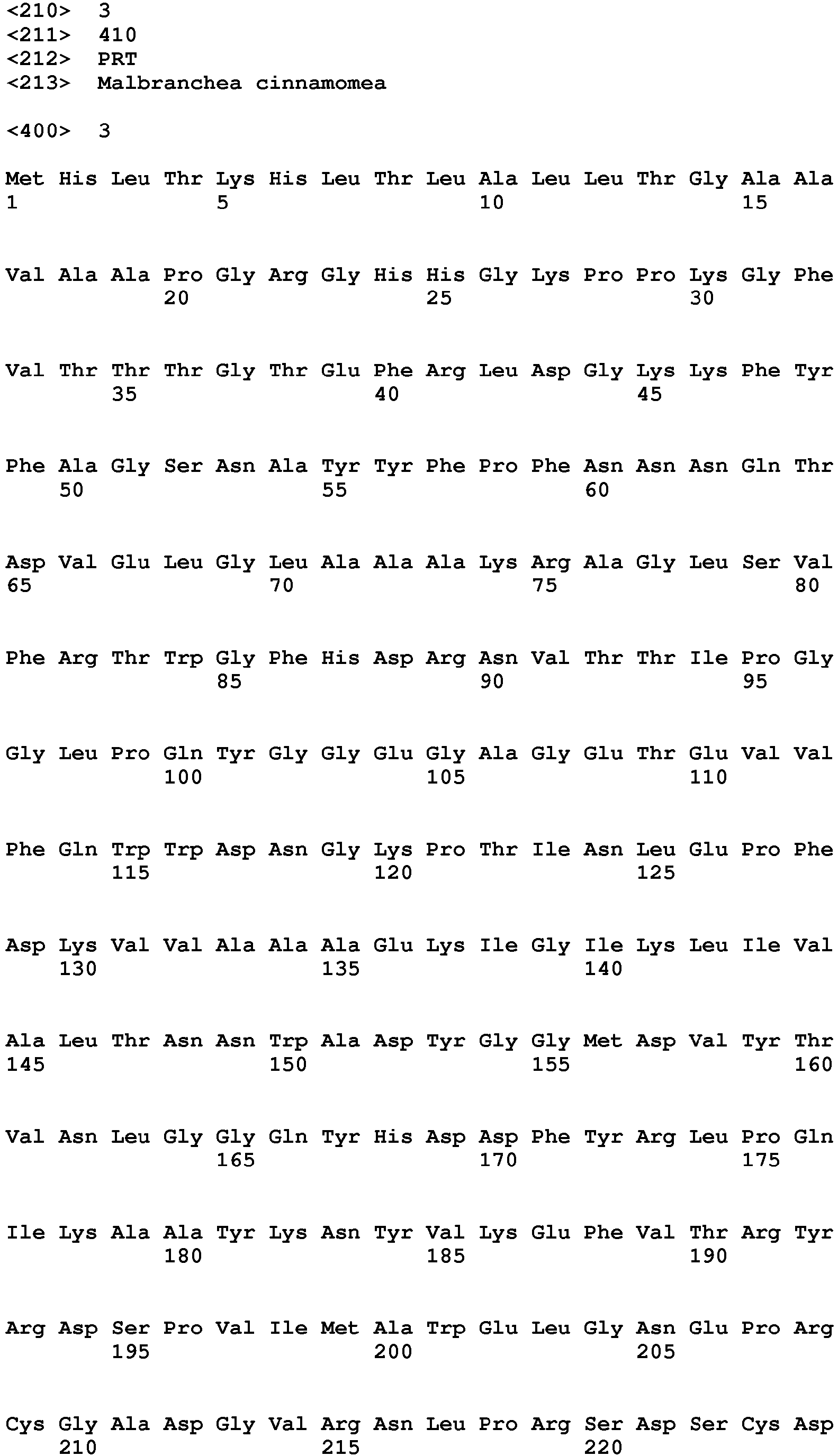

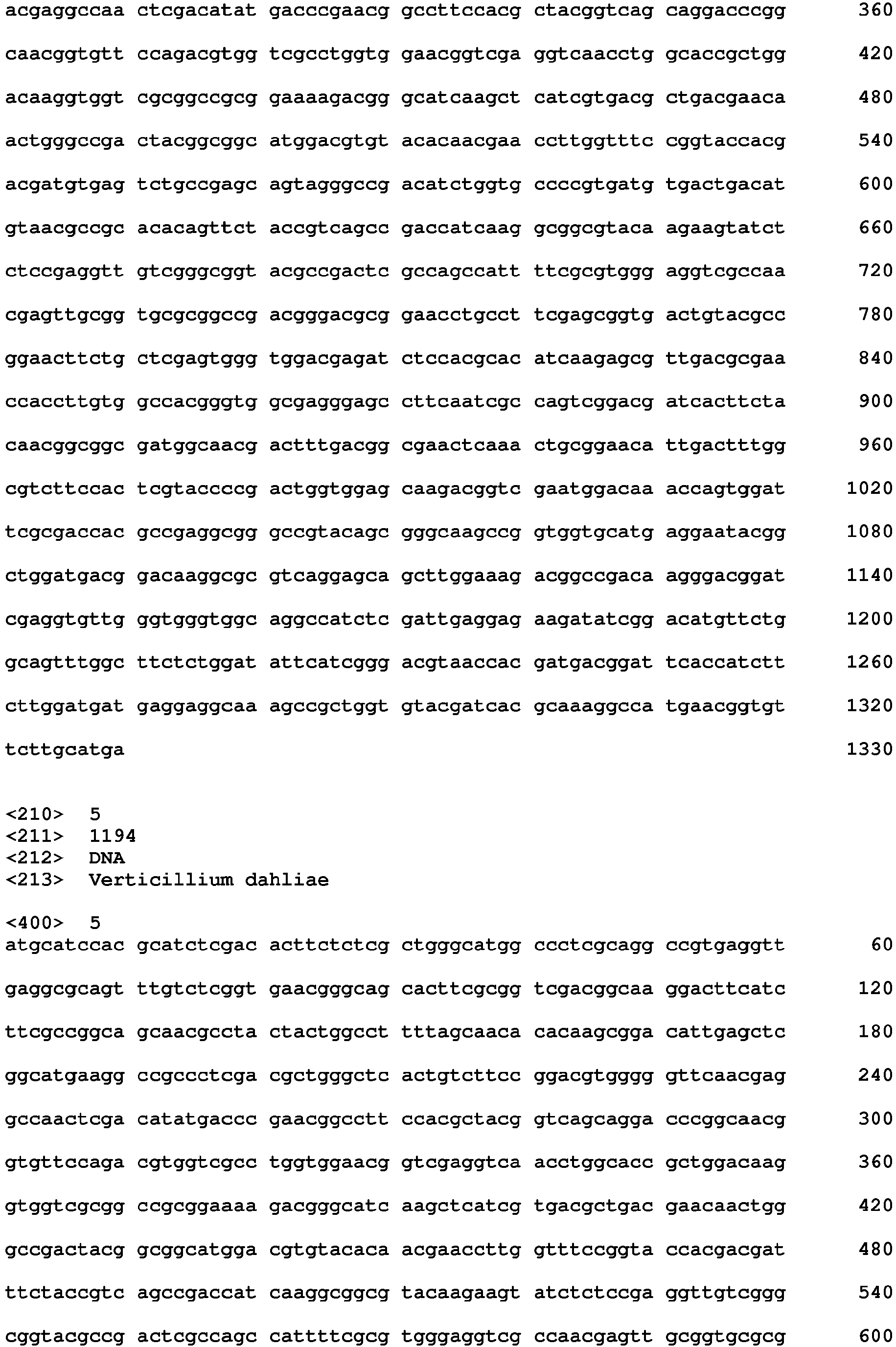
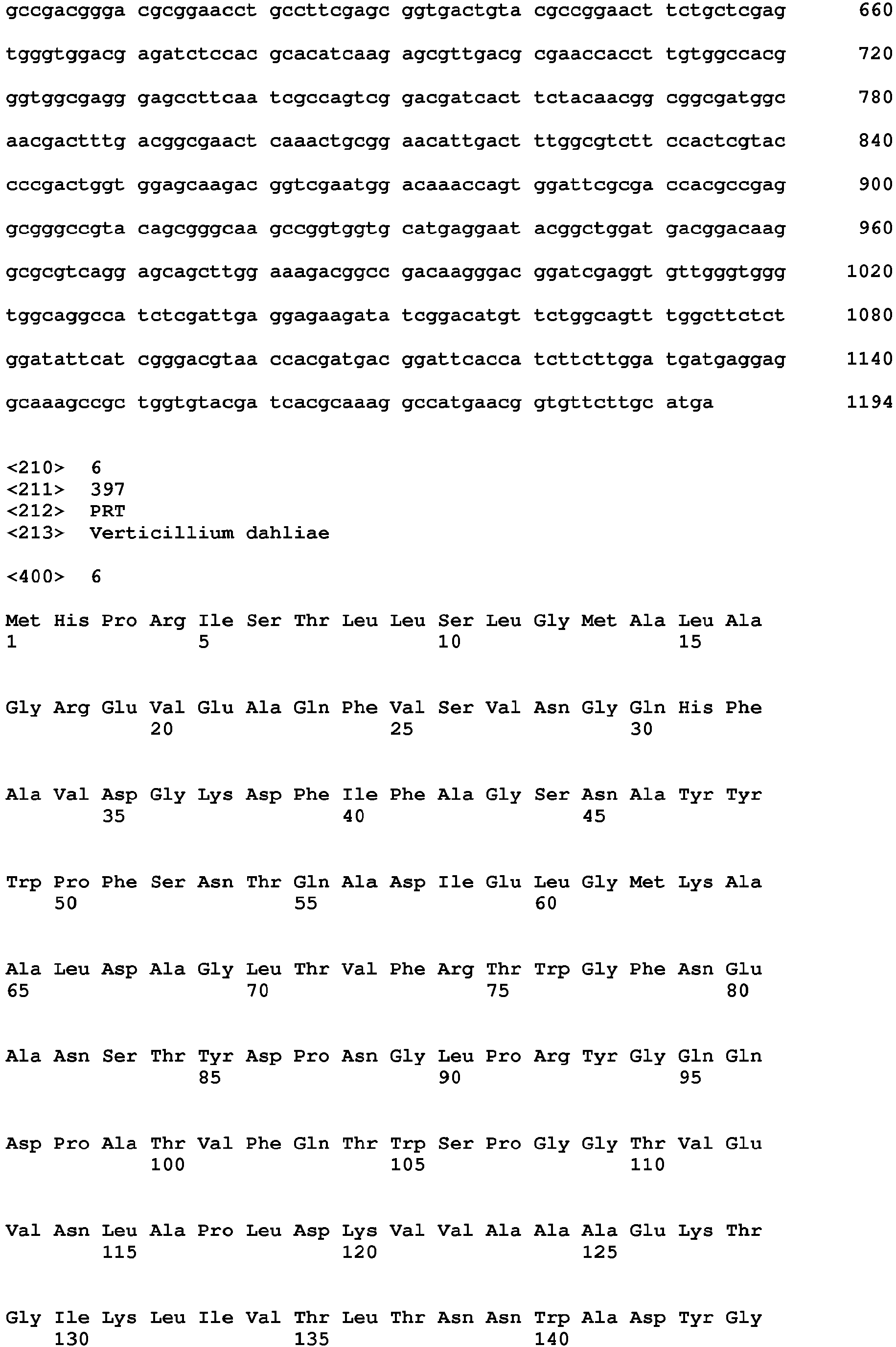


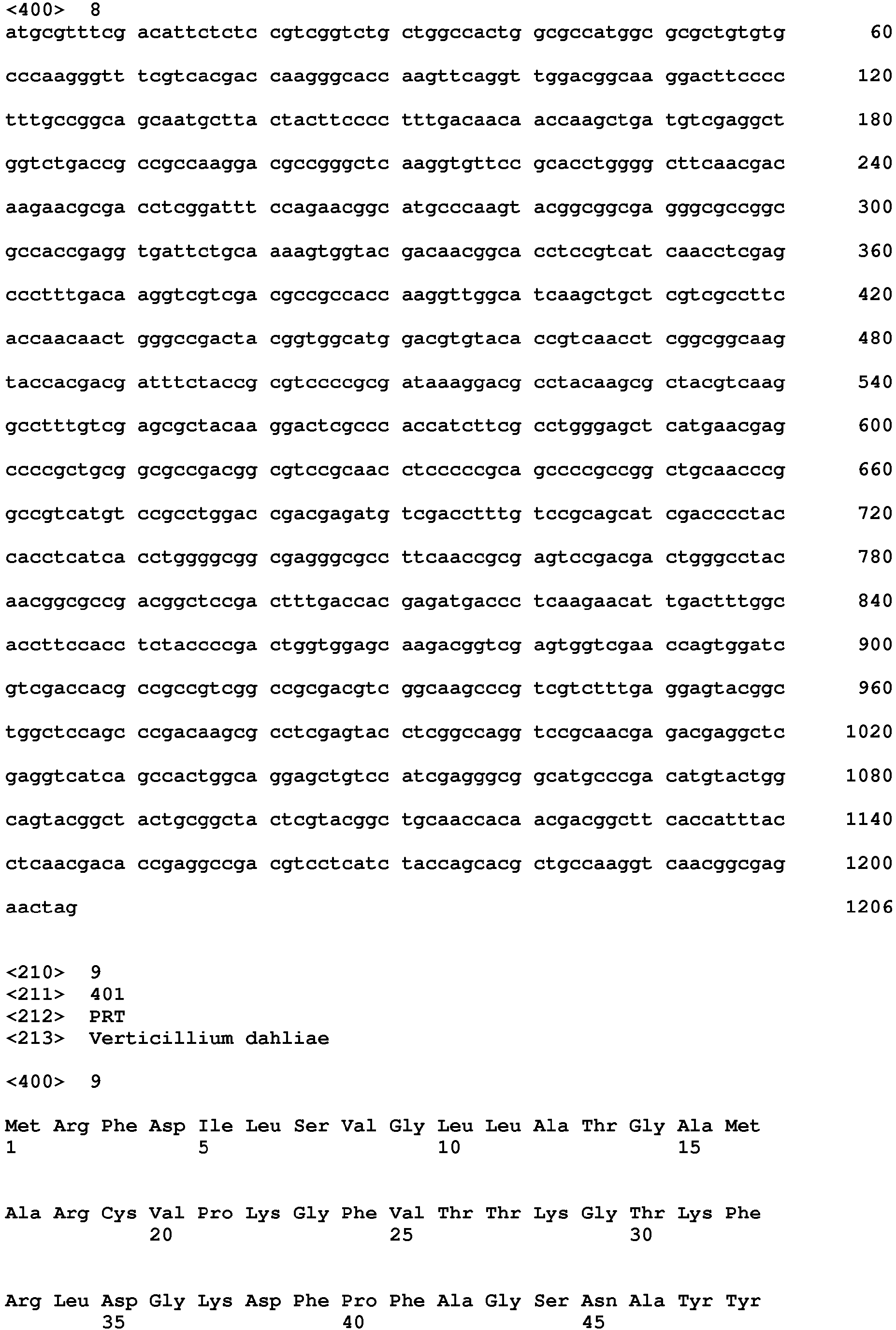


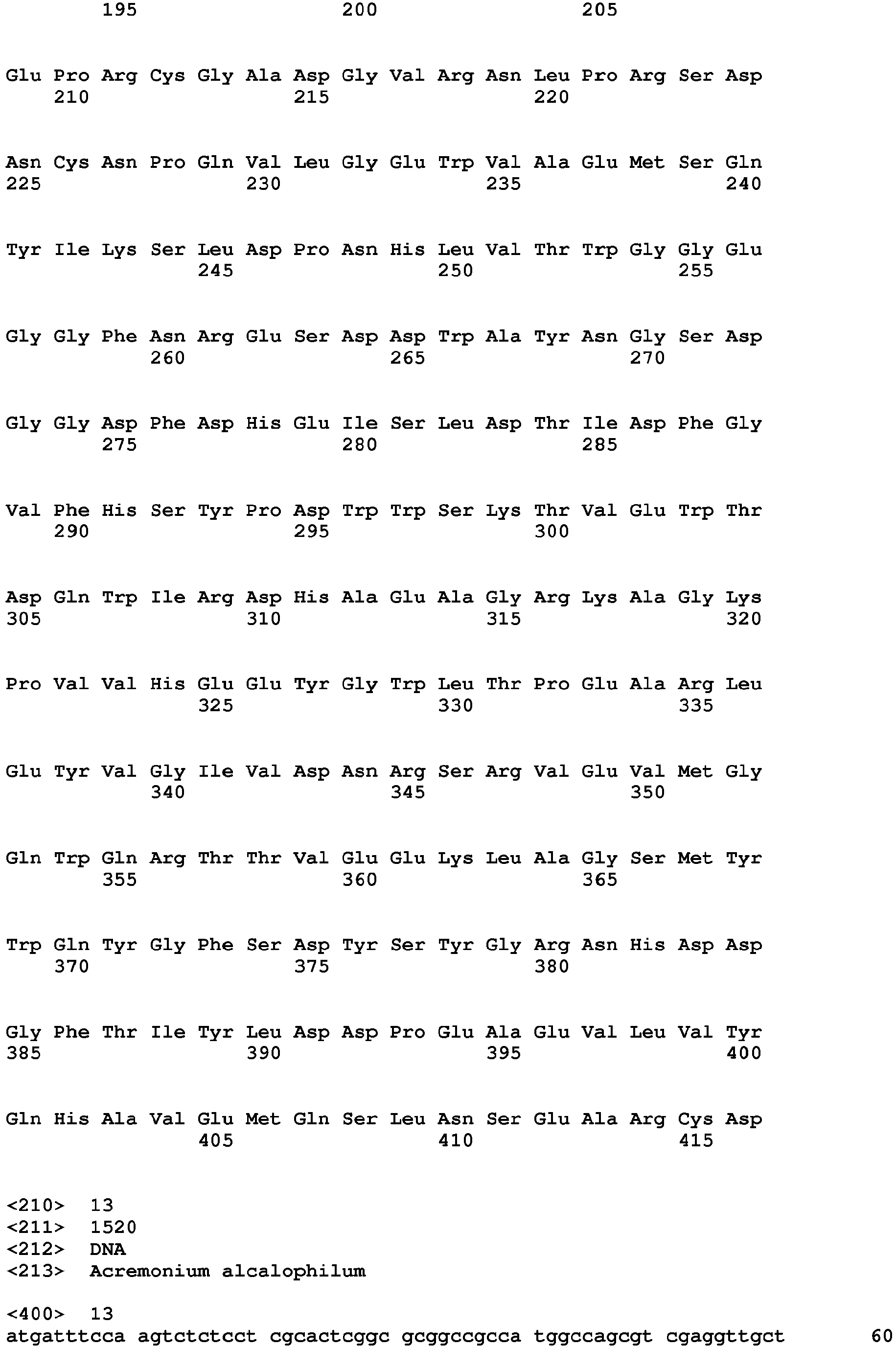

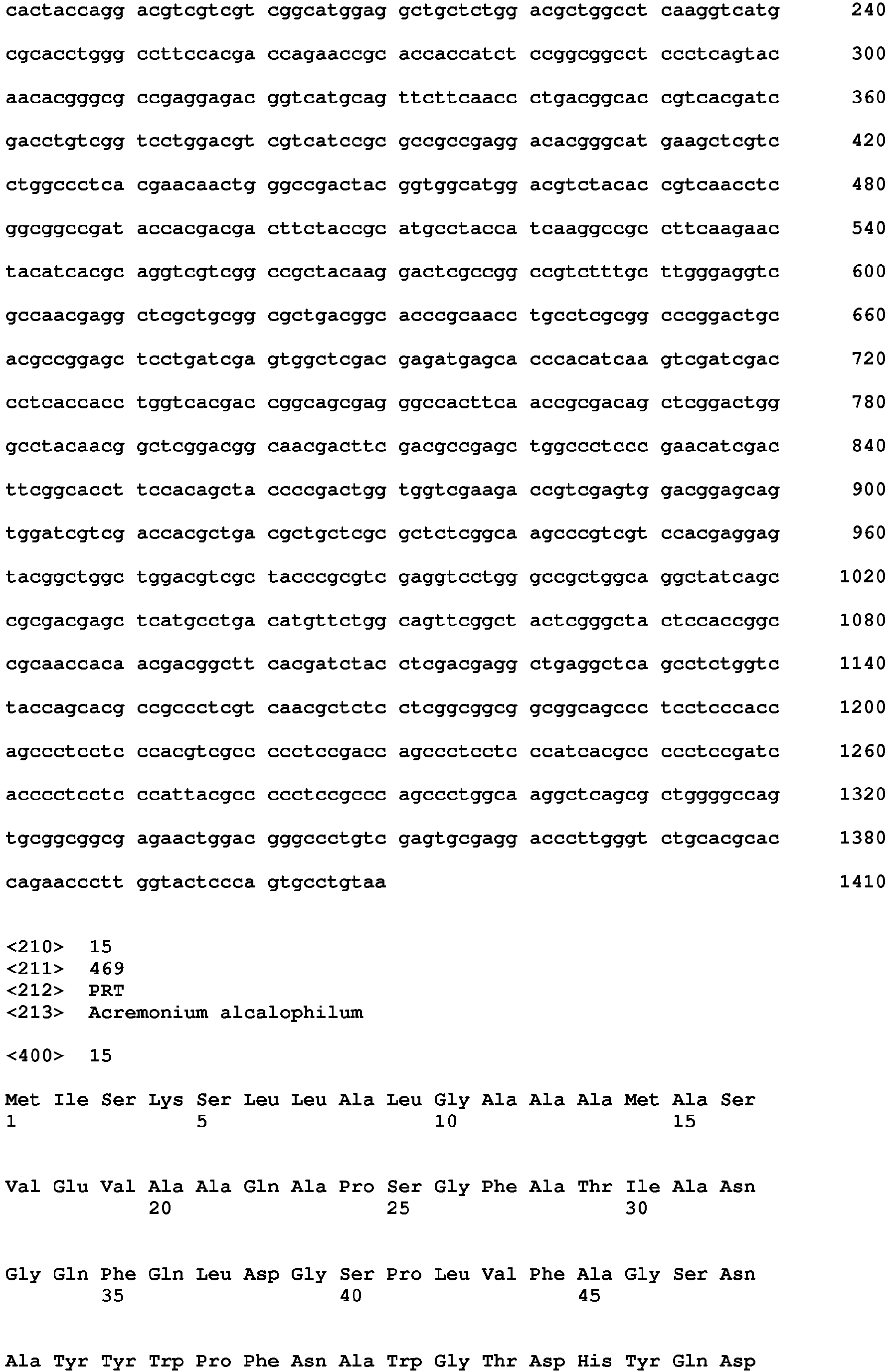
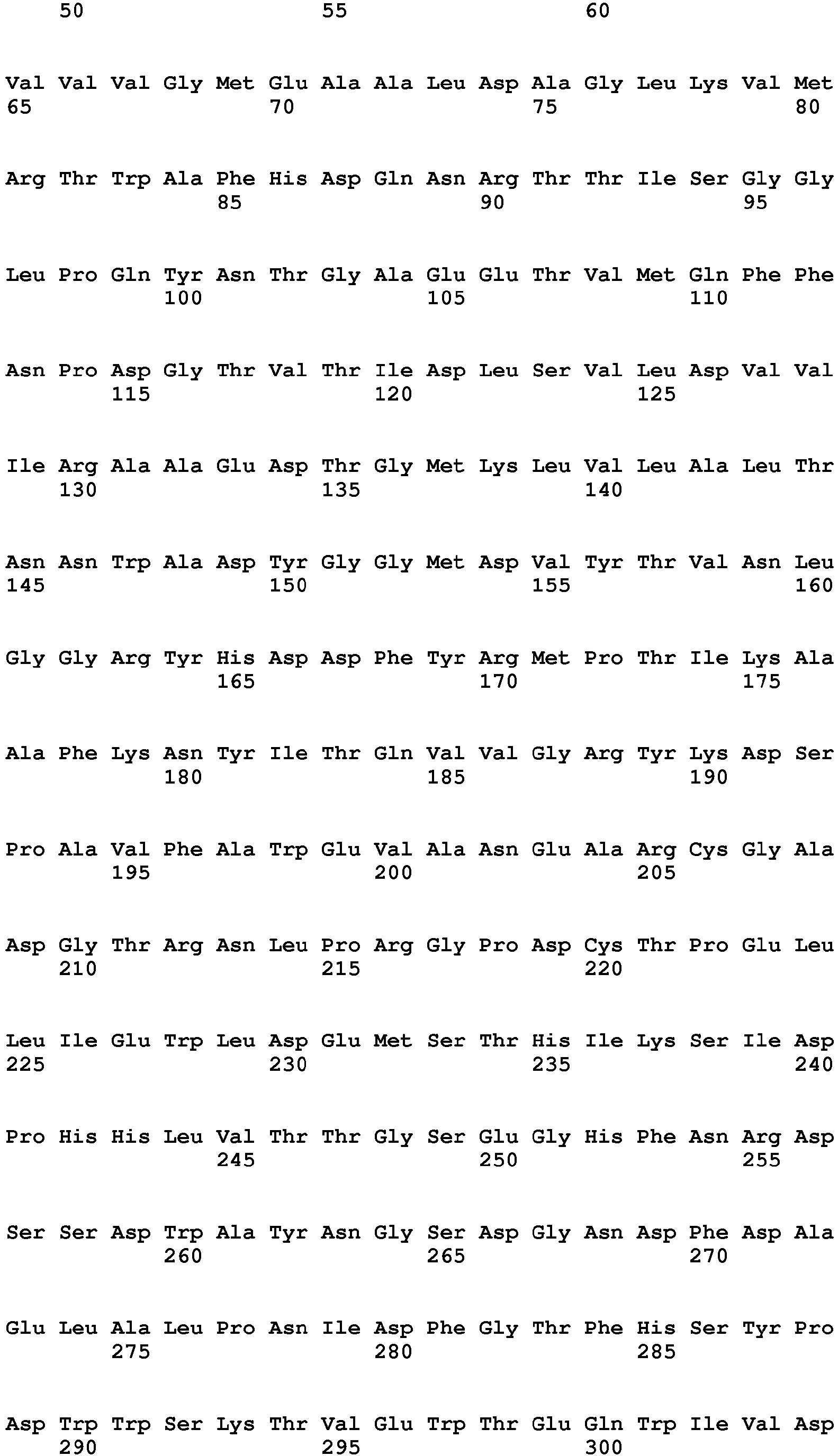
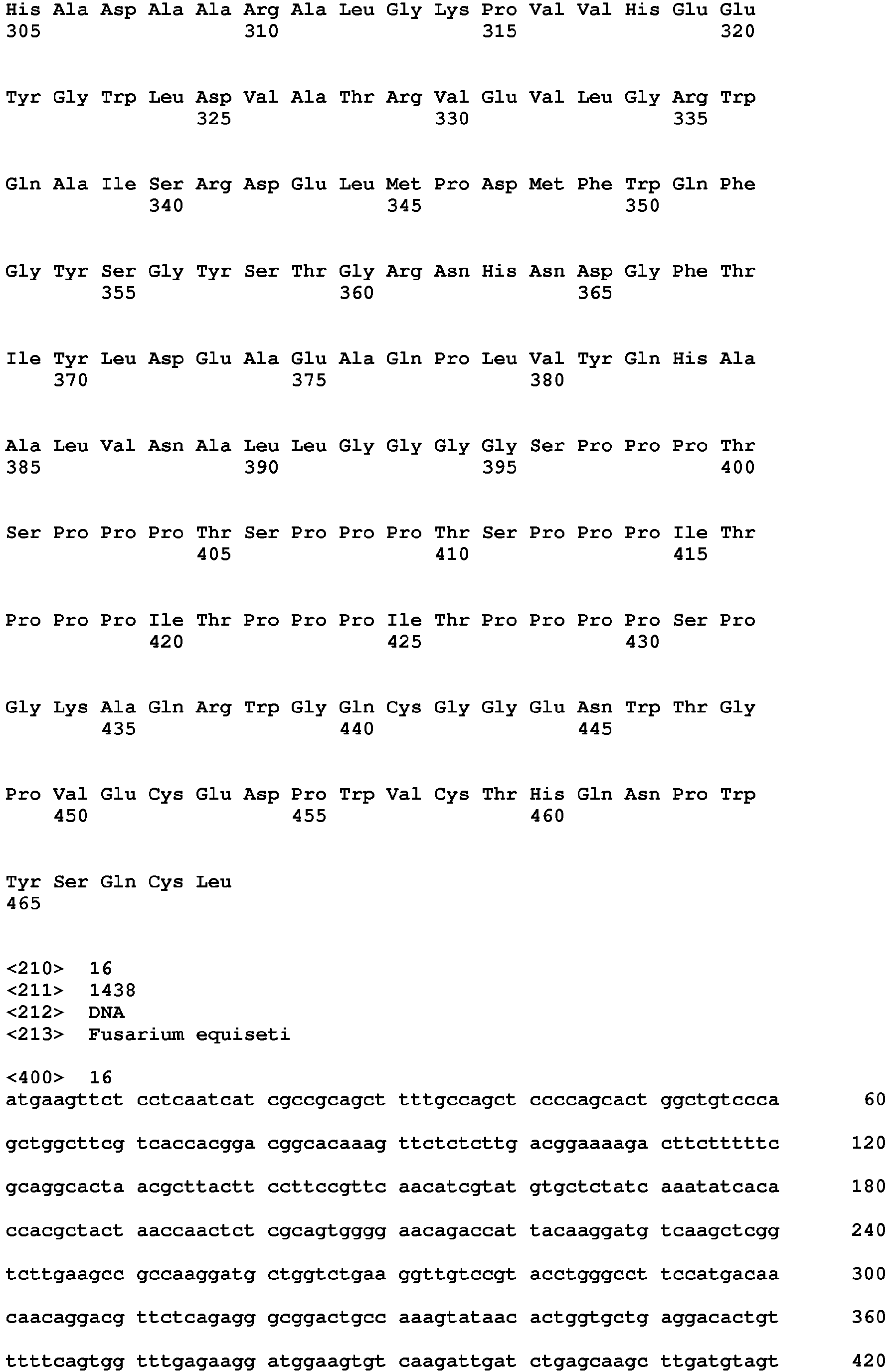

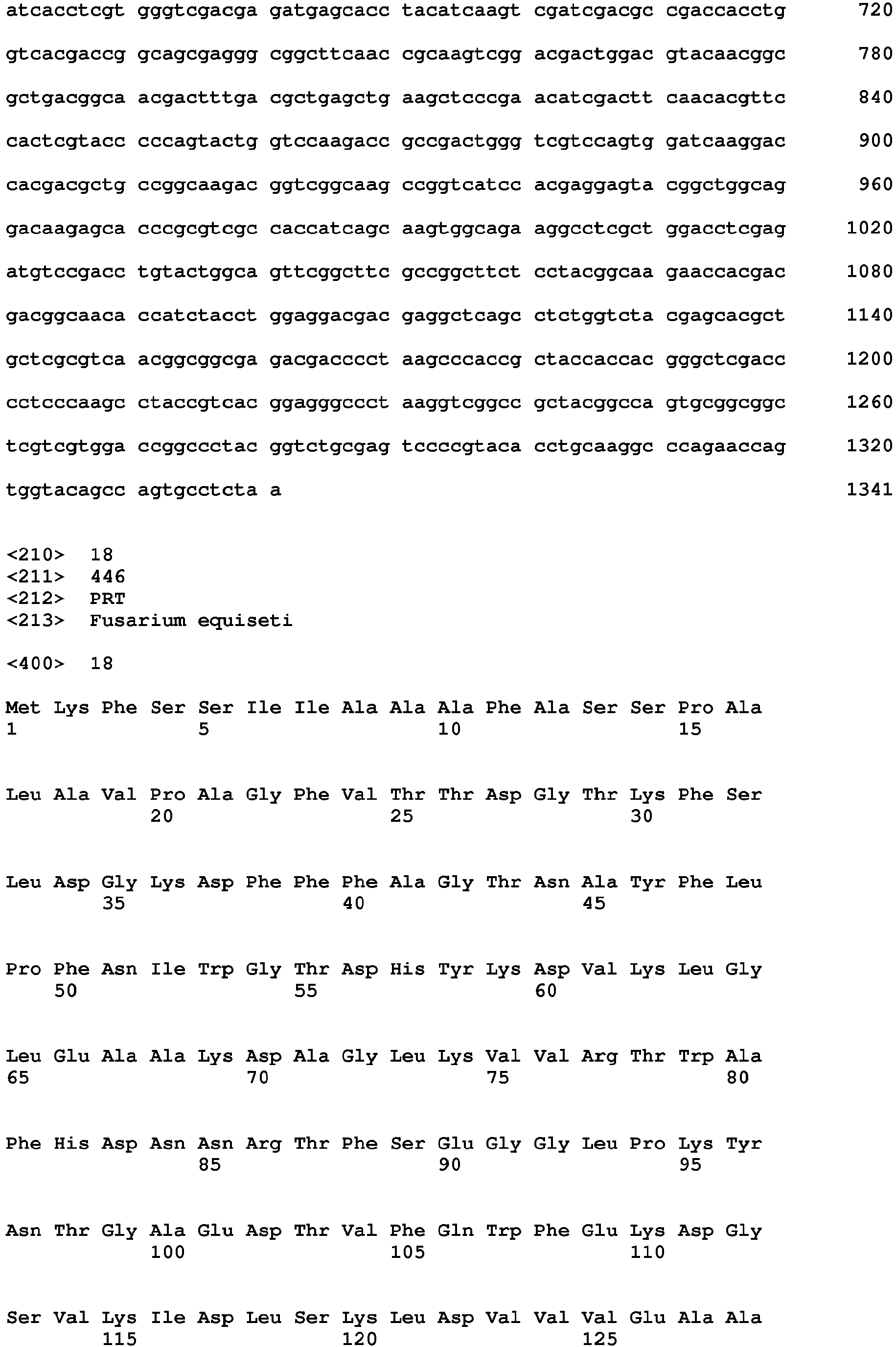


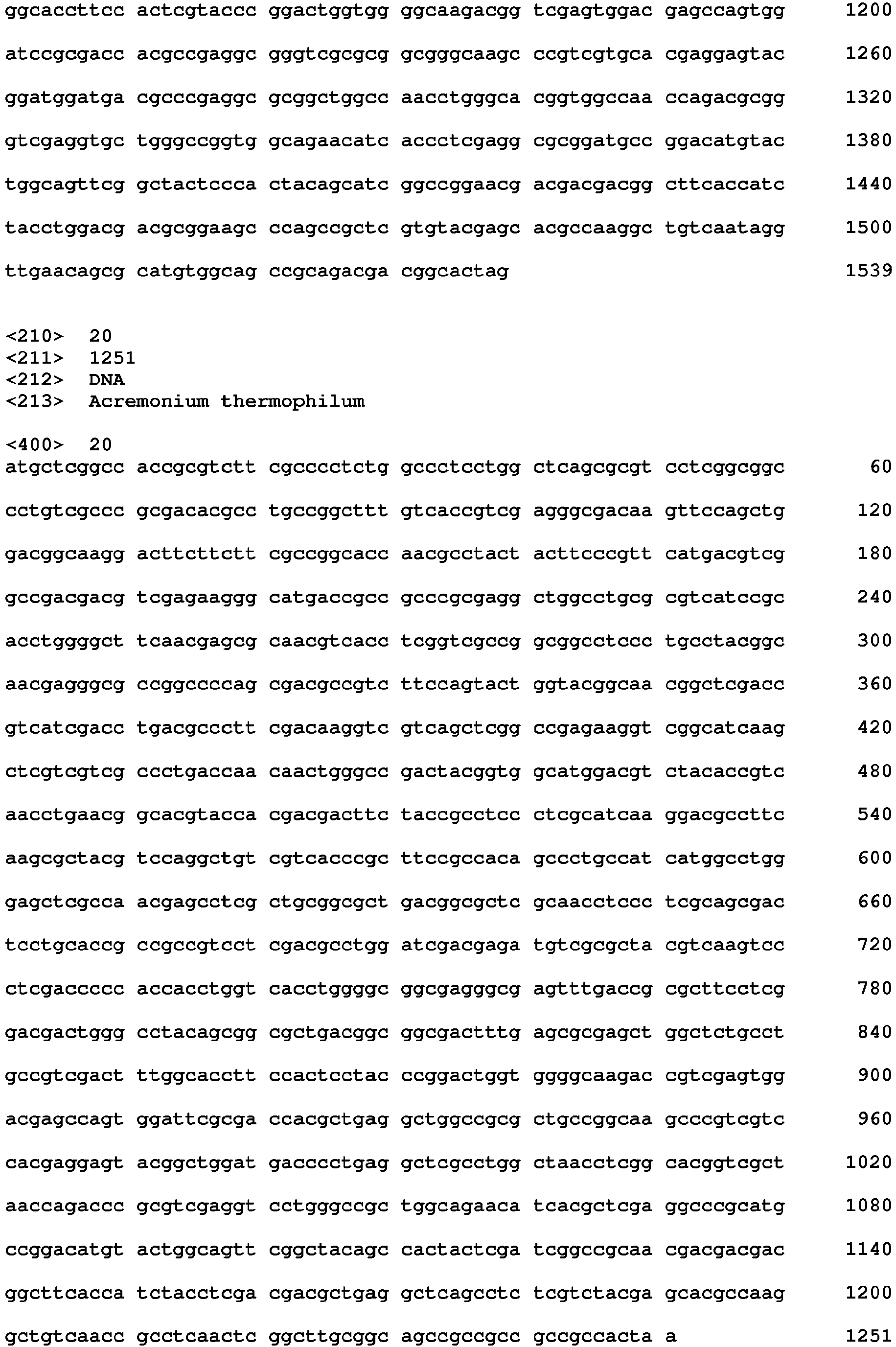
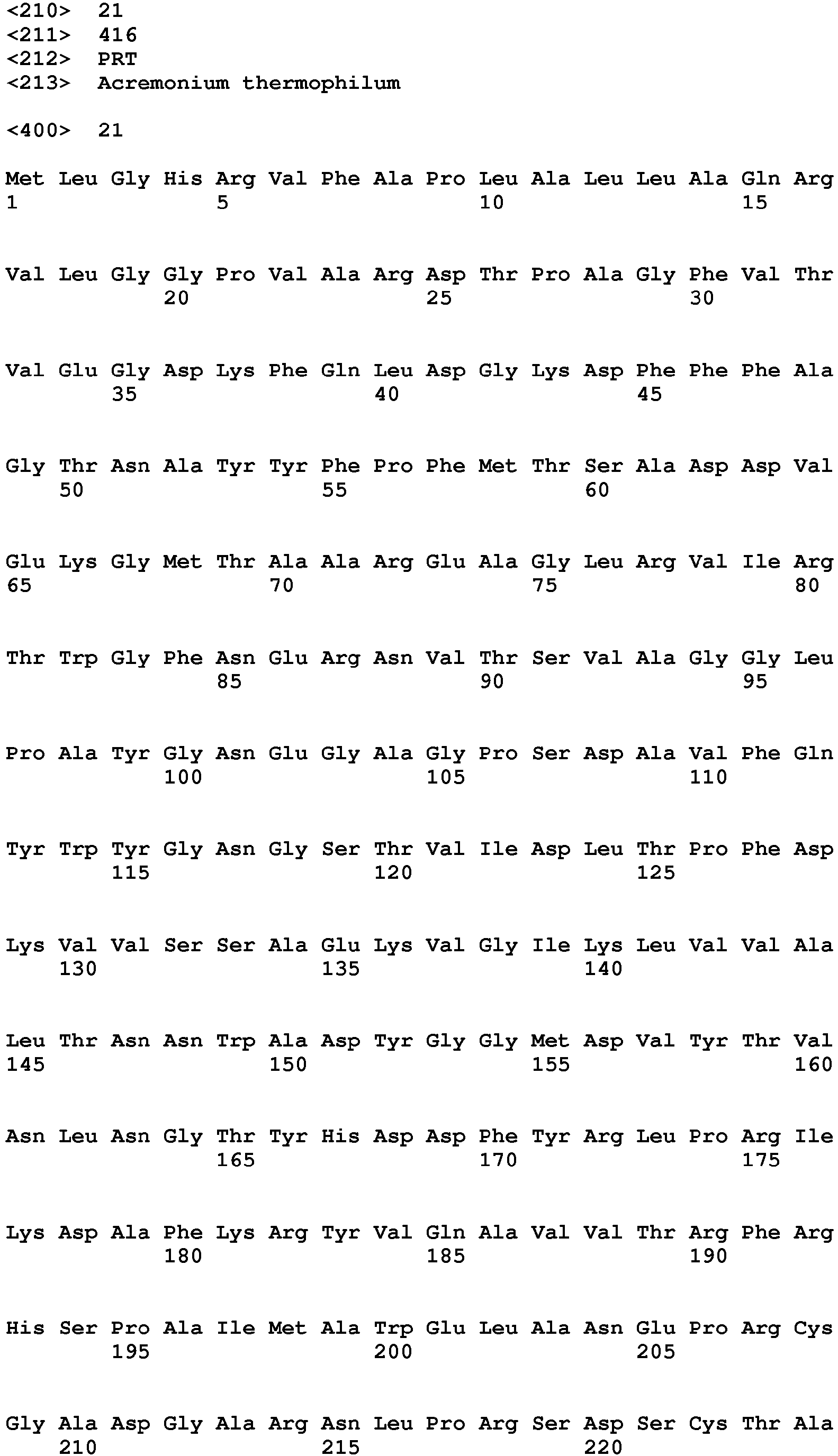


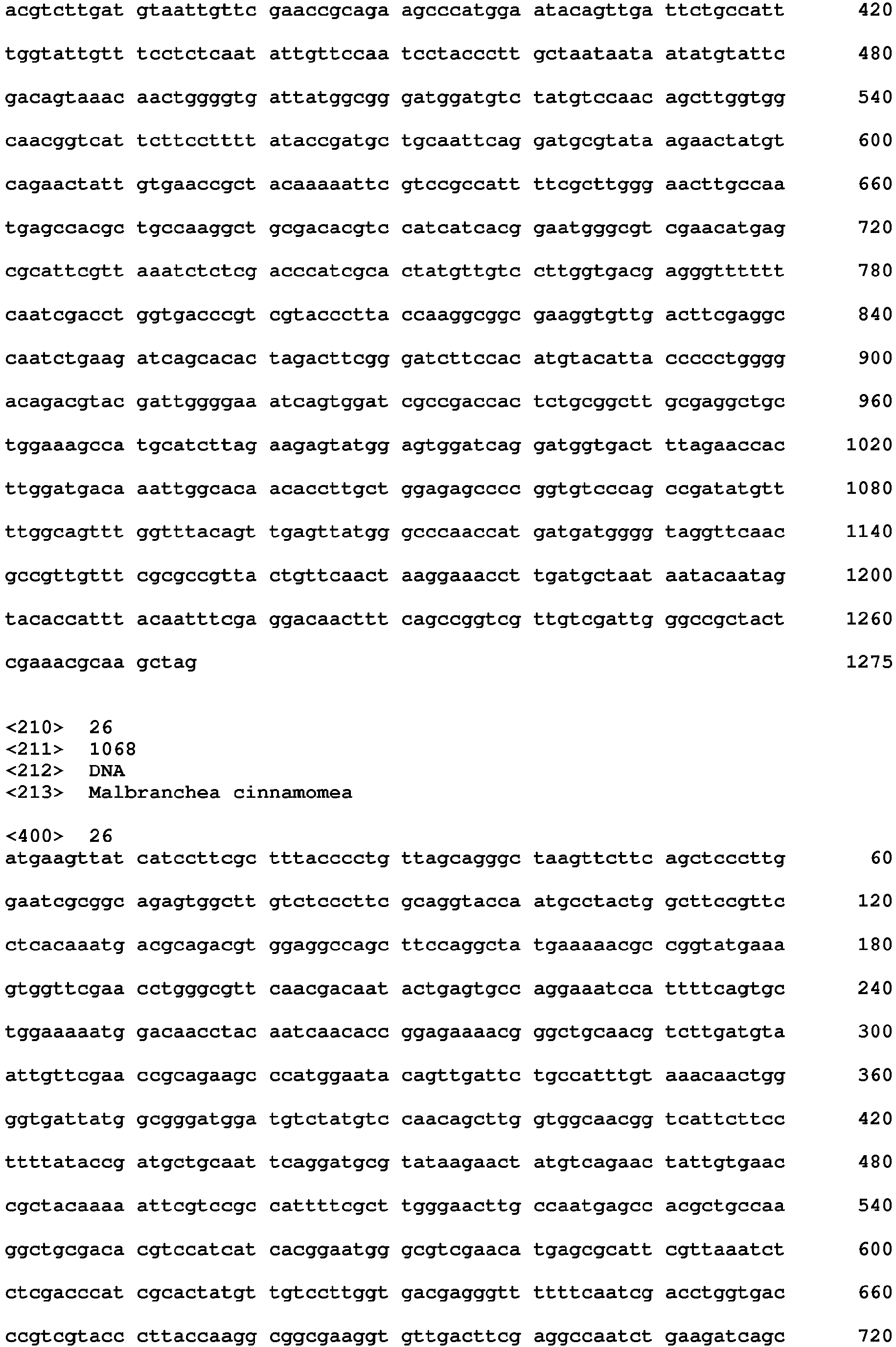


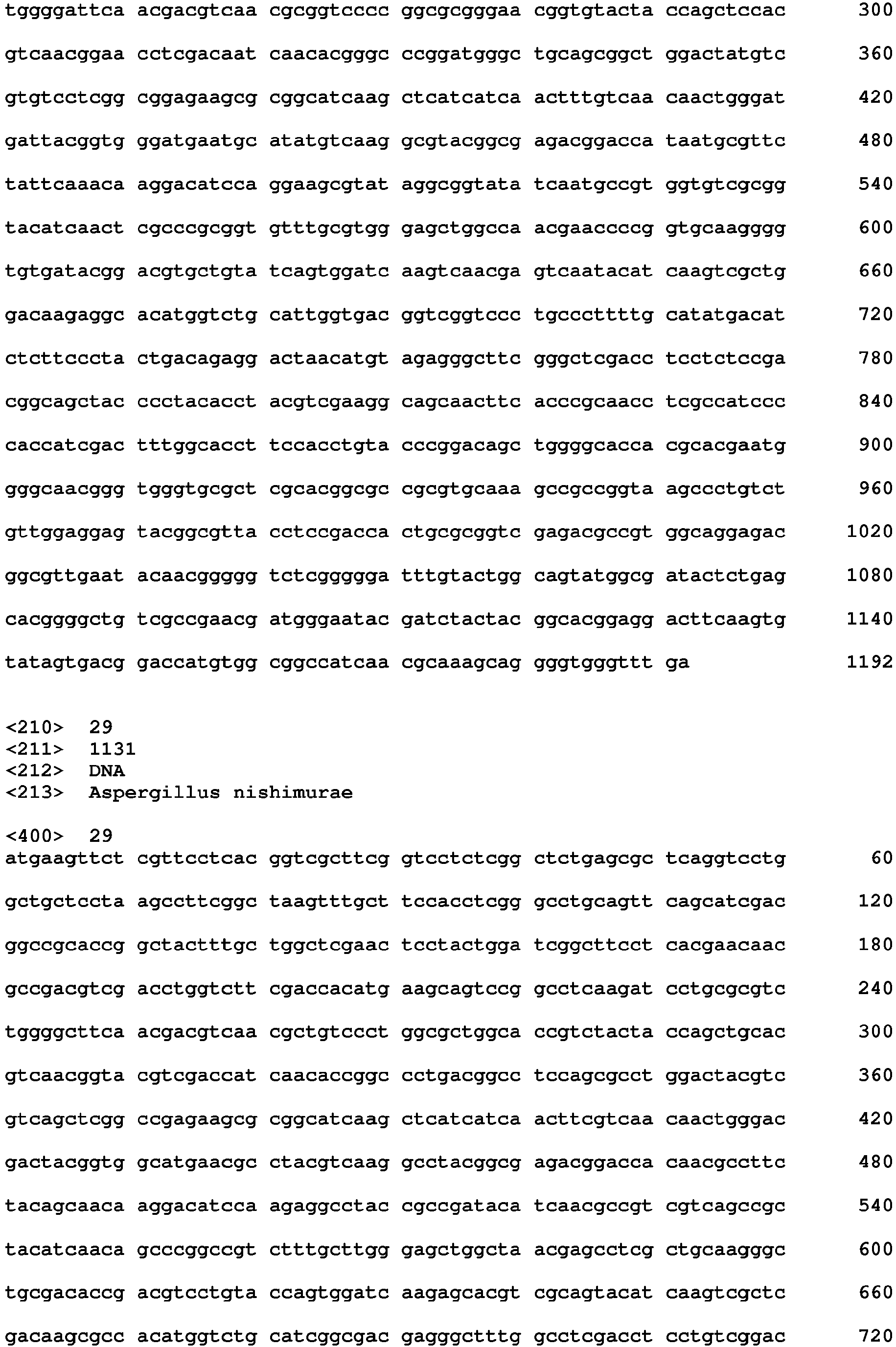


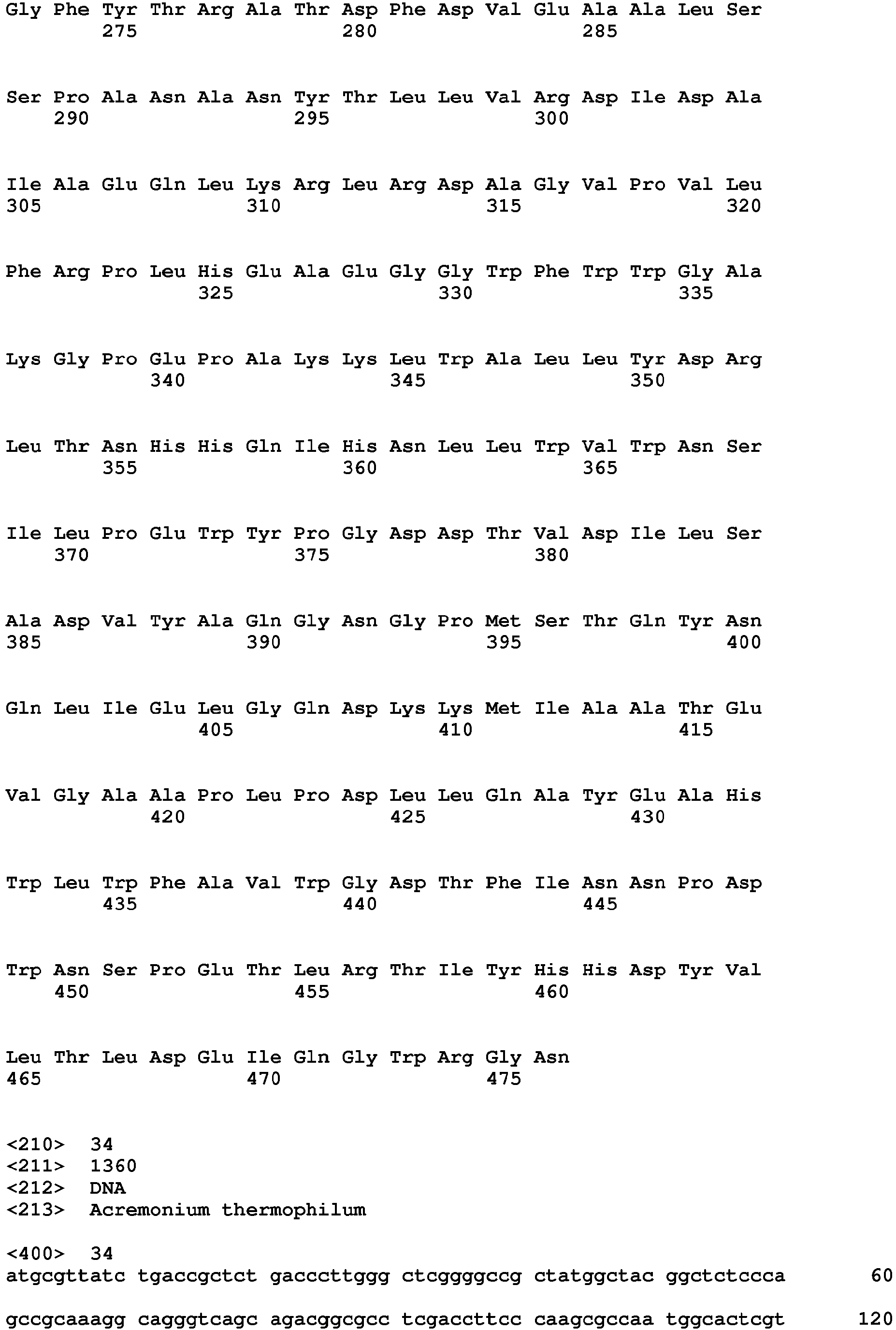
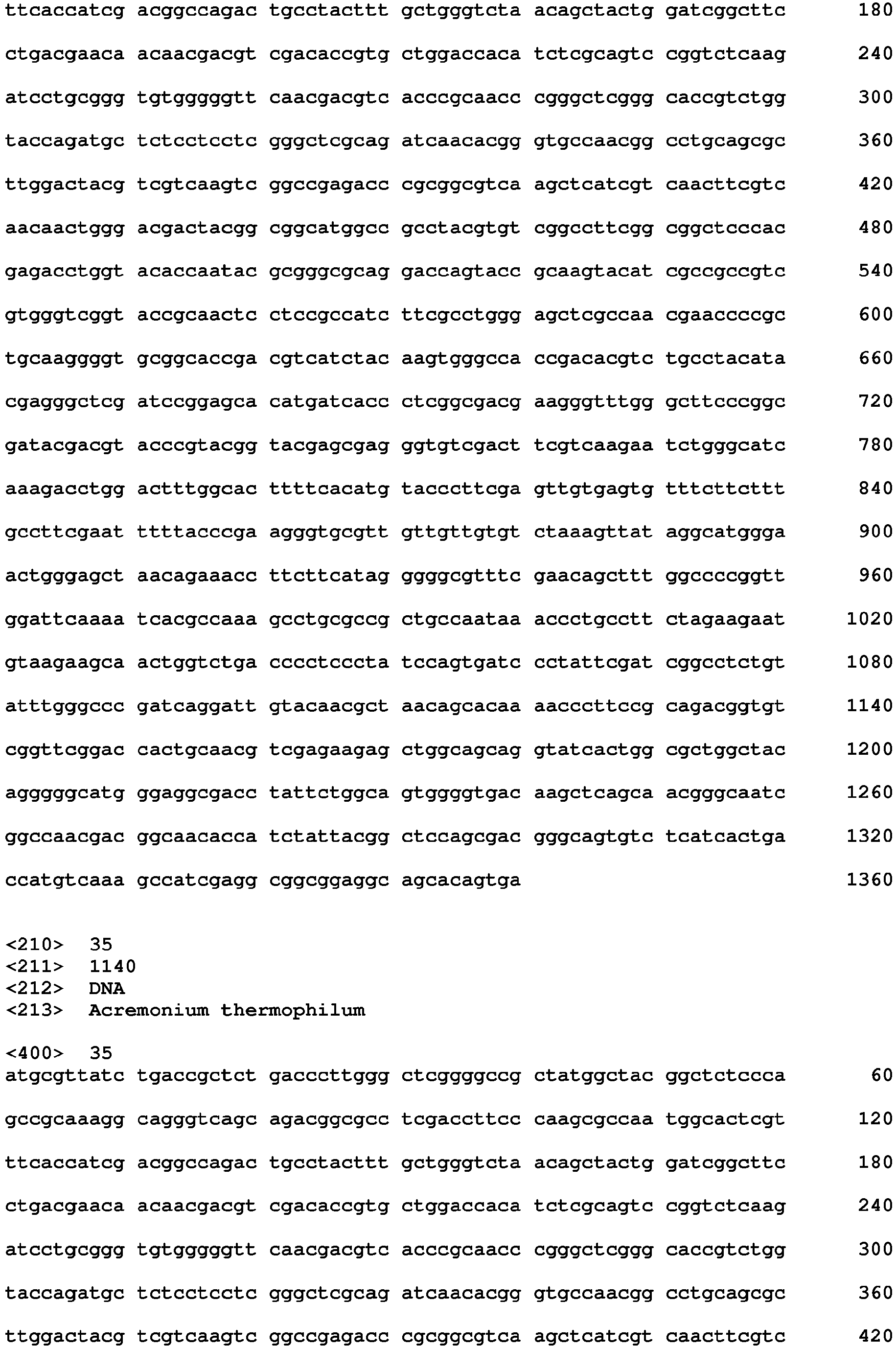


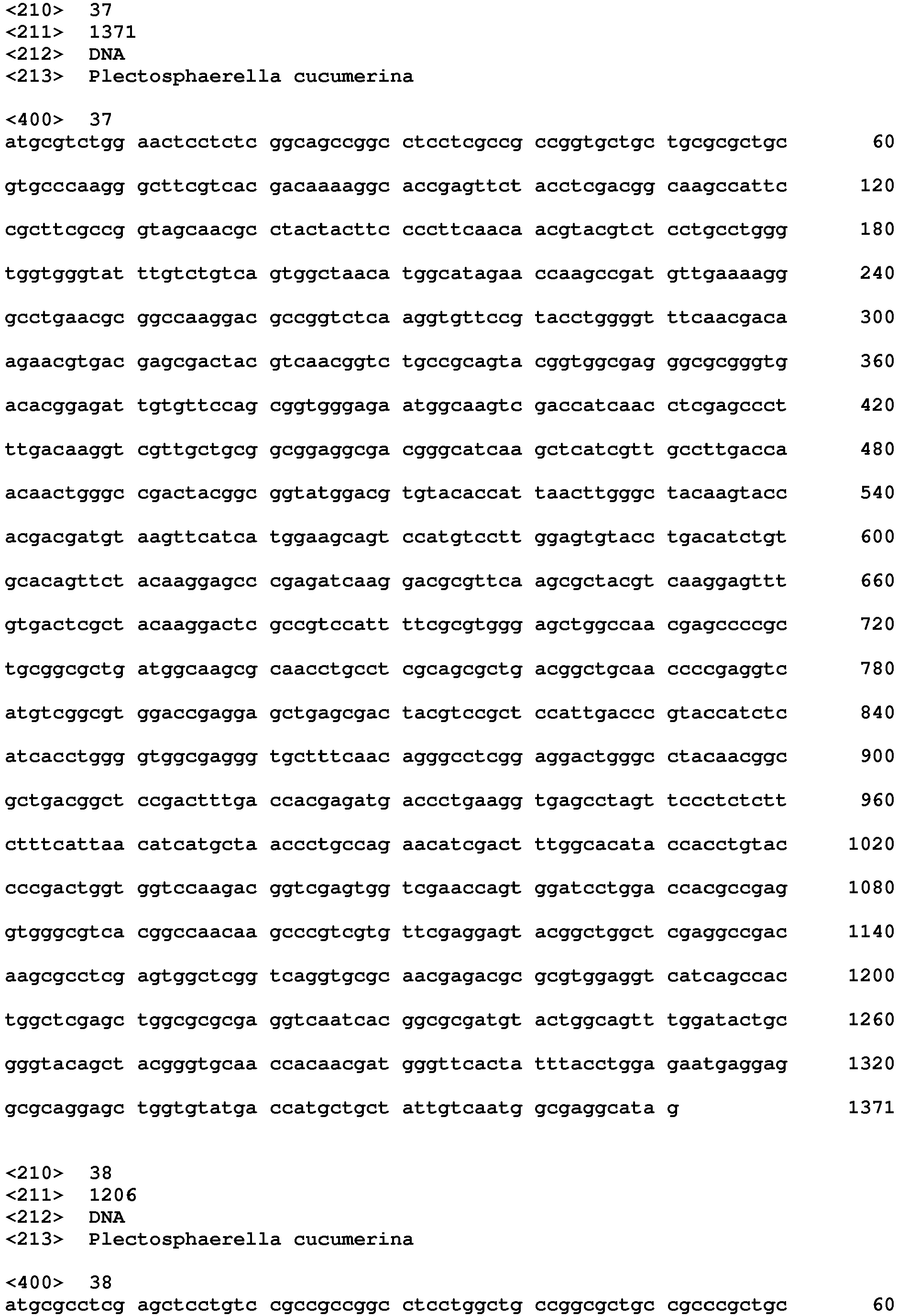


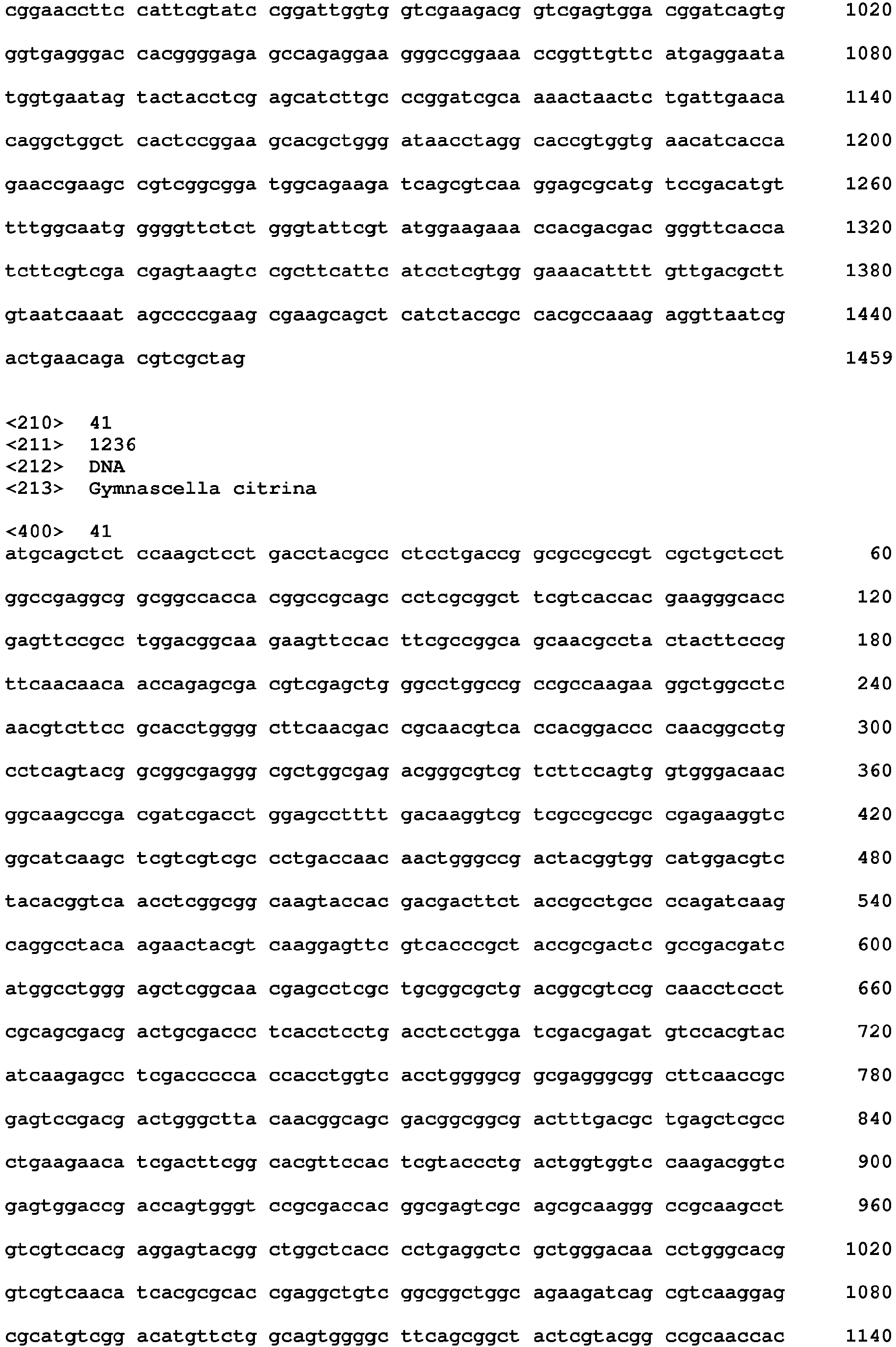

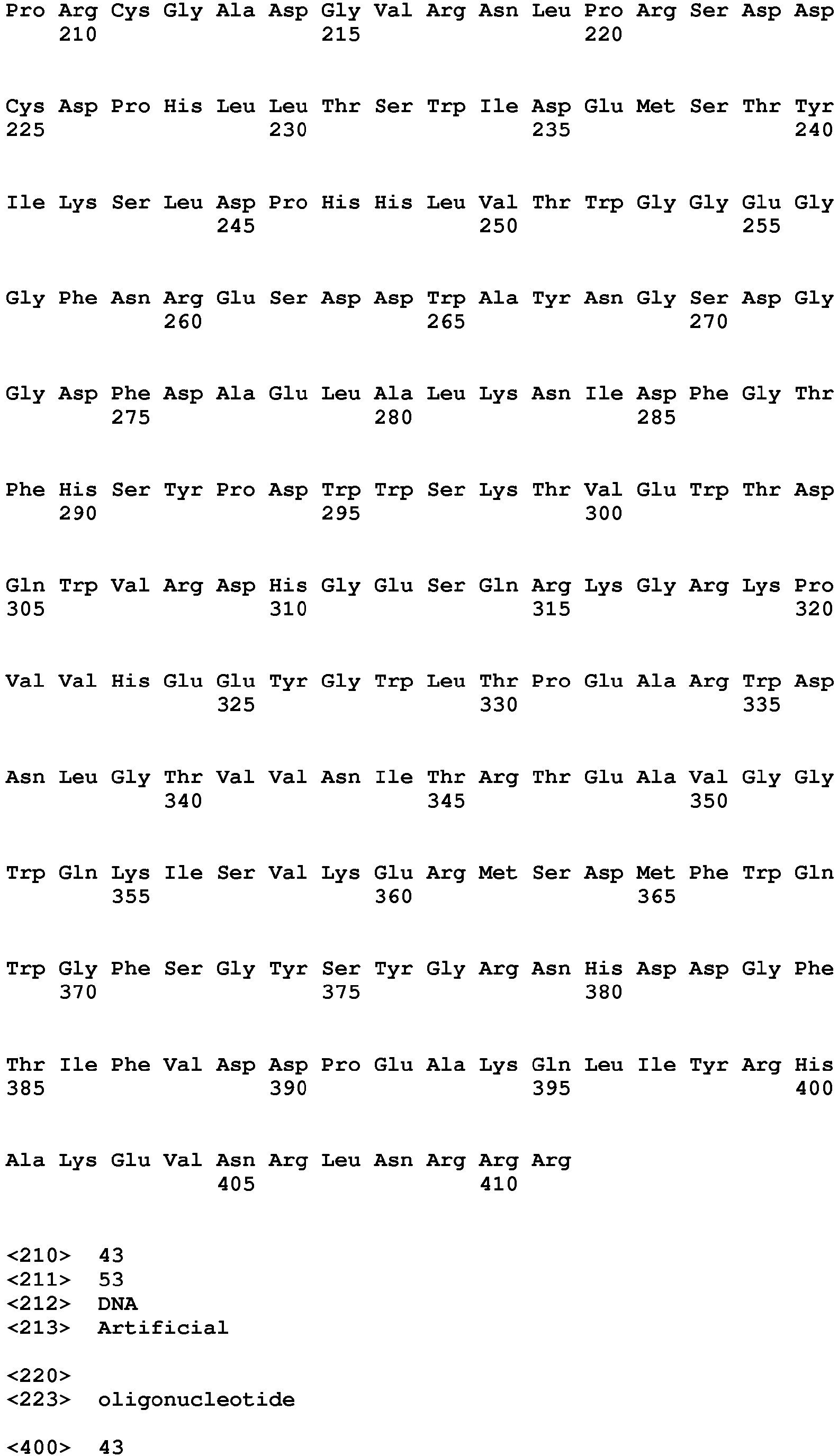


Claims (12)
- Detergent composition comprising at least one enzyme having an amino acid sequence having at least 80% sequence identity to the amino acid sequence of SEQ ID NO.3 (Man1) and/or at least 80% sequence identity to the amino acid sequence of SEQ ID NO. 9 (Man 3) and/or at least 80% sequence identity to the amino acid sequence of SEQ ID NO. 12 (Man 5).
- Detergent composition of claim 1, wherein the at least one enzyme has an amino acid sequence having at least 81%, at least 82%, at least 83%, at least 84%, at least 85%, at least 86%, at least 87%, at least 88%, at least 89%, at least 90%, at least 91%, at least 92%, at least 93%, at least 94%, at least 95%, at least 96%, at least 97%, at least 98%, or at least 99% sequence identity to the amino acid sequence of SEQ ID NO.3.
- Detergent composition of claim 1, wherein the at least one enzyme has an amino acid sequence having at least 81%, at least 82%, at least 83%, at least 84%, at least 85%, at least 86%, at least 87%, at least 88%, at least 89%, at least 90%, at least 91%, at least 92%, at least 93%, at least 94%, at least 95%, at least 96%, at least 97%, at least 98%, or at least 99% sequence identity to the amino acid sequence of SEQ ID NO.9.
- Detergent composition of claim 1, wherein the at least one enzyme has an amino acid sequence having at least 81%, at least 82%, at least 83%, at least 84%, at least 85%, at least 86%, at least 87%, at least 88%, at least 89%, at least 90%, at least 91%, at least 92%, at least 93%, at least 94%, at least 95%, at least 96%, at least 97%, at least 98%, or at least 99% sequence identity to the amino acid sequence of SEQ ID NO.12.
- Detergent composition of any one of claims 1-4, wherein the at least one enzyme has mannan degrading activity.
- The detergent composition of any one of claims 1-5, the composition further comprising one or more additional enzymes selected from the group consisting of protease, lipase, cutinase, amylase, carbohydrase, cellulase, pectinase, pectatlyase, mannanase, arabinase, galactanase, xylanase, oxidase, xanthanase, laccase, and/or peroxidase.
- The detergent composition according to any one of claims 1-6, wherein the composition is in form of a bar, a homogenous tablet, a tablet having two or more layers, a pouch having one or more compartments, a regular or compact powder, a granule, a paste, a gel, or a regular, compact or concentrated liquid.
- The detergent composition of any one of claims 1-7, wherein the detergent composition is a laundry detergent composition, preferably a liquid or solid laundry detergent composition.
- Use of a detergent composition of any of claims 1-8 for degrading mannan.
- Use of a detergent composition according to any one of claims 1-8 in a laundry process.
- A method for removing a stain from a surface, comprising contacting the surface with a detergent composition according to any one of claims 1 - 8.
- A method for degrading mannan comprising applying a detergent composition according to any of claims 1 to 8 to a stain comprising mannan, preferably wherein the stain is on the surface of a textile.
Priority Applications (1)
| Application Number | Priority Date | Filing Date | Title |
|---|---|---|---|
| EP17164904.9A EP3385362A1 (en) | 2017-04-05 | 2017-04-05 | Detergent compositions comprising fungal mannanases |
Applications Claiming Priority (1)
| Application Number | Priority Date | Filing Date | Title |
|---|---|---|---|
| EP17164904.9A EP3385362A1 (en) | 2017-04-05 | 2017-04-05 | Detergent compositions comprising fungal mannanases |
Publications (1)
| Publication Number | Publication Date |
|---|---|
| EP3385362A1 true EP3385362A1 (en) | 2018-10-10 |
Family
ID=58489580
Family Applications (1)
| Application Number | Title | Priority Date | Filing Date |
|---|---|---|---|
| EP17164904.9A Withdrawn EP3385362A1 (en) | 2017-04-05 | 2017-04-05 | Detergent compositions comprising fungal mannanases |
Country Status (1)
| Country | Link |
|---|---|
| EP (1) | EP3385362A1 (en) |
Citations (127)
| Publication number | Priority date | Publication date | Assignee | Title |
|---|---|---|---|---|
| GB1296839A (en) | 1969-05-29 | 1972-11-22 | ||
| GB1483591A (en) | 1973-07-23 | 1977-08-24 | Novo Industri As | Process for coating water soluble or water dispersible particles by means of the fluid bed technique |
| US4106991A (en) | 1976-07-07 | 1978-08-15 | Novo Industri A/S | Enzyme granulate composition and process for forming enzyme granulates |
| US4435307A (en) | 1980-04-30 | 1984-03-06 | Novo Industri A/S | Detergent cellulase |
| EP0218272A1 (en) | 1985-08-09 | 1987-04-15 | Gist-Brocades N.V. | Novel lipolytic enzymes and their use in detergent compositions |
| US4661452A (en) | 1984-05-29 | 1987-04-28 | Novo Industri A/S | Enzyme containing granulates useful as detergent additives |
| EP0238216A1 (en) | 1986-02-20 | 1987-09-23 | Albright & Wilson Limited | Protected enzyme systems |
| EP0258068A2 (en) | 1986-08-29 | 1988-03-02 | Novo Nordisk A/S | Enzymatic detergent additive |
| EP0305216A1 (en) | 1987-08-28 | 1989-03-01 | Novo Nordisk A/S | Recombinant Humicola lipase and process for the production of recombinant humicola lipases |
| WO1989006279A1 (en) | 1988-01-07 | 1989-07-13 | Novo-Nordisk A/S | Mutated subtilisin genes |
| WO1989006270A1 (en) | 1988-01-07 | 1989-07-13 | Novo-Nordisk A/S | Enzymatic detergent |
| EP0331376A2 (en) | 1988-02-28 | 1989-09-06 | Amano Pharmaceutical Co., Ltd. | Recombinant DNA, bacterium of the genus pseudomonas containing it, and process for preparing lipase by using it |
| WO1989009259A1 (en) | 1988-03-24 | 1989-10-05 | Novo-Nordisk A/S | A cellulase preparation |
| EP0407225A1 (en) | 1989-07-07 | 1991-01-09 | Unilever Plc | Enzymes and enzymatic detergent compositions |
| WO1992005249A1 (en) | 1990-09-13 | 1992-04-02 | Novo Nordisk A/S | Lipase variants |
| EP0495257A1 (en) | 1991-01-16 | 1992-07-22 | The Procter & Gamble Company | Compact detergent compositions with high activity cellulase |
| WO1992017577A1 (en) | 1991-04-03 | 1992-10-15 | Novo Nordisk A/S | Novel proteases |
| WO1992019729A1 (en) | 1991-05-01 | 1992-11-12 | Novo Nordisk A/S | Stabilized enzymes and detergent compositions |
| WO1992019708A1 (en) | 1991-04-30 | 1992-11-12 | The Procter & Gamble Company | Liquid detergents with aromatic borate ester to inhibit proteolytic enzyme |
| WO1992019709A1 (en) | 1991-04-30 | 1992-11-12 | The Procter & Gamble Company | Built liquid detergents with boric-polyol complex to inhibit proteolytic enzyme |
| WO1992021760A1 (en) | 1991-05-29 | 1992-12-10 | Cognis, Inc. | Mutant proteolytic enzymes from bacillus |
| EP0531315A1 (en) | 1990-05-09 | 1993-03-17 | Novo Nordisk As | ENZYME CAPABLE OF DEGRADING CELLULOSE OR HEMICELLULOSE. |
| EP0531372A1 (en) | 1990-05-09 | 1993-03-17 | Novo Nordisk As | PREPARATION OF CELLULASE COMPRISING AN ENDOGLUCANASE ENZYME. |
| WO1993018140A1 (en) | 1992-03-04 | 1993-09-16 | Novo Nordisk A/S | Novel proteases |
| WO1993024618A1 (en) | 1992-06-01 | 1993-12-09 | Novo Nordisk A/S | Peroxidase variants with improved hydrogen peroxide stability |
| WO1994001541A1 (en) | 1992-07-06 | 1994-01-20 | Novo Nordisk A/S | C. antarctica lipase and lipase variants |
| WO1994002597A1 (en) | 1992-07-23 | 1994-02-03 | Novo Nordisk A/S | MUTANT α-AMYLASE, DETERGENT, DISH WASHING AGENT, AND LIQUEFACTION AGENT |
| WO1994007998A1 (en) | 1992-10-06 | 1994-04-14 | Novo Nordisk A/S | Cellulase variants |
| WO1994018314A1 (en) | 1993-02-11 | 1994-08-18 | Genencor International, Inc. | Oxidatively stable alpha-amylase |
| US5352604A (en) | 1989-08-25 | 1994-10-04 | Henkel Research Corporation | Alkaline proteolytic enzyme and method of production |
| WO1994025583A1 (en) | 1993-05-05 | 1994-11-10 | Novo Nordisk A/S | A recombinant trypsin-like protease |
| WO1994025578A1 (en) | 1993-04-27 | 1994-11-10 | Gist-Brocades N.V. | New lipase variants for use in detergent applications |
| EP0624154A1 (en) | 1991-12-13 | 1994-11-17 | The Procter & Gamble Company | Acylated citrate esters as peracid precursors |
| US5389536A (en) | 1986-11-19 | 1995-02-14 | Genencor, Inc. | Lipase from Pseudomonas mendocina having cutinase activity |
| WO1995006720A1 (en) | 1993-08-30 | 1995-03-09 | Showa Denko K.K. | Novel lipase, microorganism producing the lipase, process for producing the lipase, and use of the lipase |
| WO1995010603A1 (en) | 1993-10-08 | 1995-04-20 | Novo Nordisk A/S | Amylase variants |
| WO1995010602A1 (en) | 1993-10-13 | 1995-04-20 | Novo Nordisk A/S | H2o2-stable peroxidase variants |
| WO1995014783A1 (en) | 1993-11-24 | 1995-06-01 | Showa Denko K.K. | Lipase gene and variant lipase |
| WO1995022615A1 (en) | 1994-02-22 | 1995-08-24 | Novo Nordisk A/S | A method of preparing a variant of a lipolytic enzyme |
| WO1995023221A1 (en) | 1994-02-24 | 1995-08-31 | Cognis, Inc. | Improved enzymes and detergents containing them |
| WO1995024471A1 (en) | 1994-03-08 | 1995-09-14 | Novo Nordisk A/S | Novel alkaline cellulases |
| WO1995030744A2 (en) | 1994-05-04 | 1995-11-16 | Genencor International Inc. | Lipases with improved surfactant resistance |
| WO1995035381A1 (en) | 1994-06-20 | 1995-12-28 | Unilever N.V. | Modified pseudomonas lipases and their use |
| WO1996000292A1 (en) | 1994-06-23 | 1996-01-04 | Unilever N.V. | Modified pseudomonas lipases and their use |
| WO1996011262A1 (en) | 1994-10-06 | 1996-04-18 | Novo Nordisk A/S | An enzyme and enzyme preparation with endoglucanase activity |
| WO1996012012A1 (en) | 1994-10-14 | 1996-04-25 | Solvay S.A. | Lipase, microorganism producing same, method for preparing said lipase and uses thereof |
| WO1996013580A1 (en) | 1994-10-26 | 1996-05-09 | Novo Nordisk A/S | An enzyme with lipolytic activity |
| WO1996023873A1 (en) | 1995-02-03 | 1996-08-08 | Novo Nordisk A/S | Amylase variants |
| WO1996027002A1 (en) | 1995-02-27 | 1996-09-06 | Novo Nordisk A/S | Novel lipase gene and process for the production of lipase with the use of the same |
| WO1996029397A1 (en) | 1995-03-17 | 1996-09-26 | Novo Nordisk A/S | Novel endoglucanases |
| WO1996034946A1 (en) | 1995-05-05 | 1996-11-07 | Novo Nordisk A/S | Protease variants and compositions |
| WO1997004079A1 (en) | 1995-07-14 | 1997-02-06 | Novo Nordisk A/S | A modified enzyme with lipolytic activity |
| WO1997007202A1 (en) | 1995-08-11 | 1997-02-27 | Novo Nordisk A/S | Novel lipolytic enzymes |
| US5648263A (en) | 1988-03-24 | 1997-07-15 | Novo Nordisk A/S | Methods for reducing the harshness of a cotton-containing fabric |
| WO1997043424A1 (en) | 1996-05-14 | 1997-11-20 | Genencor International, Inc. | MODIFIED α-AMYLASES HAVING ALTERED CALCIUM BINDING PROPERTIES |
| WO1998008940A1 (en) | 1996-08-26 | 1998-03-05 | Novo Nordisk A/S | A novel endoglucanase |
| WO1998012307A1 (en) | 1996-09-17 | 1998-03-26 | Novo Nordisk A/S | Cellulase variants |
| WO1998015257A1 (en) | 1996-10-08 | 1998-04-16 | Novo Nordisk A/S | Diaminobenzoic acid derivatives as dye precursors |
| WO1998017767A1 (en) | 1996-10-18 | 1998-04-30 | The Procter & Gamble Company | Detergent compositions |
| WO1998020115A1 (en) | 1996-11-04 | 1998-05-14 | Novo Nordisk A/S | Subtilase variants and compositions |
| WO1998020116A1 (en) | 1996-11-04 | 1998-05-14 | Novo Nordisk A/S | Subtilase variants and compositions |
| WO1999011768A1 (en) | 1997-08-29 | 1999-03-11 | Novo Nordisk A/S | Protease variants and compositions |
| WO1999019467A1 (en) | 1997-10-13 | 1999-04-22 | Novo Nordisk A/S | α-AMYLASE MUTANTS |
| US5977053A (en) | 1995-07-31 | 1999-11-02 | Bayer Ag | Detergents and cleaners containing iminodisuccinates |
| WO2000034450A1 (en) | 1998-12-04 | 2000-06-15 | Novozymes A/S | Cutinase variants |
| WO2000060063A1 (en) | 1999-03-31 | 2000-10-12 | Novozymes A/S | Lipase variant |
| WO2001016285A2 (en) | 1999-08-31 | 2001-03-08 | Novozymes A/S | Novel proteases and variants thereof |
| WO2001044452A1 (en) | 1999-12-15 | 2001-06-21 | Novozymes A/S | Subtilase variants having an improved wash performance on egg stains |
| WO2001066712A2 (en) | 2000-03-08 | 2001-09-13 | Novozymes A/S | Variants with altered properties |
| WO2001092502A1 (en) | 2000-06-02 | 2001-12-06 | Novozymes A/S | Cutinase variants |
| WO2002010355A2 (en) | 2000-08-01 | 2002-02-07 | Novozymes A/S | Alpha-amylase mutants with altered stability |
| WO2002016547A2 (en) | 2000-08-21 | 2002-02-28 | Novozymes A/S | Subtilase enzymes |
| WO2002026024A1 (en) | 2000-08-05 | 2002-04-04 | Haiquan Li | An apparatus using recyclable resource |
| WO2002099091A2 (en) | 2001-06-06 | 2002-12-12 | Novozymes A/S | Endo-beta-1,4-glucanase from bacillus |
| WO2003006602A2 (en) | 2001-07-12 | 2003-01-23 | Novozymes A/S | Subtilase variants |
| WO2003040279A1 (en) | 2001-11-09 | 2003-05-15 | Unilever Plc | Polymers for laundry applications |
| WO2004003186A2 (en) | 2002-06-26 | 2004-01-08 | Novozymes A/S | Subtilases and subtilase variants having altered immunogenicity |
| WO2004041979A2 (en) | 2002-11-06 | 2004-05-21 | Novozymes A/S | Subtilase variants |
| WO2005003274A1 (en) | 2003-06-18 | 2005-01-13 | Unilever Plc | Laundry treatment compositions |
| WO2005003275A1 (en) | 2003-06-18 | 2005-01-13 | Unilever Plc | Laundry treatment compositions |
| WO2005003276A1 (en) | 2003-06-18 | 2005-01-13 | Unilever Plc | Laundry treatment compositions |
| WO2005040372A1 (en) | 2003-10-23 | 2005-05-06 | Novozymes A/S | Protease with improved stability in detergents |
| WO2005052146A2 (en) | 2003-11-19 | 2005-06-09 | Genencor International, Inc. | Serine proteases, nucleic acids encoding serine enzymes and vectors and host cells incorporating same |
| WO2005056782A2 (en) | 2003-12-03 | 2005-06-23 | Genencor International, Inc. | Perhydrolase |
| WO2006066594A2 (en) | 2004-12-23 | 2006-06-29 | Novozymes A/S | Alpha-amylase variants |
| WO2006108856A2 (en) | 2005-04-15 | 2006-10-19 | Basf Aktiengesellschaft | Amphiphilic water-soluble alkoxylated polyalkylenimines with an internal polyethylene oxide block and an external polypropylene oxide block |
| WO2006113314A1 (en) | 2005-04-15 | 2006-10-26 | The Procter & Gamble Company | Liquid laundry detergent compositions with modified polyethyleneimine polymers and lipase enzyme |
| WO2006130575A2 (en) | 2005-05-31 | 2006-12-07 | The Procter & Gamble Company | Polymer-containing detergent compositions and their use |
| WO2007006305A1 (en) | 2005-07-08 | 2007-01-18 | Novozymes A/S | Subtilase variants |
| WO2007044993A2 (en) | 2005-10-12 | 2007-04-19 | Genencor International, Inc. | Use and production of storage-stable neutral metalloprotease |
| WO2007087257A2 (en) | 2006-01-23 | 2007-08-02 | The Procter & Gamble Company | Enzyme and fabric hueing agent containing compositions |
| WO2007087508A2 (en) | 2006-01-23 | 2007-08-02 | Novozymes A/S | Lipase variants |
| WO2007087259A2 (en) | 2006-01-23 | 2007-08-02 | The Procter & Gamble Company | Enzyme and photobleach containing compositions |
| WO2007087258A2 (en) | 2006-01-23 | 2007-08-02 | The Procter & Gamble Company | A composition comprising a lipase and a bleach catalyst |
| WO2007087244A2 (en) | 2006-01-23 | 2007-08-02 | The Procter & Gamble Company | Detergent compositions |
| WO2007087243A2 (en) | 2006-01-23 | 2007-08-02 | The Procter & Gamble Company | Detergent compositions |
| WO2007087242A2 (en) | 2006-01-23 | 2007-08-02 | The Procter & Gamble Company | A composition comprising a lipase and a bleach catalyst |
| US7262042B2 (en) | 2001-12-20 | 2007-08-28 | Henkel Kommanditgesellschaft Auf Aktien (Henkel Kgaa) | Alkaline protease from Bacillus gibsonii (DSM 14393) and washing and cleaning products comprising said alkaline protease |
| WO2007138054A1 (en) | 2006-05-31 | 2007-12-06 | The Procter & Gamble Company | Cleaning compositions with amphiphilic graft polymers based on polyalkylene oxides and vinyl esters |
| EP1867808A1 (en) | 2006-06-06 | 2007-12-19 | Brose Schliesssysteme GmbH & Co. KG | Motor vehicle lock |
| EP1876226A1 (en) | 2006-07-07 | 2008-01-09 | The Procter and Gamble Company | Detergent compositions |
| WO2008153815A2 (en) | 2007-05-30 | 2008-12-18 | Danisco Us, Inc., Genencor Division | Variants of an alpha-amylase with improved production levels in fermentation processes |
| US20090011970A1 (en) | 2007-07-02 | 2009-01-08 | Marc Francois Theophile Evers | Laundry multi-compartment pouch composition |
| WO2009021867A2 (en) | 2007-08-10 | 2009-02-19 | Henkel Ag & Co. Kgaa | Agents containing proteases |
| WO2009061380A2 (en) | 2007-11-05 | 2009-05-14 | Danisco Us Inc., Genencor Division | VARIANTS OF BACILLUS sp. TS-23 ALPHA-AMYLASE WITH ALTERED PROPERTIES |
| WO2009067279A1 (en) | 2007-11-21 | 2009-05-28 | E.I. Du Pont De Nemours And Company | Production of peracids using an enzyme having perhydrolysis activity |
| WO2009087523A2 (en) | 2008-01-04 | 2009-07-16 | The Procter & Gamble Company | A laundry detergent composition comprising glycosyl hydrolase |
| WO2009102854A1 (en) | 2008-02-15 | 2009-08-20 | The Procter & Gamble Company | Cleaning compositions |
| WO2009109500A1 (en) | 2008-02-29 | 2009-09-11 | Novozymes A/S | Polypeptides having lipase activity and polynucleotides encoding same |
| WO2010065455A2 (en) | 2008-12-01 | 2010-06-10 | Danisco Us Inc. | Enzymes with lipase activity |
| WO2010100028A2 (en) | 2009-03-06 | 2010-09-10 | Huntsman Advanced Materials (Switzerland) Gmbh | Enzymatic textile bleach-whitening methods |
| WO2010107560A2 (en) | 2009-03-18 | 2010-09-23 | Danisco Us Inc. | Fungal cutinase from magnaporthe grisea |
| WO2010111143A2 (en) | 2009-03-23 | 2010-09-30 | Danisco Us Inc. | Cal a-related acyltransferases and methods of use, thereof |
| WO2011036263A1 (en) | 2009-09-25 | 2011-03-31 | Novozymes A/S | Subtilase variants |
| WO2011036264A1 (en) | 2009-09-25 | 2011-03-31 | Novozymes A/S | Use of protease variants |
| WO2011084412A1 (en) | 2009-12-21 | 2011-07-14 | Danisco Us Inc. | Detergent compositions containing thermobifida fusca lipase and methods of use thereof |
| WO2011084417A1 (en) | 2009-12-21 | 2011-07-14 | Danisco Us Inc. | Detergent compositions containing geobacillus stearothermophilus lipase and methods of use thereof |
| WO2011084599A1 (en) | 2009-12-21 | 2011-07-14 | Danisco Us Inc. | Detergent compositions containing bacillus subtilis lipase and methods of use thereof |
| WO2011098531A1 (en) | 2010-02-10 | 2011-08-18 | Novozymes A/S | Variants and compositions comprising variants with high stability in presence of a chelating agent |
| WO2011150157A2 (en) | 2010-05-28 | 2011-12-01 | Danisco Us Inc. | Detergent compositions containing streptomyces griseus lipase and methods of use thereof |
| WO2012137147A1 (en) | 2011-04-08 | 2012-10-11 | Danisco Us, Inc. | Compositions |
| WO2013001087A2 (en) | 2011-06-30 | 2013-01-03 | Novozymes A/S | Method for screening alpha-amylases |
| WO2013001078A1 (en) | 2011-06-30 | 2013-01-03 | Novozymes A/S | Alpha-amylase variants |
| WO2013181760A1 (en) * | 2012-06-08 | 2013-12-12 | Concordia University | Novel cell wall deconstruction enzymes of scytalidium thermophilum, myriococcum thermophilum, and aureobasidium pullulans, and uses thereof |
| WO2014138983A1 (en) * | 2013-03-14 | 2014-09-18 | Concordia University | Novel cell wall deconstruction enzymes of malbranchea cinnamomea, thielavia australiensis, and paecilomyces byssochlamydoides, and uses thereof |
| WO2015109405A1 (en) * | 2014-01-22 | 2015-07-30 | Concordia University | Novel cell wall deconstruction enzymes of chaetomium thermophilum, thermomyces stellatus, and corynascus sepedonium, and uses thereof |
| WO2016090473A1 (en) * | 2014-12-09 | 2016-06-16 | Concordia University | Novel cell wall deconstruction enzymes of rhizomucor miehei, thermoascus thermophilus (dactylomyces thermophilus), and humicola hyalo thermophila, and uses thereof |
-
2017
- 2017-04-05 EP EP17164904.9A patent/EP3385362A1/en not_active Withdrawn
Patent Citations (135)
| Publication number | Priority date | Publication date | Assignee | Title |
|---|---|---|---|---|
| GB1296839A (en) | 1969-05-29 | 1972-11-22 | ||
| GB1483591A (en) | 1973-07-23 | 1977-08-24 | Novo Industri As | Process for coating water soluble or water dispersible particles by means of the fluid bed technique |
| US4106991A (en) | 1976-07-07 | 1978-08-15 | Novo Industri A/S | Enzyme granulate composition and process for forming enzyme granulates |
| US4435307A (en) | 1980-04-30 | 1984-03-06 | Novo Industri A/S | Detergent cellulase |
| US4661452A (en) | 1984-05-29 | 1987-04-28 | Novo Industri A/S | Enzyme containing granulates useful as detergent additives |
| EP0218272A1 (en) | 1985-08-09 | 1987-04-15 | Gist-Brocades N.V. | Novel lipolytic enzymes and their use in detergent compositions |
| EP0238216A1 (en) | 1986-02-20 | 1987-09-23 | Albright & Wilson Limited | Protected enzyme systems |
| EP0258068A2 (en) | 1986-08-29 | 1988-03-02 | Novo Nordisk A/S | Enzymatic detergent additive |
| US5389536A (en) | 1986-11-19 | 1995-02-14 | Genencor, Inc. | Lipase from Pseudomonas mendocina having cutinase activity |
| EP0305216A1 (en) | 1987-08-28 | 1989-03-01 | Novo Nordisk A/S | Recombinant Humicola lipase and process for the production of recombinant humicola lipases |
| WO1989006270A1 (en) | 1988-01-07 | 1989-07-13 | Novo-Nordisk A/S | Enzymatic detergent |
| WO1989006279A1 (en) | 1988-01-07 | 1989-07-13 | Novo-Nordisk A/S | Mutated subtilisin genes |
| EP0331376A2 (en) | 1988-02-28 | 1989-09-06 | Amano Pharmaceutical Co., Ltd. | Recombinant DNA, bacterium of the genus pseudomonas containing it, and process for preparing lipase by using it |
| US5691178A (en) | 1988-03-22 | 1997-11-25 | Novo Nordisk A/S | Fungal cellulase composition containing alkaline CMC-endoglucanase and essentially no cellobiohydrolase |
| WO1989009259A1 (en) | 1988-03-24 | 1989-10-05 | Novo-Nordisk A/S | A cellulase preparation |
| US5776757A (en) | 1988-03-24 | 1998-07-07 | Novo Nordisk A/S | Fungal cellulase composition containing alkaline CMC-endoglucanase and essentially no cellobiohydrolase and method of making thereof |
| US5648263A (en) | 1988-03-24 | 1997-07-15 | Novo Nordisk A/S | Methods for reducing the harshness of a cotton-containing fabric |
| EP0407225A1 (en) | 1989-07-07 | 1991-01-09 | Unilever Plc | Enzymes and enzymatic detergent compositions |
| US5352604A (en) | 1989-08-25 | 1994-10-04 | Henkel Research Corporation | Alkaline proteolytic enzyme and method of production |
| EP0531315A1 (en) | 1990-05-09 | 1993-03-17 | Novo Nordisk As | ENZYME CAPABLE OF DEGRADING CELLULOSE OR HEMICELLULOSE. |
| US5457046A (en) | 1990-05-09 | 1995-10-10 | Novo Nordisk A/S | Enzyme capable of degrading cellullose or hemicellulose |
| EP0531372A1 (en) | 1990-05-09 | 1993-03-17 | Novo Nordisk As | PREPARATION OF CELLULASE COMPRISING AN ENDOGLUCANASE ENZYME. |
| US5686593A (en) | 1990-05-09 | 1997-11-11 | Novo Nordisk A/S | Enzyme capable of degrading cellulose or hemicellulose |
| US5763254A (en) | 1990-05-09 | 1998-06-09 | Novo Nordisk A/S | Enzyme capable of degrading cellulose or hemicellulose |
| WO1992005249A1 (en) | 1990-09-13 | 1992-04-02 | Novo Nordisk A/S | Lipase variants |
| EP0495257A1 (en) | 1991-01-16 | 1992-07-22 | The Procter & Gamble Company | Compact detergent compositions with high activity cellulase |
| WO1992017577A1 (en) | 1991-04-03 | 1992-10-15 | Novo Nordisk A/S | Novel proteases |
| WO1992019709A1 (en) | 1991-04-30 | 1992-11-12 | The Procter & Gamble Company | Built liquid detergents with boric-polyol complex to inhibit proteolytic enzyme |
| WO1992019708A1 (en) | 1991-04-30 | 1992-11-12 | The Procter & Gamble Company | Liquid detergents with aromatic borate ester to inhibit proteolytic enzyme |
| WO1992019729A1 (en) | 1991-05-01 | 1992-11-12 | Novo Nordisk A/S | Stabilized enzymes and detergent compositions |
| WO1992021760A1 (en) | 1991-05-29 | 1992-12-10 | Cognis, Inc. | Mutant proteolytic enzymes from bacillus |
| EP0624154A1 (en) | 1991-12-13 | 1994-11-17 | The Procter & Gamble Company | Acylated citrate esters as peracid precursors |
| WO1993018140A1 (en) | 1992-03-04 | 1993-09-16 | Novo Nordisk A/S | Novel proteases |
| WO1993024618A1 (en) | 1992-06-01 | 1993-12-09 | Novo Nordisk A/S | Peroxidase variants with improved hydrogen peroxide stability |
| WO1994001541A1 (en) | 1992-07-06 | 1994-01-20 | Novo Nordisk A/S | C. antarctica lipase and lipase variants |
| WO1994002597A1 (en) | 1992-07-23 | 1994-02-03 | Novo Nordisk A/S | MUTANT α-AMYLASE, DETERGENT, DISH WASHING AGENT, AND LIQUEFACTION AGENT |
| WO1994007998A1 (en) | 1992-10-06 | 1994-04-14 | Novo Nordisk A/S | Cellulase variants |
| WO1994018314A1 (en) | 1993-02-11 | 1994-08-18 | Genencor International, Inc. | Oxidatively stable alpha-amylase |
| WO1994025578A1 (en) | 1993-04-27 | 1994-11-10 | Gist-Brocades N.V. | New lipase variants for use in detergent applications |
| WO1994025583A1 (en) | 1993-05-05 | 1994-11-10 | Novo Nordisk A/S | A recombinant trypsin-like protease |
| WO1995006720A1 (en) | 1993-08-30 | 1995-03-09 | Showa Denko K.K. | Novel lipase, microorganism producing the lipase, process for producing the lipase, and use of the lipase |
| WO1995010603A1 (en) | 1993-10-08 | 1995-04-20 | Novo Nordisk A/S | Amylase variants |
| WO1995010602A1 (en) | 1993-10-13 | 1995-04-20 | Novo Nordisk A/S | H2o2-stable peroxidase variants |
| WO1995014783A1 (en) | 1993-11-24 | 1995-06-01 | Showa Denko K.K. | Lipase gene and variant lipase |
| WO1995022615A1 (en) | 1994-02-22 | 1995-08-24 | Novo Nordisk A/S | A method of preparing a variant of a lipolytic enzyme |
| WO1995023221A1 (en) | 1994-02-24 | 1995-08-31 | Cognis, Inc. | Improved enzymes and detergents containing them |
| EP1921148A2 (en) | 1994-02-24 | 2008-05-14 | Henkel Kommanditgesellschaft auf Aktien | Improved enzymes and detergents containing them |
| EP1921147A2 (en) | 1994-02-24 | 2008-05-14 | Henkel Kommanditgesellschaft auf Aktien | Improved enzymes and detergents containing them |
| WO1995024471A1 (en) | 1994-03-08 | 1995-09-14 | Novo Nordisk A/S | Novel alkaline cellulases |
| WO1995030744A2 (en) | 1994-05-04 | 1995-11-16 | Genencor International Inc. | Lipases with improved surfactant resistance |
| WO1995035381A1 (en) | 1994-06-20 | 1995-12-28 | Unilever N.V. | Modified pseudomonas lipases and their use |
| WO1996000292A1 (en) | 1994-06-23 | 1996-01-04 | Unilever N.V. | Modified pseudomonas lipases and their use |
| WO1996011262A1 (en) | 1994-10-06 | 1996-04-18 | Novo Nordisk A/S | An enzyme and enzyme preparation with endoglucanase activity |
| WO1996012012A1 (en) | 1994-10-14 | 1996-04-25 | Solvay S.A. | Lipase, microorganism producing same, method for preparing said lipase and uses thereof |
| WO1996013580A1 (en) | 1994-10-26 | 1996-05-09 | Novo Nordisk A/S | An enzyme with lipolytic activity |
| WO1996023873A1 (en) | 1995-02-03 | 1996-08-08 | Novo Nordisk A/S | Amylase variants |
| WO1996027002A1 (en) | 1995-02-27 | 1996-09-06 | Novo Nordisk A/S | Novel lipase gene and process for the production of lipase with the use of the same |
| WO1996029397A1 (en) | 1995-03-17 | 1996-09-26 | Novo Nordisk A/S | Novel endoglucanases |
| WO1996034946A1 (en) | 1995-05-05 | 1996-11-07 | Novo Nordisk A/S | Protease variants and compositions |
| WO1997004079A1 (en) | 1995-07-14 | 1997-02-06 | Novo Nordisk A/S | A modified enzyme with lipolytic activity |
| US5977053A (en) | 1995-07-31 | 1999-11-02 | Bayer Ag | Detergents and cleaners containing iminodisuccinates |
| WO1997007202A1 (en) | 1995-08-11 | 1997-02-27 | Novo Nordisk A/S | Novel lipolytic enzymes |
| WO1997043424A1 (en) | 1996-05-14 | 1997-11-20 | Genencor International, Inc. | MODIFIED α-AMYLASES HAVING ALTERED CALCIUM BINDING PROPERTIES |
| WO1998008940A1 (en) | 1996-08-26 | 1998-03-05 | Novo Nordisk A/S | A novel endoglucanase |
| WO1998012307A1 (en) | 1996-09-17 | 1998-03-26 | Novo Nordisk A/S | Cellulase variants |
| WO1998015257A1 (en) | 1996-10-08 | 1998-04-16 | Novo Nordisk A/S | Diaminobenzoic acid derivatives as dye precursors |
| WO1998017767A1 (en) | 1996-10-18 | 1998-04-30 | The Procter & Gamble Company | Detergent compositions |
| WO1998020116A1 (en) | 1996-11-04 | 1998-05-14 | Novo Nordisk A/S | Subtilase variants and compositions |
| WO1998020115A1 (en) | 1996-11-04 | 1998-05-14 | Novo Nordisk A/S | Subtilase variants and compositions |
| WO1999011768A1 (en) | 1997-08-29 | 1999-03-11 | Novo Nordisk A/S | Protease variants and compositions |
| WO1999019467A1 (en) | 1997-10-13 | 1999-04-22 | Novo Nordisk A/S | α-AMYLASE MUTANTS |
| WO2000034450A1 (en) | 1998-12-04 | 2000-06-15 | Novozymes A/S | Cutinase variants |
| WO2000060063A1 (en) | 1999-03-31 | 2000-10-12 | Novozymes A/S | Lipase variant |
| WO2001016285A2 (en) | 1999-08-31 | 2001-03-08 | Novozymes A/S | Novel proteases and variants thereof |
| WO2001044452A1 (en) | 1999-12-15 | 2001-06-21 | Novozymes A/S | Subtilase variants having an improved wash performance on egg stains |
| WO2001066712A2 (en) | 2000-03-08 | 2001-09-13 | Novozymes A/S | Variants with altered properties |
| WO2001092502A1 (en) | 2000-06-02 | 2001-12-06 | Novozymes A/S | Cutinase variants |
| WO2002010355A2 (en) | 2000-08-01 | 2002-02-07 | Novozymes A/S | Alpha-amylase mutants with altered stability |
| WO2002026024A1 (en) | 2000-08-05 | 2002-04-04 | Haiquan Li | An apparatus using recyclable resource |
| WO2002016547A2 (en) | 2000-08-21 | 2002-02-28 | Novozymes A/S | Subtilase enzymes |
| WO2002099091A2 (en) | 2001-06-06 | 2002-12-12 | Novozymes A/S | Endo-beta-1,4-glucanase from bacillus |
| WO2003006602A2 (en) | 2001-07-12 | 2003-01-23 | Novozymes A/S | Subtilase variants |
| WO2003040279A1 (en) | 2001-11-09 | 2003-05-15 | Unilever Plc | Polymers for laundry applications |
| US7262042B2 (en) | 2001-12-20 | 2007-08-28 | Henkel Kommanditgesellschaft Auf Aktien (Henkel Kgaa) | Alkaline protease from Bacillus gibsonii (DSM 14393) and washing and cleaning products comprising said alkaline protease |
| WO2004003186A2 (en) | 2002-06-26 | 2004-01-08 | Novozymes A/S | Subtilases and subtilase variants having altered immunogenicity |
| WO2004041979A2 (en) | 2002-11-06 | 2004-05-21 | Novozymes A/S | Subtilase variants |
| WO2005003275A1 (en) | 2003-06-18 | 2005-01-13 | Unilever Plc | Laundry treatment compositions |
| WO2005003276A1 (en) | 2003-06-18 | 2005-01-13 | Unilever Plc | Laundry treatment compositions |
| WO2005003274A1 (en) | 2003-06-18 | 2005-01-13 | Unilever Plc | Laundry treatment compositions |
| WO2005040372A1 (en) | 2003-10-23 | 2005-05-06 | Novozymes A/S | Protease with improved stability in detergents |
| WO2005052146A2 (en) | 2003-11-19 | 2005-06-09 | Genencor International, Inc. | Serine proteases, nucleic acids encoding serine enzymes and vectors and host cells incorporating same |
| WO2005052161A2 (en) | 2003-11-19 | 2005-06-09 | Genencor International, Inc. | Serine proteases, nucleic acids encoding serine enzymes and vectors and host cells incorporating same |
| WO2005056782A2 (en) | 2003-12-03 | 2005-06-23 | Genencor International, Inc. | Perhydrolase |
| WO2006066594A2 (en) | 2004-12-23 | 2006-06-29 | Novozymes A/S | Alpha-amylase variants |
| WO2006108856A2 (en) | 2005-04-15 | 2006-10-19 | Basf Aktiengesellschaft | Amphiphilic water-soluble alkoxylated polyalkylenimines with an internal polyethylene oxide block and an external polypropylene oxide block |
| WO2006113314A1 (en) | 2005-04-15 | 2006-10-26 | The Procter & Gamble Company | Liquid laundry detergent compositions with modified polyethyleneimine polymers and lipase enzyme |
| WO2006130575A2 (en) | 2005-05-31 | 2006-12-07 | The Procter & Gamble Company | Polymer-containing detergent compositions and their use |
| WO2007006305A1 (en) | 2005-07-08 | 2007-01-18 | Novozymes A/S | Subtilase variants |
| WO2007044993A2 (en) | 2005-10-12 | 2007-04-19 | Genencor International, Inc. | Use and production of storage-stable neutral metalloprotease |
| WO2007087243A2 (en) | 2006-01-23 | 2007-08-02 | The Procter & Gamble Company | Detergent compositions |
| WO2007087508A2 (en) | 2006-01-23 | 2007-08-02 | Novozymes A/S | Lipase variants |
| WO2007087258A2 (en) | 2006-01-23 | 2007-08-02 | The Procter & Gamble Company | A composition comprising a lipase and a bleach catalyst |
| WO2007087242A2 (en) | 2006-01-23 | 2007-08-02 | The Procter & Gamble Company | A composition comprising a lipase and a bleach catalyst |
| WO2007087259A2 (en) | 2006-01-23 | 2007-08-02 | The Procter & Gamble Company | Enzyme and photobleach containing compositions |
| WO2007087244A2 (en) | 2006-01-23 | 2007-08-02 | The Procter & Gamble Company | Detergent compositions |
| WO2007087257A2 (en) | 2006-01-23 | 2007-08-02 | The Procter & Gamble Company | Enzyme and fabric hueing agent containing compositions |
| WO2007138054A1 (en) | 2006-05-31 | 2007-12-06 | The Procter & Gamble Company | Cleaning compositions with amphiphilic graft polymers based on polyalkylene oxides and vinyl esters |
| EP1867808A1 (en) | 2006-06-06 | 2007-12-19 | Brose Schliesssysteme GmbH & Co. KG | Motor vehicle lock |
| EP1876226A1 (en) | 2006-07-07 | 2008-01-09 | The Procter and Gamble Company | Detergent compositions |
| WO2008153815A2 (en) | 2007-05-30 | 2008-12-18 | Danisco Us, Inc., Genencor Division | Variants of an alpha-amylase with improved production levels in fermentation processes |
| US20090011970A1 (en) | 2007-07-02 | 2009-01-08 | Marc Francois Theophile Evers | Laundry multi-compartment pouch composition |
| WO2009021867A2 (en) | 2007-08-10 | 2009-02-19 | Henkel Ag & Co. Kgaa | Agents containing proteases |
| WO2009061380A2 (en) | 2007-11-05 | 2009-05-14 | Danisco Us Inc., Genencor Division | VARIANTS OF BACILLUS sp. TS-23 ALPHA-AMYLASE WITH ALTERED PROPERTIES |
| WO2009067279A1 (en) | 2007-11-21 | 2009-05-28 | E.I. Du Pont De Nemours And Company | Production of peracids using an enzyme having perhydrolysis activity |
| WO2009087523A2 (en) | 2008-01-04 | 2009-07-16 | The Procter & Gamble Company | A laundry detergent composition comprising glycosyl hydrolase |
| WO2009102854A1 (en) | 2008-02-15 | 2009-08-20 | The Procter & Gamble Company | Cleaning compositions |
| WO2009109500A1 (en) | 2008-02-29 | 2009-09-11 | Novozymes A/S | Polypeptides having lipase activity and polynucleotides encoding same |
| WO2010065455A2 (en) | 2008-12-01 | 2010-06-10 | Danisco Us Inc. | Enzymes with lipase activity |
| WO2010100028A2 (en) | 2009-03-06 | 2010-09-10 | Huntsman Advanced Materials (Switzerland) Gmbh | Enzymatic textile bleach-whitening methods |
| WO2010107560A2 (en) | 2009-03-18 | 2010-09-23 | Danisco Us Inc. | Fungal cutinase from magnaporthe grisea |
| WO2010111143A2 (en) | 2009-03-23 | 2010-09-30 | Danisco Us Inc. | Cal a-related acyltransferases and methods of use, thereof |
| WO2011036263A1 (en) | 2009-09-25 | 2011-03-31 | Novozymes A/S | Subtilase variants |
| WO2011036264A1 (en) | 2009-09-25 | 2011-03-31 | Novozymes A/S | Use of protease variants |
| WO2011084412A1 (en) | 2009-12-21 | 2011-07-14 | Danisco Us Inc. | Detergent compositions containing thermobifida fusca lipase and methods of use thereof |
| WO2011084417A1 (en) | 2009-12-21 | 2011-07-14 | Danisco Us Inc. | Detergent compositions containing geobacillus stearothermophilus lipase and methods of use thereof |
| WO2011084599A1 (en) | 2009-12-21 | 2011-07-14 | Danisco Us Inc. | Detergent compositions containing bacillus subtilis lipase and methods of use thereof |
| WO2011098531A1 (en) | 2010-02-10 | 2011-08-18 | Novozymes A/S | Variants and compositions comprising variants with high stability in presence of a chelating agent |
| WO2011150157A2 (en) | 2010-05-28 | 2011-12-01 | Danisco Us Inc. | Detergent compositions containing streptomyces griseus lipase and methods of use thereof |
| WO2012137147A1 (en) | 2011-04-08 | 2012-10-11 | Danisco Us, Inc. | Compositions |
| WO2013001087A2 (en) | 2011-06-30 | 2013-01-03 | Novozymes A/S | Method for screening alpha-amylases |
| WO2013001078A1 (en) | 2011-06-30 | 2013-01-03 | Novozymes A/S | Alpha-amylase variants |
| WO2013181760A1 (en) * | 2012-06-08 | 2013-12-12 | Concordia University | Novel cell wall deconstruction enzymes of scytalidium thermophilum, myriococcum thermophilum, and aureobasidium pullulans, and uses thereof |
| WO2014138983A1 (en) * | 2013-03-14 | 2014-09-18 | Concordia University | Novel cell wall deconstruction enzymes of malbranchea cinnamomea, thielavia australiensis, and paecilomyces byssochlamydoides, and uses thereof |
| WO2015109405A1 (en) * | 2014-01-22 | 2015-07-30 | Concordia University | Novel cell wall deconstruction enzymes of chaetomium thermophilum, thermomyces stellatus, and corynascus sepedonium, and uses thereof |
| WO2016090473A1 (en) * | 2014-12-09 | 2016-06-16 | Concordia University | Novel cell wall deconstruction enzymes of rhizomucor miehei, thermoascus thermophilus (dactylomyces thermophilus), and humicola hyalo thermophila, and uses thereof |
Non-Patent Citations (5)
| Title |
|---|
| "Powdered Detergents, Surfactant science series", vol. 71, MARCEL DEKKER, INC, article "chapter 7" |
| "Powdered Detergents, Surfactant science", vol. 71, MARCEL DEKKER, INC. |
| DHAWAN SAMRITIL ET AL: "Microbial mannanases: An overview of production and applications", CRC CRITICAL REVIEWS IN BIOTECHNO, CRC PRESS, BOCA RATON, FL, US, vol. 27, no. 4, 1 January 2007 (2007-01-01), pages 197 - 216, XP009161462, ISSN: 0738-8551, DOI: 10.1080/07388550701775919 * |
| SIEZEN ET AL., PROTEIN ENGNG., vol. 4, 1991, pages 719 - 737 |
| SIEZEN ET AL., PROTEIN SCIENCE, vol. 6, 1997, pages 501 - 523 |
Similar Documents
| Publication | Publication Date | Title |
|---|---|---|
| US12421477B2 (en) | Detergent compositions comprising bacterial mannanases | |
| WO2020156419A1 (en) | Subtilase variants and compositions comprising same | |
| EP3106508B1 (en) | Detergent composition comprising subtilase variants | |
| US20210189297A1 (en) | Subtilase variants and compositions comprising same | |
| US12188064B2 (en) | Subtilase variants and compositions comprising same | |
| EP3397742B1 (en) | Detergent compositions and uses of the same | |
| CN106459847A (en) | Detergent composition | |
| US20220145220A1 (en) | Detergent Compositions Comprising Two Proteases | |
| EP3891277A1 (en) | Powder detergent compositions | |
| US20180016566A1 (en) | Detergent composition comprising protease and amylase variants | |
| EP3385362A1 (en) | Detergent compositions comprising fungal mannanases | |
| WO2025153046A1 (en) | Detergent compositions and uses thereof |
Legal Events
| Date | Code | Title | Description |
|---|---|---|---|
| PUAI | Public reference made under article 153(3) epc to a published international application that has entered the european phase |
Free format text: ORIGINAL CODE: 0009012 |
|
| 17P | Request for examination filed |
Effective date: 20170405 |
|
| AK | Designated contracting states |
Kind code of ref document: A1 Designated state(s): AL AT BE BG CH CY CZ DE DK EE ES FI FR GB GR HR HU IE IS IT LI LT LU LV MC MK MT NL NO PL PT RO RS SE SI SK SM TR |
|
| AX | Request for extension of the european patent |
Extension state: BA ME |
|
| STAA | Information on the status of an ep patent application or granted ep patent |
Free format text: STATUS: THE APPLICATION IS DEEMED TO BE WITHDRAWN |
|
| 18D | Application deemed to be withdrawn |
Effective date: 20181017 |