EP1869154B1 - Cleaning compositions with alkoxylated polyalkylenimines - Google Patents
Cleaning compositions with alkoxylated polyalkylenimines Download PDFInfo
- Publication number
- EP1869154B1 EP1869154B1 EP06725730A EP06725730A EP1869154B1 EP 1869154 B1 EP1869154 B1 EP 1869154B1 EP 06725730 A EP06725730 A EP 06725730A EP 06725730 A EP06725730 A EP 06725730A EP 1869154 B1 EP1869154 B1 EP 1869154B1
- Authority
- EP
- European Patent Office
- Prior art keywords
- laundry detergent
- cleaning
- compositions
- cleaning composition
- composition according
- Prior art date
- Legal status (The legal status is an assumption and is not a legal conclusion. Google has not performed a legal analysis and makes no representation as to the accuracy of the status listed.)
- Active
Links
Classifications
-
- C—CHEMISTRY; METALLURGY
- C08—ORGANIC MACROMOLECULAR COMPOUNDS; THEIR PREPARATION OR CHEMICAL WORKING-UP; COMPOSITIONS BASED THEREON
- C08G—MACROMOLECULAR COMPOUNDS OBTAINED OTHERWISE THAN BY REACTIONS ONLY INVOLVING UNSATURATED CARBON-TO-CARBON BONDS
- C08G73/00—Macromolecular compounds obtained by reactions forming a linkage containing nitrogen with or without oxygen or carbon in the main chain of the macromolecule, not provided for in groups C08G12/00 - C08G71/00
-
- C—CHEMISTRY; METALLURGY
- C11—ANIMAL OR VEGETABLE OILS, FATS, FATTY SUBSTANCES OR WAXES; FATTY ACIDS THEREFROM; DETERGENTS; CANDLES
- C11D—DETERGENT COMPOSITIONS; USE OF SINGLE SUBSTANCES AS DETERGENTS; SOAP OR SOAP-MAKING; RESIN SOAPS; RECOVERY OF GLYCEROL
- C11D3/00—Other compounding ingredients of detergent compositions covered in group C11D1/00
- C11D3/16—Organic compounds
- C11D3/37—Polymers
- C11D3/3703—Macromolecular compounds obtained otherwise than by reactions only involving carbon-to-carbon unsaturated bonds
- C11D3/3723—Polyamines or polyalkyleneimines
-
- C—CHEMISTRY; METALLURGY
- C08—ORGANIC MACROMOLECULAR COMPOUNDS; THEIR PREPARATION OR CHEMICAL WORKING-UP; COMPOSITIONS BASED THEREON
- C08G—MACROMOLECULAR COMPOUNDS OBTAINED OTHERWISE THAN BY REACTIONS ONLY INVOLVING UNSATURATED CARBON-TO-CARBON BONDS
- C08G65/00—Macromolecular compounds obtained by reactions forming an ether link in the main chain of the macromolecule
- C08G65/34—Macromolecular compounds obtained by reactions forming an ether link in the main chain of the macromolecule from hydroxy compounds or their metallic derivatives
- C08G65/48—Polymers modified by chemical after-treatment
-
- C—CHEMISTRY; METALLURGY
- C08—ORGANIC MACROMOLECULAR COMPOUNDS; THEIR PREPARATION OR CHEMICAL WORKING-UP; COMPOSITIONS BASED THEREON
- C08G—MACROMOLECULAR COMPOUNDS OBTAINED OTHERWISE THAN BY REACTIONS ONLY INVOLVING UNSATURATED CARBON-TO-CARBON BONDS
- C08G73/00—Macromolecular compounds obtained by reactions forming a linkage containing nitrogen with or without oxygen or carbon in the main chain of the macromolecule, not provided for in groups C08G12/00 - C08G71/00
- C08G73/02—Polyamines
-
- C—CHEMISTRY; METALLURGY
- C08—ORGANIC MACROMOLECULAR COMPOUNDS; THEIR PREPARATION OR CHEMICAL WORKING-UP; COMPOSITIONS BASED THEREON
- C08G—MACROMOLECULAR COMPOUNDS OBTAINED OTHERWISE THAN BY REACTIONS ONLY INVOLVING UNSATURATED CARBON-TO-CARBON BONDS
- C08G73/00—Macromolecular compounds obtained by reactions forming a linkage containing nitrogen with or without oxygen or carbon in the main chain of the macromolecule, not provided for in groups C08G12/00 - C08G71/00
- C08G73/02—Polyamines
- C08G73/0206—Polyalkylene(poly)amines
-
- C—CHEMISTRY; METALLURGY
- C11—ANIMAL OR VEGETABLE OILS, FATS, FATTY SUBSTANCES OR WAXES; FATTY ACIDS THEREFROM; DETERGENTS; CANDLES
- C11D—DETERGENT COMPOSITIONS; USE OF SINGLE SUBSTANCES AS DETERGENTS; SOAP OR SOAP-MAKING; RESIN SOAPS; RECOVERY OF GLYCEROL
- C11D17/00—Detergent materials or soaps characterised by their shape or physical properties
- C11D17/04—Detergent materials or soaps characterised by their shape or physical properties combined with or containing other objects
Definitions
- the present invention is directed to laundry compositions and cleaning compositions containing amphiphilic water-soluble alkoxylated polyalkylenimines having an inner polyethylene oxide block and an outer polypropylene oxide block.
- a laundry detergent or cleaning composition which comprises an amphiphilic water-soluble alkoxylated polyalkylenimine of the general formula I in which the variables are each defined as follows:
- the present invention relates to laundry detergents and cleaning compositions which comprise novel amphiphilic water-soluble alkoxylated polyalkylenimines of the general formula I: in which the variables are each defined as follows:
- the invention further relates to the use of these alkoxylated polyalkylenimines as a soil detachment-promoting additive to laundry detergents and cleaning compositions.
- polymers are also used as soil detachment-promoting additives for laundry detergents and cleaning compositions.
- the known polymers are very suitable, for example, as dispersants of soil pigments such as clay minerals or soot, and as additives which prevent the reattachment of already detached soil. Such dispersants are, though, especially at low temperatures, substantially ineffective in the removal of greasy soil from the surfaces.
- WO-A-99/67352 describes dispersants for hydrophobic soil which are compatible with peroxidic bleaches, are said to prevent the resettling of the greasy soil detached in the course of washing onto the cleaned textile and are based on alkoxylated polyethylenimines which have an inner polypropylene oxide block and an outer, distinctly larger polyethylene oxide block.
- US-A-5 565 145 recommends, as dispersants for nonpolar particulate soil, uncharged alkoxylated polyethylenimines which may contain up to 4 propylene oxide units per active NH group bonded directly to the nitrogen atom.
- uncharged alkoxylated polyethylenimines which may contain up to 4 propylene oxide units per active NH group bonded directly to the nitrogen atom.
- polyethylenimines which are exclusively ethoxylated or at most incipiently propoxylated, i.e. not more than 1 mol of propylene oxide per NH group.
- alkoxylated polyethylenimines too are good dispersants for hydrophilic soil pigments, but do not show a satisfactory wash result in the case of greasy stains.
- Polyethylenimines which have an inner polyethylene oxide block and an outer polypropylene oxide block are yet to be used in laundry detergents or cleaning compositions.
- US-A-4 076 497 discloses the use of initially ethoxylated and then propoxylated polyethylenimines which have been reacted in total with 30 mol of alkylene oxide, including at least 15 mol of propylene oxide, per mole of active NH group as assistants for the dyeing of polyester and cellulose fibers with dispersion dyes.
- the alkylenoxy chains of the inventive polyalkylenimines contain at most 12 propylenoxy units.
- DE-A-22 27 546 describes, as well as polyethylenimines which have the reverse alkylene oxide sequence, also polyethylenimines which have initially been ethoxylated and then propoxylated as breakers for crude oil emulsions.
- these polyethylenimines have too high a total degree of alkoxylation of at least 105 mol of alkylene oxide per mole of alkoxylatable NH group and too high a molar ratio of propylene oxide to ethylene oxide of from 1.9 to 4:1 (or conversely too small a molar ratio of ethylene oxide to propylene oxide of from 0.53 to 0.25).
- JP-A-2003-020585 describes the use of alkoxylated polyethylenimines in deinking processes.
- polyethylenimines which are preferably exclusively ethoxylated or else initially ethoxylated and then alkoxylated randomly with an ethylene oxide/propylene oxide mixture
- a product is also disclosed which is based on a polyethylenimine of average molecular weight M w 600 and has been reacted initially with 100 mol of ethylene oxide and then with 100 mol of propylene oxide per mole of alkoxylatable NH group and thus likewise with a very much larger amount of alkylene oxide than in the case of the inventive polyethylenimines.
- EP-A-359 034 discloses assistants for the preparation and stabilization of nonaqueous pigment dispersions which are based on at least two polyethylenimines comprising polyalkylene oxide blocks.
- polyethylenimines which have an outer block of a higher alkylene oxide are used, they are always initially ethoxylated and then butoxylated compounds, some of which contain a small intermediate polypropylene oxide block.
- Polyethylenimines which have an inner polyethylene oxide block and an outer polypropylene oxide block are always additionally reacted with at least one mol per mole of active NH group of an ⁇ -olefin oxide ( ⁇ -C 12 /C 14 -, C 16 /C 18 - or C 20 -C 28 -olefin oxide).
- the polymers should also exhibit good greasy soil-detaching action even at low washing temperatures.
- amphiphilic water-soluble alkoxylated polyalkylenimines of the general formula I in which the variables are each defined as follows:
- an essential property of the inventive alkoxylated polyalkylenimines is their amphiphilicity, i.e. they have a balanced ratio of hydrophobic and hydrophilic structural elements and are thus firstly hydrophobic enough to absorb on greasy soil and to remove them together with the surfactants and the remaining washing components of the laundry detergents and cleaning compositions, but secondly also hydrophilic enough to keep the detached greasy soil in the washing and cleaning liquor and prevent it from resettling on the surface.
- alkoxylated polyalkylenimines having an inner polyethylene oxide block and an outer polypropylene oxide block, the degree of ethoxylation and the degree of propoxylation not going above or below specific limiting values, and their ratio being at least 0.8 and within a range whose upper limit according to the empirically found relationship n/p ⁇ 1.0 (x+y+z) 1/2 is determined by the molecular weight of the polyalkylenimine used.
- inventive alkoxylated polyalkylenimines have a basic skeleton which comprises primary, secondary and tertiary amine nitrogen atoms which are joined by alkylene radicals R and are in the form of the following moieties in random arrangement:
- the polyalkylenimine Before the alkylation, the polyalkylenimine has an average molecular weight M w of from 300 to 10 000.
- M w average molecular weight
- the sum x+y+z of the repeating units of the primary, secondary and tertiary amino moieties means a total number of alkylenimine units which corresponds to these molecular weights.
- the molecular weight M w of the polyalkylenimine is preferably from 500 to 7500 and more preferably from 1000 to 6000.
- the R radicals connecting the amine nitrogen atoms may be identical or different, linear or branched C 2 -C 6 -alkylene radicals.
- a preferred branched alkylene is 1,2-propylene.
- a particularly preferred alkylene radical R is ethylene.
- cyclic amino moieties are possible in the formation of the basic polyalkylenimine skeleton, it is also possible for cyclic amino moieties to be present to a small extent in the basic skeleton and they are of course alkoxylated in the same way as the noncyclic primary and secondary amino moieties.
- alkylenoxy units (R 2 -O) n -and the propylenoxy units -(R 3 -O) p -.
- the alkylenoxy units may additionally also have a small proportion of propylenoxy or butylenoxy units -(R 1 -O) m- , i.e. the polyalkylenimine may be reacted initially with small amounts of up to 2 mol, especially from 0.5 to 1.5 mol, in particular from 0.8 to 1.2 mol, of propylene oxide or butylene oxide per mole of NH moiety present, i.e. incipiently alkoxylated.
- This modification of the polyalkylenimine allows, if necessary, the viscosity of the reaction mixture in the alkoxylation to be lowered.
- the modification generally does not influence the performance properties of the alkoxylated polyalkylenimine and therefore does not constitute a preferred measure.
- the inventive alkoxylated polyalkylenimines may also be quaternized.
- a suitable degree of quaternization is up to 50%, in particular from 5 to 40%.
- the quaternization is effected preferably by introducing C 1 -C 4 -alkyl groups and may be undertaken in a customary manner by reaction with corresponding alkyl halides and dialkyl sulfates.
- the quaternization may be advantageous in order to adjust the alkoxylated polyalkylenimines to the particular composition of the laundry detergent and cleaning composition in which they are to be used, and to achieve better compatibility and/or phase stability of the formulation.
- the alkoxylated polyalkylenimines are preferably not quaternized.
- inventive alkoxylated polyalkylenimines may be prepared in a known manner.
- One preferred procedure consists in initially undertaking only an incipient alkoxylation of the polyalkylenimine in a first step.
- the polyalkylenimine is reacted only with a portion of the total amount of ethylene oxide used, which corresponds to about 1 mol of ethylene oxide per mole of NH moiety or, when the polyalkylenimine is to be modified initially with up to 2 mol of propylene oxide or butylene oxide per mole of NH moiety, here too initially only with up to 1 mol of this alkylene oxide.
- This reaction is undertaken generally in the absence of a catalyst in aqueous solution at from 70 to 200°C, preferably from 80 to 160°C, under a pressure of up to 10 bar, in particular up to 8 bar.
- the further alkoxylation is then effected by subsequent reaction i) with the remaining amount of ethylene oxide or, in the case of a modification by higher alkylene oxide in the first step, with the entirety of ethylene oxide and ii) with propylene oxide.
- the further alkoxylation is undertaken typically in the presence of a basic catalyst.
- suitable catalysts are alkali metal and alkaline earth metal hydroxides such as sodium hydroxide, potassium hydroxide and calcium hydroxide, alkali metal alkoxides, in particular sodium and potassium C 1- C 4 -alkoxides, such as sodium methoxide, sodium ethoxide and potassium tert-butoxide, alkali metal and alkaline earth metal hydrides such as sodium hydride and calcium hydride, and alkali metal carbonates such as sodium carbonate and potassium carbonate.
- Preference is given to the alkali metal hydroxides and the alkali metal alkoxides particular preference being given to potassium hydroxide and sodium hydroxide.
- Typical use amounts for the base are from 0.05 to 10% by weight, in particular from 0.5 to 2% by weight, based on the total amount of polyalkylenimine and alkylene oxide.
- the further alkoxylation may be undertaken in substance (variant a)) or in an organic solvent (variant b)).
- the process conditions specified below may be used both for the ethoxylation and for the subsequent propoxylation.
- the aqueous solution of the incipiently alkoxylated polyalkylenimine obtained in the first step, after addition of the catalyst, is initially dewatered. This can be done in a simple manner by heating to from 80 to 150°C and distilling off the water under a reduced pressure of from 0.01 to 0.5 bar.
- the subsequent reaction with the alkylene oxide is effected typically at from 70 to 200°C, preferably from 100 to 180°C, and at a pressure of up to 10 bar, in particular up to 8 bar, and a continued stirring time of from about 0.5 to 4 h at from about 100 to 160°C and constant pressure follows in each case.
- Suitable reaction media for variant b) are in particular nonpolar and polar aprotic organic solvents.
- suitable nonpolar aprotic solvents include aliphatic and aromatic hydrocarbons such as hexane, cyclohexane, toluene and xylene.
- particularly suitable polar aprotic solvents are ethers, in particular cyclic ethers such as tetrahydrofuran and dioxane, N,N-dialkylamides such as dimethylformamide and dimethylacetamide, and N-alkyllactams such as N-methylpyrrolidone. It is of course also possible to use mixtures of these aprotic solvents.
- Preferred solvents are xylene and toluene.
- the solution obtained in the first step after addition of catalyst and solvent, is initially dewatered, which is advantageously done by separating out the water at a temperature of from 120 to 180°C, preferably supported by a gentle nitrogen stream.
- the subsequent reaction with the alkylene oxide may be effected as in variant a).
- the alkoxylated polyalkylenimine is obtained directly in substance and may be converted if desired to an aqueous solution.
- the organic solvent is typically removed and replaced by water. The products may of course also be isolated in substance.
- the inventive alkoxylated polyalkylenimines as a 1% by weight solution in distilled water, have a cloud point of generally ⁇ 70°C, preferably ⁇ 65°C.
- the cloud point is more preferably in the range from 25 to 55°C.
- inventive alkoxylated polyalkylenimines are outstandingly suitable as a soil detachment-promoting additive for laundry detergents and cleaning compositions. They exhibit high dissolving power especially in the case of greasy soil. It is of particular advantage that they display the soil-detaching power even at low washing temperatures.
- inventive laundry detergents and cleaning compositions comprise generally from 0.05 to 10% by weight, preferably from 0.1 to 5% by weight and more preferably from 0.25 to 2.5% by weight, based on the particular overall composition, of the inventive alkoxylated polyalkylenimines.
- laundry detergents and cleaning compositions generally comprise surfactants and, if appropriate, further polymers as washing substances, builders and further customary ingredients, for example cobuilders, complexing agents, bleaches, standardizers, graying inhibitors, dye transfer inhibitors, enzymes and perfumes.
- the alkoxylated polyalkylenimines of the present invention may be utilized in laundry detergents or cleaning compositions comprising a surfactant system comprising C 10 -C 15 alkyl benzene sulfonates (LAS) and one or more co-surfactants selected from nonionic, cationic, anionic or mixtures thereof
- LAS alkyl benzene sulfonates
- co-surfactant selected from nonionic, cationic, anionic or mixtures thereof
- the co-surfactant is selected as a nonionic surfactant, preferably C 12 -C 18 alkyl ethoxylates.
- the co-surfactant is selected as an anionic surfactant, preferably C 10 -C 18 alkyl alkoxy sulfates (AE x S) wherein x is from 1-30.
- the co-surfactant is selected as a cationic surfactant, preferably dimethyl hydroxyethyl lauryl ammonium chloride. If the surfactant system comprises C 10 -C 15 alkyl benzene sulfonates (LAS), the LAS is used at levels ranging from about 9% to about 25%, or from about 13% to about 25%, or from about 15% to about 23% by weight of the composition.
- the surfactant system may comprise from 0% to about 7%, or from about 0.1 % to about 5%, or from about 1% to about 4% by weight of the composition of a co-surfactant selected from a nonionic co-surfactant, cationic co-surfactant, anionic co-surfactant and any mixture thereof.
- Non-limiting examples of nonionic co-surfactants include: C 12 -C 18 alkyl ethoxylates, such as, NEODOL® nonionic surfactants from Shell; C 6 -C 12 alkyl phenol alkoxylates wherein the alkoxylate units are a mixture of ethyleneoxy and propyleneoxy units; C 12 -C 18 alcohol and C 6 -C 12 alkyl phenol condensates with ethylene oxide/propylene oxide block alkyl polyamine ethoxylates such as PLURONIC® from BASF; C 14 -C 22 mid-chain branched alcohols, BA, as discussed in US 6,150,322 ; C 14 -C 22 mid-chain branched alkyl alkoxylates, BAE x , wherein x is from 1-30, as discussed in US 6,153,577 , US 6,020,303 and US 6,093,856 ; Alkylpolysaccharides as discussed in U.S.
- Non-limiting examples of semi-polar nonionic co-surfactants include: water-soluble amine oxides containing one alkyl moiety of from about 10 to about 18 carbon atoms and 2 moieties selected from the group consisting of alkyl moieties and hydroxyalkyl moieties containing from about 1 to about 3 carbon atoms; water-soluble phosphine oxides containing one alkyl moiety of from about 10 to about 18 carbon atoms and 2 moieties selected from the group consisting of alkyl moieties and hydroxyalkyl moieties containing from about 1 to about 3 carbon atoms; and water-soluble sulfoxides containing one alkyl moiety of from about 10 to about 18 carbon atoms and a moiety selected from the group consisting of alkyl moieties and hydroxyalkyl moieties of from about 1 to about 3 carbon atoms. See WO 01/32816 , US 4,681,704 , and US 4,133,779 .
- Non-limiting examples of cationic co-surfactants include: the quaternary ammonium surfactants, which can have up to 26 carbon atoms include: alkoxylate quaternary ammonium (AQA) surfactants as discussed in US 6,136,769 ; dimethyl hydroxyethyl quaternary ammonium as discussed in 6,004,922 ; dimethyl hydroxyethyl lauryl ammonium chloride; polyamine cationic surfactants as discussed in WO 98/35002 , WO 98/35003 , WO 98/35004 , WO 98/35005 , and WO 98/35006 ; cationic ester surfactants as discussed in US Patents Nos.
- AQA alkoxylate quaternary ammonium
- Nonlimiting examples of anionic co-surfactants useful herein include: C 10 -C 20 primary, branched chain and random alkyl sulfates (AS); C 10 -C 18 secondary (2,3) alkyl sulfates; C 10 -C 18 alkyl alkoxy sulfates (AE x S) wherein x is from 1-30; C 10 -C 18 alkyl alkoxy carboxylates comprising 1-5 ethoxy units; mid-chain branched alkyl sulfates as discussed in US 6,020,303 and US 6,060,443 ; mid-chain branched alkyl alkoxy sulfates as discussed in US 6,008,181 and US 6,020,303 ; modified alkylbenzene sulfonate
- MLAS methyl ester sulfonate
- AOS alpha-olefin sulfonate
- compositions comprising the inventive alkoxylated polyalkylenimines and a surfactant system comprising C 8 -C 18 linear alkyl sulphonate surfactant and a co-surfactant.
- the compositions can be in any form, namely, in the form of a liquid; a solid such as a powder, granules, agglomerate, paste, tablet, pouches, bar, gel; an emulsion; types delivered in dual-compartment containers; a spray or foam detergent; premoistened wipes (i.e., the cleaning composition in combination with a nonwoven material such as that discussed in US 6,121,165, Mackey, et al.
- dry wipes i.e., the cleaning composition in combination with a nonwoven materials, such as that discussed in US 5,980,931, Fowler, et al.
- activated with water by a consumer and other homogeneous or multiphase consumer cleaning product forms.
- the cleaning composition of the present invention is a liquid or solid laundry detergent composition.
- the cleaning composition of the present invention is a hard surface cleaning composition, preferably wherein the hard surface cleaning composition impregnates a nonwoven substrate.
- impregnate means that the hard surface cleaning composition is placed in contact with a nonwoven substrate such that at least a portion of the nonwoven substrate is penetrated by the hard surface cleaning composition, preferably the hard surface cleaning composition saturates the nonwoven substrate.
- the cleaning composition may also be utilized in car care compositions, for cleaning various surfaces such as hard wood, tile, ceramic, plastic, leather, metal, glass.
- This cleaning composition could be also designed to be used in a personal care and pet care compositions such as shampoo composition, body wash, liquid or solid soap and other cleaning composition in which surfactant comes into contact with free hardness and in all compositions that require hardness tolerant surfactant system, such as oil drilling compositions.
- a personal care and pet care compositions such as shampoo composition, body wash, liquid or solid soap and other cleaning composition in which surfactant comes into contact with free hardness and in all compositions that require hardness tolerant surfactant system, such as oil drilling compositions.
- the cleaning composition is a dish cleaning composition, such as liquid hand dishwashing compositions, solid automatic dishwashing compositions, liquid automatic dishwashing compositions, and tab/unit does forms of automatic dishwashing compositions.
- cleaning compositions herein such as laundry detergents, laundry detergent additives, hard surface cleaners, synthetic and soap-based laundry bars, fabric softeners and fabric treatment liquids, solids and treatment articles of all kinds will require several adjuncts, though certain simply formulated products, such as bleach additives, may require only, for example, an oxygen bleaching agent and a surfactant as described herein.
- bleach additives may require only, for example, an oxygen bleaching agent and a surfactant as described herein.
- a comprehensive list of suitable laundry or cleaning adjunct materials can be found in WO 99/05242 .
- Common cleaning adjuncts include builders, enzymes, polymers not discussed above, bleaches, bleach activators, catalytic materials and the like excluding any materials already defined hereinabove.
- Other cleaning adjuncts herein can include suds boosters, suds suppressors (antifoams) and the like, diverse active ingredients or specialized materials such as dispersant polymers (e.g., from BASF Corp.
- the present invention includes a method for cleaning a targeted surface.
- targeted surface may include such surfaces such as fabric, dishes, glasses, and other cooking surfaces, hard surfaces, hair or skin.
- hard surface includes hard surfaces being found in a typical home such as hard wood, tile, ceramic, plastic, leather, metal, glass.
- Such method includes the steps of contacting the composition comprising the modified polyol compound, in neat form or diluted in wash liquor, with at least a portion of a targeted surface then optionally rinsing the targeted surface.
- the targeted surface is subjected to a washing step prior to the aforementioned optional rinsing step.
- washing includes, but is not limited to, scrubbing, wiping and mechanical agitation.
- the cleaning compositions of the present invention are ideally suited for use in home care (hard surface cleaning compositions), personal care and/or laundry applications.
- composition solution pH is chosen to be the most complimentary to a target surface to be cleaned spanning broad range of pH, from about 5 to about 11.
- For personal care such as skin and hair cleaning pH of such composition preferably has a pH from about 5 to about 8 for laundry cleaning compositions pH of from about 8 to about 10.
- the compositions are preferably employed at concentrations of from about 200 ppm to about 10,000 ppm in solution.
- the water temperatures preferably range from about 5 °C to about 100 °C.
- compositions are preferably employed at concentrations from about 200 ppm to about 10000 ppm in solution (or wash liquor).
- the water temperatures preferably range from about 5°C to about 60°C.
- the water to fabric ratio is preferably from about 1:1 to about 20:1.
- the method may include the step of contacting a nonwoven substrate impregnated with an embodiment of the composition of the present invention
- nonwoven substrate can comprise any conventionally fashioned nonwoven sheet or web having suitable basis weight, caliper (thickness), absorbency and strength characteristics.
- suitable commercially available nonwoven substrates include those marketed under the tradename SONTARA® by DuPont and POLYWEB® by James River Corp.
- the cleaning compositions of the present invention are ideally suited for use in liquid dish cleaning compositions.
- the method for using a liquid dish composition of the present invention comprises the steps of contacting soiled dishes with an effective amount, typically from about 0.5 ml. to about 20 ml. (per 25 dishes being treated) of the liquid dish cleaning composition of the present invention diluted in water.
- Composition A B C 12-13 Natural AE0.6S 29.0 29.0 C 10-14 mid-branched Amine Oxide -- 6.0 C 12-14 Linear Amine Oxide 6.0 -- SAFOL® 23 Amine Oxide 1.0 1.0 C 11 E 9 Nonionic 2 2.0 2.0 Ethanol 4.5 4.5 Polymer 1 5.0 2.0 Sodium cumene sulfonate 1.6 1.6 Polypropylene glycol 2000 0.8 0.8 NaCI 0.8 0.8 1,3 BAC Diamine 3 0.5 0.5 Suds boosting polymer 4 0.2 0.2 Water Balance Balance 1 A alkoxylated polyalkylenimine polymer or any mixture of polymers according to any of Examples 1, 2, 3 or 4.
- Nonionic may be either C 11 Alkyl ethoxylated surfactant containing 9 ethoxy groups.
- 3 1,3, BAC is 1,3 bis(methylamine)-cyclohexane. 4 (N,N-dimethylamino)ethyl methacrylate homopolymer
- a B C D E Polymer dispersant 2 0.5 5 6 5 5 Carbonate 35 40 40 35-40 35-40 Sodium tripolyphosphate 0 6 10 0-10 0-10 Silicate solids 6 6 6 6 6 6 6 6 Bleach and bleach activators 4 4 4 4 4 Polymer 1 0.05-10 1 2.5 5 10 Enzymes 0.3-0.6 0.3-0.6 0.3-0.6 0.3-0.6 Disodium citrate dihydrate 0 0 0 2-20 0 Nonionic surfactant 3 0 0 0 0 0.8-5 Water, sulfate, perfume, Balance Balance to Balance Balance Balance dyes and other adjuncts to 100% 100% to 100% to 100% to 100% to 100% 1 A alkoxylated polyalkylenimine polymer or any mixture of polymers according to any of Examples 1, 2, 3 or 4. 2 Such as ACUSOL® 445N available from Rohm & Haas or ALCOSPERSE® from Alco. 3 such as SLF-18 POLY TERGENT from the Olin Corporation.
- the alkoxylated polyalkylenimines were added to the wash liquor in three series of experiments together with the surfactants and builders specified in table 1, as model laundry detergents, or with a commercially available laundry detergent.
- the test cloths recited in table 2 were then washed under the washing conditions specified in tables 3a, 4a and 5 a.
- Table 1 Surfactants and builder Surfactant 1 Lutensit ® A-LBN 50 (BASF; linear C 12- alkylbenzenesulfonate (Na salt)) Surfactant 2 Plurafac ® LF 401 (BASF; fatty alcohol alkoxylate) Builder sodium tripolyphosphate
- Table 2 Test cloths TG 1 Triolein colored with Sudan Red: 0.2 g stain on 5 g white cotton fabric TG 2 Olive oil colored with Sudan Red; 0.2 g stain on 5 g white cotton fabric TG 3 WFK 10D (sebum/pigment soil cloth from WFK*) TG 4 EMPA 118 (sebum/pigment soil cloth from EMPA**) TG 5 Scientific Services*** Sebum TG 6 WFK 10FF (vegetable fat/pigment soil cloth from WFK) TG 7 CFT-CS10 (colored butter on cotton fabric from CFT****) TG 8 CFT-CS10 (colored butter on cotton fabric from CFT***
- Table 3b Wash results Polymer Soil removal [%] TG 1 TG 2 from Example 3 42.6 38.4 no addition 38.5 32.4
- Table 4a Wash conditions Instrument Launder-O-Meter (from Atlas, Chicago, USA) Wash temperature 25°C Polymer dosage 25 mg/l Laundry detergent Model laundry detergent from surfactant 1/surfactant 2 Surfactant 1 dosage 150 mg/l Surfactant 2 dosage 50 mg/l Water hardness 1.0 mmol/l Ca:Mg 3:1 Liquor ratio 12.5:1 Wash time 30 min Test cloths TG 3, TG 4, TG 6, TG 7 and TG 8 The soil cloths were each trimmed to 4 x 4 cm and stitched onto white cotton.
- Table 4b Wash results Polymer Soil removal [%] TG 3 TG 4 TG 6 TG 7 TG 8 from Example 3 29.7 8.2 48.1 6.6 3.9 no addition 29.4 6.8 47.4 5.9 2.5
- Table 5a Wash conditions Instrument Launder-O-Meter (from Atlas, Chicago, USA) Wash temperature 25°C Polymer dosage (1) 20 mg/l; (2) 40 mg/l Laundry detergent Tide liquid (Procter & Gamble) Laundry detergent dosage 1 g/l Water hardness 1.0 mmol/l Ca:Mg 3:1 Liquor ratio 12.5:1 Wash time 30 min Test cloths TG 3, TG 4, TG 5 and TG 6 The soil cloths were each trimmed to 4 x 4 cm and stitched onto white cotton.
- component or composition levels are in reference to the active level of that component or composition, and are exclusive of impurities, for example, residual solvents or by-products, which may be present in commercially available sources.
Landscapes
- Chemical & Material Sciences (AREA)
- Organic Chemistry (AREA)
- Chemical Kinetics & Catalysis (AREA)
- Health & Medical Sciences (AREA)
- Polymers & Plastics (AREA)
- Medicinal Chemistry (AREA)
- Wood Science & Technology (AREA)
- Life Sciences & Earth Sciences (AREA)
- Engineering & Computer Science (AREA)
- Oil, Petroleum & Natural Gas (AREA)
- General Chemical & Material Sciences (AREA)
- Detergent Compositions (AREA)
- Macromolecular Compounds Obtained By Forming Nitrogen-Containing Linkages In General (AREA)
- Organic Low-Molecular-Weight Compounds And Preparation Thereof (AREA)
- Polyethers (AREA)
Abstract
Description
- The present invention is directed to laundry compositions and cleaning compositions containing amphiphilic water-soluble alkoxylated polyalkylenimines having an inner polyethylene oxide block and an outer polypropylene oxide block.
- A laundry detergent or cleaning composition which comprises an amphiphilic water-soluble alkoxylated polyalkylenimine of the general formula I

- R are identical or different, linear or branched C2-C6-alkylene radicals; B is a branch;
- E is an alkylenoxy unit of the formula

- R1 is 1,2-propylene, 1,2-butylene and/or 1,2-isobutyletle; R2 is methylene, R3 is 1,2-propylene; R4 are identical or different radicals: hydrogen; C1-C4-alkyl; x, y, z are each from 2 to 150, where the sum of x+y+z means a number of alkylenimine units which corresponds to an average molecular weight Mw of the polyalkylenimine before the alkoxylation of from 300 to 10 000; m is a rational number from 0 to 2; n is a rational number from 6 to 18; p is a rational number from 3 to 12, where 0.8 ≤ n/p ≤ 1.0 (x+y+z)1/2; and quaternization products thereof.
- The present invention relates to laundry detergents and cleaning compositions which comprise novel amphiphilic water-soluble alkoxylated polyalkylenimines of the general formula I:
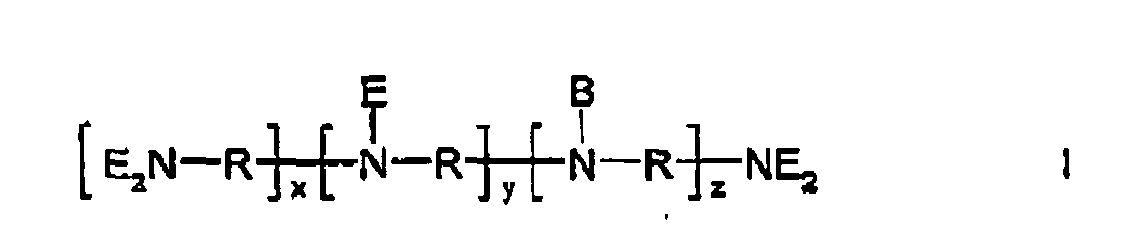
- R are identical or different, linear or branched C2-C6-alkyle radicals;
- B is a branch;
- E is an alkylenoxy unit of the formula

- R1 is 1,2-propylene, 1,2-butylene and/or 1,2-isobutylene;
- R2 is ethylene;
- R3 is 1,2-propylene;
- R4 are identical or different, radicals: hydrogen; C1-C4-alkyl;
- x, y, z are each from 2 to 150, where the sum of x+y+z means a number of alkylenimine units which corresponds to an average molecular weight Mw of the polyalkylenimine before the alkoxylation of from 300 to 10 000;
- m is a rational number from 0 to 2;
- n is a rational number from 6 to 18;
- p is a rational number from 3 to 12, where 0.8 ≤ n/p ≤ 1.0 (x+y+z)1/2;
- and quaternization products thereof.
- The invention further relates to the use of these alkoxylated polyalkylenimines as a soil detachment-promoting additive to laundry detergents and cleaning compositions.
- In addition to surfactants, polymers are also used as soil detachment-promoting additives for laundry detergents and cleaning compositions. The known polymers are very suitable, for example, as dispersants of soil pigments such as clay minerals or soot, and as additives which prevent the reattachment of already detached soil. Such dispersants are, though, especially at low temperatures, substantially ineffective in the removal of greasy soil from the surfaces.
-
WO-A-99/67352 -
US-A-5 565 145 recommends, as dispersants for nonpolar particulate soil, uncharged alkoxylated polyethylenimines which may contain up to 4 propylene oxide units per active NH group bonded directly to the nitrogen atom. However, preferred and demonstrated by way of example are polyethylenimines which are exclusively ethoxylated or at most incipiently propoxylated, i.e. not more than 1 mol of propylene oxide per NH group. - These alkoxylated polyethylenimines too are good dispersants for hydrophilic soil pigments, but do not show a satisfactory wash result in the case of greasy stains.
- Polyethylenimines which have an inner polyethylene oxide block and an outer polypropylene oxide block are yet to be used in laundry detergents or cleaning compositions.
-
US-A-4 076 497 discloses the use of initially ethoxylated and then propoxylated polyethylenimines which have been reacted in total with 30 mol of alkylene oxide, including at least 15 mol of propylene oxide, per mole of active NH group as assistants for the dyeing of polyester and cellulose fibers with dispersion dyes. However, the alkylenoxy chains of the inventive polyalkylenimines contain at most 12 propylenoxy units. -
DE-A-22 27 546 describes, as well as polyethylenimines which have the reverse alkylene oxide sequence, also polyethylenimines which have initially been ethoxylated and then propoxylated as breakers for crude oil emulsions. However, in comparison to the inventive polyalkylenimines, these polyethylenimines have too high a total degree of alkoxylation of at least 105 mol of alkylene oxide per mole of alkoxylatable NH group and too high a molar ratio of propylene oxide to ethylene oxide of from 1.9 to 4:1 (or conversely too small a molar ratio of ethylene oxide to propylene oxide of from 0.53 to 0.25). -
JP-A-2003-020585 - Finally,
EP-A-359 034 - It is an object of the invention to provide polymers which are suitable as an additive to laundry detergents and cleaning compositions for removing greasy soil from textile and hard surfaces. In particular, the polymers should also exhibit good greasy soil-detaching action even at low washing temperatures.
- Accordingly, amphiphilic water-soluble alkoxylated polyalkylenimines of the general formula I:

- R are identical or different, linear or branched C2-C6-alkylene radicals;
- B is a branch;
- E is an alkylenoxy unit of the formula
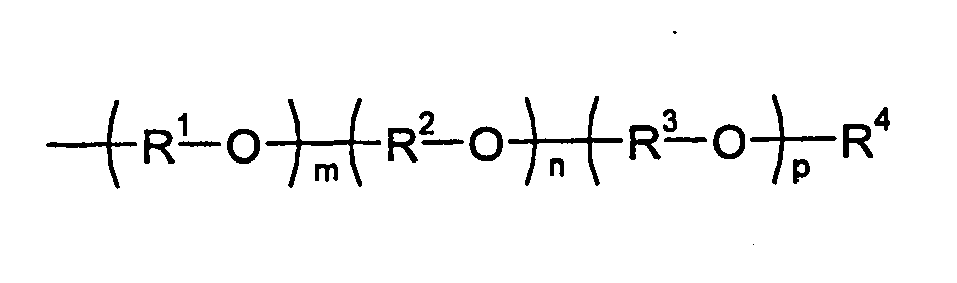
- R1 is 1,2-propylene, 1,2-butylene and/or 1,2-isobutylene;
- R2 is ethylene;
- R3 is 1,2-propylene;
- R4 are identical or different radicals: hydrogen; C1-C4-alkyl;
- x, y, z are each from 2 to 150, where the sum of x+y+z means a number of alkylenimine units which corresponds to an average molecular weight Mw of the polyalkylenimine before the alkoxylation of from 300 to 10 000;
- m is a rational number from 0 to 2;
- n is a rational number from 6 to 18;
- p is a rational number from 3 to 12, where 0.8 ≤ n/p ≤ 1.0 (x+y+z)1/2;
- An essential property of the inventive alkoxylated polyalkylenimines is their amphiphilicity, i.e. they have a balanced ratio of hydrophobic and hydrophilic structural elements and are thus firstly hydrophobic enough to absorb on greasy soil and to remove them together with the surfactants and the remaining washing components of the laundry detergents and cleaning compositions, but secondly also hydrophilic enough to keep the detached greasy soil in the washing and cleaning liquor and prevent it from resettling on the surface.
- This effect is achieved by the alkoxylated polyalkylenimines having an inner polyethylene oxide block and an outer polypropylene oxide block, the degree of ethoxylation and the degree of propoxylation not going above or below specific limiting values, and their ratio being at least 0.8 and within a range whose upper limit according to the empirically found relationship n/p ≤ 1.0 (x+y+z)1/2 is determined by the molecular weight of the polyalkylenimine used.
- The inventive alkoxylated polyalkylenimines have a basic skeleton which comprises primary, secondary and tertiary amine nitrogen atoms which are joined by alkylene radicals R and are in the form of the following moieties in random arrangement:
- primary amino moieties which terminate the main chain and the side chains of the basic skeleton and whose hydrogen atoms are subsequently replaced by alkylenoxy units:
[H2N-R⁆ und -NH2
- secondary amino moieties whose hydrogen atom is subsequently replaced by alkylenoxy units:

- tertiary amino moieties which branch the main chain and the side chains:
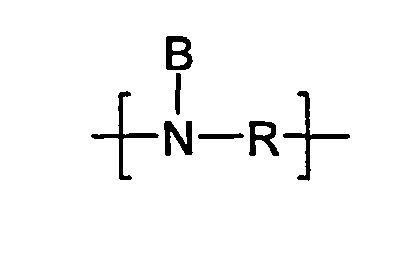
- Before the alkylation, the polyalkylenimine has an average molecular weight Mw of from 300 to 10 000. The sum x+y+z of the repeating units of the primary, secondary and tertiary amino moieties means a total number of alkylenimine units which corresponds to these molecular weights.
- The molecular weight Mw of the polyalkylenimine is preferably from 500 to 7500 and more preferably from 1000 to 6000.
- The R radicals connecting the amine nitrogen atoms may be identical or different, linear or branched C2-C6-alkylene radicals. A preferred branched alkylene is 1,2-propylene. A particularly preferred alkylene radical R is ethylene.
- Since cyclizations are possible in the formation of the basic polyalkylenimine skeleton, it is also possible for cyclic amino moieties to be present to a small extent in the basic skeleton and they are of course alkoxylated in the same way as the noncyclic primary and secondary amino moieties.
- The hydrogen atoms of the primary and secondary amino groups of the basic polyalkylenimine skeleton are replaced by alkylenoxy units of the formula
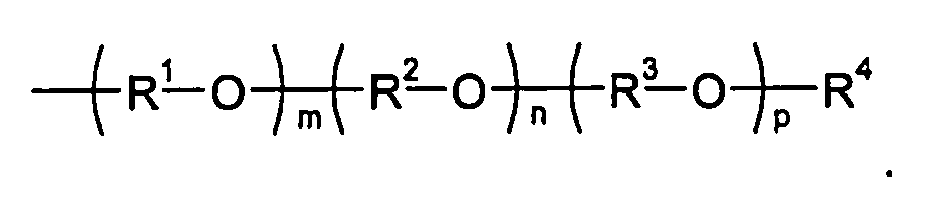
- In this formula, the variables are each defined as follows:
- R1 is 1,2-propylene, 1,2-butylene or 1,2-isobutylene, preferably 1,2-propylene;
- R2 is ethylene;
- R3 is 1,2-propylene;
- R4 is hydrogen or C1-C4-alkyl, preferably hydrogen;
- m is a rational number of 0 to 2; when m ≠ 0, preferably about 1;
- n is a rational number from 6 to 18;
- p is a rational number from 3 to 12, where 0.8 ≤ n/p ≤ 1.0 (x+y+z)1/2.
- n and p are preferably defined as follows:
- n is a rational number from 7 to 15;
- p is a rational number from 4 to 10, where 0.9 ≤ n/p ≤ 0.8 (x+y+z)1/2.
- n and p are more preferably each defined as follows:
- n is a rational number from 8 to 12;
- p is a rational number from 5 to 8, where 1.0 ≤ n/p ≤ 0.6 (x+y+z)1/2.
- The substantial part of these alkylenoxy units is formed by the ethylenoxy units -(R2-O)n-and the propylenoxy units -(R3-O)p-.
- The alkylenoxy units may additionally also have a small proportion of propylenoxy or butylenoxy units -(R1-O)m-, i.e. the polyalkylenimine may be reacted initially with small amounts of up to 2 mol, especially from 0.5 to 1.5 mol, in particular from 0.8 to 1.2 mol, of propylene oxide or butylene oxide per mole of NH moiety present, i.e. incipiently alkoxylated.
- This modification of the polyalkylenimine allows, if necessary, the viscosity of the reaction mixture in the alkoxylation to be lowered. However, the modification generally does not influence the performance properties of the alkoxylated polyalkylenimine and therefore does not constitute a preferred measure.
- The inventive alkoxylated polyalkylenimines may also be quaternized. A suitable degree of quaternization is up to 50%, in particular from 5 to 40%. The quaternization is effected preferably by introducing C1-C4-alkyl groups and may be undertaken in a customary manner by reaction with corresponding alkyl halides and dialkyl sulfates.
- The quaternization may be advantageous in order to adjust the alkoxylated polyalkylenimines to the particular composition of the laundry detergent and cleaning composition in which they are to be used, and to achieve better compatibility and/or phase stability of the formulation. The alkoxylated polyalkylenimines are preferably not quaternized.
- The inventive alkoxylated polyalkylenimines may be prepared in a known manner.
- One preferred procedure consists in initially undertaking only an incipient alkoxylation of the polyalkylenimine in a first step.
- In this step, the polyalkylenimine is reacted only with a portion of the total amount of ethylene oxide used, which corresponds to about 1 mol of ethylene oxide per mole of NH moiety or, when the polyalkylenimine is to be modified initially with up to 2 mol of propylene oxide or butylene oxide per mole of NH moiety, here too initially only with up to 1 mol of this alkylene oxide.
- This reaction is undertaken generally in the absence of a catalyst in aqueous solution at from 70 to 200°C, preferably from 80 to 160°C, under a pressure of up to 10 bar, in particular up to 8 bar.
- In a second step, the further alkoxylation is then effected by subsequent reaction i) with the remaining amount of ethylene oxide or, in the case of a modification by higher alkylene oxide in the first step, with the entirety of ethylene oxide and ii) with propylene oxide.
- The further alkoxylation is undertaken typically in the presence of a basic catalyst. Examples of suitable catalysts are alkali metal and alkaline earth metal hydroxides such as sodium hydroxide, potassium hydroxide and calcium hydroxide, alkali metal alkoxides, in particular sodium and potassium C1-C4-alkoxides, such as sodium methoxide, sodium ethoxide and potassium tert-butoxide, alkali metal and alkaline earth metal hydrides such as sodium hydride and calcium hydride, and alkali metal carbonates such as sodium carbonate and potassium carbonate. Preference is given to the alkali metal hydroxides and the alkali metal alkoxides, particular preference being given to potassium hydroxide and sodium hydroxide. Typical use amounts for the base are from 0.05 to 10% by weight, in particular from 0.5 to 2% by weight, based on the total amount of polyalkylenimine and alkylene oxide.
- The further alkoxylation may be undertaken in substance (variant a)) or in an organic solvent (variant b)). The process conditions specified below may be used both for the ethoxylation and for the subsequent propoxylation.
- In variant a), the aqueous solution of the incipiently alkoxylated polyalkylenimine obtained in the first step, after addition of the catalyst, is initially dewatered. This can be done in a simple manner by heating to from 80 to 150°C and distilling off the water under a reduced pressure of from 0.01 to 0.5 bar. The subsequent reaction with the alkylene oxide is effected typically at from 70 to 200°C, preferably from 100 to 180°C, and at a pressure of up to 10 bar, in particular up to 8 bar, and a continued stirring time of from about 0.5 to 4 h at from about 100 to 160°C and constant pressure follows in each case.
- Suitable reaction media for variant b) are in particular nonpolar and polar aprotic organic solvents. Examples of particularly suitable nonpolar aprotic solvents include aliphatic and aromatic hydrocarbons such as hexane, cyclohexane, toluene and xylene. Examples of particularly suitable polar aprotic solvents are ethers, in particular cyclic ethers such as tetrahydrofuran and dioxane, N,N-dialkylamides such as dimethylformamide and dimethylacetamide, and N-alkyllactams such as N-methylpyrrolidone. It is of course also possible to use mixtures of these aprotic solvents. Preferred solvents are xylene and toluene.
- In variant b) too, the solution obtained in the first step, after addition of catalyst and solvent, is initially dewatered, which is advantageously done by separating out the water at a temperature of from 120 to 180°C, preferably supported by a gentle nitrogen stream. The subsequent reaction with the alkylene oxide may be effected as in variant a).
- In variant a), the alkoxylated polyalkylenimine is obtained directly in substance and may be converted if desired to an aqueous solution. In variant b), the organic solvent is typically removed and replaced by water. The products may of course also be isolated in substance.
- The inventive alkoxylated polyalkylenimines, as a 1% by weight solution in distilled water, have a cloud point of generally ≤ 70°C, preferably ≤ 65°C. The cloud point is more preferably in the range from 25 to 55°C.
- The inventive alkoxylated polyalkylenimines are outstandingly suitable as a soil detachment-promoting additive for laundry detergents and cleaning compositions. They exhibit high dissolving power especially in the case of greasy soil. It is of particular advantage that they display the soil-detaching power even at low washing temperatures.
- The likewise inventive laundry detergents and cleaning compositions comprise generally from 0.05 to 10% by weight, preferably from 0.1 to 5% by weight and more preferably from 0.25 to 2.5% by weight, based on the particular overall composition, of the inventive alkoxylated polyalkylenimines.
- In addition, the laundry detergents and cleaning compositions generally comprise surfactants and, if appropriate, further polymers as washing substances, builders and further customary ingredients, for example cobuilders, complexing agents, bleaches, standardizers, graying inhibitors, dye transfer inhibitors, enzymes and perfumes.
- The alkoxylated polyalkylenimines of the present invention may be utilized in laundry detergents or cleaning compositions comprising a surfactant system comprising C10-C15 alkyl benzene sulfonates (LAS) and one or more co-surfactants selected from nonionic, cationic, anionic or mixtures thereof The selection of co-surfactant may be dependent upon the desired benefit. In one embodiment, the co-surfactant is selected as a nonionic surfactant, preferably C12-C18 alkyl ethoxylates. In another embodiment, the co-surfactant is selected as an anionic surfactant, preferably C10-C18 alkyl alkoxy sulfates (AExS) wherein x is from 1-30. In another embodiment the co-surfactant is selected as a cationic surfactant, preferably dimethyl hydroxyethyl lauryl ammonium chloride. If the surfactant system comprises C10-C15 alkyl benzene sulfonates (LAS), the LAS is used at levels ranging from about 9% to about 25%, or from about 13% to about 25%, or from about 15% to about 23% by weight of the composition.
- The surfactant system may comprise from 0% to about 7%, or from about 0.1 % to about 5%, or from about 1% to about 4% by weight of the composition of a co-surfactant selected from a nonionic co-surfactant, cationic co-surfactant, anionic co-surfactant and any mixture thereof.
- Non-limiting examples of nonionic co-surfactants include: C12-C18 alkyl ethoxylates, such as, NEODOL® nonionic surfactants from Shell; C6-C12 alkyl phenol alkoxylates wherein the alkoxylate units are a mixture of ethyleneoxy and propyleneoxy units; C12-C18 alcohol and C6-C12 alkyl phenol condensates with ethylene oxide/propylene oxide block alkyl polyamine ethoxylates such as PLURONIC® from BASF; C14-C22 mid-chain branched alcohols, BA, as discussed in
US 6,150,322 ; C14-C22 mid-chain branched alkyl alkoxylates, BAEx, wherein x is from 1-30, as discussed inUS 6,153,577 ,US 6,020,303 andUS 6,093,856 ; Alkylpolysaccharides as discussed inU.S. 4,565,647 Llenado, issued January 26, 1986 ; specifically alkylpolyglycosides as discussed inUS 4,483,780 andUS 4,483,779 ; Polyhydroxy fatty acid amides as discussed inUS 5,332,528 ; and ether capped poly(oxyalkylated) alcohol surfactants as discussed inUS 6,482,994 andWO 01/42408 - Non-limiting examples of semi-polar nonionic co-surfactants include: water-soluble amine oxides containing one alkyl moiety of from about 10 to about 18 carbon atoms and 2 moieties selected from the group consisting of alkyl moieties and hydroxyalkyl moieties containing from about 1 to about 3 carbon atoms; water-soluble phosphine oxides containing one alkyl moiety of from about 10 to about 18 carbon atoms and 2 moieties selected from the group consisting of alkyl moieties and hydroxyalkyl moieties containing from about 1 to about 3 carbon atoms; and water-soluble sulfoxides containing one alkyl moiety of from about 10 to about 18 carbon atoms and a moiety selected from the group consisting of alkyl moieties and hydroxyalkyl moieties of from about 1 to about 3 carbon atoms. See
WO 01/32816 US 4,681,704 , andUS 4,133,779 . - Non-limiting examples of cationic co-surfactants include: the quaternary ammonium surfactants, which can have up to 26 carbon atoms include: alkoxylate quaternary ammonium (AQA) surfactants as discussed in
US 6,136,769 ; dimethyl hydroxyethyl quaternary ammonium as discussed in6,004,922 ; dimethyl hydroxyethyl lauryl ammonium chloride; polyamine cationic surfactants as discussed inWO 98/35002 WO 98/35003 WO 98/35004 WO 98/35005 WO 98/35006 US Patents Nos. 4,228,042 ,4,239,660 4,260,529 andUS 6,022,844 ; and amino surfactants as discussed inUS 6,221,825 andWO 00/47708 - Nonlimiting examples of anionic co-surfactants useful herein include: C10-C20 primary, branched chain and random alkyl sulfates (AS); C10-C18 secondary (2,3) alkyl sulfates; C10-C18 alkyl alkoxy sulfates (AExS) wherein x is from 1-30; C10-C18 alkyl alkoxy carboxylates comprising 1-5 ethoxy units; mid-chain branched alkyl sulfates as discussed in
US 6,020,303 andUS 6,060,443 ; mid-chain branched alkyl alkoxy sulfates as discussed inUS 6,008,181 andUS 6,020,303 ; modified alkylbenzene sulfonate - (MLAS) as discussed in
WO 99/05243 WO 99/05242 WO 99/05244 - The present invention relates to compositions comprising the inventive alkoxylated polyalkylenimines and a surfactant system comprising C8-C18 linear alkyl sulphonate surfactant and a co-surfactant. The compositions can be in any form, namely, in the form of a liquid; a solid such as a powder, granules, agglomerate, paste, tablet, pouches, bar, gel; an emulsion; types delivered in dual-compartment containers; a spray or foam detergent; premoistened wipes (i.e., the cleaning composition in combination with a nonwoven material such as that discussed in
US 6,121,165, Mackey, et al. ); dry wipes (i.e., the cleaning composition in combination with a nonwoven materials, such as that discussed inUS 5,980,931, Fowler, et al. ) activated with water by a consumer; and other homogeneous or multiphase consumer cleaning product forms. - In one embodiment, the cleaning composition of the present invention is a liquid or solid laundry detergent composition. In another embodiment, the cleaning composition of the present invention is a hard surface cleaning composition, preferably wherein the hard surface cleaning composition impregnates a nonwoven substrate. As used herein "impregnate" means that the hard surface cleaning composition is placed in contact with a nonwoven substrate such that at least a portion of the nonwoven substrate is penetrated by the hard surface cleaning composition, preferably the hard surface cleaning composition saturates the nonwoven substrate. The cleaning composition may also be utilized in car care compositions, for cleaning various surfaces such as hard wood, tile, ceramic, plastic, leather, metal, glass. This cleaning composition could be also designed to be used in a personal care and pet care compositions such as shampoo composition, body wash, liquid or solid soap and other cleaning composition in which surfactant comes into contact with free hardness and in all compositions that require hardness tolerant surfactant system, such as oil drilling compositions.
- In another embodiment the cleaning composition is a dish cleaning composition, such as liquid hand dishwashing compositions, solid automatic dishwashing compositions, liquid automatic dishwashing compositions, and tab/unit does forms of automatic dishwashing compositions.
- Quite typically, cleaning compositions herein such as laundry detergents, laundry detergent additives, hard surface cleaners, synthetic and soap-based laundry bars, fabric softeners and fabric treatment liquids, solids and treatment articles of all kinds will require several adjuncts, though certain simply formulated products, such as bleach additives, may require only, for example, an oxygen bleaching agent and a surfactant as described herein. A comprehensive list of suitable laundry or cleaning adjunct materials can be found in
WO 99/05242 - Common cleaning adjuncts include builders, enzymes, polymers not discussed above, bleaches, bleach activators, catalytic materials and the like excluding any materials already defined hereinabove. Other cleaning adjuncts herein can include suds boosters, suds suppressors (antifoams) and the like, diverse active ingredients or specialized materials such as dispersant polymers (e.g., from BASF Corp. or Rohm & Haas) other than those described above, color speckles, silvercare, anti-tarnish and/or anti-corrosion agents, dyes, fillers, germicides, alkalinity sources, hydrotropes, anti-oxidants, enzyme stabilizing agents, pro-perfumes, perfumes, solubilizing agents, carriers, processing aids, pigments, and, for liquid formulations, solvents, chelating agents, dye transfer inhibiting agents, dispersants, brighteners, suds suppressors, dyes, structure elasticizing agents, fabric softeners, anti-abrasion agents, hydrotropes, processing aids, and other fabric care agents, surface and skin care agents. Suitable examples of such other cleaning adjuncts and levels of use are found in
U.S. Patent Nos. 5,576,282 ,6,306,812 B1 and6,326,348 B1 . - The present invention includes a method for cleaning a targeted surface. As used herein "targeted surface" may include such surfaces such as fabric, dishes, glasses, and other cooking surfaces, hard surfaces, hair or skin. As used herein "hard surface" includes hard surfaces being found in a typical home such as hard wood, tile, ceramic, plastic, leather, metal, glass. Such method includes the steps of contacting the composition comprising the modified polyol compound, in neat form or diluted in wash liquor, with at least a portion of a targeted surface then optionally rinsing the targeted surface. Preferably the targeted surface is subjected to a washing step prior to the aforementioned optional rinsing step. For purposes of the present invention, washing includes, but is not limited to, scrubbing, wiping and mechanical agitation.
- As will be appreciated by one skilled in the art, the cleaning compositions of the present invention are ideally suited for use in home care (hard surface cleaning compositions), personal care and/or laundry applications.
- The composition solution pH is chosen to be the most complimentary to a target surface to be cleaned spanning broad range of pH, from about 5 to about 11. For personal care such as skin and hair cleaning pH of such composition preferably has a pH from about 5 to about 8 for laundry cleaning compositions pH of from about 8 to about 10. The compositions are preferably employed at concentrations of from about 200 ppm to about 10,000 ppm in solution. The water temperatures preferably range from about 5 °C to about 100 °C.
- For use in laundry cleaning compositions, the compositions are preferably employed at concentrations from about 200 ppm to about 10000 ppm in solution (or wash liquor). The water temperatures preferably range from about 5°C to about 60°C. The water to fabric ratio is preferably from about 1:1 to about 20:1.
- The method may include the step of contacting a nonwoven substrate impregnated with an embodiment of the composition of the present invention As used herein "nonwoven substrate" can comprise any conventionally fashioned nonwoven sheet or web having suitable basis weight, caliper (thickness), absorbency and strength characteristics. Examples of suitable commercially available nonwoven substrates include those marketed under the tradename SONTARA® by DuPont and POLYWEB® by James River Corp. As will be appreciated by one skilled in the art, the cleaning compositions of the present invention are ideally suited for use in liquid dish cleaning compositions. The method for using a liquid dish composition of the present invention comprises the steps of contacting soiled dishes with an effective amount, typically from about 0.5 ml. to about 20 ml. (per 25 dishes being treated) of the liquid dish cleaning composition of the present invention diluted in water.
- In a 21 autoclave, 900 g of a 50% by weight aqueous solution of polyethylenimine 5000 (average molecular weight Mw of 5000) were heated to 80°C and purged three times with nitrogen up to a pressure of 5 bar. After the temperature had been increased to 90°C, 461 g of ethylene oxide were metered in up to 5 bar. The mixture was stirred at 90°C under a constant pressure of 5 bar for a further 1 h. Volatile fractions were removed by stripping with nitrogen.
- 1345 g of a 68% by weight aqueous solution of polyethylenimine 5000 which contained 1 mol of ethylene oxide per mole ofNH bond were obtained.
- In a 2 1 autoclave, a mixture of 163 g of the aqueous solution obtained in the incipient ethoxylation and 13.9 g of a 40% by weight aqueous potassium hydroxide solution was heated to 70°C. After purging with nitrogen three times up to a pressure of 5 bar, the mixture was dewatered at 120°C and a reduced pressure of 10 mbar for 4 h. Subsequently, 506 g of ethylene oxide were metered in at 120°C up to a pressure of 8 bar. The mixture was stirred at 120°C and 8 bar for 4 h. After decompression and purging with nitrogen, 519 g of propylene oxide were metered in at 120°C up to a pressure of 8 bar. The mixture was stirred again at 120°C and 8 bar for a further 4 h. Volatile fractions were removed by stripping with nitrogen.
- 1178 g of polyethylenimine 5000 which contained 10 mol of ethylene oxide and 7 mol of propylene oxide per mole of NH bond were obtained in the form of a light brown viscous liquid (amine titer: 0.9276 mmol/g; pH of a 1% by weight aqueous solution: 10.67).
- In a 21 autoclave, a mixture of 137 g of the aqueous solution obtained in the incipient ethoxylation, 11.8 g of a 40% by weight aqueous potassium hydroxide solution and 300 g of xylene was purged three times with nitrogen up to a pressure of 5 bar. At a jacket temperature of 175°C, the water present was separated out using a water separator supported by a gentle nitrogen stream within 4 h. Subsequently, 428 g of ethylene oxide were metered in at 120°C up to a pressure of 3 bar. The mixture was stirred at 120°C under a constant pressure of 3 bar for a further 2 h. 439 g of propylene oxide were then metered in at 120°C up to a pressure of 3 bar. The mixture was stirred at 120°C and 3 bar for a further 3 h. After the solvent had been removed under a reduced pressure of 10 mbar, the alkoxylation product was stripped with 4 bar of steam at 120°C for 3 h.
- 956 g of polyethylenimine 5000 which contained 10 mol of ethylene oxide and 7 mol of propylene oxide per mole of NH bond were obtained in the form of a light brown viscous liquid (amine titer: 0.9672 mmol/g; pH of a 1% by weight aqueous solution: 10.69).
- In a 2 1 autoclave, a mixture of 321 g of a 69.2% by weight aqueous solution of polyethylenimine 5000 (1 mol of ethylene oxide per mole of NH bond) which was obtained in incipient ethoxylation analogously to example 1 and 28 g of a 40% by weight aqueous potassium hydroxide solution was heated to 80°C. After it had been purged three times with nitrogen up to a pressure of 5 bar, the mixture was dewatered at 120°C for 3 h and a vacuum of 10 mbar. Subsequently, 1020 g of ethylene oxide were metered at 120°C up to a pressure of 8 bar. The mixture was then stirred at 120°C and 8 bar for a further 4 h. Volatile fractions were removed by stripping with nitrogen.
- 1240 g of polyethylenimine 5000 which contained 9.9 mol of ethylene oxide per mole of NH bond were obtained in the form of a brown viscous solution (amine titer: 1.7763 mmol/g; pH of a 1% by weight aqueous solution: 11.3).
- 239 g of the ethoxylation product were then, after purging three times with nitrogen up to a pressure of 5 bar, reacted at 120°C with approx. 87 g of propylene oxide (measurement precision +/-15 g) up to a pressure of 8 bar. The mixture was then stirred at 120°C and 8 bar for 4 h. Volatile fractions were removed by stripping with nitrogen or a gentle vacuum of 500 mbar at 80°C.
- 340 g of polyethylenimine 5000 which contained 9.9 mol of ethylene oxide and 3.5 mol of propylene oxide per mole of NH bond were obtained in the form of a light brown viscous liquid (amine titer: 1.2199 mmol/g; pH of a 1% by weight aqueous solution: 11.05).
- In a 2 autoclave, a mixture of 516 g of polyethylenimine 600 (average molecular weight Mw of 600) and 10.3 g of water was flushed three times with nitrogen up to a pressure of 5 bar and heated to 90°C. 528 g of ethylene oxide were then metered in at 90°C. The mixture was stirred at 90°C under a constant pressure of 5 bar for a further 1 h. Volatile fractions (especially water) were removed by stripping with nitrogen.
- 1040 g of polyethylenimine 600 which contained 1 mol of ethylene oxide per mole of NH bond were obtained in the form of a brown liquid.
- In a 2 1 autoclave, a mixture of 86 g of the incipiently ethoxylated polyethylenimine 600 and 10.8 g of a 40% by weight aqueous potassium hydroxide solution was heated to 80°C. After it had been purged three times with nitrogen up to a pressure of 5 bar, the mixture was dewatered at 120°C and a vacuum of 10 mbar for 2.5 h. After the vacuum had been removed with nitrogen, 384 g of ethylene oxide were metered in at 120°C. The mixture was stirred at 120°C for a further 2 h. After decompression and purging with nitrogen, 393 g of propylene oxide were metered in at 120°C. The mixture was again stirred at 120°C for a further 2 h. Volatile fractions were removed by stripping with nitrogen.
- 865 g of polyethylenimine 600 which contained 10 mol of ethylene oxide and 7 mol of propylene oxide per mole of NH bond were obtained in the form of a light brown viscous liquid (amine titer: 1.0137 mmol/g; pH of a 1% by weight aqueous solution: 11.15).
- 7.3 g of dimethyl sulfate were added dropwise to 300 g of the alkoxylated polyethylenimine 5000 which has been obtained in example 1b) and stirred at 60°C under nitrogen. In the course of this, the temperature rose to 70°C. After the mixture had been stirred at 70°C for a further 3 hours, the mixture was cooled to room temperature.
- 307 g of polyethylenimine 5000, which contained 10 mol of ethylene oxide and 7 mol of propylene oxide per mole of NH bond and had a degree of quaternization of 22% were obtained in the form of a brown viscous liquid (amine titer: 0.7514 mmol/g).
-
A B C D E wt% wt% wt% wt% wt% C11-12 Linear alkyl benzene sulphonate 13-25 13-25 13-25 13-25 9-25 C12-18 Ethoxylate Sulfate --- --- 0-3 --- 0-1 C14-15 alkyl ethoxylate (EO=7) 0-3 0-3 --- 0-5 0-3 Dimethyl hydroxyethyl lauryl ammonium chloride --- --- 0-2 0-2 0-2 Sodium tripolyphosphate 20 - 40 --- 18-33 12-22 0-15 zeolite 0-10 20-40 0-3 -- -- silicate builder 0-10 0-10 0-10 0-10 0-10 Carbonate 0-30 0-30 0-30 5-25 0-20 diethylene triamine penta acetate 0-1 0-1 0-1 0-1 0-1 polyacrylate 0-3 0-3 0-3 0-3 0-3 Carboxy Methyl Cellulose 0.2-0.8 0.2-0.8 0.2-0.8 0.2-0.8 0.2-0.8 Polymer 0.05-10 0.05-10 5.0 2.5 1.0 Percarbonate 0-10 0-10 0-10 0-10 0-10 nonanoyloxybenzenesulfonate --- --- 0-2 0-2 0-2 tetraacetylethylenediamine --- --- 0-0.6 0-0.6 0-0.6 Zinc Phthalocyanine Tetrasulfonate --- --- 0-0.005 0-0.005 0-0.005 Brightener 0.05-0.2 0.05-0.2 0.05-0.2 0.05-0.2 0.05-0.2 MgSO4 --- --- 0-0.5 0-0.5 0-0.5 ENZYMES 0-0.5 0-0.5 0-0.5 0-0.5 0-0.5 MINORS (perfume, dyes, suds stabilizers) balance balance balance balance balance -
Ingredient A B C D E F wt % wt % wt % wt % wt % wt % sodium alkyl ether sulfate 14.4% 14.4% 9.2% 5.4% linear alkylbenzene sulfonic acid 4.4% 4.4% 12.2% 5.7% 1.3% alkyl ethoxylate 2.2% 2.2% 8.8% 8.1% 3.4% amine oxide 0.7% 0.7% 1.5% citric acid 2.0% 2.0% 3.4% 1.9% 1.0% 1.6% fatty acid 3.0% 3.0% 8.3% 16.0% protease 1.0% 1.0% 0.7% 1.0% 2.5% amylase 0.2% 0.2% 0.2% 0.3% lipase 0.2% borax 1.5% 1.5% 2.4% 2.9% calcium and sodium formate 0.2% 0.2% formic acid 1.1 % Polymer1 1.8% 1.8% 2.1% 3.2% sodium polyacrylate 0.2% sodium polyacrylate copolymer 0.6% DTPA2 0.1% 0.1% 0.9% DTPMP3 0.3% EDTA4 0.1% fluorescent whitening agent 0.15% 0.15% 0.2% 0.12% 0.12% 0.2% ethanol 2.5% 2.5% 1.4% 1.5% propanediol 6.6% 6.6% 4.9% 4.0% 15.7% sorbitol 4.0% ethanolamine 1.5% 1.5% 0.8% 0.1 % 11.0% sodium hydroxide 3.0% 3.0% 4.9% 1.9% 1.0% sodium cumene sulfonate 2.0% silicone suds suppressor 0.01% perfume 0.3% 0.3% 0.7% 0.3% 0.4% 0.6% opacifier5 0.30% 0.20% 0.50% water balance balance balance balance balance balance 100.0% 100.0% 100.0% 100.0% 100.0% 100.0% 1 A alkoxylated polyalkylenimine polymer or any mixture of polymers according to any of Examples 1, 2, 3 or 4.
2 diethylenetriaminepentaacetic acid, sodium salt
3 diethylenetriaminepentakismethylenephosphonic acid, sodium salt
4 ethylenediaminetetraacetic acid, sodium salt
5 Acusol OP 301 -
Composition A B C12-13 Natural AE0.6S 29.0 29.0 C10-14 mid-branched Amine Oxide -- 6.0 C12-14 Linear Amine Oxide 6.0 -- SAFOL® 23 Amine Oxide 1.0 1.0 C11E9 Nonionic 2 2.0 2.0 Ethanol 4.5 4.5 Polymer1 5.0 2.0 Sodium cumene sulfonate 1.6 1.6 Polypropylene glycol 2000 0.8 0.8 NaCI 0.8 0.8 1,3 BAC Diamine3 0.5 0.5 Suds boosting polymer4 0.2 0.2 Water Balance Balance 1 A alkoxylated polyalkylenimine polymer or any mixture of polymers according to any of Examples 1, 2, 3 or 4.
2 Nonionic may be either C11 Alkyl ethoxylated surfactant containing 9 ethoxy groups.
3 1,3, BAC is 1,3 bis(methylamine)-cyclohexane.
4 (N,N-dimethylamino)ethyl methacrylate homopolymer -
A B C D E Polymer dispersant2 0.5 5 6 5 5 Carbonate 35 40 40 35-40 35-40 Sodium tripolyphosphate 0 6 10 0-10 0-10 Silicate solids 6 6 6 6 6 Bleach and bleach activators 4 4 4 4 4 Polymer1 0.05-10 1 2.5 5 10 Enzymes 0.3-0.6 0.3-0.6 0.3-0.6 0.3-0.6 0.3-0.6 Disodium citrate dihydrate 0 0 0 2-20 0 Nonionic surfactant3 0 0 0 0 0.8-5 Water, sulfate, perfume, Balance Balance to Balance Balance Balance dyes and other adjuncts to 100% 100% to 100% to 100% to 100% 1 A alkoxylated polyalkylenimine polymer or any mixture of polymers according to any of Examples 1, 2, 3 or 4.
2 Such as ACUSOL® 445N available from Rohm & Haas or ALCOSPERSE® from Alco.
3 such as SLF-18 POLY TERGENT from the Olin Corporation. - To test their soil release performance, the alkoxylated polyalkylenimines were added to the wash liquor in three series of experiments together with the surfactants and builders specified in table 1, as model laundry detergents, or with a commercially available laundry detergent. The test cloths recited in table 2 were then washed under the washing conditions specified in tables 3a, 4a and 5 a.
- Soil release from the test cloths was determined by subjecting the test cloths to a reflectance measurement at 460 nm before and after the wash. Soil removal was computed from the reflectance values R before and after the wash and also the reflectance value of a white reference cotton fabric by the following formula, in %:

- All washes were carried out 2 ×. The soil removal values reported under the wash results in tables 3b, 4b and 5b correspond to the average of the measured values obtained under the same conditions. The values respectively obtained without added polymer are reported for comparison.
- All amounts used are based on 100% active substance.
Table 1: Surfactants and builder Surfactant 1 Lutensit® A-LBN 50 (BASF; linear C12-alkylbenzenesulfonate (Na salt)) Surfactant 2 Plurafac® LF 401 (BASF; fatty alcohol alkoxylate) Builder sodium tripolyphosphate Table 2: Test cloths TG 1 Triolein colored with Sudan Red: 0.2 g stain on 5 g white cotton fabric TG 2 Olive oil colored with Sudan Red; 0.2 g stain on 5 g white cotton fabric TG 3 WFK 10D (sebum/pigment soil cloth from WFK*) TG 4 EMPA 118 (sebum/pigment soil cloth from EMPA**) TG 5 Scientific Services*** Sebum TG 6 WFK 10FF (vegetable fat/pigment soil cloth from WFK) TG 7 CFT-CS10 (colored butter on cotton fabric from CFT****) TG 8 CFT-CS 62 (colored pork fat on cotton fabric from CFT) * Research Institute for Cleaning Technology, Krefeld ** Swiss Materials Testing and Research Institute, St. Gallen, CH *** Scientific Services S/D, Inc., Sparrow Bush, NY, USA **** Center for Test Materials BV, Vlaardingen, NL Table 3a: Wash conditions Instrument Launder-O-Meter (from Atlas, Chicago, USA) Wash temperature 25°C Polymer dosage 30 mg/l Laundry detergent Model laundry detergent from surfactant 1/builder Surfactant dosage 300 mg/l Builder dosage 200 mg/l Water hardness 2.5 mmol/l Ca: Mg 3:1 Liquor ratio 12.5:1 Wash time 30 min Test cloths TG 1 and TG 2 The test cloths were each washed separately with a further 5 g of white cotton fabric per pot. Table 3b: Wash results Polymer Soil removal [%] TG 1 TG 2 from Example 3 42.6 38.4 no addition 38.5 32.4 Table 4a: Wash conditions Instrument Launder-O-Meter (from Atlas, Chicago, USA) Wash temperature 25°C Polymer dosage 25 mg/l Laundry detergent Model laundry detergent from surfactant 1/surfactant 2 Surfactant 1 dosage 150 mg/l Surfactant 2 dosage 50 mg/l Water hardness 1.0 mmol/l Ca:Mg 3:1 Liquor ratio 12.5:1 Wash time 30 min Test cloths TG 3, TG 4, TG 6, TG 7 and TG 8 The soil cloths were each trimmed to 4 x 4 cm and stitched onto white cotton. In each case, 2 cotton fabrics with stitched-on TG 3, TG 4 and TG 6 cloth and also 2 cotton fabrics with stitched-on TG 7 and TG 8 cloth were washed together. A further 5 g of white cotton fabric were included in each wash. Table 4b: Wash results Polymer Soil removal [%] TG 3 TG 4 TG 6 TG 7 TG 8 from Example 3 29.7 8.2 48.1 6.6 3.9 no addition 29.4 6.8 47.4 5.9 2.5 Table 5a: Wash conditions Instrument Launder-O-Meter (from Atlas, Chicago, USA) Wash temperature 25°C Polymer dosage (1) 20 mg/l; (2) 40 mg/l Laundry detergent Tide liquid (Procter & Gamble) Laundry detergent dosage 1 g/l Water hardness 1.0 mmol/l Ca:Mg 3:1 Liquor ratio 12.5:1 Wash time 30 min Test cloths TG 3, TG 4, TG 5 and TG 6 The soil cloths were each trimmed to 4 x 4 cm and stitched onto white cotton. In each case 2 cotton fabrics with stitched-on soil cloth were washed together. A further 5 g of white cotton fabric were included in each wash. Table 5b: Wash results Polymer Soil removal [%] TG 3 TG 4 TG 5 TG 6 from Example 3 (20 mg/l) 39.6 7.6 31.4 50.0 from Example 3 (40 mg/l) 40.2 8.2 32.1 50.6 no addition 37.2 5.4 28.5 44.4 - The results of the wash tests show that adding the inventive alkoxylated polyalkylenimines leads to a distinct improvement in soil release with regard to fatty and oily stains from cotton fabric.
- Unless otherwise noted, all component or composition levels are in reference to the active level of that component or composition, and are exclusive of impurities, for example, residual solvents or by-products, which may be present in commercially available sources.
- All percentages and ratios are calculated by weight unless otherwise indicated. All percentages and ratios are calculated based on the total composition unless otherwise indicated.
- It should be understood that every maximum numerical limitation given throughout this specification includes every lower numerical limitation, as if such lower numerical limitations were expressly written herein. Every minimum numerical limitation given throughout this specification will include every higher numerical limitation, as if such higher numerical limitations were expressly written herein. Every numerical range given throughout this specification will include every narrower numerical range that falls within such broader numerical range, as if such narrower numerical ranges were all expressly written herein.
- While particular embodiments of the present invention have been illustrated and described, it would be obvious to those skilled in the art that various other changes and modifications can be made without departing from the scope of the invention. It is therefore intended to cover in the appended claims all such changes and modifications that are within the scope of this invention.
Claims (10)
- A laundry detergent or cleans composition which comprises an amphiphilic watar-soluble alkoxylated polyalkylenimine of the general formula I
 R are identical or different, linear or branched C2-C6-alkylene radicals,preferably R is ethylene;B is a branch;E is an alkylenoxy unit of the formula
 R1 is 1,2-propylcnc, 1,2-butylene and/or 1,2-isobutylene;R2 is ethylene;R3 is 1,2-propylene;R4 are identical or different radicals selected from either hydrogen or a C1-C4-alkyl, preferably R4 is hydrogen;x, y, z are each from 2 to 150, where the sum of x+y+z means a number of alkylenimine units which corresponds to an average molecular weight Mw of the polyalkylenimine before the alkoxylation of from 300 to 10,000, preferably 500 to 7500;m is a rational number from 0 to 2, preferably 0;n is a rational number from 6 to 18, preferably from 7 to 15p is a rational number from 3 to 12, preferably from 4 to 10; where 0.8 ≤ n/p ≤ 1.0 (x+y+z)1/2, preferably 0.9 ≤ n/p ≤ 0.8 (x+y+z)1/2.;and quaternization products thereof.
 - A laundry detergent or cleaning composition according to Claim 1 wherein the laundry detergent or cleaning composition is selected from the group consisting of liquid laundry detergent compositions, solid laundry detergent compositions, hard surface cleaning compositions, liquid hand dishwahsing compositions, solid automatic dishwashing compositions, liquid automatice dishwashing, and tab/unit dose form automatic dishwashing compositions.
- A laundry detergent or cleaning composition according to either of Claim 1 or Claim 2 wherein the detergent or composition comprise from 0.05 to 10% by weight of the detergent or composition, of the amphiphilic water-soluble alkoxylated polyalkylenimine.
- A laundry detergent or cleaning composition according to any of the preceding claims wherein the detergent or composition further comprises a surfactant system.
- A laundry detergent or cleaning composition according to Claim 4 wherein the surfactant system comprises C10-C15 alkyl benzene sulfonates.
- A laundry detergent or cleaning composition according to Claim 4 wherein the surfactant system comprises C8-C18 linear alkyl sulfonate surfactant.
- A laundry detergent or cleaning composition according to either Claim 5 or claim 6 wherein the surfactant system further comprises one or more co-surfactant selected from the groups consisting of nonionic surfactants, cationic surfactants, anionic surfactants and mixtures thereof.
- A laundry detergent or cleaning composition according to any of the preceding claims wherein the detergent or composition further comprises cleaning adjunct additives.
- Nazi cleaning implement comprising a nonwoven substrate and the laundry detergent or cleaning composition according to any of the preceding claims.
- The use of an amphiphilic water-soluble alkoxylated polyalkylenimine of the general formula I
 R are identical or different, linear or branched C2-C6-alkylene radicals,preferably R is ethylene;B is a branch;E is an alkylenoxy unit of the formula
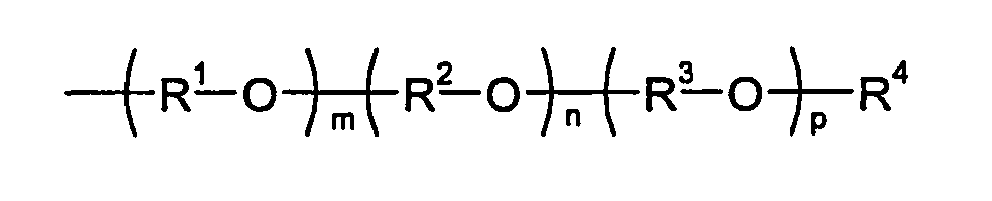 R1 is 1,2-propylene, 1,2-butylene and/or 1,2-isobutylene;R2 is ethylene;R3 is 1,2-propylene;R4 are identical or different radicals selected from either hydrogen or a C1-C4-alkyl, preferably R4 is hydrogen;x, y, z are each from 2 to 150, where the sum of x+y+z means a number of alkylenimine units which corresponds to an average molecular weight Mw of the polyalkylenimine before the alkoxylation of from 300 to 10,000, preferably 500 to 7500;m is a rational number from 0 to 2, preferably 0;n is a rational number from 6 to 18, preferably from 7 to 15p is a rational number from 3 to 12, preferably from 4 to 10; where 0.8 ≤ n/p ≤ 1.0 (x+y+z)1/2, preferably 0.9 ≤ n/p ≤ 0.8 (x+y+z)1/2;and quaternization products thereof,
as a soil release-promoting additive to laundry detergents and cleaning compositions.
Priority Applications (1)
| Application Number | Priority Date | Filing Date | Title |
|---|---|---|---|
| PL06725730T PL1869154T3 (en) | 2005-04-15 | 2006-04-12 | Cleaning compositions with alkoxylated polyalkylenimines |
Applications Claiming Priority (2)
| Application Number | Priority Date | Filing Date | Title |
|---|---|---|---|
| US67149305P | 2005-04-15 | 2005-04-15 | |
| PCT/EP2006/061553 WO2006108857A1 (en) | 2005-04-15 | 2006-04-12 | Cleaning compositions with alkoxylated polyalkylenimines |
Publications (2)
| Publication Number | Publication Date |
|---|---|
| EP1869154A1 EP1869154A1 (en) | 2007-12-26 |
| EP1869154B1 true EP1869154B1 (en) | 2010-11-03 |
Family
ID=36636905
Family Applications (2)
| Application Number | Title | Priority Date | Filing Date |
|---|---|---|---|
| EP06725730A Active EP1869154B1 (en) | 2005-04-15 | 2006-04-12 | Cleaning compositions with alkoxylated polyalkylenimines |
| EP06725729A Active EP1877531B1 (en) | 2005-04-15 | 2006-04-12 | Amphiphilic water-soluble alkoxylated polyalkylenimines with an internal polyethylene oxide block and an external polypropylene oxide block |
Family Applications After (1)
| Application Number | Title | Priority Date | Filing Date |
|---|---|---|---|
| EP06725729A Active EP1877531B1 (en) | 2005-04-15 | 2006-04-12 | Amphiphilic water-soluble alkoxylated polyalkylenimines with an internal polyethylene oxide block and an external polypropylene oxide block |
Country Status (16)
| Country | Link |
|---|---|
| US (2) | US8669221B2 (en) |
| EP (2) | EP1869154B1 (en) |
| JP (2) | JP4937996B2 (en) |
| KR (1) | KR20080002942A (en) |
| CN (2) | CN101184834B (en) |
| AR (1) | AR054250A1 (en) |
| AT (2) | ATE484569T1 (en) |
| BR (2) | BRPI0609363A2 (en) |
| CA (2) | CA2602128C (en) |
| DE (2) | DE502006008083D1 (en) |
| EG (1) | EG25105A (en) |
| ES (2) | ES2355743T3 (en) |
| MX (2) | MX2007012838A (en) |
| PL (1) | PL1869154T3 (en) |
| WO (2) | WO2006108856A2 (en) |
| ZA (1) | ZA200708224B (en) |
Families Citing this family (326)
| Publication number | Priority date | Publication date | Assignee | Title |
|---|---|---|---|---|
| BRPI0609363A2 (en) | 2005-04-15 | 2010-03-30 | Procter & Gamble | cleaning compositions with alkoxylated polyalkylene imines |
| PL2021452T3 (en) * | 2006-05-22 | 2018-07-31 | The Procter & Gamble Company | Liquid detergent composition for improved grease cleaning |
| EP2014755B1 (en) | 2007-05-29 | 2012-03-21 | The Procter & Gamble Company | Method of cleaning dishware |
| US7951768B2 (en) * | 2007-06-29 | 2011-05-31 | The Procter & Gamble Company | Laundry detergent compositions comprising amphiphilic graft polymers based on polyalkylene oxides and vinyl esters |
| EP2014753A1 (en) * | 2007-07-11 | 2009-01-14 | The Procter and Gamble Company | Liquid detergent composition |
| MX303333B (en) * | 2007-11-09 | 2012-09-12 | Procter & Gamble | Cleaning compositions with alkoxylated polyalkanolamines. |
| EP2225355B1 (en) * | 2007-11-09 | 2016-05-11 | The Procter & Gamble Company | Cleaning compositions comprising a multi-polymer system comprising at least one alkoxylated grease cleaning polymer |
| ES2479392T3 (en) * | 2007-11-09 | 2014-07-24 | The Procter & Gamble Company | Cleaning compositions with amphiphilic water-soluble polyalkyleneimines having an internal block of poly (ethylene oxide) and an external block of polypropylene oxide |
| MX2010004654A (en) | 2007-11-09 | 2010-06-02 | Basf Se | Amphiphilic water-soluble alkoxylated polyalkyleneimines having an inner polyethylene oxide block and an outer polypropylene oxide block. |
| ES2394549T3 (en) * | 2007-11-23 | 2013-02-01 | Basf Se | Process for alkoxylation of polymers containing the amino group |
| RU2470069C2 (en) | 2008-01-04 | 2012-12-20 | Дзе Проктер Энд Гэмбл Компани | Laundry detergent composition containing glycosyl hydrolase |
| US20090209447A1 (en) * | 2008-02-15 | 2009-08-20 | Michelle Meek | Cleaning compositions |
| AR070497A1 (en) * | 2008-02-29 | 2010-04-07 | Procter & Gamble | DETERGENT COMPOSITION THAT LIPASA INCLUDES |
| MX2010009457A (en) * | 2008-02-29 | 2010-09-24 | Procter & Gamble | Detergent composition comprising lipase. |
| US7820610B2 (en) | 2008-04-07 | 2010-10-26 | The Procter & Gamble Company | Laundry detergent containing polyethyleneimine suds collapser |
| EP2300588B1 (en) | 2008-06-06 | 2019-02-06 | The Procter and Gamble Company | Detergent composition comprising a variant of a family 44 xyloglucanase |
| EP2138568A1 (en) | 2008-06-25 | 2009-12-30 | The Procter and Gamble Company | Neutralisation process for producing a laundry detergent composition comprising anionic detersive surfactant and polymeric material |
| US8093352B2 (en) | 2008-08-05 | 2012-01-10 | Alcon Research, Ltd. | Polyalkylene oxide polyquaternary ammonium biocides |
| GB0815022D0 (en) | 2008-08-16 | 2008-09-24 | Reckitt Benckiser Nv | Composition |
| US8293697B2 (en) | 2009-03-18 | 2012-10-23 | The Procter & Gamble Company | Structured fluid detergent compositions comprising dibenzylidene sorbitol acetal derivatives |
| US8153574B2 (en) | 2009-03-18 | 2012-04-10 | The Procter & Gamble Company | Structured fluid detergent compositions comprising dibenzylidene polyol acetal derivatives and detersive enzymes |
| JP5782602B2 (en) * | 2009-03-20 | 2015-09-24 | シーエルエスエヌ ラボラトリーズ、インコーポレイテッド | Polyamine derivatives |
| GB0919097D0 (en) * | 2009-10-30 | 2009-12-16 | Croda Int Plc | Treatment of hard surfaces |
| EP2507824A4 (en) | 2009-11-30 | 2013-09-25 | Basf Se | METHOD FOR REMOVING A BASE MATERIAL LAYER FROM A SUBSTRATE, AND CHEMICAL MECHANICAL POLISHING AGENT SUITABLE FOR THIS TASK |
| EP3434764A3 (en) | 2009-12-09 | 2019-04-03 | The Procter & Gamble Company | Fabric and home care products |
| WO2011080267A2 (en) | 2009-12-29 | 2011-07-07 | Novozymes A/S | Polypetides having detergency enhancing effect |
| CN102858968B (en) | 2010-02-25 | 2015-07-01 | 诺维信公司 | Variants of a lysozyme and polynucleotides encoding same |
| EP2380956A1 (en) | 2010-04-19 | 2011-10-26 | The Procter & Gamble Company | Process for making a detergent |
| KR101505334B1 (en) | 2010-08-03 | 2015-03-23 | 바스프 에스이 | Carrier fluids for abrasives |
| WO2012035103A1 (en) | 2010-09-16 | 2012-03-22 | Novozymes A/S | Lysozymes |
| JP2014506945A (en) | 2011-02-16 | 2014-03-20 | ノボザイムス アクティーゼルスカブ | Detergent composition containing metalloprotease |
| JP2014511409A (en) | 2011-02-16 | 2014-05-15 | ノボザイムス アクティーゼルスカブ | Detergent composition containing metalloprotease |
| WO2012110562A2 (en) | 2011-02-16 | 2012-08-23 | Novozymes A/S | Detergent compositions comprising metalloproteases |
| GB201107885D0 (en) * | 2011-05-12 | 2011-06-22 | Reckitt Benckiser Nv | Improved composition |
| US8828920B2 (en) | 2011-06-23 | 2014-09-09 | The Procter & Gamble Company | Product for pre-treatment and laundering of stained fabric |
| EP2723858B1 (en) | 2011-06-24 | 2017-04-12 | Novozymes A/S | Polypeptides having protease activity and polynucleotides encoding same |
| EP4026901B1 (en) | 2011-06-30 | 2025-01-22 | Novozymes A/S | Method for screening alpha-amylases |
| EP2554564A1 (en) * | 2011-08-05 | 2013-02-06 | Basf Se | Process for preparing blockcopolymers |
| MX342855B (en) | 2011-08-15 | 2016-10-13 | Procter & Gamble | Detergent compositions containing pyridinol-n-oxide compounds. |
| US9000138B2 (en) | 2011-08-15 | 2015-04-07 | Novozymes A/S | Expression constructs comprising a Terebella lapidaria nucleic acid encoding a cellulase, host cells, and methods of making the cellulase |
| DE102011082917A1 (en) | 2011-09-19 | 2013-03-21 | Henkel Ag & Co. Kgaa | Use of polyalkoxylated polyamine in detergent or cleaning agent for improving the washing or cleaning performance against bleachable stains, preferably e.g. green, yellow or red stains from spice, sauces, purees, coffee, tea and wines |
| JP2014530598A (en) | 2011-09-22 | 2014-11-20 | ノボザイムスアクティーゼルスカブ | Polypeptide having protease activity and polynucleotide encoding the same |
| AU2012342456B2 (en) | 2011-11-25 | 2016-11-24 | Novozymes A/S | Polypeptides having lysozyme activity and polynucleotides encoding same |
| MX2014006205A (en) | 2011-11-25 | 2014-07-14 | Novozymes As | Subtilase variants and polynucleotides encoding same. |
| CN104011204A (en) | 2011-12-20 | 2014-08-27 | 诺维信公司 | Subtilase Variants And Polynucleotides Encoding Same |
| DE102011089948A1 (en) | 2011-12-27 | 2013-06-27 | Henkel Ag & Co. Kgaa | Use of polyalkoxylated polyamines obtained by the propoxylation and ethoxylation of polyamines, in detergent or cleaning agents for enhancing the primary detergency against stains during washing textile or cleaning hard surfaces |
| DK2798053T3 (en) | 2011-12-29 | 2018-08-13 | Novozymes As | DETERGENT COMPOSITIONS WITH LIPASE VARIATIONS |
| CN104350149A (en) | 2012-01-26 | 2015-02-11 | 诺维信公司 | Use of polypeptides having protease activity in animal feed and detergents |
| SG10201606190WA (en) | 2012-02-01 | 2016-09-29 | Basf Se | Cooling and/or lubricating fluids for wafer production |
| WO2013120948A1 (en) | 2012-02-17 | 2013-08-22 | Novozymes A/S | Subtilisin variants and polynucleotides encoding same |
| US20150064773A1 (en) | 2012-03-07 | 2015-03-05 | Novozymes A/S | Detergent Composition and Substitution of Optical Brighteners in Detergent Composition |
| US8846593B2 (en) | 2012-04-25 | 2014-09-30 | Basf Se | Dishwashing composition comprising a covalently modified alkyleneimine polymer |
| MX2014013009A (en) | 2012-04-25 | 2015-08-06 | Basf Se | Formulations, use thereof as or for production of dishwashing detergents and production thereof. |
| US9732309B2 (en) | 2012-04-25 | 2017-08-15 | Basf Se | Formulations, their use as or for producing dishwashing detergents and their production |
| ES2643216T3 (en) | 2012-05-07 | 2017-11-21 | Novozymes A/S | Polypeptides with degradation activity of xanthan and polynucleotides encoding it |
| KR20150013274A (en) | 2012-05-11 | 2015-02-04 | 바스프 에스이 | Quaternized polyethylenimines with a high ethoxylation degree |
| US8754027B2 (en) | 2012-05-11 | 2014-06-17 | Basf Se | Quaternized polyethulenimines with a high ethoxylation degree |
| US8759271B2 (en) * | 2012-05-11 | 2014-06-24 | The Procter & Gamble Company | Liquid detergent composition for improved shine |
| CA2871020A1 (en) * | 2012-05-11 | 2013-11-14 | Basf Se | Quaternized polyethylenimines with a high quaternization degree |
| US9068147B2 (en) | 2012-05-11 | 2015-06-30 | Basf Se | Quaternized polyethylenimines with a high quaternization degree |
| PL2662436T3 (en) | 2012-05-11 | 2018-02-28 | The Procter And Gamble Company | Detergent composition |
| ES2556490T3 (en) * | 2012-05-16 | 2016-01-18 | Unilever N.V. | Laundry detergent compositions comprising polyalkoxylated polyethyleneimine |
| WO2013189802A1 (en) | 2012-06-19 | 2013-12-27 | Novozymes A/S | Enzymatic reduction of hydroperoxides |
| AU2013279440B2 (en) | 2012-06-20 | 2016-10-06 | Novozymes A/S | Use of polypeptides having protease activity in animal feed and detergents |
| JP5946720B2 (en) * | 2012-08-20 | 2016-07-06 | 花王株式会社 | Liquid detergent composition for textile products |
| WO2014029821A1 (en) | 2012-08-22 | 2014-02-27 | Novozymes A/S | Metalloproteases from alicyclobacillus sp. |
| WO2014029820A1 (en) | 2012-08-22 | 2014-02-27 | Novozymes A/S | Detergent compositions comprising metalloproteases |
| CN104619838A (en) | 2012-08-22 | 2015-05-13 | 诺维信公司 | Metalloprotease from exiguobacterium |
| DE102012221573A1 (en) | 2012-11-26 | 2014-05-28 | Henkel Ag & Co. Kgaa | The primary detergency-improving polyalkoxylated polyamines |
| CN112920915B (en) | 2012-11-28 | 2022-12-16 | 艺康美国股份有限公司 | Foam stabilization using polyethyleneimine ethoxylates |
| US9029313B2 (en) | 2012-11-28 | 2015-05-12 | Ecolab Usa Inc. | Acidic viscoelastic surfactant based cleaning compositions comprising glutamic acid diacetate |
| US9157049B2 (en) | 2012-11-28 | 2015-10-13 | Ecolab Usa Inc. | Viscoelastic surfactant based cleaning compositions |
| WO2014090940A1 (en) | 2012-12-14 | 2014-06-19 | Novozymes A/S | Removal of skin-derived body soils |
| DE102012223336A1 (en) | 2012-12-17 | 2014-06-18 | Henkel Ag & Co. Kgaa | Detergents and cleaners with polyalkoxylated polyamine and adapted nonionic surfactant |
| EP2934177B1 (en) | 2012-12-21 | 2017-10-25 | Novozymes A/S | Polypeptides having protease activiy and polynucleotides encoding same |
| JP5584847B1 (en) * | 2012-12-28 | 2014-09-03 | 花王株式会社 | Quaternary ammonium salt compounds |
| EP2941485B1 (en) | 2013-01-03 | 2018-02-21 | Novozymes A/S | Alpha-amylase variants and polynucleotides encoding same |
| US10301576B2 (en) * | 2013-02-28 | 2019-05-28 | Basf Se | Formulations, their use as or for producing dishwashing detergents and their production |
| RU2653364C2 (en) * | 2013-02-28 | 2018-05-08 | Басф Се | Aqueous formulations, their manufacture and their use in hard surface cleaning |
| CN105164239B (en) * | 2013-02-28 | 2018-06-05 | 巴斯夫欧洲公司 | Use of alkoxylated polypropyleneimines in laundry care and compositions thereof |
| US10435308B2 (en) | 2013-03-08 | 2019-10-08 | Ecolab Usa Inc. | Enhanced foam fractionation of oil phase from aqueous/oil mixed phase via increased viscoelasticity |
| US8759277B1 (en) | 2013-03-08 | 2014-06-24 | Ecolab Usa Inc. | Foam stabilization and oily soil removal with associative thickeners |
| US10773973B2 (en) | 2013-03-08 | 2020-09-15 | Ecolab Usa Inc. | Enhanced foam removal of total suspended solids and multiply charged cations from aqueous or aqueous/oil mixed phase via increased viscoelasticity |
| CN105189724A (en) | 2013-03-14 | 2015-12-23 | 诺维信公司 | Enzyme and inhibitor containing water-soluble films |
| US20160075972A1 (en) * | 2013-04-23 | 2016-03-17 | Basf Se | Formulations, their use as or for producing dishwashing detergents and their production |
| CN105164244B (en) | 2013-05-03 | 2019-08-20 | 诺维信公司 | Microencapsulation of detergent enzymes |
| US20160083703A1 (en) | 2013-05-17 | 2016-03-24 | Novozymes A/S | Polypeptides having alpha amylase activity |
| CN118813589A (en) | 2013-06-06 | 2024-10-22 | 诺维信公司 | Alpha-amylase variants and polynucleotides encoding the same |
| CN105874067A (en) | 2013-06-27 | 2016-08-17 | 诺维信公司 | Subtilase variants and polynucleotides encoding same |
| WO2014207224A1 (en) | 2013-06-27 | 2014-12-31 | Novozymes A/S | Subtilase variants and polynucleotides encoding same |
| CN105358670A (en) | 2013-07-04 | 2016-02-24 | 诺维信公司 | Polypeptides with xanthan lyase activity having anti-redeposition effect and polynucleotides encoding same |
| CN105358686A (en) | 2013-07-29 | 2016-02-24 | 诺维信公司 | Protease variants and polynucleotides encoding same |
| CN105358684A (en) | 2013-07-29 | 2016-02-24 | 诺维信公司 | Protease variants and polynucleotides encoding same |
| DE102013216776A1 (en) | 2013-08-23 | 2015-02-26 | Henkel Ag & Co. Kgaa | Detergents and cleaning agents with improved performance |
| EP3039109B1 (en) * | 2013-08-26 | 2017-09-13 | The Procter and Gamble Company | Compositions comprising alkoxylated polyamines having low melting points |
| PL3039057T3 (en) * | 2013-08-26 | 2019-05-31 | Basf Se | Alkoxylated polyethyleneimine with a low melting point |
| WO2015049370A1 (en) | 2013-10-03 | 2015-04-09 | Novozymes A/S | Detergent composition and use of detergent composition |
| EP3453757B1 (en) | 2013-12-20 | 2020-06-17 | Novozymes A/S | Polypeptides having protease activity and polynucleotides encoding same |
| CN106062270A (en) | 2014-03-05 | 2016-10-26 | 诺维信公司 | Compositions and methods for improving the properties of non-cellulosic textile materials using endo-xyloglucan glycosyltransferases |
| CN106062271A (en) | 2014-03-05 | 2016-10-26 | 诺维信公司 | Compositions and methods for improving properties of cellulosic textile materials with xyloglucan endotransglycosylase |
| CN106103708A (en) | 2014-04-01 | 2016-11-09 | 诺维信公司 | There is the polypeptide of alpha amylase activity |
| CN106164236B (en) | 2014-04-11 | 2021-02-02 | 诺维信公司 | Detergent composition |
| CN106414729A (en) | 2014-06-12 | 2017-02-15 | 诺维信公司 | Alpha-amylase variants and polynucleotides encoding same |
| WO2016001319A1 (en) | 2014-07-03 | 2016-01-07 | Novozymes A/S | Improved stabilization of non-protease enzyme |
| CA2950380A1 (en) | 2014-07-04 | 2016-01-07 | Novozymes A/S | Subtilase variants and polynucleotides encoding same |
| EP3164486B1 (en) | 2014-07-04 | 2020-05-13 | Novozymes A/S | Subtilase variants and polynucleotides encoding same |
| DE102014213315A1 (en) | 2014-07-09 | 2016-01-14 | Henkel Ag & Co. Kgaa | Polyalkoxylated polyamines in novel washing processes |
| WO2016079305A1 (en) | 2014-11-20 | 2016-05-26 | Novozymes A/S | Alicyclobacillus variants and polynucleotides encoding same |
| CA2963331C (en) | 2014-12-04 | 2024-09-10 | Novozymes A/S | Subtilase variants and polynucleotides encoding same |
| ES3014600T3 (en) | 2014-12-04 | 2025-04-23 | Novozymes As | Liquid cleaning compositions comprising protease variants |
| ES3017699T3 (en) | 2014-12-15 | 2025-05-13 | Henkel Ag & Co Kgaa | Detergent composition comprising subtilase variants |
| CN107002049A (en) | 2014-12-16 | 2017-08-01 | 诺维信公司 | Polypeptide with N acerylglucosamine oxidase actives |
| US10400230B2 (en) | 2014-12-19 | 2019-09-03 | Novozymes A/S | Protease variants and polynucleotides encoding same |
| EP3741849A3 (en) | 2014-12-19 | 2021-03-17 | Novozymes A/S | Protease variants and polynucleotides encoding same |
| MX390657B (en) * | 2015-02-25 | 2025-03-21 | Basf Se | PROCEDURE FOR CLEANING DIRTY METAL SURFACES AND SUBSTANCES FOR SAID PROCEDURE. |
| EP3280791A1 (en) | 2015-04-10 | 2018-02-14 | Novozymes A/S | Laundry method, use of dnase and detergent composition |
| EP3106508B1 (en) | 2015-06-18 | 2019-11-20 | Henkel AG & Co. KGaA | Detergent composition comprising subtilase variants |
| CN108012544A (en) | 2015-06-18 | 2018-05-08 | 诺维信公司 | Subtilase variants and the polynucleotides for encoding them |
| US20180171271A1 (en) | 2015-06-30 | 2018-06-21 | Novozymes A/S | Laundry detergent composition, method for washing and use of composition |
| ES2841413T3 (en) | 2015-07-09 | 2021-07-08 | Basf Se | Dish cleaning process |
| US10570306B2 (en) | 2015-07-30 | 2020-02-25 | Basf Se | Compositions containing polyanion, ethoxylated cationic polymer and phyllosilicates for improved oxygen barrier coatings |
| JP6684558B2 (en) * | 2015-09-03 | 2020-04-22 | ライオン株式会社 | Liquid detergent for clothing |
| CA2991114A1 (en) | 2015-09-17 | 2017-03-23 | Novozymes A/S | Polypeptides having xanthan degrading activity and polynucleotides encoding same |
| EP3359658A2 (en) | 2015-10-07 | 2018-08-15 | Novozymes A/S | Polypeptides |
| WO2017064269A1 (en) | 2015-10-14 | 2017-04-20 | Novozymes A/S | Polypeptide variants |
| WO2017064253A1 (en) | 2015-10-14 | 2017-04-20 | Novozymes A/S | Polypeptides having protease activity and polynucleotides encoding same |
| MX388896B (en) | 2015-10-28 | 2025-03-20 | Novozymes As | DETERGENT COMPOSITION INCLUDING VARIANTS OF AMYLASE AND PROTEASE. |
| EP3162880A1 (en) * | 2015-10-29 | 2017-05-03 | The Procter and Gamble Company | Liquid detergent composition |
| EP3380608A1 (en) | 2015-11-24 | 2018-10-03 | Novozymes A/S | Polypeptides having protease activity and polynucleotides encoding same |
| EP3387125B1 (en) | 2015-12-07 | 2022-10-12 | Henkel AG & Co. KGaA | Dishwashing compositions comprising polypeptides having beta-glucanase activity and uses thereof |
| US11492501B2 (en) | 2016-01-22 | 2022-11-08 | Basf Se | Dispersant composition |
| CN108699375A (en) | 2016-01-22 | 2018-10-23 | 巴斯夫欧洲公司 | The universal pigment preparation used for point of sale |
| MX2018008051A (en) | 2016-01-29 | 2018-08-23 | Novozymes As | Beta-glucanase variants and polynucleotides encoding same. |
| EP3433347B1 (en) | 2016-03-23 | 2020-05-06 | Novozymes A/S | Use of polypeptide having dnase activity for treating fabrics |
| JP6783067B2 (en) * | 2016-04-01 | 2020-11-11 | 株式会社ニイタカ | Method for Producing Nonionic Surfactant and Nonionic Surfactant |
| CN114480035B (en) | 2016-04-08 | 2024-10-11 | 诺维信公司 | Detergent composition and use thereof |
| EP3448978B1 (en) | 2016-04-29 | 2020-03-11 | Novozymes A/S | Detergent compositions and uses thereof |
| WO2017190300A1 (en) * | 2016-05-05 | 2017-11-09 | The Procter & Gamble Company | Cleaning compositions |
| EP3243858B1 (en) * | 2016-05-11 | 2019-03-27 | Basf Se | Cross-linked polymers, methods for their manufacture, and use |
| EP3464538A1 (en) | 2016-05-31 | 2019-04-10 | Novozymes A/S | Stabilized liquid peroxide compositions |
| EP3464582A1 (en) | 2016-06-03 | 2019-04-10 | Novozymes A/S | Subtilase variants and polynucleotides encoding same |
| CN117721095A (en) | 2016-06-30 | 2024-03-19 | 诺维信公司 | Lipase variants and compositions comprising surfactants and lipase variants |
| WO2018002261A1 (en) | 2016-07-01 | 2018-01-04 | Novozymes A/S | Detergent compositions |
| US10662417B2 (en) | 2016-07-05 | 2020-05-26 | Novozymes A/S | Pectate lyase variants and polynucleotides encoding same |
| WO2018007573A1 (en) | 2016-07-08 | 2018-01-11 | Novozymes A/S | Detergent compositions with galactanase |
| WO2018011276A1 (en) | 2016-07-13 | 2018-01-18 | The Procter & Gamble Company | Bacillus cibi dnase variants and uses thereof |
| WO2018037065A1 (en) | 2016-08-24 | 2018-03-01 | Henkel Ag & Co. Kgaa | Detergent composition comprising gh9 endoglucanase variants i |
| US11072765B2 (en) | 2016-08-24 | 2021-07-27 | Novozymes A/S | GH9 endoglucanase variants and polynucleotides encoding same |
| US11512300B2 (en) | 2016-08-24 | 2022-11-29 | Novozymes A/S | Xanthan lyase variants and polynucleotides encoding same |
| KR102483218B1 (en) | 2016-08-24 | 2023-01-02 | 헨켈 아게 운트 코. 카게아아 | Detergent composition comprising xanthan lyase variant I |
| CN109996859B (en) | 2016-09-29 | 2021-11-30 | 诺维信公司 | Spore-containing particles |
| EP3532592A1 (en) | 2016-10-25 | 2019-09-04 | Novozymes A/S | Detergent compositions |
| US11753605B2 (en) | 2016-11-01 | 2023-09-12 | Novozymes A/S | Multi-core granules |
| US20190292493A1 (en) | 2016-12-12 | 2019-09-26 | Novozymes A/S | Use of polypeptides |
| CN110651041A (en) | 2017-03-31 | 2020-01-03 | 诺维信公司 | Polypeptides having DNase activity |
| US11053483B2 (en) | 2017-03-31 | 2021-07-06 | Novozymes A/S | Polypeptides having DNase activity |
| WO2018178061A1 (en) | 2017-03-31 | 2018-10-04 | Novozymes A/S | Polypeptides having rnase activity |
| CN110651040A (en) | 2017-03-31 | 2020-01-03 | 诺维信公司 | Polypeptides with DNase activity |
| US20200109354A1 (en) | 2017-04-04 | 2020-04-09 | Novozymes A/S | Polypeptides |
| CN110651029B (en) | 2017-04-04 | 2022-02-15 | 诺维信公司 | glycosyl hydrolase |
| WO2018185152A1 (en) | 2017-04-04 | 2018-10-11 | Novozymes A/S | Polypeptide compositions and uses thereof |
| EP3385361B1 (en) | 2017-04-05 | 2019-03-27 | Henkel AG & Co. KGaA | Detergent compositions comprising bacterial mannanases |
| JP6930850B2 (en) * | 2017-04-05 | 2021-09-01 | ライオン株式会社 | Liquid detergent composition |
| EP3385362A1 (en) | 2017-04-05 | 2018-10-10 | Henkel AG & Co. KGaA | Detergent compositions comprising fungal mannanases |
| CA3058519A1 (en) | 2017-04-06 | 2018-10-11 | Novozymes A/S | Cleaning compositions comprosing a dnase and a protease |
| ES2763561T3 (en) | 2017-04-06 | 2020-05-29 | Novozymes As | Cleaning compositions and their uses |
| US10968416B2 (en) | 2017-04-06 | 2021-04-06 | Novozymes A/S | Cleaning compositions and uses thereof |
| EP3607043A1 (en) | 2017-04-06 | 2020-02-12 | Novozymes A/S | Cleaning compositions and uses thereof |
| US20200032170A1 (en) | 2017-04-06 | 2020-01-30 | Novozymes A/S | Cleaning compositions and uses thereof |
| WO2018184818A1 (en) | 2017-04-06 | 2018-10-11 | Novozymes A/S | Cleaning compositions and uses thereof |
| US20200190437A1 (en) | 2017-04-06 | 2020-06-18 | Novozymes A/S | Cleaning compositions and uses thereof |
| US11499121B2 (en) | 2017-04-06 | 2022-11-15 | Novozymes A/S | Detergent compositions and uses thereof |
| WO2018206535A1 (en) | 2017-05-08 | 2018-11-15 | Novozymes A/S | Carbohydrate-binding domain and polynucleotides encoding the same |
| EP3401385A1 (en) | 2017-05-08 | 2018-11-14 | Henkel AG & Co. KGaA | Detergent composition comprising polypeptide comprising carbohydrate-binding domain |
| WO2018224544A1 (en) | 2017-06-08 | 2018-12-13 | Novozymes A/S | Compositions comprising polypeptides having cellulase activity and amylase activity, and uses thereof in cleaning and detergent compositions |
| CN111108183A (en) | 2017-06-30 | 2020-05-05 | 诺维信公司 | Enzyme slurry composition |
| US11845915B2 (en) | 2017-07-24 | 2023-12-19 | Rhodia Operations | Enzyme-containing detergent composition |
| WO2019038059A1 (en) | 2017-08-24 | 2019-02-28 | Henkel Ag & Co. Kgaa | Detergent compositions comprising gh9 endoglucanase variants ii |
| US20210130744A1 (en) | 2017-08-24 | 2021-05-06 | Henkel Ag & Co. Kgaa | Detergent composition comprising xanthan lyase variants ii |
| WO2019038058A1 (en) | 2017-08-24 | 2019-02-28 | Novozymes A/S | Gh9 endoglucanase variants and polynucleotides encoding same |
| US11359188B2 (en) | 2017-08-24 | 2022-06-14 | Novozymes A/S | Xanthan lyase variants and polynucleotides encoding same |
| US11414814B2 (en) | 2017-09-22 | 2022-08-16 | Novozymes A/S | Polypeptides |
| WO2019067390A1 (en) | 2017-09-27 | 2019-04-04 | The Procter & Gamble Company | Detergent compositions comprising lipases |
| EP3692147A1 (en) | 2017-10-02 | 2020-08-12 | Novozymes A/S | Polypeptides having mannanase activity and polynucleotides encoding same |
| US11732221B2 (en) | 2017-10-02 | 2023-08-22 | Novozymes A/S | Polypeptides having mannanase activity and polynucleotides encoding same |
| EP3697880B1 (en) | 2017-10-16 | 2024-07-24 | Novozymes A/S | Low dusting granules |
| WO2019076833A1 (en) | 2017-10-16 | 2019-04-25 | Novozymes A/S | Low dusting granules |
| WO2019076800A1 (en) | 2017-10-16 | 2019-04-25 | Novozymes A/S | Cleaning compositions and uses thereof |
| US11866748B2 (en) | 2017-10-24 | 2024-01-09 | Novozymes A/S | Compositions comprising polypeptides having mannanase activity |
| ES2908667T3 (en) | 2017-10-27 | 2022-05-03 | Procter & Gamble | Detergent compositions comprising polypeptide variants |
| US20230416706A1 (en) | 2017-10-27 | 2023-12-28 | Novozymes A/S | Dnase Variants |
| JP6967939B2 (en) * | 2017-10-31 | 2021-11-17 | ライオン株式会社 | Liquid cleaner |
| WO2019086532A1 (en) | 2017-11-01 | 2019-05-09 | Novozymes A/S | Methods for cleaning medical devices |
| DE102017125560A1 (en) | 2017-11-01 | 2019-05-02 | Henkel Ag & Co. Kgaa | CLEANSING COMPOSITIONS CONTAINING DISPERSINE III |
| BR112020008711A2 (en) | 2017-11-01 | 2020-11-10 | Novozymes A/S | polypeptides and compositions comprising such polypeptides |
| DE102017125558A1 (en) | 2017-11-01 | 2019-05-02 | Henkel Ag & Co. Kgaa | CLEANING COMPOSITIONS CONTAINING DISPERSINE I |
| DE102017125559A1 (en) | 2017-11-01 | 2019-05-02 | Henkel Ag & Co. Kgaa | CLEANSING COMPOSITIONS CONTAINING DISPERSINE II |
| EP4379029A1 (en) | 2017-11-01 | 2024-06-05 | Novozymes A/S | Polypeptides and compositions comprising such polypeptides |
| US20220380661A1 (en) * | 2017-12-29 | 2022-12-01 | Arc Products, Inc. | Quaternized alkoxylated polymer surfactant |
| EP3755793A1 (en) | 2018-02-23 | 2020-12-30 | Henkel AG & Co. KGaA | Detergent composition comprising xanthan lyase and endoglucanase variants |
| WO2019175240A1 (en) | 2018-03-13 | 2019-09-19 | Novozymes A/S | Microencapsulation using amino sugar oligomers |
| WO2019180111A1 (en) | 2018-03-23 | 2019-09-26 | Novozymes A/S | Subtilase variants and compositions comprising same |
| WO2019201793A1 (en) | 2018-04-17 | 2019-10-24 | Novozymes A/S | Polypeptides comprising carbohydrate binding activity in detergent compositions and their use in reducing wrinkles in textile or fabric. |
| EP3781680A1 (en) | 2018-04-19 | 2021-02-24 | Novozymes A/S | Stabilized cellulase variants |
| WO2019201783A1 (en) | 2018-04-19 | 2019-10-24 | Novozymes A/S | Stabilized cellulase variants |
| US12270012B2 (en) | 2018-06-28 | 2025-04-08 | Novozymes A/S | Detergent compositions and uses thereof |
| US20210071116A1 (en) | 2018-06-29 | 2021-03-11 | Novozymes A/S | Detergent Compositions and Uses Thereof |
| US20210189297A1 (en) | 2018-06-29 | 2021-06-24 | Novozymes A/S | Subtilase variants and compositions comprising same |
| WO2020007863A1 (en) | 2018-07-02 | 2020-01-09 | Novozymes A/S | Cleaning compositions and uses thereof |
| ES3027666T3 (en) | 2018-07-03 | 2025-06-16 | Henkel Ag & Co Kgaa | Cleaning compositions and uses thereof |
| WO2020008024A1 (en) | 2018-07-06 | 2020-01-09 | Novozymes A/S | Cleaning compositions and uses thereof |
| EP3818140A1 (en) | 2018-07-06 | 2021-05-12 | Novozymes A/S | Cleaning compositions and uses thereof |
| WO2020070063A2 (en) | 2018-10-01 | 2020-04-09 | Novozymes A/S | Detergent compositions and uses thereof |
| WO2020070209A1 (en) | 2018-10-02 | 2020-04-09 | Novozymes A/S | Cleaning composition |
| EP3861094A1 (en) | 2018-10-02 | 2021-08-11 | Novozymes A/S | Cleaning composition |
| WO2020070014A1 (en) | 2018-10-02 | 2020-04-09 | Novozymes A/S | Cleaning composition comprising anionic surfactant and a polypeptide having rnase activity |
| WO2020070249A1 (en) | 2018-10-03 | 2020-04-09 | Novozymes A/S | Cleaning compositions |
| EP3861008A1 (en) | 2018-10-03 | 2021-08-11 | Novozymes A/S | Polypeptides having alpha-mannan degrading activity and polynucleotides encoding same |
| WO2020074499A1 (en) | 2018-10-09 | 2020-04-16 | Novozymes A/S | Cleaning compositions and uses thereof |
| EP3864122A1 (en) | 2018-10-09 | 2021-08-18 | Novozymes A/S | Cleaning compositions and uses thereof |
| US20220033739A1 (en) | 2018-10-11 | 2022-02-03 | Novozymes A/S | Cleaning compositions and uses thereof |
| DE102018217984A1 (en) | 2018-10-22 | 2020-04-23 | Henkel Ag & Co. Kgaa | Novel polyalkyleneimine derivatives and detergents and cleaning agents containing them |
| US11603508B2 (en) | 2018-10-26 | 2023-03-14 | Ecolab Usa Inc. | Synergistic surfactant package for cleaning of food and oily soils |
| EP3647397A1 (en) | 2018-10-31 | 2020-05-06 | Henkel AG & Co. KGaA | Cleaning compositions containing dispersins iv |
| EP3647398B1 (en) | 2018-10-31 | 2024-05-15 | Henkel AG & Co. KGaA | Cleaning compositions containing dispersins v |
| US20220056379A1 (en) | 2018-12-03 | 2022-02-24 | Novozymes A/S | Powder Detergent Compositions |
| CN113302270A (en) | 2018-12-03 | 2021-08-24 | 诺维信公司 | Low pH powder detergent compositions |
| EP3898962A2 (en) | 2018-12-21 | 2021-10-27 | Novozymes A/S | Polypeptides having peptidoglycan degrading activity and polynucleotides encoding same |
| CN113330101A (en) | 2018-12-21 | 2021-08-31 | 诺维信公司 | Detergent pouch comprising metalloprotease |
| EP3702452A1 (en) | 2019-03-01 | 2020-09-02 | Novozymes A/S | Detergent compositions comprising two proteases |
| EP3938421B1 (en) | 2019-03-15 | 2022-11-30 | Basf Se | Alkoxylated polyalkylene imines or alkoxylated polyamines with a terminal polybutylene oxide block |
| CN113454214A (en) | 2019-03-21 | 2021-09-28 | 诺维信公司 | Alpha-amylase variants and polynucleotides encoding same |
| CN113785039B (en) | 2019-04-03 | 2024-06-18 | 诺维信公司 | Polypeptides having beta-glucanase activity, polynucleotides encoding the same, and their use in cleaning and detergent compositions |
| EP3953462A1 (en) | 2019-04-10 | 2022-02-16 | Novozymes A/S | Polypeptide variants |
| EP3953463B1 (en) | 2019-04-12 | 2025-08-06 | Novozymes A/S | Stabilized glycoside hydrolase variants |
| CN114364778B (en) | 2019-07-12 | 2024-08-13 | 诺维信公司 | Enzymatic emulsions for detergents |
| US20220325204A1 (en) | 2019-08-27 | 2022-10-13 | Novozymes A/S | Detergent composition |
| EP4031644A1 (en) | 2019-09-19 | 2022-07-27 | Novozymes A/S | Detergent composition |
| AR119899A1 (en) | 2019-09-27 | 2022-01-19 | Dow Global Technologies Llc | LIQUID LAUNDRY DETERGENT WITH CLEANING REINFORCEMENT |
| US20220340843A1 (en) | 2019-10-03 | 2022-10-27 | Novozymes A/S | Polypeptides comprising at least two carbohydrate binding domains |
| KR20220119607A (en) | 2019-12-20 | 2022-08-30 | 헨켈 아게 운트 코. 카게아아 | Cleaning Composition Comprising Dispersin IX |
| EP4077619A1 (en) | 2019-12-20 | 2022-10-26 | Henkel AG & Co. KGaA | Cleaning composition coprising a dispersin and a carbohydrase |
| EP4077617A1 (en) | 2019-12-20 | 2022-10-26 | Novozymes A/S | Stabilized liquid boron-free enzyme compositions |
| US20220411773A1 (en) | 2019-12-20 | 2022-12-29 | Novozymes A/S | Polypeptides having proteolytic activity and use thereof |
| AU2020404594A1 (en) | 2019-12-20 | 2022-08-18 | Henkel Ag & Co. Kgaa | Cleaning compositions comprising dispersins VIII |
| AU2020404593A1 (en) | 2019-12-20 | 2022-08-18 | Henkel Ag & Co. Kgaa | Cleaning compositions comprising dispersins VI |
| US20240228913A1 (en) | 2019-12-23 | 2024-07-11 | Novozymes A/S | Enzyme compositions and uses thereof |
| EP4093842A1 (en) | 2020-01-23 | 2022-11-30 | Novozymes A/S | Enzyme compositions and uses thereof |
| WO2021152120A1 (en) | 2020-01-31 | 2021-08-05 | Novozymes A/S | Mannanase variants and polynucleotides encoding same |
| CN115052981A (en) | 2020-01-31 | 2022-09-13 | 诺维信公司 | Mannanase variants and polynucleotides encoding same |
| EP3892708A1 (en) | 2020-04-06 | 2021-10-13 | Henkel AG & Co. KGaA | Cleaning compositions comprising dispersin variants |
| CN115210371A (en) | 2020-04-08 | 2022-10-18 | 诺维信公司 | carbohydrate binding module variants |
| US20230167384A1 (en) | 2020-04-21 | 2023-06-01 | Novozymes A/S | Cleaning compositions comprising polypeptides having fructan degrading activity |
| US20230212548A1 (en) | 2020-05-26 | 2023-07-06 | Novozymes A/S | Subtilase variants and compositions comprising same |
| CN115698132B (en) * | 2020-06-17 | 2024-10-29 | 巴斯夫欧洲公司 | Amphiphilic alkoxylated polyethylene/propylene imine copolymers for multi-effect detergent formulations |
| EP3936593A1 (en) | 2020-07-08 | 2022-01-12 | Henkel AG & Co. KGaA | Cleaning compositions and uses thereof |
| CN116323889B (en) | 2020-08-25 | 2025-11-04 | 诺维信公司 | Family 44 xyloglucanase variant |
| WO2022043547A1 (en) | 2020-08-28 | 2022-03-03 | Novozymes A/S | Protease variants with improved solubility |
| WO2022074037A2 (en) | 2020-10-07 | 2022-04-14 | Novozymes A/S | Alpha-amylase variants |
| EP4232539A2 (en) | 2020-10-20 | 2023-08-30 | Novozymes A/S | Use of polypeptides having dnase activity |
| EP4237525A1 (en) | 2020-10-28 | 2023-09-06 | Novozymes A/S | Use of lipoxygenase |
| WO2022106404A1 (en) | 2020-11-18 | 2022-05-27 | Novozymes A/S | Combination of proteases |
| WO2022106400A1 (en) | 2020-11-18 | 2022-05-27 | Novozymes A/S | Combination of immunochemically different proteases |
| US11505766B2 (en) | 2020-12-15 | 2022-11-22 | Henkel Ag & Co. Kgaa | Surfactant compositions for improved transparency of DADMAC-acrylic acid co-polymers |
| EP4032966A1 (en) | 2021-01-22 | 2022-07-27 | Novozymes A/S | Liquid enzyme composition with sulfite scavenger |
| US20240124805A1 (en) | 2021-01-28 | 2024-04-18 | Novozymes A/S | Lipase with low malodor generation |
| EP4039806A1 (en) | 2021-02-04 | 2022-08-10 | Henkel AG & Co. KGaA | Detergent composition comprising xanthan lyase and endoglucanase variants with im-proved stability |
| WO2022171780A2 (en) | 2021-02-12 | 2022-08-18 | Novozymes A/S | Alpha-amylase variants |
| WO2022171872A1 (en) | 2021-02-12 | 2022-08-18 | Novozymes A/S | Stabilized biological detergents |
| US20240301328A1 (en) | 2021-03-12 | 2024-09-12 | Novozymes A/S | Polypeptide variants |
| US20240060061A1 (en) | 2021-03-15 | 2024-02-22 | Novozymes A/S | Dnase variants |
| EP4060036A1 (en) | 2021-03-15 | 2022-09-21 | Novozymes A/S | Polypeptide variants |
| WO2022199418A1 (en) | 2021-03-26 | 2022-09-29 | Novozymes A/S | Detergent composition with reduced polymer content |
| WO2022268885A1 (en) | 2021-06-23 | 2022-12-29 | Novozymes A/S | Alpha-amylase polypeptides |
| EP4386035A4 (en) * | 2021-08-10 | 2025-07-30 | Nippon Catalytic Chem Ind | POLYALKYLENE OXIDE-CONTAINING COMPOUND |
| US20240417709A1 (en) | 2021-10-12 | 2024-12-19 | Novozymes A/S | Endoglucanase with improved stability |
| WO2023117494A1 (en) | 2021-12-20 | 2023-06-29 | Basf Se | Polypropylene imine polymers (ppi), their preparation, uses, and compositions comprising such ppi |
| EP4206309A1 (en) | 2021-12-30 | 2023-07-05 | Novozymes A/S | Protein particles with improved whiteness |
| US20250179393A1 (en) | 2022-03-02 | 2025-06-05 | Novozymes A/S | Use of xyloglucanase for improvement of sustainability of detergents |
| US20250179449A1 (en) | 2022-03-04 | 2025-06-05 | Novozymes A/S | DNase Variants and Compositions |
| CN118974228A (en) | 2022-04-08 | 2024-11-15 | 诺维信公司 | Hexosaminidase variants and compositions |
| US11814580B1 (en) * | 2022-06-09 | 2023-11-14 | Saudi Arabian Oil Company | Hyperbranched polymer-based hydraulic fracturing fluid crosslinker |
| CN119677844A (en) | 2022-06-21 | 2025-03-21 | 诺维信公司 | Mannanase variants and polynucleotides encoding them |
| EP4321604A1 (en) | 2022-08-08 | 2024-02-14 | The Procter & Gamble Company | A fabric and home care composition comprising surfactant and a polyester |
| EP4605507A1 (en) | 2022-10-20 | 2025-08-27 | Novozymes A/S | Lipid removal in detergents |
| EP4612211A1 (en) | 2022-11-04 | 2025-09-10 | The Procter & Gamble Company | Fabric and home care composition |
| WO2024094790A1 (en) | 2022-11-04 | 2024-05-10 | Clariant International Ltd | Polyesters |
| WO2024094778A1 (en) | 2022-11-04 | 2024-05-10 | Clariant International Ltd | Polyesters |
| CN120187831A (en) | 2022-11-22 | 2025-06-20 | 诺维信公司 | Colored particles with improved colorant stability |
| EP4630526A1 (en) | 2022-12-05 | 2025-10-15 | The Procter & Gamble Company | Fabric and home care composition comprising a polyalkylenecarbonate compound |
| AU2023388516A1 (en) | 2022-12-05 | 2025-04-10 | Novozymes A/S | Protease variants and polynucleotides encoding same |
| CN120303384A (en) | 2022-12-12 | 2025-07-11 | 宝洁公司 | Fabric and home care compositions |
| AU2023393689A1 (en) | 2022-12-14 | 2025-05-01 | Novozymes A/S | Improved lipase (gcl1) variants |
| EP4386074B1 (en) | 2022-12-16 | 2025-12-03 | The Procter & Gamble Company | Fabric and home care composition |
| JP2026501223A (en) | 2022-12-23 | 2026-01-14 | ノボザイムス アクティーゼルスカブ | Detergent composition containing catalase and amylase |
| EP4655371A1 (en) | 2023-01-23 | 2025-12-03 | Novozymes A/S | Cleaning compositions and uses thereof |
| WO2024175409A1 (en) | 2023-02-21 | 2024-08-29 | Basf Se | Modified hyperbranched alkoxylated polyalkylene imines |
| US12065614B1 (en) | 2023-04-03 | 2024-08-20 | Saudi Arabian Oil Company | Branched cellulose-based hydraulic fracturing fluid crosslinker |
| KR20250174069A (en) | 2023-04-12 | 2025-12-11 | 노보자임스 에이/에스 | Composition comprising a polypeptide having alkaline phosphatase activity |
| EP4458932A1 (en) | 2023-05-04 | 2024-11-06 | The Procter & Gamble Company | A fabric and home care composition |
| EP4458933A1 (en) | 2023-05-05 | 2024-11-06 | The Procter & Gamble Company | A fabric and home care composition comprising a propoxylated polyol |
| EP4461795A1 (en) | 2023-05-10 | 2024-11-13 | Novozymes A/S | Detergent composition comprising laccase |
| EP4461796A1 (en) | 2023-05-10 | 2024-11-13 | Novozymes A/S | Detergent composition comprising laccase |
| EP4484536A1 (en) | 2023-06-26 | 2025-01-01 | The Procter & Gamble Company | Fabric and home care composition |
| CN121358834A (en) | 2023-06-28 | 2026-01-16 | 诺维信公司 | Detergent compositions comprising lipase |
| WO2025011933A1 (en) | 2023-07-07 | 2025-01-16 | Novozymes A/S | Washing method for removing proteinaceous stains |
| WO2025088003A1 (en) | 2023-10-24 | 2025-05-01 | Novozymes A/S | Use of xyloglucanase for replacement of optical brightener |
| EP4549541A1 (en) | 2023-11-02 | 2025-05-07 | The Procter & Gamble Company | Fabric and home care composition |
| EP4549540A1 (en) | 2023-11-02 | 2025-05-07 | The Procter & Gamble Company | Fabric and home care composition |
| EP4553137A1 (en) | 2023-11-08 | 2025-05-14 | The Procter & Gamble Company | A fabric and home care composition comprising a polyester |
| WO2025103765A1 (en) | 2023-11-17 | 2025-05-22 | Novozymes A/S | Lytic polysaccharide monooxygenases and their use in detergent |
| WO2025114053A1 (en) | 2023-11-30 | 2025-06-05 | Novozymes A/S | Biopolymers for use in detergent |
| DE102023212179A1 (en) * | 2023-12-04 | 2025-06-05 | Henkel Ag & Co. Kgaa | Concentrated detergent preparation with improved properties |
| EP4570893A1 (en) | 2023-12-15 | 2025-06-18 | The Procter & Gamble Company | Fabric and home care composition |
| EP4570892A1 (en) | 2023-12-15 | 2025-06-18 | The Procter & Gamble Company | A laundry detergent composition |
| WO2025153046A1 (en) | 2024-01-19 | 2025-07-24 | Novozymes A/S | Detergent compositions and uses thereof |
| EP4610340A1 (en) | 2024-03-01 | 2025-09-03 | The Procter & Gamble Company | A laundry detergent composition comprising a polyester |
| EP4624554A1 (en) | 2024-03-26 | 2025-10-01 | The Procter & Gamble Company | Fabric care compositions |
| EP4624555A1 (en) | 2024-03-26 | 2025-10-01 | The Procter & Gamble Company | Fabric and home care compositions |
| EP4636063A1 (en) | 2024-04-19 | 2025-10-22 | The Procter & Gamble Company | A unit dose laundry detergent product |
| EP4660287A1 (en) | 2024-06-06 | 2025-12-10 | The Procter & Gamble Company | Use of a polysaccharide ester in a laundry detergent composition |
| EP4663733A1 (en) | 2024-06-10 | 2025-12-17 | The Procter & Gamble Company | Use of a graft polymer in a laundering process |
| EP4663732A1 (en) | 2024-06-10 | 2025-12-17 | The Procter & Gamble Company | Use of graft polymer in a laundry detergent composition |
| WO2025257254A1 (en) | 2024-06-12 | 2025-12-18 | Novozymes A/S | Lipases and lipase variants and the use thereof |
| WO2025255797A1 (en) | 2024-06-14 | 2025-12-18 | The Procter & Gamble Company | Detergant particles containing polymer and surfactant |
| WO2026017636A1 (en) | 2024-07-17 | 2026-01-22 | Novozymes A/S | Compositions comprising combination of enzymes |
Family Cites Families (12)
| Publication number | Priority date | Publication date | Assignee | Title |
|---|---|---|---|---|
| DE2227546C3 (en) | 1972-06-07 | 1979-04-05 | Basf Ag, 6700 Ludwigshafen | Use of alkoxylated polyalkylene polyamines for snow draining of crude oils |
| DE2504282C3 (en) * | 1975-02-01 | 1980-03-27 | Basf Ag, 6700 Ludwigshafen | Process for the continuous dyeing of polyester and cellulose fibers |
| JPS6131500A (en) * | 1984-07-24 | 1986-02-13 | 江原 勝夫 | On-desk or portable stain remover set |
| US5034508A (en) | 1988-08-31 | 1991-07-23 | Dai-Ichi Kogyo Seiyaku Co., Ltd. | Dispersant for nonaqueous systems |
| PE6995A1 (en) * | 1994-05-25 | 1995-03-20 | Procter & Gamble | COMPOSITION INCLUDING A PROPOXYLATED POLYKYLENE OAMINE POLYKYLENE OAMINE POLYMER AS DIRT SEPARATION AGENT |
| US6075000A (en) * | 1997-07-02 | 2000-06-13 | The Procter & Gamble Company | Bleach compatible alkoxylated polyalkyleneimines |
| US6127331A (en) * | 1998-06-23 | 2000-10-03 | The Procter & Gamble Company | Laundry compositions comprising alkoxylated polyalkyleneimine dispersants |
| US6156720A (en) * | 1998-06-23 | 2000-12-05 | Basf Aktiengesellschaft | Propoxylated/ethoxylated polyalkyleneimine dispersants |
| WO2000032727A1 (en) * | 1998-12-01 | 2000-06-08 | The Procter & Gamble Company | Detergent composition, comprising soil suspending agent, for use with a disposable absorbent pad |
| JP2003020585A (en) * | 2001-07-10 | 2003-01-24 | Nippon Shokubai Co Ltd | De-inking agent composition and method for removing ink |
| BRPI0609363A2 (en) | 2005-04-15 | 2010-03-30 | Procter & Gamble | cleaning compositions with alkoxylated polyalkylene imines |
| BRPI0608192A2 (en) | 2005-04-15 | 2009-12-01 | Procter & Gamble | liquid laundry detergent compositions with optimized stability and transparency |
-
2006
- 2006-04-12 BR BRPI0609363-9A patent/BRPI0609363A2/en not_active Application Discontinuation
- 2006-04-12 MX MX2007012838A patent/MX2007012838A/en active IP Right Grant
- 2006-04-12 DE DE502006008083T patent/DE502006008083D1/en active Active
- 2006-04-12 EP EP06725730A patent/EP1869154B1/en active Active
- 2006-04-12 JP JP2008503534A patent/JP4937996B2/en active Active
- 2006-04-12 CA CA2602128A patent/CA2602128C/en active Active
- 2006-04-12 US US11/918,752 patent/US8669221B2/en active Active
- 2006-04-12 CN CN2006800114947A patent/CN101184834B/en not_active Expired - Fee Related
- 2006-04-12 DE DE602006017985T patent/DE602006017985D1/en active Active
- 2006-04-12 MX MX2007012612A patent/MX2007012612A/en active IP Right Grant
- 2006-04-12 BR BRPI0608172A patent/BRPI0608172B1/en active IP Right Grant
- 2006-04-12 PL PL06725730T patent/PL1869154T3/en unknown
- 2006-04-12 WO PCT/EP2006/061552 patent/WO2006108856A2/en not_active Ceased
- 2006-04-12 EP EP06725729A patent/EP1877531B1/en active Active
- 2006-04-12 ES ES06725730T patent/ES2355743T3/en active Active
- 2006-04-12 WO PCT/EP2006/061553 patent/WO2006108857A1/en not_active Ceased
- 2006-04-12 AT AT06725729T patent/ATE484569T1/en active
- 2006-04-12 CN CN2006800123471A patent/CN101160385B/en active Active
- 2006-04-12 KR KR1020077026016A patent/KR20080002942A/en not_active Withdrawn
- 2006-04-12 JP JP2008505896A patent/JP5080446B2/en active Active
- 2006-04-12 AT AT06725730T patent/ATE486925T1/en not_active IP Right Cessation
- 2006-04-12 ES ES06725729T patent/ES2354269T3/en active Active
- 2006-04-12 US US11/911,590 patent/US7999035B2/en active Active
- 2006-04-12 AR AR20060101450A patent/AR054250A1/en not_active Application Discontinuation
- 2006-04-12 CA CA002604873A patent/CA2604873A1/en not_active Abandoned
-
2007
- 2007-09-26 ZA ZA200708224A patent/ZA200708224B/en unknown
- 2007-10-10 EG EGNA2007001081 patent/EG25105A/en active
Also Published As
Similar Documents
| Publication | Publication Date | Title |
|---|---|---|
| EP1869154B1 (en) | Cleaning compositions with alkoxylated polyalkylenimines | |
| EP2291501B1 (en) | Cleaning compositions with amphiphilic water-soluble polyalkylenimines having an inner polyethylene oxide block and an outer polypropylene oxide block | |
| EP4107204B1 (en) | Alkoxylated polyalkylene imines or alkoxylated polyamines with improved biodegradability | |
| US8097577B2 (en) | Cleaning compositions with alkoxylated polyalkanolamines | |
| EP2225355B1 (en) | Cleaning compositions comprising a multi-polymer system comprising at least one alkoxylated grease cleaning polymer | |
| EP2652111B1 (en) | Cleaning compositions with amphoteric polycarboxylate polymers | |
| US7550631B2 (en) | Modified alkoxylated polyol compounds | |
| EP3218465B1 (en) | Laundry detergents containing soil release polymers | |
| EP3489338A1 (en) | Detergent compositions containing renewably sourced soil release polyesters | |
| US7439219B2 (en) | Modified alkoxylated polyol compounds | |
| US20050153860A1 (en) | Hydrophobic polyamine ethoxylates |
Legal Events
| Date | Code | Title | Description |
|---|---|---|---|
| PUAI | Public reference made under article 153(3) epc to a published international application that has entered the european phase |
Free format text: ORIGINAL CODE: 0009012 |
|
| 17P | Request for examination filed |
Effective date: 20071003 |
|
| AK | Designated contracting states |
Kind code of ref document: A1 Designated state(s): AT BE BG CH CY CZ DE DK EE ES FI FR GB GR HU IE IS IT LI LT LU LV MC NL PL PT RO SE SI SK TR |
|
| DAX | Request for extension of the european patent (deleted) | ||
| 17Q | First examination report despatched |
Effective date: 20081215 |
|
| GRAP | Despatch of communication of intention to grant a patent |
Free format text: ORIGINAL CODE: EPIDOSNIGR1 |
|
| GRAC | Information related to communication of intention to grant a patent modified |
Free format text: ORIGINAL CODE: EPIDOSCIGR1 |
|
| GRAS | Grant fee paid |
Free format text: ORIGINAL CODE: EPIDOSNIGR3 |
|
| GRAA | (expected) grant |
Free format text: ORIGINAL CODE: 0009210 |
|
| AK | Designated contracting states |
Kind code of ref document: B1 Designated state(s): AT BE BG CH CY CZ DE DK EE ES FI FR GB GR HU IE IS IT LI LT LU LV MC NL PL PT RO SE SI SK TR |
|
| REG | Reference to a national code |
Ref country code: GB Ref legal event code: FG4D |
|
| REG | Reference to a national code |
Ref country code: CH Ref legal event code: EP |
|
| REG | Reference to a national code |
Ref country code: IE Ref legal event code: FG4D |
|
| REF | Corresponds to: |
Ref document number: 602006017985 Country of ref document: DE Date of ref document: 20101216 Kind code of ref document: P |
|
| REG | Reference to a national code |
Ref country code: NL Ref legal event code: T3 |
|
| REG | Reference to a national code |
Ref country code: ES Ref legal event code: FG2A Ref document number: 2355743 Country of ref document: ES Kind code of ref document: T3 Effective date: 20110330 |
|
| LTIE | Lt: invalidation of european patent or patent extension |
Effective date: 20101103 |
|
| PG25 | Lapsed in a contracting state [announced via postgrant information from national office to epo] |
Ref country code: LT Free format text: LAPSE BECAUSE OF FAILURE TO SUBMIT A TRANSLATION OF THE DESCRIPTION OR TO PAY THE FEE WITHIN THE PRESCRIBED TIME-LIMIT Effective date: 20101103 |
|
| REG | Reference to a national code |
Ref country code: PL Ref legal event code: T3 |
|
| PG25 | Lapsed in a contracting state [announced via postgrant information from national office to epo] |
Ref country code: SE Free format text: LAPSE BECAUSE OF FAILURE TO SUBMIT A TRANSLATION OF THE DESCRIPTION OR TO PAY THE FEE WITHIN THE PRESCRIBED TIME-LIMIT Effective date: 20101103 Ref country code: PT Free format text: LAPSE BECAUSE OF FAILURE TO SUBMIT A TRANSLATION OF THE DESCRIPTION OR TO PAY THE FEE WITHIN THE PRESCRIBED TIME-LIMIT Effective date: 20110303 Ref country code: LV Free format text: LAPSE BECAUSE OF FAILURE TO SUBMIT A TRANSLATION OF THE DESCRIPTION OR TO PAY THE FEE WITHIN THE PRESCRIBED TIME-LIMIT Effective date: 20101103 Ref country code: AT Free format text: LAPSE BECAUSE OF FAILURE TO SUBMIT A TRANSLATION OF THE DESCRIPTION OR TO PAY THE FEE WITHIN THE PRESCRIBED TIME-LIMIT Effective date: 20101103 Ref country code: FI Free format text: LAPSE BECAUSE OF FAILURE TO SUBMIT A TRANSLATION OF THE DESCRIPTION OR TO PAY THE FEE WITHIN THE PRESCRIBED TIME-LIMIT Effective date: 20101103 Ref country code: SI Free format text: LAPSE BECAUSE OF FAILURE TO SUBMIT A TRANSLATION OF THE DESCRIPTION OR TO PAY THE FEE WITHIN THE PRESCRIBED TIME-LIMIT Effective date: 20101103 Ref country code: BG Free format text: LAPSE BECAUSE OF FAILURE TO SUBMIT A TRANSLATION OF THE DESCRIPTION OR TO PAY THE FEE WITHIN THE PRESCRIBED TIME-LIMIT Effective date: 20110203 Ref country code: IS Free format text: LAPSE BECAUSE OF FAILURE TO SUBMIT A TRANSLATION OF THE DESCRIPTION OR TO PAY THE FEE WITHIN THE PRESCRIBED TIME-LIMIT Effective date: 20110303 |
|
| REG | Reference to a national code |
Ref country code: HU Ref legal event code: AG4A Ref document number: E010374 Country of ref document: HU |
|
| PG25 | Lapsed in a contracting state [announced via postgrant information from national office to epo] |
Ref country code: GR Free format text: LAPSE BECAUSE OF FAILURE TO SUBMIT A TRANSLATION OF THE DESCRIPTION OR TO PAY THE FEE WITHIN THE PRESCRIBED TIME-LIMIT Effective date: 20110204 |
|
| PG25 | Lapsed in a contracting state [announced via postgrant information from national office to epo] |
Ref country code: EE Free format text: LAPSE BECAUSE OF FAILURE TO SUBMIT A TRANSLATION OF THE DESCRIPTION OR TO PAY THE FEE WITHIN THE PRESCRIBED TIME-LIMIT Effective date: 20101103 Ref country code: BE Free format text: LAPSE BECAUSE OF FAILURE TO SUBMIT A TRANSLATION OF THE DESCRIPTION OR TO PAY THE FEE WITHIN THE PRESCRIBED TIME-LIMIT Effective date: 20101103 |
|
| PG25 | Lapsed in a contracting state [announced via postgrant information from national office to epo] |
Ref country code: DK Free format text: LAPSE BECAUSE OF FAILURE TO SUBMIT A TRANSLATION OF THE DESCRIPTION OR TO PAY THE FEE WITHIN THE PRESCRIBED TIME-LIMIT Effective date: 20101103 Ref country code: RO Free format text: LAPSE BECAUSE OF FAILURE TO SUBMIT A TRANSLATION OF THE DESCRIPTION OR TO PAY THE FEE WITHIN THE PRESCRIBED TIME-LIMIT Effective date: 20101103 Ref country code: SK Free format text: LAPSE BECAUSE OF FAILURE TO SUBMIT A TRANSLATION OF THE DESCRIPTION OR TO PAY THE FEE WITHIN THE PRESCRIBED TIME-LIMIT Effective date: 20101103 |
|
| PLBE | No opposition filed within time limit |
Free format text: ORIGINAL CODE: 0009261 |
|
| STAA | Information on the status of an ep patent application or granted ep patent |
Free format text: STATUS: NO OPPOSITION FILED WITHIN TIME LIMIT |
|
| 26N | No opposition filed |
Effective date: 20110804 |
|
| PG25 | Lapsed in a contracting state [announced via postgrant information from national office to epo] |
Ref country code: MC Free format text: LAPSE BECAUSE OF NON-PAYMENT OF DUE FEES Effective date: 20110430 |
|
| REG | Reference to a national code |
Ref country code: CH Ref legal event code: PL |
|
| REG | Reference to a national code |
Ref country code: DE Ref legal event code: R097 Ref document number: 602006017985 Country of ref document: DE Effective date: 20110804 |
|
| PG25 | Lapsed in a contracting state [announced via postgrant information from national office to epo] |
Ref country code: LI Free format text: LAPSE BECAUSE OF NON-PAYMENT OF DUE FEES Effective date: 20110430 Ref country code: CH Free format text: LAPSE BECAUSE OF NON-PAYMENT OF DUE FEES Effective date: 20110430 |
|
| REG | Reference to a national code |
Ref country code: IE Ref legal event code: MM4A |
|
| PG25 | Lapsed in a contracting state [announced via postgrant information from national office to epo] |
Ref country code: IE Free format text: LAPSE BECAUSE OF NON-PAYMENT OF DUE FEES Effective date: 20110412 |
|
| PG25 | Lapsed in a contracting state [announced via postgrant information from national office to epo] |
Ref country code: LU Free format text: LAPSE BECAUSE OF NON-PAYMENT OF DUE FEES Effective date: 20110412 Ref country code: CY Free format text: LAPSE BECAUSE OF FAILURE TO SUBMIT A TRANSLATION OF THE DESCRIPTION OR TO PAY THE FEE WITHIN THE PRESCRIBED TIME-LIMIT Effective date: 20101103 |
|
| PG25 | Lapsed in a contracting state [announced via postgrant information from national office to epo] |
Ref country code: TR Free format text: LAPSE BECAUSE OF FAILURE TO SUBMIT A TRANSLATION OF THE DESCRIPTION OR TO PAY THE FEE WITHIN THE PRESCRIBED TIME-LIMIT Effective date: 20101103 |
|
| REG | Reference to a national code |
Ref country code: FR Ref legal event code: PLFP Year of fee payment: 11 |
|
| REG | Reference to a national code |
Ref country code: FR Ref legal event code: PLFP Year of fee payment: 12 |
|
| PGFP | Annual fee paid to national office [announced via postgrant information from national office to epo] |
Ref country code: BE Payment date: 20170313 Year of fee payment: 12 |
|
| PGFP | Annual fee paid to national office [announced via postgrant information from national office to epo] |
Ref country code: NL Payment date: 20170412 Year of fee payment: 12 |
|
| REG | Reference to a national code |
Ref country code: FR Ref legal event code: PLFP Year of fee payment: 13 |
|
| PGFP | Annual fee paid to national office [announced via postgrant information from national office to epo] |
Ref country code: PL Payment date: 20180322 Year of fee payment: 13 |
|
| PGFP | Annual fee paid to national office [announced via postgrant information from national office to epo] |
Ref country code: HU Payment date: 20180322 Year of fee payment: 13 |
|
| REG | Reference to a national code |
Ref country code: NL Ref legal event code: MM Effective date: 20180501 |
|
| REG | Reference to a national code |
Ref country code: BE Ref legal event code: MM Effective date: 20180430 |
|
| PG25 | Lapsed in a contracting state [announced via postgrant information from national office to epo] |
Ref country code: NL Free format text: LAPSE BECAUSE OF NON-PAYMENT OF DUE FEES Effective date: 20180501 |
|
| PG25 | Lapsed in a contracting state [announced via postgrant information from national office to epo] |
Ref country code: BE Free format text: LAPSE BECAUSE OF NON-PAYMENT OF DUE FEES Effective date: 20180430 |
|
| PG25 | Lapsed in a contracting state [announced via postgrant information from national office to epo] |
Ref country code: CZ Free format text: LAPSE BECAUSE OF NON-PAYMENT OF DUE FEES Effective date: 20190412 Ref country code: HU Free format text: LAPSE BECAUSE OF NON-PAYMENT OF DUE FEES Effective date: 20190413 |
|
| PG25 | Lapsed in a contracting state [announced via postgrant information from national office to epo] |
Ref country code: PL Free format text: LAPSE BECAUSE OF NON-PAYMENT OF DUE FEES Effective date: 20190412 |
|
| P01 | Opt-out of the competence of the unified patent court (upc) registered |
Effective date: 20230429 |
|
| PGFP | Annual fee paid to national office [announced via postgrant information from national office to epo] |
Ref country code: FR Payment date: 20250310 Year of fee payment: 20 |
|
| PGFP | Annual fee paid to national office [announced via postgrant information from national office to epo] |
Ref country code: IT Payment date: 20250320 Year of fee payment: 20 Ref country code: GB Payment date: 20250306 Year of fee payment: 20 |
|
| PGFP | Annual fee paid to national office [announced via postgrant information from national office to epo] |
Ref country code: DE Payment date: 20250305 Year of fee payment: 20 |
|
| PGFP | Annual fee paid to national office [announced via postgrant information from national office to epo] |
Ref country code: ES Payment date: 20250506 Year of fee payment: 20 |