DE102023212179A1 - Concentrated detergent preparation with improved properties - Google Patents
Concentrated detergent preparation with improved properties Download PDFInfo
- Publication number
- DE102023212179A1 DE102023212179A1 DE102023212179.4A DE102023212179A DE102023212179A1 DE 102023212179 A1 DE102023212179 A1 DE 102023212179A1 DE 102023212179 A DE102023212179 A DE 102023212179A DE 102023212179 A1 DE102023212179 A1 DE 102023212179A1
- Authority
- DE
- Germany
- Prior art keywords
- detergent
- detergent preparation
- mol
- polyethyleneimine
- oxide segments
- Prior art date
- Legal status (The legal status is an assumption and is not a legal conclusion. Google has not performed a legal analysis and makes no representation as to the accuracy of the status listed.)
- Pending
Links
Classifications
-
- C—CHEMISTRY; METALLURGY
- C11—ANIMAL OR VEGETABLE OILS, FATS, FATTY SUBSTANCES OR WAXES; FATTY ACIDS THEREFROM; DETERGENTS; CANDLES
- C11D—DETERGENT COMPOSITIONS; USE OF SINGLE SUBSTANCES AS DETERGENTS; SOAP OR SOAP-MAKING; RESIN SOAPS; RECOVERY OF GLYCEROL
- C11D3/00—Other compounding ingredients of detergent compositions covered in group C11D1/00
- C11D3/16—Organic compounds
- C11D3/37—Polymers
- C11D3/3703—Macromolecular compounds obtained otherwise than by reactions only involving carbon-to-carbon unsaturated bonds
- C11D3/3723—Polyamines or polyalkyleneimines
-
- C—CHEMISTRY; METALLURGY
- C11—ANIMAL OR VEGETABLE OILS, FATS, FATTY SUBSTANCES OR WAXES; FATTY ACIDS THEREFROM; DETERGENTS; CANDLES
- C11D—DETERGENT COMPOSITIONS; USE OF SINGLE SUBSTANCES AS DETERGENTS; SOAP OR SOAP-MAKING; RESIN SOAPS; RECOVERY OF GLYCEROL
- C11D17/00—Detergent materials or soaps characterised by their shape or physical properties
- C11D17/04—Detergent materials or soaps characterised by their shape or physical properties combined with or containing other objects
- C11D17/041—Compositions releasably affixed on a substrate or incorporated into a dispensing means
- C11D17/042—Water soluble or water disintegrable containers or substrates containing cleaning compositions or additives for cleaning compositions
-
- C—CHEMISTRY; METALLURGY
- C11—ANIMAL OR VEGETABLE OILS, FATS, FATTY SUBSTANCES OR WAXES; FATTY ACIDS THEREFROM; DETERGENTS; CANDLES
- C11D—DETERGENT COMPOSITIONS; USE OF SINGLE SUBSTANCES AS DETERGENTS; SOAP OR SOAP-MAKING; RESIN SOAPS; RECOVERY OF GLYCEROL
- C11D3/00—Other compounding ingredients of detergent compositions covered in group C11D1/00
- C11D3/16—Organic compounds
- C11D3/26—Organic compounds containing nitrogen
- C11D3/30—Amines; Substituted amines ; Quaternized amines
-
- C—CHEMISTRY; METALLURGY
- C11—ANIMAL OR VEGETABLE OILS, FATS, FATTY SUBSTANCES OR WAXES; FATTY ACIDS THEREFROM; DETERGENTS; CANDLES
- C11D—DETERGENT COMPOSITIONS; USE OF SINGLE SUBSTANCES AS DETERGENTS; SOAP OR SOAP-MAKING; RESIN SOAPS; RECOVERY OF GLYCEROL
- C11D3/00—Other compounding ingredients of detergent compositions covered in group C11D1/00
- C11D3/16—Organic compounds
- C11D3/37—Polymers
- C11D3/3703—Macromolecular compounds obtained otherwise than by reactions only involving carbon-to-carbon unsaturated bonds
- C11D3/3707—Polyethers, e.g. polyalkyleneoxides
-
- C—CHEMISTRY; METALLURGY
- C11—ANIMAL OR VEGETABLE OILS, FATS, FATTY SUBSTANCES OR WAXES; FATTY ACIDS THEREFROM; DETERGENTS; CANDLES
- C11D—DETERGENT COMPOSITIONS; USE OF SINGLE SUBSTANCES AS DETERGENTS; SOAP OR SOAP-MAKING; RESIN SOAPS; RECOVERY OF GLYCEROL
- C11D2111/00—Cleaning compositions characterised by the objects to be cleaned; Cleaning compositions characterised by non-standard cleaning or washing processes
- C11D2111/10—Objects to be cleaned
- C11D2111/12—Soft surfaces, e.g. textile
Landscapes
- Chemical & Material Sciences (AREA)
- Life Sciences & Earth Sciences (AREA)
- Engineering & Computer Science (AREA)
- Chemical Kinetics & Catalysis (AREA)
- Oil, Petroleum & Natural Gas (AREA)
- Wood Science & Technology (AREA)
- Organic Chemistry (AREA)
- Detergent Compositions (AREA)
Abstract
Waschmittelzubereitung, enthaltend, bezogen auf ihr Gesamtgewicht,
a) 1 bis 8 Gew.-% polyalkoxyliertes Amin mit einem gewichtsmittleren Molekulargewicht Mw im Bereich von 600 g/mol bis 10000 g/mol, das erhältlich ist durch Umsetzung von Ammoniak oder primären Alkyl- oder Hydroxyalkylaminen, die ein Molekulargewicht unter 200 g/mol aufweisen, mit Alkylenoxiden;
b) 0,5 bis 8 Gew.-% ethoxyliertes Polyethylenimin mit Ethylenoxid-Segmenten, die an die Stickstoffatome des Polyethylenimins gebunden sind;
c) 0,5 bis 7 Gew.-% alkoxyliertes Polyethylenimin mit Alkylenoxid-Segmenten, die an die Stickstoffatome des Polyethylenimins gebunden sind, wobei die Alkylenoxid-Segmente Ethylenoxid-Segmenten und C3-C6-Alkylenoxid-Segmente umfassen; und Waschverfahren unter Einsatz dieser Waschmittelzubereitungen.Detergent preparation containing, based on its total weight,
a) 1 to 8 wt.% of polyalkoxylated amine having a weight-average molecular weight M w in the range from 600 g/mol to 10,000 g/mol, which is obtainable by reacting ammonia or primary alkyl or hydroxyalkylamines having a molecular weight below 200 g/mol with alkylene oxides;
b) 0.5 to 8 wt.% of ethoxylated polyethyleneimine having ethylene oxide segments bonded to the nitrogen atoms of the polyethyleneimine;
c) 0.5 to 7 wt.% of alkoxylated polyethyleneimine having alkylene oxide segments bonded to the nitrogen atoms of the polyethyleneimine, wherein the alkylene oxide segments comprise ethylene oxide segments and C 3 -C 6 alkylene oxide segments; and washing processes using these detergent preparations.
Description
Die vorliegende Erfindung betrifft eine Polymer-basierte hochkonzentrierte Waschmittelzubereitung. Weiterhin betrifft die Anmeldung Waschmittelportionseinheiten, welche diese Waschmittelzubereitung umfassen und ein Verfahren zum Waschen von Textilien unter Verwendung der Waschmittelzubereitung oder der Waschmittelportionseinheit.The present invention relates to a polymer-based, highly concentrated detergent preparation. Furthermore, the application relates to detergent portion units comprising this detergent preparation and to a method for washing textiles using the detergent preparation or the detergent portion unit.
An die Konfektions- und Angebotsformen von Wasch- und Reinigungsmittel werden sich kontinuierlich ändernde Anforderungen gestellt. Ein Hauptaugenmerk liegt dabei seit geraumer Zeit auf der bequemen Dosierung von Wasch- und Reinigungsmitteln durch den Verbraucher und der Vereinfachung der zur Durchführung eines Wasch- oder Reinigungsverfahren notwendigen Arbeitsschritte. Eine technische Lösung bieten vorportionierte Wasch- oder Reinigungsmittel, beispielsweise Folienbeutel mit einer oder mehreren Aufnahmekammern für feste oder flüssige Wasch- oder Reinigungsmittel.The packaging and distribution of detergents and cleaning agents are constantly evolving. For some time now, a key focus has been on convenient dosing of detergents and cleaning agents by the consumer and simplifying the steps required to carry out a washing or cleaning process. Pre-portioned detergents or cleaning agents, such as foil pouches with one or more compartments for solid or liquid detergents or cleaning agents, offer a technical solution.
Ein für die Herstellung dieser Folienbeutel relevanter Trend, ist die Miniaturisierung dieser Folienbeutel. Hintergrund dieser Entwicklung sind neben einer höheren Verbraucherakzeptanz aufgrund vereinfachter Handhabung insbesondere Nachhaltigkeitsaspekte, beispielsweise in Bezug auf Transportvolumina und -kosten und die Menge der eingesetzten Verpackungsmittel.A relevant trend for the production of these film bags is the miniaturization of these bags. In addition to increased consumer acceptance due to easier handling, this development is primarily driven by sustainability aspects, for example, with regard to transport volumes and costs and the amount of packaging used.
Die Aufkonzentration moderner Waschmittel, insbesondere moderner Flüssigwaschmittel, beeinflusst in der Regel deren optische und rheologische Eigenschaften, hat Auswirkungen auf die Lagerstabilität dieser Mittel und kann deren Reinigungsleistung beeinflussen, insbesondere dann, wenn die hohe Konzentration der Aktivstoffe zu Unverträglichkeiten führt. Substanzklassen, die im Zuge der Aufkonzentration von Waschmittelformulierungen zunehmende Bedeutung gewonnen haben, sind die Enzyme sowie die wasch- und reinigungsaktiven Polymere.The concentration of modern detergents, especially modern liquid detergents, generally influences their optical and rheological properties, impacts their storage stability, and can affect their cleaning performance, especially if the high concentration of active ingredients leads to incompatibilities. Substance classes that have gained increasing importance in the course of the concentration of detergent formulations are enzymes and washing and cleaning-active polymers.
In der internationalen Anmeldung
Die internationale Anmeldung
Der Anmeldung lag die Aufgabe zugrunde, optisch ansprechende, konzentrierte fließfähige Waschmittezubereitungen bereitzustellen, welche in einfacher und effizienter Weise herstellbar und portionierbar sind, eine gute Lagerfähigkeit aufweisen und sich insbesondere durch gute Reinigungsergebnisse auszeichnen. Insbesondere sollte sich die Waschmittelzubereitung in wasserlöslichen Portionsbeuteln konfektionieren lassen und zu einem überwiegenden Teil auf Inhaltsstoffen basieren, welche wenigstens anteilsweise aus nachwachsenden Rohstoffen herstellbar sind.The application was based on the objective of providing visually appealing, concentrated, flowable detergent preparations that could be produced and portioned simply and efficiently, exhibited good storage stability, and were characterized, in particular, by good cleaning results. In particular, the detergent preparation should be packaged in water-soluble sachets and be based predominantly on ingredients that can be produced at least partially from renewable raw materials.
Ein erster Anmeldungsgegenstand ist eine Waschmittelzubereitung, enthaltend, bezogen auf ihr Gesamtgewicht,
- a) 1 bis 8 Gew.-% polyalkoxyliertes Amin mit einem gewichtsmittleren Molekulargewicht Mw im Bereich von 600 g/mol bis 10000 g/mol, das erhältlich ist durch Umsetzung von Ammoniak oder primären Alkyl- oder Hydroxyalkylaminen, die ein Molekulargewicht unter 200 g/mol aufweisen, mit Alkylenoxiden;
- b) 0,5 bis 8 Gew.-% ethoxyliertes Polyethylenimin mit Ethylenoxid-Segmenten, die an die Stickstoffatome des Polyethylenimins gebunden sind;
- c) 0,5 bis 7 Gew.-% alkoxyliertes Polyethylenimin mit Alkylenoxid-Segmenten, die an die Stickstoffatome des Polyethylenimins gebunden sind, wobei die Alkylenoxid-Segmente Ethylenoxid-Segmenten und C3-C6-Alkylenoxid-Segmente umfassen.
- a) 1 to 8 wt.% of polyalkoxylated amine having a weight-average molecular weight M w in the range from 600 g/mol to 10,000 g/mol, which is obtainable by reacting ammonia or primary alkyl or hydroxyalkylamines having a molecular weight below 200 g/mol with alkylene oxides;
- b) 0.5 to 8 wt.% of ethoxylated polyethyleneimine having ethylene oxide segments bonded to the nitrogen atoms of the polyethyleneimine;
- c) 0.5 to 7 wt.% of alkoxylated polyethyleneimine having alkylene oxide segments bonded to the nitrogen atoms of the polyethyleneimine, wherein the alkylene oxide segments comprise ethylene oxide segments and C 3 -C 6 alkylene oxide segments.
Die Waschmittelzubereitung ist unter Standardbedingungen (20°C, 1013 mbar) vorzugsweise fließfähig. Bevorzugte Waschmittelzubereitungen weisen eine Viskosität (21°C, Brookfield Viskosimeter Typ DV-II. Pro, Spindel Nr. 2, 20 rpm) oberhalb 400 mPas, vorzugsweise oberhalb 1000 mPas auf.The detergent preparation is preferably free-flowing under standard conditions (20°C, 1013 mbar). Preferred detergent preparations have a viscosity (21°C, Brookfield Viscometer Type DV-II. Pro, spindle no. 2, 20 rpm) above 400 mPas, preferably above 1000 mPas.
Kern der Waschmittelzubereitung ist die Kombination von drei waschaktiven Polymeren. Es hat sich überraschend erwiesen, dass mittels dieser Kombination eine Verbesserung der Reinigungsleistung der Waschmittelzubereitung erreicht werden kann.The core of the detergent formulation is the combination of three detergent polymers. Surprisingly, this combination has been shown to improve the detergent formulation's cleaning performance.
Ein erster fakultativer Bestandteil der Waschmittelzubereitung ist das polylalkoxylierte Amin a). Der Gewichtsanteil dieses Amin am Gesamtgewicht der Waschmittelzubereitung beträgt 1 bis 8 Gew.- %, vorzugsweise 2 bis 7 Gew.-% und insbesondere 3 bis 6 Gew.-%.A first optional component of the detergent preparation is the polyalkoxylated amine a). The weight fraction of this amine in the total weight of the detergent preparation is 1 to 8 wt. %, preferably 2 to 7 wt. %, and in particular 3 to 6 wt. %.
Bevorzugte polyalkoxylierte Amine weisen ein gewichtsmittleres Molekulargewicht Mw im Bereich von 1300 g/mol bis 6000 g/mol, insbesondere von 1400 g/mol bis 4500 g/mol auf. (Bei den hier und später gegebenenfalls für andere Polymere angegebenen mittleren Molekulargewichten handelt es sich um gewichtsmittlere Molekulargewichte Mw, die grundsätzlich mittels Gelpermeationschromatographie mit Hilfe eines RI-Detektors bestimmbar sind, wobei die Messung zweckmäßig gegen einen externen Standard erfolgt.) Zu ihrer Herstellung kann man in bekannter Wiese von Ammoniak, einem Monoalkylamin, einem Monoalkyl-monoalkanolamin oder einem Monoalkyl-dialkanolamin oder einem Mono-, Di- oder Trialkanolamin, beispielsweise Triethanolamin, Methyl-, Ethyl-, Propyl- und Isopropyl-diethanolamin, Methyl-, Ethyl-, Propyl- und Isopropyl-diisopropanolamin, Tripropanolamin, Triisopropanolamin, N,N-Di-(2-hydroxyethyl)cyclohexylamin, N,N-Di-(2-hydroxypropyl)cyclohexylamin, n-Butylamin, n-Hexylamin, n-Octylamin, Isopropylamin, sek-Butylamin, tert-Butylamin, Cyclohexylamin, 2-Ethylhexylamin, 2-Phenylethylamin und deren Mischungen, ausgehen, das mit einem Alkylenoxid, insbesondere ausgewählt aus der Gruppe bestehend aus Ethylenoxid, Propylenoxid, Butylenoxid und Mischungen daraus, umgesetzt wird, insbesondere mit einer Mischung enthaltend Propylenoxid und vorzugsweise Ethylenoxid, besonders bevorzugt mit Propylenoxid. Bei den so erhältlichen polyalkoxylierten Aminen kann es sich um Block- oder Random-Strukturen handeln. Besonders bevorzugt ist unter anderem ein polyalkoxyliertes Amin, erhältlich durch Propoxylierung von Triethanolamin, bevorzugt mit einer Länge der drei Seitenarme von jeweils 15 Propylenoxid-Einheiten. Ebenfalls bevorzugt ist auch ein polyalkoxyliertes Amin, erhältlich durch Propoxylierung von Triisopropanolamin, bevorzugt mit einer Länge der drei Seitenarme von jeweils 15 Propylenoxid-Einheiten. Ebenfalls geeignet sind polyalkoxylierte Monoalkylamine mit einer linearen, verzweigten oder cyclischen Alkylgruppe, wobei mit einem Alkylenoxid ausgewählt aus der Gruppe bestehend aus Ethylenoxid, Propylenoxid, Butylenoxid und Mischungen daraus alkoxyliert wird, bevorzugt mit einer Mischung enthaltend Propylenoxid, besonders bevorzugt mit Propylenoxid. Bevorzugt ist auch ein polyalkoxyliertes Amin, erhältlich durch Propoxylierung von tert-Butylamin, bevorzugt mit einer Länge der zwei Seitenarme von jeweils 12 Propylenoxid-Einheiten.Preferred polyalkoxylated amines have a weight-average molecular weight M w in the range from 1300 g/mol to 6000 g/mol, in particular from 1400 g/mol to 4500 g/mol. (The average molecular weights given here and later for other polymers are weight-average molecular weights M w , which can basically be determined by gel permeation chromatography with the aid of an RI detector, the measurement being advantageously carried out against an external standard.) They can be prepared in a known manner from ammonia, a monoalkylamine, a monoalkyl-monoalkanolamine or a monoalkyl-dialkanolamine or a mono-, di- or trialkanolamine, for example triethanolamine, methyl-, ethyl-, propyl- and isopropyl-diethanolamine, methyl-, ethyl-, propyl- and isopropyl-diisopropanolamine, tripropanolamine, triisopropanolamine, N,N-di-(2-hydroxyethyl)cyclohexylamine, N,N-di-(2-hydroxypropyl)cyclohexylamine, n-butylamine, n-hexylamine, n-octylamine, Isopropylamine, sec-butylamine, tert-butylamine, cyclohexylamine, 2-ethylhexylamine, 2-phenylethylamine and mixtures thereof, which is reacted with an alkylene oxide, in particular selected from the group consisting of ethylene oxide, propylene oxide, butylene oxide and mixtures thereof, in particular with a mixture containing propylene oxide and preferably ethylene oxide, particularly preferably with propylene oxide. The polyalkoxylated amines obtainable in this way can be block or random structures. Particular preference is given, inter alia, to a polyalkoxylated amine obtainable by propoxylation of triethanolamine, preferably with a length of the three side arms of 15 propylene oxide units each. Likewise preferred is a polyalkoxylated amine obtainable by propoxylation of triisopropanolamine, preferably with a length of the three side arms of 15 propylene oxide units each. Also suitable are polyalkoxylated monoalkylamines having a linear, branched, or cyclic alkyl group, wherein the alkoxylation is carried out with an alkylene oxide selected from the group consisting of ethylene oxide, propylene oxide, butylene oxide, and mixtures thereof, preferably with a mixture containing propylene oxide, particularly preferably with propylene oxide. Also preferred is a polyalkoxylated amine obtainable by propoxylation of tert-butylamine, preferably with a length of the two side arms of 12 propylene oxide units each.
Bevorzugte polyalkoxylierte Amine genügen der allgemeinen Formel (I),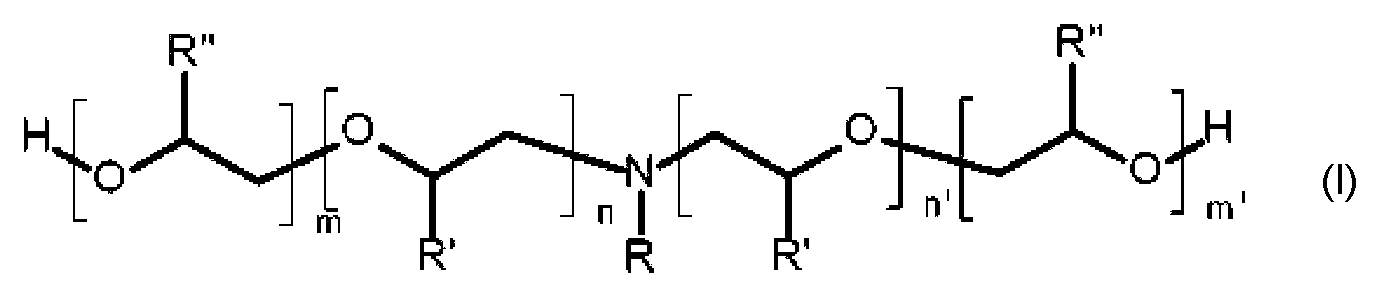
R' und R'' unabhängig voneinander für H, CH3 oder CH2CH3 stehen,
n, n' und n'' unabhängig voneinander für Zahlen von 0 bis 30, vorzugsweise von 0 bis 10 und insbesondere 0 bis 5 stehen, und
m, m' und m'' unabhängig voneinander für Zahlen von 0 bis 30, vorzugsweise von 5 bis 20 und insbesondere von 12 bis 16 stehen,
mit der Maßgabe, dass die Summe n + n' + n'' + m + m' + m'' mindestens 14 ist, vorzugsweise im Bereich von 18 bis 100 und insbesondere im Bereich von 20 bis 70 liegt. Bevorzugt ist in den Verbindungen der Formel I mindestens einer der Reste R' und R'' eine CH3-Gruppe.Preferred polyalkoxylated amines satisfy the general formula (I),
R' and R'' independently represent H, CH 3 or CH 2 CH 3 ,
n, n' and n'' independently of one another represent numbers from 0 to 30, preferably from 0 to 10 and in particular 0 to 5, and
m, m' and m'' independently of one another represent numbers from 0 to 30, preferably from 5 to 20 and in particular from 12 to 16,
with the proviso that the sum n + n' + n'' + m + m' + m'' is at least 14, preferably in the range from 18 to 100 and in particular in the range from 20 to 70. Preferably, in the compounds of formula I, at least one of the radicals R' and R'' is a CH 3 group.
Aufgrund ihrer Reinigungsleistung besonders bevorzugte polyalkoxylierte Amine sind durch Umsetzung von Triethanolamin mit Alkylenoxiden, vorzugsweise durch Umsetzung von Triethanolamin mit Ethylenoxid und Propylenoxid erhältlich ist. Ganz besonders bevorzugt sind polyalkoxylierte Amine, welche durch Umsetzung von Triethanolamin mit Ethylenoxid und nachfolgende Umsetzung mit Propylenoxid erhältlich sind.Polyalkoxylated amines that are particularly preferred due to their cleaning performance are those obtainable by reacting triethanolamine with alkylene oxides, preferably by reacting triethanolamine with ethylene oxide and propylene oxide. Polyalkoxylated amines that are obtainable by reacting triethanolamine with ethylene oxide and subsequent reaction with propylene oxide are very particularly preferred.
Als weiteren fakultativen Bestandteil enthält die Waschmittelzubereitung neben dem polylakoxylierten Amin a) ein ethoxyliertes Polyalkylenimin b), mit Ethylenoxid-Segmenten, die an die Stickstoffatome des Polyethylenimins gebunden sind. Aufgrund ihrer Reinigungsleistung besonders bevorzugte Waschmittelzubereitungen enthalten, bezogen auf ihr Gesamtgewicht, 0,7 bis 6 Gew.-%, vorzugsweise 1 bis 4 Gew.-% ethoxyliertes Polyethylenimin b).As a further optional component, the detergent preparation contains, in addition to the polyalkylene imine a), an ethoxylated polyalkyleneimine b) with ethylene oxide segments bonded to the nitrogen atoms of the polyethyleneimine. Detergent preparations particularly preferred due to their cleaning performance contain, based on their total weight, 0.7 to 6 wt.%, preferably 1 to 4 wt.%, of ethoxylated polyethyleneimine b).
Bei dem ethoxylierten Polyalkylenimin b) handelt es sich um ein Polymer mit einem Polyalkylenimin-Rückgrat, das an den N-Atomen Polyalkoxygruppen trägt. Das ethoxylierte Polyethylenimin b) weist vorzugsweise ein Polyethylenimin-Rückgrat mit einem gewichtsmittleren Molekulargewicht im Bereich von 100 g/mol bis 2000 g/mol, insbesondere von 400 g/mol bis 800 g/mol auf. Das gewichtsmittlere Molekulargewicht des ethoxylierten Polyethylenimins b) beträgt vorzugsweise von 5000 g/mol bis 20000 g/mol, insbesondere von 8000 g/mol bis 14000 g/mol.The ethoxylated polyalkyleneimine b) is a polymer with a polyalkyleneimine backbone bearing polyalkoxy groups on the nitrogen atoms. The ethoxylated polyethyleneimine b) preferably has a polyethyleneimine backbone with a weight-average molecular weight in the range from 100 g/mol to 2000 g/mol, in particular from 400 g/mol to 800 g/mol. The weight-average molecular weight of the ethoxylated polyethyleneimine b) is preferably from 5000 g/mol to 20,000 g/mol, in particular from 8000 g/mol to 14,000 g/mol.
Das Polyalkylenimin weist an den Enden primäre Aminofunktionen und im Inneren vorzugsweise sowohl sekundäre als auch tertiäre Aminofunktionen auf; gegebenenfalls kann es im Inneren auch lediglich sekundäre Aminofunktionen aufweisen, so dass sich nicht ein verzweigtkettiges, sondern ein lineares Polyalkylenimin ergibt. Das Verhältnis von primären zu sekundären Aminogruppen im Polyalkylenimin liegt vorzugsweise im Bereich von 1:0,5 bis 1:1,5, insbesondere im Bereich von 1:0,7 bis 1:1. Das Verhältnis von primären zu tertiären Aminogruppen im Polyalkylenimin liegt vorzugsweise im Bereich von 1:0,2 bis 1:1, insbesondere im Bereich von 1:0,5 bis 1:0,8. Die N-Atome im Polyalkylenimin sind durch Alkylengruppen mit 2 bis 12 C-Atomen, insbesondere 2 bis 6 C-Atomen, voneinander getrennt, wobei nicht sämtliche Alkylengruppen die gleiche C-Atomanzahl aufweisen müssen. Besonders bevorzugt sind Ethylengruppen, 1,2-Propylengruppen, 1,3-Propylengruppen, und deren Mischungen. Die primären Aminofunktionen im Polyalkylenimin können 1 oder 2 Polyalkoxygruppen und die sekundären Aminofunktionen 1 Polyalkoxygruppe tragen, wobei nicht jede Aminofunktion alkoxygruppensubstituiert sein muss. Die durchschnittliche Anzahl von Alkoxygruppen pro primärer und sekundärer Aminofunktion im ethoxylierten Polyalkyenimin beträgt vorzugsweise 5 bis 100, insbesondere 10 bis 50. Die ethoxylierten Polyalkylenimine sind durch Umsetzung der Polyalkylenimine mit Ethylenoxid zugänglich.The polyalkyleneimine has primary amino functions at the ends and preferably both secondary and tertiary amino functions in the interior; if appropriate, it can also have only secondary amino functions in the interior, resulting in a linear rather than a branched-chain polyalkyleneimine. The ratio of primary to secondary amino groups in the polyalkyleneimine is preferably in the range from 1:0.5 to 1:1.5, in particular in the range from 1:0.7 to 1:1. The ratio of primary to tertiary amino groups in the polyalkyleneimine is preferably in the range from 1:0.2 to 1:1, in particular in the range from 1:0.5 to 1:0.8. The N atoms in the polyalkyleneimine are separated from one another by alkylene groups having 2 to 12 C atoms, in particular 2 to 6 C atoms, although not all alkylene groups need to have the same number of C atoms. Particularly preferred are ethylene groups, 1,2-propylene groups, 1,3-propylene groups, and mixtures thereof. The primary amino functions in the polyalkyleneimine can carry one or two polyalkoxy groups, and the secondary amino functions can carry one polyalkoxy group, although not every amino function needs to be substituted by an alkoxy group. The average number of alkoxy groups per primary and secondary amino function in the ethoxylated polyalkyleneimine is preferably 5 to 100, especially 10 to 50. The ethoxylated polyalkyleneimines are obtainable by reacting the polyalkyleneimines with ethylene oxide.
Den dritten wesentlichen Bestandteil der Waschmittelzubereitung bilden die alkoxylierten Polyethylenimine c). Die alkoxylierten Polyethylenimine c) sind von den ethoxylierten Polyethylenimine b) verschieden.The third essential component of the detergent preparation is the alkoxylated polyethyleneimines c). The alkoxylated polyethyleneimines c) are different from the ethoxylated polyethyleneimines b).
Der Gewichtsanteil des alkoxylierten Polyethylenimins am Gesamtgewicht der Waschmittelzubereituung beträgt vorzugsweise 0,7 bis 5 Gew.-% und insbesondere 1 bis 3 Gew.- % alkoxyliertes Polyethylenimin c). Diese Gewichtsanteile haben sich in Bezug auf die angestrebte Reinigungsleistung als besonders vorteilhaft erwiesen.The weight fraction of the alkoxylated polyethyleneimine in the total weight of the detergent preparation is preferably 0.7 to 5 wt.% and in particular 1 to 3 wt.% alkoxylated polyethyleneimine c). These weight fractions have proven particularly advantageous with regard to the desired cleaning performance.
Bei dem ethoxylierten Polyalkylenimin c) handelt es sich um ein Polymer mit einem Polyalkylenimin-Rückgrat, das an den N-Atomen Polyalkoxygruppen trägt. Das alkoxylierte Polyethylenimin c) weist vorzugsweise ein Polyethylenimin-Rückgrat mit einem gewichtsmittleren Molekulargewicht im Bereich von 100 g/mol bis 2000 g/mol, insbesondere von 400 g/mol bis 800 g/mol auf. Das gewichtsmittlere Molekulargewicht des alkoxyliertgen Polyethylenimins c) beträgt vorzugsweise 1000 g/mol bis 1000000 g/mol, besonders bevorzugt von 5000 bis 500000 g/mol und insbesondere von 10000 g/mol bis 50000 g/mol.The ethoxylated polyalkyleneimine c) is a polymer with a polyalkyleneimine backbone bearing polyalkoxy groups on the nitrogen atoms. The alkoxylated polyethyleneimine c) preferably has a polyethyleneimine backbone with a weight-average molecular weight in the range from 100 g/mol to 2000 g/mol, in particular from 400 g/mol to 800 g/mol. The weight-average molecular weight of the alkoxylated polyethyleneimine c) is preferably from 1000 g/mol to 1,000,000 g/mol, particularly preferably from 5000 to 500,000 g/mol, and in particular from 10,000 g/mol to 50,000 g/mol.
Das Polyalkylenimin weist an den Enden primäre Aminofunktionen und im Inneren vorzugsweise sowohl sekundäre als auch tertiäre Aminofunktionen auf; gegebenenfalls kann es im Inneren auch lediglich sekundäre Aminofunktionen aufweisen, so dass sich nicht ein verzweigtkettiges, sondern ein lineares Polyalkylenimin ergibt. Das Verhältnis von primären zu sekundären Aminogruppen im Polyalkylenimin liegt vorzugsweise im Bereich von 1:0,5 bis 1:1,5, insbesondere im Bereich von 1:0,7 bis 1:1. Das Verhältnis von primären zu tertiären Aminogruppen im Polyalkylenimin liegt vorzugsweise im Bereich von 1:0,2 bis 1:1, insbesondere im Bereich von 1:0,5 bis 1:0,8. Die N-Atome im Polyalkylenimin sind durch Alkylengruppen mit 2 bis 12 C-Atomen, insbesondere 2 bis 6 C-Atomen, voneinander getrennt, wobei nicht sämtliche Alkylengruppen die gleiche C-Atomanzahl aufweisen müssen. Besonders bevorzugt sind Ethylengruppen, 1,2-Propylengruppen, 1,3-Propylengruppen, und deren Mischungen. Die primären Aminofunktionen im Polyalkylenimin können 1 oder 2 Polyalkoxygruppen und die sekundären Aminofunktionen 1 Polyalkoxygruppe tragen, wobei nicht jede Aminofunktion alkoxygruppensubstituiert sein muss. Die durchschnittliche Anzahl von Alkoxygruppen pro primärer und sekundärer Aminofunktion im alkoxylierten Polyalkyenimin beträgt vorzugsweise 5 bis 100, insbesondere 10 bis 50.The polyalkyleneimine has primary amino functions at the ends and preferably both secondary and tertiary amino functions in the interior; if appropriate, it can also have only secondary amino functions in the interior, resulting in a linear rather than a branched-chain polyalkyleneimine. The ratio of primary to secondary amino groups in the polyalkyleneimine is preferably in the range from 1:0.5 to 1:1.5, in particular in the range from 1:0.7 to 1:1. The ratio of primary to tertiary amino groups in the polyalkyleneimine is preferably in the range from 1:0.2 to 1:1, in particular in the range from 1:0.5 to 1:0.8. The N atoms in the polyalkyleneimine are separated from one another by alkylene groups having 2 to 12 C atoms, in particular 2 to 6 C atoms, although not all alkylene groups need to have the same number of C atoms. Particularly preferred are ethylene groups, 1,2-propylene groups, 1,3-propylene groups, and mixtures thereof. The primary amino functions in the polyalkyleneimine can carry one or two polyalkoxy groups, and the secondary amino functions can carry one polyalkoxy group, although not every amino function needs to be substituted by an alkoxy group. The average number of alkoxy groups per primary and secondary amino function in the alkoxylated polyalkyleneimine is preferably 5 to 100, in particular 10 to 50.
Die Alkylenoxid-Segmente des alkoxylierten Polyethylenimins c) umfassen vorzugsweise Ethylenoxid-Segmente und C3-Alkylenoxid-Segmente. Ganz besonders bevorzugt sind alkoxylierte Polyethylenimine c), bei denen die Alkylenoxid-Segmente aus Ethylenoxid-Segmenten und C3-Alkylenoxid-Segmenten bestehen. Diese bevorzugten alkoxylierten Polyalkylenimine c) sind beispielsweise durch Umsetzung der Polyalkylenimine mit Ethylenoxid und Propoylenoxid zugänglich. Ganz besonders bevorzugt sind alkoxylierten Polyalkylenimine c), welche durch Umsetzung von Polyalkyleniminen mit Ethylenoxid und nachfolgende Umsetzung mit Propylenoxid erhältlich sind.The alkylene oxide segments of the alkoxylated polyethyleneimine c) preferably comprise ethylene oxide segments and C 3 -alkylene oxide segments. Very particular preference is given to alkoxylated polyethyleneimines c) in which the alkylene oxide segments consist of ethylene oxide segments and C 3 -alkylene oxide segments. These preferred alkoxylated polyalkyleneimines c) are obtainable, for example, by reacting the polyalkyleneimines with ethylene oxide and propylene oxide. Very particular preference is given to alkoxylated polyalkyleneimines c) which are obtainable by reacting polyalkyleneimines with ethylene oxide and subsequent reaction with propylene oxide.
Für die Reinigungsleistung der Waschmittelzusammensetzung hat es sich als vorteilhaft erwiesen, wenn das ethoxylierte Polyethylenimin b) und das alkoxylierte Polyethylenimin c) in einem Gewichtsverhältnis von 3:2 bis 2:3, vorzugweise von 4:3 bis 3:4 vorliegen.For the cleaning performance of the detergent composition, it has proven advantageous if the ethoxylated polyethyleneimine b) and the alkoxylated polyethyleneimine c) are present in a weight ratio of 3:2 to 2:3, preferably 4:3 to 3:4.
Aus dem gleichen sind Waschmittelzubereitungen bevorzugt, bei denen das Gewichtsverhältnis von polyalkoxyliertem Amin a) zu den alkoxylierten Polyethylenimine b) und c) von 2:1 bis 1:2, vorzugweise von 3:2 bis 2:3 beträgt.For the same reason, detergent preparations are preferred in which the weight ratio of polyalkoxylated amine a) to the alkoxylated polyethyleneimines b) and c) is from 2:1 to 1:2, preferably from 3:2 to 2:3.
Bevorzugte Waschmittelzubereitungen enthalten bezogen auf ihr Gesamtgewicht, 35 bis 60 Gew.- %, vorzugsweise 40 bis 55 Gew.-% Tensid.Preferred detergent preparations contain, based on their total weight, 35 to 60 wt.%, preferably 40 to 55 wt.% surfactant.
Zur Gruppe der Tenside werden die nichtionischen, die anionischen, die kationischen und die amphoteren Tenside gezählt. Die erfindungsgemäßen Zusammensetzungen können eines oder mehrere der genannten Tenside umfassen. Besonders bevorzugte Zusammensetzungen enthalten Tensid aus der Gruppe der anionischen und nichtionischen Tenside.The group of surfactants includes nonionic, anionic, cationic, and amphoteric surfactants. The compositions according to the invention can comprise one or more of the aforementioned surfactants. Particularly preferred compositions contain surfactants from the group of anionic and nonionic surfactants.
Das anionische Tensid ist bevorzugt ausgewählt aus der Gruppe umfassend C9-C13-Alkylbenzolsulfonaten, Olefinsulfonaten, C12-C18-Alkansulfonaten, Estersulfonaten, Alk(en)ylsulfaten, Fettalkohohlethersulfaten und Mischungen daraus. Zusammensetzungen, die als anionisches Tensid C9-C13-Alkylbenzolsulfonate und Fettalkoholethersulfate umfassen, weisen besonders gute, dispergierende Eigenschaften auf. Als Tenside vom Sulfonat-Typ kommen dabei vorzugsweise C9-C13-Alkylbenzolsulfonate, Olefinsulfonate, das heißt Gemische aus Alken- und Hydroxyalkansulfonaten sowie Disulfonaten, wie man sie beispielsweise aus C12-C18-Monoolefinen mit end- oder innenständiger Doppelbindung durch Sulfonieren mit gasförmigem Schwefeltrioxid und anschließende alkalische oder saure Hydrolyse der Sulfonierungsprodukte erhält, in Betracht. Geeignet sind auch C12-C18-Alkansulfonate und die Ester von α-Sulfofettsäuren (Estersulfonate), zum Beispiel die α-sulfonierten Methylester der hydrierten Kokos-, Palmkern- oder Talgfettsäuren.The anionic surfactant is preferably selected from the group comprising C 9 -C 13 alkylbenzenesulfonates, olefinsulfonates, C 12 -C 18 alkanesulfonates, estersulfonates, alk(en)yl sulfates, fatty alcohol ether sulfates, and mixtures thereof. Compositions comprising C 9 -C 13 alkylbenzenesulfonates and fatty alcohol ether sulfates as anionic surfactant have particularly good dispersing properties. Suitable sulfonate-type surfactants are preferably C 9 -C 13 alkylbenzenesulfonates, olefinsulfonates, i.e. mixtures of alkene and hydroxyalkanesulfonates, and disulfonates, such as those obtained, for example, from C 12 -C 18 monoolefins with a terminal or internal double bond by sulfonation with gaseous sulfur trioxide and subsequent alkaline or acidic hydrolysis of the sulfonation products. Also suitable are C 12 -C 18 alkanesulfonates and the esters of α-sulfofatty acids (estersulfonates), for example the α-sulfonated methyl esters of hydrogenated coconut, palm kernel or tallow fatty acids.
Bevorzugte Waschmittelzubereitungen enthalten, bezogen auf ihr Gesamtgewicht, 18 bis 40 Gew.- %, vorzugsweise 24 bis 36 Gew.-% anionisches Tensid.Preferred detergent preparations contain, based on their total weight, 18 to 40% by weight, preferably 24 to 36% by weight, of anionic surfactant.
Es ist ganz besonders bevorzugt, wenn in der Zusammensetzung mindestens ein anionisches Tensid der Formel (II) enthalten ist,
R' und R'' unabhängig H oder Alkyl sind und zusammen 8 bis 18, vorzugsweise 9 bis 15 und insbesondere 9 bis 13 C-Atome enthalten und Y+ ein einwertiges Kation oder den n-ten Teil eines n-wertigen Kations (insbesondere Monoethanolamin) bedeuten.It is particularly preferred if the composition contains at least one anionic surfactant of formula (II),
R' and R'' are independently H or alkyl and together contain 8 to 18, preferably 9 to 15 and in particular 9 to 13 C atoms and Y + represents a monovalent cation or the nth part of an n-valent cation (in particular monoethanolamine).
Zur Gruppe der Alkelyethersulfate zählen die Fettalkoholethersulfate, beispielsweise die Schwefelsäuremonoester der mit 1 bis 6 Mol Ethylenoxid ethoxylierten geradkettigen oder verzweigten C7-C21-Alkohole, wie 2-Methyl-verzweigte C9-11-Alkohole mit im Durchschnitt 3,5 Mol Ethylenoxid (EO) oder C12-18-Fettalkohole mit 1 bis 4 EO. Bevorzugt sind Alkylethersulfate mit der Formel (III)
In dieser Formel (II) steht R1 für einen linearen oder verzweigten, substituierten oder unsubstituierten Alkylrest, vorzugsweise für einen linearen, unsubstituierten Alkylrest, besonders bevorzugt für einen Fettalkoholrest. Bevorzugte Reste R1 der Formel (III) sind ausgewählt aus Decyl-, Undecyl-, Dodecyl-, Tridecyl-, Tetradecyl, Pentadecyl-, Hexadecyl-, Heptadecyl-, Octadecyl-, Nonadecyl-, Eicosylresten und deren Mischungen, wobei die Vertreter mit gerader Anzahl an C-Atomen bevorzugt sind. Besonders bevorzugte Reste R1 der Formel (III) sind abgeleitet von Fettalkoholen mit 12 bis 18 C-Atomen, beispielsweise von Kokosfettalkohol, Talgfettalkohol, Lauryl-, Myristyl-, Cetyl- oder Stearylalkohol oder von Oxoalkoholen mit 10 bis 20 C-Atomen.In this formula (II), R 1 represents a linear or branched, substituted or unsubstituted alkyl radical, preferably a linear, unsubstituted alkyl radical, particularly preferably a fatty alcohol radical. Preferred radicals R 1 of the formula (III) are selected from decyl, undecyl, dodecyl, tridecyl, tetradecyl, pentadecyl, hexadecyl, heptadecyl, octadecyl, nonadecyl, eicosyl radicals and mixtures thereof, with preference being given to those having an even number of carbon atoms. Particularly preferred radicals R 1 of the formula (III) are derived from fatty alcohols having 12 to 18 carbon atoms, for example from coconut fatty alcohol, tallow fatty alcohol, lauryl, myristyl, cetyl, or stearyl alcohol, or from oxo alcohols having 10 to 20 carbon atoms.
AO steht in Formel (III) ist eine ganze Zahl von 1 bis 50, vorzugsweise von 1 bis 20 und insbesondere von 2 bis 10. Ganz besonders bevorzugt ist n 2, 3, 4, 5, 6, 7 oder 8. X ist ein einwertiges Kation oder den n-ten Teil eines n-wertigen Kations, bevorzugt sind dabei die Alkalimetallionen und darunter Na+ oder K+, wobei Na+ äußerst bevorzugt ist. Weitere Kationen X+ können ausgewählt sein aus NH4+, % Zn2+,½ Mg2+,½ Ca2+,½ Mn2+, und deren Mischungen sowie primären, sekundäre Aminen, insbesondere Monoethanolamin.AO in formula (III) is an integer from 1 to 50, preferably from 1 to 20 and in particular from 2 to 10. n is very particularly preferably 2, 3, 4, 5, 6, 7 or 8. X is a monovalent cation or the nth part of an n-valent cation, preference being given to the alkali metal ions and among them Na + or K + , with Na + being extremely preferred. Further cations X+ can be selected from NH4 + , % Zn 2+ , ½ Mg 2+ , ½ Ca 2+ , ½ Mn 2+ , and mixtures thereof as well as primary and secondary amines, in particular monoethanolamine.
Besonders bevorzugte Zusammensetzungen enthalten ein Alkylethersulfat ausgewählt aus Fettalkoholethersulfaten der Formel (IV)
Auch wenn Alkylethersulfate grundsätzlich in den Waschmittelzubereitungen einsetzbar sind, so hat sich in Bezug auf die Reinigungsleistung der Waschmittelzubereitungen der Zusatz von anionischem Tensid aus der Gruppe der C8-18-Alkylbenzolsulfonate als überlegen erwiesen. In einer besonders bevorzugten Ausführungsform enthält die Waschmittelzubereitung, bezogen auf ihr Gesamtgewicht, weniger als 10 Gew.-%, vorzugsweise weniger als 5 Gew,-% besonders bevorzugt weniger als 2 Gew.-% und insbesondere kein anionisches Tensid aus der Gruppe der Alkylethersulfate.Although alkyl ether sulfates can generally be used in detergent preparations, the addition of an anionic surfactant from the group of C 8 - C 18 alkylbenzenesulfonates has proven superior in terms of cleaning performance. In a particularly preferred embodiment, the detergent preparation contains, based on its total weight, less than 10 wt. %, preferably less than 5 wt. %, particularly preferably less than 2 wt. %, and in particular no anionic surfactant from the group of alkyl ether sulfates.
Zusammenfassend enthalten bevorzugte Waschmittelzubereitungen, bezogen auf ihr Gesamtgewicht, 15 bis 35 Gew.-%, vorzugsweise 18 bis 32 Gew.-% anionisches Tensid aus der Gruppe der C8-18-Alkylbenzolsulfonate.In summary, preferred detergent preparations contain, based on their total weight, 15 to 35 wt.%, preferably 18 to 32 wt.% of anionic surfactant from the group of C 8-18 alkylbenzenesulfonates.
Als besonders vorteilhaft für die Lagerstabilität der Waschmittelzubereitung hat sich der Einsatz anionischer Tenside aus der Gruppe der der Alkanolamin-C8-18-Alkylbenzolsulfonate erwiesen.The use of anionic surfactants from the group of alkanolamine C 8-18 alkylbenzenesulfonates has proven to be particularly advantageous for the storage stability of the detergent preparation.
In bevorzugten Waschmittelzubereitungen ist das anionische Tensid ausgewählt aus der Gruppe der Alkanolamin-C8-18-Alkylbenzolsulfonate mit Alkanolamin aus der Gruppe Monoethanolamin, Monoisopropanolamin, Diisopropanolamin, vorzugsweise aus der Gruppe Monoethanolamin.In preferred detergent preparations, the anionic surfactant is selected from the group of alkanolamine C 8-18 alkylbenzenesulfonates with alkanolamine from the group monoethanolamine, monoisopropanolamine, diisopropanolamine, preferably from the group monoethanolamine.
In ganz besonders bevorzugten Waschmittelzubereitungen beträgt der Gewichtsanteil anionischer Tenside aus der Gruppe der Alkanolamin-C8-18-Alkylbenzolsulfonate, vorzugsweise aus der Gruppe der Alkanolamin-C8-18-Alkylbenzolsulfonate mit Alkanolamin aus der Gruppe Monoethanolamin, Monoisopropanolamin, Diisopropanolamin, insbesondere aus der Gruppe Monoethanolamin 15 bis 35 Gew.-%, vorzugsweise 18 bis 32 Gew.-%.In very particularly preferred detergent preparations, the weight fraction of anionic surfactants from the group of alkanolamine-C 8-18 alkylbenzenesulfonates, preferably from the group of alkanolamine-C 8-18 alkylbenzenesulfonates with alkanolamine from the group monoethanolamine, monoisopropanolamine, diisopropanolamine, in particular from the group monoethanolamine, is 15 to 35 wt.%, preferably 18 to 32 wt.%.
Als für die Lagerstabilität vorteilhaft hat sich der Einsatz von Fettsäuren erwiesen. Bevorzugte Waschmittelzubereitungen enthalten daher, bezogen auf ihr Gesamtgewicht, 4 bis 12 Gew.-%, vorzugsweise 6 bis 10 Gew.-% Fettsäure. Besonders bevorzugte Fettsäuren sind ausgewählt aus der Gruppe der C12-18 Fettsäuren, vorzugsweise aus der Gruppe Caprylsäure, Caprinsäure, Laurinsäure, Myristinsäure, Palmitinsäure, Stearinsäure, Ölsäure, Linolsäure und deren Mischungen. Die Fettsäuren werden im Rahmen der Anmeldung der Gruppe der anionischen Tenside zugerechnet.The use of fatty acids has proven advantageous for storage stability. Preferred detergent preparations therefore contain, based on their total weight, 4 to 12% by weight, preferably 6 to 10% by weight, of fatty acid. Particularly preferred fatty acids are selected from the group of C 12-18 fatty acids, preferably from the group of caprylic acid, capric acid, lauric acid, myristic acid, palmitic acid, stearic acid, oleic acid, linoleic acid, and mixtures thereof. For the purposes of this application, the fatty acids are classified as anionic surfactants.
Die Waschmittelzubereitungen enthalten als einen weiteren bevorzugten optionalen Bestandteil nichtionisches Tensid. Dessen Gewichtsanteil am Gesamtgewicht der Waschmittelzubereitung beträgt bevorzugt 12 bis 30 Gew.-%, vorzugsweise 15 bis 28 Gew.-% und insbesondere 18 bis 26 Gew.-%.The detergent preparations contain a nonionic surfactant as a further preferred optional component. Its weight fraction of the total weight of the detergent preparation is preferably 12 to 30 wt.%, preferably 15 to 28 wt.%, and in particular 18 to 26 wt.%.
Bevorzugt ist insbesondere der Einsatz nichtionischen Tensids aus der Gruppe der Alkylethoxylate, wobei bevorzugte Alkylethoxylate aus der Gruppe der ethoxylierten primären C8-18-Alkohole, vorzugsweise der ethoxylierten primären C8-18-Alkohole mit einem Alkoxylierungsgrad ≥ 4, besonders bevorzugt der C12-14-Alkohole mit 4 EO oder 7 EO, der C9-11-Alkohole mit 7 EO, der C13-15-Alkohole mit 5 EO, 7 EO oder 8 EO, der C13-15-Oxoalkohole mit 7 EO, der C12-18-Alkohole mit 5 EO oder 7 EO, insbesondere der C12-18-Fettalkohole mit 7 EO oder der C13-15-Oxoalkohole mit 7 EO ausgewählt werden.In particular, the use of non-ionic surfactants from the group of alkyl ethoxylates is preferred, with preferred alkyl ethoxylates being from the group of ethoxylated primary C 8-18 alcohols, preferably the ethoxylated primary C 8-18 alcohols with a degree of alkoxylation ≥ 4, particularly preferably the C 12-14 alcohols with 4 EO or 7 EO, the C 9-11 alcohols with 7 EO, the C 13-15 alcohols with 5 EO, 7 EO or 8 EO, the C 13-15 oxo alcohols with 7 EO, C 12-18 alcohols with 5 EO or 7 EO, in particular C 12-18 fatty alcohols with 7 EO or C 13-15 oxo alcohols with 7 EO.
Zusammenfassend enthalten bevorzugte Waschmittelzubereitungen, bezogen auf ihr Gesamtgewicht, 12 bis 30 Gew.-%, vorzugsweise 15 bis 28 Gew.-% und insbesondere 18 bis 26 nichtionisches Tensid aus der Gruppe der ethoxylierten primären C8-18-Alkohole, vorzugsweise der ethoxylierten primären C8-18-Alkohole mit einem Alkoxylierungsgrad ≥ 4, besonders bevorzugt der C12-14-Alkohole mit 4 EO oder 7 EO, der C9-11-Alkohole mit 7 EO, der C13-15-Alkohole mit 5 EO, 7 EO oder 8 EO, der C13-15-Oxoalkohole mit 7 EO, der C12-18-Alkohole mit 5 EO oder 7 EO, insbesondere der C12-18-Fettalkohole mit 7 EO oder der C13-15-Oxoalkohole mit 7 EO.In summary, preferred detergent preparations contain, based on their total weight, 12 to 30 wt.%, preferably 15 to 28 wt.% and in particular 18 to 26 nonionic surfactant from the group of ethoxylated primary C 8-18 alcohols, preferably ethoxylated primary C 8-18 alcohols with a degree of alkoxylation ≥ 4, particularly preferably C 12-14 alcohols with 4 EO or 7 EO, C 9-11 alcohols with 7 EO, C 13-15 alcohols with 5 EO, 7 EO or 8 EO, C 13-15 oxo alcohols with 7 EO, C 12-18 alcohols with 5 EO or 7 EO, in particular C 12-18 fatty alcohols with 7 EO or C 13-15 -oxo alcohols with 7 EO.
In Bezug auf die rheologischen Eigenschaften der Waschmittelzubereitung, deren Verarbeitbarkeit und Reinigungswirkung hat es sich als vorteilhaft erwiesen, nichtionisches Tensid und anionisches Tensid in einem Gewichtsverhältnis von 3:1 bis 1:3, vorzugsweise von 2:1 bis 1:2 und insbesondere von 3:2 bis 2:3 einzusetzen.With regard to the rheological properties of the detergent preparation, its processability and cleaning effect, it has proven advantageous to use non-ionic surfactant and anionic surfactant in a weight ratio of 3:1 to 1:3, preferably 2:1 to 1:2 and in particular 3:2 to 2:3.
Bevorzugte Waschmittelzubereitungen enthalten, bezogen auf ihr Gesamtgewicht, 5 bis 20 Gew.- %, vorzugsweise 7 bis 18 Gew.-% Wasser.Preferred detergent preparations contain, based on their total weight, 5 to 20% by weight, preferably 7 to 18% by weight, of water.
Neben Wasser wird als weiteres Lösungsmittel vorzugsweise mindestens ein organisches Lösungsmittel eingesetzt. Der Einsatz wässrig-organischer Lösungsmittelsysteme hat sich für die Herstellbarkeit und Lagerfähigkeit als besonders vorteilhaft erwiesen und ist daher bevorzugt.In addition to water, at least one organic solvent is preferably used as an additional solvent. The use of aqueous-organic solvent systems has proven particularly advantageous for manufacturability and storage and is therefore preferred.
In einer bevorzugten Ausführungsform enthält die Waschmittelzubereitung, bezogen auf ihr Gesamtgewicht, 5 bis 30 Gew.-%, vorzugsweise 10 bis 20 Gew.-% organisches Lösungsmittel.In a preferred embodiment, the detergent preparation contains, based on its total weight, 5 to 30 wt.%, preferably 10 to 20 wt.% of organic solvent.
Bevorzugte organische Lösungsmittel sind ausgewählt aus der Gruppe Ethanol, n-Propanol, i-Propanol, Butanolen, Glykol, Propandiol, Butandiol, Methylpropandiol, Glycerin, Diglykol, Propyldiglycol, Butyldiglykol, Hexylenglycol, Ethylenglykolmethylether, Ethylenglykolethylether, Ethylenglykolpropylether, Ethylenglykolmono-n-butylether, Diethylenglykolmethylether, Diethylenglykolethylether, Propylenglykolmethylether, Propylenglykolethylether, Propylenglykolpropylether, Dipropylenglykolmonomethylether, Dipropy-lenglykolmonoethylether, Methoxytriglykol, Ethoxytriglykol, Butoxytriglykol, 1-Butoxyethoxy-2-propanol, 3-Methyl-3-methoxybutanol, Propylen-glykol-t-butylether, Di-n-octylether sowie deren Mischungen, vorzugsweise aus der Gruppe Propandiol, Glycerin, Monoethanolamin und deren Mischungen.Preferred organic solvents are selected from the group ethanol, n-propanol, i-propanol, butanols, glycol, propanediol, butanediol, methylpropanediol, glycerol, diglycol, propyl diglycol, butyl diglycol, hexylene glycol, ethylene glycol methyl ether, ethylene glycol ethyl ether, ethylene glycol propyl ether, ethylene glycol mono-n-butyl ether, diethylene glycol methyl ether, diethylene glycol ethyl ether, propylene glycol methyl ether, propylene glycol ethyl ether, propylene glycol propyl ether, dipropylene glycol monomethyl ether, dipropylene glycol monoethyl ether, methoxytriglycol, ethoxytriglycol, butoxytriglycol, 1-butoxyethoxy-2-propanol, 3-methyl-3-methoxybutanol, propylene glycol t-butyl ether, di-n-octyl ether and mixtures thereof, preferably from the group propanediol, glycerin, monoethanolamine and their mixtures.
Als bevorzugten optionalen Bestandteil enthält die Waschmittelzubereitung ein Phosphonat.The detergent preparation contains a phosphonate as a preferred optional ingredient.
Der Gewichtsanteil des Phosphonats am Gesamtgewicht der Waschmittelzubereitung beträgt vorzugsweise 0,1 bis 3 Gew.-% und insbesondere 0,2 bis 1 Gew.-%.The weight proportion of the phosphonate in the total weight of the detergent preparation is preferably 0.1 to 3 wt.% and in particular 0.2 to 1 wt.%.
Als Phosphonat-Verbindung wird vorzugsweise ein Phosphonat aus der Gruppe der Hydroxyalkan- und/oder Aminoalkanphosphonate, bevorzugt aus der Gruppe der Aminoalkanphosphonate und insbesondere aus der Gruppe Ethylendiamintetramethylenphosphonat (EDTMP) und Diethylentriaminpentamethylenphosphonat (DTPMP) ausgewählt.As the phosphonate compound, a phosphonate is preferably selected from the group of hydroxyalkane and/or aminoalkane phosphonates, preferably from the group of aminoalkane phosphonates and in particular from the group of ethylenediaminetetramethylenephosphonate (EDTMP) and diethylenetriaminepentamethylenephosphonate (DTPMP).
Zur weiteren Steigerung der Reinigungsleistung enthalten bevorzugte Waschmittelzubereitungen, bezogen auf ihr Gesamtgewicht, 0,5 bis 7 Gew.-%, vorzugsweise 1,0 bis 6 Gew.-% Enzymzubereitungen.To further increase the cleaning performance, preferred detergent preparations contain, based on their total weight, 0.5 to 7 wt.%, preferably 1.0 to 6 wt.% enzyme preparations.
Eine Enzymzubereitung umfasst neben dem eigentlichen Enzymprotein weitere Bestandteile wie Enzymstabilisatoren, Trägermaterialien oder Füllstoffe. Das Enzym-Protein bildet dabei üblicherweise nur einen Bruchteil des Gesamtgewichts der Enzymzubereitung. Bevorzugt eingesetzte Enzymzubereitungen enthalten zwischen 0,1 und 40 Gew.-%, bevorzugt zwischen 0,2 und 30 Gew.-%, stärker bevorzugt zwischen 0,4 und 20 Gew.-% und am stärksten bevorzugt zwischen 0,8 und 10 Gew. % des Enzymproteins. In solchen Zusammensetzungen kann ein Enzymstabilisator in einer Menge von 0,05 bis 35 Gew.-%, bevorzugt von 0,05 bis 10 Gew.-%, bezogen auf das Gesamtgewicht in der Enzymzusammensetzung, enthalten sein.In addition to the actual enzyme protein, an enzyme preparation comprises other components such as enzyme stabilizers, carrier materials, or fillers. The enzyme protein usually constitutes only a fraction of the total weight of the enzyme preparation. Preferably used enzyme preparations contain between 0.1 and 40 wt.%, preferably between 0.2 and 30 wt.%, more preferably between 0.4 and 20 wt.%, and most preferably between 0.8 and 10 wt.% of the enzyme protein. In such compositions, an enzyme stabilizer can be present in an amount of 0.05 to 35 wt.%, preferably 0.05 to 10 wt.%, based on the total weight of the enzyme composition.
Die Proteinkonzentration kann mit Hilfe bekannter Methoden, zum Beispiel dem BCA-Verfahren (Bicinchoninsäure; 2,2'-Bichinolyl-4,4'-dicarbonsäure) oder dem Biuret-Verfahren bestimmt werden. Die Bestimmung der Aktivproteinkonzentration erfolgt diesbezüglich über eine Titration der aktiven Zentren unter Verwendung eines geeigneten irreversiblen Inhibitors (für Proteasen beispielsweise Phenylmethylsulfonylfluorid (PMSF)) und Bestimmung der Restaktivität.The protein concentration can be determined using known methods, for example the BCA method (bicinchoninic acid; 2,2'-biquinolyl-4,4'-dicarboxylic acid) or the biuret method. The determination of the active protein concentration is carried out by titration of the active sites under Use of a suitable irreversible inhibitor (for proteases, for example, phenylmethylsulfonyl fluoride (PMSF)) and determination of the residual activity.
Es ist bevorzugt, wenn die Waschmittelzubereitung mindestens eine Enzym-Zubereitung, vorzugweise mindestens drei Enzymzubereitungen von Enzymen aus der Gruppe Lipase, Mannanase, Amylase, Protease, Cellulase, Hexosaminidase Zubereitungen eines pektinolytischen Enzyms und Endoglucanase enthält.It is preferred if the detergent preparation contains at least one enzyme preparation, preferably at least three enzyme preparations of enzymes from the group lipase, mannanase, amylase, protease, cellulase, hexosaminidase, preparations of a pectinolytic enzyme and endoglucanase.
Hinsichtlich ihrer Reinigungsleistung bevorzugte Waschmittelzubereitungen enthalten, bezogen auf ihr Gesamtgewicht, 0,1 bis 0,4 Gew.-% und insbesondere 0,2 bis 0,3 Gew.-% Hexosaminidase Zubereitung, besonders bevorzugt b-Hexosaminidase Zubereitung.Detergent preparations preferred with regard to their cleaning performance contain, based on their total weight, 0.1 to 0.4 wt.% and in particular 0.2 to 0.3 wt.% of hexosaminidase preparation, particularly preferably b-hexosaminidase preparation.
Der Begriff „Hexosaminidase“ bezeichnet ein Polypeptid mit Hexosaminidase-Aktivität (Hexosaminidasen) und schließt Enzyme mit ein, welche die Hydrolyse von N-Acetyl-D-hexosamin- oder N-Acetyl-glucosamin-Polymeren katalysieren.The term “hexosaminidase” refers to a polypeptide with hexosaminidase activity (hexosaminidases) and includes enzymes that catalyze the hydrolysis of N-acetyl-D-hexosamine or N-acetyl-glucosamine polymers.
Polypeptide mit Hexosaminidase-Aktivität schließen Dispersine wie Dispersin B (DspB) ein, bei denen es sich um β-N-Acetylglucosamininidasen handelt, die zur Glycosid-Hydrolase-20-Familie gehören. Dispersine werden vom Parodontalerreger Aggregatibacter actinomycetemcomitans, einem gramnegativen oralen Bakterium, produziert. Dispersin B ist eine β-Hexosaminidase, die spezifisch β-1,6-glykosidische Bindungen von Acetylglucosamin-Polymeren hydrolysiert. Der Einsatz von Hexosaminidasen aus der Gruppe der β-Hexosaminidasen ist bevorzugt.Polypeptides with hexosaminidase activity include dispersins such as Dispersin B (DspB), which are β-N-acetylglucosamine dispersins belonging to the glycoside hydrolase 20 family. Dispersins are produced by the periodontal pathogen Aggregatibacter actinomycetemcomitans, a Gram-negative oral bacterium. Dispersin B is a β-hexosaminidase that specifically hydrolyzes β-1,6-glycosidic bonds of acetylglucosamine polymers. The use of hexosaminidases from the β-hexosaminidase group is preferred.
Es ist erfindungsgemäß bevorzugt, wenn die Waschmittelzubereitung mindestens eine Lipase-Zubereitung enthält. Erfindungsgemäß bevorzugte Lipasen werden ausgewählt aus mindestens einem Enzym der Gruppe, die gebildet wird aus Triacylglycerol-Lipase (E.C. 3.1.1.3), und Lipoprotein-Lipase (E.C. 3.1.1.34) und Monoglycerid-Lipase (E.C. 3.1.1.23).According to the invention, it is preferred if the detergent preparation contains at least one lipase preparation. Lipases preferred according to the invention are selected from at least one enzyme from the group consisting of triacylglycerol lipase (E.C. 3.1.1.3), lipoprotein lipase (E.C. 3.1.1.34), and monoglyceride lipase (E.C. 3.1.1.23).
Erfindungsgemäß bevorzugte Lipasen-Zubereitungen sind die von dem Unternehmen Amano Pharmaceuticals unter den Bezeichnungen Lipase M-AP10®, Lipase LE® und Lipase F® (auch Lipase JV®) vertriebenen Handelsprodukte. Die Lipase F® ist beispielsweise natürlicherweise in Rhizopus oryzae vorhanden. Die Lipase M-AP10® ist beispielsweise natürlicherweise in Mucor javanicus vorhanden.Preferred lipase preparations according to the invention are the commercial products marketed by Amano Pharmaceuticals under the names Lipase M-AP10®, Lipase LE®, and Lipase F® (also Lipase JV®). Lipase F®, for example, is naturally present in Rhizopus oryzae. Lipase M-AP10®, for example, is naturally present in Mucor javanicus.
Eine höchst bevorzugte Lipase ist kommerziell unter dem Handelsnamen Lipex® von dem Unternehmen Novozymes (Dänemark) zu beziehen und vorteilhaft in den erfindungsgemäßen Waschmittelzubereitungen einsetzbar. Besonders bevorzugt ist hierbei die Lipase Lipex® 100 L.A highly preferred lipase is commercially available under the trade name Lipex® from Novozymes (Denmark) and can be advantageously used in the detergent preparations according to the invention. Lipase Lipex® 100 L is particularly preferred.
Bevorzugte Waschmittelzubereitungen sind dadurch gekennzeichnet, dass sie, bezogen auf ihr Gesamtgewicht 0,01 bis 1 Gew.-%, insbesondere von 0,05 bis 0,3 Gew.-%, Lipase-Zubereitung enthalten.Preferred detergent preparations are characterized in that they contain, based on their total weight, 0.01 to 1 wt.%, in particular 0.05 to 0.3 wt.%, of lipase preparation.
Die Waschmittelzubereitungen enthalten vorzugsweise mindestens eine Amylase, insbesondere eine α-Amylase. α-Amylasen (E.C. 3.2.1.1) hydrolysieren als Enzym interne α-1,4-glycosidische Bindungen von Stärke und stärkeähnlichen Polymeren. Beispielhaft können die α-Amylasen aus Bacillus licheniformis, aus B. amyloliquefaciens und aus B. stearothermophilus sowie deren für den Einsatz in Wasch- oder Reinigungsmitteln verbesserte Weiterentwicklungen genannt werden. Das Enzym aus B. licheniformis ist von der Firma Novozymes unter der Handelsbezeichnung Termamyl® und von der Firma Genencor unter der Handelsbezeichnung Purastar®ST erhältlich. Weiterentwicklungsprodukte dieser α-Amylasen sind von der Firma Novozymes unter den Handelsnamen Duramyl® und Termamyl®ultra, von der Firma Genencor unter dem Namen Purastar®OxAm und von der Firma Daiwa Seiko Inc., Tokyo, Japan, als Keistase® erhältlich. Die α-Amylase von B. amyloliquefaciens wird von der Firma Novozymes unter dem Namen BAN® vertrieben, und abgeleitete Varianten von der α-Amylase aus B. stearothermophilus unter den Namen BSG® und Novamyl®, ebenfalls von der Firma Novozymes. Beispiele für α-Amylasen aus anderen Organismen sind die unter den Handelsnamen Fungamyl® von der Firma Novozymes erhältlichen Weiterentwicklungen der α-Amylase aus Aspergillus niger und A. oryzae.The detergent preparations preferably contain at least one amylase, in particular an α-amylase. α-Amylases (EC 3.2.1.1) act as enzymes that hydrolyze internal α-1,4-glycosidic bonds of starch and starch-like polymers. Examples include the α-amylases from Bacillus licheniformis, B. amyloliquefaciens, and B. stearothermophilus, as well as their improved versions for use in detergents or cleaning agents. The enzyme from B. licheniformis is available from Novozymes under the trade name Termamyl® and from Genencor under the trade name Purastar® ST. Further developments of these α-amylases are available from Novozymes under the trade names Duramyl® and Termamyl® ultra, from Genencor under the name Purastar® OxAm and from Daiwa Seiko Inc., Tokyo, Japan, as Keistase® . The α-amylase from B. amyloliquefaciens is marketed by Novozymes under the name BAN® , and derived variants of the α-amylase from B. stearothermophilus are marketed under the names BSG® and Novamyl® , also by Novozymes. Examples of α-amylases from other organisms are the further developments of the α-amylase from Aspergillus niger and A. oryzae, available from Novozymes under the trade names Fungamyl® .
Der Gewichtsanteil der Amylase-Zubereitung, insbesondere der α-Amylase-Zubereitung am Gesamtgewicht der Waschmittelzubereitung beträgt vorzugsweise 0,1 bis 2 Gew.-%, insbesondere 0,2 bis 1 Gew.-%.The proportion by weight of the amylase preparation, in particular the α-amylase preparation, in the total weight of the detergent preparation is preferably 0.1 to 2 wt.%, in particular 0.2 to 1 wt.%.
Es ist erfindungsgemäß bevorzugt, wenn in der Waschmittelzubereitung als Enzym mindestens eine Protease enthalten ist. Eine Protease ist ein Enzym, das Peptidbindungen mittels Hydrolyse spaltet. Jedes der Enzyme aus der Klasse E.C. 3.4 fällt erfindungsgemäß darunter (umfassend jede der darunterfallenden dreizehn Unterklassen). „Proteaseaktivität“ liegt erfindungsgemäß vor, wenn das Enzym proteolytische Aktivität besitzt (EC 3.4). Verschiedenartige Proteaseaktivitäts-Typen sind bekannt: Die drei Haupttypen sind: Trypsin-artig, wobei eine Spaltung des Amidesubstrates nach den Aminosäuren Arg oder Lys bei P1 erfolgt; Chymotrypsin-artig, wobei eine Spaltung nach einer der hydrophoben Aminosäuren bei P1 erfolgt; und Elastase-artig, wobei eine Spaltung des Amidsubstrates nach Ala bei P1 erfolgt.According to the invention, it is preferred if the detergent preparation contains at least one protease as an enzyme. A protease is an enzyme that cleaves peptide bonds by hydrolysis. Each According to the invention, enzymes from class EC 3.4 fall under this (comprising each of the thirteen subclasses falling under it). "Protease activity" is present according to the invention if the enzyme has proteolytic activity (EC 3.4). Various types of protease activity are known: The three main types are: trypsin-like, in which cleavage of the amide substrate occurs after the amino acids Arg or Lys at P1; chymotrypsin-like, in which cleavage occurs after one of the hydrophobic amino acids at P1; and elastase-like, in which cleavage of the amide substrate occurs after Ala at P1.
Überraschenderweise wurde festgestellt, dass eine Protease vom Typ der alkalischen Protease aus Bacillus lentus DSM 5483 oder eine hierzu hinreichend ähnliche Protease (bezogen auf die Sequenzidentität), die mehrere dieser Veränderungen in Kombination aufweist, besonders für den Einsatz in der erfindungsgemäßen Waschmittelzubereitungen geeignet und darin vorteilhafterweise verbessert stabilisiert wird. Vorteile des Einsatzes dieser Protease ergeben sich somit insbesondere hinsichtlich der Waschleistung und/oder der Stabilität.Surprisingly, it was found that a protease of the alkaline protease type from Bacillus lentus DSM 5483 or a sufficiently similar protease (in terms of sequence identity) that exhibits several of these modifications in combination is particularly suitable for use in the detergent preparations according to the invention and is advantageously stabilized therein. Advantages of using this protease thus arise in particular with regard to washing performance and/or stability.
Ganz besonders bevorzugt, enthält die erfindungsgemäße Waschmittelzubereitung Protease vom Typ der alkalischen Protease aus Bacillus lentus DSM 5483 oder eine hierzu hinreichend ähnliche Protease (bezogen auf die Sequenzidentität), die mehrere dieser Veränderungen in Kombination aufweist,Most preferably, the detergent preparation according to the invention contains protease of the alkaline protease type from Bacillus lentus DSM 5483 or a sufficiently similar protease (based on sequence identity) which has several of these changes in combination,
Der Gewichtsanteil der Protease-Zubereitung am Gesamtgewicht der Waschmittelzubereitung beträgt vorzugsweise 0,2 bis 4 Gew.-% und insbesondere 0,4 bis 3 Gew.-%.The weight proportion of the protease preparation in the total weight of the detergent preparation is preferably 0.2 to 4 wt% and in particular 0.4 to 3 wt%.
Bevorzugte Waschmittelzubereitungen enthalten als optionalen Bestandteil, bezogen auf ihr Gesamtgewicht, weiterhin 0,05 bis 2 Gew.-%, vorzugsweise 0,1 bis 0,4 Gew.-% einer Zubereitung eines pektinolytischen Enzyms.Preferred detergent preparations further contain, as an optional ingredient, based on their total weight, 0.05 to 2 wt.%, preferably 0.1 to 0.4 wt.% of a preparation of a pectinolytic enzyme.
Zu den pektinolytischen Enzymen werden im Rahmen der vorliegenden Erfindung Enzyme gezählt mit den Bezeichnungen Pektinase, Pektatlyase, Pektinesterase, Pektindemethoxylase, Pektinmethoxylase, Pektinmethylesterase, Pektase, Pektinmethylesterase, Pektinoesterase, Pektinpektylhydrolase, Pektindepolymerase, 20 Endopolygalacturonase, Pektolase, Pektinhydrolase, Pektin-Polygalacturonase, Endo-Polygalacturonase, Poly-α-1,4-Galacturonid Glycanohydrolase, Endogalacturonase, Endo-D-galacturonase, Galacturan 1,4-α-Galacturonidase, Exopolygalacturonase, Poly(galacturonat) Hydrolase, Exo-D-Galacturonase, Exo-D-Galacturonanase, Exopoly-DGalacturonase, Exo-poly-α-Galacturonosidase, Exopolygalacturonosidase oder 25 Exopolygalacturanosidase. Ganz besonders bevorzugt ist der Einsatz von Pektatlyasen.For the purposes of the present invention, the pectinolytic enzymes include enzymes with the names pectinase, pectate lyase, pectin esterase, pectin demethoxylase, pectin methoxylase, pectin methylesterase, pectase, pectin methylesterase, pectin esterase, pectin pectyl hydrolase, pectin depolymerase, 20 endopolygalacturonase, pectolase, pectin hydrolase, pectin polygalacturonase, endo-polygalacturonase, poly-α-1,4-galacturonide glycanohydrolase, endogalacturonase, endo-D-galacturonase, galacturan 1,4-α-galacturonidase, exopolygalacturonase, poly(galacturonate) hydrolase, exo-D-galacturonase, Exo-D-galacturonanase, exopoly-D-galacturonase, exo-poly-α-galacturonosidase, exopolygalacturonosidase, or exopolygalacturanosidase. The use of pectate lyases is particularly preferred.
Innerhalb der EC-Klassifikation der Enzyme, dem numerischen Klassifikationssystem für Enzyme, sind die pektinolytischen Enzyme insbesondere zugehörig zu den Enzymklassen (engl. „Enzyme Commission number“) EC 3.1.1.11, EC 3.2.1.15, EC 3.2.1.67 und EC 3.2.1.82 und zählen folglich zur dritten der sechs Enzymhauptklassen, den 10 Hydrolasen (E.C.3. hierunter zu den Glycosylasen (E.C. 3.2.-.-) und wiederum hierunter zu den Glycosidasen (E.C. 3.2.1.-), d.h. Enzymen, die O- und/oder S-Glycosyl-Verbindungen hydrolysieren. Pektinolytische Enyzme wirken folglich insbesondere gegen Rückstände auf Geschirr, die Pektinsäure und/oder andere Galakturonane enthalten, und katalysieren deren Hydrolyse.Within the EC classification of enzymes, the numerical classification system for enzymes, the pectinolytic enzymes belong in particular to the enzyme classes (Enzyme Commission number) EC 3.1.1.11, EC 3.2.1.15, EC 3.2.1.67 and EC 3.2.1.82 and therefore belong to the third of the six main enzyme classes, the 10 hydrolases (EC 3.0), of which the glycosylases (EC 3.2.-.-) and, in turn, the glycosidases (EC 3.2.1.-), i.e. enzymes that hydrolyze O- and/or S-glycosyl compounds. Pectinolytic enzymes are therefore particularly effective against residues on dishes containing pectic acid and/or other galacturonans and catalyze their hydrolysis.
Pektatlyasen im Sinne der Erfindung sind Enzyme, welche die nichthydrolytische Spaltung von Pektat nach einem Endo-Mechanismus katalysieren.Pectate lyases within the meaning of the invention are enzymes which catalyze the non-hydrolytic cleavage of pectate by an endo-mechanism.
Beispiele für geeignete pektinolytische Enzyme sind die unter den Handelsbezeichnungen Gamanase®, Pektinex AR®, X-Pect® oder Pectaway® von dem Unternehmen Novozymes, unter dem Handelsbezeichnungen Rohapect UF®, Rohapect TPL®, Rohapect PTE100®, Rohapect MPE®, 30 Rohapect MA plus HC, Rohapect DA12L®, Rohapect 10L®, Rohapect B1L® von dem Unternehmen AB Enzymes und unter der Handelsbezeichnung Pyrolase® von dem Unternehmen Diversa Corp., San Diego, CA, USA erhältlichen Enzyme und Enzym-Zubereitungen.Examples of suitable pectinolytic enzymes are the enzymes and enzyme preparations available under the trade names Gamanase®, Pektinex AR®, X-Pect® or Pectaway® from Novozymes, under the trade names Rohapect UF®, Rohapect TPL®, Rohapect PTE100®, Rohapect MPE®, 30 Rohapect MA plus HC, Rohapect DA12L®, Rohapect 10L®, Rohapect B1L® from AB Enzymes and under the trade name Pyrolase® from Diversa Corp., San Diego, CA, USA.
Als bevorzugten Bestandteil enthält die Waschmittelzubereitung, 0,01 bis 1 Gew.-%, vorzugsweise 0,02 bis 0,3 Gew.-% einer Mannanase-Zubereitung.As a preferred component, the detergent preparation contains 0.01 to 1% by weight, preferably 0.02 to 0.3% by weight of a mannanase preparation.
Eine Mannanase katalysiert die Hydrolyse von 1 ,4-beta-D- mannosidischen Bindungen in Mannanen, Galactomannanen, Glucomannanen und Galactoglucomannanen. Besagte Mannanasen werden gemäß Enzym Nomenklatur als E.C. 3.2.1.78 klassifiziert.A mannanase catalyzes the hydrolysis of 1,4-beta-D-mannosidic bonds in mannans, galactomannans, glucomannans, and galactoglucomannans. These mannanases are classified according to enzyme nomenclature as E.C. 3.2.1.78.
Als weiteren bevorzugten Bestandteil enthalten die Waschmittelzubereitungen eine Cellulase-Zubereitung. Für Cellulasen können synonyme Begriffe verwendet werden, insbesondere Endoglucanase, Endo-1 ,4-beta-Glucanase, Carboxymethylcellulase, Endo-1 ,4-beta- D-Glucanase, beta-1 ,4-Glucanase, beta-1 ,4-Endoglucanhydrolase, Celludextrinase oder Avicelase. Entscheidend dafür, ob ein Enzym eine Cellulase im Sinne der Erfindung ist, ist deren Fähigkeit zur Hydrolyse von 1,4-β-D-glucosidischen Bindungen in Cellulose.The detergent preparations contain a cellulase preparation as a further preferred ingredient. Synonymous terms can be used for cellulases, in particular endoglucanase, endo-1,4-beta-glucanase, carboxymethylcellulase, endo-1,4-beta-D-glucanase, beta-1,4-glucanase, beta-1,4-endoglucan hydrolase, celludextrinase, or avicelase. The decisive factor for whether an enzyme is a cellulase within the meaning of the invention is its ability to hydrolyze 1,4-β-D-glucosidic bonds in cellulose.
Erfindungsgemäß geeignete Cellulasen (Endoglucanasen, EG) umfassen beispielsweise pilzliche, Endoglucanase(EG)-reiche Zusammensetzungen, welche von dem Unternehmen Novozymes unter dem Handelsnamen Celluzyme® angeboten werden. Die ebenfalls von dem Unternehmen Novozymes erhältlichen Produkte Endolase® und Carezyme® basieren auf der 50 kD-EG, beziehungsweise der 43 kD-EG aus Humicola insolens DSM 1800. Weitere einsetzbare Handelsprodukte dieses Unternehmens sind Cellusoft®, Renozyme® und Celluclean®. Weiterhin einsetzbar sind beispielsweise Cellulasen, die von dem Unternehmen AB Enzymes, Finnland, unter den Handelsnamen Ecostone® und Biotouch® erhältlich sind, und die zumindest zum Teil auf der 20 kD-EG aus Melanocarpus basieren. Weitere Cellulasen von dem Unternehmen AB Enzymes sind Econase® und Ecopulp®. Weitere geeignete Cellulasen sind aus Bacillus sp. CBS 670.93 und CBS 669.93, wobei die aus Bacillus sp. CBS 670.93 von dem Unternehmen Danisco/Genencor unter dem Handelsnamen Puradax® erhältlich ist. Weitere verwendbare Handelsprodukte des Unternehmens Danisco/Genencor sind „Genencor detergent cellulase L“ und IndiAge®Neutra.Cellulases (endoglucanases, EG) suitable according to the invention include, for example, fungal, endoglucanase (EG)-rich compositions which are offered by the company Novozymes under the trade name Celluzyme®. The products Endolase® and Carezyme®, also available from Novozymes, are based on the 50 kD EG and the 43 kD EG from Humicola insolens DSM 1800, respectively. Other commercial products from this company that can be used are Cellusoft®, Renozyme® and Celluclean®. Also suitable are cellulases available from AB Enzymes, Finland, under the trade names Ecostone® and Biotouch®, which are based at least in part on the 20 kD EG from Melanocarpus. Other cellulases from AB Enzymes are Econase® and Ecopulp®. Other suitable cellulases are those from Bacillus sp. CBS 670.93 and CBS 669.93, with the one from Bacillus sp. CBS 670.93 available from Danisco/Genencor under the trade name Puradax®. Other commercial products from Danisco/Genencor that can be used are "Genencor detergent cellulase L" and IndiAge®Neutra.
Der Gewichtsanteil der Cellulase-Zubereitung am Gesamtgewicht der Waschmittelzubereitung beträgt vorzugsweise 0,01 bis 1 Gew.-%, vorzugsweise 0,05 bis 0,3 Gew.-%.The weight proportion of the cellulase preparation in the total weight of the detergent preparation is preferably 0.01 to 1 wt.%, preferably 0.05 to 0.3 wt.%.
Als weiteren optionalen Bestandteil umfasst eine bevorzugte Waschmittelzubereitung 0,2 bis 4 Gew.-%, vorzugsweise 0,5 bis 3 Gew.-% Duftstoffzubereitung.As a further optional component, a preferred detergent preparation comprises 0.2 to 4% by weight, preferably 0.5 to 3% by weight, of fragrance preparation.
Neben den eigentlichen Duftstoffen umfasst die Duftstoffzubereitung beispielsweise Lösungsmittel, feste Trägermaterialien oder Stabilisatoren.In addition to the actual fragrances, the fragrance preparation includes, for example, solvents, solid carrier materials or stabilizers.
Bei einem Duftstoff handelt es sich um eine den Geruchsinn anregende, chemische Substanz. Um den Geruchssinn anregen zu können, sollte die chemische Substanz zumindest teilweise in der Luft verteilbar sein, d.h. der Duftstoff sollte bei 25°C zumindest in geringem Maße flüchtig sein. Ist der Duftstoff nun sehr flüchtig, klingt die Geruchsintensität dann schnell wieder ab. Bei einer geringeren Flüchtigkeit ist der Gerucheindruck jedoch nachhaltiger, d.h. er verschwindet nicht so schnell. In einer Ausführungsform weist der Duftstoff daher einen Schmelzpunkt auf, der im Bereich von -100°C bis 100°C, bevorzugt von -80°C bis 80°C, noch bevorzugter von -20°C bis 50°C, insbesondere von -30°C bis 20°C liegt. In einer weiteren Ausführungsform weist der Duftstoff einen Siedepunkt auf, der im Bereich von 25°C bis 400°C, bevorzugt von 50°C bis 380°C, mehr bevorzugt von 75°C bis 350°C, insbesondere von 100°C bis 330°C liegt.A fragrance is a chemical substance that stimulates the sense of smell. To stimulate the sense of smell, the chemical substance should be at least partially dispersible in the air, i.e., the fragrance should be at least slightly volatile at 25°C. If the fragrance is very volatile, the odor intensity quickly fades. However, with lower volatility, the odor impression is more lasting, i.e., it does not disappear as quickly. In one embodiment, the fragrance therefore has a melting point in the range of -100°C to 100°C, preferably -80°C to 80°C, even more preferably -20°C to 50°C, in particular -30°C to 20°C. In a further embodiment, the fragrance has a boiling point in the range from 25°C to 400°C, preferably from 50°C to 380°C, more preferably from 75°C to 350°C, in particular from 100°C to 330°C.
Insgesamt sollte eine chemische Substanz eine bestimmte Molekülmasse nicht überschreiten, um als Duftstoff zu fungieren, da bei zu hoher Molekülmasse die erforderliche Flüchtigkeit nicht mehr gewährleitstet werden kann. In einer Ausführungsform weist der Duftstoff eine Molekülmasse von 40 bis 700 g/mol, noch bevorzugter von 60 bis 400 g/mol auf.Overall, a chemical substance should not exceed a certain molecular mass to function as a fragrance, since at too high a molecular mass, the required volatility can no longer be guaranteed. In one embodiment, the fragrance has a molecular mass of 40 to 700 g/mol, more preferably 60 to 400 g/mol.
Der Geruch eines Duftstoffes wird von den meisten Menschen als angenehm empfunden und entspricht häufig dem Geruch nach beispielsweise Blüten, Früchten, Gewürzen, Rinde, Harz, Blättern, Gräsern, Moosen und Wurzeln. So können Duftstoffe auch dazu verwendet werden, um unangenehme Gerüche zu überlagern oder aber auch um einen nicht riechenden Stoff mit einem gewünschten Geruch zu versehen. Als Duftstoffe können einzelne Riechstoffverbindungen, z.B. die synthetischen Produkte vom Typ der Ester, Ether, Aldehyde, Ketone, Alkohole und Kohlenwasserstoffe verwendet werden.The smell of a fragrance is perceived as pleasant by most people and often corresponds to the smell of flowers, fruits, spices, bark, resin, leaves, grasses, mosses, and roots. Fragrances can also be used to mask unpleasant odors or to impart a desired scent to a non-odorous substance. Individual odorous compounds, such as synthetic products such as esters, ethers, aldehydes, ketones, alcohols, and hydrocarbons, can be used as fragrances.
Bevorzugt werden Mischungen verschiedener Duftstoffe verwendet, die gemeinsam eine ansprechende Duftnote erzeugen. Ein derartiges Gemisch an Duftstoffen kann auch als Parfüm oder Parfümöl bezeichnet werden. Solche Parfümöle können auch natürliche Duftstoffgemische enthalten, wie sie aus pflanzlichen Quellen zugänglich sind.Preferably, mixtures of different fragrances are used, which together create an appealing scent. Such a mixture of fragrances can also be referred to as a perfume or perfume oil. Such perfume oils can also contain natural fragrance mixtures, such as those obtainable from plant sources.
Für die Verlängerung der Duftwirkung hat es sich als vorteilhaft erwiesen, den Duftstoff zu verkapseln. In einer entsprechenden Ausführungsform wird zumindest ein Teil des Duftstoffs in verkapselter Form (Duftstoffkapseln), insbesondere in Mikrokapseln, eingesetzt. Es kann aber auch der gesamte Duftstoff in verkapselter Form eingesetzt werden. Bei den Mikrokapseln kann es sich um wasserlösliche und/oder wasserunlösliche Mikrokapseln handeln.To prolong the fragrance effect, it has proven advantageous to encapsulate the fragrance. In one embodiment, at least part of the fragrance is used in encapsulated form (fragrance capsules), particularly in microcapsules. However, the entire fragrance can also be used in encapsulated form. The microcapsules can be water-soluble and/or water-insoluble.
Duftstoffkapseln zeichnen sich in der Regel durch einen duftstoffhaltigen Kern und eine diesen Kern umgebende Schicht oder Schale aus. Als Duftstoffkapseln sind die dem Fachmann bekannten Kapseln einsetzbar. Bevorzugte Gruppe von Duftstoffkapseln lassen sich zwei Gruppen zuordnen:
- - Duftstoffkapseln ausgewählt sind aus der Gruppe der Melamin-Harnstoff-Formaldehyd-haltigen Duftstoffkapseln, Melamin-Formaldehyd-haltigen Duftstoffkapseln, Harnstoff-Formaldehyd-haltigen Duftstoff-kapseln;
- - Biopolymer-haltige Duftstoffkapseln, insbesondere aus der Gruppe der Protein-haltigen Duftstoffkapseln und Polysaccharid-haltigen Duftstoffkapseln, insbesondere den Gelatinehaltigen Duftstoffkapseln, Chitosan-haltigen Duftstoffkapseln, Stärke-haltigen Duftstoffkapsel und Alginat-haltigen Duftstoffkapseln.
- - fragrance capsules are selected from the group of fragrance capsules containing melamine-urea-formaldehyde, fragrance capsules containing melamine-formaldehyde, fragrance capsules containing urea-formaldehyde;
- - Biopolymer-containing fragrance capsules, in particular from the group of protein-containing fragrance capsules and polysaccharide-containing fragrance capsules, in particular gelatin-containing fragrance capsules, chitosan-containing fragrance capsules, starch-containing fragrance capsules and alginate-containing fragrance capsules.
Die Zusammensetzung einiger bevorzugter Waschmittelzubereitungen kann den folgenden Tabellen entnommen werden (Angaben in Gew.-% bezogen auf das Gesamtgewicht der Zubereitung sofern nicht anders angegeben). Die Waschmittelzubereitungen sind unter Standardbedingungen (20°C, 1013 mbar) fließfähig und sind in Form von Waschmittelportionseinheiten konfektioniert, bei denen die Waschmittelzubereitung vollständig von einem wasserlöslichen Film umschlossen ist.
- 1) polyalkoxyliertes Amin mit einem gewichtsmittleren Molekulargewicht Mw im Bereich von 600 g/mol bis 10000 g/mol, das erhältlich ist durch Umsetzung von Ammoniak oder primären Alkyl- oder Hydroxyalkylaminen, die ein Molekulargewicht unter 200 g/mol aufweisen, mit Alkylenoxiden
- 2) ethoxyliertes Polyethylenimin mit Ethylenoxid-Segmenten, die an die Stickstoffatome des Polyethylenimins gebunden sind
- 3) alkoxyliertes Polyethylenimin mit Alkylenoxid-Segmenten, die an die Stickstoffatome des Polyethylenimins gebunden sind, wobei die Alkylenoxid-Segmente Ethylenoxid-Segmenten und C3-C6-Alkylenoxid-Segmente umfassen
- 4) anionisches Tensid aus der Gruppe der C8-18-Alkylbenzolsulfonate vorzugsweise aus der Gruppe der Alkanolamin-C8-18-Alkylbenzolsulfonate mit Alkanolamin aus der Gruppe Monoethanolamin, Monoisopropanolamin, Diisopropanolamin, insbesondere aus der Gruppe Monoethanolamin
- 5) nichtionisches Tensid aus der Gruppe der ethoxylierten primären C8-18-Alkohole
- 6) polyalkoxyliertes Amin mit einem gewichtsmittleren Molekulargewicht Mw im Bereich von 600 g/mol bis 10000 g/mol, das erhältlich ist durch von Triethanolamin mit Ethylenoxid und Propylenoxid
- 7) alkoxyliertes Polyethylenimin mit Alkylenoxid-Segmenten, die an die Stickstoffatome des Polyethylenimins gebunden sind, wobei die Alkylenoxid-Segmente Ethylenoxid-Segmenten und C3-Alkylenoxid-Segmente umfasst
- 1) polyalkoxylated amine having a weight-average molecular weight M w in the range from 600 g/mol to 10000 g/mol, which is obtainable by reacting ammonia or primary alkyl or hydroxyalkylamines having a molecular weight below 200 g/mol with alkylene oxides
- 2) ethoxylated polyethyleneimine with ethylene oxide segments bonded to the nitrogen atoms of the polyethyleneimine
- 3) alkoxylated polyethyleneimine having alkylene oxide segments bonded to the nitrogen atoms of the polyethyleneimine, wherein the alkylene oxide segments comprise ethylene oxide segments and C 3 -C 6 alkylene oxide segments
- 4) anionic surfactant from the group of C 8-18 alkylbenzenesulfonates, preferably from the group of alkanolamine C 8-18 alkylbenzenesulfonates with alkanolamine from the group monoethanolamine, monoisopropanolamine, diisopropanolamine, in particular from the group monoethanolamine
- 5) non-ionic surfactant from the group of ethoxylated primary C 8-18 alcohols
- 6) polyalkoxylated amine having a weight average molecular weight M w in the range of 600 g/mol to 10000 g/mol, which is obtainable by reacting triethanolamine with ethylene oxide and propylene oxide
- 7) alkoxylated polyethyleneimine having alkylene oxide segments bonded to the nitrogen atoms of the polyethyleneimine, wherein the alkylene oxide segments comprise ethylene oxide segments and C 3 alkylene oxide segments
Ein weiterer bevorzugter Gegenstand dieser Anmeldung ist eine Waschmittelportionseinheit umfassend
- i) eine Waschmittelzubereitung
- ii) einen wasserlöslichen Film, welcher die Waschmittelzubereitung vollständig umschließt.
- i) a detergent preparation
- ii) a water-soluble film which completely encloses the detergent preparation.
Der wasserlösliche Film, in welche die Waschmittelzubereitung verpackt ist, kann ein oder mehrere strukturell verschiedene wasserlösliche(s) Polymer(e) umfassen. Als wasserlösliche(s) Polymer(e) eignen sich insbesondere Polymere aus der Gruppe (gegebenenfalls acetalisierter) Polyvinylalkohole (PVAL) sowie deren Copolymere.The water-soluble film in which the detergent preparation is packaged can comprise one or more structurally different water-soluble polymers. Particularly suitable water-soluble polymers are polymers from the group of (optionally acetalized) polyvinyl alcohols (PVAL) and their copolymers.
Wasserlösliche Filme basieren bevorzugt auf einem Polyvinylalkohol oder einem Polyvinylalkoholcopolymer, dessen Molekulargewicht im Bereich von 10.000 bis 1.000.000 gmol-1, vorzugsweise von 20.000 bis 500.000 gmol-1, besonders bevorzugt von 30.000 bis 100.000 gmol-1 und insbesondere von 40.000 bis 80.000 gmol-1 liegt.Water-soluble films are preferably based on a polyvinyl alcohol or a polyvinyl alcohol copolymer whose molecular weight is in the range from 10,000 to 1,000,000 gmol -1 , preferably from 20,000 to 500,000 gmol -1 , particularly preferably from 30,000 to 100,000 gmol -1 and in particular from 40,000 to 80,000 gmol -1 .
Die Herstellung der Polyvinylalkohol und Polyvinylalkoholcopolymere schließt in der Regel die Hydrolyse intermediären Polyvinylacetats ein. Bevorzugte Polyvinylalkohole und Polyvinylalkoholcopolymere weisen einen Hydrolysegrad 70 bis 100 Mol-%, vorzugsweise 80 bis 90 Mol-%, besonders bevorzugt 81 bis 89 Mol-% und insbesondere 82 bis 88 Mol-% auf.The preparation of polyvinyl alcohol and polyvinyl alcohol copolymers generally involves the hydrolysis of intermediate polyvinyl acetate. Preferred polyvinyl alcohols and polyvinyl alcohol copolymers have a degree of hydrolysis of 70 to 100 mol%, preferably 80 to 90 mol%, particularly preferably 81 to 89 mol%, and especially 82 to 88 mol%.
Bevorzugte Polyvinylalkoholcopolymere umfassen neben Vinylalkohol eine ethylenisch ungesättigte Carbonsäure, deren Salz oder deren Ester. Besonders bevorzugt enthalten solche Polyvinylalkoholcopolymere neben Vinylalkohol Sulfonsäuren wie die 2-Acrylamido-2-methyl-1-propansulfonsäure (AMPS), Acrylsäure, Methacrylsäure, Acrylsäureester, Methacrylsäureester oder Mischungen daraus; unter den Estern sind C1-4-Alkylester oder - Hydroxyalkylester bevorzugt. Als weitere Monomere kommen ethylenisch ungesättigte Dicarbonsäuren, beispielsweise Itaconsäure, Maleinsäure, Fumarsäure und Mischungen daraus in Betracht.Preferred polyvinyl alcohol copolymers comprise, in addition to vinyl alcohol, an ethylenically unsaturated carboxylic acid, its salt, or its ester. Particularly preferably, such polyvinyl alcohol copolymers contain, in addition to vinyl alcohol, sulfonic acids such as 2-acrylamido-2-methyl-1-propanesulfonic acid (AMPS), acrylic acid, methacrylic acid, acrylic esters, methacrylic esters, or mixtures thereof; among the esters, C 1-4 alkyl esters or hydroxyalkyl esters are preferred. Other suitable monomers include ethylenically unsaturated dicarboxylic acids, for example, itaconic acid, maleic acid, fumaric acid, and mixtures thereof.
Geeignete wasserlösliche Filme zum Einsatz werden u.a. von der Firma MonoSol LLC beispielsweise unter der Bezeichnung M8630, M8720, M8310, C8400 oder M8900 vertrieben. Suitable water-soluble films for use are sold by MonoSol LLC, for example, under the designation M8630, M8720, M8310, C8400 or M8900.
Geeignet sind beispielsweise auch Filme mit der Bezeichnung Solublon® PT, Solublon® GA, Solublon® KC oder Solublon® KL von der Aicello Chemical Europe GmbH oder die Folien VF-HP von Kuraray.Also suitable are films called Solublon® PT, Solublon® GA, Solublon® KC or Solublon® KL from Aicello Chemical Europe GmbH or the VF-HP films from Kuraray.
Die wasserlöslichen Filme können als weitere Inhaltsstoffe zusätzliche Wirk- oder Füllstoffe aber auch Weichmacher und/oder Lösungsmittel, insbesondere Wasser, enthalten.The water-soluble films may contain additional active ingredients or fillers as well as plasticizers and/or solvents, especially water.
Zur Gruppe der weiteren Wirkstoffe zählen dabei beispielsweise Materialien, welche die von dem Folienmaterial umschlossenen Inhaltsstoffe der Zubereitung vor Zersetzung oder Desaktivierung durch Lichteinstrahlung schützen. Als besonders geeignet haben sich hier Antioxidantien, UV-Absorber und Fluoreszensfarbstoffe erwiesen.The group of other active ingredients includes, for example, materials that protect the ingredients of the preparation enclosed in the film material from decomposition or deactivation by light exposure. Antioxidants, UV absorbers, and fluorescent dyes have proven particularly suitable in this regard.
Als Weichmacher können beispielsweise Glycerin, Ethylenglycol, Diethylenglycol, Propandiol, 2-Methyl-1,3-propandiol, Sorbit oder deren Gemische eingesetzt werden.Plasticizers that can be used include, for example, glycerin, ethylene glycol, diethylene glycol, propanediol, 2-methyl-1,3-propanediol, sorbitol or mixtures thereof.
Zur Verminderung ihrer Reibungskoeffizienten kann die Oberfläche des wasserlöslichen Films der Waschmittelportionseinheit optional mit feinem Pulver abgepudert werden. Natriumaluminosilicat, Siliciumdioxid, Talk und Amylose sind Beispiele für geeignete Pudermittel.To reduce its friction coefficient, the surface of the water-soluble film of the detergent dispenser can optionally be dusted with a fine powder. Sodium aluminosilicate, silicon dioxide, talc, and amylose are examples of suitable dusting agents.
Bevorzugte wasserlösliche Filme eignen sich zur Verarbeitung in einer Tiefziehapparatur.Preferred water-soluble films are suitable for processing in a thermoforming apparatus.
Das Volumen der Waschmittelportionseinheit beträgt vorzugsweise von 12 bis 22 ml, insbesondere von 12 bis 20 ml.The volume of the detergent portion unit is preferably from 12 to 22 ml, in particular from 12 to 20 ml.
Bevorzugte Waschmittelportionseinheit weisen eine bis vier Aufnahmekammern, vorzugsweise drei oder vier Aufnahmekammern auf. Bei Waschmittelportionseinheiten mit zwei oder mehr Aufnahmekammern ist vorzugsweise mindestens eine der Aufnahmekammern, vorzugsweise die Mehrzahl der Aufnahmekammern transparent.Preferred detergent portion units have one to four receiving chambers, preferably three or four receiving chambers. In detergent portion units with two or more receiving chambers, preferably at least one of the receiving chambers, preferably the majority of the receiving chambers, is transparent.
Die folgenden Ausführungsformen sind besonders bevorzugt:
- - Waschmittelportionseinheit mindestens zwei Aufnahmekammern, welche von einem wasserlöslichen Film umgeben sind, wobei eine Aufnahmekammer mit der erfindungsgemäßen Waschmittelzubereitung befüllt ist und die weitere Aufnahmekammer mit einer zweiten, von der erfindungsgemäßen Waschmittelzubereitung verschiedenen Waschmittelzubereitung befüllt ist;
- - Waschmittelportionseinheit mindestens drei Aufnahmekammern, welche von einem wasserlöslichen Film umgeben sind, wobei eine Aufnahmekammer mit der erfindungsgemäßen Waschmittelzubereitung befüllt ist und mit die weiteren zwei Aufnahmekammern voneinander getrennt mit einer zweiten und einer dritten voneinander und von der erfindungsgemäßen Waschmittelzubereitung verschiedenen Waschmittelzubereitung befüllt sind;
- - Waschmittelportionseinheit mindestens vier Aufnahmekammern, welche von einem wasserlöslichen Film umgeben sind, wobei eine Aufnahmekammer mit der erfindungsgemäßen Waschmittelzubereitung befüllt ist und die weiteren drei Aufnahmekammern voneinander getrennt mit einer zweiten und einer dritten und einem vierten voneinander und von der erfindungsgemäßen Waschmittelzubereitung verschiedenen Waschmittelzubereitung befüllt sind.
- - Detergent portion unit at least two receiving chambers which are surrounded by a water-soluble film, wherein one receiving chamber is filled with the detergent preparation according to the invention and the further receiving chamber is filled with a second detergent preparation different from the detergent preparation according to the invention;
- - Detergent portion unit at least three receiving chambers which are surrounded by a water-soluble film, wherein one receiving chamber is filled with the detergent preparation according to the invention and the other two receiving chambers are filled separately with a second and a third detergent preparation which is different from one another and from the detergent preparation according to the invention;
- - Detergent portion unit at least four receiving chambers which are surrounded by a water-soluble film, wherein one receiving chamber is filled with the detergent preparation according to the invention and the other three receiving chambers are filled separately from one another with a second and a third and a fourth detergent preparation which is different from one another and from the detergent preparation according to the invention.
Wie eingangs ausgeführt eignet sich die Waschmittelzubereitung insbesondere zur Reinigung und anhaltenden Beduftung von Textilien bei der maschinellen Textilreinigung. Ein weiterer Anspruchsgegenstand dieser Anmeldung ist daher ein Verfahren zur Textilreinigung, bei welchem eine erfindungsgemäße fließfähige Waschmittelzubereitung oder eine erfindungsgemäße Waschmittelportionseinheit in die Waschflotte einer Textilwaschmaschine eingebracht wird.As stated above, the detergent preparation is particularly suitable for cleaning and sustainably scenting textiles during machine textile cleaning. A further subject matter of this application is therefore a textile cleaning method in which a flowable detergent preparation according to the invention or a detergent portion unit according to the invention is introduced into the wash liquor of a textile washing machine.
Das maschinelle Textilreinigungsverfahren erfolgt vorzugsweise bei Temperaturen von 20°C bis 60°C, bevorzugt von 30°C bis 45°C. Bevorzugte Textilreinigungsverfahren dienen der Reinigung von Baumwollgewebe.The mechanical textile cleaning process is preferably carried out at temperatures of 20°C to 60°C, preferably 30°C to 45°C. Preferred textile cleaning processes are used for cleaning cotton fabrics.
Durch diese Anmeldung werden u.a. die folgenden Gegenstände bereitgestellt:
- 1. Waschmittelzubereitung, enthaltend, bezogen auf ihr Gesamtgewicht,
- a) 1 bis 8 Gew.-% polyalkoxyliertes Amin mit einem gewichtsmittleren Molekulargewicht Mw im Bereich von 600 g/mol bis 10000 g/mol, das erhältlich ist durch Umsetzung von Ammoniak oder primären Alkyl- oder Hydroxyalkylaminen, die ein Molekulargewicht unter 200 g/mol aufweisen, mit Alkylenoxiden;
- b) 0,5 bis 8 Gew.-% ethoxyliertes Polyethylenimin mit Ethylenoxid-Segmenten, die an die Stickstoffatome des Polyethylenimins gebunden sind;
- c) 0,5 bis 7 Gew.-% alkoxyliertes Polyethylenimin mit Alkylenoxid-Segmenten, die an die Stickstoffatome des Polyethylenimins gebunden sind, wobei die Alkylenoxid-Segmente Ethylenoxid-Segmenten und C3-C6-Alkylenoxid-Segmente umfassen.
- 2. Waschmittelzubereitung nach Punkt 1, wobei die Waschmittelzubereitung, bezogen auf ihr Gesamtgewicht, 2 bis 7 Gew.-%, vorzugsweise 3 bis 6 Gew.-% polyalkoxyliertes Amin enthält.
- 3. Waschmittelzubereitung nach einem der vorherigen Punkte, wobei das polyalkoxylierte Amin durch Umsetzung von Triethanolamin mit Alkylenoxiden, vorzugsweise durch Umsetzung von Triethanolamin mit Ethylenoxid und Propylenoxid erhältlich ist.
- 4. Waschmittelzubereitung nach einem der vorherigen Punkte, wobei das polyalkoxylierte Amin ein gewichtsmittleres Molekulargewicht Mw im Bereich von 1300 g/mol bis 6000 g/mol, insbesondere von 1400 g/mol bis 4500 g/mol aufweist.
- 5. Waschmittelzubereitung nach einem der vorherigen Punkte, wobei die Waschmittelzubereitung, bezogen auf ihr Gesamtgewicht, 0,7 bis 6 Gew.-%, vorzugsweise 1 bis 4 Gew.-% ethoxyliertes Polyethylenimin b) enthält.
- 6. Waschmittelzubereitung nach einem der vorherigen Punkte, wobei das ethoxylierte Polyethylenimin b) ein Polyethylenimin-Rückgrat mit einem gewichtsmittleren Molekulargewicht im Bereich von 100 g/mol bis 2000 g/mol, insbesondere von 400 g/mol bis 800 g/mol aufweist.
- 7. Waschmittelzubereitung nach einem der vorherigen Punkte, wobei das ethoxylierte Polyethylenimin b) ein gewichtsmittleres Molekulargewicht im Bereich von 5000 g/mol bis 20000 g/mol, insbesondere von 8000 g/mol bis 14000 g/mol aufweist.
- 8. Waschmittelzubereitung nach einem der vorherigen Punkte, wobei die Waschmittelzubereitung, bezogen auf ihr Gesamtgewicht, 0,7 bis 5 Gew.-%, vorzugsweise 1 bis 3 Gew.-% alkoxyliertes Polyethylenimin c) enthält.
- 9. Waschmittelzubereitung nach einem der vorherigen Punkte, wobei das alkoxylierte Polyethylenimin c) ein Polyethylenimin-Rückgrat mit einem gewichtsmittleren Molekulargewicht im Bereich von 100 g/mol bis 2000 g/mol, insbesondere von 400 g/mol bis 800 g/mol aufweist.
- 10. Waschmittelzubereitung nach einem der vorherigen Punkte, wobei das alkoxylierte Polyethylenimin c) ein gewichtsmittleres Molekulargewicht im Bereich von 1000 g/mol bis 1000000 g/mol, vorzugsweise von 5000 bis 500000 g/mol und insbesondere von 10000 g/mol bis 50000 g/mol aufweist.
- 11. Waschmittelzubereitung nach einem der vorherigen Punkte, wobei die Alkylenoxid-Segmente des alkoxylierten Polyethylenimins c) Ethylenoxid-Segmente und C3-Alkylenoxid-Segmente umfassen.
- 12. Waschmittelzubereitung nach einem der vorherigen Punkte, wobei die Alkylenoxid-Segmente des alkoxylierten Polyethylenimins c) aus Ethylenoxid-Segmenten und C3-Alkylenoxid-Segmenten bestehen.
- 13. Waschmittelzubereitung nach einem der vorherigen Punkte, wobei das ethoxylierte Polyethylenimin b) und das alkoxylierte Polyethylenimin c) in einem Gewichtsverhältnis von 3:2 bis 2:3, vorzugweise von 4:3 bis 3:4 vorliegen.
- 14. Waschmittelzubereitung nach einem der vorherigen Punkte, wobei das polyalkoxylierte Amin a) und die alkoxylierten Polyethylenimine b) und c) in einem Gewichtsverhältnis von 2:1 bis 1:2, vorzugweise von 3:2 bis 2:3 vorliegen.
- 15. Waschmittelzubereitung nach einem der vorherigen Punkte, wobei die Waschmittelzubereitung, bezogen auf ihr Gesamtgewicht 35 bis 60 Gew.-%, vorzugsweise 40 bis 55 Gew.-% Tensid enthält.
- 16. Waschmittelzubereitung nach einem der vorherigen Punkte, wobei die Waschmittelzubereitung, bezogen auf ihr Gesamtgewicht, 18 bis 40 Gew.-%, vorzugsweise 24 bis 36 Gew.-% anionisches Tensid enthält.
- 17. Waschmittelzubereitung nach einem der vorherigen Punkte, wobei die Waschmittelzubereitung, bezogen auf ihr Gesamtgewicht, 15 bis 35 Gew.-%, vorzugsweise 18 bis 32 Gew.-% anionisches Tensid aus der Gruppe der C8-18-Alkylbenzolsulfonate enthält.
- 18. Waschmittelzubereitung nach einem der vorherigen Punkte, wobei die Waschmittelzubereitung, bezogen auf ihr Gesamtgewicht, weniger als 10 Gew.-%, vorzugsweise weniger als 5 Gew,-% besonders bevorzugt weniger als 2 Gew.-% und insbesondere kein anionisches Tensid aus der Gruppe der Alkylethersulfate enthält.
- 19. Waschmittelzubereitung nach einem der vorherigen Punkte, wobei die Waschmittelzubereitung, bezogen auf ihr Gesamtgewicht, 15 bis 35 Gew.-%, vorzugsweise 18 bis 32 Gew.-% anionisches Tensid aus der Gruppe der Alkanolamin-C8-18-Alkylbenzolsulfonate, vorzugsweise aus der Gruppe der Alkanolamin-C8-18-Alkylbenzolsulfonate mit Alkanolamin aus der Gruppe Monoethanolamin, Monoisopropanolamin, Diisopropanolamin, insbesondere aus der Gruppe Monoethanolamin enthält.
- 20. Waschmittelzubereitung nach einem der vorherigen Punkte, wobei die Waschmittelzubereitung, bezogen auf ihr Gesamtgewicht, 12 bis 30 Gew.-%, vorzugsweise 18 bis 26 Gew.-% nichtionisches Tensid enthält.
- 21. Waschmittelzubereitung nach einem der vorherigen Punkte, wobei die Waschmittelzubereitung, bezogen auf ihr Gesamtgewicht, 12 bis 30 Gew.-%, vorzugsweise 15 bis 28 Gew.-% und insbesondere 18 bis 26 nichtionisches Tensid aus der Gruppe der ethoxylierten primären C8-18-Alkohole, vorzugsweise der ethoxylierten primären C8-18-Alkohole mit einem Alkoxylierungsgrad ≥ 4, besonders bevorzugt der C12-14-Alkohole mit 4 EO oder 7 EO, der C9-11-Alkohole mit 7 EO, der C13-15-Alkohole mit 5 EO, 7 EO oder 8 EO, der C13-15-Oxoalkohole mit 7 EO, der C12-18-Alkohole mit 5 EO oder 7 EO, insbesondere der C12-18-Fettalkohole mit 7 EO oder der C13-15-Oxoalkohole mit 7 EO enthält.
- 22. Waschmittelzubereitung nach einem der vorherigen Punkte, wobei die Waschmittelzubereitung nichtionisches Tensid und anionisches Tensid in einem Gewichtsverhältnis von 3:1 bis 1:3, vorzugsweise von 2:1 bis 1:2 und insbesondere von 3:2 bis 2:3 enthält.
- 23. Waschmittelzubereitung nach einem der vorherigen Punkte, wobei die Waschmittelzubereitung, bezogen auf ihr Gesamtgewicht, 4 bis 12 Gew.-%, vorzugsweise 6 bis 10 Gew.-% Fettsäure enthält.
- 24. Waschmittelzubereitung nach Punkt 23, wobei die Fettsäure aus der Gruppe der C12-18 Fettsäuren, vorzugsweise aus der Gruppe Caprylsäure, Caprinsäure, Laurinsäure, Myristinsäure, Palmitinsäure, Stearinsäure, Ölsäure, Linolsäure und deren Mischungen ausgewählt ist.
- 25. Waschmittelzubereitung nach einem der vorherigen Punkte, wobei die Waschmittelzubereitung, bezogen auf ihr Gesamtgewicht, 5 bis 20 Gew.-%, vorzugsweise 7 bis 18 Gew.-% Wasser enthält.
- 26. Waschmittelzubereitung nach einem der vorherigen Punkte, wobei die Waschmittelzubereitung, bezogen auf ihr Gesamtgewicht, 5 bis 30 Gew.-%, vorzugsweise 10 bis 20 Gew.-% organisches Lösungsmittel enthält.
- 27. Waschmittelzubereitung nach Punkt 26, wobei das organisches Lösungsmittel ausgewählt ist aus der Gruppe Ethanol, n-Propanol, i-Propanol, Butanolen, Glykol, Propandiol, Butandiol, Methylpropandiol, Glycerin, Diglykol, Propyldiglycol, Butyldiglykol, Hexylenglycol, Ethylenglykolmethylether, Ethylenglykolethylether, Ethylenglykolpropylether, Ethylenglykolmono-n-butylether, Diethylenglykolmethylether, Diethylenglykolethylether, Propylenglykolmethylether, Propylenglykolethylether, Propylenglykolpropylether, Dipropylenglykolmonomethylether, Dipropy-lenglykolmonoethylether, Methoxytriglykol, Ethoxytriglykol, Butoxytriglykol, 1-Butoxyethoxy-2-propanol, 3-Methyl-3-methoxybutanol, Propylen-glykol-t-butylether, Di-n-octylether sowie deren Mischungen, vorzugsweise aus der Gruppe Propandiol, Glycerin, Monoethanolamin und deren Mischungen.
- 28. Waschmittelzubereitung nach einem der vorherigen Punkte, wobei die Waschmittelzubereitung, bezogen auf ihr Gesamtgewicht, 0,1 bis 3 Gew.-%, vorzugsweise 0,2 bis 1 Gew.-% Phosphonat enthält.
- 29. Waschmittelzubereitung nach einem der vorherigen Punkte, wobei die Waschmittelzubereitung Phosphonat enthält und das Phosphonat aus der Gruppe der Hydroxyalkan- und/oder Aminoalkanphosphonate, bevorzugt aus der Gruppe der Aminoalkanphosphonate und insbesondere aus der Gruppe Ethylendiamintetramethylenphosphonat (EDTMP) und Diethylentriaminpentamethylenphosphonat (DTPMP) ausgewählt ist.
- 30. Waschmittelzubereitung nach einem der vorherigen Punkte, wobei die Waschmittelzubereitung, bezogen auf ihr Gesamtgewicht, 0,5 bis 7 Gew.-%, vorzugsweise 1,0 bis 6 Gew.-% Enzymzubereitungen enthält.
- 31. Waschmittelzubereitung nach Punkt 30, wobei die Enzym-Zubereitungen, bezogen auf ihr Gesamtgewicht, einen Gewichtsanteil an aktivem Protein von 0,1 und 40 Gew.-%, bevorzugt von 0,2 und 30 Gew.-% aufweisen.
- 32. Waschmittelzubereitung nach einem der vorherigen Punkte, wobei die Waschmittelzubereitung weiterhin mindestens eine Enzym-Zubereitung, vorzugweise mindestens drei Enzymzubereitungen von Enzymen aus der Gruppe Lipase, Mannanase, Amylase, Protease, Cellulase, Hexosaminidase Zubereitungen eines pektinolytischen Enzyms und Endoglucanase enthält.
- 33. Waschmittelzubereitung nach einem der vorherigen Punkte, wobei die Waschmittelzubereitung, bezogen auf ihr Gesamtgewicht, 0,1 bis 0,4 Gew.-% und insbesondere 0,2 bis 0,3 Gew.-% Hexosaminidase Zubereitung, besonders bevorzugt β-Hexosaminidase Zubereitung enthält.
- 34. Waschmittelzubereitung nach einem der vorherigen Punkte, wobei die Waschmittelzubereitung, bezogen auf ihr Gesamtgewicht, 0,1 bis 2 Gew.-%, vorzugsweise 0,2 bis 1 Gew.-% einer Amylase Zubereitung enthält.
- 35. Waschmittelzubereitung nach einem der vorherigen Punkte, wobei die Waschmittelzubereitung, bezogen auf ihr Gesamtgewicht, 0,2 bis 4 Gew.-%, vorzugsweise 0,4 bis 3 Gew.-% einer Protease Zubereitung enthält.
- 36. Waschmittelzubereitung nach einem der vorherigen Punkte, wobei die Waschmittelzubereitung, bezogen auf ihr Gesamtgewicht, 0,01 bis 1 Gew.-%, vorzugsweise 0,02 bis 0,3 Gew.-% einer Mannanase Zubereitung enthält.
- 37. Waschmittelzubereitung nach einem der vorherigen Punkte, wobei die Waschmittelzubereitung, bezogen auf ihr Gesamtgewicht, 0,01 bis 1 Gew.-%, vorzugsweise 0,05 bis 0,3 Gew.-% einer Cellulase Zubereitung enthält.
- 38. Waschmittelzubereitung nach einem der vorherigen Punkte, wobei die Waschmittelzubereitung, bezogen auf ihr Gesamtgewicht, 0,2 bis 4 Gew.-%, vorzugsweise 0,5 bis 3 Gew.-% Duftstoffzubereitung enthält.
- 39. Waschmittelzubereitung nach einem der vorherigen Punkte, wobei die Waschmittelzubereitung unter Standardbedingungen (20°C, 1013 mbar) fließfähig ist und vorzugsweise eine Viskosität (21°C, Brookfield Viskosimeter Typ DV-II. Pro, Spindel Nr. 2, 20 rpm) oberhalb 400 mPas, vorzugsweise oberhalb 1000 mPas aufweist.
- 40. Waschmittelportionseinheit umfassend
- i) eine Waschmittelzubereitung nach einem der Punkte 1 bis 39
- ii) einen wasserlöslichen Film, welcher die Waschmittelzubereitung vollständig umschließt.
- 41. Waschmittelportionseinheit nach Punkt 40, wobei die Waschmittelportionseinheit ein Volumen von 12 bis 22 ml, vorzugsweise von 12 bis 20 ml aufweist.
- 42. Waschmittelportionseinheit nach einem der Punkte 40 oder 41, wobei die Waschmittelportionseinheit eine bis vier Aufnahmekammern, vorzugsweise drei oder vier Aufnahmekammern aufweist.
- 43. Verfahren zur Textilreinigung, bei welchem eine Waschmittelzubereitung nach einem der Punkte 1 bis 39 oder eine Waschmittelportionseinheit nach einem der Punkte 40 bis 42 in die Waschflotte einer Textilwaschmaschine eingebracht wird.
- 1. Detergent preparation containing, based on its total weight,
- a) 1 to 8 wt.% of polyalkoxylated amine having a weight-average molecular weight M w in the range from 600 g/mol to 10,000 g/mol, which is obtainable by reacting ammonia or primary alkyl or hydroxyalkylamines having a molecular weight below 200 g/mol with alkylene oxides;
- b) 0.5 to 8 wt.% of ethoxylated polyethyleneimine having ethylene oxide segments bonded to the nitrogen atoms of the polyethyleneimine;
- c) 0.5 to 7 wt.% of alkoxylated polyethyleneimine having alkylene oxide segments bonded to the nitrogen atoms of the polyethyleneimine, wherein the alkylene oxide segments comprise ethylene oxide segments and C 3 -C 6 alkylene oxide segments.
- 2. Detergent preparation according to item 1, wherein the detergent preparation contains, based on its total weight, 2 to 7 wt.%, preferably 3 to 6 wt.% of polyalkoxylated amine.
- 3. Detergent preparation according to one of the preceding points, wherein the polyalkoxylated amine is obtainable by reacting triethanolamine with alkylene oxides, preferably by reacting triethanolamine with ethylene oxide and propylene oxide.
- 4. Detergent preparation according to one of the preceding points, wherein the polyalkoxylated amine has a weight-average molecular weight M w in the range from 1300 g/mol to 6000 g/mol, in particular from 1400 g/mol to 4500 g/mol.
- 5. Detergent preparation according to one of the preceding points, wherein the detergent preparation contains, based on its total weight, 0.7 to 6 wt.%, preferably 1 to 4 wt.% of ethoxylated polyethyleneimine b).
- 6. Detergent preparation according to one of the preceding points, wherein the ethoxylated polyethyleneimine b) has a polyethyleneimine backbone with a weight-average molecular weight in the range from 100 g/mol to 2000 g/mol, in particular from 400 g/mol to 800 g/mol.
- 7. Detergent preparation according to one of the preceding points, wherein the ethoxylated polyethyleneimine b) has a weight-average molecular weight in the range from 5000 g/mol to 20000 g/mol, in particular from 8000 g/mol to 14000 g/mol.
- 8. Detergent preparation according to one of the preceding points, wherein the detergent preparation contains, based on its total weight, 0.7 to 5 wt.%, preferably 1 to 3 wt.% of alkoxylated polyethyleneimine c).
- 9. Detergent preparation according to one of the preceding points, wherein the alkoxylated polyethyleneimine c) has a polyethyleneimine backbone with a weight-average molecular weight in the range from 100 g/mol to 2000 g/mol, in particular from 400 g/mol to 800 g/mol.
- 10. Detergent preparation according to one of the preceding points, wherein the alkoxylated polyethyleneimine c) has a weight-average molecular weight in the range from 1000 g/mol to 1,000,000 g/mol, preferably from 5,000 to 500,000 g/mol and in particular from 10,000 g/mol to 50,000 g/mol.
- 11. Detergent preparation according to one of the preceding points, wherein the alkylene oxide segments of the alkoxylated polyethyleneimine c) comprise ethylene oxide segments and C 3 alkylene oxide segments.
- 12. Detergent preparation according to one of the preceding points, wherein the alkylene oxide segments of the alkoxylated polyethyleneimine c) consist of ethylene oxide segments and C 3 alkylene oxide segments.
- 13. Detergent preparation according to one of the preceding points, wherein the ethoxylated polyethyleneimine b) and the alkoxylated polyethyleneimine c) are present in a weight ratio of 3:2 to 2:3, preferably of 4:3 to 3:4.
- 14. Detergent preparation according to one of the preceding points, wherein the polyalkoxylated amine a) and the alkoxylated polyethyleneimines b) and c) are present in a weight ratio of 2:1 to 1:2, preferably of 3:2 to 2:3.
- 15. Detergent preparation according to one of the preceding points, wherein the detergent preparation contains, based on its total weight, 35 to 60 wt.%, preferably 40 to 55 wt.% surfactant.
- 16. Detergent preparation according to one of the preceding points, wherein the detergent preparation contains, based on its total weight, 18 to 40 wt.%, preferably 24 to 36 wt.% of anionic surfactant.
- 17. Detergent preparation according to one of the preceding points, wherein the detergent preparation contains, based on its total weight, 15 to 35 wt.%, preferably 18 to 32 wt.% of anionic surfactant from the group of C 8 - 18 alkylbenzenesulfonates.
- 18. Detergent preparation according to one of the preceding points, wherein the detergent preparation, based on its total weight, contains less than 10 wt.%, preferably less than 5 wt.%, particularly preferably less than 2 wt.% and in particular no anionic surfactant from the group of alkyl ether sulfates.
- 19. Detergent preparation according to one of the preceding points, wherein the detergent preparation contains, based on its total weight, 15 to 35% by weight, preferably 18 to 32% by weight of anionic surfactant from the group of alkanolamine-C 8-18 alkylbenzenesulfonates, preferably from the group of alkanolamine-C 8-18 alkylbenzenesulfonates with alkanolamine from the group monoethanolamine, monoisopropanolamine, diisopropanolamine, in particular from the group monoethanolamine.
- 20. Detergent preparation according to one of the preceding points, wherein the detergent preparation contains, based on its total weight, 12 to 30 wt.%, preferably 18 to 26 wt.% of non-ionic surfactant.
- 21. Detergent preparation according to one of the preceding points, wherein the detergent preparation, based on its total weight, contains 12 to 30 wt.%, preferably 15 to 28 wt.% and in particular 18 to 26 nonionic surfactant from the group of ethoxylated primary C 8-18 alcohols, preferably ethoxylated primary C 8-18 alcohols with a degree of alkoxylation ≥ 4, particularly preferably C 12-14 alcohols with 4 EO or 7 EO, C 9-11 alcohols with 7 EO, C 13-15 alcohols with 5 EO, 7 EO or 8 EO, C 13-15 oxo alcohols with 7 EO, C 12-18 alcohols with 5 EO or 7 EO, in particular C 12-18 -fatty alcohols with 7 EO or C 13-15 -oxo alcohols with 7 EO.
- 22. Detergent preparation according to one of the preceding points, wherein the detergent preparation contains nonionic surfactant and anionic surfactant in a weight ratio of 3:1 to 1:3, preferably of 2:1 to 1:2 and in particular of 3:2 to 2:3.
- 23. Detergent preparation according to one of the preceding points, wherein the detergent preparation contains, based on its total weight, 4 to 12 wt.%, preferably 6 to 10 wt.% fatty acid.
- 24. Detergent preparation according to item 23, wherein the fatty acid is selected from the group of C 12-18 fatty acids, preferably from the group caprylic acid, capric acid, lauric acid, myristic acid, palmitic acid, stearic acid, oleic acid, linoleic acid and mixtures thereof.
- 25. Detergent preparation according to one of the preceding points, wherein the detergent preparation contains, based on its total weight, 5 to 20 wt.%, preferably 7 to 18 wt.% of water.
- 26. Detergent preparation according to one of the preceding points, wherein the detergent preparation contains, based on its total weight, 5 to 30 wt.%, preferably 10 to 20 wt.% of organic solvent.
- 27. Detergent preparation according to item 26, wherein the organic solvent is selected from the group consisting of ethanol, n-propanol, i-propanol, butanols, glycol, propanediol, butanediol, methylpropanediol, glycerin, diglycol, propyl diglycol, butyl diglycol, hexylene glycol, ethylene glycol methyl ether, ethylene glycol ethyl ether, ethylene glycol propyl ether, ethylene glycol mono-n-butyl ether, diethylene glycol methyl ether, diethylene glycol ethyl ether, propylene glycol methyl ether, propylene glycol ethyl ether, propylene glycol propyl ether, dipropylene glycol monomethyl ether, dipropylene glycol monoethyl ether, methoxytriglycol, ethoxytriglycol, butoxytriglycol, 1-butoxyethoxy-2-propanol, 3-methyl-3-methoxybutanol, Propylene glycol t-butyl ether, di-n-octyl ether and mixtures thereof, preferably from the group propanediol, glycerin, monoethanolamine and mixtures thereof.
- 28. Detergent preparation according to one of the preceding points, wherein the detergent preparation contains, based on its total weight, 0.1 to 3 wt.%, preferably 0.2 to 1 wt.% of phosphonate.
- 29. Detergent preparation according to one of the preceding points, wherein the detergent preparation contains phosphonate and the phosphonate is selected from the group of hydroxyalkane and/or aminoalkanephosphonates, preferably from the group of aminoalkanephosphonates and in particular from the group of ethylenediaminetetramethylenephosphonate (EDTMP) and diethylenetriaminepentamethylenephosphonate (DTPMP).
- 30. Detergent preparation according to one of the preceding points, wherein the detergent preparation contains, based on its total weight, 0.5 to 7 wt.%, preferably 1.0 to 6 wt.% of enzyme preparations.
- 31. Detergent preparation according to item 30, wherein the enzyme preparations, based on their total weight, have a weight fraction of active protein of 0.1 and 40 wt.%, preferably of 0.2 and 30 wt.%.
- 32. Detergent preparation according to one of the preceding points, wherein the detergent preparation further contains at least one enzyme preparation, preferably at least three enzyme preparations of enzymes from the group lipase, mannanase, amylase, protease, cellulase, hexosaminidase, preparations of a pectinolytic enzyme and endoglucanase.
- 33. Detergent preparation according to one of the preceding points, wherein the detergent preparation contains, based on its total weight, 0.1 to 0.4 wt.% and in particular 0.2 to 0.3 wt.% of hexosaminidase preparation, particularly preferably β-hexosaminidase preparation.
- 34. Detergent preparation according to one of the preceding points, wherein the detergent preparation contains, based on its total weight, 0.1 to 2 wt.%, preferably 0.2 to 1 wt.% of an amylase preparation.
- 35. Detergent preparation according to one of the preceding points, wherein the detergent preparation contains, based on its total weight, 0.2 to 4 wt.%, preferably 0.4 to 3 wt.% of a protease preparation.
- 36. Detergent preparation according to one of the preceding points, wherein the detergent preparation contains, based on its total weight, 0.01 to 1 wt.%, preferably 0.02 to 0.3 wt.% of a mannanase preparation.
- 37. Detergent preparation according to one of the preceding points, wherein the detergent preparation contains, based on its total weight, 0.01 to 1 wt.%, preferably 0.05 to 0.3 wt.% of a cellulase preparation.
- 38. Detergent preparation according to one of the preceding points, wherein the detergent preparation contains, based on its total weight, 0.2 to 4% by weight, preferably 0.5 to 3% by weight, of fragrance preparation.
- 39. Detergent preparation according to one of the preceding points, wherein the detergent preparation is flowable under standard conditions (20°C, 1013 mbar) and preferably has a viscosity (21°C, Brookfield viscometer type DV-II. Pro, spindle no. 2, 20 rpm) above 400 mPas, preferably above 1000 mPas.
- 40. Detergent portion unit comprising
- i) a detergent preparation as defined in any of points 1 to 39
- ii) a water-soluble film which completely encloses the detergent preparation.
- 41. Detergent portion unit according to item 40, wherein the detergent portion unit has a volume of 12 to 22 ml, preferably 12 to 20 ml.
- 42. Detergent portion unit according to one of items 40 or 41, wherein the detergent portion unit has one to four receiving chambers, preferably three or four receiving chambers.
- 43. A process for textile cleaning, in which a detergent preparation according to one of items 1 to 39 or a detergent portion unit according to one of items 40 to 42 is introduced into the wash liquor of a textile washing machine.
BeispieleExamples
Textile Flächengebilde wurden mit standardisierten Verschmutzungen versehen und nachfolgend bei 40°C in Waschflotten gewaschen, welche 1g/l Waschmittelzubereitung V1 bis V3 oder E1 enthielten. Nach der Wäsche wurden die Textilien getrocknet. Die Helligkeitswerte der gereinigten Textilien wurden bestimmt. Die angegebenen Werte ergaben sich als Mittelwerte aus fünf Waschversuchen. Tabelle 1: Waschmittelzusammensetzungen (Gew.-%)
- 1) polyalkoxyliertes Amin mit einem gewichtsmittleren Molekulargewicht Mw im Bereich von 600 g/mol bis 10000 g/mol, das erhältlich ist durch von Triethanolamin mit Ethylenoxid und Propylenoxid
- 2) ethoxyliertes Polyethylenimin mit Ethylenoxid-Segmenten, die an die Stickstoffatome des Polyethylenimins gebunden sind
- 3) alkoxyliertes Polyethylenimin mit Alkylenoxid-Segmenten, die an die Stickstoffatome des Polyethylenimins gebunden sind, wobei die Alkylenoxid-Segmente Ethylenoxid-Segmenten und C3-Alkylenoxid-Segmente umfassen
- 1) polyalkoxylated amine with a weight average molecular weight M w in the range of 600 g/mol to 10000 g/mol, which is obtainable by reacting triethanolamine with ethylene oxide and propylene oxide
- 2) ethoxylated polyethyleneimine with ethylene oxide segments bonded to the nitrogen atoms of the polyethyleneimine
- 3) alkoxylated polyethyleneimine having alkylene oxide segments bonded to the nitrogen atoms of the polyethyleneimine, wherein the alkylene oxide segments comprise ethylene oxide segments and C 3 alkylene oxide segments
In einem zweiten Versuch wurden die Viskositäten der Waschmittelzubereitungen V1 bis V3 und E1 bestimmt (20°C, Brookfield Rotationsviskosimeter, Spindel 31, 12rpm)
ZITATE ENTHALTEN IN DER BESCHREIBUNGQUOTES CONTAINED IN THE DESCRIPTION
Diese Liste der vom Anmelder aufgeführten Dokumente wurde automatisiert erzeugt und ist ausschließlich zur besseren Information des Lesers aufgenommen. Die Liste ist nicht Bestandteil der deutschen Patent- bzw. Gebrauchsmusteranmeldung. Das DPMA übernimmt keinerlei Haftung für etwaige Fehler oder Auslassungen.This list of documents submitted by the applicant was generated automatically and is included solely for the convenience of the reader. This list is not part of the German patent or utility model application. The DPMA assumes no liability for any errors or omissions.
Zitierte PatentliteraturCited patent literature
- WO 2016/191238 A1 [0005]WO 2016/191238 A1 [0005]
- WO 2022/063487 [0006]WO 2022/063487 [0006]
Claims (10)
Priority Applications (2)
| Application Number | Priority Date | Filing Date | Title |
|---|---|---|---|
| DE102023212179.4A DE102023212179A1 (en) | 2023-12-04 | 2023-12-04 | Concentrated detergent preparation with improved properties |
| PCT/EP2024/080705 WO2025119550A1 (en) | 2023-12-04 | 2024-10-30 | Concentrated detergent preparation with improved properties |
Applications Claiming Priority (1)
| Application Number | Priority Date | Filing Date | Title |
|---|---|---|---|
| DE102023212179.4A DE102023212179A1 (en) | 2023-12-04 | 2023-12-04 | Concentrated detergent preparation with improved properties |
Publications (1)
| Publication Number | Publication Date |
|---|---|
| DE102023212179A1 true DE102023212179A1 (en) | 2025-06-05 |
Family
ID=93333975
Family Applications (1)
| Application Number | Title | Priority Date | Filing Date |
|---|---|---|---|
| DE102023212179.4A Pending DE102023212179A1 (en) | 2023-12-04 | 2023-12-04 | Concentrated detergent preparation with improved properties |
Country Status (2)
| Country | Link |
|---|---|
| DE (1) | DE102023212179A1 (en) |
| WO (1) | WO2025119550A1 (en) |
Family Cites Families (5)
| Publication number | Priority date | Publication date | Assignee | Title |
|---|---|---|---|---|
| BRPI0609363A2 (en) * | 2005-04-15 | 2010-03-30 | Procter & Gamble | cleaning compositions with alkoxylated polyalkylene imines |
| DE102011089948A1 (en) * | 2011-12-27 | 2013-06-27 | Henkel Ag & Co. Kgaa | Use of polyalkoxylated polyamines obtained by the propoxylation and ethoxylation of polyamines, in detergent or cleaning agents for enhancing the primary detergency against stains during washing textile or cleaning hard surfaces |
| US9932546B2 (en) | 2015-05-22 | 2018-04-03 | The Procter & Gamble Company | Surfactant and detergent compositions containing propoxylated glycerine |
| ES2987953T3 (en) * | 2018-08-27 | 2024-11-18 | Henkel Ag & Co Kgaa | Combination of polymeric active ingredients that improve primary washing power |
| DE102020212090A1 (en) | 2020-09-25 | 2022-03-31 | Henkel Ag & Co. Kgaa | Concentrated flowable detergent preparation with improved properties |
-
2023
- 2023-12-04 DE DE102023212179.4A patent/DE102023212179A1/en active Pending
-
2024
- 2024-10-30 WO PCT/EP2024/080705 patent/WO2025119550A1/en active Pending
Also Published As
| Publication number | Publication date |
|---|---|
| WO2025119550A1 (en) | 2025-06-12 |
Similar Documents
| Publication | Publication Date | Title |
|---|---|---|
| EP2958984A1 (en) | Detergent or cleaning agent with improved cleaning power | |
| EP4303289A1 (en) | Concentrated washing agent composition with improved properties | |
| DE102022201946A1 (en) | Flowable detergent preparation with improved properties | |
| EP3864120B1 (en) | Liquid detergent with catechol compound | |
| EP4479501A1 (en) | Concentrated free-flowing detergent composition having improved properties | |
| EP4306625B1 (en) | Concentrated washing agent composition with improved properties | |
| DE102015215591A1 (en) | Low-water, two-phase liquid detergent with acidic pH | |
| DE102023212179A1 (en) | Concentrated detergent preparation with improved properties | |
| EP4170005B1 (en) | Concentrated flowable detergent composition with improved properties | |
| DE102023212180A1 (en) | Concentrated detergent preparation with improved properties | |
| WO2016087181A1 (en) | Enzyme stabilizers | |
| DE102023212182A1 (en) | Concentrated detergent preparation with improved properties | |
| DE102015223268A1 (en) | enzyme stabilizers | |
| EP4170006B1 (en) | Concentrated flowable detergent composition with improved properties | |
| DE102021206309A1 (en) | Concentrated flowable detergent preparation with improved properties | |
| EP4079833A1 (en) | Concentrated flowable detergent composition with improved properties | |
| DE102022211873A1 (en) | Detergent preparation with improved properties | |
| EP4234667A1 (en) | Flowable detergent composition with improved properties | |
| DE102023203482A1 (en) | Concentrated detergent or cleaning agent | |
| DE102023203486A1 (en) | detergent supply form | |
| DE102023203485A1 (en) | Concentrated detergent or cleaning agent | |
| DE102023203483A1 (en) | detergent supply form | |
| DE102023213172A1 (en) | Color-stable liquid detergent | |
| DE102023208896A1 (en) | Liquid textile detergent containing enzymes and surfactants | |
| DE102015221052A1 (en) | enzyme stabilizers |
Legal Events
| Date | Code | Title | Description |
|---|---|---|---|
| R163 | Identified publications notified |