US20220380661A1 - Quaternized alkoxylated polymer surfactant - Google Patents
Quaternized alkoxylated polymer surfactant Download PDFInfo
- Publication number
- US20220380661A1 US20220380661A1 US17/815,648 US202217815648A US2022380661A1 US 20220380661 A1 US20220380661 A1 US 20220380661A1 US 202217815648 A US202217815648 A US 202217815648A US 2022380661 A1 US2022380661 A1 US 2022380661A1
- Authority
- US
- United States
- Prior art keywords
- treatment fluid
- polyethylene amine
- surfactant
- fluid
- range
- Prior art date
- Legal status (The legal status is an assumption and is not a legal conclusion. Google has not performed a legal analysis and makes no representation as to the accuracy of the status listed.)
- Abandoned
Links
- 239000004094 surface-active agent Substances 0.000 title claims abstract description 57
- 229920002214 alkoxylated polymer Polymers 0.000 title 1
- 239000012530 fluid Substances 0.000 claims abstract description 137
- 238000011282 treatment Methods 0.000 claims abstract description 72
- 229920002873 Polyethylenimine Polymers 0.000 claims abstract description 59
- 230000015572 biosynthetic process Effects 0.000 claims abstract description 25
- 238000000034 method Methods 0.000 claims abstract description 12
- 239000003973 paint Substances 0.000 claims abstract description 6
- 239000003599 detergent Substances 0.000 claims abstract description 5
- 238000000576 coating method Methods 0.000 claims abstract description 4
- 238000005065 mining Methods 0.000 claims abstract description 4
- 239000011248 coating agent Substances 0.000 claims abstract 2
- GOOHAUXETOMSMM-UHFFFAOYSA-N Propylene oxide Chemical compound CC1CO1 GOOHAUXETOMSMM-UHFFFAOYSA-N 0.000 claims description 39
- 239000000654 additive Substances 0.000 claims description 30
- FAGUFWYHJQFNRV-UHFFFAOYSA-N tetraethylenepentamine Chemical compound NCCNCCNCCNCCN FAGUFWYHJQFNRV-UHFFFAOYSA-N 0.000 claims description 30
- IAYPIBMASNFSPL-UHFFFAOYSA-N Ethylene oxide Chemical compound C1CO1 IAYPIBMASNFSPL-UHFFFAOYSA-N 0.000 claims description 23
- 239000007789 gas Substances 0.000 claims description 20
- 239000003921 oil Substances 0.000 claims description 20
- 239000007788 liquid Substances 0.000 claims description 19
- XLYOFNOQVPJJNP-UHFFFAOYSA-N water Substances O XLYOFNOQVPJJNP-UHFFFAOYSA-N 0.000 claims description 18
- 239000003795 chemical substances by application Substances 0.000 claims description 17
- 238000005956 quaternization reaction Methods 0.000 claims description 16
- 150000001875 compounds Chemical class 0.000 claims description 15
- 150000002430 hydrocarbons Chemical class 0.000 claims description 15
- 230000000996 additive effect Effects 0.000 claims description 14
- 229930195733 hydrocarbon Natural products 0.000 claims description 14
- 239000000376 reactant Substances 0.000 claims description 14
- 239000000203 mixture Substances 0.000 claims description 12
- 239000004215 Carbon black (E152) Substances 0.000 claims description 11
- 125000004433 nitrogen atom Chemical group N* 0.000 claims description 11
- -1 methyl- Chemical group 0.000 claims description 10
- 150000001412 amines Chemical class 0.000 claims description 8
- 239000010779 crude oil Substances 0.000 claims description 8
- RPNUMPOLZDHAAY-UHFFFAOYSA-N Diethylenetriamine Chemical group NCCNCCN RPNUMPOLZDHAAY-UHFFFAOYSA-N 0.000 claims description 6
- 239000003093 cationic surfactant Substances 0.000 claims description 5
- 239000004568 cement Substances 0.000 claims description 5
- 238000009472 formulation Methods 0.000 claims description 5
- VILCJCGEZXAXTO-UHFFFAOYSA-N 2,2,2-tetramine Chemical compound NCCNCCNCCN VILCJCGEZXAXTO-UHFFFAOYSA-N 0.000 claims description 4
- RTZKZFJDLAIYFH-UHFFFAOYSA-N Diethyl ether Chemical compound CCOCC RTZKZFJDLAIYFH-UHFFFAOYSA-N 0.000 claims description 4
- 239000000463 material Substances 0.000 claims description 4
- 229930195734 saturated hydrocarbon Natural products 0.000 claims description 4
- 230000000638 stimulation Effects 0.000 claims description 4
- 229960001124 trientine Drugs 0.000 claims description 4
- 239000000375 suspending agent Substances 0.000 claims description 3
- 229930195735 unsaturated hydrocarbon Natural products 0.000 claims description 3
- LFQSCWFLJHTTHZ-UHFFFAOYSA-N Ethanol Chemical compound CCO LFQSCWFLJHTTHZ-UHFFFAOYSA-N 0.000 claims description 2
- 239000002253 acid Substances 0.000 claims description 2
- 150000001408 amides Chemical class 0.000 claims description 2
- 239000002518 antifoaming agent Substances 0.000 claims description 2
- 239000003638 chemical reducing agent Substances 0.000 claims description 2
- 125000000753 cycloalkyl group Chemical group 0.000 claims description 2
- 230000002708 enhancing effect Effects 0.000 claims description 2
- 150000002148 esters Chemical class 0.000 claims description 2
- 239000000945 filler Substances 0.000 claims description 2
- 150000003949 imides Chemical class 0.000 claims description 2
- 230000009974 thixotropic effect Effects 0.000 claims description 2
- 238000006243 chemical reaction Methods 0.000 description 34
- 229920000642 polymer Polymers 0.000 description 31
- 238000005755 formation reaction Methods 0.000 description 20
- 239000012071 phase Substances 0.000 description 17
- 230000002209 hydrophobic effect Effects 0.000 description 15
- 239000002585 base Substances 0.000 description 12
- 239000003054 catalyst Substances 0.000 description 11
- 239000007787 solid Substances 0.000 description 11
- 239000000178 monomer Substances 0.000 description 10
- 150000003512 tertiary amines Chemical class 0.000 description 9
- 239000000693 micelle Substances 0.000 description 7
- KWYUFKZDYYNOTN-UHFFFAOYSA-M Potassium hydroxide Chemical compound [OH-].[K+] KWYUFKZDYYNOTN-UHFFFAOYSA-M 0.000 description 6
- HEMHJVSKTPXQMS-UHFFFAOYSA-M Sodium hydroxide Chemical compound [OH-].[Na+] HEMHJVSKTPXQMS-UHFFFAOYSA-M 0.000 description 6
- NEHMKBQYUWJMIP-UHFFFAOYSA-N chloromethane Chemical compound ClC NEHMKBQYUWJMIP-UHFFFAOYSA-N 0.000 description 6
- 239000000839 emulsion Substances 0.000 description 6
- 150000003141 primary amines Chemical class 0.000 description 6
- 150000003335 secondary amines Chemical class 0.000 description 6
- 150000001336 alkenes Chemical class 0.000 description 5
- 238000004519 manufacturing process Methods 0.000 description 5
- 239000002904 solvent Substances 0.000 description 5
- 239000000126 substance Substances 0.000 description 5
- 229920001577 copolymer Polymers 0.000 description 4
- 239000002270 dispersing agent Substances 0.000 description 4
- 238000005553 drilling Methods 0.000 description 4
- 239000003995 emulsifying agent Substances 0.000 description 4
- 125000002887 hydroxy group Chemical group [H]O* 0.000 description 4
- 229920001451 polypropylene glycol Polymers 0.000 description 4
- YXFVVABEGXRONW-UHFFFAOYSA-N Toluene Chemical compound CC1=CC=CC=C1 YXFVVABEGXRONW-UHFFFAOYSA-N 0.000 description 3
- 150000001335 aliphatic alkanes Chemical class 0.000 description 3
- 125000003118 aryl group Chemical group 0.000 description 3
- 230000008901 benefit Effects 0.000 description 3
- 230000008859 change Effects 0.000 description 3
- 125000003827 glycol group Chemical group 0.000 description 3
- 239000007791 liquid phase Substances 0.000 description 3
- 229940050176 methyl chloride Drugs 0.000 description 3
- 238000002156 mixing Methods 0.000 description 3
- 239000012188 paraffin wax Substances 0.000 description 3
- 239000011435 rock Substances 0.000 description 3
- 150000003839 salts Chemical class 0.000 description 3
- 239000000243 solution Substances 0.000 description 3
- 238000003860 storage Methods 0.000 description 3
- IJGRMHOSHXDMSA-UHFFFAOYSA-N Atomic nitrogen Chemical compound N#N IJGRMHOSHXDMSA-UHFFFAOYSA-N 0.000 description 2
- DGAQECJNVWCQMB-PUAWFVPOSA-M Ilexoside XXIX Chemical compound C[C@@H]1CC[C@@]2(CC[C@@]3(C(=CC[C@H]4[C@]3(CC[C@@H]5[C@@]4(CC[C@@H](C5(C)C)OS(=O)(=O)[O-])C)C)[C@@H]2[C@]1(C)O)C)C(=O)O[C@H]6[C@@H]([C@H]([C@@H]([C@H](O6)CO)O)O)O.[Na+] DGAQECJNVWCQMB-PUAWFVPOSA-M 0.000 description 2
- TWRXJAOTZQYOKJ-UHFFFAOYSA-L Magnesium chloride Chemical compound [Mg+2].[Cl-].[Cl-] TWRXJAOTZQYOKJ-UHFFFAOYSA-L 0.000 description 2
- ZLMJMSJWJFRBEC-UHFFFAOYSA-N Potassium Chemical compound [K] ZLMJMSJWJFRBEC-UHFFFAOYSA-N 0.000 description 2
- WCUXLLCKKVVCTQ-UHFFFAOYSA-M Potassium chloride Chemical compound [Cl-].[K+] WCUXLLCKKVVCTQ-UHFFFAOYSA-M 0.000 description 2
- FAPWRFPIFSIZLT-UHFFFAOYSA-M Sodium chloride Chemical compound [Na+].[Cl-] FAPWRFPIFSIZLT-UHFFFAOYSA-M 0.000 description 2
- WQDUMFSSJAZKTM-UHFFFAOYSA-N Sodium methoxide Chemical compound [Na+].[O-]C WQDUMFSSJAZKTM-UHFFFAOYSA-N 0.000 description 2
- 229910052783 alkali metal Inorganic materials 0.000 description 2
- 239000003945 anionic surfactant Substances 0.000 description 2
- 125000004429 atom Chemical group 0.000 description 2
- 125000001797 benzyl group Chemical group [H]C1=C([H])C([H])=C(C([H])=C1[H])C([H])([H])* 0.000 description 2
- 238000004140 cleaning Methods 0.000 description 2
- 230000018044 dehydration Effects 0.000 description 2
- 238000006297 dehydration reaction Methods 0.000 description 2
- 230000000694 effects Effects 0.000 description 2
- 125000001495 ethyl group Chemical group [H]C([H])([H])C([H])([H])* 0.000 description 2
- 239000004088 foaming agent Substances 0.000 description 2
- 239000013505 freshwater Substances 0.000 description 2
- 238000005213 imbibition Methods 0.000 description 2
- 238000002347 injection Methods 0.000 description 2
- 239000007924 injection Substances 0.000 description 2
- 238000002955 isolation Methods 0.000 description 2
- 125000002496 methyl group Chemical group [H]C([H])([H])* 0.000 description 2
- 239000002736 nonionic surfactant Substances 0.000 description 2
- 229910052700 potassium Inorganic materials 0.000 description 2
- 239000011591 potassium Substances 0.000 description 2
- IOLCXVTUBQKXJR-UHFFFAOYSA-M potassium bromide Chemical compound [K+].[Br-] IOLCXVTUBQKXJR-UHFFFAOYSA-M 0.000 description 2
- 239000002453 shampoo Substances 0.000 description 2
- 239000002002 slurry Substances 0.000 description 2
- 239000000344 soap Substances 0.000 description 2
- 239000011734 sodium Substances 0.000 description 2
- 229910052708 sodium Inorganic materials 0.000 description 2
- JHJLBTNAGRQEKS-UHFFFAOYSA-M sodium bromide Chemical compound [Na+].[Br-] JHJLBTNAGRQEKS-UHFFFAOYSA-M 0.000 description 2
- 125000006850 spacer group Chemical group 0.000 description 2
- AGGKEGLBGGJEBZ-UHFFFAOYSA-N tetramethylenedisulfotetramine Chemical compound C1N(S2(=O)=O)CN3S(=O)(=O)N1CN2C3 AGGKEGLBGGJEBZ-UHFFFAOYSA-N 0.000 description 2
- SJDMQJPVOBRNFX-UHFFFAOYSA-N CCCC([Y])(CC([Y])([Y+]C)C(C)(CC)CC)C(C)(CC)CC.[H]C(CC)(CC)OCCC(CC)(CC)OC(C)C.[H]C(CC)(CC)OCCC(CC)(CC)OC(C)C Chemical compound CCCC([Y])(CC([Y])([Y+]C)C(C)(CC)CC)C(C)(CC)CC.[H]C(CC)(CC)OCCC(CC)(CC)OC(C)C.[H]C(CC)(CC)OCCC(CC)(CC)OC(C)C SJDMQJPVOBRNFX-UHFFFAOYSA-N 0.000 description 1
- SZYLDXKMZNIHDQ-UHFFFAOYSA-N CN(C)CCN(C)CCN(C)CCN(C)CCN(C)C Chemical compound CN(C)CCN(C)CCN(C)CCN(C)CCN(C)C SZYLDXKMZNIHDQ-UHFFFAOYSA-N 0.000 description 1
- UXVMQQNJUSDDNG-UHFFFAOYSA-L Calcium chloride Chemical compound [Cl-].[Cl-].[Ca+2] UXVMQQNJUSDDNG-UHFFFAOYSA-L 0.000 description 1
- 102000004190 Enzymes Human genes 0.000 description 1
- 108090000790 Enzymes Proteins 0.000 description 1
- CTQNGGLPUBDAKN-UHFFFAOYSA-N O-Xylene Chemical compound CC1=CC=CC=C1C CTQNGGLPUBDAKN-UHFFFAOYSA-N 0.000 description 1
- 239000004614 Process Aid Substances 0.000 description 1
- 230000009471 action Effects 0.000 description 1
- 150000001340 alkali metals Chemical class 0.000 description 1
- 229910001860 alkaline earth metal hydroxide Inorganic materials 0.000 description 1
- 150000001345 alkine derivatives Chemical class 0.000 description 1
- 125000000217 alkyl group Chemical group 0.000 description 1
- 125000003277 amino group Chemical group 0.000 description 1
- 125000000129 anionic group Chemical group 0.000 description 1
- 239000007864 aqueous solution Substances 0.000 description 1
- 239000003125 aqueous solvent Substances 0.000 description 1
- 239000012298 atmosphere Substances 0.000 description 1
- 230000003190 augmentative effect Effects 0.000 description 1
- 239000007844 bleaching agent Substances 0.000 description 1
- 238000009835 boiling Methods 0.000 description 1
- ZOAIGCHJWKDIPJ-UHFFFAOYSA-M caesium acetate Chemical compound [Cs+].CC([O-])=O ZOAIGCHJWKDIPJ-UHFFFAOYSA-M 0.000 description 1
- ATZQZZAXOPPAAQ-UHFFFAOYSA-M caesium formate Chemical compound [Cs+].[O-]C=O ATZQZZAXOPPAAQ-UHFFFAOYSA-M 0.000 description 1
- 229910001622 calcium bromide Inorganic materials 0.000 description 1
- 239000001110 calcium chloride Substances 0.000 description 1
- 229910001628 calcium chloride Inorganic materials 0.000 description 1
- WGEFECGEFUFIQW-UHFFFAOYSA-L calcium dibromide Chemical compound [Ca+2].[Br-].[Br-] WGEFECGEFUFIQW-UHFFFAOYSA-L 0.000 description 1
- AXCZMVOFGPJBDE-UHFFFAOYSA-L calcium dihydroxide Chemical compound [OH-].[OH-].[Ca+2] AXCZMVOFGPJBDE-UHFFFAOYSA-L 0.000 description 1
- 239000000920 calcium hydroxide Substances 0.000 description 1
- 229910001861 calcium hydroxide Inorganic materials 0.000 description 1
- 150000001768 cations Chemical class 0.000 description 1
- 239000002738 chelating agent Substances 0.000 description 1
- 125000003636 chemical group Chemical group 0.000 description 1
- 238000010276 construction Methods 0.000 description 1
- 150000001924 cycloalkanes Chemical class 0.000 description 1
- 238000010612 desalination reaction Methods 0.000 description 1
- 229910003460 diamond Inorganic materials 0.000 description 1
- 239000010432 diamond Substances 0.000 description 1
- 239000002283 diesel fuel Substances 0.000 description 1
- 239000006185 dispersion Substances 0.000 description 1
- 238000009826 distribution Methods 0.000 description 1
- 238000011010 flushing procedure Methods 0.000 description 1
- 239000006260 foam Substances 0.000 description 1
- 239000003205 fragrance Substances 0.000 description 1
- 125000000524 functional group Chemical group 0.000 description 1
- 229920001519 homopolymer Polymers 0.000 description 1
- 230000036571 hydration Effects 0.000 description 1
- 238000006703 hydration reaction Methods 0.000 description 1
- 125000004435 hydrogen atom Chemical group [H]* 0.000 description 1
- 239000004615 ingredient Substances 0.000 description 1
- 230000005764 inhibitory process Effects 0.000 description 1
- 150000002605 large molecules Chemical group 0.000 description 1
- 229920002521 macromolecule Polymers 0.000 description 1
- 229910001629 magnesium chloride Inorganic materials 0.000 description 1
- 230000014759 maintenance of location Effects 0.000 description 1
- 239000003595 mist Substances 0.000 description 1
- 229910052757 nitrogen Inorganic materials 0.000 description 1
- JRZJOMJEPLMPRA-UHFFFAOYSA-N olefin Natural products CCCCCCCC=C JRZJOMJEPLMPRA-UHFFFAOYSA-N 0.000 description 1
- 150000002924 oxiranes Chemical class 0.000 description 1
- 238000012856 packing Methods 0.000 description 1
- 239000002245 particle Substances 0.000 description 1
- 230000000737 periodic effect Effects 0.000 description 1
- 238000005191 phase separation Methods 0.000 description 1
- 239000000049 pigment Substances 0.000 description 1
- 238000006116 polymerization reaction Methods 0.000 description 1
- 239000001103 potassium chloride Substances 0.000 description 1
- 235000011164 potassium chloride Nutrition 0.000 description 1
- WFIZEGIEIOHZCP-UHFFFAOYSA-M potassium formate Chemical compound [K+].[O-]C=O WFIZEGIEIOHZCP-UHFFFAOYSA-M 0.000 description 1
- LPNYRYFBWFDTMA-UHFFFAOYSA-N potassium tert-butoxide Chemical compound [K+].CC(C)(C)[O-] LPNYRYFBWFDTMA-UHFFFAOYSA-N 0.000 description 1
- 239000002243 precursor Substances 0.000 description 1
- 238000002360 preparation method Methods 0.000 description 1
- 230000002265 prevention Effects 0.000 description 1
- 230000008569 process Effects 0.000 description 1
- 238000011084 recovery Methods 0.000 description 1
- 238000004064 recycling Methods 0.000 description 1
- 238000007670 refining Methods 0.000 description 1
- 238000009938 salting Methods 0.000 description 1
- 238000000926 separation method Methods 0.000 description 1
- 239000011780 sodium chloride Substances 0.000 description 1
- QDRKDTQENPPHOJ-UHFFFAOYSA-N sodium ethoxide Chemical compound [Na+].CC[O-] QDRKDTQENPPHOJ-UHFFFAOYSA-N 0.000 description 1
- 125000001424 substituent group Chemical group 0.000 description 1
- 230000008961 swelling Effects 0.000 description 1
- 238000005406 washing Methods 0.000 description 1
- 239000003643 water by type Substances 0.000 description 1
- 238000009736 wetting Methods 0.000 description 1
- 239000008096 xylene Substances 0.000 description 1
- 239000002888 zwitterionic surfactant Substances 0.000 description 1
- 239000004711 α-olefin Substances 0.000 description 1
Classifications
-
- C—CHEMISTRY; METALLURGY
- C09—DYES; PAINTS; POLISHES; NATURAL RESINS; ADHESIVES; COMPOSITIONS NOT OTHERWISE PROVIDED FOR; APPLICATIONS OF MATERIALS NOT OTHERWISE PROVIDED FOR
- C09K—MATERIALS FOR MISCELLANEOUS APPLICATIONS, NOT PROVIDED FOR ELSEWHERE
- C09K8/00—Compositions for drilling of boreholes or wells; Compositions for treating boreholes or wells, e.g. for completion or for remedial operations
- C09K8/02—Well-drilling compositions
- C09K8/03—Specific additives for general use in well-drilling compositions
- C09K8/035—Organic additives
-
- C—CHEMISTRY; METALLURGY
- C09—DYES; PAINTS; POLISHES; NATURAL RESINS; ADHESIVES; COMPOSITIONS NOT OTHERWISE PROVIDED FOR; APPLICATIONS OF MATERIALS NOT OTHERWISE PROVIDED FOR
- C09K—MATERIALS FOR MISCELLANEOUS APPLICATIONS, NOT PROVIDED FOR ELSEWHERE
- C09K8/00—Compositions for drilling of boreholes or wells; Compositions for treating boreholes or wells, e.g. for completion or for remedial operations
- C09K8/60—Compositions for stimulating production by acting on the underground formation
- C09K8/602—Compositions for stimulating production by acting on the underground formation containing surfactants
- C09K8/604—Polymeric surfactants
-
- C—CHEMISTRY; METALLURGY
- C09—DYES; PAINTS; POLISHES; NATURAL RESINS; ADHESIVES; COMPOSITIONS NOT OTHERWISE PROVIDED FOR; APPLICATIONS OF MATERIALS NOT OTHERWISE PROVIDED FOR
- C09K—MATERIALS FOR MISCELLANEOUS APPLICATIONS, NOT PROVIDED FOR ELSEWHERE
- C09K8/00—Compositions for drilling of boreholes or wells; Compositions for treating boreholes or wells, e.g. for completion or for remedial operations
- C09K8/60—Compositions for stimulating production by acting on the underground formation
- C09K8/62—Compositions for forming crevices or fractures
- C09K8/66—Compositions based on water or polar solvents
- C09K8/68—Compositions based on water or polar solvents containing organic compounds
-
- C—CHEMISTRY; METALLURGY
- C09—DYES; PAINTS; POLISHES; NATURAL RESINS; ADHESIVES; COMPOSITIONS NOT OTHERWISE PROVIDED FOR; APPLICATIONS OF MATERIALS NOT OTHERWISE PROVIDED FOR
- C09K—MATERIALS FOR MISCELLANEOUS APPLICATIONS, NOT PROVIDED FOR ELSEWHERE
- C09K8/00—Compositions for drilling of boreholes or wells; Compositions for treating boreholes or wells, e.g. for completion or for remedial operations
- C09K8/60—Compositions for stimulating production by acting on the underground formation
- C09K8/84—Compositions based on water or polar solvents
- C09K8/86—Compositions based on water or polar solvents containing organic compounds
Definitions
- Surfactants can be used in a variety of fluids in the oil and gas servicing industry.
- the surfactants can be cationic surfactants and impart desirable properties to the fluids.
- Oil and gas hydrocarbons are naturally occurring in some subterranean formations.
- a subterranean formation containing oil or gas is referred to as a reservoir.
- a reservoir may be located under land or off shore. Reservoirs are typically located at depths ranging from a few hundred feet (shallow reservoirs) to a few tens of thousands of feet (ultra-deep reservoirs).
- a wellbore is drilled into a reservoir or adjacent to a reservoir. The oil, gas, or water produced from the wellbore is called a reservoir fluid.
- a “fluid” is a substance having a continuous phase that tends to flow and to conform to the outline of its container when the substance is tested at a temperature of 71° F. (22° C.) and a pressure of 1 atmosphere (atm) (0.1 megapascals (MPa). Because of the nature and distribution of their natural hydrocarbon components, some reservoir “fluids” require temperatures higher than 71V to flow and to conform to the outlines of their containers. In such cases, testing and field treatments are often done at those higher temperatures.
- a fluid can be a liquid or gas. A homogenous fluid has only one phase, whereas a heterogeneous fluid has more than one distinct phase.
- a heterogeneous fluid can be: a slurry, which includes an external liquid phase and undissolved solid particles as the internal phase; an emulsion, which includes an external liquid phase and at least one internal phase of immiscible liquid droplets; a foam, which includes an external liquid phase and a gas as the internal phase; or a mist, which includes an external gas phase and liquid droplets as the internal phase.
- heterogeneous reservoir fluids can be complex combinations of the above that may change with changes in variables such as temperature, pressure, and shear.
- a well can include, without limitation, an oil, gas, or water production well, or an injection well.
- a “well” includes at least one wellbore.
- a wellbore can include vertical, inclined, and horizontal portions, and it can be straight, curved, or branched.
- the term “wellbore” includes any cased, and any uncased, open-hole portion of the wellbore.
- a near-wellbore region is the subterranean material and rock of the subterranean formation surrounding the wellbore.
- a “well” also includes the near-wellbore region. The near-wellbore region is generally considered the region within approximately 100 feet radially of the wellbore.
- “into a well” means and includes into any portion of the well, including into the wellbore or into the near-wellbore region via the wellbore.
- a portion of a wellbore may be an open hole or cased hole.
- a tubing string may be placed into the wellbore.
- the tubing string allows fluids to be introduced into or flowed from a remote portion of the wellbore.
- a casing is placed into the wellbore that can also contain a tubing string.
- a wellbore can contain an annulus.
- annulus examples include but are not limited to the space between the wellbore and the outside of a tubing string in an open-hole wellbore; the space between the wellbore and the outside of a casing in a cased-hole wellbore; and the space between the inside of a casing and the outside of a tubing string in a cased-hole wellbore.
- treatment fluid is a fluid designed and prepared to resolve a specific condition of a well or subterranean formation, such as for stimulation, isolation, gravel packing, or control of gas or water coning when used in the oil and gas servicing industry.
- treatment fluid refers to the specific composition of the fluid as it is being introduced into a well.
- treatment in the term “treatment fluid” does not necessarily imply any particular action by the fluid.
- the term “treatment fluid” means a fluid designed to achieve a desired result and provide specific properties, such as cleaning clothes, hair, skin, and other surfaces, and paint formulations.
- some desired results for a paint formulation can include defoaming, better dispersion of pigments, better adhesion to surfaces, improved leveling and flow properties, among others.
- Hydraulic fracturing is a common stimulation treatment.
- a treatment fluid adapted for this purpose is sometimes referred to as a fracturing fluid or “frac fluid.”
- the fracturing fluid is pumped at a sufficiently high flow rate and high pressure into the wellbore and into the subterranean formation to create a fracture in the subterranean formation.
- “creating a fracture” means making a new fracture in the formation or enlarging a pre-existing fracture in the formation.
- the fracturing fluid may be pumped down into the wellbore at high rates and pressures, for example, at a flow rate in excess of 100 barrels per minute (3,150 U.S. gallons per minute) at a pressure in excess of 5,000 pounds per square inch (“psi”) (35 megapascals “MPa”).
- the treatment fluids generally contain a base fluid and one or more additives.
- base fluid means the liquid that is in the greatest concentration and is the solvent of a solution or the continuous phase of a heterogeneous fluid.
- Additional applications of treatment fluids include, but are not limited to, augmenting the dehydration and clean separation of oil and water-phases indigenous to produced hydrocarbon liquids, to help break and prevent formation of emulsions during subterranean flow, to impart differential wetting of subterranean surfaces to facilitate concurrent flow of liquids, to disperse problematic colloidal solids and heavy hydrocarbons, to augment the inhibition of water imbibition, hydration and swelling of water-sensitive subterranean rock formations, and to facilitate the removal of undesirable materials from surfaces.
- Other additional applications of a treatment fluid include detergents (e.g., for clothes), personal care formulations (e.g., hair shampoos and conditioners, hand soaps), industrial cleaners, paints and coatings, and mining operations. There may be other industrial applications not specifically mentioned that the disclosed surfactant and treatment fluid containing the surfactant may be used in.
- a surfactant is one type of additive that can be included in a treatment fluid.
- the surfactant can impart desirable properties to the treatment fluid.
- a surfactant is an amphiphilic molecule comprising a hydrophobic tail group and a hydrophilic head group. It is to be understood that reference to “tail groups” and “head groups” are for illustrative purposes only and do not necessarily mean that there is a tail group at one end of the molecule and a head group at the other end of the molecule because a tail or head group can also be part of the internal structure of the surfactant molecule. Moreover, a surfactant can also have multiple tail and/or head groups located at various locations within the molecule structure. The hydrophilic head can be charged.
- a cationic surfactant includes a positively charged head.
- An anionic surfactant includes a negatively charged head.
- a zwitterionic surfactant includes both a positively- and negatively charged head.
- a surfactant with no charge is called a non-ionic surfactant.
- the reaction sequence of products in addition to the reactants used affects whether distinct tail or head groups are formed.
- a reaction of tetraethylene pentamine (TEPA) with only ethylene oxide (EO) converts the hydrophilic primary and secondary amines of the TEPA into hydrophilic tertiary amines and produces compounds that continue to be very hydrophilic, having more than one hydrophilic head group, but no distinct hydrophobic tail group.
- a compound that does not contain a distinct hydrophobic region is not considered to be a surfactant, but rather can be considered a dispersant.
- TEPA tetraethylene pentamine
- PO propylene oxide
- a surfactant can lower the interfacial tension between two liquids or between a solid and a liquid. As such, a surfactant can be used to reduce the surface tension between the solids of a subterranean formation and the treatment fluid in order for the treatment fluid to penetrate farther into the formation.
- a surfactant can also be used to change the wettability of the surface of solids of a formation. Wettability means the preference of a surface to be in contact with one liquid or gas rather than another. Accordingly, “oil-wet” means the preference of a surface to be in contact with an oil phase or gas phase rather than a water phase, and “water-wet” means the preference of a surface to be in contact with a water phase rather than an oil phase or gas phase.
- a surfactant can be used to change the wettability of the surface of the solids from being water-wet to being oil-wet or vice versa.
- surfactants adsorbed onto a surface can equalize or even lessen the affinity of both oil and water to that surface.
- Such wettability changes can help promote production of oil and/or gas from a reservoir.
- the reaction sequence in addition to the reactants used effects how a surfactant or dispersant changes the wettability of solids.
- a reaction of a polyethylene amine with only ethylene oxide will form a dispersant that makes solids water wet.
- the reaction of a polyethylene amine with only propylene oxide will form a surfactant the makes solids oil wet.
- a reaction of a polyethylene amine with propylene oxide and then ethylene oxide can equalize the wettability and lessen the affinity of both water and oil onto solids. Accordingly, a quaternized alkoxylated polyethylene amine surfactant formed with only propylene oxide or with both propylene oxide and then ethylene oxide will have a completely different wettability compared to a dispersant formed with only ethylene oxide due to the drastically different hydrophobic/hydrophilic portions formed during the reaction.
- a surfactant is in a sufficient concentration in a solution, then the surfactant molecules can form micelles.
- a “micelle” is an aggregate of surfactant molecules dispersed in a solution.
- a surfactant in an aqueous solution can form micelles with the hydrophilic heads in contact with the surrounding aqueous solvent, sequestering the hydrophobic tails in the micelle center.
- the surfactant must be in a sufficient concentration to form micelles, known as the critical micelle concentration (CMC).
- CMC critical micelle concentration
- the critical micelle concentration is the concentration of surfactant above which micelles are spontaneously formed.
- Some surfactant functions such as those that involve lowering surface tension, are optimized by the surfactant being at or above its CMC in the bulk phase; whereas other interfacial surfactant functions, such as those involved in emulsion breaking or prevention, are optimized at concentrations well below the CMC.
- the treatment fluid can be used in the following industries by way of non-limiting examples: the oil and gas servicing industry, detergents (e.g., for clothes), personal care formulations (e.g., hair shampoos and conditioners, and hand soaps), industrial cleaners, paints and coatings, and mining operations.
- detergents e.g., for clothes
- personal care formulations e.g., hair shampoos and conditioners, and hand soaps
- industrial cleaners e.g., paints and coatings, and mining operations.
- a polymer is a large molecule composed of repeating units, typically connected by covalent chemical bonds.
- a polymer is formed from monomers. During the formation of the polymer, some chemical groups can be lost from each monomer. The piece of the monomer that is incorporated into the polymer is known as the repeating unit or monomer residue.
- the backbone of the polymer is the continuous link between the monomer residues. The polymer can also contain functional groups connected to the backbone at various locations along the backbone. Polymer nomenclature is generally based upon the type of monomer residues comprising the polymer. A polymer formed from one type of monomer residue is called a homopolymer. A copolymer is formed from two or more different types of monomer residues.
- the number of repeating units of a polymer is referred to as the chain length of the polymer.
- the number of repeating units of a polymer can range from approximately 11 to greater than 10,000.
- the repeating units from each of the monomer residues can be arranged in various manners along the polymer chain.
- the repeating units can be random, alternating, periodic, or block.
- the conditions of the polymerization reaction can be adjusted to help control the average number of repeating units (the average chain length) of the polymer.
- a polymer has an average molecular weight, which is directly related to the average chain length of the polymer.
- the average molecular weight of a polymer has an impact on some of the physical characteristics of a polymer, for example, its solubility and its dispersibility.
- each of the monomers will be repeated a certain number of times (number of repeating units).
- the average molecular weight (M w ) for a copolymer can be expressed as follows:
- w x is the weight fraction of molecules whose weight is M x .
- a treatment fluid comprises: a base fluid; and a surfactant, wherein the surfactant is a quaternized alkoxylated polyethylene amine.
- a method of treating a portion of a subterranean formation comprises: introducing the treatment fluid into a well, wherein the well penetrates the subterranean formation.
- the treatment fluid can be a homogenous fluid or a heterogeneous fluid.
- the treatment fluid can be a slurry, emulsion, or invert emulsion.
- the treatment fluid includes a base fluid.
- the base fluid can include water.
- the water can be selected from the group consisting of freshwater, brackish water, saltwater, and any combination thereof.
- the base fluid can further include a water-soluble salt.
- the salt is selected from the group consisting of sodium chloride, calcium chloride, calcium bromide, potassium chloride, potassium bromide, potassium formate, magnesium chloride, sodium bromide, cesium formate, cesium acetate, and any combination thereof.
- the base fluid can also include a hydrocarbon liquid.
- hydrocarbon liquid means a pure hydrocarbon liquid or a hydrocarbon-containing liquid.
- the hydrocarbon liquid can be selected from the group consisting of: a fractional distillate of crude oil; a fatty derivative of an acid, an ester, an ether, an alcohol, an amine, an amide, or an imide; a saturated hydrocarbon; an unsaturated hydrocarbon; a branched hydrocarbon; a cyclic hydrocarbon; and any combination thereof.
- Crude oil can be separated into fractional distillates based on the boiling point of the fractions in the crude oil.
- An example of a suitable fractional distillate of crude oil is diesel oil.
- the saturated hydrocarbon can be an alkane or paraffin.
- the saturated hydrocarbon is an alkane.
- the paraffin can be an isoalkane (isoparaffin), a linear alkane (paraffin), or a cyclic alkane (cycloparaffin).
- the unsaturated hydrocarbon can be an alkene, alkyne, or aromatic.
- the alkene can be an isoalkene, linear alkene, or cyclic alkene.
- the linear alkene can be a linear alpha olefin or an internal olefin.
- the treatment fluid can be a variety of different types of fluids and be used in a variety of different types of oilfield operations, such as at a wellsite, in transportation and storage of liquid hydrocarbons, and in refineries.
- Non-limiting examples of uses of the surfactant additive include in a wellbore fluid, as a non-emulsifier, as an emulsion breaker or de-emulsifier, wetting-out and dispersing asphaltenes in crude oils, de-salting of refinery fluids (i.e., washing residual salts out of the crude oil with fresh water before refining), as a macro-emulsifier or micro-emulsifier, and adsorbing onto subterranean rock surfaces to positively impact the out-flow of indigenous fluids and stabilize those subterranean surfaces by discouraging imbibition of damaging fresher waters.
- the treatment fluid includes the surfactant.
- the surfactant can be a cationic surfactant.
- the surfactant can be a quaternized alkoxylated polyethylene amine (PEA) polymer.
- Alkoxylation is a chemical reaction that involves the addition of an epoxide to another compound. It is to be understood that all compounds that are ethoxylated are also considered to be alkoxylated; however, not all alkoxylated compounds are also inherently ethoxylated. According to certain embodiments, the alkoxylated surfactant is not considered to be ethoxylated. Additionally, according to certain embodiments, the nature of the alkoxylating agent(s), as well as the degree(s) and sequence(s) of alkoxylation can be selected to provide desirable properties to the surfactant.
- the PEA polymer is diethylene triamine (DETA), triethylene tetramine (TETA) or tetraethylene pentamine (TEPA).
- the molecular weight of the PEA polymer can vary.
- the PEA polymer can have a molecular weight greater than about 100.
- the PEA polymer can also have a molecular weight in the range of about 100 to about 1,000,000, preferably about 100 to about 100,000, more preferably about 100 to about 10,000.
- the PEA polymer can also have a molecular weight such that the surfactant is soluble or dispersible in the base fluid.
- the term “soluble” means that at least one part of the substance dissolves in 10,000 parts of a liquid.
- the surfactant is quaternized.
- a quaternary compound is a cation consisting of a central positively charged atom with four substituents, especially organic (alkyl and aryl) groups, discounting hydrogen atoms.
- the number of nitrogen atoms of the surfactant that are quaternized can vary. By way of example, the number of nitrogen atoms that are quaternized can range from 1 to 5. It is to be understood that the compound that is quaternized can include from 3 to 5 nitrogen atoms.
- An example of a compound including: 3 nitrogen atoms is diethylene triamine (DETA); 4 nitrogen atoms is triethylene tetramine (TETA); and 5 nitrogen atoms is tetraethylene pentamine (TEPA). It is to also be understood that even if the compound includes 5 nitrogen atoms, that not all of the nitrogen atoms need to be quaternized.
- the degree of quaternization can be controlled and selected based on the desired properties of the surfactant.
- the agents used to quaternize the surfactant can vary. Depending upon the surfactant properties desired in a particular treatment fluid, the agent(s) used to quaternize the surfactant can vary, which affects (1) which hydrocarbon group becomes the fourth to attach to the nitrogen(s) in quaternization and 2) what the surfactant counter-anion(s) will be.
- a process for producing the quaternized alkoxylated polyethylene amine can include undertaking only alkoxylation of the polyethylene amine in a first step.
- a process for preparing a water-soluble alkoxylated polyethylene amine is reacting reactants consisting essentially of the polyethylene amine first with propylene oxide and then with ethylene oxide.
- the alkoxylated polyethylene amine is reacted with a quaternization agent to form the quaternized alkoxylated polyethylene amine.
- the reactants consist essentially of the polyethylene amine, the propylene oxide, and the ethylene oxide, wherein minor amounts of other compounds, such as a catalyst, can be included but no other major reactants are included.
- the polyethylene amine is not reacted with any other reactants besides propylene oxide and ethylene oxide, wherein the polyethylene amine is reacted first with the propylene oxide and then secondly reacted with the ethylene oxide, to form the alkoxylated polyethylene amine with optional catalysts or solvents used in the reaction.
- a first reaction is carried out in which an anhydrous polyethylene amine (PEA) is reacted only with the propylene oxide (PO) in a liquid or gas form carried out in the absence of a catalyst at a temperature in the range from about 70 to about 200° C., or from about 80 to about 160° C., under a pressure of up to about 10 bar.
- PEA polyethylene amine
- PO propylene oxide
- a first reaction just enough PO is added in order to convert all of the primary and secondary amines into tertiary amines.
- 1 mol of PO can be added for every secondary amine functional group of the PEA and 2 mols of PO can be added for every primary amine functional group of the PEA Accordingly, for the case of tetraethylenepentamine (TEPA), which includes 3 secondary amines and 2 primary amines, a total of 7 mol of PO can be added for complete conversion.
- TEPA tetraethylenepentamine
- the exact amount of PO needed in the first reaction can also be calculated based on weight and molar mass.
- TEPA polyethylene amine having a molar mass of 189.3 grams per mol (g/mol)
- PO having a molar mass of 58.1 g/mol
- 406.7 grams of PO can be added for the first reaction.
- a slight excess amount of PO can also be added in the first reaction to drive the reaction to fully convert all of the amines into tertiary amines. Conversion all of the amines of the PEA to their tertiary forms will form a hydrophobe with hydroxyl groups formed from the conversion.
- the PO is initially only reacting with the amines until all of the amines have been converted to tertiary amines before reacting with hydroxyl groups of PO that has already been added. Analysis can be performed to ensure that all of the amines have been converted to tertiary amines before continuing the subsequent reactions.
- a second reaction is initiated with the addition of an alkaline catalyst and additional PO in order to enable the PO to react with the hydroxyl groups of the PO from first reaction.
- the alkaline catalyst reacts with the hydroxyl groups to form alkoxide ions (O ⁇ ), which allows the additional PO to be added.
- the product from the second reaction becomes more hydrophobic due to the addition of the additional PO and formation of alkoxide ions.
- the resulting product includes each tertiary amine from the PEA centrally located within a highly branched polymer network comprising polypropylene glycol chains radiating out from the tertiary amines. In the case of tetraethylene pentamine (TEPA), a total of 7 polypropylene glycol chains will be present for every mol of TEPA.
- TEPA tetraethylene pentamine
- a third reaction is then carried out in which the product from the second reaction is reacted with ethylene oxide (EO).
- EO ethylene oxide
- the EO reacts with the tail ends of the polypropylene glycol chains to form hydrophilic tails that form the surfactant.
- Additional alkaline catalyst can be added if needed during the third reaction.
- Suitable catalysts are strong base anhydrous catalysts such as alkali metals (e.g., potassium or sodium); alkaline earth metal hydroxides, such as sodium hydroxide, potassium hydroxide, and calcium hydroxide; alkali metal alkoxides, in particular sodium and potassium C—C-alkoxides, such as sodium methoxide, sodium ethoxide and potassium tert-butoxide.
- the strong base anhydrous catalyst is selected from potassium hydroxide or sodium hydroxide.
- the basic catalyst can be in a concentration in the range from about 0.01 to about 1% by weight of the reactants of the first step.
- the first, second, and/or third reactions to form the alkoxylated polyethylene amine can be carried out in an anhydrous solvent.
- Suitable solvents include, but are not limited to, toluene, xylene, or aromatic naphtha.
- the quaternized alkoxylated polyethylene amine is produced by the following reaction sequence.
- the reaction sequence shown above affects the resulting properties of the quaternized alkoxylated polyethylene amine.
- the resulting properties can be both neat fluidity and water solubility.
- the reaction of a polyethylene amine with propylene oxide first and then subsequently ethylene oxide produces a compound that possesses a hydrophobic head group, a hydrophobic middle portion, and a hydrophilic tail portion.
- Subsequent quaternization with the quaternization agent converts the hydrophobic head portion of the polyethylene amine into a hydrophile as evidenced by an increase in water solubility compared to its un-quaternized precursor.
- the resulting properties will also affect the wettability of the quaternized alkoxylated polyethylene amine.
- it was unexpectedly discovered that the sequential reaction of the polyethylene amine with propylene oxide and then ethylene oxide can equalize surface wettability and actually lessen the affinity of both water and oil onto certain solids.
- the concentration of the TEPA can be in the range from about 0.2% to about 10%; the concentration of the propylene oxide in the range of about 30% to about 97%; the concentration of the ethylene oxide in the range of about 3% to about 50% by weight of the compounds reacting to form the TEPA alkoxylate.
- the TEPA alkoxylate can be represented by the following structure:
- the alkoxylated PEA polymer can then be reacted with a quaternization agent containing methyl, ethyl, or benzyl to quaternize the nitrogen atoms in the polymer.
- a quaternization agent containing methyl, ethyl, or benzyl to quaternize the nitrogen atoms in the polymer.
- the alkoxylated PEA polymer can be reacted with methyl chloride.
- the reaction conditions can be adjusted and controlled to provide a desired amount of quaternization.
- the alkoxylated PEA polymer can be reacted at a concentration in the range of about 95% to about 99.9% by weight with the quaternization agent in a concentration of about 0.25% to about 5% by weight.
- a higher concentration of the quaternization agent can cause more of the nitrogen atoms of the alkoxylated PEA polymer to become quaternized.
- a fully quaternized TEPA alkoxylate that has been reacted with methyl chloride can be represented by the following chemical structure:
- the treatment fluid can also contain various other additives and have a variety of desirable properties based on the type of treatment fluid and industry uses.
- the other additives can be selected based on the type of treatment fluid.
- the treatment fluid is a frac fluid
- the fluid can also include proppant, a viscosifier, etc.
- the treatment fluid can further include one or more anionic or non-ionic surfactants, one or more solvents, chelating agents, suspending agents, bleach, de-foaming agents, foaming agents, fragrances, process aids, anti-redeposition agents, and enzymes.
- the methods include introducing the treatment fluid into a well, wherein the well penetrates the subterranean formation.
- the well can be an oil, gas, or water production well, a geothermal well, an improved/enhanced oil recovery or other type of injection well.
- the well can include a wellbore.
- the subterranean formation can be part of a reservoir or adjacent to a reservoir.
- the step of introducing the treatment fluid can be for the purpose of: drilling a wellbore using a drilling fluid treatment; cementing a portion of the wellbore using a cement composition; flushing a drilling fluid from the wellbore prior to introduction of a cement composition using a spacer fluid; or creating fractures within the subterranean formation.
- the treatment fluid can be in a pumpable state before and during introduction into the well.
- the treatment fluid can be mixed prior to introduction.
- the step of mixing can include using a mixing apparatus.
- the treatment fluid can also be introduced into the well using a pump.
- the exemplary fluids and additives disclosed herein may directly or indirectly affect one or more components or pieces of equipment associated with the preparation, delivery, recapture, recycling, reuse, and/or disposal of the disclosed fluids and additives.
- the disclosed fluids and additives may directly or indirectly affect one or more mixers, related mixing equipment, mud pits, storage facilities or units, fluid separators, heat exchangers, sensors, gauges, pumps, compressors, and the like used generate, store, monitor, regulate, and/or recondition the exemplary fluids and additives.
- the disclosed fluids and additives may also directly or indirectly affect the various downhole equipment and tools that may come into contact with the fluids and additives such as, but not limited to, drill string, coiled tubing, drill pipe, drill collars, mud motors, downhole motors and/or pumps, floats, MWD/LWD tools and related telemetry equipment, drill bits (including roller cone, PDC, natural diamond, hole openers, reamers, and coring bits), sensors or distributed sensors, downhole heat exchangers, valves and corresponding actuation devices, tool seals, packers and other wellbore isolation devices or components, and the like.
- drill string including roller cone, PDC, natural diamond, hole openers, reamers, and coring bits
- sensors or distributed sensors including roller cone, PDC, natural diamond, hole openers, reamers, and coring bits
- downhole heat exchangers valves and corresponding actuation devices
- tool seals packers and other wellbore isolation devices or components, and the like.
Landscapes
- Chemical & Material Sciences (AREA)
- Life Sciences & Earth Sciences (AREA)
- General Life Sciences & Earth Sciences (AREA)
- Engineering & Computer Science (AREA)
- Materials Engineering (AREA)
- Organic Chemistry (AREA)
- Organic Low-Molecular-Weight Compounds And Preparation Thereof (AREA)
Abstract
Description
- Surfactants can be used in a variety of fluids in the oil and gas servicing industry. The surfactants can be cationic surfactants and impart desirable properties to the fluids.
- Oil and gas hydrocarbons are naturally occurring in some subterranean formations. In the oil and gas industry, a subterranean formation containing oil or gas is referred to as a reservoir. A reservoir may be located under land or off shore. Reservoirs are typically located at depths ranging from a few hundred feet (shallow reservoirs) to a few tens of thousands of feet (ultra-deep reservoirs). In order to produce oil or gas, a wellbore is drilled into a reservoir or adjacent to a reservoir. The oil, gas, or water produced from the wellbore is called a reservoir fluid.
- As used herein, a “fluid” is a substance having a continuous phase that tends to flow and to conform to the outline of its container when the substance is tested at a temperature of 71° F. (22° C.) and a pressure of 1 atmosphere (atm) (0.1 megapascals (MPa). Because of the nature and distribution of their natural hydrocarbon components, some reservoir “fluids” require temperatures higher than 71V to flow and to conform to the outlines of their containers. In such cases, testing and field treatments are often done at those higher temperatures. A fluid can be a liquid or gas. A homogenous fluid has only one phase, whereas a heterogeneous fluid has more than one distinct phase. A heterogeneous fluid can be: a slurry, which includes an external liquid phase and undissolved solid particles as the internal phase; an emulsion, which includes an external liquid phase and at least one internal phase of immiscible liquid droplets; a foam, which includes an external liquid phase and a gas as the internal phase; or a mist, which includes an external gas phase and liquid droplets as the internal phase. In some cases, heterogeneous reservoir fluids can be complex combinations of the above that may change with changes in variables such as temperature, pressure, and shear.
- A well can include, without limitation, an oil, gas, or water production well, or an injection well. As used herein, a “well” includes at least one wellbore. A wellbore can include vertical, inclined, and horizontal portions, and it can be straight, curved, or branched. As used herein, the term “wellbore” includes any cased, and any uncased, open-hole portion of the wellbore. A near-wellbore region is the subterranean material and rock of the subterranean formation surrounding the wellbore. As used herein, a “well” also includes the near-wellbore region. The near-wellbore region is generally considered the region within approximately 100 feet radially of the wellbore. As used herein, “into a well” means and includes into any portion of the well, including into the wellbore or into the near-wellbore region via the wellbore.
- A portion of a wellbore may be an open hole or cased hole. In an open-hole wellbore portion, a tubing string may be placed into the wellbore. The tubing string allows fluids to be introduced into or flowed from a remote portion of the wellbore. In a cased-hole wellbore portion, a casing is placed into the wellbore that can also contain a tubing string. A wellbore can contain an annulus. Examples of an annulus include but are not limited to the space between the wellbore and the outside of a tubing string in an open-hole wellbore; the space between the wellbore and the outside of a casing in a cased-hole wellbore; and the space between the inside of a casing and the outside of a tubing string in a cased-hole wellbore.
- During wellbore operations, it is common to introduce a treatment fluid into the well. It is also common to introduce a treatment fluid into produced reservoir fluids above ground. A variety of treatment fluids are used in a variety of wellbore operations. Examples of common treatment fluids include, but are not limited to, drilling fluids, spacer fluids, cement compositions, completion fluids, work-over fluids, clean-up fluids, crude oil production, stimulation fluids, and storage and transportation of fluids. As used herein, a “treatment fluid” is a fluid designed and prepared to resolve a specific condition of a well or subterranean formation, such as for stimulation, isolation, gravel packing, or control of gas or water coning when used in the oil and gas servicing industry. The term “treatment fluid” refers to the specific composition of the fluid as it is being introduced into a well. The word “treatment” in the term “treatment fluid” does not necessarily imply any particular action by the fluid. When used in other industries, as used herein, the term “treatment fluid” means a fluid designed to achieve a desired result and provide specific properties, such as cleaning clothes, hair, skin, and other surfaces, and paint formulations. By way of example, some desired results for a paint formulation can include defoaming, better dispersion of pigments, better adhesion to surfaces, improved leveling and flow properties, among others.
- Hydraulic fracturing, sometimes simply referred to as “fracturing” or “fracing,” is a common stimulation treatment. A treatment fluid adapted for this purpose is sometimes referred to as a fracturing fluid or “frac fluid.” The fracturing fluid is pumped at a sufficiently high flow rate and high pressure into the wellbore and into the subterranean formation to create a fracture in the subterranean formation. As used herein, “creating a fracture” means making a new fracture in the formation or enlarging a pre-existing fracture in the formation. The fracturing fluid may be pumped down into the wellbore at high rates and pressures, for example, at a flow rate in excess of 100 barrels per minute (3,150 U.S. gallons per minute) at a pressure in excess of 5,000 pounds per square inch (“psi”) (35 megapascals “MPa”).
- Additionally, some treatment fluids are used in above ground operations to bring about desired effects, such as dehydration, desalination, and clean phase separation of undesirable components. The treatment fluids generally contain a base fluid and one or more additives. As used herein, the term “base fluid” means the liquid that is in the greatest concentration and is the solvent of a solution or the continuous phase of a heterogeneous fluid.
- Additional applications of treatment fluids include, but are not limited to, augmenting the dehydration and clean separation of oil and water-phases indigenous to produced hydrocarbon liquids, to help break and prevent formation of emulsions during subterranean flow, to impart differential wetting of subterranean surfaces to facilitate concurrent flow of liquids, to disperse problematic colloidal solids and heavy hydrocarbons, to augment the inhibition of water imbibition, hydration and swelling of water-sensitive subterranean rock formations, and to facilitate the removal of undesirable materials from surfaces. Other additional applications of a treatment fluid include detergents (e.g., for clothes), personal care formulations (e.g., hair shampoos and conditioners, hand soaps), industrial cleaners, paints and coatings, and mining operations. There may be other industrial applications not specifically mentioned that the disclosed surfactant and treatment fluid containing the surfactant may be used in.
- A surfactant is one type of additive that can be included in a treatment fluid. The surfactant can impart desirable properties to the treatment fluid. A surfactant is an amphiphilic molecule comprising a hydrophobic tail group and a hydrophilic head group. It is to be understood that reference to “tail groups” and “head groups” are for illustrative purposes only and do not necessarily mean that there is a tail group at one end of the molecule and a head group at the other end of the molecule because a tail or head group can also be part of the internal structure of the surfactant molecule. Moreover, a surfactant can also have multiple tail and/or head groups located at various locations within the molecule structure. The hydrophilic head can be charged. A cationic surfactant includes a positively charged head. An anionic surfactant includes a negatively charged head. A zwitterionic surfactant includes both a positively- and negatively charged head. A surfactant with no charge is called a non-ionic surfactant. The reaction sequence of products in addition to the reactants used affects whether distinct tail or head groups are formed. By way of example, a reaction of tetraethylene pentamine (TEPA) with only ethylene oxide (EO) converts the hydrophilic primary and secondary amines of the TEPA into hydrophilic tertiary amines and produces compounds that continue to be very hydrophilic, having more than one hydrophilic head group, but no distinct hydrophobic tail group. A compound that does not contain a distinct hydrophobic region is not considered to be a surfactant, but rather can be considered a dispersant. On the other hand, the reaction of tetraethylene pentamine (TEPA) with only propylene oxide (PO) converts the hydrophilic primary and secondary amines of the TEPA into hydrophobic tertiary amines and produces compounds having more than one hydrophobic region, but no distinct hydrophilic region. This result occurs because complete conversion of the primary and secondary amine groups of TEPA into all tertiary amines with PO renders the TEPA region hydrophobic. Subsequent quaternization converts the hydrophobic head portion of the TEPA into a hydrophile, while retaining the hydrophobic tail portion.
- A surfactant can lower the interfacial tension between two liquids or between a solid and a liquid. As such, a surfactant can be used to reduce the surface tension between the solids of a subterranean formation and the treatment fluid in order for the treatment fluid to penetrate farther into the formation. A surfactant can also be used to change the wettability of the surface of solids of a formation. Wettability means the preference of a surface to be in contact with one liquid or gas rather than another. Accordingly, “oil-wet” means the preference of a surface to be in contact with an oil phase or gas phase rather than a water phase, and “water-wet” means the preference of a surface to be in contact with a water phase rather than an oil phase or gas phase. A surfactant can be used to change the wettability of the surface of the solids from being water-wet to being oil-wet or vice versa. In some cases, surfactants adsorbed onto a surface can equalize or even lessen the affinity of both oil and water to that surface. Such wettability changes can help promote production of oil and/or gas from a reservoir. The reaction sequence in addition to the reactants used effects how a surfactant or dispersant changes the wettability of solids. By way of example, a reaction of a polyethylene amine with only ethylene oxide will form a dispersant that makes solids water wet. By contrast, the reaction of a polyethylene amine with only propylene oxide will form a surfactant the makes solids oil wet. A reaction of a polyethylene amine with propylene oxide and then ethylene oxide can equalize the wettability and lessen the affinity of both water and oil onto solids. Accordingly, a quaternized alkoxylated polyethylene amine surfactant formed with only propylene oxide or with both propylene oxide and then ethylene oxide will have a completely different wettability compared to a dispersant formed with only ethylene oxide due to the drastically different hydrophobic/hydrophilic portions formed during the reaction.
- If a surfactant is in a sufficient concentration in a solution, then the surfactant molecules can form micelles. A “micelle” is an aggregate of surfactant molecules dispersed in a solution. A surfactant in an aqueous solution can form micelles with the hydrophilic heads in contact with the surrounding aqueous solvent, sequestering the hydrophobic tails in the micelle center. The surfactant must be in a sufficient concentration to form micelles, known as the critical micelle concentration (CMC). The critical micelle concentration is the concentration of surfactant above which micelles are spontaneously formed. Some surfactant functions, such as those that involve lowering surface tension, are optimized by the surfactant being at or above its CMC in the bulk phase; whereas other interfacial surfactant functions, such as those involved in emulsion breaking or prevention, are optimized at concentrations well below the CMC.
- There is an ongoing industry-wide search for new surfactants that can be used more effectively in treatment fluids.
- It has been discovered that a quaternized alkoxylated polyethylene amine (PEA) polymer cationic surfactant can be used in treatment fluids. One of the advantages to the new surfactant is improved properties to the treatment fluid. The treatment fluid can be used in the following industries by way of non-limiting examples: the oil and gas servicing industry, detergents (e.g., for clothes), personal care formulations (e.g., hair shampoos and conditioners, and hand soaps), industrial cleaners, paints and coatings, and mining operations.
- A polymer is a large molecule composed of repeating units, typically connected by covalent chemical bonds. A polymer is formed from monomers. During the formation of the polymer, some chemical groups can be lost from each monomer. The piece of the monomer that is incorporated into the polymer is known as the repeating unit or monomer residue. The backbone of the polymer is the continuous link between the monomer residues. The polymer can also contain functional groups connected to the backbone at various locations along the backbone. Polymer nomenclature is generally based upon the type of monomer residues comprising the polymer. A polymer formed from one type of monomer residue is called a homopolymer. A copolymer is formed from two or more different types of monomer residues. The number of repeating units of a polymer is referred to as the chain length of the polymer. The number of repeating units of a polymer can range from approximately 11 to greater than 10,000. In a copolymer, the repeating units from each of the monomer residues can be arranged in various manners along the polymer chain. For example, the repeating units can be random, alternating, periodic, or block. The conditions of the polymerization reaction can be adjusted to help control the average number of repeating units (the average chain length) of the polymer.
- A polymer has an average molecular weight, which is directly related to the average chain length of the polymer. The average molecular weight of a polymer has an impact on some of the physical characteristics of a polymer, for example, its solubility and its dispersibility. For a copolymer, each of the monomers will be repeated a certain number of times (number of repeating units). The average molecular weight (Mw) for a copolymer can be expressed as follows:
-
Mw=ΣwxMx - where wx is the weight fraction of molecules whose weight is Mx.
- According to an embodiment, a treatment fluid comprises: a base fluid; and a surfactant, wherein the surfactant is a quaternized alkoxylated polyethylene amine.
- According to another embodiment, a method of treating a portion of a subterranean formation comprises: introducing the treatment fluid into a well, wherein the well penetrates the subterranean formation.
- The discussion of preferred embodiments regarding the treatment fluid or any ingredient in the treatment fluid, is intended to apply to the composition embodiments and the method embodiments. Any reference to the unit “gallons” means U.S. gallons.
- The treatment fluid can be a homogenous fluid or a heterogeneous fluid. The treatment fluid can be a slurry, emulsion, or invert emulsion. The treatment fluid includes a base fluid. The base fluid can include water. The water can be selected from the group consisting of freshwater, brackish water, saltwater, and any combination thereof. The base fluid can further include a water-soluble salt. Preferably, the salt is selected from the group consisting of sodium chloride, calcium chloride, calcium bromide, potassium chloride, potassium bromide, potassium formate, magnesium chloride, sodium bromide, cesium formate, cesium acetate, and any combination thereof.
- The base fluid can also include a hydrocarbon liquid. As used herein, the phrase “hydrocarbon liquid” means a pure hydrocarbon liquid or a hydrocarbon-containing liquid. The hydrocarbon liquid can be selected from the group consisting of: a fractional distillate of crude oil; a fatty derivative of an acid, an ester, an ether, an alcohol, an amine, an amide, or an imide; a saturated hydrocarbon; an unsaturated hydrocarbon; a branched hydrocarbon; a cyclic hydrocarbon; and any combination thereof. Crude oil can be separated into fractional distillates based on the boiling point of the fractions in the crude oil. An example of a suitable fractional distillate of crude oil is diesel oil. The saturated hydrocarbon can be an alkane or paraffin. Preferably, the saturated hydrocarbon is an alkane. The paraffin can be an isoalkane (isoparaffin), a linear alkane (paraffin), or a cyclic alkane (cycloparaffin). The unsaturated hydrocarbon can be an alkene, alkyne, or aromatic. The alkene can be an isoalkene, linear alkene, or cyclic alkene. The linear alkene can be a linear alpha olefin or an internal olefin.
- The treatment fluid can be a variety of different types of fluids and be used in a variety of different types of oilfield operations, such as at a wellsite, in transportation and storage of liquid hydrocarbons, and in refineries. Non-limiting examples of uses of the surfactant additive include in a wellbore fluid, as a non-emulsifier, as an emulsion breaker or de-emulsifier, wetting-out and dispersing asphaltenes in crude oils, de-salting of refinery fluids (i.e., washing residual salts out of the crude oil with fresh water before refining), as a macro-emulsifier or micro-emulsifier, and adsorbing onto subterranean rock surfaces to positively impact the out-flow of indigenous fluids and stabilize those subterranean surfaces by discouraging imbibition of damaging fresher waters.
- The treatment fluid includes the surfactant. The surfactant can be a cationic surfactant. The surfactant can be a quaternized alkoxylated polyethylene amine (PEA) polymer. Alkoxylation is a chemical reaction that involves the addition of an epoxide to another compound. It is to be understood that all compounds that are ethoxylated are also considered to be alkoxylated; however, not all alkoxylated compounds are also inherently ethoxylated. According to certain embodiments, the alkoxylated surfactant is not considered to be ethoxylated. Additionally, according to certain embodiments, the nature of the alkoxylating agent(s), as well as the degree(s) and sequence(s) of alkoxylation can be selected to provide desirable properties to the surfactant.
- According to certain embodiments, the PEA polymer is diethylene triamine (DETA), triethylene tetramine (TETA) or tetraethylene pentamine (TEPA). The molecular weight of the PEA polymer can vary. The PEA polymer can have a molecular weight greater than about 100. The PEA polymer can also have a molecular weight in the range of about 100 to about 1,000,000, preferably about 100 to about 100,000, more preferably about 100 to about 10,000. The PEA polymer can also have a molecular weight such that the surfactant is soluble or dispersible in the base fluid. As used herein, the term “soluble” means that at least one part of the substance dissolves in 10,000 parts of a liquid.
- The surfactant is quaternized. A quaternary compound is a cation consisting of a central positively charged atom with four substituents, especially organic (alkyl and aryl) groups, discounting hydrogen atoms. The number of nitrogen atoms of the surfactant that are quaternized can vary. By way of example, the number of nitrogen atoms that are quaternized can range from 1 to 5. It is to be understood that the compound that is quaternized can include from 3 to 5 nitrogen atoms. An example of a compound including: 3 nitrogen atoms is diethylene triamine (DETA); 4 nitrogen atoms is triethylene tetramine (TETA); and 5 nitrogen atoms is tetraethylene pentamine (TEPA). It is to also be understood that even if the compound includes 5 nitrogen atoms, that not all of the nitrogen atoms need to be quaternized. The degree of quaternization can be controlled and selected based on the desired properties of the surfactant.
- The agents used to quaternize the surfactant can vary. Depending upon the surfactant properties desired in a particular treatment fluid, the agent(s) used to quaternize the surfactant can vary, which affects (1) which hydrocarbon group becomes the fourth to attach to the nitrogen(s) in quaternization and 2) what the surfactant counter-anion(s) will be. Non-limiting variations include methyl-, ethyl-, or benzyl-quaternization agents with Cl−, Br−, or SO4 = counter-anion(s).
- The following is but one, non-limiting, example of a surfactant according to certain embodiments.
-
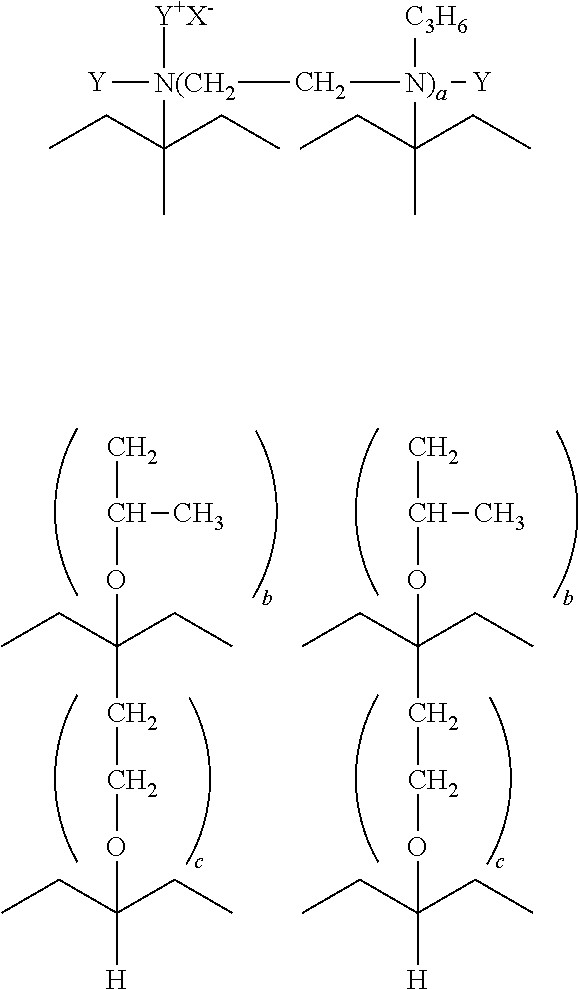
- where Y=methyl, ethyl, benzyl, etc.; X=Cl−, Br−, I−, or ½SO4 =; a=2-4; b=1-100; and c=0-40.
- A process for producing the quaternized alkoxylated polyethylene amine can include undertaking only alkoxylation of the polyethylene amine in a first step. Thus, a process for preparing a water-soluble alkoxylated polyethylene amine is reacting reactants consisting essentially of the polyethylene amine first with propylene oxide and then with ethylene oxide. In a second step, the alkoxylated polyethylene amine is reacted with a quaternization agent to form the quaternized alkoxylated polyethylene amine. It is to be understood that in the first step of producing the alkoxylated polyethylene amine, that the reactants consist essentially of the polyethylene amine, the propylene oxide, and the ethylene oxide, wherein minor amounts of other compounds, such as a catalyst, can be included but no other major reactants are included. In other words, the polyethylene amine is not reacted with any other reactants besides propylene oxide and ethylene oxide, wherein the polyethylene amine is reacted first with the propylene oxide and then secondly reacted with the ethylene oxide, to form the alkoxylated polyethylene amine with optional catalysts or solvents used in the reaction.
- In the first step, a first reaction is carried out in which an anhydrous polyethylene amine (PEA) is reacted only with the propylene oxide (PO) in a liquid or gas form carried out in the absence of a catalyst at a temperature in the range from about 70 to about 200° C., or from about 80 to about 160° C., under a pressure of up to about 10 bar. In the first reaction, just enough PO is added in order to convert all of the primary and secondary amines into tertiary amines. By way of example, 1 mol of PO can be added for every secondary amine functional group of the PEA and 2 mols of PO can be added for every primary amine functional group of the PEA Accordingly, for the case of tetraethylenepentamine (TEPA), which includes 3 secondary amines and 2 primary amines, a total of 7 mol of PO can be added for complete conversion. The exact amount of PO needed in the first reaction can also be calculated based on weight and molar mass. For example, in the case of TEPA as the polyethylene amine having a molar mass of 189.3 grams per mol (g/mol), and PO having a molar mass of 58.1 g/mol, for every 189.3 grams of TEPA used, 406.7 grams of PO can be added for the first reaction. A slight excess amount of PO can also be added in the first reaction to drive the reaction to fully convert all of the amines into tertiary amines. Conversion all of the amines of the PEA to their tertiary forms will form a hydrophobe with hydroxyl groups formed from the conversion. Accordingly, the PO is initially only reacting with the amines until all of the amines have been converted to tertiary amines before reacting with hydroxyl groups of PO that has already been added. Analysis can be performed to ensure that all of the amines have been converted to tertiary amines before continuing the subsequent reactions.
- In the first step, after all of the amines have been converted into tertiary form, then a second reaction is initiated with the addition of an alkaline catalyst and additional PO in order to enable the PO to react with the hydroxyl groups of the PO from first reaction. The alkaline catalyst reacts with the hydroxyl groups to form alkoxide ions (O−), which allows the additional PO to be added. The product from the second reaction becomes more hydrophobic due to the addition of the additional PO and formation of alkoxide ions. The resulting product includes each tertiary amine from the PEA centrally located within a highly branched polymer network comprising polypropylene glycol chains radiating out from the tertiary amines. In the case of tetraethylene pentamine (TEPA), a total of 7 polypropylene glycol chains will be present for every mol of TEPA.
- After the second reaction, a third reaction is then carried out in which the product from the second reaction is reacted with ethylene oxide (EO). The EO reacts with the tail ends of the polypropylene glycol chains to form hydrophilic tails that form the surfactant. Additional alkaline catalyst can be added if needed during the third reaction.
- Examples of suitable catalysts are strong base anhydrous catalysts such as alkali metals (e.g., potassium or sodium); alkaline earth metal hydroxides, such as sodium hydroxide, potassium hydroxide, and calcium hydroxide; alkali metal alkoxides, in particular sodium and potassium C—C-alkoxides, such as sodium methoxide, sodium ethoxide and potassium tert-butoxide. According to any of the embodiments, the strong base anhydrous catalyst is selected from potassium hydroxide or sodium hydroxide. The basic catalyst can be in a concentration in the range from about 0.01 to about 1% by weight of the reactants of the first step.
- The first, second, and/or third reactions to form the alkoxylated polyethylene amine can be carried out in an anhydrous solvent. Suitable solvents include, but are not limited to, toluene, xylene, or aromatic naphtha.
- According to any of the embodiments, the quaternized alkoxylated polyethylene amine is produced by the following reaction sequence.
-
- tetraethylene pentamine (TEPA)+propylene oxide (PO)→hydrophobic polytertiary amine+additional PO+catalyst→highly branched polypropylene glycol polymer+ethylene oxide (EO)→TEPA alkoxylate+methyl chloride→quaternized TEPA alkoxylate.
- The reaction sequence shown above affects the resulting properties of the quaternized alkoxylated polyethylene amine. The resulting properties can be both neat fluidity and water solubility. By way of example, the reaction of a polyethylene amine with propylene oxide first and then subsequently ethylene oxide produces a compound that possesses a hydrophobic head group, a hydrophobic middle portion, and a hydrophilic tail portion. Subsequent quaternization with the quaternization agent converts the hydrophobic head portion of the polyethylene amine into a hydrophile as evidenced by an increase in water solubility compared to its un-quaternized precursor. The resulting properties will also affect the wettability of the quaternized alkoxylated polyethylene amine. By way of example, it was unexpectedly discovered that the sequential reaction of the polyethylene amine with propylene oxide and then ethylene oxide can equalize surface wettability and actually lessen the affinity of both water and oil onto certain solids.
- The concentration of the TEPA can be in the range from about 0.2% to about 10%; the concentration of the propylene oxide in the range of about 30% to about 97%; the concentration of the ethylene oxide in the range of about 3% to about 50% by weight of the compounds reacting to form the TEPA alkoxylate. The TEPA alkoxylate can be represented by the following structure:
-

- The alkoxylated PEA polymer can then be reacted with a quaternization agent containing methyl, ethyl, or benzyl to quaternize the nitrogen atoms in the polymer. By way of but one non-limiting example, the alkoxylated PEA polymer can be reacted with methyl chloride. As discussed above, the reaction conditions can be adjusted and controlled to provide a desired amount of quaternization. The alkoxylated PEA polymer can be reacted at a concentration in the range of about 95% to about 99.9% by weight with the quaternization agent in a concentration of about 0.25% to about 5% by weight. A higher concentration of the quaternization agent can cause more of the nitrogen atoms of the alkoxylated PEA polymer to become quaternized. A fully quaternized TEPA alkoxylate that has been reacted with methyl chloride can be represented by the following chemical structure:
-
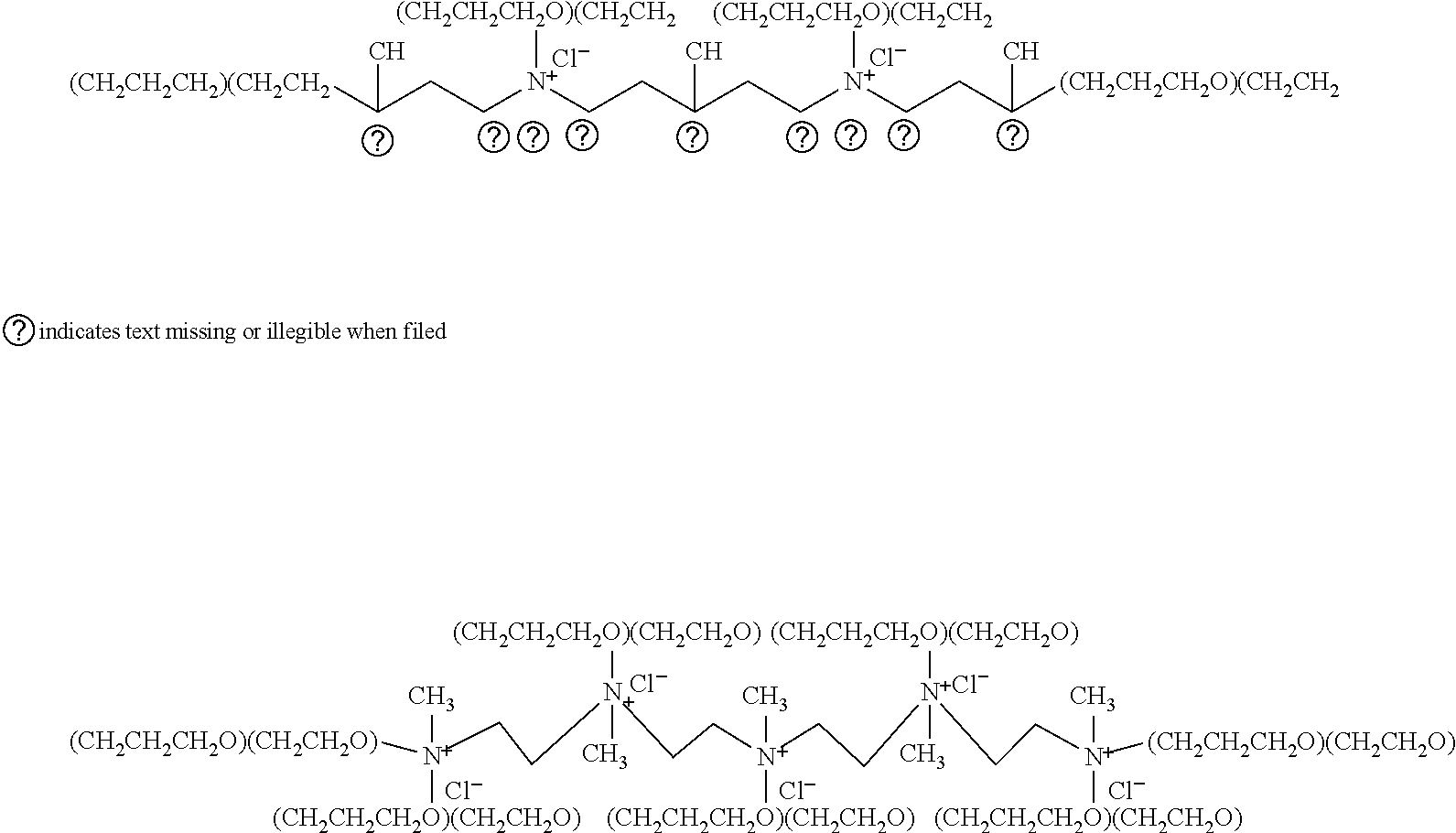
- The surfactant can be included in the base fluid in a concentration in the range of about 0.0001% to about 40% by weight of the base fluid.
- The treatment fluid can also contain various other additives and have a variety of desirable properties based on the type of treatment fluid and industry uses. The other additives can be selected based on the type of treatment fluid. By way of one example, if the treatment fluid is a frac fluid, then the fluid can also include proppant, a viscosifier, etc. Other additives can include cement, proppant, a viscosifier, a suspending agent, a weighting agent, a friction reducer, a filler, a fluid loss additive, a set retarder, a strength-retrogression additive, a light-weight additive, a defoaming agent, a mechanical property enhancing additive, a lost-circulation material, a filtration-control additive, a thixotropic additive, and combinations thereof. The other additives can also be selected based on the type of industry the treatment fluid is used in. One of ordinary skill in the art will be able to select the other additives and concentration based on the industry. By way of example, for a detergent for cleaning clothes, the treatment fluid can further include one or more anionic or non-ionic surfactants, one or more solvents, chelating agents, suspending agents, bleach, de-foaming agents, foaming agents, fragrances, process aids, anti-redeposition agents, and enzymes.
- The methods include introducing the treatment fluid into a well, wherein the well penetrates the subterranean formation. The well can be an oil, gas, or water production well, a geothermal well, an improved/enhanced oil recovery or other type of injection well. The well can include a wellbore. The subterranean formation can be part of a reservoir or adjacent to a reservoir. The step of introducing the treatment fluid can be for the purpose of: drilling a wellbore using a drilling fluid treatment; cementing a portion of the wellbore using a cement composition; flushing a drilling fluid from the wellbore prior to introduction of a cement composition using a spacer fluid; or creating fractures within the subterranean formation. The treatment fluid can be in a pumpable state before and during introduction into the well. The treatment fluid can be mixed prior to introduction. The step of mixing can include using a mixing apparatus. The treatment fluid can also be introduced into the well using a pump.
- The exemplary fluids and additives disclosed herein may directly or indirectly affect one or more components or pieces of equipment associated with the preparation, delivery, recapture, recycling, reuse, and/or disposal of the disclosed fluids and additives. For example, the disclosed fluids and additives may directly or indirectly affect one or more mixers, related mixing equipment, mud pits, storage facilities or units, fluid separators, heat exchangers, sensors, gauges, pumps, compressors, and the like used generate, store, monitor, regulate, and/or recondition the exemplary fluids and additives. The disclosed fluids and additives may also directly or indirectly affect any transport or delivery equipment used to convey the fluids and additives to a well site or downhole such as, for example, any transport vessels, conduits, pipelines, trucks, tubulars, and/or pipes used to fluidically move the fluids and additives from one location to another, any pumps, compressors, or motors (e.g., topside or downhole) used to drive the fluids and additives into motion, any valves or related joints used to regulate the pressure or flow rate of the fluids, and any sensors (i.e., pressure and temperature), gauges, and/or combinations thereof, and the like. The disclosed fluids and additives may also directly or indirectly affect the various downhole equipment and tools that may come into contact with the fluids and additives such as, but not limited to, drill string, coiled tubing, drill pipe, drill collars, mud motors, downhole motors and/or pumps, floats, MWD/LWD tools and related telemetry equipment, drill bits (including roller cone, PDC, natural diamond, hole openers, reamers, and coring bits), sensors or distributed sensors, downhole heat exchangers, valves and corresponding actuation devices, tool seals, packers and other wellbore isolation devices or components, and the like.
- Therefore, the present invention is well adapted to attain the ends and advantages mentioned as well as those that are inherent therein. The particular embodiments disclosed above are illustrative only, as the present invention may be modified and practiced in different but equivalent manners apparent to those skilled in the art having the benefit of the teachings herein. Furthermore, no limitations are intended to the details of construction or design herein shown, other than as described in the claims below. It is, therefore, evident that the particular illustrative embodiments disclosed above may be altered or modified and all such variations are considered within the scope and spirit of the present invention.
- As used herein, the words “comprise,” “have,” “include,” and all grammatical variations thereof are each intended to have an open, non-limiting meaning that does not exclude additional elements or steps. While compositions, systems, and methods are described in terms of “comprising,” “containing,” or “including” various components or steps, the compositions, systems, and methods also can “consist essentially of” or “consist of” the various components and steps. It should also be understood that, as used herein, “first,” “second,” and “third,” are assigned arbitrarily and are merely intended to differentiate between two or more atoms, etc., as the case may be, and does not indicate any sequence. Furthermore, it is to be understood that the mere use of the word “first” does not require that there be any “second,” and the mere use of the word “second” does not require that there be any “third,” etc.
- Whenever a numerical range with a lower limit and an upper limit is disclosed, any number and any included range falling within the range is specifically disclosed. In particular, every range of values (of the form, “from about a to about b,” or, equivalently, “from approximately a to b,” or, equivalently, “from approximately a-b”) disclosed herein is to be understood to set forth every number and range encompassed within the broader range of values. Also, the terms in the claims have their plain, ordinary meaning unless otherwise explicitly and clearly defined by the patentee. Moreover, the indefinite articles “a” or “an,” as used in the claims, are defined herein to mean one or more than one of the element that it introduces. If there is any conflict in the usages of a word or term in this specification and one or more patent(s) or other documents that may be incorporated herein by reference, the definitions that are consistent with this specification should be adopted.
Claims (20)
Priority Applications (1)
| Application Number | Priority Date | Filing Date | Title |
|---|---|---|---|
| US17/815,648 US20220380661A1 (en) | 2017-12-29 | 2022-07-28 | Quaternized alkoxylated polymer surfactant |
Applications Claiming Priority (4)
| Application Number | Priority Date | Filing Date | Title |
|---|---|---|---|
| US201762611627P | 2017-12-29 | 2017-12-29 | |
| PCT/US2018/066181 WO2019133333A1 (en) | 2017-12-29 | 2018-12-18 | Quaternized alkoxylated polymer surfactant |
| US202016763441A | 2020-05-12 | 2020-05-12 | |
| US17/815,648 US20220380661A1 (en) | 2017-12-29 | 2022-07-28 | Quaternized alkoxylated polymer surfactant |
Related Parent Applications (2)
| Application Number | Title | Priority Date | Filing Date |
|---|---|---|---|
| US16/763,441 Continuation-In-Part US20200316544A1 (en) | 2017-12-29 | 2018-12-18 | Quaternized alkoxylated polymer surfactant |
| PCT/US2018/066181 Continuation-In-Part WO2019133333A1 (en) | 2017-12-29 | 2018-12-18 | Quaternized alkoxylated polymer surfactant |
Publications (1)
| Publication Number | Publication Date |
|---|---|
| US20220380661A1 true US20220380661A1 (en) | 2022-12-01 |
Family
ID=84193809
Family Applications (1)
| Application Number | Title | Priority Date | Filing Date |
|---|---|---|---|
| US17/815,648 Abandoned US20220380661A1 (en) | 2017-12-29 | 2022-07-28 | Quaternized alkoxylated polymer surfactant |
Country Status (1)
| Country | Link |
|---|---|
| US (1) | US20220380661A1 (en) |
Citations (4)
| Publication number | Priority date | Publication date | Assignee | Title |
|---|---|---|---|---|
| US20090215662A1 (en) * | 2005-04-15 | 2009-08-27 | The Procter & Gamble Company | Cleaning compositions with alkoxylated polyalkylenimines |
| WO2011051646A1 (en) * | 2009-10-30 | 2011-05-05 | Croda International Plc | Treatment of hard surfaces |
| US8097579B2 (en) * | 2007-11-09 | 2012-01-17 | The Procter & Gamble Company | Cleaning compositions with amphiphilic water-soluble polyalkylenimines having an inner polyethylene oxide block and an outer polypropylene oxide block |
| US20150057211A1 (en) * | 2013-08-26 | 2015-02-26 | The Procter & Gamble Company | Compositions comprising alkoxylated polyamines having low melting points |
-
2022
- 2022-07-28 US US17/815,648 patent/US20220380661A1/en not_active Abandoned
Patent Citations (4)
| Publication number | Priority date | Publication date | Assignee | Title |
|---|---|---|---|---|
| US20090215662A1 (en) * | 2005-04-15 | 2009-08-27 | The Procter & Gamble Company | Cleaning compositions with alkoxylated polyalkylenimines |
| US8097579B2 (en) * | 2007-11-09 | 2012-01-17 | The Procter & Gamble Company | Cleaning compositions with amphiphilic water-soluble polyalkylenimines having an inner polyethylene oxide block and an outer polypropylene oxide block |
| WO2011051646A1 (en) * | 2009-10-30 | 2011-05-05 | Croda International Plc | Treatment of hard surfaces |
| US20150057211A1 (en) * | 2013-08-26 | 2015-02-26 | The Procter & Gamble Company | Compositions comprising alkoxylated polyamines having low melting points |
Similar Documents
| Publication | Publication Date | Title |
|---|---|---|
| CA2561920C (en) | Gelled oil with surfactant | |
| US8742165B2 (en) | Low interfacial tension surfactants for petroleum applications | |
| US10723940B2 (en) | Aqueous-based epoxy resin microemulsion | |
| US9790446B2 (en) | Application of a chemical composition for viscosity modification of heavy and extra-heavy crude oils | |
| CA3082118C (en) | Pre-flush for oil foamers | |
| EP2459670A1 (en) | Microemulsion to improve shale gas production by controlling water imbibition | |
| AU2014396174B2 (en) | Methods of producing particles having two different properties | |
| WO2015135777A2 (en) | Method for the production of oil and/or gas | |
| US20130252855A1 (en) | Novel use of a mild alkaline agent in chemical eor | |
| US9315718B2 (en) | Low interfacial tension surfactants for petroleum applications | |
| US20170240801A1 (en) | Fracturing fluids containing a viscoelastic surfactant viscosifier | |
| JP2007039693A (en) | Amine n-oxide base surfactant | |
| US20220380661A1 (en) | Quaternized alkoxylated polymer surfactant | |
| WO2019133333A1 (en) | Quaternized alkoxylated polymer surfactant | |
| EP4051756B1 (en) | Olefin sulfonates | |
| EP4051754B1 (en) | Olefin sulfonates | |
| EP4051755B1 (en) | Olefin sulfonates | |
| KR100840955B1 (en) | Amine N-oxide surfactant | |
| CA2890197A1 (en) | Low interfacial tension surfactants for petroleum applications | |
| US20210171826A1 (en) | Converting invert emulsions to emulsions using polyvalent salts of polymeric weak acids |
Legal Events
| Date | Code | Title | Description |
|---|---|---|---|
| AS | Assignment |
Owner name: ARC PRODUCTS, INC., TEXAS Free format text: ASSIGNMENT OF ASSIGNORS INTEREST;ASSIGNORS:HEATH, MICHAEL;VITEAUX, BOBBY;SIGNING DATES FROM 20170108 TO 20171229;REEL/FRAME:060656/0198 |
|
| STPP | Information on status: patent application and granting procedure in general |
Free format text: DOCKETED NEW CASE - READY FOR EXAMINATION |
|
| STPP | Information on status: patent application and granting procedure in general |
Free format text: NON FINAL ACTION MAILED |
|
| STPP | Information on status: patent application and granting procedure in general |
Free format text: RESPONSE TO NON-FINAL OFFICE ACTION ENTERED AND FORWARDED TO EXAMINER |
|
| STPP | Information on status: patent application and granting procedure in general |
Free format text: FINAL REJECTION MAILED |
|
| STCB | Information on status: application discontinuation |
Free format text: ABANDONED -- FAILURE TO RESPOND TO AN OFFICE ACTION |