CN1882693B - Polyethylene glycol modified lipid compound and its application - Google Patents
Polyethylene glycol modified lipid compound and its application Download PDFInfo
- Publication number
- CN1882693B CN1882693B CN2004800336163A CN200480033616A CN1882693B CN 1882693 B CN1882693 B CN 1882693B CN 2004800336163 A CN2004800336163 A CN 2004800336163A CN 200480033616 A CN200480033616 A CN 200480033616A CN 1882693 B CN1882693 B CN 1882693B
- Authority
- CN
- China
- Prior art keywords
- peg
- nucleic acid
- lipid
- lipid granule
- splp
- Prior art date
- Legal status (The legal status is an assumption and is not a legal conclusion. Google has not performed a legal analysis and makes no representation as to the accuracy of the status listed.)
- Expired - Lifetime
Links
Images


Classifications
-
- A—HUMAN NECESSITIES
- A61—MEDICAL OR VETERINARY SCIENCE; HYGIENE
- A61K—PREPARATIONS FOR MEDICAL, DENTAL OR TOILETRY PURPOSES
- A61K9/00—Medicinal preparations characterised by special physical form
- A61K9/10—Dispersions; Emulsions
- A61K9/127—Synthetic bilayered vehicles, e.g. liposomes or liposomes with cholesterol as the only non-phosphatidyl surfactant
- A61K9/1271—Non-conventional liposomes, e.g. PEGylated liposomes or liposomes coated or grafted with polymers
- A61K9/1272—Non-conventional liposomes, e.g. PEGylated liposomes or liposomes coated or grafted with polymers comprising non-phosphatidyl surfactants as bilayer-forming substances, e.g. cationic lipids or non-phosphatidyl liposomes coated or grafted with polymers
-
- C—CHEMISTRY; METALLURGY
- C07—ORGANIC CHEMISTRY
- C07C—ACYCLIC OR CARBOCYCLIC COMPOUNDS
- C07C235/00—Carboxylic acid amides, the carbon skeleton of the acid part being further substituted by oxygen atoms
- C07C235/02—Carboxylic acid amides, the carbon skeleton of the acid part being further substituted by oxygen atoms having carbon atoms of carboxamide groups bound to acyclic carbon atoms and singly-bound oxygen atoms bound to the same carbon skeleton
- C07C235/04—Carboxylic acid amides, the carbon skeleton of the acid part being further substituted by oxygen atoms having carbon atoms of carboxamide groups bound to acyclic carbon atoms and singly-bound oxygen atoms bound to the same carbon skeleton the carbon skeleton being acyclic and saturated
- C07C235/06—Carboxylic acid amides, the carbon skeleton of the acid part being further substituted by oxygen atoms having carbon atoms of carboxamide groups bound to acyclic carbon atoms and singly-bound oxygen atoms bound to the same carbon skeleton the carbon skeleton being acyclic and saturated having the nitrogen atoms of the carboxamide groups bound to hydrogen atoms or to acyclic carbon atoms
-
- A—HUMAN NECESSITIES
- A61—MEDICAL OR VETERINARY SCIENCE; HYGIENE
- A61K—PREPARATIONS FOR MEDICAL, DENTAL OR TOILETRY PURPOSES
- A61K31/00—Medicinal preparations containing organic active ingredients
- A61K31/70—Carbohydrates; Sugars; Derivatives thereof
- A61K31/7088—Compounds having three or more nucleosides or nucleotides
-
- A—HUMAN NECESSITIES
- A61—MEDICAL OR VETERINARY SCIENCE; HYGIENE
- A61K—PREPARATIONS FOR MEDICAL, DENTAL OR TOILETRY PURPOSES
- A61K47/00—Medicinal preparations characterised by the non-active ingredients used, e.g. carriers or inert additives; Targeting or modifying agents chemically bound to the active ingredient
- A61K47/50—Medicinal preparations characterised by the non-active ingredients used, e.g. carriers or inert additives; Targeting or modifying agents chemically bound to the active ingredient the non-active ingredient being chemically bound to the active ingredient, e.g. polymer-drug conjugates
-
- A—HUMAN NECESSITIES
- A61—MEDICAL OR VETERINARY SCIENCE; HYGIENE
- A61K—PREPARATIONS FOR MEDICAL, DENTAL OR TOILETRY PURPOSES
- A61K47/00—Medicinal preparations characterised by the non-active ingredients used, e.g. carriers or inert additives; Targeting or modifying agents chemically bound to the active ingredient
- A61K47/50—Medicinal preparations characterised by the non-active ingredients used, e.g. carriers or inert additives; Targeting or modifying agents chemically bound to the active ingredient the non-active ingredient being chemically bound to the active ingredient, e.g. polymer-drug conjugates
- A61K47/51—Medicinal preparations characterised by the non-active ingredients used, e.g. carriers or inert additives; Targeting or modifying agents chemically bound to the active ingredient the non-active ingredient being chemically bound to the active ingredient, e.g. polymer-drug conjugates the non-active ingredient being a modifying agent
- A61K47/54—Medicinal preparations characterised by the non-active ingredients used, e.g. carriers or inert additives; Targeting or modifying agents chemically bound to the active ingredient the non-active ingredient being chemically bound to the active ingredient, e.g. polymer-drug conjugates the non-active ingredient being a modifying agent the modifying agent being an organic compound
- A61K47/543—Lipids, e.g. triglycerides; Polyamines, e.g. spermine or spermidine
-
- A—HUMAN NECESSITIES
- A61—MEDICAL OR VETERINARY SCIENCE; HYGIENE
- A61K—PREPARATIONS FOR MEDICAL, DENTAL OR TOILETRY PURPOSES
- A61K47/00—Medicinal preparations characterised by the non-active ingredients used, e.g. carriers or inert additives; Targeting or modifying agents chemically bound to the active ingredient
- A61K47/50—Medicinal preparations characterised by the non-active ingredients used, e.g. carriers or inert additives; Targeting or modifying agents chemically bound to the active ingredient the non-active ingredient being chemically bound to the active ingredient, e.g. polymer-drug conjugates
- A61K47/51—Medicinal preparations characterised by the non-active ingredients used, e.g. carriers or inert additives; Targeting or modifying agents chemically bound to the active ingredient the non-active ingredient being chemically bound to the active ingredient, e.g. polymer-drug conjugates the non-active ingredient being a modifying agent
- A61K47/56—Medicinal preparations characterised by the non-active ingredients used, e.g. carriers or inert additives; Targeting or modifying agents chemically bound to the active ingredient the non-active ingredient being chemically bound to the active ingredient, e.g. polymer-drug conjugates the non-active ingredient being a modifying agent the modifying agent being an organic macromolecular compound, e.g. an oligomeric, polymeric or dendrimeric molecule
- A61K47/59—Medicinal preparations characterised by the non-active ingredients used, e.g. carriers or inert additives; Targeting or modifying agents chemically bound to the active ingredient the non-active ingredient being chemically bound to the active ingredient, e.g. polymer-drug conjugates the non-active ingredient being a modifying agent the modifying agent being an organic macromolecular compound, e.g. an oligomeric, polymeric or dendrimeric molecule obtained otherwise than by reactions only involving carbon-to-carbon unsaturated bonds, e.g. polyureas or polyurethanes
- A61K47/60—Medicinal preparations characterised by the non-active ingredients used, e.g. carriers or inert additives; Targeting or modifying agents chemically bound to the active ingredient the non-active ingredient being chemically bound to the active ingredient, e.g. polymer-drug conjugates the non-active ingredient being a modifying agent the modifying agent being an organic macromolecular compound, e.g. an oligomeric, polymeric or dendrimeric molecule obtained otherwise than by reactions only involving carbon-to-carbon unsaturated bonds, e.g. polyureas or polyurethanes the organic macromolecular compound being a polyoxyalkylene oligomer, polymer or dendrimer, e.g. PEG, PPG, PEO or polyglycerol
-
- A—HUMAN NECESSITIES
- A61—MEDICAL OR VETERINARY SCIENCE; HYGIENE
- A61K—PREPARATIONS FOR MEDICAL, DENTAL OR TOILETRY PURPOSES
- A61K47/00—Medicinal preparations characterised by the non-active ingredients used, e.g. carriers or inert additives; Targeting or modifying agents chemically bound to the active ingredient
- A61K47/50—Medicinal preparations characterised by the non-active ingredients used, e.g. carriers or inert additives; Targeting or modifying agents chemically bound to the active ingredient the non-active ingredient being chemically bound to the active ingredient, e.g. polymer-drug conjugates
- A61K47/69—Medicinal preparations characterised by the non-active ingredients used, e.g. carriers or inert additives; Targeting or modifying agents chemically bound to the active ingredient the non-active ingredient being chemically bound to the active ingredient, e.g. polymer-drug conjugates the conjugate being characterised by physical or galenical forms, e.g. emulsion, particle, inclusion complex, stent or kit
- A61K47/6905—Medicinal preparations characterised by the non-active ingredients used, e.g. carriers or inert additives; Targeting or modifying agents chemically bound to the active ingredient the non-active ingredient being chemically bound to the active ingredient, e.g. polymer-drug conjugates the conjugate being characterised by physical or galenical forms, e.g. emulsion, particle, inclusion complex, stent or kit the form being a colloid or an emulsion
- A61K47/6911—Medicinal preparations characterised by the non-active ingredients used, e.g. carriers or inert additives; Targeting or modifying agents chemically bound to the active ingredient the non-active ingredient being chemically bound to the active ingredient, e.g. polymer-drug conjugates the conjugate being characterised by physical or galenical forms, e.g. emulsion, particle, inclusion complex, stent or kit the form being a colloid or an emulsion the form being a liposome
-
- A—HUMAN NECESSITIES
- A61—MEDICAL OR VETERINARY SCIENCE; HYGIENE
- A61P—SPECIFIC THERAPEUTIC ACTIVITY OF CHEMICAL COMPOUNDS OR MEDICINAL PREPARATIONS
- A61P25/00—Drugs for disorders of the nervous system
-
- A—HUMAN NECESSITIES
- A61—MEDICAL OR VETERINARY SCIENCE; HYGIENE
- A61P—SPECIFIC THERAPEUTIC ACTIVITY OF CHEMICAL COMPOUNDS OR MEDICINAL PREPARATIONS
- A61P35/00—Antineoplastic agents
-
- A—HUMAN NECESSITIES
- A61—MEDICAL OR VETERINARY SCIENCE; HYGIENE
- A61P—SPECIFIC THERAPEUTIC ACTIVITY OF CHEMICAL COMPOUNDS OR MEDICINAL PREPARATIONS
- A61P37/00—Drugs for immunological or allergic disorders
- A61P37/02—Immunomodulators
-
- C—CHEMISTRY; METALLURGY
- C07—ORGANIC CHEMISTRY
- C07C—ACYCLIC OR CARBOCYCLIC COMPOUNDS
- C07C233/00—Carboxylic acid amides
-
- C—CHEMISTRY; METALLURGY
- C07—ORGANIC CHEMISTRY
- C07C—ACYCLIC OR CARBOCYCLIC COMPOUNDS
- C07C233/00—Carboxylic acid amides
- C07C233/01—Carboxylic acid amides having carbon atoms of carboxamide groups bound to hydrogen atoms or to acyclic carbon atoms
- C07C233/16—Carboxylic acid amides having carbon atoms of carboxamide groups bound to hydrogen atoms or to acyclic carbon atoms having the nitrogen atom of at least one of the carboxamide groups bound to a carbon atom of a hydrocarbon radical substituted by singly-bound oxygen atoms
- C07C233/17—Carboxylic acid amides having carbon atoms of carboxamide groups bound to hydrogen atoms or to acyclic carbon atoms having the nitrogen atom of at least one of the carboxamide groups bound to a carbon atom of a hydrocarbon radical substituted by singly-bound oxygen atoms with the substituted hydrocarbon radical bound to the nitrogen atom of the carboxamide group by an acyclic carbon atom
- C07C233/18—Carboxylic acid amides having carbon atoms of carboxamide groups bound to hydrogen atoms or to acyclic carbon atoms having the nitrogen atom of at least one of the carboxamide groups bound to a carbon atom of a hydrocarbon radical substituted by singly-bound oxygen atoms with the substituted hydrocarbon radical bound to the nitrogen atom of the carboxamide group by an acyclic carbon atom having the carbon atom of the carboxamide group bound to a hydrogen atom or to a carbon atom of an acyclic saturated carbon skeleton
-
- C—CHEMISTRY; METALLURGY
- C07—ORGANIC CHEMISTRY
- C07C—ACYCLIC OR CARBOCYCLIC COMPOUNDS
- C07C235/00—Carboxylic acid amides, the carbon skeleton of the acid part being further substituted by oxygen atoms
- C07C235/02—Carboxylic acid amides, the carbon skeleton of the acid part being further substituted by oxygen atoms having carbon atoms of carboxamide groups bound to acyclic carbon atoms and singly-bound oxygen atoms bound to the same carbon skeleton
- C07C235/04—Carboxylic acid amides, the carbon skeleton of the acid part being further substituted by oxygen atoms having carbon atoms of carboxamide groups bound to acyclic carbon atoms and singly-bound oxygen atoms bound to the same carbon skeleton the carbon skeleton being acyclic and saturated
- C07C235/08—Carboxylic acid amides, the carbon skeleton of the acid part being further substituted by oxygen atoms having carbon atoms of carboxamide groups bound to acyclic carbon atoms and singly-bound oxygen atoms bound to the same carbon skeleton the carbon skeleton being acyclic and saturated having the nitrogen atom of at least one of the carboxamide groups bound to an acyclic carbon atom of a hydrocarbon radical substituted by singly-bound oxygen atoms
-
- C—CHEMISTRY; METALLURGY
- C07—ORGANIC CHEMISTRY
- C07C—ACYCLIC OR CARBOCYCLIC COMPOUNDS
- C07C271/00—Derivatives of carbamic acids, i.e. compounds containing any of the groups, the nitrogen atom not being part of nitro or nitroso groups
- C07C271/06—Esters of carbamic acids
- C07C271/08—Esters of carbamic acids having oxygen atoms of carbamate groups bound to acyclic carbon atoms
- C07C271/10—Esters of carbamic acids having oxygen atoms of carbamate groups bound to acyclic carbon atoms with the nitrogen atoms of the carbamate groups bound to hydrogen atoms or to acyclic carbon atoms
- C07C271/16—Esters of carbamic acids having oxygen atoms of carbamate groups bound to acyclic carbon atoms with the nitrogen atoms of the carbamate groups bound to hydrogen atoms or to acyclic carbon atoms to carbon atoms of hydrocarbon radicals substituted by singly-bound oxygen atoms
-
- C—CHEMISTRY; METALLURGY
- C08—ORGANIC MACROMOLECULAR COMPOUNDS; THEIR PREPARATION OR CHEMICAL WORKING-UP; COMPOSITIONS BASED THEREON
- C08L—COMPOSITIONS OF MACROMOLECULAR COMPOUNDS
- C08L2203/00—Applications
- C08L2203/02—Applications for biomedical use
Landscapes
- Health & Medical Sciences (AREA)
- Chemical & Material Sciences (AREA)
- Organic Chemistry (AREA)
- Life Sciences & Earth Sciences (AREA)
- Pharmacology & Pharmacy (AREA)
- General Health & Medical Sciences (AREA)
- Animal Behavior & Ethology (AREA)
- Public Health (AREA)
- Medicinal Chemistry (AREA)
- Veterinary Medicine (AREA)
- Epidemiology (AREA)
- Bioinformatics & Cheminformatics (AREA)
- Engineering & Computer Science (AREA)
- Molecular Biology (AREA)
- Biophysics (AREA)
- Dispersion Chemistry (AREA)
- Nuclear Medicine, Radiotherapy & Molecular Imaging (AREA)
- General Chemical & Material Sciences (AREA)
- Chemical Kinetics & Catalysis (AREA)
- Immunology (AREA)
- Biomedical Technology (AREA)
- Neurology (AREA)
- Neurosurgery (AREA)
- Medicinal Preparation (AREA)
- Medicines That Contain Protein Lipid Enzymes And Other Medicines (AREA)
- Polyethers (AREA)
- Pharmaceuticals Containing Other Organic And Inorganic Compounds (AREA)
Abstract
The present invention discloses polyethylene glycol (PEG) Dialkoxypropyl (DAA) lipid conjugates with increased stability compared to commonly used PEG-lipid conjugates. Liposome compositions, stabilized plasmid-lipid particles (SPLPs), and stabilized nucleic acid-lipid particles (SNALPs) comprising the PEG-DAA conjugates are described for use in delivering bioactive agents into cells or patients.
Description
Cross reference to related application
The interests of the Patent Application No. 60/503,239 that present patent application requires to submit on September 15th, 2003, and with Patent Application No. 10/893; 121 is relevant, and said Patent Application No. 10/893,121 requires to be filed in the U.S. Provisional Patent Application number 60/488 on July 16th, 2003; 144; Be filed on September 15th, 2003 60/503,279 and be filed in 60/529 of on December 11st, 2003; 406 interests are hereby expressly incorporated by reference the instruction of its above-mentioned each application is complete from all purposes.
Background of invention
Effective and safe genes delivery system is that useful clinically gene therapy is needed.Virus vector is relative efficient gene delivery system, but suffers from multiple limitation, such as the possibility and the immunne response problem of being reversed into wild-type.As a result, the non-viral gene delivery system is receiving increasing concern (Worgall, et al., Human Gene Therapy 8:37-44 (1997); Peeters, et al., Human Gene Therapy 7:1693-1699 (1996); Yei, et al., Gene Therapy1:192-200 (1994); Hope, et al., Molecular Membrane Biology 15:1-14 (1998)).DNA-cation lipid nanocrystal composition is present the most frequently used non-viral gene delivery vector (Felgner, Scientific American 276:102-106 (1997); Chonn, et al., CurrentOpinion in Biotechnology 6:698-708 (1995)).Yet mixture is bigger, and system is very uncertain, and it is inappropriate for the whole body application and can excites sizable toxic side effects (Harrison, et al., Biotechniques 19:816-823 (1995); Huang, et al., Nature Biotechnology15:620-621 (1997); Templeton, et al., Nature Biotechnology 15:647-652 (1997); Hofland, et al., Pharmaceutical Research 14:742-749 (1997)).
Nearest work shown DNA can be encapsulated in little (~70nm diameter) " stable plasmid-lipid granule " (SPLP) in; It forms (Wheeler, et al.Gene Therapy 6:271 (1999)) by the single plasmid that is encapsulated in the lipid bilayer carrier.These SPLPs typically comprise " confluent (fusogenic) " lipid dioleoyl phospholipid acyl-thanomin (DOPE), low-level cation lipid, and gather (terepthaloyl moietie) in existence be stable in aqueous medium during dressing (PEG).SPLP has whole body and uses, because after intravenously (i.v.) injection, they show the circulation lifetime that prolongs, because the vascular permeability that increases in these zones, they preferentially accumulate in the distally tumor sites, and can be at these tumor sites mediation transgene expressions.After i.v. injection comprises the SPLP of luciferase marker gene, be superior to using DNA-cation lipid nanocrystal composition (lipoplexes) or the obtainable level of naked DNA in the level of the observed transgene expression of tumor sites.However, for the ideal treatment benefit in some application, the expression that possibly improve the standard (see, for example, Monck, et al., J.DrugTarg.7:439-452 (2000)).
Typically, liposome and SPLPs comprise the PEG-lipid derivate.Typically, prepare the PEG-lipid through the polar head group of DG phosphatide is carried out derivatize with PEG, said DG phosphatide is such as distearyl acyl group phosphatidylethanolamine (DSPE).These phosphatide comprise two 1-position and 2-position bonded fatty acyl chains through ester bond and glycerine usually.Unfortunately, under acidity or alkaline condition, these carboxyl groups are prone to for cracking responsive.The hydrolysate that these obtain such as the analogue of lysophospholipid and glycerophosphate, does not have the double-deck dependency of maintenance and liposome or SPLP.Unfortunately, these disassociations can weaken the integrity of liposomes or SPLP structures, cause biologically active agent or medicine from the remarkable leakage loss of liposome or SPLP and cause the instability the storage process, therefore shorten the shelf-life of liposome or SPLP product.In addition, these hydrolysates, such as the PEG-lysophospholipid from the loss of liposome or SPLP negated otherwise the benefit that can obtain from the existence of PEG-phosphatide.
The stability of lipid is important in the exploitation of liposome or SPLP drug delivery system.Therefore, it is desirable to exploitation, increase the cycle life of liposome or SPLP thus the more insensitive PEG-lipid of hydrolysis.The invention solves this and other needs.
Summary of the invention
The present invention provides new polyoxyethylene glycol-dialkoxy propyl group (PEG-DAA) conjugate, compares with PEG-lipid conjugates (such as the PEG-PE conjugate) commonly used, and it has the stability of increase.The dialkyl group propyl group conjugate that PEG-of the present invention modifies is through increasing said liposome, SNALP, or the cycle life of SPLP or time limit of service improve the character of liposome and nucleic acid-lipid granule (for example, SNALPs and SPLPs).In fact, it has surprisingly been found that PEG-DAA conjugate of the present invention is more stable than other PEG-lipid derivate commonly used.As the result of the stability that increases, the leakage loss that hydrolysis caused of the fatty acyl chain of liposome bilayer or SPLP when PEG-DAA conjugate of the present invention has increased cycle life or the time limit of service of liposome or SPLP and also reduced owing to other PEG-lipid conjugates of use.
The present invention provides the PEG-DAA conjugate of the new formula I with following structure:
In above-mentioned formula I, " R
1And R
2" selected independently and be the alkyl group with about 20 carbon atoms of about 10-; PEG is a polyoxyethylene glycol; And L is shank (for example, comprise the shank of non-ester (non-ester) or comprise the shank of ester).The alkyl group that is fit to includes, but not limited to lauryl (C12), myristyl (C14), palmityl (C16), stearyl (C18) and petrosilane base (C20).In a preferred embodiment; R
1And R
2Be identical, promptly they all are myristyls (C14) or all are palmityls (C16) or all are stearyl (C18).In a preferred embodiment, said alkyl group is saturated.
In above-mentioned formula I, " PEG " is polyoxyethylene glycol, and it has about 550 dalton to the interior molecular-weight average of about 10,000 dalton's scopes; More preferably from about 750 dalton are to the interior molecular weight of about 5,000 dalton's scopes, and more preferably from about 1,000 dalton is to about 5; Molecular weight in 000 dalton's scope, more preferably from about 1,500 dalton is to the interior molecular weight of about 3,000 dalton's scopes; And even 2,000 dalton more preferably from about, or about 750 Dalton molecular weights.Said PEG can be randomly by alkyl, alkoxyl group, and acyl group or aryl replace.In a preferred embodiment, terminal hydroxyl group is replaced by methoxyl group or methyl group.PEG can directly put together maybe and can be connected with lipid through shank with lipid.Can use any being suitable for PEG and lipid link coupled shank, it comprises, for example comprises the shank and the shank that comprises ester of non-ester.In a preferred embodiment, said shank is the shank that comprises non-ester.When being used for this paper, term " shank that comprises non-ester " refers to not comprise the shank of carboxylic acid ester bond (OC (O)-).The shank that comprises non-ester that is fit to include, but not limited to amido (C (O) NH-), amino (NR-), carbonyl (C (O)-), carbamate (NHC (O) O-), urea (NHC (O) NH-), disulphide (S-S-), ether (O-), succinyl-((O) CCH
2CH
2C (O)-), succinic diamide (NHC (O) CH
2CH
2C (O) NH-), ether, disulphide waits and makes up (such as the joint that comprises carbamate shank and amido shank).In a preferred embodiment, the carbamate joint is used for PEG is coupled to lipid.
In other embodiments, the shank that comprises ester is used to PEG is coupled to lipid.The shank that comprises ester that is fit to comprises, for example, and carbonic ether (OC (O) O-), amber one acyl, SULPHOSUCCINIC ACID ESTER (O-(O) POH-O-), sulphonate and combination thereof.
In above-mentioned formula I, " L " is the shank that comprises the shank of non-ester or comprise ester.In a preferred embodiment, L is the shank that comprises non-ester.The joint that comprises non-ester that is fit to includes, but not limited to the amido shank, amino shank, carbonyl shank, carbamate shank, urea shank, ether shank, disulphide shank, succinic diamide shank and combination thereof.In a preferred embodiment, the shank that comprises non-ester is carbamate shank (that is a PEG-C-DAA conjugate).In another preferred embodiment, the shank that comprises non-ester is amido shank (that is a PEG-A-DAA conjugate).In a preferred embodiment, the shank that comprises non-ester is succinoamino shank (that is a PEG-S-DAA conjugate).
In yet another aspect, the present invention provides the liposome of polyoxyethylene glycol-dialkoxy propyl group (PEG-DAA) conjugate that comprises formula I.Said liposome also typically comprises cation lipid and non-cationic lipid.Aspect some, said liposome also comprises sterol (for example, cholesterol).Said liposome can be empty or, alternatively, liposome can also comprise one or more biologically active agents (for example, therapeutic product as herein described).The biologically active agent that is fit to includes, but not limited to antitumour drug, microbiotic, immunomodulator, antiphlogistic drug with act on the medicine on the cns.Similarly, the biologically active agent that is fit to includes, but not limited to peptide, protein and nucleic acid.
In yet another aspect, the present invention provides a kind of biologically active agent is sent the method to cell, and said method comprises makes cell contact with the liposome of the PEG-DAA conjugate that comprises formula I, and wherein said biologically active agent is encapsulated in the liposome.Similarly, on the other hand, the present invention provides a kind of biologically active agent is sent the method to the patient, and said method comprises uses the liposome of the PEG-DAA conjugate that comprises formula I to the patient, and wherein said biologically active agent is encapsulated in the liposome.
On the other hand, the present invention provides nucleic acid-lipid granule, and said nucleic acid-lipid granule comprises: nucleic acid; Cation lipid; The non-cationic lipid; PEG-DAA with formula I.Aspect some, said nucleic acid-lipid granule also comprises sterol (for example, cholesterol).
On the other hand, the present invention provides a kind of nucleic acid is introduced the method for cell, and said method comprises makes said cell contact with nucleic acid-lipid granule; Said nucleic acid-lipid granule comprises cation lipid; The non-cationic lipid, the PEG-DAA conjugate of formula I, and nucleic acid.
Other characteristics of the present invention, purpose and advantage and preferred embodiment thereof will become obvious through following detailed, embodiment, claim and accompanying drawing.
The accompanying drawing summary
Fig. 1 illustrates two kinds of exemplary PEG-dialkoxy propyl derivatives, i.e. N-(2,3-myristyl oxygen base propyl group) carbamate PEG
2000Methyl ether (that is, and PEG-C-DMA), N-(2,3-myristyl oxygen base propyl group) acid amides PEG
2000Methyl ether (that is, and PEG-A-DMA), and N-(2,3-myristyl oxygen base propyl group) succinic diamide PEG
2000Methyl ether (that is PEG-S-DMA) structure.
Fig. 2 illustrates demonstration and comprises the PEG-DAA conjugate, PEG-DAG conjugate, the data of the stability of the liposome of PEG-ceramide conjugate and PEG-DSPE conjugate.
Fig. 3 illustrates and is presented at IV and uses and comprise the PEG-DAA conjugate, behind the SPLP of PEG-DAG conjugate and PEG-ceramide conjugate, and the data that the luciferase genes in tumour is expressed.
Fig. 4 illustrates demonstration by comprising the PEG-DAA conjugate, and PEG-DAG conjugate, the SPLP of PEG-ceramide conjugate and PEG-DSPE conjugate carry out the data of transfection in the body.
Fig. 5 illustrates and is presented at SPLP that intravenous administration comprises PEG-DAA conjugate and PEG-DAG conjugate after 48 hours, the data that the luciferase genes in tumour is expressed.
After Fig. 6 illustrates and shows that intravenous administration comprises the SPLP of PEG-DAA conjugate and PEG-DAG conjugate, liver, lung, spleen, the data that the luciferase genes in heart and the tumour is expressed.
Fig. 7 illustrates and is presented at SPLP or pSPLP that intravenous administration comprises PEG-DAA conjugate and PEG-DAG conjugate after 48 hours, is presented at the data that the luciferase genes in the tumour is expressed.
Fig. 8 illustrates the data of transfection in the body that demonstration undertaken by the SPLP that comprises PEG-DAA conjugate and PEG-DAG conjugate.
Fig. 9 is the interior data of phaneroplasm for example; The silence of the luciferase expression of digital proof in the male A/J mouse with Neuro-2a tumour of handling in the said body with SPLPs and SNALPs; Said SPLPs comprises the PEG-DAA conjugate and is included in the plasmid of the following coding of the control luciferase of CMV promotor that said SNALPs comprises the PEG-DAA conjugate and comprises anti-luciferase siRNA.
Figure 10 is the interior data of phaneroplasm for example; The silence of the luciferase expression of digital proof in the male A/J mouse with Neuro-2a tumour of handling in the said body with SPLPs and SNALPs; Said SPLPs comprises the PEG-DAA conjugate and is included in the plasmid of the following coding of the control luciferase of CMV promotor that said SNALPs comprises the PEG-DAA conjugate and comprises anti-luciferase siRNA.
Figure 11 is the interior data of phaneroplasm for example; The silence of the luciferase expression of digital proof in the male A/J mouse with Neuro-2a tumour of handling in the said body with SPLPs and SNALPs; Said SPLPs comprises the PEG-DAA conjugate and is included in the plasmid of the following coding of the control luciferase of CMV promotor that said SNALPs comprises the PEG-DAA conjugate and comprises anti-luciferase siRNA.
Figure 12 is the interior data of phaneroplasm for example; The silence of the luciferase expression of digital proof in the male A/J mouse with Neuro-2a tumour of handling in the said body with SPLPs and SNALPs; Said SPLPs comprises the PEG-DAA conjugate and is included in the plasmid of the following coding of the control luciferase of CMV promotor that said SNALPs comprises the PEG-DAA conjugate and comprises anti-luciferase siRNA.
Figure 13 is the interior data of phaneroplasm for example; The silence of the luciferase expression of digital proof in the male A/J mouse with Neuro-2a tumour of handling in the said body with SPLPs and SNALPs; Said SPLPs comprises the PEG-DAA conjugate and is included in the plasmid of the following coding of the control luciferase of CMV promotor that said SNALPs comprises the PEG-DAA conjugate and comprises anti-luciferase siRNA.
Figure 14 illustrates the data that the proof cell absorbs the SPLP that comprises the PEG-C-DMA conjugate.
Figure 15 illustrates proof and is using SPLP or SNALP after 24 hours, comprises SPLP and the chorologic data of SNALP in having the male A/J mouse of Neuro-2a tumour of PEG-C-DMA or PEG-C-DSA.
Figure 16 illustrates proof using SPLP nearly after 24 hours, comprises the data of the blood clearance of SPLP in male A/J mouse of PEG-C-DMA.
Figure 17 illustrates and is using SPLP or SNALP after 48 hours, comprises SPLP and the chorologic data of SNALP in having the male A/J mouse of Neuro-2a tumour of PEG-C-DMA.
Figure 18 illustrates using SPLP and SNALP nearly after 24 hours, comprises the data of SPLP and the blood clearance of SNALP in male A/J mouse of PEG-C-DMA or PEG-C-DSA.
Figure 19 illustrates the data of proof by transfection in SPLP and the pSPLP body, and said SPLP and pSPLP comprise PEG-DAA conjugate and PEG-DAG conjugate and seal the plasmid of coding luciferase.
Figure 20 illustrates the data of proof by transfection in the SPLP body, and said SPLP comprises the PEG-C-DMA conjugate and seals the plasmid of coding luciferase.
Figure 21 illustrates the data of proof by transfection in the SPLP body, and said SPLP comprises the PEG-C-DMA conjugate and seals the plasmid of coding luciferase.
Figure 22 illustrates the data of the silence that proves the luciferase expression in the Neuro-2a cell that contacts with SNALPs, and said SNALPs comprises the PEG-C-DMA conjugate and comprises anti-luciferase siRNA.
Figure 23 illustrates data in the body of silence of the luciferase expression in the transitivity Neuro-2a tumour of proof in the male A/J mouse of expressing luciferase and handling with SNALPs, and said SNALPs comprises the PEG-C-DMA conjugate and seals anti-luciferase siRNA.
Detailed Description Of The Invention
I. introduce
The present invention provides new polyoxyethylene glycol-dialkoxy propyl group (PEG-DAA) conjugate, compares with PEG-lipid conjugates (such as the PEG-PE conjugate) commonly used, and it has the stability of increase.The dialkyl group propyl group conjugate that PEG-of the present invention modifies is through increasing said liposome, SNALP, or the cycle life of SPLP or time limit of service improve the character of liposome and nucleic acid-lipid granule (for example, SNALPs and SPLPs).In fact, it has surprisingly been found that the PEG-DAA conjugate that comprises the PEG that puts together through joint and DAA is more stable than other PEG-lipid derivate commonly used.Particularly, it has surprisingly been found that and use the shank comprise non-ester to cause the PEG-DAA conjugate (for example, PEG-PG conjugate) with the more stable property of PEG-lipid conjugates increase commonly used.The result of the stability that increases as their; PEG-DAA conjugate of the present invention has increased liposome; Liposome was double-deck when the cycle life of SNALP or SPLP or time limit of service had also also reduced owing to other PEG-lipid conjugates of use; SNALP, or the leakage loss that hydrolysis caused of the fatty acyl chain of SPLP.
II. definition
Term " dialkoxy propyl group " refers to have the compound of 2-alkyl chain, its R
1And R
2All has 2-30 carbon independently.Alkyl group can be saturated or have in various degree unsaturated.The dialkoxy propyl group has following general formula:

Term " PEG " refers to polyoxyethylene glycol, a kind of linearity with two terminal hydroxyl groups, the water-soluble polymers of ethene PEG repeating unit.According to their molecular weight, PEGs is classified; For example, PEG 2000 has about 2,000 daltonian molecular-weight average, and PEG5000 has about 5,000 daltonian molecular-weight average.PEGs be can be purchased from Sigma Chemical Co. and other company and comprise for example following: mono methoxy polyethylene glycol (MePEG-OH); Mono methoxy polyethylene glycol-succinate (MePEG-S); Mono methoxy polyethylene glycol-succinimido succinate (MePEG-S-NHS), mono methoxy polyethylene glycol-amine (MePEG-NH
2), mono methoxy polyethylene glycol-tresylate (MePEG-TRES), and mono methoxy polyethylene glycol-imidazolyl-carbonyl (MePEG-IM).In addition, said instance provides synthetic mono methoxy polyethylene glycol-acetate (MePEG-CH
2COOH) scheme, it is useful in preparation PEG-DAA conjugate of the present invention especially.
In a preferred embodiment, said PEG has about 550 to the polyoxyethylene glycol of about 10,000 daltonian molecular-weight average and randomly by alkyl, alkoxyl group, and acyl group or aryl replace.In a preferred embodiment, said PEG endways hydroxy position replaced by methyl.In another preferred embodiment, said PEG has about 750 to about 5,000 daltonian molecular-weight average, more preferably; Has about 1,000 about 5,000 daltonian molecular-weight average; More preferably have about 1,500 to about 3,000 daltonian molecular-weight average; And, even more preferably have about 2,000 dalton or about 750 daltonian molecular-weight average.Said PEG can be randomly by alkyl, alkoxyl group, and acyl group or aryl replace.In a preferred embodiment, said terminal hydroxyl group is replaced by methoxyl group or methyl group.
When being used for this paper, the PEG-DAA conjugate refers to the polyoxyethylene glycol puted together with the dialkoxy propyl group.Said PEG can directly and DAA puts together and can put together through shank and DAA.The shank that is fit to comprises shank that comprises non-ester and the shank that comprises ester.
When being used for this paper, term " shank that comprises non-ester " refers to not comprise the shank of carboxylic acid ester bond (OC (O)-).The shank that comprises non-ester that is fit to include, but not limited to amido (C (O) NH-), amino (NR-), carbonyl (C (O)-), carbamate (NHC (O) O-), urea (NHC (O) NH-), disulphide (S-S-), ether (O-), succinyl-((O) CCH
2CH
2C (O)-), succinic diamide (NHC (O) CH
2CH
2C (O) NH-), ether, disulphide waits and makes up (such as the joint that comprises carbamate shank and amido shank).In a preferred embodiment, the carbamate joint is used for PEG is coupled to lipid.
In other embodiments, the shank that comprises ester is used for PEG is coupled to lipid.The shank that comprises ester that is fit to comprises, for example, and carbonic ether (OC (O) O-), amber one acyl group, SULPHOSUCCINIC ACID ESTER (O-(O) POH-O-), sulphonate, and combination.
Term " lipid " refers to one group of organic cpds, and it includes, but are not limited to the ester of lipid acid, and characteristic is insoluble in water, but in many organic solvents, is soluble.Usually they are divided at least three types: (1) " simple lipid ", it comprises fat and oil and wax; (2) " compound lipid " it comprise phosphatide and glycolipid; (3) " deutero-lipid " is such as steroide.
" lipid vesicle " refers to can be used for sending any lipid composition of compound, and it includes, but not limited to liposome, and wherein volume of water is sealed by amphipathic lipid bilayer; Or wherein lipid coating comprises and the inside of macromolecular components such as the plasmid that comprises interference RNA sequence, follows the aqueous interior of minimizing; Or lipid aggregate or micelle, wherein entrapped composition is included in the chaotic relatively lipid mixt.
When being used for this paper, " lipid of sealing " can refer to provide have fully seal, partially encapsulated or both lipid formulations of compound.In a preferred embodiment, said nucleic acid fully is encapsulated in (for example, formation SPLP, pSPLP, SNALP, or other nucleic acid lipid granule) in the lipid formulations.Nucleic acid lipid granule and preparation method thereof is disclosed in U.S. Patent number 5,976,567, U.S. Patent number 5,981,501 with PCT patent publication No. WO96/40964 in.
When being used for this paper, term " SNALP " refers to stable nucleic acid lipid granule, comprises SPLP.SNALP representative encapsulates the vesicle of lipid of the aqueous interior of minimizing, and said inside comprises nucleic acid (for example, ssDNA, dsDNA, ssRNA, dsRNA, siRNA or plasmid comprise the plasmid of transcribing RNA interfering).When being used for this paper, term " SPLP " refers to comprise the nucleic acid lipid granule of the nucleic acid (for example, plasmid) that is encapsulated in the lipid vesicle.SNALPs and SPLPs typically comprise cation lipid, non-cationic lipid and stop the lipid (for example, PEG-lipid conjugates) of said particle aggregation.SNALPs and SPLPs have systemic administration; Because they show the cycle life that prolongs in intravenously (i.v.) injection back; (for example, physically assembling on the site of separating in the site and can mediate with using in the far-end site by of the expression of the gene of transfection in these far-end sites.SPLPs comprises " pSPLP ", and it comprises the entrapped condensing agent-nucleic acid complexes as in WO00/03683, mentioning.
The term lipid of vesicle " form " is intended to comprise any amphipathic lipids with hydrophobic part and polar head group, and itself can be in water spontaneous formation bilayer vesicle, be exemplified as most of phosphatide.
Term " adopts the lipid of vesicle " and is intended to comprise stable and any amphipathic lipids of lipid bilayer bonded and other amphipathic lipids; Its hydrophobic part is with inner; The contact of the hydrophobic region of duplicature, and its polar head group part is towards the outside, the polar surfaces of film.Adopt the lipid of vesicle to comprise such lipid, it can be suitable for adopting unstratified phase independently, can also when having double-deck stabilising component consisting, take bilayer structure.Typical instance is DOPE (DOPE).Double-deck stabilising component consisting includes, but not limited to suppress the lipid that the SNALPs accumulative is puted together; Polyamide oligomer as well as (for example, ATTA-lipid derivate), peptide, protein, stain remover, lipid derivate, PEG-lipid derivate are such as with dialkoxy propyl group link coupled PEG, with DG link coupled PEG, (see with phosphatidylethanolamine link coupled PEG with PEG that ceramide is puted together; U.S. Patent number 5; 885,613, incorporate it into this paper as a reference).PEG can directly put together maybe and can be connected with lipid through shank with lipid.Can use any shank that is suitable for PEG is coupled to lipid, comprise, for example, comprise the shank and the shank that comprises ester of non-ester.
Term " amphipathic lipids " partly refers to any suitable material, and wherein the hydrophobic part of matrix material is towards hydrophobic phase, and hydrophilic segment is towards water.Amphipathic lipids is the staple of lipid vesicle normally.Hydrophilic nmature from polarity or charged group such as glucide, phosphoric acid salt (ester), the existence of carboxyl, sulfato, amino, sulfydryl, nitro, hydroxyl and other similar group.Hydrophobicity can be given through comprising non-polar group, and it is saturated with the unsaturated aliphatic hydrocarbyl group with by one or more aromatic series, the alicyclic or substituted such group of heterocyclic group that said group includes, but not limited to long-chain.The instance of amphiphilic cpds includes, but not limited to phosphatide, aminolipid and sphingolipid.The representative example of phosphatide comprises; But be not limited to phosphatidylcholine, phosphatidylethanolamine, phosphatidylserine, PI, phosphatidic acid, palmityl oleoyl phosphatidylcholine, lyso-phosphatidylcholine, LPE, DPPC, dioleoyl phospholipid phatidylcholine, DSPC or dilinoleoylphosphatidylcholine.Other compound that lacks phosphorus, such as sphingophospholipid, sphingoglycolipid family, DG and β-acyloxy acid also in being called as the group of amphipathic lipids.In addition, above-mentioned amphipathic lipids can be mixed with other lipid, and said lipid comprises triglyceride level and sterol.
Term " neutral lipid " refers to any in many lipid species that selected pH exists with not electrically charged or neutral zwitterionic form.Under physiological pH, such lipid comprises, for example, and diacyl phosphatidyl choline, diacyl phosphatidylethanolamine, ceramide, sphingomyelin, kephalin, SUV, cerebroside and DG.
Term " non-cationic lipid " refers to aforesaid any neutral lipid and negatively charged ion lipid.
Term " negatively charged ion lipid " refers to any lipid electronegative under physiological pH.These lipids comprise; But be not limited to; POPG, Val, diacyl phosphatidylserine, diacyl phosphatidic acid, N-dodecanoyl phosphatidylethanolamine, N-succinyl-phosphatidylethanolamine, N-glutaryl phosphatidylethanolamine; Lysyl POPG, palmityl oleoyl POPG (POPG) are with other anion modified group that is connected with neutral lipid.
Term " cation lipid " refers to any in many lipid species, and it is at selected pH, such as carrying clean positive charge under the physiological pH.These lipids include, but not limited to N, N-two oil bases-N, N-alkyl dimethyl ammonium chloride (" DODAC "); N-(2,3-two oil base oxygen bases) propyl group)-and N, N, N-trimethyl ammonium chloride (" DOTMA "); N, N-distearyl-N, N-dimethyl-brometo de amonio (" DDAB "); N-(2,3-two oily acyloxy) propyl group)-and N, N, N-trimethyl ammonium chloride (" DOTAP "); 3-(N-(N ', N '-dimethylamino ethane)-formamyl) SUV (" DC-Chol ") and N-(1,2 myristyl oxygen base, third-3-yl)-N, N-dimethyl--N-hydroxyethyl brometo de amonio (" DMRIE ").Following lipid is cationic and when being lower than physiological pH, has positive charge: DODAP, DODMA, DMDMA etc.
Term " hydrophobic lipid " refers to have the compound of non-polar group, and it includes, but not limited to, and long-chain is saturated randomly to be replaced by one or more aromatic series, alicyclic or heterocyclic group group with unsaturated aliphatic hydrocarbyl group and these groups.Suitable instance includes, but not limited to DG, dialkyl group glycerine, N-N-dialkyl amido, 1,2-two acyloxy-3-aminopropane and 1,2-dialkyl group-3-aminopropane.
Term " confluent " refers to liposome, the ability that SNALP or other medicines delivery system and cytolemma merge.Said film can be plasma membrane or center on organoid, the for example film of endosome, nuclear etc.
Term " DG " refers to have the compound of 2-fatty acyl chain, its R
1And R
2All have independently through the 1-of ester bond and glycerine and 2-30 carbon atom of 2-position bonding.Said carboxyl groups can be saturated or have in various degree unsaturated.DG has following general formula:

Term " ATTA " or " polymeric amide " refer to, but be not limited to, and at U.S. Patent number 6,320, disclosed compound in 017 and 6,586,559 is all incorporated them into this paper as a reference.These compounds comprise have as shown in the formula compound:
Wherein: R is the member who is selected from the group of being made up of hydrogen, alkyl and acyl group; R
1Be the member who is selected from the group of forming by hydrogen and alkyl; Or randomly, R and R
1Form the azido-part with their institute's bonded nitrogen-atoms; R
2Be to be selected from by hydrogen, randomly substituted alkyl, the member of the group formed of substituted aryl and amino acid side chain randomly; R
3Be to be selected from by hydrogen, halogen, hydroxyl, alkoxyl group, sulfydryl, diazanyl, amino and NR
4R
5The member of the group of forming, wherein R
4And R
5Be hydrogen or alkyl independently; N is 4-80; M is 2-6; P is 1-4; And q is 0 or 1.Those skilled in the art will be clear that other polymeric amide can be used in the compound of the present invention.
Term " nucleic acid " or " polynucleic acid " refer to comprise the polymkeric substance that exists with list or double chain form of at least two deoxyribonucleotides or ribonucleotide.Nucleic acid comprises the main chain residue that comprises known nucleotide analogue or modification or the nucleic acid of key; It is a synthetic, and is naturally occurring, or the non-natural existence; It has the binding characteristic similar with reference nucleic acid, and it carries out metabolism with the mode similar with reference nucleotide.The instance of these analogues includes, but not limited to thiophosphatephosphorothioate (phosphoroorothioates), phosphoramidate, methyl orthophosphoric acid, chirality-methyl orthophosphoric acid, 2-O-methyl ribonucleotides, peptide-nucleic acid (PNAs).Only if concrete restriction, the nucleic acid of the known analogue that comprises natural nucleotide contained in this term, and it has and carries out metabolism with reference to the similar binding characteristic of nucleic acid and with the mode similar with naturally occurring Nucleotide.Only if point out in addition, concrete nucleotide sequence also implies the variant (for example, the degenerate codon replacement) of containing its conservative property and modifying, allelotrope, and directly to homologue, SNPs and complementary sequence and the sequence of obviously pointing out.Particularly; Can obtain the degenerate codon replacement through producing sequence; The 3rd position of the codon of one or more selected (or owning) replaces (Batzer et al., Nucleic Acid Res.19:5081 (1991) by mixed base and/or Hypoxanthine deoxyriboside residue in said sequence; Ohtsuka et al., J.Biol.Chem.260:2605-2608 (1985); With Cassol et al. (1992); Rossolini et al., Mol.Cell.Probes 8:91-98 (1994))." Nucleotide " comprises sugared ribodesose (DNA) or ribose (RNA), base, and phosphate group.Nucleotide connects through phosphate group." base " comprises purine and pyrimidine, and it further comprises natural compounds VITAMIN B4, thymus pyrimidine, guanine, cytosine(Cyt), uridylic, inosine, and natural analog; And the synthesis of derivatives of purine and pyrimidine; It includes, but are not limited to replace the modification of new reactive group, said reactive group such as; But be not limited to amine, alcohol, mercaptan, carboxylate salt (ester) and haloalkane.DNA can be with the part of antisense, DNA, DNA, precompressed DNA, the product of polymerase chain reaction (PCR), carrier (P1; PAC; BAC, YAC, artificial chromosome), the verivate of expression cassette, chimeric sequences, chromosomal DNA or these groups exists.Term nucleic acid and gene, cDNA, replacedly use by the mRNA and the disturbance RNA molecule of genes encoding.
Term " gene " refers to comprise nucleic acid (for example, DNA or the RNA) sequence of the encoding sequence of partial-length or total length, said encoding sequence be produce polypeptide or polypeptide precursor (for example, from A, B, C, D, E, G Hepatitis virus; Or the polypeptide of hsv or polypeptide precursor) necessary.
When being used for this paper, " gene product " refers to the product of gene such as comprising, for example the rna transcription thing of mRNA.
III. dialkoxy propyl group (PEG-DAA) conjugate of polyoxyethylene glycol-modification
The present invention provides new polyoxyethylene glycol-dialkoxy propyl group (PEG-DAA) conjugate, compares with PEG-lipid conjugates (such as the PEG-PE conjugate) commonly used, and it has the stability of increase.More specifically, the present invention provides the PEG-DAA conjugate of the new formula I with following structure:
In above-mentioned formula I, " R
1And R
2" selected independently and be the alkyl group with about 20 carbon atoms of about 10-.Said hydrocarbyl group can be saturated or undersaturated.The alkyl group that is fit to includes, but not limited to lauryl (C12), myristyl (C14), palmityl (C16), stearyl (C18) and petrosilane base (C20).In one embodiment, R
1And R
2Be identical, i.e. R
1And R
2All be myristyl (C14) or all be stearyl (C18) etc.In another embodiment, R
1And R
2Be different, i.e. R
1Be myristyl (C14), R
2Be stearyl (C18).In a preferred embodiment, PEG-DAA conjugate of the present invention is symmetric, that is, and and R
1And R
2All be identical.
In above-mentioned formula I, PEG is a polyoxyethylene glycol, a kind of linearity with two terminal hydroxyl groups, the water-soluble polymers of ethene PEG repeating unit.According to their molecular weight, PEGs is classified; For example, PEG 2000 has about 2,000 daltonian molecular-weight average, and PEG 5000 has about 5,000 daltonian molecular-weight average.PEGs be can be purchased from Sigma Chemical Co. and other company and comprise following: mono methoxy polyethylene glycol (MePEG-OH); Mono methoxy polyethylene glycol-succinate (MePEG-S); Mono methoxy polyethylene glycol-succinimido succinate (MePEG-S-NHS), mono methoxy polyethylene glycol-amine (MePEG-NH
2), mono methoxy polyethylene glycol-tresylate (MePEG-TRES), and mono methoxy polyethylene glycol-imidazolyl-carbonyl
(MePEG-IM)。In addition, said instance provides synthetic mono methoxy polyethylene glycol-acetate (MePEG-CH
2COOH) scheme, it is useful in preparation PEG-DAA conjugate of the present invention especially.
In a preferred embodiment, said PEG has about 550 to the polyoxyethylene glycol of about 10,000 daltonian molecular-weight average and randomly by alkyl, alkoxyl group, and acyl group or aryl replace.In a preferred embodiment, said PEG endways hydroxy position replaced by methyl.In another preferred embodiment, said PEG has about 750 to about 5,000 daltonian molecular-weight average, more preferably; Have about 1,000 to about 5,000 daltonian molecular-weight average; More preferably have about 1,500 to about 3,000 daltonian molecular-weight average; And, even more preferably have about 2,000 dalton or about 750 daltonian molecular-weight average.
In above-mentioned formula I, " L " is the shank that comprises the shank of non-ester or comprise ester.In a preferred embodiment, L is the shank that comprises non-ester,, does not comprise the shank of carboxylic acid ester bond (OC (O)-) that is.The joint that comprises non-ester that is fit to includes, but not limited to the amido shank, amino shank; The carbonyl shank, carbamate shank, urea shank, ether shank; The disulphide shank, succinic diamide shank, succinyl and combination thereof.In a preferred embodiment, the shank that comprises non-ester is carbamate shank (that is a PEG-C-DAA conjugate).In another preferred embodiment, the shank that comprises non-ester is amido shank (that is a PEG-A-DAA conjugate).In a preferred embodiment, the shank that comprises non-ester is succinoamino shank (that is a PEG-S-DAA conjugate).
In other embodiments, L is the shank that comprises ester.The shank that comprises ester that is fit to comprises, for example, and carboxylicesters (OC (O) O-), amber one acyl group, SULPHOSUCCINIC ACID ESTER (O-(O) POH-O-), sulphonate and combination thereof.
Use known standard technique of those skilled in the art and reagent to synthesize PEG-DAA conjugate of the present invention.To recognize that PEG-DAA conjugate of the present invention will comprise various acid amides, amine, ether, sulfo-, carbamate and urea key.Those skilled in the art will recognize that the method and the reagent that form these keys are well-known and are to obtain easily.See, for example, March, ADVANCED ORGANIC CHEMISTRY (Wiley 1992), Larock, COMPREHENSIVE ORGANIC TRANSFORMATIONS (VCH 1989); And Furniss, VOGEL ' S TEXTBOOK OF PRACTICAL ORGANIC CHEMISTRY 5th ed. (Longman 1989).It will also be understood that, can need protection and go protection on the difference of the functional group of any appearance in synthetic PEG-DAA conjugate of the present invention.Those skilled in the art will recognize that these technology are well-known.See for example Green and Wuts, PROTECTIVE GROUPS IN ORGANIC SYNTHESIS (Wiley 1991).
The general sequence embodiment below that forms the reaction of PEG-DAA conjugate of the present invention partly illustrates.Said embodiment provides preparation PEG-A-DMA of the present invention, the synthetic schemes of PEG-C-DMA and PEG-S-DMA conjugate.Use similar method, those skilled in the art can easily produce other PEG-DAA conjugate of the present invention.
In addition to the foregoing, will become easily for those skilled in the art that it is obvious that can use other hydrophilic polymer to replace PEG.The instance that can be used for replacing the polymkeric substance that is fit to of PEG includes, but not limited to Vinylpyrrolidone polymer; Ju Jia oxazolin, the Ju ethyl oxazoline gathers the hydroxypropyl USAF RH-1; PMAm and polydimethylacrylamiin are gathered acetate, PGTA; With the derivatize Mierocrystalline cellulose, such as Walocel MT 20.000PV and Natvosol.
IV. the SPLPs and the SNALPs that comprise the PEG-DAA conjugate
In one embodiment, the present invention provides and comprises polyoxyethylene glycol (PEG)-dialkoxy propyl group (DAA) conjugate, that is, and and stable nucleic acid-lipid granule of PEG-DAA conjugate (for example, SPLPs and SNALPs) and other carrier system based on lipid.Lipid-nucleic acid particle of the present invention typically comprises nucleic acid, cation lipid, non-cationic lipid and PEG-DAA conjugate.Said cation lipid typically be formed in the TL that exists in the said particle about 2% to about 60%, preferably constitute about 5% to about 45% of the TL that exists in the said particle.In some embodiment preferred, cation lipid is formed in about 5% to about 15% of the TL that exists in the said particle.In other embodiment preferred, cation lipid is formed in about 40% to about 50% of the TL that exists in the said particle.The non-cationic lipid typically be formed in the TL that exists in the said particle about 5% to about 90%, preferably be formed in about 20% to about 85% of the TL that exists in the said particle.The PEG-DAA conjugate typically is formed in 1% to about 20% of the TL that exists in the said particle; Preferably be formed in the TL that exists in the said particle 2% to about 15%, more preferably be formed in about 4% to about 10% of the TL that exists in the said particle.Nucleic acid-lipid granule of the present invention can also comprise cholesterol.If exist, cholesterol typically be formed in the TL that exists in the said particle about 10% to about 60%, preferably cholesterol is formed in about 20% to about 45% of the TL that exists in the said particle.To become easily to those skilled in the art, it is obvious that, for example, uses the ERP that describes in the embodiment part below to measure, and the components in proportions of nucleic acid-lipid granule can change.For example, for systemic delivery, cation lipid can be formed in the TL that exists in the said particle about 5% to about 15%, and for part or regional delivery, said cation lipid is formed in about 40% to about 50% of the TL that exists in the said particle.
SPLPs of the present invention and SNALPs typically have the mean diameter that is less than about 150nm and are nontoxic basically.In addition, in the time of in being present in SPLPs of the present invention and SNALPs, nucleic acid has resistance for the degraded of aqueous solution amplifying nucleic acid enzyme.SPLPs and SNALPs and their preparation method are disclosed in U.S. Patent number 5,976,567, U.S. Patent number 5,981,501 with PCT patent publication No. WO96/40964 in, the instructions that it is all are incorporated this paper into as a reference.
Can be separately or make up various suitable cation lipids with in the present invention with one or more other cation lipid kind or non-cationic lipid species.
Cation lipid used in this invention can be at selected pH, any such as many lipid species of carrying clean positive charge under the physiological pH.The cation lipid that is fit to includes, but not limited to DODAC, DOTMA, DDAB, DOTAP, DOSPA, DOGS, DC-Chol and DMRIE, or its combination.Many these cation lipids also used in this invention and related analogs have been described in the USSN 08/316,399 of pending trial simultaneously; U.S. Patent number 5,208 in 036,5,264,618,5,279,833 and 5,283,185, is incorporated its content into this paper as a reference.In addition, can obtain many cationic preparations that are purchased also can be with it with in the present invention.These comprise; LIPOFECTIN
 (commercially available cationic-liposome for example; It comprises from GIBCO/BRL; GrandIsland, New York, the DOTMA of USA and DOPE); LIPOFECTAMINE
(commercially available cationic-liposome comprises DOSPA and DOPE from GIBCO/BRL); And TRANSFECTAM
(commercially available cationic-liposome for example; It comprises from GIBCO/BRL; GrandIsland, New York, the DOTMA of USA and DOPE); LIPOFECTAMINE
(commercially available cationic-liposome comprises DOSPA and DOPE from GIBCO/BRL); And TRANSFECTAM
 (commercially available cationic-liposome; Comprise Corp. from Promega; Madison; Wisconsin, the DOGS of USA).
The multiple neutrality that is used for non-cationic lipid of the present invention and can is producing stable complex is uncharged, zwitter-ion or negatively charged ion lipid.They are neutral preferably, although they can alternatively be positively charged or electronegative.The instance of non-cationic lipid used in this invention comprises: phosphatide-relevant material, and such as Yelkin TTS, phosphatidylethanolamine, SUNLECITHIN A; LPE, phosphatidylserine, PI, sphingophospholipid; Kephalin, Val, phosphatidic acid, cerebroside; Two hexadecyl SULPHOSUCCINIC ACID ESTERs, DSPC (DSPC), dioleoyl phospholipid phatidylcholine (DOPC); DPPC (DPPC), DOPG (DOPG), two palmityl POPGs (DPPG); Two oleoyls-phosphatidylethanolamine (DOPE), palmityl oleoyl phosphatidylcholine (POPC), palmityl oleoyl-phosphatidylethanolamine (POPE) and two oleoyls-phosphatidylethanolamine 4-(N-maleimide ylmethyl)-cyclohexane-1-carboxylicesters (DOPE-mal).Non-cationic lipid or sterol such as cholesterol can exist.Not phosphorus-containing lipids in addition is, for example, and stearylamine, n-Laurylamine, cetylamine; The ethanoyl cetylate, glycerine ricinoleate, Triple Pressed Stearic Acid cetyl ester, isopropyl myristate, both sexes acrylic ester polymer; Trolamine-lauryl sulfate, alkyl-aromatic yl acid ester gather the ethoxyquin fatty acid amide, two (octadecyl) dimethyl-brometo de amonio etc., diacyl phosphatidyl choline, diacyl phosphatidylethanolamine; Ceramide, sphingophospholipid, kephalin, and cerebroside.Other lipid such as lyso-phosphatidylcholine and LPE can exist.The non-cationic lipid comprises that also polymkeric substance based on polyoxyethylene glycol is such as PEG2000; PEG 5000 and with phosphatide or the polyoxyethylene glycol puted together with ceramide (being known as PEG-Cer); As at the same time described in the USSN 08/316,429 of pending trial, incorporate it into this paper as a reference.
In preferred embodiments; The non-cationic lipid is diacyl phosphatidyl choline (for example, DSPC, a dioleoyl phospholipid phatidylcholine; DPPC and dilinoleoylphosphatidylcholine); Diacyl phosphatidylethanolamine (for example, DOPE and palmityl oleoyl phosphatidylethanolamine), ceramide or sphingophospholipid.Carboxyl groups in these lipids is preferably from having C
10-C
24The carboxyl groups of the lipid acid of carbochain.More preferably be that carboxyl groups is a lauryl, mnyristoyl, stearyl or oleoyl.In particularly preferred embodiments, the non-cationic lipid will be a cholesterol, 1, and 2-sn-DOPE, or ootheca phosphatide (ESM).
Except positively charged ion and non-cationic lipid, SPLPs of the present invention comprises polyoxyethylene glycol-dialkoxy propyl group conjugate, i.e. PEG-DAA conjugate.Term " dialkoxy propyl group " refers to have the compound of 2-alkyl chain, its R
1And R
2All has 2-30 carbon independently.Alkyl group can be saturated or have in various degree unsaturated.The dialkoxy propyl group has following general formula:

In the preferred embodiment of the invention; The PEG-DAA conjugate is dilauryl oxygen base propyl group (C12)-PEG conjugate; Myristyl oxygen base propyl group (C14)-PEG conjugate, two palm acyloxy propyl group (C16)-PEG conjugates or two steryl oxygen base propyl group (C18)-PEG conjugates.Those skilled in the art will understand easily that other dialkoxy propyl group can be used in the PEG-DAA conjugate of the present invention.
In a preferred embodiment, the PEG-DAA conjugate has following formula:
In formula I, R
1And R
2Be selected independently and be to have about 10 to the long chain alkyl group of about 22 carbon atoms.Long chain alkyl group can be saturated or undersaturated.The alkyl group that is fit to includes, but not limited to lauryl (C12), myristyl (C14), palmityl (C16), stearyl (C18) and petrosilane base (C20).In preferred embodiments, R
1And R
2Be identical, that is, and R
1And R
2All be myristyl (that is, myristyl), R
1And R
2All be stearyl (that is, distearyl), etc.In formula I, PEG has about 550 polyoxyethylene glycol to about 8,500 daltonian molecular-weight average.In a preferred embodiment, PEG has about 1,000 to about 5,000 daltonian molecular-weight average; More preferably, have about 1,000 to about 3,000 daltonian molecular-weight average; Even more preferably, have about 2,000 dalton or about 750 daltonian molecular-weight average.Said PEG can be randomly by alkyl, alkoxyl group, and acyl group or aromatic yl group replace.
In formula I, L is shank (for example, comprise the shank of non-ester or comprise the shank of ester).Can use any shank that is suitable for PEG is coupled to dialkoxy propyl group main chain.In a preferred embodiment, L is the shank that comprises non-ester,, does not comprise the shank of carboxylic acid ester bond (OC (O)-) that is.The shank that comprises non-ester that is fit to includes, but not limited to amido (C (O) NH-), amino (NR-), carbonyl (C (O)-), carbamate (NHC (O) O-), urea (NHC (O) NH-), succinyl-((O) CCH
2CH
2C (O)-), succinoamino, ether, disulphide, and combination.In a preferred embodiment, the shank that comprises non-ester is carbamate shank (that is a PEG-C-DAA conjugate).In another preferred embodiment, the shank that comprises non-ester is amido shank (that is a PEG-A-DAA conjugate).In a preferred embodiment, the shank that comprises non-ester is succinoamino shank (that is a PEG-S-DAA conjugate).
In other embodiments, L is the shank that comprises ester.The shank that comprises ester that is fit to comprises, for example, and carbonic ether (OC (O) O-), amber one acyl group, SULPHOSUCCINIC ACID ESTER (O-(O) POH-O-), sulphonate and combination thereof.
It has surprisingly been found that the PEG-DAA conjugate is particularly useful in nucleic acid-lipid granule of the present invention (for example, SNALPS and SPLP ' s).The PEG-DAA conjugate has a plurality of advantages above the PEG-phospholipid derivative.For example, the PEG-phospholipid derivative has negative charge on their phosphate group, and it causes multiple unfavorable.At first, negative charge can cause with preparation in the interaction of cation lipid, and therefore, cause stoping PEG-phosphatide to exchange out double-deck electrostatic force.The second, in the negative charge of bound phosphate groups and as the cationic charge of the essential part of encapsulation process.In order to offset the neutralizing effect of bound phosphate groups, must use the cation lipid of higher molar percentage, therefore increased the toxicity of preparation.In addition, compare with the PEG-ceramide, the PEG-DAA conjugate is easier to produce and make.
Except aforementioned component, SPLPs of the present invention can also comprise positively charged ion and gather (terepthaloyl moietie) (PEG) lipid, or CPLs; It has been designed the insertion lipid bilayer and (has seen to give positive charge; Chen, et al., Bioconj.Chem.11:433-437 (2000)).Suitable SPLPs used in this invention and SPLP-CPLs; And the method for preparation and use SPLPs and SPLP-CPLs is disclosed in; For example be filed in the U. S. application number 09/553 on April 20th, 2000; 639 and be filed on April 20th, 2000 and be published as the PCT number of patent application CA00/00451 of WO00/62813 on October 26th, 2000, the instruction of each is incorporated this paper into as a reference in full with it.
A. title product
Except said components, SPLPs of the present invention and SNALPs comprise nucleic acid (for example, strand or double-stranded DNA, strand or double-stranded RNA, RNAi, siRNA etc.).The nucleic acid that is fit to includes, but not limited to plasmid, antisense oligonucleotide, and the gathering of ribozyme and other-and widow-Nucleotide.In preferred embodiments, said nucleic acid encoding product, for example goal treatment property product.
Title product can be used for commercial purpose, comprises the therapeutic purpose that is used for as medicine or diagnosis.The instance of therapeutic product comprises, protein, nucleic acid, antisense nucleic acid, ribozyme, tRNA, snRNA, siRNA, antigen, the VIII factor, and apoptotic proteins (Zhuang et al. (1995) Cancer Res.55 (3): 486-489).The gene product that is fit to kind includes, but not limited to cytotoxicity/suicide gene, immunomodulator, cell receptor part, the gene of tumor inhibitor and angiogenesis inhibitor.The specific gene of selecting will depend on purpose or the treatment that is intended to.The instance of these target genes below with run through whole specification sheets and describe.
1.siRNA
The nucleic acid component of SNALPs and SPLPs typically comprises RNA interfering (promptly; SiRNA); It can provide with several kinds of forms, comprises, for example as one or more isolating siRNAs (siRNA) duplex; Longer double-stranded RNA (dsRNA), or as transcribing siRNA that transcribes box or the dsRNA in the DNA plasmid.
RNA crowd can be used to the precursor RNA s that provides long, or the long precursor RNA s that has basic or complete identity with the selected target sequence that can be used for preparing siRNA.Said RNAs can come from cell or tissue, to separate according to well-known method among those skilled in the art, and is synthetic, and/or the clone.RNA can be the crowd that mixes (available from cell or tissue, transcribe from cDNA, (subtrated) of deduction, selection etc.), maybe can represent single target sequence.RNA can be naturally occurring, for example, separates self-organization or cell sample, and the cDNA that for example uses T7 or SP6 polysaccharase and PCR product or clone is at external synthetic; Or it is chemically synthetic.
In order to form long dsRNA, for synthetic RNAs, complement can also and be hybridized to form ds RNA in in-vitro transcription.If use naturally occurring RNA crowd, for example through transcribing cDNAs, or through using RNA polymerase, RNA complement (for example, form dsRNA, it is through intestinal bacteria (E.coli) RNAse III or cut enzyme and digest) is provided also corresponding to RNA crowd.Then, thus precursor RNA s hybridize and form double-stranded RNA s and digest.DsRNAs can directly be encapsulated among the SNALPs or can before sealing, carry out external digestion.
Perhaps, can one or more DNA plasmids of the one or more siRNA templates of coding be encapsulated in nucleic acid-lipid granule.For example; The natural transcription unit that exists based on small nuclear rna U6 or people RNase P RNA H1; Can the dna profiling from plasmid siRNA being transcribed into auto-folder is the sequence with duplex of hairpin loop, and said plasmid has rna plymerase iii transcription unit and (sees Brummelkamp; Et al., Science 296:550 (2002); Donz é, et al, Nucleic AcidsRes.30:e46 (2002); Paddison, et al., Genes Dev.16:948 (2002); Yu, et al., Proc.Natl.Acad.Sci.99:6047 (2002); Lee, et al., Nat.Biotech.20:500 (2002); Miyagishi, et al., Nat.Biotech.20:497 (2002); Paul, et al., Nat.Biotech.20:505 (2002); And Sui, et al., Proc.Natl.Acad.Sci.99:5515 (2002)).Typically; Transcription unit or box will comprise the rna transcription promoter sequence; Such as H1-RNA or U6 promotor and terminator sequence, said promotor operationally is connected with the template of transcribing required siRNA sequence, and said terminator sequence comprises 2-3 uridine residue and gathers thymidine (T5) sequence (polyadenylation signal) (Brummelkamp; Science, the same).Selected promotor can provide composing type or induction type to transcribe.The method of transcribing of the rnai molecule that compsn and DNA-are instructed is described in detail in U.S. Patent number 6,573,099, incorporates it into this paper as a reference.Preferably, said synthetic property or the siRNA that transcribes have about 1-4,3 ' overhang of preferably about 2-3 Nucleotide and 5 ' phosphate terminal (Elbashir, et al., Genes Dev.15:188 (2001); Nyk
nen; Et al., Cell 107:309 (2001)).Transcription unit is attached in plasmid or the dna vector, and RNA interfering is transcribed from said plasmid or dna vector.To be suitable for the plasmid that delivery of genetic material in the body is used for therapeutic purpose and be described in detail in U.S. Patent number 5,962, in 428 and 5,910,488, their boths are attached to this paper as a reference.Selected plasmid can provide instantaneous or stable the sending of target cell.Thereby those skilled in the art will be clear that the plasmid that originally is designed to express required gene order can be modified comprises transcription unit's box of transcribing siRNA.
Isolation of RNA, synthetic RNA, hybrid nucleic acid, preparation and screening cDNA library and the method for carrying out PCR be well-known in the art (see, for example., Gubler&Hoffman, Gene25:263-269 (1983); Sambrook et al., the same; Ausubel et al., the same), PCR method also is (to see USP 4,683,195 and 4,683,202 like this; PCR Protocols:A Guide toMethods and Applications (Innis et al., eds, 1990)).Expression library also is that those skilled in the art are well-known.The other basic books that disclose general method used in this invention comprise Sambrook et al., Molecular Cloning, A Laboratory Manual (2nd ed.1989); Kriegler, Gene Transfer and Expression:A Laboratory Manual (1990); With Current Protocols in Molecular Biology (Ausubel et al., eds., 1994)).
Thereby the plasmid that is fit to is carried out engineeredly making it comprise template sequence with effable form the sequence of the partial-length of said sequence encoding target gene product or complete sequence.Template sequence can also be used to provide isolating or synthetic siRNA and dsRNA.What generally speaking, it is desirable to make the target gene product transcribes or translates downward modulation or reticent.The gene product that is fit to kind includes, but not limited to tumour the gene relevant with cell transformation take place; The blood vessel producer; The immunomodulator gene is such as replying relevant those, ligand receptor gene with inflammation and autoimmunity; The gene relevant with neurodegenerative disease is with the gene relevant with survival with virus infection.
The instance that the gene order relevant with cell transformation takes place with tumour comprises easy bit sequence such as the MLL fusion gene, BCR-ABL (Wilda, et al., Oncogene, 21:5716 (2002); Scherr, et al., Blood 101:1566), TEL-AML1, EWS-FLI1, TLS-FUS, PAX3-FKHR, BCL-2, AML1-ETO and AML1-MTG8 (Heidenreich, et al., Blood 101:3157 (2003)); The sequence of over-expresses such as multi-drug resistance gene (Nieth, et al., FEBS Lett.545:144 (2003); Wu, et al, Cancer Res.63:1515 (2003)), cyclin (Li, etal., Cancer Res.63:3593 (2003); Zou, et al., Genes Dev.16:2923 (2002)), beta-catenin (Verma; Et al., Clin Cancer Res.9:1291 (2003)), Telomere terminal transferase gene (Kosciolek, et al.; Mol Cancer Ther.2:209 (2003)), c-MYC, N-MYC; BCL-2, ERBB1 and ERBB2 (Nagy, et al.Exp.Cell Res.285:39 (2003)); With mutant nucleotide sequence such as RAS (summarizing in Tuschl and Borkhardt Mol.Interventions, 2:158 (2002)).Make the sequence silence of coding DNA repair enzyme find application (Collis, et al., Cancer Res.63:1550 (2003)) in the associating use with using of chemotherapeutics.Coding also is the target sequence with the gene of tumor migration proteins associated matter, and for example, integrin is selected albumen and metalloprotease.Previous examples is not an exhaustive.Can help or promote tumour to take place or cell transformation any, the complete or portion gene sequence of tumor growth or tumor migration comprises as target sequence.
The angiogenic gene can promote cardiovascular formation.Interested especially is VEGF (VEGF) (Reich, et al., Mol.Vis.9:210 (2003)).
The immunomodulator gene is a gene of regulating one or more immunne responses.The instance of immunomodulator gene comprise cytokine such as growth factor (for example, TGF-α., TGF.-β, EGF, FGF, IGF, NGF; PDGF, CGF, GM-CSF, SCF, etc.), interleukin-(for example, IL-2; IL-4, IL-12 (Hill, et al., J.Immunol.171:691 (2003)), IL-15, IL-18, IL-20; Deng), Interferon, rabbit (for example, IFN-α, IFN-β, IFN-γ, etc.) and TNF.Fas and Fas ligand gene also are target immunomodulator target sequence (Song, et al., Nat.Med.9:347 (2003)).The gene of the coding secondary signal molecule in green blood and lymphoidocyte is also included among the present invention, and for example, the Tec family kinase is such as LCK (Btk) (Heinonen, et al., FEBS Lett.527:274 (2002)).
The cell receptor part comprises such part, and it can combine cell surface receptor (for example, insulin receptor, EPO acceptor; The G-protein linked receptor has the acceptor of tyrosine kinase activity, cytokine receptor; Growth factor receptors etc.) thus (for example regulate physiological pathway that (for example, suppress, activate etc.) relate to acceptor; Glucose level is regulated, blood cell development, mitotic division generation etc.).The instance of cell receptor part comprises cytokine, growth factor, interleukin-, Interferon, rabbit, Hempoietine (EPO), Regular Insulin, hyperglycemic-glycogenolytic factor, G-protein-coupled receptor ligand etc.).The coding trinucleotide (for example repeats; The template of the extension CAG repetition) makes in the cause of disease sequence silence in nerve distortion disease and finds purposes; Said disease is extended institute by the trinucleotide multiple and is caused; Such as amyotrophy of spinal cord oblongata and Huntington Chorea (Caplen, et al., Hum.Mol.Genet.11:175 (2002)).
Thereby comprise by the expressing viral combination those that get into and in cell, duplicate with virus infection and the relevant gene of survival.Interested especially is the virus sequence relevant with chronic viral diseases.Interested especially virus sequence comprises sequence (Banerjea, et al., the Mol.Ther.8:62 (2003) of human immunodeficiency virus (HIV); Song, et al., J.Virol.77:7174 (2003); StephensonJAMA 289:1494 (2003); Qin, et al., Proc.Natl.Acad.Sci.100:183 (2003)), hepatitis virus (Hamasaki, et al., FEBS Lett.543:51 (2003); Yokota, et al., EMBORep.4:602 (2003); Schlomai, et al., Hepatology 37:764 (2003); Wilson, et al., Proc.Natl.Acad.Sci.100:2783 (2003); Kapadia, et al., Proc.Natl.Acad.Sci.100:2014 (2003)), simplexvirus (Jia, et al., J.Virol.77:3301 (2003)), and human papillomavirus (HPV) (Hall, et al., J.Virol.77:6066 (2003); Jiang, et al., Oncogene 21:6041 (2002)).
2. other therapeutic product
Explain that as above in some embodiments of the present invention, said SPLPs and SNALPs seal the nucleic acid of coding therapeutic product, such as; For example, tumor suppressor gene, immunomodulator gene; The cell receptor ligand gene, anti--the angiogenic gene, and cytotoxicity/suicide gene.
A) tumor suppression
Tumor suppressor gene is the gene that can suppress the growth of cell, particularly tumour cell.Therefore, in tumour cell, be useful especially with these gene deliveries in treatment for cancer.Tumor suppressor gene includes, but not limited to p53 (Lamb et al., Mol.Cell.Biol.6:1379-1385 (1986); Ewen et al., Science 255:85-87 (1992), Ewen et al. (1991) Cell 66:1155-1164 and Hu et al.; EMBO is (1990) J.9:1147-1155), RB1 (Toguchida et al. (1993) Genomics 17:535-543), WT1 (Hastie, N.D.; Curr.Opin.Genet.Dev.3:408-413 (1993)), NF1 (Trofatter et al., Cell 72:791-800 (1993), Cawthon etal.; Cell 62:193-201 (1990)), VHL (Latif et al., Science 260:1317-1320 (1993)), APC (Gorden et al.; Cell 66:589-600 (1991)), and the DAP kinases (see, for example, Diess etal. (1995) Genes Dev.9:15-30); P16 (sees that for example, Marx (1994) Science264 (5167): 1846), ARF (sees; For example, Quelle et al. (1995) Cell 83 (6): 993-1000), neurofibromin (is seen, for example; Huynh et al. (1992) Neurosci.Lett.143 (1-2): 233-236), and PTEN (see, for example, Li et al. (1997) Science 275 (5308): 1943-1947).
B) immunomodulator gene
The immunomodulator gene is a gene of regulating one or more immunne responses.The instance of immunomodulator gene comprise cytokine such as growth factor (for example, TGF-α., TGF.-β, EGF, FGF, IGF, NGF, PDGF; CGF, GM-CSF, G-CSF, SCF, etc.), interleukin-(for example, IL-2, IL-3; IL-4, IL-6, IL-7, IL-10, IL-12, IL-15, IL-20, etc.); Interferon, rabbit (for example, IFN-α, IFN-β, IFN-γ, etc.), TNF (for example, TNF-α) and Flt3-part.
C) cell receptor part
The cell receptor part comprises such part, and it can combine cell surface receptor (for example, insulin receptor, EPO acceptor; The G-protein linked receptor has the acceptor of tyrosine kinase activity, cytokine receptor; Growth factor receptors etc.) thus (for example regulate physiological pathway that (for example, suppress, activate etc.) relate to acceptor; Glucose level is regulated, blood cell development, mitotic division generation etc.).The instance of cell receptor part includes, but are not limited to cytokine, growth factor, interleukin-; Interferon, rabbit, Hempoietine (EPO), Regular Insulin; Single-chain insulin (Lee et al. (2000) Nature408:483-488), hyperglycemic-glycogenolytic factor, G-protein-coupled receptor ligand etc.).These cell surface parts can be used in treatment and suffer among the patient of disease.For example; When in the control of pyruvate kinase (LPK) promotor of glucose response property liver cell-specificity L type down during expression, single-chain insulin can cause alleviation and be free from side effects (Lee et al. (2000) the Nature 408:483-488) of mellitus in streptocozin inductive diabetes rat and autoimmune diabetic mice.This single-chain insulin is able to produce through 35 amino-acid residues that replace the C-peptide of Regular Insulin with short corner-formation seven peptides (Gly-Gly-Gly-Pro-Gly-Lys-Arg).
D) anti-angiogenic gene
Anti--angiogenic gene can suppress neovascularization.These genes are particularly useful for those cancers of treatment, in said cancer medium vessels occurs in the pathology development of disease, have effect.Anti--the instance of angiogenic gene includes, but not limited to endostatin and (for example sees U.S. Patent number 6,174; 861), and ANGIOSTAIN (see, for example, U.S. Patent number 5; 639,725), and VEGF-R2 (for example sees Decaussin et al. (1999) J.Pathol.188 (4): 369-737).
E) cytotoxicity/suicide gene
Cytotoxicity/suicide gene is a direct or indirect cell killing in the cell cycle, causes transferring dying, or stagnates those genes of cell.These genes include, but not limited to the immunotoxin gene, the thymidine kinase of hsv (HSV-TK) gene; Cytosine deaminase gene, xanthine-guanine phosphoribosyl transferase gene, p53 gene; The purine nucleoside phosphorylase gene, hydroxy acid esterase gene, deoxycytidine kinase gene; TNT nitroreductase gene, thymidine phosphorylase gene and Cytochrome P450 2B1 gene.
In gene therapy, be known as gene delivery enzyme prodrug therapy (" GDEPT ") the technology or, alternatively; " suicide gene/prodrug " system, reagent such as acycloguanosine and guanine (for thymidine kinase), endoxan (cyclophosphoamide) (for Cytochrome P450 2B1); 5-fluorine cytidine (for Isocytosine deaminase) typically with expression cassette combination (for example, side by side or side by side non-, for example sequentially) thus carrying out systemic administration obtains required cytotoxicity or suppresses cytological effect and (see; For example, Moolten, F.L.; Cancer Res., 46:5276-5281 (1986)), the said expression cassette suicide gene of the present invention of encoding is formed.About the summary of GDEPT system, see Moolten for example, F.L., TheInternet Book of Gene Therapy, Cancer Therapeutics, Chapter 11 (Sobol, R.E., Scanlon, NJ (Eds) Appelton&Lange (1995)).In the method; Heterologous gene is delivered in the cell in expression cassette; Said expression cassette comprises the RNAP promotor, and said heterologous gene coding promotes that more insensitive first compound of cell (that is, " prodrug ") metabolism is the more enzyme of the second responsive compound of cell.Said prodrug is delivered in the cell with gene or after the gene transmission.Said enzyme is treated to second compound and response in view of the above with prodrug.The system that is fit to that is proposed by Moolten is thymidine kinase (HSV-TK) gene and the prodrug guanine of hsv.Nearest Zerrouqui, etal., Can.Gen.Therapy, 3 (6): 385-392 (1996); Sugaya, et al., Hum.Gen.Ther.; 7:223-230 (1996) and Aoki, et al., Hum.Gen.Ther.; 8:1105-1113 (1997) uses positively charged ion-lipid nucleic acid coacervate to carry out local delivery (promptly; Directly inject in the tumour), or regional delivery (that is intraperitoneal) TK gene has been used this method in mouse tumor.Proposed to use people's clinical trial (seeing Hum.Gene Ther., 8:597-613 (1997) and Hum.Gene Ther., 7:255-267 (1996)) and its of the GDEPT system that uses virus vector to carry out.
For about use of the present invention, most preferred therapeutic product is to be used in useful those in the gene delivery enzyme prodrug therapy (" GDEPT ").Any suicide gene/prodrug combination can be used according to the present invention.Be suitable for several suicide gene/prodrugs of the present invention and be combined in Sikora, among the K.OECDDocuments, Gene Delivery Systems at pp.59-71 (1996) is cited, and incorporates it into this paper as a reference, includes, but are not limited to following:
| The suicide gene product | Still less active prodrug | The medicine that is activated |
| Herpes |
Guanine (GCV), acycloguanosine, vinyl bromide base-deoxyuridine, or other substrate | The dGTP analogue of phosphorylation |
| Isocytosine deaminase (CD) | 5- |
5 |
| Xanthine-guanine-phosphoribosyltransferase (XGPRT) | 6-Thioxanthine (6TX) | 6-thioguanosine phosplate |
| Purine nucleoside phosphorylase | MeP-dr | The 6-methyl purine |
| Cytochrome P450 2B1 | Endoxan | [cytotoxicity metabolite] |
| Linamarase | Amygdaloside | Prussiate |
| TNT nitroreductase | CB?1954 | The oil of mirbane carbonamidine |
| β-Nei Xiananmei | PD | The PD mustard seed |
| Beta-Glucuronidase | adria-glu | Zorubicin |
| Carboxypeptidase | The MTX-L-Ala | MTX |
| P-FAD | Glucose | Superoxide |
| Penicillin amidase | adria-PA | Zorubicin |
| Superoxide-dismutase | XRT | The dna damage agent |
| Ribozyme | RNA | Split product |
If by the heterologous gene products metabolism is the more responsive compound of cell, any prodrug can use.Preferably, cell is 10 times for prodrug susceptibility for the susceptibility of metabolite at least.
Can be useful on the modification of GDEPT of the present invention system, comprise, for example; The TK enzyme construction of use modifying, thus wherein the TK gene is caused prodrug to change medicine quickly into by sudden change (for example seeing Black; Et al.; Proc.Natl.Acad.Sci, U.S.A., 93:3525-3529 (1996)).Perhaps, the TK gene can be sent with another gene that increases its effect in two cistron constructions.For example, be known as " bystander effect " (near the cell in wherein by cells transfected also is killed) of " proximity effect " in order to increase also, the TK gene can be connected albumen with the slit, sends together such as the gene that connects protein 43.Connect toxic product that albumen allows the TK enzyme from a cellular invasion to another cell.TK/ connects the protein 43 construction and has the CMV promotor, and said CMV promotor gets into sequence through internal ribosome and operationally is connected with the TK gene with the nucleic acid that coding is connected protein 43.
The preparation of B.SPLP and SNALP and application thereof
Can use in many different methods any to prepare SPLPs of the present invention and SNALPs, promptly comprise those SPLPs and the SNALPs of PEG-DAA conjugate.In one embodiment, the present invention provides the lipid-nucleic acid particle through hydrophobic nucleic acid-lipid midbody complex body preparation.The preferably charge neutralization of said complex body.Can cause particle to form based on stain remover or based on the operation of these complex bodys in the system of organic solvent, its amplifying nucleic acid is protected.
The present invention provides the method for preparing serum stability nucleic acid lipid granule, and its amplifying nucleic acid is encapsulated in the lipid bilayer and by protection and avoids degraded.In addition, the particle that forms among the present invention is preferably neutral or electronegative under physiological pH.For using in the body, neutrophil granule is favourable, and for in-vitro application, said particle is more preferably electronegative.This provides other advantage, promptly can be encapsulated in the positively charged Liposomal formulation comparison in the cation lipid with its amplifying nucleic acid, assembles and reduces.
SNALPs size through method preparation of the present invention is the about 150nm of about 50-, and wherein most of particle has the size of the about 85nm of about 65-.Can form said particle through the stain remover dialysis process or through improved inversion method, said inversion method utilizes organic solvent in the process of mixed composition, to provide single-phase.Be not inclined to by any concrete formation mechanism and fetter, thereby plasmid or other nucleic acid contact with the detergent solution of cation lipid and forms coated plasmid complex body.These coated plasmids can be assembled and precipitate.Yet, the existence of stain remover reduced this gathering and make coated plasmid and excessive lipid (typically, the non-cationic lipid) thus reaction forms particle, in said particle, plasmid or other nucleic acid are encapsulated in the lipid bilayer.The method that with an organic solvent forms plasmid-lipid granule that describes below is according to the phase similar solutions.
In some embodiments, use stain remover to dialyse and form said particle.Therefore, the present invention provides the method for preparing serum stability nucleic acid-lipid granule, and said method comprises:
(a) thus in detergent solution, make nucleic acid combine to form coated plasmid-lipid complex body with cation lipid;
(b) thus the non-cationic lipid is contacted with coated nucleic acid-lipid complex body forms the detergent solution comprise plasmid-lipid complex body and non-cationic lipid; With
(c) dialysis step (b) thus in detergent solution the solution of serum stability nucleic acid-lipid granule is provided, wherein said nucleic acid is encapsulated in the lipid bilayer, said particle be serum stability and have a size between the about 150nm of about 50-.
Through in detergent solution, making plasmid combine to form the starting soln of coated nucleic acid-lipid complex body with cation lipid.
In these embodiments, it is 15-300mM that said detergent solution preferably has micelle-forming concentration, more preferably is the aqueous solution of the neutral detergent of 20-50mM.The instance of suitable stain remover comprises, for example, N, N '-((capryloyl imino-)-two-(trimethylene))-two-(D-glucamide (gluconamide)) is (BIGCHAP); BRIJ 35; Deoxidation-BIGCHAP; Dodecyl gathers (terepthaloyl moietie) ether; Polysorbas20; Polysorbate40; Polysorbate60; Tween 80; Polysorbate85; Mega 8; Mega 9; Zwittergent
3-08; Zwittergent
3-10; Triton X-405; Basic-, heptyl-, octyl group-and nonyl-β-D-glucopyranoside; With heptyl sulfo-glucopyranoside; Wherein octyl group β-D-glucopyranoside and polysorbas20 are most preferred.The concentration of stain remover in detergent solution typically is the about 2M of about 100mM-, the about 1.5M of preferably about 200mM-.
Thereby cation lipid and nucleic acid are typically combined to produce about 1: about 20: 1 ratios of 1-, preferably about 1: about 12: 1 ratios of 1-, and more preferably about 2: the electric charge ratio of about 6: 1 ratios of 1-(+/-).In addition, the plasmid total concn in solution will typically be the about 1mg/mL of about 25 μ g/mL-, the about 500 μ g/mL of preferably about 25 μ g/mL-, and more preferably be the about 250 μ g/mL of about 100 μ g/mL-.In for some time, what in detergent solution, make nucleic acid and cation lipid combines typically to remain on room temperature, and the said time, enough coated complex body formed.Perhaps, nucleic acid and cation lipid can combine and be heated to the temperature that reaches about 37 ℃ in detergent solution.For the nucleic acid responsive especially to temperature, coated complex body can form in lower temperature, and said temperature typically is low to moderate about 4 ℃.
In a preferred embodiment, in the scope of the ratio (mass/mass ratio) of the SPLP that forms or nucleic acid among the SNALP and lipid between about 0.01-about 0.08.The ratio of starting substance is also in this scope, because purification step is typically removed not entrapped nucleic acid and empty liposome.In another preferred embodiment; Said SPLP or SNALP preparation use the about 400 μ g nucleic acid of every 10mg TL, or about 0.01 to about 0.08, more preferably about 0.04 nucleic acid and drugrlipid ratio; Ratio is corresponding to per 50 μ g nucleic acid, the TL of 1.25mg.
Then, thus make the detergent solution of coated nucleic acid-lipid complex body contact the detergent solution that nucleic acid-lipid complex body and non-cationic lipid are provided with the non-cationic lipid.The non-cationic lipid that effectively is used in this step comprises, diacyl phosphatidyl choline, diacyl phosphatidylethanolamine, ceramide, sphingomyelin, kephalin, Val and cerebroside.In preferred embodiments, said non-cationic lipid is a diacyl phosphatidyl choline, diacyl phosphatidylethanolamine, ceramide or sphingomyelin.Carboxyl groups in these lipids is preferably derived from having C
10-C
24The carboxyl groups of the lipid acid of carbochain.More preferably, said carboxyl groups is lauryl, mnyristoyl, palmityl, stearyl or oleoyl.In particularly preferred embodiments, said non-cationic lipid will be 1,2-sn-DOPE (DOPE); Palmityl oleoyl phosphatidylcholine (POPC), Yelkin TTS phatidylcholine (EPC), DSPC (DSPC); Cholesterol, or its mixture.In most preferred embodiment, said nucleic acid-lipid granule will be to have the fusion particle that improves characteristic in vivo, and said non-cationic lipid will be DSPC or DOPE.As above explain, nucleic acid-lipid granule of the present invention will also comprise the PEG-DAA conjugate.In addition, nucleic acid-lipid granule of the present invention also can comprise cholesterol.
The amount that is used for the non-cationic lipid of the inventive method typically is the nucleic acid of the TL of the about 10mg of about 0.5-than last 50 μ g.Preferably, the amount of TL is the about 5mg of the about 1-of nucleic acid of per 50 μ g.
After forming the detergent solution of nucleic acid-lipid complex body and non-cationic lipid, preferably remove stain remover through dialysis.The removal of stain remover causes around the formation of the double-layer of lipoid of nucleic acid, thereby the nucleic acid-lipid granule of serum stability is provided, and said particle has the size of the about 150nm of about 50nm-.Therefore the particle that forms do not assemble and randomly with big minispread (size) to obtain the homogeneous particle size.
Can come the nucleic acid-lipid granule of serum stability is carried out big minispread to obtain the liposome by size classification through arbitrary obtainable method.Thereby can carry out obtaining the particle size dispersion of ideal magnitude range and relative narrower by size classification.
Thereby can obtain some technology said particle is aligned to the ideal size by size.The method that is used for liposome and can be applicable to a big minispread of particulate of the present invention with being equal to is described in U.S. Patent number 4,737,323, incorporates it into this paper as a reference.Through water-bath or probe ultrasonication the particle suspension being carried out ultrasonication produces progressive particle size and is reduced to the size that is less than about 50nm.The homogenate method is to depend on shearing force bigger particle is fractured into another method of littler particulate.In a typical homogenate method, the milk sap homogenizer through standard make particle recycling up to observe typically about 60 and 80nm between selected particle size.In two kinds of methods, particle size dispersion can be distinguished through conventional laser bundle particle size, or QELS monitors.
Pushing particle through aperture polycarbonate membrane or asymmetric ceramic membrane also is that particle size is reduced to the relatively fully effective ways of the size distribution of definition.Typically, through film with the suspension circulation primary or for several times up to obtaining the ideal particle size dispersion.Thereby can push the minimizing gradually that said particle obtains size through the continuous more film of aperture.
In another group embodiment, the present invention provides the method for preparing serum stability nucleic acid-lipid granule, and said method comprises:
(a) in organic solvent, prepare the mixture that comprises cation lipid and non-cationic lipid;
(b) aqueous solution that makes nucleic acid with step (a) thus in said mixture contact and provide single-phase clearly; With
(c) remove the suspension that said organic solvent provides nucleic acid-lipid granule, wherein said nucleic acid is encapsulated in the lipid bilayer, and said particle is stable in serum and has the size of about 50-150nm.
Be used for the nucleic acid (for example, plasmid) of this group embodiment, cation lipid and non-cationic lipid are as described for above-mentioned stain remover dialysis process.
To typically comprise for the selection of organic solvent can be in the consideration of removed easy property of granuloplastic later stage to solvent polarity and said solvent.The organic solvent that also can be used as solvating agent exists with the amount of the clear single-phase mixture that is enough to provide plasmid and lipid.Suitable solvent comprises, but is not limited to chloroform, methylene dichloride, diethyl ether, cyclohexane, pentamethylene, benzene, toluene, methyl alcohol or other fatty alcohol such as propyl alcohol, Virahol, butanols, uncle-butanols, isopropylcarbinol, amylalcohol and pure.Two kinds or more the combination of multi-solvent is also in the present invention available.
Through first solution with nucleic acid, it typically is that second organic solution of the aqueous solution and lipid is mixed in and comes together to accomplish nucleic acid and contact with the organic solution of positively charged ion with the non-cationic lipid.It will be appreciated by those skilled in the art that and for example to take place such as this being mixed through many methods through use vortex mixer through mechanical system.
With after the organic solution of lipid contacts, remove said organic solvent at nucleic acid, therefore form the aqueous suspension of serum stability nucleic acid-lipid granule.The method that is used to remove organic solvent will typically comprise vapourisation under reduced pressure or said mixture will be blown in the air-flow air blast of rare gas element (for example, nitrogen or argon gas).
Therefore the serum stability nucleic acid lipid granule that forms will be typically big or small between about 50nm and 150nm.Size reduces or big or small homogeneity in the further particle in order to obtain, can be according to arranging by size as stated.
In other embodiment, said method is added non-lipid polycation with also comprising, it can be used for utilizing compsn of the present invention to influence transformation.The instance of suitable non-lipid polycation comprises; But be not limited to; Hexadimethrine bromide (hexadimethrine bromide) is (under the trade name POLYBRENE
 ; From Aldrich Chemical Co.; Milwaukee, Wisconsin, USA buys) or the salt of other heaxadimethrine.Other suitable polycation comprises, for example, gathers-the L-ornithine, gathers-the L-l-arginine, and poly-L-Lysine gathers-D-Methionin the salt of polyallylamine and polymine.
In some embodiments, before nucleic acid being encapsulated among SPLP or the SNALP, can polycation be used to compress nucleic acid.For example, can be with polycation (for example, polymine) thereby as the PEI-spissated dna complex of condensing agent formation as in WO00/03683, describing.
In certain embodiments, can in monophase system (for example, the similar mixtures of Bligh and Dyer single-phase or water-based and organic solvent) or biphasic system, carry out the formation of nucleic acid-lipid granule, accompany by suitable mixed.
When in monophase system, carrying out the formation of complex body, each all is dissolved in cation lipid and nucleic acid in the single-phase miscellany of a volume.The combination of two kinds of solution provides single mixture, and complex body is formed in the said mixture.Perhaps, said complex body can form in two-phase mixture, and in said two-phase mixture, cation lipid combines with nucleic acid (it appears at aqueous phase), and it " is pushed away " in organic phase.
In another embodiment, the present invention provides the method for preparing nucleic acid-lipid granule, and said method comprises:
(a) nucleic acid is contacted to form nucleic acid-lipid mixt with the solution that comprises non-cationic lipid and stain remover;
(b) thus in making cation lipid and nucleic acid-lipid mixt contacting with the part of the negative charge of nucleic acid and form nucleic acid with lipid in and the mixture of the nucleic acid of electric charge; With
(c) thus stain remover is removed from the mixture that electric charge is neutralized provides the lipid-nucleic acid particle, wherein said nucleic acid by protection avoid the degraded.
In one group of embodiment, the solution of non-cationic lipid and stain remover is the aqueous solution.Come together typically to accomplish nucleic acid and contact through first solution of nucleic acid and second solution of lipid and stain remover are mixed in the solution of non-cationic lipid and stain remover.It will be appreciated by those skilled in the art that through many methods, for example mix and to take place such as being somebody's turn to do through the use turbine mixer through mechanical system.Preferably, said nucleic acid solution or detergent solution.Amount with in the methods of the invention non-cationic lipid typically confirms based on the amount of used cation lipid, and typically is about 0.2-5 times of amount of cation lipid, about 2 times of about 0.5-of the amount of preferably used cation lipid.
Thereby with during cation lipid contact and the negative charge part, its nucleic acid (or other polyanionic materials) with existence is related with the nucleic acid-lipid mixt that therefore forms.The amount of used cation lipid will typically be enough to neutralize at least 50% negative charge of said nucleic acid.Preferably, said negative charge will have at least 70% and is neutralized, and more preferably has at least 90% to be neutralized.Effective cation lipid used in this invention comprises, for example DODAC, DOTMA, DDAB, DOTAP, DC-Chol and DMRIE.These lipids are described in the USSN 08/316,399 of pending trial and the U.S. Patent number 5,208,036,5,264,618,5,279,833 and 5,283,185 with relevant analogue at the same time to some extent, incorporate its specification sheets into this paper as a reference.In addition, the commercial formulation of many cation lipids is obtainable and can uses in the present invention.These comprise; For example, (commercially available cationic-liposome comprises DOTMA and DOPE to LIPOFECTIN
; From GIBCO/BRL; Grand Island, NewYork, USA); LIPOFECTAMINE
(commercially available cationic-liposome; It comprises DOSPA and DOPE, from GIBCO/BRL); And TRANSFECTAM
 (commercially available cation lipid; It is included in the DOGS in the ethanol; From Promega Corp.; Madison, Wisconsin, USA).
Can preferably mix with the solution that comprises said nucleic acid-lipid mixt through any of many technology, accomplish contacting of cation lipid and nucleic acid-lipid mixt through solution with cation lipid.After two kinds of solution are mixed (or with any alternate manner contact), the negative charge related with nucleic acid partly is neutralized.But nucleic acid still remains on unpressed state and obtains water-wet behavior.
, with after nucleic acid-lipid mixt contacts stain remover (or combination of stain remover and organic solvent) is removed at cation lipid, therefore formed said lipid-nucleic acid particle.The method that is used to remove stain remover will typically comprise dialysis.When organic solvent exists, come typically successfully to remove it through vapourisation under reduced pressure or through mixture is blown in the air-flow air blast of rare gas element (for example, nitrogen or argon gas).
Therefore the particle that forms will typically arrange by size to several microns from about 100nm.In said particle size reduces or the homogeneity of size in order further to obtain, and can said lipid-nucleic acid particle be carried out ultrasonication, filters or carry out other and be used in the Liposomal formulation and be big or small permutation technology well-known to those skilled in the art.
In other embodiments, this method is added non-lipid polycation with also comprising, it can be used for utilizing compsn of the present invention to influence the lipofection of cell.The instance of suitable non-lipid polycation comprises; Hexadimethrine bromide is (under the trade name POLYBRENE
; From Aldrich Chemical Co.; Milwaukee, Wisconsin, USA buys) or the salt of other heaxadimethrine.Other suitable polycation comprises, for example, gathers-the L-ornithine, gathers-the L-l-arginine, and poly-L-Lysine gathers-D-Methionin the salt of polyallylamine and polymine.The interpolation of these salt is preferably carried out after particle forms.
On the other hand, the present invention provides the method for preparing nucleic acid-lipid granule, and said method comprises:
(a) a certain amount of cation lipid is contacted with nucleic acid; The amount of the water that said solution comprises about 15-35% and the organic solvent of about 65-85% and cation lipid be enough to produce from about 0.85-about 2.0+/-the electric charge ratio, thereby hydrophobic lipid-nucleic acid complex is provided;
(b) in solution, make hydrophobic, thereby the lipid-nucleic acid complex body contacts with the non-cationic lipid nucleic acid-lipid mixt is provided; With
(c) thus removing organic solvent from the lipid-nucleic acid mixture provides the lipid-nucleic acid particle, its amplifying nucleic acid is avoided degraded by protection.
Effectively be used in said nucleic acid, non-cationic lipid, cation lipid and organic solvent in this aspect of the present invention with described those are identical for the method for top use stain remover.In one group of embodiment, the solution of step (a) is monophasic.In another group embodiment, the solution of step (a) is biphase.
In preferred embodiments, said cation lipid is DODAC, DDAB, DOTMA, DOSPA, DMRIE, DOGS or its combination.In other embodiment preferred, the non-cationic lipid is ESM, DOPE; DOPC, DSPC, based on the polymkeric substance of polyoxyethylene glycol (for example; PEG2000, PEG 5000, the DG that PEG-modifies; Or the dialkoxy propyl group of PEG modification), DSPC (DSPC), cholesterol or its combination.In other embodiment preferred, organic solvent is methyl alcohol, chloroform, methylene dichloride, ethanol, diethyl ether or its combination.
In an especially preferred embodiment, nucleic acid is plasmid; Said cation lipid is DODAC, DDAB, DOTMA, DOSPA, DMRIE, DOGS or its combination; Said non-cationic lipid is ESM, DOPE, PEGs-DAAs, DSPC (DSPC), cholesterol, or its combination (for example DSPC and PEGs-DAAs); And said organic solvent is methyl alcohol, chloroform, methylene dichloride, ethanol, diethyl ether or its combination.
As above, preferably through mechanical system such as through using the vortex mixer that first solution of nucleic acid and second solution of lipid are mixed in together, come typically to accomplish contacting of said nucleic acid and cation lipid.The mixture that obtains comprises aforesaid complex body.Then, with the removal organic solvent these complex bodys are changed into particle through adding the non-cationic lipid.The interpolation of non-cationic lipid is added typically completion in the mixture that comprises said complex body to through simple solution with the non-cationic lipid.Can also use reverse interpolation.Can accomplish the removal subsequently and also as stated of organic solvent through the known method of those skilled in the art.
The amount of the non-cationic lipid of use in the present invention is aspect this typically is about 15 times of the about 0.2-of amount (based on mole foundation) that is used to provide the cation lipid of the lipid-nucleic acid complex body that electric charge is neutralized.Preferably, said amount is about 9 times of about 0.5-of the amount of used cation lipid.
In another aspect, the present invention provides the lipid-nucleic acid particle, and it prepares through aforesaid method.In these embodiments, said lipid-nucleic acid particle is the net charge neutral or carries total charge that said total charge provides bigger gene fat transfection activity for said particle.Preferably, the particulate nucleic acid component is the nucleic acid that coding desired protein or blocking-up do not need proteinic generation.In a preferred embodiment, nucleic acid is plasmid, and the non-cationic lipid is that ovum sphingomyelin and said cation lipid are DODAC.In particularly preferred embodiments, said nucleic acid is plasmid, and said non-cationic lipid is DSPC and cholesteric mixture, and said cation lipid is DOTMA.In other particularly preferred embodiment, said non-cationic lipid also can comprise cholesterol.
Like the universal method of carrying out multiple preparation SPLP-CPLs (SPLPs that comprises CPL) or SNALP-CPL ' s (SNALPs that comprises CPL) that this paper discussed.Two kinds of current techiques comprise " inserting the back " technology, are about to CPL and insert, and among for example preformed SPLP or the SNALP and " standard " technology, wherein for example, SPLP or SNALP form in the step, and CPL is included in the lipid mixt.Said insertion back technology causes such SPLPs, and said SPLPs mainly has CPLs in the outside of SPLP or SNALP duplicature, and standard technique provides such SPLPs or SNALPs, and it all has CPLs at inner face and outside.
Particularly, " insert back " is included under the suitable condition (preferably 60 ℃ 2-3 hour), under the situation that CPL exists, forms SPLPs or SNALPs (through any method), and preformed SPLPs of incubation or SNALPs.Can the CPL between 60-80% be inserted and accept in the vesicle exite, obtain up to about 5 to 10mol% (with respect to TL) ultimate density.Said method is particularly useful for the vesicle of being processed by phosphatide (it can comprise cholesterol), and is useful on the vesicle that comprises PEG-lipid (such as PEG-DAAs).
In the instance of " standard " technology, can form CPL-SPLPs of the present invention and CPL-SNALPs through extruding.In this embodiment, comprise that all lipids of CPL are dissolved in the chloroform jointly, it then after high vacuum, is removed under nitrogen.Said lipid mixt by hydration, and pushes through two polycarbonate filters with 100nm hole size in the damping fluid that discharges.SPLPs that obtains or SNALPs comprise CPL on inner face and outside.In another standard technique, the formation of CPL-SPLPs or CPL-SNALPs can use stain remover dialysis or ethanol dialysis process to complete successfully, for example; As at U.S. Patent number 5,976,567 and 5; Discussed in 981,501, it is all incorporated into as a reference.
Nucleic acid-lipid granule of the present invention can be used separately or in the mixture with physiology acceptable carrier (such as saline water or phosphate buffered saline buffer), and said physiology acceptable carrier is selected according to the medicinal practice of using path and standard.Usually, saline water will be employed as pharmaceutical carrier.Other suitable carriers comprises, water for example, and buffered water, 0.4% salt solution, 0.3% glycocoll etc. comprise the gp that increases stability, such as BSA, lipoprotein, sphaeroprotein etc.
Pharmaceutical carrier normally is added after particle forms.Therefore, after particle formed, said particle can be diluted to pharmaceutical carrier such as in the common salt solution.
Particulate concentration can change in broad range in medicinal prepns; Promptly from being less than about 0.05 weight %; Usually or at least about 2-5 weight % to as many as 10-30 weight %, and will mainly select according to selected specific application mode through liquid volume, viscosity etc.For example, can concentration be increased to reduce the fluid load relevant with treatment.This can be special ideal in the patient who suffers from congestive heart failure relevant with atherosclerosis or serious essential hypertension.Perhaps, thus can be diluted to lower concentration by the particle that the pungency lipid is formed reduces inflammation using the site.
As stated, nucleic acid-lipid granule of the present invention comprises the PEG-DAA conjugate.Comprise normally ideal of other component, said other component is with the mode effect similar with the PEG-DAA conjugate, and acts on and stop particle aggregation to increase the circulation existence time limit and increase the mode of nucleic acid-lipid granule to the transmission of target tissue with providing.These components include, but not limited to the PEG-lipid conjugates, such as PEG-ceramide in particle or PEG-phosphatide (such as PEG-PE), Sphingolipids,sialo G
M1The lipid or the ATTA-lipid of-modification.Typically, the concentration of composition will be about 1-20% and more preferably begin from about 3-10% in the particle.
Pharmaceutical composition of the present invention can be through conventional, and well-known sterilising technology is sterilized.Can pack to use or under aseptic condition, to filter and lyophilize the aqueous solution, before using, said cryodesiccated preparation combined with aseptic aqueous solution.Said compsn can such as suitable physiological condition requirement comprise medical aid matter, said auxiliary substance is such as pH regulator agent and buffer reagent, toxicity regulator etc., for example sodium acetate, Sodium.alpha.-hydroxypropionate, sodium-chlor, Repone K and calcium chloride.In addition, said particle suspension can comprise lipid-protectiveness reagent, and it is when storing, and the protection lipid avoids radical and lipid-peroxide injury.Lipotropy radical quencher such as alpha-tocopherol and water-soluble iron specificity sequestrant, is suitable such as the ironweed ammonium.
In another instance of its application, the lipid-nucleic acid particle can be incorporated into widely in the topical formulations, and said formulation includes, but not limited to gel, oil, emulsion etc.For example, the suspension that comprises nucleic acid-lipid granule can and be used as topical cream by preparation, stick with paste, and ointment, gel, lotions etc. are used.
In case form, serum stability nucleic acid-lipid granule of the present invention is used for nucleic acid is introduced cell.Therefore, the present invention also provides the method for nucleic acid (for example, plasmid) being introduced cell.Said method is through form particle at first as stated, then makes particle and cells contacting for some time external or carry out in vivo, and the said time is enough to make transfection to take place.
Nucleic acid-lipid granule of the present invention can be adsorbed on almost any with them that mixed or contact cell type.In case be adsorbed, said particle can be exchanged lipid with cytolemma by the part of said cell institute endocytosis, or and cytogamy.The transfer of particulate nucleic acid moiety or combination can be through any generations of these approach.Particularly, when taking place to merge, the particulate film is integrated in the cytolemma and said particulate content combines with the cell inner fluid.
Use ERP of the present invention to measure, can the transfection efficiency based on the carrier system of lipid of SPLP or other be optimized.More specifically, the purpose measured of ERP is based on them and distinguishes the effect of the auxiliary lipid composition of various cation lipids and SNALPs to the combination/absorption of endosome film or with its relative influence of fusion/instabilityization.This mensuration can confirm in quantity that how each component of SPLP or other carrier system based on lipid realize transfection efficiency, make SPLP or other the carrier system optimization based on lipid thus.As above explain, the endosome dropout value, or alternatively, ERP is defined as:
Acceptor gene expression/cell
SPLP absorption/cell
To be that it is obvious that for those skilled in the art easily can use any reporter gene (for example, luciferase, 3-tilactase, green fluorescent protein etc.).In addition, can with any detectable mark come the mark lipid composition (or, alternatively, any component of SPLP or based on the preparation of lipid), provide and suppress or absorbing the interference in the cell.Use ERP of the present invention to measure, those skilled in the art can estimate various lipid composition (for example, cation lipid; The non-cationic lipid, PEG-lipid derivate, PEG-DAA conjugate; The ATTA-lipid derivate, calcium, CPLs; Cholesterol, etc.) pair cell absorbs and the influence of transfection efficiency, optimizes SPLP or other carrier system based on lipid thus.Through every kind or other preparation of more various SPLPs based on lipid, can easily confirm the system of optimization, for example, and SPLP or other preparation based on lipid, it has maximum absorption in cell, and the companion is to the transfection efficiency of maximum.
Carry out the suitable mark that ERP of the present invention measures and comprise, but be not limited to, the spectrum mark, (for example, resorcinolphthalein and verivate are such as fluorescein isothiocyanate (FITC) and OregonGreen such as optical dye
θRhodamine and verivate, such as texas Red, four rhodamine lsothiocyanates (tetrarhodirnine isothiocynate) (TRITC), etc., digoxigenin, vitamin H, phycoerythrin, AMCA, CyDyes
θDeng; Radio-labeling, such as
3H,
125I,
35S,
14C,
32P,
33P, etc.; Enzyme is such as horseradish peroxidase, SEAP etc.; Spectrum colorimetric mark such as colloidal gold or tinted shade or plastic bead, such as PS, Vestolen PP 7052, latex etc.Use method well-known in the art, can with mark directly or indirectly and the component of SPLP or other carrier system based on lipid carry out coupling.As above point out, can use the mark of broad variety, wherein depend on required susceptibility, with the easy property that the component of SPLP is puted together, durability requirements and obtainable use instrument and processing scheme are come selective marker.
V. the liposome that comprises the PEG-DAA conjugate
Except above-mentioned SPLP preparation, PEG-DAA conjugate of the present invention can be used in the preparation of empty liposome or the liposome that comprises one or more biologically active agents as described herein, comprises therapeutic product for example as herein described.Liposome also typically comprises cation lipid and non-cationic lipid.In some embodiments, liposome also comprises sterol (for example, cholesterol).
A. Liposomal formulation
The several different methods that can be used to prepare liposome is described in, Szoka for example, et al., Ann.Rev.Biophys.Bioeng., 9:467 (1980), U.S. Patent number 4,186,183,4; 217,344,4,235,871,4,261,975,4; 485,054,4,501,728,4,774,085,4; 837,028,4,946,787, PCT publication number WO91/17424, Deamer and Bangham, Biochim.Biophys.Acta, 443:629-634 (1976); Fraley, et al., Proc.Natl.Acad.Sci.USA, 76:3348-3352 (1979); Hope, et al., Biochim.Biophys.Acta, 812:55-65 (1985); Mayer, et al., Biochim.Biophys.Acta, 858:161-168 (1986); Williams, et al., Proc.Natl.Acad. Sci., 85:242-246 (1988), the text Liposomes; Marc J.Ostro, ed., Marcel Dekker, Inc.; New York, 1983, Chapter 1, and Hope; Et al., Chem.Phys.Lip. among the 40:89 (1986), incorporates them as a reference into all.The method that is fit to includes, but not limited to UW, extruding, and high pressure/homogenate, microfluidization (microfluidization), the stain remover dialysis, the calcium inductive of small liposome vesicle merges, and ether-immersion method, and these methods all are well-known in the art.
A kind of method produces the vesicle of multiwalled heterogeneous body size.In the method, thus vesicle-formation lipid is dissolved in suitable organic solvent or the solvent systems and be dried under vacuum or under the rare gas element and form thin lipid membrane.If desired, said film can be dissolved in the suitable solvent once more, such as the trimethyl carbinol, thereby and then be frozen drying and form the more lipid mixt of homogeneous, its powder-like form with hydration more easily exists.This film is capped with aqueous buffer and allows hydration, typically in 15-60 minute period, follows stirring.The size distribution of the multilayer vesicle that obtains can be through making the lipid hydration or through adding the solubilising stain remover, changing to littler size such as deoxidation cholate (ester) under more violent agitation condition.
The vesicle that can prepare individual layer through UW or extrusion process.Usually with most advanced and sophisticated (tip) ultrasonoscope, in ice bath, carry out sonication such as most advanced and sophisticated (tip) ultrasonoscope of Branson.Typically, said suspension carries out the circulation of intensive sonication.Extruding can be carried out on such as Lipex Biomembrane Extruder at the microbial film extrusion machine.The hole size of the qualification in the extruding filter can produce the liposome vesicle of the individual layer of concrete size.Through asymmetric ceramic filter, such as being purchased the Company from Norton, the extruding that the Ceraflow Microfilter of Worcester MA carries out also can form liposome.Can also cause lipid to form monolayer vesicle simultaneously and prepare monolayer vesicle through phosphatide being dissolved in the ethanol and then lipid being expelled in the damping fluid.In addition, phosphatide can be dissolved in stain remover, cholate (salt) for example, and Triton X, or in the positive alkyl glucoside.After adding to said medicine in dissolved lipid-stain remover micella, remove stain remover through in many possible methods any, said method comprises, dialysis, gel-filtration, affinity chromatography, centrifugal and ultrafiltration.
Behind the preparation liposome, thus can be by liposome size distribution in layoutprocedure according to big minispread acquisition ideal magnitude range and relative narrower through the liposome of size screening.The magnitude range of about 0.2-0.4 micron makes liposome turbid liquor sterilize with filter method through conventional filter.If said liposome has been sieved about 0.2-0.4 micron by size, filtration sterilization process can carry out on the high-throughput basis.
Can obtain the technology that several sieve liposome required size.A kind of method for sieving is described in U.S. Patent number 4,737, in 323, it is incorporated into as a reference.Come that through water-bath or detector sonication liposome turbid liquor is carried out sonic treatment and size is reduced to gradually the little monolayer vesicle that is less than about 0.05 micron size.The homogenate method is to depend on shearing force big liposome is fractured into the more another kind of method of small liposome.In typical homogenate method, the emulsion homogenizer through standard carries out recycling up to observing selected liposome size, typically between about 0.1 and 0.5 micron with the multilayer vesicle.Confirm the size of liposome vesicle through accurate electronic light scattering (QELS), as at Bloomfield, described in the Ann.Rev.Biophys.Bioeng., 10:421-450 (1981), it is incorporated into as a reference.Liposome through sonic treatment forms can reduce average liposome diameter.Thereby discontinuous sonication circulation can be estimated to hocket and instruct effective liposome synthetic with QELS.
Pushing liposome through aperture polycarbonate membrane or asymmetric ceramic membrane also is the effective ways that the liposome size reduced to the size distribution that relatively fully limits.Typically, said suspension is through the film circulation primary or repeatedly up to obtaining required liposome size distribution.Thereby said liposome can through continuously more the film of aperture push obtain the liposome size between reduce.For use in the present invention, it is preferred having about 0.05 micron liposome to the interior size of about 0.40 micrometer range.In particularly preferred embodiments, liposome between about 0.05 and about 0.2 micron between.
In preferred embodiments, use the known ordinary method of those skilled in the art to prepare empty liposome.
B. liposome is used as delivery vector
Drug delivery composition of the present invention (for example, liposome, micella, lipid-nucleic acid particle, virosome etc.) is useful for the whole body or the local delivery of therapeutical agent or biologically active agent, and also is useful in diagnositc analysis.
Following discussion is usually about liposome; Yet this identical discussion that will become easily to those skilled in the art that it is obvious that is for other medicines delivery system (for example, micella of the present invention; Virosome; Nucleic acid-lipid granule (for example, SNALP and SPLP), etc.; Use PEG-DAA conjugate of the present invention, they can be advantageously formed) can fully use.
For sending of therapeutical agent or biologically active agent, the liposome compsn that comprises PEG-DAA can load with therapeutical agent and be applied to the experimenter of needs treatment.The therapeutical agent that uses the compositions and methods of the invention to use can be any of multiple medicine that is selected for the suitable treatment of disease to be treated.Usually, medicine will be an antitumour drug, such as vincristine(VCR) (and other catharanthus alkaloid), Dx, mitoxantrone, NSC 94600, cis-platinum, bleomycin, endoxan, methotrexate, streptozocin etc.Especially preferred antitumour drug comprises, for example, dactinomycin, vincristine(VCR), vincaleucoblastine, the Gelucystine Arabinoside, anthracycline, alkylating agent, platinic compound, antimetabolite, and nucleoside analog are such as methotrexate and purine and pyrimidine analogue.Using Compounds and methods for of the present invention that anti-infective is delivered in the concrete tissue also can be ideal.Compsn of the present invention can also be used for optionally sending other medicines, includes, but not limited to local anesthetic, for example, and Percamine and CHLORPROMAZINE HCL; The beta-adrenaline blocking agent, for example, Proprasylyte, timolol and Trate; Antihypertensive drug, for example clonidine and hydralazine; Thymoleptic, for example, imipramine, amitriptyline and doxepin; Anti-conversants, for example, Phenytoin Sodium Salt; Antihistaminic, diphenhydramine for example, chlorphenirimine and promethazine; Microbiotic/antiseptic-germicide, for example, qingfengmeisu qiong, CIPROFLOXACIN USP 24, and cefoxitin; Anti-mycotic agent, for example, miconazole, Triaconazole, econazole, Travogyn, butaconazole, clotrimazole, itraconazole, nystatin, naftifine and amphotericin B; Antiparasitic, hormone, hormone antagonist, immunomodulator, neurotransmitter antagonists, Betimol, VITAMINs, narcotic and photographic developer.
As mentioned above, cation lipid can be used in the sending of therapeutic gene or oligonucleotide, and it is intended in cell, induce or blocks some proteinic generations.Thereby nucleic acid is electronegative and can combines with positively charged body to form SPLP that its cell that is suitable for preparation and aforesaid nucleic acid is sent.
Another clinical application of PEG-DAA conjugate of the present invention is to be used for the immunity to the animal and human as adjuvant.From immune purpose, can be with proteantigen, such as DT, Toxins,exo-, cholera, parasitic antigens, virus antigen, Tegeline, enzyme and histocompatibility antigen are attached in the liposome that comprises PEG-DAA conjugate of the present invention or are attached to it.
The liposome that comprises PEG-DAA conjugate of the present invention also is useful especially as the carrier of vaccine, and it is replied lymphoid organ that target is fit to immune stimulatory.
The liposome that comprises PEG-DAA conjugate of the present invention can also be used as carrier, and it optionally is delivered to scavenger cell with immunosuppressor or immunostimulant.Particularly, use liposome of the present invention, can be with being used to suppress the glucocorticosteroid of macrophage activity and the lymphokine of activating macrophage is sent.
Can be used for stimulating or suppressing cell with the liposome that comprises target molecule with comprising PEG-DAA conjugate of the present invention.For example, can be used to stimulate the B cell colony of specificity conjugated antigen to show surface antibody in conjunction with concrete antigenic liposome.The liposome of binding growth factor or lymphokine can be oriented to the cell that stimulates the suitable acceptor of expressing these factors on surface of liposome.Make in this way, the part that medullary cell can be used as cancer patients's treatment is stimulated proliferation.
Can the liposome that comprise PEG-DAA conjugate of the present invention be used to send spawn (for example, therapeutical agent, diagnostic agent, mark or other compound), said product comprises and is formulated in the PEG-deutero-liposome those at present.
In certain embodiments, it is desirable to use the targeting moiety that is specific to cell type or tissue to come target liposome of the present invention.Use multiple targeting moiety, such as part, cell surface receptor, gp; VITAMINs (for example vitamin G) and the monoclonal antibody target liposomes is former is described (see, for example, U.S. Patent number 4,957; 773 and 4,603,044, incorporate its instruction into this paper as a reference).Said targeting moiety can comprise complete albumen or its part.
Target mechanism needs targeting agent to be positioned at by this way on the surface of liposome usually, thus make targeting moiety can with said target, for example, cell surface receptor interacts.In one embodiment, said liposome is designed to the linker part is attached in the film when liposome forms.Said linker part must have by firm embedding and be anchored on the lipotropy part in the film.It must also have the hydrophilic parts that Tong Guo the chemical process on the aqueous surface of liposome obtains.Thereby said hydrophilic parts is selected chemically be suitable for targeting agent, thereby make said part and reagent form stable chemical bond.Therefore, the surface that the linker part is extended liposome usually, and constructed with correct location targeting agent.In some cases, possible is that targeting agent is directly connected in the linker part, but in many situations, it must be more suitable in using the 3rd molecule to serve as " molecule bridge ".Said bridging is junctor part and the targeting agent that leaves surface of liposome in succession, makes targeting agent can freely obtain to interact with cellular targets thus.
Can use the standard method of coupling targeting agent.For example, can use phosphatidylethanolamine, the connection targeting agent thereby it can be activated, or the lipophilic compound of use derivatize are such as lipid-deutero-bleomycin.Use, for example, the liposome of conjugated protein A can make up the liposome of antibody-target and (see Renneisen; Et al., J.Bio.Chem., 265:16337-16342 (1990) I: and Leonetti; Et al., Proc.Natl.Acad.Sci. (USA), 87:2448-2451 (1990)).The instance of targeting moiety can also comprise, is specific to other protein of cellular component, comprises the antigen relevant with vegetation or tumour.Can the protein as targeting moiety be connected in liposome through covalent linkage.See, Heath, Covalent Attachment of Proteins to Liposomes, 149 Methodsin Enzymology 111-119 (Academic Press, Inc.1987).Other targeted approach comprises biotin-avidin system.
In some cases, the diagnosis target of liposome can be used to treat the cell or tissue by target subsequently.For example, during when toxin and by the liposome coupling of target, said toxin can be followed effective destruction by the cell of target, such as tumour cell.
C. liposome is used as diagnostic agent
Can be with mark to using the drug delivery composition of PEG-DAA conjugate preparation of the present invention, for example liposome carries out mark, and said mark will promote the diagnosing image of various disease states, and said disease comprises tumour, inflamed joints, pathology etc.Typically, although can also use fluorescent mark, these marks will be radioactive mark's things.It is particularly advantageous using γ-radiation ri, because they can easily count in scintillation well counter, before counting, does not need tissue homogenate and can form images with γZhao Xiangji.
Typically use γ-or positron radiating ri, such as as γ-radiating.
99Tc,
24Na,
51Cr,
59Fe,
67Ga,
86Rb,
111In,
125I and
195Pt; Such as as the positron radiating
68Ga,
82Rb,
22Na,
75Br,
122I with
18F.From the purpose of in-vivo diagnostic, can also use paramagnetic coordination mark liposome usually, as passing through to use nuclear magnetic resonance (MRI) or ESR spectrum (ESR).See that for example, U.S. Patent number 4,728,575 is incorporated its instruction into this paper as a reference.
D. the loading of liposome
The method that conventional medicine is loaded in the liposome comprises that for example, wrapper technology is loaded into double-deck and transmembrane potential loading method.
In a wrapper technology, medicine and liposome components dissolved are in organic solvent, and wherein all kinds are blendable and are concentrated to form the exsiccant film.Then, damping fluid is added in the exsiccant film and forms liposome in the wall that medicine is incorporated into vesicle.Alternatively, said medicine is placed damping fluid and adds the exsiccant film that lipid composition is only arranged.By this way, medicine will be encapsulated in the aqueous interior of liposome.Being used in the damping fluid that forms in the liposome can be the buffered soln of any biocompatibility, isotonic saline solution for example, phosphate buffered saline buffer, or the damping fluid of other LIS.Usually, medicine will exist with the amount from about 0.01ng/mL to about 50mg/mL.Then the liposome that obtains is randomly arranged as stated by size, said liposome has and is combined in aqueous interior or the medicine in film.
The transmembrane potential loading method has been described in detail in U.S. Patent number 4,885, in 172,5,059,421 and 5,171,578, incorporates its content into this paper as a reference.In brief, the transmembrane potential loading method can be used for any basically conventional medicine, and said medicine can exist with electriferous state in being dissolved in suitable aqueous medium the time.Preferably, thus medicine will be lipophilic relatively will being assigned in the liposome membrane.Transmembrane potential produces through the bilayer that liposome or protein-liposome brings back to life body, and said medicine is loaded with the mode of transmembrane potential.Transmembrane potential produces for one or more charged species (for example, Na through passing film
+, K
+And/or H
+) concentration gradient produce.The liposome that this concentration gradient has different inside and outside media through generation produces and has a relevant proton gradient.Drug accumulation can then take place with the mode through the expection of Henderson-Hasselbach equation.
Can liposome compsn of the present invention be applied to the experimenter according to standard technique.Preferably, the pharmaceutical composition of liposome compsn is through parenteral, i.e. intraperitoneal ground, and intravenously ground is used hypodermically or intramuscularly.More preferably, said pharmaceutical composition comes intravenously ground to use through bolus infusion.Suitable preparation used in this invention is shown in Remington ' s PharmaceuticalSciences, Mack Publishing Company, Philadelphia, Pa., 17th ed. (1985).Can pharmaceutical composition be used for, for example diagnose multiple disease, or treatment various disease states (such as inflammation, infecting (viral and bacterial infection) vegetation, cancer etc.).
Preferably, pharmaceutical composition is carried out intravenous administration.Therefore, the present invention is provided for the compsn of intravenous administration, and it comprises that liposome is suspended in receivable carrier, preferably the solution in the aqueous carrier.Can use multiple aqueous carrier, for example, water, buffered water, 0.9% isotonic saline solution, etc.These compsns can be through conventional, and well-known sterilising technology is sterilized, or can filtration sterilization.Can or carry out lyophilize with the aqueous solution former state use that obtains, said cryodesiccated preparation makes up with the aqueous solution of sterilizing before using.According to physiological condition roughly, said compsn can comprise medical aid matter, such as pH regulator and buffer reagent, and toxicity regulator, wetting agent etc.; For example, sodium acetate, Sodium.alpha.-hydroxypropionate, sodium-chlor; Repone K, calcium chloride, Arlacel-20, Emulphor FM etc.
According to the selected concrete pattern of using; The concentration of the liposome compsn in pharmaceutical prepn can change in broad range, that is, and and from being less than about 0.05 weight %; Usually or at least about 2-5 weight % to as many as 10 to 30 weight % and will be mainly according to fluid volume, viscosity etc. are selected.For diagnosis, the amount of the compsn of using will depend on used concrete mark (that is, and radio-labeling, fluorescent mark, etc.), by the morbid state diagnosed and clinicist's judgement, still will be usually between per kilogram of body weight about 1 and about 5mg.
The present invention will describe through the mode of specific embodiment in more detail.The following example is to provide from illustrational purpose, and is not intended to limit by any way the present invention.Thereby those skilled in the art will readily appreciate that and can be changed or revise the multiple non-key parameter that produces substantially the same result.
Embodiment
(PEG-DAA's ' s) is synthetic for embodiment 1:PEG-dialkoxy propyl group
The for example clear three kinds of PEG-lipids of embodiment subsequently, PEG-A-DMA (7), PEG-C-DMA (8), and PEG-S-DMA's (9) is synthetic.They have the common precursor, amine lipid 1,2-myristyl oxygen base propylamine (5).This lipid has alkyl chain 14 carbon unit (C
14) length.Being suitable for other PEG DAAs of the present invention can use the phase similar solutions to synthesize.For example, use the C of (5)
18Analogue can synthesize PEG-A-DSA and PEG-C-DSA.(compound (1) synthetic) can replace the myristyl bromide through the simple stearyl bromide of gram molecular weight such as using and synthesize C in step originally
18Analogue.
1.1, the preparation of 2-myristyl oxygen base-3-allyloxy propane (1)

Benzene (250ml) is added 95% sodium hydride, and (11.4g 450.0mmol), uses the nitrogen wash flask, and seals.With 3-allyloxy-1, (6.6g, benzene 50.0mmol) (75ml) solution adds in the flask 2-Ucar 35.Use syringe, (36.7ml 120.0mmol) adds in the flask and under the nitrogen gas stream that continues, makes reaction wait until to reflux and spends the night 1-bromine four decane with 97%.In case be cooled to room temperature, excessive sodium hydride slowly quenched up to not observing further effervesce with ethanol.Solution is transferred in the have benzene separating funnel of (250ml), and with distilled water wash (3 * 200ml).Thereby organic layer is carried out drying and gets on to desolventize to produce colourless oil at Rotary Evaporators with sal epsom.TLC (5% ether-hexane develops in molybdate) explains that most of parent materials have reacted and has formed product.Through rapid column chromatography method (1-5% ether-hexane) product that obtains is carried out further purifying to produce 1 of 15.0g (57.3%), 2-myristyl oxygen base-3-allyloxy propane (1).
2.1, the preparation of 2-myristyl oxygen base propane-3-alcohol (2)
With 1, (15.0g 28.6mmol) is dissolved in the ethanol (250ml) 2-myristyl oxygen base-3-allyloxy propane 1.Add trifluoroacetic acid (20ml), add subsequently tetrakis triphenylphosphine palladium (0) (4.5g, 3.9mmol).With tinfoil parcel flask and with nitrogen wash it with the contacting of minimizing and light and air, then 80 ℃ of stirred overnight.On Rotary Evaporators, remove ethanol.TLC (100%CHCl
3, in molybdate, develop) explain that most of parent materials have reacted and formed product.Through rapid column chromatography method (100%DCM) product that obtains is carried out further purifying to produce 1 of 11.5g (83.1%), 2-myristyl oxygen base-propane-3-alcohol 2.
The preparation of (3.O-2,3-myristyl oxygen base propyl group) methylsulfonic acid (methanesulphonate) (3)
(8.4g, flask 48.0mmol) also is dissolved in the anhydrous methylene chloride (50ml) to comprise 97% first sulphur acid anhydride (methanesulphonic anhydride) with the nitrogen washing.(3.9ml 48.0mmol), forms white precipitate slowly to add anhydrous pyridine.With 1, (11.5g, anhydrous methylene chloride 24.0mmol) (100ml) solution adds 2-myristyl oxygen base propane-3-alcohol 15, and will react stirred overnight in room temperature.Solution is transferred in the have methylene dichloride separating funnel of (100ml), with distilled water wash (3 * 100ml).Then the water-based washes that merges is stripped with methylene dichloride (100ml).The organic layer that is combined with sal epsom carries out drying and on rotary gasification gas, removes methylene dichloride to produce colourless oil.TLC (100%CHCl
3, in molybdate, develop) explain that parent material has all reacted and formed product.This reaction has produced rough O-(2, the 3-myristyl oxygen base propyl group) methylsulfonic acid (3) of 11.9g.
The preparation (4) of (4.N-2,3-myristyl oxygen base propyl group) phthalimide
(14.2g, 25.3mmol) (13.9g is 75.0mmol) with nitrogen flushing and be dissolved in anhydrous N, in the dinethylformamide (250ml) with phthalimide potassium with rough O-(2,3-myristyl oxygen base propyl group) methylsulfonic acid 3.React on 70 ℃ of stirred overnight under stable nitrogen gas stream with said.Use Sprengel pump to replace common vent fan and on Rotary Evaporators, remove N, dinethylformamide.Resistates is dissolved in the chloroform (300ml) and with it transfers in the separating funnel with chloroform rinsing (50ml), then wash with zero(ppm) water and ethanol (3 * 300ml zero(ppm) water, 50ml ethanol).Water-based washes with chloroform is combined strips (2 * 100ml).The organic layer that is combined with sal epsom carries out drying and gets on except that chloroform at Rotary Evaporators.TLC (30% ether-hexane develops in molybdate) shows that starting substance has reacted the formation product.This reaction produces the rough of 13.5g
N-(2,3-myristyl oxygen base propyl group) phthalimide 4.
5.1, the preparation of 2-myristyl oxygen base propylamine (5)
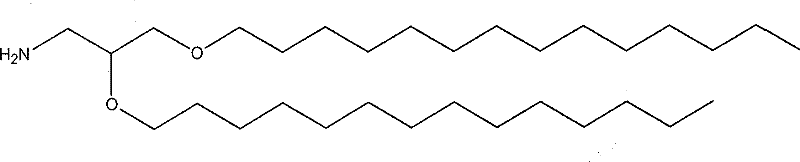
(20.0g 25.0mmol) is dissolved in ethanol (300ml) to phthalimide 4 with rough N-(2,3-myristyl oxygen base propyl group).(20ml 412.3mmol) and with said reaction backflow spends the night to add a Hydrazine Hydrate 80.On Rotary Evaporators, remove said ethanol and said resistates is dissolved in (200ml) in the chloroform.Filter said throw out and get on except that chloroform at Rotary Evaporators.TLC (10%MeOH-CHCl
3, in molybdate, develop) and explain that most of starting substances have reacted to form product.Through rapid column chromatography method (0-5%MeOH-CHCl
3) this product that obtains is carried out further purifying to produce 1 of 10.4g (89.7%, from 1, three steps of 2-myristyl oxygen base propane-3-alcohol 2), 2-myristyl oxygen base propylamine (5).
6. methoxyl group PEG
2000The preparation of acetate (6)
Spissated sulfuric acid (20ml) water (180ml) solution adding sodium dichromate 99 with 10% (3.0g, 10mmol).With PEG
2000(20.0g 10mmol) is dissolved in this bright orange solution methyl ether, and will be reflected at room temperature and carry out stirred overnight.Then, (3 * 250ml) carry out extracting to said product, and mazarine is stayed in the water layer with chloroform.Get on except that the chloroform solvent at Rotary Evaporators, obtain light blue wax.TLC (13%MeOH-CHCl
3, in iodine, develop) and show that most of starting substances have reacted the formation product.Then, through rapid column chromatography method (0-15%MeOH-CHCl
3) this crude material is carried out further purifying.Then, the product that obtains is carried out the methoxyl group PEG of crystallization with the white solid form of generation 5.6g (27.1%) in ether
2000Acetate 6.
(7.N-2,3-myristyl oxygen base propyl group) acid amides PEG
2000The preparation of methyl ether (7)

For N-(2,3-myristyl oxygen base propyl group) acid amides PEG
2000(that is, preparation PEG-A-DMA) is with methoxyl group PEG for methyl ether
2000(3.4g 1.7mmol) is dissolved in the benzene (40ml) and uses nitrogen wash acetate 6.(1.7ml, 2.5g 20mmol) slowly add with oxalyl chloride to pass subaseal through syringe and pin.Should react and stir 2 hours, then on Rotary Evaporators, benzene solvent removed.With 2,3-myristyl base oxygen base propylamine 5 (0.87g 1.8mmol) adds in the flask, add subsequently anhydrous methylene chloride (40ml) and triethylamine (1.5ml, 10mmol).To react and stir 48 hours.Add zero(ppm) water (250ml), said solution is carried out acidifying and shakes collected organic layer with hydrochloric acid (1.5ml).With chloroform (2x65ml) extract product from water layer.The organic layer that is combined with sal epsom carries out drying.Thereby get on except that chloroform generation yellow solid at Rotary Evaporators.TLC (10%MeOH-CHCl
3, in copper sulfate and iodine, develop) and explain that most of starting substances have reacted to form product.Through rapid column chromatography method (0-7%MeOH-CHCl
3) crude material is carried out further purifying.Then through add gac (2g) and ethanol (100ml) is bleached it and said mixture was rotated 30 minutes in 55 ℃ on Rotary Evaporators.With the charcoal elimination and on Rotary Evaporators, remove ethanol.Said product is carried out N-(2,3-myristyl oxygen base propyl group) the acid amides PEG of lyophilize with (38.1%) of the fluffy white powder form of generation 1.7g
2000Methyl ether 7.
(8.N-2,3-myristyl oxygen base propyl group) carbamate PEG
2000The preparation of methyl ether (8)

For N-(2,3-myristyl oxygen base propyl group) carbamate PEG
2000The preparation of methyl ether (being PEG-C-DMA) is carried out according to above-mentioned 1-5 step.Then use nitrogen wash PEG
2000(2.0g 1.0mmol) and with it is dissolved in the anhydrous methylene chloride (15ml) methyl ether.(300 μ l 2.5mmol) also were reflected at stirring at room 3 hours with said to add trichloromethylchloroformate.On Rotary Evaporators, remove methylene dichloride and use Sprengel pump that the trichloromethylchloroformate of any remnants is removed.With the said flask of nitrogen wash and add 2, and 3-myristyl oxygen base propylamine 5 (0.7g, 1.5mmol).This is dissolved in the anhydrous methylene chloride (15ml), and adds triethylamine (280 μ l), this is reflected at stirred overnight at room temperature.This solution is transferred in the have methylene dichloride separating funnel of (5ml) and with distilled water wash (2 * 20ml).With the dried over mgso organic layer and on Rotary Evaporators, remove methylene dichloride.TLC (3%MeOH-CHCl
3, in molybdate and iodine, develop) show that most of starting substances have reacted and formed product.Through rapid column chromatography method (1.5-10%MeOH-CHCl
3) product that obtains is carried out N-(2,3-myristyl oxygen base propyl group) the carbamate PEG of further purifying to obtain 1.2g (46.5%)
2000Methyl ether 8.
(9.N-2,3-myristyl oxygen base propyl group) succinic diamide PEG
2000The preparation of methyl ether (13)
For N-(2,3-myristyl oxygen base propyl group) succinic diamide PEG
2000The preparation of methyl ether (13) is carried out according to above-mentioned 1-5 step.Remaining step according to "
A.PEG
2000The preparation of methanesulfonates (9)
(8.2g 47.1mmol) is dissolved in the anhydrous chloroform (80ml) the methylsulfonyl acid anhydride.(3.8ml 47.0mmol) adds in the said solution and observes and is fuming simultaneously that the adularescent throw out forms with pyridine.With PEG
2000(31.5g, anhydrous chloroform 15.5mmol) (70ml) solution adds methyl ether, should react and stir 3 hours.Remove the chloroform solvent of filtrate with the white depositions elimination that has formed and on Rotary Evaporators.TLC (5%MeOH-CHCl
3, in iodine, develop) and show that most of starting substances have reacted to form product.Through rapid column chromatography method (0-10%MeOH-CHCl
3) this product is carried out the PEG of further purifying with the 30.1g (92.8%) of generation white solid form
2000Methylsulfonyl 9.
B.PEG
2000The preparation of phthalimide (10)
(11.1g 59.7mmol) is dissolved in anhydrous N, in the dinethylformamide (400ml) with phthalimide potassium.With PEG
2000(35.0g, anhydrous N 16.7mmol), dinethylformamide solution (100ml) add in the flask and make this react on 75 ℃ of stirred overnight methylsulfonyl 9.Use Sprengel pump to replace common vent fan and on Rotary Evaporators, remove N, dinethylformamide solvent.With the product that obtains be dissolved in the methylene dichloride (250ml) and with zero(ppm) water (2 * 250ml) and salt solution (250ml) wash.The merging organic layer of dichloromethane solvent is removed on Rotary Evaporators.TLC (7%MeOH-CHCl
3, observe with UV light and Mary ' s reagent) and show that most of starting substances have reacted the formation product.Through rapid column chromatography method (0-10%MeOH-CH
2Cl
2) product that obtains is carried out further purifying.This product is carried out crystallization to produce the PEG of 19.4g (54.1%) from ether
2000Phthalimide 10.
C.PEG
2000The preparation of amine (11)

With PEG
2000(10.3g 4.8mmol) is dissolved in the ethanol (200ml) phthalimide 10.(6.0ml 123.7mmol) slowly adds and will be reflected at 100 ℃ of backflows and spend the night with a Hydrazine Hydrate 80.With the white depositions elimination and on Rotary Evaporators, remove alcohol solvent.The product that obtains is dissolved in the chloroform and will insoluble residue white solid elimination in chloroform, once more chloroform is removed on Rotary Evaporators.TLC (10%MeOH-CHCl
3,, develop in molybdate and Mary ' the s reagent at iodine) and explain that all starting substances have reacted to form product.Then, with this product from ether crystallization with the PEG of the 9.0g (93.0%) that produces the white powder form
2000Amine 11.
D PEG
2000The preparation of succinic diamide (12)

With PEG
2000Amine 11 (9.0g, 4.4mmol) and succinyl oxide (3.8g 38.1mmol) is dissolved in the pyridine (100ml) and should reacts stirred overnight.Pyridine solvent is removed in 60 ℃ on Rotary Evaporators.Said resistates is dissolved in the zero(ppm) water (100ml), and carries out acidifying with hydrochloric acid, with methylene dichloride carry out extracting (100ml, 2 * 70ml), carry out drying with sal epsom.TLC (10%MeOH-CHCl
3, in iodine, develop) explain that most of starting substances have reacted and formed product.Through rapid column chromatography method (0-10%MeOH-CHCl
3) this product is carried out further purifying to produce the PEG of 5.2g (55.9%)
2000 Succinic diamide 12.
E.N-(2,3-myristyl oxygen base propyl group) succinic diamide PEG
2000The preparation of methyl ether (13)

With PEG
2000(2.0g, 0.9mmol) (0.2g 2.0mmol) is dissolved in the anhydrous chloroform (10ml) succinic diamide with N-hydroxyl succinic diamide.Then, with 1, (0.3g, anhydrous chloroform 1.5mmol) (5ml) solution adds 3-dicyclohexyl-carbodiimide, and said reaction was stirred 1 hour.Add 1, (0.48g, (0.6ml in solution 4mmol), will react and stir 1 hour 2-myristyl oxygen base propylamine 5 for anhydrous chloroform 1.0mmol) (5ml) and triethylamine.TLC (12%MeOH-CHCl
3, in molybdate, develop) explain that most of starting substances have reacted and formed product.Solution is filtered through the zeyssatite with methylene dichloride, carries out acidifying with hydrochloric acid, and with zero(ppm) water (2 * 50ml) and salt solution (50ml) wash.Water layer is stripped with methylene dichloride (50ml), and on sal epsom, come the dry organic layer that merges.Through (my) rapid column chromatography method (0-7%MeOH-CHCl
3) come said product is carried out further purifying to produce N-(2,3-myristyl oxygen base propyl group) the succinic diamide PEG of 1.8g (69.0%)
2000Methyl ether 13.
In order to check their stability, with C
18Each of PEG-lipid is formulated in the empty liposome and is stored in 37 ℃ of thermostat containers and reach 42 days.Said liposome comprises following lipid with the relevant molar ratio in the bracket: cholesterol (55%), 1,2-two oil base oxygen base-N, N-dimethyl--3-aminopropane (15%), 1,2-distearyl-sn-glycerine-3-phosphocholine (20%), PEG-lipid (10%).In addition, preparation PEG-CerC
20With the PEG-DSPE of commercial prodn, cofabrication PEG-DSG is as contrast.In different time points, from thermostat container, shift out the sample aliquot of each sample, thereby analyze the concrete PEG that confirms existence with alcohol dilution and with HPLC
2000The concentration of lipid.With the method for light scattering detector as detection.The result is shown in Fig. 2.
This embodiment describes such experiment, and the nucleic acid contrast that said experiment relatively is encapsulated among the SPLP that comprises PEG-DG conjugate is encapsulated in the expression of nucleic acids among the SPLP that comprises PEG-dialkoxy propyl group conjugate.All SPLP preparations are included in the CMV promotor control plasmid (pLO55) of coding luciferase down.
| Group | The # mouse | Cell | The path | Handle | The path | # dosage | Time after the last injection | Measure * | |
| A | 6 | Neuro-2a | | PBS | IV | 1 | 48hrs | Body weight, hemanalysis, | |
| B | |||||||||
| 6 | Neuro-2a | SC | SPLP PEG- | IV | 1 | 48hrs | ? | ||
| |
6 | Neuro-2a | SC | SPLP PEG- | IV | 1 | 48hrs | ? | |
| ?D | ?6 | ?Neuro-2a | SC | SPLP PEG-ceramide C20 | ? |
1 | ?48hrs | ? | |
| |
6 | Neuro-2a | SC | SPLP PEG- | IV | 1 | 48hrs | ? | |
| |
6 | Neuro-2a | SC | SPLP PEG-C- | IV | 1 | 48hrs | ? | |
| |
6 | Neuro-2a | SC | SPLP PEG-S- | IV | 1 | 48hrs | ? |
All SPLP preparations comprise pL055 and DSPC: Chol: DODMA: PEG-lipid (20: 55: 15: 10).Following series preparation by:
A:PBS(pH7.4).
B:L055?PEG-DSG?SPLP,0.50mg/ml.
C:L055?PEG-DSPE?SPLP,0.50mg/ml.
D:L055 PEG-ceramide C20 SPLP, 0.50mg/ml.
E:L055?PEG-A-DSA?SPLP,0.50mg/ml.
F:L055?PEG-C-DSA?SPLP,0.50mg/ml.
G:L055 PEG-S-DSA SPLP, 0.50mg/ml makes.
| Group | Mouse quantity | The inoculation date | Handle | Date of injection | Collect the |
| A | |||||
| 6 | The 0th day | PBS | The 13rd day | The | |
| B | |||||
| 6 | The 0th day | SPLP?PEG-DSG | The 13rd day | The | |
| C | |||||
| 6 | The 0th day | SPLP?PEG-DSPE | The 13rd day | The | |
| D | |||||
| 6 | The 0th day | SPLP PEG-ceramide C20 | The 13rd day | The | |
| E | |||||
| 6 | The 0th day | SPLP?PEG-A-DSA | The 13rd day | The | |
| F | |||||
| 6 | The 0th day | SPLP?PEG-C-DSA | The 13rd day | The | |
| G | |||||
| 6 | The 0th day | SPLP?PEG-S-DSA | The 13rd day | The 15th day |
At the 0th day, will be in 50 μ l PBS 1.5 * 10
6Neuro2A cell subcutaneous administration is given every mouse.At the 13rd day, mouse was also handled through the SPLP preparation or the PBS of intravenously (IV) injection 1 dosage by random arrangement.The amount of dosage is based on the measured body weight that carries out every day administration day.Used back 48 hours at SPLP, mouse is weighed and puts to death, and collect their blood, collect following tissue: tumour, liver (cutting in half), lung, spleen and heart are weighed, and be freezing immediately and be stored in-80 ℃ up to further analysis.
Confirm the genetic expression in the tissue of collecting through the enzymatic activity of measuring the luciferase reporter protein of being expressed.The result is shown in Fig. 3 and 4.
Result proof behind i.v. injection SPLP 48 hours, the transfection level of SPLP in tumour that comprises PEG-dialkoxy propyl group conjugate is similar basically with the transfection level of SPLP that those comprise PEG-DG conjugate.The amount of the genetic expression in the organ (liver, lung, spleen and heart) of the mouse of injecting with the mouse of the SPLP injection that comprises PEG-dialkoxy propyl group conjugate with the SPLP that comprises PEG-DG conjugate is similar basically.
This embodiment describes such experiment, and said experiment relatively is encapsulated in the expression of nucleic acids among the SPLP, and said SPLP comprises PEG-dialkoxy propyl group conjugate.All SPLP preparations are included in the CMV promotor control plasmid (pLO55) of coding luciferase down.
| Group | The # mouse | Tumour | Approach | Handle | Approach | # dosage | Time | Measure *** | |
| A | 4 | Neuro-2a | | PBS | IV | 1 | 48hrs | Body weight, hemanalysis, | |
| B | |||||||||
| 5 | Neuro-2a | SC | SPLP PEG- | IV | 1 | 48hrs | ? | ||
| |
5 | Neuro-2a | SC | SPLP PEG- | IV | 1 | 48hrs | ? | |
| |
5 | Neuro-2a | SC | SPLP PEG- | IV | 1 | 48hrs | ? | |
| |
5 | Neuro-2a | SC | SPLP PEG- | IV | 1 | 48hrs | ? |
Said lipid (DSPC: CHOL: DODMA: the PEG-lipid) in SPLP with subsequently mol ratio (20: 55: 15: 10) exist.Following preparation by
A: the PBS of sterile filtration, 5mL.
B: have the pL055-SPLP of PEG-DSG, 2mL, 0.50mg/mL.
C: have the pL055-SPLP of PEG-A-DSA, 2mL, 0.50mg/mL.
D: have the pL055-SPLP of PEG-A-DPA, 2mL, 0.50mg/mL.
E: have the pL055-SPLP of PEG-A-DMA, 2mL, 0.50mg/mL. makes.
| Group | The # mouse | The inoculation date | Handle | Date of injection | Collect the |
| A | |||||
| 4 | The 0th day | PBS | The 12nd day | The | |
| B | |||||
| 5 | The 0th day | SPLP?PEG-DSG | The 12nd day | The | |
| C | |||||
| 5 | The 0th day | SPLP?PEG-A-DSA | The 12nd day | The | |
| D | |||||
| 5 | The 0th day | SPLP?PEG-A-DPA | The 12nd day | The | |
| E | |||||
| 5 | The 0th day | SPLP PEG-A-DMA | The 12nd day | The 14th day |
At the 0th day, with 1.5 * 10
6The Neuro2A cell is used to every mouse.When tumour is suitable size (200-400mm
3) time, mouse is also handled through the SPLP preparation or the PBS of intravenously (IV) injection 1 dosage by random arrangement.The amount of dosage is based on the measured body weight that carries out every day administration day.Used back 48 hours at SPLP, mouse is put to death, and collect their blood, collect following tissue: tumour, liver (cutting in half), lung, spleen & heart is weighed, and is freezing immediately and be stored in-80 ℃ up to further analysis.
Confirm the genetic expression in the tissue of collecting through the enzymatic activity of measuring the luciferase reporter protein of being expressed.The result is shown in Fig. 5 and 6.
Presentation of results comprises that (that is, PEG-DAA) SPLP can be advantageously used in the transfection of far-end tumour to the degree identical with the SPLP that comprises the PEG-DG PEG-dialkoxy propyl group.And, with the being seen transfection level of SPLP that comprises PEG-dialkyl group glycerine with (for example, being seen those are similar for PEG-DSG) SPLP with comprising the PEG-DG.The result also explains low-down transfection takes place in nonneoplastic tissue.And, compare with other SPLP preparation, comprise that the SPLP of PEG-dialkoxy propyl group shows the toxicity that reduces.
Embodiment 4: be encapsulated in the SPLP that comprises PEG-dialkoxy propyl group conjugate and the expression of nucleic acids among the pSPLP
This embodiment describes such experiment, and said experiment has been compared the nucleic acid that is encapsulated among the SPLP that comprises PEG-dialkoxy propyl group and contrasted the expression of nucleic acids among the spissated DNA of PEI (pSPLP) that compares with SPLP.
| Group | The # mouse | Cell | Handle | The path | Time point after the last injection | Measure * |
| A | 4 | SC Neuro-2a | The PBS of 1 dosage | IV | 48hrs | Luciferase |
| B | ||||||
| 4 | SC Neuro-2a | The L055-pSPLP PEG-DSG of 1 dosage | IV | 48hrs | ? | |
| |
4 | SC Neuro-2a | The L055-pSPLP PEG-DPG of 1 dosage | IV | 48hrs | ? |
| |
4 | SC Neuro-2a | The L055-pSPLP PEG-DMG of 1 dosage | IV | 48hrs | ? |
| |
4 | SC Neuro-2a | The L055-pSPLP PEG-A-DSA of 1 dosage | IV | 48hrs | ? |
| |
4 | SC Neuro-2a | The L055-pSPLP PEG-A-DPA of 1 dosage | IV | 48hrs | ? |
| |
4 | SC Neuro-2a | The L055-pSPLP PEG-A-DMA of 1 dosage | IV | 48hrs | ? |
| |
4 | SC Neuro-2a | The L055-SPLP PEG-A-DSA of 1 dosage | IV | 48hrs | ? |
| I | 4 | SC Neuro-2a | The L055-SPLP PEG-A-DPA of 1 dosage | IV | 48hrs | ? |
| |
4 | SC Neuro-2a | The L055-SPLP PEG-A-DMA of 1 dosage | IV | 48hrs | ? |
| |
4 | SC Neuro-2a | The L055-SPLP PEG-A-DMA 20mg pDNA/Kg of 1 dosage | IV | 48hrs | ? |
All preparations contain DSPC: Chol: DODMA: PEG-DAG (20: 55: 15: 10).Preparation is series preparation down:
A:PBS(pH7.4)
B:L055?PEG-DSG?pSPLP,0.5mg/ml
C:L055?PEG-DPG?pSPLP,0.43mg/ml
D:L055?PEG-DMG?pSPLP,0.5mg/ml
E:L055?PEG-A-DSA?pSPLP,0.5mg/ml
F:L055?PEG-A-DPA?pSPLP,0.5mg/ml
G:L055?PEG-A-DMA?pSPLP,0.5mg/ml
H:L055?PEG-A-DSA?SPLP,0.5mg/ml
I:L055?PEG-A-DPA?SPLP,0.5mg/ml
J:L055?PEG-A-DMA?SPLP,0.5mg/ml
K:L055?PEG-A-DMA?SPLP,2.1mg/ml
At the 0th day, will be in 50 μ l PBS 1.5 * 10
6Neuro2A cell subcutaneous administration is given every mouse.At the 13rd day, mouse was also handled through the SPLP preparation or the PBS of intravenously (IV) injection 1 dosage by random arrangement.The amount of dosage is based on the measured body weight that carried out same day administration day.Used back 48 hours at SPLP, mouse is weighed and puts to death, and collect their blood, collect following tissue: tumour, liver (cutting in half), lung, spleen and heart are weighed, and be freezing immediately and be stored in-80 ℃ up to further analysis.
Confirm the genetic expression in the tissue of collecting through the enzymatic activity of measuring the luciferase reporter protein of being expressed.The result is shown in Fig. 7 and 8.
| Group | Mouse quantity | Tumour SC | SPLP handles | Stop |
| A | 4 | The 0th day | The 12nd day | The |
| B | ||||
| 4 | The 0th day | The 12nd day | The | |
| C | ||||
| 4 | The 0th day | The 12nd day | The | |
| D | ||||
| 4 | The 0th day | The 12nd day | The | |
| E | ||||
| 4 | The 0th day | The 12nd day | The | |
| F | ||||
| 4 | The 0th day | The 12nd day | The | |
| G | ||||
| 4 | The 0th day | The 12nd day | The | |
| H | ||||
| 4 | The 0th day | The 12nd day | The 14th day |
| I | 4 | The 0th day | The 12nd day | The |
| J | ||||
| 4 | The 0th day | The 12nd day | The 14th day |
Presentation of results and longer chain forms (that is, PEG-DSG and PEG-A-DSA) compare, and existing in of the short chain PEG-lipid in pSPLP (that is, PEG-DMG and PEG-A-DMA) caused about 5-10 minimizing doubly in the tumour transfection.These results explain together, when pSPLP comprises C
14During the PEG-lipid, observed pSPLP (C
18The PEG-lipid) raising of tumour transfection above SPLP fully phased out.This can be because many factors: when pSPLP double-deck left when the PEG-lipid in (1); The increase of pSPLP stability; (2) increase of electric charge after the PEG-lipid is removed, or the condition of (3) C14PEG-lipid does not have optimised (for example, the amount of negatively charged ion lipid in bilayer).If any in tissue in these also need carry out other experiment and confirm it is that is a kind of.In addition, for all systems, the activity in other organ to be tested is quite low.What is interesting is; Luciferase genes expression level in the given tumour of luciferase genes expression levels in the tumour that the PEG-A-DMA SPLP of 20mg/kg dosage provides and 5mg/kg dosage is suitable; But compare with identical 5mg/kg dosage, the genetic expression in liver is much higher.
Embodiment 5: make genetic expression reticent with SNALPS
This embodiment illustrates after using SPLPs and SNALPs altogether; The silence of the genetic expression in mouse with Neuro 2A tumour; Said SPLPs is included in the CMV promotor control plasmid of coding luciferase down, said SNALPs comprises anti--luciferase siRNA.
| Group | The # mouse | Tumour | Approach | Handle | Time point | | # dosage | |
| 1 | 3 | Neuro-2a | SQ | PBS/ | 48h | IV | 1 | |
| |
4 | L055-SPLP/PBS is mixed | 24h | ? | ? | ? | ? | |
| |
4 | L055-SPLP/ is anti--and luc siRNA liposome is mixed | ? | ? | ? | ? | ? | |
| |
4 | L055-SPLP/PBS is mixed | 48h | ? | ? | ? | ? | |
| |
4 | L055-SPLP/ is anti--and luc siRNA liposome is mixed | ? | ? | ? | ? | ? | |
| |
4 | L055-SPLP/PBS is mixed | 72h | ? | ? | ? | ? | |
| |
4 | L055-SPLP/ is anti--and luc siRNA liposome is mixed | ? | ? | ? | ? | ? |
| Group | The # mouse | The inoculation date | Approach | IV handles | Time point | Date of injection | Collect the |
| 1 | 3 | The 0th day | SQ | PBS/PBS | 48h | The 13rd day | The |
| 24A | |||||||
| 4 | L055-SPLP/ PBS is mixed | 24h | The 14th day | ? | ? | ? | |
| |
4 | L055-SPLP/ is anti--and luc siRNA liposome is mixed | The 14th day | ? | ? | ? | ? |
| |
4 | L055-SPLP/ PBS is mixed | 48h | The 13rd day | ? | ? | ? |
| |
4 | L055-SPLP/ is anti--and luc siRNA liposome is mixed | The 13rd day | ? | ? | ? | ? |
| |
4 | L055-SPLP/ PBS is mixed | 72h | The 12nd day | ? | ? | ? |
| |
4 | L055-SPLP/ is anti--and luc siRNA liposome is mixed | The 12nd day | ? | ? | ? | ? |
At the 0th day, with in 50 μ L phosphate buffer soln TVs 1.5 * 10
6The dosage of cell carries out subcutaneous vaccination with Neuro 2A cell to 36 male A/J mouse (Jackson Laboratories).In case tumour reaches suitable size back (typically at the 9th day or thereafter), with the PBS of 200-240 μ l or as above-mentioned embodiment 6 prepared SPLP is described, SNALP preparation (100 μ g nucleic acid altogether) carries out intravenous administration.Using PBS, the mixture 24,48 of SPLP or SPLP and SNALP or after 72 hours is put to death mouse, collects organ (for example, liver, lung, spleen, kidney, heart) and tumour and also carries out the evaluation of luciferase activity.
After single iv administration 48 hours, pL055 SPLP reduced luciferase genes with using altogether of anti--luc siRNA SNALP (comprising PEG-A-DMA) the biglyyest and reaches 40%.The result is shown among Figure 13.
Embodiment 6: comprise the absorption of the SPLP of PEG-DAA conjugate
This embodiment illustrates external, and mammalian cell is to the absorption of the SPLP that comprises the PEG-DAA conjugate.The SPLP preparation that following table proposes is used
3H-CHE carries out mark, and on cell, is reached 24 hours 4 ℃ or 37 ℃ by incubation.SPLP comprises 2,4, or 10mol%PEG-C-DMA.
| ? | Mol%(DSPC∶Chol∶PEG-C-DMA∶DODMA) |
| ?A | 20∶50∶10∶15 |
| ? |
20∶61∶4∶15 |
| ? |
20∶63∶2∶15 |
The efficient that is absorbed in 37 ℃ of generations of SPLP is higher, and the amount of PEG-C-DMA reduces.Data are illustrated in Figure 14.
Embodiment 7: the bio distribution and the blood clearance that comprise the SPLP of PEG-DAA conjugate
This embodiment illustrates bio distribution and the blood clearance of the SPLP that comprises the PEG-DAA conjugate.Comprise PEG-C-DMA or PEG-C-DSA
3The SPLP of H-CHE-mark by intravenous administration in the male A/J mouse of carrying the Neuro-2a tumour.Following preparation SPLP:
| Group | Handle | Mol% (DSPC: Chol: PEG-C-DMA: cation lipid) |
| A | SPLP(15mol%PEG-C-DMA) | 20∶50∶15∶15 |
| B | SPLP(10mol%PEG-C-DMA) | 20∶55∶10∶15 |
| C | SPLP(5mol%PEG-C-DMA) | 20∶60∶5∶15 |
, SPLP confirms SPLP after using 48 hours liver, spleen, the bio distribution in lung and the tumour.The result is shown among Figure 15.
Use SPLP is confirmed in the back after 1,2,4 and 24 hours blood clearance at SPLP.The result is shown among Figure 16.
Embodiment 8: comprise the SPLP of PEG-DAA conjugate and bio distribution and the blood clearance of SNALP
This embodiment illustrates the SPLP that comprises the PEG-DAA conjugate and bio distribution and the blood clearance of SNALP.Comprise PEG-C-DMA or PEG-C-DSA
3The SPLP of H-CHE-mark or SNALP by intravenous administration in the male A/J mouse of carrying the Neuro-2a tumour.SPLP comprises the plasmid of entrapped coding luciferase, and SNALP comprises entrapped anti-luciferase siRNA sequence.SPLP and SNALP preparation all have following drugrlipid ratio: DSPC 20%: cholesterol 55%:PEG-lipid 10%:DODMA 15%.
Used back 24 hours at SPLP or SNALP, confirm SPLP or SNALP liver, spleen, suprarenal gland, tumour, small intestine, lymphoglandula, kidney, large intestine, femur, heart, thymus gland, the bio distribution in testis and the brain.The result is shown in Figure 17.
After using SPLP and SNALP, confirmed to comprise the SPLP of PEG-C-DMA or PEG-C-DSA and the blood clearance of SNALP in 1,2,4,8 and 24 hours.The result is shown among Figure 18.
Embodiment 9: comprise the transfection of the SPLP and the pSPLP pair cell of PEG-DAA conjugate
This embodiment has described three independent experiments, carries out said experiment and estimates in the various SPLP preparation bodies of having sealed plasmid after the transfection, the genetic expression in organ and tumour, the said plasmid luciferase of under the control of CMV promotor, encoding.
First experimental evaluation is behind intravenous administration SPLP and pSPLP, and the luciferase genes in carrying the male A/J mouse of Neuro2A tumour is expressed.The preparation and PEG-DAGs of equal value that relatively comprise C14 and C18PEG-C-DAAs.Peg moiety has 2000 daltonian molecular weight.DODMA is used as the cation lipid among the SPLP.POPG or DOP are used as the negatively charged ion lipid among the pSPLP.Following preparation SPLP and pSPLP:
| ? | Sample description, (PEG-lipid type, charged lipid type) | Mol% (DSPC: Chol: PEG-lipid: charged lipid) |
| ?A | SPLP(PEG-DSG,DODMA) | 20∶50∶15∶15 |
| ?B | SPLP(PEG-DMG,DODMA) | 20∶55∶10∶15 |
| ?C | SPLP(PEG-C-DSA, DODMA) | 20∶60∶5∶15 |
| ?D | SPLP(PEG-C-DMA, DODMA) | 20∶62.5∶2.5∶15 |
| ?E | pSPLP(PEG-C-DSA,POPG) | 20∶55∶10∶15 |
| ?F | pSPLP(PEG-C-DSA,DOP) | 20∶60∶5∶15 |
| ?G | pSPLP(PEG-DS?G,POPG) | 20∶62.5∶2.5∶15 |
Behind intravenous administration SPLP and pSPLP 48 hours, liver, lung, spleen is measured luciferase genes and is expressed in heart and the tumour.For the SPLP and pSPLP preparation of all tests, with respect to other types of organization, being expressed in the tumour of luciferase is the highest.The result is shown in Figure 19.
Second experimental evaluation is behind intravenous administration SPLP, and luciferase genes in carrying the male A/J mouse of Neuro2A tumour is expressed, and said SPLP comprises the PEG-C-DMA of different weight percentage (that is, 15%, 10%, 5%, or 2.5%).
| ? | Mol%(DSPC∶Chol∶PEG-C-DMA∶DODMA) |
| A | 20∶50∶15∶15 |
| |
20∶55∶10∶15 |
| |
20∶60∶5∶15 |
| |
20∶62.5∶2.5∶15 |
After using SPLP 48 hours, the expression of measuring the luciferase in tumour.The result is shown in Figure 20.
The 3rd group of experimental evaluation is behind intravenous administration SPLP, and the luciferase genes in carrying the male A/J mouse of Neuro2A tumour is expressed, and said SPLP comprises the PEG-C-DMA conjugate (that is 2000 or 750 dalton) of the peg moiety with different sizes.
| ? | Sample description |
| A | SPLP-PE?G 2000-C-DMA (CHOL∶DSPC∶DODMA∶PEG 2000-C-DMA?55∶20∶15∶10mol%) |
| B | SPLP-PEG 750-C-DMA/DODMA (CHOL∶DSPC∶DODMA∶PEG 750-C-DMA?55∶20∶15∶10mol%) |
| C | The high PEG of SPLP- 750-C-DMA (CHOL∶DSPC∶DODMA∶PEG 750-C-DMA?50∶20∶15∶15mol%) |
| D | SPLP-DODAC (CHOL∶DSPC∶DODMA∶PEG
2000-C- |
After using SPLP 48 hours, liver, lung, spleen is measured luciferase genes and is expressed in heart and the tumour.For the SPLP preparation of all tests, with respect to other types of organization, luciferase expression is the highest in tumour.The result is shown among Figure 21.
Embodiment 10: the SNALPs that comprises the PEG-DAA conjugate at external use makes genetic expression reticent
This embodiment is described in external after sending the SNALP that seals siRNA, the silence of genetic expression.Exist or lacking under the situation of chloroquine; Make the Neuro2A-G cell of expressing luciferase and seal anti-luciferase siRNA (promptly; SiRNA, it comprises following sequence: GAUUAUGUCCGGUUAUGUAUU and target dna sequence dna: SNALP preparation contact GATTATGTCCGGTTATGTATT) reaches 48 hours.Said SNALP preparation comprises the PEG-C-DMA (C of different amounts
14), that is, and 1%, 2%, 4%, or 10%.Cation lipid is DODMA.
| Group | Handle | Mol%(DSPC∶Chol∶PEG-C-DAA∶DODMA) |
| A | PBS | - |
| B | Naked siRNA | - |
| C | SNALP(PEG-C-DMA) | 20∶40∶10∶30 |
| D | SNALP(PEG-C-DMA) | 20∶46∶4∶30 |
| E | SNALP(PEG-C-DMA) | 20∶48∶2∶30 |
| F | SNALP(PEG-C-DMA) | 20∶49∶1∶30 |
The result is shown in Figure 22.
Embodiment 11: make genetic expression reticent with the SNALPs that comprises the PEG-DAA conjugate in vivo
This embodiment describes such experiment, and it explains in vivo, after using the SNALP that seals siRNA, and the silence of genetic expression.
This description of test is sealed the using of SNALP of siRNA, and can make the genetic expression in metastatic tumor reticent.With comprising the PEG-DAA conjugate and sealing anti-luciferase siRNA (promptly; SiRNA comprises following sequence: GAUUAUGUCCGGUUAUGUAUU and target dna sequence dna: SNALPs GATTATGTCCGGTTATGTATT) handles the male A/J mouse of carrying the Neuro-2a tumour; Said mice expressed luciferase has metastatic hepatic neoplasm.All SNALPs have following preparation: DSPC 20%: cholesterol 55%:PEG-C-DMA 10%:DODMA15%.Mouse is accepted to use in the azygos vein of SNALP.Inject the luciferase expression of measuring in the tumour in back 48 hours at SNALP.Said result proves that using of SNALP can make genetic expression reticent in vivo in the far-end site in the site that SNALP uses.These results are shown among Figure 23.
Should be understood that foregoing description is intended to illustrate rather than restrictive.After reading foregoing description, many embodiments will be conspicuous for those skilled in the art.Therefore, scope of the present invention should not be to confirm with reference to foregoing description, but should confirm together with the abundant scope of the Equivalent of being authorized these claims with reference to accompanying Claim.From all purposes, with all articles and reference, comprise patented claim, the content of patent and PCT publication is incorporated this paper into as a reference.
Claims (60)
1. the compound of a formula I, it has following structure:

Wherein:
R
1And R
2Selected independently and be hydrocarbyl group with 10 to 20 carbon atoms;
PEG is a polyoxyethylene glycol, and wherein terminal hydroxyl is replaced by methyl; With
L is the shank that comprises carbamate.
2. according to the compound of claim 1, wherein said hydrocarbyl group is selected from by lauryl, myristyl, palmityl, the group that stearyl and petrosilane base are formed.
3. according to the compound of claim 1, R wherein
1And R
2Be identical.
4. according to the compound of claim 3, R wherein
1And R
2It all is myristyl.
5. according to the compound of claim 3, R wherein
1And R
2It all is palmityl.
6. according to the compound of claim 3, R wherein
1And R
2It all is stearyl.
7. according to the compound of claim 1, wherein said hydrocarbyl group is saturated.
8. according to the compound of claim 1, wherein said hydrocarbyl group is undersaturated.
9. according to the compound of claim 1, wherein said PEG has 550 dalton to 10,000 daltonian molecular-weight average.
10. according to the compound of claim 9, wherein said PEG has 750 to 5,000 daltonian molecular-weight average.
11. according to the compound of claim 9, wherein said PEG has 1,000 to 5,000 daltonian molecular-weight average.
12. according to the compound of claim 9, wherein said PEG has 1,500 to 3,000 daltonian molecular-weight average.
13. according to the compound of claim 9, wherein said PEG has 2,000 daltonian molecular-weight average.
14. according to the compound of claim 1, wherein L has formula:
Wherein dotted line representes to be connected to the point of the terminal oxygen of PEG and the point that wave line representes to be connected to the compound rest part.
15. according to the compound of claim 1, it has the structure of following formula:
16. a liposome, said liposome comprise polyoxyethylene glycol-dialkoxy propyl group (PEG-DAA) conjugate of formula I, formula I has following structure:
Wherein:
R
1And R
2Selected independently and be hydrocarbyl group with 10 to 20 carbon atoms;
PEG is a polyoxyethylene glycol, and wherein terminal hydroxyl is replaced by methyl; With
L is the shank that comprises carbamate.
17. according to the liposome of claim 16, it also comprises biologically active agent.
18. according to the liposome of claim 17, wherein said biologically active agent is to be selected from by antitumour drug, microbiotic, immunomodulator, the member of antiphlogiston and the group that acts on the medicament composition on the cns.
19. according to the liposome of claim 17, wherein said biologically active agent is protein or peptide.
20. according to the liposome of claim 17, wherein said biologically active agent is a nucleic acid.
21. the liposome of claim 16 is used for biologically active agent is sent the application to the medicine of cell in preparation, wherein said biologically active agent is encapsulated in the said liposome.
22. the liposome of claim 16 is used for biologically active agent is sent the application to patient's medicine in preparation, wherein said biologically active agent is encapsulated in the said liposome.
23. a nucleic acid-lipid granule, it comprises:
Nucleic acid;
Cation lipid;
The non-cationic lipid; With
The polyoxyethylene glycol of formula I-dialkoxy propyl group (PEG-DAA) conjugate, it has following structure:

Wherein:
R
1And R
2Selected independently and be hydrocarbyl group with 10 to 20 carbon atoms;
PEG is a polyoxyethylene glycol, and wherein terminal hydroxyl is replaced by methyl; With
L is the shank that comprises carbamate.
24. according to the nucleic acid-lipid granule of claim 23, wherein said cation lipid is to be selected from by N, N-two oil bases-N, N-chlorination dimethylammonium (DODAC), N; N-distearyl-N, N-dimethyl ammonium bromide (DDAB), N-(1-(2,3-two oily acyloxy) propyl group)-N, N; N-chlorination TMA(TriMethylAmine) (DOTAP), N-(1-(2,3-two oil base oxygen bases) propyl group)-N, N, N-chlorination TMA(TriMethylAmine) (DOTMA); And N, N-dimethyl--2,3-two oil base oxygen bases) propylamine (DODMA), and composition thereof the member of the group formed.
25. nucleic acid-lipid granule according to claim 23; Wherein said non-cationic lipid is to be selected from by DOPE (DOPE), palmityl oleoyl phosphatidylcholine (POPC), Yelkin TTS phatidylcholine (EPC); DSPC (DSPC); Palmityl oleoyl POPG (POPG), cholesterol, and composition thereof the member of the group formed.
26. according to the nucleic acid-lipid granule of claim 23, wherein said non-cationic lipid is the negatively charged ion lipid.
27. according to the nucleic acid-lipid granule of claim 23, wherein said non-cationic lipid is a neutral lipid.
28. nucleic acid-lipid granule according to claim 23; Wherein said PEG-DAA conjugate is to be selected from by PEG-dilauryl oxygen base propyl group; PEG-myristyl oxygen base propyl group, the member of the group that PEG-two palmityl oxygen base propyl group and PEG-distearyl oxygen base propyl group are formed.
29. according to the nucleic acid-lipid granule of claim 23, wherein said cation lipid constitutes 2% to 60% of the TL that is present in the said particle.
30. according to the nucleic acid-lipid granule of claim 23, wherein said cation lipid constitutes 5% to 45% of the TL that is present in the said particle.
31. according to the nucleic acid-lipid granule of claim 23, wherein said cation lipid constitutes 5% to 15% of the TL that is present in the said particle.
32. according to the nucleic acid-lipid granule of claim 23, wherein said cation lipid constitutes 40% to 50% of the TL that is present in the said particle.
33. according to the nucleic acid-lipid granule of claim 23, wherein said non-cationic lipid constitutes 5% to 90% of the TL that is present in the said particle.
34. according to the nucleic acid-lipid granule of claim 23, wherein said non-cationic lipid constitutes 20% to 85% of the TL that is present in the said particle.
35. according to the nucleic acid-lipid granule of claim 23, wherein said PEG-DAA conjugate constitutes 1% to 20% of the TL that is present in the said particle.
36. according to the nucleic acid-lipid granule of claim 23, wherein said PEG-DAA conjugate constitutes 2% to 15% of the TL that is present in the said particle.
37. according to the nucleic acid-lipid granule of claim 23, wherein said PEG-DAA conjugate constitutes 4% to 10% of the TL that is present in the said particle.
38. according to the nucleic acid-lipid granule of claim 23, wherein said non-cationic lipid is DSPC.
39. according to the nucleic acid-lipid granule of claim 23, it also comprises cholesterol.
40. according to the nucleic acid-lipid granule of claim 39, wherein said cholesterol constitutes 10% to 60% of the TL that is present in the said particle.
41. according to the nucleic acid-lipid granule of claim 39, wherein said cholesterol constitutes 20% to 45% of the TL that is present in the said particle.
42. according to the nucleic acid-lipid granule of claim 23, wherein said PEG-DAA conjugate is a PEG-dilauryl oxygen base propyl group.
43. according to the nucleic acid-lipid granule of claim 23, wherein said PEG-DAA conjugate is a PEG-myristyl oxygen base propyl group.
44. according to the nucleic acid-lipid granule of claim 23, wherein said PEG-DAA conjugate is PEG-two palmityl oxygen base propyl group.
45. according to the nucleic acid-lipid granule of claim 23, wherein said PEG-DAA conjugate is a PEG-distearyl oxygen base propyl group.
46. according to the nucleic acid-lipid granule of claim 23, wherein said nucleic acid is DNA.
47. want nucleic acid-lipid granule of 23 according to right, wherein said nucleic acid is plasmid.
48. according to the nucleic acid-lipid granule of claim 23, wherein said nucleic acid is antisense oligonucleotide.
49. according to the nucleic acid-lipid granule of claim 23, wherein said nucleic acid is ribozyme.
50. according to the nucleic acid-lipid granule of claim 23, wherein said nucleic acid is siRNA (siRNA).
51. according to the nucleic acid-lipid granule of claim 23, wherein said nucleic acid encoding goal treatment property product.
52. according to the nucleic acid-lipid granule of claim 51, wherein said goal treatment property product is peptide or protein.
53. according to the nucleic acid-lipid granule of claim 51, wherein said goal treatment property product is siRNA (siRNA).
54. according to the nucleic acid-lipid granule of claim 23, wherein be exposed to nucleicacidase after 20 minutes at said nucleic acid-lipid granule in 37 ℃, the nucleic acid in said particle is not degraded basically.
55. according to the nucleic acid-lipid granule of claim 23, wherein with said nucleic acid-lipid granule in serum in 37 ℃ of incubations after 30 minutes, the nucleic acid in said particle is not degraded basically.
56. according to the nucleic acid-lipid granule of claim 23, wherein said nucleic acid is encapsulated in said nucleic acid-lipid granule fully.
57. a pharmaceutical composition, it comprises according to the nucleic acid-lipid granule of claim 23 and pharmaceutical carrier.
58. according to the pharmaceutical composition of claim 57, wherein said PEG-DAA conjugate is a PEG-myristyl oxygen base propyl group.
59. according to the pharmaceutical composition of claim 57, wherein said PEG-DAA conjugate is a PEG-distearyl oxygen base propyl group.
60. nucleic acid-lipid granule is used for nucleic acid is introduced the application of the medicine of cell in preparation, said nucleic acid-lipid granule comprises the compound and the nucleic acid of cation lipid, non-cationic lipid, claim 1.
Applications Claiming Priority (3)
| Application Number | Priority Date | Filing Date | Title |
|---|---|---|---|
| US50323903P | 2003-09-15 | 2003-09-15 | |
| US60/503,239 | 2003-09-15 | ||
| PCT/CA2004/001677 WO2005026372A1 (en) | 2003-09-15 | 2004-09-15 | Polyethyleneglycol-modified lipid compounds and uses thereof |
Publications (2)
| Publication Number | Publication Date |
|---|---|
| CN1882693A CN1882693A (en) | 2006-12-20 |
| CN1882693B true CN1882693B (en) | 2012-08-15 |
Family
ID=34312435
Family Applications (1)
| Application Number | Title | Priority Date | Filing Date |
|---|---|---|---|
| CN2004800336163A Expired - Lifetime CN1882693B (en) | 2003-09-15 | 2004-09-15 | Polyethylene glycol modified lipid compound and its application |
Country Status (10)
| Country | Link |
|---|---|
| US (2) | US7803397B2 (en) |
| EP (1) | EP1664316B1 (en) |
| JP (1) | JP4842821B2 (en) |
| KR (1) | KR101164256B1 (en) |
| CN (1) | CN1882693B (en) |
| AU (1) | AU2004272646B2 (en) |
| CA (1) | CA2551022C (en) |
| IL (3) | IL174315A (en) |
| NZ (2) | NZ581166A (en) |
| WO (1) | WO2005026372A1 (en) |
Families Citing this family (407)
| Publication number | Priority date | Publication date | Assignee | Title |
|---|---|---|---|---|
| US7935812B2 (en) | 2002-02-20 | 2011-05-03 | Merck Sharp & Dohme Corp. | RNA interference mediated inhibition of hepatitis C virus (HCV) expression using short interfering nucleic acid (siNA) |
| EP2338478B1 (en) | 2002-06-28 | 2014-07-23 | Protiva Biotherapeutics Inc. | Method for producing liposomes |
| CN101291653B (en) * | 2003-07-16 | 2012-06-27 | 普洛体维生物治疗公司 | lipid-encapsulated interfering RNA |
| EP1766035B1 (en) | 2004-06-07 | 2011-12-07 | Protiva Biotherapeutics Inc. | Lipid encapsulated interfering rna |
| WO2005120152A2 (en) | 2004-06-07 | 2005-12-22 | Protiva Biotherapeutics, Inc. | Cationic lipids and methods of use |
| EP1773857A4 (en) | 2004-07-02 | 2009-05-13 | Protiva Biotherapeutics Inc | Immunostimulatory sirna molecules and uses therefor |
| US20060116270A1 (en) * | 2004-07-16 | 2006-06-01 | Mehdi Hatamian | Centrifuge system |
| JP2008509205A (en) * | 2004-08-13 | 2008-03-27 | アイシー・ベック・リミテッド | Vector containing polymer-modified siRNA liposomes |
| GB0418172D0 (en) * | 2004-08-13 | 2004-09-15 | Ic Vec Ltd | Vector |
| CA2587411A1 (en) * | 2004-11-17 | 2006-05-26 | Protiva Biotherapeutics, Inc. | Sirna silencing of apolipoprotein b |
| US9393315B2 (en) | 2011-06-08 | 2016-07-19 | Nitto Denko Corporation | Compounds for targeting drug delivery and enhancing siRNA activity |
| WO2006074546A1 (en) * | 2005-01-13 | 2006-07-20 | Protiva Biotherapeutics, Inc. | Lipid encapsulated interfering rna |
| CA2597724A1 (en) * | 2005-02-14 | 2007-08-02 | Sirna Therapeutics, Inc. | Cationic lipids and formulated molecular compositions containing them |
| US7404969B2 (en) | 2005-02-14 | 2008-07-29 | Sirna Therapeutics, Inc. | Lipid nanoparticle based compositions and methods for the delivery of biologically active molecules |
| US20080095834A1 (en) * | 2005-03-02 | 2008-04-24 | Volkmar Weissig | Mitochondriotropic Phospholipid Vesicles |
| US8895717B2 (en) | 2005-04-15 | 2014-11-25 | The Board Of Regents Of The University Of Texas System | Delivery of siRNA by neutral lipid compositions |
| US8304497B2 (en) * | 2005-05-02 | 2012-11-06 | The University Of Tokyo | Electrostatically bonded polymer vesicle |
| US9005654B2 (en) | 2005-07-27 | 2015-04-14 | Protiva Biotherapeutics, Inc. | Systems and methods for manufacturing liposomes |
| US20070054873A1 (en) * | 2005-08-26 | 2007-03-08 | Protiva Biotherapeutics, Inc. | Glucocorticoid modulation of nucleic acid-mediated immune stimulation |
| US7838658B2 (en) | 2005-10-20 | 2010-11-23 | Ian Maclachlan | siRNA silencing of filovirus gene expression |
| CN101346393B (en) | 2005-11-02 | 2015-07-22 | 普洛体维生物治疗公司 | Modified siRNA molecules and uses thereof |
| US8598333B2 (en) | 2006-05-26 | 2013-12-03 | Alnylam Pharmaceuticals, Inc. | SiRNA silencing of genes expressed in cancer |
| US7915399B2 (en) | 2006-06-09 | 2011-03-29 | Protiva Biotherapeutics, Inc. | Modified siRNA molecules and uses thereof |
| EP3342415B1 (en) * | 2006-08-08 | 2022-01-26 | Rheinische Friedrich-Wilhelms-Universität Bonn | Structure and use of 5' phosphate oligonucleotides |
| US20080171716A1 (en) * | 2006-08-16 | 2008-07-17 | Protiva Biotherapeutics, Inc. | Nucleic acid modulation of toll-like receptor-mediated immune stimulation |
| AU2007303205A1 (en) | 2006-10-03 | 2008-04-10 | Tekmira Pharmaceuticals Corporation | Lipid containing formulations |
| AU2014200910B2 (en) * | 2006-10-03 | 2017-02-09 | Arbutus Biopharma Corporation | Lipid containing formulations |
| US20100035974A1 (en) * | 2006-10-04 | 2010-02-11 | Centre National De La Recherche Scientifique (Cnrs | Compositions comprising a sirna and lipidic 4,5-disubstituted 2-deoxystreptamine ring aminoglycoside derivatives and uses thereof |
| JP5347510B2 (en) * | 2007-02-05 | 2013-11-20 | 日本新薬株式会社 | Polyethylene glycol derivative |
| JP5415283B2 (en) | 2007-02-07 | 2014-02-12 | グラダリス インク. | Methods and compositions for modulating sialic acid production and treating hereditary inclusion body myopathy |
| EP2036577A1 (en) * | 2007-09-14 | 2009-03-18 | mivenion GmbH | Diagnostic materials for optical image-forming investigation based on nanoparticulate formulations |
| WO2009062084A2 (en) * | 2007-11-07 | 2009-05-14 | University Of Utah Research Foundation | Cleavable modifications to reducible poly(amido ethylenimine)s to enhance nucleotide delivery |
| JP5635412B2 (en) | 2007-12-04 | 2014-12-03 | アルニラム ファーマスーティカルズ インコーポレイテッドAlnylam Pharmaceuticals, Inc. | Targeted lipid |
| EP2238251B1 (en) | 2007-12-27 | 2015-02-11 | Protiva Biotherapeutics Inc. | Silencing of polo-like kinase expression using interfering rna |
| EP3100718B1 (en) * | 2008-01-02 | 2019-11-27 | Arbutus Biopharma Corporation | Improved compositions and methods for the delivery of nucleic acids |
| EP2770057A1 (en) | 2008-04-15 | 2014-08-27 | Protiva Biotherapeutics Inc. | Silencing of CSN5 gene expression using interfering RNA |
| AU2009238175C1 (en) | 2008-04-15 | 2023-11-30 | Arbutus Biopharma Corporation | Novel lipid formulations for nucleic acid delivery |
| US8304565B2 (en) * | 2008-06-11 | 2012-11-06 | Nian Wu | PEG-lipid conjugates for liposomes and drug delivery |
| US8815818B2 (en) | 2008-07-18 | 2014-08-26 | Rxi Pharmaceuticals Corporation | Phagocytic cell delivery of RNAI |
| US20100099738A1 (en) * | 2008-09-10 | 2010-04-22 | Abbott Laboratories | Polyethylene glycol lipid conjugates and uses thereof |
| CN102405286A (en) | 2008-09-22 | 2012-04-04 | 阿克赛医药公司 | Reduced size self-delivering rnai compounds |
| EP2350043B9 (en) | 2008-10-09 | 2014-08-20 | TEKMIRA Pharmaceuticals Corporation | Improved amino lipids and methods for the delivery of nucleic acids |
| WO2010057155A1 (en) * | 2008-11-17 | 2010-05-20 | Enzon Pharmaceuticals, Inc. | Releasable cationic lipids for nucleic acids delivery systems |
| WO2010057160A1 (en) * | 2008-11-17 | 2010-05-20 | Enzon Pharmaceuticals, Inc. | Releasable fusogenic lipids for nucleic acids delivery systems |
| WO2010074935A1 (en) * | 2008-12-22 | 2010-07-01 | Ge Healthcare Limited | Synthesis of obtaining modified polyethylene glycol intermediates |
| WO2010078536A1 (en) | 2009-01-05 | 2010-07-08 | Rxi Pharmaceuticals Corporation | Inhibition of pcsk9 through rnai |
| WO2010107952A2 (en) | 2009-03-19 | 2010-09-23 | Merck Sharp & Dohme Corp. | RNA INTERFERENCE MEDIATED INHIBITION OF CONNECTIVE TISSUE GROWTH FACTOR (CTGF) GENE EXPRESSION USING SHORT INTERFERING NUCLEIC ACID (siNA) |
| US20120029054A1 (en) | 2009-03-19 | 2012-02-02 | Merck Sharp & Dohme Corp. | RNA Interference Mediated Inhibition of GATA Binding Protein 3 (GATA3) Gene Expression Using Short Intefering Nucleic Acid (siNA) |
| US20120035247A1 (en) | 2009-03-19 | 2012-02-09 | Merck Sharp & Dohme Corp. | RNA Interference Mediated Inhibition of Signal Transducer and Activator of Transcription 6 (STAT6) Gene Expression Using Short Interfering Nucleic Acid (siNA) |
| US20120016010A1 (en) | 2009-03-19 | 2012-01-19 | Merck Sharp & Dohme Corp | RNA Interference Mediated Inhibition of BTB and CNC Homology 1, Basic Leucine Zipper Transcription Factor 1 (BACH1) Gene Expression Using Short Interfering Nucleic Acid (siNA) |
| JP5782602B2 (en) * | 2009-03-20 | 2015-09-24 | シーエルエスエヌ ラボラトリーズ、インコーポレイテッド | Polyamine derivatives |
| KR20110138223A (en) | 2009-03-27 | 2011-12-26 | 머크 샤프 앤드 돔 코포레이션 | RNA Interference-mediated Inhibition of Intercellular Adhesion Molecule 1 (ICAM-1) Gene Expression Using Short Interfering Nucleic Acids (SINA) |
| US20120022143A1 (en) | 2009-03-27 | 2012-01-26 | Merck Sharp & Dohme Corp | RNA Interference Mediated Inhibition of the Thymic Stromal Lymphopoietin (TSLP) Gene Expression Using Short Interfering Nucliec Acid (siNA) |
| EP2411019A2 (en) | 2009-03-27 | 2012-02-01 | Merck Sharp&Dohme Corp. | RNA INTERFERENCE MEDIATED INHIBITION OF SIGNAL TRANSDUCER AND ACTIVATOR OF TRANSCRIPTION 1 (STAT1) GENE EXPRESSION USING SHORT INTERFERING NUCLEIC ACID (siNA) |
| WO2010111468A2 (en) | 2009-03-27 | 2010-09-30 | Merck Sharp & Dohme Corp. | RNA INTERFERENCE MEDIATED INHIBITION OF THE NERVE GROWTH FACTOR BETA CHAIN (NGFß) GENE EXPRESSION USING SHORT INTERFERING NUCLEIC ACID (SINA) |
| WO2010111464A1 (en) | 2009-03-27 | 2010-09-30 | Merck Sharp & Dohme Corp. | RNA INTERFERENCE MEDIATED INHIBITION OF APOPTOSIS SIGNAL-REGULATING KINASE 1 (ASK1) GENE EXPRESSION USING SHORT INTERFERING NUCLEIC ACID (siNA) |
| WO2010135207A1 (en) * | 2009-05-16 | 2010-11-25 | Agave Pharma, Incorporated | Compositions comprising cationic amphiphiles and colipids for delivering therapeutics molecules |
| MX2011012823A (en) * | 2009-06-02 | 2012-06-25 | Wu Nian | Pure peg-lipid conjugates. |
| WO2011000106A1 (en) | 2009-07-01 | 2011-01-06 | Protiva Biotherapeutics, Inc. | Improved cationic lipids and methods for the delivery of therapeutic agents |
| US9018187B2 (en) | 2009-07-01 | 2015-04-28 | Protiva Biotherapeutics, Inc. | Cationic lipids and methods for the delivery of therapeutic agents |
| EP2449114B9 (en) | 2009-07-01 | 2017-04-19 | Protiva Biotherapeutics Inc. | Novel lipid formulations for delivery of therapeutic agents to solid tumors |
| US8716464B2 (en) | 2009-07-20 | 2014-05-06 | Thomas W. Geisbert | Compositions and methods for silencing Ebola virus gene expression |
| CA2768651C (en) * | 2009-08-31 | 2017-05-16 | Nanocarrier Co., Ltd. | Particulate composition and pharmaceutical composition containing the same |
| EP2480668A2 (en) | 2009-09-23 | 2012-08-01 | Protiva Biotherapeutics Inc. | Compositions and methods for silencing genes expressed in cancer |
| WO2011043008A1 (en) * | 2009-10-07 | 2011-04-14 | パナソニック株式会社 | Method for forming artificial lipid membrane |
| CA2780741C (en) | 2009-10-12 | 2023-04-04 | Smith Holdings, Llc | Methods and compositions for modulating gene expression using oligonucleotide based drugs administered in vivo or in vitro |
| CN102712935B (en) | 2009-11-04 | 2017-04-26 | 不列颠哥伦比亚大学 | Nucleic acid-containing lipid particles and related methods |
| ES2666559T3 (en) | 2009-12-01 | 2018-05-07 | Translate Bio, Inc. | Delivery of mrna for the augmentation of proteins and enzymes in human genetic diseases |
| KR101762466B1 (en) * | 2009-12-23 | 2017-07-27 | 노파르티스 아게 | Lipids, lipid compositions, and methods of using them |
| WO2011091065A2 (en) * | 2010-01-19 | 2011-07-28 | Northwestern University | Synthetic nanostructures including nucleic acids and/or other entities |
| EP2558074B1 (en) | 2010-04-08 | 2018-06-06 | The Trustees of Princeton University | Preparation of lipid nanoparticles |
| WO2011141704A1 (en) | 2010-05-12 | 2011-11-17 | Protiva Biotherapeutics, Inc | Novel cyclic cationic lipids and methods of use |
| WO2011141705A1 (en) | 2010-05-12 | 2011-11-17 | Protiva Biotherapeutics, Inc. | Novel cationic lipids and methods of use thereof |
| EP2582387A2 (en) | 2010-06-17 | 2013-04-24 | The United States Of America As Represented By The Secretary, National Institutes Of Health | Compositions and methods for treating inflammatory conditions |
| US9006417B2 (en) | 2010-06-30 | 2015-04-14 | Protiva Biotherapeutics, Inc. | Non-liposomal systems for nucleic acid delivery |
| EP2590625B1 (en) | 2010-07-06 | 2017-09-20 | GlaxoSmithKline Biologicals SA | Cationic oil-in-water emulsions |
| EP2601293B1 (en) | 2010-08-02 | 2017-12-06 | Sirna Therapeutics, Inc. | RNA INTERFERENCE MEDIATED INHIBITION OF CATENIN (CADHERIN-ASSOCIATED PROTEIN), BETA 1 (CTNNB1) GENE EXPRESSION USING SHORT INTERFERING NUCLEIC ACID (siNA) |
| KR20140016230A (en) | 2010-08-04 | 2014-02-07 | 시즐 바이오테크놀로지 리미티드 | Methods and compounds for the diagnosis and treatment of |
| KR20130137160A (en) | 2010-08-24 | 2013-12-16 | 머크 샤프 앤드 돔 코포레이션 | Single-stranded rnai agents containing an internal, non-nucleic acid spacer |
| WO2012027467A1 (en) | 2010-08-26 | 2012-03-01 | Merck Sharp & Dohme Corp. | RNA INTERFERENCE MEDIATED INHIBITION OF PROLYL HYDROXYLASE DOMAIN 2 (PHD2) GENE EXPRESSION USING SHORT INTERFERING NUCLEIC ACID (siNA) |
| EP4066857B1 (en) | 2010-08-31 | 2022-12-21 | GlaxoSmithKline Biologicals SA | Pegylated liposomes for delivery of immunogen-encoding rna |
| WO2012058210A1 (en) | 2010-10-29 | 2012-05-03 | Merck Sharp & Dohme Corp. | RNA INTERFERENCE MEDIATED INHIBITION OF GENE EXPRESSION USING SHORT INTERFERING NUCLEIC ACIDS (siNA) |
| WO2012075040A2 (en) | 2010-11-30 | 2012-06-07 | Shire Human Genetic Therapies, Inc. | mRNA FOR USE IN TREATMENT OF HUMAN GENETIC DISEASES |
| EP3202760B1 (en) | 2011-01-11 | 2019-08-21 | Alnylam Pharmaceuticals, Inc. | Pegylated lipids and their use for drug delivery |
| ES2663360T3 (en) | 2011-06-08 | 2018-04-12 | Translate Bio, Inc. | Cleavable lipids |
| BR112013031553A2 (en) | 2011-06-08 | 2020-11-10 | Shire Human Genetic Therapies, Inc. | compositions, mrna encoding a gland and its use, use of at least one mrna molecule and a vehicle for transfer and use of an mrna encoding for exogenous protein |
| US10196637B2 (en) | 2011-06-08 | 2019-02-05 | Nitto Denko Corporation | Retinoid-lipid drug carrier |
| US9655845B2 (en) | 2011-07-06 | 2017-05-23 | Glaxosmithkline Biologicals, S.A. | Oil-in-water emulsions that contain nucleic acids |
| MX350258B (en) | 2011-07-06 | 2017-08-31 | Novartis Ag | Cationic oil-in-water emulsions. |
| US9126966B2 (en) | 2011-08-31 | 2015-09-08 | Protiva Biotherapeutics, Inc. | Cationic lipids and methods of use thereof |
| CN102973506B (en) * | 2011-09-05 | 2015-06-03 | 中国科学院深圳先进技术研究院 | Cationic liposome and preparation method thereof |
| GB201116248D0 (en) * | 2011-09-20 | 2011-11-02 | Glaxosmithkline Biolog Sa | Liposome production using isopropanol |
| JP6250543B2 (en) * | 2011-09-27 | 2017-12-20 | アルニラム・ファーマシューティカルズ・インコーポレーテッド | Dialiphatic substituted PEGylated lipids |
| ES2921724T1 (en) | 2011-12-07 | 2022-08-31 | Alnylam Pharmaceuticals Inc | Biodegradable lipids for the administration of active agents |
| US9035039B2 (en) | 2011-12-22 | 2015-05-19 | Protiva Biotherapeutics, Inc. | Compositions and methods for silencing SMAD4 |
| RS58077B1 (en) | 2012-02-24 | 2019-02-28 | Arbutus Biopharma Corp | Trialkyl cationic lipids and methods of use thereof |
| JP6211054B2 (en) | 2012-03-29 | 2017-10-11 | シャイアー ヒューマン ジェネティック セラピーズ インコーポレイテッド | Lipid-induced neutral nanoparticles |
| BR112014024131A2 (en) | 2012-03-29 | 2017-07-25 | Shire Human Genetic Therapies | ionizable cationic lipids |
| KR20150020180A (en) * | 2012-05-23 | 2015-02-25 | 더 오하이오 스테이트 유니버시티 | Lipid nanoparticle compositions for antisense oligonucleotides delivery |
| EP2859102A4 (en) | 2012-06-08 | 2016-05-11 | Shire Human Genetic Therapies | Nuclease resistant polynucleotides and uses thereof |
| CA2876155C (en) | 2012-06-08 | 2022-12-13 | Ethris Gmbh | Pulmonary delivery of mrna to non-lung target cells |
| SG10201707569YA (en) | 2012-12-12 | 2017-10-30 | Broad Inst Inc | Delivery, Engineering and Optimization of Systems, Methods and Compositions for Sequence Manipulation and Therapeutic Applications |
| WO2014153052A2 (en) | 2013-03-14 | 2014-09-25 | Shire Human Genetic Therapies, Inc. | Cftr mrna compositions and related methods and uses |
| HUE055044T2 (en) | 2013-03-14 | 2021-10-28 | Translate Bio Inc | Methods and compositions for delivering mrna coded antibodies |
| EP4446413A3 (en) | 2013-03-14 | 2024-12-18 | Translate Bio, Inc. | Methods for purification of messenger rna |
| US20140288149A1 (en) | 2013-03-15 | 2014-09-25 | Graham Lord | Mir-142 and antagonists thereof for treating disease |
| ES2795249T3 (en) | 2013-03-15 | 2020-11-23 | Translate Bio Inc | Synergistic enhancement of nucleic acid delivery through mixed formulations |
| WO2014172045A1 (en) | 2013-03-15 | 2014-10-23 | The University Of British Columbia | Lipid nanoparticles for transfection and related methods |
| AU2014281031B2 (en) | 2013-06-17 | 2020-05-21 | Massachusetts Institute Of Technology | Delivery, use and therapeutic applications of the CRISPR-Cas systems and compositions for targeting disorders and diseases using viral components |
| JP6738728B2 (en) | 2013-06-17 | 2020-08-19 | ザ・ブロード・インスティテュート・インコーポレイテッド | Delivery and use of CRISPR-Cas systems, vectors and compositions for liver targeting and therapy |
| BR112015031611A2 (en) | 2013-06-17 | 2017-12-12 | Massachusetts Inst Technology | application, manipulation and optimization of systems, methods and compositions for targeting and modeling post-mitotic cell diseases and disorders |
| CN105555757A (en) * | 2013-07-23 | 2016-05-04 | 普洛体维生物治疗公司 | Compositions and methods for delivering messenger RNA |
| EP4036241A1 (en) * | 2013-10-22 | 2022-08-03 | Translate Bio, Inc. | Cns delivery of mrna and uses thereof |
| ES2707966T3 (en) | 2013-10-22 | 2019-04-08 | Translate Bio Inc | MRNA therapy for the deficiency in argininosuccinate synthesis |
| AU2014340155B2 (en) | 2013-10-22 | 2018-11-01 | Massachusetts Institute Of Technology | Lipid formulations for delivery of messenger RNA |
| CN105658242A (en) | 2013-10-22 | 2016-06-08 | 夏尔人类遗传性治疗公司 | MRNA therapy for phenylketonuria |
| WO2015074010A2 (en) | 2013-11-18 | 2015-05-21 | Beth Israel Deaconess Medical Center, Inc. | Compositions and methods for cardiac regeneration |
| KR101647178B1 (en) * | 2013-11-28 | 2016-08-23 | 충남대학교산학협력단 | Stabilized Plasmid-Lipid Particles Using polyethylen glycol-lipid composed of an Enzymatically Cleavable Linker or oligo-lysines |
| WO2015089473A1 (en) | 2013-12-12 | 2015-06-18 | The Broad Institute Inc. | Engineering of systems, methods and optimized guide compositions with new architectures for sequence manipulation |
| MX2016007325A (en) | 2013-12-12 | 2017-07-19 | Broad Inst Inc | Compositions and methods of use of crispr-cas systems in nucleotide repeat disorders. |
| MX374529B (en) | 2013-12-12 | 2025-03-06 | Broad Inst Inc | SUPPLY, USE AND THERAPEUTIC APPLICATIONS OF CRISPR-CAS SYSTEMS AND COMPOSITIONS FOR GENOME EDITING. |
| JP2017501149A (en) | 2013-12-12 | 2017-01-12 | ザ・ブロード・インスティテュート・インコーポレイテッド | Delivery, use and therapeutic applications of CRISPR-CAS systems and compositions for targeting disorders and diseases using particle delivery components |
| JP2017527256A (en) | 2013-12-12 | 2017-09-21 | ザ・ブロード・インスティテュート・インコーポレイテッド | Delivery, use and therapeutic applications of CRISPR-Cas systems and compositions for HBV and viral diseases and disorders |
| JP6793547B2 (en) | 2013-12-12 | 2020-12-02 | ザ・ブロード・インスティテュート・インコーポレイテッド | Optimization Function Systems, methods and compositions for sequence manipulation with the CRISPR-Cas system |
| US10821175B2 (en) | 2014-02-25 | 2020-11-03 | Merck Sharp & Dohme Corp. | Lipid nanoparticle vaccine adjuvants and antigen delivery systems |
| WO2015154002A1 (en) * | 2014-04-04 | 2015-10-08 | Ohio State Innovation Foundation | Oligonucleotide lipid nanoparticle compositions, methods of making and methods of using the same |
| CN106164248B (en) | 2014-04-25 | 2019-10-15 | 川斯勒佰尔公司 | Purification of messenger RNA |
| CN106659731A (en) | 2014-05-30 | 2017-05-10 | 夏尔人类遗传性治疗公司 | Topical compositions and methods for treating wounds |
| EP3154694B1 (en) | 2014-06-13 | 2025-01-29 | Children's Medical Center Corporation | Products and methods to isolate mitochondria |
| JP6599373B2 (en) | 2014-06-24 | 2019-10-30 | シャイアー ヒューマン ジェネティック セラピーズ インコーポレイテッド | Stereochemically enriched compositions for delivery of nucleic acids |
| EP3160938B1 (en) | 2014-06-25 | 2020-09-16 | Acuitas Therapeutics Inc. | Novel lipids and lipid nanoparticle formulations for delivery of nucleic acids |
| US9668980B2 (en) | 2014-07-02 | 2017-06-06 | Rana Therapeutics, Inc. | Encapsulation of messenger RNA |
| EP3180426B1 (en) | 2014-08-17 | 2019-12-25 | The Broad Institute, Inc. | Genome editing using cas9 nickases |
| WO2016049163A2 (en) | 2014-09-24 | 2016-03-31 | The Broad Institute Inc. | Use and production of chd8+/- transgenic animals with behavioral phenotypes characteristic of autism spectrum disorder |
| WO2016049258A2 (en) | 2014-09-25 | 2016-03-31 | The Broad Institute Inc. | Functional screening with optimized functional crispr-cas systems |
| JP2017536092A (en) | 2014-10-02 | 2017-12-07 | プロティバ バイオセラピューティクス インコーポレイテッド | Compositions and methods for silencing gene expression of hepatitis B virus |
| EP3226912B1 (en) | 2014-12-05 | 2021-01-20 | Translate Bio, Inc. | Messenger rna therapy for treatment of articular disease |
| EP3230452B1 (en) | 2014-12-12 | 2025-06-11 | The Broad Institute, Inc. | Dead guides for crispr transcription factors |
| WO2016094874A1 (en) | 2014-12-12 | 2016-06-16 | The Broad Institute Inc. | Escorted and functionalized guides for crispr-cas systems |
| EP3985115A1 (en) | 2014-12-12 | 2022-04-20 | The Broad Institute, Inc. | Protected guide rnas (pgrnas) |
| WO2016094880A1 (en) | 2014-12-12 | 2016-06-16 | The Broad Institute Inc. | Delivery, use and therapeutic applications of crispr systems and compositions for genome editing as to hematopoietic stem cells (hscs) |
| EP3234192B1 (en) | 2014-12-19 | 2021-07-14 | The Broad Institute, Inc. | Unbiased identification of double-strand breaks and genomic rearrangement by genome-wide insert capture sequencing |
| WO2016106236A1 (en) | 2014-12-23 | 2016-06-30 | The Broad Institute Inc. | Rna-targeting system |
| EP3237615B2 (en) | 2014-12-24 | 2023-07-26 | The Broad Institute, Inc. | Crispr having or associated with destabilization domains |
| JP6895892B2 (en) | 2015-03-19 | 2021-06-30 | トランスレイト バイオ, インコーポレイテッド | MRNA treatment for Pompe disease |
| WO2016197132A1 (en) | 2015-06-04 | 2016-12-08 | Protiva Biotherapeutics Inc. | Treating hepatitis b virus infection using crispr |
| WO2016205745A2 (en) * | 2015-06-18 | 2016-12-22 | The Broad Institute Inc. | Cell sorting |
| AU2016279062A1 (en) | 2015-06-18 | 2019-03-28 | Omar O. Abudayyeh | Novel CRISPR enzymes and systems |
| CA2989830A1 (en) | 2015-06-18 | 2016-12-22 | The Broad Institute, Inc. | Crispr enzyme mutations reducing off-target effects |
| US9790490B2 (en) | 2015-06-18 | 2017-10-17 | The Broad Institute Inc. | CRISPR enzymes and systems |
| CA3012631A1 (en) | 2015-06-18 | 2016-12-22 | The Broad Institute Inc. | Novel crispr enzymes and systems |
| AU2016285852B2 (en) | 2015-06-29 | 2020-12-17 | Acuitas Therapeutics Inc. | Lipids and lipid nanoparticle formulations for delivery of nucleic acids |
| CN108350455A (en) | 2015-07-29 | 2018-07-31 | 阿布特斯生物制药公司 | Composition for making hepatitis B virus silenced gene expression and method |
| AU2016308339A1 (en) | 2015-08-18 | 2018-04-12 | Baylor College Of Medicine | Methods and compositions for altering function and structure of chromatin loops and/or domains |
| WO2017035278A1 (en) | 2015-08-24 | 2017-03-02 | Halo-Bio Rnai Therapeutics, Inc. | Polynucleotide nanoparticles for the modulation of gene expression and uses thereof |
| US12241053B2 (en) | 2015-10-09 | 2025-03-04 | The Brigham And Women's Hospital, Inc. | Modulation of novel immune checkpoint targets |
| WO2017066573A1 (en) | 2015-10-14 | 2017-04-20 | Shire Human Genetic Therapies, Inc. | Modification of rna-related enzymes for enhanced production |
| EP3365441A1 (en) | 2015-10-22 | 2018-08-29 | The Broad Institute Inc. | Type vi-b crispr enzymes and systems |
| US11492670B2 (en) | 2015-10-27 | 2022-11-08 | The Broad Institute Inc. | Compositions and methods for targeting cancer-specific sequence variations |
| WO2017075451A1 (en) | 2015-10-28 | 2017-05-04 | The Broad Institute Inc. | Compositions and methods for evaluating and modulating immune responses by detecting and targeting pou2af1 |
| WO2017075465A1 (en) | 2015-10-28 | 2017-05-04 | The Broad Institute Inc. | Compositions and methods for evaluating and modulating immune responses by detecting and targeting gata3 |
| WO2017075478A2 (en) | 2015-10-28 | 2017-05-04 | The Broad Institute Inc. | Compositions and methods for evaluating and modulating immune responses by use of immune cell gene signatures |
| FI3368507T3 (en) | 2015-10-28 | 2023-03-21 | Acuitas Therapeutics Inc | New lipids and lipid nanoparticle preparations for delivery of nucleic acids |
| EP3383411B1 (en) | 2015-11-30 | 2025-07-09 | Sana Biotechnology, Inc. | Sub-mitochondrial particles for use in treating metabolic conditions |
| WO2017106657A1 (en) | 2015-12-18 | 2017-06-22 | The Broad Institute Inc. | Novel crispr enzymes and systems |
| JP7185527B2 (en) | 2016-01-15 | 2022-12-07 | ザ チルドレンズ メディカル センター コーポレーション | Therapeutic use of mitochondria and combined mitochondrial agents |
| CA3020343A1 (en) | 2016-04-08 | 2017-10-12 | Translate Bio, Inc. | Multimeric coding nucleic acid and uses thereof |
| CA3026110A1 (en) | 2016-04-19 | 2017-11-02 | The Broad Institute, Inc. | Novel crispr enzymes and systems |
| WO2017184786A1 (en) | 2016-04-19 | 2017-10-26 | The Broad Institute Inc. | Cpf1 complexes with reduced indel activity |
| KR20260004568A (en) | 2016-04-19 | 2026-01-08 | 더 브로드 인스티튜트, 인코퍼레이티드 | The novel CRISPR enzyme and system |
| US10835583B2 (en) | 2016-06-13 | 2020-11-17 | Translate Bio, Inc. | Messenger RNA therapy for the treatment of ornithine transcarbamylase deficiency |
| AU2017283713B2 (en) | 2016-06-17 | 2021-04-08 | Massachusetts Institute Of Technology | Type VI CRISPR orthologs and systems |
| US20210222164A1 (en) | 2016-06-29 | 2021-07-22 | The Broad Institute, Inc. | Crispr-cas systems having destabilization domain |
| JP7086870B2 (en) | 2016-06-30 | 2022-06-20 | アルブータス・バイオファーマー・コーポレイション | Compositions and Methods for Delivering Messenger RNA |
| JP2019524781A (en) * | 2016-08-03 | 2019-09-05 | ニューロポア セラピーズ インコーポレイテッド | Lipid-substituted amino 1,2-diol compounds and lipid-substituted amino 1,3-diol compounds as TLR2 dimerization regulators |
| EP3500670B1 (en) | 2016-08-17 | 2024-07-10 | The Broad Institute, Inc. | Method for selecting target sequences for guide rna of crispr systems |
| EP3500671B1 (en) | 2016-08-17 | 2024-07-10 | The Broad Institute, Inc. | Method of selecting target sequences for the design of guide rnas |
| US20210284733A1 (en) | 2016-08-22 | 2021-09-16 | Arbutus Biopharma Corporation | Anti-pd-1 antibodies, or fragments thereof, for treating hepatitis b |
| WO2018049025A2 (en) | 2016-09-07 | 2018-03-15 | The Broad Institute Inc. | Compositions and methods for evaluating and modulating immune responses |
| WO2018064208A1 (en) | 2016-09-28 | 2018-04-05 | The Broad Institute, Inc. | Systematic screening and mapping of regulatory elements in non-coding genomic regions, methods, compositions, and applications thereof |
| US12447213B2 (en) | 2016-10-07 | 2025-10-21 | The Broad Institute, Inc. | Modulation of novel immune checkpoint targets |
| WO2018075592A1 (en) | 2016-10-21 | 2018-04-26 | Merck Sharp & Dohme Corp. | Influenza hemagglutinin protein vaccines |
| EP3532103B1 (en) | 2016-10-26 | 2025-12-03 | Acuitas Therapeutics, Inc. | Lipid nanoparticle formulations |
| US12491261B2 (en) | 2016-10-26 | 2025-12-09 | Acuitas Therapeutics, Inc. | Lipid nanoparticle formulations |
| MX2019010155A (en) | 2017-02-27 | 2020-12-10 | Translate Bio Inc | Novel codon-optimized cftr mrna. |
| CN110959039B (en) | 2017-03-15 | 2025-03-14 | 博德研究所 | Novel Cas13B orthologs CRISPR enzymes and systems |
| US11338045B2 (en) | 2017-03-17 | 2022-05-24 | Newcastle University | Adeno-associated virus vector delivery of a fragment of micro-dystrophin to treat muscular dystrophy |
| CN118995694A (en) | 2017-04-12 | 2024-11-22 | 博德研究所 | Novel VI CRISPR ortholog and system |
| US11357856B2 (en) | 2017-04-13 | 2022-06-14 | Acuitas Therapeutics, Inc. | Lipids for delivery of active agents |
| WO2018191719A1 (en) | 2017-04-13 | 2018-10-18 | Acuitas Therapeutics, Inc. | Lipid delivery of therapeutic agents to adipose tissue |
| US12350368B2 (en) | 2017-04-14 | 2025-07-08 | The Broad Institute, Inc. | Delivery of large payloads |
| IL301115A (en) | 2017-04-28 | 2023-05-01 | Acuitas Therapeutics Inc | New lipid carbonyl and lipid nanoparticle formulations for delivery of nucleic acids |
| US11591601B2 (en) | 2017-05-05 | 2023-02-28 | The Broad Institute, Inc. | Methods for identification and modification of lncRNA associated with target genotypes and phenotypes |
| KR102761577B1 (en) | 2017-05-08 | 2025-02-03 | 플래그쉽 파이어니어링 이노베이션스 브이, 인크. | Composition for promoting membrane fusion and its use |
| WO2018213476A1 (en) | 2017-05-16 | 2018-11-22 | Translate Bio, Inc. | Treatment of cystic fibrosis by delivery of codon-optimized mrna encoding cftr |
| WO2018213726A1 (en) | 2017-05-18 | 2018-11-22 | The Broad Institute, Inc. | Systems, methods, and compositions for targeted nucleic acid editing |
| CA3066750A1 (en) | 2017-06-13 | 2018-12-20 | Flagship Pioneering Innovations V, Inc. | Compositions comprising curons and uses thereof |
| US20210228738A1 (en) | 2017-07-17 | 2021-07-29 | INSERM (Institut National de la Santé et de la Recherche Médicale) | Compositions and methods for increasing or enhancing transduction of gene therapy vectors and for removing or reducing immunoglobulins |
| US20190046649A1 (en) * | 2017-08-09 | 2019-02-14 | University Of Maryland, Baltimore County | Delivery device and use thereof for loading cell plasma membranes |
| CA3073020A1 (en) | 2017-08-16 | 2019-02-21 | Acuitas Therapeutics, Inc. | Lipids for use in lipid nanoparticle formulations |
| US11542225B2 (en) | 2017-08-17 | 2023-01-03 | Acuitas Therapeutics, Inc. | Lipids for use in lipid nanoparticle formulations |
| WO2019036030A1 (en) | 2017-08-17 | 2019-02-21 | Acuitas Therapeutics, Inc. | Lipids for use in lipid nanoparticle formulations |
| WO2019036000A1 (en) | 2017-08-17 | 2019-02-21 | Acuitas Therapeutics, Inc. | Lipids for use in lipid nanoparticle formulations |
| WO2019044952A1 (en) * | 2017-08-30 | 2019-03-07 | 国立研究開発法人国立成育医療研究センター | Method for evaluating trec or krec level, particles used in said method, and use thereof |
| JP6826014B2 (en) | 2017-09-13 | 2021-02-03 | 株式会社東芝 | Compositions and kits containing biodegradable compounds, lipid particles, lipid particles |
| WO2019060746A1 (en) | 2017-09-21 | 2019-03-28 | The Broad Institute, Inc. | Systems, methods, and compositions for targeted nucleic acid editing |
| US20200255828A1 (en) | 2017-10-04 | 2020-08-13 | The Broad Institute, Inc. | Methods and compositions for altering function and structure of chromatin loops and/or domains |
| WO2019135816A2 (en) | 2017-10-23 | 2019-07-11 | The Broad Institute, Inc. | Novel nucleic acid modifiers |
| US11547614B2 (en) | 2017-10-31 | 2023-01-10 | The Broad Institute, Inc. | Methods and compositions for studying cell evolution |
| WO2019089828A1 (en) | 2017-10-31 | 2019-05-09 | Acuitas Therapeutics, Inc. | Lamellar lipid nanoparticles |
| WO2019090359A1 (en) * | 2017-11-06 | 2019-05-09 | Nitto Denko Corporation | Fusogenic compounds for delivery of biologically active molecules |
| WO2019094983A1 (en) | 2017-11-13 | 2019-05-16 | The Broad Institute, Inc. | Methods and compositions for treating cancer by targeting the clec2d-klrb1 pathway |
| WO2019118806A1 (en) | 2017-12-14 | 2019-06-20 | Solid Biosciences Inc. | Non-viral production and delivery of genes |
| US11167043B2 (en) | 2017-12-20 | 2021-11-09 | Translate Bio, Inc. | Composition and methods for treatment of ornithine transcarbamylase deficiency |
| EP3728575A4 (en) | 2017-12-22 | 2021-11-24 | The Broad Institute, Inc. | CAS12B SYSTEMS, METHODS AND COMPOSITIONS FOR TARGETED DNA BASE EDITING |
| CA3088546A1 (en) | 2018-01-29 | 2019-08-01 | Merck Sharp & Dohme Corp. | Stabilized rsv f proteins and uses thereof |
| EP3790533A1 (en) * | 2018-05-08 | 2021-03-17 | University of Florida Research Foundation, Incorporated | Magnetic liposomes and related treatment and imaging methods |
| DK3807413T3 (en) | 2018-06-18 | 2025-08-25 | Res Inst Nationwide Childrens Hospital | ADENO-ASSOCIATED VIRUS VECTOR DELIVERY OF MUSCLE-SPECIFIC MICRODYSTROPHIN FOR THE TREATMENT OF MUSCULAR DYSTROPHY |
| KR20210056329A (en) | 2018-08-07 | 2021-05-18 | 더 브로드 인스티튜트, 인코퍼레이티드 | New CAS12B enzyme and system |
| WO2020041380A1 (en) | 2018-08-20 | 2020-02-27 | The Broad Institute, Inc. | Methods and compositions for optochemical control of crispr-cas9 |
| KR20210060480A (en) | 2018-08-24 | 2021-05-26 | 트랜슬레이트 바이오 인코포레이티드 | Method for purifying messenger RNA |
| IL322436A (en) | 2018-09-21 | 2025-09-01 | Acuitas Therapeutics Inc | Systems and methods for manufacturing lipid nanoparticles and liposomes |
| KR20210093232A (en) | 2018-10-09 | 2021-07-27 | 더 유니버시티 오브 브리티시 콜롬비아 | Compositions and systems and related methods comprising transfection competent vesicles free of organic solvent and detergent |
| US12251470B2 (en) | 2018-11-09 | 2025-03-18 | Arbutus Biopharma Corporation | Lipid nanoparticle formulations |
| US12357705B2 (en) | 2018-11-09 | 2025-07-15 | Arbutus Biopharma Corporation | Negatively charged peg-lipid conjugates |
| CA3120647A1 (en) | 2018-11-21 | 2020-05-28 | Translate Bio, Inc. | Treatment of cystic fibrosis by delivery of nebulized mrna encoding cftr |
| US11166996B2 (en) | 2018-12-12 | 2021-11-09 | Flagship Pioneering Innovations V, Inc. | Anellovirus compositions and methods of use |
| CN113474328B (en) | 2019-01-11 | 2025-07-11 | 爱康泰生治疗公司 | Lipids for lipid nanoparticle delivery of active agents |
| WO2020191102A1 (en) | 2019-03-18 | 2020-09-24 | The Broad Institute, Inc. | Type vii crispr proteins and systems |
| US20220220469A1 (en) | 2019-05-20 | 2022-07-14 | The Broad Institute, Inc. | Non-class i multi-component nucleic acid targeting systems |
| CA3147875A1 (en) | 2019-07-19 | 2021-01-28 | Flagship Pioneering Innovations Vi, Llc | Recombinase compositions and methods of use |
| GEP20257820B (en) | 2019-08-14 | 2025-11-10 | Acuitas Therapeutics Inc | Improved lipid nanoparticles for delivery of nucleic acids |
| US20220280427A1 (en) | 2019-09-06 | 2022-09-08 | Generation Bio Co. | Lipid nanoparticle compositions comprising closed-ended dna and cleavable lipids and methods of use thereof |
| US12297426B2 (en) | 2019-10-01 | 2025-05-13 | The Broad Institute, Inc. | DNA damage response signature guided rational design of CRISPR-based systems and therapies |
| CN114787127B (en) | 2019-11-22 | 2024-04-26 | 世代生物公司 | Ionizable lipids and nanoparticle compositions thereof |
| EP4121018A4 (en) | 2020-03-17 | 2024-07-03 | Genevant Sciences Gmbh | CATIONIC LIPIDS FOR THE DELIVERY OF LIPID NANOPARTICLES OF THERAPEUTIC AGENTS TO HEPATIC STELLAR CELLS |
| CA3172572A1 (en) | 2020-03-24 | 2021-09-30 | Generation Bio Co. | Non-viral dna vectors and uses thereof for expressing factor ix therapeutics |
| US20230134550A1 (en) | 2020-03-24 | 2023-05-04 | Generation Bio Co. | Non-viral dna vectors and uses thereof for expressing gaucher therapeutics |
| CN115916163A (en) | 2020-03-27 | 2023-04-04 | 世代生物公司 | Novel lipids and their nanoparticle compositions |
| EP4126947A1 (en) | 2020-03-30 | 2023-02-08 | BioNTech SE | Rna compositions targeting claudin-18.2 |
| WO2021216572A1 (en) | 2020-04-20 | 2021-10-28 | Massachusetts Institute Of Technology | Lipid compositions for delivery of sting agonist compounds and uses thereof |
| IL298362A (en) | 2020-05-20 | 2023-01-01 | Flagship Pioneering Innovations Vi Llc | Corona virus antigen compositions and their uses |
| MX2022014607A (en) | 2020-05-20 | 2023-03-15 | Flagship Pioneering Innovations Vi Llc | Immunogenic compositions and uses thereof. |
| AU2021278984A1 (en) | 2020-05-29 | 2022-11-17 | Flagship Pioneering Innovations Vi, Llc | Trem compositions and methods relating thereto |
| WO2021243301A2 (en) | 2020-05-29 | 2021-12-02 | Flagship Pioneering Innovations Vi, Llc. | Trem compositions and methods relating thereto |
| IL299094A (en) | 2020-06-15 | 2023-02-01 | Res Inst Nationwide Childrens Hospital | Adeno-associated virus vector delivery for muscular dystrophies |
| WO2025056938A1 (en) | 2023-09-11 | 2025-03-20 | BioNTech SE | Rna compositions for delivery of incretin agents |
| EP4182297B1 (en) | 2020-07-16 | 2025-09-03 | Acuitas Therapeutics, Inc. | Cationic lipids for use in lipid nanoparticles |
| TW202218669A (en) | 2020-09-03 | 2022-05-16 | 美商旗艦先鋒創新有限責任公司 | Immunogenic compositions and uses thereof |
| US12458604B2 (en) | 2020-10-14 | 2025-11-04 | The Trustees Of The University Of Pennsylvania | Methods of lipid nanoparticle manufacture and compositions derived therefrom |
| WO2022099003A1 (en) | 2020-11-06 | 2022-05-12 | Sanofi | Lipid nanoparticles for delivering mrna vaccines |
| MX2023006056A (en) | 2020-11-25 | 2023-06-06 | Akagera Medicines Inc | Lipid nanoparticles for delivery of nucleic acids, and related methods of use. |
| CA3201998A1 (en) | 2020-12-18 | 2022-06-23 | James Heyes | Peg lipids and lipid nanoparticles |
| US20240175020A1 (en) | 2020-12-23 | 2024-05-30 | Flagship Pioneering Innovations Vi, Llc | Compositions of modified trems and uses thereof |
| CN114685778B (en) * | 2020-12-30 | 2023-10-17 | 苏州艾博生物科技有限公司 | Method for synthesizing long-circulating cationic liposome |
| US11952461B2 (en) | 2021-03-22 | 2024-04-09 | Sunbio, Inc. | Siloxy polyethylene glycol and derivatives thereof |
| JP2024512669A (en) | 2021-03-31 | 2024-03-19 | フラグシップ パイオニアリング イノベーションズ ブイ,インコーポレーテッド | Tanotransmission polypeptides and their use in the treatment of cancer |
| WO2022215036A1 (en) | 2021-04-08 | 2022-10-13 | Vaxthera Sas | Coronavirus vaccine comprising a mosaic protein |
| CN115197078B (en) * | 2021-04-08 | 2024-06-04 | 厦门赛诺邦格生物科技股份有限公司 | Pegylated lipid and modified liposome thereof, pharmaceutical composition containing liposome and preparation and application of pharmaceutical composition |
| JP2024515788A (en) | 2021-04-27 | 2024-04-10 | ジェネレーション バイオ カンパニー | Non-viral DNA vectors expressing therapeutic antibodies and uses thereof |
| US20240216535A1 (en) | 2021-04-27 | 2024-07-04 | Generation Bio Co. | Non-viral dna vectors expressing anti-coronavirus antibodies and uses thereof |
| CA3173953A1 (en) | 2021-06-11 | 2023-12-10 | Tyson D. BOWEN | Rna polymerase iii promoters and methods of use |
| US20240293574A1 (en) | 2021-06-14 | 2024-09-05 | Generation Bio Co. | Cationic lipids and compositions thereof |
| US20240350640A1 (en) | 2021-06-30 | 2024-10-24 | Jenkem Technology Co., Ltd. (Tianjin) | Polyethylene glycol lipid and use thereof |
| CN114149337B (en) | 2021-07-07 | 2022-04-29 | 天津键凯科技有限公司 | Novel ionizable lipid for nucleic acid delivery and LNP composition thereof |
| JPWO2023282296A1 (en) * | 2021-07-07 | 2023-01-12 | ||
| CN115403761B (en) | 2021-07-23 | 2025-04-25 | 天津键凯科技有限公司 | A polyglycol-modified lipid compound and its preparation method and application |
| WO2023009547A1 (en) | 2021-07-26 | 2023-02-02 | Flagship Pioneering Innovations Vi, Llc | Trem compositions and uses thereof |
| CN115703714B (en) * | 2021-08-13 | 2025-06-10 | 广州谷森制药有限公司 | Cationic lipid compounds |
| WO2023023055A1 (en) | 2021-08-16 | 2023-02-23 | Renagade Therapeutics Management Inc. | Compositions and methods for optimizing tropism of delivery systems for rna |
| WO2023044343A1 (en) | 2021-09-14 | 2023-03-23 | Renagade Therapeutics Management Inc. | Acyclic lipids and methods of use thereof |
| JP2024533865A (en) | 2021-09-14 | 2024-09-12 | レナゲード セラピューティクス マネージメント インコーポレイテッド | Cyclic lipids and methods of use thereof |
| EP4271818B1 (en) | 2021-09-17 | 2024-07-31 | Flagship Pioneering Innovations VI, LLC | Compositions and methods for producing circular polyribonucleotides |
| AU2022370530A1 (en) | 2021-10-18 | 2024-05-02 | Flagship Pioneering Innovations Vi, Llc | Compositions and methods for purifying polyribonucleotides |
| CA3234811A1 (en) | 2021-10-20 | 2023-04-27 | Steven Goldman | Rejuvenation treatment of age-related white matter loss |
| CA3237482A1 (en) | 2021-11-03 | 2023-05-11 | The J. David Gladstone Institutes, A Testamentary Trust Established Under The Will Of J. David Gladstone | Precise genome editing using retrons |
| CA3238292A1 (en) | 2021-11-16 | 2023-05-25 | Alessandra Bartolozzi | Novel ionizable lipids and lipid nanoparticles and methods of using the same |
| MX2024006134A (en) | 2021-11-22 | 2024-07-29 | Sail Biomedicines Inc | NOVEL IONIZABLE LIPIDS AND LIPID NANOPARTICLES AND METHODS OF USING THE SAME. |
| EP4436598A2 (en) | 2021-11-24 | 2024-10-02 | Flagship Pioneering Innovations VI, LLC | Immunogenic compositions and their uses |
| IL313004A (en) | 2021-11-24 | 2024-07-01 | Flagship Pioneering Innovations Vi Llc | Immunogen compositions of the corona virus and their uses |
| AU2022397292A1 (en) | 2021-11-24 | 2024-05-30 | Flagship Pioneering Innovations Vi, Llc | Varicella-zoster virus immunogen compositions and their uses |
| WO2023114943A2 (en) | 2021-12-16 | 2023-06-22 | Acuitas Therapeutics, Inc. | Lipids for use in lipid nanoparticle formulations |
| WO2023115013A1 (en) | 2021-12-17 | 2023-06-22 | Flagship Pioneering Innovations Vi, Llc | Methods for enrichment of circular rna under denaturing conditions |
| EP4453201A1 (en) | 2021-12-22 | 2024-10-30 | Flagship Pioneering Innovations VI, LLC | Compositions and methods for purifying polyribonucleotides |
| JP2025500358A (en) | 2021-12-23 | 2025-01-09 | フラッグシップ パイオニアリング イノベーションズ シックス,エルエルシー | Circular polyribonucleotides encoding antifusogenic polypeptides |
| CA3243054A1 (en) | 2021-12-23 | 2025-04-08 | Renagade Therapeutics Management Inc. | Constrained lipids and methods of use thereof |
| WO2023141602A2 (en) | 2022-01-21 | 2023-07-27 | Renagade Therapeutics Management Inc. | Engineered retrons and methods of use |
| US20250345416A1 (en) | 2022-01-27 | 2025-11-13 | BioNTech SE | Pharmaceutical compositions for delivery of herpes simplex virus antigens and related methods |
| CN118922401A (en) | 2022-01-31 | 2024-11-08 | 盖纳万科学有限公司 | Ionizable cationic lipids for lipid nanoparticles |
| CA3245737A1 (en) | 2022-03-14 | 2023-09-21 | Generation Bio Co. | Heterologous prime boost vaccine compositions and methods of use |
| KR20240166554A (en) | 2022-03-25 | 2024-11-26 | 세일 바이오메디슨스, 인크. | Novel ionizable lipids and lipid nanoparticles, and methods of using the same |
| CN119562762A (en) | 2022-04-04 | 2025-03-04 | 加利福尼亚大学董事会 | Genetic complementation compositions and methods |
| CA3255619A1 (en) | 2022-04-07 | 2023-10-12 | Renagade Therapeutics Management Inc. | Cyclic lipids and lipid nanoparticles (lnp) for the delivery of nucleic acids or peptides for use in vaccinating against infectious agents |
| WO2023196634A2 (en) | 2022-04-08 | 2023-10-12 | Flagship Pioneering Innovations Vii, Llc | Vaccines and related methods |
| WO2023220083A1 (en) | 2022-05-09 | 2023-11-16 | Flagship Pioneering Innovations Vi, Llc | Trem compositions and methods of use for treating proliferative disorders |
| JP2025516674A (en) | 2022-05-13 | 2025-05-30 | ビオンテック エスエー | RNA compositions targeting HIV |
| EP4522753A2 (en) | 2022-05-13 | 2025-03-19 | Flagship Pioneering Innovations VII, LLC | Double stranded dna compositions and related methods |
| KR20250031230A (en) | 2022-05-25 | 2025-03-06 | 아카제라 메디신즈, 인크. | Lipid nanoparticles for nucleic acid delivery and methods of using the same |
| KR20250021330A (en) | 2022-05-25 | 2025-02-12 | 비온테크 에스이 | RNA compositions for delivering monkeypox antigens and related methods |
| JP2025518221A (en) | 2022-05-30 | 2025-06-12 | ビオンテック・ソシエタス・エウロパエア | Complexes for delivery of nucleic acids |
| US20250352666A1 (en) | 2022-06-07 | 2025-11-20 | Generation Bio Co. | Lipid nanoparticle compositions and uses thereof |
| EP4544043A1 (en) | 2022-06-22 | 2025-04-30 | Flagship Pioneering Innovations VI, LLC | Compositions of modified trems and uses thereof |
| IL318711A (en) | 2022-08-01 | 2025-03-01 | Flagship Pioneering Innovations Vii Llc | Immunomodulatory proteins and related methods |
| EP4569112A1 (en) | 2022-08-12 | 2025-06-18 | Remix Therapeutics Inc. | Methods and compositions for modulating splicing at alternative splice sites |
| CN120112633A (en) | 2022-08-12 | 2025-06-06 | 生命编辑治疗股份有限公司 | RNA-guided nucleases and active fragments and variants thereof and methods of use |
| WO2024040222A1 (en) | 2022-08-19 | 2024-02-22 | Generation Bio Co. | Cleavable closed-ended dna (cedna) and methods of use thereof |
| EP4581012A2 (en) | 2022-08-31 | 2025-07-09 | Sail Biomedicines, Inc. | Novel ionizable lipids and lipid nanoparticles and methods of using the same |
| JP2025533541A (en) | 2022-09-23 | 2025-10-07 | ビオンテック・ソシエタス・エウロパエア | Compositions and related methods for delivery of liver stage antigens |
| WO2024063788A1 (en) | 2022-09-23 | 2024-03-28 | BioNTech SE | Compositions for delivery of malaria antigens and related methods |
| WO2024063789A1 (en) | 2022-09-23 | 2024-03-28 | BioNTech SE | Compositions for delivery of malaria antigens and related methods |
| AU2023347390A1 (en) | 2022-09-23 | 2025-04-10 | BioNTech SE | Compositions for delivery of plasmodium csp antigens and related methods |
| WO2024077191A1 (en) | 2022-10-05 | 2024-04-11 | Flagship Pioneering Innovations V, Inc. | Nucleic acid molecules encoding trif and additionalpolypeptides and their use in treating cancer |
| WO2024074634A1 (en) | 2022-10-06 | 2024-04-11 | BioNTech SE | Rna compositions targeting claudin-18.2 |
| WO2024074211A1 (en) | 2022-10-06 | 2024-04-11 | BioNTech SE | Rna compositions targeting claudin-18.2 |
| CN120513299A (en) | 2022-10-31 | 2025-08-19 | 旗舰创业创新第六有限责任公司 | Compositions and methods for purifying polyribonucleotides |
| CN120435298A (en) | 2022-11-08 | 2025-08-05 | 旗舰创业创新第六有限责任公司 | Compositions and methods for producing cyclic polyribonucleotides |
| WO2024105071A1 (en) * | 2022-11-15 | 2024-05-23 | Evonik Operations Gmbh | Polyoxyalkylene-1,2-dimyristoyl-glycerol compounds, wherein the polyoxyalkylene is a poly(ethylene oxide) having c1 to c3-alkyloxymethyl side chains |
| IL320873A (en) | 2022-12-01 | 2025-07-01 | Generation Bio Co | Novel polyglycerol-conjugated lipids and lipid nanoparticle compositions comprising the same |
| EP4626444A2 (en) | 2022-12-01 | 2025-10-08 | Generation Bio Co. | Lipid nanoparticles comprising nucleic acids, ionizable lipids, sterols, lipid anchored polymers and helper lipids, their uses |
| WO2024119103A1 (en) | 2022-12-01 | 2024-06-06 | Generation Bio Co. | Lipid nanoparticles comprising nucleic acids and lipid-anchored polymers |
| TW202430215A (en) | 2022-12-14 | 2024-08-01 | 美商旗艦先鋒創新有限責任(Vii)公司 | Compositions and methods for delivery of therapeutic agents to bone |
| CN116284743A (en) * | 2022-12-16 | 2023-06-23 | 辅必成(上海)医药科技有限公司 | A kind of preparation method of methoxy polyethylene glycol 2000 ditetradecyl acetamide |
| WO2024141955A1 (en) | 2022-12-28 | 2024-07-04 | BioNTech SE | Rna compositions targeting hiv |
| CN120435314A (en) | 2022-12-29 | 2025-08-05 | 波普瓦克斯私人有限公司 | Multi-target vaccines and therapeutics |
| WO2024141784A2 (en) | 2022-12-29 | 2024-07-04 | Popvax Private Limited | Broadly protective betacoronavirus vaccines and compositions |
| US20240252520A1 (en) | 2023-01-09 | 2024-08-01 | Beth Israel Deaconess Medical Center, Inc. | Therapeutic agents and their use for treating chronic wounds |
| WO2024151687A1 (en) | 2023-01-09 | 2024-07-18 | Flagship Pioneering Innovations V, Inc. | Genetic switches and their use in treating cancer |
| US20240238473A1 (en) | 2023-01-09 | 2024-07-18 | Beth Israel Deaconess Medical Center, Inc. | Recombinant nucleic acid molecules and their use in wound healing |
| EP4648794A2 (en) | 2023-01-09 | 2025-11-19 | Flagship Pioneering Innovations VII, LLC | Vaccines and related methods |
| TW202438515A (en) | 2023-02-06 | 2024-10-01 | 美商旗艦先鋒創新有限責任(Vii)公司 | Immunomodulatory compositions and related methods |
| IL322468A (en) | 2023-02-13 | 2025-09-01 | Flagship Pioneering Innovations Vii Llc | Cleavable linker-containing ionizable lipids and lipid carriers for therapeutic compositions |
| WO2024173828A1 (en) | 2023-02-17 | 2024-08-22 | Flagship Pioneering Innovations Vii, Llc | Dna compositions comprising modified uracil |
| KR20250153220A (en) | 2023-02-17 | 2025-10-24 | 플래그쉽 파이어니어링 이노베이션스 Vii, 엘엘씨 | DNA composition containing a modified cytosine |
| CN121358494A (en) | 2023-03-15 | 2026-01-16 | 旗舰创业创新第六有限责任公司 | Immunogenic compositions and their uses |
| AU2024235803A1 (en) | 2023-03-15 | 2025-09-25 | Flagship Pioneering Innovations Vi, Llc | Compositions comprising polyribonucleotides and uses thereof |
| CN121219411A (en) | 2023-04-12 | 2025-12-26 | 旗舰先锋创新Vi有限责任公司 | TREM used for the correction of missense mutations |
| WO2024220653A1 (en) | 2023-04-19 | 2024-10-24 | Gradalis, Inc. | Compositions and methods for modulating sialic acid production and treating hereditary inclusion body myopathy (hibm) |
| WO2024220746A2 (en) | 2023-04-21 | 2024-10-24 | Flagship Pioneering Innovations Vii, Llc | Rnai agents targeting fatty acid synthase and related methods |
| WO2024229309A2 (en) | 2023-05-03 | 2024-11-07 | Manifold Biotechnologies, Inc. | Methodsand compositions for high-throughput protein delivery, screening, and detection |
| WO2024228150A1 (en) | 2023-05-03 | 2024-11-07 | BioNTech SE | Optimized csp variants and related methods |
| WO2024228044A1 (en) | 2023-05-03 | 2024-11-07 | BioNTech SE | Optimized csp variants and related methods |
| KR20260008117A (en) | 2023-05-08 | 2026-01-15 | 머크 샤프 앤드 돔 엘엘씨 | Polynucleotide encoding norovirus VP1 antigen and use thereof |
| WO2024258829A1 (en) | 2023-06-12 | 2024-12-19 | Flagship Pioneering Innovations Vii, Llc | Sars-cov-2 vaccine compositions and related methods |
| WO2025006684A1 (en) | 2023-06-28 | 2025-01-02 | Flagship Pioneering Innovations Vi, Llc | Circular polyribonucleotides encoding antifusogenic polypeptides |
| WO2025024324A1 (en) | 2023-07-21 | 2025-01-30 | BioNTech SE | Compositions for delivery of plasmodium antigens and related methods |
| WO2025024335A2 (en) | 2023-07-21 | 2025-01-30 | BioNTech SE | Compositions for delivery of plasmodium antigens and related methods |
| AU2024299365A1 (en) | 2023-07-24 | 2026-01-08 | BioNTech SE | Compositions for delivery of plasmodium antigens and related methods |
| WO2025024486A2 (en) | 2023-07-25 | 2025-01-30 | Flagship Pioneering Innovations Vii, Llc | Cas endonucleases and related methods |
| WO2025022367A2 (en) | 2023-07-27 | 2025-01-30 | Life Edit Therapeutics, Inc. | Rna-guided nucleases and active fragments and variants thereof and methods of use |
| WO2025026545A1 (en) | 2023-08-01 | 2025-02-06 | BioNTech SE | Ionizable thioplipids and uses thereof |
| WO2025027089A1 (en) | 2023-08-01 | 2025-02-06 | BioNTech SE | Ionizable thiolipids and uses thereof |
| WO2025030154A1 (en) | 2023-08-03 | 2025-02-06 | The Trustees Of The University Of Pennsylvania | Pharmaceutical compositions for delivery of herpes simplex virus glycoprotein b antigens and related methods |
| WO2025027579A2 (en) | 2023-08-03 | 2025-02-06 | BioNTech SE | Rna compositions targeting hiv |
| WO2025030097A2 (en) | 2023-08-03 | 2025-02-06 | BioNTech SE | Pharmaceutical compositions for delivery of herpes simplex virus antigens and related methods |
| WO2025027576A2 (en) | 2023-08-03 | 2025-02-06 | BioNTech SE | Rna compositions targeting hiv |
| WO2025042786A1 (en) | 2023-08-18 | 2025-02-27 | Flagship Pioneering Innovations Vi, Llc | Compositions comprising circular polyribonucleotides and uses thereof |
| WO2025052278A1 (en) | 2023-09-05 | 2025-03-13 | Genevant Sciences Gmbh | Pyrrolidine based cationic lipids for lipid nanoparticle delivery of therapeutics to hepatic stellate cells |
| WO2025054236A2 (en) | 2023-09-06 | 2025-03-13 | Flagship Pioneering Innovations Vii, Llc | Sars-cov-2 vaccine compositions and related methods |
| WO2025051994A1 (en) | 2023-09-07 | 2025-03-13 | Coave Therapeutics | Ionizable lipid nanoparticles |
| WO2025054556A1 (en) | 2023-09-07 | 2025-03-13 | BioNTech SE | Rna compositions for delivery of mpox antigens and related methods |
| WO2025052180A2 (en) | 2023-09-07 | 2025-03-13 | Axelyf ehf. | Lipids and lipid nanoparticles |
| TW202540154A (en) | 2023-09-11 | 2025-10-16 | 德商拜恩技術股份公司 | Rna compositions for delivery of incretin agents |
| WO2025064475A2 (en) | 2023-09-18 | 2025-03-27 | Flagship Pioneering Innovations Vii, Llc | Ionizable lipidoid compositions and therapeutic uses thereof |
| WO2025072383A1 (en) | 2023-09-25 | 2025-04-03 | The Broad Institute, Inc. | Viral open reading frames, uses thereof, and methods of detecting the same |
| WO2025072331A1 (en) | 2023-09-26 | 2025-04-03 | Flagship Pioneering Innovations Vii, Llc | Cas nucleases and related methods |
| WO2025081042A1 (en) | 2023-10-12 | 2025-04-17 | Renagade Therapeutics Management Inc. | Nickase-retron template-based precision editing system and methods of use |
| WO2025083619A1 (en) | 2023-10-18 | 2025-04-24 | Life Edit Therapeutics, Inc. | Rna-guided nucleases and acive fragments and variants thereof and methods of use |
| WO2025090427A1 (en) | 2023-10-23 | 2025-05-01 | University Of Rochester | Glial-targeted relief of hyperexcitability in neurodegenerative diseases |
| WO2025089649A1 (en) * | 2023-10-26 | 2025-05-01 | 주식회사 차백신연구소 | Composition for transferring nucleic acids comprising cationic liposomes and uses thereof |
| WO2025096807A2 (en) | 2023-10-31 | 2025-05-08 | Flagship Pioneering Innovations Vii, Llc | Novel therapeutic dna forms |
| WO2025097055A2 (en) | 2023-11-02 | 2025-05-08 | The Broad Institute, Inc. | Compositions and methods of use of t cells in immunotherapy |
| US20250162981A1 (en) | 2023-11-14 | 2025-05-22 | Flagship Pioneering Innovations Vii, Llc | Ionizable lipidoid compositions and therapeutic uses thereof |
| TW202523695A (en) | 2023-11-22 | 2025-06-16 | 美商旗艦先鋒創新有限責任(Vii)公司 | Methods and compositions for treating non-alcoholic fatty liver disease |
| CN117883382B (en) * | 2023-11-27 | 2025-02-14 | 中山大学肿瘤防治中心(中山大学附属肿瘤医院、中山大学肿瘤研究所) | Liposome carrier for efficient vaccine delivery and preparation and use of liposome vaccine |
| WO2025114520A1 (en) | 2023-12-01 | 2025-06-05 | Coave Therapeutics | Ionizable lipid nanoparticles |
| WO2025124711A1 (en) | 2023-12-13 | 2025-06-19 | BioNTech SE | Glycolipid compositions |
| WO2025129158A1 (en) | 2023-12-15 | 2025-06-19 | The Broad Institute, Inc. | Engineered arc delivery vesicles and uses thereof |
| WO2025133105A1 (en) | 2023-12-21 | 2025-06-26 | Biontech Delivery Technologies Gmbh | Compositions and methods |
| TW202525287A (en) | 2023-12-21 | 2025-07-01 | 德商拜恩技術運輸科技有限責任公司 | Ionizable lipids |
| WO2025134066A1 (en) | 2023-12-21 | 2025-06-26 | Biontech Delivery Technologies Gmbh | Ionizable lipids |
| WO2025133951A1 (en) | 2023-12-21 | 2025-06-26 | Genevant Sciences Gmbh | Ionizable lipids suitable for lipid nanoparticles |
| WO2025155753A2 (en) | 2024-01-17 | 2025-07-24 | Renagade Therapeutics Management Inc. | Improved gene editing system, guides, and methods |
| WO2025160334A1 (en) | 2024-01-26 | 2025-07-31 | Flagship Pioneering Innovations Vii, Llc | Immunoreceptor inhibitory proteins and related methods |
| WO2025166325A1 (en) | 2024-02-02 | 2025-08-07 | Editas Medicine, Inc. | MODIFIED GUIDE RNAs |
| WO2025174908A1 (en) | 2024-02-12 | 2025-08-21 | Life Edit Therapeutics, Inc. | Novel rna-guided nucleases and proteins for polymerase editing |
| TW202543583A (en) | 2024-03-01 | 2025-11-16 | 加拿大商阿奎特斯醫療公司 | Materials and methods for encapsulating therapeutics in lipid nanoparticles |
| WO2025194019A1 (en) | 2024-03-14 | 2025-09-18 | Flagship Pioneering Innovations Vii, Llc | Methods for treating liver fibrosis and non-alcoholic fatty liver disease |
| WO2025202937A1 (en) | 2024-03-26 | 2025-10-02 | BioNTech SE | Cancer vaccines |
| WO2025210520A1 (en) | 2024-04-04 | 2025-10-09 | Genevant Sciences Gmbh | Lipid nanoparticles for inducing an immunological response |
| WO2025210521A1 (en) | 2024-04-04 | 2025-10-09 | Genevant Sciences Gmbh | Lipid nanoparticles for stimulating t cells |
| WO2025213131A1 (en) | 2024-04-05 | 2025-10-09 | BioNTech SE | Rna compositions for delivery of orthopox antigens and related methods |
| WO2025213138A1 (en) | 2024-04-05 | 2025-10-09 | Editas Medicine, Inc. | Crispr/rna-guided nuclease related methods and compositions for treating primary open angle glaucoma |
| WO2025217275A2 (en) | 2024-04-10 | 2025-10-16 | Flagship Pioneering Innovations Vii, Llc | Immune cell targeted compositions and related methods |
| US20250353881A1 (en) | 2024-05-16 | 2025-11-20 | Flagship Pioneering Innovations Vii, Llc | Immunoreceptor inhibitory proteins and related methods |
| WO2025245188A2 (en) | 2024-05-21 | 2025-11-27 | Flagship Pioneering Innovations Vii, Llc | Methods of treating liver steatosis and non-alcoholic fatty liver disease |
| WO2025245111A1 (en) | 2024-05-22 | 2025-11-27 | Flagship Pioneering Innovations Vii, Llc | Immunoreceptor targeting proteins and related methods |
| WO2025250808A1 (en) | 2024-05-29 | 2025-12-04 | The Brigham And Women’S Hospital, Inc. | Anti-crispr delivery compositions and methods |
| WO2025262460A1 (en) | 2024-06-21 | 2025-12-26 | BioNTech SE | Lipid compositions for nucleic acid delivery |
| WO2026003754A1 (en) | 2024-06-25 | 2026-01-02 | Life Edit Therapeutics, Inc. | Novel reverse transcriptases and uses thereof |
| US20260000702A1 (en) | 2024-06-26 | 2026-01-01 | Flagship Pioneering Innovations Vii, Llc | Therapeutic circular dna forms |
| WO2026003582A2 (en) | 2024-06-27 | 2026-01-02 | Axelyf ehf. | Lipids and lipid nanoparticles |
| WO2026015882A1 (en) | 2024-07-12 | 2026-01-15 | BioNTech SE | Hsv antigen fragments and related methods |
| WO2026018213A1 (en) | 2024-07-18 | 2026-01-22 | Vaxthera Sas | A broadly protective mosaic vaccine against highly pathogenic avian influenza viruses |
| WO2026020171A2 (en) | 2024-07-19 | 2026-01-22 | Aera Therapeutics, Inc. | Chimeric antigen receptor constructs |
| WO2026022656A2 (en) | 2024-07-22 | 2026-01-29 | Genevant Sciences Gmbh | Lipid particle formulations with permanently charged cationic lipids |
| WO2026022677A1 (en) | 2024-07-22 | 2026-01-29 | Genevant Sciences Gmbh | Permanently charged cationic lipids |
| CN119857055A (en) * | 2025-03-24 | 2025-04-22 | 广州悦瑞化妆品有限公司 | Preparation method and application of wrapped glass color factor |
Citations (1)
| Publication number | Priority date | Publication date | Assignee | Title |
|---|---|---|---|---|
| US6165501A (en) * | 1995-12-11 | 2000-12-26 | Yissum Research Development Company Of The Hebrew University Of Jerusalem | Radiation-protective phospholipid and method |
Family Cites Families (74)
| Publication number | Priority date | Publication date | Assignee | Title |
|---|---|---|---|---|
| US716675A (en) * | 1902-06-16 | 1902-12-23 | Pleasant H Hanes Jr | Sliver-can. |
| US4394448A (en) * | 1978-02-24 | 1983-07-19 | Szoka Jr Francis C | Method of inserting DNA into living cells |
| DE3068743D1 (en) * | 1980-01-16 | 1984-08-30 | Weder Hans G | Process and dialysis-installation for the preparation of bilayer-vesicles and their use |
| US4598051A (en) * | 1980-03-12 | 1986-07-01 | The Regents Of The University Of California | Liposome conjugates and diagnostic methods therewith |
| US4515736A (en) * | 1983-05-12 | 1985-05-07 | The Regents Of The University Of California | Method for encapsulating materials into liposomes |
| US4897355A (en) * | 1985-01-07 | 1990-01-30 | Syntex (U.S.A.) Inc. | N[ω,(ω-1)-dialkyloxy]- and N-[ω,(ω-1)-dialkenyloxy]-alk-1-yl-N,N,N-tetrasubstituted ammonium lipids and uses therefor |
| US5208036A (en) * | 1985-01-07 | 1993-05-04 | Syntex (U.S.A.) Inc. | N-(ω, (ω-1)-dialkyloxy)- and N-(ω, (ω-1)-dialkenyloxy)-alk-1-yl-N,N,N-tetrasubstituted ammonium lipids and uses therefor |
| US5550289A (en) * | 1985-01-07 | 1996-08-27 | Syntex (U.S.A.) Inc. | N-(1,(1-1)-dialkyloxy)-and N-(1,(1-1)-dialkenyloxy alk-1-yl-N-N,N-tetrasubstituted ammonium lipids and uses therefor |
| US5320906A (en) * | 1986-12-15 | 1994-06-14 | Vestar, Inc. | Delivery vehicles with amphiphile-associated active ingredient |
| US5703055A (en) * | 1989-03-21 | 1997-12-30 | Wisconsin Alumni Research Foundation | Generation of antibodies through lipid mediated DNA delivery |
| FR2645866B1 (en) * | 1989-04-17 | 1991-07-05 | Centre Nat Rech Scient | NEW LIPOPOLYAMINES, THEIR PREPARATION AND THEIR USE |
| JPH03126211A (en) * | 1989-10-12 | 1991-05-29 | Nippon Chemicon Corp | Electrolyte for electrolytic capacitor |
| US5013556A (en) * | 1989-10-20 | 1991-05-07 | Liposome Technology, Inc. | Liposomes with enhanced circulation time |
| US5225212A (en) * | 1989-10-20 | 1993-07-06 | Liposome Technology, Inc. | Microreservoir liposome composition and method |
| US5279833A (en) * | 1990-04-04 | 1994-01-18 | Yale University | Liposomal transfection of nucleic acids into animal cells |
| US5264618A (en) * | 1990-04-19 | 1993-11-23 | Vical, Inc. | Cationic lipids for intracellular delivery of biologically active molecules |
| JP2774417B2 (en) * | 1991-08-07 | 1998-07-09 | 株式会社ディ・ディ・エス研究所 | Branched-chain saccharide complex having peptide skeleton and fine particle carrier |
| US5283185A (en) * | 1991-08-28 | 1994-02-01 | University Of Tennessee Research Corporation | Method for delivering nucleic acids into cells |
| US5858784A (en) | 1991-12-17 | 1999-01-12 | The Regents Of The University Of California | Expression of cloned genes in the lung by aerosol- and liposome-based delivery |
| EP0625207A1 (en) | 1991-12-17 | 1994-11-23 | The Regents Of The University Of California | Gene therapy for cystic fibrosis transmembrane conductance regulator activity (cftr) |
| EP0672178A4 (en) * | 1992-02-19 | 1996-03-20 | Baylor College Medicine | Oligonucleotide modulation of cell growth. |
| WO1993025673A1 (en) | 1992-06-04 | 1993-12-23 | The Regents Of The University Of California | In vivo gene therapy with intron-free sequence of interest |
| US5334761A (en) * | 1992-08-28 | 1994-08-02 | Life Technologies, Inc. | Cationic lipids |
| JP2854203B2 (en) * | 1992-09-03 | 1999-02-03 | 株式会社ディ・ディ・エス研究所 | Method for producing liposomes |
| US5578475A (en) * | 1993-07-12 | 1996-11-26 | Life Technologies, Inc. | Composition and methods for transfecting eukaryotic cells |
| US5674908A (en) * | 1993-12-20 | 1997-10-07 | Life Technologies, Inc. | Highly packed polycationic ammonium, sulfonium and phosphonium lipids |
| FR2714830B1 (en) | 1994-01-10 | 1996-03-22 | Rhone Poulenc Rorer Sa | Composition containing nucleic acids, preparation and uses. |
| US6075012A (en) * | 1994-02-11 | 2000-06-13 | Life Technologies, Inc. | Reagents for intracellular delivery of macromolecules |
| US6989434B1 (en) * | 1994-02-11 | 2006-01-24 | Invitrogen Corporation | Reagents for intracellular delivery of macromolecules |
| EP0807116A4 (en) | 1994-06-22 | 1998-01-07 | Megabios Corp | Cationic amphiphiles |
| FR2722506B1 (en) | 1994-07-13 | 1996-08-14 | Rhone Poulenc Rorer Sa | COMPOSITION CONTAINING NUCLEIC ACIDS, PREPARATION AND USES |
| US5820873A (en) * | 1994-09-30 | 1998-10-13 | The University Of British Columbia | Polyethylene glycol modified ceramide lipids and liposome uses thereof |
| US5885613A (en) * | 1994-09-30 | 1999-03-23 | The University Of British Columbia | Bilayer stabilizing components and their use in forming programmable fusogenic liposomes |
| US5753613A (en) | 1994-09-30 | 1998-05-19 | Inex Pharmaceuticals Corporation | Compositions for the introduction of polyanionic materials into cells |
| US5627159A (en) * | 1994-10-27 | 1997-05-06 | Life Technologies, Inc. | Enhancement of lipid cationic transfections in the presence of serum |
| JPH11507815A (en) | 1995-06-07 | 1999-07-13 | ジンタ・インコーポレイテッド | Phosphonate-based cationic lipids |
| US7422902B1 (en) * | 1995-06-07 | 2008-09-09 | The University Of British Columbia | Lipid-nucleic acid particles prepared via a hydrophobic lipid-nucleic acid complex intermediate and use for gene transfer |
| AU5979296A (en) * | 1995-06-07 | 1996-12-30 | Life Technologies, Inc. | Peptide-enhanced cationic lipid transfections |
| US5705385A (en) * | 1995-06-07 | 1998-01-06 | Inex Pharmaceuticals Corporation | Lipid-nucleic acid particles prepared via a hydrophobic lipid-nucleic acid complex intermediate and use for gene transfer |
| US20030069173A1 (en) * | 1998-03-16 | 2003-04-10 | Life Technologies, Inc. | Peptide-enhanced transfections |
| EP0830368A1 (en) * | 1995-06-07 | 1998-03-25 | Genta Incorporated | Novel carbamate-based cationic lipids |
| US5811406A (en) | 1995-06-07 | 1998-09-22 | Regents Of The University Of California | Dry powder formulations of polynucleotide complexes |
| US5981501A (en) * | 1995-06-07 | 1999-11-09 | Inex Pharmaceuticals Corp. | Methods for encapsulating plasmids in lipid bilayers |
| JP4335310B2 (en) * | 1995-06-07 | 2009-09-30 | ザ ユニバーシティ オブ ブリティッシュ コロンビア | Lipid-nucleic acid particles prepared through hydrophobic lipid-nucleic acid complex intermediates and use for gene transfer |
| US6051429A (en) * | 1995-06-07 | 2000-04-18 | Life Technologies, Inc. | Peptide-enhanced cationic lipid transfections |
| US6339173B1 (en) * | 1996-07-22 | 2002-01-15 | Promega Biosciences, Inc. | Amide-based cationic lipids |
| WO1997003939A1 (en) | 1995-07-21 | 1997-02-06 | Genta Incorporated | Novel amide-based cationic lipids |
| US6330349B1 (en) * | 1995-11-30 | 2001-12-11 | Chromavision Medical Systems, Inc. | Automated method for image analysis of residual protein |
| CH691970A5 (en) * | 1996-03-04 | 2001-12-14 | Ciba Sc Holding Ag | Photoinitiator mixture for photopolymerising compounds having ethylenically unsaturated double bonds |
| US6284267B1 (en) * | 1996-08-14 | 2001-09-04 | Nutrimed Biotech | Amphiphilic materials and liposome formulations thereof |
| US6210707B1 (en) | 1996-11-12 | 2001-04-03 | The Regents Of The University Of California | Methods of forming protein-linked lipidic microparticles, and compositions thereof |
| US6034135A (en) * | 1997-03-06 | 2000-03-07 | Promega Biosciences, Inc. | Dimeric cationic lipids |
| US5877220A (en) | 1997-03-06 | 1999-03-02 | Genta, Incorporated | Amide-based oligomeric cationic lipids |
| AU733310C (en) * | 1997-05-14 | 2001-11-29 | University Of British Columbia, The | High efficiency encapsulation of charged therapeutic agents in lipid vesicles |
| AU7490098A (en) | 1997-05-15 | 1998-12-08 | Genzyme Corporation | Cationic amphiphile formulations |
| ATE355826T1 (en) | 1997-10-10 | 2007-03-15 | Inex Pharmaceuticals Corp | METHOD FOR ENCAPSULATING NUCLEIC ACIDS IN LIPID DOUBLE LAYERS |
| CA2271582A1 (en) | 1998-05-14 | 1999-11-14 | Sean C. Semple | Method for administration of therapeutic agents, including antisense, with repeat dosing |
| EP1096921B1 (en) | 1998-07-20 | 2003-04-16 | Protiva Biotherapeutics Inc. | Liposomal encapsulated nucleic acid-complexes |
| US6018175A (en) * | 1998-09-03 | 2000-01-25 | Micron Technology, Inc. | Gapped-plate capacitor |
| DE69901456T2 (en) * | 1998-09-17 | 2003-01-09 | Matsushita Electric Industrial Co., Ltd. | METHOD AND DEVICE FOR FEEDING COMPONENTS, AND METHOD AND DEVICE FOR ASSEMBLING COMPONENTS |
| AU772847B2 (en) | 1998-11-12 | 2004-05-06 | Invitrogen Corporation | Transfection reagents |
| EP1173600A2 (en) * | 1999-04-20 | 2002-01-23 | The University Of British Columbia | Cationic peg-lipids and methods of use |
| US6696424B1 (en) * | 1999-05-28 | 2004-02-24 | Vical Incorporated | Cytofectin dimers and methods of use thereof |
| KR100758158B1 (en) * | 1999-07-14 | 2007-09-12 | 알자 코포레이션 | Neutral Lipid Polymers and Liposomal Compositions Containing the Same |
| JP4782966B2 (en) | 2000-01-10 | 2011-09-28 | イッサム・リサーチ・ディベロップメント・カンパニー・オブ・ザ・ヘブルー・ユニバーシティ・オブ・エルサレム・リミテッド | Use of lipid conjugates in the treatment of disease |
| JP2004521614A (en) * | 2000-10-27 | 2004-07-22 | インヴィトロジェン コーポレーション | Methods for introducing antisense oligonucleotides into eukaryotic cells |
| EP1386004A4 (en) * | 2001-04-05 | 2005-02-16 | Ribozyme Pharm Inc | Modulation of gene expression associated with inflammation proliferation and neurite outgrowth, using nucleic acid based technologies |
| WO2002087541A1 (en) | 2001-04-30 | 2002-11-07 | Protiva Biotherapeutics Inc. | Lipid-based formulations for gene transfer |
| EP1596829A2 (en) * | 2003-02-28 | 2005-11-23 | Alza Corporation | Liposome composition for reduction of liposome-induced complement activation |
| CN101291653B (en) * | 2003-07-16 | 2012-06-27 | 普洛体维生物治疗公司 | lipid-encapsulated interfering RNA |
| EP1766035B1 (en) * | 2004-06-07 | 2011-12-07 | Protiva Biotherapeutics Inc. | Lipid encapsulated interfering rna |
| EP1773857A4 (en) * | 2004-07-02 | 2009-05-13 | Protiva Biotherapeutics Inc | Immunostimulatory sirna molecules and uses therefor |
| WO2006102163A2 (en) * | 2005-03-17 | 2006-09-28 | Invitrogen Corporation | Transfection reagents for non-adherent suspension cells |
| WO2012068176A1 (en) * | 2010-11-15 | 2012-05-24 | Life Technologies Corporation | Amine-containing transfection reagents and methods for making and using same |
-
2004
- 2004-09-15 US US10/942,379 patent/US7803397B2/en not_active Expired - Lifetime
- 2004-09-15 AU AU2004272646A patent/AU2004272646B2/en not_active Expired
- 2004-09-15 JP JP2006526496A patent/JP4842821B2/en not_active Expired - Lifetime
- 2004-09-15 NZ NZ581166A patent/NZ581166A/en not_active IP Right Cessation
- 2004-09-15 WO PCT/CA2004/001677 patent/WO2005026372A1/en not_active Ceased
- 2004-09-15 NZ NZ592917A patent/NZ592917A/en not_active IP Right Cessation
- 2004-09-15 CA CA2551022A patent/CA2551022C/en not_active Expired - Lifetime
- 2004-09-15 EP EP04761838A patent/EP1664316B1/en not_active Expired - Lifetime
- 2004-09-15 CN CN2004800336163A patent/CN1882693B/en not_active Expired - Lifetime
- 2004-09-15 KR KR1020067006599A patent/KR101164256B1/en not_active Expired - Fee Related
-
2006
- 2006-03-14 IL IL174315A patent/IL174315A/en active IP Right Grant
-
2010
- 2010-08-06 US US12/852,362 patent/US8936942B2/en not_active Expired - Lifetime
-
2015
- 2015-09-06 IL IL241209A patent/IL241209B/en active IP Right Grant
-
2019
- 2019-01-28 IL IL264517A patent/IL264517B/en unknown
Patent Citations (1)
| Publication number | Priority date | Publication date | Assignee | Title |
|---|---|---|---|---|
| US6165501A (en) * | 1995-12-11 | 2000-12-26 | Yissum Research Development Company Of The Hebrew University Of Jerusalem | Radiation-protective phospholipid and method |
Also Published As
| Publication number | Publication date |
|---|---|
| WO2005026372A1 (en) | 2005-03-24 |
| CA2551022A1 (en) | 2005-03-24 |
| US20110091525A1 (en) | 2011-04-21 |
| JP4842821B2 (en) | 2011-12-21 |
| JP2007505954A (en) | 2007-03-15 |
| IL241209B (en) | 2019-02-28 |
| KR20060120009A (en) | 2006-11-24 |
| EP1664316B1 (en) | 2012-08-29 |
| IL174315A0 (en) | 2006-08-01 |
| IL174315A (en) | 2015-09-24 |
| KR101164256B1 (en) | 2012-07-10 |
| EP1664316A1 (en) | 2006-06-07 |
| US8936942B2 (en) | 2015-01-20 |
| IL264517B (en) | 2021-12-01 |
| NZ581166A (en) | 2011-06-30 |
| AU2004272646B2 (en) | 2011-11-24 |
| CA2551022C (en) | 2013-06-04 |
| US7803397B2 (en) | 2010-09-28 |
| CN1882693A (en) | 2006-12-20 |
| AU2004272646A1 (en) | 2005-03-24 |
| IL241209A0 (en) | 2015-11-30 |
| IL264517A (en) | 2019-02-28 |
| US20050175682A1 (en) | 2005-08-11 |
| EP1664316A4 (en) | 2009-11-25 |
| NZ592917A (en) | 2012-12-21 |
Similar Documents
| Publication | Publication Date | Title |
|---|---|---|
| CN1882693B (en) | Polyethylene glycol modified lipid compound and its application | |
| EP1781593B1 (en) | Cationic lipids and methods of use | |
| EP1023048B1 (en) | Methods for encapsulating nucleic acids in lipid bilayers | |
| US6287591B1 (en) | Charged therapeutic agents encapsulated in lipid particles containing four lipid components | |
| EP3695850B1 (en) | Pharmaceutical compositions comprising a negatively charged drug and a cationic lipid | |
| US20060051405A1 (en) | Compositions for the delivery of therapeutic agents and uses thereof | |
| CN101163796B (en) | Cationic lipids and methods of use | |
| WO2000025748A1 (en) | Liposomes | |
| US20250099394A1 (en) | Lipid nanoparticle compositions and uses thereof | |
| US20260000627A1 (en) | Novel lipid nanoparticle compositions and uses thereof | |
| HK1103391B (en) | Cationic lipids and methods of use |
Legal Events
| Date | Code | Title | Description |
|---|---|---|---|
| C06 | Publication | ||
| PB01 | Publication | ||
| C10 | Entry into substantive examination | ||
| SE01 | Entry into force of request for substantive examination | ||
| C14 | Grant of patent or utility model | ||
| GR01 | Patent grant | ||
| TR01 | Transfer of patent right | ||
| TR01 | Transfer of patent right |
Effective date of registration: 20180807 Address after: Vancouver, Canada Patentee after: Wild Strawberry Tree Biopharma Address before: British Columbia Patentee before: PROTIVA BIOTHERAPEUTICS, Inc. |
|
| CX01 | Expiry of patent term | ||
| CX01 | Expiry of patent term |
Granted publication date: 20120815 |