CN102791659A - Materials for Electronic Devices - Google Patents
Materials for Electronic Devices Download PDFInfo
- Publication number
- CN102791659A CN102791659A CN2010800501024A CN201080050102A CN102791659A CN 102791659 A CN102791659 A CN 102791659A CN 2010800501024 A CN2010800501024 A CN 2010800501024A CN 201080050102 A CN201080050102 A CN 201080050102A CN 102791659 A CN102791659 A CN 102791659A
- Authority
- CN
- China
- Prior art keywords
- general formula
- group
- benzo
- radicals
- atoms
- Prior art date
- Legal status (The legal status is an assumption and is not a legal conclusion. Google has not performed a legal analysis and makes no representation as to the accuracy of the status listed.)
- Pending
Links
- 0 CCc(c1c2c3c4c(*)c(*=C)c2c(*C)c(*)c1C=C)c(C)c3c(c(*)c(*)c(*)c1*=C)c1c4-c1nnc(C(C)N=NC(C(CC2=C)=C(*)C(*=**=C)=C2C2=C****2)=NN)nn1 Chemical compound CCc(c1c2c3c4c(*)c(*=C)c2c(*C)c(*)c1C=C)c(C)c3c(c(*)c(*)c(*)c1*=C)c1c4-c1nnc(C(C)N=NC(C(CC2=C)=C(*)C(*=**=C)=C2C2=C****2)=NN)nn1 0.000 description 8
Classifications
-
- C—CHEMISTRY; METALLURGY
- C07—ORGANIC CHEMISTRY
- C07C—ACYCLIC OR CARBOCYCLIC COMPOUNDS
- C07C211/00—Compounds containing amino groups bound to a carbon skeleton
- C07C211/43—Compounds containing amino groups bound to a carbon skeleton having amino groups bound to carbon atoms of six-membered aromatic rings of the carbon skeleton
- C07C211/54—Compounds containing amino groups bound to a carbon skeleton having amino groups bound to carbon atoms of six-membered aromatic rings of the carbon skeleton having amino groups bound to two or three six-membered aromatic rings
-
- H—ELECTRICITY
- H10—SEMICONDUCTOR DEVICES; ELECTRIC SOLID-STATE DEVICES NOT OTHERWISE PROVIDED FOR
- H10K—ORGANIC ELECTRIC SOLID-STATE DEVICES
- H10K85/00—Organic materials used in the body or electrodes of devices covered by this subclass
- H10K85/60—Organic compounds having low molecular weight
- H10K85/649—Aromatic compounds comprising a hetero atom
- H10K85/657—Polycyclic condensed heteroaromatic hydrocarbons
-
- C—CHEMISTRY; METALLURGY
- C07—ORGANIC CHEMISTRY
- C07C—ACYCLIC OR CARBOCYCLIC COMPOUNDS
- C07C15/00—Cyclic hydrocarbons containing only six-membered aromatic rings as cyclic parts
- C07C15/20—Polycyclic condensed hydrocarbons
-
- C—CHEMISTRY; METALLURGY
- C07—ORGANIC CHEMISTRY
- C07C—ACYCLIC OR CARBOCYCLIC COMPOUNDS
- C07C15/00—Cyclic hydrocarbons containing only six-membered aromatic rings as cyclic parts
- C07C15/20—Polycyclic condensed hydrocarbons
- C07C15/38—Polycyclic condensed hydrocarbons containing four rings
-
- C—CHEMISTRY; METALLURGY
- C07—ORGANIC CHEMISTRY
- C07D—HETEROCYCLIC COMPOUNDS
- C07D213/00—Heterocyclic compounds containing six-membered rings, not condensed with other rings, with one nitrogen atom as the only ring hetero atom and three or more double bonds between ring members or between ring members and non-ring members
- C07D213/02—Heterocyclic compounds containing six-membered rings, not condensed with other rings, with one nitrogen atom as the only ring hetero atom and three or more double bonds between ring members or between ring members and non-ring members having three double bonds between ring members or between ring members and non-ring members
- C07D213/04—Heterocyclic compounds containing six-membered rings, not condensed with other rings, with one nitrogen atom as the only ring hetero atom and three or more double bonds between ring members or between ring members and non-ring members having three double bonds between ring members or between ring members and non-ring members having no bond between the ring nitrogen atom and a non-ring member or having only hydrogen or carbon atoms directly attached to the ring nitrogen atom
- C07D213/06—Heterocyclic compounds containing six-membered rings, not condensed with other rings, with one nitrogen atom as the only ring hetero atom and three or more double bonds between ring members or between ring members and non-ring members having three double bonds between ring members or between ring members and non-ring members having no bond between the ring nitrogen atom and a non-ring member or having only hydrogen or carbon atoms directly attached to the ring nitrogen atom containing only hydrogen and carbon atoms in addition to the ring nitrogen atom
-
- C—CHEMISTRY; METALLURGY
- C07—ORGANIC CHEMISTRY
- C07D—HETEROCYCLIC COMPOUNDS
- C07D239/00—Heterocyclic compounds containing 1,3-diazine or hydrogenated 1,3-diazine rings
- C07D239/02—Heterocyclic compounds containing 1,3-diazine or hydrogenated 1,3-diazine rings not condensed with other rings
- C07D239/24—Heterocyclic compounds containing 1,3-diazine or hydrogenated 1,3-diazine rings not condensed with other rings having three or more double bonds between ring members or between ring members and non-ring members
- C07D239/26—Heterocyclic compounds containing 1,3-diazine or hydrogenated 1,3-diazine rings not condensed with other rings having three or more double bonds between ring members or between ring members and non-ring members with only hydrogen atoms, hydrocarbon or substituted hydrocarbon radicals, directly attached to ring carbon atoms
-
- C—CHEMISTRY; METALLURGY
- C07—ORGANIC CHEMISTRY
- C07D—HETEROCYCLIC COMPOUNDS
- C07D241/00—Heterocyclic compounds containing 1,4-diazine or hydrogenated 1,4-diazine rings
- C07D241/36—Heterocyclic compounds containing 1,4-diazine or hydrogenated 1,4-diazine rings condensed with carbocyclic rings or ring systems
- C07D241/38—Heterocyclic compounds containing 1,4-diazine or hydrogenated 1,4-diazine rings condensed with carbocyclic rings or ring systems with only hydrogen or carbon atoms directly attached to the ring nitrogen atoms
- C07D241/40—Benzopyrazines
- C07D241/42—Benzopyrazines with only hydrogen atoms, hydrocarbon or substituted hydrocarbon radicals, directly attached to carbon atoms of the hetero ring
-
- C—CHEMISTRY; METALLURGY
- C07—ORGANIC CHEMISTRY
- C07D—HETEROCYCLIC COMPOUNDS
- C07D251/00—Heterocyclic compounds containing 1,3,5-triazine rings
- C07D251/02—Heterocyclic compounds containing 1,3,5-triazine rings not condensed with other rings
- C07D251/12—Heterocyclic compounds containing 1,3,5-triazine rings not condensed with other rings having three double bonds between ring members or between ring members and non-ring members
- C07D251/14—Heterocyclic compounds containing 1,3,5-triazine rings not condensed with other rings having three double bonds between ring members or between ring members and non-ring members with hydrogen or carbon atoms directly attached to at least one ring carbon atom
- C07D251/24—Heterocyclic compounds containing 1,3,5-triazine rings not condensed with other rings having three double bonds between ring members or between ring members and non-ring members with hydrogen or carbon atoms directly attached to at least one ring carbon atom to three ring carbon atoms
-
- C—CHEMISTRY; METALLURGY
- C07—ORGANIC CHEMISTRY
- C07D—HETEROCYCLIC COMPOUNDS
- C07D271/00—Heterocyclic compounds containing five-membered rings having two nitrogen atoms and one oxygen atom as the only ring hetero atoms
- C07D271/02—Heterocyclic compounds containing five-membered rings having two nitrogen atoms and one oxygen atom as the only ring hetero atoms not condensed with other rings
- C07D271/10—1,3,4-Oxadiazoles; Hydrogenated 1,3,4-oxadiazoles
-
- C—CHEMISTRY; METALLURGY
- C07—ORGANIC CHEMISTRY
- C07D—HETEROCYCLIC COMPOUNDS
- C07D333/00—Heterocyclic compounds containing five-membered rings having one sulfur atom as the only ring hetero atom
- C07D333/50—Heterocyclic compounds containing five-membered rings having one sulfur atom as the only ring hetero atom condensed with carbocyclic rings or ring systems
- C07D333/52—Benzo[b]thiophenes; Hydrogenated benzo[b]thiophenes
- C07D333/54—Benzo[b]thiophenes; Hydrogenated benzo[b]thiophenes with only hydrogen atoms, hydrocarbon or substituted hydrocarbon radicals, directly attached to carbon atoms of the hetero ring
-
- C—CHEMISTRY; METALLURGY
- C07—ORGANIC CHEMISTRY
- C07D—HETEROCYCLIC COMPOUNDS
- C07D401/00—Heterocyclic compounds containing two or more hetero rings, having nitrogen atoms as the only ring hetero atoms, at least one ring being a six-membered ring with only one nitrogen atom
- C07D401/02—Heterocyclic compounds containing two or more hetero rings, having nitrogen atoms as the only ring hetero atoms, at least one ring being a six-membered ring with only one nitrogen atom containing two hetero rings
- C07D401/10—Heterocyclic compounds containing two or more hetero rings, having nitrogen atoms as the only ring hetero atoms, at least one ring being a six-membered ring with only one nitrogen atom containing two hetero rings linked by a carbon chain containing aromatic rings
-
- C—CHEMISTRY; METALLURGY
- C07—ORGANIC CHEMISTRY
- C07D—HETEROCYCLIC COMPOUNDS
- C07D401/00—Heterocyclic compounds containing two or more hetero rings, having nitrogen atoms as the only ring hetero atoms, at least one ring being a six-membered ring with only one nitrogen atom
- C07D401/02—Heterocyclic compounds containing two or more hetero rings, having nitrogen atoms as the only ring hetero atoms, at least one ring being a six-membered ring with only one nitrogen atom containing two hetero rings
- C07D401/12—Heterocyclic compounds containing two or more hetero rings, having nitrogen atoms as the only ring hetero atoms, at least one ring being a six-membered ring with only one nitrogen atom containing two hetero rings linked by a chain containing hetero atoms as chain links
-
- C—CHEMISTRY; METALLURGY
- C07—ORGANIC CHEMISTRY
- C07D—HETEROCYCLIC COMPOUNDS
- C07D401/00—Heterocyclic compounds containing two or more hetero rings, having nitrogen atoms as the only ring hetero atoms, at least one ring being a six-membered ring with only one nitrogen atom
- C07D401/14—Heterocyclic compounds containing two or more hetero rings, having nitrogen atoms as the only ring hetero atoms, at least one ring being a six-membered ring with only one nitrogen atom containing three or more hetero rings
-
- C—CHEMISTRY; METALLURGY
- C07—ORGANIC CHEMISTRY
- C07D—HETEROCYCLIC COMPOUNDS
- C07D403/00—Heterocyclic compounds containing two or more hetero rings, having nitrogen atoms as the only ring hetero atoms, not provided for by group C07D401/00
- C07D403/02—Heterocyclic compounds containing two or more hetero rings, having nitrogen atoms as the only ring hetero atoms, not provided for by group C07D401/00 containing two hetero rings
- C07D403/10—Heterocyclic compounds containing two or more hetero rings, having nitrogen atoms as the only ring hetero atoms, not provided for by group C07D401/00 containing two hetero rings linked by a carbon chain containing aromatic rings
-
- C—CHEMISTRY; METALLURGY
- C07—ORGANIC CHEMISTRY
- C07D—HETEROCYCLIC COMPOUNDS
- C07D403/00—Heterocyclic compounds containing two or more hetero rings, having nitrogen atoms as the only ring hetero atoms, not provided for by group C07D401/00
- C07D403/02—Heterocyclic compounds containing two or more hetero rings, having nitrogen atoms as the only ring hetero atoms, not provided for by group C07D401/00 containing two hetero rings
- C07D403/12—Heterocyclic compounds containing two or more hetero rings, having nitrogen atoms as the only ring hetero atoms, not provided for by group C07D401/00 containing two hetero rings linked by a chain containing hetero atoms as chain links
-
- C—CHEMISTRY; METALLURGY
- C07—ORGANIC CHEMISTRY
- C07D—HETEROCYCLIC COMPOUNDS
- C07D403/00—Heterocyclic compounds containing two or more hetero rings, having nitrogen atoms as the only ring hetero atoms, not provided for by group C07D401/00
- C07D403/14—Heterocyclic compounds containing two or more hetero rings, having nitrogen atoms as the only ring hetero atoms, not provided for by group C07D401/00 containing three or more hetero rings
-
- C—CHEMISTRY; METALLURGY
- C07—ORGANIC CHEMISTRY
- C07D—HETEROCYCLIC COMPOUNDS
- C07D413/00—Heterocyclic compounds containing two or more hetero rings, at least one ring having nitrogen and oxygen atoms as the only ring hetero atoms
- C07D413/02—Heterocyclic compounds containing two or more hetero rings, at least one ring having nitrogen and oxygen atoms as the only ring hetero atoms containing two hetero rings
- C07D413/04—Heterocyclic compounds containing two or more hetero rings, at least one ring having nitrogen and oxygen atoms as the only ring hetero atoms containing two hetero rings directly linked by a ring-member-to-ring-member bond
-
- C—CHEMISTRY; METALLURGY
- C07—ORGANIC CHEMISTRY
- C07D—HETEROCYCLIC COMPOUNDS
- C07D471/00—Heterocyclic compounds containing nitrogen atoms as the only ring hetero atoms in the condensed system, at least one ring being a six-membered ring with one nitrogen atom, not provided for by groups C07D451/00 - C07D463/00
- C07D471/02—Heterocyclic compounds containing nitrogen atoms as the only ring hetero atoms in the condensed system, at least one ring being a six-membered ring with one nitrogen atom, not provided for by groups C07D451/00 - C07D463/00 in which the condensed system contains two hetero rings
- C07D471/04—Ortho-condensed systems
-
- C—CHEMISTRY; METALLURGY
- C07—ORGANIC CHEMISTRY
- C07D—HETEROCYCLIC COMPOUNDS
- C07D487/00—Heterocyclic compounds containing nitrogen atoms as the only ring hetero atoms in the condensed system, not provided for by groups C07D451/00 - C07D477/00
- C07D487/02—Heterocyclic compounds containing nitrogen atoms as the only ring hetero atoms in the condensed system, not provided for by groups C07D451/00 - C07D477/00 in which the condensed system contains two hetero rings
- C07D487/04—Ortho-condensed systems
-
- C—CHEMISTRY; METALLURGY
- C07—ORGANIC CHEMISTRY
- C07F—ACYCLIC, CARBOCYCLIC OR HETEROCYCLIC COMPOUNDS CONTAINING ELEMENTS OTHER THAN CARBON, HYDROGEN, HALOGEN, OXYGEN, NITROGEN, SULFUR, SELENIUM OR TELLURIUM
- C07F9/00—Compounds containing elements of Groups 5 or 15 of the Periodic Table
- C07F9/02—Phosphorus compounds
- C07F9/28—Phosphorus compounds with one or more P—C bonds
- C07F9/50—Organo-phosphines
- C07F9/53—Organo-phosphine oxides; Organo-phosphine thioxides
- C07F9/5325—Aromatic phosphine oxides or thioxides (P-C aromatic linkage)
-
- C—CHEMISTRY; METALLURGY
- C07—ORGANIC CHEMISTRY
- C07F—ACYCLIC, CARBOCYCLIC OR HETEROCYCLIC COMPOUNDS CONTAINING ELEMENTS OTHER THAN CARBON, HYDROGEN, HALOGEN, OXYGEN, NITROGEN, SULFUR, SELENIUM OR TELLURIUM
- C07F9/00—Compounds containing elements of Groups 5 or 15 of the Periodic Table
- C07F9/02—Phosphorus compounds
- C07F9/547—Heterocyclic compounds, e.g. containing phosphorus as a ring hetero atom
- C07F9/553—Heterocyclic compounds, e.g. containing phosphorus as a ring hetero atom having one nitrogen atom as the only ring hetero atom
- C07F9/576—Six-membered rings
- C07F9/58—Pyridine rings
-
- C—CHEMISTRY; METALLURGY
- C09—DYES; PAINTS; POLISHES; NATURAL RESINS; ADHESIVES; COMPOSITIONS NOT OTHERWISE PROVIDED FOR; APPLICATIONS OF MATERIALS NOT OTHERWISE PROVIDED FOR
- C09B—ORGANIC DYES OR CLOSELY-RELATED COMPOUNDS FOR PRODUCING DYES, e.g. PIGMENTS; MORDANTS; LAKES
- C09B1/00—Dyes with anthracene nucleus not condensed with any other ring
-
- C—CHEMISTRY; METALLURGY
- C09—DYES; PAINTS; POLISHES; NATURAL RESINS; ADHESIVES; COMPOSITIONS NOT OTHERWISE PROVIDED FOR; APPLICATIONS OF MATERIALS NOT OTHERWISE PROVIDED FOR
- C09B—ORGANIC DYES OR CLOSELY-RELATED COMPOUNDS FOR PRODUCING DYES, e.g. PIGMENTS; MORDANTS; LAKES
- C09B3/00—Dyes with an anthracene nucleus condensed with one or more carbocyclic rings
- C09B3/02—Benzathrones
-
- C—CHEMISTRY; METALLURGY
- C09—DYES; PAINTS; POLISHES; NATURAL RESINS; ADHESIVES; COMPOSITIONS NOT OTHERWISE PROVIDED FOR; APPLICATIONS OF MATERIALS NOT OTHERWISE PROVIDED FOR
- C09B—ORGANIC DYES OR CLOSELY-RELATED COMPOUNDS FOR PRODUCING DYES, e.g. PIGMENTS; MORDANTS; LAKES
- C09B57/00—Other synthetic dyes of known constitution
- C09B57/001—Pyrene dyes
-
- C—CHEMISTRY; METALLURGY
- C09—DYES; PAINTS; POLISHES; NATURAL RESINS; ADHESIVES; COMPOSITIONS NOT OTHERWISE PROVIDED FOR; APPLICATIONS OF MATERIALS NOT OTHERWISE PROVIDED FOR
- C09K—MATERIALS FOR MISCELLANEOUS APPLICATIONS, NOT PROVIDED FOR ELSEWHERE
- C09K11/00—Luminescent, e.g. electroluminescent, chemiluminescent materials
- C09K11/06—Luminescent, e.g. electroluminescent, chemiluminescent materials containing organic luminescent materials
-
- H—ELECTRICITY
- H05—ELECTRIC TECHNIQUES NOT OTHERWISE PROVIDED FOR
- H05B—ELECTRIC HEATING; ELECTRIC LIGHT SOURCES NOT OTHERWISE PROVIDED FOR; CIRCUIT ARRANGEMENTS FOR ELECTRIC LIGHT SOURCES, IN GENERAL
- H05B33/00—Electroluminescent light sources
- H05B33/12—Light sources with substantially two-dimensional radiating surfaces
- H05B33/14—Light sources with substantially two-dimensional radiating surfaces characterised by the chemical or physical composition or the arrangement of the electroluminescent material, or by the simultaneous addition of the electroluminescent material in or onto the light source
-
- H—ELECTRICITY
- H10—SEMICONDUCTOR DEVICES; ELECTRIC SOLID-STATE DEVICES NOT OTHERWISE PROVIDED FOR
- H10K—ORGANIC ELECTRIC SOLID-STATE DEVICES
- H10K85/00—Organic materials used in the body or electrodes of devices covered by this subclass
- H10K85/60—Organic compounds having low molecular weight
- H10K85/615—Polycyclic condensed aromatic hydrocarbons, e.g. anthracene
- H10K85/622—Polycyclic condensed aromatic hydrocarbons, e.g. anthracene containing four rings, e.g. pyrene
-
- H—ELECTRICITY
- H10—SEMICONDUCTOR DEVICES; ELECTRIC SOLID-STATE DEVICES NOT OTHERWISE PROVIDED FOR
- H10K—ORGANIC ELECTRIC SOLID-STATE DEVICES
- H10K85/00—Organic materials used in the body or electrodes of devices covered by this subclass
- H10K85/60—Organic compounds having low molecular weight
- H10K85/615—Polycyclic condensed aromatic hydrocarbons, e.g. anthracene
- H10K85/626—Polycyclic condensed aromatic hydrocarbons, e.g. anthracene containing more than one polycyclic condensed aromatic rings, e.g. bis-anthracene
-
- H—ELECTRICITY
- H10—SEMICONDUCTOR DEVICES; ELECTRIC SOLID-STATE DEVICES NOT OTHERWISE PROVIDED FOR
- H10K—ORGANIC ELECTRIC SOLID-STATE DEVICES
- H10K85/00—Organic materials used in the body or electrodes of devices covered by this subclass
- H10K85/60—Organic compounds having low molecular weight
- H10K85/631—Amine compounds having at least two aryl rest on at least one amine-nitrogen atom, e.g. triphenylamine
- H10K85/633—Amine compounds having at least two aryl rest on at least one amine-nitrogen atom, e.g. triphenylamine comprising polycyclic condensed aromatic hydrocarbons as substituents on the nitrogen atom
-
- H—ELECTRICITY
- H10—SEMICONDUCTOR DEVICES; ELECTRIC SOLID-STATE DEVICES NOT OTHERWISE PROVIDED FOR
- H10K—ORGANIC ELECTRIC SOLID-STATE DEVICES
- H10K85/00—Organic materials used in the body or electrodes of devices covered by this subclass
- H10K85/60—Organic compounds having low molecular weight
- H10K85/649—Aromatic compounds comprising a hetero atom
- H10K85/654—Aromatic compounds comprising a hetero atom comprising only nitrogen as heteroatom
-
- C—CHEMISTRY; METALLURGY
- C07—ORGANIC CHEMISTRY
- C07C—ACYCLIC OR CARBOCYCLIC COMPOUNDS
- C07C2603/00—Systems containing at least three condensed rings
- C07C2603/02—Ortho- or ortho- and peri-condensed systems
- C07C2603/04—Ortho- or ortho- and peri-condensed systems containing three rings
- C07C2603/22—Ortho- or ortho- and peri-condensed systems containing three rings containing only six-membered rings
- C07C2603/24—Anthracenes; Hydrogenated anthracenes
-
- C—CHEMISTRY; METALLURGY
- C07—ORGANIC CHEMISTRY
- C07C—ACYCLIC OR CARBOCYCLIC COMPOUNDS
- C07C2603/00—Systems containing at least three condensed rings
- C07C2603/02—Ortho- or ortho- and peri-condensed systems
- C07C2603/40—Ortho- or ortho- and peri-condensed systems containing four condensed rings
- C07C2603/42—Ortho- or ortho- and peri-condensed systems containing four condensed rings containing only six-membered rings
-
- C—CHEMISTRY; METALLURGY
- C07—ORGANIC CHEMISTRY
- C07C—ACYCLIC OR CARBOCYCLIC COMPOUNDS
- C07C2603/00—Systems containing at least three condensed rings
- C07C2603/02—Ortho- or ortho- and peri-condensed systems
- C07C2603/40—Ortho- or ortho- and peri-condensed systems containing four condensed rings
- C07C2603/42—Ortho- or ortho- and peri-condensed systems containing four condensed rings containing only six-membered rings
- C07C2603/48—Chrysenes; Hydrogenated chrysenes
-
- C—CHEMISTRY; METALLURGY
- C07—ORGANIC CHEMISTRY
- C07C—ACYCLIC OR CARBOCYCLIC COMPOUNDS
- C07C2603/00—Systems containing at least three condensed rings
- C07C2603/02—Ortho- or ortho- and peri-condensed systems
- C07C2603/52—Ortho- or ortho- and peri-condensed systems containing five condensed rings
-
- C—CHEMISTRY; METALLURGY
- C09—DYES; PAINTS; POLISHES; NATURAL RESINS; ADHESIVES; COMPOSITIONS NOT OTHERWISE PROVIDED FOR; APPLICATIONS OF MATERIALS NOT OTHERWISE PROVIDED FOR
- C09K—MATERIALS FOR MISCELLANEOUS APPLICATIONS, NOT PROVIDED FOR ELSEWHERE
- C09K2211/00—Chemical nature of organic luminescent or tenebrescent compounds
- C09K2211/10—Non-macromolecular compounds
- C09K2211/1003—Carbocyclic compounds
- C09K2211/1011—Condensed systems
-
- C—CHEMISTRY; METALLURGY
- C09—DYES; PAINTS; POLISHES; NATURAL RESINS; ADHESIVES; COMPOSITIONS NOT OTHERWISE PROVIDED FOR; APPLICATIONS OF MATERIALS NOT OTHERWISE PROVIDED FOR
- C09K—MATERIALS FOR MISCELLANEOUS APPLICATIONS, NOT PROVIDED FOR ELSEWHERE
- C09K2211/00—Chemical nature of organic luminescent or tenebrescent compounds
- C09K2211/10—Non-macromolecular compounds
- C09K2211/1003—Carbocyclic compounds
- C09K2211/1014—Carbocyclic compounds bridged by heteroatoms, e.g. N, P, Si or B
-
- C—CHEMISTRY; METALLURGY
- C09—DYES; PAINTS; POLISHES; NATURAL RESINS; ADHESIVES; COMPOSITIONS NOT OTHERWISE PROVIDED FOR; APPLICATIONS OF MATERIALS NOT OTHERWISE PROVIDED FOR
- C09K—MATERIALS FOR MISCELLANEOUS APPLICATIONS, NOT PROVIDED FOR ELSEWHERE
- C09K2211/00—Chemical nature of organic luminescent or tenebrescent compounds
- C09K2211/10—Non-macromolecular compounds
- C09K2211/1018—Heterocyclic compounds
- C09K2211/1025—Heterocyclic compounds characterised by ligands
- C09K2211/1044—Heterocyclic compounds characterised by ligands containing two nitrogen atoms as heteroatoms
-
- H—ELECTRICITY
- H10—SEMICONDUCTOR DEVICES; ELECTRIC SOLID-STATE DEVICES NOT OTHERWISE PROVIDED FOR
- H10K—ORGANIC ELECTRIC SOLID-STATE DEVICES
- H10K50/00—Organic light-emitting devices
- H10K50/10—OLEDs or polymer light-emitting diodes [PLED]
- H10K50/11—OLEDs or polymer light-emitting diodes [PLED] characterised by the electroluminescent [EL] layers
-
- Y—GENERAL TAGGING OF NEW TECHNOLOGICAL DEVELOPMENTS; GENERAL TAGGING OF CROSS-SECTIONAL TECHNOLOGIES SPANNING OVER SEVERAL SECTIONS OF THE IPC; TECHNICAL SUBJECTS COVERED BY FORMER USPC CROSS-REFERENCE ART COLLECTIONS [XRACs] AND DIGESTS
- Y02—TECHNOLOGIES OR APPLICATIONS FOR MITIGATION OR ADAPTATION AGAINST CLIMATE CHANGE
- Y02E—REDUCTION OF GREENHOUSE GAS [GHG] EMISSIONS, RELATED TO ENERGY GENERATION, TRANSMISSION OR DISTRIBUTION
- Y02E10/00—Energy generation through renewable energy sources
- Y02E10/50—Photovoltaic [PV] energy
- Y02E10/549—Organic PV cells
Landscapes
- Chemical & Material Sciences (AREA)
- Organic Chemistry (AREA)
- Engineering & Computer Science (AREA)
- Materials Engineering (AREA)
- Spectroscopy & Molecular Physics (AREA)
- Physics & Mathematics (AREA)
- Life Sciences & Earth Sciences (AREA)
- Molecular Biology (AREA)
- General Health & Medical Sciences (AREA)
- Biochemistry (AREA)
- Health & Medical Sciences (AREA)
- Electroluminescent Light Sources (AREA)
- Organic Low-Molecular-Weight Compounds And Preparation Thereof (AREA)
- Nitrogen And Oxygen Or Sulfur-Condensed Heterocyclic Ring Systems (AREA)
- Nitrogen Condensed Heterocyclic Rings (AREA)
Abstract
Description
技术领域 technical field
本发明涉及通式(I)的化合物,其在电子器件中的用途,和制备通式(I)化合物的方法,以及包含通式(I)化合物的电子器件。The present invention relates to compounds of general formula (I), their use in electronic devices, methods for preparing compounds of general formula (I), and electronic devices comprising compounds of general formula (I).
背景技术 Background technique
正在开发用于许多不同的电子应用场合的有机半导体。例如在US4539507、US 5151629、EP 0676461和WO 98/27136中描述了其中这些有机半导体用作功能材料的有机电致发光器件(OLED)的结构。然而,仍希望进一步改进以使这些器件用于高质量和长寿命的显示器中。因此,特别是,发蓝色光的有机电致发光器件的寿命和效率目前仍代表仍需改进的问题。此外,必要的是化合物具有高的热稳定性和高的玻璃化转变温度以及在不分解的情况下可升华。特别是对于高温应用场合,为实现长寿命,高的玻璃化转变温度是必要的。Organic semiconductors are being developed for many different electronic applications. The structure of organic electroluminescent devices (OLEDs) in which these organic semiconductors are used as functional materials is described, for example, in US4539507, US5151629, EP0676461 and WO98/27136. However, further improvements are still desired to enable these devices to be used in high quality and long life displays. Thus, in particular, the lifetime and the efficiency of blue-emitting organic electroluminescent devices currently represent problems still to be improved. Furthermore, it is necessary that the compound has high thermal stability and a high glass transition temperature and can sublimate without decomposition. Especially for high temperature applications, a high glass transition temperature is necessary to achieve long lifetime.
对于荧光OLED,根据现有技术,主要是稠合的芳族化合物,特别是蒽衍生物,用作主体材料,尤其是对于发蓝色光的电致发光器件,例如9,10-双(2-萘基)蒽(US 5935721)。WO 03/095445和CN1362464公开了用于OLED中的9,10-双(1-萘基)蒽衍生物。其它的蒽衍生物公开在WO 01/076323、WO 01/021729、WO 04/013073、WO04/018588、WO 03/087023或WO 04/018587中。基于芳基取代的芘和的主体材料公开于WO 04/016575中。基于苯并蒽衍生物的主体材料公开在WO 08/145239中。对于高质量的应用,希望具有可利用的改进的主体材料。For fluorescent OLEDs, according to the prior art, mainly fused aromatic compounds, especially anthracene derivatives, are used as host materials, especially for blue-emitting electroluminescent devices, such as 9,10-bis(2- Naphthyl)anthracene (US 5935721). WO 03/095445 and CN1362464 disclose 9,10-bis(1-naphthyl)anthracene derivatives for use in OLEDs. Further anthracene derivatives are disclosed in WO 01/076323, WO 01/021729, WO 04/013073, WO 04/018588, WO 03/087023 or WO 04/018587. Based on aryl substituted pyrene and The host material for is disclosed in WO 04/016575. Host materials based on benzanthracene derivatives are disclosed in WO 08/145239. For high quality applications, it is desirable to have improved host materials available.
可以提及的发蓝色光化合物的现有技术是使用芳基乙烯基胺(例如WO 04/013073、WO 04/016575、WO 04/018587)。然而,这些化合物是热不稳定的,并且在不能在没有分解的情况下蒸发,对于OLED生产这需要高的技术复杂性,并且因此代表一种工业缺点。对于高质量的应用,因此,希望得到改进的特别是在器件和升华稳定性以及发光颜色方面改进的发光体。The prior art of blue-emitting compounds that may be mentioned is the use of aryl vinylamines (eg WO 04/013073, WO 04/016575, WO 04/018587). However, these compounds are thermally unstable and cannot be evaporated without decomposition, which requires high technical complexity for OLED production and thus represents an industrial disadvantage. For high-quality applications, therefore, improved emitters are desired, especially with regard to device and sublimation stability and emission color.
因此,仍需要改进的材料,特别是荧光和磷光发光体的主体材料,非常特别是对于蓝色和绿色荧光发光体的主体材料,所述主体材料是热稳定的,能导致有机电子器件的良好效率,同时导致长寿命,并在器件的生产与操作期间产生可重复的结果,并且其容易通过合成得到。仍需要具有上述提到性能的荧光发光体材料。在空穴和电子传输材料情况下也需要进一步的改进。Therefore, there is still a need for improved materials, especially host materials for fluorescent and phosphorescent emitters, and very particularly for blue and green fluorescent emitters, which are thermally stable and lead to good performance in organic electronic devices. efficiency, while leading to long lifetime, and yielding reproducible results during the production and operation of the device, and which are readily obtainable by synthesis. There remains a need for fluorescent emitter materials having the properties mentioned above. Further improvements are also required in the case of hole and electron transport materials.
本发明基于提供特别高度适合用于有机电致发光器件中的化合物的目的。特别是,目的是提供与现有技术材料相比可以使有机电子器件,特别是蓝色荧光器件的效率增加,和尤其是寿命增加的化合物。另外,本发明的另外的目的是提供具有高热稳定性的化合物。另外的目的是提供在气相沉积期间具有较低结晶倾向的化合物,能减少、优选完全抑制由于在靶基底或掩模上的结晶倾向或结晶而阻塞气相沉积源。The present invention is based on the object of providing compounds which are particularly highly suitable for use in organic electroluminescent devices. In particular, it was an object to provide compounds which allow an increase in the efficiency, and especially an increase in the lifetime, of organic electronic devices, especially blue fluorescent devices, compared to prior art materials. In addition, a further object of the present invention is to provide compounds with high thermal stability. A further object is to provide compounds with a lower crystallization tendency during vapor deposition which reduce, preferably completely suppress, blocking of the vapor deposition source due to crystallization tendency or crystallization on the target substrate or mask.
文献已经描述了被芳族基团取代的单独的苯并[a]蒽衍生物(例如K.Maruyama等人,Chem.Lett.1975,(1),87-88;C.L.L.Chai等人,Austr.J.Chem.1995,48(3),577-591,M.C.Kloetzel等人,J.Org.Chem.1961,26,1748-1754等)。然而,仅研究了这些化合物的合成和反应性。没有提出这些化合物在电子器件中的用途。WO2008/145239公开了在2-、3-、4-、5-或6-位被芳族或杂芳族体系取代的苯并蒽衍生物。然而,没有公开如本申请描述的经由亚苯基基团使所述芳族体系与蒽基基团连接。此外,US 2004/0214035已经公开了在有机电子器件发光层中作为主体材料的二苯基蒽衍生物。然而,在该申请中没有公开描述于本申请中的稠合的多环芳基或杂芳基基团与芳基取代的蒽衍生物的连接,由此化合物具有特别有利的性能结果。The literature has described individual benz[a]anthracene derivatives substituted by aromatic groups (e.g. K. Maruyama et al., Chem. Lett. 1975, (1), 87-88; C.L.L. Chai et al., Austr. J. Chem. 1995, 48(3), 577-591, M. C. Kloetzel et al., J. Org. Chem. 1961, 26, 1748-1754, etc.). However, only the synthesis and reactivity of these compounds have been investigated. The use of these compounds in electronic devices is not suggested. WO2008/145239 discloses benzanthracene derivatives substituted at the 2-, 3-, 4-, 5- or 6-position by aromatic or heteroaromatic systems. However, there is no disclosure of linking said aromatic system to an anthracenyl group via a phenylene group as described in this application. In addition, US 2004/0214035 has disclosed diphenylanthracene derivatives as host materials in light-emitting layers of organic electronic devices. However, the attachment of the fused polycyclic aryl or heteroaryl groups described in the present application to aryl-substituted anthracene derivatives is not disclosed in this application, whereby the compounds have particularly favorable performance results.
此外,WO 2007/114358公开了在7-位带有芳族取代基和在12-位带有氢原子的苯并[a]蒽衍生物。Furthermore, WO 2007/114358 discloses benz[a]anthracene derivatives bearing an aromatic substituent at the 7-position and a hydrogen atom at the 12-position.
然而,仍需要用于电子器件中的功能材料,其优选作为荧光或磷光有机电致发光器件中的主体材料、发光体材料、空穴或电子传输材料,其优选具有一个或多个上述提及的优点。However, there is still a need for functional materials for use in electronic devices, preferably as host materials, emitter materials, hole or electron transport materials in fluorescent or phosphorescent organic electroluminescent devices, which preferably have one or more of the above mentioned The advantages.
发明内容 Contents of the invention
令人惊奇地,已经发现在9和10位的两个之一处被六元芳族环取代且在9和10位两个的另一个处被芳基亚芳基或杂芳基亚芳基基团取代的蒽衍生物非常高度适合用于有机电致发光器件中。Surprisingly, it has been found that one of the two positions 9 and 10 is substituted by a six-membered aromatic ring and the other of the two positions 9 and 10 is substituted by an aryl arylene or heteroaryl arylene The radically substituted anthracene derivatives are very highly suitable for use in organic electroluminescent devices.
借助于这些化合物,与现有技术的材料相比,优选可以增加电子器件的效率和尤其是寿命。此外,这些化合物具有高的热稳定性。此外,由于它们的高的玻璃化转变温度,所述材料高度适合用于电子器件中。因此,本发明涉及这些材料,以及其在电子器件中的用途,和包含这些材料的电子器件。By means of these compounds, it is preferably possible to increase the efficiency and especially the lifetime of electronic components compared to prior art materials. Furthermore, these compounds have high thermal stability. Furthermore, due to their high glass transition temperature, said materials are highly suitable for use in electronic devices. Accordingly, the present invention relates to these materials, and their use in electronic devices, and electronic devices comprising these materials.
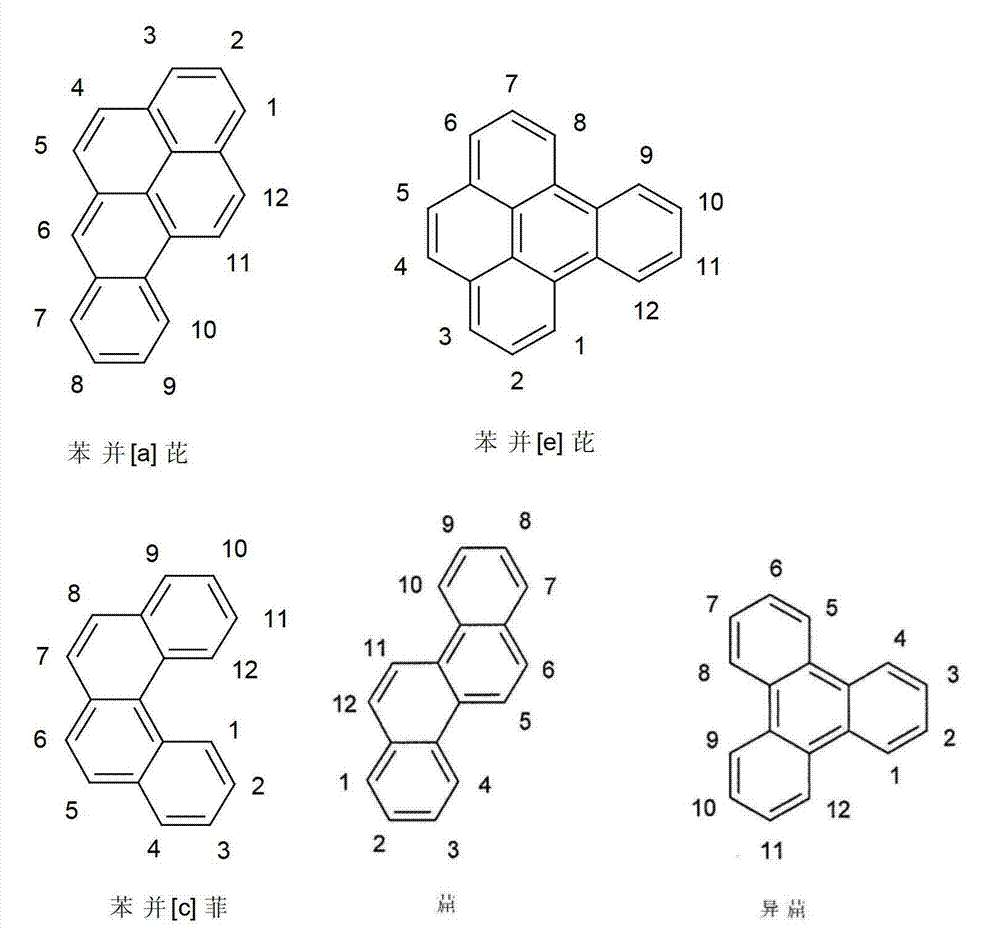
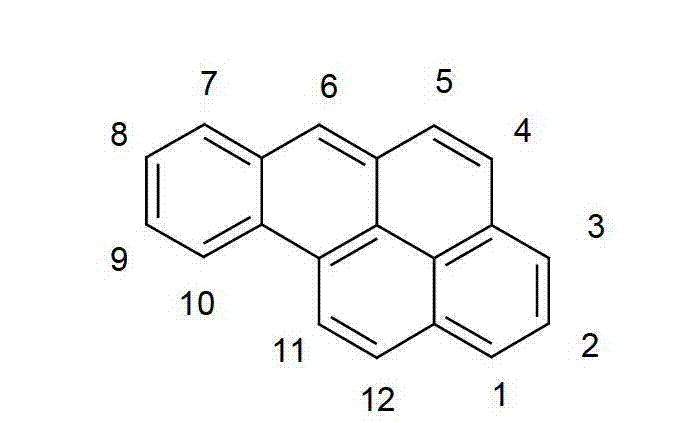
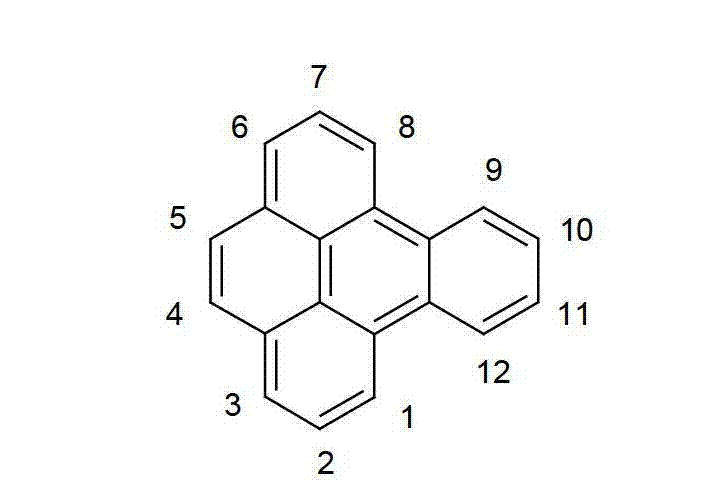
以下显示了芳族母体结构苯并[a]蒽、苯并[a]芘和苯并[e]芘、苯并[c]菲、

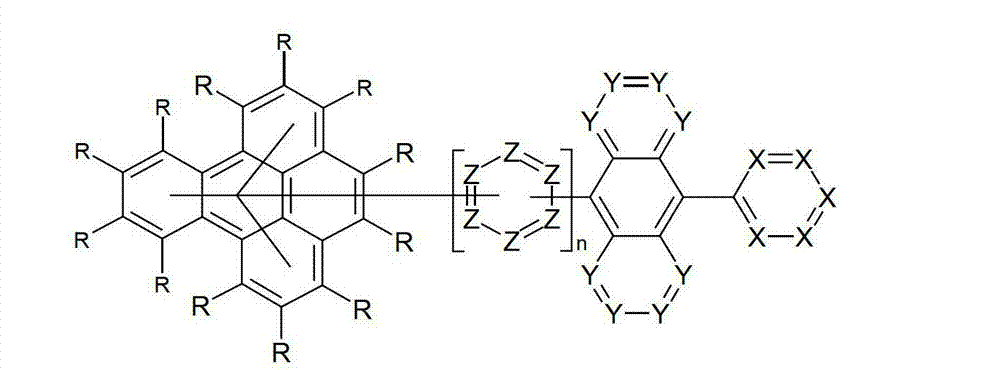
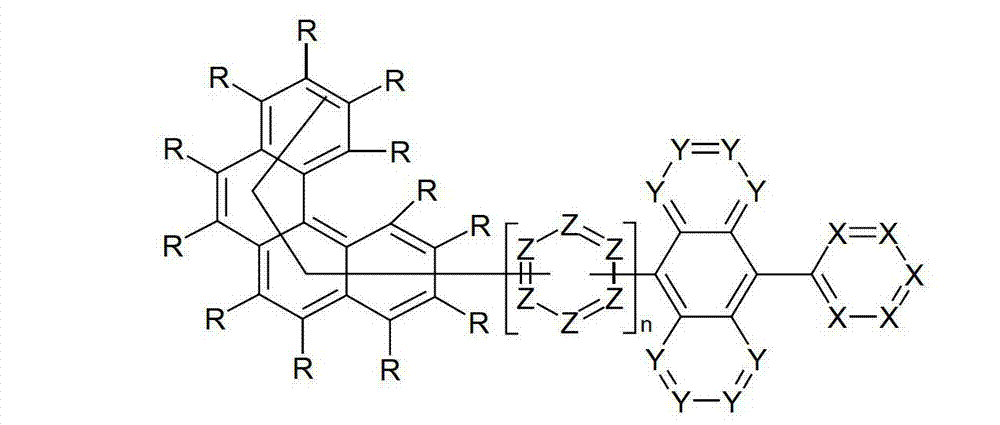
为描绘所述多环芳族化合物可以经由希望的它们的稠合芳族环的任一个,与本发明化合物另外的部分键合,在本申请说明书中使用贯穿所有所考虑环的线,或贯穿所有的所考虑环的线系。以下以为例子旨在举例说明这种情况。To depict that said polycyclic aromatic compounds may be bonded to further moieties of compounds of the invention via any desired of their fused aromatic rings, a line through all rings under consideration is used in the specification of this application, or through The line systems of all the rings under consideration. the following to The example is intended to illustrate this situation.
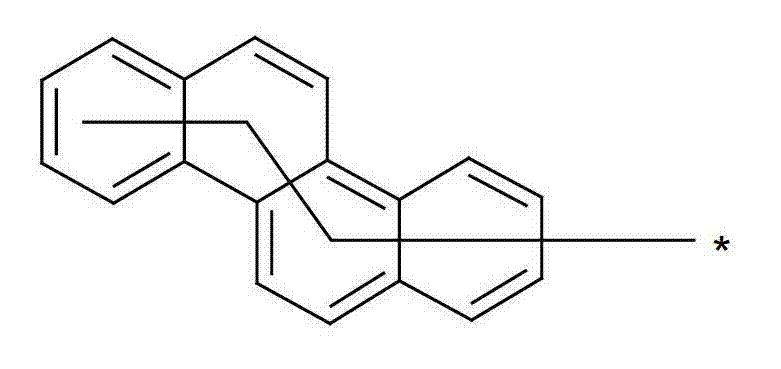
在这种情况下所描绘的结构代表
本发明涉及通式(I)的化合物The present invention relates to the compound of general formula (I)

通式(I)General formula (I)
其中以下适用于使用的符号和标记:Where the following applies to the symbols and marks used:
Ar1是具有15至60个芳族环原子的芳基或杂芳基基团,其可被一个或多个基团R取代; Ar is an aryl or heteroaryl group having 15 to 60 aromatic ring atoms, which may be substituted by one or more groups R;
Ar2是具有6至10个芳族环原子的芳基或杂芳基基团,其可被一个或多个基团R1取代; Ar is an aryl or heteroaryl group having 6 to 10 aromatic ring atoms, which may be substituted by one or more groups R ;
Y在每次出现时相同或不同地是CR2或N;条件是不超过2个相邻的Y同时对应于N;Y is equally or differently CR 2 or N at each occurrence; provided that no more than 2 adjacent Ys correspond to N at the same time;
X在每次出现时相同或不同地是CR3或N;条件是不超过2个相邻的X同时对应于N;X is equally or differently CR 3 or N at each occurrence; provided that no more than 2 adjacent Xs correspond to N at the same time;
n是1、2、3或4;n is 1, 2, 3 or 4;
R、R1、R2在每次出现时相同或不同地是H,D,F,Cl,Br,I,CHO,N(R4)2,C(=O)R4,P(=O)(R4)2,S(=O)R4,S(=O)2R4,CR4=C(R4)2,CN,NO2,Si(R4)3,B(OR4)2,OSO2R4,OH,具有1至40个C原子的直链烷基、烷氧基或硫代烷基基团,或具有3至40个C原子的支链或环状的烷基、烷氧基或硫代烷基基团,或具有2至40个C原子的烯基或炔基基团,它们每个可被一个或多个基团R4取代,其中一个或多个非相邻的CH2基团可被R4C=CR4、C≡C、Si(R4)2、Ge(R4)2、Sn(R4)2、C=O、C=S、C=Se、C=NR4、P(=O)(R4)、SO、SO2、NR4、O、S或CONR4代替,和其中一个或多个H原子可被D、F、Cl、Br、I、CN或NO2代替,或具有5至60个环原子的芳族或杂芳族环系,它们在每种情况下可被一个或多个非芳族基团R4取代,或具有5至60个芳族环原子的芳氧基或杂芳氧基基团,它们可被一个或多个非芳族基团R4取代,或这些体系的组合,其中两个或更多个基团R、R1和/或R2可以彼此连接且可以形成单或多环的脂族或芳族环系;R, R 1 , R 2 are identically or differently at each occurrence H, D, F, Cl, Br, I, CHO, N(R 4 ) 2 , C(=O)R 4 , P(=O )(R 4 ) 2 , S(=O)R 4 , S(=O) 2 R 4 , CR 4 =C(R 4 ) 2 , CN, NO 2 , Si(R 4 ) 3 , B(OR 4 ) 2 , OSO 2 R 4 , OH, straight-chain alkyl, alkoxy or thioalkyl groups having 1 to 40 C atoms, or branched or cyclic alkanes having 3 to 40 C atoms , alkoxy or thioalkyl groups, or alkenyl or alkynyl groups having 2 to 40 C atoms, each of which may be substituted by one or more groups R 4 , of which one or more Non-adjacent CH 2 groups can be replaced by R 4 C=CR 4 , C≡C, Si(R 4 ) 2 , Ge(R 4 ) 2 , Sn(R 4 ) 2 , C=O, C=S, C=Se, C=NR 4 , P(=O)(R 4 ), SO, SO 2 , NR 4 , O, S or CONR 4 are replaced, and one or more H atoms can be replaced by D, F, Cl , Br, I, CN or NO instead, or an aromatic or heteroaromatic ring system having 5 to 60 ring atoms, which in each case may be substituted by one or more non-aromatic radicals R , or aryloxy or heteroaryloxy groups having 5 to 60 aromatic ring atoms, which may be substituted by one or more non-aromatic groups R 4 , or combinations of these systems in which two or more The groups R, R and/or R may be connected to each other and may form a mono- or polycyclic aliphatic or aromatic ring system;
R3在每次出现时相同或不同地是H,D,F,Cl,Br,I,CHO,N(R4)2,C(=O)R4,P(=O)(R4)2,S(=O)R4,S(=O)2R4,CR4=C(R4)2,CN,NO2,Si(R4)3,B(OR4)2,OSO2R4,OH,具有1至40个C原子的直链烷基、烷氧基或硫代烷基基团,或具有3至40个C原子的支链或环状的烷基、烷氧基或硫代烷基基团,或具有2至40个C原子的烯基或炔基基团,它们每个可被一个或多个基团R4取代,其中一个或多个非相邻的CH2基团可被R4C=CR4、C≡C、Si(R4)2、Ge(R4)2、Sn(R4)2、C=O、C=S、C=Se、C=NR4、P(=O)(R4)、SO、SO2、NR4、O、S或CONR4代替,和其中一个或多个H原子可被D、F、Cl、Br、I、CN或NO2代替,或这些体系的组合,其中两个或更多个基团R3可以彼此连接且可以形成单或多环的脂族环系;R 3 is identically or differently at each occurrence H, D, F, Cl, Br, I, CHO, N(R 4 ) 2 , C(=O)R 4 , P(=O)(R 4 ) 2 , S(=O)R 4 , S(=O) 2 R 4 , CR 4 =C(R 4 ) 2 , CN, NO 2 , Si(R 4 ) 3 , B(OR 4 ) 2 , OSO 2 R 4 , OH, a straight-chain alkyl, alkoxy or thioalkyl group with 1 to 40 C atoms, or a branched or cyclic alkyl or alkoxy group with 3 to 40 C atoms or a thioalkyl group, or an alkenyl or alkynyl group having 2 to 40 C atoms, each of which may be substituted by one or more groups R 4 in which one or more non-adjacent CH 2 The group can be replaced by R 4 C=CR 4 , C≡C, Si(R 4 ) 2 , Ge(R 4 ) 2 , Sn(R 4 ) 2 , C=O, C=S, C=Se, C =NR 4 , P(=O)(R 4 ), SO, SO 2 , NR 4 , O, S or CONR 4 are replaced, and one or more of the H atoms can be replaced by D, F, Cl, Br, I, CN or NO 2 instead, or a combination of these systems, wherein two or more groups R 3 can be connected to each other and can form a mono- or polycyclic aliphatic ring system;
R4在每次出现时相同或者不同地是H,D,F,或具有1至20个C原子的脂族、芳族和/或杂芳族有机基团,其中另外,一个或多个H原子可被F代替;此处两个或更多个相同或不同的取代基R4也可以彼此连接且形成单或多环的脂族或芳族环系, R at each occurrence is identically or differently H, D, F, or an aliphatic, aromatic and/or heteroaromatic organic group having 1 to 20 C atoms, wherein additionally, one or more H Atoms can be replaced by F; here two or more identical or different substituents R can also be connected to each other and form a mono- or polycyclic aliphatic or aromatic ring system,
其中,在Ar1代表苯并[a]蒽衍生物的情况下,它在1、2、3、4、5、6、8、9、10、11或12位键合到基团Ar2上。where, in case Ar represents a benz[a]anthracene derivative, it is bonded to the group Ar at position 1, 2, 3, 4, 5, 6, 8, 9, 10, 11 or 12 .
通式(I)的化合物优选的玻璃化转变温度Tg大于70℃,特别优选大于100℃,非常特别优选大于130℃。The compounds of the general formula (I) preferably have a glass transition temperature Tg of greater than 70°C, particularly preferably greater than 100°C, very particularly preferably greater than 130°C.
在本发明意义上的芳基基团包含6至60个C原子;在本发明意义上的杂芳基基团包含1至59个C原子和至少一个杂原子,条件是C原子和杂原子的总和至少是5。所述杂原子优选选自N、O和/或S。此处的芳基基团或杂芳基基团被认为是指简单的芳香环,即苯,或简单的杂芳族环,例如吡啶、嘧啶、噻吩等,或稠合的(稠环的)芳基或杂芳基基团,例如萘、蒽、菲、喹啉、异喹啉、咔唑等。An aryl group in the sense of the invention contains 6 to 60 C atoms; a heteroaryl group in the sense of the invention contains 1 to 59 C atoms and at least one heteroatom, with the proviso that the C atoms and the heteroatoms The sum is at least 5. The heteroatoms are preferably selected from N, O and/or S. An aryl group or a heteroaryl group here is taken to mean a simple aromatic ring, i.e. benzene, or a simple heteroaromatic ring, such as pyridine, pyrimidine, thiophene, etc., or fused (fused-ring) Aryl or heteroaryl groups such as naphthalene, anthracene, phenanthrene, quinoline, isoquinoline, carbazole, and the like.
在每种情况下可被上述提到的基团取代并可以经由任何希望的位置与芳族或杂芳族环系连接的芳基或杂芳基基团,被认为特别是指衍生于如下物质的基团:苯、萘、蒽、菲、芘、二氢芘、苝、荧蒽、苯并蒽、苯并菲、并四苯、并五苯、苯并芘、呋喃、苯并呋喃、异苯并呋喃、二苯并呋喃、噻吩、苯并噻吩、异苯并噻吩、硫芴、吡咯、吲哚、异吲哚、咔唑、吡啶、喹啉、异喹啉、吖啶、菲啶、苯并-5,6-喹啉、苯并-6,7-喹啉、苯并-7,8-喹啉、吩噻嗪、吩嗪、吡唑、吲唑、咪唑、苯并咪唑、萘并咪唑、菲并咪唑、吡啶并咪唑、吡嗪并咪唑、喹喔啉并咪唑、唑、苯并


在本发明意义上的芳族环系在环系中包含6至60个C原子。在本发明意义上的杂芳族环系在环系中包含1至59个C原子和至少一个杂原子,条件是C原子和杂原子的总和至少为5。所述杂原子优选选自N、O、Si、B、P和/或S。在本发明意义上的芳族或杂芳族环系旨在被认为是指不必仅从芳基或杂芳基基团形成的体系,而是其中另外,两个或更多个芳基或杂芳基基团可被非芳族非共轭单元(优选小于非H原子的10%)连接,所述非芳族非共轭单元例如,sp3-杂化的C、N、O、Si、B、P和/或S原子,例如如下体系,例如三芳基胺或二芳基醚衍生物。其同样被认为是指其中两个或更多个芳基或杂芳基基团可以经由含有sp2-或sp-杂化的C原子或sp2-杂化的N原子的非芳族共轭单元连接的化合物,例如如下体系,例如茋、苯乙烯基萘或二苯甲酮衍生物。芳族或杂芳族环系同样被认为是指其中多个芳基或杂芳基基团通过单键彼此连接的化合物,例如三联苯或二苯基三嗪。芳族或杂芳族环系同样被认为是指其中两个或更多个芳基或杂芳基基团通过非芳族单元和/或sp2-或sp-杂化的C原子和/或sp2-杂化的N原子和/或单键的组合彼此连接的化合物,例如如下体系,例如9,9’-螺二芴、9,9-二芳基芴、二氢吩嗪或吩噻嗪、吩嗪、吩

具有5-60个环原子、在每种情况下也可被上述提到的基团R4取代以及可以通过任何希望的位置与所述芳族或杂芳族基团连接的芳族或杂芳族环系被认为特别是指衍生于如下物质的基团:苯、萘、蒽、苯并蒽、菲、苯并菲、芘、


为了本发明的目的,其中另外,单个H原子或CH2基团可被如上提及的在基团R定义下的基团取代的具有1至40个C原子的直链烷基基团或具有3至40个C原子的支链或环状的烷基基团或具有2至40个C原子的烯基或炔基基团,优选被认为是指如下的基团:甲基、乙基、正丙基、异丙基、正丁基、异丁基、仲丁基、叔丁基、2-甲基丁基、正戊基、仲戊基、环戊基、正己基、环己基、正庚基、环庚基、正辛基、环辛基、2-乙基己基、三氟甲基、五氟乙基、2,2,2-三氟乙基、乙烯基、丙烯基、丁烯基、戊烯基、环戊烯基、己烯基、环己烯基、庚烯基、环庚烯基、辛烯基、环辛烯基、乙炔基、丙炔基、丁炔基、戊炔基、己炔基或辛炔基。具有1至40个C原子的烷氧基或硫代烷基基团优选被认为是指甲氧基、三氟甲氧基、乙氧基、正丙氧基、异丙氧基、正丁氧基、异丁氧基、仲丁氧基、叔丁氧基、正戊氧基、仲戊氧基、2-甲基丁氧基、正己氧基、环己氧基、正庚氧基、环庚氧基、正辛氧基、环辛氧基、2-乙基己氧基、五氟乙氧基、2,2,2-三氟乙氧基、甲硫基、乙硫基、正丙硫基、异丙硫基、正丁硫基、异丁硫基、仲丁硫基、叔丁硫基、正戊硫基、仲戊硫基、正己硫基、环己硫基、正庚硫基、环庚硫基、正辛硫基、环辛硫基、2-乙基己硫基、三氟甲硫基、五氟乙硫基、2,2,2-三氟乙硫基、乙烯硫基、丙烯硫基、丁烯硫基、戊烯硫基、环戊烯硫基、己烯硫基、环己烯硫基、庚烯硫基、环庚烯硫基、辛烯硫基、环辛烯硫基、乙炔硫基、丙炔硫基、丁炔硫基、戊炔硫基、己炔硫基、庚炔硫基或辛炔硫基。For the purposes of the present invention, wherein in addition a single H atom or a CH2 group may be substituted by a group as mentioned above under the definition of the group R, a linear alkyl group having 1 to 40 C atoms or having A branched or cyclic alkyl group with 3 to 40 C atoms or an alkenyl or alkynyl group with 2 to 40 C atoms is preferably taken to mean the following groups: methyl, ethyl, n-propyl, isopropyl, n-butyl, isobutyl, sec-butyl, tert-butyl, 2-methylbutyl, n-pentyl, sec-pentyl, cyclopentyl, n-hexyl, cyclohexyl, n- Heptyl, cycloheptyl, n-octyl, cyclooctyl, 2-ethylhexyl, trifluoromethyl, pentafluoroethyl, 2,2,2-trifluoroethyl, vinyl, propenyl, butene Base, Pentenyl, Cyclopentenyl, Hexenyl, Cyclohexenyl, Heptenyl, Cycloheptenyl, Octenyl, Cyclooctenyl, Ethynyl, Proynyl, Butynyl, Pentyl Alkynyl, hexynyl or octynyl. Alkoxy or thioalkyl radicals having 1 to 40 C atoms are preferably taken to be methoxy, trifluoromethoxy, ethoxy, n-propoxy, isopropoxy, n-butoxy , isobutoxy, sec-butoxy, tert-butoxy, n-pentoxy, sec-pentoxy, 2-methylbutoxy, n-hexyloxy, cyclohexyloxy, n-heptyloxy, cycloheptyl Oxygen, n-octyloxy, cyclooctyloxy, 2-ethylhexyloxy, pentafluoroethoxy, 2,2,2-trifluoroethoxy, methylthio, ethylthio, n-propylthio Base, isopropylthio, n-butylthio, isobutylthio, sec-butylthio, tert-butylthio, n-pentylthio, sec-pentylthio, n-hexylthio, cyclohexylthio, n-heptylthio , cycloheptylthio, n-octylthio, cyclooctylthio, 2-ethylhexylthio, trifluoromethylthio, pentafluoroethylthio, 2,2,2-trifluoroethylthio, vinylthio group, propenylthio, butenylthio, pentenylthio, cyclopentenylthio, hexenylthio, cyclohexenylthio, heptenylthio, cycloheptenylthio, octenylthio, ring Octenylthio, ethynylthio, propynylthio, butynylthio, pentynylthio, hexynylthio, heptynylthio or octynylthio.
Ar1优选代表具有18至30个芳族环原子的芳基或杂芳基基团,其可被一个或多个基团R取代。Ar1特别优选代表具有18至30个芳族C原子的芳基基团,其可被一个或多个基团R取代。Ar1特别优选代表具有18至30个C原子的有角度稠合的非线性芳基基团,其可被一个或多个基团R取代。Ar 1 preferably represents an aryl or heteroaryl group having 18 to 30 aromatic ring atoms, which may be substituted by one or more radicals R. Ar 1 particularly preferably represents an aryl group having 18 to 30 aromatic C atoms, which may be substituted by one or more radicals R. Ar 1 particularly preferably represents an angularly fused, non-linear aryl radical having 18 to 30 C atoms, which may be substituted by one or more radicals R.
为了本发明的目的,具有非线性结构的有角度稠合的芳基基团被认为是指如下的芳基基团:其中彼此稠合的芳族环彼此不以绝对线性的方式,即,经由以平行方式彼此相反的边缘(例如并四苯或并五苯的情况)连接,而是,在至少一个位置以有角度的方式,即,经由以非平行方式彼此相反的边缘稠合在彼此之上。有角度稠合的非直链芳基基团的例子尤其是苯并[a]蒽、和三亚苯。For the purposes of the present invention, an angularly fused aryl group having a non-linear structure is taken to mean an aryl group in which the aromatic rings fused to each other are not in an absolutely linear manner with respect to each other, i.e., via Edges opposite each other in a parallel manner (as in the case of tetracene or pentacene, for example) are connected, but, at least in one place, in an angular manner, that is, fused between each other via edges opposing each other in a non-parallel manner superior. Examples of angularly fused non-linear aryl groups are especially benz[a]anthracene, and triphenylene.
Ar1非常特别优选苯并[a]蒽、苯并[a]芘、苯并[e]芘、苯并[a]菲、苯并[c]菲或苯并[I]菲,它们每个可任选被一个或多个基团R取代。 Ar is very particularly preferably benzo[a]anthracene, benzo[a]pyrene, benzo[e]pyrene, benzo[a]phenanthrene, benzo[c]phenanthrene or benzo[l]phenanthrene, each of which Can be optionally substituted with one or more groups R.
在本发明的优选实施方式中,Ar1代表通式(A)的苯并[a]蒽衍生物,其可被一个或多个基团R取代。In a preferred embodiment of the invention, Ar1 represents a benz[a]anthracene derivative of general formula (A), which may be substituted by one or more radicals R.
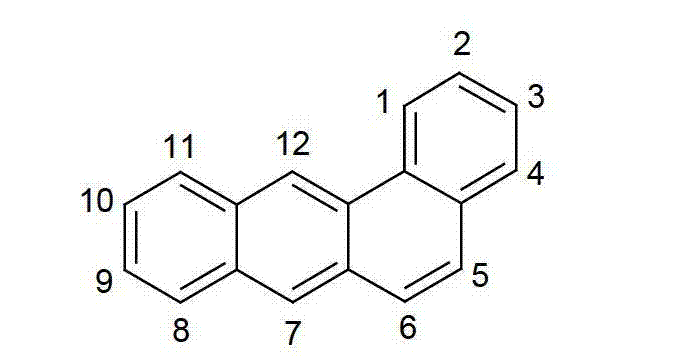
通式(A)General formula (A)
此处与通式(I)中的基团Ar2键合的键可以位于该苯并[a]蒽骨架的1、2、3、4、5、6、8、9、10、11或12位,优选在2、3、4、5或6位。该苯并[a]蒽基团可被一个或多个基团R在所有的自由位置取代。The bond to the group Ar in general formula (I) here can be located at 1, 2, 3 , 4, 5, 6, 8, 9, 10, 11 or 12 of the benz[a]anthracene skeleton position, preferably at position 2, 3, 4, 5 or 6. The benz[a]anthracene group may be substituted by one or more radicals R at all free positions.
此外优选Ar1代表通式(B)的苯并[a]菲

通式(B)General formula (B)
此处与通式(I)中的基团Ar2键合的键可以位于该
同样优选Ar1代表通式(C)的苯并[c]菲,其可被一个或多个基团R取代。It is likewise preferred that Ar 1 represents a tribenzo[c]phenanthrene of general formula (C), which may be substituted by one or more radicals R.

通式(C)General formula (C)
此处与通式(I)中的基团Ar2键合的键可以位于该苯并[c]菲骨架的1、2、3、4、5、6、7、8、9、10、11或12位,优选在4、5、6、7或8位。该苯并[c]菲基团可被一个或多个基团R在所有的自由位置取代。Here, the bond to the group Ar in the general formula (I) can be located at 1 , 2, 3, 4, 5, 6, 7, 8, 9, 10, 11 of the benzo[c]phenanthrene skeleton or 12, preferably at 4, 5, 6, 7 or 8 positions. The benzo[c]phenanthrene group may be substituted by one or more groups R at all free positions.
同样优选Ar1代表通式(D)的苯并[I]菲(异三亚苯),其可被一个或多个基团R取代。It is also preferred that Ar represents benzo[I]phenanthrene (isophenanthrene) of general formula (D). triphenylene), which may be substituted by one or more groups R.
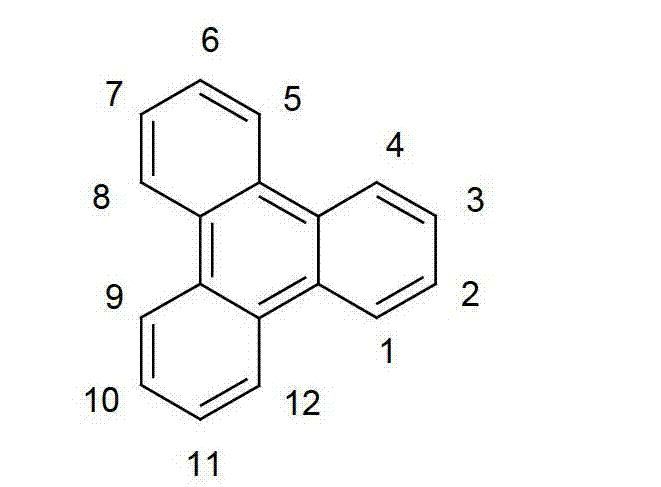
通式(D)General formula (D)
此处与通式(I)中的基团Ar2键合的键可以位于该苯并[I]菲骨架的1、2、3、4、5、6、7、8、9、10、11或12位,优选在1、2、3、6或10位。该苯并[I]菲基团可被一个或多个基团R在所有的自由位置取代。Here, the bond with the group Ar in the general formula (I) can be located at 1 , 2, 3, 4, 5, 6, 7, 8, 9, 10, 11 of the benzo[I]phenanthrene skeleton or 12, preferably at 1, 2, 3, 6 or 10 positions. The benzo[I]phenanthrene group may be substituted by one or more radicals R at all free positions.
在可选的优选实施方式中,Ar1代表通式(E)的苯并[a]芘,其可被一个或多个基团R取代。In an alternative preferred embodiment, Ar 1 represents a benzo[a]pyrene of general formula (E), which may be substituted by one or more groups R.
通式(E)General formula (E)
此处与通式(I)中的基团Ar2键合的键可以位于该苯并[a]芘骨架的1、2、3、4、5、6、7、8、9、10、11或12位,优选在1、2、3、6或12位。该苯并芘基团可被一个或多个基团R在所有的自由位置取代。Here the bond to the group Ar in the general formula (I) can be located at 1, 2 , 3, 4, 5, 6, 7, 8, 9, 10, 11 of the benzo[a]pyrene skeleton or 12, preferably at 1, 2, 3, 6 or 12 positions. The benzopyrene group may be substituted by one or more groups R at all free positions.
在另外的可选优选实施方式中,Ar1代表通式(F)的苯并[e]芘,其可被一个或多个基团R取代。In a further alternative preferred embodiment, Ar 1 represents a benzo[e]pyrene of general formula (F), which may be substituted by one or more groups R.
通式(F)General formula (F)
此处与通式(I)中的基团Ar2键合的键可以位于该苯并[e]芘骨架的1、2、3、4、5、6、7、8、9、10、11或12位,优选在2、3、4、6或10位。该苯并[e]芘基团可被一个或多个基团R在所有的自由位置取代。Here the bond to the group Ar in the general formula (I) can be located at 1, 2 , 3, 4, 5, 6, 7, 8, 9, 10, 11 of the benzo[e]pyrene skeleton or 12, preferably at 2, 3, 4, 6 or 10. The benzo[e]pyrene group may be substituted by one or more groups R at all free positions.
此外Ar2优选代表具有6至10个芳族环原子的芳基基团,其任选被一个或多个基团R1取代。在可选的优选实施方式中,Ar2代表具有6至10个芳族环原子的杂芳基基团,其任选被一个或多个基团R1取代。Furthermore Ar 2 preferably represents an aryl group having 6 to 10 aromatic ring atoms, which is optionally substituted by one or more radicals R 1 . In an alternative preferred embodiment, Ar 2 represents a heteroaryl group having 6 to 10 aromatic ring atoms, optionally substituted by one or more groups R 1 .
Ar2特别优选是亚苯基、亚萘基、亚吡啶基、亚嘧啶基、亚吡嗪基、亚哒嗪基、亚三嗪基或喹啉或异喹啉,它们每个可被一个或多个基团R1取代,非常特别优选亚苯基、亚吡啶基、亚嘧啶基或亚三嗪基。 Ar is particularly preferably phenylene, naphthylene, pyridylene, pyrimidylene, pyrazinylene, pyridazinylene, triazinylene or quinoline or isoquinoline, each of which can be replaced by one or Multiple radicals R1 are substituted, very particularly preferably phenylene, pyridylene, pyrimidylene or triazinylene.
本发明优选Ar2代表基团1,3-亚苯基、1,4-亚苯基、1,4-亚萘基、1,5-亚萘基、2,6-亚萘基、2,5-亚吡啶基、2,6-亚吡啶基、2,4-亚嘧啶基、2,5-亚嘧啶基、2,5-亚吡嗪基、2,4-亚三嗪基、2,4-亚哒嗪基、2,5-亚哒嗪基、5,8-亚喹啉基、2,5-亚喹啉基和5,8-亚异喹啉基之一,它们每个可被一个或多个基团R1取代。源自每一所述基团的两个键表示与与通式(I)中基团Ar1键合的键和与中心的蒽衍生物键合的键。The present invention preferably Ar represents group 1,3-phenylene, 1,4-phenylene, 1,4-naphthylene, 1,5-naphthylene, 2,6-naphthylene, 2, 5-pyridyl, 2,6-pyridyl, 2,4-pyrimidinyl, 2,5-pyrimidinyl, 2,5-pyrazinyl, 2,4-triazinyl, 2, One of 4-pyridazinylene, 2,5-pyridazinylene, 5,8-quinolinylene, 2,5-quinolinylene and 5,8-isoquinolinylene, each of which may be Substituted by one or more groups R1 . The two bonds derived from each of said groups represent a bond to the group Ar 1 in general formula (I) and a bond to the central anthracene derivative.

本发明优选n等于1或2,特别优选等于1。According to the invention, n is preferably equal to 1 or 2, particularly preferably equal to 1.
优选通式(I)化合物中的0、1或2个基团Y等于N,和其余的基团Y等于CR2。特别优选所有的基团Y等于CR2。Preferably 0, 1 or 2 groups Y in the compound of general formula (I) are equal to N, and the remaining groups Y are equal to CR 2 . Particular preference is given to all radicals Y being equal to CR 2 .
优选不等于氢的基团R2在2-或6-位或在2-和6-位与蒽骨架键合。Preferred radicals R 2 not equal to hydrogen are bonded to the anthracene skeleton in the 2- or 6-position or in the 2- and 6-positions.
此外优选0、1、2或3个基团X等于N,和其余的基团X等于CR3。此外特别优选所有的基团X等于CR3,特别优选等于CD或CH。Furthermore preferably 0, 1, 2 or 3 radicals X are equal to N, and the remaining radicals X are equal to CR 3 . Furthermore, it is particularly preferred that all radicals X are equal to CR 3 , particularly preferably equal to CD or CH.
优选基团R在每次出现时相同或不同地是H,D,F,CN,N(R4)2,Si(R4)3,或具有1至20个C原子的直链烷基或烷氧基基团,或具有3至20个C原子的支链或环状的烷基或烷氧基基团,它们每个可被一个或多个基团R4取代,其中上述提及基团中的一个或多个相邻的或非相邻的CH2基团可被-C≡C-、-R4C=CR4、Si(R4)2、C=O、C=NR4、NR4、O、S、COO或CONR4代替,或具有5至30个环原子的芳族或杂芳族环系,它们在每种情况下可被一个或多个基团R4取代。Preferred radicals R are, identically or differently at each occurrence, H, D, F, CN, N(R 4 ) 2 , Si(R 4 ) 3 , or straight-chain alkyl having 1 to 20 C atoms or Alkoxy groups, or branched or cyclic alkyl or alkoxy groups having 3 to 20 C atoms, each of which may be substituted by one or more groups R , wherein the above mentioned groups One or more adjacent or non-adjacent CH 2 groups in the group can be replaced by -C≡C-, -R 4 C=CR 4 , Si(R 4 ) 2 , C=O, C=NR 4 , NR 4 , O, S, COO or CONR 4 instead, or aromatic or heteroaromatic ring systems having 5 to 30 ring atoms, which in each case may be substituted by one or more radicals R 4 .
优选基团R1在每次出现时相同或不同地是H,D,F,CN,N(R4)2,Si(R4)3,或具有1至20个C原子的直链烷基或烷氧基基团或具有3至20个C原子的支链或环状的烷基或烷氧基基团,它们每个可被一个或多个基团R4取代,其中上述提及基团中的一个或多个相邻的或非相邻的CH2基团可被-C≡C-、-R4C=CR4、Si(R4)2、C=O、C=NR4、NR4、O、S、COO或CONR4代替,或具有5至30个环原子的芳族或杂芳族环系,它们在每种情况下可被一个或多个基团R4取代。Preferably the radical R 1 is identically or differently at each occurrence H, D, F, CN, N(R 4 ) 2 , Si(R 4 ) 3 , or straight-chain alkyl having 1 to 20 C atoms or an alkoxy group or a branched or cyclic alkyl or alkoxy group having 3 to 20 C atoms, each of which may be substituted by one or more groups R 4 , wherein the above mentioned groups One or more adjacent or non-adjacent CH 2 groups in the group can be replaced by -C≡C-, -R 4 C=CR 4 , Si(R 4 ) 2 , C=O, C=NR 4 , NR 4 , O, S, COO or CONR 4 instead, or aromatic or heteroaromatic ring systems having 5 to 30 ring atoms, which in each case may be substituted by one or more radicals R 4 .
优选基团R2在每次出现时相同或不同地是H,D,F,CN,N(R4)2,Si(R4)3,或具有1至20个C原子的直链烷基或烷氧基基团或具有3至20个C原子的支链或环状的烷基或烷氧基基团,它们每个可被一个或多个基团R4取代,其中上述提及基团中的一个或多个相邻的或非相邻的CH2基团可被-C≡C-、-R4C=CR4、Si(R4)2、C=O、C=NR4、NR4、O、S、COO或CONR4代替,或具有5至30个环原子的芳族或杂芳族环系,它们在每种情况下可被一个或多个基团R4取代。Preferred radicals R 2 are H, D, F, CN, N(R 4 ) 2 , Si(R 4 ) 3 , or straight-chain alkyl having 1 to 20 C atoms, identically or differently at each occurrence or an alkoxy group or a branched or cyclic alkyl or alkoxy group having 3 to 20 C atoms, each of which may be substituted by one or more groups R 4 , wherein the above mentioned groups One or more adjacent or non-adjacent CH 2 groups in the group can be replaced by -C≡C-, -R 4 C=CR 4 , Si(R 4 ) 2 , C=O, C=NR 4 , NR 4 , O, S, COO or CONR 4 instead, or aromatic or heteroaromatic ring systems having 5 to 30 ring atoms, which in each case may be substituted by one or more radicals R 4 .
优选基团R3在每次出现时相同或不同地是H,D,F,CN,N(R4)2,Si(R4)3,或具有1至20个C原子的直链烷基或烷氧基基团或具有3至20个C原子的支链或环状的烷基或烷氧基基团,它们每个可被一个或多个基团R4取代,其中上述提及基团中的一个或多个相邻的或非相邻的CH2基团可被-C≡C-、-R4C=CR4、Si(R4)2、C=O、C=NR4、NR4、O、S、COO或CONR4代替。Preferred radicals R 3 are H, D, F, CN, N(R 4 ) 2 , Si(R 4 ) 3 , or straight-chain alkyl having 1 to 20 C atoms, identically or differently at each occurrence or an alkoxy group or a branched or cyclic alkyl or alkoxy group having 3 to 20 C atoms, each of which may be substituted by one or more groups R 4 , wherein the above mentioned groups One or more adjacent or non-adjacent CH 2 groups in the group can be replaced by -C≡C-, -R 4 C=CR 4 , Si(R 4 ) 2 , C=O, C=NR 4 , NR 4 , O, S, COO or CONR 4 instead.
特别优选所述的涉及单独取代基R至R3的优选实施方式一起存在。It is particularly preferred that the preferred embodiments described concerning the individual substituents R to R3 are present together.
在本发明的优选实施方式中,本发明的化合物符合通式(I-1a)至(I-6b)之一:In a preferred embodiment of the invention, the compound of the invention corresponds to one of the general formulas (I-1a) to (I-6b):

通式(I-1a)General formula (I-1a)

通式(I-1b)General formula (I-1b)

通式(I-2a)General formula (I-2a)

通式(I-2b)General formula (I-2b)
通式(I-3a)General formula (I-3a)
通式(I-3b)General formula (I-3b)
通式(I-4a)General formula (I-4a)
通式(I-4b)General formula (I-4b)
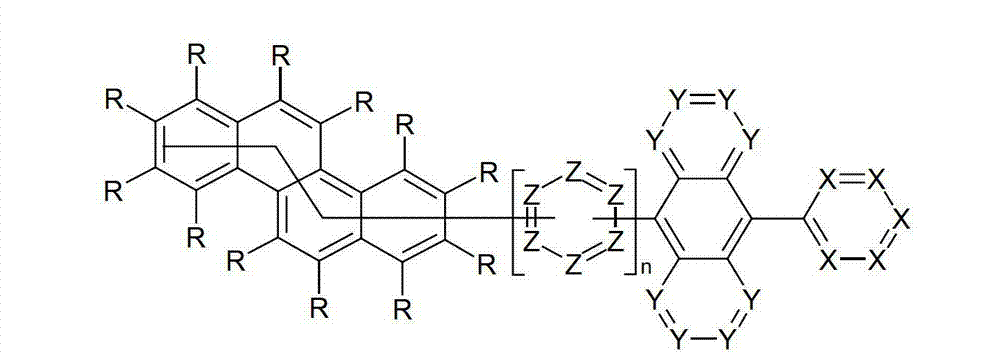
通式(I-5a)General formula (I-5a)
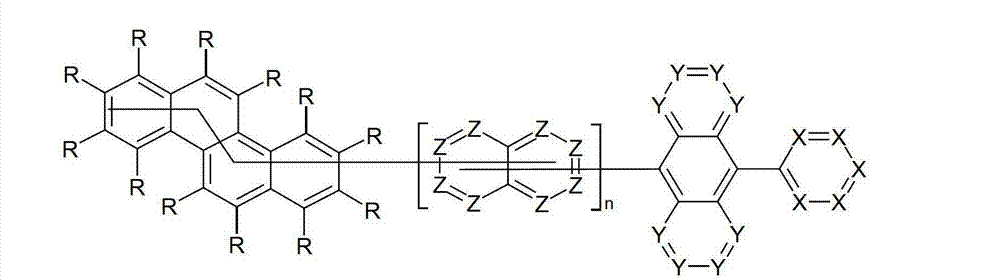
通式(I-5b)General formula (I-5b)
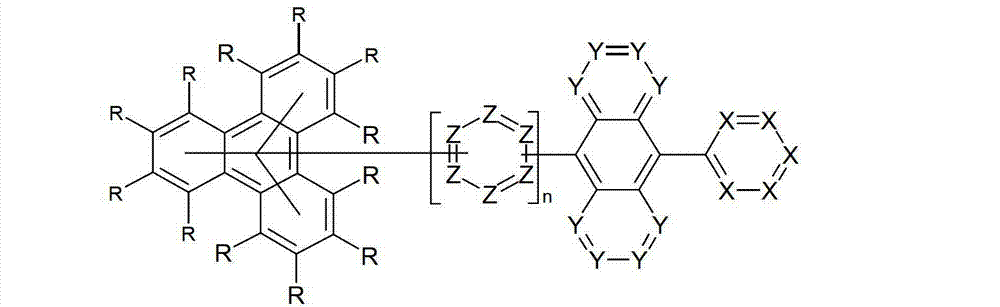
通式(I-6a)General formula (I-6a)
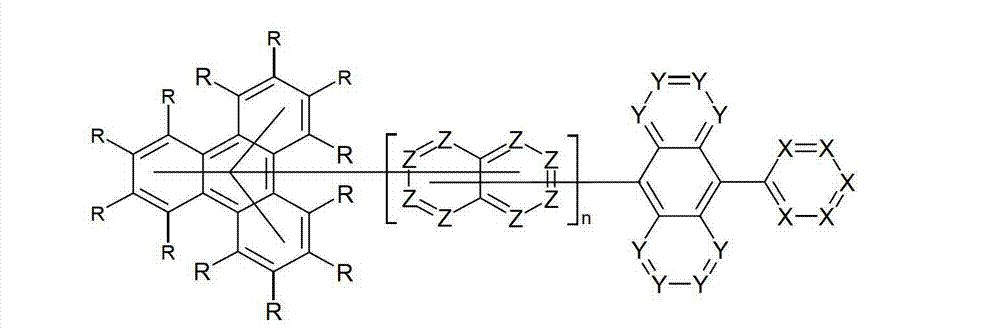
通式(I-6b),General formula (I-6b),
其中存在的符号和标记定义如上,和where the symbols and marks present are as defined above, and
Z在每次出现时相同或不同地是CR1或N。Z is CR 1 or N at each occurrence, equally or differently.
在如上提及的通式中和在所有的以下通式中,此外优选每个芳族六元环中最多三个基团Z等于N,和其余的基团等于CR1。特别优选所有的基团Z等于CR1。In the general formulas mentioned above and in all the following general formulas, it is furthermore preferred that in each aromatic six-membered ring a maximum of three groups Z are equal to N, and the remaining groups are equal to CR 1 . Particular preference is given to all radicals Z equal to CR 1 .
通式(I-1a)和(I-1b)中的苯并[a]蒽基团可以经由1、2、3、4、5、6、8、9、10、11或12位,优选经由2、3、4、5或6位键合到所述化合物的基团上。如在相应通式中描绘的,该苯并蒽环的所有的自由位置可以任选被基团R取代。The benz[a]anthracene groups in general formulas (I-1a) and (I-1b) can be via the 1, 2, 3, 4, 5, 6, 8, 9, 10, 11 or 12 positions, preferably via The 2, 3, 4, 5 or 6 position is bonded to the group of the compound. All free positions of the benzanthracene ring may optionally be substituted by groups R as depicted in the corresponding general formula.
通式(I-2a)和(I-2b)中的苯并[a]芘基团可以经由1、2、3、4、5、6、7、8、9、10、11或12位,优选经由1、2、3、6或12位键合到所述化合物的基团上。如在相应通式中描绘的,该苯并[a]芘环的所有的自由位置可以任选被被基团R取代。The benzo[a]pyrene group in the general formula (I-2a) and (I-2b) can pass through the 1, 2, 3, 4, 5, 6, 7, 8, 9, 10, 11 or 12 positions, The bond to the radical of the compound is preferably via the 1, 2, 3, 6 or 12 position. All free positions of the benzo[a]pyrene ring may optionally be substituted by groups R as depicted in the corresponding general formula.
在通式(I-3a)和(I-3b)中的苯并[e]芘基团可以经由1、2、3、4、5、6、7、8、9、10、11或12位,优选经由2、3、4、6或10位键合到所述化合物的基团上。如在相应通式中描绘的,该苯并[e]芘环的所有的自由位置可以任选被基团R取代。The benzo[e]pyrene group in general formulas (I-3a) and (I-3b) can be , preferably via the 2, 3, 4, 6 or 10-position bonded to the group of the compound. All free positions of the benzo[e]pyrene ring may optionally be substituted by groups R as depicted in the corresponding general formula.
通式(I-4a)和(I-4b)中的苯并[c]菲基团可以经由1、2、3、4、5、6、7、8、9、10、11或12位,优选经由4、5、6、7或8位键合到所述化合物的基团上。如在相应通式中描绘的,该苯并[c]菲环的所有的自由位置可以任选被基团R取代。The benzo[c]phenanthrene groups in the general formulas (I-4a) and (I-4b) can be via the 1, 2, 3, 4, 5, 6, 7, 8, 9, 10, 11 or 12 positions, The bond to the radical of the compound is preferably via the 4, 5, 6, 7 or 8 position. All free positions of the benzo[c]phenanthrene ring may optionally be substituted by groups R as depicted in the corresponding general formula.
通式(I-5a)和(I-5b)中的苯并[a]菲基团可以经由1、2、3、4、5、6、7、8、9、10、11或12位,优选经由2、6、7、9或12位键合到所述化合物的基团上。如在相应通式中描绘的,该
在通式(I-6a)和(I-6b)中的苯并[I]菲基团可以经由1、2、3、4、5、6、7、8、9、10、11或12位,优选经由1、2、3、6或10位键合到所述化合物的基团上。如在相应通式中描绘的,该异
对于通式(I-1a)至(I-6b)此外优选n等于1或2,特别优选等于1。For the general formulas (I-1a) to (I-6b) n is also preferably equal to 1 or 2, particularly preferably equal to 1.
另外,提及的对于通式(I)的优选实施方式同样适用。特别优选X等于CH、CD或N。In addition, the preferred embodiments mentioned for the general formula (I) also apply. Particularly preferably X is equal to CH, CD or N.
本发明化合物的特别优选的实施方式符合以下通式:A particularly preferred embodiment of the compounds of the invention corresponds to the general formula:

通式(I-1a-1)General formula (I-1a-1)

通式(I-1a-2)General formula (I-1a-2)

通式(I-1a-3)General formula (I-1a-3)

通式(I-1a-4)General formula (I-1a-4)

通式(I-1a-5)General formula (I-1a-5)

通式(I-1a-6)General formula (I-1a-6)

通式(I-1b-1)General formula (I-1b-1)
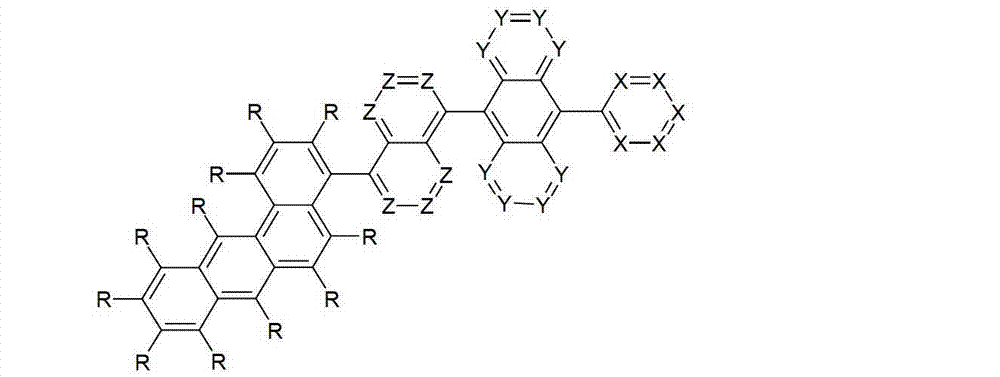
通式(I-1b-2)General formula (I-1b-2)

通式(I-1b-3)General formula (I-1b-3)

通式(I-1b-4)General formula (I-1b-4)

通式(I-1b-5)General formula (I-1b-5)
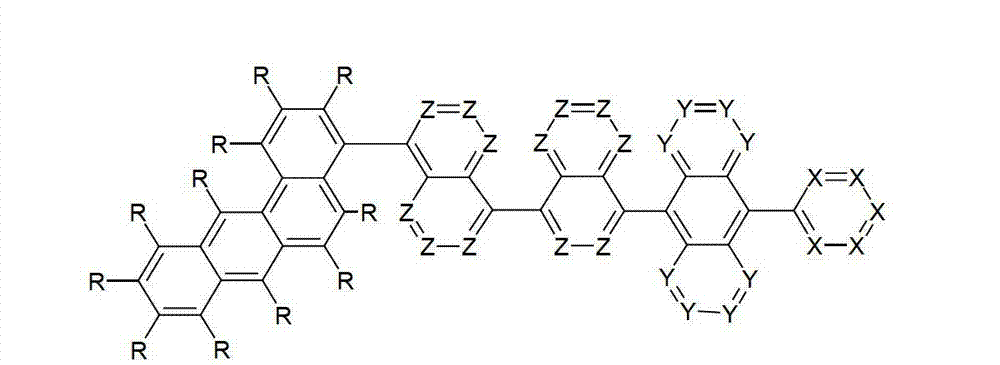
通式(I-1b-6)General formula (I-1b-6)

通式(I-1b-7)General formula (I-1b-7)
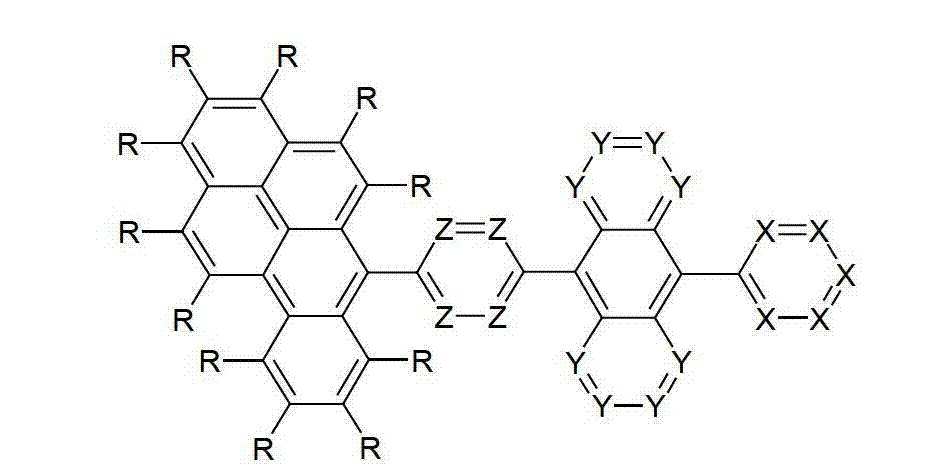
通式(I-2a-1)General formula (I-2a-1)
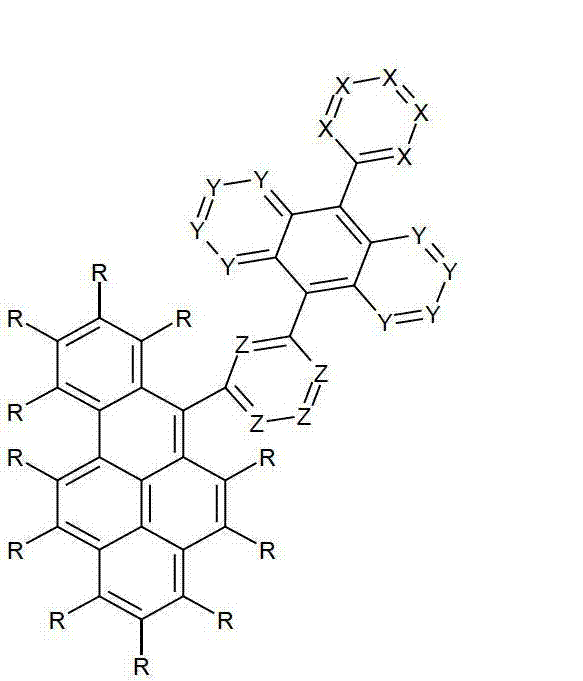
通式(I-2a-2)General formula (I-2a-2)
通式(I-2a-3)General formula (I-2a-3)
通式(I-2a-4)General formula (I-2a-4)
通式(I-2a-5)General formula (I-2a-5)

通式(I-2a-6)General formula (I-2a-6)

通式(I-2b-1)General formula (I-2b-1)

通式(I-2b-2)General formula (I-2b-2)

通式(I-2b-3)General formula (I-2b-3)
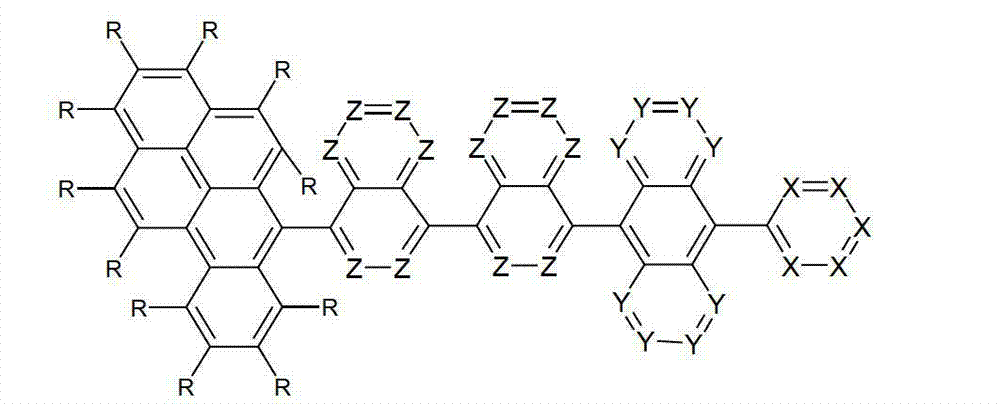
通式(I-2b-4)General formula (I-2b-4)
通式(I-2b-5)General formula (I-2b-5)
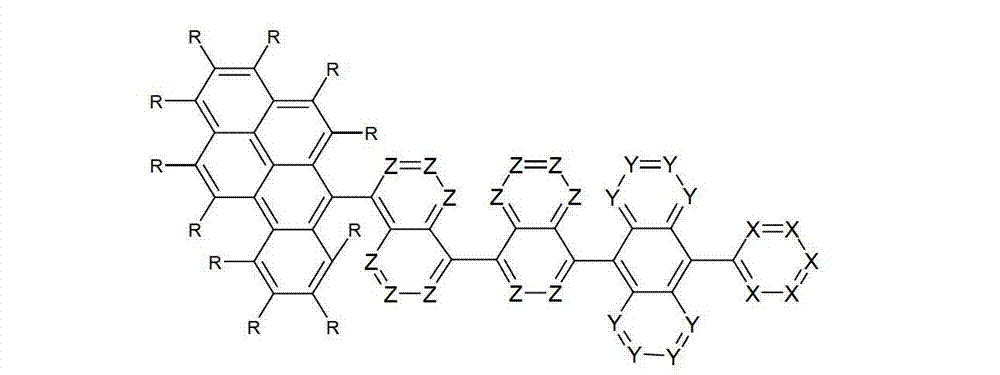
通式(I-2b-6)General formula (I-2b-6)

通式(I-2b-7)General formula (I-2b-7)
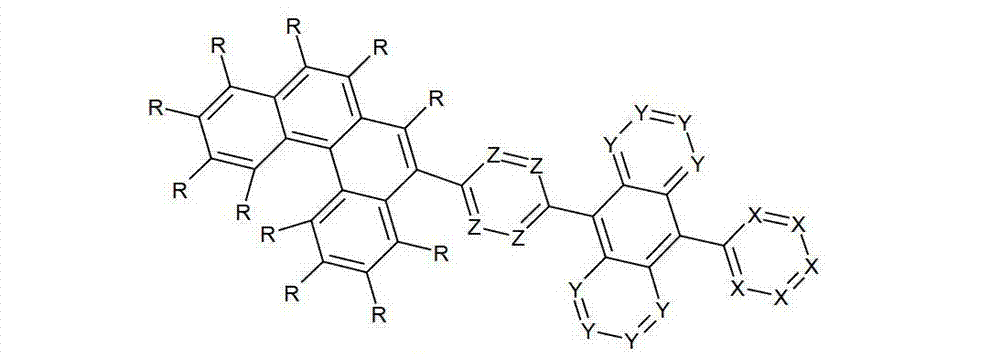
通式(I-4a-1)General formula (I-4a-1)

通式(I-4a-2)General formula (I-4a-2)
通式(I-4a-3)General formula (I-4a-3)

通式(I-4a-4)General formula (I-4a-4)
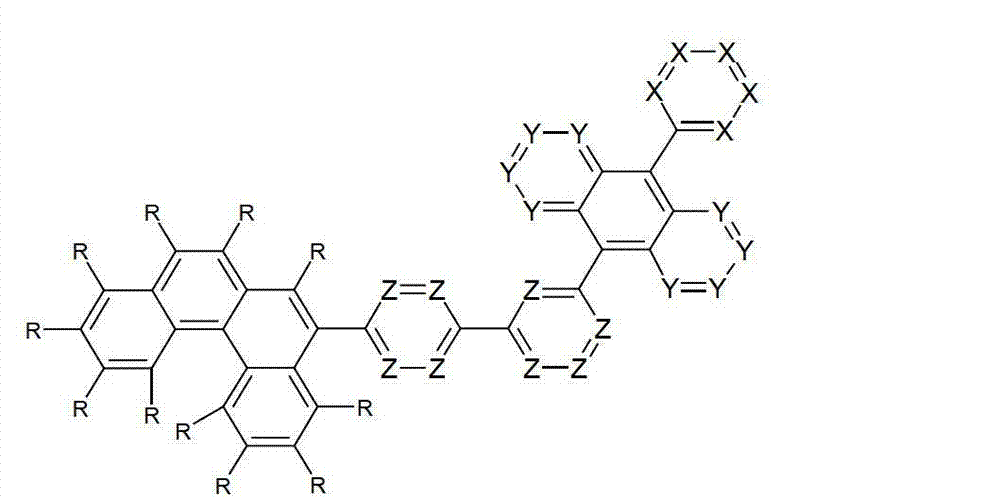
通式(I-4a-5)General formula (I-4a-5)
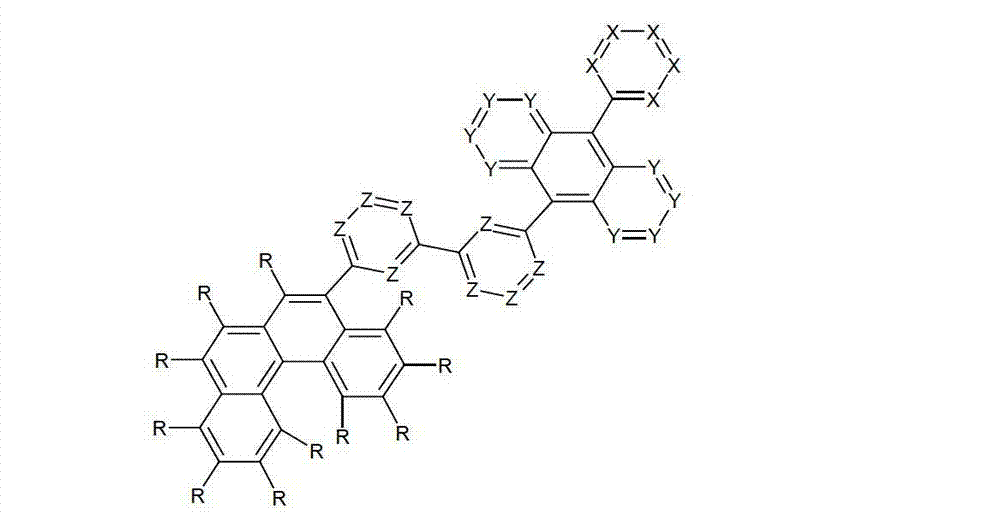
通式(I-4a-6)General formula (I-4a-6)

通式(I-4b-1)General formula (I-4b-1)

通式(I-4b-2)General formula (I-4b-2)
通式(I-4b-3)General formula (I-4b-3)

通式(I-4b-4)General formula (I-4b-4)
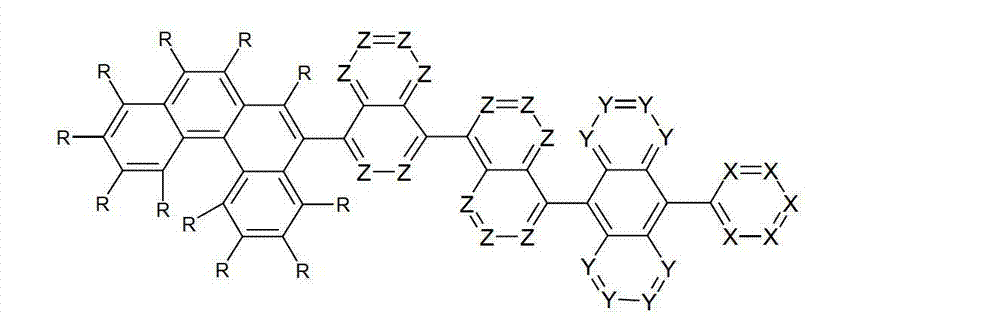
通式(I-4b-5)General formula (I-4b-5)
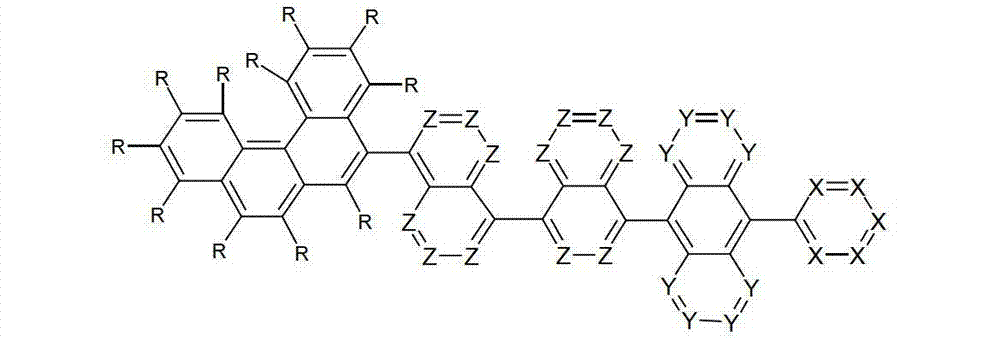
通式(I-4b-6)General formula (I-4b-6)
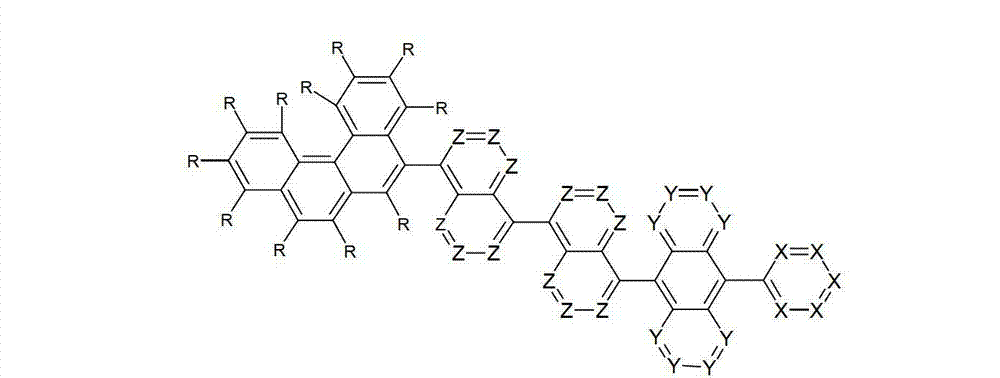
通式(I-4b-7)General formula (I-4b-7)
通式(I-5a-1)General formula (I-5a-1)
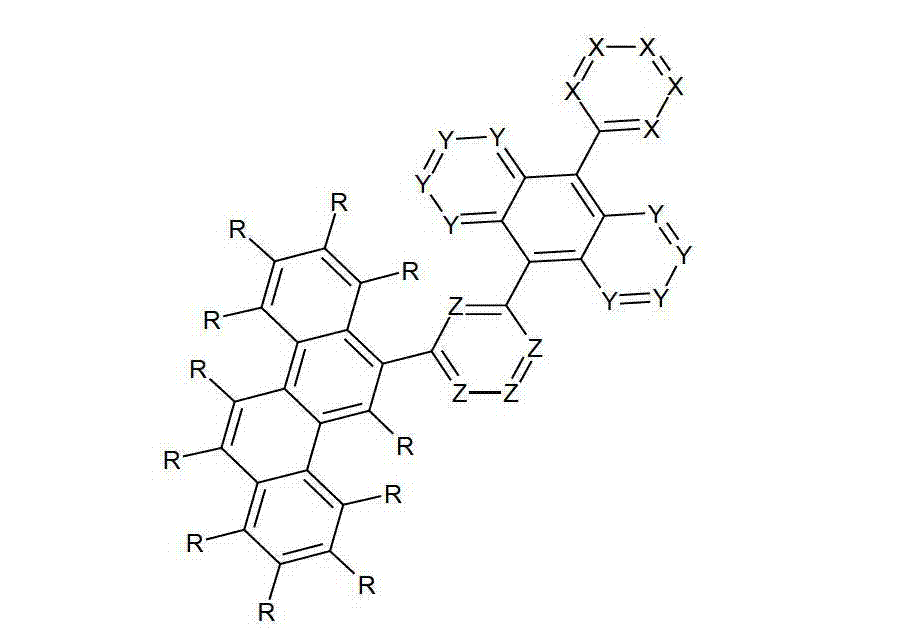
通式(I-5a-2)General formula (I-5a-2)
通式(I-5a-3)General formula (I-5a-3)
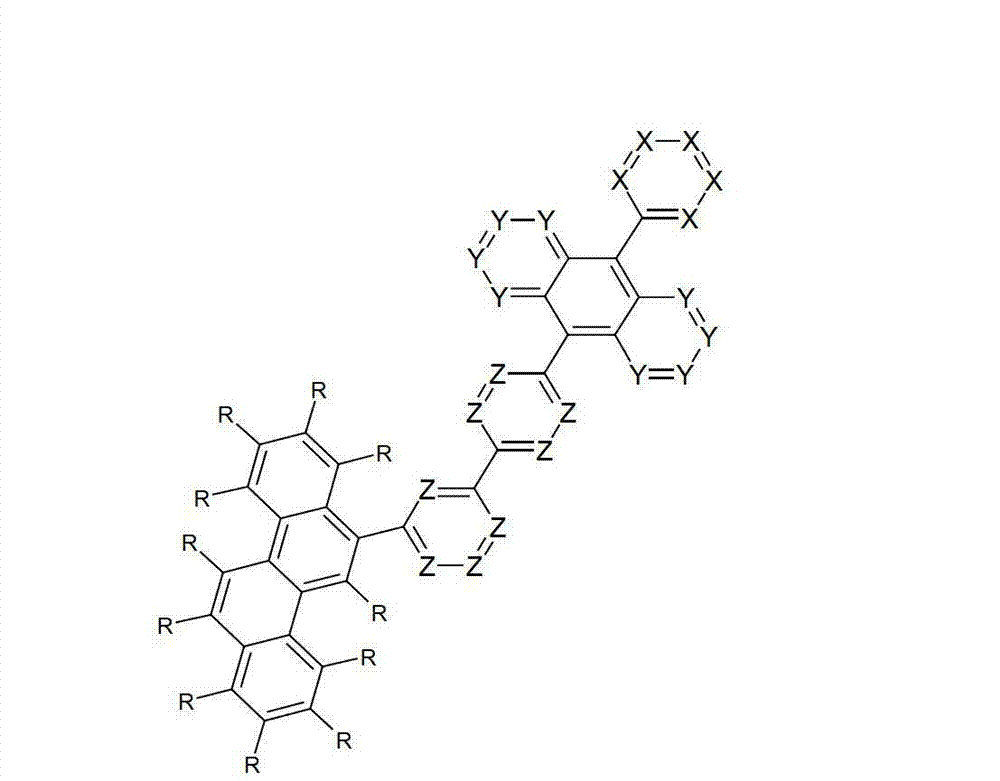
通式(I-5a-4)General formula (I-5a-4)

通式(I-5a-5)General formula (I-5a-5)
通式(I-5a-6)General formula (I-5a-6)

通式(I-5b-1)General formula (I-5b-1)
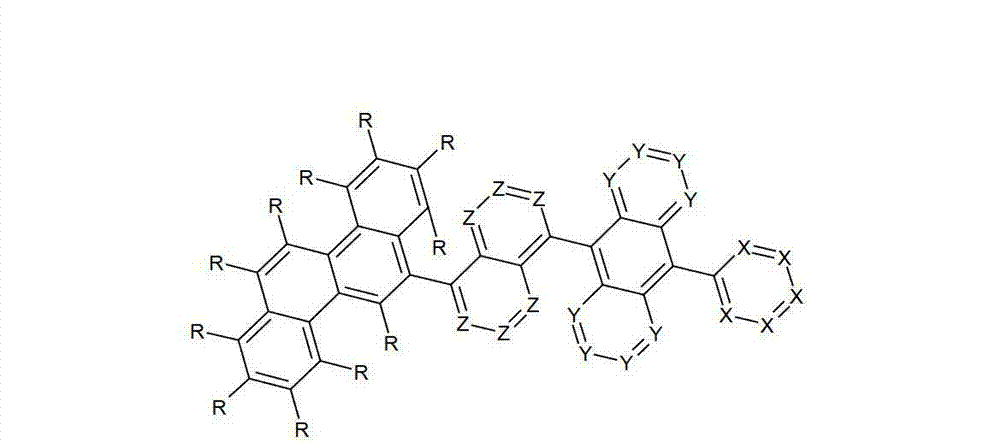
通式(I-5b-2)General formula (I-5b-2)
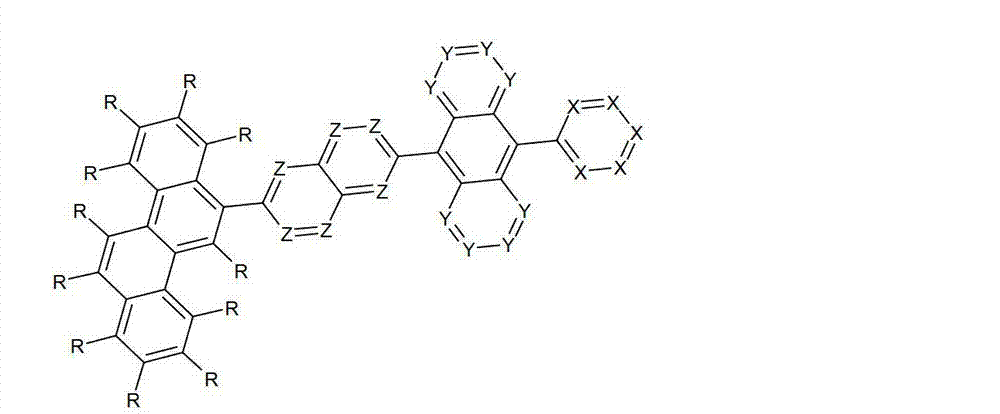
通式(I-5b-3)General formula (I-5b-3)
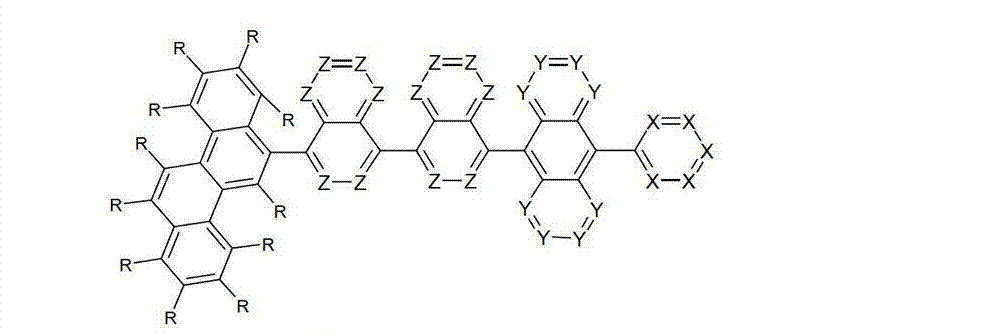
通式(I-5b-4)General formula (I-5b-4)
通式(I-5b-5)General formula (I-5b-5)
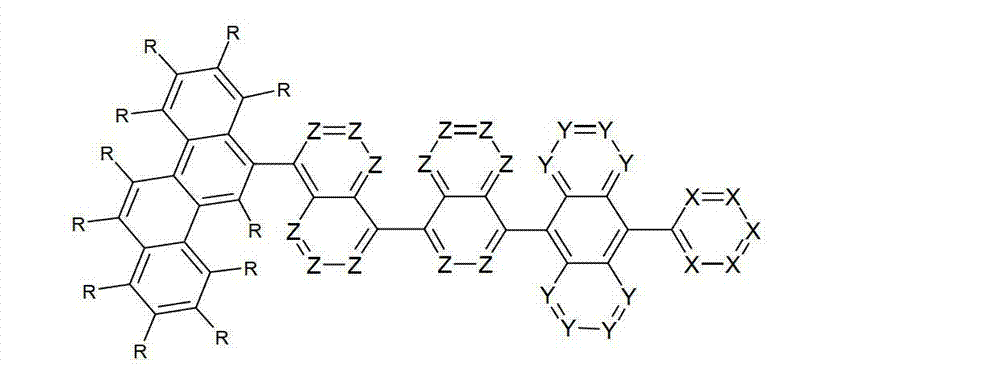
通式(I-5b-6)General formula (I-5b-6)

通式(I-5b-7)General formula (I-5b-7)

通式(I-6a-1)General formula (I-6a-1)
通式(I-6a-2)General formula (I-6a-2)

通式(I-6a-3)General formula (I-6a-3)

通式(I-6a-4)General formula (I-6a-4)

通式(I-6a-5)General formula (I-6a-5)
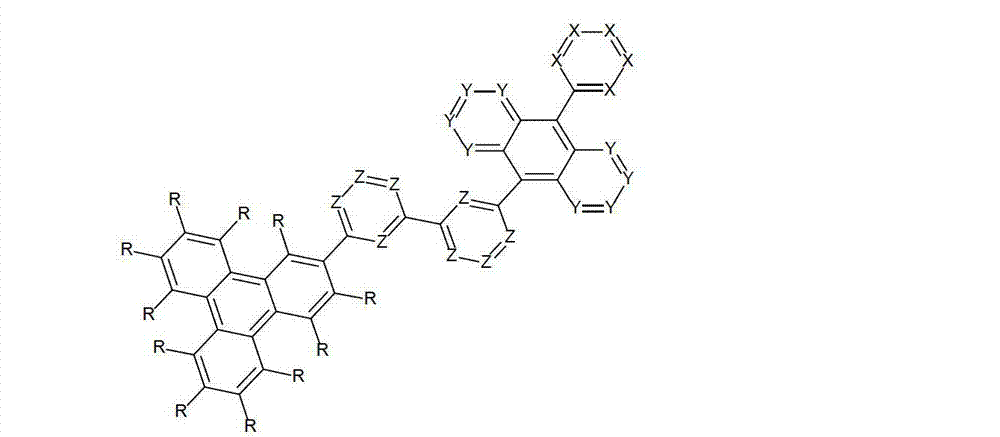
通式(I-6a-6)General formula (I-6a-6)
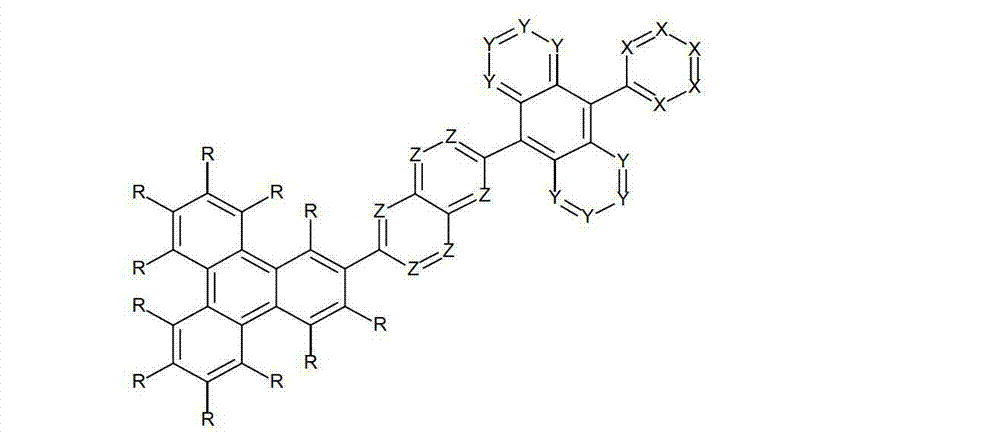
通式(I-6b-1)General formula (I-6b-1)

通式(I-6b-2)General formula (I-6b-2)

通式(I-6b-3)General formula (I-6b-3)

通式(I-6b-4)General formula (I-6b-4)

通式(I-6b-5)General formula (I-6b-5)

通式(I-6b-6)General formula (I-6b-6)
通式(I-6b-7)General formula (I-6b-7)
对于如上提及的优选通式的化合物,如上提及的基团R、R1、R2、R3和X、Y和Z的优选实施方式优选适用。特别优选,在如上提及的优选通式的化合物中,基团R在每次出现时相同或不同地是H或D,Z在每次出现时相同或不同地是CH、N或CD,Y在每次出现时相同或不同地是CH或CD,和X在每次出现时相同或不同地是CH、N或CD。For the compounds of the preferred general formulas mentioned above, the preferred embodiments of the radicals R, R 1 , R 2 , R 3 and X, Y and Z mentioned above preferably apply. Particularly preferably, in the compounds of the preferred general formulas mentioned above, the group R is at each occurrence identically or differently H or D, Z is identically or differently at each occurrence CH, N or CD, Y is CH or CD at each occurrence, identically or differently, and X is CH, N, or CD at each occurrence, identically or differently.
本发明化合物特别优选实施方式的例子是以下显示的结构。Examples of particularly preferred embodiments of compounds of the invention are the structures shown below.

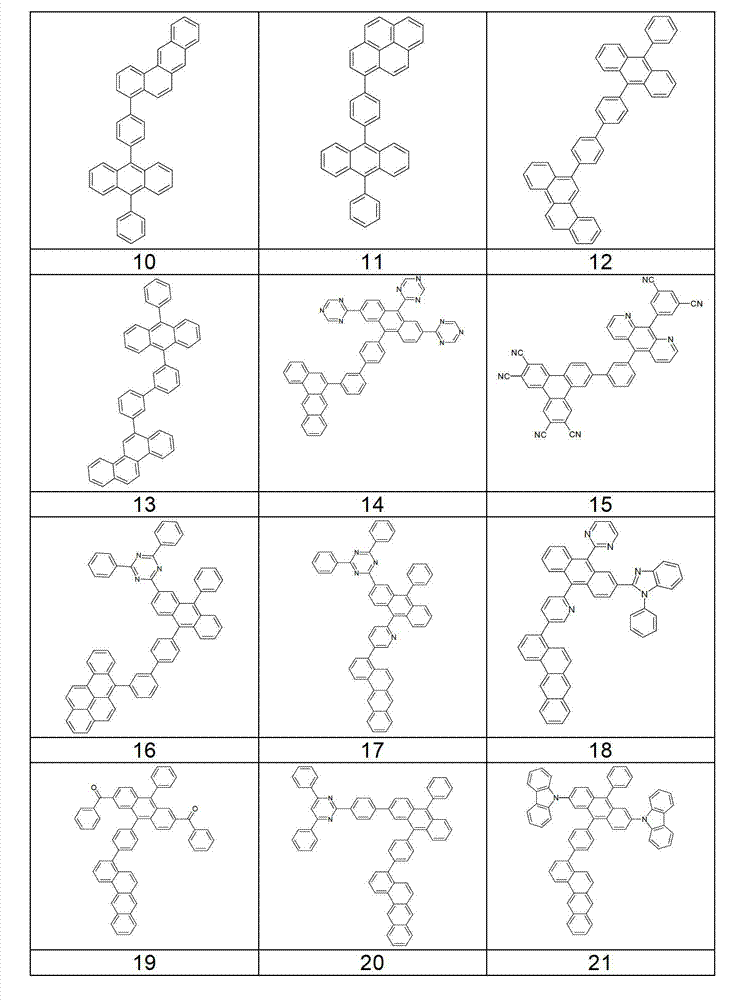


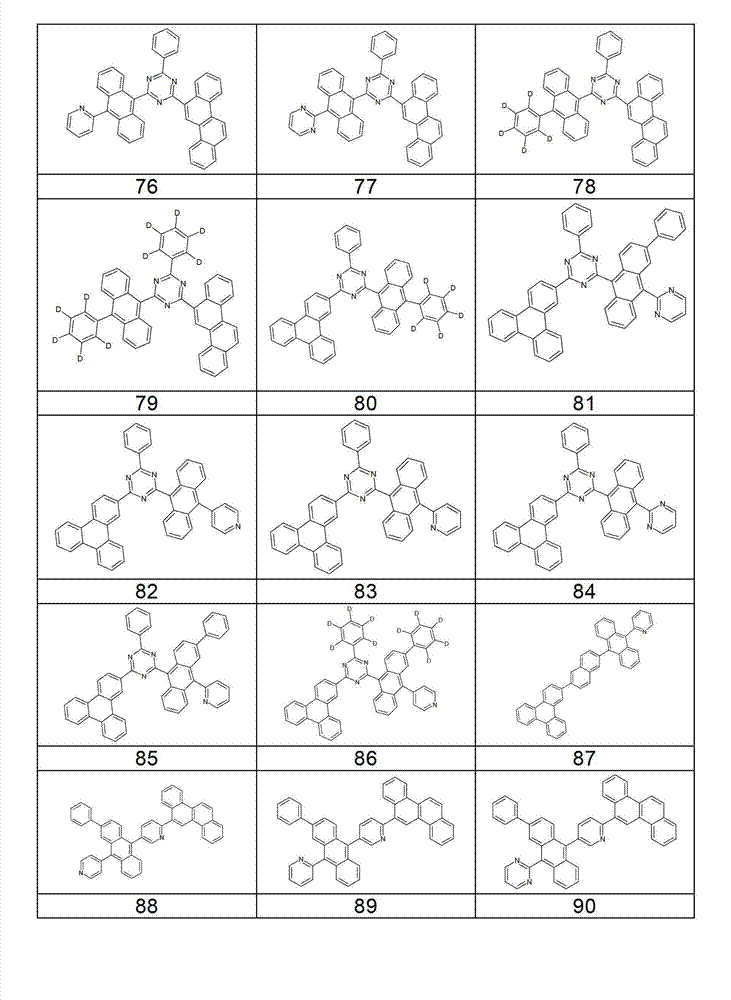
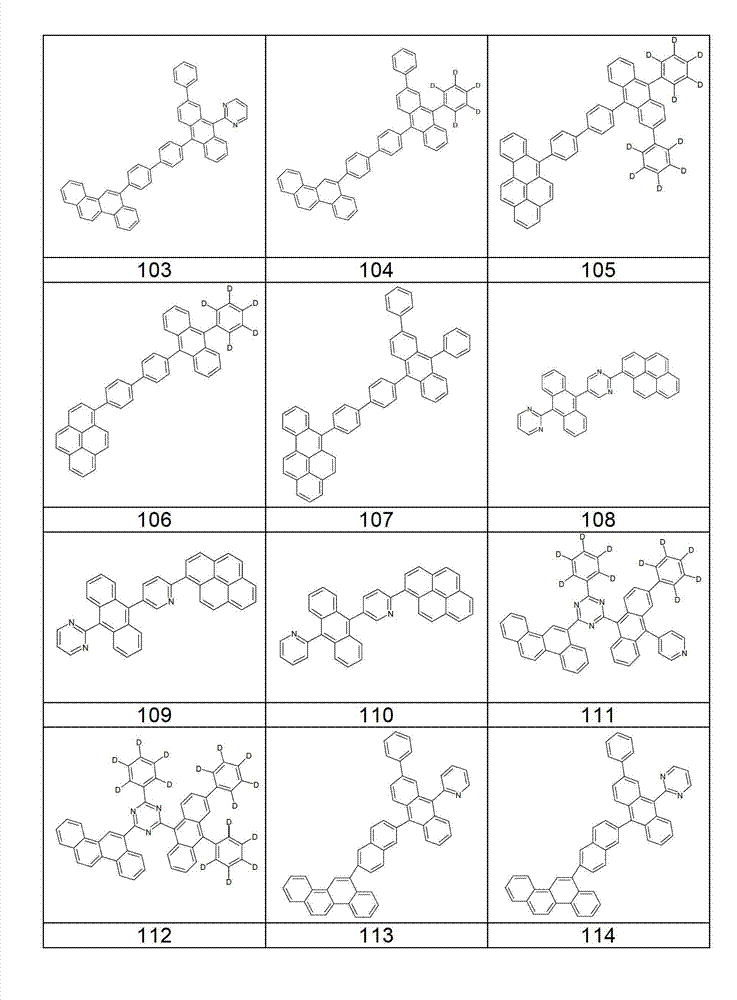
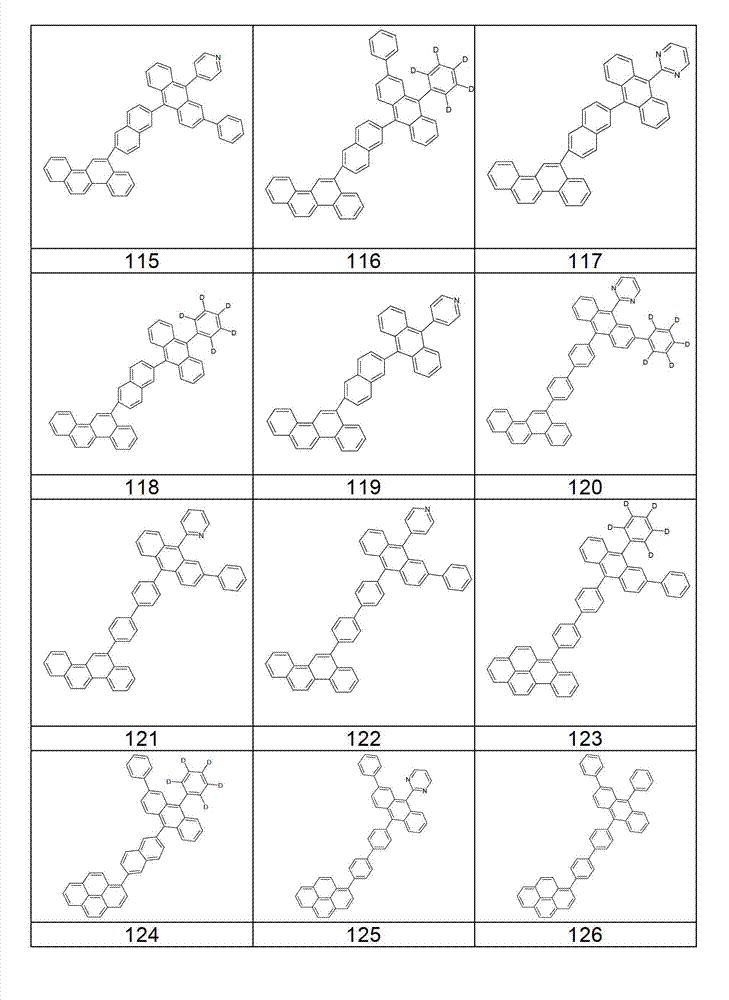
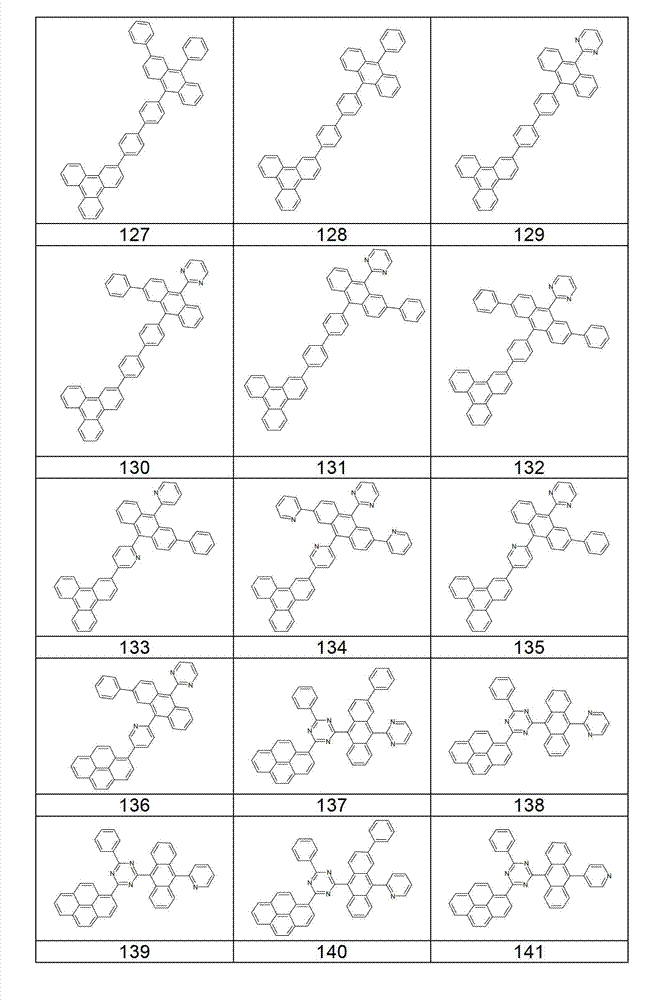
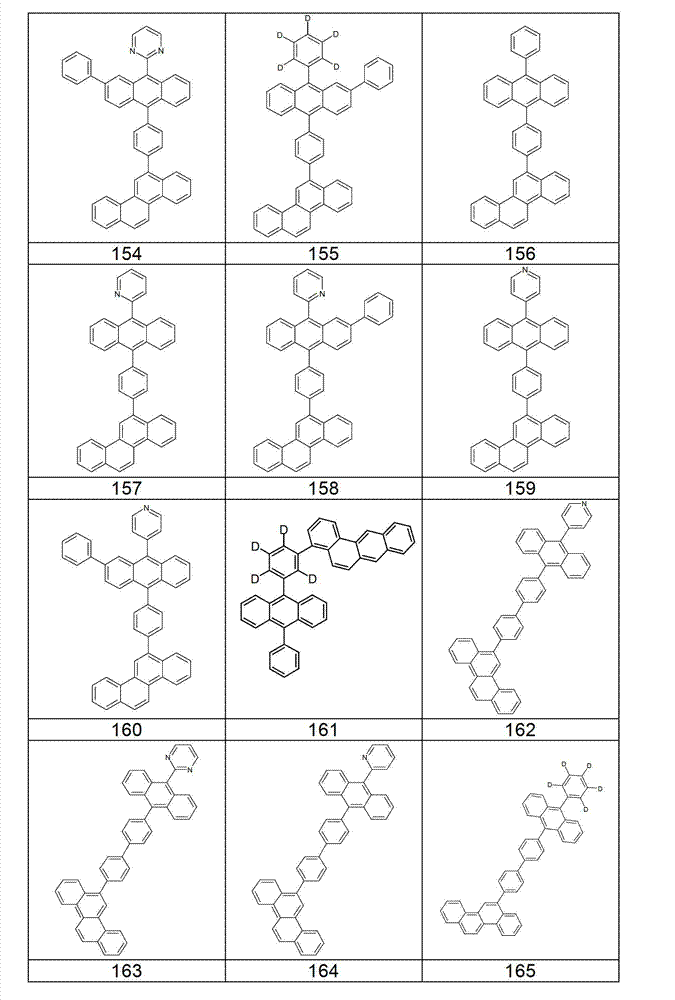
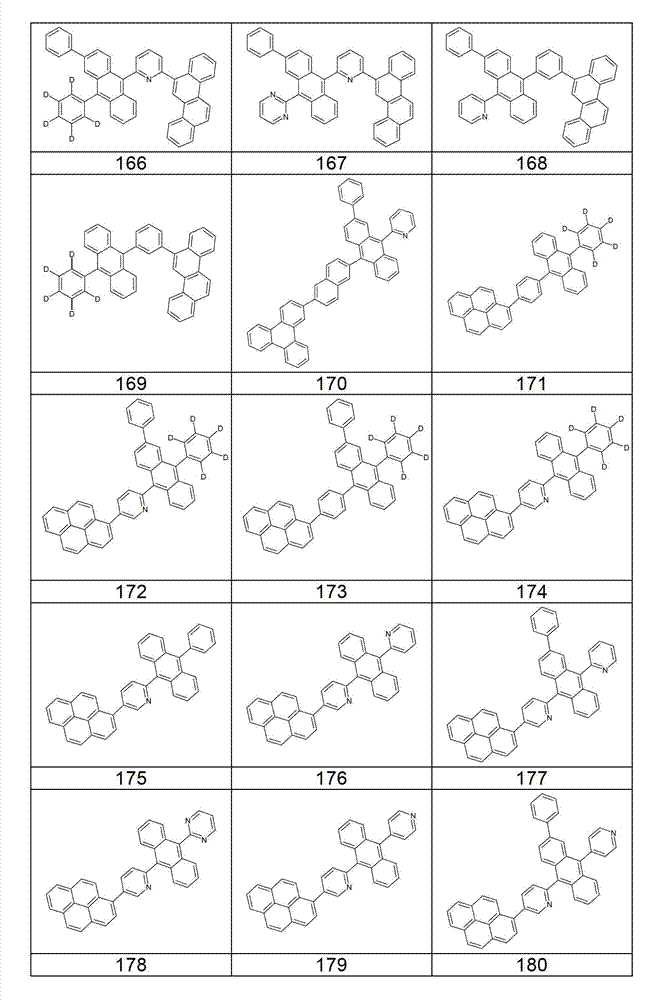

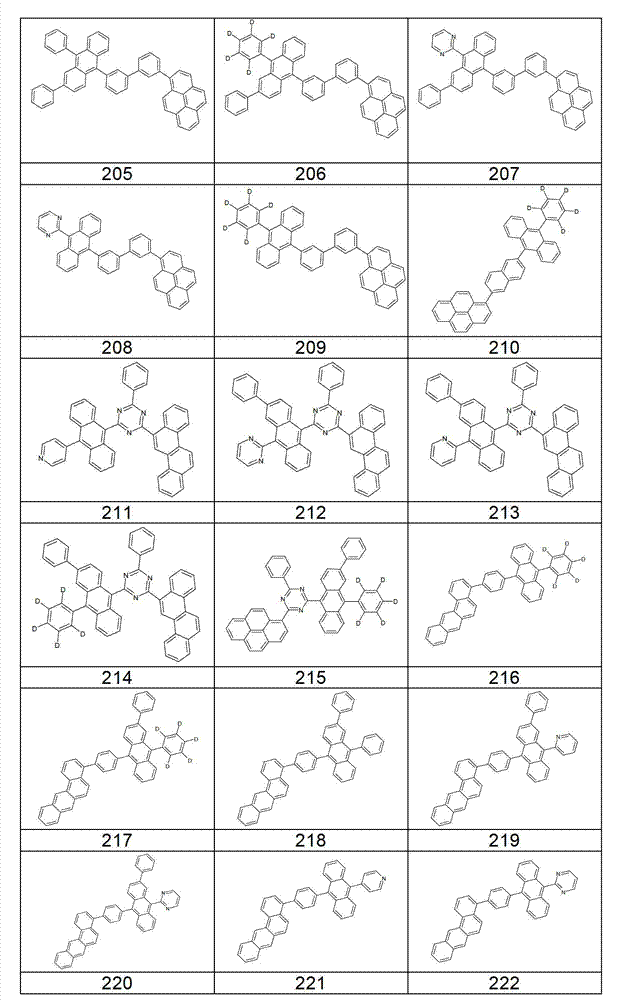

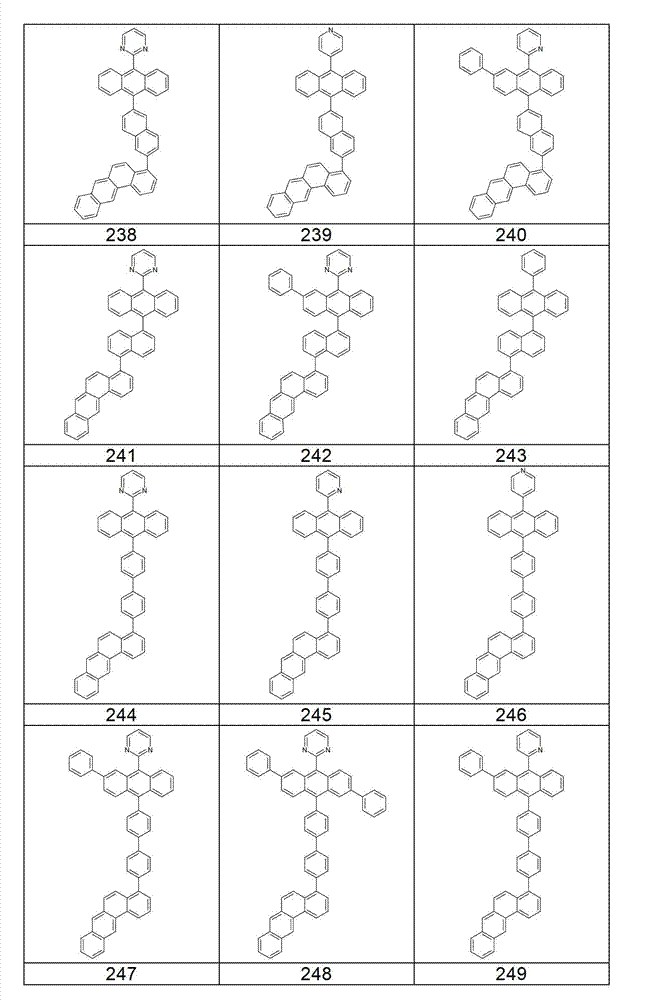
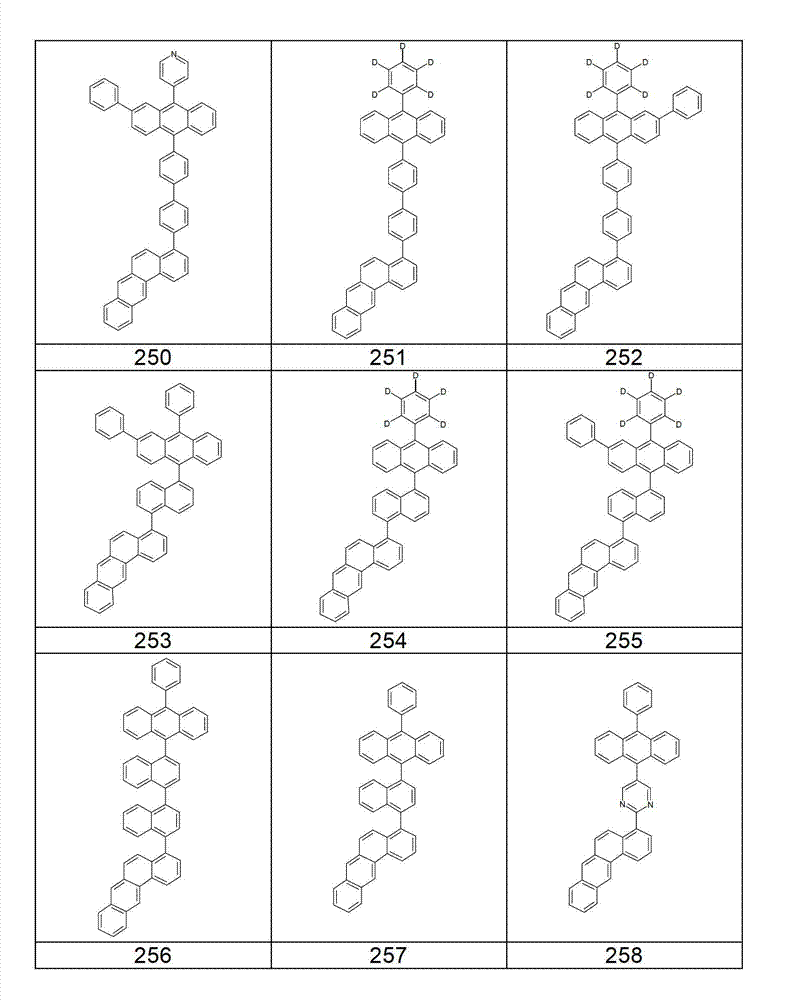

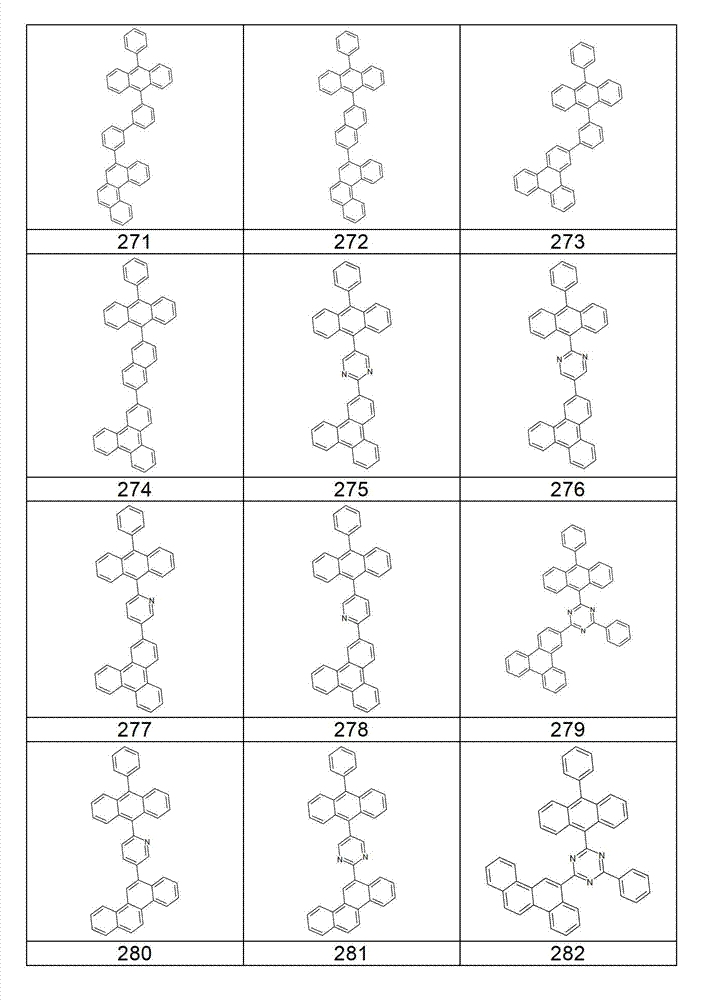

通过本领域普通技术人员通常熟知的合成方法制备通式(I)的化合物。Compounds of general formula (I) are prepared by synthetic methods generally known to those skilled in the art.
本发明的化合物能够通过多种合成路线制备。以下提出优选的路线,但本领域普通技术人员,如果对于他来说合成本发明的化合物看起来是有利的,则他能够在不需要有创造性劳动的前提下绕开这些合成路线,使用他已知的其它合成方法制备本发明的化合物。The compounds of the present invention can be prepared by a variety of synthetic routes. Preferred routes are proposed below, but a person of ordinary skill in the art, if it seems to him advantageous to synthesize the compounds of the present invention, he can bypass these synthetic routes without the need for creative work, using his already The compounds of the present invention can be prepared by other known synthetic methods.
使用的原料化合物例如能够是通式(Z-1)的取代的10-芳基蒽衍生物The raw material compound used can be, for example, a substituted 10-aryl anthracene derivative of the general formula (Z-1)
通式(Z-1)General formula (Z-1)
其中A代表任意希望的反应性基团,并优选选自I、Br、Cl、F、O-甲苯磺酸酯、O-三氟甲磺酸酯、O-磺酸酯、硼酸、硼酸酯、部分氟化的甲硅烷基基团、重氮基团和有机锡化合物。wherein A represents any desired reactive group and is preferably selected from I, Br, Cl, F, O-tosylate, O-triflate, O-sulfonate, boronic acid, borate , partially fluorinated silyl groups, diazo groups and organotin compounds.
另外重要的原料化合物是在根据本发明的位置处被卤化的,特别是被溴化的苯并[a]蒽衍生物。然而,本发明的合成不局限于制备苯并[a]蒽衍生物,而是也包括合成含有基团Ar1的衍生于苯并[a]蒽的其它的通式(I)的化合物。相应其它的卤化基团Ar1用于该目的。Further important starting compounds are halogenated at the positions according to the invention, in particular brominated benz[a]anthracene derivatives. However, the synthesis according to the invention is not limited to the preparation of benz[a]anthracene derivatives, but also includes the synthesis of other compounds of general formula (I) derived from benz[a]anthracene containing the group Ar 1 . Correspondingly further halogenated groups Ar 1 are used for this purpose.
相应的溴化苯并[a]蒽衍生物的合成例子是文献中已知的(2-and3-bromobenzo[a]anthracene:Hallmark等人,J.Lab.Comp.Radiopharm.1981,18(3),331;4-bromobenzo[a]anthracene:Badgar等人,J.Chem.Soc.1949,799;5-bromobenzo[a]anthracene:Newman等人,J.Org.Chem.1982,47(15),2837)。Synthetic examples of corresponding brominated benzo[a]anthracene derivatives are known in the literature (2-and3-bromobenzo[a]anthracene: Hallmark et al., J.Lab.Comp.Radiopharm.1981, 18(3) , 331; 4-bromobenzo[a]anthracene: Badgar et al., J.Chem.Soc.1949,799; 5-bromobenzo[a]anthracene: Newman et al., J.Org.Chem.1982, 47(15), 2837).
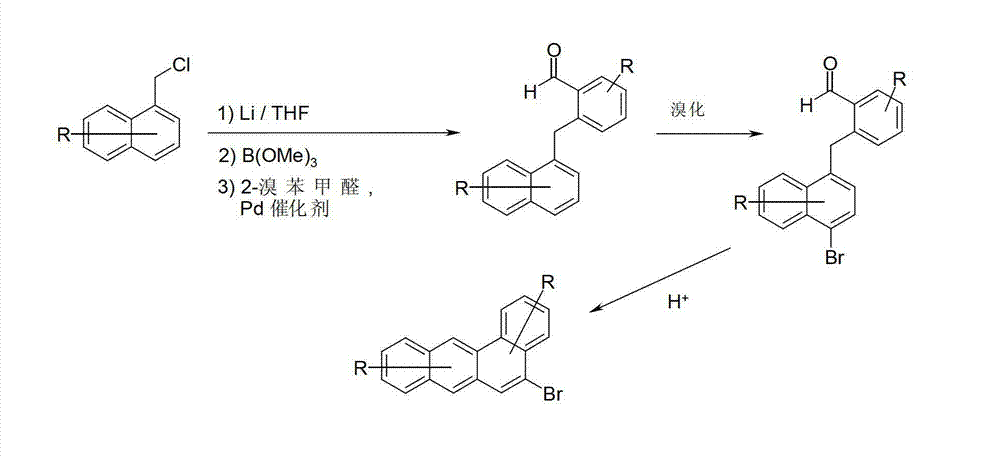
取代或未取代的5-溴苯并[a]蒽或者同样还能够根据方案1从2-溴苯甲醛和1-氯甲基萘获得。方案1中的R代表如对于通式(I)定义的一个或多个基团。代替锂化,在第一步骤中也可以进行与另外的反应性金属例如镁的反应。如有机化学领域普通技术人员已知的,在标准条件下,例如在高温下使用在甲苯/水中的Pd(PPh3)4,同时加入碱,在第一步骤中进行Suzuki偶联。例如能够使用元素溴或使用NBS在第二步骤中进行溴化。例如能够在多磷酸的作用下在第三步骤中进行闭环。Substituted or unsubstituted 5-bromobenz[a]anthracenes can alternatively also be obtained according to scheme 1 from 2-bromobenzaldehyde and 1-chloromethylnaphthalene. R in scheme 1 represents one or more groups as defined for general formula (I). Instead of lithiation, it is also possible to carry out a reaction with another reactive metal, for example magnesium, in the first step. The Suzuki coupling is carried out in the first step under standard conditions, eg, using Pd( PPh3 ) 4 in toluene/water at elevated temperature, with the addition of a base, as known to those of ordinary skill in the art of organic chemistry. Bromination can be carried out in a second step, for example using elemental bromine or using NBS. For example, ring closure can be carried out in a third step under the action of polyphosphoric acid.
方案1plan 1
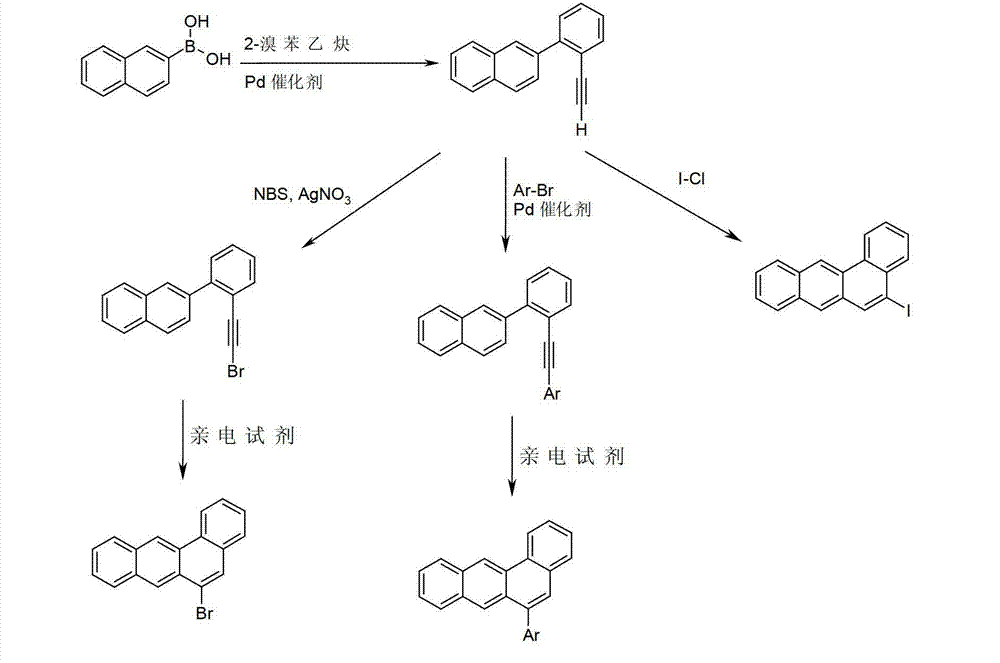
首先能够通过使萘-2-硼酸与2-溴苯乙炔偶联获得6-取代苯并[a]蒽(方案2)。得到的乙炔或者能够直接在闭环反应中发生反应,或能够在卤化之后发生环化,或能够在Sonogashira偶联中与芳族化合物反应,和然后环化。在每种情况下使用亲电试剂进行乙炔的闭环。在方案2中的化合物也可以被一个或多个基团R取代,其中R具有如上所述的在通式(I)下的相同的含义。Ar表示芳族或杂芳族环系。如有机合成领域普通技术人员熟知的,在标准条件下进行Suzuki偶联和Sonogashira偶联。对于闭环反应优选的亲电试剂是强酸,例如CF3COOH,卤化铟,例如InCl3或InBr3,卤化铂,例如PtCl2,或卤间化合物,例如I-Cl。The 6-substituted benzo[a]anthracene can first be obtained by coupling naphthalene-2-boronic acid with 2-bromophenylacetylene (Scheme 2). The resulting acetylene can either be reacted directly in a ring closure reaction, or can be cyclized after halogenation, or can be reacted with an aromatic compound in a Sonogashira coupling, and then cyclized. The ring closure of acetylene was carried out in each case using an electrophile. The compounds in scheme 2 may also be substituted by one or more groups R, wherein R has the same meaning as described above under general formula (I). Ar represents an aromatic or heteroaromatic ring system. Suzuki and Sonogashira couplings are performed under standard conditions, as is well known to those of ordinary skill in the art of organic synthesis. Preferred electrophiles for the ring closure reaction are strong acids such as CF3COOH , indium halides such as InCl3 or InBr3 , platinum halides such as PtCl2 , or interhalogens such as I-Cl.
方案2Scenario 2
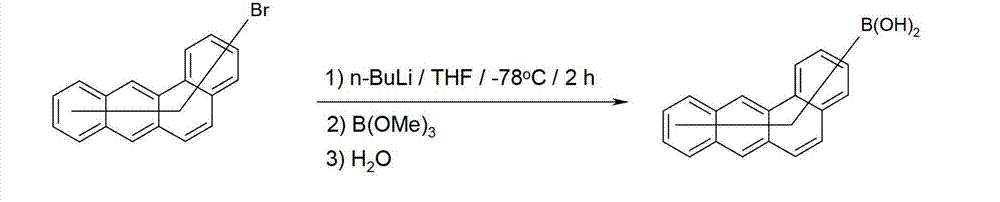
如方案3所示,衍生于所示化合物的硼酸或硼酸衍生物,能够经如下方式获得:例如在THF中在-78℃下使用正丁基锂进行金属转移,和随后使形成为中间体的苯并[a]蒽基锂与硼酸三甲酯反应,任选随后酯化。此外,锂化的化合物能够通过与亲电试剂例如苄腈反应和随后进行酸性水解被转变为酮,或通过与氯代二芳基膦反应和随后氧化被转变为氧化膦。所述锂化化合物与其它亲电试剂的反应同样是可能的。As shown in Scheme 3, boronic acids, or boronic acid derivatives, derived from the compounds shown, can be obtained, for example, by transmetallation using n-butyllithium in THF at -78°C, and subsequent reaction of the intermediates formed as Lithium benzo[a]anthracene is reacted with trimethyl borate, optionally followed by esterification. In addition, lithiated compounds can be converted to ketones by reaction with electrophiles such as benzonitrile followed by acidic hydrolysis, or to phosphine oxides by reaction with chlorodiarylphosphine followed by oxidation. Reaction of the lithiated compounds with other electrophiles is likewise possible.
方案3Option 3
苯并[a]蒽基硼酸与适当的卤代芳基或卤代杂芳基化合物进行Suzuki偶联得到一大类本发明的化合物。Suzuki coupling of benzo[a]anthracenylboronic acids with appropriate haloaryl or haloheteroaryl compounds affords a large class of compounds of the invention.
能够如以下方案所示制备另外的重要的原料化合物,例如相应的卤化和苯并[a]芘化合物。Additional important starting compounds can be prepared as shown in the following schemes, such as the corresponding halogenated and benzo[a]pyrene compounds.
为合成6-溴化
方案4Option 4

此处使相应的化合物与CS2溶液中的元素Br2反应。make the corresponding The compound reacts with elemental Br2 in CS2 solution.
为合成6-溴化苯并[a]芘,遵循例如在方案5中显示的步骤(Synlett2005,15,2281-2284)。For the synthesis of 6-bromobenzo[a]pyrene, the procedure shown eg in Scheme 5 is followed (Synlett 2005, 15, 2281-2284).
方案5Option 5

此处使用CCl4中的N-溴代琥珀酰亚胺加热回流相应的苯并[a]芘化合物。Here the corresponding benzo[a]pyrene compound is heated to reflux using N-bromosuccinimide in CCl4 .
为合成1-溴化苯并[a]芘,遵循例如在方案6中显示的步骤(Eur.J.Org.Chem.2003,16,3162-3166)。For the synthesis of 1-bromobenzo[a]pyrene, the procedure shown eg in scheme 6 is followed (Eur. J. Org. Chem. 2003, 16, 3162-3166).
方案6Option 6

此处以包括氯化、硝化和随后还原的顺序制备1-氨基化合物。在另外的步骤中通过重氮化和桑德迈尔反应将其转变为希望的1-溴苯并[a]芘。Here the 1-amino compound is prepared in a sequence involving chlorination, nitration and subsequent reduction. It is converted to the desired 1-bromobenzo[a]pyrene by diazotization and Sandmeyer reaction in a further step.
为合成3-溴化苯并[a]芘,遵循例如在方案7中显示的步骤(Chem.Pharm.Bull 1990,38,3158-3161)。For the synthesis of 3-bromobenzo[a]pyrene, the procedure shown eg in Scheme 7 is followed (Chem. Pharm. Bull 1990, 38, 3158-3161).
方案7Option 7
此处相应的苯并[a]芘衍生物首先在3-位被选择性硝化,然后还原,最后将得到的胺转变为重氮化合物。然后能够在桑德迈尔反应中使其反应得到希望的3-溴代化合物。Here the corresponding benzo[a]pyrene derivatives are first selectively nitrated at the 3-position, then reduced, and finally the resulting amines are converted to diazonium compounds. This can then be reacted in a Sandmeyer reaction to give the desired 3-bromo compound.
本发明涉及从通式(Z-2)化合物开始合成通式(I)的化合物,The present invention relates to starting to synthesize the compound of general formula (I) from the compound of general formula (Z-2),
Ar1-AAr 1 -A
通式(Z-2)General formula (Z-2)
其中Ar1和A如上所述定义,其中使这些化合物在有机金属偶联反应中与通式(Z-3)的衍生物反应,wherein Ar and A are as defined above, wherein these compounds are reacted with derivatives of general formula (Z-3) in an organometallic coupling reaction ,
A-Ar2-AA-Ar 2 -A
通式(Z-3)General formula (Z-3)
其中Ar2和A如上定义,和A在每次出现时可以是相同或不同的,并且优选是不同的。wherein Ar 2 and A are as defined above, and A at each occurrence may be the same or different, and are preferably different.
在合成本发明化合物中的另外的步骤是与以上显示的通式(Z-1)化合物的有机金属偶联反应。An additional step in the synthesis of the compounds of the present invention is the organometallic coupling reaction with the compound of general formula (Z-1) shown above.
根据本发明这种合成的例子显示于以下的方案8中。An example of such a synthesis according to the invention is shown in Scheme 8 below.
方案8Option 8
使苯并[a]蒽基硼酸与溴碘苯在Suzuki偶联中反应。此处在苯衍生物的碘原子处选择性地发生反应。随后使该产物与10-苯基蒽-9-基硼酸在第二Suzuki反应中反应得到本发明的化合物。对于其它的基团Ar1和Ar2,能够类似地进行所述反应。Benzo[a]anthracenylboronic acid was reacted with bromoiodobenzene in a Suzuki coupling. Here the reaction takes place selectively at the iodine atom of the benzene derivative. Subsequent reaction of this product with 10-phenylanthracen-9-ylboronic acid in a second Suzuki reaction affords compounds of the invention. The reaction can be carried out analogously for the other groups Ar 1 and Ar 2 .
另外的合成例子显示于以下的方案9中。Additional synthetic examples are shown in Scheme 9 below.
方案9Option 9

使苯并[a]芘基硼酸与溴碘苯在Suzuki偶联中反应。此处在苯衍生物的碘原子处选择性地发生反应。随后使该产物与10-苯基蒽-9-基硼酸在第二Suzuki反应中反应得到本发明的化合物。Benzo[a]pyrenylboronic acid was reacted with bromoiodobenzene in a Suzuki coupling. Here the reaction takes place selectively at the iodine atom of the benzene derivative. Subsequent reaction of this product with 10-phenylanthracen-9-ylboronic acid in a second Suzuki reaction affords compounds of the invention.
另外的合成例子显示于以下的方案10中。Additional synthetic examples are shown in Scheme 10 below.
方案10Scheme 10
使
此处在苯衍生物的碘原子处选择性地发生所述反应。随后使该产物与10-苯基蒽-9-基硼酸在第二Suzuki反应中反应得到本发明的化合物。The reaction here takes place selectively at the iodine atom of the benzene derivative. Subsequent reaction of this product with 10-phenylanthracen-9-ylboronic acid in a second Suzuki reaction affords compounds of the invention.
另外的合成例子显示于以下的方案11中。Additional synthetic examples are shown in Scheme 11 below.
方案11Scheme 11

使苯并[a]芘基硼酸与2-溴-6-碘萘或1-溴-5-碘萘在Suzuki偶联中反应。此处在萘衍生物的碘原子处选择性地发生反应。随后使该产物与10-苯基蒽-9-基硼酸在第二Suzuki反应中反应得到本发明的化合物。Benzo[a]pyrenylboronic acid was reacted with 2-bromo-6-iodonaphthalene or 1-bromo-5-iodonaphthalene in a Suzuki coupling. Here the reaction takes place selectively at the iodine atom of the naphthalene derivative. Subsequent reaction of this product with 10-phenylanthracen-9-ylboronic acid in a second Suzuki reaction affords compounds of the invention.
另外的合成例子显示于以下的方案12中。Additional synthetic examples are shown in Scheme 12 below.
方案12Scheme 12

使
另外的合成例子显示于以下的方案13中。Additional synthetic examples are shown in Scheme 13 below.
方案13Scheme 13

使
上面描述的本发明的化合物,特别是那些被反应性离去基团例如溴、碘、硼酸或硼酸酯取代的化合物,能够用作制备相应的低聚物、树枝状聚合物或聚合物的单体。此处的低聚或聚合优选通过卤素官能团或硼酸官能团进行。The compounds of the invention described above, especially those substituted by reactive leaving groups such as bromine, iodine, boronic acid or boronic acid ester, can be used as starting materials for the preparation of corresponding oligomers, dendrimers or polymers. monomer. The oligomerization or polymerization here takes place preferably via halogen functions or boronic acid functions.
因此,本发明还涉及包括一种或多种通式(I)化合物的低聚物、聚合物或树枝状聚合物,其中与至所述聚合物、低聚物或树枝状聚合物的键合的一个或多个键可以位于通式(I)中任何希望的被R、R1、R2或R3取代的位置。取决于通式(I)化合物的连接,该化合物被连接在所述低聚物或聚合物的侧链中或被连接在主链中。在本发明意义上的低聚物被认为是指由至少三个单体单元构成的化合物。在本发明意义上的聚合物被认为是指由至少十个单体单元构成的化合物。本发明的聚合物、低聚物或树枝状聚合物可以是共轭的、部分共轭的或非共轭的。本发明的低聚物或聚合物可以是线性的、支化的或树枝状的。在以线性方式连接的结构中,通式(I)的单元能够彼此直接地连接,或能够通过二价基团彼此连接,例如通过取代或未取代的亚烷基基团,通过杂原子,或通过二价芳族或杂芳族基团连接。在支化和树枝状结构中,通式(I)的三个或更多个单元可以例如经由三价或多价基团连接,例如经由三价或多价芳族或杂芳族基团连接,以得到支化或树枝状的低聚物或聚合物。Accordingly, the present invention also relates to oligomers, polymers or dendrimers comprising one or more compounds of general formula (I), wherein the bond to said polymer, oligomer or dendrimer One or more bonds of may be located at any desired position substituted by R, R 1 , R 2 or R 3 in general formula (I). Depending on the attachment of the compound of general formula (I), the compound is attached in the side chain of the oligomer or polymer or in the main chain. An oligomer in the sense of the present invention is taken to mean a compound consisting of at least three monomer units. A polymer in the sense of the present invention is taken to mean a compound consisting of at least ten monomer units. The polymers, oligomers or dendrimers of the invention may be conjugated, partially conjugated or non-conjugated. The oligomers or polymers of the invention may be linear, branched or dendritic. In structures linked in a linear fashion, the units of general formula (I) can be linked to each other directly, or can be linked to each other via divalent groups, for example via substituted or unsubstituted alkylene groups, via heteroatoms, or Attachment is through a divalent aromatic or heteroaromatic group. In branched and dendritic structures, three or more units of general formula (I) may be linked, for example, via trivalent or polyvalent groups, such as via trivalent or polyvalent aromatic or heteroaromatic groups , to obtain branched or dendritic oligomers or polymers.
对于低聚物、树枝状聚合物和聚合物中的通式(I)的重复单元,适用如上所述对于通式(I)化合物的相同的优选。For recurring units of the general formula (I) in oligomers, dendrimers and polymers, the same preferences as described above for compounds of the general formula (I) apply.
为制备所述低聚物或聚合物,使本发明的单体均聚或与另外的单体共聚。适当的和优选的共聚单体选自芴(例如根据EP 842208或WO 00/22026)、螺二芴(例如根据EP 707020、EP 894107或WO06/061181)、对苯撑(例如根据WO 92/18552)、咔唑(例如根据WO 04/070772或WO 04/113468)、噻吩(例如根据EP 1028136)、二氢菲(例如根据WO 05/014689或WO 07/006383)、顺式和反式茚并芴(例如根据WO 04/041901或WO 04/113412)、酮(例如根据WO 05/040302)、菲(例如根据WO 05/104264或WO 07/017066)或也可以是多个这些单元。所述聚合物、低聚物和树枝状聚合物通常也包含其它单元,例如发光(荧光或磷光)单元,例如乙烯基三芳基胺(例如根据WO 07/068325),或磷光金属络合物(例如根据WO06/003000),和/或电荷传输单元,特别是基于三芳基胺的那些。To prepare the oligomers or polymers, the monomers according to the invention are homopolymerized or copolymerized with further monomers. Suitable and preferred comonomers are selected from fluorene (e.g. according to EP 842208 or WO 00/22026), spirobifluorene (e.g. according to EP 707020, EP 894107 or WO06/061181), p-phenylene (e.g. according to WO 92/18552 ), carbazole (eg according to WO 04/070772 or WO 04/113468), thiophene (eg according to EP 1028136), dihydrophenanthrene (eg according to WO 05/014689 or WO 07/006383), cis and trans indeno Fluorene (eg according to WO 04/041901 or WO 04/113412), ketone (eg according to WO 05/040302), phenanthrene (eg according to WO 05/104264 or WO 07/017066) or also a plurality of these units. The polymers, oligomers and dendrimers usually also contain other units, for example light-emitting (fluorescent or phosphorescent) units, for example vinyltriarylamines (eg according to WO 07/068325), or phosphorescent metal complexes ( For example according to WO 06/003000), and/or charge transport units, especially those based on triarylamines.
本发明的聚合物、低聚物和树枝状聚合物具有有利的性能,特别是长寿命、高效率和良好的彩色坐标。The polymers, oligomers and dendrimers of the invention have advantageous properties, in particular long lifetime, high efficiency and good color coordinates.
本发明聚合物和低聚物通常通过聚合一种或多种类型的单体制备,其至少一种单体导致聚合物中通式(I)的重复单元。适当的聚合反应是本领域普通技术人员已知的,且其描述于文献中。特别适当的和优选的导致C-C或C-N连接的聚合反应是以下反应:The polymers and oligomers of the invention are generally prepared by polymerizing one or more types of monomers, at least one of which leads to repeat units of general formula (I) in the polymer. Suitable polymerization reactions are known to those of ordinary skill in the art and are described in the literature. Particularly suitable and preferred polymerization reactions leading to C-C or C-N linkages are the following reactions:
(A)SUZUKI聚合;(A) SUZUKI polymerization;
(B)YAMAMOTO聚合;(B) YAMAMOTO polymerization;
(C)STILLE聚合;和(C) STILLE polymerization; and
(D)HARTWIG-BUCHWALD聚合。(D) HARTWIG-BUCHWALD aggregation.
通过这些方法能够进行聚合的方式和然后将所述聚合物从反应介质中分离并纯化的方式是本领域普通技术人员已知的,且其详细地描述于文献中,例如WO 03/048225、WO 2004/037887和WO2004/037887中。The manner in which polymerisation can be carried out by these methods and the manner in which said polymer is then isolated and purified from the reaction medium is known to the person skilled in the art and is described in detail in the literature, for example WO 03/048225, WO 03/048225, WO 2004/037887 and WO2004/037887.
因此,本发明也涉及制备本发明的聚合物、低聚物和树枝状聚合物的方法,其特征在于它们通过SUZUKI聚合、YAMAMOTO聚合、STILLE聚合或HARTWIG-BUCHWALD聚合制备。本发明的树枝状聚合物能够通过本领域普通技术人员已知的方法或与其类似的方法制备。适当的方法描述于文献中,例如Frechet,Jean M.J.;Hawker,Craig J.,“Hyperbranched polyphenylene and hyperbranchedpolyesters:new soluble,three-dimensional,reactive polymers”,Reactive&Functional Polymers(1995),26(1-3),127-36;Janssen,H.M.;Meijer,E.W.,“The synthesis and characterisation of dend riticmolecules”,Materials Science and Technology(1999),20(Synthesisof Polymers),403-458;Tomalia,Donald A.,“Dendrimer molecules”,Scientific American(1995),272(5),62-6;WO 02/067343A1和WO2005/026144A1中。The present invention therefore also relates to a process for the preparation of the polymers, oligomers and dendrimers according to the invention, characterized in that they are prepared by SUZUKI polymerisation, YAMAMOTO polymerisation, STILLE polymerisation or HARTWIG-BUCHWALD polymerisation. The dendrimers of the present invention can be prepared by methods known to those skilled in the art or methods analogous thereto. Suitable methods are described in the literature, e.g. Frechet, Jean M.J.; Hawker, Craig J., "Hyperbranched polyphenylene and hyperbranched polyesters: new soluble, three-dimensional, reactive polymers", Reactive & Functional Polymers (1995), 26(1-3), 127-36; Janssen, H.M.; Meijer, E.W., "The synthesis and characterization of dendrimer molecules", Materials Science and Technology (1999), 20 (Synthesis of Polymers), 403-458; Tomalia, Donald A., "Dendrimer molecules" , Scientific American (1995), 272(5), 62-6; WO 02/067343A1 and WO2005/026144A1.
本发明也涉及制剂,其包含至少一种通式(I)化合物或含有至少一种通式(I)单元的聚合物、低聚物或树枝状聚合物,和至少一种溶剂,优选有机溶剂。The invention also relates to preparations comprising at least one compound of general formula (I) or a polymer, oligomer or dendrimer containing at least one unit of general formula (I), and at least one solvent, preferably an organic solvent .
本发明的通式(I)的化合物和低聚物、树枝状聚合物和聚合物适合用于电子器件中,特别是用于有机电致发光器件(OLED)中。取决于取代,所述化合物用于不同的功能和层中。The compounds of the general formula (I) and the oligomers, dendrimers and polymers according to the invention are suitable for use in electronic devices, in particular in organic electroluminescent devices (OLEDs). Depending on the substitutions, the compounds are used in different functions and layers.
因此,本发明还涉及本发明的通式(I)的化合物或包括通式(I)化合物的低聚物、树枝状聚合物或聚合物在电子器件,特别是在有机电致发光器件中的用途。Therefore, the present invention also relates to the use of compounds of general formula (I) or oligomers, dendrimers or polymers comprising compounds of general formula (I) according to the invention in electronic devices, in particular in organic electroluminescent devices use.
此外,本发明还涉及电子器件,特别是有机电致发光器件(OLED)、有机集成电路(O-IC)、有机场效应晶体管(O-FET)、有机薄膜晶体管(O-TFT)、有机发光晶体管(O-LET)、有机太阳能电池(O-SC)、有机光学探测器、有机光感受器、有机场猝熄器件(O-FQD)、发光电化学电池(LEC)或有机激光二极管(O-laser),其包含至少一种通式(I)的化合物或本发明的低聚物、树枝状聚合物或聚合物。特别优选包含至少一种通式(I)的化合物或本发明的低聚物、树枝状聚合物或聚合物的有机电致发光器件。In addition, the present invention also relates to electronic devices, especially organic electroluminescent devices (OLEDs), organic integrated circuits (O-ICs), organic field-effect transistors (O-FETs), organic thin-film transistors (O-TFTs), organic light-emitting Transistors (O-LETs), organic solar cells (O-SCs), organic optical detectors, organic photoreceptors, organic field-quenched devices (O-FQDs), light-emitting electrochemical cells (LECs), or organic laser diodes (O- laser) comprising at least one compound of general formula (I) or an oligomer, dendrimer or polymer according to the invention. Particular preference is given to organic electroluminescent devices comprising at least one compound of the general formula (I) or an oligomer, dendrimer or polymer according to the invention.
所述有机电致发光器件优选包括阳极、阴极和至少一个发光层,其特征在于可以是发光层或另外的层的至少一个有机层,包含至少一种通式(I)的化合物或至少一种本发明的低聚物、树枝状聚合物或聚合物。在本发明另外优选的实施方式中,所述有机电致发光器件包括多个不同的本发明的化合物或本发明的低聚物、树枝状聚合物或聚合物,它们可以一起位于同一层中或位于不同的层中。The organic electroluminescent device preferably comprises an anode, a cathode and at least one emitting layer, characterized in that at least one organic layer, which may be a emitting layer or another layer, comprises at least one compound of general formula (I) or at least one Oligomers, dendrimers or polymers of the invention. In a further preferred embodiment of the invention, the organic electroluminescent device comprises a plurality of different compounds of the invention or oligomers, dendrimers or polymers of the invention, which can be located together in the same layer or in different layers.
除了阴极、阳极和发光层,所述有机电致发光器件也可以包括另外的层。这些例如在每种情况下选自一个或多个空穴注入层、空穴传输层、电子阻挡层、电子传输层、电子注入层、电荷产生层(IDMC 2003,Taiwan;Session 21 OLED(5),T.Matsumoto,T.Nakada,J.Endo,K.Mori,N.Kawam ura,A.Yokoi,J.Kido,Multiphoton Organic ELDevice Having Charge Generation Layer)和/或有机或无机p/n结。另外,在单独的层之间也可以存在夹层。然而,应当指出不必要存在这些层的每一个。Besides cathode, anode and emitting layer, the organic electroluminescent device may also comprise further layers. These are for example selected in each case from one or more hole injection layers, hole transport layers, electron blocking layers, electron transport layers, electron injection layers, charge generation layers (IDMC 2003, Taiwan; Session 21 OLED(5) , T.Matsumoto, T.Nakada, J.Endo, K.Mori, N.Kawam ura, A.Yokoi, J.Kido, Multiphoton Organic ELDevice Having Charge Generation Layer) and/or organic or inorganic p/n junctions. In addition, interlayers may also be present between individual layers. However, it should be noted that it is not necessary for each of these layers to be present.
有机电致发光领域的普通技术人员知道他能够使用哪些材料用于这些另外的层。通常,如现有技术中使用的所有的材料都适合于该另外的层,且本领域普通技术人员能够在不付出创造性劳动的情况下,在有机电致发光器件中将这些材料与本发明的材料结合。A person skilled in the art of organic electroluminescence knows which materials he can use for these further layers. In general, all materials as used in the prior art are suitable for this additional layer, and a person skilled in the art can, without inventive step, combine these materials with the present invention in an organic electroluminescent device. Material binding.
在本发明另外优选的实施方式中,所述有机电致发光器件包括多个发光层,其中至少一个有机层包含至少一种通式(I)的化合物或本发明的低聚物、树枝状聚合物或聚合物。这些发光层特别优选在380nm和750nm之间总共具有多个发光峰值,导致总体上白色发光,即,在该发光层中使用能够发荧光或发磷光和发蓝色和黄色、橙色或红色光的不同的发光化合物。此处通式(I)的化合物优选用于发蓝色和/或绿色光的层中。特别优选三层体系,即,具有三个发光层的体系,其中这些层的一个可以包含一种或多种通式(I)的化合物,和其中所述三个层显示蓝色、绿色和橙色或者红色发光(对于基本结构,例如见WOIn another preferred embodiment of the present invention, the organic electroluminescent device comprises a plurality of emitting layers, wherein at least one organic layer comprises at least one compound of general formula (I) or an oligomer, dendritic polymer according to the invention substances or polymers. These emissive layers particularly preferably have in total a plurality of emission peaks between 380 nm and 750 nm, resulting in an overall white emission, i.e., in the emissive layer are used fluorescent or phosphorescent and blue and yellow, orange or red emitting different luminescent compounds. The compounds of the general formula (I) are preferably used here in the blue- and/or green-emitting layer. Particular preference is given to three-layer systems, i.e. systems with three emitting layers, wherein one of these layers may contain one or more compounds of general formula (I), and wherein the three layers display blue, green and orange colors or red emission (for the basic structure, see e.g. WO
05/011013)。同样适合于白色发光的是那些具有宽频带发光且因此显示白色发光的发光体。因此,本发明的优选实施方式代表包括多个发光层且总体发白色光的有机电致发光器件,其中该器件的至少一个层,优选发光层,包含至少一种通式(I)的化合物。05/011013). Also suitable for white emission are those emitters which have broadband emission and thus exhibit white emission. A preferred embodiment of the invention therefore represents an organic electroluminescent device comprising a plurality of emitting layers and which emits overall white light, wherein at least one layer of the device, preferably the emitting layer, comprises at least one compound of the general formula (I).
在本发明的一个实施方式中,通式(I)的化合物用作掺杂剂的主体材料,优选用作荧光掺杂剂的主体材料,特别是用于蓝色或绿色荧光掺杂剂的主体材料。在这种情况下,本发明的化合物优选包括多个稠合的芳基或杂芳基基团。In one embodiment of the present invention, the compound of general formula (I) is used as a host material for a dopant, preferably as a host material for a fluorescent dopant, especially for a blue or green fluorescent dopant Material. In such cases, the compounds of the invention preferably comprise multiple fused aryl or heteroaryl groups.
在本发明的另外的实施方式中,通式(I)的化合物与另外的主体材料一起用作共主体材料。在这种情况下它们的比例优选是5至95体积%。在本发明意义上的共主体体系是包含至少三种化合物,发光掺杂剂和两种主体材料的层。另外的掺杂剂和主体材料可以存在于该层中。此处所述掺杂物的比例为0.1-30体积%,优选1-20体积%,非常特别优选1-10体积%,和所述两种主体一起构成其余的量;主体与共主体的比率可在宽的范围内调节,但优选在1∶10至10∶1的范围内,特别优选在1∶4至4∶1的范围内。In a further embodiment of the invention, the compounds of general formula (I) are used as co-host materials together with further host materials. Their proportion in this case is preferably 5 to 95% by volume. A co-host system in the sense of the present invention is a layer comprising at least three compounds, an emitting dopant and two host materials. Additional dopants and host materials may be present in this layer. The proportion of the dopant here is 0.1-30% by volume, preferably 1-20% by volume, very particularly preferably 1-10% by volume, together with the two hosts the remaining amount is formed; the ratio of host to co-host can be The adjustment is within a wide range, but preferably in the range from 1:10 to 10:1, particularly preferably in the range from 1:4 to 4:1.
在包含主体和掺杂剂的体系中的主体材料被认为是指以较高比例存在于所述体系中的组分。在包含一种主体和多种掺杂剂的体系中,所述主体被认为是指在所述混合物中比例最高的组分。A host material in a system comprising a host and a dopant is taken to mean the component present in said system in a relatively high proportion. In systems comprising a host and dopants, the host is taken to mean the component with the highest proportion in the mixture.
在发光层中通式(I)的主体材料的比例为50.0至99.9体积%,优选80.0至99.5体积%,特别优选90.0至99.0体积%。相应地,所述掺杂剂的比例为0.01至50.0体积%,优选0.5至20.0体积%,和特别优选1.0至10.0体积%。The proportion of host material of the general formula (I) in the emitting layer is 50.0 to 99.9% by volume, preferably 80.0 to 99.5% by volume, particularly preferably 90.0 to 99.0% by volume. Accordingly, the proportion of the dopant is 0.01 to 50.0% by volume, preferably 0.5 to 20.0% by volume and particularly preferably 1.0 to 10.0% by volume.
优选的掺杂剂选自单苯乙烯基胺、二苯乙烯基胺、三苯乙烯基胺、四苯乙烯基胺、苯乙烯基膦、苯乙烯基醚和芳基胺类。单苯乙烯基胺被认为是指包含一个取代或未取代苯乙烯基基团和至少一种胺优选芳族胺的化合物。二苯乙烯基胺被认为是指包含两个取代或未取代的苯乙烯基基团和至少一种胺优选芳族胺的化合物。三苯乙烯基胺被认为是指包含三个取代或未取代的苯乙烯基基团和至少一种胺优选芳族胺的化合物。四苯乙烯基胺被认为是指包含四个取代或未取代的苯乙烯基基团和至少一种胺优选芳族胺的化合物。所述苯乙烯基基团特别优选是茋,其也可以被进一步取代。类似于胺,定义相应的膦和醚。为了本发明的目的,芳基胺或芳族胺被认为是指包含三个与氮直接键合的取代或未取代的芳族或杂芳族环系的化合物。至少一个这些芳族或者杂芳族环系优选是稠环系,其特别优选具有至少14个芳族环原子。其优选的例子是芳族蒽胺、芳族蒽二胺、芳族芘胺、芳族芘二胺、芳族


在本发明的另外优选的实施方式中,将通式(I)的化合物用作与以下通式(II)的蒽化合物结合的主体材料:In a further preferred embodiment of the present invention, compounds of general formula (I) are used as host materials in combination with anthracene compounds of general formula (II):

通式(II),general formula (II),
其中另外:which additionally:
R5在每次出现时相同或不同地是具有1至40个C原子的直链烷基基团或具有3至40个C原子的支链或环状的烷基基团,它们每个可被一个或多个基团R4取代,其中一个或多个非相邻的CH2基团可被-R4C=CR4-、-C≡C-、Si(R4)2、Ge(R4)2、Sn(R4)2、C=O、C=S、C=Se、C=NR4、P(=O)(R4)、SO、SO2、NR4、-O-、-S-、-COO-或-CONR4-代替,和其中一个或多个H原子可被D、F、Cl、Br、I、CN或NO2代替,或具有5至60个芳族环原子的芳族或杂芳族环系,它们可被一个或多个基团R4取代;和Each occurrence of R is identically or differently a linear alkyl group having 1 to 40 C atoms or a branched or cyclic alkyl group having 3 to 40 C atoms, each of which can be Substituted by one or more groups R 4 , where one or more non-adjacent CH 2 groups can be replaced by -R 4 C=CR 4 -, -C≡C-, Si(R 4 ) 2 , Ge( R 4 ) 2 , Sn(R 4 ) 2 , C=O, C=S, C=Se, C=NR 4 , P(=O)(R 4 ), SO, SO 2 , NR 4 , -O- , -S-, -COO- or -CONR 4 - instead, and wherein one or more H atoms may be replaced by D, F, Cl, Br, I, CN or NO 2 , or have 5 to 60 aromatic rings Atoms of aromatic or heteroaromatic ring systems, which may be substituted by one or more groups R 4 ; and
Ar在每次出现时相同或不同地是具有5至60个芳族环原子的芳族或杂芳族环系,它们可被一个或多个基团R4取代,其中键合到同一氮原子的两个基团Ar可以通过单键或选自B(R4)、C(R4)2、Si(R4)2、C=O、C=NR4、C=C(R4)2、O、S、S=O、SO2、N(R4)、P(R4)和P(=O)R4的桥连基彼此连接;和Ar in each occurrence, identically or differently, is an aromatic or heteroaromatic ring system having 5 to 60 aromatic ring atoms, which may be substituted by one or more groups R4 , which are bonded to the same nitrogen atom The two groups Ar can pass a single bond or be selected from B(R 4 ), C(R 4 ) 2 , Si(R 4 ) 2 , C=O, C=NR 4 , C=C(R 4 ) 2 , O, S, S=O, SO 2 , N(R 4 ), P(R 4 ), and P(=O)R 4 bridging groups are connected to each other; and
R4如上定义。 R4 is as defined above.
在本发明的优选实施方式中,通式(II)的化合物用作荧光发光体化合物。In a preferred embodiment of the invention, compounds of the general formula (II) are used as fluorescent emitter compounds.
通式(II)化合物特别优选的实施方式显示于以下表中。Particularly preferred embodiments of the compounds of general formula (II) are shown in the table below.

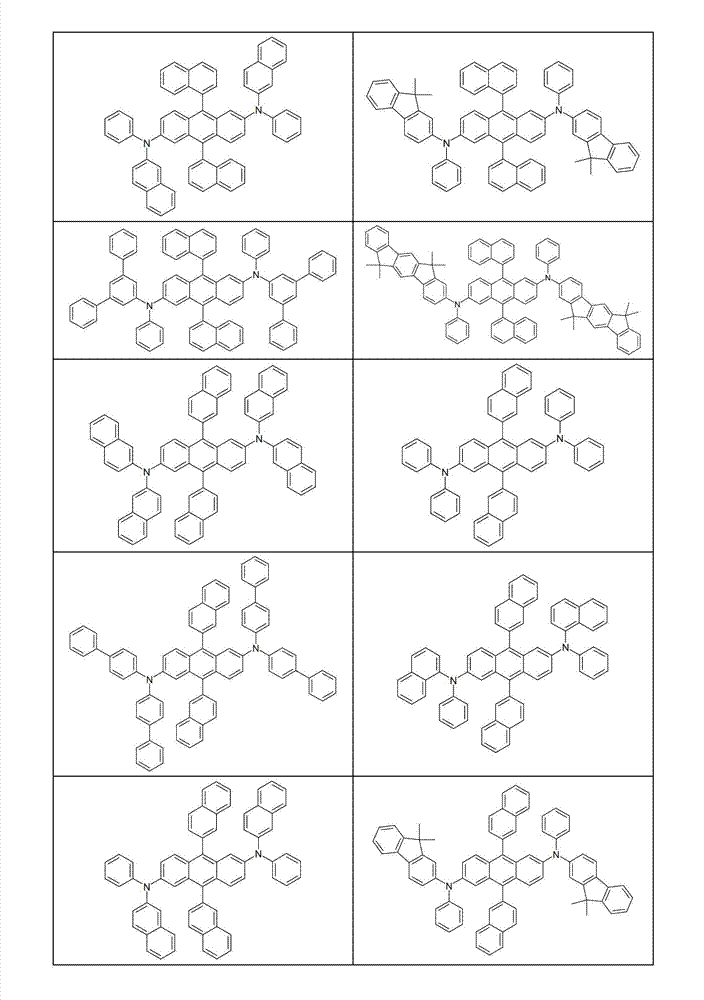
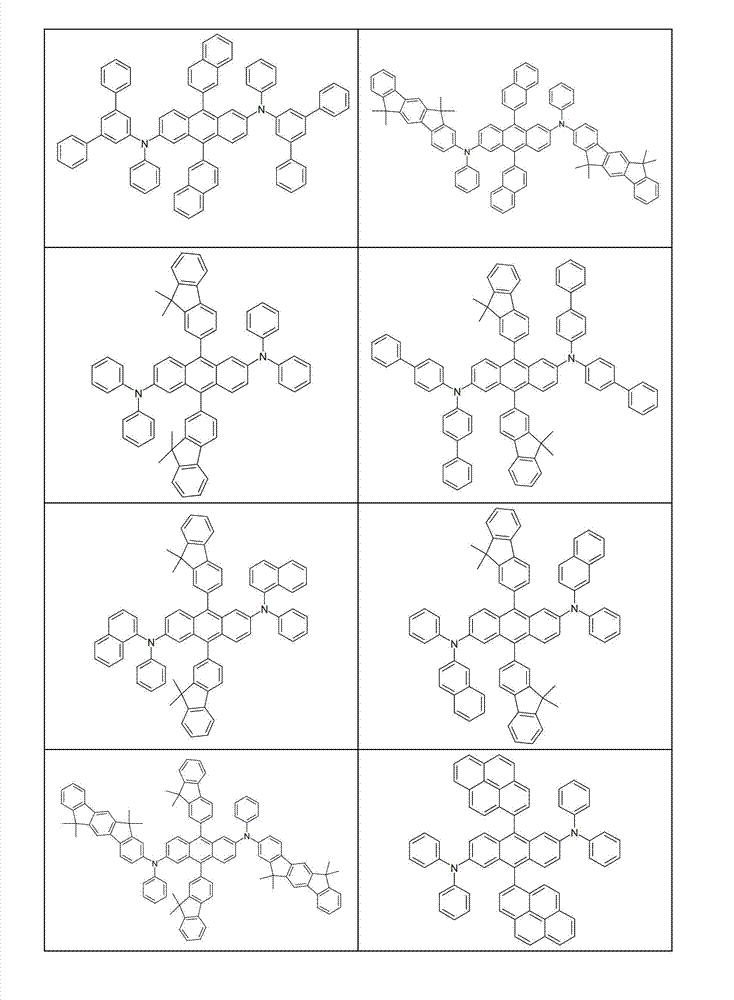


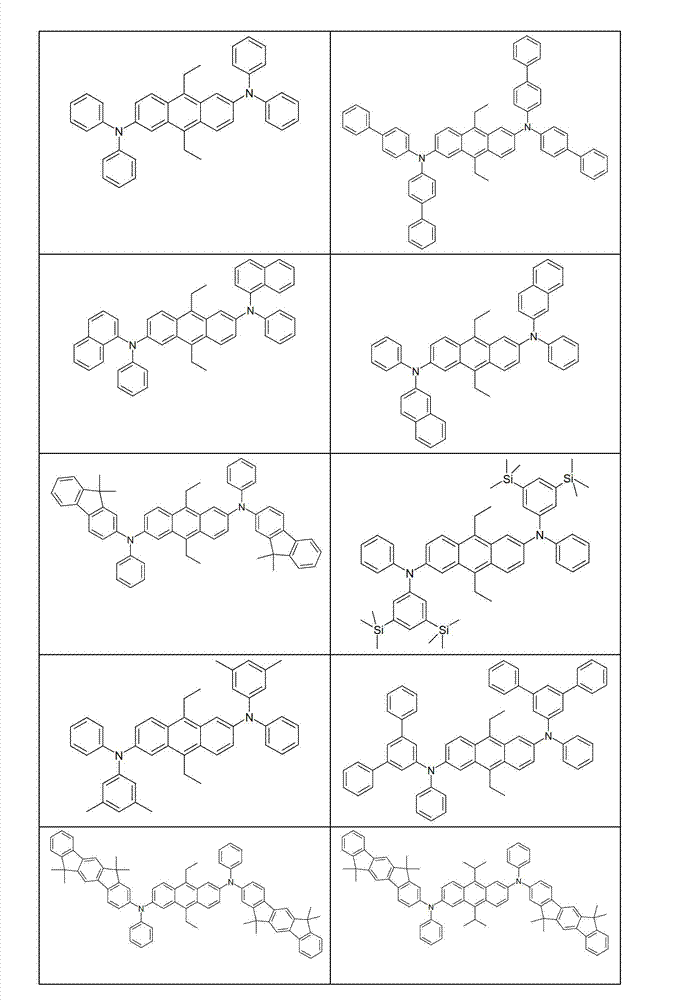
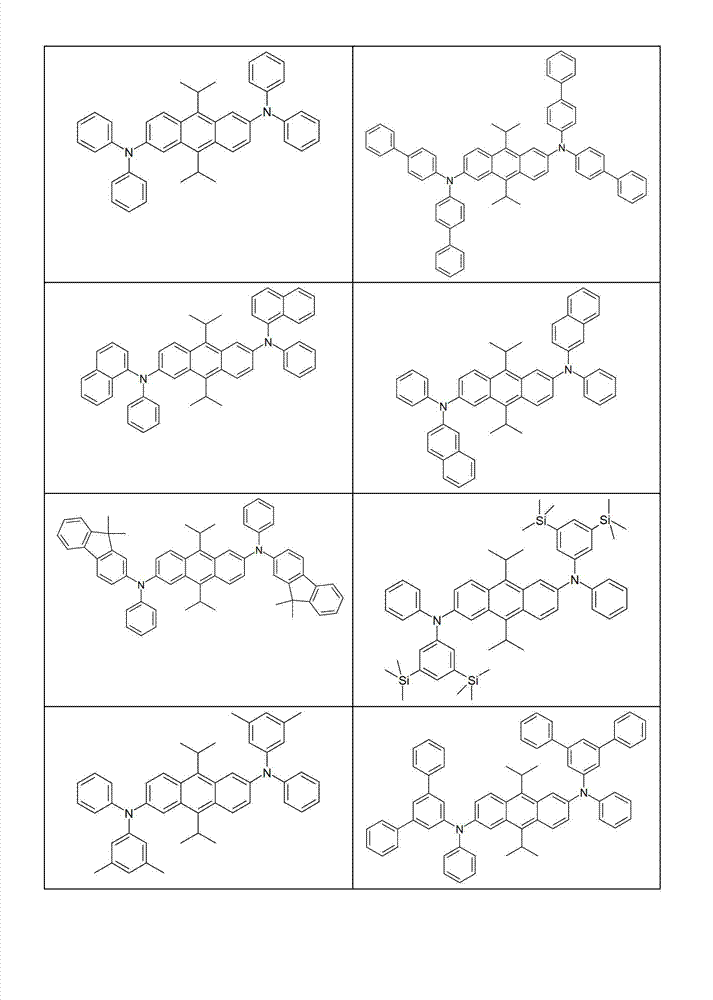
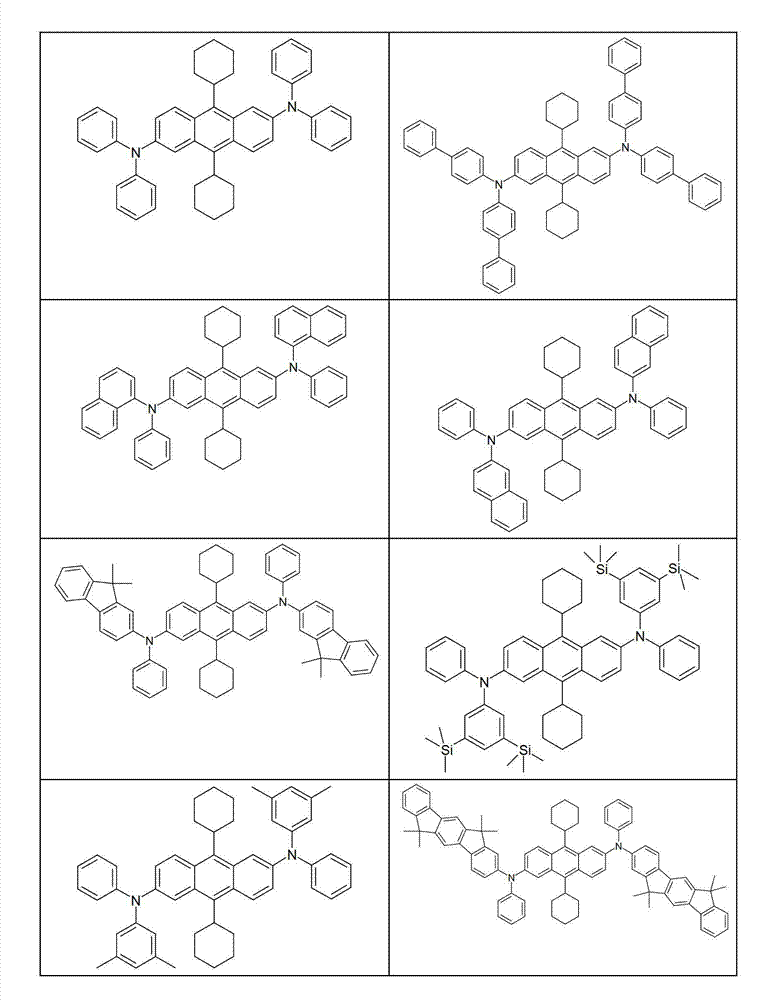
与作为基质材料的通式(I)化合物结合的另外的适当的掺杂剂是以下表中描绘的化合物,和在JP 06/001973、WO 04/047499、WO06/098080、WO 07/065678、US 2005/0260442和WO 04/092111中公开的衍生物。Further suitable dopants in combination with compounds of general formula (I) as matrix material are the compounds depicted in the following tables, and in JP 06/001973, WO 04/047499, WO 06/098080, WO 07/065678, US Derivatives disclosed in 2005/0260442 and WO 04/092111.
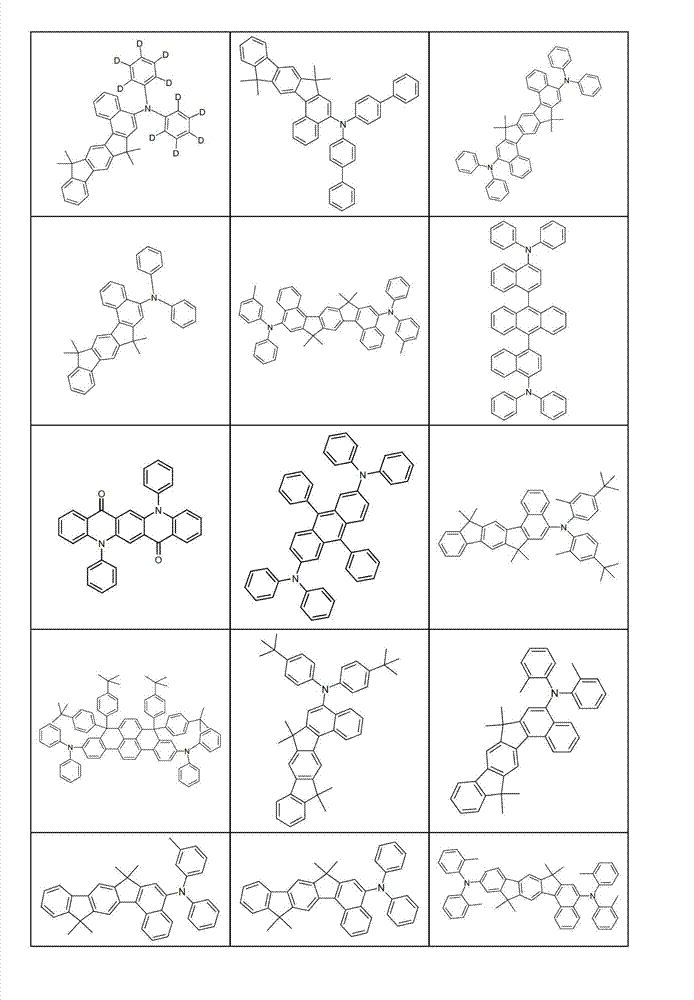
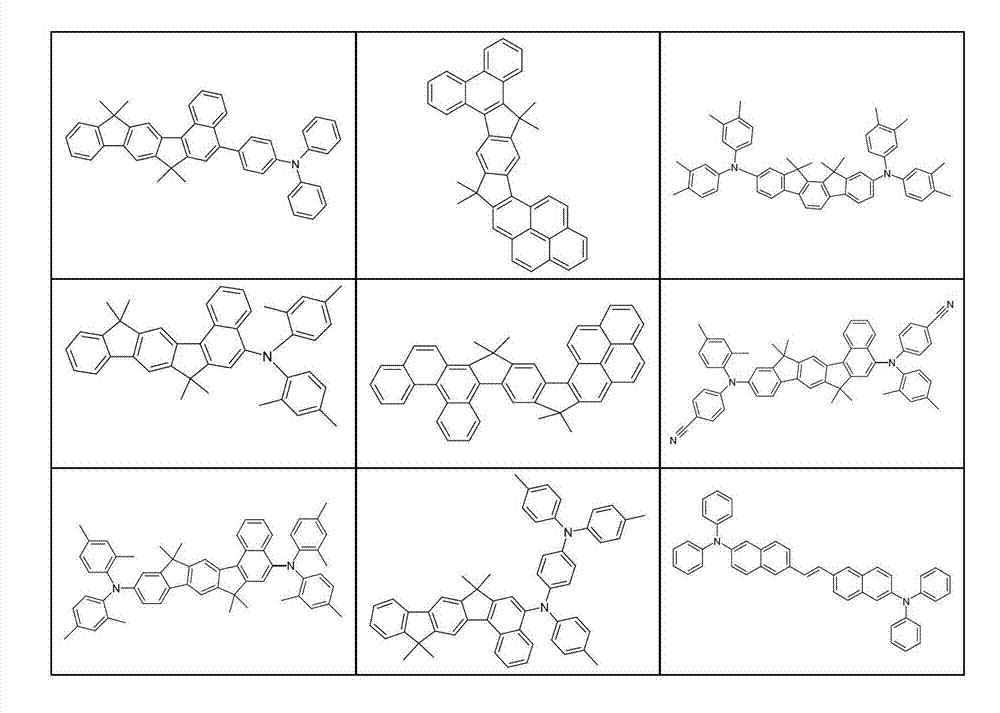
在本发明另外的实施方式中,通式(I)的化合物在发光层中用作发光材料或位于共主体体系中(参见上面)。如果所述化合物包括至少一个二芳基氨基单元,则该化合物特别适合作为发光化合物。在这种情况下本发明的化合物特别优选用作绿色或蓝色发光体。如果本发明的材料满足上述提到的作为主体的要求,则该材料适合作为共主体。In a further embodiment of the invention, the compounds of the general formula (I) are used as emitting materials in the emitting layer or in co-host systems (see above). The compounds are particularly suitable as emitting compounds if the compounds comprise at least one diarylamino unit. In this case the compounds according to the invention are particularly preferably used as green or blue emitters. A material according to the invention is suitable as a co-host if it fulfills the above mentioned requirements as a host.
在发光层混合物中作为掺杂剂的通式(I)发光化合物的比例在这种情况下为0.1至50.0体积%,优选0.5至20.0体积%,特别优选1.0至10.0体积%。相应地,所述主体材料的比例为50.0至99.9体积%,优选80.0至99.5体积%,特别优选90.0至99.0体积%。The proportion of emitting compounds of the general formula (I) as dopant in the emitting layer mixture is in this case 0.1 to 50.0% by volume, preferably 0.5 to 20.0% by volume, particularly preferably 1.0 to 10.0% by volume. Correspondingly, the proportion of the host material is 50.0 to 99.9% by volume, preferably 80.0 to 99.5% by volume, particularly preferably 90.0 to 99.0% by volume.
作为共主体的本发明的材料的比例如上所述。The proportions of the materials of the invention as co-hosts are as described above.
适当的另外的主体材料,除通式(I)的化合物之外,是多种类别物质的材料。优选的主体材料选自如下类别:低聚亚芳基(例如根据EP676461的2,2′,7,7′-四苯基螺二芴,或二萘基蒽),特别是含稠合芳族烃基团的低聚亚芳基,低聚亚芳基亚乙烯基(例如根据EP676461的DPVBi或螺-DPVBi),多足金属络合物(例如根据WO 04/081017),空穴传导化合物(例如根据WO 04/058911),电子传导化合物,特别是酮、氧化膦、亚砜等(例如根据WO 05/084081和WO 05/084082),阻转异构体(例如根据WO 06/048268),硼酸衍生物(例如根据WO06/117052),或苯并蒽(例如根据WO 08/145239)。此外适当的主体材料同样是本发明的化合物。除本发明的化合物之外,特别优选的主体材料选自如下的类别:含萘、蒽、苯并蒽和/或芘的低聚亚芳基,或这些化合物的阻转异构体,低聚亚芳基亚乙烯基,酮,氧化膦和亚砜。除本发明的化合物之外,非常特别优选的主体材料选自含蒽、苯并蒽、苯并菲和/或芘的低聚亚芳基类,或这些化合物的阻转异构体类。在本发明意义上的低聚亚芳基旨在被认为是指其中至少三个芳基或亚芳基基团彼此键合的化合物。Suitable further host materials, besides the compounds of the general formula (I), are materials of various classes of substances. Preferred host materials are selected from the following classes: oligoarylenes (e.g. 2,2′,7,7′-tetraphenylspirobifluorene according to EP676461, or dinaphthylanthracene), especially containing fused aromatic Oligoarylenes of hydrocarbon groups, oligoarylenevinylenes (eg DPVBi or spiro-DPVBi according to EP676461), multipod metal complexes (eg according to WO 04/081017), hole-conducting compounds (eg According to WO 04/058911), electron-conducting compounds, especially ketones, phosphine oxides, sulfoxides, etc. (for example according to WO 05/084081 and WO 05/084082), atropisomers (for example according to WO 06/048268), boronic acids Derivatives (eg according to WO 06/117052), or benzanthracene (eg according to WO 08/145239). Furthermore suitable host materials are likewise the compounds according to the invention. In addition to the compounds of the invention, particularly preferred host materials are selected from the classes of oligoarylenes containing naphthalene, anthracene, benzanthracene and/or pyrene, or atropisomers of these compounds, oligomeric Arylene vinylene, ketone, phosphine oxide and sulfoxide. In addition to the compounds according to the invention, very particularly preferred host materials are selected from the class of oligoarylenes containing anthracene, benzanthracene, triphenanthrene and/or pyrene, or the class of atropisomers of these compounds. An oligoarylene in the sense of the present invention is intended to be taken to mean a compound in which at least three aryl or arylene groups are bonded to one another.
此外,适合的主体材料例如是以下表中描绘的材料,和这些材料的如公开在WO 04/018587、WO 08/006449、US 5935721、US2005/0181232、JP 2000/273056、EP 681019、US 2004/0247937和US 2005/0211958中的衍生物。Furthermore, suitable host materials are, for example, the materials depicted in the table below, and examples of these materials are disclosed in WO 04/018587, WO 08/006449, US 5935721, US2005/0181232, JP 2000/273056, EP 681019, US 2004/ 0247937 and derivatives in US 2005/0211958.
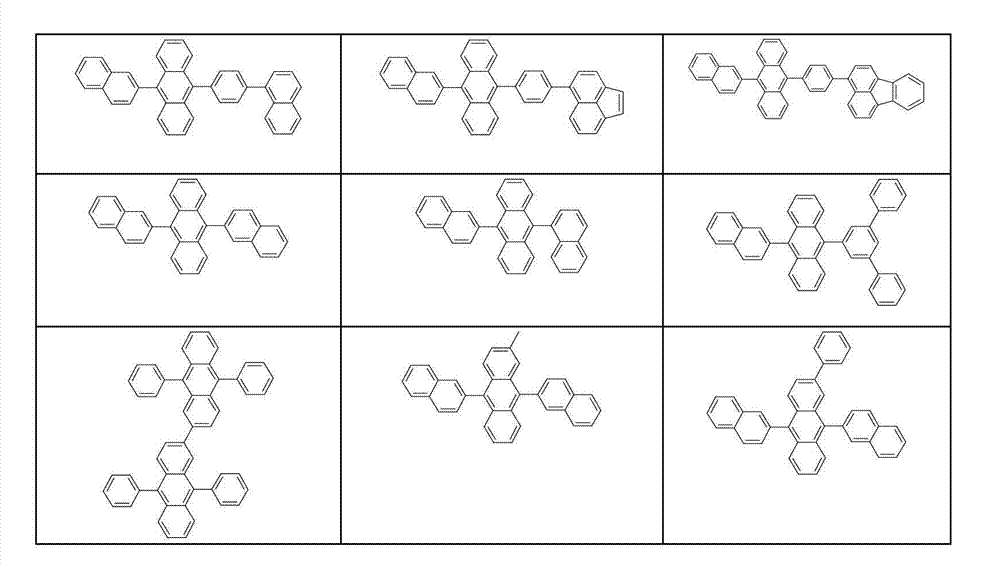
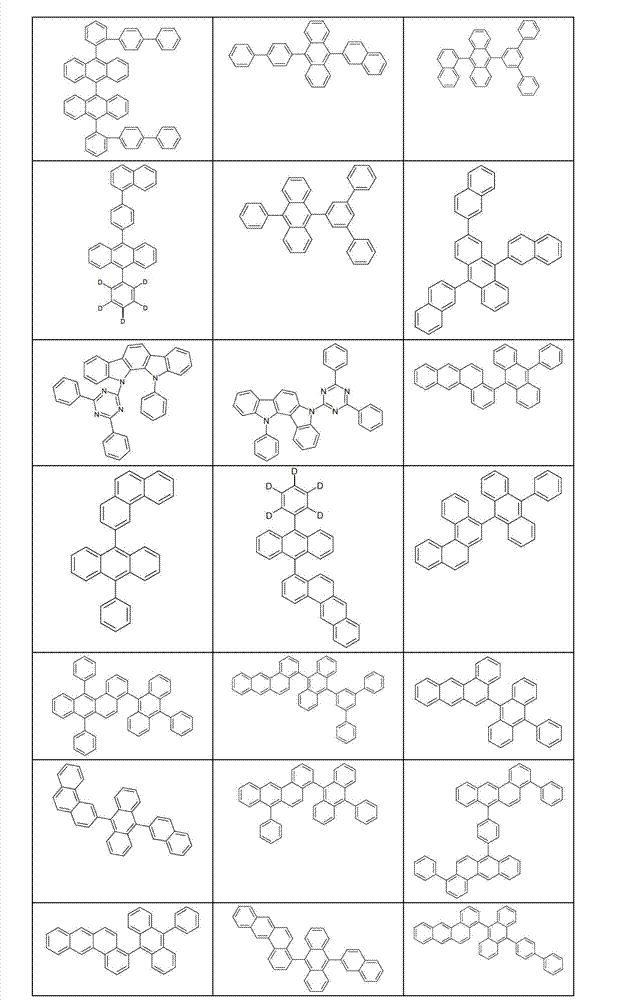
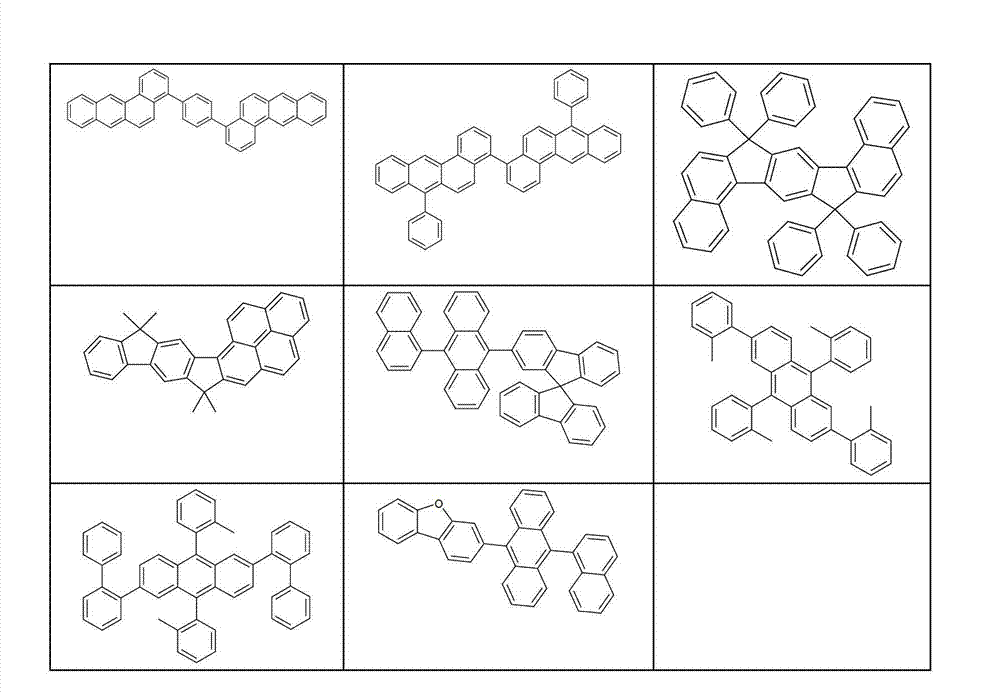
在本发明的又一另外的实施方式中,通式(I)的化合物用作空穴传输层中的空穴传输材料,特别优选在空穴传输层中以5至95体积%的比例作为共空穴传输材料。在这种情况下所述化合物优选被至少一个N(Ar)2基团取代。在另外优选的实施方式中,通式(I)的化合物用作空穴注入层中的空穴注入材料。在本发明意义上的空穴注入层是与阳极直接相邻的层。在本发明意义上的空穴传输层是位于空穴注入层和发光层之间的层。如果通式(I)的化合物用作空穴传输或空穴注入材料,则优选其掺杂有电子受体化合物,例如掺杂有F4-TCNQ或掺杂有描述在EP 1476881或EP 1596445中的化合物。In yet another further embodiment of the invention, the compound of the general formula (I) is used as hole-transport material in the hole-transport layer, particularly preferably in a proportion of 5 to 95% by volume in the hole-transport layer as a co- hole transport material. In this case the compound is preferably substituted by at least one N(Ar) 2 group. In a further preferred embodiment, the compound of the general formula (I) is used as hole-injection material in the hole-injection layer. A hole-injection layer in the sense of the invention is the layer directly adjacent to the anode. A hole-transport layer in the sense of the invention is a layer located between the hole-injection layer and the emitting layer. If the compound of general formula (I) is used as hole-transport or hole-injection material, it is preferably doped with an electron acceptor compound, for example with F4-TCNQ or with the compound.
在本发明电子器件中的空穴传输层任选用p-掺杂剂掺杂或未掺杂。The hole-transport layer in the electronic device according to the invention is optionally doped with p-dopants or undoped.
在本发明的又一另外的实施方式中,通式(I)的化合物用作电子传输材料。此处优选本发明的化合物被至少一个C=O、P(=O)和/或SO2单元取代。在这种情况下同样优选所述化合物包含一个或多个缺电子杂芳基基团,例如咪唑、吡唑、噻唑、苯并咪唑、吡啶、嘧啶、吡嗪、哒嗪、三嗪、苯并噻唑、三唑、
通式(I)的重复单元也可以用于聚合物中作为聚合物骨架、作为发光单元、作为空穴传输单元和/或作为电子传输单元。此处优选的取代型式对应于上面描述的那些。Repeat units of the general formula (I) can also be used in polymers as polymer backbone, as emitting unit, as hole-transporting unit and/or as electron-transporting unit. Preferred substitution patterns here correspond to those described above.
除本发明的材料之外,可用于本发明的有机电致发光器件的空穴注入或空穴传输层中或电子传输层中的适合的电荷传输材料例如是在Y.Shirota等人在Chem.Rev.2007,107(4),953-1010中公开的化合物,或根据现有技术用于这些层中的其它材料。In addition to the materials according to the invention, suitable charge-transport materials which can be used in the hole-injection or hole-transport layer or in the electron-transport layer of the organic electroluminescent device according to the invention are described, for example, in Y. Shirota et al. in Chem. Compounds disclosed in Rev. 2007, 107(4), 953-1010, or other materials used in these layers according to the prior art.
可用于本发明的电致发光器件中的空穴传输或空穴注入层中的优选的空穴传输材料的例子是茚并芴胺和衍生物(例如根据WOExamples of preferred hole-transport materials that can be used in the hole-transport or hole-injection layers of the electroluminescent devices of the invention are indenofluorenamines and derivatives (e.g. according to WO
06/122630或WO 06/100896)、公开在EP 1661888中的胺衍生物、六氮杂苯并菲衍生物(例如根据WO 01/049806)、包括稠合芳族环系的胺衍生物(例如根据US 5,061,569)、公开在WO 95/09147中的胺衍生物,单苯并茚并芴胺(例如根据WO 08/006449)或二苯并茚并芴胺(例如根据WO 07/140847)。另外适合的空穴传输和空穴注入材料是以上描述的化合物的衍生物,如公开在JP 2001/226331、EP676461、EP 650955、WO 01/049806、US 4780536、WO 98/30071、EP 891121、EP 1661888、JP 2006/253445、EP 650955、WO06/073054和US 5061569中。06/122630 or WO 06/100896), amine derivatives disclosed in EP 1661888, hexaazatriphenylene derivatives (e.g. according to WO 01/049806), amine derivatives comprising fused aromatic ring systems (e.g. According to US 5,061,569), the amine derivatives disclosed in WO 95/09147, monobenzindenofluorenamine (for example according to WO 08/006449) or dibenzoindenofluorenamine (for example according to WO 07/ 140847). Further suitable hole-transport and hole-injection materials are derivatives of the compounds described above, as disclosed in JP 2001/226331, EP676461, EP 650955, WO 01/049806, US 4780536, WO 98/30071, EP 891121, EP 1661888, JP 2006/253445, EP 650955, WO06/073054 and US 5061569.
此外适合的空穴传输或空穴注入材料例如是显示于以下表中的材料。Furthermore suitable hole-transport or hole-injection materials are, for example, the materials shown in the following table.
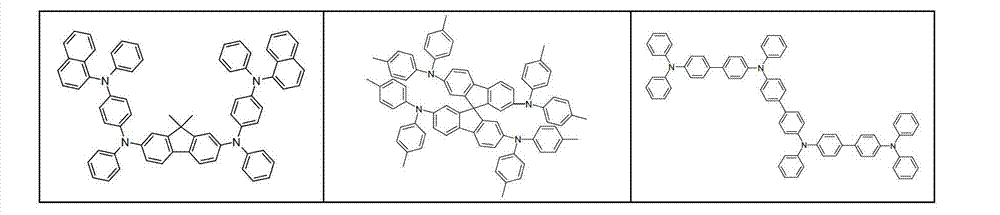
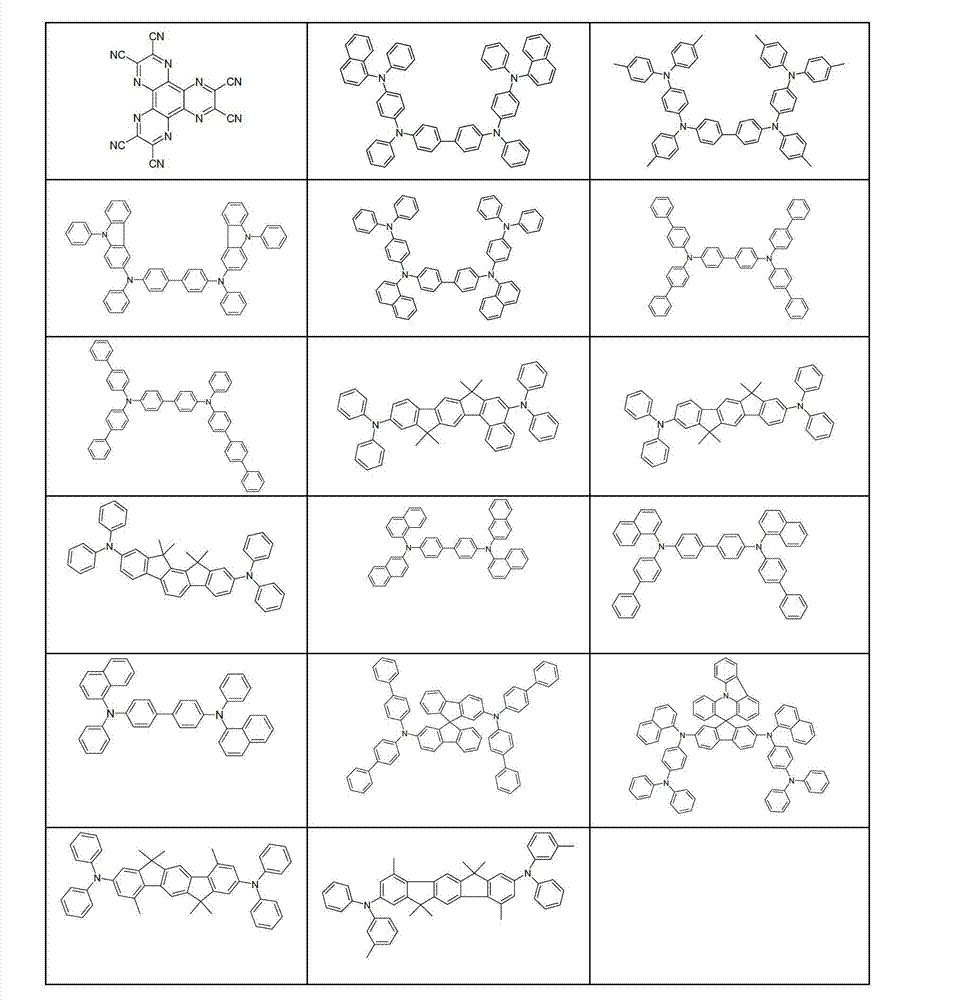
能用于本发明的电致发光器件中的适合的电子传输或电子注入材料例如是以下表中显示的材料。此外适合的电子传输和电子注入材料例如是AlQ3、BAlQ、LiQ和LiF。Suitable electron-transport or electron-injection materials that can be used in the electroluminescent device of the invention are, for example, the materials shown in the following table. Furthermore suitable electron-transport and electron-injection materials are, for example, AlQ 3 , BAlQ, LiQ and LiF.
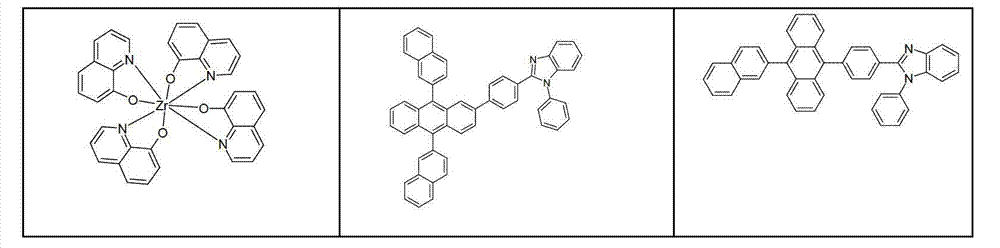

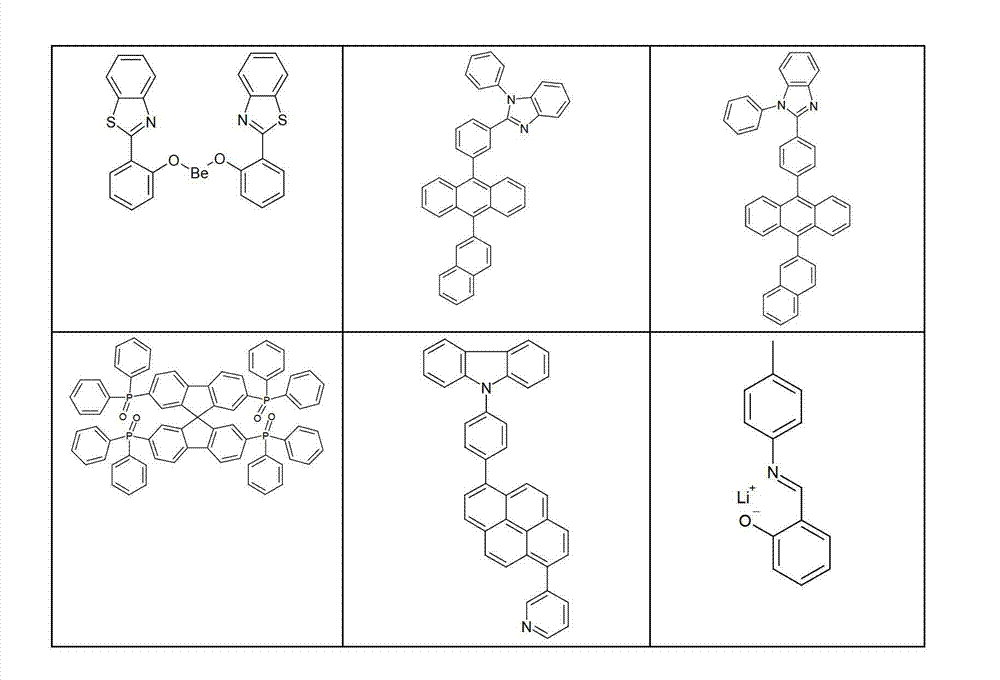
所述有机电致发光器件的阴极优选包括具有低逸出功的金属、金属合金或多层结构,其包含各种金属例如碱土金属、碱金属、主族金属或镧系元素(例如Ca、Ba、Mg、Al、In、Mg、Yb、Sm等)。同样适当的是包含碱金属或碱土金属和银的合金,例如包含镁和银的合金。在多层结构情况下,除所述金属之外,可以使用具有相对高逸出功的其它金属例如Ag或Al,在这种情况下,通常使用金属的组合,例如Ca/Ag、Ba/Ag或Mg/Ag。也可以优选在金属阴极和有机半导体之间引入具有高介电常数材料的薄的夹层。适合于该目的的例如是碱金属氟化物或碱土金属氟化物,以及相应的氧化物或碳酸盐(例如LiF、Li2O、BaF2、MgO、NaF、CsF、Cs2CO3等)。此外,8-羟基喹啉锂(LiQ)能用于该目的。该层的层厚度优选为0.5至5nm。The cathode of the organic electroluminescent device preferably comprises a metal with a low work function, a metal alloy or a multilayer structure comprising various metals such as alkaline earth metals, alkali metals, main group metals or lanthanides (e.g. Ca, Ba , Mg, Al, In, Mg, Yb, Sm, etc.). Also suitable are alloys comprising alkali metals or alkaline earth metals and silver, for example alloys comprising magnesium and silver. In the case of multilayer structures, other metals with a relatively high work function such as Ag or Al can be used in addition to the metals mentioned, in which case combinations of metals are usually used, such as Ca/Ag, Ba/Ag or Mg/Ag. It may also be preferred to introduce a thin interlayer of high dielectric constant material between the metal cathode and the organic semiconductor. Suitable for this purpose are, for example, alkali metal fluorides or alkaline earth metal fluorides, and the corresponding oxides or carbonates (eg LiF, Li 2 O, BaF 2 , MgO, NaF, CsF, Cs 2 CO 3 , etc.). In addition, lithium 8-hydroxyquinolate (LiQ) can be used for this purpose. The layer thickness of this layer is preferably from 0.5 to 5 nm.
所述阳极优选包括具有高逸出功的材料。优选所述阳极具有相对于真空大于4.5eV的逸出功。适于该目的的一方面是具有高氧化还原电势的金属,例如Ag、Pt或Au。另一方面,也可以优选金属/金属氧化物电极(例如Al/Ni/NiOx、Al/PtOx)。对于一些应用,至少一个电极必须是透明的或半透明的,以促进有机材料辐射(有机太阳能电池),或耦合输出光(OLED、O-laser)。此处优选的阳极材料是导电的混合金属氧化物。特别优选氧化锡铟(ITO)或氧化铟锌(IZO)。此外优选导电的掺杂有机材料,特别是导电的掺杂聚合物。The anode preferably comprises a material with a high work function. Preferably the anode has a work function greater than 4.5 eV versus vacuum. On the one hand, metals with a high redox potential, such as Ag, Pt or Au, are suitable for this purpose. On the other hand, metal/metal oxide electrodes (eg Al/Ni/NiO x , Al/PtO x ) may also be preferred. For some applications, at least one electrode must be transparent or semi-transparent to facilitate radiation from organic materials (organic solar cells), or to couple light out (OLEDs, O-lasers). Preferred anode materials here are electrically conductive mixed metal oxides. Particular preference is given to indium tin oxide (ITO) or indium zinc oxide (IZO). Furthermore, preference is given to electrically conductive doped organic materials, in particular electrically conductive doped polymers.
所述器件被适当地(取决于应用)结构化,提供以电接触和最后被密封,因为在水和/或空气存在下本发明器件的寿命会缩短。The device is suitably (depending on the application) structured, provided with electrical contacts and finally sealed, since the lifetime of the device of the invention is shortened in the presence of water and/or air.
此外优选如下有机电致发光器件,其特征在于通过升华方法施加一个或多个层,其中在真空升华设备中,在低于10-5毫巴,优选低于10-6毫巴的初压下通过气相沉积施加所述材料。然而,此处所述初压也可以甚至更低,例如低于10-7毫巴。Further preference is given to organic electroluminescent devices, characterized in that one or more layers are applied by a sublimation method, wherein in a vacuum sublimation apparatus at an initial pressure of less than 10 −5 mbar, preferably of less than 10 −6 mbar The materials are applied by vapor deposition. However, the initial pressure mentioned here can also be even lower, for example below 10 −7 mbar.
同样优选如下有机电致发光器件,其特征在于借助于OVPD(有机气相沉积)方法或借助于载气升华施加一个或多个层,其中在10-5毫巴至1巴的压力下施加所述材料。该方法中的特别的例子是OVJP(有机蒸气喷印)方法,其中所述材料通过喷嘴直接施加,并因此是结构化的(例如M.S.Arnold等人,Appl.Phys.Lett.2008,92,053301)。Preference is also given to organic electroluminescent devices characterized in that one or more layers are applied by means of the OVPD (Organic Vapor Phase Deposition ) method or by means of sublimation of a carrier gas, wherein the Material. A particular example of this method is the OVJP (Organic Vapor Jet Printing) method, in which the material is applied directly via a nozzle and is thus structured (eg MS Arnold et al., Appl. Phys. Lett. 2008, 92, 053301) .
此外优选如下有机电致发光器件,其特征在于从溶液中例如通过旋涂,或通过任何希望的印刷方法例如丝网印刷、柔性版印刷、喷嘴印刷或平版印刷,但是特别优选LITI(光引发热成像,热转印)或喷墨印刷产生一个或多个层。对于该目的可溶性化合物是必要的。通过适当取代所述化合物实现高的溶解性。Preference is furthermore given to organic electroluminescent devices characterized in that they are characterized from solution, for example by spin coating, or by any desired printing method, such as screen printing, flexographic printing, nozzle printing or lithography, but particular preference is given to LITI (Light Induced Thermal imaging, thermal transfer) or inkjet printing to produce one or more layers. Soluble compounds are necessary for this purpose. High solubility is achieved by appropriate substitution of the compounds.
本发明申请文本涉及本发明化合物在OLED中和在相应显示器中的用途。然而,本领域普通技术人员可以在不需要另外的创造性劳动的情况下同样在其它电子器件中使用本发明的化合物,例如在有机场效应晶体管(O-FET)、有机薄膜晶体管(O-TFT)、有机发光晶体管(O-LET)、有机集成电路(O-IC)、有机太阳能电池(O-SC)、有机场猝熄器件(O-FQD)、发光电化学电池(LEC)、有机激光二极管(O-laser)或有机光感受器中。The present application text relates to the use of the compounds according to the invention in OLEDs and in corresponding displays. However, those skilled in the art can also use the compound of the present invention in other electronic devices without additional creative efforts, for example in organic field effect transistors (O-FETs), organic thin film transistors (O-TFTs) , Organic Light Emitting Transistor (O-LET), Organic Integrated Circuit (O-IC), Organic Solar Cell (O-SC), Organic Field Quenching Device (O-FQD), Light Emitting Electrochemical Cell (LEC), Organic Laser Diode (O-laser) or organic photoreceptors.
本发明同样涉及本发明化合物在相应的器件中的用途和这些器件本身。The invention likewise relates to the use of the compounds according to the invention in corresponding devices and the devices themselves.
当在有机电致发光器件中使用时,本发明的化合物优选具有高效率和长寿命,使得本发明的有机电致发光器件非常高度地适合用于高质量和长寿命的显示器中。此外,本发明的化合物具有高的热稳定性和高的玻璃化转变温度,并且能够在不分解的情况下升华。另外的优于现有技术已知材料的优点是在气相沉积期间在气相沉积源处它们优选具有较低的结晶倾向。因此在生产本发明电子器件期间不发生气相沉积源的阻塞,或仅发生轻微程度的阻塞,这代表了重要的优点,特别是对于大规模生产。When used in organic electroluminescent devices, the compounds of the invention preferably have a high efficiency and a long lifetime, so that the organic electroluminescent devices of the invention are very highly suitable for use in high-quality and long-life displays. Furthermore, the compounds of the present invention have high thermal stability and high glass transition temperature, and are capable of sublimation without decomposition. A further advantage over the materials known from the prior art is that they preferably have a lower crystallization tendency at the vapor deposition source during vapor deposition. No clogging of the vapor deposition source, or only a slight degree of clogging, therefore occurs during the production of the electronic device according to the invention, which represents an important advantage, especially for large-scale production.
以下实施例旨在更详细地说明本发明。所述实施例不具有限制性的特性,即,本发明不局限于提及的例子。本领域普通技术人员能够制备本发明另外的化合物,并在不需要创造性劳动的情况下在电子器件中使用这些化合物。The following examples are intended to illustrate the invention in more detail. The examples described do not have a restrictive character, ie the invention is not limited to the examples mentioned. One of ordinary skill in the art will be able to prepare additional compounds of the present invention and use these compounds in electronic devices without inventive step.
具体实施方式 Detailed ways
实施例Example
合成实施例1:制备4-[3-(10-苯基蒽-9-基)苯基]苯并[a]蒽(H3)Synthesis Example 1: Preparation of 4-[3-(10-phenylanthracene-9-yl)phenyl]benzo[a]anthracene (H3)
第一步:first step:
使用N2曝气,通过加热干燥4L的烧瓶,在1400ml无水THF中首先引入100g(325.5毫摩)4-溴苯并[a]蒽。将该配料冷却到-72℃,迅速逐滴加入190ml 2.5M的正丁基锂。在该过程中,从-72℃温热到-61℃(加入持续时间:2分钟)。将该反应混合物在-70℃下搅拌另外的3小时。Dry the 4 L flask by heating using N aeration and first introduce 100 g (325.5 mmol) of 4-bromobenz[a]anthracene in 1400 ml of anhydrous THF. The batch was cooled to -72°C, and 190ml of 2.5M n-butyllithium was rapidly added dropwise. During this process, it was warmed from -72°C to -61°C (duration of addition: 2 minutes). The reaction mixture was stirred at -70°C for an additional 3 hours.
经由滴液漏斗将150ml(637毫摩)硼酸三异丙酯立即注入该溶液中,在此期间使所述配料温热到-68℃。随后将该配料在-70℃下搅拌2h,然后放置温热到室温。在N2流下在6L的洗涤烧瓶中用1300ml乙酸乙酯和690ml水稀释该反应溶液,并搅拌60分钟。随后分离去水相,每次用750ml水洗涤有机相2次。使用硫酸钠干燥有机相,在旋转蒸发仪中蒸发至70ml乙酸乙酯溶液。150 ml (637 mmol) of triisopropyl borate were immediately injected into the solution via the dropping funnel, during which time the batch was allowed to warm to -68°C. The batch was then stirred at -70 °C for 2 h and then left to warm to room temperature. The reaction solution was diluted with 1300 ml of ethyl acetate and 690 ml of water in a 6 L wash flask under N flow and stirred for 60 min. The aqueous phase is subsequently separated off and the organic phase is washed twice with 750 ml of water each time. The organic phase was dried over sodium sulfate and evaporated to 70 ml ethyl acetate solution in a rotary evaporator.
产率:62.13g(理论值的70%)Yield: 62.13 g (70% of theory)
第二步:Step two:
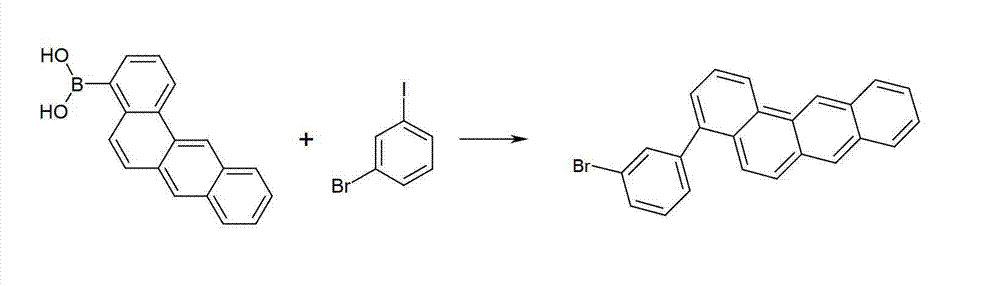
首先引入碳酸钠(206.2g,0.47摩尔)、硼酸(127.8g,0.47摩尔)和溴碘苯(199.4g,0.7摩尔)。加入825ml甲苯、625ml水和250ml乙醇,使该悬浮液脱气约30分钟,然后加入四三苯基膦钯催化剂(5.773g,5毫摩)。使该反应混合物加热回流12小时(油浴温度:100℃)。随后通过TLC监控反应的完成(TLC溶剂:庚烷/EA 5∶1),和然后使该混合物冷却。用水和甲苯稀释该混合物,进行相分离,将合并的有机相用水洗涤,并浓缩至体积的1/3。过滤掉沉淀的固体。Sodium carbonate (206.2 g, 0.47 mole), boric acid (127.8 g, 0.47 mole) and bromoiodobenzene (199.4 g, 0.7 mole) were introduced first. 825 ml of toluene, 625 ml of water and 250 ml of ethanol were added, the suspension was degassed for about 30 minutes, and tetrakistriphenylphosphine palladium catalyst (5.773 g, 5 mmol) was added. The reaction mixture was heated to reflux for 12 hours (oil bath temperature: 100°C). The completion of the reaction was then monitored by TLC (TLC solvent: heptane/EA 5:1), and the mixture was then allowed to cool. The mixture was diluted with water and toluene, the phases were separated, the combined organic phases were washed with water and concentrated to 1/3 of the volume. The precipitated solid was filtered off.
产率:142.3g(理论值的79%)Yield: 142.3 g (79% of theory)
第三步:third step:
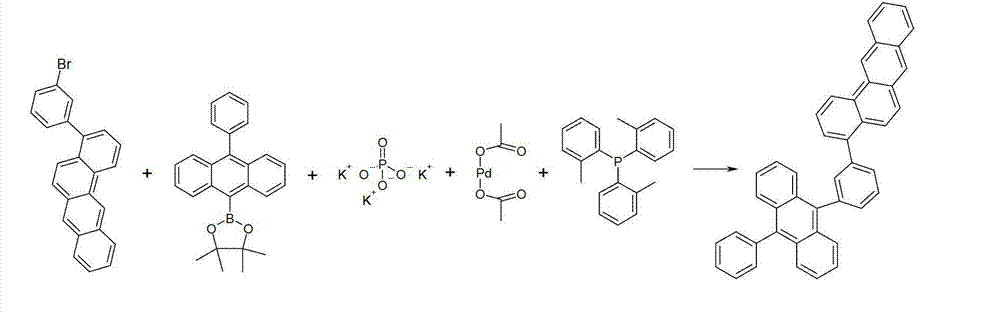
首先将得自步骤2的产物(142.3g,0.37摩尔)、硼酸酯(155.3g,0.41摩尔)和磷酸钾(165.5g,7.80摩尔)引入烧瓶中,然后加入1000ml甲苯、1000ml水和415ml二
产率:114g(理论值的55%)Yield: 114 g (55% of theory)
合成实施例2:制备4-[4-(10-苯基蒽-9-基)苯基]苯并[a]蒽(H2)Synthesis Example 2: Preparation of 4-[4-(10-phenylanthracene-9-yl)phenyl]benzo[a]anthracene (H2)
第一步:first step:
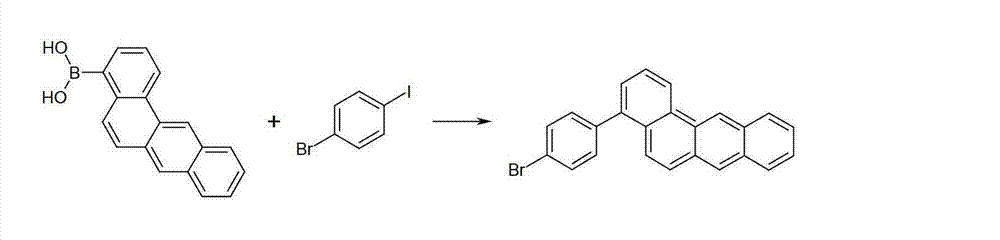
首先引入碳酸钠(250g,2.36摩尔),苯并蒽硼酸(见合成实施例1,步骤1)(155g,0.57摩尔)和4-溴碘苯(242.9g,0.86摩尔)。Sodium carbonate (250 g, 2.36 mol), benzanthracene boronic acid (see Synthesis Example 1, Step 1) (155 g, 0.57 mol) and 4-bromoiodobenzene (242.9 g, 0.86 mol) were introduced first.
加入1000ml甲苯、750ml水和300ml乙醇,并使该悬浮液脱气约30分钟,然后加入四三苯基膦钯(7g,6.05毫摩)。将该反应混合物在强烈搅拌下加热回流15小时(油浴温度:100℃)。1000ml of toluene, 750ml of water and 300ml of ethanol were added and the suspension was degassed for about 30 minutes before adding tetrakistriphenylphosphinepalladium (7g, 6.05mmol). The reaction mixture was heated to reflux for 15 hours with vigorous stirring (oil bath temperature: 100°C).
TLC监控(TLC溶剂:庚烷/EA 5∶1)显示完全转化,然后将该混合物放置冷却。用水和甲苯稀释该混合物,进行相分离,并将合并的有机相首先用水洗涤,和然后用饱和氯化钠溶液洗涤。过滤掉沉淀的固体。TLC monitoring (TLC solvent: heptane/EA 5:1) showed complete conversion and the mixture was then left to cool. The mixture is diluted with water and toluene, the phases are separated, and the combined organic phases are washed first with water and then with saturated sodium chloride solution. The precipitated solid was filtered off.
产率:168.5g(理论值的77%)Yield: 168.5 g (77% of theory)
第二步:Step two:
首先在4L烧瓶中引入168.4g(0.44摩尔)4-(4-溴苯基)苯并[a]蒽、183.9g(0.48摩尔)9-苯基蒽-10-硼酸频哪醇酯和磷酸钾(195.5g,0.92摩尔),并然后加入1200ml甲苯、1200ml水和475ml二

产率:85g(理论值的35%)Yield: 85 g (35% of theory)
合成实施例3:制备5-[10-(4-苯并[a]蒽-4-基苯基)蒽-9-基]嘧啶(ETM2)Synthesis Example 3: Preparation of 5-[10-(4-benzo[a]anthracen-4-ylphenyl)anthracen-9-yl]pyrimidine (ETM2)
第一步:first step:

在4L的四颈烧瓶中将44.6g(173毫摩)溴蒽溶解在340ml无水THF中,将其冷却到-75℃,在此期间形成棕绿色悬浮液。In a 4 L four-necked flask, 44.6 g (173 mmol) of bromoanthracene was dissolved in 340 ml of anhydrous THF, which was cooled to -75°C, during which time a brown-green suspension was formed.
在该温度下在约30分钟的时间内加入69.5ml在己烷中的2.5M正丁基锂,并将该混合物搅拌另外的2h。然后在-75℃下在25分钟时间内逐滴加入49.6ml(210毫摩)硼酸三异丙酯,和将该混合物搅拌另外的2h,并温热到室温过夜。At this temperature, 69.5 ml of 2.5M n-butyllithium in hexane were added over a period of about 30 minutes, and the mixture was stirred for a further 2 h. 49.6 ml (210 mmol) of triisopropylborate were then added dropwise over a period of 25 minutes at -75°C, and the mixture was stirred for a further 2 h and allowed to warm to room temperature overnight.
在另外的4L四颈烧瓶中使用N2使在水中的19.7g(123.9毫摩)溴嘧啶、500ml甲苯、195ml 20%的四乙基氢氧化铵溶液脱气30分钟;形成淡棕色的澄清溶液。加入2.86g(2.47毫摩)Pd(PPh3)4和硼酸溶液,并使该混合物回流6h。加入300ml甲苯和450ml水,用水洗涤有机相2次,和用饱和氯化钠溶液洗涤1次,并使用MgSO4干燥。在旋转蒸发仪中浓缩该混合物,并使用庚烷沉淀产物,用庚烷冲洗并干燥,得到32.3g(定量)的5-蒽-9-基嘧啶。19.7 g (123.9 mmol) bromopyrimidine, 500 ml toluene, 195 ml 20% tetraethylammonium hydroxide solution in water were degassed using N2 in a separate 4 L four-necked flask for 30 min; a pale brown clear solution formed . 2.86 g (2.47 mmol) of Pd(PPh 3 ) 4 and boric acid solution were added and the mixture was refluxed for 6 h. Add 300 ml toluene and 450 ml water, wash the organic phase twice with water and once with saturated sodium chloride solution, and dry using MgSO 4 . The mixture was concentrated in a rotary evaporator and the product was precipitated with heptane, rinsed with heptane and dried to yield 32.3 g (quantitative) of 5-anthracen-9-ylpyrimidine.
第二步:Step two:

在2L的四颈烧瓶中将73.8g 5-蒽-9-基嘧啶(288毫摩)溶解在800ml CH2Cl2中,通过使N2通过使该溶液脱气。加入54.0g(302毫摩)NBS,在避光下,在室温下搅拌该悬浮液过夜。然后在旋转蒸发仪中将该反应混合物蒸发至干,将残余物溶解在300ml乙醇中,将该溶液在室温下搅拌30分钟,用抽吸过滤掉产物,用300ml乙醇洗涤1次,抽吸干燥。通过在1L乙醇中沸腾洗涤并干燥,得到87.5g(261毫摩,91%)的黄色固体5-(10-溴蒽-9-基)嘧啶。In a 2-L four-necked flask, 73.8 g of 5-anthracen-9-ylpyrimidine (288 mmol) was dissolved in 800 ml of CH2Cl2 , and the solution was degassed by passing N2 through. 54.0 g (302 mmol) of NBS were added and the suspension was stirred overnight at room temperature in the dark. The reaction mixture was then evaporated to dryness in a rotary evaporator, the residue was dissolved in 300 ml ethanol, the solution was stirred at room temperature for 30 minutes, the product was filtered off with suction, washed once with 300 ml ethanol, and dried by suction . Washing by boiling in 1 L of ethanol and drying afforded 87.5 g (261 mmol, 91%) of 5-(10-bromoanthracen-9-yl)pyrimidine as a yellow solid.
第三步:third step:

首先在2000ml四颈烧瓶中引入67.0g(200毫摩)5-(10-溴蒽-9-基)嘧啶,并将其溶解在1000ml无水乙醚中并冷却至0-5℃。逐滴缓慢加入88ml的2.5M正丁基锂。将该混合物在室温下搅拌2小时。First, 67.0 g (200 mmol) of 5-(10-bromoanthracen-9-yl)pyrimidine was introduced into a 2000 ml four-necked flask, dissolved in 1000 ml of anhydrous ether and cooled to 0-5°C. 88 ml of 2.5M n-butyllithium were slowly added dropwise. The mixture was stirred at room temperature for 2 hours.
然后,将该反应混合物冷却到-75℃,在1分钟时间内搅拌下加入用50ml乙醚稀释的29ml(260毫摩)硼酸三甲酯。The reaction mixture was then cooled to -75°C and 29 ml (260 mmol) of trimethyl borate diluted with 50 ml of diethyl ether were added over a period of 1 minute with stirring.
将该混合物在-75℃下搅拌1h,并温热到+10℃。加入500ml水,进行相分离,和蒸发该有机相。用己烷洗涤该固体并干燥,得到55.8g(186毫摩,93%)的5-(10-硼羰基蒽-9-基)嘧啶。The mixture was stirred at -75°C for 1 h and warmed to +10°C. 500 ml of water are added, the phases are separated and the organic phase is evaporated. The solid was washed with hexane and dried to obtain 55.8 g (186 mmol, 93%) of 5-(10-boroncarbonylanthracen-9-yl)pyrimidine.
第四步:the fourth step:

首先在2L烧瓶中引入4-(4-溴苯基)苯并[a]蒽(59.4g,0.155摩尔)、48.9g(0.163毫摩)5-(10-硼羰基蒽-9-基)嘧啶和磷酸钾(65.2g,0.30First introduce 4-(4-bromophenyl)benzo[a]anthracene (59.4g, 0.155mol), 48.9g (0.163mmol) 5-(10-boroncarbonylanthracene-9-yl)pyrimidine in a 2L flask and potassium phosphate (65.2g, 0.30
摩尔),然后加入400ml甲苯、400ml水和150ml二烷。通过使氩气通过,在搅拌下使该混合物脱气30分钟。然后加入三邻甲苯基膦(2.8g,8.8毫摩),短暂搅拌该混合物,和然后加入乙酸钯(II)(330mg,1.45毫摩)。最后,将该混合物加热回流(油浴120℃)和回流24小时。然后将该混合物冷却。随后加入冰醋酸/乙醇1∶1(500ml)。在抽吸下过滤掉沉淀的固体,用约100ml甲苯冲洗2次,用约150ml水/乙醇混合物(比例1∶1)冲洗2次,最后用200ml乙醇冲洗2次。在热提取器中用1L甲苯提取该固体5天,和随后从脱气的邻二甲苯中重结晶4次。在3×10-6毫巴和约330℃下使该产物升华。产率:37.2g(43%)。mol), then add 400ml toluene, 400ml water and 150ml di alkyl. The mixture was degassed with stirring by passing argon through for 30 minutes. Tri-o-tolylphosphine (2.8 g, 8.8 mmol) was then added, the mixture was briefly stirred, and palladium(II) acetate (330 mg, 1.45 mmol) was then added. Finally, the mixture was heated to reflux (oil bath 120°C) and refluxed for 24 hours. The mixture was then cooled. Glacial acetic acid/ethanol 1:1 (500ml) was then added. The precipitated solid was filtered off under suction, washed twice with about 100 ml of toluene, twice with about 150 ml of a water/ethanol mixture (ratio 1:1) and finally twice with 200 ml of ethanol. The solid was extracted with 1 L of toluene in a hot extractor for 5 days and subsequently recrystallized 4 times from degassed o-xylene. The product is sublimed at 3 x 10 -6 mbar and about 330°C. Yield: 37.2 g (43%).
合成实施例4:制备5-[10-(3-苯并[a]蒽-4-基苯基)蒽-9-基]-N,N,N′,N′-四对甲苯基苯-1,3-二胺(HTM2)Synthesis Example 4: Preparation of 5-[10-(3-benzo[a]anthracene-4-ylphenyl)anthracene-9-yl]-N,N,N',N'-tetra-p-tolylbenzene- 1,3-diamine (HTM2)
第一步:first step:

在4L的四颈烧瓶中将49.1g(190毫摩)溴蒽溶解在380ml无水THF中,并将其冷却到-75℃,在此期间形成棕绿色的悬浮液。在约30分钟时间内在该温度下加入76.5ml的2.5M正丁基锂的己烷溶液,并将该混合物搅拌另外的2h。然后在230分钟时间内在-70℃下逐滴加入55ml(230毫摩)硼酸三异丙酯,并将该混合物搅拌另外的2h,和温热到室温过夜。In a 4-L four-necked flask, 49.1 g (190 mmol) of bromoanthracene was dissolved in 380 ml of anhydrous THF and cooled to -75 °C, during which time a brown-green suspension was formed. 76.5 ml of a 2.5M solution of n-butyllithium in hexane were added at this temperature over a period of about 30 minutes, and the mixture was stirred for a further 2 h. 55 ml (230 mmol) of triisopropyl borate were then added dropwise at -70°C over a period of 230 minutes, and the mixture was stirred for a further 2 h, and allowed to warm to room temperature overnight.
在另外的4L四颈烧瓶中使用N2使75.0g(137毫摩)5-溴-N,N,N′,N′-四对甲苯基苯-1,3-二胺(类似于EP 1969083制备)、600ml甲苯、220ml的20%四乙基氢氧化铵水溶液脱气30分钟;形成浅棕色的澄清溶液。加入3.15g(2.71毫摩)Pd(PPh3)4和硼酸溶液,将该混合物加热回流8h。加入400ml甲苯和500ml水,用水洗涤有机相2次,和用饱和氯化钠溶液洗涤有机相1次,和使用MgSO4干燥。在旋转蒸发仪中浓缩该混合物,使用庚烷沉淀产物,用庚烷冲洗并干燥,得到88.5g(定量)的5-蒽-9-基-N,N,N′,N′-四对甲苯基苯-1,3-二胺。75.0 g (137 mmol) of 5 - bromo-N,N,N′,N′-tetra-p-tolylbenzene-1,3-diamine (similar to EP 1969083 prepared), 600 ml of toluene, 220 ml of 20% aqueous tetraethylammonium hydroxide degassed for 30 minutes; a light brown clear solution formed. Added 3.15g (2.71 mmol) Pd(PPh 3 ) 4 and boric acid solution, and the mixture was heated to reflux for 8h. Add 400 ml toluene and 500 ml water, wash the organic phase twice with water and once with saturated sodium chloride solution, and dry using MgSO 4 . The mixture was concentrated in a rotary evaporator and the product was precipitated using heptane, rinsed with heptane and dried to give 88.5 g (quantitative) of 5-anthracen-9-yl-N,N,N',N'-tetra-p-toluene phenyl-1,3-diamine.
第二步:Step two:

在2L烧瓶中将84.0g(130毫摩)5-蒽-9-基-N,N,N′,N′-四对甲苯基苯-1,3-二胺溶解在350ml CH2Cl2中;通过使N2通过将该溶液脱气。加入24.4g(136毫摩)NBS,并在避光条件下,在室温下搅拌该悬浮液过夜。Dissolve 84.0 g (130 mmol) of 5-anthracen-9-yl-N,N,N',N'-tetra-p-tolylbenzene-1,3-diamine in 350 ml of CH2Cl2 in a 2 L flask ; degas the solution by passing N2 through. 24.4 g (136 mmol) NBS were added and the suspension was stirred overnight at room temperature in the dark.
然后在旋转蒸发仪中将该反应混合物蒸发至干,将残余物溶解在300ml乙醇中,将该溶液在室温下搅拌30分钟,并用抽吸过滤掉产物,用300ml乙醇洗涤1次,并干燥。用500ml的沸腾乙醇洗涤产物并干燥,得到94.1g(113毫摩,87%)的黄色固体5-(10-溴蒽-9-基)-N,N,N′,N′-四对甲苯基苯-1,3-二胺。The reaction mixture was then evaporated to dryness in a rotary evaporator, the residue was dissolved in 300 ml ethanol, the solution was stirred at room temperature for 30 minutes, and the product was filtered off with suction, washed once with 300 ml ethanol and dried. The product was washed with 500 ml of boiling ethanol and dried to obtain 94.1 g (113 mmol, 87%) of yellow solid 5-(10-bromoanthracene-9-yl)-N, N, N', N'-tetra-p-toluene phenyl-1,3-diamine.
第三步:third step:

在2L四颈烧瓶中将72.4g(100毫摩)溴化物溶解在500ml无水乙醚中,并冷却到0-5℃。逐滴缓慢加入44ml的2.5M正丁基锂(110毫摩)。将该混合物在室温下搅拌2小时。In a 2L four-necked flask, 72.4g (100mmol) of bromide was dissolved in 500ml of anhydrous ether and cooled to 0-5°C. 44 ml of 2.5M n-butyllithium (110 mmol) were slowly added dropwise. The mixture was stirred at room temperature for 2 hours.
然后,将该反应混合物冷却到-75℃,并在1分钟时间内搅拌下加入用25ml乙醚稀释的14.5ml(130毫摩)硼酸三甲酯。将该混合物在-75℃下搅拌1h,并温热到+10℃。加入250ml水,进行相分离,并蒸发该有机相。用己烷洗涤该固体并干燥,得到62.7g(91毫摩,91%)的5-(10-硼羰基蒽-9-基)-N,N,N′,N′-四对甲苯基苯-1,3-二胺。The reaction mixture was then cooled to -75°C and 14.5 ml (130 mmol) of trimethylborate diluted with 25 ml of diethyl ether were added over a period of 1 minute with stirring. The mixture was stirred at -75°C for 1 h and warmed to +10°C. 250 ml of water were added, the phases were separated and the organic phase was evaporated. The solid was washed with hexane and dried to give 62.7 g (91 mmol, 91%) of 5-(10-boroncarbonylanthracene-9-yl)-N,N,N',N'-tetra-p-tolylbenzene - 1,3-diamine.
第四步:the fourth step:

在1L烧瓶中,首先引入4-(3-溴苯基)苯并[a]蒽(32.7g,85毫摩,合成见实施例1的第二步)、5-(10-硼羰基蒽-9-基)-N,N,N′,N′-四对甲苯基苯-1,3-二胺(61.7g,89.6毫摩)和磷酸钾(35.9g,160毫摩),然后加入200ml甲苯、200ml水和75ml二
合成实施例5和6:合成化合物H5和H6Synthesis Examples 5 and 6: Synthesis of Compounds H5 and H6
类似于合成实施例1和2(H2和H3)制备化合物H5和H6,但在每种情况下在最后的步骤中使用9-(1-萘基)蒽-10-硼酸代替9-苯基蒽-10-硼酸。Compounds H5 and H6 were prepared analogously to Synthetic Examples 1 and 2 (H2 and H3), but in each case using 9-(1-naphthyl)anthracene-10-boronic acid instead of 9-phenylanthracene in the final step -10-boronic acid.
器件实施例:OLED的制造Device Example: Fabrication of OLEDs
按照WO 04/058911中的一般方法制造本发明的OLED和现有技术的OLED,此处将该方法调整以适应所述环境(层厚度的改变,使用的材料)。The OLEDs according to the invention and the OLEDs of the prior art were produced following the general method in WO 04/058911, here adapted to the circumstances (variation of layer thicknesses, materials used).
在以下实施例1至28中给出了各种OLED的结果(见表1和2)。为改进处理,将已经涂有厚度为150nm的结构化ITO(氧化锡铟)的玻璃板,涂覆20nm的PEDOT(聚(3,4-亚乙基二氧基-2,5-噻吩),从水中旋涂;购买自H.C.Starck,Goslar,德国)。这些涂覆的玻璃板形成基底,其中将OLED施加到所述基底上。所述OLED原则上具有以下的层结构:基底/空穴传输层(HTL)/任选的夹层(IL)/电子阻挡层(EBL)/发光层(EML)/任选的空穴阻挡层(HBL)/电子传输层(ETL)/任选的电子注入层(EIL)和最后的阴极。所述阴极由厚度为100nm的铝层形成。所述OLED的确切的结构显示于表1中。用于制造所述OLED的材料显示于表3中。The results for various OLEDs are given in Examples 1 to 28 below (see Tables 1 and 2). To improve handling, a glass plate already coated with structured ITO (indium tin oxide) with a thickness of 150 nm was coated with 20 nm of PEDOT (poly(3,4-ethylenedioxy-2,5-thiophene), Spin coating from water; purchased from H.C. Starck, Goslar, Germany). These coated glass plates form the substrate onto which the OLED is applied. The OLED has in principle the following layer structure: substrate/hole transport layer (HTL)/optional interlayer (IL)/electron blocking layer (EBL)/emissive layer (EML)/optional hole blocking layer ( HBL)/electron transport layer (ETL)/optional electron injection layer (EIL) and finally cathode. The cathode was formed from an aluminum layer with a thickness of 100 nm. The exact structure of the OLED is shown in Table 1. The materials used to fabricate the OLEDs are shown in Table 3.
在真空室中通过热气相沉积施加所有材料。此处的发光层总是由至少一种基质材料(主体材料)和发光掺杂剂(发光体)组成,通过共蒸发使所述一种或多种基质材料以一定的体积比例与所述发光掺杂剂混和。此处例如H1∶SEB1(95%∶5%)的信息是指在该层中材料H1以95体积%的比例存在,SEB1以5体积%的比例存在。类似地,所述电子传输层也可以由两种材料的混合物组成。All materials were applied by thermal vapor deposition in a vacuum chamber. The emitting layer here always consists of at least one matrix material (host material) and an emitting dopant (emitter), the one or more matrix materials being mixed with the emitting layer in a volume ratio by co-evaporation Dopant blending. Here, the information such as H1:SEB1 (95%:5%) means that the material H1 exists in a ratio of 95% by volume and SEB1 exists in a ratio of 5% by volume in this layer. Similarly, the electron transport layer may also consist of a mixture of the two materials.
通过标准方法表征所述OLED。为此目的,确定电致发光光谱,电流效率(以cd/A测定),功率效率(以lm/W测定)和外量子效率(EQE,以百分比测定),其作为发光密度函数是从电流-电压-亮度特性线(IUL特性线)计算的,和寿命。所述寿命定义为从某一初始发光密度I0下降到某一比例后所用的时间。LD50是指所述寿命是发光密度下降到0.5I0(到50%)时经过的时间,即,例如从6000cd/m2到3000cd/m2。The OLEDs were characterized by standard methods. For this purpose, the electroluminescence spectrum, current efficiency (measured in cd/A), power efficiency (measured in lm/W) and external quantum efficiency (EQE, measured in percent) were determined as a function of luminous density from current- Calculated voltage-brightness characteristic line (IUL characteristic line), and lifetime. The lifetime is defined as the time it takes for a certain initial luminous density I0 to drop to a certain ratio. LD50 means that the lifetime is the time elapsed when the luminous density drops to 0.5 I0 (to 50%), ie for example from 6000 cd/m 2 to 3000 cd/m 2 .
本发明的化合物尤其能够用作荧光掺杂剂的基质材料(主体材料)。此处使用本发明的化合物H2和H3。化合物H1、H4、H5和H6用作根据现有技术的对比。显示了包含发蓝色光掺杂剂SEB1的OLED。此外,显示了对于发绿色光掺杂剂SEG1的结果。对于OLED的结果显示于表2中。实施例1-9显示了包含现有技术材料作为对比例的OLED。本发明的OLED 10-28显示了当使用通式(I)化合物时的优点。The compounds according to the invention can be used in particular as matrix materials (host materials) for fluorescent dopants. The compounds H2 and H3 according to the invention are used here. Compounds H1, H4, H5 and H6 serve as comparisons according to the prior art. An OLED comprising the blue-emitting dopant SEB1 is shown. Furthermore, the results for the green-emitting dopant SEG1 are shown. The results for OLEDs are shown in Table 2. Examples 1-9 show OLEDs comprising prior art materials as comparative examples. The inventive OLEDs 10-28 show advantages when using compounds of general formula (I).
与现有技术相比,使用本发明的化合物能够实现加工和材料稳定性方面的改进。发现电性能至少与参照物相似或比参照物更好。Improvements in processing and material stability can be achieved using the compounds of the invention compared to the prior art. The electrical properties were found to be at least similar to or better than the reference.
与包含现有技术化合物的器件相比,本发明器件电特性数据在所有情况下是相似的或更好的。对于在其它方面相同的层结构,使用H2或H3的器件显示更长的操作寿命和更高的功率效率。使用本发明的电荷传输材料ETM2或HTM2的器件显示更低的工作电压和增加的寿命。The electrical characteristic data of the devices according to the invention were in all cases similar or better than devices comprising prior art compounds. For an otherwise identical layer structure, devices using H2 or H3 showed longer operating lifetimes and higher power efficiencies. Devices using the charge transport material ETM2 or HTM2 of the present invention show lower operating voltage and increased lifetime.
表1:OLED的结构Table 1: Structure of OLEDs
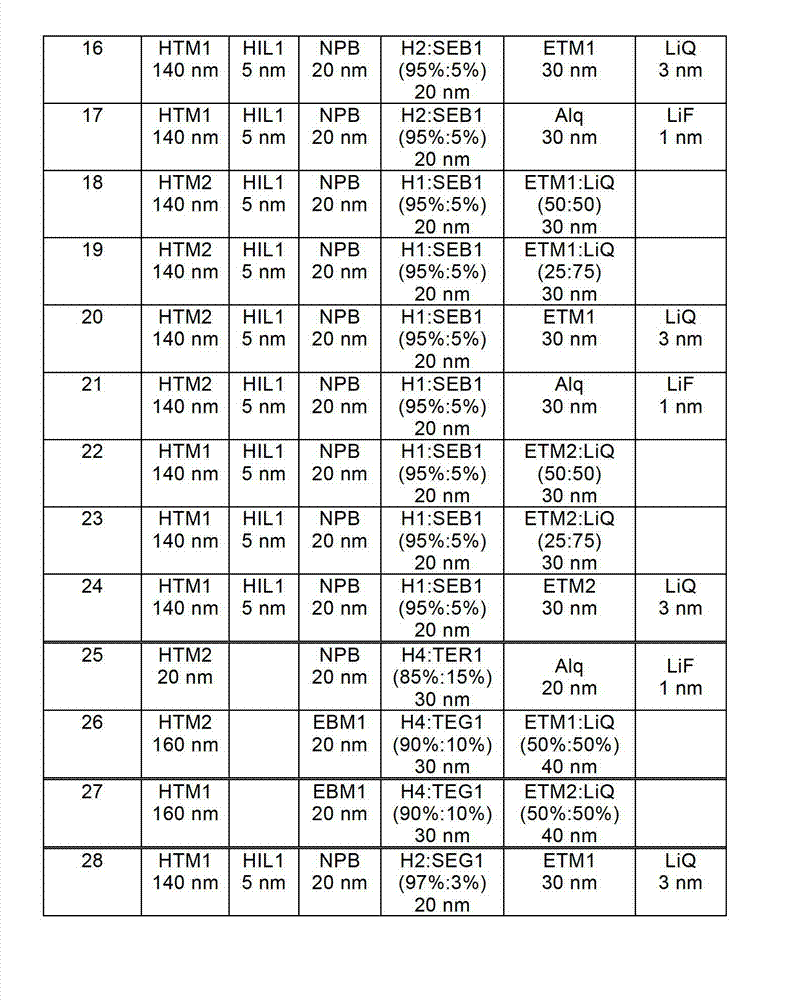
表2:OLED的结果Table 2: Results for OLEDs
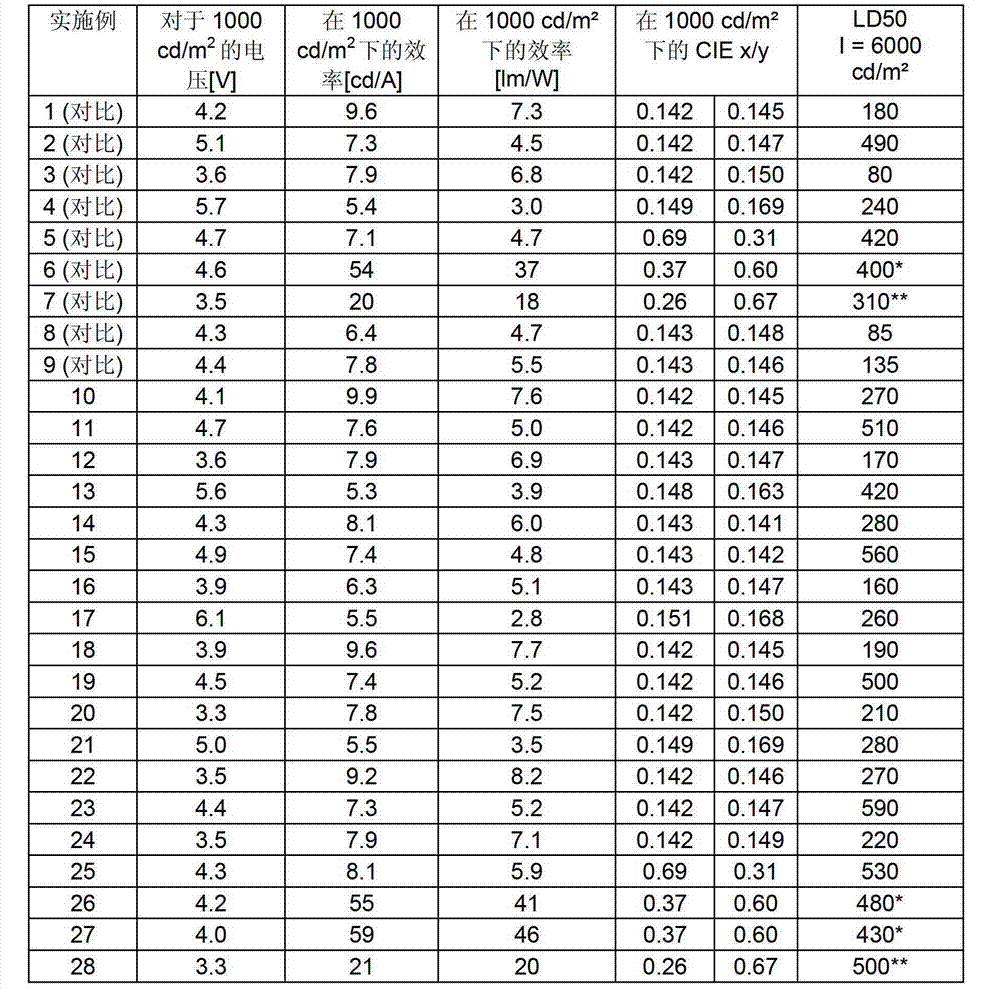
*对于这些器件,从4000cd/m2确定寿命LD80。*For these devices, the lifetime LD80 is determined from 4000cd/ m2 .
**对于这些器件,从25,000cd/m2确定寿命LD80。**For these devices, the lifetime LD80 is determined from 25,000cd/ m2 .
表3:使用材料的结构式Table 3: Structural Formulas of Materials Used
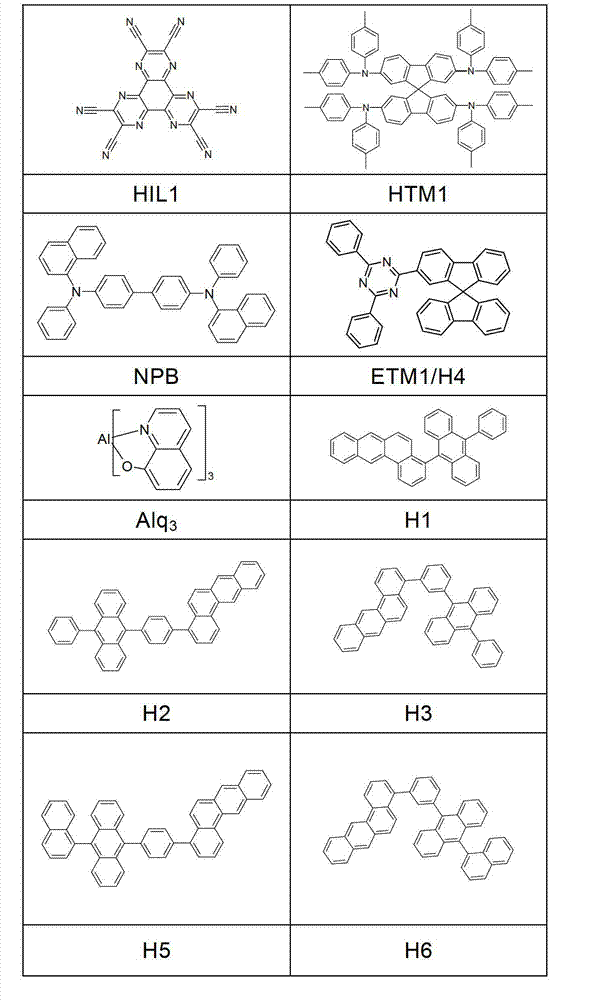
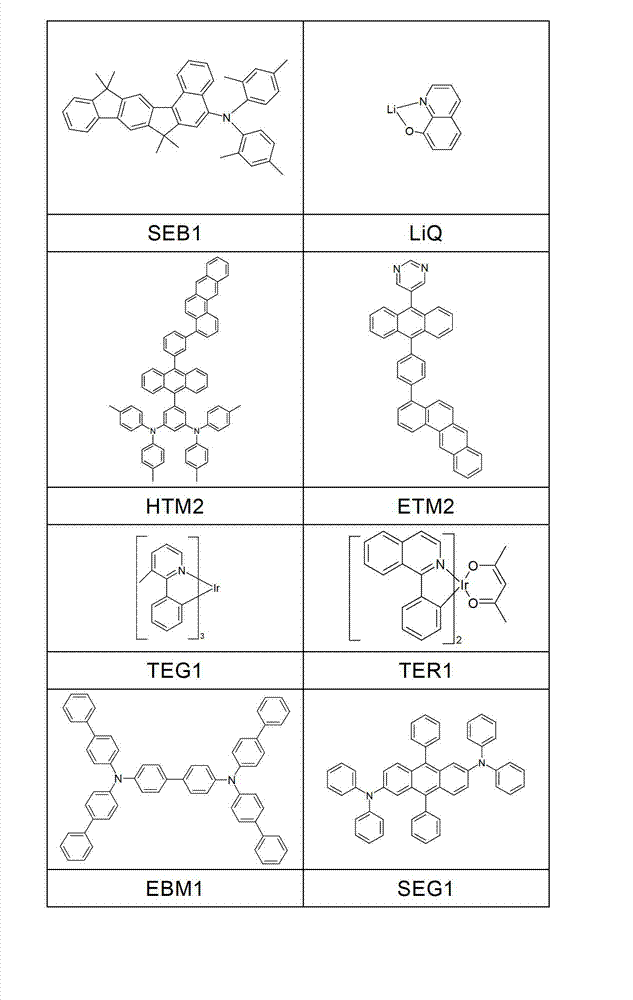
Claims (15)
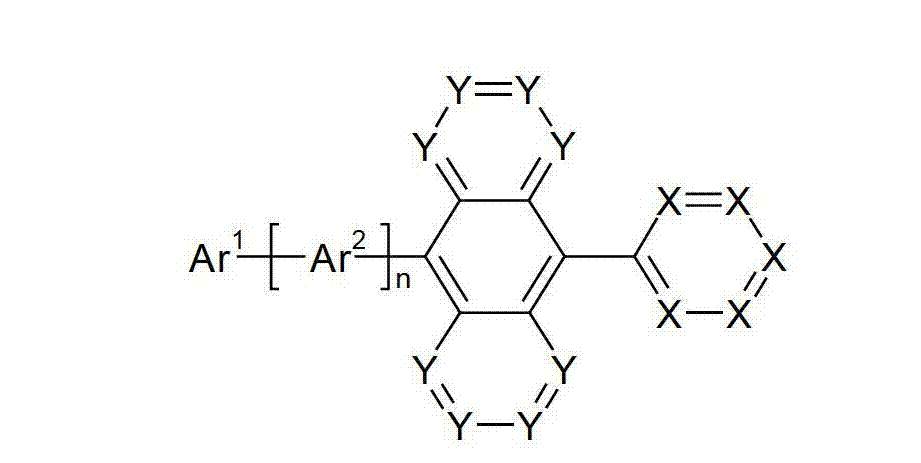
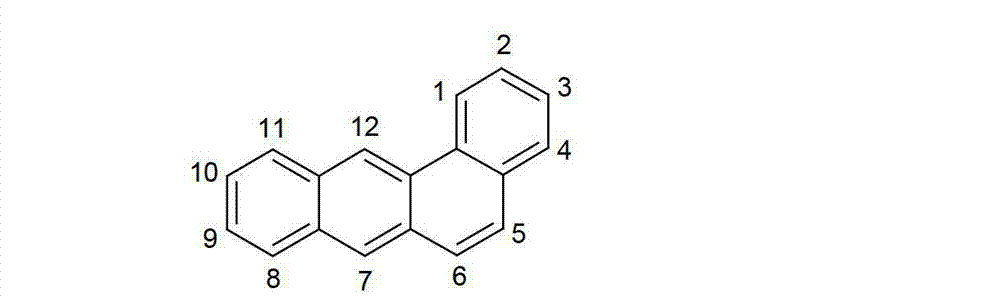
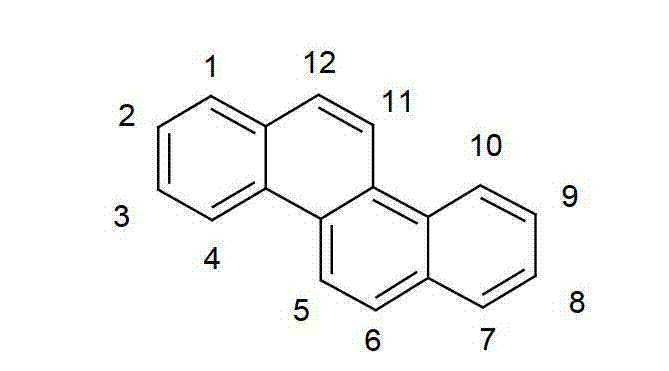
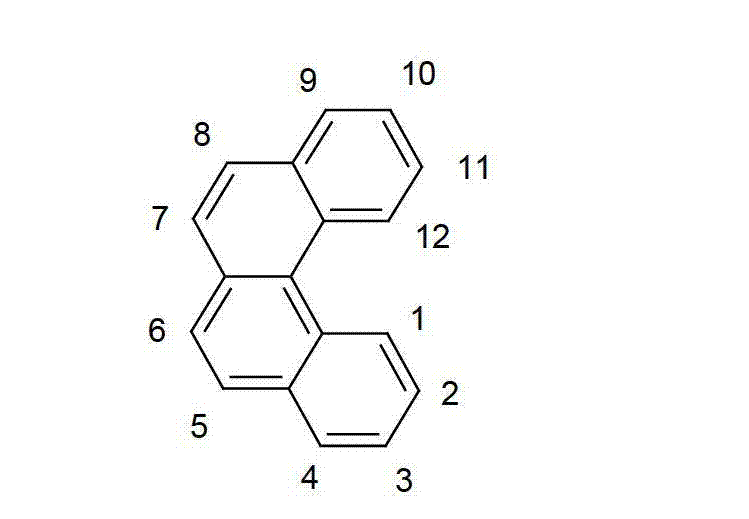
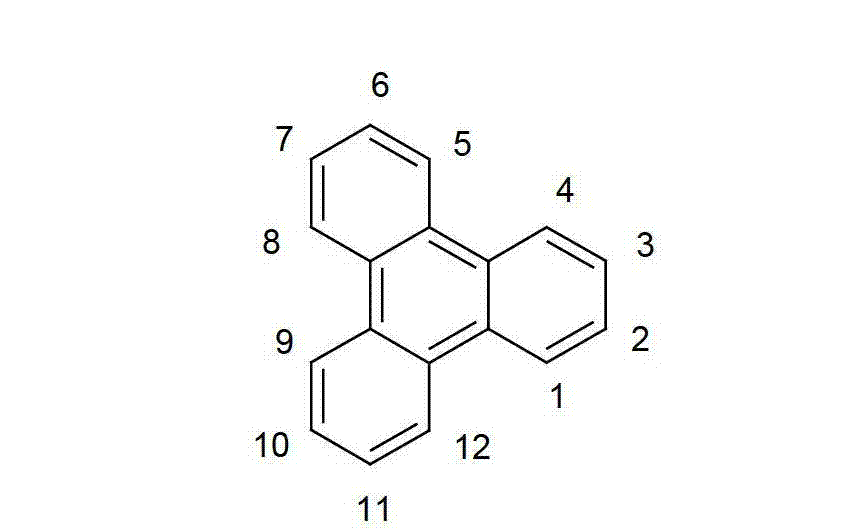
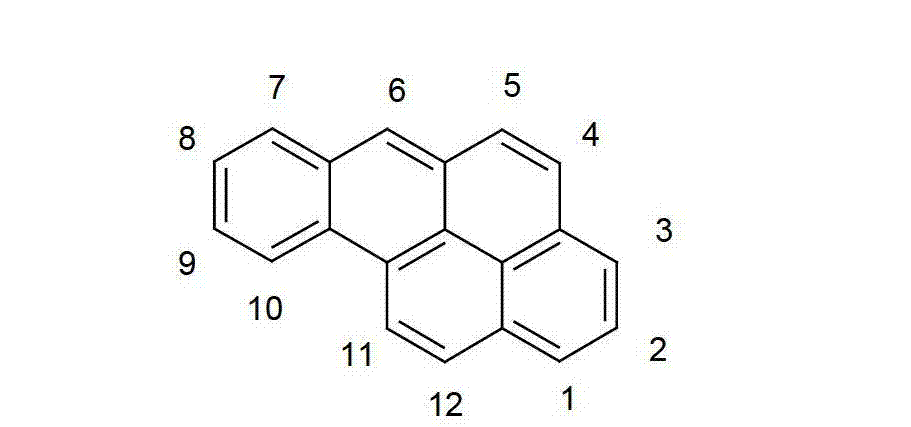

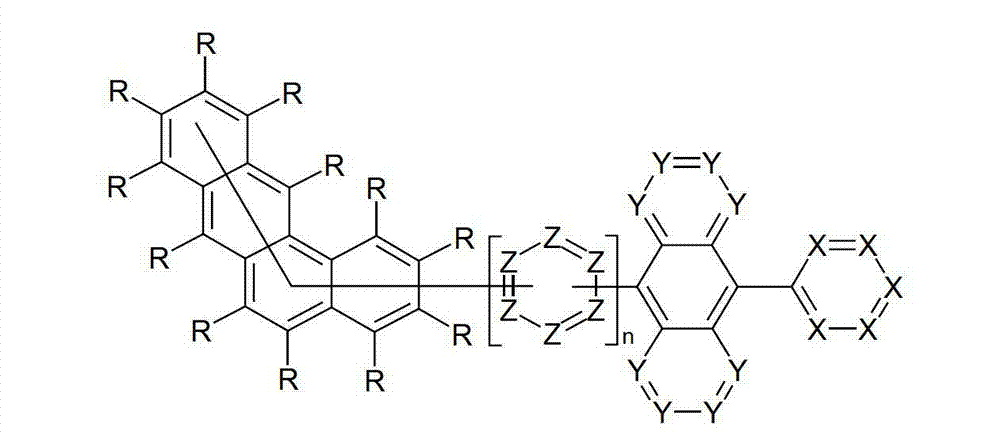
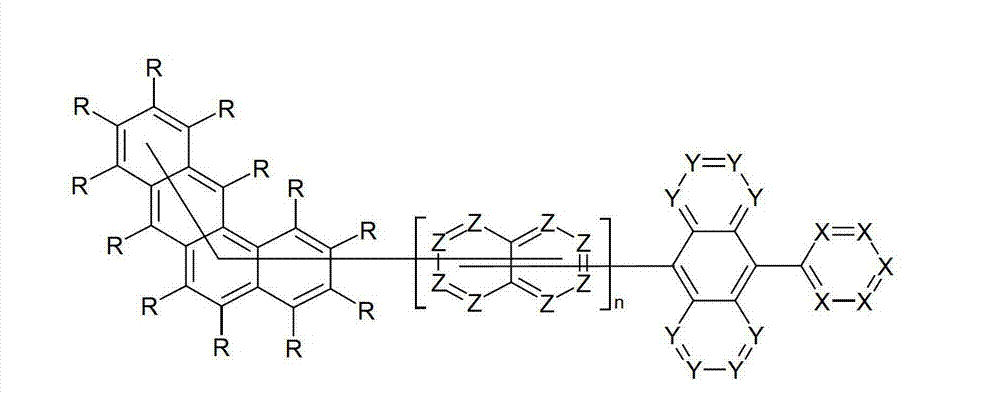

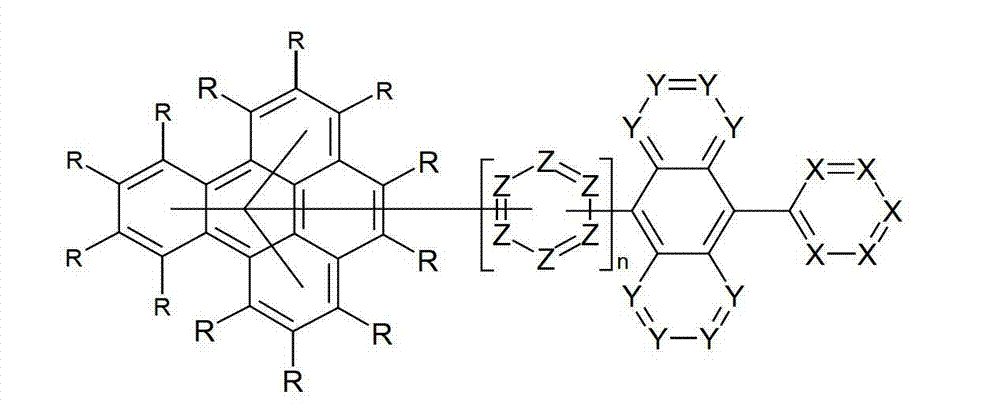

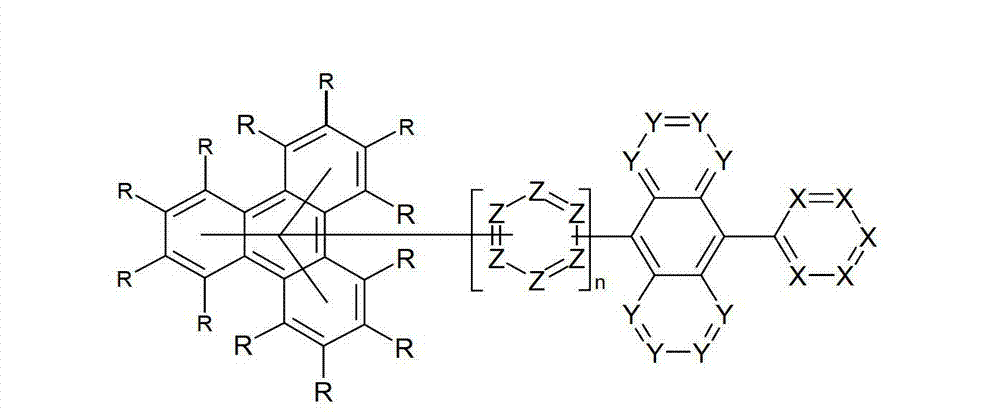
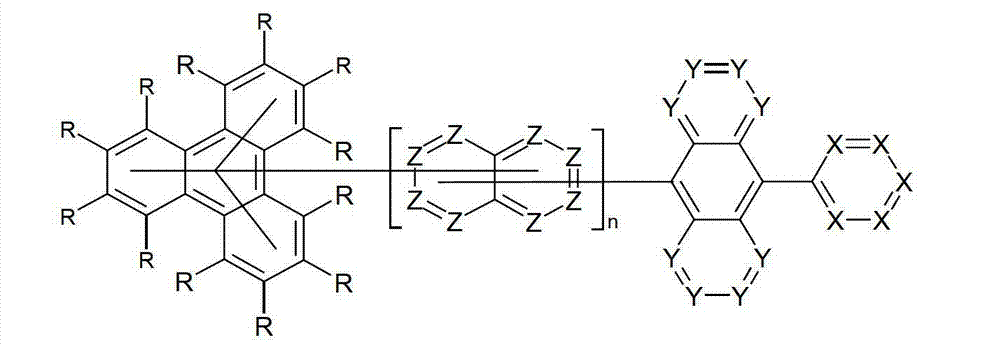

Applications Claiming Priority (3)
| Application Number | Priority Date | Filing Date | Title |
|---|---|---|---|
| DE102009053191.2 | 2009-11-06 | ||
| DE102009053191A DE102009053191A1 (en) | 2009-11-06 | 2009-11-06 | Materials for electronic devices |
| PCT/EP2010/006368 WO2011054442A2 (en) | 2009-11-06 | 2010-10-19 | Materials for electronic devices |
Publications (1)
| Publication Number | Publication Date |
|---|---|
| CN102791659A true CN102791659A (en) | 2012-11-21 |
Family
ID=43661880
Family Applications (1)
| Application Number | Title | Priority Date | Filing Date |
|---|---|---|---|
| CN2010800501024A Pending CN102791659A (en) | 2009-11-06 | 2010-10-19 | Materials for Electronic Devices |
Country Status (7)
| Country | Link |
|---|---|
| US (1) | US20120217449A1 (en) |
| JP (1) | JP5851999B2 (en) |
| KR (2) | KR102023197B1 (en) |
| CN (1) | CN102791659A (en) |
| DE (2) | DE102009053191A1 (en) |
| TW (1) | TW201134917A (en) |
| WO (1) | WO2011054442A2 (en) |
Cited By (3)
| Publication number | Priority date | Publication date | Assignee | Title |
|---|---|---|---|---|
| CN106414394A (en) * | 2014-03-25 | 2017-02-15 | 诺瓦尔德股份有限公司 | Polychromatic light emitting devices and versatile hole transporting matrix for them |
| CN111448188A (en) * | 2017-11-06 | 2020-07-24 | 诺瓦尔德股份有限公司 | Triazine compound and organic semiconductor layer containing the same |
| US12295260B2 (en) | 2019-03-22 | 2025-05-06 | Semiconductor Energy Laboratory Co., Ltd. | Organic compound, light-emitting device, light-emitting apparatus, electronic device, and lighting device |
Families Citing this family (56)
| Publication number | Priority date | Publication date | Assignee | Title |
|---|---|---|---|---|
| DE102010010631A1 (en) | 2010-03-09 | 2011-09-15 | Merck Patent Gmbh | Materials for electronic devices |
| US9312500B2 (en) | 2012-08-31 | 2016-04-12 | Idemitsu Kosan Co., Ltd. | Organic electroluminescence device |
| CN102911657A (en) * | 2012-10-26 | 2013-02-06 | 吉林奥来德光电材料股份有限公司 | High-performance organic luminescent material and preparation method thereof |
| KR101963104B1 (en) | 2012-10-31 | 2019-03-28 | 메르크 파텐트 게엠베하 | Electronic device |
| WO2014072017A1 (en) | 2012-11-12 | 2014-05-15 | Merck Patent Gmbh | Materials for electronic devices |
| WO2014106523A1 (en) | 2013-01-03 | 2014-07-10 | Merck Patent Gmbh | Electronic device |
| US20150340627A1 (en) | 2013-01-03 | 2015-11-26 | Merck Patent Gmbh | Materials for electronic devices |
| WO2014141725A1 (en) | 2013-03-15 | 2014-09-18 | 出光興産株式会社 | Anthracene derivative and organic electroluminescence element using same |
| JP2014177442A (en) * | 2013-03-15 | 2014-09-25 | Idemitsu Kosan Co Ltd | Diaminoanthracene derivative and organic electroluminescent element |
| CN113527032A (en) * | 2014-04-16 | 2021-10-22 | 默克专利有限公司 | Materials for Electronic Devices |
| KR102285383B1 (en) | 2014-09-12 | 2021-08-04 | 삼성디스플레이 주식회사 | Compounds for organic light-emitting device and organic light-emitting device comprising the same |
| EP3250658B1 (en) | 2015-01-30 | 2019-06-19 | Merck Patent GmbH | Materials for electronic devices |
| US20180327339A1 (en) * | 2015-08-28 | 2018-11-15 | Merck Patent Gmbh | Compounds for electronic devices |
| WO2017133829A1 (en) | 2016-02-05 | 2017-08-10 | Merck Patent Gmbh | Materials for electronic devices |
| TWI764942B (en) | 2016-10-10 | 2022-05-21 | 德商麥克專利有限公司 | Electronic device |
| DE102017008794A1 (en) | 2016-10-17 | 2018-04-19 | Merck Patent Gmbh | Materials for use in electronic devices |
| JP2020512273A (en) | 2016-11-02 | 2020-04-23 | メルク パテント ゲーエムベーハー | Materials for electronic devices |
| JP7073388B2 (en) | 2016-11-08 | 2022-05-23 | メルク パテント ゲーエムベーハー | Compounds for electronic devices |
| TW201833118A (en) | 2016-11-22 | 2018-09-16 | 德商麥克專利有限公司 | Materials for electronic devices |
| US11261291B2 (en) | 2016-12-22 | 2022-03-01 | Merck Patent Gmbh | Materials for electronic devices |
| CN110291064B (en) | 2017-02-02 | 2023-04-28 | 默克专利有限公司 | Materials for Electronic Devices |
| CN110325524A (en) | 2017-03-02 | 2019-10-11 | 默克专利有限公司 | Material for organic electronic device |
| CN110573515B (en) | 2017-04-25 | 2023-07-25 | 默克专利有限公司 | Compounds for electronic devices |
| TW201920343A (en) | 2017-06-21 | 2019-06-01 | 德商麥克專利有限公司 | Materials for electronic devices |
| US11767299B2 (en) | 2017-06-23 | 2023-09-26 | Merck Patent Gmbh | Materials for organic electroluminescent devices |
| CN110770363A (en) | 2017-06-26 | 2020-02-07 | 默克专利有限公司 | Homogeneous mixture |
| TW201920070A (en) | 2017-06-28 | 2019-06-01 | 德商麥克專利有限公司 | Material for electronic devices |
| TWI779067B (en) | 2017-07-28 | 2022-10-01 | 德商麥克專利有限公司 | Materials for electronic devices |
| CN118405981A (en) | 2017-09-08 | 2024-07-30 | 默克专利有限公司 | Materials for electronic devices |
| EP4242286A3 (en) | 2017-11-23 | 2023-10-04 | Merck Patent GmbH | Materials for electronic devices |
| KR102638811B1 (en) | 2017-12-15 | 2024-02-21 | 메르크 파텐트 게엠베하 | Substituted aromatic amines for organic electroluminescent devices |
| KR20200100699A (en) | 2017-12-20 | 2020-08-26 | 메르크 파텐트 게엠베하 | Heteroaromatic compounds |
| US20210020843A1 (en) | 2018-03-16 | 2021-01-21 | Merck Patent Gmbh | Materials for organic electroluminescent devices |
| DE112019002747T5 (en) | 2018-05-31 | 2021-02-25 | Semiconductor Energy Laboratory Co., Ltd. | Organic compound, light-emitting element, light-emitting device, electronic device and lighting device |
| KR102895676B1 (en) | 2018-11-08 | 2025-12-04 | 이데미쓰 고산 가부시키가이샤 | Novel compounds, organic electroluminescent devices, and electronic devices utilizing them |
| US20220127286A1 (en) | 2019-03-04 | 2022-04-28 | Merck Patent Gmbh | Ligands for nano-sized materials |
| TW202110821A (en) * | 2019-07-26 | 2021-03-16 | 日商半導體能源研究所股份有限公司 | Light-emitting device, light-emitting apparatus, electronic device, lighting device, and compound |
| WO2023052313A1 (en) | 2021-09-28 | 2023-04-06 | Merck Patent Gmbh | Materials for electronic devices |
| KR20240075888A (en) | 2021-09-28 | 2024-05-29 | 메르크 파텐트 게엠베하 | Materials for Electronic Devices |
| KR20240075872A (en) | 2021-09-28 | 2024-05-29 | 메르크 파텐트 게엠베하 | Materials for Electronic Devices |
| WO2023052275A1 (en) | 2021-09-28 | 2023-04-06 | Merck Patent Gmbh | Materials for electronic devices |
| EP4437814A1 (en) | 2021-11-25 | 2024-10-02 | Merck Patent GmbH | Materials for electronic devices |
| KR20240128020A (en) | 2021-12-21 | 2024-08-23 | 메르크 파텐트 게엠베하 | Method for producing deuterated organic compounds |
| US20250160204A1 (en) | 2022-02-14 | 2025-05-15 | Merck Patent Gmbh | Materials for electronic devices |
| EP4526279A1 (en) | 2022-05-18 | 2025-03-26 | Merck Patent GmbH | Process for preparing deuterated organic compounds |
| KR20250037489A (en) | 2022-07-11 | 2025-03-17 | 메르크 파텐트 게엠베하 | Materials for electronic devices |
| WO2024133048A1 (en) | 2022-12-20 | 2024-06-27 | Merck Patent Gmbh | Method for preparing deuterated aromatic compounds |
| WO2024170605A1 (en) | 2023-02-17 | 2024-08-22 | Merck Patent Gmbh | Materials for organic electroluminescent devices |
| WO2024218109A1 (en) | 2023-04-20 | 2024-10-24 | Merck Patent Gmbh | Materials for electronic devices |
| WO2024240725A1 (en) | 2023-05-25 | 2024-11-28 | Merck Patent Gmbh | Tris[1,2,4]triazolo[1,5-a:1',5'-c:1'',5''-e][1,3,5]triazine derivatives for use in organic electroluminescent devices |
| WO2025012253A1 (en) | 2023-07-12 | 2025-01-16 | Merck Patent Gmbh | Materials for electronic devices |
| WO2025021855A1 (en) | 2023-07-27 | 2025-01-30 | Merck Patent Gmbh | Materials for organic light-emitting devices and organic sensors |
| WO2025132547A1 (en) | 2023-12-21 | 2025-06-26 | Merck Patent Gmbh | Mechanochemical method for deuterating organic compounds |
| WO2025132551A1 (en) | 2023-12-22 | 2025-06-26 | Merck Patent Gmbh | Materials for electronic devices |
| WO2025196145A1 (en) | 2024-03-22 | 2025-09-25 | Merck Patent Gmbh | Materials for organic light emitting devices |
| WO2025210013A1 (en) | 2024-04-04 | 2025-10-09 | Merck Patent Gmbh | Compounds for electronic devices, in particular compounds for oleds |
Citations (4)
| Publication number | Priority date | Publication date | Assignee | Title |
|---|---|---|---|---|
| CN1708528A (en) * | 2002-10-25 | 2005-12-14 | 科文有机半导体有限公司 | Conjugated polymers containing arylamine units, the preparation thereof and the use of the same |
| US20070013296A1 (en) * | 2005-07-14 | 2007-01-18 | Idemitsu Kosan Co., Ltd. | Biphenyl derivative, material for organic electroluminescence device, and organic electroluminescence device using the same |
| US20070273272A1 (en) * | 2006-04-03 | 2007-11-29 | Idemitsu Kosan Co., Ltd. | Benzanthracene derivative and electroluminescence device using the same |
| WO2008145239A2 (en) * | 2007-05-29 | 2008-12-04 | Merck Patent Gmbh | Benzanthracene derivatives for organic electroluminescent devices |
Family Cites Families (88)
| Publication number | Priority date | Publication date | Assignee | Title |
|---|---|---|---|---|
| US4539507A (en) | 1983-03-25 | 1985-09-03 | Eastman Kodak Company | Organic electroluminescent devices having improved power conversion efficiencies |
| US4780536A (en) | 1986-09-05 | 1988-10-25 | The Ohio State University Research Foundation | Hexaazatriphenylene hexanitrile and its derivatives and their preparations |
| US5061569A (en) | 1990-07-26 | 1991-10-29 | Eastman Kodak Company | Electroluminescent device with organic electroluminescent medium |
| DE4111878A1 (en) | 1991-04-11 | 1992-10-15 | Wacker Chemie Gmbh | LADDER POLYMERS WITH CONJUGATED DOUBLE BINDINGS |
| US5151629A (en) | 1991-08-01 | 1992-09-29 | Eastman Kodak Company | Blue emitting internal junction organic electroluminescent device (I) |
| JPH061973A (en) | 1992-06-18 | 1994-01-11 | Konica Corp | Organic electroluminescent device |
| DE69432054T2 (en) | 1993-09-29 | 2003-10-09 | Idemitsu Kosan Co | ORGANIC ELECTROLUMINESCENT ELEMENTS AND ARYLENE DIAMINE DERIVATIVES |
| DE69412567T2 (en) | 1993-11-01 | 1999-02-04 | Hodogaya Chemical Co., Ltd., Tokio/Tokyo | Amine compound and electroluminescent device containing it |
| EP0676461B1 (en) | 1994-04-07 | 2002-08-14 | Covion Organic Semiconductors GmbH | Spiro compounds and their application as electroluminescence materials |
| DE69511755T2 (en) | 1994-04-26 | 2000-01-13 | Tdk Corp | Phenylanthracene derivative and organic EL element |
| DE4436773A1 (en) | 1994-10-14 | 1996-04-18 | Hoechst Ag | Conjugated polymers with spirocenters and their use as electroluminescent materials |
| WO1997005184A1 (en) | 1995-07-28 | 1997-02-13 | The Dow Chemical Company | 2,7-aryl-9-substituted fluorenes and 9-substituted fluorene oligomers and polymers |
| DE19614971A1 (en) | 1996-04-17 | 1997-10-23 | Hoechst Ag | Polymers with spiro atoms and their use as electroluminescent materials |
| DE19652261A1 (en) | 1996-12-16 | 1998-06-18 | Hoechst Ag | Aryl-substituted poly (p-arylenevinylenes), process for their preparation and their use in electroluminescent devices |
| US6344283B1 (en) | 1996-12-28 | 2002-02-05 | Tdk Corporation | Organic electroluminescent elements |
| US5935721A (en) | 1998-03-20 | 1999-08-10 | Eastman Kodak Company | Organic electroluminescent elements for stable electroluminescent |
| DE19846766A1 (en) | 1998-10-10 | 2000-04-20 | Aventis Res & Tech Gmbh & Co | A conjugated fluorene-based polymer useful as an organic semiconductor, electroluminescence material, and for display elements |
| JP4429438B2 (en) | 1999-01-19 | 2010-03-10 | 出光興産株式会社 | Amino compound and organic electroluminescence device using the same |
| US6166172A (en) | 1999-02-10 | 2000-12-26 | Carnegie Mellon University | Method of forming poly-(3-substituted) thiophenes |
| KR100799799B1 (en) | 1999-09-21 | 2008-02-01 | 이데미쓰 고산 가부시키가이샤 | Organic Electroluminescent Devices and Organic Light Emitting Media |
| KR100377321B1 (en) | 1999-12-31 | 2003-03-26 | 주식회사 엘지화학 | Electronic device comprising organic compound having p-type semiconducting characteristics |
| JP4220644B2 (en) | 2000-02-14 | 2009-02-04 | 三井化学株式会社 | Amine compound and organic electroluminescent device containing the compound |
| JP4094203B2 (en) | 2000-03-30 | 2008-06-04 | 出光興産株式会社 | Organic electroluminescence device and organic light emitting medium |
| US7053255B2 (en) | 2000-11-08 | 2006-05-30 | Idemitsu Kosan Co., Ltd. | Substituted diphenylanthracene compounds for organic electroluminescence devices |
| GB0104177D0 (en) | 2001-02-20 | 2001-04-11 | Isis Innovation | Aryl-aryl dendrimers |
| JP3870102B2 (en) * | 2001-02-22 | 2007-01-17 | キヤノン株式会社 | Organic light emitting device |
| DE10159946A1 (en) | 2001-12-06 | 2003-06-18 | Covion Organic Semiconductors | Process for the production of aryl-aryl coupled compounds |
| CN1239447C (en) | 2002-01-15 | 2006-02-01 | 清华大学 | Organic electroluminescent material |
| DE10207859A1 (en) | 2002-02-20 | 2003-09-04 | Univ Dresden Tech | Doped organic semiconductor material and process for its production |
| JP4170655B2 (en) | 2002-04-17 | 2008-10-22 | 出光興産株式会社 | Novel aromatic compound and organic electroluminescence device using the same |
| JP2005531552A (en) | 2002-05-07 | 2005-10-20 | エルジー・ケム・リミテッド | New organic light emitting compound and organic light emitting device using the same |
| EP2199361B2 (en) | 2002-07-19 | 2016-06-15 | Idemitsu Kosan Co., Ltd. | Organic electroluminescent devices and organic luminescent medium |
| JP4025137B2 (en) | 2002-08-02 | 2007-12-19 | 出光興産株式会社 | Anthracene derivative and organic electroluminescence device using the same |
| JP2004075567A (en) | 2002-08-12 | 2004-03-11 | Idemitsu Kosan Co Ltd | Oligoarylene derivatives and organic electroluminescent devices using the same |
| KR100924462B1 (en) | 2002-08-23 | 2009-11-03 | 이데미쓰 고산 가부시키가이샤 | Organic Electroluminescent Devices and Anthracene Derivatives |
| GB0226010D0 (en) | 2002-11-08 | 2002-12-18 | Cambridge Display Tech Ltd | Polymers for use in organic electroluminescent devices |
| JP4287198B2 (en) | 2002-11-18 | 2009-07-01 | 出光興産株式会社 | Organic electroluminescence device |
| JP2006511939A (en) | 2002-12-23 | 2006-04-06 | コビオン・オーガニック・セミコンダクターズ・ゲーエムベーハー | Organic electroluminescence device |
| DE10304819A1 (en) | 2003-02-06 | 2004-08-19 | Covion Organic Semiconductors Gmbh | Carbazole-containing conjugated polymers and blends, their preparation and use |
| DE10310887A1 (en) | 2003-03-11 | 2004-09-30 | Covion Organic Semiconductors Gmbh | Matallkomplexe |
| CN101789496B (en) | 2003-04-10 | 2011-12-28 | 出光兴产株式会社 | Aromatic amine derivative and organic electroluminescence element using the same |
| TWI224473B (en) | 2003-06-03 | 2004-11-21 | Chin-Hsin Chen | Doped co-host emitter system in organic electroluminescent devices |
| EP1491568A1 (en) | 2003-06-23 | 2004-12-29 | Covion Organic Semiconductors GmbH | Semiconductive Polymers |
| DE10328627A1 (en) | 2003-06-26 | 2005-02-17 | Covion Organic Semiconductors Gmbh | New materials for electroluminescence |
| DE10333232A1 (en) | 2003-07-21 | 2007-10-11 | Merck Patent Gmbh | Organic electroluminescent element |
| DE10337346A1 (en) | 2003-08-12 | 2005-03-31 | Covion Organic Semiconductors Gmbh | Conjugated polymers containing dihydrophenanthrene units and their use |
| WO2005026144A1 (en) | 2003-09-12 | 2005-03-24 | Sumitomo Chemical Company, Limited | Dendrimer compound and organic luminescent element employing the same |
| US7659540B2 (en) | 2003-10-22 | 2010-02-09 | Merck Patent Gmbh | Materials for electroluminescence and the utilization thereof |
| DE10357044A1 (en) | 2003-12-04 | 2005-07-14 | Novaled Gmbh | Process for doping organic semiconductors with quinonediimine derivatives |
| US7252893B2 (en) | 2004-02-17 | 2007-08-07 | Eastman Kodak Company | Anthracene derivative host having ranges of dopants |
| DE102004008304A1 (en) | 2004-02-20 | 2005-09-08 | Covion Organic Semiconductors Gmbh | Organic electronic devices |
| US7326371B2 (en) | 2004-03-25 | 2008-02-05 | Eastman Kodak Company | Electroluminescent device with anthracene derivative host |
| KR100787425B1 (en) | 2004-11-29 | 2007-12-26 | 삼성에스디아이 주식회사 | Phenylcarbazole compound and organic electroluminescent device using same |
| DE102004020298A1 (en) | 2004-04-26 | 2005-11-10 | Covion Organic Semiconductors Gmbh | Electroluminescent polymers and their use |
| TWI327563B (en) | 2004-05-24 | 2010-07-21 | Au Optronics Corp | Anthracene compound and organic electroluminescent device including the anthracene compound |
| TW200613515A (en) | 2004-06-26 | 2006-05-01 | Merck Patent Gmbh | Compounds for organic electronic devices |
| DE102004031000A1 (en) | 2004-06-26 | 2006-01-12 | Covion Organic Semiconductors Gmbh | Organic electroluminescent devices |
| DE102004032527A1 (en) | 2004-07-06 | 2006-02-02 | Covion Organic Semiconductors Gmbh | Electroluminescent polymers |
| EP1655359A1 (en) | 2004-11-06 | 2006-05-10 | Covion Organic Semiconductors GmbH | Organic electroluminescent device |
| JP4677221B2 (en) * | 2004-11-26 | 2011-04-27 | キヤノン株式会社 | Organic light emitting device |
| JP4955971B2 (en) * | 2004-11-26 | 2012-06-20 | キヤノン株式会社 | Aminoanthryl derivative-substituted pyrene compound and organic light-emitting device |
| TW200639140A (en) | 2004-12-01 | 2006-11-16 | Merck Patent Gmbh | Compounds for organic electronic devices |
| EP1669386A1 (en) | 2004-12-06 | 2006-06-14 | Covion Organic Semiconductors GmbH | Conjugated polymers, representation thereof, and use |
| EP2371810A1 (en) | 2005-01-05 | 2011-10-05 | Idemitsu Kosan Co., Ltd. | Aromatic amine derivative and organic electroluminescent device using same |
| JP2006253445A (en) | 2005-03-11 | 2006-09-21 | Toyo Ink Mfg Co Ltd | Organic electroluminescence device |
| JP4263700B2 (en) | 2005-03-15 | 2009-05-13 | 出光興産株式会社 | Aromatic amine derivative and organic electroluminescence device using the same |
| WO2006100896A1 (en) | 2005-03-18 | 2006-09-28 | Idemitsu Kosan Co., Ltd. | Aromatic amine derivative and organic electroluminescence device utilizing the same |
| CN101171320B (en) | 2005-05-03 | 2013-04-10 | 默克专利有限公司 | Organic electroluminescent device |
| DE102005023437A1 (en) | 2005-05-20 | 2006-11-30 | Merck Patent Gmbh | Connections for organic electronic devices |
| BRPI0613785A2 (en) | 2005-07-08 | 2011-02-01 | Unilever Nv | starch-containing food product, process for preparing intact starch-containing plant cells and process for preparing starch-containing food product |
| DE102005037734B4 (en) | 2005-08-10 | 2018-02-08 | Merck Patent Gmbh | Electroluminescent polymers, their use and bifunctional monomeric compounds |
| US8647753B2 (en) * | 2005-10-12 | 2014-02-11 | Lg Display Co., Ltd. | Organic electroluminescence device |
| DE102005058557A1 (en) | 2005-12-08 | 2007-06-14 | Merck Patent Gmbh | Organic electroluminescent device |
| DE102005058543A1 (en) | 2005-12-08 | 2007-06-14 | Merck Patent Gmbh | Organic electroluminescent devices |
| DE102005060473A1 (en) | 2005-12-17 | 2007-06-28 | Merck Patent Gmbh | Conjugated polymers, their preparation and use |
| DE602006012229D1 (en) | 2005-12-22 | 2010-03-25 | Showa Denko Kk | ORGANIC LIGHT-EMITTING DEVICE |
| JP2007227152A (en) * | 2006-02-23 | 2007-09-06 | Idemitsu Kosan Co Ltd | White organic electroluminescence device |
| DE102006015183A1 (en) | 2006-04-01 | 2007-10-04 | Merck Patent Gmbh | Materials for organic electroluminescent devices |
| DE102006025846A1 (en) | 2006-06-02 | 2007-12-06 | Merck Patent Gmbh | New materials for organic electroluminescent devices |
| DE102006031990A1 (en) | 2006-07-11 | 2008-01-17 | Merck Patent Gmbh | New materials for organic electroluminescent devices |
| WO2008059713A1 (en) * | 2006-11-15 | 2008-05-22 | Idemitsu Kosan Co., Ltd. | Fluoranthene compound, organic electroluminescent device using the fluoranthene compound, and organic electroluminescent material-containing solution |
| WO2008105294A1 (en) * | 2007-02-28 | 2008-09-04 | Idemitsu Kosan Co., Ltd. | Organic el device |
| JP2009120582A (en) * | 2007-10-26 | 2009-06-04 | Toyo Ink Mfg Co Ltd | Compound having carbazolyl group and use thereof |
| US8623520B2 (en) * | 2007-11-21 | 2014-01-07 | Idemitsu Kosan Co., Ltd. | Fused aromatic derivative and organic electroluminescence device using the same |
| US8507106B2 (en) * | 2007-11-29 | 2013-08-13 | Idemitsu Kosan Co., Ltd. | Benzophenanthrene derivative and organic electroluminescent device employing the same |
| KR20090111915A (en) * | 2008-04-23 | 2009-10-28 | (주)그라쎌 | Novel organic light emitting compound and organic light emitting device employing the same as light emitting material |
| DE102008035413A1 (en) | 2008-07-29 | 2010-02-04 | Merck Patent Gmbh | Connections for organic electronic devices |
| WO2010062065A2 (en) * | 2008-11-03 | 2010-06-03 | 주식회사 엘지화학 | Novel nitrogen-containing heterocyclic compound and organic electronic device using the same |
-
2009
- 2009-11-06 DE DE102009053191A patent/DE102009053191A1/en not_active Withdrawn
-
2010
- 2010-10-19 KR KR1020127014627A patent/KR102023197B1/en active Active
- 2010-10-19 KR KR1020187014921A patent/KR20180059955A/en not_active Ceased
- 2010-10-19 WO PCT/EP2010/006368 patent/WO2011054442A2/en not_active Ceased
- 2010-10-19 CN CN2010800501024A patent/CN102791659A/en active Pending
- 2010-10-19 JP JP2012537315A patent/JP5851999B2/en active Active
- 2010-10-19 US US13/508,263 patent/US20120217449A1/en not_active Abandoned
- 2010-10-19 DE DE112010004304.3T patent/DE112010004304B4/en active Active
- 2010-11-03 TW TW099137778A patent/TW201134917A/en unknown
Patent Citations (4)
| Publication number | Priority date | Publication date | Assignee | Title |
|---|---|---|---|---|
| CN1708528A (en) * | 2002-10-25 | 2005-12-14 | 科文有机半导体有限公司 | Conjugated polymers containing arylamine units, the preparation thereof and the use of the same |
| US20070013296A1 (en) * | 2005-07-14 | 2007-01-18 | Idemitsu Kosan Co., Ltd. | Biphenyl derivative, material for organic electroluminescence device, and organic electroluminescence device using the same |
| US20070273272A1 (en) * | 2006-04-03 | 2007-11-29 | Idemitsu Kosan Co., Ltd. | Benzanthracene derivative and electroluminescence device using the same |
| WO2008145239A2 (en) * | 2007-05-29 | 2008-12-04 | Merck Patent Gmbh | Benzanthracene derivatives for organic electroluminescent devices |
Cited By (5)
| Publication number | Priority date | Publication date | Assignee | Title |
|---|---|---|---|---|
| CN106414394A (en) * | 2014-03-25 | 2017-02-15 | 诺瓦尔德股份有限公司 | Polychromatic light emitting devices and versatile hole transporting matrix for them |
| CN106414394B (en) * | 2014-03-25 | 2018-11-23 | 诺瓦尔德股份有限公司 | Multicolor light-emitting device and its general hole-transporting host |
| CN111448188A (en) * | 2017-11-06 | 2020-07-24 | 诺瓦尔德股份有限公司 | Triazine compound and organic semiconductor layer containing the same |
| CN111448188B (en) * | 2017-11-06 | 2024-02-13 | 诺瓦尔德股份有限公司 | Triazine compound and organic semiconductor layer comprising the same |
| US12295260B2 (en) | 2019-03-22 | 2025-05-06 | Semiconductor Energy Laboratory Co., Ltd. | Organic compound, light-emitting device, light-emitting apparatus, electronic device, and lighting device |
Also Published As
| Publication number | Publication date |
|---|---|
| DE112010004304A5 (en) | 2012-08-16 |
| JP5851999B2 (en) | 2016-02-03 |
| DE102009053191A1 (en) | 2011-05-12 |
| US20120217449A1 (en) | 2012-08-30 |
| WO2011054442A3 (en) | 2011-10-27 |
| KR102023197B1 (en) | 2019-09-19 |
| KR20120115249A (en) | 2012-10-17 |
| WO2011054442A2 (en) | 2011-05-12 |
| KR20180059955A (en) | 2018-06-05 |
| TW201134917A (en) | 2011-10-16 |
| JP2013510104A (en) | 2013-03-21 |
| DE112010004304B4 (en) | 2019-07-18 |
Similar Documents
| Publication | Publication Date | Title |
|---|---|---|
| KR102023197B1 (en) | Materials for electronic devices | |
| CN110003155B (en) | Material for electronic devices | |
| CN107814820B (en) | Compounds for electronic devices | |
| CN110444694B (en) | Compound and organic electroluminescent device | |
| CN106279229B (en) | The material based on benzophenanthrene for organic electroluminescence device | |
| CN103718317B (en) | Materials for Electronic Devices | |
| CN105358653B (en) | Material for electronic device | |
| CN102076814B (en) | Novel materials for organic electroluminescence devices | |
| CN104105777B (en) | Material for electronic device | |
| CN103502388B (en) | Compounds for Electronic Devices | |
| CN104837808B (en) | Materials for Electronic Devices | |
| CN111051294B (en) | Materials for electronic devices | |
| CN118126004A (en) | Spirobifluorene derivative-based materials for electronic devices | |
| CN112898254A (en) | Heterocyclic spiro compounds | |
| CN107949561A (en) | For organic electroluminescence device phenoxazine derivatives | |
| CN103476774B (en) | Materials for Electronic Devices | |
| CN104781247A (en) | Materials for electronic devices | |
| TW201042001A (en) | Organic electronic device | |
| CN103503187A (en) | Compounds for electronic devices | |
| CN102947304B (en) | Compounds for Electronic Devices | |
| CN111344379A (en) | Materials for Electronic Devices | |
| CN110753685A (en) | Materials for organic electroluminescent devices | |
| CN115552655A (en) | Materials for Electronic Devices | |
| CN103459391A (en) | Compounds for electronic devices | |
| CN114466842A (en) | Compounds for Electronic Devices |
Legal Events
| Date | Code | Title | Description |
|---|---|---|---|
| C06 | Publication | ||
| PB01 | Publication | ||
| C10 | Entry into substantive examination | ||
| SE01 | Entry into force of request for substantive examination | ||
| RJ01 | Rejection of invention patent application after publication |
Application publication date: 20121121 |
|
| RJ01 | Rejection of invention patent application after publication |