CN102239633A - Wireless Energy Transfer System - Google Patents
Wireless Energy Transfer System Download PDFInfo
- Publication number
- CN102239633A CN102239633A CN200980147815XA CN200980147815A CN102239633A CN 102239633 A CN102239633 A CN 102239633A CN 200980147815X A CN200980147815X A CN 200980147815XA CN 200980147815 A CN200980147815 A CN 200980147815A CN 102239633 A CN102239633 A CN 102239633A
- Authority
- CN
- China
- Prior art keywords
- resonator
- magnetic
- terminal
- resonators
- coupled
- Prior art date
- Legal status (The legal status is an assumption and is not a legal conclusion. Google has not performed a legal analysis and makes no representation as to the accuracy of the status listed.)
- Granted
Links
Images


Classifications
-
- H—ELECTRICITY
- H02—GENERATION; CONVERSION OR DISTRIBUTION OF ELECTRIC POWER
- H02J—CIRCUIT ARRANGEMENTS OR SYSTEMS FOR SUPPLYING OR DISTRIBUTING ELECTRIC POWER; SYSTEMS FOR STORING ELECTRIC ENERGY
- H02J50/00—Circuit arrangements or systems for wireless supply or distribution of electric power
- H02J50/10—Circuit arrangements or systems for wireless supply or distribution of electric power using inductive coupling
- H02J50/12—Circuit arrangements or systems for wireless supply or distribution of electric power using inductive coupling of the resonant type
-
- B—PERFORMING OPERATIONS; TRANSPORTING
- B60—VEHICLES IN GENERAL
- B60L—PROPULSION OF ELECTRICALLY-PROPELLED VEHICLES; SUPPLYING ELECTRIC POWER FOR AUXILIARY EQUIPMENT OF ELECTRICALLY-PROPELLED VEHICLES; ELECTRODYNAMIC BRAKE SYSTEMS FOR VEHICLES IN GENERAL; MAGNETIC SUSPENSION OR LEVITATION FOR VEHICLES; MONITORING OPERATING VARIABLES OF ELECTRICALLY-PROPELLED VEHICLES; ELECTRIC SAFETY DEVICES FOR ELECTRICALLY-PROPELLED VEHICLES
- B60L50/00—Electric propulsion with power supplied within the vehicle
- B60L50/20—Electric propulsion with power supplied within the vehicle using propulsion power generated by humans or animals
-
- B—PERFORMING OPERATIONS; TRANSPORTING
- B60—VEHICLES IN GENERAL
- B60L—PROPULSION OF ELECTRICALLY-PROPELLED VEHICLES; SUPPLYING ELECTRIC POWER FOR AUXILIARY EQUIPMENT OF ELECTRICALLY-PROPELLED VEHICLES; ELECTRODYNAMIC BRAKE SYSTEMS FOR VEHICLES IN GENERAL; MAGNETIC SUSPENSION OR LEVITATION FOR VEHICLES; MONITORING OPERATING VARIABLES OF ELECTRICALLY-PROPELLED VEHICLES; ELECTRIC SAFETY DEVICES FOR ELECTRICALLY-PROPELLED VEHICLES
- B60L50/00—Electric propulsion with power supplied within the vehicle
- B60L50/40—Electric propulsion with power supplied within the vehicle using propulsion power supplied by capacitors
-
- B—PERFORMING OPERATIONS; TRANSPORTING
- B60—VEHICLES IN GENERAL
- B60L—PROPULSION OF ELECTRICALLY-PROPELLED VEHICLES; SUPPLYING ELECTRIC POWER FOR AUXILIARY EQUIPMENT OF ELECTRICALLY-PROPELLED VEHICLES; ELECTRODYNAMIC BRAKE SYSTEMS FOR VEHICLES IN GENERAL; MAGNETIC SUSPENSION OR LEVITATION FOR VEHICLES; MONITORING OPERATING VARIABLES OF ELECTRICALLY-PROPELLED VEHICLES; ELECTRIC SAFETY DEVICES FOR ELECTRICALLY-PROPELLED VEHICLES
- B60L53/00—Methods of charging batteries, specially adapted for electric vehicles; Charging stations or on-board charging equipment therefor; Exchange of energy storage elements in electric vehicles
- B60L53/10—Methods of charging batteries, specially adapted for electric vehicles; Charging stations or on-board charging equipment therefor; Exchange of energy storage elements in electric vehicles characterised by the energy transfer between the charging station and the vehicle
- B60L53/11—DC charging controlled by the charging station, e.g. mode 4
-
- B—PERFORMING OPERATIONS; TRANSPORTING
- B60—VEHICLES IN GENERAL
- B60L—PROPULSION OF ELECTRICALLY-PROPELLED VEHICLES; SUPPLYING ELECTRIC POWER FOR AUXILIARY EQUIPMENT OF ELECTRICALLY-PROPELLED VEHICLES; ELECTRODYNAMIC BRAKE SYSTEMS FOR VEHICLES IN GENERAL; MAGNETIC SUSPENSION OR LEVITATION FOR VEHICLES; MONITORING OPERATING VARIABLES OF ELECTRICALLY-PROPELLED VEHICLES; ELECTRIC SAFETY DEVICES FOR ELECTRICALLY-PROPELLED VEHICLES
- B60L53/00—Methods of charging batteries, specially adapted for electric vehicles; Charging stations or on-board charging equipment therefor; Exchange of energy storage elements in electric vehicles
- B60L53/10—Methods of charging batteries, specially adapted for electric vehicles; Charging stations or on-board charging equipment therefor; Exchange of energy storage elements in electric vehicles characterised by the energy transfer between the charging station and the vehicle
- B60L53/12—Inductive energy transfer
-
- B—PERFORMING OPERATIONS; TRANSPORTING
- B60—VEHICLES IN GENERAL
- B60L—PROPULSION OF ELECTRICALLY-PROPELLED VEHICLES; SUPPLYING ELECTRIC POWER FOR AUXILIARY EQUIPMENT OF ELECTRICALLY-PROPELLED VEHICLES; ELECTRODYNAMIC BRAKE SYSTEMS FOR VEHICLES IN GENERAL; MAGNETIC SUSPENSION OR LEVITATION FOR VEHICLES; MONITORING OPERATING VARIABLES OF ELECTRICALLY-PROPELLED VEHICLES; ELECTRIC SAFETY DEVICES FOR ELECTRICALLY-PROPELLED VEHICLES
- B60L53/00—Methods of charging batteries, specially adapted for electric vehicles; Charging stations or on-board charging equipment therefor; Exchange of energy storage elements in electric vehicles
- B60L53/10—Methods of charging batteries, specially adapted for electric vehicles; Charging stations or on-board charging equipment therefor; Exchange of energy storage elements in electric vehicles characterised by the energy transfer between the charging station and the vehicle
- B60L53/12—Inductive energy transfer
- B60L53/122—Circuits or methods for driving the primary coil, e.g. supplying electric power to the coil
-
- B—PERFORMING OPERATIONS; TRANSPORTING
- B60—VEHICLES IN GENERAL
- B60L—PROPULSION OF ELECTRICALLY-PROPELLED VEHICLES; SUPPLYING ELECTRIC POWER FOR AUXILIARY EQUIPMENT OF ELECTRICALLY-PROPELLED VEHICLES; ELECTRODYNAMIC BRAKE SYSTEMS FOR VEHICLES IN GENERAL; MAGNETIC SUSPENSION OR LEVITATION FOR VEHICLES; MONITORING OPERATING VARIABLES OF ELECTRICALLY-PROPELLED VEHICLES; ELECTRIC SAFETY DEVICES FOR ELECTRICALLY-PROPELLED VEHICLES
- B60L53/00—Methods of charging batteries, specially adapted for electric vehicles; Charging stations or on-board charging equipment therefor; Exchange of energy storage elements in electric vehicles
- B60L53/10—Methods of charging batteries, specially adapted for electric vehicles; Charging stations or on-board charging equipment therefor; Exchange of energy storage elements in electric vehicles characterised by the energy transfer between the charging station and the vehicle
- B60L53/12—Inductive energy transfer
- B60L53/126—Methods for pairing a vehicle and a charging station, e.g. establishing a one-to-one relation between a wireless power transmitter and a wireless power receiver
-
- B—PERFORMING OPERATIONS; TRANSPORTING
- B60—VEHICLES IN GENERAL
- B60L—PROPULSION OF ELECTRICALLY-PROPELLED VEHICLES; SUPPLYING ELECTRIC POWER FOR AUXILIARY EQUIPMENT OF ELECTRICALLY-PROPELLED VEHICLES; ELECTRODYNAMIC BRAKE SYSTEMS FOR VEHICLES IN GENERAL; MAGNETIC SUSPENSION OR LEVITATION FOR VEHICLES; MONITORING OPERATING VARIABLES OF ELECTRICALLY-PROPELLED VEHICLES; ELECTRIC SAFETY DEVICES FOR ELECTRICALLY-PROPELLED VEHICLES
- B60L53/00—Methods of charging batteries, specially adapted for electric vehicles; Charging stations or on-board charging equipment therefor; Exchange of energy storage elements in electric vehicles
- B60L53/50—Charging stations characterised by energy-storage or power-generation means
- B60L53/51—Photovoltaic means
-
- B—PERFORMING OPERATIONS; TRANSPORTING
- B60—VEHICLES IN GENERAL
- B60L—PROPULSION OF ELECTRICALLY-PROPELLED VEHICLES; SUPPLYING ELECTRIC POWER FOR AUXILIARY EQUIPMENT OF ELECTRICALLY-PROPELLED VEHICLES; ELECTRODYNAMIC BRAKE SYSTEMS FOR VEHICLES IN GENERAL; MAGNETIC SUSPENSION OR LEVITATION FOR VEHICLES; MONITORING OPERATING VARIABLES OF ELECTRICALLY-PROPELLED VEHICLES; ELECTRIC SAFETY DEVICES FOR ELECTRICALLY-PROPELLED VEHICLES
- B60L53/00—Methods of charging batteries, specially adapted for electric vehicles; Charging stations or on-board charging equipment therefor; Exchange of energy storage elements in electric vehicles
- B60L53/60—Monitoring or controlling charging stations
- B60L53/63—Monitoring or controlling charging stations in response to network capacity
-
- B—PERFORMING OPERATIONS; TRANSPORTING
- B60—VEHICLES IN GENERAL
- B60L—PROPULSION OF ELECTRICALLY-PROPELLED VEHICLES; SUPPLYING ELECTRIC POWER FOR AUXILIARY EQUIPMENT OF ELECTRICALLY-PROPELLED VEHICLES; ELECTRODYNAMIC BRAKE SYSTEMS FOR VEHICLES IN GENERAL; MAGNETIC SUSPENSION OR LEVITATION FOR VEHICLES; MONITORING OPERATING VARIABLES OF ELECTRICALLY-PROPELLED VEHICLES; ELECTRIC SAFETY DEVICES FOR ELECTRICALLY-PROPELLED VEHICLES
- B60L53/00—Methods of charging batteries, specially adapted for electric vehicles; Charging stations or on-board charging equipment therefor; Exchange of energy storage elements in electric vehicles
- B60L53/60—Monitoring or controlling charging stations
- B60L53/64—Optimising energy costs, e.g. responding to electricity rates
-
- B—PERFORMING OPERATIONS; TRANSPORTING
- B60—VEHICLES IN GENERAL
- B60L—PROPULSION OF ELECTRICALLY-PROPELLED VEHICLES; SUPPLYING ELECTRIC POWER FOR AUXILIARY EQUIPMENT OF ELECTRICALLY-PROPELLED VEHICLES; ELECTRODYNAMIC BRAKE SYSTEMS FOR VEHICLES IN GENERAL; MAGNETIC SUSPENSION OR LEVITATION FOR VEHICLES; MONITORING OPERATING VARIABLES OF ELECTRICALLY-PROPELLED VEHICLES; ELECTRIC SAFETY DEVICES FOR ELECTRICALLY-PROPELLED VEHICLES
- B60L53/00—Methods of charging batteries, specially adapted for electric vehicles; Charging stations or on-board charging equipment therefor; Exchange of energy storage elements in electric vehicles
- B60L53/60—Monitoring or controlling charging stations
- B60L53/65—Monitoring or controlling charging stations involving identification of vehicles or their battery types
-
- B—PERFORMING OPERATIONS; TRANSPORTING
- B60—VEHICLES IN GENERAL
- B60L—PROPULSION OF ELECTRICALLY-PROPELLED VEHICLES; SUPPLYING ELECTRIC POWER FOR AUXILIARY EQUIPMENT OF ELECTRICALLY-PROPELLED VEHICLES; ELECTRODYNAMIC BRAKE SYSTEMS FOR VEHICLES IN GENERAL; MAGNETIC SUSPENSION OR LEVITATION FOR VEHICLES; MONITORING OPERATING VARIABLES OF ELECTRICALLY-PROPELLED VEHICLES; ELECTRIC SAFETY DEVICES FOR ELECTRICALLY-PROPELLED VEHICLES
- B60L53/00—Methods of charging batteries, specially adapted for electric vehicles; Charging stations or on-board charging equipment therefor; Exchange of energy storage elements in electric vehicles
- B60L53/60—Monitoring or controlling charging stations
- B60L53/66—Data transfer between charging stations and vehicles
- B60L53/665—Methods related to measuring, billing or payment
-
- B—PERFORMING OPERATIONS; TRANSPORTING
- B60—VEHICLES IN GENERAL
- B60L—PROPULSION OF ELECTRICALLY-PROPELLED VEHICLES; SUPPLYING ELECTRIC POWER FOR AUXILIARY EQUIPMENT OF ELECTRICALLY-PROPELLED VEHICLES; ELECTRODYNAMIC BRAKE SYSTEMS FOR VEHICLES IN GENERAL; MAGNETIC SUSPENSION OR LEVITATION FOR VEHICLES; MONITORING OPERATING VARIABLES OF ELECTRICALLY-PROPELLED VEHICLES; ELECTRIC SAFETY DEVICES FOR ELECTRICALLY-PROPELLED VEHICLES
- B60L55/00—Arrangements for supplying energy stored within a vehicle to a power network, i.e. vehicle-to-grid [V2G] arrangements
-
- H—ELECTRICITY
- H01—ELECTRIC ELEMENTS
- H01F—MAGNETS; INDUCTANCES; TRANSFORMERS; SELECTION OF MATERIALS FOR THEIR MAGNETIC PROPERTIES
- H01F38/00—Adaptations of transformers or inductances for specific applications or functions
- H01F38/14—Inductive couplings
-
- H—ELECTRICITY
- H02—GENERATION; CONVERSION OR DISTRIBUTION OF ELECTRIC POWER
- H02J—CIRCUIT ARRANGEMENTS OR SYSTEMS FOR SUPPLYING OR DISTRIBUTING ELECTRIC POWER; SYSTEMS FOR STORING ELECTRIC ENERGY
- H02J50/00—Circuit arrangements or systems for wireless supply or distribution of electric power
- H02J50/40—Circuit arrangements or systems for wireless supply or distribution of electric power using two or more transmitting or receiving devices
-
- H—ELECTRICITY
- H02—GENERATION; CONVERSION OR DISTRIBUTION OF ELECTRIC POWER
- H02J—CIRCUIT ARRANGEMENTS OR SYSTEMS FOR SUPPLYING OR DISTRIBUTING ELECTRIC POWER; SYSTEMS FOR STORING ELECTRIC ENERGY
- H02J50/00—Circuit arrangements or systems for wireless supply or distribution of electric power
- H02J50/40—Circuit arrangements or systems for wireless supply or distribution of electric power using two or more transmitting or receiving devices
- H02J50/402—Circuit arrangements or systems for wireless supply or distribution of electric power using two or more transmitting or receiving devices the two or more transmitting or the two or more receiving devices being integrated in the same unit, e.g. power mats with several coils or antennas with several sub-antennas
-
- H—ELECTRICITY
- H02—GENERATION; CONVERSION OR DISTRIBUTION OF ELECTRIC POWER
- H02J—CIRCUIT ARRANGEMENTS OR SYSTEMS FOR SUPPLYING OR DISTRIBUTING ELECTRIC POWER; SYSTEMS FOR STORING ELECTRIC ENERGY
- H02J50/00—Circuit arrangements or systems for wireless supply or distribution of electric power
- H02J50/80—Circuit arrangements or systems for wireless supply or distribution of electric power involving the exchange of data, concerning supply or distribution of electric power, between transmitting devices and receiving devices
-
- H—ELECTRICITY
- H03—ELECTRONIC CIRCUITRY
- H03H—IMPEDANCE NETWORKS, e.g. RESONANT CIRCUITS; RESONATORS
- H03H7/00—Multiple-port networks comprising only passive electrical elements as network components
- H03H7/38—Impedance-matching networks
- H03H7/40—Automatic matching of load impedance to source impedance
-
- H—ELECTRICITY
- H04—ELECTRIC COMMUNICATION TECHNIQUE
- H04B—TRANSMISSION
- H04B5/00—Near-field transmission systems, e.g. inductive or capacitive transmission systems
- H04B5/20—Near-field transmission systems, e.g. inductive or capacitive transmission systems characterised by the transmission technique; characterised by the transmission medium
- H04B5/24—Inductive coupling
- H04B5/26—Inductive coupling using coils
- H04B5/266—One coil at each side, e.g. with primary and secondary coils
-
- H—ELECTRICITY
- H04—ELECTRIC COMMUNICATION TECHNIQUE
- H04B—TRANSMISSION
- H04B5/00—Near-field transmission systems, e.g. inductive or capacitive transmission systems
- H04B5/70—Near-field transmission systems, e.g. inductive or capacitive transmission systems specially adapted for specific purposes
- H04B5/79—Near-field transmission systems, e.g. inductive or capacitive transmission systems specially adapted for specific purposes for data transfer in combination with power transfer
-
- B—PERFORMING OPERATIONS; TRANSPORTING
- B60—VEHICLES IN GENERAL
- B60L—PROPULSION OF ELECTRICALLY-PROPELLED VEHICLES; SUPPLYING ELECTRIC POWER FOR AUXILIARY EQUIPMENT OF ELECTRICALLY-PROPELLED VEHICLES; ELECTRODYNAMIC BRAKE SYSTEMS FOR VEHICLES IN GENERAL; MAGNETIC SUSPENSION OR LEVITATION FOR VEHICLES; MONITORING OPERATING VARIABLES OF ELECTRICALLY-PROPELLED VEHICLES; ELECTRIC SAFETY DEVICES FOR ELECTRICALLY-PROPELLED VEHICLES
- B60L2200/00—Type of vehicles
- B60L2200/12—Bikes
-
- B—PERFORMING OPERATIONS; TRANSPORTING
- B60—VEHICLES IN GENERAL
- B60L—PROPULSION OF ELECTRICALLY-PROPELLED VEHICLES; SUPPLYING ELECTRIC POWER FOR AUXILIARY EQUIPMENT OF ELECTRICALLY-PROPELLED VEHICLES; ELECTRODYNAMIC BRAKE SYSTEMS FOR VEHICLES IN GENERAL; MAGNETIC SUSPENSION OR LEVITATION FOR VEHICLES; MONITORING OPERATING VARIABLES OF ELECTRICALLY-PROPELLED VEHICLES; ELECTRIC SAFETY DEVICES FOR ELECTRICALLY-PROPELLED VEHICLES
- B60L2200/00—Type of vehicles
- B60L2200/22—Microcars, e.g. golf cars
-
- B—PERFORMING OPERATIONS; TRANSPORTING
- B60—VEHICLES IN GENERAL
- B60L—PROPULSION OF ELECTRICALLY-PROPELLED VEHICLES; SUPPLYING ELECTRIC POWER FOR AUXILIARY EQUIPMENT OF ELECTRICALLY-PROPELLED VEHICLES; ELECTRODYNAMIC BRAKE SYSTEMS FOR VEHICLES IN GENERAL; MAGNETIC SUSPENSION OR LEVITATION FOR VEHICLES; MONITORING OPERATING VARIABLES OF ELECTRICALLY-PROPELLED VEHICLES; ELECTRIC SAFETY DEVICES FOR ELECTRICALLY-PROPELLED VEHICLES
- B60L2200/00—Type of vehicles
- B60L2200/26—Rail vehicles
-
- B—PERFORMING OPERATIONS; TRANSPORTING
- B60—VEHICLES IN GENERAL
- B60L—PROPULSION OF ELECTRICALLY-PROPELLED VEHICLES; SUPPLYING ELECTRIC POWER FOR AUXILIARY EQUIPMENT OF ELECTRICALLY-PROPELLED VEHICLES; ELECTRODYNAMIC BRAKE SYSTEMS FOR VEHICLES IN GENERAL; MAGNETIC SUSPENSION OR LEVITATION FOR VEHICLES; MONITORING OPERATING VARIABLES OF ELECTRICALLY-PROPELLED VEHICLES; ELECTRIC SAFETY DEVICES FOR ELECTRICALLY-PROPELLED VEHICLES
- B60L2210/00—Converter types
- B60L2210/10—DC to DC converters
-
- B—PERFORMING OPERATIONS; TRANSPORTING
- B60—VEHICLES IN GENERAL
- B60L—PROPULSION OF ELECTRICALLY-PROPELLED VEHICLES; SUPPLYING ELECTRIC POWER FOR AUXILIARY EQUIPMENT OF ELECTRICALLY-PROPELLED VEHICLES; ELECTRODYNAMIC BRAKE SYSTEMS FOR VEHICLES IN GENERAL; MAGNETIC SUSPENSION OR LEVITATION FOR VEHICLES; MONITORING OPERATING VARIABLES OF ELECTRICALLY-PROPELLED VEHICLES; ELECTRIC SAFETY DEVICES FOR ELECTRICALLY-PROPELLED VEHICLES
- B60L2210/00—Converter types
- B60L2210/20—AC to AC converters
-
- B—PERFORMING OPERATIONS; TRANSPORTING
- B60—VEHICLES IN GENERAL
- B60L—PROPULSION OF ELECTRICALLY-PROPELLED VEHICLES; SUPPLYING ELECTRIC POWER FOR AUXILIARY EQUIPMENT OF ELECTRICALLY-PROPELLED VEHICLES; ELECTRODYNAMIC BRAKE SYSTEMS FOR VEHICLES IN GENERAL; MAGNETIC SUSPENSION OR LEVITATION FOR VEHICLES; MONITORING OPERATING VARIABLES OF ELECTRICALLY-PROPELLED VEHICLES; ELECTRIC SAFETY DEVICES FOR ELECTRICALLY-PROPELLED VEHICLES
- B60L2210/00—Converter types
- B60L2210/30—AC to DC converters
-
- B—PERFORMING OPERATIONS; TRANSPORTING
- B60—VEHICLES IN GENERAL
- B60L—PROPULSION OF ELECTRICALLY-PROPELLED VEHICLES; SUPPLYING ELECTRIC POWER FOR AUXILIARY EQUIPMENT OF ELECTRICALLY-PROPELLED VEHICLES; ELECTRODYNAMIC BRAKE SYSTEMS FOR VEHICLES IN GENERAL; MAGNETIC SUSPENSION OR LEVITATION FOR VEHICLES; MONITORING OPERATING VARIABLES OF ELECTRICALLY-PROPELLED VEHICLES; ELECTRIC SAFETY DEVICES FOR ELECTRICALLY-PROPELLED VEHICLES
- B60L2210/00—Converter types
- B60L2210/40—DC to AC converters
-
- B—PERFORMING OPERATIONS; TRANSPORTING
- B60—VEHICLES IN GENERAL
- B60L—PROPULSION OF ELECTRICALLY-PROPELLED VEHICLES; SUPPLYING ELECTRIC POWER FOR AUXILIARY EQUIPMENT OF ELECTRICALLY-PROPELLED VEHICLES; ELECTRODYNAMIC BRAKE SYSTEMS FOR VEHICLES IN GENERAL; MAGNETIC SUSPENSION OR LEVITATION FOR VEHICLES; MONITORING OPERATING VARIABLES OF ELECTRICALLY-PROPELLED VEHICLES; ELECTRIC SAFETY DEVICES FOR ELECTRICALLY-PROPELLED VEHICLES
- B60L2250/00—Driver interactions
- B60L2250/10—Driver interactions by alarm
-
- B—PERFORMING OPERATIONS; TRANSPORTING
- B60—VEHICLES IN GENERAL
- B60L—PROPULSION OF ELECTRICALLY-PROPELLED VEHICLES; SUPPLYING ELECTRIC POWER FOR AUXILIARY EQUIPMENT OF ELECTRICALLY-PROPELLED VEHICLES; ELECTRODYNAMIC BRAKE SYSTEMS FOR VEHICLES IN GENERAL; MAGNETIC SUSPENSION OR LEVITATION FOR VEHICLES; MONITORING OPERATING VARIABLES OF ELECTRICALLY-PROPELLED VEHICLES; ELECTRIC SAFETY DEVICES FOR ELECTRICALLY-PROPELLED VEHICLES
- B60L2250/00—Driver interactions
- B60L2250/16—Driver interactions by display
-
- B—PERFORMING OPERATIONS; TRANSPORTING
- B60—VEHICLES IN GENERAL
- B60L—PROPULSION OF ELECTRICALLY-PROPELLED VEHICLES; SUPPLYING ELECTRIC POWER FOR AUXILIARY EQUIPMENT OF ELECTRICALLY-PROPELLED VEHICLES; ELECTRODYNAMIC BRAKE SYSTEMS FOR VEHICLES IN GENERAL; MAGNETIC SUSPENSION OR LEVITATION FOR VEHICLES; MONITORING OPERATING VARIABLES OF ELECTRICALLY-PROPELLED VEHICLES; ELECTRIC SAFETY DEVICES FOR ELECTRICALLY-PROPELLED VEHICLES
- B60L2260/00—Operating Modes
- B60L2260/10—Temporary overload
- B60L2260/16—Temporary overload of electrical drive trains
- B60L2260/162—Temporary overload of electrical drive trains of electrical cells or capacitors
-
- B—PERFORMING OPERATIONS; TRANSPORTING
- B60—VEHICLES IN GENERAL
- B60L—PROPULSION OF ELECTRICALLY-PROPELLED VEHICLES; SUPPLYING ELECTRIC POWER FOR AUXILIARY EQUIPMENT OF ELECTRICALLY-PROPELLED VEHICLES; ELECTRODYNAMIC BRAKE SYSTEMS FOR VEHICLES IN GENERAL; MAGNETIC SUSPENSION OR LEVITATION FOR VEHICLES; MONITORING OPERATING VARIABLES OF ELECTRICALLY-PROPELLED VEHICLES; ELECTRIC SAFETY DEVICES FOR ELECTRICALLY-PROPELLED VEHICLES
- B60L2260/00—Operating Modes
- B60L2260/20—Drive modes; Transition between modes
- B60L2260/28—Four wheel or all wheel drive
-
- B—PERFORMING OPERATIONS; TRANSPORTING
- B60—VEHICLES IN GENERAL
- B60L—PROPULSION OF ELECTRICALLY-PROPELLED VEHICLES; SUPPLYING ELECTRIC POWER FOR AUXILIARY EQUIPMENT OF ELECTRICALLY-PROPELLED VEHICLES; ELECTRODYNAMIC BRAKE SYSTEMS FOR VEHICLES IN GENERAL; MAGNETIC SUSPENSION OR LEVITATION FOR VEHICLES; MONITORING OPERATING VARIABLES OF ELECTRICALLY-PROPELLED VEHICLES; ELECTRIC SAFETY DEVICES FOR ELECTRICALLY-PROPELLED VEHICLES
- B60L2260/00—Operating Modes
- B60L2260/20—Drive modes; Transition between modes
- B60L2260/32—Auto pilot mode
-
- B—PERFORMING OPERATIONS; TRANSPORTING
- B60—VEHICLES IN GENERAL
- B60Y—INDEXING SCHEME RELATING TO ASPECTS CROSS-CUTTING VEHICLE TECHNOLOGY
- B60Y2200/00—Type of vehicle
- B60Y2200/90—Vehicles comprising electric prime movers
- B60Y2200/92—Hybrid vehicles
-
- H—ELECTRICITY
- H01—ELECTRIC ELEMENTS
- H01F—MAGNETS; INDUCTANCES; TRANSFORMERS; SELECTION OF MATERIALS FOR THEIR MAGNETIC PROPERTIES
- H01F38/00—Adaptations of transformers or inductances for specific applications or functions
- H01F38/14—Inductive couplings
- H01F2038/146—Inductive couplings in combination with capacitive coupling
-
- H02J2105/30—
-
- H—ELECTRICITY
- H02—GENERATION; CONVERSION OR DISTRIBUTION OF ELECTRIC POWER
- H02J—CIRCUIT ARRANGEMENTS OR SYSTEMS FOR SUPPLYING OR DISTRIBUTING ELECTRIC POWER; SYSTEMS FOR STORING ELECTRIC ENERGY
- H02J7/00—Circuit arrangements for charging or depolarising batteries or for supplying loads from batteries
-
- H—ELECTRICITY
- H02—GENERATION; CONVERSION OR DISTRIBUTION OF ELECTRIC POWER
- H02J—CIRCUIT ARRANGEMENTS OR SYSTEMS FOR SUPPLYING OR DISTRIBUTING ELECTRIC POWER; SYSTEMS FOR STORING ELECTRIC ENERGY
- H02J7/00—Circuit arrangements for charging or depolarising batteries or for supplying loads from batteries
- H02J7/34—Parallel operation in networks using both storage and other DC sources, e.g. providing buffering
- H02J7/35—Parallel operation in networks using both storage and other DC sources, e.g. providing buffering with light sensitive cells
-
- Y—GENERAL TAGGING OF NEW TECHNOLOGICAL DEVELOPMENTS; GENERAL TAGGING OF CROSS-SECTIONAL TECHNOLOGIES SPANNING OVER SEVERAL SECTIONS OF THE IPC; TECHNICAL SUBJECTS COVERED BY FORMER USPC CROSS-REFERENCE ART COLLECTIONS [XRACs] AND DIGESTS
- Y02—TECHNOLOGIES OR APPLICATIONS FOR MITIGATION OR ADAPTATION AGAINST CLIMATE CHANGE
- Y02E—REDUCTION OF GREENHOUSE GAS [GHG] EMISSIONS, RELATED TO ENERGY GENERATION, TRANSMISSION OR DISTRIBUTION
- Y02E60/00—Enabling technologies; Technologies with a potential or indirect contribution to GHG emissions mitigation
-
- Y—GENERAL TAGGING OF NEW TECHNOLOGICAL DEVELOPMENTS; GENERAL TAGGING OF CROSS-SECTIONAL TECHNOLOGIES SPANNING OVER SEVERAL SECTIONS OF THE IPC; TECHNICAL SUBJECTS COVERED BY FORMER USPC CROSS-REFERENCE ART COLLECTIONS [XRACs] AND DIGESTS
- Y02—TECHNOLOGIES OR APPLICATIONS FOR MITIGATION OR ADAPTATION AGAINST CLIMATE CHANGE
- Y02T—CLIMATE CHANGE MITIGATION TECHNOLOGIES RELATED TO TRANSPORTATION
- Y02T10/00—Road transport of goods or passengers
- Y02T10/60—Other road transportation technologies with climate change mitigation effect
- Y02T10/70—Energy storage systems for electromobility, e.g. batteries
-
- Y—GENERAL TAGGING OF NEW TECHNOLOGICAL DEVELOPMENTS; GENERAL TAGGING OF CROSS-SECTIONAL TECHNOLOGIES SPANNING OVER SEVERAL SECTIONS OF THE IPC; TECHNICAL SUBJECTS COVERED BY FORMER USPC CROSS-REFERENCE ART COLLECTIONS [XRACs] AND DIGESTS
- Y02—TECHNOLOGIES OR APPLICATIONS FOR MITIGATION OR ADAPTATION AGAINST CLIMATE CHANGE
- Y02T—CLIMATE CHANGE MITIGATION TECHNOLOGIES RELATED TO TRANSPORTATION
- Y02T10/00—Road transport of goods or passengers
- Y02T10/60—Other road transportation technologies with climate change mitigation effect
- Y02T10/7072—Electromobility specific charging systems or methods for batteries, ultracapacitors, supercapacitors or double-layer capacitors
-
- Y—GENERAL TAGGING OF NEW TECHNOLOGICAL DEVELOPMENTS; GENERAL TAGGING OF CROSS-SECTIONAL TECHNOLOGIES SPANNING OVER SEVERAL SECTIONS OF THE IPC; TECHNICAL SUBJECTS COVERED BY FORMER USPC CROSS-REFERENCE ART COLLECTIONS [XRACs] AND DIGESTS
- Y02—TECHNOLOGIES OR APPLICATIONS FOR MITIGATION OR ADAPTATION AGAINST CLIMATE CHANGE
- Y02T—CLIMATE CHANGE MITIGATION TECHNOLOGIES RELATED TO TRANSPORTATION
- Y02T10/00—Road transport of goods or passengers
- Y02T10/60—Other road transportation technologies with climate change mitigation effect
- Y02T10/72—Electric energy management in electromobility
-
- Y—GENERAL TAGGING OF NEW TECHNOLOGICAL DEVELOPMENTS; GENERAL TAGGING OF CROSS-SECTIONAL TECHNOLOGIES SPANNING OVER SEVERAL SECTIONS OF THE IPC; TECHNICAL SUBJECTS COVERED BY FORMER USPC CROSS-REFERENCE ART COLLECTIONS [XRACs] AND DIGESTS
- Y02—TECHNOLOGIES OR APPLICATIONS FOR MITIGATION OR ADAPTATION AGAINST CLIMATE CHANGE
- Y02T—CLIMATE CHANGE MITIGATION TECHNOLOGIES RELATED TO TRANSPORTATION
- Y02T90/00—Enabling technologies or technologies with a potential or indirect contribution to GHG emissions mitigation
- Y02T90/10—Technologies relating to charging of electric vehicles
- Y02T90/12—Electric charging stations
-
- Y—GENERAL TAGGING OF NEW TECHNOLOGICAL DEVELOPMENTS; GENERAL TAGGING OF CROSS-SECTIONAL TECHNOLOGIES SPANNING OVER SEVERAL SECTIONS OF THE IPC; TECHNICAL SUBJECTS COVERED BY FORMER USPC CROSS-REFERENCE ART COLLECTIONS [XRACs] AND DIGESTS
- Y02—TECHNOLOGIES OR APPLICATIONS FOR MITIGATION OR ADAPTATION AGAINST CLIMATE CHANGE
- Y02T—CLIMATE CHANGE MITIGATION TECHNOLOGIES RELATED TO TRANSPORTATION
- Y02T90/00—Enabling technologies or technologies with a potential or indirect contribution to GHG emissions mitigation
- Y02T90/10—Technologies relating to charging of electric vehicles
- Y02T90/14—Plug-in electric vehicles
-
- Y—GENERAL TAGGING OF NEW TECHNOLOGICAL DEVELOPMENTS; GENERAL TAGGING OF CROSS-SECTIONAL TECHNOLOGIES SPANNING OVER SEVERAL SECTIONS OF THE IPC; TECHNICAL SUBJECTS COVERED BY FORMER USPC CROSS-REFERENCE ART COLLECTIONS [XRACs] AND DIGESTS
- Y02—TECHNOLOGIES OR APPLICATIONS FOR MITIGATION OR ADAPTATION AGAINST CLIMATE CHANGE
- Y02T—CLIMATE CHANGE MITIGATION TECHNOLOGIES RELATED TO TRANSPORTATION
- Y02T90/00—Enabling technologies or technologies with a potential or indirect contribution to GHG emissions mitigation
- Y02T90/10—Technologies relating to charging of electric vehicles
- Y02T90/16—Information or communication technologies improving the operation of electric vehicles
-
- Y—GENERAL TAGGING OF NEW TECHNOLOGICAL DEVELOPMENTS; GENERAL TAGGING OF CROSS-SECTIONAL TECHNOLOGIES SPANNING OVER SEVERAL SECTIONS OF THE IPC; TECHNICAL SUBJECTS COVERED BY FORMER USPC CROSS-REFERENCE ART COLLECTIONS [XRACs] AND DIGESTS
- Y02—TECHNOLOGIES OR APPLICATIONS FOR MITIGATION OR ADAPTATION AGAINST CLIMATE CHANGE
- Y02T—CLIMATE CHANGE MITIGATION TECHNOLOGIES RELATED TO TRANSPORTATION
- Y02T90/00—Enabling technologies or technologies with a potential or indirect contribution to GHG emissions mitigation
- Y02T90/10—Technologies relating to charging of electric vehicles
- Y02T90/16—Information or communication technologies improving the operation of electric vehicles
- Y02T90/167—Systems integrating technologies related to power network operation and communication or information technologies for supporting the interoperability of electric or hybrid vehicles, i.e. smartgrids as interface for battery charging of electric vehicles [EV] or hybrid vehicles [HEV]
-
- Y—GENERAL TAGGING OF NEW TECHNOLOGICAL DEVELOPMENTS; GENERAL TAGGING OF CROSS-SECTIONAL TECHNOLOGIES SPANNING OVER SEVERAL SECTIONS OF THE IPC; TECHNICAL SUBJECTS COVERED BY FORMER USPC CROSS-REFERENCE ART COLLECTIONS [XRACs] AND DIGESTS
- Y04—INFORMATION OR COMMUNICATION TECHNOLOGIES HAVING AN IMPACT ON OTHER TECHNOLOGY AREAS
- Y04S—SYSTEMS INTEGRATING TECHNOLOGIES RELATED TO POWER NETWORK OPERATION, COMMUNICATION OR INFORMATION TECHNOLOGIES FOR IMPROVING THE ELECTRICAL POWER GENERATION, TRANSMISSION, DISTRIBUTION, MANAGEMENT OR USAGE, i.e. SMART GRIDS
- Y04S10/00—Systems supporting electrical power generation, transmission or distribution
- Y04S10/12—Monitoring or controlling equipment for energy generation units, e.g. distributed energy generation [DER] or load-side generation
- Y04S10/126—Monitoring or controlling equipment for energy generation units, e.g. distributed energy generation [DER] or load-side generation the energy generation units being or involving electric vehicles [EV] or hybrid vehicles [HEV], i.e. power aggregation of EV or HEV, vehicle to grid arrangements [V2G]
-
- Y—GENERAL TAGGING OF NEW TECHNOLOGICAL DEVELOPMENTS; GENERAL TAGGING OF CROSS-SECTIONAL TECHNOLOGIES SPANNING OVER SEVERAL SECTIONS OF THE IPC; TECHNICAL SUBJECTS COVERED BY FORMER USPC CROSS-REFERENCE ART COLLECTIONS [XRACs] AND DIGESTS
- Y04—INFORMATION OR COMMUNICATION TECHNOLOGIES HAVING AN IMPACT ON OTHER TECHNOLOGY AREAS
- Y04S—SYSTEMS INTEGRATING TECHNOLOGIES RELATED TO POWER NETWORK OPERATION, COMMUNICATION OR INFORMATION TECHNOLOGIES FOR IMPROVING THE ELECTRICAL POWER GENERATION, TRANSMISSION, DISTRIBUTION, MANAGEMENT OR USAGE, i.e. SMART GRIDS
- Y04S30/00—Systems supporting specific end-user applications in the sector of transportation
- Y04S30/10—Systems supporting the interoperability of electric or hybrid vehicles
- Y04S30/14—Details associated with the interoperability, e.g. vehicle recognition, authentication, identification or billing
Landscapes
- Engineering & Computer Science (AREA)
- Power Engineering (AREA)
- Transportation (AREA)
- Mechanical Engineering (AREA)
- Computer Networks & Wireless Communication (AREA)
- Signal Processing (AREA)
- Charge And Discharge Circuits For Batteries Or The Like (AREA)
- Near-Field Transmission Systems (AREA)
- Current-Collector Devices For Electrically Propelled Vehicles (AREA)
- Electric Propulsion And Braking For Vehicles (AREA)
- Inverter Devices (AREA)
Abstract
Description
相关申请的交叉引用Cross References to Related Applications
本申请要求以下美国专利申请的优先权,其中的每一个整体地通过引用结合到本文中:This application claims priority to the following U.S. patent applications, each of which is hereby incorporated by reference in its entirety:
2008年9月27日提交的美国申请No.61/100,721;2008年10月27日提交的美国申请No.61/108,743;2009年1月26日提交的美国申请No.61/147,386;2009年2月12日提交的美国申请No.61/152,086;2009年5月15日提交的美国申请No.61/178,508;2009年6月1日提交的美国申请No.61/182,768;2008年12月9日提交的美国申请No.61/121,159;2009年1月7日提交的美国申请No.61/142,977;2009年1月6日提交的美国申请No.61/142,885;2009年1月6日提交的美国申请No.61/142,796;2009年1月6日提交的美国申请No.61/142,889;2009年1月6日提交的美国申请No.61/142,880;2009年1月6日提交的美国申请No.61/142,818;2009年1月6日提交的美国申请No.61/142,887;2009年3月2日提交的美国申请No.61/156,764;2009年1月7日提交的美国申请No.61/143,058;2009年2月13日提交的美国申请No.61/152,390;2009年3月26日提交的美国申请No.61/163,695;2009年4月24日提交的美国申请No.61/172,633;2009年4月14日提交的美国申请No.61/169,240;及2009年4月29日提交的美国申请No.61/173,747。U.S. Application No. 61/100,721, filed September 27, 2008; U.S. Application No. 61/108,743, filed October 27, 2008; U.S. Application No. 61/147,386, filed January 26, 2009; 2009 U.S. Application No. 61/152,086, filed February 12; U.S. Application No. 61/178,508, filed May 15, 2009; U.S. Application No. 61/182,768, filed June 1, 2009; December 2008 U.S. Application No. 61/121,159 filed on 9th; U.S. Application No. 61/142,977 filed on January 7, 2009; U.S. Application No. 61/142,885 filed on January 6, 2009; January 6, 2009 U.S. Application No. 61/142,796 filed January 6, 2009; U.S. Application No. 61/142,880 filed January 6, 2009; U.S. Application No. 61/142,818; U.S. Application No. 61/142,887, filed January 6, 2009; U.S. Application No. 61/156,764, filed March 2, 2009; U.S. Application No. 6, filed January 7, 2009 No. 61/143,058; U.S. Application No. 61/152,390, filed February 13, 2009; U.S. Application No. 61/163,695, filed March 26, 2009; U.S. Application No. 6, filed April 24, 2009 61/172,633; US Application No. 61/169,240, filed April 14, 2009; and US Application No. 61/173,747, filed April 29, 2009.
背景background
技术领域 technical field
本公开涉及亦被称为无线功率传输的无线能量转移(transfer)。The present disclosure relates to wireless energy transfer, also known as wireless power transfer.
背景技术 Background technique
可以使用多种已知辐射或远场和非辐射或近场技术来无线地转移能量或功率。例如,可以将使用低方向性天线的辐射无线信息转移(诸如在无线电和蜂窝式通信系统和家用计算机网络中使用的那些)视为无线能量转移。然而,此类辐射转移是非常低效的,因为仅获取了供应或辐射的功率的很小一部分,即沿着接收机的方向并与之重叠的那部分。大多数功率沿着所有其它方向被辐射开并损耗在自由空间中。此类低效功率转移对于数据传输而言是可接受的,但是对于为了做工目的(诸如为了向电气设备供电或充电)而转移有用量的电能而言是不实际的。改善某些能量转移方案的转移效率的一种方式是使用定向天线来约束并优选地指引辐射能量朝向接收机。然而,这些定向辐射方案在移动发射机和/或接收机的情况下可能要求不中断的视线和潜在地复杂的跟踪和转向机构。另外,此类方案可能对正在传送中度或大量功率时穿过或横穿射束的对象或人造成危险。常常称为感应或传统感应的已知非辐射或近场无线能量转移方案并非(故意地)辐射功率,而是使用流过初级线圈的振荡电流来产生在附近接收或次级线圈中感生电流的振荡磁近场。传统感应方案已经证明了适中到大量功率的传输,然而仅仅是在非常短的距离上,并且在主电源单元与辅助接收机单元之间具有非常小的偏移容差。电变压器和接近充电器(proximity charger)是利用此已知近程、近场能量转移方案的设备的示例。Energy or power can be transferred wirelessly using a variety of known radiating or far-field and non-radiating or near-field techniques. For example, radiative wireless information transfer using low-directivity antennas, such as those used in radio and cellular communication systems and home computer networks, can be considered wireless energy transfer. However, such radiative transfer is very inefficient since only a small fraction of the supplied or radiated power is harvested, ie the fraction that is along the direction of the receiver and overlaps it. Most of the power is radiated away along all other directions and lost in free space. Such inefficient power transfer is acceptable for data transmission, but impractical for transferring useful amounts of electrical energy for industrial purposes, such as to power or charge electrical devices. One way to improve the transfer efficiency of certain energy transfer schemes is to use directional antennas to confine and preferentially direct the radiated energy towards the receiver. However, these directional radiation schemes may require uninterrupted line of sight and potentially complex tracking and steering mechanisms with moving transmitters and/or receivers. Additionally, such schemes may pose a hazard to objects or persons passing through or traversing the beam while moderate or large amounts of power are being delivered. Known non-radiative or near-field wireless energy transfer schemes, often referred to as inductive or traditional inductive, do not (intentionally) radiate power, but instead use an oscillating current flowing through a primary coil to induce a current in a nearby receiving or secondary coil oscillating magnetic near-field. Traditional inductive schemes have demonstrated transfer of moderate to substantial power, however only over very short distances and with very small offset tolerances between the main power supply unit and the auxiliary receiver unit. Electric transformers and proximity chargers are examples of devices that utilize this known short-range, near-field energy transfer scheme.
因此,需要一种能够在中程(mid-range)距离或对准偏移内传送有用量的电功率的无线功率转移方案。此类无线功率转移方案应能够相较传统感应方案所实现的那些在更大的距离和对准偏移内实现有用能量转移,但是没有辐射传输方案所固有的限制和风险。Therefore, there is a need for a wireless power transfer scheme capable of transferring useful amounts of electrical power over mid-range distances or alignment offsets. Such wireless power transfer schemes should be able to transfer useful energy over greater distances and alignment offsets than those achieved by traditional inductive schemes, but without the limitations and risks inherent in radiative transfer schemes.
发明内容 Contents of the invention
本文公开了一种能够在中程距离和对准偏移内传送有用量的功率的非辐射或近场无线能量转移方案。本发明的技术使用具有长寿命的振荡谐振模的耦合电磁谐振器来从电源向功率消耗装置(powerdrain)转移功率。该技术是全面的,并且可以应用于大范围的谐振器,即使在本文公开的涉及电磁谐振器的特定示例的情况下。如果谐振器被设计使得由电场存储的能量被主要约束在结构内且由磁场存储的能量主要在谐振器周围的区域中。则主要由谐振磁近场来调解(mediate)能量交换。可以将这些类型的谐振器称为磁谐振器。如果谐振器被设计使得由磁场存储的能量被主要约束在结构内且由电场存储的能量主要在谐振器周围的区域中。则主要由谐振电近场来调解能量交换。可以将这些类型的谐振器称为电谐振器。还可以将两种中任一类型的谐振器称为电磁谐振器。在本文中公开了这两种类型的谐振器。A non-radiative or near-field wireless energy transfer scheme capable of transferring useful amounts of power over medium-range distances and alignment offsets is disclosed herein. The technique of the present invention uses coupled electromagnetic resonators with long-lived oscillatory resonant modes to transfer power from a power source to a power drain. The technique is comprehensive and can be applied to a wide range of resonators, even in the case of the specific example disclosed herein involving electromagnetic resonators. If the resonator is designed such that the energy stored by the electric field is primarily confined within the structure and the energy stored by the magnetic field is primarily in the region around the resonator. The energy exchange is mediated mainly by the resonant magnetic near field. These types of resonators may be referred to as magnetic resonators. If the resonator is designed such that the energy stored by the magnetic field is mainly confined within the structure and the energy stored by the electric field is mainly in the region around the resonator. The energy exchange is mediated mainly by the resonant electric near field. These types of resonators may be referred to as electrical resonators. Either type of resonator may also be referred to as an electromagnetic resonator. Both types of resonators are disclosed herein.
我们公开的谐振器的近场的全向但固定(无损耗)性质在很宽的方向和谐振器取向的范围内实现在中程距离上的高效无线能量转移,适合于充电、供电或同时对多种电子设备供电和充电。结果,一种系统可以具有多种可能的应用,其中,被连接到电源的第一谐振器在一个位置,并且潜在地连接到电气/电子设备、电池、供电和充电电路的第二谐振器等处于第二位置,并且其中,从第一谐振器到第二谐振器的距离约为几厘米至几米。例如,连接到有线电力网的第一谐振器可以位于房间的天花板上,而被连接到诸如机器人、交通工具、计算机、通信设备、医疗设备等设备的其它谐振器等在房间内来回移动,并且其中,这些设备恒定地或间歇地从源谐振器无线地接收功率。对于这一个示例而言,一个人可以想象许多应用,其中本文公开的系统和方法可以跨越中程的距离提供无线功率,包括消费者电子装置、工业应用、基础设施供电和照明、运输交通工具、电子游戏、军事应用等。The omnidirectional but fixed (lossless) nature of the near-field of our disclosed resonators enables efficient wireless energy transfer over medium-range distances over a wide range of directions and resonator orientations, suitable for charging, powering, or simultaneously Power and charge various electronic devices. As a result, a system can have multiple possible applications where a first resonator connected to a power source is in one location and a second resonator is potentially connected to electrical/electronic equipment, batteries, power supply and charging circuits, etc. In the second position, and wherein the distance from the first resonator to the second resonator is about a few centimeters to a few meters. For example, a first resonator connected to a wired power grid may be located on the ceiling of a room, while other resonators connected to devices such as robots, vehicles, computers, communication equipment, medical equipment, etc. move around in the room, and where , these devices receive power wirelessly from a source resonator either constantly or intermittently. For this one example, one can imagine many applications where the systems and methods disclosed herein can provide wireless power across medium-range distances, including consumer electronics devices, industrial applications, infrastructure power and lighting, transportation vehicles, Electronic games, military applications, etc.
当谐振器被调谐至基本相同的频率且系统中的损耗最小时,能够使两个电磁谐振器之间的能量交换最优化。无线能量转移系统可以被设计使得谐振器之间的“耦合时间”比谐振器的“损耗时间”短得多。因此,本文所述的系统和方法可以利用具有低固有损耗率的高品质因数(高Q)谐振器。另外,本文所述的系统和方法可以使用具有明显比谐振器的特性尺寸更长地延伸的近场的亚波长谐振器,使得交换能量的谐振器的近场在中程距离处重叠。这是之前尚未实践的操作区,并且明显不同于传统感应设计。Energy exchange between two electromagnetic resonators can be optimized when the resonators are tuned to substantially the same frequency and losses in the system are minimized. Wireless energy transfer systems can be designed such that the "coupling time" between resonators is much shorter than the "loss time" of the resonators. Accordingly, the systems and methods described herein can utilize high quality factor (high Q) resonators with low intrinsic loss rates. In addition, the systems and methods described herein may use sub-wavelength resonators with near-fields extending significantly longer than the characteristic dimensions of the resonators, such that the near-fields of the resonators exchanging energy overlap at mid-range distances. This is an area of operation that has not been practiced before and is distinctly different from traditional induction designs.
重要的是认识到这里公开的高Q磁谐振器方案与已知近程或接近感应方案之间的差别,即那些已知方案按照惯例没有利用高Q谐振器。使用耦合模理论(CMT)(参见例如Waves and Fields in Optoelectronics,H.A.Haus,Prentice Hall,1984),可以显示高Q谐振器耦合机制能够实现比传统感应方案所实现的间隔开中程距离的谐振器之间的功率递送高几个数量级的高效功率递送。耦合高Q谐振器已经证明了在中程距离上实现高效能量转移及在短程能量转移应用中改善效率和偏移容差。It is important to recognize the difference between the high-Q magnetic resonator scheme disclosed here and known proximity or proximity-sensing schemes, namely those known schemes that do not conventionally utilize high-Q resonators. Using coupled-mode theory (CMT) (see e.g. Waves and Fields in Optoelectronics , HAHaus, Prentice Hall, 1984), it can be shown that a high-Q resonator coupling mechanism enables resonators separated by mid-range distances than is achieved by conventional inductive schemes. Efficient power delivery that is several orders of magnitude higher in power delivery. Coupled high-Q resonators have demonstrated efficient energy transfer over medium-range distances and improved efficiency and offset tolerance in short-range energy transfer applications.
本文所述的系统和方法可以提供经由强耦合高Q谐振器的近场无线能量转移,一种具有安全地且在比使用传统感应技术实现的大得多的距离上转移从皮可瓦到千瓦的功率水平的潜力的技术。针对强耦合谐振器的多种一般系统,可以实现高效的能量转移,诸如强耦合声谐振器、原子能谐振器、机械谐振器等的系统,如最初由M.I.T.在其出版物“Efficient wireless non-radiative mid-range energy transfer”,Annals of Physics,vol.323,Issue 1,p.34(2008)和“Wireless PowerTransfer via Strongly Coupled Magnetic Resonances”,Science,vol.317,no.5834,p.83,(2007)中描述的那样。本文公开的是电磁谐振器和耦合电磁谐振器的系统,更具体地也称之为耦合磁谐振器和耦合电谐振器,具有10GHz之下的工作频率。The systems and methods described herein can provide near-field wireless energy transfer via strongly coupled high-Q resonators, a method with the capability to transfer from picowatts to kilowatts safely and over much greater distances than can be achieved using conventional inductive techniques. power level potential of the technology. Efficient energy transfer can be achieved for a variety of general systems of strongly coupled resonators, such as strongly coupled acoustic resonators, atomic energy resonators, mechanical resonators, etc., as originally described by M.I.T. in its publication "Efficient wireless non-radiative mid-range energy transfer", Annals of Physics, vol.323,
本公开内容描述了也称为无线功率传输技术的无线能量转移技术。综观本公开内容,我们可互换使用术语无线能量转移、无线功率转移、无线功率传输等。我们可以提到将来自源、AC或DC源、电池、源谐振器、电源、发电机、太阳能电池板和集热器等的能量或功率供应给设备、远程设备、多个远程设备、一个或多个设备谐振器等。我们可以描述中间谐振器,其通过允许能量跳跃、转移通过、被临时存储、被部分地耗散、或允许以任何方式来调解从源谐振器到其它设备与中间谐振器的任何组合的转移来扩展无线能量转移系统的范围,从而可以实现能量转移网络或串或延长的路径。设备谐振器可以从源谐振器接收能量,将该能量的一部分转换成用于对设备供电和充电的电功率,并同时将接收到的能量的一部分传到其它设备或移动设备谐振器上。能量可以从源谐振器转移至多个设备谐振器,显著地延长可无线地转移能量的距离。可以使用多种系统架构和谐振器设计来实现无线功率传输系统。该系统可包括向单个设备或多个设备传送功率的单个源或多个源。可以将谐振器设计为源或设备谐振器,或者可以将其设计为重发器(repeater)。在某些情况下,谐振器可以同时是设备和源谐振器,或者可以将其从作为源进行操作切换至作为设备或重发器进行操作。本领域的技术人员将理解的是可以由在本申请中描述的大范围的谐振器设计和功能来支持多种系统架构。This disclosure describes wireless energy transfer techniques, also referred to as wireless power transfer techniques. Throughout this disclosure, we will use the terms wireless energy transfer, wireless power transfer, wireless power transfer, etc. interchangeably. We may refer to the supply of energy or power from a source, AC or DC source, battery, source resonator, power supply, generator, solar panels and collectors, etc. to a device, remote device, multiple remote devices, one or multiple device resonators, etc. We can describe intermediate resonators by allowing energy to jump, transfer through, be temporarily stored, be partially dissipated, or in any way to mediate transfer from the source resonator to any combination of other devices and intermediate resonators Extend the range of wireless energy transfer systems so that energy transfer networks or strings or extended paths can be implemented. A device resonator can receive energy from a source resonator, convert a portion of that energy into electrical power for powering and charging a device, and simultaneously pass a portion of the received energy to other devices or to a mobile device resonator. Energy can be transferred from a source resonator to multiple device resonators, significantly extending the distance over which energy can be transferred wirelessly. Wireless power transfer systems can be implemented using a variety of system architectures and resonator designs. The system may include a single source or multiple sources delivering power to a single device or multiple devices. A resonator can be designed as a source or device resonator, or it can be designed as a repeater. In some cases, a resonator can be both a device and a source resonator, or it can be switched from operating as a source to operating as a device or repeater. Those skilled in the art will understand that a variety of system architectures can be supported by the wide range of resonator designs and functions described in this application.
在我们描述的无线能量转移系统中,可以使用无线供应的功率或能量直接对远程设备供电,或者可以将设备耦合到诸如电池、法拉电容器、超级电容器等的储能单元(或其它种类的功率消耗装置),其中,可以无线地对储能元件充电或再充电,和/或其中,无线功率转移机制仅仅是设备的主电源的补充。可以由诸如具有集成存储电容器等的混合电池/储能设备来对设备供电。此外,可以将新型电池和储能设备设计为利用由无线功率传输系统实现的操作改进。In the wireless energy transfer system we describe, a remote device can be powered directly with wirelessly supplied power or energy, or the device can be coupled to an energy storage unit such as a battery, farad capacitor, supercapacitor, etc. (or other kind of power sink device), wherein the energy storage element can be charged or recharged wirelessly, and/or wherein the wireless power transfer mechanism is merely in addition to the main power source of the device. The device may be powered by a hybrid battery/energy storage device such as with an integrated storage capacitor. Additionally, novel batteries and energy storage devices can be designed to take advantage of the operational improvements enabled by wireless power transfer systems.
其它功率管理方案包括使用无线地供应的功率来对电池再充电或对储能单元充电,同时其进行供电的设备被关断、处于空闲状态、处于睡眠模式等。可以以高(快)或低(慢)速率对电池或储能单元充电或再充电。可以对电池或储能单元涓流充电或浮动充电。可以并行地同时对多个设备充电或供电,或者可以使到多个设备的功率递送串行化,使得一个或多个设备在其它功率递送被切换到其它设备之后的一段时间内接收功率。多个设备可以同时地或以时间复用方式或以频率复用方式或以空间复用方式或以取向复用方式或以时间和频率和空间和取向复用的任何组合来与一个或多个其它设备共享来自一个或多个源的功率。多个设备可以相互共享功率,至少一个设备被连续地、间歇地、周期性地、偶尔地或临时地重新配置以作为无线功率源进行操作。本领域的技术人员应理解的是存在向设备供电和/或充电的多种方式,并且所述多种方式可以应用于本文所述的技术和应用。Other power management schemes include using wirelessly supplied power to recharge a battery or charge an energy storage unit while the device it is powering is turned off, in an idle state, in a sleep mode, and the like. The battery or energy storage unit can be charged or recharged at a high (fast) or low (slow) rate. Can trickle charge or float charge the battery or energy storage unit. Multiple devices may be charged or powered simultaneously in parallel, or power delivery to multiple devices may be serialized such that one or more devices receive power for a period of time after other power deliveries are switched to other devices. Multiple devices may be simultaneously or in time multiplexed or in frequency multiplexed or in space or in orientation multiplexed or in any combination of time and frequency and space and orientation multiplexed with one or more Other devices share power from one or more sources. Multiple devices may share power with each other, with at least one device being continuously, intermittently, periodically, occasionally or temporarily reconfigured to operate as a wireless power source. Those skilled in the art will understand that there are many ways to power and/or charge a device and that these ways can be applied to the techniques and applications described herein.
无线能量转移具有多种可能的应用,包括例如将源(例如连接到有线电力网的一个)放置在房间的天花板上、在地板下或在墙壁中,同时将诸如机器人、交通工具、计算机、PDA等放置在室内或其在室内自由地移动。其它应用可以包括对电引擎交通工具供电或再充电,诸如公交车和/或混合汽车和医疗设备,诸如可穿戴或可植入设备。附加示例性应用包括对独立电子装置(例如膝上型计算机、蜂窝电话、便携式音乐播放器、家务机器人、GPS导航系统、显示器等)、传感器、工业和制造设备、医疗设备和监视器、家用器具和工具(例如灯、风扇、钻、锯、加热器、显示器、电视、柜台上器具等)、军用设备、保暖或照明衣物、通信和导航设备,包括嵌入交通工具、衣物和保护性衣物中诸如头盔、防弹服和背心的设备等供电或再充电的能力,以及向被物理隔离的设备传送功率的能力,诸如向植入的医疗设备,向隐藏、掩埋、植入或嵌入的传感器或标签,和/或从屋顶太阳能电池板向室内配电盘等。Wireless energy transfer has many possible applications including, for example, placing a source (e.g. one connected to a wired power grid) on the ceiling of a room, under the floor or in a wall, while placing a source such as a robot, vehicle, computer, PDA, etc. Place it indoors or move it freely indoors. Other applications may include powering or recharging electric engine vehicles, such as buses and/or hybrid cars, and medical devices, such as wearable or implantable devices. Additional exemplary applications include stand-alone electronic devices (e.g., laptop computers, cell phones, portable music players, household robots, GPS navigation systems, displays, etc.), sensors, industrial and manufacturing equipment, medical equipment and monitors, household appliances and implements (such as lamps, fans, drills, saws, heaters, monitors, televisions, over-the-counter appliances, etc.), military equipment, warming or lighting clothing, communication and navigation equipment, including embedded vehicles, clothing and protective clothing such as The ability to power or recharge devices such as helmets, body armor, and vests, and to deliver power to devices that are physically isolated, such as implanted medical devices, sensors or tags that are concealed, buried, implanted, or embedded, And/or from rooftop solar panels to indoor switchboards etc.
在一方面,本文公开的系统包括具有品质因数Q1和特性尺寸x1并被耦合到发电机的源谐振器,和具有品质因数Q2和特性尺寸x2并被耦合到位于与源谐振器相距距离D的负载的第二谐振器,其中,所述源谐振器和第二谐振器被耦合以在源谐振器和第二谐振器之间无线地交换能量,并且其中
Q1可以小于100。Q2可以小于100。该系统可以包括被配置为用源和第二谐振器来非辐射地转移能量的具有品质因数Q3的第三谐振器,其中,

可以用直接电连接将源谐振器耦合到发电机。系统可以包括阻抗匹配网络,其中,所述源谐振器通过直接电连接而耦合并阻抗匹配到发电机。所述系统可以包括可调谐电路,其中,所述源谐振器通过具有直接电连接的可调谐电路而耦合到发电机。所述可调谐电路可以包括可变电容器。所述可调谐电路可以包括可变电感器。至少一个直接电连接可以配置为基本上保持源谐振器的谐振模。源谐振器可以具有第一端子、第二端子和中心端子,并且第一端子与中心端子之间和第二端子与中心端子之间的阻抗可以是基本上相等的。源谐振器可以包括具有第一端子、第二端子和中心端子的电容性加载环路,其中,第一端子与中心端子之间和第二端子与中心端子之间的阻抗基本上是相等的。可以将源谐振器耦合到阻抗匹配网络,并且阻抗匹配网络还可以包括第一端子、第二端子和中心端子,其中,第一端子与中心端子之间和第二端子与中心端子之间的阻抗基本上是相等的。The source resonator can be coupled to the generator with a direct electrical connection. The system may include an impedance matching network, wherein the source resonator is coupled and impedance matched to the generator by a direct electrical connection. The system may include a tunable circuit, wherein the source resonator is coupled to the generator through the tunable circuit having a direct electrical connection. The tunable circuit may include a variable capacitor. The tunable circuit may include a variable inductor. The at least one direct electrical connection may be configured to substantially maintain a resonant mode of the source resonator. The source resonator may have a first terminal, a second terminal and a center terminal, and impedances between the first terminal and the center terminal and between the second terminal and the center terminal may be substantially equal. The source resonator may include a capacitively loaded loop having a first terminal, a second terminal and a center terminal, wherein impedances between the first terminal and the center terminal and between the second terminal and the center terminal are substantially equal. The source resonator may be coupled to an impedance matching network, and the impedance matching network may further include a first terminal, a second terminal, and a center terminal, wherein impedances between the first terminal and the center terminal and between the second terminal and the center terminal Basically equal.
可以将第一端子和第二端子直接耦合到发电机并用异相约180度的振荡信号来驱动。源谐振器可以具有谐振频率ω1,并且可以将第一端子和第二端子直接耦合到发电机并用基本上等于谐振频率ω1的振荡信号来驱动。可以将中心端子连接到电接地。源谐振器可以具有谐振频率ω1,并且可以将第一端子和第二端子直接耦合到发电机并用基本上等于谐振频率的频率来驱动。所述系统可以包括被耦合到发电机和负载的多个电容器。所述源谐振器和第二谐振器每个可以被封闭在低损耗角正切材料(tangent material)中。所述系统可以包括功率转换电路,其中,第二谐振器被耦合到功率转换电路以向负载递送DC功率。所述系统可以包括功率转换电路,其中,第二谐振器被耦合到功率转换电路以向负载递送AC功率。所述系统可以包括功率转换电路,其中,第二谐振器被耦合到功率转换电路以向负载递送AC和DC功率这二者。所述系统可以包括功率转换电路和多个负载,其中,第二谐振器被耦合到功率转换电路,并且功率转换电路被耦合到所述多个负载。所述阻抗匹配网络可以包括电容器。所述阻抗匹配网络可以包括电感器。The first and second terminals may be coupled directly to the generator and driven with oscillating signals approximately 180 degrees out of phase. The source resonator may have a resonant frequency ω 1 , and the first and second terminals may be coupled directly to the generator and driven with an oscillating signal substantially equal to the resonant frequency ω 1 . The center terminal may be connected to electrical ground. The source resonator may have a resonant frequency ω 1 , and the first and second terminals may be directly coupled to the generator and driven at a frequency substantially equal to the resonant frequency. The system may include a plurality of capacitors coupled to a generator and a load. The source and second resonators may each be enclosed in a low loss tangent material. The system can include a power conversion circuit, wherein the second resonator is coupled to the power conversion circuit to deliver DC power to the load. The system can include a power conversion circuit, wherein the second resonator is coupled to the power conversion circuit to deliver AC power to the load. The system can include a power conversion circuit, wherein the second resonator is coupled to the power conversion circuit to deliver both AC and DC power to the load. The system may include a power conversion circuit and a plurality of loads, wherein the second resonator is coupled to the power conversion circuit and the power conversion circuit is coupled to the plurality of loads. The impedance matching network may include capacitors. The impedance matching network may include an inductor.
纵观本公开内容,我们可以将诸如电容器、电感器、电阻器、二极管、开关等某些电路组件称为电路组件或元件。我们还可以将这些组件的串联和并联组合称为元件、网络、拓扑结构、电路等。我们可以将电容器、二极管、变抗器、晶体管和/或开关的组合描述为可调整阻抗网络、调谐网络、匹配网络、调整元件等。我们还可以提到使电容和电感这二者遍及整个对象分布(或部分地分布,与单独地集总相反)的“自谐振”对象。本领域的技术人员将理解的是在电路或网络内调整和控制可变组件可以调整该电路或网络的性能,并且那些调整可以一般描述为调谐、调整、匹配、修正等。除调整诸如电感器和电容器或成组的电感器和电容器的可调谐组件之外,其它调谐或调整无线功率转移系统的方法可以单独使用。Throughout this disclosure, we may refer to certain circuit components such as capacitors, inductors, resistors, diodes, switches, etc. as circuit components or elements. We may also refer to series and parallel combinations of these components as elements, networks, topologies, circuits, etc. We can describe combinations of capacitors, diodes, varactors, transistors and/or switches as adjustable impedance networks, tuning networks, matching networks, tuning elements, etc. We may also refer to "self-resonant" objects that distribute both capacitance and inductance throughout the entire object (or partially, as opposed to being lumped individually). Those skilled in the art will appreciate that adjusting and controlling variable components within a circuit or network can adjust the performance of that circuit or network, and that those adjustments can be generally described as tuning, adjusting, matching, modifying, and the like. In addition to tuning tunable components such as inductors and capacitors or banks of inductors and capacitors, other methods of tuning or adjusting the wireless power transfer system may be used alone.
除非另外定义,本文所使用的所有技术和/或科学术语具有与本公开所属领域的技术人员通常理解的意义相同的意义。在与出版物、专利申请、专利和通过引用在本文中提及或结合到本文中的其它参考文献冲突的情况下,本说明书(包括定义)将具有支配权。Unless defined otherwise, all technical and/or scientific terms used herein have the same meaning as commonly understood by one of ordinary skill in the art to which this disclosure belongs. In case of conflict with publications, patent applications, patents, and other references mentioned or incorporated herein by reference, the present specification, including definitions, will control.
在不脱离本公开的范围的情况下,可以单独地或组合地使用任何上述特征。通过以下详细说明和附图,本文公开的系统和方法的其它特征、目的和优点将是显而易见的。Any of the above described features may be used alone or in combination without departing from the scope of the present disclosure. Other features, objects and advantages of the systems and methods disclosed herein will be apparent from the following detailed description and accompanying drawings.
附图说明 Description of drawings
图1(a)和(b)描绘了包含以距离D分隔开的源谐振器1和设备谐振器2的示例性无线功率系统。Figures 1(a) and (b) depict an exemplary wireless power system comprising a
图2示出根据本公开中描述的加标签惯例被加标签的示例性谐振器。请注意,在谐振器1的附近未示出无关对象或附加谐振器。FIG. 2 shows an example resonator tagged according to the tagging convention described in this disclosure. Note that extraneous objects or additional resonators are not shown in the vicinity of
图3示出在存在“加载”对象的情况下,根据本公开中描述的加标签惯例被加标签的示例性谐振器。FIG. 3 shows an exemplary resonator tagged according to the tagging convention described in this disclosure in the presence of a "loading" object.
图4示出在存在“扰动”对象的情况下,根据本公开中描述的加标签惯例被加标签的的示例性谐振器。FIG. 4 illustrates an exemplary resonator tagged according to the tagging convention described in this disclosure in the presence of a "disturbing" object.
图5示出效率η对比强耦合系数
图6(a)示出谐振器的一个示例的电路图,(b)示出电容加载电感器环路磁谐振器的一个示例的图示,(c)示出具有分布式电容和电感的自谐振线圈的图,(d)示出与本公开的示例性磁谐振器相关联的电场和磁场线的简化图,以及(e)示出电谐振器的一个示例的图示。Figure 6(a) shows a circuit diagram of an example of a resonator, (b) shows a diagram of an example of a capacitively loaded inductor loop magnetic resonator, and (c) shows self-resonance with distributed capacitance and inductance A diagram of a coil, (d) shows a simplified diagram of electric and magnetic field lines associated with an exemplary magnetic resonator of the present disclosure, and (e) shows a diagram of one example of an electric resonator.
图7示出可以用于MHz频率下的无线功率传输的示例性谐振器的作为频率的函数的“品质因数”Q(实线)的图。吸收性Q(短划线)随着频率增加,而辐射性Q(点线)随着频率减小,因此,促使总的Q在特定频率处达到峰值。Figure 7 shows a graph of the "quality factor" Q (solid line) as a function of frequency for an exemplary resonator that may be used for wireless power transfer at MHz frequencies. Absorptive Q (dashed line) increases with frequency, while radiative Q (dotted line) decreases with frequency, thus forcing the total Q to peak at a specific frequency.
图8示出谐振器结构的图,其特性尺寸、厚度和宽度均被指示。Figure 8 shows a diagram of a resonator structure with its characteristic dimensions, thickness and width indicated.
图9(a)和(b)示出示例性感应环路元件的图。Figures 9(a) and (b) show diagrams of exemplary induction loop elements.
图10(a)和(b)示出在印刷电路板上形成并用来实现磁谐振器结构中的感应元件的迹线(trace)结构的两个示例。Figures 10(a) and (b) show two examples of trace structures formed on a printed circuit board and used to implement inductive elements in a magnetic resonator structure.
图11(a)示出平面磁谐振器的透视图,(b)示出具有各种几何结构的两个平面磁谐振器的透视图,以及(c)示出以距离D分隔开的两个平面磁谐振器的透视图。Figure 11(a) shows a perspective view of a planar magnetic resonator, (b) shows a perspective view of two planar magnetic resonators with various geometries, and (c) shows two Perspective view of a planar magnetic resonator.
图12是平面磁谐振器的示例的透视图。Fig. 12 is a perspective view of an example of a planar magnetic resonator.
图13是具有圆形谐振器(circular resonator)线圈的平面磁谐振器布置的透视图。Figure 13 is a perspective view of a planar magnetic resonator arrangement with circular resonator coils.
图14是平面磁谐振器的有效区域(active area)的透视图。Fig. 14 is a perspective view of an active area of a planar magnetic resonator.
图15是无线功率转移系统的应用的透视图,其中处于桌子中心处的源对放置在源周围的多个设备供电。Figure 15 is a perspective view of an application of the wireless power transfer system where a source at the center of a table powers multiple devices placed around the source.
图16(a)示出由绕其中心处的阻塞点的电流的正方形环路驱动的铜和磁性材料结构的3D有限元模型。在本示例中,结构可以由用诸如铜的导电材料制成、被一层磁性材料覆盖并通过一块磁性材料连接的两个盒子组成。本示例中的两个导电盒子的内部将与在盒子外面产生的AC电磁场屏蔽开来,并且可以容纳可能降低谐振器的Q的有损耗对象或可能被AC电磁场负面地影响的敏感组件。还示出了所计算的由此结构生成的磁场流线,指示磁场线趋向于遵循磁性材料中的较低磁阻路径。图16(b)示出如图(a)所示的两个相同结构之间的如所计算的磁场流线所指示的交互作用。由于对称性以及为了降低计算复杂性,仅对系统的一半进行建模(但是,该计算假定了另一半的对称布置)。Figure 16(a) shows a 3D finite element model of a copper and magnetic material structure driven by a square loop of current around a choke point at its center. In this example, the structure could consist of two boxes made of a conductive material such as copper, covered by a layer of magnetic material, and connected by a piece of magnetic material. The interior of the two conductive boxes in this example will be shielded from the AC electromagnetic fields generated outside the boxes, and can accommodate lossy objects that may degrade the Q of the resonator or sensitive components that may be negatively affected by the AC electromagnetic field. Also shown are the calculated magnetic field streamlines generated by this structure, indicating that the magnetic field lines tend to follow lower reluctance paths in the magnetic material. Fig. 16(b) shows the interaction between two identical structures as shown in Fig. (a), as indicated by the calculated magnetic field streamlines. Due to symmetry and to reduce computational complexity, only one half of the system was modeled (however, the calculation assumed a symmetrical arrangement of the other half).
图17示出包括绕结构缠绕N次的导线的磁谐振器的等效电路表示,可能包含可透磁材料。使用绕包括磁性材料的结构缠绕的导电环路来实现电感,并且电阻器表示系统中的损耗机构(Rwire用于环路中的电阻损耗,Rμ表示被环路围绕的结构的等效串联电阻)。可以将损耗最小化以实现高Q谐振器。Figure 17 shows an equivalent circuit representation of a magnetic resonator comprising a wire wound N times around a structure, possibly containing a magnetically permeable material. The inductance is implemented using a conductive loop wound around a structure including a magnetic material, and the resistor represents the loss mechanism in the system (R wire is for resistive losses in the loop, R μ represents the equivalent series connection of the structure surrounded by the loop resistance). Losses can be minimized to achieve high-Q resonators.
图18示出频率6.78MHz的外部磁场中的由有损耗电介质材料组成的圆盘之上和之下的两个高导电率表面的有限元法(FEM)模拟。请注意,磁场在圆盘之前是均匀的,并且导电材料被引入模拟环境。在圆柱形坐标系中执行此模拟。图像是绕r=0轴方位角对称的。有损耗电解质圆盘具有εr=1和σ=10S/m。Figure 18 shows a finite element method (FEM) simulation of two high conductivity surfaces above and below a disc composed of lossy dielectric material in an external magnetic field at a frequency of 6.78 MHz. Note that the magnetic field is uniform before the disk and conductive material is introduced into the simulated environment. Perform this simulation in a cylindrical coordinate system. The image is azimuthal symmetric about the r=0 axis. A lossy electrolyte disc has ε r =1 and σ = 10 S/m.
图19示出在其附近具有被高导电率表面完全地覆盖的有损耗对象的磁谐振器的图。Figure 19 shows a diagram of a magnetic resonator with a lossy object in its vicinity completely covered by a high conductivity surface.
图20示出在其附近具有被高导电率表面部分地覆盖的有损耗对象的磁谐振器的图。Figure 20 shows a diagram of a magnetic resonator with a lossy object in its vicinity partially covered by a high conductivity surface.
图21示出在其附近具有被设置在高导电率表面之上的有损耗对象的磁谐振器的图。Figure 21 shows a diagram of a magnetic resonator with in its vicinity a lossy object disposed above a high conductivity surface.
图22示出完全无线投影仪的图示。Figure 22 shows an illustration of a fully wireless projector.
图23示出沿着包含圆形环路电感器的直径和沿着环路电感器的轴的电场和磁场的幅值。Figure 23 shows the magnitudes of the electric and magnetic fields along the diameter containing the circular loop inductor and along the axis of the loop inductor.
图24示出磁谐振器和其外壳以及被放置在(a)外壳的角落中,尽可能远离谐振器结构或(b)在被磁谐振器中的电感元件封闭的表面的中心上的必需但有损耗的对象的图。Fig. 24 shows a magnetic resonator and its housing and the necessary but necessary but not limited to placement (a) in the corners of the housing, as far away from the resonator structure as possible or (b) on the center of the surface enclosed by the inductive elements in the magnetic resonator. A graph of lossy objects.
图25示出具有在其上方的高导电率表面和有损耗对象的磁谐振器的图,所述有损耗对象可以被带到谐振器的附近,但是在高导电率片材上方。Figure 25 shows a diagram of a magnetic resonator with a high conductivity surface above it and a lossy object that can be brought into the vicinity of the resonator, but above the high conductivity sheet.
图26(a)示出被暴露于沿着z轴的最初均匀的外加磁场(灰色磁通线)的薄导电(铜)圆柱或圆盘(直径为20cm,高度为2cm)的轴向对称FEM模拟。对称轴在r=0处。所示的磁流线在源于z=-∞,其中,其被以1cm的间隔间隔开r=3cm至r=10cm。轴刻度以米为单位。图26(b)示出与在(a)中相同的结构和外加场,除导电圆柱已被修改为在其外表面上包括具有的0.25mm的磁性材料层(不可见)。请注意,磁流线偏转远离圆柱的程度明显比在(a)中小。Figure 26(a) shows an axially symmetric FEM of a thin conductive (copper) cylinder or disk (20 cm in diameter and 2 cm in height) exposed to an initially uniform applied magnetic field (grey flux lines) along the z-axis simulation. The axis of symmetry is at r=0. The magnetic current lines shown originate at z=-∞, where they are spaced at 1 cm intervals from r=3 cm to r=10 cm. Axis scales are in meters. Figure 26(b) shows the same structure and applied field as in (a), except that the conductive cylinder has been modified to include on its outer surface a 0.25mm layer of magnetic material (not visible). Note that the magnetic current lines are deflected significantly less away from the cylinder than in (a).
图27示出基于图26所示的系统的变化的轴对称视图。有损耗材料仅有一个表面被铜和磁性材料的分层结构覆盖。如图所示,电感器环路被放置在与有损耗材料相对的铜和磁性材料结构的一侧。FIG. 27 shows an axisymmetric view based on a variation of the system shown in FIG. 26 . Lossy materials have only one surface covered by a layered structure of copper and magnetic materials. As shown, the inductor loop is placed on the side of the copper and magnetic material structure opposite the lossy material.
图28(a)描绘了包括到高Q电感元件的间接耦合的匹配电路的一般拓扑结构。Figure 28(a) depicts a general topology of a matching circuit including indirect coupling to a high-Q inductive element.
图28(b)示出了包括导体环路电感器和可调谐阻抗网络的磁谐振器的方框图。可以将到此谐振器的物理电连接进行至端子连接。Figure 28(b) shows a block diagram of a magnetic resonator including a conductor loop inductor and a tunable impedance network. Physical electrical connections to this resonator may be made to terminal connections.
图28(c)描绘了被直接耦合到高Q电感元件的匹配电路的一般拓扑结构。Figure 28(c) depicts the general topology of a matching circuit coupled directly to a high-Q inductive element.
图28(d)描绘了被直接耦合到高Q电感元件并被反对称地驱动(平衡驱动)的对称匹配电路的一般拓扑结构。Figure 28(d) depicts the general topology of a symmetric matching circuit coupled directly to a high-Q inductive element and driven anti-symmetrically (balanced drive).
图28(e)描绘了被直接耦合到高Q电感元件并在主谐振器的对称点处接地(非平衡驱动)的匹配电路的一般拓扑结构。Figure 28(e) depicts the general topology of a matching circuit coupled directly to a high-Q inductive element and grounded (unbalanced drive) at the symmetry point of the main resonator.
图29(a)和29(b)描绘了被耦合(即间接地或电感地)到高Q电感元件的匹配电路变压器的两个拓扑结构。(c)中的史密斯图的突出显示部分描绘了在ωL2=1/ωC2的情况下从可以被图31(b)的拓扑结构匹配到任意实阻抗Z0的复数阻抗(从电感元件的L和R产生)。Figures 29(a) and 29(b) depict two topologies of a matching circuit transformer coupled (ie, indirectly or inductively) to a high-Q inductive element. The highlighted part of the Smith chart in (c) depicts the complex impedance (from the inductive element's L and R produced).
图30(a)、(b)、(c)、(d)、(e)、(f)描绘了被直接耦合到高Q电感元件并包括与Z0串联的电容器的匹配电路的六个拓扑结构。用输入端子处的共模信号来驱动图30(a)、(b)、(c)所示的拓扑结构,而图30(d)、(e)、(f)所示的拓扑结构是对称的,并接收平衡驱动。图30(g)中的史密斯图的突出显示部分描绘了可以通过这些拓扑结构匹配的复数阻抗。图30(h)、(i)、(j)、(k)、(l)、(m)描绘了被直接耦合到高Q电感元件并包括与Z0串联的电感器的匹配电路的六个拓扑结构。Figure 30(a), (b), (c), (d), (e), (f) depict six topologies of matching circuits that are directly coupled to a high-Q inductive element and include a capacitor in series with Z structure. The topology shown in Figure 30(a),(b),(c) is driven with a common-mode signal at the input terminal, while the topology shown in Figure 30(d),(e),(f) is symmetrical , and receive balanced drive. The highlighted portion of the Smith chart in Figure 30(g) depicts complex impedances that can be matched by these topologies. Figures 30(h), (i), (j), (k), (l), (m) depict six of the matching circuits that are directly coupled to high-Q inductive elements and include an inductor in series with Z0. Topology.
图31(a)、(b)、(c)描绘了被直接耦合到高Q电感元件并包括与Z0串联的电容器的匹配电路的三个拓扑结构,其在电容器的中心点处接地并接收不平衡驱动。图31(d)中的史密斯图的突出显示部分描绘了可以通过这些拓扑结构匹配的复数阻抗。图31(e)、(f)、(g)描绘了被直接耦合到高Q电感元件并包括与Z0串联的电感器的匹配电路的三个拓扑结构。Figure 31 (a), (b), (c) depicts three topologies of matching circuits that are directly coupled to a high-Q inductive element and include a capacitor in series with Z , grounded at the center point of the capacitor and receiving unbalanced drive. The highlighted portion of the Smith chart in Figure 31(d) depicts the complex impedances that can be matched by these topologies. 31(e), (f), (g) depict three topologies of matching circuits that are directly coupled to high-Q inductive elements and include an inductor in series with Z 0 .
图32(a)、(b)、(c)描绘了被直接耦合到高Q电感元件并包括与Z0串联的电容器的匹配电路的三个拓扑结构。其通过电感器环路的中心点处的分接(tapping)接地并接收不平衡驱动。(d)中的史密斯图的突出显示部分描绘了可以被这些拓扑结构匹配的复数阻抗,(e)、(f)、(g)描绘了被直接耦合到高Q电感元件并包括与Z0串联的电感器的匹配电路的三个拓扑结构。Figures 32(a), (b), (c) depict three topologies of matching circuits that are directly coupled to a high-Q inductive element and include a capacitor in series with Z 0 . It is grounded through a tap at the center point of the inductor loop and receives an unbalanced drive. The highlighted portion of the Smith chart in (d) depicts complex impedances that can be matched by these topologies, and (e), (f), (g) depict the Three topologies of inductor matching circuits.
图33(a)、(b)、(c)、(d)、(e)、(f)描绘了被直接耦合到高Q电感元件并包括与Z0并联的电容器的匹配电路的六个拓扑结构。用输入端子处的共模信号来驱动图33(a)、(b)、(c)所示的拓扑结构,而图33(d)、(e)、(f)所示的拓扑结构是对称的,并接收平衡驱动。图33(g)中的史密斯图的突出显示部分描绘了可以被这些拓扑结构匹配的复数阻抗。图33(h)、(i)、(j)、(k)、(l)、(m)描绘了被直接耦合到高Q电感元件并包括与Z0并联的电感器的匹配电路的六个拓扑结构。Figure 33(a), (b), (c), (d), (e), (f) depict six topologies of matching circuits that are directly coupled to a high-Q inductive element and include a capacitor in parallel with Z structure. The topology shown in Figure 33(a),(b),(c) is driven with a common-mode signal at the input terminal, while the topology shown in Figure 33(d),(e),(f) is symmetrical , and receive balanced drive. The highlighted portion of the Smith chart in Figure 33(g) depicts complex impedances that can be matched by these topologies. Figure 33(h), (i), (j), (k), (l), (m) depicts six of the matching circuits that are directly coupled to high-Q inductive elements and include an inductor in parallel with Z 0 Topology.
图34(a)、(b)、(c)描绘了被直接耦合到高Q电感元件并包括与Z0并联的电容器的匹配电路的三个拓扑结构。其在电容器的中心点处接地并接收不平衡驱动。(d)中的史密斯图的突出显示部分描绘了可以被这些拓扑结构匹配的复数阻抗。图34(e)、(f)、(g)描绘了被直接耦合到高Q电感元件并包括与Z0并联的电感器的匹配电路的三个拓扑结构。34(a), (b), (c) depict three topologies of matching circuits that are directly coupled to high-Q inductive elements and include capacitors in parallel with Z 0 . It is grounded at the center point of the capacitor and receives an unbalanced drive. The highlighted portion of the Smith chart in (d) depicts complex impedances that can be matched by these topologies. 34(e), (f), (g) depict three topologies of matching circuits that are directly coupled to high-Q inductive elements and include an inductor in parallel with Z 0 .
图35(a)、(b)、(c)描绘了被直接耦合到高Q电感元件并包括与Z0并联的电容器的匹配电路的三个拓扑结构。其通过电感器环路的中心点处的分接接地并接收不平衡驱动。图35(d)、(e)和(f)中的史密斯图的突出显示部分描绘了可以被这些拓扑结构匹配的复数阻抗。Figures 35(a), (b), (c) depict three topologies of matching circuits that are directly coupled to a high-Q inductive element and include a capacitor in parallel with Z 0 . It is grounded through a tap at the center point of the inductor loop and receives an unbalanced drive. The highlighted portions of the Smith charts in Figure 35(d), (e) and (f) depict complex impedances that can be matched by these topologies.
图36(a)、(b)、(c)、(d)描绘了被设计为在可变电容器上产生具有更细调谐分辨率的总可变电容和某些具有降低的电压的固定和可变电容器的四个网络拓扑结构。Figure 36(a), (b), (c), (d) depict fixed and variable capacitances designed to produce a total variable capacitance with finer tuning resolution and some with reduced voltage across the variable capacitors. Four network topologies of variable capacitors.
图37(a)和37(b)描绘了被设计为产生总可变电容的固定电容器和可变电感器的两个网络拓扑结构。Figures 37(a) and 37(b) depict two network topologies of fixed capacitors and variable inductors designed to produce a total variable capacitance.
图38描绘了无线功率传输系统的高级方框图。38 depicts a high-level block diagram of a wireless power transfer system.
图39描绘了示例性被无线供电的设备的方框图。39 depicts a block diagram of an exemplary wirelessly powered device.
图40描绘了示例性无线功率转移系统的源的方框图。40 depicts a block diagram of sources of an exemplary wireless power transfer system.
图41示出了磁谐振器的等效电路图。通过电容器符号的短斜线指示所表示的电容器可以是固定或可变的。可以将端口参数测量电路配置为测量某些电信号,并且可以测量信号的幅值和相位。Fig. 41 shows an equivalent circuit diagram of a magnetic resonator. A dash through a capacitor symbol indicates that the represented capacitor may be fixed or variable. The port parameter measurement circuit can be configured to measure certain electrical signals, and can measure the magnitude and phase of the signal.
图42示出其中用电压控制电容器来实现可调谐阻抗网络的磁谐振器的电路图。可以由包括可编程或可控电压源和/或计算机处理器的电路来调整、调谐或控制此类实施方式。可以响应于由端口参数测量电路测量并由测量分析和控制算法和硬件处理的数据来调整电压控制电容器。电压控制电容器可以是开关电容器组。Figure 42 shows a circuit diagram of a magnetic resonator in which a tunable impedance network is implemented with voltage controlled capacitors. Such embodiments may be adjusted, tuned or controlled by circuitry including programmable or controllable voltage sources and/or computer processors. The voltage control capacitor may be adjusted in response to data measured by the port parameter measurement circuit and processed by the measurement analysis and control algorithm and hardware. The voltage controlled capacitor may be a switched capacitor bank.
图43示出了端到端无线功率传输系统。在本示例中,源和设备都包含端口测量电路和处理器。标记为“耦合器/开关”的方框指示可以由定向耦合器或开关将端口测量电路连接到谐振器,使得能够与功率转移功能相结合地或分开地进行源和设备谐振器的测量、调整和控制。Fig. 43 shows an end-to-end wireless power transfer system. In this example, both the source and the device contain port measurement circuits and processors. The box labeled "Coupler/Switch" indicates that the port measurement circuit can be connected to the resonator by a directional coupler or switch, enabling source and device resonator measurements, adjustments to be made in conjunction with the power transfer function or separately and control.
图44示出端到端无线功率传输系统。在本示例中,仅源包含端口测量电路和处理器。在这种情况下,所述设备谐振器工作特性可以是固定的,或者可以由模拟控制电路来调整,并且不需要由处理器生成的控制信号。Fig. 44 shows an end-to-end wireless power transfer system. In this example, only the source contains the port measurement circuit and processor. In this case, the device resonator operating characteristics may be fixed, or may be adjusted by analog control circuitry, and no processor-generated control signals are required.
图45示出端到端无线功率传输系统。在本示例中,源和设备这二者都包含端口测量电路,但是仅源包含处理器。通过可以用单独天线或通过源驱动信号的某种调制来实现的无线通信信道来传送来自设备的数据。Fig. 45 shows an end-to-end wireless power transfer system. In this example, both the source and the device contain port measurement circuitry, but only the source contains the processor. Data from the device is communicated over a wireless communication channel which can be implemented with a separate antenna or through some modulation of the source driving signal.
图46示出端到端无线功率传输系统。在本示例中,仅源包含端口测量电路和处理器。通过可以用单独天线或通过源驱动信号的某种调制来实现的无线通信信道来传送来自设备的数据。Fig. 46 shows an end-to-end wireless power transfer system. In this example, only the source contains the port measurement circuit and processor. Data from the device is communicated over a wireless communication channel which can be implemented with a separate antenna or through some modulation of the source driving signal.
图47示出可以使用利用处理器或计算机实现的算法来自动地调整其频率和阻抗的耦合磁谐振器。Figure 47 shows a coupled magnetic resonator whose frequency and impedance can be automatically adjusted using an algorithm implemented with a processor or computer.
图48示出变抗器阵列。Figure 48 shows a varactor array.
图49示出由源无线地供电或充电的设备(膝上型计算机),其中,源和设备谐振器在物理上与源和设备分离,但是被电连接到源和设备。Figure 49 shows a device (laptop) wirelessly powered or charged by a source, where the source and device resonator is physically separate from, but electrically connected to, the source and device.
图50(a)是被无线地供电或充电的膝上型计算机应用的图示,其中设备谐振器在膝上型计算机外壳内且不可见。Figure 50(a) is an illustration of a laptop application being powered or charged wirelessly, with the device resonator inside the laptop housing and not visible.
图50(b)是被无线地供电和充电的膝上型计算机应用的图示,其中谐振器在膝上型计算机底座下面且通过线缆电连接到膝上型计算机功率输入端。Figure 50(b) is an illustration of a laptop application being powered and charged wirelessly, with the resonator under the laptop base and electrically connected to the laptop power input by a cable.
图50(c)是被无线地供电或充电的膝上型计算机应用的图示,其中谐振器被附着于膝上型计算机底座。Figure 50(c) is an illustration of a laptop computer application being powered or charged wirelessly, where the resonator is attached to the laptop computer base.
图50(d)是被无线地供电和充电的膝上型计算机应用的图示,其中谐振器被附着于膝上型计算机显示器。Figure 50(d) is an illustration of a laptop computer application being powered and charged wirelessly, where the resonator is attached to the laptop computer display.
图51是具有无线功率转移的屋顶PV板的图示。Figure 51 is an illustration of a rooftop PV panel with wireless power transfer.
具体实施方式 Detailed ways
如上所述,本公开涉及具有可以从电源向功率消耗装置无线地转移功率的长寿命振荡谐振模的耦合电磁谐振器。然而,本技术不限于电磁谐振器,但是具有一般性,并且可以应用于多种谐振器和谐振对象。因此,我们首先描述一般技术,然后公开用于无线能量转移的电磁示例。As noted above, the present disclosure relates to coupled electromagnetic resonators having long-lived oscillatory resonant modes that can wirelessly transfer power from a power source to a power sink. However, the present technique is not limited to electromagnetic resonators, but is general and can be applied to a variety of resonators and resonance objects. Therefore, we first describe the general technique and then disclose electromagnetic examples for wireless energy transfer.
谐振器resonator
可以将谐振器定义为能够以至少两种不同的形式储存能量的系统,并且其中储存的能量在两种形式之间振荡。谐振具有特定的振荡模,其具有谐振(模态)频率f和谐振(模态)场。可以将角谐振频率ω定义为ω=2πf,可以将谐振波长λ定义为λ=c/f,其中,c是光速,并且可以将谐振周期T定义为T=1/f=2π/ω。在不存在损耗机制、耦合机制或外部能量供应或消耗机制的情况下,总谐振器储存能量W将保持固定,并且两种能量形式将振荡,其中,一个在另一个是最小值时将是最大值,反之亦然。A resonator can be defined as a system capable of storing energy in at least two different forms, and in which the stored energy oscillates between the two forms. A resonance has a specific mode of oscillation with a resonant (modal) frequency f and a resonant (modal) field. The angular resonance frequency ω can be defined as ω=2πf, the resonance wavelength λ can be defined as λ=c/f, where c is the speed of light, and the resonance period T can be defined as T=1/f=2π/ω. In the absence of loss mechanisms, coupling mechanisms, or external energy supply or consumption mechanisms, the total resonator stored energy W will remain fixed, and the two energy forms will oscillate, one of which will be a maximum while the other is a minimum value, and vice versa.
在不存在无关材料或对象的情况下,图1所示的谐振器102中的能量可能衰减或被固有损耗所损耗。谐振器场则服从以下线性等式:In the absence of extraneous materials or objects, energy in the
其中,变量a(t)是谐振场振幅,其被定义使得由|a(t)|2来给定包含在谐振器内的能量。Γ是固有能量衰减或损耗率(例如由于吸收和辐射损耗)。where the variable a(t) is the resonant field amplitude, defined such that the energy contained within the resonator is given by |a(t)| 2 . Γ is the rate of intrinsic energy attenuation or loss (eg due to absorption and radiation losses).
表征能量衰减的谐振器的品质因数或Q因数或Q与这些能量损耗成反比。可以将其定义为Q=ω*W/P,其中,P是在稳态下损耗的时间平均功率。也就是说,具有高Q的谐振器102具有相对低的固有损耗,并且能够相对长时间地储存能量。由于谐振器以其固有的衰减速率2Γ损耗能量,所以由Q=ω/2Γ来给定也称为其固有Q值的其Q。质量因数还表示振荡周期T的数目,其使得谐振器中的能量以e的因数衰减。The quality factor or Q-factor or Q of a resonator, which characterizes energy decay, is inversely proportional to these energy losses. It can be defined as Q=ω*W/P, where P is the time-averaged power lost in steady state. That is, a
如上所述,我们将谐振器的品质因数或Q定义为仅仅是由于固有损耗机制引起的。诸如Q1的下标指示Q所指代的谐振器(在这种情况下为谐振器1)。图2示出根据此惯例标记的电磁谐振器102。请注意,在本图中,在谐振器1的附近不存在无关对象或附加谐振器。As mentioned above, we define the quality factor, or Q, of a resonator as being due only to intrinsic loss mechanisms. A subscript such as Q 1 indicates the resonator that Q refers to (
根据诸如谐振器和对象或其它谐振器之间的距离、对象或其它谐振器的材料组成、第一谐振器的结构、第一谐振器中的功率等多种因数,在第一谐振器附近的无关对象和/或附加谐振器可以对第一谐振器造成扰动或加载,从而对第一谐振器的Q造成扰动或加载。可以将在谐振器附近的非故意的外部能量损耗或到无关材料和对象的耦合机制称为对谐振器的Q造成“扰动”,并且可以由圆括号()内的下标来指示。可以将与经由到无线能量转移系统中的其它谐振器和发电机和负载的耦合所进行的能量转移相关联的预期外部能量损耗称为对谐振器的Q进行“加载”,并且可以由方括号[]内的下标来指示。Depending on various factors such as the distance between the resonator and the object or other resonator, the material composition of the object or other resonator, the structure of the first resonator, the power in the first resonator, etc., the Extraneous objects and/or additional resonators may perturb or load the first resonator, thereby perturbing or loading the Q of the first resonator. Unintentional external energy loss in the vicinity of a resonator or coupling mechanisms to extraneous materials and objects may be referred to as "perturbing" the Q of a resonator and may be indicated by a subscript within parentheses ( ). The expected external energy loss associated with energy transfer via coupling to other resonators and generators and loads in the wireless energy transfer system can be referred to as "loading" the Q of the resonator and can be denoted by the square brackets [ ] to indicate the subscript.
可以将被连接或耦合到发电机g或负载302l的谐振器102的Q称为“加载品质因数”或“加载Q”,并且如图3所示,可以用Q[g]或Q[l]来表示。通常,不止一个发电机或负载302可以连接到谐振器102。然而,我们未单独地列出那些发电机或负载,而是使用“g”和“l”来指代由发电机和负载的组合施加的等效电路加载。在一般性说明中,我们可以使用下标“l”来指代被连接到谐振器的发电机或负载。The Q of the
在本文的某些讨论中,我们将由于被连接到谐振器的发电机或负载而引起的“加载品质因数”或“加载Q”定义为δQ[l],其中1/δQ[l]≡1/Q[l]-1/Q。请注意,发电机或负载的加载Q、即δQ[l]越大,被加载Q、即Q[l]越少地偏离谐振器的未加载Q。In some discussions in this paper, we define the "loaded figure of merit" or "loaded Q" due to a generator or load connected to a resonator as δQ [l] , where 1/δQ [l] ≡ 1 /Q [l] -1/Q. Note that the greater the loaded Q of the generator or load, ie, δQ [l] , the less the loaded Q, ie, Q [l] , deviates from the unloaded Q of the resonator.
在存在并非意在作为能量转移系统的一部分的无关对象402p的情况下,谐振器的Q可以称为“被扰动品质因数”或“被扰动Q”,并且如图4所示可以用Q(p)来表示。通常,可以存在被表示为p1、p2等的许多无关对象或对谐振器102的Q造成扰动的一组无关对象{p}。在这种情况下,可以将被扰动Q表示为Q(p1+p2+...)或Q({p})。例如,Q1(brick+wood)可以表示在存在砖或一块木材的情况下,用于无线功率交换的系统中的第一谐振器的被扰动品质因数,并且Q2({office})可以表示在办公室环境中的用于无线功率交换的系统中的第二谐振器的被扰动品质因数。In the presence of extraneous objects 402p not intended to be part of the energy transfer system, the Q of the resonator may be referred to as the "perturbed figure of merit" or "perturbed Q", and as shown in FIG. ) to represent. In general, there may be many extraneous objects denoted p1 , p2 etc. or a set of extraneous objects {p} that perturb the Q of the
在本文的某些讨论中,我们将由于无关对象p而引起的“扰动品质因数”或“扰动Q”定义为δQ(p),其中1/δQ(p)≡1/Q(p)-1/Q。如上所述,扰动品质因数可以是由于多个无关对象p1、p2等或一组无关对象{p}引起的。对象的扰动Q、即δQ(p)越大,被扰动Q、即Q(p)越少地偏离谐振器的未扰动Q。In some discussions in this paper, we define the "perturbation figure of merit" or "perturbation Q" due to an unrelated object p as δQ (p) , where 1/δQ (p) ≡ 1/Q (p) -1 /Q. As mentioned above, the perturbed figure of merit can be due to a number of irrelevant objects pi, p2, etc. or a set of irrelevant objects {p}. The larger the perturbed Q of the object, ie δQ (p) , the less the perturbed Q, ie Q (p), deviates from the unperturbed Q of the resonator.
在本文的某些讨论中,我们还定义了Θ(p)≡Q(p)/Q并在存在无关对象的情况下,将其称为谐振器的“品质因数不灵敏度”或“Q不灵敏度”。诸如Θ1(p)的下标指示被扰动或未扰动品质因数所指的谐振器,即Θ1(p)≡Q1(p)/Q1。In some discussions in this paper, we also define Θ (p) ≡ Q (p) /Q and refer to it as the "quality factor insensitivity" or "Q insensitivity" of a resonator in the presence of extraneous objects ". A subscript such as Θ 1(p) indicates the resonator referred to by the perturbed or unperturbed figure of merit, ie Θ 1(p) ≡Q 1(p) /Q 1 .
请注意,还可以在必要时将品质因数Q表征为“未扰动”以将其与被扰动品质因数Q(p)区别开,并在必要时将其表征为“未加载”以将其与加载品质因数Q[l]区别开。同样地,还可以在必要时将被扰动品质因数Q(p)表征为“未加载”,以将其与被加载被扰动品质因数Q(p)[l]区别开。Note that it is also possible to characterize the figure of merit Q as "unperturbed" when necessary to distinguish it from the perturbed figure of merit Q (p) , and as "unloaded" when necessary to distinguish it from the loaded The quality factor Q [l] distinguishes it. Likewise, the disturbed figure of merit Q (p) can also be characterized as “unloaded” when necessary to distinguish it from the loaded and disturbed figure of merit Q (p)[l] .
耦合谐振器coupled resonator
通过其近场的任何部分被耦合,具有基本上相同的谐振频率的谐振器可以交互并交换能量。存在可以用来理解、设计、优化并表征此能量交换的多种物理图片和模型。描述两个耦合谐振器并对其之间的能量交换进行建模的一种方式是使用耦合模理论(CMT)。By any part of their near fields being coupled, resonators having substantially the same resonant frequency can interact and exchange energy. There are various physical pictures and models that can be used to understand, design, optimize and characterize this energy exchange. One way to describe two coupled resonators and model the energy exchange between them is to use coupled mode theory (CMT).
在耦合模理论中,谐振器场服从以下线性方程组:In coupled-mode theory, the resonator field obeys the following system of linear equations:
其中,指数表示不同的谐振器,并且κmn是谐振器之间的耦合系数。对于相反系统,耦合系数可以服从关系κmn=κnm。请注意,出于本说明书的目的,将忽视远场辐射干扰效应,并因此将耦合系数视为实值。此外,由于在本说明中的系统性能的所有后续计算中,耦合系数几乎以其平方
请注意,来自上述CMT的耦合系数κmn通过

以与由所连接的功率生成或消耗设备对谐振器进行加载的类似方式,可以由该谐振器n或附加谐振器对存在类似频率的谐振器n或附加谐振器的情况下的谐振器m的品质因数进行加载。可以由谐振器n对谐振器m进行加载且反之亦然这一事实,仅仅是以不同方式看待谐振器被耦合。In a similar manner to the loading of a resonator by a connected power generating or consuming device, the resonator m in the presence of a resonator n or an additional resonator of similar frequency can be derived from this resonator n or an additional resonator The quality factor is loaded. The fact that resonator m can be loaded by resonator n and vice versa is just a different way of looking at the resonators being coupled.
可以将这些情况下的谐振器的被加载Q表示为Qm[n]和Qn[m]。对于多个谐振器或加载源或设备而言,可以通过将每个负载建模为电阻损耗并以适当的并行和/或串行组合将多个负载相加以确定系综的等效负载来确定谐振器的总加载。The loaded Q of the resonator in these cases can be denoted as Q m[n] and Q n[m] . For multiple resonators or loading sources or devices, this can be determined by modeling each load as a resistive loss and summing the multiple loads in appropriate parallel and/or series combinations to determine the equivalent load of the ensemble The total loading of the resonator.
在本文的某些讨论中,我们将由于谐振器n而引起的谐振器m的“加载品质因数”或“加载Qm”定义为δQm[n],其中1/δQm[n]≡1/Qm[n]-1/Qm。请注意,谐振器m也来对谐振器n造成加载,并由1/δQn[m]≡1/Qn[m]-1/Qn来给定其“加载Qn”。In some discussions in this paper, we define the "loaded quality factor" or "loaded Q m " of resonator m due to resonator n as δQ m[n] , where 1/δQ m[n] ≡ 1 /Q m[n] -1/Q m . Note that resonator m also loads resonator n, and its "loading Q n " is given by 1/δQ n[m] ≡ 1/Q n[m] - 1/Q n .
当一个或多个谐振器被连接到发电机或负载时,将线性方程组修改为:When one or more resonators are connected to a generator or load, the linear equations are modified to:
其中,s+m(t)和s-m(t)分别是从发电机到谐振器m中并从谐振器m出来朝着发电机返回或进入负载的场的振幅,其被定义使得由|s+m(t)|2和|s-m(t)|2来给定其载送的功率。加载系数κm涉及在谐振器m和与之相连的发电机或负载之间交换能量的速率。where s +m (t) and s -m (t) are the amplitudes of the fields from the generator into the resonator m and out of the resonator m back toward the generator or into the load, respectively, defined such that by | s +m (t)| 2 and |s -m (t)| 2 to give the power it carries. The loading factor κ m relates to the rate at which energy is exchanged between the resonator m and the generator or load connected to it.
请注意,来自上述CMT的加载系数κm通过δQm[l]=ωm/2κm与早先定义的加载品质因数δQm[l]相关。Note that the loading factor κ m from the CMT above is related to the loading figure of merit δQ m[l] defined earlier by δQ m [ l] = ω m /2κ m .
我们将“强加载因数”Um[l]定义为谐振器m的加载和损耗率的比Um[l]=κm/Γm=Qm/δQm[l]。We define the "strong loading factor" U m[l] as the ratio U m[l] = κ m /Γ m = Q m /δQ m[l] of the loading and loss rates of a resonator m.
图1(a)示出两个耦合谐振器1000、即被配置为源谐振器的第一谐振器102S和被配置为设备谐振器的第二谐振器102D的示例。可以在谐振器之间的距离D上转移能量。可以由电源或发电机(未示出)来驱动源谐振器102S。可以由功率消耗装置或负载(例如,负载电阻器,未示出)来从设备谐振器102D提取功。让我们将下标“s”用于表示源、“d”用于表示设备,“g”用于表示发电机,并且“l”用于表示负载,并且由于在本示例中仅存在两个谐振器且κsd=κds,让我们放弃κsd、ksd和Usd上的下标,并分别将其表示为κ、k和U。Fig. 1(a) shows an example of two coupled
发电机可以以对应于角驱动频率ω的恒定驱动频率f来恒定地驱动源谐振器,其中ω=2πf。The generator can constantly drive the source resonator at a constant drive frequency f corresponding to the angular drive frequency ω, where ω=2πf.
在这种情况下,从发电机到负载(经由源和设备谐振器)的功率传输的效率η=|s-d|2/|s+s|2在以下条件下被最大化:必须使源谐振频率、设备谐振频率和发电机驱动频率匹配,即In this case, the efficiency of power transfer from generator to load (via source and device resonator) η = |s −d | 2 /|s + s | 2 is maximized under the condition that the source must be made The resonant frequency, equipment resonant frequency and generator drive frequency match, that is
ωs=ωd=ω.ω s = ω d = ω.
此外,必须使由于发电机而引起的源谐振器的加载QδQs[g]与由于设备谐振器和负载而引起的源谐振器的被加载Q Qs[dl]匹配(相等),并且相反地,必须使由于负载而引起的设备谐振器的加载Q δQd[l]与由于源谐振器和发电机而引起的设备谐振器的被加载Q Qd[sg]匹配(相等),即Furthermore, the loading QδQs [g] of the source resonator due to the generator must be matched (equal) to the loaded QQs [dl] of the source resonator due to the device resonator and the load, and conversely, The loaded Q δQ d[l] of the device resonator due to the load must be matched (equal) to the loaded Q Q d[sg] of the device resonator due to the source resonator and generator, i.e.
δQs[g]=Qs[dl]且δQd[l]=Qd[sg]。δQ s[g] =Q s[dl] and δQ d[l] =Q d[sg] .
这些等式将通过发电机的源谐振器,以及通过负载的设备谐振器的最佳加载率确定为These equations determine the optimal loading rate through the generator's source resonator, and through the load's plant resonator as
请注意,以上频率匹配和Q匹配条件在电气工程中被一起称为“阻抗匹配”。Note that the above frequency matching and Q matching conditions are collectively referred to as "impedance matching" in electrical engineering.
在上述条件下,最大化效率是源与设备谐振器之间的仅强耦合因数的单调递增函数,

由于在某些情况下期望大的

耦合因数k是0≤k≤1之间的数,并且其可以独立于(或几乎独立于)源和设备谐振器的谐振频率,确切地说,其可以主要由其相对几何结构和调解其耦合的场的物理衰变定律来确定。相比之下,耦合系数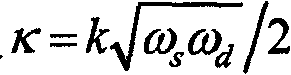
可以将高Q谐振器定义为具有Q>100的谐振器。两个耦合谐振器可称为高Q谐振器的系统,当其中每个谐振器具有大于100的Q、Qs>100且Qd>100时。在其它实施方式中,当谐振器的Q的几何平均数大于100时,
可以将谐振器命名或编号。可以将其称为源谐振器、设备谐振器、第一谐振器、第二谐振器、重发器谐振器等。应理解的是虽然在图1中示出两个谐振器,但在以下许多示例中,其它实施方式可以包括三个(3)或更多谐振器。例如,单个源谐振器102S可以将能量转移至多个设备谐振器102D或多个设备。可以将能量从第一设备转移至第二个,然后从第二设备转移至第三个,以此类推。多个源可以将能量转移至单个设备或连接到单个设备谐振器的多个设备或连接到多个设备谐振器的多个设备。谐振器102可以交替地或同时地作为源、设备,或者其可以用来将功率从一个位置上的源中继到另一位置上的设备。可以使用中间电磁谐振器102来扩展无线能量转移系统的距离范围。多个谐振器102可以被菊链式连接在一起,在扩展的距离上与大范围的源和设备交换能量。高功率水平可以被在多个源102S之间拆分,转移至多个设备并在远距离位置处重新组合。Resonators can be named or numbered. It may be called a source resonator, device resonator, first resonator, second resonator, repeater resonator, etc. It should be understood that while two resonators are shown in FIG. 1 , in many of the examples below, other implementations may include three (3) or more resonators. For example, a
可以单个源和单个设备谐振器的分析扩展至多个源谐振器和/或多个设备谐振器和/或多个中间谐振器。在此类分析中,结论可以是所述多个谐振器的至少某些或全部之间的大的强耦合因数Umn对于无线能量转移中的高系统效率而言是优选的。再次地,实施方式可以使用具有高Q的源、设备和中间谐振器。每个谐振器的Q可以是高的。用于谐振器对m和n(对于它们而言期望大的Umn)的Q的几何平均数也可以或替代地是高的。The analysis of a single source and a single device resonator can be extended to multiple source resonators and/or multiple device resonators and/or multiple intermediate resonators. In such an analysis, it may be concluded that a large strong coupling factor Umn between at least some or all of the plurality of resonators is preferred for high system efficiency in wireless energy transfer. Again, embodiments may use sources, devices and intermediate resonators with high Q. The Q of each resonator can be high. The geometric mean of Q for pairs of resonators m and n for which a large Umn is expected It may also or alternatively be high.
请注意,由于可以由两个谐振器之间的耦合机制和每个谐振器的损耗机制的相对幅值来确定两个谐振器的强耦合因数,所以可以在如上所述的谐振器附近存在无关对象的情况下扰动任何或所有这些机制的强度。Note that there can be independent The condition of the object perturbs the strength of any or all of these mechanisms.
延续来自前面部分的用于标记的惯例,我们将k描述为在不存在无关对象或材料的情况下的耦合因数。我们将存在无关对象的情况下的耦合因数p表示为k(p),并且将其称为“被扰动耦合因数”或“被扰动k”。请注意,必要时还可以将耦合因数k表征为“未扰动”,以与被扰动耦合因数k(p)区别开。Continuing the convention from the previous section for notation, we describe k as the coupling factor in the absence of extraneous objects or materials. We denote the coupling factor p in the presence of extraneous objects as k (p) and call it the "perturbed coupling factor" or "perturbed k". Note that the coupling factor k can also be characterized as "unperturbed" when necessary to distinguish it from the perturbed coupling factor k (p) .
我们定义δk(p)≡k(p)-k,并且我们将其称为由于无关对象p而引起的“耦合因数的扰动”或“k的扰动”。We define δk (p) ≡ k (p) −k, and we call this the "perturbation of the coupling factor" or "perturbation of k" due to an unrelated object p.
我们还定义β(p)≡k(p)/k,并且我们将其称为“耦合因数不灵敏度”或“k不灵敏度”。诸如β12(p)的下标指示被扰动和未扰动耦合因数所涉及的谐振器,即β12(p)≡k12(p)/k12。We also define β (p) ≡ k (p) /k, and we refer to this as "coupling factor insensitivity" or "k insensitivity". Subscripts such as β 12(p) indicate the resonators involved in the perturbed and unperturbed coupling factors, ie β 12(p) ≡k 12(p) /k 12 .
同样地,我们将U描述为不存在无关对象的情况下的强耦合因数。我们将存在无关对象的情况下的强耦合因数p表示为U(p),
我们定义δU(p)≡U(p)-U并将其称为由于无关对象p而引起的“强耦合因数的扰动”或“U的扰动”。We define δU (p) ≡U (p) -U and call it the "perturbation of the strong coupling factor" or "perturbation of U" due to an unrelated object p.
我们还定义Ξ(p)≡U(p)/U并将其称为“强耦合因数不灵敏度”或“U不灵敏度”。诸如Ξ12(p)的下标指示被扰动和未扰动耦合因数所涉及的谐振器,即Ξ12(p)≡U12(p)/U12。We also define Ξ(p)≡U(p)/U and refer to it as "strong coupling factor insensitivity" or "U insensitivity". Subscripts such as Ξ 12(p) indicate the resonators involved in the perturbed and unperturbed coupling factors, ie Ξ 12(p) ≡U 12(p) /U 12 .
可以由给出未扰动系统的效率的相同公式给出被扰动系统中的能量交换的效率,其中,诸如强耦合因数、耦合因数和品质因数的所有参数由其被扰动等价参数所代替。例如,在包括一个源和一个设备谐振器的无线能量转移的系统中,可以将最佳效率计算为
某些无关扰动有时对于被扰动强耦合因数而言是不利的(经由耦合因数或品质因数的大的扰动)。因此,可以使用技术来减少无关扰动对系统的影响并保持大的强耦合因数不灵敏度。Certain irrelevant perturbations are sometimes unfavorable for the perturbed strong coupling factor (via a large perturbation of the coupling factor or quality factor). Therefore, techniques can be used to reduce the impact of extraneous perturbations on the system and maintain the insensitivity to large strong coupling factors.
能量交换效率energy exchange efficiency
有用能量交换中的所谓“有用能量”是必须被转移至一个或多个设备以便对设备供电或充电的能量或功率。对应于有用能量交换的转移效率可以是系统或应用相关的。例如,转移几千瓦的功率的高功率交通工具充电应用可能需要具有至少80%的效率以便供应有用的功率量,带来足够向交通工具电池重新充电的有用能量交换,而不显著地对转移系统的各种组件加热。在某些消费者的电子装置应用中,有用能量交换可以包括任何大于10%的能量转移效率,或者任何其它可接受的保持可再充电电池“填满(topped off)”并长时间运行的量。对于某些无线传感器应用而言,比1%小得多的转移效率可能适合于从位于距离传感器相当远的距离处的单个源向多个低功率传感器供电。对于不可能有线功率转移或有线功率转移不切实际的其它应用而言,大范围的转移效率对于有用能量交换而言可以是可接受的,并且可认为是向那些应用中的设备供应有用功率。通常,操作距离是根据本文所述的原理保持或能够保持有用功率交换的任何距离。So-called "useful energy" in useful energy exchange is energy or power that must be transferred to one or more devices in order to power or charge the devices. The transfer efficiency corresponding to useful energy exchange can be system or application dependent. For example, a high power vehicle charging application that diverts several kilowatts of power may need to have an efficiency of at least 80% in order to supply a useful amount of power, resulting in a useful energy exchange sufficient to recharge the vehicle battery without significantly affecting the transfer system. The various components are heated. In certain consumer electronic device applications, useful energy exchange may include any energy transfer efficiency greater than 10%, or any other acceptable amount to keep a rechargeable battery "topped off" and running for a long time . For some wireless sensor applications, transfer efficiencies much less than 1% may be suitable for powering multiple low-power sensors from a single source located at a considerable distance from the sensors. For other applications where wired power transfer is not possible or practical, a wide range of transfer efficiencies may be acceptable for useful energy exchange and may be considered to supply useful power to devices in those applications. In general, an operating distance is any distance over which useful power exchange is maintained or can be maintained in accordance with the principles described herein.
用于供电或再充电应用中的无线能量转移的有用能量交换可以是高效、高度高效或足够高效的,只要浪费的能量水平、热耗散和相关场强度在可容许极限内即可。可容许极限可以取决于应用、环境和系统位置。用于供电或再充电应用中的无线能量转移的有用能量交换可以是高效、高度高效或足够高效的,只要对于合理的成本限制、重量限制、尺寸限制等而言可以获得期望的系统性能即可。可以相对于使用非高Q系统的传统感应技术所能实现的来确定高效的能量转移。然后,如果递送了比在传统感应方案中由类似尺寸的线圈结构在类似距离或对准偏移内可以递送的能量更多的能量,则可以将能量转移定义为高效、高度高效或足够高效的。Useful energy exchange for wireless energy transfer in powering or recharging applications can be efficient, highly efficient or sufficiently efficient as long as wasted energy levels, heat dissipation and associated field strengths are within tolerable limits. Tolerable limits may depend on application, environment and system location. Useful energy exchange for wireless energy transfer in powering or recharging applications can be efficient, highly efficient, or sufficiently efficient as long as the desired system performance can be achieved for reasonable cost constraints, weight constraints, size constraints, etc. . Efficient energy transfer can be determined relative to what can be achieved using conventional inductive techniques for non-high-Q systems. Energy transfer can then be defined as efficient, highly efficient, or sufficiently efficient if more energy is delivered than can be delivered within a similar distance or alignment offset by a similarly sized coil structure in a conventional inductive scheme .
请注意,即使某些频率和Q匹配条件可以使能量转移的系统效率最优化,也不需要完全满足这些条件以便具有用于有用能量交换的足够高效的能量转移。只要谐振频率的相对偏移
因此,谐振器的谐振频率可以不是完全匹配的,而是在以上容差内是匹配的。由于发电机和/或负载而引起的至少某些谐振器的强加载因数可以不是完全与其最优值匹配的。电压水平、电流水平、阻抗值、材料参数等可以不处于在本公开中描述的精确值,但是将在那些值的某些可接受容差内。除效率、Q、频率、强耦合因数等考虑因素之外,系统最优化可以包括成本、尺寸、重量、复杂性等考虑因素。某些系统性能参数、规格和设计可能远非最佳的,以便使其它系统性能参数、规格和设计最优化。Thus, the resonant frequencies of the resonators may not be perfectly matched, but matched within the above tolerances. The strong loading factors of at least some resonators due to generators and/or loads may not exactly match their optimal values. Voltage levels, current levels, impedance values, material parameters, etc. may not be at the exact values described in this disclosure, but will be within some acceptable tolerance of those values. System optimization may include cost, size, weight, complexity, etc. considerations in addition to efficiency, Q, frequency, strong coupling factors, etc. considerations. Certain system performance parameters, specifications and designs may be far from optimal in order to optimize other system performance parameters, specifications and designs.
在某些应用中,至少某些系统参数可以在时间上改变,例如因为诸如源或设备的组件可能移动或老化,或者因为负载可能是可变的,或者因为扰动或环境条件正在改变等。在这些情况下,为了实现可接受匹配条件,可能需要至少某些系统参数是可动态地调整或调谐的。所有系统参数可以是可动态地调整或调谐的以实现近似的最佳工作条件。然而,基于上述讨论,即使某些系统参数不是可变的,也可以实现足够高效的能量交换。在某些例子中,至少某些设备可以不被动态地调整。在某些例子中,至少某些源可以不被动态地调整。在某些例子中,至少某些中间谐振器可以不被动态地调整。在某些例子中,系统参数中没有一个可以被动态地调整。In some applications, at least some system parameters may change in time, for example because components such as sources or equipment may move or age, or because loads may be variable, or because disturbances or environmental conditions are changing, etc. In these cases, at least some system parameters may need to be dynamically adjustable or tuneable in order to achieve acceptable matching conditions. All system parameters may be dynamically adjustable or tuned to achieve near optimal operating conditions. However, based on the above discussion, sufficiently efficient energy exchange can be achieved even if some system parameters are not variable. In some instances, at least some devices may not be dynamically adjusted. In some examples, at least some sources may not be dynamically adjusted. In some examples, at least some of the intermediate resonators may not be dynamically adjusted. In some instances, none of the system parameters can be dynamically adjusted.
电磁谐振器electromagnetic resonator
用来交换能量的谐振器可以是电磁谐振器。在此类谐振器中,由谐振器的吸收(或电阻)损耗和辐射损耗来给出固有能量衰变率Γm。The resonators used to exchange energy may be electromagnetic resonators. In such resonators, the intrinsic energy decay rate Γ m is given by the absorption (or resistive) losses and radiation losses of the resonator.
可以将谐振器构造为使得由电场存储的能量被主要约束在结构内且由磁场存储的能量主要在谐振器周围的区域中。然后,主要由谐振磁近场来调解能量交换。可以将这些类型的谐振器称为磁谐振器。The resonator can be constructed such that the energy stored by the electric field is primarily confined within the structure and the energy stored by the magnetic field is primarily in the region around the resonator. The energy exchange is then mediated mainly by the resonant magnetic near-field. These types of resonators may be referred to as magnetic resonators.
可以将谐振器构造为使得由磁场存储的能量被主要约束在结构内且由电场存储的能量主要在谐振器周围的区域中。则主要由谐振电近场来调解能量交换。可以将这些类型的谐振器称为电谐振器。The resonator can be constructed such that the energy stored by the magnetic field is primarily confined within the structure and the energy stored by the electric field is primarily in the region around the resonator. The energy exchange is mediated mainly by the resonant electric near field. These types of resonators may be referred to as electrical resonators.
请注意,由谐振器存储的总电能和磁能必须是相等的,但是其局部化可以是相当不同的。在某些情况下,可以使用在距谐振器一定距离处指定的平均电场能与平均磁场能的比来表征或描述谐振器。Note that the total electrical and magnetic energy stored by the resonator must be equal, but its localization can be quite different. In some cases, a resonator may be characterized or described using the ratio of the average electric field energy to the average magnetic field energy specified at a distance from the resonator.
电磁谐振器可以包括电感元件、分布电感或具有电感L的电感的组合、以及电容元件、分布电容、或具有电容C的电容的组合。在图6a中示出了电磁谐振器102的最小电路模型。谐振器可以包括电感元件108和电容元件104。被提供诸如存储在电容器104中的电场能的初始能量,系统将随着电容器放电而振荡,将能量转移至存储在电感器108中的磁场能中,电感器108又将能量转移回至存储在电容器104中的电场能。The electromagnetic resonator may include an inductance element, a distributed inductance, or a combination of inductance with an inductance L, and a capacitive element, a distributed capacitance, or a combination of capacitance with a capacitance C. A minimal circuit model of the
可以将图6(b)(c)(d)所示的谐振器102称为磁谐振器。对于居住环境中的无线能量转移应用而言,磁谐振器可能是优选的,因为包括动物、植物和人的大多数日常材料是非磁性的(即μr≈1),因此其与磁场的交互是最小的,并且主要是由于由磁场的时变而感生的涡流(其为二阶效应)。由于安全原因,并且由于其降低了与可能改变系统性能的无关环境对象和材料的交互的可能,此特性是重要的。The
图6d示出与示例性磁谐振器102B相关联的某些电场和磁场线的简化图。磁谐振器102B可以包括充当电感元件108和电容元件104(在导体环路的末端处)的导体环路。请注意,本图描绘了被存储在磁场中的谐振器周围区域中的大部分能量和被存储在电场中的谐振器中(电容器极板之间)的大部分能量。由于边缘场、自由电荷和时变磁场而引起的某些电场可以被存储在谐振器周围的区域中,但是可以将磁谐振器设计为使电场局限于尽可能地接近于谐振器或在谐振器本身内。Figure 6d shows a simplified diagram of certain electric and magnetic field lines associated with the exemplary
电磁谐振器102的电感器108和电容器104可以是体电路元件,或者电感和电容可以是分布式的,并且可以由在结构中对导体进行形成、成形和定位的方式而产生。例如,如图6(b)(c)(d)所示,可以通过将导体成形为封闭表面面积来实现电感器108。可以将此类谐振器102称为电容加载环路电感器。请注意,我们可以使用术语“环路”或“线圈”来泛指导电结构(导线、管、条带等),其以任何匝数封闭任何形状和尺寸的表面。在图6b中,封闭的表面区域是圆形的,但是该表面可以是多种其它形状和尺寸中的任何一个,并且可以被设计为实现某些系统性能规格。作为指示电感如何随着物理尺寸缩放的示例,用于被布置为形成圆形单匝环路的一段圆形导体的电感近似为The
其中,μ0是自由空间的磁导率,x是封闭的圆形表面区域的半径,并且a是用来形成电感器环路的导体的半径。可以分析性或数值性地计算环路的更精确电感值。where μ0 is the magnetic permeability of free space, x is the radius of the closed circular surface area, and a is the radius of the conductor used to form the inductor loop. A more precise inductance value for the loop can be calculated analytically or numerically.
可以分析性或数值性地计算用于被布置为形成其它封闭表面形状、面积、尺寸等并具有任何匝数的其它横截面导体的电感,或可以通过测量来确定该电感。可以使用电感器元件、分布式电感、网络、阵列、电感器和电感的串联和并联组合等来实现电感。电感可以是固定的或可变的,并且可以用来改变阻抗匹配以及谐振频率工作条件。The inductance for other cross-sectional conductors arranged to form other closed surface shapes, areas, dimensions, etc. and having any number of turns may be calculated analytically or numerically, or may be determined by measurement. Inductance may be implemented using inductor elements, distributed inductance, networks, arrays, series and parallel combinations of inductors and inductors, and the like. Inductance can be fixed or variable and can be used to vary impedance matching and resonant frequency operating conditions.
存在多种方式来实现为达到谐振器结构的期望谐振频率所需的电容。可以如图6b所示地形成和利用电容器极板110,或者如图6c所示,可以在多环路导体114的相邻绕组之间分布并实现电容。可以使用电容器元件、分布式电容、网络、阵列、电容的串联和并联组合等来实现电容。电容可以是固定的或可变的,并且可以用来改变阻抗匹配以及谐振频率工作条件。There are various ways to achieve the capacitance required to achieve the desired resonant frequency of the resonator structure.
应理解的是电磁谐振器102中的电感和电容可以是集总的、分布式的或集总和分布式电感和电容的组合,并且可以通过本文所述的各种元件、技术和效果的组合来实现电磁谐振器。It should be understood that the inductance and capacitance in the
电磁谐振器102可以包括电感器、电感、电容器、电容以及诸如电阻器、二极管、开关、放大器、二极管、晶体管、变压器、导体、连接器等附加电路元件。
电磁谐振器的谐振频率The resonant frequency of an electromagnetic resonator
电磁谐振器102可以具有由其物理性质确定的特性、自然或谐振频率。此谐振频率是谐振器存储的能量在电场存储的能量WE(WE=q2/2C,其中,q是电容器C上的电荷)与谐振器的磁场存储的能量WB(WB=Li2/2,其中,i是通过电感器L的电流)之间振荡的频率。在系统中不存在任何损耗的情况下,将连续地在电容器104中的电场与电感器108中的磁场之间交换能量。交换此能量的频率可以称为谐振器的特性频率、自然频率或谐振频率,并且由ω给出,
可以通过调谐谐振器的电感L和/或电容C来改变谐振器的谐振频率。可以将谐振频率设计为在由FCC指定的所谓ISM(工业、科学和医疗)频率下操作。可以将谐振器频率选择为满足某些场极限规格、比吸收率(SAR)极限规格、电磁兼容性(EMC)规格、电磁干扰(EMI)规格、组件尺寸、成本或性能规格等。The resonant frequency of the resonator can be changed by tuning the inductance L and/or capacitance C of the resonator. The resonant frequency can be designed to operate at the so-called ISM (Industrial, Scientific and Medical) frequencies specified by the FCC. The resonator frequency may be selected to meet certain field limit specifications, specific absorption rate (SAR) limit specifications, electromagnetic compatibility (EMC) specifications, electromagnetic interference (EMI) specifications, component size, cost or performance specifications, and the like.
电磁谐振器的品质因数Quality Factor of Electromagnetic Resonators
图6所示的谐振器102中的能量可以衰减,或者由于包括吸收性损耗(也称为欧姆或电阻损耗)和/或辐射性损耗在内的固有损耗而被损耗。表征能量衰减的谐振器的品质因数或Q与这些损耗成反比。吸收性损耗可以是由用来形成电感器的导体的有限电导率以及谐振器中的其它元件、组件、连接器等中的损耗引起的。可以将由低损耗材料形成的电感器称为“高Q电感元件”,并且可以将具有低损耗的元件、组件、连接器等称为具有“高电阻Q”。通常,可以将谐振器的总吸收性损耗计算为构成谐振器的各种元件和组件的电阻性损耗的适当串联和/或并联组合。也就是说,在不存在任何显著的辐射性或组件/连接损耗的情况下,可以由Qabs来给出谐振器的Q,Energy in the
其中,ω是谐振频率,L是谐振器的总电感,并且例如可以由Rabs=lρ/A给出用于用来形成电感器的导体的电阻(l是导线的长度,ρ是导体材料的电阻率,并且A是电流在导线中流动的横截面面积)。对于交流电而言,电流在其上流动的横截面面积可以由于趋肤效应而小于导体的物理横截面面积。因此,高Q磁谐振器可以由具有高导电性、相对大的表面面积和/或具有具体设计的轮廓(例如利兹线)的导体组成以使接近效应最小化并减小AC电阻。where ω is the resonant frequency, L is the total inductance of the resonator, and the resistance of the conductor used to form the inductor can be given, for example, by Rabs = lρ/A (l is the length of the wire, ρ is the conductor material resistivity, and A is the cross-sectional area where current flows in the wire). For alternating current, the cross-sectional area over which the current flows can be smaller than the physical cross-sectional area of the conductor due to the skin effect. Thus, high-Q magnetic resonators can be composed of conductors with high conductivity, relatively large surface area, and/or with specially designed profiles (eg, litz wires) to minimize proximity effects and reduce AC resistance.
磁谐振器结构可以包括由高导电性导线、涂层线、利兹线、带、条或板、管、涂料、凝胶、迹线等组成的高Q电感元件。磁谐振器可以是自谐振的,或者其可以包括诸如电容器、电感器、开关、二极管、晶体管、变压器等的外部耦合元件。磁谐振器可以包括分布式和集总电容和电感。通常,将由谐振器的所有单独组件的Q来确定谐振器的Q。Magnetic resonator structures may include high-Q inductive elements composed of highly conductive wires, coated wires, litz wires, strips, strips or plates, tubes, paints, gels, traces, and the like. A magnetic resonator may be self-resonant, or it may include external coupling elements such as capacitors, inductors, switches, diodes, transistors, transformers, and the like. Magnetic resonators can include distributed and lumped capacitance and inductance. In general, the Q of a resonator will be determined by the Q of all the individual components of the resonator.
由于Q与电感L成比例,所以可以将谐振器设计为在某些其它约束内增加L。例如,增加L的一种方式是使用多于一匝的导体的来形成谐振器中的电感器。设计技术和权衡可以取决于应用,并且在高Q磁谐振器的设计中可以选择多种结构、导体、组件和谐振频率。Since Q is proportional to the inductance L, the resonator can be designed to increase L within certain other constraints. For example, one way to increase L is to use more than one turn of the conductor to form the inductor in the resonator. Design techniques and tradeoffs can depend on the application, and there are a variety of structures, conductors, components, and resonant frequencies that can be chosen in the design of a high-Q magnetic resonator.
在不存在显著吸收损耗的情况下,可以主要由辐射损耗来确定谐振器的Q,并且由Qrad=ωL/Rrad来给出,其中,Rrad是谐振器的辐射损耗,并且可以取决于谐振器相对于操作的频率ω或波长λ的尺寸。对于上文讨论的磁谐振器而言,辐射损耗可以随着Rrad~(x/λ)4(磁偶极子辐射的特性)而缩放,其中,x是谐振器的特性尺寸,诸如图6b所示的电感元件的半径,并且这里λ=c/f,其中,c是光速且f是如上文所定义的。磁谐振器的尺寸可以比操作的波长小得多,因此辐射损耗可以非常小。可以将此类结构称为子波长谐振器。辐射可以是用于非辐射无线能量转移系统的损耗机制,并且可以将设计选择为减小Rrad或使其最小化。请注意,对于非辐射无线能量转移方案而言,高Qrad可能是期望的。In the absence of significant absorption losses, the Q of a resonator can be determined primarily by radiation losses and is given by Q rad =ωL/R rad , where R rad is the radiation loss of the resonator and can be determined by The size of a resonator relative to the frequency ω or wavelength λ of operation. For the magnetic resonators discussed above, the radiation loss can scale with R rad ~ (x/λ) 4 (characteristic of magnetic dipole radiation), where x is the characteristic dimension of the resonator, such as Fig. 6b The radius of the inductive element shown, and where λ=c/f, where c is the speed of light and f is as defined above. The size of the magnetic resonator can be much smaller than the wavelength of operation, so radiation losses can be very small. Such structures may be referred to as sub-wavelength resonators. Radiation can be a loss mechanism for non-radiative wireless energy transfer systems, and design choices can be made to reduce or minimize R rad . Note that for non-radiative wireless energy transfer schemes, a high Q rad may be desirable.
还请注意,用于非辐射无线能量转移的谐振器的设计不同于出于通信或远场能量传输的目的设计的天线。具体地,可以使用电容加载导电环路作为谐振天线(例如,在蜂窝电话中),但是对于那些在远场区中操作的,其中辐射Q被故意地设计成小的以使得天线在辐射能量下是高效的。此类设计不适合于在本申请中公开的高效近场无线能量转移技术。Note also that resonators designed for nonradiative wireless energy transfer are different from antennas designed for communication or far-field energy transfer purposes. In particular, capacitively loaded conductive loops can be used as resonant antennas (e.g., in cellular telephones), but for those operating in the far-field region, where the radiation Q is deliberately designed to be small so that the antenna is under radiated energy is efficient. Such designs are not suitable for the efficient near-field wireless energy transfer techniques disclosed in this application.
包括辐射和吸收损耗两者的谐振器的品质因数是Q=ωL(Rabs+Rrad)。请注意,对于特定谐振器而言可以存在最大Q值,并且可以出于对谐振器的尺寸、用来构造谐振器的材料和元件、工作频率、连接机构等的特殊考虑来设计谐振器,以便实现高Q谐振器。图7示出可以用于MHz频率处的无线功率传输的示例性磁谐振器(在这种情况下,为由具有4cm的外径(OD)的铜管制成的具有60cm的直径的线圈)的Q的绘图。吸收性Q(虚线)702随着频率增加,而辐射性Q(点线)704随着频率减小,因此,促使总的Q在特定频率处达到峰值708。请注意,此示例性谐振器的Q在大频率范围内是大于100的。可以将磁谐振器设计为在一定的频率范围内具有高Q,并且可以将系统工作频率设置为该范围内的任何频率。The quality factor of a resonator including both radiation and absorption losses is Q=ωL(R abs +R rad ). Note that there may be a maximum Q value for a particular resonator, and that a resonator may be designed with special considerations for the size of the resonator, the materials and components used to construct the resonator, the frequency of operation, the connection mechanism, etc., so that Realize high-Q resonators. Figure 7 shows an exemplary magnetic resonator (in this case a coil with a diameter of 60 cm made of copper tubing with an outer diameter (OD) of 4 cm) that can be used for wireless power transfer at MHz frequencies A plot of Q. Absorptive Q (dashed line) 702 increases with frequency, while radiative Q (dotted line) 704 decreases with frequency, thus forcing the overall Q to peak 708 at a particular frequency. Note that the Q of this exemplary resonator is greater than 100 over a large frequency range. Magnetic resonators can be designed to have a high Q within a certain frequency range, and the system operating frequency can be set to any frequency within this range.
当在损耗率方面来描述谐振器时,如前所述,可以使用固有衰变率2Γ,来定义Q。固有衰变率是未耦合和未驱动谐振器损失能量的速率。对于上述磁谐振器而言,可以由Γ=(Rabs+Rrad)/2L来给出固有损耗,并且由Q=ω/2Γ来给出谐振器的品质因数Q。When describing a resonator in terms of loss rate, Q can be defined using the intrinsic decay rate, 2Γ, as mentioned earlier. The intrinsic decay rate is the rate at which an uncoupled and undriven resonator loses energy. For the magnetic resonator described above, the intrinsic loss can be given by Γ=(R abs +R rad )/2L, and the quality factor Q of the resonator can be given by Q=ω/2Γ.
请注意,可以将仅与特定损耗机制有关的品质因数表示为Qmechanism(如果未指定谐振器)或Q1,mechanism(如果指定了谐振器(例如谐振器1))。例如,Q1,rad是用于谐振器1的品质因数,与其辐射损耗有关。Note that a quality factor that is only related to a specific loss mechanism can be expressed as Q mechanism (if no resonator is specified) or Q1 , mechanism (if a resonator is specified (for example, resonator 1)). For example, Q1 ,rad is the quality factor for
电磁谐振器近场Electromagnetic Resonator Near Field
在这里公开的近场无线能量转移系统中使用的高Q电磁谐振器可以是子波长对象。也就是说,谐振器的物理尺寸可以比对应于谐振频率的波长小得多。子波长磁谐振器可以将谐振器周围的区域中的大部分能量存储在其磁近场中,并且还可以将这些场描述为固定不动或不传播的,因为其不远离谐振器进行辐射。通常由波长来设置谐振器周围区域中的近场的范围,因此对于子波长谐振器而言,近场的范围可以延伸超过谐振器本身很多。可以将其中场特性从近场特性变成远场特性的限制表面称为“辐射焦散曲面(radiation caustic)”。High-Q electromagnetic resonators used in the near-field wireless energy transfer systems disclosed herein may be sub-wavelength objects. That is, the physical size of the resonator can be much smaller than the wavelength corresponding to the resonant frequency. Sub-wavelength magnetic resonators can store most of the energy in the region surrounding the resonator in their magnetic near-fields, and these fields can also be described as stationary or non-propagating because they do not radiate away from the resonator. The extent of the near-field in the region around the resonator is generally set by the wavelength, so for sub-wavelength resonators the extent of the near-field can extend well beyond the resonator itself. A confining surface in which the field properties change from near-field properties to far-field properties may be called a "radiation caustic".
更加远离谐振器时,近场的强度减小。虽然谐振器近场的场强度随远离谐振器而衰减,但是场仍可以与进入谐振器的一般附近区域的对象相交互。场进行交互的程度取决于多种因素,其中的某些是可以控制和设计的,而某些不可以。当耦合谐振器之间的距离使得一个谐振器在另一个的辐射焦散表面内时,可以实现本文所述的无线能量转移方案。The strength of the near field decreases the farther away from the resonator. Although the field strength of the near field of a resonator decays away from the resonator, the field can still interact with objects entering the general vicinity of the resonator. The extent to which a field interacts depends on a variety of factors, some of which can be controlled and designed, and some of which cannot. The wireless energy transfer scheme described herein can be achieved when the distance between the coupled resonators is such that one resonator is within the radiative caustic surface of the other.
电磁谐振器的近场分布可以类似于一般与偶极子谐振器或振荡器相关联的那些场分布。可以将此类场分布描述为全向的,意味着场的幅值在离开对象的所有方向上是非零的。The near-field distribution of an electromagnetic resonator may be similar to those generally associated with dipole resonators or oscillators. Such field distributions can be described as omnidirectional, meaning that the magnitude of the field is non-zero in all directions away from the object.
电磁谐振器的特性尺寸Characteristic Dimensions of Electromagnetic Resonators
足够Q的空间分离和/或偏移的磁谐振器可以在比在现有技术中所见的大得多的距离上实现高效的无线能量转移,即使谐振器结构的尺寸和形状是不同的。还可以操作此类谐振器以实现在较短范围距离上的比前述技术可实现的更高效的能量转移。我们将此类谐振器描述为能够实现中程能量转移。Spatially separated and/or offset magnetic resonators of sufficient Q can enable efficient wireless energy transfer over much greater distances than seen in the prior art, even if the size and shape of the resonator structures are different. Such resonators can also be operated to achieve more efficient energy transfer over shorter range distances than is achievable with the aforementioned techniques. We describe such resonators as capable of mid-range energy transfer.
可以将中程距离定义为比转移中涉及的谐振器中的最小的一个的特性尺寸大的距离,其中,测量从一个谐振器结构的中心到空间分离的第二谐振器结构的中心的距离。在此定义中,当由其电感元件限制的区域未相交时,二维谐振器是空间分离的,并且当其体积未相交时,三维谐振器是空间分离的。当由二维谐振器限制的区域在三维谐振器的体积之外时,前者与后者被空间分离。A mid-range distance may be defined as a distance larger than the characteristic dimension of the smallest one of the resonators involved in the transfer, where the distance is measured from the center of one resonator structure to the center of a second spatially separated resonator structure. In this definition, two-dimensional resonators are spatially separated when the regions bounded by their inductive elements do not intersect, and three-dimensional resonators are spatially separated when their volumes do not intersect. When the region bounded by the two-dimensional resonator is outside the volume of the three-dimensional resonator, the former is spatially separated from the latter.
图8示出其特性尺寸被标记的某些示例性谐振器。应理解的是可以在导体的尺寸和由磁谐振器中的电感元件限制或封闭的面积及形成电谐振器的电容元件的导体的长度方面定义谐振器102的特性尺寸802。然后,谐振器102的特性尺寸802xchar可以等于能够分别拟合在磁或电谐振器的电感或电容元件周围的最小球体的半径,并且谐振器结构的中心是该球体的中心。谐振器102的特性厚度804tchar可以是从其所在的平坦表面测量的磁或电容谐振器各自的电感或电容元件的最高点的最小可能高度。谐振器102的特性宽度808wchar可以是最小可能圆圈的半径,磁或电谐振器各自的电感或电容元件可以在沿着直线行进的同时通过该最小可能圆圈。例如,圆柱形谐振器的特性宽度808可以是圆柱的半径。Figure 8 shows some exemplary resonators with their characteristic dimensions marked. It will be appreciated that the
在本发明的无线能量转移技术中,可以在大的距离范围内高效地交换能量,但是本技术以在中程距离上并在具有不同物理尺寸、组件和取向的谐振器之间交换有用能量以便对设备进行供电或再充电的能力而著名。请注意,虽然在这些情况下k可能是小的,但是可以通过使用高Q谐振器来实现高U而实现强耦合和高效的能量转移,也就是说,可以使用Q的增加来至少部分地克服k的减小,以保持有用的能量转移效率。In the wireless energy transfer technique of the present invention, energy can be efficiently exchanged over a large distance range, but the technique is designed to exchange useful energy over medium-range distances and between resonators with different physical sizes, components, and orientations in order to Notable for its ability to power or recharge devices. Note that although k may be small in these cases, strong coupling and efficient energy transfer can be achieved by using high-Q resonators to achieve high U, That is, an increase in Q can be used to at least partially overcome a decrease in k to maintain useful energy transfer efficiencies.
还请注意,虽然可以将单个谐振器的近场描述为全向的,但两个谐振器之间的能量交换的效率可以取决于谐振器的相对位置和取向。也就是说,可以针对谐振器的特定相对取向使能量交换的效率最大化。可以在k或κ的计算中捕捉转移效率对两个无补偿谐振器的相对位置和取向的灵敏度。虽然可以在相互之间偏移和/或旋转的谐振器之间实现耦合,但交换的效率可以取决于定位的细节和在操作期间实现的任何反馈、调谐和补偿技术。Note also that while the near-field of a single resonator can be described as omnidirectional, the efficiency of energy exchange between two resonators can depend on the relative position and orientation of the resonators. That is, the efficiency of energy exchange can be maximized for a particular relative orientation of the resonators. The sensitivity of the transfer efficiency to the relative position and orientation of the two uncompensated resonators can be captured in the calculation of k or κ. While coupling can be achieved between resonators that are offset and/or rotated relative to each other, the efficiency of the exchange can depend on the details of the positioning and any feedback, tuning and compensation techniques implemented during operation.
高Q磁谐振器High Q Magnetic Resonator
在子波长电容加载环路磁谐振器的近场区中(x≤λ),与由N匝导线(其半径大于趋肤深度)组成的圆形导电环路电感器相关联的电阻约为
请注意,上文给出的公式是近似的,并且意在说明Rabs、Rrad和L对结构的物理参数的函数依赖关系。对于谐振器结构的精确设计而言,将与严格准静态极限(例如沿着导体的非均匀电流/电荷分布)的偏差考虑在内的这些参数的更准确数值计算可能是有用的。Note that the formulas given above are approximate and are intended to illustrate the functional dependence of Rabs , Rrad and L on the physical parameters of the structure. More accurate numerical calculations of these parameters taking into account deviations from strict quasi-static limits (eg non-uniform current/charge distribution along conductors) may be useful for precise design of resonator structures.
请注意,可以通过使用低损耗导体来形成电感元件而使吸收性损耗最小化。例如,可以通过使用诸如电感管、条、带、机器加工对象、板等的大表面面积导体、通过使用诸如利兹线、编织线、任何横截面的导线和具有低接近损耗的其它导体的特别设计导体(在这种情况下上述频率缩放性质可也是不同的)以及通过使用诸如高纯度铜和银的低电阻率材料来使导体的损耗最小化。在较高工作频率处使用导电管作为导体的一个优点是其可以比类似直径的实心导体更便宜且更轻,并且可以具有类似的电阻,因为大部分电流由于趋肤效应而沿着导体的外表面行进。Note that absorptive losses can be minimized by using low loss conductors to form the inductive element. For example, by using large surface area conductors such as inductor tubes, strips, strips, machined objects, plates, etc., by using special designs such as Litz wire, braided wire, wires of any cross-section and other conductors with low proximity losses Conductors (in which case the above frequency scaling properties may also be different) and minimize conductor losses by using low resistivity materials such as high purity copper and silver. One advantage of using conductive tubing as a conductor at higher operating frequencies is that it can be cheaper and lighter than a solid conductor of similar diameter, and can have similar resistance since most of the current flows along the outer surface of the conductor due to the skin effect. surface travel.
为了获得由铜线或铜管制成并适合于在微波区中操作的可实现的谐振器设计的粗略估计,可以计算用于由各种横截面的铜线(ρ=1.69·10-8Ωm)的一个圆形电感元件(N=1)组成的谐振器的最佳Q和谐振频率。然后,对于具有特性尺寸x=1cm和导体直径a=1mm的电感元件(例如适合于蜂窝电话)而言,当f=380MHz时,品质因数在Q=1225处达到峰值。对于x=30cm和a=2mm,可能适合于膝上型计算机或家用机器人的电感元件尺寸而言,在f=17MHz处,Q=1103。对于例如可能位于天花板中的较大源电感元件而言,x=1m且a=4mm,在f=5MHz处,Q可以高达Q=1315。请注意,许多实际示例在λ/x≈50-80处提供Q≈1000-1500的预期品质因数。比上述的更多种类的线圈形状、尺寸、材料和工作频率的测量显示,使用一般可获得的材料,可以针对多种磁谐振器结构实现Q>100。In order to obtain a rough estimate of the design of achievable resonators made of copper wire or tube and suitable for operation in the microwave region, it is possible to calculate ) optimal Q and resonant frequency of a resonator composed of a circular inductive element (N=1). Then, for an inductive element with characteristic dimension x = 1 cm and conductor diameter a = 1 mm (e.g. suitable for a cellular phone), the quality factor peaks at Q = 1225 when f = 380 MHz. For x = 30cm and a = 2mm, Q = 1103 at f = 17MHz for an inductive element size that might be suitable for a laptop computer or a home robot. For larger source inductive elements, eg possibly located in the ceiling, x = lm and a = 4mm, at f = 5MHz, Q can be as high as Q = 1315. Note that many practical examples give an expected figure of merit of Q ≈ 1000-1500 at λ/x ≈ 50-80. Measurements of a wider variety of coil shapes, sizes, materials and operating frequencies than described above show that Q > 100 can be achieved for a variety of magnetic resonator structures using commonly available materials.
如上所述,可以由κ来给出用于具有特性尺寸x1和x2且在其中心之间分离距离D的两个谐振器之间的能量转移的速率。为了给出定义参数如何缩放的示例,在三(3)个距离处,考虑来自上文的蜂窝电话、膝上型计算机和天花板谐振器示例;D/x=10、8、6。在这里考虑的示例中,源和设备谐振器是相同的尺寸(x1=x2)和形状,并且如图1(b)所示地取向。在蜂窝电话的示例中,分别地,ω/2κ=3033、1553、655。在膝上型计算机示例中,分别地,ω/2κ=7131、3651、1540,并且对于天花板谐振器示例而言,ω/2κ=6481、3318、1400。相应的耦合损耗比在其中电感元件Q达到峰值的频率处达到峰值,并且,对于上述的三个电感元件尺寸和距离而言,κ/Γ=0.4、0.79、1.97和0.15、0.3、0.72和0.2、0.4、0.94。使用不同尺寸的电感元件的示例是分开距离D=3m(例如房间高度)的x1=1m电感器(例如天花板中的源)和x2=30cm电感器(例如,地板上的家用机器人)。在本示例中,对于近似14%的效率而言,在f=6.4MHz的最佳工作频率处,强耦合质量因数(figure of merit),这里,最佳系统工作频率在单独谐振器Q的峰值之间。As mentioned above, the rate for energy transfer between two resonators having characteristic dimensions x1 and x2 separated by a distance D between their centers can be given by κ. To give an example of how the definition parameters scale, consider the cell phone, laptop, and ceiling resonator example from above at three (3) distances; D/x=10,8,6. In the example considered here, the source and device resonators are the same size (x 1 =x 2 ) and shape, and are oriented as shown in Fig. 1(b). In the cellular phone example, ω/2κ=3033, 1553, 655, respectively. In the laptop example, ω/2κ=7131, 3651, 1540, and for the ceiling resonator example, ω/2κ=6481, 3318, 1400, respectively. The corresponding coupling loss ratios peak at frequencies where the inductive element Q peaks, and, for the three inductive element sizes and distances described above, κ/Γ = 0.4, 0.79, 1.97, and 0.15, 0.3, 0.72, and 0.2 , 0.4, 0.94. An example of using different sized inductive elements is an x 1 =1 m inductor (eg a source in the ceiling) and an x 2 =30 cm inductor (eg a home robot on the floor) separated by a distance D = 3m (eg room height). In this example, for an efficiency of approximately 14%, at an optimum operating frequency of f = 6.4 MHz, the figure of merit for strong coupling, Here, the optimum system operating frequency is between the peaks of the individual resonators Q.
可以形成在高Q磁谐振器中使用的电感元件。我们已经示范了基于被形成为封闭表面的电感元件的铜导体的多种高Q磁谐振器。可以使用以多种形状布置的多种导体(封闭任何尺寸或形状的区域)来形成电感元件,并且它们可以是单匝或多匝元件。在图9中示出示例性电感元件900A-B的图。可以将电感元件形成为封闭圆形、矩形、正方形、三角形、具有圆角的形状、遵循特定结构和设备的轮廓的形状、遵循、填充或利用结构或设备内的专用空间的形状等。可以针对尺寸、成本、重量、外观、性能等使设计最优化。Inductive elements used in high-Q magnetic resonators can be formed. We have demonstrated a variety of high-Q magnetic resonators based on copper conductors formed as closed-surface inductive elements. Inductive elements can be formed using a variety of conductors arranged in a variety of shapes (enclosing an area of any size or shape), and they can be single-turn or multi-turn elements. A diagram of exemplary
这些导体可以被弯曲或形成为期望的尺寸、形状和匝数。然而,可能难以使用手动技术来准确地再现导体形状和尺寸。另外,可能难以在电感元件的相邻匝中的导体段之间保持均匀或期望的中心间距。例如,准确或均匀的间距在确定结构的自电容以及任何接近效应感生的AC电阻的增加方面可能是重要的。These conductors can be bent or formed to a desired size, shape and number of turns. However, it can be difficult to accurately reproduce conductor shape and size using manual techniques. Additionally, it may be difficult to maintain a uniform or desired center-to-center spacing between conductor segments in adjacent turns of the inductive element. For example, accurate or uniform spacing may be important in determining the self-capacitance of the structure as well as any proximity effect induced increase in AC resistance.
可以使用模具(mold)来复制用于高Q谐振器设计的电感器元件。另外,可以使用模具来准确地将导体成形为任何种类的形状而不在导体中产生扭结、扣子或其它潜在的有害效果。可以使用模具来形成电感器元件,并且然后可以从这些模板(form)中去除电感器元件。一旦被去除,就可以将这些电感元件构建成可以容纳高Q磁谐振器的外壳或设备。所形成的元件还可以或替代地保持在用来形成它们的模具中。Molds can be used to replicate inductor elements for high-Q resonator designs. Additionally, dies can be used to accurately form conductors into any kind of shape without creating kinks, buckles, or other potentially detrimental effects in the conductors. Molds can be used to form inductor elements, and the inductor elements can then be removed from these forms. Once removed, these inductive elements can be built into housings or devices that can house high-Q magnetic resonators. The formed elements may also or alternatively remain in the mold used to form them.
可以使用标准CNC(计算机数控)打槽(routing)或磨铣工具或用于成块地切割或形成凹槽的任何其它已知技术来形成模具。还可以或替代地使用机器加工技术、注塑成型技术、铸造技术、浇铸技术、真空技术、热成形技术、原位切割技术、压缩成形技术等来形成模具。The mold may be formed using standard CNC (Computer Numerically Controlled) routing or milling tools or any other known technique for cutting or forming grooves in blocks. The mold may also or alternatively be formed using machining techniques, injection molding techniques, casting techniques, casting techniques, vacuum techniques, thermoforming techniques, in-situ cutting techniques, compression forming techniques, and the like.
可以从模具去除所形成的元件,或者其可以保持在模具中。可以用内部的电感元件来修改模具。可以对模具进行覆盖、机器加工、附着、涂漆等。可以将模具和导体组合集成到另一外壳、结构或设备中。切割到模具中的凹槽可以是任何尺寸,并且可以被设计以将导电管、导线、条、带、块等形成为期望的电感器形状和尺寸。The formed element can be removed from the mold, or it can remain in the mold. The mold can be modified with an internal inductive element. Molds can be covered, machined, attached, painted, etc. The die and conductor combination can be integrated into another housing, structure or device. The grooves cut into the mold can be of any size and can be designed to form conductive tubes, wires, strips, strips, blocks, etc. into the desired inductor shape and size.
在磁谐振器中使用的电感元件可以包含不止一个环路,并且可以向内或向外或向上或向下或沿着某些方向组合螺旋。通常,磁谐振器可以具有多种形状、尺寸和匝数,并且其可以由多种导电材料组成。Inductive elements used in magnetic resonators can contain more than one loop and can spiral inwards or outwards or up or down or in some combination of directions. In general, magnetic resonators can have a variety of shapes, sizes, and number of turns, and they can be composed of a variety of conductive materials.
磁谐振器可以是独立式的,或者其可以被封闭在外壳、容器、套筒或壳体中。磁谐振器可以包括用来制造电感元件的模板。这些不同的模板和外壳可以由几乎任何种类的材料组成。对于某些应用而言,诸如特氟隆、REXOLITE、苯乙烯等低损耗材料可能是优选的。这些外壳可以包含保持电感元件的固定装置。The magnetic resonator may be freestanding, or it may be enclosed in a housing, container, sleeve or housing. A magnetic resonator may include a template used to fabricate an inductive element. These various forms and enclosures can be composed of almost any kind of material. For some applications, low loss materials such as Teflon, REXOLITE, Styrene, etc. may be preferred. These enclosures may contain fixtures that hold the inductive components.
磁谐振器可以由铜线或铜管的自谐振线圈组成。由自谐振导线线圈组成的磁谐振器可以包括长度为l的导线和半径为a的横截面,被缠绕成半径x、高度h和匝数N的螺旋形线圈,其可以例如被表征为
可以将磁谐振器结构配置为使得x约为30cm,h约为20cm,a约为3mm且N约为5.25,并且在操作期间,被耦合到磁谐振器的电源可以以谐振频率f驱动谐振器,其中f约为10.6MHz。在x约为30cm,h约为20cm,a约为1cm且N约为4的情况下,可以以频率f驱动谐振器,其中f约为13.4MHz。在x约为10cm,h约为3cm,a约为2cm且N约为6的情况下,可以以频率f驱动谐振器,其中f约为21.4MHz。The magnetic resonator structure can be configured such that x is about 30 cm, h is about 20 cm, a is about 3 mm and N is about 5.25, and during operation a power source coupled to the magnetic resonator can drive the resonator at a resonant frequency f , where f is about 10.6MHz. With x about 30 cm, h about 20 cm, a about 1 cm and N about 4, the resonator can be driven at a frequency f, where f is about 13.4 MHz. With x about 10 cm, h about 3 cm, a about 2 cm and N about 6, the resonator can be driven at a frequency f, where f is about 21.4 MHz.
可以使用印刷电路板迹线来设计高Q电感元件。与机械地形成的电感元件相比,印刷电路板迹线可以具有多种优点,包括可以使用已确定的印刷电路板制造技术将其准确地再现并容易地集成,可以使用自定义设计的导体迹线来减小其AC电阻,并且可以显著地降低对其进行大量生产的成本。High-Q inductive components can be designed using printed circuit board traces. Printed circuit board traces can have several advantages over mechanically formed inductive elements, including that they can be accurately reproduced and easily integrated using established printed circuit board manufacturing techniques, that custom designed conductor traces can be used wire to reduce its AC resistance, and can significantly reduce the cost of its mass production.
可以在诸如FR-4(环氧树脂E-型玻璃)、多功能环氧树脂、高性能环氧树脂、双马来酰亚胺三嗪树脂/环氧树脂、聚酰亚胺、氰酸盐酯、聚四氟乙烯(Teflon)、FR-2、FR-3、CEM-1、CEM-2、Rogers、Resolute等任何PCB材料上使用标准PCB技术来制造高Q电感元件。可以在具有较低损耗角正切的印刷电路板材料上形成导体迹线。Can be used in such as FR-4 (epoxy E-glass), multifunctional epoxy resin, high performance epoxy resin, bismaleimide triazine resin/epoxy resin, polyimide, cyanate High-Q inductive components are manufactured using standard PCB techniques on any PCB material such as polyester, Teflon, FR-2, FR-3, CEM-1, CEM-2, Rogers, Resolute, etc. Conductor traces can be formed on printed circuit board materials that have a lower loss tangent.
导体迹线可以由铜、银、金、铝、镍等组成,并且其可以由油漆、油墨或其它固化材料组成。电路板可以是柔性的,并且其可以是可挠式电路。可以通过化学沉积、蚀刻、平版印刷、喷雾沉积、切割等来形成导电迹线。可以应用导电迹线来形成期望的图案,并且其可以使用晶体和结构生长技术来形成。The conductor traces may be composed of copper, silver, gold, aluminum, nickel, etc., and they may be composed of paint, ink or other cured material. The circuit board may be flexible, and it may be a flex circuit. Conductive traces may be formed by chemical deposition, etching, lithography, spray deposition, cutting, and the like. Conductive traces can be applied to form the desired pattern and can be formed using crystal and structure growth techniques.
可以将导电迹线的维度以及包含导电迹线的层的数目、那些迹线的位置、尺寸和形状以及用于将其互连的架构设计为实现某些系统规格或使其最优化,诸如谐振器Q、Q(p)、谐振器尺寸、谐振器材料和制造成本、U、U(p)等。The dimensions of the conductive traces, as well as the number of layers containing the conductive traces, the location, size and shape of those traces, and the architecture used to interconnect them can be designed to achieve or optimize certain system specifications, such as resonance Resonator Q, Q (p) , resonator size, resonator material and manufacturing cost, U, U (p) , etc.
作为示例,如图10(a)所示,使用矩形铜迹线图案在四层印刷电路板上制造三匝高Q电感元件1001A。用黑色示出铜迹线并用白色示出PCB。本示例中的铜迹线的宽度和厚度分别约为1cm(400mils)和43μm(1.7mils)。单层上的导电迹线的匝之间的边缘间距约为0.75cm(300mils),并且每个板层厚度约为100μm(4mils)。在板的每个层上重复图10(a)所示的图案,并且并联地连接导体。3环路结构的外部尺寸约为30cm乘20cm。此PCB环路的测量电感为5.3μH。使用此电感器元件和可调谐电容器的磁谐振器在6.78MHz的其设计谐振频率处具有550的品质因数Q。可以通过改变磁谐振器中的电感和电容值来调谐谐振频率。As an example, as shown in FIG. 10( a ), a three-turn high-Q
作为另一示例,如图10(b)所示,使用矩形铜迹线图案在四层印刷电路板上制造两匝电感器1001B。用黑色示出铜迹线并用白色示出PCB。本示例中的铜迹线的宽度和高度分别约为0.75cm(300mils)和43μm(1.7mils)。单层上的导电迹线的匝之间的边缘间距约为0.635cm(250mils),并且每个板层厚度约为100μm(4mils)。在板的每个层上重复图10(b)所示的图案,并且并联地连接导体。双环结构的外部尺寸约为7.62cm乘26.7cm。此PCB环路的测量电感为1.3μH。以约0.635cm(250mils)的垂直间隔将两个板堆叠在一起并将两个板串联地连接一起产生具有约3.4μH的电感的PCB电感器。使用此堆叠电感器环路和可调谐电容器的磁谐振器在6.78MHz的其设计谐振频率处具有390的品质因数Q。可以通过改变磁谐振器中的电感和电容值来调谐谐振频率。As another example, a two-
可以使用任何尺寸、形状、厚度等的磁性材料和具有大范围的磁导率和损耗值的材料来形成电感元件。这些磁性材料可以是实心块,其可以封闭空心体积,其可以由许多被平铺或堆叠在一起的小片的磁性材料形成,并且可以将其与由高度导电的材料制成的导电片材或外壳集成。可以绕磁性材料缠绕导线以产生磁近场。可以将这些导线绕结构的一个或不止一个轴缠绕。可以将多个导线绕磁性材料缠绕且并联地或串联地或经由开关来组合以形成自定义近场图案。The inductive element can be formed using magnetic materials of any size, shape, thickness, etc. and materials with a wide range of permeability and loss values. These magnetic materials can be solid blocks, which can enclose hollow volumes, which can be formed from many small pieces of magnetic material that are tiled or stacked together, and which can be combined with conductive sheets or housings made of highly conductive materials. integrated. A wire can be wrapped around a magnetic material to create a magnetic near field. These wires may be wound around one or more than one axis of the structure. Multiple wires can be wound around the magnetic material and combined in parallel or in series or via switches to form custom near-field patterns.
磁谐振器可以包括绕3F3铁氧体材料的19.2cm×10cm×5mm平铺的块缠绕的15匝利兹线。可以沿着任何方向或方向的组合将利兹线绕铁氧体材料缠绕以实现期望的谐振器性能。导线的匝数、匝之间的间距、导线的类型、磁性材料的尺寸和形状及磁性材料的类型全部是可以针对不同的应用方案改变或最优化的设计参数。The magnetic resonator may comprise 15 turns of Litz wire wound around a 19.2 cm x 10 cm x 5 mm tiled block of 3F3 ferrite material. Litz wirewound ferrite material can be wound in any direction or combination of directions to achieve the desired resonator performance. The number of turns of wire, the spacing between turns, the type of wire, the size and shape of the magnetic material, and the type of magnetic material are all design parameters that can be changed or optimized for different applications.
使用磁性材料结构的高Q磁谐振器High-Q magnetic resonators using magnetic material structures
可以使用组装的磁性材料来形成开放磁路(虽然是具有约为整个结构的尺寸的空隙的一个),以实现磁谐振器结构。在这些结构中,将高导电性材料绕由磁性材料制成的结构缠绕以形成磁谐振器的电感元件。可以将电容元件连接到高导电性材料,然后如上所述地确定谐振频率。这些磁谐振器在二维谐振器结构的平面中(而不是像在电容加载电感器环路谐振器的情况中一样与之垂直)具有其偶极矩。The assembled magnetic materials can be used to form an open magnetic circuit (albeit one with a void approximately the size of the entire structure) to achieve a magnetic resonator structure. In these structures, a highly conductive material is wound around a structure made of magnetic material to form the inductive element of the magnetic resonator. The capacitive element can be connected to a highly conductive material and then the resonant frequency determined as described above. These magnetic resonators have their dipole moment in the plane of the two-dimensional resonator structure (rather than perpendicular to it as in the case of capacitively loaded inductor loop resonators).
在图11(a)中示出单个平面谐振器结构的图。平面谐振器结构由磁性材料1121的芯(core)构成,诸如具有绕芯1121缠绕的导电材料1122的一个或多个环路的铁氧体。可以使用该结构作为转移功率的源谐振器和捕捉能量的设备谐振器。当被用作源时,可以将导体的末端耦合到电源。流过导体环路的交流电流激发交变磁场。当使用该结构来接收功率时,可以将导体的末端耦合到功率消耗装置或负载。改变磁场在绕芯磁性材料缠绕的导体的一个或多个环路中感生电动势。这些类型的结构的偶极矩在结构的平面中,并且例如沿着如图11(a)中的结构的Y轴定向。当基本上被放置在同一平面(即图11的X、Y平面)中时,两个此类结构具有强耦合。图11(a)的结构在当谐振器沿着其Y轴在同一平面中对准时具有最适宜的取向。A diagram of a single planar resonator structure is shown in Fig. 11(a). The planar resonator structure consists of a core of
对于某些应用而言,所述平面谐振器的几何结构和耦合取向可能是优选的。平面或平坦谐振器形状可能更容易被集成到相对平坦和平面的许多电子设备中。可以在不要求设备的几何结构变化的情况下将平面谐振器集成到设备的整个背面或侧面。由于许多设备的平坦形状,在被放置在平面上时设备的自然位置是平放于与其所被放置的表面平行的其最大维度上。被集成到平坦设备中的平面谐振器自然地平行于表面的平面,并且相对于被放置在平坦表面上的其它设备的谐振器或平面谐振器源而言处于适宜的耦合取向。For certain applications, the geometry and coupling orientation of the planar resonator may be preferred. Planar or planar resonator shapes may be easier to integrate into many electronic devices that are relatively flat and planar. Planar resonators can be integrated into the entire back or sides of a device without requiring changes in the geometry of the device. Due to the flat shape of many devices, the natural position of the device when placed on a flat surface is to lie flat in its largest dimension parallel to the surface on which it is placed. A planar resonator integrated into a flat device is naturally parallel to the plane of the surface and in a suitable coupling orientation relative to resonators of other devices or planar resonator sources placed on the flat surface.
如所述的,平面谐振器的几何结构可以允许更容易的集成到设备中。其小断面(low profile)可以允许将谐振器集成到设备的整个侧面中或作为其整个侧面的一部分。当设备的整个侧面被谐振器覆盖时,磁通可以在不被可以是设备或设备电路的一部分的有损耗材料所阻碍的情况下流过谐振器芯。As mentioned, the geometry of the planar resonator may allow for easier integration into devices. Its low profile may allow the resonator to be integrated into or as part of the entire side of the device. When the entire side of the device is covered by the resonator, magnetic flux can flow through the resonator core without being impeded by lossy material that may be part of the device or device circuitry.
平面谐振器结构的芯可以具有多种形状和厚度,并且其可以是平坦或平面的,使得最小尺寸不超过结构的最大尺寸的30%。芯可以具有复杂的几何结构,并且可以具有缺口、凹口、脊等。可以使用几何增强来减少对取向的耦合依赖性,并且它们可以被用来促进到设备、封装、包装、外壳、盖、表皮等的集成。在图11(b)中示出芯几何结构的两个示例性变化。例如,可以将平面芯1131成形为使得末端比结构的中间宽很多以产生用于导体绕组的缺口。芯材料可以具有变化的厚度,其中末端比中间粗且宽。芯材料1132可以具有各种深度、宽度和形状的任何数目的凹口或切口1133以容纳导体环路、外壳、封装等。The core of a planar resonator structure can have a variety of shapes and thicknesses, and it can be flat or planar such that the smallest dimension does not exceed 30% of the largest dimension of the structure. The core can have complex geometries and can have indentations, notches, ridges, and the like. Geometric enhancements can be used to reduce coupling dependence on orientation, and they can be used to facilitate integration into devices, packages, packaging, housings, covers, skins, etc. Two exemplary variations of the core geometry are shown in Fig. 11(b). For example, the
还可以由被集成到其中的设备的尺寸和特性来规定芯的形状和尺寸。芯材料可以弯曲以遵循设备的轮廓,或者可以要求非对称的凹口或切口以允许有用于设备各部分的余隙。芯结构可以是单片整体的磁性材料,或者可以由被布置在一起的多个瓦(tile)、块或片组成以形成较大结构。结构的不同的层、瓦、块或片可以是类似的材料,或者可以是不同的材料。可以期望在结构的不同位置上使用具有不同磁导率的材料。具有不同磁导率的芯结构可以对引导磁通、改善耦合并影响系统的有效区域的形状或范围有用。The shape and dimensions of the core may also be dictated by the dimensions and properties of the device integrated into it. The core material may bend to follow the contours of the device, or may require asymmetric notches or cuts to allow clearance for various parts of the device. The core structure may be a single piece of monolithic magnetic material, or may consist of multiple tiles, blocks or sheets arranged together to form a larger structure. The different layers, tiles, blocks or sheets of the structure may be of similar material, or may be of different material. It may be desirable to use materials with different permeability at different locations in the structure. Core structures with different permeability can be useful to direct magnetic flux, improve coupling and influence the shape or extent of the active area of the system.
可以将平面谐振器结构的导体绕该芯缠绕至少一次。在某些情况下,可以优选的是缠绕至少三圈。导体可以是任何良导体,包括导线、利兹线、导电管、片、条、凝胶、墨、迹线等。The conductor of the planar resonator structure may be wound at least once around the core. In some cases, it may be preferable to wind at least three times. The conductor can be any good conductor, including wire, litz wire, conductive tube, sheet, strip, gel, ink, trace, and the like.
还可以通过使用阻挡、屏蔽或引导磁场的材料来进一步增强、改变或修改源的有效区域的尺寸、形状或维度。为了在源周围产生非对称有效区域,可以用磁屏蔽来覆盖源的侧面以减小沿特定方向的磁场的强度。该屏蔽可以是能够用来远离特定方向引导磁场的导体或导体与磁性材料的分层组合。由导体和磁性材料层组成的结构可以用来减少可能由于源的屏蔽而发生的能量损耗。The size, shape or dimensions of the active area of the source can also be further enhanced, altered or modified by the use of materials that block, shield or direct the magnetic field. To create an asymmetric active area around the source, the sides of the source can be covered with magnetic shielding to reduce the strength of the magnetic field in a particular direction. The shield may be a conductor or a layered combination of conductor and magnetic material that can be used to direct the magnetic field away from a particular direction. Structures consisting of layers of conductors and magnetic materials can be used to reduce energy losses that may occur due to shielding of the source.
可以将所述多个平面谐振器集成或组合成一个平面谐振器结构。可以将一个或多个导体绕芯结构缠绕,使得由两个导体形成的环路不是共轴的。此类结构的示例在图12中示出,其中,两个导体1201、1202被以正交角绕平面矩形芯1203缠绕。芯可以是矩形的,或者其可以是具有多个延伸部分或突出部分的各种几何结构。突出部分可以对导体的缠绕有用,减小芯的重量、尺寸或质量,或者可以用来增强谐振器的方向性或全向性。在图13中用内部结构1310示出具有四个突出部分的多缠绕平面谐振器,其中,四个导体1301、1302、1303、1304被绕芯缠绕。芯可以包含具有一个或多个导体环路的延伸部分1305、1306、1307、1308。可以绕芯缠绕单个导体以形成不共轴的环路。例如,可以用一个连续的导体片或者使用其中使用单个导体来实现所有共轴环路的两个导体来形成图13的四个导体环路。The plurality of planar resonators may be integrated or combined into one planar resonator structure. One or more conductors may be wound around the core structure such that the loop formed by the two conductors is not coaxial. An example of such a structure is shown in Figure 12, where two
可以通过用不相同参数来驱动某些导体环路而生成包括多个导体环路的谐振器周围的不均匀或不对称场分布。可以由具有不同频率、电压、功率水平、占空比等的电源来驱动具有多个导体环路的源谐振器的某些导体环路,其全部可以用来影响由每个导体产生的磁场的强度。An inhomogeneous or asymmetrical field distribution around a resonator comprising multiple conductor loops can be generated by driving certain conductor loops with different parameters. Certain conductor loops of a source resonator with multiple conductor loops can be driven by power supplies with different frequencies, voltages, power levels, duty cycles, etc., all of which can be used to affect the magnitude of the magnetic field generated by each conductor. strength.
可以将平面谐振器结构与电容加载电感器谐振器线圈组合以提供全面的全向有效区域,包括在源之上和之下,同时保持平坦谐振器结构。如图13所示,可以在与平面谐振器结构1310共同的平面中放置包括一个或多个导体环路的附加谐振器环路线圈1309。外部谐振器线圈提供基本上在源之上和之下的有效区域。谐振器线圈可以布置有任何数目的平面谐振器结构和本文所述的布置。Planar resonator structures can be combined with capacitively loaded inductor resonator coils to provide a full omni-directional active area, including above and below the source, while maintaining a planar resonator structure. As shown in FIG. 13 , an additional
可以将平面谐振器结构封闭在可透磁封装中或集成到其它设备中。单个公共平面内的谐振器的平面轮廓允许到平坦设备中的封装和集成。在图14中示出举例说明谐振器的应用的图示。包括一个或多个平面谐振器1414的平坦源1411(每个具有一个或多个导体环路)可以向与其它平面谐振器1415、1416集成并被放置在源的有效区域1417内的设备1412、1413转移功率。设备可以包括多个平面谐振器,使得无论设备相对于源的取向如何,源的有效区域不变。除对于旋转不对准(rotational misalignment)的不变性之外,可以在基本上不影响有效区域的情况下将包括平面谐振器的平坦设备完全翻转,因为平面谐振器仍在源的平面中。Planar resonator structures can be enclosed in magnetically permeable packages or integrated into other devices. The planar profile of the resonators within a single common plane allows packaging and integration into flat devices. A diagram illustrating the application of the resonator is shown in FIG. 14 . A
在图15中示出举例说明使用平面谐振器结构的功率转移系统的可能使用的另一图示。放置在表面1525之上的平面源1521可以产生覆盖基本表面区域的有效区域,其产生“赋能(energized)表面”区域。诸如计算机1524、移动电话1522、游戏机以及被耦合到其各自平面设备谐振器的其它电子装置1523的设备可以在被放置在源的有效区域内(其可以在表面之上的任何地方)时从源接收能量。可以在没有严格的放置或对准约束的情况下将具有不同尺寸的多个设备放置在有效区域中并在从源充电或供电的同时正常地使用。可以将源放置在桌子、柜台、书桌、柜等的表面下面,允许其在对桌子、柜台、书桌、柜等的顶面赋能的同时被完全隐藏,在表面上产生比源大得多的有效区域。Another diagram illustrating a possible use of a power transfer system using planar resonator structures is shown in FIG. 15 . A
源可以包括显示器或其它视觉、听觉或振动指示器以示出充电设备的方向或什么设备正在被充电、充电的错误或问题、功率水平、充电时间等。The source may include a display or other visual, audible or vibratory indicators to show the direction of the charging device or what device is being charged, charging errors or problems, power level, charging time, etc.
可以将源谐振器和电路集成到任何数目的其它设备中。可以将源集成到诸如时钟、键盘、监视器、相框等设备中。例如,可以使用与平面谐振器和适当功率和控制电路集成的键盘作为用于被放置在键盘周围的设备(诸如计算机鼠标、网络照相机、移动电话等)的源,而不占用任何附加书桌空间。The source resonator and circuitry can be integrated into any number of other devices. Sources can be integrated into devices such as clocks, keyboards, monitors, photo frames, etc. For example, a keyboard integrated with planar resonators and appropriate power and control circuitry can be used as a source for devices placed around the keyboard, such as computer mice, web cameras, mobile phones, etc., without taking up any additional desk space.
虽然已经在移动设备的背景下描述了平面谐振器结构,但是本领域的技术人员应清楚的是用于具有延伸超过其物理尺寸的有效区域的无线功率转移的平坦平面源具有许多其它消费者和工业应用。所述结构和构造可以对其中通常基本上在相同的平面和对准中对电子或电气设备和电源进行定位、设置或操纵的许多应用有用。某些可能的应用情形包括墙壁、地板、天花板或任何其它基本上平面的表面上的设备。Although planar resonator structures have been described in the context of mobile devices, it should be clear to those skilled in the art that a planar source for wireless power transfer with an active area extending beyond its physical size has many other consumers and industrial applications. The structures and configurations can be useful for many applications in which electronic or electrical devices and power sources are positioned, positioned or manipulated, often in substantially the same plane and alignment. Some possible application scenarios include devices on walls, floors, ceilings, or any other substantially planar surface.
可以将平坦源谐振器集成到相框中或悬挂在墙壁上,从而在墙壁的平面内提供有效区域,其中,可以在没有导线的情况下安装诸如数字相框、电视、灯等其它电子设备并进行供电。可以将平面谐振器集成到地板中,导致能够在上面放置设备以接收功率的赋能地板或地板上的有效区域。可以将音频扬声器、灯、加热器等放置在有效区域内并无线地接收功率。The planar source resonator can be integrated into a picture frame or hung on a wall, providing an active area within the plane of the wall where other electronic devices such as digital picture frames, TVs, lamps, etc. can be installed and powered without wires . Planar resonators can be integrated into the floor, resulting in an energized floor or active area on the floor on which devices can be placed to receive power. Audio speakers, lights, heaters, etc. can be placed within the active area and receive power wirelessly.
平面谐振器可以具有耦合到导体的附加组件。可以将诸如电容器、电感器、电阻器、二极管等的组件耦合到导体并可以用来调整或调谐用于谐振器的谐振频率和阻抗匹配。Planar resonators may have additional components coupled to conductors. Components such as capacitors, inductors, resistors, diodes, etc. can be coupled to the conductors and can be used to adjust or tune the resonant frequency and impedance matching for the resonator.
可以例如用100或更高的品质因数Q和甚至1000或更高的Q来产生上文所述和图11(a)所示的类型的平面谐振器结构。如图11(c)所示,可以在比谐振器的特性尺寸大的距离上无线地将能量从一个平面谐振器结构转移到另一个。Planar resonator structures of the type described above and shown in Figure 11(a) can be produced, for example, with a quality factor Q of 100 or higher and even a Q of 1000 or higher. As shown in Fig. 11(c), energy can be wirelessly transferred from one planar resonator structure to another over a distance larger than the characteristic size of the resonator.
除利用磁性材料来实现具有与磁谐振器中的电感元件类似的性质之外,还可以使用良导体材料和磁性材料的组合来实现此类电感结构。图16(a)示出磁谐振器结构1602,其可以包括由被至少一层磁性材料围绕并被磁性材料块1604链接的高导电率材料(其内部可以与外面产生的AC电磁场屏蔽开来)制成的一个或多个外壳。In addition to utilizing magnetic materials to achieve properties similar to those of inductive elements in magnetic resonators, combinations of good conductor materials and magnetic materials can also be used to achieve such inductive structures. Figure 16(a) shows a
结构可以包括在一侧被一层磁性材料覆盖的高导电率材料片。可以替代地将该分层结构共形地应用于电子设备,使得设备的各部分可以被高导电率和磁性材料层覆盖,同时可以使需要被容易地接近的其它部分(诸如按钮或屏幕)不被覆盖。该结构还可以或替代地仅包括磁性材料片的层或块体。因此,可以将磁谐振器结合到现有设备中,而不显著地与其现有功能相干扰且几乎不需要大范围的重新设计。此外,可以将良导体和/或磁性材料层制成足够薄的(一毫米左右或更小),使得其将几乎不增加成品设备的额外重量和体积。可以使用如所图16的结构中心上的正方形环路所示的应用于绕结构缠绕的一段导体的振荡电流来激励与此结构相关联的电磁场。The structure may comprise a sheet of highly conductive material covered on one side by a layer of magnetic material. The layered structure can instead be conformally applied to electronic devices, so that parts of the device can be covered by layers of highly conductive and magnetic material, while other parts that need to be easily accessible, such as buttons or screens, can be kept out of the way. is covered. The structure may also or alternatively comprise only layers or blocks of sheets of magnetic material. Thus, magnetic resonators can be incorporated into existing devices without significantly interfering with their existing functionality and requiring little extensive redesign. Furthermore, layers of good conductors and/or magnetic materials can be made thin enough (a millimeter or so or less) that they will add little additional weight and bulk to the finished device. The electromagnetic field associated with this structure can be excited using an oscillating current applied to a length of conductor wrapped around the structure as shown by the square loop on the center of the structure in FIG. 16 .
结构的品质因数quality factor of the structure
可以用约1000或更高的品质因数Q来产生上述类型的结构。如果跟与对象相关联的总磁能相比,磁性材料内的磁能的部分是小的,则即使磁性材料中的损耗是高的,此高Q也是可能的。对于由导电材料和磁性材料层组成的结构而言,可以通过如前所述的磁性材料的存在来减少导电材料中的损耗。在其中磁性材料层的厚度约为系统的最大尺寸的1/100(例如,磁性材料约为1mm厚,而结构的面积约为10cm×10cm)且相对磁导率约为1000的结构中,可以使得包含在磁性材料内的磁能的部分仅为与对象或谐振器相关联的总磁能的百分之几。为了看看那如何发生,请注意,用于包含在体积中的磁能的表达式是Um=∫VdrB(r)2/(2μr/μ0),只要B(而不是H)是跨越磁性材料-空气界面保持的主要场(在开放磁路中通常情况如此),与在空气中相比,可以显著地减小包含在高μr区中的磁能的分数。Structures of the type described above can be produced with a quality factor Q of about 1000 or higher. This high Q is possible even if losses in the magnetic material are high if the fraction of magnetic energy within the magnetic material is small compared to the total magnetic energy associated with the object. For structures consisting of layers of conductive material and magnetic material, losses in the conductive material can be reduced by the presence of the magnetic material as previously described. In structures where the thickness of the layer of magnetic material is approximately 1/100 of the largest dimension of the system (e.g., the magnetic material is approximately 1 mm thick and the area of the structure is approximately 10 cm x 10 cm) and the relative permeability is approximately 1000, one can Such that the portion of the magnetic energy contained within the magnetic material is only a few percent of the total magnetic energy associated with the object or resonator. To see how that happens, note that the expression for the magnetic energy contained in the volume is U m = ∫ V drB(r) 2 /(2μ r /μ 0 ), as long as B (rather than H) is across The dominant field maintained by the magnetic material-air interface (as is usually the case in open magnetic circuits), can significantly reduce the fraction of magnetic energy contained in the high μ r region compared to that in air.
如果用frac来表示磁性材料中的磁能的分数,并且材料的损耗角正切是tanδ,则谐振器的Q是Q=1/(frac x tanδ),假设磁性材料是唯一的损耗源。因此,甚至对于高达0.1的损耗角正切而言,对于这些类型的谐振器结构也可以实现约1000的Q。If frac is used to denote the fraction of magnetic energy in a magnetic material, and the loss tangent of the material is tanδ, then the Q of the resonator is Q = 1/(frac x tanδ), assuming the magnetic material is the only source of loss. Thus, even for loss tangents as high as 0.1, a Q of about 1000 can be achieved for these types of resonator structures.
如果用绕其缠绕的N匝导线来驱动该结构,则如果N是足够高的,则可以忽视激励电感器环路中的损耗。图17示出用于这些结构及损耗机制和电感随着绕由导电和磁性材料制成的结构缠绕的匝数N的缩放的等效电路1700示意图。如果能够忽略接近效应(通过使用适当的绕组,或被设计为使接近效应最小化的导线,诸如利兹线等),则由于环路导体中的导线而引起的电阻1702随着环路的长度线性地缩放,环路的长度又与匝数成比例。另一方面,这些特殊结构的等效电阻1708和等效电感1704两者与结构内部的磁场的平方成比例。由于此磁场与N成比例,所以等效电阻1708和等效电感1704两者与N2成比例。因此,对于足够大的N而言,导线的电阻1702比磁性结构的等效电阻1708小得多,并且谐振器的Q渐进于Qmax=ωLμ/Rμ。If the structure is driven with N turns of wire wound around it, the losses in the excitation inductor loop can be ignored if N is high enough. Figure 17 shows a schematic diagram of an
图16(a)示出由结构1604的中心处的缩窄段周围的正方形电流环路驱动的铜和磁性材料结构1602的图和由此结构产生的磁场流线1608。此示例性结构包括被铜封闭并随后被具有性质

电磁谐振器与其它对象交互Electromagnetic resonators interact with other objects
对于电磁谐振器而言,扰动固有Q值的非固有损耗机制可以包括附近无关对象的材料内部的吸收损耗和与来自附近无关材料的谐振场的散射有关的辐射损耗。可以使吸收损耗与在感兴趣的频率范围内具有非零但有限的电导率σ(或等价地电介质电容率的非零且有限的虚部)的材料相关联,使得电磁场能够穿透它并在其中感生电流,这随后通过电阻损耗而耗散能量。如果对象至少部分地包括有损耗材料,则可以将其描述为有损耗的。For electromagnetic resonators, extrinsic loss mechanisms that perturb the intrinsic Q-value can include absorption losses inside the material of nearby extraneous objects and radiation losses related to scattering from the resonant field from nearby extraneous materials. Absorption loss can be associated with a material that has a non-zero but finite conductivity σ (or equivalently a non-zero and finite imaginary part of the dielectric permittivity) in the frequency range of interest, such that electromagnetic fields can penetrate it and A current is induced therein, which then dissipates energy through resistive losses. An object may be described as lossy if it at least partially comprises lossy material.
考虑包括电导率σ和磁导率μ的均质各向同性材料的对象。由趋肤深度来给出此对象内部的电磁场的穿透深度
如果在感兴趣的频率范围内,组成对象的材料的电导率σ足够低,使得可以认为材料的趋肤深度δ是长的(即,δ比对象的特性尺寸长,或者δ比对象的有损耗部分的特性尺寸长),则电磁场E和H(其中,H是磁场)可以显著地穿透至对象中。然后,这些有限值的场可以产生随着Pd~σVol<|E|2>缩放的耗散功率,其中,在正在考虑的体积中,Vol是有损耗的对象的体积且<|E|2>是电场平方的空间平均值。因此,在电导率下限处,耗散功率与电导率成比例地缩放并在不导电(纯电介质)材料的极限处归零。If, in the frequency range of interest, the conductivity σ of the material making up the object is low enough that the skin depth δ of the material can be considered long (i.e., δ is longer than the object's characteristic dimension, or δ is less lossy than the object's The characteristic dimension of the part is long), the electromagnetic fields E and H (where H is the magnetic field) can penetrate significantly into the object. These finite-valued fields can then generate dissipated power that scales with P d ∼ σV ol <|E| 2 >, where, in the volume under consideration, V ol is the volume of the lossy object and <|E | 2 > is the spatial average of the square of the electric field. Thus, at the lower limit of conductivity, the dissipated power scales proportionally to the conductivity and returns to zero at the limit for non-conducting (purely dielectric) materials.
如果在感兴趣的频率范围内,组成对象的材料的电导率σ足够高,使得可以认为材料的趋肤深度是短的,则电磁场E和H可以仅向对象中穿透短的距离(即,其停留在材料的‘表皮’附近,其中,δ小于对象的有损耗部分的特性厚度)。在这种情况下,在材料内部感生的电流可以与材料表面非常接近地集中,近似在趋肤深度内,并且可以用表面电流密度(主要由入射电磁场的形状确定,并且只要导体的厚度比趋肤深度大得多,则独立于第一阶的频率和电导率)K(x,y)(其中,x和y是将表面参数化的坐标)与呈指数地向表面中衰减的函数:exp(-z/δ)/δ(其中,z表示局部地垂直于表面的坐标)的乘积来近似其幅值:J(x,y,z)=K(x,y)exp(-z/δ)/δ。然后,可以用下式来估计耗散功率Pd,Electromagnetic fields E and H can only penetrate short distances into the object if the conductivity σ of the material making up the object is high enough in the frequency range of interest that the skin depth of the material can be considered short (i.e., It stays near the 'skin' of the material, where δ is less than the characteristic thickness of the lossy part of the object). In this case, the current induced inside the material can be concentrated very close to the material surface, approximately within the skin depth, and the surface current density (determined mainly by the shape of the incident electromagnetic field and provided that the thickness of the conductor is less than The skin depth is much larger, independent of frequency and conductivity of the first order) K(x,y) (where x and y are the coordinates that parameterize the surface) with a function that decays exponentially into the surface: exp(-z/δ)/δ (where z represents a coordinate locally perpendicular to the surface) to approximate its magnitude: J(x, y, z) = K(x, y) exp(-z/ δ)/δ. Then, the dissipated power P d can be estimated by the following equation,
因此,在高电导率极限处,耗散功率与电导率的平方根成反比地缩放,并在理想导电的材料的极限处归零。Thus, at the high conductivity limit, the dissipated power scales inversely with the square root of the conductivity, and returns to zero at the limit for perfectly conductive materials.
如果在感兴趣的频率范围内,组成对象的材料的电导率σ是有限的,则材料的趋肤深度δ可以向对象中穿透一定的距离,并且在对象内可能耗散一定量的功率,还取决于对象的尺寸和电磁场的强度。可以将此描述广义化为还描述包括具有不同性质和电导率的多个不同材料的对象的一般情况,诸如在对象内部具有电导率的任意不均质和各向异性分布的对象。If the conductivity σ of the material making up the object is finite in the frequency range of interest, then the skin depth δ of the material can penetrate some distance into the object and potentially dissipate a certain amount of power within the object, Also depends on the size of the object and the strength of the electromagnetic field. This description can be generalized to also describe the general case of an object comprising a plurality of different materials with different properties and conductivities, such as an object having an arbitrary inhomogeneous and anisotropic distribution of conductivities inside the object.
请注意,上述损耗机制的幅值可以取决于无关对象相对于谐振器场的位置和取向以及无关对象的材料组成。例如,高电导率材料可以使谐振器的谐振频率移位,并将其与其它谐振对象解调谐(detune)。可以通过向谐振器施加修正其频率的反馈机制来固定此频移,诸如通过谐振器的电感和/或电容变化。可以使用可变电容器和电感器来实现这些变化,在某些情况下通过谐振器中的组件的几何结构的变化来实现。还可以使用下述其它新型调谐机制来改变谐振器频率。Note that the magnitude of the loss mechanisms described above can depend on the position and orientation of the extraneous object relative to the resonator field and the material composition of the extraneous object. For example, high conductivity materials can shift the resonant frequency of a resonator and detune it from other resonant objects. This frequency shift can be fixed by applying a feedback mechanism to the resonator that modifies its frequency, such as through changes in the resonator's inductance and/or capacitance. These changes can be achieved using variable capacitors and inductors, and in some cases by changes in the geometry of the components in the resonator. Other novel tuning mechanisms described below can also be used to change the resonator frequency.
在外部损耗高的情况下,被扰动Q可以是低的,并且可以采取步骤来限制此类无关对象和材料内的谐振器能量的吸收。由于耗散功率对电磁场强度的函数依赖关系,可以通过将系统设计为使得用在源谐振器处较短且在设备谐振器处较长的渐逝谐振场尾来实现期望耦合来使系统性能最优化,使得存在其它对象情况下的源的被扰动Q最优化(或者如果需要使设备的被扰动Q最优化,则反之亦然。)Where external losses are high, the perturbed Q can be low and steps can be taken to limit the absorption of resonator energy within such extraneous objects and materials. Due to the functional dependence of dissipated power on electromagnetic field strength, system performance can be maximized by designing the system such that the desired coupling is achieved with evanescent resonant field tails that are short at the source resonator and long at the device resonator. Optimizing so that the perturbed Q of the source is optimized in the presence of other objects (or vice versa if the perturbed Q of the device needs to be optimized.)
请注意,诸如人、动物、植物、建筑材料等许多常见的无关材料和对象可以具有低电导率,并因此可以几乎对这里公开的无线能量转移方案没有影响。与我们描述的磁谐振器设计有关的重要事实是可以将其电场主要约束在谐振器结构本身内,因此其应可以在在中程距离上提供无线功率交换的同时在用于人类安全的一般接受方针内操作。Note that many common extraneous materials and objects such as people, animals, plants, building materials, etc. may have low conductivity and thus may have little effect on the wireless energy transfer scheme disclosed herein. An important fact related to the magnetic resonator design we describe is that its electric field can be confined primarily within the resonator structure itself, so it should be possible to provide wireless power exchange over medium-range distances while being generally acceptable for human safety. operate within the policy.
具有减少的交互的电磁谐振器Electromagnetic resonators with reduced interaction
用于近场无线功率传输的一个感兴趣的频率范围在10kHz与100MHz之间。在此频率范围内,例如多个类型的木材和塑料的多种普通非金属材料可以具有相对低的电导率,使得仅少量的功率可以在其内部被耗散。另外,具有低损耗角正切tanΔ(其中tanΔ=ε″/ε′,并且ε″和ε′分别是电容率的虚部和实部)的材料也可以使仅少量的功率在其内部被耗散。诸如铜、银、金等具有相对高的电导率的金属材料也可以几乎不具有在其中被耗散的功率,因为如前文所讨论的,电磁场不能显著地穿透这些材料。这些非常低和非常高电导率的材料和低损耗角正切材料和对象可以对磁谐振器的损耗具有可忽略的影响。One frequency range of interest for near-field wireless power transfer is between 10 kHz and 100 MHz. In this frequency range, many common non-metallic materials such as many types of wood and plastics can have relatively low electrical conductivity such that only small amounts of power can be dissipated within them. In addition, materials with low loss tangent tanΔ (where tanΔ=ε″/ε′, and ε″ and ε′ are the imaginary and real parts of permittivity, respectively) can also allow only a small amount of power to be dissipated inside . Metallic materials with relatively high electrical conductivity, such as copper, silver, gold, etc., may also have little power dissipated therein because, as previously discussed, electromagnetic fields do not penetrate significantly through these materials. These very low and very high conductivity materials and low loss tangent materials and objects can have negligible impact on the losses of the magnetic resonator.
然而,在感兴趣的频率范围内,存在诸如某些电子电路和某些低电导率金属的材料和对象,其可以具有中度(通常非均质且各向异性)的电导率和/或中至高的损耗角正切,并且其可以具有相对高的耗散损耗。在其内部可以耗散相对较大量的功率。这些材料和对象可以耗散足够的能量以将Q(p)减少显著的量,并且可以称为“有损耗对象”。However, within the frequency range of interest, there are materials and objects such as certain electronic circuits and certain low-conductivity metals, which can have moderate (often heterogeneous and anisotropic) conductivity and/or moderate highest loss tangent, and it can have relatively high dissipative losses. A relatively large amount of power can be dissipated inside it. These materials and objects can dissipate enough energy to reduce Q (p) by a significant amount, and may be referred to as "lossy objects".
减少有损耗材料对谐振器的Q(p)的影响的一种方式是使用高电导率材料来对谐振器场进行成形,使得其避开有损耗对象。可以通过将高电导率材料设想为使场偏转或重新成形的材料来理解使用高电导率材料来对电磁场进行调整以使得它们避开其附近的有损耗对象的过程。此构想在质量上是正确的,只要导体的厚度大于趋肤深度,因为用于良导体的表面处的电磁场的边界条件迫使电场接近于完全垂直于导体平面且磁场接近于完全与导体平面相切。因此,垂直磁场或相切电场将从导电表面“偏转开”。此外,甚至可以迫使相切磁场或垂直电场在一侧和/或特别是导电表面的位置在幅值上减小,其取决于场的源和导电表面的相对位置。One way to reduce the effect of lossy materials on the Q (p) of a resonator is to use high conductivity materials to shape the resonator field such that it avoids lossy objects. The process of using high conductivity materials to tune electromagnetic fields so that they avoid lossy objects in their vicinity can be understood by thinking of high conductivity materials as materials that deflect or reshape fields. This formulation is qualitatively correct as long as the thickness of the conductor is greater than the skin depth, because the boundary conditions for the electromagnetic field at the surface of a good conductor force the electric field to be nearly completely perpendicular to the plane of the conductor and the magnetic field to be nearly completely tangent to the plane of the conductor . Therefore, a perpendicular magnetic field or a tangential electric field will be "deflected away" from the conducting surface. Furthermore, it is even possible to force a tangential magnetic or perpendicular electric field to decrease in magnitude on one side and/or in particular the position of the conductive surface, depending on the relative position of the source of the field and the conductive surface.
作为示例,图18示出频率f=6.78MHz的外部、最初均匀的磁场中的有损耗电介质材料1804之上和之下的两个高电导率表面1802的有限元法(FEM)模拟。系统是绕着r=0轴方位角对称的。在此模拟中,有损耗电介质材料1804被夹在两个导体1802(被示为近似z=±0.01m处的白色线)之间。在电介质圆盘之上和之下不存在导电表面的情况下,磁场(用描绘的磁场线表示)仍将是基本上均匀的(场线笔直并与z轴平行),指示磁场将笔直地通过有损耗电介质材料。在这种情况下,功率将已在有损耗电介质圆盘中耗散。然而,在存在导电表面的情况下,此模拟显示磁场被重新成形。迫使磁场与导体的表面相切,并因此在那些导电表面1802周围偏转,使可能在导电表面后面或之间的有损耗电介质材料1804中耗散的功率量最小化。如本文所使用的,电学对称的轴指的是任何轴,绕着该轴,固定或时变电场或磁场在如本文公开的能量交换期间基本上是对称的。As an example, Figure 18 shows a finite element method (FEM) simulation of two
即使使用在电介质圆盘之上或之下的仅一个导电表面,也观察到类似的效果。如果电介质圆盘是薄的,则电场在表面处基本上为零且连续且平滑地接近它这一事实意味着电场在接近于表面的任何地方(即在电介质圆盘内)是非常低的。用于使谐振器场远离有损耗对象偏转的单个表面实施方式对于其中不允许覆盖有损耗材料或表面的两侧的应用(例如LCD屏幕)而言可能是优选的。请注意,在存在有损耗材料的情况下,甚至与几个趋肤深度的导电材料的非常薄的表面可以足以(6.78MHz处的纯铜中的趋肤深度是~20μm,并且在250kHz处是~100μm)显著地改善谐振器的Q(p)。Similar effects were observed even with only one conductive surface above or below the dielectric disc. If the dielectric disc is thin, the fact that the electric field is essentially zero at the surface and approaches it continuously and smoothly means that the electric field is very low anywhere close to the surface, ie inside the dielectric disc. A single surface implementation for deflecting the resonator field away from the lossy object may be preferred for applications where covering lossy material or both sides of the surface is not allowed (eg LCD screens). Note that even a very thin surface of conductive material with a few skin depths can suffice in the presence of lossy materials (the skin depth in pure copper at 6.78MHz is ~20μm, and at 250kHz is ~100 μm) significantly improves the Q (p) of the resonator.
有损耗无关材料和对象可以是其中将集成高Q谐振器的设备的部分。可以用许多技术来减少这些有损耗材料和对象中的能量耗散,包括:Loss-independent materials and objects can be part of devices in which high-Q resonators are to be integrated. A number of techniques can be used to reduce energy dissipation in these lossy materials and objects, including:
通过将有损耗材料和对象定位为远离谐振器,或者处于相对于谐振器的特殊位置和取向。By positioning lossy materials and objects away from the resonator, or in a particular position and orientation relative to the resonator.
通过使用高电导率材料或结构来在谐振器附近部分地或完全覆盖有损耗材料和对象。Partially or completely cover lossy materials and objects in the vicinity of the resonator by using high conductivity materials or structures.
通过将高电导率材料的闭合表面(诸如片材或网)放置在有损耗对象周围以完全覆盖有损耗对象并将谐振器场成形为使得其避开有损耗对象。The lossy object is completely covered by placing a closed surface of high conductivity material, such as a sheet or mesh, around the lossy object and shaping the resonator field so that it avoids the lossy object.
通过将高电导率材料的表面(诸如片材或网)放置在有损耗对象的仅一部分周围,诸如沿着对象或材料的顶部、底部、沿着侧边等。By placing a surface of high conductivity material, such as a sheet or mesh, around only a portion of the lossy object, such as along the top, bottom, along the sides, etc. of the object or material.
通过将高电导率材料的甚至单个表面(诸如片材或网)放置在有损耗对象之上或之下或一个侧面上以减小有损耗对象的位置处的场的强度。The strength of the field at the location of the lossy object is reduced by placing even a single surface of high conductivity material, such as a sheet or mesh, above or below or on one side of the lossy object.
图19示出形成磁谐振器102的电容加载环路电感器和被放置在环路电感器内部的完全围绕有损耗对象1804的高电导率材料1802的盘状表面。请注意,某些有损耗对象可以是诸如电子电路的组件,其可能需要与外界环境交互、通信或相连并因此不能被完全地电磁隔离。用高电导率材料部分地覆盖有损耗材料仍可以在使得有损耗材料或对象适当地起作用的同时减少额外损耗。FIG. 19 shows a capacitively loaded loop inductor forming the
图20示出被用作谐振器102的电容加载环路电感器和被放置在电感器环路内部的围绕损耗对象1804的仅一部分的高电导率材料1802的表面。FIG. 20 shows a capacitively loaded loop inductor used as
通过将高电导率材料的单个表面放置在有损耗对象或材料之上、之下或侧面上等,可以减少但不可以完全地消除额外损耗。在图21中示出示例,其中,电容加载环路电感器被用作谐振器102,并且高电导率材料1802的表面被放置在有损耗对象1804下面的电感器环路内部以减小有损耗对象位置处的场的强度。由于成本、重量、组装复杂化、气流、视觉可达性、实体近用等的考虑,仅覆盖材料或对象的一侧可能是优选的。By placing a single surface of high conductivity material above, below or to the side of a lossy object or material, etc., additional losses can be reduced but not completely eliminated. An example is shown in Figure 21, where a capacitively loaded loop inductor is used as the
可以使用高电导率材料的单个表面来避开不能或不应都被从两侧覆盖的对象(例如LCD或等离子体屏幕)。可以使用光学透明的导体来避开此类有损耗对象。作为光学透明导体的替代或除光学透明导体之外,可以替代地将高电导率光学不透明材料放置在有损耗对象的仅一部分上。单面覆盖相对于多面覆盖实施方式的适合性和其中固有的设计权衡可以取决于无线能量转移情形的细节和有损耗材料和对象的性质。A single surface of high conductivity material can be used to avoid objects that cannot or should not be covered from both sides (such as LCD or plasma screens). Optically transparent conductors can be used to avoid such lossy objects. Instead of or in addition to the optically transparent conductor, a high conductivity optically opaque material may alternatively be placed on only a portion of the lossy object. The suitability of, and design trade-offs inherent in, single-sided versus multi-sided coverage implementations may depend on the details of the wireless energy transfer scenario and the nature of the lossy materials and objects.
下面,我们描述使用高电导率表面来改善在无线能量转移系统中使用的集成磁谐振器的Q不灵敏度Θ(p)的示例。图22示出无线投影仪2200。无线投影仪可以包括如所示地布置的设备谐振器102C、投影仪2202、无线网络/视频适配器2204和功率转换电路2208。设备谐振器102C可以包括被布置为封闭表面的三匝导体环路,和电容器网络2210。可以将导体环路设置为使得设备谐振器102C在其工作谐振频率下具有高Q(例如,>100)。在完全无线的投影仪2200中的集成之前,此设备谐振器102C在6.78MHz的设计工作谐振频率下具有约477的Q。在集成并将无线网络/视频适配器卡2204放置在谐振器环路电感器的中心上时,谐振器Q(integrated)被减小至约347。从Q至Q(integrated)的减小中的至少某些归因于扰动无线网络/视频适配器卡中的损耗。如上所述,与磁谐振器102C相关联的电磁场可以在无线网络/视频适配器卡2204中和其上感生电流,该电流可以在组成该卡的有损耗材料中的电阻性损耗中被耗散。我们观察到根据放置在谐振器附近的对象和材料的组成、位置和取向,可以不同地影响谐振器的Q(integrated)。Below, we describe an example of the use of high-conductivity surfaces to improve the Q-insensitivity Θ (p) of integrated magnetic resonators used in wireless energy transfer systems. FIG. 22 shows a
在完全无线的投影仪示例中,用薄铜袋(覆盖无线网络/视频适配器卡的顶部和底部的折叠铜片,但不是通信天线)来覆盖网络/视频适配器卡将磁谐振器的Q(integrated)改善为约444的Q(integrated+copper pocket)。换言之,使用铜袋来使谐振器场偏离有损耗材料,可以消除大部分由于由无关网络/视频适配器卡引起的扰动所造成的Q(integrated)的减小。In the completely wireless projector example, a thin copper pouch (the folded copper sheet that covers the top and bottom of the wireless network/video adapter card, but not the communications antenna) is used to cover the network/video adapter card to place the magnetic resonator's Q (integrated ) improved to a Q (integrated+copper pocket) of about 444. In other words, using copper pockets to offset the resonator field away from the lossy material eliminates most of the reduction in Q (integrated) due to perturbations caused by extraneous network/video adapter cards.
在另一完全无线的投影仪示例中,用放置在卡下面的单个铜片来覆盖网络/视频适配器卡提供约等于Q(integrated+copper pocket)的Q(integrated+ copper sheet)。在该示例中,可以用被用来使谐振器场远离有损耗适配器卡的单个高电导率片材来保持系统的高被扰动Q。In another fully wireless projector example, covering the network/video adapter card with a single copper sheet placed under the card provides a Q (integrated + copper sheet) approximately equal to Q (integrated + copper pocket) . In this example, the perturbed Q of the system can be kept high with a single high conductivity sheet used to keep the resonator field away from the lossy adapter card.
使有损耗材料和对象(其为包括高Q电磁谐振器的设备的一部分)定位或定向在由谐振器产生的场相对弱的位置可能是有利的,使得几乎没有功率在这些对象中被耗散,因此Q不灵敏度Θ(p)可以是大的。如更早地示出的,不同电导率的材料可以不同地对电场对比磁场进行不同的响应。因此,根据无关对象的电导率,定位技术可以专用于一个或另一个场。It may be advantageous to locate or orient lossy materials and objects that are part of a device that includes a high-Q electromagnetic resonator where the field generated by the resonator is relatively weak so that little power is dissipated in these objects , so the Q insensitivity Θ (p) can be large. As shown earlier, materials of different conductivity may respond differently to electric versus magnetic fields. Thus, localization techniques can be dedicated to one or the other field, depending on the conductivity of unrelated objects.
图23示出在10MHz处谐振的沿着包含圆形环路电感器的直径的线的电场2312和磁场2314和沿着用于半径30cm的导线的电容加载圆形环路电感器的环路电感器的轴的电场2318和磁场2320的幅值。可以看到谐振近场的幅值在接近导线处达到其最大值并在远离环路2312、2314处衰减。在环路电感器2318、2320的平面中,场在环路的中心处达到局部最小值。因此,给定设备的有限尺寸,可能的是场在设备的极值处最弱,并且可能的是场幅值在设备内的某些地方具有局部最小值。此论证适用于任何其它类型的电磁谐振器102和任何类型的设备。在图24a和24b中示出示例,其中,电容加载电感器环路形成磁谐振器102,并且无关有损耗对象1804位于电磁场具有最小幅值的位置处。Figure 23 shows the electric field 2312 and magnetic field 2314 along a line containing the diameter of a circular loop inductor resonant at 10 MHz and the loop inductor along a capacitively loaded circular loop inductor for a wire of radius 30 cm The magnitudes of the electric field 2318 and magnetic field 2320 of the axis. It can be seen that the magnitude of the resonant near field reaches its maximum close to the wire and decays away from the loops 2312,2314. In the plane of the loop inductors 2318, 2320, the field reaches a local minimum at the center of the loop. Thus, given the finite size of the device, it is possible that the field is weakest at the extremes of the device, and that the field magnitude has a local minimum somewhere within the device. This argument applies to any other type of
在示范示例中,使用被布置为封闭正方形表面(具有圆角)的三匝导体环路和电容器网络来形成磁谐振器。谐振器的Q在6.78MHz的设计工作谐振频率下为约619。此谐振器的扰动Q取决于扰动对象(在这种情况下为口袋式投影仪)相对于谐振器的放置。当扰动投影仪被放置在电感器环路内部和其中心处或电感器线匝之上时,Q(projector)为约96,比在扰动投影仪被放置在谐振器外面时低(在这种情况下,Q(projector)为约513)。这些测量结果支持显示电感器环路内部的场可以比在其外部的那些场大的分析,因此放置在此类环路电感器内部的有损耗对象与有损耗对象被放置在环路电感器外部时相比可以为系统提供较低的扰动Q。根据谐振器设计和有损耗对象的材料组成和取向,图24b所示的布置可以提供比图24a所示的布置高的Q不灵敏度Θ(projector)。In the exemplary example, a magnetic resonator is formed using a three-turn conductor loop and a capacitor network arranged to close a square surface (with rounded corners). The Q of the resonator is about 619 at the designed operating resonant frequency of 6.78 MHz. The perturbation Q of this resonator depends on the placement of the perturbing object (in this case a pocket projector) relative to the resonator. When the perturbation projector is placed inside the inductor loop and at its center or over the inductor turns, Q (projector) is about 96, which is lower than when the perturbation projector is placed outside the resonator (in this case In the case, Q (projector) is about 513). These measurements support the analysis showing that the fields inside the loop of an inductor can be larger than those outside it, and therefore a lossy object placed inside such a loop inductor versus a lossy object placed outside the loop inductor Compared with time, it can provide lower disturbance Q for the system. Depending on the resonator design and the material composition and orientation of the lossy objects, the arrangement shown in Figure 24b may provide a higher Q insensitivity Θ (projector) than the arrangement shown in Figure 24a.
可以将高Q谐振器集成在设备内部。高电介质电容率、磁导率或电导率的无关材料和对象可以是高Q谐振器将被集成到其中的设备的一部分。对于在高Q电磁谐振器附近的这些无关材料和对象而言,根据其相对于谐振器的尺寸、位置和取向,谐振器场分布可变形并显著地偏离谐振器的原始未扰动场分布。谐振器的未扰动场的此类变形可以显著地将Q减小至较低的Q(p),即使无关对象和材料是无损耗的。High-Q resonators can be integrated inside the device. Unrelated materials and objects of high dielectric permittivity, magnetic permeability or electrical conductivity can be part of the device into which the high-Q resonator will be integrated. For these extraneous materials and objects in the vicinity of a high-Q electromagnetic resonator, depending on their size, position and orientation relative to the resonator, the resonator field distribution can deform and deviate significantly from the original unperturbed field distribution of the resonator. Such deformation of the unperturbed field of the resonator can significantly reduce Q to a lower Q (p) even if extraneous objects and materials are lossless.
将高电导率对象(其为包括高Q电磁谐振器的设备的一部分)放置在使得这些对象的表面的取向尽可能地垂直于由未扰动谐振器产生的电场线并平行于由未扰动谐振器产生的磁场线的取向、因此以可能的最小量使谐振场分布变形可能是有利的。可以被设置为垂直于磁谐振器环路的平面的其它常见对象包括屏幕(LCD、等离子体等)、电池、外壳、连接器、辐射天线等。谐振器的Q不灵敏度Θ(p)可以比在对象被设置在相对于谐振器场的不同取向的情况下大得多。High conductivity objects (which are part of a device comprising a high-Q electromagnetic resonator) are placed such that the surfaces of these objects are oriented as perpendicular as possible to the electric field lines generated by the unperturbed resonator and parallel to the electric field lines generated by the unperturbed resonator. The orientation of the resulting magnetic field lines, thus distorting the resonant field distribution by the smallest possible amount, may be advantageous. Other common objects that can be arranged perpendicular to the plane of the magnetic resonator loop include screens (LCDs, plasmas, etc.), batteries, housings, connectors, radiating antennas, etc. The Q insensitivity Θ (p) of the resonator can be much larger than if the object were placed in a different orientation relative to the resonator field.
不属于包括高Q谐振器的集成设备的一部分的有损耗无关材料和对象可位于或被带到谐振器附近,例如在设备的使用期间。在某些情况下,使用高电导率材料来调整谐振器场,使得其避开有损耗无关对象所位于或被引入的区域以减少这些材料和对象中的功率耗散并增加Q不灵敏度Θ(p)可能是有利的。在图25中示出示例,其中,使用电容加载环路电感器和电容器作为谐振器102,并且高电导率材料1802的表面被放置在电感器环路之上以减小谐振器之上的区域中的场的幅值,有损耗无关对象1804可以位于或被引入该区域。Lossy extraneous materials and objects that are not part of an integrated device that includes a high-Q resonator may be located or brought into the vicinity of the resonator, for example during use of the device. In some cases, high conductivity materials are used to tune the resonator field such that it avoids regions where lossy extraneous objects are located or introduced to reduce power dissipation in these materials and objects and increase Q insensitivity Θ ( p) may be advantageous. An example is shown in Figure 25, where a capacitively loaded loop inductor and capacitor are used as the
请注意,被带到谐振器的附近以使场重新成形的高电导率表面也可以引起Q(cond.surface)<Q。被扰动Q的减小可以是由于有损耗导体内部的能量耗散或与匹配导体表面处的场边界条件相关联的未扰动谐振器场的变形而引起的。因此,虽然可以使用高电导率表面来减少由于无关有损耗对象内部的耗散而引起的额外损耗,但在某些情况下,尤其是在其中这是通过显著地使电磁场重新成形来实现的某些情况下,使用此类高电导率表面使得场避开有损耗对象可以有效地得到Q(p+cond.surface)<Q(p)而不是期望的结果Q(p+cond.surface)>Q(p)。Note that a high conductivity surface brought into the vicinity of the resonator to reshape the field can also cause Q (cond.surface) < Q. The reduction in perturbed Q can be due to energy dissipation inside the lossy conductor or deformation of the unperturbed resonator field associated with field boundary conditions at the surface of the matching conductor. Thus, while high conductivity surfaces can be used to reduce additional losses due to dissipation inside unrelated lossy objects, in some cases, especially in certain cases where this is achieved by significantly reshaping the electromagnetic field In some cases, using such high-conductivity surfaces to keep the field away from lossy objects can effectively yield Q (p+cond.surface) < Q (p) instead of the desired result Q (p+cond.surface) > Q (p) .
如上所述,在存在感生损耗的对象的情况下,如果与磁谐振器相关联的电磁场被重新成形以避开感生损耗的对象,则可以改善磁谐振器的被扰动品质因数。使未扰动谐振器场重新成形的另一个方式是使用高磁导率材料来完全地或部分地封闭或覆盖感生损耗的对象,从而减少磁场与感生损耗的对象的交互。As described above, in the presence of loss-inducing objects, the perturbed figure of merit of a magnetic resonator can be improved if the electromagnetic field associated with the magnetic resonator is reshaped to avoid the loss-inducing objects. Another way to reshape the unperturbed resonator field is to use a high permeability material to completely or partially enclose or cover the loss-inducing object, thereby reducing the interaction of the magnetic field with the loss-inducing object.
先前已例如在Electrodynamics 3rd Ed.,Jackson,pp.201~203中描述了磁场屏蔽。其中,示出了将其内部与外部磁场屏蔽开来的可透磁材料的球形壳。例如,如果内径a、外径b和相对磁导率μr的壳放置在最初均匀的磁场H0中,则壳内部的场将具有恒定的幅值9μrH0/[(2μr+1)(μr+2)-2(a/b)3(μr-1)2],如果μr>>1,则其趋向于9H0/2μr(1-(a/b)3)。此结果显示入射磁场(但不一定是入射电场)在该壳内部可以被大大地衰减,即使壳是相当薄的,条件是磁导率足够高。在某些情况下,使用高磁导率材料来部分地或完全覆盖有损耗材料和对象、使得其被谐振器磁场避开并因此几乎没有功率在这些材料和对象中被耗散可能是有利的。在这种方法中,Q不灵敏度Θ(p)可以比在材料和对象未被覆盖的情况下大,可能大于1。Magnetic field shielding has been previously described eg in Electrodynamics 3rd Ed., Jackson, pp. 201-203. Therein, a spherical shell of magnetically permeable material shielding its interior from the external magnetic field is shown. For example, if a shell of inner diameter a, outer diameter b, and relative permeability μ r is placed in an initially uniform magnetic field H 0 , the field inside the shell will have a constant magnitude 9 μ r H 0 /[(2 μ r +1 )(μ r +2)-2(a/b) 3 (μ r -1) 2 ], if μ r >>1, then it tends to 9H 0 /2μ r (1-(a/b) 3 ) . This result shows that incident magnetic fields (but not necessarily incident electric fields) can be greatly attenuated inside the shell, even if the shell is rather thin, provided the magnetic permeability is sufficiently high. In some cases it may be advantageous to use a high permeability material to partially or completely cover lossy materials and objects such that they are shunned by the resonator magnetic field and thus little power is dissipated in these materials and objects . In this approach, the Q insensitivity Θ (p) can be larger than if the material and object were not covered, possibly greater than 1.
可期望保持电场和磁场两者远离感生损耗的对象。如上所述,以这种方式使场成形的一种方法是使用高电导率表面来完全地或部分地封闭或覆盖感生损耗的对象。可以在高电导率表面上或周围放置一层可透磁材料,也称为磁性材料(具有显著磁导率的任何材料或元材料)。该附加磁性材料层可以呈现供已偏转磁场遵循的较低磁阻路径(与自由空间相比),并且可以部分地将其下面的电导体与入射磁通屏蔽开来。此设置可以减少由于高电导率表面中的感生电流而引起的损耗。在某些情况下,由磁性材料呈现的较低磁阻可以改善结构的被扰动Q。It may be desirable to keep both electric and magnetic fields away from objects that induce losses. As mentioned above, one way to shape the field in this way is to use high conductivity surfaces to completely or partially enclose or cover loss-inducing objects. A layer of magnetically permeable material, also known as a magnetic material (any material or metamaterial with significant magnetic permeability), can be placed on or around a high-conductivity surface. This additional layer of magnetic material can present a lower reluctance path (compared to free space) for the deflected magnetic field to follow, and can partially shield the underlying electrical conductor from incident magnetic flux. This setting reduces losses due to induced currents in high conductivity surfaces. In some cases, the lower reluctance exhibited by magnetic materials can improve the perturbed Q of the structure.
图26(a)示出被暴露于沿着z轴的初始均匀、外加磁场(灰色磁通线)的薄导电2604(铜)圆盘(直径为20cm,高度为2cm)的轴向对称FEM模拟。对称轴在r=0处。所示的磁流线源于z=-∞,其中,这些磁流线以1cm的间隔间隔开r=3cm至r=10cm。轴刻度以米为单位。例如,设想着此导电圆柱将感生损耗的对象封闭在由图19所示的无线能量转移系统中的磁谐振器所限定的区域内。Figure 26(a) shows an axially symmetric FEM simulation of a thin conductive 2604 (copper) disk (20 cm diameter, 2 cm height) exposed to an initial uniform, applied magnetic field (gray flux lines) along the z-axis . The axis of symmetry is at r=0. The magnetic current lines shown originate from z=-∞, where these magnetic current lines are spaced at 1 cm intervals from r=3 cm to r=10 cm. Axis scales are in meters. For example, imagine that the conductive cylinder encloses loss-inducing objects within the region bounded by the magnetic resonators in the wireless energy transfer system shown in FIG. 19 .
此高电导率外壳可以增加有损耗对象的扰动Q,并因此增加系统的总被扰动Q,但是被扰动Q由于导电表面中的感生损耗和电磁场分布的变化而可能仍小于未扰动Q。可以通过沿着高电导率外壳的一个或多个外表面包括一层磁性材料来至少部分地恢复与高电导率外壳相关联的被扰动Q的减小。图26b示出来自图26a的薄导电2604A(铜)圆盘(直径为20cm,高度为2cm)的轴向对称FEM模拟,但是具有被直接放置在高电导率外壳的外表面上的附加磁性材料层。请注意,磁性材料的存在可以为磁场提供较低磁阻路径,从而至少部分地屏蔽底层导体并减少由于导体中感生的涡流而引起的损耗。This high conductivity enclosure can increase the perturbed Q of the lossy object and thus the total perturbed Q of the system, but the perturbed Q may still be smaller than the unperturbed Q due to induced losses and changes in the electromagnetic field distribution in the conductive surface. The perturbed Q reduction associated with the high-conductivity enclosure can be at least partially restored by including a layer of magnetic material along one or more outer surfaces of the high-conductivity enclosure. Figure 26b shows an axially symmetric FEM simulation of the thin conductive 2604A (copper) disc (20 cm diameter, 2 cm height) from Figure 26a, but with additional magnetic material placed directly on the outer surface of the high conductivity enclosure layer. Note that the presence of magnetic material can provide a less reluctance path for the magnetic field, thereby at least partially shielding the underlying conductor and reducing losses due to eddy currents induced in the conductor.
图27描绘了对图26所示的系统的修改(在轴对称视图中),其中,可能不是所有的有损耗材料2708都被高电导率表面2706覆盖。在某些情况下,诸如由于成本、重量、组装复杂度、气流、视觉可达性、实体近用等的考虑,仅覆盖材料或对象的一侧可能是有用的。在图27所示的示例性布置中,有损耗材料2708的仅一个表面被覆盖,并且谐振器电感器环路被放置在高电导率表面的相对侧。FIG. 27 depicts a modification (in an axisymmetric view) to the system shown in FIG. 26 , where it is possible that not all of the lossy material 2708 is covered by the
使用数学模型来模拟被放置在由磁谐振器限定的区域内的由铜制成且形状类似于20cm直径乘2cm高的圆柱形圆盘的高电导率外壳,所述磁谐振器的电感元件是具有环路半径r=11cm且导线半径a=1mm的单匝导线环路。用于施加的6.78MHz电磁场的模拟表明此高电导率外壳的扰动品质因数δQ(enclosure)是1,870。当高电导率外壳被修改为包括具有实相对磁导率

如果高电导率外壳填充由谐振器的环路电感器2704限定的区域的较大部分,则由于添加磁性材料2702的薄层而引起的性能改善甚至可以更显著。在上述示例中,如果减小电感器环路2704的半径,使得其距离高电导率外壳的表面仅3mm,则可以通过在外壳外部添加一层磁性材料2702的薄层来将扰动品质因数从670(仅导电外壳)改善至2,730(具有磁性材料薄层的导电外壳)。The performance improvement due to the addition of a thin layer of
可以使用例如屏蔽或分布式电容器(例如,其效率高(yield high))将谐振器结构设计为具有高度受限的电场,即使当谐振器非常接近于通常将感生损耗的材料时。Resonator structures can be designed to have highly confined electric fields using eg shielding or distributed capacitors (eg, which yield high), even when the resonator is in close proximity to materials that would normally induce losses.
耦合电磁谐振器coupled electromagnetic resonator
可以由强耦合质量因数来确定两个谐振器之间的能量转移的效率,在磁谐振器实施方式中,可以用
对于电磁谐振器而言,如果两个谐振器包括导电部分,则耦合机制可以是由于从另一个谐振器产生的电场和磁场而在一个谐振器上感生电流。耦合因数可以与跨越第二谐振器的高Q电感元件的封闭区域的一个谐振器中的高Q电感元件产生的磁场的通量成比例。For electromagnetic resonators, if the two resonators include conductive parts, the coupling mechanism can be the induction of current on one resonator due to electric and magnetic fields generated from the other resonator. The coupling factor may be proportional to the flux of the magnetic field generated by the high-Q inductive element in one resonator across the enclosed region of the high-Q inductive element of the second resonator.
具有减少的交互的耦合电磁谐振器Coupled electromagnetic resonators with reduced interaction
如前文所述,可以使用高电导率材料表面来使谐振器场成形,使得其避开谐振器附近的有损耗对象p,从而减少总额外损耗并保持谐振器的高Q不灵敏度Θ(p+cond..surface)。然而,此类表面可能在谐振器之间导致被扰动耦合因数k(p+cond.surface),其小于被扰动耦合因数k(p)并取决于高电导率材料相对于谐振器的尺寸、位置和取向。例如,如果高电导率材料被放置在由无线能量转移系统中的磁谐振器中的至少一个的电感元件限定的平面中和区域内,则可以阻挡通过谐振器的区域的部分磁通(调节耦合),并且可以减小k。As previously mentioned, a high-conductivity material surface can be used to shape the resonator field such that it avoids lossy objects p near the resonator, thereby reducing the overall excess loss and maintaining the high-Q insensitivity of the resonator Θ (p+ cond..surface) . However, such surfaces may result in a perturbed coupling factor k (p+cond.surface) between resonators, which is smaller than the perturbed coupling factor k (p) and depends on the size, position of the high conductivity material relative to the resonators and orientation. For example, if a high-conductivity material is placed in the plane and within the region defined by the inductive element of at least one of the magnetic resonators in a wireless energy transfer system, it can block part of the magnetic flux through the region of the resonator (regulating the coupling ), and k can be reduced.
再次考虑图19的示例。在不存在高电导率圆盘外壳的情况下,一定量的外部磁通量可以穿过环路的限定区域。在存在高电导率圆盘外壳的情况下,此磁通量中的某些可能被偏转或阻挡,并且可能不再穿过环路的该区域,因此导致较小的被扰动耦合因数k12(p+cond.surfaces)。然而,由于偏转磁场线可能紧密地遵循高电导率表面的边缘,所以通过限定圆盘的环路的通量的减少可能小于圆盘的面的面积与环路的面积的比。Consider the example of Figure 19 again. In the absence of a high-conductivity disk enclosure, a certain amount of external magnetic flux can pass through the defined area of the loop. In the presence of a high-conductivity disc enclosure, some of this flux may be deflected or blocked and may no longer pass through this region of the loop, thus resulting in a smaller perturbed coupling factor k 12(p+ cond. surfaces) . However, since deflection magnetic field lines may closely follow the edges of highly conductive surfaces, the reduction in flux through the loop defining the disk may be less than the ratio of the area of the face of the disk to the area of the loop.
可以单独地或与磁性材料组合地使用高电导率材料结构来使被扰动品质因数、被扰动耦合因数或被扰动效率最优化。High conductivity material structures may be used alone or in combination with magnetic materials to optimize perturbed figure of merit, perturbed coupling factor, or perturbed efficiency.
考虑图21的示例。使有损耗对象具有等于电容加载电感器环路谐振器的尺寸的尺寸,由此填充其区域A 2102。可以将高电导率表面1802放置在有损耗对象1804下面。让此谐振器1在两个耦合谐振器1和2的系统中,并且让我们考虑随着导电表面的面积AS 2104的增加U12(object+cond.surface)与U12相比如何缩放。在有损耗对象1804下面没有导电表面1802的情况下,k不灵敏度β12(object)可以约为1,但是Q不灵敏度Θ1(object)可以是小的,因此U不灵敏度Ξ12(object)可以是小的。Consider the example of Figure 21. The lossy object is made to have a size equal to that of the capacitively loaded inductor loop resonator, thereby filling its
在有损耗对象下面的高电导率表面覆盖电感器环路谐振器的整个面积时(AS=A),k12(object+cond.surface)可以接近于零,因为几乎不允许通量穿过电感器环路,因此U12(object+cond.surface)可以接近于零。对于高电导率表面的中间尺寸而言,非固有损耗的抑制和相关联的Q不灵敏度Θ1(object+cond.surface)与Θ1(object)相比可以是足够大的,而耦合的减少可能不是显著的,并且相关联的k不灵敏度β12(object+cond.surface)可能不比β12(object)小得多,使得与U12(object)相比,可以增加总U12(object+cond. surface)。在无线能量转移系统中经由高电导率表面来避开无关有损耗对象的最佳程度可以取决于系统配置和应用的细节。When the high-conductivity surface below the lossy object covers the entire area of the inductor loop resonator ( AS = A), k 12(object+cond.surface) can be close to zero since little flux is allowed to pass through The inductor loops, so U12(object+cond.surface) can be close to zero. The suppression of extrinsic losses and the associated Q insensitivity Θ 1(object+cond.surface) compared to Θ 1(object) can be sufficiently large for intermediate dimensions of high conductivity surfaces, while the reduction in coupling Probably not significant, and the associated k insensitivity β12 (object+cond.surface) is probably not much smaller than β12(object) , such that the total U12(object+cond.surface) can be increased compared to U12( object) cond. surface) . The optimal degree of avoidance of extraneous lossy objects via high conductivity surfaces in a wireless energy transfer system may depend on the details of the system configuration and application.
我们描述了使用高电导率材料来完全地或部分地封闭或覆盖高Q谐振器附近的感生损耗的对象作为实现用于系统的高被扰动Q的一种潜在方法。然而,单独地使用良导体来覆盖对象可以如上所述地减少谐振器的耦合,从而降低无线功率转移的效率。随着导电表面的面积接近于磁谐振器的面积,例如,被扰动耦合因数k(p)可以接近于零,使得导电表面的使用与高效无线功率转移不相容。We describe the use of high-conductivity materials to fully or partially enclose or cover induced loss objects near high-Q resonators as a potential way to achieve high perturbed Q for systems. However, covering the object with a good conductor alone can reduce the coupling of the resonators as described above, thereby reducing the efficiency of wireless power transfer. As the area of the conductive surface approaches that of the magnetic resonator, for example, the perturbed coupling factor k (p) may approach zero, making the use of conductive surfaces incompatible with efficient wireless power transfer.
解决上述问题的一种方法是在高电导率材料周围放置一层磁性材料,因为附加的这层可透磁材料可以呈现供已偏转磁场遵循的较低磁阻路径(与自由空间相比),并且可以部分地将其下面的电导体与入射的磁通量屏蔽开来。在某些情况下,由磁性材料呈现的较低磁阻路径可以改善谐振器到其它谐振器的电磁耦合。可以通过沿着导电材料的一个或多个外表面包括一层磁性材料来至少部分地恢复与使用导电材料来调整谐振器场使得其避开高Q磁谐振器中和周围的有损耗对象相关联的被扰动耦合因数的减小。磁性材料可以相对于其初始未扰动值增加被扰动耦合因数。One way to solve the above problem is to place a layer of magnetic material around the high conductivity material, since this additional layer of magnetically permeable material can present a lower reluctance path (compared to free space) for the deflected magnetic field to follow, And can partially shield the electrical conductors beneath it from incident magnetic flux. In some cases, the lower reluctance paths presented by magnetic materials can improve the electromagnetic coupling of resonators to other resonators. The resonator field associated with using the conductive material to tune the resonator field so that it avoids lossy objects in and around the high-Q magnetic resonator can be at least partially restored by including a layer of magnetic material along one or more outer surfaces of the conductive material. The reduction of the disturbed coupling factor. The magnetic material can increase the perturbed coupling factor relative to its initial unperturbed value.
请注意,图26中的模拟结果显示与单独的导电结构相比,分层磁性材料和导电结构可以使入射磁场较小偏转。如果具有仅比图26(a)和图26(b)所示的圆盘略大的半径的磁谐振器圆环限定圆盘,则很明显,与图26(a)中所示出的情况相比,在图26(b)所示的情况下更多的磁通线将被捕获,因此对于图26(b)所示的情况而言,k(disk)将较大。因此,在导电材料上包括一层磁性材料可以改善总体系统性能。可以执行系统分析以确定这些材料是否应被部分地、全部地或最低限度地集成到谐振器中。Note that the simulation results in Figure 26 show that layered magnetic materials and conductive structures can deflect the incident magnetic field less than conductive structures alone. If a magnetic resonator ring with a radius only slightly larger than that shown in Figure 26(a) and Figure 26(b) defines a disk, it is clear that, unlike the situation shown in Figure 26(a) Compared to the case shown in Figure 26(b), more flux lines will be trapped, so k (disk) will be larger for the case shown in Figure 26(b). Therefore, including a layer of magnetic material over a conductive material can improve overall system performance. A system analysis can be performed to determine if these materials should be partially, fully or minimally integrated into the resonator.
如上所述,图27描绘了可以适合于在不是所有有损耗材料2708都可以被导体和/或磁性材料结构覆盖时使用的分层导体2706和磁性材料2702结构。先前示出了对于具有由具有11cm的电感器环路半径和a=1mm的导线半径的谐振器限定的20cm直径和2cm高度的铜导体圆盘而言,针对铜圆柱计算的扰动Q是1.870。如果谐振器和导电圆盘壳被放置在均匀磁场中(沿着电感器环路的对称轴对准),我们计算了铜导体具有0.34的相关耦合因数不灵敏度。为了比较,我们对相同的布置进行建模,但是包括具有实相对磁导率

可以将磁性材料放置在被磁谐振器限定的区域内以增加无线能量转移系统中的耦合。考虑被放置在最初均匀磁场中的具有相对磁导率μr的磁性材料的实心球。在本示例中,由磁性材料提供的较低磁阻路径可以促使磁场集中在该球的体积中。我们发现通过添加磁性材料,通过由球的中纬线限定的区域的磁通量被增加到3μr/(μr+2)倍。如果μr>>1,则此增强因数可以接近于3。Magnetic material can be placed within the region bounded by the magnetic resonators to increase coupling in wireless energy transfer systems. Consider a solid sphere of magnetic material with relative permeability μ r placed in an initially uniform magnetic field. In this example, the lower reluctance path provided by the magnetic material can encourage the magnetic field to concentrate in the volume of the sphere. We found that by adding magnetic material, the magnetic flux through the area bounded by the equator of the ball is increased by a factor of 3μr /( μr +2). This enhancement factor can be close to 3 if μ r >>1.
还可以显示包括由磁谐振器中的电感元件限定的磁性球体的系统的偶极矩将使其磁偶极子增强到相同的倍数。因此,具有高磁导率的磁性球体实际上使谐振器的偶极子磁耦合增至三倍。如果我们使用具有a的内径和b的外径的磁性材料的球形壳体,可以保持耦合中大部分的该增加,即使此壳体在由高度导电材料制成的块体或外壳之上。在这种情况下,通过中维线的通量的增强是It can also be shown that the dipole moment of a system comprising a magnetic sphere defined by an inductive element in a magnetic resonator will enhance its magnetic dipole by the same factor. Thus, magnetic spheres with high permeability effectively triple the dipole magnetic coupling of the resonator. Most of this increase in coupling can be maintained if we use a spherical housing of magnetic material with an inner diameter of a and an outer diameter of b, even if this housing is over a block or shell made of highly conductive material. In this case, the enhancement of the flux through the mid-dimensional wire is
对于μr=1,000且(a/b)=0.99而言,此增强因数仍是2.73,因此甚至用薄层磁性材料,也可以显著地改善该耦合。For μr = 1,000 and (a/b) = 0.99, the enhancement factor is still 2.73, so even with thin layers of magnetic material, the coupling can be significantly improved.
如上所述,可以使用包含磁性材料的结构来实现磁谐振器。图16(a)示出了由在其中心处的阻塞点周围的正方形电流环路驱动的铜和磁性材料结构1600的三维模型。图16(b)示出具有与图16(a)所示的一个相同的性质的两个相同结构1600A-B之间的由磁场流线指示的交互。由于对称,并且为了降低计算复杂性,仅对系统的一半进行建模。如果我们固定了两个对象之间的相对取向并改变其中心距离(所示的图像处于50cm的相对间隔),我们发现在300kHz处,耦合效率随着结构之间的间隔从30cm变成60cm而从87%变成55%。所示的每个示例性结构1600A-B包括被4cm×4cm×2cm磁性材料块接合并完全被2mm的相同磁性材料层(被假设为具有μr=1,400+j5)覆盖的由铜制成的两个20cm×8cm×2cm平行六面体。忽略驱动环路中的电阻性损耗。每个结构具有计算的815的Q。As mentioned above, magnetic resonators can be realized using structures comprising magnetic materials. Figure 16(a) shows a three-dimensional model of a copper and
电磁谐振器和阻抗匹配Electromagnetic Resonators and Impedance Matching
用于低损耗电感元件的阻抗匹配架构Impedance Matching Architecture for Low Loss Inductive Components
出于本讨论的目的,电感元件可以是有或没有(有间隙或无间隙)由磁性材料制成的芯的任何导电材料的任何线圈或环路结构(‘环路’),其还可以被电感地或以任何其它无接触方式耦合到其它系统。元件是电感的,因为其阻抗(包括环路的阻抗和任何被潜在地耦合的系统的所谓‘反射’阻抗这二者)具有正电抗X和电阻R。For the purposes of this discussion, an inductive element may be any coil or loop structure ('loop') of any conductive material with or without (gapped or ungapped) a core made of magnetic material, which may also be Coupling to other systems inductively or in any other contactless manner. The element is inductive in that its impedance (including both that of the loop and the so-called 'reflected' impedance of any potentially coupled systems) has a positive reactance X and resistance R.
考虑电感元件可以被连接到的诸如驱动电路或被驱动负载或传输线的外部电路。外部电路(例如驱动电路)可以向电感元件递送功率,并且电感元件可以向外部电路(例如被驱动负载)递送功率。在期望频率处在电感元件与外部电路之间递送的功率的效率和量可以取决于相对于外部电路的性质而言的电感元件的阻抗。可以使用阻抗匹配网络和外部电路控制技术在期望频率f处调节外部电路与电感元件之间的功率递送。Consider an external circuit such as a driver circuit or a driven load or a transmission line to which the inductive element may be connected. An external circuit (eg, a driver circuit) can deliver power to the inductive element, and the inductive element can deliver power to an external circuit (eg, a driven load). The efficiency and amount of power delivered between the inductive element and the external circuit at the desired frequency may depend on the impedance of the inductive element relative to the properties of the external circuit. Power delivery between the external circuit and the inductive element can be adjusted at a desired frequency f using impedance matching networks and external circuit control techniques.
外部电路可以是被配置为形成A、B、C、D、DE、E、F类等的放大器的驱动电路,并且可以在驱动具有特定阻抗


通常,电感元件的阻抗R+jX可以与
因此,可以将阻抗匹配网络设计为使在外部电路与电感元件之间递送的功率的效率最大化(包括任何耦合系统的反射阻抗)。可以通过在期望频率处使阻抗匹配网络和电感元件的组合的阻抗与外部电路(或传输线)的特性阻抗匹配来使递送功率的效率最大化。Accordingly, the impedance matching network can be designed to maximize the efficiency of power delivered between the external circuit and the inductive element (including the reflected impedance of any coupled systems). The efficiency of delivering power can be maximized by matching the combined impedance of the impedance matching network and inductive element to the characteristic impedance of the external circuit (or transmission line) at the desired frequency.
可以将阻抗匹配网络设计为在外部电路与电感元件之间递送指定功率量(包括任何耦合系统的反射阻抗)的。可以通过在期望的频率处调整阻抗匹配网络和电感元件的组合的阻抗与外部电路(或传输线)的阻抗的复数比来确定递送功率。The impedance matching network can be designed to deliver a specified amount of power (including the reflected impedance of any coupled systems) between the external circuit and the inductive element. The delivered power can be determined by adjusting the complex ratio of the combined impedance of the impedance matching network and inductive element to the impedance of the external circuit (or transmission line) at the desired frequency.
被连接到电感元件的阻抗匹配网络可以产生磁谐振器。对于诸如使用强耦合的磁谐振器的无线功率传输的某些应用而言,谐振器可能期望高Q。因此,可以将电感元件选择为具有低损耗的(高X/R)。An impedance matching network connected to the inductive element can create a magnetic resonator. For certain applications such as wireless power transfer using strongly coupled magnetic resonators, a high Q of the resonators may be desired. Therefore, the inductive element can be chosen to have low losses (high X/R).
由于匹配电路通常可以在谐振器内部包括附加损耗源,所以还可以将匹配电路的组件选择为具有低损耗。此外,在高功率应用中和/或由于高谐振器Q,大的电流在谐振器电路的一部分中行进,并且跨越谐振器内的某些电路元件存在大的电压。此类电流和电压可以超过用于特定电路元件的指定容差,并且对于特定组件而言可能太高而不能承受。在某些情况下,可能难以找到或实现具有足以实现用于某些应用的高Q和高功率谐振器的尺寸、成本和性能(损耗和电流/电压额定值)规格的组件(例如,诸如可调谐电容器)。我们公开了可以在降低对低损耗和/或高电流/电压额定值的组件要求的同时保持用于磁谐振器的高Q的匹配电路的设计、方法、实施方式和技术。The components of the matching circuit can also be chosen to have low losses, since the matching circuit can often include additional sources of loss inside the resonator. Furthermore, in high power applications and/or due to the high resonator Q, large currents travel in part of the resonator circuit and large voltages exist across certain circuit elements within the resonator. Such currents and voltages may exceed specified tolerances for particular circuit elements, and may be too high for a particular component to withstand. In some cases, it may be difficult to find or achieve components with size, cost and performance (loss and current/voltage ratings) specifications sufficient to achieve high-Q and high-power resonators for certain tuning capacitor). We disclose designs, methods, implementations and techniques that can maintain high-Q matching circuits for magnetic resonators while reducing component requirements for low loss and/or high current/voltage ratings.
可以设计使对匹配电路的某些元件的损耗和电流额定值要求最小化的匹配电路拓扑结构。可以将使低损耗电感元件与阻抗Z0匹配的电路的拓扑结构选择为使得其组件中的一些在与外部电路串联的相关联的高Q谐振器外部。可以降低对用于这些组件的低串联损耗或高电流额定值的要求。减轻电路元件上的低串联损耗和/或高电流额定值要求在元件需要可变和/或具有大的电压额定值和/或低并联损耗时特别有用。Matching circuit topologies can be designed that minimize loss and current rating requirements on certain elements of the matching circuit. The topology of the circuit matching the low-loss inductive element to impedance Z 0 may be chosen such that some of its components are outside the associated high-Q resonator in series with the external circuit. Requirements for low series losses or high current ratings for these components can be reduced. Alleviating low series loss and/or high current rating requirements on circuit components is particularly useful when components need to be variable and/or have large voltage ratings and/or low parallel losses.
可以设计使对匹配电路的某些元件的电压额定值要求最小化的匹配电路拓扑结构。可以选择将低损耗电感元件与阻抗Z0匹配的电路的拓扑结构为使得其组件中的一些在与Z0并联的相关联高Q谐振器外部。可以降低对用于这些组件的低并联损耗或高电压额定值的要求。减轻电路元件上的低并联损耗和/或高电压要求在元件需要可变和/或具有大的电流额定值和/或低串联损耗时特别有用。Matching circuit topologies can be designed that minimize voltage rating requirements on certain components of the matching circuit. The topology of a circuit matching a low-loss inductive element to impedance Z 0 may be chosen such that some of its components are outside the associated high-Q resonator in parallel with Z 0 . Requirements for low shunt losses or high voltage ratings for these components can be reduced. Alleviating low shunt losses and/or high voltage requirements on circuit components is particularly useful when the components need to be variable and/or have large current ratings and/or low series losses.
可以选择将低损耗电感元件与外部特性阻抗Z0匹配的电路的拓扑结构为使得在将谐振器耦合到外部阻抗时保持相关联谐振模式的场图和因此其高Q。否则,可能发生到期望谐振模式的低效耦合(可能由于到其它非期望谐振模式的耦合),导致谐振器Q的有效降低。The topology of the circuit matching the low-loss inductive element to the external characteristic impedance Z0 can be chosen such that the field diagram of the associated resonant mode and thus its high Q is preserved when coupling the resonator to the external impedance. Otherwise, inefficient coupling to the desired resonant mode may occur (possibly due to coupling to other undesired resonant modes), resulting in an effective reduction in the Q of the resonator.
对于其中低损耗电感元件或外部电路可能表现出变化的应用而言,可能需要动态地调整匹配电路以在期望频率f处使电感元件与外部电路阻抗Z0匹配。由于通常可以存在两个调谐目标,其在期望频率f处匹配或控制阻抗水平Z0的实部和虚部,所以在匹配电路中可以存在两个可变元素。对于电感元件而言,匹配电路可能需要包括至少一个可变电容元件。For applications where the low loss inductive element or the external circuit may exhibit variations, it may be necessary to dynamically adjust the matching circuit to match the inductive element to the external circuit impedance Z 0 at the desired frequency f. Since there can generally be two tuning objectives that match or control the real and imaginary parts of the impedance level Z 0 at the desired frequency f, there can be two variable elements in the matching circuit. For inductive elements, the matching circuit may need to include at least one variable capacitance element.
可以由使用两个可变电容器或两个可变电容器的网络的拓扑结构来匹配低损耗电感元件。例如,可变电容器可以是可调谐蝶式电容器,其具有例如用于连接到电源或负载的地线或其它引线的中心端子和至少一个其它端子,跨越该端子,能够改变或调谐可调谐蝶式电容器的电容,或者可以是具有用户可配置、可变电容的任何其它电容器。The low loss inductive element can be matched by topology using two variable capacitors or a network of two variable capacitors. For example, the variable capacitor may be a tunable butterfly capacitor having a center terminal such as a ground or other lead for connection to a power supply or load and at least one other terminal across which the tunable butterfly capacitor can be changed or tuned. Capacitance of the capacitor, or can be any other capacitor with user-configurable, variable capacitance.
可以由使用一个可变电容器或可变电容器的网络和一个可变电感器或可变电感器的网络的拓扑结构来匹配低损耗电感元件。The low loss inductive elements can be matched by topology using a variable capacitor or network of variable capacitors and a variable inductor or network of variable inductors.
可以通过使用一个可变电容器或可变电容器的网络和一个可变互感或可变互感的网络的拓扑结构来匹配低损耗电感元件,所述可变互感将电感元件变压器耦合到外部电路或其它系统。Low loss inductive elements can be matched by topology using a variable capacitor or network of variable capacitors and a variable mutual inductance or network of variable mutual inductances that transformer couple the inductive elements to external circuits or other systems .
在某些情况下,可能难以找到或实现具有足以实现高Q、高功率和潜在地高速度、可调谐谐振器设计的尺寸、成本和性能规格的可调谐集总元件。可以将使可变电感元件与外部电路匹配的电路的拓扑结构设计为使得通过改变施加于外部电路中的晶体管、二极管、开关等的驱动信号的频率、振幅、相位、波形、占空因数等来对外部电路赋予某些可变性。In some cases, it may be difficult to find or implement a tunable lumped element with sufficient size, cost, and performance specifications for high-Q, high-power, and potentially high-speed, tunable resonator designs. The topology of the circuit that matches the variable inductance element with the external circuit can be designed so that by changing the frequency, amplitude, phase, waveform, duty factor, etc. of the drive signal applied to the transistor, diode, switch, etc. in the external circuit to give some variability to the external circuitry.
可以仅部分地补偿或根本不补偿在谐振频率处的电感元件的电阻R和电感L的变化。因此,可以由被设计到其它系统组件或规格中的容差来保持适当的系统性能。使用较少可调谐组件或不那么有能力的可调谐组件实现的部分调整可能是足够的。Changes in the resistance R and inductance L of the inductive element at the resonance frequency may be compensated only partially or not at all. Accordingly, proper system performance may be maintained by tolerances designed into other system components or specifications. Partial adjustments achieved using fewer tunable components or less capable tunable components may be sufficient.
可以设计在使其可调谐元件上的电压/电流额定值要求最小化并实现更细(即更精确,具有较高的分辨率)的总体可调谐性的同时在高功率条件下实现阻抗匹配电路的期望可变性的匹配电路架构。使可变电感元件与阻抗Z0匹配的电路的拓扑结构可以包括固定和可变元件的适当组合和放置,使得可以降低对可变组件的电压/电流要求,并且可以用更细的调谐分辨率来覆盖期望的调谐范围。可以降低不可变的组件上的电压/电流要求。Impedance matching circuits can be designed to implement impedance matching at high power conditions while minimizing voltage/current rating requirements on their tunable elements and enabling finer (i.e., more precise, with higher resolution) overall tunability The expected variability of the matching circuit architecture. The topology of the circuit that matches the variable inductive element to the impedance Z can include an appropriate combination and placement of fixed and variable elements such that the voltage/current requirements on the variable components can be reduced and can be resolved with finer tuning rate to cover the desired tuning range. Can reduce voltage/current requirements on immutable components.
可以使用公开的阻抗匹配架构和技术来实现以下各项:The following can be achieved using the disclosed impedance matching architecture and techniques:
使从功率驱动发电机递送到源低损耗电感元件(和与之无线地耦合的任何其它系统)的功率最大化,或者使其之间的阻抗失配最小化。The power delivered from the power driven generator to the source low loss inductive element (and any other system wirelessly coupled thereto) is maximized, or the impedance mismatch between them is minimized.
使从设备低损耗电感元件(和与之无线地耦合的任何其它系统)递送到功率驱动负载的功率最大化,或者使其之间的阻抗失配最小化。Maximize the power delivered from the device low-loss inductive element (and any other system wirelessly coupled thereto) to the power-driven load, or minimize the impedance mismatch therebetween.
从功率驱动发电机向源低损耗电感元件(和与之无线地耦合的任何其它系统)递送受控量的功率,或者在其之间实现一定的阻抗关系。A controlled amount of power is delivered from the power driven generator to the source low loss inductive element (and any other system wirelessly coupled thereto), or a certain impedance relationship is achieved between them.
从设备低损耗电感元件(和被与之无线地耦合的任何其它系统)向功率驱动负载递送受控量的功率,或者在其之间实现一定的阻抗关系。A controlled amount of power is delivered from the device low loss inductive element (and any other system wirelessly coupled thereto) to the power driven load, or a certain impedance relationship is achieved therebetween.
用于模分布保持的拓扑结构(高Q)Topology for mode distribution preservation (high Q)
可以将谐振器结构设计为无线地(间接地)或用硬接线连接(直接地)连接到发电机或负载。The resonator structure can be designed to connect to the generator or load either wirelessly (indirectly) or with a hardwired connection (directly).
考虑诸如由图28(a)中的框图所示的一般间接耦合匹配拓扑结构。在那里,标记为(R,L)并由用于电感器的电路符号表示的电感元件2802可以是在本公开中或在本文提供的参考文献中讨论的任何电感元件,并且其中,阻抗匹配电路2402包括部分A和B或由部分A和B组成。B可以是经由无线连接(电感或电容耦合机制)将阻抗2804、Z0连接到电路的其余部分(A和电感元件的组合(A+(R,L)))的匹配电路的一部分。Consider a general indirect coupling matching topology such as shown by the block diagram in Figure 28(a). There, the
A和电感元件2802的组合可以形成具有相关联的电流和电荷分布的谐振器102,该谐振器102可以单独地支持高Q谐振器电磁模。外部电路Z0和B与谐振器A+(R,L)之间的有线连接的缺失可以保证高Q谐振器电磁模及其电流/电荷分布可以采取其固有(隔离)分布的形式,只要无线耦合的程度不太大即可。也就是说,使用间接耦合匹配拓扑结构,可以自动地保持电磁模、电流/电荷分布和由此的谐振器的高Q。The combination of A and
在其中在外部电路与电感器环路之间使用电感耦合的情况下,可以将此匹配拓扑结构称为间接耦合或变压器耦合或电感耦合。在参考的Science文章中描述的中程距离内的无线能量转移的论证中,使用此类耦合类型来将电源耦合到源谐振器并将设备谐振器耦合到灯泡。In cases where inductive coupling is used between the external circuit and the inductor loop, this matching topology may be referred to as indirect coupling or transformer coupling or inductive coupling. In the demonstration of wireless energy transfer over medium range distances described in the referenced Science article, this type of coupling is used to couple the power supply to the source resonator and the device resonator to the light bulb.
接下来考虑其中电感元件可以包括电感元件和任何间接耦合的系统的示例。在这种情况下,如上文公开的,并且再次由于外部电路或耦合系统与谐振器之间的有线连接的缺失,耦合系统在对不太大程度的间接耦合的良好近似的情况下可以不影响谐振器的谐振器电磁模分布和电流/电荷分布。因此,如本文定义的,间接耦合匹配电路对于作为谐振器的一部分的任何一般电感元件而言以及无线地耦合到其它系统的电感元件而言可以同样起作用。遍及本公开,我们公开的匹配拓扑结构指的是用于此类一般电感元件的匹配拓扑结构,也就是说,其中,可以将任何附加系统间接地耦合到低损耗电感元件,并且应理解的是那些附加系统不会大大地影响谐振器的谐振器电磁模分布和电流/电荷分布。Next consider an example of a system where the inductive element may include the inductive element and any indirect coupling. In this case, as disclosed above, and again due to the absence of an external circuit or wired connection between the coupling system and the resonator, the coupling system may not affect Resonator electromagnetic mode distribution and current/charge distribution of the resonator. Thus, an indirect coupling matching circuit, as defined herein, can function equally well for any general inductive element that is part of a resonator, as well as for inductive elements wirelessly coupled to other systems. Throughout this disclosure, our disclosed matching topology refers to a matching topology for such general inductive elements, that is, in which any additional system can be indirectly coupled to the low loss inductive element, and it is understood that Those additional systems do not greatly affect the resonator electromagnetic mode distribution and current/charge distribution of the resonator.
基于上述讨论,在任何数目的耦合源谐振器、设备谐振器和中间谐振器的无线功率传输系统中,谐振器之间的无线磁性(电感)耦合不影响每一个谐振器的电磁模分布和电流/电荷分布。因此,当这些谐振器具有高(未加载和未扰动)Q时,在存在无线耦合的情况下可以保持它们的(未加载和未扰动)Q。(请注意,在存在到另一谐振器的无线耦合的情况下可以减小谐振器的加载Q,但是我们可能对保持未加载Q感兴趣,其仅涉及损耗机制而不涉及耦合/加载机制)。Based on the above discussion, in any number of wireless power transfer systems coupling source resonators, device resonators, and intermediate resonators, the wireless magnetic (inductive) coupling between resonators does not affect the electromagnetic mode distribution and current flow of each resonator / charge distribution. Therefore, while these resonators have high (unloaded and unperturbed) Q, their (unloaded and unperturbed) Q can be preserved in the presence of wireless coupling. (Note that the loaded Q of a resonator can be reduced in the presence of wireless coupling to another resonator, but we may be interested in keeping the unloaded Q, which only involves loss mechanisms and not coupling/loading mechanisms) .
考虑诸如图28(b)所示的匹配拓扑结构。图28(b)所示的电容器可以表示电容器电路或网络。可以使用所示的电容器来形成谐振器102并调整源和设备谐振器的频率和/或阻抗。可以使用标记为“端子连接”2808的端口将此谐振器102直接耦合到阻抗Z0。图28(c)示出一般化直接耦合匹配拓扑结构,其中,阻抗匹配电路2602包括部分A、B和C或由其组成。这里,可以将A、B和C中的电路元件视为谐振器102的一部分以及阻抗匹配2402(和频率调谐)拓扑结构的一部分。B和C可以是经由每个单线连接是将阻抗Z02804(或网络端子)连接到电路的其余部分(A和电感元件)的匹配电路2402的部分。请注意,B和C可以是空的(短路)。如果我们将部分B和C(即那些单线连接)断开连接或开路,则A和电感元件(R,L)的组合可以形成谐振器。Consider a matching topology such as that shown in Figure 28(b). The capacitor shown in Figure 28(b) may represent a capacitor circuit or network. The capacitors shown can be used to form the
高Q谐振器电磁模可以使得沿着电感元件的电压分布的分布具有节点,即其中电压为零的位置。一个节点可以近似地在电感元件的长度的中心处,诸如用来形成电感元件的导体的中心(有或没有磁性材料),并且至少一个其它节点可以在A内。电压分布可以近似地相对于其电压节点沿着电感元件是反对称的。可以通过将匹配拓扑结构(A、B、C)和/或端子电压(V1、V2)设计为使得可以在电感元件上近似地保持此高Q谐振器电磁模分布来保持高Q。可以通过保持电感元件的电压节点(近似地在中心处)近似地在电感元件上保持此高Q谐振器电磁模分布。本文提供了实现这些设计目标的示例。High-Q resonator electromagnetic modes can cause the distribution of the voltage distribution along the inductive element to have nodes, ie locations where the voltage is zero. One node may be approximately at the center of the length of the inductive element, such as the center of the conductor (with or without magnetic material) used to form the inductive element, and at least one other node may be within A. The voltage distribution may be approximately antisymmetric along the inductive element with respect to its voltage node. High Q can be maintained by designing the matching topology (A, B, C) and/or terminal voltages (V1, V2) such that this high Q resonator electromagnetic mode distribution can be approximately maintained across the inductive element. This high-Q resonator electromagnetic mode distribution can be approximately maintained on the inductive element by keeping the voltage node of the inductive element (approximately at the center). This article provides examples of achieving these design goals.
A、B和C可以是任意的(即不具有任何特殊对称),并且可以选择V1和V2为使得电感元件两端的电压是对称的(中心电感处的电压节点)。可以使用简单的匹配电路但潜在地复杂的端子电压来实现这些结果,因为在两个端子上可能要求依赖拓扑结构的共模信号(V1+V2)/2。A, B and C can be arbitrary (ie not have any particular symmetry), and V1 and V2 can be chosen such that the voltage across the inductive element is symmetric (voltage node at the center inductor). These results can be achieved using simple matching circuits but potentially complex terminal voltages, since a topology-dependent common-mode signal (V1+V2)/2 may be required on both terminals.
考虑连接谐振器的所有电压节点的‘轴’,其中,再次地,一个节点近似地在电感元件的长度的中心处且其它的在A内。(请注意,‘轴’实际上是电路拓扑结构内的一组点(电压节点)且可能不一定对应于实际物理结构的直线轴。‘轴’在物理结构具有对称性的情况下可以与物理轴对准。)如果在两个点中的每一个与′轴′上的点(即谐振器的电压节点点)之间看到的阻抗是相同的,则谐振器的两个点相对于‘轴’是电气对称的。Consider the 'axis' connecting all the voltage nodes of the resonator, where, again, one node is approximately at the center of the length of the inductive element and the other is within A. (Note that 'axis' is actually a set of points (voltage nodes) within the circuit topology and may not necessarily correspond to a straight line axis of the actual physical structure. 'Axis' can be compared to physical axis aligned.) If the impedance seen between each of the two points and the point on the 'axis' (i.e. the voltage node point of the resonator) is the same, then the two points of the resonator are relative to the ' axis' is electrically symmetrical.
B和C可以是相同的(C=B),并且如图28(d)所示,可以将两个端子连接到相对于上文定义并由相反的电压(V2=-V1)驱动的‘轴’而言电气对称的谐振器(A+(R,L))的任何两个点。谐振器102的两个电气对称点可以是电感器环路上的两个电气对称点。谐振器的两个电气对称点可以是A内部的两个电气对称点。如果两个电气对称点(相等的部分B和C中的每一个被连接到该点)在A内部,则可能需要将A设计为使得这些电气对称点可作为电路内的连接点接入。可以将此拓扑结构称为‘平衡驱动’拓扑结构。这些平衡驱动示例可以具有优点,即例如由于外部电路或电力网处的扰动,可以自动地拒绝可以出现在地线上的任何共模信号(并且其可以不到达谐振器)。在某些平衡驱动示例中,此拓扑结构可能要求比其它拓扑结构更多的组件。B and C can be the same (C=B), and as shown in Figure 28(d), the two terminals can be connected to the 'axis' defined above and driven by opposite voltages (V2=-V1) ' for any two points of an electrically symmetric resonator (A+(R,L)). The two points of electrical symmetry of the
在其它示例中,可以将C选择为短路,并且相应的端子被连接到地(V=0)和谐振器的电气对称(零电压)‘轴’上的任何点,并且B被连接到不在电气对称‘轴’上的谐振器的任何其它点,如图28(e)所示。电气对称‘轴’上的接地点可以是电感元件上的电压节点,近似地在其导体长度的中心处。电气对称‘轴’上的接地点可以在电路A内部。在电气对称‘轴’上的接地点在A内部的情况下,可能需要将A设计为在电气对称‘轴’上包括可电气接入的一个此类点,即可以进行连接的地方。In other examples, C may be chosen as a short circuit and the corresponding terminal connected to ground (V=0) and any point on the 'axis' of electrical symmetry (zero voltage) of the resonator, and B connected to a Any other point of the resonator on the 'axis' of symmetry, as shown in Figure 28(e). The ground point on the 'axis' of electrical symmetry may be a voltage node on the inductive element, approximately at the center of its conductor length. The grounding point on the 'axis' of electrical symmetry may be inside circuit A. Where the grounding point on the 'axis' of electrical symmetry is internal to A, it may be necessary to design A to include electrically accessible one such point on the 'axis' of electrical symmetry, i.e. where a connection can be made.
可以将此拓扑结构称为‘不平衡驱动’拓扑结构。可以近似地保持沿着电感元件的电磁模的近似反对称的电压分布,即使谐振器可能未被完全对称地驱动。原因是高Q和大的相关联R对比Z0不匹配需要使得与可以在谐振器(A+(R,L))内部流动的大得多的电流相比,小电流可以穿过B和地。在这种情况下,谐振器模上的扰动可以是弱的,并且电压节点的位置可以近似地保持在电感元件的中心位置处。这些不平衡驱动示例可以具有优点,即可以使用简单的匹配电路来将其实现,并且不存在对V1端子处的驱动电压的限制。在某些不平衡驱动示例中,可能要求附加设计以减少可能出现在接地端子处的共模信号。This topology may be referred to as an 'unbalanced drive' topology. An approximately anti-symmetrical voltage distribution along the electromagnetic modes of the inductive element may be approximately maintained even though the resonator may not be driven perfectly symmetrically. The reason is that the high Q and large associated R vs. Z0 mismatch need allow a small current to flow through B and ground compared to the much larger current that can flow inside the resonator (A+(R,L)). In this case, the perturbation on the resonator mode can be weak and the position of the voltage node can be kept approximately at the center position of the inductive element. These unbalanced drive examples may have the advantage that they can be implemented using simple matching circuits and there is no limitation on the drive voltage at the V1 terminal. In some unbalanced drive examples, additional design may be required to reduce common-mode signals that may appear at the ground terminal.
可以将如图28(c)所示的一般包括部分A、B和C或由其组成的直接耦合阻抗匹配电路设计为使得电路的导线和组件不扰动电感元件和/或谐振器的电磁模的电场和磁场分布并因此保持高谐振器Q。可以使电路的导线和金属组件取向为垂直于电磁模的电场线。可以将电路的导线和组件放置在其中电磁模的电场和磁场弱的区域中。A direct coupled impedance matching circuit generally comprising or consisting of parts A, B and C as shown in Figure 28(c) can be designed such that the wires and components of the circuit do not disturb the electromagnetic modes of the inductive element and/or resonator The electric and magnetic fields are distributed and thus keep the resonator Q high. The wires and metal components of the circuit can be oriented perpendicular to the electric field lines of the electromagnetic mode. The wires and components of the circuit can be placed in areas where the electric and magnetic fields of the electromagnetic modes are weak.
用于减轻元件上的低串联损耗和高电流额定值要求的拓扑结构Topologies used to alleviate low series loss and high current rating requirements on components
如果可以认为被用来使低损耗电感元件的小电阻R与外部电路的较大特性阻抗Z0匹配的匹配电路是无损耗的,则
用于减轻元件上的低并联损耗和高电压额定值要求的拓扑结构Topologies used to alleviate low shunt losses and high voltage rating requirements on components
如果如上所述用来使低损耗电感元件的小电阻R与外部电路的较大特性阻抗Z0匹配的匹配电路是无损耗的,则使用前述分析,If the matching circuit used to match the small resistance R of the low-loss inductive element with the larger characteristic impedance Z of the external circuit as described above is lossless, then using the preceding analysis,
并且,对于低损耗(高X/R)电感元件而言,端子两端的电压通常可以比电感元件两端的电压小得多。因此,被直接并联到端子的元件可能不需要耐受高电压。然后,即使匹配电路具有有损耗元件,出现在与端子并联的元件中的电阻性损耗可以不导致谐振器的高Q的显著减小。也就是说,那些并联元件中的电阻性损耗可以不显著地减小从Z0到电感元件或相反的功率传输的效率。因此,对于这些组件而言,可能不需要用对低并联损耗和/或高电压额定值的严格要求。通常,此类降低的要求可以得到可以被设计到高Q和/或高功率阻抗匹配和谐振器拓扑结构中的组件的更广泛选择。这些降低的要求在扩展可以在这些高Q和/或高功率阻抗匹配和谐振器电路中使用的可变和/或高电流和/或低串联损耗组件的种类方面尤其有帮助。Also, for low loss (high X/R) inductive elements, the voltage across the terminals can typically be much smaller than the voltage across the inductive element. Therefore, elements that are directly paralleled to the terminals may not need to withstand high voltages. Then, even if the matching circuit has lossy elements, resistive losses occurring in the elements in parallel with the terminals may not result in a significant reduction in the high Q of the resonator. That is, resistive losses in those parallel elements may not significantly reduce the efficiency of power transfer from Z 0 to the inductive element or vice versa. Therefore, stringent requirements for low shunt losses and/or high voltage ratings may not be required for these components. In general, such reduced requirements can result in a wider selection of components that can be designed into high-Q and/or high-power impedance matching and resonator topologies. These reduced requirements are especially helpful in expanding the variety of variable and/or high current and/or low series loss components that can be used in these high Q and/or high power impedance matching and resonator circuits.
请注意,上述设计原理可以不同地减小各种元件上的电流和电压,因为其以不同的方式建议使用与Z0串联的网络(诸如直接耦合的B、C)或使用与Z0并联的网络。用于给定应用的优选拓扑结构可以取决于低串联损耗/高电流额定值或低并联损耗/高电压额定值元件的可用性。Note that the above design principles can reduce the current and voltage on the various components differently, as they suggest in different ways to use a network in series with Z 0 (such as directly coupled B,C) or to use a network in parallel with Z 0 . network. The preferred topology for a given application may depend on the availability of low series loss/high current rating or low parallel loss/high voltage rating components.
用于实现细可调谐性并减轻可变元件上的高额定值要求的固定Fixtures for fine tunability and relief from high rating requirements on variable elements 和可变元件的组合Combination with variable elements
电路拓扑结构circuit topology
获得具有令人满意的低损耗和高电压或电流额定值的可变电路元件可能很难或花费太大。在本公开中,我们描述了可以结合固定和可变元件的组合、使得可以向电路中的固定元件(其更有可能具有适当的电压和电流额定值)分配大的电压或电流并减轻电路中的可变元件上的电压和电流额定值要求的阻抗匹配拓扑结构。It can be difficult or too expensive to obtain variable circuit elements with satisfactorily low losses and high voltage or current ratings. In this disclosure we describe that a combination of fixed and variable elements can be incorporated such that a large voltage or current can be distributed to fixed elements in a circuit (which are more likely to have appropriate voltage and current ratings) The voltage and current ratings on the variable elements require an impedance matching topology.
可变电路元件可以具有比给定阻抗匹配应用所要求的那些更大的调谐范围,并且,在那些情况下,仅使用此类大范围元件可能难以获得细的调谐分辨率。在本公开中,我们描述了结合固定和可变元件两者、使得可以用相同的可变元件来实现更细的调谐分辨率的阻抗匹配拓扑结构。Variable circuit elements may have larger tuning ranges than those required for a given impedance matching application, and, in those cases, fine tuning resolution may be difficult to obtain using only such large-range elements. In this disclosure we describe impedance matching topologies that combine both fixed and variable elements such that finer tuning resolution can be achieved with the same variable elements.
因此,使用固定和可变元件两者的组合的拓扑结构可以同时产生两种优点:电路中的灵敏调谐组件两端的减小的电压或从中通过的电流及更细的调谐分辨率。请注意,可以使最大可实现调谐范围与电路设计中的可调谐组件两端的电压或从中通过的电流的最大减小相关。Thus, a topology using a combination of both fixed and variable elements can yield both advantages: reduced voltage across or current through sensitive tuning components in the circuit and finer tuning resolution. Note that the maximum achievable tuning range can be related to the maximum reduction in voltage across or current passing through a tunable component in the circuit design.
元件拓扑结构Component topology
可以由使用被串联地或并联地连接的固定和可变组件的组合来实现可变组件的额定值要求的降低和更细的调谐分辨率的拓扑结构来实现单个可变电路元件(与上文所讨论的元件的网络相反)。这可以通过以下事实用数学方式来证明:A single variable circuit element may be implemented by a topology that uses a combination of fixed and variable components connected in series or in parallel to achieve reduced rating requirements and finer tuning resolution for the variable components (same as above The network of elements in question is reversed). This can be proven mathematically by the fact that:
如果x|total|=x|fixed|+x|variable|,If x |total| = x |fixed| + x |variable| ,
则Δx|total|/x|total|=Δx|variable|/(x|fixed|+x|variable|),Then Δx |total| /x |total| =Δx |variable| /(x |fixed| +x |variable| ),
并且Xvariable/Xtotal=Xvariable/(Xfixed+Xvariable),其中,x|subscript|是任何元件值(例如电容、电感),X是电压或电流,“+sign”表示元件的适当组合(串联加法或并联加法)。请注意,用于x|subscript|的下标格式被选择为容易将其与由圆形电感元件封闭的区域的半径区别开(例如,x、x1等)。And X variable /X total =X variable /(X fixed +X variable ), where x |subscript| is any component value (e.g. capacitance, inductance), X is voltage or current, and "+sign" indicates the appropriate combination of components (series addition or parallel addition). Note that the subscript format for x |subscript| is chosen to easily distinguish it from the radius of the area enclosed by the circular inductive element (eg, x, x1, etc.).
此外,通过使用不同类型的可变元件,此原理可用来实现某种类型的可变电气元件(例如,电容或电感),如果不同类型的可变元件被适当地与其它固定元件组合。Furthermore, this principle can be used to realize a certain type of variable electrical element (eg capacitance or inductance) by using different types of variable elements, if the different types of variable elements are suitably combined with other fixed elements.
总之,可以应用拓扑结构最优化算法,其判定具有要求的可调谐范围的固定和可变元件的要求数目、位置、放置、类型和值作为最优化约束并判定可变元件上的电流和/或电压的最小化作为最优化目标。In summary, a topology optimization algorithm can be applied that determines the required number, location, placement, type and value of fixed and variable elements with the required tunable range as optimization constraints and determines the current and/or The minimization of the voltage is taken as the optimization goal.
示例example
在以下示意图中,我们示出了用于低损耗电感元件的阻抗匹配和用于低损耗电感元件的谐振器设计的不同的特定拓扑结构实施方式。另外,我们对每个拓扑结构指出:使用上述原理中的哪些、给出可以用来实现匹配的可变元件的值的等式、可以匹配的复阻抗的范围(使用不等式和史密斯图描述)。对于这些示例而言,我们假设Z0是实数,但是对具有非零虚部的特性阻抗的扩展是简单的,因为其仅仅暗示着匹配网络的组件的要求值的小调整。我们将使用量上的下标n暗示到Z0的归一化(除以Z0)的惯例。In the following schematic diagrams we show different specific topology implementations for impedance matching of low loss inductive elements and resonator design for low loss inductive elements. In addition, we indicate for each topology: which of the above principles to use, equations giving the values of variable elements that can be used to achieve matching, the range of complex impedances that can be matched (described using inequalities and Smith charts). For these examples we assume that Z 0 is a real number, but the extension to the characteristic impedance with a non-zero imaginary part is straightforward, since it only implies small adjustments in the required values of the components of the matching network. We will use the convention of normalization (divide by Z 0 ) implied by the subscript n on the volume.
图29示出变压器耦合阻抗匹配电路的两个示例,其中,两个可调谐元件是电容器和两个电感元件之间的互感。如果我们分别定义了用于图29(a)的X2=ωL2和用于图29(b)的X2=ωL2-1/ωC2,和X≡ωL,则可调谐元件的要求值是:Figure 29 shows two examples of transformer coupled impedance matching circuits where the two tunable elements are capacitors and the mutual inductance between two inductive elements. If we define X 2 =ωL 2 for Figure 29(a) and X 2 =ωL 2 -1/ωC 2 for Figure 29(b), and X≡ωL, respectively, then the required value of the tunable element yes:
对于图29(b)的拓扑结构而言,特别简单的设计可以是选择X2=0。在这种情况下,这些拓扑结构可以匹配满足以下不等式的阻抗:A particularly simple design could be to choose X2 =0 for the topology of Figure 29(b). In this case, these topologies can match impedances satisfying the following inequalities:
Rn>0,Xn>0,R n > 0, X n > 0,
其由图29(c)的史密斯图上的粗线封闭的区域来示出。This is shown by the area enclosed by the thick line on the Smith chart of Fig. 29(c).
给定预先选择好的固定的M,可以使用上述提到的具有可调谐C2的匹配拓扑结构替代。Given a pre-selected fixed M, the above mentioned matching topology with tunable C2 can be used instead.
图30示出直接耦合阻抗匹配电路的六个示例(a)~(f)(其中,两个可调谐元件是电容器)和直接耦合阻抗匹配电路的六个示例(h)~(m)(其中,两个可调谐元件是一个电容器和一个电感器)。对于图30(a)、(b)、(c)、(h)、(i)、(j)的拓扑结构,在两个端子处可能需要共模信号以保持在电感元件的中心处的谐振器的电压节点并因此保持高Q。请注意,可以将这些示例描述为图28(c)所示的一般拓扑结构的实施方式。对于图30(d)、(e)、(f)、(k)、(l)、(m)的对称拓扑结构而言,可能需要反对称地驱动两个端子(平衡驱动)以保持在电感元件的中心处的谐振器的电压节点并因此保持高Q。请注意,可以将这些示例描述为图28(d)所示的一般拓扑结构的实施方式。将认识到的是本文所使用的电容器的网络通常可以指的是包括一个或多个电容器的任何电路拓扑结构,包括但不限于在此特别公开的使用电容器任何电路或任何其它等效或不同的电路结构(一个或多个),除非明确地规定了或从上下文可清楚另一意义。Figure 30 shows six examples (a)-(f) of direct coupled impedance matching circuits (where the two tunable elements are capacitors) and six examples (h)-(m) of direct coupled impedance matching circuits (where , the two tunable elements are a capacitor and an inductor). For the topology of Figure 30(a), (b), (c), (h), (i), (j), a common mode signal may be required at both terminals to maintain resonance at the center of the inductive element to the voltage node of the device and thus maintain a high Q. Note that these examples can be described as implementations of the general topology shown in Figure 28(c). For the symmetrical topologies of Figure 30(d), (e), (f), (k), (l), (m), it may be necessary to drive both terminals anti-symmetrically (balanced drive) to keep the inductance The voltage node of the resonator is at the center of the element and thus keeps the Q high. Note that these examples can be described as implementations of the general topology shown in Figure 28(d). It will be appreciated that a network of capacitors as used herein may generally refer to any circuit topology comprising one or more capacitors, including but not limited to any circuit specifically disclosed herein using capacitors or any other equivalent or different Circuit structure(s), unless otherwise specified or clear from the context.
让我们分别定义用于图30(a)、(d)、(h)、(k)的Z=R+jωL、用于图30(b)、(e)、(i)、(l)的Z=R+jωL+1/jωC3和用于图30(c)、(f)、(j)、(m)的Z=(R+jωL)‖(1/jωC3),其中,符号“‖意指“...的并联组合”,R≡Re{Z},X≡Im{Z}。针对图30(a)~(f),可以由下式来给出可调谐元件的要求值:Let us define Z=R+jωL for Fig. 30(a), (d), (h), (k), and Z=R+jωL for Fig. 30(b), (e), (i), (l), respectively. Z=R+jωL+1/jωC 3 and Z=(R+jωL)∥(1/jωC 3 ) for Fig. 30(c), (f), (j), (m), where the symbol " ‖ means "parallel combination of...", R≡Re{Z}, X≡Im{Z}. For Figure 30(a)~(f), the required value of the tunable element can be given by the following formula :
并且这些拓扑结构可以匹配满足以下不等式的阻抗:And these topologies can match impedances satisfying the following inequalities:
其由图30(g)的史密斯图上的粗线封闭的区域来示出。This is shown by the area enclosed by the thick line on the Smith chart of Figure 30(g).
针对图30(h)~(m),可以由下式来给出可调谐元件的要求值:For Figure 30(h)~(m), the required value of the tunable element can be given by the following formula:
图31示出直接耦合阻抗匹配电路的三个示例(a)~(c)(其中,两个可调谐元件是电容器)和直接耦合阻抗匹配电路的三个示例(e)~(g)(其中,两个可调谐元件是一个电容器和一个电感器)。对于图31(a)、(b)、(c)、(e)、(f)、(g)的拓扑结构而言,接地端子被连接在两个相等值的电容器2C1之间(即在主谐振器的对称轴上),以保持在电感元件的中心处的谐振器的电压节点并因此保持高Q。请注意,可以将这些示例描述为图28(e)所示的一般拓扑结构的实施方式。Figure 31 shows three examples (a)-(c) of direct coupled impedance matching circuits (where the two tunable elements are capacitors) and three examples (e)-(g) of direct coupled impedance matching circuits (where , the two tunable elements are a capacitor and an inductor). For the topologies of Figure 31 (a), (b), (c), (e), (f), (g), the ground terminal is connected between two
让我们分别定义用于图31(a)、(e)的Z=R+jωL、用于图31(b)、(f)的Z=R+jωL+1/jωC3和用于图31(c)、(g)的Z=(R+jωL)‖(1/jωC3),并且然后R≡Re{Z},X≡Im{Z}。然后,针对图31(a)~(c),可以由下式来给出可调谐元件的要求值:Let us define Z=R+jωL for Fig. 31(a), (e), Z=R+jωL+1/jωC for Fig. 31(b), (f) and for Fig. 31 ( c), Z=(R+jωL)∥(1/jωC 3 ) for (g), and then R≡Re{Z}, X≡Im{Z}. Then, for Figure 31(a)~(c), the required value of the tunable element can be given by the following formula:
并且这些拓扑结构可以匹配满足以下不等式的阻抗:And these topologies can match impedances satisfying the following inequalities:
其由图31(d)的史密斯图上的粗线封闭的区域来示出。This is shown by the area enclosed by the thick line on the Smith chart of Figure 31(d).
针对图31(e)~(g),可以由下式来给出可调谐元件的要求值:For Figure 31(e)~(g), the required value of the tunable element can be given by the following formula:
图32示出直接耦合阻抗匹配电路的三个示例(a)~(c)(其中,两个可调谐元件是电容器)和直接耦合阻抗匹配电路的三个示例(e)~(g)(其中,两个可调谐元件是一个电容器和一个电感器)。对于图32(a)、(b)、(c)、(e)、(f)、(g)的拓扑结构,可以在电感元件的中心处连接接地端子以保持在该点处的谐振器的电压节点并因此保持高Q。请注意,可以将这些示例描述为图28(e)所示的一般拓扑结构的实施方式。Figure 32 shows three examples (a)-(c) of direct coupled impedance matching circuits (where the two tunable elements are capacitors) and three examples (e)-(g) of direct coupled impedance matching circuits (where , the two tunable elements are a capacitor and an inductor). For the topologies of Figure 32(a), (b), (c), (e), (f), (g), a ground terminal can be connected at the center of the inductive element to maintain the voltage node and thus keep Q high. Note that these examples can be described as implementations of the general topology shown in Figure 28(e).
让我们分别定义用于图32(a)的Z=R+jωL、用于图32(b)的Z=R+jωL+1/jωC3和用于图32(c)的Z=(R+jωL)‖(1/jωC3),然后R≡Re{Z},X≡Im{Z}。然后,针对图32(a)~(c),可以由下式来给出可调谐元件的要求值:Let us define Z=R+jωL for Fig. 32(a), Z=R+jωL+1/ jωC3 for Fig. 32(b) and Z=(R+ jωL)‖(1/jωC 3 ), then R≡Re{Z}, X≡Im{Z}. Then, for Figure 32(a)~(c), the required value of the tunable element can be given by the following formula:
其中,由M′=-kL′来定义k,其中,L’是每一半电感器环路的电感,并且M’是两半之间的互感,这些拓扑结构可以匹配满足以下不等式的阻抗:where k is defined by M'=-kL', where L' is the inductance of each half of the inductor loop, and M' is the mutual inductance between the two halves, these topologies can match impedances satisfying the following inequalities:
其由图32(d)的史密斯图上的粗线封闭的区域来示出。This is shown by the area enclosed by the thick line on the Smith chart of Figure 32(d).
针对图32(e)~(g),可以由下式来给出可调谐元件的要求值:For Figure 32(e)~(g), the required value of the tunable element can be given by the following formula:
在图30、31、32的电路中,电容器C2或电感器L2(或者两个电容器2C2或两个电感器L2/2)与端子串联连接,并且可以不需要具有非常低的串联损耗或耐受大的电流。In the circuits of Figures 30, 31, 32, capacitor C2 or inductor L2 (or two capacitors 2C2 or two inductors L2 /2) are connected in series with the terminals and may not need to have very low series losses or withstand large currents.
图33示出直接耦合阻抗匹配电路的六个示例(a)~(f)(其中,两个可调谐元件是电容器)和直接耦合阻抗匹配电路的六个示例(h)~(m)(其中,两个可调谐元件是一个电容器和一个电感器)。对于图33(a)、(b)、(c)、(h)、(i)、(j)的拓扑结构,在两个端子处可能需要共模信号以保持在电感元件的中心处的谐振器的电压节点并且因此保持高Q。请注意,可以将这些示例描述为图28(c)所示的一般拓扑结构的实施方式,其中,B和C是短路且A是不平衡的。对于图33(d)、(e)、(f)、(k)、(l)、(m)的对称拓扑结构而言,可能需要反对称地驱动两个端子(平衡驱动)以保持在电感元件的中心处的谐振器的电压节点并且因此保持高Q。请注意,可以将这些示例描述为图28(d)所示的一般拓扑结构的实施方式,其中,B和C是短路且A是平衡的。Figure 33 shows six examples (a)-(f) of direct coupled impedance matching circuits (where the two tunable elements are capacitors) and six examples (h)-(m) of direct coupled impedance matching circuits (where , the two tunable elements are a capacitor and an inductor). For the topology of Figure 33(a), (b), (c), (h), (i), (j), a common mode signal may be required at both terminals to maintain resonance at the center of the inductive element voltage node of the device and therefore maintains a high Q. Note that these examples can be described as implementations of the general topology shown in Figure 28(c), where B and C are shorted and A is unbalanced. For the symmetrical topologies of Figure 33(d), (e), (f), (k), (l), (m), it may be necessary to drive both terminals anti-symmetrically (balanced drive) to keep the inductance The voltage node of the resonator is at the center of the element and therefore remains high Q. Note that these examples can be described as implementations of the general topology shown in Figure 28(d), where B and C are shorted and A is balanced.
让我们分别定义用于图33(a)、(d)、(h)、(k)的Z=R+jωL、用于图33(b)、(e)、(i)、(l)的Z=R+jωL+1/jωC3和用于图33(c)、(f)、(j)、(m)的Z=(R+jωL)‖(1/jωC3),并且然后R≡Re{Z},X≡Im{Z}。然后,针对图33(a)~(f),可以由下式来给出可调谐元件的要求值:Let us define Z=R+jωL for Fig. 33(a), (d), (h), (k) and for Fig. 33(b), (e), (i), (l) respectively Z=R+jωL+1/jωC 3 and Z=(R+jωL)∥(1/jωC 3 ) for Fig. 33(c), (f), (j), (m), and then R≡ Re{Z}, X≡Im{Z}. Then, for Figure 33(a)~(f), the required value of the tunable element can be given by the following formula:
并且这些拓扑结构可以匹配满足以下不等式的阻抗:And these topologies can match impedances satisfying the following inequalities:
其用由图33(g)的史密斯图上的粗线封闭的区域来示出。This is shown by the area enclosed by the thick line on the Smith chart of Figure 33(g).
针对图35(h)~(m),可以由下式来给出可调谐元件的要求值:For Figure 35(h)~(m), the required value of the tunable element can be given by the following formula:
图34示出直接耦合阻抗匹配电路的三个示例(a)~(c)(其中,两个可调谐元件是电容器)和直接耦合阻抗匹配电路的三个示例(e)~(g)(其中,两个可调谐元件是一个电容器和一个电感器)。对于图34(a)、(b)、(c)、(e)、(f)、(g)的拓扑结构而言,接地端子被连接在两个相等值的电容器2C2之间(即在主谐振器的对称轴上),以保持在电感元件的中心处的谐振器的电压节点并因此保持高Q。请注意,可以将这些示例描述为图28(e)所示的一般拓扑结构的实施方式。Figure 34 shows three examples (a)-(c) of direct coupled impedance matching circuits (where the two tunable elements are capacitors) and three examples (e)-(g) of direct coupled impedance matching circuits (where , the two tunable elements are a capacitor and an inductor). For the topologies of Figure 34(a), (b), (c), (e), (f), (g), the ground terminal is connected between two capacitors 2C of equal value (i.e. at axis of symmetry of the main resonator) to keep the voltage node of the resonator at the center of the inductive element and thus keep the Q high. Note that these examples can be described as implementations of the general topology shown in Figure 28(e).
让我们分别定义用于图34(a)、(e)的Z=R+jωL、用于图34(b)、(f)的Z=R+jωL+1/jωC3和用于图34(c)、(g)的Z=(R+jωL)‖(1/jωC3),然后R≡Re{Z},X≡Im{Z}。针对图34(a)~(c),可以由下式来给出可调谐元件的要求值:Let us define Z=R+jωL for Fig. 34(a), (e), Z=R+jωL+1/jωC 3 for Fig. 34(b), (f) and for Fig. 34( c), Z=(R+jωL)∥(1/jωC 3 ) of (g), then R≡Re{Z}, X≡Im{Z}. For Figure 34(a)~(c), the required value of the tunable element can be given by the following formula:
并且这些拓扑结构可以匹配满足以下不等式的阻抗:And these topologies can match impedances satisfying the following inequalities:
其由图34(d)的史密斯图上的粗线封闭的区域来示出。This is shown by the area enclosed by the thick line on the Smith chart of Figure 34(d).
针对图34(e)~(g),可以由下式来给出可调谐元件的要求值:For Figure 34(e)~(g), the required value of the tunable element can be given by the following formula:
图35示出直接耦合阻抗匹配电路的三个示例,其中,两个可调谐元件是电容器。对于图35的拓扑结构而言,可以在电感元件的中心处连接接地端子以保持在该点处的谐振器的电压节点并因此保持高Q。请注意,可以将这些示例描述为图28(e)所示的一般拓扑结构的实施方式。Figure 35 shows three examples of direct coupled impedance matching circuits where the two tunable elements are capacitors. For the topology of Figure 35, a ground terminal can be connected at the center of the inductive element to maintain the voltage node of the resonator at this point and thus keep the Q high. Note that these examples can be described as implementations of the general topology shown in Figure 28(e).
让我们分别定义用于图35(a)的Z=R+jωL、用于图35(b)的Z=R+jωL+1/jωC3和用于图35(c)的Z=(R+jωL)‖(1/jωC3),然后R≡Re{Z},X≡Im{Z}。然后,可以由下式给出可调谐元件的要求值:Let us define Z=R+jωL for Fig. 35(a), Z=R+jωL+1/ jωC3 for Fig. 35(b) and Z=(R+ jωL)‖(1/jωC 3 ), then R≡Re{Z}, X≡Im{Z}. The required value of the tunable element can then be given by:
其中,由M′=-kL′来定义

其中in
由针对k=0的图35(d)、针对k=0.05的图35(e)和针对k=1的图35(f)所示的三个史密斯图上的粗线封闭的区域来示出。请注意,对于0<k<1而言,此拓扑结构能够匹配史密斯图的两个不连接区域。Illustrated by the areas enclosed by thick lines on the three Smith charts shown in Figure 35(d) for k=0, Figure 35(e) for k=0.05, and Figure 35(f) for k=1 . Note that for 0<k<1, this topology is able to match the two disconnected regions of the Smith chart.
在图33、34、35的电路中,电容器C2或电感器L2(或两个电容器2C2中的一个或两个电感器2L2中的一个)被与端子并联,因此可以不需要具有高电压额定值。就两个电容器2C2或两个电感器2L2来说,两者可能不需要具有高电压额定值,因为近似相同的电流从其中流过,因此它们在其两端经历近似相同的电压。In the circuits of Figures 33, 34, 35, the capacitor C2 or the inductor L2 (or one of the two capacitors 2C2 or one of the two inductors 2L2 ) is connected in parallel with the terminals, so there may be no need to have High voltage rating. In the case of the two
对于使用电容器C3示出的图30~35的拓扑结构而言,电容器C3的使用可以导致频率和阻抗的更细调谐。对于图30~35的拓扑结构而言,与电感元件串联的固定电容器C3的使用可以保证大部分的高电感元件电压将在此固定电容器C3两端,因此,潜在地减轻了对阻抗匹配电路的其它元件(其中的某些可以是可变的)的电压额定值要求。此类拓扑结构是否是优选的取决于适当固定的、可调谐组件的可用性、成本和规格。For the topologies of FIGS. 30-35 shown using capacitor C 3 , the use of capacitor C 3 can result in finer tuning of frequency and impedance. For the topologies of Figures 30-35, the use of a fixed capacitor C3 in series with the inductive element ensures that most of the high inductive element voltage will be across this fixed capacitor C3 , thus potentially relieving the impedance matching Voltage rating requirements for other components of the circuit (some of which may be variable). Whether such a topology is preferable depends on the availability, cost and size of suitably fixed, tunable components.
在所有上述示例中,可以使用成组电容器或被偏压并控制以作为系综来调谐其值的变抗器或二极管组或阵列来实现没有公共端子的一对等值可变电容器。可以使用可调谐蝶式电容器或任何其它可调谐或可变电容器或被偏压并控制以作为系综来调谐其电容值的变抗器或二极管组或阵列来实现具有一个公共端子的一对等值可变电容器。In all of the above examples, a pair of equal value variable capacitors with no common terminals can be implemented using a bank of capacitors or a varactor or diode bank or array that is biased and controlled to tune their value as an ensemble. A pair of peers with one common terminal can be implemented using tunable butterfly capacitors or any other tunable or variable capacitors or varactors or diode banks or arrays that are biased and controlled to tune their capacitance values as an ensemble variable value capacitors.
在选择阻抗匹配网络时可以考虑的另一标准是网络对与期望工作频率不同的频率的响应。在电感元件被耦合到的外部电路中生成的信号在期望频率下可以不是单调的(monochromatic),而是具有期望频率的周期性的,例如开关放大器的驱动信号或开关整流器的反射信号。在某些此类情况下,可能期望抑制进入电感元件的高阶谐波的量(例如,以减少来自此元件的这些谐波的辐射)。然后,阻抗匹配网络的选择可以是充分地抑制进入电感元件的此类谐波的量的一个。Another criterion that may be considered when selecting an impedance matching network is the response of the network to frequencies other than the desired operating frequency. The signal generated in the external circuit to which the inductive element is coupled may not be monochromatic at the desired frequency, but periodic with the desired frequency, eg a drive signal of a switching amplifier or a reflected signal of a switching rectifier. In some such cases, it may be desirable to suppress the amount of higher order harmonics entering an inductive element (eg, to reduce the radiation of these harmonics from this element). The choice of impedance matching network may then be one that sufficiently suppresses the amount of such harmonics entering the inductive element.
阻抗匹配网络可以使得当外部周期信号是可以被视为起到电压源信号(诸如具有串联谐振负载的D类放大器的驱动信号)的作用的信号时,外部电路在比基波高的频率下经历的阻抗是高的,使得在较高的频率下几乎没有电流流过电感元件。在图30~35的拓扑结构之间,使用电感器L2的那些则可以是优选的,因为此电感器在高频处呈现出高阻抗。The impedance matching network can be such that when the external periodic signal is a signal that can be considered to function as a voltage source signal such as the driving signal of a class D amplifier with a series resonant load, the external circuit experiences The impedance is high such that at higher frequencies little current flows through the inductive element. Between the topologies of Figures 30-35, those using inductor L2 may then be preferred since this inductor presents a high impedance at high frequencies.
阻抗匹配网络可以使得当外部周期信号是可以被视为起到电流源信号的作用的信号时,外部电路在比基波高的频率下经历的阻抗是低的,使得在较高频率处在电感元件两端几乎不感生电压。在图30~35的拓扑结构之间,使用电容器C2的那些则是优选的,因为此电容器在高频处呈现出低阻抗。The impedance matching network can be such that when the external periodic signal is a signal that can be considered to function as a current source signal, the impedance experienced by the external circuit at frequencies higher than the fundamental is low such that at higher frequencies the inductive element Almost no voltage is induced across them. Among the topologies of Figures 30-35, those using capacitor C2 are preferred because this capacitor exhibits low impedance at high frequencies.
图36示出使用一个可变电容器和其余固定电容器的网络的可变电容的四个示例。使用这些网络拓扑结构,可以实现总电容器值的细可调谐性。此外,图36(a)、(c)、(d)的拓扑结构可以用来减小可变电容器两端的电压,因为大部分电压可以被分配在固定电容器两端。Figure 36 shows four examples of variable capacitance using a network of one variable capacitor and the rest fixed capacitors. Using these network topologies, fine tunability of the total capacitor value can be achieved. Furthermore, the topologies of Fig. 36(a), (c), (d) can be used to reduce the voltage across the variable capacitor since most of the voltage can be distributed across the fixed capacitor.
图37示出使用一个可变电感器和固定电容器的网络的可变电容的两个示例。特别地,这些网络可以提供用于可变电抗的实施方式,并且在感兴趣的频率下,可以使用可变电感器的值,使得每个网络符合于净负可变电抗,其可以有效地是可变电容。Figure 37 shows two examples of variable capacitance using a network of variable inductors and fixed capacitors. In particular, these networks can provide implementations for variable reactance, and at frequencies of interest, values of variable inductors can be used such that each network conforms to a net negative variable reactance, which can Effectively a variable capacitor.
诸如可调谐电容器和可调谐电感器的可调谐元件可以是可机械地调谐的、可电气地调谐的、可热调谐的等。可调谐元件可以是可变电容器或电感器、变抗器、二极管、肖特基二极管、反向偏置PN二极管、变抗器阵列、二极管阵列、肖特基二极管阵列等。二极管可以是Si二极管、GaN二极管、SiC二极管等。GaN和SiC二极管对于高功率应用而言可能特别具有吸引力。可调谐元件可以是电开关电容器组、电开关机械可调谐电容器组、电开关变抗器阵列组、电开关变压器耦合电感器组等。可调谐元件可以是上列元件的组合。Tunable elements such as tunable capacitors and tunable inductors may be mechanically tunable, electrically tunable, thermally tunable, and the like. The tunable elements may be variable capacitors or inductors, varactors, diodes, Schottky diodes, reverse biased PN diodes, varactor arrays, diode arrays, Schottky diode arrays, and the like. The diodes may be Si diodes, GaN diodes, SiC diodes, or the like. GaN and SiC diodes can be particularly attractive for high-power applications. The tunable element may be an electrically switched capacitor bank, an electrically switched mechanically tunable capacitor bank, an electrically switched varactor array bank, an electrically switched transformer coupled inductor bank, and the like. Tunable elements can be combinations of the above listed elements.
如上所述,耦合的高Q磁谐振器之间的功率传输的效率可能受到谐振器在谐振频率处多紧密地匹配和其阻抗多好地与系统中的电源和功率消耗装置匹配的影响。由于包括系统中的无关对象或其它谐振器的相对位置或那些相对位置的变化的多种外界因素可以改变高Q磁谐振器的谐振频率和/或输入阻抗,所以可能要求可调谐阻抗网络在各种环境或操作情形中保持足够的功率传输水平。As noted above, the efficiency of power transfer between coupled high-Q magnetic resonators can be affected by how closely the resonators are matched at the resonant frequency and how well their impedances are matched to the power sources and power consumers in the system. Since a variety of external factors including the relative positions of extraneous objects or other resonators in the system or changes in those relative positions can change the resonant frequency and/or input impedance of a high-Q magnetic resonator, a tunable impedance network may be required at each maintain an adequate level of power transfer in such an environment or operating situation.
所示的电容器的电容值可以被调整以调整磁谐振器的谐振频率和/或阻抗。可以电气地、机械地、热学地或用任何其它已知方法来调整电容器。可以手动地或自动地、诸如响应于反馈信号对其进行调整。可以对其进行调整以实现电源与功率消耗装置之间的某些功率传输效率或其它工作特性。The capacitance values of the capacitors shown can be adjusted to adjust the resonant frequency and/or impedance of the magnetic resonator. Capacitors may be adjusted electrically, mechanically, thermally or by any other known method. It may be adjusted manually or automatically, such as in response to a feedback signal. It can be adjusted to achieve certain power transfer efficiencies or other operating characteristics between the power source and the power consuming device.
可以调整谐振器中的电感器和电感元件的电感值以调整磁谐振器的频率和/或阻抗。可以使用包括诸如可调谐电容器、电感器和开关之类的可调谐组件的耦合电路来调整电感。可以使用变压器耦合调谐电路来调整电感。可以通过开启和关闭电感元件中的导体的不同区段和/或使用铁磁调谐和/或动铁调谐等来调整电感。The inductance values of the inductors and inductive elements in the resonator can be adjusted to adjust the frequency and/or impedance of the magnetic resonator. The inductance can be adjusted using a coupling circuit including tunable components such as tunable capacitors, inductors and switches. The inductance can be tuned using a transformer-coupled tuning circuit. The inductance can be adjusted by switching different sections of conductors in the inductive element on and off and/or using ferromagnetic tuning and/or moving iron tuning, etc.
可以将谐振器的谐振频率调整为或者可以允许其变成更低或更高的频率。可以将谐振器的输入阻抗调整为或者允许其变成更低或更高的阻抗值。可以将由源递送和/或由设备接收到的功率的量调整为或者允许其变成更低或更高的功率水平。可以将被递送到源和/或由设备从设备谐振器接收到的功率的量调整为或者可以允许其变成更低或更高的功率水平。可以根据系统中的功率消耗装置和根据谐振器附近的对象或材料来调整谐振器输入阻抗、谐振频率和功率水平。可以手动地或自动地调整谐振器输入阻抗、频率和功率水平,并且可以响应于反馈或控制信号或算法而进行调整。The resonant frequency of the resonator may be tuned or may be allowed to go to a lower or higher frequency. The input impedance of the resonator can be adjusted or allowed to go to lower or higher impedance values. The amount of power delivered by the source and/or received by the device may be adjusted or allowed to change to a lower or higher power level. The amount of power delivered to the source and/or received by the device from the device resonator may be adjusted or may be allowed to go to a lower or higher power level. The resonator input impedance, resonant frequency and power level can be adjusted according to the power consumers in the system and according to the objects or materials near the resonator. The resonator input impedance, frequency and power level can be adjusted manually or automatically, and can be made in response to feedback or control signals or algorithms.
可以将电路元件直接地(亦即通过物理电接触)连接到谐振器,例如连接到形成电感元件和/或端子连接器的导体的末端。可以将电路元件焊接到、熔接到、卷曲至、粘合至、夹紧至或紧密地定位于导体,或者使用多种电气组件、连接器或连接技术来将其附着。可以直接地或间接地或电感地将电源和功率消耗装置连接到磁谐振器。可以通过端子连接向谐振器供应电信号或从谐振器获取电信号。The circuit element may be connected directly (ie by physical electrical contact) to the resonator, for example to the ends of conductors forming the inductive element and/or terminal connectors. Circuit elements may be soldered, welded, crimped, glued, clamped, or tightly positioned to conductors, or attached using a variety of electrical components, connectors, or connection techniques. Power sources and power consumers can be connected to the magnetic resonator directly or indirectly or inductively. Electrical signals can be supplied to or taken from the resonator via terminal connections.
本领域的技术人员应理解的是在本文所述的原理的实际实施方式中,可能存在实际组件(电容器、电感器、电阻器等)的值与经由上述等式计算的值、实际信号(电压、电流等)的值与通过对称性或反对称性提出的值以及点(诸如接近于电感元件中心的接地端子的连接点或‘轴’点等)的真实几何位置的值与由对称性或反对称性提出的位置的相关联容差或可接受变化。Those skilled in the art will appreciate that in practical implementations of the principles described herein, there may be values of actual components (capacitors, inductors, resistors, etc.) , current, etc.) versus those proposed by symmetry or antisymmetry and the true geometric location of a point (such as the connection point or 'axis' point of a ground terminal close to the center of an inductive element) versus that proposed by symmetry or The associated tolerance or acceptable change in position proposed by the antisymmetry.
实施例Example
系统方框图System Block Diagram
我们公开了用于可以在中程距离处无线地对设备供电或充电的无线功率传输系统的高Q谐振器的实施例。高Q谐振器无线功率传输系统还可以用在尺寸、形状、组成、布置等方面与系统中的任何源谐振器不同的磁谐振器无线地对设备供电或充电。We disclose embodiments of high-Q resonators for use in wireless power transfer systems that can wirelessly power or charge devices at medium-range distances. High-Q resonator wireless power transfer systems can also wirelessly power or charge devices with magnetic resonators that differ in size, shape, composition, arrangement, etc. from any source resonator in the system.
图1(a)(b)示出了两个示例性双谐振器系统的高级图示。这些示例性系统中的每个都具有单个源谐振器102S或104S和单个设备谐振器102D或104D。图38示出具有被突出显示的一些特征的系统的高级方框图。被无线地供电或充电的设备2310可以包括设备谐振器102D、设备功率和控制电路2304等,以及DC或AC或AC和DC两者的功率被转移到的一个或多个设备2308,或者由其组成。用于系统的能量或功率源可以包括源功率和控制电路2302、源谐振器102S等。从设备谐振器102D及功率和控制电路2304接收功率的一个或多个设备2308可以是如前所述的任何种类的设备2308。设备谐振器102D和电路2304在处于源谐振器102S附近时向一个或多个设备2308递送功率,其可以用来对所述一个或多个设备的电池重新充电、直接地对所述一个或多个设备供电或两者同时进行。Figure 1(a)(b) shows high-level diagrams of two exemplary dual-resonator systems. Each of these exemplary systems has a
源和设备谐振器可以分离很多米,或者其可以相互非常接近,或者其可以在中间分离任何距离。源和设备谐振器可以横向地或轴向地相互偏离。源和设备谐振器可以直接地对准(无横向偏移),或者其可以偏移几米,或者是其之间的任何情况。可以使源和设备谐振器取向为使得由其电感元件封闭的表面面积近似地相互平行。可以使源和设备谐振器取向为使得由其电感元件封闭的表面面积近似地相互垂直,或者可以使其针对其之间的任何相对角(0至360度)取向。The source and device resonators can be separated by many meters, or they can be very close to each other, or they can be separated by any distance in between. The source and device resonators can be laterally or axially offset from each other. The source and device resonators may be directly aligned (no lateral offset), or they may be offset by a few meters, or anything in between. The source and device resonators can be oriented such that the surface areas enclosed by their inductive elements are approximately parallel to each other. The source and device resonators can be oriented such that the surface areas enclosed by their inductive elements are approximately perpendicular to each other, or they can be oriented for any relative angle therebetween (0 to 360 degrees).
源和设备谐振器可以是独立式的,或者可以将其封闭在外壳、容器、套筒或壳体中。这些不同的外壳可以由几乎任何种类的材料组成。对于某些应用而言,诸如特氟隆、REXOLITE、苯乙烯等低损耗角正切材料可能是优选的。可以将源和设备谐振器集成在电源和功率消耗装置中。例如,可以将源和设备谐振器集成到键盘、计算机鼠标、显示器、蜂窝电话等中,使得其在这些设备外面是不可见的。源和设备谐振器可以与系统中的电源和功率消耗装置分开,并且可以通过标准或定制导线、线缆、连接器或插头将其连接。The source and device resonators can be freestanding, or they can be enclosed in a housing, container, sleeve or case. These various enclosures can be composed of almost any kind of material. For some applications, low loss tangent materials such as Teflon, REXOLITE, Styrene, etc. may be preferred. Source and device resonators can be integrated in power supplies and power consumers. For example, source and device resonators can be integrated into keyboards, computer mice, displays, cell phones, etc. such that they are invisible outside of these devices. Source and device resonators can be separated from power sources and power consumers in the system and can be connected by standard or custom wires, cables, connectors or plugs.
可以从包括计算机的USB端口的许多DC或AC电压、电流和功率源对源102S供电。可以从电力网、从墙壁插头、从电池、从电源、从引擎、从太阳能电池、从发电机、从另一源谐振器等对源102S供电。源功率和控制电路2302可以包括将源电子装置与电源隔离的电路和组件,使得任何反射功率或信号不会通过源输入端子被耦合到外面。源功率和控制电路2302可以包括功率因数修正电路,并且可以被配置为监视功率使用以便监视帐户、帐单、控制和类似功能。
系统可以是双向操作的。也就是说,在设备谐振器中生成或存储的能量或功率可以被反馈到包括电力网、电池、任何种类的储能单元等电源。源功率和控制电路可以包括功率因数修正电路,并且可以被配置为监视功率使用以便监视用于双向能量流动的帐户、帐单、控制和类似功能。无线能量转移系统可以实现或促进交通工具到电网(V2G)的应用。The system can be bi-directional. That is, the energy or power generated or stored in the device resonator can be fed back to a power source including a power grid, a battery, any kind of energy storage unit, etc. The source power and control circuitry may include power factor correction circuitry and may be configured to monitor power usage for monitoring accounting, billing, control and similar functions for bi-directional energy flow. Wireless energy transfer systems can enable or facilitate vehicle-to-grid (V2G) applications.
源和设备可以具有允许工作点的调整以补偿变化的环境条件、扰动和负载条件(其能够影响源和设备谐振器的操作和能量交换的效率)的调谐能力。调谐能力还可以用来将功率递送复用到多个设备、从多个源到多个系统、到多个重发器或中继器等。可以手动地控制或自动地控制调谐能力,并且可以连续地、周期性地、间歇地或以预定的时间或间隔执行该调谐能力。The source and device may have tuning capabilities that allow adjustment of the operating point to compensate for varying environmental conditions, disturbances and load conditions (which can affect the operation of the source and device resonators and the efficiency of energy exchange). The tuning capability can also be used to multiplex power delivery to multiple devices, from multiple sources to multiple systems, to multiple repeaters or repeaters, and the like. The tuning capability may be controlled manually or automatically, and may be performed continuously, periodically, intermittently, or at predetermined times or intervals.
例如,可以将设备谐振器及设备功率和控制电路集成到设备的任何部分中,诸如电池舱或设备盖或套筒或母板上,并且可以集成在标准可再充电电池或其它储能元件旁边。设备谐振器可以包括设备场重新成形器,其可以将设备谐振器元件与设备功率和控制电子装置的任何组合与用于功率转移的电磁场屏蔽开来,并且其可以使谐振器场偏转远离有损耗设备谐振器元件以及设备功率和控制电子装置。磁性材料和/或高电导率场重新成形器可以用来增加谐振器的被扰动品质因数Q并增加源和设备谐振器的被扰动耦合因数。For example, device resonators and device power and control circuitry can be integrated into any part of the device, such as a battery compartment or device cover or sleeve or motherboard, and can be integrated alongside standard rechargeable batteries or other energy storage elements . A device resonator may include a device field reshaper, which may shield any combination of device resonator elements and device power and control electronics from electromagnetic fields used for power transfer, and which may deflect the resonator field away from lossy Device resonator components and device power and control electronics. Magnetic materials and/or high conductivity field reshapers can be used to increase the perturbed quality factor Q of the resonator and increase the perturbed coupling factor of the source and device resonators.
可以将源谐振器及源功率和控制电路集成到任何类型的家具、结构、垫子、地毯、相框(包括数字相框、电子框)、插件、电子设备、交通工具等中。源谐振器可以包括源场重新成形器,其可以将源谐振器元件与源功率和控制电子装置的任何组合与用于功率转移的电磁场屏蔽开来,并且其可以使谐振器场偏转远离有损耗源谐振器元件以及源功率和控制电子装置。磁性材料和/或高电导率场重新成形器可以用来增加谐振器的被扰动品质因数Q并增加源和设备谐振器的被扰动耦合因数。The source resonator and source power and control circuitry can be integrated into any type of furniture, structure, rug, carpet, photo frame (including digital photo frame, electronic frame), plug-in, electronic device, vehicle, etc. The source resonator may include a source field reshaper, which may shield any combination of source resonator elements and source power and control electronics from the electromagnetic fields used for power transfer, and which may deflect the resonator field away from lossy Source resonator elements and source power and control electronics. Magnetic materials and/or high conductivity field reshapers can be used to increase the perturbed quality factor Q of the resonator and increase the perturbed coupling factor of the source and device resonators.
在图39中示出了无线供电设备的示例中的子系统的方框图。可以将功率和控制电路设计为变换来自设备谐振器102D的交流电功率并将其转换成适合于对设备供电或充电的稳定直流电功率。可以将功率和控制电路设计为将来自设备谐振器的一个频率处的交流电功率变换成适合于对设备供电或充电的不同频率处的交流电功率。功率和控制电路可以包括阻抗匹配电路2402D、整流电路2404、限压电路(未示出)、限流电路(未示出)、AC至DC转换器2408电路、DC至DC转换器2408电路、DC至AC转换器2408电路、AC至AC转换器2408电路、电池充电控制电路(未示出)等,或者由其组成。A block diagram of subsystems in an example of a wireless power device is shown in FIG. 39 . The power and control circuitry can be designed to transform the AC power from the
可以将阻抗匹配2402D网络设计为在期望频率处使在设备谐振器102D与设备功率和控制电路2304之间递送的功率最大化。可以选择并连接阻抗匹配元件,使得保持谐振器的高Q。根据操作条件,可以改变或调谐阻抗匹配电路2402D以控制从源向设备、从源向设备谐振器、在设备谐振器与设备功率和控制电路之间等递送的功率。可以在设备电路中的任何点处监视功率、电流和电压信号,并且可以使用反馈算法电路和技术来控制组件以实现期望的信号水平和系统操作。可以使用模拟或数字电路技术来实现反馈算法,并且电路可以包括微处理器、数字信号处理器、现场可编程门阵列处理器等。The
图39的第三方框示出可以将来自设备谐振器的AC电压功率整流成DC电压的整流器电路2404。在此结构中,整流器2404的输出功率可以是到电压钳位电路的输入。电压钳位电路(未示出)可以限制到DC至DC转换器2408D或DC至AC转换器2408D的输入端处的最大电压。通常,可能期望使用具有大的输入电压动态范围的DC至DC/AC转换器,使得可以在足够的功率被递送到设备的同时容忍设备位置和操作的大的变化。例如,整流器的输出端处的电压水平可以随着设备的功率输入和负载特性的变化而波动并达到高水平。在设备执行不同的任务时,其可以具有变化的功率需求。变化的功率需求能够随着负载特性的变化在整流器的输出端处引起高电压。同样地,在使设备和设备谐振器更接近于和更加远离源时,递送到设备谐振器的功率可以改变,并引起整流器的输出端处的电压水平的变化。电压钳位电路可以防止来自整流器电路的电压输出超过在DC至DC/AC转换器的工作范围内的预定值。可以使用电压钳位电路来扩展无线能量转移系统的工作模式和范围。The third block of FIG. 39 shows a
设备的功率和控制电路的下一个方框是可以产生稳定的DC输出电压的DC至DC转换器2408D。DC至DC转换器可以是升压转换器、降压转换器、升压降压转换器、单端初级电感转换器(SEPIC)或符合特定应用的要求的任何其它DC-DC拓扑结构。如果设备要求AC功率,则可以用DC至AC转换器代替DC至DC转换器,或者在DC至DC转换器后面可以跟着DC至AC转换器。如果设备包含可再充电电池,则设备功率和控制电路的最后方框可以是可以管理电池供电设备中电池的充电和维护的电池充电控制单元。The next block of the device's power and control circuitry is the DC to
设备功率和控制电路2304可以包含处理器2410D,诸如微控制器、数字信号处理器、现场可编程门阵列处理器、微处理器或任何其它类型的处理器。可以使用处理器来读取或检测功率和控制电路和设备谐振器的状态或工作点。处理器可以实现算法以解释并调整电路、元件、组件、子系统和谐振器的工作点。可以使用处理器来调整无线供电设备的阻抗匹配、谐振器、DC至DC转换器、DC至AC转换器、电池充电单元、整流器等。Device power and control circuitry 2304 may include a
处理器可以具有到其它设备或源的无线或有线数据通信链路,并且可以传送或接收可以用来调整系统的工作点的数据。可以在设备电路中的任何点处监视单个频率处或频率范围内的功率、电压和电流信号的任何组合。可以使用模拟或数字或组合模拟和数字技术来监视这些信号。可以在反馈环路中使用这些监视信号,或者可以以多种方式将其报告给用户,或者可以将其存储并在稍后的时间获取。这些信号可以用来向用户警告系统故障,以指示性能或向系统的用户提供音频、视觉、振动等反馈。The processor may have wireless or wired data communication links to other devices or sources, and may transmit or receive data that may be used to adjust the operating point of the system. Any combination of power, voltage, and current signals at a single frequency or over a range of frequencies can be monitored at any point in the device circuit. These signals can be monitored using analog or digital or a combination of analog and digital techniques. These monitoring signals can be used in a feedback loop, or can be reported to the user in a variety of ways, or can be stored and retrieved at a later time. These signals can be used to warn the user of system failures, to indicate performance or to provide audio, visual, vibration, etc. feedback to the user of the system.
图40示出被配置为向单个或多个设备供应功率的示例性无线功率转移系统的源功率和控制电路2302的组件。可以从诸如家用插座的AC电压源2502、诸如电池的DC电压源、计算机的USB端口、太阳能电池、另一无线功率源等对示例性系统的源功率和控制电路2302供电。源功率和控制电路2302可以用交流电(诸如用大于10kHz并小于100MHz的频率)来驱动源谐振器102S。源功率和控制电路2302可以用小于10GHz的频率的交流电来驱动源谐振器102S。源功率和控制电路2302可以包括DC至DC转换器2408S、AC至DC转换器2408S、或AC至DC转换器2408S和DC至DC 2408S转换器两者、振荡器2508、功率放大器2504、阻抗匹配网络2402S等。40 illustrates components of source power and control circuitry 2302 of an example wireless power transfer system configured to supply power to single or multiple devices. The source power and control circuitry 2302 of the exemplary system may be powered from an
可以从多个AC至DC电压源2502对源功率和控制电路2302供电,并且其可以包含AC至DC和DC至DC转换器2408S以提供用于电路组件的所需电压水平以及用于可以用来驱动源谐振器的功率放大器的DC电压。可以调整DC电压,并且其可以用来控制功率放大器的输出功率水平。源可以包含功率因数修正电路。The source power and control circuitry 2302 may be powered from a plurality of AC to
振荡器2508输出可以用作到驱动源谐振器102S的功率放大器2504的输入。振荡器频率可以是可调谐的,并且可以改变振荡器信号的振幅作为控制来自功率放大器的输出功率水平的一种手段。可以由模拟电路、由数字电路或由模拟和数字电路的组合来控制振荡器信号的频率、振幅、相位、波形和占空比。控制电路可以包括处理器2410S,诸如微处理器、数字信号处理器、现场可编程门阵列处理器等。The
可以使用源和设备调谐器的阻抗匹配块2402来调谐源和控制电路及源和设备谐振器。例如,可以针对由于无关对象或系统中的源与设备之间的距离变化而引起的源或设备谐振器的品质因数Q的扰动来调整这些电路的调谐。还可以使用这些电路的调谐来感测工作环境,控制到一个或多个设备的功率流,控制到无线功率网络的功率,在检测到不安全或故障模式条件时减少功率等。Source and device tuner
可以在源电路中的任何点处监视功率、电压和电流信号的任何组合。可以使用模拟或数字或组合模拟和数字技术来监视这些信号。可以在反馈电路中使用这些监视信号,或者可以以多种方式将其报告给用户,或者可以将其存储并在稍后的时间获取。这些信号可以用来向用户警告系统故障,以向用户警告超过的安全阈值,指示性能或向系统的用户提供音频、视觉、振动等反馈。Any combination of power, voltage and current signals can be monitored at any point in the source circuit. These signals can be monitored using analog or digital or a combination of analog and digital techniques. These monitoring signals can be used in feedback circuits, or can be reported to the user in various ways, or can be stored and retrieved at a later time. These signals can be used to warn users of system failures, to warn users of exceeded safety thresholds, to indicate performance or to provide audio, visual, vibration, etc. feedback to users of the system.
源功率和控制电路可以包含处理器。可以使用处理器来读取功率和控制电路及源谐振器的状态或工作点。处理器可以实现算法以解释并调整电路、元件、组件、子系统和谐振器的工作点。可以使用处理器来调整阻抗匹配、谐振器、DC至DC转换器、AC至DC转换器、振荡器、源的功率放大器等。可以使用系统的处理器和可调整组件来实现频率和/或时间功率递送复用方案。处理器可以具有到设备及其它源的无线或有线数据通信链路,并且可以传送或接收可以用来调整系统的工作点的数据。The source power and control circuitry may include a processor. A processor can be used to read the state or operating point of the power and control circuits and the source resonator. The processor can implement algorithms to interpret and adjust the operating points of circuits, elements, assemblies, subsystems, and resonators. The processor may be used to tune impedance matching, resonators, DC-to-DC converters, AC-to-DC converters, oscillators, power amplifiers for sources, and the like. Frequency and/or temporal power delivery multiplexing schemes may be implemented using the processor and adjustable components of the system. The processor can have wireless or wired data communication links to devices and other sources, and can transmit or receive data that can be used to adjust the operating point of the system.
虽然在这些方框图中示出了详细和特定的设计,但本领域的技术人员应清楚的是在示例性系统的精神内可以进行组件和构建块的许多不同修改和重新布置。出于说明的目的概述了电路的划分,并且本领域的技术人员应清楚的是还可以将每个块的组件进一步划分成更小的块或合并或共享。在等效示例中,功率和控制电路可以由单独的离散组件或较大的集成电路组成。例如,整流器电路可以由离散二极管组成,或者使用被集成在单个芯片上的二极管。根据诸如功率或尺寸或成本或应用的设计标准,可以在设计中替换许多其它电路和集成器件。可以将整个功率和控制电路或源或设备电路的任何部分集成到一个芯片中。While a detailed and specific design has been shown in these block diagrams, it should be apparent to those skilled in the art that many different modifications and rearrangements of components and building blocks may be made within the spirit of the exemplary system. The division of circuitry is outlined for purposes of illustration, and it should be clear to those skilled in the art that the components of each block may also be further divided into smaller blocks or combined or shared. In equivalent examples, the power and control circuits could be composed of separate discrete components or larger integrated circuits. For example, the rectifier circuit can consist of discrete diodes, or use diodes integrated on a single chip. Depending on design criteria such as power or size or cost or application, many other circuits and integrated devices may be substituted in the design. The entire power and control circuit or any part of the source or device circuit can be integrated into a single chip.
设备和/或源的阻抗匹配网络可以包括电容器或电容器的网络、电感器或电感器的网络、或电容器、电感器、二极管、开关、电阻器等的任何组合。阻抗匹配网络的组件可以是可调整和可变的,并且可以被控制以影响系统的效率和工作点。可以通过控制谐振器的连接点、调整磁性材料的磁导率、控制偏压场、调整激励的频率等来执行阻抗匹配。阻抗匹配可以使用或包括任何数目的变抗器、变抗器阵列、开关元件、电容器组、开关和可调谐元件、反偏压二极管、空隙电容器、压缩电容器、BZT电调谐电容器、MEMS可调谐电容器、电压可变电介质、变压器耦合调谐电路等或其组合。可变组件可以被机械地调谐、热学地调谐、电气地调谐、压电地调谐等。阻抗匹配的元件可以是硅器件、氮化镓器件、碳化硅器件等。可以将元件选择为耐受高电流、高电压、高功率或电流、电压和功率的任何组合。可以将元件选择为高Q元件。Impedance matching networks for devices and/or sources may include capacitors or networks of capacitors, inductors or networks of inductors, or any combination of capacitors, inductors, diodes, switches, resistors, and the like. The components of the impedance matching network can be adjustable and variable, and can be controlled to affect the efficiency and operating point of the system. Impedance matching can be performed by controlling the connection points of the resonators, adjusting the permeability of the magnetic material, controlling the bias field, adjusting the frequency of the excitation, and the like. Impedance matching can use or include any number of varactors, varactor arrays, switching elements, capacitor banks, switches and tunable elements, reverse bias diodes, air gap capacitors, compression capacitors, BZT electrically tuned capacitors, MEMS tunable capacitors , voltage variable dielectrics, transformer coupled tuned circuits, etc. or combinations thereof. The variable assembly may be tuned mechanically, thermally, electrically, piezoelectrically, etc. The components for impedance matching may be silicon devices, gallium nitride devices, silicon carbide devices and the like. Components can be selected to withstand high current, high voltage, high power or any combination of current, voltage and power. The elements may be chosen to be high-Q elements.
可以通过对设备供电的USB端口在外部设备上执行源的匹配和调谐计算。设备可以是计算机、PDA或其它计算平台。Source matching and tuning calculations can be performed on an external device through the USB port that powers the device. A device may be a computer, PDA or other computing platform.
示范系统使用被耦合到设备谐振器的源谐振器来无线地对多个电子消耗设备进行供电/再充电,所述电子消耗设备包括但不限于笔记本计算机、DVD播放器、投影仪、蜂窝电话、显示器、电视、投影仪、数字相框、灯、TV/DVD播放器、便携式音乐播放器、断路器、手持式工具、个人数字助手、外部电池充电器、鼠标、键盘、照相机、有源负载等。可以同时地从单个设备谐振器对多种设备供电。设备谐振器可以同时作为源谐振器进行操作。被提供给设备谐振器的功率可以在被转移到其预定设备谐振器之前穿过附加谐振器。The exemplary system uses a source resonator coupled to a device resonator to wirelessly power/recharge multiple electronic consumer devices including, but not limited to, notebook computers, DVD players, projectors, cell phones, Monitors, TVs, Projectors, Digital Photo Frames, Lamps, TV/DVD Players, Portable Music Players, Circuit Breakers, Handheld Tools, Personal Digital Assistants, External Battery Chargers, Mice, Keyboards, Cameras, Active Loads, etc. Multiple devices can be powered simultaneously from a single device resonator. A device resonator can simultaneously operate as a source resonator. Power provided to a device resonator may pass through additional resonators before being diverted to its intended device resonator.
监视、反馈和控制Monitoring, Feedback and Control
所谓的端口参数测量电路可以测量或监视系统中的某些功率、电压和电流信号,并且处理器或控制电路可以基于那些测量来调整某些设定或工作参数。除这些端口参数测量结果之外,还可以访问通过系统的电压和电流信号的幅值和相位及功率信号的幅值以测量或监视系统性能。遍及本公开提到的被测量信号可以是端口参数信号以及电压信号、电流信号、功率信号等的任何组合。可以使用模拟或数字信号来测量这些参数,可以对其进行采样和处理,并且可以使用许多已知模拟和数字处理技术对其进行数字化或转换。被测量或监视信号可以在反馈电路或系统中用来控制谐振器和/或系统的操作。通常,我们可以将这些被监视或测量信号称为参考信号或端口参数测量或信号,虽然有时也将其称为错误信号、监视器信号、反馈信号等。我们将把用来控制电路元件的信号(例如,用来驱动电压控制电容器的电压)称为控制信号。So-called port parameter measurement circuits can measure or monitor certain power, voltage and current signals in the system, and the processor or control circuit can adjust certain settings or operating parameters based on those measurements. In addition to these port parameter measurements, the magnitude and phase of voltage and current signals through the system and the magnitude of power signals can be accessed to measure or monitor system performance. The measured signals referred to throughout this disclosure may be port parameter signals as well as any combination of voltage signals, current signals, power signals, and the like. These parameters can be measured using analog or digital signals, sampled and processed, and digitized or converted using a number of known analog and digital processing techniques. The measured or monitored signal may be used in a feedback circuit or system to control the operation of the resonator and/or system. Typically, we can refer to these monitored or measured signals as reference signals or port parameter measurements or signals, although they are sometimes called error signals, monitor signals, feedback signals, etc. We will refer to the signal used to control a circuit element (eg, the voltage used to drive a voltage control capacitor) as a control signal.
在某些情况下,可以调整电路元件以实现用于源和设备谐振器的指定的或预定的阻抗值。在其它情况下,可以调整阻抗以在设备谐振器被连接到一个或多个功率消耗装置时实现用于源和设备谐振器的期望阻抗值。在其它情况下,可以调整阻抗以减少谐振频率的变化、由于源和/或设备谐振器的移动而引起的阻抗或功率水平的变化或谐振器附近的环境的变化(诸如交互材料或对象的移动)。在其它情况下,可以将源和设备谐振器的阻抗调整为不同的阻抗值。In some cases, circuit elements may be adjusted to achieve specified or predetermined impedance values for the source and device resonators. In other cases, the impedance may be adjusted to achieve desired impedance values for the source and device resonator when the device resonator is connected to one or more power sinks. In other cases, the impedance can be adjusted to reduce changes in resonant frequency, changes in impedance or power levels due to movement of source and/or device resonators, or changes in the environment near the resonators (such as movement of interactive materials or objects). ). In other cases, the impedances of the source and device resonators may be tuned to different impedance values.
耦合谐振器可以由不同的材料制成,并且可以包括不同的电路、组件和结构设计,或者其可以是相同的。耦合谐振器可以包括性能监视和测量电路、信号处理和控制电路或测量和控制电路的组合。某些或所有的高Q磁谐振器可以包括可调谐阻抗电路。某些或所有的高Q磁谐振器可以包括自动控制的可调谐阻抗电路。Coupled resonators can be made of different materials and can include different circuits, components and structural designs, or they can be the same. Coupled resonators may include performance monitoring and measurement circuitry, signal processing and control circuitry, or a combination of measurement and control circuitry. Some or all high-Q magnetic resonators may include tunable impedance circuits. Some or all of the high-Q magnetic resonators may include automatically controlled tunable impedance circuits.
图41示出具有被配置为测量谐振器的某些参数的端口参数测量电路3802的磁谐振器。端口参数测量电路可以测量结构的输入阻抗或反射功率。端口参数测量电路可以被包括在源和/或设备谐振器设计中,并且可以用来测量两个端口电路参数,诸如S参数(散射参数)、Z参数(阻抗参数)、Y参数(导纳参数)、T参数(传输参数)、H参数(混合参数)、ABCD参数(链、级联或传输参数)等。这些参数可以用来在施加各种类型的信号时描述线性电力网的电气性能。Figure 41 shows a magnetic resonator with a port
在不同的工作或耦合方案中可以使用不同的参数来表征电力网络。例如,可以使用S参数来测量匹配和不匹配负载。另外,可以在多种点处监视磁谐振器内和/或源和设备本身内的电压和电流信号的幅值和相位以提供系统性能信息。可以经由灯、读数、喇叭、噪声、振动等用户接口将此信息呈现给系统的用户,或者可以将其作为数字信号呈现,或者可以将其提供给系统中的处理器并在系统的自动控制中使用。可以记录、存储此信息,或者其可以被高级监视和控制系统使用。Different parameters can be used to characterize the power network in different working or coupling schemes. For example, S-parameters can be used to measure matched and unmatched loads. Additionally, the magnitude and phase of voltage and current signals within the magnetic resonator and/or within the source and device itself can be monitored at various points to provide system performance information. This information can be presented to the user of the system via a user interface such as lights, readouts, horns, noise, vibration, etc., or it can be presented as a digital signal, or it can be provided to a processor in the system and in the automatic control of the system use. This information may be recorded, stored, or it may be used by advanced monitoring and control systems.
图42示出其中可以用电压控制电容器3902或电容器网络来实现可调谐阻抗网络的磁谐振器的电路图。可以由诸如可编程电压源3908等之类的电路和/或计算机处理器来调整、调谐或控制此类实施方式。例如,可以响应于由端口参数测量电路3802获取并由测量分析和控制算法子系统3904处理的数据来调整电压控制电容器。可以从端口参数测量电路或被设计为测量与期望系统工作点的偏差度的其它监视电路导出参考信号。所测量的参考信号可以包括系统中的单个或多个点处和单个频率或多个频率处的电压、电流、复阻抗、反射系数、功率水平等。Figure 42 shows a circuit diagram of a magnetic resonator in which a tunable impedance network can be implemented with a voltage controlled
可以将参考信号提供给测量结果分析和控制算法子系统模块,其可以生成控制信号以改变可调谐阻抗匹配网络中的各种组件的值。控制信号可以改变磁谐振器的谐振频率和/或输入阻抗或由源供应的功率水平或由设备吸取的功率水平以实现电源/发电机与功率消耗装置/负载之间的期望的功率交换。The reference signal can be provided to the measurement analysis and control algorithm subsystem module, which can generate control signals to change the values of various components in the tunable impedance matching network. The control signal may change the resonant frequency and/or input impedance of the magnetic resonator or the power level supplied by the source or drawn by the device to achieve the desired power exchange between the power source/generator and the power consumer/load.
可以使用调整算法来调整磁谐振器的频率和/或阻抗。所述算法可以接受关于与用于系统的期望工作点的偏差度的参考信号并输出与该偏差有关的控制系统的可变或可调谐元件的修正或控制信号以使得系统朝着一个或多个期望的工作点返回。可以在谐振器正在无线功率传输系统中交换功率的同时获取用于磁谐振器的参考信号,或者可以在系统操作期间将其从电路中切换出来。可以连续地、周期性地、在越限时、数字地、使用模拟方法等来施加或执行对系统的修正。Tuning algorithms may be used to tune the frequency and/or impedance of the magnetic resonator. The algorithm may accept a reference signal related to a degree of deviation from a desired operating point for the system and output correction or control signals related to the deviation to control variable or tunable elements of the system such that the system moves toward one or more The desired operating point is returned. The reference signal for the magnetic resonator can be acquired while the resonator is exchanging power in the wireless power transfer system, or it can be switched out of the circuit during system operation. Corrections to the system may be applied or performed continuously, periodically, upon limit violations, digitally, using analog methods, and the like.
图43示出了端到端无线功率传输系统。源和设备两者可以包括端口测量电路3802和处理器2410。标记为“耦合器/开关”4002的方框指示可以由定向耦合器或开关将端口测量电路3802连接到谐振器102,使得能够与功率转移功能相结合地或分开地进行源和设备谐振器的测量、调整和控制。Fig. 43 shows an end-to-end wireless power transfer system. Both the source and the device may include
端口参数测量和/或处理电路可以与系统中的某些、任何或所有谐振器处于一起。端口参数测量电路可以利用功率传输信号的一部分或者可以利用一定频率范围内的激励信号来测量源/设备谐振器响应(即系统中的任何两个端口之间的传输和反射),并且可以包含振幅和/或相位信息。可以用扫频单频信号或多频信号来实现此类测量。可以由包括数模转换器(DAC)、模数转换器(ADC)、放大器、信号发生芯片、无源组件等的一个或多个处理器和标准输入/输出(I/O)电路来生成用来测量和监视谐振器和无线功率传输系统的信号。可以使用诸如网络分析器之类的测试设备或使用自定义电路来实现测量。可以由ADC将所测量的参考信号数字化并使用在计算机、微处理器、DSP芯片、ASIC等上运行的自定义算法来进行处理。可以在模拟控制环路中处理所测量的参考信号。Port parameter measurement and/or processing circuitry may be co-located with some, any or all resonators in the system. Port parameter measurement circuits can use a portion of the power transfer signal or can use an excitation signal over a range of frequencies to measure the source/device resonator response (i.e., transmission and reflection between any two ports in the system) and can include amplitude and/or phase information. Such measurements can be made with a swept single-frequency signal or with a multi-frequency signal. can be generated by one or more processors and standard input/output (I/O) circuits including digital-to-analog converters (DACs), analog-to-digital converters (ADCs), amplifiers, signal generation chips, passive components, etc. to measure and monitor signals in resonators and wireless power transfer systems. Measurements can be achieved using test equipment such as a network analyzer or using custom circuits. The measured reference signal can be digitized by an ADC and processed using a custom algorithm running on a computer, microprocessor, DSP chip, ASIC, etc. The measured reference signal can be processed in an analog control loop.
测量电路可以测量两个端口参数的任何集合,诸如S参数、Y参数、Z参数、H参数、G参数、T参数、ABCD参数等。可以使用测量电路来表征驱动和谐振器电路中的各种点处的电流和电压信号,系统的相对两端处的源和设备谐振器的阻抗和/或导纳(即朝着设备向源谐振器匹配网络中看(图43中的“端口1”)且反之亦然)。The measurement circuit can measure any set of two port parameters, such as S-parameters, Y-parameters, Z-parameters, H-parameters, G-parameters, T-parameters, ABCD parameters, etc. Measurement circuits can be used to characterize the current and voltage signals at various points in the driver and resonator circuits, the impedance and/or admittance of the source and device resonators at opposite ends of the system (i.e. towards the device resonating towards the source ("
该设备可以测量相关信号和/或端口参数,解释测量数据,并调整其匹配网络以独立于源的动作使向耦合系统中看的阻抗最优化。源可以测量相关端口参数,解释测量数据,并调整其匹配网络以独立于设备的动作使向耦合系统中看的阻抗最优化。The device can measure relevant signal and/or port parameters, interpret the measured data, and adjust its matching network to optimize the impedance seen into the coupled system independent of source action. The source can measure relevant port parameters, interpret the measured data, and adjust its matching network to optimize the impedance seen into the coupled system independent of device action.
图43示出了无线功率传输系统中的源和设备的方框图。可以将系统配置为执行控制算法,该控制算法主动地调整源和设备调谐器中的任一者或两者中的调谐/匹配网络以使耦合系统中的性能最优化。端口测量电路3802S可以测量源中的信号并将那些信号传送到处理器2410。处理器2410可以在性能最优化或稳定化算法中使用所测量的信号并基于那些算法的输出来生成控制信号。可以将控制信号施加于调谐/阻抗匹配电路2402S中的可变电路元件以调整源的工作特性,诸如谐振器中的功率和到设备的耦合。可以将控制信号施加于电源或发电机以开启或关闭电源,增加或降低功率水平,调制供应信号等。Figure 43 shows a block diagram of sources and devices in a wireless power transfer system. The system can be configured to execute a control algorithm that actively adjusts the tuning/matching network in either or both of the source and device tuners to optimize performance in the coupled system.
在源与设备之间交换的功率可以取决于多种因素。这些因素可以包括源和设备的有效阻抗、源和设备的Q、源和设备的谐振频率、源和设备之间的距离、源和设备附近的材料和对象的交互等。端口测量电路和处理算法可以同时地工作以在动态和稳态工作条件下调整谐振器参数以使功率转移最大化,保持功率转移恒定,可控制地调整功率转移等。The power exchanged between the source and the device may depend on a variety of factors. These factors may include the effective impedance of the source and device, the Q of the source and device, the resonant frequency of the source and device, the distance between the source and device, the interaction of materials and objects near the source and device, etc. Port measurement circuitry and processing algorithms can operate concurrently to adjust resonator parameters to maximize power transfer, hold power transfer constant, controllably adjust power transfer, etc. under dynamic and steady state operating conditions.
系统实现中的某些、所有或没有源和设备可以包括端口测量电路3802S和处理2410能力。图44示出其中仅源102S包含端口测量电路3802和处理器2410S的端到端无线功率传输系统。在这种情况下,设备谐振器102D工作特性可以是固定的,或者可以由模拟控制电路来调整,并且不需要由处理器生成的控制信号。Some, all, or none of the sources and devices in a system implementation may include
图45示出端到端无线功率传输系统。源和设备这二者可以包括端口测量电路3802,但是在图45的系统中,仅源包含处理器2410S。源和设备可以相互通信,并且某些系统参数的调整可以响应于已经在源与设备之间诸如通过无线通信电路4202无线传送的控制信号。无线通信信道4204可以与无线功率转移信道4208分离,或者其可以是相同的。也就是说,用于功率交换的谐振器102还可以用来交换信息。在某些情况下,可以通过调制源或设备电路的组件并感测端口参数或其它监视设备的变化来交换信息。Fig. 45 shows an end-to-end wireless power transfer system. Both the source and the device may include the
其中源仅包含处理器2410的实现可以对其中源能够处理所有调谐和调整“判定”并简单地将控制信号传送回设备(一个或多个)的多设备系统有益。此实现可以使得设备更小且更便宜,因为该实现可以消除对设备中的处理器的需要,或者降低其要求的功能。可以将来自每个设备处的每个端口测量的整个数据集的一部分送回到源微处理器以进行分析,并且可以将控制指令送回到设备。这些通信可以是无线通信。Implementations where the source contains only the processor 2410 may be beneficial for multi-device systems where the source can handle all tuning and adjustment "decisions" and simply transmit control signals back to the device(s). This implementation can make the device smaller and less expensive because it can eliminate the need for, or reduce the functionality required for, a processor in the device. A portion of the entire data set from each port measurement at each device can be sent back to the source microprocessor for analysis, and control instructions can be sent back to the device. These communications may be wireless communications.
图46示出端到端无线功率传输系统。在本示例中,源仅包含端口测量电路3802和处理器2410S。源和设备可以诸如经由无线通信电路4202相互通信,并且某些系统参数的调整可以响应于已经在源与设备之间无线地传送的控制信号。Fig. 46 shows an end-to-end wireless power transfer system. In this example, the source only includes
图47示出可以使用处理器或计算机来自动地调整其频率和阻抗的耦合电磁谐振器102。可以用包含在被示为图47中的C1、C2和C3示出的电容器网络内的反向偏置二极管、肖特基二极管和/或变抗器元件来实现源和设备谐振器的谐振频率调谐和连续阻抗调整。已被构建且说明并在这里描述的电路拓扑结构是示例性的,并且并不意图以任何方式限制自动系统调谐和控制的讨论。可以与在本公开中讨论的测量和控制架构一起利用其它电路拓扑结构。Figure 47 shows a coupled
可以用网络分析器4402A~B或用上述其它手段来测量并用控制器(诸如用Lab View 4404)来实现设备和源谐振器阻抗和谐振频率。测量电路或设备可以向计算机或处理器输出数据,所述计算机或处理器实现反馈算法并经由可编程DC电压源动态地调整频率和阻抗。Device and source resonator impedance and resonant frequency can be measured with a
在一个布置中,用来实现可调谐电容的反向偏置二极管(肖特基、半导体结等)几乎不吸取DC电流,并且可以被具有大的串联输出电阻的放大器反向偏置。此实现可以使得能够在保持磁谐振器中的非常高的Q的同时直接向谐振器电路中的可控电路元件施加DC控制信号。In one arrangement, the reverse-biased diode (Schottky, semiconductor junction, etc.) used to implement the tunable capacitance draws little DC current and can be reverse-biased by an amplifier with a large series output resistance. This implementation may enable direct application of DC control signals to controllable circuit elements in the resonator circuit while maintaining a very high Q in the magnetic resonator.
如果所要求的DC偏置电压是不同的,则可以用如图47所示的隔直流电容器将C2偏置信号与C1和/或C3偏置信号隔离。可以使偏置放大器的输出旁路至电路地以将RF电压与偏置放大器隔离,并防止非基波RF电压被注入到谐振器中。可以替代地通过谐振器本身中的电感元件来施加用于某些电容器的反向偏置电压,因为电感元件在DC下充当短路。If the required DC bias voltages are different, the C2 bias signal can be isolated from the C1 and/or C3 bias signals with DC blocking capacitors as shown in Figure 47. The output of the bias amplifier can be bypassed to circuit ground to isolate the RF voltage from the bias amplifier and prevent non-fundamental RF voltages from being injected into the resonator. The reverse bias voltage for some capacitors may instead be applied through an inductive element in the resonator itself, since the inductive element acts as a short circuit at DC.
端口参数测量电路可以与作为反馈或控制系统的一部分的处理器(包括任何要求的ADC和DAC)交换信号,所述反馈或控制系统用来自动地调整谐振频率、输入阻抗、由谐振器储存或捕捉的能量或由源递送到设备负载的功率。处理器还可以向在磁谐振器中或被附着于磁谐振器的调谐或调整电路发送控制信号。The port parameter measurement circuit may exchange signals with a processor (including any required ADCs and DACs) as part of a feedback or control system used to automatically adjust the resonant frequency, input impedance, stored by the resonator or Captured energy or power delivered by a source to a device load. The processor may also send control signals to tuning or adjustment circuitry within or attached to the magnetic resonator.
当利用变抗器或二极管作为可调谐电容器时,在调谐/匹配电路中设置与在高反向偏压下操作的可调谐电容器并联和串联的固定电容器可能是有益的。此布置可以通过使可调谐电容器上的工作电压最优化来提供电路和系统稳定性及功率处理能力的改进。When utilizing varactors or diodes as tunable capacitors, it may be beneficial to have fixed capacitors in the tuning/matching circuit in parallel and in series with the tunable capacitor operating at high reverse bias. This arrangement can provide improvements in circuit and system stability and power handling capability by optimizing the operating voltage across the tunable capacitor.
可以使用变抗器或其它反向偏置二极管作为电压控制电容器。当要求比单个变抗器组件更高的电压一致性或与之不同的电容时,可以使用变抗器阵列。可以将变抗器布置为被串联地和并联地连接并被视作具有与阵列中的单独变抗器不同的特性的单个双端子组件的N乘M阵列。例如,可以使用相等变抗器的N乘N阵列(其中,每个行中的组件被并联地连接并且每个列中的组件被串联地连接)作为具有与阵列中的任何单个变抗器相同的电容但具有是阵列中的单个变抗器的N倍的电压一致性的双端子器件。根据阵列中的单独变抗器的参数的可变性和差异,可能需要由电阻器、电感器等组成的附加偏置电路。图48中示出了可以适合于磁谐振器应用的未偏置变抗器4502的四乘四阵列的示意图。Varactors or other reverse biased diodes can be used as voltage control capacitors. Varactor arrays can be used when higher voltage uniformity than a single varactor assembly or a different capacitance than that of a single varactor assembly is required. The varactors may be arranged as an N by M array of single two-terminal assemblies connected in series and in parallel and viewed as having different characteristics than the individual varactors in the array. For example, an N by N array of equal varactors (where components in each row are connected in parallel and components in each column are connected in series) may be used as having the same capacitance but with N times the voltage uniformity of a single varactor in the array. Depending on the variability and differences in the parameters of the individual varactors in the array, additional biasing circuits consisting of resistors, inductors, etc. may be required. A schematic diagram of a four by four array of
可以通过被设置为与可调谐(变抗器/二极管/电容器)元件并联和/或串联的固定值电容器(一个或多个)的谨慎选择来实现系统性能的进一步改善。切换到电路中或从电路切换出来的多个固定电容器可以能够补偿在测试、开发和可操作无线功率转移系统中可能遇到的谐振器Q、阻抗、谐振频率、功率水平、耦合强度等的变化。可以使用开关电容器组及其它开关元件组来保证到系统设计所要求的工作频率和阻抗值的收敛。Further improvements in system performance can be achieved by careful selection of fixed value capacitor(s) placed in parallel and/or in series with the tunable (varactor/diode/capacitor) elements. Multiple fixed capacitors switched in and out of the circuit may be able to compensate for variations in resonator Q, impedance, resonant frequency, power level, coupling strength, etc. that may be encountered in testing, developing and operating wireless power transfer systems . Switched capacitor banks and other switching element banks can be used to ensure convergence to the operating frequency and impedance values required by the system design.
可以针对图47所示的电路和系统元件来描述用于隔离和耦合磁谐振器的示例性控制算法。一个控制算法首先“孤立地”调整每个源和设备谐振器环路,也就是,系统中的其它谐振器被“短路”并从系统“去除”。实际上,可以通过使得谐振器在低得多的频率处谐振(诸如通过使C1和/或C3的值最大化)来使谐振器“短路”。此步骤有效地减少谐振器之间的耦合,从而在特定频率和阻抗下有效地将系统简化为单个谐振器。Exemplary control algorithms for isolating and coupling magnetic resonators may be described for the circuit and system elements shown in FIG. 47 . A control algorithm first tunes each source and device resonator loop "in isolation", that is, the other resonators in the system are "shorted" and "removed" from the system. In effect, it is possible to "short circuit" the resonator by causing the resonator to resonate at a much lower frequency, such as by maximizing the values of C1 and/or C3. This step effectively reduces the coupling between resonators, effectively reducing the system to a single resonator at a specific frequency and impedance.
孤立地调谐磁谐振器包括改变调谐和匹配电路中的可调谐元件,直至由端口参数测量电路测量的值处于其预定、计算或测量的相对值为止。可以基于期望的匹配阻抗、频率、强耦合参数等来选择由端口参数测量电路测量的量的期望值。对于下文讨论的示例性算法而言,端口参数测量电路测量一定频率范围内的S参数。用来表征谐振器的频率范围可以是所获得的系统性能信息与计算/测量速度之间的折衷。对于下文描述的算法而言,频率范围可以是工作谐振频率的近似+/-20%。Tuning the magnetic resonator in isolation involves varying the tunable elements in the tuning and matching circuit until the values measured by the port parameter measurement circuit are at their predetermined, calculated or measured relative values. Desired values for the quantities measured by the port parameter measurement circuit may be selected based on desired matching impedance, frequency, strong coupling parameters, and the like. For the exemplary algorithms discussed below, the port parameter measurement circuitry measures S-parameters over a range of frequencies. The frequency range used to characterize the resonator may be a compromise between the obtained system performance information and calculation/measurement speed. For the algorithm described below, the frequency range may be approximately +/- 20% of the operating resonant frequency.
可以如下调谐每个隔离谐振器。首先,使不被调整的谐振器短路。接下来,使正被表征和调整的谐振器中的C1、C2和C3最小化。在大多数情况下,将存在与C1、C2和C3并联的固定电路元件,因此,此步骤不将电容值减小至零。接下来,开始增加C2直至谐振器阻抗在上述测量频率范围内的任何频率处与“目标”实阻抗匹配为止。初始“目标”阻抗可以小于用于耦合系统的预期工作阻抗。Each isolated resonator can be tuned as follows. First, short the resonator that is not being tuned. Next, minimize C1, C2 and C3 in the resonator being characterized and tuned. In most cases, there will be fixed circuit elements in parallel with C1, C2, and C3, so this step does not reduce the capacitance value to zero. Next, start increasing C2 until the resonator impedance matches the "target" real impedance at any frequency within the above measured frequency range. The initial "target" impedance may be less than the expected operating impedance for the coupled system.
可以调整C2,直至针对测量范围内的频率实现初始“目标”阻抗为止。然后,可以调整C1和/或C3,直至环路在期望工作频率处谐振为止。C2 can be adjusted until the initial "target" impedance is achieved for frequencies within the measurement range. Then, C1 and/or C3 can be adjusted until the loop resonates at the desired operating frequency.
可以根据上述算法来调整每个谐振器。在孤立地调谐每个谐振器之后,可以应用第二反馈算法以使用于在耦合系统中无线转移功率的谐振频率和/或输入阻抗最优化。Each resonator can be tuned according to the algorithm described above. After tuning each resonator in isolation, a second feedback algorithm may be applied to optimize the resonant frequency and/or input impedance for wireless transfer of power in the coupled system.
可以通过测量并处理来自图43所示的任一个和/或两个“端口”的输入阻抗的实部和虚部的值来确定对耦合系统中的每个谐振器中的C1和/或C2和/或C3的所要求调整。对于耦合谐振器而言,改变一个谐振器的输入阻抗可以改变另一谐振器的输入阻抗。控制和跟踪算法可以基于一个端口的测量结果来将该端口调整至期望的工作点,并且然后基于另一端口处的测量结果来调整该另一端口。可以重复这些步骤直至两侧收敛至期望的工作点为止。C1 and/or C2 in each resonator in a coupled system can be determined by measuring and processing the values of the real and imaginary parts of the input impedance from either and/or both "ports" shown in Figure 43 and/or the required adjustment of C3. For coupled resonators, changing the input impedance of one resonator changes the input impedance of the other resonator. A control and tracking algorithm may adjust one port to a desired operating point based on measurements at the port, and then adjust the other port based on measurements at the other port. These steps can be repeated until both sides converge to the desired operating point.
可以在源和设备端口两者处测量S参数,并且可以进行以下系列的测量和调整。在随后的说明中,Z0是输入阻抗且可以是目标阻抗。在某些情况下,Z0是50欧姆或接近于50欧姆。Z1和Z2是可以是与Z0相同的值或者可以不同于Z0的中间阻抗值。Re{value}意指值的实部且Im{value}意指值的虚部。S-parameters can be measured at both source and device ports, and the following series of measurements and adjustments can be made. In the description that follows, Z 0 is the input impedance and may be the target impedance. In some cases, Z 0 is 50 ohms or close to 50 ohms. Z 1 and Z 2 are intermediate impedance values that may be the same value as Z 0 or may be different from Z 0 . Re{value} means the real part of the value and Im{value} means the imaginary part of the value.
下面阐述可以用来调整两个耦合谐振器的输入阻抗和谐振频率的算法:An algorithm that can be used to tune the input impedance and resonant frequency of the two coupled resonators is described below:
1)如上所述地“孤立地”调整每个谐振器。1) Tuning each resonator "in isolation" as described above.
2)调整源C1/C3直至在下,Re{S11}=(Z1+/-εRe)如下:2) Adjust the source C1/C3 until it is below, Re{S11}=(Z 1 +/-ε Re ) as follows:
-如果Re{S11ωo}>(Z1+εRe),则减小C1/C3。如果Re{S11ωo}<(Zo-εRe),则增加C1/C3。- If Re {S11ω o } > (Z 1 +ε Re ), then reduce C1/C3. If Re{S11ω o }<(Zo-ε Re ), then increase C1/C3.
3)调整源C2直至在ωo下,Im{S11}=(+/-εIm)如下:3) Adjust source C2 until under ω o , Im{S11}=(+/-ε Im ) as follows:
-如果Im{S11ωo}>εIm,则减小C2。如果Im{S11ωo}<-εIm,则增加C2。- If Im{S11ω o }>ε Im , then decrease C2. If Im{S11ω o }<-ε Im , then increase C2.
4)调整设备C1/C3直至在ωo下,Re{S22}=(Z2+/-εRe)如下:4) Adjust equipment C1/C3 until under ω o , Re{S22}=(Z 2 +/-ε Re ) is as follows:
-如果Re{S22ωo}>(Z2+εRe),则减小C1/C3。如果Re{S22ωo}<(Zo-εRe),则增加C1/C3。- If Re {S22ω o } > (Z 2 +ε Re ), then reduce C1/C3. If Re{S22ω o }<(Zo-ε Re ), then increase C1/C3.
5)调整设备C2直至在ωo下,Im{S22}=0如下:5) Adjust device C2 until Im{S22}=0 under ω o as follows:
-如果Im{S22ωo}>εIm,则减小C2。如果Im{S22ωo}<-εIm,则增加C2。- If Im{S22ω o }>ε Im , then decrease C2. If Im{S22ω o }<-ε Im , then increase C2.
我们已通过重复步骤1~4直至(Re{S11},Im{S11})和(Re{S22},Im{S22})两者在ωo下收敛到((Z0+/-εRe),(+/-εIm))为止实现了工作系统,其中,Z0是期望匹配阻抗且是期望工作频率。这里,εIm表示ωo下的虚部与0的期望值的最大偏差,并且εRe表示实部与Z0的期望值的最大偏差。应理解的是可以调整εIm和εRe以便以系统性能(效率)的潜在代价来增加或减少到收敛的步骤数目。还应理解的是可以按照除上述之外的多种序列并以多种方式来执行步骤1~4(即,首先调整源虚部,然后是源实部;或者首先调整设备实部,然后是设备虚部等)。可以在步骤1~4期间调整中间阻抗Z1和Z2以减少收敛所需的步骤的数目。期望或目标阻抗值可以是复数,并且在时间方面或在不同的操作方案中可以改变。We have converged to ((Z 0 +/-ε Re ) under ω o by repeating steps 1-4 until both (Re{S11}, Im{S11}) and (Re{S22}, Im{S22} ) , (+/-ε Im )), where Z 0 is the desired matching impedance and is the desired operating frequency. Here, ε Im represents the maximum deviation of the imaginary part under ω o from the expected value of 0, and ε Re represents the maximum deviation of the real part from the expected value of Z 0 . It should be understood that ε Im and ε Re can be adjusted to increase or decrease the number of steps to convergence at the potential cost of system performance (efficiency). It should also be understood that steps 1-4 may be performed in various sequences other than those described above and in various ways (i.e., adjust the source imaginary first, then the source real; or adjust the device real first, then the real device imaginary part, etc.). Intermediate impedances Z1 and Z2 can be adjusted during steps 1-4 to reduce the number of steps required for convergence. The desired or target impedance value may be complex and may change over time or in different operating schemes.
可以按照任何次序、以任何组合和任何次数来执行步骤1~4。已经描述了上述算法,对步骤或所述实施方式的修改对于本领域的技术人员来说可以是显而易见的。以与能够替换地使用阻抗或导纳来分析线性电路以导出相同结果的相同方式,可以用任何等效线性网络端口参数测量(即,Z参数、Y参数、T参数、H参数、ABCD参数等)或上述其它监视信号来实现上述算法。Steps 1-4 can be performed in any order, in any combination and any number of times. Having described the above algorithm, modifications to the steps or described implementations may be apparent to those skilled in the art. In the same way that a linear circuit can be analyzed using impedance or admittance alternatively to derive the same results, any equivalent linear network port parameter measurement (i.e., Z-parameters, Y-parameters, T-parameters, H-parameters, ABCD parameters, etc. ) or other monitoring signals mentioned above to implement the above algorithm.
由于由源和设备谐振器之间的互感M(耦合)的变化引起的“加载”电阻Rs和Rd的变化,可能需要重新调谐谐振器。电感元件本身的电感Ls和Ld的变化可以是由外部对象的影响引起的(如先前所讨论的),并且还可能要求补偿。可以用上述调整算法来缓解此类变化。Retuning of the resonators may be required due to changes in the "loading" resistances Rs and Rd caused by changes in the mutual inductance M (coupling) between the source and device resonators. Variations in the inductance Ls and Ld of the inductive element itself may be caused by the influence of external objects (as previously discussed) and may also require compensation. Such changes can be mitigated with the adjustment algorithm described above.
可以使用定向耦合器或开关来将端口参数测量电路连接到源谐振器和调谐/调整电路。端口参数测量电路可以在其在无线功率传输系统中交换功率的同时测量磁谐振器的性质,或者可以在系统操作期间将其从电路中切换出来。端口参数测量电路可以测量参数且处理器可以在启动时或在某些间隔或响应于某些系统工作参数的变化来控制磁谐振器的某些可调谐元件。Directional couplers or switches may be used to connect the port parameter measurement circuit to the source resonator and tuning/adjustment circuit. The port parameter measurement circuit can measure properties of the magnetic resonator while it is exchanging power in the wireless power transfer system, or it can be switched out of the circuit during system operation. Port parameter measurement circuitry can measure parameters and the processor can control certain tunable elements of the magnetic resonator at startup or at certain intervals or in response to changes in certain system operating parameters.
无线功率传输系统可以包括改变或调谐源和设备谐振器的阻抗和/或谐振频率的电路。请注意,虽然在源和设备谐振器两者中示出了调谐电路,但可以替代地仅在源或设备谐振器中包括该电路,或者可以仅在某些源和/或设备谐振器中包括该电路。还请注意虽然我们将该电路称为“调谐”谐振器的阻抗和/或谐振频率,但此调谐操作仅仅意味着正在改变诸如结构的电感或电容的各种电气参数。在某些情况下,可以改变这些参数以实现特定的预定值,在其它情况下,可以响应于控制算法将其改变或者稳定正在变化的目标性能值。在某些情况下,参数可以根据温度、区域中的其它源或设备、环境等而变。Wireless power transfer systems may include circuitry to vary or tune the impedance and/or resonant frequency of source and device resonators. Note that while the tuning circuit is shown in both the source and device resonators, it may alternatively be included in only the source or device resonators, or may only be included in some sources and/or device resonators the circuit. Note also that although we refer to the circuit as "tuning" the impedance and/or resonant frequency of the resonator, this tuning operation simply means that various electrical parameters such as the inductance or capacitance of the structure are being changed. In some cases, these parameters may be varied to achieve specific predetermined values, in other cases they may be changed in response to a control algorithm or stabilize a changing target performance value. In some cases, parameters may vary depending on temperature, other sources or devices in the area, environment, and the like.
应用application
对于每个所列应用而言,本领域的技术人员应认识到存在可以将用来实现无线功率传输的谐振器结构与正在进行供电或被供电的对象连接或集成的多种方式。谐振器可以在物理上与源和设备对象分离。谐振器可以使用传统电感技术或通过用例如导线或线缆的直接电连接供应功率或从对象去除功率。所述电连接可以是从谐振器输出到对象上的AC或DC功率输入端口。所述电连接可以是从对象的输出功率端口到谐振器输入。For each of the listed applications, those skilled in the art will recognize that there are numerous ways in which resonator structures used to effectuate wireless power transfer can be connected or integrated with objects being powered or powered. Resonators can be physically separated from source and device objects. Resonators may supply or remove power from the object using conventional inductive technology or by direct electrical connection with eg wires or cables. The electrical connection may be from the resonator output to an AC or DC power input port on the object. The electrical connection may be from the subject's output power port to the resonator input.
图49示出在物理上与电源分离的源谐振器4904和在物理上与设备4900(在此图示中为膝上型计算机)分离的设备谐振器4902。通过电连接,可以将功率供应给源谐振器,并且可以直接从设备谐振器获取功率。本领域的技术人员通过经引用结合的材料将理解的是上述谐振器的形状、尺寸、材料组成、布置、位置和取向是以非限制性示例的方式提供的,并且可以由针对多种应用公开的技术来支持任何和所有这些参数的广泛变化。Figure 49 shows a
继续膝上型计算机的示例,并且在没有限制的情况下,可以将设备谐振器在物理上连接到其正在供电或充电的设备。例如,如图50a和图50b所示,可以将设备谐振器5002(a)集成到设备5000的外壳中或(b)可以由适配器来将其附着。谐振器5002可以是(图50b~d)或者可以不是(图50a)在设备上可见的。可以将谐振器附着于设备、集成到设备中、用插头插入设备中等等。Continuing with the laptop computer example, and without limitation, a device resonator may be physically connected to the device it is powering or charging. For example, as shown in Figures 50a and 50b, the
可以将源谐振器在物理上连接到向系统供应功率的源。如上文针对设备和设备谐振器所述,存在可以将谐振器附着于、连接到电源或与电源集成的多种方式。本领域的技术人员将理解的是存在可以在无线功率传输系统中集成谐振器的多种方式,并且源和设备可以利用相似或不同的集成技术。The source resonator may be physically connected to a source that supplies power to the system. As noted above for devices and device resonators, there are a variety of ways in which a resonator can be attached to, connected to, or integrated with a power supply. Those skilled in the art will understand that there are many ways in which resonators can be integrated in a wireless power transfer system, and that the sources and devices can utilize similar or different integration techniques.
再次继续技术膝上型计算机的示例,并且在没有限制的情况下,可以由无线功率传输系统来对膝上型计算机供电、充电或再充电。可以使用源谐振器来供应无线功率,并且可以使用设备谐振器来捕捉无线功率。可以如图50d所示将设备谐振器5002集成到屏幕(显示器)的边缘中,和/或如图50c所示集成到膝上型计算机的底座中。可以将源谐振器5002集成到膝上型计算机的底座中,并且可以将设备谐振器集成到屏幕的边缘中。还可以或替代地将谐振器附着于电源和/或膝上型计算机。还可以或替代地将源和设备谐振器在物理上与电源和膝上型计算机分离,并且可以用线缆进行电连接。还可以或替代地将源和设备谐振器在物理上与电源和膝上型计算机分离,并且可以使用传统电感技术来进行电耦合。本领域的技术人员将理解的是虽然先前的示例涉及到膝上型计算机的无线功率传输,但针对本申请公开的方法和系统可以适当地适合于与其它电气或电子设备一起使用。通常,源谐振器可以在源的外部并向设备谐振器供应功率,所述设备谐振器又为设备供应功率,或者可以将源谐振器连接到源并向设备谐振器供应功率,设备谐振器又向设备的一部分供应功率,或者源谐振器可以在源内部并向设备谐振器供应功率,设备谐振器又向设备的一部分供应功率,以及这些的任何组合。Continuing again with the example of a technical laptop computer, and without limitation, the laptop computer may be powered, charged or recharged by the wireless power transfer system. Wireless power can be supplied using a source resonator, and wireless power can be captured using a device resonator. The
本文公开的系统或方法可以向电气或电子设备提供功率,所述电气或电子设备诸如但不限于电话、蜂窝电话、无绳电话、智能电话、PDA、音频设备、音乐播放器、MP3播放器、无线电、便携式无线电和播放器、无线头戴式受话器、无线耳机、计算机、膝上型计算机、无线键盘、无线鼠标、电视、显示器、平面屏幕显示器、计算机显示器、嵌入家具中的显示器、数字相框、电子书(例如Kindle、电子墨书、杂志等)、遥控单元(也称为控制器、游戏控制器、命令器、表决器等,并用于多个电子设备的遥控,诸如电视、视频游戏、显示器、计算机、视听设备、灯等)、照明设备、冷却设备、空气循环设备、净化设备、个人助听器、电动工具、安全系统、警报、钟、闪光灯、警报器、传感器、扩音器、电子锁、电子键区、照明开关、其它电气开关等。这里,术语电子锁用来指示位于门上的以电子方式操作(例如,具有电子组合钥匙、磁卡、RFID卡等)的门锁而不是机械钥匙锁。此类锁常常是电池操作的,具有当电池耗尽时所可能停止工作、将用户锁在外面的可能性的风险。在用如本文所述的无线功率传输实施方式来对电池充电或完全替换的情况下可以避免这一点。The systems or methods disclosed herein can provide power to electrical or electronic devices such as, but not limited to, telephones, cellular telephones, cordless telephones, smartphones, PDAs, audio equipment, music players, MP3 players, wireless , portable radios and players, wireless headsets, wireless headsets, computers, laptops, wireless keyboards, wireless mice, televisions, monitors, flat screen displays, computer monitors, monitors built into furniture, digital photo frames, electronic Books (such as Kindle, e-ink books, magazines, etc.), remote control units (also known as controllers, game controllers, commanders, voters, etc., and used for remote control of multiple electronic devices, such as televisions, video games, monitors, computers, audio-visual equipment, lights, etc.), lighting equipment, cooling equipment, air circulation equipment, purification equipment, personal hearing aids, power tools, security systems, alarms, bells, strobe lights, sirens, sensors, loudspeakers, electronic locks, electronic Keypads, lighting switches, other electrical switches, etc. Here, the term electronic lock is used to refer to an electronically operated (eg, with electronic combination key, magnetic card, RFID card, etc.) door lock located on the door rather than a mechanical keyed lock. Such locks are often battery operated, with the risk that when the battery dies it may stop working, locking the user out. This can be avoided where the battery is recharged or completely replaced with wireless power transfer implementations as described herein.
这里,术语照明开关(或其它电子开关)意图指示开启/关闭房间的另一部分中的设备(例如天花板的中心处的照明灯具)的房间的一个部分中的任何开关(例如,在房间的墙壁上)。为了用直接连接来安装此类开关,将必须一路铺设从设备到开关的导线。一旦此类开关被安装在特定地点处,则其可能非常难以移动。可替换地,可以设想‘无线开关’,其中,“无线”意指无线地传送开关(开/关)命令,但是此类开关传统上需要电池以进行操作。通常,在房子周围具有太多电池操作的开关可能是不切实际的,因为那么多电池将需要周期性地更换。因此,无线通信开关可能更方便,条件是无线地对其进行供电。例如,已经存在电池供电的通信无线门铃,但是其中,仍必须周期性地更换其中的电池。可以使得远程门铃按钮完全是无线的,其中,可能不会再次需要不断地更换电池。请注意,在这里,术语‘无绳’或‘无线’或‘通信无线’用来指示在设备与另一电气组件之间存在无绳或无线通信装置,诸如用于无绳电话的基站、用于无线键盘的计算机等。本领域的技术人员将认识到任何电气或电子设备可以包括无线通信装置,并且本文所述的系统和方法可以用来向设备添加无线功率传输。如本文所述,到电气或电子设备的功率可以是从外部或内部源谐振器递送来,到设备或设备的一部分。无线功率传输可以显著地减少对用于进入源谐振器附近区域的设备的电池进行充电和/或更换的需要并从而可以减少常常与电池相关联的停机时间、成本和处理问题。Here, the term light switch (or other electronic switch) is intended to refer to any switch in one part of the room (for example, on the wall of the room) that turns on/off a device in another part of the room (for example, a lighting fixture in the center of the ceiling). ). To install such a switch with a direct connection, it would be necessary to run the wire all the way from the device to the switch. Once such switches are installed at a particular location, they can be very difficult to move. Alternatively, 'wireless switches' may be envisioned, where "wireless" means that the switch (on/off) command is transmitted wirelessly, but such switches traditionally require batteries for operation. In general, it may be impractical to have too many battery operated switches around the house, since so many batteries will need to be replaced periodically. Therefore, a wireless communication switch may be more convenient, provided that it is powered wirelessly. For example, battery powered communicating wireless doorbells already exist, but in these, the batteries in them must still be replaced periodically. The remote doorbell button could be made completely wireless, wherein the need for constant battery changes may not again be required. Note that the terms 'cordless' or 'wireless' or 'communication wireless' are used here to indicate that there is a cordless or wireless communication means between the device and another electrical component, such as a base station for a cordless phone, a base station for a wireless keyboard computer etc. Those skilled in the art will recognize that any electrical or electronic device may include wireless communication means, and that the systems and methods described herein may be used to add wireless power transfer to the device. As described herein, power to an electrical or electronic device may be delivered from an external or internal source resonator, to the device or a portion of the device. Wireless power transfer can significantly reduce the need to charge and/or replace batteries for devices that enter the vicinity of the source resonator and thereby can reduce downtime, cost, and disposal issues often associated with batteries.
本文所述的系统和方法可以在不需要有线功率或电池的情况下向灯提供功率。也就是说,本文所述的系统和方法可以在没有到任何电源的有线连接的情况下向灯提供功率,并且跨越中程距离(诸如跨越四分之一米、一米、三米等的距离)非辐射地向灯提供能量。本文所使用的‘灯’可以指的是光源本身,诸如白炽灯泡、荧光灯泡灯、卤素灯、气体放电灯、荧光灯、霓虹灯、高强度放电灯、钠蒸气灯、汞蒸气灯、电致发光灯、发光二极管(LED)灯等;作为灯固定装置的一部分的灯,诸如台灯、落地灯、吊灯、轨道灯、凹陷灯固定装置等;与其它功能集成的灯固定装置,诸如灯具/吊扇固定装置和照明相框等。同样地,本文所述的系统和方法可以降低用于安装灯的复杂性,诸如通过最小化电气布线的安装,并允许用户以对有线功率源的最小注意力来放置或安装灯。例如,可以将灯放置在源谐振器附近的任何地方,其中,可以相对于灯的位置将源谐振器安装在多个不同的位置上,诸如在上面房间的地板上(例如,在吊灯的情况下,并且尤其是当上面房间是阁楼时);在隔壁房间的墙壁上、在下面房间的天花板上(例如,在落地灯的情况下);如本文所述的在房间内的组件中或在房间的基础设施中;等等。例如,常常将灯/吊扇组合安装在主卧室中,并且主卧室常常具有在其上面的阁楼。在这种情况下,用户可以更容易地将灯具/吊扇组合安装在主卧室中,诸如通过简单地将灯/吊扇组合安装到天花板,并将源线圈(用插头插入房屋有线AC电源)放置在安装的固定装置之上的阁楼中。在另一示例中,灯可以是外部灯,诸如泛光灯或安全灯以及安装在结构内部的源谐振器。安装照明的方式可以特别地对租用房子的用户有益,因为现在其可能能够在不需要安装新的电气布线的情况下安装灯和此类其它电气组件。还可以通过如本文所述的近场通信或由传统无线通信方法来传送对于灯的控制。The systems and methods described herein can provide power to lights without the need for corded power or batteries. That is, the systems and methods described herein can provide power to a light without a wired connection to any power source, and over medium-range distances (such as over distances of a quarter meter, one meter, three meters, etc.) ) provides energy to the lamp non-radiatively. As used herein, 'lamp' may refer to the light source itself, such as an incandescent bulb, fluorescent bulb lamp, halogen lamp, gas discharge lamp, fluorescent lamp, neon lamp, high intensity discharge lamp, sodium vapor lamp, mercury vapor lamp, electroluminescent lamp , light-emitting diode (LED) lights, etc.; lights that are part of a light fixture, such as table lamps, floor lamps, pendant lights, track lights, recessed light fixtures, etc.; light fixtures that are integrated with other functions, such as lamp/ceiling fan fixtures and Illuminated photo frames and more. Likewise, the systems and methods described herein can reduce the complexity for installing lights, such as by minimizing the installation of electrical wiring, and allow users to place or install lights with minimal attention to wired power sources. For example, a lamp can be placed anywhere near the source resonator, where the source resonator can be mounted in a number of different locations relative to the position of the lamp, such as on the floor of the room above (e.g., in the case of a chandelier). and especially if the room above is an attic); on the walls of the next room, on the ceiling of the room below (for example, in the case of floor lamps); in components within the room or in the room as described herein infrastructure; etc. For example, a light/ceiling fan combination is often installed in the master bedroom, and the master bedroom often has a loft above it. In this case, the user can more easily install the light fixture/ceiling fan combination in the master bedroom, such as by simply mounting the light/ceiling fan combination to the ceiling and placing the source coil (plugged into the house wired AC power supply) in the In the attic above the installed fixtures. In another example, the light may be an exterior light such as a floodlight or security light and a source resonator mounted inside the structure. This way of installing lighting may be particularly beneficial to renters as they may now be able to install lights and such other electrical components without the need to install new electrical wiring. Control of the lights may also be communicated by near field communication as described herein or by traditional wireless communication methods.
本文所述的系统和方法可以从源谐振器向被嵌入设备组件中或在设备组件外面的设备谐振器提供功率,使得设备组件可以是传统电气组件或固定装置。例如,可以用被集成到固定装置中的设备谐振器来设计或改装吊灯,或者吊灯可以是传统有线固定装置,并用插头插入装配有设备谐振器的单独电气装置。在示例中,电气机构可以是被设计为具有用于例如从被放置在上面房间(例如阁楼)的地板上的源谐振器接收无线功率的设备谐振器的无线分线盒,并且其包含从设备谐振器供电的许多传统电源插座(outlet)。安装在天花板上的无线分线盒现在可以向天花板上的传统有线电气组件提供功率(例如,吊灯、轨道灯、吊扇)。因此,现在可以在不需要将导线穿过建筑物的基础设施的情况下将吊灯安装到天花板。可以在多个应用中使用到传统电源插座分线盒的此类设备谐振器,包括被设计成用于建筑物的内部或外部、被制成便携式的、被制成用于交通工具等。无线功率可以被转移通过诸如木材、壁板、绝缘、玻璃、砖头、石头、混凝土等常见建筑物材料。降低的安装成本、可重配置性和增加的应用灵活性的益处相对于传统有线安装而言可以为用户提供显著的益处。用于传统电源插座分线盒的设备谐振器可以包括用于促进从设备谐振器到传统电源插座的功率转移的多个电气组件,诸如将实现高效的功率转移所需的特定频率转换成线电压的电源电子装置、可以将高频AC转换成可用电压和频率(AC和/或DC)的功率捕捉电子装置、使捕捉设备和功率输出同步并保证一致、安全且最大程度地高效的功率转移的控制等。The systems and methods described herein may provide power from a source resonator to a device resonator embedded in or external to a device component, such that the device component may be a conventional electrical component or a fixture. For example, a pendant light could be designed or retrofitted with a device resonator integrated into the fixture, or the pendant light could be a traditional wired fixture and plugged into a separate electrical unit equipped with a device resonator. In an example, the electrical mechanism may be a wireless junction box designed with a device resonator for receiving wireless power, e.g. Many conventional power outlets powered by resonators. Ceiling-mounted wireless distribution boxes can now provide power to traditionally wired electrical components in the ceiling (e.g., pendant lights, track lights, ceiling fans). As a result, it is now possible to mount chandeliers to ceilings without the need to run wires through the building's infrastructure. Such device resonators that can be used to traditional electrical outlet distribution boxes can be used in a variety of applications, including being designed for use inside or outside buildings, made portable, made for vehicles, and the like. Wireless power can be transferred through common building materials such as wood, siding, insulation, glass, brick, stone, concrete, and more. The benefits of reduced installation cost, reconfigurability, and increased application flexibility can provide users with significant benefits over traditional wired installations. A device resonator for a conventional electrical outlet junction box may include a number of electrical components to facilitate power transfer from the device resonator to the conventional electrical outlet, such as converting specific frequencies required to achieve efficient power transfer to line voltage Power electronics for converting high frequency AC into usable voltage and frequency (AC and/or DC), power capture electronics for synchronizing capture devices and power output and ensuring consistent, safe and maximally efficient power transfer control etc.
本文所述的系统和方法可以为在潮湿、严酷、受控等的环境中(其在外面且暴露于雨)、在游泳池/桑拿浴/淋浴中、在海洋应用中、在密闭组件中、在防爆间中、在外部标志上、挥发性环境中的严酷工业环境(例如来自挥发性蒸气或空气传播有机物,诸如在谷粮仓或面包店中)等操作的灯或电气组件提供优点。例如,安装在游泳池的水位下面的灯正常地难以用导线接起,并且需要是水封的,尽管需要外部导线。但是,使用本文公开的原理的游泳池灯可以被更容易地制成水封的,因为可以不需要外部导线。在另一示例中,诸如包含挥发性蒸气的防爆间可能不仅需要是密闭的,而且可能需要使所有电接点(其可以产生火花)被密封。再次地,本文公开的原理可以提供为此类应用供应密封电气组件的方便方式。The systems and methods described herein may be in a humid, harsh, controlled, etc. environment (which is outside and exposed to rain), in a swimming pool/sauna/shower, in marine applications, in a closed assembly, in a Lamps or electrical assemblies operating in explosion proof rooms, on exterior signs, in harsh industrial environments in volatile environments (for example from volatile vapors or airborne organics, such as in grain bins or bakeries) offer advantages. For example, lights installed below the water level in a swimming pool are normally difficult to wire up and need to be watertight despite the need for external wiring. However, swimming pool lights using the principles disclosed herein can be more easily made watertight because external wires may not be required. In another example, such as an explosion proof room containing volatile vapors may not only need to be airtight, but may need to have all electrical contacts (which can generate sparks) sealed. Again, the principles disclosed herein may provide a convenient way of supplying sealed electrical assemblies for such applications.
本文公开的系统和方法可以向游戏控制器应用提供功率,诸如向远程手持式游戏控制器。这些游戏控制器传统上可能已经单独地由电池来供电,其中,游戏控制器的使用和功率分布导致了电池、电池组、可再充电电池等的频繁更换,这对于在游戏控制器的一贯使用而言可能是不理想的,诸如在延长的玩游戏期间。可以将设备谐振器放置到游戏控制器中,并且可以将连接到电源的源谐振器放置在附近。此外,游戏控制器中的设备谐振器可以在没有电池的情况下直接向游戏控制器电子装置提供功率;向电池、电池组、可再充电电池等提供功率,其随后向游戏控制器电子装置提供功率;等等。游戏控制器可以利用多个电池组,其中每个电池组装配有设备谐振器,因此,无论是否用插头接通游戏控制器电源,在处于源谐振器附近时就可以不断地再充电。源谐振器可以位于用于游戏的主游戏控制器装置中,其中可以从AC‘房屋’电源向主游戏控制器装置和源谐振器供应功率;位于扩展装置形式的AC电源中,诸如在被集成到‘延长线’中的源谐振器中;位于游戏椅中,其是被用插头插入墙壁AC中、用插头插入主游戏控制器装置、由游戏椅中的电池组供电中的至少一种方式;等等。可以以本文所述的任何配置来设置并实现源谐振器。The systems and methods disclosed herein can provide power to a game controller application, such as to a remote handheld game controller. These game controllers may have traditionally been powered solely by batteries, where the use and power distribution of game controllers has resulted in frequent replacement of batteries, battery packs, rechargeable batteries, etc., which is critical for consistent use of game controllers. This may not be ideal, such as during extended game play. A device resonator can be placed into a game controller, and a source resonator connected to a power supply can be placed nearby. Additionally, a device resonator in a game controller can provide power directly to the game controller electronics without a battery; to a battery, battery pack, rechargeable battery, etc., which in turn provides power to the game controller electronics power; and so on. Game controllers can utilize multiple battery packs, each with a device resonator so that the game controller is constantly recharged while in proximity to the source resonator, whether the game controller is plugged in or not. The source resonator may be located in the main game controller device for the game, where power may be supplied to the main game controller device and the source resonator from an AC 'house' power source; in an AC power source in the form of an expansion device, such as in an integrated into the source resonator in the 'extension cord'; located in the gaming chair, which is at least one of plugged into the wall AC, plugged into the main game controller unit, powered by the battery pack in the gaming chair ;etc. The source resonator can be arranged and implemented in any of the configurations described herein.
本文公开的系统和方法可以将设备谐振器集成到电池组中,诸如可与其它电池组互换的电池组。例如,某些便携式设备可能以高速率耗尽电能,使得用户可能需要在手边具有多个可互换电池组以供使用,或者用户可能在源谐振器范围之外操作设备并需要额外的电池组以继续操作,诸如电动工具、便携式灯、遥控交通工具等。使用本文公开的原理不仅提供了设备谐振器使能的电池组在使用中且在范围内时被再充电的方式,而且提供了用于不在使用中且被放置在源谐振器的范围内的电池组的再充电的方式。这样,电池组可以在用户耗尽正被使用的电池组的电量时随时准备好被使用。例如,用户可能正在用无线电动工具进行工作,其中,当时需求可能大于直接从源谐振器供电所能够实现的。在这种情况下,尽管本文所述的系统和方法可以向处于范围内的使用中的电池组提供充电功率,电池组仍可能耗尽,因为功率使用可能已超过再充电速率。而且,在使用设备时,用户可能仅是移入和移出范围,或者完全在范围外。然而,用户可以将额外电池组放置在源谐振器附近,其已在未使用时被再充电,并且现在被充分地充电以供使用。在另一示例中,用户可能正在用远离源谐振器附近的电动工具进行工作,但是留下补充电池组在源谐振器的附近充电,诸如在具有便携式源谐振器或延长线源谐振器的房间中、在用户的交通工具中、在用户的工具箱中等等。这样,用户可能不用担心花费时间和/或记住将其电池组插上电源以供将来使用。用户可能只需用已充电的电池组来替换已使用的电池组并将已使用的一个放置在源谐振器附近以再充电。可以将设备谐振器构建到具有已知电池形状因数和覆盖区的外壳中,并且可以替换已知设备和应用中的传统化学电池。例如,可以将设备谐振器构建到具有相当于AA电池、AAA电池、D电池、9V电池、膝上型计算机电池、蜂窝电话电池等的机械尺寸的外壳中。除设备谐振器之外,该外壳可以包括较小的“纽扣电池”以存储电量并在时间或距离方面提供延长操作。除纽扣电池之外或作为其替代,可以将其它储能设备与设备谐振器或任何相关联的功率转换电路集成起来。这些新的能量组可以提供与传统电池所提供的类似的电压和电流水平,但是可以由设备谐振器、能量转换电子装置、小电池等组成。这些新的能量组可以比传统电池更持久,因为其可以被更容易地再充电,并且可以在其位于无线功率区中时不断地再充电。另外,此类能量组可以比传统电池更轻,使用和储存起来可以更安全,可以在更广的温度和湿度范围内操作,在被丢弃时对环境的损害更少等等。如本文所述,当在如本文所述的无线功率区中使用这些能量组时,其可以超过产品的寿命。The systems and methods disclosed herein may integrate device resonators into battery packs, such as battery packs that are interchangeable with other battery packs. For example, some portable devices may drain power at a high rate such that the user may need to have multiple interchangeable battery packs on hand for use, or the user may be operating the device outside of the range of the source resonator and require additional battery packs to continue operating, such as power tools, portable lights, remote control vehicles, etc. Using the principles disclosed herein provides a way not only for a device resonator enabled battery pack to be recharged while in use and within range, but also for batteries that are not in use and placed within range of a source resonator Group recharging mode. In this way, the battery pack can always be ready to be used when the user depletes the charge of the battery pack being used. For example, a user may be working with a cordless power tool where the demand at the time may be greater than can be achieved by powering directly from the source resonator. In such a case, although the systems and methods described herein may provide charging power to an active battery pack that is within range, the battery pack may still be depleted because the power usage may have exceeded the recharge rate. Also, while using the device, the user may simply move in and out of range, or be out of range entirely. However, the user can place an additional battery pack near the source resonator, which has been recharged when not in use, and is now fully charged for use. In another example, a user may be working with a power tool away from the vicinity of the source resonator, but leave a supplemental battery pack charged in the vicinity of the source resonator, such as in a room with a portable source resonator or an extension cord source resonator in the user's vehicle, in the user's toolbox, etc. This way, the user may not have to worry about spending time and/or remembering to plug their battery pack in for future use. The user may simply replace the used battery pack with a charged one and place the used one near the source resonator for recharging. Device resonators can be built into enclosures with known battery form factors and footprints, and can replace conventional battery chemistries in known devices and applications. For example, a device resonator can be built into an enclosure with mechanical dimensions equivalent to an AA battery, AAA battery, D battery, 9V battery, laptop computer battery, cell phone battery, and the like. In addition to the device resonator, the housing may include a small "button cell" to store power and provide extended operation over time or distance. In addition to or instead of a coin cell battery, other energy storage devices may be integrated with the device resonator or any associated power conversion circuitry. These new energy packs can provide voltage and current levels similar to those provided by conventional batteries, but can be composed of device resonators, energy conversion electronics, small batteries, and more. These new energy packs can last longer than traditional batteries because they can be recharged more easily and can be constantly recharged while they are in the wireless power zone. In addition, such energy packs could be lighter than conventional batteries, safer to use and store, operate over a wider range of temperature and humidity, cause less damage to the environment when discarded, and more. As described herein, when used in wireless power zones as described herein, these energy sets may exceed the lifetime of the product.
本文所述的系统和方法可以用来为视觉显示器供电,诸如膝上型计算机屏幕的情况,但是更一般地,将包括现在的电气和电子组件中利用的大量各种各样的显示器,诸如在电视、计算机监视器、台式计算机监视器、膝上型计算机显示器、数字相框、电子书、移动设备显示器(例如在电话、PDA、游戏机、导航设备、DVD播放器上)等中。可以通过本文所述的无线功率传输系统中的一个或多个来供电的显示器还可以包括嵌入式显示器,诸如被嵌入电子组件(例如,音频设备、家用电器、汽车显示器、娱乐设备、现金出纳机、遥控器)中、家具中、建筑物基础设施中、交通工具中、物体的表面上(例如在交通工具、建筑物、衣物、标志、运输工具的表面上)等。显示器可以是非常小的,具有微小的谐振器件,诸如在如本文所述的智能卡中,或者是非常大的,诸如在广告牌中。使用本文公开的原理供电的显示器还可以是多种成像技术中的任何一个,诸如液晶显示器(LCD)、薄膜晶体管LCD、无源LCD、阴极射线管(CRT)、等离子体显示器、投影仪显示器(例如,LCD、DLP、LCOS)、表面传导电子发射显示器(SED)、有机发光二极管(OLED)等。源线圈配置可以包括通过如本文所述的无线延长线附着于主电源,诸如建筑物电源、交通工具电源等;附着于组件电源,诸如电气组件的底座(例如,计算机的底座、TV的线缆箱);中间继电器源线圈等等。例如,将数字显示器悬挂在墙壁上可能是非常吸引人的,诸如无线的或通过便携式存储器件来接收其信息信号的数字相框的情况,但是由于需要不雅观的电源线可使得其不美观。然而,使用嵌入数字相框中的设备线圈(诸如被缠绕在框架部分内)可以允许在根本没有导线的情况下悬挂数字相框。然后可以将源谐振器放置在数字相框附近,诸如在墙壁另一面的隔壁房间中,通过诸如本文所述的无线延长线、通过房间中央源谐振器等直接用插头插入传统电源插座中。The systems and methods described herein may be used to power visual displays, such as is the case with laptop computer screens, but more generally will include the large variety of displays utilized in today's electrical and electronic assemblies, such as in In televisions, computer monitors, desktop computer monitors, laptop computer displays, digital photo frames, e-books, mobile device displays (eg on phones, PDAs, game consoles, navigation devices, DVD players), etc. Displays that may be powered by one or more of the wireless power transfer systems described herein may also include embedded displays, such as those embedded in electronic components (e.g., audio equipment, home appliances, automotive displays, entertainment equipment, cash registers, etc.) , remote control), in furniture, in building infrastructure, in a vehicle, on the surface of an object (eg, on a vehicle, building, clothing, sign, vehicle), etc. Displays can be very small, with tiny resonant devices, such as in smart cards as described herein, or very large, such as in billboards. Displays powered using the principles disclosed herein may also be any of a variety of imaging technologies, such as Liquid Crystal Displays (LCDs), Thin Film Transistor LCDs, Passive LCDs, Cathode Ray Tubes (CRTs), Plasma Displays, Projector Displays ( For example, LCD, DLP, LCOS), Surface Conduction Electron Emission Display (SED), Organic Light Emitting Diode (OLED), etc. Source coil configurations may include attachment to a mains power source, such as a building power supply, vehicle power supply, etc., via a wireless extension cord as described herein; box); intermediate relay source coil and so on. For example, hanging a digital display on a wall can be very attractive, as is the case with a digital photo frame that receives its information signal wirelessly or via a portable storage device, but can be rendered unsightly by requiring an unsightly power cord. However, the use of device coils embedded in the digital picture frame, such as wound within the frame portion, may allow the digital picture frame to be suspended without wires at all. The source resonator can then be placed near the digital photo frame, such as in an adjoining room on the other side of the wall, plugged directly into a conventional electrical outlet via a wireless extension cord such as described herein, via a central source resonator in the room, or the like.
本文所述的系统和方法可以提供电子装置的不同部分之间的无线功率传输。继续膝上型计算机的示例,并且在没有限制的情况下,膝上型计算机的屏幕可能要求来自膝上型计算机的底座的功率。在这种情况下,在传统上已经通过屏幕与底座之间的膝上型计算机的铰链连接部分从膝上型计算机的底座到屏幕直接电连接来传送电功率。当利用有线连接时,有线连接可能易磨坏并破损,膝上型计算机的设计功能可能受到要求的直接电连接的限制,膝上型计算机的设计美感可能受到要求的直接电连接的限制等等。然而,可以在底座与屏幕之间进行无线连接。在这种情况下,可以将设备谐振器放置在屏幕部分中以对显示器供电,并且可以由第二设备谐振器、由传统有线连接、由谐振器-电池-直接电连接的混合等来对底座供电。这样,不仅由于去除物理有线连接而可以改善功率连接的可靠性,而且,由于没有与铰链相关联的物理导线,可以允许设计师来改善膝上型计算机的铰链部分的功能和/或美学设计。在这里已经再次地使用膝上型计算机来举例说明本文公开的原理如何可以改善电气或电子设备的设计,并且不应以任何方式将其视为限制性的。例如,具有分离的物理部分的许多其它电气设备可以受益于本文所述的系统和方法,诸如在门上具有电气功能件的冰箱,包括制冰机,传感器系统、灯等;被接头分离的具有活动部分的机器人;汽车的动力系统和汽车门中的组件等等。本领域的技术人员将认识到经由设备谐振器从外部源谐振器向设备提供功率或经由设备谐振器从外部或内部源谐振器向设备的一部分提供功率的能力可跨越电气和电子设备的范围广泛地适用。The systems and methods described herein can provide wireless power transfer between different parts of an electronic device. Continuing with the laptop example, and without limitation, the screen of the laptop may require power from the base of the laptop. In this case, electrical power has traditionally been delivered through a direct electrical connection from the base of the laptop to the screen through the hinge connection portion of the laptop between the screen and the base. When utilizing a wired connection, the wired connection may be susceptible to wear and tear, the design functionality of the laptop may be limited by the required direct electrical connection, the design aesthetics of the laptop may be limited by the required direct electrical connection, etc. . However, a wireless connection between the base and the screen is possible. In this case, a device resonator could be placed in the screen portion to power the display, and the base could be powered by a second device resonator, by a traditional wired connection, by a hybrid resonator-battery-direct electrical connection, etc. powered by. This not only improves the reliability of the power connection due to the removal of physical wired connections, but also allows the designer to improve the functionality and/or aesthetics of the hinge portion of the laptop since there are no physical wires associated with the hinge. A laptop computer has been used here again to illustrate how the principles disclosed herein can improve the design of electrical or electronic equipment and should not be considered limiting in any way. For example, many other electrical devices that have separate physical parts can benefit from the systems and methods described herein, such as refrigerators that have electrical functions on the door, including ice makers, sensor systems, lights, etc.; Moving parts of robots; powertrains of cars, components in car doors, and more. Those skilled in the art will recognize that the ability to provide power to a device from an external source resonator via a device resonator, or to a portion of a device from an external or internal source resonator via a device resonator, can span a wide range of electrical and electronic devices applicable.
本文公开的系统和方法可以提供设备之间(诸如已充电设备与未充电设备之间)的电功率的共享。例如,已充电设备或器具可以充当源并向附近的设备或器具发送预定量的能量、拨入量的能量、请求和批准量的能量等。例如,用户可能具有蜂窝电话和数字式照相机,两者都能够通过嵌入式源和设备谐振器来传送和接收功率,并且发现设备中的一个(例如蜂窝电话)的电量是低的。用户然后可以从数字式照相机向蜂窝电话转移电量。这些设备中的源和设备谐振器可以利用相同物理谐振器进行传输和接收,利用单独的源和设备谐振器,可以将一个设备设计为接收并传送,并将另一个设计为仅接收,可以将一个设备设计为仅传送并将另一个设计为仅接收等等。The systems and methods disclosed herein may provide for sharing of electrical power between devices, such as between charged and uncharged devices. For example, a charged device or appliance may act as a source and send a predetermined amount of energy, a dial-in amount of energy, a requested and approved amount of energy, etc. to nearby devices or appliances. For example, a user may have a cell phone and a digital camera, both capable of transmitting and receiving power through an embedded source and device resonator, and discover that one of the devices, such as the cell phone, is low on power. The user can then transfer power from the digital camera to the cell phone. The source and device resonators in these devices can transmit and receive with the same physical resonator, and with separate source and device resonators, one device can be designed to receive and transmit and the other can be designed to receive only, and the One device is designed to transmit only and another to receive only and so on.
为了防止完全耗尽设备的电池,可以具有允许用户指定接收设备有权获得多少电源的设定。例如,对可用于外部设备的功率的量施加限制并有能力在电池功率降到低于阈值时关闭功率传输可能是有用的。To prevent completely draining the device's battery, there may be a setting that allows the user to specify how much power the receiving device is entitled to. For example, it may be useful to impose limits on the amount of power available to external devices and have the ability to turn off power delivery when battery power drops below a threshold.
本文所述的系统和方法可以向与电气装置相关联的附近电气或电子组件提供无线功率转移,其中,源谐振器在电气装置中且设备谐振器在电子组件中。还可以将源谐振器连接到、用插头插入、附着到电气装置,诸如通过电气装置的通用接口(例如,USB接口、PC卡接口)、附加电源插座、万用附着点等。例如,源谐振器可以在书桌上的计算机的结构内部,或者被集成到某一对象、垫子等中,其被连接到计算机,诸如到计算机的USB接口之一中。在被嵌入对象、垫子等中并通过USB接口供电的源谐振器的示例中,可以在不需要集成到任何其它电子设备中的情况下容易地将源谐振器添加到用户的台式计算机,因此,方便地提供无线能量区,在该无线能量区周围可以对多个电气和/或电子设备供电。所述电气装置可以是计算机、照明灯具、专用源谐振器电气装置等,并且所述附近组件可以是计算机外围设备、外围电子组件、基础设施设备等的,诸如计算机键盘、计算机鼠标、传真机、打印机、扬声器系统、蜂窝电话、音频设备、对讲机、音乐播放器、PDA、灯、电动削铅笔器、风扇、数字相框、计算器、电子游戏等。例如,计算机系统可以是具有利用‘无线键盘’和‘无线鼠标’的集成源谐振器的电气装置,其中,使用术语无线在这里意在表明每个设备与计算机之间存在无线通信装置,并且其中,每个设备仍必须包含单独的电池电源。结果,将需要周期性地更换电池,并且在大公司中,可能为支持人员造成用于电池更换、电池成本和电池的适当处理的相当大的负担。可替换地,本文所述的系统和方法可以提供从计算机的主体到这些外围设备中的每一个的无线功率传输,如本文所述,包括不仅到键盘和鼠标的功率,而且到诸如传真机、打印机、扬声器系统等的其它外围组件的功率。被集成到电气装置中的源谐振器可以提供到多个外围设备、用户设备等的无线功率传输,使得对用于源谐振器集成电气装置附近区域中的设备的电池进行充电和/或更换的需要显著减少。电气装置还可以为调整电气装置与无线供电设备之间的功率转移参数提供调谐或自动调谐软件、算法、装置等。例如,电气装置可以是用户桌面上的计算机,并且可以将源谐振器集成到计算机中或用插头插入计算机中(例如,通过USB连接),其中,计算机提供用于提供调谐算法的装置(例如,通过在计算机上运行的软件程序)。The systems and methods described herein can provide wireless power transfer to nearby electrical or electronic components associated with an electrical device, where the source resonator is in the electrical device and the device resonator is in the electronic component. The source resonator may also be connected, plugged in, attached to an electrical device, such as through a common interface of the electrical device (eg, USB interface, PC card interface), additional power socket, universal attachment point, etc. For example, the source resonator may be inside the structure of a computer on a desk, or integrated into some object, mat or the like, which is connected to the computer, such as into one of the computer's USB ports. In the example of a source resonator embedded in an object, mat, etc. and powered via a USB interface, the source resonator can be easily added to a user's desktop computer without the need for integration into any other electronic device, thus, A wireless energy zone is conveniently provided around which a plurality of electrical and/or electronic devices can be powered. The electrical devices may be computers, lighting fixtures, dedicated source resonator electrical devices, etc., and the nearby components may be computer peripherals, peripheral electronic components, infrastructure equipment, etc., such as computer keyboards, computer mice, fax machines, Printers, speaker systems, cellular phones, audio equipment, walkie-talkies, music players, PDAs, lights, electric pencil sharpeners, fans, digital photo frames, calculators, video games, etc. For example, a computer system may be an electrical device with an integrated source resonator utilizing a 'wireless keyboard' and a 'wireless mouse', where the use of the term wireless is intended here to indicate that there is a wireless communication means between each device and the computer, and where , each device must still contain a separate battery power source. As a result, the batteries will need to be replaced periodically and, in large companies, can place a considerable burden on support personnel for battery replacement, battery cost and proper disposal of the batteries. Alternatively, the systems and methods described herein can provide wireless power transfer from the body of the computer to each of these peripheral devices, including power to not only the keyboard and mouse, but also to devices such as fax machines, Power to other peripheral components such as printers, speaker systems, etc. A source resonator integrated into an electrical device can provide wireless power transfer to multiple peripheral devices, user equipment, etc., making it possible to charge and/or replace batteries for devices in the vicinity of the source resonator integrated electrical device need to be significantly reduced. The electrical device may also provide tuning or auto-tuning software, algorithms, means, etc. for adjusting power transfer parameters between the electrical device and the wireless powered device. For example, the electrical device may be a computer on a user's desktop, and the source resonator may be integrated into or plugged into the computer (e.g., via a USB connection), wherein the computer provides means for providing a tuning algorithm (e.g., through a software program running on a computer).
本文公开的系统和方法可以提供到与机构基础设施组件相关联的附近电气或电子组件的无线功率转移,其中,源谐振器被安装在机构基础设施组件中或其上,并且设备谐振器在电子组件中。例如,机构基础设施组件可以是一件家具、固定墙壁、活动墙壁或分隔物、天花板、地板和被附着或集成到桌子或书桌中的源谐振器(例如,刚好在表面之下/之上、在侧面上、被集成到桌面或桌腿中)、放置在地板上的垫子(例如,在书桌下面、放置在书桌上)、车库地板上的垫子(例如,将对汽车和/或汽车中的设备充电)、在停车场/车库中(例如,在停车处附近的柱子上)、电视(例如用于对遥控器充电)、计算机监视器(例如将对无线键盘、无线鼠标、蜂窝电话供电/充电)、椅子(例如用于对电热毯、医疗设备、个人健康监视器供电)、图画、办公室家具、常见家用电器等。例如,机构基础设施组件可以是办公室隔间中的照明灯具,其中,源谐振器和照明器具内的灯这二者可以被直接连接到该机构的有线电源。然而,用现在在照明灯具中提供的源谐振器,被连接到设备谐振器或与设备谐振器集成的那些附近电气或电子组件将不需要具有任何附加有线连接。另外,如本文所述,可以减少对更换具有设备谐振器的设备的电池的需要。The systems and methods disclosed herein can provide wireless power transfer to nearby electrical or electronic components associated with institutional infrastructure components where source resonators are mounted in or on institutional infrastructure components and device resonators are in electronic in the component. For example, an institutional infrastructure component could be a piece of furniture, a fixed wall, a movable wall or divider, a ceiling, a floor, and a source resonator attached to or integrated into a table or desk (e.g., just below/above the surface, on the sides, integrated into table tops or table legs), mats placed on the floor (e.g., under a desk, placed on top of a desk), mats on the garage floor (e.g. equipment charging), in parking lots/garages (e.g., on poles near parking spaces), televisions (e.g., to charge remote controls), computer monitors (e.g., to power wireless keyboards, wireless mice, cell phones/ charging), chairs (e.g. for powering electric blankets, medical equipment, personal health monitors), pictures, office furniture, common household appliances, etc. For example, an facility infrastructure component could be a lighting fixture in an office cubicle, where both the source resonator and the lamp within the fixture could be connected directly to the facility's wired power supply. However, with source resonators now provided in lighting fixtures, those nearby electrical or electronic components connected to or integrated with the device resonator will not need to have any additional wired connections. Additionally, as described herein, the need to replace batteries for devices having device resonators may be reduced.
使用本文所述的系统和方法来从中央位置(诸如从电气装置中的源谐振器、从机构基础设施组件等)向电气和电子设备供应功率可以使周围工作区域的电气布线基础设施最小化。例如,在企业办公空间中,通常存在需要由有线连接来供电的大量电气和电子设备。在利用本文所述的系统和方法的情况下,可以消除此布线的大部分,为企业节省安装成本,降低与具有电气布线的办公室墙壁相关联的物理限制,使对电源插座和电源板的需要最小化等等。本文所述的系统和方法可以通过减少与安装、重新安装(例如重配置办公空间)、维护等相关联的电气基础设施来为企业省钱。在另一示例中,本文公开的原理可以允许在房间当中无线地设置电源插座。在这里,可以将源放置在期望在其上放置电源插座的地板的位置之下的地下室的天花板上。可以将设备谐振器放置在正好在其上面的房间的地板上。由于相同的原因,在天花板的中心处安装新的照明灯具(或关于此方面的任何其它电气设备,例如照相机、传感器等)现在实质上是更容易的。Using the systems and methods described herein to supply power to electrical and electronic equipment from a central location (such as from a source resonator in an electrical installation, from institutional infrastructure components, etc.) can minimize electrical wiring infrastructure in surrounding work areas. For example, in a corporate office space there is often a large number of electrical and electronic devices that need to be powered by wired connections. With the systems and methods described herein, much of this wiring can be eliminated, saving the business installation costs, reducing the physical constraints associated with having electrical wiring in office walls, eliminating the need for electrical outlets and power strips minimize etc. The systems and methods described herein can save businesses money by reducing electrical infrastructure associated with installation, reinstallation (eg, reconfiguring office space), maintenance, and the like. In another example, the principles disclosed herein may allow for wireless placement of electrical outlets among rooms. Here, the source may be placed on the ceiling of the basement below the location where the floor on which the electrical outlet is expected to be placed. A device resonator can be placed on the floor of the room directly above it. It is now substantially easier to install new lighting fixtures (or any other electrical equipment for that matter, such as cameras, sensors, etc.) in the center of the ceiling for the same reason.
在另一示例中,本文所述的系统和方法可以“通过”墙壁来提供功率。例如,假设在一个房间中(例如,在墙壁上)具有电源插座,但是想要在隔壁房间中具有电源插座,不需要呼叫电气工人或钻通墙壁或在墙壁周围牵引导线等。于是可以将源谐振器放置在一个房间中的墙壁上,并且在墙壁的另一侧放置设备谐振器电源插座/拾波器(outlet/pickup)。这可以对平面屏幕TV或立体音响系统等供电(例如,一个人可能不想在起居室中具有爬上墙壁的丑陋的导线,但是不介意在隔壁房间中具有沿着墙壁走的类似导线,例如储藏室或壁橱,或有使看不到沿着墙壁铺设的导线的家具的房间)。本文所述的系统和方法可用来在不需要通过外墙钻孔或在其中安装导管的情况下从室内源向在家庭或建筑物外面的各种电气设备转移功率。在这种情况下,可以在没有美学或结构损坏或与通过墙壁和墙板钻孔相关联的风险的情况下在建筑物外面对设备无线地供电。另外,本文所述的系统和方法可以提供放置传感器以帮助为装配有外部设备谐振器的电气组件放置内部源谐振器。例如,家的主人可以在他们家的外面放置安全灯,其包括无线设备谐振器,并且现在需要适当地或最佳地将源谐振器放置于家的内部。在源和设备谐振器之间起作用的放置传感器可以通过诸如以视觉指示、音频指示、显示指示等来指示何时放置是好的或好到什么程度来使得该放置更好。在另一示例中,并且以相似的方式,本文所述的系统和方法可以提供设备在家庭或建筑物的屋顶上的安装,诸如无线电发射机和接收机、太阳能电池板等。在太阳能电池的情况中,可以将源谐振器与电池板相关联,并且可以在不需要通过屋顶钻孔的情况下向建筑物内部的配电板无线地转移功率。本文所述的系统和方法可以允许在不需要钻孔的情况下跨越交通工具的墙壁(诸如通过顶棚)来安装电或电气设备,诸如用于汽车、船舶、飞机、火车等。这样,可以在不钻孔的情况下保持交通工具的壁完整,因此保持交通工具的价值、保持水密性、消除对布线的需要等。例如,将警报器或灯安装到警车的顶棚减少了汽车将来的转售,但是用本文所述的系统和方法,可以在不需要钻孔的情况下将任何灯、喇叭、警报器等附着于顶棚。In another example, the systems and methods described herein can provide power "through" a wall. For example, suppose you have a power outlet in one room (eg, on the wall), but want to have a power outlet in the next room, without calling an electrician or drilling or running wires around the wall, etc. The source resonator can then be placed on a wall in one room, and the device resonator outlet/pickup placed on the other side of the wall. This can power things like a flat screen TV or stereo system (for example, one might not want to have ugly wires in the living room that climb up the wall, but don't mind having similar wires that run along the wall in the next room, e.g. storage room or closet, or a room with furniture that makes it impossible to see the wires running along the walls). The systems and methods described herein can be used to transfer power from indoor sources to various electrical devices outside a home or building without the need to drill holes through exterior walls or install conduits therein. In this case, the device can be powered wirelessly outside the building without aesthetic or structural damage or the risks associated with drilling through walls and paneling. Additionally, the systems and methods described herein may provide placement sensors to aid in the placement of internal source resonators for electrical components equipped with external device resonators. For example, a home owner may place a security light on the outside of their home, which includes a wireless device resonator, and now needs to properly or optimally place the source resonator inside the home. A placement sensor acting between the source and device resonator can make the placement better by indicating when or how good the placement is, such as with a visual indication, an audio indication, a display indication, and the like. In another example, and in a similar manner, the systems and methods described herein may provide for the installation of devices, such as radio transmitters and receivers, solar panels, etc., on the roof of a home or building. In the case of solar cells, a source resonator can be associated with the panel and power can be transferred wirelessly to a distribution panel inside the building without the need to drill holes through the roof. The systems and methods described herein may allow electrical or electrical equipment to be installed across the walls of vehicles, such as through the ceiling, without the need for drilling, such as for automobiles, boats, airplanes, trains, and the like. In this way, the walls of the vehicle can be kept intact without drilling holes, thus preserving the value of the vehicle, maintaining water tightness, eliminating the need for wiring, etc. For example, mounting a siren or light to the roof of a police car reduces future resale of the car, but with the systems and methods described herein, any light, horn, siren, etc. can be attached to the ceiling.
本文所述的系统和方法可以用于从太阳能光伏(PV)电池板无线转移功率。具有无线功率转移能力的PV电池板可以具有多个益处,包括更简单的安装、更灵活、可靠和防风雨设计。可以使用无线功率转移来从PV电池板向设备、房屋、交通工具等转移功率。太阳能PV电池板可以具有允许PV电池板直接对被使能以接收无线功率的设备供电的无线源谐振器。例如,可以将PV电池板直接安装到交通工具、建筑物等的顶棚上。可以将由PV电池板捕捉的能量直接无线地转移至交通工具内部或建筑物屋顶下面的设备。具有谐振器的设备可以无线地从PV电池板接收功率。可以使用来自PV电池板的无线功率来向被耦合到房屋、交通工具等的有线电气系统的谐振器转移能量,从而在不要求外部PV电池板与内部电气系统之间的任何直接接触的情况下允许常规设备的传统配电和供电。The systems and methods described herein can be used to transfer power wirelessly from solar photovoltaic (PV) panels. PV panels with wireless power transfer capability can have several benefits including simpler installation, more flexibility, reliable and weatherproof designs. Wireless power transfer can be used to transfer power from PV panels to equipment, houses, vehicles, etc. Solar PV panels may have wireless source resonators that allow the PV panels to directly power devices that are enabled to receive wireless power. For example, PV panels can be mounted directly to the roof of vehicles, buildings, and the like. The energy captured by the PV panels can be transferred wirelessly directly to devices inside the vehicle or under the roof of a building. A device with a resonator can receive power wirelessly from a PV panel. Wireless power from the PV panels can be used to transfer energy to a resonator coupled to a wired electrical system of a house, vehicle, etc., without requiring any direct contact between the external PV panels and the internal electrical system Allows traditional power distribution and power supply for conventional equipment.
用无线功率转移,可以实现屋顶PV电池板的明显更简单的安装,因为可以无线地从电池板向房屋中的捕捉谐振器传送功率,从而消除所有室外布线、连接器和导管以及通过结构的屋顶或墙壁的任何孔。与太阳能电池一起使用的无线功率转移可以具有这样的益处,即其能够减少屋顶危险,因为其消除了对电气工人在屋顶上工作以将电池板、线和分线盒互连的需要。安装与无线功率转移集成的太阳能电池板可以要求不那么熟练的工人,因为需要进行较少的电接触。用无线功率转移,可以需要较少的现场具体设计,因为该技术为安装者提供了对每个太阳能PV电池板单独地进行最优化和定位的能力,从而显著地减少了对昂贵的工程和电池板布局服务的需要。可能需要谨慎地平衡每个电池板上的太阳能负载,并且不需要专用的DC布线布局和互连。With wireless power transfer, a significantly simpler installation of rooftop PV panels is possible, as power can be transferred wirelessly from the panels to the capture resonator in the house, eliminating all outdoor wiring, connectors and conduits and the roof through the structure or any hole in the wall. Wireless power transfer used with solar cells can have the benefit of reducing roof hazards because it eliminates the need for electricians to work on the roof to interconnect panels, wires and junction boxes. Installing solar panels integrated with wireless power transfer can require less skilled labor because fewer electrical contacts need to be made. With wireless power transfer, less site-specific design may be required, as the technology provides installers with the ability to optimize and position each solar PV panel individually, significantly reducing the need for costly engineering and battery board layout services as needed. Careful balancing of the solar load on each panel may be required and no dedicated DC wiring layout and interconnection is required.
对于PV电池板的屋顶或墙上安装而言,可以将捕捉谐振器安装在屋顶的下侧,在墙壁内部,或者在太阳能PV电池板的一个底部或两个内的任何其它容易接近的内部空间。在图51中示出了示出可能的一般屋顶PV电池板安装的图。可以将各种PV太阳能收集器安装在屋顶的顶部,其中无线功率捕捉线圈被安装在屋顶下面的建筑物内。PV电池板中的谐振器线圈能够通过屋顶将其能量无线地转移至无线捕捉线圈。可以收集来自PV电池的捕捉能量并将其耦合到房屋的电气系统以对电气和电子设备供电或在产生比需要的更多功率时耦合到电力网。在不要求穿透建筑物的屋顶或墙壁的孔或导线的情况下从PV电池捕捉能量。每个PV面板可以具有被耦合到交通工具或建筑物内部上的相应谐振器的谐振器。多个电池板可以利用相互之间的无线功率转移来向被耦合到交通工具或房屋内部上的谐振器的一个或多个指定电池板转移或收集功率。电池板可以在其侧面或在其周界中具有无线功率谐振器,其能够耦合到位于其它类似电池板中的谐振器,允许从电池板向电池板转移功率。可以提供附加总线或连接结构,其从建筑物或交通工具外部上的多个电池板无线地耦合功率并将功率转移至建筑物或交通工具内部上的一个或多个谐振器。For roof or wall mounting of PV panels, the capture resonator can be mounted on the underside of the roof, inside a wall, or any other easily accessible interior space within either the bottom or both of the solar PV panels . A diagram illustrating a possible typical rooftop PV panel installation is shown in FIG. 51 . Various PV solar collectors can be mounted on top of a roof with wireless power capture coils installed in the building below the roof. A resonator coil in a PV panel can transfer its energy wirelessly through the roof to a wireless capture coil. Captured energy from the PV cells can be harvested and coupled to the electrical system of the house to power electrical and electronic equipment or to the power grid when more power than required is produced. Energy is captured from the PV cells without requiring holes or wires penetrating the roof or walls of the building. Each PV panel may have a resonator coupled to a corresponding resonator on the vehicle or building interior. Multiple panels may utilize wireless power transfer between each other to transfer or harvest power to one or more designated panels coupled to a resonator on a vehicle or inside a house. A panel may have wireless power resonators on its side or in its perimeter that can couple to resonators located in other similar panels, allowing power to be transferred from panel to panel. An additional bus or connection structure may be provided that wirelessly couples and transfers power from multiple panels on the exterior of the building or vehicle to one or more resonators on the interior of the building or vehicle.
例如,如图51所示,可以将源谐振器5102耦合到安装在建筑物的屋顶5104之上的PV电池5100。相应的捕捉谐振器5106被放置在建筑物内部。然后能够在不具有通过建筑物的直接孔和连接的情况下从外面的源谐振器5102向建筑物内部的设备谐振器5106转移由PV电池捕捉的太阳能。For example, as shown in FIG. 51 , a
具有无线功率转移的每个太阳能PV电池板可以具有其自己的逆变器,通过单独地对每个电池板的功率产生效率进行最优化来显著地改善这些太阳能系统的经济效益,支持单个安装中的电池板尺寸和类型的混合,包括单个电池板“按需付费”系统扩展。安装成本的降低可以使得对于安装而言单个电池板是经济的。消除了对电池板串设计和多个电池板的小心定位和定向的需要,并消除了系统的单点故障。Each solar PV panel with wireless power transfer can have its own inverter, significantly improving the economics of these solar systems by individually optimizing the power generation efficiency of each panel, supporting A mix of panel sizes and types, including single-panel "pay-as-you-go" system extensions. The reduction in installation costs can make a single panel economical to install. Eliminates the need for panel string designs and careful positioning and orientation of multiple panels and eliminates a single point of failure for the system.
PV太阳能电池板中的无线功率转移可以实现更多的太阳能部署方案,因为防风雨的太阳能PV电池板消除了用于通过诸如汽车顶棚和船甲板的密封表面布线而钻孔的需要,并消除了将电池板安装在固定位置的要求。用无线功率转移,可以临时地部署PV电池板,然后移动或去除,而不留下对周围结构的永久性变更。可以在阳光充足的日子将其放置在院子中,并跟随者太阳来回移动,或者例如带到内部以进行清洁和储存。对于后院或移动太阳能PV应用而言,可以在地面上投掷具有无线能量捕捉器件的延长线或放置在太阳能单元附近。捕捉延长线能够相对于元件被完全密封并被电隔离,使得可以在任何室内或室外环境中使用它。Wireless power transfer in PV solar panels can enable more solar deployment scenarios as weatherproof solar PV panels eliminate the need to drill holes for wiring through sealed surfaces such as car roofs and boat decks and eliminate Requirements for installing panels in fixed locations. With wireless power transfer, PV panels can be deployed temporarily and then moved or removed without leaving permanent changes to the surrounding structure. It can be placed in the yard on a sunny day and moved back and forth with the sun, or taken inside for example for cleaning and storage. For backyard or mobile solar PV applications, an extension cord with a wireless energy capture device can be thrown in the ground or placed near the solar unit. The snap extension cord can be fully sealed and electrically isolated from the elements, allowing it to be used in any indoor or outdoor environment.
用无线功率转移,可能不需要导线或外部连接,或者PV太阳能电池板可以是完全防风雨的。能够预期显著改善在太阳能PV功率产生和传输电路中的电气组件的可靠性和寿命,因为防风雨外壳能够保护组件免受UV辐射、湿度、天气等的影响。用无线功率转移和防风雨外壳,可以使用不那么昂贵的组件,因为其将不再被直接暴露于外部因素和天气要素,并且其可以降低PV电池板的成本。With wireless power transfer, there may be no need for wires or external connections, or the PV solar panel can be completely weatherproof. Significant improvements in the reliability and lifetime of electrical components in solar PV power generation and transmission circuits can be expected, as the weatherproof enclosure protects the components from UV radiation, humidity, weather, etc. With wireless power transfer and a weatherproof enclosure, less expensive components can be used as they will no longer be directly exposed to external elements and weather elements, and it can reduce the cost of PV panels.
PV电池板与建筑物或交通工具内部的捕捉谐振器之间的功率转移可以是双向的。可以从房屋电力网向PV电池板传送能量以在电池板不具有足以执行某些此类任务的能量时提供功率。相反的功率流动可以用来从电池板熔化雪,或对将相对于太阳能量将电池板定位于更适宜的位置的电动机进行供电。一旦雪被熔化或电池板被重新定位且PV电池板能够产生其自己的能量,功率转移的方向就能够恢复正常,从PV电池板向建筑物、交通工具或设备递送功率。Power transfer between PV panels and capture resonators inside buildings or vehicles can be bi-directional. Energy can be delivered from the premises electrical grid to the PV panels to provide power when the panels do not have sufficient energy to perform some of these tasks. The opposite power flow could be used to melt snow from the panels, or power an electric motor that would position the panels in a more favorable position relative to the sun's energy. Once the snow is melted or the panels are relocated and the PV panels are able to generate their own energy, the direction of power transfer can return to normal, delivering power from the PV panels to the building, vehicle or equipment.
具有无线功率转移的PV电池板可以包括安装时的自动调谐以保证到无线收集器的最大且高效的功率转移。不同安装中的屋顶材料的变化或PV电池板与无线功率收集器之间的距离变化可能影响无线功率转移的谐振器的性能或扰动其性质。为了降低安装复杂性,无线功率转移组件可以包括自动地调整其工作点以补偿由于材料或距离而引起的任何效应的调谐能力。可以调整频率、阻抗、电容、电感、占空比、电压水平等以保证高效且安全的功率转移。PV panels with wireless power transfer may include automatic tuning at installation to ensure maximum and efficient power transfer to the wireless collector. Variations in the roofing material in different installations or in the distance between the PV panels and the wireless power harvester may affect the performance or perturb the properties of the resonator for wireless power transfer. To reduce installation complexity, the wireless power transfer assembly may include tuning capabilities that automatically adjust its operating point to compensate for any effects due to material or distance. Frequency, impedance, capacitance, inductance, duty cycle, voltage levels, etc. can be adjusted to ensure efficient and safe power transfer.
本文所述的系统和方法可以用来临时地或在传统电源插座到无线功率区的扩展中提供无线功率区,诸如通过使用无线功率延长线。例如,可以将无线功率延长线配置为用于连接到传统电源插座的插头、诸如在传统功率延长线中的长导线和在另一端的谐振器源线圈(例如,代替扩展部分的传统插座的替代或除此之外)。还可以配置其中在沿着无线延长线的多个位置处存在源谐振器的无线延长线。然后,此配置可以替换其中存在无线功率配置设备的任何传统延长线,诸如向不存在方便的电源插座的位置(诸如其中不存在电源插座的起居室中的位置)提供无线功率、其中不存在有线功率基础设施的临时无线功率(例如施工现场)、到其中不存在电源插座的院子中(例如,对于被无线地供电以减少切断传统电线的机会的各方或庭院装饰设备)等。还可以使用无线延长线作为墙壁或结构内的落差(drop)以在该落差附近内提供无线功率区。例如,可以在新的或整修的房间的墙壁内敷设无线延长线以在不需要安装传统电气布线和电源插座的情况下提供无线功率区。The systems and methods described herein may be used to provide a wireless power zone temporarily or in an extension of a conventional electrical outlet to a wireless power zone, such as through the use of a wireless power extension cord. For example, a wireless power extension cord can be configured with a plug for connection to a traditional electrical outlet, a long wire such as in a traditional power extension cord, and a resonator source coil at the other end (e.g., a replacement or otherwise). It is also possible to configure a wireless extension cord in which there are source resonators at multiple positions along the cordless extension cord. This configuration can then replace any traditional extension cords where there is a wireless power configuration device, such as providing wireless power to locations where no convenient electrical outlet exists, such as a location in a living room where no electrical outlet exists, where no wired Temporary wireless power to power infrastructure (e.g. construction sites), into yards where no power outlets exist (e.g. for parties or yard decorations that are powered wirelessly to reduce the chance of cutting traditional wires), etc. It is also possible to use a wireless extension cord as a drop in a wall or structure to provide a wireless power zone within the vicinity of the drop. For example, a wireless extension cord can be run within the walls of a new or renovated room to provide a wireless power zone without the need to install traditional electrical wiring and electrical outlets.
可以利用本文所述的系统和方法来在交通工具的活动部分或旋转组件、机器人、机械设备、风力涡轮机或具有活动部分的任何其它类型的旋转设备或结构(诸如机器人臂、建筑用运输工具、活动平台等)之间提供功率。传统上,可以由例如集电环或由旋转接头来提供此类系统中的功率。使用如本文所述的无线功率转移,可以显著地改善这些设备的设计简化、可靠性和寿命,因为能够在没有可能随着时间的推移磨损或损坏的任何物理连接或接触点的情况下在一定范围的距离内转移功率。特别地,源和设备线圈内的优选共轴和平行对准可以提供不会严重地受到两个线圈的相对旋转运动所调制的无线功率传输。The systems and methods described herein can be used to control moving parts or rotating assemblies of vehicles, robots, mechanical equipment, wind turbines, or any other type of rotating device or structure that has moving parts (such as robotic arms, construction vehicles, active platform, etc.) to provide power between. Traditionally, power in such systems may be provided by eg slip rings or by rotary joints. Using wireless power transfer as described herein, the design simplicity, reliability, and longevity of these devices can be significantly improved by being able to switch between certain transfer power over a range of distances. In particular, the preferred coaxial and parallel alignment within the source and device coils can provide wireless power transfer that is not severely modulated by the relative rotational motion of the two coils.
可以利用本文所述的系统和方法通过提供一系列的源-设备-源-设备谐振器来扩展超过单个源谐振器的范围的功率需要。例如,假设现有独立车库不具有电源且所有者现在想要安装新的供电服务。然而,所有者可能不想遍及车库敷设导线,或者不得不打入墙壁中以遍及该结构对电源插座进行布线。在这种情况下,所有者可以选择将源谐振器连接到新的供电服务,使得能够遍及车库的后面将无线功率供应至设备谐振器电源插座。然后,所有者可以安装设备-源‘中继器’以向在车库前面的设备谐振器电源插座供应无线功率。也就是说,功率中继器现在可以从主源谐振器接收无线功率,然后向第二源谐振器供应可用功率以向在车库前面的第二组设备谐振器供应功率。可以反复地重复此配置以扩展供应的无线功率的有效范围。The systems and methods described herein can be utilized to extend power requirements beyond the range of a single source resonator by providing a series of source-device-source-device resonators. For example, suppose an existing detached garage does not have power and the owner now wants to install a new power service. However, the owner may not want to run wires throughout the garage, or have to drive into walls to wire electrical outlets throughout the structure. In this case, the owner may choose to connect the source resonator to a new power service, enabling wireless power to be supplied to the facility resonator power outlets throughout the back of the garage. The owner can then install a device-source 'repeater' to supply wireless power to the device resonator power outlet in front of the garage. That is, the power repeater can now receive wireless power from the main source resonator, and then supply the available power to the second source resonator to supply power to the second set of device resonators in front of the garage. This configuration can be repeated iteratively to extend the effective range of supplied wireless power.
可以使用多个谐振器来扩展能量阻挡材料周围的功率需要。例如,可能期望将源谐振器集成到计算机或计算机监视器中,使得谐振器可以对放置在监视器或计算机的周围且尤其是前面的设备供电,诸如键盘、计算机鼠标、电话等。由于美学、空间约束等,可以将可以用于源谐振器的能量源仅定位于或连接到监视器或计算机的后面。在计算机或监视器的许多设计中,在设计和封装中使用包含电路的金属和金属组件,这可能限制和阻止从在监视器或计算机后面的源谐振器到监视器或计算机前面的功率转移。可以将附加重发器谐振器集成到监视器或计算机的底座或基座中,其耦合至监视器或计算机后面的源谐振器并允许到监视器或计算机前面的空间的功率转移。被集成到监视器或计算机的底座或基座中的中间谐振器不要求附加电源,其从源谐振器捕捉功率并将功率转移至监视器或计算机的阻挡或功率屏蔽金属组件周围的前面。Multiple resonators can be used to expand the power requirements around the energy blocking material. For example, it may be desirable to integrate a source resonator into a computer or computer monitor so that the resonator can power devices placed around and especially in front of the monitor or computer, such as keyboards, computer mice, telephones, and the like. Due to aesthetics, space constraints, etc., the energy source available for the source resonator may only be located or connected to the back of a monitor or computer. In many designs of a computer or monitor, metal and metal components containing the circuit are used in the design and packaging, which can limit and prevent power transfer from a source resonator at the back of the monitor or computer to the front of the monitor or computer. An additional repeater resonator can be integrated into the base or base of the monitor or computer, which couples to the source resonator behind the monitor or computer and allows power transfer to the space in front of the monitor or computer. An intermediate resonator integrated into the base or pedestal of the monitor or computer requires no additional power supply, captures power from the source resonator and diverts it to the front around the blocking or power shielding metal components of the monitor or computer.
可以将本文所述的系统和方法构建到空间的结构部分中、放置在空间的结构部分上、从空间的结构部分悬挂、嵌入空间的结构部分中、集成到空间的结构部分中等,所述空间诸如为交通工具、办公室、家庭、房间、建筑物、室外结构、道路基础设施等。例如,可以将一个或多个源构建到、放置于、悬挂于、嵌入或集成到墙壁、天花板或顶棚嵌板、地板、分隔物、门口、楼梯、隔室、道路表面、人行道、坡道、围栏、外部结构等。可以将一个或多个源构建到结构内或周围的实体中,例如床、书桌、椅子、地毯、镜子、钟表、显示器、电视、电子设备、柜台、桌子、一件家具、一件艺术品、外壳、隔间、顶棚嵌板、地板或门板、挡泥板、树干、轮舱、支柱、横梁、支撑体或任何类似实体。例如,可以将源谐振器集成到用户的汽车的挡泥板中,以便可以从挡泥板源谐振器为装配有或被连接到设备谐振器的任何设备供应功率。这样,被带进或集成到汽车中的设备可以在处于汽车中的同时被不断地充电或供电。The systems and methods described herein can be built into, placed on, suspended from, embedded in, integrated into, etc., a structural portion of a space that Such as vehicles, offices, homes, rooms, buildings, outdoor structures, road infrastructure, etc. For example, one or more sources may be built into, placed on, suspended from, embedded in or integrated into walls, ceiling or ceiling panels, floors, partitions, doorways, stairs, compartments, road surfaces, sidewalks, ramps, Fences, external structures, etc. One or more sources can be built into entities in or around a structure, such as a bed, desk, chair, rug, mirror, clock, monitor, television, electronic device, counter, table, a piece of furniture, a piece of art, Shells, compartments, ceiling panels, floor or door panels, fenders, trunks, wheel wells, struts, beams, supports or any similar entity. For example, the source resonator may be integrated into the fender of a user's car so that any device equipped with or connected to the device resonator may be powered from the fender source resonator. In this way, devices that are brought into or integrated into the car can be constantly charged or powered while in the car.
本文所述的系统和方法可以通过诸如船、汽车、卡车、公交车、火车、飞机、卫星等交通工具的壁来提供功率。例如,用户可能不想通过交通工具的壁钻孔以便向在交通工具外面的电气设备提供功率。可以将源谐振器放置在交通工具内部,并且可以将设备谐振器放置在交通工具外面(例如,在窗户、墙壁或结构的相对侧)。这样,用户可以实现使外部设备到交通工具的放置、定位和附着最优化方面的更大灵活性(诸如不考虑供应或敷设到设备的电气连接)。另外,用无线地供应的电功率,可以将外部设备密封,使得其是水密的,使得其在电气设备被暴露于天气(例如雨)、或者甚至被淹没在水中的情况下是安全的。可以在多种应用中采用类似技术,诸如在对混合动力交通工具、导航和通信设备、施工设备、遥控或机器人设备等充电或供电时,其中由于暴露的导体而存在电学风险。本文所述的系统和方法可以通过真空室或其它封闭空间的墙壁来提供功率,诸如在半导体生长和处理、材料涂敷系统、养鱼池、危险物品搬运系统等中使用的那些。可以向转换级、机器人臂、旋转级、操纵和收集设备、清洁设备等提供功率。The systems and methods described herein may provide power through the walls of vehicles such as boats, cars, trucks, buses, trains, airplanes, satellites, and the like. For example, a user may not want to drill holes through the wall of the vehicle in order to provide power to electrical equipment outside the vehicle. The source resonator may be placed inside the vehicle, and the device resonator may be placed outside the vehicle (eg, on the opposite side of a window, wall, or structure). In this way, the user can achieve greater flexibility in optimizing the placement, positioning and attachment of external equipment to the vehicle (such as regardless of electrical connections supplied or routed to the equipment). In addition, with wirelessly supplied electric power, the external device can be sealed so that it is watertight, making it safe in case the electrical device is exposed to weather such as rain, or even submerged in water. Similar techniques can be employed in a variety of applications, such as when charging or powering hybrid vehicles, navigation and communication equipment, construction equipment, remote control or robotic equipment, etc., where there is an electrical risk due to exposed conductors. The systems and methods described herein may provide power through the walls of vacuum chambers or other enclosed spaces, such as those used in semiconductor growth and processing, material coating systems, fish ponds, hazardous material handling systems, and the like. Power can be supplied to transforming stages, robotic arms, rotating stages, manipulation and collection equipment, cleaning equipment, etc.
本文所述的系统和方法可以向厨房环境提供无线功率,诸如向台面器具,包括混合器、咖啡壶、烤面包器、烤面包器烘箱、烤架、烘培盘、电煮锅、电热壶、电炒锅、松饼机、搅拌器、食物加工机、瓦罐锅、电热餐盘、电磁炉、灯、计算机、显示器等。本技术可以改善设备的移动性和/或定位灵活性,减少储存在和散布在整个台面上的电源线的数目,改善设备的可洗性等。例如,电煮锅传统上可以具有单独的部分,诸如可浸入水中以便清洗的一个和不可浸入水中的一个,因为其包括外部电连接(例如,线缆或用于可去除线缆的插座)。然而,用被集成到该单元中的设备谐振器,所有电连接可以是密封的,因此现在可以将整个设备浸没以进行清洁。另外,外部线缆的不存在可以消除对可用电气壁装电源插座的需要,并且不再需要跨越台面放置电源线或将电烤盘的位置局限于可用电气壁装电源插座的位置。The systems and methods described herein can provide wireless power to a kitchen environment, such as to countertop appliances, including mixers, coffee makers, toasters, toaster ovens, grills, griddles, skillets, electric kettles, Electric frying pans, waffle makers, blenders, food processors, crock pots, electric heating plates, induction hobs, lights, computers, monitors, etc. The present technology can improve the mobility and/or positioning flexibility of the equipment, reduce the number of power cords stored and spread across the countertop, improve the washability of the equipment, and the like. For example, an electric skillet may traditionally have separate parts, such as one that is submersible for cleaning and one that is not submersible because it includes external electrical connections (eg, cords or sockets for removable cords). However, with the device resonator integrated into the unit, all electrical connections can be sealed, so the whole device can now be submerged for cleaning. Additionally, the absence of external cords can eliminate the need for an available electrical wall outlet and eliminate the need to run power cords across the countertop or limit the location of the electric griddle to the location of an available electrical wall outlet.
本文所述的系统和方法可以提供到装配有设备谐振器的设备的持续供电/充电,因为该设备不离开原谐振器的附近,诸如固定电气设备、个人计算机、内部通信系统、安全系统、家庭机器人、灯具、遥控单元、电视、无绳电话等。例如,可以经由无线功率对家庭机器人(例如ROOMBA)供电/充电,因此在没有再充电的情况下任意地工作。这样,可以修改用于家庭机器人的电源设计以利用此持续的无线功率源,诸如将机器人设计为在不需要电池的情况下仅使用来自源谐振器的功率,使用来自源谐振器的功率来对机器人的电池再充电,使用来自源谐振器的功率对机器人的电池进行涓流充电,使用来自源谐振器的功率来对电容储能单元充电等。对于本文公开的任何和所有设备,可以启用、设计和实现电源和电源电路的类似最优化。The systems and methods described herein can provide continuous power/charging to a device equipped with a device resonator since the device does not leave the vicinity of the original resonator, such as stationary electrical equipment, personal computers, intercom systems, security systems, household Robots, lamps, remote control units, televisions, cordless phones, etc. For example, a home robot (eg, ROOMBA) can be powered/charged via wireless power, thus functioning arbitrarily without recharging. As such, power supply designs for home robots can be modified to take advantage of this continuous wireless power source, such as designing the robot to use only power from the source resonator without the need for a battery, using power from the source resonator to power the Recharging the battery of the robot, trickle charging the battery of the robot using power from the source resonator, charging the capacitive energy storage unit using power from the source resonator, etc. Similar optimizations of power supplies and power supply circuits can be enabled, designed, and implemented for any and all devices disclosed herein.
本文所述的系统和方法可以向电热毯、加热垫/片等提供无线功率。这些电热设备可以用于多种室内和室外用途。例如,可以从与附近交通工具、建筑物、电线杆、交通灯、便携式电源单元等相关联或被构建到其中的源谐振器对提供给诸如保安、警察、建筑工人等室外工作人员的手和脚取暖器远程地供电。The systems and methods described herein can provide wireless power to electric blankets, heating pads/sheets, and the like. These electric heating devices can be used for a variety of indoor and outdoor applications. For example, a pair of resonators that can be supplied to the hands and The foot warmers are powered remotely.
本文所述的系统和方法可以用来对包含设备谐振器且可以在信息设备处于包含源谐振器的信息源附近时被上电的便携式信息设备供电。例如,信息设备可以是在用户的口袋、钱夹、钱包、交通工具、自行车等中携带的卡(例如,信用卡、智能卡、电子卡等)。便携式信息设备可以在其在信息源附近时被上电,所述信息源随后向便携式信息设备传送信息,所述便携式信息设备可以包括电子逻辑、电子处理器、存储器、显示器、LCD显示器、LED、RFID标签等。例如,便携式信息设备可以是具有在处于信息源附近时“开启”的显示器的信用卡,并且为用户提供诸如“您刚刚接收到用于您下一次购买可口可乐的扣除50%的赠券”的某些信息。信息设备可以存储诸如可以在后续购买时使用的赠券或折扣信息的信息。便携式信息设备可以被用户编程为包含任务、日历约会、备忘录、警报和提示等。信息设备可以接收现时价格信息并将先前选择和识别的项目的位置和价格的信息告知用户。The systems and methods described herein can be used to power a portable information device that includes a device resonator and that can be powered up when the information device is in the vicinity of an information source that includes a source resonator. For example, the information device may be a card (eg, credit card, smart card, electronic card, etc.) carried in a user's pocket, wallet, wallet, vehicle, bicycle, or the like. The portable information device may be powered on while it is in the vicinity of an information source, which then transmits information to the portable information device, which may include electronic logic, electronic processors, memory, display, LCD display, LEDs, RFID tags, etc. For example, a portable information device may be a credit card with a display that "turns on" when it is near a source of information, and provides the user with some information such as "You just received a coupon for 50% off your next Coca-Cola purchase." information. The information device may store information such as coupon or discount information that can be used on subsequent purchases. The portable information device can be programmed by the user to contain tasks, calendar appointments, reminders, alarms and reminders, and the like. The information device can receive current price information and inform the user of the location and price of previously selected and identified items.
本文所述的系统和方法可以提供无线功率传输以直接地对传感器中的电池供电或充电,所述传感器诸如为环境传感器、安全传感器、农业传感器、电器传感器、食物腐败传感器、功率传感器等,其可以被安装到结构内部、结构外部、掩埋在地下、安装在墙壁中等。例如,此能力可以取代将旧的传感器掘出以在物理上更换电池或由于旧的传感器没有能力且不再可操作而掩埋新传感器的需要。可以通过使用便携式传感器源谐振器充电单元周期性地对这些传感器充电。例如,承载装配有源谐振器的电源(例如提供~kW的功率)的卡车可以在几分钟内向~mW传感器提供足够的功率以将传感器的操作持续时间延长超过一年。还可以直接对传感器供电,诸如对处于难以用导线将其连接但其仍处于源谐振器附近区域内的位置处的传感器供电,诸如在房屋外面的设备(安全照相机)、在墙壁另一面上、在门上的电动锁上等。在另一示例中,可以通过本文所述的系统和方法对原本可能需要为其提供有线功率连接的传感器供电。例如,接地故障中断器断路器将残余电流和过电流保护组合在一个设备中以便安装到维修面板中。然而,传统上必须独立地对传感器进行布线以便供电,并且这使安装变得复杂。然而,用本文所述的系统和方法,可以用设备谐振器对传感器供电,其中,在维护面板内提供单个源谐振器,由此简化维护面板内的安装和布线配置。另外,单个源谐振器可以对安装在被安装在维护面板内、遍布维护面板、安装到附加的附近维护面板等的源谐振器的任一侧上的设备谐振器供电。本文所述的系统和方法可以用来向与配电板、电气室、配电等相关联的任何电气组件提供无线功率,诸如在配电盘、配电板、断路器、变压器、备用电池、火警控制面板等中。通过使用本文所述的系统和方法,可以更容易地安装、维护和修改配电和保护组件和系统安装。The systems and methods described herein can provide wireless power transfer to directly power or charge batteries in sensors, such as environmental sensors, security sensors, agricultural sensors, appliance sensors, food spoilage sensors, power sensors, etc. Can be installed inside a structure, outside a structure, buried in the ground, installed in a wall, etc. For example, this capability could replace the need to dig up old sensors to physically replace batteries or bury new sensors because old sensors are incapable and no longer operational. These sensors can be recharged periodically by using a portable sensor source resonator charging unit. For example, a truck carrying an active resonator-equipped power supply (eg, providing ~kW of power) can provide enough power to a ~mW sensor within minutes to extend the sensor's operational duration for more than a year. It is also possible to power the sensor directly, such as in a location where it is difficult to wire it but it is still within the vicinity of the source resonator, such as a device outside the house (security camera), on the other side of a wall, Wait on the electric lock on the door. In another example, sensors that might otherwise need to be provided with a wired power connection can be powered by the systems and methods described herein. For example, ground fault interrupter circuit breakers combine residual current and overcurrent protection in one device for installation into service panels. However, sensors have traditionally had to be wired separately for power and this complicates installation. However, with the systems and methods described herein, it is possible to power a sensor with a device resonator, wherein a single source resonator is provided within the service panel, thereby simplifying the installation and wiring configuration within the service panel. Additionally, a single source resonator may power device resonators mounted on either side of a source resonator mounted within the service panel, across the service panel, mounted to an additional nearby service panel, or the like. The systems and methods described herein can be used to provide wireless power to any electrical component associated with a switchboard, electrical room, power distribution, etc., such as in a switchboard, switchboard, circuit breaker, transformer, backup battery, fire alarm control panel etc. By using the systems and methods described herein, power distribution and protection components and system installations can be more easily installed, maintained, and modified.
在另一示例中,由电池供电的传感器可以连续地运行而不需要更换电池,因为可以供应无线功率以周期性地或连续地对电池进行再充电或涓流充电。在此类应用中,甚至低水平的功率可以充分地对电池再充电或保持电池中的电量,显著地延长其寿命和扩展其有用性。在某些情况下,可以将电池寿命延长至比其供电的设备的寿命更长,使其本质上成为“用不完”电池。In another example, a battery-powered sensor can operate continuously without requiring battery replacement because wireless power can be supplied to periodically or continuously recharge or trickle charge the battery. In such applications, even low levels of power can sufficiently recharge or maintain a charge in a battery, significantly extending its life and usefulness. In some cases, battery life can be extended beyond the life of the device it powers, making it an essentially "endless" battery.
本文所述的系统和方法可以用于对植入的医疗器件电池充电,诸如在人工心脏、起搏器、心脏泵、胰岛素泵、用于神经或针压止血/穴位刺激的植入线圈等中。例如,使导线粘在病人体外可能是不方便或不安全的,因为导线可以是可能的传染的恒定来源,并且通常对于病人来说是非常令人不愉快的。本文所述的系统和方法还可以用来从外部源对病人身体里或身体上的医疗器件充电或供电,诸如从具有源谐振器的病床或医院墙壁或天花板。此类医疗器件可能更容易附着、读取、使用和监视病人。本文所述的系统和方法可以缓解对将导线附着于病人和病人的床或床边的需要,使得病人来回移动和起身离开床更加方便,而没有无意中断开医疗器件的连接的风险。这可以例如有用地用于具有对其进行监视的多个传感器的病人,诸如用于测量脉搏、血压、葡萄糖等。对于利用电池的医疗和监视器件而言,可能需要相当频繁地更换电池,可能一周多次。这可以引起与人们忘记更换电池、未注意到设备或监视器由于电池耗尽而不工作、与电池盖和舱室的不适当清洁相关联的感染等相关联的风险。The systems and methods described herein can be used to charge implanted medical device batteries, such as in artificial hearts, pacemakers, heart pumps, insulin pumps, implanted coils for nerve or acupressure hemostasis/acupoint stimulation, etc. . For example, it may be inconvenient or unsafe to have a lead stick outside of the patient's body, since the lead can be a constant source of possible infection and is often very unpleasant for the patient. The systems and methods described herein may also be used to charge or power medical devices in or on a patient's body from an external source, such as from a hospital bed or a hospital wall or ceiling with a source resonator. Such medical devices may be easier to attach, read, use and monitor patients. The systems and methods described herein can alleviate the need to attach leads to the patient and to the patient's bed or bedside, making it easier for the patient to move around and get up out of bed without the risk of inadvertently disconnecting the medical device. This can be useful, for example, for a patient with multiple sensors to monitor it, such as for measuring pulse, blood pressure, glucose, etc. For medical and monitoring devices utilizing batteries, the batteries may need to be replaced quite frequently, perhaps multiple times a week. This can cause risks associated with people forgetting to change batteries, not noticing that a device or monitor is not working due to a dead battery, infection associated with improper cleaning of battery covers and compartments, and the like.
本文所述的系统和方法可以降低医疗器件植入程序的风险和复杂性。现在,诸如心室辅助器件、起搏器、除颤器等许多可植入医疗器件由于其器件外形因素而要求手术植入,这可能在很大程度上受到被集成在器件中的长寿命电池的体积和形状的影响。在一方面,本文描述了对电池再充电以使得电池尺寸可以被大大地减小且可以诸如经由导管来植入整个器件的非侵入式方法。导管可植入器件可以包括集成捕捉或设备线圈。可以将导管可植入捕捉或设备线圈设计为使得其可以诸如在植入之后在内部进行布线。可以经由导管来部署捕捉或设备线圈作为卷起的柔性线圈(例如,卷起的例如两个卷轴,在内部用简单的扩展器(spreader)机构容易地展开)。电源线圈可以被穿戴在被裁减为适合将源放置在适当位置的背心或衣物中;可以被放置在椅垫或床垫里;可以被集成到床或家具中等。The systems and methods described herein can reduce the risk and complexity of medical device implantation procedures. Today, many implantable medical devices such as ventricular assist devices, pacemakers, defibrillators, etc. require surgical implantation due to their device form factors, which may be largely limited by the long-life batteries integrated into the devices. Effects of volume and shape. In one aspect, described herein is a non-invasive method of recharging a battery such that the battery size can be greatly reduced and the entire device can be implanted, such as via a catheter. Catheter implantable devices may include integrated capture or device coils. The catheter implantable capture or device coil can be designed such that it can be routed internally, such as after implantation. The capture or device coil can be deployed via the catheter as a coiled flexible coil (eg, coiled, eg, two spools, easily unrolled internally with a simple spreader mechanism). The power coil can be worn in a vest or clothing cut to fit the source in place; can be placed in a chair cushion or mattress; can be integrated into a bed or furniture, etc.
本文所述的系统和方法可以使得病人能够具有‘传感器背心’、传感器补丁等,其可以包括可以在处于源谐振器附近时被供电或充电的设备谐振器和多个医学传感器中的至少一个。传统上,此类医疗监视机构可以具有要求的电池,因此使得背心、补丁等沉重且可能不切实际。但是,使用本文公开的原理,可以不要求电池(或较轻的可再充电电池),因此使得此类设备更加方便和实际,尤其是在可能没有带子的情况下(诸如在没有电池或具有明显更轻的电池的情况下用粘合剂)将此类医疗设备固定就位的情况下。医疗机构可以能够远程地读取传感器数据,目的是预见中风、心脏病发作等(例如提前几分钟)。当由在远离医疗机构的位置处(诸如在其家中)的人来使用背心时,则可以将背心与蜂窝电话或通信设备集成以在事故或医学事件的情况下呼叫救护车。本文所述的系统和方法在背心将被老年人使用时的情况下可能特别有用,其中,可能未按要求遵循传统的非无线再充电实践(例如,更换电池、在晚上插上电源等)。本文所述的系统和方法还可以用于对残障或残废人(其可能具有更换电池或对电池再充电方面的困难)使用或对其进行帮助的设备充电,或可靠地向其享用或依赖的设备供应功率。The systems and methods described herein may enable a patient to have a 'sensor vest', sensor patch, etc., which may include at least one of a device resonator and a plurality of medical sensors that may be powered or charged when in the vicinity of a source resonator. Traditionally, such medical surveillance agencies may have required batteries, thus making vests, patches, etc. heavy and possibly impractical. However, using the principles disclosed herein, a battery (or a lighter rechargeable battery) may not be required, thus making such devices more convenient and practical, especially in situations where straps may not be available (such as when there is no battery or a significantly Adhesives in the case of lighter batteries) to hold such medical devices in place. Medical institutions may be able to remotely read sensor data with the goal of anticipating strokes, heart attacks, etc. (eg, minutes in advance). When the vest is used by a person at a location away from a medical facility, such as in their home, the vest can then be integrated with a cell phone or communication device to call an ambulance in the event of an accident or medical event. The systems and methods described herein may be particularly useful in situations where the vest will be used by the elderly, where traditional non-wireless recharging practices may not be followed as required (eg, changing batteries, plugging in at night, etc.). The systems and methods described herein may also be used to charge devices that are used by or assist a disabled or handicapped person (who may have difficulty replacing or recharging batteries), or to reliably charge devices that are enjoyed or relied upon by The device supplies power.
本文所述的系统和方法可以用于假肢的充电和供电。假肢在取代原始肢体(诸如手臂、腿、手和脚)的功能方面已变得非常有能力。然而,电动假肢可能要求相当大的功率(诸如10~20W),其可以转换成相当大的电池。在这种情况下,截肢者可以在持续时间不是很长的轻电池和持续时间长得多但更加难以来回‘携带’的重电池之间进行选择。本文所述的系统和方法可以使得能够用设备谐振器对假肢供电,其中,源谐振器由用户携带并被附着于可以更容易地支撑重量的身体的一部分(例如,诸如腰周围的带子)或位于其中用户将花费大量的时间以保持设备被充电或供电的外部位置上,诸如在其书桌处、其汽车中、其床上等。The systems and methods described herein can be used for charging and powering prosthetics. Prosthetics have become very capable at replacing the function of original limbs such as arms, legs, hands and feet. However, powered prostheses may require considerable power (such as 10-20W), which may translate into relatively large batteries. In this case, the amputee can choose between a light battery that doesn't last very long, and a heavy battery that lasts much longer but is more difficult to 'carry' back and forth. The systems and methods described herein may enable prosthetics to be powered with a device resonator, where the source resonator is carried by the user and attached to a part of the body that can more easily support weight (e.g., such as a belt around the waist) or Located in an external location where the user will spend a significant amount of time keeping the device charged or powered, such as at his desk, in his car, in his bed, etc.
本文所述的系统和方法可以用于电动外骨骼的充电和供电,诸如在工业和军事应用中使用的那些,以及用于老年/体弱/生病的人。电动外骨骼可以向一个人提供“力量”的高达10至20倍的增加,使得那个人能够在没有太多疲劳的情况下在物理上反复地执行辛苦的任务。然而,外骨骼在某些使用情形中可能要求超过100W的功率,因此电池供电操作可能局限于30分钟或更少。本文所述的无线功率的递送可以为外骨骼的用户提供用于对外骨骼的结构运动供电和用于对遍及该结构分布的各种监视器和传感器供电的连续功率供应。例如,可以从本地源谐振器为具有(一个或多个)嵌入式设备谐振器的外骨骼提供功率。对于工业外骨骼而言,可以将源谐振器放置在机构的墙壁中。对于军用外骨骼而言,可以由装甲车来承载源谐振器。对于用来帮助老年人护理者的外骨骼而言,可以将(一个或多个)源谐振器安装或放置在一个人的家的(一个或多个)房间中。The systems and methods described herein can be used for charging and powering electric exoskeletons, such as those used in industrial and military applications, and for the elderly/infirm/ill. Motorized exoskeletons can provide up to a 10 to 20-fold increase in "strength" to a person, enabling that person to physically perform strenuous tasks repeatedly without much fatigue. However, the exoskeleton may require more than 100W of power in some use cases, so battery powered operation may be limited to 30 minutes or less. The delivery of wireless power described herein may provide the user of the exoskeleton with a continuous supply of power for powering the structure's motion of the exoskeleton and for powering various monitors and sensors distributed throughout the structure. For example, an exoskeleton with embedded device resonator(s) may be powered from a local source resonator. For industrial exoskeletons, the source resonator can be placed in the walls of the facility. For military exoskeletons, the source resonator could be carried by an armored vehicle. For exoskeletons used to assist elderly caregivers, the source resonator(s) may be installed or placed in room(s) of one's home.
本文所述的系统和方法可以用于便携式医疗设备的供电/充电,诸如供氧系统、通风机、除颤器、注药泵、监视器和救护车或移动医疗单元中的设备等。能够将病人从事故现场运送到医院,或者为了将病人从其床上移动至其它房间或区域,并带着与之附着并始终被供电的所有设备为病人的健康和最后的康复提供很大的益处。当然,能够理解因为其电池耗尽或因为必须在以任何方式运送或移动病人的同时将其拔出插头而停止工作的医疗设备引起的风险和问题。例如,在汽车事故现场的紧急医疗队可能需要在现场的病人的紧急护理中利用便携式医疗设备。此类便携式医疗设备必须被适当地维护,使得存在足够的电池寿命以在紧急状态的持续时间内对设备供电。然而,情况常常是设备未被适当地维护,使得电池未充满电,并且在某些情况下,所需的设备对于第一反应者不可用。本文所述的系统和方法可以以自动地且在没有人工干预的情况下提供电池和功率包的充电和维护的方式来向便携式医疗设备(和病人身体上的相关联传感器输入端)提供无线功率。此类系统还受益于不受被附着于在病人的治疗中使用的许多医疗监视器和设备的多种电源线妨碍的改善的病人移动性。The systems and methods described herein may be used to power/charge portable medical devices such as oxygen systems, ventilators, defibrillators, medication pumps, monitors, and devices in ambulances or mobile medical units, among others. Being able to transport a patient from the scene of an accident to a hospital, or in order to move a patient from his bed to another room or area, with all the equipment attached to it and powered at all times, provides great benefit to the patient's health and eventual recovery . Of course, the risks and problems posed by a medical device that stops working because its battery dies or because it has to be unplugged while transporting or moving a patient in any way is understandable. For example, an emergency medical team at the scene of an automobile accident may need to utilize a portable medical device in the emergency care of a patient at the scene. Such portable medical devices must be properly maintained such that there is sufficient battery life to power the device for the duration of the emergency. However, it is often the case that equipment is not properly maintained such that batteries are not fully charged and in some cases required equipment is not available to first responders. The systems and methods described herein can provide wireless power to portable medical devices (and associated sensor inputs on the patient's body) in a manner that provides charging and maintenance of batteries and power packs automatically and without human intervention . Such systems also benefit from improved patient mobility unencumbered by the various power cords attached to the many medical monitors and devices used in the patient's treatment.
本文所述的系统和方法可以用于对个人助听器进行供电/充电。个人助听器需要小且轻以配置到人的耳朵中或周围。尺寸和重量约束限制能够使用的电池的尺寸。同样地,设备的尺寸和重量限制由于组件的精密而使得难以进行电池更换。设备的尺寸和卫生问题使得难以集成附加的充电端口以允许电池的再充电。本文所述的系统和方法可以被集成到助听器中并可以减小所需电池的尺寸,这可以允许有甚至更小的助听器。使用本文公开的原理,可以在不要求外部连接和充电端口的情况下对助听器的电池再充电。充电和设备电路和小型可再充电电池可以被集成到常规助听器电池的外形因素中,允许对现有助听器进行改装。可以在助听器被人使用和佩戴的同时对其进行再充电。可以将能量源集成到垫子或杯子中,允许在助听器被放置在此类结构中时进行再充电。可以将充电源集成到助听器干燥器盒中,允许在助听器正在干燥或被消毒的同时进行无线再充电。所述源和设备谐振器还可以用来将设备加热,减少或消除对附加加热元件的需要。可以使用由电池或AC适配器供电的便携式充电外壳作为储存和充电站。The systems and methods described herein can be used to power/charge personal hearing aids. Personal hearing aids need to be small and lightweight to fit in or around a person's ear. Size and weight constraints limit the size of batteries that can be used. Likewise, the size and weight constraints of the device make battery replacement difficult due to the delicate nature of the components. The size and hygiene issues of the device make it difficult to integrate additional charging ports to allow recharging of the battery. The systems and methods described herein can be integrated into hearing aids and can reduce the size of batteries required, which can allow for even smaller hearing aids. Using the principles disclosed herein, the hearing aid's battery can be recharged without requiring an external connection and charging port. Charging and device circuitry and a small rechargeable battery can be integrated into the form factor of a conventional hearing aid battery, allowing retrofitting of existing hearing aids. The hearing aid can be recharged while it is being used and worn by a person. An energy source could be integrated into the pad or cup, allowing recharging while the hearing aid is placed in such a structure. A charging source can be integrated into the hearing aid dryer case, allowing wireless recharging while the hearing aid is being dried or sanitized. The source and device resonators can also be used to heat the device, reducing or eliminating the need for additional heating elements. A portable charging case powered by batteries or an AC adapter can be used as a storage and charging station.
用于上述医疗系统的源谐振器可以在某些或所有医疗设备的主体中,设备谐振器在病人的传感器和设备上;源谐振器可以在救护车中,设备谐振器在病人的传感器和某些或所有设备的主体上;主源谐振器可以在救护车中以便在医疗设备处于救护车中的同时向医疗设备上的设备谐振器转移无线功率,并且当设备远离救护车时,第二源谐振器可以在医疗设备的主体和病人传感器上的第二设备谐振器中等等。本文所述的系统和方法可以显著地改善医务人员能够将病人从一个位置运送到另一位置的容易性,其中,现在可以减少电线和更换相关电池或手动地对其充电的需要。A source resonator for the medical system described above could be in the body of some or all of the medical equipment, with the device resonator on the patient's sensor and device; the source resonator could be in the ambulance, and the device resonator on the patient's sensor and some on the body of some or all of the devices; the primary source resonator could be in the ambulance to divert wireless power to the device resonator on the medical device while the medical device is in the ambulance, and a second source resonator should be used when the device is away from the ambulance. The resonators may be in the main body of the medical device and a second device resonator on the patient sensor, among others. The systems and methods described herein can significantly improve the ease with which medical personnel can transport a patient from one location to another, wherein electrical wiring and the need to replace or manually recharge associated batteries can now be reduced.
本文所述的系统和方法可以用于军用交通工具或机构内部的设备的充电,诸如坦克、装甲运输车、移动式掩体等。例如,当士兵在“行动”或任务之后返回交通工具中时,其通常可以开始对其电子设备充电。如果其电子设备装配有设备谐振器,并且在交通工具内部存在源谐振器(例如,集成在交通工具的座位中或顶棚上),则其设备将立即开始充电。事实上,相同交通工具可以向站在外面或在交通工具旁边行走的士兵/机器人(例如来自iRobot的packbot)提供功率。此能力可能在以下方面是有用的:使与其他人的意外电池交换最小化(这可能是重要的问题,因为士兵趋向于仅信任其自己的电池);使得能够快速离开受到攻击的交通工具;对坦克内部的膝上型计算机或其它电子设备供电或充电,因为坦克内部的过多导线可能引起在降低在“有麻烦”和/或能见度降低的情况下快速地来回移动的能力方面的危险。本文所述的系统和方法可以提供与在军用环境中对便携式电力设备供电相关的显著改善。The systems and methods described herein may be used for charging equipment inside military vehicles or facilities, such as tanks, armored vehicles, mobile shelters, and the like. For example, when a soldier returns to a vehicle after an "action" or mission, he can often begin charging his electronic devices. If its electronic device is equipped with a device resonator, and there is a source resonator inside the vehicle (for example, integrated in the seat or on the roof of the vehicle), its device will start charging immediately. In fact, the same vehicle can provide power to a soldier/robot (such as the packbot from iRobot) standing outside or walking next to the vehicle. This capability may be useful in: minimizing accidental battery swaps with other people (which can be an important issue since soldiers tend to trust only their own batteries); enabling quick exit from a vehicle under attack; Powering or charging laptops or other electronic devices inside the tank, as excess wires inside the tank can pose a hazard in reducing the ability to move around quickly in "trouble" and/or reduced visibility conditions. The systems and methods described herein may provide significant improvements related to powering portable electrical devices in a military environment.
本文所述的系统和方法可以向诸如高尔夫球车或其它类型的手推车、全地形车、电动自行车、小型摩托车、汽车、割草机、bobcats和通常用于施工和景观美化等的其它交通工具的移动交通工具提供无线供电和充电能力。本文所述的系统和方法可以向微型移动交通工具提供无线供电或充电能力,诸如微型直升机、无人驾驶机、遥控飞机、遥控船、遥控或机器人飞行器、遥控或机器人割草机或设备、炸弹检测机器人等。例如,在军用交通工具之上飞行以增加其视场的微型直升机在标准电池情况下可以飞行几分钟。如果这些微型直升飞机装备有设备谐振器,并且控制交通工具具有源谐振器,则微型直升飞机可能能够无限期地飞行。本文所述的系统和方法可以提供对电池进行再充电或更换以便在微型移动交通工具中使用的有效替换。另外,本文所述的系统和方法可以向甚至更小的设备提供功率/充电,诸如微型机电系统(MEMS)、纳米机器人、纳米器件等。另外,可以通过将源设备安装在移动交通工具或飞行设备中以使其能够充当野外或飞行中再充电器(其可以自己自发地定位于装配有设备谐振器的移动交通工具附近)来实现本文所述的系统和方法。The systems and methods described herein can be applied to vehicles such as golf carts or other types of carts, ATVs, electric bicycles, scooters, automobiles, lawn mowers, bobcats, and other vehicles commonly used in construction and landscaping, etc. mobile vehicles that provide wireless power and charging capabilities. The systems and methods described herein can provide wireless power or charging capabilities to micro-mobile vehicles, such as micro-helicopters, drones, remote-controlled aircraft, remote-controlled boats, remote-controlled or robotic aerial vehicles, remote-controlled or robotic lawnmowers or devices, bombs Detect robots, etc. For example, a micro-helicopter that flies above military vehicles to increase its field of view can fly for several minutes on standard batteries. If these micro-helicopters were equipped with device resonators, and the control vehicle had source resonators, the micro-helicopters might be able to fly indefinitely. The systems and methods described herein may provide an efficient alternative to recharging or replacing batteries for use in micro mobility vehicles. Additionally, the systems and methods described herein can provide power/charging to even smaller devices, such as microelectromechanical systems (MEMS), nanorobots, nanodevices, and the like. In addition, the present invention can be realized by installing the source device in a mobile vehicle or in-flight equipment so that it can act as a field or in-flight recharger (which can self-locate itself in the vicinity of a mobile vehicle equipped with a device resonator) The systems and methods described.
本文所述的系统和方法可以用来提供用于临时机构的电力网,诸如兵营、石油钻探布置、外景拍摄场所等,其中要求电功率,诸如用于发电机,并且其中通常在临时设备周围敷设电力线缆。当需要设立要求功率的临时机构时存在许多情况。本文所述的系统和方法可以使得能够实现快速地设立并拆掉这些设备的更高效的方式,并且可以减少必须遍及这些设备敷设以供应功率的导线的数目。例如,当特种部队移动至一个区域中时,他们可以支起帐篷并在驻地周围牵引许多导线以提供要求的电力。替代地,本文所述的系统和方法可以使得提供有电源和源谐振器的军用交通工具停泊在驻地的中心处,并将所有的功率提供给其中可以将设备谐振器集成到帐篷中的附近帐篷,或与每个帐篷或区域相关联的某件其它设备。可以使用一系列的源-设备-源-设备谐振器来将功率扩展到更远的帐篷。也就是说,距离交通工具最近的帐篷然后可以向其后面的帐篷提供功率。本文所述的系统和方法可以提供对可以设立和拆掉临时安装的效率的显著改善,由此提高相关联设备的移动性。The systems and methods described herein can be used to provide electrical power grids for temporary facilities, such as barracks, oil rig installations, location filming locations, etc., where electrical power is required, such as for generators, and where power lines are typically run around temporary facilities cable. There are many situations when it is necessary to set up ad hoc agencies that require power. The systems and methods described herein may enable a more efficient way of quickly setting up and tearing down these devices, and may reduce the number of wires that must be run throughout the devices to supply power. For example, when special forces move into an area, they can pitch tents and pull many wires around the station to provide the required power. Alternatively, the systems and methods described herein may allow a military vehicle provided with power and source resonators to be parked at the center of the garrison and provide all power to a nearby tent where the device resonator may be integrated into the tent , or some other piece of equipment associated with each tent or area. A series of source-device-source-device resonators can be used to extend the power further into the tent. That is, the tent closest to the vehicle can then provide power to the tent behind it. The systems and methods described herein can provide significant improvements in the efficiency with which temporary installations can be set up and taken down, thereby increasing the mobility of associated equipment.
本文所述的系统和方法可以在交通工具中使用,诸如用于更换导线,安装新设备,对被带入交通工具中的设备供电,对交通工具的电池充电(例如,用于传统气体供电引擎,用于混合动力汽车,用于电车等),对被安装到交通工具内部或外部的设备供电,对在交通工具附近的设备供电等。例如,本文所述的系统和方法可以用来更换导线,诸如用来对遍布于交通工具的灯、风扇和传感器供电。作为示例,典型的汽车可以具有与之相关联的50kg的导线,并且本文所述的系统和方法的使用可以使得能够消除相当数量的此布线。诸如飞机或卫星的较大且更加重量敏感的交通工具的性能可以大大地受益于使必须遍布于交通工具敷设的线缆的数目减少。本文所述的系统和方法可以允许在不需要电线的情况下用电动和电气设备来适应交通工具的可去除或附加部分。例如,摩托车可以具有在骑车人正在进行长途旅行时充当临时行李箱容积的可去除侧箱。这些侧箱可以具有外部灯、内部灯、传感器、自动设备等,并且如果没有装配有本文所述的系统和方法,则可能要求电连接和配线。The systems and methods described herein may be used in a vehicle, such as for replacing wiring, installing new equipment, powering equipment brought into the vehicle, charging the vehicle's battery (e.g., for conventional gas-powered engine , for hybrid cars, for trams, etc.), to supply power to equipment installed inside or outside the vehicle, to supply power to equipment near the vehicle, etc. For example, the systems and methods described herein may be used to replace wires, such as to power lights, fans, and sensors throughout a vehicle. As an example, a typical car may have 50kg of wiring associated with it, and use of the systems and methods described herein may enable the elimination of a substantial amount of this wiring. The performance of larger and more weight sensitive vehicles such as airplanes or satellites can greatly benefit from reducing the number of cables that must be run throughout the vehicle. The systems and methods described herein may allow for the adaptation of removable or add-on portions of a vehicle with electric and electrical devices without the need for wires. For example, a motorcycle may have removable side boxes that act as temporary trunk volume when the rider is on a long road trip. These side boxes may have exterior lights, interior lights, sensors, automatic equipment, etc., and may require electrical connections and wiring if not equipped with the systems and methods described herein.
交通工具内无线功率传输系统可以对在汽车中使用的一个或多个移动设备充电或供电:手持移动电话、蓝牙耳机、蓝牙免提扬声器电话、GPS、MP3播放器、用于经由FM、蓝牙等通过汽车用立体声系统来流式传输MP3音频的无线音频收发机。交通工具内无线功率源可以利用以多个可能结构中的任何一个布置的源谐振器,包括对仪表板上的垫子充电、对安装在地板上或在座位与中央控制台之间的垫子充电、对装配在杯架中或仪表板上的“杯子”或插孔充电等。In-vehicle wireless power transfer systems can charge or power one or more mobile devices used in the car: hand-held mobile phones, Bluetooth headsets, Bluetooth hands-free speakerphones, GPS, MP3 players, for wireless communication via FM, Bluetooth, etc. Wireless audio transceiver for streaming MP3 audio through a car stereo. In-vehicle wireless power sources may utilize source resonators arranged in any of a number of possible configurations, including charging mats on the dashboard, charging mats mounted on the floor or between the seats and the center console, Charging "cups" or jacks that fit in cup holders or on the dashboard, etc.
无线功率传输源可以利用可再充电电池系统,使得所述电源电池每当交通工具电源被开启时被充电,使得当交通工具被关闭时,无线电源能够从电源电池吸取功率,并且能够继续无线地对仍在汽车中的移动设备充电或供电。The wireless power transfer source may utilize a rechargeable battery system such that the power battery is charged whenever the vehicle power is turned on, so that when the vehicle is turned off, the wireless power source can draw power from the power battery and continue wirelessly Charge or power mobile devices while still in the car.
未来的带插头电动汽车、混合动力汽车等需要被充电,并且用户可能需要在其回家时或去充电站时插入电源充电。基于一次夜间再充电,用户可能能够在次日驾驶达到50英里。因此,在混合动力汽车的情况下,如果一个人在大多数日子驾驶路程小于50英里,则其将主要靠电力来驾驶。然而,如果其不必记住在晚上将汽车插上电源将是有益的。也就是说,简单地行驶到车库中并使汽车自己负责其自己的充电将是美好的。为此,可以将源谐振器构建到车库地板和/或车库侧壁中,并且可以将设备谐振器构建到汽车的底部(或侧面)中。甚至几kW的转移可能足以在夜间对汽车进行再充电。交通工具内设备谐振器可以测量磁场性质以提供反馈以帮助交通工具(或任何类似设备)到固定谐振源的对准。交通工具可以使用此位置反馈来自动地对其本身进行定位以实现最佳对准,因此实现最佳功率传输效率。另一方法可以是使用位置反馈来帮助人类操作员适当地对交通工具或设备进行定位,诸如通过在其被很好地定位时使LED点亮,提供噪声等。在其中正在传送的功率的量可能对侵入有源场体积的人或动物造成安全威胁的情况下,源或接收器设备可以装配有能够感测到有源场体积的入侵且能够关掉源设备并警告人类操作员的有源照明幕或某个其它外部设备。另外,源设备可以装配有自动感测能力,使得其可以检测到其预期功率传输速率已被入侵元素中断,并且在这种情况下,关掉源设备并警告人类操作员。可以将诸如铰链门或可膨胀气囊的物理或机械结构作为物理障碍结合以防止不期望的入侵。还可以使用诸如光学、磁性、电容、电感等传感器来检测源和设备谐振器之间的外来结构或干扰。可以将源谐振器的形状成形为防止水和碎屑积聚。可以将源谐振器放置在锥形外壳中,或者其可以具有带有有角度顶部以允许水和碎屑滚落的外壳。系统的源可以使用交通工具的电池功率或其自己的电池功率来将其存在传送到源以发起功率传输。Future plug-in electric cars, hybrid cars, etc. will need to be charged, and the user may need to plug in to charge when they get home or go to a charging station. Based on one overnight recharge, users may be able to drive up to 50 miles the next day. So, in the case of a hybrid car, if a person drives less than 50 miles on most days, they will be driving primarily on electric power. However, it would be beneficial if it didn't have to remember to plug the car in at night. That said, it would be nice to simply drive into the garage and let the car take care of its own charging. To this end, source resonators can be built into the garage floor and/or garage side walls, and device resonators can be built into the bottom (or sides) of the car. Even a transfer of a few kW may be enough to recharge the car overnight. In-vehicle device resonators can measure magnetic field properties to provide feedback to aid in the alignment of the vehicle (or any similar device) to a fixed resonant source. The vehicle can use this position feedback to automatically position itself for optimal alignment and therefore optimal power transfer efficiency. Another approach could be to use position feedback to help the human operator position the vehicle or equipment properly, such as by lighting up LEDs when it is well positioned, providing noise, etc. In cases where the amount of power being transferred may pose a safety threat to persons or animals that intrude into the active field volume, the source or receiver device may be equipped with a and alert the human operator to an active lighting curtain or some other external device. Additionally, the source device may be equipped with automatic sensing capabilities so that it can detect that its intended rate of power transfer has been interrupted by an intruding element, and in this case, switch off the source device and alert a human operator. Physical or mechanical structures such as hinged doors or inflatable air bags may be incorporated as physical barriers to prevent unwanted intrusion. Sensors such as optical, magnetic, capacitive, inductive, etc. can also be used to detect extraneous structures or disturbances between the source and the device resonator. The shape of the source resonator can be shaped to prevent the accumulation of water and debris. The source resonator can be placed in a conical housing, or it can have a housing with an angled top to allow water and debris to roll off. The source of the system may use the vehicle's battery power or its own battery power to communicate its presence to the source to initiate power transfer.
可以将源谐振器安装在嵌入式或悬挂支柱上、墙壁上、支架上等以便耦合到安装在电动交通工具的减震器、盖、主体面板等上的设备谐振器。可以将源谐振器封闭或嵌入到诸如靠垫、垫子、波纹管、弹簧加载外壳等柔性外壳中,使得电动交通工具可以在不以任何方式损坏汽车的情况下与包含源线圈的结构进行接触。包含源的结构可以防止对象到达源和设备谐振器之间。由于无线功率转移可能对源和设备线圈之间的不对准相对不敏感,所以多种柔性源结构和停泊程序可能适合于此应用。The source resonator may be mounted on a recessed or suspended post, on a wall, on a stand, etc. for coupling to a device resonator mounted on a shock absorber, cover, body panel, etc. of an electric vehicle. The source resonator can be enclosed or embedded in flexible housings such as cushions, cushions, bellows, spring-loaded housings, etc., allowing the electric vehicle to make contact with the structure containing the source coil without damaging the car in any way. The structure containing the source prevents objects from reaching between the source and the device resonator. Since wireless power transfer may be relatively insensitive to misalignment between the source and device coils, a variety of flexible source structures and parking procedures may be suitable for this application.
本文所述的系统和方法可以用来对电动、混合动力或内燃机交通工具的电池进行涓流充电。交通工具可能需要少量的功率以保持或补充电池功率。可以将功率无线地从源转移至可以被结合到交通工具的正面格板、顶棚、底部或其它部分的设备谐振器。可以将设备谐振器设计为符合交通工具的正面上或格板周围的徽标的形状,从而不妨碍气流通过辐射体。设备或源谐振器可以具有附加操作模式,其允许谐振器被用作能够用来融化交通工具上雪或冰的加热元件。The systems and methods described herein may be used to trickle charge batteries of electric, hybrid or internal combustion engine vehicles. Vehicles may require small amounts of power to maintain or supplement battery power. Power can be transferred wirelessly from the source to a device resonator that can be incorporated into the front grill, roof, floor, or other portion of the vehicle. The device resonator can be designed to conform to the shape of the logo on the front of the vehicle or around the grille so as not to impede airflow through the radiator. A device or source resonator may have additional modes of operation that allow the resonator to be used as a heating element that can be used to melt snow or ice on a vehicle.
电动交通工具或混合式动力交通工具可能要求多个设备谐振器,从而增加交通工具接近源谐振器以便充电的容易性(即,设备谐振器的数目和变化位置越大,交通工具能够进站并与多种充电站对接的机会越大),增加能够在一段时间内递送的功率量(例如,可以要求附加设备谐振器以阻止由于将电流充电至可接受水平而引起的局部加热),帮助将交通工具停泊/停靠于充电站等。例如,交通工具可以具有具有反馈系统的多个谐振器(或单个谐振器),所述反馈系统向驾驶员或自动化停泊/停靠结构提供针对最优化充电条件的交通工具停泊的指导(即,交通工具的设备谐振器到充电站的源谐振器的最佳定位可以提供更大的功率转移效率)。自动化停泊/停靠设备可以允许基于交通工具被多好地耦合的交通工具的自动停泊。An electric or hybrid vehicle may require multiple device resonators, thereby increasing the ease with which the vehicle can approach the source resonator for charging (i.e., the greater the number and varying locations of the device resonators, the greater the vehicle's ability to pull in and greater opportunity to interface with a variety of charging stations), increasing the amount of power that can be delivered over a period of time (for example, additional device resonators may be required to prevent localized heating due to charging the current to acceptable levels), helping to The vehicle is parked/docked at a charging station, etc. For example, a vehicle may have multiple resonators (or a single resonator) with a feedback system that provides guidance to the driver or automated parking/docking structure for parking the vehicle for optimal charging conditions (i.e., traffic Optimal positioning of the tool's device resonator to the charging station's source resonator can provide greater power transfer efficiency). Automated parking/docking devices may allow automatic parking of vehicles based on how well the vehicles are coupled.
功率传输系统可以用来对交通工具的设备和外围设备供电。可以在交通工具正在充电的同时或不在充电的同时向外围设备提供功率,或者可以向不需要充电的常规交通工具递送功率。例如,可以将功率无线地转移至常规非电动汽车以在被停泊的同时对空调、制冷单元、加热器、灯等供电以避免运行引擎,这对于避免在车库停车位或装载站台中耗尽积累是非常重要的。例如可以在公交车停泊的同时无线地向其转移功率以允许灯、外围设备、乘客设备等的供电,避免机载引擎或电源的使用。可以在飞机停在停机坪上或吊架中的同时无线地向其转移功率在不必使用机载引擎或电源的情况下对仪器、气候控制机构、除冰设备等供电。The power delivery system may be used to power equipment and peripherals of the vehicle. Power may be provided to peripheral devices while the vehicle is charging or not, or power may be delivered to a regular vehicle that does not require charging. For example, power can be transferred wirelessly to a conventional non-electric car to power the air conditioner, refrigeration unit, heater, lights, etc. while parked to avoid running the engine, which is essential to avoid running out of buildup in a garage parking spot or loading dock is very important. For example, power could be transferred wirelessly to the bus while it is parked to allow powering of lights, peripherals, passenger equipment, etc., avoiding the use of on-board engines or power supplies. Power can be transferred wirelessly to an aircraft while it is parked on the tarmac or in a pylon to power instruments, climate controls, de-icing equipment, etc. without having to use onboard engines or power supplies.
交通工具上的无线功率传输可以用来实现交通工具至电网(V2G)的概念。交通工具至电网是基于利用电动交通工具和插电式混合电动交通工具(PHEV)作为分布式储能设备,在电力网被利用不足时的夜间充电,并且可用于在日间发生的峰值需求时段期间向电力网放电。可以以使得能够在不要求连接插头的情况下实现双向能量流动—使得能量从交通工具回流至电力网—的方式来实现交通工具和各基础设施上的无线功率传输系统。可以将停泊在工厂、办公室、停车场处的巨大的交通工具队视为智能电力网的“峰值功率容量”。车辆上的无线功率传输能够使此类V2G设想成为现实。通过简化将交通工具连接到电力网的过程(即,通过简单地将其停泊在无线充电使能停车场),一定数目的交通工具在电力网需要分接其功率时将是“可派遣的”变得更加可能。没有无线充电,电和PHEV所有者可能将在家里为其交通工具充电,并在工作时将其停在常规停车场中。谁想在工作时将其交通工具插上电,如果其不需要充电的话?用能够处理3kW的无线充电系统,100,000台交通工具能够向电力网返回300兆瓦—使用以成本效益基准负载发电能力在前一天晚上产生的能量。使其成为可行V2G能量源的是无声自动充电PHEV和电动交通工具的流线型人类工程学。Wireless power transfer on vehicles can be used to implement vehicle-to-grid (V2G) concepts. Vehicle-to-grid is based on the use of electric vehicles and plug-in hybrid electric vehicles (PHEVs) as distributed energy storage for overnight charging when the grid is underutilized and available during peak demand periods that occur during the day discharge to the grid. The wireless power transfer system on vehicles and various infrastructures can be implemented in a way that enables bi-directional energy flow - allowing energy to flow back from the vehicle to the power grid - without requiring a connecting plug. Think of the huge fleet of vehicles parked in factories, offices, and parking lots as the "peak power capacity" of a smart grid. Wireless power transfer on vehicles could make such V2G scenarios a reality. By simplifying the process of connecting a vehicle to the grid (i.e., by simply parking it in a wireless charging-enabled parking lot), a certain number of vehicles will be "dispatchable" when the grid needs to tap their power. more likely. Without wireless charging, electric and PHEV owners will likely charge their vehicles at home and park them in regular parking lots at work. Who wants to have their vehicle plugged in at work if it doesn't need to be charged? With a wireless charging system capable of handling 3kW, 100,000 vehicles could return 300 megawatts to the grid—using energy generated the previous night at a cost-effective base load generation capacity. What makes it a viable V2G energy source is the silent self-charging PHEV and the streamlined ergonomics of electric vehicles.
本文所述的系统和方法可以用来对交通工具上的传感器供电,诸如轮胎中的传感器以测量气压,或运行交通工具中的外围设备,诸如蜂窝电话、GPS设备、导航设备、游戏机、音频或视频播放器、DVD播放器、无线路由器、通信设备、防盗设备、雷达设备等。例如,可以将本文所述的源谐振器构建到汽车的主舱中,以便向位于汽车主舱内部和外部的多种设备供应功率。在交通工具是摩托车等的情况下,可以将本文所述的设备集成到摩托车的主体中,诸如在座位下面,并且可以在用户的头盔中提供设备谐振器,诸如用于通信、娱乐、信令等,或者可以在用户的夹克中提供设备谐振器,诸如用于出于安全着想向驾驶员显示信号等。The systems and methods described herein can be used to power sensors on a vehicle, such as sensors in tires to measure air pressure, or to operate peripherals in a vehicle, such as cellular phones, GPS devices, navigation devices, game consoles, audio Or video player, DVD player, wireless router, communication equipment, anti-theft equipment, radar equipment, etc. For example, the source resonator described herein can be built into the main cabin of a car to supply power to various devices located inside and outside the main cabin of the car. Where the vehicle is a motorcycle or the like, the devices described herein may be integrated into the body of the motorcycle, such as under the seat, and device resonators may be provided in the user's helmet, such as for communication, entertainment, signaling, etc., or a device resonator could be provided in the user's jacket, such as for displaying signals to the driver for safety reasons, etc.
本文所述的系统和方法可以与运输基础设施相结合地使用,诸如道路、火车、飞机、船等。例如,可以将源谐振器构建到道路、停车场、铁轨线等中。可以将源谐振器构建到交通灯、信号等中。例如,使用嵌入道路中的源谐振器和构建到交通工具中的设备谐振器,可以在交通工具沿着道路行驶时或在其被停在停车场中或道路的一侧时为其提供功率。本文所述的系统和方法可以提供在交通工具穿过道路网络或道路网络的一部分的同时为交通工具中的电气系统供电和/或充电的有效方式。这样,本文所述的系统和方法可以对自主交通工具、自动导向交通工具等的供电/充电有所贡献。本文所述的系统和方法可以向在交通工具通常空闲或停止的位置处的交通工具提供功率,诸如在交通灯或标志附近、在公路斜坡上或在停车场中。The systems and methods described herein may be used in conjunction with transportation infrastructure, such as roads, trains, planes, ships, and the like. For example, source resonators can be built into roads, parking lots, rail lines, etc. Source resonators can be built into traffic lights, signals, etc. For example, using a source resonator embedded in the road and a device resonator built into the vehicle, it is possible to provide power to the vehicle as it travels along the road or while it is parked in a parking lot or on the side of the road. The systems and methods described herein may provide an efficient way to power and/or charge electrical systems in a vehicle while the vehicle traverses a road network or a portion of a road network. As such, the systems and methods described herein may contribute to the powering/charging of autonomous vehicles, automated guided vehicles, and the like. The systems and methods described herein may provide power to a vehicle in locations where the vehicle is normally idle or parked, such as near a traffic light or sign, on a highway ramp, or in a parking lot.
本文所述的系统和方法可以在工业环境中使用,诸如在工厂内部以便对机器供电、对机器人供电/充电、对机器人臂上的无线传感器供电/充电、对工具供电/充电等。例如,使用本文所述的系统和方法来向机器人臂上的设备供应功率可以帮助消除跨越机器人臂的接头的直接导线连接。这样,可以减少此类直接导线连接的磨损,并增加机器人的可靠性。在这种情况下,设备谐振器可以在机器人臂上的外面,并且源谐振器可以在机器人的底座处,在机器人附近的中心位置处,集成到机器人正在提供服务的工业设施中等等。本文所述的系统和方法的使用可以帮助消除原本与工业设施内的配电相关联的布线,并因此有益于设施的总体可靠性。The systems and methods described herein may be used in an industrial setting, such as inside a factory to power machines, power/charge robots, power/charge wireless sensors on robotic arms, power/charge tools, and the like. For example, using the systems and methods described herein to supply power to devices on a robotic arm can help eliminate direct wire connections across the joints of the robotic arm. In this way, wear and tear on such direct wire connections is reduced and the reliability of the robot is increased. In this case, the device resonator could be outside on the robot arm, and the source resonator could be at the base of the robot, in a central location near the robot, integrated into the industrial facility the robot is servicing, and so on. Use of the systems and methods described herein can help eliminate wiring otherwise associated with power distribution within an industrial facility, and thus benefit the facility's overall reliability.
本文所述的系统和方法可以用于地下应用,诸如钻孔、采矿、挖掘等。例如,与钻孔或挖掘相关联的电气组件和传感器可以利用本文所述的系统和方法来消除与挖掘机构、钻头等相关联的线缆敷设,由此消除挖掘点附近的线缆敷设或使其最小化。在另一示例中,可以使用本文所述的系统和方法来向采矿应用中的挖掘设备提供功率,其中,对设备的功率要求可能是高的且距离是大的,但是其中,没有人将经受相关的要求场。例如,挖掘区域可能具有谐振器供电挖掘设备,其具有高功率要求,并且可以相对距离源谐振器更远地进行挖掘。结果,源谐振器可能需要提供高场强度以满足这些要求,但是人员足够远地在这些高强度场之外。此高功率无人员方案可以适用于多个工业应用。The systems and methods described herein may be used in subterranean applications such as drilling, mining, excavation, and the like. For example, electrical components and sensors associated with drilling or excavation can utilize the systems and methods described herein to eliminate cable runs associated with excavation mechanisms, drill bits, etc. its minimized. In another example, the systems and methods described herein can be used to provide power to mining equipment in mining applications, where the power requirements on the equipment can be high and the distances are large, but where no one will experience Related request fields. For example, a dig area may have resonator-powered dig equipment that has high power requirements and can dig relatively farther from the source resonator. As a result, the source resonator may need to provide high field strengths to meet these requirements, but personnel are sufficiently far outside these high strength fields. This high power unmanned solution can be adapted for many industrial applications.
本文所述的系统和方法还可以使用近场非辐射谐振方案进行信息转移而不是功率转移(或除此之外)。例如,由近场非辐射谐振技术传送的信息可能对窃听不敏感,因此与传统无线通信方案相比可以提供增加的安全水平。另外,由近场非辐射谐振技术传送的信息可以不与EM辐射谱相干扰,因此可以不是EM干扰源,从而允许扩展频率范围内且完全在由任何管理组织设定的极限内的通信。可以在远程、不可接近或难以到达的位置之间提供通信服务,诸如在远程传感器之间、在设备或交通工具的各部之间、在隧道、洞穴和井中(例如,油井、其它钻场)和水下或地下设备之间等。可以在其中磁场比电场经历较少的损耗的地方提供通信服务。The systems and methods described herein may also use near-field non-radiative resonance schemes for information transfer instead of power transfer (or in addition). For example, information conveyed by near-field non-radiative resonant techniques may be less susceptible to eavesdropping and thus may provide an increased level of security compared to conventional wireless communication schemes. In addition, information conveyed by near-field non-radiative resonance techniques may not interfere with the EM radiation spectrum and therefore may not be a source of EM interference, allowing communication over an extended frequency range and well within the limits set by any regulatory organization. Communication services may be provided between remote, inaccessible, or difficult-to-reach locations, such as between remote sensors, between parts of equipment or vehicles, in tunnels, caverns, and wells (e.g., oil wells, other drilling sites) and Between underwater or underground equipment, etc. Communication services can be provided where magnetic fields experience less loss than electric fields.
本文所述的系统和方法可以实现无线功率传输系统中的源和设备之间的功率和通信信号的同时传输,或者其可以实现在不同时间段期间或不同的频率处进行功率和通信信号的传输。可以可控地改变谐振器的性能特性以优先地支持或限制能量或信息传送的效率或范围。例如,可以控制谐振器的性能特性以通过缩小信息传送的范围来改善安全性。可以连续地、周期性地、根据预定、计算或自动调整的算法来改变谐振器的性能特性。例如,可以以时间复用或频率复用的方式来提供由本文所述的系统和方法实现的功率和信息传送。源和设备可以通过调谐、改变、改动、抖动等谐振器阻抗来相互发送信号,所述谐振器阻抗可以影响能够检测的其它谐振器的反射阻抗。如本文所述地传送的信息可以包括关于设备识别、设备功率要求、握手协议等的信息。The systems and methods described herein may enable simultaneous transfer of power and communication signals between sources and devices in a wireless power transfer system, or they may enable transfer of power and communication signals during different time periods or at different frequencies . The performance characteristics of the resonator can be controllably varied to preferentially support or limit the efficiency or range of energy or information transfer. For example, the performance characteristics of the resonator can be controlled to improve security by reducing the range over which information can be transmitted. The performance characteristics of the resonator can be varied continuously, periodically, according to predetermined, calculated or automatically adjusted algorithms. For example, power and information transfer enabled by the systems and methods described herein may be provided in a time multiplexed or frequency multiplexed manner. The source and device can send signals to each other by tuning, changing, altering, dithering, etc., the impedance of the resonator, which can affect the reflected impedance of other resonators that can be detected. Information communicated as described herein may include information regarding device identification, device power requirements, handshaking protocols, and the like.
源和设备可以感测、传送、处理和利用关于电力网中的任何其它源和/或设备的位置和定位信息。源和设备可以捕捉或使用来自可以被构建到源和设备中或者可以是源或设备连接的组件的多种传感器和源的信息,诸如海拔、倾斜度、经度和纬度等。定位和取向信息可以包括诸如全球定位传感器(GPS)、指南针、加速度计、压力传感器、常压气压传感器、使用Wi-Fi或蜂窝式网络信号的定位系统等源。源和设备可以使用位置和定位信息来找到附近的无线功率传输源。源可以广播或与识别其位置的中央站或数据库通信。设备可以获得来自中央站或数据库或来自本地广播的源位置信息,并且可以借助于听觉、振动或音频信号来将用户或操作员引导至源。源和设备可以是电力网、通信网络、传感器网络、导航网络等中或各种组合功能网络中的节点。Sources and devices may sense, communicate, process and utilize location and positioning information about any other source and/or device in the power grid. Sources and devices may capture or use information such as altitude, inclination, longitude and latitude, etc., from a variety of sensors and sources that may be built into the source and device or may be components to which the source or device is connected. Position and orientation information may include sources such as global positioning sensors (GPS), compasses, accelerometers, pressure sensors, barometric barometric pressure sensors, positioning systems using Wi-Fi or cellular network signals, and the like. Sources and devices can use location and positioning information to find nearby wireless power transfer sources. Sources can broadcast or communicate with a central station or database that identifies their location. The device may obtain source location information from a central station or database, or from local broadcasts, and may guide the user or operator to the source by means of audible, vibratory or audio signals. Sources and devices can be nodes in power grids, communication networks, sensor networks, navigation networks, etc. or various combined functional networks.
位置和定位信息还可以用来使功率递送最优化或协调功率递送。可以使用关于源和设备的相对位置的附加信息来使磁场方向和谐振器对准最优化。例如,可以使用可以从加速度计和磁性传感器等获得的设备和源的取向来识别谐振器的取向和磁场的最适宜方向,使得磁通不被设备电路阻挡。用此类信息,可以使用具有最适宜的取向的源或源的组合。同样地,可以使用位置和取向信息来移动或给设备的用户或操作员提供反馈以将设备置于适宜的取向或位置以使功率传输效率最大化、使损耗最小化等。Location and positioning information can also be used to optimize or coordinate power delivery. Additional information about the relative positions of the source and device can be used to optimize the magnetic field direction and resonator alignment. For example, the orientation of the device and source, which can be obtained from accelerometers and magnetic sensors, etc., can be used to identify the orientation of the resonator and the optimum direction of the magnetic field so that the flux is not blocked by the device circuitry. With such information, the source or combination of sources with the most suitable orientation can be used. Likewise, position and orientation information may be used to move or provide feedback to a user or operator of the device to place the device in an appropriate orientation or position to maximize power transfer efficiency, minimize losses, and the like.
源和设备可以包括功率计量和测量电路和能力。可以使用功率计量来跟踪多少功率被递送到设备或由源传递了多少功率。可以处于开帐单的目的在基于费用的功率递送布置中使用功率计量和功率使用信息。还可以使用功率计量来使得功率递送策略能够保证根据特定的标准来向多个设备分配功率。例如,功率计量可以用来基于接收到的功率的量将设备分类并在递送方面优先考虑已接收到最少功率的那些。功率计量可以用来提供可以被以单独的费率开帐单的分层递送服务,诸如“保证功率”和“尽力服务功率”。功率计量可以用来组成并实行分级功率递送结构,并且可以使得优先权设备在某些情况下或使用方案下能够要求并接收更多功率。Sources and devices may include power metering and measurement circuits and capabilities. Power metering can be used to track how much power is delivered to a device or delivered by a source. Power metering and power usage information may be used in a fee-based power delivery arrangement for billing purposes. Power metering can also be used to enable power delivery policies to ensure that power is allocated to multiple devices according to certain criteria. For example, power metering can be used to classify devices based on the amount of power received and prioritize those that have received the least power in terms of delivery. Power metering can be used to provide tiered delivery services that can be billed at separate rates, such as "guaranteed power" and "best effort power." Power metering can be used to compose and implement a hierarchical power delivery structure, and can enable priority devices to request and receive more power under certain circumstances or usage scenarios.
功率计量可以用来使功率递送效率最优化并使吸收和使辐射损耗最小化。源可以将关于由设备接收到的功率的信息与关于源的功率输出的信息相结合地使用来识别不适宜的工作环境或频率。例如,源可以将由设备接收到的功率的量与其传送的功率的量相比较以确定传输损耗是否可能异常地或不可接受地大。大量的传输损耗可能是由于从源接收功率的未授权设备而引起的,并且源和其它设备可以发起谐振频率的跳频或其它防范措施以防止或阻止未授权使用。大的传输损耗可能是由于例如吸收损耗而引起的,并且设备和源可以调谐至交变谐振频率以使此类损耗最小化。大量的传输损耗还可以指示不想要或不明对象或材料的存在,并且源可以关小或关闭其功率水平,直至去除或识别了不想要或不明对象,在这时,源可以重新开始对远程设备供电。Power metering can be used to optimize power delivery efficiency and minimize absorption and radiation losses. The source may use information about the power received by the device in combination with information about the power output of the source to identify unsuitable operating environments or frequencies. For example, the source may compare the amount of power received by the device to the amount of power it transmitted to determine whether transmission losses may be unusually or unacceptably large. Substantial transmission losses may be due to unauthorized devices receiving power from the source, and the source and other devices may initiate frequency hopping of the resonant frequency or other countermeasures to prevent or deter unauthorized use. Large transmission losses can be due to, for example, absorption losses, and devices and sources can be tuned to the alternating resonant frequency to minimize such losses. Extensive transmission loss can also indicate the presence of unwanted or unknown objects or materials, and the source can turn down or turn off its power level until the unwanted or unknown object is removed or identified, at which point the source can resume communication with the remote device powered by.
源和设备可以包括认证能力。认证可以用来保证仅兼容的源和设备能够传送和接收功率。认证可以用来保证仅是特定制造商的可信设备且不是克隆或来自其它制造商的设备和源或仅作为特定订阅或计划的一部分的设备能够从源接收功率。认证可以基于加密请求和应答协议,或者其可以基于允许其基于与物理上不可克隆功能类似的性质被使用和认证的特定设备的扰动的唯一签名。可以用本地通信在每个源与设备之间本地地执行认证,或者可以将其与第三人认证方法一起使用,其中,源和设备用通信向中央权威机构进行认证。认证协议可以使用位置信息来向真正设备的本地源报警。Sources and devices can include authentication capabilities. Authentication can be used to ensure that only compatible sources and devices are able to transmit and receive power. Authentication can be used to ensure that only trusted devices of a particular manufacturer and not clones or devices and sources from other manufacturers or only devices that are part of a specific subscription or plan can receive power from the source. Authentication may be based on an encrypted request and response protocol, or it may be based on a perturbed unique signature of a particular device that allows it to be used and authenticated based on properties similar to physically unclonable functions. Authentication can be performed locally between each source and device with local communication, or it can be used with a third-person authentication method where the source and device communicate to a central authority. Authentication protocols can use location information to alert a local source of the real device.
源和设备可以使用跳频技术来防止无线功率源的未授权使用。该源可以连续地调整或改变功率递送的谐振频率。可以以已知、可再现或被传送到授权设备但难以预测的伪随机或预定方式来执行频率改变。跳频的速率和所使用的各种频率的数目可以大量且频繁到足以保证未授权使用是困难且不切实际的。可以通过调谐阻抗网络、调谐任何驱动电路、使用被调谐或可调谐至多个谐振频率的多个谐振器等来实现跳频。Sources and devices can use frequency hopping techniques to prevent unauthorized use of wireless power sources. The source can continuously adjust or change the resonant frequency of power delivery. The frequency change may be performed in a pseudo-random or predetermined manner that is known, reproducible or communicated to authorized devices but difficult to predict. The rate of frequency hopping and the number of various frequencies used can be substantial and frequent enough to make unauthorized use difficult and impractical. Frequency hopping can be achieved by tuning the impedance network, tuning any drive circuits, using multiple resonators that are tuned or tunable to multiple resonant frequencies, etc.
源可以具有用户通知能力以示出关于源是否被耦合到设备谐振器并正在传送功率、其是否处于待机模式或者源谐振器是否解调谐或被外部对象扰动的源状态。通知能力可以包括视觉、听觉和振动方法。该通知可以如三色灯一样简单,每个状态一个,并且可选地是扬声器在操作错误的情况下提供通知。可替换地,通知能力可以涉及显示源的状态并可选地提供关于如何确定或解决所识别的任何错误或问题的指令的交互式显示器。The source may have user notification capabilities to show source status as to whether the source is coupled to the device resonator and delivering power, whether it is in standby mode, or whether the source resonator is detuned or disturbed by an external object. Notification capabilities may include visual, auditory and vibratory methods. This notification can be as simple as three colored lights, one for each state, and optionally a speaker to provide notification in case of operational error. Alternatively, the notification capability may involve an interactive display showing the status of the source and optionally providing instructions on how to fix or resolve any errors or problems identified.
作为另一示例,可以使用无线功率转移来改善电子爆炸雷管的安全性。可以以电子雷管、电气雷管或激波管雷管来引爆爆炸设备。用传导地或通过无线电传送的低能量触发信号,电子雷管利用所储存的电能(通常在电容器中)来激活点火器电荷。电气雷管利用高能量传导触发信号来提供激活点火器电荷所需的信号和能量两者。激波管通过涂敷有爆炸物的空心管将受控爆炸从发电机发送到点火器电荷。存在与电气和电子雷管相关联的安全问题,因为存在意外的电磁能引起非故意激活的情况。经由锐谐振磁耦合的无线功率转移能够改善此类系统的安全性。As another example, wireless power transfer can be used to improve the safety of electronic detonators. The explosive device may be detonated with an electronic detonator, an electrical detonator or a shock tube detonator. With a low energy trigger signal transmitted conductively or by radio, electronic detonators use stored electrical energy (usually in a capacitor) to activate the igniter charge. Electrical detonators utilize a high energy conductive trigger signal to provide both the signal and energy needed to activate the igniter charge. Shock tubes send a controlled explosion from a generator to an igniter charge through a hollow tube coated with explosives. There are safety concerns associated with electrical and electronic detonators because of unintentional activation by accidental electromagnetic energy. Wireless power transfer via sharp resonant magnetic coupling can improve the safety of such systems.
使用本文公开的无线功率转移方法,可以构建不具有本地储存的能量的电子起爆系统,因此减少非故意激活的风险。可以将无线功率源放置在雷管附近(几米内)。雷管可以装配有谐振捕捉线圈。可以在无线功率源已被触发时传送激活能量。可以由任何数目的机制来发起无线功率源的触发:无线电、磁性近场无线电、传导性信令、超声波、激光。基于谐振磁耦合的无线功率转移还具有能够通过诸如岩石、土壤、混凝土、水及其它稠密材料之类的材料来转移功率的益处。使用非常高Q的线圈作为接收机和源(具有非常窄带的响应并被锐调谐至专用频率)进一步保证雷管电路不能捕捉意外的EMI和非故意地激活。Using the wireless power transfer methods disclosed herein, electronic initiation systems can be constructed without locally stored energy, thus reducing the risk of inadvertent activation. The wireless power source can be placed in close proximity (within a few meters) to the detonator. The detonator may be fitted with a resonant capture coil. Activation energy may be delivered when the wireless power source has been triggered. Triggering of the wireless power source can be initiated by any number of mechanisms: radio, magnetic near-field radio, conductive signaling, ultrasound, laser. Wireless power transfer based on resonant magnetic coupling also has the benefit of being able to transfer power through materials such as rock, soil, concrete, water, and other dense materials. The use of very high Q coils as receiver and source (with a very narrow band response and sharply tuned to the dedicated frequency) further ensures that the detonator circuit cannot catch accidental EMI and unintentional activation.
无线供电设备的谐振器可以在设备外部或外面,并被接线到设备的电池。可以修改设备的电池以包括适当的整流和控制电路以接收设备谐振器的交流电。这可以使得能够实现具有较大外部线圈的结构,诸如可以被构建到键盘或鼠标或数字式静止照相机的电池门中,或者具有被附着到设备但被是用带状线缆背接线到电池/转换器的甚至更大线圈。可以修改电池门以提供从外部线圈到电池/转换器的互连(其将需要能够接触电池门触点的暴露触点)。The resonator of a wireless powered device may be external or external to the device and wired to the device's battery. The device's battery can be modified to include appropriate rectification and control circuitry to receive AC power from the device's resonator. This may enable structures with larger external coils, such as may be built into the battery door of a keyboard or mouse or a digital still camera, or have a coil that is attached to the device but is back-wired to the battery/coil with a ribbon cable. An even larger coil of the converter. The battery door can be modified to provide interconnection from the external coil to the battery/converter (which will require exposed contacts to be able to contact the battery door contacts).
虽然已经结合某些优选实施例描述了本发明,但本领域的技术人员将认识到其它实施例,并且其意在落入以法律允许的最广泛意义来解释的本公开的范围内。While this invention has been described in connection with certain preferred embodiments, those skilled in the art will recognize other embodiments and are intended to fall within the scope of this disclosure construed in the broadest sense permitted by law.
本文参考的所有文献通过引用结合到本文中。All documents referenced herein are hereby incorporated by reference.
Claims (26)


Priority Applications (4)
| Application Number | Priority Date | Filing Date | Title |
|---|---|---|---|
| CN201611115300.XA CN107026511A (en) | 2008-09-27 | 2009-09-25 | Wireless energy transfer systems |
| CN201611116432.4A CN107415706B (en) | 2008-09-27 | 2009-09-25 | wireless energy transfer system |
| CN201611115306.7A CN107093997B (en) | 2008-09-27 | 2009-09-25 | Wireless energy transfer system |
| CN202210197361.4A CN114744975B (en) | 2008-09-27 | 2009-09-25 | Wireless energy transfer system |
Applications Claiming Priority (43)
| Application Number | Priority Date | Filing Date | Title |
|---|---|---|---|
| US10072108P | 2008-09-27 | 2008-09-27 | |
| US61/100721 | 2008-09-27 | ||
| US10874308P | 2008-10-27 | 2008-10-27 | |
| US61/108743 | 2008-10-27 | ||
| US12115908P | 2008-12-09 | 2008-12-09 | |
| US61/121159 | 2008-12-09 | ||
| US14288909P | 2009-01-06 | 2009-01-06 | |
| US14288009P | 2009-01-06 | 2009-01-06 | |
| US14281809P | 2009-01-06 | 2009-01-06 | |
| US14288509P | 2009-01-06 | 2009-01-06 | |
| US14288709P | 2009-01-06 | 2009-01-06 | |
| US14279609P | 2009-01-06 | 2009-01-06 | |
| US61/142885 | 2009-01-06 | ||
| US61/142889 | 2009-01-06 | ||
| US61/142796 | 2009-01-06 | ||
| US61/142818 | 2009-01-06 | ||
| US61/142887 | 2009-01-06 | ||
| US61/142880 | 2009-01-06 | ||
| US14297709P | 2009-01-07 | 2009-01-07 | |
| US14305809P | 2009-01-07 | 2009-01-07 | |
| US61/142977 | 2009-01-07 | ||
| US61/143058 | 2009-01-07 | ||
| US14738609P | 2009-01-26 | 2009-01-26 | |
| US61/147386 | 2009-01-26 | ||
| US15208609P | 2009-02-12 | 2009-02-12 | |
| US61/152086 | 2009-02-12 | ||
| US15239009P | 2009-02-13 | 2009-02-13 | |
| US61/152390 | 2009-02-13 | ||
| US15676409P | 2009-03-02 | 2009-03-02 | |
| US61/156764 | 2009-03-02 | ||
| US16369509P | 2009-03-26 | 2009-03-26 | |
| US61/163695 | 2009-03-26 | ||
| US16924009P | 2009-04-14 | 2009-04-14 | |
| US61/169240 | 2009-04-14 | ||
| US17263309P | 2009-04-24 | 2009-04-24 | |
| US61/172633 | 2009-04-24 | ||
| US17374709P | 2009-04-29 | 2009-04-29 | |
| US61/173747 | 2009-04-29 | ||
| US17850809P | 2009-05-15 | 2009-05-15 | |
| US61/178508 | 2009-05-15 | ||
| US18276809P | 2009-06-01 | 2009-06-01 | |
| US61/182768 | 2009-06-01 | ||
| PCT/US2009/058499 WO2010036980A1 (en) | 2008-09-27 | 2009-09-25 | Wireless energy transfer systems |
Related Child Applications (4)
| Application Number | Title | Priority Date | Filing Date |
|---|---|---|---|
| CN202210197361.4A Division CN114744975B (en) | 2008-09-27 | 2009-09-25 | Wireless energy transfer system |
| CN201611116432.4A Division CN107415706B (en) | 2008-09-27 | 2009-09-25 | wireless energy transfer system |
| CN201611115306.7A Division CN107093997B (en) | 2008-09-27 | 2009-09-25 | Wireless energy transfer system |
| CN201611115300.XA Division CN107026511A (en) | 2008-09-27 | 2009-09-25 | Wireless energy transfer systems |
Publications (2)
| Publication Number | Publication Date |
|---|---|
| CN102239633A true CN102239633A (en) | 2011-11-09 |
| CN102239633B CN102239633B (en) | 2017-01-18 |
Family
ID=42060114
Family Applications (5)
| Application Number | Title | Priority Date | Filing Date |
|---|---|---|---|
| CN201611115300.XA Pending CN107026511A (en) | 2008-09-27 | 2009-09-25 | Wireless energy transfer systems |
| CN201611116432.4A Active CN107415706B (en) | 2008-09-27 | 2009-09-25 | wireless energy transfer system |
| CN201611115306.7A Active CN107093997B (en) | 2008-09-27 | 2009-09-25 | Wireless energy transfer system |
| CN202210197361.4A Active CN114744975B (en) | 2008-09-27 | 2009-09-25 | Wireless energy transfer system |
| CN200980147815.XA Active CN102239633B (en) | 2008-09-27 | 2009-09-25 | Wireless Energy Transfer System |
Family Applications Before (4)
| Application Number | Title | Priority Date | Filing Date |
|---|---|---|---|
| CN201611115300.XA Pending CN107026511A (en) | 2008-09-27 | 2009-09-25 | Wireless energy transfer systems |
| CN201611116432.4A Active CN107415706B (en) | 2008-09-27 | 2009-09-25 | wireless energy transfer system |
| CN201611115306.7A Active CN107093997B (en) | 2008-09-27 | 2009-09-25 | Wireless energy transfer system |
| CN202210197361.4A Active CN114744975B (en) | 2008-09-27 | 2009-09-25 | Wireless energy transfer system |
Country Status (8)
| Country | Link |
|---|---|
| US (3) | US8461719B2 (en) |
| EP (5) | EP3179640A1 (en) |
| JP (4) | JP2012504387A (en) |
| KR (3) | KR101789904B1 (en) |
| CN (5) | CN107026511A (en) |
| AU (2) | AU2009296413A1 (en) |
| CA (2) | CA2738654C (en) |
| WO (1) | WO2010036980A1 (en) |
Cited By (138)
| Publication number | Priority date | Publication date | Assignee | Title |
|---|---|---|---|---|
| US8304935B2 (en) | 2008-09-27 | 2012-11-06 | Witricity Corporation | Wireless energy transfer using field shaping to reduce loss |
| US8324759B2 (en) | 2008-09-27 | 2012-12-04 | Witricity Corporation | Wireless energy transfer using magnetic materials to shape field and reduce loss |
| US8400017B2 (en) | 2008-09-27 | 2013-03-19 | Witricity Corporation | Wireless energy transfer for computer peripheral applications |
| US8410636B2 (en) | 2008-09-27 | 2013-04-02 | Witricity Corporation | Low AC resistance conductor designs |
| US8441154B2 (en) | 2008-09-27 | 2013-05-14 | Witricity Corporation | Multi-resonator wireless energy transfer for exterior lighting |
| US8461720B2 (en) | 2008-09-27 | 2013-06-11 | Witricity Corporation | Wireless energy transfer using conducting surfaces to shape fields and reduce loss |
| US8461722B2 (en) | 2008-09-27 | 2013-06-11 | Witricity Corporation | Wireless energy transfer using conducting surfaces to shape field and improve K |
| US8461719B2 (en) | 2008-09-27 | 2013-06-11 | Witricity Corporation | Wireless energy transfer systems |
| US8461721B2 (en) | 2008-09-27 | 2013-06-11 | Witricity Corporation | Wireless energy transfer using object positioning for low loss |
| US8466583B2 (en) | 2008-09-27 | 2013-06-18 | Witricity Corporation | Tunable wireless energy transfer for outdoor lighting applications |
| US8471410B2 (en) | 2008-09-27 | 2013-06-25 | Witricity Corporation | Wireless energy transfer over distance using field shaping to improve the coupling factor |
| US8476788B2 (en) | 2008-09-27 | 2013-07-02 | Witricity Corporation | Wireless energy transfer with high-Q resonators using field shaping to improve K |
| US8482158B2 (en) | 2008-09-27 | 2013-07-09 | Witricity Corporation | Wireless energy transfer using variable size resonators and system monitoring |
| US8487480B1 (en) | 2008-09-27 | 2013-07-16 | Witricity Corporation | Wireless energy transfer resonator kit |
| US8497601B2 (en) | 2008-09-27 | 2013-07-30 | Witricity Corporation | Wireless energy transfer converters |
| CN103297219A (en) * | 2012-01-06 | 2013-09-11 | 三星电子株式会社 | Near field communication (nfc) security apparatus and method |
| US8552592B2 (en) | 2008-09-27 | 2013-10-08 | Witricity Corporation | Wireless energy transfer with feedback control for lighting applications |
| CN103348561A (en) * | 2011-12-14 | 2013-10-09 | 松下电器产业株式会社 | Information transmission device and system |
| CN103369078A (en) * | 2013-07-05 | 2013-10-23 | 邓伟廷 | Method for controlling mobile phone battery to emit energy through mobile phone calls and mobile phone battery |
| CN103369079A (en) * | 2013-07-05 | 2013-10-23 | 邓伟廷 | Mobile phone call reminding method and mobile phone call reminding device |
| US8569914B2 (en) | 2008-09-27 | 2013-10-29 | Witricity Corporation | Wireless energy transfer using object positioning for improved k |
| US8587155B2 (en) | 2008-09-27 | 2013-11-19 | Witricity Corporation | Wireless energy transfer using repeater resonators |
| US8587153B2 (en) | 2008-09-27 | 2013-11-19 | Witricity Corporation | Wireless energy transfer using high Q resonators for lighting applications |
| US8598743B2 (en) | 2008-09-27 | 2013-12-03 | Witricity Corporation | Resonator arrays for wireless energy transfer |
| US8643326B2 (en) | 2008-09-27 | 2014-02-04 | Witricity Corporation | Tunable wireless energy transfer systems |
| US8667452B2 (en) | 2011-11-04 | 2014-03-04 | Witricity Corporation | Wireless energy transfer modeling tool |
| US8669676B2 (en) | 2008-09-27 | 2014-03-11 | Witricity Corporation | Wireless energy transfer across variable distances using field shaping with magnetic materials to improve the coupling factor |
| US8686598B2 (en) | 2008-09-27 | 2014-04-01 | Witricity Corporation | Wireless energy transfer for supplying power and heat to a device |
| US8692412B2 (en) | 2008-09-27 | 2014-04-08 | Witricity Corporation | Temperature compensation in a wireless transfer system |
| US8692410B2 (en) | 2008-09-27 | 2014-04-08 | Witricity Corporation | Wireless energy transfer with frequency hopping |
| CN103746462A (en) * | 2013-07-11 | 2014-04-23 | 重庆米亚车辆技术有限公司 | Bilateral LCC compensation network used for wireless electricity transmission and tuning method for same |
| US8723366B2 (en) | 2008-09-27 | 2014-05-13 | Witricity Corporation | Wireless energy transfer resonator enclosures |
| US8729737B2 (en) | 2008-09-27 | 2014-05-20 | Witricity Corporation | Wireless energy transfer using repeater resonators |
| US8772973B2 (en) | 2008-09-27 | 2014-07-08 | Witricity Corporation | Integrated resonator-shield structures |
| US8805530B2 (en) | 2007-06-01 | 2014-08-12 | Witricity Corporation | Power generation for implantable devices |
| US8901778B2 (en) | 2008-09-27 | 2014-12-02 | Witricity Corporation | Wireless energy transfer with variable size resonators for implanted medical devices |
| US8901779B2 (en) | 2008-09-27 | 2014-12-02 | Witricity Corporation | Wireless energy transfer with resonator arrays for medical applications |
| US8907531B2 (en) | 2008-09-27 | 2014-12-09 | Witricity Corporation | Wireless energy transfer with variable size resonators for medical applications |
| US8912687B2 (en) | 2008-09-27 | 2014-12-16 | Witricity Corporation | Secure wireless energy transfer for vehicle applications |
| CN104221252A (en) * | 2012-04-13 | 2014-12-17 | 株式会社Ihi | Ship's power receiving structure, power supply device and power supply method |
| US8922066B2 (en) | 2008-09-27 | 2014-12-30 | Witricity Corporation | Wireless energy transfer with multi resonator arrays for vehicle applications |
| US8928276B2 (en) | 2008-09-27 | 2015-01-06 | Witricity Corporation | Integrated repeaters for cell phone applications |
| US8933594B2 (en) | 2008-09-27 | 2015-01-13 | Witricity Corporation | Wireless energy transfer for vehicles |
| US8937408B2 (en) | 2008-09-27 | 2015-01-20 | Witricity Corporation | Wireless energy transfer for medical applications |
| CN104302356A (en) * | 2012-04-27 | 2015-01-21 | Med-El电气医疗器械有限公司 | Use of prescribed ferromagnetic materials for optimized implant coil coupling |
| US8947186B2 (en) | 2008-09-27 | 2015-02-03 | Witricity Corporation | Wireless energy transfer resonator thermal management |
| US8946938B2 (en) | 2008-09-27 | 2015-02-03 | Witricity Corporation | Safety systems for wireless energy transfer in vehicle applications |
| US8957549B2 (en) | 2008-09-27 | 2015-02-17 | Witricity Corporation | Tunable wireless energy transfer for in-vehicle applications |
| US8963488B2 (en) | 2008-09-27 | 2015-02-24 | Witricity Corporation | Position insensitive wireless charging |
| US9035499B2 (en) | 2008-09-27 | 2015-05-19 | Witricity Corporation | Wireless energy transfer for photovoltaic panels |
| US9065423B2 (en) | 2008-09-27 | 2015-06-23 | Witricity Corporation | Wireless energy distribution system |
| CN104753184A (en) * | 2013-12-31 | 2015-07-01 | 华为技术有限公司 | Transmission sending method, device and system |
| US9093853B2 (en) | 2008-09-27 | 2015-07-28 | Witricity Corporation | Flexible resonator attachment |
| US9105959B2 (en) | 2008-09-27 | 2015-08-11 | Witricity Corporation | Resonator enclosure |
| US9106203B2 (en) | 2008-09-27 | 2015-08-11 | Witricity Corporation | Secure wireless energy transfer in medical applications |
| CN104941017A (en) * | 2015-07-10 | 2015-09-30 | 北京工业大学 | Wireless directional energy transfer system for supplying power to artificial heart |
| US9160203B2 (en) | 2008-09-27 | 2015-10-13 | Witricity Corporation | Wireless powered television |
| US9184595B2 (en) | 2008-09-27 | 2015-11-10 | Witricity Corporation | Wireless energy transfer in lossy environments |
| CN105103407A (en) * | 2013-04-01 | 2015-11-25 | 日东电工株式会社 | Power-receiving device |
| CN105122398A (en) * | 2013-03-12 | 2015-12-02 | 保罗·瓦尔有限公司和两合公司 | Primary-side coil assembly for inductive energy transfer using quadrupoles |
| CN105141018A (en) * | 2015-09-14 | 2015-12-09 | 赵莹 | Method for charging a novel wireless charger |
| CN105186646A (en) * | 2015-10-12 | 2015-12-23 | 华中科技大学 | Dynamic wireless charging apparatus and parameter acquiring method thereof |
| CN105245025A (en) * | 2015-10-12 | 2016-01-13 | 华中科技大学 | System for achieving dynamic wireless constant power charging and control method for system |
| US9246336B2 (en) | 2008-09-27 | 2016-01-26 | Witricity Corporation | Resonator optimizations for wireless energy transfer |
| US9287607B2 (en) | 2012-07-31 | 2016-03-15 | Witricity Corporation | Resonator fine tuning |
| US9306635B2 (en) | 2012-01-26 | 2016-04-05 | Witricity Corporation | Wireless energy transfer with reduced fields |
| CN105471121A (en) * | 2014-09-25 | 2016-04-06 | 东芝泰格有限公司 | Non-contact power supply device |
| US9318922B2 (en) | 2008-09-27 | 2016-04-19 | Witricity Corporation | Mechanically removable wireless power vehicle seat assembly |
| US9318257B2 (en) | 2011-10-18 | 2016-04-19 | Witricity Corporation | Wireless energy transfer for packaging |
| US9343922B2 (en) | 2012-06-27 | 2016-05-17 | Witricity Corporation | Wireless energy transfer for rechargeable batteries |
| CN105594230A (en) * | 2013-10-02 | 2016-05-18 | 日东电工株式会社 | Hearing aid and hearing-aid charging system |
| CN105637899A (en) * | 2013-10-02 | 2016-06-01 | 日东电工株式会社 | Hearing aid |
| US9384885B2 (en) | 2011-08-04 | 2016-07-05 | Witricity Corporation | Tunable wireless power architectures |
| US9396867B2 (en) | 2008-09-27 | 2016-07-19 | Witricity Corporation | Integrated resonator-shield structures |
| US9404954B2 (en) | 2012-10-19 | 2016-08-02 | Witricity Corporation | Foreign object detection in wireless energy transfer systems |
| US9421388B2 (en) | 2007-06-01 | 2016-08-23 | Witricity Corporation | Power generation for implantable devices |
| US9442172B2 (en) | 2011-09-09 | 2016-09-13 | Witricity Corporation | Foreign object detection in wireless energy transfer systems |
| US9449757B2 (en) | 2012-11-16 | 2016-09-20 | Witricity Corporation | Systems and methods for wireless power system with improved performance and/or ease of use |
| CN106060744A (en) * | 2015-03-17 | 2016-10-26 | 西万拓私人有限公司 | Apparatus, system and method for drying hearing aids |
| US9496719B2 (en) | 2008-09-27 | 2016-11-15 | Witricity Corporation | Wireless energy transfer for implantable devices |
| US9515494B2 (en) | 2008-09-27 | 2016-12-06 | Witricity Corporation | Wireless power system including impedance matching network |
| CN106256069A (en) * | 2014-05-02 | 2016-12-21 | Ls电线有限公司 | Wireless power relay and Wireless power transmission system |
| US9544683B2 (en) | 2008-09-27 | 2017-01-10 | Witricity Corporation | Wirelessly powered audio devices |
| CN106443669A (en) * | 2016-07-26 | 2017-02-22 | 中石化石油工程技术服务有限公司 | Four-antenna reception array radar logging system imaging method |
| CN106533140A (en) * | 2017-01-04 | 2017-03-22 | 西南应用磁学研究所 | High-efficiency magnetic tuning device drive circuit |
| US9620282B2 (en) | 2011-12-14 | 2017-04-11 | Panasonic Intellectual Property Management Co., Ltd. | Noncontact connector apparatus and system using inductive coupling between coils |
| US9642219B2 (en) | 2014-06-05 | 2017-05-02 | Steelcase Inc. | Environment optimization for space based on presence and activities |
| CN106663966A (en) * | 2014-06-10 | 2017-05-10 | 联发科技(新加坡)私人有限公司 | Multi-mode wireless power transmitter |
| CN106716763A (en) * | 2014-04-07 | 2017-05-24 | 祖迪雅克座椅美国有限责任公司 | Inductive Power Transfer in Aircraft Seats |
| CN107001017A (en) * | 2015-02-26 | 2017-08-01 | 卡斯卡特公司 | Apparatus and method for the induced power transmission and Power Control of industrial equipment |
| US9744858B2 (en) | 2008-09-27 | 2017-08-29 | Witricity Corporation | System for wireless energy distribution in a vehicle |
| CN107097222A (en) * | 2016-02-19 | 2017-08-29 | 松下知识产权经营株式会社 | Electric device |
| US9780573B2 (en) | 2014-02-03 | 2017-10-03 | Witricity Corporation | Wirelessly charged battery system |
| CN107406045A (en) * | 2015-03-06 | 2017-11-28 | 株式会社自动网络技术研究所 | Power Distribution Devices for Automobiles |
| CN107431383A (en) * | 2015-04-06 | 2017-12-01 | 松下知识产权经营株式会社 | Contactless power supply device |
| US9837860B2 (en) | 2014-05-05 | 2017-12-05 | Witricity Corporation | Wireless power transmission systems for elevators |
| US9842687B2 (en) | 2014-04-17 | 2017-12-12 | Witricity Corporation | Wireless power transfer systems with shaped magnetic components |
| US9843217B2 (en) | 2015-01-05 | 2017-12-12 | Witricity Corporation | Wireless energy transfer for wearables |
| US9842688B2 (en) | 2014-07-08 | 2017-12-12 | Witricity Corporation | Resonator balancing in wireless power transfer systems |
| US9852388B1 (en) | 2014-10-03 | 2017-12-26 | Steelcase, Inc. | Method and system for locating resources and communicating within an enterprise |
| US9857821B2 (en) | 2013-08-14 | 2018-01-02 | Witricity Corporation | Wireless power transfer frequency adjustment |
| US9892849B2 (en) | 2014-04-17 | 2018-02-13 | Witricity Corporation | Wireless power transfer systems with shield openings |
| CN107710554A (en) * | 2015-06-16 | 2018-02-16 | 苹果公司 | wireless charging station |
| US9921726B1 (en) | 2016-06-03 | 2018-03-20 | Steelcase Inc. | Smart workstation method and system |
| US9929721B2 (en) | 2015-10-14 | 2018-03-27 | Witricity Corporation | Phase and amplitude detection in wireless energy transfer systems |
| US9948145B2 (en) | 2011-07-08 | 2018-04-17 | Witricity Corporation | Wireless power transfer for a seat-vest-helmet system |
| US9952266B2 (en) | 2014-02-14 | 2018-04-24 | Witricity Corporation | Object detection for wireless energy transfer systems |
| US9955318B1 (en) | 2014-06-05 | 2018-04-24 | Steelcase Inc. | Space guidance and management system and method |
| US9954375B2 (en) | 2014-06-20 | 2018-04-24 | Witricity Corporation | Wireless power transfer systems for surfaces |
| US10018744B2 (en) | 2014-05-07 | 2018-07-10 | Witricity Corporation | Foreign object detection in wireless energy transfer systems |
| US10063104B2 (en) | 2016-02-08 | 2018-08-28 | Witricity Corporation | PWM capacitor control |
| US10063110B2 (en) | 2015-10-19 | 2018-08-28 | Witricity Corporation | Foreign object detection in wireless energy transfer systems |
| US10075019B2 (en) | 2015-11-20 | 2018-09-11 | Witricity Corporation | Voltage source isolation in wireless power transfer systems |
| CN108604826A (en) * | 2016-01-27 | 2018-09-28 | 日东电工株式会社 | For electric installation and by electricity for electric installation |
| US10141788B2 (en) | 2015-10-22 | 2018-11-27 | Witricity Corporation | Dynamic tuning in wireless energy transfer systems |
| CN109004762A (en) * | 2018-07-24 | 2018-12-14 | 上海电机学院 | Induction heating power and wireless charging integrated apparatus in a kind of automobile |
| US10161752B1 (en) | 2014-10-03 | 2018-12-25 | Steelcase Inc. | Method and system for locating resources and communicating within an enterprise |
| US10248899B2 (en) | 2015-10-06 | 2019-04-02 | Witricity Corporation | RFID tag and transponder detection in wireless energy transfer systems |
| US10264213B1 (en) | 2016-12-15 | 2019-04-16 | Steelcase Inc. | Content amplification system and method |
| US10263473B2 (en) | 2016-02-02 | 2019-04-16 | Witricity Corporation | Controlling wireless power transfer systems |
| US10353664B2 (en) | 2014-03-07 | 2019-07-16 | Steelcase Inc. | Method and system for facilitating collaboration sessions |
| US10424976B2 (en) | 2011-09-12 | 2019-09-24 | Witricity Corporation | Reconfigurable control architectures and algorithms for electric vehicle wireless energy transfer systems |
| US10433646B1 (en) | 2014-06-06 | 2019-10-08 | Steelcaase Inc. | Microclimate control systems and methods |
| US10574091B2 (en) | 2014-07-08 | 2020-02-25 | Witricity Corporation | Enclosures for high power wireless power transfer systems |
| US10614694B1 (en) | 2014-06-06 | 2020-04-07 | Steelcase Inc. | Powered furniture assembly |
| CN111313862A (en) * | 2020-02-26 | 2020-06-19 | 诺思(天津)微系统有限责任公司 | Method for adjusting filter circuit, filter, multiplexer and communication equipment |
| CN111478456A (en) * | 2020-04-14 | 2020-07-31 | 上海卡珀林智能科技有限公司 | Magnetic resonance wireless charging system and method |
| US10733371B1 (en) | 2015-06-02 | 2020-08-04 | Steelcase Inc. | Template based content preparation system for use with a plurality of space types |
| CN112183807A (en) * | 2019-07-03 | 2021-01-05 | 三星Sds株式会社 | Circular frame generation method and calculation device |
| CN112434185A (en) * | 2020-10-26 | 2021-03-02 | 国家广播电视总局广播电视规划院 | Method, system, server and storage medium for searching similar video clips |
| CN112470041A (en) * | 2018-05-22 | 2021-03-09 | 韦特里西提公司 | Extended foreign object detection signal processing |
| US11031818B2 (en) | 2017-06-29 | 2021-06-08 | Witricity Corporation | Protection and control of wireless power systems |
| CN112992513A (en) * | 2019-12-12 | 2021-06-18 | Gan系统公司 | High efficiency resonator coil for large gap wireless power transfer systems |
| US11321643B1 (en) | 2014-03-07 | 2022-05-03 | Steelcase Inc. | Method and system for facilitating collaboration sessions |
| US11744376B2 (en) | 2014-06-06 | 2023-09-05 | Steelcase Inc. | Microclimate control systems and methods |
| US11984739B1 (en) | 2020-07-31 | 2024-05-14 | Steelcase Inc. | Remote power systems, apparatus and methods |
| US12118178B1 (en) | 2020-04-08 | 2024-10-15 | Steelcase Inc. | Wayfinding services method and apparatus |
| US12206251B1 (en) * | 2021-03-08 | 2025-01-21 | Blendjet Inc. | Portable blender with wireless charging |
Families Citing this family (614)
| Publication number | Priority date | Publication date | Assignee | Title |
|---|---|---|---|---|
| US8972052B2 (en) * | 2004-07-07 | 2015-03-03 | Irobot Corporation | Celestial navigation system for an autonomous vehicle |
| US8930023B2 (en) | 2009-11-06 | 2015-01-06 | Irobot Corporation | Localization by learning of wave-signal distributions |
| US9130602B2 (en) | 2006-01-18 | 2015-09-08 | Qualcomm Incorporated | Method and apparatus for delivering energy to an electrical or electronic device via a wireless link |
| US8447234B2 (en) * | 2006-01-18 | 2013-05-21 | Qualcomm Incorporated | Method and system for powering an electronic device via a wireless link |
| US7952322B2 (en) | 2006-01-31 | 2011-05-31 | Mojo Mobility, Inc. | Inductive power source and charging system |
| US8169185B2 (en) | 2006-01-31 | 2012-05-01 | Mojo Mobility, Inc. | System and method for inductive charging of portable devices |
| US11201500B2 (en) | 2006-01-31 | 2021-12-14 | Mojo Mobility, Inc. | Efficiencies and flexibilities in inductive (wireless) charging |
| US7948208B2 (en) | 2006-06-01 | 2011-05-24 | Mojo Mobility, Inc. | Power source, charging system, and inductive receiver for mobile devices |
| US11329511B2 (en) | 2006-06-01 | 2022-05-10 | Mojo Mobility Inc. | Power source, charging system, and inductive receiver for mobile devices |
| US7928900B2 (en) * | 2006-12-15 | 2011-04-19 | Alliant Techsystems Inc. | Resolution antenna array using metamaterials |
| US9774086B2 (en) | 2007-03-02 | 2017-09-26 | Qualcomm Incorporated | Wireless power apparatus and methods |
| US8378522B2 (en) | 2007-03-02 | 2013-02-19 | Qualcomm, Incorporated | Maximizing power yield from wireless power magnetic resonators |
| CN101682216B (en) * | 2007-03-27 | 2013-06-26 | 麻省理工学院 | wireless energy transfer |
| US9124120B2 (en) * | 2007-06-11 | 2015-09-01 | Qualcomm Incorporated | Wireless power system and proximity effects |
| CN101842962B (en) * | 2007-08-09 | 2014-10-08 | 高通股份有限公司 | Increasing the Q factor of a resonator |
| CN101828300A (en) | 2007-09-17 | 2010-09-08 | 高通股份有限公司 | Transmitters and receivers for wireless energy transfer |
| WO2009049281A2 (en) * | 2007-10-11 | 2009-04-16 | Nigel Power, Llc | Wireless power transfer using magneto mechanical systems |
| US9126514B2 (en) | 2007-12-21 | 2015-09-08 | Cynetic Designs Ltd | Vehicle seat inductive charger and data transmitter |
| US9472971B2 (en) | 2007-12-21 | 2016-10-18 | Cynetic Designs Ltd. | Wireless inductive charging of weapon system energy source |
| US8344552B2 (en) | 2008-02-27 | 2013-01-01 | Qualcomm Incorporated | Antennas and their coupling characteristics for wireless power transfer via magnetic coupling |
| US8629576B2 (en) | 2008-03-28 | 2014-01-14 | Qualcomm Incorporated | Tuning and gain control in electro-magnetic power systems |
| US9526407B2 (en) * | 2008-04-25 | 2016-12-27 | Karl Storz Imaging, Inc. | Wirelessly powered medical devices and instruments |
| US9603512B2 (en) | 2008-04-25 | 2017-03-28 | Karl Storz Imaging, Inc. | Wirelessly powered medical devices and instruments |
| US20110050164A1 (en) | 2008-05-07 | 2011-03-03 | Afshin Partovi | System and methods for inductive charging, and improvements and uses thereof |
| US9178387B2 (en) | 2008-05-13 | 2015-11-03 | Qualcomm Incorporated | Receive antenna for wireless power transfer |
| US8878393B2 (en) * | 2008-05-13 | 2014-11-04 | Qualcomm Incorporated | Wireless power transfer for vehicles |
| KR100964189B1 (en) * | 2008-08-08 | 2010-06-17 | 한국전자통신연구원 | Magnetic field detection or transmission method using detachable magnetic resonator and apparatus therefor |
| US8901880B2 (en) * | 2008-08-19 | 2014-12-02 | Qualcomm Incorporated | Wireless power transmission for portable wireless power charging |
| US9473209B2 (en) * | 2008-08-20 | 2016-10-18 | Intel Corporation | Wireless power transfer apparatus and method thereof |
| US20100259110A1 (en) * | 2008-09-27 | 2010-10-14 | Kurs Andre B | Resonator optimizations for wireless energy transfer |
| US8629578B2 (en) | 2008-09-27 | 2014-01-14 | Witricity Corporation | Wireless energy transfer systems |
| US9601270B2 (en) | 2008-09-27 | 2017-03-21 | Witricity Corporation | Low AC resistance conductor designs |
| US9601266B2 (en) | 2008-09-27 | 2017-03-21 | Witricity Corporation | Multiple connected resonators with a single electronic circuit |
| US20110043049A1 (en) * | 2008-09-27 | 2011-02-24 | Aristeidis Karalis | Wireless energy transfer with high-q resonators using field shaping to improve k |
| US20110074346A1 (en) * | 2009-09-25 | 2011-03-31 | Hall Katherine L | Vehicle charger safety system and method |
| US20150333536A1 (en) * | 2008-09-27 | 2015-11-19 | Witricity Corporation | Wireless energy distribution system |
| WO2010050891A1 (en) * | 2008-10-31 | 2010-05-06 | Teslux Holding S.A. | Device and method for bone adjustment operating with wireless transmission energy |
| JP5258521B2 (en) * | 2008-11-14 | 2013-08-07 | トヨタ自動車株式会社 | Power supply system |
| CN102362406B (en) | 2009-02-05 | 2016-01-13 | 奥克兰联合服务有限公司 | Inductive Power Transfer Equipment |
| EP2394345B1 (en) | 2009-02-05 | 2019-08-07 | Auckland UniServices Limited | Inductive power transfer apparatus |
| US9312924B2 (en) | 2009-02-10 | 2016-04-12 | Qualcomm Incorporated | Systems and methods relating to multi-dimensional wireless charging |
| US20100201312A1 (en) * | 2009-02-10 | 2010-08-12 | Qualcomm Incorporated | Wireless power transfer for portable enclosures |
| US20100201201A1 (en) * | 2009-02-10 | 2010-08-12 | Qualcomm Incorporated | Wireless power transfer in public places |
| US8854224B2 (en) * | 2009-02-10 | 2014-10-07 | Qualcomm Incorporated | Conveying device information relating to wireless charging |
| US20100201311A1 (en) * | 2009-02-10 | 2010-08-12 | Qualcomm Incorporated | Wireless charging with separate process |
| US10854378B2 (en) * | 2009-02-23 | 2020-12-01 | Triune Ip Llc | Wireless power transmittal |
| US11476566B2 (en) | 2009-03-09 | 2022-10-18 | Nucurrent, Inc. | Multi-layer-multi-turn structure for high efficiency wireless communication |
| US9300046B2 (en) | 2009-03-09 | 2016-03-29 | Nucurrent, Inc. | Method for manufacture of multi-layer-multi-turn high efficiency inductors |
| US9306358B2 (en) | 2009-03-09 | 2016-04-05 | Nucurrent, Inc. | Method for manufacture of multi-layer wire structure for high efficiency wireless communication |
| US9439287B2 (en) * | 2009-03-09 | 2016-09-06 | Nucurrent, Inc. | Multi-layer wire structure for high efficiency wireless communication |
| JP5365306B2 (en) * | 2009-03-31 | 2013-12-11 | 富士通株式会社 | Wireless power supply system |
| US8536736B2 (en) * | 2009-04-03 | 2013-09-17 | International Business Machines Corporation | Wireless power infrastructure |
| JP2010252468A (en) * | 2009-04-14 | 2010-11-04 | Sony Corp | Power transmission device and method, power reception device and method, and power transmission system |
| WO2010132578A1 (en) | 2009-05-12 | 2010-11-18 | Kimball International, Inc. | Furniture with wireless power |
| US9124308B2 (en) | 2009-05-12 | 2015-09-01 | Kimball International, Inc. | Furniture with wireless power |
| US8853995B2 (en) | 2009-06-12 | 2014-10-07 | Qualcomm Incorporated | Devices for conveying wireless power and methods of operation thereof |
| CN101938284B (en) * | 2009-06-30 | 2014-01-01 | 深圳富泰宏精密工业有限公司 | Communication device and communication method thereof |
| US20110005258A1 (en) * | 2009-07-09 | 2011-01-13 | Mathieu Audet | Method and system for managing appliance equipments |
| US20110029156A1 (en) * | 2009-07-31 | 2011-02-03 | Gm Global Technology Operations, Inc. | Wireless sensor system for a motor vehicle |
| JP5681947B2 (en) * | 2009-08-13 | 2015-03-11 | パナソニックIpマネジメント株式会社 | WIRELESS POWER TRANSMISSION DEVICE, AND GENERATION DEVICE AND GENERATION SYSTEM INCLUDING WIRELESS POWER TRANSMISSION DEVICE |
| US20110074342A1 (en) * | 2009-09-30 | 2011-03-31 | Nellcor Puritan Bennett Llc | Wireless electricity for electronic devices |
| JP5577896B2 (en) * | 2009-10-07 | 2014-08-27 | Tdk株式会社 | Wireless power supply apparatus and wireless power transmission system |
| US8744592B2 (en) | 2009-10-08 | 2014-06-03 | Boston Scientific Neuromodulation Corporation | Efficient external charger for an implantable medical device optimized for fast charging and constrained by an implant power dissipation limit |
| JP5476917B2 (en) * | 2009-10-16 | 2014-04-23 | Tdk株式会社 | Wireless power feeding device, wireless power receiving device, and wireless power transmission system |
| JP5471283B2 (en) * | 2009-10-19 | 2014-04-16 | Tdk株式会社 | Wireless power feeding device, wireless power receiving device, and wireless power transmission system |
| US9409013B2 (en) | 2009-10-20 | 2016-08-09 | Nyxoah SA | Method for controlling energy delivery as a function of degree of coupling |
| US9849289B2 (en) | 2009-10-20 | 2017-12-26 | Nyxoah SA | Device and method for snoring detection and control |
| US10751537B2 (en) | 2009-10-20 | 2020-08-25 | Nyxoah SA | Arced implant unit for modulation of nerves |
| US8829727B2 (en) | 2009-10-30 | 2014-09-09 | Tdk Corporation | Wireless power feeder, wireless power transmission system, and table and table lamp using the same |
| US8547057B2 (en) | 2009-11-17 | 2013-10-01 | Qualcomm Incorporated | Systems and methods for selective wireless power transfer |
| US9590444B2 (en) * | 2009-11-30 | 2017-03-07 | Broadcom Corporation | Device with integrated wireless power receiver configured to make a charging determination based on a level of battery life and charging efficiency |
| US9461505B2 (en) | 2009-12-03 | 2016-10-04 | Mitsubishi Electric Research Laboratories, Inc. | Wireless energy transfer with negative index material |
| US20110133567A1 (en) * | 2009-12-03 | 2011-06-09 | Koon Hoo Teo | Wireless Energy Transfer with Negative Index Material |
| US20110133565A1 (en) * | 2009-12-03 | 2011-06-09 | Koon Hoo Teo | Wireless Energy Transfer with Negative Index Material |
| US20110133566A1 (en) * | 2009-12-03 | 2011-06-09 | Koon Hoo Teo | Wireless Energy Transfer with Negative Material |
| US8203232B2 (en) * | 2009-12-10 | 2012-06-19 | Lear Corporation | Embedded wireless communications for electronic control unit having multiple ground references |
| KR20110067612A (en) * | 2009-12-14 | 2011-06-22 | 삼성전자주식회사 | Resonant power generator |
| US8143746B2 (en) * | 2009-12-21 | 2012-03-27 | Alcatel Lucent | Automatic tuning for wireless power transfer |
| CN102892623A (en) | 2009-12-28 | 2013-01-23 | 丰田合成有限公司 | Moveable magnet and panel assembly |
| US8415833B2 (en) * | 2009-12-29 | 2013-04-09 | Mitsubishi Electric Research Laboratories, Inc. | Wireless energy transfer with negative index material |
| US9472939B1 (en) * | 2010-01-05 | 2016-10-18 | Amazon Technologies, Inc. | Remote display |
| JP2011142724A (en) * | 2010-01-06 | 2011-07-21 | Hitachi Ltd | Noncontact power transmission device and near field antenna for same |
| US8384247B2 (en) * | 2010-01-13 | 2013-02-26 | Mitsubishi Electric Research Laboratories, Inc. | Wireless energy transfer to moving devices |
| JP5526795B2 (en) * | 2010-01-15 | 2014-06-18 | ソニー株式会社 | Wireless power supply system |
| US8909351B2 (en) * | 2010-02-03 | 2014-12-09 | Medtronic, Inc. | Implantable medical devices and systems having dual frequency inductive telemetry and recharge |
| KR101167382B1 (en) * | 2010-02-08 | 2012-07-19 | 숭실대학교산학협력단 | wireless energy transmission structure |
| WO2011099280A1 (en) * | 2010-02-09 | 2011-08-18 | パナソニック株式会社 | Power conversion device and fuel cell system provided therewith |
| JP4852158B2 (en) * | 2010-02-19 | 2012-01-11 | 株式会社東芝 | Electronic device and storage case |
| CN107040291B (en) | 2010-03-10 | 2021-06-15 | 无线电力公司 | Sources for Wireless Power Transfer Systems |
| US20110221580A1 (en) * | 2010-03-12 | 2011-09-15 | Stmicroelectronics Asia Pacific Pte, Ltd. | Minimization of power consumption of remote controlled appliances |
| US8829725B2 (en) * | 2010-03-19 | 2014-09-09 | Tdk Corporation | Wireless power feeder, wireless power receiver, and wireless power transmission system |
| US8674550B2 (en) * | 2010-03-25 | 2014-03-18 | General Electric Company | Contactless power transfer system and method |
| KR101623838B1 (en) * | 2010-03-29 | 2016-06-07 | 삼성전자주식회사 | Power reciveing apparatus and wireless power transiver |
| JP5563346B2 (en) * | 2010-03-29 | 2014-07-30 | パナソニック株式会社 | Power transmission device and waveform monitor circuit used therefor |
| KR20110108596A (en) * | 2010-03-29 | 2011-10-06 | 삼성전자주식회사 | Power reciveing apparatus and wireless power transiver |
| EP2375534A1 (en) * | 2010-04-09 | 2011-10-12 | Nxp B.V. | Apparatus for transferring energy to an accumulator and system for charging an electric accumulator |
| CN102823109B (en) * | 2010-04-13 | 2015-01-28 | 富士通株式会社 | Power supply system, power transmitter, and power receiver |
| TWI408861B (en) * | 2010-04-26 | 2013-09-11 | Fu Da Tong Technology Co Ltd | Method of data transmission to induction power supply |
| KR101718715B1 (en) * | 2010-04-28 | 2017-03-22 | 삼성전자주식회사 | Method and Apparatus of Controlling of Resonance Bandwidth in Wireless Power Transform System |
| WO2011135722A1 (en) * | 2010-04-30 | 2011-11-03 | 富士通株式会社 | Power receiving device and power receiving method |
| KR101167401B1 (en) * | 2010-04-30 | 2012-07-19 | 숭실대학교산학협력단 | Apparatus for transmitting and receiving wireless energy using meta material structure having zero refractive index |
| WO2011138860A1 (en) * | 2010-05-03 | 2011-11-10 | パナソニック株式会社 | Power generating apparatus, power generating system, and wireless power transmitting apparatus |
| DE102010020125B4 (en) * | 2010-05-10 | 2021-07-15 | Sew-Eurodrive Gmbh & Co Kg | Arrangement for contactless energy transfer |
| US20110278957A1 (en) * | 2010-05-11 | 2011-11-17 | Searete Llc, A Limited Liability Corporation Of The State Of Delaware | Wearable power source |
| US8427014B2 (en) | 2010-05-11 | 2013-04-23 | The Invention Science Fund I, Llc | System including wearable power receiver and wearable power-output device |
| US20110278942A1 (en) * | 2010-05-11 | 2011-11-17 | Searete Llc, A Limited Liability Corporation Of The State Of Delaware | Wearable power source carryable by a health care provider |
| KR20120119927A (en) | 2010-05-11 | 2012-11-01 | 삼성전자주식회사 | 3-Dimension glasses and System for wireless power transmission |
| US20110278943A1 (en) * | 2010-05-11 | 2011-11-17 | Searete Llc, A Limited Liability Corporation Of The State Of Delaware | System including wearable power receiver and wearable power-output device |
| US9174876B2 (en) | 2010-05-12 | 2015-11-03 | General Electric Company | Dielectric materials for power transfer system |
| US8968603B2 (en) | 2010-05-12 | 2015-03-03 | General Electric Company | Dielectric materials |
| US8968609B2 (en) * | 2010-05-12 | 2015-03-03 | General Electric Company | Dielectric materials for power transfer system |
| EP2571140B1 (en) | 2010-05-14 | 2018-04-25 | Kabushiki Kaisha Toyota Jidoshokki | Resonance-type non-contact power supply system, and adjustment method for matching unit during charging of resonance-type non-contact power supply system |
| JP5307073B2 (en) * | 2010-05-14 | 2013-10-02 | 株式会社豊田自動織機 | Contactless power receiving system and contactless power transmission system |
| DE102010022122B4 (en) * | 2010-05-20 | 2021-08-05 | Sew-Eurodrive Gmbh & Co Kg | Arrangement and method for operating an arrangement for inductive energy transmission to an electrical consumer |
| TWI389416B (en) * | 2010-05-31 | 2013-03-11 | 富達通科技股份有限公司 | Power transmission method of high power wireless inductive power supply |
| US8841881B2 (en) | 2010-06-02 | 2014-09-23 | Bryan Marc Failing | Energy transfer with vehicles |
| US8890470B2 (en) | 2010-06-11 | 2014-11-18 | Mojo Mobility, Inc. | System for wireless power transfer that supports interoperability, and multi-pole magnets for use therewith |
| GB201010095D0 (en) * | 2010-06-16 | 2010-07-21 | Wfs Technologies Ltd | Downhole communications and power transfer systems |
| NZ586175A (en) * | 2010-06-15 | 2013-11-29 | Powerbyproxi Ltd | An icpt system, components and design method |
| US8826561B2 (en) | 2010-06-17 | 2014-09-09 | Cool Dry LLC | High efficiency heat generator |
| US8462968B2 (en) * | 2010-06-18 | 2013-06-11 | Research In Motion Limited | Shared coil for inductive charging and hearing-aid-compliance requirements in mobile phones |
| US8441153B2 (en) * | 2010-06-22 | 2013-05-14 | General Electric Company | Contactless power transfer system |
| US8292052B2 (en) | 2010-06-24 | 2012-10-23 | General Electric Company | Power transfer system and method |
| CN102299567B (en) * | 2010-06-24 | 2013-11-06 | 海尔集团公司 | Electronic device and wireless power supply system and method thereof |
| CN102315692B (en) * | 2010-06-29 | 2013-09-18 | 富达通科技股份有限公司 | Power Transmission Method for High Power Wireless Inductive Power Supply |
| US8917511B2 (en) * | 2010-06-30 | 2014-12-23 | Panasonic Corporation | Wireless power transfer system and power transmitting/receiving device with heat dissipation structure |
| US8729736B2 (en) | 2010-07-02 | 2014-05-20 | Tdk Corporation | Wireless power feeder and wireless power transmission system |
| US8829726B2 (en) | 2010-07-02 | 2014-09-09 | Tdk Corporation | Wireless power feeder and wireless power transmission system |
| JP5530848B2 (en) * | 2010-07-28 | 2014-06-25 | トヨタ自動車株式会社 | Coil unit, contactless power transmission device, contactless power receiving device, vehicle, and contactless power feeding system |
| US9853478B2 (en) * | 2010-07-28 | 2017-12-26 | Qualcomm Incorporated | Low power detection of wireless power devices |
| JP5941046B2 (en) * | 2010-08-06 | 2016-06-29 | オークランド ユニサービシズ リミテッドAuckland Uniservices Limited | Inductive power receiver device |
| JP5177187B2 (en) * | 2010-08-10 | 2013-04-03 | 株式会社村田製作所 | Power transmission system |
| US8829729B2 (en) | 2010-08-18 | 2014-09-09 | Tdk Corporation | Wireless power feeder, wireless power receiver, and wireless power transmission system |
| US9548626B1 (en) | 2010-08-18 | 2017-01-17 | The United States Of America, As Represented By The Secretary Of The Navy | Stand-off charging for batteries |
| US8772977B2 (en) | 2010-08-25 | 2014-07-08 | Tdk Corporation | Wireless power feeder, wireless power transmission system, and table and table lamp using the same |
| US9602168B2 (en) | 2010-08-31 | 2017-03-21 | Witricity Corporation | Communication in wireless energy transfer systems |
| KR101739283B1 (en) * | 2010-08-31 | 2017-05-25 | 삼성전자주식회사 | Apparatus for adaptive resonant power transmission |
| US9391476B2 (en) | 2010-09-09 | 2016-07-12 | Semiconductor Energy Laboratory Co., Ltd. | Power feeding device, wireless power feeding system using the same and wireless power feeding method |
| JP5789790B2 (en) | 2010-09-10 | 2015-10-07 | パナソニックIpマネジメント株式会社 | Power transmission device and wireless power transmission system |
| AU2011302083B2 (en) * | 2010-09-14 | 2016-03-31 | Witricity Corporation | Wireless energy distribution system |
| CN103329397B (en) * | 2010-09-14 | 2016-10-12 | 无线电力公司 | Wireless energy transfer system |
| US9866065B2 (en) * | 2010-09-30 | 2018-01-09 | Lg Innotek Co., Ltd. | Energy transmission apparatus and method |
| JP2012080671A (en) * | 2010-10-01 | 2012-04-19 | Toko Inc | Non-contact power transmission device |
| US8551163B2 (en) | 2010-10-07 | 2013-10-08 | Everheart Systems Inc. | Cardiac support systems and methods for chronic use |
| KR20120051320A (en) * | 2010-11-12 | 2012-05-22 | 한국전자통신연구원 | Wireless energy transfer device |
| US9290098B2 (en) * | 2010-11-15 | 2016-03-22 | Tai Dung Nguyen | Electric vehicles with extended range |
| WO2012071088A1 (en) | 2010-11-24 | 2012-05-31 | University Of Florida Research Foundation Inc. | Wireless power transfer via electrodynamic coupling |
| KR101228557B1 (en) * | 2010-11-30 | 2013-01-31 | 유한회사 한림포스텍 | Coil resonant coupler for short distance wireless power transmission and apparatus for transmitting power in short distance thereof |
| US9496924B2 (en) | 2010-12-10 | 2016-11-15 | Everheart Systems, Inc. | Mobile wireless power system |
| US9058928B2 (en) | 2010-12-14 | 2015-06-16 | Tdk Corporation | Wireless power feeder and wireless power transmission system |
| DE102010055369A1 (en) | 2010-12-21 | 2012-06-21 | Daimler Ag | Motor vehicle charging and / or motor vehicle unloading device |
| JP5807215B2 (en) | 2010-12-22 | 2015-11-10 | パナソニックIpマネジメント株式会社 | Wireless power transmission audio system, transmitter device and speaker used therefor |
| US9065302B2 (en) * | 2010-12-24 | 2015-06-23 | Semiconductor Energy Laboratory Co., Ltd. | Wireless power feeding system |
| US8800738B2 (en) | 2010-12-28 | 2014-08-12 | Tdk Corporation | Wireless power feeder and wireless power receiver |
| US9143010B2 (en) | 2010-12-28 | 2015-09-22 | Tdk Corporation | Wireless power transmission system for selectively powering one or more of a plurality of receivers |
| US8669677B2 (en) | 2010-12-28 | 2014-03-11 | Tdk Corporation | Wireless power feeder, wireless power receiver, and wireless power transmission system |
| US8664803B2 (en) | 2010-12-28 | 2014-03-04 | Tdk Corporation | Wireless power feeder, wireless power receiver, and wireless power transmission system |
| KR101727495B1 (en) * | 2010-12-28 | 2017-05-02 | 엘지전자 주식회사 | Mobile terminal |
| TW201228183A (en) * | 2010-12-29 | 2012-07-01 | Hon Hai Prec Ind Co Ltd | Portable charging device |
| US11342777B2 (en) | 2011-01-18 | 2022-05-24 | Mojo Mobility, Inc. | Powering and/or charging with more than one protocol |
| US9496732B2 (en) | 2011-01-18 | 2016-11-15 | Mojo Mobility, Inc. | Systems and methods for wireless power transfer |
| US9178369B2 (en) | 2011-01-18 | 2015-11-03 | Mojo Mobility, Inc. | Systems and methods for providing positioning freedom, and support of different voltages, protocols, and power levels in a wireless power system |
| US10115520B2 (en) | 2011-01-18 | 2018-10-30 | Mojo Mobility, Inc. | Systems and method for wireless power transfer |
| US9356659B2 (en) | 2011-01-18 | 2016-05-31 | Mojo Mobility, Inc. | Chargers and methods for wireless power transfer |
| KR20120084659A (en) | 2011-01-20 | 2012-07-30 | 가부시키가이샤 한도오따이 에네루기 켄큐쇼 | Power feeding device and wireless power feeding system |
| EP2677627B1 (en) * | 2011-02-15 | 2018-04-25 | Toyota Jidosha Kabushiki Kaisha | Non-contact power receiving apparatus, vehicle having the non-contact power receiving apparatus mounted therein and non-contact power supply equipment |
| JP5703822B2 (en) * | 2011-02-21 | 2015-04-22 | ソニー株式会社 | Power transmission device, power transmission method, and power transmission system |
| JP5703823B2 (en) * | 2011-02-21 | 2015-04-22 | ソニー株式会社 | Power transmission device, power transmission method, and power transmission system |
| US20120218068A1 (en) * | 2011-02-28 | 2012-08-30 | Equos Research Co., Ltd. | Antenna |
| US8742627B2 (en) | 2011-03-01 | 2014-06-03 | Tdk Corporation | Wireless power feeder |
| US20140054961A1 (en) * | 2011-03-03 | 2014-02-27 | Kimball International, Inc. | Wirelessly powered furniture |
| US8849402B2 (en) * | 2011-03-21 | 2014-09-30 | General Electric Company | System and method for contactless power transfer in implantable devices |
| KR101397624B1 (en) * | 2011-03-23 | 2014-05-22 | 주식회사 한림포스텍 | Method for controlling power transmission in wireless power transmission apparatus and wireless power transmission apparatus thereof |
| US9166562B2 (en) | 2013-02-25 | 2015-10-20 | Qualcomm Incorporated | Impedance transformation network for improved driver circuit performance |
| US10381874B2 (en) | 2011-03-25 | 2019-08-13 | Qualcomm Incorporated | Filter for improved driver circuit efficiency and method of operation |
| US8970069B2 (en) | 2011-03-28 | 2015-03-03 | Tdk Corporation | Wireless power receiver and wireless power transmission system |
| JP5720370B2 (en) * | 2011-03-30 | 2015-05-20 | ソニー株式会社 | Communication device, resonant circuit, and control voltage application method |
| JP6279198B2 (en) * | 2011-03-31 | 2018-02-14 | 積水化学工業株式会社 | Roof structure, building |
| US9094055B2 (en) * | 2011-04-19 | 2015-07-28 | Qualcomm Incorporated | Wireless power transmitter tuning |
| US9136728B2 (en) | 2011-04-28 | 2015-09-15 | Medtronic, Inc. | Implantable medical devices and systems having inductive telemetry and recharge on a single coil |
| US20160087590A1 (en) * | 2011-05-05 | 2016-03-24 | Eta Semiconductor Inc. | Tunable Envelope Tracking |
| JP5891387B2 (en) | 2011-05-09 | 2016-03-23 | パナソニックIpマネジメント株式会社 | Wireless power data transmission system, power transmission device, and power reception device |
| KR101813131B1 (en) * | 2011-05-11 | 2017-12-28 | 삼성전자주식회사 | Wireless power transmission system and method for controlling of resonance frequency and resonance impedance of wireless power transmission system |
| US20120293109A1 (en) * | 2011-05-19 | 2012-11-22 | Yariv Glazer | Method and System for Efficiently Exploiting Renewable Electrical Energy Sources |
| US9030053B2 (en) | 2011-05-19 | 2015-05-12 | Choon Sae Lee | Device for collecting energy wirelessly |
| CN102162695A (en) * | 2011-05-19 | 2011-08-24 | 青岛澳柯玛股份有限公司 | Wireless family integrated refrigerator |
| US9200402B2 (en) | 2011-05-20 | 2015-12-01 | Cool Dry, Inc. | Dielectric dryer drum |
| US8943705B2 (en) | 2011-05-20 | 2015-02-03 | Cool Dry LLC | Dielectric dryer drum |
| US9272630B2 (en) * | 2011-05-27 | 2016-03-01 | Samsung Electronics Co., Ltd. | Electronic device and method for transmitting and receiving wireless power |
| KR101971998B1 (en) | 2011-06-02 | 2019-04-24 | 삼성전자주식회사 | Apparatus and method for wireless power transmission |
| CN107046332B (en) * | 2011-06-06 | 2019-12-06 | 韦特里西提公司 | Wireless energy transfer for implantable devices |
| US8890368B2 (en) | 2011-06-27 | 2014-11-18 | Maxim Integrated Products, Inc. | Systems and methods for power transfer based on resonance coupling of inductors |
| US9306401B2 (en) * | 2011-06-29 | 2016-04-05 | Lg Electronics Inc. | Wireless power transmitter and wireless power transfer method thereof in many-to-one communication |
| JP2013027251A (en) * | 2011-07-25 | 2013-02-04 | Yazaki Corp | Power supply system |
| US9386666B2 (en) | 2011-06-30 | 2016-07-05 | Lutron Electronics Co., Inc. | Method of optically transmitting digital information from a smart phone to a control device |
| US10271407B2 (en) | 2011-06-30 | 2019-04-23 | Lutron Electronics Co., Inc. | Load control device having Internet connectivity |
| US9893566B2 (en) | 2011-06-30 | 2018-02-13 | Yazaki Corporation | Power supply system |
| WO2013003804A2 (en) | 2011-06-30 | 2013-01-03 | Lutron Electronics Co., Inc. | Method for programming a load control device using a smart phone |
| JP5071574B1 (en) * | 2011-07-05 | 2012-11-14 | ソニー株式会社 | Sensing device, power receiving device, non-contact power transmission system, and sensing method |
| WO2013006773A2 (en) | 2011-07-06 | 2013-01-10 | Cornell University | Optomechanical oscillator network, control and synchronization methods, and applications |
| US9379571B2 (en) | 2011-07-11 | 2016-06-28 | Delphi Technologies, Inc. | Electrical charging system having energy coupling arrangement for wireless energy transmission therebetween |
| WO2013009881A2 (en) | 2011-07-11 | 2013-01-17 | Vascor, Inc. | Transcutaneous power transmission and communication for implanted heart assist and other devices |
| US20130020878A1 (en) * | 2011-07-21 | 2013-01-24 | Witricity Corporation | Wireless power component selection |
| JP5840886B2 (en) * | 2011-07-25 | 2016-01-06 | ソニー株式会社 | Detection device, power reception device, power transmission device, non-contact power transmission system, and detection method |
| JP2013030973A (en) * | 2011-07-28 | 2013-02-07 | Nippon Soken Inc | Power supply device, contactless power transmission device, vehicle, and contactless power transmission system |
| EP2551988A3 (en) | 2011-07-28 | 2013-03-27 | General Electric Company | Dielectric materials for power transfer system |
| US9725003B2 (en) | 2011-08-06 | 2017-08-08 | Delphi Technologies, Inc. | Wireless battery charging system varying magnetic field frequency to maintain a desired voltage-current phase relationship |
| KR101893104B1 (en) * | 2011-08-19 | 2018-08-31 | 삼성전자주식회사 | Wireless power receiver for controlling wireless power by using switch |
| WO2013033263A1 (en) * | 2011-08-29 | 2013-03-07 | Lutron Electronics Co., Inc. | Two-part load control system mountable to a single electrical wallbox |
| JP5681594B2 (en) * | 2011-09-01 | 2015-03-11 | アズビル株式会社 | Wireless power operation type equipment |
| US9240690B2 (en) | 2011-09-08 | 2016-01-19 | Agency For Science, Technology And Research | Power transfer device |
| WO2013035188A1 (en) | 2011-09-08 | 2013-03-14 | 富士通株式会社 | Transmitting device, receiving device, and non-contact charging method |
| WO2013039501A1 (en) * | 2011-09-15 | 2013-03-21 | Intel Corporation | Coil techniques |
| US20130069753A1 (en) * | 2011-09-16 | 2013-03-21 | Witricity Corporation | High frequency pcb coils |
| KR102102567B1 (en) * | 2011-09-29 | 2020-04-21 | 애플 인크. | Wirelessly rechargeable battery and components thereof |
| EP2764522B1 (en) | 2011-09-29 | 2019-01-09 | Apple Inc. | Wirelessly rechargeable battery and components thereof |
| KR20130035905A (en) * | 2011-09-30 | 2013-04-09 | 삼성전자주식회사 | Method for wireless charging and apparatus for the same |
| US9553463B2 (en) * | 2011-10-12 | 2017-01-24 | Mechanical Energy Generating Systems, L.L.C. | Systems, methods, and apparatus for a homopolar generator charger with integral rechargeable battery |
| US10673274B2 (en) | 2011-10-17 | 2020-06-02 | Auckland Uniservices Limited | Inductive power transfer apparatus |
| US9292782B2 (en) * | 2011-10-26 | 2016-03-22 | Qualcomm Incorporated | Adaptive NFC transceivers |
| US9184598B2 (en) | 2011-10-26 | 2015-11-10 | Leggett & Platt Canada Co. | Signal discrimination for wireless key fobs and interacting systems |
| US9173253B2 (en) | 2011-11-16 | 2015-10-27 | Cool Dry, Inc. | Ionic adder dryer technology |
| US9079043B2 (en) | 2011-11-21 | 2015-07-14 | Thoratec Corporation | Transcutaneous power transmission utilizing non-planar resonators |
| US9307888B2 (en) | 2011-11-23 | 2016-04-12 | Whirlpool Corporation | System for charging a power supply in a closure element of a household appliance |
| US10004379B2 (en) | 2011-11-23 | 2018-06-26 | Whirlpool Corporation | Dishwasher with transforming door |
| WO2013076834A1 (en) * | 2011-11-24 | 2013-05-30 | トヨタ自動車株式会社 | Power transmitting device, vehicle, and non-contact power transmitting/receiving system |
| JP5754359B2 (en) | 2011-11-24 | 2015-07-29 | 株式会社豊田自動織機 | Non-contact power supply device and non-contact power supply system |
| WO2013077450A1 (en) | 2011-11-25 | 2013-05-30 | 株式会社Ihi | Mobile power supply device |
| EP2786424B1 (en) | 2011-11-30 | 2019-07-31 | Zinniatek Limited | Photovoltaic systems |
| JP6371220B2 (en) | 2011-11-30 | 2018-08-08 | ジニアテック リミテッド | Roofing, coating or siding products, methods for their production and their use as parts of solar energy recovery systems |
| US8831917B2 (en) * | 2011-12-01 | 2014-09-09 | Mitsubishi Electric Research Laboratories, Inc. | System and method for analyzing spiral resonators |
| US8983100B2 (en) | 2012-01-09 | 2015-03-17 | Voxx International Corporation | Personal sound amplifier |
| KR101889868B1 (en) * | 2012-01-10 | 2018-08-20 | 삼성전자주식회사 | Apparatus and method for wireless energy transmission based on frame |
| US8760253B2 (en) | 2012-01-17 | 2014-06-24 | Delphi Technologies, Inc. | Electrical coil assembly including a ferrite layer and a thermally-conductive silicone layer |
| US8994224B2 (en) | 2012-01-27 | 2015-03-31 | Building Materials Investment Corporation | Solar roof shingles and underlayment with wireless power transfer |
| US8933589B2 (en) | 2012-02-07 | 2015-01-13 | The Gillette Company | Wireless power transfer using separately tunable resonators |
| EP2815484B1 (en) * | 2012-02-16 | 2022-11-30 | Auckland UniServices Limited | Multiple coil flux pad |
| FR2987475B1 (en) * | 2012-02-24 | 2016-07-08 | Stmicroelectronics Rousset | RECHARGING AN NFC DEVICE |
| FR2988195B1 (en) * | 2012-03-14 | 2015-04-10 | Continental Automotive France | NEAR-FIELD DETECTION AND COMMUNICATION DEVICE |
| US9160205B2 (en) | 2012-03-20 | 2015-10-13 | Qualcomm Incorporated | Magnetically permeable structures |
| US9583259B2 (en) | 2012-03-20 | 2017-02-28 | Qualcomm Incorporated | Wireless power transfer device and method of manufacture |
| US9431834B2 (en) | 2012-03-20 | 2016-08-30 | Qualcomm Incorporated | Wireless power transfer apparatus and method of manufacture |
| US9653206B2 (en) | 2012-03-20 | 2017-05-16 | Qualcomm Incorporated | Wireless power charging pad and method of construction |
| US9722447B2 (en) | 2012-03-21 | 2017-08-01 | Mojo Mobility, Inc. | System and method for charging or powering devices, such as robots, electric vehicles, or other mobile devices or equipment |
| WO2013142866A1 (en) | 2012-03-23 | 2013-09-26 | Hevo Inc. | Systems and mobile application for electric wireless charging stations |
| WO2013142840A1 (en) * | 2012-03-23 | 2013-09-26 | Witricity Corporation | Integrated repeaters for cell phone applications |
| JP5939853B2 (en) * | 2012-03-23 | 2016-06-22 | 日野自動車株式会社 | Contactless power supply |
| US20130255755A1 (en) * | 2012-03-30 | 2013-10-03 | Building Materials Investment Corporation | Solar Roof Shingles and Underlayment with Wireless Power Transfer and Related Components and Systems |
| ITTV20120057A1 (en) * | 2012-04-12 | 2013-10-13 | Manarin Srl | INTERCOM CORNET FOR CELLULAR TELEPHONES AND SMARTPHONES WITH SHIELD E.M.F. |
| CN104605936B (en) | 2012-04-27 | 2018-05-25 | 库卡实验仪器有限公司 | Robotic surgical system |
| DE102012015541A1 (en) | 2012-08-06 | 2014-02-06 | Kuka Laboratories Gmbh | Robotic surgery system for use with instrument assembly having sterilizable drive unit for surgical instrument and manual operation unit, has robot assembly with robot and instrument assembly with instrument that is guided by robot assembly |
| USD669345S1 (en) * | 2012-05-10 | 2012-10-23 | Ellen Taurins | Triangle ring |
| US11621583B2 (en) | 2012-05-21 | 2023-04-04 | University Of Washington | Distributed control adaptive wireless power transfer system |
| US8827889B2 (en) | 2012-05-21 | 2014-09-09 | University Of Washington Through Its Center For Commercialization | Method and system for powering implantable devices |
| EP2867978B1 (en) | 2012-06-27 | 2020-06-24 | WiTricity Corporation | Wireless energy transfer for rechargeable batteries |
| DE102012210930A1 (en) * | 2012-06-27 | 2014-01-02 | Robert Bosch Gmbh | Energy transfer arrangement and method for operating the energy transfer arrangement |
| WO2014006627A1 (en) * | 2012-07-05 | 2014-01-09 | Powermat Technologies Ltd. | System and method for providing inductive power at multiple power levels |
| JP2015525054A (en) * | 2012-07-09 | 2015-08-27 | ダウ グローバル テクノロジーズ エルエルシー | System and method for detecting disconnection of a solar cell circuit and stopping current flowing through the circuit |
| US9859755B2 (en) | 2012-07-16 | 2018-01-02 | Qualcomm Incorporated | Device alignment and identification in inductive power transfer systems |
| AT513220B1 (en) | 2012-07-24 | 2016-07-15 | Siemens Ag | Device for resonant - inductive energy transmission |
| US9555257B2 (en) | 2012-07-26 | 2017-01-31 | Adi Mashiach | Self resonant transmitting device |
| US10052097B2 (en) | 2012-07-26 | 2018-08-21 | Nyxoah SA | Implant unit delivery tool |
| US9907967B2 (en) | 2012-07-26 | 2018-03-06 | Adi Mashiach | Transcutaneous power conveyance device |
| US11253712B2 (en) | 2012-07-26 | 2022-02-22 | Nyxoah SA | Sleep disordered breathing treatment apparatus |
| US10383990B2 (en) * | 2012-07-27 | 2019-08-20 | Tc1 Llc | Variable capacitor for resonant power transfer systems |
| TWI509932B (en) * | 2012-08-07 | 2015-11-21 | Lequio Power Technology Corp | Lighting fixtures, power supply units and lighting fixtures |
| WO2014034491A1 (en) | 2012-08-31 | 2014-03-06 | 日本電気株式会社 | Electric power transmission device and electric power transmission method |
| KR101985820B1 (en) * | 2012-09-07 | 2019-06-04 | 삼성전자주식회사 | Method and apparatus for transmitting and receiving wireless power |
| US10033225B2 (en) | 2012-09-07 | 2018-07-24 | Solace Power Inc. | Wireless electric field power transmission system, transmitter and receiver therefor and method of wirelessly transferring power |
| US9595378B2 (en) | 2012-09-19 | 2017-03-14 | Witricity Corporation | Resonator enclosure |
| JP6043462B2 (en) | 2012-09-27 | 2016-12-14 | Ihi運搬機械株式会社 | Vehicle power supply device |
| US9236757B2 (en) * | 2012-09-28 | 2016-01-12 | Broadcom Corporation | Wireless power transfer adaptation triggers |
| WO2014055658A2 (en) | 2012-10-02 | 2014-04-10 | Witricity Corporation | Wireless power transfer |
| KR101436063B1 (en) * | 2012-10-18 | 2014-08-29 | (주)기술과가치 | Wiress Power Transmission Apparatus |
| US9261870B2 (en) | 2012-10-30 | 2016-02-16 | Vikrant Sharma | Control system for power transmission within a structure |
| JP6237640B2 (en) | 2012-11-08 | 2017-11-29 | 日本電気株式会社 | Power transmission device and power transmission method |
| DE102012220913A1 (en) * | 2012-11-15 | 2014-05-15 | Robert Bosch Gmbh | Energy transmission device and energy transmission arrangement |
| DE102012023989A1 (en) * | 2012-12-06 | 2014-06-12 | Cooper Crouse-Hinds Gmbh | Explosion-proof light |
| US10019047B2 (en) | 2012-12-21 | 2018-07-10 | Lutron Electronics Co., Inc. | Operational coordination of load control devices for control of electrical loads |
| US10244086B2 (en) | 2012-12-21 | 2019-03-26 | Lutron Electronics Co., Inc. | Multiple network access load control devices |
| US9413171B2 (en) | 2012-12-21 | 2016-08-09 | Lutron Electronics Co., Inc. | Network access coordination of load control devices |
| KR102028112B1 (en) * | 2013-01-14 | 2019-10-04 | 삼성전자주식회사 | Apparatus for power and data transmission and data reception using mutual resonance, apparatus for power and data reception and data transmission using mutual resonance, method thereof |
| US8952503B2 (en) | 2013-01-29 | 2015-02-10 | International Business Machines Corporation | Organic module EMI shielding structures and methods |
| US9755456B1 (en) | 2013-02-01 | 2017-09-05 | Electrochem Solutions, Inc. | Control circuit for wireless power |
| WO2014129531A1 (en) | 2013-02-20 | 2014-08-28 | 日本電気株式会社 | Power transmission system, transmission apparatus, receiving apparatus, and power transmission method |
| US9662015B2 (en) | 2013-03-04 | 2017-05-30 | Hello Inc. | System or device with wearable devices having one or more sensors with assignment of a wearable device user identifier to a wearable device user |
| US9406220B2 (en) | 2013-03-04 | 2016-08-02 | Hello Inc. | Telemetry system with tracking receiver devices |
| US9553486B2 (en) | 2013-03-04 | 2017-01-24 | Hello Inc. | Monitoring system and device with sensors that is remotely powered |
| US9339188B2 (en) | 2013-03-04 | 2016-05-17 | James Proud | Methods from monitoring health, wellness and fitness with feedback |
| US9345404B2 (en) | 2013-03-04 | 2016-05-24 | Hello Inc. | Mobile device that monitors an individuals activities, behaviors, habits or health parameters |
| US9530089B2 (en) | 2013-03-04 | 2016-12-27 | Hello Inc. | Wearable device with overlapping ends coupled by magnets of a selected width, length and depth |
| US9204798B2 (en) | 2013-03-04 | 2015-12-08 | Hello, Inc. | System for monitoring health, wellness and fitness with feedback |
| US9392939B2 (en) | 2013-03-04 | 2016-07-19 | Hello Inc. | Methods using a monitoring device to monitor individual activities, behaviors or habit information and communicate with a database with corresponding individual base information for comparison |
| US9445651B2 (en) | 2013-03-04 | 2016-09-20 | Hello Inc. | Wearable device with overlapping ends coupled by magnets |
| US9427160B2 (en) | 2013-03-04 | 2016-08-30 | Hello Inc. | Wearable device with overlapping ends coupled by magnets positioned in the wearable device by an undercut |
| US9345403B2 (en) | 2013-03-04 | 2016-05-24 | Hello Inc. | Wireless monitoring system with activity manager for monitoring user activity |
| US9361572B2 (en) | 2013-03-04 | 2016-06-07 | Hello Inc. | Wearable device with magnets positioned at opposing ends and overlapped from one side to another |
| US9432091B2 (en) * | 2013-03-04 | 2016-08-30 | Hello Inc. | Telemetry system with wireless power receiver and monitoring devices |
| US9159223B2 (en) | 2013-03-04 | 2015-10-13 | Hello, Inc. | User monitoring device configured to be in communication with an emergency response system or team |
| US9320434B2 (en) | 2013-03-04 | 2016-04-26 | Hello Inc. | Patient monitoring systems and messages that send alerts to patients only when the patient is awake |
| US9526422B2 (en) | 2013-03-04 | 2016-12-27 | Hello Inc. | System for monitoring individuals with a monitoring device, telemetry system, activity manager and a feedback system |
| US9532716B2 (en) | 2013-03-04 | 2017-01-03 | Hello Inc. | Systems using lifestyle database analysis to provide feedback |
| US20140246502A1 (en) | 2013-03-04 | 2014-09-04 | Hello Inc. | Wearable devices with magnets encased by a material that redistributes their magnetic fields |
| US9420857B2 (en) | 2013-03-04 | 2016-08-23 | Hello Inc. | Wearable device with interior frame |
| US9398854B2 (en) | 2013-03-04 | 2016-07-26 | Hello Inc. | System with a monitoring device that monitors individual activities, behaviors or habit information and communicates with a database with corresponding individual base information for comparison |
| US9436903B2 (en) | 2013-03-04 | 2016-09-06 | Hello Inc. | Wearable device with magnets with a defined distance between adjacent magnets |
| US9298882B2 (en) | 2013-03-04 | 2016-03-29 | Hello Inc. | Methods using patient monitoring devices with unique patient IDs and a telemetry system |
| US9424508B2 (en) | 2013-03-04 | 2016-08-23 | Hello Inc. | Wearable device with magnets having first and second polarities |
| US9149189B2 (en) | 2013-03-04 | 2015-10-06 | Hello, Inc. | User or patient monitoring methods using one or more analysis tools |
| US9414651B2 (en) | 2013-03-04 | 2016-08-16 | Hello Inc. | Wearable device with overlapping ends coupled by magnets operating in a temperature range of 200° F. to 400° F. |
| US9737214B2 (en) | 2013-03-04 | 2017-08-22 | Hello Inc. | Wireless monitoring of patient exercise and lifestyle |
| US9330561B2 (en) | 2013-03-04 | 2016-05-03 | Hello Inc. | Remote communication systems and methods for communicating with a building gateway control to control building systems and elements |
| US8810430B2 (en) | 2013-03-04 | 2014-08-19 | Hello Inc. | System using wearable device with unique user ID and telemetry system |
| US9634921B2 (en) | 2013-03-04 | 2017-04-25 | Hello Inc. | Wearable device coupled by magnets positioned in a frame in an interior of the wearable device with at least one electronic circuit |
| US9367793B2 (en) | 2013-03-04 | 2016-06-14 | Hello Inc. | Wearable device with magnets distanced from exterior surfaces of the wearable device |
| US9420856B2 (en) | 2013-03-04 | 2016-08-23 | Hello Inc. | Wearable device with adjacent magnets magnetized in different directions |
| US9427189B2 (en) | 2013-03-04 | 2016-08-30 | Hello Inc. | Monitoring system and device with sensors that are responsive to skin pigmentation |
| US9704209B2 (en) | 2013-03-04 | 2017-07-11 | Hello Inc. | Monitoring system and device with sensors and user profiles based on biometric user information |
| US9848776B2 (en) | 2013-03-04 | 2017-12-26 | Hello Inc. | Methods using activity manager for monitoring user activity |
| US9430938B2 (en) | 2013-03-04 | 2016-08-30 | Hello Inc. | Monitoring device with selectable wireless communication |
| US9357922B2 (en) | 2013-03-04 | 2016-06-07 | Hello Inc. | User or patient monitoring systems with one or more analysis tools |
| JP6232191B2 (en) * | 2013-03-06 | 2017-11-15 | 矢崎総業株式会社 | Power feeding unit, power receiving unit, and power feeding system |
| KR102558326B1 (en) * | 2020-07-28 | 2023-07-20 | 지이 하이브리드 테크놀로지스, 엘엘씨 | Wireeless power transmission device having advertisement function |
| KR102298703B1 (en) * | 2013-03-07 | 2021-09-09 | 지이 하이브리드 테크놀로지스, 엘엘씨 | Wireeless power transmission device having advertisement function |
| TWI649980B (en) * | 2013-03-08 | 2019-02-01 | 美商紐克倫有限公司 | Multi-layer wire structure for high efficiency wireless communication |
| US9601928B2 (en) | 2013-03-14 | 2017-03-21 | Choon Sae Lee | Device for collecting energy wirelessly |
| EP2984733B1 (en) * | 2013-03-15 | 2018-10-24 | WiTricity Corporation | Wireless power transfer in a vehicle |
| US10135629B2 (en) | 2013-03-15 | 2018-11-20 | Lutron Electronics Co., Inc. | Load control device user interface and database management using near field communication (NFC) |
| US9526074B2 (en) | 2013-03-15 | 2016-12-20 | Google Technology Holdings LLC | Methods and apparatus for determining a transmit antenna gain and a spatial mode of a device |
| JP5772851B2 (en) * | 2013-03-21 | 2015-09-02 | 株式会社デンソー | Non-contact power feeding device |
| JP2014204469A (en) * | 2013-04-01 | 2014-10-27 | 日東電工株式会社 | Wireless power transmitter, supply power control method of wireless power transmitter, and method of manufacturing wireless power transmitter |
| US9837846B2 (en) | 2013-04-12 | 2017-12-05 | Mojo Mobility, Inc. | System and method for powering or charging receivers or devices having small surface areas or volumes |
| US9572475B2 (en) | 2013-04-29 | 2017-02-21 | Whirlpool Corporation | Appliance with closure element having an operative device |
| US9472339B2 (en) | 2013-05-01 | 2016-10-18 | Delphi Technologies, Inc. | Wireless power transfer system transducers having interchangeable source resonator and capture resonator |
| US9676285B2 (en) | 2013-05-01 | 2017-06-13 | Qualcomm Incorporated | Vehicle charging pad having reduced thickness |
| US10038342B2 (en) | 2013-05-15 | 2018-07-31 | Nec Corporation | Power transfer system with shielding body, power transmitting device with shielding body, and power transfer method for power transmitting system |
| JP6770888B2 (en) | 2013-05-23 | 2020-10-21 | ジニアテック リミテッド | Photoelectric system |
| CN103248139A (en) * | 2013-05-28 | 2013-08-14 | 东南大学 | Magnetic coupling resonant wireless electric energy transmitting device having electricity larceny prevention function |
| US10044234B2 (en) | 2013-05-31 | 2018-08-07 | Nokia Technologies Oy | Multi-coil wireless power apparatus |
| DE102013010029B3 (en) * | 2013-06-17 | 2014-04-03 | Sew-Eurodrive Gmbh & Co Kg | Container arrangement has container that includes housing which partially surrounds secondary winding, and wall which is provided with recess in which housing is arranged and tightly connected to wall |
| BR112015031487A2 (en) | 2013-06-17 | 2017-07-25 | Mashiach Adi | dynamic modification of modulation over a period of therapy |
| US10058290B1 (en) | 2013-06-21 | 2018-08-28 | Fitbit, Inc. | Monitoring device with voice interaction |
| US10004451B1 (en) | 2013-06-21 | 2018-06-26 | Fitbit, Inc. | User monitoring system |
| US9993166B1 (en) | 2013-06-21 | 2018-06-12 | Fitbit, Inc. | Monitoring device using radar and measuring motion with a non-contact device |
| US9601267B2 (en) | 2013-07-03 | 2017-03-21 | Qualcomm Incorporated | Wireless power transmitter with a plurality of magnetic oscillators |
| US10186371B2 (en) | 2013-07-08 | 2019-01-22 | Samsung Electronics Co., Ltd. | Magnetic field generation apparatus having planar structure |
| US9191757B2 (en) | 2013-07-11 | 2015-11-17 | Starkey Laboratories, Inc. | Hearing aid with inductively coupled electromagnetic resonator antenna |
| JP6376732B2 (en) | 2013-07-18 | 2018-08-22 | Ihi運搬機械株式会社 | Contactless power supply system |
| JP6129021B2 (en) * | 2013-08-09 | 2017-05-17 | 三菱電機株式会社 | Refrigerator and home appliance linkage system |
| US10250072B2 (en) * | 2013-08-26 | 2019-04-02 | The University Of Hong Kong | Wireless power transfer system |
| WO2015132756A1 (en) | 2014-03-07 | 2015-09-11 | Zinniatek Limited | Solar thermal roofing system |
| US9866051B2 (en) | 2013-09-20 | 2018-01-09 | Electrochem Solutions, Inc. | Adaptive charger to maximize charge rate |
| DE102013219534A1 (en) * | 2013-09-27 | 2015-04-02 | Siemens Aktiengesellschaft | Charging station for an electrically driven vehicle |
| CA2865457C (en) | 2013-09-30 | 2019-01-22 | Norman R. Byrne | Articles with electrical charging surfaces |
| CA2865739C (en) | 2013-09-30 | 2018-12-04 | Norman R. Byrne | Wireless power for portable articles |
| JP6112222B2 (en) * | 2013-11-13 | 2017-04-12 | 株式会社村田製作所 | Frequency characteristic measurement method |
| EP3077725B1 (en) | 2013-12-02 | 2018-05-30 | Austin Star Detonator Company | Method and apparatus for wireless blasting |
| US9577449B2 (en) | 2014-01-17 | 2017-02-21 | Honda Motor Co., Ltd. | Method and apparatus to align wireless charging coils |
| US9511855B2 (en) * | 2014-01-22 | 2016-12-06 | Sikorsky Aircraft Corporation | Power and data transfer to hub sensors |
| US9842686B2 (en) | 2014-01-22 | 2017-12-12 | Electrochem Solutions, Inc. | Split winding repeater |
| JP6516969B2 (en) | 2014-03-13 | 2019-05-22 | Ihi運搬機械株式会社 | Program for feeding system, feeding apparatus, program for parking apparatus and parking apparatus |
| CN106103867B (en) | 2014-03-18 | 2018-11-09 | 株式会社Ihi | Contactless power supply system is with vehicle for electric installation |
| JP6196924B2 (en) | 2014-03-21 | 2017-09-13 | Ihi運搬機械株式会社 | Contactless power supply system |
| JP6236193B2 (en) | 2014-03-26 | 2017-11-22 | Ihi運搬機械株式会社 | Non-contact power supply system and object power supply device |
| JP6199789B2 (en) | 2014-03-31 | 2017-09-20 | Ihi運搬機械株式会社 | Non-contact power feeding system and vehicle power feeding device |
| US9793720B2 (en) | 2014-04-16 | 2017-10-17 | The Regents Of The University Of Michigan | Wireless power transfer using multiple near-field plates |
| US10114120B2 (en) | 2014-04-16 | 2018-10-30 | The Regents Of The University Of Michigan | Unidirectional near-field focusing using near-field plates |
| WO2015161053A1 (en) | 2014-04-16 | 2015-10-22 | Witricity Corporation | Wireless energy transfer for mobile device applications |
| DE102014207427A1 (en) * | 2014-04-17 | 2015-10-22 | Bombardier Transportation Gmbh | Device and method for detecting a disturbing body in a system for inductive energy transmission and system for inductive energy transmission |
| DE102014207719A1 (en) * | 2014-04-24 | 2015-10-29 | Bayerische Motoren Werke Aktiengesellschaft | Scalable inductive charging station |
| CN106464019B (en) | 2014-05-02 | 2018-11-30 | Ls电线有限公司 | Wireless power relay device and wireless power transmission system |
| CN108565920B (en) * | 2014-06-12 | 2021-07-27 | 深圳市大疆创新科技有限公司 | A charging system, power supply device and aircraft |
| JP2017518725A (en) * | 2014-06-20 | 2017-07-06 | ゼネラル・エレクトリック・カンパニイ | Power control system and method for energy storage and charging station |
| US12386376B2 (en) | 2014-06-20 | 2025-08-12 | Transportation Ip Holdings, Llc | System and method for a charging station |
| US20160015992A1 (en) * | 2014-07-18 | 2016-01-21 | Garrick Whitlock | Icd/vad defibrillator electromagnet |
| US9656563B2 (en) * | 2014-07-31 | 2017-05-23 | Toyota Motor Engineering & Manufacturing North America, Inc. | Modular wireless electrical system |
| CN107148717A (en) * | 2014-08-15 | 2017-09-08 | Elix无线充电系统公司 | The method and apparatus transmitted for magnetic coupling type wireless power |
| DE102014217285A1 (en) * | 2014-08-29 | 2016-03-03 | Robert Bosch Gmbh | Inductive energy transmission system |
| SG11201701617QA (en) | 2014-09-05 | 2017-03-30 | Solace Power Inc | Wireless electric field power transfer system, method, transmitter and receiver therefor |
| KR102237776B1 (en) * | 2014-10-07 | 2021-04-09 | 삼성전자주식회사 | Wireless power transmission device |
| US10128789B2 (en) * | 2014-10-10 | 2018-11-13 | The Boeing Company | Phantom electric motor system with parallel coils |
| US10068465B2 (en) | 2014-10-22 | 2018-09-04 | Mitutoyo Corporation | Battery-less data transmission module accessory for portable and handheld metrology devices |
| US20160118805A1 (en) * | 2014-10-24 | 2016-04-28 | Motorola Solutions, Inc | Wireless power transfer system and method thereof |
| US9447537B2 (en) | 2014-11-12 | 2016-09-20 | Cool Dry, Inc. | Fixed radial anode drum dryer |
| WO2016088025A1 (en) | 2014-12-01 | 2016-06-09 | Zinniatek Limited | A roofing, cladding or siding apparatus |
| CA2969083C (en) | 2014-12-01 | 2024-09-10 | Zinniatek Limited | ROOFING, CLADDING OR FACING PRODUCT |
| US9975441B2 (en) * | 2014-12-17 | 2018-05-22 | New York University | Uniform magnetic field transmitter |
| US9541409B2 (en) | 2014-12-18 | 2017-01-10 | Nissan North America, Inc. | Marker aided autonomous vehicle localization |
| KR102288542B1 (en) * | 2014-12-24 | 2021-08-11 | 삼성에스디아이 주식회사 | Device and system for wireless chargnig wearable device |
| KR102363637B1 (en) | 2015-01-05 | 2022-02-17 | 삼성전자주식회사 | Electronic device with resonator |
| US10109415B2 (en) | 2015-01-07 | 2018-10-23 | Samsung Electronics Co., Ltd. | Wireless power receiver and external inductor connected thereto |
| KR102118352B1 (en) * | 2015-01-07 | 2020-06-04 | 삼성전자주식회사 | Wireless power receiver |
| US9519290B2 (en) * | 2015-01-15 | 2016-12-13 | Nissan North America, Inc. | Associating passenger docking locations with destinations |
| US9448559B2 (en) | 2015-01-15 | 2016-09-20 | Nissan North America, Inc. | Autonomous vehicle routing and navigation using passenger docking locations |
| US9625906B2 (en) | 2015-01-15 | 2017-04-18 | Nissan North America, Inc. | Passenger docking location selection |
| CN104553675A (en) * | 2015-01-29 | 2015-04-29 | 无锡桑尼安科技有限公司 | Safety monitoring system for monitoring usage of air conditioning of vehicle stopped |
| US9697730B2 (en) | 2015-01-30 | 2017-07-04 | Nissan North America, Inc. | Spatial clustering of vehicle probe data |
| US9568335B2 (en) | 2015-01-30 | 2017-02-14 | Nissan North America, Inc. | Associating parking areas with destinations based on automatically identified associations between vehicle operating information and non-vehicle operating information |
| CN107206916B (en) * | 2015-02-06 | 2021-04-06 | 柿子技术公司 | Movable power coupling and robot with movable power coupling |
| US10277055B2 (en) | 2015-02-26 | 2019-04-30 | Greatbatch Ltd. | Battery wireless charging system |
| WO2016140582A1 (en) | 2015-03-04 | 2016-09-09 | Powerbyproxi Limited | Inductive power transmitter |
| KR102367633B1 (en) * | 2015-03-05 | 2022-02-28 | 지이 하이브리드 테크놀로지스, 엘엘씨 | Apparatus for transmitting and receiving wireless power |
| US10658880B2 (en) * | 2015-03-06 | 2020-05-19 | Samsung Electronics Co., Ltd. | Electronic device for operating powerless sensor and control method thereof |
| US10181735B2 (en) | 2015-03-11 | 2019-01-15 | Norman R. Byrne | Portable electrical power unit |
| US9778658B2 (en) | 2015-03-13 | 2017-10-03 | Nissan North America, Inc. | Pattern detection using probe data |
| CN104753057B (en) * | 2015-04-22 | 2016-10-05 | 哈尔滨工业大学 | Seamless switching method of photovoltaic power generation unit operation mode in DC microgrid |
| USD773411S1 (en) | 2015-04-27 | 2016-12-06 | Witricity Corporation | Resonator coil |
| US20160336809A1 (en) * | 2015-05-12 | 2016-11-17 | Powermat Technologies Ltd. | System and methods for sensor based coil monitoring of a wireless power receiver |
| USD770402S1 (en) | 2015-05-15 | 2016-11-01 | Witricity Corporation | Coil |
| USD769835S1 (en) | 2015-05-15 | 2016-10-25 | Witricity Corporation | Resonator coil |
| USD770403S1 (en) | 2015-05-15 | 2016-11-01 | Witricity Corporation | Coil |
| DE102015006677B4 (en) | 2015-05-22 | 2024-09-12 | Audi Ag | Charging a mobile device in a motor vehicle using wireless power transmission |
| WO2016208050A1 (en) * | 2015-06-26 | 2016-12-29 | 株式会社日立製作所 | Downhole compressor, resource recovery system and method for handling resource recovery system |
| KR101714889B1 (en) * | 2015-06-29 | 2017-03-09 | 한국과학기술원 | Method and System for Layout Optimization of Secondary Coil for Wireless Power Transfer |
| US10511191B2 (en) * | 2015-07-09 | 2019-12-17 | Qualcomm Incorporated | Apparatus and methods for wireless power transmitter coil configuration |
| USD770404S1 (en) | 2015-08-05 | 2016-11-01 | Witricity Corporation | Resonator coil |
| US10658847B2 (en) | 2015-08-07 | 2020-05-19 | Nucurrent, Inc. | Method of providing a single structure multi mode antenna for wireless power transmission using magnetic field coupling |
| US9960629B2 (en) | 2015-08-07 | 2018-05-01 | Nucurrent, Inc. | Method of operating a single structure multi mode antenna for wireless power transmission using magnetic field coupling |
| US10636563B2 (en) | 2015-08-07 | 2020-04-28 | Nucurrent, Inc. | Method of fabricating a single structure multi mode antenna for wireless power transmission using magnetic field coupling |
| US9941743B2 (en) | 2015-08-07 | 2018-04-10 | Nucurrent, Inc. | Single structure multi mode antenna having a unitary body construction for wireless power transmission using magnetic field coupling |
| US9948129B2 (en) | 2015-08-07 | 2018-04-17 | Nucurrent, Inc. | Single structure multi mode antenna for wireless power transmission using magnetic field coupling having an internal switch circuit |
| US9941590B2 (en) | 2015-08-07 | 2018-04-10 | Nucurrent, Inc. | Single structure multi mode antenna for wireless power transmission using magnetic field coupling having magnetic shielding |
| US9960628B2 (en) | 2015-08-07 | 2018-05-01 | Nucurrent, Inc. | Single structure multi mode antenna having a single layer structure with coils on opposing sides for wireless power transmission using magnetic field coupling |
| US10063100B2 (en) | 2015-08-07 | 2018-08-28 | Nucurrent, Inc. | Electrical system incorporating a single structure multimode antenna for wireless power transmission using magnetic field coupling |
| US11205848B2 (en) | 2015-08-07 | 2021-12-21 | Nucurrent, Inc. | Method of providing a single structure multi mode antenna having a unitary body construction for wireless power transmission using magnetic field coupling |
| US9941729B2 (en) | 2015-08-07 | 2018-04-10 | Nucurrent, Inc. | Single layer multi mode antenna for wireless power transmission using magnetic field coupling |
| US10985465B2 (en) | 2015-08-19 | 2021-04-20 | Nucurrent, Inc. | Multi-mode wireless antenna configurations |
| US10199885B2 (en) * | 2015-09-18 | 2019-02-05 | Qualcomm Incorporated | Methods and apparatus utilizing multi-filar alignment assistance in wireless power transfer applications |
| US10431991B2 (en) * | 2015-09-23 | 2019-10-01 | Intel Corporation | Tuning in a wireless power transmitter |
| US20170085130A1 (en) * | 2015-09-23 | 2017-03-23 | Qualcomm Incorporated | Multifilament transmitter coupler with current sharing |
| US9729188B2 (en) | 2015-09-25 | 2017-08-08 | Electrochem Solutions, Inc. | Protecting wireless communication components in a highly resonant field |
| US10487443B1 (en) | 2015-10-30 | 2019-11-26 | Cool Dry, Inc. | Hybrid RF/conventional clothes dryer |
| JP6487121B2 (en) * | 2015-11-02 | 2019-03-20 | コーニンクレッカ フィリップス エヌ ヴェKoninklijke Philips N.V. | Wireless inductive power transmission |
| US9780576B1 (en) | 2015-11-05 | 2017-10-03 | Marion Harlan Cates, Jr. | Resonant inductive coupling extension cord for light emitting diodes |
| US10124690B2 (en) | 2015-11-13 | 2018-11-13 | Nio Usa, Inc. | Electric vehicle charging device positioning and method of use |
| US10389140B2 (en) | 2015-11-13 | 2019-08-20 | X Development Llc | Wireless power near-field repeater system that includes metamaterial arrays to suppress far-field radiation and power loss |
| US10317963B1 (en) | 2015-11-13 | 2019-06-11 | X Development Llc | Modular mechanism enabled by mid-range wireless power |
| US10059213B2 (en) | 2015-11-13 | 2018-08-28 | Nio Usa, Inc. | Charging devices within wheel portions |
| US10128660B1 (en) | 2015-11-13 | 2018-11-13 | X Development Llc | Wireless solar power delivery |
| US10181729B1 (en) | 2015-11-13 | 2019-01-15 | X Development Llc | Mobile hybrid transmit/receive node for near-field wireless power delivery |
| US10135257B1 (en) | 2015-11-13 | 2018-11-20 | X Development Llc | Extending the distance range of near-field wireless power delivery |
| US10336194B2 (en) * | 2015-11-13 | 2019-07-02 | Nio Usa, Inc. | Electric vehicle charging device alignment and method of use |
| US10153644B2 (en) | 2015-11-13 | 2018-12-11 | X Development Llc | Delivering and negotiating wireless power delivery in a multi-receiver system |
| US10093195B2 (en) | 2015-11-13 | 2018-10-09 | Nio Usa, Inc. | Integrated vehicle charging panel system and method of use |
| US9866039B2 (en) | 2015-11-13 | 2018-01-09 | X Development Llc | Wireless power delivery over medium range distances using magnetic, and common and differential mode-electric, near-field coupling |
| US10135285B2 (en) | 2015-11-30 | 2018-11-20 | The Boeing Company | Wireless power for vehicular passenger seats |
| US11303156B2 (en) | 2015-12-18 | 2022-04-12 | General Electric Company | Contactless power transfer system and method for controlling the same |
| WO2018111921A1 (en) * | 2016-12-12 | 2018-06-21 | Energous Corporation | Methods of selectively activating antenna zones of a near-field charging pad to maximize wireless power delivered |
| KR102489752B1 (en) * | 2016-01-05 | 2023-01-18 | 삼성전자주식회사 | Display apparatus and the control method thereof |
| WO2017120544A1 (en) * | 2016-01-06 | 2017-07-13 | Advanced Wireless Innovations Llc | Ultra-slim inductive charging |
| EP3748812A1 (en) | 2016-02-03 | 2020-12-09 | General Electric Company | Method and system for protecting a wireless power transfer system |
| SG10201700633QA (en) * | 2016-02-03 | 2017-09-28 | Gen Electric | System and method for protecting a wireless power transfer system |
| USD814432S1 (en) | 2016-02-09 | 2018-04-03 | Witricity Corporation | Resonator coil |
| US10651670B1 (en) | 2016-02-19 | 2020-05-12 | Apple Inc. | Electronic devices with wireless charging antenna arrays |
| MX383881B (en) | 2016-03-11 | 2025-03-14 | Norman R Byrne | Furniture-mounted charging station |
| AU2017248083B2 (en) * | 2016-04-04 | 2020-05-21 | Apple Inc | Inductive power transmitter |
| US10069328B2 (en) | 2016-04-06 | 2018-09-04 | Powersphyr Inc. | Intelligent multi-mode wireless power system |
| US10411523B2 (en) | 2016-04-06 | 2019-09-10 | Powersphyr Inc. | Intelligent multi-mode wireless power system |
| US9660703B1 (en) | 2016-05-04 | 2017-05-23 | Dialog Semiconductor (Uk) Limited | Electronic circuit and system for wireless charging |
| US10236709B2 (en) | 2016-05-05 | 2019-03-19 | Greatbatch Ltd. | Apparatus, system, and method for wireless charging of a device within a sterilizable vessel |
| EP3244509B1 (en) | 2016-05-11 | 2020-09-16 | Greatbatch Ltd. | Wireless charging autoclavable batteries inside a sterilizable tray |
| JP6179688B1 (en) * | 2016-05-24 | 2017-08-16 | 中国電力株式会社 | Flying object flight system and flying object flight method |
| CN109478798B (en) | 2016-05-27 | 2022-09-16 | 韦特里西提公司 | Voltage regulation for wireless power receivers |
| US10988940B2 (en) | 2016-06-03 | 2021-04-27 | Norman R. Byrne | Surface-mounted resonators for wireless power |
| DE102016211178A1 (en) * | 2016-06-22 | 2017-12-28 | Siemens Healthcare Gmbh | Medical technology system |
| EP3479472B1 (en) | 2016-06-30 | 2020-12-02 | WiTricity Corporation | Diode conduction sensor |
| KR102542759B1 (en) * | 2016-07-05 | 2023-06-15 | 삼성디스플레이 주식회사 | Display apparatus |
| EP3280224A1 (en) | 2016-08-05 | 2018-02-07 | NXP USA, Inc. | Apparatus and methods for detecting defrosting operation completion |
| EP3280225B1 (en) | 2016-08-05 | 2020-10-07 | NXP USA, Inc. | Defrosting apparatus with lumped inductive matching network and methods of operation thereof |
| WO2018027313A1 (en) * | 2016-08-08 | 2018-02-15 | Bigmotion Technologies Inc. | Systems and methods for wireless charging |
| CA3032765C (en) | 2016-08-08 | 2020-01-21 | Witricity Corporation | Inductor system having shared material for flux cancellation |
| US10439449B2 (en) | 2016-08-10 | 2019-10-08 | Microsoft Technology Licensing, Llc | Coupling device modules for inductive data transmission |
| KR101858619B1 (en) * | 2016-08-24 | 2018-05-17 | 한국과학기술원 | Three-phase AC power wirelessly-chargable unmanned aerial vehicle and three-phase AC power wirelessly-charging apparatus for the same |
| CN109804526B (en) | 2016-08-24 | 2020-07-14 | 韦特里西提公司 | Wireless power transfer system with interleaved rectifier |
| US10938220B2 (en) | 2016-08-26 | 2021-03-02 | Nucurrent, Inc. | Wireless connector system |
| SG10201707385XA (en) | 2016-09-30 | 2018-04-27 | Gen Electric | Over voltage protection for a wireless power transfer system |
| CN109983188B (en) | 2016-10-17 | 2021-11-26 | 兹尼亚泰克有限公司 | Capping, cladding or retaining wall modules or apparatus |
| US10483806B2 (en) | 2016-10-18 | 2019-11-19 | Powersphyr Inc. | Multi-mode energy receiver system |
| US10369894B2 (en) | 2016-10-21 | 2019-08-06 | Hevo, Inc. | Parking alignment sequence for wirelessly charging an electric vehicle |
| CN106655219A (en) * | 2016-11-02 | 2017-05-10 | 南京南瑞集团公司 | Method for positioning low-frequency oscillation source based on graph theory |
| US20180118045A1 (en) | 2016-11-02 | 2018-05-03 | Witricity Corporation | Vehicle Charger Network |
| KR102802660B1 (en) * | 2016-11-14 | 2025-05-07 | 한국전자통신연구원 | Method for contacting the channel of unmanned aerial vehicle(uav) control and non-payload communications(cnpc) system |
| US20180147713A1 (en) * | 2016-11-30 | 2018-05-31 | Ridge Tool Company | Hybrid power tools |
| US10432031B2 (en) | 2016-12-09 | 2019-10-01 | Nucurrent, Inc. | Antenna having a substrate configured to facilitate through-metal energy transfer via near field magnetic coupling |
| IT201600130208A1 (en) * | 2016-12-22 | 2018-06-22 | Eggtronic Eng S R L | Wireless power transfer system |
| US10243415B1 (en) | 2016-12-29 | 2019-03-26 | X Development Llc | Mobile power transmitter |
| US10594169B2 (en) | 2016-12-29 | 2020-03-17 | Witricity Corporation | Wireless power transmission system having power control |
| JP7083632B2 (en) | 2016-12-29 | 2022-06-13 | 株式会社ミツトヨ | Data transmission module, wireless transmission method and wireless transmission system |
| US10903688B2 (en) | 2017-02-13 | 2021-01-26 | Nucurrent, Inc. | Wireless electrical energy transmission system with repeater |
| WO2018154427A1 (en) | 2017-02-21 | 2018-08-30 | Zinniatek Limited | Substrate having decorated surface and method of production |
| KR102561310B1 (en) * | 2017-03-07 | 2023-07-27 | 파워매트 테크놀로지스 엘티디. | wireless power charging system |
| WO2018163169A1 (en) * | 2017-03-07 | 2018-09-13 | Powermat Technologies Ltd. | System for wireless power charging |
| KR102601200B1 (en) * | 2017-03-07 | 2023-11-09 | 파워매트 테크놀로지스 엘티디. | wireless power charging system |
| EP3373414B1 (en) | 2017-03-07 | 2019-10-23 | Powermat Technologies Ltd. | System for wireless power charging |
| CN106937212A (en) * | 2017-04-25 | 2017-07-07 | 哈尔滨固泰电子有限责任公司 | The automobile-used electronics with temperature-compensating is blown a whistle horn control circuit and compensation method |
| US10128697B1 (en) | 2017-05-01 | 2018-11-13 | Hevo, Inc. | Detecting and deterring foreign objects and living objects at wireless charging stations |
| US11283296B2 (en) | 2017-05-26 | 2022-03-22 | Nucurrent, Inc. | Crossover inductor coil and assembly for wireless transmission |
| CN107310398A (en) * | 2017-06-02 | 2017-11-03 | 上海艾临科智能科技有限公司 | A kind of regenerating brake control method and device |
| USD825503S1 (en) | 2017-06-07 | 2018-08-14 | Witricity Corporation | Resonator coil |
| US10630325B2 (en) * | 2017-06-09 | 2020-04-21 | T-Mobile Usa, Inc. | Systems and methods for detecting and deterring signal attenuation from phased-array antenna systems |
| USD818434S1 (en) | 2017-06-12 | 2018-05-22 | Witricity Corporation | Wireless charger |
| MX387762B (en) | 2017-07-24 | 2025-03-18 | Norman R Byrne | Furniture-mounted electrical charging station |
| AU2018309031B2 (en) | 2017-08-04 | 2024-02-08 | Austin Star Detonator Company | Automatic method and apparatus for logging preprogrammed electronic detonators |
| CN107437840A (en) * | 2017-09-25 | 2017-12-05 | 咪咕文化科技有限公司 | Charging management method, device and system and storage medium |
| EP3697918B1 (en) | 2017-10-16 | 2025-11-26 | GlaxoSmithKline Biologicals SA | Simian adenoviral vectors with two expression cassettes |
| US11139666B2 (en) | 2017-10-24 | 2021-10-05 | Stryker Corporation | Energy harvesting and propulsion assistance techniques for a patient support apparatus |
| US10797524B2 (en) | 2017-10-24 | 2020-10-06 | Stryker Corporation | Techniques for power transfer through wheels of a patient support apparatus |
| US10910888B2 (en) | 2017-10-24 | 2021-02-02 | Stryker Corporation | Power transfer system with patient transport apparatus and power transfer device to transfer power to the patient transport apparatus |
| US11389357B2 (en) | 2017-10-24 | 2022-07-19 | Stryker Corporation | Energy storage device management for a patient support apparatus |
| US11394252B2 (en) | 2017-10-24 | 2022-07-19 | Stryker Corporation | Power transfer system with patient support apparatus and power transfer device to transfer power to the patient support apparatus |
| US10917948B2 (en) | 2017-11-07 | 2021-02-09 | Nxp Usa, Inc. | Apparatus and methods for defrosting operations in an RF heating system |
| US10771036B2 (en) | 2017-11-17 | 2020-09-08 | Nxp Usa, Inc. | RF heating system with phase detection for impedance network tuning |
| CN108054839B (en) * | 2017-11-21 | 2020-06-02 | 中车青岛四方机车车辆股份有限公司 | A kind of electric energy control method and device of non-contact power supply system |
| EP3503679B1 (en) | 2017-12-20 | 2022-07-20 | NXP USA, Inc. | Defrosting apparatus and methods of operation thereof |
| CN108525040B (en) * | 2018-01-30 | 2021-03-09 | 青岛大学附属医院 | A cardiac interventional left ventricular electromagnetic assist device |
| US11001159B2 (en) | 2018-02-20 | 2021-05-11 | Witricity Corporation | Fault detection and monitoring methods for safe operation of a WEVC system |
| EP3534494B1 (en) * | 2018-02-28 | 2022-04-06 | Delta Electronics (Thailand) Public Co., Ltd. | Wireless high power transfer |
| CN110242940A (en) * | 2018-03-08 | 2019-09-17 | 常熟卓辉光电科技股份有限公司 | A kind of detachable no electrical contact explosion-proof lamp |
| EP3547801B1 (en) | 2018-03-29 | 2022-06-08 | NXP USA, Inc. | Defrosting apparatus and methods of operation thereof |
| US10593468B2 (en) | 2018-04-05 | 2020-03-17 | Apple Inc. | Inductive power transfer assembly |
| CN111954966B (en) * | 2018-04-10 | 2025-09-30 | 坦德姆糖尿病护理股份有限公司 | Systems and methods for inductively charging medical devices |
| US10439575B1 (en) * | 2018-05-24 | 2019-10-08 | Speedlink Technology Inc. | Wideband distributed differential power amplifier utilizing metamaterial transmission line conception with impedance transformation |
| CN108767992B (en) * | 2018-05-30 | 2020-11-13 | 哈尔滨工业大学 | Segmentation controllable impedance matching system applied to wireless power supply implantable auxiliary blood supply device |
| CN108833092A (en) * | 2018-06-13 | 2018-11-16 | 无锡隆玛科技股份有限公司 | Dual encryption communication means for photovoltaic monitoring management system |
| EP3588974A3 (en) * | 2018-06-22 | 2020-01-22 | Sivantos Pte. Ltd. | Method for charging a hearing device, hearing device system, hearing device and charging unit |
| CN109094391A (en) * | 2018-06-28 | 2018-12-28 | 中国船舶重工集团公司第七〇九研究所 | A kind of wireless charging method and device suitable for unmanned boat |
| US11207988B2 (en) | 2018-08-06 | 2021-12-28 | Robert M. Lyden | Electric or hybrid vehicle with wireless device and method of supplying electromagnetic energy to vehicle |
| US10840707B2 (en) | 2018-08-06 | 2020-11-17 | Robert M. Lyden | Utility pole with solar modules and wireless device and method of retrofitting existing utility pole |
| US10952289B2 (en) | 2018-09-10 | 2021-03-16 | Nxp Usa, Inc. | Defrosting apparatus with mass estimation and methods of operation thereof |
| US11800608B2 (en) | 2018-09-14 | 2023-10-24 | Nxp Usa, Inc. | Defrosting apparatus with arc detection and methods of operation thereof |
| KR102645042B1 (en) * | 2018-09-14 | 2024-03-08 | 현대자동차주식회사 | Reconfigurable electromagnetic wave shielding filter, wireless charger for vehicle having the same, and control method thereof |
| US11174022B2 (en) * | 2018-09-17 | 2021-11-16 | International Business Machines Corporation | Smart device for personalized temperature control |
| WO2020092934A1 (en) | 2018-11-01 | 2020-05-07 | Witricity Corporation | Systems and methods for determining coil current in wireless power systems |
| CN109546758B (en) * | 2018-11-07 | 2022-03-29 | 大连理工大学 | Underwater wireless power transmission system for transmitting signals by using distributed capacitors |
| CN109484216A (en) * | 2018-11-21 | 2019-03-19 | 深圳市迈康信医用机器人有限公司 | The automated wireless charging method and its system of wheel-chair |
| CN114928178B (en) | 2018-11-30 | 2025-08-05 | 韦特里西提公司 | System and method for low power excitation in a high power wireless power system |
| TWI679824B (en) * | 2018-12-11 | 2019-12-11 | 英業達股份有限公司 | Wireless charging and sterilizing device for smart tumbler |
| US11166352B2 (en) | 2018-12-19 | 2021-11-02 | Nxp Usa, Inc. | Method for performing a defrosting operation using a defrosting apparatus |
| US11702840B2 (en) | 2018-12-19 | 2023-07-18 | Zinniatek Limited | Roofing, cladding or siding module, its manufacture and use |
| US11039511B2 (en) | 2018-12-21 | 2021-06-15 | Nxp Usa, Inc. | Defrosting apparatus with two-factor mass estimation and methods of operation thereof |
| CN109572458B (en) * | 2018-12-25 | 2024-05-28 | 华北电力大学(保定) | Dynamic wireless charging system of dual-band electric automobile and guide rail switching method thereof |
| US11444485B2 (en) | 2019-02-05 | 2022-09-13 | Mojo Mobility, Inc. | Inductive charging system with charging electronics physically separated from charging coil |
| CN112655135B (en) * | 2019-03-15 | 2024-03-12 | 欧姆龙株式会社 | wireless power transmission system |
| KR102537602B1 (en) | 2019-03-25 | 2023-06-01 | 엘지전자 주식회사 | Apparatus and method for performing power calibration in a wireless power transmission system |
| KR102839633B1 (en) * | 2019-03-26 | 2025-07-29 | 엘지전자 주식회사 | Refrigerator |
| EP3719311A1 (en) * | 2019-04-01 | 2020-10-07 | Siemens Gamesa Renewable Energy A/S | Energy supply for sensors in a wind turbine |
| US11576408B2 (en) * | 2019-04-15 | 2023-02-14 | Bsh Home Appliances Corporation | Ice processing system |
| US11489332B2 (en) | 2019-05-24 | 2022-11-01 | Witricity Corporation | Protection circuits for wireless power receivers |
| WO2020237384A1 (en) * | 2019-05-31 | 2020-12-03 | Abc Technologies Inc. | Load floor with electronic components |
| DE102019208810A1 (en) * | 2019-06-18 | 2020-12-24 | Robert Bosch Gmbh | Mounting device for attaching a mobile terminal to a module |
| DE102019209683A1 (en) * | 2019-07-02 | 2021-01-07 | BSH Hausgeräte GmbH | Device for the wireless provision of electrical energy and refrigeration device |
| JP7062141B2 (en) * | 2019-07-04 | 2022-05-02 | 三菱電機株式会社 | Sensor system, sensor equipment, and power supply control method |
| US11227712B2 (en) | 2019-07-19 | 2022-01-18 | Nucurrent, Inc. | Preemptive thermal mitigation for wireless power systems |
| US11271430B2 (en) | 2019-07-19 | 2022-03-08 | Nucurrent, Inc. | Wireless power transfer system with extended wireless charging range |
| WO2021020693A1 (en) * | 2019-07-31 | 2021-02-04 | 한양대학교 산학협력단 | Wireless power transmission device comprising reception unit-oriented coupler structure, and control method thereof |
| US11588421B1 (en) | 2019-08-15 | 2023-02-21 | Robert M. Lyden | Receiver device of energy from the earth and its atmosphere |
| CN116961250B (en) | 2019-08-26 | 2024-12-17 | 韦特里西提公司 | Active rectification control in wireless power systems |
| CN110429386A (en) * | 2019-08-30 | 2019-11-08 | 安徽华米信息科技有限公司 | Smart machine |
| US11912358B2 (en) * | 2019-10-08 | 2024-02-27 | Vidyadhar Gurram | Modular vehicle with detachable modules that exchange information and power wirelessly |
| US11340715B2 (en) * | 2019-11-18 | 2022-05-24 | Lenovo (Singapore) Pte. Ltd. | Wearable accessory device charging |
| EP4082105A4 (en) | 2019-12-24 | 2024-03-27 | Auckland UniServices Limited | ACTIVE IMPEDANCE CONTROL |
| US11056922B1 (en) | 2020-01-03 | 2021-07-06 | Nucurrent, Inc. | Wireless power transfer system for simultaneous transfer to multiple devices |
| KR102524706B1 (en) | 2020-01-23 | 2023-04-21 | 위트리시티 코포레이션 | Tunable Reactance Circuit for Wireless Power Systems |
| US11909198B2 (en) | 2020-01-29 | 2024-02-20 | Witricity Corporation | Gate driver implementations for safe wireless power system operation |
| US12044516B2 (en) | 2020-02-06 | 2024-07-23 | Austin Star Detonator Company | Integrated detonator sensors |
| KR20230020382A (en) * | 2020-03-05 | 2023-02-10 | 얀크 테크놀로지스, 인크. | High Inherent Quality Receiver Construction |
| US11631999B2 (en) | 2020-03-06 | 2023-04-18 | Witricity Corporation | Active rectification in wireless power systems |
| CN111478454B (en) * | 2020-04-14 | 2022-07-01 | 上海卡珀林智能科技有限公司 | Orthogonal mode tracking system and method for regulating and controlling transmitting terminal |
| CN111478455B (en) * | 2020-04-14 | 2022-07-01 | 上海卡珀林智能科技有限公司 | System and method for tracking orthogonal mode regulated and controlled by receiving end |
| KR102220864B1 (en) * | 2020-04-29 | 2021-02-26 | 엘지이노텍 주식회사 | Apparatus for transmmiting wireless power and apparatus for receiving wireless power and method for transmitting wireless power, method for receiving wireless power, method for transmitting information and method for receiving information |
| US11404920B2 (en) * | 2020-05-20 | 2022-08-02 | Stmicroelectronics Design And Application S.R.O. | Methods and apparatus for protecting wireless charging receivers |
| US11283303B2 (en) | 2020-07-24 | 2022-03-22 | Nucurrent, Inc. | Area-apportioned wireless power antenna for maximized charging volume |
| CN112003384B (en) * | 2020-07-28 | 2022-06-03 | 西安理工大学 | Electron Periodic Reciprocating Flow Method for Electric Field Coupled Wireless Power Transmission System |
| US11866038B2 (en) | 2020-08-18 | 2024-01-09 | Toyota Motor North America, Inc. | Situation-specific transport power allocation |
| CN111850583B (en) * | 2020-08-20 | 2024-04-02 | 浙江盛达铁塔有限公司 | Automatic feeding and discharging one-key material selecting and pickling setting device and use method |
| CN112217401A (en) * | 2020-09-28 | 2021-01-12 | 青岛鼎信通讯股份有限公司 | Magnetic isolation power supply communication scheme based on digital modulation technology for electric energy meter |
| KR102502145B1 (en) * | 2020-10-29 | 2023-02-23 | 에타일렉트로닉스 주식회사 | Efficient wireless power charging apparatus and method thereof |
| CN112265455B (en) * | 2020-11-02 | 2022-05-31 | 北京智扬北方国际教育科技有限公司 | Portable mobile new energy automobile charging device |
| US11133714B1 (en) | 2020-11-03 | 2021-09-28 | Quaze Technologies Inc. | Apparatus for wireless power transmission and method of use thereof |
| US12374921B2 (en) | 2020-11-03 | 2025-07-29 | Quaze Technologies Inc. | Apparatus for wireless power transmission and method of use thereof |
| US11851806B2 (en) | 2020-11-06 | 2023-12-26 | Haier Us Appliance Solutions, Inc. | Wirelessly powered additive dispensing assembly and laundry appliance |
| US11692295B2 (en) | 2020-11-18 | 2023-07-04 | Haier Us Appliance Solutions, Inc. | Laundry appliance having one or more wirelessly powered features |
| CN112765763B (en) * | 2020-12-02 | 2022-10-28 | 重庆大学 | Secondary characteristic value-based multi-relay MC-WPT system analysis method |
| US11881716B2 (en) | 2020-12-22 | 2024-01-23 | Nucurrent, Inc. | Ruggedized communication for wireless power systems in multi-device environments |
| US11876386B2 (en) | 2020-12-22 | 2024-01-16 | Nucurrent, Inc. | Detection of foreign objects in large charging volume applications |
| US11695302B2 (en) | 2021-02-01 | 2023-07-04 | Nucurrent, Inc. | Segmented shielding for wide area wireless power transmitter |
| US11595027B2 (en) | 2021-03-01 | 2023-02-28 | Nxp Usa, Inc. | High frequency pulse width modulation shaping |
| KR102517706B1 (en) * | 2021-03-17 | 2023-04-03 | 전남대학교산학협력단 | Apparatus, method and program for transmitting and receiving wireless power |
| US12202360B2 (en) * | 2021-03-19 | 2025-01-21 | Inductev Inc. | Modular magnetic flux control |
| US12009673B2 (en) * | 2021-04-19 | 2024-06-11 | Ford Global Technologies, Llc | Inductive power and data transfer between mobile device and vehicle via common coil |
| CN113029495B (en) * | 2021-05-31 | 2021-08-03 | 中国工程物理研究院流体物理研究所 | High Mach shock tube experimental apparatus based on arc discharge driving |
| CN113352913B (en) * | 2021-06-21 | 2022-07-22 | 恒大恒驰新能源汽车研究院(上海)有限公司 | Vehicle wireless charging method and system |
| WO2023278533A1 (en) | 2021-06-30 | 2023-01-05 | Witricity Corporation | Systems and methods for pairing wireless power transmitters and receivers |
| CN113555922B (en) * | 2021-07-01 | 2022-12-06 | 深圳市联科利隆电子科技有限公司 | Auxiliary device for preventing short circuit from causing loss for wireless charging of mobile communication equipment |
| CN113662650B (en) * | 2021-08-10 | 2024-01-23 | 苏州艾科脉医疗技术有限公司 | High voltage generating circuit for catheters and ablation tools |
| EP4385216A1 (en) * | 2021-08-30 | 2024-06-19 | Sivantos Pte. Ltd. | Wireless charging device for hearing instruments and hearing instruments system |
| WO2023033734A1 (en) * | 2021-08-30 | 2023-03-09 | Sivantos Pte. Ltd. | System, hearing device and charger |
| WO2023044302A1 (en) | 2021-09-14 | 2023-03-23 | Witricity Corporation | Systems and methods for pairing wireless power receivers and transmitters |
| CN113746217B (en) * | 2021-11-03 | 2022-04-26 | 深圳赫兹创新技术有限公司 | Wireless device matching communication method and system based on trend judgment and electronic device |
| CN113921367B (en) * | 2021-11-08 | 2023-07-14 | 长鑫存储技术有限公司 | Cavity device |
| US12145461B2 (en) | 2022-01-06 | 2024-11-19 | Ev Charging Solutions, Llc | Inductive charging station |
| JP2025504396A (en) | 2022-01-10 | 2025-02-12 | サノフイ | Method and system for charging electronic modules |
| CN114389384B (en) * | 2022-01-17 | 2024-05-28 | 北京小龙潜行科技有限公司 | A wireless charging alignment distance control device for a rail robot |
| US12003116B2 (en) | 2022-03-01 | 2024-06-04 | Nucurrent, Inc. | Wireless power transfer system for simultaneous transfer to multiple devices with cross talk and interference mitigation |
| US11831174B2 (en) | 2022-03-01 | 2023-11-28 | Nucurrent, Inc. | Cross talk and interference mitigation in dual wireless power transmitter |
| US12328158B2 (en) * | 2022-05-17 | 2025-06-10 | Microsoft Technology Licensing, Llc | Dynamically reconfigurable tuning for wireless power and data communications |
| CN115542809B (en) * | 2022-09-30 | 2024-02-20 | 佛山食神网络智能科技有限公司 | Universal controller |
| US12525896B2 (en) | 2022-10-14 | 2026-01-13 | Witricity Corporation | Multi-level inverter for wireless power transmission |
| IT202200025392A1 (en) | 2022-12-12 | 2024-06-12 | Francesco Ricci | System and method for automatic recharging of drones, commonly called UAVs |
| CN116329909B (en) * | 2023-03-23 | 2023-11-03 | 深圳市爱德泰科技有限公司 | Automatic assembly equipment for optical fiber jumper wires |
| CN116244865B (en) * | 2023-05-11 | 2023-08-15 | 陕西空天信息技术有限公司 | Method and device for finite element modeling of axial flow impeller and computer storage medium |
| US12487259B2 (en) * | 2023-07-28 | 2025-12-02 | Senva Inc. | Contactless power meter |
| DE102024204711A1 (en) * | 2024-05-22 | 2025-11-27 | Siemens Aktiengesellschaft | Device for inductive charging |
| CN120204617B (en) * | 2025-04-30 | 2025-09-30 | 中国人民解放军总医院第二医学中心 | High-frequency electrotherapy protection device and method |
Family Cites Families (470)
| Publication number | Priority date | Publication date | Assignee | Title |
|---|---|---|---|---|
| US645576A (en) | 1897-09-02 | 1900-03-20 | Nikola Tesla | System of transmission of electrical energy. |
| US787412A (en) | 1900-05-16 | 1905-04-18 | Nikola Tesla | Art of transmitting electrical energy through the natural mediums. |
| US783288A (en) * | 1904-10-20 | 1905-02-21 | William S Lamson | Composition of matter for filling the grooves of metallic plates, &c. |
| GB190508200A (en) | 1905-04-17 | 1906-04-17 | Nikola Tesla | Improvements relating to the Transmission of Electrical Energy. |
| US1119732A (en) | 1907-05-04 | 1914-12-01 | Nikola Tesla | Apparatus for transmitting electrical energy. |
| US2133494A (en) | 1936-10-24 | 1938-10-18 | Harry F Waters | Wirelessly energized electrical appliance |
| US3535543A (en) | 1969-05-01 | 1970-10-20 | Nasa | Microwave power receiving antenna |
| US3517350A (en) | 1969-07-07 | 1970-06-23 | Bell Telephone Labor Inc | Energy translating device |
| GB1303835A (en) | 1970-01-30 | 1973-01-24 | ||
| US3871176A (en) | 1973-03-08 | 1975-03-18 | Combustion Eng | Large sodium valve actuator |
| US4088999A (en) | 1976-05-21 | 1978-05-09 | Nasa | RF beam center location method and apparatus for power transmission system |
| US4095998A (en) | 1976-09-30 | 1978-06-20 | The United States Of America As Represented By The Secretary Of The Army | Thermoelectric voltage generator |
| US4280129A (en) | 1978-09-09 | 1981-07-21 | Wells Donald H | Variable mutual transductance tuned antenna |
| JPH01194502A (en) * | 1988-01-28 | 1989-08-04 | Nippon Antenna Kk | Broadcast wave receiving antenna for vehicle |
| ATE98025T1 (en) | 1987-07-31 | 1993-12-15 | Texas Instruments Deutschland | TRANSPONDER ARRANGEMENT. |
| JPH0777324B2 (en) * | 1988-03-23 | 1995-08-16 | セイコーエプソン株式会社 | Wrist-worn radio |
| DE3824972A1 (en) | 1988-07-22 | 1989-01-12 | Roland Hiering | Illumination of christmas trees, decorations and artwork |
| JP2820706B2 (en) | 1989-03-02 | 1998-11-05 | 株式会社日本自動車部品総合研究所 | Power supply device having coil for electromagnetic coupling |
| US5027709A (en) | 1990-04-26 | 1991-07-02 | Slagle Glenn B | Magnetic induction mine arming, disarming and simulation system |
| US5293308A (en) * | 1991-03-26 | 1994-03-08 | Auckland Uniservices Limited | Inductive power distribution system |
| US5118997A (en) | 1991-08-16 | 1992-06-02 | General Electric Company | Dual feedback control for a high-efficiency class-d power amplifier circuit |
| NL9101590A (en) | 1991-09-20 | 1993-04-16 | Ericsson Radio Systems Bv | SYSTEM FOR CHARGING A RECHARGEABLE BATTERY FROM A PORTABLE UNIT IN A RACK. |
| US5341083A (en) | 1991-09-27 | 1994-08-23 | Electric Power Research Institute, Inc. | Contactless battery charging system |
| GB2262634B (en) | 1991-12-18 | 1995-07-12 | Apple Computer | Power connection scheme |
| US5216402A (en) | 1992-01-22 | 1993-06-01 | Hughes Aircraft Company | Separable inductive coupler |
| US5223808A (en) * | 1992-02-25 | 1993-06-29 | Hughes Aircraft Company | Planar ferrite phase shifter |
| ES2163409T3 (en) | 1992-05-10 | 2002-02-01 | Auckland Uniservices Ltd | SYSTEM OF DISTRIBUTION OF ENERGY UNPROVISED OF CONTACTS. |
| DE4236286A1 (en) * | 1992-10-28 | 1994-05-05 | Daimler Benz Ag | Method and arrangement for automatic contactless charging |
| US5437057A (en) | 1992-12-03 | 1995-07-25 | Xerox Corporation | Wireless communications using near field coupling |
| US5287112A (en) | 1993-04-14 | 1994-02-15 | Texas Instruments Incorporated | High speed read/write AVI system |
| JP3409145B2 (en) | 1993-07-26 | 2003-05-26 | 任天堂株式会社 | Small electrical equipment |
| EP0727105B1 (en) | 1993-10-21 | 2003-03-12 | Auckland Uniservices Limited | Inductive power pick-up coils |
| US5408209A (en) | 1993-11-02 | 1995-04-18 | Hughes Aircraft Company | Cooled secondary coils of electric automobile charging transformer |
| US5565763A (en) | 1993-11-19 | 1996-10-15 | Lockheed Martin Corporation | Thermoelectric method and apparatus for charging superconducting magnets |
| US5493691A (en) | 1993-12-23 | 1996-02-20 | Barrett; Terence W. | Oscillator-shuttle-circuit (OSC) networks for conditioning energy in higher-order symmetry algebraic topological forms and RF phase conjugation |
| US5957956A (en) | 1994-06-21 | 1999-09-28 | Angeion Corp | Implantable cardioverter defibrillator having a smaller mass |
| EP1335477B1 (en) | 1994-07-13 | 2008-10-22 | Auckland Uniservices Limited | Inductively powered lighting |
| US5522856A (en) | 1994-09-20 | 1996-06-04 | Vitatron Medical, B.V. | Pacemaker with improved shelf storage capacity |
| US5697956A (en) | 1995-06-02 | 1997-12-16 | Pacesetter, Inc. | Implantable stimulation device having means for optimizing current drain |
| US6012659A (en) | 1995-06-16 | 2000-01-11 | Daicel Chemical Industries, Ltd. | Method for discriminating between used and unused gas generators for air bags during car scrapping process |
| US5703461A (en) | 1995-06-28 | 1997-12-30 | Kabushiki Kaisha Toyoda Jidoshokki Seisakusho | Inductive coupler for electric vehicle charger |
| US5703950A (en) | 1995-06-30 | 1997-12-30 | Intermec Corporation | Method and apparatus for controlling country specific frequency allocation |
| US5630835A (en) | 1995-07-24 | 1997-05-20 | Cardiac Control Systems, Inc. | Method and apparatus for the suppression of far-field interference signals for implantable device data transmission systems |
| ES2173245T3 (en) * | 1996-01-22 | 2002-10-16 | Ericsson Telefon Ab L M | A BALANCED INTEGRATED SEMICONDUCTOR DEVICE, THAT WORKS WITH PARALLEL RESONATING CIRCUIT. |
| JP3169817B2 (en) * | 1996-01-30 | 2001-05-28 | 三菱電機株式会社 | Magnetic coupling signal transmission device |
| EP1061631A1 (en) | 1996-01-30 | 2000-12-20 | Sumitomo Wiring Systems, Ltd. | Connection system and connection method for an electric automotive vehicle |
| US6066163A (en) | 1996-02-02 | 2000-05-23 | John; Michael Sasha | Adaptive brain stimulation method and system |
| US6108579A (en) | 1996-04-15 | 2000-08-22 | Pacesetter, Inc. | Battery monitoring apparatus and method for programmers of cardiac stimulating devices |
| JPH1014124A (en) * | 1996-06-19 | 1998-01-16 | Tdk Corp | Non-contact power transmission equipment |
| JPH1092673A (en) | 1996-07-26 | 1998-04-10 | Tdk Corp | Non-contact power transmission equipment |
| US6569397B1 (en) | 2000-02-15 | 2003-05-27 | Tapesh Yadav | Very high purity fine powders and methods to produce such powders |
| US6832735B2 (en) | 2002-01-03 | 2004-12-21 | Nanoproducts Corporation | Post-processed nanoscale powders and method for such post-processing |
| US5742471A (en) | 1996-11-25 | 1998-04-21 | The Regents Of The University Of California | Nanostructure multilayer dielectric materials for capacitors and insulators |
| US7068991B2 (en) | 1997-05-09 | 2006-06-27 | Parise Ronald J | Remote power recharge for electronic equipment |
| US5949311A (en) * | 1997-06-06 | 1999-09-07 | Massachusetts Institute Of Technology | Tunable resonators |
| DE69836468T2 (en) * | 1997-08-08 | 2007-09-13 | Meins, Jürgen, Prof. Dr. Ing. | METHOD AND DEVICE FOR CONTACTLESS POWER SUPPLY |
| US6167309A (en) | 1997-09-15 | 2000-12-26 | Cardiac Pacemakers, Inc. | Method for monitoring end of life for battery |
| US5993996A (en) | 1997-09-16 | 1999-11-30 | Inorganic Specialists, Inc. | Carbon supercapacitor electrode materials |
| NZ329195A (en) * | 1997-11-17 | 2000-07-28 | Auckland Uniservices Ltd | Loosely coupled inductive power transfer using resonant pickup circuit, inductor core chosen to saturate under overload conditions |
| US5999308A (en) | 1998-04-01 | 1999-12-07 | Massachusetts Institute Of Technology | Methods and systems for introducing electromagnetic radiation into photonic crystals |
| US5891180A (en) | 1998-04-29 | 1999-04-06 | Medtronic Inc. | Interrogation of an implantable medical device using audible sound communication |
| US5986895A (en) | 1998-06-05 | 1999-11-16 | Astec International Limited | Adaptive pulse width modulated resonant Class-D converter |
| US6631072B1 (en) | 1998-12-05 | 2003-10-07 | Energy Storage Systems Pty Ltd | Charge storage device |
| US6615074B2 (en) | 1998-12-22 | 2003-09-02 | University Of Pittsburgh Of The Commonwealth System Of Higher Education | Apparatus for energizing a remote station and related method |
| JP2000277281A (en) * | 1999-03-26 | 2000-10-06 | Matsushita Electric Works Ltd | Electrodeless discharge lamp device |
| US6252762B1 (en) | 1999-04-21 | 2001-06-26 | Telcordia Technologies, Inc. | Rechargeable hybrid battery/supercapacitor system |
| US6127799A (en) | 1999-05-14 | 2000-10-03 | Gte Internetworking Incorporated | Method and apparatus for wireless powering and recharging |
| DE50015873D1 (en) | 1999-06-11 | 2010-04-08 | Abb Research Ltd | SYSTEM FOR A MULTIPLE OF ACTUATORS MAKING MACHINE |
| AU4926600A (en) | 1999-06-11 | 2001-01-02 | Abb Research Ltd | System for a machine with a plurality of proximity sensors and a proximity sensor and a primary winding used in such machine |
| US7518267B2 (en) | 2003-02-04 | 2009-04-14 | Access Business Group International Llc | Power adapter for a remote device |
| US7212414B2 (en) | 1999-06-21 | 2007-05-01 | Access Business Group International, Llc | Adaptive inductive power supply |
| US7522878B2 (en) * | 1999-06-21 | 2009-04-21 | Access Business Group International Llc | Adaptive inductive power supply with communication |
| US6436299B1 (en) | 1999-06-21 | 2002-08-20 | Amway Corporation | Water treatment system with an inductively coupled ballast |
| US7385357B2 (en) | 1999-06-21 | 2008-06-10 | Access Business Group International Llc | Inductively coupled ballast circuit |
| US7612528B2 (en) | 1999-06-21 | 2009-11-03 | Access Business Group International Llc | Vehicle interface |
| US6673250B2 (en) | 1999-06-21 | 2004-01-06 | Access Business Group International Llc | Radio frequency identification system for a fluid treatment system |
| US7126450B2 (en) | 1999-06-21 | 2006-10-24 | Access Business Group International Llc | Inductively powered apparatus |
| US6731071B2 (en) | 1999-06-21 | 2004-05-04 | Access Business Group International Llc | Inductively powered lamp assembly |
| US6825620B2 (en) | 1999-06-21 | 2004-11-30 | Access Business Group International Llc | Inductively coupled ballast circuit |
| US6207887B1 (en) | 1999-07-07 | 2001-03-27 | Hi-2 Technology, Inc. | Miniature milliwatt electric power generator |
| US6337015B1 (en) * | 1999-09-30 | 2002-01-08 | Kimberly-Clark Worldwide, Inc. | Refrigerator-mounted water filtration apparatus |
| JP4191865B2 (en) * | 1999-11-18 | 2008-12-03 | 株式会社東芝 | Antenna device |
| CN1196438C (en) * | 1999-11-19 | 2005-04-13 | 欧姆龙株式会社 | Bioelectric signal detector and massage machine |
| DE19958265A1 (en) | 1999-12-05 | 2001-06-21 | Iq Mobil Electronics Gmbh | Wireless energy transmission system with increased output voltage |
| US6450946B1 (en) | 2000-02-11 | 2002-09-17 | Obtech Medical Ag | Food intake restriction with wireless energy transfer |
| JP4240783B2 (en) * | 2000-08-28 | 2009-03-18 | パナソニック電工株式会社 | Non-contact power transmission device |
| EP1264403B1 (en) | 2000-03-02 | 2007-10-17 | Abb Research Ltd. | Proximity sensor and modular system for producing proximity sensors |
| AU4415201A (en) | 2000-03-09 | 2001-09-17 | Abb Research Ltd | System for generating electric energy from a magnetic field |
| US6184651B1 (en) | 2000-03-20 | 2001-02-06 | Motorola, Inc. | Contactless battery charger with wireless control link |
| JP4140169B2 (en) | 2000-04-25 | 2008-08-27 | 松下電工株式会社 | Non-contact power transmission device |
| DE10029147A1 (en) | 2000-06-14 | 2001-12-20 | Ulf Tiemens | Installation for supplying toys with electrical energy, preferably for production of light, comprises a sender of electromagnetic waves which is located at a small distance above a play area with the toys |
| JP4135299B2 (en) | 2000-06-27 | 2008-08-20 | 松下電工株式会社 | Non-contact power transmission device |
| US6452465B1 (en) | 2000-06-27 | 2002-09-17 | M-Squared Filters, Llc | High quality-factor tunable resonator |
| JP2002063557A (en) * | 2000-08-21 | 2002-02-28 | Mitsubishi Materials Corp | Tag for rfid |
| JP2002137659A (en) * | 2000-08-23 | 2002-05-14 | Shinko Electric Co Ltd | Non-contact power supply |
| EP1182819B1 (en) * | 2000-08-23 | 2006-10-04 | Sony Deutschland GmbH | Home network controlling via e-mails |
| GB2370509A (en) | 2000-08-29 | 2002-07-03 | Don Edward Casey | Subcutaneously implanted photovoltaic power supply |
| US6591139B2 (en) | 2000-09-06 | 2003-07-08 | Advanced Bionics Corporation | Low-power, high-modulation-index amplifier for use in battery-powered device |
| DE20016655U1 (en) | 2000-09-25 | 2002-02-14 | iC-Haus GmbH, 55294 Bodenheim | System for wireless energy and data transmission |
| JP2002171778A (en) * | 2000-09-25 | 2002-06-14 | Aisin Seiki Co Ltd | Device for suppressing and controlling vibrations of electric motor and designing technique in suppression and control of the vibrations of the electric motor |
| JP3851504B2 (en) | 2000-11-16 | 2006-11-29 | 矢崎総業株式会社 | Automotive sliding door feeder |
| JP2004519853A (en) | 2001-03-02 | 2004-07-02 | コーニンクレッカ フィリップス エレクトロニクス エヌ ヴィ | Electromagnetic coupling system with capacitive parallel compensation of mutual self-inductance between primary and secondary windings |
| JP4671515B2 (en) | 2001-03-07 | 2011-04-20 | 株式会社椿本チエイン | Power supply device |
| US7282889B2 (en) | 2001-04-19 | 2007-10-16 | Onwafer Technologies, Inc. | Maintenance unit for a sensor apparatus |
| DE10119283A1 (en) * | 2001-04-20 | 2002-10-24 | Philips Corp Intellectual Pty | System for wireless transmission of electric power, item of clothing, a system of clothing items and method for transmission of signals and/or electric power |
| JP3629553B2 (en) | 2001-05-08 | 2005-03-16 | インターナショナル・ビジネス・マシーンズ・コーポレーション | Power supply system, computer apparatus, battery, abnormal charging protection method, and program |
| US6917431B2 (en) | 2001-05-15 | 2005-07-12 | Massachusetts Institute Of Technology | Mach-Zehnder interferometer using photonic band gap crystals |
| US6501364B1 (en) * | 2001-06-15 | 2002-12-31 | City University Of Hong Kong | Planar printed-circuit-board transformers with effective electromagnetic interference (EMI) shielding |
| SE519705C2 (en) | 2001-08-22 | 2003-04-01 | Ericsson Telefon Ab L M | A tunable ferroelectric resonator device |
| EP1294074A2 (en) | 2001-09-15 | 2003-03-19 | ABB Research Ltd. | Magnetic field generating system and device for cableless supply of a plurality of sensors and/or actuators |
| JP4478366B2 (en) * | 2001-12-11 | 2010-06-09 | ソニー株式会社 | Contactless communication system |
| AU2002351137A1 (en) * | 2001-12-20 | 2003-07-09 | Koninklijke Philips Electronics N.V. | Coupler, integrated electronic component and electronic device |
| WO2003071568A2 (en) | 2002-02-19 | 2003-08-28 | Access Business Group International Llc | Starter assembly for a gas discharge lamp |
| WO2003075362A2 (en) | 2002-03-01 | 2003-09-12 | The Provost, Fellows And Scholars Of The College Of The Holy And Undivided Trinity Of Queen Elizabeth Near Dublin | A semiconductor photodetector |
| US20040093041A1 (en) | 2002-03-15 | 2004-05-13 | Macdonald Stuart G. | Biothermal power source for implantable devices |
| US7340304B2 (en) | 2002-03-15 | 2008-03-04 | Biomed Soutions, Llc | Biothermal power source for implantable devices |
| JP3719510B2 (en) | 2002-04-08 | 2005-11-24 | アルプス電気株式会社 | Storage room with contactless charger |
| DE10216422C5 (en) * | 2002-04-12 | 2011-02-10 | Conductix-Wampfler Ag | Device for inductive power supply and guidance of a moving object |
| JP2003318634A (en) * | 2002-04-24 | 2003-11-07 | Smart Card:Kk | Noncontact sensor coil |
| US7239110B2 (en) | 2002-05-13 | 2007-07-03 | Splashpower Limited | Primary units, methods and systems for contact-less power transfer |
| US6906495B2 (en) | 2002-05-13 | 2005-06-14 | Splashpower Limited | Contact-less power transfer |
| EP1506605A2 (en) * | 2002-05-13 | 2005-02-16 | Splashplower Limited | Contact-less power transfer |
| GB0210886D0 (en) | 2002-05-13 | 2002-06-19 | Zap Wireless Technologies Ltd | Improvements relating to contact-less power transfer |
| GB2388716B (en) | 2002-05-13 | 2004-10-20 | Splashpower Ltd | Improvements relating to contact-less power transfer |
| DE10221484B4 (en) | 2002-05-15 | 2012-10-11 | Hans-Joachim Laue | Device for powering a data acquisition and data transfer unit and data acquisition and transfer unit |
| US6844702B2 (en) | 2002-05-16 | 2005-01-18 | Koninklijke Philips Electronics N.V. | System, method and apparatus for contact-less battery charging with dynamic control |
| CN1464630A (en) * | 2002-06-14 | 2003-12-31 | 伍福宁 | Phase-shifting amplitude-modulated resonance inverter |
| US6960968B2 (en) * | 2002-06-26 | 2005-11-01 | Koninklijke Philips Electronics N.V. | Planar resonator for wireless power transfer |
| JP3924512B2 (en) * | 2002-06-27 | 2007-06-06 | 株式会社東海理化電機製作所 | Chip multi-axis antenna |
| JP4539999B2 (en) * | 2002-06-27 | 2010-09-08 | 株式会社東海理化電機製作所 | Chip multi-axis antenna |
| US7147604B1 (en) | 2002-08-07 | 2006-12-12 | Cardiomems, Inc. | High Q factor sensor |
| US6856291B2 (en) | 2002-08-15 | 2005-02-15 | University Of Pittsburgh- Of The Commonwealth System Of Higher Education | Energy harvesting circuits and associated methods |
| US6772011B2 (en) | 2002-08-20 | 2004-08-03 | Thoratec Corporation | Transmission of information from an implanted medical device |
| US6609023B1 (en) | 2002-09-20 | 2003-08-19 | Angel Medical Systems, Inc. | System for the detection of cardiac events |
| JP2004120880A (en) * | 2002-09-25 | 2004-04-15 | Tsubakimoto Chain Co | Non-contact power feeding device and traveling body |
| US6858970B2 (en) | 2002-10-21 | 2005-02-22 | The Boeing Company | Multi-frequency piezoelectric energy harvester |
| DE10393604T5 (en) | 2002-10-28 | 2005-11-03 | Splashpower Ltd. | Improvements in non-contact power transmission |
| AU2003290877A1 (en) | 2002-11-13 | 2004-06-03 | Roger L. Clark | Oscillator module incorporating looped-stub resonator |
| US20090072782A1 (en) | 2002-12-10 | 2009-03-19 | Mitch Randall | Versatile apparatus and method for electronic devices |
| US6791500B2 (en) | 2002-12-12 | 2004-09-14 | Research In Motion Limited | Antenna with near-field radiation control |
| GB0229141D0 (en) | 2002-12-16 | 2003-01-15 | Splashpower Ltd | Improvements relating to contact-less power transfer |
| JP3643581B2 (en) * | 2002-12-20 | 2005-04-27 | 東光株式会社 | Multi-output power supply transformer |
| US20040189246A1 (en) | 2002-12-23 | 2004-09-30 | Claudiu Bulai | System and method for inductive charging a wireless mouse |
| JP2004229144A (en) * | 2003-01-24 | 2004-08-12 | Citizen Electronics Co Ltd | Surface mounting antenna |
| EP1593133A2 (en) | 2003-02-04 | 2005-11-09 | Access Business Group International LLC | Inductive coil assembly |
| DE10304584A1 (en) | 2003-02-05 | 2004-08-19 | Abb Research Ltd. | Communication of power and data to sensors and actuators in a process uses field transmission and avoids wiring |
| US20070176840A1 (en) | 2003-02-06 | 2007-08-02 | James Pristas | Multi-receiver communication system with distributed aperture antenna |
| DE10312284B4 (en) | 2003-03-19 | 2005-12-22 | Sew-Eurodrive Gmbh & Co. Kg | Transducer head, system for contactless energy transmission and use of a transmitter head |
| KR100488524B1 (en) | 2003-04-09 | 2005-05-11 | 삼성전자주식회사 | Charging equipment for robot |
| FI115264B (en) | 2003-04-17 | 2005-03-31 | Ailocom Oy | Wireless power transmission |
| US20050004637A1 (en) | 2003-05-16 | 2005-01-06 | Ruchika Singhal | Explantation of implantable medical device |
| JP2004348496A (en) | 2003-05-23 | 2004-12-09 | Hitachi Ltd | Communication system |
| US6967462B1 (en) | 2003-06-05 | 2005-11-22 | Nasa Glenn Research Center | Charging of devices by microwave power beaming |
| KR20040106763A (en) * | 2003-06-11 | 2004-12-18 | 위니아만도 주식회사 | Contactless power supply |
| SE0301786D0 (en) | 2003-06-16 | 2003-06-16 | Abb Ab | Industrial Robot |
| US6798716B1 (en) | 2003-06-19 | 2004-09-28 | Bc Systems, Inc. | System and method for wireless electrical power transmission |
| WO2005004754A2 (en) | 2003-06-30 | 2005-01-20 | Js Vascular, Inc. | Subcutaneous implantable non-thrombogenic mechanical devices |
| AU2003904086A0 (en) | 2003-08-04 | 2003-08-21 | Cochlear Limited | Implant battery short circuit protection |
| GB0320960D0 (en) * | 2003-09-08 | 2003-10-08 | Splashpower Ltd | Improvements relating to improving flux patterns of inductive charging pads |
| JP2005094843A (en) * | 2003-09-12 | 2005-04-07 | Aruze Corp | Power supply system and desk |
| GB2406730A (en) | 2003-09-30 | 2005-04-06 | Ocuity Ltd | Directional display. |
| US7233137B2 (en) | 2003-09-30 | 2007-06-19 | Sharp Kabushiki Kaisha | Power supply system |
| KR101130145B1 (en) | 2003-10-06 | 2012-03-28 | 엔엑스피 비 브이 | Resonator structure and method of producing it |
| US7379774B2 (en) | 2003-10-17 | 2008-05-27 | Alfred E. Mann Foundation For Scientific Research | Method and apparatus for efficient power/data transmission |
| JP2007512796A (en) | 2003-10-17 | 2007-05-17 | ファイアフライ パワー テクノロジーズ,インコーポレイテッド | Method and apparatus for supplying power wirelessly |
| US7084605B2 (en) | 2003-10-29 | 2006-08-01 | University Of Pittsburgh | Energy harvesting circuit |
| JP4501416B2 (en) * | 2003-11-17 | 2010-07-14 | Tdk株式会社 | IC card charger and pass case |
| US7872444B2 (en) | 2003-12-11 | 2011-01-18 | Symbol Technologies, Inc. | Opportunistic power supply charge system for portable unit |
| US7378817B2 (en) | 2003-12-12 | 2008-05-27 | Microsoft Corporation | Inductive power adapter |
| US7375492B2 (en) | 2003-12-12 | 2008-05-20 | Microsoft Corporation | Inductively charged battery pack |
| US7375493B2 (en) | 2003-12-12 | 2008-05-20 | Microsoft Corporation | Inductive battery charger |
| SE0303445L (en) | 2003-12-17 | 2005-06-18 | Abb Research Ltd | Tools for an industrial robot |
| US7288918B2 (en) | 2004-03-02 | 2007-10-30 | Distefano Michael Vincent | Wireless battery charger via carrier frequency signal |
| US7616166B2 (en) * | 2004-03-12 | 2009-11-10 | Sumida Corporation | Three-axis antenna, antenna unit, and receiving device |
| US7035076B1 (en) | 2005-08-15 | 2006-04-25 | Greatbatch-Sierra, Inc. | Feedthrough filter capacitor assembly with internally grounded hermetic insulator |
| NO320439B1 (en) | 2004-04-30 | 2005-12-05 | Geir Olav Gyland | Device and method for contactless energy transfer |
| US7642557B2 (en) | 2004-05-11 | 2010-01-05 | Los Alamos National Security, Llc | Non-contact pumping of light emitters via non-radiative energy transfer |
| GB2414120B (en) | 2004-05-11 | 2008-04-02 | Splashpower Ltd | Controlling inductive power transfer systems |
| WO2005109597A1 (en) | 2004-05-11 | 2005-11-17 | Splashpower Limited | Controlling inductive power transfer systems |
| DE102004023815A1 (en) * | 2004-05-13 | 2005-12-08 | Vacuumschmelze Gmbh & Co. Kg | Antenna arrangement and use of the antenna arrangement |
| WO2006022993A2 (en) | 2004-06-10 | 2006-03-02 | Ndi Medical, Llc | Implantable generator for muscle and nerve stimulation |
| US20050288740A1 (en) | 2004-06-24 | 2005-12-29 | Ethicon Endo-Surgery, Inc. | Low frequency transcutaneous telemetry to implanted medical device |
| US7599744B2 (en) | 2004-06-24 | 2009-10-06 | Ethicon Endo-Surgery, Inc. | Transcutaneous energy transfer primary coil with a high aspect ferrite core |
| US20050288739A1 (en) | 2004-06-24 | 2005-12-29 | Ethicon, Inc. | Medical implant having closed loop transcutaneous energy transfer (TET) power transfer regulation circuitry |
| US7191007B2 (en) | 2004-06-24 | 2007-03-13 | Ethicon Endo-Surgery, Inc | Spatially decoupled twin secondary coils for optimizing transcutaneous energy transfer (TET) power transfer characteristics |
| US7599743B2 (en) | 2004-06-24 | 2009-10-06 | Ethicon Endo-Surgery, Inc. | Low frequency transcutaneous energy transfer to implanted medical device |
| KR20040072581A (en) * | 2004-07-29 | 2004-08-18 | (주)제이씨 프로텍 | An amplification relay device of electromagnetic wave and a radio electric power conversion apparatus using the above device |
| US7151357B2 (en) | 2004-07-30 | 2006-12-19 | Kye Systems Corporation | Pulse frequency modulation for induction charge device |
| US7462951B1 (en) | 2004-08-11 | 2008-12-09 | Access Business Group International Llc | Portable inductive power station |
| US7782633B2 (en) * | 2004-08-27 | 2010-08-24 | Hokushin Denki Co., Ltd. | Non-contact power transmission device |
| US20060184209A1 (en) | 2004-09-02 | 2006-08-17 | John Constance M | Device for brain stimulation using RF energy harvesting |
| US20060066443A1 (en) | 2004-09-15 | 2006-03-30 | Tagsys Sa | Self-adjusting RF assembly |
| JP4547231B2 (en) * | 2004-10-22 | 2010-09-22 | 日立オートモティブシステムズ株式会社 | Power converter |
| SE0402945D0 (en) | 2004-11-30 | 2004-11-30 | Abb Research Ltd | Industrial robot |
| US20060132045A1 (en) | 2004-12-17 | 2006-06-22 | Baarman David W | Heating system and heater |
| US20060185809A1 (en) | 2005-02-23 | 2006-08-24 | Abb. | Actuator system for use in control of a sheet or web forming process |
| KR20070105342A (en) | 2005-02-24 | 2007-10-30 | 파이어플라이 파워 테크놀로지 | Method, apparatus and system for power transmission |
| US7262700B2 (en) | 2005-03-10 | 2007-08-28 | Microsoft Corporation | Inductive powering surface for powering portable devices |
| US20060214626A1 (en) | 2005-03-25 | 2006-09-28 | Nilson Lee A | Battery charging assembly for use on a locomotive |
| US20060238365A1 (en) | 2005-04-24 | 2006-10-26 | Elio Vecchione | Short-range wireless power transmission and reception |
| US20080012569A1 (en) | 2005-05-21 | 2008-01-17 | Hall David R | Downhole Coils |
| US7844306B2 (en) | 2005-05-24 | 2010-11-30 | Powercast Corporation | Power transmission network |
| EP1891741A4 (en) | 2005-06-08 | 2011-08-24 | Powercast Corp | ELECTRIC POWER SUPPLY OF A RADIO FREQUENCY ENERGY COLLECTION DEVICE |
| US7321290B2 (en) | 2005-10-02 | 2008-01-22 | Visible Assets, Inc. | Radio tag and system |
| CA2511051A1 (en) | 2005-06-28 | 2006-12-29 | Roger J. Soar | Contactless battery charging apparel |
| EP1905162A2 (en) | 2005-07-08 | 2008-04-02 | Powercast Corporation | Power transmission system, apparatus and method with communication |
| AU2006269374C1 (en) | 2005-07-12 | 2010-03-25 | Massachusetts Institute Of Technology | Wireless non-radiative energy transfer |
| US7825543B2 (en) | 2005-07-12 | 2010-11-02 | Massachusetts Institute Of Technology | Wireless energy transfer |
| US20070016089A1 (en) | 2005-07-15 | 2007-01-18 | Fischell David R | Implantable device for vital signs monitoring |
| US7528725B2 (en) | 2005-07-15 | 2009-05-05 | Allflex U.S.A., Inc. | Passive dynamic antenna tuning circuit for a radio frequency identification reader |
| US20070021140A1 (en) | 2005-07-22 | 2007-01-25 | Keyes Marion A Iv | Wireless power transmission systems and methods |
| WO2007016191A2 (en) | 2005-07-27 | 2007-02-08 | Flaugher David J | Battery chargers and methods for extended battery life |
| DE102005036290B4 (en) | 2005-08-02 | 2009-04-30 | Gebrüder Frei GmbH & Co. KG | operating system |
| US20070042729A1 (en) | 2005-08-16 | 2007-02-22 | Baaman David W | Inductive power supply, remote device powered by inductive power supply and method for operating same |
| US8838215B2 (en) | 2006-03-01 | 2014-09-16 | Angel Medical Systems, Inc. | Systems and methods of medical monitoring according to patient state |
| JP4155408B2 (en) | 2005-09-29 | 2008-09-24 | ソニー・エリクソン・モバイルコミュニケーションズ株式会社 | Charging device and charging system |
| WO2007042952A1 (en) | 2005-10-07 | 2007-04-19 | Koninklijke Philips Electronics, N.V. | Ear-thermometer with ear identification |
| US7382636B2 (en) | 2005-10-14 | 2008-06-03 | Access Business Group International Llc | System and method for powering a load |
| JP4852970B2 (en) | 2005-10-26 | 2012-01-11 | パナソニック電工株式会社 | Power supply system |
| KR20080079281A (en) | 2005-11-21 | 2008-08-29 | 파워캐스트 코포레이션 | Radio-frequency (rf) power portal |
| US7197113B1 (en) | 2005-12-01 | 2007-03-27 | General Electric Company | Contactless power transfer system |
| US7521890B2 (en) | 2005-12-27 | 2009-04-21 | Power Science Inc. | System and method for selective transfer of radio frequency power |
| WO2007080820A1 (en) * | 2006-01-12 | 2007-07-19 | Kabushiki Kaisha Toshiba | Power receiver, electronic apparatus using same and non-contact charger |
| US8447234B2 (en) | 2006-01-18 | 2013-05-21 | Qualcomm Incorporated | Method and system for powering an electronic device via a wireless link |
| US9130602B2 (en) | 2006-01-18 | 2015-09-08 | Qualcomm Incorporated | Method and apparatus for delivering energy to an electrical or electronic device via a wireless link |
| US8169185B2 (en) | 2006-01-31 | 2012-05-01 | Mojo Mobility, Inc. | System and method for inductive charging of portable devices |
| US7952322B2 (en) | 2006-01-31 | 2011-05-31 | Mojo Mobility, Inc. | Inductive power source and charging system |
| JP5041830B2 (en) * | 2006-03-15 | 2012-10-03 | 株式会社半導体エネルギー研究所 | Automobile |
| JP2007266892A (en) * | 2006-03-28 | 2007-10-11 | Sumida Corporation | Coil antenna |
| JP4927625B2 (en) * | 2006-03-31 | 2012-05-09 | ニッタ株式会社 | Magnetic shield sheet, non-contact IC card communication improving method, and non-contact IC card container |
| NZ547604A (en) * | 2006-05-30 | 2008-09-26 | John Talbot Boys | Inductive power transfer system pick-up circuit |
| US7795708B2 (en) | 2006-06-02 | 2010-09-14 | Honeywell International Inc. | Multilayer structures for magnetic shielding |
| JP4057038B2 (en) * | 2006-06-05 | 2008-03-05 | メレアグロス株式会社 | Power transmission method, method for selecting and using coil of power transmission device |
| JP2008028979A (en) * | 2006-06-20 | 2008-02-07 | Alps Electric Co Ltd | Antenna device |
| US7671736B2 (en) | 2006-06-23 | 2010-03-02 | Securaplane Technologies Inc. | Wireless electromagnetic parasitic power transfer |
| US7916092B2 (en) | 2006-08-02 | 2011-03-29 | Schlumberger Technology Corporation | Flexible circuit for downhole antenna |
| US9129741B2 (en) | 2006-09-14 | 2015-09-08 | Qualcomm Incorporated | Method and apparatus for wireless power transmission |
| JP5362568B2 (en) | 2006-09-18 | 2013-12-11 | コーニンクレッカ フィリップス エヌ ヴェ | Apparatus, system and method for electromagnetic energy transfer |
| DE102006044057A1 (en) | 2006-09-20 | 2008-04-10 | Abb Patent Gmbh | Wireless power supply system for multiple electronic devices e.g. sensors, actuators has at least one field reinforcement or deflection unit that is brought into magnetic field such that resonance is adjusted |
| KR100836634B1 (en) | 2006-10-24 | 2008-06-10 | 주식회사 한림포스텍 | Portable terminal using a contactless charger, a battery pack for charging and a contactless charger for wireless data communication and power transmission |
| EP2078330A2 (en) | 2006-10-25 | 2009-07-15 | Laszlo Farkas | High power wireless resonant energy transfer system transfers energy across an airgap |
| WO2008058881A1 (en) | 2006-11-15 | 2008-05-22 | Pilkington Automotive Deutschland Gmbh | Glazing |
| US20080154331A1 (en) | 2006-12-21 | 2008-06-26 | Varghese John | Device for multicentric brain modulation, repair and interface |
| JP2008182528A (en) * | 2007-01-25 | 2008-08-07 | Toshiba Corp | Loop antenna and wireless transceiver including loop antenna |
| JP4930093B2 (en) * | 2007-02-21 | 2012-05-09 | セイコーエプソン株式会社 | Power transmission control device, power reception control device, non-contact power transmission system, power transmission device, power reception device, and electronic equipment |
| US8378522B2 (en) | 2007-03-02 | 2013-02-19 | Qualcomm, Incorporated | Maximizing power yield from wireless power magnetic resonators |
| US9774086B2 (en) * | 2007-03-02 | 2017-09-26 | Qualcomm Incorporated | Wireless power apparatus and methods |
| EP2140535A2 (en) * | 2007-03-22 | 2010-01-06 | Powermat Ltd | Signal transfer system |
| CN101682216B (en) | 2007-03-27 | 2013-06-26 | 麻省理工学院 | wireless energy transfer |
| JP2010530613A (en) | 2007-05-10 | 2010-09-09 | オークランド ユニサービシズ リミテッド | Electric vehicle using multiple power sources |
| US8140167B2 (en) | 2007-05-31 | 2012-03-20 | Enteromedics, Inc. | Implantable therapy system with external component having multiple operating modes |
| US8805530B2 (en) | 2007-06-01 | 2014-08-12 | Witricity Corporation | Power generation for implantable devices |
| US9124120B2 (en) | 2007-06-11 | 2015-09-01 | Qualcomm Incorporated | Wireless power system and proximity effects |
| US9634730B2 (en) | 2007-07-09 | 2017-04-25 | Qualcomm Incorporated | Wireless energy transfer using coupled antennas |
| US20090033564A1 (en) | 2007-08-02 | 2009-02-05 | Nigel Power, Llc | Deployable Antennas for Wireless Power |
| CN101842962B (en) | 2007-08-09 | 2014-10-08 | 高通股份有限公司 | Increasing the Q factor of a resonator |
| JP2010537496A (en) | 2007-08-13 | 2010-12-02 | クゥアルコム・インコーポレイテッド | Long range low frequency resonators and materials |
| US20090067198A1 (en) | 2007-08-29 | 2009-03-12 | David Jeffrey Graham | Contactless power supply |
| JP4561796B2 (en) | 2007-08-31 | 2010-10-13 | ソニー株式会社 | Power receiving device and power transmission system |
| US7999414B2 (en) | 2007-09-01 | 2011-08-16 | Maquet Gmbh & Co. Kg | Apparatus and method for wireless energy and/or data transmission between a source device and at least one target device |
| EP2188867A4 (en) | 2007-09-13 | 2014-12-10 | Qualcomm Inc | Antennas for wireless power applications |
| EP2195905A4 (en) | 2007-09-17 | 2017-03-22 | Qualcomm Incorporated | High efficiency and power transfer in wireless power magnetic resonators |
| CN101828300A (en) | 2007-09-17 | 2010-09-08 | 高通股份有限公司 | Transmitters and receivers for wireless energy transfer |
| JP5054113B2 (en) | 2007-09-17 | 2012-10-24 | 秀雄 菊地 | Inductive power transmission circuit |
| CN101803110A (en) | 2007-09-19 | 2010-08-11 | 高通股份有限公司 | Maximizing power yield from wireless power magnetic resonators |
| EP2195716A1 (en) | 2007-09-26 | 2010-06-16 | Governing Dynamics, LLC. | Self-charging electric vehicles and aircraft, and wireless energy distribution system |
| US7973635B2 (en) | 2007-09-28 | 2011-07-05 | Access Business Group International Llc | Printed circuit board coil |
| WO2009049281A2 (en) | 2007-10-11 | 2009-04-16 | Nigel Power, Llc | Wireless power transfer using magneto mechanical systems |
| JP4453741B2 (en) | 2007-10-25 | 2010-04-21 | トヨタ自動車株式会社 | Electric vehicle and vehicle power supply device |
| US8175660B2 (en) | 2007-10-30 | 2012-05-08 | Qualcomm Incorporated | Wireless energy transfer |
| US7868586B2 (en) | 2007-10-31 | 2011-01-11 | Intermec Ip Corp. | System, devices, and method for selectively wirelessly energizing passive wireless data communications devices |
| US8228025B2 (en) | 2007-11-09 | 2012-07-24 | City University Of Hong Kong | Electronic control method for a planar inductive battery charging apparatus |
| US7843288B2 (en) | 2007-11-15 | 2010-11-30 | Samsung Electronics Co., Ltd. | Apparatus and system for transmitting power wirelessly |
| US8729734B2 (en) | 2007-11-16 | 2014-05-20 | Qualcomm Incorporated | Wireless power bridge |
| WO2010036279A1 (en) | 2007-11-28 | 2010-04-01 | Qualcomm Incorporated | Wireless power range increase using parasitic antennas |
| JP4974171B2 (en) | 2007-12-07 | 2012-07-11 | ソニーモバイルコミュニケーションズ株式会社 | Non-contact wireless communication device, method for adjusting resonance frequency of non-contact wireless communication antenna, and portable terminal device |
| TWI361540B (en) | 2007-12-14 | 2012-04-01 | Darfon Electronics Corp | Energy transferring system and method thereof |
| US20090160261A1 (en) | 2007-12-19 | 2009-06-25 | Nokia Corporation | Wireless energy transfer |
| JP2009158598A (en) | 2007-12-25 | 2009-07-16 | Panasonic Electric Works Co Ltd | Planar coil and non-contact power transmission device using the same |
| US8129864B2 (en) | 2008-01-07 | 2012-03-06 | Access Business Group International Llc | Inductive power supply with duty cycle control |
| US9128687B2 (en) | 2008-01-10 | 2015-09-08 | Qualcomm Incorporated | Wireless desktop IT environment |
| US8294300B2 (en) | 2008-01-14 | 2012-10-23 | Qualcomm Incorporated | Wireless powering and charging station |
| JP4604094B2 (en) | 2008-01-23 | 2010-12-22 | トヨタ自動車株式会社 | Vehicle power supply device and vehicle window material |
| US8487479B2 (en) | 2008-02-24 | 2013-07-16 | Qualcomm Incorporated | Ferrite antennas for wireless power transfer |
| US8344552B2 (en) | 2008-02-27 | 2013-01-01 | Qualcomm Incorporated | Antennas and their coupling characteristics for wireless power transfer via magnetic coupling |
| US8855554B2 (en) | 2008-03-05 | 2014-10-07 | Qualcomm Incorporated | Packaging and details of a wireless power device |
| US8421267B2 (en) | 2008-03-10 | 2013-04-16 | Qualcomm, Incorporated | Packaging and details of a wireless power device |
| AU2009223084A1 (en) | 2008-03-13 | 2009-09-17 | Access Business Group International Llc | Inductive power supply system with multiple coil primary |
| US8629576B2 (en) | 2008-03-28 | 2014-01-14 | Qualcomm Incorporated | Tuning and gain control in electro-magnetic power systems |
| JP2009251895A (en) | 2008-04-04 | 2009-10-29 | Sony Corp | Power exchange device, power exchange method, program, and power exchange system |
| US7999506B1 (en) | 2008-04-09 | 2011-08-16 | SeventhDigit Corporation | System to automatically recharge vehicles with batteries |
| KR101572743B1 (en) | 2008-04-21 | 2015-12-01 | 퀄컴 인코포레이티드 | Short range efficient wireless power transfer |
| JP4544338B2 (en) | 2008-04-28 | 2010-09-15 | ソニー株式会社 | Power transmission device, power reception device, power transmission method, program, and power transmission system |
| JP4544339B2 (en) | 2008-04-28 | 2010-09-15 | ソニー株式会社 | Power transmission device, power transmission method, program, and power transmission system |
| KR101094253B1 (en) | 2008-04-28 | 2011-12-19 | 정춘길 | Non-contact power receier, non-contact power trasmitter related to the same and non-contact power transmitting and receiving system |
| US20090273242A1 (en) | 2008-05-05 | 2009-11-05 | Nigelpower, Llc | Wireless Delivery of power to a Fixed-Geometry power part |
| JP4557045B2 (en) | 2008-05-12 | 2010-10-06 | ソニー株式会社 | Power transmission device, power transmission method, program, and power transmission system |
| US9178387B2 (en) | 2008-05-13 | 2015-11-03 | Qualcomm Incorporated | Receive antenna for wireless power transfer |
| US8878393B2 (en) | 2008-05-13 | 2014-11-04 | Qualcomm Incorporated | Wireless power transfer for vehicles |
| WO2009140506A1 (en) | 2008-05-14 | 2009-11-19 | Massachusetts Institute Of Technology | Wireless energy transfer, including interference enhancement |
| TW200950257A (en) | 2008-05-20 | 2009-12-01 | Darfon Electronics Corp | Wireless charging module and electronic apparatus |
| US20090299918A1 (en) | 2008-05-28 | 2009-12-03 | Nigelpower, Llc | Wireless delivery of power to a mobile powered device |
| US8466654B2 (en) | 2008-07-08 | 2013-06-18 | Qualcomm Incorporated | Wireless high power transfer under regulatory constraints |
| US9853488B2 (en) | 2008-07-11 | 2017-12-26 | Charge Fusion Technologies, Llc | Systems and methods for electric vehicle charging and power management |
| WO2010009429A1 (en) | 2008-07-17 | 2010-01-21 | Qualcomm Incorporated | Adaptive matching and tuning of hf wireless power transmit antenna |
| US8278784B2 (en) | 2008-07-28 | 2012-10-02 | Qualcomm Incorporated | Wireless power transmission for electronic devices |
| US8243349B2 (en) * | 2008-08-05 | 2012-08-14 | Canon Kabushiki Kaisha | Image reading method and image reading apparatus |
| US20100034238A1 (en) | 2008-08-05 | 2010-02-11 | Broadcom Corporation | Spread spectrum wireless resonant power delivery |
| US8111042B2 (en) | 2008-08-05 | 2012-02-07 | Broadcom Corporation | Integrated wireless resonant power charging and communication channel |
| US7893564B2 (en) | 2008-08-05 | 2011-02-22 | Broadcom Corporation | Phased array wireless resonant power delivery system |
| US8901880B2 (en) | 2008-08-19 | 2014-12-02 | Qualcomm Incorporated | Wireless power transmission for portable wireless power charging |
| US20100081379A1 (en) | 2008-08-20 | 2010-04-01 | Intel Corporation | Wirelessly powered speaker |
| US20100045114A1 (en) | 2008-08-20 | 2010-02-25 | Sample Alanson P | Adaptive wireless power transfer apparatus and method thereof |
| US8299652B2 (en) | 2008-08-20 | 2012-10-30 | Intel Corporation | Wireless power transfer apparatus and method thereof |
| US8432070B2 (en) | 2008-08-25 | 2013-04-30 | Qualcomm Incorporated | Passive receivers for wireless power transmission |
| EP2338238B1 (en) | 2008-08-26 | 2016-03-16 | QUALCOMM Incorporated | Concurrent wireless power transmission and near-field communication |
| US8947041B2 (en) | 2008-09-02 | 2015-02-03 | Qualcomm Incorporated | Bidirectional wireless power transmission |
| JP4911148B2 (en) | 2008-09-02 | 2012-04-04 | ソニー株式会社 | Contactless power supply |
| US8581542B2 (en) | 2008-09-08 | 2013-11-12 | Qualcomm Incorporated | Receive antenna arrangement for wireless power |
| US8232793B2 (en) | 2008-09-12 | 2012-07-31 | University Of Florida Research Foundation, Inc. | Method and apparatus of load detection for a planar wireless power system |
| US8532724B2 (en) | 2008-09-17 | 2013-09-10 | Qualcomm Incorporated | Transmitters for wireless power transmission |
| JP4743244B2 (en) | 2008-09-18 | 2011-08-10 | トヨタ自動車株式会社 | Non-contact power receiving device |
| US8421409B2 (en) | 2008-09-19 | 2013-04-16 | Toyota Jidosha Kabushiki Kaisha | Noncontact power receiving apparatus for electrically-powered vehicle and vehicle including the same |
| US8324759B2 (en) | 2008-09-27 | 2012-12-04 | Witricity Corporation | Wireless energy transfer using magnetic materials to shape field and reduce loss |
| US20100277121A1 (en) | 2008-09-27 | 2010-11-04 | Hall Katherine L | Wireless energy transfer between a source and a vehicle |
| US20120235501A1 (en) | 2008-09-27 | 2012-09-20 | Kesler Morris P | Multi-resonator wireless energy transfer for medical applications |
| US8643326B2 (en) | 2008-09-27 | 2014-02-04 | Witricity Corporation | Tunable wireless energy transfer systems |
| US20120256494A1 (en) | 2008-09-27 | 2012-10-11 | Kesler Morris P | Tunable wireless energy transfer for medical applications |
| US8587153B2 (en) | 2008-09-27 | 2013-11-19 | Witricity Corporation | Wireless energy transfer using high Q resonators for lighting applications |
| US20120228953A1 (en) | 2008-09-27 | 2012-09-13 | Kesler Morris P | Tunable wireless energy transfer for furniture applications |
| US8963488B2 (en) | 2008-09-27 | 2015-02-24 | Witricity Corporation | Position insensitive wireless charging |
| US20120112538A1 (en) | 2008-09-27 | 2012-05-10 | Kesler Morris P | Wireless energy transfer for vehicle applications |
| US9035499B2 (en) | 2008-09-27 | 2015-05-19 | Witricity Corporation | Wireless energy transfer for photovoltaic panels |
| US20120112691A1 (en) | 2008-09-27 | 2012-05-10 | Kurs Andre B | Wireless energy transfer for vehicles |
| US8928276B2 (en) | 2008-09-27 | 2015-01-06 | Witricity Corporation | Integrated repeaters for cell phone applications |
| US8466583B2 (en) | 2008-09-27 | 2013-06-18 | Witricity Corporation | Tunable wireless energy transfer for outdoor lighting applications |
| US9093853B2 (en) | 2008-09-27 | 2015-07-28 | Witricity Corporation | Flexible resonator attachment |
| US8497601B2 (en) | 2008-09-27 | 2013-07-30 | Witricity Corporation | Wireless energy transfer converters |
| US20120086867A1 (en) | 2008-09-27 | 2012-04-12 | Kesler Morris P | Modular upgrades for wirelessly powered televisions |
| US8907531B2 (en) | 2008-09-27 | 2014-12-09 | Witricity Corporation | Wireless energy transfer with variable size resonators for medical applications |
| US20100259110A1 (en) | 2008-09-27 | 2010-10-14 | Kurs Andre B | Resonator optimizations for wireless energy transfer |
| US8922066B2 (en) | 2008-09-27 | 2014-12-30 | Witricity Corporation | Wireless energy transfer with multi resonator arrays for vehicle applications |
| US8441154B2 (en) | 2008-09-27 | 2013-05-14 | Witricity Corporation | Multi-resonator wireless energy transfer for exterior lighting |
| US8461722B2 (en) | 2008-09-27 | 2013-06-11 | Witricity Corporation | Wireless energy transfer using conducting surfaces to shape field and improve K |
| US8587155B2 (en) | 2008-09-27 | 2013-11-19 | Witricity Corporation | Wireless energy transfer using repeater resonators |
| US20120112536A1 (en) | 2008-09-27 | 2012-05-10 | Aristeidis Karalis | Wireless energy transfer for vehicles |
| US9065423B2 (en) | 2008-09-27 | 2015-06-23 | Witricity Corporation | Wireless energy distribution system |
| US8686598B2 (en) | 2008-09-27 | 2014-04-01 | Witricity Corporation | Wireless energy transfer for supplying power and heat to a device |
| US8933594B2 (en) | 2008-09-27 | 2015-01-13 | Witricity Corporation | Wireless energy transfer for vehicles |
| US20120091794A1 (en) | 2008-09-27 | 2012-04-19 | Campanella Andrew J | Wirelessly powered laptop and desktop environment |
| US8410636B2 (en) | 2008-09-27 | 2013-04-02 | Witricity Corporation | Low AC resistance conductor designs |
| US20120062345A1 (en) | 2008-09-27 | 2012-03-15 | Kurs Andre B | Low resistance electrical conductor |
| US8598743B2 (en) | 2008-09-27 | 2013-12-03 | Witricity Corporation | Resonator arrays for wireless energy transfer |
| US20120091819A1 (en) | 2008-09-27 | 2012-04-19 | Konrad Kulikowski | Computer that wirelessly powers accessories |
| US8482158B2 (en) | 2008-09-27 | 2013-07-09 | Witricity Corporation | Wireless energy transfer using variable size resonators and system monitoring |
| US20120091797A1 (en) | 2008-09-27 | 2012-04-19 | Kesler Morris P | Energized tabletop |
| US8400017B2 (en) | 2008-09-27 | 2013-03-19 | Witricity Corporation | Wireless energy transfer for computer peripheral applications |
| US8669676B2 (en) | 2008-09-27 | 2014-03-11 | Witricity Corporation | Wireless energy transfer across variable distances using field shaping with magnetic materials to improve the coupling factor |
| US20120091949A1 (en) | 2008-09-27 | 2012-04-19 | Campanella Andrew J | Wireless energy transfer for energizing power tools |
| US20120248887A1 (en) | 2008-09-27 | 2012-10-04 | Kesler Morris P | Multi-resonator wireless energy transfer for sensors |
| US8461720B2 (en) | 2008-09-27 | 2013-06-11 | Witricity Corporation | Wireless energy transfer using conducting surfaces to shape fields and reduce loss |
| US20120119698A1 (en) | 2008-09-27 | 2012-05-17 | Aristeidis Karalis | Wireless energy transfer for vehicles |
| US8461721B2 (en) | 2008-09-27 | 2013-06-11 | Witricity Corporation | Wireless energy transfer using object positioning for low loss |
| US20120228954A1 (en) | 2008-09-27 | 2012-09-13 | Kesler Morris P | Tunable wireless energy transfer for clothing applications |
| US20120248886A1 (en) | 2008-09-27 | 2012-10-04 | Kesler Morris P | Multi-resonator wireless energy transfer to mobile devices |
| US8901778B2 (en) | 2008-09-27 | 2014-12-02 | Witricity Corporation | Wireless energy transfer with variable size resonators for implanted medical devices |
| US8471410B2 (en) | 2008-09-27 | 2013-06-25 | Witricity Corporation | Wireless energy transfer over distance using field shaping to improve the coupling factor |
| KR101789904B1 (en) | 2008-09-27 | 2017-10-25 | 위트리시티 코포레이션 | Wireless energy transfer systems |
| US20120248981A1 (en) | 2008-09-27 | 2012-10-04 | Aristeidis Karalis | Multi-resonator wireless energy transfer for lighting |
| US9160203B2 (en) | 2008-09-27 | 2015-10-13 | Witricity Corporation | Wireless powered television |
| US20120313742A1 (en) | 2008-09-27 | 2012-12-13 | Witricity Corporation | Compact resonators for wireless energy transfer in vehicle applications |
| US20120235504A1 (en) | 2008-09-27 | 2012-09-20 | Kesler Morris P | Tunable wireless energy transfer for sensors |
| US8692412B2 (en) | 2008-09-27 | 2014-04-08 | Witricity Corporation | Temperature compensation in a wireless transfer system |
| US20120086284A1 (en) | 2008-09-27 | 2012-04-12 | Capanella Andrew J | Wireless transmission of solar generated power |
| US8723366B2 (en) | 2008-09-27 | 2014-05-13 | Witricity Corporation | Wireless energy transfer resonator enclosures |
| US8937408B2 (en) | 2008-09-27 | 2015-01-20 | Witricity Corporation | Wireless energy transfer for medical applications |
| US20120248888A1 (en) | 2008-09-27 | 2012-10-04 | Kesler Morris P | Wireless energy transfer with resonator arrays for medical applications |
| US20120112535A1 (en) | 2008-09-27 | 2012-05-10 | Aristeidis Karalis | Wireless energy transfer for vehicles |
| US9577436B2 (en) | 2008-09-27 | 2017-02-21 | Witricity Corporation | Wireless energy transfer for implantable devices |
| US8552592B2 (en) | 2008-09-27 | 2013-10-08 | Witricity Corporation | Wireless energy transfer with feedback control for lighting applications |
| US9184595B2 (en) | 2008-09-27 | 2015-11-10 | Witricity Corporation | Wireless energy transfer in lossy environments |
| US8957549B2 (en) | 2008-09-27 | 2015-02-17 | Witricity Corporation | Tunable wireless energy transfer for in-vehicle applications |
| US8772973B2 (en) | 2008-09-27 | 2014-07-08 | Witricity Corporation | Integrated resonator-shield structures |
| US20120235502A1 (en) | 2008-09-27 | 2012-09-20 | Kesler Morris P | Multi-resonator wireless energy transfer for implanted medical devices |
| US20120091820A1 (en) | 2008-09-27 | 2012-04-19 | Campanella Andrew J | Wireless power transfer within a circuit breaker |
| US20120242159A1 (en) | 2008-09-27 | 2012-09-27 | Herbert Toby Lou | Multi-resonator wireless energy transfer for appliances |
| US9601261B2 (en) | 2008-09-27 | 2017-03-21 | Witricity Corporation | Wireless energy transfer using repeater resonators |
| US20120119569A1 (en) | 2008-09-27 | 2012-05-17 | Aristeidis Karalis | Multi-resonator wireless energy transfer inside vehicles |
| US20120235566A1 (en) | 2008-09-27 | 2012-09-20 | Aristeidis Karalis | Tunable wireless energy transfer for lighting applications |
| US20120228952A1 (en) | 2008-09-27 | 2012-09-13 | Hall Katherine L | Tunable wireless energy transfer for appliances |
| US20110043049A1 (en) | 2008-09-27 | 2011-02-24 | Aristeidis Karalis | Wireless energy transfer with high-q resonators using field shaping to improve k |
| US8947186B2 (en) | 2008-09-27 | 2015-02-03 | Witricity Corporation | Wireless energy transfer resonator thermal management |
| US9246336B2 (en) | 2008-09-27 | 2016-01-26 | Witricity Corporation | Resonator optimizations for wireless energy transfer |
| US8946938B2 (en) | 2008-09-27 | 2015-02-03 | Witricity Corporation | Safety systems for wireless energy transfer in vehicle applications |
| US8901779B2 (en) | 2008-09-27 | 2014-12-02 | Witricity Corporation | Wireless energy transfer with resonator arrays for medical applications |
| US8304935B2 (en) | 2008-09-27 | 2012-11-06 | Witricity Corporation | Wireless energy transfer using field shaping to reduce loss |
| US8692410B2 (en) | 2008-09-27 | 2014-04-08 | Witricity Corporation | Wireless energy transfer with frequency hopping |
| US8912687B2 (en) | 2008-09-27 | 2014-12-16 | Witricity Corporation | Secure wireless energy transfer for vehicle applications |
| US20120091796A1 (en) | 2008-09-27 | 2012-04-19 | Kesler Morris P | Wireless powered projector |
| US9106203B2 (en) | 2008-09-27 | 2015-08-11 | Witricity Corporation | Secure wireless energy transfer in medical applications |
| US8569914B2 (en) | 2008-09-27 | 2013-10-29 | Witricity Corporation | Wireless energy transfer using object positioning for improved k |
| US20110074346A1 (en) | 2009-09-25 | 2011-03-31 | Hall Katherine L | Vehicle charger safety system and method |
| US8476788B2 (en) | 2008-09-27 | 2013-07-02 | Witricity Corporation | Wireless energy transfer with high-Q resonators using field shaping to improve K |
| EP2345100B1 (en) | 2008-10-01 | 2018-12-05 | Massachusetts Institute of Technology | Efficient near-field wireless energy transfer using adiabatic system variations |
| EP2346142B1 (en) * | 2008-10-09 | 2017-01-11 | Toyota Jidosha Kabushiki Kaisha | Non-contact power reception device and vehicle including the same |
| KR101025743B1 (en) | 2008-10-13 | 2011-04-04 | 한국전자통신연구원 | Artificial retina driving device using medium range wireless power transmission technology |
| JP5375032B2 (en) | 2008-11-04 | 2013-12-25 | 株式会社豊田自動織機 | Non-contact power transmission device and design method of non-contact power transmission device |
| US8947042B2 (en) | 2008-11-13 | 2015-02-03 | Qualcomm Incorporated | Wireless power and data transfer for electronic devices |
| KR101440591B1 (en) | 2008-11-17 | 2014-09-17 | 삼성전자 주식회사 | Apparatus of wireless power transmission using high Q near magnetic field resonator |
| JP5308127B2 (en) | 2008-11-17 | 2013-10-09 | 株式会社豊田中央研究所 | Power supply system |
| US8810194B2 (en) | 2008-11-20 | 2014-08-19 | Qualcomm Incorporated | Retrofitting wireless power and near-field communication in electronic devices |
| US8929957B2 (en) | 2008-11-21 | 2015-01-06 | Qualcomm Incorporated | Reduced jamming between receivers and wireless power transmitters |
| KR101455825B1 (en) | 2008-12-18 | 2014-10-30 | 삼성전자 주식회사 | Resonator for wireless power transmission |
| US8054039B2 (en) | 2008-12-19 | 2011-11-08 | GM Global Technology Operations LLC | System and method for charging a plug-in electric vehicle |
| JP5285418B2 (en) | 2008-12-24 | 2013-09-11 | 株式会社豊田自動織機 | Resonant non-contact power supply device |
| JP5135204B2 (en) | 2008-12-26 | 2013-02-06 | 株式会社日立製作所 | Non-contact power transmission system and load device in the non-contact power transmission system |
| US9136914B2 (en) | 2009-01-22 | 2015-09-15 | Qualcomm Incorporated | Impedance change detection in wireless power transmission |
| US8497658B2 (en) | 2009-01-22 | 2013-07-30 | Qualcomm Incorporated | Adaptive power control for wireless charging of devices |
| WO2010091202A1 (en) | 2009-02-04 | 2010-08-12 | Graham David S | Wireless power transfer with lighting |
| US9130394B2 (en) | 2009-02-05 | 2015-09-08 | Qualcomm Incorporated | Wireless power for charging devices |
| CN102362406B (en) | 2009-02-05 | 2016-01-13 | 奥克兰联合服务有限公司 | Inductive Power Transfer Equipment |
| EP2394345B1 (en) | 2009-02-05 | 2019-08-07 | Auckland UniServices Limited | Inductive power transfer apparatus |
| US8427330B2 (en) | 2009-02-06 | 2013-04-23 | Broadcom Corporation | Efficiency indicator for increasing efficiency of wireless power transfer |
| US8427100B2 (en) | 2009-02-06 | 2013-04-23 | Broadcom Corporation | Increasing efficiency of wireless power transfer |
| US20100201310A1 (en) | 2009-02-06 | 2010-08-12 | Broadcom Corporation | Wireless power transfer system |
| JP5262785B2 (en) | 2009-02-09 | 2013-08-14 | 株式会社豊田自動織機 | Non-contact power transmission device |
| JP2010183814A (en) | 2009-02-09 | 2010-08-19 | Toyota Industries Corp | Non-contact power transmitter |
| US9312924B2 (en) | 2009-02-10 | 2016-04-12 | Qualcomm Incorporated | Systems and methods relating to multi-dimensional wireless charging |
| US20100201201A1 (en) | 2009-02-10 | 2010-08-12 | Qualcomm Incorporated | Wireless power transfer in public places |
| US9407327B2 (en) | 2009-02-13 | 2016-08-02 | Qualcomm Incorporated | Wireless power for chargeable and charging devices |
| US8682261B2 (en) | 2009-02-13 | 2014-03-25 | Qualcomm Incorporated | Antenna sharing for wirelessly powered devices |
| WO2010093997A1 (en) | 2009-02-13 | 2010-08-19 | Witricity Corporation | Wireless energy transfer in lossy environments |
| US8760113B2 (en) | 2009-02-24 | 2014-06-24 | Qualcomm Incorporated | Wireless power charging timing and charging control |
| JP4815499B2 (en) | 2009-02-27 | 2011-11-16 | 東光株式会社 | Non-contact power transmission circuit |
| JP4849142B2 (en) | 2009-02-27 | 2012-01-11 | ソニー株式会社 | Power supply device and power transmission system |
| US20100225270A1 (en) | 2009-03-08 | 2010-09-09 | Qualcomm Incorporated | Wireless power transfer for chargeable devices |
| EP4234001A3 (en) | 2009-03-09 | 2023-10-18 | NuCurrent, Inc. | System and method for wireless power transfer in implantable medical devices |
| US9873347B2 (en) | 2009-03-12 | 2018-01-23 | Wendell Brown | Method and apparatus for automatic charging of an electrically powered vehicle |
| US8338991B2 (en) | 2009-03-20 | 2012-12-25 | Qualcomm Incorporated | Adaptive impedance tuning in wireless power transmission |
| US8803474B2 (en) | 2009-03-25 | 2014-08-12 | Qualcomm Incorporated | Optimization of wireless power devices |
| JP5521665B2 (en) | 2009-03-26 | 2014-06-18 | セイコーエプソン株式会社 | Coil unit, power transmission device and power reception device using the same |
| US8452235B2 (en) | 2009-03-28 | 2013-05-28 | Qualcomm, Incorporated | Tracking receiver devices with wireless power systems, apparatuses, and methods |
| JP5621203B2 (en) | 2009-03-30 | 2014-11-12 | 富士通株式会社 | Wireless power supply system and wireless power supply method |
| JP5556044B2 (en) | 2009-03-31 | 2014-07-23 | 富士通株式会社 | Wireless power transmission system, wireless power receiving device, and wireless power transmitting device |
| JP5365306B2 (en) | 2009-03-31 | 2013-12-11 | 富士通株式会社 | Wireless power supply system |
| JP5353376B2 (en) | 2009-03-31 | 2013-11-27 | 富士通株式会社 | Wireless power device and wireless power receiving method |
| JP5417941B2 (en) | 2009-03-31 | 2014-02-19 | 富士通株式会社 | Power transmission equipment |
| JP5417942B2 (en) | 2009-03-31 | 2014-02-19 | 富士通株式会社 | Power transmission device, power transmission / reception device, and power transmission method |
| JP5515368B2 (en) | 2009-03-31 | 2014-06-11 | 富士通株式会社 | Wireless power supply method and wireless power supply system |
| JP5689587B2 (en) | 2009-03-31 | 2015-03-25 | 富士通株式会社 | Power transmission equipment |
| US8536736B2 (en) | 2009-04-03 | 2013-09-17 | International Business Machines Corporation | Wireless power infrastructure |
| US8970180B2 (en) | 2009-04-07 | 2015-03-03 | Qualcomm Incorporated | Wireless power transmission scheduling |
| JP2010252468A (en) | 2009-04-14 | 2010-11-04 | Sony Corp | Power transmission device and method, power reception device and method, and power transmission system |
| US9013141B2 (en) | 2009-04-28 | 2015-04-21 | Qualcomm Incorporated | Parasitic devices for wireless power transfer |
| US20100276995A1 (en) | 2009-04-29 | 2010-11-04 | Thomas Louis Marzetta | Security for wireless transfer of electrical power |
| KR101083630B1 (en) | 2009-05-22 | 2011-11-17 | 정춘길 | Control module layout structure for contactless battery charging |
| EP2502124B1 (en) | 2009-11-17 | 2020-02-19 | Apple Inc. | Wireless power utilization in a local computing environment |
| US8427101B2 (en) | 2009-11-18 | 2013-04-23 | Nokia Corporation | Wireless energy repeater |
| CN102714430A (en) | 2009-11-19 | 2012-10-03 | 捷通国际有限公司 | Multiple use wireless power systems |
| CN107040291B (en) | 2010-03-10 | 2021-06-15 | 无线电力公司 | Sources for Wireless Power Transfer Systems |
| US10343535B2 (en) | 2010-04-08 | 2019-07-09 | Witricity Corporation | Wireless power antenna alignment adjustment system for vehicles |
| US9561730B2 (en) | 2010-04-08 | 2017-02-07 | Qualcomm Incorporated | Wireless power transmission in electric vehicles |
| CN103329397B (en) | 2010-09-14 | 2016-10-12 | 无线电力公司 | Wireless energy transfer system |
| CN107046332B (en) | 2011-06-06 | 2019-12-06 | 韦特里西提公司 | Wireless energy transfer for implantable devices |
| US20130007949A1 (en) | 2011-07-08 | 2013-01-10 | Witricity Corporation | Wireless energy transfer for person worn peripherals |
| US20130020878A1 (en) | 2011-07-21 | 2013-01-24 | Witricity Corporation | Wireless power component selection |
| AU2012289855A1 (en) | 2011-08-04 | 2014-03-13 | Witricity Corporation | Tunable wireless power architectures |
| KR101876950B1 (en) | 2014-05-23 | 2018-07-10 | 주식회사 다이셀 | Molded article |
| US10874308B2 (en) | 2017-09-29 | 2020-12-29 | Fitbit, Inc. | Devices and methods for obtaining pulse information from blood pressure measurements |
| CN110758241B (en) | 2019-08-30 | 2022-03-11 | 华为技术有限公司 | Occupant protection method and apparatus |
-
2009
- 2009-09-25 KR KR1020157031873A patent/KR101789904B1/en active Active
- 2009-09-25 EP EP17153129.6A patent/EP3179640A1/en not_active Withdrawn
- 2009-09-25 EP EP16153507.5A patent/EP3059875B1/en active Active
- 2009-09-25 CA CA2738654A patent/CA2738654C/en active Active
- 2009-09-25 CN CN201611115300.XA patent/CN107026511A/en active Pending
- 2009-09-25 KR KR1020117009635A patent/KR101789214B1/en active Active
- 2009-09-25 CN CN201611116432.4A patent/CN107415706B/en active Active
- 2009-09-25 CN CN201611115306.7A patent/CN107093997B/en active Active
- 2009-09-25 US US12/567,716 patent/US8461719B2/en active Active
- 2009-09-25 EP EP19153756.2A patent/EP3544196B1/en active Active
- 2009-09-25 JP JP2011529289A patent/JP2012504387A/en active Pending
- 2009-09-25 EP EP17153137.9A patent/EP3185432B1/en active Active
- 2009-09-25 WO PCT/US2009/058499 patent/WO2010036980A1/en not_active Ceased
- 2009-09-25 CN CN202210197361.4A patent/CN114744975B/en active Active
- 2009-09-25 CA CA3011548A patent/CA3011548C/en active Active
- 2009-09-25 AU AU2009296413A patent/AU2009296413A1/en not_active Abandoned
- 2009-09-25 EP EP09816961.8A patent/EP2340611A4/en not_active Withdrawn
- 2009-09-25 CN CN200980147815.XA patent/CN102239633B/en active Active
- 2009-09-25 KR KR1020177029878A patent/KR101946191B1/en active Active
- 2009-11-06 US US12/613,686 patent/US8035255B2/en not_active Expired - Fee Related
-
2010
- 2010-03-11 US US12/722,050 patent/US8106539B2/en not_active Expired - Fee Related
-
2015
- 2015-04-09 JP JP2015079726A patent/JP6491933B2/en active Active
-
2016
- 2016-09-23 AU AU2016231618A patent/AU2016231618B2/en active Active
-
2017
- 2017-03-01 JP JP2017038195A patent/JP6312882B2/en active Active
-
2018
- 2018-07-23 JP JP2018137390A patent/JP2018174704A/en active Pending
Cited By (263)
| Publication number | Priority date | Publication date | Assignee | Title |
|---|---|---|---|---|
| US8805530B2 (en) | 2007-06-01 | 2014-08-12 | Witricity Corporation | Power generation for implantable devices |
| US10348136B2 (en) | 2007-06-01 | 2019-07-09 | Witricity Corporation | Wireless power harvesting and transmission with heterogeneous signals |
| US9943697B2 (en) | 2007-06-01 | 2018-04-17 | Witricity Corporation | Power generation for implantable devices |
| US10420951B2 (en) | 2007-06-01 | 2019-09-24 | Witricity Corporation | Power generation for implantable devices |
| US9843230B2 (en) | 2007-06-01 | 2017-12-12 | Witricity Corporation | Wireless power harvesting and transmission with heterogeneous signals |
| US9421388B2 (en) | 2007-06-01 | 2016-08-23 | Witricity Corporation | Power generation for implantable devices |
| US9318898B2 (en) | 2007-06-01 | 2016-04-19 | Witricity Corporation | Wireless power harvesting and transmission with heterogeneous signals |
| US9101777B2 (en) | 2007-06-01 | 2015-08-11 | Witricity Corporation | Wireless power harvesting and transmission with heterogeneous signals |
| US9095729B2 (en) | 2007-06-01 | 2015-08-04 | Witricity Corporation | Wireless power harvesting and transmission with heterogeneous signals |
| US9780605B2 (en) | 2008-09-27 | 2017-10-03 | Witricity Corporation | Wireless power system with associated impedance matching network |
| US8461720B2 (en) | 2008-09-27 | 2013-06-11 | Witricity Corporation | Wireless energy transfer using conducting surfaces to shape fields and reduce loss |
| US8476788B2 (en) | 2008-09-27 | 2013-07-02 | Witricity Corporation | Wireless energy transfer with high-Q resonators using field shaping to improve K |
| US8482158B2 (en) | 2008-09-27 | 2013-07-09 | Witricity Corporation | Wireless energy transfer using variable size resonators and system monitoring |
| US8487480B1 (en) | 2008-09-27 | 2013-07-16 | Witricity Corporation | Wireless energy transfer resonator kit |
| US8497601B2 (en) | 2008-09-27 | 2013-07-30 | Witricity Corporation | Wireless energy transfer converters |
| US10218224B2 (en) | 2008-09-27 | 2019-02-26 | Witricity Corporation | Tunable wireless energy transfer systems |
| US8552592B2 (en) | 2008-09-27 | 2013-10-08 | Witricity Corporation | Wireless energy transfer with feedback control for lighting applications |
| US10230243B2 (en) | 2008-09-27 | 2019-03-12 | Witricity Corporation | Flexible resonator attachment |
| US10097011B2 (en) | 2008-09-27 | 2018-10-09 | Witricity Corporation | Wireless energy transfer for photovoltaic panels |
| US10084348B2 (en) | 2008-09-27 | 2018-09-25 | Witricity Corporation | Wireless energy transfer for implantable devices |
| US8569914B2 (en) | 2008-09-27 | 2013-10-29 | Witricity Corporation | Wireless energy transfer using object positioning for improved k |
| US8587155B2 (en) | 2008-09-27 | 2013-11-19 | Witricity Corporation | Wireless energy transfer using repeater resonators |
| US8587153B2 (en) | 2008-09-27 | 2013-11-19 | Witricity Corporation | Wireless energy transfer using high Q resonators for lighting applications |
| US8598743B2 (en) | 2008-09-27 | 2013-12-03 | Witricity Corporation | Resonator arrays for wireless energy transfer |
| US8643326B2 (en) | 2008-09-27 | 2014-02-04 | Witricity Corporation | Tunable wireless energy transfer systems |
| US10264352B2 (en) | 2008-09-27 | 2019-04-16 | Witricity Corporation | Wirelessly powered audio devices |
| US8669676B2 (en) | 2008-09-27 | 2014-03-11 | Witricity Corporation | Wireless energy transfer across variable distances using field shaping with magnetic materials to improve the coupling factor |
| US8686598B2 (en) | 2008-09-27 | 2014-04-01 | Witricity Corporation | Wireless energy transfer for supplying power and heat to a device |
| US8692412B2 (en) | 2008-09-27 | 2014-04-08 | Witricity Corporation | Temperature compensation in a wireless transfer system |
| US8692410B2 (en) | 2008-09-27 | 2014-04-08 | Witricity Corporation | Wireless energy transfer with frequency hopping |
| US10300800B2 (en) | 2008-09-27 | 2019-05-28 | Witricity Corporation | Shielding in vehicle wireless power systems |
| US8723366B2 (en) | 2008-09-27 | 2014-05-13 | Witricity Corporation | Wireless energy transfer resonator enclosures |
| US8729737B2 (en) | 2008-09-27 | 2014-05-20 | Witricity Corporation | Wireless energy transfer using repeater resonators |
| US8772973B2 (en) | 2008-09-27 | 2014-07-08 | Witricity Corporation | Integrated resonator-shield structures |
| US8466583B2 (en) | 2008-09-27 | 2013-06-18 | Witricity Corporation | Tunable wireless energy transfer for outdoor lighting applications |
| US10340745B2 (en) | 2008-09-27 | 2019-07-02 | Witricity Corporation | Wireless power sources and devices |
| US8901778B2 (en) | 2008-09-27 | 2014-12-02 | Witricity Corporation | Wireless energy transfer with variable size resonators for implanted medical devices |
| US8901779B2 (en) | 2008-09-27 | 2014-12-02 | Witricity Corporation | Wireless energy transfer with resonator arrays for medical applications |
| US8907531B2 (en) | 2008-09-27 | 2014-12-09 | Witricity Corporation | Wireless energy transfer with variable size resonators for medical applications |
| US8912687B2 (en) | 2008-09-27 | 2014-12-16 | Witricity Corporation | Secure wireless energy transfer for vehicle applications |
| US8324759B2 (en) | 2008-09-27 | 2012-12-04 | Witricity Corporation | Wireless energy transfer using magnetic materials to shape field and reduce loss |
| US8922066B2 (en) | 2008-09-27 | 2014-12-30 | Witricity Corporation | Wireless energy transfer with multi resonator arrays for vehicle applications |
| US8928276B2 (en) | 2008-09-27 | 2015-01-06 | Witricity Corporation | Integrated repeaters for cell phone applications |
| US8933594B2 (en) | 2008-09-27 | 2015-01-13 | Witricity Corporation | Wireless energy transfer for vehicles |
| US8937408B2 (en) | 2008-09-27 | 2015-01-20 | Witricity Corporation | Wireless energy transfer for medical applications |
| US8400017B2 (en) | 2008-09-27 | 2013-03-19 | Witricity Corporation | Wireless energy transfer for computer peripheral applications |
| US8947186B2 (en) | 2008-09-27 | 2015-02-03 | Witricity Corporation | Wireless energy transfer resonator thermal management |
| US8946938B2 (en) | 2008-09-27 | 2015-02-03 | Witricity Corporation | Safety systems for wireless energy transfer in vehicle applications |
| US8957549B2 (en) | 2008-09-27 | 2015-02-17 | Witricity Corporation | Tunable wireless energy transfer for in-vehicle applications |
| US8963488B2 (en) | 2008-09-27 | 2015-02-24 | Witricity Corporation | Position insensitive wireless charging |
| US9035499B2 (en) | 2008-09-27 | 2015-05-19 | Witricity Corporation | Wireless energy transfer for photovoltaic panels |
| US9065423B2 (en) | 2008-09-27 | 2015-06-23 | Witricity Corporation | Wireless energy distribution system |
| US10410789B2 (en) | 2008-09-27 | 2019-09-10 | Witricity Corporation | Integrated resonator-shield structures |
| US9093853B2 (en) | 2008-09-27 | 2015-07-28 | Witricity Corporation | Flexible resonator attachment |
| US8461721B2 (en) | 2008-09-27 | 2013-06-11 | Witricity Corporation | Wireless energy transfer using object positioning for low loss |
| US9105959B2 (en) | 2008-09-27 | 2015-08-11 | Witricity Corporation | Resonator enclosure |
| US9106203B2 (en) | 2008-09-27 | 2015-08-11 | Witricity Corporation | Secure wireless energy transfer in medical applications |
| US8461719B2 (en) | 2008-09-27 | 2013-06-11 | Witricity Corporation | Wireless energy transfer systems |
| US9444520B2 (en) | 2008-09-27 | 2016-09-13 | Witricity Corporation | Wireless energy transfer converters |
| US9160203B2 (en) | 2008-09-27 | 2015-10-13 | Witricity Corporation | Wireless powered television |
| US9184595B2 (en) | 2008-09-27 | 2015-11-10 | Witricity Corporation | Wireless energy transfer in lossy environments |
| US8410636B2 (en) | 2008-09-27 | 2013-04-02 | Witricity Corporation | Low AC resistance conductor designs |
| US8304935B2 (en) | 2008-09-27 | 2012-11-06 | Witricity Corporation | Wireless energy transfer using field shaping to reduce loss |
| US10446317B2 (en) | 2008-09-27 | 2019-10-15 | Witricity Corporation | Object and motion detection in wireless power transfer systems |
| US11958370B2 (en) | 2008-09-27 | 2024-04-16 | Witricity Corporation | Wireless power system modules |
| US9843228B2 (en) | 2008-09-27 | 2017-12-12 | Witricity Corporation | Impedance matching in wireless power systems |
| US10536034B2 (en) | 2008-09-27 | 2020-01-14 | Witricity Corporation | Wireless energy transfer resonator thermal management |
| US9246336B2 (en) | 2008-09-27 | 2016-01-26 | Witricity Corporation | Resonator optimizations for wireless energy transfer |
| US8441154B2 (en) | 2008-09-27 | 2013-05-14 | Witricity Corporation | Multi-resonator wireless energy transfer for exterior lighting |
| US10559980B2 (en) | 2008-09-27 | 2020-02-11 | Witricity Corporation | Signaling in wireless power systems |
| US10673282B2 (en) | 2008-09-27 | 2020-06-02 | Witricity Corporation | Tunable wireless energy transfer systems |
| US9318922B2 (en) | 2008-09-27 | 2016-04-19 | Witricity Corporation | Mechanically removable wireless power vehicle seat assembly |
| US9806541B2 (en) | 2008-09-27 | 2017-10-31 | Witricity Corporation | Flexible resonator attachment |
| US9754718B2 (en) | 2008-09-27 | 2017-09-05 | Witricity Corporation | Resonator arrays for wireless energy transfer |
| US9748039B2 (en) | 2008-09-27 | 2017-08-29 | Witricity Corporation | Wireless energy transfer resonator thermal management |
| US9744858B2 (en) | 2008-09-27 | 2017-08-29 | Witricity Corporation | System for wireless energy distribution in a vehicle |
| US9742204B2 (en) | 2008-09-27 | 2017-08-22 | Witricity Corporation | Wireless energy transfer in lossy environments |
| US9711991B2 (en) | 2008-09-27 | 2017-07-18 | Witricity Corporation | Wireless energy transfer converters |
| US9369182B2 (en) | 2008-09-27 | 2016-06-14 | Witricity Corporation | Wireless energy transfer using variable size resonators and system monitoring |
| US9698607B2 (en) | 2008-09-27 | 2017-07-04 | Witricity Corporation | Secure wireless energy transfer |
| US9396867B2 (en) | 2008-09-27 | 2016-07-19 | Witricity Corporation | Integrated resonator-shield structures |
| US8461722B2 (en) | 2008-09-27 | 2013-06-11 | Witricity Corporation | Wireless energy transfer using conducting surfaces to shape field and improve K |
| US8471410B2 (en) | 2008-09-27 | 2013-06-25 | Witricity Corporation | Wireless energy transfer over distance using field shaping to improve the coupling factor |
| US12263743B2 (en) | 2008-09-27 | 2025-04-01 | Witricity Corporation | Wireless power system modules |
| US11114896B2 (en) | 2008-09-27 | 2021-09-07 | Witricity Corporation | Wireless power system modules |
| US9662161B2 (en) | 2008-09-27 | 2017-05-30 | Witricity Corporation | Wireless energy transfer for medical applications |
| US11114897B2 (en) | 2008-09-27 | 2021-09-07 | Witricity Corporation | Wireless power transmission system enabling bidirectional energy flow |
| US9601261B2 (en) | 2008-09-27 | 2017-03-21 | Witricity Corporation | Wireless energy transfer using repeater resonators |
| US9496719B2 (en) | 2008-09-27 | 2016-11-15 | Witricity Corporation | Wireless energy transfer for implantable devices |
| US9515494B2 (en) | 2008-09-27 | 2016-12-06 | Witricity Corporation | Wireless power system including impedance matching network |
| US9515495B2 (en) | 2008-09-27 | 2016-12-06 | Witricity Corporation | Wireless energy transfer in lossy environments |
| US11479132B2 (en) | 2008-09-27 | 2022-10-25 | Witricity Corporation | Wireless power transmission system enabling bidirectional energy flow |
| US9544683B2 (en) | 2008-09-27 | 2017-01-10 | Witricity Corporation | Wirelessly powered audio devices |
| US9948145B2 (en) | 2011-07-08 | 2018-04-17 | Witricity Corporation | Wireless power transfer for a seat-vest-helmet system |
| US10734842B2 (en) | 2011-08-04 | 2020-08-04 | Witricity Corporation | Tunable wireless power architectures |
| US11621585B2 (en) | 2011-08-04 | 2023-04-04 | Witricity Corporation | Tunable wireless power architectures |
| US9787141B2 (en) | 2011-08-04 | 2017-10-10 | Witricity Corporation | Tunable wireless power architectures |
| US9384885B2 (en) | 2011-08-04 | 2016-07-05 | Witricity Corporation | Tunable wireless power architectures |
| US10027184B2 (en) | 2011-09-09 | 2018-07-17 | Witricity Corporation | Foreign object detection in wireless energy transfer systems |
| US10778047B2 (en) | 2011-09-09 | 2020-09-15 | Witricity Corporation | Foreign object detection in wireless energy transfer systems |
| US9442172B2 (en) | 2011-09-09 | 2016-09-13 | Witricity Corporation | Foreign object detection in wireless energy transfer systems |
| US11097618B2 (en) | 2011-09-12 | 2021-08-24 | Witricity Corporation | Reconfigurable control architectures and algorithms for electric vehicle wireless energy transfer systems |
| US10424976B2 (en) | 2011-09-12 | 2019-09-24 | Witricity Corporation | Reconfigurable control architectures and algorithms for electric vehicle wireless energy transfer systems |
| US9318257B2 (en) | 2011-10-18 | 2016-04-19 | Witricity Corporation | Wireless energy transfer for packaging |
| US8667452B2 (en) | 2011-11-04 | 2014-03-04 | Witricity Corporation | Wireless energy transfer modeling tool |
| US8875086B2 (en) | 2011-11-04 | 2014-10-28 | Witricity Corporation | Wireless energy transfer modeling tool |
| US9704642B2 (en) | 2011-12-14 | 2017-07-11 | Panasonic Intellectual Property Management Co., Ltd. | Information transmission apparatus and system using inductive coupling between coils |
| CN103348561B (en) * | 2011-12-14 | 2017-07-07 | 松下知识产权经营株式会社 | information transmission system |
| CN103348561A (en) * | 2011-12-14 | 2013-10-09 | 松下电器产业株式会社 | Information transmission device and system |
| US9620282B2 (en) | 2011-12-14 | 2017-04-11 | Panasonic Intellectual Property Management Co., Ltd. | Noncontact connector apparatus and system using inductive coupling between coils |
| CN103297219B (en) * | 2012-01-06 | 2018-05-01 | 三星电子株式会社 | Near-field communication safety means and method |
| CN103297219A (en) * | 2012-01-06 | 2013-09-11 | 三星电子株式会社 | Near field communication (nfc) security apparatus and method |
| US9306635B2 (en) | 2012-01-26 | 2016-04-05 | Witricity Corporation | Wireless energy transfer with reduced fields |
| CN104221252A (en) * | 2012-04-13 | 2014-12-17 | 株式会社Ihi | Ship's power receiving structure, power supply device and power supply method |
| US9742202B2 (en) | 2012-04-13 | 2017-08-22 | Ihi Corporation | Ship power-receiving structure, ship power-supplying device and ship power-supplying method |
| CN104221252B (en) * | 2012-04-13 | 2017-06-23 | 株式会社 Ihi | Ship by electric structure, electric supply installation and method of supplying power to |
| CN104302356A (en) * | 2012-04-27 | 2015-01-21 | Med-El电气医疗器械有限公司 | Use of prescribed ferromagnetic materials for optimized implant coil coupling |
| CN104302356B (en) * | 2012-04-27 | 2016-05-18 | Med-El电气医疗器械有限公司 | Use of prescribed ferromagnetic materials for optimized implant coil coupling |
| US9343922B2 (en) | 2012-06-27 | 2016-05-17 | Witricity Corporation | Wireless energy transfer for rechargeable batteries |
| US10158251B2 (en) | 2012-06-27 | 2018-12-18 | Witricity Corporation | Wireless energy transfer for rechargeable batteries |
| US9287607B2 (en) | 2012-07-31 | 2016-03-15 | Witricity Corporation | Resonator fine tuning |
| CN109995149A (en) * | 2012-10-19 | 2019-07-09 | 韦特里西提公司 | External analyte detection in wireless energy transfer system |
| US10211681B2 (en) | 2012-10-19 | 2019-02-19 | Witricity Corporation | Foreign object detection in wireless energy transfer systems |
| US10686337B2 (en) | 2012-10-19 | 2020-06-16 | Witricity Corporation | Foreign object detection in wireless energy transfer systems |
| US9465064B2 (en) | 2012-10-19 | 2016-10-11 | Witricity Corporation | Foreign object detection in wireless energy transfer systems |
| US9404954B2 (en) | 2012-10-19 | 2016-08-02 | Witricity Corporation | Foreign object detection in wireless energy transfer systems |
| US10186372B2 (en) | 2012-11-16 | 2019-01-22 | Witricity Corporation | Systems and methods for wireless power system with improved performance and/or ease of use |
| US9842684B2 (en) | 2012-11-16 | 2017-12-12 | Witricity Corporation | Systems and methods for wireless power system with improved performance and/or ease of use |
| US9449757B2 (en) | 2012-11-16 | 2016-09-20 | Witricity Corporation | Systems and methods for wireless power system with improved performance and/or ease of use |
| CN105122398A (en) * | 2013-03-12 | 2015-12-02 | 保罗·瓦尔有限公司和两合公司 | Primary-side coil assembly for inductive energy transfer using quadrupoles |
| CN105103407A (en) * | 2013-04-01 | 2015-11-25 | 日东电工株式会社 | Power-receiving device |
| CN103369078A (en) * | 2013-07-05 | 2013-10-23 | 邓伟廷 | Method for controlling mobile phone battery to emit energy through mobile phone calls and mobile phone battery |
| CN103369079A (en) * | 2013-07-05 | 2013-10-23 | 邓伟廷 | Mobile phone call reminding method and mobile phone call reminding device |
| CN103746462A (en) * | 2013-07-11 | 2014-04-23 | 重庆米亚车辆技术有限公司 | Bilateral LCC compensation network used for wireless electricity transmission and tuning method for same |
| CN103746462B (en) * | 2013-07-11 | 2016-01-20 | 重庆米亚车辆技术有限公司 | A kind of bilateral LCC compensating network for wireless power transmission and tuning methods thereof |
| US9857821B2 (en) | 2013-08-14 | 2018-01-02 | Witricity Corporation | Wireless power transfer frequency adjustment |
| US11112814B2 (en) | 2013-08-14 | 2021-09-07 | Witricity Corporation | Impedance adjustment in wireless power transmission systems and methods |
| US11720133B2 (en) | 2013-08-14 | 2023-08-08 | Witricity Corporation | Impedance adjustment in wireless power transmission systems and methods |
| US10555092B2 (en) | 2013-10-02 | 2020-02-04 | Nitto Denko Corporation | Hearing aid |
| CN105594230A (en) * | 2013-10-02 | 2016-05-18 | 日东电工株式会社 | Hearing aid and hearing-aid charging system |
| US10320211B2 (en) | 2013-10-02 | 2019-06-11 | Nitto Denko Corporation | Hearing aid and hearing-aid charging system |
| CN105637899A (en) * | 2013-10-02 | 2016-06-01 | 日东电工株式会社 | Hearing aid |
| US10230273B2 (en) | 2013-12-31 | 2019-03-12 | Huawei Technologies Co., Ltd. | Electricity transmission sending method and device, and system |
| CN104753184B (en) * | 2013-12-31 | 2018-06-05 | 华为技术有限公司 | Transmission of electricity sending method, equipment and system |
| CN104753184A (en) * | 2013-12-31 | 2015-07-01 | 华为技术有限公司 | Transmission sending method, device and system |
| US9780573B2 (en) | 2014-02-03 | 2017-10-03 | Witricity Corporation | Wirelessly charged battery system |
| US9952266B2 (en) | 2014-02-14 | 2018-04-24 | Witricity Corporation | Object detection for wireless energy transfer systems |
| US11321643B1 (en) | 2014-03-07 | 2022-05-03 | Steelcase Inc. | Method and system for facilitating collaboration sessions |
| US12001976B1 (en) | 2014-03-07 | 2024-06-04 | Steelcase Inc. | Method and system for facilitating collaboration sessions |
| US10353664B2 (en) | 2014-03-07 | 2019-07-16 | Steelcase Inc. | Method and system for facilitating collaboration sessions |
| US11150859B2 (en) | 2014-03-07 | 2021-10-19 | Steelcase Inc. | Method and system for facilitating collaboration sessions |
| CN106716763A (en) * | 2014-04-07 | 2017-05-24 | 祖迪雅克座椅美国有限责任公司 | Inductive Power Transfer in Aircraft Seats |
| US10329019B2 (en) | 2014-04-07 | 2019-06-25 | Safran Seats Usa Llc | Inductive power transmission in aircraft seats |
| CN106716763B (en) * | 2014-04-07 | 2020-09-29 | 赛峰座椅美国有限责任公司 | Inductive power transfer in aircraft seats |
| US11577636B2 (en) | 2014-04-07 | 2023-02-14 | Safran Seats Usa Llc | Inductive power transmission in aircraft seats |
| US9892849B2 (en) | 2014-04-17 | 2018-02-13 | Witricity Corporation | Wireless power transfer systems with shield openings |
| US10186373B2 (en) | 2014-04-17 | 2019-01-22 | Witricity Corporation | Wireless power transfer systems with shield openings |
| US9842687B2 (en) | 2014-04-17 | 2017-12-12 | Witricity Corporation | Wireless power transfer systems with shaped magnetic components |
| CN106256069A (en) * | 2014-05-02 | 2016-12-21 | Ls电线有限公司 | Wireless power relay and Wireless power transmission system |
| US9837860B2 (en) | 2014-05-05 | 2017-12-05 | Witricity Corporation | Wireless power transmission systems for elevators |
| US10371848B2 (en) | 2014-05-07 | 2019-08-06 | Witricity Corporation | Foreign object detection in wireless energy transfer systems |
| US10018744B2 (en) | 2014-05-07 | 2018-07-10 | Witricity Corporation | Foreign object detection in wireless energy transfer systems |
| US11280619B1 (en) | 2014-06-05 | 2022-03-22 | Steelcase Inc. | Space guidance and management system and method |
| US9955318B1 (en) | 2014-06-05 | 2018-04-24 | Steelcase Inc. | Space guidance and management system and method |
| US10561006B2 (en) | 2014-06-05 | 2020-02-11 | Steelcase Inc. | Environment optimization for space based on presence and activities |
| US11085771B1 (en) | 2014-06-05 | 2021-08-10 | Steelcase Inc. | Space guidance and management system and method |
| US10225707B1 (en) | 2014-06-05 | 2019-03-05 | Steelcase Inc. | Space guidance and management system and method |
| US11402216B1 (en) | 2014-06-05 | 2022-08-02 | Steelcase Inc. | Space guidance and management system and method |
| US11402217B1 (en) | 2014-06-05 | 2022-08-02 | Steelcase Inc. | Space guidance and management system and method |
| US11307037B1 (en) | 2014-06-05 | 2022-04-19 | Steelcase Inc. | Space guidance and management system and method |
| US11979959B1 (en) | 2014-06-05 | 2024-05-07 | Steelcase Inc. | Environment optimization for space based on presence and activities |
| US10057963B2 (en) | 2014-06-05 | 2018-08-21 | Steelcase Inc. | Environment optimization for space based on presence and activities |
| US11212898B2 (en) | 2014-06-05 | 2021-12-28 | Steelcase Inc. | Environment optimization for space based on presence and activities |
| US12324072B2 (en) | 2014-06-05 | 2025-06-03 | Steelcase Inc. | Environment optimization for space based on presence and activities |
| US12375874B1 (en) | 2014-06-05 | 2025-07-29 | Steelcase Inc. | Space guidance and management system and method |
| US9642219B2 (en) | 2014-06-05 | 2017-05-02 | Steelcase Inc. | Environment optimization for space based on presence and activities |
| US11744376B2 (en) | 2014-06-06 | 2023-09-05 | Steelcase Inc. | Microclimate control systems and methods |
| US10433646B1 (en) | 2014-06-06 | 2019-10-08 | Steelcaase Inc. | Microclimate control systems and methods |
| US10614694B1 (en) | 2014-06-06 | 2020-04-07 | Steelcase Inc. | Powered furniture assembly |
| CN106663966A (en) * | 2014-06-10 | 2017-05-10 | 联发科技(新加坡)私人有限公司 | Multi-mode wireless power transmitter |
| US9954375B2 (en) | 2014-06-20 | 2018-04-24 | Witricity Corporation | Wireless power transfer systems for surfaces |
| US10923921B2 (en) | 2014-06-20 | 2021-02-16 | Witricity Corporation | Wireless power transfer systems for surfaces |
| US11637458B2 (en) | 2014-06-20 | 2023-04-25 | Witricity Corporation | Wireless power transfer systems for surfaces |
| US10574091B2 (en) | 2014-07-08 | 2020-02-25 | Witricity Corporation | Enclosures for high power wireless power transfer systems |
| US9842688B2 (en) | 2014-07-08 | 2017-12-12 | Witricity Corporation | Resonator balancing in wireless power transfer systems |
| CN105471121A (en) * | 2014-09-25 | 2016-04-06 | 东芝泰格有限公司 | Non-contact power supply device |
| US10211645B2 (en) | 2014-09-25 | 2019-02-19 | Toshiba Tec Kabushiki Kaisha | Non-contact power supply device |
| US9852388B1 (en) | 2014-10-03 | 2017-12-26 | Steelcase, Inc. | Method and system for locating resources and communicating within an enterprise |
| US10161752B1 (en) | 2014-10-03 | 2018-12-25 | Steelcase Inc. | Method and system for locating resources and communicating within an enterprise |
| US10970662B2 (en) | 2014-10-03 | 2021-04-06 | Steelcase Inc. | Method and system for locating resources and communicating within an enterprise |
| US11687854B1 (en) | 2014-10-03 | 2023-06-27 | Steelcase Inc. | Method and system for locating resources and communicating within an enterprise |
| US11713969B1 (en) | 2014-10-03 | 2023-08-01 | Steelcase Inc. | Method and system for locating resources and communicating within an enterprise |
| US11168987B2 (en) | 2014-10-03 | 2021-11-09 | Steelcase Inc. | Method and system for locating resources and communicating within an enterprise |
| US10121113B1 (en) | 2014-10-03 | 2018-11-06 | Steelcase Inc. | Method and system for locating resources and communicating within an enterprise |
| US11143510B1 (en) | 2014-10-03 | 2021-10-12 | Steelcase Inc. | Method and system for locating resources and communicating within an enterprise |
| TWI667859B (en) * | 2015-01-05 | 2019-08-01 | 美商維電股份有限公司 | Resonator to wirelessly transfer energy to a wireless power device, and wireless power transfer system |
| US9843217B2 (en) | 2015-01-05 | 2017-12-12 | Witricity Corporation | Wireless energy transfer for wearables |
| CN107001017A (en) * | 2015-02-26 | 2017-08-01 | 卡斯卡特公司 | Apparatus and method for the induced power transmission and Power Control of industrial equipment |
| CN107406045A (en) * | 2015-03-06 | 2017-11-28 | 株式会社自动网络技术研究所 | Power Distribution Devices for Automobiles |
| CN106060744A (en) * | 2015-03-17 | 2016-10-26 | 西万拓私人有限公司 | Apparatus, system and method for drying hearing aids |
| CN106060744B (en) * | 2015-03-17 | 2019-12-17 | 西万拓私人有限公司 | device, system and method for drying a hearing aid |
| CN107431383A (en) * | 2015-04-06 | 2017-12-01 | 松下知识产权经营株式会社 | Contactless power supply device |
| US10733371B1 (en) | 2015-06-02 | 2020-08-04 | Steelcase Inc. | Template based content preparation system for use with a plurality of space types |
| US11100282B1 (en) | 2015-06-02 | 2021-08-24 | Steelcase Inc. | Template based content preparation system for use with a plurality of space types |
| US10720789B2 (en) | 2015-06-16 | 2020-07-21 | Apple Inc. | Wireless charging station |
| CN107710554A (en) * | 2015-06-16 | 2018-02-16 | 苹果公司 | wireless charging station |
| CN104941017B (en) * | 2015-07-10 | 2017-10-10 | 北京工业大学 | The energy for providing power supply for artificial heart wirelessly orients transmission system |
| CN104941017A (en) * | 2015-07-10 | 2015-09-30 | 北京工业大学 | Wireless directional energy transfer system for supplying power to artificial heart |
| CN105141018A (en) * | 2015-09-14 | 2015-12-09 | 赵莹 | Method for charging a novel wireless charger |
| US10248899B2 (en) | 2015-10-06 | 2019-04-02 | Witricity Corporation | RFID tag and transponder detection in wireless energy transfer systems |
| CN105245025A (en) * | 2015-10-12 | 2016-01-13 | 华中科技大学 | System for achieving dynamic wireless constant power charging and control method for system |
| CN105186646A (en) * | 2015-10-12 | 2015-12-23 | 华中科技大学 | Dynamic wireless charging apparatus and parameter acquiring method thereof |
| CN105186646B (en) * | 2015-10-12 | 2017-06-27 | 华中科技大学 | A kind of device and its parameter acquiring method charged for dynamic radio |
| CN105245025B (en) * | 2015-10-12 | 2018-07-13 | 华中科技大学 | A kind of system and its control method for realizing dynamic radio constant power charge |
| US9929721B2 (en) | 2015-10-14 | 2018-03-27 | Witricity Corporation | Phase and amplitude detection in wireless energy transfer systems |
| US10063110B2 (en) | 2015-10-19 | 2018-08-28 | Witricity Corporation | Foreign object detection in wireless energy transfer systems |
| US10141788B2 (en) | 2015-10-22 | 2018-11-27 | Witricity Corporation | Dynamic tuning in wireless energy transfer systems |
| US10651689B2 (en) | 2015-10-22 | 2020-05-12 | Witricity Corporation | Dynamic tuning in wireless energy transfer systems |
| US10651688B2 (en) | 2015-10-22 | 2020-05-12 | Witricity Corporation | Dynamic tuning in wireless energy transfer systems |
| US10075019B2 (en) | 2015-11-20 | 2018-09-11 | Witricity Corporation | Voltage source isolation in wireless power transfer systems |
| CN108604826B (en) * | 2016-01-27 | 2022-05-31 | 日东电工株式会社 | Power supply device and power receiving and supplying device |
| CN108604826A (en) * | 2016-01-27 | 2018-09-28 | 日东电工株式会社 | For electric installation and by electricity for electric installation |
| US10263473B2 (en) | 2016-02-02 | 2019-04-16 | Witricity Corporation | Controlling wireless power transfer systems |
| US10637292B2 (en) | 2016-02-02 | 2020-04-28 | Witricity Corporation | Controlling wireless power transfer systems |
| US10913368B2 (en) | 2016-02-08 | 2021-02-09 | Witricity Corporation | PWM capacitor control |
| US10063104B2 (en) | 2016-02-08 | 2018-08-28 | Witricity Corporation | PWM capacitor control |
| US11807115B2 (en) | 2016-02-08 | 2023-11-07 | Witricity Corporation | PWM capacitor control |
| CN107097222B (en) * | 2016-02-19 | 2021-08-20 | 松下知识产权经营株式会社 | Electric device |
| CN107097222A (en) * | 2016-02-19 | 2017-08-29 | 松下知识产权经营株式会社 | Electric device |
| US11956838B1 (en) | 2016-06-03 | 2024-04-09 | Steelcase Inc. | Smart workstation method and system |
| US11330647B2 (en) | 2016-06-03 | 2022-05-10 | Steelcase Inc. | Smart workstation method and system |
| US12213191B1 (en) | 2016-06-03 | 2025-01-28 | Steelcase Inc. | Smart workstation method and system |
| US9921726B1 (en) | 2016-06-03 | 2018-03-20 | Steelcase Inc. | Smart workstation method and system |
| US11690111B1 (en) | 2016-06-03 | 2023-06-27 | Steelcase Inc. | Smart workstation method and system |
| US10459611B1 (en) | 2016-06-03 | 2019-10-29 | Steelcase Inc. | Smart workstation method and system |
| CN106443669B (en) * | 2016-07-26 | 2019-02-26 | 中石化石油工程技术服务有限公司 | A four-antenna receiver array radar logging system imaging method |
| CN106443669A (en) * | 2016-07-26 | 2017-02-22 | 中石化石油工程技术服务有限公司 | Four-antenna reception array radar logging system imaging method |
| US12231810B1 (en) | 2016-12-15 | 2025-02-18 | Steelcase Inc. | Content amplification system and method |
| US11190731B1 (en) | 2016-12-15 | 2021-11-30 | Steelcase Inc. | Content amplification system and method |
| US10638090B1 (en) | 2016-12-15 | 2020-04-28 | Steelcase Inc. | Content amplification system and method |
| US11652957B1 (en) | 2016-12-15 | 2023-05-16 | Steelcase Inc. | Content amplification system and method |
| US10264213B1 (en) | 2016-12-15 | 2019-04-16 | Steelcase Inc. | Content amplification system and method |
| US10897598B1 (en) | 2016-12-15 | 2021-01-19 | Steelcase Inc. | Content amplification system and method |
| CN106533140A (en) * | 2017-01-04 | 2017-03-22 | 西南应用磁学研究所 | High-efficiency magnetic tuning device drive circuit |
| US11043848B2 (en) | 2017-06-29 | 2021-06-22 | Witricity Corporation | Protection and control of wireless power systems |
| US11031818B2 (en) | 2017-06-29 | 2021-06-08 | Witricity Corporation | Protection and control of wireless power systems |
| US11588351B2 (en) | 2017-06-29 | 2023-02-21 | Witricity Corporation | Protection and control of wireless power systems |
| US11637452B2 (en) | 2017-06-29 | 2023-04-25 | Witricity Corporation | Protection and control of wireless power systems |
| CN112470041B (en) * | 2018-05-22 | 2024-09-24 | 韦特里西提公司 | Extended foreign object detection signal processing |
| CN112470041A (en) * | 2018-05-22 | 2021-03-09 | 韦特里西提公司 | Extended foreign object detection signal processing |
| CN109004762A (en) * | 2018-07-24 | 2018-12-14 | 上海电机学院 | Induction heating power and wireless charging integrated apparatus in a kind of automobile |
| CN112183807B (en) * | 2019-07-03 | 2024-04-16 | 三星Sds株式会社 | Circular frame generation method and calculation device |
| CN112183807A (en) * | 2019-07-03 | 2021-01-05 | 三星Sds株式会社 | Circular frame generation method and calculation device |
| CN112992513A (en) * | 2019-12-12 | 2021-06-18 | Gan系统公司 | High efficiency resonator coil for large gap wireless power transfer systems |
| CN111313862A (en) * | 2020-02-26 | 2020-06-19 | 诺思(天津)微系统有限责任公司 | Method for adjusting filter circuit, filter, multiplexer and communication equipment |
| US12118178B1 (en) | 2020-04-08 | 2024-10-15 | Steelcase Inc. | Wayfinding services method and apparatus |
| CN111478456A (en) * | 2020-04-14 | 2020-07-31 | 上海卡珀林智能科技有限公司 | Magnetic resonance wireless charging system and method |
| CN111478456B (en) * | 2020-04-14 | 2022-07-01 | 上海卡珀林智能科技有限公司 | Magnetic resonance wireless charging system and method |
| US11984739B1 (en) | 2020-07-31 | 2024-05-14 | Steelcase Inc. | Remote power systems, apparatus and methods |
| US12341360B1 (en) | 2020-07-31 | 2025-06-24 | Steelcase Inc. | Remote power systems, apparatus and methods |
| CN112434185B (en) * | 2020-10-26 | 2023-07-14 | 国家广播电视总局广播电视规划院 | A method, system, server and storage medium for searching similar video clips |
| CN112434185A (en) * | 2020-10-26 | 2021-03-02 | 国家广播电视总局广播电视规划院 | Method, system, server and storage medium for searching similar video clips |
| US12206251B1 (en) * | 2021-03-08 | 2025-01-21 | Blendjet Inc. | Portable blender with wireless charging |
Also Published As
Similar Documents
| Publication | Publication Date | Title |
|---|---|---|
| US11479132B2 (en) | Wireless power transmission system enabling bidirectional energy flow | |
| US11114897B2 (en) | Wireless power transmission system enabling bidirectional energy flow | |
| CN102239633B (en) | Wireless Energy Transfer System | |
| CN102439669B (en) | Wireless Energy Transfer in Lossy Environments | |
| US8629578B2 (en) | Wireless energy transfer systems | |
| US8400017B2 (en) | Wireless energy transfer for computer peripheral applications | |
| US8686598B2 (en) | Wireless energy transfer for supplying power and heat to a device | |
| US8324759B2 (en) | Wireless energy transfer using magnetic materials to shape field and reduce loss | |
| US8461720B2 (en) | Wireless energy transfer using conducting surfaces to shape fields and reduce loss | |
| US8461721B2 (en) | Wireless energy transfer using object positioning for low loss | |
| US20110043049A1 (en) | Wireless energy transfer with high-q resonators using field shaping to improve k | |
| US20120153736A1 (en) | Wireless energy transfer using object positioning for improved k | |
| HK1163949A (en) | Wireless energy transfer systems |
Legal Events
| Date | Code | Title | Description |
|---|---|---|---|
| C06 | Publication | ||
| PB01 | Publication | ||
| C10 | Entry into substantive examination | ||
| SE01 | Entry into force of request for substantive examination | ||
| REG | Reference to a national code |
Ref country code: HK Ref legal event code: DE Ref document number: 1163949 Country of ref document: HK |
|
| C14 | Grant of patent or utility model | ||
| GR01 | Patent grant | ||
| REG | Reference to a national code |
Ref country code: HK Ref legal event code: WD Ref document number: 1163949 Country of ref document: HK |