BR122020017678B1 - SYSTEM FOR AUTOMATIC DETECTION OF AN ANALYTE IN A BODY FLUID SAMPLE - Google Patents
SYSTEM FOR AUTOMATIC DETECTION OF AN ANALYTE IN A BODY FLUID SAMPLE Download PDFInfo
- Publication number
- BR122020017678B1 BR122020017678B1 BR122020017678-4A BR122020017678A BR122020017678B1 BR 122020017678 B1 BR122020017678 B1 BR 122020017678B1 BR 122020017678 A BR122020017678 A BR 122020017678A BR 122020017678 B1 BR122020017678 B1 BR 122020017678B1
- Authority
- BR
- Brazil
- Prior art keywords
- sample
- analyte
- assay
- reagent
- unit
- Prior art date
Links
Images


Classifications
-
- G—PHYSICS
- G01—MEASURING; TESTING
- G01N—INVESTIGATING OR ANALYSING MATERIALS BY DETERMINING THEIR CHEMICAL OR PHYSICAL PROPERTIES
- G01N35/00—Automatic analysis not limited to methods or materials provided for in any single one of groups G01N1/00 - G01N33/00; Handling materials therefor
- G01N35/02—Automatic analysis not limited to methods or materials provided for in any single one of groups G01N1/00 - G01N33/00; Handling materials therefor using a plurality of sample containers moved by a conveyor system past one or more treatment or analysis stations
- G01N35/028—Automatic analysis not limited to methods or materials provided for in any single one of groups G01N1/00 - G01N33/00; Handling materials therefor using a plurality of sample containers moved by a conveyor system past one or more treatment or analysis stations having reaction cells in the form of microtitration plates
-
- G—PHYSICS
- G01—MEASURING; TESTING
- G01N—INVESTIGATING OR ANALYSING MATERIALS BY DETERMINING THEIR CHEMICAL OR PHYSICAL PROPERTIES
- G01N33/00—Investigating or analysing materials by specific methods not covered by groups G01N1/00 - G01N31/00
- G01N33/48—Biological material, e.g. blood, urine; Haemocytometers
-
- G—PHYSICS
- G01—MEASURING; TESTING
- G01N—INVESTIGATING OR ANALYSING MATERIALS BY DETERMINING THEIR CHEMICAL OR PHYSICAL PROPERTIES
- G01N33/00—Investigating or analysing materials by specific methods not covered by groups G01N1/00 - G01N31/00
- G01N33/48—Biological material, e.g. blood, urine; Haemocytometers
- G01N33/50—Chemical analysis of biological material, e.g. blood, urine; Testing involving biospecific ligand binding methods; Immunological testing
- G01N33/53—Immunoassay; Biospecific binding assay; Materials therefor
- G01N33/5302—Apparatus specially adapted for immunological test procedures
- G01N33/5304—Reaction vessels, e.g. agglutination plates
-
- A—HUMAN NECESSITIES
- A61—MEDICAL OR VETERINARY SCIENCE; HYGIENE
- A61B—DIAGNOSIS; SURGERY; IDENTIFICATION
- A61B5/00—Measuring for diagnostic purposes; Identification of persons
- A61B5/15—Devices for taking samples of blood
-
- A—HUMAN NECESSITIES
- A61—MEDICAL OR VETERINARY SCIENCE; HYGIENE
- A61B—DIAGNOSIS; SURGERY; IDENTIFICATION
- A61B5/00—Measuring for diagnostic purposes; Identification of persons
- A61B5/15—Devices for taking samples of blood
- A61B5/150007—Details
- A61B5/150755—Blood sample preparation for further analysis, e.g. by separating blood components or by mixing
-
- A—HUMAN NECESSITIES
- A61—MEDICAL OR VETERINARY SCIENCE; HYGIENE
- A61B—DIAGNOSIS; SURGERY; IDENTIFICATION
- A61B5/00—Measuring for diagnostic purposes; Identification of persons
- A61B5/15—Devices for taking samples of blood
- A61B5/151—Devices specially adapted for taking samples of capillary blood, e.g. by lancets, needles or blades
-
- B—PERFORMING OPERATIONS; TRANSPORTING
- B01—PHYSICAL OR CHEMICAL PROCESSES OR APPARATUS IN GENERAL
- B01J—CHEMICAL OR PHYSICAL PROCESSES, e.g. CATALYSIS OR COLLOID CHEMISTRY; THEIR RELEVANT APPARATUS
- B01J19/00—Chemical, physical or physico-chemical processes in general; Their relevant apparatus
- B01J19/0046—Sequential or parallel reactions, e.g. for the synthesis of polypeptides or polynucleotides; Apparatus and devices for combinatorial chemistry or for making molecular arrays
-
- B—PERFORMING OPERATIONS; TRANSPORTING
- B01—PHYSICAL OR CHEMICAL PROCESSES OR APPARATUS IN GENERAL
- B01L—CHEMICAL OR PHYSICAL LABORATORY APPARATUS FOR GENERAL USE
- B01L3/00—Containers or dishes for laboratory use, e.g. laboratory glassware; Droppers
- B01L3/02—Burettes; Pipettes
- B01L3/0241—Drop counters; Drop formers
- B01L3/0262—Drop counters; Drop formers using touch-off at substrate or container
-
- B—PERFORMING OPERATIONS; TRANSPORTING
- B01—PHYSICAL OR CHEMICAL PROCESSES OR APPARATUS IN GENERAL
- B01L—CHEMICAL OR PHYSICAL LABORATORY APPARATUS FOR GENERAL USE
- B01L3/00—Containers or dishes for laboratory use, e.g. laboratory glassware; Droppers
- B01L3/50—Containers for the purpose of retaining a material to be analysed, e.g. test tubes
- B01L3/502—Containers for the purpose of retaining a material to be analysed, e.g. test tubes with fluid transport, e.g. in multi-compartment structures
- B01L3/5025—Containers for the purpose of retaining a material to be analysed, e.g. test tubes with fluid transport, e.g. in multi-compartment structures for parallel transport of multiple samples
-
- B—PERFORMING OPERATIONS; TRANSPORTING
- B01—PHYSICAL OR CHEMICAL PROCESSES OR APPARATUS IN GENERAL
- B01L—CHEMICAL OR PHYSICAL LABORATORY APPARATUS FOR GENERAL USE
- B01L3/00—Containers or dishes for laboratory use, e.g. laboratory glassware; Droppers
- B01L3/52—Containers specially adapted for storing or dispensing a reagent
- B01L3/527—Containers specially adapted for storing or dispensing a reagent for a plurality of reagents
-
- B—PERFORMING OPERATIONS; TRANSPORTING
- B01—PHYSICAL OR CHEMICAL PROCESSES OR APPARATUS IN GENERAL
- B01L—CHEMICAL OR PHYSICAL LABORATORY APPARATUS FOR GENERAL USE
- B01L7/00—Heating or cooling apparatus; Heat insulating devices
- B01L7/52—Heating or cooling apparatus; Heat insulating devices with provision for submitting samples to a predetermined sequence of different temperatures, e.g. for treating nucleic acid samples
-
- B—PERFORMING OPERATIONS; TRANSPORTING
- B01—PHYSICAL OR CHEMICAL PROCESSES OR APPARATUS IN GENERAL
- B01L—CHEMICAL OR PHYSICAL LABORATORY APPARATUS FOR GENERAL USE
- B01L9/00—Supporting devices; Holding devices
- B01L9/54—Supports specially adapted for pipettes and burettes
- B01L9/543—Supports specially adapted for pipettes and burettes for disposable pipette tips, e.g. racks or cassettes
-
- C—CHEMISTRY; METALLURGY
- C12—BIOCHEMISTRY; BEER; SPIRITS; WINE; VINEGAR; MICROBIOLOGY; ENZYMOLOGY; MUTATION OR GENETIC ENGINEERING
- C12M—APPARATUS FOR ENZYMOLOGY OR MICROBIOLOGY; APPARATUS FOR CULTURING MICROORGANISMS FOR PRODUCING BIOMASS, FOR GROWING CELLS OR FOR OBTAINING FERMENTATION OR METABOLIC PRODUCTS, i.e. BIOREACTORS OR FERMENTERS
- C12M1/00—Apparatus for enzymology or microbiology
- C12M1/02—Apparatus for enzymology or microbiology with agitation means; with heat exchange means
-
- C—CHEMISTRY; METALLURGY
- C12—BIOCHEMISTRY; BEER; SPIRITS; WINE; VINEGAR; MICROBIOLOGY; ENZYMOLOGY; MUTATION OR GENETIC ENGINEERING
- C12M—APPARATUS FOR ENZYMOLOGY OR MICROBIOLOGY; APPARATUS FOR CULTURING MICROORGANISMS FOR PRODUCING BIOMASS, FOR GROWING CELLS OR FOR OBTAINING FERMENTATION OR METABOLIC PRODUCTS, i.e. BIOREACTORS OR FERMENTERS
- C12M1/00—Apparatus for enzymology or microbiology
- C12M1/26—Inoculator or sampler
- C12M1/266—Magnetic separators
-
- G—PHYSICS
- G01—MEASURING; TESTING
- G01N—INVESTIGATING OR ANALYSING MATERIALS BY DETERMINING THEIR CHEMICAL OR PHYSICAL PROPERTIES
- G01N1/00—Sampling; Preparing specimens for investigation
- G01N1/28—Preparing specimens for investigation including physical details of (bio-)chemical methods covered elsewhere, e.g. G01N33/50, C12Q
- G01N1/38—Diluting, dispersing or mixing samples
-
- G—PHYSICS
- G01—MEASURING; TESTING
- G01N—INVESTIGATING OR ANALYSING MATERIALS BY DETERMINING THEIR CHEMICAL OR PHYSICAL PROPERTIES
- G01N33/00—Investigating or analysing materials by specific methods not covered by groups G01N1/00 - G01N31/00
- G01N33/48—Biological material, e.g. blood, urine; Haemocytometers
- G01N33/50—Chemical analysis of biological material, e.g. blood, urine; Testing involving biospecific ligand binding methods; Immunological testing
-
- G—PHYSICS
- G01—MEASURING; TESTING
- G01N—INVESTIGATING OR ANALYSING MATERIALS BY DETERMINING THEIR CHEMICAL OR PHYSICAL PROPERTIES
- G01N33/00—Investigating or analysing materials by specific methods not covered by groups G01N1/00 - G01N31/00
- G01N33/48—Biological material, e.g. blood, urine; Haemocytometers
- G01N33/50—Chemical analysis of biological material, e.g. blood, urine; Testing involving biospecific ligand binding methods; Immunological testing
- G01N33/5005—Chemical analysis of biological material, e.g. blood, urine; Testing involving biospecific ligand binding methods; Immunological testing involving human or animal cells
- G01N33/5091—Chemical analysis of biological material, e.g. blood, urine; Testing involving biospecific ligand binding methods; Immunological testing involving human or animal cells for testing the pathological state of an organism
-
- G—PHYSICS
- G01—MEASURING; TESTING
- G01N—INVESTIGATING OR ANALYSING MATERIALS BY DETERMINING THEIR CHEMICAL OR PHYSICAL PROPERTIES
- G01N33/00—Investigating or analysing materials by specific methods not covered by groups G01N1/00 - G01N31/00
- G01N33/48—Biological material, e.g. blood, urine; Haemocytometers
- G01N33/50—Chemical analysis of biological material, e.g. blood, urine; Testing involving biospecific ligand binding methods; Immunological testing
- G01N33/53—Immunoassay; Biospecific binding assay; Materials therefor
-
- G—PHYSICS
- G01—MEASURING; TESTING
- G01N—INVESTIGATING OR ANALYSING MATERIALS BY DETERMINING THEIR CHEMICAL OR PHYSICAL PROPERTIES
- G01N33/00—Investigating or analysing materials by specific methods not covered by groups G01N1/00 - G01N31/00
- G01N33/48—Biological material, e.g. blood, urine; Haemocytometers
- G01N33/50—Chemical analysis of biological material, e.g. blood, urine; Testing involving biospecific ligand binding methods; Immunological testing
- G01N33/53—Immunoassay; Biospecific binding assay; Materials therefor
- G01N33/5302—Apparatus specially adapted for immunological test procedures
-
- G—PHYSICS
- G01—MEASURING; TESTING
- G01N—INVESTIGATING OR ANALYSING MATERIALS BY DETERMINING THEIR CHEMICAL OR PHYSICAL PROPERTIES
- G01N33/00—Investigating or analysing materials by specific methods not covered by groups G01N1/00 - G01N31/00
- G01N33/48—Biological material, e.g. blood, urine; Haemocytometers
- G01N33/50—Chemical analysis of biological material, e.g. blood, urine; Testing involving biospecific ligand binding methods; Immunological testing
- G01N33/53—Immunoassay; Biospecific binding assay; Materials therefor
- G01N33/543—Immunoassay; Biospecific binding assay; Materials therefor with an insoluble carrier for immobilising immunochemicals
- G01N33/54313—Immunoassay; Biospecific binding assay; Materials therefor with an insoluble carrier for immobilising immunochemicals the carrier being characterised by its particulate form
- G01N33/54326—Magnetic particles
-
- G—PHYSICS
- G01—MEASURING; TESTING
- G01N—INVESTIGATING OR ANALYSING MATERIALS BY DETERMINING THEIR CHEMICAL OR PHYSICAL PROPERTIES
- G01N33/00—Investigating or analysing materials by specific methods not covered by groups G01N1/00 - G01N31/00
- G01N33/48—Biological material, e.g. blood, urine; Haemocytometers
- G01N33/50—Chemical analysis of biological material, e.g. blood, urine; Testing involving biospecific ligand binding methods; Immunological testing
- G01N33/53—Immunoassay; Biospecific binding assay; Materials therefor
- G01N33/543—Immunoassay; Biospecific binding assay; Materials therefor with an insoluble carrier for immobilising immunochemicals
- G01N33/54366—Apparatus specially adapted for solid-phase testing
-
- G—PHYSICS
- G01—MEASURING; TESTING
- G01N—INVESTIGATING OR ANALYSING MATERIALS BY DETERMINING THEIR CHEMICAL OR PHYSICAL PROPERTIES
- G01N33/00—Investigating or analysing materials by specific methods not covered by groups G01N1/00 - G01N31/00
- G01N33/48—Biological material, e.g. blood, urine; Haemocytometers
- G01N33/50—Chemical analysis of biological material, e.g. blood, urine; Testing involving biospecific ligand binding methods; Immunological testing
- G01N33/53—Immunoassay; Biospecific binding assay; Materials therefor
- G01N33/543—Immunoassay; Biospecific binding assay; Materials therefor with an insoluble carrier for immobilising immunochemicals
- G01N33/54366—Apparatus specially adapted for solid-phase testing
- G01N33/54386—Analytical elements
-
- G—PHYSICS
- G01—MEASURING; TESTING
- G01N—INVESTIGATING OR ANALYSING MATERIALS BY DETERMINING THEIR CHEMICAL OR PHYSICAL PROPERTIES
- G01N33/00—Investigating or analysing materials by specific methods not covered by groups G01N1/00 - G01N31/00
- G01N33/48—Biological material, e.g. blood, urine; Haemocytometers
- G01N33/50—Chemical analysis of biological material, e.g. blood, urine; Testing involving biospecific ligand binding methods; Immunological testing
- G01N33/53—Immunoassay; Biospecific binding assay; Materials therefor
- G01N33/569—Immunoassay; Biospecific binding assay; Materials therefor for microorganisms, e.g. protozoa, bacteria, viruses
- G01N33/56966—Animal cells
-
- G01N33/5758—
-
- G—PHYSICS
- G01—MEASURING; TESTING
- G01N—INVESTIGATING OR ANALYSING MATERIALS BY DETERMINING THEIR CHEMICAL OR PHYSICAL PROPERTIES
- G01N33/00—Investigating or analysing materials by specific methods not covered by groups G01N1/00 - G01N31/00
- G01N33/48—Biological material, e.g. blood, urine; Haemocytometers
- G01N33/50—Chemical analysis of biological material, e.g. blood, urine; Testing involving biospecific ligand binding methods; Immunological testing
- G01N33/68—Chemical analysis of biological material, e.g. blood, urine; Testing involving biospecific ligand binding methods; Immunological testing involving proteins, peptides or amino acids
- G01N33/6803—General methods of protein analysis not limited to specific proteins or families of proteins
-
- G—PHYSICS
- G01—MEASURING; TESTING
- G01N—INVESTIGATING OR ANALYSING MATERIALS BY DETERMINING THEIR CHEMICAL OR PHYSICAL PROPERTIES
- G01N33/00—Investigating or analysing materials by specific methods not covered by groups G01N1/00 - G01N31/00
- G01N33/48—Biological material, e.g. blood, urine; Haemocytometers
- G01N33/50—Chemical analysis of biological material, e.g. blood, urine; Testing involving biospecific ligand binding methods; Immunological testing
- G01N33/94—Chemical analysis of biological material, e.g. blood, urine; Testing involving biospecific ligand binding methods; Immunological testing involving narcotics or drugs or pharmaceuticals, neurotransmitters or associated receptors
-
- G—PHYSICS
- G01—MEASURING; TESTING
- G01N—INVESTIGATING OR ANALYSING MATERIALS BY DETERMINING THEIR CHEMICAL OR PHYSICAL PROPERTIES
- G01N35/00—Automatic analysis not limited to methods or materials provided for in any single one of groups G01N1/00 - G01N33/00; Handling materials therefor
- G01N35/00584—Control arrangements for automatic analysers
- G01N35/00722—Communications; Identification
- G01N35/00732—Identification of carriers, materials or components in automatic analysers
-
- G—PHYSICS
- G01—MEASURING; TESTING
- G01N—INVESTIGATING OR ANALYSING MATERIALS BY DETERMINING THEIR CHEMICAL OR PHYSICAL PROPERTIES
- G01N35/00—Automatic analysis not limited to methods or materials provided for in any single one of groups G01N1/00 - G01N33/00; Handling materials therefor
- G01N35/00584—Control arrangements for automatic analysers
- G01N35/00722—Communications; Identification
- G01N35/00871—Communications between instruments or with remote terminals
-
- G—PHYSICS
- G01—MEASURING; TESTING
- G01N—INVESTIGATING OR ANALYSING MATERIALS BY DETERMINING THEIR CHEMICAL OR PHYSICAL PROPERTIES
- G01N35/00—Automatic analysis not limited to methods or materials provided for in any single one of groups G01N1/00 - G01N33/00; Handling materials therefor
- G01N35/02—Automatic analysis not limited to methods or materials provided for in any single one of groups G01N1/00 - G01N33/00; Handling materials therefor using a plurality of sample containers moved by a conveyor system past one or more treatment or analysis stations
-
- G—PHYSICS
- G01—MEASURING; TESTING
- G01N—INVESTIGATING OR ANALYSING MATERIALS BY DETERMINING THEIR CHEMICAL OR PHYSICAL PROPERTIES
- G01N35/00—Automatic analysis not limited to methods or materials provided for in any single one of groups G01N1/00 - G01N33/00; Handling materials therefor
- G01N35/08—Automatic analysis not limited to methods or materials provided for in any single one of groups G01N1/00 - G01N33/00; Handling materials therefor using a stream of discrete samples flowing along a tube system, e.g. flow injection analysis
-
- G—PHYSICS
- G01—MEASURING; TESTING
- G01N—INVESTIGATING OR ANALYSING MATERIALS BY DETERMINING THEIR CHEMICAL OR PHYSICAL PROPERTIES
- G01N35/00—Automatic analysis not limited to methods or materials provided for in any single one of groups G01N1/00 - G01N33/00; Handling materials therefor
- G01N35/10—Devices for transferring samples or any liquids to, in, or from, the analysis apparatus, e.g. suction devices, injection devices
-
- G—PHYSICS
- G01—MEASURING; TESTING
- G01N—INVESTIGATING OR ANALYSING MATERIALS BY DETERMINING THEIR CHEMICAL OR PHYSICAL PROPERTIES
- G01N35/00—Automatic analysis not limited to methods or materials provided for in any single one of groups G01N1/00 - G01N33/00; Handling materials therefor
- G01N35/10—Devices for transferring samples or any liquids to, in, or from, the analysis apparatus, e.g. suction devices, injection devices
- G01N35/1065—Multiple transfer devices
-
- G—PHYSICS
- G01—MEASURING; TESTING
- G01N—INVESTIGATING OR ANALYSING MATERIALS BY DETERMINING THEIR CHEMICAL OR PHYSICAL PROPERTIES
- G01N35/00—Automatic analysis not limited to methods or materials provided for in any single one of groups G01N1/00 - G01N33/00; Handling materials therefor
- G01N35/10—Devices for transferring samples or any liquids to, in, or from, the analysis apparatus, e.g. suction devices, injection devices
- G01N35/1065—Multiple transfer devices
- G01N35/1074—Multiple transfer devices arranged in a two-dimensional array
-
- G—PHYSICS
- G01—MEASURING; TESTING
- G01N—INVESTIGATING OR ANALYSING MATERIALS BY DETERMINING THEIR CHEMICAL OR PHYSICAL PROPERTIES
- G01N37/00—Details not covered by any other group of this subclass
-
- G—PHYSICS
- G16—INFORMATION AND COMMUNICATION TECHNOLOGY [ICT] SPECIALLY ADAPTED FOR SPECIFIC APPLICATION FIELDS
- G16H—HEALTHCARE INFORMATICS, i.e. INFORMATION AND COMMUNICATION TECHNOLOGY [ICT] SPECIALLY ADAPTED FOR THE HANDLING OR PROCESSING OF MEDICAL OR HEALTHCARE DATA
- G16H10/00—ICT specially adapted for the handling or processing of patient-related medical or healthcare data
- G16H10/40—ICT specially adapted for the handling or processing of patient-related medical or healthcare data for data related to laboratory analysis, e.g. patient specimen analysis
-
- A—HUMAN NECESSITIES
- A61—MEDICAL OR VETERINARY SCIENCE; HYGIENE
- A61B—DIAGNOSIS; SURGERY; IDENTIFICATION
- A61B10/00—Instruments for taking body samples for diagnostic purposes; Other methods or instruments for diagnosis, e.g. for vaccination diagnosis, sex determination or ovulation-period determination; Throat striking implements
- A61B10/0038—Devices for taking faeces samples; Faecal examination devices
-
- A—HUMAN NECESSITIES
- A61—MEDICAL OR VETERINARY SCIENCE; HYGIENE
- A61B—DIAGNOSIS; SURGERY; IDENTIFICATION
- A61B10/00—Instruments for taking body samples for diagnostic purposes; Other methods or instruments for diagnosis, e.g. for vaccination diagnosis, sex determination or ovulation-period determination; Throat striking implements
- A61B10/0045—Devices for taking samples of body liquids
-
- A—HUMAN NECESSITIES
- A61—MEDICAL OR VETERINARY SCIENCE; HYGIENE
- A61B—DIAGNOSIS; SURGERY; IDENTIFICATION
- A61B10/00—Instruments for taking body samples for diagnostic purposes; Other methods or instruments for diagnosis, e.g. for vaccination diagnosis, sex determination or ovulation-period determination; Throat striking implements
- A61B10/0045—Devices for taking samples of body liquids
- A61B10/0051—Devices for taking samples of body liquids for taking saliva or sputum samples
-
- A—HUMAN NECESSITIES
- A61—MEDICAL OR VETERINARY SCIENCE; HYGIENE
- A61B—DIAGNOSIS; SURGERY; IDENTIFICATION
- A61B10/00—Instruments for taking body samples for diagnostic purposes; Other methods or instruments for diagnosis, e.g. for vaccination diagnosis, sex determination or ovulation-period determination; Throat striking implements
- A61B10/0045—Devices for taking samples of body liquids
- A61B10/0058—Devices for taking samples of body liquids for taking sperm samples
-
- A—HUMAN NECESSITIES
- A61—MEDICAL OR VETERINARY SCIENCE; HYGIENE
- A61B—DIAGNOSIS; SURGERY; IDENTIFICATION
- A61B10/00—Instruments for taking body samples for diagnostic purposes; Other methods or instruments for diagnosis, e.g. for vaccination diagnosis, sex determination or ovulation-period determination; Throat striking implements
- A61B10/0045—Devices for taking samples of body liquids
- A61B10/007—Devices for taking samples of body liquids for taking urine samples
-
- A—HUMAN NECESSITIES
- A61—MEDICAL OR VETERINARY SCIENCE; HYGIENE
- A61B—DIAGNOSIS; SURGERY; IDENTIFICATION
- A61B10/00—Instruments for taking body samples for diagnostic purposes; Other methods or instruments for diagnosis, e.g. for vaccination diagnosis, sex determination or ovulation-period determination; Throat striking implements
- A61B10/02—Instruments for taking cell samples or for biopsy
-
- A—HUMAN NECESSITIES
- A61—MEDICAL OR VETERINARY SCIENCE; HYGIENE
- A61B—DIAGNOSIS; SURGERY; IDENTIFICATION
- A61B10/00—Instruments for taking body samples for diagnostic purposes; Other methods or instruments for diagnosis, e.g. for vaccination diagnosis, sex determination or ovulation-period determination; Throat striking implements
- A61B10/0045—Devices for taking samples of body liquids
- A61B2010/0074—Vaginal or cervical secretions
-
- A—HUMAN NECESSITIES
- A61—MEDICAL OR VETERINARY SCIENCE; HYGIENE
- A61B—DIAGNOSIS; SURGERY; IDENTIFICATION
- A61B10/00—Instruments for taking body samples for diagnostic purposes; Other methods or instruments for diagnosis, e.g. for vaccination diagnosis, sex determination or ovulation-period determination; Throat striking implements
- A61B10/0045—Devices for taking samples of body liquids
- A61B2010/0077—Cerebrospinal fluid
-
- B—PERFORMING OPERATIONS; TRANSPORTING
- B01—PHYSICAL OR CHEMICAL PROCESSES OR APPARATUS IN GENERAL
- B01J—CHEMICAL OR PHYSICAL PROCESSES, e.g. CATALYSIS OR COLLOID CHEMISTRY; THEIR RELEVANT APPARATUS
- B01J2219/00—Chemical, physical or physico-chemical processes in general; Their relevant apparatus
- B01J2219/00274—Sequential or parallel reactions; Apparatus and devices for combinatorial chemistry or for making arrays; Chemical library technology
- B01J2219/00277—Apparatus
- B01J2219/00279—Features relating to reactor vessels
- B01J2219/00281—Individual reactor vessels
- B01J2219/00283—Reactor vessels with top opening
-
- B—PERFORMING OPERATIONS; TRANSPORTING
- B01—PHYSICAL OR CHEMICAL PROCESSES OR APPARATUS IN GENERAL
- B01J—CHEMICAL OR PHYSICAL PROCESSES, e.g. CATALYSIS OR COLLOID CHEMISTRY; THEIR RELEVANT APPARATUS
- B01J2219/00—Chemical, physical or physico-chemical processes in general; Their relevant apparatus
- B01J2219/00274—Sequential or parallel reactions; Apparatus and devices for combinatorial chemistry or for making arrays; Chemical library technology
- B01J2219/00277—Apparatus
- B01J2219/00279—Features relating to reactor vessels
- B01J2219/00281—Individual reactor vessels
- B01J2219/00286—Reactor vessels with top and bottom openings
- B01J2219/00292—Reactor vessels with top and bottom openings in the shape of pipette tips
-
- B—PERFORMING OPERATIONS; TRANSPORTING
- B01—PHYSICAL OR CHEMICAL PROCESSES OR APPARATUS IN GENERAL
- B01J—CHEMICAL OR PHYSICAL PROCESSES, e.g. CATALYSIS OR COLLOID CHEMISTRY; THEIR RELEVANT APPARATUS
- B01J2219/00—Chemical, physical or physico-chemical processes in general; Their relevant apparatus
- B01J2219/00274—Sequential or parallel reactions; Apparatus and devices for combinatorial chemistry or for making arrays; Chemical library technology
- B01J2219/00277—Apparatus
- B01J2219/00279—Features relating to reactor vessels
- B01J2219/00306—Reactor vessels in a multiple arrangement
- B01J2219/00313—Reactor vessels in a multiple arrangement the reactor vessels being formed by arrays of wells in blocks
- B01J2219/00315—Microtiter plates
-
- B—PERFORMING OPERATIONS; TRANSPORTING
- B01—PHYSICAL OR CHEMICAL PROCESSES OR APPARATUS IN GENERAL
- B01J—CHEMICAL OR PHYSICAL PROCESSES, e.g. CATALYSIS OR COLLOID CHEMISTRY; THEIR RELEVANT APPARATUS
- B01J2219/00—Chemical, physical or physico-chemical processes in general; Their relevant apparatus
- B01J2219/00274—Sequential or parallel reactions; Apparatus and devices for combinatorial chemistry or for making arrays; Chemical library technology
- B01J2219/00277—Apparatus
- B01J2219/00351—Means for dispensing and evacuation of reagents
- B01J2219/00364—Pipettes
- B01J2219/00367—Pipettes capillary
- B01J2219/00369—Pipettes capillary in multiple or parallel arrangements
-
- B—PERFORMING OPERATIONS; TRANSPORTING
- B01—PHYSICAL OR CHEMICAL PROCESSES OR APPARATUS IN GENERAL
- B01J—CHEMICAL OR PHYSICAL PROCESSES, e.g. CATALYSIS OR COLLOID CHEMISTRY; THEIR RELEVANT APPARATUS
- B01J2219/00—Chemical, physical or physico-chemical processes in general; Their relevant apparatus
- B01J2219/00274—Sequential or parallel reactions; Apparatus and devices for combinatorial chemistry or for making arrays; Chemical library technology
- B01J2219/00277—Apparatus
- B01J2219/00351—Means for dispensing and evacuation of reagents
- B01J2219/00364—Pipettes
- B01J2219/00371—Pipettes comprising electrodes
-
- B—PERFORMING OPERATIONS; TRANSPORTING
- B01—PHYSICAL OR CHEMICAL PROCESSES OR APPARATUS IN GENERAL
- B01J—CHEMICAL OR PHYSICAL PROCESSES, e.g. CATALYSIS OR COLLOID CHEMISTRY; THEIR RELEVANT APPARATUS
- B01J2219/00—Chemical, physical or physico-chemical processes in general; Their relevant apparatus
- B01J2219/00274—Sequential or parallel reactions; Apparatus and devices for combinatorial chemistry or for making arrays; Chemical library technology
- B01J2219/00277—Apparatus
- B01J2219/00351—Means for dispensing and evacuation of reagents
- B01J2219/00385—Printing
-
- B—PERFORMING OPERATIONS; TRANSPORTING
- B01—PHYSICAL OR CHEMICAL PROCESSES OR APPARATUS IN GENERAL
- B01J—CHEMICAL OR PHYSICAL PROCESSES, e.g. CATALYSIS OR COLLOID CHEMISTRY; THEIR RELEVANT APPARATUS
- B01J2219/00—Chemical, physical or physico-chemical processes in general; Their relevant apparatus
- B01J2219/00274—Sequential or parallel reactions; Apparatus and devices for combinatorial chemistry or for making arrays; Chemical library technology
- B01J2219/00277—Apparatus
- B01J2219/00457—Dispensing or evacuation of the solid phase support
- B01J2219/00459—Beads
- B01J2219/00466—Beads in a slurry
-
- B—PERFORMING OPERATIONS; TRANSPORTING
- B01—PHYSICAL OR CHEMICAL PROCESSES OR APPARATUS IN GENERAL
- B01J—CHEMICAL OR PHYSICAL PROCESSES, e.g. CATALYSIS OR COLLOID CHEMISTRY; THEIR RELEVANT APPARATUS
- B01J2219/00—Chemical, physical or physico-chemical processes in general; Their relevant apparatus
- B01J2219/00274—Sequential or parallel reactions; Apparatus and devices for combinatorial chemistry or for making arrays; Chemical library technology
- B01J2219/00277—Apparatus
- B01J2219/00495—Means for heating or cooling the reaction vessels
-
- B—PERFORMING OPERATIONS; TRANSPORTING
- B01—PHYSICAL OR CHEMICAL PROCESSES OR APPARATUS IN GENERAL
- B01J—CHEMICAL OR PHYSICAL PROCESSES, e.g. CATALYSIS OR COLLOID CHEMISTRY; THEIR RELEVANT APPARATUS
- B01J2219/00—Chemical, physical or physico-chemical processes in general; Their relevant apparatus
- B01J2219/00274—Sequential or parallel reactions; Apparatus and devices for combinatorial chemistry or for making arrays; Chemical library technology
- B01J2219/00277—Apparatus
- B01J2219/00497—Features relating to the solid phase supports
- B01J2219/005—Beads
-
- B—PERFORMING OPERATIONS; TRANSPORTING
- B01—PHYSICAL OR CHEMICAL PROCESSES OR APPARATUS IN GENERAL
- B01J—CHEMICAL OR PHYSICAL PROCESSES, e.g. CATALYSIS OR COLLOID CHEMISTRY; THEIR RELEVANT APPARATUS
- B01J2219/00—Chemical, physical or physico-chemical processes in general; Their relevant apparatus
- B01J2219/00274—Sequential or parallel reactions; Apparatus and devices for combinatorial chemistry or for making arrays; Chemical library technology
- B01J2219/0068—Means for controlling the apparatus of the process
- B01J2219/00693—Means for quality control
-
- B—PERFORMING OPERATIONS; TRANSPORTING
- B01—PHYSICAL OR CHEMICAL PROCESSES OR APPARATUS IN GENERAL
- B01J—CHEMICAL OR PHYSICAL PROCESSES, e.g. CATALYSIS OR COLLOID CHEMISTRY; THEIR RELEVANT APPARATUS
- B01J2219/00—Chemical, physical or physico-chemical processes in general; Their relevant apparatus
- B01J2219/00274—Sequential or parallel reactions; Apparatus and devices for combinatorial chemistry or for making arrays; Chemical library technology
- B01J2219/0068—Means for controlling the apparatus of the process
- B01J2219/00702—Processes involving means for analysing and characterising the products
-
- B—PERFORMING OPERATIONS; TRANSPORTING
- B01—PHYSICAL OR CHEMICAL PROCESSES OR APPARATUS IN GENERAL
- B01L—CHEMICAL OR PHYSICAL LABORATORY APPARATUS FOR GENERAL USE
- B01L2200/00—Solutions for specific problems relating to chemical or physical laboratory apparatus
- B01L2200/04—Exchange or ejection of cartridges, containers or reservoirs
-
- B—PERFORMING OPERATIONS; TRANSPORTING
- B01—PHYSICAL OR CHEMICAL PROCESSES OR APPARATUS IN GENERAL
- B01L—CHEMICAL OR PHYSICAL LABORATORY APPARATUS FOR GENERAL USE
- B01L2200/00—Solutions for specific problems relating to chemical or physical laboratory apparatus
- B01L2200/06—Fluid handling related problems
- B01L2200/0689—Sealing
-
- B—PERFORMING OPERATIONS; TRANSPORTING
- B01—PHYSICAL OR CHEMICAL PROCESSES OR APPARATUS IN GENERAL
- B01L—CHEMICAL OR PHYSICAL LABORATORY APPARATUS FOR GENERAL USE
- B01L2200/00—Solutions for specific problems relating to chemical or physical laboratory apparatus
- B01L2200/14—Process control and prevention of errors
- B01L2200/141—Preventing contamination, tampering
-
- B—PERFORMING OPERATIONS; TRANSPORTING
- B01—PHYSICAL OR CHEMICAL PROCESSES OR APPARATUS IN GENERAL
- B01L—CHEMICAL OR PHYSICAL LABORATORY APPARATUS FOR GENERAL USE
- B01L2200/00—Solutions for specific problems relating to chemical or physical laboratory apparatus
- B01L2200/14—Process control and prevention of errors
- B01L2200/148—Specific details about calibrations
-
- B—PERFORMING OPERATIONS; TRANSPORTING
- B01—PHYSICAL OR CHEMICAL PROCESSES OR APPARATUS IN GENERAL
- B01L—CHEMICAL OR PHYSICAL LABORATORY APPARATUS FOR GENERAL USE
- B01L2300/00—Additional constructional details
- B01L2300/06—Auxiliary integrated devices, integrated components
- B01L2300/0627—Sensor or part of a sensor is integrated
- B01L2300/0654—Lenses; Optical fibres
-
- B—PERFORMING OPERATIONS; TRANSPORTING
- B01—PHYSICAL OR CHEMICAL PROCESSES OR APPARATUS IN GENERAL
- B01L—CHEMICAL OR PHYSICAL LABORATORY APPARATUS FOR GENERAL USE
- B01L2300/00—Additional constructional details
- B01L2300/08—Geometry, shape and general structure
- B01L2300/0809—Geometry, shape and general structure rectangular shaped
- B01L2300/0829—Multi-well plates; Microtitration plates
-
- B—PERFORMING OPERATIONS; TRANSPORTING
- B01—PHYSICAL OR CHEMICAL PROCESSES OR APPARATUS IN GENERAL
- B01L—CHEMICAL OR PHYSICAL LABORATORY APPARATUS FOR GENERAL USE
- B01L2300/00—Additional constructional details
- B01L2300/18—Means for temperature control
- B01L2300/1805—Conductive heating, heat from thermostatted solids is conducted to receptacles, e.g. heating plates, blocks
-
- B—PERFORMING OPERATIONS; TRANSPORTING
- B01—PHYSICAL OR CHEMICAL PROCESSES OR APPARATUS IN GENERAL
- B01L—CHEMICAL OR PHYSICAL LABORATORY APPARATUS FOR GENERAL USE
- B01L2400/00—Moving or stopping fluids
- B01L2400/04—Moving fluids with specific forces or mechanical means
- B01L2400/0403—Moving fluids with specific forces or mechanical means specific forces
- B01L2400/043—Moving fluids with specific forces or mechanical means specific forces magnetic forces
-
- B—PERFORMING OPERATIONS; TRANSPORTING
- B01—PHYSICAL OR CHEMICAL PROCESSES OR APPARATUS IN GENERAL
- B01L—CHEMICAL OR PHYSICAL LABORATORY APPARATUS FOR GENERAL USE
- B01L3/00—Containers or dishes for laboratory use, e.g. laboratory glassware; Droppers
- B01L3/02—Burettes; Pipettes
- B01L3/021—Pipettes, i.e. with only one conduit for withdrawing and redistributing liquids
-
- B—PERFORMING OPERATIONS; TRANSPORTING
- B01—PHYSICAL OR CHEMICAL PROCESSES OR APPARATUS IN GENERAL
- B01L—CHEMICAL OR PHYSICAL LABORATORY APPARATUS FOR GENERAL USE
- B01L3/00—Containers or dishes for laboratory use, e.g. laboratory glassware; Droppers
- B01L3/02—Burettes; Pipettes
- B01L3/0275—Interchangeable or disposable dispensing tips
-
- B—PERFORMING OPERATIONS; TRANSPORTING
- B01—PHYSICAL OR CHEMICAL PROCESSES OR APPARATUS IN GENERAL
- B01L—CHEMICAL OR PHYSICAL LABORATORY APPARATUS FOR GENERAL USE
- B01L7/00—Heating or cooling apparatus; Heat insulating devices
- B01L7/52—Heating or cooling apparatus; Heat insulating devices with provision for submitting samples to a predetermined sequence of different temperatures, e.g. for treating nucleic acid samples
- B01L7/525—Heating or cooling apparatus; Heat insulating devices with provision for submitting samples to a predetermined sequence of different temperatures, e.g. for treating nucleic acid samples with physical movement of samples between temperature zones
- B01L7/5255—Heating or cooling apparatus; Heat insulating devices with provision for submitting samples to a predetermined sequence of different temperatures, e.g. for treating nucleic acid samples with physical movement of samples between temperature zones by moving sample containers
-
- G—PHYSICS
- G01—MEASURING; TESTING
- G01N—INVESTIGATING OR ANALYSING MATERIALS BY DETERMINING THEIR CHEMICAL OR PHYSICAL PROPERTIES
- G01N35/00—Automatic analysis not limited to methods or materials provided for in any single one of groups G01N1/00 - G01N33/00; Handling materials therefor
- G01N2035/00178—Special arrangements of analysers
- G01N2035/00237—Handling microquantities of analyte, e.g. microvalves, capillary networks
-
- G—PHYSICS
- G01—MEASURING; TESTING
- G01N—INVESTIGATING OR ANALYSING MATERIALS BY DETERMINING THEIR CHEMICAL OR PHYSICAL PROPERTIES
- G01N35/00—Automatic analysis not limited to methods or materials provided for in any single one of groups G01N1/00 - G01N33/00; Handling materials therefor
- G01N35/00584—Control arrangements for automatic analysers
- G01N35/00722—Communications; Identification
- G01N35/00732—Identification of carriers, materials or components in automatic analysers
- G01N2035/00821—Identification of carriers, materials or components in automatic analysers nature of coded information
- G01N2035/00851—Identification of carriers, materials or components in automatic analysers nature of coded information process control parameters
-
- G—PHYSICS
- G01—MEASURING; TESTING
- G01N—INVESTIGATING OR ANALYSING MATERIALS BY DETERMINING THEIR CHEMICAL OR PHYSICAL PROPERTIES
- G01N35/00—Automatic analysis not limited to methods or materials provided for in any single one of groups G01N1/00 - G01N33/00; Handling materials therefor
- G01N35/00584—Control arrangements for automatic analysers
- G01N35/00722—Communications; Identification
- G01N35/00871—Communications between instruments or with remote terminals
- G01N2035/00881—Communications between instruments or with remote terminals network configurations
-
- G—PHYSICS
- G01—MEASURING; TESTING
- G01N—INVESTIGATING OR ANALYSING MATERIALS BY DETERMINING THEIR CHEMICAL OR PHYSICAL PROPERTIES
- G01N35/00—Automatic analysis not limited to methods or materials provided for in any single one of groups G01N1/00 - G01N33/00; Handling materials therefor
- G01N35/00584—Control arrangements for automatic analysers
- G01N2035/0097—Control arrangements for automatic analysers monitoring reactions as a function of time
-
- G—PHYSICS
- G01—MEASURING; TESTING
- G01N—INVESTIGATING OR ANALYSING MATERIALS BY DETERMINING THEIR CHEMICAL OR PHYSICAL PROPERTIES
- G01N35/00—Automatic analysis not limited to methods or materials provided for in any single one of groups G01N1/00 - G01N33/00; Handling materials therefor
- G01N35/10—Devices for transferring samples or any liquids to, in, or from, the analysis apparatus, e.g. suction devices, injection devices
- G01N2035/1027—General features of the devices
- G01N2035/103—General features of the devices using disposable tips
-
- G—PHYSICS
- G01—MEASURING; TESTING
- G01N—INVESTIGATING OR ANALYSING MATERIALS BY DETERMINING THEIR CHEMICAL OR PHYSICAL PROPERTIES
- G01N35/00—Automatic analysis not limited to methods or materials provided for in any single one of groups G01N1/00 - G01N33/00; Handling materials therefor
- G01N35/10—Devices for transferring samples or any liquids to, in, or from, the analysis apparatus, e.g. suction devices, injection devices
- G01N2035/1027—General features of the devices
- G01N2035/1032—Dilution or aliquotting
-
- G—PHYSICS
- G01—MEASURING; TESTING
- G01N—INVESTIGATING OR ANALYSING MATERIALS BY DETERMINING THEIR CHEMICAL OR PHYSICAL PROPERTIES
- G01N35/00—Automatic analysis not limited to methods or materials provided for in any single one of groups G01N1/00 - G01N33/00; Handling materials therefor
- G01N35/10—Devices for transferring samples or any liquids to, in, or from, the analysis apparatus, e.g. suction devices, injection devices
- G01N2035/1027—General features of the devices
- G01N2035/1034—Transferring microquantities of liquid
-
- G—PHYSICS
- G01—MEASURING; TESTING
- G01N—INVESTIGATING OR ANALYSING MATERIALS BY DETERMINING THEIR CHEMICAL OR PHYSICAL PROPERTIES
- G01N35/00—Automatic analysis not limited to methods or materials provided for in any single one of groups G01N1/00 - G01N33/00; Handling materials therefor
- G01N35/10—Devices for transferring samples or any liquids to, in, or from, the analysis apparatus, e.g. suction devices, injection devices
- G01N2035/1027—General features of the devices
- G01N2035/1048—General features of the devices using the transfer device for another function
-
- G—PHYSICS
- G01—MEASURING; TESTING
- G01N—INVESTIGATING OR ANALYSING MATERIALS BY DETERMINING THEIR CHEMICAL OR PHYSICAL PROPERTIES
- G01N2333/00—Assays involving biological materials from specific organisms or of a specific nature
- G01N2333/435—Assays involving biological materials from specific organisms or of a specific nature from animals; from humans
- G01N2333/46—Assays involving biological materials from specific organisms or of a specific nature from animals; from humans from vertebrates
- G01N2333/47—Assays involving proteins of known structure or function as defined in the subgroups
- G01N2333/4701—Details
- G01N2333/4737—C-reactive protein
-
- G—PHYSICS
- G01—MEASURING; TESTING
- G01N—INVESTIGATING OR ANALYSING MATERIALS BY DETERMINING THEIR CHEMICAL OR PHYSICAL PROPERTIES
- G01N2333/00—Assays involving biological materials from specific organisms or of a specific nature
- G01N2333/435—Assays involving biological materials from specific organisms or of a specific nature from animals; from humans
- G01N2333/475—Assays involving growth factors
-
- G—PHYSICS
- G01—MEASURING; TESTING
- G01N—INVESTIGATING OR ANALYSING MATERIALS BY DETERMINING THEIR CHEMICAL OR PHYSICAL PROPERTIES
- G01N2333/00—Assays involving biological materials from specific organisms or of a specific nature
- G01N2333/435—Assays involving biological materials from specific organisms or of a specific nature from animals; from humans
- G01N2333/705—Assays involving receptors, cell surface antigens or cell surface determinants
- G01N2333/71—Assays involving receptors, cell surface antigens or cell surface determinants for growth factors; for growth regulators
-
- G—PHYSICS
- G01—MEASURING; TESTING
- G01N—INVESTIGATING OR ANALYSING MATERIALS BY DETERMINING THEIR CHEMICAL OR PHYSICAL PROPERTIES
- G01N2333/00—Assays involving biological materials from specific organisms or of a specific nature
- G01N2333/90—Enzymes; Proenzymes
- G01N2333/91—Transferases (2.)
- G01N2333/912—Transferases (2.) transferring phosphorus containing groups, e.g. kinases (2.7)
-
- G—PHYSICS
- G01—MEASURING; TESTING
- G01N—INVESTIGATING OR ANALYSING MATERIALS BY DETERMINING THEIR CHEMICAL OR PHYSICAL PROPERTIES
- G01N2333/00—Assays involving biological materials from specific organisms or of a specific nature
- G01N2333/90—Enzymes; Proenzymes
- G01N2333/91—Transferases (2.)
- G01N2333/912—Transferases (2.) transferring phosphorus containing groups, e.g. kinases (2.7)
- G01N2333/91205—Phosphotransferases in general
-
- G—PHYSICS
- G01—MEASURING; TESTING
- G01N—INVESTIGATING OR ANALYSING MATERIALS BY DETERMINING THEIR CHEMICAL OR PHYSICAL PROPERTIES
- G01N2333/00—Assays involving biological materials from specific organisms or of a specific nature
- G01N2333/90—Enzymes; Proenzymes
- G01N2333/91—Transferases (2.)
- G01N2333/912—Transferases (2.) transferring phosphorus containing groups, e.g. kinases (2.7)
- G01N2333/91205—Phosphotransferases in general
- G01N2333/9129—Transferases for other substituted phosphate groups (2.7.8)
-
- G—PHYSICS
- G01—MEASURING; TESTING
- G01N—INVESTIGATING OR ANALYSING MATERIALS BY DETERMINING THEIR CHEMICAL OR PHYSICAL PROPERTIES
- G01N2800/00—Detection or diagnosis of diseases
- G01N2800/26—Infectious diseases, e.g. generalised sepsis
-
- G—PHYSICS
- G01—MEASURING; TESTING
- G01N—INVESTIGATING OR ANALYSING MATERIALS BY DETERMINING THEIR CHEMICAL OR PHYSICAL PROPERTIES
- G01N2800/00—Detection or diagnosis of diseases
- G01N2800/60—Complex ways of combining multiple protein biomarkers for diagnosis
-
- Y—GENERAL TAGGING OF NEW TECHNOLOGICAL DEVELOPMENTS; GENERAL TAGGING OF CROSS-SECTIONAL TECHNOLOGIES SPANNING OVER SEVERAL SECTIONS OF THE IPC; TECHNICAL SUBJECTS COVERED BY FORMER USPC CROSS-REFERENCE ART COLLECTIONS [XRACs] AND DIGESTS
- Y10—TECHNICAL SUBJECTS COVERED BY FORMER USPC
- Y10T—TECHNICAL SUBJECTS COVERED BY FORMER US CLASSIFICATION
- Y10T29/00—Metal working
- Y10T29/49—Method of mechanical manufacture
- Y10T29/49826—Assembling or joining
-
- Y—GENERAL TAGGING OF NEW TECHNOLOGICAL DEVELOPMENTS; GENERAL TAGGING OF CROSS-SECTIONAL TECHNOLOGIES SPANNING OVER SEVERAL SECTIONS OF THE IPC; TECHNICAL SUBJECTS COVERED BY FORMER USPC CROSS-REFERENCE ART COLLECTIONS [XRACs] AND DIGESTS
- Y10—TECHNICAL SUBJECTS COVERED BY FORMER USPC
- Y10T—TECHNICAL SUBJECTS COVERED BY FORMER US CLASSIFICATION
- Y10T436/00—Chemistry: analytical and immunological testing
- Y10T436/25—Chemistry: analytical and immunological testing including sample preparation
- Y10T436/25375—Liberation or purification of sample or separation of material from a sample [e.g., filtering, centrifuging, etc.]
Landscapes
- Health & Medical Sciences (AREA)
- Life Sciences & Earth Sciences (AREA)
- Chemical & Material Sciences (AREA)
- Immunology (AREA)
- Engineering & Computer Science (AREA)
- General Health & Medical Sciences (AREA)
- Molecular Biology (AREA)
- Hematology (AREA)
- Biomedical Technology (AREA)
- Physics & Mathematics (AREA)
- Analytical Chemistry (AREA)
- Pathology (AREA)
- Biochemistry (AREA)
- Urology & Nephrology (AREA)
- General Physics & Mathematics (AREA)
- Medicinal Chemistry (AREA)
- Biotechnology (AREA)
- Microbiology (AREA)
- Food Science & Technology (AREA)
- Cell Biology (AREA)
- Chemical Kinetics & Catalysis (AREA)
- Clinical Laboratory Science (AREA)
- Organic Chemistry (AREA)
- Bioinformatics & Cheminformatics (AREA)
- Public Health (AREA)
- Medical Informatics (AREA)
- Zoology (AREA)
- Biophysics (AREA)
- Wood Science & Technology (AREA)
- Heart & Thoracic Surgery (AREA)
- Veterinary Medicine (AREA)
- Surgery (AREA)
- Animal Behavior & Ethology (AREA)
- Tropical Medicine & Parasitology (AREA)
- Epidemiology (AREA)
- Primary Health Care (AREA)
- Sustainable Development (AREA)
- Genetics & Genomics (AREA)
- General Engineering & Computer Science (AREA)
- Virology (AREA)
Abstract
a presente invenção proporciona dispositivos e sistemas para uso em testes laboratoriais remotos. os métodos e dispositivos da invenção são direcionados para detecção automática de analitos em um fluido corporal. os componentes do dispositivo são modulares para proporcionar a flexibilidade e robusteza de uso com os métodos revelados para uma variedade de aplicações médicas.the present invention provides devices and systems for use in remote laboratory testing. the methods and devices of the invention are directed to automatic detection of analytes in a bodily fluid. device components are modular to provide the flexibility and robustness of use with methods disclosed for a variety of medical applications.
Description
[001] Este depósito reivindica o benefício do depósito Provisório dosE.U.A. n° 60/997,460, preenchido em 2 de outubro de 2007, cujo requerimento é aqui incorporado por referência em sua totalidade.[001] This deposit claims the benefit of the US Provisional Deposit. No. 60/997,460, filed on October 2, 2007, the application of which is incorporated herein by reference in its entirety.
[002] A descoberta de um grande número de biomarcadores dedoença e o estabelecimento de sistemas médicos miniaturizados abriram novos caminhos para a previsão, o diagnóstico e o monitoramento do tratamento de doenças em uma configuração testes laboratoriais remotos. Sistemas de testes laboratoriais remotos podem rapidamente fornecer resultados de testes para o pessoal médico, outros profissionais médicos e pacientes. O diagnóstico precoce de uma doença ou progressão de uma doença pode permitir que o pessoal médico inicie ou altere o tratamento em tempo hábil.[002] The discovery of a large number of disease biomarkers and the establishment of miniaturized medical systems have opened new avenues for the prediction, diagnosis and monitoring of disease treatment in a remote laboratory testing setting. Remote laboratory testing systems can quickly provide test results to medical personnel, other medical professionals and patients. Early diagnosis of a disease or progression of a disease can allow medical personnel to initiate or change treatment in a timely manner.
[003] Medições múltiplas de biomarcadores podem fornecerconhecimento adicional da condição de um paciente. Por exemplo, quando monitorando os efeitos de uma droga, três ou mais biomarcadores podem ser medidos em paralelo. Tipicamente, placas de microtitulação e outros aparatos similares têm sido utilizados para realizar ensaios de separação de base multiplexado. A placa de microtitulação (por exemplo, uma placa microtitulação 384) pode realizar um grande número de ensaios em paralelo.[003] Multiple biomarker measurements can provide additional insight into a patient's condition. For example, when monitoring the effects of a drug, three or more biomarkers can be measured in parallel. Typically, microtiter plates and other similar apparatus have been used to perform multiplex base separation assays. The microtiter plate (eg, a 384 microtiter plate) can perform a large number of runs in parallel.
[004] Em um dispositivo de testes laboratoriais remotos, o númerode testes que podem ser executados em paralelo é muitas vezes limitado pelo tamanho do dispositivo e do volume da amostra a ser analisada. Em muitos dispositivos TLR, o número de ensaios realizados é de cerca de 2 a 10. Um dispositivo TLR capaz de realizar ensaios multiplexados em uma pequena amostra seria desejável.[004] In a remote laboratory testing device, the number of tests that can be run in parallel is often limited by the size of the device and the volume of sample to be analyzed. On many TLR devices, the number of assays performed is about 2 to 10. A TLR device capable of performing multiplex assays on a small sample would be desirable.
[005] A lacuna de muitos dispositivos de ensaio TLR multiplexado éo alto custo de fabricação dos componentes do dispositivo. Se o dispositivo é descartável, o alto custo dos componentes pode fazer a fabricação de um dispositivo TLR impraticável. Além disso, para dispositivos TLR multiplexados que incorporam todos os reagentes necessários a bordo do dispositivo, se qualquer um dos reagentes apresentar instabilidade, um lote inteiro de dispositivos fabricados pode ter que ser descartado mesmo que todos os outros reagentes ainda sejam utilizáveis.[005] The shortcoming of many multiplexed TLR test devices is the high cost of manufacturing the device components. If the device is disposable, the high cost of the components can make manufacturing a TLR device impractical. In addition, for multiplexed TLR devices that incorporate all of the necessary reagents on board the device, if any one of the reagents exhibits instability, an entire lot of manufactured devices may have to be discarded even though all other reagents are still usable.
[006] Quando um cliente está interessado em uma personalização deum dispositivo TLR a um conjunto particular de analitos, os fabricantes de sistemas de ensaio TLR multiplexado são frequentemente confrontados com a necessidade de misturar e combinar os ensaios e os reagentes do dispositivo. Um ensaio TLR multiplexado adequado a cada cliente pode ser muito caro, difícil de calibrar, e difícil de manter o controle de qualidade.[006] When a customer is interested in customizing a TLR device to a particular set of analytes, manufacturers of multiplexed TLR assay systems are often faced with the need to mix and match device assays and reagents. A multiplexed TLR assay that is right for each customer can be very expensive, difficult to calibrate, and difficult to maintain quality control.
[007] Métodos TLR provaram ser muito valiosos no monitoramentode doenças e tratamentos (por exemplo, sistemas de glicose no sangue no tratamento de diabetes, medição de tempo de protrombina em terapia anticoagulante usando Warfarin). Ao medir vários marcadores, acredita-se que doenças complexas (como câncer) e tratamentos tais como tratamentos com múltiplos medicamentos para o câncer podem ser melhor monitorados e controlados.[007] TLR methods have proven to be very valuable in monitoring diseases and treatments (eg blood glucose systems in diabetes treatment, measuring prothrombin time in anticoagulant therapy using Warfarin). By measuring multiple markers, it is believed that complex diseases (such as cancer) and treatments such as multiple cancer drug treatments can be better monitored and controlled.
[008] Assim, continua a existir uma necessidade não atendida deprojetos alternativos de dispositivos TLR. Um projeto desejável fornece superfícies de captura modular e elementos de incubação de ensaio. Além disso, a superfície de captura modular e elementos de incubação de ensaio devem ser integrados em TLR descartáveis adequados para métodos de fabricação just-in-time (JIT). Seria desejável prever um dispositivo TLR personalizável com um custo praticável para o usuário e o fabricante. A presente invenção atende a essas necessidades e proporciona vantagens relacionadas também.[008] Thus, there remains an unmet need for alternative designs for TLR devices. A desirable design provides modular capture surfaces and test incubation elements. In addition, the modular capture surface and assay incubation elements must be integrated into disposable TLRs suitable for just-in-time (JIT) manufacturing methods. It would be desirable to provide a customizable TLR device with a practicable cost to the user and the manufacturer. The present invention meets these needs and provides related advantages as well.
[009] Em um aspecto, um cartucho é divulgado para detecçãoautomática de um analito em uma amostra de fluido corporal que compreende: um arranjo de unidades de ensaio endereçáveis configuradas para executar uma reação química que produz um sinal detectável indicativo da presença ou ausência do analito; e um arranjo de unidades reagentes endereçáveis, no qual uma unidade reagente endereçável individual do arranjo é endereçada para corresponder a uma unidade de ensaio endereçável individual do arranjo de unidades de ensaio, em que a unidade reagente individual é configurada para ser calibrada em referência a correspondente unidade de ensaio individual antes dos arranjos serem montados nos cartucho. O dispositivo pode ainda incluir uma unidade de coleta de amostra configurada para receber uma amostra de fluido corporal.[009] In one aspect, a cartridge is disclosed for automatic detection of an analyte in a body fluid sample comprising: an array of addressable test units configured to perform a chemical reaction that produces a detectable signal indicative of the presence or absence of the analyte ; and an addressable reagent unit array, in which an individual addressable reagent unit of the array is addressed to correspond to an individual addressable assay unit of the array of assay units, wherein the individual reagent unit is configured to be calibrated with reference to the corresponding test unit before the arrays are mounted on the cartridges. The device may further include a sample collection unit configured to receive a body fluid sample.
[0010] Em outro aspecto, um cartucho é divulgado para detecção automática de um analito em uma amostra de fluido corporal que compreende: uma unidade de coleta de amostra configurada para receber uma amostra de fluido corporal, um arranjo de unidades de ensaio configuradas para receber uma porção da amostra da unidade de coleção de amostra e realizar uma reação química que gera um sinal detectável indicativo da presença do analito na amostra, e um arranjo de unidades reagentes contendo reagentes para realizar a reação química, onde uma unidade de ensaio individual do arranjo de unidades de ensaio e uma unidade reagente individual do arranjo de unidades reagentes são configuradas para serem móveis dentro da comunicação de fluído de modo tal que os reagentes para realizar as reações químicas são colocados em contato com a porção da amostra de fluido corporal na unidade de ensaio.[0010] In another aspect, a cartridge is disclosed for automatic detection of an analyte in a bodily fluid sample comprising: a sample collection unit configured to receive a bodily fluid sample, an arrangement of testing units configured to receive a portion of the sample from the sample collection unit and performing a chemical reaction that generates a detectable signal indicative of the presence of the analyte in the sample, and an array of reagent units containing reagents to carry out the chemical reaction, where an individual test unit of the array of testing units and an individual reagent unit of the array of reagent units are configured to be mobile within the fluid communication such that the reagents to carry out the chemical reactions are placed in contact with the portion of the body fluid sample in the rehearsal.
[0011] Uma unidade reagente individual pode ser configurada para receber uma unidade de ensaio móvel. Em algumas concretizações, a unidade de ensaio individual compreende um bico de ensaio. Em algumas concretizações, a unidade de ensaio individual é configurada para realizar um imunoensaio.[0011] An individual reagent unit can be configured to receive a mobile assay unit. In some embodiments, the individual test unit comprises a test nozzle. In some embodiments, the individual assay unit is configured to perform an immunoassay.
[0012] A amostra de fluido corporal pode ser uma amostra de sangue. Em alguns casos, uma unidade de coleta de amostra é configurada para receber um volume de amostra de fluido corporal cerca de 50, 20, 10, 5 ou 3 microlitros ou menos. Em um exemplo, a unidade de coleta de amostra é configurada para receber um volume de amostra de fluido corporal equivalente a uma única gota de sangue.[0012] The body fluid sample may be a blood sample. In some cases, a sample collection unit is configured to receive a body fluid sample volume of about 50, 20, 10, 5, or 3 microliters or less. In one example, the sample collection unit is configured to receive a sample volume of body fluid equivalent to a single drop of blood.
[0013] Um dispositivo, conforme descrito neste documento pode incluir uma unidade de pré-tratamento configurada para recuperar uma parte da amostra de fluido corporal para realizar a reação química para detectar o analito e a unidade de pré-tratamento pode ser configurada para recuperar o plasma a partir da amostra total de sangue recebido na unidade de coleta de amostra.[0013] A device as described in this document may include a pretreatment unit configured to recover a portion of the body fluid sample to carry out the chemical reaction to detect the analyte and the pretreatment unit may be configured to recover the plasma from the whole blood sample received at the sample collection unit.
[0014] Em um aspecto, um sistema é aqui descrito para detecção automática de um analito em uma amostra de fluido corporal que compreende: um dispositivo, tal como descrito aqui; e uma montagem de detecção para detectar o sinal detectável indicativo da presença ou ausência do analito. O sistema pode ainda incluir um dispositivo mecânico programável configurado para mover a unidade de ensaio individual de uma primeira localização para uma segunda localização. Em alguns casos, um sistema compreende um dispositivo de transferência de fluido. O dispositivo de transferência de fluidos pode ser uma pipeta e pode ser automatizado. Um sistema também pode incluir uma montagem de comunicação para transmitir um protocolo baseado no analito a ser detectado. Em alguns casos, um sistema aqui compreende um bloco de aquecimento configurado para receber a unidade de ensaio individual e pode também incluir um bloco magnético, por exemplo, que pode ser usado para a separação de glóbulos vermelhos a partir da amostra.[0014] In one aspect, a system is described herein for automatic detection of an analyte in a body fluid sample comprising: a device as described herein; and a detection assembly for detecting the detectable signal indicative of the presence or absence of the analyte. The system may further include a programmable mechanical device configured to move the individual test unit from a first location to a second location. In some cases, a system comprises a fluid transfer device. The fluid transfer device can be a pipette and can be automated. A system may also include a communication assembly to transmit a protocol based on the analyte to be detected. In some cases, a system here comprises a heating block configured to receive the individual test unit and may also include a magnetic block, for example, which can be used for separating red blood cells from the sample.
[0015] Em outro aspecto, um sistema é divulgado para a detecção automática de uma pluralidade de analitos em uma amostra de fluido corporal, compreendendo: um dispositivo fluídico compreendendo: uma unidade de coleta de amostra configurada para conter uma amostra de fluido corporal, um arranjo e unidades de ensaio, em que uma unidade de ensaio individual de dito arranjo de unidades de ensaio é configurada para realizar uma reação química que gera um sinal indicativo de um analito individual de dita pluralidade de analitos sendo detectados, e um arranjo de unidades de reagente, em que uma unidade reagente individual de dito arranjo de unidades reagente contém um reagente, e um dispositivo de transferência de fluido compreendendo uma pluralidade de cabeças, em que uma cabeça individual da pluralidade de cabeças é configurada para engatar a unidade de ensaio individual, onde dito dispositivo de transferência de fluido inclui um processador programável configurado para dirigir a transferência de fluido da amostra de fluido corporal a partir de uma unidade de coleta de amostra e do reagente da unidade individual de reagente para a unidade de ensaio individual. Em algumas concretizações, a configuração do processador que dirige a transferência de fluidos afeta o grau de diluição da amostra de fluido corporal no arranjo de unidades de ensaio, para trazer os sinais indicativos da pluralidade de analitos sendo detectados para dentro de um intervalo detectável, de tal modo que dita pluralidade de analitos sejam detectáveis com dito sistema.[0015] In another aspect, a system is disclosed for automatically detecting a plurality of analytes in a body fluid sample, comprising: a fluidic device comprising: a sample collection unit configured to contain a body fluid sample, a test array and units, wherein an individual test unit of said array of test units is configured to carry out a chemical reaction that generates a signal indicative of an individual analyte of said plurality of analytes being detected, and an array of test units reagent, wherein an individual reagent unit of said array of reagent units contains a reagent, and a fluid transfer device comprising a plurality of heads, wherein an individual head of the plurality of heads is configured to engage the individual testing unit, wherein said fluid transfer device includes a programmable processor configured to direct transfer. fluid copy of the body fluid sample from a sample collection unit and the reagent from the individual reagent unit to the individual test unit. In some embodiments, the configuration of the processor that directs fluid transfer affects the degree of dilution of the body fluid sample in the array of test units to bring signals indicative of the plurality of analytes being detected within a detectable range of such that said plurality of analytes are detectable with said system.
[0016] Em alguns casos, uma amostra de fluido corporal compreende ao menos dois analitos que estão presentes em concentrações que diferem em pelo menos 2, 5, 10, 15, 50 ou 100 ordens de magnitude. O grau de diluição da amostra de fluido corporal pode trazer os sinais indicativos de pelo menos dois analitos para dentro dos limites detectáveis.[0016] In some cases, a body fluid sample comprises at least two analytes that are present in concentrations that differ by at least 2, 5, 10, 15, 50, or 100 orders of magnitude. The degree of dilution of the body fluid sample can bring the signs indicative of at least two analytes within detectable limits.
[0017] Um sistema aqui pode ainda incluir um detector configurado para detectar intensidades de sinais de intervalo detectável. Um detector exemplar é um fotomultiplicador e um intervalo detectável do detector ser de cerca de 20 a 10 milhões de contagens.[0017] A system here may further include a detector configured to detect detectable range signal strengths. An exemplary detector is a photomultiplier and a detector's detectable range is about 20 to 10 million counts.
[0018] Em algumas concretizações, em que a cabeça individual de um dispositivo de transferência de fluidos é configurada para aderir à unidade de ensaio individual. A unidade de ensaio individual pode proporcionar um local de reação de imunoensaio. Em alguns casos, a unidade de ensaio individual é um bico de pipeta. O dispositivo de transferência de fluidos pode ser uma pipeta como uma pipeta deslocamento de ar. O dispositivo de transferência de fluidos pode também compreender um motor em comunicação com o processador programável, onde o motor pode mover dita pluralidade de cabeças baseado em um protocolo de dito processador programável.[0018] In some embodiments, where the individual head of a fluid transfer device is configured to adhere to the individual test unit. The individual test unit can provide an immunoassay reaction site. In some cases, the individual test unit is a pipette tip. The fluid transfer device can be a pipette like an air displacement pipette. The fluid transfer device may also comprise a motor in communication with the programmable processor, where the motor can move said plurality of heads based on a protocol of said programmable processor.
[0019] Em outro aspecto, um sistema é aqui descrito para detecção automática de uma pluralidade de analitos em uma porção de plasma de uma amostra de sangue completo, que compreende: um dispositivo configurado para receber e processar a amostra de sangue completo para gerar a porção de plasma, a partir do qual um sinal detectável indicativo da presença ou ausência do analito de interesse é gerado dentro do dispositivo, e uma montagem de detecção para detectar o sinal detectável indicativo da presença ou ausência do analito.[0019] In another aspect, a system is described herein for automatically detecting a plurality of analytes in a plasma portion of a whole blood sample, comprising: a device configured to receive and process the whole blood sample to generate the plasma portion, from which a detectable signal indicative of the presence or absence of the analyte of interest is generated within the device, and a detection assembly for detecting the detectable signal indicative of the presence or absence of the analyte.
[0020] Em um aspecto, aqui fornecido é um método de detectar um analito em uma amostra de fluido corporal que compreende: proporcionar uma amostra de sangue para o dispositivo, tal como aqui descrito, permitindo a dita amostra reagir dentro de ao menos uma unidade de ensaio, e detectar dito sinal detectável gerado a partir de dito analito coletado de dita amostra de fluido corporal. A amostra de fluido corporal pode ser sangue e o método pode incluir a recuperação do plasma do sangue.[0020] In one aspect, provided herein is a method of detecting an analyte in a body fluid sample comprising: providing a blood sample to the device as described herein, allowing said sample to react within at least one unit assay, and detecting said detectable signal generated from said analyte collected from said body fluid sample. The body fluid sample may be blood and the method may include the recovery of blood plasma.
[0021] Em um aspecto, tal como previsto aqui, um método para montagem por demanda de um cartucho para detecção automática de um analito em uma amostra de fluido corporal, onde o dispositivo compreende um alojamento, dito alojamento compreendendo: um arranjo de unidades de ensaio endereçáveis, onde uma unidade de ensaio individual do arranjo é configurada para realizar uma reação química que gera um sinal detectável indicativo da presença ou ausência do analito, e um arranjo de unidades reagentes endereçáveis, dentro do que uma unidade reagente individual do arranjo é endereçada para corresponder a unidade de ensaio individual, dito método compreende: (i) posicionar de acordo com o analito a ser detectado um arranjo de unidades de ensaio endereçáveis, entre as quais uma unidade de ensaio individual do arranjo é configurada para realizar uma reação química que detecta um analito de interesse ordenado por dito usuário final, dentro do alojamento, (ii) posicionar de acordo com o analito a ser detectado um arranjo de unidades reagentes, entre os quais uma unidade reagente individual do arranjo corresponde a unidade de ensaio individual, dentro do alojamento, e (iii) segurar os arranjos de (i) e (ii) dentro do alojamento do dispositivo. O método pode compreender a seleção de um analito a ser detectado. Em algumas concretizações, o método compreende o selamento do cartucho. Em uma concretização, o método compreende a rotulagem do cartucho com uma etiqueta legível indicando o analito a ser detectado, por exemplo com um código de barras ou RFID.[0021] In one aspect, as provided herein, a method for on-demand mounting a cartridge for automatic detection of an analyte in a body fluid sample, where the device comprises a housing, said housing comprising: an arrangement of units of addressable assay, where an individual test unit of the array is configured to perform a chemical reaction that generates a detectable signal indicative of the presence or absence of the analyte, and an array of addressable reagent units, within which an individual reagent unit of the array is addressed to match the individual test unit, said method comprises: (i) positioning according to the analyte to be detected an array of addressable test units, among which an individual test unit of the array is configured to carry out a chemical reaction that detects an analyte of interest ordered by said end user, within the accommodation, (ii) position according to the analyte the an array of reagent units is detected, among which an individual reagent unit of the array corresponds to the individual test unit, within the housing, and (iii) securing the arrays of (i) and (ii) within the device housing. The method may comprise selecting an analyte to be detected. In some embodiments, the method comprises sealing the cartridge. In one embodiment, the method comprises labeling the cartridge with a readable label indicating the analyte to be detected, for example with a barcode or RFID.
[0022] Em um aspecto, um método é fornecido para a detecção automática de uma pluralidade de analitos em uma amostra de fluido corporal, compreendendo: proporcionar uma amostra de fluido corporal a um dispositivo fluídico, em que o dispositivo fluídico compreende: uma unidade de coleta de amostra configurada para conter a amostra de fluido corporal, um arranjo de unidades de ensaio, onde uma unidade de ensaio individual de dito arranjo de unidades de ensaio é configurada para realizar uma reação química que gera um sinal indicativo de um analito individual de dita pluralidade de analitos sendo detectados, e um arranjo de unidades reagentes, em que uma unidade reagente individual de dito arranjo de unidades reagentes contém um reagente; engatar a unidade de ensaio individual usando um dispositivo de transferência de fluido; transferir a amostra de fluido corporal da unidade de coleta de amostra para a unidade de ensaio individual usando o dispositivo de transferência de fluido; e transferir o reagente da unidade reagente individual para a unidade de ensaio individual, desse modo reagindo o reagente com a amostra de fluido corporal para gerar o sinal indicativo do analito individual da pluralidade de analitos sendo detectados.[0022] In one aspect, a method is provided for automatically detecting a plurality of analytes in a body fluid sample, comprising: providing a body fluid sample to a fluidic device, wherein the fluidic device comprises: a unit of sample collection configured to contain the body fluid sample, an arrangement of test units, where an individual test unit of said arrangement of test units is configured to carry out a chemical reaction that generates a signal indicative of an individual analyte of said the plurality of analytes being detected, and an array of reactant units, wherein an individual reactant unit of said array of reactant units contains a reactant; engaging the individual test unit using a fluid transfer device; transferring the body fluid sample from the sample collection unit to the individual testing unit using the fluid transfer device; and transferring the reagent from the individual reagent unit to the individual testing unit, thereby reacting the reagent with the body fluid sample to generate the signal indicative of the individual analyte of the plurality of analytes being detected.
[0023] Em uma concretização, o dispositivo de transferência de fluido compreende uma pluralidade de cabeças, em que uma cabeça individual da pluralidade de cabeças é configurada para engatar a unidade de ensaio individual; e onde dito dispositivo de transferência de fluido compreende um processador programável configurado para dirigir a transferência de fluido da amostra de fluido corporal a partir da unidade de coleta de amostra e do reagente da unidade reagente individual para a unidade de ensaio individual. O método pode ainda incluir o fornecimento de instruções para o processador programável, no qual as instruções podem dirigir o passo de transferência de amostra de fluido corporal para a unidade de ensaio individual.[0023] In one embodiment, the fluid transfer device comprises a plurality of heads, wherein an individual head of the plurality of heads is configured to engage the individual test unit; and where said fluid transfer device comprises a programmable processor configured to direct fluid transfer of the bodily fluid sample from the sample collection unit and the individual reagent unit reagent to the individual testing unit. The method may further include providing instructions to the programmable processor, which instructions may direct the step of transferring a bodily fluid sample to the individual testing unit.
[0024] Em uma concretização, o passo de transferência da amostra de fluido corporal afeta o grau de diluição da amostra de fluido corporal na unidade de ensaio individual para trazer o sinal indicativo do analito individual da pluralidade de analitos sendo detectados para dentro de um intervalo detectável. A amostra de fluido corporal pode compreender pelo menos dois analitos individuais que estão presentes em concentrações que diferem em pelo menos 2, 5, 10, 15, 50 ou 100 ordens de magnitude. Em alguns casos, o grau de diluição da amostra de fluido corporal traz os sinais indicativos de ao menos dois analitos individuais dentro de um intervalo detectável. Em uma concretização, o intervalo detectável é aproximadamente de 1000 a 1 milhão de contagens por segundo usando um fotomultiplicador.[0024] In one embodiment, the body fluid sample transfer step affects the degree of dilution of the body fluid sample in the individual test unit to bring the signal indicative of the individual analyte of the plurality of analytes being detected into a range detectable. The body fluid sample can comprise at least two individual analytes that are present in concentrations that differ by at least 2, 5, 10, 15, 50 or 100 orders of magnitude. In some cases, the degree of dilution of the body fluid sample brings the signs indicative of at least two individual analytes within a detectable range. In one embodiment, the detectable range is approximately 1000 to 1 million counts per second using a photomultiplier.
[0025] Em uma concretização, o reagente dentro da unidade reagente individual é um substrato de enzima para um imunoensaio e o método pode ainda compreender a repetição do passo de transferência de reagente da unidade reagente individual após a reação para gerar o sinal indicativo do analito individual da pluralidade de analitos sendo detectados está completo, criando uma segunda reação para gerar um segundo sinal indicativo de um analito individual. Pode ser feita uma média da intensidade do primeiro sinal e da intensidade do segundo sinal indicativo do analito individual para calcular a intensidade final do sinal indicativo do analito individual.[0025] In one embodiment, the reagent within the individual reagent unit is an enzyme substrate for an immunoassay and the method may further comprise repeating the reagent transfer step from the individual reagent unit after the reaction to generate the signal indicative of the analyte The individual of the plurality of analytes being detected is complete, creating a second reaction to generate a second signal indicative of an individual analyte. The strength of the first signal and the strength of the second signal indicative of the individual analyte can be averaged to calculate the final intensity of the signal indicative of the individual analyte.
[0026] Em um aspecto, um método é aqui descrito para medir um volume de uma amostra líquida, compreendendo: reagir uma quantidade conhecida de um analito de controle em uma amostra líquida com um reagente para gerar um sinal detectável indicativo do analito de controle; e comparar dito sinal detectável com um sinal detectável esperado, onde o sinal esperado é indicativo de um volume esperado de amostra líquida, e em que a dita comparação fornece uma medida de dito volume de dita amostra líquida sendo medida. Em alguns casos, o analito de controle normalmente não está presente na dita amostra líquida em uma quantidade detectável. O método pode compreender a verificação do volume de dita amostra líquida quando a medição do volume da amostra está cerca de 50% do volume esperado da amostra líquida. Em uma concretização, o método ainda compreende: reagir uma amostra de fluido corporal que contém um analito alvo com um reagente para gerar um sinal detectável indicativo do analito alvo; e medir a quantidade do analito alvo na amostra de fluido corporal usando uma intensidade de dito sinal detectável indicativo do analito alvo e a medição de dito volume de dita amostra líquida. A amostra líquida e a amostra de fluido corporal podem ser a mesma amostra e o analito de controle não reage com o analito alvo na amostra de fluido corporal. Em alguns casos, a amostra líquida e a amostra de fluido corporal são diferentes amostras líquidas. O analito de controle pode ser, por exemplo, albumina marcada com fluoresceína, IgG marcada com fluoresceína, anti-fluoresceína, antidigoxigenina, albumina marcada com digoxigenina, IgG marcada com digoxigenina, proteínas bionitiladas, IgG não humana.[0026] In one aspect, a method is described herein for measuring a volume of a liquid sample, comprising: reacting a known amount of a control analyte in a liquid sample with a reagent to generate a detectable signal indicative of the control analyte; and comparing said detectable signal to an expected detectable signal, where the expected signal is indicative of an expected volume of liquid sample, and wherein said comparison provides a measure of said volume of said liquid sample being measured. In some cases, the control analyte is not normally present in said liquid sample in a detectable amount. The method may comprise checking the volume of said liquid sample when measuring the volume of the sample is about 50% of the expected volume of the liquid sample. In one embodiment, the method further comprises: reacting a body fluid sample containing a target analyte with a reagent to generate a detectable signal indicative of the target analyte; and measuring the amount of target analyte in the body fluid sample using an intensity of said detectable signal indicative of the target analyte and measuring said volume of said liquid sample. The liquid sample and the body fluid sample can be the same sample and the control analyte does not react with the target analyte in the body fluid sample. In some cases, the liquid sample and the body fluid sample are different liquid samples. The control analyte can be, for example, fluorescein-labeled albumin, fluorescein-labeled IgG, anti-fluorescein, antidigoxigenin, digoxigenin-labeled albumin, digoxigenin-labeled IgG, bionitylated proteins, non-human IgG.
[0027] Em um outro aspecto, um método para recuperar plasma a partir de uma amostra de sangue é aqui fornecido, que compreende: misturar uma amostra de sangue na presença de partículas magnetizáveis na unidade de coleta de amostra, onde as partículas magnetizáveis compreendem uma superfície de captura de anticorpos para ligar às porções de não-plasma da amostra de sangue; e aplicar um campo magnético sobre a área de coleta de plasma para a amostra de sangue misturada para efetuar a suspensão das porções de não-plasma da amostra de sangue sobre a área de coleta de plasma. Em alguns casos, a unidade de coleta de amostra é um tubo capilar. A amostra de sangue pode ser menos do que aproximadamente 20 microlitros e o plasma recuperado pode ser menos do que aproximadamente 10 microlitros. Em alguns casos, a amostra de sangue não é diluída. Em alguns casos, a mistura ocorre na presença de anticorpos livres de uma superfície sólida. A mistura pode compreender mistura por ação de uma seringa.[0027] In another aspect, a method for recovering plasma from a blood sample is provided herein, comprising: mixing a blood sample in the presence of magnetizable particles in the sample collection unit, where the magnetizable particles comprise a antibody capture surface for binding to non-plasma portions of the blood sample; and applying a magnetic field over the plasma collection area for the mixed blood sample to effect suspension of the non-plasma portions of the blood sample over the plasma collection area. In some cases, the sample collection unit is a capillary tube. The blood sample may be less than approximately 20 microliters and the plasma recovered may be less than approximately 10 microliters. In some cases, the blood sample is undiluted. In some cases, mixing occurs in the presence of free antibodies from a solid surface. Mixing may comprise mixing by the action of a syringe.
[0028] Em outro aspecto, um método é aqui fornecido de uso de imunoensaio automatizado para detectar um analito presente em uma porção de plasma de uma amostra de sangue completo, que compreende: proporcionar uma amostra de sangue completo a um dispositivo que é configurado para automaticamente receber e processar internamente a amostra de sangue completo para gerar uma porção de plasma, a partir da qual um sinal detectável indicativo da presença ou ausência do analito de interesse é gerado internamente; detector dito sinal que é indicativo da presença ou ausência do analito em dita amostra de fluido corporal; e transmitir o resultado de (b) para o usuário final. O imunoensaio pode ser um ELISA. Em alguns casos, o resultado é transmitido sem fio.[0028] In another aspect, a method is provided herein of using automated immunoassay to detect an analyte present in a plasma portion of a whole blood sample, comprising: providing a whole blood sample to a device that is configured to automatically receiving and internally processing the whole blood sample to generate a plasma portion from which a detectable signal indicative of the presence or absence of the analyte of interest is internally generated; detector for said signal that is indicative of the presence or absence of analyte in said body fluid sample; and transmit the result of (b) to the end user. The immunoassay can be an ELISA. In some cases, the result is transmitted wirelessly.
[0029] Em algumas concretizações, um método como aqui descrito é realizado em um sistema como aqui descrito.[0029] In some embodiments, a method as described herein is performed in a system as described herein.
[0030] Todas as publicações e depósitos de patentes mencionados nesta especificação estão aqui incorporados por referência, na mesma medida, como se cada publicação individual ou depósito de patente fosse específica e individualmente indicado para serem incorporados por referência.[0030] All publications and patent filings mentioned in this specification are hereby incorporated by reference, to the same extent as if each individual publication or patent filing were specifically and individually indicated to be incorporated by reference.
[0031] Muitas novas características da invenção são adiante estabelecidas com particularidade nas reivindicações em anexo. Uma melhor compreensão das características e vantagens da invenção será obtida por referência à seguinte descrição detalhada que define concretizações ilustrativas, em que muitos princípios da invenção são utilizados, e os desenhos anexos em que:[0031] Many new features of the invention are set forth with particularity in the appended claims. A better understanding of the features and advantages of the invention will be obtained by reference to the following detailed description which defines illustrative embodiments, in which many principles of the invention are used, and the accompanying drawings in which:
[0032] Figura 1 ilustra um dispositivo exemplar da invenção compreende unidades de ensaio, unidade reagentes e outros componentes modulares do dispositivo.[0032] Figure 1 illustrates an exemplary device of the invention comprising test units, reagent units and other modular components of the device.
[0033] Figura 2 ilustra duas vistas em corte lateral do dispositivo exemplar da Figura 1 que compreende cavidades no alojamento do dispositivo de forma a acomodar uma unidade de ensaio, uma unidade reagente, e um bico de amostra.[0033] Figure 2 illustrates two side sectional views of the exemplary device of Figure 1 comprising wells in the device housing to accommodate an assay unit, a reagent unit, and a sample nozzle.
[0034] Figura 3A mostra uma unidade de ensaio exemplar, que compreende um pequeno bico ou formação tubular.[0034] Figure 3A shows an exemplary test unit comprising a small nozzle or tubular formation.
[0035] Figura 3B mostra um exemplo de bico de amostra como aqui descrito.[0035] Figure 3B shows an example of a sample nozzle as described herein.
[0036] Figuras 4A e 4B mostram dois exemplos de unidade reagente compreendendo um copo.[0036] Figures 4A and 4B show two examples of reagent unit comprising a beaker.
[0037] Figura 5 mostra um exemplo de um sistema compreendendo um dispositivo e um dispositivo de transferência de fluido.[0037] Figure 5 shows an example of a system comprising a device and a fluid transfer device.
[0038] Figura 6 ilustra um sistema exemplar da invenção compreende um bloco de aquecimento para controle de temperatura e um detector.[0038] Figure 6 illustrates an exemplary system of the invention comprising a heating block for temperature control and a detector.
[0039] Figura 7 mostra um sistema exemplar em que um paciente fornece sangue a um dispositivo e em seguida o dispositivo é inserido em um leitor.[0039] Figure 7 shows an exemplary system in which a patient supplies blood to a device and then the device is inserted into a reader.
[0040] Figura 8 ilustra o fluxo do processo de construção de um sistema de avaliação do estado clínico do paciente.[0040] Figure 8 illustrates the flow of the process of building a system for evaluating the patient's clinical status.
[0041] Figuras 9A até 9E mostram um exemplo de um método de separação do plasma em que uma amostra de sangue complete foi aspirado em um bico de amostra e um reagente magnético é misturado e suspenso com a amostra, em seguida, um campo magnético é aplicado à amostra de sangue completo e a mistura de reagentes magnéticos. Amostra de plasma de sangue separado pode então ser distribuída em um poço de um dispositivo.[0041] Figures 9A through 9E show an example of a plasma separation method in which a whole blood sample has been aspirated into a sample nozzle and a magnetic reagent is mixed and suspended with the sample, then a magnetic field is applied to the whole blood sample and the mixture of magnetic reagents. Separated blood plasma sample can then be dispensed into a well of a device.
[0042] Figura 10 mostra um método exemplar de um ensaio de controle, conforme aqui descrito, compreendendo uma quantidade conhecida de analito de controle.[0042] Figure 10 shows an exemplary method of a control assay, as described herein, comprising a known amount of control analyte.
[0043] Figura 11 ilustra um fino filme, por exemplo, contaminação, no bico quando um líquido é expelido e um outro líquido aspirado.[0043] Figure 11 illustrates a thin film, eg contamination, on the nozzle when a liquid is expelled and another liquid aspirated.
[0044] Figura 12 ilustra uma curva de calibração correlacionando uma unidade de ensaio e uma unidade reagente para a realização de um ensaio para VEGFR2.[0044] Figure 12 illustrates a calibration curve correlating a test unit and a reagent unit for performing an assay for VEGFR2.
[0045] Figura 13 ilustra uma curva de calibração correlacionando os resultados de uma unidade de ensaio e uma unidade reagente para a realização de um ensaio para PIGF em um sistema, como medido com um luminómetro.[0045] Figure 13 illustrates a calibration curve correlating the results of an assay unit and a reagent unit for performing an assay for PIGF in a system, as measured with a luminometer.
[0046] Figura 14 ilustra a concentração de PCR em função do sinal de ensaio (contagem de fótons) e os dados ajustados a uma função polinomial de 5 tempos para gerar uma função de calibração.[0046] Figure 14 illustrates the PCR concentration as a function of the test signal (photon count) and the data fitted to a 5-time polynomial function to generate a calibration function.
[0047] Figura 15 mostra um ajuste foi obtido entre um modelo e os valores dos parâmetros Smax, C0.5 e D, conforme aqui descrito.[0047] Figure 15 shows a fit was obtained between a model and the values of parameters Smax, C0.5 and D, as described here.
[0048] Figura 16 exibe dados de acordo com a diluição usada para atingir a concentração final em um bico de ensaio.[0048] Figure 16 displays data according to the dilution used to reach the final concentration in a test nozzle.
[0049] Figura 17 ilustra a resposta do ensaio normalizado (B/Bmax) plotada contra a concentração normalizada log (C/C0.5) para diluições relativas: 1:1 (linha sólida), 5:1 (linha tracejada) e 25:1 (linha pontilhada).[0049] Figure 17 illustrates the normalized assay response (B/Bmax) plotted against the log normalized concentration (C/C0.5) for relative dilutions: 1:1 (solid line), 5:1 (dashed line) and 25 :1 (dotted line).
[0050] Figuras 18 e 19 ilustram um exemplo similar à Figura 17, em diferentes concentrações normalizadas.[0050] Figures 18 and 19 illustrate an example similar to Figure 17, at different normalized concentrations.
[0051] Figura 20 mostra a resposta do ensaio para um analito de controle após as etapas de: remoção do anticorpo detector, lavagem do ensaio, e adição de um substrato, como lido em um espectro luminómetro para 0,5 s.[0051] Figure 20 shows the assay response for a control analyte after the steps of: removing the detector antibody, washing the assay, and adding a substrate, as read on a spectroluminometer for 0.5 s.
[0052] Figura 21 mostra os resultados de um ensaio em que foi avaliada pela medição de fótons produzidos por cerca de 10s em um sistema. DESCRIÇÃO DETALHADA DA INVENÇÃO[0052] Figure 21 shows the results of an assay in which it was evaluated by measuring photons produced for about 10s in a system. DETAILED DESCRIPTION OF THE INVENTION
[0053] As concretizações e aspectos da invenção aqui descritos dizem respeito a dispositivos, sistemas e métodos para a detecção automática de um analito em uma amostra de fluido corporal. A invenção é capaz de detectar e/ou quantificar os analitos que são associados com determinados processos biológicos, condições fisiológicas, doenças ou estágios de doenças, ou efeitos de agentes biológicos ou terapêuticos. As concretizações e exemplos da invenção aqui descritos não são destinados a limitar o escopo da invenção. Dispositivos[0053] The embodiments and aspects of the invention described herein relate to devices, systems and methods for the automatic detection of an analyte in a body fluid sample. The invention is capable of detecting and/or quantifying analytes that are associated with certain biological processes, physiological conditions, diseases or disease stages, or effects of biological or therapeutic agents. The embodiments and examples of the invention described herein are not intended to limit the scope of the invention. Devices
[0054] Em um aspecto da invenção, um dispositivo para detecção automática de um analito em uma amostra de fluido corporal compreende um arranjo de unidades de ensaio endereçáveis configuradas para realizar uma reação química que produz um sinal detectável indicativo da presença ou ausência do analito, e um arranjo de unidades reagentes endereçáveis, em que cada uma das quais é endereçada para corresponder a uma ou mais unidade de ensaio endereçável em dito dispositivo, em que a unidade reagente individual pode ser calibrada em referência a correspondente unidade(s) de ensaio antes dos arranjos serem montados no dispositivo.[0054] In one aspect of the invention, a device for automatically detecting an analyte in a body fluid sample comprises an array of addressable test units configured to perform a chemical reaction that produces a detectable signal indicative of the presence or absence of the analyte, and an array of addressable reagent units, each of which is addressed to correspond to one or more addressable test unit in said device, wherein the individual reagent unit can be calibrated with reference to the corresponding test unit(s) before of the arrays to be mounted on the device.
[0055] Em um outro aspecto da invenção, um dispositivo para detecção automática de um analito em uma amostra de fluido corporal compreende um arranjo de unidades de ensaio configurado para realizar uma reação química que gera um sinal detectável indicativo da presença do analito, e um arranjo de unidades de reagente contendo reagentes para a realização da reação química, onde ao menos uma das unidades de ensaio e ao menos uma das unidades reagente são móveis umas em relação às outras dentro do dispositivo, tal que os reagentes para a realização da reação química são automaticamente levados ao contato com a amostra de fluido corporal na unidade de ensaio.[0055] In another aspect of the invention, a device for automatic detection of an analyte in a body fluid sample comprises an arrangement of test units configured to carry out a chemical reaction that generates a detectable signal indicative of the presence of the analyte, and a arrangement of reagent units containing reagents for carrying out the chemical reaction, where at least one of the test units and at least one of the reagent units are mobile in relation to each other within the device, such that the reagents for carrying out the chemical reaction they are automatically brought into contact with the body fluid sample in the test unit.
[0056] Em uma concretização de um dispositivo da invenção, o arranjo de unidades de ensaio ou unidades reagente podem ser endereçadas de acordo com a reação química a ser realizada pela unidade de ensaio configurada. Em outra concretização, ao menos uma das unidades de ensaio e ao menos uma das unidades reagente são móveis relativamente entre si dentro do dispositivo, tal que os reagentes para a realização da reação química são automaticamente levados ao contato com a amostra de fluido corporal na unidade de ensaio.[0056] In an embodiment of a device of the invention, the arrangement of test units or reagent units can be addressed according to the chemical reaction to be performed by the configured test unit. In another embodiment, at least one of the test units and at least one of the reagent units are mobile relatively to each other within the device, such that the reagents for carrying out the chemical reaction are automatically brought into contact with the body fluid sample in the unit. of rehearsal.
[0057] Em uma concretização, o dispositivo da invenção é auto- contido e compreende todos os reagentes, reagentes de fase líquida e fase sólida, necessários para realizar uma pluralidade de ensaios em paralelo. Caso desejado, o dispositivo é configurado para realizar ao menos 2, 3, 4, 5, 6, 7, 8, 9, 10, 20, 30, 40, 50, 100, 200, 500, 1.000 ou mais ensaios. Um ou mais ensaios de controle também podem ser incorporados no dispositivo a ser realizadas em paralelo, se desejado.[0057] In one embodiment, the device of the invention is self-contained and comprises all reagents, liquid phase and solid phase reagents, necessary to perform a plurality of assays in parallel. If desired, the device is configured to perform at least 2, 3, 4, 5, 6, 7, 8, 9, 10, 20, 30, 40, 50, 100, 200, 500, 1000 or more tests. One or more control tests can also be incorporated into the device to be carried out in parallel, if desired.
[0058] Os ensaios podem ser imunoensaios quantitativos e podem ser realizados em um curto período de tempo. Outro tipo de ensaio pode ser realizado com um dispositivo da invenção, incluindo mas não limitado a, as medições de sequências de ácido nucléico e as medições de metabólitos, tal como o colesterol. Em algumas concretizações, o ensaio é concluído em não mais do que uma hora, preferencialmente em menos do que 30, 15, 10 ou 5 minutos. Em outras concretizações, o ensaio é realizado em menos de 5 minutos. A duração do ensaio de detecção pode ser ajustada de acordo com o tipo de ensaio que será realizado com o dispositivo da invenção. Por exemplo, se necessário, para maior sensibilidade, um ensaio pode ser incubado por mais de uma hora ou até mais de um dia. Em alguns exemplos, os ensaios que exigem uma longa duração podem ser mais práticos em outras aplicações TLR, tais como uso doméstico, que em um cenário TLR clínico.[0058] Assays can be quantitative immunoassays and can be performed in a short period of time. Another type of assay can be performed with a device of the invention, including, but not limited to, measurements of nucleic acid sequences and measurements of metabolites, such as cholesterol. In some embodiments, the assay is completed in no more than one hour, preferably less than 30, 15, 10 or 5 minutes. In other embodiments, the assay is performed in less than 5 minutes. The duration of the detection test can be adjusted according to the type of test that will be carried out with the device of the invention. For example, if necessary, for greater sensitivity, an assay can be incubated for longer than an hour or even longer than a day. In some examples, trials that require a long duration may be more practical in other TLR applications, such as home use, than in a clinical TLR setting.
[0059] Quaisquer fluidos corporais suspeitos de conter um analito de interesse podem ser usados em conjunto com o sistema ou dispositivo da invenção. Comumente empregados fluidos corporais incluem, mas não estão limitados ao sangue, soro, saliva, urina, fluido gástrico e digestivo, lágrimas, fezes, sêmen, fluido vaginal, fluidos intersticiais derivados de tecidos tumorais e fluidos cefalorraquidiano.[0059] Any bodily fluids suspected of containing an analyte of interest can be used in conjunction with the system or device of the invention. Commonly employed bodily fluids include, but are not limited to, blood, serum, saliva, urine, gastric and digestive fluid, tears, feces, semen, vaginal fluid, interstitial fluids derived from tumor tissues, and cerebrospinal fluids.
[0060] Um fluido corporal pode ser extraído de um paciente e fornecido a um dispositivo em uma variedade de maneiras, incluindo mas não limitado a, perfuração, injeção, ou pipetagem. Como usado aqui, os termos do assunto e paciente são usados de forma indiscriminada, e referem-se a um animal vertebrado, de preferência um mamífero, e mais preferencialmente um ser humano. Os mamíferos incluem, mas não estão limitados a, murinos, símios, seres humanos, animais de fazenda, animais de esporte, e animais de estimação. Em uma concretização, uma lanceta perfura a pele e retira uma amostra usando, por exemplo, a gravidade, a ação capilar, a aspiração, ou a força do vácuo. A lanceta pode ser parte do dispositivo, ou parte de um sistema, ou um componente autônomo. Sempre que necessário, a lanceta pode ser ativada por uma variedade de mecanismos de ativação mecânicos, elétricos, eletromecânicos, ou qualquer outro conhecido ou qualquer combinação de tais métodos. Em uma outra concretização, na qual não é necessário um mecanismo ativação, um paciente pode simplesmente fornecer um fluido corporal para o dispositivo, como por exemplo, poderia ocorrer com uma amostra de saliva. O fluido coletado pode ser colocado na unidade de coleta de amostras dentro do dispositivo. Em ainda outra concretização, o dispositivo compreende ao menos uma microagulha que perfura a pele.[0060] A bodily fluid can be extracted from a patient and supplied to a device in a variety of ways, including but not limited to, drilling, injecting, or pipetting. As used herein, the terms subject and patient are used interchangeably, and refer to a vertebrate animal, preferably a mammal, and more preferably a human being. Mammals include, but are not limited to, murines, apes, humans, farm animals, sport animals, and pets. In one embodiment, a lancet pierces the skin and withdraws a sample using, for example, gravity, capillary action, aspiration, or vacuum force. The lancet can be part of the device, or part of a system, or a standalone component. Where necessary, the lancet can be activated by a variety of mechanical, electrical, electromechanical, or any other known activation mechanisms or any combination of such methods. In another embodiment, in which an activation mechanism is not required, a patient can simply supply a bodily fluid to the device, as for example, a saliva sample could. The collected fluid can be placed in the sample collection unit inside the device. In yet another embodiment, the device comprises at least one microneedle that pierces the skin.
[0061] O volume do fluido corporal a ser usado com um dispositivo é geralmente inferior a cerca de 500 microlitros, tipicamente entre cerca de 1 a 100 microlitros. Se desejado, uma amostra de 1 a 50 microlitros, de 1 a 40 microlitros, de 1 a 30 microlitros, de 1 a 10 microlitros, ou mesmo de 1 a 3 microlitros, pode ser usada para detectar um analito usando o dispositivo.[0061] The volume of body fluid to be used with a device is generally less than about 500 microliters, typically between about 1 to 100 microliters. If desired, a sample of 1 to 50 microliters, 1 to 40 microliters, 1 to 30 microliters, 1 to 10 microliters, or even 1 to 3 microliters can be used to detect an analyte using the device.
[0062] Em uma concretização, o volume de fluido corporal utilizado para detectar um analito utilizando os dispositivos de referência ou sistemas é uma gota de fluido. Por exemplo, uma gota de sangue de um dedo picado pode fornecer a amostra de fluido corporal a ser analisada com um dispositivo, sistema ou método aqui descrito.[0062] In one embodiment, the volume of bodily fluid used to detect an analyte using the reference devices or systems is a drop of fluid. For example, a drop of blood from a pricked finger can provide the body fluid sample to be analyzed with a device, system or method described herein.
[0063] Uma amostra de fluido corporal pode ser coletada a partir de um sujeito e entregue a um dispositivo da invenção como descrito a seguir.[0063] A body fluid sample can be collected from a subject and delivered to a device of the invention as described below.
[0064] Em uma concretização, os arranjos de unidades de ensaio e reagentes são configuradas para ser um conjunto de componentes de mistura e combinação. As unidades de ensaio podem compreender ao menos uma superfície de captura capaz de reagir com um analito da amostra de fluido corporal. A unidade de ensaio pode ser um bico tubular com uma superfície de captura no bico. Exemplos de bicos da invenção são aqui descritos. Uma unidade reagente geralmente armazena reagentes líquidos ou sólidos necessários para a realização de um ensaio que detecta um dado analito. Cada unidade individual de ensaio e reagente pode ser configurada para funcionar independentemente do ensaio. Para montar um dispositivo, as unidades podem ser montadas de forma just-in-time para uso em cartuchos integrados.[0064] In one embodiment, the arrays of assay units and reagents are configured to be a set of mixing and matching components. Assay units may comprise at least one capture surface capable of reacting with an analyte from the body fluid sample. The test unit may be a tubular nozzle with a catching surface on the nozzle. Examples of nozzles of the invention are described herein. A reagent unit generally stores liquid or solid reagents needed to perform an assay that detects a given analyte. Each individual assay and reagent unit can be configured to function independently of the assay. To mount a device, units can be mounted just-in-time for use in integrated cartridges.
[0065] Componentes separados, ambas as fases líquida e sólida, podem ser feitos e, em seguida, ser testados para o desempenho e armazenado. Em uma concretização, a montagem do dispositivo é realizada de forma pela demanda no local de fabricação. O dispositivo pode ser modular e inclui componentes como alojamento, que é genérico para todos os ensaios, unidades de ensaio, tais como bicos, e unidades reagentes, tais como uma variedade de recipientes frangíveis ou instrumentos operáveis que encapsulam reagentes líquidos. Em alguns casos, um dispositivo montado é então testado para verificar a calibração (a relação da resposta do sistema para conhecidos níveis do analito). Dispositivos de ensaio podem ser montados a partir de uma biblioteca de elementos pré-fabricados e calibrados pela demanda. Em algumas concretizações, as vias fluídicas dentro de um dispositivo podem ser simples e prevenir qualquer possibilidade de interceptação de bolhas e fornecer uma maneira eficiente de eliminar o excesso de reagentes rotulados em ensaios de reagente em excesso como o ELISA.[0065] Separate components, both liquid and solid phases, can be made and then tested for performance and stored. In one embodiment, the assembly of the device is carried out on demand at the manufacturing site. The device can be modular and includes components such as housing, which is generic to all assays, test units such as nozzles, and reagent units such as a variety of frangible containers or operable instruments that encapsulate liquid reagents. In some cases, an assembled device is then tested to verify calibration (the ratio of system response to known analyte levels). Test devices can be assembled from a library of prefabricated elements and calibrated on demand. In some embodiments, the fluidic pathways within a device can be simple and prevent any possibility of bubble trapping and provide an efficient way to eliminate excess labeled reagents in excess reagent assays such as the ELISA.
[0066] Um alojamento para um dispositivo da invenção pode ser feito de poliestireno ou outro plástico moldável ou maquinável e pode ter locais definidos para colocar as unidades de ensaio e as unidades reagentes. Em uma concretização, o alojamento dispõe de meios para drenagem de bicos ou unidades de ensaio para remover o excesso de líquido. Os meios para drenagem podem ser uma membrana porosa, tais como acetato de celulose, ou um pedaço de material absorvente, tais como papel-filtro.[0066] A housing for a device of the invention may be made of polystyrene or other moldable or machinable plastic and may have defined locations for placing the test units and the reagent units. In one embodiment, the housing is provided with means for draining nozzles or test units to remove excess liquid. The means for drainage can be a porous membrane, such as cellulose acetate, or a piece of absorbent material, such as filter paper.
[0067] Em algumas concretizações, ao menos um dos componentes do dispositivo pode ser construído de materiais poliméricos. Exemplos não limitantes de materiais poliméricos incluem poliestireno, policarbonato, polipropileno, polidimetil siloxano (PDMS), poliuretano, cloreto de polivinil (PVC), polisulfona, de polimetilmetacrilato (PMMA), acrilonitrila-butadieno- estireno (ABS) e vidros.[0067] In some embodiments, at least one of the device components may be constructed of polymeric materials. Non-limiting examples of polymeric materials include polystyrene, polycarbonate, polypropylene, polydimethyl siloxane (PDMS), polyurethane, polyvinyl chloride (PVC), polysulfone, polymethylmethacrylate (PMMA), acrylonitrile-butadiene-styrene (ABS) and glasses.
[0068] O dispositivo ou os subcomponentes do dispositivo podem ser fabricados por vários métodos, incluindo, sem limitação, estampagem, moldagem por injeção, gravação em relevo, moldagem, moldagem por sopro, usinagem, solda, solda ultrassônica e colagem térmica. Em uma concretização, um dispositivo é fabricado por moldagem por injeção, colagem térmica e soldagem ultra-sônica. Os subcomponentes do dispositivo podem ser afixados à outra por colagem térmica, soldagem ultrassônica, montagem por fricção (montagem por pressão), adesivos ou, no caso de determinados substratos, por exemplo, vidro, substratos poliméricos semi-rígidos e não rígidos, uma adesão natural entre os dois componentes.[0068] The device or device subcomponents may be manufactured by various methods, including, without limitation, stamping, injection molding, embossing, molding, blow molding, machining, soldering, ultrasonic soldering, and thermal bonding. In one embodiment, a device is manufactured by injection molding, thermal bonding, and ultrasonic welding. Device subcomponents can be affixed to each other by thermal bonding, ultrasonic welding, friction mounting (pressure mounting), adhesives or, in the case of certain substrates, eg glass, semi-rigid and non-rigid polymeric substrates, an adhesion between the two components.
[0069] Um dispositivo exemplar como aqui descrito é ilustrado na Figura 1. O dispositivo 100 é também algumas vezes aqui referido como um cartucho 100. O dispositivo 100 compreende um alojamento 130 com lugares para acomodar unidades de ensaio 121 e unidades reagente 103, 122, 124, 125. Na concretização exemplar da Figura 1, unidades de ensaio 121 ocupam uma linha central do alojamento 130 do dispositivo 100. As unidades de ensaio 121 podem, opcionalmente, incluir ao menos uma unidade de calibração 126. Em um exemplo, as unidades de ensaio 121 são similares a bicos de pipetas e são referidas como bicos de ensaio 121 e as unidades de calibração 126 são aqui referidas como bicos de calibração 126, porém, as unidades de ensaio 121 podem ser de qualquer tamanho e formato como são acomodados em geral por um dispositivo 100, como descrito aqui. As unidades de ensaio 121 e as unidades de calibração 126 são unidades de ensaio 121 exemplares e são descritas aqui em mais detalhes. As unidades de ensaio 121 na Figura 1 podem incluir uma superfície de captura e são capazes, por exemplo, de realizar uma reação química, tais como ensaios de ácido nucléico e imunoensaios. As unidades de ensaio 121 podem ser montadas no alojamento de acordo com as instruções ou os ensaios que um usuário deseja realizar numa amostra.[0069] An exemplary device as described herein is illustrated in Figure 1.
[0070] Como mostrado na Figura 1, o alojamento do dispositivo 100 pode incluir uma unidade de coleta de amostra 110 configurada para conter uma amostra. A amostra, tal como uma amostra de sangue, pode ser colocada na unidade de coleta de amostra 110. Um bico de amostra 111 (por exemplo, um bico de pipeta que se acopla a um dispositivo de transferência de fluidos, como descrito em mais detalhes aqui) pode ocupar outra porção do alojamento 130. Quando um ensaio está para ser realizado o bico de amostra 111 pode distribuir a amostra para unidades reagentes de pré-tratamento ou unidades de pré-tratamento 103, 104, 105, 106, 107, ou unidades de ensaio 121. Unidades de pré-tratamento 103, 104, 105, 106 e 107 exemplares incluem, mas não estão limitadas, a: unidades de mistura 107, diluente ou unidades de diluição 103, 104, e se a amostra é uma amostra de sangue, unidades de remoção ou recuperação de plasma 105, 106. As unidades de pré- tratamento 103, 104, 105, 106 e 107 podem ser o mesmo tipo de unidades ou diferentes tipos de unidades. Outras unidades de pré-tratamento 103, 104, 105, 106, 107 podem ser incorporadas no dispositivo 100, se necessário para a realização da reação química, como seria óbvio para um técnico no assunto com conhecimento desta informação. As unidades 103, 104, 105, 106 e 107 podem conter várias quantidades de reagentes ou diluentes, flexíveis para o que for necessário para realizar o ensaio no atual cartucho 100.[0070] As shown in Figure 1,
[0071] Muitas vezes, as unidades de ensaio 121 podem ser fabricadas separadamente do alojamento 130 e, em seguida, inseridas no alojamento 130 com métodos de pick-and-place. As unidades de ensaio 121 podem caber confortavelmente dentro do alojamento 130 ou pode caber livremente dentro do alojamento 130. Em algumas concretizações, o alojamento 130 é fabricado de forma que ele mantém as unidades reagente 103, 122, 124, 125 e/ou unidades de ensaio 121 confortavelmente no local, por exemplo durante o transporte ou manipulação de um cartucho. Unidades reagentes 103, 122, 124, 125 são mostradas na Figura 1 que contém um reagente conjugado 122 (por exemplo, para uso com um imunoensaio), um reagente de lavagem 125 (por exemplo, para lavar dito conjugado das superfícies de captura), e um substrato 124 (por exemplo, um substrato de enzima). Outras concretizações do dispositivo 100 e os componentes do exemplo na Figura 1 são aqui descritos. Unidades reagente 103, 122, 124, 125 podem ser fabricadas e preenchidas separadamente do alojamento 130 e, em seguida, colocadas dentro do alojamento 130. Desta forma, um cartucho 100 pode ser construído de uma forma modular, aumentando assim a flexibilidade do cartucho 100 a ser usado para uma variedade de ensaios. Reagentes em uma unidade reagente 103, 122, 124, 125 podem ser escolhidos de acordo com o ensaio a ser realizado. Reagentes e ensaios exemplares são descritos a seguir.[0071] Often,
[0072] Um dispositivo, como o exemplo mostrado na Figura 1, também pode compreender outras características que possam ser necessárias para realizar uma reação química. Por exemplo, se as unidades de ensaio 121 são bicos de ensaio 121, conforme aqui descrito, o dispositivo pode compreender dispositivo de remoção 112 para remover excesso de amostra ou reagente de um bico de ensaio 121 ou bico de amostra 111 após a transferência de fluidos, por exemplo, por um sistema como descrito aqui. O alojamento 130 também pode compreender unidades ou áreas 101, 102 no dispositivo 100 para disposição de um bico ou unidade usados, por exemplo, a fim de evitar a contaminação cruzada de um bico de amostra 111 ou unidade de ensaio 121. Na Figura 1, o dispositivo 100 compreende uma ponta de amostra 111 para transferência de uma amostra entre unidades do dispositivo 100. O dispositivo 100, como ilustrado na Figura 1 também compreende um bico de pré-tratamento 113 para transferir uma amostra que tenha sido pré- tratada em uma unidade do dispositivo 100 para outras unidades do dispositivo 100 para realizar uma reação química. Por exemplo, o bico de amostra 111 pode ser usado para remover uma amostra de sangue da unidade de coleta de amostra 110 e transferir a amostra de sangue para unidades de pré-tratamento 103, 104, 105, 106 e 107 conforme descrito. Eritrócitos podem ser retirados da amostra de sangue nas unidades de pré-tratamento 103, 104, 105, 106, 107 e os bicos de pré-tratamento 113 podem então ser utilizados para coletar o plasma do sangue das unidades de pré-tratamento 103, 104, 105, 106, 107 e transferir o plasma sanguíneo para outra unidade de pré- tratamento (por exemplo, uma unidade diluente) 103, 104, 105, 106, 107 e/ou ao menos uma unidade de ensaio 121. Em uma concretização, um bico de amostra 111 é a unidade de coleta de amostra 110. Em outra concretização, a unidade de coleta de amostra 110 é similar a um poço e é configurada para conter uma amostra recebida por um usuário.[0072] A device such as the example shown in Figure 1 may also comprise other features that may be necessary to carry out a chemical reaction. For example, if the
[0073] Unidades de ensaio 121 e unidades reagente 103, 122, 124, 125, como mostrado na Figura 1, podem ser endereçáveis para indicar a localização das unidades no cartucho 100. Por exemplo, uma coluna do cartucho 100, como mostrado na Figura 1 pode conter uma unidade de ensaio 121 para realizar um ensaio configurado para detectar a proteína C-reativa, e a coluna pode conter unidades reagente 103, 122, 124, 125 correspondentes para este ensaio na mesma coluna, onde as unidades são endereçadas para corresponder umas as outras. Por exemplo, os endereços podem ser inseridos e armazenados em um sistema de computador, e ao cartucho 100 pode ser dado um rótulo, tal como um código de barras. Quando o código de barras do cartucho 100 é digitalizado para uso, o computador pode enviar os endereços das unidades para um sistema, tais como aqueles aqui descritos, para transferir os fluidos e realizar uma reação de acordo com os endereços digitados no computador. Os endereços podem ser parte de um protocolo enviado para operar o sistema. Os endereços podem estar em qualquer configuração e podem ser alterados em caso de necessidade de alterar o protocolo de funcionamento de um ensaio, que por sua vez, pode oferecer uma mudança no protocolo de ensaio ou passos para um usuário do cartucho que não tenha sido tipicamente disponível em técnicas anteriores de dispositivos TLR. Em algumas concretizações, o alojamento 130 e unidades são configuradas em um arranjo de 6 por 8 unidades, conforme mostrado na Figura 1. O layout das unidades pode ser de qualquer formato, por exemplo, arranjos retangulares ou layouts aleatórios. Um cartucho 100 pode compreender qualquer número de unidades, por exemplo, entre 1 e aproximadamente 500. Em algumas concretizações, um cartucho 100 tem entre 5-100 unidades. Como um exemplo conforme mostrado na Figura 1, o cartucho 100 tem 48 unidades.[0073]
[0074] Duas vistas em corte lateral do dispositivo 200 exemplar da Figura 1 são ilustrados nas Figuras 2A e 2B. A cavidade pode ser moldada em um alojamento 220 de um dispositivo para acomodar unidades de ensaio (por exemplo, bicos de ensaio) 201 em uma orientação vertical (alojamento horizontal), com seus bojos virados para o topo do dispositivo 200. Conforme mostrado na Figura 2, uma cavidade também pode ser moldada para acomodar uma unidade reagente 210, 212 ou urna unidade de coleta de amostras ou bico 202. Pode haver características no alojamento 220 para capturar as unidades com precisão e mantê-las firmemente. Tais características também podem ser projetadas para operar com um mecanismo para mover os bicos, tal como um bico pega e larga. Em outra concretização, a unidade de coleta de amostra compreende um elemento flexível ou frágil que serve para proteger um pequeno tubo de coleta durante o transporte e para manter um dispositivo de êmbolo no lugar dentro de um capilar. Também mostrado na Figura 2A estão duas concretizações exemplares de unidades reagente 210, 212 conforme aqui descritos. O fundo do alojamento 220 pode ser configurado para coletar os resíduos líquidos, por exemplo, reagentes de lavagem após o uso, que são transferidos de volta através de um buraco no alojamento 220 para o fundo. O alojamento 220 pode compreender uma almofada absorvente para coletar líquidos residuais. As unidades de ensaio 201 e unidades de amostra 202 podem ser posicionadas para caber através de uma cavidade do alojamento 220 do dispositivo 200 e estender-se além de uma estrutura interna de suporte. As unidades reagentes 210, 212 se encaixam perfeitamente dentro do alojamento como mostrado na Figura 2 e não se estendem além da estrutura interna de suporte. O alojamento 220 e as áreas em que as unidades de ensaio 201 e as unidades reagentes 210, 212 podem ser seguradas e posicionadas podem adaptar uma variedade de padrões.[0074] Two side sectional views of the
[0075] Em algumas concretizações, cada bico fornecido para um único ensaio e pode ser pareado ou correspondido a um reagente apropriado, tal como reagentes necessários para realizar o ensaio designado. Alguns bicos fornecidos para unidades de controle de ensaio e tendo conhecidas quantidades conhecidas de analito ligados a suas superfícies de captura, tanto no processo de fabricação ou durante o desempenho do ensaio. No caso de uma unidade de ensaio de controle, a unidade é configurada para realizar um ensaio de controle para comparação. A unidade de ensaio de controle pode incluir, por exemplo, uma superfície de captura e analito que estão em um estado sólido ou líquido.[0075] In some embodiments, each nozzle is provided for a single assay and may be paired or matched to an appropriate reagent, such as reagents needed to perform the designated assay. Some nozzles supplied to test control units and having known known amounts of analyte bound to their capture surfaces, either in the manufacturing process or during test performance. In the case of a control test unit, the unit is configured to perform a control test for comparison. The control test unit can include, for example, a capture surface and analyte that are in a solid or liquid state.
[0076] Em muitas concretizações, o dispositivo mantém todos os reagentes e líquidos requeridos pelo ensaio. Por exemplo, para um ensaio luminogênico ELISA os reagentes no dispositivo podem incluir um diluente de amostra, um conjugado de detector (por exemplo, três anticorpos marcado de enzima), uma solução de lavagem, e um substrato de enzima. Reagentes adicionais podem ser fornecidas conforme a necessidade.[0076] In many embodiments, the device holds all reagents and liquids required by the assay. For example, for an ELISA luminogenic assay the reagents on the device may include a sample diluent, a detector conjugate (eg three enzyme-labeled antibodies), a wash solution, and an enzyme substrate. Additional reagents can be provided as needed.
[0077] Em algumas concretizações, os reagentes podem ser incorporados em um dispositivo para fornecer para amostra de pré-tratamento. Exemplos de reagentes pré-tratamento incluem, sem limitação, os reagentes lise de células brancas, reagentes para libertação de analitos de ligação de fatores na amostra, enzimas e detergentes. Os reagentes de pré-tratamento também podem ser adicionados a um diluente contido no dispositivo.[0077] In some embodiments, reagents can be incorporated into a device to provide for pretreatment sample. Examples of pretreatment reagents include, without limitation, white cell lysis reagents, reagents for releasing factor binding analytes in the sample, enzymes and detergents. Pretreatment reagents can also be added to a diluent contained in the device.
[0078] Uma unidade reagente individual pode ser configurada para receber uma unidade de ensaio móvel. Em algumas concretizações, a unidade de ensaio individual compreende um elemento cilíndrico oco de final aberto compreendendo uma superfície de captura e uma célula de reação. Uma unidade de ensaio cilíndrica pode ser referida aqui como um bico de ensaio. Em algumas concretizações, a unidade de ensaio individual está configurada para realizar um imunoensaio. Uma unidade de ensaio 301, que compreende um pequeno bico ou formação tubular é mostrada na Figura 3A. Em alguns casos, o bico 301 é configurado para fornecer uma superfície de captura interna cilíndrica 311 e um bojo 321 capaz de se engatar com o alojamento do dispositivo. Em alguns casos, o bojo 321 e o bico 301 são configurados para interagir com um mecanismo de movimento do bico 301, tal como um sistema, como aqui descrito, ou por exemplo, um dispositivo de transferência de fluidos. Um bico de ensaio 301, como mostrado na Figura 3A pode compreender uma abertura 331 na parte inferior do bico. A abertura 331 pode ser utilizada para transferir fluidos ou reagentes para dentro e para fora de uma unidade de ensaio 301. Em uma concretização, uma unidade de ensaio 301, conforme descrito é similar a um bico de pipeta com a melhoria de que a unidade de ensaio 301 compreende uma superfície de captura 311 configurada para detectar um analito em uma amostra.[0078] An individual reagent unit can be configured to receive a mobile assay unit. In some embodiments, the individual test unit comprises an open-ended hollow cylindrical element comprising a capture surface and a reaction cell. A cylindrical test unit may be referred to here as a test nozzle. In some embodiments, the individual assay unit is configured to perform an immunoassay. A
[0079] O bico 301 pode ser fabricado por um processo de moldagem por injeção. Em uma concretização, o bico 301 é feito de poliestireno claro para o uso com ensaios de quimioluminescência. Conforme mostrado na Figura 3A, um bico 301 exemplar compreende um bojo (mostrado como a metade superior maior do que o bico 301), que pode se engatar com um alojamento e pode se engatar, por exemplo, com elementos cônicos de um dispositivo de transferência de fluidos e/ou dispositivos de pipetagem de modo a formar uma selagem por pressão. Também mostrado na Figura 3A, o bico 301 exemplar compreende uma pequena parte cilíndrica. Em muitas concretizações, uma superfície de captura de ensaio está contida dentro da menor parte cilíndrica. A superfície de captura de ensaio pode estar em qualquer lugar dentro do bico 301 ou do lado de fora do bico 301. A superfície do bico 301 pode ser de muitas geometrias, incluindo mas não limitado a, tubular, cúbica, ou piramidal. Em ensaios de quimioluminescência e de base fluorescência, o bico 301 pode servir como um meio conveniente para apresentar o produto do ensaio para ensaios ópticos.[0079] The
[0080] Figura 3B mostra uma unidade de coleta de amostra 302 exemplar que compreende um bico de amostra 302. O bico de amostra 302 como mostrado na Figura 3B também pode ser separado de uma unidade de coleta de amostra 302 e usado para transferir a amostra das unidades de coleta de amostra para outras unidades em um dispositivo, tal como descrito aqui. O bico de amostra, como mostrado na Figura 3B compreende um bojo 322 como descrito aqui para acoplar o bico 302 com um alojamento de um dispositivo e um dispositivo de transferência de fluido. O bico de amostra 302 também compreende uma abertura 332 para permitir a transferência de fluidos ou amostras para dentro e para fora do bico de amostra. Em algumas concretizações, o bico de amostra 302 tem o mesmo formato de um bico de ensaio 301. Em outras concretizações (como aquelas mostradas nas Figuras 3A e 3B), o bico de amostra 302 tem uma forma diferente do bico de ensaio 301.[0080] Figure 3B shows an exemplary
[0081] Em uma concretização, uma função de um bico é permitir que as amostras e reagentes líquidos entrem em contato com a superfície de captura da unidade de ensaio. O movimento pode ocorrer por uma variedade de meios, incluindo mas não limitado a, ação capilar, aspiração e bombeamento controlado. O pequeno tamanho dos bicos permite o rápido controle da temperatura necessária para uma reação química. Transferência e/ou manutenção do calor pode ser realizada simplesmente colocando o bico em um bloco de temperatura controlada.[0081] In one embodiment, a function of a nozzle is to allow liquid samples and reagents to come in contact with the capture surface of the test unit. Movement can occur by a variety of means, including but not limited to capillary action, aspiration, and controlled pumping. The small size of the nozzles allows for quick control of the temperature needed for a chemical reaction. Heat transfer and/or maintenance can be accomplished simply by placing the nozzle in a temperature-controlled block.
[0082] Em algumas concretizações, o bico é capaz de conter cerca de 1 a 40 microlitros de fluido. Em uma concretização adicional, o bico é capaz de conter cerca de 5 a 25 microlitros de fluido. Em uma concretização, o bico contém 20 microlitros de fluido. Em alguns casos, um bico pode conter 1 microlitro de fluido ou menos. Em outros casos, um bico pode conter até 100 microlitros.[0082] In some embodiments, the nozzle is capable of holding about 1 to 40 microliters of fluid. In a further embodiment, the nozzle is capable of holding about 5 to 25 microliters of fluid. In one embodiment, the nozzle contains 20 microliters of fluid. In some cases, a nozzle may contain 1 microliter of fluid or less. In other cases, a nozzle can hold up to 100 microliters.
[0083] Sempre que desejado, o final do bico pode ser absorvido por um material absorvente (por exemplo, incorporados em um cartucho descartável) antes da introdução do próximo componente do ensaio para evitar a contaminação com uma pequena quantidade de amostra e/ou reagente. Devido às forças físicas, qualquer líquido extraído de um bico sujeito pode ser mantido em qualquer local desejado com um risco mínimo do líquido drenar, mesmo quando mantido em uma orientação vertical.[0083] Whenever desired, the end of the nozzle can be absorbed by an absorbent material (eg, incorporated into a disposable cartridge) prior to the introduction of the next assay component to avoid contamination with a small amount of sample and/or reagent . Due to physical forces, any liquid extracted from a subject nozzle can be held in any desired location with minimal risk of liquid draining, even when held in a vertical orientation.
[0084] A unidade de ensaio (por exemplo, um bico de ensaio) pode ser revestido com um ensaio de captura de reagentes antes do uso, utilizando fluidos similares como no ensaio (por exemplo, aspiração controlada capilar ou mecânica).[0084] The test unit (eg a test nozzle) may be coated with a reagent capture assay before use, using similar fluids as in the test (eg controlled capillary or mechanical aspiration).
[0085] Uma superfície de captura (também referida aqui como um local de reação) pode ser formada por uma ligação do anticorpo ou outros reagentes de captura ligados covalentemente ou por adsorção à unidade de ensaio. A superfície pode, então, secas e mantidas em condições secas até serem usadas em um ensaio. Em uma concretização, existe um local de reação para cada analito a ser medido.[0085] A capture surface (also referred to herein as a reaction site) can be formed by binding antibody or other covalently linked capture reagents or by adsorption to the assay unit. The surface can then be dried and kept in dry conditions until used in a test. In one embodiment, there is a reaction site for each analyte to be measured.
[0086] Em uma concretização, a unidade de ensaio pode ser movida para uma comunicação fluida com a unidade reagente e/ou a unidade de coleta de amostra, de modo que um reagente ou amostra possa interagir com um local de reação em que as sondas vinculadas possam detectar um analito de interesse na a amostra de fluido corporal. Um local de reação pode então fornecer um sinal indicativo da presença ou concentração do analito de interesse, que pode então ser detectado por um dispositivo de detecção descritos aqui.[0086] In one embodiment, the test unit can be moved into fluid communication with the reagent unit and/or sample collection unit, so that a reagent or sample can interact with a reaction site where the probes can detect an analyte of interest in the body fluid sample. A reaction site can then provide a signal indicative of the presence or concentration of the analyte of interest, which can then be detected by a detection device described herein.
[0087] Em algumas concretizações, a localização e configuração de um local de reação são elementos importantes em um dispositivo de ensaio. A maioria, senão todos, os dispositivos de imunoensaio descartáveis foram configurados com a sua superfície de captura, como parte integrante do dispositivo.[0087] In some embodiments, the location and configuration of a reaction site are important elements in an assay device. Most, if not all, disposable immunoassay devices have been configured with their capture surface as an integral part of the device.
[0088] Em uma concretização, uma unidade de ensaio de plástico moldado é tanto comercialmente disponível ou podem ser feitas por moldagem por injeção com formas e tamanhos precisos. Por exemplo, a característica da dimensão pode ser um diâmetro de 0,05 -3 mm ou pode ser um comprimento de 3 a 30 mm. As unidades podem ser revestidas com reagentes de captura usando método similar aos utilizados para revestir placas de microtitulação, mas com a vantagem de que elas podem ser processadas em massa colocando-os em um grande recipiente, acrescentando os reagentes de revestimento e processando utilizando peneiras, suportes, e similares para recobrir os pedaços e lave-os quando necessário.[0088] In one embodiment, a molded plastic test unit is either commercially available or can be made by injection molding with precise shapes and sizes. For example, the dimension feature can be a diameter of 0.05 -3 mm or it can be a length of 3 to 30 mm. Units can be coated with capture reagents using a method similar to those used to coat microtiter plates, but with the advantage that they can be bulk processed by placing them in a large container, adding the coating reagents and processing using sieves, supports, and the like to cover the pieces and wash them when necessary.
[0089] A unidade de ensaio pode oferecer um suporte rígido no qual um reagente pode ser imobilizado. A unidade de ensaio também é escolhida para fornecer características adequadas no que diz respeito às interações com a luz. Por exemplo, a unidade de ensaio pode ser feita de um material, como vidro funcionalizado, Si, Ge, GaAs, Gap, Si02, SiN4, silício modificado, ou qualquer um de uma grande variedade de gel ou polímeros, tais como (poli) tetrafluoroetileno, (poli) difluoreto de vinilideno, poliestireno, policarbonato, polipropileno, PMMA, ABS, ou combinações dos mesmos. Em uma concretização, uma unidade de ensaio compreende poliestireno. Outros materiais apropriados podem ser utilizados em conformidade com a presente invenção. Um local de reação transparente pode ser vantajoso. Além disso, no caso em que há uma janela opticamente transmissiva permitindo a luz chegar a um detector óptico, a superfície pode ser vantajosamente opaca e/ou preferencialmente de espalhamento de luz.[0089] The test unit can provide a rigid support on which a reagent can be immobilized. The test unit is also chosen to provide adequate characteristics with regard to interactions with light. For example, the test unit can be made of a material such as functionalized glass, Si, Ge, GaAs, Gap, Si02, SiN4, modified silicon, or any of a wide variety of gels or polymers such as (poly) tetrafluoroethylene, (poly)vinylidene difluoride, polystyrene, polycarbonate, polypropylene, PMMA, ABS, or combinations thereof. In one embodiment, a test unit comprises polystyrene. Other suitable materials can be used in accordance with the present invention. A transparent reaction site can be advantageous. Furthermore, in the case where there is an optically transmissive window allowing light to reach an optical detector, the surface may advantageously be opaque and/or preferably light-scattering.
[0090] Um reagente imobilizado na superfície de captura pode ser algo útil para a detecção de um analito de interesse em uma amostra de fluido corporal. Por exemplo, tais reagentes incluem, sem limitação, sondas de ácidos nucléicos, anticorpos, receptores da membrana celular, anticorpos monoclonais e soros reativos com um analito específico. Vários reagentes comercialmente disponíveis, tais como uma série de anticorpos policlonais e monoclonais especificamente desenvolvido para analitos específicos podem ser usados.[0090] A reagent immobilized on the capture surface can be somewhat useful for detecting an analyte of interest in a body fluid sample. For example, such reagents include, without limitation, nucleic acid probes, antibodies, cell membrane receptors, monoclonal antibodies, and sera reactive with a specific analyte. Various commercially available reagents such as a series of polyclonal and monoclonal antibodies specifically developed for specific analytes can be used.
[0091] Uma pessoa hábil na técnica compreenderá que há muitas maneiras de imobilizar vários reagentes sobre um suporte onde a reação pode acontecer. A imobilização pode ser covalente ou não covalente, através de uma fração linker, ou o amarrando a uma molécula imobilizada. Não limitando, metades de ligação exemplares para anexar tanto ácidos nucléicos ou moléculas protéicas, tais como anticorpos a um suporte sólido incluem ligações avidina ou estreptavidina/biotina, ligações carbamato, ligações éster, amida, estertiol, (N)-funcionalizados tiouréia, maleimida funcionalizada, amino, dissulfeto, amida, ligações hidrazona, entre outros. Além disso, uma porção silil pode ser conectada a um ácido nucléico diretamente a um substrato tal como vidro, usando métodos conhecidos na técnica. Imobilização de superfície também pode ser feita através de um tirante de lisina poli-L, que prevê uma taxa de carga de acoplamento para a superfície.[0091] A person skilled in the art will understand that there are many ways to immobilize various reagents onto a support where the reaction can take place. The immobilization can be covalent or non-covalent, through a linker fraction, or by tying it to an immobilized molecule. Not limited to, exemplary linkage moieties for attaching either nucleic acid or protein molecules such as antibodies to a solid support include avidin or streptavidin/biotin linkages, carbamate linkages, ester linkages, amide, esterthiol, (N)-functionalized thiourea, functionalized maleimide , amino, disulfide, amide, hydrazone bonds, among others. Furthermore, a silyl moiety can be attached to a nucleic acid directly to a substrate such as glass, using methods known in the art. Surface immobilization can also be done using a poly-L lysine tie, which provides a coupling load rate to the surface.
[0092] As unidades de ensaio podem ser secas após a última etapa de incorporação de uma superfície de captura. Por exemplo, a secagem pode ser realizada por exposição passiva a uma atmosfera seca ou através da utilização de uma aspiração a vácuo e/ou aplicação de ar seco e limpo através de um distribuidor.[0092] The test units can be dried after the last step of incorporating a capture surface. For example, drying can be carried out by passive exposure to a dry atmosphere or through the use of vacuum aspiration and/or application of clean dry air through a distributor.
[0093] Em muitas concretizações, uma unidade de ensaio é projetada para permitir que a unidade possa ser fabricada em altos volumes e com processos de fabricação rápidos. Por exemplo, bicos podem ser montados em arranjos de larga escala para que o revestimento da superfície de captura por dentro ou por fora do bico seja feito por lote. Em outro exemplo, bicos podem ser colocados em uma esteira em movimento ou mesa em rotação para o processamento em série. Em outro exemplo ainda, um grande arranjo de bicos pode ser conectado a um distribuidor a vácuo e/ou pressão para simples processamento.[0093] In many embodiments, a test unit is designed to allow the unit to be manufactured in high volumes and with fast manufacturing processes. For example, nozzles can be mounted in large-scale arrangements so that the catching surface coating inside or outside the nozzle is done in a batch. In another example, nozzles can be placed on a moving conveyor or rotating table for serial processing. In yet another example, a large array of nozzles can be connected to a vacuum and/or pressure manifold for simple processing.
[0094] Em uma concretização, uma unidade de ensaio pode ser operativamente acoplada com um dispositivo de transferência de fluido. O dispositivo de transferência de fluido pode ser operado com controle automático, sem interação humana. Em unidades de ensaio compreendendo bicos, o controle da altura instalada de um bico de líquido descartável baseia- se na interferência cônica anexa do bico para o distribuidor de líquidos. Um dispositivo de transferência de fluido pode engatar o bico. Em alguns casos, o comprimento de imersão do bico no líquido a ser transferido deve ser conhecido para minimizar o contato do líquido com a parte externa do bico que pode ser não controlada. A fim de acoplar ou aderir um bico ao dispositivo de transferência de fluido uma parada dura pode ser moldada na parte inferior do conector cônico, que engata o bocal do distribuidor. Uma forte vedação de ar pode ser feita por um anel o-ring, que é metade do caminho até a tampa ou no fundo plano do bocal. Ao separar a função de vedação do bico da altura controlada do bico, ambos podem ser ajustados separadamente. O dispositivo modular e o dispositivo de transferência de fluido podem permitir que muitos ensaios a sejam executados em paralelo.[0094] In one embodiment, a test unit may be operatively coupled with a fluid transfer device. The fluid transfer device can be operated with automatic control, without human interaction. In test units comprising nozzles, control of the installed height of a disposable liquid nozzle is based on the conical interference attached from the nozzle to the liquid distributor. A fluid transfer device can engage the nozzle. In some cases, the immersion length of the nozzle in the liquid to be transferred must be known to minimize liquid contact with the outside of the nozzle which may be uncontrolled. In order to couple or adhere a nozzle to the fluid transfer device a hard stop can be molded into the underside of the conical connector, which engages the nozzle of the dispenser. A strong air seal can be made by an o-ring, which is halfway to the cap or on the flat bottom of the mouthpiece. By separating the nozzle sealing function from the controlled nozzle height, both can be adjusted separately. The modular device and the fluid transfer device can allow many tests to be run in parallel.
[0095] As unidades reagentes de um dispositivo podem armazenar reagentes que são necessários para realizar uma dada reação química para a detecção de um dado analito de interesse. Os reagentes líquidos podem ser armazenados em pequenas cápsulas que podem ser fabricadas a partir de uma variedade de materiais, incluindo, sem limitação, plásticos tais como poliestireno, polietileno ou polipropileno. Em algumas concretizações, as unidades reagente são copos cilíndricos. Dois exemplos de uma unidade reagente 401, 402 compreendendo um copo são mostrados nas Figuras 4A e 4B. Se desejado, as unidades 401, 402 se encaixam perfeitamente nas cavidades em um alojamento de um dispositivo. As unidades 401, 402 pode ser seladas na superfície aberta, para evitar derramamento de reagentes 411, 412 a bordo. Em algumas concretizações, o selo é um plástico aluminizado e pode ser selado com o copo por colagem térmica. A unidade pode ser de qualquer formato que for necessário para conter um reagente. Por exemplo, uma unidade reagente de forma cilíndrica 401 é mostrada na Figura 4A, e a unidade reagente contém um reagente líquido 411. Uma unidade reagente 402 de diferente formato é ilustrada na figura 4B e também contém um reagente líquido 412. Ambas unidades reagente 401, 402 exemplares compreendem pequenas modificações opcionais perto da superfície de cima que permitem que as unidades 401, 402 caibam perfeitamente em um alojamento de um dispositivo, tal como descrito aqui.[0095] The reagent units of a device can store reagents that are necessary to carry out a given chemical reaction for the detection of a given analyte of interest. Liquid reagents can be stored in small capsules that can be manufactured from a variety of materials, including, without limitation, plastics such as polystyrene, polyethylene or polypropylene. In some embodiments, the reactant units are cylindrical cups. Two examples of a reagent unit 401, 402 comprising a beaker are shown in Figures 4A and 4B. If desired, the 401, 402 units fit snugly into cavities in a device housing. Units 401, 402 can be sealed on the open surface to prevent spillage of reagents 411, 412 on board. In some embodiments, the seal is an aluminized plastic and can be sealed with the cup by thermal bonding. The unit can be of any format that is needed to contain a reagent. For example, a cylindrically shaped reagent unit 401 is shown in Figure 4A, and the reagent unit contains a liquid reagent 411. A reagent unit 402 of different shape is illustrated in Figure 4B and also contains a liquid reagent 412. Both reagent units 401 , 402 examples comprise optional minor modifications near the top surface that allow units 401, 402 to fit neatly into a device housing as described herein.
[0096] Em muitas concretizações da invenção as unidades reagente são modulares. A unidade reagente pode ser projetada para permitir que a unidade possa ser fabricada em grandes volumes e rápidos processos de fabricação. Por exemplo, muitas unidades reagente podem ser preenchidas e seladas simultaneamente em um processo de larga escala. As unidades reagente podem ser preenchidas de acordo com o tipo de ensaio ou ensaios a ser executado pelo dispositivo. Por exemplo, se um usuário deseja ensaios diferente de outro usuário, as unidades reagente podem ser fabricadas de acordo com as preferências de cada usuário, sem a necessidade de fabricar um dispositivo inteiro. Em outro exemplo, as unidades reagente podem ser colocadas em uma esteira em movimento ou mesa em rotação para o processamento em série.[0096] In many embodiments of the invention the reactant units are modular. The reagent unit can be designed to allow the unit to be manufactured in large volumes and fast manufacturing processes. For example, many reagent units can be filled and sealed simultaneously in a large-scale process. Reagent units can be filled in according to the type of assay or tests to be performed by the device. For example, if a user wants different assays than another user, the reagent units can be manufactured according to each user's preferences, without the need to manufacture an entire device. In another example, the reagent units can be placed on a moving conveyor or rotating table for serial processing.
[0097] Em outra concretização, as unidades reagente são alojados diretamente em cavidades no alojamento de um dispositivo. Nesta concretização, uma vedação pode ser feita em áreas do alojamento entorno das unidades.[0097] In another embodiment, the reagent units are housed directly in wells in the housing of a device. In this embodiment, a seal can be made in areas of the housing around the units.
[0098] Reagentes de acordo com a presente invenção incluem, sem limitação, buffers de lavagem, substratos de enzima, tampões de diluição, conjugados, conjugados marcados com enzima, amplificadores de DNA, diluentes de amostra, soluções de lavagem, reagentes de pré-tratamento de amostra incluindo os aditivos, tais como: detergentes, polímeros, agentes quelantes, reagentes de ligação de albumina, os inibidores de enzimas, enzimas, anticoagulantes, agentes aglutinantes de células vermelhas, anticorpos, ou outros materiais necessários para executar um ensaio em um dispositivo. Um conjugado marcado com enzima pode ser tanto um anticorpo policlonal ou monoclonal marcado com uma enzima que pode gerar um sinal detectável a reação com um substrato adequado. Exemplos não limitadores de tais enzimas são fosfatase alcalina e peroxidase. Em algumas concretizações, os reagentes compreendem reagentes de imunoensaio. Em geral, os reagentes, especialmente aqueles que são relativamente instáveis quando misturados com líquido, estão confinados separados em uma região definida (por exemplo, uma unidade reagente) dentro do dispositivo.[0098] Reagents in accordance with the present invention include, without limitation, wash buffers, enzyme substrates, dilution buffers, conjugates, enzyme-labeled conjugates, DNA enhancers, sample diluents, wash solutions, pre-reactants sample treatment including additives such as: detergents, polymers, chelating agents, albumin binding reagents, enzyme inhibitors, enzymes, anticoagulants, red cell binding agents, antibodies, or other materials necessary to run an assay in a device. An enzyme-labeled conjugate can be either a polyclonal or monoclonal antibody labeled with an enzyme that can generate a detectable signal upon reaction with a suitable substrate. Non-limiting examples of such enzymes are alkaline phosphatase and peroxidase. In some embodiments, the reagents comprise immunoassay reagents. In general, reagents, especially those that are relatively unstable when mixed with liquid, are confined apart in a defined region (eg, a reagent unit) within the device.
[0099] Em algumas concretizações, uma unidade reagente contém aproximadamente cerca de 5 microlitros a cerca de 1 ml de líquido. Em algumas concretizações, a unidade pode conter cerca de 20-200 microlitros de líquido. Em uma concretização adicional, a unidade reagente contém 100 microlitros de fluido. Em uma concretização, uma unidade reagente contém cerca de 40 microlitros de fluido. O volume de líquido em uma unidade reagente pode variar dependendo do tipo de ensaio a ser executado ou da amostra de fluido corporal fornecida. Em uma concretização, os volumes dos reagentes não têm que ser pré-determinados, mas devem ser mais do que um mínimo conhecido. Em algumas concretizações, os reagentes são armazenados inicialmente secos e dissolvidos no início do ensaio a ser executado no dispositivo.[0099] In some embodiments, a reagent unit contains approximately about 5 microliters to about 1 ml of liquid. In some embodiments, the unit can contain about 20-200 microliters of liquid. In a further embodiment, the reagent unit contains 100 microliters of fluid. In one embodiment, a reagent unit contains about 40 microliters of fluid. The volume of liquid in a reagent unit may vary depending on the type of assay being performed or the body fluid sample provided. In one embodiment, reagent volumes do not have to be predetermined, but must be more than a known minimum. In some embodiments, reagents are initially stored dry and dissolved at the beginning of the assay being run on the device.
[00100] Em uma concretização, as unidades reagente podem ser preenchidas através de um sifão, um funil, uma pipeta, uma seringa, uma agulha, ou uma combinação dos mesmos. As unidades reagente podem ser preenchidas com líquido, usando um canal de abastecimento e um canal a vácuo. As unidades reagente podem ser preenchidas individualmente ou como parte de um processo de fabricação em massa.[00100] In one embodiment, the reagent units can be filled via a siphon, a funnel, a pipette, a syringe, a needle, or a combination thereof. Reagent units can be filled with liquid using a supply channel and a vacuum channel. Reagent units can be filled individually or as part of a mass manufacturing process.
[00101] Em uma concretização, uma unidade reagente individual compreende um reagente diferente como uma forma de isolar os reagentes uns do outro. As unidades reagente podem também ser utilizadas para conter uma solução de lavagem ou um substrato. Além disso, as unidades reagente podem ser usadas para conter um substrato luminogênico. Em outra concretização, uma pluralidade de reagentes estão contidos dentro de uma unidade reagente.[00101] In one embodiment, an individual reagent unit comprises a different reagent as a way of isolating the reagents from one another. Reagent units can also be used to contain a wash solution or a substrate. In addition, reagent units can be used to contain a luminogenic substrate. In another embodiment, a plurality of reactants are contained within a reactant unit.
[00102] Em alguns casos, a instalação do dispositivo permite a capacidade de pré-calibração da unidade de ensaio e das unidades reagente antes da montagem dos descartáveis do dispositivo em questão.Sistemas[00102] In some cases, the installation of the device allows the ability to pre-calibrate the test unit and reagent units before assembling the disposables of the device in question.
[00103] Em um aspecto, um sistema da invenção compreende um dispositivo que inclui unidades de ensaio e unidades reagente compreendendo reagentes (reagentes em ambas as fases líquida e sólida). Em algumas concretizações, ao menos um de todo o dispositivo, uma unidade de ensaio, uma unidade reagente, ou uma combinação dos mesmos é descartável. Em um sistema da invenção, a detecção de um analito com um dispositivo é operada por um instrumento. Na maioria das concretizações, o instrumento, dispositivo e método oferecem um sistema de detecção automatizado. O sistema de detecção automática pode ser automatizado com base em um protocolo definido ou um protocolo fornecido para o sistema por um usuário.[00103] In one aspect, a system of the invention comprises a device that includes assay units and reagent units comprising reagents (reactants in both liquid and solid phase). In some embodiments, at least one of the entire device, an assay unit, a reagent unit, or a combination thereof is disposable. In a system of the invention, detection of an analyte with a device is operated by an instrument. In most embodiments, the instrument, device and method provide an automated detection system. The automatic detection system can be automated based on a defined protocol or a protocol provided to the system by a user.
[00104] Em um aspecto, um sistema de detecção automática de um analito em uma amostra de fluido corporal compreende um dispositivo ou cartucho, e um conjunto de detecção ou detector para detectar os sinais detectáveis indicativos da presença ou ausência do analito.[00104] In one aspect, a system for automatic detection of an analyte in a body fluid sample comprises a device or cartridge, and a detection assembly or detector for detecting detectable signals indicative of the presence or absence of the analyte.
[00105] Em uma concretização, o usuário aplica uma amostra (por exemplo, uma amostra de sangue avaliada ou não avaliada) no dispositivo e insere o dispositivo no instrumento. Todas as etapas subsequentes são automáticas, programadas tanto pelo instrumento (com fio), pelo usuário, pelo usuário remoto ou pelo sistema, ou modificação da operação do instrumento de acordo com um identificador (por exemplo, um código de barras ou RFID no dispositivo).[00105] In one embodiment, the user applies a sample (for example, an assessed or unassessed blood sample) to the device and inserts the device into the instrument. All subsequent steps are automatic, programmed either by the instrument (wired), by the user, by the remote user or by the system, or modifying the instrument's operation according to an identifier (eg a barcode or RFID on the device) .
[00106] Exemplos de diferentes funções disso podem ser realizadas usando um sistema da invenção incluem, mas não estão limitados a, diluição de uma amostra, retirada de partes de uma amostra (por exemplo, os glóbulos vermelhos (hemácias)), reagir de uma amostra em uma unidade de ensaio, adição de reagentes líquidos na amostra e unidade de ensaio, lavagem dos reagentes da amostra e unidade de ensaio, e que contenção de líquidos durante e após o uso do dispositivo. Reagentes podem ser carregados no dispositivo em uma unidade reagente ou em uma unidade reagentes montada no dispositivo.[00106] Examples of different functions of this can be performed using a system of the invention include, but are not limited to, diluting a sample, removing parts of a sample (eg, red blood cells (RBCs)), reacting from a sample in a testing unit, adding liquid reagents to the sample and testing unit, washing the reagents in the sample and testing unit, and liquid containment during and after use of the device. Reagents can be loaded onto the device in a reagent unit or in a reagent unit mounted on the device.
[00107] Um sistema automatizado pode detectar um analito particular em uma amostra biológica (por exemplo, sangue) por meio de um ensaio imunoenzimático (ELISA). O sistema é passível de multiplexação e é particularmente adequado para a detecção de um analito de interesse presente em um pequeno volume de uma amostra de sangue completo (por exemplo, 20 microlitros ou menos). O sistema pode também detectar analitos em diferentes diluições de uma única amostra, permitindo que diferentes sensibilidades sejam testadas no mesmo dispositivo, quando desejado. Todos os reagentes, insumos e resíduos podem estar contidos no dispositivo do sistema.[00107] An automated system can detect a particular analyte in a biological sample (eg blood) by means of an enzyme-linked immunosorbent assay (ELISA). The system is multiplexable and is particularly suitable for detecting an analyte of interest present in a small volume of a whole blood sample (eg, 20 microliters or less). The system can also detect analytes at different dilutions of a single sample, allowing different sensitivities to be tested on the same device when desired. All reagents, consumables and waste may be contained in the system device.
[00108] Em uso, uma amostra de um sujeito é aplicada ao dispositivo montado e o dispositivo é inserido em um instrumento. Em uma concretização, um instrumento pode iniciar o processamento da amostra por uma combinação de remoção de células vermelhas (amostra de sangue), diluição da amostra, e movimentação da amostra para a unidade de ensaio. Em uma concretização, com ensaios multiplexados, uma pluralidade de unidades de ensaio são usadas e uma parte da amostra é transferida para unidades de ensaio individual em sequência ou em paralelo. Os ensaios podem ser realizados por uma sequência controlada de incubações e aplicações de reagentes para a superfície de captura.[00108] In use, a sample from a subject is applied to the assembled device and the device is inserted into an instrument. In one embodiment, an instrument can initiate sample processing by a combination of removing red cells (blood sample), sample dilution, and moving the sample to the assay unit. In one embodiment, with multiplex assays, a plurality of assay units are used and a portion of the sample is transferred to individual assay units sequentially or in parallel. Assays can be performed by a controlled sequence of incubations and applications of reagents to the capture surface.
[00109] Um dispositivo de transferência de fluido exemplar é composto de qualquer componente necessário para realizar e/ou ler o ensaio. Exemplo de componentes incluem, mas não estão limitados a, bombas para aspirar e ejetar volumes precisamente conhecidos de fluidos de poços ou de unidades do dispositivo, ao menos um estágio de translação para melhorar a precisão e exatidão do movimento dentro do sistema, um detector para detectar um analito em uma unidade de ensaio, e meios de regulagem da temperatura para prover um ambiente com temperatura regulada para incubação de ensaios. Em uma concretização da invenção, o instrumento controla a temperatura do dispositivo. Em uma concretização adicional, a temperatura está na faixa de cerca de 30-40 graus Celsius. Em algumas concretizações, o controle de temperatura pelo sistema pode incluir arrefecimento ativo. Em alguns casos, o intervalo da temperatura é de cerca de 0-100 graus Celsius. Por exemplo, para ensaios de ácido nucléico, temperaturas de até 100 graus Celsius pode ser alcançadas. Em uma concretização, a faixa de temperatura é de cerca de 15-50 graus Celsius. Uma unidade de controle de temperatura do sistema pode compreender um dispositivo termoelétrico, tal como um dispositivo de Peltier.[00109] An exemplary fluid transfer device is composed of any component necessary to perform and/or read the assay. Examples of components include, but are not limited to, pumps for aspirating and ejecting precisely known volumes of fluid from wells or device units, at least one translation stage to improve precision and accuracy of movement within the system, a detector for detecting an analyte in an assay unit, and a temperature regulation means to provide a temperature-regulated environment for assay incubation. In one embodiment of the invention, the instrument controls the temperature of the device. In a further embodiment, the temperature is in the range of about 30-40 degrees Celsius. In some embodiments, temperature control by the system may include active cooling. In some cases, the temperature range is around 0-100 degrees Celsius. For example, for nucleic acid tests, temperatures of up to 100 degrees Celsius can be achieved. In one embodiment, the temperature range is about 15-50 degrees Celsius. A system temperature control unit may comprise a thermoelectric device, such as a Peltier device.
[00110] Cartuchos, dispositivos e sistemas, como descrito aqui, podem oferecer muitos recursos que não estão disponíveis nos existentes sistemas TLR ou sistemas integrados de análise. Por exemplo, muitos cartuchos TLR baseiam-se em um sistema fluídico fechado ou voltas para lidar com pequenos volumes de líquidos de uma maneira eficiente. Os cartuchos e dispositivos fluídicos aqui descritos podem ter movimento aberto de fluido entre as unidades do cartucho. Por exemplo, um reagente pode ser armazenado em uma unidade, uma amostra em uma unidade de coleta de amostras, um diluente em uma unidade de diluente, e a superfície de captura pode ser em uma unidade de ensaio, onde em um estado de cartucho, nenhuma das unidades está em comunicação fluida com qualquer uma das outras unidades. Usando um dispositivo de transferência de fluido ou sistema, como descrito aqui, as unidades não têm de estar em comunicação fluida entre si em um estado. As unidades podem ser relativamente móveis entre si, a fim de trazer algumas unidades em comunicação fluida. Por exemplo, um dispositivo de transferência de fluido pode incluir uma cabeça que engata uma unidade de ensaio e move a unidade de ensaio em comunicação fluídica com uma unidade reagente.[00110] Cartridges, devices and systems, as described here, can offer many features that are not available in existing TLR systems or integrated analysis systems. For example, many TLR cartridges rely on a closed fluidic system or loops to efficiently handle small volumes of liquids. The cartridges and fluidic devices described herein can have open fluid movement between cartridge units. For example, a reagent can be stored in a unit, a sample in a sample collection unit, a diluent in a diluent unit, and the capture surface can be in an assay unit, where in a cartridge state, none of the units are in fluid communication with any of the other units. Using a fluid transfer device or system as described here, the units do not have to be in fluid communication with each other in one state. Units can be relatively mobile with each other in order to bring some units into fluid communication. For example, a fluid transfer device can include a head that engages a test unit and moves the test unit into fluid communication with a reagent unit.
[00111] Estes dispositivos e sistemas podem fornecer meios eficazes para a detecção de analitos presentes em um fluido corporal de um sujeito com alto rendimento e em tempo real. Os métodos de detecção podem ser utilizados em uma ampla variedade de circunstâncias, incluindo a identificação e quantificação de analitos que são associados com determinados processos biológicos, condições fisiológicas, doenças ou fases de doenças. Tal como, os sistemas têm um amplo espectro de utilidade, por exemplo, triagem de drogas, diagnóstico de doença, classificação filogenética, identificação dos pais e forenses, início de doença e de reincidência, resposta individual ao tratamento contra bases da população, e o acompanhamento de tratamento. Os dispositivos e sistemas em questão são também particularmente úteis para o avanço da fase pré-clínica e clínica do desenvolvimento de tratamentos, melhorando a adesão do paciente, acompanhamento de ADRs associadas a um medicamento prescrito, desenvolvimento da medicina individualizada, terceirização de exames de sangue para o laboratório central da casa ou em com base em uma receita e monitoramento de agentes terapêuticos seguindo a aprovação regulamentar. Os dispositivos e sistemas podem proporcionar um sistema flexível para a medicina personalizada. Usando o mesmo sistema, um dispositivo pode ser alterado ou trocado, juntamente com um protocolo ou instruções para um processador programável dos sistemas para executar uma grande variedade de ensaios, conforme descrito. Os sistemas e dispositivos daqui oferecem muitos recursos de um laboratório em um computador ou instrumento automatizado de menor tamanho.[00111] These devices and systems can provide effective means for detecting analytes present in a subject's bodily fluid with high throughput and in real time. Detection methods can be used in a wide variety of circumstances, including the identification and quantification of analytes that are associated with certain biological processes, physiological conditions, diseases or disease stages. As such, systems have a broad spectrum of utility, for example, drug screening, disease diagnosis, phylogenetic classification, parental and forensic identification, disease onset and relapse, individual response to treatment against population bases, and treatment follow-up. The devices and systems in question are also particularly useful for advancing the pre-clinical and clinical phase of treatment development, improving patient compliance, tracking ADRs associated with a prescribed drug, developing individualized medicine, outsourcing blood tests. to the central in-house laboratory or on the basis of a prescription and monitoring of therapeutic agents following regulatory approval. Devices and systems can provide a flexible system for personalized medicine. Using the same system, a device can be changed or exchanged, along with a protocol or instructions for a systems programmable processor to perform a wide variety of assays, as described. The systems and devices here offer many features of a lab on a smaller computer or automated instrument.
[00112] Em algumas concretizações, um paciente pode ser provido com uma pluralidade de dispositivos a serem utilizados para a detecção de uma variedade de analitos. Um sujeito pode, por exemplo, utilizar diferentes dispositivos fluídicos em diferentes dias da semana. Em algumas concretizações o software no dispositivo externo associando o identificador com um protocolo pode incluir um processo para comparar o dia atual com o dia em que o dispositivo fluídico será usado com base num ensaio clínico, por exemplo. Em outra concretização, o paciente é provido de diferentes unidades reagentes e unidades de ensaio que podem ser posicionadas em um alojamento de um dispositivo intercambiável. Em contudo uma outra concretização, como descrito o paciente não precisa de um novo dispositivo para cada dia de testes, mas sim, o sistema pode ser programado ou reprogramado por baixar novas instruções a partir, por exemplo, um dispositivo externo, tal como um servidor. Se, por exemplo, os dois dias da semana não são idênticos, o dispositivo externo sem fio pode enviar uma notificação ao sujeito usando qualquer um dos métodos descritos aqui ou conhecidos na técnica para notificá-los do dispositivo apropriado e/ou instruções apropriadas para o do sistema. Este exemplo é apenas ilustrativo e pode ser facilmente estendido, por exemplo, notificando um sujeito que um dispositivo fluídico não está sendo usado no momento certo do dia.[00112] In some embodiments, a patient may be provided with a plurality of devices to be used for detecting a variety of analytes. A subject can, for example, use different fluidic devices on different days of the week. In some embodiments, software on the external device associating the identifier with a protocol may include a process to compare the current day with the day the fluidic device will be used based on a clinical trial, for example. In another embodiment, the patient is provided with different reagent units and test units that can be positioned in an interchangeable device housing. In yet another embodiment, as described the patient does not need a new device for each day of testing, rather the system can be programmed or reprogrammed by downloading new instructions from, for example, an external device such as a server . If, for example, the two days of the week are not identical, the wireless external device can send a notification to the subject using any of the methods described herein or known in the art to notify them of the appropriate device and/or appropriate instructions for the of the system. This example is illustrative only and can be easily extended, for example, by notifying a subject that a fluidic device is not being used at the right time of day.
[00113] Por exemplo, um cartucho, como ilustrado na Figura 1 pode compreender uma variedade de unidades de ensaios e unidades reagente. As unidades de ensaio podem incluir uma superfície de captura de acordo com um analito a ser detectado. As unidades de ensaio podem ser montadas com o restante do dispositivo de uma forma just-in-time. Em muitos dispositivos prévios na técnica TLR, a superfície de captura é parte integrante do dispositivo e se a superfície de captura está incorreta ou mal formada, o dispositivo inteiro se torna ruim. Usando um dispositivo, tal como aqui descrito, a superfície de captura e/ou unidade de ensaio pode ser individualmente qualitativamente controlada e personalizados de forma independente das unidades reagente e o alojamento do dispositivo.[00113] For example, a cartridge as illustrated in Figure 1 may comprise a variety of assay units and reagent units. Test units may include a capture surface according to an analyte to be detected. The test units can be assembled with the rest of the device in a just-in-time fashion. In many devices prior to the TLR technique, the capture surface is an integral part of the device and if the capture surface is incorrect or malformed, the entire device becomes bad. Using a device as described herein, the capture surface and/or assay unit can be individually qualitatively controlled and customized independently of the reagent units and device housing.
[00114] Unidades reagente podem ser preenchidas com uma variedade de reagentes em uma forma similar just-in-time. Isso proporciona flexibilidade do dispositivo sendo personalizável. Além disso, as unidades reagente podem ser preenchidas com diferentes volumes de reagentes, sem afetar a estabilidade de um dispositivo ou as reações químicas a serem executadas dentro do dispositivo. Acoplado com um sistema como descrito com um dispositivo de transferência de fluido, os dispositivos e unidades aqui descritas oferecem flexibilidade nos métodos e protocolos dos ensaios a serem executados. Por exemplo, um lote de dispositivos similares contendo os mesmos reagentes podem ser atribuídos a um paciente para um estudo clínico. Meio caminho do ensaio clínico, um usuário identifica que o ensaio poderia ser otimizado, alterando a diluição da amostra e a quantidade de reagentes fornecidos para a unidade de ensaio. Como previsto aqui, o ensaio pode ser mudado ou aperfeiçoado apenas pela mudança das instruções para um processador programável do dispositivo de transferência de fluido. Por exemplo, o lote de cartuchos no poço do paciente teve excesso de diluente carregado no cartucho. O novo protocolo demanda quatro vezes mais diluente quanto o protocolo anterior. Devido aos métodos e sistemas fornecidos aqui, o protocolo pode ser alterado em um servidor central e enviado para todos os sistemas para executar os métodos com os dispositivos sem ter que fornecer novos dispositivos para o poço do paciente. Em outras palavras, um dispositivo TLR e sistema como descrito aqui pode oferecer muito mais da flexibilidade numa prática padrão de laboratório onde excesso de reagentes e muitas vezes excesso de amostra estão frequentemente presentes.[00114] Reagent units can be filled with a variety of reagents in a similar just-in-time fashion. This provides device flexibility by being customizable. In addition, reagent units can be filled with different volumes of reagents without affecting the stability of a device or the chemical reactions to be performed within the device. Coupled with a system as described with a fluid transfer device, the devices and units described here offer flexibility in the methods and protocols of the assays to be performed. For example, a lot of similar devices containing the same reagents can be assigned to a patient for a clinical study. Halfway through the clinical trial, a user identifies that the assay could be optimized by changing the sample dilution and the amount of reagents supplied to the assay unit. As provided herein, the assay can be changed or improved just by changing the instructions to a programmable fluid transfer device processor. For example, the batch of cartridges in the patient well had excess diluent loaded into the cartridge. The new protocol requires four times as much diluent as the previous protocol. Due to the methods and systems provided here, the protocol can be changed on a central server and sent to all systems to run the methods with the devices without having to supply new devices to the patient well. In other words, a TLR device and system as described here can offer much more of the flexibility in standard laboratory practice where reagent excess and often sample excess are often present.
[00115] Em alguns casos, onde as unidades do cartucho são separadas, dispositivos e sistemas oferecem flexibilidade na construção dos sistemas descritos aqui. Por exemplo, um cartucho pode ser configurado para executar oito ensaios utilizando um arranjo de unidades de ensaio e um arranjo de unidades reagente. Devido aos recursos do cartucho, conforme descrito aqui, o mesmo alojamento, ou um alojamento do mesmo modelo pode ser usado para fabricar um cartucho com até oito diferentes ensaios que o cartucho anterior. Esta flexibilidade é difícil de conseguir em muitos modelos atuais de dispositivo TLR, por cause dos sistemas fechados e canais de fluido, e portanto, os dispositivos não podem ser modulares ou tão fácil de montar, tal como descrito.[00115] In some cases, where cartridge units are separate, devices and systems offer flexibility in building the systems described here. For example, a cartridge can be configured to run eight runs using an array of test units and an array of reagent units. Due to cartridge capabilities, as described here, the same housing, or a housing of the same model, can be used to manufacture a cartridge with up to eight different runs than the previous cartridge. This flexibility is difficult to achieve in many current TLR device models, because of the closed systems and fluid channels, and therefore the devices cannot be modular or as easy to assemble as described.
[00116] Atualmente, existe uma necessidade para a detecção de mais de um analito onde os analitos estão presentes em ampla e variada faixa de concentração, por exemplo, um analito está no intervalo de concentração pg/ml e outro está no intervalo de concentração ug/ml. O sistema como descrito aqui tem a capacidade de análise simultaneamente de analitos que estão presentes na mesma amostra em urna ampla faixa de concentração. Outra vantagem de ser capaz de detectar concentrações de diferentes analitos presentes em uma ampla faixa de concentração é a capacidade de relacionar as razões da concentração dos analitos para a segurança e eficácia de múltiplas drogas administradas a um paciente. Por exemplo, interações inesperadas entre fármacos pode ser uma causa comum de reações adversas a medicamentos. Em tempo-real, a técnica de medição simultânea de analitos diferentes ajudaria a evitar as desastrosas consequências potenciais das interações medicamentosas adversas.[00116] Currently, there is a need for the detection of more than one analyte where the analytes are present in a wide and varied concentration range, for example, one analyte is in the pg/ml concentration range and another is in the ug concentration range /ml. The system as described here has the ability to simultaneously analyze analytes that are present in the same sample over a wide concentration range. Another advantage of being able to detect concentrations of different analytes present over a wide concentration range is the ability to relate analyte concentration ratios to the safety and efficacy of multiple drugs administered to a patient. For example, unexpected drug interactions can be a common cause of adverse drug reactions. In real-time, the simultaneous measurement technique of different analytes would help to avoid the potentially disastrous consequences of adverse drug interactions.
[00117] Ser capaz de controlar a taxa de variação de concentração de um analito e/ou concentração de PD ou marcadores PK, durante um período de tempo em um sujeito único, ou realizar a análise de tendências na concentração, ou marcadores de PD, ou PK , que são concentrações dos medicamentos ou seus metabólitos, pode ajudar a evitar situações potencialmente perigosas. Por exemplo, se a glicose for o analito de interesse, a concentração de glicose em uma amostra em um dado momento, bem como a taxa de variação da concentração de glicose durante um determinado período de tempo pode ser extremamente útil para prever e evitar, por exemplo, eventos hipoglicêmicos. Tal análise de tendência tem amplas implicações benéficas no regimento da dosagem dos medicamentos. Quando múltiplos medicamentos e seus metabólitos estão questão, a capacidade de detectar uma tendência e tomar medidas pró-ativas é frequentemente desejável.[00117] To be able to control the rate of change of concentration of an analyte and/or concentration of PD or PK markers, over a period of time in a single subject, or perform trend analysis in concentration, or PD markers, or PK , which are concentrations of drugs or their metabolites, can help avoid potentially dangerous situations. For example, if glucose is the analyte of interest, the concentration of glucose in a sample at a given time, as well as the rate of change in glucose concentration over a given period of time can be extremely useful for predicting and avoiding, for example, hypoglycemic events. Such trend analysis has broad beneficial implications for drug dosing regiment. When multiple drugs and their metabolites are at issue, the ability to detect a trend and take proactive action is often desirable.
[00118] Por conseguinte, os dados gerados com o uso dos dispositivos fluídicos sujeitos e sistemas podem ser utilizados para a realização de uma análise de tendências na concentração de um analito em um sujeito.[00118] Therefore, the data generated using the subject fluidic devices and systems can be used to perform a trend analysis in the concentration of an analyte in a subject.
[00119] Muitas vezes, oito ensaios sobre o mesmo cartucho podem exigir diferentes diluições ou pré-tratamentos. A gama de diluição pode ser substancial entre os ensaios. Muitos dispositivos TLR atuais oferecem uma gama limitada de diluição e, portanto, um número limitado de ensaios que podem ser potencialmente efetuados no dispositivo TLR. No entanto, um sistema e/ou cartucho, conforme descrito aqui pode oferecer uma ampla gama de diluições, devido à capacidade de diluir uma amostra em série. Portanto, um grande número de ensaios potenciais pode ser realizado em um único cartucho ou uma pluralidade de cartuchos, sem modificar o detector ou instrumento de leitura para os ensaios.[00119] Often, eight trials on the same cartridge may require different dilutions or pretreatments. The dilution range can be substantial between assays. Many current TLR devices offer a limited dilution range and therefore a limited number of assays that can potentially be performed on the TLR device. However, a system and/or cartridge as described here can offer a wide range of dilutions due to the ability to serially dilute a sample. Therefore, a large number of potential tests can be performed on a single cartridge or a plurality of cartridges, without modifying the detector or reading instrument for the tests.
[00120] Em um exemplo, um sistema tal como se prevê aqui é configurado para executar múltiplos (por exemplo, cinco ou mais) ensaios de detecção com diferentes analitos alvo. A fim de trazer a concentração esperada do analito para dentro da faixa de detecção de um imunoensaio, como descrito aqui e comumente utilizado no campo TLR, a amostra deve ser diluída por exemplo, 3:1, 8:1, 10:1, 100:1, e 2200:1, para executar cada um dos cinco ensaios. Como o dispositivo de transferência de fluido é capaz de armazenar e mover fluido dentro do dispositivo, diluições em série podem ser realizadas com um sistema como descrito aqui para conseguir estas cinco diluições diferentes e detectar todos os cinco diferentes analitos alvo. Como descrito acima, o protocolo para a realização dos ensaios também é também capaz de ser ajustado, sem modificar o dispositivo ou o sistema.[00120] In one example, a system as provided herein is configured to run multiple (eg, five or more) detection assays with different target analytes. In order to bring the expected analyte concentration within the detection range of an immunoassay, as described here and commonly used in the TLR field, the sample must be diluted eg 3:1, 8:1, 10:1, 100 :1, and 2200:1, to run each of the five tests. As the fluid transfer device is capable of storing and moving fluid within the device, serial dilutions can be performed with a system as described here to achieve these five different dilutions and detect all five different target analytes. As described above, the protocol for carrying out the assays is also capable of being adjusted, without modifying the device or the system.
[00121] Em um laboratório de criação com pipetagem tradicional, geralmente são usados maiores volumes de amostra do que em um cenário TLR. Por exemplo, um laboratório pode analisar uma amostra de sangue retirada do braço de um paciente em um volume no intervalo mililitro. Em um cenário TLR, muitos dispositivos e usuários exigem que o processo seja rápido, fácil e/ou minimamente invasivo, portanto, pequenas amostras (na ordem de um volume na faixa de microlitros), como aquela obtida por uma picada no dedo, são tipicamente analisadas por um dispositivo TLR. Devido à diferença na amostra, os dispositivos TLR atuais podem perder a flexibilidade na execução de um ensaio que é oferecido em um ambiente de laboratório. Por exemplo, para executar ensaios múltiplos a partir de uma amostra, um certo volume mínimo pode ser requerido para cada ensaio para permitir a detecção precisa de um analito, portanto, colocando alguns limites em um dispositivo de cenário TLR.[00121] In a traditional pipetting design lab, larger volumes of sample are typically used than in a TLR scenario. For example, a laboratory might analyze a blood sample taken from a patient's arm at a volume in the milliliter range. In a TLR scenario, many devices and users require the process to be quick, easy and/or minimally invasive, so small samples (on the order of a volume in the microliter range), such as that obtained by a finger prick, are typically analyzed by a TLR device. Due to the difference in sample, current TLR devices can lose flexibility in running an assay that is offered in a laboratory environment. For example, to run multiple assays from a sample, a certain minimum volume may be required for each assay to allow for accurate detection of an analyte, thus placing some limits on a TLR scenario device.
[00122] Em outro exemplo, um sistema e/ou dispositivo de transferência de fluido, como descrito aqui fornece uma grande flexibilidade. Por exemplo, o dispositivo de transferência de fluido pode ser automatizado para mover uma unidade de ensaio, um bico de ensaio ou uma pipeta vazia de uma unidade do dispositivo a uma unidade separada do dispositivo, não em comunicação fluida entre si. Em alguns casos, isso pode evitar a contaminação cruzada das unidades de um dispositivo, tal como descrito. Em outros casos, permite a flexibilidade de mover vários fluidos dentro de um dispositivo, tal como descrito, em contato uns com os outros de acordo com um protocolo ou instruções. Por exemplo, um cartucho compreendendo 8 reagentes diferentes em 8 diferentes unidades reagente podem ser endereçados e engatados por um dispositivo de transferência de fluido em qualquer ordem ou combinação tal como seja instruído por um protocolo. Assim, muitas sequências diferentes podem ser executadas por qualquer reação química a ser executada no dispositivo. Sem alterar o volume dos reagentes no cartucho ou o tipo de reagente no cartucho, o protocolo de ensaio pode ser diferente ou modificado sem a necessidade de um segundo cartucho ou um segundo sistema.[00122] In another example, a fluid transfer system and/or device as described here provides great flexibility. For example, the fluid transfer device can be automated to move a test unit, a test nozzle or an empty pipette from a device unit to a separate device unit, not in fluid communication with each other. In some cases, this can prevent cross-contamination of units in a device as described. In other cases, it allows for the flexibility of moving multiple fluids within a device, as described, in contact with each other according to protocol or instructions. For example, a cartridge comprising 8 different reagents in 8 different reagent units can be addressed and engaged by a fluid transfer device in any order or combination as instructed by a protocol. Thus, many different sequences can be performed by any chemical reaction to be performed on the device. Without changing the volume of reagents in the cartridge or the type of reagent in the cartridge, the assay protocol can be different or modified without the need for a second cartridge or a second system.
[00123] Por exemplo, um usuário ordena um cartucho com um tipo específico de superfície de captura e reagentes específicos para executar um ensaio para detectar um analito (por exemplo, a proteína C-reativa (CRP)) em uma amostra. O protocolo inicialmente previsto pelo usuário exige duas etapas de lavagem e três etapas de diluição. Depois que o usuário recebeu o dispositivo e o sistema, o usuário decidiu que o protocolo deveria ter realmente cinco etapas de lavagem e apenas uma etapa de diluição. Os dispositivos e sistemas aqui podem permitir a flexibilidade necessária para esta mudança no protocolo, sem ter que reconfigurar o dispositivo ou o sistema. Neste exemplo, apenas um novo protocolo ou conjunto de instruções é enviado necessariamente para o processador programável do sistema ou do dispositivo de transferência de fluido.[00123] For example, a user orders a cartridge with a specific type of capture surface and specific reagents to run an assay to detect an analyte (eg, C-reactive protein (CRP)) in a sample. The protocol initially envisioned by the user requires two washing steps and three dilution steps. After the user received the device and system, the user decided that the protocol should actually have five wash steps and only one dilution step. The devices and systems here can allow the flexibility needed for this change in protocol, without having to reconfigure the device or the system. In this example, only one new protocol or instruction set is necessarily sent to the system programmable processor or fluid transfer device.
[00124] Em outro exemplo, um sistema tal como previsto aqui é configurado para executar ensaios de detecção com cinco diferentes analitos alvo, onde cada ensaio necessita ser incubado a uma temperatura diferente. Em muitos dispositivos TLR da técnica anterior, a incubação de vários ensaios em temperaturas diferentes era uma tarefa difícil porque os ensaios múltiplos não são modulares e as superfícies de captura não pode ser movidas em relação ao dispositivo de aquecimento. Em um sistema como o aqui descrito, onde uma unidade de ensaio individual é configurada para executar uma reação química, uma unidade de ensaio individual pode ser posicionada em uma unidade de aquecimento individual. Em algumas concretizações, um sistema compreende uma pluralidade de unidades de aquecimento. Em alguns casos, um sistema compreende pelo menos tantas unidades de aquecimento quanto unidades de ensaio. Portanto, uma pluralidade de ensaios podem ser executados com uma pluralidade de temperaturas.[00124] In another example, a system as provided here is configured to run detection assays with five different target analytes, where each assay needs to be incubated at a different temperature. In many prior art TLR devices, incubating multiple assays at different temperatures was a difficult task because multiple assays are not modular and the capture surfaces cannot be moved relative to the heating device. In a system like the one described here, where an individual test unit is configured to perform a chemical reaction, an individual test unit can be placed on an individual heating unit. In some embodiments, a system comprises a plurality of heating units. In some cases, a system comprises at least as many heating units as test units. Therefore, a plurality of tests can be performed at a plurality of temperatures.
[00125] Sistemas e dispositivos, como descritos aqui também podem fornecer uma variedade de medidas de controle de qualidade, não disponíveis anteriormente em muitos dispositivos TLR da técnica anterior. Por exemplo, devido à modularidade de um dispositivo, as unidades de ensaio e unidades reagentes podem ser qualitativamente controladas separadamente umas das outras e/ou separadamente do alojamento e/ou separadamente de um sistema ou dispositivo de transferência de fluido. Métodos e sistemas exemplares de controle de qualidade oferecidos pelos sistemas e dispositivos são aqui descritos. Um sistema como descrito pode executar uma variedade de ensaios, independentemente do analito a ser detectado a partir de uma amostra de fluido corporal. Um protocolo dependente da identidade do dispositivo pode ser transferida de um dispositivo externo, onde pode ser armazenado em um leitor de montagem para permitir o leitor realizar o protocolo específico no dispositivo. Em algumas concretizações, o dispositivo possui um identificador (ID) que é detectado ou lido por um detector identificador descrito. O detector identificador pode comunicar-se com um conjunto de comunicação através de um controlador que transmite o identificador para um dispositivo externo. Se desejado, o dispositivo externo envia um protocolo armazenado no dispositivo externo para o conjunto de comunicação com base no identificador. O protocolo a ser executado no sistema pode incluir instruções para o controlador do sistema para executar o protocolo, incluindo, mas não limitado a, um ensaio especial a ser realizado e um método de detecção a ser executado. Uma vez que o ensaio é realizado pelo sistema, um sinal indicativo de um analito na amostra de fluido corporal é gerado e detectado por um conjunto de detecção do sistema. O sinal detectado pode então ser comunicado ao conjunto de comunicação, onde ele pode ser transmitido para o dispositivo externo para processamento, incluindo, sem limitação, o cálculo da concentração do analito na amostra.[00125] Systems and devices as described herein can also provide a variety of quality control measures not previously available in many prior art TLR devices. For example, due to the modularity of a device, assay units and reagent units can be qualitatively controlled separately from each other and/or separately from the housing and/or separately from a fluid transfer system or device. Exemplary quality control methods and systems offered by the systems and devices are described here. A system as described can perform a variety of assays irrespective of the analyte to be detected from a body fluid sample. A protocol dependent on the device identity can be transferred from an external device, where it can be stored in a reader mount to allow the reader to perform the specific protocol on the device. In some embodiments, the device has an identifier (ID) that is detected or read by a described identifier detector. The identifier detector can communicate with a communication set through a controller that transmits the identifier to an external device. If desired, the external device sends a protocol stored in the external device to the communication set based on the identifier. The protocol to be run on the system may include instructions to the system controller to run the protocol, including, but not limited to, a special test to be performed and a detection method to be performed. Once the assay is performed by the system, a signal indicative of an analyte in the body fluid sample is generated and detected by a detection assembly in the system. The detected signal can then be communicated to the communication assembly, where it can be transmitted to the external device for processing, including, without limitation, calculating the concentration of analyte in the sample.
[00126] Em algumas concretizações, o identificador pode ser um identificador de código de barras com uma série de linhas preto e branco, que pode ser lido por um detector identificador, como um leitor de código de barras, que são bem conhecidos. Outros identificadores poderiam ser uma série de valores alfanuméricos, cores, protuberâncias ou qualquer outro tipo de identificação que possa ser localizada em um dispositivo e ser detectada ou lida por um detector de identificação. O detector de identificação também pode ser um LED que emite luz que pode interagir com um identificador que reflete luz e é medido pelo detector identificador para determinar a identidade de um dispositivo. Em algumas concretizações o identificador pode compreender um dispositivo de armazenamento ou memória e pode transmitir informação a um detector de identificação. Em algumas concretizações uma combinação de técnicas podem ser utilizadas. Em algumas concretizações, o detector é calibrado pelo uso de uma fonte óptica, tal como um LED.[00126] In some embodiments, the identifier may be a barcode identifier with a series of black and white lines, which can be read by an identifier detector, such as a barcode reader, which are well known. Other identifiers could be a series of alphanumeric values, colors, bulges or any other type of identification that can be located on a device and be detected or read by an identification detector. The ID detector can also be a light-emitting LED that can interact with a light-reflecting tag and is measured by the tag detector to determine the identity of a device. In some embodiments the identifier may comprise a storage or memory device and may transmit information to an identification detector. In some embodiments a combination of techniques can be used. In some embodiments, the detector is calibrated using an optical source, such as an LED.
[00127] Em um exemplo, uma amostra de fluido corporal pode ser fornecida a um dispositivo, e o dispositivo pode ser inserido em um sistema. Em algumas concretizações o dispositivo é parcialmente inserido manualmente, e depois um comutador mecânico no conjunto leitor automaticamente posiciona adequadamente o dispositivo dentro do sistema. Pode ser usado também qualquer outro mecanismo conhecido na técnica de inserir um disco ou cartucho em um sistema. Em algumas concretizações, a inserção manual pode ser necessária.[00127] In one example, a body fluid sample can be supplied to a device, and the device can be inserted into a system. In some embodiments the device is partially inserted manually, and then a mechanical switch on the reader assembly automatically properly positions the device within the system. Any other mechanism known in the art of inserting a disk or cartridge into a system can also be used. In some embodiments, manual entry may be required.
[00128] Em algumas concretizações um método para selecionar automaticamente um protocolo a ser executado em um sistema compreende o fornecimento de um dispositivo que inclui um detector de identificação e um identificador; detectar o identificador, transferência de dito identificador para um dispositivo externo; e selecionar um protocolo a ser executado no sistema a partir de uma pluralidade de protocolos sobre o dito dispositivo externo associado com o dito identificador.[00128] In some embodiments a method for automatically selecting a protocol to be run in a system comprises providing a device that includes an identification detector and an identifier; detecting the identifier, transferring said identifier to an external device; and selecting a protocol to be performed on the system from a plurality of protocols on said external device associated with said identifier.
[00129] Em um aspecto, um sistema de detecção automática de uma pluralidade de analitos em uma amostra de fluido corporal revela que compreende: um dispositivo fluídico (tais como os descritos aqui) compreendendo: uma unidade de coleta de amostra configurada para conter a amostra de fluido corporal; um arranjo de unidades de ensaio, onde uma unidade de ensaio individual de ditos arranjos de unidades de ensaio está configurada para executar uma reação química que gera um sinal indicativo de um analito individual de dita pluralidade de analitos a serem detectados; e um arranjo de unidades reagente, onde uma unidade individual reagente de dito arranjo de unidades reagente contém um reagente. O sistema compreende ainda um dispositivo de transferência de fluido compreendendo uma pluralidade de cabeças, em que uma cabeça individual da pluralidade de cabeças é configurada para engatar a unidade de ensaio individual, e em que o dito dispositivo de transferência de fluido inclui um processador programável configurado para a transferência direta de fluido da amostra de fluido corporal da unidade de coleta de amostra e o reagente da unidade individual de reagente para unidade de ensaio individual. Por exemplo, uma unidade de ensaio individual compreende um reagente e é configurada para executar uma reação química com o reagente.[00129] In one aspect, a system for automatic detection of a plurality of analytes in a body fluid sample discloses comprising: a fluidic device (such as those described herein) comprising: a sample collection unit configured to contain the sample of body fluid; an array of test units, wherein an individual test unit of said arrays of test units is configured to perform a chemical reaction that generates a signal indicative of an individual analyte of said plurality of analytes to be detected; and an array of reactant units, wherein an individual reactant unit of said array of reactant units contains a reactant. The system further comprises a fluid transfer device comprising a plurality of heads, wherein an individual head of the plurality of heads is configured to engage the individual test unit, and wherein said fluid transfer device includes a configured programmable processor. for direct fluid transfer of the sample fluid from the sample collection unit body fluid and the reagent from the individual reagent unit to the individual test unit. For example, an individual test unit comprises a reagent and is configured to perform a chemical reaction with the reagent.
[00130] Em alguns casos, a configuração do processador para transferência direta de fluido afeta um grau de diluição da amostra de fluido corporal no arranjo de unidades de ensaio para trazer sinais indicativos da pluralidade de analitos a serem detectados dentro de uma escala detectável, de forma que dita pluralidade de analitos são detectáveis com dito sistema. Em um exemplo, a amostra de fluido corporal compreende ao menos dois analitos presentes em concentrações que diferem em ao menos 2, 5, 10, 15, 50 ou 100 ordens de magnitude. Em um exemplo, a amostra de fluido corporal é uma única gota de sangue. Em uma concretização, as concentrações de ao menos dois analitos presentes em uma amostra diferem em até 10 ordens de grandeza (por exemplo, um primeiro analito está presente em 0,1 pg/mL e um segundo analito está presente em 500 ug/mL). Em outro exemplo, alguns analitos de proteína são encontrados em concentrações superiores a 100 mg/mL, o que pode ampliar o intervalo de interesse para cerca de doze ordens de magnitude.[00130] In some cases, the configuration of the processor for direct fluid transfer affects a degree of dilution of the body fluid sample in the arrangement of test units to bring signals indicative of the plurality of analytes to be detected within a detectable range, of so that said plurality of analytes are detectable with said system. In one example, the body fluid sample comprises at least two analytes present in concentrations that differ by at least 2, 5, 10, 15, 50 or 100 orders of magnitude. In one example, the body fluid sample is a single drop of blood. In one embodiment, concentrations of at least two analytes present in a sample differ by up to 10 orders of magnitude (for example, a first analyte is present at 0.1 pg/ml and a second analyte is present at 500 ug/ml) . In another example, some protein analytes are found at concentrations greater than 100 mg/mL, which can extend the range of interest to about twelve orders of magnitude.
[00131] Um grau de diluição da amostra de fluido corporal pode trazer os sinais indicativos de ao menos dois analitos para dentro dos limites detectáveis. Em muitos casos, um sistema ainda inclui um detector, como um fotomultiplicador (PMT). Com um fotomultiplicador, por exemplo, uma intervalo detectável do detector pode ser cerca de 10 a 10 milhões de contagens por segundo. Cada contagem corresponde a um único fóton. Em alguns casos, PMTs não são 100% eficientes e taxa de contagem observada pode ser um pouco inferior, mas ainda próximo, do número real de fótons atingindo o detector por unidade de tempo. Em alguns casos, as contagens são medidas em intervalos de aproximadamente dez em cerca de um segundo e os resultados são uma média. Em algumas concretizações, os intervalos para os ensaios são 1000 - 1.000.000 de contagens por segundo quando usado um PMT como um detector. Em alguns casos, taxas de contagem tão baixas quanto 100 por segundo e taxas de contagem tão elevadas quanto 10 milhões são mensuráveis. O intervalo linear de resposta de PMTs (por exemplo, o intervalo onde a taxa contagem é diretamente proporcional à quantidade de fótons por unidade de tempo) pode ser cerca de 1000 - 3.000.000 contagens por segundo. Em um exemplo, um ensaio tem um sinal detectável na extremidade baixa de cerca de 200 - 1000 contagens por segundo e na parte alta de cerca de 10.000 - 2.000.000 contagens por segundo. Em alguns casos, para biomarcadores de proteína, a taxa de contagem é diretamente proporcional à fosfatase alcalina ligada à superfície de captura e também diretamente proporcional à concentração do analito. Outros detectores exemplares incluem fotodiodos, avalanche de arranjos fotodiodo, arranjos CCD, arranjos CCD super-resfriados. Muitos outros detectores têm uma saída que é digital e geralmente proporcional aos fótons atingindo o detector. O intervalo detectável para detectores exemplares podem ser adequados para o detector a ser utilizado.[00131] A degree of dilution of the body fluid sample can bring the signs indicative of at least two analytes within detectable limits. In many cases, a system even includes a detector, such as a photomultiplier (PMT). With a photomultiplier, for example, a detector's detectable range can be around 10 to 10 million counts per second. Each count corresponds to a single photon. In some cases, PMTs are not 100% efficient and the observed count rate may be slightly lower, but still close, to the actual number of photons hitting the detector per unit of time. In some cases, counts are measured at intervals of approximately ten in about a second and the results are averaged. In some embodiments, the intervals for testing are 1000 - 1,000,000 counts per second when using a PMT as a detector. In some cases, count rates as low as 100 per second and count rates as high as 10 million are measurable. The linear response range of PMTs (for example, the range where the count rate is directly proportional to the amount of photons per unit of time) can be around 1000 - 3,000,000 counts per second. In one example, an assay has a detectable signal at the low end of about 200 - 1000 counts per second and at the high end of about 10,000 - 2,000,000 counts per second. In some cases, for protein biomarkers, the count rate is directly proportional to the alkaline phosphatase bound to the capture surface and also directly proportional to the analyte concentration. Other exemplary detectors include photodiodes, avalanche of photodiode arrays, CCD arrays, supercooled CCD arrays. Many other detectors have an output that is digital and generally proportional to the photons hitting the detector. The detectable range for exemplary detectors may be suitable for the detector being used.
[00132] Uma cabeça individual de um dispositivo de transferência de fluido pode ser configurada para aderir à unidade de ensaio individual. O dispositivo de transferência de fluido pode ser uma pipeta, como uma pipeta deslocamento de ar. O dispositivo de transferência de fluido pode ser automatizado. Por exemplo, um dispositivo de transferência de fluido pode ainda incluir um motor em comunicação com um processador programável e o motor pode mover a pluralidade de cabeças com base num protocolo do processador programável. Conforme descrito, uma unidade de ensaio individual pode ser um bico de pipeta, por exemplo, um bico de pipeta com uma superfície de captura ou placa de reação.[00132] An individual head of a fluid transfer device can be configured to adhere to the individual test unit. The fluid transfer device can be a pipette, such as an air displacement pipette. The fluid transfer device can be automated. For example, a fluid transfer device can further include a motor in communication with a programmable processor and the motor can move the plurality of heads based on a protocol of the programmable processor. As described, an individual test unit can be a pipette tip, for example a pipette tip with a capture surface or reaction plate.
[00133] Muitas vezes, em um dispositivo TLR, tais como os sistemas e dispositivos aqui descritos, o fator de diluição deve ser estimado e razoavelmente preciso. Por exemplo, em ambientes onde usuários não especialistas operaram o sistema é necessário que haja formas de garantir uma diluição da amostra.[00133] Often, in a TLR device, such as the systems and devices described here, the dilution factor must be estimated and reasonably accurate. For example, in environments where non-specialist users have operated the system, there must be ways to ensure sample dilution.
[00134] Tal como descrito aqui, um dispositivo de transferência de fluido pode afetar o grau de diluição de uma amostra para fornecer resultados de ensaio com precisão. Por exemplo, um dispositivo de transferência de fluido programável pode ser multi-cabeças para diluir ou diluir em série as amostras, bem como fornecer a mistura de uma amostra e diluente. Um dispositivo de transferência de fluido pode também fornecer o movimento de fluido em dispositivos TLR.[00134] As described here, a fluid transfer device can affect the degree of dilution of a sample to accurately provide assay results. For example, a programmable fluid transfer device can be multi-headed to dilute or serially dilute samples, as well as providing a mixture of a sample and diluent. A fluid transfer device can also provide fluid movement in TLR devices.
[00135] Como descrito, os sistemas e dispositivos podem ativar muitos recursos da flexibilidade de um laboratório em um ambiente TLR. Por exemplo, as amostras podem ser coletadas e manipuladas automaticamente em um tampo de mesa ou dispositivo menor ou sistema. Um problema comum em dispositivos TLR é alcançar escalas diferentes de diluição, quando realizando uma pluralidade de ensaios, em que os ensaios podem ter sensibilidade significativamente diferentes ou especificidade. Por exemplo, podem haver dois analitos em uma amostra, mas um analito tem uma elevada concentração na amostra e o outro analito tem uma concentração muito baixa. Como previsto, os sistemas e dispositivos aqui podem diluir a amostra para níveis significativamente diferentes, a fim de detectar ambos analitos. Por exemplo, se o analito está em alta concentração, a amostra pode ser diluída em série para o intervalo de detecção adequado e fornecido a uma superfície de captura para detecção. No mesmo sistema ou dispositivo, uma amostra com um analito numa concentração baixa, pode não precisar ser diluída. Desta forma, o intervalo de ensaio dos dispositivos e sistemas TLR fornecidos aqui podem ser expandidos a partir de muitos dos dispositivos TLR atuais.[00135] As described, systems and devices can enable many features of the flexibility of a lab in a TLR environment. For example, samples can be automatically collected and handled on a tabletop or smaller device or system. A common problem in TLR devices is achieving different dilution scales when running a plurality of assays, where the assays can have significantly different sensitivity or specificity. For example, there may be two analytes in a sample, but one analyte has a high concentration in the sample and the other analyte has a very low concentration. As anticipated, the systems and devices here can dilute the sample to significantly different levels in order to detect both analytes. For example, if the analyte is in high concentration, the sample can be serially diluted to the proper detection range and supplied to a capture surface for detection. In the same system or device, a sample with an analyte at a low concentration may not need to be diluted. In this way, the test range of the TLR devices and systems provided here can be expanded from many of today's TLR devices.
[00136] Um dispositivo de transferência de fluido pode ser parte de um sistema que é um instrumento de bancada. O dispositivo de transferência de fluido pode incluir uma pluralidade de cabeças. Qualquer número de cabeças que seja necessário para detectar uma pluralidade de analitos em uma amostra é fornecido para um dispositivo de transferência de fluido da invenção. Em um exemplo, um dispositivo de transferência de fluido tem cerca de oito cabeças montadas em uma linha e separadas por uma distância. Em uma concretização, as cabeças tem um bocal cônico que engata por montagem por pressão uma variedade de bicos, tais como unidades de ensaio ou unidades de coleta da amostra, conforme descrito aqui. Os bicos podem ter um recurso que permite que eles sejam removidos automaticamente pelo instrumento e dispostos em um alojamento de um dispositivo após o uso, tal como descrito. Em uma concretização, os bicos de ensaio são claros e transparentes e podem ser similares a uma cuveta na qual é executado um ensaio que pode ser detectado por um detector óptico tal como um tubo fotomultiplicador.[00136] A fluid transfer device can be part of a system that is a benchtop instrument. The fluid transfer device can include a plurality of heads. Any number of heads that are necessary to detect a plurality of analytes in a sample are provided to a fluid transfer device of the invention. In one example, a fluid transfer device has about eight heads mounted in a line and separated by a distance. In one embodiment, the heads have a tapered nozzle that snap-fits a variety of nozzles, such as test units or sample collection units, as described here. Nozzles may have a feature that allows them to be automatically removed by the instrument and disposed of in a device housing after use, as described. In one embodiment, the test nozzles are clear and transparent and can be similar to a cuvette in which an assay is performed that can be detected by an optical detector such as a photomultiplier tube.
[00137] Em um exemplo, o processador programável de um sistema pode incluir instruções ou comandos e pode operar um dispositivo de transferência de fluido de acordo com as instruções para transferência de amostras líquidas por uma retirada (para a extração de líquido em) ou extensão (para expelir líquidos) a pistão em um espaço aéreo fechado. Tanto o volume de ar deslocado e a velocidade do movimento pode ser controlado com precisão, por exemplo, pelo processador programável.[00137] In one example, the programmable processor of a system may include instructions or commands and may operate a fluid transfer device in accordance with instructions for transferring liquid samples by a withdrawal (for drawing liquid into) or extension (to expel liquids) the piston in a closed air space. Both the volume of air displaced and the speed of movement can be precisely controlled, for example, by the programmable processor.
[00138] A mistura de amostras (ou reagentes) com diluentes (ou outros reagentes) pode ser obtida através de componentes de aspiração a serem misturados em um tubo comum e, em seguida, repetidamente aspirar uma fração significativa do volume de líquido combinado para cima e para baixo em um bico. Dissolução de reagentes secos em um tubo pode ser feita de forma semelhante. A incubação de amostras e reagentes líquidos com uma superfície de captura em que está vinculado um reagente de captura (por exemplo, um anticorpo) pode ser alcançada pela extração do líquido adequado no bico e segurá-lo lá por um tempo predeterminado. Remoção das amostras e reagentes pode ser alcançada pela expulsão do líquido para um reservatório ou um material absorvente em um dispositivo, tal como descrito. Outro reagente pode ser extraído para o bico de acordo com as instruções ou protocolo do processador programável.[00138] Mixing samples (or reagents) with diluents (or other reagents) can be achieved by using aspiration components to be mixed in a common tube and then repeatedly aspirating a significant fraction of the combined liquid volume upwards and down into a beak. Dissolving dry reagents in a tube can be done in a similar way. Incubation of liquid samples and reagents with a capture surface on which a capture reagent (eg, an antibody) is bound can be achieved by extracting the appropriate liquid in the nozzle and holding it there for a predetermined time. Removal of samples and reagents can be achieved by expelling the liquid into a reservoir or an absorbent material in a device as described. Other reagent can be drawn into the nozzle in accordance with the instructions or protocol of the programmable processor.
[00139] Em um exemplo, conforme ilustrado na Figura 11, um líquido 1111 previamente em um bico 1101 podem deixar uma fina película 1113 no bico 1101 quando expulso. Portanto, um sistema pode usar a ação da porção de condução (por exemplo, a mais alta), do próximo líquido 1112 para limpar o líquido 1111 presente anteriormente no bico 1101. A porção do líquido subsequente contaminado com o líquido1113 presente anteriormente pode ser mantida no topo do bico 1101, onde ela não continua interagindo com a superfície de captura 1102. A superfície de captura 1102 pode estar em uma área definida do bico 1101 de tal forma que o líquido anterior 1111 não reaja com a superfície de captura 1102, por exemplo como mostrado na Figura 11, a superfície de captura 1102 ocupa uma porção definida da parte cilíndrica do bico 1101 não estendendo-se até o bojo do bico. Em muitos casos, o tempo de incubação é curto (por exemplo 10 minutos) e a separação da zona de líquido contaminado é relativamente grande (> 1 mm), então a difusão ou os componentes ativos da porção contaminada de líquido 1113 não ocorre com rapidez suficiente para reagir com a superfície de captura 1102 durante a incubação. Para muitos ensaios de alta sensibilidade, há uma exigência de retirar um reagente ou lavar a superfície de captura (por exemplo, um detector de anticorpos que é rotulado com o gerador de sinais de ensaio). Em um exemplo, um dispositivo de transferência de fluido de um sistema descrito aqui pode fornecer a lavagem pela adição de ciclos de transferência de fluido adicionais de remoção e de aspiração, por exemplo, usando um reagente de lavagem. Em um exemplo, quatro etapas de lavagem demonstraram que o detector de anticorpo não ligado em contato com a superfície de captura é reduzido por um fator superior a 106 vezes. Qualquer detector de anticorpo não especificamente ligados à superfície de captura (altamente indesejável) também pode ser removido durante o processo de lavagem.[00139] In one example, as illustrated in Figure 11, a liquid 1111 previously in a
[00140] Extensão do intervalo de um ensaio pode ser realizada através da diluição da amostra. Nos sistemas de ensaio TLR usando cartuchos descartáveis contendo o solvente há frequentemente um limite prático para a extensão da diluição. Por exemplo, se uma pequena amostra de sangue é obtida por punção digital (por exemplo, cerca de 20 microlitros), deve ser diluída e o volume máximo de solvente que pode ser colocado em um tubo é de 250 microlitros, o limite prático de diluição da amostra completa é de cerca de 10 vezes. Em um exemplo aqui, um sistema pode aspirar um menor volume de amostra (por exemplo, cerca de 2 microlitros), tornando o fator de diluição máxima de cerca de 100 vezes. Para muitos ensaios, tais fatores de diluição são aceitáveis, mas para um ensaio como o do CRP (como descrito nos exemplos aqui) há uma necessidade de diluir a amostra muito mais. Os ensaios ELISA baseado em separação podem ter uma limitação intrínseca na capacidade da superfície de captura para ligar o analito (por exemplo, cerca de algumas centenas de ng/ml para um analito típico de proteína). Alguns analitos estão presentes no sangue em centenas de microgramas/ml. Mesmo quando diluídos em 100 vezes, a concentração do analito pode estar fora do intervalo de calibração. Em uma concretização exemplar de um sistema, dispositivo e dispositivo de transferência de fluido aqui, múltiplas diluições podem ser alcançadas pela realização de múltiplas transferências de fluido do diluente em uma unidade de ensaio individual ou unidade de coleta de amostra. Por exemplo, se a concentração de um analito é muito alta em uma amostra, como descrito acima, a amostra pode ser diluída várias vezes até que a concentração do analito esteja dentro de um intervalo de detecção aceitável. Os sistemas e métodos aqui podem fornecer medições precisas ou estimativas das diluições, a fim de calcular a concentração inicial do analito.[00140] Extending the range of an assay can be accomplished by diluting the sample. In TLR assay systems using disposable cartridges containing the solvent there is often a practical limit to the extent of dilution. For example, if a small blood sample is obtained by fingerstick (eg, about 20 microliters), it must be diluted and the maximum volume of solvent that can be placed in a tube is 250 microliters, the practical limit of dilution of the complete sample is about 10 times. In an example here, a system can aspirate a smaller volume of sample (eg about 2 microliters), making the maximum dilution factor about 100 times. For many assays, such dilution factors are acceptable, but for an assay such as CRP (as described in the examples here) there is a need to dilute the sample much more. Separation-based ELISA assays may have an intrinsic limitation on the ability of the capture surface to bind the analyte (eg, about a few hundred ng/ml for a typical protein analyte). Some analytes are present in the blood at hundreds of micrograms/ml. Even when diluted 100-fold, the analyte concentration may fall outside the calibration range. In an exemplary embodiment of a fluid transfer system, device, and device here, multiple dilutions can be achieved by performing multiple fluid transfers of the diluent in an individual test unit or sample collection unit. For example, if the concentration of an analyte is too high in a sample, as described above, the sample can be diluted several times until the concentration of the analyte is within an acceptable detection range. The systems and methods here can provide accurate measurements or dilution estimates in order to calculate the starting analyte concentration.
[00141] Em uma concretização, um sistema aqui pode mover uma amostra líquida e mover uma unidade de ensaio. Um sistema pode compreender um bloco de aquecimento e um detector. Para mover uma amostra líquida, um sistema pode proporcionar ação por aspiração, seringa ou pipeta. Em uma concretização exemplar, um dispositivo de transferência de fluido para mover uma amostra líquida é uma pipeta e um sistema de cabeça de pipeta. O número de dispositivos de pipeta exigidos pelo sistema podem ser ajustados de acordo com o tipo de analito a ser detectado e o número de ensaios a serem realizados. As ações executadas pelo sistema de pipeta podem ser automatizadas ou operadas manualmente por um usuário.[00141] In one embodiment, a system here can move a liquid sample and move a test unit. A system can comprise a heating block and a detector. To move a liquid sample, a system can provide action by aspiration, syringe or pipette. In an exemplary embodiment, a fluid transfer device for moving a liquid sample is a pipette and pipette head system. The number of pipette devices required by the system can be adjusted according to the type of analyte to be detected and the number of assays to be performed. The actions performed by the pipette system can be automated or manually operated by a user.
[00142] Figura 5 demonstra um exemplo de um dispositivo de transferência de fluido 520 e do sistema 500 como descrito aqui. O sistema do dispositivo de transferência de fluido pode mover oito volumes iguais ou diferentes de líquido ao mesmo tempo usando oito cabeças 522 diferentes. Por exemplo, o cartucho (ou dispositivo, tal como descrito aqui) 510 compreende oito unidades de ensaio 501. As unidades de ensaio individual 501 são configuradas de acordo com o tipo de ensaio a ser executado dentro da unidade 501. Unidades de ensaio individual 501 podem exigir um determinado volume de amostra. Uma cabeça individual 522 pode ser usada para distribuir uma quantidade adequada de amostra para uma unidade de ensaio individual 501. Neste exemplo, cada cabeça 522 corresponde a uma unidade de ensaio individual 501 endereçada.[00142] Figure 5 demonstrates an example of a
[00143] O mecanismo do dispositivo de transferência de fluido 520 também pode ser usado para distribuir os reagentes das unidades reagente. Diferentes tipos de reagentes incluem uma solução conjugada, uma solução de lavagem, e uma solução de substrato. Em um sistema automatizado, o estágio 530 no qual fica o dispositivo 510 pode ser movido para mover o dispositivo 510 em relação ao posicionamento das unidades de ensaio 501 e cabeças 522 e de acordo com as etapas necessárias para concluir um ensaio, como demonstrado na Figura 5. Alternativamente, as cabeças 522 e bicos 501 ou o dispositivo de transferência de fluidos 520 podem ser movidos em relação à posição do dispositivo 510.[00143] The fluid
[00144] Em algumas concretizações, um reagente é fornecido em forma seca e reidratado e/ou dissolvido durante o ensaio. Formas secas incluem materiais liofilizados e filmes revestidos em superfícies.[00144] In some embodiments, a reagent is provided in dry form and rehydrated and/or dissolved during the assay. Dry forms include freeze-dried materials and surface-coated films.
[00145] Um sistema pode compreender um suporte ou engate para mover as unidades de ensaio ou bicos. Um engate pode compreender um conjunto a vácuo ou um conjunto projetado para caber perfeitamente no bojo do bico de uma unidade de ensaio. Por exemplo, um meio para mover os bicos pode ser movido de uma maneira similar às cabeças do dispositivo de transferência de fluido. O dispositivo também pode ser movido em um estágio de acordo com a posição do suporte ou engate.[00145] A system may comprise a bracket or hitch for moving the test units or nozzles. A coupling can comprise a vacuum assembly or an assembly designed to fit perfectly into the cup of a test unit's nozzle. For example, a means for moving the nozzles can be moved in a similar manner to the heads of the fluid transfer device. The device can also be moved in one stage according to the position of the bracket or hitch.
[00146] Em uma concretização, um instrumento para mover os bicos é o mesmo como um instrumento para mover um volume de amostra, tal como um dispositivo de transferência de fluido, como descrito aqui. Por exemplo, um bico de coleta de amostra pode ser encaixado em uma cabeça de pipeta de acordo com o bojo no bico de coleta. O bico de coleta pode então ser usado para distribuir o líquido ao longo do dispositivo e do sistema. Após o líquido ter sido distribuído, o bico de coleta pode ser descartado, e a cabeça da pipeta pode encaixada em uma unidade de ensaio de acordo com o bojo da unidade de ensaio. O bico da unidade de ensaio pode então ser movido de unidade reagente para unidade reagente, e reagentes podem ser distribuídos à unidade de ensaio de acordo com a ação do tipo de aspiração ou pipeta proporcionada pela cabeça da pipeta. A cabeça da pipeta também pode realizar a mistura dentro de um bico de coleta, unidade de ensaio, ou uma unidade reagente pela ação do tipo aspiração ou seringa.[00146] In one embodiment, an instrument for moving the nozzles is the same as an instrument for moving a sample volume, such as a fluid transfer device as described here. For example, a sample collection nozzle can be fitted to a pipette head according to the bulge in the collection nozzle. The collection spout can then be used to distribute the liquid throughout the device and system. After the liquid has been dispensed, the collection nozzle can be discarded, and the pipette head can be fitted into a test unit in accordance with the test unit cup. The nozzle of the test unit can then be moved from reagent unit to reagent unit, and reagents can be distributed to the test unit according to the action of the aspiration or pipette type provided by the pipette head. The pipette head can also carry out mixing inside a collection nozzle, test unit, or a reagent unit by aspiration or syringe action.
[00147] Um sistema pode compreender um bloco de aquecimento para o aquecimento do ensaio ou da unidade de ensaio e/ou para o controle da temperatura de ensaio. O calor pode ser usado na etapa de incubação de uma reação do ensaio para promover a reação e encurtar o tempo necessário para a etapa de incubação. Um sistema pode compreender um bloco de aquecimento configurado para receber uma unidade de ensaio da invenção. O bloco de aquecimento pode ser configurado para receber uma pluralidade de unidades de ensaio de um dispositivo da invenção. Por exemplo, se desejado que oito ensaios sejam executados em um dispositivo, o bloco de aquecimento pode ser configurado para receber 8 unidades de ensaio. Em algumas concretizações, as unidades de ensaio podem ser movidas para contato térmico com um bloco de aquecimento usando os meios para mover as unidades de ensaio. O aquecimento pode ser realizado por meio de aquecimento conhecidos na técnica.[00147] A system may comprise a heating block for heating the test or the test unit and/or for controlling the test temperature. Heat can be used in the incubation step of an assay reaction to promote the reaction and shorten the time required for the incubation step. A system may comprise a heating block configured to receive a test unit of the invention. The heating block may be configured to receive a plurality of test units from a device of the invention. For example, if you want eight tests to be performed on one device, the heating block can be configured to receive 8 test units. In some embodiments, the test units can be moved into thermal contact with a heating block using the means to move the test units. Heating can be carried out by means of heating known in the art.
[00148] Um sistema 600 exemplar, conforme descrito aqui é mostrado na Figura 6. O sistema 600 compreende um estágio de translação 630 em que um dispositivo 610 (ou cartucho neste exemplo) é colocado tanto manualmente ou automaticamente ou uma combinação de ambos. O sistema 600 compreende também um bloco de aquecimento 640 que pode ser alinhado com as unidades de ensaio 611 do dispositivo 610. Conforme mostrado na Figura 6, o dispositivo 610 compreende uma série de 8 unidades de ensaio 611 e múltiplas unidades reagente 612 correspondentes, e o bloco de aquecimento 640 inclui também uma área 641 para o aquecimento simultâneo de ao menos oito unidades. Cada uma das áreas de aquecimento 641 pode fornecer temperaturas iguais ou diferentes para cada unidade de ensaio individual 611 de acordo com o tipo de ensaio a ser executado ou do tipo de analito a ser detectado. O sistema 600 também dispõe de um detector (tal como um tubo fotomultiplicador) 650 para a detecção de um sinal de uma unidade de ensaio 611 representante da detecção de um analito em uma amostra.[00148] An
[00149] Em uma concretização, um sensor é fornecido para localizar uma unidade de ensaio em relação a um detector quando um ensaio é detectado.[00149] In one embodiment, a sensor is provided to locate a test unit in relation to a detector when a test is detected.
[00150] Em uma concretização, o detector é um conjunto leitor alojando um conjunto de detecção para detectar um sinal produzido por ao menos um ensaio no dispositivo. O conjunto de detecção pode estar acima do dispositivo ou numa orientação diferente em relação à base do dispositivo, por exemplo, o tipo de ensaio sendo realizado e o mecanismo de detecção sendo empregado. O conjunto de detecção pode ser movido para comunicação com a unidade de ensaio ou a unidade de ensaio pode ser movida para comunicação com o conjunto de detecção.[00150] In one embodiment, the detector is a reader assembly housing a detection assembly for detecting a signal produced by at least one assay in the device. The detection assembly may be above the device or in a different orientation relative to the base of the device, for example, the type of test being performed and the detection mechanism being employed. The detection assembly can be moved to communicate with the test unit or the test unit can be moved to communicate with the detection assembly.
[00151] Em muitos casos, um detector óptico é fornecido e usado como o dispositivo de detecção. Exemplos não limitantes incluem um fotodiodo, tubo fotomultiplicador (PMT), detector por contagem de fótons, fotodiodo avalanche, ou dispositivo de carga acoplado (CCD). Em algumas concretizações um pino diodo pode ser usado. Em algumas concretizações um pino diodo pode ser acoplado a um amplificador para criar um dispositivo de detecção com uma sensibilidade comparável a um PMT. Alguns ensaios podem gerar luminescência como aqui descrito. Em algumas concretizações quimiluminescência é detectada. Em algumas concretizações um conjunto de detecção pode incluir uma pluralidade de cabos de fibra óptica conectados como um feixe com um detector CCD ou com um arranjo PMT. O feixe de fibra ótica pode ser construído de fibras discretas ou de muitas pequenas fibras fundidas juntas para formar um feixe sólido. Esses feixes sólidos estão comercialmente disponíveis e facilmente interligados a detectores CCD.[00151] In many cases, an optical detector is provided and used as the detection device. Non-limiting examples include a photodiode, photomultiplier tube (PMT), photon count detector, avalanche photodiode, or charge-coupled device (CCD). In some embodiments a diode pin can be used. In some embodiments a diode pin can be coupled to an amplifier to create a sensing device with a sensitivity comparable to a PMT. Some assays can generate luminescence as described herein. In some embodiments chemiluminescence is detected. In some embodiments a detection assembly may include a plurality of fiber optic cables connected as a bundle with a CCD detector or with a PMT arrangement. The fiber optic bundle can be constructed of discrete fibers or many small fibers fused together to form a solid bundle. These solid beams are commercially available and easily interconnected to CCD detectors.
[00152] Um detector pode também incluir uma fonte de luz, como uma lâmpada ou diodo emissor de luz (LED). A fonte de luz pode iluminar um ensaio, a fim de detectar os resultados. Por exemplo, o ensaio pode ser um ensaio de fluorescência ou um ensaio de absorção, como são comumente usados com ensaios de ácido nucléico. O detector também pode incluir ópticos para entregar a fonte de luz para o ensaio, como uma lente ou fibra óptica.[00152] A detector may also include a light source such as a lamp or light emitting diode (LED). The light source can illuminate an assay in order to detect the results. For example, the assay can be a fluorescence assay or an absorption assay, as are commonly used with nucleic acid assays. The detector can also include optics to deliver the light source for testing, such as a lens or optical fiber.
[00153] Em algumas concretizações, o sistema de detecção pode compreender detectores não-ópticos ou sensores para detectar um parâmetro em particular de um sujeito. Tais sensores podem incluir temperatura, condutividade, sinais potenciométricos, e sinais amperométricos, para compostos que são oxidados ou reduzidos, por exemplo, 02, H202, e 12, ou compostos orgânicos oxidáveis/redutíveis.[00153] In some embodiments, the detection system may comprise non-optical detectors or sensors to detect a particular parameter of a subject. Such sensors can include temperature, conductivity, potentiometric signals, and amperometric signals, for compounds that are oxidized or reduced, eg, O2, H202, and 12, or oxidizable/reducible organic compounds.
[00154] Um dispositivo e um sistema poderão, após a fabricação, ser enviados para o usuário final, em conjunto ou individualmente. O dispositivo ou sistema da invenção pode ser empacotado com um manual ou instruções de usuário. Em uma concretização, o sistema da invenção é genérico para os tipos de ensaios executados em dispositivos diferentes. Como os componentes do dispositivo podem ser modulares, um usuário pode precisar apenas de um sistema e uma variedade de dispositivos ou unidades de ensaio ou unidades reagente para executar uma série de ensaios em um ambiente de testes laboratoriais remotos. Neste contexto, um sistema pode ser usado várias vezes com múltiplos dispositivos, e pode ser necessário ter sensores em ambos o dispositivo e o sistema para detectar tais mudanças durante o transporte, por exemplo. Durante o transporte, as mudanças de pressão ou temperatura podem afetar o desempenho de uma série de componentes do sistema atual, e como tal um sensor localizado no dispositivo ou sistema pode retransmitir essas alterações, por exemplo, para o dispositivo externo para que os ajustes possam ser feitos durante a calibração ou durante o processamento de dados no dispositivo externo. Por exemplo, se a temperatura de um dispositivo fluídico é alterada para um determinado nível durante o transporte, um sensor localizado no dispositivo pode detectar essa alteração e transmitir esta informação para o sistema quando o dispositivo é inserido no sistema pelo usuário. Pode haver um dispositivo de detecção adicional no sistema para realizar estas tarefas, ou como um dispositivo pode ser incorporado em outro componente do sistema. Em algumas concretizações informações podem ser transmitidos sem fio tanto para o sistema ou dispositivo externo, como um computador pessoal ou uma televisão. Da mesma forma, um sensor no sistema pode detectar alterações similares. Em algumas concretizações, pode ser desejável ter um sensor também na embalagem de transporte, tanto ao em vez de nos componentes do sistema ou em adição aos mesmos. Por exemplo, condições adversas, que tornariam inválido um cartucho de ensaio ou sistema, que podem ser detectadas podem incluir exposição a uma temperatura superior à máxima tolerável ou violação da integridade do cartucho de tal forma que a haja penetração de umidade.[00154] A device and a system may, after manufacturing, be shipped to the end user, together or individually. The device or system of the invention may be packaged with a user manual or instructions. In one embodiment, the system of the invention is generic to the types of tests performed on different devices. As device components can be modular, a user may need only one system and a variety of devices or test units or reagent units to run a series of assays in a remote laboratory testing environment. In this context, a system can be used multiple times with multiple devices, and it may be necessary to have sensors in both the device and the system to detect such changes during transport, for example. During transport, changes in pressure or temperature can affect the performance of a number of components in the current system, and as such a sensor located in the device or system can relay these changes, for example, to the external device so that adjustments can be done during calibration or during data processing on the external device. For example, if the temperature of a fluidic device changes to a certain level during transport, a sensor located in the device can detect this change and transmit this information to the system when the device is inserted into the system by the user. There may be an additional sensing device in the system to perform these tasks, or such a device may be incorporated into another component of the system. In some embodiments information can be transmitted wirelessly to either the system or external device such as a personal computer or a television. Likewise, a sensor in the system can detect similar changes. In some embodiments, it may be desirable to have a sensor also in the shipping package, either rather than in the system components or in addition to them. For example, adverse conditions that would invalidate a test cartridge or system that can be detected may include exposure to a temperature above the maximum tolerable level or violation of cartridge integrity such that moisture can penetrate.
[00155] Em uma concretização, o sistema compreende um conjunto de comunicação capaz de transmitir e receber informações sem fio a partir de um dispositivo externo. Tal comunicação sem fio pode ser tecnologia Bluetooth ou RTM. Vários meios de comunicação podem ser utilizados, tais como uma conexão dial-up com um modem com fio, um link direto como um T1, ISDN, ou linha a cabo. Em algumas concretizações, uma conexão sem fio é estabelecida usando redes sem fio exemplares, tais como celular, satélite, ou redes de pager, GPRS, ou um sistema de transporte de dados locais, tais como Ethernet ou rede de sinal em uma rede de área local. Em algumas concretizações a informação é criptografada antes de ser transmitida através de uma rede sem fio. Em algumas concretizações o conjunto de comunicação pode incluir uma componente de comunicação sem fio infravermelho para envio e recebimento de informações. O sistema pode incluir placas de vídeo integradas para facilitar a visualização de informações.[00155] In one embodiment, the system comprises a communication set capable of transmitting and receiving information wirelessly from an external device. Such wireless communication can be Bluetooth or RTM technology. Various means of communication can be used, such as a dial-up connection with a wired modem, a direct link such as a T1, ISDN, or cable line. In some embodiments, a wireless connection is established using exemplary wireless networks, such as cellular, satellite, or pager networks, GPRS, or a local data transport system, such as an Ethernet or signal network in an area network. local. In some embodiments, information is encrypted before being transmitted over a wireless network. In some embodiments the communication assembly may include an infrared wireless communication component for sending and receiving information. The system can include integrated graphics cards to make it easier to view information.
[00156] Em algumas concretizações o conjunto de comunicação pode ter uma memória ou dispositivo de armazenamento, por exemplo, RAM localizada em que as informações coletadas podem ser armazenadas. Um dispositivo de armazenamento pode ser necessário se as informações não podem ser transmitidas em um dado momento devido, por exemplo, uma incapacidade temporária para se conectar a uma rede sem fio. A informação pode ser associada com o identificador do dispositivo no dispositivo de armazenamento. Em algumas concretizações o conjunto de comunicação pode repetir o envio das informações armazenadas após um certo período de tempo.[00156] In some embodiments the communication set may have a memory or storage device, for example, RAM located in which the collected information can be stored. A storage device may be needed if information cannot be transmitted at any given time due to, for example, a temporary inability to connect to a wireless network. The information can be associated with the device identifier on the storage device. In some embodiments the communication set may re-send the stored information after a certain period of time.
[00157] Em algumas concretizações um dispositivo externo se comunica com o conjunto de comunicação no conjunto leitor. Um dispositivo externo pode se comunicar fisicamente ou sem fio com um sistema, mas também pode se comunicar com um terceiro, incluindo, sem limitação um paciente, pessoal médico, médicos, pessoal de laboratório, ou outros na indústria de cuidados da saúde.[00157] In some embodiments an external device communicates with the communication set in the reader set. An external device can communicate physically or wirelessly with a system, but it can also communicate with a third party, including, without limitation, a patient, medical personnel, physicians, laboratory personnel, or others in the healthcare industry.
[00158] Um método e sistema exemplar é mostrado na Figura 7. No exemplo da Figura 7, um paciente doa uma amostra de sangue para um dispositivo, tal como descrito aqui e em seguida o dispositivo é inserido em um leitor, onde o leitor pode ser o sistema de desktop capaz de ler um analito na amostra de sangue. O leitor pode ser um sistema como descrito aqui. O leitor pode ser um sistema de bancada ou de mesa e pode ser capaz de ler uma pluralidade de diferentes dispositivos, como descrito aqui. O leitor ou sistema é capaz de realizar uma reação química e detectar ou ler os resultados da reação química. No exemplo da Figura 7, um leitor é automatizado de acordo com um protocolo enviado por um dispositivo externo (por exemplo, um servidor que inclui uma interface de usuário). O leitor também pode enviar os resultados da detecção da reação química para o servidor e interface de usuário. Em um sistema exemplar, o usuário (por exemplo, o pessoal médico, como um médico ou pesquisador) pode visualizar e analisar os resultados, bem como decidir ou desenvolver o protocolo utilizado para automatizar o sistema. Os resultados podem também ser armazenados localmente (no leitor) ou no sistema do servidor. O servidor também pode hospedar prontuários, um diário do paciente, e bases de dados da população doente.[00158] An exemplary method and system is shown in Figure 7. In the example of Figure 7, a patient donates a blood sample to a device as described here and then the device is inserted into a reader, where the reader can be the desktop system capable of reading an analyte in the blood sample. The reader can be a system as described here. The reader may be a bench or table system and may be able to read a plurality of different devices as described here. The reader or system is capable of performing a chemical reaction and detecting or reading the results of the chemical reaction. In the example in Figure 7, a reader is automated according to a protocol sent by an external device (for example, a server that includes a user interface). The reader can also send chemical reaction detection results to the server and user interface. In an exemplary system, the user (eg, medical personnel such as a physician or researcher) can view and analyze the results, as well as decide or develop the protocol used to automate the system. Results can also be stored locally (on the reader) or on the server system. The server can also host medical records, a patient diary, and patient population databases.
[00159] A Figura 8 ilustra o fluxo do processo de construção de um sistema para avaliar o estado de saúde de um sujeito. As entradas de dados pessoais do paciente e ou medições a partir de um dispositivo, leitor, e/ou sistema, como aqui descrito em um banco de dados que podem estar presentes em um servidor como descrito. O sistema pode ser configurado para exibir os dados pessoais em um monitor na estação do paciente. Em algumas concretizações, o monitor na estação do paciente é interativo e o paciente pode modificar os dados introduzidos. O mesmo banco de dados ou outro contém dados de outros sujeitos com uma condição médica similar. Os dados de outros sujeitos podem ser dados históricos de instituições públicas ou privadas. Os dados de outros sujeitos também podem ser dados internos a partir de um estudo clínico.[00159] Figure 8 illustrates the flow of the process of building a system to assess the health status of a subject. The patient's personal data entries and/or measurements from a device, reader, and/or system as described herein in a database that may be present on a server as described. The system can be configured to display personal data on a monitor at the patient's station. In some embodiments, the monitor on the patient station is interactive and the patient can modify the data entered. The same or another database contains data from other subjects with a similar medical condition. Data from other subjects may be historical data from public or private institutions. Data from other subjects may also be internal data from a clinical study.
[00160] Figura 8 ilustra também o fluxo de dados a partir do leitor de coleta de dados que inclui os dados do sujeito a um servidor que está conectado em uma rede pública. O servidor pode manipular os dados ou pode apenas fornecer os dados para uma estação de usuário. Os dados do paciente podem também ser introduzidos no servidor separadamente dos dados relativos a uma condição médica que está armazenada em um banco de dados. Figura 8 demonstra também um monitor da estação de usuário e o fluxo de informações ao pessoal médico ou um usuário. Por exemplo, usando o fluxo do processo exemplar da figura 8, um paciente em casa, pode introduzir uma amostra de fluido corporal em um cartucho da invenção como aqui descrito e colocá-lo em um sistema ou um leitor como aqui descritos. O paciente pode ver os dados do sistema em um monitor da estação do paciente e/ou modificar ou introduzir novos dados no fluxo do processo. Os dados do paciente pode, então, viajar através de uma rede pública, tais como a Internet, por exemplo, em um formato criptografado, para um servidor compreendendo uma interface de rede e um processador, no qual o servidor está localizado em uma plataforma de computação central ou em um centro de ensaio clínico. O servidor pode utilizar dados de condição médica para manipular e compreender os dados do usuário e, em seguida, enviar os resultados através de uma rede pública para uma estação de usuário, conforme descrito aqui. A estação de usuário pode estar em um consultório médico ou laboratório e tem um monitor da estação de usuário para exibir os resultados do ensaio e manipulação dos dados do paciente para o pessoal médico. Neste exemplo, o pessoal médico pode receber resultados e análise de uma amostra de um paciente a partir de um ensaio que o paciente administrou em um local alternativo, tal como a casa do paciente. Outras concretizações e exemplo de sistemas e componentes de sistemas são aqui descritos.[00160] Figure 8 also illustrates the data flow from the data collection reader that includes the subject's data to a server that is connected to a public network. The server can manipulate the data or it can only provide the data to a user station. Patient data can also be entered on the server separately from data relating to a medical condition that is stored in a database. Figure 8 also demonstrates a user station monitor and the flow of information to medical personnel or a user. For example, using the exemplary process flow of Figure 8, a patient at home can introduce a body fluid sample into a cartridge of the invention as described herein and place it into a system or reader as described herein. The patient can view system data on a patient station monitor and/or modify or introduce new data into the process flow. Patient data can then travel over a public network, such as the Internet, for example, in an encrypted format, to a server comprising a network interface and a processor, on which the server is located on a platform. central computing or in a clinical trial center. The server can use medical condition data to manipulate and understand user data and then send the results over a public network to a user station, as described here. The user station can be in a doctor's office or laboratory and has a user station monitor to display test results and patient data manipulation to medical personnel. In this example, medical personnel can receive results and analysis of a patient sample from a trial that the patient administered at an alternate location, such as the patient's home. Other embodiments and example systems and system components are described herein.
[00161] Em algumas concretizações o dispositivo externo pode ser um sistema de computador, um servidor ou outro dispositivo eletrônico capaz de armazenar ou processar informações. Em algumas concretizações o dispositivo externo compreende um ou mais sistemas de computadores, servidores ou outros dispositivos eletrônicos capazes de armazenar ou processar informações. Em algumas concretizações um dispositivo externo pode incluir uma base de dados de informações do paciente, por exemplo, mas não limitado a, registros médicos ou histórico do paciente, registros de ensaios clínicos, ou registros de ensaios pré-clínicos. Um dispositivo externo pode armazenar protocolos a serem executados em um sistema que podem ser transmitidos para o conjunto de comunicação de um sistema quando ele tiver recebido um identificador indicando qual dispositivo foi inserido no sistema. Em algumas concretizações um protocolo pode ser dependente de um dispositivo identificador. Em algumas concretizações o dispositivo externo armazena mais de um protocolo para cada dispositivo. Em outras concretizações as informação do paciente no dispositivo externo inclui mais de um protocolo. Em alguns casos, o servidor externo armazena algoritmos matemáticos para um processo de contagem de fótons enviados a partir de um conjunto de comunicação e em algumas concretizações para calcular a concentração do analito em uma amostra de fluido corporal.[00161] In some embodiments the external device may be a computer system, a server or other electronic device capable of storing or processing information. In some embodiments, the external device comprises one or more computer systems, servers or other electronic devices capable of storing or processing information. In some embodiments, an external device may include a database of patient information, for example, but not limited to, medical records or patient history, clinical trial records, or preclinical trial records. An external device can store protocols to run on a system that can be passed to a system's communication set when it has received an identifier indicating which device has been inserted into the system. In some embodiments, a protocol may be device-identifying dependent. In some embodiments the external device stores more than one protocol for each device. In other embodiments the patient information on the external device includes more than one protocol. In some cases, the external server stores mathematical algorithms for a process to count photons sent from a communication set and in some embodiments to calculate the analyte concentration in a body fluid sample.
[00162] Em algumas concretizações, o dispositivo externo pode incluir um ou mais servidores, como são conhecidos na técnica e disponíveis comercialmente. Tais servidores podem fornecer balanceamento de carga, gerenciamento de tarefas e capacidade de backup em caso de falha de um ou mais dos servidores ou outros componentes do dispositivo externo, para melhorar a disponibilidade do servidor. Um servidor também pode ser implementado em uma rede distribuída de armazenamento e as unidades de processamento, como é conhecido na técnica, onde o processamento dos dados de acordo com o presente invenção residem nas estações de trabalho, tais como computadores, o que elimina a necessidade de um servidor.[00162] In some embodiments, the external device may include one or more servers, as are known in the art and commercially available. Such servers can provide load balancing, task management, and backup capability in the event of failure of one or more of the servers or other external device components to improve server availability. A server can also be implemented in a distributed network of storage and processing units, as is known in the art, where data processing according to the present invention resides in workstations, such as computers, which eliminates the need from a server.
[00163] Um servidor pode incluir um banco de dados e processos do sistema. Um banco de dados pode residir no servidor ou ele pode residir em outro sistema do servidor que seja acessível para o servidor. Como as informações em um banco de dados podem conter informações sensíveis, um sistema de segurança pode ser implementado que previne que usuários não autorizados obtenham acesso ao banco de dados.[00163] A server may include a database and system processes. A database can reside on the server, or it can reside on another server system that is accessible to the server. As information in a database can contain sensitive information, a security system can be implemented that prevents unauthorized users from gaining access to the database.
[00164] Uma vantagem de alguns dos recursos descritos neste documento é que a informação pode ser transmitida de um dispositivo externo de volta, não só para o conjunto leitor, mas para outras partes ou outros dispositivos externos, por exemplo, sem limitação, um PDA ou telefone celular. Tal comunicação pode ser realizada através de uma rede sem fio, tal como indicado aqui. Em algumas concretizações uma calculada concentração do analito ou outra informação do paciente podem ser enviadas para, por exemplo, mas não limitado a, o pessoal médico ou o paciente.[00164] An advantage of some of the features described in this document is that information can be transmitted from an external device back, not only to the reader assembly, but to other parts or other external devices, eg, without limitation, a PDA or cell phone. Such communication can be performed over a wireless network as indicated here. In some embodiments, a calculated analyte concentration or other patient information may be sent to, for example, but not limited to, medical personnel or the patient.
[00165] Assim, os dados gerados com o uso dos dispositivos e sistemas sujeitos podem ser utilizados para a realização de uma análise de tendências na concentração de um analito em um sujeito.[00165] Thus, the data generated using the subject devices and systems can be used to perform a trend analysis in the concentration of an analyte in a subject.
[00166] Outra vantagem, conforme descrito aqui é que os resultados de ensaios podem ser substancialmente imediatamente comunicados a terceiros que podem beneficiar a obtenção dos resultados. Por exemplo, uma vez que a concentração do analito é determinada no dispositivo externo, ela pode ser transmitida a um paciente ou pessoal médico que pode precisar tomar medidas adicionais. A etapa de comunicação a terceiros pode ser feita sem fios, tal como descrito aqui, e por transmitir os dados à um terceiro mantém o dispositivo à mão, o terceiro pode ser notificado sobre os resultados do teste virtualmente a qualquer hora e em qualquer lugar. Assim, em um cenário sensível ao tempo, um paciente pode ser contatado imediatamente em qualquer lugar em caso de necessidade de uma ação médica de urgência.[00166] Another advantage as described here is that test results can be substantially immediately communicated to third parties who may benefit from obtaining the results. For example, once the analyte concentration is determined at the external device, it can be transmitted to a patient or medical personnel who may need to take additional measures. The third party communication step can be done wirelessly as described here, and by transmitting the data to a third party keeping the device handy, the third party can be notified of test results virtually anytime and anywhere. Thus, in a time-sensitive setting, a patient can be contacted immediately anywhere in case there is a need for urgent medical action.
[00167] Ao detectar um dispositivo baseado em um identificador associado à um dispositivo fluídico após ser inserido no sistema, o sistema permite que os protocolos específicos do dispositivo fluídico sejam descarregado a partir de um dispositivo externo e executados. Em algumas concretizações um dispositivo externo pode armazenar um pluralidade de protocolos associados com o sistema ou associados a um paciente em particular ou grupo de pacientes. Por exemplo, quando o identificador é transmitido para o dispositivo externo, o software no dispositivo externo pode obter a identificação. Uma vez obtida, o software no dispositivo externo, tal como um banco de dados, pode usar o identificador para identificar protocolos armazenados no banco de dados associados ao identificador. Se apenas um protocolo está associado com o identificador, por exemplo, o banco de dados pode selecionar o protocolo e software no dispositivo externo pode então transmitir o protocolo para o conjunto de comunicação do sistema. A habilidade de usar protocolos especificamente associados a um dispositivo permite a qualquer componente de um dispositivo da invenção ser usado com um único sistema e, assim, praticamente qualquer analito de interesse pode ser detectado com um único sistema.[00167] By detecting a device based on an identifier associated with a fluidic device after being inserted into the system, the system allows the fluidic device-specific protocols to be downloaded from an external device and executed. In some embodiments an external device can store a plurality of protocols associated with the system or associated with a particular patient or group of patients. For example, when the identifier is transmitted to the external device, software on the external device can obtain the identification. Once obtained, software on the external device, such as a database, can use the identifier to identify protocols stored in the database associated with the identifier. If only one protocol is associated with the identifier, for example, the database can select the protocol and software on the external device can then transmit the protocol to the system's communication suite. The ability to use protocols specifically associated with a device allows any component of a device of the invention to be used with a single system and thus virtually any analyte of interest can be detected with a single system.
[00168] Em algumas concretizações vários protocolos podem ser associados com um único identificador. Por exemplo, se é benéfico para a detecção de um analito de um mesmo paciente uma vez por semana, e outro analito duas vezes por semana, protocolos no dispositivo externo associados ao identificador pode também cada um ser associado com um dia diferente da semana, para que quando o identificador é detectado, o software no dispositivo externo pode selecionar um protocolo específico que está associado com o dia da semana.[00168] In some embodiments, multiple protocols may be associated with a unique identifier. For example, if it is beneficial to detect one analyte from the same patient once a week, and another analyte twice a week, protocols on the external device associated with the identifier can also each be associated with a different day of the week, to that when the identifier is detected, the software on the external device can select a specific protocol that is associated with the day of the week.
[00169] Em algumas concretizações um paciente pode ser provido com uma pluralidade de dispositivos a serem usados para detectar uma variedade de analitos. Um sujeito pode, por exemplo, utilizar diferentes dispositivos em dias diferentes da semana. Em algumas concretizações o software no dispositivo externo associando o identificador com um protocolo pode incluir um processo para comparar o dia atual com o dia em que o dispositivo deve ser utilizado com base num ensaio clínico, por exemplo. Se, por exemplo, a dois dias da semana não são idênticos, o dispositivo externo pode enviar via sem fio uma notificação ao sujeito usando qualquer um dos métodos descritos aqui ou conhecidas na técnica para notificar-lhes que um dispositivo incorreto está no sistema e também do dispositivo correto a ser usado naquele dia. Este exemplo é apenas ilustrativo e pode ser facilmente estendido, por exemplo, notificando um sujeito que um dispositivo não está sendo usado no momento certo do dia.[00169] In some embodiments a patient may be provided with a plurality of devices to be used to detect a variety of analytes. A subject can, for example, use different devices on different days of the week. In some embodiments, software on the external device associating the identifier with a protocol may include a process to compare the current day with the day the device is to be used based on a clinical trial, for example. If, for example, the two days of the week are not identical, the external device can wirelessly send a notification to the subject using any of the methods described herein or known in the art to notify them that an incorrect device is in the system and also of the correct device to use that day. This example is illustrative only and can be easily extended, for example, by notifying a subject that a device is not being used at the right time of day.
[00170] O sistema também pode utilizar um método de redes de acesso a condição médica de um sujeito. Um sistema de comunicação de informação pode ou não incluir um leitor para a leitura de dados de um sujeito. Por exemplo, se os dados de biomarcadores são adquiridos por um dispositivo microfluídico de testes laboratoriais remotos, os valores atribuídos a diferentes biomarcadores individuais podem ser lidos pelo próprio dispositivo ou um dispositivo separado. Outro exemplo de um leitor poderia ser um sistema de código de barras para fazer a varredura nos dados do sujeito que tenha sido inscrita em um prontuário medico eletrônico ou uma carta do médico. Um outro exemplo de um leitor poderia consistir de um banco de dados eletrônico dos registros do paciente do qual dados do sujeito poderiam ser obtidos diretamente através da rede de comunicações. Desta forma, a eficácia de determinados medicamentos pode ser demonstrada em tempo real, justificando, assim, o reembolso do tratamento.[00170] The system can also use a networking method of accessing a subject's medical condition. An information communication system may or may not include a reader for reading data from a subject. For example, if biomarker data is acquired by a microfluidic device from remote laboratory testing, the values assigned to different individual biomarkers can be read by the device itself or a separate device. Another example of a reader could be a barcode system to scan subject data that has been entered into an electronic medical record or a physician's letter. Another example of a reader could consist of an electronic database of patient records from which subject data could be obtained directly over the communications network. In this way, the effectiveness of certain drugs can be demonstrated in real time, thus justifying treatment reimbursement.
[00171] Descumprimento de um tratamento médico, incluindo um ensaio clínico, pode prejudicar seriamente a eficácia do tratamento ou ensaio. Como tal, em algumas concretizações o sistema da presente invenção pode ser usado para monitorar a adesão do paciente e notificar o paciente ou outros profissionais médicos para tais descumprimentos. Por exemplo, um paciente tomando agentes farmacêuticos como parte de um tratamento médico pode tirar uma amostra de fluido corporal, que é ensaiada como descrito aqui, mas uma concentração do metabolito, por exemplo, detectado pelo sistema pode estar em um nível elevado em comparação a um conhecido perfil que indicará as doses múltiplas que foram tomadas do agente farmacêutico. O paciente ou pessoal médico pode ser notificado de tal descumprimento através de qualquer ou métodos sem fio discutidos aqui, incluindo, sem limitação, notificação por meio de um dispositivo portátil, um PDA ou telefone celular. Tal perfil conhecido pode ser localizado ou armazenado em um dispositivo externo descrito aqui.[00171] Failure to comply with a medical treatment, including a clinical trial, can seriously impair the effectiveness of the treatment or trial. As such, in some embodiments the system of the present invention can be used to monitor patient compliance and notify the patient or other medical professionals of such non-compliances. For example, a patient taking pharmaceutical agents as part of medical treatment may take a body fluid sample, which is assayed as described here, but a concentration of the metabolite, for example, detected by the system may be at an elevated level compared to a known profile that will indicate the multiple doses that have been taken of the pharmaceutical agent. Patient or medical personnel may be notified of such non-compliance through any of the wireless methods discussed herein, including, without limitation, notification by means of a handheld device, PDA or cell phone. Such a known profile can be located or stored on an external device described here.
[00172] Em uma concretização, o sistema pode ser usado para identificar sub-populações de pacientes que são beneficiados ou prejudicados por uma terapia. Desta forma, medicamentos com uma diversidade de toxicidade que poderiam ser forçados a deixar o mercado, podem ser salvos pela alocação dos mesmos apenas para aqueles que serão beneficiados.[00172] In one embodiment, the system can be used to identify sub-populations of patients who are benefited or harmed by a therapy. In this way, drugs with a diversity of toxicity that could be forced out of the market can be saved by allocating them only to those who will benefit.
[00173] Os dispositivos e métodos da invenção proporcionam um meio eficaz para a detecção de analitos presentes em um fluido corporal a partir de um sujeito em tempo real. Os métodos de detecção podem ser utilizados em uma ampla variedade de circunstâncias, incluindo a identificação e quantificação de analitos que são associados com determinados processos biológicos, condições fisiológicas, distúrbios, estágios de distúrbios ou fases do tratamento. Como tal, os dispositivos e métodos têm um amplo espectro de utilidade em, por exemplo, triagem de medicamentos, diagnóstico de doença, classificação filogenética, identificação dos pais e forense, início da doença e reincidência, resposta individual ao tratamento contra bases da população, e monitoramento do tratamento. Os dispositivos e métodos são também particularmente úteis para o avanço da fase pré-clínica e clínica do desenvolvimento de tratamentos, melhorando a adesão do paciente, monitorando ADRs associadas a um medicamentos prescrito, medicina individualizada, terceirização de exames de sangue do laboratório central para a residência do paciente. O dispositivo pode ser empregado em uma base da prescrição, utilizada pelas companhias farmacêuticas para o monitoramento de agentes terapêuticos após a aprovação regulamentar ou utilizados para terceirizações pagas de exames de sangue de um laboratório central.[00173] The devices and methods of the invention provide an effective means for detecting analytes present in a bodily fluid from a subject in real time. Detection methods can be used in a wide variety of circumstances, including the identification and quantification of analytes that are associated with certain biological processes, physiological conditions, disorders, stages of disorders or phases of treatment. As such, devices and methods have a broad spectrum of utility in, for example, drug screening, disease diagnosis, phylogenetic classification, parental and forensic identification, disease onset and relapse, individual response to treatment against population bases, and monitoring of treatment. Devices and methods are also particularly useful for advancing the pre-clinical and clinical phase of treatment development, improving patient compliance, monitoring ADRs associated with a prescribed drug, individualized medicine, outsourcing central laboratory blood tests to the the patient's residence. The device can be employed on a prescription basis, used by pharmaceutical companies for monitoring therapeutic agents after regulatory approval, or used for paid outsourcing of blood tests to a central laboratory.
[00174] Desta forma, em uma concretização, a presente invenção fornece um método de detectar um analito em uma amostra de fluido corporal compreendendo fornecimento de uma amostra de sangue para um dispositivo ou sistema da invenção, permitindo que a amostra reaja dentro de ao menos uma unidade de ensaio do dispositivo, e detectar o sinal detectável gerado a partir do analito na amostra de sangue.[00174] Accordingly, in one embodiment, the present invention provides a method of detecting an analyte in a body fluid sample comprising providing a blood sample to a device or system of the invention, allowing the sample to react within at least a device testing unit, and detecting the detectable signal generated from the analyte in the blood sample.
[00175] A figura 1 ilustra uma concretização exemplar de um dispositivo da invenção compreendendo ao menos uma unidade de ensaio e ao menos uma unidade reagente. As unidades de ensaio (por exemplo, designadas como bicos de amostra e bicos calibradores na Figura 1) podem conter uma superfície de captura e as unidades reagente podem conter itens como conjugados, lavagens, e substratos. O dispositivo exemplificado na Figura 1 também inclui um bico de coleta de amostra de sangue completo, um bico de coleta de amostra de plasma, um poço de entrada de sangue, um manancial de grânulos ou de separação do plasma, assim, um bico sem toque ou almofada de borragem, uma boa diluição, uma amostra de plasma diluído ou diluente de plasma, áreas de eliminação de bicos de coleta.[00175] Figure 1 illustrates an exemplary embodiment of a device of the invention comprising at least one test unit and at least one reagent unit. Assay units (for example, designated as sample nozzles and calibrator nozzles in Figure 1) may contain a capture surface and reagent units may contain items such as conjugates, washes, and substrates. The device exemplified in Figure 1 also includes a whole blood sample collection nozzle, a plasma sample collection nozzle, a blood inlet well, a pool of beads or plasma separation, thus a no-touch nozzle or borage pad, a good dilution, a diluted plasma sample or plasma diluent, collection nozzle disposal areas.
[00176] Em uma concretização, um método compreende executar um ensaio imunoabsorvente de enzimas conectadas (ELISA). Em um exemplo, conforme descrito neste parágrafo, uma amostra é fornecida para uma unidade de coleta de amostras de um dispositivo, tal como descrito aqui. O dispositivo é então inserido em um sistema, onde o sistema detecta o tipo de cartucho ou o dispositivo que está inserido. O sistema pode então se comunicar com um dispositivo externo para receber um conjunto de instruções ou protocolo que permite que o sistema realize o desejado ensaio ou ensaios do cartucho. O protocolo pode ser enviado para o processador programável de um dispositivo de transferência de fluido do sistema. Em um exemplo, o dispositivo de transferência de fluidos acopla um bico de amostra do cartucho e pega um certo volume da amostra da unidade de coleta e move ele para uma unidade de pré-tratamento, onde as hemácias são removidas. O plasma da amostra pode então ser aspirado em um bico de plasma ou qualquer bico de ensaio pelo dispositivo de transferência de fluido de acordo com o protocolo. O bico que contém o plasma pode então escolher um diluente para diluir a amostra como for necessário para os ensaios a serem executados. Muitas diluições diferentes podem ser realizadas por meio de diluições seriadas da amostra. Por exemplo, cada bico de ensaio ou de uma unidade de ensaio pode conter uma amostra de uma diluição diferente. Após a amostra ser aspirada para dentro de uma unidade de ensaio pelo dispositivo de transferência de fluido, a unidade de ensaio pode então ser incubada com a amostra para permitir que qualquer analito alvo presente se anexe a superfície de captura. Incubações, conforme descrito neste exemplo, pode estar no sistema ou em temperatura ambiente durante um período de tempo, por exemplo, 10 minutos, ou podem estar em um dispositivo de aquecimento do sistema como descrito aqui. A unidade de ensaio pode engatar uma unidade reagente endereçada com um reagente correspondente ao ensaio a ser executado em cada unidade de ensaio individual, que tem uma superfície de captura para este ensaio. Neste exemplo, o primeiro reagente é uma solução detectora de um ELISA, por exemplo, compreendendo um anticorpo detector, tal como um anticorpo marcado anti-proteína diferente da superfície de captura. A solução detectora é então aspirada para fora da unidade de ensaio e, em seguida uma solução de lavagem pode ser aspirada para dentro da unidade de ensaio para remover qualquer excesso de solução detectora. Várias etapas de lavagem podem ser usadas. O reagente final a ser adicionado é um substrato enzimático que faz com que a solução detectora ligada a quimiofluorecência. O substrato enzimático é então expulso da unidade de ensaio e os resultados do ensaio são lidos por um detector do sistema. Em cada etapa, conforme descrito, incubações podem ocorrer na medida do necessário, como descrito aqui. Neste exemplo, o processo inteiro após a colocação do cartucho no sistema é automatizado e realizado por um protocolo ou conjunto de instruções para o sistema programável.[00176] In one embodiment, a method comprises performing an enzyme-linked immunosorbent assay (ELISA). In one example, as described in this paragraph, a sample is provided to a sample collection unit of a device as described here. The device is then inserted into a system, where the system detects the type of cartridge or device that is inserted. The system can then communicate with an external device to receive a set of instructions or protocol that allows the system to perform the desired cartridge run or tests. The protocol can be sent to the programmable processor of a fluid transfer device in the system. In one example, the fluid transfer device attaches a sample nozzle to the cartridge and takes a certain volume of sample from the collection unit and moves it to a pre-treatment unit, where the red blood cells are removed. The sample plasma can then be aspirated into a plasma nozzle or any test nozzle by the fluid transfer device in accordance with the protocol. The nozzle containing the plasma can then choose a diluent to dilute the sample as needed for the assays to be performed. Many different dilutions can be made using serial sample dilutions. For example, each test tip or test unit can contain a sample of a different dilution. After the sample is aspirated into a test unit by the fluid transfer device, the test unit can then be incubated with the sample to allow any target analyte present to attach to the capture surface. Incubations, as described in this example, can be in the system or at room temperature for a period of time, for example 10 minutes, or can be in a system heating device as described here. The test unit may hook up a reagent unit addressed with a reagent corresponding to the assay to be run in each individual test unit, which has a capture surface for this assay. In this example, the first reagent is a detector solution from an ELISA, for example, comprising a detector antibody, such as an anti-protein labeled antibody other than the capture surface. The detector solution is then sucked out of the test unit and then a washing solution can be sucked into the test unit to remove any excess detector solution. Several washing steps can be used. The final reagent to be added is an enzymatic substrate that makes the detector solution bound to chemofluorescence. The enzyme substrate is then expelled from the assay unit and the assay results are read by a detector in the system. At each step, as described, incubations can take place as needed, as described here. In this example, the entire process after placing the cartridge into the system is automated and performed by a programmable system protocol or set of instructions.
[00177] Um método exemplar procede com a entrega de uma amostra de sangue dentro do manancial de entrada de sangue. Uma amostra pode então ser pega por um bico de coleta e inserida no manancial de separação do plasma. Alternativamente, o sangue pode ser depositado diretamente em um manancial que contém um separador de sangue. Por exemplo, a separação do plasma pode ser realizada por uma variedade de métodos descritos neste documento. Neste exemplo, a separação do plasma procede usando grânulos magnetizáveis e anticorpos para remover os componentes do sangue que não são plasma. O plasma pode então ser transportado por um bico de coleta de plasma para não contaminar a amostra com o bico de coleta de sangue completo. Neste exemplo, o bico de coleta de plasma pode selecionar uma determinada quantidade de diluente e diluir a amostra de plasma. A amostra de plasma diluído é então distribuída para as unidades de ensaio (bicos de amostra) para ligar a uma superfície de captura. As unidades de ensaio podem ser incubadas para permitir que uma reação de captura seja realizada. A unidade de ensaio pode então ser utilizada para coletar um conjugado para ligar com a reação da unidade de ensaio. O conjugado pode compreender uma entidade que permite a detecção de um analito de interesse por um detector, como um detector óptico. Uma vez que o conjugado foi adicionado à unidade de ensaio, a reação pode ser incubada. Em um método exemplar usando um dispositivo exemplar da Figura 1, uma unidade reagente, contendo uma lavagem para o conjugado, é então acessada pela unidade de ensaio (bico de amostra) para remover o excesso de conjugado que pode interferir com a detecção de qualquer analito. Após a lavagem para retirar o excesso de conjugado, um substrato pode ser adicionado à unidade de ensaio para detecção. Além disso, no exemplo da Figura 1 e este método, um bico calibrador de unidade de ensaio pode ser usado para realizar todos os métodos descritos neste parágrafo, exceto a coleta e distribuição da amostra. Detecção e medições usando o bico calibrador da unidade de ensaio dica podem ser usadas para calibrar a detecção e medição do analito da amostra. Outros processos e métodos semelhantes aos utilizados neste exemplo são descritos a seguir.[00177] An exemplary method proceeds with the delivery of a blood sample into the incoming blood pool. A sample can then be taken by a collection nozzle and inserted into the plasma separation well. Alternatively, blood can be deposited directly into a pool that contains a blood separator. For example, plasma separation can be accomplished by a variety of methods described in this document. In this example, plasma separation proceeds using magnetizable beads and antibodies to remove non-plasma blood components. The plasma can then be transported through a plasma collection tip so as not to contaminate the sample with the whole blood collection tip. In this example, the plasma collection nozzle can select a certain amount of diluent and dilute the plasma sample. The diluted plasma sample is then distributed to the test units (sample nozzles) to bind to a capture surface. Assay units can be incubated to allow a capture reaction to be performed. The test unit can then be used to collect a conjugate to bind with the test unit reaction. The conjugate may comprise an entity that allows detection of an analyte of interest by a detector, such as an optical detector. Once the conjugate has been added to the test unit, the reaction can be incubated. In an exemplary method using the exemplary device of Figure 1, a reagent unit, containing a wash for the conjugate, is then accessed by the assay unit (sample nozzle) to remove excess conjugate that could interfere with detection of any analyte. . After washing to remove excess conjugate, a substrate can be added to the assay unit for detection. Also, in the example in Figure 1 and this method, a test unit calibrator nozzle can be used to perform all of the methods described in this paragraph, except for sample collection and distribution. Detection and measurements using the tip test unit's calibrator nozzle can be used to calibrate the sample analyte detection and measurement. Other processes and methods similar to those used in this example are described below.
[00178] Quaisquer fluidos corporais, suspeitos de conter um analito de interesse, podem ser usados em conjunto com o sistema ou dispositivo da invenção. Por exemplo, o manancial de entrada ou a unidade de coleta de amostra do exemplo da Figura 1 pode coletar ou conter qualquer tipo de fluidos corporais comumente empregados que incluem, mas não estão limitados a sangue, soro, saliva, urina, fluido gástrico e digestivo, lágrimas, fezes, sêmen, fluidos vaginais, fluidos intersticiais derivados de líquidos de tecido tumoral extraído de amostras de tecido, e fluidos cefalorraquidianos. Em uma concretização, o fluido corporal é sangue e pode ser obtido por uma picada no dedo. Em uma concretização, a amostra de fluido corporal é uma amostra de plasma sanguíneo.[00178] Any bodily fluids suspected of containing an analyte of interest may be used in conjunction with the system or device of the invention. For example, the sample inlet or sample collection unit in the example of Figure 1 may collect or contain any type of commonly used bodily fluids that include, but are not limited to, blood, serum, saliva, urine, gastric and digestive fluid. , tears, feces, semen, vaginal fluids, interstitial fluids derived from tumor tissue fluids extracted from tissue samples, and cerebrospinal fluids. In one embodiment, the bodily fluid is blood and can be obtained by a finger prick. In one embodiment, the body fluid sample is a blood plasma sample.
[00179] Um fluido corporal pode ser extraído de um paciente e distribuído para o dispositivo em uma variedade de maneiras incluindo, mas não limitado a, perfuração, injeção ou pipetagem. Em uma concretização, uma lanceta perfura a pele e entrega a amostra para o dispositivo utilizando, por exemplo, a gravidade, ação capilar, aspiração, ou a força do vácuo. A lanceta pode estar a bordo do dispositivo, ou ser parte do conjunto leitor, ou um componente autônomo. Sempre que necessário, a lanceta pode ser ativada por uma variedade de mecanismos de ativação tais como, mecânicos, elétricos, eletromecânicos, ou qualquer outro conhecido ou qualquer combinação de tais métodos. Em uma outra concretização onde não é necessário nenhum mecanismo ativação, o paciente pode simplesmente fornecer um fluido corporal para o dispositivo, como poderia ocorrer, por exemplo, com uma amostra de saliva. O fluido coletado pode ser colocado em um manancial de coleta ou a unidade do dispositivo. Em algumas concretizações, há uma lanceta ativada pelo usuário e coleta de amostras capilares dentro do dispositivo.[00179] A bodily fluid can be extracted from a patient and delivered to the device in a variety of ways including, but not limited to, piercing, injecting or pipetting. In one embodiment, a lancet pierces the skin and delivers the sample to the device using, for example, gravity, capillary action, aspiration, or vacuum force. The lancet can be on board the device, or be part of the reader assembly, or a standalone component. Where necessary, the lancet can be activated by a variety of activation mechanisms such as mechanical, electrical, electromechanical, or any other known or any combination of such methods. In another embodiment where no activation mechanism is required, the patient can simply supply a bodily fluid to the device, as might occur, for example, with a saliva sample. The collected fluid can be placed in a collection well or the device unit. In some embodiments, there is a user-activated lancet and capillary sample collection within the device.
[00180] O volume do fluido corporal a ser usado com um método ou dispositivo aqui descrito é geralmente inferior a cerca de 500 microlitros, pode ser ainda entre cerca de 1 a 100 microlitros. Se desejado, uma amostra de 1 a 50 microlitros, 1 a 40 microlitros, 1 a 30 microlitros, 1 a 10 microlitros ou mesmo 1 a 3 microlitros pode ser usada para a detecção de um analito utilizando o dispositivo fluídico sujeito. Em uma concretização, a amostra é de 20 microlitros.[00180] The volume of body fluid to be used with a method or device described herein is generally less than about 500 microliters, it may still be between about 1 to 100 microliters. If desired, a sample of 1 to 50 microliters, 1 to 40 microliters, 1 to 30 microliters, 1 to 10 microliters or even 1 to 3 microliters can be used for the detection of an analyte using the subject fluidic device. In one embodiment, the sample is 20 microliters.
[00181] Em uma concretização, o volume de fluido corporal utilizado para detectar um analito utilizando os dispositivos, sistemas ou métodos é uma gota de fluido. Por exemplo, uma gota de sangue de um dedo picado pode fornecer a amostra de fluido corporal a ser analisada com um dispositivo, sistema ou método da invenção.[00181] In one embodiment, the volume of bodily fluid used to detect an analyte using the devices, systems or methods is a drop of fluid. For example, a drop of blood from a pricked finger can provide the body fluid sample to be analyzed with a device, system or method of the invention.
[00182] Em algumas concretizações, os fluidos corporais são usados diretamente para a detecção dos analitos presentes nos fluidos corporais, sem processamento posterior. Se desejado, no entanto, os fluidos corporais podem ser pré-tratados antes de realizar a análise com um dispositivo. A escolha dos pré-tratamentos dependem do tipo de fluido corporal usados e/ou a natureza do analito sob investigação. Por exemplo, quando o analito está presente em baixo nível em uma amostra de fluido corporal, a amostra pode ser concentrada através de qualquer meio convencional para enriquecer o analito. Métodos de concentração de um analito incluem, mas não estão limitados a, secagem, evaporação, centrifugação, decantação, precipitação e amplificação. Quando o analito é um ácido nucléico, ele pode ser extraído utilizando várias enzimas líticas ou soluções químicas ou por meio de resinas de ligação de ácido nucléico seguindo as instruções fornecidas pelos fabricantes. Quando o analito é uma molécula presente na ou dentro de uma célula, a extração pode ser realizada usando agentes de lise, incluindo mas não limitado a, anticoagulantes como EDTA ou heparina, detergente desnaturado como SDS ou detergente não-desnaturado como Thesit, deoxilato de sódio, triton X-100 e Tween-20.[00182] In some embodiments, body fluids are used directly for detection of analytes present in body fluids, without further processing. If desired, however, body fluids can be pre-treated before performing the analysis with a device. The choice of pretreatments depends on the type of body fluid used and/or the nature of the analyte under investigation. For example, when analyte is present at a low level in a body fluid sample, the sample can be concentrated by any conventional means to enrich the analyte. Methods of concentrating an analyte include, but are not limited to, drying, evaporation, centrifugation, decantation, precipitation and amplification. When the analyte is a nucleic acid, it can be extracted using various lytic enzymes or chemical solutions or via nucleic acid binding resins following the instructions provided by the manufacturers. When the analyte is a molecule present in or within a cell, extraction can be performed using lysing agents, including but not limited to, anticoagulants such as EDTA or heparin, denatured detergent such as SDS or non-denatured detergent such as Thesit, deoxylate sodium, triton X-100 and Tween-20.
[00183] Em uma concretização, o sujeito coleta uma amostra de fluido corporal com uma seringa. A amostra pode entrar na seringa através de um tubo capilar. Em uma concretização medindo um analito em uma amostra de sangue, o sujeito realiza um picada no dedo e toca a extremidade externa do vidro capilar para o sangue de modo que o sangue é extraído por ação capilar e preenche o capilar com um volume. Em alguns casos, o volume da amostra é conhecido. Em algumas concretizações, o volume de amostra está na faixa de cerca de 5 a 20 microlitros ou outra faixa de volume conforme descrito aqui.[00183] In one embodiment, the subject collects a body fluid sample with a syringe. The sample can enter the syringe through a capillary tube. In one embodiment measuring an analyte in a blood sample, the subject performs a finger prick and touches the outer end of the capillary glass to the blood so that blood is drawn out by capillary action and fills the capillary with a volume. In some cases, the sample volume is known. In some embodiments, the sample volume is in the range of about 5 to 20 microliters or other volume range as described herein.
[00184] Em outra concretização, um método e sistema são fornecidos para obter uma amostra de plasma, substancialmente livre de glóbulos vermelhos, a partir de uma amostra de sangue. Ao se realizar um ensaio, osanalitos estão muitas vezes contidos no plasma do sangue e as célulasvermelhas do sangue podem interferir com a reação.[00184] In another embodiment, a method and system are provided for obtaining a plasma sample, substantially free of red blood cells, from a blood sample. When performing an assay, analytes are often contained in blood plasma and red blood cells can interfere with the reaction.
[00185] Muitas vezes, quando medindo uma amostra de sangue, osanalitos de interesse estão no soro ou plasma. Para fins clínicos, aconcentração final relatada de múltiplos exames de sangue, muitas vezes necessitam se relacionar com a concentração de soro ou plasma de sangue em uma amostra diluída. Em muitos casos, soro ou plasma de sangue é o meio de teste de escolha em laboratório. Duas operações podem ser necessárias antes de executar um ensaio, diluição e remoção dos glóbulos vermelhos. As amostras de sangue variam significativamente na proporção do volume da amostra ocupado pelos glóbulos vermelhos (o hematócrito que varia cerca de 20-60%). Além disso, em um ambiente de testes laboratoriais remotos quando os sistemas de ensaio são operados por pessoal não especializado, o volume da amostra obtido pode não ser o desejado. Se uma variação de volume não é reconhecida, ela pode conduzir a erros na relatada concentração do analito.[00185] Often when measuring a blood sample, the analytes of interest are in serum or plasma. For clinical purposes, the final reported concentration of multiple blood tests often need to relate to the concentration of blood serum or plasma in a diluted sample. In many cases, blood serum or plasma is the test medium of choice in the laboratory. Two operations may be necessary before running an assay, dilution and removal of red blood cells. Blood samples vary significantly in the proportion of the sample volume occupied by red blood cells (the hematocrit ranging about 20-60%). Also, in a remote laboratory testing environment when testing systems are operated by unskilled personnel, the volume of sample obtained may not be as desirable. If a volume change is not recognized, it can lead to errors in reported analyte concentration.
[00186] Em concretizações relacionadas, mas distintos, a presente invenção fornece um método de obtenção de plasma a partir de uma amostra de sangue é provido que compreende misturar uma amostra de sangue na presença de partículas magnetizáveis em uma unidade de coleta de amostra, onde as partículas magnetizáveis compreendem uma superfície de captura anticorpo para a ligação com porções de não-plasma da amostra de sangue, e aplicação de um campo magnético acima de uma área de coleta de plasma para a amostra de sangue misturado para o efeito de suspensão das porções de não-plasma não amostra de sangue em cima da área de coleta de plasma, assim recuperando o plasma a partir de uma amostra de sangue.[00186] In related but distinct embodiments, the present invention provides a method of obtaining plasma from a blood sample is provided which comprises mixing a blood sample in the presence of magnetizable particles in a sample collection unit, where the magnetizable particles comprise an antibody capturing surface for binding with non-plasma portions of the blood sample, and applying a magnetic field above a plasma collection area to the mixed blood sample for the effect of suspending the portions. Non-plasma non-blood sample on top of the plasma collection area, thereby recovering plasma from a blood sample.
[00187] A fim de processar amostras de sangue, o dispositivo ou sistema da invenção pode incluir um reagente magnético ou objeto que se liga aos glóbulos vermelhos e permite a remoção magnética dos glóbulos vermelhos do plasma. O reagente pode ser fornecido na forma liofilizada, mas também pode estar presente como uma dispersão líquida. Um reagente composto de partículas magnetizáveis (por exemplo, no tamanho de aproximadamente 1 micrômetro) pode ser revestido com um anticorpo de um antígeno de hemácias ou de alguma molécula do adaptador. Em algumas concretizações, o reagente também contém anticorpos não ligados a antígenos de superfície de glóbulos vermelhos, que pode ser sem marcação ou marcados com uma porção adaptadora (como a biotina, digoxigenina, ou fluoresceína). Em uma concretização analisando uma amostra de sangue, os glóbulos vermelhos em uma amostra diluída co-aglutinada com as partículas magnetizáveis auxiliada por um solução de fase de anticorpo. Alternativamente, uma lectina que reconhece uma superfície de glóbulos vermelhos carboidratos pode ser usada como um agente de co-aglutinação. Às vezes, combinações de agentes aglutinantes de células vermelhas são usadas. Alternativamente, um dispositivo da invenção pode compreender um filtro do sangue, tal como uma almofada de fibra de vidro, para auxiliar na separação de glóbulos vermelhos a partir de uma amostra.[00187] In order to process blood samples, the device or system of the invention may include a magnetic reagent or object that binds to red blood cells and allows the magnetic removal of red blood cells from plasma. The reagent can be supplied in lyophilized form, but it can also be present as a liquid dispersion. A reagent composed of magnetizable particles (eg, approximately 1 micrometer in size) can be coated with an antibody to a red cell antigen or some adapter molecule. In some embodiments, the reagent also contains antibodies not bound to red blood cell surface antigens, which may be unlabeled or labeled with an adapter moiety (such as biotin, digoxigenin, or fluorescein). In one embodiment analyzing a blood sample, the red blood cells in a diluted sample are co-agglutinated with the magnetizable particles aided by an antibody-phase solution. Alternatively, a lectin that recognizes a carbohydrate red blood cell surface can be used as a co-agglutinating agent. Sometimes combinations of red cell binding agents are used. Alternatively, a device of the invention may comprise a blood filter, such as a fiberglass pad, to assist in separating red blood cells from a sample.
[00188] Quando o sangue é misturado com um reagente magnético, uma co-aglutinação pode ocorrer em que muitos, senão todos, os glóbulos vermelhos formam um aglutinado misturado com as partículas magnetizáveis. A dissolução dos reagentes e processo de mistura é conduzido por repetidas aspirações usando um bico ou bico de coleta de invenção ou um bico do tipo pipeta. Após a massa magnetizável se formar, a massa pode ser separada do plasma do sangue por meio de um ímã para segurar a massa, e permitir a saída do plasma do bico. Em uma concretização, o plasma sai do bico por gravidade em uma orientação vertical, enquanto que o ímã segura a massa no local. Em outra concretização, o plasma sai do bico por meio de vácuo ou pressão, enquanto a massa é mantida dentro do bico. O plasma pode ser depositado em um poço, em outro bico de coleta, ou unidade de ensaio da invenção.[00188] When blood is mixed with a magnetic reagent, a co-agglutination can occur in which many, if not all, of the red blood cells form a clump mixed with the magnetizable particles. The reagent dissolution and mixing process is conducted by repeated aspirations using an invention collection nozzle or a pipette type nozzle. After the magnetizable mass forms, the mass can be separated from the blood plasma using a magnet to hold the mass, and allow the plasma to escape from the nozzle. In one embodiment, the plasma exits the nozzle by gravity in a vertical orientation, while the magnet holds the mass in place. In another embodiment, the plasma exits the nozzle via vacuum or pressure, while the mass is held inside the nozzle. Plasma can be deposited in a well, another collection nozzle, or test unit of the invention.
[00189] Um exemplo de método de separação do plasma da invenção é demonstrado nas figuras 9A até 9E. Na Figura 9A, uma amostra de sangue completo 901 foi aspirado para dentro de um bico de amostra 910 como aqui descrito, por exemplo, no montante de cerca de 20 microlitros. A amostra de sangue completo 901 é então depositado em um poço de separação 920 (por exemplo, um poço contendo grânulos ou partículas magnéticas) de um dispositivo exemplar. Figura 9B ilustra um método de suspensão e mistura de reagentes magnéticos na amostra de sangue completo 902 em um poço de separação (por exemplo, partículas magnéticas e moléculas de ligação livres). Figura 9C demonstra um projétil de ar 930 de 10 microlitros que pode ser usado para evitar a perda do bico 910. A amostra de sangue completo e reagentes magnéticos 902 misturados são incubados durante vários segundos (por exemplo, 60 a 180 segundos) para permitir a ocorrência de uma reação de aglutinação.[00189] An example of plasma separation method of the invention is shown in figures 9A to 9E. In Figure 9A, a
[00190] Figura 9D demonstra a aplicação de um campo magnético 940 na célula de sangue completo e mistura de reagentes magnéticos 902. O campo magnético 940 pode ser aplicado por um colar magnético 942 que é incorporado com um sistema ou com qualquer meio magnético conhecido na técnica. O campo magnético 940 atrai quaisquer partículas que tenham se aderido ao reagente magnético. Desta forma, o plasma 903, que não adere com o reagente magnético, pode ser separado das porções não-plasma de uma amostra de sangue completo.[00190] Figure 9D demonstrates the application of a 940 magnetic field in the whole blood cell and mixing of 902 magnetic reagents. The 940 magnetic field can be applied by a 942 magnetic collar that is incorporated with a system or any magnetic medium known in the technique.
[00191] Figura 9E demonstra um método de distribuição de uma amostra de plasma de sangue 903, como separados pelo reagente magnético aqui descrito, em um poço ou uma unidade 950 de um dispositivo, tal como descrito aqui. A amostra de plasma de sangue 903 também pode ser distribuída a um bico de coleta ou uma unidade de ensaio, bem como qualquer outro tipo de dispositivo de ensaio óbvio para um técnico no assunto. Na Figura 9E, o campo magnético 940 é indicado para avançar com o bico 910 distribuindo as amostras de plasma de sangue 903. Neste exemplo, 5 a 8 microlitros de plasma foram retirados de uma amostra de sangue complete de 20 microlitros. 1 a 99% de uma amostra de sangue completo pode ser plasma separado utilizando um método da invenção. Em uma concretização, de 25 a 60% do volume da amostra de sangue completo é plasma que pode ser separado.[00191] Figure 9E demonstrates a method of dispensing a 903 blood plasma sample, as separated by the magnetic reagent described herein, into a well or a 950 unit of a device as described herein. The 903 blood plasma sample can also be distributed to a collection nozzle or testing unit, as well as any other type of testing device obvious to a person skilled in the art. In Figure 9E,
[00192] Outros passos exemplares de um método como descrito podem ser concluídos. Para mover a amostra de plasma de sangue para outro poço ou unidade, um bico de coleta capilar de plasma (que pode ser operado por um sistema robótico ou qualquer outro sistema da invenção) coleta a amostra de plasma de sangue por capilaridade e força de aspiração. Outro passo pode compreender a distribuição da amostra de plasma em um diluente, e a amostra pode ser diluída pelo diluente. A amostra de plasma de sangue diluída pode então ser coletada pelo bico de coleta em um volume predeterminado. A amostra de plasma de sangue diluída pode ser misturada e distribuída em um poço ou uma unidade de um dispositivo para ser distribuída a uma ou uma pluralidade de unidades de ensaio de um dispositivo da invenção. A amostra também pode ser distribuída em qualquer outro tipo de dispositivo, tal como uma placa de microtitulação, como seria óbvio para os qualificados na técnica.[00192] Other exemplary steps of a method as described can be completed. To move the blood plasma sample to another well or unit, a capillary plasma collection nozzle (which can be operated by a robotic system or any other system of the invention) collects the blood plasma sample by capillary and aspiration force . Another step may comprise distributing the plasma sample into a diluent, and the sample may be diluted by the diluent. The diluted blood plasma sample can then be collected by the collection nozzle in a predetermined volume. The diluted blood plasma sample can be mixed and distributed into a well or a unit of a device to be delivered to one or a plurality of test units of a device of the invention. The sample can also be distributed in any other type of device, such as a microtiter plate, as would be obvious to those skilled in the art.
[00193] O processo de exemplo demonstrado nas figuras 9A até 9E pode ser usado com outros dispositivos e sistemas, que não os divulgados aqui. Por exemplo, um bico de transferência de fluido pode conter a massa aglutinada e o plasma pode ser depositado em uma placa de microtitulação. Outros dispositivos e sistemas, como seria óbvio para aqueles especializados na técnica poderiam ser utilizados para executar o exemplo de separação de plasma de sangue, tal como indicado aqui.[00193] The example process shown in figures 9A to 9E can be used with other devices and systems, other than those disclosed here. For example, a fluid transfer nozzle can contain the agglutinated mass and the plasma can be deposited in a microtiter plate. Other devices and systems, as would be obvious to those skilled in the art, could be used to perform the blood plasma separation example as indicated herein.
[00194] A amostra de fluido corporal também pode ser diluída em uma variedade de outras maneiras, como através de um dispositivo de coleta de amostra capaz de diluição. O alojamento do dispositivo de coleta de amostras pode incluir um tubo. No tubo, dois selos móveis podem conter um volume de diluente. Em uma concretização preferível, o volume do diluente é pré- determinado, por exemplo, aproximadamente num intervalo entre 50 microlitros e 1 mililitro, de preferência no intervalo entre 100 microlitros e 500 microlitros.[00194] The body fluid sample can also be diluted in a variety of other ways, such as through a sample collection device capable of dilution. The housing of the sample collection device may include a tube. On the tube, two movable seals can contain one volume of diluent. In a preferred embodiment, the volume of diluent is predetermined, for example, approximately in the range between 50 microliters and 1 milliliter, preferably in the range between 100 microliters and 500 microliters.
[00195] Em um aspecto, um método para a detecção automatizada de uma pluralidade de analitos em uma amostra de fluido corporal é fornecido compreendendo: fornecer a amostra de fluido corporal a um dispositivo fluídico, onde o dispositivo fluídico compreende: uma unidade de coleta de amostra configurada para conter a amostra de fluido corporal; um arranjo de unidades de ensaio, onde uma unidade de ensaio individual de dito arranjo de unidades de ensaio está configurado para executar uma reação química que gera um sinal indicativo de um analito individual de dita pluralidade de analitos a serem detectados; e um arranjo de unidades reagente, no qual uma unidade reagente individual de dito arranjo de unidades reagente contém um reagente. O método pode também compreender o engate da unidade de ensaio individual usando um dispositivo de transferência de fluido. Dando continuidade ao método, amostra de fluido corporal pode ser transferida da unidade de coleta de amostras para a unidade de ensaio individual, utilizando o dispositivo de transferência de fluido e o reagente da unidade reagente individual pode ser transferido para a unidade de ensaio individual, reagindo assim o reagente com a amostra de fluidos corporais para gerar o sinal indicativo do analito individual da pluralidade de analitos a serem detectados. Em algumas concretizações, o dispositivo de transferência de fluido compreende uma pluralidade de cabeças, na qual uma cabeça individual da pluralidade de cabeças é configurada para acoplar a unidade de ensaio individual; e onde dito dispositivo de transferência de fluido compreende um processador programável configurado para a transferência direta dos fluidos da amostra de fluido corporal da unidade de coleta de amostra e do reagente da unidade reagente individual para a unidade de ensaio individual.[00195] In one aspect, a method for automated detection of a plurality of analytes in a body fluid sample is provided comprising: providing the body fluid sample to a fluidic device, where the fluidic device comprises: a sample configured to contain the body fluid sample; an array of test units, wherein an individual test unit of said array of test units is configured to perform a chemical reaction that generates a signal indicative of an individual analyte of said plurality of analytes to be detected; and an array of reactant units, in which an individual reactant unit of said array of reactant units contains a reactant. The method may also comprise engaging the individual test unit using a fluid transfer device. Continuing the method, body fluid sample can be transferred from the sample collection unit to the individual testing unit using the fluid transfer device and the reagent from the individual reagent unit can be transferred to the individual testing unit, reacting thus the reagent with the body fluid sample to generate the signal indicative of the individual analyte of the plurality of analytes to be detected. In some embodiments, the fluid transfer device comprises a plurality of heads, in which an individual head of the plurality of heads is configured to couple the individual test unit; and where said fluid transfer device comprises a programmable processor configured to directly transfer fluids from the sample collection unit body fluid and the reagent from the individual reagent unit to the individual testing unit.
[00196] Em alguns casos, são fornecidas instruções para o processador programável, por exemplo, através de um usuário, um sujeito, ou o fabricante. As instruções podem ser fornecidas a partir de um dispositivo externo, como um dispositivo eletrônico pessoal ou um servidor. As instruções podem direcionar a etapa de transferência da amostra de fluido corporal para a unidade de ensaio individual. Por exemplo, a etapa de transferência da amostra de fluido corporal pode afetar um grau de diluição da amostra de fluido corporal na unidade de ensaio individual para levar o sinal indicativo do analito individual da pluralidade de analitos a serem detectados para dentro de um intervalo detectável. Em alguns exemplos, o grau de diluição da amostra de fluido corporal traz os sinais indicativos de pelo menos dois analitos individuais dentro de um intervalo detectável como aqui descritos.[00196] In some cases, instructions are provided to the programmable processor, for example, through a user, a subject, or the manufacturer. Instructions can be provided from an external device, such as a personal electronic device or a server. Instructions can direct the step of transferring the body fluid sample to the individual testing unit. For example, the body fluid sample transfer step may affect a degree of dilution of the body fluid sample in the individual test unit to bring the signal indicative of the individual analyte of the plurality of analytes to be detected within a detectable range. In some examples, the degree of dilution of the body fluid sample brings the signals indicative of at least two individual analytes within a detectable range as described herein.
[00197] Técnicas de reconhecimento de padrões podem ser usadas para determinar se a detecção de um analito ou uma pluralidade de analitos por um método como descrito aqui está dentro ou fora de um determinado intervalo. Por exemplo, os sinais detectados fora do intervalo reportável podem ser rejeitados. O certo intervalo pode ser estabelecido durante a calibração de um dispositivo fluídico e as unidades reagente e de ensaio. Por exemplo, o intervalo é estabelecido quando um dispositivo é montado em uma forma just-in-time.[00197] Pattern recognition techniques can be used to determine whether detection of an analyte or a plurality of analytes by a method as described herein is in or out of a certain range. For example, signals detected outside the reportable range can be rejected. A certain range can be established when calibrating a fluidic device and the reagent and test units. For example, the interval is established when a device is mounted in a just-in-time fashion.
[00198] Em alguns casos, se o sinal detectável de um analito detectado com um menor fator de diluição ou grau de diluição superior ao de um fator de diluição, o resultado da menor diluição pode ser rejeitado como inválido. Na maioria dos casos, a concentração de um analito em uma amostra como derivada de sinais a partir de amostras com diferentes graus de diluição diminui de acordo com que o grau de diluição se torna maior. Se isso acontecer, o resultado do ensaio pode ser verificado. Os sistemas, dispositivos e métodos aqui fornecem a flexibilidade das regras de controle de qualidade, tais como aquelas descritas que muitos dispositivos TLR não podem oferecer. Os sistemas, dispositivos e métodos fornecem muitos recursos do controle de qualidade, como seria esperado em um ambiente de laboratório.[00198] In some cases, if the detectable signal of an analyte is detected with a lower dilution factor or greater degree of dilution than a dilution factor, the result of the lower dilution may be rejected as invalid. In most cases, the concentration of an analyte in a sample as derived from signals from samples with different degrees of dilution decreases as the degree of dilution becomes greater. If this happens, the test result can be verified. The systems, devices, and methods here provide the flexibility of quality control rules such as those described that many TLR devices cannot provide. Systems, devices, and methods provide many quality control features as you would expect in a lab environment.
[00199] Em uma concretização, uma amostra é diluída em uma relação que seja satisfatória para ambos os ensaios de alta e baixa sensibilidade. Por exemplo, uma razão de diluição de amostra para diluente pode ser na faixa de cerca de 1:10.000 a 1:1. O dispositivo pode permitir que uma amostra seja diluída em locais separados ou extensões. O dispositivo também pode permitir que a amostra seja submetida a diluições seriadas. Em outros casos, diluição serial no dispositivo ou sistema pode diluir a amostra até 10.000.000.000:1.[00199] In one embodiment, a sample is diluted to a ratio that is satisfactory for both high and low sensitivity assays. For example, a sample to diluent dilution ratio can be in the range of about 1:10,000 to 1:1. The device may allow a sample to be diluted in separate locations or extensions. The device can also allow the sample to be subjected to serial dilutions. In other cases, serial dilution on the device or system may dilute the sample up to 10,000,000,000:1.
[00200] Em concretizações, uma amostra contendo um analito para detecção pode ser movida de um primeiro local para um segundo local por ação do tipo de aspiração, seringa ou pipeta. A amostra pode ser escorrida no bico de reação por ação capilar ou pressão atmosférica reduzida. Em algumas concretizações, a amostra é movida para muitos locais, incluindo um arranjo de unidades de ensaio de um dispositivo da invenção e diferentes poços no alojamento de um dispositivo da invenção. O processo de mover a amostra pode ser automatizado por um sistema da invenção, como aqui descrito.[00200] In embodiments, a sample containing an analyte for detection can be moved from a first location to a second location by aspiration, syringe or pipette type action. The sample can be drained into the reaction nozzle by capillary action or reduced atmospheric pressure. In some embodiments, the sample is moved to many locations, including an array of test units of a device of the invention and different wells in the housing of a device of the invention. The process of moving the sample can be automated by a system of the invention as described herein.
[00201] As unidades de ensaio e/ou bicos de coleta contendo a amostra também podem ser movidas de um primeiro local para um segundo local. O processo de mover uma unidade de ensaio ou um bico de coleta pode ser automatizado e executado através de um protocolo definido pelo usuário.[00201] The test units and/or collection nozzles containing the sample can also be moved from a first location to a second location. The process of moving a test unit or collection nozzle can be automated and performed using a user-defined protocol.
[00202] Em uma concretização, as unidades de ensaio são movidas para coletar reagentes de uma unidade reagente da invenção. Em muitas concretizações, o movimento de uma unidade de ensaio é automatizado. Ação do tipo de aspiração, seringa ou pipeta pode ser usada para coletar reagentes de uma unidade reagente em uma unidade de ensaio.[00202] In one embodiment, the assay units are moved to collect reagents from a reagent unit of the invention. In many embodiments, the movement of a test unit is automated. Aspiration, syringe or pipette type action can be used to collect reagents from one reagent unit into one test unit.
[00203] Uma vez que uma amostra foi adicionada a uma unidade de ensaio que compreende uma superfície de captura, a unidade inteira pode ser incubada por um período de tempo para permitir uma reação entre a amostra e a superfície de captura da unidade de ensaio. A quantidade de tempo necessário para incubar a reação é quase sempre dependente do tipo de ensaio a ser executado. O processo pode ser automatizado por um sistema de invenção. Em uma concretização, o tempo de incubação é entre 30 segundos e 60 minutos. Em outra concretização, o tempo de incubação é de 10 minutos.[00203] Once a sample has been added to a test unit comprising a capture surface, the entire unit can be incubated for a period of time to allow a reaction between the sample and the capture surface of the test unit. The amount of time required to incubate the reaction is almost always dependent on the type of assay being performed. The process can be automated by an invention system. In one embodiment, the incubation time is between 30 seconds and 60 minutes. In another embodiment, the incubation time is 10 minutes.
[00204] Uma unidade de ensaio também pode ser incubada a uma temperatura elevada. Em uma concretização, a unidade de ensaio é incubada a uma temperatura em um intervalo de 20 a 70 graus Celsius. A unidade de ensaio pode ser inserida em um bloco de aquecimento para elevar a temperatura da unidade de ensaio e/ou do conteúdo da unidade de ensaio.[00204] A test unit can also be incubated at an elevated temperature. In one embodiment, the test unit is incubated at a temperature in a range of 20 to 70 degrees Celsius. The test unit can be inserted into a heating block to raise the temperature of the test unit and/or the contents of the test unit.
[00205] Em uma concretização de um método da invenção, um conjugado é adicionado à unidade de ensaio, após uma amostra ser adicionada à unidade. O conjugado pode conter uma molécula para a marcação de um analito capturado por uma superfície de captura da unidade de ensaio. Exemplos de conjugados e superfícies de captura são descritos a seguir. O conjugado pode ser um reagente contido dentro de uma unidade reagente. O conjugado pode ser distribuído para a unidade de ensaio por ação do tipo de aspiração, seringa ou pipeta. Uma vez que um conjugado foi distribuído a uma unidade de ensaio, a unidade de ensaio pode ser incubada para permitir que o conjugado reaja com um analito dentro da unidade de ensaio. O período de incubação pode ser determinado pelo tipo de ensaio ou o analito a ser detectado. A temperatura de incubação pode ser qualquer temperatura adequada para a reação.[00205] In one embodiment of a method of the invention, a conjugate is added to the test unit, after a sample is added to the unit. The conjugate may contain a molecule for labeling an analyte captured by a capture surface of the assay unit. Examples of conjugates and capture surfaces are described below. The conjugate can be a reagent contained within a reagent unit. The conjugate can be distributed to the test unit by action of the aspiration, syringe or pipette type. Once a conjugate has been delivered to a test unit, the test unit can be incubated to allow the conjugate to react with an analyte within the test unit. The incubation period can be determined by the type of assay or the analyte to be detected. The incubation temperature can be any temperature suitable for the reaction.
[00206] Em um aspecto, é fornecido um método de calibração de um dispositivo para detecção automática de um analito em uma amostra de fluido corporal. Um dispositivo pode compreender um arranjo de unidades de ensaio endereçáveis configurado para executar uma reação química que gera um sinal detectável indicativo da presença ou ausência do analito, e um arranjo de unidades reagente endereçáveis, cada uma das quais é endereçada para corresponder a uma ou mais unidades de ensaio endereçáveis em dito dispositivo, em que as unidades reagente individual são calibradas em referência a correspondente unidade de ensaio individual antes dos arranjos serem montados no dispositivo. O dispositivo é calibrado pela calibração das unidades de ensaio e unidades reagentes antes delas serem montadas no dispositivo. O dispositivo pode então ser montado utilizando os componentes calibrados, fazendo com que o dispositivo, e um método e sistema que utilize o dispositivo, componentes modulares.[00206] In one aspect, a method of calibrating a device for automatically detecting an analyte in a body fluid sample is provided. A device may comprise an array of addressable test units configured to perform a chemical reaction that generates a detectable signal indicative of the presence or absence of the analyte, and an array of addressable reagent units, each of which is addressed to correspond to one or more addressable test units in said device, wherein the individual reagent units are calibrated with reference to the corresponding individual test unit before the arrays are mounted on the device. The device is calibrated by calibrating the test units and reagent units before they are mounted on the device. The device can then be assembled using the calibrated components, making the device, and a method and system using the device, modular components.
[00207] A calibração pode ser pré-estabelecida através da medição do desempenho dos reagentes do ensaio, tais como conjugados, antes das unidades de ensaio e unidade reagente serem montados em um dispositivo da invenção. Informações de calibragem e algoritmos podem ser armazenados em um servidor sem fio vinculado com o sistema de ensaio. A calibração pode ser feita antecipadamente ou a posteriori através de ensaios realizados em sistemas replicados em um local separado ou através de informações obtidas quando o sistema de ensaio é usado.[00207] Calibration can be pre-established by measuring the performance of assay reagents, such as conjugates, before the assay units and reagent unit are mounted in a device of the invention. Calibration information and algorithms can be stored on a wireless server linked with the test system. Calibration can be done in advance or a posteriori through tests performed on replicated systems in a separate location or through information obtained when the test system is used.
[00208] Em um aspecto, um material de controle pode ser usado em um dispositivo ou sistema para medir ou verificar o grau de diluição de uma amostra de fluido corporal. Por exemplo, outro problema de ensaios com base em fase sólida, tais como ELISA é que um ensaio usa um reagente de fase sólida que é de difícil controle de qualidade, sem destruição de sua função. Os sistemas e métodos aqui fornecem métodos para determinar a diluição obtida em um sistema TLR usando um dispositivo descartável, com mistura e/ou diluição automatizada.[00208] In one aspect, a control material can be used in a device or system to measure or verify the degree of dilution of a body fluid sample. For example, another problem with solid-phase-based assays such as ELISA is that an assay uses a solid-phase reagent that is difficult to quality control without destroying its function. The systems and methods here provide methods for determining the dilution obtained in a TLR system using a disposable device, with automated mixing and/or dilution.
[00209] Em uma concretização, um método fornece uma análise retrospectiva, por exemplo, pelo uso de um servidor em tempo real para analisar os dados antes de comunicar os resultados. Por exemplo, um ensaio pode ser realizado e um ensaio de controle pode ser executado em paralelo com o ensaio. O ensaio de controle fornece uma medição de uma diluição esperada da amostra. Em alguns exemplos, o ensaio de controle pode verificar a diluição da amostra e, deste modo a diluição de uma amostra para o ensaio ou pluralidade de ensaios executados no sistema pode ser considerada precisa.[00209] In one embodiment, a method provides a retrospective analysis, for example, by using a real-time server to analyze the data before communicating the results. For example, an assay can be performed and a control assay can be run in parallel with the assay. The control assay provides a measure of an expected sample dilution. In some instances, the control assay may check sample dilution and thus the dilution of a sample for the assay or plurality of assays run on the system may be considered accurate.
[00210] Um método para medir um volume de uma amostra líquida pode compreender: reagir uma quantidade conhecida de um analito de controle em uma amostra líquida com um reagente para gerar um sinal detectável indicativo do analito de controle; e comparar a intensidade do dito sinal detectável com a intensidade esperada do dito sinal detectável, onde a intensidade esperada do dito sinal é indicativa de um volume esperado da amostra líquida, e onde dita comparação fornece uma medição do dito volume de dita amostra líquida sendo medida. Em muitos casos, o analito de controle não está presente na dita amostra líquida em uma quantidade detectável.[00210] A method for measuring a volume of a liquid sample may comprise: reacting a known amount of a control analyte in a liquid sample with a reagent to generate a detectable signal indicative of the control analyte; and comparing the intensity of said detectable signal with the expected intensity of said detectable signal, where the expected intensity of said signal is indicative of an expected volume of the liquid sample, and where said comparison provides a measurement of said volume of said liquid sample being measured. . In many cases, the control analyte is not present in said liquid sample in a detectable amount.
[00211] Em uma concretização, um método pode ainda compreender a verificação do volume de dita amostra líquida quando a medição do volume da amostra está em cerca de 50% do volume esperado de amostra líquida.[00211] In one embodiment, a method may further comprise checking the volume of said liquid sample when the measurement of the sample volume is at about 50% of the expected liquid sample volume.
[00212] Por exemplo, um método utilizando um dispositivo ou sistema descrito aqui pode ainda compreender: reagir uma amostra de fluido corporal contendo um analito alvo com um reagente para gerar um sinal detectável indicativo do analito alvo; e medir a quantidade do analito alvo na amostra de fluido corporal usando uma intensidade de dito sinal detectável indicativo do analito alvo e a medição de dito volume de dita amostra líquida. A amostra líquida e a amostra de fluido corporal podem ser a mesma amostra. Em algumas concretizações, o analito de controle não reage com o analito alvo na amostra de fluido corporal, assim proporcionando não interação com a detecção do analito alvo.[00212] For example, a method using a device or system described herein may further comprise: reacting a body fluid sample containing a target analyte with a reagent to generate a detectable signal indicative of the target analyte; and measuring the amount of target analyte in the body fluid sample using an intensity of said detectable signal indicative of the target analyte and measuring said volume of said liquid sample. The liquid sample and the body fluid sample can be the same sample. In some embodiments, the control analyte does not react with the target analyte in the body fluid sample, thus providing no interaction with target analyte detection.
[00213] Em alguns casos, a amostra líquida e a amostra de fluido corporal são amostras líquidas diferentes. Por exemplo, um líquido de controle, como água, e uma amostra de sangue. Ou, em outro exemplo, uma amostra de saliva e sangue.[00213] In some cases, the liquid sample and the body fluid sample are different liquid samples. For example, a control liquid such as water and a blood sample. Or, in another example, a sample of saliva and blood.
[00214] O analito de controle pode ser, sem limitação, albumina marcado com fluoresceína, IgG marcado com fluoresceína, antifluoresceína, anti-digoxigenina, albumina marcada com digoxigenina, IgG marcada com digoxigenina, proteínas biotiniladas, IgG não humana. Outros analitos de controle exemplares podem ser óbvios para um técnico no assunto. Em uma concretização, o analito de controle não ocorre em uma amostra de fluido corporal humano.The control analyte can be, without limitation, fluorescein-labeled albumin, fluorescein-labeled IgG, anti-fluorescein, anti-digoxigenin, digoxigenin-labeled albumin, digoxigenin-labeled IgG, biotinylated proteins, non-human IgG. Other exemplary control analytes may be obvious to a person skilled in the art. In one embodiment, the control analyte does not occur in a human body fluid sample.
[00215] Em um sistema TLR, conforme descrito aqui, configurado para detectar uma pluralidade de analitos em uma amostra, o sistema pode ter capacidade para diluir e misturar os líquidos. Em muitos casos, um sistema automatizado ou usuário pode usar um ensaio de controle para medir a diluição realmente alcançada e o fator de diluição para a calibração do sistema. Por exemplo, um analito de controle não pode nunca ser encontrado na amostra de interesse e secos em uma unidade reagente. A quantidade do analito de controle seco pode ser conhecida e misturada com uma amostra na unidade reagente. A concentração do analito pode ser medida para indicar o volume de amostra e qualquer diluição realizada na amostra.[00215] In a TLR system, as described here, configured to detect a plurality of analytes in a sample, the system may have the capability to dilute and mix the liquids. In many cases, an automated system or user can use a control assay to measure the actual dilution achieved and the dilution factor for system calibration. For example, a control analyte can never be found in the sample of interest and dried in a reagent unit. The quantity of dry control analyte can be known and mixed with a sample in the reagent unit. Analyte concentration can be measured to indicate sample volume and any dilution made on the sample.
[00216] Exemplos de analitos de controle para um imunoensaio incluem, mas não estão limitados a: proteína marcada com fluoresceína, proteína biotinilado, marcado com fluoresceína, AxlexaTM marcada, Rhodamine marcado, Texas Red marcado, imunoglobulina. Por exemplo, a marcação pode ser alcançada tendo pelo menos dois haptenos ligados por molécula de proteína. Em algumas concretizações, 1 - 20 haptenos são ligados por molécula de proteína. Em uma concretização adicional, 4 - 10 haptenos são ligados por molécula de proteína. Muitas proteínas têm um grande número de grupos amino livres para que os haptenos podem ser anexados. Em muitos casos, proteínas haptenos modificadas são estáveis e solúveis. Além disso, haptenos como fluoresceína e Red Texas são suficientemente grandes e rígidos que os anticorpos com alta afinidade podem ser feitos (por exemplo, um hapteno é grande o suficiente para encher o local de ligação do anticorpo). Em algumas concretizações, os haptenos podem ser anexados às proteínas usando reagentes, tais como fluoresceína isotiocianato, e fluoresceína de ácido carboxílico NHS éster para criar analitos de controle em que a parte reconhecida pelo sistema de ensaio é o hapteno.[00216] Examples of control analytes for an immunoassay include, but are not limited to: fluorescein-labeled protein, biotinylated protein, fluorescein-labelled, labeled AxlexaTM, labeled Rhodamine, labeled Texas Red, immunoglobulin. For example, labeling can be achieved by having at least two linked haptens per protein molecule. In some embodiments, 1 - 20 haptens are linked per protein molecule. In a further embodiment, 4 - 10 haptens are linked per protein molecule. Many proteins have a large number of free amino groups to which haptens can be attached. In many cases, modified hapten proteins are stable and soluble. Also, haptens such as fluorescein and Red Texas are sufficiently large and rigid that antibodies with high affinity can be made (eg, a hapten is large enough to fill the antibody's binding site). In some embodiments, haptens can be attached to proteins using reagents such as fluorescein isothiocyanate, and NHS carboxylic acid fluorescein ester to create control analytes in which the part recognized by the assay system is the hapten.
[00217] Em algumas concretizações, o método utiliza o analito de controle seco. Em alguns exemplos, um analito de controle seco evita a diluição da amostra e pode tornar o analito de controle mais estável. Analitos de controle secos podem ser formulados de modo que se dissolva rapidamente e/ou completamente na exposição a uma amostra líquida. Em algumas concretizações, um analito de controle pode ser um analito para que os anticorpos com alta afinidade. Em alguns casos, um analito de controle pode ser um analito que não tem nenhuma reação cruzada com qualquer componente da amostra endógena. Além disso, por exemplo, o analito pode ser barato e/ou fácil de fazer. Em algumas concretizações, o analito é estável durante a vida útil do dispositivo ou sistema descrito aqui. Transportadores exemplares usados para criar analitos com haptenos covalentemente ligados incluem proteínas, tais como, mas não limitado a: albumina, IgG e caseína. Transportadores de polímeros exemplares usados para criar analitos novos com haptenos covalentemente ligados incluem, mas não estão limitados a: Dextran, polivinilpirrolidona. Exemplares excipientes utilizados para formular e estabilizar os analitos de controle incluem, mas não estão limitados a: sacarose, sais e buffers (como fosfato de sódio e cloreto de tris).[00217] In some embodiments, the method uses the dry control analyte. In some examples, a dry control analyte prevents sample dilution and can make the control analyte more stable. Dry control analytes can be formulated so that they dissolve quickly and/or completely on exposure to a liquid sample. In some embodiments, a control analyte can be an analyte for antibodies with high affinity. In some cases, a control analyte may be an analyte that does not cross-react with any component of the endogenous sample. Also, for example, the analyte can be cheap and/or easy to make. In some embodiments, the analyte is stable for the life of the device or system described herein. Exemplary carriers used to create analytes with covalently attached haptens include proteins such as, but not limited to: albumin, IgG and casein. Exemplary polymer carriers used to create novel analytes with covalently linked haptens include, but are not limited to: Dextran, polyvinylpyrrolidone. Exemplary excipients used to formulate and stabilize control analytes include, but are not limited to: sucrose, salts and buffers (such as sodium phosphate and tris chloride).
[00218] Um analito de controle e método, como descrito aqui, pode ser usado em uma variedade de maneiras incluindo os exemplos aqui descritos. Por exemplo, um método pode medir um volume de uma amostra. Em algumas concretizações, um método mede diluição ou um fator de diluição ou um grau de diluição da amostra. Em alguns casos, um método fornece uma concentração do analito de controle em uma amostra. Em um sistema ou dispositivo descrito aqui, para detectar uma pluralidade de analitos, as medições de um método usando um analito de controle podem ser usadas para verificar ou descrever as medições de analitos alvo. Por exemplo, um dispositivo de transferência de fluido com múltiplas cabeças pode ser usado para distribuir líquido em uma pluralidade de unidades de ensaio, incluindo uma unidade de controle. Em alguns casos, pode se presumir que este montante de líquido distribuído na pluralidade de unidades é o mesmo ou similar entre as unidades individuais. Em algumas concretizações, um método descrito aqui com um analito de controle pode ser usado para verificar se o volume correto de amostra foi coletado ou utilizado dentro de um dispositivo ou sistema. Em outra concretização, um método verifica se o volume correto de diluente foi fornecido para a amostra. Além disso, o fator de diluição ou grau de diluição também pode ser verificado. Em ainda outra concretização, um método com um analito de controle verifica o volume correto da amostra diluída foi distribuído para a pluralidade de unidades.[00218] A control analyte and method, as described here, can be used in a variety of ways including the examples described herein. For example, a method might measure a volume of a sample. In some embodiments, a method measures dilution or a dilution factor or a degree of dilution of the sample. In some cases, a method provides a concentration of control analyte in a sample. In a system or device described herein, to detect a plurality of analytes, measurements from a method using a control analyte can be used to verify or describe the measurements of target analytes. For example, a multi-head fluid transfer device can be used to dispense liquid to a plurality of test units, including a control unit. In some cases, it can be assumed that this amount of net distributed across the plurality of units is the same or similar among the individual units. In some embodiments, a method described here with a control analyte can be used to verify that the correct volume of sample has been collected or used within a device or system. In another embodiment, a method checks that the correct volume of diluent has been delivered to the sample. In addition, the dilution factor or degree of dilution can also be checked. In yet another embodiment, a method with a control analyte verifies that the correct volume of the diluted sample has been dispensed into the plurality of units.
[00219] Figura 10 demonstra um método exemplar de um ensaio de controle, conforme descrito aqui compreendendo uma quantidade conhecida de analito de controle. Uma unidade 1010 antes da montagem em um cartucho pode ser preenchida com uma solução de 1001 compreendendo uma massa conhecida de analito de controle 1002. O líquido da solução pode ser removido e a unidade 1010 ser seca para deixar o analito de controle 1002 na unidade 1010. A unidade 1010 pode então ser inserida em um dispositivo e transportada para o uso. Quando a unidade 1010 é usada e recebe uma amostra ou diluente 1003, a amostra 1003 pode ser entregue em um volume esperado e misturada com o analito de controle seco 1002 na unidade 1010 para criar uma solução de controle 1004 com uma concentração esperada. A solução de controle 1004 pode ser opcionalmente diluída. Em uma concretização, o analito de controle 1002 pode ser detectado pelas mesmas maneiras que um analito alvo no dispositivo. A concentração do analito de controle na solução de controle 1004 é medida. A medição da concentração pode ser usada para calcular o volume da amostra 1003 adicionado para criar a solução de controle 1004. Desta forma, um usuário pode comparar o volume medido da amostra 1003 com o volume esperado da amostra 1003.[00219] Figure 10 demonstrates an exemplary method of a control assay as described herein comprising a known amount of control analyte. A unit 1010 prior to mounting on a cartridge may be filled with a solution of 1001 comprising a known mass of control analyte 1002. The liquid from the solution may be removed and unit 1010 dried to leave control analyte 1002 in unit 1010 Unit 1010 can then be inserted into a device and transported for use. When the 1010 unit is used and receives a 1003 sample or diluent, the 1003 sample can be delivered in an expected volume and mixed with the 1002 dry control analyte in the 1010 unit to create a 1004 control solution with an expected concentration.
[00220] Em um exemplo, os glóbulos vermelhos podem ser removidos de uma amostra de sangue. No entanto, se alguns glóbulos vermelhos do sangue permanecem, ou glóbulos vermelhos não são removidos de uma amostra de sangue, um método com um analito de controle pode ser usado para corrigir os efeitos dos glóbulos vermelhos do sangue na amostra de sangue. Porque o hematócrito pode variar significativamente (por exemplo, de 20 a 60% do volume total de uma amostra), a quantidade de um analito em um fixo ou esperado volume (v) de sangue pode ser uma função do hematócrito (H expresso aqui como uma fração decimal). Por exemplo, a quantidade de analito com uma concentração C em plasma é C*v*(1- H). Assim, a quantidade para uma amostra com hematócrito 0,3 é de 1,4 vezes maior que para uma amostra com hematócrito 0,5. Em uma concretização exemplar, o sangue puro pode ser dispensado em um dispositivo, tal como descrito e glóbulos vermelhos podem ser removidos. A concentração do analito de controle na fração de plasma pode ser medida para estimar o volume de amostra de plasma e determinar o hematócrito.[00220] In one example, red blood cells can be removed from a blood sample. However, if some red blood cells remain, or red blood cells are not removed from a blood sample, a method with a control analyte can be used to correct the effects of red blood cells in the blood sample. Because hematocrit can vary significantly (eg, from 20 to 60% of the total volume of a sample), the amount of an analyte in a fixed or expected volume (v) of blood may be a function of the hematocrit (H expressed here as a decimal fraction). For example, the amount of analyte with a concentration C in plasma is C*v*(1-H). Thus, the amount for a sample with hematocrit 0.3 is 1.4 times greater than for a sample with hematocrit 0.5. In an exemplary embodiment, pure blood can be dispensed into a device as described and red blood cells can be removed. The concentration of control analyte in the plasma fraction can be measured to estimate the plasma sample volume and determine the hematocrit.
[00221] Em algumas concretizações, conjugado não ligado pode precisar ser lavado de um local de reação para evitar conjugados não ligados de produzir detecção imprecisa. O passo [imitante de muitos imunoensaios é uma etapa de lavagem. O compromisso de transição mínima e alta sensibilidade é dependente da remoção da lavagem de conjugados não ligados. A etapa de lavagem pode ser severamente limitada em um formato de placa de microtitulação, devido à dificuldade de remover o líquido de lavagem de um poço (por exemplo, por meios automáticos). Um dispositivo de unidade de ensaio e sistema da invenção pode ter uma série de vantagens na forma com que os líquidos são tratados. Uma vantagem pode ser uma melhoria na relação sinal/ruído de um ensaio.[00221] In some embodiments, unbound conjugate may need to be washed from a reaction site to prevent unbound conjugate from producing inaccurate detection. The [imitating step of many immunoassays is a wash step. The compromise of minimal transition and high sensitivity is dependent on washout removal of unbound conjugates. The wash step can be severely limited in a microtiter plate format due to the difficulty of removing wash liquid from a well (eg by automatic means). A test unit device and system of the invention can have a number of advantages in the way liquids are treated. An advantage can be an improvement in the signal to noise ratio of an assay.
[00222] Remoção do conjugado pode ser difícil se os conjugados estiverem aderindo às bordas das unidades de ensaio de um dispositivo se, por exemplo, não houver um excesso de uma solução de lavagem.[00222] Conjugate removal can be difficult if conjugates are adhering to the edges of a device's test units if, for example, there is not an excess of a wash solution.
[00223] A lavagem do conjugado pode ocorrer tanto por empurramento da solução de lavagem de cima ou escorrimento da solução de lavagem para cima e expelir o líquido similar ao carregamento da amostra. A lavagem pode ser repetida tantas vezes quanto necessária.[00223] Conjugate washing can occur either by pushing the wash solution from above or by draining the wash solution upwards and expelling the liquid similar to loading the sample. Washing can be repeated as often as necessary.
[00224] Ao usar um estoque de lavagem em um ensaio, o dispositivo pode armazenar o estoque de lavagem em unidades reagentes e a unidade de ensaio pode ser posta em comunicação fluida com a lavagem. Em uma concretização, o reagente de lavagem é capaz de remover reagentes desvinculados das unidades de ensaio em aproximadamente 99, 99,9 ou 99,999% por lavagem. Em geral, é preferida uma alta eficiência de lavagem, resultando em um alto grau de redução dos sinais indesejados do passado. A eficácia da lavagem geralmente é definida pela razão do sinal de um dado ensaio ao montante total de sinal gerado por um ensaio sem etapa de lavagem e pode ser facilmente determinado através de experimentação de rotina. Pode ser geralmente preferido para aumentar o volume da solução de lavagem e tempo de incubação, mas sem sacrificar os sinais de um dado ensaio. Em algumas concretizações, a lavagem é realizada com cerca de 50 ul a cerca de 5000 ul de estoque de lavagem, de preferência entre cerca de 50 ul e cerca de 500 ul de estoque de lavagem, por cerca de 10 a cerca de 300 segundos.[00224] When using a wash stock in an assay, the device can store the wash stock in reagent units and the test unit can be brought into fluid communication with the wash. In one embodiment, the wash reagent is capable of removing unbound reagents from the assay units by approximately 99, 99.9 or 99.999% per wash. In general, a high washing efficiency is preferred, resulting in a high degree of reduction of unwanted signals from the past. Wash efficiency is generally defined by the ratio of the signal from a given assay to the total amount of signal generated by an assay without a wash step and can be easily determined through routine experimentation. It may generally be preferred to increase wash solution volume and incubation time, but without sacrificing signals from a given assay. In some embodiments, washing is performed with about 50 µl to about 5000 µl of wash stock, preferably between about 50 µl and about 500 µl of wash stock, for about 10 to about 300 seconds.
[00225] Além disso, pode ser vantajosa a utilização de vários ciclos de pequenos volumes de solução de lavagem que são separados por períodos de tempo em que não é utilizada nenhuma solução de lavagem. Esta sequência permite a lavagem por difusão, onde os anticorpos marcados difusem ao longo do tempo na solução de lavagem em massa de partes protegidas da unidade de ensaio, tais como as bordas ou superfícies onde é frouxamente ligado e podem ser removidos quando a solução de lavagem é movida do local da reação.[00225] Furthermore, it may be advantageous to use several cycles of small volumes of wash solution which are separated by periods of time when no wash solution is used. This sequence allows for diffusion washing, where labeled antibodies diffuse over time into the bulk wash solution from protected parts of the assay unit, such as the edges or surfaces where it is loosely attached and can be removed when washing solution is moved from the reaction site.
[00226] Em muitas concretizações, o último passo é distribuir um substrato enzimático para a detecção do conjugado por meios ópticos ou elétricos. Exemplos de substratos são descritos a seguir.[00226] In many embodiments, the last step is to deliver an enzymatic substrate for the detection of the conjugate by optical or electrical means. Examples of substrates are described below.
[00227] Por exemplo, o reagente na unidade reagente individual de um dispositivo pode ser um substrato enzimático para um imunoensaio. Em outra concretização, a etapa de transferir o substrato reagente da unidade reagente individual pode ser repetida após uma reação no local de captura. Por exemplo, o substrato enzimático é transferido para um local de reação e incubado. Após a medição do sinal do ensaio produzido, o substrato utilizado pode ser removido e substituído por novo substrato e o sinal do ensaio recalculado. Um sinal indicativo do analito individual pode ser detectado usando um sistema como aqui descrito, tanto da primeira como da segunda aplicação de substrato. O segundo substrato geralmente é o mesmo que o substrato original. Em uma concretização, o segundo substrato é transferido para um local de reação de uma segunda unidade reagente de um dispositivo. Em outra concretização, o segundo substrato é transferido para um local de reação da mesma unidade reagente como o substrato original. A transferência de um segundo substrato, assim, cria uma segunda reação para gerar um segundo sinal indicativo do analito individual. A intensidade do sinal original e uma segunda intensidade do segundo sinal podem ser comparadas para calcular a intensidade final do sinal indicativo do analito individual e se o ensaio foi realizado corretamente.[00227] For example, the reagent in the individual reagent unit of a device can be an enzyme substrate for an immunoassay. In another embodiment, the step of transferring the reagent substrate from the individual reagent unit may be repeated after a reaction at the capture site. For example, the enzyme substrate is transferred to a reaction site and incubated. After measuring the produced assay signal, the used substrate can be removed and replaced with new substrate and the assay signal recalculated. A signal indicative of the individual analyte can be detected using a system as described herein, from both the first and second substrate application. The second substrate is usually the same as the original substrate. In one embodiment, the second substrate is transferred to a reaction site of a second reagent unit of a device. In another embodiment, the second substrate is transferred to a reaction site on the same reactant unit as the original substrate. Transferring a second substrate thus creates a second reaction to generate a second signal indicative of the individual analyte. The strength of the original signal and a second strength of the second signal can be compared to calculate the final signal strength indicative of the individual analyte and whether the assay was performed correctly.
[00228] Em uma concretização, as intensidades dos múltiplos sinais podem ser usadas para controle de qualidade de um ensaio. Por exemplo, se os sinais diferem em 20%, 30%, 40%, 50%, 60%, 70%, 80%, 90%, 100% ou mais, os resultados do ensaio podem ser ignorados.[00228] In one embodiment, the intensities of multiple signals can be used for quality control of an assay. For example, if the signals differ by 20%, 30%, 40%, 50%, 60%, 70%, 80%, 90%, 100% or more, the assay results can be ignored.
[00229] Em uma concretização, um método como descrito aqui compreende re-carregamento da amostra e/ou do detector de conjugado (anticorpo marcado com enzima) e/ou do substrato enzimático e da amostra para corrigir ou confirmar um sinal de ensaio ou para usar como um controle interno. Por exemplo, a reutilização de um bico de ensaio ou unidade como descrito pode ser fornecida para verificar a função e/ou adicionar nova amostra ou materiais de controle obtendo um segundo sinal.[00229] In one embodiment, a method as described herein comprises reloading the sample and/or the conjugate detector (enzyme labeled antibody) and/or the enzyme substrate and the sample to correct or confirm an assay signal or to use as a built-in control. For example, reuse of a test tip or unit as described can be provided to verify function and/or add new sample or control materials obtaining a second signal.
[00230] Em alguns casos, um método de re-carregamento de um substrato para uma unidade de enzima é capacitado pela habilidade de um sistema como descrito aqui de transferir automaticamente amostras e reagentes líquidos em unidades de ensaio. Alguns ensaios não exigem que o sistema entregue um resultado imediato ou em um agendamento, portanto, um método de controle como descrito oferece uma oportunidade para, eventualmente, aumentar a confiabilidade dos resultados. Uma resposta observada seguindo iterações de adição de um substrato enzimático pode ser utilizada para verificar a resposta inicial ou para calcular o ponto de recuperação.[00230] In some cases, a method of reloading a substrate to an enzyme unit is enabled by the ability of a system as described here to automatically transfer liquid samples and reagents into assay units. Some trials do not require the system to deliver a result immediately or on a schedule, so a control method as described provides an opportunity to eventually increase the reliability of the results. An observed response following iterations of addition of an enzyme substrate can be used to verify the initial response or to calculate the recovery point.
[00231] Experimentos demonstraram que pela adição de um segundo substrato de enzima em uma unidade de ensaio, a reprodutibilidade dos resultados pode ser mantida. Em algumas concretizações, um método de controle fornece análises replicadas utilizando uma unidade de ensaio dando uma resposta significativamente mais baixa do que a esperada.[00231] Experiments have shown that by adding a second enzyme substrate to an assay unit, the reproducibility of results can be maintained. In some embodiments, a control method provides replicate analyzes using a test unit giving a significantly lower response than expected.
[00232] Com qualquer dos métodos de controle descritos aqui, existem vários possíveis erros que podem ser contabilizados para ou postulados da execução de um método de controle. Erros de ensaio exemplares incluem, mas não estão limitados a, produção inadequada de uma unidade de ensaio ou dispositivo, aspiração inadequada de uma amostra e/ou um ou mais reagentes, uma unidade de ensaio não estar posicionada corretamente em relação à fotomultiplicadora durante a detecção, e a falta de uma unidade de ensaio no dispositivo ou sistema.[00232] With any of the control methods described here, there are several possible errors that can be accounted for or postulated from the execution of a control method. Exemplary assay errors include, but are not limited to, improper production of a test unit or device, improper aspiration of a sample and/or one or more reagents, a test unit not being correctly positioned in relation to the photomultiplier during detection , and the lack of a test unit in the device or system.
[00233] Em algumas concretizações, a presente invenção fornece um método de obtenção de dados farmacológicos úteis para avaliar a eficácia e/ou toxicidade de um agente farmacêutico a partir de um teste animal utilizando os dispositivos fluídicos sujeitos ou sistemas.In some embodiments, the present invention provides a method of obtaining pharmacological data useful for assessing the efficacy and/or toxicity of a pharmaceutical agent from an animal test using the subject fluidic devices or systems.
[00234] Ao utilizar animais de laboratório em testes pré-clínicos de um agente farmacêutico, muitas vezes é necessário matar o sujeito do teste para extrair sangue suficiente para realizar um ensaio para detectar um analito de interesse. Isto tem implicações tanto financeiras como éticas, e como isso pode ser vantajoso para poder tirar uma quantidade de sangue de um animal de teste de tal forma que o animal não precise ser morto. Além disso, isto também pode permitir que o mesmo animal de teste seja testado ao longo de vários momentos diferentes, permitindo assim uma avaliação mais eficaz dos efeitos de um agente em animais únicos. Em média, o volume total de sangue em um rato é, por exemplo, de 6-8 mL de sangue por 100 gramas de peso corporal. Uma vantagem da invenção atual é que é necessário apenas um volume muito pequeno de sangue para realizar ensaios pré-clínicos em ratos ou outros pequenos animais de laboratório. Em algumas concretizações são retirados entre cerca de 1 microlitro e 50 microlitros. Em uma concretização são retirados entre cerca de 1 microlitro e 10 microlitros. Em concretizações preferenciais são retirados cerca de 5 microlitros de sangue.[00234] When using laboratory animals in preclinical testing of a pharmaceutical agent, it is often necessary to kill the test subject to draw enough blood to perform an assay to detect an analyte of interest. This has both financial and ethical implications, and how it can be advantageous to be able to draw an amount of blood from a test animal in such a way that the animal does not need to be killed. In addition, this can also allow the same test animal to be tested over several different times, thus allowing for more effective assessment of an agent's effects on single animals. On average, the total blood volume in a rat is, for example, 6-8 ml of blood per 100 grams of body weight. An advantage of the current invention is that only a very small volume of blood is needed to perform preclinical tests on rats or other small laboratory animals. In some embodiments, between about 1 microliter and 50 microliters is withdrawn. In one embodiment, between about 1 microliter and 10 microliters are withdrawn. In preferred embodiments, about 5 microliters of blood is withdrawn.
[00235] Uma outra vantagem de manter o animal vivo é evidente no tempo de curso de um estudo pré-clínico. Quando múltiplos ratos, por exemplo, são usados para monitorar os níveis de um analito em um teste sujeito de fluido corporal ao longo do tempo, a variável adicionada do uso de múltiplos sujeitos é introduzida no ensaio. Quando, porém, pode ser usado um único animal teste como seu próprio controle sobre um curso de tempo, pode ser realizada uma avaliação pré-clínica mais precisa e benéfica.[00235] Another advantage of keeping the animal alive is evident in the time course of a preclinical study. When multiple rats, for example, are used to monitor the levels of an analyte in a test subject of body fluid over time, the added variable of using multiple subjects is introduced into the assay. When, however, a single test animal can be used as its own control over a time course, a more accurate and beneficial preclinical assessment can be performed.
[00236] Em algumas concretizações é fornecido um método de monitoramento automático da adesão de um paciente com um tratamento médico usando os dispositivos sujeitos ou sistemas. O método compreende as etapas de permitir que uma amostra de fluido corporal reaja com reagentes do ensaio em um dispositivo para gerar um sinal detectável indicativo da presença de um analito em dita amostra; detecção de dito sinal com o dito dispositivo; comparação de dito sinal com um perfil conhecido associado com dito tratamento médico para determinar se dito paciente é cumpridor ou não de dito tratamento médico; e notificação de um paciente de dito cumprimento ou descumprimento.[00236] In some embodiments, a method of automatically monitoring a patient's adherence to a medical treatment using the subject devices or systems is provided. The method comprises the steps of allowing a body fluid sample to react with assay reagents in a device to generate a detectable signal indicative of the presence of an analyte in said sample; detecting said signal with said device; comparing said signal to a known profile associated with said medical treatment to determine whether or not said patient complies with said medical treatment; and notifying a patient of such compliance or non-compliance.
[00237] Em outra concretização, o sistema e os métodos da invenção fornecem meios de descobrir novos biomarcadores e/ou validar por associação da evolução em tais marcadores com os resultados da doença e da terapia.[00237] In another embodiment, the system and methods of the invention provide a means of discovering new biomarkers and/or validating by associating evolution in such markers with disease and therapy outcomes.
[00238] Em outra concretização, o sistema e os métodos da invenção podem identificar tendências nos níveis de biomarcadores e diariamente informar no diário do paciente ao longo do tempo o que pode ser usado para ajustar a dose do medicamento a um nível otimizado para pacientes particulares (por exemplo, intervalo de dose adaptativo).[00238] In another embodiment, the system and methods of the invention can identify trends in biomarker levels and daily report in the patient diary over time which can be used to adjust the drug dose to an optimized level for particular patients (eg adaptive dose range).
[00239] Em algumas concretizações o descumprimento pode incluir tomar uma dose inadequada de um agente farmacêutico incluindo, sem limitação, doses múltiplas ou nenhuma dose, ou pode incluir a mistura indevida de agentes farmacêuticos. Em concretizações preferenciais um paciente é notificado substancialmente imediatamente após o sinal ser comparado com um perfil conhecido.In some embodiments, non-compliance may include taking an inadequate dose of a pharmaceutical agent including, without limitation, multiple doses or no doses, or may include improper mixing of pharmaceutical agents. In preferred embodiments a patient is notified substantially immediately after the signal is compared to a known profile.
[00240] Um paciente ou sujeito de um ensaio clínico pode esquecer de tirar uma amostra de fluido corporal para análise, conforme descrito aqui. Em algumas concretizações um método de alertar o paciente para testar uma amostra de fluido corporal usando um dispositivo, tal como descrito aqui, compreende fornecer um protocolo a ser executado no dito dispositivo, dito protocolo localizado em um dispositivo externo, associado com dito paciente, e compreendendo uma hora e uma data para testar dita amostra de fluido corporal; e comunicar o paciente para testar dito fluido corporal em dita data e hora se dita amostra não tiver sido testada. Em algumas concretizações um paciente pode ser notificado via rede sem fio conforme descrito aqui. Adesão com regimes terapêuticos podem ser melhorada através da utilização de prompts em uma tela e obtendo respostas dos pacientes (por exemplo, através de um touchscreen).[00240] A patient or clinical trial subject may forget to take a body fluid sample for analysis as described here. In some embodiments a method of alerting the patient to test a body fluid sample using a device, as described herein, comprises providing a protocol to be performed on said device, said protocol located on an external device associated with said patient, and comprising a time and date for testing said sample of bodily fluid; and communicating the patient to test said bodily fluid at said date and time if said sample has not been tested. In some embodiments a patient can be notified via the wireless network as described here. Compliance with therapeutic regimens can be improved by using prompts on a screen and getting responses from patients (eg via a touchscreen).
[00241] Um paciente pode ser fornecido com um dispositivo quando da aquisição de uma prescrição de medicamentos por todos os métodos comuns, por exemplo, em uma farmácia. Da mesma forma, um sujeito de ensaio clínico pode ser fornecido com tais dispositivos quando iniciando um ensaio clínico. As informações de contato do paciente ou do sujeito, incluindo, sem limitação, telefone celular, endereço de e-mail, endereço de mensagens de texto, ou qualquer outro meio de comunicação sem fio, pode nesse momento ser inserido no dispositivo externo e associado com o paciente ou sujeito como aqui descrito, por exemplo, em um banco de dados. Software no dispositivo externo pode incluir um script ou outro programa que consegue detectar quando um sinal gerado a partir de um dispositivo de detecção ainda não foi enviado para o dispositivo externo, por exemplo, em um dado momento, e o dispositivo externo pode então enviar um alerta notificando o paciente para tirar uma amostra de fluido corporal.[00241] A patient can be provided with a device when purchasing a prescription for medication by all common methods, for example, in a pharmacy. Likewise, a clinical trial subject may be provided with such devices when initiating a clinical trial. The patient's or subject's contact information, including, without limitation, cell phone, email address, text message address, or any other means of wireless communication, may at that time be entered into the external device and associated with the patient or subject as described herein, for example, in a database. Software on the external device can include a script or other program that can detect when a signal generated from a sensing device has not yet been sent to the external device, for example, at a given time, and the external device can then send a alert notifying the patient to take a sample of bodily fluid.
[00242] Em uma concretização, o sistema é fornecido diretamente a um consumidor e é usado no estilo de vida e/ou gestão atlética. Dados relevantes do estilo de vida e de exercícios podem ser inseridos e podem ser feitas medições de parâmetros indicativos de lesão muscular, metabolismo anaeróbico (por exemplo, o ácido tático). Em algumas concretizações, o sistema pode ser suficientemente pequeno para ser portátil.[00242] In one embodiment, the system is provided directly to a consumer and is used in lifestyle and/or athletic management. Relevant lifestyle and exercise data can be entered and measurements can be taken of parameters indicative of muscle damage, anaerobic metabolism (eg tactic acid). In some embodiments, the system can be small enough to be portable.
[00243] Em outra concretização, o sistema é particularmente adequado para a medição de marcadores no sangue de pequenos animais, tais como ratos e camundongos que são comumente usados em trabalhos pré-clínicos. Esses animais têm apenas um pequeno volume de sangue e desta forma ensaios que exigem volumes muito pequenos de amostra são particularmente úteis, especialmente em estudos longitudinais, onde várias amostras de um único animal são necessárias em rápida sucessão. Essas considerações podem ser especialmente importantes quando vários analitos precisam ser medidos em paralelo.[00243] In another embodiment, the system is particularly suitable for measuring markers in the blood of small animals such as rats and mice that are commonly used in preclinical work. These animals have only a small volume of blood and therefore assays that require very small sample volumes are particularly useful, especially in longitudinal studies, where multiple samples from a single animal are needed in rapid succession. These considerations can be especially important when multiple analytes need to be measured in parallel.
[00244] Em uma concretização, o sistema inclui uma forma conveniente para embalar os vários elementos necessários para múltiplos ensaios complexos de uma forma segura para o transporte. Por exemplo, elementos do ensaio se encaixam em um alojamento.Ensaios[00244] In one embodiment, the system includes a convenient way to package the various elements needed for multiple complex tests in a safe way for transportation. For example, test elements fit into accommodation.
[00245] Uma grande variedade de ensaios pode ser realizada em um dispositivo fluídico de acordo com a presente invenção para detectar um analito de interesse em uma amostra. Uma grande diversidade de rótulos está disponível na técnica que pode ser empregada para a realização dos ensaios sujeitos. Em algumas concretizações os rótulos são detectáveis por técnicas espectroscópicas, fotoquímica, bioquímica, eletroquímica, imunoquímica, ou outros meios químicos. Por exemplo, os rótulos úteis de ácido nucléico incluem o radioisótopos 32P, 35S, tinturas fluorescentes, reagentes elétron- denso, enzimas. Uma grande variedade de rótulos adequados para a marcação de componentes biológicos são conhecidos e são amplamente relatados tanto na literatura científica e de patentes e são geralmente aplicáveis a presente invenção para a rotulagem de componentes biológicos. Rótulos adequados incluem nucleotídeos de rádio, enzimas, substratos, cofatores, inibidores, moléculas fluorescentes, moléculas quimiluminescentes, rótulos bioluminescentes ou rótulos colorimétricos. Reagentes definindo a especificidade do ensaio, opcionalmente incluem, por exemplo, anticorpos monoclonais, anticorpos policlonais, proteínas, sondas de ácidos nucléicos e outros polímeros, tais como matrizes de afinidade, carboidratos ou lipídios. Detecção pode proceder de qualquer de uma variedade de métodos conhecidos, incluindo o monitoramento espectrofotométrico ou óptico de marcadores radioativos, fluorescentes ou luminescentes, ou outros métodos que monitoram uma molécula com base em seu tamanho, carga ou afinidade. Uma molécula detectável pode ser de qualquer material com uma propriedade física ou química detectável. Tais rótulos detectáveis foram bem desenvolvidos no campo da eletroforese em gel, cromatografia de coluna, substratos sólidos, técnicas espectroscópicas, e similares, e em geral rótulos úteis em tais métodos podem ser aplicados para a presente invenção. Assim, um rótulo inclui, sem limitação, qualquer composição detectável por espectroscopia, fotoquímica, bioquímica, imunoquímica, sonda com base de ácido nucléico, elétricos, ópticos térmicos, ou outros meios químicos.[00245] A wide variety of assays can be performed in a fluidic device in accordance with the present invention to detect an analyte of interest in a sample. A wide variety of labels are available in the technique that can be used to carry out the subject tests. In some embodiments the labels are detectable by spectroscopic, photochemical, biochemical, electrochemical, immunochemical, or other chemical means. For example, useful nucleic acid labels include 32P, 35S radioisotopes, fluorescent dyes, electron-dense reagents, enzymes. A wide variety of labels suitable for marking biological components are known and are widely reported in both the scientific and patent literature and are generally applicable to the present invention for the labeling of biological components. Suitable labels include radio nucleotides, enzymes, substrates, cofactors, inhibitors, fluorescent molecules, chemiluminescent molecules, bioluminescent labels or colorimetric labels. Reagents defining the specificity of the assay optionally include, for example, monoclonal antibodies, polyclonal antibodies, proteins, nucleic acid probes and other polymers such as affinity matrices, carbohydrates or lipids. Detection can proceed by any of a variety of known methods, including spectrophotometric or optical monitoring of radioactive, fluorescent or luminescent labels, or other methods that monitor a molecule based on its size, charge or affinity. A detectable molecule can be any material with a detectable physical or chemical property. Such detectable labels have been well developed in the field of gel electrophoresis, column chromatography, solid substrates, spectroscopic techniques, and the like, and in general labels useful in such methods can be applied to the present invention. Thus, a label includes, without limitation, any composition detectable by spectroscopy, photochemistry, biochemistry, immunochemistry, nucleic acid based probe, electrical, thermal optical, or other chemical means.
[00246] Em algumas concretizações o rótulo é acoplado diretamente ou indiretamente a uma molécula a ser detectada tal como um produto, substrato ou enzima, de acordo com métodos bem conhecidos na técnica. Como indicado acima, uma grande variedade de rótulos são usados, com a escolha do rótulo dependendo da sensibilidade requerida, a facilidade de conjugação dos compostos, requisitos de estabilidade, instrumentação disponível e disposição de eliminação. Rótulos não radioativos são muitas vezes associados por meios indiretos. Geralmente, um receptor específico para o analito está associado a um sinal de gerando molécula. Às vezes o receptor de analito está ligado a uma molécula adaptadora (como a biotina e avidina) e o conjunto de reagentes do ensaio inclui uma molécula de ligação (tais como um reagente biotinilado ou avidina) que liga ao adaptador e ao analito. O analito se liga a um receptor específico no local da reação. Um reagente marcado pode formar um complexo sanduíche em que o analito está no centro. O reagente também pode competir com o analito pelos receptores no local de reação ou se ligarem a receptores vagos no local da reação não ocupado por analito. O rótulo é tanto inerentemente detectável ou vinculado a um sistema de sinal, como uma enzima detectável, um composto fluorescente, um composto quimioluminescente, ou uma entidade quimioluminogênica como uma enzima com um substrato luminogênico. Uma série de ligantes e anti-ligantes podem ser utilizados. Onde um ligante tem um anti-ligante natural, por exemplo, biotina, tiroxina, digoxigenina e cortisol, que pode ser usado em conjunto com marcados, anti-ligantes. Alternativamente, qualquer composto haptênico ou antigênico pode ser usado em combinação com um anticorpo.[00246] In some embodiments the label is coupled directly or indirectly to a molecule to be detected such as a product, substrate or enzyme, according to methods well known in the art. As indicated above, a wide variety of labels are used, with the choice of label depending on required sensitivity, ease of conjugation of compounds, stability requirements, available instrumentation and disposal arrangement. Non-radioactive labels are often associated by indirect means. Generally, a specific receptor for the analyte is associated with a signal generating molecule. Sometimes the analyte receptor is bound to an adapter molecule (such as biotin and avidin) and the assay reagent set includes a binding molecule (such as a biotinylated reagent or avidin) that binds to the adapter and analyte. The analyte binds to a specific receptor at the reaction site. A labeled reagent can form a sandwich complex in which the analyte is at the center. The reagent may also compete with the analyte for receptors at the reaction site or bind to vacant receptors at the reaction site not occupied by the analyte. The label is either inherently detectable or linked to a signal system, such as a detectable enzyme, a fluorescent compound, a chemiluminescent compound, or a chemiluminogenic entity such as an enzyme with a luminogenic substrate. A number of binders and anti-binders can be used. Where a binder has a natural anti-binding, eg biotin, thyroxine, digoxigenin and cortisol, it can be used in conjunction with labeled, anti-binding. Alternatively, any haptenic or antigenic compound can be used in combination with an antibody.
[00247] Em algumas concretizações o rótulo também pode ser conjugado diretamente a compostos de geração de sinal, por exemplo, pela conjugação com uma enzima ou fluoróforo. Enzimas de interesse como rótulos serão principalmente hidrolases, especialmente fosfatases, esterases e glicosidases, ou oxidoreductasas, particularmente peroxidases. Compostos fluorescentes incluem fluoresceína e seus derivados, rodamina e seus derivados, os grupos dansyl e umbelliferone. Compostos quimioluminescentes incluem dioxetanos, ésteres acridinium, luciferina, e 2,3-dihydrophthalazinediones, como luminol.[00247] In some embodiments the label can also be directly conjugated to signal generating compounds, for example, by conjugation with an enzyme or fluorophore. Enzymes of interest as labels will mainly be hydrolases, especially phosphatases, esterases and glycosidases, or oxidoreductases, particularly peroxidases. Fluorescent compounds include fluorescein and its derivatives, rhodamine and its derivatives, the dansyl and umbelliferone groups. Chemiluminescent compounds include dioxetanes, acridinium esters, luciferin, and 2,3-dihydrophthalazinediones, such as luminol.
[00248] Métodos de detecção de rótulos são bem conhecidos aqueles qualificados na técnica. Assim, por exemplo, onde o rótulo é radioativo, meios de detecção incluem a contagem de cintilação ou filmes fotográficos como em autoradiografia. Quando o rótulo é fluorescente, pode ser detectado pela excitação do fluorocromo com luz de comprimento de onda adequado e detectar a fluorescência resultante, por exemplo, microscopia, inspeção visual, através de filme fotográfico, com o uso de detectores eletrônicos, tais como câmeras digitais, dispositivos de carga acoplada (CCDs) ou fotomultiplicadores e fototubos, ou outro dispositivo de detecção. Da mesma forma, os rótulos enzimáticos são detectados pelo fornecimento de substratos apropriados para a enzima e detectar o resultante produto da reação. Finalmente, rótulos colorimétricos simples são muitas vezes detectados apenas pela observação da cor associada ao rótulo. Por exemplo, o ouro conjugado frequentemente aparece rosa, enquanto várias esferas conjugados aparecem na cor da esfera.[00248] Label detection methods are well known to those skilled in the art. So, for example, where the label is radioactive, means of detection include scintillation counting or photographic films as in autoradiography. When the label is fluorescent, it can be detected by exciting the fluorochrome with light of the appropriate wavelength and detecting the resulting fluorescence, for example, microscopy, visual inspection, through photographic film, using electronic detectors, such as digital cameras , charge-coupled devices (CCDs) or photomultipliers and phototubes, or other sensing device. Likewise, enzyme labels are detected by supplying appropriate substrates for the enzyme and detecting the resulting reaction product. Finally, simple colorimetric labels are often detected just by looking at the color associated with the label. For example, conjugated gold often appears pink, while several conjugated spheres appear in the sphere's color.
[00249] Em algumas concretizações o sinal detectável pode ser fornecido por fontes de luminescência. Luminescência é o termo comumente usado para se referir a emissão de luz de um substrato por qualquer razão que não seja um aumento de sua temperatura. Em geral, átomos ou moléculas emitem fótons de energia eletromagnética (por exemplo, luz), quando então movidos de um estado excitado para um estado de energia mais baixa (normalmente o estado fundamental). Se a causa excitante é um fóton, o processo de luminescência é conhecido como fotoluminescência. Se a causa excitante é um elétron, o processo de luminescência pode ser referido como eletroluminescência. Mais especificamente, eletroluminescência resulta da injeção e remoção direta de elétrons para formar um par elétron-buraco, e posterior recombinação do par elétron-buraco para emitir um fóton. Luminescência que resulta de uma reação química é normalmente referida como quimiluminescência. Luminescência produzida por um organismo vivo é normalmente referida como bioluminescência. Se fotoluminescência é o resultado de uma transição de rotação permitida (por exemplo, uma transição singletesinglete, transição triplete-triplete), o processo de fotoluminescência é normalmente referida como fluorescência. Tipicamente, as emissões de fluorescência não persistem depois que a causa excitante é removida como resultado dos curtos estados de excitação que podem relaxar rapidamente através de tais transições de rotação permitidas. Se fotoluminescência é o resultado de uma transição de rotação proibida (por exemplo, uma transição singlete-triplete), o processo de fotoluminescência é normalmente referido como fosforescência. Tipicamente, as emissões de fosforescência persistem por muito tempo depois que a causa excitante é removida como resultado de longos estados de excitação que podem relaxar só através de tais transições de rotação proibidas. Um rótulo luminescente pode ter qualquer uma das propriedades acima descritas.[00249] In some embodiments the detectable signal may be provided by luminescence sources. Luminescence is the term commonly used to refer to the emission of light from a substrate for any reason other than an increase in its temperature. In general, atoms or molecules emit photons of electromagnetic energy (eg light) when they are then moved from an excited state to a lower energy state (usually the ground state). If the exciting cause is a photon, the luminescence process is known as photoluminescence. If the exciting cause is an electron, the luminescence process can be referred to as electroluminescence. More specifically, electroluminescence results from the direct injection and removal of electrons to form an electron-hole pair, and further recombination of the electron-hole pair to emit a photon. Luminescence that results from a chemical reaction is commonly referred to as chemiluminescence. Luminescence produced by a living organism is commonly referred to as bioluminescence. If photoluminescence is the result of an allowable rotational transition (eg, a singlet-singlet transition, triplet-triplet transition), the photoluminescence process is usually referred to as fluorescence. Typically, fluorescence emissions do not persist after the excitant cause is removed as a result of short excitation states that can rapidly relax through such permitted spin transitions. If photoluminescence is the result of a prohibited rotation transition (eg, a singlet-triplet transition), the photoluminescence process is commonly referred to as phosphorescence. Typically, phosphorescence emissions persist long after the exciting cause is removed as a result of long states of excitation that can relax only through such prohibited rotational transitions. A luminescent label can have any of the properties described above.
[00250] Fontes quimioluminescentes adequadas incluem um composto que se torna eletronicamente excitado por uma reação química e pode então emitir luz que serve de sinal detectável ou doa energia para um aceptor fluorescente. Um variado número de famílias de compostos foram encontradas para fornecer quimioluminescência sob uma variedade ou condições. Uma família de compostos é 2,3- diidro-1,4-phthalazinedione. Um composto frequentemente utilizado é o luminol, que é um composto 5-amino. Outros membros da família incluem os 5-amino-6,7,8-trimetóxi e o dimetilamino[ca]benz analógico. Esses compostos podem ser feitos para fluorescer com peróxido de hidrogênio alcalino ou hipoclorito de cálcio e base. Outra família de compostos é o 2,4,5-imidazoletrifenil, com lophine como o nome comum para o produto principal. Análogos quimioluminescentes incluem substituintes para-dimetilamino e-metoxi. Quimioluminescência pode também ser obtida com oxalatos, geralmente ésteres oxilo ativos, por exemplo, p-nitrofenil e peróxido como peróxido de hidrogênio, sob condições básicas. Outros compostos quimioluminescentes úteis que também são conhecidos incluem -N-alquil ésteres acridinum e dioxetanos. Alternativamente, luciferinas podem ser usadas em conjunto com luciferase ou lucigenina para fornecer bioluminescência.[00250] Suitable chemiluminescent sources include a compound that becomes electronically excited by a chemical reaction and can then emit light that serves as a detectable signal or donates energy to a fluorescent acceptor. A number of different families of compounds have been found to provide chemiluminescence under a variety of conditions. One family of compounds is 2,3-dihydro-1,4-phthalazinedione. A commonly used compound is luminol, which is a 5-amino compound. Other members of the family include the 5-amino-6,7,8-trimethoxy and the dimethylamino[ca]benz analogue. These compounds can be made to fluoresce with alkaline hydrogen peroxide or calcium hypochlorite and base. Another family of compounds is 2,4,5-imidazoletriphenyl, with lophine as the common name for the main product. Chemiluminescent analogs include para-dimethylamino and -methoxy substituents. Chemiluminescence can also be achieved with oxalates, usually active oxy esters, eg p-nitrophenyl and peroxide such as hydrogen peroxide, under basic conditions. Other useful chemiluminescent compounds that are also known include -N-alkyl esters acridinum and dioxetanes. Alternatively, luciferins can be used in conjunction with luciferase or lucigenin to provide bioluminescence.
[00251] O termo analitos como aqui utilizado inclui, sem limitação, medicamentos, pró-fármacos, agentes farmacêuticos, metabólitos, biomarcadores tais como proteínas expressas e marcadores de células, anticorpos, proteínas do soro, colesterol e outros metabólitos, polissacarídeos, ácidos nucléicos, analitos biológicos, biomarcadores , genes, proteínas ou hormônios, ou qualquer combinação destes. Analitos podem ser combinações de polipeptídeos, glicoproteínas, polissacarídeos, lipídios e ácidos nucléicos.[00251] The term analytes as used herein includes, without limitation, drugs, prodrugs, pharmaceutical agents, metabolites, biomarkers such as expressed proteins and cell markers, antibodies, serum proteins, cholesterol and other metabolites, polysaccharides, nucleic acids , biological analytes, biomarkers, genes, proteins or hormones, or any combination thereof. Analytes can be combinations of polypeptides, glycoproteins, polysaccharides, lipids and nucleic acids.
[00252] De particular interesse são os biomarcadores associados a uma determinada doença ou a um estágio específico da doença. Tais analitos incluem, mas não estão limitados a, aqueles associados com doenças auto- imunes, obesidade, hipertensão, diabetes, doenças degenerativas neuronais e/ou musculares, doenças cardíacas, distúrbios endócrinos, distúrbios metabólicos, inflamação, doenças cardiovasculares, sepse, angiogênese, câncer, doença de Alzheimer, complicações atléticas, e quaisquer combinações dos mesmos.[00252] Of particular interest are biomarkers associated with a particular disease or a specific stage of the disease. Such analytes include, but are not limited to, those associated with autoimmune diseases, obesity, hypertension, diabetes, neuronal and/or muscle degenerative diseases, heart disease, endocrine disorders, metabolic disorders, inflammation, cardiovascular disease, sepsis, angiogenesis, cancer, Alzheimer's disease, athletic complications, and any combinations thereof.
[00253] Também de interesse são biomarcadores que estão presentes em variável abundância em um ou mais tecidos do corpo, incluindo coração, fígado, próstata, pulmão, rim, medula óssea, sangue, pele, bexiga, cérebro, músculos, nervos e tecidos selecionados que são afetados por várias doenças, tais como diferentes tipos de câncer (maligno ou não-metastático), doenças auto-imunes, doenças inflamatórias ou degenerativas.[00253] Also of interest are biomarkers that are present in variable abundance in one or more tissues of the body, including heart, liver, prostate, lung, kidney, bone marrow, blood, skin, bladder, brain, muscle, nerve, and selected tissues which are affected by various diseases, such as different types of cancer (malignant or non-metastatic), autoimmune diseases, inflammatory or degenerative diseases.
[00254] Também de interesse são analitos que são indicativos de um microorganismo, vírus ou Chlamydiaceae. Microorganismos exemplares incluem, mas não estão limitados a, bactérias, vírus, fungos e protozoários. Analitos que podem ser detectados pelo método sujeito também incluem agentes patogênicos originados do sangue selecionados de um grupo não limitador que consiste de Staphylococcus epidermidis, Escherichia coli, Staphylococcus aureus resistentes à meticilina (MRSA), Staphylococcus aureus, Staphylococcus hominis, Enterococcus faecalis, Pseudomonas aeruginosa, Staphylococcus capitis, Staphylococcus warneri, Klebsiella pneumoniae, Haemophilus influenzae, Staphylococcus simulans, Streptococcus pneumoniae e Candida albicans.[00254] Also of interest are analytes that are indicative of a microorganism, virus or Chlamydiaceae. Exemplary microorganisms include, but are not limited to, bacteria, viruses, fungi and protozoa. Analytes that can be detected by the subject method also include blood-borne pathogens selected from a non-limiting group consisting of Staphylococcus epidermidis, Escherichia coli, methicillin-resistant Staphylococcus aureus (MRSA), Staphylococcus aureus, Staphylococcus hominis, Enterococcuseudomonas faecalis, , Staphylococcus capitis, Staphylococcus warneri, Klebsiella pneumoniae, Haemophilus influenzae, Staphylococcus simulans, Streptococcus pneumoniae and Candida albicans.
[00255] Analitos que podem ser detectados pelo método sujeito também englobam uma variedade de doenças sexualmente transmissíveis selecionadas entre as seguintes opções: gonorréia (Neisseria gorrhoeae), sífilis (Treponena pallidum), clamídia (Clamyda tracomitis), uretrite não gonocócica (Ureaplasm urealyticum), infecção por fungos (Candida albicans), cancróide (Haemophilus ducreyi), tricomoníase (Trichomonas vaginalis), herpes genital (HSV tipo I e II), HIV I, HIV II e hepatite A, B, C, G, bem como hepatite causada pelo TTV.[00255] Analytes that can be detected by the subject method also encompass a variety of sexually transmitted diseases selected from the following options: gonorrhea (Neisseria gorrhoeae), syphilis (Treponena pallidum), chlamydia (Clamyda tracomitis), non-gonococcal urethritis (Ureaplasm urealyticum) , yeast infection (Candida albicans), chancroid (Haemophilus ducreyi), trichomoniasis (Trichomonas vaginalis), genital herpes (HSV types I and II), HIV I, HIV II and hepatitis A, B, C, G, as well as caused hepatitis by TTV.
[00256] Analitos adicionais que podem ser detectados pelos métodos sujeitos abrangem uma grande diversidade de patógenos respiratórios, incluindo, mas não limitado a, Pseudomonas aeruginosa, Staphylococcus aureus resistente à meticilina (MSRA), Klebsiella pneumoniae, Haemophilis influenzae, Staphylococcus aureus, Stenotrophomonas maltophilia, Haemophilis parainfluenzae, Escherichia coli, Enterococcus faecalis, Serratia marcescens, Haemophilis parahaemolyticus, Enterococcus cloacae, Candida albicans, Moraxiella catarrhalis, Streptococcus pneumoniae, Citrobacter freundii, Enterococcus faecium, Klebsella oxytoca, Pseudomonas fluorscens, Neiseria meningitidis, Streptococcus pyogenes, Pneumocystis carinii, Klebsella pneumoniae, Legionella pneumophila, Mycoplasma pneumoniae, e Mycobacterium tuberculosis.[00256] Additional analytes that can be detected by the subject methods encompass a wide variety of respiratory pathogens, including, but not limited to, Pseudomonas aeruginosa, Methicillin-resistant Staphylococcus aureus (MSRA), Klebsiella pneumoniae, Haemophilis influenzae, Staphylococcus aureus, Stenophiliamomonas , Haemophilis parainfluenzae, Escherichia coli, Enterococcus faecalis, Serratia marcescens, Haemophilis parahaemolyticus, Enterococcus cloacae, Candida albicans, Moraxiella catarrhalis, Streptococcus pneumoniae, Citrobacter freundii, Enterococcus faecitise pneumoniae, Legionella pneumophila, Mycoplasma pneumoniae, and Mycobacterium tuberculosis.
[00257] Listados abaixo estão os marcadores exemplares adicionais de acordo com a presente invenção: Teofilina, CRP, CKMB, PSA, mioglobina, CAl25, progesterona, TxB2, 6-ceto-PGF-1-alpha, e teofilina, estradiol, hormônio luteinizante, triglicerídeos, triptase, colesterol de lipoproteínas de baixa densidade, colesterol de lipoproteínas de alta densidade, colesterol, IGFR.[00257] Listed below are additional exemplary markers according to the present invention: Theophylline, CRP, CKMB, PSA, myoglobin, CA125, progesterone, TxB2, 6-keto-PGF-1-alpha, and theophylline, estradiol, luteinizing hormone , triglycerides, tryptase, low density lipoprotein cholesterol, high density lipoprotein cholesterol, cholesterol, IGFR.
[00258] Marcadores exemplares de fígado incluem, sem limitação, LDH, (LD5), (ALT), Arginase 1 (tipo fígado), alfafetoproteína (AFP), fosfatase alcalina, alanina aminotransferase, lactato desidrogenase e bilirrubina.[00258] Exemplary liver markers include, without limitation, LDH, (LD5), (ALT), Arginase 1 (liver-like), alpha-fetoprotein (AFP), alkaline phosphatase, alanine aminotransferase, lactate dehydrogenase, and bilirubin.
[00259] Marcadores exemplares de rim incluem, sem limitação, receptor TNFa, Cistatina C, lipocalin tipo urinária prostaglandina D, sintetase (LPGDS), receptor de fator de crescimento hepatócito, polycystin 2, polycystin 1, Fibrocystin, Uromodulin, alanina, aminopeptidase, N-acetil-B- D-glucosaminidase, albumina e proteína ligadora do retino! (RBP).Exemplary kidney markers include, without limitation, TNFα receptor, Cystatin C, urinary-type lipocalin prostaglandin D, synthetase (LPGDS), hepatocyte growth factor receptor, polycystin 2,
[00260] Marcadores exemplares de coração incluem, sem limitação, Troponina I (TnI), Troponina T (TnT), CK, CKMB, Mioglobina, proteínas de ligação de ácidos graxos (FABP), CRP, Ddímero, proteína S-100, BNP, NT- proBNP, PAPP-A, Mieloperoxidase (MPO), Glicogênio fosforilase isoenzima BB (GPBB), Trombina ativada inibidor de fibrinólise (TAFI), Fibrinogênio, albumina modificada isquemia (IMA), Cardiotrofina-1, e MLC-I (Cadeia de Luz Miosina-1 ).Exemplary heart markers include, without limitation, Troponin I (TnI), Troponin T (TnT), CK, CKMB, Myoglobin, fatty acid binding proteins (FABP), CRP, Ddimer, S-100 protein, BNP , NT-proBNP, PAPP-A, Myeloperoxidase (MPO), Glycogen phosphorylase isoenzyme BB (GPBB), Activated thrombin inhibitor of fibrinolysis (TAFI), Fibrinogen, ischemia modified albumin (IMA), Cardiotrophin-1, and MLC-I (Chain of Light Myosin-1).
[00261] Marcadores exemplares de pâncreas incluem, sem limitação, Amilase, proteína Associada a Pancreatite (PAP-1), e proteínas Regeneratein (REG).[00261] Exemplary pancreas markers include, without limitation, Amylase, Pancreatitis Associated Protein (PAP-1), and Regeneratein Proteins (REG).
[00262] Marcadores exemplares de tecido muscular incluem, sem limitação, Miostatina.[00262] Exemplary muscle tissue markers include, without limitation, Myostatin.
[00263] Marcadores exemplares de sangue incluem, sem limitação, Eritropoietina (EPO).[00263] Exemplary blood markers include, without limitation, Erythropoietin (EPO).
[00264] Marcadores exemplares ósseos incluem, sem limitação, N- telopeptides reticulado de colágeno ósseo tipo I (NTx), Carboxiterminal telopeptide reticulado de colágeno ósseo, Lisil piridinolina (desoxipiridinolina), Piridinolina, Fosfatase ácida resistente ao tartarato, Procolágeno tipo I C propeptide, Procolágeno tipo I N propeptide, Osteocalcina (Gla Proteína Óssea), Fosfatase alcalina, Catepsina K, COMP (Cartillage Oligimeric Matrix Protein), Osteocrin, Osteoprotegerina (OPG), RANKL, sRANK, TRAP 5 (TRACP 5), Osteoblasto fator específico 1 (03F- 1, Pleiotrophin), moléculas solúveis de adesão celular, sTfR, sCD4, sCD8, sCD44, e Osteoblasto fator específico 2 (OSF-2 , Periostin).Exemplary bone markers include, without limitation, N-telopeptides crosslinked bone collagen type I (NTx), Carboxyterminal crosslinked telopeptide bone collagen, Lysyl pyridinoline (deoxypyridinoline), Pyridinoline, Tartrate resistant acid phosphatase, procollagen type IC IN-type procollagen propeptide, Osteocalcin (Gla Bone Protein), Alkaline Phosphatase, Cathepsin K, COMP (Cartillage Oligimeric Matrix Protein), Osteocrin, Osteoprotegerin (OPG), RANKL, sRANK, TRAP 5 (TRACP 5), Osteoblast specific factor 1 (03F) - 1, Pleiotrophin), soluble cell adhesion molecules, sTfR, sCD4, sCD8, sCD44, and Osteoblast specific factor 2 (OSF-2 , Periostin).
[00265] Em algumas concretizações marcadores de acordo com a presente invenção são específicos para doenças. Marcadores exemplares de câncer incluem, sem limitação, PSA (antígeno prostático específico total), Creatinina, Fosfatase ácida prostática, Complexos PSA, Gene-1 Prostrato específico, CA 12-5, Antígeno carcinoembrionário (CEA), Proteína alfa feto (AFP), hCG (gonadotrofina coriônica humana), Inibina, CAA ovariano C1824, CA 27.29, CA 15-3, CAA seios C1924, Her-2, Pancreático, CA 19-9, Antígeno carcinoembrionário, CAA pancreático, enolase neurônioespecífica, Angiostatina, DcR3 (receptor chamariz solúvel 3), Endostatina, Ep-CAM (MK-1), Imunoglobulina livre leve cadeia Kappa, Imunoglobulina livre leve cadeia lambda, Herstatina, Cromogranina A, Adrenomedulina, Integrina, receptor do fator de crescimento epidérmico, tirosina quinase receptor do fator de crescimento epidérmico, Pro-adrenomedulina N-terminal peptídeo 20, fator de crescimento vascular endotelial, receptor do fator de crescimento vascular endotelial, receptor do fator de célula-tronco, c-kit/KDR, KDR, e Midkine.[00265] In some embodiments markers according to the present invention are disease specific. Exemplary cancer markers include, without limitation, PSA (Total Prostatic Specific Antigen), Creatinine, Prostatic Acid Phosphatase, PSA Complexes, Gene-1 Prostrate Specific, CA 12-5, Carcinoembryonic Antigen (CEA), Fetus Alpha Protein (AFP), hCG (Human Chorionic Gonadotropin), Inhibin, Ovarian CAA C1824, CA 27.29, CA 15-3, CAA sinuses C1924, Her-2, Pancreatic, CA 19-9, Carcinoembryonic antigen, pancreatic CAA, neuron-specific enolase, Angiostatin, DcR3 (receptor soluble decoy 3), Endostatin, Ep-CAM (MK-1), Free immunoglobulin light Kappa chain, Free immunoglobulin light lambda chain, Herstatin, Chromogranin A, Adrenomedullin, Integrin, epidermal growth factor receptor, tyrosine kinase factor receptor epidermal growth, Pro-adrenomedullin N-
[00266] Exemplares condições de doença infecciosa incluem, sem limitação: Viremia, Bacteremia, Sepse e marcadores: Elastase PMN, Elastase PMN/complexo a1-PI, proteína surfactante D (SP-D), antígeno HBVc, antígeno HBVs, Anti-HBVc, Anti-HIV, antígeno celular T-supressor, razão antígeno T-célula, antígeno celular T-ajudante, Anti-HCV, Pirogênios, antígeno p24, Muramil dipeptídeo.[00266] Exemplary infectious disease conditions include, without limitation: Viremia, Bacteremia, Sepsis and markers: Elastase PMN, Elastase PMN/a1-PI complex, surfactant protein D (SP-D), HBVc antigen, HBVs antigen, Anti-HBVc , Anti-HIV, T-suppressor cell antigen, T-cell antigen ratio, T-helper cell antigen, Anti-HCV, Pyrogens, p24 antigen, Muramyl dipeptide.
[00267] Marcadores exemplares de diabetes incluem, sem limitação, Peptídeo C, Hemoglobina Al c, albumina glicada, produtos finais de glicosilação avançada (AGEs), 1,5-anidroglucitol, Polipeptídeo Inibidor Gástrico, Glicose, Hemoglobina, ANGPTL3 e 4.[00267] Exemplary markers of diabetes include, without limitation, Peptide C, Hemoglobin Al c, glycated albumin, advanced glycosylation end products (AGEs), 1,5-anhydroglucitol, Gastric Inhibitory Polypeptide, Glucose, Hemoglobin, ANGPTL3 and 4.
[00268] Marcadores exemplares de inflamação incluem, sem limitação, fator reumatóide (FR), anticorpo antinuclear (ANA), proteína C-reativa (CRP), Clara de Proteína Celular (Uteroglobina).[00268] Exemplary markers of inflammation include, without limitation, rheumatoid factor (RF), antinuclear antibody (ANA), C-reactive protein (CRP), Cellular Protein Clear (Uteroglobin).
[00269] Marcadores exemplares de alergia incluem, sem limitação, IgE total e IgE específica.[00269] Exemplary allergy markers include, without limitation, total IgE and specific IgE.
[00270] Marcadores exemplares de autismo incluem, sem limitação, Ceruloplasmina, Metalotioneína, Zinco, Cobre, B6, B12, Glutationa, Fosfatase alcalina, e ativação da fosfatase alcalina apo.[00270] Exemplary markers of autism include, without limitation, Ceruloplasmin, Metallothionein, Zinc, Copper, B6, B12, Glutathione, Alkaline Phosphatase, and apo alkaline phosphatase activation.
[00271] Marcadores exemplares de distúrbios da coagulação incluem, sem limitação, b-Tromboglobulina, fator plaquetário 4, fator de Von Willebrand.[00271] Exemplary markers of coagulation disorders include, without limitation, b-thromboglobulin,
[00272] Em algumas concretizações um marcador pode ser específico da terapia. Inibidores de COX incluem, sem limitação, TxB2 (Cox-1), 6-ceto- PGF-1-alpha (Cox 2), 11-dehidro-TxB-1a (Cox-1).[00272] In some embodiments a marker may be therapy-specific. COX inhibitors include, without limitation, TxB2 (Cox-1), 6-keto-PGF-1-alpha (Cox 2), 11-dehydro-TxB-1a (Cox-1).
[00273] Outros marcadores da presente incluem, sem limitação, Leptina, receptor de Leptina, e Procalcitonina, Proteína Cerebral S100, Substância P, 8-iso-PGF-2a.[00273] Other markers of the present include, without limitation, Leptin, Leptin receptor, and Procalcitonin, Cerebral Protein S100, Substance P, 8-iso-PGF-2a.
[00274] Marcadores exemplares geriátricos incluem, sem limitação, enolase neurônio-específica, GFAP e S100B.[00274] Exemplary geriatric markers include, without limitation, neuron-specific enolase, GFAP and S100B.
[00275] Marcadores exemplares do estado nutricional incluem, sem limitação, Pré-albumina, Albumina, Proteína ligadora do retinol (RBP), Transferrina, Proteína estimulante de acilação (ASP), Adiponectina, Proteína Relacionada à Agouti (AgRP), Angiopoietina tipo Proteína 4 (ANGPTL4 , FIAF), Peptídeo-C, AFABP (Proteína de ligação de ácidos graxos adipócito, FABP4), Proteína estimulante de acilação (ASP), EFABP (Proteína de ligação de ácidos graxos epidérmico, FABP5), Glicentina, Glucagon, Glucagon tipo peptídeo-1, Glucagon tipo peptídeo-2, Grelina, Insulina, Leptina, receptor de Leptina, PYY, RELMs, Resistina, e sTfR (receptor solúvel de Transferrina).[00275] Exemplary nutritional status markers include, without limitation, Prealbumin, Albumin, Retinol-binding protein (RBP), Transferrin, Acylation Stimulating Protein (ASP), Adiponectin, Agouti-Related Protein (AgRP), Angiopoietin-type Protein 4 (ANGPTL4 , FIAF), Peptide-C, AFABP (Adipocyte Fatty Acid Binding Protein, FABP4), Acylation Stimulating Protein (ASP), EFABP (Epidermal Fatty Acid Binding Protein, FABP5), Glycentin, Glucagon, Glucagon Peptide-1 type, Peptide-2 Glucagon, Ghrelin, Insulin, Leptin, Leptin receptor, PYY, RELMs, Resistin, and sTfR (soluble Transferrin receptor).
[00276] Marcadores exemplares do metabolismo lipídico incluem, sem limitação, Apo-lipoproteínas (várias), Apo-Al , Apo-B, Apo-C-CII, Apo-D, Apo-E.Exemplary markers of lipid metabolism include, without limitation, Apo-lipoproteins (various), Apo-Al, Apo-B, Apo-C-CII, Apo-D, Apo-E.
[00277] Marcadores exemplares do estado de coagulação incluem, sem limitação, Fator I: Fibrinogênio, Fator II: Protrombina, Fator III: fator tecidual, Fator IV: Cálcio, Fator V: Proaccelerin, Fator VI, Fator VII: Proconvertin, Fator VIII, Fator Anti-hemolítico, Fator IX: fator Natal, Fator X: fator Stuart-Prower, Fator XI: antecedente plasma tromboplastina, Fator XII: fator Hageman, Fator XIII: fator de estabilização da fibrina, Pré- Calicreína, Cininogênio de alto peso molecular, Proteína C, Proteína S, D- dímero, tecido ativador de plasminogênio, Plasminogênio, a2-Antiplasmina, inibidor do ativador do plasminogênio 1 (PAI1).[00277] Exemplary markers of coagulation status include, without limitation, Factor I: Fibrinogen, Factor II: Prothrombin, Factor III: tissue factor, Factor IV: Calcium, Factor V: Proaccelerin, Factor VI, Factor VII: Proconvertin, Factor VIII , Anti-hemolytic factor, Factor IX: Natal factor, Factor X: Stuart-Prower factor, Factor XI: plasma thromboplastin background, Factor XII: Hageman factor, Factor XIII: fibrin stabilization factor, Pre-Kallikrein, High weight kininogen molecular, Protein C, Protein S, D-dimer, tissue plasminogen activator, Plasminogen, a2-Antiplasmin, plasminogen activator inhibitor 1 (PAI1).
[00278] Anticorpos monoclonais exemplares incluem aqueles para EGFR, ErbB2 e IGFIR.[00278] Exemplary monoclonal antibodies include those to EGFR, ErbB2 and IGFIR.
[00279] Inibidores exemplares da tirosina quinase incluem, sem limitação, Ab1, Kit, PDGFR, Src, ErbB2, ErbB4, EGFR, EphB, VEGFRI-4, PDGFRb, FLt3, FGFR, PKC, Met, Tie2, RAF, e TrkA.[00279] Exemplary tyrosine kinase inhibitors include, without limitation, Ab1, Kit, PDGFR, Src, ErbB2, ErbB4, EGFR, EphB, VEGFRI-4, PDGFRb, FLt3, FGFR, PKC, Met, Tie2, RAF, and TrkA.
[00280] Inibidores exemplares de Serina-Treonina Quinase incluem, sem limitação, AKT, Aurora A/B/B, CDK, CDK (pan), CDK1-2, VEGFR2, PDGFRb, CDK4/6, MEK1-2, mTOR e PKC-beta.Exemplary Serine-Threonine Kinase Inhibitors include, without limitation, AKT, Aurora A/B/B, CDK, CDK (pan), CDK1-2, VEGFR2, PDGFRb, CDK4/6, MEK1-2, mTOR and PKC -beta.
[00281] Alvos GPCR incluem, sem limitação, receptores de Histamina, receptores de Serotonina, receptores de Angiotensina, receptores Adrenérgicos, receptores de Acetilcolina Muscarínicos, receptores de GnRH, receptores de Dopamina, receptores de Prostaglandina, e receptores de ADP.GPCR targets include, without limitation, Histamine receptors, Serotonin receptors, Angiotensin receptors, Adrenergic receptors, Muscarinic Acetylcholine receptors, GnRH receptors, Dopamine receptors, Prostaglandin receptors, and ADP receptors.
[00282] Em uma concretização separada, é fornecido um método de monitoramento de mais de um parâmetro farmacológico útil para avaliar a eficácia e/ou a toxicidade de um agente terapêutico. Por exemplo, um agente terapêutico pode incluir quaisquer substâncias que tenham utilidade e/ou potencial terapêutico. Tais substâncias incluem, mas não estão limitadas a, compostos químicos ou biológicos, tais como simples ou complexas moléculas orgânicas ou inorgânicas, peptídeos, proteínas (por exemplo, anticorpos) ou polinucleotídeos (por exemplo, anti-senso). Um vasto conjunto de compostos pode ser sintetizado, por exemplo, polímeros, tais como polipeptídeos e polinucleotídeos e compostos orgânicos sintéticos com base em estruturas nucleares variadas, e estes também podem ser incluídos como agentes terapêuticos. Além disso, várias fontes naturais podem fornecer compostos para a seleção, tais como extratos de plantas ou animais, e assim por diante. Deve ser entendido, embora nem sempre explicitamente que o agente é usado sozinho ou em combinação com outro agente, tendo a mesma ou diferente atividade biológica, como os agentes identificados pela tela inventiva. Os agentes e métodos também se destinam a serem combinados com outras terapias. Por exemplo, medicamentos de moléculas pequenas são frequentemente medidas por espectrometria de massa, que pode ser imprecisa. Os ensaios ELISA (baseados em anticorpos) podem ser muito mais exatos e precisos.[00282] In a separate embodiment, a method of monitoring more than one pharmacological parameter useful for evaluating the efficacy and/or toxicity of a therapeutic agent is provided. For example, a therapeutic agent can include any substances that have therapeutic utility and/or potential. Such substances include, but are not limited to, chemical or biological compounds, such as simple or complex organic or inorganic molecules, peptides, proteins (eg, antibodies) or polynucleotides (eg, antisense). A wide array of compounds can be synthesized, for example polymers such as polypeptides and polynucleotides and synthetic organic compounds based on varied core structures, and these can also be included as therapeutic agents. In addition, various natural sources can provide compounds for selection, such as plant or animal extracts, and so on. It should be understood, though not always explicitly, that the agent is used alone or in combination with another agent, having the same or different biological activity, as the agents identified by the inventive screen. The agents and methods are also intended to be combined with other therapies. For example, small molecule drugs are often measured by mass spectrometry, which can be inaccurate. ELISA (antibody-based) assays can be much more accurate and precise.
[00283] Os parâmetros fisiológicos de acordo com a presente invenção incluem, sem limitação, parâmetros como temperatura, frequência cardíaca/pulso, pressão arterial e frequência respiratória. Parâmetros farmacodinâmicos incluem as concentrações de biomarcadores tais como proteínas, ácidos nucléicos, células e marcadores celulares. Biomarcadores podem ser indicativos de doença ou poderia ser um resultado da ação de um medicamento. Parâmetros farmacocinéticos (PK) de acordo com a presente invenção incluem, sem limitação, concentração de medicamentos e de metabólitos de medicamentos. Identificar e quantificar os parâmetros PK em tempo real a partir de um volume de amostra é extremamente desejável para uma adequada segurança e eficácia dos medicamentos. Se as concentrações do medicamento e do metabólito estão fora de um intervalo desejado e/ou inesperados metabólitos são gerados devido a uma inesperada reação ao medicamento, uma ação imediata pode ser necessária para garantir a segurança do paciente. Da mesma forma, se qualquer um dos parâmetros farmacodinâmicos (PD), sobrecaiam fora do intervalo desejado durante um regime de tratamento, uma ação imediata pode ter que ser tomada também.Physiological parameters according to the present invention include, without limitation, parameters such as temperature, heart rate/pulse, blood pressure and respiratory rate. Pharmacodynamic parameters include concentrations of biomarkers such as proteins, nucleic acids, cells and cell markers. Biomarkers could be indicative of disease or could be a result of the action of a drug. Pharmacokinetic (PK) parameters in accordance with the present invention include, without limitation, drug and drug metabolite concentration. Identifying and quantifying PK parameters in real time from a sample volume is extremely desirable for adequate drug safety and efficacy. If drug and metabolite concentrations are outside a desired range and/or unexpected metabolites are generated due to an unexpected drug reaction, immediate action may be required to ensure patient safety. Likewise, if any of the pharmacodynamic parameters (PD) fall outside the desired range during a treatment regimen, immediate action may have to be taken as well.
[00284] Ser capaz de controlar a taxa de variação de concentração de um analito ou parâmetros PD ou PK, durante um período de tempo em um único sujeito, ou realizar análises de tendência na concentração, parâmetros PD ou PK, onde eles são concentrações de medicamentos ou seus metabólitos, pode ajudar a evitar situações potencialmente perigosas. Por exemplo, se a glicose for o analito de interesse, a concentração de glicose em uma amostra em um dado momento, bem como a taxa de variação da concentração de glicose durante um determinado período de tempo pode ser extremamente útil para prever e evitar, por exemplo, eventos hipoglicêmicos. Tal análise de tendência tem amplas implicações benéficas no regime de dosagem de medicamentos. Quando múltiplos medicamentos e seus metabólitos estão em causa, a capacidade de detectar uma tendência e tomar medidas pró-ativas é frequentemente desejável.[00284] Be able to control the rate of change of concentration of an analyte or PD or PK parameters, over a period of time in a single subject, or perform trend analysis on concentration, PD or PK parameters, where they are concentrations of medications, or their metabolites, can help to avoid potentially dangerous situations. For example, if glucose is the analyte of interest, the concentration of glucose in a sample at a given time, as well as the rate of change in glucose concentration over a given period of time can be extremely useful for predicting and avoiding, for example, hypoglycemic events. Such trend analysis has broad beneficial implications for the drug dosing regimen. When multiple drugs and their metabolites are concerned, the ability to detect a trend and take proactive action is often desirable.
[00285] Em algumas concretizações, a presente invenção fornece um método de trabalho de assistência a um médico em fornecer um tratamento médico individualizado. Um método de trabalho pode incluir acompanhamento pós prescrição da terapia de medicamento através da monitoramento da evolução dos biomarcadores ao longo do tempo. O método de trabalho pode incluir a coleta de pelo menos um parâmetro farmacológico de um indivíduo que está recebendo uma medicação, dita etapa de coleta é realizada submetendo uma amostra de fluido corporal a reagentes contidos em um dispositivo fluídico, que é fornecida ao dito indivíduo para gerar um sinal detectável indicativo do dito ao menos um parâmetro farmacológico, e fazendo a referência cruzada com o auxílio de um prontuário computadorizado do dito indivíduo com o ao menos um parâmetro farmacológico de dito indivíduo, ajudando assim dito médico em fornecer o tratamento médico individualizado.[00285] In some embodiments, the present invention provides a working method of assisting a physician in providing individualized medical treatment. A working method may include post-prescription follow-up of drug therapy by monitoring the evolution of biomarkers over time. The work method may include the collection of at least one pharmacological parameter from an individual who is receiving a medication, said collection step is performed by submitting a sample of body fluid to reagents contained in a fluidic device, which is provided to said individual for generating a detectable signal indicative of said at least one pharmacological parameter, and cross-referencing with the aid of a computerized medical record of said individual with the at least one pharmacological parameter of said individual, thereby assisting said physician in providing individualized medical treatment.
[00286] Os dispositivos, sistemas e métodos aqui permitem a quantificação automática de um parâmetro farmacológico de um paciente, bem como a comparação automática do parâmetro com, por exemplo, registros médicos do paciente, que podem incluir um histórico do parâmetro monitorado, ou registros médicos de um outro grupo de indivíduos. Acoplamento em tempo real do monitoramento do analito com um dispositivo externo que pode armazenar dados, bem como realizar qualquer tipo de processamento de dados ou algoritmo, por exemplo, fornece um dispositivo que pode ajudar no tratamento de pacientes típicos que podem incluir, por exemplo, comparação dos dados atuais do paciente com os dados passados do paciente. Portanto, também é fornecido aqui um método de trabalho que efetivamente realiza pelo menos uma parte do monitoramento de um paciente que é atualmente realizado por pessoal médico.[00286] The devices, systems and methods here allow for the automatic quantification of a patient's pharmacological parameter, as well as the automatic comparison of the parameter with, for example, the patient's medical records, which may include a history of the monitored parameter, or records doctors of another group of individuals. Real-time coupling of analyte monitoring with an external device that can store data, as well as perform any type of data processing or algorithm, for example, provides a device that can help in treating typical patients that can include, for example, comparison of current patient data with past patient data. Therefore, a working method is also provided here that effectively performs at least a part of the monitoring of a patient that is currently performed by medical personnel.
[00287] Neste exemplo, um dispositivo, método e sistema da invenção são utilizados para realizar um ensaio para VEGFR2 humano. O exemplo demonstra um tipo de ensaio que pode ser realizado em testes laboratoriais remotos. A superfície de captura de uma unidade de ensaio pode ser revestida para a unidade de ensaio de acordo com o ensaio, neste exemplo um ensaio VEGFR2. A superfície interna da unidade de ensaio (feita de poliestireno moldado por injeção semelhante ao exemplo da Figura 3A) foi exposta a uma sucessão de reagentes de revestimento por aspiração e ejeção pneumática. Vinte microlitros de cada reagente de revestimento foram derramados nas unidades de ensaio e incubados em temperatura ambiente por 10 minutos. Os reagentes de revestimento utilizados neste exemplo são, tal como usados em sucessão, Neutravidin (2Oug/mL) em meio carbonato-bicarbonato (pH 9), "anticorpo de captura" biotinilado (um anticorpo monoclonal direcionado para VEGFR2 em 2Oug/mL) em meio salino Tris (pH 8), e um reagente "fixador" contendo 3% de soro de albumina bovina em solução salina Tris. Após a sucessão de revestimentos, as unidades de ensaio foram secas por exposição ao ar seco e armazenadas dessecadas.[00287] In this example, a device, method and system of the invention are used to perform an assay for human VEGFR2. The example demonstrates one type of assay that can be performed in remote laboratory tests. The capture surface of a test unit may be coated onto the test unit in accordance with the assay, in this example a VEGFR2 assay. The inner surface of the test unit (made of injection molded polystyrene similar to the example in Figure 3A) was exposed to a succession of pneumatic suction and ejection coating reagents. Twenty microliters of each coating reagent were poured into the test units and incubated at room temperature for 10 minutes. The coating reagents used in this example are, as used in succession, Neutravidin (2Oug/ml) in carbonate-bicarbonate medium (pH 9), biotinylated "capture antibody" (a monoclonal antibody directed to VEGFR2 at 2Oug/ml) in Tris saline medium (pH 8), and a "fixing" reagent containing 3% bovine serum albumin in Tris saline. After a succession of coatings, the test units were dried by exposure to dry air and stored desiccated.
[00288] Amostras para análises são então distribuídas para a unidade de ensaio diluída em uma solução de 50 mM Tris-buffer (pH 8), contendo soro de albumina bovina e sacarose isotônica durante 20 minutos. Em uma unidade reagente compreendendo um conjugado, uma solução de fosfatase alcalina (intestino bovino) marcada com anticorpo monoclonal direcionado para VEGFR2 (ligação a um distinto epítopo para o anticorpo da superfície de captura) de 250 ng/mL em um reagente estabilizador de Biostab é fornecido para a unidade de ensaio por 10 minutos. Após o conjugado ser autorizado a se ligar com o complexo do analito ligado à superfície de captura, a unidade de ensaio foi lavada com uma solução contida em uma unidade reagente (tampão de lavagem comercialmente disponível a partir de Modelos de Ensaio). A unidade de ensaio foi lavada 5 vezes. Em seguida, a unidade de ensaio foi movida para coletar e misturar com outro reagente contido em um reagente diferente, uma solução de um substrato luminogênico para fosfatase alcalina (KPL Phosphaglo) disponível comercialmente, e incubados por 10 minutos. A reação do ensaio na unidade de ensaio foi então detectada por um conjunto detector da invenção.[00288] Samples for analysis are then distributed to the assay unit diluted in a 50 mM Tris-buffer solution (pH 8) containing bovine albumin serum and isotonic sucrose for 20 minutes. In a reagent unit comprising a conjugate, a solution of alkaline phosphatase (bovine intestine) labeled with monoclonal antibody directed to VEGFR2 (binding to a distinct epitope for the capture surface antibody) of 250 ng/mL in a Biostab stabilizing reagent is supplied to the test unit for 10 minutes. After the conjugate was allowed to bind with the analyte complex bound to the capture surface, the assay unit was washed with a solution contained in a reagent unit (wash buffer commercially available from Assay Models). The test unit was washed 5 times. Then, the assay unit was moved to collect and mixed with another reagent contained in a different reagent, a solution of a commercially available luminogenic substrate for alkaline phosphatase (KPL Phosphaglo), and incubated for 10 minutes. The test reaction in the test unit was then detected by a detector assembly of the invention.
[00289] Figura 12 demonstra a resposta do ensaio VEGFR2 utilizando o método do exemplo. A escala do eixo x é a concentração VEGFR2 (pg/mL); a escala y é luminescência relativa (contagem). A curva foi usada para calibrar a unidade de ensaio modular e unidades reagente.[00289] Figure 12 demonstrates the response of the VEGFR2 assay using the method of the example. The x-axis scale is the VEGFR2 concentration (pg/ml); the y scale is relative luminescence (count). The curve was used to calibrate the modular assay unit and reagent units.
[00290] Um ensaio para PIGF humano foi realizada utilizando as unidades de ensaio e unidades reagentes da invenção e lido em um instrumento comercial. Em paralelo, um ensaio utilizando os mesmos reagentes foi feito em protótipos cartuchos descartáveis (como descrito abaixo) em um leitor protótipo. As concentrações dos analitos foram 0, 4, 80 e 400 pg/mL, respectivamente. As medições ilustradas na Figura 13 foram utilizadas para calibrar uma unidade de ensaio e unidade reagente necessária para a realização de um ensaio para PIGF humano.[00290] An assay for human PIGF was performed using the assay units and reagent units of the invention and read on a commercial instrument. In parallel, an assay using the same reagents was performed on prototype disposable cartridges (as described below) in a prototype reader. Analyte concentrations were 0, 4, 80 and 400 pg/ml, respectively. The measurements illustrated in Figure 13 were used to calibrate an assay unit and reagent unit required to perform an assay for human PIGF.
[00291] Grânulos magnetizáveis são partículas magnéticas BioMag de 1,3u de diâmetro dos Laboratórios Bangs. Os grânulos são revestidos (pelo fabricante) com anti-Rabbit IgG. Grânulos são dispersos em 14 mg/mL em tampão tris-sacarose (ou, alternativamente, tampão tris-salino) contendo 3% de soro de albumina bovina e de coelho anti-humana de células vermelhas do sangue IgG, da CedarLane em >= 1,15 mg/mL. Alíquotas (10uL desta dispersão foram dispensadas em tubos cônicos e liofilizadas (congelada em líquido N2 e liofilizada por cerca de 24 horas a -70°C) antes da inserção em uma abertura do alojamento do cartucho. O anticorpo de coelho se liga tanto nos glóbulos vermelhos como nos grânulos revestidos com anti-Rabbit IgG e forma um co-aglutinado de grânulos e glóbulos vermelhos.[00291] Magnetizable beads are 1.3u diameter BioMag magnetic particles from Bangs Laboratories. The beads are coated (by the manufacturer) with anti-Rabbit IgG. Granules are dispersed at 14 mg/ml in tris-sucrose buffer (or alternatively, tris-buffered saline) containing 3% bovine albumin and rabbit anti-human red blood cell IgG, CedarLane serum in >= 1 .15 mg/ml. Aliquots (10uL of this dispersion were dispensed into conical tubes and lyophilized (frozen in N2 liquid and lyophilized for approximately 24 hours at -70°C) prior to insertion into an opening of the cartridge housing. Rabbit antibody binds both to blood cells red as in anti-Rabbit IgG coated beads and forms a coagglutinate of beads and red blood cells.
[00292] O grânulo magnetizável liofilizado pellet foi re-suspenso pela adição de 20uL de sangue completo, em seguida aspirando e dispensando ao menos oito vezes (cerca de 1,5 min) em um tubo cônico.[00292] The freeze-dried magnetizable granule pellet was resuspended by adding 20uL of whole blood, then aspirating and dispensing at least eight times (about 1.5 min) into a conical tube.
[00293] O sangue foi separado pela colocação do bico (na vertical) em um forte campo magnético orientado horizontalmente. Tipicamente 8uL de plasma essencialmente livre de células vermelhas sem hemólise observáveis foi recuperado a partir de uma amostra de sangue de 20 ul (rendimento de 70%). Recuperação de analitos (em comparação com plasma não expostos à separação magnética) foi próxima de 100% para a proteína-C, VEGF, PIGF, insulina, GIP e GLP-1.[00293] The blood was separated by placing the beak (vertically) in a strong horizontally oriented magnetic field. Typically 8ul of essentially free red cell plasma with no observable hemolysis was recovered from a 20ul blood sample (yield 70%). Analyte recovery (compared to plasma not exposed to magnetic separation) was close to 100% for protein-C, VEGF, PIGF, insulin, GIP and GLP-1.
[00294] Diluição serial de uma amostra para análise de um analito pode ser realizada em um sistema como descrito aqui. Proteína C-reativa (CRP) é um marcador de fase aguda. Os níveis normais estão em alta ng/mL para baixo ug/ml. Em qualquer processo de doença aguda, o fígado humano produz CRP e os níveis no sangue podem aumentar para centenas de ug/ml. CRP apresentou problemas para os sistemas analíticos TLR da técnica anterior devido à ampla faixa dinâmica do analito a ser medido (> 105 vezes).[00294] Serial dilution of a sample for analysis of an analyte can be performed in a system as described here. C-reactive protein (CRP) is an acute phase marker. Normal levels are in high ng/ml to low ug/ml. In any acute disease process, the human liver produces CRP and blood levels can rise to hundreds of ug/ml. CRP presented problems for prior art TLR analytical systems due to the wide dynamic range of the analyte to be measured (> 105 times).
[00295] Um sistema como aqui descrito compreendendo um dispositivo de transferência de fluido e um cartucho ou dispositivo com arranjos de unidades de ensaio e reagentes foi desenvolvido. Bicos de ensaio tendo anti-CRP monoclonal ligados à sua superfície interna foram montados no cartucho juntamente com uma solução de anticorpo detector (anti-CRP monoclonal marcado com fosfatase alcalina) tendo uma especificidade do epítopo diferente do que nos bicos, uma solução de lavagem e uma fosfatase alcalina quimioluminogênica (PhosphaGLOTM) substrato da KPL.[00295] A system as described herein comprising a fluid transfer device and a cartridge or device with arrangements of assay units and reagents has been developed. Assay nozzles having monoclonal anti-CRP bound to their inner surface were mounted on the cartridge together with a solution of detector antibody (monoclonal anti-CRP labeled with alkaline phosphatase) having a different epitope specificity than the nozzles, a wash solution and a chemiluminogenic alkaline phosphatase (PhosphaGLOTM) substrate of KPL.
[00296] Para ensaio de CRP, os cartuchos são carregados com soluções pré-diluídas de CRP utilizadas sem diluição adicional. Os cartuchos foram processados pelo sistema. Sucessivamente a solução de CRP (10 uL), anticorpo detector (12 uL) foram atraídos para os bicos e incubadas por 10 min a 34°C, e em seguida descartados. Os bicos foram lavados por quatro aspirações de 20 uL de solução de lavagem antes de 15 uL do substrato ser aspirado para os bicos. Após 10 min a 37°C, a emissão de luz foi medida pelo instrumento por 5s. Concentração de CRP foi plotada em função do sinal do ensaio (contagem de fótons) e os dados ajustados a uma função de 5-termo polinomial, conforme mostrado abaixo para gerar uma função de calibração, como mostrado na Figura 14.[00296] For CRP assay, cartridges are loaded with pre-diluted CRP solutions used without further dilution. Cartridges have been processed by the system. Successively the CRP solution (10 uL), detector antibody (12 uL) were attracted to the nozzles and incubated for 10 min at 34°C, and then discarded. The nozzles were washed by four aspirations of 20 μl of wash solution before 15 μl of substrate was aspirated into the nozzles. After 10 min at 37°C, light emission was measured by the instrument for 5s. CRP concentration was plotted as a function of the assay signal (photon count) and the data fitted to a 5-term polynomial function, as shown below to generate a calibration function, as shown in Figure 14.
[00297] Um experimento foi então executado usando diluições seriadas de uma amostra contendo analito altamente concentrado para obter uma resposta do ensaio inequívoca em um sistema e dispositivo, tal como descrito aqui. Soluções de CRP (20 uL) foram carregadas em cartuchos e diluídas em série pelo instrumento (para diluições de 1:50, 250, 750 e 1500 vezes, respectivamente). As soluções diluídas foram então processados como no Exemplo 4. Quando a concentração de CRP diluído excedeu o intervalo de calibração do ensaio (300 ng/mL), uma resposta descendente foi verificada (como mostrado abaixo, dados de dois instrumentos).[00297] An experiment was then performed using serial dilutions of a sample containing highly concentrated analyte to obtain an unambiguous assay response in a system and device as described here. CRP solutions (20 uL) were loaded into cartridges and serially diluted by the instrument (for 1:50, 250, 750 and 1500-fold dilutions, respectively). The diluted solutions were then processed as in Example 4. When the diluted CRP concentration exceeded the assay calibration range (300 ng/ml), a downward response was verified (as shown below, data from two instruments).
[00298] A resposta, como mostrada na Figura 15 pode ser modelada usando uma modificação da isoterma de ligação Scatchard (S/Smax = C/(C + C0.5). A modificação supõe que a resposta do ensaio é linearmente proporcional à concentração do anticorpo de detecção, como é o caso neste exemplo (dados não mostrados). Qualquer resíduo de CRP na amostra diluída no próximo reagente (anticorpo detector) vai reagir rapidamente com o reagente tornando-o incapaz de se ligar ao antígeno ligado ao anticorpo da fase sólida. A redução na concentração efetiva é reduzida na proporção do CRP remanescente e pode ser considerada para com um fator (D - C * f)/D.[00298] The response as shown in Figure 15 can be modeled using a modification of the Scatchard binding isotherm (S/Smax = C/(C + C0.5) The modification assumes that the assay response is linearly proportional to the concentration of the detection antibody, as is the case in this example (data not shown). Any CRP residue in the sample diluted in the next reagent (detector antibody) will react rapidly with the reagent making it unable to bind to the antibody bound antigen of the solid phase reduction in effective concentration is reduced by the proportion of remaining CRP and can be accounted for as a factor (D - C * f)/D.
[00299] Portanto, S = Smax * (C/(C + C0.5)) * (D - C * f)/D, onde S é o sinal de ensaio, Smax é o sinal máximo (correspondente a zero resíduo), C é a concentração de analito, C0.5 é a concentração para meio sinal máximo (sem resíduo), D é a concentração de anticorpo detector, e f é a fração de resíduo.[00299] Therefore, S = Smax * (C/(C + C0.5)) * (D - C * f)/D, where S is the test signal, Smax is the maximum signal (corresponding to zero residue) , C is the analyte concentration, C0.5 is the concentration for half-maximal signal (no residue), D is the detector antibody concentration, and f is the residue fraction.
[00300] Os valores utilizados para ajustar os dados, foram obtidos por meio da otimização de cada um dos quatro parâmetros a seguir utilizando a técnica de minimização das diferenças de mínimos quadrados entre os dados e a adequação do modelo. Como pode ser observado na Figura 15, um excelente ajuste foi obtido e os valores dos parâmetros Smax, CO.5 e D (ver tabela 2) estão próximos dos valores que podem ser estimados a partir do sinal máximo alcançado, o C0.5 observado e a conhecida concentração de anticorpo detector. Este modelo estima a extensão do resíduo de 0,034% (decimal 3.83E04). Tabela 1: Melhores parâmetros de ajuste para modelo que descreve a resposta bifásica de ensaio CRP
[00301] Os dados podem então ser visualizados de acordo com a diluição usada para atingir a concentração final em cada bico de ensaio, e para cada nível de diluição as respostas ajustam para a mesma resposta que mostra que as diluições são exatas e precisas como mostrado na Figura 16.[00301] The data can then be visualized according to the dilution used to reach the final concentration in each test tube, and for each dilution level the responses adjust to the same response which shows that the dilutions are accurate and precise as shown in Figure 16.
[00302] O modelo como descrito aqui pode ser usado para computar as respostas para qualquer diluição dada e criar algoritmos para garantir que a concentração do analito em qualquer bico esteja dentro do intervalo de calibração. Meios gráficos de representar os dados são mostrados na Figura 17, onde a resposta do ensaio normalizada (B/Bmax) são plotadas em relação a concentração log normalizada (C/C0.5) para diluições relativas: 1:1 (linha sólida), 5: 1 (linha tracejada) e 25:1 (linha pontilhada). Figuras 18 e 19 ilustram um exemplo semelhante ao da Figura 17, em diferentes concentrações normalizadas. Algoritmos de reconhecimento de padrão simples podem ser usados para identificar os dados válidos para amostras de alta concentração. Por exemplo, para a maioria das respostas da dose, o sinal diminui com a diluição. Quando o sinal para qualquer diluição é igual ou superior ao da diluição imediatamente superior, o resultado da menor diluição é rejeitado. Em outro exemplo, as concentrações derivadas do uso da função calibração mostrada no Exemplo 4, devem corresponder dentro de uma certa imprecisão do sistema com as conhecidas diluições. Se a concentração calculada para uma diluição baixa é inferior ao que corresponderia com as para diluições mais altas, o resultado da menor diluição pode ser rejeitado.[00302] The model as described here can be used to compute the responses for any given dilution and create algorithms to ensure that the analyte concentration in any nozzle is within the calibration range. Graphical means of representing the data are shown in Figure 17, where the normalized assay response (B/Bmax) is plotted against the log normalized concentration (C/C0.5) for relative dilutions: 1:1 (solid line), 5:1 (dashed line) and 25:1 (dotted line). Figures 18 and 19 illustrate an example similar to Figure 17, at different normalized concentrations. Simple pattern recognition algorithms can be used to identify valid data for high concentration samples. For example, for most dose responses, the signal decreases with dilution. When the signal for any dilution is equal to or greater than that of the next higher dilution, the result of the lowest dilution is rejected. In another example, the concentrations derived using the calibration function shown in Example 4 must correspond within a certain system inaccuracy with the known dilutions. If the calculated concentration for a low dilution is less than what it would correspond to for higher dilutions, the result of the lowest dilution may be rejected.
[00303] Quando a dose-resposta do ensaio se aproxima ao máximo, a inclinação da concentração (AC/AS) versus o sinal aumenta. Para ensaios em que a variação relativa do sinal (AS/S) é essencialmente constante (por exemplo, alguns casos do sistema como descrito), isso se traduz em uma maior variação no resultado calculado da concentração em concentrações mais elevadas. Como previsto aqui, diluição ou diluição serial pode fornecer uma precisão de concentração, tal como alcançada por imunoensaios em níveis de sinal significativamente maiores (por exemplo,> 10 vezes) maior do que o sinal branco (zero analito), mas não perto do sinal máximo (por exemplo <0,3 * Max. sinal). Diluição serial pode permitir que o sinal de ensaio esteja neste intervalo.[00303] When the dose-response of the assay approaches the maximum, the slope of the concentration (AC/AS) versus the signal increases. For assays where the relative variation of the signal (AS/S) is essentially constant (eg some cases of the system as described), this translates into a greater variation in the calculated concentration result at higher concentrations. As predicted here, dilution or serial dilution can provide concentration accuracy as achieved by immunoassays at signal levels significantly higher (eg, >10-fold) greater than the white signal (zero analyte), but not close to the signal. maximum (eg <0.3 * Max. sign). Serial dilution may allow the test signal to be in this range.
[00304] Ao fazer várias estimativas da concentração do analito a partir de diluições diferentes, um valor médio pode ser obtido. Um valor médio também pode ser alcançado fazendo medições repetidas em um nível de diluição único. Em alguns casos, uma abordagem de diluição em série como as oferecidas pelos métodos, sistemas e dispositivos aqui descritos podem muitas vezes eliminar erros devido a não-linearidade da diluição devido aos (por exemplo) efeitos da matriz da amostra.[00304] By making various estimates of the analyte concentration from different dilutions, an average value can be obtained. An average value can also be achieved by making repeated measurements at a single dilution level. In some cases, a serial dilution approach such as those offered by the methods, systems and devices described herein can often eliminate errors due to non-linearity of the dilution due to (eg) sample matrix effects.
[00305] Fluoresceína é uma substância química bem conhecida e anticorpos de alta afinidade específicos para a molécula são conhecidos. Anexando várias moléculas de fluoresceína a uma proteína, como albumina, é criado um analito artificial que pode ser medido pelo ELISA. O exemplo aqui é configurado em uma placa de microtitulação para mostrar a viabilidade de tal ensaio e é facilmente transponível para um dispositivo ou sistema da invenção como descrito aqui.[00305] Fluorescein is a well-known chemical and high-affinity antibodies specific for the molecule are known. By attaching several fluorescein molecules to a protein, such as albumin, an artificial analyte is created that can be measured by ELISA. The example here is set up on a microtiter plate to show the feasibility of such an assay and is easily translatable to a device or system of the invention as described herein.
[00306] Anticorpo monoclonal de anti-fluoresceína foi anexado aos poços das placas de microtitulação 384 para criar uma superfície de captura. Um ensaio é realizado pela adição de uma série de soluções nos poços e incubado à temperatura ambiente por 10 minutos em cada etapa, quando necessário. Foram adicionados aos poços 30 ul de uma preparação comercialmente disponível de albumina bovina marcada com fluoresceína (amostra) de concentração conhecida e com uma taxa de cerca de cinco fluoresceínas por molécula. Após a remoção mecânica da amostra, 30 ul de anti-fluoresceína marcada com fosfatase alcalina (anticorpo detector) foi adicionado na concentração de 100 ng/ml. Após a remoção do anticorpo detector, os poços foram lavados três vezes com 40 ul da solução de lavagem ("Wash Buffer" Cat # 80-1351 [Assay Designs, Ann Arbor, Michigan] diluídas de 1:20 antes de usar). PhosphaGLOTM (40 uL) substrato foi então adicionado e a resposta do ensaio foi então lida em um espectrofotômetro luminómetro M5 por 0,5 s. A resposta do ensaio é mostrado na Figura 20.[00306] Anti-fluorescein monoclonal antibody was attached to the wells of 384 microtiter plates to create a capture surface. An assay is performed by adding a series of solutions to the wells and incubating at room temperature for 10 minutes at each step as needed. 30 µl of a commercially available preparation of fluorescein-labeled bovine albumin (sample) of known concentration and at a rate of about five fluoresceins per molecule was added to the wells. After mechanical removal of the sample, 30 ul of alkaline phosphatase labeled anti-fluorescein (detector antibody) was added at a concentration of 100 ng/ml. After removal of the detector antibody, the wells were washed three times with 40 µl of the wash solution ("Wash Buffer" Cat # 80-1351 [Assay Designs, Ann Arbor, Michigan] diluted 1:20 prior to use). PhosphaGLOTM (40 uL) substrate was then added and the assay response was then read in an M5 luminometer spectrophotometer for 0.5 s. The test response is shown in Figure 20.
[00307] Albumina marcada com fluoresceína (5 uL em diferentes concentrações de até 80 ng/mL) dissolvida em solução salina tamponada com Tris-albumina bovina a 3 mg/mL (tampão) foi colocada em tubos de polipropileno e secas por exposição à ar de baixa umidade durante a noite. Secagem completa foi verificada pela pesagem de muitos tubos antes e depois da secagem e verificar a perda de peso adequada e um peso final quase constante foi alcançado. O analito foi recuperado pela adição de 5 uL de água, 20 uL de soro humano e 180 uL tampão e misturados. Experimentos de controle foram feitos através da mistura de 5 uL alíquotas da solução de analito com 20 uL de soro e 180 uL tampão.[00307] Fluorescein-labeled albumin (5 uL at different concentrations up to 80 ng/mL) dissolved in saline buffered with bovine Tris-albumin at 3 mg/mL (buffer) was placed in polypropylene tubes and dried by exposure to air of low humidity at night. Complete drying was verified by weighing many tubes before and after drying and checking for adequate weight loss and an almost constant final weight was achieved. The analyte was recovered by adding 5 μl water, 20 μl human serum and 180 μl buffer and mixed. Control experiments were performed by mixing 5 uL aliquots of the analyte solution with 20 uL of serum and 180 uL buffer.
[00308] A recuperação do analito foi medida usando o ensaio conforme descrito aqui. Como mostrado abaixo, a recuperação do sinal de teste (e analito) é essencialmente quantitativa em todas as concentrações. Pode ser desejável ter boa recuperação (> 90%), que é precisa (<2% CV em recuperação). Em alguns casos, a dose-resposta do ensaio é linear em todo intervalo de interesse, tendo uma baixa concentração do analito e excesso de reagentes. Por exemplo, uma dose-resposta de ensaio linear pode ser alcançada tendo capacidade suficiente de ligação do antígeno na superfície de captura de tal forma que mesmo ao mais alto nível de analito apenas uma parte moderada (por exemplo, <30%) dos locais estão ocupados no final da reação de ligação. Conforme descrito aqui, para analitos no intervalo ng/mL e ensaios com tempos de incubação curtos (<30 m digamos), esta condição é alcançada com superfícies de captura revestidas conforme descrito anteriormente. Em outro exemplo, uma concentração suficiente de anticorpo detector tal que a concentração não é significativamente empobrecida durante a incubação do anticorpo detector (por exemplo, <30% do reagente se liga à superfície aos níveis mais elevados de antígeno), e esta condição pode ser satisfeita pelo uso de concentrações de anticorpo detector em cerca de 5 a 100 ng/mL. Em ainda outro exemplo, uma dose-resposta de ensaio linear pode ser alcançada por conta do desenvolvimento de um sinal menor do que a resposta linear do detector (por exemplo, um PMT com até cerca de 4 milhões de fótons por segundo). Como descrito aqui, sistemas e métodos podem cair dentro deste intervalo. Em ainda outro exemplo, uma dose-resposta de ensaio linear pode ser alcançada através do desenvolvimento de um sinal suficientemente elevado para ser medido com precisão (por exemplo, taxas de contagem de fótons superiores a cerca de 1.000 por segundo).[00308] Analyte recovery was measured using the assay as described here. As shown below, test signal (and analyte) recovery is essentially quantitative at all concentrations. Good recovery (> 90%) may be desirable, which is accurate (< 2% CV in recovery). In some cases, the dose-response of the assay is linear across the range of interest, having a low analyte concentration and an excess of reagents. For example, a linear assay dose-response can be achieved having sufficient antigen-binding capacity on the capture surface such that even at the highest level of analyte only a moderate part (eg, <30%) of the sites are busy at the end of the call reaction. As described here, for analytes in the ng/ml range and assays with short incubation times (<30 m say), this condition is achieved with capture surfaces coated as described above. In another example, a sufficient concentration of detector antibody such that the concentration is not significantly depleted during the incubation of the detector antibody (eg, <30% of the reagent binds to the surface at the highest levels of antigen), and this condition may be satisfied by using detector antibody concentrations of about 5 to 100 ng/mL. In yet another example, a linear assay dose-response can be achieved because of the development of a signal smaller than the linear response of the detector (eg, a PMT with up to about 4 million photons per second). As described here, systems and methods can fall within this range. In yet another example, a linear assay dose-response can be achieved by developing a signal high enough to be accurately measured (eg, photon count rates greater than about 1,000 per second).
[00309] Bicos de ensaio (como descritos aqui) foram revestidos por aspiração da seguinte sucessão de reagentes: 20 uL 5 ug/mL de anti- fluoresceína de coelho (Molecular Probes # A6413) em tampão de carbonato pH 9, 20 uL de albumina bovina a 3% em solução tampão salina Tris pH 8, e 20 uL 2,5 ug/mL de albumina bovina marcada com fluoresceína (Sigma- Aldrich A9771), cada uma seguida de incubação por 10 minutos e ejeção de líquido. Os bicos foram então lavados três vezes por aspiração de albumina bovina em solução tampão salina Tris pH 8 seguida de incubação de 3% de albumina bovina em solução tampão salina Tris pH 8. Os bicos foram então secos como aqui descrito. Estes bicos foram usados para ensaio de amostras contendo anti-fluoresceína de cabra de incubação pela incubação de 20 uL alíquotas das soluções a seguir na sequência: anti-fluoresceína de cabra (amostra) em solução tampão salina Tris pH 8 contendo 3% de BSA, coelho- anti-cabra fluoresceína marcada com fosfatase alcalina em 100 ng/mL em StabilzymeTM (um solvente comercialmente disponível), lavagem quatro vezes com tampão de lavagem e PhosphaGLOTM substrato de fosfatase alcalina quimioluminogênica, cada uma com uma incubação a temperatura ambiente por 10 min. O ensaio foi avaliado através da medição de fótons produzidos por cerca de 10 s no instrumento, utilizando um tubo fotomultiplicador em luminómetro Molecular Devices M5, colocando cada bico em uma moldura personalizada que se encaixa na fase do instrumento de placa de microtitulação e os resultados são demonstrados na Figura 21. Neste exemplo, a Figura 21 mostra uma resposta linear semelhante aquela na Figura 20.Tabela 2: Configurações de ensaios para candidatos a analitos de controle
[00310] Este exemplo ilustra a previsibilidade da resposta de um imunoensaio para CRP usando bicos de ensaio como descritos aqui seguindo a adição inicial de reagentes, a remoção do produto da reação, a lavagem dos bicos, e em seguida, a reintrodução de alguns ou de todos os componentes do ensaio. A sequência de ensaio era: bicos foram incubados em instrumentos protótipos a 34°C por 10 min em sucessão com: (1) amostra (CRP 0.3, 3, 30, 150 e 300 ug/ml), diluída pelo instrumento 500 então 2000 vezes, (2) coelho- anti-cabra IgG marcada com fosfatase alcalina ["Dab"] (5 ng/mL), em seguida, lavadas três vezes e (3) com PhosphaGLOTM substrato de fosfatase alcalina quimioluminogênica ["substrato"]. O experimento foi realizado em vários instrumentos que também leram a taxa de produção de prótons durante 10 segundos depois do passo 3. Concentração final de CRP (no bico) foram 0,15, 0,6, 1,5, 6, 15, 60, 75, 300 e 600 ng/mL e níveis de brilho variam de 2.000 a 600.000 contagens/0.5 segundos. Em alguns experimentos, após a etapa (3) no ensaio, o produto da reação foi descartado e diversas etapas 3 (diamantes e linha sólida), etapas 2 + 3 (linha tracejada e quadrados), ou etapas 1 + 2 + 3 (linha pontilhada e triângulos) foram repetidas e os resultados são apresentados como sinal de ensaio re-processado versus sinal de ensaio original, como mostrado na Figura 22.[00310] This example illustrates the predictability of the response of an immunoassay for CRP using probes as described here following the initial addition of reagents, removal of reaction product, washing of the nozzles, and then reintroduction of some or of all test components. The assay sequence was: nozzles were incubated on prototype instruments at 34°C for 10 min in succession with: (1) sample (CRP 0.3, 3, 30, 150 and 300 ug/ml), diluted by
[00311] Os sinais de ensaio re-processados foram relacionadas linearmente (proporcional) ao sinal de ensaio original. A adição do segundo substrato deu um sinal maior em relação ao sinal original enquanto os ensaios reprocessados em que Dab e substrato foram ambos introduzidos ou aqueles onde a amostra, Dab e substrato foram todos reintroduzidos dando sinais menores do que o original. Em um exemplo usando este método, todos os passos de uma sequência de ensaio podem ser examinados para controle de qualidade para entender se eles foram como o esperado de acordo com a relação esperada entre as primeiras e subsequentes iterações das etapas do ensaio.[00311] The re-processed test signals were linearly related (proportional) to the original test signal. Addition of the second substrate gave a higher signal compared to the original signal while the reprocessed assays where Dab and substrate were both introduced or those where the sample, Dab and substrate were all reintroduced giving lower signals than the original. In an example using this method, all steps of an assay sequence can be examined for quality control to understand if they were as expected according to the expected relationship between the first and subsequent iterations of the assay steps.
[00312] Por exemplo, como aqui descrito, se uma etapa de ensaio não aconteceu de forma adequada, então o resultado do ensaio pode tanto ser julgado incorreto ou iterações posteriores do resultado do ensaio podem ser usadas como as resposta adequada do ensaio.[00312] For example, as described herein, if a test step did not take place properly, then the test result can either be judged incorrect or later iterations of the test result can be used as the appropriate test response.
[00313] Um imunoensaio para proteína C-reativa, foi realizado em um sistema como descrito aqui. Seis bicos de ensaio equivalentes foram incubados em sucessão com a amostra (200 ng/mL CRP), coelho-anti-cabra IgG marcada com fosfatase alcalina, em seguida, lavados e incubados com PhosphaGLOTM substrato de fosfatase alcalina quimioluminogênica. Incubações foram feitas por 10 min a 34°C. O experimento foi realizado em três instrumentos que também leram a taxa de produção de prótons durante 10 segundos em média de cerca de 40.000 contagens (fótons) por 0,5 segundo foram detectados por tempo de leitura. Neste exemplo, o nível de brilho nos bicos um e dois no instrumento três apresentaram resultados nitidamente diferentes, conforme mostrado na Tabela 3. O instrumento foi então usado para lavar os bicos e para introduzir PhosphaGLOTM substrato fresco (aspiração 2). Os resultados são apresentados como razões da taxa de brilho de cada bico com a média dos seis bicos em cada instrumento respectivo. Após a segunda aspiração, os bicos um e dois apresentaram resultados em linha com os outros quatro no instrumento três, indicando que qualquer problema que tenha sido responsável pelo baixo sinal nos bicos um e dois foram corrigidos. Tabela 3: Recuperação do sinal adequado para bicos com mau funcionamento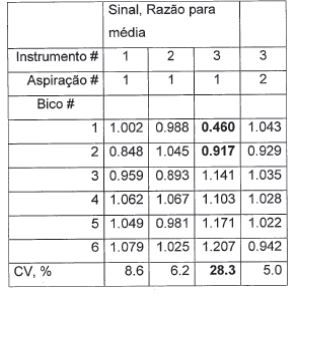
Claims (10)
Applications Claiming Priority (4)
| Application Number | Priority Date | Filing Date | Title |
|---|---|---|---|
| US99746007P | 2007-10-02 | 2007-10-02 | |
| US60/997,460 | 2007-10-02 | ||
| BRPI0820328A BRPI0820328B8 (en) | 2007-10-02 | 2008-10-02 | system and method for automatically detecting a plurality of analytes in a body fluid sample |
| PCT/US2008/078636 WO2009046227A1 (en) | 2007-10-02 | 2008-10-02 | Modular point-of-care devices and uses thereof |
Publications (1)
| Publication Number | Publication Date |
|---|---|
| BR122020017678B1 true BR122020017678B1 (en) | 2021-08-03 |
Family
ID=40509067
Family Applications (2)
| Application Number | Title | Priority Date | Filing Date |
|---|---|---|---|
| BR122020017678-4A BR122020017678B1 (en) | 2007-10-02 | 2008-10-02 | SYSTEM FOR AUTOMATIC DETECTION OF AN ANALYTE IN A BODY FLUID SAMPLE |
| BRPI0820328A BRPI0820328B8 (en) | 2007-10-02 | 2008-10-02 | system and method for automatically detecting a plurality of analytes in a body fluid sample |
Family Applications After (1)
| Application Number | Title | Priority Date | Filing Date |
|---|---|---|---|
| BRPI0820328A BRPI0820328B8 (en) | 2007-10-02 | 2008-10-02 | system and method for automatically detecting a plurality of analytes in a body fluid sample |
Country Status (16)
| Country | Link |
|---|---|
| US (22) | US8088593B2 (en) |
| EP (5) | EP4450163A3 (en) |
| JP (9) | JP5511669B2 (en) |
| KR (5) | KR101670621B1 (en) |
| CN (6) | CN104297507B (en) |
| AU (2) | AU2008308686B2 (en) |
| BR (2) | BR122020017678B1 (en) |
| CA (5) | CA3138078C (en) |
| DK (2) | DK2657699T3 (en) |
| ES (2) | ES2447875T3 (en) |
| IL (8) | IL204877A (en) |
| MX (2) | MX352987B (en) |
| NZ (1) | NZ584963A (en) |
| RU (2) | RU2540424C2 (en) |
| SG (3) | SG188082A1 (en) |
| WO (1) | WO2009046227A1 (en) |
Families Citing this family (256)
| Publication number | Priority date | Publication date | Assignee | Title |
|---|---|---|---|---|
| NZ564141A (en) | 2005-05-09 | 2011-02-25 | Theranos Inc | Two way communication system for monitoring an analyte |
| ES2447875T3 (en) | 2007-10-02 | 2014-03-13 | Theranos, Inc. | Modular devices for care points and their uses |
| US8309317B2 (en) * | 2008-04-05 | 2012-11-13 | Single Cell Technology, Inc. | Method of screening single cells for the production of biologically active agents |
| US20100056766A1 (en) * | 2008-08-27 | 2010-03-04 | Abbott Laboratories | Purification of biological conjugates by size exclusion chromatography |
| WO2010085669A2 (en) | 2009-01-23 | 2010-07-29 | Biotix, Inc. | Anti-static pipette tip trays |
| US8790916B2 (en) | 2009-05-14 | 2014-07-29 | Genestream, Inc. | Microfluidic method and system for isolating particles from biological fluid |
| EP2491499A4 (en) | 2009-10-19 | 2016-05-18 | Theranos Inc | INTEGRATED CAPTURE AND ANALYSIS SYSTEM FOR HEALTH DATA |
| JP5570240B2 (en) * | 2010-02-22 | 2014-08-13 | アークレイ株式会社 | DATA OUTPUT METHOD, ANALYSIS DEVICE, ANALYSIS SYSTEM, PROGRAM FOR IMPLEMENTING THE METHOD, AND STORAGE MEDIUM FOR THE PROGRAM |
| WO2011123649A1 (en) * | 2010-03-31 | 2011-10-06 | Abbott Point Of Care, Inc. | Method and apparatus for selectively admixing reagents in a substantially undiluted biologic fluid sample analysis |
| DE102010022017A1 (en) * | 2010-05-29 | 2011-12-01 | Gerstel Systemtechnik Gmbh & Co.Kg | Method for sample preparation in chromatographic separation methods and apparatus for performing a sample preparation |
| US9180448B2 (en) * | 2010-07-06 | 2015-11-10 | Becton, Dickinson And Company | Method and apparatus for identification of bacteria |
| DE102010031240A1 (en) * | 2010-07-12 | 2012-01-12 | Hamilton Bonaduz Ag | Pipette tip with hydrophobic surface formation |
| CN102375055A (en) * | 2010-08-19 | 2012-03-14 | 中国人民解放军军事医学科学院微生物流行病研究所 | Multiplex detection immune chromatography chip |
| US9645162B2 (en) * | 2010-08-27 | 2017-05-09 | Hewlett-Packard Development Company, L.P. | Automated assay fluid dispensing |
| US9433939B2 (en) | 2010-08-27 | 2016-09-06 | Hewlett-Packard Development Company, L.P. | Liquid dispensing assembly frame |
| JP5694726B2 (en) | 2010-09-30 | 2015-04-01 | 富士フイルム株式会社 | Inspection method and apparatus |
| US8951781B2 (en) | 2011-01-10 | 2015-02-10 | Illumina, Inc. | Systems, methods, and apparatuses to image a sample for biological or chemical analysis |
| AU2013205019B2 (en) * | 2011-01-21 | 2015-12-10 | Labrador Diagnostics Llc | Systems and methods for sample use maximization |
| MX349288B (en) | 2011-01-21 | 2017-07-21 | Theranos Inc | Systems and methods for sample use maximization. |
| EP2726881A1 (en) * | 2011-06-28 | 2014-05-07 | Koninklijke Philips N.V. | Means for the examination of body fluids |
| US9891149B2 (en) | 2011-08-08 | 2018-02-13 | Thermo Fisher Scientific Oy | Method and apparatus for automated analysis |
| FI20115785A0 (en) | 2011-08-08 | 2011-08-08 | Thermo Fisher Scientific Oy | Method and apparatus for automatic analysis |
| US9664702B2 (en) | 2011-09-25 | 2017-05-30 | Theranos, Inc. | Fluid handling apparatus and configurations |
| US9632102B2 (en) | 2011-09-25 | 2017-04-25 | Theranos, Inc. | Systems and methods for multi-purpose analysis |
| US8840838B2 (en) | 2011-09-25 | 2014-09-23 | Theranos, Inc. | Centrifuge configurations |
| US8435738B2 (en) * | 2011-09-25 | 2013-05-07 | Theranos, Inc. | Systems and methods for multi-analysis |
| US8380541B1 (en) | 2011-09-25 | 2013-02-19 | Theranos, Inc. | Systems and methods for collecting and transmitting assay results |
| US20140170735A1 (en) | 2011-09-25 | 2014-06-19 | Elizabeth A. Holmes | Systems and methods for multi-analysis |
| US8475739B2 (en) | 2011-09-25 | 2013-07-02 | Theranos, Inc. | Systems and methods for fluid handling |
| US9619627B2 (en) | 2011-09-25 | 2017-04-11 | Theranos, Inc. | Systems and methods for collecting and transmitting assay results |
| US9268915B2 (en) | 2011-09-25 | 2016-02-23 | Theranos, Inc. | Systems and methods for diagnosis or treatment |
| AU2012318963B2 (en) | 2011-09-25 | 2016-02-11 | Labrador Diagnostics Llc | Systems and methods for multi-analysis |
| US9250229B2 (en) | 2011-09-25 | 2016-02-02 | Theranos, Inc. | Systems and methods for multi-analysis |
| US10012664B2 (en) | 2011-09-25 | 2018-07-03 | Theranos Ip Company, Llc | Systems and methods for fluid and component handling |
| US9810704B2 (en) | 2013-02-18 | 2017-11-07 | Theranos, Inc. | Systems and methods for multi-analysis |
| US20140308661A1 (en) * | 2011-09-25 | 2014-10-16 | Theranos, Inc. | Systems and methods for multi-analysis |
| WO2013049782A2 (en) * | 2011-09-30 | 2013-04-04 | Pandora Genomics, LLC | System, apparatus and method for evaluating samples or analytes using a point-of-care device |
| AU2012339621B2 (en) * | 2011-11-16 | 2016-02-18 | Leica Biosystems Melbourne Pty Ltd | Biological sample treatment apparatus |
| JP6240615B2 (en) | 2012-01-24 | 2017-11-29 | コーニンクレッカ フィリップス エヌ ヴェKoninklijke Philips N.V. | Cartridge for processing fluid |
| US9366662B2 (en) | 2012-06-05 | 2016-06-14 | Siemens Healthcare Diagnostics Inc. | Serum sample quality determination |
| US10408786B2 (en) | 2012-06-14 | 2019-09-10 | ChemiSensor, LLP | Distributable chemical sampling and sensing system |
| US20130337477A1 (en) * | 2012-06-14 | 2013-12-19 | ChemiSensor LLP | Distributable Chemical Sampling and Sensing System Process |
| US9500639B2 (en) | 2012-07-18 | 2016-11-22 | Theranos, Inc. | Low-volume coagulation assay |
| MX381057B (en) | 2012-07-18 | 2025-03-12 | Labrador Diagnostics Llc | High speed, compact centrifuge for use with small sample volumes |
| CA3198619A1 (en) | 2012-07-25 | 2014-01-30 | Theranos Ip Company, Llc | Image analysis and measurement of biological samples |
| SG11201501676QA (en) | 2012-09-06 | 2015-04-29 | Theranos Inc | Systems, devices, and methods for bodily fluid sample collection |
| US9636062B2 (en) | 2012-09-06 | 2017-05-02 | Theranos, Inc. | Systems, devices, and methods for bodily fluid sample collection |
| US9427184B2 (en) | 2012-09-06 | 2016-08-30 | Theranos, Inc. | Systems, devices, and methods for bodily fluid sample collection |
| JP2015535173A (en) | 2012-09-11 | 2015-12-10 | セラノス, インコーポレイテッド | Information management system and method using biological signatures |
| US20140114676A1 (en) | 2012-10-23 | 2014-04-24 | Theranos, Inc. | Drug Monitoring and Regulation Systems and Methods |
| EP2923204A1 (en) * | 2012-10-31 | 2015-09-30 | Astute Medical, Inc. | Quantitative lateral flow assay |
| CN103808916B (en) * | 2012-11-13 | 2017-06-16 | 中国科学院深圳先进技术研究院 | Body fluid detection device |
| US20140358036A1 (en) * | 2012-12-05 | 2014-12-04 | Theranos, Inc. | Bodily Fluid Sample Collection and Transport |
| EP3666188A1 (en) | 2012-12-05 | 2020-06-17 | Theranos IP Company, LLC | Systems, devices, and methods for bodily fluid sample collection and transport |
| AU2013356680A1 (en) | 2012-12-05 | 2015-05-28 | Theranos Ip Company, Llc | Systems, devices, and methods for bodily fluid sample collection and transport |
| US10248765B1 (en) | 2012-12-05 | 2019-04-02 | Theranos Ip Company, Llc | Systems, devices, and methods for bodily fluid sample collection, transport, and handling |
| US9386948B2 (en) | 2012-12-05 | 2016-07-12 | Theranos, Inc. | Systems, devices, and methods for bodily fluid sample transport |
| US9051599B2 (en) | 2012-12-10 | 2015-06-09 | Theranos, Inc. | Rapid, low-sample-volume cholesterol and triglyceride assays |
| WO2014093397A1 (en) * | 2012-12-12 | 2014-06-19 | Green Domain Design, Llc | Assay apparatus |
| US11320418B2 (en) | 2012-12-12 | 2022-05-03 | Iassay, Inc. | Modular hand-held point of care testing system |
| EP2743694A1 (en) * | 2012-12-14 | 2014-06-18 | Numares GmbH | Method for supplementing a sample with specific information and sample tube system |
| US9995742B2 (en) * | 2012-12-19 | 2018-06-12 | Dnae Group Holdings Limited | Sample entry |
| US9599610B2 (en) * | 2012-12-19 | 2017-03-21 | Dnae Group Holdings Limited | Target capture system |
| US9805407B2 (en) * | 2013-01-25 | 2017-10-31 | Illumina, Inc. | Methods and systems for using a cloud computing environment to configure and sell a biological sample preparation cartridge and share related data |
| US10401373B1 (en) * | 2013-02-18 | 2019-09-03 | Theranos Ip Company, Llc | Systems and methods for analyte testing and laboratory oversight |
| US11008628B1 (en) * | 2013-02-18 | 2021-05-18 | Labrador Diagnostics Llc | Systems and methods for analyte testing and laboratory oversight |
| CA3209297A1 (en) | 2013-02-18 | 2014-08-21 | Theranos Ip Company, Llc | Image analysis and measurement of biological samples |
| CN105164508B (en) * | 2013-02-18 | 2019-04-02 | 赛拉诺斯知识产权有限责任公司 | System and method for collecting and transmitting assay results |
| MX342267B (en) * | 2013-02-18 | 2016-09-23 | Theranos Inc | Systems and methods for multi-analysis. |
| EP2962104B1 (en) | 2013-02-26 | 2018-04-04 | Astute Medical, Inc. | Lateral flow assay device with test strip retainer |
| EP2965478B1 (en) | 2013-03-04 | 2019-05-15 | Theranos IP Company, LLC | Network connectivity methods and systems |
| WO2017015172A1 (en) | 2015-07-17 | 2017-01-26 | Cue Inc. | Systems and methods for enhanced detection and quantification of analytes |
| US10545161B2 (en) | 2013-03-11 | 2020-01-28 | Cue Health Inc. | Systems and methods for detection and quantification of analytes |
| US20140252079A1 (en) * | 2013-03-11 | 2014-09-11 | Promega Corporation | Analyzer with machine readable protocol prompting |
| US9623409B2 (en) | 2013-03-11 | 2017-04-18 | Cue Inc. | Cartridges, kits, and methods for enhanced mixing for detection and quantification of analytes |
| KR102435654B1 (en) | 2013-03-11 | 2022-08-25 | 큐 헬스 인코퍼레이티드 | Systems and methods for detection and quantification of analytes |
| AU2013202778A1 (en) * | 2013-03-14 | 2014-10-02 | Gen-Probe Incorporated | Systems, methods, and apparatuses for performing automated reagent-based assays |
| KR20150133774A (en) | 2013-03-15 | 2015-11-30 | 테라노스, 인코포레이티드 | Methods and devices for sample collection and sample separation |
| AU2014233152A1 (en) | 2013-03-15 | 2015-09-17 | Theranos Ip Company, Llc | Nucleic acid amplification |
| CN108445242B (en) | 2013-03-15 | 2022-03-04 | Hycor生物医学有限责任公司 | Device for performing luminescence and fluorescence measurements of a sample and related method |
| WO2014151450A1 (en) | 2013-03-15 | 2014-09-25 | Siemens Healthcare Diagnostics Inc. | Microfluidic distributing device |
| ES2738602T3 (en) | 2013-03-15 | 2020-01-24 | Theranos Ip Co Llc | Nucleic acid amplification |
| SG11201507322UA (en) | 2013-03-15 | 2015-10-29 | Theranos Inc | Devices, systems and methods for sample preparation |
| US9416776B2 (en) * | 2013-03-15 | 2016-08-16 | Siemens Healthcare Diagnostics Inc. | Microfluidic distributing device |
| EP3943610A1 (en) | 2013-03-15 | 2022-01-26 | Labrador Diagnostics LLC | Nucleic acid amplification |
| KR20150130452A (en) | 2013-03-15 | 2015-11-23 | 테라노스, 인코포레이티드 | Systems, devices, and methods for bodily fluid sample collection |
| US9359632B2 (en) | 2013-03-15 | 2016-06-07 | Theranos, Inc. | Devices, systems and methods for sample preparation |
| ES2661662T3 (en) | 2013-03-15 | 2018-04-03 | Theranos, Inc. | Thermostable ligature of blunt ends and methods of use |
| AU2014241182A1 (en) * | 2013-03-27 | 2015-09-24 | Theranos Ip Company, Llc | Biological sample processing |
| ES2756098T3 (en) | 2013-03-27 | 2020-04-27 | Theranos Ip Co Llc | Methods, devices and systems for sample analysis |
| EP4332978B1 (en) * | 2013-04-05 | 2025-08-13 | F. Hoffmann-La Roche AG | Analysis method for a biological sample |
| US10222375B2 (en) | 2013-07-17 | 2019-03-05 | Gold Standard Diagnostics | Process and machine for automated agglutination assays with image automated evaluation |
| US20150309025A1 (en) * | 2013-07-17 | 2015-10-29 | Gold Standard Diagnostics | Process and machine for automated agglutination assays |
| US10422806B1 (en) | 2013-07-25 | 2019-09-24 | Theranos Ip Company, Llc | Methods for improving assays of biological samples |
| EP3030286B1 (en) | 2013-08-05 | 2019-10-09 | Cam Med LLC | Conformable patch pump |
| EP3039477B1 (en) | 2013-08-26 | 2021-10-20 | S.D. Sight Diagnostics Ltd. | Digital microscopy systems, methods and computer program products |
| CA2920896A1 (en) | 2013-09-06 | 2015-03-12 | Theranos, Inc. | Systems and methods for detecting infectious diseases |
| US10943689B1 (en) | 2013-09-06 | 2021-03-09 | Labrador Diagnostics Llc | Systems and methods for laboratory testing and result management |
| MX384530B (en) | 2013-09-06 | 2025-03-14 | Labrador Diagnostics Llc | DEVICES, SYSTEMS, METHODS AND EQUIPMENT FOR RECEIVING A SWABS. |
| US11545241B1 (en) | 2013-09-07 | 2023-01-03 | Labrador Diagnostics Llc | Systems and methods for analyte testing and data management |
| EP3042197A4 (en) * | 2013-09-08 | 2017-04-26 | Theranos, Inc. | Methods and systems for obtaining clinical samples |
| US20180020823A1 (en) * | 2013-09-08 | 2018-01-25 | Theranos, Inc. | Methods and systems for obtaining clinical samples |
| WO2015048173A2 (en) * | 2013-09-24 | 2015-04-02 | The Regents Of The University Of California | Encapsulated sensors and sensing systems for bioassays and diagnostics and methods for making and using them |
| CA2927938A1 (en) | 2013-10-24 | 2015-04-30 | Theranos, Inc. | Systems and methods for ordering laboratory tests and providing results thereof |
| US20150164398A1 (en) | 2013-11-11 | 2015-06-18 | Theranos, Inc. | Methods and systems for a sample collection device with a novelty exterior |
| US10393738B2 (en) * | 2013-11-12 | 2019-08-27 | Boditech Med Inc. | Multi-well cuvette provided with integrated reaction and detection means |
| US11360107B1 (en) | 2014-02-25 | 2022-06-14 | Labrador Diagnostics Llc | Systems and methods for sample handling |
| CN113796860A (en) | 2014-03-05 | 2021-12-17 | 赛拉诺斯知识产权有限责任公司 | Method and apparatus for sample collection and sample separation |
| WO2015138818A1 (en) | 2014-03-12 | 2015-09-17 | Theranos, Inc. | Systems, devices, and methods for bodily fluid sample collection |
| US10139348B2 (en) | 2014-03-20 | 2018-11-27 | Universal Bio Research Co., Ltd. | Lightguide aggregate inspection device and inspection method of the same |
| USD745423S1 (en) | 2014-05-12 | 2015-12-15 | Cue Inc. | Automated analyzer test cartridge and sample collection device for analyte detection |
| CA2951558A1 (en) * | 2014-06-11 | 2015-12-17 | Theranos, Inc. | Methods, devices, and systems for sample analysis |
| KR20170021836A (en) * | 2014-06-23 | 2017-02-28 | 더 차레스 스타크 드레이퍼 래보레이토리, 인코포레이티드 | Injection well identification using tracer particles |
| WO2016007886A1 (en) | 2014-07-11 | 2016-01-14 | Northwestern University | Yeast-based biosensor |
| JP6571757B2 (en) * | 2014-08-06 | 2019-09-04 | ソシエテ・デ・プロデュイ・ネスレ・エス・アー | Biomarkers for predicting the degree of weight loss |
| EP3189154B1 (en) | 2014-09-04 | 2023-03-22 | Labrador Diagnostics LLC | Pathogen and antimicrobial resistance testing |
| EP2995937A1 (en) * | 2014-09-15 | 2016-03-16 | Sensirion AG | Integrated chemical sensor chip |
| MX2017003473A (en) | 2014-09-17 | 2017-08-02 | Theranos Inc | Hybrid multi-step nucleic acid amplification. |
| US10627358B2 (en) | 2014-10-06 | 2020-04-21 | Alveo Technologies, Inc. | Method for detection of analytes |
| US10352899B2 (en) | 2014-10-06 | 2019-07-16 | ALVEO Technologies Inc. | System and method for detection of silver |
| US9921182B2 (en) | 2014-10-06 | 2018-03-20 | ALVEO Technologies Inc. | System and method for detection of mercury |
| US9506908B2 (en) | 2014-10-06 | 2016-11-29 | Alveo Technologies, Inc. | System for detection of analytes |
| US10196678B2 (en) | 2014-10-06 | 2019-02-05 | ALVEO Technologies Inc. | System and method for detection of nucleic acids |
| WO2016057749A1 (en) | 2014-10-08 | 2016-04-14 | Theranos, Inc. | Methods and devices for real-time diagnostic testing (rdt) for ebola and other infectious diseases |
| US10137453B2 (en) | 2014-12-10 | 2018-11-27 | Biotix, Inc. | Static-defeating apparatus for pipette tips |
| US10730053B2 (en) | 2014-12-10 | 2020-08-04 | Biotix, Inc. | Static-defeating apparatus for pipette tips |
| USD865216S1 (en) | 2014-12-10 | 2019-10-29 | Biotix, Inc. | Pipette tip sheet |
| USD849962S1 (en) * | 2014-12-10 | 2019-05-28 | Biotix, Inc. | Pipette tip retention sheet |
| USD815753S1 (en) | 2014-12-10 | 2018-04-17 | Biotix, Inc. | Pipette tip sheet |
| US9835640B2 (en) | 2015-02-13 | 2017-12-05 | Abbott Laboratories | Automated storage modules for diagnostic analyzer liquids and related systems and methods |
| ES2897899T3 (en) | 2015-02-27 | 2022-03-03 | Mastaplex Ltd | A sample receptacle, sample container, and procedure for use |
| WO2016145290A1 (en) * | 2015-03-12 | 2016-09-15 | The Trustees Of The University Of Pennsylvania | System, method, and device for high-throughput, automated culturing of genetically modified organisms |
| JP2016191668A (en) * | 2015-03-31 | 2016-11-10 | ソニー株式会社 | ELECTRICAL CHARACTERISTIC MEASUREMENT METHOD, ELECTRICAL CHARACTERISTIC MEASUREMENT DEVICE, AND BLOOD STATE ANALYSIS SYSTEM |
| WO2016164712A1 (en) * | 2015-04-08 | 2016-10-13 | Becton, Dickinson And Company | Device and apparatus for collecting microbial growth from a semi-solid surface |
| CN107708559A (en) | 2015-04-29 | 2018-02-16 | 精密公司 | Sample is collected and delivery apparatus |
| EP3093656A1 (en) * | 2015-05-13 | 2016-11-16 | ARKRAY, Inc. | Analytical tool and analytical system |
| CN104865395A (en) * | 2015-05-21 | 2015-08-26 | 上海儒克生物科技有限公司 | Biological application robot as well as robot execution module and execution method |
| ES2911415T3 (en) | 2015-06-08 | 2022-05-19 | Arquer Diagnostics Ltd | Methods and kits |
| JP6854246B2 (en) | 2015-06-08 | 2021-04-07 | アーケア ダイアグノスティクス リミテッド | How to analyze urine sample |
| US10775370B2 (en) * | 2015-07-17 | 2020-09-15 | Stat-Diagnostica & Innovation, S.L. | Fluidic system for performing assays |
| US10371606B2 (en) | 2015-07-21 | 2019-08-06 | Theraos IP Company, LLC | Bodily fluid sample collection and transport |
| EP3325160A4 (en) | 2015-07-21 | 2019-04-03 | Theranos, Inc. | SYSTEMS, DEVICES AND METHODS FOR COLLECTING, TRANSPORTING AND HANDLING BODY FLUID SAMPLES |
| WO2017015636A1 (en) * | 2015-07-23 | 2017-01-26 | Meso Scale Technologies, Llc. | Integrated consumable data management system & platform |
| BR112018002342A2 (en) | 2015-08-04 | 2018-12-11 | Univ Duke | intrinsically disordered and genetically modified stealth polymers for delivery and methods for their use |
| US11247208B2 (en) | 2015-09-09 | 2022-02-15 | Labrador Diagnostics Llc | Methods and devices for sample collection and sample separation |
| JP6952683B2 (en) | 2015-09-17 | 2021-10-20 | エス.ディー.サイト ダイアグノスティクス リミテッド | Methods and devices for detecting entities in body samples |
| WO2017062892A1 (en) | 2015-10-09 | 2017-04-13 | Theranos, Inc. | Bodily fluid sample collection and transport |
| US11752213B2 (en) | 2015-12-21 | 2023-09-12 | Duke University | Surfaces having reduced non-specific binding and antigenicity |
| US10001501B2 (en) * | 2015-12-31 | 2018-06-19 | Universal Diagnostics, S. L. | Systems and methods for automated, customizable sample preparation for detection of metabolites and lipids |
| EP3436864B1 (en) | 2016-03-30 | 2021-04-28 | S.D. Sight Diagnostics Ltd. | Image processing device for identifying blood parasites |
| JP2017185192A (en) * | 2016-03-31 | 2017-10-12 | カシオ計算機株式会社 | Electronic apparatus, notification method and program |
| EP3443352A1 (en) * | 2016-04-14 | 2019-02-20 | Roche Diagnostics GmbH | Method for determining a concentration of a target analyte in a sample of bodily fluid |
| CN105865873A (en) * | 2016-05-05 | 2016-08-17 | 柳州市妇幼保健院 | Filter paper dried blood spot hemoglobin preparation box |
| US11099175B2 (en) | 2016-05-11 | 2021-08-24 | S.D. Sight Diagnostics Ltd. | Performing optical measurements on a sample |
| US11307196B2 (en) | 2016-05-11 | 2022-04-19 | S.D. Sight Diagnostics Ltd. | Sample carrier for optical measurements |
| US11467156B2 (en) | 2016-06-01 | 2022-10-11 | Duke University | Nonfouling biosensors |
| CA3027914C (en) | 2016-06-17 | 2022-01-04 | Siemens Healthcare Diagnostics Inc. | Devices, methods, and kits for multiplexing a fluid sample via fluid sample reuse |
| US11112418B1 (en) * | 2016-07-29 | 2021-09-07 | Labrador Diagnostics Llc | Systems and methods for multi-analysis |
| EP4564253A3 (en) * | 2016-07-29 | 2025-07-23 | Abbott Laboratories | System and method for inventory sharing in a laboratory management system |
| US10989724B1 (en) | 2016-07-29 | 2021-04-27 | Labrador Diagnostics Llc | Systems and methods for multi-analysis |
| CN109996888A (en) | 2016-09-23 | 2019-07-09 | 阿尔韦奥科技公司 | For testing and analyzing the method and composition of object |
| CN110023326A (en) | 2016-09-23 | 2019-07-16 | 杜克大学 | Unstructured repeat-free polypeptides with LCST behavior |
| TWI638178B (en) * | 2016-10-05 | 2018-10-11 | 旺矽科技股份有限公司 | Electrometric apparatus, electrometric method and probe circuit structure |
| US20180135456A1 (en) * | 2016-11-17 | 2018-05-17 | General Electric Company | Modeling to detect gas turbine anomalies |
| ES3052738T3 (en) * | 2016-11-23 | 2026-01-13 | Bard Inc C R | Single insertion multiple sample biopsy apparatus |
| LU93333B1 (en) * | 2016-12-06 | 2018-06-08 | Stratec Biomedical Ag | Transfer Tool for use in automated analyser systems |
| BE1024369B1 (en) * | 2016-12-12 | 2018-01-31 | Anne Vanaken | Device for eye examination |
| US11648200B2 (en) | 2017-01-12 | 2023-05-16 | Duke University | Genetically encoded lipid-polypeptide hybrid biomaterials that exhibit temperature triggered hierarchical self-assembly |
| WO2018140540A1 (en) | 2017-01-25 | 2018-08-02 | Cue Health Inc. | Systems and methods for enhanced detection and quantification of analytes |
| EP3579975A4 (en) * | 2017-02-13 | 2021-03-24 | Bio-rad Laboratories, Inc. | System, method, and device for forming an array of emulsions |
| CN110402383B (en) | 2017-03-08 | 2023-01-17 | 奥普图弗卢迪克生物鉴定有限责任公司 | Optofluidic Diagnostic System |
| US11857966B1 (en) | 2017-03-15 | 2024-01-02 | Labrador Diagnostics Llc | Methods and devices for sample collection and sample separation |
| CN113260865B (en) * | 2017-04-07 | 2024-09-03 | 易度医疗股份有限公司 | Point-of-Care Test Kits |
| WO2018213320A1 (en) | 2017-05-15 | 2018-11-22 | Duke University | Recombinant production of hybrid lipid-biopolymer materials that self-assemble and encapsulate agents |
| US11680083B2 (en) | 2017-06-30 | 2023-06-20 | Duke University | Order and disorder as a design principle for stimuli-responsive biopolymer networks |
| CA3070455A1 (en) | 2017-07-19 | 2019-01-24 | Evanostics, Llc | Cartridges for oral fluid analysis and methods of use |
| WO2019031815A1 (en) * | 2017-08-07 | 2019-02-14 | 울산과학기술원 | System and method for fluid separation using magnetic particles |
| EP3444033B1 (en) * | 2017-08-18 | 2020-01-08 | CTC Analytics AG | Cartridge for chemical or biological assays |
| CN107356587B (en) * | 2017-08-24 | 2024-03-01 | 北京贝泰科技有限公司 | Light-activated chemiluminescence instant detection system |
| EP3673268A1 (en) * | 2017-08-26 | 2020-07-01 | AJ Innuscreen GmbH | Means and method for detecting analytes by means of macroscopic granulate particles |
| CN107679286A (en) * | 2017-09-11 | 2018-02-09 | 广东昭信光电科技有限公司 | A kind of lens design method and control system for realizing LED array Uniform Illumination |
| US20210060543A1 (en) * | 2017-09-27 | 2021-03-04 | Hewlett-Packard Development Company, L.P. | Dilution dispensing |
| EP3470141B1 (en) | 2017-10-11 | 2024-04-24 | F. Hoffmann-La Roche AG | Apparatus and method for processing a biological sample with magnetic particles |
| JP7403447B2 (en) * | 2017-11-02 | 2023-12-22 | メメド ダイアグノスティクス リミテッド | Cartridges and systems for body fluid analysis |
| WO2019097387A1 (en) * | 2017-11-14 | 2019-05-23 | S.D. Sight Diagnostics Ltd | Sample carrier for optical measurements |
| EP3714460A4 (en) | 2017-11-20 | 2021-01-20 | Siemens Healthcare Diagnostics, Inc. | USER INTERFACE FOR MANAGING A MULTIPLE DIAGNOSIS ENGINE ENVIRONMENT |
| GB201719769D0 (en) * | 2017-11-28 | 2018-01-10 | Cronin 3D Ltd | Analytical device and methods of use |
| WO2019117366A1 (en) * | 2017-12-14 | 2019-06-20 | (주)이노진 | Blood-based in vitro diagnostic device and diagnostic method |
| EP3724636A4 (en) | 2017-12-15 | 2021-08-18 | Evanostics, LLC | OPTICAL READER FOR ANALYTE TEST |
| WO2019147954A1 (en) | 2018-01-26 | 2019-08-01 | Duke University | Albumin binding peptide-drug (aibiped) conjugates and methods of making and using same |
| US11255868B2 (en) | 2018-02-12 | 2022-02-22 | Electronics And Telecommunications Research Institute | Fluid control equipment for bio-reaction, bio-reaction system and fluid control method for bio-reaction |
| WO2019188909A1 (en) * | 2018-03-28 | 2019-10-03 | 富士フイルム株式会社 | Blood test support device, blood test support system, blood test support method, and program |
| US11541396B2 (en) | 2018-03-30 | 2023-01-03 | Idexx Laboratories, Inc. | Point-of-care diagnostic systems and containers for same |
| US11358148B2 (en) | 2018-03-30 | 2022-06-14 | Idexx Laboratories, Inc. | Point-of-care diagnostic systems and containers for same |
| CN111868834B (en) | 2018-03-30 | 2024-07-30 | Idexx实验室公司 | Quality Control for Point-of-Care Diagnostic Systems |
| WO2019213150A1 (en) | 2018-04-30 | 2019-11-07 | Duke University | Stimuli-responsive peg-like polymer-based drug delivery platform |
| GB2590230B (en) * | 2018-06-25 | 2023-05-31 | Vascu Tech Inc | Methods and kits for detection of 11-dehydro-thromboxane B2 |
| EP3819624A4 (en) * | 2018-07-03 | 2022-03-09 | Shimadzu Corporation | Sample extraction support tool and sample extraction method |
| WO2020028806A1 (en) | 2018-08-02 | 2020-02-06 | Duke University | Dual agonist fusion proteins |
| EP3608676B1 (en) * | 2018-08-08 | 2022-01-19 | CTC Analytics AG | Insert sample into pipette tip box for further processing |
| CN109223050B (en) * | 2018-08-23 | 2021-08-10 | 郑州大学第一附属医院 | Clinical selective examination device of division of endocrinology |
| USD888269S1 (en) | 2018-09-02 | 2020-06-23 | Memed Diagnostics Ltd. | Capillary blood collector device |
| USD951482S1 (en) | 2018-09-02 | 2022-05-10 | Memed Diagnostics Ltd. | Cartridge device |
| EP3644064B1 (en) * | 2018-10-23 | 2021-08-18 | Roche Diagnostics GmbH | Method of handling laboratory sample containers and apparatus for handling laboratory sample containers |
| EP3644063B1 (en) * | 2018-10-23 | 2023-07-26 | Roche Diagnostics GmbH | Method of handling laboratory sample containers |
| CN109394241B (en) * | 2018-10-30 | 2022-07-08 | 宁静 | Medical clinical inspection device of getting of division of endocrinology |
| KR102674662B1 (en) | 2018-11-14 | 2024-06-12 | 현대자동차주식회사 | Heat exchanger for vehicle |
| TWI692777B (en) * | 2018-11-16 | 2020-05-01 | 長庚醫療財團法人高雄長庚紀念醫院 | Intelligent drug warning system for acute kidney injury |
| KR102178336B1 (en) * | 2018-11-27 | 2020-11-12 | 바디텍메드(주) | Method and apparatus for diagnosing tuberculosis |
| CN109307540B (en) * | 2018-11-29 | 2020-04-21 | 郑州安图生物工程股份有限公司 | Method for measuring volume of single-hole residual liquid of ELISA plate |
| CN109307541B (en) * | 2018-11-29 | 2020-03-24 | 郑州安图生物工程股份有限公司 | Method for measuring volume of lighting plate single-hole residual liquid |
| US12066383B2 (en) | 2018-12-18 | 2024-08-20 | Aspida Dx Inc. | Optical analyte detection |
| WO2020132008A1 (en) | 2018-12-20 | 2020-06-25 | Alveo Technologies, Inc. | Handheld impedance-based diagnostic test system for detecting analytes |
| WO2020142840A1 (en) | 2019-01-07 | 2020-07-16 | 1866402 Ontario Inc. | Blood separation and analysis device and methods |
| IL284830B2 (en) * | 2019-01-14 | 2025-09-01 | Zeev Russak | Multi-test kit |
| EP3927468B1 (en) | 2019-02-18 | 2025-05-07 | CTC Analytics AG | Fluid delivery device and method for carrying out chemical or biological assays |
| EP3709024B1 (en) * | 2019-03-12 | 2023-12-27 | Radiometer Medical ApS | Apparatus for analyzing biological samples |
| EP3941626A4 (en) * | 2019-03-19 | 2022-07-20 | Siemens Healthcare Diagnostics, Inc. | <sup2/>? <sub2/>?1c?hbaassay slide and method of making same |
| CN110082519A (en) * | 2019-04-17 | 2019-08-02 | 迪瑞医疗科技股份有限公司 | Cystatin C chemiluminescence immune detection reagent kit and preparation method thereof |
| CN110142068B (en) * | 2019-06-12 | 2024-02-02 | 杭州华得森生物技术有限公司 | An epithelial-mesenchymal mixed circulating tumor cell detection kit and method |
| US11512314B2 (en) | 2019-07-12 | 2022-11-29 | Duke University | Amphiphilic polynucleotides |
| CN110376023B (en) * | 2019-07-26 | 2022-05-17 | 重庆德方信息技术有限公司 | Control system and method applied to intelligent closestool |
| US20220299537A1 (en) * | 2019-07-30 | 2022-09-22 | Pcl, Inc. | Multiple biomarker simultaneous analysis apparatus and method |
| EP4009055A4 (en) * | 2019-08-01 | 2023-06-07 | Nippon Chemiphar Co., Ltd. | REAGENT CARTRIDGE |
| KR102752778B1 (en) * | 2019-08-16 | 2025-01-14 | 한국전자통신연구원 | Method of detecting bio-material |
| US20220266245A1 (en) * | 2019-09-02 | 2022-08-25 | Tan Tock Seng Hospital Pte Ltd | A magnetic digital microfluidic system and method of performing an assay |
| JP7506567B2 (en) * | 2019-09-18 | 2024-06-26 | キヤノンメディカルシステムズ株式会社 | Sample testing equipment |
| US20230341422A1 (en) * | 2019-09-27 | 2023-10-26 | Epinex Diagnostics, Inc. | A Home Test for Measuring Glucose Control and Kidney Function in Patients |
| EP4049176A1 (en) | 2019-10-22 | 2022-08-31 | S.D. Sight Diagnostics Ltd. | Accounting for errors in optical measurements |
| AU2020400401A1 (en) | 2019-12-12 | 2022-06-02 | S.D. Sight Diagnostics Ltd | Analyzing an analyte disposed within a medium |
| CN114787685B (en) | 2019-12-12 | 2025-10-17 | 思迪赛特诊断有限公司 | Artificial generation of color blood smear images |
| MX2022007119A (en) | 2019-12-12 | 2022-07-11 | S D Sight Diagnostics Ltd | Detecting platelets in a blood sample. |
| CN113219192B (en) * | 2020-01-21 | 2023-10-20 | 深圳迎凯生物科技有限公司 | Reactor transfer process |
| WO2021150812A1 (en) * | 2020-01-23 | 2021-07-29 | Precision Healing, Inc. | Exudate analysis using optical signatures |
| CN111239430A (en) * | 2020-03-16 | 2020-06-05 | 中国科学院南京地理与湖泊研究所 | Device and method for batch processing of samples |
| US20230028665A1 (en) * | 2020-04-03 | 2023-01-26 | Revosketch Inc. | Cartridge for sandwich elisa pre-loaded with antigen customized detection reagent and sandwich elisa device using the cartridge |
| CN111504972B (en) * | 2020-05-21 | 2024-07-23 | 朱建国 | PCR sampling detection device |
| CN115698680A (en) * | 2020-06-18 | 2023-02-03 | 挪威金田有限公司 | Method for determining the concentration of an analyte in the plasma component of a whole blood sample |
| WO2022026704A1 (en) * | 2020-07-29 | 2022-02-03 | Smart Ink Technology Corporation | Viral and biochemical early detection test kits |
| WO2022021377A1 (en) * | 2020-07-31 | 2022-02-03 | 杭州九洋生物科技有限公司 | Pipette and pipetting method |
| US12472492B2 (en) | 2020-08-14 | 2025-11-18 | Alveo Technologies, Inc. | Systems and methods of sample depositing and testing |
| US11914131B1 (en) * | 2020-08-16 | 2024-02-27 | Gregory Dimitrenko | Optical testing system for detecting infectious disease, testing device, specimen collector and related methods |
| CN112175808A (en) * | 2020-10-09 | 2021-01-05 | 张晓芬 | Device for detecting related cell mutation of hematopathy |
| KR102875461B1 (en) | 2020-11-09 | 2025-10-24 | 삼성전자주식회사 | Electronic device and method for managing contacts thereof |
| US20240081790A1 (en) * | 2020-11-11 | 2024-03-14 | DIANA Biotechnologies, a.s. | Sample collection device |
| CN116457667A (en) * | 2020-11-23 | 2023-07-18 | 诺尔生物医药有限公司 | Improved ELISA with hemoglobin correction apparatus and methods therefor |
| US20240044919A1 (en) * | 2020-12-08 | 2024-02-08 | Varun Akur Venkatesan | System, method and device for detecting and monitoring polycystic ovary syndrome |
| CN112932553B (en) * | 2021-02-01 | 2023-06-13 | 宁津县人民医院 | Vaginal secretion sampling device for gynecological clinic |
| CN114849805A (en) * | 2021-02-05 | 2022-08-05 | 苏州赛尼特格尔实验室科技有限公司 | Novel manual mechanical pipettor |
| WO2023278779A1 (en) * | 2021-07-01 | 2023-01-05 | Invenio Imaging, Inc. | Systems and methods for preparing, imaging and analyzing cytologic samples |
| US20240395521A1 (en) * | 2021-09-27 | 2024-11-28 | Queen's University At Kingston | Method and Apparatus for Rapid Mass Spectrometric Calibration |
| US12226776B2 (en) | 2021-11-04 | 2025-02-18 | Instrumentation Laboratory Company | Preparing substances in a medical diagnostic system |
| WO2023121101A1 (en) * | 2021-12-24 | 2023-06-29 | 한국과학기술원 | Automated device for diagnosis and diagnosis method using same |
| USD970036S1 (en) | 2022-05-05 | 2022-11-15 | Singular Genomics Systems, Inc. | Reagent cartridge |
| USD979093S1 (en) | 2022-05-05 | 2023-02-21 | Singular Genomics Systems, Inc. | Reagent cartridge |
| USD981591S1 (en) | 2022-05-05 | 2023-03-21 | Singular Genomics Systems, Inc. | Sample cartridge |
Family Cites Families (899)
| Publication number | Priority date | Publication date | Assignee | Title |
|---|---|---|---|---|
| US2398234A (en) | 1942-12-11 | 1946-04-09 | Horton & Converse | Adjustable automatic pipette |
| US3600900A (en) | 1969-11-03 | 1971-08-24 | North American Rockwell | Temperature controlled centrifuge |
| US3640434A (en) | 1970-05-15 | 1972-02-08 | Sherwood Medical Ind Inc | Variable capacity fluid-dispensing device |
| US3696971A (en) | 1970-09-24 | 1972-10-10 | Electro Nucleonics | Mechanism for simultaneously metering and dispensing liquids |
| US3756920A (en) | 1971-04-30 | 1973-09-04 | Nasa | In biological samples my measuring light reactions automatic instrument for chemical processing to dedect microorganisms |
| GB1332207A (en) | 1971-05-07 | 1973-10-03 | Ass Elect Ind | Apparatus for charged particle spectroscopy |
| BE793544A (en) | 1972-01-31 | 1973-04-16 | American Hospital Supply Corp | CENTRIFUGE |
| CA972183A (en) | 1973-02-23 | 1975-08-05 | Georges Revillet | Microspectrophotometer |
| US3953172A (en) | 1974-05-10 | 1976-04-27 | Union Carbide Corporation | Method and apparatus for assaying liquid materials |
| NL179870C (en) | 1974-08-16 | 1986-12-01 | Sarstedt Kunststoff | BARREL FOR TAKING BLOOD WITH A CAPILLARY MOUTH. |
| US4010893A (en) | 1975-06-20 | 1977-03-08 | Becton, Dickinson And Company | Triac centrifuge |
| GB1562900A (en) | 1975-09-24 | 1980-03-19 | Aes Scient Ltd | Preparation of blood plasma and serum samples |
| SU598649A1 (en) | 1976-05-04 | 1978-03-25 | Предприятие П/Я В-2262 | Centrifuge |
| US4087248A (en) | 1976-07-26 | 1978-05-02 | Miles Laughton E | Multiple assay machine and method |
| US4269604A (en) * | 1976-09-01 | 1981-05-26 | Snowden Jr James E | Method for the on-site determination of the presence of corrosive material in lubricating oil |
| US4157781A (en) | 1978-07-19 | 1979-06-12 | Hitoshi Maruyama | Self balancing centrifuge |
| US4276383A (en) | 1979-08-02 | 1981-06-30 | The United States Of America As Represented By The Department Of Health, Education & Welfare | Clot lysing timer |
| US4270921A (en) | 1979-09-24 | 1981-06-02 | Graas Joseph E | Microchromatographic device and method for rapid determination of a desired substance |
| US4250830A (en) | 1979-10-03 | 1981-02-17 | Leif Robert C | Swinging buckets |
| EP0030086B2 (en) * | 1979-11-13 | 1990-03-14 | TECHNICON INSTRUMENTS CORPORATION (a New York corporation) | Test-tube assembly, kit for making it and method of manual immunoassay |
| US4276258A (en) | 1980-01-28 | 1981-06-30 | Coulter Electronics, Inc. | Sample and stat feeding system and sample tray |
| US4362698A (en) | 1980-03-07 | 1982-12-07 | Sherman-Boosalis Corporation | Closures for fluid sample cups |
| US4327595A (en) | 1980-07-07 | 1982-05-04 | Hamilton Company | Method and apparatus for simultaneous dilution and dispensation |
| US4344563A (en) | 1980-12-23 | 1982-08-17 | E. I. Du Pont De Nemours And Company | Centrifuge rotor having vertically offset trunnion pins |
| FR2498331A1 (en) * | 1981-01-20 | 1982-07-23 | Kadouche Jean | Container for immunological tests e.g. antigen identification - having reagent molecules, e.g. antibodies, fixed to inner face of pipette cone point |
| JPS5822254B2 (en) | 1981-07-03 | 1983-05-07 | 株式会社 久保田製作所 | Centrifuge rotor |
| US4488814A (en) | 1981-09-28 | 1984-12-18 | Miles Laboratories, Inc. | Apparatus for and method of optical absorbance and fluorescent radiation measurement |
| US4486315A (en) | 1982-03-11 | 1984-12-04 | Ortho Diagnostic Systems Inc. | Immunoassay microparticle washing system and method of use |
| US4437586A (en) | 1982-03-29 | 1984-03-20 | Eastman Kodak Company | Mechanically actuated pipette dispenser |
| US4478094A (en) | 1983-01-21 | 1984-10-23 | Cetus Corporation | Liquid sample handling system |
| US4816567A (en) | 1983-04-08 | 1989-03-28 | Genentech, Inc. | Recombinant immunoglobin preparations |
| US4555957A (en) | 1983-10-14 | 1985-12-03 | Cetus Corporation | Bi-directional liquid sample handling system |
| US4554839A (en) | 1983-10-14 | 1985-11-26 | Cetus Corporation | Multiple trough vessel for automated liquid handling apparatus |
| US5171534A (en) | 1984-01-16 | 1992-12-15 | California Institute Of Technology | Automated DNA sequencing technique |
| US4952518A (en) | 1984-10-01 | 1990-08-28 | Cetus Corporation | Automated assay machine and assay tray |
| US4545497A (en) | 1984-11-16 | 1985-10-08 | Millipore Corporation | Container cap with frangible septum |
| DE185330T1 (en) | 1984-12-18 | 1986-11-27 | Cetus Corp., Emeryville, Calif. | SYSTEM FOR TREATING MULTIPLE SAMPLES. |
| JPS61202141A (en) | 1985-03-06 | 1986-09-06 | Nec Corp | Absorptiometer |
| JPS61202142A (en) | 1985-03-06 | 1986-09-06 | Teijin Ltd | Analyzing method and apparatus using absorbance |
| US4593837A (en) | 1985-03-15 | 1986-06-10 | Eastman Kodak Company | Variable volume pipette |
| US4683195A (en) | 1986-01-30 | 1987-07-28 | Cetus Corporation | Process for amplifying, detecting, and/or-cloning nucleic acid sequences |
| JPS61254833A (en) | 1985-05-08 | 1986-11-12 | Toyo Soda Mfg Co Ltd | Device for taking out fixed quantity of liquid |
| US4756884A (en) | 1985-08-05 | 1988-07-12 | Biotrack, Inc. | Capillary flow device |
| JPS6247555A (en) | 1985-08-23 | 1987-03-02 | エフ.ホフマン ― ラ ロシュ アーゲー | Scintillation proximity determination method |
| US4725406A (en) * | 1985-10-21 | 1988-02-16 | American Bionetics, Inc. | Apparatus and method for diagnostic analysis of biological fluids |
| DE3614085A1 (en) | 1985-12-12 | 1987-06-19 | Hirschmann Glasgeraete | PIPETTE |
| CH671526A5 (en) | 1985-12-17 | 1989-09-15 | Hamilton Bonaduz Ag | |
| JPH0652227B2 (en) | 1986-04-25 | 1994-07-06 | 梅谷 陽二 | Micro injection amount measuring device |
| GB2190195A (en) * | 1986-05-09 | 1987-11-11 | Cambridge Life Sciences | Microtitre plate reader |
| US4744955A (en) | 1986-08-08 | 1988-05-17 | Shapiro Justin J | Adjustable volume pipette sampler |
| US5322770A (en) | 1989-12-22 | 1994-06-21 | Hoffman-Laroche Inc. | Reverse transcription with thermostable DNA polymerases - high temperature reverse transcription |
| US5310652A (en) | 1986-08-22 | 1994-05-10 | Hoffman-La Roche Inc. | Reverse transcription with thermostable DNA polymerase-high temperature reverse transcription |
| JPH0816675B2 (en) | 1986-09-26 | 1996-02-21 | 株式会社島津製作所 | Gas chromatograph |
| JPH07119769B2 (en) | 1986-10-01 | 1995-12-20 | 株式会社日立製作所 | Automatic analyzer |
| US4933291A (en) | 1986-12-22 | 1990-06-12 | Eastman Kodak Company | Centrifugable pipette tip and pipette therefor |
| US4902969A (en) | 1987-06-01 | 1990-02-20 | Reliability Incorporated | Automated burn-in system |
| JPH0697231B2 (en) | 1987-07-15 | 1994-11-30 | 富士写真フイルム株式会社 | Biochemical analyzer |
| US4822331A (en) | 1987-11-09 | 1989-04-18 | Taylor David C | Centrifuge |
| US5055263A (en) | 1988-01-14 | 1991-10-08 | Cyberlab, Inc. | Automated pipetting system |
| JPH0727700B2 (en) | 1988-05-24 | 1995-03-29 | パイオニア株式会社 | Car drive for disk player |
| US5130238A (en) | 1988-06-24 | 1992-07-14 | Cangene Corporation | Enhanced nucleic acid amplification process |
| US4925629A (en) * | 1988-07-28 | 1990-05-15 | Bioquant, Inc. | Diagnostic device |
| US5320808A (en) | 1988-08-02 | 1994-06-14 | Abbott Laboratories | Reaction cartridge and carousel for biological sample analyzer |
| US5281540A (en) * | 1988-08-02 | 1994-01-25 | Abbott Laboratories | Test array for performing assays |
| DE68925602T2 (en) * | 1988-08-02 | 1996-11-14 | Abbott Lab | Method and device for generating calibration data for analysis |
| JPH0275959A (en) | 1988-09-12 | 1990-03-15 | Nittec Co Ltd | Automatic analysis apparatus |
| US5186162A (en) | 1988-09-14 | 1993-02-16 | Interpore Orthopaedics, Inc. | Ultrasonic transducer device for treatment of living tissue and/or cells |
| US5530101A (en) | 1988-12-28 | 1996-06-25 | Protein Design Labs, Inc. | Humanized immunoglobulins |
| US5326445A (en) * | 1989-05-01 | 1994-07-05 | Hewlett-Packard Company | Vacuum injection capillary electrophoresis |
| DE59006495D1 (en) | 1989-05-01 | 1994-08-25 | Schweizerische Viscose | METHOD FOR PRODUCING FINE MONOFILAMENTS AND MONOFILAMENT PRODUCED BY THIS METHOD. |
| WO1990013668A1 (en) | 1989-05-05 | 1990-11-15 | Lifecodes Corporation | Method for genetic analysis of a nucleic acid sample |
| FI911152A7 (en) | 1989-07-11 | 1991-03-07 | Gen Probe Inc | Nucleic acid sequence amplification methods |
| CA2020958C (en) | 1989-07-11 | 2005-01-11 | Daniel L. Kacian | Nucleic acid sequence amplification methods |
| US5683888A (en) | 1989-07-22 | 1997-11-04 | University Of Wales College Of Medicine | Modified bioluminescent proteins and their use |
| IL94212A0 (en) | 1989-07-24 | 1991-01-31 | Tri Tech Partners And Triton B | Automated analytical apparatus and method |
| US5061449A (en) | 1989-07-25 | 1991-10-29 | Matrix Technologies, Corp. | Expandable multi-channel pipetter |
| US5005981A (en) | 1989-09-08 | 1991-04-09 | Becton, Dickinson And Company | Apparatus for method for causing vortices in a test tube |
| US4991433A (en) * | 1989-09-21 | 1991-02-12 | Applied Acoustic Research | Phase track system for monitoring fluid material within a container |
| US5072382A (en) | 1989-10-02 | 1991-12-10 | Kamentsky Louis A | Methods and apparatus for measuring multiple optical properties of biological specimens |
| US5089229A (en) | 1989-11-22 | 1992-02-18 | Vettest S.A. | Chemical analyzer |
| JP2731613B2 (en) * | 1989-12-12 | 1998-03-25 | 株式会社クラレ | Cartridge for enzyme immunoassay, measuring method and measuring apparatus using the same |
| US5859205A (en) | 1989-12-21 | 1999-01-12 | Celltech Limited | Humanised antibodies |
| US5292658A (en) | 1989-12-29 | 1994-03-08 | University Of Georgia Research Foundation, Inc. Boyd Graduate Studies Research Center | Cloning and expressions of Renilla luciferase |
| SU1722603A1 (en) | 1990-01-02 | 1992-03-30 | Специальное конструкторское бюро биофизической аппаратуры Московского научно-производственного объединения "Биофизприбор" | Centrifuge |
| TW199858B (en) | 1990-03-30 | 1993-02-11 | Fujirebio Kk | |
| US5061381A (en) | 1990-06-04 | 1991-10-29 | Abaxis, Inc. | Apparatus and method for separating cells from biological fluids |
| US5173193A (en) | 1991-04-01 | 1992-12-22 | Schembri Carol T | Centrifugal rotor having flow partition |
| US5242606A (en) | 1990-06-04 | 1993-09-07 | Abaxis, Incorporated | Sample metering port for analytical rotor having overflow chamber |
| US5122284A (en) | 1990-06-04 | 1992-06-16 | Abaxis, Inc. | Apparatus and method for optically analyzing biological fluids |
| CA2084987C (en) | 1990-06-11 | 2007-02-13 | Larry Gold | Nucleic acid ligands |
| US5270163A (en) | 1990-06-11 | 1993-12-14 | University Research Corporation | Methods for identifying nucleic acid ligands |
| US5527670A (en) | 1990-09-12 | 1996-06-18 | Scientific Generics Limited | Electrochemical denaturation of double-stranded nucleic acid |
| DE69125441T2 (en) | 1990-09-28 | 1997-11-06 | Toshiba Kawasaki Kk | Gene detection method |
| JP2969935B2 (en) | 1990-11-30 | 1999-11-02 | 東ソー株式会社 | Liquid metering device |
| DE4041905A1 (en) | 1990-12-27 | 1992-07-02 | Boehringer Mannheim Gmbh | TEST CARRIER ANALYSIS SYSTEM |
| US5455166A (en) | 1991-01-31 | 1995-10-03 | Becton, Dickinson And Company | Strand displacement amplification |
| FR2673183B1 (en) | 1991-02-21 | 1996-09-27 | Asulab Sa | MONO, BIS OR TRIS (2,2'-BIPYRIDINE SUBSTITUTED) COMPLEXES OF A SELECTED METAL AMONG IRON, RUTHENIUM, OSMIUM OR VANADIUM AND THEIR PREPARATION PROCESSES. |
| US5273905A (en) | 1991-02-22 | 1993-12-28 | Amoco Corporation | Processing of slide mounted material |
| WO1992015673A1 (en) | 1991-03-11 | 1992-09-17 | The University Of Georgia Research Foundation, Inc. | Cloning and expression of renilla luciferase |
| US5264184A (en) | 1991-03-19 | 1993-11-23 | Minnesota Mining And Manufacturing Company | Device and a method for separating liquid samples |
| US5230864A (en) | 1991-04-10 | 1993-07-27 | Eastman Kodak Company | Gravity assisted collection device |
| US5112574A (en) | 1991-04-26 | 1992-05-12 | Imanigation, Ltd. | Multititer stopper array for multititer plate or tray |
| US5324481A (en) * | 1991-06-03 | 1994-06-28 | Abbott Laboratories | Carousel for assay specimen carrier |
| WO1994004679A1 (en) | 1991-06-14 | 1994-03-03 | Genentech, Inc. | Method for making humanized antibodies |
| JP4124480B2 (en) | 1991-06-14 | 2008-07-23 | ジェネンテック・インコーポレーテッド | Immunoglobulin variants |
| FR2679661B1 (en) | 1991-07-26 | 1994-10-14 | Sfri | APPARATUS FOR AUTOMATIC SAMPLES ANALYSIS. |
| US5266272A (en) | 1991-10-31 | 1993-11-30 | Baxter Diagnostics Inc. | Specimen processing and analyzing systems with a station for holding specimen trays during processing |
| EP0541340B1 (en) | 1991-11-05 | 1997-07-16 | The Perkin-Elmer Corporation | Biopolymer synthesis apparatus and method |
| US6136535A (en) * | 1991-11-14 | 2000-10-24 | Digene Corporation | Continuous amplification reaction |
| US5270184A (en) | 1991-11-19 | 1993-12-14 | Becton, Dickinson And Company | Nucleic acid target generation |
| US5507410A (en) | 1992-03-27 | 1996-04-16 | Abbott Laboratories | Meia cartridge feeder |
| US5960160A (en) | 1992-03-27 | 1999-09-28 | Abbott Laboratories | Liquid heater assembly with a pair temperature controlled electric heating elements and a coiled tube therebetween |
| US5288390A (en) | 1992-03-30 | 1994-02-22 | Sun Company, Inc. (R&M) | Polycyclic aromatic ring cleavage (PARC) process |
| AU4047493A (en) | 1992-04-02 | 1993-11-08 | Abaxis, Inc. | Analytical rotor with dye mixing chamber |
| ATE140025T1 (en) | 1992-05-01 | 1996-07-15 | Univ Pennsylvania | MICRO-MADE DEVICES FOR SPERM HANDLING |
| US5380487A (en) | 1992-05-05 | 1995-01-10 | Pasteur Sanofi Diagnostics | Device for automatic chemical analysis |
| US5357953A (en) | 1992-05-21 | 1994-10-25 | Puritan-Bennett Corporation | Measurement device and method of calibration |
| US5674698A (en) | 1992-09-14 | 1997-10-07 | Sri International | Up-converting reporters for biological and other assays using laser excitation techniques |
| DE69333502T2 (en) | 1992-09-14 | 2005-04-14 | Sri International, Menlo Park | Up-converting reporter molecule for biological and other testing using laser excitation techniques |
| ES2137965T3 (en) | 1992-12-19 | 2000-01-01 | Roche Diagnostics Gmbh | DEVICE TO DETECT A LIQUID INTERFACE IN A TRANSPARENT MEASURING TUBE. |
| DE4305581A1 (en) | 1993-02-24 | 1994-08-25 | Hettich Andreas Fa | Rotor for a swivel cup centrifuge |
| FI96143C (en) * | 1993-03-16 | 1996-05-10 | Wallac Oy | Biospecific assay method |
| US5416879A (en) | 1993-03-29 | 1995-05-16 | World Precision Instruments, Inc. | Apparatus and method for measuring light absorption in small aqueous fluid samples |
| US5478750A (en) | 1993-03-31 | 1995-12-26 | Abaxis, Inc. | Methods for photometric analysis |
| JP3563140B2 (en) | 1995-01-19 | 2004-09-08 | 株式会社日立製作所 | Capillary array electrophoresis device |
| ATE165118T1 (en) | 1993-06-09 | 1998-05-15 | Gamera Bioscience Corp | MAGNETIC CYCLE REACTIONS |
| US5578269A (en) | 1993-06-11 | 1996-11-26 | Ortho Diagnostic Systems Inc. | Automated blood analysis system with an integral centrifuge |
| EP0631137B1 (en) | 1993-06-25 | 2002-03-20 | Edward W. Stark | Glucose related measurement method and apparatus |
| JP3343156B2 (en) | 1993-07-14 | 2002-11-11 | アークレイ株式会社 | Optical component concentration measuring apparatus and method |
| GB9315671D0 (en) | 1993-07-29 | 1993-09-15 | Dow Corning Sa | Foam control agents and their use |
| ITMI931761A1 (en) | 1993-08-03 | 1995-02-03 | Healtech Sa | INFORMATION SUPPORT DEVICE THAT CAN BE ASSOCIATED WITH OUTPATIENT OR HOSPITAL PATIENTS FOR THEIR AUTOMATIC IDENTIFICATION AND |
| TW265262B (en) | 1993-08-13 | 1995-12-11 | Nat Science Committee | Mother-and-child interconnected centrifuge tube used for solution separation |
| JPH09504424A (en) * | 1993-08-13 | 1997-05-06 | エンザイメド,インク. | Biocatalytic methods for synthesizing and identifying bioactive components |
| AU7563294A (en) | 1993-08-24 | 1995-03-21 | Metrika Laboratories, Inc. | Novel disposable electronic assay device |
| CA2129787A1 (en) | 1993-08-27 | 1995-02-28 | Russell G. Higuchi | Monitoring multiple amplification reactions simultaneously and analyzing same |
| US5397709A (en) | 1993-08-27 | 1995-03-14 | Becton Dickinson And Company | System for detecting bacterial growth in a plurality of culture vials |
| US5591643A (en) | 1993-09-01 | 1997-01-07 | Abaxis, Inc. | Simplified inlet channels |
| US6235531B1 (en) | 1993-09-01 | 2001-05-22 | Abaxis, Inc. | Modified siphons for improved metering precision |
| JPH0783936A (en) | 1993-09-10 | 1995-03-31 | Taitetsuku Kk | Method of physical and chemical experiment |
| CA2169298A1 (en) | 1993-09-10 | 1995-03-16 | Martin Chalfie | Uses of green fluorescent protein |
| JP3448061B2 (en) * | 1993-09-24 | 2003-09-16 | アボツト・ラボラトリーズ | Automatic continuous random access analysis system and its components |
| JP3391862B2 (en) | 1993-10-05 | 2003-03-31 | 株式会社日立製作所 | Chromatogram analysis method |
| JPH07120393A (en) | 1993-10-13 | 1995-05-12 | Nippon Tectron Co Ltd | Fluorescence detection method |
| US5525300A (en) | 1993-10-20 | 1996-06-11 | Stratagene | Thermal cycler including a temperature gradient block |
| EP0652600B1 (en) | 1993-11-02 | 1999-04-28 | Matsushita Electric Industrial Co., Ltd. | Method of manufacturing an aggregate of semiconductor micro-needles |
| US5403415A (en) | 1993-11-17 | 1995-04-04 | Abaxis, Inc. | Method and device for ultrasonic welding |
| JPH07151101A (en) | 1993-11-29 | 1995-06-13 | Kazuo Sugimura | Vessel having spiral diaphragm contact surface |
| JPH07196314A (en) | 1993-12-28 | 1995-08-01 | Maruo Calcium Co Ltd | Tube-shaped synthetic inorganic fine particles |
| WO1995021191A1 (en) | 1994-02-04 | 1995-08-10 | William Ward | Bioluminescent indicator based upon the expression of a gene for a modified green-fluorescent protein |
| US5551241A (en) | 1994-03-02 | 1996-09-03 | Boeckel; John W. | Thermoelectric cooling centrifuge |
| EP0750680B1 (en) | 1994-03-15 | 1999-01-13 | Scientific Generics Ltd | Electrochemical denaturation of double-stranded nucleic acid |
| US5590052A (en) | 1994-04-14 | 1996-12-31 | Abaxis, Inc. | Error checking in blood analyzer |
| US5648211A (en) | 1994-04-18 | 1997-07-15 | Becton, Dickinson And Company | Strand displacement amplification using thermophilic enzymes |
| CA2147560A1 (en) | 1994-04-22 | 1995-10-23 | Donald H. Devaughn | Aerosol and liquid transfer resistant pipette tip apparatus and method |
| US5483799A (en) | 1994-04-29 | 1996-01-16 | Dalto; Michael | Temperature regulated specimen transporter |
| JP3584990B2 (en) | 1994-05-09 | 2004-11-04 | タカラバイオ株式会社 | Anti-human influenza virus antibody |
| US5976896A (en) * | 1994-06-06 | 1999-11-02 | Idexx Laboratories, Inc. | Immunoassays in capillary tubes |
| US6403367B1 (en) | 1994-07-07 | 2002-06-11 | Nanogen, Inc. | Integrated portable biological detection system |
| JP2637695B2 (en) | 1994-07-12 | 1997-08-06 | 株式会社バイオセンサー研究所 | Solution suction device and suction type trace substance measuring device in solution |
| US5639428A (en) | 1994-07-19 | 1997-06-17 | Becton Dickinson And Company | Method and apparatus for fully automated nucleic acid amplification, nucleic acid assay and immunoassay |
| WO1996003637A1 (en) | 1994-07-25 | 1996-02-08 | Molecular Devices Corporation | Determination of light absorption pathlength in a vertical-beam photometer |
| US5891734A (en) | 1994-08-01 | 1999-04-06 | Abbott Laboratories | Method for performing automated analysis |
| US5527257A (en) | 1994-09-14 | 1996-06-18 | Piramoon Technologies, Inc. | Rotor having endless straps for mounting swinging buckets |
| JP3403839B2 (en) * | 1994-10-27 | 2003-05-06 | プレシジョン・システム・サイエンス株式会社 | Cartridge container |
| JP3652424B2 (en) * | 1994-10-27 | 2005-05-25 | 日本政策投資銀行 | Automatic analyzer and method |
| US5777079A (en) | 1994-11-10 | 1998-07-07 | The Regents Of The University Of California | Modified green fluorescent proteins |
| JP3571092B2 (en) * | 1994-12-20 | 2004-09-29 | 富士写真フイルム株式会社 | Sample solution spotting method on dry analytical film piece |
| US6484897B1 (en) | 1995-02-13 | 2002-11-26 | Amcad Holdings Limited | Containers with variable volume |
| US5932110A (en) * | 1995-02-13 | 1999-08-03 | Aksys, Ltd. | Dialysate conductivity adjustment in a batch dialysate preparation system |
| US5557596A (en) | 1995-03-20 | 1996-09-17 | Gibson; Gary | Ultra-high density storage device |
| US5578270A (en) | 1995-03-24 | 1996-11-26 | Becton Dickinson And Company | System for nucleic acid based diagnostic assay |
| US5874214A (en) | 1995-04-25 | 1999-02-23 | Irori | Remotely programmable matrices with memories |
| US6340588B1 (en) | 1995-04-25 | 2002-01-22 | Discovery Partners International, Inc. | Matrices with memories |
| US6352854B1 (en) | 1995-04-25 | 2002-03-05 | Discovery Partners International, Inc. | Remotely programmable matrices with memories |
| US5582705A (en) | 1995-05-19 | 1996-12-10 | Iowa State University Research Foundation, Inc. | Multiplexed capillary electrophoresis system |
| US5772962A (en) | 1995-05-29 | 1998-06-30 | Hitachi, Ltd. | Analyzing apparatus using disposable reaction vessels |
| US5518923A (en) | 1995-06-06 | 1996-05-21 | Becton Dickinson And Company | Compact blood culture apparatus |
| JP3839524B2 (en) | 1995-06-07 | 2006-11-01 | アジレント・テクノロジーズ・インク | Miniaturized total analysis system |
| US6274288B1 (en) | 1995-06-12 | 2001-08-14 | California Institute Of Technology | Self-trapping and self-focusing of optical beams in photopolymers |
| US6168948B1 (en) | 1995-06-29 | 2001-01-02 | Affymetrix, Inc. | Miniaturized genetic analysis systems and methods |
| JP3927570B2 (en) * | 1995-07-31 | 2007-06-13 | プレシジョン・システム・サイエンス株式会社 | container |
| EP2259070A3 (en) | 1995-07-31 | 2011-03-30 | Precision System Science Co., Ltd. | Container |
| JPH0968533A (en) | 1995-08-31 | 1997-03-11 | Brother Ind Ltd | Biochemical substance measuring device capable of displaying drug dosage |
| JP3515646B2 (en) | 1995-09-18 | 2004-04-05 | 大塚電子株式会社 | Multi-capillary electrophoresis device |
| DE19535046C2 (en) | 1995-09-21 | 1998-04-16 | Eppendorf Geraetebau Netheler | Handheld device for pipetting and photometric measurement of samples |
| US5628890A (en) | 1995-09-27 | 1997-05-13 | Medisense, Inc. | Electrochemical sensor |
| JPH09113511A (en) | 1995-10-18 | 1997-05-02 | Kdk Corp | Dry test piece for measuring glyco-albumin |
| US5687716A (en) | 1995-11-15 | 1997-11-18 | Kaufmann; Peter | Selective differentiating diagnostic process based on broad data bases |
| US5854033A (en) | 1995-11-21 | 1998-12-29 | Yale University | Rolling circle replication reporter systems |
| US20060074063A1 (en) | 1995-12-29 | 2006-04-06 | Fernandez-Pol Jose A | Pharmacological agent and method of treatment |
| US6660233B1 (en) | 1996-01-16 | 2003-12-09 | Beckman Coulter, Inc. | Analytical biochemistry system with robotically carried bioarray |
| JPH09192218A (en) | 1996-01-16 | 1997-07-29 | Hitachi Ltd | Blood sugar management system |
| US5874304A (en) | 1996-01-18 | 1999-02-23 | University Of Florida Research Foundation, Inc. | Humanized green fluorescent protein genes and methods |
| US5863502A (en) | 1996-01-24 | 1999-01-26 | Sarnoff Corporation | Parallel reaction cassette and associated devices |
| CN1096185C (en) | 1996-01-27 | 2002-12-11 | 三星电子株式会社 | Interlaced-to-progressive conversion apparatus and method using motion and spatial correlation |
| US5804387A (en) | 1996-02-01 | 1998-09-08 | The Board Of Trustees Of The Leland Stanford Junior University | FACS-optimized mutants of the green fluorescent protein (GFP) |
| US5876995A (en) | 1996-02-06 | 1999-03-02 | Bryan; Bruce | Bioluminescent novelty items |
| US5670375A (en) | 1996-02-21 | 1997-09-23 | Biomerieux Vitek, Inc. | Sample card transport method for biological sample testing machine |
| US20010044588A1 (en) | 1996-02-22 | 2001-11-22 | Mault James R. | Monitoring system |
| JP2988362B2 (en) | 1996-03-11 | 1999-12-13 | 株式会社日立製作所 | Multi-sample analysis system |
| JPH09244055A (en) | 1996-03-14 | 1997-09-19 | Hitachi Ltd | Liquid crystal display |
| DE19610538A1 (en) | 1996-03-18 | 1997-09-25 | Deutsches Krebsforsch | Radiation detection device |
| WO1997035203A1 (en) * | 1996-03-19 | 1997-09-25 | University Of Utah Research Foundation | Oscillation apparatus and methods for multi-analyte homogeneous fluoro-immunoassays |
| US6114122A (en) | 1996-03-26 | 2000-09-05 | Affymetrix, Inc. | Fluidics station with a mounting system and method of using |
| JP2783277B2 (en) | 1996-03-27 | 1998-08-06 | 日本電気株式会社 | Patient monitoring device and patient monitoring system |
| WO1997037218A2 (en) * | 1996-03-29 | 1997-10-09 | Byk Gulden Italia S.P.A. | Automatic diagnostic apparatus |
| EP0801309A3 (en) | 1996-04-08 | 1998-08-12 | SANYO ELECTRIC Co., Ltd. | Pipetting apparatus |
| JPH09281078A (en) | 1996-04-09 | 1997-10-31 | Hitachi Electron Eng Co Ltd | DNA base sequencer |
| US5896297A (en) | 1996-04-15 | 1999-04-20 | Valerino, Sr.; Fred M. | Robotube delivery system |
| US6399023B1 (en) | 1996-04-16 | 2002-06-04 | Caliper Technologies Corp. | Analytical system and method |
| US5942443A (en) | 1996-06-28 | 1999-08-24 | Caliper Technologies Corporation | High throughput screening assay systems in microscale fluidic devices |
| US5885470A (en) | 1997-04-14 | 1999-03-23 | Caliper Technologies Corporation | Controlled fluid transport in microfabricated polymeric substrates |
| JP3213566B2 (en) | 1996-04-26 | 2001-10-02 | アークレイ株式会社 | Sample analysis tool, sample analysis method and sample analyzer using the same |
| US5851170A (en) | 1996-04-30 | 1998-12-22 | Dade Behring Inc. | Centrifuge with cam selectable rotational angles and method for unloading same |
| US5879628A (en) | 1996-05-06 | 1999-03-09 | Helena Laboratories Corporation | Blood coagulation system having a bar code reader and a detecting means for detecting the presence of reagents in the cuvette |
| US5980830A (en) | 1996-05-20 | 1999-11-09 | Sendx Medical, Inc. | Portable modular blood analyzer with simplified fluid handling sequence |
| CA2255658C (en) * | 1996-05-20 | 2007-07-17 | Precision System Science Co., Ltd. | Method and apparatus for controlling magnetic particles by pipetting machine |
| IL118432A (en) | 1996-05-27 | 1999-12-31 | Yissum Res Dev Co | Electrochemical and photochemical electrodes and their use |
| EP1493826B1 (en) | 1996-06-04 | 2008-03-26 | University Of Utah Research Foundation | Container for carrying out and monitoring biological processes |
| US5939291A (en) | 1996-06-14 | 1999-08-17 | Sarnoff Corporation | Microfluidic method for nucleic acid amplification |
| NZ333346A (en) | 1996-06-28 | 2000-03-27 | Caliper Techn Corp | High-throughput screening assay systems in microscale fluidic devices |
| US5797898A (en) | 1996-07-02 | 1998-08-25 | Massachusetts Institute Of Technology | Microchip drug delivery devices |
| US5807523A (en) | 1996-07-03 | 1998-09-15 | Beckman Instruments, Inc. | Automatic chemistry analyzer |
| AU3651497A (en) | 1996-07-05 | 1998-02-02 | Beckman Coulter, Inc. | Automated sample processing system |
| EP0818547A1 (en) | 1996-07-10 | 1998-01-14 | Autoliv ASP, Inc. | Recovery of metals values from air bag inflators |
| US5925558A (en) | 1996-07-16 | 1999-07-20 | The Regents Of The University Of California | Assays for protein kinases using fluorescent protein substrates |
| US6145688A (en) | 1996-07-17 | 2000-11-14 | Smith; James C. | Closure device for containers |
| US5915284A (en) * | 1996-07-22 | 1999-06-22 | Cyberlab, Inc. | Multiple channel pipetting device |
| US6101488A (en) | 1996-09-04 | 2000-08-08 | Fujitsu Limited | Intelligent information program generation and retrieval system |
| US5854684A (en) | 1996-09-26 | 1998-12-29 | Sarnoff Corporation | Massively parallel detection |
| GB9620209D0 (en) | 1996-09-27 | 1996-11-13 | Cemu Bioteknik Ab | Method of sequencing DNA |
| US5976796A (en) | 1996-10-04 | 1999-11-02 | Loma Linda University | Construction and expression of renilla luciferase and green fluorescent protein fusion genes |
| JPH10123136A (en) | 1996-10-24 | 1998-05-15 | Nippon Tectron Co Ltd | Automatic immunoanalysis device |
| US5874046A (en) | 1996-10-30 | 1999-02-23 | Raytheon Company | Biological warfare agent sensor system employing ruthenium-terminated oligonucleotides complementary to target live agent DNA sequences |
| JP3390793B2 (en) | 1996-11-06 | 2003-03-31 | 日本電信電話株式会社 | Flexural rigidity measuring method and apparatus |
| CA2276251A1 (en) | 1996-11-20 | 1998-05-28 | The Regents Of The University Of Michigan | Microfabricated isothermal nucleic acid amplification devices and methods |
| GB9624096D0 (en) | 1996-11-20 | 1997-01-08 | Microbial Systems Ltd | Apparatus and method of use thereof |
| US6071249A (en) | 1996-12-06 | 2000-06-06 | Abbott Laboratories | Method and apparatus for obtaining blood for diagnostic tests |
| CA2271717A1 (en) | 1996-12-12 | 1998-06-18 | Prolume, Ltd. | Apparatus and method for detecting and identifying infectious agents |
| JPH10239240A (en) | 1997-02-25 | 1998-09-11 | Hitachi Ltd | Automatic DNA probe device |
| DK2333520T3 (en) | 1997-02-28 | 2014-09-29 | Cepheid | Heat-exchanging, requested chemical reaction device |
| US8293064B2 (en) | 1998-03-02 | 2012-10-23 | Cepheid | Method for fabricating a reaction vessel |
| TR199902440T2 (en) | 1997-02-28 | 2000-02-21 | Burstein Laboratories, Inc. | Laboratory on disk. |
| US6013528A (en) | 1997-03-11 | 2000-01-11 | Ortho-Clinical Diagnostis, Inc. | Analyzer throughput featuring through-the-tip analysis |
| US5846492A (en) | 1997-03-11 | 1998-12-08 | Johnson & Johnson Clinical Diagnostics, Inc. | Sample quality measurement and/or analyte measurement in the dispensing tip of an analyzer |
| JP3393361B2 (en) | 1997-03-24 | 2003-04-07 | 国立身体障害者リハビリテーションセンター総長 | Biosensor |
| GB9706654D0 (en) | 1997-04-02 | 1997-05-21 | Scient Generics Ltd | Disassociation of interacting molecules |
| WO1998045474A1 (en) | 1997-04-04 | 1998-10-15 | Innogenetics N.V. | Isothermal polymerase chain reaction by cycling the concentration of divalent metal ions |
| US6235471B1 (en) | 1997-04-04 | 2001-05-22 | Caliper Technologies Corp. | Closed-loop biochemical analyzers |
| US5961451A (en) | 1997-04-07 | 1999-10-05 | Motorola, Inc. | Noninvasive apparatus having a retaining member to retain a removable biosensor |
| US6696286B1 (en) * | 1997-04-09 | 2004-02-24 | 3M Innovative Properties Company | Method and devices for detecting and enumerating microorganisms |
| JP3181853B2 (en) | 1997-04-10 | 2001-07-03 | キヤノン株式会社 | Contact image sensor and information processing device |
| DE69837230T2 (en) | 1997-04-10 | 2007-12-20 | Hitachi, Ltd. | Automatic analyzer |
| DE19717023C2 (en) | 1997-04-23 | 2003-02-06 | Micronas Gmbh | Device for treating malignant, tumorous tissue areas |
| AU727083B2 (en) | 1997-04-25 | 2000-11-30 | Caliper Life Sciences, Inc. | Microfluidic devices incorporating improved channel geometries |
| US6429007B1 (en) | 1997-05-02 | 2002-08-06 | BIOMéRIEUX, INC. | Nucleic acid amplification reaction station for disposable test devices |
| US6406845B1 (en) | 1997-05-05 | 2002-06-18 | Trustees Of Tuft College | Fiber optic biosensor for selectively detecting oligonucleotide species in a mixed fluid sample |
| JPH10305016A (en) | 1997-05-08 | 1998-11-17 | Casio Comput Co Ltd | Behavior information provision system |
| DE19821935A1 (en) | 1997-05-15 | 1998-11-26 | Tosoh Corp | Immunoanalysis apparatus |
| US5985214A (en) | 1997-05-16 | 1999-11-16 | Aurora Biosciences Corporation | Systems and methods for rapidly identifying useful chemicals in liquid samples |
| DE69831830T2 (en) * | 1997-06-09 | 2006-06-22 | F. Hoffmann-La Roche Ag | Disposable analyzer |
| US6115545A (en) | 1997-07-09 | 2000-09-05 | Hewlett-Packard Company | Automatic internet protocol (IP) address allocation and assignment |
| CA2294294A1 (en) | 1997-07-14 | 1999-01-28 | Abbott Laboratories | Telemedicine |
| US7475965B2 (en) | 1997-07-15 | 2009-01-13 | Silverbrook Research Pty Ltd | Inkjet printer with low droplet to chamber volume ratio |
| US6589789B1 (en) | 1997-07-21 | 2003-07-08 | Quest Diagnostics Incorporated | Automated centrifuge loading device |
| JPH1137845A (en) | 1997-07-22 | 1999-02-12 | Matsushita Electric Ind Co Ltd | Serum volume measurement device |
| US5876675A (en) | 1997-08-05 | 1999-03-02 | Caliper Technologies Corp. | Microfluidic devices and systems |
| US6294331B1 (en) | 1997-08-08 | 2001-09-25 | The United States Of America As Represented By The Department Of Health And Human Services | Methods for assessing genetic and phenotypic markers by simultaneous multicolor visualization of chromogenic dyes using brightfield microscopy and spectral imaging |
| US6368871B1 (en) | 1997-08-13 | 2002-04-09 | Cepheid | Non-planar microstructures for manipulation of fluid samples |
| JPH1157560A (en) | 1997-08-27 | 1999-03-02 | Shin Meiwa Ind Co Ltd | Liquid sprayer |
| US6042909A (en) | 1997-09-03 | 2000-03-28 | Circe Biomedical, Inc. | Encapsulation device |
| DK0902290T3 (en) | 1997-09-11 | 2009-02-09 | Hitachi Ltd | A sample handling system for automatic analysis devices |
| US6597450B1 (en) * | 1997-09-15 | 2003-07-22 | Becton, Dickinson And Company | Automated Optical Reader for Nucleic Acid Assays |
| GB9719673D0 (en) * | 1997-09-17 | 1997-11-19 | Glaxo Group Ltd | Novel apparatus |
| US6902703B2 (en) | 1999-05-03 | 2005-06-07 | Ljl Biosystems, Inc. | Integrated sample-processing system |
| US6982431B2 (en) | 1998-08-31 | 2006-01-03 | Molecular Devices Corporation | Sample analysis systems |
| US6825921B1 (en) | 1999-11-10 | 2004-11-30 | Molecular Devices Corporation | Multi-mode light detection system |
| US5842787A (en) | 1997-10-09 | 1998-12-01 | Caliper Technologies Corporation | Microfluidic systems incorporating varied channel dimensions |
| DE19745373A1 (en) * | 1997-10-14 | 1999-04-15 | Bayer Ag | Optical measuring system for the detection of luminescence or fluorescence signals |
| FI107080B (en) | 1997-10-27 | 2001-05-31 | Nokia Mobile Phones Ltd | measuring device |
| US6121054A (en) * | 1997-11-19 | 2000-09-19 | Trega Biosciences, Inc. | Method for separation of liquid and solid phases for solid phase organic syntheses |
| US6174675B1 (en) | 1997-11-25 | 2001-01-16 | Caliper Technologies Corp. | Electrical current for controlling fluid parameters in microchannels |
| AUPP058197A0 (en) | 1997-11-27 | 1997-12-18 | A.I. Scientific Pty Ltd | Pathology sample tube distributor |
| US6083682A (en) * | 1997-12-19 | 2000-07-04 | Glaxo Group Limited | System and method for solid-phase parallel synthesis of a combinatorial collection of compounds |
| CN1598564B (en) * | 1997-12-22 | 2010-04-21 | 罗赫诊断手术公司 | Meter |
| ES2309022T3 (en) | 1997-12-24 | 2008-12-16 | Cepheid | DEVICE AND PROCEDURE FOR LISIS. |
| US6074616A (en) | 1998-01-05 | 2000-06-13 | Biosite Diagnostics, Inc. | Media carrier for an assay device |
| US5993417A (en) * | 1998-01-06 | 1999-11-30 | Yerfino; Daniel Alberto | Disposable syringe with an automatically retractable hypodermic needle |
| US5972615A (en) * | 1998-01-21 | 1999-10-26 | Urocor, Inc. | Biomarkers and targets for diagnosis, prognosis and management of prostate disease |
| US6565813B1 (en) * | 1998-02-04 | 2003-05-20 | Merck & Co., Inc. | Virtual wells for use in high throughput screening assays |
| US6420143B1 (en) * | 1998-02-13 | 2002-07-16 | Caliper Technologies Corp. | Methods and systems for performing superheated reactions in microscale fluidic systems |
| US6861035B2 (en) | 1998-02-24 | 2005-03-01 | Aurora Discovery, Inc. | Multi-well platforms, caddies, lids and combinations thereof |
| US6369893B1 (en) | 1998-05-19 | 2002-04-09 | Cepheid | Multi-channel optical detection system |
| US20110130740A1 (en) | 1998-03-06 | 2011-06-02 | Abner Levy | Medication Bottle for Use with Oral Syringe |
| US6030582A (en) | 1998-03-06 | 2000-02-29 | Levy; Abner | Self-resealing, puncturable container cap |
| US6752965B2 (en) | 1998-03-06 | 2004-06-22 | Abner Levy | Self resealing elastomeric closure |
| EP1062510A2 (en) | 1998-03-10 | 2000-12-27 | Strategic Diagnostics Inc. | Integrated assay device and methods of production and use |
| US6979424B2 (en) | 1998-03-17 | 2005-12-27 | Cepheid | Integrated sample analysis device |
| US7188001B2 (en) | 1998-03-23 | 2007-03-06 | Cepheid | System and method for temperature control |
| ATE388224T1 (en) | 1998-03-27 | 2008-03-15 | Prolume Ltd | LUCIFERASE, GFP FLUORESCENT PROTEINS, CODING NUCLEIC ACID AND THEIR USE IN DIAGNOSTICS |
| US6235534B1 (en) | 1998-04-27 | 2001-05-22 | Ronald Frederich Brookes | Incremental absorbance scanning of liquid in dispensing tips |
| US6175752B1 (en) | 1998-04-30 | 2001-01-16 | Therasense, Inc. | Analyte monitoring device and methods of use |
| DE69928390T2 (en) | 1998-05-01 | 2006-08-10 | Gen-Probe Inc., San Diego | AUTOMATED DIAGNOSTIC ANALYSIS PROCEDURE |
| DE69826834T2 (en) | 1998-05-04 | 2005-12-08 | F. Hoffmann-La Roche Ag | Thermocycling apparatus with an automatically positionable lid |
| US6200531B1 (en) | 1998-05-11 | 2001-03-13 | Igen International, Inc. | Apparatus for carrying out electrochemiluminescence test measurements |
| US7394363B1 (en) | 1998-05-12 | 2008-07-01 | Bahador Ghahramani | Intelligent multi purpose early warning system for shipping containers, components therefor and methods of making the same |
| US7498164B2 (en) | 1998-05-16 | 2009-03-03 | Applied Biosystems, Llc | Instrument for monitoring nucleic acid sequence amplification reaction |
| US6287765B1 (en) | 1998-05-20 | 2001-09-11 | Molecular Machines, Inc. | Methods for detecting and identifying single molecules |
| EP0962773A1 (en) | 1998-06-03 | 1999-12-08 | Mark Howard Jones | Electrochemical based assay processes instrument and labels |
| JP3389106B2 (en) | 1998-06-11 | 2003-03-24 | 松下電器産業株式会社 | Electrochemical analysis element |
| US6780617B2 (en) | 2000-12-29 | 2004-08-24 | Chen & Chen, Llc | Sample processing device and method |
| US6743605B1 (en) | 1998-06-24 | 2004-06-01 | Enzo Life Sciences, Inc. | Linear amplification of specific nucleic acid sequences |
| AU1399499A (en) | 1998-07-06 | 2000-01-24 | Coca-Cola Company, The | Basket with integrally-formed receptacle |
| GB9816088D0 (en) | 1998-07-23 | 1998-09-23 | Axis Biochemicals Asa | System |
| US6091490A (en) | 1998-07-30 | 2000-07-18 | The United States Of America As Represented By The Secretary Of The Navy | Fiber-optic pipette (FOP) for rapid long pathlength capillary spectroscopy |
| DE19835833A1 (en) | 1998-08-07 | 2000-02-17 | Max Planck Gesellschaft | Dosing head for parallel processing of a large number of fluid samples |
| US6562300B2 (en) | 1998-08-28 | 2003-05-13 | Becton, Dickinson And Company | Collection assembly |
| US6132582A (en) * | 1998-09-14 | 2000-10-17 | The Perkin-Elmer Corporation | Sample handling system for a multi-channel capillary electrophoresis device |
| US6517475B1 (en) | 1998-09-25 | 2003-02-11 | Baldwin Filters, Inc. | Centrifugal filter for removing soot from engine oil |
| US6159368A (en) * | 1998-10-29 | 2000-12-12 | The Perkin-Elmer Corporation | Multi-well microfiltration apparatus |
| EP2287338B1 (en) | 1998-11-09 | 2012-09-05 | Eiken Kagaku Kabushiki Kaisha | Process for synthesizing nucleic acid |
| US20100262432A1 (en) | 1998-11-13 | 2010-10-14 | Anuthep Benja-Athon | Computer-created-consensus-based health-care system |
| US20030012699A1 (en) * | 1998-11-18 | 2003-01-16 | Thomas Moore | Simultaneous handling of magnetic beads in a two-dimensional arrangement |
| US6309828B1 (en) | 1998-11-18 | 2001-10-30 | Agilent Technologies, Inc. | Method and apparatus for fabricating replicate arrays of nucleic acid molecules |
| RU2147123C1 (en) | 1998-12-16 | 2000-03-27 | Боев Сергей Федотович | Method for examining cellular blood composition using a smear |
| US7914994B2 (en) | 1998-12-24 | 2011-03-29 | Cepheid | Method for separating an analyte from a sample |
| US6887693B2 (en) | 1998-12-24 | 2005-05-03 | Cepheid | Device and method for lysing cells, spores, or microorganisms |
| CA2359816C (en) | 1999-01-06 | 2010-08-03 | Genenews Inc. | Method for the detection of gene transcripts in blood and uses thereof |
| US6197254B1 (en) | 1999-01-11 | 2001-03-06 | International Food Protection | Self-contained assaying apparatus |
| JP3330929B2 (en) * | 1999-01-25 | 2002-10-07 | 浜松ホトニクス株式会社 | Pipette adapter, pipette for absorbance measurement, tip, absorbance measurement device and absorbance measurement method |
| US8005314B2 (en) | 2005-12-09 | 2011-08-23 | Amnis Corporation | Extended depth of field imaging for high speed object analysis |
| US8885913B2 (en) | 1999-01-25 | 2014-11-11 | Amnis Corporation | Detection of circulating tumor cells using imaging flow cytometry |
| US7450229B2 (en) | 1999-01-25 | 2008-11-11 | Amnis Corporation | Methods for analyzing inter-cellular phenomena |
| US6348176B1 (en) | 1999-02-11 | 2002-02-19 | Careside, Inc. | Cartridge-based analytical instrument using centrifugal force/pressure for metering/transport of fluids |
| GB9903906D0 (en) | 1999-02-19 | 1999-04-14 | Microbiological Res Authority | Method and apparatus for nucleic acid strand separation |
| US6215894B1 (en) | 1999-02-26 | 2001-04-10 | General Scanning, Incorporated | Automatic imaging and analysis of microarray biochips |
| US8636648B2 (en) | 1999-03-01 | 2014-01-28 | West View Research, Llc | Endoscopic smart probe |
| AU3609900A (en) | 1999-03-02 | 2000-09-21 | Qualigen, Inc. | Methods and apparatus for separation of biological fluids |
| EP1106244A3 (en) | 1999-03-03 | 2001-11-21 | Symyx Technologies, Inc. | Chemical processing microsystems and controlling reaction conditions in same |
| JP3524419B2 (en) | 1999-03-08 | 2004-05-10 | アロカ株式会社 | Absorbance measurement device |
| US20020176801A1 (en) | 1999-03-23 | 2002-11-28 | Giebeler Robert H. | Fluid delivery and analysis systems |
| EP1041386B1 (en) * | 1999-03-25 | 2007-10-17 | Tosoh Corporation | Analyzer |
| US6305804B1 (en) | 1999-03-25 | 2001-10-23 | Fovioptics, Inc. | Non-invasive measurement of blood component using retinal imaging |
| US6699669B2 (en) * | 1999-04-09 | 2004-03-02 | Space Hardware Optimization Technology, Inc. | Multistage electromagnetic separator for purifying cells, chemicals and protein structures |
| US6143252A (en) | 1999-04-12 | 2000-11-07 | The Perkin-Elmer Corporation | Pipetting device with pipette tip for solid phase reactions |
| US20050100943A1 (en) * | 2000-04-11 | 2005-05-12 | Hideki Kambara | Method of producing probe arrays for biological materials using fine particles |
| US20040053290A1 (en) | 2000-01-11 | 2004-03-18 | Terbrueggen Robert Henry | Devices and methods for biochip multiplexing |
| US20020177135A1 (en) | 1999-07-27 | 2002-11-28 | Doung Hau H. | Devices and methods for biochip multiplexing |
| JP4085514B2 (en) | 1999-04-30 | 2008-05-14 | 株式会社島津製作所 | Electrophoresis chip |
| CN1572320A (en) | 1999-05-11 | 2005-02-02 | 奥索-麦克尼尔药物公司 | Method for erythropoietin administration using pharmacokinetic and pharmacodynamic modeling |
| WO2000070350A1 (en) | 1999-05-12 | 2000-11-23 | Cme Telemetrix Inc. | METHOD AND APPARATUS FOR RAPID MEASUREMENT OF HbA¿1c? |
| US6716396B1 (en) | 1999-05-14 | 2004-04-06 | Gen-Probe Incorporated | Penetrable cap |
| US7056661B2 (en) | 1999-05-19 | 2006-06-06 | Cornell Research Foundation, Inc. | Method for sequencing nucleic acid molecules |
| US6544732B1 (en) | 1999-05-20 | 2003-04-08 | Illumina, Inc. | Encoding and decoding of array sensors utilizing nanocrystals |
| US6818185B1 (en) | 1999-05-28 | 2004-11-16 | Cepheid | Cartridge for conducting a chemical reaction |
| JP4022069B2 (en) | 1999-05-28 | 2007-12-12 | シーフィード | Cell disruption apparatus and method |
| US7068361B2 (en) | 1999-06-03 | 2006-06-27 | Baxter International | Apparatus, systems and methods for processing and treating a biological fluid with light |
| US6056661A (en) | 1999-06-14 | 2000-05-02 | General Motors Corporation | Multi-range transmission with input split planetary gear set and continuously variable transmission unit |
| WO2000078454A1 (en) | 1999-06-22 | 2000-12-28 | Agilent Technologies, Inc. | Apparatus for the operation of a microfluidic device |
| US7195670B2 (en) | 2000-06-27 | 2007-03-27 | California Institute Of Technology | High throughput screening of crystallization of materials |
| US7951612B2 (en) * | 1999-07-08 | 2011-05-31 | Lee H. Angros | In situ heat induced antigen recovery and staining apparatus and method |
| WO2001004600A1 (en) | 1999-07-09 | 2001-01-18 | Genevac Ltd. | Centrifugal sample evaporator with direct-heat shield and uniform heating |
| US20020010145A1 (en) * | 1999-07-12 | 2002-01-24 | Willson Richard C. | Apparatus, methods and compositions for biotechnical separations |
| US6353475B1 (en) | 1999-07-12 | 2002-03-05 | Caliper Technologies Corp. | Light source power modulation for use with chemical and biochemical analysis |
| US6423536B1 (en) * | 1999-08-02 | 2002-07-23 | Molecular Dynamics, Inc. | Low volume chemical and biochemical reaction system |
| US7138254B2 (en) * | 1999-08-02 | 2006-11-21 | Ge Healthcare (Sv) Corp. | Methods and apparatus for performing submicroliter reactions with nucleic acids or proteins |
| US6244119B1 (en) | 1999-08-03 | 2001-06-12 | Wallac Oy | Multichannel pipette system and pipette tips therefor |
| AU6524100A (en) | 1999-08-06 | 2001-03-05 | Thermo Biostar Inc. | An automated point of care detection system including complete sample processingcapabilities |
| EP1203959B1 (en) | 1999-08-11 | 2007-06-13 | Asahi Kasei Kabushiki Kaisha | Analyzing cartridge and liquid feed control device |
| JP2001065458A (en) | 1999-08-25 | 2001-03-16 | Matsushita Electric Ind Co Ltd | Compressor |
| US6858185B1 (en) | 1999-08-25 | 2005-02-22 | Caliper Life Sciences, Inc. | Dilutions in high throughput systems with a single vacuum source |
| RU2148438C1 (en) | 1999-08-31 | 2000-05-10 | Корчагин Александр Васильевич | Centrifuge |
| US7170928B1 (en) | 1999-09-09 | 2007-01-30 | Nokia Corporation | Determination of data rate, based on power spectral density estimates |
| US20030175993A1 (en) * | 1999-09-10 | 2003-09-18 | Anthony Toranto | Ketone assay |
| AU783873B2 (en) | 1999-09-13 | 2005-12-15 | Nugen Technologies, Inc. | Methods and compositions for linear isothermal amplification of polynucleotide sequences |
| DE19944516B4 (en) | 1999-09-16 | 2006-08-17 | Brainlab Ag | Three-dimensional shape detection with camera images |
| US6835184B1 (en) | 1999-09-24 | 2004-12-28 | Becton, Dickinson And Company | Method and device for abrading skin |
| US6675037B1 (en) | 1999-09-29 | 2004-01-06 | Regents Of The University Of Minnesota | MRI-guided interventional mammary procedures |
| EP1218543A2 (en) | 1999-09-29 | 2002-07-03 | Solexa Ltd. | Polynucleotide sequencing |
| US6368275B1 (en) | 1999-10-07 | 2002-04-09 | Acuson Corporation | Method and apparatus for diagnostic medical information gathering, hyperthermia treatment, or directed gene therapy |
| JP3481578B2 (en) | 1999-10-12 | 2003-12-22 | 松下電器産業株式会社 | Electron-emitting device, electron source using the same, field-emission-type image display device, fluorescent lamp, and manufacturing method thereof |
| US7329388B2 (en) * | 1999-11-08 | 2008-02-12 | Princeton Biochemicals, Inc. | Electrophoresis apparatus having staggered passage configuration |
| US6471916B1 (en) | 1999-11-09 | 2002-10-29 | Packard Instrument Company | Apparatus and method for calibration of a microarray scanning system |
| US6361958B1 (en) | 1999-11-12 | 2002-03-26 | Motorola, Inc. | Biochannel assay for hybridization with biomaterial |
| US6750053B1 (en) | 1999-11-15 | 2004-06-15 | I-Stat Corporation | Apparatus and method for assaying coagulation in fluid samples |
| CA2392006C (en) | 1999-11-17 | 2011-03-15 | Microchips, Inc. | Microfabricated devices for the delivery of molecules into a carrier fluid |
| JP3441058B2 (en) | 1999-12-03 | 2003-08-25 | 理化学研究所 | Microchip for capillary gel electrophoresis and method for producing the same |
| JP2001165752A (en) | 1999-12-06 | 2001-06-22 | Hitachi Ltd | Serum amount measuring device and measuring method |
| GB9930000D0 (en) | 1999-12-21 | 2000-02-09 | Phaeton Research Ltd | An ingestible device |
| JP4497335B2 (en) | 1999-12-22 | 2010-07-07 | ベックマン・コールター・インコーポレーテッド | Analysis equipment |
| US7747312B2 (en) | 2000-01-04 | 2010-06-29 | George Mason Intellectual Properties, Inc. | System and method for automatic shape registration and instrument tracking |
| ATE350160T1 (en) | 2000-01-11 | 2007-01-15 | Clinical Micro Sensors Inc | CARTRIDGE CONTAINING A BIOCHIP |
| US6361486B1 (en) | 2000-02-29 | 2002-03-26 | Agilent Technologies, Inc. | Coaxial-drive centrifuge providing tilt control relative to centrifugal force |
| US6551838B2 (en) | 2000-03-02 | 2003-04-22 | Microchips, Inc. | Microfabricated devices for the storage and selective exposure of chemicals and devices |
| IL151477A0 (en) | 2000-03-09 | 2003-04-10 | Clinical Analysis Corp | Medical diagnostic system |
| BR0109159A (en) | 2000-03-15 | 2004-09-28 | Emedicalfiles Inc | Web-hosted healthcare and medical information management system |
| DE10013511A1 (en) | 2000-03-20 | 2001-10-11 | Brand Gmbh & Co Kg | Multiple channel pipetting arrangement used for microtitration plates has pipette shafts each having a sealing receiver on the upper end with a plunger seal arranged in it |
| US6488827B1 (en) * | 2000-03-31 | 2002-12-03 | Lifescan, Inc. | Capillary flow control in a medical diagnostic device |
| US6413213B1 (en) | 2000-04-18 | 2002-07-02 | Roche Diagnostics Corporation | Subscription based monitoring system and method |
| NZ521840A (en) | 2000-04-28 | 2004-11-26 | St | Development of a multi-plasmid pol I - pol II based system for the generation of infectious influenza RNA viruses from cloned DNA |
| DE10022693C1 (en) | 2000-05-05 | 2001-10-11 | Cybio Instr Gmbh | Automatic pipetting system for filling microtiter plates has single row, multichannel head with mechanism for stripping nozzles from pipettes |
| US20020052761A1 (en) | 2000-05-11 | 2002-05-02 | Fey Christopher T. | Method and system for genetic screening data collection, analysis, report generation and access |
| WO2001087486A2 (en) | 2000-05-15 | 2001-11-22 | Tecan Trading Ag | Microfluidics devices and methods for performing cell based assays |
| US7006858B2 (en) | 2000-05-15 | 2006-02-28 | Silver James H | Implantable, retrievable sensors and immunosensors |
| US6917726B2 (en) | 2001-09-27 | 2005-07-12 | Cornell Research Foundation, Inc. | Zero-mode clad waveguides for performing spectroscopy with confined effective observation volumes |
| US6943035B1 (en) | 2000-05-19 | 2005-09-13 | Genetix Limited | Liquid dispensing apparatus and method |
| IL163684A0 (en) | 2000-05-31 | 2005-12-18 | Given Imaging Ltd | Measurement of electrical characteristics of tissue |
| EP1585423B1 (en) | 2000-06-01 | 2016-08-17 | Leidos, Inc. | Transdermal microfluidic sampling system |
| US8071051B2 (en) | 2004-05-14 | 2011-12-06 | Honeywell International Inc. | Portable sample analyzer cartridge |
| AU2001275290A1 (en) | 2000-06-07 | 2001-12-17 | Healthetech, Inc. | Breath ketone analyzer |
| US7276158B1 (en) | 2000-06-09 | 2007-10-02 | Ashok K Shukla | Incision-based filtration/separation pipette tip |
| US6465953B1 (en) | 2000-06-12 | 2002-10-15 | General Electric Company | Plastic substrates with improved barrier properties for devices sensitive to water and/or oxygen, such as organic electroluminescent devices |
| JP3638503B2 (en) * | 2000-06-12 | 2005-04-13 | アークレイ株式会社 | Measuring apparatus, measuring method and recording medium using cartridge type container |
| FR2810407B1 (en) | 2000-06-16 | 2002-08-02 | Philippe Escal | APPARATUS FOR THE ANALYSIS OF SAMPLES |
| WO2001096871A2 (en) * | 2000-06-16 | 2001-12-20 | Martek Biosciences Corporation | Recombinant phycobiliprotein and phycobiliprotein linker fusion proteins and uses therefore |
| US6859830B1 (en) | 2000-06-23 | 2005-02-22 | Microsoft Corporation | Method and system for detecting a dead server |
| US6468474B2 (en) | 2000-07-06 | 2002-10-22 | Varian, Inc. | Saliva testing and confirmation device |
| US6603987B2 (en) | 2000-07-11 | 2003-08-05 | Bayer Corporation | Hollow microneedle patch |
| US6806604B2 (en) | 2000-07-13 | 2004-10-19 | Kendro Laboratory Products Gmbh | Centrifuge with a magnetically stabilized rotor for centrifugal goods |
| JP2002031055A (en) | 2000-07-14 | 2002-01-31 | Matsushita Electric Ind Co Ltd | Hermetic compressor |
| AU2001273486A1 (en) | 2000-07-17 | 2002-01-30 | Labnetics, Inc. | Method and apparatus for the processing of remotely collected electronic information characterizing properties of biological entities |
| EP1304959A1 (en) | 2000-07-24 | 2003-05-02 | Motorola, Inc. | Ingestible electronic capsule |
| JP2002044007A (en) | 2000-07-26 | 2002-02-08 | Ricoh Elemex Corp | Portable telephone |
| US20040005582A1 (en) | 2000-08-10 | 2004-01-08 | Nanobiodynamics, Incorporated | Biospecific desorption microflow systems and methods for studying biospecific interactions and their modulators |
| US6905886B2 (en) | 2000-08-11 | 2005-06-14 | Quest Diagnostics Investments Incorporated | Preservative solutions |
| US6797518B1 (en) | 2000-09-11 | 2004-09-28 | Ortho-Clinical Diagnostics, Inc. | Analysis method with sample quality measurement |
| DE10046110B8 (en) | 2000-09-18 | 2006-07-06 | Siemens Ag | Medical diagnostic device with patient recognition |
| AU2002211821A1 (en) * | 2000-09-27 | 2002-04-08 | Cobe Cardiovascular, Inc. | Disposable cartridge for a blood perfusion system |
| US6689615B1 (en) * | 2000-10-04 | 2004-02-10 | James Murto | Methods and devices for processing blood samples |
| GB2384309B8 (en) | 2000-10-13 | 2016-03-02 | Irm Llc | High throughput processing system and method of using |
| CA2360194C (en) | 2000-10-25 | 2008-10-07 | Micronix, Inc. | A solid state microcuvette using dry films |
| US20020139936A1 (en) | 2000-10-27 | 2002-10-03 | Dumas David P. | Apparatus for fluorescence detection on arrays |
| KR100649342B1 (en) | 2000-10-30 | 2006-11-27 | 시쿼넘, 인코포레이티드 | Method and apparatus for delivering submicroliter volumes onto a substrate |
| US6929636B1 (en) | 2000-11-08 | 2005-08-16 | Hewlett-Packard Development Company, L.P. | Internal drug dispenser capsule medical device |
| AU2001295361A1 (en) | 2000-11-17 | 2002-05-27 | Tecan Trading Ag | Method and device for determining the volume of a sample of a liquid |
| US6905816B2 (en) * | 2000-11-27 | 2005-06-14 | Intelligent Medical Devices, Inc. | Clinically intelligent diagnostic devices and methods |
| JP2002161856A (en) | 2000-11-28 | 2002-06-07 | Matsushita Electric Ind Co Ltd | Shaft and method of manufacturing shaft |
| EP1340068A2 (en) | 2000-12-01 | 2003-09-03 | Cetek Corporation | High throughput capillary electrophoresis system |
| DK1363736T3 (en) | 2000-12-18 | 2011-06-27 | Protedyne Corp | Extrusion of gel material for gel electrophoresis |
| GB0030929D0 (en) | 2000-12-19 | 2001-01-31 | Inverness Medical Ltd | Analyte measurement |
| US6312929B1 (en) | 2000-12-22 | 2001-11-06 | Cepheid | Compositions and methods enabling a totally internally controlled amplification reaction |
| AU2002243360A1 (en) | 2000-12-26 | 2002-08-06 | C. Frederick Battrell | Microfluidic cartridge with integrated electronics |
| JP2003144176A (en) | 2000-12-27 | 2003-05-20 | Inst Of Physical & Chemical Res | Gene polymorphism detection method |
| US6870797B2 (en) | 2001-01-04 | 2005-03-22 | Hewlett-Packard Development Company, L.P. | Media storage system using a transponder for transmitting data signal |
| US7205157B2 (en) | 2001-01-08 | 2007-04-17 | Becton, Dickinson And Company | Method of separating cells from a sample |
| US7435384B2 (en) | 2001-01-08 | 2008-10-14 | Leonard Fish | Diagnostic instrument with movable electrode mounting member and methods for detecting analytes |
| CA2366802A1 (en) | 2001-01-17 | 2002-07-17 | Bayer Corporation | Method and apparatus for using infrared readings to detect misidentification of a diagnostic test strip in a reflectance spectrometer |
| US6484104B2 (en) | 2001-02-15 | 2002-11-19 | Klaus Abraham-Fuchs | Network for evaluating data obtained in a biochip measurement device |
| US7315784B2 (en) | 2001-02-15 | 2008-01-01 | Siemens Aktiengesellschaft | Network for evaluating data obtained in a biochip measurement device |
| US7567913B2 (en) | 2001-02-16 | 2009-07-28 | Quest Diagnostics Inc. | Method and system for ordering a laboratory test for a patient and obtaining results thereof |
| US6612985B2 (en) | 2001-02-26 | 2003-09-02 | University Of Rochester | Method and system for monitoring and treating a patient |
| US6899848B1 (en) | 2001-02-27 | 2005-05-31 | Hamilton Company | Automated sample treatment system: apparatus and method |
| US6341490B1 (en) * | 2001-03-03 | 2002-01-29 | Gilson, Inc. | Heat transfer apparatus for sample containing well plates |
| US6949377B2 (en) | 2001-03-05 | 2005-09-27 | Ho Winston Z | Chemiluminescence-based microfluidic biochip |
| JP2002266762A (en) | 2001-03-07 | 2002-09-18 | Matsushita Electric Ind Co Ltd | Refrigeration cycle device |
| AU2002252279B2 (en) | 2001-03-09 | 2005-05-12 | Nugen Technologies, Inc. | Methods and compositions for amplification of RNA sequences |
| DK1795263T4 (en) | 2001-03-09 | 2017-11-13 | Gen Probe Inc | A method of removing a fluid from a container comprising a permeable cap |
| JP2002263185A (en) | 2001-03-12 | 2002-09-17 | Sanyo Electric Co Ltd | Medicine administration system and method and medicine administration device |
| US6748337B2 (en) | 2001-03-14 | 2004-06-08 | Wardlaw Partners, Lp | Method and apparatus for providing quality control in an instrument for medical analysis |
| JP2002282217A (en) | 2001-03-27 | 2002-10-02 | Sysmex Corp | Measuring device and result of measurement management system including the device |
| US7010391B2 (en) | 2001-03-28 | 2006-03-07 | Handylab, Inc. | Methods and systems for control of microfluidic devices |
| ATE443285T1 (en) * | 2001-04-05 | 2009-10-15 | Inpeco Ip Ltd | METHOD FOR MANAGING WORKCELL SYSTEMS USING AN AUTOMATION MANAGEMENT SYSTEM |
| US20040044560A1 (en) | 2001-04-05 | 2004-03-04 | Joe Giglio | Kiosk with body fat analyzer |
| US7458483B2 (en) | 2001-04-24 | 2008-12-02 | Abbott Laboratories, Inc. | Assay testing diagnostic analyzer |
| WO2002089972A1 (en) * | 2001-05-03 | 2002-11-14 | Commissariat A L'energie Atomique | Microfluidic device for analyzing nucleic acids and/or proteins, methods of preparation and uses thereof |
| WO2002089767A1 (en) | 2001-05-03 | 2002-11-14 | Massachusetts Eye And Ear Infirmary | Implantable drug delivery device and use thereof |
| US20030211618A1 (en) | 2001-05-07 | 2003-11-13 | Patel Gordhandhai Nathalal | Color changing steam sterilization indicator |
| US7632462B2 (en) * | 2001-05-09 | 2009-12-15 | Axis-Shield Asa | Assay system |
| US6591124B2 (en) | 2001-05-11 | 2003-07-08 | The Procter & Gamble Company | Portable interstitial fluid monitoring system |
| US20050009101A1 (en) | 2001-05-17 | 2005-01-13 | Motorola, Inc. | Microfluidic devices comprising biochannels |
| US6919046B2 (en) | 2001-06-07 | 2005-07-19 | Nanostream, Inc. | Microfluidic analytical devices and methods |
| JP2002371955A (en) | 2001-06-15 | 2002-12-26 | Sanuki Kogyo Kk | Reciprocating drive unit and liquid transfer pump using the reciprocating drive unit |
| EP1270078B1 (en) | 2001-06-22 | 2004-09-15 | Jouan Italia S.R.L. | Apparatus and method for automatic loading and unloading of centrifuge buckets |
| CN100465619C (en) | 2001-06-29 | 2009-03-04 | 梅索磅秤技术有限公司 | Assay panels, readout systems and methods for luminescence assay detection |
| AUPR604101A0 (en) | 2001-06-29 | 2001-07-26 | Unisearch Limited | Aptamers |
| US20030208113A1 (en) | 2001-07-18 | 2003-11-06 | Mault James R | Closed loop glycemic index system |
| US6833441B2 (en) | 2001-08-01 | 2004-12-21 | Abmaxis, Inc. | Compositions and methods for generating chimeric heteromultimers |
| JP3775263B2 (en) | 2001-08-10 | 2006-05-17 | ニプロ株式会社 | Recording medium and blood glucose measurement system using the recording medium |
| JP4522697B2 (en) * | 2001-08-10 | 2010-08-11 | アーラム バイオシステムズ インコーポレイテッド | Protease detection system |
| EP1353181B1 (en) | 2001-08-10 | 2012-07-04 | Panasonic Corporation | Biosensor and method for analyzing blood components using it |
| US20030095897A1 (en) * | 2001-08-31 | 2003-05-22 | Grate Jay W. | Flow-controlled magnetic particle manipulation |
| US6751491B2 (en) | 2001-09-01 | 2004-06-15 | M Biotech Inc | Analyte measuring biosensor chip using image scanning system |
| US8024395B1 (en) | 2001-09-04 | 2011-09-20 | Gary Odom | Distributed processing multiple tier task allocation |
| EP1432971A4 (en) | 2001-09-05 | 2007-12-05 | Genicon Sciences Corp | Method and apparatus for normalization and deconvolution of assay data |
| US10000788B2 (en) * | 2001-09-06 | 2018-06-19 | First Light Biosciences, Inc. | Rapid and sensitive detection of molecules |
| US20030052074A1 (en) | 2001-09-17 | 2003-03-20 | Chang Min Shuan | Closure for container for holding biological samples |
| US7854896B2 (en) | 2001-09-25 | 2010-12-21 | Becton, Dickinson And Company | Closed system storage plates |
| JP4754746B2 (en) * | 2001-09-28 | 2011-08-24 | オリンパス株式会社 | Rod-shaped carrier and cylinder reaction vessel equipped with the same |
| US6805842B1 (en) | 2001-10-12 | 2004-10-19 | Mds Sciex | Repuncturable self-sealing sample container with internal collapsible bag |
| US6966880B2 (en) | 2001-10-16 | 2005-11-22 | Agilent Technologies, Inc. | Universal diagnostic platform |
| US7794994B2 (en) * | 2001-11-09 | 2010-09-14 | Kemeta, Llc | Enzyme-based system and sensor for measuring acetone |
| US20060121502A1 (en) | 2001-11-09 | 2006-06-08 | Robert Cain | Microfluidics apparatus for cantilevers and methods of use therefor |
| JP2003222611A (en) | 2001-11-20 | 2003-08-08 | Nec Corp | Separating apparatus and method therefor, and manufacturing method thereof |
| US7635588B2 (en) | 2001-11-29 | 2009-12-22 | Applied Biosystems, Llc | Apparatus and method for differentiating multiple fluorescence signals by excitation wavelength |
| JP2003166910A (en) | 2001-11-30 | 2003-06-13 | Asahi Kasei Corp | Liquid sending mechanism and analyzer provided with the liquid sending mechanism |
| US6951545B2 (en) | 2001-12-04 | 2005-10-04 | Lifepoint, Inc. | Integral sample collection tip |
| JP2003167960A (en) | 2001-12-04 | 2003-06-13 | Ikuo Kondo | Health control system |
| US20050027182A1 (en) | 2001-12-27 | 2005-02-03 | Uzair Siddiqui | System for monitoring physiological characteristics |
| US6583879B1 (en) | 2002-01-11 | 2003-06-24 | X-Rite, Incorporated | Benchtop spectrophotometer with improved targeting |
| JP2003207454A (en) | 2002-01-15 | 2003-07-25 | Minolta Co Ltd | Transmission light-detecting apparatus |
| US7133547B2 (en) | 2002-01-24 | 2006-11-07 | Tripath Imaging, Inc. | Method for quantitative video-microscopy and associated system and computer software program product |
| WO2003064585A1 (en) * | 2002-01-25 | 2003-08-07 | Irm, Llc | Devices, systems, and methods of manifolding materials |
| FI112093B (en) | 2002-01-30 | 2003-10-31 | Boreal Plant Breeding Ltd | Procedure and test kit for determining genetic identity |
| US20040109793A1 (en) | 2002-02-07 | 2004-06-10 | Mcneely Michael R | Three-dimensional microfluidics incorporating passive fluid control structures |
| US7004928B2 (en) | 2002-02-08 | 2006-02-28 | Rosedale Medical, Inc. | Autonomous, ambulatory analyte monitor or drug delivery device |
| US20030212379A1 (en) | 2002-02-26 | 2003-11-13 | Bylund Adam David | Systems and methods for remotely controlling medication infusion and analyte monitoring |
| US20040174821A1 (en) * | 2003-03-04 | 2004-09-09 | Christian Eggeling | Method for detecting the impacts of interfering effects on experimental data |
| CA2419200C (en) | 2002-03-05 | 2015-06-30 | Bayer Healthcare Llc | Fluid collection apparatus having an integrated lance and reaction area |
| JP2003315348A (en) | 2002-04-22 | 2003-11-06 | Hitachi High-Technologies Corp | Sample processing system and sample test automation system using the same |
| WO2003090614A1 (en) | 2002-04-25 | 2003-11-06 | Matsushita Electric Industrial Co., Ltd. | Dosage determination supporting device, injector, and health management supporting system |
| JP2003322653A (en) | 2002-05-07 | 2003-11-14 | Toshiba Corp | Probe fixed support and probe fixed carrier |
| US20030143113A2 (en) | 2002-05-09 | 2003-07-31 | Lifescan, Inc. | Physiological sample collection devices and methods of using the same |
| JP3839349B2 (en) | 2002-05-15 | 2006-11-01 | 株式会社堀場製作所 | Chemiluminescent enzyme immunoassay device |
| KR20050008720A (en) | 2002-05-17 | 2005-01-21 | 벡톤 디킨슨 앤드 컴퍼니 | Automated system for isolating, amplifying and detecting a target nucleic acid sequence |
| US7055368B2 (en) | 2002-05-21 | 2006-06-06 | Kendro Laboratory Products, Inc. | Automatic calibration of an imbalance detector |
| US7151167B2 (en) * | 2002-06-10 | 2006-12-19 | Phynexus, Inc. | Open channel solid phase extraction systems and methods |
| CA2489177C (en) | 2002-06-11 | 2013-08-13 | Chempaq A/S | A disposable cartridge for characterizing particles suspended in a liquid |
| US7272252B2 (en) | 2002-06-12 | 2007-09-18 | Clarient, Inc. | Automated system for combining bright field and fluorescent microscopy |
| FR2841249A1 (en) | 2002-06-19 | 2003-12-26 | Genfit S A | COMPOSITIONS AND METHODS FOR THE ASSAY OF APO B48 AND APO B100 |
| JP4106977B2 (en) | 2002-06-21 | 2008-06-25 | 株式会社日立製作所 | Analysis chip and analyzer |
| US6730510B2 (en) | 2002-07-02 | 2004-05-04 | Organogenesis, Inc. | Culture dish and bioreactor system |
| US7438857B2 (en) | 2002-07-23 | 2008-10-21 | Protedyne Corporation | Liquid handling tool having porous plunger |
| FR2842912B1 (en) | 2002-07-25 | 2004-09-10 | Junior Instruments | PROCESS AND DEVICE FOR THE PRETREATMENT BY CENTRIFUGAL OF SAMPLES. |
| JP2004069395A (en) * | 2002-08-02 | 2004-03-04 | Nec Corp | Microchip, method for manufacturing the same, and constituent detection method |
| US20040029266A1 (en) | 2002-08-09 | 2004-02-12 | Emilio Barbera-Guillem | Cell and tissue culture device |
| US8200438B2 (en) | 2002-08-19 | 2012-06-12 | Escreen, Inc. | Method and computer program for creating electronic custody and control forms for human assay test samples |
| US6780645B2 (en) | 2002-08-21 | 2004-08-24 | Lifescan, Inc. | Diagnostic kit with a memory storing test strip calibration codes and related methods |
| CN2559986Y (en) | 2002-08-23 | 2003-07-09 | 上海博昇微晶科技有限公司 | Integrated microfluid and microchip of microarray probe |
| US20070166725A1 (en) | 2006-01-18 | 2007-07-19 | The Regents Of The University Of California | Multiplexed diagnostic platform for point-of care pathogen detection |
| US20040038385A1 (en) | 2002-08-26 | 2004-02-26 | Langlois Richard G. | System for autonomous monitoring of bioagents |
| US7188731B2 (en) | 2002-08-26 | 2007-03-13 | The Regents Of The University Of California | Variable flexure-based fluid filter |
| JP2004101381A (en) | 2002-09-10 | 2004-04-02 | Nittec Co Ltd | Double path cell for automatic analyzer, and analysis method using the double path cell |
| AU2003272438B2 (en) | 2002-09-20 | 2009-04-02 | New England Biolabs, Inc. | Helicase dependent amplification of nucleic acids |
| US7177767B2 (en) | 2002-10-18 | 2007-02-13 | Abaxis, Inc. | Systems and methods for the detection of short and long samples |
| US7390457B2 (en) | 2002-10-31 | 2008-06-24 | Agilent Technologies, Inc. | Integrated microfluidic array device |
| US20040086872A1 (en) | 2002-10-31 | 2004-05-06 | Childers Winthrop D. | Microfluidic system for analysis of nucleic acids |
| MXPA05004970A (en) | 2002-11-08 | 2005-08-02 | Pharmacia Corp | High throughput automatic nucleic acid isolation and quantitation methods. |
| US6915919B2 (en) | 2002-11-21 | 2005-07-12 | American Bio Medica Corporation | Container closure cap with self-sealing slot |
| JP3799323B2 (en) | 2002-11-29 | 2006-07-19 | Necインフロンティア株式会社 | Information terminal device and PC card |
| ES2428628T3 (en) | 2002-12-12 | 2013-11-08 | Novartis Vaccines And Diagnostics, Inc. | Device and method for online blood tests using biochips |
| CN1173182C (en) | 2002-12-18 | 2004-10-27 | 陕西超英生物医学研究开发有限公司 | Albumen chip for detecting autoimmunity antibody of diabetes, as well as preparation and detection method |
| EP1573310B1 (en) | 2002-12-20 | 2009-11-11 | Corning Incorporated | Capillary assay device and method |
| US20040120848A1 (en) | 2002-12-20 | 2004-06-24 | Maria Teodorczyk | Method for manufacturing a sterilized and calibrated biosensor-based medical device |
| US7648678B2 (en) | 2002-12-20 | 2010-01-19 | Dako Denmark A/S | Method and system for pretreatment of tissue slides |
| US20060094108A1 (en) | 2002-12-20 | 2006-05-04 | Karl Yoder | Thermal cycler for microfluidic array assays |
| CA2772050C (en) * | 2002-12-26 | 2016-09-06 | Meso Scale Technologies, Llc. | Assay cartridges and methods of using the same |
| US20040129676A1 (en) * | 2003-01-07 | 2004-07-08 | Tan Roy H. | Apparatus for transfer of an array of liquids and methods for manufacturing same |
| DE10307030A1 (en) | 2003-02-20 | 2004-09-09 | Eppendorf Ag | dosing |
| GB0303913D0 (en) | 2003-02-21 | 2003-03-26 | Sophion Bioscience As | Robot centrifugation device |
| DE10312197A1 (en) | 2003-03-19 | 2004-09-30 | Roche Diagnostics Gmbh | Sample treatment device, in particular automatic analysis device |
| JP4464172B2 (en) | 2003-03-31 | 2010-05-19 | キヤノン株式会社 | Biochemical reaction cartridge and method of using the same |
| US20060245978A1 (en) | 2003-04-04 | 2006-11-02 | Koninklijke Philips Electronics N.V. | Fluid partitioning in multiple microchannels |
| US20050010098A1 (en) | 2003-04-11 | 2005-01-13 | Sigmund Frigstad | Method and apparatus for knowledge based diagnostic imaging |
| JP4260541B2 (en) | 2003-05-12 | 2009-04-30 | 旭化成ファーマ株式会社 | Test piece for measuring glycated protein |
| US20040230400A1 (en) | 2003-05-13 | 2004-11-18 | Tomasso David Angelo | Analyzer having concentric rotors |
| US20040228766A1 (en) | 2003-05-14 | 2004-11-18 | Witty Thomas R. | Point of care diagnostic platform |
| AU2003902422A0 (en) | 2003-05-19 | 2003-06-05 | Intellirad Solutions Pty. Ltd | Access security system |
| US7185551B2 (en) | 2003-05-22 | 2007-03-06 | Schwartz H Donald | Pipetting module |
| JP2004348496A (en) | 2003-05-23 | 2004-12-09 | Hitachi Ltd | Communication system |
| US20040241048A1 (en) | 2003-05-30 | 2004-12-02 | Applera Corporation | Thermal cycling apparatus and method for providing thermal uniformity |
| EP1629285A2 (en) | 2003-06-05 | 2006-03-01 | Bioprocessors Corporation | System and method for process automation |
| US7258673B2 (en) | 2003-06-06 | 2007-08-21 | Lifescan, Inc | Devices, systems and methods for extracting bodily fluid and monitoring an analyte therein |
| EP1635700B1 (en) * | 2003-06-13 | 2016-03-09 | Sanofi-Aventis Deutschland GmbH | Apparatus for a point of care device |
| US7702524B1 (en) | 2003-06-16 | 2010-04-20 | Scheduling.Com, Inc. | Method and system for online secure patient referral system |
| ATE556322T1 (en) | 2003-06-20 | 2012-05-15 | Universal Bio Research Co Ltd | DEVICE FOR SAMPLE ARRAY AND FOR SAMPLE COMPOSITION, METHOD THEREFOR AND DEVICE USING SAMPLE COMPOSITION |
| JP3918178B2 (en) | 2003-06-23 | 2007-05-23 | 大阪瓦斯株式会社 | Manufacturing method of high purity nanoscale carbon tube containing carbonaceous material |
| US7824623B2 (en) | 2003-06-24 | 2010-11-02 | Millipore Corporation | Multifunctional vacuum manifold |
| BRPI0412377A (en) * | 2003-07-07 | 2006-09-19 | Pioneer Hi Bred Int | qtl-based methods called "as-you-go mapping" |
| US20050009191A1 (en) | 2003-07-08 | 2005-01-13 | Swenson Kirk D. | Point of care information management system |
| JP2007526993A (en) * | 2003-07-08 | 2007-09-20 | インバーネス・メデイカル・スウイツツアーランド・ゲゼルシヤフト・ミツト・ベシユレンクテル・ハフツング | Particle aggregation detection method and apparatus |
| JP2005030983A (en) | 2003-07-09 | 2005-02-03 | Matsushita Electric Ind Co Ltd | measuring device |
| JP4087302B2 (en) | 2003-07-10 | 2008-05-21 | 日本電子株式会社 | Inspection device |
| US7860727B2 (en) | 2003-07-17 | 2010-12-28 | Ventana Medical Systems, Inc. | Laboratory instrumentation information management and control network |
| CN1849515B (en) | 2003-07-17 | 2013-09-04 | 三菱化学美迪恩斯株式会社 | Detection cartridge for automatic measurement and measurement device using same |
| US7381370B2 (en) | 2003-07-18 | 2008-06-03 | Dade Behring Inc. | Automated multi-detector analyzer |
| US8346482B2 (en) | 2003-08-22 | 2013-01-01 | Fernandez Dennis S | Integrated biosensor and simulation system for diagnosis and therapy |
| JP3888342B2 (en) | 2003-08-29 | 2007-02-28 | ブラザー工業株式会社 | Network equipment |
| EP1670356A1 (en) | 2003-09-03 | 2006-06-21 | Life Patch International, Inc. | Personal diagnostic devices and related methods |
| WO2005024437A1 (en) | 2003-09-05 | 2005-03-17 | Nec Corporation | Measuring system |
| US20050074873A1 (en) | 2003-09-09 | 2005-04-07 | Shanler Michael S. | Tissue culture vessel |
| EP2489437A1 (en) | 2003-09-09 | 2012-08-22 | BioGenex Laboratories | Sample processing system |
| US7682833B2 (en) | 2003-09-10 | 2010-03-23 | Abbott Point Of Care Inc. | Immunoassay device with improved sample closure |
| NZ546432A (en) | 2003-09-11 | 2010-02-26 | Theranos Inc | Medical device for analyte monitoring and drug delivery |
| US20060115384A1 (en) * | 2003-09-16 | 2006-06-01 | Vici Gig Harbor Group, Inc. | Pipette tip surface sorption extraction |
| US7570443B2 (en) | 2003-09-19 | 2009-08-04 | Applied Biosystems, Llc | Optical camera alignment |
| US20050225751A1 (en) | 2003-09-19 | 2005-10-13 | Donald Sandell | Two-piece high density plate |
| DE10344700A1 (en) | 2003-09-26 | 2005-04-14 | Hirschmann Laborgeräte GmbH & Co. KG | Multichannel pipetting |
| JP2005104750A (en) | 2003-09-29 | 2005-04-21 | Matsushita Electric Ind Co Ltd | Nanotube purification method |
| JP4441618B2 (en) | 2003-10-06 | 2010-03-31 | 独立行政法人産業技術総合研究所 | How to detect influenza virus |
| EP1682159A4 (en) | 2003-10-16 | 2010-07-21 | Stephen John Ralph | IMMUNOMODULATORY COMPOSITIONS AND USES THEREOF |
| BRPI0416069B1 (en) | 2003-10-28 | 2014-02-11 | DEVICE FOR PERFORMING ANALYSIS IN BIOLOGICAL FLUIDS AND RELATED METHOD | |
| JP4073023B2 (en) | 2003-11-07 | 2008-04-09 | 財団法人新産業創造研究機構 | Microchannel device and manufacturing method thereof |
| ATE551660T1 (en) | 2003-11-26 | 2012-04-15 | Koninkl Philips Electronics Nv | OPTIMIZING WORKFLOW FOR A HIGH-THROUGHPUT IMAGING ENVIRONMENT |
| WO2005121780A2 (en) * | 2003-12-09 | 2005-12-22 | Board Of Regents, The University Of Texas System | Methods and apparatus for characterizing, measuring, and dispensing fluids |
| EP1702211A2 (en) * | 2003-12-23 | 2006-09-20 | Fastraq, Inc. | Point of care diagnostic platform |
| US20070148759A1 (en) | 2003-12-26 | 2007-06-28 | Yoshinori Amano | Biological sample discrimination device, biological sample discriminating method, and biological sample discriminating plate |
| JP4057539B2 (en) | 2004-01-09 | 2008-03-05 | 浜松ホトニクス株式会社 | Sheath flow cell cuvette and manufacturing method thereof |
| US7150995B2 (en) * | 2004-01-16 | 2006-12-19 | Metrika, Inc. | Methods and systems for point of care bodily fluid analysis |
| SI2611042T1 (en) | 2004-01-27 | 2015-05-29 | Altivera, Llc | Immunoassay test strip integrating radio frequency identification tags (RFID) |
| US20050164204A1 (en) * | 2004-01-27 | 2005-07-28 | Reed Thomas D. | Single use lyophilized rnase reagents, and kits and methods for using same |
| US20050177057A1 (en) | 2004-02-05 | 2005-08-11 | Mitchell Friedman | Automated breath collection device |
| US20050227370A1 (en) | 2004-03-08 | 2005-10-13 | Ramel Urs A | Body fluid analyte meter & cartridge system for performing combined general chemical and specific binding assays |
| JP2005291954A (en) * | 2004-03-31 | 2005-10-20 | Olympus Corp | Disposable reagent pack and analyzer using the reagent pack |
| ES2309413T3 (en) * | 2004-03-31 | 2008-12-16 | F. Hoffmann-La Roche Ag | MODULAR DEVICE FOR ANALYSIS. |
| US20050220668A1 (en) | 2004-04-06 | 2005-10-06 | Bio/Data Corporation | Disposable test device with sample volume measurement and mixing methods |
| US20080166753A1 (en) | 2004-04-12 | 2008-07-10 | University Technologies International Inc. | Microbial Growth Assay |
| US20050236317A1 (en) * | 2004-04-23 | 2005-10-27 | Millipore Corporation | Pendant drop control in a multiwell plate |
| US7887750B2 (en) | 2004-05-05 | 2011-02-15 | Bayer Healthcare Llc | Analytical systems, devices, and cartridges therefor |
| US7494791B2 (en) | 2004-05-13 | 2009-02-24 | Nanobiosym, Inc. | Nano-PCR: methods and devices for nucleic acid amplification and detection |
| US8323564B2 (en) | 2004-05-14 | 2012-12-04 | Honeywell International Inc. | Portable sample analyzer system |
| FR2871150B1 (en) | 2004-06-04 | 2006-09-22 | Univ Lille Sciences Tech | DROP HANDLING DEVICE FOR BIOCHEMICAL ANALYSIS, DEVICE MANUFACTURING METHOD, AND MICROFLUIDIC ANALYSIS SYSTEM |
| US8211386B2 (en) * | 2004-06-08 | 2012-07-03 | Biokit, S.A. | Tapered cuvette and method of collecting magnetic particles |
| TWI547431B (en) | 2004-06-09 | 2016-09-01 | 史密斯克萊美占公司 | Apparatus and method for pharmaceutical production |
| WO2005124366A1 (en) | 2004-06-14 | 2005-12-29 | Parker-Hannifin Corporation | Robotic handling system and method with independently operable detachable tools |
| US20060057559A1 (en) | 2004-06-23 | 2006-03-16 | Rigel Pharmaceuticals, Inc. | High-throughput cell migration screening assay |
| JP4416579B2 (en) | 2004-06-23 | 2010-02-17 | 株式会社日立ハイテクノロジーズ | Automatic analyzer |
| US7609654B2 (en) | 2004-07-01 | 2009-10-27 | Mcdata Corporation | Method of evaluating network connectivity between network resources |
| US7494814B2 (en) | 2004-07-13 | 2009-02-24 | Separation Technology, Inc. | Apparatus and method for obtaining rapid creamatocrit and caloric content values of milk |
| US8886272B2 (en) | 2004-07-13 | 2014-11-11 | Dexcom, Inc. | Analyte sensor |
| US7196719B2 (en) | 2004-07-16 | 2007-03-27 | Vision Robotics Corporation | Angled axis machine vision system and method |
| JP4452277B2 (en) | 2004-07-27 | 2010-04-21 | 三菱化学メディエンス株式会社 | Automatic discrimination method of test sample |
| US20060026040A1 (en) | 2004-07-28 | 2006-02-02 | Reeves Anthony P | System and method for providing remote analysis of medical data |
| EP1626281A1 (en) | 2004-08-03 | 2006-02-15 | The Automation Partnership (Cambridge) Limited | Pipetting device |
| US20060027586A1 (en) * | 2004-08-05 | 2006-02-09 | Longhany Ronald K | Freezer storage container with ventilation openings |
| US20060036619A1 (en) | 2004-08-09 | 2006-02-16 | Oren Fuerst | Method for accessing and analyzing medically related information from multiple sources collected into one or more databases for deriving illness probability and/or for generating alerts for the detection of emergency events relating to disease management including HIV and SARS, and for syndromic surveillance of infectious disease and for predicting risk of adverse events to one or more drugs |
| US7690275B1 (en) | 2004-08-26 | 2010-04-06 | Elemental Scientific, Inc. | Automated sampling device |
| KR101081316B1 (en) | 2004-09-02 | 2011-11-08 | (주)바이오니아 | Miniaturized apparatus for real-time monitoring |
| CN1311239C (en) | 2004-09-07 | 2007-04-18 | 李人 | Immune chromatograph testing strip and production thereof |
| CN102759466A (en) | 2004-09-15 | 2012-10-31 | 英特基因有限公司 | Microfluidic devices |
| US7170050B2 (en) | 2004-09-17 | 2007-01-30 | Pacific Biosciences Of California, Inc. | Apparatus and methods for optical analysis of molecules |
| US7744821B2 (en) | 2004-09-21 | 2010-06-29 | Andreas Hettich Gmbh & Co. Kg | Blood bag cup for centrifuges |
| AT500882A3 (en) * | 2004-10-06 | 2009-12-15 | Greiner Bio One Gmbh | IN-VITRO DIAGNOSTICS FOR STORAGE VOLUME DETERMINATION |
| DE102004048864A1 (en) | 2004-10-07 | 2006-04-13 | Roche Diagnostics Gmbh | Analytical test element with wireless data transmission |
| JP2006125868A (en) * | 2004-10-26 | 2006-05-18 | Arkray Inc | Cartridge for automatic measurement, and measuring method |
| JP2006125855A (en) | 2004-10-26 | 2006-05-18 | Kusano Kagaku:Kk | Dispenser |
| JP2006125978A (en) * | 2004-10-28 | 2006-05-18 | Arkray Inc | Press tool for reagent cartridge container |
| US20060095429A1 (en) | 2004-10-29 | 2006-05-04 | Eastman Kodak Company | Networked system for routing medical images |
| US20060199196A1 (en) * | 2004-11-05 | 2006-09-07 | Invitrogen Corporation | Compositions and methods for using radio frequency identifiers in biological sciences |
| US7604985B2 (en) | 2004-11-10 | 2009-10-20 | Becton, Dickinson And Company | System and method for determining fill volume in a container |
| US20120053068A1 (en) | 2004-11-18 | 2012-03-01 | Eppendorf Array Technologies | Real-time pcr of targets on a micro-array |
| US20060111620A1 (en) | 2004-11-23 | 2006-05-25 | Squilla John R | Providing medical services at a kiosk |
| CA2588230A1 (en) | 2004-11-23 | 2006-08-10 | Response Biomedical Corporation | Immunoassay employing two-step internal calibration reaction |
| AU2005309950B2 (en) | 2004-11-24 | 2011-04-21 | Battelle Memorial Institute | Optical system for cell imaging |
| KR100601974B1 (en) * | 2004-11-25 | 2006-07-18 | 삼성전자주식회사 | Apparatus and Method for Purifying Nucleic Acids by Different Laser Absorption of Beads |
| KR100581356B1 (en) | 2004-11-25 | 2006-05-17 | 재단법인서울대학교산학협력재단 | Microchips using polyelectrolyte salt bridges for use in cytometry, bilometry and cell sorting |
| US20060121491A1 (en) | 2004-12-02 | 2006-06-08 | Wolber Paul K | Partially degenerate oligonucleotide standards and methods for generating the same |
| US8263390B2 (en) | 2004-12-10 | 2012-09-11 | Universal Bio Research Co., Ltd. | Biological material fixed carrier enclosing tip, biological material fixed carrier treatment apparatus, and treatment method thereof |
| US7978665B1 (en) | 2004-12-13 | 2011-07-12 | Verizon Laboratories Inc. | Systems and methods for providing connection status and location information in a wireless networking environment |
| ITMI20042434A1 (en) | 2004-12-21 | 2005-03-21 | Paolo Giordano | METHOD AND DEVICE FOR QUICK EXTRACTION OF ANTIGENS |
| JP4203469B2 (en) | 2004-12-24 | 2009-01-07 | アロカ株式会社 | Liquid sample stirring device |
| SG158913A1 (en) | 2005-01-26 | 2010-02-26 | Enigma Diagnostics Ltd | Method for carrying out a multi-step reaction, breakable container for storing reagents and method for transferring solid reagent using an electrostatically charged wand |
| US8614101B2 (en) | 2008-05-20 | 2013-12-24 | Rapid Pathogen Screening, Inc. | In situ lysis of cells in lateral flow immunoassays |
| US7907985B2 (en) | 2005-02-14 | 2011-03-15 | Optiscan Biomedical Corporation | Fluid handling cassette with a fluid control interface and sample separator |
| EP1866434B1 (en) | 2005-02-19 | 2013-06-05 | Avacta Group plc | Isothermal nucleic acid amplification |
| GB0503836D0 (en) * | 2005-02-24 | 2005-04-06 | Axis Shield Asa | Method |
| JP2006276003A (en) | 2005-03-03 | 2006-10-12 | Juki Corp | Dispensing device |
| US7666355B2 (en) * | 2005-03-07 | 2010-02-23 | Tino Alavie | Automated analyzer |
| US7547516B2 (en) | 2005-03-10 | 2009-06-16 | Gen-Probe Incorporated | Method for reducing the presence of amplification inhibitors in a reaction receptacle |
| US7650395B2 (en) | 2005-03-18 | 2010-01-19 | Microsoft Corporation | Network connectivity management |
| WO2006106962A1 (en) * | 2005-03-31 | 2006-10-12 | Kabushiki Kaisha Toshiba | Fluorescent measuring device, fluorescent measuring method, container for fluorescent measurement, and method for manufacturing the container for fluorescent measurement |
| US20060223178A1 (en) * | 2005-04-05 | 2006-10-05 | Tom Barber | Devices and methods for magnetic enrichment of cells and other particles |
| CA2789097C (en) | 2005-04-28 | 2017-02-21 | Proteus Digital Health, Inc. | Pharma-informatics system |
| NZ564141A (en) | 2005-05-09 | 2011-02-25 | Theranos Inc | Two way communication system for monitoring an analyte |
| GB2425974A (en) | 2005-05-09 | 2006-11-15 | Orion Diagnostica Oy | Sonication of a medium |
| US8394608B2 (en) | 2005-05-09 | 2013-03-12 | Biofire Diagnostics, Inc. | Self-contained biological analysis |
| IES20050304A2 (en) | 2005-05-11 | 2006-11-15 | Haemoglobal Biotech Ltd | A mobile chemistry and haematology analyser with an intergrated diagnostic databank |
| JP4520359B2 (en) * | 2005-05-13 | 2010-08-04 | 日立ソフトウエアエンジニアリング株式会社 | Particle capturing device, particle arranging method and particle arranging device |
| JP4657803B2 (en) | 2005-05-19 | 2011-03-23 | 富士フイルム株式会社 | Liquid feeding system, liquid feeding method and flow path unit. |
| GB0510362D0 (en) | 2005-05-20 | 2005-06-29 | Univ Greenwich | Device for detecting mycotoxins |
| EP1888739B1 (en) * | 2005-05-24 | 2021-08-11 | Lee H. Angros | Automated apparatus and method for treating biological specimens on slides |
| US20060281187A1 (en) * | 2005-06-13 | 2006-12-14 | Rosedale Medical, Inc. | Analyte detection devices and methods with hematocrit/volume correction and feedback control |
| US20070015276A1 (en) * | 2005-06-23 | 2007-01-18 | Bioprocessors Corp. | Fluid transfer device |
| WO2007002579A2 (en) * | 2005-06-23 | 2007-01-04 | Bioveris Corporation | Assay cartridges and methods for point of care instruments |
| US20100291588A1 (en) | 2005-06-24 | 2010-11-18 | The Board Of Regents Of The University Of Texas System | Systems and methods including self-contained cartridges with detection systems and fluid delivery systems |
| US20070004577A1 (en) | 2005-06-29 | 2007-01-04 | Gabor Lederer | Centrifuge assembly |
| US7663750B2 (en) | 2005-06-30 | 2010-02-16 | Applied Biosystems, Llc | Two-dimensional spectral imaging system |
| JP2007017354A (en) | 2005-07-08 | 2007-01-25 | Sumitomo Bakelite Co Ltd | Chemical reaction detection system |
| JP2007032234A (en) | 2005-07-29 | 2007-02-08 | Sekisui Chem Co Ltd | Double floor structure |
| US7422554B2 (en) | 2005-08-10 | 2008-09-09 | The Drucker Company, Inc. | Centrifuge with aerodynamic rotor and bucket design |
| WO2007024778A2 (en) * | 2005-08-22 | 2007-03-01 | Applera Corporation | Device, system and method for depositing processed immiscible-fluid-discrete-volumes |
| WO2007022579A1 (en) * | 2005-08-24 | 2007-03-01 | James A Calderwood | An improved ripper boot |
| WO2007023205A1 (en) | 2005-08-24 | 2007-03-01 | Telechemistry Oy | A method of testing a liquid sample, a test unit, and an automized system of a plurality of test units |
| DE102005047131A1 (en) * | 2005-09-30 | 2007-04-12 | Evotec Technologies Gmbh | Method and device for manipulating sedimenting particles |
| FR2891625B1 (en) | 2005-10-03 | 2007-12-21 | Francois Melet | COMPACT DRY BIOCHEMISTRY ANALYZER FOR ANALYSIS OF BLOOD SAMPLES. |
| US7733224B2 (en) | 2006-06-30 | 2010-06-08 | Bao Tran | Mesh network personal emergency response appliance |
| US8652421B2 (en) | 2005-11-03 | 2014-02-18 | Emd Millipore Corporation | Immunoassay product and process |
| US7581660B2 (en) | 2005-11-09 | 2009-09-01 | Hamilton Bonaduz Ag | Drip-resistant pipetting device and drip-resistant pipetting method |
| GB0523231D0 (en) | 2005-11-15 | 2005-12-21 | Redfern Jonathan | Liquid photometer using disposable pipette tip vessel |
| US20070118399A1 (en) | 2005-11-22 | 2007-05-24 | Avinash Gopal B | System and method for integrated learning and understanding of healthcare informatics |
| AU2006320739B2 (en) | 2005-11-28 | 2012-03-29 | Pacific Biosciences Of California, Inc. | Uniform surfaces for hybrid material substrates and methods for making and using same |
| GB2432660A (en) | 2005-11-29 | 2007-05-30 | Bacterioscan Ltd | System for counting bacteria and determining their susceptibility to antibiotics |
| JP2007152157A (en) | 2005-11-30 | 2007-06-21 | Hitachi Koki Co Ltd | Centrifuge |
| US20070125677A1 (en) | 2005-12-06 | 2007-06-07 | Neil Oronsky | Thermal and/or light protective container assemblies and their methods of use |
| US20070131870A1 (en) * | 2005-12-12 | 2007-06-14 | Combisep | Multiplexed CE fluorescence system |
| EP3431994B1 (en) * | 2005-12-21 | 2024-03-06 | Meso Scale Technologies, LLC. | Assay modules having assay reagents and methods of making and using same |
| CN101379386B (en) | 2005-12-22 | 2013-09-25 | 霍尼韦尔国际公司 | Portable sample analyzer system |
| JP2007178328A (en) * | 2005-12-28 | 2007-07-12 | Shimadzu Corp | Reaction container kit and reaction container processing apparatus |
| CA2634735A1 (en) | 2005-12-29 | 2007-07-12 | I-Stat Corporation | Molecular diagnostics amplification system and methods |
| CN103499466B (en) * | 2006-01-18 | 2017-04-12 | 阿戈斯治疗公司 | Systems and methods for processing samples in a closed container, and related devices |
| US7876935B2 (en) | 2006-01-30 | 2011-01-25 | Protedyne Corporation | Sample processing apparatus with a vision system |
| US7711800B2 (en) | 2006-01-31 | 2010-05-04 | Microsoft Corporation | Network connectivity determination |
| WO2007092713A2 (en) | 2006-02-02 | 2007-08-16 | Trustees Of The University Of Pennsylvania | Microfluidic system and method for analysis of gene expression in cell-containing samples and detection of disease |
| US20070192138A1 (en) | 2006-02-16 | 2007-08-16 | Motoaki Saito | Medical record system in a wide-area network environment |
| WO2007105198A2 (en) | 2006-03-10 | 2007-09-20 | Hadas Lewy | Automated sampling and analysis using a pesonal sampler device |
| US8805700B2 (en) | 2006-03-14 | 2014-08-12 | Nemoto Kyorindo Co., Ltd. | Medical image system |
| ES2692380T3 (en) * | 2006-03-24 | 2018-12-03 | Handylab, Inc. | Method to perform PCR with a cartridge with several tracks |
| US8741230B2 (en) | 2006-03-24 | 2014-06-03 | Theranos, Inc. | Systems and methods of sample processing and fluid control in a fluidic system |
| US7824612B2 (en) | 2006-04-24 | 2010-11-02 | Fuisz Richard C | Bodily fluid analyzer, and system including same and method for programming same |
| US7624557B2 (en) | 2006-05-02 | 2009-12-01 | Box Partition Technologies, Inc. | Assembling machine with continuous periodic assembly motion |
| KR20090014161A (en) | 2006-05-03 | 2009-02-06 | 엔씨엘 뉴 컨셉 랩 게엠베하 | Apparatus and methods for chemical, biochemical, biological and physical analysis, reactions and tests |
| US8007999B2 (en) | 2006-05-10 | 2011-08-30 | Theranos, Inc. | Real-time detection of influenza virus |
| US8232091B2 (en) | 2006-05-17 | 2012-07-31 | California Institute Of Technology | Thermal cycling system |
| JP2009537826A (en) | 2006-05-17 | 2009-10-29 | ルミネックス・コーポレーション | Chip-based flow cytometer-type system for analyzing fluorescently labeled particles |
| JP2007309889A (en) | 2006-05-22 | 2007-11-29 | Olympus Corp | Foreign matter detector and foreign matter detecting method |
| JP2007322324A (en) | 2006-06-02 | 2007-12-13 | Olympus Corp | Analyzer |
| JP5030240B2 (en) | 2006-06-06 | 2012-09-19 | エフ.ホフマン−ラ ロシュ アーゲー | Ready-to-use whole blood collection container |
| KR100772969B1 (en) | 2006-06-08 | 2007-11-02 | 양현진 | Centrifuge and Centrifugal Method |
| WO2007146443A2 (en) | 2006-06-14 | 2007-12-21 | Oldenburg Kevin R Ph D | Thermal-cycling devices and methods of using the same |
| US8785150B2 (en) | 2006-06-30 | 2014-07-22 | University Of Southern California | Quantifiable internal reference standards for immunohistochemistry and uses thereof |
| US7972786B2 (en) | 2006-07-07 | 2011-07-05 | Brandeis University | Detection and analysis of influenza virus |
| EP2041524A4 (en) | 2006-07-13 | 2011-11-23 | I Stat Corp | Medical data acquisition and patient management system and method |
| SE531041C2 (en) | 2006-07-17 | 2008-11-25 | Hemocue Ab | Platelet count |
| SE530192C2 (en) | 2006-07-19 | 2008-03-25 | Hemocue Ab | Apparatus for imaging samples where the sample holder is removable by magnetic interaction |
| US20080020469A1 (en) | 2006-07-20 | 2008-01-24 | Lawrence Barnes | Method for scheduling samples in a combinational clinical analyzer |
| DE102006034245C5 (en) | 2006-07-21 | 2014-05-28 | Stratec Biomedical Systems Ag | Positioning device for positioning pipettes |
| EP1882948A2 (en) * | 2006-07-28 | 2008-01-30 | Qiagen GmbH | Sample processing device |
| ES2629330T3 (en) | 2006-08-22 | 2017-08-08 | Sysmex Corporation | Sample Analyzer |
| JP4979305B2 (en) | 2006-08-22 | 2012-07-18 | シスメックス株式会社 | Analysis equipment |
| US20120132313A1 (en) | 2006-08-25 | 2012-05-31 | Anubha Bhatla | Systems and methods for cutting materials |
| JP2008064701A (en) | 2006-09-11 | 2008-03-21 | Matsushita Electric Ind Co Ltd | Rotation analysis device, weighing method and inspection method |
| US7745149B2 (en) * | 2006-09-14 | 2010-06-29 | National Taiwan University | Tumor markers for ovarian cancer diagnosis |
| US7674616B2 (en) | 2006-09-14 | 2010-03-09 | Hemosense, Inc. | Device and method for measuring properties of a sample |
| ATE479779T1 (en) * | 2006-09-29 | 2010-09-15 | Leukocare Ag | METHOD FOR DETECTING IMMUNE SYSTEM ACTIVATION OR EXTENT OF CELL DEATH |
| US20100240544A1 (en) | 2006-09-29 | 2010-09-23 | Liu David J | Aptamer biochip for multiplexed detection of biomolecules |
| WO2008044214A1 (en) * | 2006-10-12 | 2008-04-17 | Koninklijke Philips Electronics N.V. | Fast biosensor with reagent layer |
| US7662344B2 (en) | 2006-10-24 | 2010-02-16 | Viaflo Corporation | Locking pipette tip and mounting shaft |
| RU2009119425A (en) | 2006-10-24 | 2010-11-27 | Конинклейке Филипс Электроникс Н.В. (Nl) | SYSTEM FOR OBJECT IMAGE FORMATION |
| US7312042B1 (en) | 2006-10-24 | 2007-12-25 | Abbott Diabetes Care, Inc. | Embossed cell analyte sensor and methods of manufacture |
| US7662343B2 (en) | 2006-10-24 | 2010-02-16 | Viaflo Corporation | Locking pipette tip and mounting shaft |
| WO2008070352A2 (en) | 2006-10-27 | 2008-06-12 | Complete Genomics, Inc. | Efficient arrays of amplified polynucleotides |
| CN101568636A (en) | 2006-11-02 | 2009-10-28 | 威腾技术公司 | Module for diagnostic tests |
| US20080113391A1 (en) | 2006-11-14 | 2008-05-15 | Ian Gibbons | Detection and quantification of analytes in bodily fluids |
| DE102006057300A1 (en) | 2006-12-05 | 2008-06-19 | Siemens Ag | Arrangement for processing a plurality of samples for analysis |
| WO2008077007A1 (en) | 2006-12-19 | 2008-06-26 | Cytyc Corporation | Method for analyzing blood content of cytological specimens |
| GB0625595D0 (en) | 2006-12-21 | 2007-01-31 | Oxford Gene Tech Ip Ltd | Sample analyser |
| RU2365622C2 (en) * | 2006-12-22 | 2009-08-27 | Закрытое акционерное общество "Научно-исследовательский институт Аджиномото-Генетика" (ЗАО АГРИ) | METHOD OF PURINE NUCLEOZIDES AND NUCLEOTIDES PRODUCTION BY FERMENTATION WITH APPLICATION OF BACTERIA BELONGING TO GENUS Escherichia OR Bacillus |
| US7955867B2 (en) * | 2007-01-31 | 2011-06-07 | Millipore Corporation | High throughput cell-based assays, methods of use and kits |
| US20100323404A1 (en) | 2007-02-09 | 2010-12-23 | Richard Lathrop | Method for recombining dna sequences and compositions related thereto |
| US20090137047A1 (en) | 2007-03-02 | 2009-05-28 | John Frederick Regan | Automated Diagnostic Kiosk for Diagnosing Diseases |
| US20080228107A1 (en) | 2007-03-12 | 2008-09-18 | Venkateshwara N Reddy | Bio-testing booth |
| US8143554B2 (en) | 2007-03-16 | 2012-03-27 | Amerigon Incorporated | Air warmer |
| US8557588B2 (en) | 2007-03-27 | 2013-10-15 | Schlumberger Technology Corporation | Methods and apparatus for sampling and diluting concentrated emulsions |
| WO2008118473A1 (en) | 2007-03-27 | 2008-10-02 | Theranostics Health, Inc. | System, method and computer program product for manipulating theranostic assays |
| US20090227005A1 (en) | 2007-03-27 | 2009-09-10 | Searete Llc, A Limited Liability Corporation Of The State Of Delaware | Methods for pathogen detection |
| GB0706281D0 (en) | 2007-03-30 | 2007-05-09 | Guy S And St Thomas Nhs Founda | Apparatus and method for recovering fluid from a fluid absorbing element |
| US8877507B2 (en) | 2007-04-06 | 2014-11-04 | Qiagen Gaithersburg, Inc. | Ensuring sample adequacy using turbidity light scattering techniques |
| US8387811B2 (en) | 2007-04-16 | 2013-03-05 | Bd Diagnostics | Pierceable cap having piercing extensions |
| JP2010525363A (en) | 2007-04-23 | 2010-07-22 | サムスン エレクトロニクス カンパニー リミテッド | Telemedicine diagnostic system and method |
| JP5249210B2 (en) | 2007-05-30 | 2013-07-31 | 株式会社根本杏林堂 | Chemical injection device, fluoroscopic imaging system, computer program |
| JP4876027B2 (en) | 2007-05-30 | 2012-02-15 | 株式会社日立ハイテクノロジーズ | Dispensing device |
| EP2000528A1 (en) * | 2007-06-04 | 2008-12-10 | The Automation Partnership (Cambridge) Limited | Shaking apparatus for cell culture incubator or the like |
| CN103157400B (en) | 2007-06-21 | 2014-12-24 | 简·探针公司 | Instrument and method for exposing container to multiple areas |
| JP4982266B2 (en) | 2007-06-22 | 2012-07-25 | 株式会社日立ハイテクノロジーズ | Dispensing processing device |
| US20090004754A1 (en) | 2007-06-26 | 2009-01-01 | Oldenburg Kevin R | Multi-well reservoir plate and methods of using same |
| US8133671B2 (en) | 2007-07-13 | 2012-03-13 | Handylab, Inc. | Integrated apparatus for performing nucleic acid extraction and diagnostic testing on multiple biological samples |
| US9186677B2 (en) | 2007-07-13 | 2015-11-17 | Handylab, Inc. | Integrated apparatus for performing nucleic acid extraction and diagnostic testing on multiple biological samples |
| US8287820B2 (en) | 2007-07-13 | 2012-10-16 | Handylab, Inc. | Automated pipetting apparatus having a combined liquid pump and pipette head system |
| WO2009017765A1 (en) | 2007-07-30 | 2009-02-05 | Peter Florez | Disposable mini-bioreactor device and method |
| US8158430B1 (en) | 2007-08-06 | 2012-04-17 | Theranos, Inc. | Systems and methods of fluidic sample processing |
| AU2008289442A1 (en) | 2007-08-21 | 2009-02-26 | Nodality, Inc. | Methods for diagnosis, prognosis and methods of treatment |
| US8783484B2 (en) | 2007-08-31 | 2014-07-22 | Saint-Gobain Performance Plastics Corporation | Septa |
| US7843560B2 (en) | 2007-08-31 | 2010-11-30 | Dow Global Technologies Inc. | Stable turbidity calibration standards |
| ES2447875T3 (en) * | 2007-10-02 | 2014-03-13 | Theranos, Inc. | Modular devices for care points and their uses |
| BRPI0817422A8 (en) | 2007-10-03 | 2019-01-29 | 3M Innovative Properties Co | microorganism concentration process |
| US9083722B2 (en) | 2007-10-05 | 2015-07-14 | Qualcomm Incorporated | Session initiation protocol registration with ping |
| CN104777291B (en) * | 2007-10-10 | 2017-09-12 | 普凯尔德诊断技术有限公司 | System for identifying bacterium in urine |
| US7947234B2 (en) | 2007-10-17 | 2011-05-24 | Rainin Instrument, Llc | Liquid end assembly for a handheld multichannel pipette with adjustable nozzle spacing |
| CA2703531A1 (en) | 2007-10-23 | 2009-04-30 | Lotus Bio (Nymphaea) Ltd. | Cartridge for a biologic sample |
| PL2210080T3 (en) * | 2007-10-24 | 2015-06-30 | Biomarker Strategies Llc | Improved methods and devices for cellular analysis |
| US20090117009A1 (en) | 2007-11-02 | 2009-05-07 | Richard Cote | Multi-channel electronic pipettor |
| US8463167B2 (en) | 2007-11-09 | 2013-06-11 | Canon Kabushiki Kaisha | Image heating apparatus and image heating rotational body to be mounted on the image heating apparatus |
| US20090124284A1 (en) | 2007-11-14 | 2009-05-14 | Shimon Scherzer | System and method for providing seamless broadband internet access to web applications |
| WO2009079067A1 (en) | 2007-12-18 | 2009-06-25 | Caridianbct, Inc. | Blood processing apparatus with sealed diffuser in optical control apparatus |
| CN101925821B (en) | 2008-01-22 | 2014-09-24 | 株式会社岛津制作所 | Measurement device and liquid collection/measurement system provided therewith |
| US20090204435A1 (en) | 2008-01-31 | 2009-08-13 | Brian Gale | System for automating medical imaging diagnostic service delivery |
| WO2009099512A2 (en) | 2008-02-04 | 2009-08-13 | Micropoint Biosciences, Inc. | Centrifugal fluid analyzer rotor |
| CN104251911B (en) | 2008-02-05 | 2017-05-31 | 普凯尔德诊断技术有限公司 | System for identifying bacterium in biological sample |
| US8034568B2 (en) | 2008-02-12 | 2011-10-11 | Nugen Technologies, Inc. | Isothermal nucleic acid amplification methods and compositions |
| AU2009222181B2 (en) | 2008-02-29 | 2014-12-04 | Northwestern University | Barriers for facilitating biological reactions |
| JP5198094B2 (en) | 2008-03-07 | 2013-05-15 | シスメックス株式会社 | Analysis equipment |
| US7850917B2 (en) | 2008-03-11 | 2010-12-14 | Ortho-Clinical Diagnostics, Inc. | Particle agglutination in a tip |
| US8137920B2 (en) | 2008-03-20 | 2012-03-20 | Abaxis, Inc. | Multi-wavelength analyses of sol-particle specific binding assays |
| BRPI0910608A2 (en) | 2008-03-26 | 2016-07-26 | Theranos Inc | methods and systems for evaluating clinical outcomes |
| WO2009120372A2 (en) | 2008-03-28 | 2009-10-01 | Pacific Biosciences Of California, Inc. | Compositions and methods for nucleic acid sequencing |
| CN101983328B (en) | 2008-03-31 | 2013-04-24 | 希森美康株式会社 | Cell processing device, sample preparing device, and cell analyzing device |
| US8309317B2 (en) * | 2008-04-05 | 2012-11-13 | Single Cell Technology, Inc. | Method of screening single cells for the production of biologically active agents |
| EP2112514A1 (en) | 2008-04-24 | 2009-10-28 | bioMérieux BV | Method and apparatus for checking the fluid in a pipet tip |
| US20090274348A1 (en) | 2008-04-30 | 2009-11-05 | Ortho-Clinical Diagnostics, Inc. | Immunodiagnostic test apparatus having at least one imager to provide agglutination evaluations during centrifugration cycle |
| US8029742B2 (en) | 2008-05-05 | 2011-10-04 | Integra Biosciences Corp. | Multi-channel pipettor with repositionable tips |
| JP2010133924A (en) | 2008-10-28 | 2010-06-17 | Sysmex Corp | Liquid aspirating mechanism and sample analyzer |
| US8227202B2 (en) | 2008-07-10 | 2012-07-24 | Nodality, Inc. | Methods for diagnosis, prognosis and methods of treatment |
| KR100978912B1 (en) | 2008-07-10 | 2010-08-31 | 주식회사 한랩 | Automatic Balanced Centrifuge |
| CN102099676B (en) | 2008-07-16 | 2016-01-20 | 国际泰克尼迪纳公司 | A kind of cup for blood clot detecting instrument |
| US20100015690A1 (en) | 2008-07-16 | 2010-01-21 | Ortho-Clinical Diagnostics, Inc. | Use of fluid aspiration/dispensing tip as a microcentrifuge tube |
| US9779213B2 (en) | 2008-07-25 | 2017-10-03 | Fundacao D. Anna Sommer Champalimaud E Dr. Carlos Montez Champalimaud | System for evaluating a pathological stage of prostate cancer |
| EP2214011B1 (en) | 2008-08-01 | 2019-01-02 | Sysmex Corporation | Blood sample analyzing apparatus |
| JP5465850B2 (en) | 2008-08-01 | 2014-04-09 | シスメックス株式会社 | Sample analysis system |
| US9034257B2 (en) | 2008-10-27 | 2015-05-19 | Nodality, Inc. | High throughput flow cytometry system and method |
| EP4335932A3 (en) | 2008-11-07 | 2024-06-26 | Adaptive Biotechnologies Corporation | Methods of monitoring conditions by sequence analysis |
| US8309306B2 (en) | 2008-11-12 | 2012-11-13 | Nodality, Inc. | Detection composition |
| US8900878B2 (en) | 2008-11-28 | 2014-12-02 | Roche Molecular Systems Inc. | Pipetting device, modular pipetting unit, pipetting system and method for pipetting of fluid samples |
| CA2745732C (en) | 2008-12-05 | 2014-02-11 | F. Hoffmann-La Roche Ag | Method for producing a reagent container assembly and reagent container assembly |
| JP2010145252A (en) | 2008-12-18 | 2010-07-01 | Nippon Soken Inc | Apparatus for detection of liquid fuel property |
| WO2010069080A1 (en) | 2008-12-19 | 2010-06-24 | Stemcell Technologies Inc. | Filter apparatus and filter plate system |
| CA2749969A1 (en) | 2009-01-21 | 2010-08-12 | Vertex Pharmaceuticals Incorporated | Methods for amplifying hepatitis c virus nucleic acids |
| JP2010175342A (en) | 2009-01-28 | 2010-08-12 | Hitachi High-Technologies Corp | Automatic analyzer and reaction vessel |
| US20100215644A1 (en) | 2009-02-25 | 2010-08-26 | Nodality, Inc. A Delaware Corporation | Analysis of nodes in cellular pathways |
| US20100246416A1 (en) | 2009-03-25 | 2010-09-30 | Amit Sinha | Systems and methods for remote testing of wireless lan access points |
| US8320985B2 (en) | 2009-04-02 | 2012-11-27 | Empire Technology Development Llc | Touch screen interfaces with pulse oximetry |
| CN102414554B (en) | 2009-04-22 | 2014-11-26 | 威斯康星校友研究基金会 | Analyte detection using liquid crystals |
| GB2473868A (en) | 2009-09-28 | 2011-03-30 | Invitrogen Dynal As | Apparatus and method of automated processing of biological samples |
| EP2253958B1 (en) | 2009-05-18 | 2013-04-17 | F. Hoffmann-La Roche AG | Centrifugal force based microfluidic system and method for the automated analysis of samples |
| DE102009022972A1 (en) | 2009-05-28 | 2010-12-02 | Gea Westfalia Separator Gmbh | Centrifuge with a lubricant system |
| US8426214B2 (en) | 2009-06-12 | 2013-04-23 | University Of Washington | System and method for magnetically concentrating and detecting biomarkers |
| JP5816173B2 (en) | 2009-07-27 | 2015-11-18 | メソ スケール テクノロジーズ エルエルシー | Analytical apparatus, consumables and method |
| EP2311563A1 (en) | 2009-08-07 | 2011-04-20 | F. Hoffmann-La Roche AG | Processing units and methods for the processing of liquid samples |
| US7982201B2 (en) | 2009-09-08 | 2011-07-19 | Jadak, Llc | System and method for detection of liquid level in a vessel |
| EP2491499A4 (en) | 2009-10-19 | 2016-05-18 | Theranos Inc | INTEGRATED CAPTURE AND ANALYSIS SYSTEM FOR HEALTH DATA |
| US8372657B2 (en) | 2009-10-20 | 2013-02-12 | Agency For Science, Technology, And Research | Microfluidic system for detecting a biological entity in a sample |
| DK2490814T3 (en) | 2009-10-22 | 2015-04-20 | Brian Page | Pipettes, apparatus and kit for metering and procedure |
| US9521055B2 (en) | 2009-11-13 | 2016-12-13 | Verizon Patent And Licensing Inc. | Network connectivity management |
| US20120206587A1 (en) | 2009-12-04 | 2012-08-16 | Orscan Technologies Ltd | System and method for scanning a human body |
| CA3028780C (en) | 2009-12-07 | 2022-05-31 | Meso Scale Technologies, Llc | Assay cartridges and methods of using the same |
| US8748186B2 (en) | 2009-12-22 | 2014-06-10 | Abbott Laboratories | Method for performing a blood count and determining the morphology of a blood smear |
| US9486803B2 (en) | 2010-01-22 | 2016-11-08 | Biotix, Inc. | Pipette tips |
| CN102906573B (en) | 2010-02-23 | 2015-02-18 | 瑞昂尼克公司 | Self-contained biological assay apparatus, methods, and applications |
| JP5564980B2 (en) | 2010-02-23 | 2014-08-06 | 日本電気株式会社 | Security screening system and security screening method |
| US20110213564A1 (en) | 2010-02-26 | 2011-09-01 | Henke Tom L | Method and apparatus for code verified testing |
| US20110213579A1 (en) | 2010-02-26 | 2011-09-01 | Henke Tom L | Method and apparatus for verifying test results |
| US20110213619A1 (en) | 2010-02-26 | 2011-09-01 | Henke Tom L | Method and system for online medical diagnosis |
| WO2011106512A1 (en) | 2010-02-26 | 2011-09-01 | Quickcheck Health, Inc. | Method and apparatus for code verified testing |
| US20110218428A1 (en) | 2010-03-04 | 2011-09-08 | Medical Scan Technologies, Inc. | System and Method for Three Dimensional Medical Imaging with Structured Light |
| US8588807B2 (en) | 2010-04-28 | 2013-11-19 | Palm, Inc. | System and method for dynamically managing connections using a coverage database |
| EP2743705B1 (en) | 2010-07-23 | 2016-10-12 | Beckman Coulter, Inc. | System or method of including analytical units |
| US20120059664A1 (en) | 2010-09-07 | 2012-03-08 | Emil Markov Georgiev | System and method for management of personal health and wellness |
| AR083169A1 (en) | 2010-09-24 | 2013-02-06 | Array Biopharma Inc | COMPOUNDS TO TREAT NEURODEGENERATIVE DISEASES |
| WO2012054589A2 (en) | 2010-10-22 | 2012-04-26 | T2 Biosystems, Inc. | Conduit-containing devices and methods for analyte processing and detection |
| WO2012054638A2 (en) | 2010-10-22 | 2012-04-26 | T2 Biosystems, Inc. | Nmr systems and methods for the detection of analytes |
| US8804114B2 (en) | 2010-11-03 | 2014-08-12 | Pocared Diagnostics Ltd. | Optical cup |
| US9821306B2 (en) | 2010-11-23 | 2017-11-21 | Andrew Alliance S.A. | Devices and methods for programmable manipulation of pipettes |
| US20130243794A1 (en) | 2010-12-03 | 2013-09-19 | Beth Israel Deaconess Medical Center, Inc. | Methods for predicting and treating infection-induced illnesses and predicting the severity of infection-induced illnesses |
| EP2646153B1 (en) | 2010-12-03 | 2019-05-01 | Abbott Point of Care Inc. | Sample metering device and assay device with integrated sample dilution |
| EP2661485A4 (en) | 2011-01-06 | 2018-11-21 | Meso Scale Technologies, LLC | Assay cartridges and methods of using the same |
| MX349288B (en) * | 2011-01-21 | 2017-07-21 | Theranos Inc | Systems and methods for sample use maximization. |
| EP2709762B1 (en) | 2011-05-18 | 2021-03-31 | DiaSorin S.p.A. | Systems and methods for detecting the presence of a selected volume of material in a sample processing device |
| WO2012162131A2 (en) | 2011-05-20 | 2012-11-29 | Perkinelmer Health Sciences, Inc. | Lab members and liquid handling systems and methods including same |
| WO2013035875A1 (en) | 2011-09-08 | 2013-03-14 | 独立行政法人理化学研究所 | Primer set, method for amplifying target nucleic acid sequence using same, and method for detecting mutated nucleic acid using same |
| US9268915B2 (en) | 2011-09-25 | 2016-02-23 | Theranos, Inc. | Systems and methods for diagnosis or treatment |
| US9632102B2 (en) | 2011-09-25 | 2017-04-25 | Theranos, Inc. | Systems and methods for multi-purpose analysis |
| US8435738B2 (en) | 2011-09-25 | 2013-05-07 | Theranos, Inc. | Systems and methods for multi-analysis |
| US9664702B2 (en) | 2011-09-25 | 2017-05-30 | Theranos, Inc. | Fluid handling apparatus and configurations |
| US8380541B1 (en) | 2011-09-25 | 2013-02-19 | Theranos, Inc. | Systems and methods for collecting and transmitting assay results |
| US8840838B2 (en) | 2011-09-25 | 2014-09-23 | Theranos, Inc. | Centrifuge configurations |
| US20140170735A1 (en) * | 2011-09-25 | 2014-06-19 | Elizabeth A. Holmes | Systems and methods for multi-analysis |
| US20130080071A1 (en) | 2011-09-25 | 2013-03-28 | Theranos, Inc., a Delaware Corporation | Systems and methods for sample processing and analysis |
| WO2013043203A2 (en) | 2011-09-25 | 2013-03-28 | Theranos, Inc. | Systems and methods for multi-purpose analysis |
| US8475739B2 (en) | 2011-09-25 | 2013-07-02 | Theranos, Inc. | Systems and methods for fluid handling |
| US20130074614A1 (en) | 2011-09-25 | 2013-03-28 | Theranos, Inc., a Delaware Corporation | Container configurations |
| US9619627B2 (en) | 2011-09-25 | 2017-04-11 | Theranos, Inc. | Systems and methods for collecting and transmitting assay results |
| US20160320381A1 (en) | 2011-09-25 | 2016-11-03 | Theranos, Inc. | Systems and methods for multi-analysis |
| AU2012318963B2 (en) | 2011-09-25 | 2016-02-11 | Labrador Diagnostics Llc | Systems and methods for multi-analysis |
| US20160069919A1 (en) | 2011-09-25 | 2016-03-10 | Theranos, Inc. | Systems and methods for multi-analysis |
| US8392585B1 (en) | 2011-09-26 | 2013-03-05 | Theranos, Inc. | Methods and systems for facilitating network connectivity |
| US10012664B2 (en) | 2011-09-25 | 2018-07-03 | Theranos Ip Company, Llc | Systems and methods for fluid and component handling |
| US9250229B2 (en) * | 2011-09-25 | 2016-02-02 | Theranos, Inc. | Systems and methods for multi-analysis |
| US20140308661A1 (en) | 2011-09-25 | 2014-10-16 | Theranos, Inc. | Systems and methods for multi-analysis |
| US11249799B2 (en) | 2011-09-26 | 2022-02-15 | Labrador Diagnostics Llc | Methods, systems, and devices for real time execution and optimization of concurrent test protocols on a single device |
| US20160084863A1 (en) | 2011-09-25 | 2016-03-24 | Theranos, Inc. | Systems and methods for multi-analysis |
| US9810704B2 (en) | 2013-02-18 | 2017-11-07 | Theranos, Inc. | Systems and methods for multi-analysis |
| US20140335505A1 (en) | 2011-09-25 | 2014-11-13 | Theranos, Inc. | Systems and methods for collecting and transmitting assay results |
| WO2013053855A1 (en) | 2011-10-11 | 2013-04-18 | Qiagen Gmbh | Sample processing method and sample processing cartridge |
| JP5854218B2 (en) | 2012-01-24 | 2016-02-09 | 日立工機株式会社 | centrifuge |
| US9073052B2 (en) | 2012-03-30 | 2015-07-07 | Perkinelmer Health Sciences, Inc. | Lab members and liquid handling systems and methods including same |
| WO2014004573A1 (en) | 2012-06-25 | 2014-01-03 | T2 Biosystems, Inc. | Portable device for nmr based analysis of rheological changes in liquid samples |
| MX381057B (en) | 2012-07-18 | 2025-03-12 | Labrador Diagnostics Llc | High speed, compact centrifuge for use with small sample volumes |
| US9389229B2 (en) | 2012-07-18 | 2016-07-12 | Theranos, Inc. | Methods for detecting and measuring aggregation |
| JP2015535173A (en) | 2012-09-11 | 2015-12-10 | セラノス, インコーポレイテッド | Information management system and method using biological signatures |
| CN102974474B (en) | 2012-11-13 | 2014-02-26 | 湖南航天机电设备与特种材料研究所 | Ultra centrifuge |
| US20140342371A1 (en) | 2012-12-05 | 2014-11-20 | Theranos, Inc. | Bodily Fluid Sample Collection and Transport |
| US9051599B2 (en) | 2012-12-10 | 2015-06-09 | Theranos, Inc. | Rapid, low-sample-volume cholesterol and triglyceride assays |
| US20140170678A1 (en) | 2012-12-17 | 2014-06-19 | Leukodx Ltd. | Kits, compositions and methods for detecting a biological condition |
| MX342267B (en) | 2013-02-18 | 2016-09-23 | Theranos Inc | Systems and methods for multi-analysis. |
| US20160054343A1 (en) | 2013-02-18 | 2016-02-25 | Theranos, Inc. | Systems and methods for multi-analysis |
| EP3943610A1 (en) | 2013-03-15 | 2022-01-26 | Labrador Diagnostics LLC | Nucleic acid amplification |
| ES2738602T3 (en) | 2013-03-15 | 2020-01-24 | Theranos Ip Co Llc | Nucleic acid amplification |
| US9359632B2 (en) | 2013-03-15 | 2016-06-07 | Theranos, Inc. | Devices, systems and methods for sample preparation |
| CA2920896A1 (en) | 2013-09-06 | 2015-03-12 | Theranos, Inc. | Systems and methods for detecting infectious diseases |
| MX384530B (en) | 2013-09-06 | 2025-03-14 | Labrador Diagnostics Llc | DEVICES, SYSTEMS, METHODS AND EQUIPMENT FOR RECEIVING A SWABS. |
| US10828636B2 (en) | 2016-10-25 | 2020-11-10 | Fannin Partners Llc | Automated remotely instructed driving of an assay |
-
2008
- 2008-10-02 ES ES08836072.2T patent/ES2447875T3/en active Active
- 2008-10-02 CN CN201410452665.6A patent/CN104297507B/en active Active
- 2008-10-02 US US12/244,723 patent/US8088593B2/en active Active
- 2008-10-02 NZ NZ584963A patent/NZ584963A/en not_active IP Right Cessation
- 2008-10-02 EP EP24172878.1A patent/EP4450163A3/en active Pending
- 2008-10-02 KR KR1020157013343A patent/KR101670621B1/en not_active Expired - Fee Related
- 2008-10-02 CN CN200880118646.2A patent/CN101874205B/en active Active
- 2008-10-02 CA CA3138078A patent/CA3138078C/en active Active
- 2008-10-02 AU AU2008308686A patent/AU2008308686B2/en active Active
- 2008-10-02 SG SG2013005848A patent/SG188082A1/en unknown
- 2008-10-02 MX MX2016009886A patent/MX352987B/en unknown
- 2008-10-02 CN CN201410451942.1A patent/CN104502579B/en active Active
- 2008-10-02 MX MX2010003578A patent/MX2010003578A/en active IP Right Grant
- 2008-10-02 SG SG10202100638XA patent/SG10202100638XA/en unknown
- 2008-10-02 KR KR1020187008043A patent/KR20180032684A/en not_active Ceased
- 2008-10-02 JP JP2010528139A patent/JP5511669B2/en not_active Expired - Fee Related
- 2008-10-02 KR KR1020137025985A patent/KR101669323B1/en not_active Expired - Fee Related
- 2008-10-02 KR KR1020167029179A patent/KR101844172B1/en active Active
- 2008-10-02 CA CA2701794A patent/CA2701794C/en active Active
- 2008-10-02 CN CN201810204736.9A patent/CN108333379B/en active Active
- 2008-10-02 EP EP17155280.5A patent/EP3181228B1/en active Active
- 2008-10-02 BR BR122020017678-4A patent/BR122020017678B1/en active IP Right Grant
- 2008-10-02 KR KR1020107009627A patent/KR101579327B1/en not_active Expired - Fee Related
- 2008-10-02 BR BRPI0820328A patent/BRPI0820328B8/en active IP Right Grant
- 2008-10-02 CA CA3170924A patent/CA3170924A1/en active Pending
- 2008-10-02 SG SG10201606120XA patent/SG10201606120XA/en unknown
- 2008-10-02 CN CN201310170188.XA patent/CN103323610B/en active Active
- 2008-10-02 CN CN201410446608.7A patent/CN104297506B/en active Active
- 2008-10-02 DK DK13178059.5T patent/DK2657699T3/en active
- 2008-10-02 WO PCT/US2008/078636 patent/WO2009046227A1/en not_active Ceased
- 2008-10-02 CA CA2934220A patent/CA2934220C/en active Active
- 2008-10-02 RU RU2010117267/15A patent/RU2540424C2/en not_active IP Right Cessation
- 2008-10-02 EP EP08836072.2A patent/EP2205968B1/en active Active
- 2008-10-02 DK DK08836072.2T patent/DK2205968T3/en active
- 2008-10-02 EP EP20187805.5A patent/EP3756767B1/en active Active
- 2008-10-02 ES ES17155280T patent/ES2818194T3/en active Active
- 2008-10-02 CA CA3042430A patent/CA3042430C/en active Active
- 2008-10-02 EP EP13178059.5A patent/EP2657699B1/en active Active
-
2010
- 2010-04-06 IL IL204877A patent/IL204877A/en active IP Right Grant
-
2011
- 2011-12-14 US US13/326,023 patent/US9435793B2/en active Active
-
2012
- 2012-12-12 IL IL223604A patent/IL223604B/en active IP Right Grant
- 2012-12-12 IL IL223599A patent/IL223599A/en active IP Right Grant
- 2012-12-12 IL IL223600A patent/IL223600A/en active IP Right Grant
- 2012-12-12 IL IL223601A patent/IL223601A/en active IP Right Grant
- 2012-12-12 IL IL223603A patent/IL223603A/en active IP Right Grant
- 2012-12-12 IL IL223602A patent/IL223602A/en active IP Right Grant
-
2013
- 2013-04-13 AU AU2013205047A patent/AU2013205047B2/en active Active
- 2013-04-19 JP JP2013088250A patent/JP2013145247A/en not_active Withdrawn
- 2013-05-08 US US13/889,674 patent/US8822167B2/en active Active
- 2013-05-13 US US13/893,258 patent/US9121851B2/en active Active
- 2013-06-12 US US13/916,553 patent/US8697377B2/en active Active
- 2013-06-19 RU RU2013127796A patent/RU2669767C2/en not_active IP Right Cessation
-
2014
- 2014-07-04 JP JP2014138289A patent/JP2014186038A/en not_active Withdrawn
- 2014-07-24 US US14/339,946 patent/US9012163B2/en active Active
-
2015
- 2015-03-26 US US14/670,200 patent/US9285366B2/en active Active
- 2015-08-20 US US14/831,734 patent/US9581588B2/en active Active
- 2015-09-08 US US14/848,032 patent/US10634667B2/en active Active
- 2015-09-08 US US14/848,084 patent/US11092593B2/en active Active
- 2015-10-01 US US14/872,718 patent/US20160025721A1/en not_active Abandoned
- 2015-12-08 US US14/963,030 patent/US20160161513A1/en active Pending
-
2016
- 2016-01-27 US US15/007,585 patent/US9588109B2/en active Active
- 2016-03-14 US US15/069,843 patent/US11366106B2/en active Active
- 2016-05-20 US US15/160,491 patent/US11143647B2/en active Active
- 2016-05-20 US US15/160,578 patent/US11061022B2/en active Active
- 2016-06-16 JP JP2016119643A patent/JP2016186495A/en not_active Withdrawn
- 2016-07-22 US US15/217,360 patent/US10900958B2/en active Active
- 2016-07-22 US US15/217,207 patent/US10670588B2/en active Active
-
2018
- 2018-04-13 US US15/952,958 patent/US11199538B2/en active Active
- 2018-04-13 US US15/952,966 patent/US11137391B2/en active Active
- 2018-05-09 JP JP2018090461A patent/JP2018151399A/en active Pending
- 2018-05-09 JP JP2018090460A patent/JP2018136345A/en not_active Withdrawn
- 2018-06-17 IL IL260063A patent/IL260063A/en unknown
-
2020
- 2020-02-21 JP JP2020028387A patent/JP7412215B2/en active Active
-
2021
- 2021-02-02 US US17/165,249 patent/US20210156848A1/en active Pending
- 2021-03-30 JP JP2021057359A patent/JP2021103185A/en active Pending
-
2022
- 2022-05-24 US US17/664,790 patent/US11899010B2/en active Active
-
2023
- 2023-10-23 JP JP2023181769A patent/JP2023181301A/en active Pending
Also Published As
Similar Documents
| Publication | Publication Date | Title |
|---|---|---|
| US11899010B2 (en) | Modular point-of-care devices, systems, and uses thereof | |
| AU2013205052B2 (en) | Modular point-of-care devices and uses thereof | |
| AU2017235899A1 (en) | Modular point-of-care devices and uses thereof | |
| HK1253827B (en) | Modular point-of-care devices and uses thereof |
Legal Events
| Date | Code | Title | Description |
|---|---|---|---|
| B09A | Decision: intention to grant [chapter 9.1 patent gazette] | ||
| B350 | Update of information on the portal [chapter 15.35 patent gazette] | ||
| B16A | Patent or certificate of addition of invention granted [chapter 16.1 patent gazette] |
Free format text: PRAZO DE VALIDADE: 20 (VINTE) ANOS CONTADOS A PARTIR DE 02/10/2008, OBSERVADAS AS CONDICOES LEGAIS. PATENTE CONCEDIDA CONFORME ADI 5.529/DF, QUE DETERMINA A ALTERACAO DO PRAZO DE CONCESSAO. |