WO2017106634A1 - N-phenyl-pyridine-2-carboxamide derivatives and their use as pd-1/pd-l1 protein/protein interaction modulators - Google Patents
N-phenyl-pyridine-2-carboxamide derivatives and their use as pd-1/pd-l1 protein/protein interaction modulators Download PDFInfo
- Publication number
- WO2017106634A1 WO2017106634A1 PCT/US2016/067155 US2016067155W WO2017106634A1 WO 2017106634 A1 WO2017106634 A1 WO 2017106634A1 US 2016067155 W US2016067155 W US 2016067155W WO 2017106634 A1 WO2017106634 A1 WO 2017106634A1
- Authority
- WO
- WIPO (PCT)
- Prior art keywords
- alkyl
- ring
- cycloalkyl
- fused
- membered heterocycloalkyl
- Prior art date
- Legal status (The legal status is an assumption and is not a legal conclusion. Google has not performed a legal analysis and makes no representation as to the accuracy of the status listed.)
- Ceased
Links
- 0 CC1(C)C=CC(C2=CC(C)(C)C=CC(NC(C3=*=C(*)*=N3)=O)=C2*)=CC=C1 Chemical compound CC1(C)C=CC(C2=CC(C)(C)C=CC(NC(C3=*=C(*)*=N3)=O)=C2*)=CC=C1 0.000 description 9
- PEPSNMGZGPETMQ-XDJHFCHBSA-N C/C(/NC(c1ncc(CCl)cc1)=C)=C(\C(C1CCCCC1)=C)/C#N Chemical compound C/C(/NC(c1ncc(CCl)cc1)=C)=C(\C(C1CCCCC1)=C)/C#N PEPSNMGZGPETMQ-XDJHFCHBSA-N 0.000 description 1
- ICJAQNJDKPZLLF-UHFFFAOYSA-N Cc(c(-c1ccccc1)ccc1)c1NC(c(cc1OCc2cccc(C#N)c2)ncc1Br)=O Chemical compound Cc(c(-c1ccccc1)ccc1)c1NC(c(cc1OCc2cccc(C#N)c2)ncc1Br)=O ICJAQNJDKPZLLF-UHFFFAOYSA-N 0.000 description 1
- QLAHJIVPSCDVAS-UHFFFAOYSA-N Cc(c(-c1ccccc1)ccc1)c1NC(c1ncc(C=O)c(OCc2cccnc2)c1)=O Chemical compound Cc(c(-c1ccccc1)ccc1)c1NC(c1ncc(C=O)c(OCc2cccnc2)c1)=O QLAHJIVPSCDVAS-UHFFFAOYSA-N 0.000 description 1
- YPSBUUKXCXLHCA-UHFFFAOYSA-N Cc(c(-c1ccccc1)ccc1)c1NC(c1ncc(C=O)cc1Cl)=O Chemical compound Cc(c(-c1ccccc1)ccc1)c1NC(c1ncc(C=O)cc1Cl)=O YPSBUUKXCXLHCA-UHFFFAOYSA-N 0.000 description 1
- WHNSAMRIRQNUQK-UHFFFAOYSA-N Cc(c(-c1ccccc1)ccc1)c1NC(c1ncc(CO)nc1)=O Chemical compound Cc(c(-c1ccccc1)ccc1)c1NC(c1ncc(CO)nc1)=O WHNSAMRIRQNUQK-UHFFFAOYSA-N 0.000 description 1
- MWRUEQUWRBDHQO-UHFFFAOYSA-N Cc(c(NC(c(c(Cl)c1)ncc1Br)=O)ccc1)c1-c1ccccc1 Chemical compound Cc(c(NC(c(c(Cl)c1)ncc1Br)=O)ccc1)c1-c1ccccc1 MWRUEQUWRBDHQO-UHFFFAOYSA-N 0.000 description 1
- HTASOPUYUNPWJA-UHFFFAOYSA-N Cc1c(C(Nc2c(C)c(-c3ccccc3)ccc2)=O)ncc(CNCCO)c1 Chemical compound Cc1c(C(Nc2c(C)c(-c3ccccc3)ccc2)=O)ncc(CNCCO)c1 HTASOPUYUNPWJA-UHFFFAOYSA-N 0.000 description 1
- PPQACQWCDKRLIO-VWLOTQADSA-N Cc1cc(C(Nc2c(C)c(-c3ccccc3)ccc2)=O)ncc1CN(CCCC1)[C@@H]1C(O)=O Chemical compound Cc1cc(C(Nc2c(C)c(-c3ccccc3)ccc2)=O)ncc1CN(CCCC1)[C@@H]1C(O)=O PPQACQWCDKRLIO-VWLOTQADSA-N 0.000 description 1
- LMAIDQDTPOQJBC-UHFFFAOYSA-N Nc1cccc(-c2ccccc2)c1C#N Chemical compound Nc1cccc(-c2ccccc2)c1C#N LMAIDQDTPOQJBC-UHFFFAOYSA-N 0.000 description 1
Classifications
-
- C—CHEMISTRY; METALLURGY
- C07—ORGANIC CHEMISTRY
- C07D—HETEROCYCLIC COMPOUNDS
- C07D413/00—Heterocyclic compounds containing two or more hetero rings, at least one ring having nitrogen and oxygen atoms as the only ring hetero atoms
- C07D413/02—Heterocyclic compounds containing two or more hetero rings, at least one ring having nitrogen and oxygen atoms as the only ring hetero atoms containing two hetero rings
- C07D413/12—Heterocyclic compounds containing two or more hetero rings, at least one ring having nitrogen and oxygen atoms as the only ring hetero atoms containing two hetero rings linked by a chain containing hetero atoms as chain links
-
- A—HUMAN NECESSITIES
- A61—MEDICAL OR VETERINARY SCIENCE; HYGIENE
- A61P—SPECIFIC THERAPEUTIC ACTIVITY OF CHEMICAL COMPOUNDS OR MEDICINAL PREPARATIONS
- A61P31/00—Antiinfectives, i.e. antibiotics, antiseptics, chemotherapeutics
-
- A—HUMAN NECESSITIES
- A61—MEDICAL OR VETERINARY SCIENCE; HYGIENE
- A61P—SPECIFIC THERAPEUTIC ACTIVITY OF CHEMICAL COMPOUNDS OR MEDICINAL PREPARATIONS
- A61P31/00—Antiinfectives, i.e. antibiotics, antiseptics, chemotherapeutics
- A61P31/12—Antivirals
-
- A—HUMAN NECESSITIES
- A61—MEDICAL OR VETERINARY SCIENCE; HYGIENE
- A61P—SPECIFIC THERAPEUTIC ACTIVITY OF CHEMICAL COMPOUNDS OR MEDICINAL PREPARATIONS
- A61P35/00—Antineoplastic agents
-
- A—HUMAN NECESSITIES
- A61—MEDICAL OR VETERINARY SCIENCE; HYGIENE
- A61P—SPECIFIC THERAPEUTIC ACTIVITY OF CHEMICAL COMPOUNDS OR MEDICINAL PREPARATIONS
- A61P37/00—Drugs for immunological or allergic disorders
- A61P37/02—Immunomodulators
- A61P37/04—Immunostimulants
-
- C—CHEMISTRY; METALLURGY
- C07—ORGANIC CHEMISTRY
- C07D—HETEROCYCLIC COMPOUNDS
- C07D213/00—Heterocyclic compounds containing six-membered rings, not condensed with other rings, with one nitrogen atom as the only ring hetero atom and three or more double bonds between ring members or between ring members and non-ring members
- C07D213/02—Heterocyclic compounds containing six-membered rings, not condensed with other rings, with one nitrogen atom as the only ring hetero atom and three or more double bonds between ring members or between ring members and non-ring members having three double bonds between ring members or between ring members and non-ring members
- C07D213/04—Heterocyclic compounds containing six-membered rings, not condensed with other rings, with one nitrogen atom as the only ring hetero atom and three or more double bonds between ring members or between ring members and non-ring members having three double bonds between ring members or between ring members and non-ring members having no bond between the ring nitrogen atom and a non-ring member or having only hydrogen or carbon atoms directly attached to the ring nitrogen atom
- C07D213/60—Heterocyclic compounds containing six-membered rings, not condensed with other rings, with one nitrogen atom as the only ring hetero atom and three or more double bonds between ring members or between ring members and non-ring members having three double bonds between ring members or between ring members and non-ring members having no bond between the ring nitrogen atom and a non-ring member or having only hydrogen or carbon atoms directly attached to the ring nitrogen atom with hetero atoms or with carbon atoms having three bonds to hetero atoms with at the most one bond to halogen, e.g. ester or nitrile radicals, directly attached to ring carbon atoms
- C07D213/78—Carbon atoms having three bonds to hetero atoms, with at the most one bond to halogen, e.g. ester or nitrile radicals
- C07D213/81—Amides; Imides
-
- C—CHEMISTRY; METALLURGY
- C07—ORGANIC CHEMISTRY
- C07D—HETEROCYCLIC COMPOUNDS
- C07D213/00—Heterocyclic compounds containing six-membered rings, not condensed with other rings, with one nitrogen atom as the only ring hetero atom and three or more double bonds between ring members or between ring members and non-ring members
- C07D213/02—Heterocyclic compounds containing six-membered rings, not condensed with other rings, with one nitrogen atom as the only ring hetero atom and three or more double bonds between ring members or between ring members and non-ring members having three double bonds between ring members or between ring members and non-ring members
- C07D213/04—Heterocyclic compounds containing six-membered rings, not condensed with other rings, with one nitrogen atom as the only ring hetero atom and three or more double bonds between ring members or between ring members and non-ring members having three double bonds between ring members or between ring members and non-ring members having no bond between the ring nitrogen atom and a non-ring member or having only hydrogen or carbon atoms directly attached to the ring nitrogen atom
- C07D213/60—Heterocyclic compounds containing six-membered rings, not condensed with other rings, with one nitrogen atom as the only ring hetero atom and three or more double bonds between ring members or between ring members and non-ring members having three double bonds between ring members or between ring members and non-ring members having no bond between the ring nitrogen atom and a non-ring member or having only hydrogen or carbon atoms directly attached to the ring nitrogen atom with hetero atoms or with carbon atoms having three bonds to hetero atoms with at the most one bond to halogen, e.g. ester or nitrile radicals, directly attached to ring carbon atoms
- C07D213/78—Carbon atoms having three bonds to hetero atoms, with at the most one bond to halogen, e.g. ester or nitrile radicals
- C07D213/84—Nitriles
-
- C—CHEMISTRY; METALLURGY
- C07—ORGANIC CHEMISTRY
- C07D—HETEROCYCLIC COMPOUNDS
- C07D237/00—Heterocyclic compounds containing 1,2-diazine or hydrogenated 1,2-diazine rings
- C07D237/02—Heterocyclic compounds containing 1,2-diazine or hydrogenated 1,2-diazine rings not condensed with other rings
- C07D237/06—Heterocyclic compounds containing 1,2-diazine or hydrogenated 1,2-diazine rings not condensed with other rings having three double bonds between ring members or between ring members and non-ring members
- C07D237/10—Heterocyclic compounds containing 1,2-diazine or hydrogenated 1,2-diazine rings not condensed with other rings having three double bonds between ring members or between ring members and non-ring members with hetero atoms or with carbon atoms having three bonds to hetero atoms with at the most one bond to halogen, e.g. ester or nitrile radicals, directly attached to ring carbon atoms
- C07D237/24—Carbon atoms having three bonds to hetero atoms with at the most one bond to halogen
-
- C—CHEMISTRY; METALLURGY
- C07—ORGANIC CHEMISTRY
- C07D—HETEROCYCLIC COMPOUNDS
- C07D239/00—Heterocyclic compounds containing 1,3-diazine or hydrogenated 1,3-diazine rings
- C07D239/02—Heterocyclic compounds containing 1,3-diazine or hydrogenated 1,3-diazine rings not condensed with other rings
- C07D239/24—Heterocyclic compounds containing 1,3-diazine or hydrogenated 1,3-diazine rings not condensed with other rings having three or more double bonds between ring members or between ring members and non-ring members
- C07D239/28—Heterocyclic compounds containing 1,3-diazine or hydrogenated 1,3-diazine rings not condensed with other rings having three or more double bonds between ring members or between ring members and non-ring members with hetero atoms or with carbon atoms having three bonds to hetero atoms with at the most one bond to halogen, directly attached to ring carbon atoms
-
- C—CHEMISTRY; METALLURGY
- C07—ORGANIC CHEMISTRY
- C07D—HETEROCYCLIC COMPOUNDS
- C07D241/00—Heterocyclic compounds containing 1,4-diazine or hydrogenated 1,4-diazine rings
- C07D241/02—Heterocyclic compounds containing 1,4-diazine or hydrogenated 1,4-diazine rings not condensed with other rings
- C07D241/10—Heterocyclic compounds containing 1,4-diazine or hydrogenated 1,4-diazine rings not condensed with other rings having three double bonds between ring members or between ring members and non-ring members
- C07D241/14—Heterocyclic compounds containing 1,4-diazine or hydrogenated 1,4-diazine rings not condensed with other rings having three double bonds between ring members or between ring members and non-ring members with hetero atoms or with carbon atoms having three bonds to hetero atoms with at the most one bond to halogen, e.g. ester or nitrile radicals, directly attached to ring carbon atoms
- C07D241/24—Carbon atoms having three bonds to hetero atoms with at the most one bond to halogen, e.g. ester or nitrile radicals
-
- C—CHEMISTRY; METALLURGY
- C07—ORGANIC CHEMISTRY
- C07D—HETEROCYCLIC COMPOUNDS
- C07D401/00—Heterocyclic compounds containing two or more hetero rings, having nitrogen atoms as the only ring hetero atoms, at least one ring being a six-membered ring with only one nitrogen atom
- C07D401/02—Heterocyclic compounds containing two or more hetero rings, having nitrogen atoms as the only ring hetero atoms, at least one ring being a six-membered ring with only one nitrogen atom containing two hetero rings
- C07D401/06—Heterocyclic compounds containing two or more hetero rings, having nitrogen atoms as the only ring hetero atoms, at least one ring being a six-membered ring with only one nitrogen atom containing two hetero rings linked by a carbon chain containing only aliphatic carbon atoms
-
- C—CHEMISTRY; METALLURGY
- C07—ORGANIC CHEMISTRY
- C07D—HETEROCYCLIC COMPOUNDS
- C07D401/00—Heterocyclic compounds containing two or more hetero rings, having nitrogen atoms as the only ring hetero atoms, at least one ring being a six-membered ring with only one nitrogen atom
- C07D401/02—Heterocyclic compounds containing two or more hetero rings, having nitrogen atoms as the only ring hetero atoms, at least one ring being a six-membered ring with only one nitrogen atom containing two hetero rings
- C07D401/12—Heterocyclic compounds containing two or more hetero rings, having nitrogen atoms as the only ring hetero atoms, at least one ring being a six-membered ring with only one nitrogen atom containing two hetero rings linked by a chain containing hetero atoms as chain links
-
- C—CHEMISTRY; METALLURGY
- C07—ORGANIC CHEMISTRY
- C07D—HETEROCYCLIC COMPOUNDS
- C07D401/00—Heterocyclic compounds containing two or more hetero rings, having nitrogen atoms as the only ring hetero atoms, at least one ring being a six-membered ring with only one nitrogen atom
- C07D401/14—Heterocyclic compounds containing two or more hetero rings, having nitrogen atoms as the only ring hetero atoms, at least one ring being a six-membered ring with only one nitrogen atom containing three or more hetero rings
-
- C—CHEMISTRY; METALLURGY
- C07—ORGANIC CHEMISTRY
- C07D—HETEROCYCLIC COMPOUNDS
- C07D405/00—Heterocyclic compounds containing both one or more hetero rings having oxygen atoms as the only ring hetero atoms, and one or more rings having nitrogen as the only ring hetero atom
- C07D405/02—Heterocyclic compounds containing both one or more hetero rings having oxygen atoms as the only ring hetero atoms, and one or more rings having nitrogen as the only ring hetero atom containing two hetero rings
- C07D405/12—Heterocyclic compounds containing both one or more hetero rings having oxygen atoms as the only ring hetero atoms, and one or more rings having nitrogen as the only ring hetero atom containing two hetero rings linked by a chain containing hetero atoms as chain links
-
- C—CHEMISTRY; METALLURGY
- C07—ORGANIC CHEMISTRY
- C07D—HETEROCYCLIC COMPOUNDS
- C07D405/00—Heterocyclic compounds containing both one or more hetero rings having oxygen atoms as the only ring hetero atoms, and one or more rings having nitrogen as the only ring hetero atom
- C07D405/14—Heterocyclic compounds containing both one or more hetero rings having oxygen atoms as the only ring hetero atoms, and one or more rings having nitrogen as the only ring hetero atom containing three or more hetero rings
Definitions
- the present application is concerned with pharmaceutically active compounds.
- the disclosure provides compounds as well as their compositions and methods of use.
- the compounds modulate PD-1/PD-L1 protein/protein interaction and are useful in the treatment of various diseases including infectious diseases and cancer.
- the immune system plays an important role in controlling and eradicating diseases such as cancer.
- cancer cells often develop strategies to evade or to suppress the immune system in order to favor their growth.
- One such mechanism is altering the expression of co-stimulatory and co-inhibitory molecules expressed on immune cells (Postow et al, J. Clinical Oncology 2015, 1 -9).
- Blocking the signaling of an inhibitory immune checkpoint, such as PD-1 has proven to be a promising and effective treatment modality.
- PD-1 Programmed cell death-1
- CD279 is a cell surface receptor expressed on activated T cells, natural killer T cells, B cells, and macrophages (Greenwald et al, Annu. Rev. Immunol 2005, 23 :515-548; Okazaki and Honjo, Trends Immunol 2006,
- PD- 1 functions as an intrinsic negative feedback system to prevent the activation of T-cells, which in turn reduces autoimmunity and promotes self-tolerance.
- PD- 1 is also known to play a critical role in the suppression of antigen-specific T cell response in diseases like cancer and viral infection (Sharpe et al, Nat Immunol 2007 8, 239-245; Postow et al, J. Clinical Oncol 2015, 1 -9).
- the structure of PD-1 consists of an extracellular immunoglobulin variable-like domain followed by a transmembrane region and an intracellular domain (Parry et al, Mol Cell Biol 2005, 9543-9553).
- the intracellular domain contains two phosphorylation sites located in an immunoreceptor tyrosine-based inhibitory motif and an immunoreceptor tyrosine-based switch motif, which suggests that PD-1 negatively regulates T cell receptor- mediated signals.
- PD-1 has two ligands, PD-L1 and PD-L2 (Parry et al, Mol Cell Biol 2005, 9543-9553; Latchman et al, Nat Immunol 2001 , 2, 261-268), and they differ in their expression patterns.
- PD-L1 protein is upregulated on macrophages and dendritic cells in response to lipopolysaccharide and GM-CSF treatment, and on T cells and B cells upon T cell receptor and B cell receptor signaling.
- PD-Ll is also highly expressed on almost all tumor cells, and the expression is further increased after IFN- ⁇ treatment (Iwai et al,
- Ligation of PD-1 with its ligands PD-Ll and PD-L2 on T cells delivers a signal that inhibits IL-2 and IFN- ⁇ production, as well as cell proliferation induced upon T cell receptor activation (Carter et al, Eur J Immunol 2002, 32(3):634-43; Freeman et al, J Exp Med 2000, 192(7): 1027-34).
- the mechanism involves recruitment of SHP-2 or SHP-1 phosphatases to inhibit T cell receptor signaling such as Syk and Lck phosphorylation (Sharpe et al, Nat Immunol 2007, 8, 239-245).
- Activation of the PD-1 signaling axis also attenuates PKC- ⁇ activation loop phosphorylation, which is necessary for the activation of NF- ⁇ and API pathways, and for cytokine production such as IL-2, IFN- ⁇ and TNF (Sharpe et al, Nat Immunol 2007, 8, 239-245;
- PD-1 -deficient mice have been shown to develop lupus-like glomerulonephritis and dilated cardiomyopathy (Nishimura et al,
- the present disclos re provides, inter alia, a compound of Formula ( ⁇ ):
- the present disclosure further provides a pharmaceutical composition
- a pharmaceutical composition comprising a compound of the disclosure, or a pharmaceutically acceptable salt or a stereoisomer thereof, and at least one pharmaceutically acceptable carrier or excipient.
- the present disclosure further provides methods of modulating or inhibiting PD- 1/PD-Ll protein/protein interaction, which comprises administering to an individual a compound of the disclosure, or a pharmaceutically acceptable salt or a stereoisomer thereof.
- the present disclosure further provides methods of treating a disease or disorder in a patient comprising administering to the patient a therapeutically effective amount of a compound of the disclosure, or a pharmaceutically acceptable salt or a stereoisomer thereof.
- X 1 is N or CR 1 ;
- X 2 is N or CR 2 ;
- X 3 is N or CR 3 ;
- X 4 is N or CR 4 ;
- X 5 is N or CR 6a ;
- X 6 is N or CR 6B ;
- ring B is Ce- ⁇ aryl, C3-10 cycloalkyl, 5- to 14-membered heteroaryl, or 4- to 10- membered heterocycloalkyl, provided ring B is other than 9-H-carbazol-4-yl, 2,3,4,9- tetrahydro-lH-carbazol-5-yl or lH-tetrazolyl;
- R 1 , R 2 , R 3 , R 4 and R 7 are each independently selected from H, halo, Ci-6 alkyl, C2-6 alkenyl, C2-6 alkynyl, Ci-6 haloalkyl, Ci-6 haloalkoxy, Ce- ⁇ aryl, C3-10 cycloalkyl, 5-14 membered heteroaryl, 4-10 membered heterocycloalkyl, Ce- ⁇ aryl-Ci-4 alkyl-, C3-10 cycloalkyl-C 1-4 alkyl-, (5-14 membered heteroaryl)-Ci-4 alkyl-, (4-10 membered
- R 1 , R 2 , R 3 , R 4 and R 7 are each optionally substituted with 1, 2, 3, or 4 R B substituents;
- R 5 is halo, Ci-6 alkyl, C2-6 alkenyl, C2-6 alkynyl, Ci-6 haloalkyl, Ci-6 haloalkoxy, Ce- ⁇ aryl, C3-10 cycloalkyl, 5-14 membered heteroaryl, 4-10 membered heterocycloalkyl, Ce- ⁇ aryl- C1-4 alkyl-, C3-10 cycloalkyl-Ci-4 alkyl-, (5-14 membered heteroaryl)-Ci-4 alkyl-, (4-10 membered heterocycloalkyl)-Ci- 4 alkyl-, CN, NO2, OR 11 , SR 11 , NH2, -NHR 11 , -NR N R N , NHOR 11 , C(0)R N , C(0)NR N R N , C(0)OR N , OC(0)R N , OC(0)NR N R N , NR N C(0)R N , NR H C ⁇ OR ! ! ⁇ R
- each R 11 is independently selected from H, CN, Ci-6 alkyl, C1-4 haloalkyl, C2-6 alkenyl, C2-6 alkynyl, Ce- ⁇ aryl, C3-10 cycloalkyl, 5-10 membered heteroaryl, 4-10 membered heterocycloalkyl, Ce- ⁇ aryl-Ci-4 alkyl-, C3-10 cycloalkyl-Ci-4 alkyl-, (5-10 membered heteroaryl)-Ci-4 alkyl-, and (4-10 membered heterocycloalkyl)-Ci-4 alkyl-, wherein the Ci-6 alkyl, C2-6 alkenyl, C2-6 alkynyl, Ce- ⁇ aryl, C3-10 cycloalkyl, 5-10 membered heteroaryl, 4-10 membered heterocycloalkyl, Ce- ⁇ oaryl-C 1-4 alkyl-, C3-io cycloalkyl-Ci-4 alkyl-
- R 6a , R 6b and R 6c are each independently selected from H, C1-4 alkyl, C3-10 cycloalkyl,
- each R 10 is independently selected from H, C1-4 alkyl, C2-4 alkenyl, C2-4 alkynyl, C1-4 alkoxy, C3-10 cycloalkyl, C3-10 cycloalkyl-Ci-4 alkyl-, Ce- ⁇ aryl, Ce- ⁇ aryl-Ci-4 alkyl, 5-10 membered heteroaryl, 4-10 membered heterocycloalkyl, (5-10 membered heteroaryl)-Ci-4 alkyl-, and (4- 10 membered heterocycloalkyl)-Ci-4 alkyl-, wherein the C1-4 alkyl, C2-4 alkenyl, C2-4 alkynyl, Ci-4 alkoxy, C3-10 cycloalkyl, C3-io cycloalkyl-Ci-4
- R 7 substituents taken together with the atoms to which they are attached, form a fused phenyl ring, a fused 4- to 7-membered heterocycloalkyl ring, a fused 5- or 6-membered heteroaryl ring or a fused C3-10 cycloalkyl ring, wherein the fused 4- to 7- membered heterocycloalkyl ring and fused 5- or 6-membered heteroaryl ring each have 1 -4 heteroatoms as ring members selected from N, O and S and wherein the fused phenyl ring, fused 5- to 7-membered heterocycloalkyl ring, fused 5- or 6-membered heteroaryl ring and fused C3-10 cycloalkyl ring are each optionally substituted with 1 , 2 or 3 independently selected R b substituents, provided is other than 9-H-carbazol-4-yl or 2,3,4,9- tetrahydro-lH-carbazol-5-
- R 7 substituents attached to the same ring carbon atom of ring B together with the carbon atom to which they are attached, form a 4- to 7-membered heterocycloalkyl ring having 1-4 heteroatoms as ring members selected from N, O and S or a C3-6 cycloalkyl ring, wherein the 4- to 7-membered heterocycloalkyl ring and C3-6 cycloalkyl ring are each optionally substituted with 1, 2 or 3 independently selected R b substituents;
- each R a is independently selected from H, CN, Ci-6 alkyl, Ci-4 haloalkyl, C2-6 alkenyl, C2-6 alkynyl, Ce- ⁇ aryl, C3-10 cycloalkyl, 5-10 membered heteroaryl, 4-10 membered heterocycloalkyl, Ce- ⁇ aryl-Ci-4 alkyl-, C3-10 cycloalkyl-Ci-4 alkyl-, (5-10 membered heteroaryl)-Ci-4 alkyl-, and (4-10 membered heterocycloalkyl)-Ci-4 alkyl-, wherein the Ci-6 alkyl, C2-6 alkenyl, C2-6 alkynyl, Ce- ⁇ aryl, C3-10 cycloalkyl, 5-10 membered heteroaryl, 4-10 membered heterocycloalkyl, Ce- ⁇ aryl-C 1-4 alkyl-, C3-io cycloalkyl-Ci-4 alkyl-
- each R d is independently selected from Ci-6 alkyl, Ci-6 haloalkyl, halo, Ce- ⁇ aryl, 5-10 membered heteroaryl, C3-10 cycloalkyl, 4-10 membered heterocycloalkyl, Ce- ⁇ aryl-C 1-4 alkyl- , C3-10 cycloalkyl-Ci-4 alkyl-, (5-10 membered heteroaryl)-Ci-4 alkyl-, (4-10 membered heterocycloalkyl)-Ci- 4 alkyl-, CN, NH2, NHOR e , OR e , SR e , C(0)R e , C(0)NR e R e , C(0)OR e , OC(0)R e , OC(0)NR e R e , NHR e , NR e R e , NR e C(0)R e , NR e C(0)NR e R e , NR e C(0)OR
- each R c is independently selected from H, Ci-6 alkyl, C 1-4 haloalkyl, C2-6 alkenyl, C2-6 alkynyl, Ce- ⁇ aryl, C3-10 cycloalkyl, 5-10 membered heteroaryl, 4-10 membered
- heterocycloalkyl C0-10 aryl-Ci-4 alkyl-, C3-10 cycloalkyl-Ci-4 alkyl-, (5-10 membered heteroaryl)-Ci-4 alkyl-, and (4-10 membered heterocycloalkyl)-Ci-4 alkyl- of R f are each optionally substituted with 1, 2, 3, 4, or 5 R n substituents independently selected from C1-4 alkyl, C3-10 cycloalkyl, 4-7 membered heterocycloalkyl, Ce- ⁇ aryl, 5-6 membered heteroaryl, Ce- ⁇ aryl-Ci-4 alkyl-, C3-10 cycloalkyl-Ci-4 alkyl-, (5-6 membered heteroaryl)-Ci-4 alkyl-, (4-7 membered heterocycloalkyl)-Ci-4 alkyl-, C 1-6 haloalkoxy, C2-6 alkenyl, C2-6 alkynyl, C1-4 haloalky
- each R g is independently selected from H, Ci-6 alkyl, Ci-4 haloalkyl, C2-6 alkenyl, C2-6 alkynyl, Ce- ⁇ aryl, C3-10 cycloalkyl, 5-10 membered heteroaryl, 4-10 membered
- R a substituents together with the nitrogen atom to which they are attached form a 4-, 5-, 6-, 7-, 8-, 9- or 10-membered heterocycloalkyl group optionally substituted with 1, 2 or 3 R h substituents independently selected from Ci-6 alkyl, C3-10 cycloalkyl, 4-7 membered heterocycloalkyl, Ce- ⁇ aryl, 5-6 membered heteroaryl, Ce- ⁇ aryl-Ci-4 alkyl-, C3-10 cycloalkyl-C 1-4 alkyl-, (5-6 membered heteroaryl)-C 1-4 alkyl-, (4-7 membered
- CM alkyl, C3-6 cycloalkyl, Ce-io aryl, 5- or 6- membered heteroaryl, 4-7 membered heterocycloalkyl, C 2 -4 alkenyl, C2-6 alkynyl, C1-4 haloalkyl, and Ci-4haloalkoxy of RJ are each optionally substituted with 1, 2 or 3
- R q substituents independently selected R q substituents; or two R h groups attached to the same carbon atom of the 4- to 10-membered heterocycloalkyl taken together with the carbon atom to which they are attached form a C3-6 cycloalkyl or 4- to 6-membered heterocycloalkyl having 1-2 heteroatoms as ring members selected from O, N or S;
- R c substituents together with the nitrogen atom to which they are attached form a 4-, 5-, 6-, or 7-membered heterocycloalkyl group optionally substituted with 1, 2, or 3 independently selected R h substituents;
- R e substituents together with the nitrogen atom to which they are attached form a 4-, 5-, 6-, or 7-membered heterocycloalkyl group optionally substituted with 1, 2, or 3 independently selected R h substituents;
- R substituents together with the nitrogen atom to which they are attached form a 4-, 5-, 6-, or 7-membered heterocycloalkyl group optionally substituted with 1, 2, or 3 independently selected R h substituents;
- R 1 substituents together with the nitrogen atom to which they are attached form a 4-, 5-, 6-, or 7-membered heterocycloalkyl group optionally substituted with 1, 2, or 3 independently selected R h substituents;
- R k substituents together with the nitrogen atom to which they are attached form a 4-, 5-, 6-, or 7-membered heterocycloalkyl group optionally substituted with 1, 2, or 3 independently selected R h substituents;
- R° substituents together with the nitrogen atom to which they are attached form a 4-, 5-, 6-, or 7-membered heterocycloalkyl group optionally substituted with 1, 2, or 3 independently selected R h substituents;
- each R e , R 1 , R k , R° or R r is independently selected from H, C1-4 alkyl, C3-6 cycloalkyl, C6-10 aryl, 5 or 6-membered heteroaryl, 4-6 membered heterocycloalkyl, C1-4 haloalkyl, C 2 -4 alkenyl, and C2-4 alkynyl, wherein the C1-4 alkyl, C3-6 cycloalkyl, Ce- ⁇ aryl, 5 or 6-membered heteroaryl, 4-6 membered heterocycloalkyl, C2-4 alkenyl, and C2-4 alkynyl of R e , R 1 , R k , R° or R r are each optionally substituted with 1, 2 or 3 R q substituents;
- each R3 ⁇ 4 is independently selected from OH, CN, -COOH, NH2, halo, Ci-6 haloalkyl, Ci-6 alkyl, Ci-6 alkoxy, Ci-6 alkylthio, phenyl, 5-6 membered heteroaryl, 4-6 membered heterocycloalkyl, C3-6 cycloalkyl, NHR 8 , NR 8 R 8 , and Ci-4 haloalkoxy, wherein the Ci-6 alkyl, phenyl, C3-6 cycloalkyl, 4-6 membered heterocycloalkyl, and 5-6 membered heteroaryl of R q are each optionally substituted with halo, OH, CN, -COOH, NH2, C1-4 alkyl, C1-4 alkoxy, C1-4 haloalkyl, C1-4 haloalkoxy, phenyl, C3-10 cycloalkyl, 5-6 membered heteroaryl and 4-6 membered heterocycloalkyl and each R
- r is a single bond or a double bond, wherein ring A includes at least one double bond
- n is an integ 3, 4 or 5; and with the proviso (i) when is 2,6-dioxohexahydropyrimidin-l-yl, 2- oxopyrrolidin-l-yl, benzo[d]thiazol-2-yl, 2-amino-4-methyl-5,6-dihydro-l,3-thiazin-4-yl, 4- methyl-6-[4-(mo holine-4-carbonyl)anilino]-5-oxo-pyrazin-2-yl, 5,7- dimethylbenzo[d]oxazol-2-yl, 6-[4-(morpholine-4-carbonyl)phenyl]-7H-pyrrolo[2,3- d]pyrimidin-4-yl, 8-[4-(morpholine-4-carbonyl)anilino]imidazo[l,2-a]pyrazin-6-yl, oxazolo[4,5-b]pyridine-2-yl,
- the compound is other than 6-((2R,6S)-2,6-dimethylmorpholino)-N-(2-methyl-4'- (trifluoromethoxy)biphenyl-3-yl)pyridazine-3-carboxamide or N-(3-(3-acetyl-2- oxoiinidazolidin-l-yl)-2-methylphenyl)-5,6,7,8 etrahydroquinoline-2-carboxamide.
- X 1 is N or CR 1 ;
- X 2 is N or CR 2 ;
- X 3 is N or CR 3 ;
- X 4 is N or CR 4 ;
- X 5 is N or CR 6a ;
- X 6 is N or CR 6b ;
- Ring B is Ce- ⁇ aryl, C3-10 cycloalkyl, 5- to 14-membered heteroaryl, or 4- to 10- membered heterocycloalkyl, provided ring B is other than 9-H-carbazol-4-yl, 2,3,4,9- tetrahydro-lH-carbazol-5-yl or lH-tetrazolyl;
- R 1 , R 2 , R 3 , R 4 and R 7 are each independently selected from H, halo, Ci-6 alkyl, C2-6 alkenyl, C2-6 alkynyl, Ci-6 haloalkyl, Ci-6 haloalkoxy, Ce- ⁇ aryl, C3-10 cycloalkyl, 5-14 membered heteroaryl, 4-10 membered heterocycloalkyl, Ce- ⁇ aryl-Ci-4 alkyl-, C3-10 cycloalkyl-C 1-4 alkyl-, (5-14 membered heteroaryl)-Ci-4 alkyl-, (4-10 membered
- R 1 , R 2 , R 3 , R 4 and R 7 are each optionally substituted with 1, 2, 3, or 4 R b substituents;
- R 5 is halo, Ci-6 alkyl, C2-6 alkenyl, C2-6 alkynyl, Ci-6 haloalkyl, Ci-6 haloalkoxy, Ce- ⁇ aryl, C3-10 cycloalkyl, 5-14 membered heteroaryl, 4-10 membered heterocycloalkyl, Ce- ⁇ aryl- Ci-4 alkyl-, C3-10 cycloalkyl-Ci-4 alkyl-, (5-14 membered heteroaryl)-Ci-4 alkyl-, (4-10 membered heterocycloalkyl)-Ci- 4 alkyl-, CN, NO2, OR 11 , SR 11 , NH 2 , -NH-C M alkyl, -N(Ci- 4 alkyl) 2 , NHOR 11 , C(0)R n , C(0)NR n R n , C(0)OR n , OC(0)R n , OC(0)NR n R n ,
- each R 11 is independently selected from H, CN, Ci-6 alkyl, C1-4 haloalkyl, C2-6 alkenyl, C2-6 alkynyl, Ce- ⁇ aryl, C3-10 cycloalkyl, 5-10 membered heteroaryl, 4-10 membered heterocycloalkyl, Ce- ⁇ aryl-Ci-4 alkyl-, C3-10 cycloalkyl-Ci-4 alkyl-, (5-10 membered heteroaryl)-Ci-4 alkyl-, and (4-10 membered heterocycloalkyl)-Ci-4 alkyl-, wherein the Ci-6 alkyl, C2-6 alkenyl, C2-6 alkynyl, Ce- ⁇ aryl, C3-10 cycloalkyl, 5-10 membered heteroaryl, 4-10 membered heterocycloalkyl, Ce- ⁇ aryl-C 1-4 alkyl-, C3-io cycloalkyl-Ci-4 alkyl-,
- each R 10 is independently H or C1-4 alkyl optionally substituted with 1 or 2 groups independently selected from halo, OH, CN and C 1-4 alkoxy, and wherein the C1-4 alkyl, C3-6 cycloalkyl, C 2 -4 alkenyl and C 2 -4 alkynyl of R 6a , R 6b , and R 6c are each optionally substituted with 1 or 2 substituents independently selected from halo, OH, CN, C1-4 alkyl and C 1-4 alkoxy;
- R 7 substituents taken together with the atoms to which they are attached, form a fused phenyl ring, a fused 4- to 7-membered heterocycloalkyl ring, a fused 5- or 6-membered heteroaryl ring or a fused C3-10 cycloalkyl ring, wherein the fused 4- to 7- membered heterocycloalkyl ring and fused 5- or 6-membered heteroaryl ring each have 1 -4 heteroatoms as ring members selected fromN, O and S and wherein the fused phenyl ring, fused 5- to 7-membered heterocycloalkyl ring, fused 5- or 6-membered heteroaryl ring and fused C3-10 cycloalkyl ring are each optionally substituted with 1 or 2 independently selected
- R b substituents provided is other than 9-H-carbazol-4-yl or 2,3,4,9- tetrahydro-lH-carbazol-5-yl, each of which is optionally substituted by 1 or 2 independently selected R b substituents;
- R 7 substituents attached to the same ring carbon atom of ring B together with the carbon atom to which they are attached, form a 4- to 7-membered heterocycloalkyl ring having 1-4 heteroatoms as ring members selected from N, O and S or a C3-6 cycloalkyl ring, wherein the 4- to 7-membered heterocycloalkyl ring and C3-6 cycloalkyl ring are each optionally substituted with 1 or 2 independently selected R b substituents;
- each R a is independently selected from H, CN, Ci-6 alkyl, Ci-4 haloalkyl, C2-6 alkenyl, C2-6 alkynyl, Ce- ⁇ aryl, C3-10 cycloalkyl, 5-10 membered heteroaryl, 4-10 membered heterocycloalkyl, Ce- ⁇ aryl-Ci-4 alkyl-, C3-10 cycloalkyl-Ci-4 alkyl-, (5-10 membered heteroaryl)-Ci-4 alkyl-, and (4-10 membered heterocycloalkyl)-Ci-4 alkyl-, wherein the Ci-6 alkyl, C2-6 alkenyl, C2-6 alkynyl, Ce- ⁇ aryl, C3-10 cycloalkyl, 5-10 membered heteroaryl, 4-10 membered heterocycloalkyl, Ce- ⁇ aryl-C 1-4 alkyl-, C3-io cycloalkyl-Ci-4 alkyl-
- each R d is independently selected from C1-4 alkyl, C1-4 haloalkyl, halo, C3-10 cycloalkyl, 4-10 membered heterocycloalkyl, CN, NH2, NHOR e , OR e , SR e , C(0)R e ,
- CM alkyl, C3-10 cycloalkyl and 4-10 membered heterocycloalkyl of R d are each further optionally substituted with 1-3 independently selected R f substituents;
- each R is independently selected from H, Ci-6 alkyl, Ci-4 haloalkyl, C2-6 alkenyl, C2-6 alkynyl, Ce- ⁇ aryl, C3-10 cycloalkyl, 5-10 membered heteroaryl, 4-10 membered
- heterocycloalkyl Ce- ⁇ aryl-Ci-4 alkyl-, C3-10 cycloalkyl-Ci-4 alkyl-, (5-10 membered heteroaryl)-Ci-4 alkyl-, and (4-10 membered heterocycloalkyl)-Ci-4 alkyl-, wherein the Ci-6 alkyl, C2-6 alkenyl, C2-6 alkynyl, Ce- ⁇ aryl, C3-10 cycloalkyl, 5-10 membered heteroaryl, 4-10 membered heterocycloalkyl, Ce- ⁇ aryl-C 1-4 alkyl-, C3-io cycloalkyl-Ci-4 alkyl-, (5-10 membered heteroaryl)-Ci-4 alkyl- and (4-10 membered heterocycloalkyl)-Ci-4 alkyl- of R g are each optionally substituted with 1-3 independently selected R p substituents;
- R a substituents together with the nitrogen atom to which they are attached form a 4-, 5-, 6-, 7-, 8-, 9- or 10-membered heterocycloalkyl group optionally substituted with 1, 2 or 3 R h substituents independently selected from Ci-6 alkyl, C3-10 cycloalkyl, 4-7 membered heterocycloalkyl, Ce- ⁇ aryl, 5-6 membered heteroaryl, C3-10 cycloalkyl-Ci-4 alkyl-, (5-6 membered heteroaryl)-Ci-4 alkyl-, (4-7 membered heterocycloalkyl)-Ci-4 alkyl-, Ci-6 haloalkyl, C2-6 alkenyl, C2-6 alkynyl, halo, CN, OR 1 , SR NHOR 1 , C(0)R C ⁇ N ⁇ R 1 , 0(0)0 ⁇ , ⁇ ( ⁇ ) ⁇ , OC C NR'R 1 , NHR', NR'R
- Ci-e alkyl, C3-10 cycloalkyl, 4-7 membered heterocycloalkyl, Ce- ⁇ aryl, 5-6 membered heteroaryl, C3-10 cycloalkyl-Ci-4 alkyl-, (5-6 membered heteroaryl)-Ci-4 alkyl-, and (4-7 membered heterocycloalkyl)-Ci-4 alkyl- of R h are each further optionally substituted by 1, 2, or 3 RJ substituents independently selected from C3-6 cycloalkyl, Ce- ⁇ aryl, 5 or 6-membered heteroaryl, C 2 -4 alkenyl, C 2 -4 alkynyl, halo, C1-4 alkyl, C M haloalkyl, CN, NHOR k , OR k , SR k , C(0)R k , C(0)NR k R k , C(0)OR k
- R c substituents together with the nitrogen atom to which they are attached form a 4-, 5-, 6-, or 7-membered heterocycloalkyl group optionally substituted with 1 , 2, or 3 independently selected R h substituents; or any two R e substituents together with the nitrogen atom to which they are attached form a 4-, 5-, 6-, or 7-membered heterocycloalkyl group optionally substituted with 1 , 2, or 3 independently selected R h substituents;
- R substituents together with the nitrogen atom to which they are attached form a 4-, 5-, 6-, or 7-membered heterocycloalkyl group optionally substituted with 1 , 2, or 3 independently selected R h substituents;
- R 1 substituents together with the nitrogen atom to which they are attached form a 4-, 5-, 6-, or 7-membered heterocycloalkyl group optionally substituted with 1 , 2, or 3 independently selected R h substituents;
- R k substituents together with the nitrogen atom to which they are attached form a 4-, 5-, 6-, or 7-membered heterocycloalkyl group optionally substituted with 1 , 2, or 3 independently selected R h substituents;
- R° substituents together with the nitrogen atom to which they are attached form a 4-, 5-, 6-, or 7-membered heterocycloalkyl group optionally substituted with 1 , 2, or 3 independently selected R h substituents;
- each R e , R 1 , R k , R° or R p is independently selected from H, Ci-4 alkyl, C3-6 cycloalkyl, Ce- ⁇ aryl, 5 or 6-membered heteroaryl, C1-4 haloalkyl, C2-4 alkenyl, and C2-4 alkynyl, wherein the Ci-4 alkyl, C3-6 cycloalkyl, Ce- ⁇ aryl, 5 or 6-membered heteroaryl, C2-4 alkenyl, and C2-4 alkynyl of R e , R 1 , R k , R° or R p are each optionally substituted with 1, 2 or 3 R q substituents; each R3 ⁇ 4 is independently selected from OH, CN, -COOH, NH2, halo, Ci-e haloalkyl,
- n is an integer 4 or 5; and with the proviso (i) when is 2,6-dioxohexahydropyrimidin-l-yl, 2- oxopyrrolidin-l-yl, benzo[d]thiazol-2-yl, 2-amino-4-methyl-5,6-dihydro-l,3-thiazin-4-yl, 4- methyl-6-[4-(mo holine-4-carbonyl)anilino]-5-oxo-pyrazin-2-yl, 5,7- dimethylbenzo[d]oxazol-2-yl, 6-[4-(morpholine-4-carbonyl)phenyl]-7H-pyrrolo[2,3- d]pyrimidin-4-yl, 8-[4-(morpholine-4-carbonyl)anilino]imidazo[l,2-a]pyrazin-6-
- R 5 when is 3,5-dimethylphenyl, R 5 is other than 4-amino-l - piperidinyl;
- the compound is other than 6-((2R,6S)-2,6-dimethylmorpholino)-N-(2-methyl-4'- (trifluoromethoxy)biphenyl-3-yl)pyridazine-3-carboxamide or N-(3-(3-acetyl-2- oxoimidazolidin-l-yl)-2-methylphenyl)-5,6,7,8-tetrahydroquinoline-2-carboxamide.
- R 2 is other than Ci-6 alkyl.
- ring B is Ce- ⁇ aryl. In certain embodiments, ring B is phenyl or naphthyl. In certain embodiments, ring B is phenyl.
- R 7 is as defined in any embodiment of compounds of Formula ( ⁇ ) or Formula (I) as described herein. In certain embodiments, each R 7 is H.
- ring B is 1 -cyclohexenyl, cyclohexyl, 3,4-dihydro-2H-pyridin- 5-yl, l ,2,3,4-tetrahydropyridin-5-yl, 1 -piperidinyl, 2,3-dihydro-l ,4-benzodioxin-6-yl, 3,4- dihydro-2H-pyran-5-yl, 4-methyl-3,4-dihydro-2H-l,4-benzoxazin-7-yl, 3,4-dihydro-2H-l ,4- benzoxazin-7-yl, 2,3-dihydro-l-benzofuran-6-yl, 2-methyl-2H-indazol-6-yl, 2H-indazol-6-yl, 1 -methyl- lH-indazol-4-yl or lH-indazol-4-yl.
- R 7 is as defined in any embodiment of compounds of
- ring B is C3-10 cycloalkyl.
- ring B is cyclopropyl, cyclobutyl, cyclopentyl, cyclohexyl, cyclohexenyl, cycloheptyl or cyclooctyl.
- R 7 is as defined in any embodiment of compounds of Formula ( ⁇ ) or Formula (I) as described herein. In certain embodiments, R 7 is H.
- ring B is 5- to 14-membered heteroaryl.
- ring B is pyridy, primidinyl, pyrazinyl, pyridazinyl, triazinyl, pyrrolyl, pyrazolyl, azolyl, oxazolyl, thiazolyl, imidazolyl, furanyl, thiophenyl, quinolinyl, isoquinolinyl, naphthyridinyl, indolyl, benzothiophenyl, benzofuranyl, benzisoxazolyl, imidazo[l ,2-Z>]thiazolyl, purinyl, thienyl, furyl, pyrrolyl, imidazolyl, thiazolyl, oxazolyl, pyrazolyl, isothiazolyl, isoxazolyl, 1 ,2,3-triazolyl, t
- ring B is 2- methyl-2H-indazol-6-yl, 1 -methyl- lH-indazol-4-yl, 2,3-dihydro-l-benzofuran-6-yl, 4- methyl-3,4-dihydro-2H-l,4-benzoxazin-7-yl or 2,3-dihydro-l,4-benzodioxin-6-yl.
- R 7 is as defined in any embodiment of compounds of Formula ( ⁇ ) or Formula (I) as described herein.
- ring B is 4- to 10-membered heterocycloalkyl. In certain embodiments, ring B is azetidinyl, azepanyl,
- ring B is 3,4-dihydro-2H-pyran-5-yl, 1-piperidinyl or 1,2,3,4- tetrahydropyridin-5-yl.
- R 7 is as defined in any embodiment of compounds of Formula ( ⁇ ) or Formula (I) as described herein.
- ring B is phenyl, 5- or 6-membered heteroaryl, C3-6 cycloalkyl or 5- or 6-membered heterocycloalkyl.
- ring B is phenyl, 2-thiophenyl, 3-thiophenyl, 2-pyridyl, 3-pyridyl, 4-pyridyl, C3-6 cycloalkyl or 3,6- dihydro-2H-pyran-4-yl.
- R 7 is as defined in any embodiment of compounds of Formula ( ⁇ ) or Formula (I) as described herein.
- X 5 and X 6 are each CH. In certain embodiments, X 5 is N and X 6 is CH. In certain embodiments, X 5 is CH and X 6 is N. In certain embodiments, X 5 and X 6 are each N. In some embodiments of compounds of Formula ( ⁇ ), when (R ⁇ ' ⁇ • — ⁇ ⁇ i s
- R 2 is other than t-butyl or Ci-6 alkyl, wherein each R 12 is independently H or CH3 and each R 13 is independently phenyl substituted with amino and morpholino, phenyl substituted with a group selected from R 14 , - C(0)R 14 and (2-amino-2-oxo-ethyl)methylcarbamoyl, 2-pyridyl substituted with 4- methylpiperazin-l-yl or 1 -methylpyrrolidin-2-yl , 3-pyridizinyl substituted with morpholino or 4-methylpiperazin-l-yl , 5-methyl-6,7-dihydro-4H-pyrazolo[l,5-a]pyrazine-2-yl, 5- trideuteriomethyl-6,7-dihydro-4H-pyrazolo[l,5-a]pyrazine-2-yl, 5-(2,2-difluoroethyl)-6,7- dihydro-4H-pyr
- X 1 is N or CR 1 ;
- X 2 is N or CR 2 ;
- X 3 is N or CR 3 ;
- X 4 is N or CR 4 ;
- R 1 , R 2 , R 3 , R 4 and R 7 are each independently selected from H, halo, Ci-6 alkyl, C2-6 alkenyl, C2-6 alkynyl, Ci-6 haloalkyl, Ci-6 haloalkoxy, Ce- ⁇ aryl, C3-10 cycloalkyl, 5-14 membered heteroaryl, 4-10 membered heterocycloalkyl, Ce- ⁇ aryl-Ci-4 alkyl-, C3-10 cycloalkyl-C 1-4 alkyl-, (5-14 membered heteroaryl)-Ci-4 alkyl-, (4-10 membered
- R 1 , R 2 , R 3 , R 4 and R 7 are each optionally substituted with 1, 2, 3, or 4 R B substituents;
- each R 10 is independently H or CM alkyl optionally substituted with 1 or 2 groups independently selected from halo, OH, CN and Ci-4 alkoxy, and wherein the Ci-4 alkyl, C3-4 cycloalkyl, C 2 -4 alkenyl and C 2 -4 alkynyl of R 6 are each optionally substituted with 1 or 2 substituents independently selected from halo, OH, CN, Ci-4 alkyl and C1-4 alkoxy;
- R 7 substituents taken together with the carbon atoms to which they are attached, form a fused phenyl ring, a fused 5- to 7-membered heterocycloalkyl ring, a fused 5- or 6-membered heteroaryl ring or a fused C5-6 cycloalkyl ring, wherein the fused 5- to 7-membered heterocycloalkyl ring and fused 5- or 6-membered heteroaryl ring each have 1-4 heteroatoms as ring members selected from N, O and S and wherein the fused phenyl ring, fused 5- to 7-membered heterocycloalkyl ring, fused 5- or 6-membered heteroaryl ring and fused C3-10 cycloalkyl ring are each optionally substituted with 1 or 2 independently selected R Q substituents;
- each R a is independently selected from H, CN, Ci-6 alkyl, Ci-4 haloalkyl, C2-6 alkenyl, C2-6 alkynyl, Ce- ⁇ aryl, C3-10 cycloalkyl, 5-10 membered heteroaryl, 4-10 membered heterocycloalkyl, Ce- ⁇ aryl-Ci-4 alkyl-, C3-10 cycloalkyl-Ci-4 alkyl-, (5-10 membered heteroaryl)-Ci-4 alkyl-, and (4-10 membered heterocycloalkyl)-Ci-4 alkyl-, wherein the Ci-6 alkyl, C2-6 alkenyl, C2-6 alkynyl, Ce- ⁇ aryl, C3-10 cycloalkyl, 5-10 membered heteroaryl, 4-10 membered heterocycloalkyl, Ce- ⁇ aryl-C 1-4 alkyl-, C3-io cycloalkyl-Ci-4 alkyl-
- each R is independently selected from H, Ci-6 alkyl, Ci-4 haloalkyl, C2-6 alkenyl, C2-6 alkynyl, Ce- ⁇ aryl, C3-10 cycloalkyl, 5-10 membered heteroaryl, 4-10 membered
- heterocycloalkyl Ce- ⁇ aryl-Ci-4 alkyl-, C3-10 cycloalkyl-Ci-4 alkyl-, (5-10 membered heteroaryl)-Ci-4 alkyl-, and (4-10 membered heterocycloalkyl)-Ci-4 alkyl-, wherein the Ci-6 alkyl, C2-6 alkenyl, C2-6 alkynyl, Ce- ⁇ aryl, C3-10 cycloalkyl, 5-10 membered heteroaryl, 4-10 membered heterocycloalkyl, Ce- ⁇ aryl-C 1-4 alkyl-, C3-io cycloalkyl-Ci-4 alkyl-, (5-10 membered heteroaryl)-Ci-4 alkyl- and (4-10 membered heterocycloalkyl)-Ci-4 alkyl- of R g are each optionally substituted with 1-3 independently selected R p substituents;
- R a substituents together with the nitrogen atom to which they are attached form a 4-, 5-, 6-, 7-, 8-, 9- or 10-membered heterocycloalkyl group optionally substituted with 1, 2 or 3 R h substituents independently selected from Ci-6 alkyl, C3-10 cycloalkyl, 4-7 membered heterocycloalkyl, Ce- ⁇ aryl, 5-6 membered heteroaryl, C3-10 cycloalkyl-Ci-4 alkyl-, (5-6 membered heteroaryl)-Ci-4 alkyl-, (4-7 membered heterocycloalkyl)-Ci-4 alkyl-, Ci-6 haloalkyl, C2-6 alkenyl, C2-6 alkynyl, halo, CN, OR 1 , SR NHOR 1 , C(0)R ⁇ C ⁇ NR ,
- Ci-e alkyl, C3-10 cycloalkyl, 4-7 membered heterocycloalkyl, Ce- ⁇ aryl, 5-6 membered heteroaryl, C3-10 cycloalkyl-Ci-4 alkyl-, (5-6 membered heteroaryl)-Ci-4 alkyl-, and (4-7 membered heterocycloalkyl)-Ci-4 alkyl- of R h are each further optionally substituted by 1, 2, or 3 R J substituents independently selected from C3-6 cycloalkyl, Ce- ⁇ aryl, 5 or 6-membered heteroaryl, C 2 -4 alkenyl, C 2 -4 alkynyl, halo, C1-4 alkyl, CM haloalkyl, CN, NHOR k , OR k , SR k , C(0)R k , C(0)NR k R k , C(0)OR
- R e substituents together with the nitrogen atom to which they are attached form a 4-, 5-, 6-, or 7-membered heterocycloalkyl group optionally substituted with 1, 2, or 3 independently selected R h substituents;
- R substituents together with the nitrogen atom to which they are attached form a 4-, 5-, 6-, or 7-membered heterocycloalkyl group optionally substituted with 1, 2, or 3 independently selected R h substituents;
- R 1 substituents together with the nitrogen atom to which they are attached form a 4-, 5-, 6-, or 7-membered heterocycloalkyl group optionally substituted with 1, 2, or 3 independently selected R h substituents;
- R k substituents together with the nitrogen atom to which they are attached form a 4-, 5-, 6-, or 7-membered heterocycloalkyl group optionally substituted with 1, 2, or 3 independently selected R h substituents;
- R° substituents together with the nitrogen atom to which they are attached form a 4-, 5-, 6-, or 7-membered heterocycloalkyl group optionally substituted with 1, 2, or 3 independently selected R h substituents;
- each R e , R 1 , R k , R° or R p is independently selected from H, Ci-4 alkyl, C3-6 cycloalkyl, Ce- ⁇ aryl, 5 or 6-membered heteroaryl, C1-4 haloalkyl, C2-4 alkenyl, and C2-4 alkynyl, wherein the Ci-4 alkyl, C3-6 cycloalkyl, Ce- ⁇ aryl, 5 or 6-membered heteroaryl, C2-4 alkenyl, and C2-4 alkynyl of R e , R 1 , R k , R° or R p are each optionally substituted with 1, 2 or 3 R q substituents; each R 3 ⁇ 4 is independently selected from OH, CN, -COOH, NH2, halo, C M alkyl, CM alkoxy, C 1-4 alkylthio, phenyl, 5-6 membered heteroaryl, C3-6 cycloalkyl, NHR 8 , NR 8 R 8
- n is an integer of 1, 2, 3, 4 or 5;
- ring A is a single bond or a double bond, wherein ring A includes at least one double bond
- the compound is other than 6-((2R,6S)-2,6- dimethylmorpholino)-N-(2-methyl-4'-(trifluoromethoxy)biphenyl-3-yl)pyridazine-3- carboxamide.
- the subscript m is an integer of 1, 2 or 3.
- R 5 is is halo, Ci-6 alkyl, C2-6 alkenyl, C2-6 alkynyl, Ci-6 haloalkyl, Ci-6 haloalkoxy, Ce- ⁇ aryl, C3-10 cycloalkyl, 5-14 membered heteroaryl, 4-10 membered heterocycloalkyl, Ce- ⁇ aryl-Ci-4 alkyl-, C3-10 cycloalkyl-C 1-4 alkyl-, (5-14 membered heteroaryl)-Ci-4 alkyl-, (4-10 membered
- ring A is other than pyridazinyl group.
- X 2 is CR 2
- X 3 is CR 3
- X 4 is CR 4
- X 1 is other than N.
- ring A is aromatic.
- ring A has the formula:
- the present disclosure provides compounds having Formula
- R 2 is halo, Ci-6 alkyl, C2-6 alkenyl, C2-6 alkynyl, Ci-6 haloalkyl, Ci-6 haloalkoxy, Ce- ⁇ aryl, C3-10 cycloalkyl, 5-14 membered heteroaryl, 4-10 membered heterocycloalkyl, Ce- ⁇ aryl-Ci-4 alkyl-, C3-10 cycloalkyl-Ci-4 alkyl-, (5-14 membered heteroaryl)-Ci-4 alkyl-, (4-10 membered heterocycloalkyl)-Ci- 4 alkyl-, CN, NO2, OR a , SR a , NHOR a , C(0)R a , C(0)NR a R a , C(0)OR a , OC(0)R a , OC(0)NR a R a , NHR
- R 5 is CN or C1-4 alkyl optionally substituted with R1 In another embodiment, R 5 is CH 3 or CN.
- the present disclosure provides compounds having Formula
- R 2 is halo, Ci-6 alkyl, C2-6 alkenyl, C2-6 alkynyl, Ci-6 haloalkyl, Ci-6 haloalkoxy, Ce- ⁇ aryl, C3-10 cycloalkyl, 5-14 membered heteroaryl, 4-10 membered heterocycloalkyl, Ce- ⁇ aryl-Ci-4 alkyl-, C3-10 cycloalkyl-Ci-4 alkyl-, (5-14 membered heteroaryl)-Ci-4 alkyl-, (4-10 membered heterocycloalkyl)-Ci- 4 alkyl-, CN, N0 2 , OR a , SR a , NHOR a , C(0)R a , C(0)NR a R a , C(0)OR a , OC(0)R a , OC(0)NR a R a ,
- NR a C( NR a )NR a R a , NR a S(0)R a , NR a S(0) 2 R a , NR a S(0) 2 NR a R a , S(0)R a , S(0)NR a R a , S(0) 2 R a , and S(0) 2 NR a R a , wherein the Ci-e alkyl, C 2 -e alkenyl, C 2 -e alkynyl, Ce-io aryl, C3-10 cycloalkyl, 5-14 membered heteroaryl, 4-10 membered heterocycloalkyl, Ce- ⁇ aryl-Ci-4 alkyl- , C3-10 cycloalkyl-Ci-4 alkyl-, (5-14 membered heteroaryl)-Ci-4 alkyl-, and (4-10 membered heterocycloalkyl)-Ci-4 alkyl- of R 2 are each optionally substituted with 1, 2, 3, or 4
- R 2 is halo, Ci-6 alkyl, C2-6 alkenyl, C2-6 alkynyl, Ci-6 haloalkyl, Ci-6 haloalkoxy, Ce- ⁇ aryl, C3-10 cycloalkyl, 5-14 membered heteroaryl, 4-10 membered heterocycloalkyl, Ce- ⁇ aryl-Ci-4 alkyl-, C3-10 cycloalkyl-Ci-4 alkyl-, (5-14 membered heteroaryl)-Ci-4 alkyl-, (4-10 membered heterocycloalkyl)-Ci- 4 alkyl-, CN, NO2, OR a , SR a , NHOR a , C(0)R
- the present disclosure provides compounds having Formula (V):
- R 2 is halo, Ci-6 alkyl, C2-6 alkenyl, C2-6 alkynyl, Ci-6 haloalkyl, Ci-6 haloalkoxy, Ce- ⁇ aryl, C3-10 cycloalkyl, 5-14 membered heteroaryl, 4-10 membered heterocycloalkyl, Ce- ⁇ aryl-Ci-4 alkyl-, C3-10 cycloalkyl-Ci-4 alkyl-, (5-14 membered heteroaryl)-Ci-4 alkyl-, (4-10 membered heterocycloalkyl)-Ci- 4 alkyl-, CN, N0 2 , OR a , SR a , NHOR a , C(0)
- the present disclosure provides compounds having Formula
- R 2 is halo, Ci-6 alkyl, C2-6 alkenyl, C2-6 alkynyl, Ci-6 haloalkyl, Ci-6 haloalkoxy, Ce- ⁇ aryl, C3-10 cycloalkyl, 5-14 membered heteroaryl, 4-10 membered heterocycloalkyl, Ce- ⁇ aryl-Ci-4 alkyl-, C3-10 cycloalkyl-Ci-4 alkyl-, (5-14 membered heteroaryl)-Ci-4 alkyl-, (4-10 membered heterocycloalkyl)-Ci- 4 alkyl-, CN, N0 2 , OR a , SR a , NHOR a , C(0)
- the present disclosure provides compounds having Formula
- R 3 is halo, Ci-6 alkyl, C2-6 alkenyl, C2-6 alkynyl, Ci-6 haloalkyl, Ci-6 haloalkoxy, C6-io aryl, C3-10 cycloalkyl, 5-14 membered heteroaryl, 4-10 membered heterocycloalkyl, Ce- ⁇ aryl-Ci-4 alkyl-, C3-10 cycloalkyl-Ci-4 alkyl-, (5-14 membered heteroaryl)-Ci-4 alkyl-, (4-10 membered heterocycloalkyl)-Ci- 4 alkyl-, CN, NO2, OR a , SR a , NHOR a , C
- NR a C( NR a )NR a R a , NR a S(0)R a , NR a S(0)2R a , NR a S(0)2NR a R a , S(0)R a , S(0)NR a R a , S(0) 2 R a , and S(0) 2 NR a R a , wherein the Ci-e alkyl, C2-6 alkenyl, C2-6 alkynyl, Ce-io aryl, C3-10 cycloalkyl, 5-14 membered heteroaryl, 4-10 membered heterocycloalkyl, Ce- ⁇ aryl-Ci-4 alkyl- , C3-10 cycloalkyl-Ci-4 alkyl-, (5-14 membered heteroaryl)-Ci-4 alkyl-, and (4-10 membered heterocycloalkyl)-Ci-4 alkyl- of R 2 are each optionally substituted with 1, 2, 3, or 4 R b substituent
- R 1 , R 2 , R 3 and R 4 are as defined in Formula ( ⁇ ), Formula ( ⁇ ) or Formula (I) or any embodiment of compounds of Formula ( ⁇ ) or Formula (I) as described herein.
- R 1 , R 3 and R 4 are each H.
- R 1 , R 2 and R 4 are each H.
- X 1 is CR 1
- X 3 is CR 3
- X 4 is CR 4 .
- X 1 is CR 1
- X 3 is CR 3
- X 4 is N.
- X 1 is CR 1
- X 3 is N
- X 4 is CR 4 .
- X 1 is N
- X 3 is CR 3
- X 4 is CR 4 .
- X 1 is CR 1
- X 2 is CR 2
- X 4 is CR 4 .
- X 1 is CR 1
- X 2 is CR 2
- X 4 is N.
- X 1 is CR 1
- X 2 is N
- X 4 is CR 4 .
- X 1 is N
- X 2 is CR 2
- X 4 is CR 4
- R 1 , R 3 and R 4 are each independently selected from H, Ci-6 alkyl, CN, -N(Ci-e alkyl) 2 and halo.
- R 1 , R 2 and R 4 are each independently selected from H, Ci-6 alkyl, CN, -N(C 1-6 alky 1) 2 and halo.
- R 1 , R 2 , R 3 , R 4 , R 6 and R 7 are each H.
- R 1 , R 3 , R 4 , R 6 and R 7 are each H.
- R 1 , R 2 , R 4 , R 6 and R 7 are each H.
- two adjacent R 7 substituents on the phenyl ring taken together with the carbon atoms to which they are attached form a 5-, 6- or 7-membered fused heterocycloalkyl optionally substituted by 1 or 2 R q substituents.
- the fused heterocycloalkyl has carbon and 1 or 2 heteroatoms as ring members selected from O, N or S, wherein the carbon ring atom is optionally oxidized to form carbonyl, the N ring atom is optionally oxidized to form NO and the S ring atom is optionally oxidized to form SO or S0 2 .
- the subscript n is 2 and the subscript m is 1.
- R 5 is C1-4 alkyl or CN.
- R 5 is CH3 or CN.
- R 6 and R 7 are each H.
- R 2 is Ci- 4 alkyl substituted with R b .
- R b is NHR C or NR C R C .
- R b is NR C R C .
- R b is 2-hydroxyethylamino, 2- hydroxyethyl(methyl)amino, 2-carboxypiperidin-l-yl, (cyanomethyl)amino, (S)-2- carboxypiperidin-l-yl, (R)-2-carboxypiperidin-l-yl or 2-carboxypiperidin-l-yl, each of which is optionally substituted with 1, 2 or 3 R q substituents.
- R 2 is C1-4 alkyl substituted with R q .
- R 2 is Ci- 4 alkoxy substituted with R d .
- R d is phenyl, 3-cyanophenyl, 3-pyridyl, 2-pyridyl, or 4-pyridyl, each of which is optionally substituted with 1, 2 or 3 R q substituents.
- R 2 is -OCH2R d .
- R d is phenyl, 3-cyanophenyl, 3-pyridyl, 2-pyridyl, 4- pyridyl, each of which is optionally substituted with 1, 2 or 3 R q substituents.
- X 1 when X 1 is N, X 3 is CH and X 4 is CH, R 2 is other than cis-2,6- dimethylmorpholino. In other embodiments, X 1 is N, X 3 is CH and X 4 is CH, R 2 is other than 2,6-dimethylmorpholino. In other embodiments, X 1 is N, X 3 is CH and X 4 is CH, R 2 is other than 6-membered heterocycloalkyl substituted with 1 or 2 Ci-6 alkyl, wherein the
- heterocycloalkyl has N and O as ring members.
- ring A is other than 6-(2,6-dimethylmorpholino)pyridazin-3-yl.
- R 3 is Ci-4 alkyl substituted with R b .
- R b is NHR C or NR C R C .
- R b is 2-hydroxyethylamino, 2-hydroxyethyl(methyl)amino, 2-carboxypiperidin-l-yl, (cyanomethyl)amino, (S)-2-carboxypiperidin-l-yl, (R)-2-carboxypiperidin-l-yl or 2- carboxypiperidin-l-yl, each of which is optionally substituted with 1, 2 or 3 R q substituents.
- R 3 is Ci-4 alkyl substituted with R1
- R 3 is Ci-4 alkoxy substituted with R d .
- R d is phenyl, 3-cyanophenyl, 3-pyridyl, 2- pyridyl, or 4-pyridyl, each of which is optionally substituted with 1, 2 or 3 R q substituents.
- R 3 is -OCH2R d .
- R d is phenyl, 3-cyanophenyl, 3-pyridyl, 2-pyridyl, 4-pyridyl, each of which is optionally substituted with 1, 2 or 3 R q substituents.
- R 3 is 2- hy droxy ethylaminomethyl, 2-hydroxy ethyl(methyl)aminomethyl, 2-carboxypiperidin- 1 - ylmethyl, (cyanomethyl)aminomethyl, (S)-2-carboxypiperidin-l-ylmethyl, (R)-2- carboxypiperidin-l-ylmethyl, 2-carboxypiperidin-l-ylmethyl, benzyloxy, 2-cyanobenzyloxy, 3-cyanobenzyloxy, 4-cyanobenzyloxy, 2-pyridylmethoxy, 3-pyridylmethoxy, or 4- pyridylmethoxy, each of which is optionally substituted with 1, 2 or 3 R q substituents.
- R 3 is 2-hydroxy ethylaminomethyl, 2-carboxypiperidin-l-ylmethyl, (S)- 2-carboxy piperi din- 1 -ylmethyl, (R)-2-carboxypiperidin-l -ylmethyl or (3-cyanobenzyl)oxy, each of which is optionally substituted with 1, 2 or 3 R q substituents.
- R 6a , R 6b and R 6c are each independently selected from H, halo, CN, N(Ci-6 alkyf , Ci-6 alkyl and Ci-6 alkoxy, wherein the Ci-6 alkyl are each optionally substituted with 1 or 2 substituents independently selected from halo, OH, CN, Ci-4 alkyl and Ci-4 alkoxy.
- R 6a , R 6b and R 6c are each independently selected from H, halo, CN, ⁇ ( 3 ⁇ 4)2 and CH3.
- R 6 is H, halo, CN, N(Ci-6 alkyl)2, Ci-6 alkyl or Ci-6 alkoxy, wherein the Ci-6 alkyl and Ci-6 alkoxy are each optionally substituted with 1-3 R q substituents.
- R 6 is H, halo, CN, N(CH 3 ) 2 or CH 3 .
- X 1 is N or CR 1 ;
- X 2 is N or CR 2 ;
- X 3 is N or CR 3 ;
- X 4 is N or CR 4 ;
- X 5 is N or CR 6a ;
- X 6 is CR 6b ;
- ring B is phenyl, cyclohexyl, piperidinyl, or tetrahydropyridinyl;
- R 1 , R 2 , R 3 , R 4 and R 7 are each independently selected from H, halo, Ci-6 alkyl, C2-6 alkenyl, C2-6 alkynyl, Ci-6 haloalkyl, Ce- ⁇ aryl, C3-10 cycloalkyl, 5-14 membered heteroaryl, 4- 10 membered heterocycloalkyl, C6-io aryl-C 1-4 alkyl-, C3-io cycloalkyl-Ci-4 alkyl-, (5-14 membered heteroaryl)-Ci-4 alkyl-, (4-10 membered heterocycloalkyl)-Ci-4 alkyl-, CN, OR a , NHR a , and NR a R a , wherein the Ci-6 alkyl, C2-6 alkenyl, C2-6 alkynyl, Ce- ⁇ aryl, C3-10 cycloalkyl, 5-14 membered heteroaryl, 4-10 membere
- R 5 is Ci-6 alkyl, C2-6 alkenyl, C2-6 alkynyl, Ci-6 haloalkyl, Ci-6 haloalkoxy, or CN, wherein the Ci-6 alkyl, C2-6 alkenyl, C2-6 alkynyl, Ci-6 haloalkyl, and Ci-6 haloalkoxy of R 5 are each optionally substituted with 1, 2 or 3 R b substituents;
- R 6a , R 6b and R 6c are each independently selected from H, C1-4 alkyl, C2-4 alkenyl, C2-4 alkynyl, halo, CN, OH, CM alkoxy, CM haloalkyl, NH2, -NH-Ci-4 alkyl, and -N(CM alkyl) 2 , wherein the C1-4 alkyl, C2-4 alkenyl and C2-4 alkynyl of R 6a , R 6b , and R 6c are each optionally substituted with 1 or 2 substituents independently selected from halo, OH, CN, Ci-4 alkyl and Ci-4 alkoxy;
- R 7 substituents taken together with the atoms to which they are attached, form a fused 4- to 7-membered heterocycloalkyl ring or a fused 5- or 6-membered heteroaryl ring, wherein the fused 4- to 7-membered heterocycloalkyl ring and fused 5- or 6- membered heteroaryl ring each have 1-4 heteroatoms as ring members selected from N and O and wherein the fused 5- to 7-membered heterocycloalkyl ring and fused 5- or 6-membered heteroaryl ring are each optionally substituted with 1 or 2 independently selected R b substituents;
- each R a is independently selected from H, CN, Ci-6 alkyl, Ci-4 haloalkyl, C2-6 alkenyl,
- each R d is independently selected from C1-4 alkyl, Ci-4 haloalkyl, halo, C3-10 cycloalkyl, 4-10 membered heterocycloalkyl, CN, NH2, OR e , SR e , C(0)R e , C(0)NR e R e , C(0)OR e , OC(0)R e , OC(0)NR e R e , NHR e , NR e R e , and NR e C(0)R e , and S(0) 2 NR e R e , wherein the C1-4 alkyl, C3-10 cycloalkyl and 4-10 membered heterocycloalkyl of R d are each further optionally substituted with 1 -3 independently selected R f substituents;
- each R b substituent is independently selected from halo, C1-4 alkyl, C1-4 haloalkyl, C1-4 haloalkoxy, CN, OH, NH2, NO2, NHOR c , OR c , SR C , C(0)R c , C(0)NR c R c , C(0)OR c , OC(0)R c , OC(0)NR c R c , NHR C , NR C R C , NR c C(0)R c , and NR c C(0)OR c ; wherein the CM alkyl, C1-4 haloalkyl, and C 1-4 haloalkoxy of R b are each further optionally substituted with 1-
- each R c is independently selected from H, Ci-6 alkyl, C 1-4 haloalkyl, C2-6 alkenyl, and
- Ci-6 alkyl, C2-6 alkenyl, and C2-6 alkynyl of R c are each optionally substituted with 1, 2, 3, 4, or 5 R f substituents independently selected from C1-4 alkyl, C1-4 haloalkyl, C2-6 alkenyl, C2-6 alkynyl, halo, CN, NHOR , OR g , SR g , C(0)R g , C(0)NR g R g ,
- each R g is independently selected from H, Ci-6 alkyl, C1-4 haloalkyl, C2-6 alkenyl, and
- each R e is independently selected froni H, Ci-4 alkyl, Ci-4 haloalkyl, C2-4 alkenyl, and C2-4 alkynyl;
- ring A is a single bond or a double bond, wherein ring A includes at least one double bond
- n is an integer of 1, 2, 3, 4 or 5.
- X 1 is N or CR 1 ;
- X 2 is N or CR 2 ;
- X 3 is N or CR 3 ;
- X 4 is N or CR 4 ;
- X 5 is N or CR 6a ;
- X 6 is CR 6b ;
- ring B is phenyl, cyclohexyl, piperidinyl, or tetrahydropyridinyl;
- R 1 , R 2 , R 3 , R 4 and R 7 are each independently selected from H, halo, Ci-6 alkyl, C2-6 alkenyl, C2-6 alkynyl, 5-14 membered heteroaryl, 4-10 membered heterocycloalkyl, (5-14 membered heteroaryl)-Ci-4 alkyl-, (4-10 membered heterocycloalkyl)-Ci-4 alkyl-, CN, OR a , NHR a , and NR a R a , wherein the Ci-6 alkyl, C2-6 alkenyl, C2-6 alkynyl, 5-14 membered heteroaryl, 4-10 membered heterocycloalkyl, (5-14 membered heteroaryl)-Ci-4 alkyl-, and (4- 10 membered heterocycloalkyl)-Ci-4 alkyl- of R 1 , R 2 , R 3 , R 4 and R 7 are each optionally substituted with 1, 2, 3, or 4 R
- R 5 is Ci- 6 alkyl or CN
- R 6a , R 6b and R 6c are each independently selected from H, C1-4 alkyl, C2-4 alkenyl, C2-4 alkynyl, halo, CN, OH, NH2, -NH-Ci-4 alkyl, and -N(Ci- 4 alkyl) 2 ;
- R 7 substituents taken together with the atoms to which they are attached, form a fused 4- to 7-membered heterocycloalkyl ring or a fused 5- or 6-membered heteroaryl ring, wherein the fused 4- to 7-membered heterocycloalkyl ring and fused 5- or 6- membered heteroaryl ring each have 1-4 heteroatoms as ring members selected from N and O and wherein the fused 5- to 7-membered heterocycloalkyl ring and fused 5- or 6-membered heteroaryl ring are each optionally substituted with 1 or 2 independently selected R b substituents;
- each R a is independently selected from H, CN, Ci-6 alkyl, Ci-4 haloalkyl, C2-6 alkenyl, C2-6 alkynyl, Ce- ⁇ aryl, C3-10 cycloalkyl, 5-10 membered heteroaryl, 4-10 membered heterocycloalkyl, Ce- ⁇ aryl-Ci-4 alkyl-, C3-10 cycloalkyl-Ci-4 alkyl-, (5-10 membered heteroaryl)-Ci-4 alkyl-, and (4-10 membered heterocycloalkyl)-Ci-4 alkyl-, wherein the Ci-6 alkyl, C2-6 alkenyl, C2-6 alkynyl, Ce- ⁇ aryl, C3-10 cycloalkyl, 5-10 membered heteroaryl, 4-10 membered heterocycloalkyl, Ce- ⁇ aryl-C 1-4 alkyl-, C3-io cycloalkyl-Ci-4 alkyl-
- each R d is independently selected from C1-4 alkyl, Ci-4 haloalkyl, halo, CN, and Nlrh; each R b substituent is independently selected from halo, C1-4 alkyl, C1-4 haloalkyl, C1-4 haloalkoxy, CN, OH, NH2, C(0)OR c , NHR C , and NR C R C ;
- each R c is independently selected from H, Ci-6 alkyl, C 1-4 haloalkyl, C2-6 alkenyl, and C2-6 alkynyl, wherein the Ci-6 alkyl, C2-6 alkenyl, and C2-6 alkynyl of R c are each optionally substituted with 1, 2, 3, 4, or 5 R f substituents independently selected from C1-4 alkyl, C1-4 haloalkyl, C2-6 alkenyl, C2-6 alkynyl, halo, CN, OR ⁇ , C(0)R ⁇ , C(0)NR g R g , C(0)OR ⁇ , NHR g , NR g R g , and NR ⁇ C(0)R g ;
- each R is independently selected from H, Ci-6 alkyl, C2-6 alkenyl, and C2-6 alkynyl; is a single bond or a double bond, wherein ring A includes at least one double bond;
- n is an integer of 1, 2, 3, 4 or 5.
- X 1 is N or CR 1 ;
- X 2 is N or CR 2 ;
- X 3 is N or CR 3 ;
- X 4 is N or CR 4 ;
- X 5 is N or CR 6a ;
- X 6 is CR 6b ;
- ring B is phenyl, cyclohexyl, piperidinyl, or tetrahydropyridinyl;
- R 1 , R 2 , R 3 , R 4 and R 7 are each independently selected from H, halo, Ci-6 alkyl, C2-6 alkenyl, C2-6 alkynyl, 5-14 membered heteroaryl, 4-10 membered heterocycloalkyl, (5-14 membered heteroaryl)-Ci-4 alkyl-, (4-10 membered heterocycloalkyl)-Ci-4 alkyl-, CN, OR a , NHR a , and NR a R a , wherein the Ci-6 alkyl, C2-6 alkenyl, C2-6 alkynyl, 5-14 membered heteroaryl, 4-10 membered heterocycloalkyl, (5-14 membered heteroaryl)-Ci-4 alkyl-, and (4- 10 membered heterocycloalkyl)-Ci-4 alkyl- of R 1 , R 2 , R 3 , R 4 and R 7 are each optionally substituted with 1 or 2, R b substitu
- R 5 is Ci-e alkyl or CN
- R 6a , R 6b and R 6c are each independently selected from H, C1-4 alkyl and halo;
- R 7 substituents taken together with the atoms to which they are attached, form a fused 4- to 7-membered heterocycloalkyl ring or a fused 5- or 6-membered heteroaryl ring, wherein the fused 4- to 7-membered heterocycloalkyl ring and fused 5- or 6- membered heteroaryl ring each have 1-4 heteroatoms as ring members selected from N and O and wherein the fused 5- to 7-membered heterocycloalkyl ring and fused 5- or 6-membered heteroaryl ring are each optionally substituted with 1 or 2 independently selected R b substituents;
- each R a is independently selected from H, CN, Ci-6 alkyl, C2-6 alkenyl, C2-6 alkynyl, Ce- ⁇ aryl, C3-10 cycloalkyl, 5-10 membered heteroaryl, 4-10 membered heterocycloalkyl, Ce- ⁇ aryl-Ci-4 alkyl-, C3-10 cycloalkyl-Ci-4 alkyl-, (5-10 membered heteroaryl)-Ci-4 alkyl-, and (4-10 membered heterocycloalkyl)-Ci-4 alkyl-, wherein the Ci-6 alkyl, C2-6 alkenyl, C2-6 alkynyl, Ce- 10 aryl, C3-10 cycloalkyl, 5-10 membered heteroaryl, 4-10 membered heterocycloalkyl, Ce- ⁇ aryl-Ci-4 alkyl-, C3-10 cycloalkyl-Ci-4 alkyl-, (5-10 membered heteroaryl)-
- each R d is independently selected from C1-4 alkyl, halo, CN, and NH2;
- each R b substituent is independently selected from halo, C1-4 alkyl, CN, OH, NH2, C(0)OR c , NHR C , and NR C R C ; each R c is independently selected from H, Ci-6 alkyl, C2-6 alkenyl, and C2-6 alkynyl, wherein the Ci-6 alkyl, C2-6 alkenyl, and C2-6 alkynyl of R c are each optionally substituted with 1, 2 or R f substituents independently selected from C1-4 alkyl, C2-6 alkenyl, C2-6 alkynyl, halo, CN, and OR ⁇ ;
- each R g is independently selected from H and Ci-6 alkyl
- ring A is a single bond or a double bond, wherein ring A includes at least one double bond
- n is an integer of 1 , 2, 3, 4 or 5.
- Ci-6 alkyl is specifically intended to individually disclose (without limitation) methyl, ethyl, C3 alkyl, C4 alkyl, C5 alkyl and Ce alkyl.
- n-membered typically describes the number of ring- forming atoms in a moiety where the number of ring-forming atoms is n.
- piperidinyl is an example of a 6-membered heterocycloalkyl ring
- pyrazolyl is an example of a 5-membered heteroaryl ring
- pyridyl is an example of a 6-membered heteroaryl ring
- 1,2,3,4-tetrahydro-naphthalene is an example of a 10-membered cycloalkyl group.
- each linking substituent include both the forward and backward forms of the linking substituent.
- -NR(CR'R") n - includes both -NR(CR'R") n - and -(CR'R") n NR- and is intended to disclose each of the forms individually.
- the Markush variables listed for that group are understood to be linking groups. For example, if the structure requires a linking group and the Markush group definition for that variable lists “alkyl” or "aryl” then it is understood that the "alkyl” or “aryl” represents a linking alkylene group or arylene group, respectively.
- substituted means that an atom or group of atoms formally replaces hydrogen as a "substituent" attached to another group.
- substituted refers to any level of substitution, e.g. , mono-, di-, tri-, tetra- or penta-substitution, where such substitution is permitted.
- the substituents are independently selected, and substitution may be at any chemically accessible position. It is to be understood that substitution at a given atom is limited by valency. It is to be understood that substitution at a given atom results in a chemically stable molecule.
- optionally substituted means unsubstituted or substituted.
- substituted means that a hydrogen atom is removed and replaced by a substituent.
- a single divalent substituent e.g., oxo, can replace two hydrogen atoms.
- Cn-m indicates a range which includes the endpoints, wherein n and m are integers and indicate the number of carbons. Examples include Ci-4, Ci-6 and the like.
- alkyl employed alone or in combination with other terms, refers to a saturated hydrocarbon group that may be straight-chained or branched.
- Cn-m alkyl refers to an alkyl group having n to m carbon atoms.
- An alkyl group formally corresponds to an alkane with one C-H bond replaced by the point of attachment of the alkyl group to the remainder of the compound.
- the alkyl group contains from 1 to 6 carbon atoms, from 1 to 4 carbon atoms, from 1 to 3 carbon atoms, or 1 to 2 carbon atoms.
- alkyl moieties include, but are not limited to, chemical groups such as methyl, ethyl, ft-propyl, isopropyl, w-butyl, fert-butyl, isobutyl, sec-butyl; higher homologs such as 2- methyl-1 -butyl, w-pentyl, 3-pentyl, w-hexyl, 1 ,2,2-trimethylpropyl and the like.
- alkenyl refers to a straight-chain or branched hydrocarbon group corresponding to an alkyl group having one or more double carbon-carbon bonds.
- An alkenyl group formally corresponds to an alkene with one C-H bond replaced by the point of attachment of the alkenyl group to the remainder of the compound.
- Cn-m alkenyl refers to an alkenyl group having n to m carbons.
- the alkenyl moiety contains 2 to 6, 2 to 4, or 2 to 3 carbon atoms.
- Example alkenyl groups include, but are not limited to, ethenyl, w-propenyl, isopropenyl, n- butenyl, seobutenyl and the like.
- alkynyl employed alone or in combination with other terms, refers to a straight-chain or branched hydrocarbon group corresponding to an alkyl group having one or more triple carbon-carbon bonds.
- An alkynyl group formally corresponds to an alkyne with one C-H bond replaced by the point of attachment of the alkyl group to the remainder of the compound.
- Cn-m alkynyl refers to an alkynyl group having n to m carbons.
- Example alkynyl groups include, but are not limited to, ethynyl, propyn-l-yl, propyn-2-yl and the like. In some embodiments, the alkynyl moiety contains 2 to 6, 2 to 4, or 2 to 3 carbon atoms.
- alkylene employed alone or in combination with other terms, refers to a divalent alkyl linking group.
- An alkylene group formally corresponds to an alkane with two C-H bond replaced by points of attachment of the alkylene group to the remainder of the compound.
- Cn-m alkylene refers to an alkylene group having n to m carbon atoms.
- alkylene groups include, but are not limited to, ethan-l,2-diyl, propan-l ,3-diyl, propan-l,2-diyl, butan-l ,4-diyl, butan-l,3-diyl, butan-l,2-diyl, 2-methyl-propan-l,3-diyl and the like.
- alkoxy employed alone or in combination with other terms, refers to a group of formula -O-alkyl, wherein the alkyl group is as defined above.
- Cn-m alkoxy refers to an alkoxy group, the alkyl group of which has n to m carbons.
- Example alkoxy groups include methoxy, ethoxy, propoxy (e.g. , w-propoxy and isopropoxy), /-butoxy and the like.
- the alkyl group has 1 to 6, 1 to 4, or 1 to 3 carbon atoms.
- amino employed alone or in combination with other terms, refers to a group of formula -NH2.
- cyano or "nitrile,” employed alone or in combination with other terms, refers to a group of formula -C ⁇ N, which also may be written as -CN.
- halo refers to fluoro, chloro, bromo and iodo.
- halo refers to a halogen atom selected from F, CI, or Br.
- halo groups are F.
- haloalkyl employed alone or in combination with other terms, as used herein refers to an alkyl group in which one or more of the hydrogen atoms has been replaced by a halogen atom.
- Cn-m haloalkyl refers to a Cn-m alkyl group having n to m carbon atoms and from at least one up to ⁇ 2(n to m)+l ⁇ halogen atoms, which may either be the same or different.
- the halogen atoms are fluoro atoms.
- the haloalkyl group has 1 to 6 or 1 to 4 carbon atoms.
- Example haloalkyl groups include CF3, C2F5, CHF2, CCh, CHCh, C2CI5 and the like.
- the haloalkyl group is a fluoroalkyl group.
- haloalkoxy refers to a group of formula -O-haloalkyl, wherein the haloalkyl group is as defined above.
- Cn-m haloalkoxy refers to a haloalkoxy group, the haloalkyl group of which has n to m carbons.
- Example haloalkoxy groups include trifluoromethoxy and the like. In some embodiments, the haloalkoxy group has 1 to 6, 1 to 4, or 1 to 3 carbon atoms.
- oxo refers to an oxygen atom as a divalent substituent, forming a carbonyl group when attached to carbon, or attached to a heteroatom forming a sulfoxide or sulfone group, or an N-oxide group.
- aromatic refers to a carbocycle or heterocycle having one or more polyunsaturated rings having aromatic character (i. e. , having (4n + 2) delocalized ⁇ (pi) electrons where n is an integer).
- aryl employed alone or in combination with other terms, refers to an aromatic hydrocarbon group, which may be monocyclic or poly cyclic (e.g. , having 2 fused rings).
- Cn-m aryl refers to an aryl group having from n to m ring carbon atoms.
- Aryl groups include, e.g. , phenyl, naphthyl, indanyl, indenyl and the like. In some embodiments, aryl groups have from 6 to about 10 carbon atoms. In some embodiments aryl groups have 6 carbon atoms. In some embodiments aryl groups have 10 carbon atoms. In some embodiments, the aryl group is phenyl. In some embodiments, the aryl group is naphthyl.
- heteroaryl or “heteroaromatic,” employed alone or in combination with other terms, refers to a monocyclic or poly cyclic aromatic heterocycle having at least one heteroatom ring member selected from sulfur, oxygen and nitrogen.
- the heteroaryl ring has 1 , 2, 3 or 4 heteroatom ring members independently selected from nitrogen, sulfur and oxygen.
- any ring-forming ⁇ in a heteroaryl moiety can be an N-oxide.
- the heteroaryl has 5-14 ring atoms including carbon atoms and 1 , 2, 3 or 4 heteroatom ring members independently selected from nitrogen, sulfur and oxygen.
- the heteroaryl has 5-10 ring atoms including carbon atoms and 1, 2, 3 or 4 heteroatom ring members independently selected from nitrogen, sulfur and oxygen. In some embodiments, the heteroaryl has 5-6 ring atoms and 1 or 2 heteroatom ring members independently selected from nitrogen, sulfur and oxygen. In some embodiments, the heteroaryl is a five-membered or six-membered heteroaryl ring. In other embodiments, the heteroaryl is an eight-membered, nine-membered or ten-membered fused bicyclic heteroaryl ring.
- Example heteroaryl groups include, but are not limited to, pyridintl (pyridyl), pyrimidinyl, pyrazinyl, pyridazinyl, pyrrolyl, pyrazolyl, azolyl, oxazolyl, thiazolyl, imidazolyl, furanyl, thiophenyl, quinolinyl, isoquinolinyl, naphthyridinyl (including 1,2-, 1,3-, 1,4-, 1,5-, 1,6-, 1,7-, 1,8-, 2,3- and 2,6-naphthyridine), indolyl, benzothiophenyl, benzofuranyl, benzisoxazolyl, imidazo[l,2-Z>]thiazolyl, purinyl, and the like.
- pyridintl pyridyl
- pyrimidinyl pyrazinyl
- pyridazinyl
- a five-membered heteroaryl ring is a heteroaryl group having five ring atoms wherein one or more (e.g., 1, 2 or 3) ring atoms are independently selected fromN, O and S.
- Exemplary five-membered ring heteroaryls include thienyl, furyl, pyrrolyl, imidazolyl, thiazolyl, oxazolyl, pyrazolyl, isothiazolyl, isoxazolyl, 1,2,3-triazolyl, tetrazolyl, 1,2,3- thiadiazolyl, 1,2,3-oxadiazolyl, 1 ,2,4-triazolyl, 1 ,2,4-thiadiazolyl, 1,2,4-oxadiazolyl, 1,3,4- triazolyl, 1,3,4-thiadiazolyl and 1,3,4-oxadiazolyl.
- a six-membered heteroaryl ring is a heteroaryl group having six ring atoms wherein one or more (e.g., 1, 2 or 3) ring atoms are independently selected fromN, O and S.
- Exemplary six-membered ring heteroaryls are pyridyl, pyrazinyl, pyrimidinyl, triazinyl and pyridazinyl.
- cycloalkyl employed alone or in combination with other terms, refers to a non-aromatic hydrocarbon ring system (monocyclic, bicyclic or poly cyclic), including cyclized alkyl and alkenyl groups.
- Cn-m cycloalkyl refers to a cycloalkyl that has n to m ring member carbon atoms.
- Cycloalkyl groups can include mono- or poly cyclic (e.g., having 2, 3 or 4 fused rings) groups and spirocycles. Cycloalkyl groups can have 3, 4, 5, 6 or 7 ring-forming carbons (C3-7).
- the cycloalkyl group has 3 to 6 ring members, 3 to 5 ring members, or 3 to 4 ring members. In some embodiments, the cycloalkyl group is monocyclic. In some embodiments, the cycloalkyl group is monocyclic or bicyclic. In some embodiments, the cycloalkyl group is a C3-6 monocyclic cycloalkyl group. Ring- forming carbon atoms of a cycloalkyl group can be optionally oxidized to form an oxo or sulfido group. Cycloalkyl groups also include cycloalkylidenes.
- cycloalkyl is cyclopropyl, cyclobutyl, cyclopentyl or cyclohexyl. Also included in the definition of cycloalkyl are moieties that have one or more aromatic rings fused (i.e., having a bond in common with) to the cycloalkyl ring, e.g., benzo or thienyl derivatives of cyclopentane, cyclohexane and the like.
- a cycloalkyl group containing a fused aromatic ring can be attached through any ring-forming atom including a ring-forming atom of the fused aromatic ring.
- cycloalkyl groups include cyclopropyl, cyclobutyl, cyclopentyl, cyclohexyl, cycloheptyl, cyclopentenyl, cyclohexenyl, cyclohexadienyl, cycloheptatrienyl, norbornyl, norpinyl, norcamyl, bicyclo[l . l . l]pentanyl, bicyclo[2.1.1]hexanyl, and the like.
- the cycloalkyl group is cyclopropyl, cyclobutyl, cyclopentyl, or cyclohexyl.
- heterocycloalkyl refers to a non-aromatic ring or ring system, which may optionally contain one or more alkenylene groups as part of the ring structure, which has at least one heteroatom ring member independently selected from nitrogen, sulfur oxygen and phosphorus, and which has 4-10 ring members, 4-7 ring members, or 4-6 ring members. Included within the term “heterocycloalkyl” are monocyclic 4-, 5-, 6- and 7-membered heterocycloalkyl groups. Heterocycloalkyl groups can include mono- or bicyclic (e.g., having two fused or bridged rings) ring systems.
- the heterocycloalkyl group is a monocyclic group having 1, 2 or 3 heteroatoms independently selected from nitrogen, sulfur and oxygen. Ring- forming carbon atoms and heteroatoms of a heterocycloalkyl group can be optionally oxidized to form an oxo or sulfido group or other oxidized linkage (e.g., C(O), S(O), C(S) or S(0)2, N-oxide etc.) or a nitrogen atom can be quaternized.
- the heterocycloalkyl group can be attached through a ring-forming carbon atom or a ring-forming heteroatom. In some embodiments, the heterocycloalkyl group contains 0 to 3 double bonds. In some
- the heterocycloalkyl group contains 0 to 2 double bonds. Also included in the definition of heterocycloalkyl are moieties that have one or more aromatic rings fused (i.e., having a bond in common with) to the heterocycloalkyl ring, e.g., benzo or thienyl derivatives of piperidine, morpholine, azepine, etc.
- a heterocycloalkyl group containing a fused aromatic ring can be attached through any ring-forming atom including a ring-forming atom of the fused aromatic ring.
- heterocycloalkyl groups include azetidinyl, azepanyl, dihydrobenzofuranyl, dihydrofuranyl, dihydropyranyl, morpholino, 3-oxa-9- azaspiro[5.5]undecanyl, l-oxa-8-azaspiro[4.5]decanyl, piperidinyl, piperazinyl,
- oxopiperazinyl pyranyl, pyrrolidinyl, quinuclidinyl, tetrahydrofuranyl, tetrahydropyranyl, 1,2,3,4-tetrahydroquinolinyl, tropanyl, and thiomorpholino.
- the definitions or embodiments refer to specific rings (e.g. , an azetidine ring, a pyridine ring, etc.). Unless otherwise indicated, these rings can be attached to any ring member provided that the valency of the atom is not exceeded. For example, an azetidine ring may be attached at any position of the ring, whereas an azetidin-3-yl ring is attached at the 3 -position.
- the compounds described herein can be asymmetric (e.g. , having one or more stereocenters). All stereoisomers, such as enantiomers and diastereomers, are intended unless otherwise indicated.
- One method includes fractional recrystallization using a chiral resolving acid which is an optically active, salt-forming organic acid.
- Suitable resolving agents for fractional recrystallization methods are, e.g. , optically active acids, such as the D and L forms of tartaric acid, diacetyltartaric acid, dibenzoyltartaric acid, mandelic acid, malic acid, lactic acid or the various optically active camphorsulfonic acids such as ⁇ - camphorsulfonic acid.
- Other resolving agents suitable for fractional crystallization methods include stereoisomerically pure forms of a-methylbenzylamine (e.g.
- Resolution of racemic mixtures can also be carried out by elution on a column packed with an optically active resolving agent (e.g., dinitrobenzoylphenylglycine).
- an optically active resolving agent e.g., dinitrobenzoylphenylglycine
- Suitable elution solvent composition can be determined by one skilled in the art.
- the compounds of the invention have the (i?)-configuration. In other embodiments, the compounds have the ( ⁇ -configuration. In compounds with more than one chiral centers, each of the chiral centers in the compound may be independently (R) or (S), unless otherwise indicated.
- Tautomeric forms result from the swapping of a single bond with an adjacent double bond together with the concomitant migration of a proton.
- Tautomeric forms include prototropic tautomers which are isomeric protonation states having the same empirical formula and total charge.
- Example prototropic tautomers include ketone - enol pairs, amide - imidic acid pairs, lactam - lactim pairs, enamine - imine pairs, and annular forms where a proton can occupy two or more positions of a heterocyclic system, e.g.
- Tautomeric forms can be in equilibrium or sterically locked into one form by appropriate substitution.
- Compounds of the invention can also include all isotopes of atoms occurring in the intermediates or final compounds.
- Isotopes include those atoms having the same atomic number but different mass numbers.
- isotopes of hydrogen include tritium and deuterium.
- One or more constituent atoms of the compounds of the invention can be replaced or substituted with isotopes of the atoms in natural or non-natural abundance.
- the compound includes at least one deuterium atom.
- one or more hydrogen atoms in a compound of the present disclosure can be replaced or substituted by deuterium.
- the compound includes two or more deuterium atoms.
- the compound includes 1, 2, 3, 4, 5, 6, 7, 8, 9, 10, 11 or 12 deuterium atoms. Synthetic methods for including isotopes into organic compounds are known in the art.
- compound as used herein is meant to include all stereoisomers, geometric isomers, tautomers and isotopes of the structures depicted.
- the term is also meant to refer to compounds of the inventions, regardless of how they are prepared, e.g., synthetically, through biological process (e.g., metabolism or enzyme conversion), or a combination thereof.
- All compounds, and pharmaceutically acceptable salts thereof can be found together with other substances such as water and solvents (e.g., hydrates and solvates) or can be isolated.
- solvents e.g., hydrates and solvates
- the compounds described herein and salts thereof may occur in various forms and may, e.g. , take the form of solvates, including hydrates.
- the compounds may be in any solid state form, such as a polymorph or solvate, so unless clearly indicated otherwise, reference in the specification to compounds and salts thereof should be understood as encompassing any solid state form of the compound.
- the compounds of the invention, or salts thereof are substantially isolated.
- substantially isolated is meant that the compound is at least partially or substantially separated from the environment in which it was formed or detected.
- Partial separation can include, e.g. , a composition enriched in the compounds of the invention.
- Substantial separation can include compositions containing at least about 50%, at least about 60%, at least about 70%, at least about 80%, at least about 90%, at least about 95%, at least about 97%, or at least about 99% by weight of the compounds of the invention, or salt thereof.
- phrases "pharmaceutically acceptable” is employed herein to refer to those compounds, materials, compositions and/or dosage forms which are, within the scope of sound medical judgment, suitable for use in contact with the tissues of human beings and animals without excessive toxicity, irritation, allergic response, or other problem or complication, commensurate with a reasonable benefit/risk ratio.
- ambient temperature and “room temperature,” as used herein, are understood in the art, and refer generally to a temperature, e.g. , a reaction temperature, that is about the temperature of the room in which the reaction is carried out, e.g. , a temperature from about 20 °C to about 30 °C.
- the present invention also includes pharmaceutically acceptable salts of the compounds described herein.
- pharmaceutically acceptable salts refers to derivatives of the disclosed compounds wherein the parent compound is modified by converting an existing acid or base moiety to its salt form.
- examples of pharmaceutically acceptable salts include, but are not limited to, mineral or organic acid salts of basic residues such as amines; alkali or organic salts of acidic residues such as carboxylic acids; and the like.
- the pharmaceutically acceptable salts of the present invention include the non-toxic salts of the parent compound formed, e.g. , from non-toxic inorganic or organic acids.
- the pharmaceutically acceptable salts of the present invention can be synthesized from the parent compound which contains a basic or acidic moiety by conventional chemical methods.
- such salts can be prepared by reacting the free acid or base forms of these compounds with a stoichiometric amount of the appropriate base or acid in water or in an organic solvent, or in a mixture of the two; generally, non-aqueous media like ether, ethyl acetate, alcohols (e.g. , methanol, ethanol, iso-propanol or butanol) or acetonitrile (MeCN) are preferred.
- non-aqueous media like ether, ethyl acetate, alcohols (e.g. , methanol, ethanol, iso-propanol or butanol) or acetonitrile (MeCN) are preferred.
- suitable salts are found in Remington 's Pharmaceutical Sciences, 17 th Ed., (Mack Publishing Company, Easton, 1985), p. 1418, Berge et al, J. Pharm. Sci. , 1977, 66(1), 1-19 and in Stahl et al.,
- the reactions for preparing compounds of the invention can be carried out in suitable solvents which can be readily selected by one of skill in the art of organic synthesis.
- suitable solvents can be substantially non-reactive with the starting materials (reactants), the intermediates or products at the temperatures at which the reactions are carried out, e.g. , temperatures which can range from the solvent's freezing temperature to the solvent's boiling temperature.
- a given reaction can be carried out in one solvent or a mixture of more than one solvent.
- suitable solvents for a particular reaction step can be selected by the skilled artisan.
- Reactions can be monitored according to any suitable method known in the art.
- product formation can be monitored by spectroscopic means, such as nuclear magnetic resonance spectroscopy (e.g. , 3 ⁇ 4 or 1 C), infrared spectroscopy, spectrophotometry (e.g. , UV -visible), mass spectrometry or by chromatographic methods such as high performance liquid chromatography (HPLC) or thin layer chromatography (TLC).
- spectroscopic means such as nuclear magnetic resonance spectroscopy (e.g. , 3 ⁇ 4 or 1 C), infrared spectroscopy, spectrophotometry (e.g. , UV -visible), mass spectrometry or by chromatographic methods such as high performance liquid chromatography (HPLC) or thin layer chromatography (TLC).
- HPLC high performance liquid chromatography
- TLC thin layer chromatography
- Compounds of the invention (8a) can be synthesized using a process shown in Scheme 2.
- the aromatic amine 3 is reacted with an acid of formula 5 under suitable conditions forming an amide bond to provide the product 6, using coupling reagents such as, but not limited to, HATU and DIPEA.
- the compound of formula 7 can be synthesized by coupling the halo group (W2) of 6 with a vinyl reagent (e.g. , vinyl boronic acid pinacol ester) under standard coupling reaction conditions (such as Suzuki coupling reaction, e.g.
- a palladium catalyst e.g., 1,1'- bis(diphenylphosphino)ferrocene]dichloropalladium(II)
- a base e.g., a bicarbonate or a carbonate base
- the vinyl group in compound 7 is oxidatively cleaved to afford an aldehyde of formula 8 in the presence of suitable reagents such as, but not limited to, OSCH and NaK
- suitable reagents such as, but not limited to, OSCH and NaK
- compounds of formula 8a are obtained by a reductive amination between the compound of formula 8 and a suitable amine in a proper solvent such as THF or DCM using a reducing agent such as, but not limited to, sodium triacetoxyborohydride, optionally in the presence of an acid such as acetic acid.
- Compounds of formula 8a can be alternatively synthesized using a process shown in Scheme 3.
- the aromatic amine 3 is reacted with an acid of formula 9 under suitable conditions to form an amide bond providing the product of formula 10, using coupling reagents such as, but not limited to, HATU and DIPEA.
- Subsequent reduction of the ester group in compound 10 can give an alcohol of formula 11 using a suitable reducing agent such as, but not limited to, lithium aluminum hydride.
- the alcohol unit in compound 11 was oxidized to aldehyde in compound 8 with a suitable oxidant such as, but not limited to, Dess- Martin periodinane.
- the compound of formula 8a was obtained by a reductive amination between formula 8 and a suitable amine in a proper solvent such as THF or DCM using a reducing agent such as, but not limited to, sodium triacetoxyborohydride, optionally in the presence of an acid such as acetic acid.
- a proper solvent such as THF or DCM
- a reducing agent such as, but not limited to, sodium triacetoxyborohydride, optionally in the presence of an acid such as acetic acid.
- the compound of formula 14 can be synthesized by coupling the halo group (W3) of 13 with a vinyl reagent (e.g., vinyl boronic acid pinacol ester) under standard coupling reaction conditions (such as Suzuki coupling reaction, e.g., in the presence of a palladium catalyst (e.g., 1,1'- bis(diphenylphosphino)ferrocene]dichloropalladium(II)) and a base (e.g., a bicarbonate or a carbonate base)).
- a palladium catalyst e.g., 1,1'- bis(diphenylphosphino)ferrocene]dichloropalladium(II)
- a base e.g., a bicarbonate or a carbonate base
- the compound of formula 15a is obtained by a reductive animation between the compound of formula 15 and a suitable amine in a proper solvent such as THF or DCM using a reducing agent such as, but not limited to, sodium triacetoxyborohydride, optionally in the presence of an acid such as acetic acid.
- a proper solvent such as THF or DCM
- a reducing agent such as, but not limited to, sodium triacetoxyborohydride, optionally in the presence of an acid such as acetic acid.
- Acids of formula 4 can react with aromatic amines of formula 16 under amide coupling conditions [e.g., in the presence of l-[Bis(dimethylamino)methylene]-lH-l,2,3-triazolo[4,5- b]pyridinium 3-oxid hexafluorophosphate (HATU) and a suitable base such as N,N- Diisopropylethylamine (DIPEA)] to give amide derivatives of formula 17.
- amide coupling conditions e.g., in the presence of l-[Bis(dimethylamino)methylene]-lH-l,2,3-triazolo[4,5- b]pyridinium 3-oxid hexafluorophosphate (HATU) and a suitable base such as N,N- Diisopropylethylamine (DIPEA)] to give amide derivatives of formula 17.
- DIPEA N,N- Diisopropylethylamine
- M is a boronic acid, boronic ester or an appropriately substituted metal [e.g., M is B(OR)2, Sn( Alky 1)4, or Zn-Hal]
- Suzuki coupling conditions e.g., in the presence of a palladium catalyst and a suitable base
- Stille coupling conditions e.g., in the presence of
- compound 18 can be a cyclic amine (where M is H and attached to an amine nitrogen in ring A) and the coupling of aryl halide 17 with the cyclic amine 18 can be performed under Buchwald animation conditions (e.g., in the presence of a palladium catalyst and a base such as sodium tert-butoxide).
- Buchwald animation conditions e.g., in the presence of a palladium catalyst and a base such as sodium tert-butoxide.
- compounds of formula 19 can also be prepared using reaction sequence as outlined in Scheme 6. Coupling of aromatic halides of formula 16 with compounds of formula 18 can be achieved under similar conditions as described in Scheme 5 (e.g., conditions used for coupling of compounds 17 and compounds 18) to give compounds of formula 20. Acids of formula 4 can react with aromatic amines of formula 20 under amide coupling conditions to give compounds of formula 19.
- Compounds of the present disclosure can inhibit the activity of PD-1/PD-L1 protein/protein interaction and, thus, are useful in treating diseases and disorders associated with activity of PD-1 and the diseases and disorders associated with PD-L1 including its interaction with other proteins such as PD-1 and B7-1 (CD80).
- the compounds of the present disclosure, or pharmaceutically acceptable salts or stereoisomers thereof are useful for therapeutic administration to enhance stimulate and/or increase immunity in cancer or chronic infection, including enhancement of response to vaccination.
- the present disclosure provides a method for inhibiting the PD-l/PD- LI protein/protein interaction.
- the method includes administering to an individual or a patient a compound of Formula ( ⁇ ), Formula (I) or of any of the formulas as described herein, or of a compound as recited in any of the claims and described herein, or a pharmaceutically acceptable salt or a stereoisomer thereof.
- the compounds of the present disclosure can be used alone, in combination with other agents or therapies or as an adjuvant or neoadjuvant for the treatment of diseases or disorders, including cancer or infection diseases.
- any of the compounds of the disclosure including any of the embodiments thereof, may be used.
- the compounds of the present disclosure inhibit the PD-1/PD-L1 protein/protein interaction, resulting in a PD-1 pathway blockade.
- the blockade of PD-1 can enhance the immune response to cancerous cells and infectious diseases in mammals, including humans.
- the present disclosure provides treatment of an individual or a patient in vivo using a compound of Formula ( ⁇ ), Formula (I) or a salt or stereoisomer thereof such that growth of cancerous tumors is inhibited.
- a compound of Formula ( ⁇ ), Formula (I) or of any of the formulas as described herein, or a compound as recited in any of the claims and described herein, or a salt or stereoisomer thereof can be used to inhibit the growth of cancerous tumors.
- a compound of Formula ( ⁇ ), Formula (I) or of any of the formulas as described herein, or a compound as recited in any of the claims and described herein, or a salt or stereoisomer thereof can be used in conjunction with other agents or standard cancer treatments, as described below.
- the present disclosure provides a method for inhibiting growth of tumor cells in vitro. The method includes contacting the tumor cells in vitro with a compound of Formula ( ⁇ ), Formula (I) or of any of the formulas as described herein, or of a compound as recited in any of the claims and described herein, or of a salt or stereoisomer thereof.
- the present disclosure provides a method for inhibiting growth of tumor cells in an individual or a patient.
- the method includes administering to the individual or patient in need thereof a therapeutically effective amount of a compound of Formula ( ⁇ ), Formula (I) or of any of the formulas as described herein, or of a compound as recited in any of the claims and described herein, or a salt or a stereoisomer thereof.
- a method for treating cancer includes administering to a patient in need thereof, a therapeutically effective amount of a compound of Formula ( ⁇ ), Formula (I) or any of the formulas as described herein, a compound as recited in any of the claims and described herein, or a salt thereof.
- cancers include those whose growth may be inhibited using compounds of the disclosure and cancers typically responsive to immunotherapy.
- the present disclosure provides a method of enhancing, stimulating and/or increasing the immune response in a patient.
- the method includes administering to the patient in need thereof a therapeutically effective amount of a compound of Formula ( ⁇ ), Formula (I) or any of the formulas as described herein, a compound or composition as recited in any of the claims and described herein, or a salt thereof.
- cancers that are treatable using the compounds or combinations of the present disclosure include, but are not limited to, ewing sarcoma, cholangiocarcinoma ,bone cancer, pancreatic cancer, skin cancer, cancer of the head or neck, cutaneous or intraocular malignant melanoma, uterine cancer, ovarian cancer, rectal cancer, cancer of the anal region, stomach cancer, testicular cancer, uterine cancer, carcinoma of the fallopian tubes, carcinoma of the endometrium, endometrial cancer, carcinoma of the cervix, carcinoma of the vagina, carcinoma of the vulva, Hodgkin's Disease, non-Hodgkin's lymphoma, cancer of the esophagus, cancer of the small intestine, cancer of the endocrine system, cancer of the thyroid gland, cancer of the parathyroid gland, cancer of the adrenal gland, sarcoma of soft tissue, cancer of the urethra, cancer of the penis, chronic or acute leukemias including acute mye
- cancers treatable with compounds or combinations of the present disclosure include melanoma (e.g., metastatic malignant melanoma), renal cancer (e.g. clear cell carcinoma), prostate cancer (e.g. hormone refractory prostate
- the disclosure includes refractory or recurrent malignancies whose growth may be inhibited using the compounds of the disclosure.
- combinations of the present disclosure include, but are not limited to, solid tumors (e.g. , prostate cancer, colon cancer, esophageal cancer, endometrial cancer, ovarian cancer, uterine cancer, renal cancer, hepatic cancer, pancreatic cancer, gastric cancer, breast cancer, lung cancer, cancers of the head and neck, thyroid cancer, glioblastoma, sarcoma, bladder cancer, etc.), hematological cancers (e.g.
- lymphoma leukemia such as acute lymphoblastic leukemia (ALL), acute myelogenous leukemia (AML), chronic lymphocytic leukemia (CLL), chronic myelogenous leukemia (CML), DLBCL, mantle cell lymphoma, Non-Hodgkin lymphoma (including relapsed or refractory NHL and recurrent follicular), Hodgkin lymphoma or multiple myeloma) and combinations of said cancers.
- ALL acute lymphoblastic leukemia
- AML acute myelogenous leukemia
- CLL chronic lymphocytic leukemia
- CML chronic myelogenous leukemia
- DLBCL mantle cell lymphoma
- Non-Hodgkin lymphoma including relapsed or refractory NHL and recurrent follicular
- Hodgkin lymphoma or multiple myeloma and combinations of said cancers.
- PD-1 pathway blockade with compounds of the present disclosure can also be used for treating infections such as viral, bacteria, fungus and parasite infections.
- the present disclosure provides a method for treating infections such as viral infections. The method includes administering to a patient in need thereof, a therapeutically effective amount of a compound of Formula ( ⁇ ), Formula (I) or any of the formulas as described herein, a compound as recited in any of the claims and described herein, a salt thereof.
- viruses causing infections treatable by methods of the present disclosure include, but are not limit to, human immunodeficiency virus, human papillomavirus, influenza, hepatitis A, B, C or D viruses, adenovirus, poxvirus, herpes simplex viruses, human cytomegalovirus, severe acute respirator)'- syndrome virus, ebola virus, and measles virus.
- viruses causing infections treatable by methods of the present disclosure include, but are not limit to, hepatitis (A, B, or C), herpes virus (e.g., VZV, HSV-1 , HAV-6, HSV-II, and CMV, Epstein Barr virus), adenovirus, influenza virus, flaviviruses, echovirus, rhinovirus, coxsackie virus, cornovirus, respiratory syncytial virus, mumpsvirus, rotavirus, measles virus, rubella virus, parvovirus, vaccinia virus, HTLV virus, dengue virus, papillomavirus, molluscum virus, poliovirus, rabies virus, JC virus and arboviral encephalitis virus.
- herpes virus e.g., VZV, HSV-1 , HAV-6, HSV-II, and CMV, Epstein Barr virus
- adenovirus e.g., adenovirus
- influenza virus flaviviruses
- the present disclosure provides a method for treating bacterial infections.
- the method includes administering to a patient in need thereof, a therapeutically effective amount of a compound of Formula ( ⁇ ), Formula (I) or any of the formulas as described herein, a compound as recited in any of the claims and described herein, or a salt thereof.
- Non- limiting examples of pathogenic bacteria causing infections treatable by methods of the disclosure include chlamydia, rickettsial bacteria, mycobacteria, staphylococci, streptococci, pneumonococci, meningococci and conococci, klebsiella, proteus, serratia, pseudomonas, legionella, diphtheria, salmonella, bacilli, cholera, tetanus, botulism, anthrax, plague, leptospirosis, and Lyme's disease bacteria.
- the present disclosure provides a method for treating fungus infections.
- the method includes administering to a patient in need thereof, a therapeutically effective amount of a compound of Formula ( ⁇ ), Formula (I) or any of the formulas as described herein, a compound as recited in any of the claims and described herein, or a salt thereof.
- Non- limiting examples of pathogenic fungi causing infections treatable by methods of the disclosure include Candida (albicans, krusei, glabrata, tropicalis, etc.), Cryptococcus neoformans, Aspergillus (fumigatus, niger, etc.), Genus Mucorales (mucor, absidia, rhizophus), Sporothrix schenkii, Blastomyces dermatitidis, Paracoccidioides brasiliensis, Coccidioides immitis and Histoplasma capsulatum.
- Candida albicans, krusei, glabrata, tropicalis, etc.
- Cryptococcus neoformans Aspergillus (fumigatus, niger, etc.)
- Genus Mucorales micor, absidia, rhizophus
- Sporothrix schenkii Blastomyces dermatitidis
- Paracoccidioides brasiliensis Cocc
- the present disclosure provides a method for treating parasite infections.
- the method includes administering to a patient in need thereof, a therapeutically effective amount of a compound of Formula ( ⁇ ), Formula (I) or any of the formulas as described herein, a compound as recited in any of the claims and described herein, or a salt thereof.
- Non- limiting examples of pathogenic parasites causing infections treatable by methods of the disclosure include Entamoeba histolytica, Balantidium coli, Naegleriafowleri, Acanthamoeba sp., Giardia lambia, Cryptosporidium sp., Pneumocystis carinii, Plasmodium vivax, Babesia microti, Trypanosoma brucei, Trypanosoma cruzi, Leishmania donovani, Toxoplasma gondi, and Nippostrongylus brasiliensis.
- mice preferably mice, rats, other rodents, rabbits, dogs, cats, swine, cattle, sheep, horses, or primates, and most preferably humans.
- terapéuticaally effective amount refers to the amount of active compound or pharmaceutical agent that elicits the biological or medicinal response in a tissue, system, animal, individual or human that is being sought by a researcher, veterinarian, medical doctor or other clinician.
- treating refers to one or more of (1) inhibiting the disease; e.g. , inhibiting a disease, condition or disorder in an individual who is experiencing or displaying the pathology or symptomatology of the disease, condition or disorder (i.e. , arresting further development of the pathology and/or symptomatology); and (2) ameliorating the disease; e.g., ameliorating a disease, condition or disorder in an individual who is experiencing or displaying the pathology or symptomatology of the disease, condition or disorder (i.e. , reversing the pathology and/or symptomatology) such as decreasing the severity of disease.
- the compounds of the invention are useful in preventing or reducing the risk of developing any of the diseases referred to herein; e.g. , preventing or reducing the risk of developing a disease, condition or disorder in an individual who may be predisposed to the disease, condition or disorder but does not yet experience or display the pathology or symptomatology of the disease.
- Cancer cell growth and survival can be impacted by multiple signaling pathways.
- it is useful to combine different enzyme/protein/receptor inhibitors, exhibiting different preferences in the targets which they modulate the activities of, to treat such conditions.
- Targeting more than one signaling pathway may reduce the likelihood of drug-resistance arising in a cell population, and/or reduce the toxicity of treatment.
- the compounds of the present disclosure can be used in combination with one or more other enzyme/protein/receptor inhibitors for the treatment of diseases, such as cancer or infections.
- diseases such as cancer or infections.
- cancers include solid tumors and liquid tumors, such as blood cancers.
- infections include viral infections, bacterial infections, fungus infections or parasite infections.
- the compounds of the present disclosure can be combined with one or more inhibitors of the following kinases for the treatment of cancer: Aktl, Akt2, Akt3, TGF-PR, PKA, PKG, PKC, CaM-kinase, phosphorylase kinase, MEKK, ERK, MAPK, mTOR, EGFR, HER2, HER3, HER4, INS-R, IGF-1R, IR-R, PDGFaR, PDGFPR, CSFIR, KIT, FLK-II, KDR/FLK-1, FLK-4, flt-1, FGFRl, FGFR2, FGFR3, FGFR4, c-Met, Ron, Sea, TRKA, TRKB, TRKC, FLT3, VEGFR/Flt2, Flt4, EphAl, EphA2, EphA3, EphB2, EphB4, Tie2, Src, Fyn, Lck, Fgr, Btk, Fak, SYK,
- the compounds of the present disclosure can be combined with one or more of the following inhibitors for the treatment of cancer or infections.
- inhibitors that can be combined with the compounds of the present disclosure for treatment of cancer and infections include an FGFR inhibitor (FGFRl, FGFR2, FGFR3 or FGFR4, e.g., INCB54828, INCB62079 and INCB63904), a JAK inhibitor (JAK1 and/or JAK2, e.g., ruxolitinib, baricitinib or INCB39110), an IDO inhibitor (e.g., epacadostat and NLG919), an LSD1 inhibitor (e.g., INCB59872 and INCB60003), a TDO inhibitor, a PI3K-delta inhibitor, a PI3K-gamma inhibitor, such as PI3K-gamma selective inhibitor (e.g., INCB50797), a Pirn inhibitor, a CSFIR inhibitor,
- JAK inhibitor JAK inhibitor
- immune checkpoint inhibitors include inhibitors against immune checkpoint molecules such as CD27, CD28, CD40, CD122, CD96, CD73, CD47, OX40, GITR, CSF1R, JAK, PI3K delta, PI3K gamma, TAM, arginase, CD137 (also known as 4-1BB), ICOS, A2AR, B7-H3, B7-H4, BTLA, CTLA-4, LAG3, TIM3, VISTA, PD-1, PD-L1 and PD-L2.
- immune checkpoint inhibitors include inhibitors against immune checkpoint molecules such as CD27, CD28, CD40, CD122, CD96, CD73, CD47, OX40, GITR, CSF1R, JAK, PI3K delta, PI3K gamma, TAM, arginase, CD137 (also known as 4-1BB), ICOS, A2AR, B7-H3, B7-H4, BTLA, CTLA-4, LAG3, TIM
- the immune checkpoint molecule is a stimulatory checkpoint molecule selected from CD27, CD28, CD40, ICOS, OX40, GITR and CD137.
- the immune checkpoint molecule is an inhibitory checkpoint molecule selected from A2AR, B7-H3, B7-H4, BTLA, CTLA-4, IDO, KIR, LAG3, PD-1, TIM3, and VISTA.
- the compounds provided herein can be used in combination with one or more agents selected from KIR inhibitors, TIGIT inhibitors, LAIRl inhibitors, CD 160 inhibitors, 2B4 inhibitors and TGFR beta inhibitors.
- the inhibitor of an immune checkpoint molecule is anti-PDl antibody, anti-PD-Ll antibody, or anti-CTLA-4 antibody.
- the inhibitor of an immune checkpoint molecule is an inhibitor of PD-1, e.g., an anti-PD-1 monoclonal antibody.
- the anti-PD-1 monoclonal antibody is nivolumab, pembrolizumab (also known as MK-3475), pidilizumab, SHR-1210, PDR001, or AMP-224.
- the anti-PD-1 monoclonal antibody is nivolumab or pembrolizumab.
- the anti-PDl antibody is pembrolizumab.
- the anti PD-1 antibody is SHR-1210.
- the inhibitor of an immune checkpoint molecule is an inhibitor of PD-L1, e.g., an anti-PD-Ll monoclonal antibody.
- the anti-PD-Ll monoclonal antibody is BMS-935559, MEDI4736, MPDL3280A (also known as RG7446), or MSB0010718C.
- the anti-PD-Ll monoclonal antibody is BMS-935559, MEDI4736, MPDL3280A (also known as RG7446), or MSB0010718C.
- the anti-PD-Ll monoclonal antibody is
- the inhibitor of an immune checkpoint molecule is an inhibitor of CTLA-4, e.g., an anti-CTLA-4 antibody.
- the anti-CTLA-4 antibody is ipilimumab.
- the inhibitor of an immune checkpoint molecule is an inhibitor of LAG3, e.g., an anti-LAG3 antibody.
- the anti-LAG3 antibody is BMS-986016 or LAG525.
- the inhibitor of an immune checkpoint molecule is an inhibitor of GITR, e.g., an anti-GITR antibody.
- the anti-GITR antibody is TRX518 or MK-4166.
- the inhibitor of an immune checkpoint molecule is an inhibitor of OX40, e.g., an anti-OX40 antibody or OX40L fusion protein.
- OX40 e.g., an anti-OX40 antibody or OX40L fusion protein.
- the anti-OX40 antibody is MEDI0562.
- the OX40L fusion protein is MEDI6383.
- the agent is an alkylating agent, a proteasome inhibitor, a corticosteroid, or an immunomodulatory agent.
- an alkylating agent include cyclophosphamide (CY), melphalan (MEL), and bendamustine.
- the proteasome inhibitor is carfilzomib.
- the corticosteroid is dexamethasone (DEX).
- the immunomodulatory agent is lenalidomide (LEN) or pomalidomide (POM).
- the compounds of the present disclosure can further be used in combination with other methods of treating cancers, for example by chemotherapy, irradiation therapy, tumor- targeted therapy, adjuvant therapy, immunotherapy or surgery.
- immunotherapy include cytokine treatment (e.g., interferons, GM-CSF, G-CSF, IL-2), CRS-207 immunotherapy, cancer vaccine, monoclonal antibody, adoptive T cell transfer, oncolytic virotherapy and immunomodulating small molecules, including thalidomide or JAK1/2 inhibitor and the like.
- the compounds can be administered in combination with one or more anti-cancer drugs, such as a chemotherapeutics.
- chemotherapeutics include any of: abarelix, aldesleukin, alemtuzumab, alitretinoin, allopurinol, altretamine, anastrozole, arsenic trioxide,
- dromostanolone propionate eculizumab, epirubicin, erlotinib, estramustine, etoposide phosphate, etoposide, exemestane, fentanyl citrate, filgrastim, floxuridine, fludarabine, fluorouracil, fulvestrant, gefitinib, gemcitabine, gemtuzumab ozogamicin, goserelin acetate, histrelin acetate, ibritumomab tiuxetan, idarubicin, ifosfamide, imatinib mesylate, interferon alfa 2a, irinotecan, lapatinib ditosylate, lenalidomide, letrozole, leucovorin, leuprolide acetate, levamisole, lomustine, meclorethamine, megestrol acetate, melphalan,
- mercaptopurine methotrexate, methoxsalen, mitomycin C, mitotane, mitoxantrone, nandrolone phenpropionate, nelarabine, nofetumomab, oxaliplatin, paclitaxel, pamidronate, panitumumab, pegaspargase, pegfilgrastim, pemetrexed disodium, pentostatin, pipobroman, plicamycin, procarbazine, quinacrine, rasburicase, rituximab, ruxolitinib, sorafenib, streptozocin, sunitinib, sunitinib maleate, tamoxifen, temozolomide, teniposide, testolactone, thalidomide, thioguanine, thiotepa, topotecan, toremifene, tositum
- anti-cancer agent(s) include antibody therapeutics such as trastuzumab
- kits for treating diseases such as CTLA-4 (e.g., ipilimumab), 4- 1BB, antibodies to PD-1 and PD-L1, or antibodies to cytokines (IL-10, TGF- ⁇ , etc.).
- CTLA-4 e.g., ipilimumab
- 4- 1BB antibodies to PD-1 and PD-L1
- cytokines IL-10, TGF- ⁇ , etc.
- antibodies to PD-1 and/or PD-L1 that can be combined with compounds of the present disclosure for the treatment of cancer or infections such as viral, bacteria, fungus and parasite infections include, but are not limited to, nivolumab, pembrolizumab, MPDL3280A, MEDI-4736 and SHR-1210.
- the anti-cancer agent is an alkylating agent, a proteasome inhibitor, a corticosteroid, or an immunomodulatory agent.
- an alkylating agent include cyclophosphamide (CY), melphalan (MEL), and bendamustine.
- the proteasome inhibitor is carfilzomib. In some embodiments, the
- corticosteroid is dexamethasone (DEX).
- the immunomodulatory agent is lenalidomide (LEN) or pomalidomide (POM).
- Compounds of the present disclosure can be used in combination with one or more immune checkpoint inhibitors for the treatment of diseases, such as cancer or infections.
- immune checkpoint inhibitors include inhibitors against immune checkpoint molecules such as CD27, CD28, CD40, CD122, CD96, CD73, CD47, OX40, GITR, CSF1R, JAK, PI3K delta, PI3K gamma, TAM, arginase, CD137 (also known as 4-lBB), ICOS, A2AR, B7-H3, B7-H4, BTLA, CTLA-4, LAG3, TIM3, VISTA, PD-1, PD-L1 and PD-L2.
- the immune checkpoint molecule is a stimulatory checkpoint molecule selected from CD27, CD28, CD40, ICOS, OX40, GITR and CD137.
- the immune checkpoint molecule is an inhibitory checkpoint molecule selected from A2AR, B7-H3, B7-H4, BTLA, CTLA-4, IDO, KIR, LAG3, PD-1, TIM3, and VISTA.
- the compounds provided herein can be used in combination with one or more agents selected from KIR inhibitors, TIGIT inhibitors, LAIRl inhibitors, CD 160 inhibitors, 2B4 inhibitors and TGFR beta inhibitors.
- the inhibitor of an immune checkpoint molecule is anti-PDl antibody, anti-PD-Ll antibody, or anti-CTLA-4 antibody.
- the inhibitor of an immune checkpoint molecule is an inhibitor of PD-1 , e.g., an anti-PD-1 monoclonal antibody.
- the anti-PD-1 monoclonal antibody is nivolumab, pembrolizumab (also known as MK-3475), pidilizumab, SHR-1210, PDROOl , or AMP-224.
- the anti-PD-1 monoclonal antibody is nivolumab or pembrolizumab.
- the anti-PDl antibody is pembrolizumab.
- the inhibitor of an immune checkpoint molecule is an inhibitor of PD-L1, e.g., an anti-PD-Ll monoclonal antibody.
- the anti-PD-Ll monoclonal antibody is BMS-935559, MEDI4736, MPDL3280A (also known as RG7446), or MSB0010718C.
- the anti-PD-Ll monoclonal antibody is MPDL3280A or MEDI4736.
- the inhibitor of an immune checkpoint molecule is an inhibitor of CTLA-4, e.g., an anti-CTLA-4 antibody.
- the anti-CTLA-4 antibody is ipilimumab.
- the inhibitor of an immune checkpoint molecule is an inhibitor of LAG3, e.g., an anti-LAG3 antibody.
- the anti-LAG3 antibody is BMS- 986016 or LAG525.
- the inhibitor of an immune checkpoint molecule is an inhibitor of GITR, e.g., an anti-GITR antibody.
- the anti-GITR antibody is
- the inhibitor of an immune checkpoint molecule is an inhibitor of OX40, e.g., an anti-OX40 antibody or OX40L fusion protein.
- OX40 e.g., an anti-OX40 antibody or OX40L fusion protein.
- the anti-OX40 antibody is MEDI0562.
- the OX40L fusion protein is
- the compounds of the present disclosure can further be used in combination with one or more anti-inflammatory agents, steroids, immunosuppressants or therapeutic antibodies.
- the compounds of Formula ( ⁇ ), Formula (I) or any of the formulas as described herein, a compound as recited in any of the claims and described herein, or salts thereof can be combined with another immunogenic agent, such as cancerous cells, purified tumor antigens (including recombinant proteins, peptides, and carbohydrate molecules), cells, and cells transfected with genes encoding immune stimulating cytokines.
- tumor vaccines include peptides of melanoma antigens, such as peptides of gplOO, MAGE antigens, Trp-2, MARTI and/or tyrosinase, or tumor cells transfected to express the cytokine GM-CSF.
- tumor vaccines include the proteins from viruses implicated in human cancers such as Human Papilloma Viruses (HPV), Hepatitis Viruses (HBV and HCV) and Kaposi's Herpes Sarcoma Virus (KHSV).
- HPV Human Papilloma Viruses
- HBV and HCV Hepatitis Viruses
- KHSV Kaposi's Herpes Sarcoma Virus
- the compounds of the present disclosure can be used in combination with tumor specific antigen such as heat shock proteins isolated from tumor tissue itself.
- the compounds of Formula ( ⁇ ), Formula (I) or any of the formulas as described herein, a compound as recited in any of the claims and described herein, or salts thereof can be combined with dendritic cells immunization to activate potent anti-tumor responses.
- the compounds of the present disclosure can be used in combination with bispecific macrocyclic peptides that target Fe alpha or Fe gamma receptor-expressing effectors cells to tumor cells.
- the compounds of the present disclosure can also be combined with macrocyclic peptides that activate host immune responsiveness.
- the compounds of the present disclosure can be used in combination with bone marrow transplant for the treatment of a variety of tumors of hematopoietic origin.
- the compounds of Formula ( ⁇ ), Formula (I) or any of the formulas as described herein, a compound as recited in any of the claims and described herein, or salts thereof can be used in combination with vaccines, to stimulate the immune response to pathogens, toxins, and self antigens.
- pathogens for which this therapeutic approach may be particularly useful include pathogens for which there is currently no effective vaccine, or pathogens for which conventional vaccines are less than completely effective. These include, but are not limited to, HIV, Hepatitis (A, B, & C), Influenza, Herpes, Giardia, Malaria, Leishmania, Staphylococcus aureus, Pseudomonas Aeruginosa.
- Viruses causing infections treatable by methods of the present disclosure include, but are not limit to human papillomavirus, influenza, hepatitis A, B, C or D viruses, adenovirus, poxvirus, herpes simplex viruses, human c tomegalovirus, severe acute respiratory syndrome virus, ebola virus, measles virus, herpes virus (e.g., VZV, HSV-1, HAV-6, HSV-II, and CMV, Epstein Barr virus), flaviviruses, echovirus, rhinovirus, coxsackie virus, cornovirus, respiratory syncytial virus, mumpsvirus, rotavirus, measles virus, rubella virus, parvovirus, vaccinia virus, HTLV virus, dengue virus, papillomavirus, molluscum virus, poliovirus, rabies virus, JC virus and arboviral encephalitis virus.
- human papillomavirus influenza, hepatitis A
- Pathogenic bacteria causing infections treatable by methods of the disclosure include, but are not limited to, chlamydia, rickettsial bacteria, mycobacteria, staphylococci, streptococci, pneumonococci, meningococci and conococci, klebsiella, proteus, serratia, pseudomonas, legionella, diphtheria, salmonella, bacilli, cholera, tetanus, botulism, anthrax, plague, leptospirosis, and Lyme's disease bacteria.
- Pathogenic fungi causing infections treatable by methods of the disclosure include, but are not limited to, Candida (albicans, krusei, glabrata, tropicalis, etc.), Cryptococcus neoformans, Aspergillus (fumigatus, niger, etc.), Genus Mucorales (mucor, absidia, rhizophus), Sporothrix schenkii, Blastomyces dermatitidis, Paracoccidioides brasiliensis, Coccidioides immitis and Histoplasma capsulatum.
- Candida albicans, krusei, glabrata, tropicalis, etc.
- Cryptococcus neoformans Aspergillus (fumigatus, niger, etc.)
- Genus Mucorales micor, absidia, rhizophus
- Sporothrix schenkii Blastomyces dermatitidis
- Paracoccidioides brasiliensis C
- Pathogenic parasites causing infections treatable by methods of the disclosure include, but are not limited to, Entamoeba histolytica, Balantidium coli, Naegleriafowleri,
- more than one pharmaceutical agent When more than one pharmaceutical agent is administered to a patient, they can be administered simultaneously, separately, sequentially, or in combination (e.g. , for more than two agents).
- the compounds of the present disclosure can be administered in the form of pharmaceutical compositions.
- a composition comprising a compound of Formula ( ⁇ ), Formula (I) or any of the formulas as described herein, a compound as recited in any of the claims and described herein, or a pharmaceutically acceptable salt thereof, or any of the embodiments thereof, and at least one pharmaceutically acceptable carrier or excipient.
- These compositions can be prepared in a manner well known in the pharmaceutical art, and can be administered by a variety of routes, depending upon whether local or systemic treatment is indicated and upon the area to be treated.
- Administration may be topical (including transdermal, epidermal, ophthalmic and to mucous membranes including intranasal, vaginal and rectal delivery), pulmonary (e.g., by inhalation or insufflation of powders or aerosols, including by nebulizer; intratracheal or intranasal), oral or parenteral.
- Parenteral administration includes intravenous, intraarterial, subcutaneous, intraperitoneal intramuscular or injection or infusion; or intracranial, e.g. , intrathecal or intraventricular, administration.
- Parenteral administration can be in the form of a single bolus dose, or may be, e.g. , by a continuous perfusion pump.
- compositions and formulations for topical administration may include transdermal patches, ointments, lotions, creams, gels, drops, suppositories, sprays, liquids and powders.
- Conventional pharmaceutical carriers, aqueous, powder or oily bases, thickeners and the like may be necessary or desirable.
- compositions which contain, as the active ingredient, the compound of the present disclosure or a pharmaceutically acceptable salt thereof, in combination with one or more pharmaceutically acceptable carriers or excipients.
- the composition is suitable for topical administration.
- the active ingredient is typically mixed with an excipient, diluted by an excipient or enclosed within such a carrier in the form of, e.g. , a capsule, sachet, paper, or other container.
- the excipient serves as a diluent, it can be a solid, semi-solid, or liquid material, which acts as a vehicle, carrier or medium for the active ingredient.
- compositions can be in the form of tablets, pills, powders, lozenges, sachets, cachets, elixirs, suspensions, emulsions, solutions, syrups, aerosols (as a solid or in a liquid medium), ointments containing, e.g. , up to 10% by weight of the active compound, soft and hard gelatin capsules, suppositories, sterile injectable solutions and sterile packaged powders.
- the active compound can be milled to provide the appropriate particle size prior to combining with the other ingredients. If the active compound is substantially insoluble, it can be milled to a particle size of less than 200 mesh. If the active compound is substantially water soluble, the particle size can be adjusted by milling to provide a substantially uniform distribution in the formulation, e.g. , about 40 mesh.
- the compounds of the invention may be milled using known milling procedures such as wet milling to obtain a particle size appropriate for tablet formation and for other formulation types.
- Finely divided (nanoparticulate) preparations of the compounds of the invention can be prepared by processes known in the art see, e.g., WO 2002/000196.
- excipients include lactose, dextrose, sucrose, sorbitol, mannitol, starches, gum acacia, calcium phosphate, alginates, tragacanth, gelatin, calcium silicate, microcrystalline cellulose, polyvinylpyrrolidone, cellulose, water, syrup and methyl cellulose.
- the formulations can additionally include: lubricating agents such as talc, magnesium stearate and mineral oil; wetting agents; emulsifying and suspending agents; preserving agents such as methyl- and propylhydroxy-benzoates; sweetening agents; and flavoring agents.
- the compositions of the invention can be formulated so as to provide quick, sustained or delayed release of the active ingredient after administration to the patient by employing procedures known in the art.
- the pharmaceutical composition comprises silicified microcrystalline cellulose (SMCC) and at least one compound described herein, or a pharmaceutically acceptable salt thereof.
- SMCC silicified microcrystalline cellulose
- the silicified SMCC silicified microcrystalline cellulose
- microcrystalline cellulose comprises about 98% microcrystalline cellulose and about 2% silicon dioxide w/w.
- the composition is a sustained release composition comprising at least one compound described herein, or a pharmaceutically acceptable salt thereof, and at least one pharmaceutically acceptable carrier or excipient.
- the composition comprises at least one compound described herein, or a pharmaceutically acceptable salt thereof, and at least one component selected from microcrystalline cellulose, lactose monohydrate, hydroxypropyl methylcellulose and polyethylene oxide.
- the composition comprises at least one compound described herein, or a pharmaceutically acceptable salt thereof, and microcrystalline cellulose, lactose monohydrate and hydroxypropyl methylcellulose.
- the composition comprises at least one compound described herein, or a pharmaceutically acceptable salt thereof, and microcrystalline cellulose, lactose monohydrate and polyethylene oxide.
- the composition further comprises magnesium stearate or silicon dioxide.
- the microcrystalline cellulose is Avicel PH102TM.
- the lactose monohydrate is Fast-flo 316TM.
- the hydroxypropyl methylcellulose is hydroxypropyl methylcellulose 2208 K4M (e.g. , Methocel K4 M
- the polyethylene oxide is polyethylene oxide WSR 1105 (e.g. , Poly ox WSR 1105TM).
- a wet granulation process is used to produce the composition. In some embodiments, a dry granulation process is used to produce the composition.
- compositions can be formulated in a unit dosage form, each dosage containing from about 5 to about 1,000 mg (1 g), more usually about 100 mg to about 500 mg, of the active ingredient. In some embodiments, each dosage contains about 10 mg of the active ingredient. In some embodiments, each dosage contains about 50 mg of the active ingredient. In some embodiments, each dosage contains about 25 mg of the active ingredient.
- unit dosage forms refers to physically discrete units suitable as unitary dosages for human subjects and other mammals, each unit containing a predetermined quantity of active material calculated to produce the desired therapeutic effect, in association with a suitable
- the components used to formulate the pharmaceutical compositions are of high purity and are substantially free of potentially harmful contaminants (e.g., at least National Food grade, generally at least analytical grade, and more typically at least pharmaceutical grade).
- the composition is preferably manufactured or formulated under Good Manufacturing Practice standards as defined in the applicable regulations of the U.S. Food and Drug Administration.
- suitable formulations may be sterile and/or substantially isotonic and/or in full compliance with all Good
- the active compound may be effective over a wide dosage range and is generally administered in a therapeutically effective amount. It will be understood, however, that the amount of the compound actually administered will usually be determined by a physician, according to the relevant circumstances, including the condition to be treated, the chosen route of administration, the actual compound administered, the age, weight, and response of the individual patient, the severity of the patient's symptoms and the like.
- the therapeutic dosage of a compound of the present invention can vary according to, e.g., the particular use for which the treatment is made, the manner of administration of the compound, the health and condition of the patient, and the judgment of the prescribing physician.
- the compounds of the invention can be provided in an aqueous physiological buffer solution containing about 0.1 to about 10% w/v of the compound for parenteral administration.
- Some typical dose ranges are from about 1 ⁇ g/kg to about 1 g/kg of body weight per day. In some embodiments, the dose range is from about 0.01 mg/kg to about 100 mg/kg of body weight per day.
- the dosage is likely to depend on such variables as the type and extent of progression of the disease or disorder, the overall health status of the particular patient, the relative biological efficacy of the compound selected, formulation of the excipient, and its route of administration. Effective doses can be extrapolated from dose-response curves derived from in vitro or animal model test systems.
- the principal active ingredient is mixed with a pharmaceutical excipient to form a solid preformulation composition containing a homogeneous mixture of a compound of the present invention.
- a solid preformulation composition containing a homogeneous mixture of a compound of the present invention.
- the active ingredient is typically dispersed evenly throughout the composition so that the composition can be readily subdivided into equally effective unit dosage forms such as tablets, pills and capsules.
- preformulation is then subdivided into unit dosage forms of the type described above containing from, e.g. , about 0.1 to about 1000 mg of the active ingredient of the present invention.
- the tablets or pills of the present invention can be coated or otherwise compounded to provide a dosage form affording the advantage of prolonged action.
- the tablet or pill can comprise an inner dosage and an outer dosage component, the latter being in the form of an envelope over the former.
- the two components can be separated by an enteric layer which serves to resist disintegration in the stomach and permit the inner component to pass intact into the duodenum or to be delayed in release.
- enteric layers or coatings such materials including a number of polymeric acids and mixtures of polymeric acids with such materials as shellac, cetyl alcohol and cellulose acetate.
- liquid forms in which the compounds and compositions of the present invention can be incorporated for administration orally or by injection include aqueous solutions, suitably flavored syrups, aqueous or oil suspensions, and flavored emulsions with edible oils such as cottonseed oil, sesame oil, coconut oil, or peanut oil, as well as elixirs and similar pharmaceutical vehicles.
- compositions for inhalation or insufflation include solutions and suspensions in pharmaceutically acceptable, aqueous or organic solvents, or mixtures thereof, and powders.
- the liquid or solid compositions may contain suitable pharmaceutically acceptable excipients as described supra.
- the compositions are administered by the oral or nasal respiratory route for local or systemic effect.
- Compositions can be nebulized by use of inert gases. Nebulized solutions may be breathed directly from the nebulizing device or the nebulizing device can be attached to a face mask, tent, or intermittent positive pressure breathing machine. Solution, suspension, or powder compositions can be administered orally or nasally from devices which deliver the formulation in an appropriate manner.
- Topical formulations can contain one or more conventional carriers.
- ointments can contain water and one or more hydrophobic carriers selected from, e.g., liquid paraffin, poly oxy ethylene alkyl ether, propylene glycol, white Vaseline, and the like.
- Carrier compositions of creams can be based on water in combination with glycerol and one or more other components, e.g., glycerinemonostearate, PEG-glycerinemonostearate and cetylstearyl alcohol.
- Gels can be formulated using isopropyl alcohol and water, suitably in combination with other components such as, e.g., glycerol, hydroxy ethyl cellulose, and the like.
- topical formulations contain at least about 0.1, at least about 0.25, at least about 0.5, at least about 1, at least about 2 or at least about 5 wt % of the compound of the invention.
- the topical formulations can be suitably packaged in tubes of, e.g., 100 g which are optionally associated with instructions for the treatment of the select indication, e.g. , psoriasis or other skin condition.
- compositions can be administered to a patient already suffering from a disease in an amount sufficient to cure or at least partially arrest the symptoms of the disease and its complications. Effective doses will depend on the disease condition being treated as well as by the judgment of the attending clinician depending upon factors such as the severity of the disease, the age, weight and general condition of the patient and the like.
- compositions administered to a patient can be in the form of pharmaceutical compositions described above. These compositions can be sterilized by conventional sterilization techniques, or may be sterile filtered. Aqueous solutions can be packaged for use as is, or lyophilized, the lyophilized preparation being combined with a sterile aqueous carrier prior to administration.
- the pH of the compound preparations typically will be between 3 and 11, more preferably from 5 to 9 and most preferably from 7 to 8. It will be understood that use of certain of the foregoing excipients, carriers or stabilizers will result in the formation of pharmaceutical salts.
- the therapeutic dosage of a compound of the present invention can vary according to, e.g., the particular use for which the treatment is made, the manner of administration of the compound, the health and condition of the patient, and the judgment of the prescribing physician.
- the compounds of the invention can be provided in an aqueous physiological buffer solution containing about 0.1 to about 10% w/v of the compound for parenteral administration.
- Some typical dose ranges are from about 1 ⁇ g/kg to about 1 g/kg of body weight per day. In some embodiments, the dose range is from about 0.01 mg/kg to about 100 mg/kg of body weight per day.
- the dosage is likely to depend on such variables as the type and extent of progression of the disease or disorder, the overall health status of the particular patient, the relative biological efficacy of the compound selected, formulation of the excipient, and its route of administration. Effective doses can be extrapolated from dose-response curves derived from in vitro or animal model test systems.
- the compounds of the present disclosure can further be useful in investigations of biological processes in normal and abnormal tissues.
- another aspect of the present invention relates to labeled compounds of the invention (radio-labeled, fluorescent-labeled, etc.) that would be useful not only in imaging techniques but also in assays, both in vitro and in vivo, for localizing and quantitating PD-1 or PD-L1 protein in tissue samples, including human, and for identifying PD-L1 ligands by inhibition binding of a labeled compound.
- the present invention includes PD-1/PD-L1 binding assays that contain such labeled compounds.
- the present invention further includes isotopically-substituted compounds of the disclosure.
- An “isotopically-substituted” compound is a compound of the invention where one or more atoms are replaced or substituted by an atom having an atomic mass or mass number different from the atomic mass or mass number typically found in nature (i.e. , naturally occurring). It is to be understood that a "radio-labeled” compound is a compound that has incorporated at least one isotope that is radioactive (e.g., radionuclide).
- Suitable radionuclides that may be incorporated in compounds of the present invention include but are not limited to 3 ⁇ 4 (also written as T for tritium), n C, 1 C, 14 C, 1 N, 15 N, 15 0, 17 0, 18 0, 18 F, 35 S, 6C1, 82 Br, 75 Br, 76 Br, 77 Br, 12 I, 124 I, 125 I and 1 l l.
- the radionuclide that is incorporated in the instant radio-labeled compounds will depend on the specific application of that radio-labeled compound. For example, for in vitro PD-L1 protein labeling and competition assays, compounds that incorporate H, 14 C, 82 Br, 125 I, 1 1 1, 5 S or will generally be most useful.
- n C, 18 F, 125 I, 12 I, 124 I, 1 X I, 75 Br, 76 Br or 77 Br will generally be most useful.
- the radionuclide is selected from the group consisting of H, 14 C, 125 1, 5 S and 82 Br. Synthetic methods for incorporating radio-isotopes into organic compounds are known in the art.
- a labeled compound of the invention can be used in a screening assay to identify and/or evaluate compounds.
- a newly synthesized or identified compound i. e. , test compound
- a test compound which is labeled can be evaluated for its ability to bind a PD- Ll protein by monitoring its concentration variation when contacting with the PD-Ll protein, through tracking of the labeling.
- a test compound (labeled) can be evaluated for its ability to reduce binding of another compound which is known to bind to a PD-Ll protein (i. e. , standard compound). Accordingly, the ability of a test compound to compete with the standard compound for binding to the PD-Ll protein directly correlates to its binding affinity.
- the standard compound is labeled and test compounds are unlabeled. Accordingly, the concentration of the labeled standard compound is monitored in order to evaluate the competition between the standard compound and the test compound, and the relative binding affinity of the test compound is thus ascertained.
- kits useful useful, e.g. , in the treatment or prevention of diseases or disorders associated with the activity of PD-Ll including its interaction with other proteins such as PD-1 and B7-1 (CD80), such as cancer or infections, which include one or more containers containing a pharmaceutical composition comprising a therapeutically effective amount of a compound of Formula ( ⁇ ), Formula (I), or any of the embodiments thereof.
- kits can further include one or more of various conventional pharmaceutical kit components, such as, e.g. , containers with one or more pharmaceutically acceptable carriers, additional containers, etc., as will be readily apparent to those skilled in the art.
- Instructions, either as inserts or as labels, indicating quantities of the components to be administered, guidelines for administration, and/or guidelines for mixing the components, can also be included in the kit.
- Tetrakis(triphenylphosphine)palladium(0) 300 mg, 0.3 mmol was added to a mixture of 3-bromo-2-methylaniline (1000 mg, 5 mmol), phenylboronic acid (600 mg, 5 mmol), 1,4-dioxane (20 mL, 200 mmol) and water (3 mL, 200 mmol), and the mixture was allowed to stir at 100 °C overnight. After concentration, the residue was dissolved in dichloromethane (DCM) and washed with brine. The organic layer was dried and concentrated to afford the desired product as a brown solid, which was used in the next step without further purification.
- Step 2 methyl 6- ⁇ [(2-methylbiphenyl-3-yl)amino]carbonyl ⁇ nicotinate
- N,N-Diisopropylethylamine 200 ⁇ , 1 mmol was added to a mixture of 2- methylbiphenyl-3-amine (70 mg, 0.4 mmol), 5-(methoxycarbonyl)pyridine-2-carboxylic acid (Oakwood Chemical, cat#017196, 75 mg, 0.42 mmol), and N,N,N',N'-tetramethyl-0-(7- azabenzotriazol-l -yl)uronium hexafluorophosphate (220 mg, 0.57 mmol) in N,N- dimethylformamide (2 mL, 20 mmol). The reaction mixture was allowed to stir at room temperature (rt) overnight.
- Step 3 5-(hydroxymethyl)-N-( -methylbiphenyl-3-yl)pyridine-2-carboxamide
- Step 3 5-formyl-3-methyl-N-(2-methylbiphenyl-3-yl)pyridine-2-carboxamide 3-Methyl-N-(2-methylbiphenyl-3-yl)-5-vinylpyridine-2-carboxamide (100 mg, 0.4 mmol) was dissolved in 1,4-dioxane (6 mL, 80 mmol) and water (1 mL, 70 mmol). To this mixture was added a mixture of osmium tetraoxide (4% w/w in water, 0.38 mL, 0.06 mmol). After stirring for 5 min, sodium periodate (342 mg, 1.60 mmol) was added and the mixture was allowed to stir for 1 h to reach full conversion.
- Step 4 (2S)-l-[(5-methyl-6- ⁇ [(2-methylbiphenyl-3-yl)amino j 'carbonyl ⁇ pyridin-3- yljmethyl ]piperidine-2-carboxylic acid
- This compound was prepared using a similar procedure as described for Example 1, Step 5, with 5-formyl-3-methyl-N-(2-methylbiphenyl-3-yl)pyridine-2-carboxamide replacing 5-formyl-N-(2-methylbiphenyl-3-yl)pyridine-2-carboxamide.
- LC-MS calculated for C27H30N3O3 (M+H) + : m/z 444.2; found 444.2.
- Step 2 N-(2-methylbiphenyl-3-y -5-vinylpyrimidine-2-carboxamide
- Step 4 (2S)-l-[(2- ⁇ [(2-methylbiphenyl-3-yl)amino ]carbonyl ⁇ pyrimidin-5- yljmethyl ]piperidine-2-carboxylic acid
- N,N-Diisopropylethylamine 200 ⁇ L, 1 mmol was added to a mixture of 3- aminobiphenyl-2-carbonitrile (80 mg, 0.4 mmol), 5-bromopyridine-2-carboxylic acid (Frontier Scientific cat#B1704, 96 mg, 0.47 mmol), and N,N,N',N'-tetramethyl-0-(7- azabenzotriazol-l -yl)uronium hexafluorophosphate (250 mg, 0.65 mmol) in N,N- dimethylformamide (2 mL, 20 mmol). The reaction mixture was allowed to stir at rt overnight.
- Step 3 N-(2-cyanobiphenyl-3-yl -5-vinylpyridine-2-carboxamide
- Step 4 N-(2-cyanobiphenyl-3-yl -5-formylpyridine-2-carboxamide
- This compound was prepared using a similar procedure as described for Example 1, Step 5, with N-(2-cyanobiphenyl-3-yl)-5-formylpyridine-2-carboxamide replacing 5-formyl- N-(2-methylbiphenyl-3-yl)pyridine-2-carboxamide.
- LC-MS calculated for C26H25N4O3 (M+H) + : m/z 441.2; found 441.1.
- Step 1 2-amino-6-(2, 3-dihydro-l, -benzodioxin-6-yl)benzonitrile
- This compound was prepared using a similar procedure as described for Example 1, Step 1, with 2,3-dihydro-l,4-benzodioxin-6-ylboronic acid (Sigma-Aldrich, cat#635995) replacing phenylboronic acid, and with 2-amino-6-bromobenzonitrile (Astatech, cat#CL8148) replacing 3-bromo-2-methylaniline.
- N,N-Diisopropylethylamine 200 ⁇ L, 1 mmol was added to a mixture of 2-amino-6 (2,3-dihydro-l,4-benzodioxin-6-yl)benzonitrile (100 mg, 0.4 mmol), 5-bromopyridine-2- carboxylic acid (Frontier Scientific cat#B1704, 96 mg, 0.47 mmol), and ⁇ , ⁇ , ⁇ ', ⁇ '- tetramethyl-0-(7-azabenzotriazol-l-yl)uronium hexafluorophosphate (250 mg, 0.65 mmol) N,N-dimethylformamide (2 mL, 20 mmol).
- Step 3 N-[2-cyano-3-(2, 3-dihydro-l, 4-benzodioxin-6-yl)phenyl]-5-vinylpyridine-2- carboxamide
- Step 2 with 5-bromo-N-[2-cyano-3-(2,3-dihydro-l,4-benzodioxin-6-yl)phenyl]pyridine-2- carboxamide replacing 5-bromo-3-methyl-N-(2-methylbiphenyl-3-yl)pyridine-2- carboxamide.
- Step 4 N-[ 2-cyano-3-(2, 3-dihydro-l, 4-benzodioxin-6-yl)phenyl ] -5-formylpyridine-2- carboxamide
- Step 5 (2S)-l- ⁇ [ 6-( ⁇ [2-cyano-3-(2, 3-dihydro-l, 4-benzodioxin-6- yl)phenyl]amino ⁇ carbonyl)pyridin-3-yl]methyl ⁇ piperidine-2-carboxylic acid
- Step 1 pyrazine-2, 5-dicarboxylic acid
- Step 2 methyl 5- ⁇ [(2-methylbiphenyl-3-yl)amino]carbonyl ⁇ pyrazine-2-carboxylate
- Step 3 5-(hydroxymethyl)-N-( -methylbiphenyl-3-yl)pyrazine-2-carboxamide
- Step 1 6-(methoxycarbonyl)pyridazi -3-carboxylic acid
- This compound was prepared using a similar procedure as described for Example 11 , Step 1, with pyridazine-3,6-dicarboxylic acid (Astatech, cat# 37156) replacing pyrazine-2,5- dicarboxylic acid.
- Step 2 methyl 6- ⁇ [(2-methylbiphenyl-3-yl)amino]carbonyl ⁇ pyridazine-3-carboxylate
- Step 3 6-(hydroxymethyl)-N-( -methylbiphenyl-3-yl)pyridazine-3-carboxamide
- Step 5 6- ⁇ [(2-hydroxyethyl)amino ]methyl ⁇ -N-(2-methylbiphenyl-3-yl)pyridazine-3- carboxamide
- This compound was prepared using a similar procedure as described for Example 4 with 6-formyl-N-(2-methylbiphenyl-3-yl)pyridazine-3-carboxamide replacing 5-formyl-3- methyl-N-(2-methylbiphenyl-3-yl)pyridine-2-carboxamide.
- LC-MS calculated for C21H23N4O2 (M+H) + : m/z 363.2; found 363.2.
- Step 3 5-formyl-6-methyl-N-(2-meth lbiphenyl-3-yl)pyridine-2-carboxamide
- Step 4 (2S)-l-[(2-methyl-6- ⁇ [(2-methylbiphenyl-3-yl)amino ]carbonyl ⁇ pyridin-3- yljmethyl ]piperidine-2-carboxylic acid
- Step 1 5-bromo-3-chloro-N-( 2-methylbiphenyl-3-yl)pyridine-2-carboxamide
- Step 3 3-chloro-5-formyl-N-( 2-meth lbiphenyl-3-yl)pyridine-2-carboxamide
- This compound was prepared using a similar procedure as described for Example 1, Step 5 with 3-chloro-5-formyl-N-(2-methylbiphenyl-3-yl)pyridine-2-carboxamide replacing 5-formyl-N-(2-methylbiphenyl-3-yl)pyridine-2-carboxamide.
- LC-MS calculated for C26H27CIN3O3 (M+H) + : m/z 464.2; found 464.0.
- Step 4 3-fluoro-5- ⁇ [(2-hydroxyethyl)amino ]methyl ⁇ -N-(2-methylbiphenyl-3-yl)pyridine-2- carboxamide
- This compound was prepared using a similar procedure as described for Example 4 with 3-fluoro-5-formyl-N-(2-methylbiphenyl-3-yl)pyridine-2-carboxamide replacing 5- formyl-3-methyl-N-(2-methylbiphenyl-3-yl)pyridine-2-carboxamide.
- LC-MS calculated for C22H23FN3O2 (M+H) + : m/z 380.2; found 380.2.
- Example 18 4- [(3-cyanobenzyl)oxy] -5- ⁇ [(2-hydroxyethyl)amino] methyl ⁇ -N-(2- methylbiphenyl-3-yl)p
- Ci9Hi 5 BrClN 2 0 (M+H) + : m/z 401.0; found 401.0.
- Step 3 4-[ (3-cyanobenzyl)oxy]-N-(2-methylbiphenyl-3-yl)-5-vinylpyridine-2-carbo
- Step 4 4-[(3-cyanobenzyl)oxyJ-5-formyl-N-(2-methylbiphenyl-3-yl)pyridine-2-carboxamide
- Step 5 4-[(3-cyanobenzyl)oxy]-5- ⁇ [(2-hydroxyethyl)aminoJmethylj-N-(2-methylbiphenyl-3- yl) pyridine-2-carboxami
- Step 2 N-(2-methylbiphenyl- -yl)-4-(pyridin-3-ylmethoxy)-5-vinylpyridine-2-carboxamide
- Step 4 5- ⁇ [(2-hydroxyethyl)amino ]methyl ⁇ -N-(2-methylbiphenyl-3-yl)-4-(pyridin-3- ylmethoxy)pyridine-2-carboxamide
- This compound was prepared using a similar procedure as described for Example 4 with 5-formyl-N-(2-methylbiphenyl-3-yl)-4-(pyridin-3-ylmethoxy)pyridine-2-carboxamide replacing 5-formyl-3-methyl-N-(2-methylbiphenyl-3-yl)pyridine-2-carboxamide.
- Step 1 5-bromo-N-(2-methylbi henyl-3-yl)-4-(pyridin-2-ylmethoxy)pyridine-2-carboxamide
- Step 3 5-formyl-N-(2-methylbiphenyl-3-yl)-4-(pyridin-2-ylmethoxy)pyridine-
- Step 4 5- ⁇ [(2-hydroxyethyl)amino ]methyl ⁇ -N-(2-methylbiphenyl-3-yl)-4-(pyridin-2- ylmethoxy)pyridine-2-carboxamide
- Step 1 5-bromo-3-(dimethylami -N-(2-methylbiphenyl-3-yl)pyridine-2-carbo
- Step 3 3-(dimethylamino)-5-formyl-N-(2-methylbiphenyl-3-yl)pyridine-2-carb
- Step 4 3-(dimethylamino)-5- ⁇ [(2-hydroxyethyl)amino ]methyl ⁇ -N-(2-methylbiphenyl-3- yl) pyridine-2-carboxamide
- This compound was prepared using a similar procedure as described for Example 4 with 3-(dimethylamino)-5-formyl-N-(2-methylbiphenyl-3-yl)pyridine-2-carboxarnide replacing 5-formyl-3-methyl-N-(2-methylbiphenyl-3-yl)pyridine-2-carboxamide.
- LC-MS calculated for C24H29N4O2 (M+H) + : m/z 405.2; found 405.2.
- Step 4 (2S)-l-[(2- ⁇ [ (2-methylbiphenyl-3-yl)amino ]carbonyl ⁇ pyridin-4-yl)methyl]piperidine- 2-carboxylic acid
- This compound was prepared using a similar procedure as described for Example 1, Step 5, with 4-formyl-N-(2-methylbiphenyl-3-yl)pyridine-2-carboxamide replacing 5-formyl- N-(2-methylbiphenyl-3-yl)pyridine-2-carboxamide.
- LC-MS calculated for C26H28N3O3 (M+H) + : m/z 430.2; found 430.2.
- Nicotinyl alcohol (73 ⁇ L, 0.76 mmol) was added to a suspension of sodium hydride
- This compound was prepared using a similar procedure as described for Example 1, Step 2, with 2-pyrazinecarboxylic acid (Sigma- Aldrich, cat#P56100) replacing 5- (methoxycarbonyl)pyridine-2-carboxylic acid.
- Example 27 N-(2-methylbiph oxamide This compound was prepared using a similar procedure as described for Example 1, Step 2, with pyrimidine-4-carboxylic acid (VWR International, cat#101390) replacing 5- (methoxycarbonyl)pyridine-2-carboxylic acid.
- LC-MS calculated for CisHieNsO (M+H) + : m/z 290.1; found 290.2.
- This compound was prepared using a similar procedure as described for Example 1, Step 2, with pyridazine-3-carboxylic acid (Ark Pham, cat#AK-28139) replacing 5- (methoxycarbonyl)pyridine-2-carboxylic acid.
- Step 2 N-(2-methylbiphenyl-3-yl)- -(pyridin-3-ylmethoxy)pyrimidine-4-carboxam
- This compound was prepared using a similar procedure as described for Example 1, Step 2, with 2-(pyridin-3-ylmethoxy)pyrimidine-4-carboxylic acid replacing 5- (methoxycarbonyl)pyridine-2-carboxylic acid.
- Step 1 N-(2-methylbiphenyl- -yl)-5-vinyl-4, 4'-bipyridine-2-carboxamide
- Step 3 5- ⁇ [(2-hydroxyethyl)amino]methyl ⁇ -N-(2-methylbiphenyl-3-yl)-4, 4'-bipyridine-2- carboxamide
- Step 2 This compound was prepared using a similar procedure as described for Example 4 with 5-formyl-N-(2-methylbiphenyl-3-yl)-4, 4'-bipyridine-2-carboxamide (Step 2) replacing 5- formyl-3-methyl-N-(2-methylbiphenyl-3-yl)pyridine-2-carboxamide.
- Step 2 4-methyl-N-( 2-methylbiphenyl-3-yl)-5-vinylpyridine-2-carboxamide
- Step 4 (2S)-l-[(4-methyl-6- ⁇ [(2-methylbiphenyl-3-yl)amino]carbonyl ⁇ pyridin-3- yljmethyl ]piperidine-2-carboxylic acid
- This compound was prepared using a similar procedure as described for Example 1, Step 5 with 5-formyl-4-methyl-N-(2-methylbiphenyl-3-yl)pyridine-2-carboxamide replacing 5-formyl-N-(2-methylbiphenyl-3-yl)pyridine-2-carboxamide.
- LC-MS calculated for C27H30N3O3 (M+H) + : m/z 444.2; found 444.2.
- Step 2 4-(cyclopropylmetho -N-(2-methylbiphenyl-3-yl)-5-vinylpicolinamide
- Step 3 4-(cyclopropylmetho -5-formyl-N-(2-methylbiphenyl-3-yl)picolinamide
- Step 1 5-bromo-4-methoxy-N- -methylbiphenyl-3-yl)pyridine-2-carboxamide
- Step 2 4-methoxy-N-(2-methylbiphenyl-3-yl)-5-vinylpyridine-2-carboxamide
- This compound was prepared using a similar procedure as described for Example 3, Step 2 with 5-bromo-4-methoxy-N-(2-methylbiphenyl-3-yl)pyridine-2-carboxamide replacing 5-bromo-3-methyl-N-(2-methylbiphenyl-3-yl)pyridine-2-carboxamide.
- Step 3 5-formyl-4-methoxy-N- -methylbiphenyl-3-yl)pyridine-2-carboxamide
- Step 4 5- ⁇ [(2-hydroxyethyl)amino ]methyl ⁇ -4-methoxy-N-(2-methylbiphenyl-3-yl)pyridine-2- carboxamide
- This compound was prepared using a similar procedure as described for Example 4 with 5-formyl-4-methoxy-N-(2-methylbiphenyl-3-yl)pyridine-2-carboxamide replacing 5- formyl-3-methyl-N-(2-methylbiphenyl-3-yl)pyridine-2-carboxamide.
- LC-MS calculated for C23H26N3O3 (M+H) + : m/z 392.2; found 392.2.
- Step 4 (2S)-l-[(5-methyl-2- ⁇ [(2-methylbiphenyl-3-yl)amino j 'carbonyljpyridin-4- yljmethyl ]piperidine-2-carboxylic acid
- Step 6 N-(2-cyano-3-cyclohex-l-en-l-ylphenyl)-5- ⁇ [ (2-hydroxyethyl)amino]methyl ⁇ pyridine- 2-carboxamide
- Step 2 methyl 6- ⁇ [(2-chloro-3-methylpyridin-4-yl)amino]carbonyl ⁇ nicotinate
- Step 3 methyl 6- ⁇ [(3-methyl-2-phenylpyridin-4-yl)aminoJcarbonyl ⁇ nicotinate
- Step 4 5-(hydroxymethyl)-N- -methyl-2-phenylpyridin-4-yl)pyridine-2-carboxamide
- This compound was prepared using a similar procedure as described for Example 1, Step 5 with 5-formyl-N-(3-methyl-2-phenylpyridin-4-yl)pyridine-2-carboxamide replacing 5- formyl-N-(2-methylbiphenyl-3-yl)pyridine-2-carboxamide.
- LC-MS calculated for C25H27N4O3 (M+H) + : m/z 431.2; found 431.2.
- This compound was prepared using a similar procedure as described for Example 41, Step 4 with 3-bromo-5-fluoro-2-methylaniline (Combi-Blocks, cat# ST-8934) replacing 2- amino-6-cyclohexylbenzonitrile .
- Step 3 N-[ 3-(2, 3-dihydro-l, 4-benzodioxin-6-yl)-5-fluoro-2-methylphenyl] -5- ⁇ [(2- hydroxyethyl)amino]methyl ⁇ pyridine-2-carboxamide
- This compound was prepared using a similar procedure as described for Example 38, Step 6 with 2,3-dihydro-l ,4-benzodioxin-6-ylboronic acid (Sigma-Aldrich, cat#635995) replacing 2-cyclohex-l -en-l -yl-4,4,5,5-tetramethyl-l,3,2-dioxaborolane, and with N-(3- bromo-5-fluoro-2-methylphenyl)-5- ⁇ [(2-hydroxyethyl)aminoJmethyl ⁇ pyridine-2-carboxamide replacing N-(3-bromo-2-cyanophenyl)-5- ⁇ [(2-hydroxyethyl)amino]methyl ⁇ pyridine-2- carboxamide.
- 2,3-dihydro-l ,4-benzodioxin-6-ylboronic acid Sigma-Aldrich, cat#635995
- Example A PD-1/PD-L1 Homogeneous Time-Resolved Fluorescence (HTRF) binding assay
- the assays were conducted in a standard black 384-well polystyrene plate with a final volume of 20 ⁇ . Inhibitors were first serially diluted in DMSO and then added to the plate wells before the addition of other reaction components. The final concentration of DMSO in the assay was 1%. The assays were carried out at 25° C in the PBS buffer (pH 7.4) with 0.05% Tween-20 and 0.1% BSA.
- Recombinant human PD-L1 protein (19-238) with a His- tag at the C-terminus was purchased from AcroBiosy stems (PD1-H5229).
- Recombinant human PD-1 protein (25-167) with Fc tag at the C-terminus was also purchased from
- PD-L1 and PD-1 proteins were diluted in the assay buffer and 10 ⁇ , was added to the plate well. Plates were centrifuged and proteins were preincubated with inhibitors for 40 minutes. The incubation was followed by the addition of ⁇ 0 ⁇ . of HTRF detection buffer supplemented with Europium cryptate-labeled anti -human IgG (PerkinElmer-AD0212) specific for Fc and anti-His antibody conjugated to SureLight®- Allophycocyanin (APC, PerkinElmer-AD0059H). After centrifugation, the plate was incubated at 25° C for 60 min.
- IC50 determination was performed by fitting the curve of percent control activity versus the log of the inhibitor concentration using the GraphP ad Prism 5.0 software.
- Example 1 Data obtained for the Example compounds using the PD-1/PD-L1 homogenous time- resolved fluorescence (HTRF) binding assay described in Example A is provided in Table 1.
- Table 1 Data obtained for the Example compounds using the PD-1/PD-L1 homogenous time- resolved fluorescence (HTRF) binding assay described in Example A is provided in Table 1.
Landscapes
- Organic Chemistry (AREA)
- Chemical & Material Sciences (AREA)
- Health & Medical Sciences (AREA)
- Life Sciences & Earth Sciences (AREA)
- Veterinary Medicine (AREA)
- General Health & Medical Sciences (AREA)
- Chemical Kinetics & Catalysis (AREA)
- General Chemical & Material Sciences (AREA)
- Medicinal Chemistry (AREA)
- Nuclear Medicine, Radiotherapy & Molecular Imaging (AREA)
- Pharmacology & Pharmacy (AREA)
- Public Health (AREA)
- Animal Behavior & Ethology (AREA)
- Immunology (AREA)
- Communicable Diseases (AREA)
- Oncology (AREA)
- Bioinformatics & Cheminformatics (AREA)
- Engineering & Computer Science (AREA)
- Virology (AREA)
- Pharmaceuticals Containing Other Organic And Inorganic Compounds (AREA)
- Plural Heterocyclic Compounds (AREA)
- Pyridine Compounds (AREA)
Abstract
Disclosed are compounds of Formula (I), methods of using the compounds as immunomodulators, and pharmaceutical compositions comprising such compounds. The compounds are useful in treating, preventing or ameliorating diseases or disorders such as cancer or infections.
Description
N-PHENYL-PYRIDINE-2-CARBOXAMIDE DERIVATIVES AND THEIR USE AS PD-1/PD-L1 PROTEIN/PROTEIN INTERACTION MODULATORS FIELD OF THE INVENTION
The present application is concerned with pharmaceutically active compounds. The disclosure provides compounds as well as their compositions and methods of use. The compounds modulate PD-1/PD-L1 protein/protein interaction and are useful in the treatment of various diseases including infectious diseases and cancer.
BACKGROUND OF THE INVENTION
The immune system plays an important role in controlling and eradicating diseases such as cancer. However, cancer cells often develop strategies to evade or to suppress the immune system in order to favor their growth. One such mechanism is altering the expression of co-stimulatory and co-inhibitory molecules expressed on immune cells (Postow et al, J. Clinical Oncology 2015, 1 -9). Blocking the signaling of an inhibitory immune checkpoint, such as PD-1 , has proven to be a promising and effective treatment modality.
Programmed cell death-1 (PD-1), also known as CD279, is a cell surface receptor expressed on activated T cells, natural killer T cells, B cells, and macrophages (Greenwald et al, Annu. Rev. Immunol 2005, 23 :515-548; Okazaki and Honjo, Trends Immunol 2006,
(4): 195-201). It functions as an intrinsic negative feedback system to prevent the activation of T-cells, which in turn reduces autoimmunity and promotes self-tolerance. In addition, PD- 1 is also known to play a critical role in the suppression of antigen-specific T cell response in diseases like cancer and viral infection (Sharpe et al, Nat Immunol 2007 8, 239-245; Postow et al, J. Clinical Oncol 2015, 1 -9).
The structure of PD-1 consists of an extracellular immunoglobulin variable-like domain followed by a transmembrane region and an intracellular domain (Parry et al, Mol Cell Biol 2005, 9543-9553). The intracellular domain contains two phosphorylation sites located in an immunoreceptor tyrosine-based inhibitory motif and an immunoreceptor tyrosine-based switch motif, which suggests that PD-1 negatively regulates T cell receptor- mediated signals. PD-1 has two ligands, PD-L1 and PD-L2 (Parry et al, Mol Cell Biol 2005, 9543-9553; Latchman et al, Nat Immunol 2001 , 2, 261-268), and they differ in their expression patterns. PD-L1 protein is upregulated on macrophages and dendritic cells in response to lipopolysaccharide and GM-CSF treatment, and on T cells and B cells upon T
cell receptor and B cell receptor signaling. PD-Ll is also highly expressed on almost all tumor cells, and the expression is further increased after IFN-γ treatment (Iwai et al,
PNAS2002, 99(19): 12293-7; Blank et al, Cancer Res 2004, 64(3): 1140-5). In fact, tumor PD- Ll expression status has been shown to be prognostic in multiple tumor types (Wang et al, Eur J Surg Oncol 2015; Huang et al, Oncol Rep 2015; Sabatier et al, Oncotarget 2015, 6(7): 5449-5464). PD-L2 expression, in contrast, is more restricted and is expressed mainly by dendritic cells (Nakae et al, J Immunol 2006, 177:566-73). Ligation of PD-1 with its ligands PD-Ll and PD-L2 on T cells delivers a signal that inhibits IL-2 and IFN-γ production, as well as cell proliferation induced upon T cell receptor activation (Carter et al, Eur J Immunol 2002, 32(3):634-43; Freeman et al, J Exp Med 2000, 192(7): 1027-34). The mechanism involves recruitment of SHP-2 or SHP-1 phosphatases to inhibit T cell receptor signaling such as Syk and Lck phosphorylation (Sharpe et al, Nat Immunol 2007, 8, 239-245).
Activation of the PD-1 signaling axis also attenuates PKC-Θ activation loop phosphorylation, which is necessary for the activation of NF-κΒ and API pathways, and for cytokine production such as IL-2, IFN-γ and TNF (Sharpe et al, Nat Immunol 2007, 8, 239-245;
Carter et al, Eur J Immunol 2002, 32(3):634-43; Freeman et al, J Exp Med 2000,
192(7): 1027-34).
Several lines of evidence from preclinical animal studies indicate that PD-1 and its ligands negatively regulate immune responses. PD-1 -deficient mice have been shown to develop lupus-like glomerulonephritis and dilated cardiomyopathy (Nishimura et al,
Immunity 1999, 11 : 141-151; Nishimura et al, Science 2001, 291 :319-322). Using an LCMV model of chronic infection, it has been shown that PD-l/PD-Ll interaction inhibits activation, expansion and acquisition of effector functions of virus-specific CD8 T cells (Barber et al, Nature 2006, 439, 682-7). Together, these data support the development of a therapeutic approach to block the PD-1 -mediated inhibitory signaling cascade in order to augment or "rescue" T cell response. Accordingly, there is a need for new compounds that block PD- l/PD-Ll protein/protein interaction.
SUMMARY
The present disclos re provides, inter alia, a compound of Formula (Γ):

The present disclosure further rovides, inter alia, a compound of Formula (I):

or a pharmaceutically acceptable salt or a stereoisomer thereof, wherein constituent variables are defined herein.
The present disclosure further provides a pharmaceutical composition comprising a compound of the disclosure, or a pharmaceutically acceptable salt or a stereoisomer thereof, and at least one pharmaceutically acceptable carrier or excipient.
The present disclosure further provides methods of modulating or inhibiting PD- 1/PD-Ll protein/protein interaction, which comprises administering to an individual a compound of the disclosure, or a pharmaceutically acceptable salt or a stereoisomer thereof.
The present disclosure further provides methods of treating a disease or disorder in a patient comprising administering to the patient a therapeutically effective amount of a compound of the disclosure, or a pharmaceutically acceptable salt or a stereoisomer thereof.
DETAILED DESCRIPTION
I. Compounds
The present disclosure rovides compounds of Formula (Γ):

tiarmaceutically acceptable salt or a stereoisomer thereof, wherein:
X1 is N or CR1;
X2 is N or CR2;
X3 is N or CR3;
X4 is N or CR4;
wherein no more than two of X1, X2, X3 and X4 are simultaneously N;
X5 is N or CR6a;
X6 is N or CR6B;
ring B is Ce-ιο aryl, C3-10 cycloalkyl, 5- to 14-membered heteroaryl, or 4- to 10- membered heterocycloalkyl, provided ring B is other than 9-H-carbazol-4-yl, 2,3,4,9- tetrahydro-lH-carbazol-5-yl or lH-tetrazolyl;
R1, R2, R3, R4 and R7 are each independently selected from H, halo, Ci-6 alkyl, C2-6 alkenyl, C2-6 alkynyl, Ci-6 haloalkyl, Ci-6 haloalkoxy, Ce-ιο aryl, C3-10 cycloalkyl, 5-14 membered heteroaryl, 4-10 membered heterocycloalkyl, Ce-ιο aryl-Ci-4 alkyl-, C3-10 cycloalkyl-C 1-4 alkyl-, (5-14 membered heteroaryl)-Ci-4 alkyl-, (4-10 membered
heterocycloalkyl)-Ci-4 alkyl-, CN, NO2, ORA, SRA, NHORA, C(0)RA, C(0)NRARA, C(0)ORA, OC(0)RA, OC(0)NRARA, NHRA, NRARA, NRAC(0)RA, NRAC(0)ORA, NRAC(0)NRARA,
C(=NRA)RA, C(=NRA)NRARA, NRAC(=NRA)NRARA, NRAS(0)RA, NRAS(0)2RA, NRAS(0)2NRARA, S(0)RA, S(0)NRARA, S(0)2RA, and S(0)2NRARA, wherein the Ci-e alkyl, C2-6 alkenyl, C2-6 alkynyl, Ce-ιο aryl, C3-10 cycloalkyl, 5-14 membered heteroaryl, 4-10 membered
heterocycloalkyl, Ce-ιο aryl-Ci-4 alkyl-, C3-10 cycloalkyl-Ci-4 alkyl-, (5-14 membered heteroaryl)-Ci-4 alkyl-, and (4-10 membered heterocycloalkyl)-Ci-4 alkyl- of R1, R2, R3, R4 and R7 are each optionally substituted with 1, 2, 3, or 4 RB substituents;
R5 is halo, Ci-6 alkyl, C2-6 alkenyl, C2-6 alkynyl, Ci-6 haloalkyl, Ci-6 haloalkoxy, Ce-ιο aryl, C3-10 cycloalkyl, 5-14 membered heteroaryl, 4-10 membered heterocycloalkyl, Ce-ιο aryl- C1-4 alkyl-, C3-10 cycloalkyl-Ci-4 alkyl-, (5-14 membered heteroaryl)-Ci-4 alkyl-, (4-10 membered heterocycloalkyl)-Ci-4 alkyl-, CN, NO2, OR11, SR11, NH2, -NHR11, -NRNRN, NHOR11, C(0)RN, C(0)NRNRN, C(0)ORN, OC(0)RN, OC(0)NRNRN, NRNC(0)RN, NRHC^OR! !^RHC^NRHR11, C(=NR11)R11, C(=NR11)NR11R11,
NR11C(=NR11)NR11R11, NRNS(0)RN, NR^^R11, N^S^N^R11, S(0)RN,
S(0)NRNRN, S(0)2RN, and S(0)2NR11R11, wherein the Ci-e alkyl, C2-6 alkenyl, C2-6 alkynyl, Ci-6 haloalkyl, Ci-6haloalkoxy, Ce-ιο aryl, C3-10 cycloalkyl, 5-14 membered heteroaryl, 4-10 membered heterocycloalkyl, Ce-ιο aryl-C 1-4 alkyl-, C3-io cycloalkyl-Ci-4 alkyl-, (5-14 membered heteroaryl)-Ci-4 alkyl- and (4-10 membered heterocycloalkyl)-Ci-4 alkyl- of R5 are each optionally substituted with 1, 2 or 3 RB substituents; wherein R5 is other than F when ring B is C3-10 cycloalkyl, 5- to 14-membered heteroaryl or 4- to 10-membered
heterocycloalkyl;
each R11 is independently selected from H, CN, Ci-6 alkyl, C1-4 haloalkyl, C2-6 alkenyl, C2-6 alkynyl, Ce-ιο aryl, C3-10 cycloalkyl, 5-10 membered heteroaryl, 4-10 membered heterocycloalkyl, Ce-ιο aryl-Ci-4 alkyl-, C3-10 cycloalkyl-Ci-4 alkyl-, (5-10 membered heteroaryl)-Ci-4 alkyl-, and (4-10 membered heterocycloalkyl)-Ci-4 alkyl-, wherein the Ci-6
alkyl, C2-6 alkenyl, C2-6 alkynyl, Ce-ιο aryl, C3-10 cycloalkyl, 5-10 membered heteroaryl, 4-10 membered heterocycloalkyl, Ce-ι oaryl-C 1-4 alkyl-, C3-io cycloalkyl-Ci-4 alkyl-, (5-10 membered heteroaryl)-Ci-4 alkyl- and (4-10 membered heterocycloalkyl)-Ci-4 alkyl- of R11 are each optionally substituted with 1, 2 or 3 Rb substituents;
R6a, R6b and R6c are each independently selected from H, C1-4 alkyl, C3-10 cycloalkyl,
C3-10 cycloalkyl-C 1-4 alkyl-, C6-io aryl, Ce-ιο aryl-Ci-4 alkyl-, 5-10 membered heteroaryl, 4-10 membered heterocycloalkyl, (5-10 membered heteroaryl)-Ci-4 alkyl-, (4-10 membered heterocycloalkyl)-Ci-4 alkyl-, C2-4 alkenyl, C2-4 alkynyl, halo, CN, OR10, Ci-4 haloalkyl, Ci-4 haloalkoxy, NH2, -NHR10, -NR10R10, NHOR10, C(0)R10, C(O)NR10R10, C(0)OR10,
OC(0)R10, OC(O)NR10R10, NR10C(O)R10, NR10C(O)OR10, NR10C(O)NR10R10, C(=NR10)R10, C(=NR10)NR10R10, NR10C(=NR10)NR10R10, NR10S(O)R10, NR10S(O)2R10,
NR10S(O)2NR10R10, S(0)R10, S(O)NR10R10, S(0)2R10, and S(O)2NR10R10, wherein each R10 is independently selected from H, C1-4 alkyl, C2-4 alkenyl, C2-4 alkynyl, C1-4 alkoxy, C3-10 cycloalkyl, C3-10 cycloalkyl-Ci-4 alkyl-, Ce-ιο aryl, Ce-ιο aryl-Ci-4 alkyl, 5-10 membered heteroaryl, 4-10 membered heterocycloalkyl, (5-10 membered heteroaryl)-Ci-4 alkyl-, and (4- 10 membered heterocycloalkyl)-Ci-4 alkyl-, wherein the C1-4 alkyl, C2-4 alkenyl, C2-4 alkynyl, Ci-4 alkoxy, C3-10 cycloalkyl, C3-io cycloalkyl-Ci-4 alkyl-, Ce-ιο aryl, Ce-io aryl-Ci-4 alkyl-, 5-10 membered heteroaryl, 4-10 membered heterocycloalkyl, (5-10 membered heteroaryl)-Ci-4 alkyl-, and (4-10 membered heterocycloalkyl)-Ci-4 alkyl- of R6a, R6b, R6c and R10 are each optionally substituted with 1 , 2 or 3 independently selected Rd substituents;
or two adjacent R7 substituents, taken together with the atoms to which they are attached, form a fused phenyl ring, a fused 4- to 7-membered heterocycloalkyl ring, a fused 5- or 6-membered heteroaryl ring or a fused C3-10 cycloalkyl ring, wherein the fused 4- to 7- membered heterocycloalkyl ring and fused 5- or 6-membered heteroaryl ring each have 1 -4 heteroatoms as ring members selected from N, O and S and wherein the fused phenyl ring, fused 5- to 7-membered heterocycloalkyl ring, fused 5- or 6-membered heteroaryl ring and fused C3-10 cycloalkyl ring are each optionally substituted with 1 , 2 or 3 independently selected Rb substituents, provided
 is other than 9-H-carbazol-4-yl or 2,3,4,9- tetrahydro-lH-carbazol-5-yl, each of which is optionally substituted by 1, 2 or 3
independently selected Rb substituents;
or two R7 substituents attached to the same ring carbon atom of ring B, together with the carbon atom to which they are attached, form a 4- to 7-membered heterocycloalkyl ring
having 1-4 heteroatoms as ring members selected from N, O and S or a C3-6 cycloalkyl ring, wherein the 4- to 7-membered heterocycloalkyl ring and C3-6 cycloalkyl ring are each optionally substituted with 1, 2 or 3 independently selected Rb substituents;
or R1 and X2 taken together form a fused phenyl ring, a fused 4- to 10-membered heterocycloalkyl ring, a fused 5- or 6-membered heteroaryl ring or a fused C3-10 cycloalkyl ring, wherein the fused 4- to 10-membered heterocycloalkyl ring and fused 5- or 6-membered heteroaryl ring each have 1-4 heteroatoms as ring members selected from N, O and S and wherein the fused phenyl ring, fused 5- or 6-membered heterocycloalkyl ring, fused 5- or 6- membered heteroaryl ring and fused C5-6 cycloalkyl ring are each optionally substituted with 1, 2 or 3 independently selected Rb substituents;
or R2 and X1 taken together form a fused phenyl ring, a fused 4- to 10-membered heterocycloalkyl ring, a fused 5- or 6-membered heteroaryl ring or a fused C3-10 cycloalkyl ring, wherein the fused 4- to 10-membered heterocycloalkyl ring and fused 5- or 6-membered heteroaryl ring each have 1-4 heteroatoms as ring members selected from N, O and S and wherein the fused phenyl ring, fused 5- or 6-membered heterocycloalkyl ring, fused 5- or 6- membered heteroaryl ring and fused C5-6 cycloalkyl ring are each optionally substituted with 1, 2 or 3 independently selected Rb substituents;
or R2 and X3 taken together form a fused phenyl ring, a fused 4- to 10-membered heterocycloalkyl ring, a fused 5- or 6-membered heteroaryl ring or a fused C3-10 cycloalkyl ring, wherein the fused 4- to 10-membered heterocycloalkyl ring and fused 5- or 6-membered heteroaryl ring each have 1-4 heteroatoms as ring members selected from N, O and S and wherein the fused phenyl ring, fused 5- or 6-membered heterocycloalkyl ring, fused 5- or 6- membered heteroaryl ring and fused C5-6 cycloalkyl ring are each optionally substituted with 1, 2 or 3 independently selected Rb substituents;
or R3 and X2 taken together form a fused phenyl ring, a fused 4- to 10-membered heterocycloalkyl ring, a fused 5- or 6-membered heteroaryl ring or a fused C3-10 cycloalkyl ring, wherein the fused 4- to 10-membered heterocycloalkyl ring and fused 5- or 6-membered heteroaryl ring each have 1-4 heteroatoms as ring members selected from N, O and S and wherein the fused phenyl ring, fused 5- or 6-membered heterocycloalkyl ring, fused 5- or 6- membered heteroaryl ring and fused C5-6 cycloalkyl ring are each optionally substituted with 1, 2 or 3 independently selected Rb substituents;
or R3 and X4 taken together form a fused phenyl ring, a fused 4- to 10-membered heterocycloalkyl ring, a fused 5- or 6-membered heteroaryl ring or a fused C3-10 cycloalkyl ring, wherein the fused 4- to 10-membered heterocycloalkyl ring and fused 5- or 6-membered
heteroaryl ring each have 1-4 heteroatoms as ring members selected from N, O and S and wherein the fused phenyl ring, fused 5- or 6-membered heterocycloalkyl ring, fused 5- or 6- membered heteroaryl ring and fused C5-6 cycloalkyl ring are each optionally substituted with 1, 2 or 3 independently selected Rb substituents;
or R4 and X3 taken together form a fused phenyl ring, a fused 4- to 10-membered heterocycloalkyl ring, a fused 5- or 6-membered heteroaryl ring or a fused C3-10 cycloalkyl ring, wherein the fused 4- to 10-membered heterocycloalkyl ring and fused 5- or 6-membered heteroaryl ring each have 1-4 heteroatoms as ring members selected from N, O and S and wherein the fused phenyl ring, fused 5- or 6-membered heterocycloalkyl ring, fused 5- or 6- membered heteroaryl ring and fused C5-6 cycloalkyl ring are each optionally substituted with 1, 2 or 3 independently selected Rb substituents;
each Ra is independently selected from H, CN, Ci-6 alkyl, Ci-4 haloalkyl, C2-6 alkenyl, C2-6 alkynyl, Ce-ιο aryl, C3-10 cycloalkyl, 5-10 membered heteroaryl, 4-10 membered heterocycloalkyl, Ce-ιο aryl-Ci-4 alkyl-, C3-10 cycloalkyl-Ci-4 alkyl-, (5-10 membered heteroaryl)-Ci-4 alkyl-, and (4-10 membered heterocycloalkyl)-Ci-4 alkyl-, wherein the Ci-6 alkyl, C2-6 alkenyl, C2-6 alkynyl, Ce-ιο aryl, C3-10 cycloalkyl, 5-10 membered heteroaryl, 4-10 membered heterocycloalkyl, Ce-ιο aryl-C 1-4 alkyl-, C3-io cycloalkyl-Ci-4 alkyl-, (5-10 membered heteroaryl)-Ci-4 alkyl- and (4-10 membered heterocycloalkyl)-Ci-4 alkyl- of Ra are each optionally substituted with 1, 2, 3, 4, or 5 Rd substituents;
each Rd is independently selected from Ci-6 alkyl, Ci-6 haloalkyl, halo, Ce-ιο aryl, 5-10 membered heteroaryl, C3-10 cycloalkyl, 4-10 membered heterocycloalkyl, Ce-ιο aryl-C 1-4 alkyl- , C3-10 cycloalkyl-Ci-4 alkyl-, (5-10 membered heteroaryl)-Ci-4 alkyl-, (4-10 membered heterocycloalkyl)-Ci-4 alkyl-, CN, NH2, NHORe, ORe, SRe, C(0)Re, C(0)NReRe, C(0)ORe, OC(0)Re, OC(0)NReRe, NHRe, NReRe, NReC(0)Re, NReC(0)NReRe, NReC(0)ORe, C(=NRe)NReRe, NReC (=NRe)NReRe, NReC(=NOH)NReRe, NReC(=NCN)NReRe, S(0)Re,
S(0)NReRe, S(0)2Re, NReS(0)2Re, NReS(0)2NReRe, and S(0)2NReRe, wherein the Ci-e alkyl, Ci-6 haloalkyl, Ce-ιο aryl, 5-10 membered heteroaryl, C3-10 cycloalkyl, 4-10 membered heterocycloalkyl, Ce-ιο aryl-Ci-4 alkyl-, C3-10 cycloalkyl-Ci-4 alkyl-, (5-10 membered heteroaryl)-Ci-4 alkyl-, and (4-10 membered heterocycloalkyl)-Ci-4 alkyl- of Rd are each optionally substituted with 1-3 independently selected Rf substituents;
each Rb substituent is independently selected from halo, C1-4 alkyl, C2-4 alkenyl, C2-4 alkynyl, C1-4 haloalkyl, Ci-4 haloalkoxy, Ce-ιο aryl, C3-10 cycloalkyl, 5-10 membered heteroaryl, 4-10 membered heterocycloalkyl, Ce-ιο aryl-Ci-4 alkyl-, C3-10 cycloalkyl-Ci-4 alkyl- , (5-10 membered heteroaryl)-C 1-4 alkyl-, (4-10 membered heterocycloalkyl)-C 1-4 alkyl-, CN,
OH, NH2, NO2, NHORc, ORc, SRC, C(0)Rc, C(0)NRcRc, C(0)ORc, OC(0)Rc, OC(0)NRcRc, C(=NRC)NRCRC, NRCC(=NRC)NRCRC, NHRC, NRCRC, NRcC(0)Rc, NRcC(0)ORc,
NRcC(0)NRcRc, NRcS(0)Rc, NRcS(0)2Rc, NRcS(0)2NRcRc, S(0)Rc, S(0)NRcRc, S(0)2Rc and S(0)2NRCRC; wherein the Ci-4 alkyl, C2-4 alkenyl, C2-4 alkynyl, Ci-4 haloalkyl, Ci-4 haloalkoxy, C6-io aryl, C3-10 cycloalkyl, 5-10 membered heteroaryl, 4-10 membered heterocycloalkyl, Ce-ιο aryl-Ci-4 alkyl-, C3-10 cycloalkyl-Ci-4 alkyl-, (5-10 membered heteroaryl)-Ci-4 alkyl-and (4-10 membered heterocycloalkyl)-Ci-4 alkyl- of Rb are each further optionally substituted with 1-3 independently selected Rd substituents;
each Rc is independently selected from H, Ci-6 alkyl, C 1-4 haloalkyl, C2-6 alkenyl, C2-6 alkynyl, Ce-ιο aryl, C3-10 cycloalkyl, 5-10 membered heteroaryl, 4-10 membered
heterocycloalkyl, Ce-ιο aryl-Ci-4 alkyl-, C3-10 cycloalkyl-Ci-4 alkyl-, (5-10 membered heteroaryl)-Ci-4 alkyl-, and (4-10 membered heterocycloalkyl)-Ci-4 alkyl-, wherein the Ci-6 alkyl, C2-6 alkenyl, C2-6 alkynyl, Ce-ιο aryl, C3-10 cycloalkyl, 5-10 membered heteroaryl, 4-10 membered heterocycloalkyl, Ce-ιο aryl-C 1-4 alkyl-, C3-io cycloalkyl-Ci-4 alkyl-, (5-10 membered heteroaryl)-Ci-4 alkyl- and (4-10 membered heterocycloalkyl)-Ci-4 alkyl- of Rc are each optionally substituted with 1, 2, 3, 4, or 5 Rf substituents independently selected from Ci-4 alkyl, C1-4 haloalkyl, C2-6 alkenyl, C2-6 alkynyl, Ce-ιο aryl, C3-10 cycloalkyl, 5-10 membered heteroaryl, 4-10 membered heterocycloalkyl, Ce-ιο aryl-Ci-4 alkyl-, C3-10 cycloalkyl-C 1-4 alkyl-, (5-10 membered heteroaryl)-Ci-4 alkyl-, (4-10 membered
heterocycloalkyl)-Ci-4 alkyl-, halo, CN, NHORg, ORg, SRg, C(0)Rg, C(0)NRgRg, C(0)ORg, OC(0)Rg, OC(0)NRgRg, NHRg, NRgRg, NRgC(0)Rg, NRgC(0)NRgRg, NRgC(0)ORg, C(=NRg)NRgRg, NRgC(=NRg)NRgRg, S(0)Rg, S(0)NRgRg, S(0)2Rg, NRgS(0)2Rg,
NRgS(0)2NRgRg, and S(0)2NRgRg; wherein the CM alkyl, CM haloalkyl, C2-6 alkenyl, C2-6 alkynyl, Ce-ιο aryl, C3-10 cycloalkyl, 5-10 membered heteroaryl, 4-10 membered
heterocycloalkyl, C0-10 aryl-Ci-4 alkyl-, C3-10 cycloalkyl-Ci-4 alkyl-, (5-10 membered heteroaryl)-Ci-4 alkyl-, and (4-10 membered heterocycloalkyl)-Ci-4 alkyl- of Rf are each optionally substituted with 1, 2, 3, 4, or 5 Rn substituents independently selected from C1-4 alkyl, C3-10 cycloalkyl, 4-7 membered heterocycloalkyl, Ce-ιο aryl, 5-6 membered heteroaryl, Ce-ιο aryl-Ci-4 alkyl-, C3-10 cycloalkyl-Ci-4 alkyl-, (5-6 membered heteroaryl)-Ci-4 alkyl-, (4-7 membered heterocycloalkyl)-Ci-4 alkyl-, C 1-6 haloalkoxy, C2-6 alkenyl, C2-6 alkynyl, C1-4 haloalkyl, halo, CN, R°, NHOR0, OR0, SR°, C(O)R0, C(O)NR0R°, C(O)OR0, OC(O)R0, OC(0)NR°R°, NHR°, NR°R°, NR0C(O)R°, NR0C(O)NR°R°, NR°C(0)OR°, C(=NR°)NR°R°, NR0C(=NR°)NR°R0, S(O)R0, S(O)NR0R°, S(O)2R0, NR0S(O)2R°, NR0S(O)2NR0R°, and S(0)2NR°R°, wherein the C1-4 alkyl, C3-10 cycloalkyl, 4-7 membered heterocycloalkyl, Ce-ιο
aryl, 5-6 membered heteroaryl, Ce-ιο aryl-Ci-4 alkyl-, C3-10 cycloalkyl-Ci-4 alkyl-, (5-6 membered heteroaryl)-Ci-4 alkyl-, (4-7 membered heterocycloalkyl)-Ci-4 alkyl-, Ci-6 haloalkoxy, C2-6 alkenyl, C2-6 alkynyl and Ci-4 haloalkyl of Rn are each optionally substituted with 1, 2 or 3 Ri substituents ;
each Rg is independently selected from H, Ci-6 alkyl, Ci-4 haloalkyl, C2-6 alkenyl, C2-6 alkynyl, Ce-ιο aryl, C3-10 cycloalkyl, 5-10 membered heteroaryl, 4-10 membered
heterocycloalkyl, Ce-ιο aryl-Ci-4 alkyl-, C3-10 cycloalkyl-Ci-4 alkyl-, (5-10 membered heteroaryl)-Ci-4 alkyl-, and (4-10 membered heterocycloalkyl)-Ci-4 alkyl-, wherein the Ci-6 alkyl, C2-6 alkenyl, C2-6 alkynyl, Ce-ιο aryl, C3-10 cycloalkyl, 5-10 membered heteroaryl, 4-10 membered heterocycloalkyl, Ce-ιο aryl-C 1-4 alkyl-, C3-io cycloalkyl-Ci-4 alkyl-, (5-10 membered heteroaryl)-Ci-4 alkyl- and (4-10 membered heterocycloalkyl)-Ci-4 alkyl- of R are each optionally substituted with 1-3 Rp substituents independently selected from Ci-6 alkyl, Ci-6 haloalkyl, Ci-6 haloalkoxy, C2-6 alkenyl, C2-6 alkynyl, Ce-ιο aryl, C3-10 cycloalkyl, 5-10 membered heteroaryl, 4-10 membered heterocycloalkyl, Ce-ιο aryl-Ci-4 alkyl-, C3-10 cycloalkyl-C 1-4 alkyl-, (5-10 membered heteroaryl)-Ci-4 alkyl-, (4-10 membered
heterocycloalkyl)-Ci-4 alkyl-, halo, CN, NHORr, ORr, SRr, C(0)Rr, C(0)NRrRr, C(0)ORr, OC(0)Rr, OC(0)NRrRr, NHRr, NRrRr, NRrC(0)Rr, NRrC(0)NRrRr, NRrC(0)ORr,
C(=NRr)NRrRr, NRrC(=NRr)NRrRr, NRrC(=NOH)NRrRr, NRrC (=NCN)NRrRr, S(0)Rr, S(0)NRrRr, S(0)2Rr, NRrS(0)2Rr, NRrS(0)2NRrRr and S(0)2NRrRr, wherein the Ci-e alkyl, Ci-6 haloalkyl, Ci-6 haloalkoxy, C2-6 alkenyl, C2-6 alkynyl, Ce-ιο aryl, C3-10 cycloalkyl, 5-10 membered heteroaryl, 4-10 membered heterocycloalkyl, Ce-ιο aryl-Ci-4 alkyl-, C3-10 cycloalkyl-C 1-4 alkyl-, (5-10 membered heteroaryl)-Ci-4 alkyl- and (4-10 membered heterocycloalkyl)-Ci-4 alkyl- of Rp are each optionally substituted with 1 , 2 or 3 Rq substituents;
or any two Ra substituents together with the nitrogen atom to which they are attached form a 4-, 5-, 6-, 7-, 8-, 9- or 10-membered heterocycloalkyl group optionally substituted with 1, 2 or 3 Rh substituents independently selected from Ci-6 alkyl, C3-10 cycloalkyl, 4-7 membered heterocycloalkyl, Ce-ιο aryl, 5-6 membered heteroaryl, Ce-ιο aryl-Ci-4 alkyl-, C3-10 cycloalkyl-C 1-4 alkyl-, (5-6 membered heteroaryl)-C 1-4 alkyl-, (4-7 membered
heterocycloalkyl)-Ci-4 alkyl-, Ci-6 haloalkyl, C 1-6 haloalkoxy, C2-6 alkenyl, C2-6 alkynyl, halo, CN, OR1, SR NHOR1, C(0)R\ C(0)NRiRi, C(0)ORi, OC(0)R\ OC(0)NRiRi, NHR', NR'R1, NR'C^R1, NRiC(0)NRiRi, NRiC(0)ORi, C(=NRi)NRiRi, NRiC(=NRi)NRiRi, S(0)R\
 wherein the Ci-e alkyl, C3-10 cycloalkyl, 4-7 membered heterocycloalkyl, Ce-ιο aryl, 5-6 membered heteroaryl, Ce-ιο
aryl-Ci-4 alkyl-, C3-10 cycloalkyl-Ci-4 alkyl-, (5-6 membered heteroaryl)-Ci-4 alkyl-, and (4-7 membered heterocycloalkyl)-Ci-4 alkyl- of Rh are each further optionally substituted by 1, 2, or 3 RJ substituents independently selected from C3-6 cycloalkyl, Ce-ιο aryl, 5 or 6-membered heteroaryl, 4-7 membered heterocycloalkyl, C2-4 alkenyl, C2-4 alkynyl, halo, C1-4 alkyl, C1-4 haloalkyl, Ci-4haloalkoxy, CN, NHORk, ORk, SRk, C(0)Rk, C(0)NRkRk, C(0)ORk,
wherein the Ci-e alkyl, C3-10 cycloalkyl, 4-7 membered heterocycloalkyl, Ce-ιο aryl, 5-6 membered heteroaryl, Ce-ιο
aryl-Ci-4 alkyl-, C3-10 cycloalkyl-Ci-4 alkyl-, (5-6 membered heteroaryl)-Ci-4 alkyl-, and (4-7 membered heterocycloalkyl)-Ci-4 alkyl- of Rh are each further optionally substituted by 1, 2, or 3 RJ substituents independently selected from C3-6 cycloalkyl, Ce-ιο aryl, 5 or 6-membered heteroaryl, 4-7 membered heterocycloalkyl, C2-4 alkenyl, C2-4 alkynyl, halo, C1-4 alkyl, C1-4 haloalkyl, Ci-4haloalkoxy, CN, NHORk, ORk, SRk, C(0)Rk, C(0)NRkRk, C(0)ORk,
OC(0)Rk, OC(0)NRkRk, NHRk, NRkRk, NRkC(0)Rk, NRkC(0)NRkRk, NRkC(0)ORk, C(=NRk)NRkRk, NRkC(=NRk)NRkRk, S(0)Rk, S(0)NRkRk, S(0)2Rk, NRkS(0)2Rk,
NRkS(0)2NRkRk, and S(0)2NRkRk, wherein the CM alkyl, C3-6 cycloalkyl, Ce-io aryl, 5- or 6- membered heteroaryl, 4-7 membered heterocycloalkyl, C2-4 alkenyl, C2-6 alkynyl, C1-4 haloalkyl, and Ci-4haloalkoxy of RJ are each optionally substituted with 1, 2 or 3
independently selected Rq substituents; or two Rh groups attached to the same carbon atom of the 4- to 10-membered heterocycloalkyl taken together with the carbon atom to which they are attached form a C3-6 cycloalkyl or 4- to 6-membered heterocycloalkyl having 1-2 heteroatoms as ring members selected from O, N or S;
or any two Rc substituents together with the nitrogen atom to which they are attached form a 4-, 5-, 6-, or 7-membered heterocycloalkyl group optionally substituted with 1, 2, or 3 independently selected Rh substituents;
or any two Re substituents together with the nitrogen atom to which they are attached form a 4-, 5-, 6-, or 7-membered heterocycloalkyl group optionally substituted with 1, 2, or 3 independently selected Rh substituents;
or any two R substituents together with the nitrogen atom to which they are attached form a 4-, 5-, 6-, or 7-membered heterocycloalkyl group optionally substituted with 1, 2, or 3 independently selected Rh substituents;
or any two R1 substituents together with the nitrogen atom to which they are attached form a 4-, 5-, 6-, or 7-membered heterocycloalkyl group optionally substituted with 1, 2, or 3 independently selected Rh substituents;
or any two Rk substituents together with the nitrogen atom to which they are attached form a 4-, 5-, 6-, or 7-membered heterocycloalkyl group optionally substituted with 1, 2, or 3 independently selected Rh substituents;
or any two R° substituents together with the nitrogen atom to which they are attached form a 4-, 5-, 6-, or 7-membered heterocycloalkyl group optionally substituted with 1, 2, or 3 independently selected Rh substituents; and
each Re, R1, Rk, R° or Rr is independently selected from H, C1-4 alkyl, C3-6 cycloalkyl, C6-10 aryl, 5 or 6-membered heteroaryl, 4-6 membered heterocycloalkyl, C1-4 haloalkyl, C2-4
alkenyl, and C2-4 alkynyl, wherein the C1-4 alkyl, C3-6 cycloalkyl, Ce-ιο aryl, 5 or 6-membered heteroaryl, 4-6 membered heterocycloalkyl, C2-4 alkenyl, and C2-4 alkynyl of Re, R1, Rk, R° or Rr are each optionally substituted with 1, 2 or 3 Rq substituents;
each R¾ is independently selected from OH, CN, -COOH, NH2, halo, Ci-6 haloalkyl, Ci-6 alkyl, Ci-6 alkoxy, Ci-6 alkylthio, phenyl, 5-6 membered heteroaryl, 4-6 membered heterocycloalkyl, C3-6 cycloalkyl, NHR8, NR8R8, and Ci-4 haloalkoxy, wherein the Ci-6 alkyl, phenyl, C3-6 cycloalkyl, 4-6 membered heterocycloalkyl, and 5-6 membered heteroaryl of Rq are each optionally substituted with halo, OH, CN, -COOH, NH2, C1-4 alkyl, C1-4 alkoxy, C1-4 haloalkyl, C1-4 haloalkoxy, phenyl, C3-10 cycloalkyl, 5-6 membered heteroaryl and 4-6 membered heterocycloalkyl and each R8 is independently Ci-6 alkyl;
r = is a single bond or a double bond, wherein ring A includes at least one double bond;
the subscript n is an integ 3, 4 or 5; and with the proviso (i) when
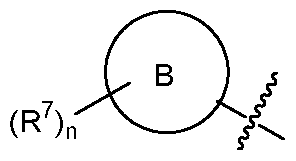 is 2,6-dioxohexahydropyrimidin-l-yl, 2- oxopyrrolidin-l-yl, benzo[d]thiazol-2-yl, 2-amino-4-methyl-5,6-dihydro-l,3-thiazin-4-yl, 4- methyl-6-[4-(mo holine-4-carbonyl)anilino]-5-oxo-pyrazin-2-yl, 5,7- dimethylbenzo[d]oxazol-2-yl, 6-[4-(morpholine-4-carbonyl)phenyl]-7H-pyrrolo[2,3- d]pyrimidin-4-yl, 8-[4-(morpholine-4-carbonyl)anilino]imidazo[l,2-a]pyrazin-6-yl, oxazolo[4,5-b]pyridine-2-yl, or l-methyl-2-oxo-l,6-naphthridin-3-yl, ring A in Formula (Γ) is not 2-pyridyl or 2-pyridyl optionally substituted with halo, methylcarboxy, l,2,4-triazol-4- yl, 1-piperidinyl, or cyclopropyl;
(ii) when ring B is thiazolo[5,4-b]pyridin-2-yl or 6,7,8,9-tetrahydro-5H- [l,2,4]triazolo[4,3-a]azepin-3-yl, ring A in Formula (Γ) is other than 2-quinolyl;
(iii) when ring B is 1 -piperazinyl, ring A in Formula (Γ) is not 3-(4- benzyloxyphenyl)pyrazolo[l,5-a]pyrimidin-5-yl;
(iv) when
 is 6-[l-(dimethylcarbamoyl)-3,6-dihydro-2H-pyridin-4-yl]- 7H-pyrrolo[2,3-d]pyrimidin-4-yl, ring A in Formula (Γ) is not l-methylpyrrolo[2,3- b]pyridine-6-yl;
(v) when ring B is 2-oxo-l,2-dihydropyridin-5-yl, 2-oxo-l,2-dihydropyrazin-5-yl or 6-oxo-lH-pyridazin-3-yl, R2 is other than t-butyl;
(vi) when
 3,5-dimethylphenyl, R5 is other than 4-amino-l - piperidinyl; and
(vii) the compound is other than 6-((2R,6S)-2,6-dimethylmorpholino)-N-(2-methyl-4'- (trifluoromethoxy)biphenyl-3-yl)pyridazine-3-carboxamide or N-(3-(3-acetyl-2- oxoiinidazolidin-l-yl)-2-methylphenyl)-5,6,7,8 etrahydroquinoline-2-carboxamide.
The present disclosure provides componds of Formula (Γ),
or a pharmaceutically acceptable salt or a stereoisomer thereof, wherein:
X1 is N or CR1;
X2 is N or CR2;
X3 is N or CR3;
X4 is N or CR4;
wherein no more than two of X1, X2, X3 and X4 are simultaneously N;
X5 is N or CR6a;
X6 is N or CR6b;
Ring B is Ce-ιο aryl, C3-10 cycloalkyl, 5- to 14-membered heteroaryl, or 4- to 10- membered heterocycloalkyl, provided ring B is other than 9-H-carbazol-4-yl, 2,3,4,9- tetrahydro-lH-carbazol-5-yl or lH-tetrazolyl;
R1, R2, R3, R4 and R7 are each independently selected from H, halo, Ci-6 alkyl, C2-6 alkenyl, C2-6 alkynyl, Ci-6 haloalkyl, Ci-6 haloalkoxy, Ce-ιο aryl, C3-10 cycloalkyl, 5-14 membered heteroaryl, 4-10 membered heterocycloalkyl, Ce-ιο aryl-Ci-4 alkyl-, C3-10 cycloalkyl-C 1-4 alkyl-, (5-14 membered heteroaryl)-Ci-4 alkyl-, (4-10 membered
heterocycloalkyl)-Ci-4 alkyl-, CN, NO2, ORa, SRa, NHORa, C(0)Ra, C(0)NRaRa, C(0)ORa, OC(0)Ra, OC(0)NRaRa, NHRa, NRaRa, NRaC(0)Ra, NRaC(0)ORa, NRaC(0)NRaRa, C(=NRa)Ra, C(=NRa)NRaRa, NRaC(=NRa)NRaRa, NRaS(0)Ra, NRaS(0)2Ra, NRaS(0)2NRaRa, S(0)Ra, S(0)NRaRa, S(0)2Ra, and S(0)2NRaRa, wherein the Ci-e alkyl, C2-6 alkenyl, C2-6 alkynyl, Ce-ιο aryl, C3-10 cycloalkyl, 5-14 membered heteroaryl, 4-10 membered
heterocycloalkyl, Ce-ιο aryl-Ci-4 alkyl-, C3-10 cycloalkyl-Ci-4 alkyl-, (5-14 membered heteroaryl)-Ci-4 alkyl-, and (4-10 membered heterocycloalkyl)-Ci-4 alkyl- of R1, R2, R3, R4 and R7 are each optionally substituted with 1, 2, 3, or 4 Rb substituents;
R5 is halo, Ci-6 alkyl, C2-6 alkenyl, C2-6 alkynyl, Ci-6 haloalkyl, Ci-6 haloalkoxy, Ce-ιο aryl, C3-10 cycloalkyl, 5-14 membered heteroaryl, 4-10 membered heterocycloalkyl, Ce-ιο aryl-
Ci-4 alkyl-, C3-10 cycloalkyl-Ci-4 alkyl-, (5-14 membered heteroaryl)-Ci-4 alkyl-, (4-10 membered heterocycloalkyl)-Ci-4 alkyl-, CN, NO2, OR11, SR11, NH2, -NH-C M alkyl, -N(Ci-4 alkyl)2, NHOR11, C(0)Rn, C(0)NRnRn, C(0)ORn, OC(0)Rn, OC(0)NRnRn,
NRnC(0)Rn, NRnC(0)ORn, NRHC^NRHR11, C(=NR11)R11, C(=NR11)NR11R11, NR11C(=NR11)NR11R11, NRnS(0)Rn, NRnS(0)2Rn,
 S(0)Rn,
S(0)NRnRn, S(0)2Rn, and S(0)2NR11R11, wherein the Ci-e alkyl, C2-6 alkenyl, C2-6 alkynyl, Ci-6 haloalkyl, Ci-6 haloalkoxy, Ce-ιο aryl, C3-10 cycloalkyl, 5-14 membered heteroaryl, 4-10 membered heterocycloalkyl, Ce-ιο aryl-C 1-4 alkyl-, C3-io cycloalkyl-Ci-4 alkyl-, (5-14 membered heteroaryl)-Ci-4 alkyl- and (4-10 membered heterocycloalkyl)-Ci-4 alkyl- of R5 are each optionally substituted with 1, 2 or 3 Rb substituents; wherein R5 is other than F when ring B is C3-10 cycloalkyl, 5- to 14-membered heteroaryl or 4- to 10-membered
heterocycloalkyl;
each R11 is independently selected from H, CN, Ci-6 alkyl, C1-4 haloalkyl, C2-6 alkenyl, C2-6 alkynyl, Ce-ιο aryl, C3-10 cycloalkyl, 5-10 membered heteroaryl, 4-10 membered heterocycloalkyl, Ce-ιο aryl-Ci-4 alkyl-, C3-10 cycloalkyl-Ci-4 alkyl-, (5-10 membered heteroaryl)-Ci-4 alkyl-, and (4-10 membered heterocycloalkyl)-Ci-4 alkyl-, wherein the Ci-6 alkyl, C2-6 alkenyl, C2-6 alkynyl, Ce-ιο aryl, C3-10 cycloalkyl, 5-10 membered heteroaryl, 4-10 membered heterocycloalkyl, Ce-ιο aryl-C 1-4 alkyl-, C3-io cycloalkyl-Ci-4 alkyl-, (5-10 membered heteroaryl)-Ci-4 alkyl- and (4-10 membered heterocycloalkyl)-Ci-4 alkyl- of R11 are each optionally substituted with 1, 2 or 3 Rb substituents;
R6a, R6b and R6c are each independently selected from H, C 1-4 alkyl, C3-6 cycloalkyl, C2-4 alkenyl, C2-4 alkynyl, halo, CN, OH, C 1-4 alkoxy, C1-4 haloalkyl, Ci-4 haloalkoxy, NH2, - NH-Ci-4 alkyl, -N(Ci-4 alkyl)2, NHOR10, C(0)R10, C(O)NR10R10, C(0)OR10, OC(0)R10, OC(O)NR10R10, NR10C(O)R10, NR10C(O)OR10, NR10C(O)NR10R10, C(=NR10)R10,
C(=NR10)NR10R10, NR10C(=NR10)NR10R10, NR10S(O)R10, NR10S(O)2R10,
NR10S(O)2NR10R10, S(0)R10, S(O)NR10R10, S(0)2R10, and S(O)2NR10R10, wherein each R10 is independently H or C1-4 alkyl optionally substituted with 1 or 2 groups independently selected from halo, OH, CN and C 1-4 alkoxy, and wherein the C1-4 alkyl, C3-6 cycloalkyl, C2-4 alkenyl and C2-4 alkynyl of R6a, R6b, and R6c are each optionally substituted with 1 or 2 substituents independently selected from halo, OH, CN, C1-4 alkyl and C 1-4 alkoxy;
or two adjacent R7 substituents, taken together with the atoms to which they are attached, form a fused phenyl ring, a fused 4- to 7-membered heterocycloalkyl ring, a fused 5- or 6-membered heteroaryl ring or a fused C3-10 cycloalkyl ring, wherein the fused 4- to 7- membered heterocycloalkyl ring and fused 5- or 6-membered heteroaryl ring each have 1 -4
heteroatoms as ring members selected fromN, O and S and wherein the fused phenyl ring, fused 5- to 7-membered heterocycloalkyl ring, fused 5- or 6-membered heteroaryl ring and fused C3-10 cycloalkyl ring are each optionally substituted with 1 or 2 independently selected
Rb substituents, provided
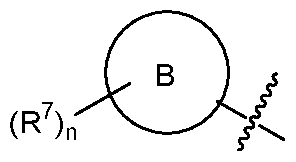 is other than 9-H-carbazol-4-yl or 2,3,4,9- tetrahydro-lH-carbazol-5-yl, each of which is optionally substituted by 1 or 2 independently selected Rb substituents;
or two R7 substituents attached to the same ring carbon atom of ring B, together with the carbon atom to which they are attached, form a 4- to 7-membered heterocycloalkyl ring having 1-4 heteroatoms as ring members selected from N, O and S or a C3-6 cycloalkyl ring, wherein the 4- to 7-membered heterocycloalkyl ring and C3-6 cycloalkyl ring are each optionally substituted with 1 or 2 independently selected Rb substituents;
or R1 and X2 taken together form a fused phenyl ring, a fused 4- to 10-membered heterocycloalkyl ring, a fused 5- or 6-membered heteroaryl ring or a fused C3-10 cycloalkyl ring, wherein the fused 4- to 10-membered heterocycloalkyl ring and fused 5- or 6-membered heteroaryl ring each have 1-4 heteroatoms as ring members selected from N, O and S and wherein the fused phenyl ring, fused 5- or 6-membered heterocycloalkyl ring, fused 5- or 6- membered heteroaryl ring and fused C5-6 cycloalkyl ring are each optionally substituted with 1 or 2 independently selected Rb substituents;
or R2 and X1 taken together form a fused phenyl ring, a fused 4- to 10-membered heterocycloalkyl ring, a fused 5- or 6-membered heteroaryl ring or a fused C3-10 cycloalkyl ring, wherein the fused 4- to 10-membered heterocycloalkyl ring and fused 5- or 6-membered heteroaryl ring each have 1-4 heteroatoms as ring members selected from N, O and S and wherein the fused phenyl ring, fused 5- or 6-membered heterocycloalkyl ring, fused 5- or 6- membered heteroaryl ring and fused C5-6 cycloalkyl ring are each optionally substituted with 1 or 2 independently selected Rb substituents;
or R2 and X3 taken together form a fused phenyl ring, a fused 4- to 10-membered heterocycloalkyl ring, a fused 5- or 6-membered heteroaryl ring or a fused C3-10 cycloalkyl ring, wherein the fused 4- to 10-membered heterocycloalkyl ring and fused 5- or 6-membered heteroaryl ring each have 1-4 heteroatoms as ring members selected from N, O and S and wherein the fused phenyl ring, fused 5- or 6-membered heterocycloalkyl ring, fused 5- or 6- membered heteroaryl ring and fused C5-6 cycloalkyl ring are each optionally substituted with 1 or 2 independently selected Rb substituents;
or R3 and X2 taken together form a fused phenyl ring, a fused 4- to 10-membered heterocycloalkyl ring, a fused 5- or 6-membered heteroaryl ring or a fused C3-10 cycloalkyl ring, wherein the fused 4- to 10-membered heterocycloalkyl ring and fused 5- or 6-membered heteroaryl ring each have 1-4 heteroatoms as ring members selected from N, O and S and wherein the fused phenyl ring, fused 5- or 6-membered heterocycloalkyl ring, fused 5- or 6- membered heteroaryl ring and fused C5-6 cycloalkyl ring are each optionally substituted with 1 or 2 independently selected Rb substituents;
or R3 and X4 taken together form a fused phenyl ring, a fused 4- to 10-membered heterocycloalkyl ring, a fused 5- or 6-membered heteroaryl ring or a fused C3-10 cycloalkyl ring, wherein the fused 4- to 10-membered heterocycloalkyl ring and fused 5- or 6-membered heteroaryl ring each have 1-4 heteroatoms as ring members selected from N, O and S and wherein the fused phenyl ring, fused 5- or 6-membered heterocycloalkyl ring, fused 5- or 6- membered heteroaryl ring and fused C5-6 cycloalkyl ring are each optionally substituted with 1 or 2 independently selected Rb substituents;
or R4 and X3 taken together form a fused phenyl ring, a fused 4- to 10-membered heterocycloalkyl ring, a fused 5- or 6-membered heteroaryl ring or a fused C3-10 cycloalkyl ring, wherein the fused 4- to 10-membered heterocycloalkyl ring and fused 5- or 6-membered heteroaryl ring each have 1-4 heteroatoms as ring members selected from N, O and S and wherein the fused phenyl ring, fused 5- or 6-membered heterocycloalkyl ring, fused 5- or 6- membered heteroaryl ring and fused C5-6 cycloalkyl ring are each optionally substituted with 1 or 2 independently selected Rb substituents;
each Ra is independently selected from H, CN, Ci-6 alkyl, Ci-4 haloalkyl, C2-6 alkenyl, C2-6 alkynyl, Ce-ιο aryl, C3-10 cycloalkyl, 5-10 membered heteroaryl, 4-10 membered heterocycloalkyl, Ce-ιο aryl-Ci-4 alkyl-, C3-10 cycloalkyl-Ci-4 alkyl-, (5-10 membered heteroaryl)-Ci-4 alkyl-, and (4-10 membered heterocycloalkyl)-Ci-4 alkyl-, wherein the Ci-6 alkyl, C2-6 alkenyl, C2-6 alkynyl, Ce-ιο aryl, C3-10 cycloalkyl, 5-10 membered heteroaryl, 4-10 membered heterocycloalkyl, Ce-ιο aryl-C 1-4 alkyl-, C3-io cycloalkyl-Ci-4 alkyl-, (5-10 membered heteroaryl)-Ci-4 alkyl- and (4-10 membered heterocycloalkyl)-Ci-4 alkyl- of Ra are each optionally substituted with 1, 2, 3, 4, or 5 Rd substituents;
each Rd is independently selected from C1-4 alkyl, C1-4 haloalkyl, halo, C3-10 cycloalkyl, 4-10 membered heterocycloalkyl, CN, NH2, NHORe, ORe, SRe, C(0)Re,
C(0)NReRe, C(0)ORe, OC(0)Re, OC(0)NReRe, NHRe, NReRe, NReC(0)Re, NReC(0)NReRe, NReC(0)ORe, C(=NRe)NReRe, NReC(=NRe)NReRe, S(0)Re, S(0)NReRe, S(0)2Re,
NReS(0)2Re, NReS(0)2NReRe, and S(0)2NReRe, wherein the CM alkyl, C3-10 cycloalkyl and
4-10 membered heterocycloalkyl of Rd are each further optionally substituted with 1-3 independently selected Rf substituents;
each Rb substituent is independently selected from halo, Ci-4 alkyl, Ci-4 haloalkyl, Ci-4 haloalkoxy, C6-io aryl, C3-10 cycloalkyl, 5-10 membered heteroaryl, 4-10 membered heterocycloalkyl, Ce-ιο aryl-Ci-4 alkyl-, C3-10 cycloalkyl-Ci-4 alkyl-, (5-10 membered heteroaryl)-Ci-4 alkyl-, (4-10 membered heterocycloalkyl)-Ci-4 alkyl-, CN, OH, NH2, NO2, NHORc, ORc, SRC, C(0)Rc, C(0)NRcRc, C(0)ORc, OC(0)Rc, OC(0)NRcRc, C(=NRC)NRCRC, NRCC(=NRC)NRCRC, NHRC, NRCRC, NRcC(0)Rc, NRcC(0)ORc, NRcC(0)NRcRc, NRcS(0)Rc, NRcS(0)2Rc, NRcS(0)2NRcRc, S(0)Rc, S(0)NRcRc, S(0)2Rc and S(0)2NRcRc; wherein the Ci-4 alkyl, C1-4 haloalkyl, C 1-4 haloalkoxy, Ce-ιο aryl, C3-10 cycloalkyl, 5-10 membered heteroaryl, 4-10 membered heterocycloalkyl, Ce-ιο aryl-Ci-4 alkyl-, C3-10 cycloalkyl-Ci-4 alkyl- , (5-10 membered heteroaryl)-Ci-4 alkyl-and (4-10 membered heterocycloalkyl)-Ci-4 alkyl- of Rb are each further optionally substituted with 1-3 independently selected Rd substituents; each Rc is independently selected from H, Ci-6 alkyl, C 1-4 haloalkyl, C2-6 alkenyl, C2-6 alkynyl, Ce-ιο aryl, C3-10 cycloalkyl, 5-10 membered heteroaryl, 4-10 membered
heterocycloalkyl, Ce-ιο aryl-Ci-4 alkyl-, C3-10 cycloalkyl-Ci-4 alkyl-, (5-10 membered heteroaryl)-Ci-4 alkyl-, and (4-10 membered heterocycloalkyl)-Ci-4 alkyl-, wherein the Ci-6 alkyl, C2-6 alkenyl, C2-6 alkynyl, Ce-ιο aryl, C3-10 cycloalkyl, 5-10 membered heteroaryl, 4-10 membered heterocycloalkyl, Ce-ιο aryl-C 1-4 alkyl-, C3-io cycloalkyl-Ci-4 alkyl-, (5-10 membered heteroaryl)-Ci-4 alkyl- and (4-10 membered heterocycloalkyl)-Ci-4 alkyl- of Rc are each optionally substituted with 1, 2, 3, 4, or 5 Rf substituents independently selected from Ci-4 alkyl, C1-4 haloalkyl, C2-6 alkenyl, C2-6 alkynyl, Ce-ιο aryl, C3-10 cycloalkyl, 5-10 membered heteroaryl, 4-10 membered heterocycloalkyl, Ce-ιο aryl-Ci-4 alkyl-, C3-10 cycloalkyl-C 1-4 alkyl-, (5-10 membered heteroaryl)-Ci-4 alkyl-, (4-10 membered
heterocycloalkyl)-Ci-4 alkyl-, halo, CN, NHOR , ORg, SRg, C(0)Rg, C(0)NRgRg, C(0)ORg, OC(0)Rg, OC(0)NRgRg, NHRg, NRgRg, NRgC(0)Rg, NRgC(0)NRgRg, NRgC(0)ORg, C(=NRg)NRgRg, NRgC(=NRg)NRgRg, S(0)Rg, S(0)NRgRg, S(0)2Rg, NRgS(0)2Rg,
NRgS(0)2NRgRg, and S(0)2NRgRg; wherein the CM alkyl, CM haloalkyl, C2-6 alkenyl, C2-6 alkynyl, Ce-ιο aryl, C3-10 cycloalkyl, 5-10 membered heteroaryl, 4-10 membered
heterocycloalkyl, Ce-ιο aryl-Ci-4 alkyl-, C3-10 cycloalkyl-Ci-4 alkyl-, (5-10 membered heteroaryl)-Ci-4 alkyl-, and (4-10 membered heterocycloalkyl)-Ci-4 alkyl- of Rf are each optionally substituted with 1, 2, 3, 4, or 5 Rn substituents independently selected from C1-4 alkyl, CM haloalkyl, halo, CN, R°, NHOR0, OR0, SR°, C(O)R0, C(O)NR0R°, C(O)OR0, OC(0)R°, OC(0)NR°R°, NHR°, NR°R°, NR0C(O)R°, NR0C(O)NR°R°, NR°C(0)OR°,
C(=NR°)NR°R°, NR0C(=NR°)NR°R0, S(0)R°, S(0)NR°R°, S(0)2R°, NR°S(0)2R°,
NR0S(O)2NR°R0, and S(0)2NR°R°;
each R is independently selected from H, Ci-6 alkyl, Ci-4 haloalkyl, C2-6 alkenyl, C2-6 alkynyl, Ce-ιο aryl, C3-10 cycloalkyl, 5-10 membered heteroaryl, 4-10 membered
heterocycloalkyl, Ce-ιο aryl-Ci-4 alkyl-, C3-10 cycloalkyl-Ci-4 alkyl-, (5-10 membered heteroaryl)-Ci-4 alkyl-, and (4-10 membered heterocycloalkyl)-Ci-4 alkyl-, wherein the Ci-6 alkyl, C2-6 alkenyl, C2-6 alkynyl, Ce-ιο aryl, C3-10 cycloalkyl, 5-10 membered heteroaryl, 4-10 membered heterocycloalkyl, Ce-ιο aryl-C 1-4 alkyl-, C3-io cycloalkyl-Ci-4 alkyl-, (5-10 membered heteroaryl)-Ci-4 alkyl- and (4-10 membered heterocycloalkyl)-Ci-4 alkyl- of Rg are each optionally substituted with 1-3 independently selected Rp substituents;
or any two Ra substituents together with the nitrogen atom to which they are attached form a 4-, 5-, 6-, 7-, 8-, 9- or 10-membered heterocycloalkyl group optionally substituted with 1, 2 or 3 Rh substituents independently selected from Ci-6 alkyl, C3-10 cycloalkyl, 4-7 membered heterocycloalkyl, Ce-ιο aryl, 5-6 membered heteroaryl, C3-10 cycloalkyl-Ci-4 alkyl-, (5-6 membered heteroaryl)-Ci-4 alkyl-, (4-7 membered heterocycloalkyl)-Ci-4 alkyl-, Ci-6 haloalkyl, C2-6 alkenyl, C2-6 alkynyl, halo, CN, OR1, SR NHOR1, C(0)R C^N^R1, 0(0)0^, ΟΟ(Ο)^, OC C NR'R1, NHR', NR'R1, NR^C R1, NR'C C NR'R1, NR^C OR1, C^NR NR'R1, NR ^NR NR'R1, S(0)R S C NR , 8(0)Λ\ NR^O^R1,
NR^O^NRiR1, and δ(0)2Ν^^, wherein the Ci-e alkyl, C3-10 cycloalkyl, 4-7 membered heterocycloalkyl, Ce-ιο aryl, 5-6 membered heteroaryl, C3-10 cycloalkyl-Ci-4 alkyl-, (5-6 membered heteroaryl)-Ci-4 alkyl-, and (4-7 membered heterocycloalkyl)-Ci-4 alkyl- of Rh are each further optionally substituted by 1, 2, or 3 RJ substituents independently selected from C3-6 cycloalkyl, Ce-ιο aryl, 5 or 6-membered heteroaryl, C2-4 alkenyl, C2-4 alkynyl, halo, C1-4 alkyl, C M haloalkyl, CN, NHORk, ORk, SRk, C(0)Rk, C(0)NRkRk, C(0)ORk, OC(0)Rk, OC(0)NRkRk, NHRk, NRkRk, NRkC(0)Rk, NRkC(0)NRkRk, NRkC(0)ORk, C(=NRk)NRkRk, NRkC(=NRk)NRkRk, S(0)Rk, S(0)NRkRk, S(0)2Rk, NRkS(0)2Rk, NRkS(0)2NRkRk, and S(0)2NRkRk; or two Rh groups attached to the same carbon atom of the 4- to 10-membered heterocycloalkyl taken together with the carbon atom to which they are attached form a C3-6 cycloalkyl or 4- to 6-membered heterocycloalkyl having 1 -2 heteroatoms as ring members selected from O, N or S;
or any two Rc substituents together with the nitrogen atom to which they are attached form a 4-, 5-, 6-, or 7-membered heterocycloalkyl group optionally substituted with 1 , 2, or 3 independently selected Rh substituents;
or any two Re substituents together with the nitrogen atom to which they are attached form a 4-, 5-, 6-, or 7-membered heterocycloalkyl group optionally substituted with 1 , 2, or 3 independently selected Rh substituents;
or any two R substituents together with the nitrogen atom to which they are attached form a 4-, 5-, 6-, or 7-membered heterocycloalkyl group optionally substituted with 1 , 2, or 3 independently selected Rh substituents;
or any two R1 substituents together with the nitrogen atom to which they are attached form a 4-, 5-, 6-, or 7-membered heterocycloalkyl group optionally substituted with 1 , 2, or 3 independently selected Rh substituents;
or any two Rk substituents together with the nitrogen atom to which they are attached form a 4-, 5-, 6-, or 7-membered heterocycloalkyl group optionally substituted with 1 , 2, or 3 independently selected Rh substituents;
or any two R° substituents together with the nitrogen atom to which they are attached form a 4-, 5-, 6-, or 7-membered heterocycloalkyl group optionally substituted with 1 , 2, or 3 independently selected Rh substituents; and
each Re, R1, Rk, R° or Rp is independently selected from H, Ci-4 alkyl, C3-6 cycloalkyl, Ce-ιο aryl, 5 or 6-membered heteroaryl, C1-4 haloalkyl, C2-4 alkenyl, and C2-4 alkynyl, wherein the Ci-4 alkyl, C3-6 cycloalkyl, Ce-ιο aryl, 5 or 6-membered heteroaryl, C2-4 alkenyl, and C2-4 alkynyl of Re, R1, Rk, R° or Rp are each optionally substituted with 1, 2 or 3 Rq substituents; each R¾ is independently selected from OH, CN, -COOH, NH2, halo, Ci-e haloalkyl,
Ci-6 alkyl, Ci-6 alkoxy, Ci-6 alkylthio, phenyl, 5-6 membered heteroaryl, 4-6 membered heterocycloalkyl, C3-6 cycloalkyl, NHR8, NR8R8, and Ci-4 haloalkoxy, wherein the Ci-6 alkyl, phenyl, C3-6 cycloalkyl, 4-6 membered heterocycloalkyl, and 5-6 membered heteroaryl of Rq are each optionally substituted with halo, OH, CN, -COOH, NH2, C1-4 alkoxy, C1-4 haloalkyl, Ci-4 haloalkoxy, phenyl, C3-10 cycloalkyl and 4-6 membered heterocycloalkyl and each R8 is independently Ci-6 alkyl;
= is a single bond or a double bond, wherein ring A includes at least one double bond;the subscript n is an integer 4 or 5; and with the proviso (i) when
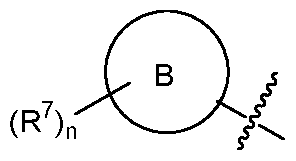 is 2,6-dioxohexahydropyrimidin-l-yl, 2- oxopyrrolidin-l-yl, benzo[d]thiazol-2-yl, 2-amino-4-methyl-5,6-dihydro-l,3-thiazin-4-yl, 4- methyl-6-[4-(mo holine-4-carbonyl)anilino]-5-oxo-pyrazin-2-yl, 5,7- dimethylbenzo[d]oxazol-2-yl, 6-[4-(morpholine-4-carbonyl)phenyl]-7H-pyrrolo[2,3-
d]pyrimidin-4-yl, 8-[4-(morpholine-4-carbonyl)anilino]imidazo[l,2-a]pyrazin-6-yl, oxazolo[4,5-b]pyridine-2-yl, or l-methyl-2-oxo-l ,6-naphthridin-3-yl, ring A in Formula (Γ) is not 2-pyridyl or 2-pyridyl optionally substituted with halo, methylcarboxy, l,2,4-triazol-4- yl, 1-piperidinyl, or cyclopropyl;
is 2,6-dioxohexahydropyrimidin-l-yl, 2- oxopyrrolidin-l-yl, benzo[d]thiazol-2-yl, 2-amino-4-methyl-5,6-dihydro-l,3-thiazin-4-yl, 4- methyl-6-[4-(mo holine-4-carbonyl)anilino]-5-oxo-pyrazin-2-yl, 5,7- dimethylbenzo[d]oxazol-2-yl, 6-[4-(morpholine-4-carbonyl)phenyl]-7H-pyrrolo[2,3-
d]pyrimidin-4-yl, 8-[4-(morpholine-4-carbonyl)anilino]imidazo[l,2-a]pyrazin-6-yl, oxazolo[4,5-b]pyridine-2-yl, or l-methyl-2-oxo-l ,6-naphthridin-3-yl, ring A in Formula (Γ) is not 2-pyridyl or 2-pyridyl optionally substituted with halo, methylcarboxy, l,2,4-triazol-4- yl, 1-piperidinyl, or cyclopropyl;
(ii) when ring B is thiazolo[5,4-b]pyridin-2-yl or 6,7,8,9-tetrahydro-5H-
[l,2,4]triazolo[4,3-a]azepin-3-yl, ring A in Formula (Γ) is other than 2-quinolyl;
(iii) when ring B is 1 -piperazinyl, ring A in Formula (Γ) is not 3-(4- benzyloxyphenyl)pyrazolo[l ,5-a]pyrimidin-5-yl;
(iv) when (R )n""^~ is 6-[l -(dimethylcarbamoyl)-3,6-dihydro-2H-pyridin-4-yl]- 7H-pyrrolo[2,3-d]pyrimidin-4-yl, ring A in Formula (Γ) is not l-methylpyrrolo[2,3- b]pyridine-6-yl;
(v) when ring B is 2-oxo-l ,2-dihydropyridin-5-yl, 2-oxo-l ,2-dihydropyrazin-5-yl or 6-oxo-lH-pyridazi -3-yl, R2 is other than t-butyl;
(vi) when
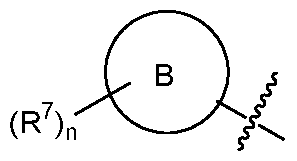 is 3,5-dimethylphenyl, R5 is other than 4-amino-l - piperidinyl; and
(vii) the compound is other than 6-((2R,6S)-2,6-dimethylmorpholino)-N-(2-methyl-4'- (trifluoromethoxy)biphenyl-3-yl)pyridazine-3-carboxamide or N-(3-(3-acetyl-2- oxoimidazolidin-l-yl)-2-methylphenyl)-5,6,7,8-tetrahydroquinoline-2-carboxamide. In some embodiments, when Cy is 2-oxo-l ,2-dihydropyridin-5-yl, 2-oxo-l , 2- dihydropyrazin-5-yl or 6-oxo-l,5-dihydropyridazin-3-yl, each of which is optionally substituted, R2 is other than Ci-6 alkyl.
In some embodiments of compounds of Formula (Γ), R5 is Ci-4 alkyl, halo, CN, OH, cyclopropyl, C2-4 alkynyl, Ci-4 alkoxy, Ci-4 haloalkyl, Ci-4 haloalkoxy, NH2, -NH-C1-4 alkyl, - N(Ci-4 alky 1)2, NHOR11, C(0)Rn, C(0)NRnRn, C(0)ORn, OC(0)Rn, OC(0)NRnRn, NRnC(0)Rn, NRnC(0)ORn, NRHC^NRHR11, C(=NR11)R11, C(=NR11)NR11R11, NR11C(=NR11)NR11R11, NRnS(0)Rn,
 S(0)Rn,
S(0)NRnRn, S(0)2Rn, and S(0)2NRnRn, wherein C M alkyl, cyclopropyl, C2-4 alkynyl and Ci-4 alkoxy of R5 are each optionally substituted with 1 or 2 halo, OH, CN or OCH3 substituent and each R11 is independently selected from H and C1-4 alkyl optionally substituted with 1 or 2 halo, OH, CN or OCH3; wherein R5 is other than F when ring B is C3-
10 cycloalkyl, 5- to 14-membered heteroaryl, or 4- to 10-membered heterocycloalkyl. In some embodiments of compounds of Formula (Γ), ring A is aromatic.
In some embodiments of compounds of Formula (Γ), ring B is Ce-ιο aryl. In certain embodiments, ring B is phenyl or naphthyl. In certain embodiments, ring B is phenyl. R7 is as defined in any embodiment of compounds of Formula (Γ) or Formula (I) as described herein. In certain embodiments, each R7 is H.
In some embodiments, ring B is 1 -cyclohexenyl, cyclohexyl, 3,4-dihydro-2H-pyridin- 5-yl, l ,2,3,4-tetrahydropyridin-5-yl, 1 -piperidinyl, 2,3-dihydro-l ,4-benzodioxin-6-yl, 3,4- dihydro-2H-pyran-5-yl, 4-methyl-3,4-dihydro-2H-l,4-benzoxazin-7-yl, 3,4-dihydro-2H-l ,4- benzoxazin-7-yl, 2,3-dihydro-l-benzofuran-6-yl, 2-methyl-2H-indazol-6-yl, 2H-indazol-6-yl, 1 -methyl- lH-indazol-4-yl or lH-indazol-4-yl. R7 is as defined in any embodiment of compounds of Formula (Γ) or Formula (I) as described herein. In some embodiments, R7 is

t-butoxycarbonyl or Ci-6 alkyl. In certain embodiments, 1S 1 -cyclohexenyl, cyclohexyl, l-t-butoxycarbonyl-3,4-dihydro-2H-pyridin-5-yl, l,2,3,4-tetrahydropyridin-5-yl, 1 -piperidinyl, 2,3-dihydro-l ,4-benzodioxin-6-yl, 3,4-dihydro-2H-pyran-5-yl, 4-methyl-3,4- dihydro-2H-l,4-benzoxazin-7-yl, 3,4-dihydro-2H-l ,4-benzoxazin-7-yl, 2,3-dihydro-l - benzofuran-6-yl, 2-methyl-2H-indazol-6-yl, 2H-indazol-6-yl, 1 -methyl- lH-indazol-4-yl or lH-indazol-4-yl.
In some embodiments of compounds of Formula (Γ), ring B is C3-10 cycloalkyl. In certain embodiments, ring B is cyclopropyl, cyclobutyl, cyclopentyl, cyclohexyl, cyclohexenyl, cycloheptyl or cyclooctyl. R7 is as defined in any embodiment of compounds of Formula (Γ) or Formula (I) as described herein. In certain embodiments, R7 is H.
In some embodiments of compounds of Formula (Γ), ring B is 5- to 14-membered heteroaryl. In certain embodiments, ring B is pyridy, primidinyl, pyrazinyl, pyridazinyl, triazinyl, pyrrolyl, pyrazolyl, azolyl, oxazolyl, thiazolyl, imidazolyl, furanyl, thiophenyl, quinolinyl, isoquinolinyl, naphthyridinyl, indolyl, benzothiophenyl, benzofuranyl, benzisoxazolyl, imidazo[l ,2-Z>]thiazolyl, purinyl, thienyl, furyl, pyrrolyl, imidazolyl, thiazolyl, oxazolyl, pyrazolyl, isothiazolyl, isoxazolyl, 1 ,2,3-triazolyl, tetrazolyl, 1 ,2,3- thiadiazolyl, 1,2,3-oxadiazolyl, 1 ,2,4-triazolyl, 1 ,2,4-thiadiazolyl, 1,2,4-oxadiazolyl, 1,3,4- triazolyl, 1 ,3,4-thiadiazolyl and 1 ,3,4-oxadiazolyl. In certain embodiments, ring B is 2- methyl-2H-indazol-6-yl, 1 -methyl- lH-indazol-4-yl, 2,3-dihydro-l-benzofuran-6-yl, 4-
methyl-3,4-dihydro-2H-l,4-benzoxazin-7-yl or 2,3-dihydro-l,4-benzodioxin-6-yl. R7 is as defined in any embodiment of compounds of Formula (Γ) or Formula (I) as described herein.
In some embodiments of compounds of Formula (Γ), ring B is 4- to 10-membered heterocycloalkyl. In certain embodiments, ring B is azetidinyl, azepanyl,
dihydrobenzofuranyl, dihydrofuranyl, dihydropyranyl, morpholino, 3-oxa-9- azaspiro[5.5]undecanyl, l-oxa-8-azaspiro[4.5]decanyl, piperidinyl, piperazinyl,
oxopiperazinyl, pyranyl, pyrrolidinyl, quinuclidinyl, tetrahydrofuranyl, tetrahydropyranyl, 1,2,3,4-tetrahydroquinolinyl, tropanyl, 2,3-dihydro-l,4-benzodioxin-6-yl, or thiomorpholino. In some embodiments, ring B is 3,4-dihydro-2H-pyran-5-yl, 1-piperidinyl or 1,2,3,4- tetrahydropyridin-5-yl. R7 is as defined in any embodiment of compounds of Formula (Γ) or Formula (I) as described herein.
In some embodiments of compounds of Formula (Γ), ring B is phenyl, 5- or 6-membered heteroaryl, C3-6 cycloalkyl or 5- or 6-membered heterocycloalkyl. In certain instances, ring B is phenyl, 2-thiophenyl, 3-thiophenyl, 2-pyridyl, 3-pyridyl, 4-pyridyl, C3-6 cycloalkyl or 3,6- dihydro-2H-pyran-4-yl. R7 is as defined in any embodiment of compounds of Formula (Γ) or Formula (I) as described herein.
In some embodiments of compounds of Formula (Γ), X5 and X6 are each CH. In certain embodiments, X5 is N and X6 is CH. In certain embodiments, X5 is CH and X6 is N. In certain embodiments, X5 and X6 are each N. In some embodiments of compounds of Formula (Γ), when (R ^'^•—■^^ is


or a pharmaceutically acceptable salt or a stereoisomer thereof, wherein:
X1 is N or CR1;
X2 is N or CR2;
X3 is N or CR3;
X4 is N or CR4;
wherein no more than two of X1, X2, X3 and X4 are simultaneously N;
R1, R2, R3, R4 and R7 are each independently selected from H, halo, Ci-6 alkyl, C2-6 alkenyl, C2-6 alkynyl, Ci-6 haloalkyl, Ci-6 haloalkoxy, Ce-ιο aryl, C3-10 cycloalkyl, 5-14 membered heteroaryl, 4-10 membered heterocycloalkyl, Ce-ιο aryl-Ci-4 alkyl-, C3-10 cycloalkyl-C 1-4 alkyl-, (5-14 membered heteroaryl)-Ci-4 alkyl-, (4-10 membered
heterocycloalkyl)-Ci-4 alkyl-, CN, NO2, ORA, SRA, NHORA, C(0)RA, C(0)NRARA, C(0)ORA, OC(0)RA, OC(0)NRARA, NHRA, NRARA, NRAC(0)RA, NRAC(0)ORA, NRAC(0)NRARA, C(=NRA)RA, C(=NRA)NRARA, NRAC(=NRA)NRARA, NRAS(0)RA, NRAS(0)2RA, NRAS(0)2NRARA, S(0)RA, S(0)NRARA, S(0)2RA, and S(0)2NRARA, wherein the Ci-e alkyl, C2-6 alkenyl, C2-6 alkynyl, Ce-ιο aryl, C3-10 cycloalkyl, 5-14 membered heteroaryl, 4-10 membered
heterocycloalkyl, Ce-ιο aryl-Ci-4 alkyl-, C3-10 cycloalkyl-Ci-4 alkyl-, (5-14 membered heteroaryl)-Ci-4 alkyl-, and (4-10 membered heterocycloalkyl)-Ci-4 alkyl- of R1, R2, R3, R4 and R7 are each optionally substituted with 1, 2, 3, or 4 RB substituents;
R5 is Ci-4 alkyl, halo, CN, OH, cyclopropyl, C2-4 alkynyl, Ci-4 alkoxy, C1-4 haloalkyl, Ci-4 haloalkoxy, NH2, -NH-CM alkyl, -N(Ci-4 alkyl)2, NHOR11, C(0)RN, C(0)NRNRN, C(0)ORN, OC(0)RN, OC(0)NRNRN, NRnC(0)RN, NRNC(0)ORN, NRHC^NRHR11, C(=NR11)R11, C(=NR11)NR11R11, NR11C(=NR11)NR11R11, NRNS(0)RN, NR^SCO^R11, NRHS^NRHR11, S(0)RN, S(0)NRNRN, S(0)2RN, and S(0)2NRNRN, wherein each R11 is independently selected from H and C1-4 alkyl optionally substituted with 1 or 2 halo, OH, CN each R6 is independently selected from H, C1-4 alkyl, C3-6 cycloalkyl, C2-4 alkenyl, C2-4 alkynyl, halo, CN, OH, Ci-4 alkoxy, Ci-4 haloalkyl, Ci-4 haloalkoxy, NH2, -NH-C 1-4 alkyl, -N(Ci-4 alky 1)2, NHOR10, C(0)R10, C(O)NR10R10, C(0)OR10, OC(0)R10, OC(O)NR10R10,
NR10C(O)R10, NR10C(O)OR10, NR10C(O)NR10R10, C(=NR10)R10, C(=NR10)NR10R10, NR10C(=NR10)NR10R10, NR10S(O)R10, NR10S(O)2R10, NR10S(O)2NR10R10, S(0)R10,
S(O)NR10R10, S(0)2R10, and S(O)2NR10R10, wherein each R10 is independently H or CM alkyl optionally substituted with 1 or 2 groups independently selected from halo, OH, CN and Ci-4 alkoxy, and wherein the Ci-4 alkyl, C3-4 cycloalkyl, C2-4 alkenyl and C2-4 alkynyl of R6 are each optionally substituted with 1 or 2 substituents independently selected from halo, OH, CN, Ci-4 alkyl and C1-4 alkoxy;
or two adjacent R7 substituents, taken together with the carbon atoms to which they are attached, form a fused phenyl ring, a fused 5- to 7-membered heterocycloalkyl ring, a fused 5- or 6-membered heteroaryl ring or a fused C5-6 cycloalkyl ring, wherein the fused 5- to 7-membered heterocycloalkyl ring and fused 5- or 6-membered heteroaryl ring each have 1-4 heteroatoms as ring members selected from N, O and S and wherein the fused phenyl ring, fused 5- to 7-membered heterocycloalkyl ring, fused 5- or 6-membered heteroaryl ring and fused C3-10 cycloalkyl ring are each optionally substituted with 1 or 2 independently selected RQ substituents;
or R1 and X2 taken together form a fused phenyl ring, a fused 4- to 10-membered heterocycloalkyl ring, a fused 5- or 6-membered heteroaryl ring or a fused C3-10 cycloalkyl ring, wherein the fused 4- to 10-membered heterocycloalkyl ring and fused 5- or 6-membered heteroaryl ring each have 1-4 heteroatoms as ring members selected from N, O and S and wherein the fused phenyl ring, fused 5- or 6-membered heterocycloalkyl ring, fused 5- or 6- membered heteroaryl ring and fused C5-6 cycloalkyl ring are each optionally substituted with 1 or 2 independently selected RB substituents;
or R2 and X1 taken together form a fused phenyl ring, a fused 4- to 10-membered heterocycloalkyl ring, a fused 5- or 6-membered heteroaryl ring or a fused C3-10 cycloalkyl ring, wherein the fused 4- to 10-membered heterocycloalkyl ring and fused 5- or 6-membered heteroaryl ring each have 1-4 heteroatoms as ring members selected from N, O and S and wherein the fused phenyl ring, fused 5- or 6-membered heterocycloalkyl ring, fused 5- or 6- membered heteroaryl ring and fused C5-6 cycloalkyl ring are each optionally substituted with 1 or 2 independently selected RB substituents;
or R2 and X3 taken together form a fused phenyl ring, a fused 4- to 10-membered heterocycloalkyl ring, a fused 5- or 6-membered heteroaryl ring or a fused C3-10 cycloalkyl ring, wherein the fused 4- to 10-membered heterocycloalkyl ring and fused 5- or 6-membered heteroaryl ring each have 1-4 heteroatoms as ring members selected from N, O and S and wherein the fused phenyl ring, fused 5- or 6-membered heterocycloalkyl ring, fused 5- or 6-
membered heteroaryl ring and fused C5-6 cycloalkyl ring are each optionally substituted with 1 or 2 independently selected Rb substituents;
or R3 and X2 taken together form a fused phenyl ring, a fused 4- to 10-membered heterocycloalkyl ring, a fused 5- or 6-membered heteroaryl ring or a fused C3-10 cycloalkyl ring, wherein the fused 4- to 10-membered heterocycloalkyl ring and fused 5- or 6-membered heteroaryl ring each have 1-4 heteroatoms as ring members selected from N, O and S and wherein the fused phenyl ring, fused 5- or 6-membered heterocycloalkyl ring, fused 5- or 6- membered heteroaryl ring and fused C5-6 cycloalkyl ring are each optionally substituted with 1 or 2 independently selected Rb substituents;
or R3 and X4 taken together form a fused phenyl ring, a fused 4- to 10-membered heterocycloalkyl ring, a fused 5- or 6-membered heteroaryl ring or a fused C3-10 cycloalkyl ring, wherein the fused 4- to 10-membered heterocycloalkyl ring and fused 5- or 6-membered heteroaryl ring each have 1-4 heteroatoms as ring members selected from N, O and S and wherein the fused phenyl ring, fused 5- or 6-membered heterocycloalkyl ring, fused 5- or 6- membered heteroaryl ring and fused C5-6 cycloalkyl ring are each optionally substituted with 1 or 2 independently selected Rb substituents;
or R4 and X3 taken together form a fused phenyl ring, a fused 4- to 10-membered heterocycloalkyl ring, a fused 5- or 6-membered heteroaryl ring or a fused C3-10 cycloalkyl ring, wherein the fused 4- to 10-membered heterocycloalkyl ring and fused 5- or 6-membered heteroaryl ring each have 1-4 heteroatoms as ring members selected from N, O and S and wherein the fused phenyl ring, fused 5- or 6-membered heterocycloalkyl ring, fused 5- or 6- membered heteroaryl ring and fused C5-6 cycloalkyl ring are each optionally substituted with 1 or 2 independently selected Rb substituents;
each Ra is independently selected from H, CN, Ci-6 alkyl, Ci-4 haloalkyl, C2-6 alkenyl, C2-6 alkynyl, Ce-ιο aryl, C3-10 cycloalkyl, 5-10 membered heteroaryl, 4-10 membered heterocycloalkyl, Ce-ιο aryl-Ci-4 alkyl-, C3-10 cycloalkyl-Ci-4 alkyl-, (5-10 membered heteroaryl)-Ci-4 alkyl-, and (4-10 membered heterocycloalkyl)-Ci-4 alkyl-, wherein the Ci-6 alkyl, C2-6 alkenyl, C2-6 alkynyl, Ce-ιο aryl, C3-10 cycloalkyl, 5-10 membered heteroaryl, 4-10 membered heterocycloalkyl, Ce-ιο aryl-C 1-4 alkyl-, C3-io cycloalkyl-Ci-4 alkyl-, (5-10 membered heteroaryl)-Ci-4 alkyl- and (4-10 membered heterocycloalkyl)-Ci-4 alkyl- of Ra are each optionally substituted with 1, 2, 3, 4, or 5 Rd substituents;
each Rd is independently selected from C1-4 alkyl, Ci-4 haloalkyl, halo, C6-io aryl, C3-10 cycloalkyl, 5-10 membered heteroaryl, 4-10 membered heterocycloalkyl, CN, NH2, NHORe, ORe, SRe, C(0)Re, C(0)NReRe, C(0)ORe, OC(0)Re, OC(0)NReRe, NHRe, NReRe,
NReC(0)Re, NReC(0)NReRe, NReC(0)ORe, C(=NRe)NReRe, NReC(=NRe)NReRe, S(0)Re, S(0)NReRe, S(0)2Re, NReS(0)2Re, NReS(0)2NReRe, and S(0)2NReRe, wherein the C M alkyl, C3-10 cycloalkyl and 4-10 membered heterocycloalkyl of Rd are each further optionally substituted with 1-3 independently selected Rq substituents or 1 -3 independently selected Rf substituents;
each Rb substituent is independently selected from halo, C 1-4 alkyl, C 1-4 haloalkyl, C 1-4 haloalkoxy, C6-io aryl, C3-10 cycloalkyl, 5-10 membered heteroaryl, 4-10 membered heterocycloalkyl, Ce-ιο aryl-Ci-4 alkyl-, C3-10 cycloalkyl-Ci-4 alkyl-, (5-10 membered heteroaryl)-Ci-4 alkyl-, (4-10 membered heterocycloalkyl)-Ci-4 alkyl-, CN, OH, NH2, N02, NHORc, ORc, SRC, C(0)Rc, C(0)NRcRc, C(0)ORc, OC(0)Rc, OC(0)NRcRc, C(=NRC)NRCRC, NRCC(=NRC)NRCRC, NHRC, NRCRC, NRcC(0)Rc, NRcC(0)ORc, NRcC(0)NRcRc, NRcS(0)Rc, NRcS(0)2Rc, NRcS(0)2NRcRc, S(0)Rc, S(0)NRcRc, S(0)2Rc and S(0)2NRcRc; wherein the Ci-4 alkyl, C 1-4 haloalkyl, C 1-4 haloalkoxy, Ce-ιο aryl, C3-10 cycloalkyl, 5-10 membered heteroaryl, 4-10 membered heterocycloalkyl, Ce-ιο aryl-Ci-4 alkyl-, C3-10 cycloalkyl-Ci-4 alkyl- , (5-10 membered heteroaryl)-Ci-4 alkyl-and (4-10 membered heterocycloalkyl)-Ci-4 alkyl- of Rb are each further optionally substituted with 1 -3 independently selected Rd substituents; each Rc is independently selected from H, Ci-6 alkyl, C 1-4 haloalkyl, C2-6 alkenyl, C2-6 alkynyl, Ce-ιο aryl, C3-10 cycloalkyl, 5-10 membered heteroaryl, 4-10 membered
heterocycloalkyl, Ce-ιο aryl-Ci-4 alkyl-, C3-10 cycloalkyl-Ci-4 alkyl-, (5-10 membered heteroaryl)-Ci-4 alkyl-, and (4-10 membered heterocycloalkyl)-Ci-4 alkyl-, wherein the Ci-6 alkyl, C2-6 alkenyl, C2-6 alkynyl, Ce-ιο aryl, C3-10 cycloalkyl, 5-10 membered heteroaryl, 4-10 membered heterocycloalkyl, Ce-ιο aryl-C 1-4 alkyl-, C3-io cycloalkyl-Ci-4 alkyl-, (5-10 membered heteroaryl)-Ci-4 alkyl- and (4-10 membered heterocycloalkyl)-Ci-4 alkyl- of Rc are each optionally substituted with 1, 2, 3, 4, or 5 Rf substituents independently selected from Ci-4 alkyl, C 1-4 haloalkyl, C2-6 alkenyl, C2-6 alkynyl, Ce-ιο aryl, C3-10 cycloalkyl, 5-10 membered heteroaryl, 4-10 membered heterocycloalkyl, Ce-ιο aryl-Ci-4 alkyl-, C3-10
cycloalkyl-C 1-4 alkyl-, (5-10 membered heteroaryl)-Ci-4 alkyl-, (4-10 membered
heterocycloalkyl)-Ci-4 alkyl-, halo, CN, NHOR , ORg, SRg, C(0)Rg, C(0)NRgRg, C(0)ORg, OC(0)Rg, OC(0)NRgRg, NHRg, NRgRg, NRgC(0)Rg, NRgC(0)NRgRg, NRgC(0)ORg, C(=NRg)NRgRg, NRgC(=NRg)NRgRg, S(0)Rg, S(0)NRgRg, S(0)2Rg, NRgS(0)2Rg,
NRgS(0)2NRgRg, and S(0)2NRgRg; wherein the C M alkyl, C M haloalkyl, C2-e alkenyl, C2-e alkynyl, Ce-ιο aryl, C3-10 cycloalkyl, 5-10 membered heteroaryl, 4-10 membered
heterocycloalkyl, Ce-ιο aryl-Ci-4 alkyl-, C3-10 cycloalkyl-Ci-4 alkyl-, (5-10 membered heteroaryl)-Ci-4 alkyl-, and (4-10 membered heterocycloalkyl)-Ci-4 alkyl- of Rf are each
optionally substituted with 1, 2, 3, 4, or 5 Rn substituents independently selected from Ci-4 alkyl, Ci-4 haloalkyl, halo, CN, R°, NHOR0, OR0, SR°, C(0)R°, C(0)NR°R°, C(0)OR°, OC(0)R°, OC(0)NR°R°, NHR°, NR°R°, NR°C(0)R°, NR°C(0)NR°R°, NR°C(0)OR°, C(=NR°)NR°R°, NR0C(=NR°)NR°R0, S(0)R°, S(0)NR°R°, S(0)2R°, NR°S(0)2R°,
NR0S(O)2NR0R°, and S(0)2NR°R°;
each R is independently selected from H, Ci-6 alkyl, Ci-4 haloalkyl, C2-6 alkenyl, C2-6 alkynyl, Ce-ιο aryl, C3-10 cycloalkyl, 5-10 membered heteroaryl, 4-10 membered
heterocycloalkyl, Ce-ιο aryl-Ci-4 alkyl-, C3-10 cycloalkyl-Ci-4 alkyl-, (5-10 membered heteroaryl)-Ci-4 alkyl-, and (4-10 membered heterocycloalkyl)-Ci-4 alkyl-, wherein the Ci-6 alkyl, C2-6 alkenyl, C2-6 alkynyl, Ce-ιο aryl, C3-10 cycloalkyl, 5-10 membered heteroaryl, 4-10 membered heterocycloalkyl, Ce-ιο aryl-C 1-4 alkyl-, C3-io cycloalkyl-Ci-4 alkyl-, (5-10 membered heteroaryl)-Ci-4 alkyl- and (4-10 membered heterocycloalkyl)-Ci-4 alkyl- of Rg are each optionally substituted with 1-3 independently selected Rp substituents;
or any two Ra substituents together with the nitrogen atom to which they are attached form a 4-, 5-, 6-, 7-, 8-, 9- or 10-membered heterocycloalkyl group optionally substituted with 1, 2 or 3 Rh substituents independently selected from Ci-6 alkyl, C3-10 cycloalkyl, 4-7 membered heterocycloalkyl, Ce-ιο aryl, 5-6 membered heteroaryl, C3-10 cycloalkyl-Ci-4 alkyl-, (5-6 membered heteroaryl)-Ci-4 alkyl-, (4-7 membered heterocycloalkyl)-Ci-4 alkyl-, Ci-6 haloalkyl, C2-6 alkenyl, C2-6 alkynyl, halo, CN, OR1, SR NHOR1, C(0)R\ C^NR ,
0(0)0^, OC(0)R\ OC^NR'R1, NHR1, NR'R1, NRiC(0)Ri, NR ^NR'R1, NR ^OR1, C^NR NR'R1, NR'C^NR NR'R1, S(0)R\ S^NR'R1, S(0)2R\ NR^O^R1,
NR^O^NR'R1, and S O^NR'R1, wherein the Ci-e alkyl, C3-10 cycloalkyl, 4-7 membered heterocycloalkyl, Ce-ιο aryl, 5-6 membered heteroaryl, C3-10 cycloalkyl-Ci-4 alkyl-, (5-6 membered heteroaryl)-Ci-4 alkyl-, and (4-7 membered heterocycloalkyl)-Ci-4 alkyl- of Rh are each further optionally substituted by 1, 2, or 3 RJ substituents independently selected from C3-6 cycloalkyl, Ce-ιο aryl, 5 or 6-membered heteroaryl, C2-4 alkenyl, C2-4 alkynyl, halo, C1-4 alkyl, CM haloalkyl, CN, NHORk, ORk, SRk, C(0)Rk, C(0)NRkRk, C(0)ORk, OC(0)Rk, OC(0)NRkRk, NHRk, NRkRk, NRkC(0)Rk, NRkC(0)NRkRk, NRkC(0)ORk, C(=NRk)NRkRk, NRkC(=NRk)NRkRk, S(0)Rk, S(0)NRkRk, S(0)2Rk, NRkS(0)2Rk, NRkS(0)2NRkRk, and S(0)2NRkRk; or two Rh groups attached to the same carbon atom of the 4- to 10-membered heterocycloalkyl taken together with the carbon atom to which they are attached form a C3-6 cycloalkyl or 4- to 6-membered heterocycloalkyl having 1-2 heteroatoms as ring members selected from O, N or S;
or any two Rc substituents together with the nitrogen atom to which they are attached form a 4-, 5-, 6-, or 7-membered heterocycloalkyl group optionally substituted with 1, 2, or 3 independently selected Rh substituents;
or any two Re substituents together with the nitrogen atom to which they are attached form a 4-, 5-, 6-, or 7-membered heterocycloalkyl group optionally substituted with 1, 2, or 3 independently selected Rh substituents;
or any two R substituents together with the nitrogen atom to which they are attached form a 4-, 5-, 6-, or 7-membered heterocycloalkyl group optionally substituted with 1, 2, or 3 independently selected Rh substituents;
or any two R1 substituents together with the nitrogen atom to which they are attached form a 4-, 5-, 6-, or 7-membered heterocycloalkyl group optionally substituted with 1, 2, or 3 independently selected Rh substituents;
or any two Rk substituents together with the nitrogen atom to which they are attached form a 4-, 5-, 6-, or 7-membered heterocycloalkyl group optionally substituted with 1, 2, or 3 independently selected Rh substituents;
or any two R° substituents together with the nitrogen atom to which they are attached form a 4-, 5-, 6-, or 7-membered heterocycloalkyl group optionally substituted with 1, 2, or 3 independently selected Rh substituents; and
each Re, R1, Rk, R° or Rp is independently selected from H, Ci-4 alkyl, C3-6 cycloalkyl, Ce-ιο aryl, 5 or 6-membered heteroaryl, C1-4 haloalkyl, C2-4 alkenyl, and C2-4 alkynyl, wherein the Ci-4 alkyl, C3-6 cycloalkyl, Ce-ιο aryl, 5 or 6-membered heteroaryl, C2-4 alkenyl, and C2-4 alkynyl of Re, R1, Rk, R° or Rp are each optionally substituted with 1, 2 or 3 Rq substituents; each R¾ is independently selected from OH, CN, -COOH, NH2, halo, C M alkyl, CM alkoxy, C 1-4 alkylthio, phenyl, 5-6 membered heteroaryl, C3-6 cycloalkyl, NHR8, NR8R8, and Ci-4 haloalkoxy, wherein the C1-4 alkyl, phenyl and 5-6 membered heteroaryl of Rq are each optionally substituted with OH, CN, -COOH, NH2, C 1-4 alkoxy, C3-10 cycloalkyl and 4-, 5-, or 6-membered heterocycloalkyl and each R8 is independently Ci-6 alkyl;
the subscript n is an integer of 1, 2, 3, 4 or 5;
the subscript m is an integer of 1, 2, 3 or 4; and
= is a single bond or a double bond, wherein ring A includes at least one double bond;
with the proviso that the compound is other than 6-((2R,6S)-2,6- dimethylmorpholino)-N-(2-methyl-4'-(trifluoromethoxy)biphenyl-3-yl)pyridazine-3- carboxamide. In some embodiments of compounds of Formula (I), the subscript m is an
integer of 1, 2 or 3. The compounds, or pharmaceutically acceptable salts or stereoisomers thereof, as described herein are useful as inhibitors of the PD-l/PD-Ll protein/protein interaction. For example, compounds or pharmaceutically acceptable salts or stereoisomers thereof as described herein can disrupt the PD-l/PD-Ll protein/protein interaction in the PD- 1 pathway.
In some embodiments of compounds of Formula (I), R5 is is halo, Ci-6 alkyl, C2-6 alkenyl, C2-6 alkynyl, Ci-6 haloalkyl, Ci-6 haloalkoxy, Ce-ιο aryl, C3-10 cycloalkyl, 5-14 membered heteroaryl, 4-10 membered heterocycloalkyl, Ce-ιο aryl-Ci-4 alkyl-, C3-10 cycloalkyl-C 1-4 alkyl-, (5-14 membered heteroaryl)-Ci-4 alkyl-, (4-10 membered
heterocycloalkyl)-Ci-4 alkyl-, CN, NO2, OR11, SR11, NH2, -NH-Ci-4 alkyl, -N(Ci-4 alkyl)2, NHOR11, C(0)Rn, C(0)NRnRn, C(0)ORn, OC(0)Rn, OC(0)NRnRn, NRnC(0)Rn, NRHC^OR!!^RHC^NRHR11, C(=NR11)R11, C(=NR11)NR11R11,
NR11C(=NR11)NR11R11, NRnS(0)Rn, NR^^R11, N^^C^NR"^1, S(0)Rn,
S(0)NRnRn, S(0)2Rn, and S(0)2NR11R11, wherein the Ci-e alkyl, C2-6 alkenyl, C2-6 alkynyl, Ci-6 haloalkyl, Ci-6 haloalkoxy, Ce-ιο aryl, C3-10 cycloalkyl, 5-14 membered heteroaryl, 4-10 membered heterocycloalkyl, Ce-ιο aryl-C 1-4 alkyl-, C3-io cycloalkyl-Ci-4 alkyl-, (5-14 membered heteroaryl)-Ci-4 alkyl- and (4-10 membered heterocycloalkyl)-Ci-4 alkyl- of R5 are each optionally substituted with 1, 2 or 3 Rb substituents; wherein R5 is other than F when Cy is C3-10 cycloalkyl, 5- to 14-membered heteroaryl, or 4- to 10-membered heterocycloalkyl; each R11 is independently selected from H, CN, Ci-6 alkyl, C1-4 haloalkyl, C2-6 alkenyl,
C2-6 alkynyl, Ce-ιο aryl, C3-10 cycloalkyl, 5-10 membered heteroaryl, 4-10 membered heterocycloalkyl, Ce-ιο aryl-Ci-4 alkyl-, C3-10 cycloalkyl-Ci-4 alkyl-, (5-10 membered heteroaryl)-Ci-4 alkyl-, and (4-10 membered heterocycloalkyl)-Ci-4 alkyl-, wherein the Ci-6 alkyl, C2-6 alkenyl, C2-6 alkynyl, Ce-ιο aryl, C3-10 cycloalkyl, 5-10 membered heteroaryl, 4-10 membered heterocycloalkyl, Ce-ιο aryl-Ci-4 alkyl-, C3-10 cycloalkyl-Ci-4 alkyl-, (5-10 membered heteroaryl)-Ci-4 alkyl- and (4-10 membered heterocycloalkyl)-Ci-4 alkyl- of R11 are each optionally substituted with 1, 2 or 3 Rb substituents.
In some embodiments, ring A is other than pyridazinyl group. In some instances, when X2 is CR2, X3 is CR3 and X4 is CR4, X1 is other than N.
In some embodiments, ring A is aromatic.
In some embodiments, ring A has the formula:
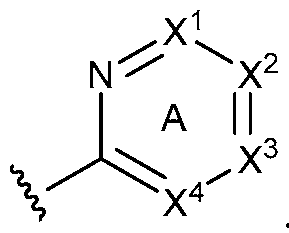 In some embodiments, R1 and R2 taken together form a fused phenyl ring, a fused 4- to 10-membered heterocycloalkyl ring, a fused 5- or 6-membered heteroaryl ring or a fused C3-10 cycloalkyl ring, wherein the fused 4- to 10-membered heterocycloalkyl ring and fused 5- or 6-membered heteroaryl ring each have 1 -4 heteroatoms as ring members selected from N, O and S and wherein the fused phenyl ring, fused 5- or 6-membered heterocycloalkyl rin^ fused 5- or 6-membered heteroaryl ring and fused C5-6 cycloalkyl ring are each optionally substituted with 1 or 2 independently selected Rb substituents.
In some embodiments, R2 and R3 taken together form a fused phenyl ring, a fused 4- to 10-membered heterocycloalkyl ring, a fused 5- or 6-membered heteroaryl ring or a fused C3-10 cycloalkyl ring, wherein the fused 4- to 10-membered heterocycloalkyl ring and fused 5- or 6-membered heteroaryl ring each have 1 -4 heteroatoms as ring members selected from N, O and S and wherein the fused phenyl ring, fused 5- or 6-membered heterocycloalkyl rin^ fused 5- or 6-membered heteroaryl ring and fused C5-6 cycloalkyl ring are each optionally substituted with 1 or 2 independently selected Rb substituents.
In some embodiments, R3 and R4 taken together form a fused phenyl ring, a fused 4- to 10-membered heterocycloalkyl ring, a fused 5- or 6-membered heteroaryl ring or a fused C3-10 cycloalkyl ring, wherein the fused 4- to 10-membered heterocycloalkyl ring and fused 5- or 6-membered heteroaryl ring each have 1 -4 heteroatoms as ring members selected from N, O and S and wherein the fused phenyl ring, fused 5- or 6-membered heterocycloalkyl rin^ fused 5- or 6-membered heteroaryl ring and fused C5-6 cycloalkyl ring are each optionally substituted with 1 or 2 independently selected Rb substituents.
In some embodiments, the present disclosure provides compounds having Formula
(II):
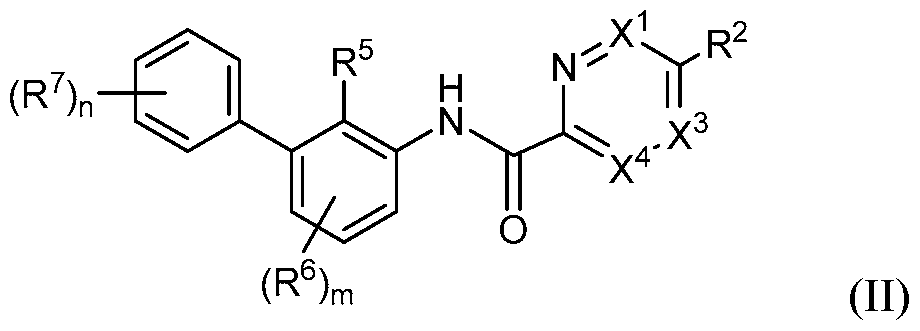
or a pharmaceutically acceptable salt or a stereoisomer thereof. In certain embodiments of compounds of Formula (II), R2 is halo, Ci-6 alkyl, C2-6 alkenyl, C2-6 alkynyl, Ci-6 haloalkyl, Ci-6 haloalkoxy, Ce-ιο aryl, C3-10 cycloalkyl, 5-14 membered heteroaryl, 4-10 membered heterocycloalkyl, Ce-ιο aryl-Ci-4 alkyl-, C3-10 cycloalkyl-Ci-4 alkyl-, (5-14 membered heteroaryl)-Ci-4 alkyl-, (4-10 membered heterocycloalkyl)-Ci-4 alkyl-, CN, NO2, ORa, SRa, NHORa, C(0)Ra, C(0)NRaRa, C(0)ORa, OC(0)Ra, OC(0)NRaRa, NHRa, NRaRa,
NRaC(0)Ra, NRaC(0)ORa, NRaC(0)NRaRa, C(=NRa)Ra, C(=NRa)NRaRa, NRaC(=NRa)NRaRa, NRaS(0)Ra, NRaS(0)2Ra, NRaS(0)2NRaRa, S(0)Ra, S(0)NRaRa, S(0)2Ra, and S(0)2NRaRa, wherein the Ci-e alkyl, C2-e alkenyl, C2-e alkynyl, Ce-io aryl, C3-10 cycloalkyl, 5-14 membered heteroaryl, 4-10 membered heterocycloalkyl, Ce-ιο aryl-Ci-4 alkyl- , C3-10 cycloalkyl-Ci-4 alkyl-, (5-14 membered heteroaryl)-Ci-4 alkyl-, and (4-10 membered heterocycloalkyl)-Ci-4 alkyl- of R2 are each optionally substituted with 1, 2, 3, or 4 Rb substituents, or a pharmaceutically acceptable salt or a stereoisomer thereof. Other variables of Formula (II) are as defined in Formula (Γ), Formula (I) or any embodiment of compounds of Formula (Γ) or Formula (I) as described herein. In one embodiment of compounds of Formula (II), R5 is CN or C1-4 alkyl optionally substituted with R1 In another embodiment, R5 is CH3 or CN.
In some embodiments, the present disclosure provides compounds having Formula
(III):
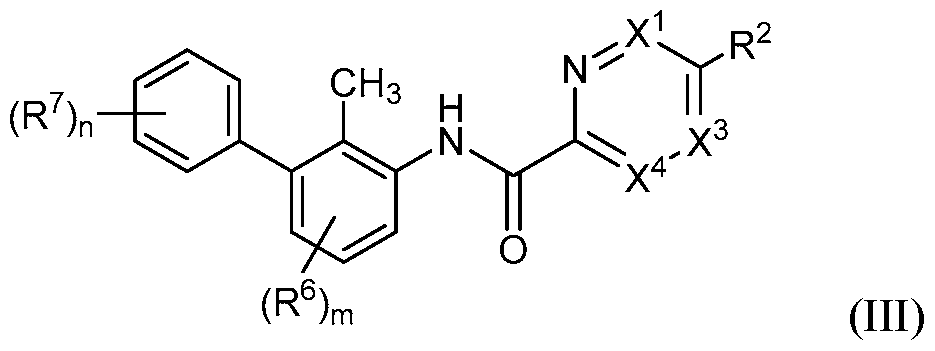
or a pharmaceutically acceptable salt or a stereoisomer thereof. In certain embodiments of compounds of Formula (III), R2 is halo, Ci-6 alkyl, C2-6 alkenyl, C2-6 alkynyl, Ci-6 haloalkyl, Ci-6 haloalkoxy, Ce-ιο aryl, C3-10 cycloalkyl, 5-14 membered heteroaryl, 4-10 membered heterocycloalkyl, Ce-ιο aryl-Ci-4 alkyl-, C3-10 cycloalkyl-Ci-4 alkyl-, (5-14 membered heteroaryl)-Ci-4 alkyl-, (4-10 membered heterocycloalkyl)-Ci-4 alkyl-, CN, N02, ORa, SRa, NHORa, C(0)Ra, C(0)NRaRa, C(0)ORa, OC(0)Ra, OC(0)NRaRa, NHRa, NRaRa,
NRaC(0)Ra, NRaC(0)ORa, NRaC(0)NRaRa, C(=NRa)Ra, C(=NRa)NRaRa,
NRaC(=NRa)NRaRa, NRaS(0)Ra, NRaS(0)2Ra, NRaS(0)2NRaRa, S(0)Ra, S(0)NRaRa, S(0)2Ra, and S(0)2NRaRa, wherein the Ci-e alkyl, C2-e alkenyl, C2-e alkynyl, Ce-io aryl, C3-10 cycloalkyl, 5-14 membered heteroaryl, 4-10 membered heterocycloalkyl, Ce-ιο aryl-Ci-4 alkyl- , C3-10 cycloalkyl-Ci-4 alkyl-, (5-14 membered heteroaryl)-Ci-4 alkyl-, and (4-10 membered heterocycloalkyl)-Ci-4 alkyl- of R2 are each optionally substituted with 1, 2, 3, or 4 Rb substituents, or a pharmaceutically acceptable salt or a stereoisomer thereof. Other variables of Formula (III) are as defined in Formula (Γ), Formula (I) or any embodiment of compounds of Formula (Γ) or Formula (I) as described herein.
In some embodiments, the present disclosure provides compounds having Formula

or a pharmaceutically acceptable salt or a stereoisomer thereof, wherein the variables of Formula (IV) are as defined in Formula (Γ), Formula (I) or any embodiment of compounds of Formula (Γ) or Formula (I) as described herein. In certain embodiments of compounds of Formula (II), R2 is halo, Ci-6 alkyl, C2-6 alkenyl, C2-6 alkynyl, Ci-6 haloalkyl, Ci-6 haloalkoxy, Ce-ιο aryl, C3-10 cycloalkyl, 5-14 membered heteroaryl, 4-10 membered heterocycloalkyl, Ce-ιο aryl-Ci-4 alkyl-, C3-10 cycloalkyl-Ci-4 alkyl-, (5-14 membered heteroaryl)-Ci-4 alkyl-, (4-10 membered heterocycloalkyl)-Ci-4 alkyl-, CN, NO2, ORa, SRa, NHORa, C(0)Ra, C(0)NRaRa, C(0)ORa, OC(0)Ra, OC(0)NRaRa, NHRa, NRaRa, NRaC(0)Ra, NRaC(0)ORa,
NRaC(0)NRaRa, C(=NRa)Ra, C(=NRa)NRaRa, NRaC (=NRa)NRaRa, NRaS(0)Ra, NRaS(0)2Ra, NRaS(0)2NRaRa, S(0)Ra, S(0)NRaRa, S(0)2Ra, and S(0)2NRaRa, wherein the Ci-e alkyl, C2-6 alkenyl, C2-6 alkynyl, Ce-ιο aryl, C3-10 cycloalkyl, 5-14 membered heteroaryl, 4-10 membered heterocycloalkyl, Ce-ιο aryl-Ci-4 alkyl-, C3-10 cycloalkyl-Ci-4 alkyl-, (5-14 membered heteroaryl)-Ci-4 alkyl-, and (4-10 membered heterocycloalkyl)-Ci-4 alkyl- of R2 are each optionally substituted with 1 , 2, 3, or 4 Rb substituents, or a pharmaceutically acceptable salt or a stereoisomer thereof.
In some embodiments, the present disclosure provides compounds having Formula (V):
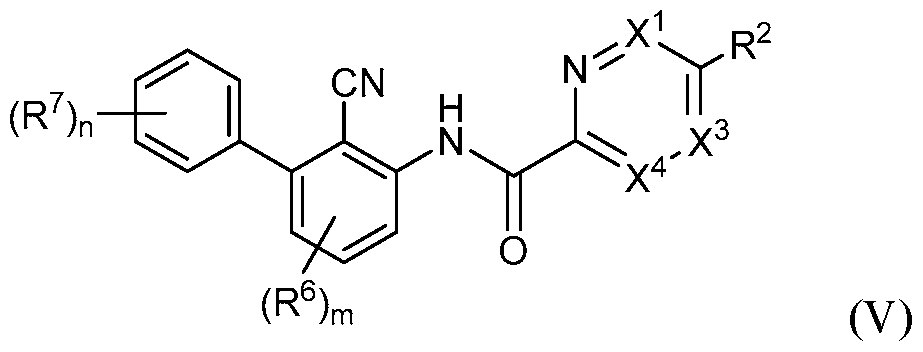
or a pharmaceutically acceptable salt or a stereoisomer thereof, wherein the variables of Formula (V) are as defined in Formula (Γ), Formula (I) or any embodiment of compounds of Formula (Γ) or Formula (I) as described herein. In certain embodiments of compounds of Formula (V), R2 is halo, Ci-6 alkyl, C2-6 alkenyl, C2-6 alkynyl, Ci-6 haloalkyl, Ci-6 haloalkoxy, Ce-ιο aryl, C3-10 cycloalkyl, 5-14 membered heteroaryl, 4-10 membered heterocycloalkyl, Ce-ιο aryl-Ci-4 alkyl-, C3-10 cycloalkyl-Ci-4 alkyl-, (5-14 membered heteroaryl)-Ci-4 alkyl-, (4-10
membered heterocycloalkyl)-Ci-4 alkyl-, CN, N02, ORa, SRa, NHORa, C(0)Ra, C(0)NRaRa, C(0)ORa, OC(0)Ra, OC(0)NRaRa, NHRa, NRaRa, NRaC(0)Ra, NRaC(0)ORa,
NRaC(0)NRaRa, C(=NRa)Ra, C(=NRa)NRaRa, NRaC (=NRa)NRaRa, NRaS(0)Ra, NRaS(0)2Ra, NRaS(0)2NRaRa, S(0)Ra, S(0)NRaRa, S(0)2Ra, and S(0)2NRaRa, wherein the Ci-e alkyl, C2-6 alkenyl, C2-6 alkynyl, Ce-ιο aryl, C3-10 cycloalkyl, 5-14 membered heteroaryl, 4-10 membered heterocycloalkyl, Ce-ιο aryl-Ci-4 alkyl-, C3-10 cycloalkyl-Ci-4 alkyl-, (5-14 membered heteroaryl)-Ci-4 alkyl-, and (4-10 membered heterocycloalkyl)-Ci-4 alkyl- of R2 are each optionally substituted with 1, 2, 3, or 4 Rb substituents, or a pharmaceutically acceptable salt or a stereoisomer thereof.
In some embodiments, the present disclosure provides compounds having Formula
(VI):

or a pharmaceutically acceptable salt or a stereoisomer thereof, wherein the variables of Formula (VI) are as defined in Formula (Γ), Formula (I) or any embodiment of compounds of Formula (Γ) or Formula (I) as described herein. In certain embodiments of compounds of Formula (VI), R2 is halo, Ci-6 alkyl, C2-6 alkenyl, C2-6 alkynyl, Ci-6 haloalkyl, Ci-6 haloalkoxy, Ce-ιο aryl, C3-10 cycloalkyl, 5-14 membered heteroaryl, 4-10 membered heterocycloalkyl, Ce-ιο aryl-Ci-4 alkyl-, C3-10 cycloalkyl-Ci-4 alkyl-, (5-14 membered heteroaryl)-Ci-4 alkyl-, (4-10 membered heterocycloalkyl)-Ci-4 alkyl-, CN, N02, ORa, SRa, NHORa, C(0)Ra, C(0)NRaRa, C(0)ORa, OC(0)Ra, OC(0)NRaRa, NHRa, NRaRa, NRaC(0)Ra, NRaC(0)ORa,
NRaC(0)NRaRa, C(=NRa)Ra, C(=NRa)NRaRa, NRaC (=NRa)NRaRa, NRaS(0)Ra, NRaS(0)2Ra, NRaS(0)2NRaRa, S(0)Ra, S(0)NRaRa, S(0)2Ra, and S(0)2NRaRa, wherein the Ci-e alkyl, C2-6 alkenyl, C2-6 alkynyl, Ce-ιο aryl, C3-10 cycloalkyl, 5-14 membered heteroaryl, 4-10 membered heterocycloalkyl, Ce-ιο aryl-Ci-4 alkyl-, C3-10 cycloalkyl-Ci-4 alkyl-, (5-14 membered heteroaryl)-Ci-4 alkyl-, and (4-10 membered heterocycloalkyl)-Ci-4 alkyl- of R2 are each optionally substituted with 1, 2, 3, or 4 Rb substituents, or a pharmaceutically acceptable salt or a stereoisomer thereof.
In some embodiments, the present disclosure provides compounds having Formula
(VII):
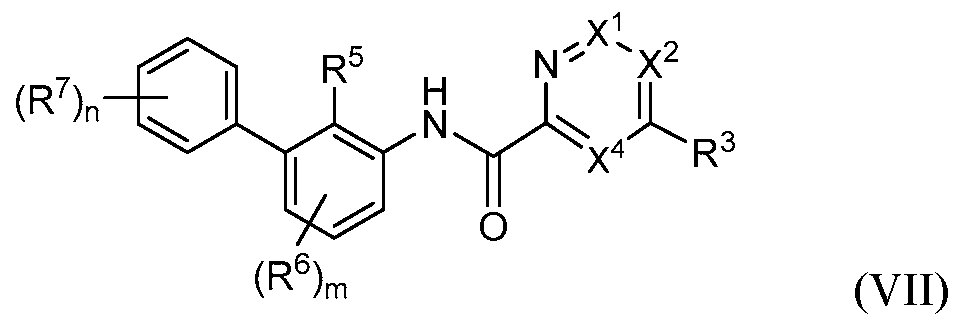
or a pharmaceutically acceptable salt or a stereoisomer thereof, wherein the variables of Formula (VII) are as defined in Formula (Γ), Formula (I) or any embodiment of compounds of Formula (Γ) or Formula (I) as described herein. In certain embodiments of compounds of Formula (VII), R3 is halo, Ci-6 alkyl, C2-6 alkenyl, C2-6 alkynyl, Ci-6 haloalkyl, Ci-6 haloalkoxy, C6-io aryl, C3-10 cycloalkyl, 5-14 membered heteroaryl, 4-10 membered heterocycloalkyl, Ce-ιο aryl-Ci-4 alkyl-, C3-10 cycloalkyl-Ci-4 alkyl-, (5-14 membered heteroaryl)-Ci-4 alkyl-, (4-10 membered heterocycloalkyl)-Ci-4 alkyl-, CN, NO2, ORa, SRa, NHORa, C(0)Ra, C(0)NRaRa, C(0)ORa, OC(0)Ra, OC(0)NRaRa, NHRa, NRaRa,
NRaC(0)Ra, NRaC(0)ORa, NRaC(0)NRaRa, C(=NRa)Ra, C(=NRa)NRaRa,
NRaC(=NRa)NRaRa, NRaS(0)Ra, NRaS(0)2Ra, NRaS(0)2NRaRa, S(0)Ra, S(0)NRaRa, S(0)2Ra, and S(0)2NRaRa, wherein the Ci-e alkyl, C2-6 alkenyl, C2-6 alkynyl, Ce-io aryl, C3-10 cycloalkyl, 5-14 membered heteroaryl, 4-10 membered heterocycloalkyl, Ce-ιο aryl-Ci-4 alkyl- , C3-10 cycloalkyl-Ci-4 alkyl-, (5-14 membered heteroaryl)-Ci-4 alkyl-, and (4-10 membered heterocycloalkyl)-Ci-4 alkyl- of R2 are each optionally substituted with 1, 2, 3, or 4 Rb substituents, or a pharmaceutically acceptable salt or a stereoisomer thereof.
In some embodiments of compounds of Formula Γ, I, II, III, IV, V or VI, or a
harmaceutically acceptable salt or a stereoisomer thereof, the


In some embodiments of compounds of Formula Γ, I or VII, or a pharmaceutically

Formula (I) or any embodiment of compounds of Formula (Γ) or Formula (I) as described herein. In certain embodiments, at each occurrence, R1, R2 and R4 are each H.
In some embodiments of compounds of Formula Γ, I, II, III, IV, V or VI, or a pharmaceutically acceptable salt or a stereoisomer thereof, X1 is CR1, X3 is CR3 and X4 is CR4.
In some embodiments of compounds of Formula Γ, I, II, III, IV, V or VI, or a pharmaceutically acceptable salt or a stereoisomer thereof, X1 is CR1, X3 is CR3 and X4 is N.
In some embodiments of compounds of Formula Γ, I, II, III, IV, V or VI, or a pharmaceutically acceptable salt or a stereoisomer thereof, X1 is CR1, X3 is N and X4 is CR4.
In some embodiments of compounds of Formula Γ, I, II, III, IV, V or VI, or a pharmaceutically acceptable salt or a stereoisomer thereof, X1 is N, X3 is CR3 and X4 is CR4.
In some embodiments of compounds of Formula Γ, I or VII, or a pharmaceutically acceptable salt or a stereoisomer thereof, X1 is CR1, X2 is CR2 and X4 is CR4.
In some embodiments of compounds of Formula Γ, I or VII, or a pharmaceutically acceptable salt or a stereoisomer thereof, X1 is CR1, X2 is CR2 and X4 is N.
In some embodiments of compounds of Formula Γ, I or VII, or a pharmaceutically acceptable salt or a stereoisomer thereof, X1 is CR1, X2 is N and X4 is CR4.
In some embodiments of compounds of Formula Γ, I or VII, or a pharmaceutically acceptable salt or a stereoisomer thereof, X1 is N, X2 is CR2 and X4 is CR4.
In some embodiments, R1, R3 and R4, are each independently selected from H, Ci-6 alkyl, CN, -N(Ci-e alkyl)2 and halo.
In some embodiments, R1, R2 and R4, are each independently selected from H, Ci-6 alkyl, CN, -N(C 1-6 alky 1)2 and halo.
In some embodiments, R1, R2, R3, R4, R6 and R7 are each H.
In some embodiments, R1, R3, R4, R6 and R7 are each H.
In some embodiments, R1, R2, R4, R6 and R7 are each H.
In some embodiments, two adjacent R7 substituents on the phenyl ring taken together with the carbon atoms to which they are attached form a 5-, 6- or 7-membered fused heterocycloalkyl optionally substituted by 1 or 2 Rq substituents. In certain instances, the fused heterocycloalkyl has carbon and 1 or 2 heteroatoms as ring members selected from O, N or S, wherein the carbon ring atom is optionally oxidized to form carbonyl, the N ring atom is optionally oxidized to form NO and the S ring atom is optionally oxidized to form SO or S02.
In some embodiments, the subscript n is 2 and the subscript m is 1.
In some embodiments, R5 is C1-4 alkyl or CN.
In some embodiments, R5 is CH3 or CN.
In some embodiments, R6 and R7 are each H.
In some embodiments of compounds of Formula Γ, I, II, III, III, IV, V or VI, R2 is Ci- 4 alkyl substituted with Rb. In certain embodiments, Rb is NHRC or NRCRC. In certain embodiments, Rb is NRCRC. In other embodiments, Rb is 2-hydroxyethylamino, 2- hydroxyethyl(methyl)amino, 2-carboxypiperidin-l-yl, (cyanomethyl)amino, (S)-2- carboxypiperidin-l-yl, (R)-2-carboxypiperidin-l-yl or 2-carboxypiperidin-l-yl, each of which is optionally substituted with 1, 2 or 3 Rq substituents. In other embodiments, R2 is C1-4 alkyl substituted with Rq.
In some embodiments of compounds of Formula Γ, I, II, III, III, IV, V or VI, R2 is Ci- 4 alkoxy substituted with Rd. In certain embodiments, Rd is phenyl, 3-cyanophenyl, 3-pyridyl, 2-pyridyl, or 4-pyridyl, each of which is optionally substituted with 1, 2 or 3 Rq substituents.
In some embodiments of compounds of Formula Γ, I, II, III, III, IV, V or VI, R2 is -OCH2Rd. In certain embodiments, Rd is phenyl, 3-cyanophenyl, 3-pyridyl, 2-pyridyl, 4- pyridyl, each of which is optionally substituted with 1, 2 or 3 Rq substituents.
In some embodiments, when X1 is N, X3 is CH and X4 is CH, R2 is other than cis-2,6- dimethylmorpholino. In other embodiments, X1 is N, X3 is CH and X4 is CH, R2 is other than 2,6-dimethylmorpholino. In other embodiments, X1 is N, X3 is CH and X4 is CH, R2 is other
than 6-membered heterocycloalkyl substituted with 1 or 2 Ci-6 alkyl, wherein the
heterocycloalkyl has N and O as ring members. In other embodiments, ring A is other than 6-(2,6-dimethylmorpholino)pyridazin-3-yl.
In some embodiments of compounds of Formula Γ, I or VII, R3 is Ci-4 alkyl substituted with Rb. In certain embodiments, Rb is NHRC or NRCRC. In other embodiments, Rb is 2-hydroxyethylamino, 2-hydroxyethyl(methyl)amino, 2-carboxypiperidin-l-yl, (cyanomethyl)amino, (S)-2-carboxypiperidin-l-yl, (R)-2-carboxypiperidin-l-yl or 2- carboxypiperidin-l-yl, each of which is optionally substituted with 1, 2 or 3 Rq substituents. In other embodiments, R3 is Ci-4 alkyl substituted with R1
In some embodiments of compounds of Formula Γ, I or VII, R3 is Ci-4 alkoxy substituted with Rd. In certain embodiments, Rd is phenyl, 3-cyanophenyl, 3-pyridyl, 2- pyridyl, or 4-pyridyl, each of which is optionally substituted with 1, 2 or 3 Rq substituents.
In some embodiments of compounds of Formula Γ, I or VII, R3 is -OCH2Rd. In certain embodiments, Rd is phenyl, 3-cyanophenyl, 3-pyridyl, 2-pyridyl, 4-pyridyl, each of which is optionally substituted with 1, 2 or 3 Rq substituents.
In some embodiments of compounds of Formula Γ, I, II, III, IV, V or VI, R3 is 2- hy droxy ethylaminomethyl, 2-hydroxy ethyl(methyl)aminomethyl, 2-carboxypiperidin- 1 - ylmethyl, (cyanomethyl)aminomethyl, (S)-2-carboxypiperidin-l-ylmethyl, (R)-2- carboxypiperidin-l-ylmethyl, 2-carboxypiperidin-l-ylmethyl, benzyloxy, 2-cyanobenzyloxy, 3-cyanobenzyloxy, 4-cyanobenzyloxy, 2-pyridylmethoxy, 3-pyridylmethoxy, or 4- pyridylmethoxy, each of which is optionally substituted with 1, 2 or 3 Rq substituents. In certain embodiments, R3 is 2-hydroxy ethylaminomethyl, 2-carboxypiperidin-l-ylmethyl, (S)- 2-carboxy piperi din- 1 -ylmethyl, (R)-2-carboxypiperidin-l -ylmethyl or (3-cyanobenzyl)oxy, each of which is optionally substituted with 1, 2 or 3 Rq substituents.
In some embodiments of compounds of Formula Γ, R6a, R6b and R6c are each independently selected from H, halo, CN, N(Ci-6 alkyf , Ci-6 alkyl and Ci-6 alkoxy, wherein the Ci-6 alkyl are each optionally substituted with 1 or 2 substituents independently selected from halo, OH, CN, Ci-4 alkyl and Ci-4 alkoxy.
In some embodiments of compounds of Formula Γ, R6a, R6b and R6c are each independently selected from H, halo, CN, Ν( ¾)2 and CH3.
In some embodiments of compounds of Formula I, II, III, V, or VII, R6 is H, halo, CN, N(Ci-6 alkyl)2, Ci-6 alkyl or Ci-6 alkoxy, wherein the Ci-6 alkyl and Ci-6 alkoxy are each optionally substituted with 1-3 Rq substituents.
In some embodiments of compounds of Formula I, II, III, V or VIII, R6 is H, halo, CN, N(CH3)2 or CH3.
In some embodiments provided herein is a compound of Formula (Γ):

or a pharmaceutically acceptable salt or a stereoisomer thereof, wherein:
X1 is N or CR1;
X2 is N or CR2;
X3 is N or CR3;
X4 is N or CR4;
wherein no more than two of X1, X2, X3 and X4 are simultaneously N;
X5 is N or CR6a;
X6 is CR6b;
ring B is phenyl, cyclohexyl, piperidinyl, or tetrahydropyridinyl;
R1, R2, R3, R4 and R7 are each independently selected from H, halo, Ci-6 alkyl, C2-6 alkenyl, C2-6 alkynyl, Ci-6 haloalkyl, Ce-ιο aryl, C3-10 cycloalkyl, 5-14 membered heteroaryl, 4- 10 membered heterocycloalkyl, C6-io aryl-C 1-4 alkyl-, C3-io cycloalkyl-Ci-4 alkyl-, (5-14 membered heteroaryl)-Ci-4 alkyl-, (4-10 membered heterocycloalkyl)-Ci-4 alkyl-, CN, ORa, NHRa, and NRaRa, wherein the Ci-6 alkyl, C2-6 alkenyl, C2-6 alkynyl, Ce-ιο aryl, C3-10 cycloalkyl, 5-14 membered heteroaryl, 4-10 membered heterocycloalkyl, Ce-ιο aryl-Ci-4 alkyl- , C3-10 cycloalkyl-Ci-4 alkyl-, (5-14 membered heteroaryl)-Ci-4 alkyl-, and (4-10 membered heterocycloalkyl)-Ci-4 alkyl- of R1, R2, R3, R4 and R7 are each optionally substituted with 1, 2, 3, or 4 Rb substituents;
R5 is Ci-6 alkyl, C2-6 alkenyl, C2-6 alkynyl, Ci-6 haloalkyl, Ci-6 haloalkoxy, or CN, wherein the Ci-6 alkyl, C2-6 alkenyl, C2-6 alkynyl, Ci-6 haloalkyl, and Ci-6 haloalkoxy of R5 are each optionally substituted with 1, 2 or 3 Rb substituents;
R6a, R6b and R6c are each independently selected from H, C1-4 alkyl, C2-4 alkenyl, C2-4 alkynyl, halo, CN, OH, CM alkoxy, CM haloalkyl, NH2, -NH-Ci-4 alkyl, and -N(CM alkyl)2, wherein the C1-4 alkyl, C2-4 alkenyl and C2-4 alkynyl of R6a, R6b, and R6c are each optionally
substituted with 1 or 2 substituents independently selected from halo, OH, CN, Ci-4 alkyl and Ci-4 alkoxy;
or two adjacent R7 substituents, taken together with the atoms to which they are attached, form a fused 4- to 7-membered heterocycloalkyl ring or a fused 5- or 6-membered heteroaryl ring, wherein the fused 4- to 7-membered heterocycloalkyl ring and fused 5- or 6- membered heteroaryl ring each have 1-4 heteroatoms as ring members selected from N and O and wherein the fused 5- to 7-membered heterocycloalkyl ring and fused 5- or 6-membered heteroaryl ring are each optionally substituted with 1 or 2 independently selected Rb substituents;
each Ra is independently selected from H, CN, Ci-6 alkyl, Ci-4 haloalkyl, C2-6 alkenyl,
C2-6 alkynyl, Ce-ιο aryl, C3-10 cycloalkyl, 5-10 membered heteroaryl, 4-10 membered heterocycloalkyl, Ce-ιο aryl-Ci-4 alkyl-, C3-10 cycloalkyl-Ci-4 alkyl-, (5-10 membered heteroaryl)-Ci-4 alkyl-, and (4-10 membered heterocycloalkyl)-Ci-4 alkyl-, wherein the Ci-6 alkyl, C2-6 alkenyl, C2-6 alkynyl, Ce-ιο aryl, C3-10 cycloalkyl, 5-10 membered heteroaryl, 4-10 membered heterocycloalkyl, Ce-ιο aryl-Ci-4 alkyl-, C3-10 cycloalkyl-Ci-4 alkyl-, (5-10 membered heteroaryl)-Ci-4 alkyl- and (4-10 membered heterocycloalkyl)-Ci-4 alkyl- of Ra are each optionally substituted with 1, 2, 3, 4, or 5 Rd substituents;
each Rd is independently selected from C1-4 alkyl, Ci-4 haloalkyl, halo, C3-10 cycloalkyl, 4-10 membered heterocycloalkyl, CN, NH2, ORe, SRe, C(0)Re, C(0)NReRe, C(0)ORe, OC(0)Re, OC(0)NReRe, NHRe, NReRe, and NReC(0)Re, and S(0)2NReRe, wherein the C1-4 alkyl, C3-10 cycloalkyl and 4-10 membered heterocycloalkyl of Rd are each further optionally substituted with 1 -3 independently selected Rf substituents;
each Rb substituent is independently selected from halo, C1-4 alkyl, C1-4 haloalkyl, C1-4 haloalkoxy, CN, OH, NH2, NO2, NHORc, ORc, SRC, C(0)Rc, C(0)NRcRc, C(0)ORc, OC(0)Rc, OC(0)NRcRc, NHRC, NRCRC, NRcC(0)Rc, and NRcC(0)ORc; wherein the CM alkyl, C1-4 haloalkyl, and C 1-4 haloalkoxy of Rb are each further optionally substituted with 1-
3 independently selected Rd substituents;
each Rc is independently selected from H, Ci-6 alkyl, C 1-4 haloalkyl, C2-6 alkenyl, and
C2-6 alkynyl, wherein the Ci-6 alkyl, C2-6 alkenyl, and C2-6 alkynyl of Rc are each optionally substituted with 1, 2, 3, 4, or 5 Rf substituents independently selected from C1-4 alkyl, C1-4 haloalkyl, C2-6 alkenyl, C2-6 alkynyl, halo, CN, NHOR , ORg, SRg, C(0)Rg, C(0)NRgRg,
C(0)ORg, OC(0)Rg, OC(0)NRgRg, NHRg, NRgRg, and NRgC(0)Rg;
each Rg is independently selected from H, Ci-6 alkyl, C1-4 haloalkyl, C2-6 alkenyl, and
C2-6 alkynyl;
each Re is independently selected froni H, Ci-4 alkyl, Ci-4 haloalkyl, C2-4 alkenyl, and C2-4 alkynyl;
is a single bond or a double bond, wherein ring A includes at least one double bond; and
the subscript n is an integer of 1, 2, 3, 4 or 5.
In some embodiments provided herein is a compound of Formula (Γ):

or a pharmaceutically acceptable salt or a stereoisomer thereof, wherein:
X1 is N or CR1;
X2 is N or CR2;
X3 is N or CR3;
X4 is N or CR4;
wherein no more than two of X1, X2, X3 and X4 are simultaneously N;
X5 is N or CR6a;
X6 is CR6b;
ring B is phenyl, cyclohexyl, piperidinyl, or tetrahydropyridinyl;
R1, R2, R3, R4 and R7 are each independently selected from H, halo, Ci-6 alkyl, C2-6 alkenyl, C2-6 alkynyl, 5-14 membered heteroaryl, 4-10 membered heterocycloalkyl, (5-14 membered heteroaryl)-Ci-4 alkyl-, (4-10 membered heterocycloalkyl)-Ci-4 alkyl-, CN, ORa, NHRa, and NRaRa, wherein the Ci-6 alkyl, C2-6 alkenyl, C2-6 alkynyl, 5-14 membered heteroaryl, 4-10 membered heterocycloalkyl, (5-14 membered heteroaryl)-Ci-4 alkyl-, and (4- 10 membered heterocycloalkyl)-Ci-4 alkyl- of R1, R2, R3, R4 and R7 are each optionally substituted with 1, 2, 3, or 4 Rb substituents;
R5 is Ci-6 alkyl or CN;
R6a, R6b and R6c are each independently selected from H, C1-4 alkyl, C2-4 alkenyl, C2-4 alkynyl, halo, CN, OH, NH2, -NH-Ci-4 alkyl, and -N(Ci-4 alkyl)2;
or two adjacent R7 substituents, taken together with the atoms to which they are attached, form a fused 4- to 7-membered heterocycloalkyl ring or a fused 5- or 6-membered heteroaryl ring, wherein the fused 4- to 7-membered heterocycloalkyl ring and fused 5- or 6-
membered heteroaryl ring each have 1-4 heteroatoms as ring members selected from N and O and wherein the fused 5- to 7-membered heterocycloalkyl ring and fused 5- or 6-membered heteroaryl ring are each optionally substituted with 1 or 2 independently selected Rb substituents;
each Ra is independently selected from H, CN, Ci-6 alkyl, Ci-4 haloalkyl, C2-6 alkenyl, C2-6 alkynyl, Ce-ιο aryl, C3-10 cycloalkyl, 5-10 membered heteroaryl, 4-10 membered heterocycloalkyl, Ce-ιο aryl-Ci-4 alkyl-, C3-10 cycloalkyl-Ci-4 alkyl-, (5-10 membered heteroaryl)-Ci-4 alkyl-, and (4-10 membered heterocycloalkyl)-Ci-4 alkyl-, wherein the Ci-6 alkyl, C2-6 alkenyl, C2-6 alkynyl, Ce-ιο aryl, C3-10 cycloalkyl, 5-10 membered heteroaryl, 4-10 membered heterocycloalkyl, Ce-ιο aryl-C 1-4 alkyl-, C3-io cycloalkyl-Ci-4 alkyl-, (5-10 membered heteroaryl)-Ci-4 alkyl- and (4-10 membered heterocycloalkyl)-Ci-4 alkyl- of Ra are each optionally substituted with 1, 2, 3, 4, or 5 Rd substituents;
each Rd is independently selected from C1-4 alkyl, Ci-4 haloalkyl, halo, CN, and Nlrh; each Rb substituent is independently selected from halo, C1-4 alkyl, C1-4 haloalkyl, C1-4 haloalkoxy, CN, OH, NH2, C(0)ORc, NHRC, and NRCRC;
each Rc is independently selected from H, Ci-6 alkyl, C 1-4 haloalkyl, C2-6 alkenyl, and C2-6 alkynyl, wherein the Ci-6 alkyl, C2-6 alkenyl, and C2-6 alkynyl of Rc are each optionally substituted with 1, 2, 3, 4, or 5 Rf substituents independently selected from C1-4 alkyl, C1-4 haloalkyl, C2-6 alkenyl, C2-6 alkynyl, halo, CN, OR§, C(0)R§, C(0)NRgRg, C(0)OR§, NHRg, NRgRg, and NR§C(0)Rg;
each R is independently selected from H, Ci-6 alkyl, C2-6 alkenyl, and C2-6 alkynyl; is a single bond or a double bond, wherein ring A includes at least one double bond; and
the subscript n is an integer of 1, 2, 3, 4 or 5.
In some embodim nts, provided herein is a compound of Formula (Γ):

or a pharmaceutically acceptable salt or a stereoisomer thereof, wherein:
X1 is N or CR1;
X2 is N or CR2;
X3 is N or CR3;
X4 is N or CR4;
wherein no more than two of X1, X2, X3 and X4 are simultaneously N;
X5 is N or CR6a;
X6 is CR6b;
ring B is phenyl, cyclohexyl, piperidinyl, or tetrahydropyridinyl;
R1, R2, R3, R4 and R7 are each independently selected from H, halo, Ci-6 alkyl, C2-6 alkenyl, C2-6 alkynyl, 5-14 membered heteroaryl, 4-10 membered heterocycloalkyl, (5-14 membered heteroaryl)-Ci-4 alkyl-, (4-10 membered heterocycloalkyl)-Ci-4 alkyl-, CN, ORa, NHRa, and NRaRa, wherein the Ci-6 alkyl, C2-6 alkenyl, C2-6 alkynyl, 5-14 membered heteroaryl, 4-10 membered heterocycloalkyl, (5-14 membered heteroaryl)-Ci-4 alkyl-, and (4- 10 membered heterocycloalkyl)-Ci-4 alkyl- of R1, R2, R3, R4 and R7 are each optionally substituted with 1 or 2, Rb substituents;
R5 is Ci-e alkyl or CN;
R6a, R6b and R6c are each independently selected from H, C1-4 alkyl and halo;
or two adjacent R7 substituents, taken together with the atoms to which they are attached, form a fused 4- to 7-membered heterocycloalkyl ring or a fused 5- or 6-membered heteroaryl ring, wherein the fused 4- to 7-membered heterocycloalkyl ring and fused 5- or 6- membered heteroaryl ring each have 1-4 heteroatoms as ring members selected from N and O and wherein the fused 5- to 7-membered heterocycloalkyl ring and fused 5- or 6-membered heteroaryl ring are each optionally substituted with 1 or 2 independently selected Rb substituents;
each Ra is independently selected from H, CN, Ci-6 alkyl, C2-6 alkenyl, C2-6 alkynyl, Ce-ιο aryl, C3-10 cycloalkyl, 5-10 membered heteroaryl, 4-10 membered heterocycloalkyl, Ce-ιο aryl-Ci-4 alkyl-, C3-10 cycloalkyl-Ci-4 alkyl-, (5-10 membered heteroaryl)-Ci-4 alkyl-, and (4-10 membered heterocycloalkyl)-Ci-4 alkyl-, wherein the Ci-6 alkyl, C2-6 alkenyl, C2-6 alkynyl, Ce- 10 aryl, C3-10 cycloalkyl, 5-10 membered heteroaryl, 4-10 membered heterocycloalkyl, Ce-ιο aryl-Ci-4 alkyl-, C3-10 cycloalkyl-Ci-4 alkyl-, (5-10 membered heteroaryl)-Ci-4 alkyl- and (4-10 membered heterocycloalkyl)-Ci-4 alkyl- of Ra are each optionally substituted with 1 or 2 Rd substituents;
each Rd is independently selected from C1-4 alkyl, halo, CN, and NH2;
each Rb substituent is independently selected from halo, C1-4 alkyl, CN, OH, NH2, C(0)ORc, NHRC, and NRCRC;
each Rc is independently selected from H, Ci-6 alkyl, C2-6 alkenyl, and C2-6 alkynyl, wherein the Ci-6 alkyl, C2-6 alkenyl, and C2-6 alkynyl of Rc are each optionally substituted with 1, 2 or Rf substituents independently selected from C1-4 alkyl, C2-6 alkenyl, C2-6 alkynyl, halo, CN, and OR§;
each Rg is independently selected from H and Ci-6 alkyl;
is a single bond or a double bond, wherein ring A includes at least one double bond; and
the subscript n is an integer of 1 , 2, 3, 4 or 5.
It is further appreciated that certain features of the invention, which are, for clarity, described in the context of separate embodiments, can also be provided in combination in a single embodiment (while the embodiments are intended to be combined as if written in multiply dependent form). Conversely, various features of the invention which are, for brevity, described in the context of a single embodiment, can also be provided separately or in any suitable subcombination. Thus, it is contemplated as features described as
embodiments of the compounds of Formula (Γ) or formula (I) can be combined in any suitable combination.
At various places in the present specification, certain features of the compounds are disclosed in groups or in ranges. It is specifically intended that such a disclosure include each and every individual subcombination of the members of such groups and ranges. For example, the term "Ci-6 alkyl" is specifically intended to individually disclose (without limitation) methyl, ethyl, C3 alkyl, C4 alkyl, C5 alkyl and Ce alkyl.
The term "n-membered," where n is an integer, typically describes the number of ring- forming atoms in a moiety where the number of ring-forming atoms is n. For example, piperidinyl is an example of a 6-membered heterocycloalkyl ring, pyrazolyl is an example of a 5-membered heteroaryl ring, pyridyl is an example of a 6-membered heteroaryl ring and 1,2,3,4-tetrahydro-naphthalene is an example of a 10-membered cycloalkyl group.
At various places in the present specification, variables defining divalent linking groups may be described. It is specifically intended that each linking substituent include both the forward and backward forms of the linking substituent. For example, -NR(CR'R")n- includes both -NR(CR'R")n- and -(CR'R")nNR- and is intended to disclose each of the forms individually. Where the structure requires a linking group, the Markush variables listed for that group are understood to be linking groups. For example, if the structure requires a
linking group and the Markush group definition for that variable lists "alkyl" or "aryl" then it is understood that the "alkyl" or "aryl" represents a linking alkylene group or arylene group, respectively.
The term "substituted" means that an atom or group of atoms formally replaces hydrogen as a "substituent" attached to another group. The term "substituted", unless otherwise indicated, refers to any level of substitution, e.g. , mono-, di-, tri-, tetra- or penta-substitution, where such substitution is permitted. The substituents are independently selected, and substitution may be at any chemically accessible position. It is to be understood that substitution at a given atom is limited by valency. It is to be understood that substitution at a given atom results in a chemically stable molecule. The phrase "optionally substituted" means unsubstituted or substituted. The term "substituted" means that a hydrogen atom is removed and replaced by a substituent. A single divalent substituent, e.g., oxo, can replace two hydrogen atoms.
The term "Cn-m" indicates a range which includes the endpoints, wherein n and m are integers and indicate the number of carbons. Examples include Ci-4, Ci-6 and the like.
The term "alkyl," employed alone or in combination with other terms, refers to a saturated hydrocarbon group that may be straight-chained or branched. The term "Cn-m alkyl", refers to an alkyl group having n to m carbon atoms. An alkyl group formally corresponds to an alkane with one C-H bond replaced by the point of attachment of the alkyl group to the remainder of the compound. In some embodiments, the alkyl group contains from 1 to 6 carbon atoms, from 1 to 4 carbon atoms, from 1 to 3 carbon atoms, or 1 to 2 carbon atoms. Examples of alkyl moieties include, but are not limited to, chemical groups such as methyl, ethyl, ft-propyl, isopropyl, w-butyl, fert-butyl, isobutyl, sec-butyl; higher homologs such as 2- methyl-1 -butyl, w-pentyl, 3-pentyl, w-hexyl, 1 ,2,2-trimethylpropyl and the like.
The term "alkenyl," employed alone or in combination with other terms, refers to a straight-chain or branched hydrocarbon group corresponding to an alkyl group having one or more double carbon-carbon bonds. An alkenyl group formally corresponds to an alkene with one C-H bond replaced by the point of attachment of the alkenyl group to the remainder of the compound. The term "Cn-m alkenyl" refers to an alkenyl group having n to m carbons. In some embodiments, the alkenyl moiety contains 2 to 6, 2 to 4, or 2 to 3 carbon atoms.
Example alkenyl groups include, but are not limited to, ethenyl, w-propenyl, isopropenyl, n- butenyl, seobutenyl and the like.
The term "alkynyl," employed alone or in combination with other terms, refers to a straight-chain or branched hydrocarbon group corresponding to an alkyl group having one or
more triple carbon-carbon bonds. An alkynyl group formally corresponds to an alkyne with one C-H bond replaced by the point of attachment of the alkyl group to the remainder of the compound. The term "Cn-m alkynyl" refers to an alkynyl group having n to m carbons.
Example alkynyl groups include, but are not limited to, ethynyl, propyn-l-yl, propyn-2-yl and the like. In some embodiments, the alkynyl moiety contains 2 to 6, 2 to 4, or 2 to 3 carbon atoms.
The term "alkylene," employed alone or in combination with other terms, refers to a divalent alkyl linking group. An alkylene group formally corresponds to an alkane with two C-H bond replaced by points of attachment of the alkylene group to the remainder of the compound. The term "Cn-m alkylene" refers to an alkylene group having n to m carbon atoms. Examples of alkylene groups include, but are not limited to, ethan-l,2-diyl, propan-l ,3-diyl, propan-l,2-diyl, butan-l ,4-diyl, butan-l,3-diyl, butan-l,2-diyl, 2-methyl-propan-l,3-diyl and the like.
The term "alkoxy," employed alone or in combination with other terms, refers to a group of formula -O-alkyl, wherein the alkyl group is as defined above. The term "Cn-m alkoxy" refers to an alkoxy group, the alkyl group of which has n to m carbons. Example alkoxy groups include methoxy, ethoxy, propoxy (e.g. , w-propoxy and isopropoxy), /-butoxy and the like. In some embodiments, the alkyl group has 1 to 6, 1 to 4, or 1 to 3 carbon atoms.
The term "amino," employed alone or in combination with other terms, refers to a group of formula -NH2.
The term "carbamyl," employed alone or in combination with other terms, refers to a group of formula -C(0)NH2.
The term "carbonyl," employed alone or in combination with other terms, refers to a -C(=0)- group, which also may be written as C(O).
The term "cyano" or "nitrile," employed alone or in combination with other terms, refers to a group of formula -C≡N, which also may be written as -CN.
The terms "halo" or "halogen," used alone or in combination with other terms, refers to fluoro, chloro, bromo and iodo. In some embodiments, "halo" refers to a halogen atom selected from F, CI, or Br. In some embodiments, halo groups are F.
The term "haloalkyl," employed alone or in combination with other terms, as used herein refers to an alkyl group in which one or more of the hydrogen atoms has been replaced by a halogen atom. The term "Cn-m haloalkyl" refers to a Cn-m alkyl group having n to m carbon atoms and from at least one up to {2(n to m)+l } halogen atoms, which may either be the same or different. In some embodiments, the halogen atoms are fluoro atoms. In some
embodiments, the haloalkyl group has 1 to 6 or 1 to 4 carbon atoms. Example haloalkyl groups include CF3, C2F5, CHF2, CCh, CHCh, C2CI5 and the like. In some embodiments, the haloalkyl group is a fluoroalkyl group.
The term "haloalkoxy," employed alone or in combination with other terms, refers to a group of formula -O-haloalkyl, wherein the haloalkyl group is as defined above. The term "Cn-m haloalkoxy" refers to a haloalkoxy group, the haloalkyl group of which has n to m carbons. Example haloalkoxy groups include trifluoromethoxy and the like. In some embodiments, the haloalkoxy group has 1 to 6, 1 to 4, or 1 to 3 carbon atoms.
The term "oxo" refers to an oxygen atom as a divalent substituent, forming a carbonyl group when attached to carbon, or attached to a heteroatom forming a sulfoxide or sulfone group, or an N-oxide group. In some embodiments, heterocyclic groups may be optionally substituted by 1 or 2 oxo (=0) substituents.
The term "sulfido" refers to a sulfur atom as a divalent substituent, forming a thiocarbonyl group (C=S) when attached to carbon.
The term "aromatic" refers to a carbocycle or heterocycle having one or more polyunsaturated rings having aromatic character (i. e. , having (4n + 2) delocalized π (pi) electrons where n is an integer).
The term "aryl," employed alone or in combination with other terms, refers to an aromatic hydrocarbon group, which may be monocyclic or poly cyclic (e.g. , having 2 fused rings). The term "Cn-m aryl" refers to an aryl group having from n to m ring carbon atoms. Aryl groups include, e.g. , phenyl, naphthyl, indanyl, indenyl and the like. In some embodiments, aryl groups have from 6 to about 10 carbon atoms. In some embodiments aryl groups have 6 carbon atoms. In some embodiments aryl groups have 10 carbon atoms. In some embodiments, the aryl group is phenyl. In some embodiments, the aryl group is naphthyl.
The term "heteroaryl" or "heteroaromatic," employed alone or in combination with other terms, refers to a monocyclic or poly cyclic aromatic heterocycle having at least one heteroatom ring member selected from sulfur, oxygen and nitrogen. In some embodiments, the heteroaryl ring has 1 , 2, 3 or 4 heteroatom ring members independently selected from nitrogen, sulfur and oxygen. In some embodiments, any ring-forming Ν in a heteroaryl moiety can be an N-oxide. In some embodiments, the heteroaryl has 5-14 ring atoms including carbon atoms and 1 , 2, 3 or 4 heteroatom ring members independently selected from nitrogen, sulfur and oxygen. In some embodiments, the heteroaryl has 5-10 ring atoms
including carbon atoms and 1, 2, 3 or 4 heteroatom ring members independently selected from nitrogen, sulfur and oxygen. In some embodiments, the heteroaryl has 5-6 ring atoms and 1 or 2 heteroatom ring members independently selected from nitrogen, sulfur and oxygen. In some embodiments, the heteroaryl is a five-membered or six-membered heteroaryl ring. In other embodiments, the heteroaryl is an eight-membered, nine-membered or ten-membered fused bicyclic heteroaryl ring. Example heteroaryl groups include, but are not limited to, pyridintl (pyridyl), pyrimidinyl, pyrazinyl, pyridazinyl, pyrrolyl, pyrazolyl, azolyl, oxazolyl, thiazolyl, imidazolyl, furanyl, thiophenyl, quinolinyl, isoquinolinyl, naphthyridinyl (including 1,2-, 1,3-, 1,4-, 1,5-, 1,6-, 1,7-, 1,8-, 2,3- and 2,6-naphthyridine), indolyl, benzothiophenyl, benzofuranyl, benzisoxazolyl, imidazo[l,2-Z>]thiazolyl, purinyl, and the like.
A five-membered heteroaryl ring is a heteroaryl group having five ring atoms wherein one or more (e.g., 1, 2 or 3) ring atoms are independently selected fromN, O and S.
Exemplary five-membered ring heteroaryls include thienyl, furyl, pyrrolyl, imidazolyl, thiazolyl, oxazolyl, pyrazolyl, isothiazolyl, isoxazolyl, 1,2,3-triazolyl, tetrazolyl, 1,2,3- thiadiazolyl, 1,2,3-oxadiazolyl, 1 ,2,4-triazolyl, 1 ,2,4-thiadiazolyl, 1,2,4-oxadiazolyl, 1,3,4- triazolyl, 1,3,4-thiadiazolyl and 1,3,4-oxadiazolyl.
A six-membered heteroaryl ring is a heteroaryl group having six ring atoms wherein one or more (e.g., 1, 2 or 3) ring atoms are independently selected fromN, O and S.
Exemplary six-membered ring heteroaryls are pyridyl, pyrazinyl, pyrimidinyl, triazinyl and pyridazinyl.
The term "cycloalkyl," employed alone or in combination with other terms, refers to a non-aromatic hydrocarbon ring system (monocyclic, bicyclic or poly cyclic), including cyclized alkyl and alkenyl groups. The term "Cn-m cycloalkyl" refers to a cycloalkyl that has n to m ring member carbon atoms. Cycloalkyl groups can include mono- or poly cyclic (e.g., having 2, 3 or 4 fused rings) groups and spirocycles. Cycloalkyl groups can have 3, 4, 5, 6 or 7 ring-forming carbons (C3-7). In some embodiments, the cycloalkyl group has 3 to 6 ring members, 3 to 5 ring members, or 3 to 4 ring members. In some embodiments, the cycloalkyl group is monocyclic. In some embodiments, the cycloalkyl group is monocyclic or bicyclic. In some embodiments, the cycloalkyl group is a C3-6 monocyclic cycloalkyl group. Ring- forming carbon atoms of a cycloalkyl group can be optionally oxidized to form an oxo or sulfido group. Cycloalkyl groups also include cycloalkylidenes. In some embodiments, cycloalkyl is cyclopropyl, cyclobutyl, cyclopentyl or cyclohexyl. Also included in the definition of cycloalkyl are moieties that have one or more aromatic rings fused (i.e., having a
bond in common with) to the cycloalkyl ring, e.g., benzo or thienyl derivatives of cyclopentane, cyclohexane and the like. A cycloalkyl group containing a fused aromatic ring can be attached through any ring-forming atom including a ring-forming atom of the fused aromatic ring. Examples of cycloalkyl groups include cyclopropyl, cyclobutyl, cyclopentyl, cyclohexyl, cycloheptyl, cyclopentenyl, cyclohexenyl, cyclohexadienyl, cycloheptatrienyl, norbornyl, norpinyl, norcamyl, bicyclo[l . l . l]pentanyl, bicyclo[2.1.1]hexanyl, and the like. In some embodiments, the cycloalkyl group is cyclopropyl, cyclobutyl, cyclopentyl, or cyclohexyl.
The term "heterocycloalkyl," employed alone or in combination with other terms, refers to a non-aromatic ring or ring system, which may optionally contain one or more alkenylene groups as part of the ring structure, which has at least one heteroatom ring member independently selected from nitrogen, sulfur oxygen and phosphorus, and which has 4-10 ring members, 4-7 ring members, or 4-6 ring members. Included within the term "heterocycloalkyl" are monocyclic 4-, 5-, 6- and 7-membered heterocycloalkyl groups. Heterocycloalkyl groups can include mono- or bicyclic (e.g., having two fused or bridged rings) ring systems. In some embodiments, the heterocycloalkyl group is a monocyclic group having 1, 2 or 3 heteroatoms independently selected from nitrogen, sulfur and oxygen. Ring- forming carbon atoms and heteroatoms of a heterocycloalkyl group can be optionally oxidized to form an oxo or sulfido group or other oxidized linkage (e.g., C(O), S(O), C(S) or S(0)2, N-oxide etc.) or a nitrogen atom can be quaternized. The heterocycloalkyl group can be attached through a ring-forming carbon atom or a ring-forming heteroatom. In some embodiments, the heterocycloalkyl group contains 0 to 3 double bonds. In some
embodiments, the heterocycloalkyl group contains 0 to 2 double bonds. Also included in the definition of heterocycloalkyl are moieties that have one or more aromatic rings fused (i.e., having a bond in common with) to the heterocycloalkyl ring, e.g., benzo or thienyl derivatives of piperidine, morpholine, azepine, etc. A heterocycloalkyl group containing a fused aromatic ring can be attached through any ring-forming atom including a ring-forming atom of the fused aromatic ring. Examples of heterocycloalkyl groups include azetidinyl, azepanyl, dihydrobenzofuranyl, dihydrofuranyl, dihydropyranyl, morpholino, 3-oxa-9- azaspiro[5.5]undecanyl, l-oxa-8-azaspiro[4.5]decanyl, piperidinyl, piperazinyl,
oxopiperazinyl, pyranyl, pyrrolidinyl, quinuclidinyl, tetrahydrofuranyl, tetrahydropyranyl, 1,2,3,4-tetrahydroquinolinyl, tropanyl, and thiomorpholino.
At certain places, the definitions or embodiments refer to specific rings (e.g. , an azetidine ring, a pyridine ring, etc.). Unless otherwise indicated, these rings can be attached
to any ring member provided that the valency of the atom is not exceeded. For example, an azetidine ring may be attached at any position of the ring, whereas an azetidin-3-yl ring is attached at the 3 -position.
The compounds described herein can be asymmetric (e.g. , having one or more stereocenters). All stereoisomers, such as enantiomers and diastereomers, are intended unless otherwise indicated. Compounds of the present invention that contain asymmetrically substituted carbon atoms can be isolated in optically active or racemic forms. Methods on how to prepare optically active forms from optically inactive starting materials are known in the art, such as by resolution of racemic mixtures or by stereoselective synthesis. Many geometric isomers of olefins, C=N double bonds and the like can also be present in the compounds described herein, and all such stable isomers are contemplated in the present invention. Cis and trans geometric isomers of the compounds of the present invention are described and may be isolated as a mixture of isomers or as separated isomeric forms.
Resolution of racemic mixtures of compounds can be carried out by any of numerous methods known in the art. One method includes fractional recrystallization using a chiral resolving acid which is an optically active, salt-forming organic acid. Suitable resolving agents for fractional recrystallization methods are, e.g. , optically active acids, such as the D and L forms of tartaric acid, diacetyltartaric acid, dibenzoyltartaric acid, mandelic acid, malic acid, lactic acid or the various optically active camphorsulfonic acids such as β- camphorsulfonic acid. Other resolving agents suitable for fractional crystallization methods include stereoisomerically pure forms of a-methylbenzylamine (e.g. , S d R forms, or diastereomerically pure forms), 2-phenylglycinol, norephedrine, ephedrine, N- methylephedrine, cyclohexylethylamine, 1,2-diaminocyclohexane and the like.
Resolution of racemic mixtures can also be carried out by elution on a column packed with an optically active resolving agent (e.g., dinitrobenzoylphenylglycine). Suitable elution solvent composition can be determined by one skilled in the art.
In some embodiments, the compounds of the invention have the (i?)-configuration. In other embodiments, the compounds have the (^-configuration. In compounds with more than one chiral centers, each of the chiral centers in the compound may be independently (R) or (S), unless otherwise indicated.
Compounds of the invention also include tautomeric forms. Tautomeric forms result from the swapping of a single bond with an adjacent double bond together with the concomitant migration of a proton. Tautomeric forms include prototropic tautomers which
are isomeric protonation states having the same empirical formula and total charge. Example prototropic tautomers include ketone - enol pairs, amide - imidic acid pairs, lactam - lactim pairs, enamine - imine pairs, and annular forms where a proton can occupy two or more positions of a heterocyclic system, e.g. , 1H- and 3H-imidazole, 1H-, 2H- and 4H- 1,2,4- triazole, 1H- and 2H- isoindole and 1H- and 2H-pyrazole. Tautomeric forms can be in equilibrium or sterically locked into one form by appropriate substitution.
Compounds of the invention can also include all isotopes of atoms occurring in the intermediates or final compounds. Isotopes include those atoms having the same atomic number but different mass numbers. For example, isotopes of hydrogen include tritium and deuterium. One or more constituent atoms of the compounds of the invention can be replaced or substituted with isotopes of the atoms in natural or non-natural abundance. In some embodiments, the compound includes at least one deuterium atom. For example, one or more hydrogen atoms in a compound of the present disclosure can be replaced or substituted by deuterium. In some embodiments, the compound includes two or more deuterium atoms. In some embodiments, the compound includes 1, 2, 3, 4, 5, 6, 7, 8, 9, 10, 11 or 12 deuterium atoms. Synthetic methods for including isotopes into organic compounds are known in the art.
The term, "compound," as used herein is meant to include all stereoisomers, geometric isomers, tautomers and isotopes of the structures depicted. The term is also meant to refer to compounds of the inventions, regardless of how they are prepared, e.g., synthetically, through biological process (e.g., metabolism or enzyme conversion), or a combination thereof.
All compounds, and pharmaceutically acceptable salts thereof, can be found together with other substances such as water and solvents (e.g., hydrates and solvates) or can be isolated. When in the solid state, the compounds described herein and salts thereof may occur in various forms and may, e.g. , take the form of solvates, including hydrates. The compounds may be in any solid state form, such as a polymorph or solvate, so unless clearly indicated otherwise, reference in the specification to compounds and salts thereof should be understood as encompassing any solid state form of the compound.
In some embodiments, the compounds of the invention, or salts thereof, are substantially isolated. By "substantially isolated" is meant that the compound is at least partially or substantially separated from the environment in which it was formed or detected. Partial separation can include, e.g. , a composition enriched in the compounds of the invention. Substantial separation can include compositions containing at least about 50%, at
least about 60%, at least about 70%, at least about 80%, at least about 90%, at least about 95%, at least about 97%, or at least about 99% by weight of the compounds of the invention, or salt thereof.
The phrase "pharmaceutically acceptable" is employed herein to refer to those compounds, materials, compositions and/or dosage forms which are, within the scope of sound medical judgment, suitable for use in contact with the tissues of human beings and animals without excessive toxicity, irritation, allergic response, or other problem or complication, commensurate with a reasonable benefit/risk ratio.
The expressions, "ambient temperature" and "room temperature," as used herein, are understood in the art, and refer generally to a temperature, e.g. , a reaction temperature, that is about the temperature of the room in which the reaction is carried out, e.g. , a temperature from about 20 °C to about 30 °C.
The present invention also includes pharmaceutically acceptable salts of the compounds described herein. The term "pharmaceutically acceptable salts" refers to derivatives of the disclosed compounds wherein the parent compound is modified by converting an existing acid or base moiety to its salt form. Examples of pharmaceutically acceptable salts include, but are not limited to, mineral or organic acid salts of basic residues such as amines; alkali or organic salts of acidic residues such as carboxylic acids; and the like. The pharmaceutically acceptable salts of the present invention include the non-toxic salts of the parent compound formed, e.g. , from non-toxic inorganic or organic acids. The pharmaceutically acceptable salts of the present invention can be synthesized from the parent compound which contains a basic or acidic moiety by conventional chemical methods.
Generally, such salts can be prepared by reacting the free acid or base forms of these compounds with a stoichiometric amount of the appropriate base or acid in water or in an organic solvent, or in a mixture of the two; generally, non-aqueous media like ether, ethyl acetate, alcohols (e.g. , methanol, ethanol, iso-propanol or butanol) or acetonitrile (MeCN) are preferred. Lists of suitable salts are found in Remington 's Pharmaceutical Sciences, 17th Ed., (Mack Publishing Company, Easton, 1985), p. 1418, Berge et al, J. Pharm. Sci. , 1977, 66(1), 1-19 and in Stahl et al., Handbook of Pharmaceutical Salts: Properties, Selection, and Use, (Wiley, 2002). In some embodiments, the compounds described herein include the N-oxide forms.
//. Synthesis
Compounds of the invention, including salts thereof, can be prepared using known organic synthesis techniques and can be synthesized according to any of numerous possible synthetic routes, such as those in the Schemes below.
The reactions for preparing compounds of the invention can be carried out in suitable solvents which can be readily selected by one of skill in the art of organic synthesis. Suitable solvents can be substantially non-reactive with the starting materials (reactants), the intermediates or products at the temperatures at which the reactions are carried out, e.g. , temperatures which can range from the solvent's freezing temperature to the solvent's boiling temperature. A given reaction can be carried out in one solvent or a mixture of more than one solvent. Depending on the particular reaction step, suitable solvents for a particular reaction step can be selected by the skilled artisan.
Preparation of compounds of the invention can involve the protection and
deprotection of various chemical groups. The need for protection and deprotection, and the selection of appropriate protecting groups, can be readily determined by one skilled in the art. The chemistry of protecting groups is described, e.g., in Kocienski, Protecting Groups, (Thieme, 2007); Robertson, Protecting Group Chemistry, (Oxford University Press, 2000); Smith et al., March's Advanced Organic Chemistry: Reactions, Mechanisms, and Structure, 6th Ed. (Wiley, 2007); Peturssion et al, "Protecting Groups in Carbohydrate Chemistry," J. Chem. Educ, 1997, 74 \ 1), 1297; and Wuts et al., Protective Groups in Organic Synthesis, 4th Ed., (Wiley, 2006).
Reactions can be monitored according to any suitable method known in the art. For example, product formation can be monitored by spectroscopic means, such as nuclear magnetic resonance spectroscopy (e.g. , ¾ or 1 C), infrared spectroscopy, spectrophotometry (e.g. , UV -visible), mass spectrometry or by chromatographic methods such as high performance liquid chromatography (HPLC) or thin layer chromatography (TLC).
The Schemes below provide general guidance in connection with preparing the compounds of the invention. One skilled in the art would understand that the preparations shown in the Schemes can be modified or optimized using general knowledge of organic chemistry to prepare various compounds of the invention.
Compounds of Formula (Γ) and Formula (I) can be synthesized using a process shown in Scheme 1. In Scheme 1, a suitable halo (Wi)-substituted aromatic amine 1 is reacted with a suitable coupling reagent 2 (where M is, e.g., -B(OH)2) to produce compound 3 under standard metal catalyzed cross-coupling reaction conditions (such as Suzuki coupling
reaction, e.g. , in the presence of a palladium catalyst (e.g., 1,1'- bis(diphenylphosphino)ferrocene]-dichloropalladium(II)) and a base (e.g., a bicarbonate or a carbonate base)). Then the aromatic amine 3 is reacted with an acid of formula 4 under suitable conditions forming an amide bond to provide the product of formula (I) using coupling rea ents such as, but not limited to, HATU and DIPEA.

Scheme 1
Compounds of the invention (8a) can be synthesized using a process shown in Scheme 2. The aromatic amine 3 is reacted with an acid of formula 5 under suitable conditions forming an amide bond to provide the product 6, using coupling reagents such as, but not limited to, HATU and DIPEA. The compound of formula 7 can be synthesized by coupling the halo group (W2) of 6 with a vinyl reagent (e.g. , vinyl boronic acid pinacol ester) under standard coupling reaction conditions (such as Suzuki coupling reaction, e.g. , in the presence of a palladium catalyst (e.g., 1,1'- bis(diphenylphosphino)ferrocene]dichloropalladium(II)) and a base (e.g., a bicarbonate or a carbonate base)). The vinyl group in compound 7 is oxidatively cleaved to afford an aldehyde of formula 8 in the presence of suitable reagents such as, but not limited to, OSCH and NaK Then compounds of formula 8a are obtained by a reductive amination between the compound of formula 8 and a suitable amine in a proper solvent such as THF or DCM using a reducing agent such as, but not limited to, sodium triacetoxyborohydride, optionally in the presence of an acid such as acetic acid.
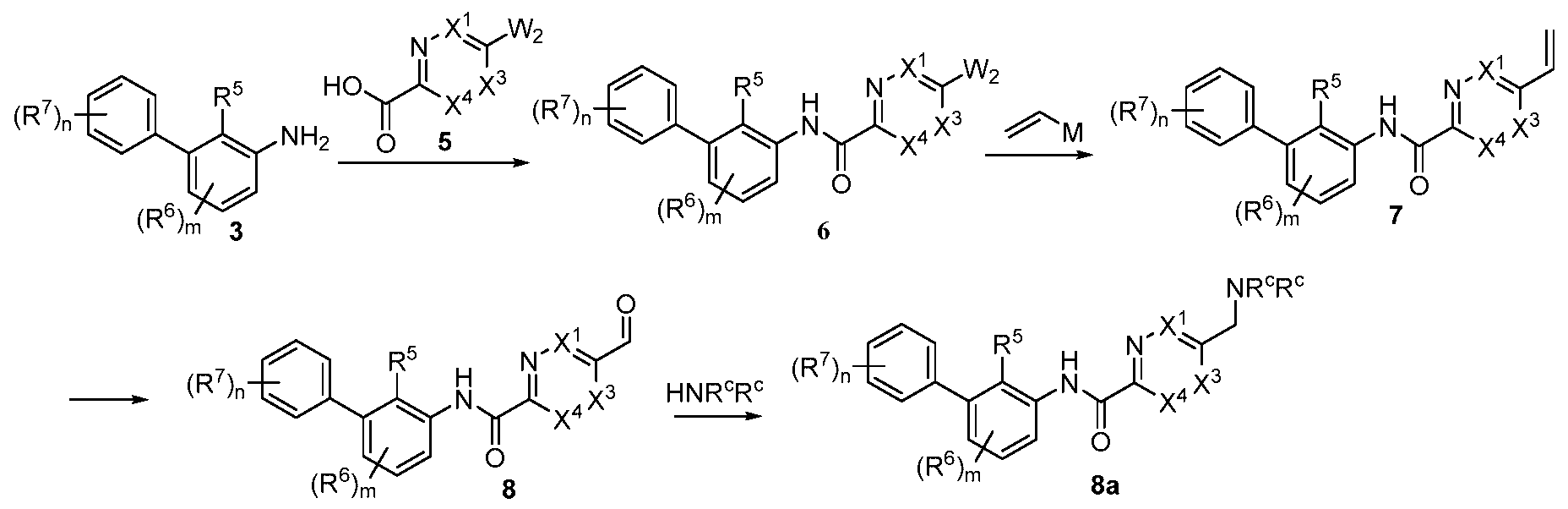
Scheme 2
Compounds of formula 8a can be alternatively synthesized using a process shown in Scheme 3. The aromatic amine 3 is reacted with an acid of formula 9 under suitable conditions to form an amide bond providing the product of formula 10, using coupling reagents such as, but not limited to, HATU and DIPEA. Subsequent reduction of the ester group in compound 10 can give an alcohol of formula 11 using a suitable reducing agent such as, but not limited to, lithium aluminum hydride. The alcohol unit in compound 11 was oxidized to aldehyde in compound 8 with a suitable oxidant such as, but not limited to, Dess- Martin periodinane. Then the compound of formula 8a was obtained by a reductive amination between formula 8 and a suitable amine in a proper solvent such as THF or DCM using a reducing agent such as, but not limited to, sodium triacetoxyborohydride, optionally in the presence of an acid such as acetic acid.
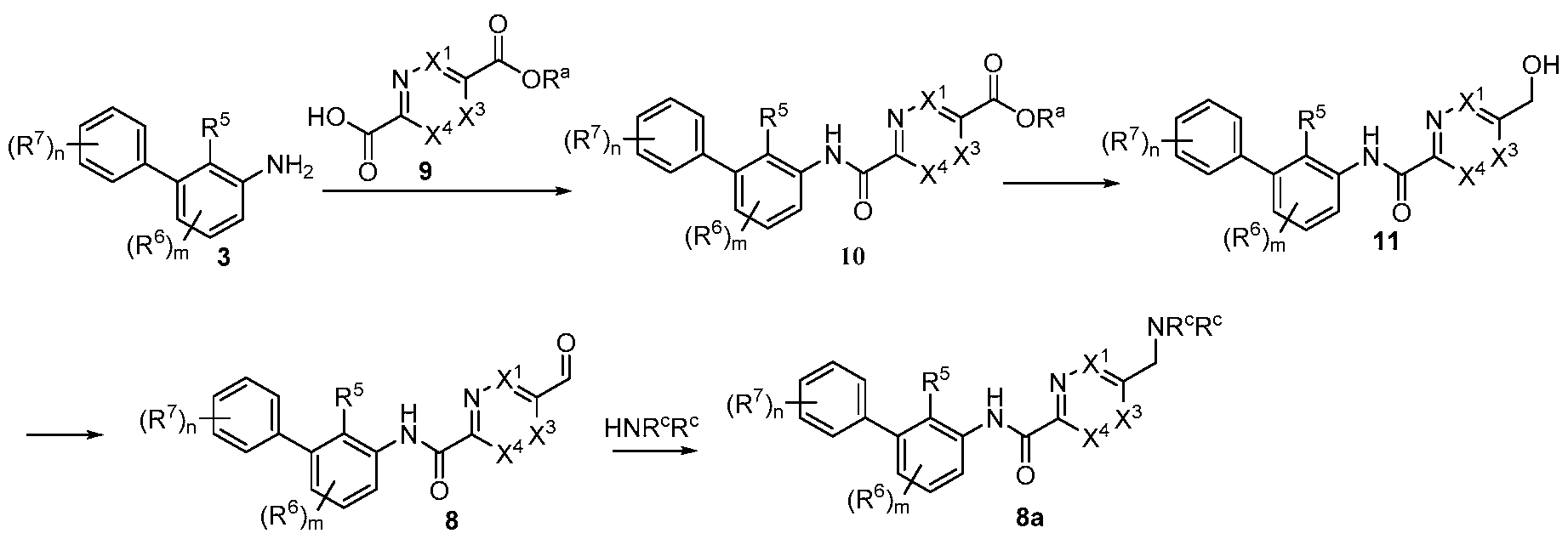
Scheme 3
Compounds of the invention (15a) can be synthesized using a process shown in Scheme 4. The aromatic amine 3 is reacted with an acid of formula 12 under suitable conditions forming an amide bond to provide the product of formula 13, using coupling
reagents such as, but not limited to, HATU and DIPEA. The compound of formula 14 can be synthesized by coupling the halo group (W3) of 13 with a vinyl reagent (e.g., vinyl boronic acid pinacol ester) under standard coupling reaction conditions (such as Suzuki coupling reaction, e.g., in the presence of a palladium catalyst (e.g., 1,1'- bis(diphenylphosphino)ferrocene]dichloropalladium(II)) and a base (e.g., a bicarbonate or a carbonate base)). The vinyl group in compound 14 is oxidatively cleaved to afford an aldehyde of formula 15 in the presence of suitable reagents such as, but not limited to, Os04 and NaI04. Then the compound of formula 15a is obtained by a reductive animation between the compound of formula 15 and a suitable amine in a proper solvent such as THF or DCM using a reducing agent such as, but not limited to, sodium triacetoxyborohydride, optionally in the presence of an acid such as acetic acid.

Scheme 4
Compounds of Formula 19 can be prepared using procedures as outlined in Scheme 5. Acids of formula 4 can react with aromatic amines of formula 16 under amide coupling conditions [e.g., in the presence of l-[Bis(dimethylamino)methylene]-lH-l,2,3-triazolo[4,5- b]pyridinium 3-oxid hexafluorophosphate (HATU) and a suitable base such as N,N- Diisopropylethylamine (DIPEA)] to give amide derivatives of formula 17. The halide (e.g., Hal1 = CI, Br, I) in compounds 17 can be coupled to compounds of formula 18, in which M is a boronic acid, boronic ester or an appropriately substituted metal [e.g., M is B(OR)2, Sn( Alky 1)4, or Zn-Hal], under Suzuki coupling conditions (e.g., in the presence of a palladium catalyst and a suitable base) or Stille coupling conditions (e.g., in the presence of a palladium catalyst), or Negishi coupling conditions (e.g., in the presence of a palladium catalyst) to give derivatives of formula 19. Alternatively, compound 18 can be a cyclic amine (where M is H and attached to an amine nitrogen in ring A) and the coupling of aryl halide 17 with the cyclic amine 18 can be performed under Buchwald animation conditions (e.g., in the presence of a palladium catalyst and a base such as sodium tert-butoxide).
Scheme 5

19
Alternatively, compounds of formula 19 can also be prepared using reaction sequence as outlined in Scheme 6. Coupling of aromatic halides of formula 16 with compounds of formula 18 can be achieved under similar conditions as described in Scheme 5 (e.g., conditions used for coupling of compounds 17 and compounds 18) to give compounds of formula 20. Acids of formula 4 can react with aromatic amines of formula 20 under amide coupling conditions to give compounds of formula 19.
Scheme 6
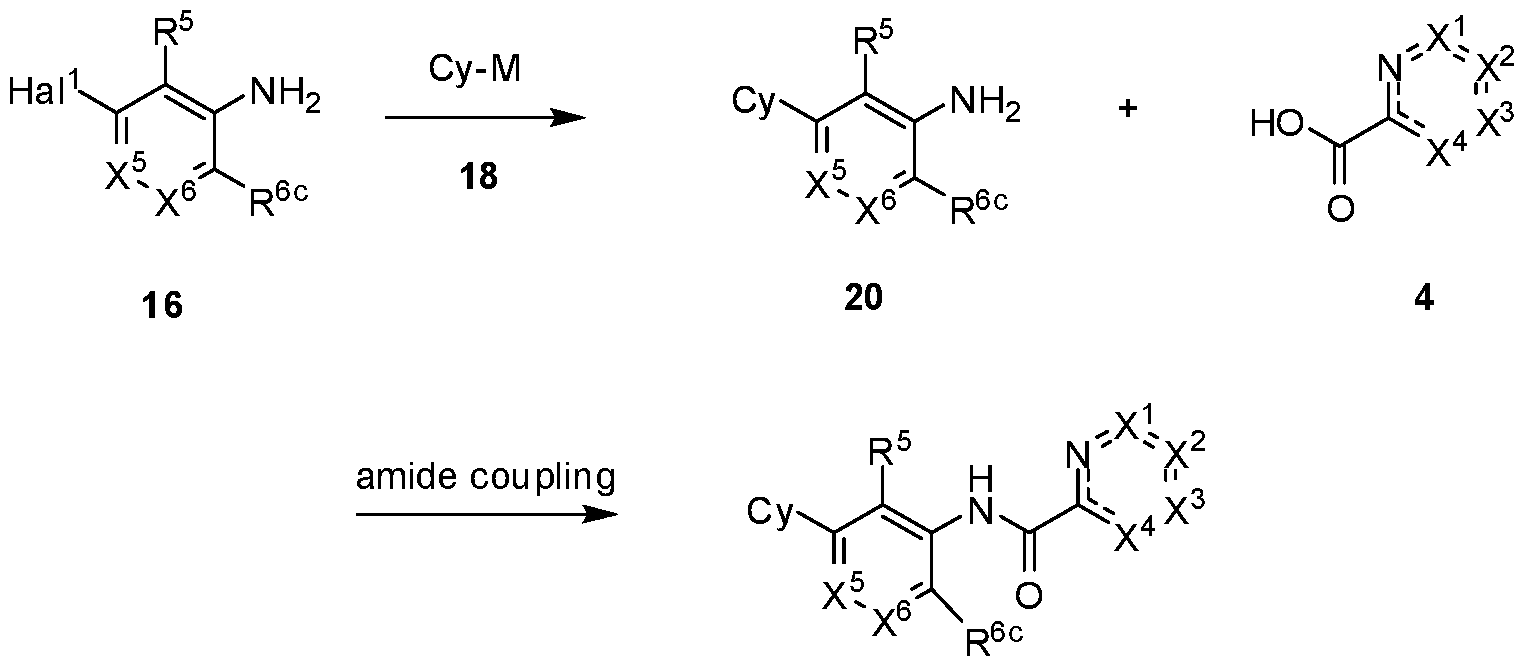
19
III. Uses of the Compounds
Compounds of the present disclosure can inhibit the activity of PD-1/PD-L1 protein/protein interaction and, thus, are useful in treating diseases and disorders associated with activity of PD-1 and the diseases and disorders associated with PD-L1 including its interaction with other proteins such as PD-1 and B7-1 (CD80). In certain embodiments, the
compounds of the present disclosure, or pharmaceutically acceptable salts or stereoisomers thereof, are useful for therapeutic administration to enhance stimulate and/or increase immunity in cancer or chronic infection, including enhancement of response to vaccination. In some embodiments, the present disclosure provides a method for inhibiting the PD-l/PD- LI protein/protein interaction. The method includes administering to an individual or a patient a compound of Formula (Γ), Formula (I) or of any of the formulas as described herein, or of a compound as recited in any of the claims and described herein, or a pharmaceutically acceptable salt or a stereoisomer thereof. The compounds of the present disclosure can be used alone, in combination with other agents or therapies or as an adjuvant or neoadjuvant for the treatment of diseases or disorders, including cancer or infection diseases. For the uses described herein, any of the compounds of the disclosure, including any of the embodiments thereof, may be used.
The compounds of the present disclosure inhibit the PD-1/PD-L1 protein/protein interaction, resulting in a PD-1 pathway blockade. The blockade of PD-1 can enhance the immune response to cancerous cells and infectious diseases in mammals, including humans. In some embodiments, the present disclosure provides treatment of an individual or a patient in vivo using a compound of Formula (Γ), Formula (I) or a salt or stereoisomer thereof such that growth of cancerous tumors is inhibited. A compound of Formula (Γ), Formula (I) or of any of the formulas as described herein, or a compound as recited in any of the claims and described herein, or a salt or stereoisomer thereof, can be used to inhibit the growth of cancerous tumors. Alternatively, a compound of Formula (Γ), Formula (I) or of any of the formulas as described herein, or a compound as recited in any of the claims and described herein, or a salt or stereoisomer thereof, can be used in conjunction with other agents or standard cancer treatments, as described below. In one embodiment, the present disclosure provides a method for inhibiting growth of tumor cells in vitro. The method includes contacting the tumor cells in vitro with a compound of Formula (Γ), Formula (I) or of any of the formulas as described herein, or of a compound as recited in any of the claims and described herein, or of a salt or stereoisomer thereof. In another embodiment, the present disclosure provides a method for inhibiting growth of tumor cells in an individual or a patient. The method includes administering to the individual or patient in need thereof a therapeutically effective amount of a compound of Formula (Γ), Formula (I) or of any of the formulas as described herein, or of a compound as recited in any of the claims and described herein, or a salt or a stereoisomer thereof.
In some embodiments, provided herein is a method for treating cancer. The method
includes administering to a patient in need thereof, a therapeutically effective amount of a compound of Formula (Γ), Formula (I) or any of the formulas as described herein, a compound as recited in any of the claims and described herein, or a salt thereof. Examples of cancers include those whose growth may be inhibited using compounds of the disclosure and cancers typically responsive to immunotherapy.
In some embodiments, the present disclosure provides a method of enhancing, stimulating and/or increasing the immune response in a patient. The method includes administering to the patient in need thereof a therapeutically effective amount of a compound of Formula (Γ), Formula (I) or any of the formulas as described herein, a compound or composition as recited in any of the claims and described herein, or a salt thereof.
Examples of cancers that are treatable using the compounds or combinations of the present disclosure include, but are not limited to, ewing sarcoma, cholangiocarcinoma ,bone cancer, pancreatic cancer, skin cancer, cancer of the head or neck, cutaneous or intraocular malignant melanoma, uterine cancer, ovarian cancer, rectal cancer, cancer of the anal region, stomach cancer, testicular cancer, uterine cancer, carcinoma of the fallopian tubes, carcinoma of the endometrium, endometrial cancer, carcinoma of the cervix, carcinoma of the vagina, carcinoma of the vulva, Hodgkin's Disease, non-Hodgkin's lymphoma, cancer of the esophagus, cancer of the small intestine, cancer of the endocrine system, cancer of the thyroid gland, cancer of the parathyroid gland, cancer of the adrenal gland, sarcoma of soft tissue, cancer of the urethra, cancer of the penis, chronic or acute leukemias including acute myeloid leukemia, chronic myeloid leukemia, acute lymphoblastic leukemia, chronic lymphocytic leukemia, solid tumors of childhood, lymphocytic lymphoma, cancer of the bladder, cancer of the kidney or urethra, carcinoma of the renal pelvis, neoplasm of the central nervous system (CNS), primary CNS lymphoma, tumor angiogenesis, spinal axis tumor, brain stem glioma, pituitary adenoma, Kaposi's sarcoma, epidermoid cancer, squamous cell cancer, T -cell lymphoma, environmentally induced cancers including those induced by asbestos, and combinations of said cancers. The compounds of the present disclosure are also useful for the treatment of metastatic cancers, especially metastatic cancers that express PD-L1.
In some embodiments, cancers treatable with compounds or combinations of the present disclosure include melanoma (e.g., metastatic malignant melanoma), renal cancer (e.g. clear cell carcinoma), prostate cancer (e.g. hormone refractory prostate
adenocarcinoma), breast cancer, colon cancer and lung cancer (e.g. non-small cell lung cancer). Additionally, the disclosure includes refractory or recurrent malignancies whose growth may be inhibited using the compounds of the disclosure.
In some embodiments, cancers that are treatable using the compounds or
combinations of the present disclosure include, but are not limited to, solid tumors (e.g. , prostate cancer, colon cancer, esophageal cancer, endometrial cancer, ovarian cancer, uterine cancer, renal cancer, hepatic cancer, pancreatic cancer, gastric cancer, breast cancer, lung cancer, cancers of the head and neck, thyroid cancer, glioblastoma, sarcoma, bladder cancer, etc.), hematological cancers (e.g. , lymphoma, leukemia such as acute lymphoblastic leukemia (ALL), acute myelogenous leukemia (AML), chronic lymphocytic leukemia (CLL), chronic myelogenous leukemia (CML), DLBCL, mantle cell lymphoma, Non-Hodgkin lymphoma (including relapsed or refractory NHL and recurrent follicular), Hodgkin lymphoma or multiple myeloma) and combinations of said cancers.
PD-1 pathway blockade with compounds of the present disclosure can also be used for treating infections such as viral, bacteria, fungus and parasite infections. The present disclosure provides a method for treating infections such as viral infections. The method includes administering to a patient in need thereof, a therapeutically effective amount of a compound of Formula (Γ), Formula (I) or any of the formulas as described herein, a compound as recited in any of the claims and described herein, a salt thereof. Examples of viruses causing infections treatable by methods of the present disclosure include, but are not limit to, human immunodeficiency virus, human papillomavirus, influenza, hepatitis A, B, C or D viruses, adenovirus, poxvirus, herpes simplex viruses, human cytomegalovirus, severe acute respirator)'- syndrome virus, ebola virus, and measles virus. In some embodiments, viruses causing infections treatable by methods of the present disclosure include, but are not limit to, hepatitis (A, B, or C), herpes virus (e.g., VZV, HSV-1 , HAV-6, HSV-II, and CMV, Epstein Barr virus), adenovirus, influenza virus, flaviviruses, echovirus, rhinovirus, coxsackie virus, cornovirus, respiratory syncytial virus, mumpsvirus, rotavirus, measles virus, rubella virus, parvovirus, vaccinia virus, HTLV virus, dengue virus, papillomavirus, molluscum virus, poliovirus, rabies virus, JC virus and arboviral encephalitis virus.
The present disclosure provides a method for treating bacterial infections. The method includes administering to a patient in need thereof, a therapeutically effective amount of a compound of Formula (Γ), Formula (I) or any of the formulas as described herein, a compound as recited in any of the claims and described herein, or a salt thereof. Non- limiting examples of pathogenic bacteria causing infections treatable by methods of the disclosure include chlamydia, rickettsial bacteria, mycobacteria, staphylococci, streptococci, pneumonococci, meningococci and conococci, klebsiella, proteus, serratia, pseudomonas, legionella, diphtheria, salmonella, bacilli, cholera, tetanus, botulism, anthrax, plague,
leptospirosis, and Lyme's disease bacteria.
The present disclosure provides a method for treating fungus infections. The method includes administering to a patient in need thereof, a therapeutically effective amount of a compound of Formula (Γ), Formula (I) or any of the formulas as described herein, a compound as recited in any of the claims and described herein, or a salt thereof. Non- limiting examples of pathogenic fungi causing infections treatable by methods of the disclosure include Candida (albicans, krusei, glabrata, tropicalis, etc.), Cryptococcus neoformans, Aspergillus (fumigatus, niger, etc.), Genus Mucorales (mucor, absidia, rhizophus), Sporothrix schenkii, Blastomyces dermatitidis, Paracoccidioides brasiliensis, Coccidioides immitis and Histoplasma capsulatum.
The present disclosure provides a method for treating parasite infections. The method includes administering to a patient in need thereof, a therapeutically effective amount of a compound of Formula (Γ), Formula (I) or any of the formulas as described herein, a compound as recited in any of the claims and described herein, or a salt thereof. Non- limiting examples of pathogenic parasites causing infections treatable by methods of the disclosure include Entamoeba histolytica, Balantidium coli, Naegleriafowleri, Acanthamoeba sp., Giardia lambia, Cryptosporidium sp., Pneumocystis carinii, Plasmodium vivax, Babesia microti, Trypanosoma brucei, Trypanosoma cruzi, Leishmania donovani, Toxoplasma gondi, and Nippostrongylus brasiliensis.
The terms "individual" or "patient," used interchangeably, refer to any animal, including mammals, preferably mice, rats, other rodents, rabbits, dogs, cats, swine, cattle, sheep, horses, or primates, and most preferably humans.
The phrase "therapeutically effective amount" refers to the amount of active compound or pharmaceutical agent that elicits the biological or medicinal response in a tissue, system, animal, individual or human that is being sought by a researcher, veterinarian, medical doctor or other clinician.
As used herein, the term "treating" or "treatment" refers to one or more of (1) inhibiting the disease; e.g. , inhibiting a disease, condition or disorder in an individual who is experiencing or displaying the pathology or symptomatology of the disease, condition or disorder (i.e. , arresting further development of the pathology and/or symptomatology); and (2) ameliorating the disease; e.g., ameliorating a disease, condition or disorder in an individual who is experiencing or displaying the pathology or symptomatology of the disease, condition or disorder (i.e. , reversing the pathology and/or symptomatology) such as decreasing the severity of disease.
In some embodiments, the compounds of the invention are useful in preventing or reducing the risk of developing any of the diseases referred to herein; e.g. , preventing or reducing the risk of developing a disease, condition or disorder in an individual who may be predisposed to the disease, condition or disorder but does not yet experience or display the pathology or symptomatology of the disease.
Combination Therapies
Cancer cell growth and survival can be impacted by multiple signaling pathways. Thus, it is useful to combine different enzyme/protein/receptor inhibitors, exhibiting different preferences in the targets which they modulate the activities of, to treat such conditions.
Targeting more than one signaling pathway (or more than one biological molecule involved in a given signaling pathway) may reduce the likelihood of drug-resistance arising in a cell population, and/or reduce the toxicity of treatment.
The compounds of the present disclosure can be used in combination with one or more other enzyme/protein/receptor inhibitors for the treatment of diseases, such as cancer or infections. Examples of cancers include solid tumors and liquid tumors, such as blood cancers. Examples of infections include viral infections, bacterial infections, fungus infections or parasite infections. For example, the compounds of the present disclosure can be combined with one or more inhibitors of the following kinases for the treatment of cancer: Aktl, Akt2, Akt3, TGF-PR, PKA, PKG, PKC, CaM-kinase, phosphorylase kinase, MEKK, ERK, MAPK, mTOR, EGFR, HER2, HER3, HER4, INS-R, IGF-1R, IR-R, PDGFaR, PDGFPR, CSFIR, KIT, FLK-II, KDR/FLK-1, FLK-4, flt-1, FGFRl, FGFR2, FGFR3, FGFR4, c-Met, Ron, Sea, TRKA, TRKB, TRKC, FLT3, VEGFR/Flt2, Flt4, EphAl, EphA2, EphA3, EphB2, EphB4, Tie2, Src, Fyn, Lck, Fgr, Btk, Fak, SYK, FRK, JAK, ABL, ALK and B-Raf. In some embodiments, the compounds of the present disclosure can be combined with one or more of the following inhibitors for the treatment of cancer or infections. Non- limiting examples of inhibitors that can be combined with the compounds of the present disclosure for treatment of cancer and infections include an FGFR inhibitor (FGFRl, FGFR2, FGFR3 or FGFR4, e.g., INCB54828, INCB62079 and INCB63904), a JAK inhibitor (JAK1 and/or JAK2, e.g., ruxolitinib, baricitinib or INCB39110), an IDO inhibitor (e.g., epacadostat and NLG919), an LSD1 inhibitor (e.g., INCB59872 and INCB60003), a TDO inhibitor, a PI3K-delta inhibitor, a PI3K-gamma inhibitor, such as PI3K-gamma selective inhibitor (e.g., INCB50797), a Pirn inhibitor, a CSFIR inhibitor, a TAM receptor tyrosine kinases (Tyro-3,
Axl, and Mer), an angiogenesis inhibitor, an interleukin receptor inhibitor, bromo and extra terminal family members inhibitors (for example, bromodomain inhibitors or BET inhibitors such as INCB54329 and INCB57643) and an adenosine receptor antagonist or combinations thereof.
Compounds of the present disclosure can be used in combination with one or more immune checkpoint inhibitors. Exemplary immune checkpoint inhibitors include inhibitors against immune checkpoint molecules such as CD27, CD28, CD40, CD122, CD96, CD73, CD47, OX40, GITR, CSF1R, JAK, PI3K delta, PI3K gamma, TAM, arginase, CD137 (also known as 4-1BB), ICOS, A2AR, B7-H3, B7-H4, BTLA, CTLA-4, LAG3, TIM3, VISTA, PD-1, PD-L1 and PD-L2. In some embodiments, the immune checkpoint molecule is a stimulatory checkpoint molecule selected from CD27, CD28, CD40, ICOS, OX40, GITR and CD137. In some embodiments, the immune checkpoint molecule is an inhibitory checkpoint molecule selected from A2AR, B7-H3, B7-H4, BTLA, CTLA-4, IDO, KIR, LAG3, PD-1, TIM3, and VISTA. In some embodiments, the compounds provided herein can be used in combination with one or more agents selected from KIR inhibitors, TIGIT inhibitors, LAIRl inhibitors, CD 160 inhibitors, 2B4 inhibitors and TGFR beta inhibitors.
In some embodiments, the inhibitor of an immune checkpoint molecule is anti-PDl antibody, anti-PD-Ll antibody, or anti-CTLA-4 antibody.
In some embodiments, the inhibitor of an immune checkpoint molecule is an inhibitor of PD-1, e.g., an anti-PD-1 monoclonal antibody. In some embodiments, the anti-PD-1 monoclonal antibody is nivolumab, pembrolizumab (also known as MK-3475), pidilizumab, SHR-1210, PDR001, or AMP-224. In some embodiments, the anti-PD-1 monoclonal antibody is nivolumab or pembrolizumab. In some embodiments, the anti-PDl antibody is pembrolizumab. In some embodiments, the anti PD-1 antibody is SHR-1210.
In some embodiments, the inhibitor of an immune checkpoint molecule is an inhibitor of PD-L1, e.g., an anti-PD-Ll monoclonal antibody. In some embodiments, the anti-PD-Ll monoclonal antibody is BMS-935559, MEDI4736, MPDL3280A (also known as RG7446), or MSB0010718C. In some embodiments, the anti-PD-Ll monoclonal antibody is
MPDL3280A or MEDI4736.
In some embodiments, the inhibitor of an immune checkpoint molecule is an inhibitor of CTLA-4, e.g., an anti-CTLA-4 antibody. In some embodiments, the anti-CTLA-4 antibody is ipilimumab.
In some embodiments, the inhibitor of an immune checkpoint molecule is an inhibitor of LAG3, e.g., an anti-LAG3 antibody. In some embodiments, the anti-LAG3 antibody is BMS-986016 or LAG525.
In some embodiments, the inhibitor of an immune checkpoint molecule is an inhibitor of GITR, e.g., an anti-GITR antibody. In some embodiments, the anti-GITR antibody is TRX518 or MK-4166.
In some embodiments, the inhibitor of an immune checkpoint molecule is an inhibitor of OX40, e.g., an anti-OX40 antibody or OX40L fusion protein. In some embodiments, the anti-OX40 antibody is MEDI0562. In some embodiments, the OX40L fusion protein is MEDI6383.
Compounds of the present disclosure can be used in combination with one or more agents for the treatment of diseases such as cancer. In some embodiments, the agent is an alkylating agent, a proteasome inhibitor, a corticosteroid, or an immunomodulatory agent. Examples of an alkylating agent include cyclophosphamide (CY), melphalan (MEL), and bendamustine. In some embodiments, the proteasome inhibitor is carfilzomib. In some embodiments, the corticosteroid is dexamethasone (DEX). In some embodiments, the immunomodulatory agent is lenalidomide (LEN) or pomalidomide (POM).
The compounds of the present disclosure can further be used in combination with other methods of treating cancers, for example by chemotherapy, irradiation therapy, tumor- targeted therapy, adjuvant therapy, immunotherapy or surgery. Examples of immunotherapy include cytokine treatment (e.g., interferons, GM-CSF, G-CSF, IL-2), CRS-207 immunotherapy, cancer vaccine, monoclonal antibody, adoptive T cell transfer, oncolytic virotherapy and immunomodulating small molecules, including thalidomide or JAK1/2 inhibitor and the like. The compounds can be administered in combination with one or more anti-cancer drugs, such as a chemotherapeutics. Example chemotherapeutics include any of: abarelix, aldesleukin, alemtuzumab, alitretinoin, allopurinol, altretamine, anastrozole, arsenic trioxide,
asparaginase, azacitidine, bevacizumab, bexarotene, baricitinib, bleomycin, bortezombi, bortezomib, busulfan intravenous, busulfan oral, calusterone, capecitabine, carboplatin, carmustine, cetuximab, chlorambucil, cisplatin, cladribine, clofarabine, cyclophosphamide, cytarabine, dacarbazine, dactinomycin, dalteparin sodium, dasatinib, daunorubicin, decitabine, denileukin, denileukin diftitox, dexrazoxane, docetaxel, doxorubicin,
dromostanolone propionate, eculizumab, epirubicin, erlotinib, estramustine, etoposide phosphate, etoposide, exemestane, fentanyl citrate, filgrastim, floxuridine, fludarabine, fluorouracil, fulvestrant, gefitinib, gemcitabine, gemtuzumab ozogamicin, goserelin acetate,
histrelin acetate, ibritumomab tiuxetan, idarubicin, ifosfamide, imatinib mesylate, interferon alfa 2a, irinotecan, lapatinib ditosylate, lenalidomide, letrozole, leucovorin, leuprolide acetate, levamisole, lomustine, meclorethamine, megestrol acetate, melphalan,
mercaptopurine, methotrexate, methoxsalen, mitomycin C, mitotane, mitoxantrone, nandrolone phenpropionate, nelarabine, nofetumomab, oxaliplatin, paclitaxel, pamidronate, panitumumab, pegaspargase, pegfilgrastim, pemetrexed disodium, pentostatin, pipobroman, plicamycin, procarbazine, quinacrine, rasburicase, rituximab, ruxolitinib, sorafenib, streptozocin, sunitinib, sunitinib maleate, tamoxifen, temozolomide, teniposide, testolactone, thalidomide, thioguanine, thiotepa, topotecan, toremifene, tositumomab, trastuzumab, tretinoin, uracil mustard, valrubicin, vinblastine, vincristine, vinorelbine, vorinostat and zoledronate.
Other anti-cancer agent(s) include antibody therapeutics such as trastuzumab
(Herceptin), antibodies to costimulatory molecules such as CTLA-4 (e.g., ipilimumab), 4- 1BB, antibodies to PD-1 and PD-L1, or antibodies to cytokines (IL-10, TGF-β, etc.).
Examples of antibodies to PD-1 and/or PD-L1 that can be combined with compounds of the present disclosure for the treatment of cancer or infections such as viral, bacteria, fungus and parasite infections include, but are not limited to, nivolumab, pembrolizumab, MPDL3280A, MEDI-4736 and SHR-1210.
In some embodiments, the anti-cancer agent is an alkylating agent, a proteasome inhibitor, a corticosteroid, or an immunomodulatory agent. Examples of an alkylating agent include cyclophosphamide (CY), melphalan (MEL), and bendamustine. In some
embodiments, the proteasome inhibitor is carfilzomib. In some embodiments, the
corticosteroid is dexamethasone (DEX). In some embodiments, the immunomodulatory agent is lenalidomide (LEN) or pomalidomide (POM).
Compounds of the present disclosure can be used in combination with one or more immune checkpoint inhibitors for the treatment of diseases, such as cancer or infections.
Exemplary immune checkpoint inhibitors include inhibitors against immune checkpoint molecules such as CD27, CD28, CD40, CD122, CD96, CD73, CD47, OX40, GITR, CSF1R, JAK, PI3K delta, PI3K gamma, TAM, arginase, CD137 (also known as 4-lBB), ICOS, A2AR, B7-H3, B7-H4, BTLA, CTLA-4, LAG3, TIM3, VISTA, PD-1, PD-L1 and PD-L2. In some embodiments, the immune checkpoint molecule is a stimulatory checkpoint molecule selected from CD27, CD28, CD40, ICOS, OX40, GITR and CD137. In some embodiments, the immune checkpoint molecule is an inhibitory checkpoint molecule selected from A2AR, B7-H3, B7-H4, BTLA, CTLA-4, IDO, KIR, LAG3, PD-1, TIM3, and VISTA. In some embodiments, the
compounds provided herein can be used in combination with one or more agents selected from KIR inhibitors, TIGIT inhibitors, LAIRl inhibitors, CD 160 inhibitors, 2B4 inhibitors and TGFR beta inhibitors.
In some embodiments, the inhibitor of an immune checkpoint molecule is anti-PDl antibody, anti-PD-Ll antibody, or anti-CTLA-4 antibody.
In some embodiments, the inhibitor of an immune checkpoint molecule is an inhibitor of PD-1 , e.g., an anti-PD-1 monoclonal antibody. In some embodiments, the anti-PD-1 monoclonal antibody is nivolumab, pembrolizumab (also known as MK-3475), pidilizumab, SHR-1210, PDROOl , or AMP-224. In some embodiments, the anti-PD-1 monoclonal antibody is nivolumab or pembrolizumab. In some embodiments, the anti-PDl antibody is pembrolizumab.
In some embodiments, the inhibitor of an immune checkpoint molecule is an inhibitor of PD-L1, e.g., an anti-PD-Ll monoclonal antibody. In some embodiments, the anti-PD-Ll monoclonal antibody is BMS-935559, MEDI4736, MPDL3280A (also known as RG7446), or MSB0010718C. In some embodiments, the anti-PD-Ll monoclonal antibody is MPDL3280A or MEDI4736.
In some embodiments, the inhibitor of an immune checkpoint molecule is an inhibitor of CTLA-4, e.g., an anti-CTLA-4 antibody. In some embodiments, the anti-CTLA-4 antibody is ipilimumab.
In some embodiments, the inhibitor of an immune checkpoint molecule is an inhibitor of LAG3, e.g., an anti-LAG3 antibody. In some embodiments, the anti-LAG3 antibody is BMS- 986016 or LAG525.
In some embodiments, the inhibitor of an immune checkpoint molecule is an inhibitor of GITR, e.g., an anti-GITR antibody. In some embodiments, the anti-GITR antibody is
TRX518 or MK-4166.
In some embodiments, the inhibitor of an immune checkpoint molecule is an inhibitor of OX40, e.g., an anti-OX40 antibody or OX40L fusion protein. In some embodiments, the anti-OX40 antibody is MEDI0562. In some embodiments, the OX40L fusion protein is
MEDI6383.
The compounds of the present disclosure can further be used in combination with one or more anti-inflammatory agents, steroids, immunosuppressants or therapeutic antibodies.
The compounds of Formula (Γ), Formula (I) or any of the formulas as described herein, a compound as recited in any of the claims and described herein, or salts thereof can be combined with another immunogenic agent, such as cancerous cells, purified tumor antigens (including recombinant proteins, peptides, and carbohydrate molecules), cells, and
cells transfected with genes encoding immune stimulating cytokines. Non-limiting examples of tumor vaccines that can be used include peptides of melanoma antigens, such as peptides of gplOO, MAGE antigens, Trp-2, MARTI and/or tyrosinase, or tumor cells transfected to express the cytokine GM-CSF.
The compounds of Formula (Γ), Formula (I) or any of the formulas as described herein, a compound as recited in any of the claims and described herein, or salts thereof can be used in combination with a vaccination protocol for the treatment of cancer. In some embodiments, the tumor cells are transduced to express GM-CSF. In some embodiments, tumor vaccines include the proteins from viruses implicated in human cancers such as Human Papilloma Viruses (HPV), Hepatitis Viruses (HBV and HCV) and Kaposi's Herpes Sarcoma Virus (KHSV). In some embodiments, the compounds of the present disclosure can be used in combination with tumor specific antigen such as heat shock proteins isolated from tumor tissue itself. In some embodiments, the compounds of Formula (Γ), Formula (I) or any of the formulas as described herein, a compound as recited in any of the claims and described herein, or salts thereof can be combined with dendritic cells immunization to activate potent anti-tumor responses.
The compounds of the present disclosure can be used in combination with bispecific macrocyclic peptides that target Fe alpha or Fe gamma receptor-expressing effectors cells to tumor cells. The compounds of the present disclosure can also be combined with macrocyclic peptides that activate host immune responsiveness.
The compounds of the present disclosure can be used in combination with bone marrow transplant for the treatment of a variety of tumors of hematopoietic origin.
The compounds of Formula (Γ), Formula (I) or any of the formulas as described herein, a compound as recited in any of the claims and described herein, or salts thereof can be used in combination with vaccines, to stimulate the immune response to pathogens, toxins, and self antigens. Examples of pathogens for which this therapeutic approach may be particularly useful, include pathogens for which there is currently no effective vaccine, or pathogens for which conventional vaccines are less than completely effective. These include, but are not limited to, HIV, Hepatitis (A, B, & C), Influenza, Herpes, Giardia, Malaria, Leishmania, Staphylococcus aureus, Pseudomonas Aeruginosa.
Viruses causing infections treatable by methods of the present disclosure include, but are not limit to human papillomavirus, influenza, hepatitis A, B, C or D viruses, adenovirus, poxvirus, herpes simplex viruses, human c tomegalovirus, severe acute respiratory syndrome virus, ebola virus, measles virus, herpes virus (e.g., VZV, HSV-1, HAV-6, HSV-II, and
CMV, Epstein Barr virus), flaviviruses, echovirus, rhinovirus, coxsackie virus, cornovirus, respiratory syncytial virus, mumpsvirus, rotavirus, measles virus, rubella virus, parvovirus, vaccinia virus, HTLV virus, dengue virus, papillomavirus, molluscum virus, poliovirus, rabies virus, JC virus and arboviral encephalitis virus.
Pathogenic bacteria causing infections treatable by methods of the disclosure include, but are not limited to, chlamydia, rickettsial bacteria, mycobacteria, staphylococci, streptococci, pneumonococci, meningococci and conococci, klebsiella, proteus, serratia, pseudomonas, legionella, diphtheria, salmonella, bacilli, cholera, tetanus, botulism, anthrax, plague, leptospirosis, and Lyme's disease bacteria.
Pathogenic fungi causing infections treatable by methods of the disclosure include, but are not limited to, Candida (albicans, krusei, glabrata, tropicalis, etc.), Cryptococcus neoformans, Aspergillus (fumigatus, niger, etc.), Genus Mucorales (mucor, absidia, rhizophus), Sporothrix schenkii, Blastomyces dermatitidis, Paracoccidioides brasiliensis, Coccidioides immitis and Histoplasma capsulatum.
Pathogenic parasites causing infections treatable by methods of the disclosure include, but are not limited to, Entamoeba histolytica, Balantidium coli, Naegleriafowleri,
Acanthamoeba sp., Giardia lambia, Cryptosporidium sp., Pneumocystis carinii, Plasmodium vivax, Babesia microti, Trypanosoma brucei, Trypanosoma cruzi, Leishmania donovani, Toxoplasma gondi, and Nippostrongylus brasiliensis.
When more than one pharmaceutical agent is administered to a patient, they can be administered simultaneously, separately, sequentially, or in combination (e.g. , for more than two agents).
IV. Formulation, Dosage Forms and Administration
When employed as pharmaceuticals, the compounds of the present disclosure can be administered in the form of pharmaceutical compositions. Thus the present disclosure provides a composition comprising a compound of Formula (Γ), Formula (I) or any of the formulas as described herein, a compound as recited in any of the claims and described herein, or a pharmaceutically acceptable salt thereof, or any of the embodiments thereof, and at least one pharmaceutically acceptable carrier or excipient. These compositions can be prepared in a manner well known in the pharmaceutical art, and can be administered by a variety of routes, depending upon whether local or systemic treatment is indicated and upon the area to be treated. Administration may be topical (including transdermal, epidermal, ophthalmic and to mucous membranes including intranasal, vaginal and rectal delivery),
pulmonary (e.g., by inhalation or insufflation of powders or aerosols, including by nebulizer; intratracheal or intranasal), oral or parenteral. Parenteral administration includes intravenous, intraarterial, subcutaneous, intraperitoneal intramuscular or injection or infusion; or intracranial, e.g. , intrathecal or intraventricular, administration. Parenteral administration can be in the form of a single bolus dose, or may be, e.g. , by a continuous perfusion pump.
Pharmaceutical compositions and formulations for topical administration may include transdermal patches, ointments, lotions, creams, gels, drops, suppositories, sprays, liquids and powders. Conventional pharmaceutical carriers, aqueous, powder or oily bases, thickeners and the like may be necessary or desirable.
This invention also includes pharmaceutical compositions which contain, as the active ingredient, the compound of the present disclosure or a pharmaceutically acceptable salt thereof, in combination with one or more pharmaceutically acceptable carriers or excipients. In some embodiments, the composition is suitable for topical administration. In making the compositions of the invention, the active ingredient is typically mixed with an excipient, diluted by an excipient or enclosed within such a carrier in the form of, e.g. , a capsule, sachet, paper, or other container. When the excipient serves as a diluent, it can be a solid, semi-solid, or liquid material, which acts as a vehicle, carrier or medium for the active ingredient. Thus, the compositions can be in the form of tablets, pills, powders, lozenges, sachets, cachets, elixirs, suspensions, emulsions, solutions, syrups, aerosols (as a solid or in a liquid medium), ointments containing, e.g. , up to 10% by weight of the active compound, soft and hard gelatin capsules, suppositories, sterile injectable solutions and sterile packaged powders.
In preparing a formulation, the active compound can be milled to provide the appropriate particle size prior to combining with the other ingredients. If the active compound is substantially insoluble, it can be milled to a particle size of less than 200 mesh. If the active compound is substantially water soluble, the particle size can be adjusted by milling to provide a substantially uniform distribution in the formulation, e.g. , about 40 mesh.
The compounds of the invention may be milled using known milling procedures such as wet milling to obtain a particle size appropriate for tablet formation and for other formulation types. Finely divided (nanoparticulate) preparations of the compounds of the invention can be prepared by processes known in the art see, e.g., WO 2002/000196.
Some examples of suitable excipients include lactose, dextrose, sucrose, sorbitol, mannitol, starches, gum acacia, calcium phosphate, alginates, tragacanth, gelatin, calcium silicate, microcrystalline cellulose, polyvinylpyrrolidone, cellulose, water, syrup and methyl cellulose. The formulations can additionally include: lubricating agents such as talc,
magnesium stearate and mineral oil; wetting agents; emulsifying and suspending agents; preserving agents such as methyl- and propylhydroxy-benzoates; sweetening agents; and flavoring agents. The compositions of the invention can be formulated so as to provide quick, sustained or delayed release of the active ingredient after administration to the patient by employing procedures known in the art.
In some embodiments, the pharmaceutical composition comprises silicified microcrystalline cellulose (SMCC) and at least one compound described herein, or a pharmaceutically acceptable salt thereof. In some embodiments, the silicified
microcrystalline cellulose comprises about 98% microcrystalline cellulose and about 2% silicon dioxide w/w.
In some embodiments, the composition is a sustained release composition comprising at least one compound described herein, or a pharmaceutically acceptable salt thereof, and at least one pharmaceutically acceptable carrier or excipient. In some embodiments, the composition comprises at least one compound described herein, or a pharmaceutically acceptable salt thereof, and at least one component selected from microcrystalline cellulose, lactose monohydrate, hydroxypropyl methylcellulose and polyethylene oxide. In some embodiments, the composition comprises at least one compound described herein, or a pharmaceutically acceptable salt thereof, and microcrystalline cellulose, lactose monohydrate and hydroxypropyl methylcellulose. In some embodiments, the composition comprises at least one compound described herein, or a pharmaceutically acceptable salt thereof, and microcrystalline cellulose, lactose monohydrate and polyethylene oxide. In some
embodiments, the composition further comprises magnesium stearate or silicon dioxide. In some embodiments, the microcrystalline cellulose is Avicel PH102™. In some embodiments, the lactose monohydrate is Fast-flo 316™. In some embodiments, the hydroxypropyl methylcellulose is hydroxypropyl methylcellulose 2208 K4M (e.g. , Methocel K4 M
Premier™) and/or hydroxypropyl methylcellulose 2208 K100LV (e.g., Methocel K00LV™). In some embodiments, the polyethylene oxide is polyethylene oxide WSR 1105 (e.g. , Poly ox WSR 1105™).
In some embodiments, a wet granulation process is used to produce the composition. In some embodiments, a dry granulation process is used to produce the composition.
The compositions can be formulated in a unit dosage form, each dosage containing from about 5 to about 1,000 mg (1 g), more usually about 100 mg to about 500 mg, of the active ingredient. In some embodiments, each dosage contains about 10 mg of the active ingredient. In some embodiments, each dosage contains about 50 mg of the active ingredient.
In some embodiments, each dosage contains about 25 mg of the active ingredient. The term "unit dosage forms" refers to physically discrete units suitable as unitary dosages for human subjects and other mammals, each unit containing a predetermined quantity of active material calculated to produce the desired therapeutic effect, in association with a suitable
pharmaceutical excipient.
The components used to formulate the pharmaceutical compositions are of high purity and are substantially free of potentially harmful contaminants (e.g., at least National Food grade, generally at least analytical grade, and more typically at least pharmaceutical grade). Particularly for human consumption, the composition is preferably manufactured or formulated under Good Manufacturing Practice standards as defined in the applicable regulations of the U.S. Food and Drug Administration. For example, suitable formulations may be sterile and/or substantially isotonic and/or in full compliance with all Good
Manufacturing Practice regulations of the U.S. Food and Drug Administration.
The active compound may be effective over a wide dosage range and is generally administered in a therapeutically effective amount. It will be understood, however, that the amount of the compound actually administered will usually be determined by a physician, according to the relevant circumstances, including the condition to be treated, the chosen route of administration, the actual compound administered, the age, weight, and response of the individual patient, the severity of the patient's symptoms and the like.
The therapeutic dosage of a compound of the present invention can vary according to, e.g., the particular use for which the treatment is made, the manner of administration of the compound, the health and condition of the patient, and the judgment of the prescribing physician. The proportion or concentration of a compound of the invention in a
pharmaceutical composition can vary depending upon a number of factors including dosage, chemical characteristics (e.g. , hydrophobicity), and the route of administration. For example, the compounds of the invention can be provided in an aqueous physiological buffer solution containing about 0.1 to about 10% w/v of the compound for parenteral administration. Some typical dose ranges are from about 1 μg/kg to about 1 g/kg of body weight per day. In some embodiments, the dose range is from about 0.01 mg/kg to about 100 mg/kg of body weight per day. The dosage is likely to depend on such variables as the type and extent of progression of the disease or disorder, the overall health status of the particular patient, the relative biological efficacy of the compound selected, formulation of the excipient, and its
route of administration. Effective doses can be extrapolated from dose-response curves derived from in vitro or animal model test systems.
For preparing solid compositions such as tablets, the principal active ingredient is mixed with a pharmaceutical excipient to form a solid preformulation composition containing a homogeneous mixture of a compound of the present invention. When referring to these preformulation compositions as homogeneous, the active ingredient is typically dispersed evenly throughout the composition so that the composition can be readily subdivided into equally effective unit dosage forms such as tablets, pills and capsules. This solid
preformulation is then subdivided into unit dosage forms of the type described above containing from, e.g. , about 0.1 to about 1000 mg of the active ingredient of the present invention.
The tablets or pills of the present invention can be coated or otherwise compounded to provide a dosage form affording the advantage of prolonged action. For example, the tablet or pill can comprise an inner dosage and an outer dosage component, the latter being in the form of an envelope over the former. The two components can be separated by an enteric layer which serves to resist disintegration in the stomach and permit the inner component to pass intact into the duodenum or to be delayed in release. A variety of materials can be used for such enteric layers or coatings, such materials including a number of polymeric acids and mixtures of polymeric acids with such materials as shellac, cetyl alcohol and cellulose acetate.
The liquid forms in which the compounds and compositions of the present invention can be incorporated for administration orally or by injection include aqueous solutions, suitably flavored syrups, aqueous or oil suspensions, and flavored emulsions with edible oils such as cottonseed oil, sesame oil, coconut oil, or peanut oil, as well as elixirs and similar pharmaceutical vehicles.
Compositions for inhalation or insufflation include solutions and suspensions in pharmaceutically acceptable, aqueous or organic solvents, or mixtures thereof, and powders. The liquid or solid compositions may contain suitable pharmaceutically acceptable excipients as described supra. In some embodiments, the compositions are administered by the oral or nasal respiratory route for local or systemic effect. Compositions can be nebulized by use of inert gases. Nebulized solutions may be breathed directly from the nebulizing device or the nebulizing device can be attached to a face mask, tent, or intermittent positive pressure breathing machine. Solution, suspension, or powder compositions can be administered orally or nasally from devices which deliver the formulation in an appropriate manner.
Topical formulations can contain one or more conventional carriers. In some embodiments, ointments can contain water and one or more hydrophobic carriers selected from, e.g., liquid paraffin, poly oxy ethylene alkyl ether, propylene glycol, white Vaseline, and the like. Carrier compositions of creams can be based on water in combination with glycerol and one or more other components, e.g., glycerinemonostearate, PEG-glycerinemonostearate and cetylstearyl alcohol. Gels can be formulated using isopropyl alcohol and water, suitably in combination with other components such as, e.g., glycerol, hydroxy ethyl cellulose, and the like. In some embodiments, topical formulations contain at least about 0.1, at least about 0.25, at least about 0.5, at least about 1, at least about 2 or at least about 5 wt % of the compound of the invention. The topical formulations can be suitably packaged in tubes of, e.g., 100 g which are optionally associated with instructions for the treatment of the select indication, e.g. , psoriasis or other skin condition.
The amount of compound or composition administered to a patient will vary depending upon what is being administered, the purpose of the administration, such as prophylaxis or therapy, the state of the patient, the manner of administration and the like. In therapeutic applications, compositions can be administered to a patient already suffering from a disease in an amount sufficient to cure or at least partially arrest the symptoms of the disease and its complications. Effective doses will depend on the disease condition being treated as well as by the judgment of the attending clinician depending upon factors such as the severity of the disease, the age, weight and general condition of the patient and the like.
The compositions administered to a patient can be in the form of pharmaceutical compositions described above. These compositions can be sterilized by conventional sterilization techniques, or may be sterile filtered. Aqueous solutions can be packaged for use as is, or lyophilized, the lyophilized preparation being combined with a sterile aqueous carrier prior to administration. The pH of the compound preparations typically will be between 3 and 11, more preferably from 5 to 9 and most preferably from 7 to 8. It will be understood that use of certain of the foregoing excipients, carriers or stabilizers will result in the formation of pharmaceutical salts.
The therapeutic dosage of a compound of the present invention can vary according to, e.g., the particular use for which the treatment is made, the manner of administration of the compound, the health and condition of the patient, and the judgment of the prescribing physician. The proportion or concentration of a compound of the invention in a
pharmaceutical composition can vary depending upon a number of factors including dosage, chemical characteristics (e.g. , hydrophobicity), and the route of administration. For example,
the compounds of the invention can be provided in an aqueous physiological buffer solution containing about 0.1 to about 10% w/v of the compound for parenteral administration. Some typical dose ranges are from about 1 μg/kg to about 1 g/kg of body weight per day. In some embodiments, the dose range is from about 0.01 mg/kg to about 100 mg/kg of body weight per day. The dosage is likely to depend on such variables as the type and extent of progression of the disease or disorder, the overall health status of the particular patient, the relative biological efficacy of the compound selected, formulation of the excipient, and its route of administration. Effective doses can be extrapolated from dose-response curves derived from in vitro or animal model test systems.
V. Labeled Compounds and Assay Methods
The compounds of the present disclosure can further be useful in investigations of biological processes in normal and abnormal tissues. Thus, another aspect of the present invention relates to labeled compounds of the invention (radio-labeled, fluorescent-labeled, etc.) that would be useful not only in imaging techniques but also in assays, both in vitro and in vivo, for localizing and quantitating PD-1 or PD-L1 protein in tissue samples, including human, and for identifying PD-L1 ligands by inhibition binding of a labeled compound. Accordingly, the present invention includes PD-1/PD-L1 binding assays that contain such labeled compounds.
The present invention further includes isotopically-substituted compounds of the disclosure. An "isotopically-substituted" compound is a compound of the invention where one or more atoms are replaced or substituted by an atom having an atomic mass or mass number different from the atomic mass or mass number typically found in nature (i.e. , naturally occurring). It is to be understood that a "radio-labeled" compound is a compound that has incorporated at least one isotope that is radioactive (e.g., radionuclide). Suitable radionuclides that may be incorporated in compounds of the present invention include but are not limited to ¾ (also written as T for tritium), nC, 1 C, 14C, 1 N, 15N, 150, 170, 180, 18F, 35S, 6C1, 82Br, 75Br, 76Br, 77Br, 12 I, 124I, 125I and 1 ll. The radionuclide that is incorporated in the instant radio-labeled compounds will depend on the specific application of that radio-labeled compound. For example, for in vitro PD-L1 protein labeling and competition assays, compounds that incorporate H, 14C, 82Br, 125I, 1 11, 5S or will generally be most useful. For radio-imaging applications nC, 18F, 125I, 12 I, 124I, 1 XI, 75Br, 76Br or 77Br will generally be most useful. In some embodiments the radionuclide is selected from the group consisting of
H, 14C, 1251, 5S and 82Br. Synthetic methods for incorporating radio-isotopes into organic compounds are known in the art.
Specifically, a labeled compound of the invention can be used in a screening assay to identify and/or evaluate compounds. For example, a newly synthesized or identified compound (i. e. , test compound) which is labeled can be evaluated for its ability to bind a PD- Ll protein by monitoring its concentration variation when contacting with the PD-Ll protein, through tracking of the labeling. For example, a test compound (labeled) can be evaluated for its ability to reduce binding of another compound which is known to bind to a PD-Ll protein (i. e. , standard compound). Accordingly, the ability of a test compound to compete with the standard compound for binding to the PD-Ll protein directly correlates to its binding affinity. Conversely, in some other screening assays, the standard compound is labeled and test compounds are unlabeled. Accordingly, the concentration of the labeled standard compound is monitored in order to evaluate the competition between the standard compound and the test compound, and the relative binding affinity of the test compound is thus ascertained.
VI. Kits
The present disclosure also includes pharmaceutical kits useful, e.g. , in the treatment or prevention of diseases or disorders associated with the activity of PD-Ll including its interaction with other proteins such as PD-1 and B7-1 (CD80), such as cancer or infections, which include one or more containers containing a pharmaceutical composition comprising a therapeutically effective amount of a compound of Formula (Γ), Formula (I), or any of the embodiments thereof. Such kits can further include one or more of various conventional pharmaceutical kit components, such as, e.g. , containers with one or more pharmaceutically acceptable carriers, additional containers, etc., as will be readily apparent to those skilled in the art. Instructions, either as inserts or as labels, indicating quantities of the components to be administered, guidelines for administration, and/or guidelines for mixing the components, can also be included in the kit.
The invention will be described in greater detail by way of specific examples. The following examples are offered for illustrative purposes, and are not intended to limit the invention in any manner. Those of skill in the art will readily recognize a variety of non- critical parameters which can be changed or modified to yield essentially the same results. The compounds of the Examples have been found to inhibit the activity of PD-1/PD-L1 protein/protein interaction according to at least one assay described herein.
EXAMPLES
Experimental procedures for compounds of the invention are provided below. Open Access Preparative LCMS Purification of some of the compounds prepared was performed on Waters mass directed fractionation systems. The basic equipment setup, protocols and control software for the operation of these systems have been described in detail in literature. See, e.g. , Blom, "Two-Pump At Column Dilution Configuration for Preparative LC-MS", K. Blom, J. Combi. Chem., 2002, 4, 295-301 ; Blom et al, "Optimizing Preparative LC-MS Configurations and Methods for Parallel Synthesis Purification", J. Combi. Chem., 2003, 5, 670-83; and Blom et al, "Preparative LC-MS Purification: Improved Compound Specific Method Optimization", J. Combi. Chem., 2004, 6, 874-883.
Example 1: (2S)-l-[(6-{[(2-methylbiphenyl-3-yl)amino]carbonyl}pyridin-3-

Tetrakis(triphenylphosphine)palladium(0) (300 mg, 0.3 mmol) was added to a mixture of 3-bromo-2-methylaniline (1000 mg, 5 mmol), phenylboronic acid (600 mg, 5 mmol), 1,4-dioxane (20 mL, 200 mmol) and water (3 mL, 200 mmol), and the mixture was allowed to stir at 100 °C overnight. After concentration, the residue was dissolved in dichloromethane (DCM) and washed with brine. The organic layer was dried and concentrated to afford the desired product as a brown solid, which was used in the next step without further purification. LC-MS calculated for C13H14N (M+H)+: m/z = 184.1 ; found 184.1.
Step 2: methyl 6-{[(2-methylbiphenyl-3-yl)amino]carbonyl}nicotinate
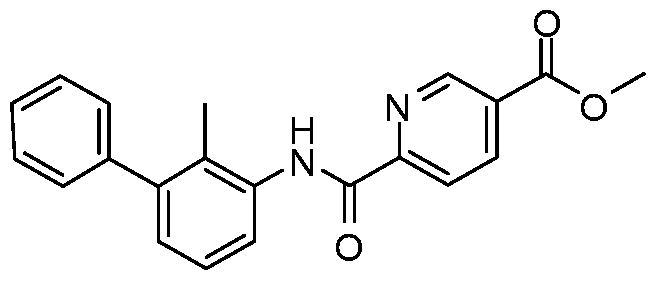
N,N-Diisopropylethylamine (200 μί, 1 mmol) was added to a mixture of 2- methylbiphenyl-3-amine (70 mg, 0.4 mmol), 5-(methoxycarbonyl)pyridine-2-carboxylic acid (Oakwood Chemical, cat#017196, 75 mg, 0.42 mmol), and N,N,N',N'-tetramethyl-0-(7- azabenzotriazol-l -yl)uronium hexafluorophosphate (220 mg, 0.57 mmol) in N,N- dimethylformamide (2 mL, 20 mmol). The reaction mixture was allowed to stir at room temperature (rt) overnight. The reaction mixture was quenched with saturated aqueous NaHCC , and extracted with ethyl acetate (3 x 20 mL). The combined organic layers were washed with brine, dried over MgSCn, filtered and concentrated under reduced pressure. The residue was purified by flash chromatography on a silica gel column with ethyl acetate in hexanes (0-35%) to afford the desired product. LC-MS calculated for C21H19N2O3 (M+H)+: m/z = 347.1 ; found 347.1.
Step 3: 5-(hydroxymethyl)-N-( -methylbiphenyl-3-yl)pyridine-2-carboxamide

1.0 M Lithium tetrahydroaluminate in THF (0.6 mL, 0.6 mmol) was added to a THF (4.0 mL) solution of methyl 6- { [(2-methylbiphenyl-3-yl)amino]carbonyl}nicotinate (100 mg, 0.3 mmol) at 0 °C. The reaction mixture was allowed to stir at 0 °C for 1 h to reach full conversion. The mixture was quenched with aqueous potassium sodium tartrate. The mixture was allowed to stir at rt for 2h. The reaction mixture was extracted with ethyl acetate (3 x 10 mL). The combined organic layers were washed with brine, dried over MgSCn, filtered and concentrated under reduced pressure. The mixture was dried, concentrated, and the residue was used in the next step without further purification. LC-MS calculated for C20H19N2O2 (M+H)+: m/z = 319.1 ; found 319.0.
Step 4: 5-formyl-N-(2-methylbiphenyl-3-yl)pyridine-2-carboxamide
 Dess-Martin periodinane (76 mg, 0.18 mmol) was added to a mixture of 5- (hydroxymethyl)-N-(2-methylbiphenyl-3-yl)pyridine-2-carboxarnide (48 mg, 0.15 mmol), sodium bicarbonate (40 mg, 0.4 mmol), and methylene chloride (1 mL, 20 mmol), and the mixture was allowed to stir at rt for 2 h to reach full conversion. After concentration, the residue was dissolved in DCM and filtered. The organic layer was concentrated to afford desired product which was used in the next step without further purification. LC-MS calculated for C20H17N2O2 (M+H)+: m/z = 317.1; found 317.0.
Step 5: (2S)-l-[ ( 6-{[ (2-methylbiphenyl-3-yl)amino ]carbonyl}pyridin-3-yl)methyl]piperidine- 2-carboxylic acid
H
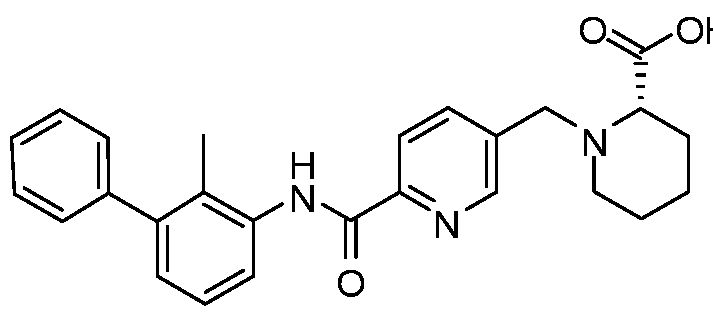
(2S)-Piperidine-2-carboxylic acid (20 mg, 0.1 mmol), sodium triacetoxyborohydride (60 mg, 0.3 mmol) and one drop of acetic acid were added to a methylene chloride (1 mL) solution of 5-formyl-N-(2-methylbiphenyl-3-yl)pyridine-2-carboxamide, and the mixture was allowed to stir at rt overnight. The reaction mixture was purified by prep-HPLC (pH = 10, acetonitrile/water+NLUOH) to give the desired product. LC-MS calculated for C26H28N3O3 (M+H)+: m/z = 430.2; found 430.2.
Example 2: 5-{ [(2-hydroxyethyl)amino]methyl}-N-(2-methylbiphenyl-3-yl)pyridine-2- carboxamide

Ethanolamine (20 μί, 0.3 mmol) and sodium triacetoxyborohydride (60 mg, 0.3 mmol) were added to a methylene chloride (1 mL) solution of 5-formyl-N-(2- methylbiphenyl-3-yl)pyridine-2-carboxamide (Example 1, Step 4), and the mixture was allowed to stir at rt overnight. The reaction mixture was purified by prep-HPLC (pH = 10, acetonitrile/water+NLUOH) to give the desired product. LC-MS calculated for C22H24N3O2 (M+H)+: m/z = 362.2; found 362.2.
Example 3: (2S)-l-[(5-methyl-6-{ [(2-methylbiphenyl-3-yl)amino]carbonyl}pyridin-3- yl)methyl] piperidine-2-carboxylic acid

Step 1: 5-bromo-3-methyl-N-(2-methylbiphenyl-3-yl)pyridine-2-carboxamide
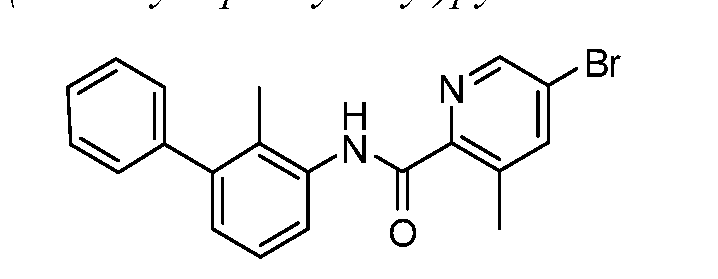
This compound was prepared using a similar procedure as described for Example 1, Step 2 with 5-bromo-2-carboxy-3-methylpyridine replacing 5-(methoxycarbonyl)pyridine-2- carboxylic acid. LC-MS calculated for C2oHi8BrN20 (M+H)+: m/z = 381.0; found: 381.1.
Step 2: 3-methyl-N-( 2-methylbiphenyl-3-yl)-5-vinylpyridine-2-carboxamide

A mixture of 5-bromo-3-methyl-N-(2-methylbiphenyl-3-yl)pyridine-2-carboxamide (150 mg, 0.39 mmol), l,l'-bis(diphenylphosphino)ferrocene]dichloropalladium(II) complexed with DCM (20 mg, 0.02 mmol), sodium bicarbonate, and 4,4,5, 5-tetramethyl-2- vinyl-l,3,2-dioxaborolane (70 \L, 0.4 mmol) in dioxane (2.83 mL, 29.6 mmol) and water (1 mL, 60 mmol) was degassed and sealed. It was stirred at 95 °C overnight. The reaction mixture was diluted with EtOAc and washed with water and brine. The organic layer was separated and concentrated to afford desired product, which was used in the next step without further purification. LC-MS calculated for C22H21N2O (M+H)+: m/z = 329.2; found: 329.2.
Step 3: 5-formyl-3-methyl-N-(2-methylbiphenyl-3-yl)pyridine-2-carboxamide
 3-Methyl-N-(2-methylbiphenyl-3-yl)-5-vinylpyridine-2-carboxamide (100 mg, 0.4 mmol) was dissolved in 1,4-dioxane (6 mL, 80 mmol) and water (1 mL, 70 mmol). To this mixture was added a mixture of osmium tetraoxide (4% w/w in water, 0.38 mL, 0.06 mmol). After stirring for 5 min, sodium periodate (342 mg, 1.60 mmol) was added and the mixture was allowed to stir for 1 h to reach full conversion. The reaction mixture was extracted with ethyl acetate, and the combined organic layers were washed with brine, dried over MgS04, filtered and concentrated under reduced pressure to afford desired product, which was used in the next step without further purification. LC-MS calculated for C21H19N2O2 (M+H)+: m/z = 331.1; found: 331.1.
Step 4: (2S)-l-[(5-methyl-6-{[(2-methylbiphenyl-3-yl)amino j 'carbonyl}pyridin-3- yljmethyl ]piperidine-2-carboxylic acid
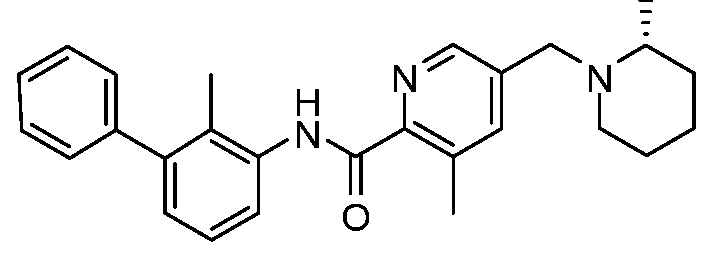
This compound was prepared using a similar procedure as described for Example 1, Step 5, with 5-formyl-3-methyl-N-(2-methylbiphenyl-3-yl)pyridine-2-carboxamide replacing 5-formyl-N-(2-methylbiphenyl-3-yl)pyridine-2-carboxamide. The reaction mixture was purified by prep-HPLC (pH = 10, acetonitrile/water+NLUOH) to give the desired product. LC-MS calculated for C27H30N3O3 (M+H)+: m/z = 444.2; found 444.2.
Example 4: 5-{ [(2-hydroxyethyl)amino]methyl}-3-methyl-N-(2-methylbiphenyl-3- yl)pyridine-2-carboxamide
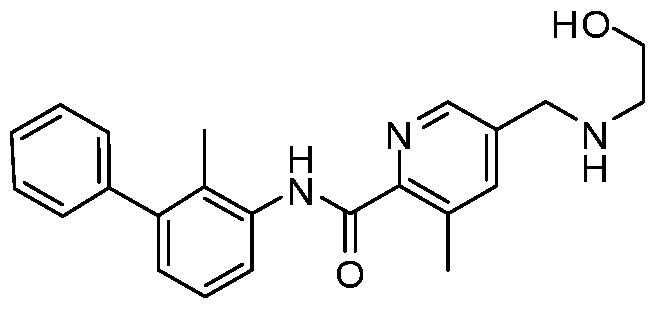
Ethanolamine (20 μί, 0.3 mmol) and sodium triacetoxyborohydride (60 mg, 0.3 mmol) were added to a methylene chloride (1 mL) solution of 5-formyl-3-methyl-N-(2- methylbiphenyl-3-yl)pyridine-2-carboxamide (Example 3, Step 3), and the mixture was allowed to stir at rt overnight. The reaction mixture was purified by prep-HPLC (pH = 10,
acetonitrile/water+NH40H) to give the desired product. LC-MS calculated for C23H26N3O2 (M+H)+: m/z = 376.2; found 376.1.
Example 5: (2S)-l-[(2-{[(2-methylbiphenyl-3-yl)amino]carbonyl}pyrimidin-5- yl)methyl] piperidine-2-carboxylic acid
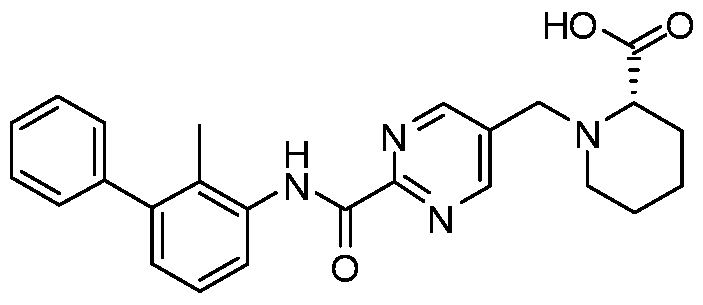
Step 1: 5-bromo-N-(2-methylbiphenyl-3-yl)pyrimidine-2-carboxamide
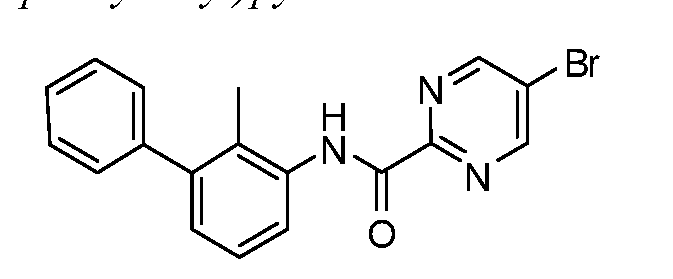
This compound was prepared using a similar procedure as described for Example 1, Step 2, with 5-bromopyrimidine-2-carboxylic acid (Ark Pharma, cat#AK-21808) replacing 5- (methoxycarbonyl)pyridine-2-carboxylic acid. LC-MS calculated for CisHisBrNsO (M+H)+: m/z = 368.0: found 368.0.
Step 2: N-(2-methylbiphenyl-3-y -5-vinylpyrimidine-2-carboxamide

This compound was prepared using a similar procedure as described for Example 3, Step 2, with 5-bromo-N-(2-methylbiphenyl-3-yl)pyrimidine-2-carboxarnide replacing 5- bromo-3-methyl-N-(2-methylbiphenyl-3-yl)pyridine-2-carboxamide. LC-MS calculated for C20H18N3O (M+H)+: m/z = 316.1 ; found 316.1.
Step 3: 5-formyl-N-(2-methylbiphenyl-3-yl)pyrimidine-2-carboxamide
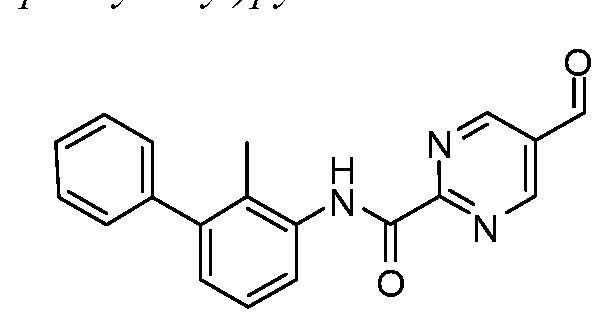
Step 4: (2S)-l-[(2-{[(2-methylbiphenyl-3-yl)amino ]carbonyl}pyrimidin-5- yljmethyl ]piperidine-2-carboxylic acid
HO O

This compound was prepared using a similar procedure as described for Example 1, Step 5, with 5-formyl-N-(2-methylbiphenyl-3-yl)pyrimidine-2-carboxarnide replacing 5- formyl-N-(2-methylbiphenyl-3-yl)pyridine-2-carboxamide. The reaction mixture was purified by prep-HPLC (pH = 10, acetonitrile/water+NLUOH) to give the desired product. LC-MS calculated for C25H27N4O3 (M+H)+: m/z = 431.2; found 431.1. Example 6: 5-{[(2-hydroxyethyl)amino]methyl}-N-(2-methylbiphenyl-3-yl)pyrimidine-2- carboxamide
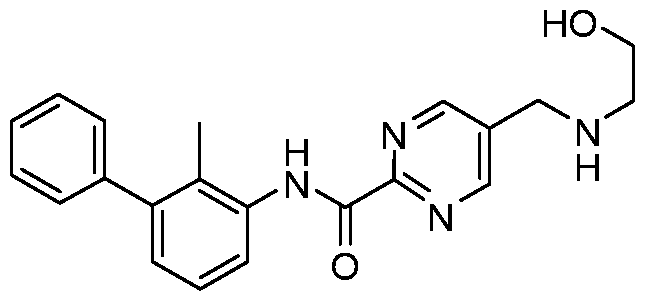
This compound was prepared using a similar procedure as described for Example 4 with 5-formyl-N-(2-methylbiphenyl-3-yl)pyrimidine-2-carboxarnide (Example 5, Step 3) replacing 5-formyl-3-methyl-N-(2-methylbiphenyl-3-yl)pyridine-2-carboxamide. The reaction mixture was purified by prep-HPLC (pH = 10, acetonitrile/water+NLUOH) to give the desired product. LC-MS calculated for C21H23N4O2 (M+H)+: m/z = 363.2; found 363.2.
Example 7: (2S)-l-[(6-{[(2-cyanobiphenyl-3-yl)amino]carbonyl}pyridin-3- yl)methyl]piperidine-2-carboxylic acid

Step 1: 3-aminobiphenyl-2-carbonitri

This compound was prepared using a similar procedure as described for Example 1, Step 1, with 2-amino-6-bromobenzonitrile (Astatech, cat#CL8148) replacing 3-bromo-2- methylaniline. LC-MS calculated for C13H11N2 (M+H)+: m/z = 195.1 ; found 195.1.
Step 2: 5-bromo-N-(2-cyanobiphenyl-3-yl)pyridine-2-carboxamide
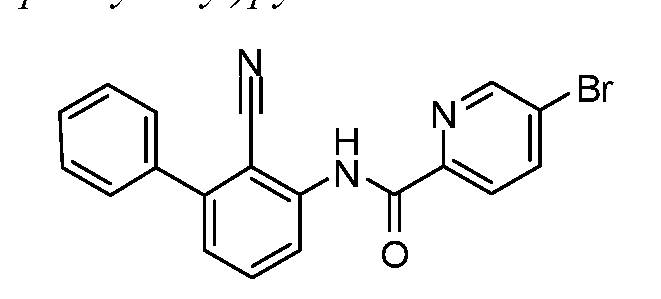
N,N-Diisopropylethylamine (200 \L, 1 mmol) was added to a mixture of 3- aminobiphenyl-2-carbonitrile (80 mg, 0.4 mmol), 5-bromopyridine-2-carboxylic acid (Frontier Scientific cat#B1704, 96 mg, 0.47 mmol), and N,N,N',N'-tetramethyl-0-(7- azabenzotriazol-l -yl)uronium hexafluorophosphate (250 mg, 0.65 mmol) in N,N- dimethylformamide (2 mL, 20 mmol). The reaction mixture was allowed to stir at rt overnight. The reaction mixture was quenched with saturated aqueous NaHCCb, and extracted with ethyl acetate (3 x 20 mL). The combined organic layers were washed with brine, dried over MgS04, filtered and concentrated under reduced pressure. The residue was purified by flash chromatography on a silica gel column with ethyl acetate in hexanes (0- 35%) to afford the desired product. LC-MS calculated for Ci9Hi3BrN30 (M+H)+: m/z = 378.0; found 378.0.
Step 3: N-(2-cyanobiphenyl-3-yl -5-vinylpyridine-2-carboxamide

C21H16N3O (M+H)+: m/z = 326.1 ; found 326.1.
Step 4: N-(2-cyanobiphenyl-3-yl -5-formylpyridine-2-carboxamide
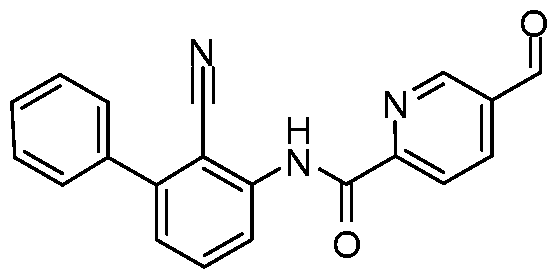
This compound was prepared using a similar procedure as described for Example 3, Step 3, with N-(2-cyanobiphenyl-3-yl)-5-vinylpyridine-2-carboxamide replacing 3-methyl-N- (2-methylbiphenyl-3-yl)-5-vinylpyridine-2-carboxamide. LC-MS calculated for C20H14N3O2 (M+H)+: m/z = 328.1; found 328.1.
Step 5: (2S)-l-[ ( 6-{ [(2-cyanobiphenyl-3-yl)amino ]carbonyl}pyridin-3-yl)methyl]piperidine- 2-carboxylic acid

This compound was prepared using a similar procedure as described for Example 1, Step 5, with N-(2-cyanobiphenyl-3-yl)-5-formylpyridine-2-carboxamide replacing 5-formyl- N-(2-methylbiphenyl-3-yl)pyridine-2-carboxamide. The reaction mixture was purified by prep-HPLC (pH = 10, acetonitrile/water+NI UOH) to give the desired product. LC-MS calculated for C26H25N4O3 (M+H)+: m/z = 441.2; found 441.1.
Example 8: N-(2-cyanobiphenyl-3-yl)-5-{ [(2-hydroxyethyl)amino]methyl}pyridine-2- carboxamide
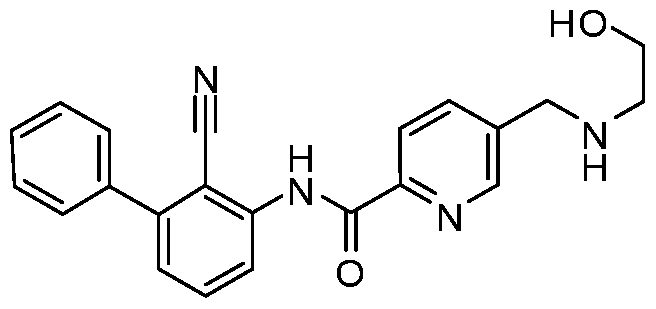
Example 9: (2S)-l-{[6-({[2-cyano-3-(2,3-dihydro-l,4-benzodioxin-6- yl)phenyl]amino}carbonyl)pyridin-3-yl]methyl}piperidine-2-carboxylic acid
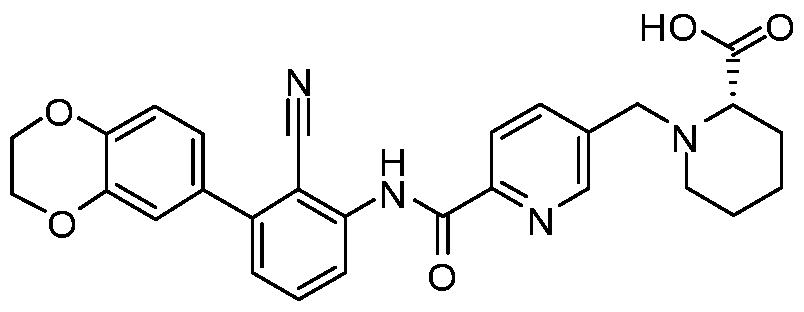
Step 1 : 2-amino-6-(2, 3-dihydro-l, -benzodioxin-6-yl)benzonitrile
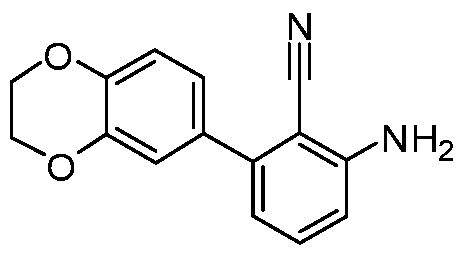
This compound was prepared using a similar procedure as described for Example 1, Step 1, with 2,3-dihydro-l,4-benzodioxin-6-ylboronic acid (Sigma-Aldrich, cat#635995) replacing phenylboronic acid, and with 2-amino-6-bromobenzonitrile (Astatech, cat#CL8148) replacing 3-bromo-2-methylaniline. LC-MS calculated for C15H13N2O2 (M+H)+: m/z = 253.1; found 253.1.
Step 2: 5-bromo-N-[2-cyano-3-(2, 3-dihydro-l, 4-benzodioxin-6-yl)phenyl]pyridine-2- carboxamide
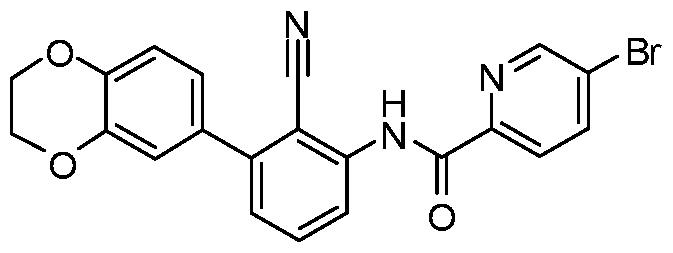
N,N-Diisopropylethylamine (200 \L, 1 mmol) was added to a mixture of 2-amino-6 (2,3-dihydro-l,4-benzodioxin-6-yl)benzonitrile (100 mg, 0.4 mmol), 5-bromopyridine-2- carboxylic acid (Frontier Scientific cat#B1704, 96 mg, 0.47 mmol), and Ν,Ν,Ν',Ν'- tetramethyl-0-(7-azabenzotriazol-l-yl)uronium hexafluorophosphate (250 mg, 0.65 mmol) N,N-dimethylformamide (2 mL, 20 mmol). The reaction mixture was allowed to stir at rt overnight. The reaction mixture was quenched with saturated aqueous NaHCCb, and
extracted with ethyl acetate (3x 20 mL). The combined organic layers were washed with brine, dried over MgS04, filtered and concentrated under reduced pressure. The residue was purified by flash chromatography on a silica gel column with ethyl acetate in hexanes (0- 35%) to afford the desired product. LC-MS calculated for C2iHi5BrN303 (M+H)+: m/z = 436.0; found 436.0.
Step 3: N-[2-cyano-3-(2, 3-dihydro-l, 4-benzodioxin-6-yl)phenyl]-5-vinylpyridine-2- carboxamide
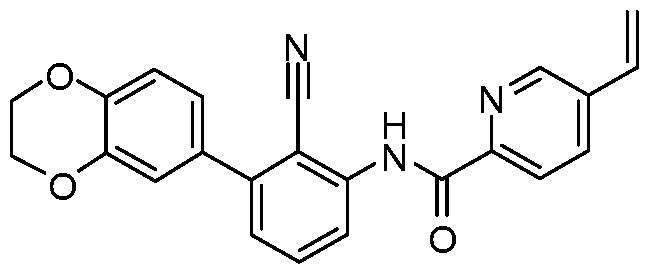
This compound was prepared using a similar procedure as described for Example 3,
Step 2, with 5-bromo-N-[2-cyano-3-(2,3-dihydro-l,4-benzodioxin-6-yl)phenyl]pyridine-2- carboxamide replacing 5-bromo-3-methyl-N-(2-methylbiphenyl-3-yl)pyridine-2- carboxamide. LC-MS calculated for C23H18N3O3 (M+H)+: m/z = 384.1 ; found 384.1. Step 4: N-[ 2-cyano-3-(2, 3-dihydro-l, 4-benzodioxin-6-yl)phenyl ] -5-formylpyridine-2- carboxamide
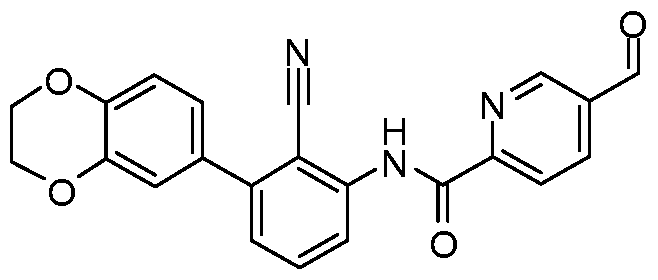
This compound was prepared using a similar procedure as described for Example 3, Step 3, with N-[2-cyano-3-(2,3-dihydro-l,4-benzodioxin-6-yl)phenyl]-5-vinylpyridine-2- carboxamide replacing 3-methyl-N-(2-methylbiphenyl-3-yl)-5-vinylpyridine-2-carboxamide. LC-MS calculated for C22H16N3O4 (M+H)+: m/z = 386.1 ; found 386.1.
Step 5: (2S)-l-{[ 6-({ [2-cyano-3-(2, 3-dihydro-l, 4-benzodioxin-6- yl)phenyl]amino}carbonyl)pyridin-3-yl]methyl}piperidine-2-carboxylic acid

Example 10: N-(2-cyano-3-(2,3-dihydrobenzo[b] [l,4]dioxin-6-yl)phenyl)-5-((2- hydroxyethylamino)meth l)picolinamide
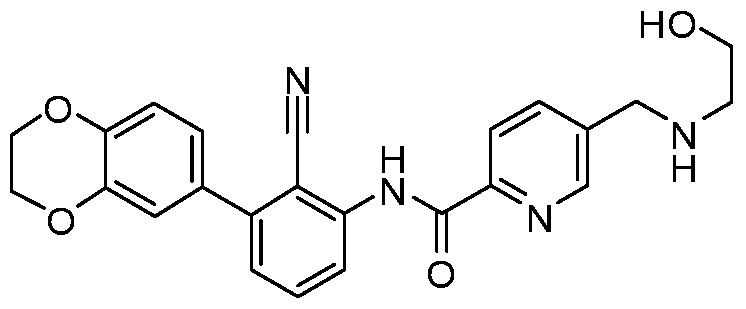
This compound was prepared using a similar procedure as described for Example 4 with N-[2-cyano-3-(2,3-dihydro-l,4-benzodioxin-6-yl)phenyl]-5-formylpyridine-2- carboxamide (Example 9, Step 4) replacing 5-formyl-3-methyl-N-(2-methylbiphenyl-3- yl)pyridine-2-carboxamide. The reaction mixture was purified by prep-HPLC (pH = 10, acetonitrile/water+NEUOH) to give the desired product. LC-MS calculated for C22H21N4O2 (M+H)+: m/z = 431.2; found 431.2.
Example 11 : 5- { [(2-hydroxyethyl)amino] methyl}-N-(2-methylbiphenyl-3-yl)pyrazine-2- carboxamide
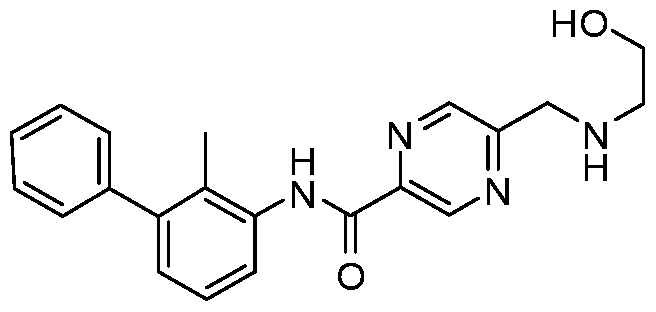
Step 1: pyrazine-2, 5-dicarboxylic acid

Sulfuric acid (19 μί, 0.36 mmol) was added to a methanol (1.2 mL, 29 mmol) solution of pyrazine-2,5-dicarboxylic acid (Ark Pharma cat# AK-76746, 100 mg, 0.6 mmol). Then the mixture was allowed to stir at 90 °C overnight. After cooling to rt, the mixture was diluted with methanol and basified with NaOH aq. Then the mixture was allowed to stir at rt
for 5 h to reach -50% conversion to afford the mono-ester. Then the mixture was acidified with HC1 aq, and extracted with DCM/iPrOH x 3. The organic layer was dried and concentrated to afford desired product, which was used in the next step without further purification. LC-MS calculated for C7H7N2O4 (M+H)+: m/z = 183.0; found 183.0.
Step 2: methyl 5-{[(2-methylbiphenyl-3-yl)amino]carbonyl}pyrazine-2-carboxylate

This compound was prepared using a similar procedure as described for Example 1, Step 2, with pyrazine-2,5-dicarboxylic acid replacing 5-(methoxycarbonyl)pyridine-2- carboxylic acid. LC-MS calculated for C20H18N3O3 (M+H)+: m/z = 348.1 ; found 348.1.
Step 3: 5-(hydroxymethyl)-N-( -methylbiphenyl-3-yl)pyrazine-2-carboxamide

This compound was prepared using a similar procedure as described for Example 1, Step 3, with methyl 5- {[(2-methylbiphenyl-3-yl)amino]carbonyl}pyrazine-2-carboxylate replacing methyl 6- { [(2-methylbiphenyl-3-yl)amino]carbonyl}nicotinate. Part of the reaction mixture was purified by prep-HPLC (pH = 10, acetonitrile/water+NL OH) to give the desired product. LC-MS calculated for C19H18N3O2 (M+H)+: m/z = 320.1 ; found 320.1.
Step 4: 5-formyl-N-(2-methylbiphenyl-3-yl)pyrazine-2-carboxamide

This compound was prepared using a similar procedure as described for Example 1, Step 4, with 5-(hydroxymethyl)-N-(2-methylbiphenyl-3-yl)pyrazine-2-carboxamide replacing 5-(hydroxymethyl)-N-(2-methylbiphenyl-3-yl)pyridine-2-carboxamid. LC-MS calculated for C19H16N3O2 (M+H)+: m/z = 318.1 ; found 318.1.
Step 5: 5 -{[(2-hydroxy ethyl) amino ]methyl}-N-(2-methylbiphenyl-3-yl)pyrazine-2- carboxamide
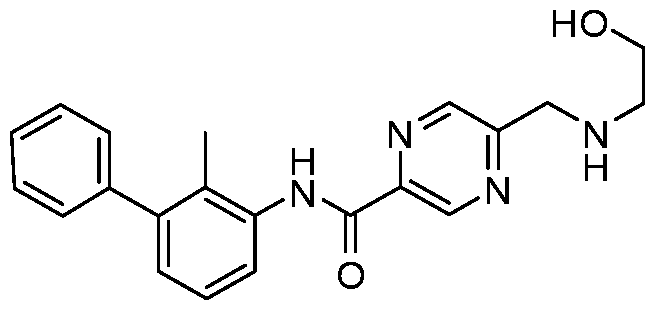
This compound was prepared using a similar procedure as described for Example 4 with 5-formyl-N-(2-methylbiphenyl-3-yl)pyrazine-2-carboxamide replacing 5-formyl-3- methyl-N-(2-methylbiphenyl-3-yl)pyridine-2-carboxamide. The reaction mixture was purified by prep-HPLC (pH = 10, acetonitrile/water+NLUOH) to give the desired product. LC-MS calculated for C21H23N4O2 (M+H)+: m/z = 363.2; found 363.2. Example 12: 6-{ [(2-hydroxyethyl)amino]methyl}-N-(2-methylbiphenyl-3-yl)pyridazine- 3-carboxamide

Step 1: 6-(methoxycarbonyl)pyridazi -3-carboxylic acid
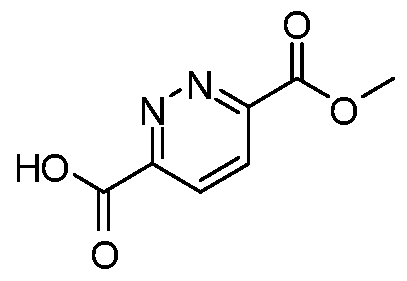
This compound was prepared using a similar procedure as described for Example 11 , Step 1, with pyridazine-3,6-dicarboxylic acid (Astatech, cat# 37156) replacing pyrazine-2,5- dicarboxylic acid. The reaction mixture was purified by prep-HPLC (pH = 10,
acetonitrile/water+NLUOH) to give the desired product. LC-MS calculated for C7H7N2O4 (M+H)+: m/z = 183.0; found 183.0.
Step 2: methyl 6-{[(2-methylbiphenyl-3-yl)amino]carbonyl}pyridazine-3-carboxylate
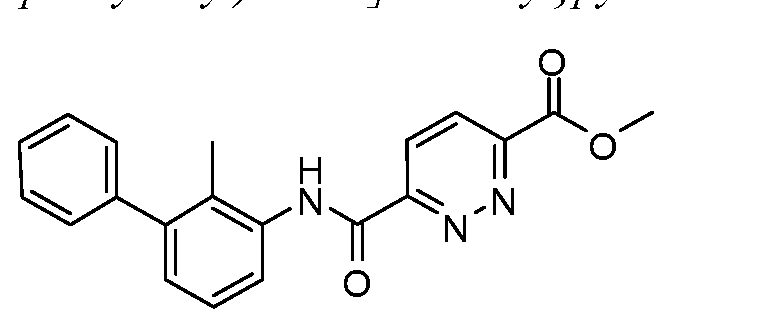
Step 3: 6-(hydroxymethyl)-N-( -methylbiphenyl-3-yl)pyridazine-3-carboxamide

This compound was prepared using a similar procedure as described for Example 1, Step 3, with methyl 6- {[(2-methylbiphenyl-3-yl)amino]carbonyl}pyridazine-3-carboxylate replacing methyl 6- { [(2-methylbiphenyl-3-yl)amino]carbonyl}nicotinate. LC-MS calculated for C19H18N3O2 (M+H)+: m/z = 320.1 ; found 320.1.
Step 4: 6-formyl-N-(2-methylbiphenyl-3-yl)pyridazine-3-carboxamide

This compound was prepared using a similar procedure as described for Example 1, Step 4, with 6-(hydroxymethyl)-N-(2-methylbiphenyl-3-yl)pyridazine-3-carboxamide replacing 5-(hydroxymethyl)-N-(2-methylbiphenyl-3-yl)pyridine-2-carboxarnide. LC-MS calculated for C19H16N3O2 (M+H)+: m/z = 318.1 ; found 318.1.
Step 5: 6-{ [(2-hydroxyethyl)amino ]methyl}-N-(2-methylbiphenyl-3-yl)pyridazine-3- carboxamide
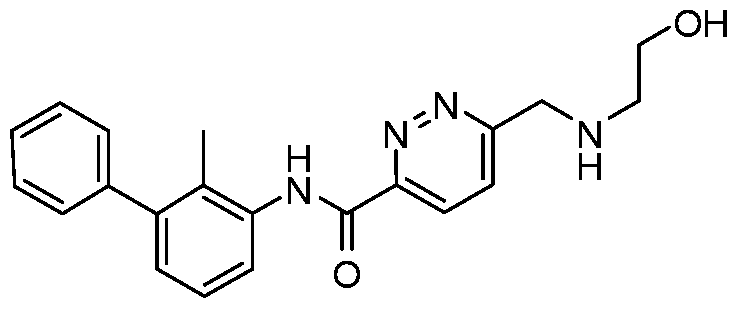
This compound was prepared using a similar procedure as described for Example 4 with 6-formyl-N-(2-methylbiphenyl-3-yl)pyridazine-3-carboxamide replacing 5-formyl-3- methyl-N-(2-methylbiphenyl-3-yl)pyridine-2-carboxamide. The reaction mixture was
purified by prep-HPLC (pH = 10, acetonitrile/water+NLUOH) to give the desired product. LC-MS calculated for C21H23N4O2 (M+H)+: m/z = 363.2; found 363.2.
Example 13: (2S)-l-[(2-methyl-6-{[(2-methylbiphenyl-3-yl)amino]carbonyl}pyridin-3- yl)methyl] piperidine-2-car xylic acid
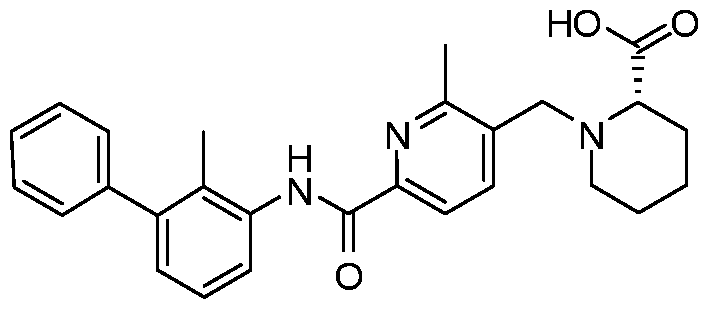
Step 1: 5-bromo-6-methyl-N-(2-methylbiphenyl-3-yl)pyridine-2-carboxamide

This compound was prepared using a similar procedure as described for Example 1, Step 2, with 5-bromo-6-methylpyridine-2-carboxylic acid (Ark Pharma cat#Ak-61563) replacing 5-(methoxycarbonyl)pyridine-2-carboxylic acid. LC-MS calculated for
C2oHi8BrN20 (M+H)+: m/z = 381.0; found 381.0.
Step 2: 6-methyl-N-( 2-methylbiphenyl-3-yl)-5-vinylpyridine-2-carboxamide

This compound was prepared using a similar procedure as described for Example 3, Step 2, with 5-bromo-6-methyl-N-(2-methylbiphenyl-3-yl)pyridine-2-carboxamide replacing 5-bromo-3-methyl-N-(2-methylbiphenyl-3-yl)pyridine-2-carboxamide. LC-MS calculated for C22H21N2O (M+H)+: m/z = 329.2; found 329.2.
Step 3: 5-formyl-6-methyl-N-(2-meth lbiphenyl-3-yl)pyridine-2-carboxamide

Step 4: (2S)-l-[(2-methyl-6-{[(2-methylbiphenyl-3-yl)amino ]carbonyl}pyridin-3- yljmethyl ]piperidine-2-carboxylic acid
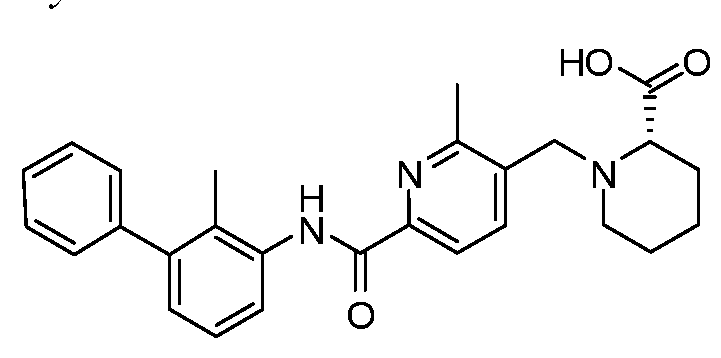
This compound was prepared using a similar procedure as described for Example 1, Step 5, with 5-formyl-6-methyl-N-(2-methylbiphenyl-3-yl)pyridine-2-carboxamide replacing 5-formyl-N-(2-methylbiphenyl-3-yl)pyridine-2-carboxamide. The reaction mixture was purified by prep-HPLC (pH = 10, acetonitrile/water+NLUOH) to give the desired product. LC-MS calculated for C27H30N3O3 (M+H)+: m/z = 444.2; found 444.2. Example 14: 5-{ [(2-hydroxyethyl)amino]methyl}-6-methyl-N-(2-methylbiphenyl-3- yl)pyridine-2-carboxamide

This compound was prepared using a similar procedure as described for Example 4 with 5-formyl-6-methyl-N-(2-methylbiphenyl-3-yl)pyridine-2-carboxamide (Example 13, Step 3) replacing 5-formyl-3-methyl-N-(2-methylbiphenyl-3-yl)pyridine-2-carboxamide. The reaction mixture was purified by prep-HPLC (pH = 10, acetonitrile/water+NLUOH) to give the desired product. LC-MS calculated for C23H26N3O2 (M+H)+: m/z = 376.2; found 376.2.
Example 15: (2S)-l-[(5-chloro-6-{[(2-methylbiphenyl-3-yl)amino]carbonyl}pyridin-3- yl)methyl] piperidine-2-carboxylic acid
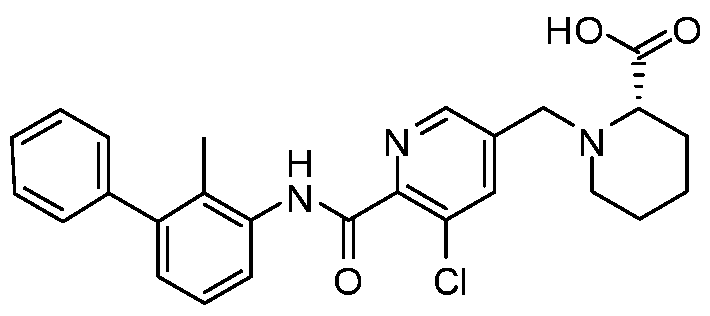
Step 1 : 5-bromo-3-chloro-N-( 2-methylbiphenyl-3-yl)pyridine-2-carboxamide

This compound was prepared using a similar procedure as described for Example 1,
Step 2, with 5-bromo-3-chloropyridine-2-carboxylic acid (Ark Pharma cat#AK-53906) replacing 5-(methoxycarbonyl)pyridine-2-carboxylic acid. LC-MS calculated for
Ci9Hi5BrClN20 (M+H)+: m/z = 401.0; found 401.1. Step 2: 3-chloro-N-(2-methylbiphenyl-3-yl)-5-vinylpyridine-2-carboxamide
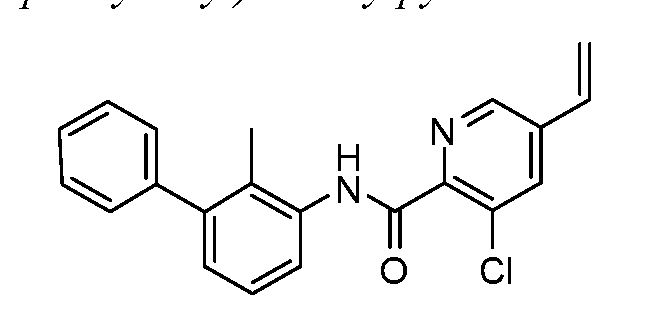
This compound was prepared using a similar procedure as described for Example 3, Step 2, with 5-bromo-3-chloro-N-(2-methylbiphenyl-3-yl)pyridine-2-carboxamide replacing 5-bromo-3-methyl-N-(2-methylbiphenyl-3-yl)pyridine-2-carboxamide. LC-MS calculated for C21H18CIN2O (M+H)+: m/z = 349.1; found 349.0.
Step 3: 3-chloro-5-formyl-N-( 2-meth lbiphenyl-3-yl)pyridine-2-carboxamide
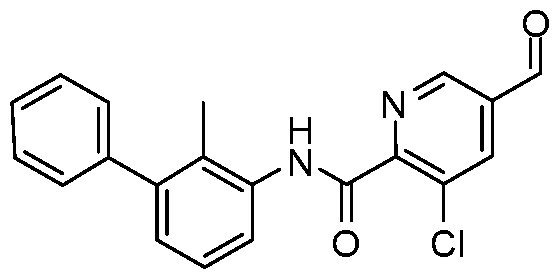
This compound was prepared using a similar procedure as described for Example 3, Step 3, with 3-chloro-N-(2-methylbiphenyl-3-yl)-5-vinylpyridine-2-carboxamide replacing 3- methyl-N-(2-methylbiphenyl-3-yl)-5-vinylpyridine-2-carboxamide. LC-MS calculated for C20H16CIN2O2 (M+H)+: m/z = 351.1; found 351.0.

This compound was prepared using a similar procedure as described for Example 1, Step 5 with 3-chloro-5-formyl-N-(2-methylbiphenyl-3-yl)pyridine-2-carboxamide replacing 5-formyl-N-(2-methylbiphenyl-3-yl)pyridine-2-carboxamide. The reaction mixture was purified by prep-HPLC (pH = 10, acetonitrile/water+NLUOH) to give the desired product. LC-MS calculated for C26H27CIN3O3 (M+H)+: m/z = 464.2; found 464.0.
Example 16: 3-chloro-5-{[(2-hydroxyethyl)amino]methyl}-N-(2-methylbiphenyl-3- yl)pyridine-2-carboxamide
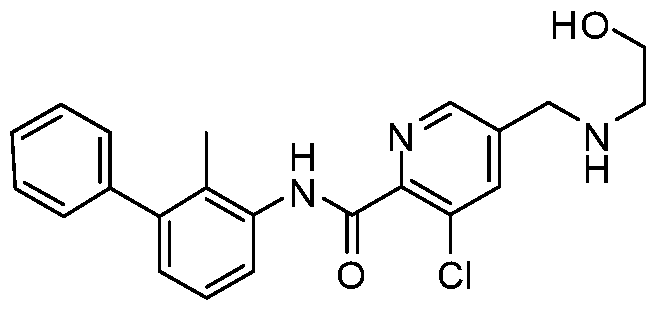
This compound was prepared using a similar procedure as described for Example 4 with 3-chloro-5-formyl-N-(2-methylbiphenyl-3-yl)pyridine-2-carboxamide (Example 15, Step 3) replacing 5-formyl-3-methyl-N-(2-methylbiphenyl-3-yl)pyridine-2-carboxamide. The reaction mixture was purified by prep-HPLC (pH = 10, acetonitrile/water+NLUOH) to give the desired product. LC-MS calculated for C22H23CIN3O2 (M+H)+: m/z = 396.1 ; found 396.1.
Example 17: 3-fluoro-5-{[(2-hydroxyethyl)amino]methyl}-N-(2-methylbiphenyl-3- yl)pyridine-2-carboxamide

Step 1: 5-bromo-3-fluoro-N-(2-methylbiphenyl-3-yl)pyridine-2-carboxamide
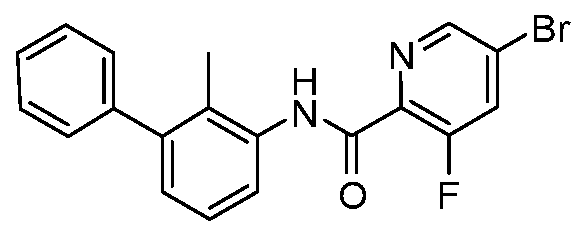
This compound was prepared using a similar procedure as described for Example 1, Step 2, with 5-bromo-3-fluoropyridine-2-carboxylic acid (Aldrich, cat#753483) replacing 5- (methoxycarbonyl)pyridine-2-carboxylic acid and prolong the reaction time to 3 days. LC- MS calculated for Ci9Hi5BrFN20 (M+H)+: m/z = 385.0; found 385.0.
Step 2: 3-fluoro-N-(2-methylbiphenyl-3-yl)-5-vinylpyridine-2-carboxamide

This compound was prepared using a similar procedure as described for Example 3, Step 2, with 5-bromo-3-fluoro-N-(2-methylbiphenyl-3-yl)pyridine-2-carboxamide replacing 5-bromo-3-methyl-N-(2-methylbiphenyl-3-yl)pyridine-2-carboxamide. LC-MS calculated for C21H18FN2O (M+H)+: m/z = 333.1 ; found 333.1.
Step 3: 3-fluoro-5-formyl-N-(2-methylbiphenyl-3-yl)pyridine-2-carboxamide

This compound was prepared using a similar procedure as described for Example 3, Step 3, with 3-fluoro-N-(2-methylbiphenyl-3-yl)-5-vinylpyridine-2-carboxamide replacing 3- methyl-N-(2-methylbiphenyl-3-yl)-5-vinylpyridine-2-carboxarnide. LC-MS calculated for C20H16FN2O2 (M+H)+: m/z = 335.1 ; found 335.1.
Step 4: 3-fluoro-5-{[(2-hydroxyethyl)amino ]methyl}-N-(2-methylbiphenyl-3-yl)pyridine-2- carboxamide

Example 18 : 4- [(3-cyanobenzyl)oxy] -5- { [(2-hydroxyethyl)amino] methyl}-N-(2- methylbiphenyl-3-yl)p
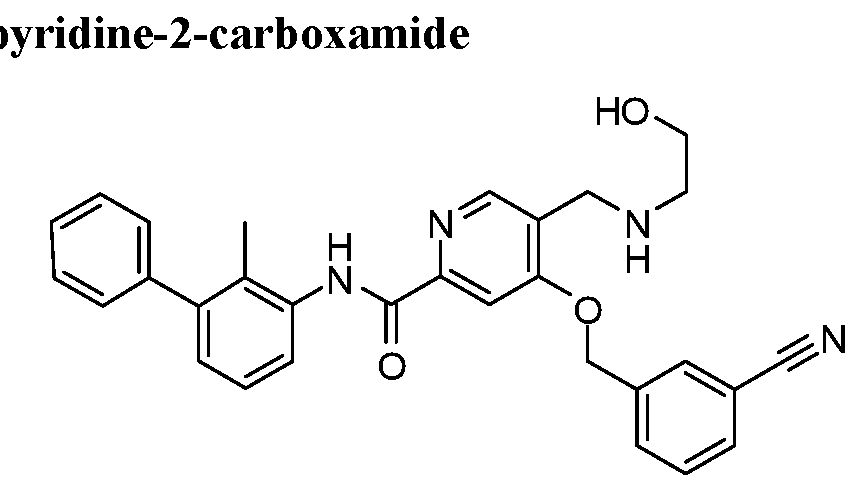
Step 1: 5-bromo-4-chloro-N-(2-methylbiphenyl-3-yl)pyridine-2-carboxamide
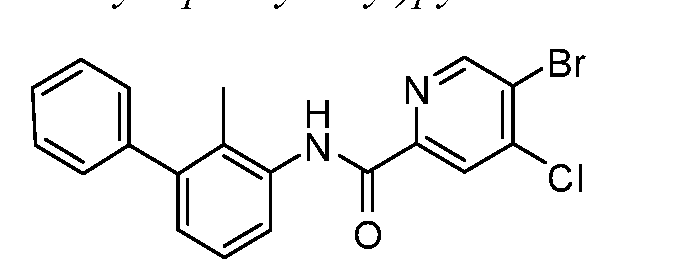
This compound was prepared using a similar procedure as described for Example 1, Step 2 with 5-bromo-4-chloropyridine-2-carboxylic acid (Ark Pharma, cat#AK-55136) replacing 5-(methoxycarbonyl)pyridine-2-carboxylic acid. LC-MS calculated for
Ci9Hi5BrClN20 (M+H)+: m/z = 401.0; found 401.0.
Step 2: 5-bromo-4-[(3-cyanobenzyl)oxy]-N-(2-methylbiphenyl-3-yl)pyridine-2-carboxamide
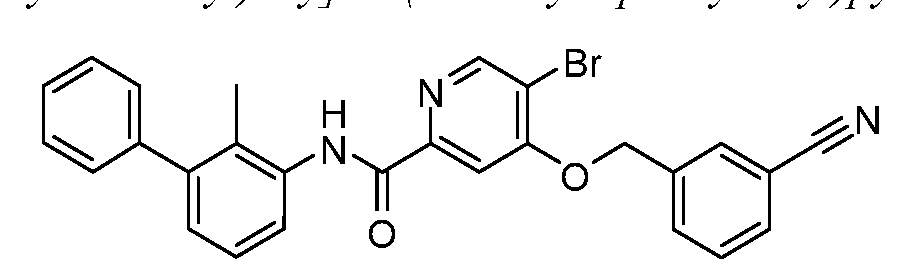
Sodium hydride (60% w/w in oil, 9 mg, 0.4 mmol) was added to a mixture of 5- bromo-4-chloro-N-(2-methylbiphenyl-3-yl)pyridine-2-carboxamide (50 mg, 0.1 mmol), 3- (hydroxymethyl)benzonitrile (TCI cat#C1510, 40 mg, 0.30 mmol) and N,N- dimethylformamide (1 mL, 10 mmol) at rt. Then the mixture was allowed to stir at room temperature for 4 h to reach full conversion. The mixture was quenched with water and extracted with EtOAc x 3, and the combined organic layers were dried and concentrated to afford desired product. LC-MS calculated for C27H2iBrN302 (M+H)+: m/z = 498.1 ; found
498.1.
Step 3: 4-[ (3-cyanobenzyl)oxy]-N-(2-methylbiphenyl-3-yl)-5-vinylpyridine-2-carbo

This compound was prepared using a similar procedure as described for Example 3, Step 2, with 5-bromo-4-[(3-cyanobenzyl)oxy]-N-(2-methylbiphenyl-3-yl)pyridine-2- carboxamide replacing 5-bromo-3-methyl-N-(2-methylbiphenyl-3-yl)pyridine-2- carboxamide. LC-MS calculated for C29H24N3O2 (M+H)+: m/z = 446.2; found 446.1.
Step 4: 4-[(3-cyanobenzyl)oxyJ-5-formyl-N-(2-methylbiphenyl-3-yl)pyridine-2-carboxamide
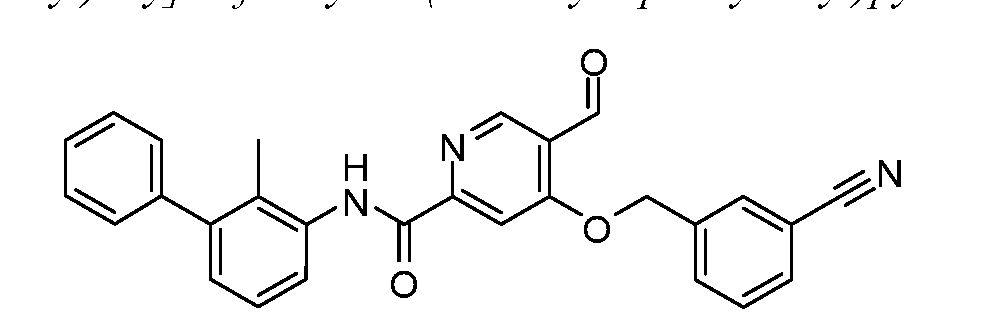
This compound was prepared using a similar procedure as described for Example 3, Step 3, with 4-[(3-cyanobenzyl)oxy]-N-(2-methylbiphenyl-3-yl)-5-vinylpyridine-2- carboxamide replacing 3-methyl-N-(2-methylbiphenyl-3-yl)-5-vinylpyridine-2-carboxamide. LC-MS calculated for C28H22N3O3 (M+H)+: m/z = 448.2; found 448.1.
Step 5: 4-[(3-cyanobenzyl)oxy]-5-{[(2-hydroxyethyl)aminoJmethylj-N-(2-methylbiphenyl-3- yl) pyridine-2-carboxami

This compound was prepared using a similar procedure as described for Example 4 with 4-[(3-cyanobenzyl)oxy]-5-formyl-N-(2-methylbiphenyl-3-yl)pyridine-2-carboxarnide replacing 5-formyl-3-methyl-N-(2-methylbiphenyl-3-yl)pyridine-2-carboxamide. The reaction mixture was purified by prep-HPLC (pH = 10, acetonitrile/water+NLUOH) to give the desired product. LC-MS calculated for C30H29N4O3 (M+H)+: m/z = 493.2; found 493.2.
Example 19: 5-{ [(2-hydroxyethyl)amino]methyl}-N-(2-methylbiphenyl-3-yl)-4-(pyridin- 3-ylmethoxy)pyridine-2-carboxamide

Step 1: 5-bromo-N-(2-methylbiphenyl-3-yl)-4-(pyridin-3-ylmethoxy)pyr

This compound was prepared using a similar procedure as described for Example 18, Step 2, with nicotinyl alcohol replacing 3-(hydroxymethyl)benzonitrile. LC-MS calculated for C25H2iBrN302 (M+H)+: m/z = 474.0; found 474.1.
Step 2: N-(2-methylbiphenyl- -yl)-4-(pyridin-3-ylmethoxy)-5-vinylpyridine-2-carboxamide

This compound was prepared using a similar procedure as described for Example 3, Step 2, with 5-bromo-N-(2-methylbiphenyl-3-yl)-4-(pyridin-3-ylmethoxy)pyridine-2- carboxamide replacing 5-bromo-3-methyl-N-(2-methylbiphenyl-3-yl)pyridine-2- carboxamide. LC-MS calculated for C27H24N3O2 (M+H)+: m/z = 422.2; found 422.1.
Step 3: 5-formyl-N-(2-methylbiphenyl-3-yl)-4-(pyridin-3-ylmethoxy)pyridim

Step 4: 5-{ [(2-hydroxyethyl)amino ]methyl}-N-(2-methylbiphenyl-3-yl)-4-(pyridin-3- ylmethoxy)pyridine-2-carboxamide
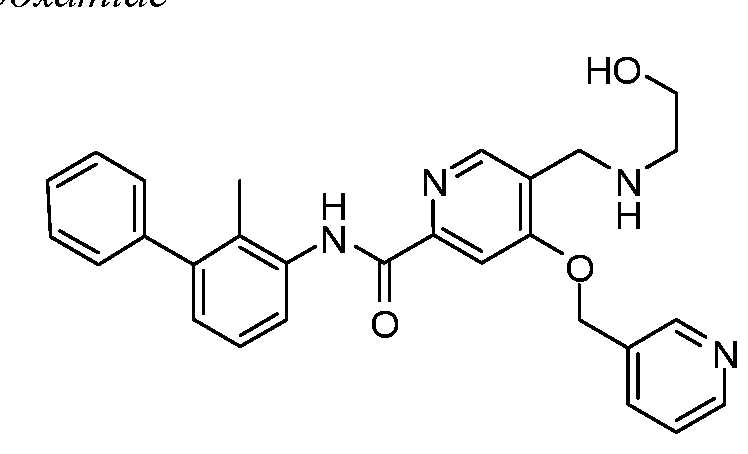
This compound was prepared using a similar procedure as described for Example 4 with 5-formyl-N-(2-methylbiphenyl-3-yl)-4-(pyridin-3-ylmethoxy)pyridine-2-carboxamide replacing 5-formyl-3-methyl-N-(2-methylbiphenyl-3-yl)pyridine-2-carboxamide. The reaction mixture was purified by prep-HPLC (pH = 10, acetonitrile/water+NLUOH) to give the desired product, which was further purified by prep-HPLC (pH = 2,
acetonitrile/water+TFA) to give the desired product as its TFA salt. LC-MS calculated for C28H29N4O3 (M+H)+: m/z = 469.2; found 469.2.
Example 20: 5-{ [(2-hydroxyethyl)amino]methyl}-N-(2-methylbiphenyl-3-yl)-4-(pyridin- 2-ylmethoxy)pyridine-2-carboxamide
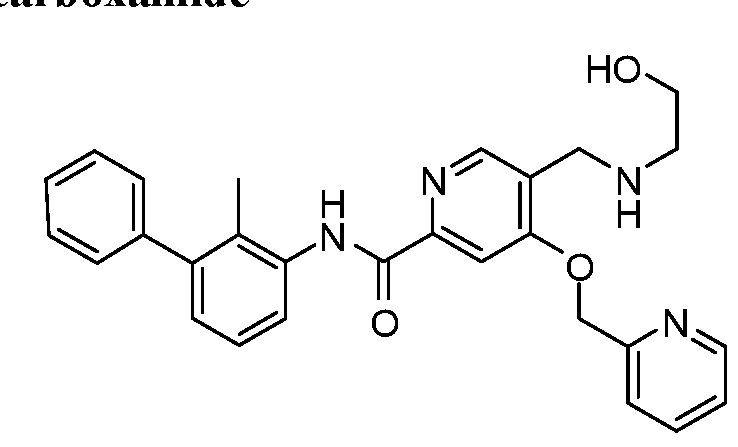
Step 1: 5-bromo-N-(2-methylbi henyl-3-yl)-4-(pyridin-2-ylmethoxy)pyridine-2-carboxamide

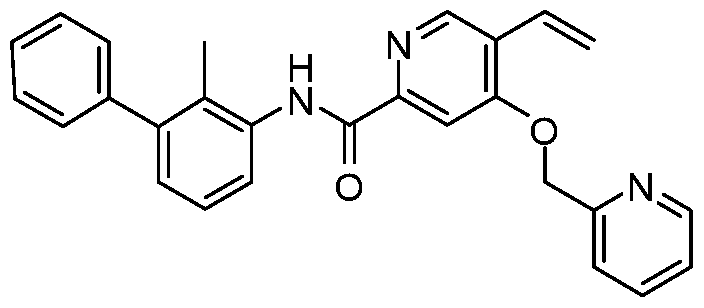
This compound was prepared using a similar procedure as described for Example 3, Step 2, with 5-bromo-N-(2-methylbiphenyl-3-yl)-4-(pyridin-2-ylmethoxy)pyridine-2- carboxamide replacing 5-bromo-3-methyl-N-(2-methylbiphenyl-3-yl)pyridine-2- carboxamide. LC-MS calculated for C27H24N3O2 (M+H)+: m/z = 422.2; found 422.1.
Step 3: 5-formyl-N-(2-methylbiphenyl-3-yl)-4-(pyridin-2-ylmethoxy)pyridine-
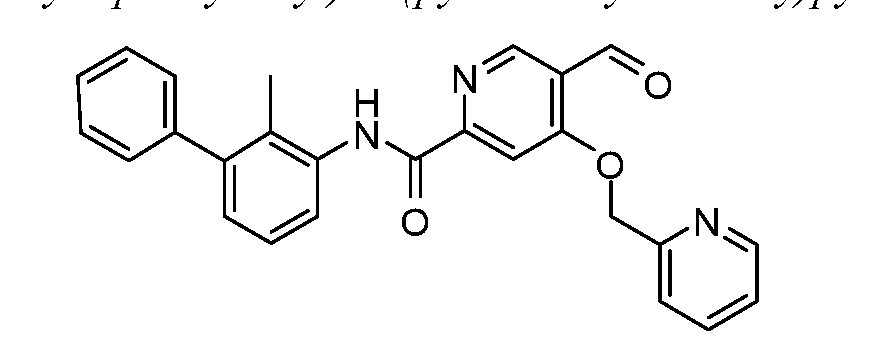
This compound was prepared using a similar procedure as described for Example 3, Step 3, with N-(2-methylbiphenyl-3-yl)-4-(pyridin-2-ylmethoxy)-5-vinylpyridine-2- carboxamide replacing 3-methyl-N-(2-methylbiphenyl-3-yl)-5-vinylpyridine-2-carboxamide. LC-MS calculated for C26H22N3O3 (M+H)+: m/z = 424.2; found 424.2.
Step 4: 5-{ [(2-hydroxyethyl)amino ]methyl}-N-(2-methylbiphenyl-3-yl)-4-(pyridin-2- ylmethoxy)pyridine-2-carboxamide
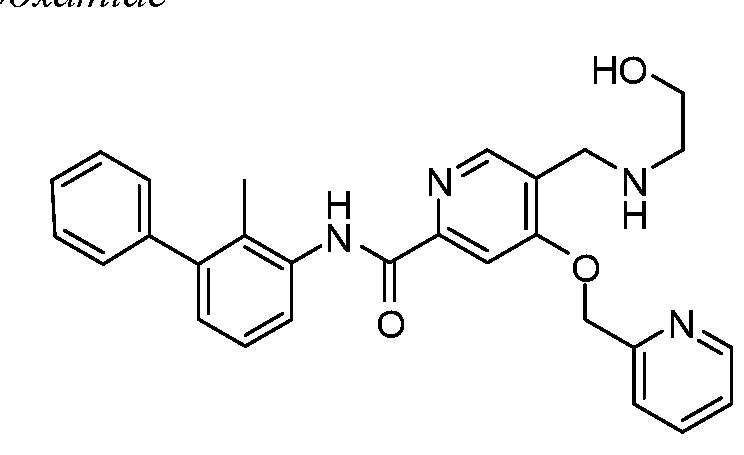
This compound was prepared using a similar procedure as described for Example 4 with 5-formyl-N-(2-methylbiphenyl-3-yl)-4-(pyridin-2-ylmethoxy)pyridine-2-carboxamide
replacing 5-formyl-3-methyl-N-(2-methylbiphenyl-3-yl)pyridine-2-carboxamide. The reaction mixture was purified by prep-HPLC (pH = 10, acetonitrile/water+NLUOH) to give the desired product. LC-MS calculated for C28H29N4O3 (M+H)+: m/z = 469.2; found 469.2. Example 21: 3-(dimethylamino)-5-{[(2-hydroxyethyl)amino]methyl}-N-(2- methylbiphenyl-3-yl)pyridi -2-carboxamide
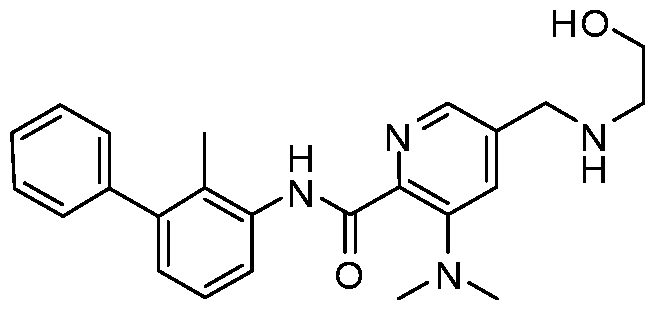
Step 1: 5-bromo-3-(dimethylami -N-(2-methylbiphenyl-3-yl)pyridine-2-carbo
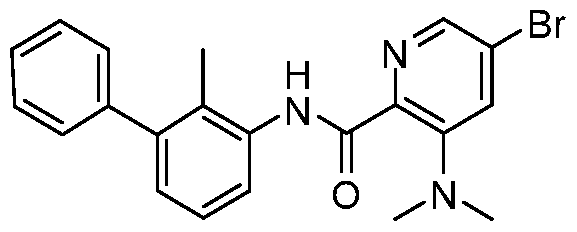
1.0 M Dimethylamine in THF (0.3 mL, 0.3 mmol) was added to 5-bromo-3-fluoro-N- (2-methylbiphenyl-3-yl)pyridine-2-carboxamide (Example 17, Step 1, 40 mg, 0.1 mmol) at rt, then the reaction was allowed to stir at rt overnight. The reaction was concentrated to afford desired product, which was used in the next step without further purification. LC-MS calculated for C2iH2iBrN30 (M+H)+: m/z = 410.1 ; found 410.1.
Step 2: 3-(dimethylamino)-N-(2-methylbiphenyl-3-yl)-5-vinylpyridine-2-carboxamide
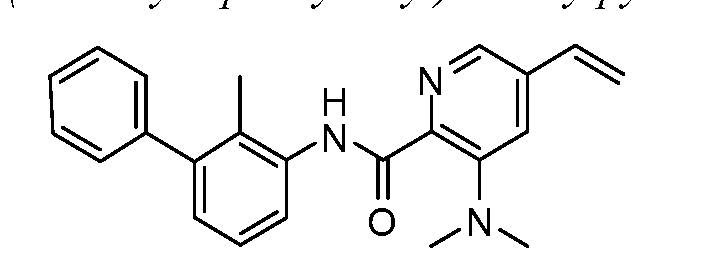
This compound was prepared using a similar procedure as described for Example 3, Step 2, with 5-bromo-3-(dimethylandno)-N-(2-methylbiphenyl-3-yl)pyridine-2-carboxamide replacing 5-bromo-3-methyl-N-(2-methylbiphenyl-3-yl)pyridine-2-carboxamide. LC-MS calculated for C23H24N3O (M+H)+: m/z = 358.2; found 358.1.
Step 3: 3-(dimethylamino)-5-formyl-N-(2-methylbiphenyl-3-yl)pyridine-2-carb

This compound was prepared using a similar procedure as described for Example 3, Step 3, with 3-(dimethylamino)-N-(2-methylbiphenyl-3-yl)-5-vinylpyridine-2-carboxamide replacing 3-methyl-N-(2-methylbiphenyl-3-yl)-5-vinylpyridine-2-carboxamide. LC-MS calculated for C22H22N3O2 (M+H)+: m/z = 360.2; found 360.1.
Step 4: 3-(dimethylamino)-5-{[(2-hydroxyethyl)amino ]methyl}-N-(2-methylbiphenyl-3- yl) pyridine-2-carboxamide
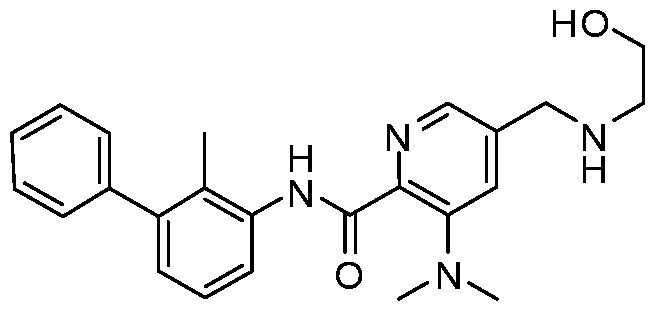
This compound was prepared using a similar procedure as described for Example 4 with 3-(dimethylamino)-5-formyl-N-(2-methylbiphenyl-3-yl)pyridine-2-carboxarnide replacing 5-formyl-3-methyl-N-(2-methylbiphenyl-3-yl)pyridine-2-carboxamide. The reaction mixture was purified by prep-HPLC (pH = 10, acetonitrile/water+NLUOH) to give the desired product. LC-MS calculated for C24H29N4O2 (M+H)+: m/z = 405.2; found 405.2.
Example 22: (2S)-l-[(2-{[(2-methylbiphenyl-3-yl)amino]carbonyl}pyridin-4- yl)methyl] piperidine-2-ca

Step 1: 4-bromo-N-(2-methylbiphenyl-3-yl)pyridine-2-carboxamide

This compound was prepared using a similar procedure as described for Example 1, Step 2, with 4-bromopyridine-2-carboxylic acid (Ark Pharm, cat#AK-23753) replacing 5- (methoxycarbonyl)pyridine-2-carboxylic acid. LC-MS calculated for Ci9Hi6BrN20 (M+H)+: m/z = 367.0; found 367.0.
Step 2: N-(2-methylbiphenyl-3- -4-vinylpyridine-2-carboxamide

This compound was prepared using a similar procedure as described for Example 3, Step 2, with 4-bromo-N-(2-methylbiphenyl-3-yl)pyridine-2-carboxamide replacing 5-bromo- 3-methyl-N-(2-methylbiphenyl-3-yl)pyridine-2-carboxamide. LC-MS calculated for
C21H19N2O (M+H)+: m/z = 315.1 ; found 315.2.
Step 3: 4-formyl-N-(2-methylbiphenyl-3-yl)pyridine-2-carboxamide

This compound was prepared using a similar procedure as described for Example 3, Step 3, with N-(2-methylbipheny 1-3 -yl)-4-vinylpyridine-2-carboxamide replacing 3-methyl- N-(2-methylbiphenyl-3-yl)-5-vinylpyridine-2-carboxamide. LC-MS calculated for
C2oHi7N202 (M+H)+: m/z = 317.1; found 317.1.
Step 4: (2S)-l-[(2-{[ (2-methylbiphenyl-3-yl)amino ]carbonyl}pyridin-4-yl)methyl]piperidine- 2-carboxylic acid

This compound was prepared using a similar procedure as described for Example 1, Step 5, with 4-formyl-N-(2-methylbiphenyl-3-yl)pyridine-2-carboxamide replacing 5-formyl- N-(2-methylbiphenyl-3-yl)pyridine-2-carboxamide. The reaction mixture was purified by prep-HPLC (pH = 10, acetonitrile/water+NEUOH) to give the desired product. LC-MS calculated for C26H28N3O3 (M+H)+: m/z = 430.2; found 430.2.
Example 23: 4-{ [(2-hydroxyethyl)amino]methyl}-N-(2-methylbiphenyl-3-yl)pyridine-2- carboxamide
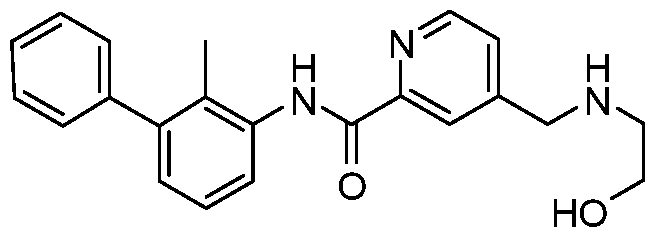
This compound was prepared using a similar procedure as described for Example 4 with 4-formyl-N-(2-methylbiphenyl-3-yl)pyridine-2-carboxamide (Example 25, Step 3) replacing 5-formyl-3-methyl-N-(2-methylbiphenyl-3-yl)pyridine-2-carboxamide. The reaction mixture was purified by prep-HPLC (pH = 10, acetonitrile/water+NEUOH) to give the desired product, which was concentrated and further purified by prep-HPLC (pH = 2, acetonitrile/water+TFA) to give the desired product as its TFA salt. LC-MS calculated for C22H24N3O2 (M+H)+: m/z = 362.2; found 362.2. Example 24: N-(2-methylbiphenyl-3-yl)-6-(pyridin-3-ylmethoxy)pyrimidine-4- carboxamide
Step 1: 6-(pyridin-3-ylme
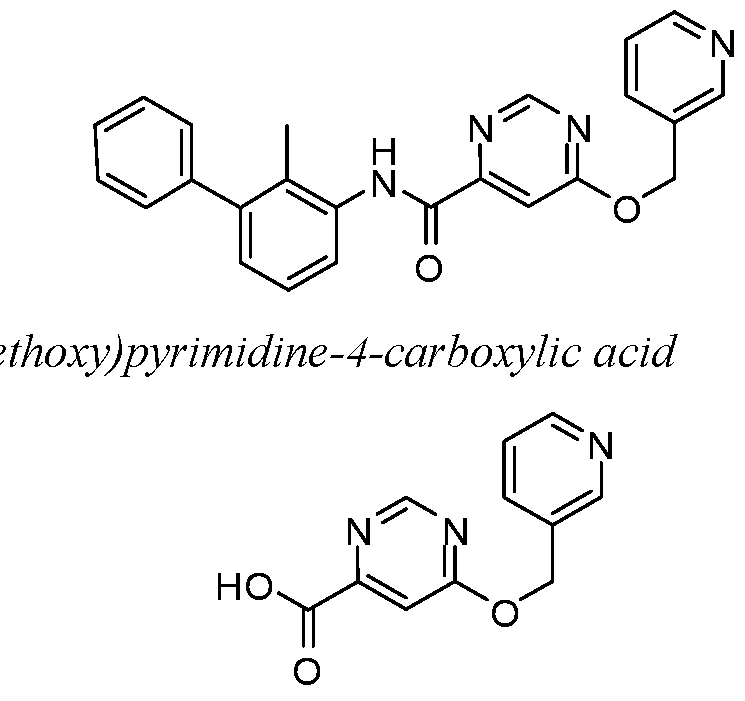
Nicotinyl alcohol (73 \L, 0.76 mmol) was added to a suspension of sodium hydride
(20 mg, 0.9 mmol) at rt, and the mixture was allowed to stir at rt for lh. Then a THF (ImL) solution of 6-chloropyrimidine-4-carboxylic acid (Matrix Scientific cat#073471 , 50 mg, 0.3 mmol) was added to the mixture, which was allowed to stir at rt for 3 h. The reaction was quenched with water and IN HCl, the mixture was extracted with DCM/iPrOH. The organic layer was dried and concentrated to afford product which was used in the next step without further purification. LC-MS calculated for C11H10N3O3 (M+H)+: m/z = 232.1 ; found 232.2.
Step 2: N-(2-methylbiphenyl-3-yl)-6-(pyridin-3-ylmethoxy)pyrimidine-4-carboxam

This compound was prepared using a similar procedure as described for Example 1, Step 2, with 6-(pyridin-3-ylmethoxy)pyrimidine-4-carboxylic acid replacing 5- (methoxycarbonyl)pyridine-2-carboxylic acid. LC-MS calculated for C24H21N4O2 (M+H)+: m/z = 397.2; found 397.1.
Example 25 : 4-cyano-N-(2-m carboxamide

This compound was prepared using a similar procedure as described for Example 1, Step 2, with 4-cyanopyridine-2-carboxylic acid (Bionet Intermediates, cat#BB-0608) replacing 5-(methoxycarbonyl)pyridine-2-carboxylic acid. The reaction mixture was purified by prep-HPLC (pH = 10, acetonitrile/water+NLUOH) to give the desired product. LC-MS calculated for C20H16N3O (M+H)+: m/z = 314.1 ; found 314.1. Example 26: N-(2-methylbiph xamide
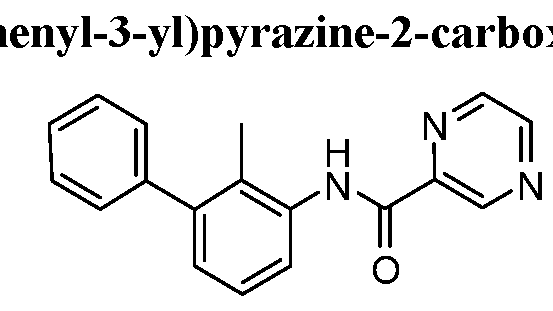
This compound was prepared using a similar procedure as described for Example 1, Step 2, with 2-pyrazinecarboxylic acid (Sigma- Aldrich, cat#P56100) replacing 5- (methoxycarbonyl)pyridine-2-carboxylic acid. The reaction mixture was purified by prep- HPLC (pH = 10, acetonitrile/water+NH40H) to give the desired product. LC-MS calculated for CisHieNsO (M+H)+: m/z = 290.1 ; found 290.2.
Example 27: N-(2-methylbiph oxamide
 This compound was prepared using a similar procedure as described for Example 1, Step 2, with pyrimidine-4-carboxylic acid (VWR International, cat#101390) replacing 5- (methoxycarbonyl)pyridine-2-carboxylic acid. The reaction mixture was purified by prep- HPLC (pH = 10, acetonitrile/water+NH40H) to give the desired product. LC-MS calculated for CisHieNsO (M+H)+: m/z = 290.1; found 290.2.
Example 28: N-(2-methylbiphe oxamide
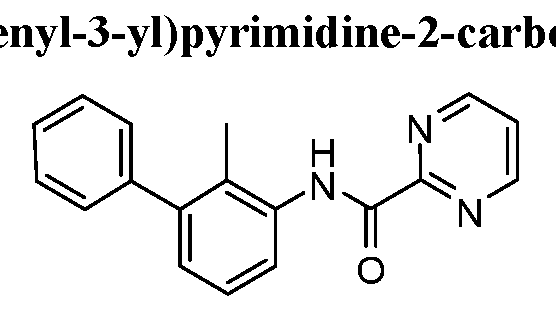
This compound was prepared using a similar procedure as described for Example 1, Step 2, with pyrimidine-2-carboxylic acid (Ark Pham, cat#AK-24353) replacing 5-
(methoxycarbonyl)pyridine-2-carboxylic acid. The reaction mixture was purified by prep- HPLC (pH = 10, acetonitrile/water+NEUOH) to give the desired product. LC-MS calculated for CisHieNsO (M+H)+: m/z = 290.1; found 290.2. Example 29: N-(2-methylbiphe oxamide

This compound was prepared using a similar procedure as described for Example 1, Step 2, with pyridazine-3-carboxylic acid (Ark Pham, cat#AK-28139) replacing 5- (methoxycarbonyl)pyridine-2-carboxylic acid. The reaction mixture was purified by prep- HPLC (pH = 10, acetonitrile/water+NEUOH) to give the desired product. LC-MS calculated for CisHieNsO (M+H)+: m/z = 290.1; found 290.1.
Example 30 : N-(2-methylbiphenyl-3-yl)-2-(pyridin-3-ylmethoxy)pyrimidine-4- carboxamide
Step 1: 2-(pyridin-3-ylme id

Sodium hydride (20 mg, 0.9 mmol) was added to a tetrahydrofuran (2 mL, 20 mmol) solution of 2-chloropyrimidine-4-carboxylic acid (Ark Pharm, cat#AK-28365, 50 mg, 0.3 mmol) and nicotinyl alcohol (73 μί, 0.76 mmol), which was allowed to stir at 70 °C for lh to reach full conversion. The reaction mixture was quenched with water and extracted with DCM/iPrOH, and the organic layer was dried and concentrated to afford the desired product. Then the residue was used in the next step without further purification. LC-MS calculated for C11H10N3O3 (M+H)+: m/z = 232.1; found: 232.1.
Step 2: N-(2-methylbiphenyl-3-yl)- -(pyridin-3-ylmethoxy)pyrimidine-4-carboxam

This compound was prepared using a similar procedure as described for Example 1, Step 2, with 2-(pyridin-3-ylmethoxy)pyrimidine-4-carboxylic acid replacing 5- (methoxycarbonyl)pyridine-2-carboxylic acid. The reaction mixture was purified by prep- HPLC (pH = 10, acetonitrile/water+NH40H) to give the desired product. LC-MS calculated for C24H21N4O2 (M+H)+: m/z = 397.2; found 397.2.
Example 31: 5-{[(2-hydroxyethyl)amino]methyl}-N-(2-methylbiphenyl-3-yl)-4,4'- bipyridine-2-carboxamide

Step 1: N-(2-methylbiphenyl- -yl)-5-vinyl-4, 4'-bipyridine-2-carboxamide

A mixture of 5-bromo-4-chloro-N-(2-methylbiphenyl-3-yl)pyridine-2-carboxamide {Example 18, Step 1, 50 mg, 0.1 mmol), 4,4,5, 5-tetramethyl-2-vinyl-l ,3,2-dioxaborolane (20 μί, 0.1 mmol), and [l, -Bis(diphenylphosphino)ferrocene]dichloropalladium(II) complexed with dichloromethane (1 : 1) (6 mg, 0.008 mmol) in 1 ,4-dioxane (0.9 mL) and water (0.3 mL) was degassed and sealed. It was stirred at 90 °C for lh to reach full conversion. The reaction mixture was cooled and concentrated, followed by addition of 4-pyridinylboronic acid (30 mg, 0.2 mmol), cesium carbonate (100 mg, 0.4 mmol) and dichloro[l, l '- bis(dicyclohexylphosphino)ferrocene]palladium(II) (Pd-127: 9 mg, 0.01 mmol), tert-butyl alcohol (1 mL), and water (0.5 mL). The mixture was degased with N2 and heated at 100 °C for 2h. After cooling to rt, the mixture was purified by 0 to 40% EtOAc in DCM. LC-MS calculated for C26H22N3O (M+H)+: m/z = 392.2; found: 392.1.
Step 2: 5-formyl-N-(2-methylbiphenyl-3-yl)-4, 4'-bipyridine-2-carboxamide

This compound was prepared using a similar procedure as described for Example 3, Step 3 with N-(2-methylbiphenyl-3-yl)-5-vinyl-4, 4'-bipyridine-2-carboxamide replacing 3- methyl-N-(2-methylbiphenyl-3-yl)-5-vinylpyridine-2-carboxamide. LC-MS calculated for C25H20N3O2 (M+H)+: m/z = 394.2; found 394.1.
Step 3: 5-{[(2-hydroxyethyl)amino]methyl}-N-(2-methylbiphenyl-3-yl)-4, 4'-bipyridine-2- carboxamide
This compound was prepared using a similar procedure as described for Example 4 with 5-formyl-N-(2-methylbiphenyl-3-yl)-4, 4'-bipyridine-2-carboxamide (Step 2) replacing 5-
formyl-3-methyl-N-(2-methylbiphenyl-3-yl)pyridine-2-carboxamide. The reaction mixture was purified by prep-HPLC (pH = 10, acetonitrile/water+NLUOH) to give the desired product, which was concentrated and further purified by prep-HPLC (pH = 2,
acetonitrile/water+TFA) to give the desired product as its TFA salt. LC-MS calculated for C27H27N4O2 (M+H)+: m/z = 439.2; found 439.2.
Example 32: (2S)-l-[(4-methyl-6-{[(2-methylbiphenyl-3-yl)amino]carbonyl}pyridin-3- yl)methyl] piperidine-2-carboxylic acid
H
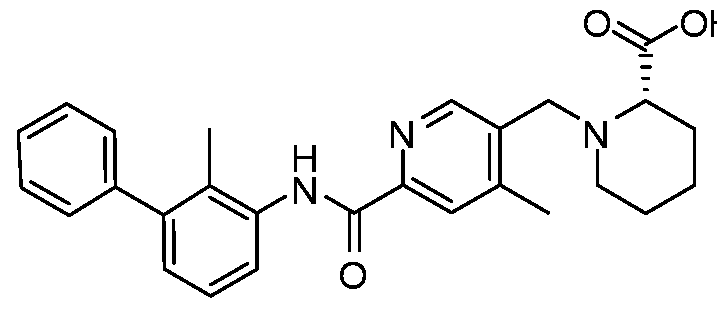
Step 1: 5-bromo-4-methyl-N- 2-methylbiphenyl-3-yl)pyridine-2-carboxamide

This compound was prepared using a similar procedure as described for Example 1, Step 2 with 5-bromo-4-methylpyridine-2-carboxylic acid (Ark Pharm, cat#AK-37510) replacing 5-(methoxycarbonyl)pyridine-2-carboxylic acid. LC-MS calculated for
C2oHi8BrN20 (M+H)+: m/z = 381.0; found 381.0.
Step 2: 4-methyl-N-( 2-methylbiphenyl-3-yl)-5-vinylpyridine-2-carboxamide
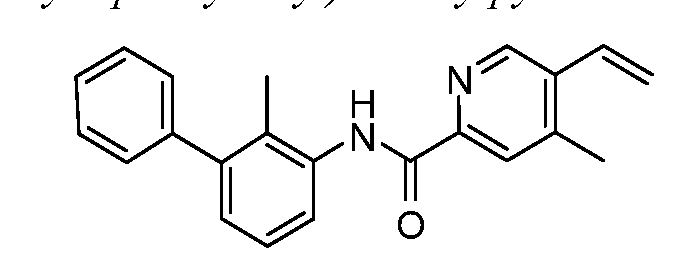
This compound was prepared using a similar procedure as described for Example 3, Step 2 with 5-bromo-4-methyl-N-(2-methylbiphenyl-3-yl)pyridine-2-carboxamide replacing 5-bromo-3-methyl-N-(2-methylbiphenyl-3-yl)pyridine-2-carboxamide. LC-MS calculated for C22H21N2O (M+H)+: m/z = 329.2; found 329.1.
Step 3: 5-formyl-4-methyl-N-(2-methylbiphenyl-3-yl)pyridine-2-carboxamide

This compound was prepared using a similar procedure as described for Example 3, Step 3 with 4-methyl-N-(2-methylbiphenyl-3-yl)-5-vinylpyridine-2-carboxamide replacing 3- methyl-N-(2-methylbiphenyl-3-yl)-5-vinylpyridine-2-carboxamide. LC-MS calculated for C2iHi9N202 (M+H)+: m/z = 331.1; found 331.1.
Step 4: (2S)-l-[(4-methyl-6-{[(2-methylbiphenyl-3-yl)amino]carbonyl}pyridin-3- yljmethyl ]piperidine-2-carboxylic acid
O OH
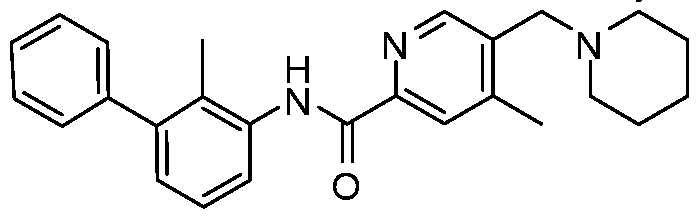
This compound was prepared using a similar procedure as described for Example 1, Step 5 with 5-formyl-4-methyl-N-(2-methylbiphenyl-3-yl)pyridine-2-carboxamide replacing 5-formyl-N-(2-methylbiphenyl-3-yl)pyridine-2-carboxamide. The reaction mixture was purified by prep-HPLC (pH = 10, acetonitrile/water+NLUOH) to give the desired product. LC-MS calculated for C27H30N3O3 (M+H)+: m/z = 444.2; found 444.2.
Example 33: 5-{ [(2-hydroxyethyl)amino]methyl}-4-methyl-N-(2-methylbiphenyl-3- yl)pyridine-2-carboxamide
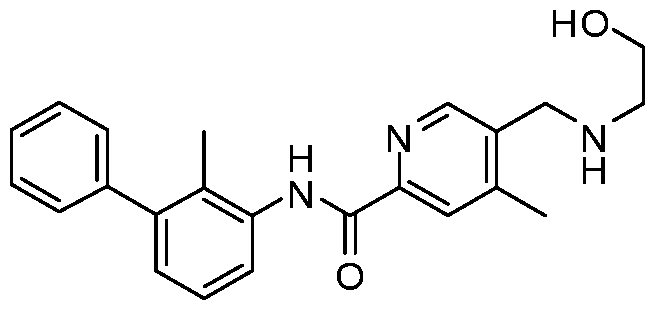
This compound was prepared using a similar procedure as described for Example 4 with 5-formyl-4-methyl-N-(2-methylbiphenyl-3-yl)pyridine-2-carboxamide {Example 32, Step 3) replacing 5-formyl-3-methyl-N-(2-methylbiphenyl-3-yl)pyridine-2-carboxamide. The reaction mixture was purified by prep-HPLC (pH = 10, acetonitrile/water+NLUOH) to give the desired product. LC-MS calculated for C23H26N3O2 (M+H)+: m/z = 376.2; found 376.2.
Example 34: 4-(cyclopropylmethoxy)-5-((2-hydroxyethylamino)metl methylbiphenyl-3-yl)picolinamide

Step 1: 5-bromo-4-(cyclopropylmethoxy)-N-(2-methylbiphenyl-3-yl)picolinamide

This compound was prepared using a similar procedure as described for Example 18, Step 2 with cyclopropylmethanol replacing 3-(hydroxymethyl)benzonitrile. LC-MS calculated for C23H22BrN202 (M+H)+: m/z = 437.1; found 437.1.
Step 2: 4-(cyclopropylmetho -N-(2-methylbiphenyl-3-yl)-5-vinylpicolinamide
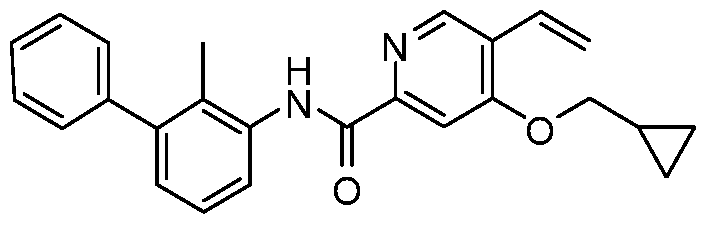
This compound was prepared using a similar procedure as described for Example 3, Step 2 with 5-bromo-4-(cyclopropylmethoxy)-N-(2-methylbiphenyl-3-yl)picolinamide replacing 5-bromo-3-methyl-N-(2-methylbiphenyl-3-yl)pyridine-2-carboxamide. LC-MS calculated for C25H24N2O2 (M+H)+: m/z = 385.2; found 385.2.
Step 3: 4-(cyclopropylmetho -5-formyl-N-(2-methylbiphenyl-3-yl)picolinamide
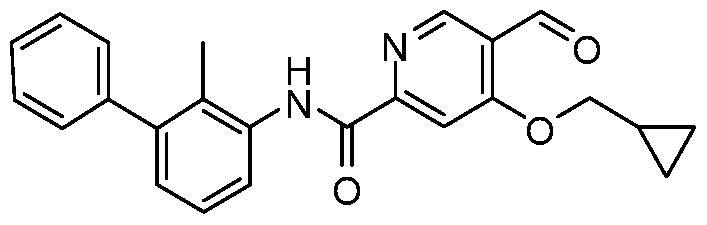
This compound was prepared using a similar procedure as described for Example 3, Step 3 with 4-(cyclopropylmethoxy)-N-(2-methylbiphenyl-3-yl)-5-vinylpicolinamide replacing 3-methyl-N-(2-methylbiphenyl-3-yl)-5-vinylpyridine-2-carboxamide. LC-MS calculated for C24H23N2O3 (M+H)+: m/z = 387.2; found 387.2.
Step 4: 4-(cyclopropylmethoxy)-5-((2-hydroxyethylamino)methyl)-N-(2-methylbiphenyl-3- yl)picolinamide
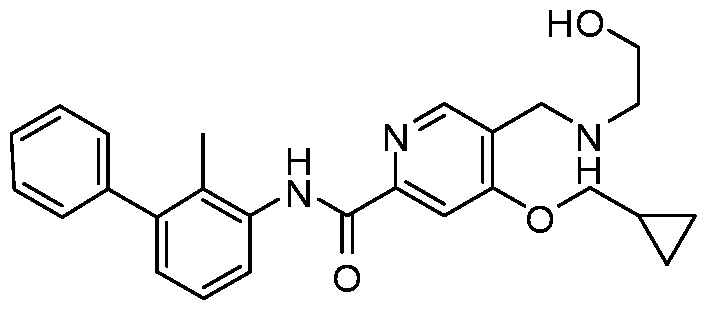
This compound was prepared using a similar procedure as described for Example 4 with 4-(cyclopropylmethoxy)-5-formyl-N-(2-methylbiphenyl-3-yl)picolinamide replacing 5- formyl-3-methyl-N-(2-methylbiphenyl-3-yl)pyridine-2-carboxamide. The reaction mixture was purified by prep-HPLC (pH = 10, acetonitrile/water+NlrUOH) to give the desired product. LC-MS calculated for C26H30N3O3 (M+H)+: m/z = 432.2; found 432.2. Example 35: 5-{[(2-hydroxyethyl)amino]methyl}-4-methoxy-N-(2-methylbiphenyl-3- yl)pyridine-2-carboxamide
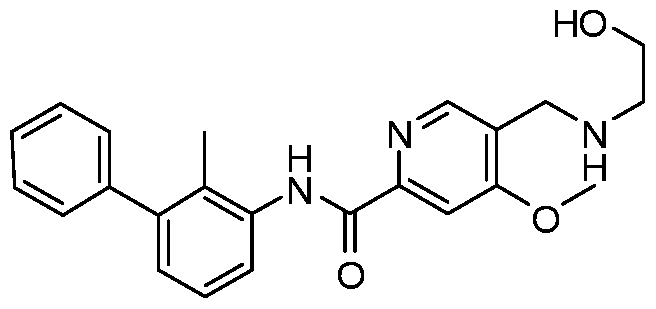
Step 1: 5-bromo-4-methoxy-N- -methylbiphenyl-3-yl)pyridine-2-carboxamide

Mixture of sodium methoxide (80 \L, 0.4 mmol) was added to 5-bromo-4-chloro-N-
(2-methylbiphenyl-3-yl)pyridine-2-carboxamide {Example 18, Step 1, 50 mg, 0.1 mmol) at rt. Then the mixture was allowed to stir at rt for 4h to reach full conversion. The reaction was quenched with water and extracted with EtOAc, and the organic layer was dried and concentrated to afford desired product which was used for next step without further purification. LC-MS calculated for C2oHi8BrN202 (M+H)+: m/z = 397.0; found 397.0.
Step 2: 4-methoxy-N-(2-methylbiphenyl-3-yl)-5-vinylpyridine-2-carboxamide
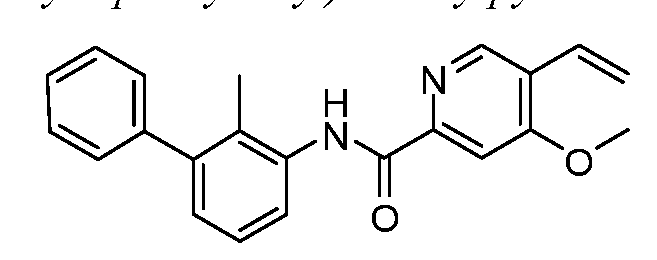 This compound was prepared using a similar procedure as described for Example 3, Step 2 with 5-bromo-4-methoxy-N-(2-methylbiphenyl-3-yl)pyridine-2-carboxamide replacing 5-bromo-3-methyl-N-(2-methylbiphenyl-3-yl)pyridine-2-carboxamide. LC-MS calculated for C22H21N2O2 (M+H)+: m/z = 345.2; found 345.1.
Step 3: 5-formyl-4-methoxy-N- -methylbiphenyl-3-yl)pyridine-2-carboxamide
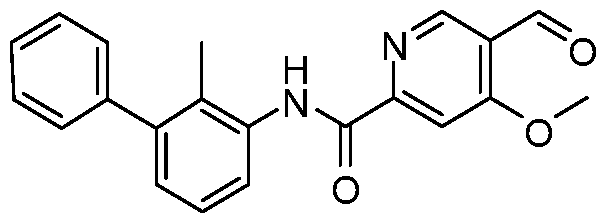
This compound was prepared using a similar procedure as described for Example 3, Step 3 with 4-methoxy-N-(2-methylbiphenyl-3-yl)-5-vinylpyridine-2-carboxamide replacing 3-methyl-N-(2-methylbiphenyl-3-yl)-5-vinylpyridine-2-carboxamide. LC-MS calculated for C21H19N2O3 (M+H)+: m/z = 347.1; found 347.1.
Step 4: 5-{ [(2-hydroxyethyl)amino ]methyl}-4-methoxy-N-(2-methylbiphenyl-3-yl)pyridine-2- carboxamide

This compound was prepared using a similar procedure as described for Example 4 with 5-formyl-4-methoxy-N-(2-methylbiphenyl-3-yl)pyridine-2-carboxamide replacing 5- formyl-3-methyl-N-(2-methylbiphenyl-3-yl)pyridine-2-carboxamide. The reaction mixture was purified by prep-HPLC (pH = 10, acetonitrile/water+NLUOH) to give the desired product. LC-MS calculated for C23H26N3O3 (M+H)+: m/z = 392.2; found 392.2.
Example 36: (2S)-l-[(5-methyl-2-{[(2-methylbiphenyl-3-yl)amino]carbonyl}pyridin-4- yl)methyl] piperidine-2-ca

Step 1: 4-bromo-5-methyl-N-(2-methylbiphenyl-3-yl)pyridine-2-carboxamide
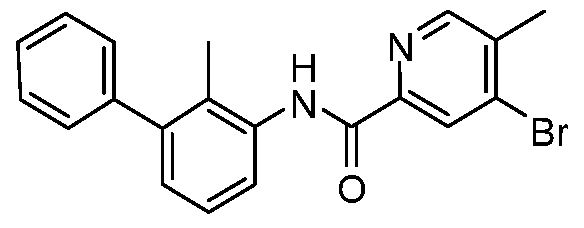
This compound was prepared using a similar procedure as described for Example 1, Step 2 with 4-bromo-5-methylpyridine-2-carboxylic acid (Ark Pharm, cat#AK-37510) replacing 5-(methoxycarbonyl)pyridine-2-carboxylic acid. LC-MS calculated for
C2oHi8BrN20 (M+H)+: m/z = 381.0; found 381.0.
Step 2: 5-methyl-N-( 2-methylbiphenyl-3-yl)-4-vinylpyridine-2-carboxamide

This compound was prepared using a similar procedure as described for Example 3, Step 2 with 4-bromo-5-methyl-N-(2-methylbiphenyl-3-yl)pyridine-2-carboxamide replacing 5-bromo-3-methyl-N-(2-methylbiphenyl-3-yl)pyridine-2-carboxamide. LC-MS calculated for C22H21N2O (M+H)+: m/z = 329.1 ; found 329.2.
Step 3: 4-formyl-5-methyl-N-(2-methylbiphenyl-3-yl)pyridine-2-carboxamide

This compound was prepared using a similar procedure as described for Example 3, Step 3 with 5-methyl-N-(2-methylbiphenyl-3-yl)-4-vinylpyridine-2-carboxamide replacing 3- methyl-N-(2-methylbiphenyl-3-yl)-5-vinylpyridine-2-carboxamide. LC-MS calculated for C2iHi9N202 (M+H)+: m/z = 331.1; found 331.1.
Step 4: (2S)-l-[(5-methyl-2-{[(2-methylbiphenyl-3-yl)amino j 'carbonyljpyridin-4- yljmethyl ]piperidine-2-carboxylic acid
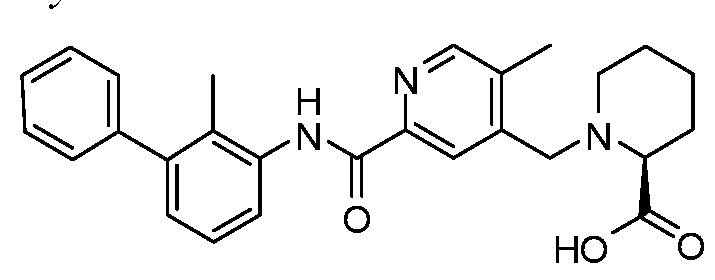
This compound was prepared using a similar procedure as described for Example 1, Step 5 with 4-formyl-5-methyl-N-(2-methylbiphenyl-3-yl)pyridine-2-carboxamide replacing
5-formyl-N-(2-methylbiphenyl-3-yl)pyridine-2-carboxamide. The reaction mixture was purified by prep-HPLC (pH = 10, acetonitrile/water+NIHUOH) to give the desired product. LC-MS calculated for C27H30N3O3 (M+H)+: m/z = 444.2; found 444.2. Example 37: 4-{[(2-hydroxyethyl)amino]methyl}-5-methyl-N-(2-methylbiphenyl-3- yl)pyridine-2-carboxamide

This compound was prepared using a similar procedure as described for Example 4 with 4-formyl-5-methyl-N-(2-methylbiphenyl-3-yl)pyridine-2-carboxamide {Example 36, Step 3) replacing 5-formyl-3-methyl-N-(2-methylbiphenyl-3-yl)pyridine-2-carboxamide. The reaction mixture was purified by prep-HPLC (pH = 2, acetonitrile/water+TFA) to give the desired product as its TFA salt. LC-MS calculated for C23H26N3O2 (M+H)+: m/z = 376.2; found 376.2. Example 38 : N-(2-cyano-3-cyclohex- 1-en- l-ylphenyl)-5- { [(2- hydroxyethyl)amino]m
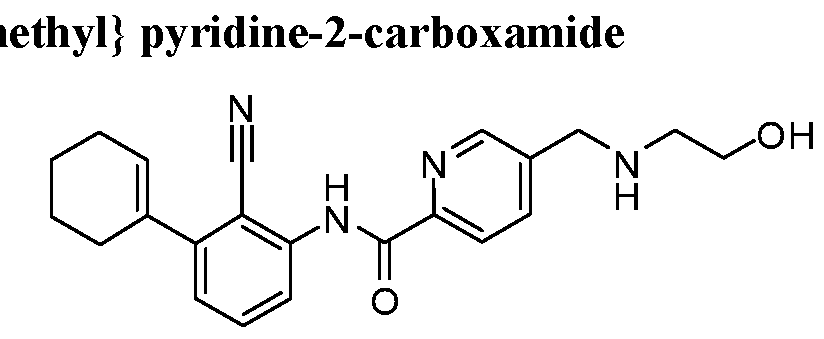
Step 1: methyl 5-vinylpyridine-2-carboxylate
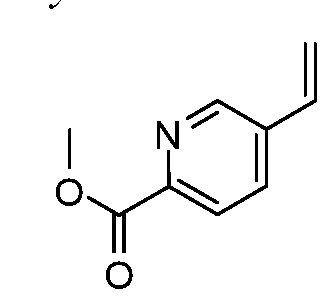
Sodium carbonate (1200 mg, 12 mmol), [Ι, - bis(diphenylphosphino)ferrocene]dichloropalladium(II) complexed with dichloromethane [PdCl2(dppf), 100 mg, 0.1 mmol], 1 ,4-dioxane (15 mL), water (3 mL), 4,4,5,5-tetramethyl-2- vinyl-l ,3,2-dioxaborolane (628 μί, 3.70 mmol) were added to 5-bromopyridine-2-carboxylic acid methyl ester {Combi-Blocks, cat#CA-4117, 800 mg, 4 mmol), and degased with N2. The mixture was heated at 90 °C for 2h to reach full conversion. The mixture was purified with 0 to 35% EtOAc in Hexanes to afford the desired product as a white solid.
Step 2: 5-vinylpyridine-2-carboxylic acid
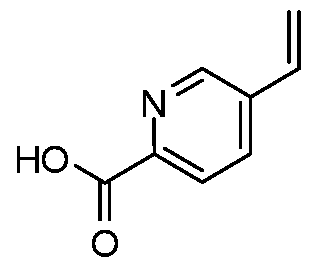
3 mL 1M NaOH solution (3 mmol) was added to methyl 5-vinylpyridine-2- carboxylate and heated at 45°C for 2h to reach full conversion. The mixture was concentrated to afford desired product as a white solid, which was used for next step without further purification.
Step 3: N-( 3-bromo-2-cyanophenyl)-5-vinylpyridine-2-carboxamide
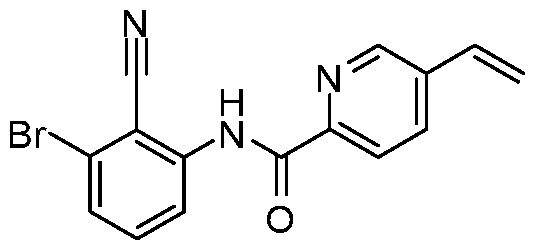
2.0 M oxalyl chloride in DCM (4.7 mL, 9.3 mmol), N,N-dimethylformamide (30 μί, 0.3 mmol) was added to 5-vinylpyridine-2-carboxylic acid (522 mg, 3.50 mmol) under N2 at 0 °C. The mixture was allowed to stir at rt for 2h, then the mixture was concentrated under reduced pressure and the residue was used for next step without further purification. 2-amino- 6-bromobenzonitrile (Ark Pharm, AK-36350 , 690 mg, 3.5 mmol) and methylene chloride (10 mL) were added to the residue, followed by addition of triethylamine (1000 μί, 10 mmol) at 0 °C drop-wise. The mixture was allowed to stir at rt for lh to reach full conversion. The mixture was concentrated and purified by 0 to 50% EtOAc in Hex. LC-MS calculated for Ci5HiiBrN30 (M+H)+: m/z = 328.0; found 328.0.
Step 4: N-( 3-bromo-2-cyanophenyl)-5-formylpyridine-2-carboxamide
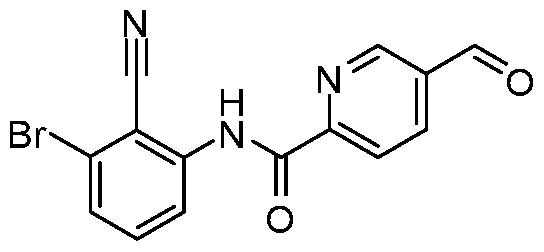
This compound was prepared using a similar procedure as described for Example 3, Step 3 with N-(3-bromo-2-cyanophenyl)-5-vinylpyridine-2-carboxamide replacing 3-methyl- N-(2-methylbiphenyl-3-yl)-5-vinylpyridine-2-carboxamide. LC-MS calculated for
Ci4H9BrN302 (M+H)+: m/z = 329.0; found 329.0.
Step 5: N-(3-bromo-2-cyanophenyl)-5-{[(2-hydroxyethyl)amino]methyl}pyridine-2- carboxamide

This compound was prepared using a similar procedure as described for Example 4 with N-(3-bromo-2-cyanophenyl)-5-formylpyridine-2-carboxamide replacing 5-formyl-3- methyl-N-(2-methylbiphenyl-3-yl)pyridine-2-carboxamide. The reaction mixture was purified by 0 to 12% MeOH in DCM to give the desired product. LC-MS calculated for
Ci6Hi6BrN402 (M+H)+: m/z = 375.0; found 375.0. Step 6: N-(2-cyano-3-cyclohex-l-en-l-ylphenyl)-5-{[ (2-hydroxyethyl)amino]methyl}pyridine- 2-carboxamide
A mixture of ' N-(3-bromo-2-cyanophenyl)-5-{ [(2- hydroxyethyl)amino]methyl}pyridine-2-carboxamide (10 mg, 0.03 mmol), 1 , 1'- bis(diphenylphosphino)ferrocene]dichloropalladium(II) complexed with DCM (1 mg, 0.002 mmol), sodium carbonate (10 mg), and 2-cyclohex-l -en-l-yl-4,4,5,5-tetramethyl-l ,3,2- dioxaborolane (6.66 mg, 0.0320 mmol) in 1,4-dioxane (0.2 mL) and water (0.07 mL) was degassed with N2 and sealed. It was stirred at 95°C for 2h to reach full conversion. The reaction mixture was purified by prep-HPLC (pH = 10, acetonitrile/water+NLUOH) to give the desired product. LC-MS calculated for C22H25N4O2 (M+H)+: m/z = 377.2; found 377.1.
Example 39: N-(2-cyano-3-piperidin-l-ylphenyl)-5-{ [(2-hydroxyethyl)amino]methyl} pyridine-2-carboxamide
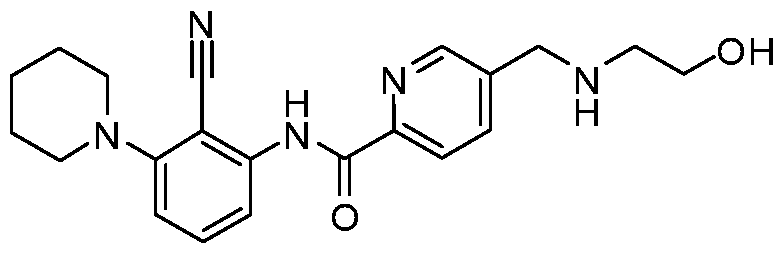
A stirred mixture of piperidine (10 \L, 0.1 mmol), N-(3-bromo-2-cyanophenyl)-5- {[(2-hydroxyethyl)amino]methyl}pyridine-2-carboxamide (Example 38, Step 5, 1 1.2 mg, 0.03 mmol), (2'-aminobiphenyl-2-yl)(chloro)[dicyclohexyl(2',6'-diisopropoxybiphenyl-2- yl)phosphoranyl] palladium (2.28 mg, 0.003 mmol), and sodium tert-butoxide (20 mg, 0.2 mmol) in 1,4-dioxane (0.083 mL) was heated at 1 10 °C for 2 h to reach full conversion. The volatiles were removed and the residue was purified by prep-HPLC (pH = 2, acetonitrile/
water+TFA) to give the desired product as its TFA salt. LC-MS calculated for C21H26N5O2 (M+H)+: m/z = 380.2; found 380.2.
Example 40: tert-butyl 5-(2-cyano-3-{[(5-{[(2-hydroxyethyl)amino]methyl}pyridin-2- yl)carbonyl]amino}p

This compound was prepared using a similar procedure as described for Example 38, Step 6 with tert-butyl 5-(4,4,5,5-tetramethyl-l,3,2-dioxaborolan-2-yl)-3,6-dihydropyridine- l(2H)-carboxylate (Combi-Blocks, cat# FM-2863) replacing 2-cyclohex-l-en-l-yl-4,4,5,5- tetramethyl-l,3,2-dioxaborolane. The volatiles were removed and the residue was purified by prep-HPLC (pH = 2, acetonitrile/ water+TFA) to give the desired product as its TFA salt. LC-MS calculated for C26H32N5O4 (M+H)+: m/z = 478.2; found 478.2.
Example 41: N-(2-cyano-3-cyclohexylphenyl)-5-{[(2- hydroxyethyl)amino]m

Step 1: 2-amino-6-cyclohex-l-en-l-ylbenzonitrile

This compound was prepared using a similar procedure as described for Example 1, Step 1 with 2-cyclohex-l-en-l-yl-4,4,5,5-tetramethyl-l,3,2-dioxaborolane replacing phenylboronic acid, and with 2-amino-6-bromobenzonitrile {Astatech, cat#CL8148) replacing 3-bromo-2-methylaniline. LC-MS calculated for C13H15N2 (M+H)+: m/z = 199.1; found 199.1. Step 2: 2-amino-6-cyclohexylbenzonitrile

A mixture of 2-amino-6-cyclohex-l-en-l-ylbenzonitrile (100 mg, 0.5 mmol) and 10% PdVC (53 mg, 0.050 mmol) in methanol (5 mL) was stirred under an atmosphere of H2 at room temperature for 3h to reach full conversion. The mixture was filtered through silica gel and concentrated and used for next step without further purification. LC-MS calculated for C13H17N2 (M+H)+: m/z = 201.1 ; found 201.1.
Step 3: 5-(chloromethyl)picolinoyl chloride
 IN NaOH solution was added to a THF (lmL) solution of methyl 5-(bromomethyl) pyridine-2-carboxylate {Ark Pharm, cat#AK153186, 20 mg, 0.08 mmol) and the mixture was allowed to stir at rt for lh. The mixture was acidified with IN HC1 solution until pH = 4, and then the mixture was extracted with DCM. The organic layers were combined, dried and concentrated. To the residue was added 2.0 M oxalyl chloride in DCM (0.10 mL, 0.20 mmol) and N,N-dimethylformamide (0.6 \L, 0.008 mmol) at 0 °C under N2. The mixture was allowed to stir at rt for 2h, and then the mixture was concentrated and the residue was used for next step without further purification.
Step 4: 5-(chloromethyl)-N-(2-cyano-3-cyclohexylphenyl)pyridine-2-carboxamide
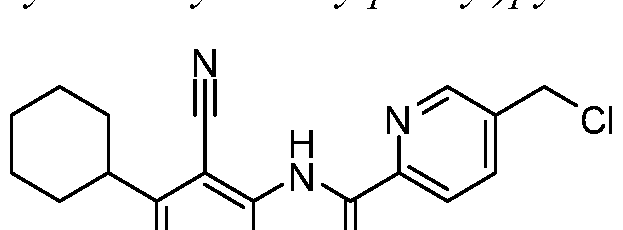
The DCM (lmL) solution of crude 5-(chloromethyl)picolinoyl chloride was added to a DCM (lmL) solution of 2-amino-6-cyclohexylbenzonitrile (20 mg, 0.1 mmol) and triethylamine (30 μί, 0.2 mmol) at 0 °C drop-wise. The mixture was allowed to stir at rt for 2h to reach full conversion. The mixture was concentrated and used for next step without further purification. LC-MS calculated for C20H21CIN3O (M+H)+: m/z = 354.1 ; found 354.1.
Step 5: N-(2-cyano-3-cyclohexylphenyl)-5-{[ (2-hydroxyethyl)amino Jmethyljpyridine-2- carboxamide
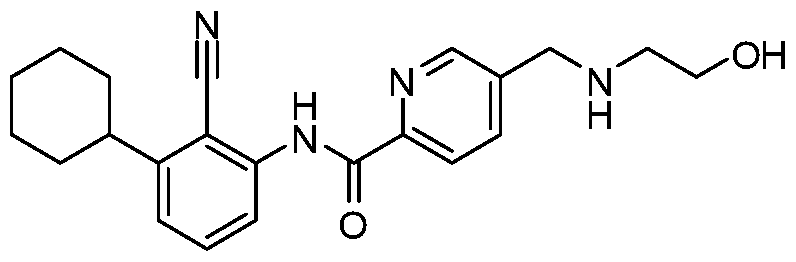
A mixture of 5-(chloromethyl)-N-(2-cyano-3-cyclohexylphenyl)pyridine-2- carboxamide (40 mg, 0.1 mmol), ethanolamine (10 \L, 0.2 mmol) and potassium carbonate (41 mg, 0.30 mmol) in N,N-dimethylformamide (0.3 mL, 4 mmol) was stirred at rt for overnight. The mixture was purified by prep-HPLC (pH = 2, acetonitrile/ water+TFA) to give the desired product as its TFA salt. LC-MS calculated for C22H27N4O2 (M+H)+: m/z = 379.2; found 379.2.
Example 42 : (S)- l-((6-(3-methyl-2-phenylpyridin-4-ylcarbamoyl)pyridin-3- yl)methyl)piperidine-2-carboxylic acid
H

Step 1: methyl 6-(chlorocarbonyl)nicotinate

This compound was prepared using a similar procedure as described for Example 41, Step 3 with 5-(methoxycarbonyl)pyridine-2-carboxylic acid (Oakwood Chemical, cat#017196) replacing methyl 5-(bromomethyl) pyridine-2-carboxylate.
Step 2: methyl 6-{[(2-chloro-3-methylpyridin-4-yl)amino]carbonyl}nicotinate

This compound was prepared using a similar procedure as described for Example 41, Step 4 with 2-chloro-3-methylpyridin-4-amine {Astatech, cat#25664) replacing 2-amino-6-
cyclohexylbenzonitrile, and with methyl 6-(chlorocarbonyl)nicotinate replacing 5- (chloromethyl)picolinoyl chloride. LC-MS calculated for C14H13CIN3O3 (M+H)+: m/z = 306.1 ; found 306.1.
Step 3: methyl 6-{[(3-methyl-2-phenylpyridin-4-yl)aminoJcarbonyl}nicotinate
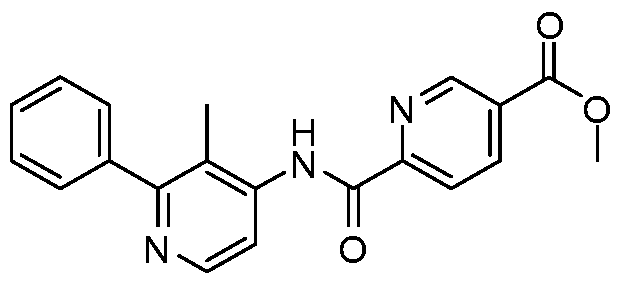
Pd-127 (40 mg, 0.06 mmol) was added to the mixture of methyl 6-{[(2-chloro-3- methylpyridin-4-yl)amino]carbonyl}nicotinate (200 mg, 0.6 mmol), phenylboronic acid (132 mg, 1.08 mmol) and cesium carbonate (400 mg, 1 mmol) in 1 ,4-dioxane (3.69 mL) and water (216 μί). The mixture was stirred at 90 °C for 1 h. After concentration, the mixture was purified by 0 to 50% EtOAc in hexanes to afford the desired product. LC-MS calculated for C20H18N3O3 (M+H)+: m/z = 348.1 ; found 348.1.
Step 4: 5-(hydroxymethyl)-N- -methyl-2-phenylpyridin-4-yl)pyridine-2-carboxamide
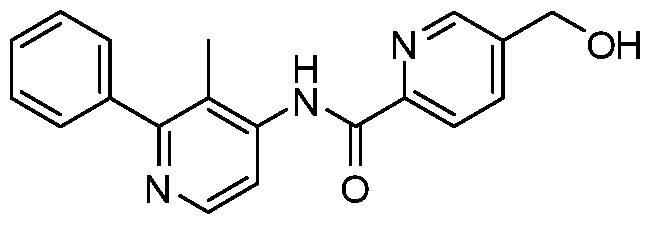
This compound was prepared using a similar procedure as described for Example 1, Step 3 with methyl 6-{[(3-methyl-2-phenylpyridin-4-yl)aminoJcarbonyl}nicotinate replacing methyl 6-{[(2-methylbiphenyl-3-yl)amino]carbonyl}nicotinate. LC-MS calculated for C19H18N3O2 (M+H)+: m/z = 320.1 ; found 320.1.
Step 5: 5-formyl-N-( 3-methyl-2-phenylpyridin-4-yl)pyridine-2-carboxamide

This compound was prepared using a similar procedure as described for Example 1, Step 4 with 5-(hydroxymethyl)-N-(3-methyl-2-phenylpyridin-4-yl)pyridine-2-carboxamide replacing 5-(hydroxymethyl)-N-(2-methylbiphenyl-3-yl)pyridine-2-carboxamid. LC-MS calculated for C19H16N3O2 (M+H)+: m/z = 318.1 ; found 318.1.
Step 6: (S)-l-((6-(3-methyl-2^henylpyridin-4-ylcarbamoyl)pyridin-3-yl)methyl)piperidine-2- carboxylic acid
This compound was prepared using a similar procedure as described for Example 1, Step 5 with 5-formyl-N-(3-methyl-2-phenylpyridin-4-yl)pyridine-2-carboxamide replacing 5- formyl-N-(2-methylbiphenyl-3-yl)pyridine-2-carboxamide. The reaction mixture was purified by prep-HPLC (pH = 10, acetonitrile/water+Nl UOH) to give the desired product. LC-MS calculated for C25H27N4O3 (M+H)+: m/z = 431.2; found 431.2.
Example 43: 5-{ [(2-hydroxyethyl)amino]methyl}-N-(3-methyl-2-phenylpyridin-4- yl)pyridine-2-carboxamide

This compound was prepared using a similar procedure as described for Example 4 with 5-formyl-N-(3-methyl-2-phenylpyridin-4-yl)pyridine-2-carboxamide (Example 42, Step 5) replacing 5-formyl-3-methyl-N-(2-methylbiphenyl-3-yl)pyridine-2-carboxamide. The reaction mixture was purified by prep-HPLC (pH = 10, acetonitrile/water+NH40H) to give the desired product. LC-MS calculated for C21H23N4O2 (M+H)+: m/z = 363.1 ; found 363.2.
Example 44 : N- [2-cyano-3-(3,4-dihydro-2H-pyran-5-yl)phenyl] -5- { [(2- hydroxyethyl)amino]

This compound was prepared using a similar procedure as described for Example 38, Step 6 with 5-(4,4,5,5-tetramethyl-l,3,2-dioxaborolan-2-yl)-3,4-dihydro-2H-pyran (Combi- Blocks, cat# PN-6040) replacing 2-cyclohex-l-en-l-yl-4,4,5,5-tetramethyl-l ,3,2- dioxaborolane. The volatiles were removed, and the residue was purified by prep-HPLC (pH = 2, acetonitrile/ water+TFA) to give the desired product as its TFA salt. LC-MS calculated for C21H23N4O3 (M+H)+: m/z = 379.2; found 379.2.
Example 45 : N- [3-(2,3-dihydro- l,4-benzodioxin-6-yl)-5-fluoro-2-methylphenyl] -5- { [(2- hydroxyethyl)amino]methyl}pyridine-2-carboxamide

This compound was prepared using a similar procedure as described for Example 41, Step 4 with 3-bromo-5-fluoro-2-methylaniline (Combi-Blocks, cat# ST-8934) replacing 2- amino-6-cyclohexylbenzonitrile .
Step 2: N-( 3-bromo-5-fluoro-2-methylphenyl)-5-{[ (2-hydroxyethyl)amino Jmethyljpyridine-2- carboxamide
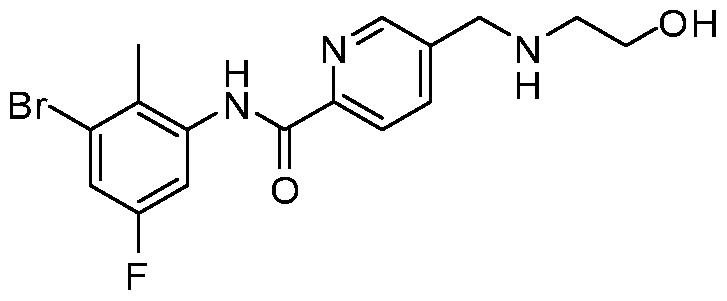
This compound was prepared using a similar procedure as described for Example 41, Step 5 with N-(3-bromo-5-fluoro-2-methylphenyl)-5-(chloromethyl)pyridine-2-carboxamide replacing 5-(chloromethyl)-N-(2-cyano-3-cyclohexylphenyl)pyridine-2-carboxamide. LC-MS calculated for CieHisBrFNsC (M+H)+: m/z = 382.1 ; found 382.0.
Step 3: N-[ 3-(2, 3-dihydro-l, 4-benzodioxin-6-yl)-5-fluoro-2-methylphenyl] -5-{ [(2- hydroxyethyl)amino]methyl}pyridine-2-carboxamide
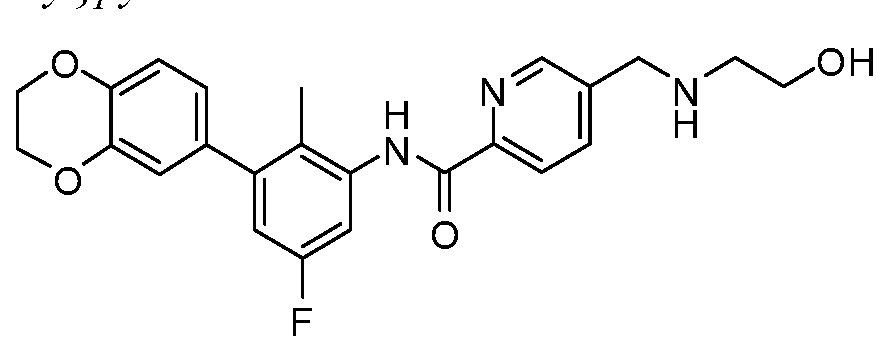
This compound was prepared using a similar procedure as described for Example 38, Step 6 with 2,3-dihydro-l ,4-benzodioxin-6-ylboronic acid (Sigma-Aldrich, cat#635995) replacing 2-cyclohex-l -en-l -yl-4,4,5,5-tetramethyl-l,3,2-dioxaborolane, and with N-(3- bromo-5-fluoro-2-methylphenyl)-5-{[(2-hydroxyethyl)aminoJmethyl}pyridine-2-carboxamide
replacing N-(3-bromo-2-cyanophenyl)-5-{[(2-hydroxyethyl)amino]methyl}pyridine-2- carboxamide. The volatiles were removed, and the residue was purified by prep-HPLC (pH = 2, acetonitrile/ water+TFA) to give the desired product as its TFA salt. LC-MS calculated for C24H25FN3O4 (M+H)+: m/z = 438.2; found 438.1.
Example 46: N-[2-cyano-3-(4-methyl-3,4-dihydro-2H-l,4-benzoxazin-7-yl)phenyl]-5- {[(2-hydroxyethyl)am
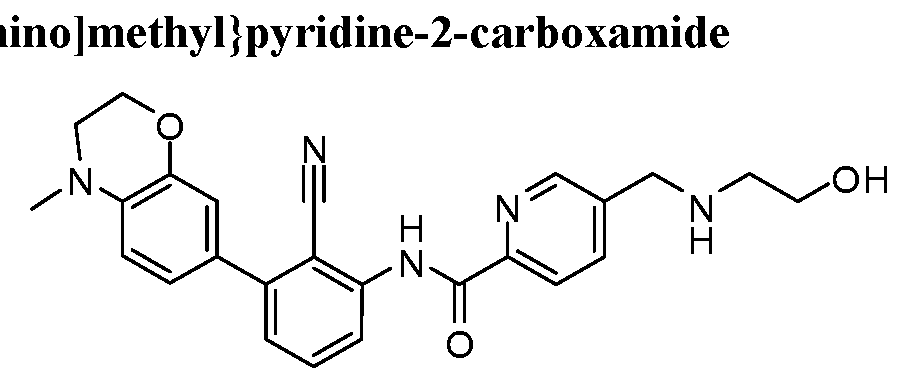
This compound was prepared using a similar procedure as described for Example 38, Step 6 with 4-methyl-7-(4,4,5,5-tetramethyl-l ,3,2-dioxaborolan-2-yl)-3,4-dihydro-2H-l,4- benzoxazine (Maybridge Building Blocks, cat# CC13539) replacing 2-cyclohex-l -en-l-yl- 4,4,5,5-tetramethyl-l,3,2-dioxaborolane. The volatiles were removed and the residue was purified by prep-HPLC (pH = 2, acetonitrile/ water+TFA) to give the desired product as its TFA salt. LC-MS calculated for C25H26N5O3 (M+H)+: m/z = 444.2; found 444.2.
Example 47: N-[2-cyano-3-(2,3-dihydro-l-benzofuran-6-yl)phenyl]-5-{ [(2- hydroxyethyl)amino]m hyl}pyridine-2-carboxamide
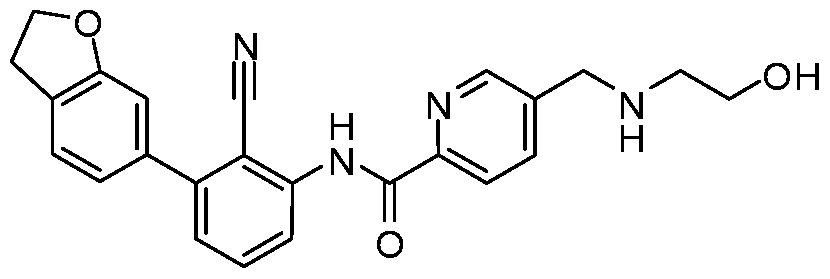
This compound was prepared using a similar procedure as described for Example 38, Step 6 with (2,3-dihydrobenzofuran-6-yl)boronic acid (Ark Pharm, cat# AK143637) replacing 2-cyclohex-l -en-l -yl-4,4,5,5-tetramethyl-l,3,2-dioxaborolane. The volatiles were removed and the residue was purified by prep-HPLC (pH = 2, acetonitrile/ water+TFA) to give the desired product as its TFA salt. LC-MS calculated for C24H23N4O3 (M+H)+: m/z = 415.2; found 415.2.
Example 48 : N- [2-cyano-3-(2-methyl-2H-indazol-6-yl)phenyl] -5- { [(2- hydroxyethyl)amino]methyl}pyridine-2-carboxamide

This compound was prepared using a similar procedure as described for Example 38, Step 6 with 2-methylindazole-6-boronic acid pinacol ester (Combi-Blocks, cat# PN-9131) replacing 2-cyclohex-l-en-l-yl-4,4,5,5-tetramethyl-l,3,2-dioxaborolane. The volatiles were removed and the residue was purified by prep-HPLC (pH = 2, acetonitrile/ water+TFA) to give the desired product as its TFA salt. LC-MS calculated for C24H23N6O2 (M+H)+: m/z = 427.2; found 427.2.
Example 49 : N- [2-cyano-3-(l-methyl-lH-indazol-4-yl)phenyl] -5- {[lhydroxyethyl)amino]
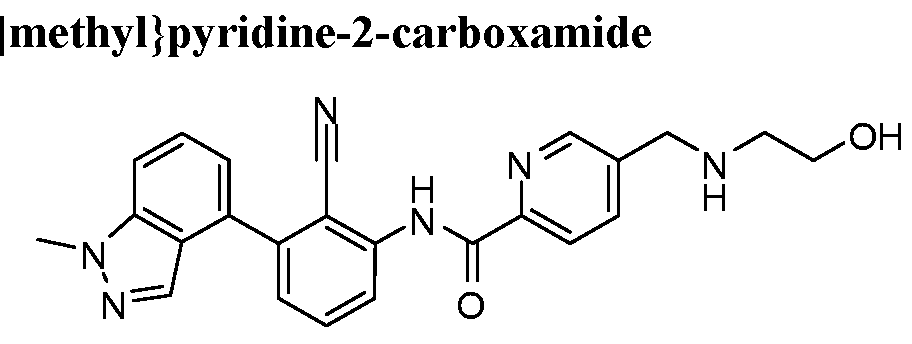
This compound was prepared using a similar procedure as described for Example 38, Step 6 with l-methyl-lH-indazole-4-boronic acid pinacol ester (Aldrich, cat# 725323) replacing 2-cyclohex-l-en-l-yl-4,4,5,5-tetramethyl-l,3,2-dioxaborolane. The volatiles were removed, and the residue was purified by prep-HPLC (pH = 2, acetonitrile/ water+TFA) to give the desired product as its TFA salt. LC-MS calculated for C24H23N6O2 (M+H)+: m/z = 427.2; found 427.2.
Example A. PD-1/PD-L1 Homogeneous Time-Resolved Fluorescence (HTRF) binding assay
The assays were conducted in a standard black 384-well polystyrene plate with a final volume of 20 μί. Inhibitors were first serially diluted in DMSO and then added to the plate wells before the addition of other reaction components. The final concentration of DMSO in the assay was 1%. The assays were carried out at 25° C in the PBS buffer (pH 7.4) with 0.05% Tween-20 and 0.1% BSA. Recombinant human PD-L1 protein (19-238) with a His- tag at the C-terminus was purchased from AcroBiosy stems (PD1-H5229). Recombinant human PD-1 protein (25-167) with Fc tag at the C-terminus was also purchased from
AcroBiosystems (PD1-H5257). PD-L1 and PD-1 proteins were diluted in the assay buffer
and 10 μΐ, was added to the plate well. Plates were centrifuged and proteins were preincubated with inhibitors for 40 minutes. The incubation was followed by the addition of \0 μΐ. of HTRF detection buffer supplemented with Europium cryptate-labeled anti -human IgG (PerkinElmer-AD0212) specific for Fc and anti-His antibody conjugated to SureLight®- Allophycocyanin (APC, PerkinElmer-AD0059H). After centrifugation, the plate was incubated at 25° C for 60 min. before reading on a PHERAstar FS plate reader (665 nm/620 nm ratio). Final concentrations in the assay were - 3 nM PD1, 10 nM PD-L1, 1 nM europium anti-human IgG and 20 nM anti-His-Allophycocyanin. IC50 determination was performed by fitting the curve of percent control activity versus the log of the inhibitor concentration using the GraphP ad Prism 5.0 software.
Compounds of the present disclosure, as exemplified in the Examples, showed IC50 values in the following ranges: + = IC50≤ 10 nM; ++ = 10 nM < IC50≤ 100 nM; +++ = 100 nM < IC5o≤ 1000 nM; ++++ = IC50 > 1000 nM
Data obtained for the Example compounds using the PD-1/PD-L1 homogenous time- resolved fluorescence (HTRF) binding assay described in Example A is provided in Table 1.
Table 1

Example
ICso (nM)
23 ++
24 +++
25 ++
26 ++
27 ++
28 +++
29 +++
30 +++
31 ++
32 +
33 +
34 ++
35 +
36 ++
37 ++
38 +
39 ++++
40 +++
41 ++
42 ++++
43 +++
44 ++
45 +
46 +++
47 ++
48 ++
49 +
Various modifications of the invention, in addition to those described herein, will be apparent to those skilled in the art from the foregoing description. Such modifications are also intended to fall within the scope of the appended claims. Each reference, including without limitation all patent, patent applications, and publications, cited in the present application is incorporated herein by reference in its entirety.
Claims
What is claimed is:
1. A compound of Formula Γ):
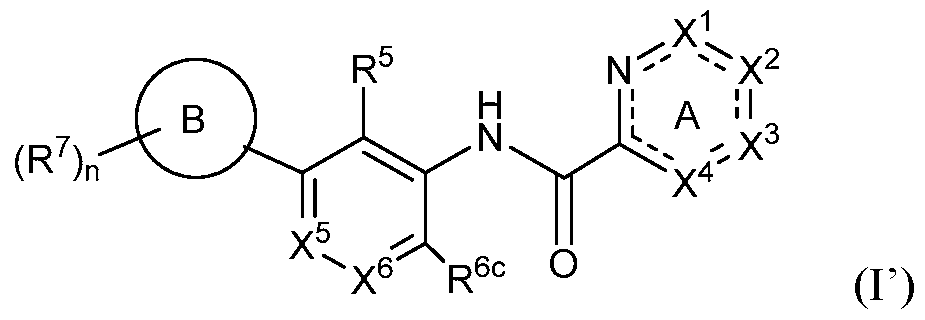
or a pharmaceutically acceptable salt or a stereoisomer thereof, wherein:
X1 is N or CR1;
X2 is N or CR2;
X3 is N or CR3;
X4 is N or CR4;
wherein no more than two of X1, X2, X3 and X4 are simultaneously N;
X5 is N or CR6a;
X6 is N or CR6b;
ring B is Ce-ιο aryl, C3-10 cycloalkyl, 5- to 14-membered heteroaryl, or 4- to 10- membered heterocycloalkyl, provided ring B is other than 9-H-carbazol-4-yl, 2,3,4,9- tetrahydro-lH-carbazol-5-yl or lH-tetrazolyl;
R1, R2, R3, R4 and R7 are each independently selected from H, halo, Ci-6 alkyl, C2-6 alkenyl, C2-6 alkynyl, Ci-6 haloalkyl, Ci-6 haloalkoxy, Ce-ιο aryl, C3-10 cycloalkyl, 5-14 membered heteroaryl, 4-10 membered heterocycloalkyl, Ce-ιο aryl-Ci-4 alkyl-, C3-10 cycloalkyl-C 1-4 alkyl-, (5-14 membered heteroaryl)-Ci-4 alkyl-, (4-10 membered
heterocycloalkyl)-Ci-4 alkyl-, CN, NO2, ORa, SRa, NHORa, C(0)Ra, C(0)NRaRa, C(0)ORa, OC(0)Ra, OC(0)NRaRa, NHRa, NRaRa, NRaC(0)Ra, NRaC(0)ORa, NRaC(0)NRaRa, C(=NRa)Ra, C(=NRa)NRaRa, NRaC(=NRa)NRaRa, NRaS(0)Ra, NRaS(0)2Ra, NRaS(0)2NRaRa, S(0)Ra, S(0)NRaRa, S(0)2Ra, and S(0)2NRaRa, wherein the Ci-e alkyl, C2-6 alkenyl, C2-6 alkynyl, Ce-ιο aryl, C3-10 cycloalkyl, 5-14 membered heteroaryl, 4-10 membered
heterocycloalkyl, Ce-ιο aryl-Ci-4 alkyl-, C3-10 cycloalkyl-Ci-4 alkyl-, (5-14 membered heteroaryl)-Ci-4 alkyl-, and (4-10 membered heterocycloalkyl)-Ci-4 alkyl- of R1, R2, R3, R4 and R7 are each optionally substituted with 1, 2, 3, or 4 Rb substituents;
R5 is halo, Ci-6 alkyl, C2-6 alkenyl, C2-6 alkynyl, Ci-6 haloalkyl, Ci-6 haloalkoxy, Ce-ιο aryl, C3-10 cycloalkyl, 5-14 membered heteroaryl, 4-10 membered heterocycloalkyl, Ce-ιο aryl- C1-4 alkyl-, C3-10 cycloalkyl-Ci-4 alkyl-, (5-14 membered heteroaryl)-Ci-4 alkyl-, (4-10 membered heterocycloalkyl)-Ci-4 alkyl-, CN, NO2, OR11, SR11, NH2, -NHR11, -NRnRn,
NHOR11, C(0)Rn, C(0)NRnRn, C(0)ORn, OC(0)Rn, OC(0)NRnRn, NRnC(0)Rn, NRHC^OR! !^RHC^NRHR11, C(=NR11)R11, C(=NR11)NR11R11,
NR11C(=NR11)NR11R11, NRnS(0)Rn, NR^^R11, N^S^N^R11, S(0)Rn,
S(0)NRnRn, S(0)2Rn, and S(0)2NR11R11, wherein the Ci-e alkyl, C2-6 alkenyl, C2-6 alkynyl, Ci-6 haloalkyl, Ci-6 haloalkoxy, Ce-ιο aryl, C3-10 cycloalkyl, 5-14 membered heteroaryl, 4-10 membered heterocycloalkyl, Ce-ιο aryl-C 1-4 alkyl-, C3-io cycloalkyl-Ci-4 alkyl-, (5-14 membered heteroaryl)-Ci-4 alkyl- and (4-10 membered heterocycloalkyl)-Ci-4 alkyl- of R5 are each optionally substituted with 1, 2 or 3 Rb substituents; wherein R5 is other than F when ring B is C3-10 cycloalkyl, 5- to 14-membered heteroaryl or 4- to 10-membered
heterocycloalkyl;
each R11 is independently selected from H, CN, Ci-6 alkyl, C1-4 haloalkyl, C2-6 alkenyl, C2-6 alkynyl, Ce-ιο aryl, C3-10 cycloalkyl, 5-10 membered heteroaryl, 4-10 membered heterocycloalkyl, Ce-ιο aryl-Ci-4 alkyl-, C3-10 cycloalkyl-Ci-4 alkyl-, (5-10 membered heteroaryl)-Ci-4 alkyl-, and (4-10 membered heterocycloalkyl)-Ci-4 alkyl-, wherein the Ci-6 alkyl, C2-6 alkenyl, C2-6 alkynyl, Ce-ιο aryl, C3-10 cycloalkyl, 5-10 membered heteroaryl, 4-10 membered heterocycloalkyl, Ce-ι oaryl-C 1-4 alkyl-, C3-io cycloalkyl-Ci-4 alkyl-, (5-10 membered heteroaryl)-Ci-4 alkyl- and (4-10 membered heterocycloalkyl)-Ci-4 alkyl- of R11 are each optionally substituted with 1, 2 or 3 Rb substituents;
R6a, R6b and R6c are each independently selected from H, C1-4 alkyl, C3-10 cycloalkyl, C3-10 cycloalkyl-C 1-4 alkyl-, C6-io aryl, Ce-ιο aryl-Ci-4 alkyl-, 5-10 membered heteroaryl, 4-10 membered heterocycloalkyl, (5-10 membered heteroaryl)-Ci-4 alkyl-, (4-10 membered heterocycloalkyl)-Ci-4 alkyl-, C2-4 alkenyl, C2-4 alkynyl, halo, CN, OR10, Ci-4 haloalkyl, Ci-4 haloalkoxy, NH2, -NHR10, -NR10R10, NHOR10, C(0)R10, C(O)NR10R10, C(0)OR10,
OC(0)R10, OC(O)NR10R10, NR10C(O)R10, NR10C(O)OR10, NR10C(O)NR10R10, C(=NR10)R10, C(=NR10)NR10R10, NR10C(=NR10)NR10R10, NR10S(O)R10, NR10S(O)2R10,
NR10S(O)2NR10R10, S(0)R10, S(O)NR10R10, S(0)2R10, and S(O)2NR10R10, wherein each R10 is independently selected from H, C1-4 alkyl, C2-4 alkenyl, C2-4 alkynyl, C1-4 alkoxy, C3-10 cycloalkyl, C3-10 cycloalkyl-Ci-4 alkyl-, Ce-ιο aryl, Ce-ιο aryl-Ci-4 alkyl, 5-10 membered heteroaryl, 4-10 membered heterocycloalkyl, (5-10 membered heteroaryl)-Ci-4 alkyl-, and (4- 10 membered heterocycloalkyl)-Ci-4 alkyl-, wherein the C1-4 alkyl, C2-4 alkenyl, C2-4 alkynyl, Ci-4 alkoxy, C3-10 cycloalkyl, C3-io cycloalkyl-Ci-4 alkyl-, Ce-ιο aryl, Ce-io aryl-Ci-4 alkyl-, 5-10 membered heteroaryl, 4-10 membered heterocycloalkyl, (5-10 membered heteroaryl)-Ci-4 alkyl-, and (4-10 membered heterocycloalkyl)-Ci-4 alkyl- of R6a, R6b, R6c and R10 are each optionally substituted with 1 , 2 or 3 independently selected Rd substituents;
or two adjacent R7 substituents, taken together with the atoms to which they are attached, form a fused phenyl ring, a fused 4- to 7-membered heterocycloalkyl ring, a fused 5- or 6-membered heteroaryl ring or a fused C3-10 cycloalkyl ring, wherein the fused 4- to 7- membered heterocycloalkyl ring and fused 5- or 6-membered heteroaryl ring each have 1 -4 heteroatoms as ring members selected from N, O and S and wherein the fused phenyl ring, fused 5- to 7-membered heterocycloalkyl ring, fused 5- or 6-membered heteroaryl ring and fused C3-10 cycloalkyl ring are each optionally substituted with 1 , 2 or 3 independently selected Rb substituents, provided (R )n^^— ^J^- 1S other than 9-H-carbazol-4-yl or 2,3,4,9- tetrahydro-lH-carbazol-5-yl, each of which is optionally substituted by 1, 2 or 3
independently selected Rb substituents;
or two R7 substituents attached to the same ring carbon atom of ring B, together with the carbon atom to which they are attached, form a 4- to 7-membered heterocycloalkyl ring having 1 -4 heteroatoms as ring members selected from N, O and S or a C3-6 cycloalkyl ring, wherein the 4- to 7-membered heterocycloalkyl ring and C3-6 cycloalkyl ring are each optionally substituted with 1 , 2 or 3 independently selected Rb substituents;
or R1 and X2 taken together form a fused phenyl ring, a fused 4- to 10-membered heterocycloalkyl ring, a fused 5- or 6-membered heteroaryl ring or a fused C3-10 cycloalkyl ring, wherein the fused 4- to 10-membered heterocycloalkyl ring and fused 5- or 6-membered heteroaryl ring each have 1-4 heteroatoms as ring members selected from N, O and S and wherein the fused phenyl ring, fused 5- or 6-membered heterocycloalkyl ring, fused 5- or 6- membered heteroaryl ring and fused C5-6 cycloalkyl ring are each optionally substituted with 1, 2 or 3 independently selected Rb substituents;
or R2 and X1 taken together form a fused phenyl ring, a fused 4- to 10-membered heterocycloalkyl ring, a fused 5- or 6-membered heteroaryl ring or a fused C3-10 cycloalkyl ring, wherein the fused 4- to 10-membered heterocycloalkyl ring and fused 5- or 6-membered heteroaryl ring each have 1-4 heteroatoms as ring members selected from N, O and S and wherein the fused phenyl ring, fused 5- or 6-membered heterocycloalkyl ring, fused 5- or 6- membered heteroaryl ring and fused C5-6 cycloalkyl ring are each optionally substituted with 1, 2 or 3 independently selected Rb substituents;
or R2 and X3 taken together form a fused phenyl ring, a fused 4- to 10-membered heterocycloalkyl ring, a fused 5- or 6-membered heteroaryl ring or a fused C3-10 cycloalkyl ring, wherein the fused 4- to 10-membered heterocycloalkyl ring and fused 5- or 6-membered
heteroaryl ring each have 1-4 heteroatoms as ring members selected from N, O and S and wherein the fused phenyl ring, fused 5- or 6-membered heterocycloalkyl ring, fused 5- or 6- membered heteroaryl ring and fused C5-6 cycloalkyl ring are each optionally substituted with 1, 2 or 3 independently selected Rb substituents;
or R3 and X2 taken together form a fused phenyl ring, a fused 4- to 10-membered heterocycloalkyl ring, a fused 5- or 6-membered heteroaryl ring or a fused C3-10 cycloalkyl ring, wherein the fused 4- to 10-membered heterocycloalkyl ring and fused 5- or 6-membered heteroaryl ring each have 1-4 heteroatoms as ring members selected from N, O and S and wherein the fused phenyl ring, fused 5- or 6-membered heterocycloalkyl ring, fused 5- or 6- membered heteroaryl ring and fused C5-6 cycloalkyl ring are each optionally substituted with 1, 2 or 3 independently selected Rb substituents;
or R3 and X4 taken together form a fused phenyl ring, a fused 4- to 10-membered heterocycloalkyl ring, a fused 5- or 6-membered heteroaryl ring or a fused C3-10 cycloalkyl ring, wherein the fused 4- to 10-membered heterocycloalkyl ring and fused 5- or 6-membered heteroaryl ring each have 1-4 heteroatoms as ring members selected from N, O and S and wherein the fused phenyl ring, fused 5- or 6-membered heterocycloalkyl ring, fused 5- or 6- membered heteroaryl ring and fused C5-6 cycloalkyl ring are each optionally substituted with 1, 2 or 3 independently selected Rb substituents;
or R4 and X3 taken together form a fused phenyl ring, a fused 4- to 10-membered heterocycloalkyl ring, a fused 5- or 6-membered heteroaryl ring or a fused C3-10 cycloalkyl ring, wherein the fused 4- to 10-membered heterocycloalkyl ring and fused 5- or 6-membered heteroaryl ring each have 1-4 heteroatoms as ring members selected from N, O and S and wherein the fused phenyl ring, fused 5- or 6-membered heterocycloalkyl ring, fused 5- or 6- membered heteroaryl ring and fused C5-6 cycloalkyl ring are each optionally substituted with 1, 2 or 3 independently selected Rb substituents;
each Ra is independently selected from H, CN, Ci-6 alkyl, Ci-4 haloalkyl, C2-6 alkenyl, C2-6 alkynyl, Ce-ιο aryl, C3-10 cycloalkyl, 5-10 membered heteroaryl, 4-10 membered heterocycloalkyl, Ce-ιο aryl-Ci-4 alkyl-, C3-10 cycloalkyl-Ci-4 alkyl-, (5-10 membered heteroaryl)-Ci-4 alkyl-, and (4-10 membered heterocycloalkyl)-Ci-4 alkyl-, wherein the Ci-6 alkyl, C2-6 alkenyl, C2-6 alkynyl, Ce-ιο aryl, C3-10 cycloalkyl, 5-10 membered heteroaryl, 4-10 membered heterocycloalkyl, Ce-ιο aryl-C 1-4 alkyl-, C3-io cycloalkyl-Ci-4 alkyl-, (5-10 membered heteroaryl)-Ci-4 alkyl- and (4-10 membered heterocycloalkyl)-Ci-4 alkyl- of Ra are each optionally substituted with 1, 2, 3, 4, or 5 Rd substituents;
each Rd is independently selected from Ci-6 alkyl, Ci-6 haloalkyl, halo, C6-io aryl, 5-10 membered heteroaryl, C3-10 cycloalkyl, 4-10 membered heterocycloalkyl, Ce-ιο aryl-Ci-4 alkyl- , C3-10 cycloalkyl-Ci-4 alkyl-, (5-10 membered heteroaryl)-Ci-4 alkyl-, (4-10 membered heterocycloalkyl)-Ci-4 alkyl-, CN, NH2, NHORe, ORe, SRe, C(0)Re, C(0)NReRe, C(0)ORe, OC(0)Re, OC(0)NReRe, NHRe, NReRe, NReC(0)Re, NReC(0)NReRe, NReC(0)ORe, C(=NRe)NReRe, NReC (=NRe)NReRe, NReC(=NOH)NReRe, NReC(=NCN)NReRe, S(0)Re, S(0)NReRe, S(0)2Re, NReS(0)2Re, NReS(0)2NReRe, and S(0)2NReRe, wherein the Ci-e alkyl, Ci-6 haloalkyl, Ce-ιο aryl, 5-10 membered heteroaryl, C3-10 cycloalkyl, 4-10 membered heterocycloalkyl, Ce-ιο aryl-Ci-4 alkyl-, C3-10 cycloalkyl-Ci-4 alkyl-, (5-10 membered heteroaryl)-Ci-4 alkyl-, and (4-10 membered heterocycloalkyl)-Ci-4 alkyl- of Rd are each optionally substituted with 1-3 independently selected Rf substituents;
each Rb substituent is independently selected from halo, C 1-4 alkyl, C2-4 alkenyl, C2-4 alkynyl, C 1-4 haloalkyl, Ci-4 haloalkoxy, Ce-ιο aryl, C3-10 cycloalkyl, 5-10 membered heteroaryl, 4-10 membered heterocycloalkyl, Ce-ιο aryl-Ci-4 alkyl-, C3-10 cycloalkyl-Ci-4 alkyl- , (5-10 membered heteroaryl)-C 1-4 alkyl-, (4-10 membered heterocycloalkyl)-C 1-4 alkyl-, CN, OH, NH2, N02, NHORc, ORc, SRC, C(0)Rc, C(0)NRcRc, C(0)ORc, OC(0)Rc, OC(0)NRcRc, C(=NRC)NRCRC, NRCC(=NRC)NRCRC, NHRC, NRCRC, NRcC(0)Rc, NRcC(0)ORc,
NRcC(0)NRcRc, NRcS(0)Rc, NRcS(0)2Rc, NRcS(0)2NRcRc, S(0)Rc, S(0)NRcRc, S(0)2Rc and S(0)2NRcRc; wherein the Ci-4 alkyl, C2-4 alkenyl, C2-4 alkynyl, Ci-4 haloalkyl, Ci-4 haloalkoxy, C6-io aryl, C3-10 cycloalkyl, 5-10 membered heteroaryl, 4-10 membered heterocycloalkyl, Ce-ιο aryl-Ci-4 alkyl-, C3-10 cycloalkyl-Ci-4 alkyl-, (5-10 membered heteroaryl)-Ci-4 alkyl-and (4-10 membered heterocycloalkyl)-Ci-4 alkyl- of Rb are each further optionally substituted with 1-3 independently selected Rd substituents;
each Rc is independently selected from H, Ci-6 alkyl, C 1-4 haloalkyl, C2-6 alkenyl, C2-6 alkynyl, Ce-ιο aryl, C3-10 cycloalkyl, 5-10 membered heteroaryl, 4-10 membered
heterocycloalkyl, Ce-ιο aryl-Ci-4 alkyl-, C3-10 cycloalkyl-Ci-4 alkyl-, (5-10 membered heteroaryl)-Ci-4 alkyl-, and (4-10 membered heterocycloalkyl)-Ci-4 alkyl-, wherein the Ci-6 alkyl, C2-6 alkenyl, C2-6 alkynyl, Ce-ιο aryl, C3-10 cycloalkyl, 5-10 membered heteroaryl, 4-10 membered heterocycloalkyl, Ce-ιο aryl-C 1-4 alkyl-, C3-io cycloalkyl-Ci-4 alkyl-, (5-10 membered heteroaryl)-Ci-4 alkyl- and (4-10 membered heterocycloalkyl)-Ci-4 alkyl- of Rc are each optionally substituted with 1, 2, 3, 4, or 5 Rf substituents independently selected from Ci-4 alkyl, C1-4 haloalkyl, C2-6 alkenyl, C2-6 alkynyl, Ce-ιο aryl, C3-10 cycloalkyl, 5-10 membered heteroaryl, 4-10 membered heterocycloalkyl, Ce-ιο aryl-Ci-4 alkyl-, C3-10
cycloalkyl-C 1-4 alkyl-, (5-10 membered heteroaryl)-Ci-4 alkyl-, (4-10 membered
heterocycloalkyl)-Ci-4 alkyl-, halo, CN, NHOR , ORg, SRg, C(0)Rg, C(0)NRgRg, C(0)ORg, OC(0)Rg, OC(0)NRgRg, NHR , NR R , NRgC(0)Rg, NRgC(0)NRgRg, NRgC(0)ORg, C(=NRg)NRgRg, NRgC(=NRg)NRgRg, S(0)Rg, S(0)NRgRg, S(0)2Rg, NRgS(0)2Rg,
NRgS(0)2NRgRg, and S(0)2NRgRg; wherein the CM alkyl, CM haloalkyl, C2-6 alkenyl, C2-6 alkynyl, Ce-ιο aryl, C3-10 cycloalkyl, 5-10 membered heteroaryl, 4-10 membered
heterocycloalkyl, Ce-ιο aryl-Ci-4 alkyl-, C3-10 cycloalkyl-Ci-4 alkyl-, (5-10 membered heteroaryl)-Ci-4 alkyl-, and (4-10 membered heterocycloalkyl)-Ci-4 alkyl- of Rf are each optionally substituted with 1, 2, 3, 4, or 5 Rn substituents independently selected from C1-4 alkyl, C3-10 cycloalkyl, 4-7 membered heterocycloalkyl, Ce-ιο aryl, 5-6 membered heteroaryl, Ce-ιο aryl-Ci-4 alkyl-, C3-10 cycloalkyl-Ci-4 alkyl-, (5-6 membered heteroaryl)-Ci-4 alkyl-, (4-7 membered heterocycloalkyl)-Ci-4 alkyl-, Ci-6 haloalkoxy, C2-6 alkenyl, C2-6 alkynyl, C1-4 haloalkyl, halo, CN, R°, NHOR0, OR0, SR°, C(O)R0, C(O)NR0R°, C(O)OR0, OC(O)R0, OC(0)NR°R°, NHR°, NR°R°, NR0C(O)R°, NR0C(O)NR°R°, NR°C(0)OR°, C(=NR°)NR°R°, NR0C(=NR°)NR°R0, S(O)R0, S(O)NR0R°, S(O)2R0, NR0S(O)2R°, NR0S(O)2NR°R°, and S(0)2NR°R°, wherein the C1-4 alkyl, C3-10 cycloalkyl, 4-7 membered heterocycloalkyl, Ce-ιο aryl, 5-6 membered heteroaryl, Ce-ιο aryl-Ci-4 alkyl-, C3-10 cycloalkyl-Ci-4 alkyl-, (5-6 membered heteroaryl)-Ci-4 alkyl-, (4-7 membered heterocycloalkyl)-Ci-4 alkyl-, Ci-6 haloalkoxy, C2-6 alkenyl, C2-6 alkynyl and C 1-4 haloalkyl of Rn are each optionally substituted with 1, 2 or 3 Ri substituents ;
each Rg is independently selected from H, Ci-6 alkyl, C1-4 haloalkyl, C2-6 alkenyl, C2-6 alkynyl, Ce-ιο aryl, C3-10 cycloalkyl, 5-10 membered heteroaryl, 4-10 membered
heterocycloalkyl, Ce-ιο aryl-Ci-4 alkyl-, C3-10 cycloalkyl-Ci-4 alkyl-, (5-10 membered heteroaryl)-Ci-4 alkyl-, and (4-10 membered heterocycloalkyl)-Ci-4 alkyl-, wherein the Ci-6 alkyl, C2-6 alkenyl, C2-6 alkynyl, Ce-ιο aryl, C3-10 cycloalkyl, 5-10 membered heteroaryl, 4-10 membered heterocycloalkyl, Ce-ιο aryl-C 1-4 alkyl-, C3-io cycloalkyl-Ci-4 alkyl-, (5-10 membered heteroaryl)-Ci-4 alkyl- and (4-10 membered heterocycloalkyl)-Ci-4 alkyl- of R are each optionally substituted with 1-3 Rp substituents independently selected from Ci-6 alkyl, Ci-6 haloalkyl, Ci-6 haloalkoxy, C2-6 alkenyl, C2-6 alkynyl, Ce-ιο aryl, C3-10 cycloalkyl, 5-10 membered heteroaryl, 4-10 membered heterocycloalkyl, Ce-ιο aryl-Ci-4 alkyl-, C3-10 cycloalkyl-C 1-4 alkyl-, (5-10 membered heteroaryl)-Ci-4 alkyl-, (4-10 membered
heterocycloalkyl)-Ci-4 alkyl-, halo, CN, NHORr, ORr, SRr, C(0)Rr, C(0)NRrRr, C(0)ORr, OC(0)Rr, OC(0)NRrRr, NHRr, NRrRr, NRrC(0)Rr, NRrC(0)NRrRr, NRrC(0)ORr,
C(=NRr)NRrRr, NRrC(=NRr)NRrRr, NRrC(=NOH)NRrRr, NRrC (=NCN)NRrRr, S(0)Rr, S(0)NRrRr, S(0)2Rr, NRrS(0)2Rr, NRrS(0)2NRrRr and S(0)2NRrRr, wherein the Ci-e alkyl,
Ci-6 haloalkyl, Ci-6 haloalkoxy, C2-6 alkenyl, C2-6 alkynyl, Ce-ιο aryl, C3-10 cycloalkyl, 5-10 membered heteroaryl, 4-10 membered heterocycloalkyl, Ce-ιο aryl-Ci-4 alkyl-, C3-10 cycloalkyl-Ci-4 alkyl-, (5-10 membered heteroaryl)-Ci-4 alkyl- and (4-10 membered heterocycloalkyl)-Ci-4 alkyl- of Rp are each optionally substituted with 1, 2 or 3 Rq substituents;
or any two Ra substituents together with the nitrogen atom to which they are attached form a 4-, 5-, 6-, 7-, 8-, 9- or 10-membered heterocycloalkyl group optionally substituted with 1, 2 or 3 Rh substituents independently selected from Ci-6 alkyl, C3-10 cycloalkyl, 4-7 membered heterocycloalkyl, Ce-ιο aryl, 5-6 membered heteroaryl, Ce-ιο aryl-Ci-4 alkyl-, C3-10 cycloalkyl-C 1-4 alkyl-, (5-6 membered heteroaryl)-C 1-4 alkyl-, (4-7 membered
heterocycloalkyl)-Ci-4 alkyl-, Ci-6 haloalkyl, C 1-6 haloalkoxy, C2-6 alkenyl, C2-6 alkynyl, halo, CN, OR1, SR NHOR1, C(0)R, C^NRR1, C(0)OR\ OC(0)R\ OC^NRR1, NHR', NRR1, NRC^R1, NRC^NRR1, NRC^OR1, C(= Ri)]SrRiRi, RiC(= Ri)]SrRiRi, S(0)R, SiOJNR'R',
 wherein the Ci-e alkyl, C3-10 cycloalkyl, 4-7 membered heterocycloalkyl, Ce-ιο aryl, 5-6 membered heteroaryl, Ce-ιο aryl-Ci-4 alkyl-, C3-10 cycloalkyl-Ci-4 alkyl-, (5-6 membered heteroaryl)-Ci-4 alkyl-, and (4-7 membered heterocycloalkyl)-Ci-4 alkyl- of Rh are each further optionally substituted by 1, 2, or 3 Rj substituents independently selected from C3-6 cycloalkyl, Ce-ιο aryl, 5 or 6-membered heteroaryl, 4-7 membered heterocycloalkyl, C2-4 alkenyl, C2-4 alkynyl, halo, C1-4 alkyl, C1-4 haloalkyl, Ci-4haloalkoxy, CN, NHORk, ORk, SRk, C(0)Rk, C(0)NRkRk, C(0)ORk,
OC(0)Rk, OC(0)NRkRk, NHRk, NRkRk, NRkC(0)Rk, NRkC(0)NRkRk, NRkC(0)ORk, C(=NRk)NRkRk, NRkC(=NRk)NRkRk, S(0)Rk, S(0)NRkRk, S(0)2Rk, NRkS(0)2Rk,
NRkS(0)2NRkRk, and S(0)2NRkRk, wherein the CM alkyl, C3-6 cycloalkyl, Ce-io aryl, 5- or 6- membered heteroaryl, 4-7 membered heterocycloalkyl, C2-4 alkenyl, C2-6 alkynyl, C1-4 haloalkyl, and Ci-4haloalkoxy of RJ are each optionally substituted with 1, 2 or 3
independently selected Rq substituents; or two Rh groups attached to the same carbon atom of the 4- to 10-membered heterocycloalkyl taken together with the carbon atom to which they are attached form a C3-6 cycloalkyl or 4- to 6-membered heterocycloalkyl having 1-2 heteroatoms as ring members selected from O, N or S;
or any two Rc substituents together with the nitrogen atom to which they are attached form a 4-, 5-, 6-, or 7-membered heterocycloalkyl group optionally substituted with 1, 2, or 3 independently selected Rh substituents;
or any two Re substituents together with the nitrogen atom to which they are attached form a 4-, 5-, 6-, or 7-membered heterocycloalkyl group optionally substituted with 1, 2, or 3 independently selected Rh substituents;
or any two R substituents together with the nitrogen atom to which they are attached form a 4-, 5-, 6-, or 7-membered heterocycloalkyl group optionally substituted with 1, 2, or 3 independently selected Rh substituents;
or any two R1 substituents together with the nitrogen atom to which they are attached form a 4-, 5-, 6-, or 7-membered heterocycloalkyl group optionally substituted with 1, 2, or 3 independently selected Rh substituents;
or any two Rk substituents together with the nitrogen atom to which they are attached form a 4-, 5-, 6-, or 7-membered heterocycloalkyl group optionally substituted with 1, 2, or 3 independently selected Rh substituents;
or any two R° substituents together with the nitrogen atom to which they are attached form a 4-, 5-, 6-, or 7-membered heterocycloalkyl group optionally substituted with 1, 2, or 3 independently selected Rh substituents; and
each Re, R1, Rk, R° or Rr is independently selected from H, Ci-4 alkyl, C3-6 cycloalkyl, Ce-ιο aryl, 5 or 6-membered heteroaryl, 4-6 membered heterocycloalkyl, C1-4 haloalkyl, C2-4 alkenyl, and C2-4 alkynyl, wherein the C1-4 alkyl, C3-6 cycloalkyl, Ce-ιο aryl, 5 or 6-membered heteroaryl, 4-6 membered heterocycloalkyl, C2-4 alkenyl, and C2-4 alkynyl of Re, R1, Rk, R° or Rr are each optionally substituted with 1, 2 or 3 Rq substituents;
each Rq is independently selected from OH, CN, -COOH, NH2, halo, C 1-6 haloalkyl, Ci-6 alkyl, Ci-6 alkoxy, Ci-6 alkylthio, phenyl, 5-6 membered heteroaryl, 4-6 membered heterocycloalkyl, C3-6 cycloalkyl, NHR8, NR8R8, and Ci-4 haloalkoxy, wherein the Ci-6 alkyl, phenyl, C3-6 cycloalkyl, 4-6 membered heterocycloalkyl, and 5-6 membered heteroaryl of Rq are each optionally substituted with halo, OH, CN, -COOH, NH2, C1-4 alkyl, C1-4 alkoxy, C1-4 haloalkyl, C1-4 haloalkoxy, phenyl, C3-10 cycloalkyl, 5-6 membered heteroaryl and 4-6 membered heterocycloalkyl and each R8 is independently Ci-6 alkyl;
is a single bond or a double bond, wherein ring A includes at least one double bond;
the subscript n is an integer of 1, 2, 3, 4 or 5; and with the proviso (i) when (R )η^^-^)^· is 2,6-dioxohexahydropyrimidin-l-yl, 2- oxopyrrolidin-l-yl, benzo[d]thiazol-2-yl, 2-amino-4-methyl-5,6-dihydro-l,3-thiazin-4-yl, 4-
methyl-6-[4-(mo holine-4-carbonyl)anilino]-5-oxo-pyrazin-2-yl, 5,7- dimethylbenzo[d]oxazol-2-yl, 6-[4-(morpholine-4-carbonyl)phenyl]-7H-pyrrolo[2,3- d]pyrimidin-4-yl, 8-[4-(morpholine-4-carbonyl)anilino]imidazo[l,2-a]pyrazin-6-yl, oxazolo[4,5-b]pyridine-2-yl, or l-methyl-2-oxo-l,6-naphthridin-3-yl, ring A in Formula (Γ) is not 2-pyridyl or 2-pyridyl optionally substituted with halo, methylcarboxy, l,2,4-triazol-4- yl, 1-piperidinyl, or cyclopropyl;
(ii) when ring B is thiazolo[5,4-b]pyridin-2-yl or 6,7,8,9-tetrahydro-5H- [l,2,4]triazolo[4,3-a]azepin-3-yl, ring A in Formula (Γ) is other than 2-quinolyl;
(iii) when ring B is 1 -piperazinyl, ring A in Formula (Γ) is not 3-(4- benzyloxyphenyl)pyrazolo[l,5-a]pyrimidin-5-yl;
(iv) when
 is 6-[l-(dimethylcarbamoyl)-3,6-dihydro-2H-pyridin-4-yl]- 7H-pyrrolo[2,3-d]pyrimidin-4-yl, ring A in Formula (Γ) is not l-methylpyrrolo[2,3- b]pyridine-6-yl;
(v) when ring B is 2-oxo-l,2-dihydropyridin-5-yl, 2-oxo-l,2-dihydropyrazin-5-yl or 6-oxo-lH-pyridazi -3-yl, R2 is other than t-butyl;
(vi) when
 is 3,5-dimethylphenyl, R5 is other than 4-amino-l- piperidinyl; and
(vii) the compound is other than 6-((2R,6S)-2,6-dimethylmorpholino)-N-(2-methyl-4'- (trifluoromethoxy)biphenyl-3-yl)pyridazine-3-carboxamide or N-(3-(3-acetyl-2- oxoimidazolidin-l-yl)-2-methylphenyl)-5,6,7,8-tetrahydroquinoline-2-carboxamide.
2. The compound of claim 1, or a pharmaceutically acceptable salt or a stereoisomer thereof, wherein:
X1 is N or CR1;
X2 is N or CR2;
X3 is N or CR3;
X4 is N or CR4;
wherein no more than two of X1, X2, X3 and X4 are simultaneously N;
X5 is N or CR6a;
X6 is N or CR6b;
ring B is Ce-ιο aryl, C3-10 cycloalkyl, 5- to 14-membered heteroaryl, or 4- to 10- membered heterocycloalkyl, provided ring B is other than 9-H-carbazol-4-yl, 2,3,4,9- tetrahydro-lH-carbazol-5-yl or lH-tetrazolyl;
R1, R2, R3, R4 and R7 are each independently selected from H, halo, Ci-6 alkyl, C2-6 alkenyl, C2-6 alkynyl, Ci-6 haloalkyl, Ci-6 haloalkoxy, Ce-ιο aryl, C3-10 cycloalkyl, 5-14 membered heteroaryl, 4-10 membered heterocycloalkyl, Ce-ιο aryl-Ci-4 alkyl-, C3-10 cycloalkyl-C 1-4 alkyl-, (5-14 membered heteroaryl)-Ci-4 alkyl-, (4-10 membered
heterocycloalkyl)-Ci-4 alkyl-, CN, NO2, ORa, SRa, NHORa, C(0)Ra, C(0)NRaRa, C(0)ORa, OC(0)Ra, OC(0)NRaRa, NHRa, NRaRa, NRaC(0)Ra, NRaC(0)ORa, NRaC(0)NRaRa, C(=NRa)Ra, C(=NRa)NRaRa, NRaC(=NRa)NRaRa, NRaS(0)Ra, NRaS(0)2Ra, NRaS(0)2NRaRa, S(0)Ra, S(0)NRaRa, S(0)2Ra, and S(0)2NRaRa, wherein the Ci-e alkyl, C2-6 alkenyl, C2-6 alkynyl, Ce-ιο aryl, C3-10 cycloalkyl, 5-14 membered heteroaryl, 4-10 membered
heterocycloalkyl, Ce-ιο aryl-Ci-4 alkyl-, C3-10 cycloalkyl-Ci-4 alkyl-, (5-14 membered heteroaryl)-Ci-4 alkyl-, and (4-10 membered heterocycloalkyl)-Ci-4 alkyl- of R1, R2, R3, R4 and R7 are each optionally substituted with 1, 2, 3, or 4 Rb substituents;
R5 is halo, Ci-6 alkyl, C2-6 alkenyl, C2-6 alkynyl, Ci-6 haloalkyl, Ci-6 haloalkoxy, Ce-ιο aryl, C3-10 cycloalkyl, 5-14 membered heteroaryl, 4-10 membered heterocycloalkyl, Ce-ιο aryl- C1-4 alkyl-, C3-10 cycloalkyl-Ci-4 alkyl-, (5-14 membered heteroaryl)-Ci-4 alkyl-, (4-10 membered heterocycloalkyl)-Ci-4 alkyl-, CN, NO2, OR11, SR11, NH2, -NH-CM alkyl, -N(Ci-4 alkyl)2, NHOR11, C(0)Rn, C(0)NRnRn, C(0)ORn, OC(0)Rn, OC(0)NRnRn,
NRnC(0)Rn, NRnC(0)ORn, NR^C^NR11!*.11, C(=NR11)R11, C(=NR11)NR11R11, NR11C(=NR11)NR11R11, NRnS(0)Rn, NR^^R11, N^S^N^R11, S(0)Rn,
S(0)NRnRn, S(0)2Rn, and S(0)2NR11R11, wherein the Ci-e alkyl, C2-6 alkenyl, C2-6 alkynyl, Ci-6 haloalkyl, Ci-6 haloalkoxy, Ce-ιο aryl, C3-10 cycloalkyl, 5-14 membered heteroaryl, 4-10 membered heterocycloalkyl, Ce-ιο aryl-C 1-4 alkyl-, C3-io cycloalkyl-Ci-4 alkyl-, (5-14 membered heteroaryl)-Ci-4 alkyl- and (4-10 membered heterocycloalkyl)-Ci-4 alkyl- of R5 are each optionally substituted with 1, 2 or 3 Rb substituents; wherein R5 is other than F when ring B is C3-10 cycloalkyl, 5- to 14-membered heteroaryl or 4- to 10-membered
heterocycloalkyl;
each R11 is independently selected from H, CN, Ci-6 alkyl, C1-4 haloalkyl, C2-6 alkenyl, C2-6 alkynyl, Ce-ιο aryl, C3-10 cycloalkyl, 5-10 membered heteroaryl, 4-10 membered heterocycloalkyl, Ce-ιο aryl-Ci-4 alkyl-, C3-10 cycloalkyl-Ci-4 alkyl-, (5-10 membered heteroaryl)-Ci-4 alkyl-, and (4-10 membered heterocycloalkyl)-Ci-4 alkyl-, wherein the Ci-6 alkyl, C2-6 alkenyl, C2-6 alkynyl, Ce-ιο aryl, C3-10 cycloalkyl, 5-10 membered heteroaryl, 4-10
membered heterocycloalkyl, Ce-ιο ary 1-C 1-4 alky 1-, C3-io cycloalkyl-Ci-4 alkyl-, (5-10 membered heteroaryl)-Ci-4 alkyl- and (4-10 membered heterocycloalkyl)-Ci-4 alkyl- of R11 are each optionally substituted with 1, 2 or 3 Rb substituents;
R6a, R6b and R6c are each independently selected from H, C1-4 alkyl, C3-6 cycloalkyl, C2-4 alkenyl, C2-4 alkynyl, halo, CN, OH, C1-4 alkoxy, Ci-4 haloalkyl, Ci-4 haloalkoxy, NH2, - NH-Ci-4 alkyl, -N(Ci-4 alkyl)2, NHOR10, C(0)R10, C(O)NR10R10, C(0)OR10, OC(0)R10, OC(O)NR10R10, NR10C(O)R10, NR10C(O)OR10, NR10C(O)NR10R10, C(=NR10)R10,
C(=NR10)NR10R10, NR10C(=NR10)NR10R10, NR10S(O)R10, NR10S(O)2R10,
NR10S(O)2NR10R10, S(0)R10, S(O)NR10R10, S(0)2R10, and S(O)2NR10R10, wherein each R10 is independently H or C1-4 alkyl optionally substituted with 1 or 2 groups independently selected from halo, OH, CN and C1-4 alkoxy, and wherein the C1-4 alkyl, C3-6 cycloalkyl, C2-4 alkenyl and C2-4 alkynyl of R6a, R6b, and R6c are each optionally substituted with 1 or 2 substituents independently selected from halo, OH, CN, C1-4 alkyl and C1-4 alkoxy;
or two adjacent R7 substituents, taken together with the atoms to which they are attached, form a fused phenyl ring, a fused 4- to 7-membered heterocycloalkyl ring, a fused 5- or 6-membered heteroaryl ring or a fused C3-10 cycloalkyl ring, wherein the fused 4- to 7- membered heterocycloalkyl ring and fused 5- or 6-membered heteroaryl ring each have 1-4 heteroatoms as ring members selected from N, O and S and wherein the fused phenyl ring, fused 5- to 7-membered heterocycloalkyl ring, fused 5- or 6-membered heteroaryl ring and fused C3-10 cycloalkyl ring are each optionally substituted with 1 or 2 independently selected
Rb substituents, provided
 is other than 9-H-carbazol-4-yl or 2,3,4,9- tetrahydro-lH-carbazol-5-yl, each of which is optionally substituted by 1 or 2 independently selected Rb substituents;
or two R7 substituents attached to the same ring carbon atom of ring B, together with the carbon atom to which they are attached, form a 4- to 7-membered heterocycloalkyl ring having 1-4 heteroatoms as ring members selected from N, O and S or a C3-6 cycloalkyl ring, wherein the 4- to 7-membered heterocycloalkyl ring and C3-6 cycloalkyl ring are each optionally substituted with 1 or 2 independently selected Rb substituents;
or R1 and X2 taken together form a fused phenyl ring, a fused 4- to 10-membered heterocycloalkyl ring, a fused 5- or 6-membered heteroaryl ring or a fused C3-10 cycloalkyl ring, wherein the fused 4- to 10-membered heterocycloalkyl ring and fused 5- or 6-membered heteroaryl ring each have 1-4 heteroatoms as ring members selected from N, O and S and
wherein the fused phenyl ring, fused 5- or 6-membered heterocycloalkyl ring, fused 5- or 6- membered heteroaryl ring and fused C5-6 cycloalkyl ring are each optionally substituted with 1 or 2 independently selected Rb substituents;
or R2 and X1 taken together form a fused phenyl ring, a fused 4- to 10-membered heterocycloalkyl ring, a fused 5- or 6-membered heteroaryl ring or a fused C3-10 cycloalkyl ring, wherein the fused 4- to 10-membered heterocycloalkyl ring and fused 5- or 6-membered heteroaryl ring each have 1-4 heteroatoms as ring members selected from N, O and S and wherein the fused phenyl ring, fused 5- or 6-membered heterocycloalkyl ring, fused 5- or 6- membered heteroaryl ring and fused C5-6 cycloalkyl ring are each optionally substituted with 1 or 2 independently selected Rb substituents;
or R2 and X3 taken together form a fused phenyl ring, a fused 4- to 10-membered heterocycloalkyl ring, a fused 5- or 6-membered heteroaryl ring or a fused C3-10 cycloalkyl ring, wherein the fused 4- to 10-membered heterocycloalkyl ring and fused 5- or 6-membered heteroaryl ring each have 1-4 heteroatoms as ring members selected from N, O and S and wherein the fused phenyl ring, fused 5- or 6-membered heterocycloalkyl ring, fused 5- or 6- membered heteroaryl ring and fused C5-6 cycloalkyl ring are each optionally substituted with 1 or 2 independently selected Rb substituents;
or R3 and X2 taken together form a fused phenyl ring, a fused 4- to 10-membered heterocycloalkyl ring, a fused 5- or 6-membered heteroaryl ring or a fused C3-10 cycloalkyl ring, wherein the fused 4- to 10-membered heterocycloalkyl ring and fused 5- or 6-membered heteroaryl ring each have 1-4 heteroatoms as ring members selected from N, O and S and wherein the fused phenyl ring, fused 5- or 6-membered heterocycloalkyl ring, fused 5- or 6- membered heteroaryl ring and fused C5-6 cycloalkyl ring are each optionally substituted with 1 or 2 independently selected Rb substituents;
or R3 and X4 taken together form a fused phenyl ring, a fused 4- to 10-membered heterocycloalkyl ring, a fused 5- or 6-membered heteroaryl ring or a fused C3-10 cycloalkyl ring, wherein the fused 4- to 10-membered heterocycloalkyl ring and fused 5- or 6-membered heteroaryl ring each have 1-4 heteroatoms as ring members selected from N, O and S and wherein the fused phenyl ring, fused 5- or 6-membered heterocycloalkyl ring, fused 5- or 6- membered heteroaryl ring and fused C5-6 cycloalkyl ring are each optionally substituted with 1 or 2 independently selected Rb substituents;
or R4 and X3 taken together form a fused phenyl ring, a fused 4- to 10-membered heterocycloalkyl ring, a fused 5- or 6-membered heteroaryl ring or a fused C3-10 cycloalkyl ring, wherein the fused 4- to 10-membered heterocycloalkyl ring and fused 5- or 6-membered
heteroaryl ring each have 1-4 heteroatoms as ring members selected from N, O and S and wherein the fused phenyl ring, fused 5- or 6-membered heterocycloalkyl ring, fused 5- or 6- membered heteroaryl ring and fused C5-6 cycloalkyl ring are each optionally substituted with 1 or 2 independently selected Rb substituents;
each Ra is independently selected from H, CN, Ci-6 alkyl, Ci-4 haloalkyl, C2-6 alkenyl, C2-6 alkynyl, Ce-ιο aryl, C3-10 cycloalkyl, 5-10 membered heteroaryl, 4-10 membered heterocycloalkyl, Ce-ιο aryl-Ci-4 alkyl-, C3-10 cycloalkyl-Ci-4 alkyl-, (5-10 membered heteroaryl)-Ci-4 alkyl-, and (4-10 membered heterocycloalkyl)-Ci-4 alkyl-, wherein the Ci-6 alkyl, C2-6 alkenyl, C2-6 alkynyl, Ce-ιο aryl, C3-10 cycloalkyl, 5-10 membered heteroaryl, 4-10 membered heterocycloalkyl, Ce-ιο aryl-C 1-4 alkyl-, C3-io cycloalkyl-Ci-4 alkyl-, (5-10 membered heteroaryl)-Ci-4 alkyl- and (4-10 membered heterocycloalkyl)-Ci-4 alkyl- of Ra are each optionally substituted with 1, 2, 3, 4, or 5 Rd substituents;
each Rd is independently selected from C1-4 alkyl, Ci-4 haloalkyl, halo, C3-10 cycloalkyl, 4-10 membered heterocycloalkyl, CN, NH2, NHORe, ORe, SRe, C(0)Re,
C(0)NReRe, C(0)ORe, OC(0)Re, OC(0)NReRe, NHRe, NReRe, NReC(0)Re, NReC(0)NReRe, NReC(0)ORe, C(=NRe)NReRe, NReC(=NRe)NReRe, S(0)Re, S(0)NReRe, S(0)2Re,
NReS(0)2Re, NReS(0)2NReRe, and S(0)2NReRe, wherein the CM alkyl, C3-10 cycloalkyl and 4-10 membered heterocycloalkyl of Rd are each further optionally substituted with 1-3 independently selected Rf substituents;
each Rb substituent is independently selected from halo, C1-4 alkyl, C1-4 haloalkyl, C1-4 haloalkoxy, C6-io aryl, C3-10 cycloalkyl, 5-10 membered heteroaryl, 4-10 membered heterocycloalkyl, Ce-ιο aryl-Ci-4 alkyl-, C3-10 cycloalkyl-Ci-4 alkyl-, (5-10 membered heteroaryl)-Ci-4 alkyl-, (4-10 membered heterocycloalkyl)-Ci-4 alkyl-, CN, OH, NH2, NO2, NHORc, ORc, SRC, C(0)Rc, C(0)NRcRc, C(0)ORc, OC(0)Rc, OC(0)NRcRc, C(=NRC)NRCRC, NRCC(=NRC)NRCRC, NHRC, NRCRC, NRcC(0)Rc, NRcC(0)ORc, NRcC(0)NRcRc, NRcS(0)Rc, NRcS(0)2Rc, NRcS(0)2NRcRc, S(0)Rc, S(0)NRcRc, S(0)2Rc and S(0)2NRcRc; wherein the Ci-4 alkyl, C1-4 haloalkyl, C 1-4 haloalkoxy, Ce-ιο aryl, C3-10 cycloalkyl, 5-10 membered heteroaryl, 4-10 membered heterocycloalkyl, Ce-ιο aryl-Ci-4 alkyl-, C3-10 cycloalkyl-Ci-4 alkyl- , (5-10 membered heteroaryl)-Ci-4 alkyl-and (4-10 membered heterocycloalkyl)-Ci-4 alkyl- of Rb are each further optionally substituted with 1-3 independently selected Rd substituents; each Rc is independently selected from H, Ci-6 alkyl, C 1-4 haloalkyl, C2-6 alkenyl, C2-6 alkynyl, Ce-ιο aryl, C3-10 cycloalkyl, 5-10 membered heteroaryl, 4-10 membered
heterocycloalkyl, Ce-ιο aryl-Ci-4 alkyl-, C3-10 cycloalkyl-Ci-4 alkyl-, (5-10 membered heteroaryl)-Ci-4 alkyl-, and (4-10 membered heterocycloalkyl)-Ci-4 alkyl-, wherein the Ci-6
alkyl, C2-6 alkenyl, C2-6 alkynyl, Ce-ιο aryl, C3-10 cycloalkyl, 5-10 membered heteroaryl, 4-10 membered heterocycloalkyl, Ce-ιο aryl-C 1-4 alkyl-, C3-io cycloalkyl-Ci-4 alkyl-, (5-10 membered heteroaryl)-Ci-4 alkyl- and (4-10 membered heterocycloalkyl)-Ci-4 alkyl- of Rc are each optionally substituted with 1, 2, 3, 4, or 5 Rf substituents independently selected from Ci-4 alkyl, Ci-4 haloalkyl, C2-6 alkenyl, C2-6 alkynyl, Ce-ιο aryl, C3-10 cycloalkyl, 5-10 membered heteroaryl, 4-10 membered heterocycloalkyl, Ce-ιο aryl-Ci-4 alkyl-, C3-10 cycloalkyl-C 1-4 alkyl-, (5-10 membered heteroaryl)-Ci-4 alkyl-, (4-10 membered
heterocycloalkyl)-Ci-4 alkyl-, halo, CN, NHOR , ORg, SRg, C(0)Rg, C(0)NRgRg, C(0)ORg, OC(0)Rg, OC(0)NRgRg, NHR , NR R , NRgC(0)Rg, NRgC(0)NRgRg, NRgC(0)ORg, C(=NRg)NRgRg, NRgC(=NRg)NRgRg, S(0)Rg, S(0)NRgRg, S(0)2Rg, NRgS(0)2Rg,
NRgS(0)2NRgRg, and S(0)2NRgRg; wherein the CM alkyl, Ci-4 haloalkyl, C2-6 alkenyl, C2-6 alkynyl, Ce-ιο aryl, C3-10 cycloalkyl, 5-10 membered heteroaryl, 4-10 membered
heterocycloalkyl, Ce-ιο aryl-Ci-4 alkyl-, C3-10 cycloalkyl-Ci-4 alkyl-, (5-10 membered heteroaryl)-Ci-4 alkyl-, and (4-10 membered heterocycloalkyl)-Ci-4 alkyl- of Rf are each optionally substituted with 1, 2, 3, 4, or 5 Rn substituents independently selected from C1-4 alkyl, Ci-4 haloalkyl, halo, CN, R°, NHOR0, OR0, SR°, C(O)R0, C(O)NR0R°, C(O)OR0, OC(0)R°, OC(0)NR°R°, NHR°, NR°R°, NR0C(O)R°, NR0C(O)NR°R°, NR°C(0)OR°, C(=NR°)NR°R°, NR0C(=NR°)NR°R0, S(O)R0, S(O)NR0R°, S(O)2R0, NR0S(O)2R°,
NR0S(O)2NR°R0, and S(O)2NR0R°;
each Rg is independently selected from H, Ci-6 alkyl, Ci-4 haloalkyl, C2-6 alkenyl, C2-6 alkynyl, Ce-ιο aryl, C3-10 cycloalkyl, 5-10 membered heteroaryl, 4-10 membered
heterocycloalkyl, Ce-ιο aryl-Ci-4 alkyl-, C3-10 cycloalkyl-Ci-4 alkyl-, (5-10 membered heteroaryl)-Ci-4 alkyl-, and (4-10 membered heterocycloalkyl)-Ci-4 alkyl-, wherein the Ci-6 alkyl, C2-6 alkenyl, C2-6 alkynyl, Ce-ιο aryl, C3-10 cycloalkyl, 5-10 membered heteroaryl, 4-10 membered heterocycloalkyl, Ce-ιο aryl-C 1-4 alkyl-, C3-io cycloalkyl-Ci-4 alkyl-, (5-10 membered heteroaryl)-Ci-4 alkyl- and (4-10 membered heterocycloalkyl)-Ci-4 alkyl- of R are each optionally substituted with 1-3 independently selected Rp substituents;
or any two Ra substituents together with the nitrogen atom to which they are attached form a 4-, 5-, 6-, 7-, 8-, 9- or 10-membered heterocycloalkyl group optionally substituted with 1, 2 or 3 Rh substituents independently selected from Ci-6 alkyl, C3-10 cycloalkyl, 4-7 membered heterocycloalkyl, Ce-ιο aryl, 5-6 membered heteroaryl, C3-10 cycloalkyl-Ci-4 alkyl-, (5-6 membered heteroaryl)-Ci-4 alkyl-, (4-7 membered heterocycloalkyl)-Ci-4 alkyl-, Ci-6 haloalkyl, C2-6 alkenyl, C2-6 alkynyl, halo, CN, OR1, SR NHOR1, C(0)R\ C(0)NR1R1, C(0)OR1, OC(0)R\ OC(0)NR1R1, NHR1, NR'R1, NR'C^R1, NRiC(0)NRiRi, NRiC(0)ORi,

NRSCO^NRR1, and SCO^NRR1, wherein the Ci-e alkyl, C3-10 cycloalkyl, 4-7 membered heterocycloalkyl, Ce-ιο aryl, 5-6 membered heteroaryl, C3-10 cycloalkyl-Ci-4 alkyl-, (5-6 membered heteroaryl)-Ci-4 alkyl-, and (4-7 membered heterocycloalkyl)-Ci-4 alkyl- of Rh are each further optionally substituted by 1, 2, or 3 Ri substituents independently selected from C3-6 cycloalkyl, Ce-ιο aryl, 5 or 6-membered heteroaryl, C2-4 alkenyl, C2-4 alkynyl, halo, C1-4 alkyl, Ci-4 haloalkyl, CN, NHORk, ORk, SRk, C(0)Rk, C(0)NRkRk, C(0)ORk, OC(0)Rk, OC(0)NRkRk, NHRk, NRkRk, NRkC(0)Rk, NRkC(0)NRkRk, NRkC(0)ORk, C(=NRk)NRkRk, NRkC(=NRk)NRkRk, S(0)Rk, S(0)NRkRk, S(0)2Rk, NRkS(0)2Rk, NRkS(0)2NRkRk, and S(0)2NRkRk; or two Rh groups attached to the same carbon atom of the 4- to 10-membered heterocycloalkyl taken together with the carbon atom to which they are attached form a C3-6 cycloalkyl or 4- to 6-membered heterocycloalkyl having 1-2 heteroatoms as ring members selected from O, N or S;
or any two Rc substituents together with the nitrogen atom to which they are attached form a 4-, 5-, 6-, or 7-membered heterocycloalkyl group optionally substituted with 1, 2, or 3 independently selected Rh substituents;
or any two Re substituents together with the nitrogen atom to which they are attached form a 4-, 5-, 6-, or 7-membered heterocycloalkyl group optionally substituted with 1, 2, or 3 independently selected Rh substituents;
or any two R substituents together with the nitrogen atom to which they are attached form a 4-, 5-, 6-, or 7-membered heterocycloalkyl group optionally substituted with 1, 2, or 3 independently selected Rh substituents;
or any two R1 substituents together with the nitrogen atom to which they are attached form a 4-, 5-, 6-, or 7-membered heterocycloalkyl group optionally substituted with 1, 2, or 3 independently selected Rh substituents;
or any two Rk substituents together with the nitrogen atom to which they are attached form a 4-, 5-, 6-, or 7-membered heterocycloalkyl group optionally substituted with 1, 2, or 3 independently selected Rh substituents;
or any two R° substituents together with the nitrogen atom to which they are attached form a 4-, 5-, 6-, or 7-membered heterocycloalkyl group optionally substituted with 1, 2, or 3 independently selected Rh substituents; and
each Re, R1, Rk, R° or Rp is independently selected from H, C1-4 alkyl, C3-6 cycloalkyl, Ce-ιο aryl, 5 or 6-membered heteroaryl, C1-4 haloalkyl, C2-4 alkenyl, and C2-4 alkynyl, wherein
the Ci-4 alkyl, C3-6 cycloalkyl, Ce-ιο aryl, 5 or 6-membered heteroaryl, C2-4 alkenyl, and C2-4 alkynyl of Re, R1, Rk, R° or Rp are each optionally substituted with 1, 2 or 3 Rq substituents; each Rq is independently selected from OH, CN, -COOH, NH2, halo, Ci-6haloalkyl, Ci-6 alkyl, Ci-6 alkoxy, Ci-6 alkylthio, phenyl, 5-6 membered heteroaryl, 4-6 membered heterocycloalkyl, C3-6 cycloalkyl, NHR8, NR8R8, and Ci-4 haloalkoxy, wherein the Ci-6 alkyl, phenyl, C3-6 cycloalkyl, 4-6 membered heterocycloalkyl, and 5-6 membered heteroaryl of Rq are each optionally substituted with halo, OH, CN, -COOH, NH2, C1-4 alkoxy, C1-4 haloalkyl, Ci-4 haloalkoxy, phenyl, C3-10 cycloalkyl and 4-6 membered heterocycloalkyl and each R8 is independently Ci-6 alkyl;
is a single bond or a double bond, wherein ring A includes at least one double bond;
the subscript n is an integ 3, 4 or 5; and with the proviso (i) when
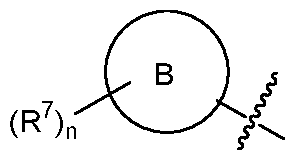 is 2,6-dioxohexahydropyrimidin-l-yl, 2- oxopyrrolidin-l-yl, benzo[d]thiazol-2-yl, 2-amino-4-methyl-5,6-dihydro-l,3-thiazin-4-yl, 4- methyl-6-[4-(mo holine-4-carbonyl)anilino]-5-oxo-pyrazin-2-yl, 5,7- dimethylbenzo[d]oxazol-2-yl, 6-[4-(morpholine-4-carbonyl)phenyl]-7H-pyrrolo[2,3- d]pyrimidin-4-yl, 8-[4-(morpholine-4-carbonyl)anilino]imidazo[l,2-a]pyrazin-6-yl, oxazolo[4,5-b]pyridine-2-yl, or l-methyl-2-oxo-l,6-naphthridin-3-yl, ring A in Formula (Γ) is not 2-pyridyl or 2-pyridyl optionally substituted with halo, methylcarboxy, l,2,4-triazol-4- yl, 1-piperidinyl, or cyclopropyl;
(ii) when ring B is thiazolo[5,4-b]pyridin-2-yl or 6,7,8,9-tetrahydro-5H- [l,2,4]triazolo[4,3-a]azepin-3-yl, ring A in Formula (Γ) is other than 2-quinolyl;
(iii) when ring B is 1 -piperazinyl, ring A in Formula (Γ) is not 3-(4- benzyloxyphenyl)pyrazolo[l,5-a]pyrimidin-5-yl;
(iv) when
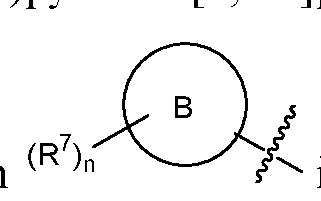 is 6-[l-(dimethylcarbamoyl)-3,6-dihydro-2H-pyridin-4-yl]- 7H-pyrrolo[2,3-d]pyrimidin-4-yl, ring A in Formula (Γ) is not l-methylpyrrolo[2,3- b]pyridine-6-yl;
(v) when ring B is 2-oxo-l,2-dihydropyridin-5-yl, 2-oxo-l,2-dihydropyrazin-5-yl or 6-oxo- lH-pyridazin-3-yl, R2 is other than t-butyl;
(vi) when
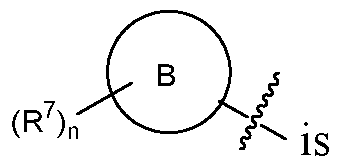 3,5-dimethylphenyl, R5 is other than 4-amino-l- piperidinyl; and
(vii) the compound is other than 6-((2R,6S)-2,6-dimethylmorpholino)-N-(2-methyl-4'- (trifluoromethoxy)biphenyl-3-yl)pyridazine-3-carboxamide or N-(3-(3-acet l-2- oxoimidazolidin-l-yl)-2-methylphenyl)-5,6 ,8 etrahydroquinoline-2-carboxamide.
3. The compound of claim 1 or 2 having Formula (I):

or a pharmaceutically acceptable salt or a stereoisomer thereof, wherein:
X1 is N or CR1;
X2 is N or CR2;
X3 is N or CR3;
X4 is N or CR4;
wherein no more than two of X1, X2, X3 and X4 are simultaneously N;
R1, R2, R3, R4 and R7 are each independently selected from H, halo, Ci-6 alkyl, C2-6 alkenyl, C2-6 alkynyl, Ci-6 haloalkyl, Ci-6 haloalkoxy, Ce-ιο aryl, C3-10 cycloalkyl, 5-14 membered heteroaryl, 4-10 membered heterocycloalkyl, Ce-ιο aryl-Ci-4 alkyl-, C3-10
cycloalkyl-C 1-4 alkyl-, (5-14 membered heteroaryl)-Ci-4 alkyl-, (4-10 membered
heterocycloalkyl)-Ci-4 alkyl-, CN, NO2, ORa, SRa, NHORa, C(0)Ra, C(0)NRaRa, C(0)ORa, OC(0)Ra, OC(0)NRaRa, NHRa, NRaRa, NRaC(0)Ra, NRaC(0)ORa, NRaC(0)NRaRa, C(=NRa)Ra, C(=NRa)NRaRa, NRaC(=NRa)NRaRa, NRaS(0)Ra, NRaS(0)2Ra, NRaS(0)2NRaRa, S(0)Ra, S(0)NRaRa, S(0)2Ra, and S(0)2NRaRa, wherein the Ci-e alkyl, C2-6 alkenyl, C2-6 alkynyl, Ce-ιο aryl, C3-10 cycloalkyl, 5-14 membered heteroaryl, 4-10 membered
heterocycloalkyl, Ce-ιο aryl-Ci-4 alkyl-, C3-10 cycloalkyl-Ci-4 alkyl-, (5-14 membered heteroaryl)-Ci-4 alkyl-, and (4-10 membered heterocycloalkyl)-Ci-4 alkyl- of R1, R2, R3, R4 and R7 are each optionally substituted with 1, 2, 3, or 4 Rb substituents;
R5 is Ci-4 alkyl, halo, CN, OH, cyclopropyl, C2-4 alkynyl, Ci-4 alkoxy, C1-4 haloalkyl, Ci-4 haloalkoxy, NH2, -NH-CM alkyl, -N(Ci-4 alkyl)2, NHOR11, C(0)Rn, C(0)NRnRn,
C(0)ORn, OC(0)Rn, OC(0)NRnRn, NRnC(0)Rn, NRnC(0)ORn, NR11^)^11^1, C(=NR11)R11, C(=NR11)NR11R11, NR11C(=NR11)NR11R11, NRnS(0)Rn, NR^SCO^R11, NRHS^NRHR11, S(0)Rn, S(0)NRnRn, S(0)2Rn, and S^NRHR11, wherein each R11 is independently selected from H and Ci-4 alkyl optionally substituted with 1 or 2 halo, OH, CN or OCH3;
each R6 is independently selected from H, C1-4 alkyl, C3-6 cycloalkyl, C2-4 alkenyl, C2-4 alkynyl, halo, CN, OH, Ci-4 alkoxy, Ci-4 haloalkyl, Ci-4 haloalkoxy, NH2, -NH-C 1-4 alkyl, -N(C 1-4 alky 1)2, NHOR10, C(0)R10, C(O)NR10R10, C(0)OR10, OC(0)R10, OC(O)NR10R10, NR10C(O)R10, NR10C(O)OR10, NR10C(O)NR10R10, C(=NR10)R10, C(=NR10)NR10R10, NR10C(=NR10)NR10R10, NR10S(O)R10, NR10S(O)2R10, NR10S(O)2NR10R10, S(0)R10,
S(O)NR10R10, S(0)2R10, and S(O)2NR10R10, wherein each R10 is independently H or CM alkyl optionally substituted with 1 or 2 groups independently selected from halo, OH, CN and C1-4 alkoxy, and wherein the C1-4 alkyl, C3-4 cycloalkyl, C2-4 alkenyl and C2-4 alkynyl of R6 are each optionally substituted with 1 or 2 substituents independently selected from halo, OH, CN, Ci-4 alkyl and C1-4 alkoxy;
or two adjacent R7 substituents, taken together with the carbon atoms to which they are attached, form a fused phenyl ring, a fused 5- to 7-membered heterocycloalkyl ring, a fused 5- or 6-membered heteroaryl ring or a fused C5-6 cycloalkyl ring, wherein the fused 5- to 7-membered heterocycloalkyl ring and fused 5- or 6-membered heteroaryl ring each have 1-4 heteroatoms as ring members selected from N, O and S and wherein the fused phenyl ring, fused 5- to 7-membered heterocycloalkyl ring, fused 5- or 6-membered heteroaryl ring and fused C3-10 cycloalkyl ring are each optionally substituted with 1 or 2 independently selected Rq substituents;
or R1 and X2 taken together form a fused phenyl ring, a fused 4- to 10-membered heterocycloalkyl ring, a fused 5- or 6-membered heteroaryl ring or a fused C3-10 cycloalkyl ring, wherein the fused 4- to 10-membered heterocycloalkyl ring and fused 5- or 6-membered heteroaryl ring each have 1-4 heteroatoms as ring members selected from N, O and S and wherein the fused phenyl ring, fused 5- or 6-membered heterocycloalkyl ring, fused 5- or 6- membered heteroaryl ring and fused C5-6 cycloalkyl ring are each optionally substituted with 1 or 2 independently selected Rb substituents;
or R2 and X1 taken together form a fused phenyl ring, a fused 4- to 10-membered heterocycloalkyl ring, a fused 5- or 6-membered heteroaryl ring or a fused C3-10 cycloalkyl ring, wherein the fused 4- to 10-membered heterocycloalkyl ring and fused 5- or 6-membered heteroaryl ring each have 1-4 heteroatoms as ring members selected from N, O and S and
wherein the fused phenyl ring, fused 5- or 6-membered heterocycloalkyl ring, fused 5- or 6- membered heteroaryl ring and fused C5-6 cycloalkyl ring are each optionally substituted with 1 or 2 independently selected Rb substituents;
or R2 and X3 taken together form a fused phenyl ring, a fused 4- to 10-membered heterocycloalkyl ring, a fused 5- or 6-membered heteroaryl ring or a fused C3-10 cycloalkyl ring, wherein the fused 4- to 10-membered heterocycloalkyl ring and fused 5- or 6-membered heteroaryl ring each have 1-4 heteroatoms as ring members selected from N, O and S and wherein the fused phenyl ring, fused 5- or 6-membered heterocycloalkyl ring, fused 5- or 6- membered heteroaryl ring and fused C5-6 cycloalkyl ring are each optionally substituted with 1 or 2 independently selected Rb substituents;
or R3 and X2 taken together form a fused phenyl ring, a fused 4- to 10-membered heterocycloalkyl ring, a fused 5- or 6-membered heteroaryl ring or a fused C3-10 cycloalkyl ring, wherein the fused 4- to 10-membered heterocycloalkyl ring and fused 5- or 6-membered heteroaryl ring each have 1-4 heteroatoms as ring members selected from N, O and S and wherein the fused phenyl ring, fused 5- or 6-membered heterocycloalkyl ring, fused 5- or 6- membered heteroaryl ring and fused C5-6 cycloalkyl ring are each optionally substituted with 1 or 2 independently selected Rb substituents;
or R3 and X4 taken together form a fused phenyl ring, a fused 4- to 10-membered heterocycloalkyl ring, a fused 5- or 6-membered heteroaryl ring or a fused C3-10 cycloalkyl ring, wherein the fused 4- to 10-membered heterocycloalkyl ring and fused 5- or 6-membered heteroaryl ring each have 1-4 heteroatoms as ring members selected from N, O and S and wherein the fused phenyl ring, fused 5- or 6-membered heterocycloalkyl ring, fused 5- or 6- membered heteroaryl ring and fused C5-6 cycloalkyl ring are each optionally substituted with 1 or 2 independently selected Rb substituents;
or R4 and X3 taken together form a fused phenyl ring, a fused 4- to 10-membered heterocycloalkyl ring, a fused 5- or 6-membered heteroaryl ring or a fused C3-10 cycloalkyl ring, wherein the fused 4- to 10-membered heterocycloalkyl ring and fused 5- or 6-membered heteroaryl ring each have 1-4 heteroatoms as ring members selected from N, O and S and wherein the fused phenyl ring, fused 5- or 6-membered heterocycloalkyl ring, fused 5- or 6- membered heteroaryl ring and fused C5-6 cycloalkyl ring are each optionally substituted with 1 or 2 independently selected Rb substituents;
each Ra is independently selected from H, CN, Ci-6 alkyl, Ci-4 haloalkyl, C2-6 alkenyl, C2-6 alkynyl, Ce-ιο aryl, C3-10 cycloalkyl, 5-10 membered heteroaryl, 4-10 membered heterocycloalkyl, Ce-ιο aryl-Ci-4 alkyl-, C3-10 cycloalkyl-Ci-4 alkyl-, (5-10 membered
heteroaryl)-Ci-4 alkyl-, and (4-10 membered heterocycloalkyl)-Ci-4 alkyl-, wherein the Ci-6 alkyl, C2-6 alkenyl, C2-6 alkynyl, Ce-ιο aryl, C3-10 cycloalkyl, 5-10 membered heteroaryl, 4-10 membered heterocycloalkyl, Ce-ιο aryl-C 1-4 alkyl-, C3-io cycloalkyl-Ci-4 alkyl-, (5-10 membered heteroaryl)-Ci-4 alkyl- and (4-10 membered heterocycloalkyl)-Ci-4 alkyl- of Ra are each optionally substituted with 1, 2, 3, 4, or 5 Rd substituents;
each Rd is independently selected from C1-4 alkyl, Ci-4 haloalkyl, halo, C3-10 cycloalkyl, 4-10 membered heterocycloalkyl, CN, NH2, NHORe, ORe, SRe, C(0)Re,
C(0)NReRe, C(0)ORe, OC(0)Re, OC(0)NReRe, NHRe, NReRe, NReC(0)Re, NReC(0)NReRe, NReC(0)ORe, C(=NRe)NReRe, NReC(=NRe)NReRe, S(0)Re, S(0)NReRe, S(0)2Re,
NReS(0)2Re, NReS(0)2NReRe, and S(0)2NReRe, wherein the CM alkyl, C3-10 cycloalkyl and 4-10 membered heterocycloalkyl of Rd are each further optionally substituted with 1-3 independently selected Rq substituents;
each Rb substituent is independently selected from halo, C1-4 alkyl, C1-4 haloalkyl, C1-4 haloalkoxy, C6-io aryl, C3-10 cycloalkyl, 5-10 membered heteroaryl, 4-10 membered heterocycloalkyl, Ce-ιο aryl-Ci-4 alkyl-, C3-10 cycloalkyl-Ci-4 alkyl-, (5-10 membered heteroaryl)-Ci-4 alkyl-, (4-10 membered heterocycloalkyl)-Ci-4 alkyl-, CN, OH, NH2, NO2, NHORc, ORc, SRC, C(0)Rc, C(0)NRcRc, C(0)ORc, OC(0)Rc, OC(0)NRcRc, C(=NRC)NRCRC, NRCC(=NRC)NRCRC, NHRC, NRCRC, NRcC(0)Rc, NRcC(0)ORc, NRcC(0)NRcRc, NRcS(0)Rc, NRcS(0)2Rc, NRcS(0)2NRcRc, S(0)Rc, S(0)NRcRc, S(0)2Rc and S(0)2NRcRc; wherein the Ci-4 alkyl, C1-4 haloalkyl, C 1-4 haloalkoxy, Ce-ιο aryl, C3-10 cycloalkyl, 5-10 membered heteroaryl, 4-10 membered heterocycloalkyl, Ce-ιο aryl-Ci-4 alkyl-, C3-10 cycloalkyl-Ci-4 alkyl- , (5-10 membered heteroaryl)-Ci-4 alkyl-and (4-10 membered heterocycloalkyl)-Ci-4 alkyl- of Rb are each further optionally substituted with 1-3 independently selected Rd substituents; each Rc is independently selected from H, Ci-6 alkyl, C 1-4 haloalkyl, C2-6 alkenyl, C2-6 alkynyl, Ce-ιο aryl, C3-10 cycloalkyl, 5-10 membered heteroaryl, 4-10 membered
heterocycloalkyl, Ce-ιο aryl-Ci-4 alkyl-, C3-10 cycloalkyl-Ci-4 alkyl-, (5-10 membered heteroaryl)-Ci-4 alkyl-, and (4-10 membered heterocycloalkyl)-Ci-4 alkyl-, wherein the Ci-6 alkyl, C2-6 alkenyl, C2-6 alkynyl, Ce-ιο aryl, C3-10 cycloalkyl, 5-10 membered heteroaryl, 4-10 membered heterocycloalkyl, Ce-ιο aryl-C 1-4 alkyl-, C3-io cycloalkyl-Ci-4 alkyl-, (5-10 membered heteroaryl)-Ci-4 alkyl- and (4-10 membered heterocycloalkyl)-Ci-4 alkyl- of Rc are each optionally substituted with 1, 2, 3, 4, or 5 Rf substituents independently selected from Ci-4 alkyl, C1-4 haloalkyl, C2-6 alkenyl, C2-6 alkynyl, Ce-ιο aryl, C3-10 cycloalkyl, 5-10 membered heteroaryl, 4-10 membered heterocycloalkyl, Ce-ιο aryl-Ci-4 alkyl-, C3-10 cycloalkyl-C 1-4 alkyl-, (5-10 membered heteroaryl)-Ci-4 alkyl-, (4-10 membered
heterocycloalkyl)-Ci-4 alkyl-, halo, CN, NHOR , ORg, SRg, C(0)Rg, C(0)NRgRg, C(0)ORg, OC(0)Rg, OC(0)NRgRg, NHR , NR R , NRgC(0)Rg, NRgC(0)NRgRg, NRgC(0)ORg, C(=NRg)NRgRg, NRgC(=NRg)NRgRg, S(0)Rg, S(0)NRgRg, S(0)2Rg, NRgS(0)2Rg,
NRgS(0)2NRgRg, and S(0)2NRgRg; wherein the CM alkyl, CM haloalkyl, C2-6 alkenyl, C2-6 alkynyl, Ce-ιο aryl, C3-10 cycloalkyl, 5-10 membered heteroaryl, 4-10 membered
heterocycloalkyl, Ce-ιο aryl-Ci-4 alkyl-, C3-10 cycloalkyl-Ci-4 alkyl-, (5-10 membered heteroaryl)-Ci-4 alkyl-, and (4-10 membered heterocycloalkyl)-Ci-4 alkyl- of Rf are each optionally substituted with 1, 2, 3, 4, or 5 Rn substituents independently selected from C1-4 alkyl, Ci-4 haloalkyl, halo, CN, R°, NHOR0, OR0, SR°, C(O)R0, C(O)NR0R°, C(O)OR0, OC(0)R°, OC(0)NR°R°, NHR°, NR°R°, NR0C(O)R°, NR0C(O)NR°R°, NR°C(0)OR°, C(=NR°)NR°R°, NR0C(=NR°)NR°R0, S(O)R0, S(O)NR0R°, S(O)2R0, NR0S(O)2R°,
NR°S(0)2NR°R°, and S(O)2NR0R°;
each R is independently selected from H, Ci-6 alkyl, Ci-4 haloalkyl, C2-6 alkenyl, C2-6 alkynyl, Ce-ιο aryl, C3-10 cycloalkyl, 5-10 membered heteroaryl, 4-10 membered
heterocycloalkyl, Ce-ιο aryl-Ci-4 alkyl-, C3-10 cycloalkyl-Ci-4 alkyl-, (5-10 membered heteroaryl)-Ci-4 alkyl-, and (4-10 membered heterocycloalkyl)-Ci-4 alkyl-, wherein the Ci-6 alkyl, C2-6 alkenyl, C2-6 alkynyl, Ce-ιο aryl, C3-10 cycloalkyl, 5-10 membered heteroaryl, 4-10 membered heterocycloalkyl, Ce-ιο aryl-C 1-4 alkyl-, C3-io cycloalkyl-Ci-4 alkyl-, (5-10 membered heteroaryl)-Ci-4 alkyl- and (4-10 membered heterocycloalkyl)-Ci-4 alkyl- of R are each optionally substituted with 1-3 independently selected Rp substituents;
or any two Ra substituents together with the nitrogen atom to which they are attached form a 4-, 5-, 6-, 7-, 8-, 9- or 10-membered heterocycloalkyl group optionally substituted with 1, 2 or 3 Rh substituents independently selected from Ci-6 alkyl, C3-10 cycloalkyl, 4-7 membered heterocycloalkyl, Ce-ιο aryl, 5-6 membered heteroaryl, C3-10 cycloalkyl-Ci-4 alkyl-, (5-6 membered heteroaryl)-Ci-4 alkyl-, (4-7 membered heterocycloalkyl)-Ci-4 alkyl-, Ci-6 haloalkyl, C2-e alkenyl, C2-e alkynyl, halo, CN, OR1, SR1, NHOR1, C(0)R\ C(0)NR1R1, C(0)OR1, OC^R1, OC(0)NR1R1, NHR1, NR'R1, NR1C(0)R1, NR1C(0)NR1R1, NR1C(0)OR1, C(=NR1)NR1R1, NR1C(=NR1)NR1R1, S(0)R S^NR'R1, S(0)2R\ NR^O^R1,
NR^O^NR'R1, and S O^NR'R1, wherein the Ci-e alkyl, C3-10 cycloalkyl, 4-7 membered heterocycloalkyl, Ce-ιο aryl, 5-6 membered heteroaryl, C3-10 cycloalkyl-Ci-4 alkyl-, (5-6 membered heteroaryl)-Ci-4 alkyl-, and (4-7 membered heterocycloalkyl)-Ci-4 alkyl- of Rh are each further optionally substituted by 1, 2, or 3 RJ substituents independently selected from C3-6 cycloalkyl, Ce-ιο aryl, 5 or 6-membered heteroaryl, C2-4 alkenyl, C2-4 alkynyl, halo, C1-4 alkyl, Ci-4 haloalkyl, CN, NHORk, ORk, SRk, C(0)Rk, C(0)NRkRk, C(0)ORk, OC(0)Rk,
OC(0)NRkRk, NHRk, NRkRk, NRkC(0)Rk, NRkC(0)NRkRk NRkC(0)ORk, C(=NRk)NRkRk NRkC(=NRk)NRkRk S(0)Rk, S(0)NRkRk S(0)2Rk, NRkS(0)2Rk, NRkS(0)2NRkRk, and S(0)2NRkRk; or two Rh groups attached to the same carbon atom of the 4- to 10-membered heterocycloalkyl taken together with the carbon atom to which they are attached form a C3-6 cycloalkyl or 4- to 6-membered heterocycloalkyl having 1 -2 heteroatoms as ring members selected from O, N or S;
or any two Rc substituents together with the nitrogen atom to which they are attached form a 4-, 5-, 6-, or 7-membered heterocycloalkyl group optionally substituted with 1 , 2, or 3 independently selected Rh substituents;
or any two Re substituents together with the nitrogen atom to which they are attached form a 4-, 5-, 6-, or 7-membered heterocycloalkyl group optionally substituted with 1 , 2, or 3 independently selected Rh substituents;
or any two R substituents together with the nitrogen atom to which they are attached form a 4-, 5-, 6-, or 7-membered heterocycloalkyl group optionally substituted with 1 , 2, or 3 independently selected Rh substituents;
or any two R1 substituents together with the nitrogen atom to which they are attached form a 4-, 5-, 6-, or 7-membered heterocycloalkyl group optionally substituted with 1 , 2, or 3 independently selected Rh substituents;
or any two Rk substituents together with the nitrogen atom to which they are attached form a 4-, 5-, 6-, or 7-membered heterocycloalkyl group optionally substituted with 1 , 2, or 3 independently selected Rh substituents;
or any two R° substituents together with the nitrogen atom to which they are attached form a 4-, 5-, 6-, or 7-membered heterocycloalkyl group optionally substituted with 1 , 2, or 3 independently selected Rh substituents; and
each Re, R1, Rk R° or Rp is independently selected from H, C1-4 alkyl, C3-6 cycloalkyl, Ce-ιο aryl, 5 or 6-membered heteroaryl, C1-4 haloalkyl, C2-4 alkenyl, and C2-4 alkynyl, wherein the Ci-4 alkyl, C3-6 cycloalkyl, Ce-ιο aryl, 5 or 6-membered heteroaryl, C2-4 alkenyl, and C2-4 alkynyl of Re, R1, Rk, R° or Rp are each optionally substituted with 1, 2 or 3 Rq substituents; each R¾ is independently selected from OH, CN, -COOH, NH2, halo, C M alkyl, CM alkoxy, C1-4 alkylthio, phenyl, 5-6 membered heteroaryl, C3-6 cycloalkyl, NHR8, NR8R8, and Ci-4 haloalkoxy, wherein the C1-4 alkyl, phenyl and 5-6 membered heteroaryl of Rq are each optionally substituted with OH, CN, -COOH, NH2, C1-4 alkoxy, C3-10 cycloalkyl and 4-, 5-, or 6-membered heterocycloalkyl and each R8 is independently Ci-6 alkyl;
the subscript n is an integer of 1 , 2, 3, 4 or 5;
the subscript m is an integer of 1 , 2 or 3; and
= is a single bond or a double bond, wherein ring A includes at least one double bond;
with the proviso that the compound is other than 6-((2R,6S)-2,6- dimethylmorpholino)-N-(2-methyl-4'-(trifluoromethoxy)biphenyl-3-yl)pyridazine-3- carboxamide.
The compound of any one of claims 1-3, wherein ring A is aromatic. The compound of any one of claims 1-4, having Formula (II):
wherein R2
 l, Ci-6 haloalkoxy, C6-io aryl, C3-10 cycloalkyl, 5-14 membered heteroaryl, 4-10 membered heterocycloalkyl, Ce-ιο aryl-Ci-4 alkyl-, C3-10 cycloalkyl-Ci-4 alkyl-, (5-14 membered heteroaryl)-Ci-4 alkyl-, (4-10 membered heterocycloalkyl)-Ci-4 alkyl-, CN, NO2, ORa, SRa, NHORa, C(0)Ra, C(0)NRaRa, C(0)ORa, OC(0)Ra, OC(0)NRaRa, NHRa, NRaRa,
NRaC(0)Ra, NRaC(0)ORa, NRaC(0)NRaRa, C(=NRa)Ra, C(=NRa)NRaRa,
NRaC(=NRa)NRaRa, NRaS(0)Ra, NRaS(0)2Ra, NRaS(0)2NRaRa, S(0)Ra, S(0)NRaRa, S(0)2Ra, and S(0)2NRaRa, wherein the Ci-6 alkyl, C2-6 alkenyl, C2-6 alkynyl, Ce-io aryl, C3-10 cycloalkyl, 5-14 membered heteroaryl, 4-10 membered heterocycloalkyl, Ce-ιο aryl-Ci-4 alkyl-, C3-10 cycloalkyl-Ci-4 alkyl-, (5-14 membered heteroaryl)-Ci-4 alkyl-, and (4-10 membered heterocycloalkyl)-Ci-4 alkyl- of R2 are each optionally substituted with 1 , 2, 3, or 4 Rb substituents, or a pharmaceutically acceptable salt or a stereoisomer thereof.
6. The compound of any one of claims 1-5, having Formula (III):

or a pharmaceutically acceptable salt or a stereoisomer thereof.
7. The compound of any one of claims 1-6, having Formula (IV):

or a pharmaceutically acceptable salt or a stereoisomer thereof.
The compound of any one of claims 1-5, having Formula (V):

or a pharmaceutically acceptable salt or a stereoisomer thereof.
9. The compound of any one of claims 1-5 and 8, having Formula (VI):
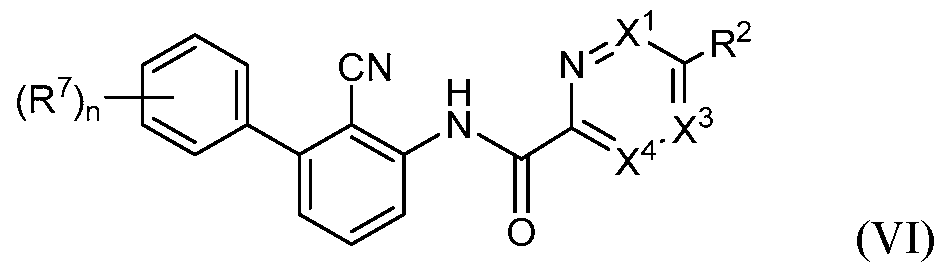
or a pharmaceutically acceptable salt or a stereoisomer thereof.
The compound of any one of claims 1-9, or a pharmaceutically acceptable salt or a stereoisomer thereof, wherein the moiety
 selected from:

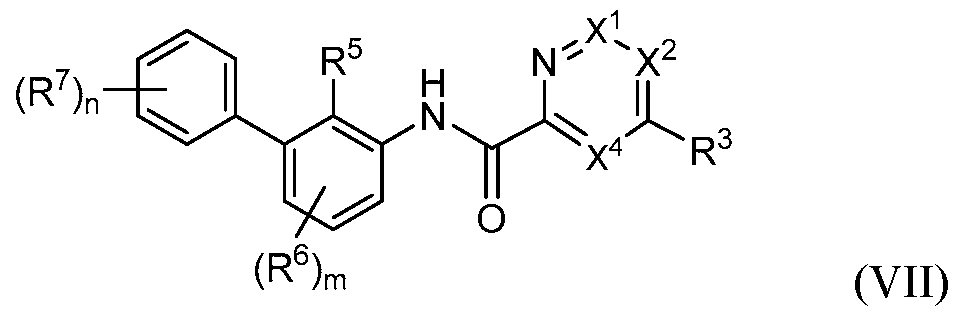
wherein R3 is halo, Ci-6 alkyl, C2-6 alkenyl, C2-6 alkynyl, Ci-6 haloalkyl, Ci-6 haloalkoxy, C6-io aryl, C3-10 cycloalkyl, 5-14 membered heteroaryl, 4-10 membered heterocycloalkyl, Ce-ιο aryl-Ci-4 alkyl-, C3-10 cycloalkyl-Ci-4 alkyl-, (5-14 membered heteroaryl)-Ci-4 alkyl-, (4-10 membered heterocycloalkyl)-Ci-4 alkyl-, CN, NO2, ORa, SRa, NHORa, C(0)Ra, C(0)NRaRa, C(0)ORa, OC(0)Ra, OC(0)NRaRa, NHRa, NRaRa,
NRaC(0)Ra, NRaC(0)ORa, NRaC(0)NRaRa, C(=NRa)Ra, C(=NRa)NRaRa,
NRaC(=NRa)NRaRa, NRaS(0)Ra, NRaS(0)2Ra, NRaS(0)2NRaRa, S(0)Ra, S(0)NRaRa, S(0)2Ra, and S(0)2NRaRa, wherein the Ci-e alkyl, C2-6 alkenyl, C2-6 alkynyl, Ce-io aryl, C3-10 cycloalkyl, 5-14 membered heteroaryl, 4-10 membered heterocycloalkyl, Ce-ιο aryl-Ci-4 alkyl-, C3-10 cycloalkyl-Ci-4 alkyl-, (5-14 membered heteroaryl)-Ci-4 alkyl-, and (4-10 membered heterocycloalkyl)-Ci-4 alkyl- of R1 are each optionally substituted with 1, 2, 3, or 4 Rb substituents, or a pharmaceutically acceptable salt or a stereoisomer thereof.
12. The compound of any one of claims 1-4 and 11, or a pharmaceutically
acceptable salt or a stereoisomer thereof, wherein the moiety
 is selected from:

and R4
13. The compound of any one of claims 1-9, or a pharmaceutically acceptable salt or a stereoisomer thereof, wherein X1 is CR1, X3 is CR3 and X4 is CR4.
14. The compound of any one of claims 1-9, or a pharmaceutically acceptable salt or a stereoisomer thereof, wherein X1 is CR1, X3 is N and X4 is CR4.
15. The compound of any one of claims 1-9, or a pharmaceutically acceptable salt or a stereoisomer thereof, wherein X1 is N, X3 is CR3 and X4 is CR4.
16. The compound of any one of claims 1-9, or a pharmaceutically acceptable salt or a stereoisomer thereof, wherein X1 is CR1, X3 is CR3 and X4 is N.
17. The compound of any one of claims 1-10 and 13-16, or a pharmaceutically acceptable salt or a stereoisomer thereof, wherein R1, R3 and R4, when applicable, are each independently selected from H, Ci-6 alkyl and halo.
18. The compound of claim 11 or 12, or a pharmaceutically acceptable salt or a stereoisomer thereof, wherein R1, R2 and R4, when applicable, are each independently selected from H, Ci-6 alkyl and halo.
19. The compound of any one of claims 1-10 and 13-17, or a pharmaceutically acceptable salt or a stereoisomer thereof, wherein R2 is -CH2-Rb.
20. The compound of claim 19, or a pharmaceutically acceptable salt or a stereoisomer thereof, wherein Rb is -NRCRC.
21. The compound of any of claims 11, 12 and 18, or a pharmaceutically acceptable salt or a stereoisomer thereof, wherein R3 is -CH2-Rb.
22. The compound of claim 21, or a pharmaceutically acceptable salt or a stereoisomer thereof, wherein Rb is -NRCRC.
23. The compound of any of claims 1-10, and 13-16 or a pharmaceutically acceptable salt or a stereoisomer thereof, wherein R2 is 2-hydroxyethylaminomethyl, 2-
carboxy piperidin- 1 -ylmethy 1, (S)-2-carboxy piperidin- 1 -ylmethy 1, (R)-2-carboxy piperidin- 1 - ylmethyl or (3-cyanobenzyl)oxy.
24. The compound of any of claims 1, 2, 11, and 12, or a pharmaceutically acceptable salt or a stereoisomer thereof, wherein R3 is 2-hydroxyethylaminomethyl, 2- carboxy piperidin- 1 -ylmethyl, (S)-2-carboxy piperidin- 1 -ylmethyl, (R)-2-carboxy piperidin- 1 - ylmethyl or (3-cyanobenzyl)oxy.
25. A comp

X1 is N or CR1;
X2 is N or CR2;
X3 is N or CR3;
X4 is N or CR4;
wherein no more than two of X1, X2, X3 and X4 are simultaneously N;
X5 is N or CR6a;
X6 is CR6b;
ring B is phenyl, cyclohexyl, piperidinyl, or tetrahydropyridinyl;
R1, R2, R3, R4 and R7 are each independently selected from H, halo, Ci-6 alkyl, C2-6 alkenyl, C2-6 alkynyl, Ci-6 haloalkyl, Ce-ιο aryl, C3-10 cycloalkyl, 5-14 membered heteroaryl, 4- 10 membered heterocycloalkyl, C6-io aryl-C 1-4 alkyl-, C3-io cycloalkyl-Ci-4 alkyl-, (5-14 membered heteroaryl)-Ci-4 alkyl-, (4-10 membered heterocycloalkyl)-Ci-4 alkyl-, CN, ORa, NHRa, and NRaRa, wherein the Ci-6 alkyl, C2-6 alkenyl, C2-6 alkynyl, Ce-ιο aryl, C3-10 cycloalkyl, 5-14 membered heteroaryl, 4-10 membered heterocycloalkyl, Ce-ιο aryl-Ci-4 alkyl- , C3-10 cycloalkyl-Ci-4 alkyl-, (5-14 membered heteroaryl)-Ci-4 alkyl-, and (4-10 membered heterocycloalkyl)-Ci-4 alkyl- of R1, R2, R3, R4 and R7 are each optionally substituted with 1 , 2, 3, or 4 Rb substituents;
R5 is Ci-6 alkyl, C2-6 alkenyl, C2-6 alkynyl, Ci-6 haloalkyl, Ci-6 haloalkoxy, or CN, wherein the Ci-6 alkyl, C2-6 alkenyl, C2-6 alkynyl, Ci-6 haloalkyl, and Ci-6 haloalkoxy of R5 are each optionally substituted with 1, 2 or 3 Rb substituents;
R6a, R6b and R6c are each independently selected from H, C1-4 alkyl, C2-4 alkenyl, C2-4 alkynyl, halo, CN, OH, CM alkoxy, CM haloalkyl, NH2, -NH-Ci-4 alkyl, and -N(C M alkyl)2, wherein the C1-4 alkyl, C2-4 alkenyl and C2-4 alkynyl of R6a, R6b, and R6c are each optionally substituted with 1 or 2 substituents independently selected from halo, OH, CN, C 1-4 alkyl and CM alkoxy;
or two adjacent R7 substituents, taken together with the atoms to which they are attached, form a fused 4- to 7-membered heterocycloalkyl ring or a fused 5- or 6-membered heteroaryl ring, wherein the fused 4- to 7-membered heterocycloalkyl ring and fused 5- or 6- membered heteroaryl ring each have 1-4 heteroatoms as ring members selected from N and O and wherein the fused 5- to 7-membered heterocycloalkyl ring and fused 5- or 6-membered heteroaryl ring are each optionally substituted with 1 or 2 independently selected Rb substituents;
each Ra is independently selected from H, CN, Ci-6 alkyl, C 1-4 haloalkyl, C2-6 alkenyl, C2-6 alkynyl, Ce-ιο aryl, C3-10 cycloalkyl, 5-10 membered heteroaryl, 4-10 membered heterocycloalkyl, Ce-ιο aryl-Ci-4 alkyl-, C3-10 cycloalkyl-Ci-4 alkyl-, (5-10 membered heteroaryl)-Ci-4 alkyl-, and (4-10 membered heterocycloalkyl)-Ci-4 alkyl-, wherein the Ci-6 alkyl, C2-6 alkenyl, C2-6 alkynyl, Ce-ιο aryl, C3-10 cycloalkyl, 5-10 membered heteroaryl, 4-10 membered heterocycloalkyl, Ce-ιο aryl-C 1-4 alkyl-, C3-io cycloalkyl-Ci-4 alkyl-, (5-10 membered heteroaryl)-Ci-4 alkyl- and (4-10 membered heterocycloalkyl)-Ci-4 alkyl- of Ra are each optionally substituted with 1, 2, 3, 4, or 5 Rd substituents;
each Rd is independently selected from CM alkyl, CM haloalkyl, halo, C3-10 cycloalkyl, 4-10 membered heterocycloalkyl, CN, NH2, ORe, SRe, C(0)Re, C(0)NReRe, C(0)ORe, OC(0)Re, OC(0)NReRe, NHRe, NReRe, and NReC(0)Re, and S(0)2NReRe, wherein the CM alkyl, C3-10 cycloalkyl and 4-10 membered heterocycloalkyl of Rd are each further optionally substituted with 1 -3 independently selected Rf substituents;
each Rb substituent is independently selected from halo, C M alkyl, CM haloalkyl, C1-4 haloalkoxy, CN, OH, NH2, NO2, NHORc, ORc, SRC, C(0)Rc, C(0)NRcRc, C(0)ORc, OC(0)Rc, OC(0)NRcRc, NHRC, NRCRC, NRcC(0)Rc, and NRcC(0)ORc; wherein the CM alkyl, C1-4 haloalkyl, and C 1-4 haloalkoxy of Rb are each further optionally substituted with 1- 3 independently selected Rd substituents;
each Rc is independently selected froni H, Ci-6 alkyl, Ci-4 haloalkyl, C2-6 alkenyl, and C2-6 alkynyl, wherein the Ci-6 alkyl, C2-6 alkenyl, and C2-6 alkynyl of Rc are each optionally substituted with 1, 2, 3, 4, or 5 Rf substituents independently selected from C1-4 alkyl, C1-4 haloalkyl, C2-6 alkenyl, C2-6 alkynyl, halo, CN, NHOR , ORg, SRg, C(0)Rg, C(0)NRgRg, C(0)ORg, OC(0)Rg, OC(0)NRgRg, NHRg, NRgRg, and NRgC(0)Rg;
each R is independently selected from H, Ci-6 alkyl, C1-4 haloalkyl, C2-6 alkenyl, and C2-6 alkynyl;
each Re is independently selected from H, C1-4 alkyl, C1-4 haloalkyl, C2-4 alkenyl, and C2-4 alkynyl;
is a single bond or a double bond, wherein ring A includes at least one double bond; and
the subscript n is an integer of 1 , 2, 3, 4 or 5.
26. A comp

or a pharmaceutically acceptable salt or a stereoisomer thereof, wherein:
X1 is N or CR1;
X2 is N or CR2;
X3 is N or CR3;
X4 is N or CR4;
wherein no more than two of X1, X2, X3 and X4 are simultaneously N;
X5 is N or CR6a;
X6 is CR6b;
ring B is phenyl, cyclohexyl, piperidinyl, or tetrahydropyridinyl;
R1, R2, R3, R4 and R7 are each independently selected from H, halo, Ci-6 alkyl, C2-6 alkenyl, C2-6 alkynyl, 5-14 membered heteroaryl, 4-10 membered heterocycloalkyl, (5-14 membered heteroaryl)-Ci-4 alkyl-, (4-10 membered heterocycloalkyl)-Ci-4 alkyl-, CN, ORa, NHRa, and NRaRa, wherein the Ci-6 alkyl, C2-6 alkenyl, C2-6 alkynyl, 5-14 membered heteroaryl, 4-10 membered heterocycloalkyl, (5-14 membered heteroaryl)-Ci-4 alkyl-, and (4-
10 membered heterocycloalkyl)-Ci-4 alkyl- of R1, R2, R3, R4 and R7 are each optionally substituted with 1, 2, 3, or 4 Rb substituents;
R5 is Ci-e alkyl or CN;
R6a, R6b and R6c are each independently selected from H, Ci-4 alkyl, C2-4 alkenyl, C2-4 alkynyl, halo, CN, OH, NH2, -NH-Ci-4 alkyl, and -N(Ci-4 alkyl)2;
or two adjacent R7 substituents, taken together with the atoms to which they are attached, form a fused 4- to 7-membered heterocycloalkyl ring or a fused 5- or 6-membered heteroaryl ring, wherein the fused 4- to 7-membered heterocycloalkyl ring and fused 5- or 6- membered heteroaryl ring each have 1-4 heteroatoms as ring members selected from N and O and wherein the fused 5- to 7-membered heterocycloalkyl ring and fused 5- or 6-membered heteroaryl ring are each optionally substituted with 1 or 2 independently selected Rb substituents;
each Ra is independently selected from H, CN, Ci-6 alkyl, Ci-4 haloalkyl, C2-6 alkenyl, C2-6 alkynyl, Ce-ιο aryl, C3-10 cycloalkyl, 5-10 membered heteroaryl, 4-10 membered heterocycloalkyl, Ce-ιο aryl-Ci-4 alkyl-, C3-10 cycloalkyl-Ci-4 alkyl-, (5-10 membered heteroaryl)-Ci-4 alkyl-, and (4-10 membered heterocycloalkyl)-Ci-4 alkyl-, wherein the Ci-6 alkyl, C2-6 alkenyl, C2-6 alkynyl, Ce-ιο aryl, C3-10 cycloalkyl, 5-10 membered heteroaryl, 4-10 membered heterocycloalkyl, Ce-ιο aryl-C 1-4 alkyl-, C3-io cycloalkyl-Ci-4 alkyl-, (5-10 membered heteroaryl)-Ci-4 alkyl- and (4-10 membered heterocycloalkyl)-Ci-4 alkyl- of Ra are each optionally substituted with 1, 2, 3, 4, or 5 Rd substituents;
each Rd is independently selected from C1-4 alkyl, Ci-4 haloalkyl, halo, CN, and Nlrh; each Rb substituent is independently selected from halo, C1-4 alkyl, C1-4 haloalkyl, C1-4 haloalkoxy, CN, OH, NH2, C(0)ORc, NHRC, and NRCRC;
each Rc is independently selected from H, Ci-6 alkyl, C 1-4 haloalkyl, C2-6 alkenyl, and C2-6 alkynyl, wherein the Ci-6 alkyl, C2-6 alkenyl, and C2-6 alkynyl of Rc are each optionally substituted with 1, 2, 3, 4, or 5 Rf substituents independently selected from C1-4 alkyl, C1-4 haloalkyl, C2-6 alkenyl, C2-6 alkynyl, halo, CN, OR§, C(0)R§, C(0)NRgRg, C(0)OR§, NHRg, NRSRS, and NR§C(0)Rg;
each R is independently selected from H, Ci-6 alkyl, C2-6 alkenyl, and C2-6 alkynyl;
=^ is a single bond or a double bond, wherein ring A includes at least one double bond; and
the subscript n is an integer of 1, 2, 3, 4 or 5.
27. A compound of Formula (Γ):

or a pharmaceutically acceptable salt or a stereoisomer thereof, wherein:
X1 is N or CR1;
X2 is N or CR2;
X3 is N or CR3;
X4 is N or CR4;
wherein no more than two of X1, X2, X3 and X4 are simultaneously N;
X5 is N or CR6a;
X6 is CR6b;
ring B is phenyl, cyclohexyl, piperidinyl, or tetrahydropyridinyl;
R1, R2, R3, R4 and R7 are each independently selected from H, halo, Ci-6 alkyl, C2-6 alkenyl, C2-6 alkynyl, 5-14 membered heteroaryl, 4-10 membered heterocycloalkyl, (5-14 membered heteroaryl)-Ci-4 alkyl-, (4-10 membered heterocycloalkyl)-Ci-4 alkyl-, CN, ORa, NHRa, and NRaRa, wherein the Ci-6 alkyl, C2-6 alkenyl, C2-6 alkynyl, 5-14 membered heteroaryl, 4-10 membered heterocycloalkyl, (5-14 membered heteroaryl)-Ci-4 alkyl-, and (4- 10 membered heterocycloalkyl)-Ci-4 alkyl- of R1, R2, R3, R4 and R7 are each optionally substituted with 1 or 2, Rb substituents;
R5 is Ci-e alkyl or CN;
R6a, R6b and R6c are each independently selected from H, C1-4 alkyl and halo;
or two adjacent R7 substituents, taken together with the atoms to which they are attached, form a fused 4- to 7-membered heterocycloalkyl ring or a fused 5- or 6-membered heteroaryl ring, wherein the fused 4- to 7-membered heterocycloalkyl ring and fused 5- or 6- membered heteroaryl ring each have 1-4 heteroatoms as ring members selected from N and O and wherein the fused 5- to 7-membered heterocycloalkyl ring and fused 5- or 6-membered heteroaryl ring are each optionally substituted with 1 or 2 independently selected Rb substituents;
each Ra is independently selected from H, CN, Ci-6 alkyl, C2-6 alkenyl, C2-6 alkynyl, Ce-ιο aryl, C3-10 cycloalkyl, 5-10 membered heteroaryl, 4-10 membered heterocycloalkyl, Ce-ιο aryl-Ci-4 alkyl-, C3-10 cycloalkyl-Ci-4 alkyl-, (5-10 membered heteroaryl)-Ci-4 alkyl-, and (4-10 membered heterocycloalkyl)-Ci-4 alkyl-, wherein the Ci-6 alkyl, C2-6 alkenyl, C2-6 alkynyl, Ce-
10 aryl, C3-10 cycloalkyl, 5-10 membered heteroaryl, 4-10 membered heterocycloalkyl, Ce-ιο aryl-Ci-4 alkyl-, C3-10 cycloalkyl-Ci-4 alkyl-, (5-10 membered heteroaryl)-Ci-4 alkyl- and (4-10 membered heterocycloalkyl)-Ci-4 alkyl- of Ra are each optionally substituted with 1 or 2 Rd substituents;
each Rd is independently selected from C1-4 alkyl, halo, CN, and NH2;
each Rb substituent is independently selected from halo, C1-4 alkyl, CN, OH, NH2, C(0)ORc, NHRC, and NRCRC;
each Rc is independently selected from H, Ci-6 alkyl, C2-6 alkenyl, and C2-6 alkynyl, wherein the Ci-6 alkyl, C2-6 alkenyl, and C2-6 alkynyl of Rc are each optionally substituted with 1, 2 or Rf substituents independently selected from C1-4 alkyl, C2-6 alkenyl, C2-6 alkynyl, halo, CN, and OR§;
each R is independently selected from H and Ci-6 alkyl;
is a single bond or a double bond, wherein ring A includes at least one double bond; and
the subscript n is an integer of 1 , 2, 3, 4 or 5.
28. The compound of claim 1, wherein the compound is selected from:
(2S)-l -[(6- {[(2-methylbiphenyl-3-yl)amino]carbonyl}pyridin-3-yl)methyl]piperidine- 2-carboxylic acid;
5- {[(2-hydroxyethyl)amino]methyl} -N-(2-methylbiphenyl-3-yl)pyridine-2- carboxamide;
(2S)-l -[(5-methyl-6- { [(2-methylbiphenyl-3-yl)amino]carbonyl}pyridin-3- yl)methyl]piperidine-2-carboxylic acid;
5- { [(2-hydroxyethyl)amino]methyl} -3-methyl-N-(2-methylbiphenyl-3-yl)pyridine-2- carboxamide;
(2S)-l -[(2- {[(2-methylbiphenyl-3-yl)amino]carbonyl}pyrirnidin-5- yl)methyl]piperidine-2-carboxylic acid;
5- {[(2-hydroxyethyl)andno]methyl} -N-(2-methylbiphenyl-3-yl)pyrimidine-2- carboxamide;
(2S)-l -[(6- {[(2-cyanobiphenyl-3-yl)amino]carbonyl}pyridin-3-yl)methyl]piperidine- 2-carboxylic acid;
N-(2-cyanobiphenyl-3-yl)-5-{ [(2 -hydroxy ethy l)amino] methyl }pyridine-2- carboxamide;
(2S)-1 - { [6-({ [2-cy ano-3-(2,3-dihydro-l ,4-benzodioxin-6- yl)phenyl]amino}carbonyl)pyridin-3-yl]methyl}piperidine-2-carboxylic acid;
N-(2-cyano-3-(2,3-dihydrobenzo[b][l,4]dioxin-6-yl)phenyl)-5-((2- hy droxy ethylamino)methyl)picolinamide;
5- {[(2-hy droxy ethyl)amino]methyl}-N-(2-methylbiphenyl-3-yl)pyrazine-2- carboxamide;
6- {[(2-hy droxy ethyl)amino]methyl}-N-(2-methylbiphenyl-3-yl)pyridazine-3- carboxamide;
(2S)-l-[(2-methyl-6-{[(2-methylbiphenyl-3-yl)amino]carbonyl}pyridin-3- yl)methyl]piperidine-2-carboxylic acid;
5- { [(2-hy droxy ethy l)amino] methyl} -6-methyl-N-(2-methylbiphenyl-3-yl)pyridine-2- carboxamide;
(2S)-l-[(5-chloro-6-{[(2-methylbiphenyl-3-yl)amino]carbonyl}pyridin-3- yl)methyl]piperidine-2-carboxylic acid;
3-chloro-5- {[(2-hy droxy ethy l)amino] methy l}-N-(2-methy lbipheny 1-3 -yl)pyridine-2- carboxamide;
3- fluoro-5- {[(2 -hydroxy ethyl)amino]methyl}-N-(2-methylbiphenyl-3-yl)pyridine-2- carboxamide;
4- [(3-cyanobenzyl)oxy]-5-{ [(2 -hydroxy ethyl)amino]methyl}-N-(2-methylbiphenyl-3- yl)pyridine-2-carboxamide;
5- {[(2-hy droxy ethyl)amino]methyl}-N-(2-methylbiphenyl-3-yl)-4-(pyridin-3- ylmethoxy)pyridine-2-carboxamide;
5- {[(2-hy droxy ethyl)amino]methyl}-N-(2-methylbiphenyl-3-yl)-4-(pyridin-2- ylmethoxy)pyridine-2-carboxamide;
3- (dimethylamino)-5-{ [(2 -hydroxy ethy l)amino] methy l}-N-(2-methy lbipheny 1-3- yl)pyridine-2-carboxamide;
(2S)-l-[(2-{[(2-methylbiphenyl-3-yl)amino]carbonyl}pyridin-4-yl)methyl]piperidine- 2-carboxylic acid;
4- {[(2-hy droxy ethyl)amino]methyl}-N-(2-methylbiphenyl-3-yl)pyridine-2- carboxamide;
N-(2-methylbiphenyl-3-yl)-6-(pyridin-3-ylmethoxy)pyrirrddine-4-carboxarnide; 4-cyano-N-(2-methylbiphenyl-3-yl)pyridine-2-carboxamide;
N-(2-methylbiphenyl-3-yl)pyrazine-2-carboxamide;
N-(2-methylbiphenyl-3-yl)pyrimidine-4-carboxarnide;
N-(2-methylbiphenyl-3-yl)pyrimidine-2-carboxamide;
N-(2-methylbiphenyl-3-yl)pyridazine-3-carboxamide; and
N-(2-methylbiphenyl-3-yl)-2-(pyridin-3-ylmethoxy)pyrimidine-4-carboxamide; or a pharmaceutically acceptable salt or a stereoisomer thereof.
29. The compound of claim 1, wherein the compound is selected from:
5- { [(2-hydroxyethyl)amino]methyl} -N-(2-methylbiphenyl-3-yl)-4,4'-bipyridine-2- carboxamide;
(2S)-l-[(4-methyl-6-{[(2-methylbiphenyl-3-yl)amino]carbonyl}pyridin-3- yl)methyl]piperidine-2-carboxylic acid;
5- { [(2-hydroxyethyl)amino]methyl} -4-methyl-N-(2-methylbiphenyl-3-yl)pyridine-2- carboxamide;
4- (cyclopropylmethoxy)-5-((2 -hydroxy ethylamino)methyl)-N-(2-methylbiphenyl-3- yl)picolinamide;
5- {[(2-hydroxyethyl)amino]methyl}-4-methoxy-N-(2-methylbiphenyl-3-yl)pyridine- 2-carboxamide;
(2S)-l-[(5-methyl-2-{[(2-methylbiphenyl-3-yl)amino]carbonyl}pyridin-4- yl)methyl]piperidine-2-carboxylic acid;
4- { [(2-hydroxyethyl)amino]methyl} -5-methyl-N-(2-methylbiphenyl-3-yl)pyridine-2- carboxamide;
N-(2-cyano-3-cyclohex-l-en-l-ylphenyl)-5-{[(2-hydroxyethyl)amino]methyl} pyridine-2-carboxamide;
N-(2-cyano-3-piperidin-l-ylphenyl)-5-{[(2-hydroxyethyl)amino]methyl} pyridine-2- carboxamide;
tert-butyl 5-(2-cyano-3-{[(5-{[(2-hydroxyethyl)amino]methyl}pyridin-2- yl)carbonyl] amino} phenyl)-3,6-dihy dropyri dine- 1 (2H)-carboxylate;
N-(2-cyano-3-cyclohexylphenyl)-5-{ [(2 -hydroxy ethyl)amino]methyl}pyridine-2- carboxamide;
(S)-l-((6-(3-methyl-2-phenylpyridin-4-ylcarbamoyl)pyridin-3-yl)methyl)piperidine-2- carboxylic acid;
5- {[(2-hydroxyethyl)arnino]methyl}-N-(3-methyl-2-phenylpyridin-4-yl)pyridine-2- carboxamide;
N-[2-cyano-3-(3,4-dihydro-2H-pyran-5-yl)phenyl]-5-{[(2-hydroxyethyl)amino] methyl }pyridine-2-carboxamide;
N-[3-(2,3-dihydro-l ,4-benzodioxin-6-yl)-5-fluoro-2-methylphenyl]-5-{ [(2- hydroxyethyl)amino]methyl}pyridine-2-carboxamide;
N-[2-cyano-3-(4-methyl-3,4-dihydro-2H-l ,4-benzoxazin-7-yl)phenyl]-5-{ [(2- hydroxyethyl)amino]methyl}pyridine-2-carboxamide;
N-[2-cyano-3-(2,3-dihydro-l-benzofuran-6-yl)phenyl]-5- {[(2- hydroxyethyl)amino]methyl}pyridine-2-carboxamide;
N-[2-cyano-3-(2-methyl-2H-indazol-6-yl)phenyl]-5- { [(2- hydroxyethyl)amino]methyl}pyridine-2-carboxamide; and
N-[2-cyano-3-(l-methyl-lH-indazol-4-yl)phenyl]-5- { [(2- hydroxyethyl)amino]methyl}pyridine-2-carboxamide;
or a pharmaceutically acceptable salt or a stereoisomer thereof.
30. A pharmaceutical composition comprising a compound of any one of claims 1-29, or a pharmaceutically acceptable salt or a stereoisomer thereof, and a pharmaceutically acceptable carrier or excipient.
31. A method of inhibiting PD-1/PD-L1 interaction, said method comprising administering to a patient a compound of any one of claims 1-29 or a pharmaceutically acceptable salt or a stereoisomer thereof.
32. A method of treating a disease or disorder associated with PD-1/PD-L1 interaction, said method comprising administering to a patient in need thereof a
therapeutically effective amount of a compound of any one of claims 1-29, or a
pharmaceutically acceptable salt or a stereoisomer thereof, or a composition of claim 30.
33. The method of claim 32, wherein the disease or disorder is a viral infection or cancer.
34. A method of enhancing, stimulating, modulating and/or increasing the immune response in a patient, said method comprising administering to the patient in need thereof a therapeutically effective amount of a compound of any of claims 1-29, or a pharmaceuticallyacceptable salt thereof or a stereoisomer thereof, or a composition of claim 30.
35. A method of inhibiting growth, proliferation, or metastasis of cancer cells in a patient, said method comprising administering to the patient in need thereof a therapeutically effective amount of a compound of any of claims 1-29, or a pharmaceuticallyacceptable salt thereof or a stereoisomer thereof, or a composition of claim 30.
Priority Applications (2)
| Application Number | Priority Date | Filing Date | Title |
|---|---|---|---|
| ES16840349T ES2916874T3 (en) | 2015-12-17 | 2016-12-16 | N-phenyl-pyridine-2-carboxamide derivatives and their use as modulators of the PD-1/PD-L1 protein/protein interaction |
| EP16840349.1A EP3390361B1 (en) | 2015-12-17 | 2016-12-16 | N-phenyl-pyridine-2-carboxamide derivatives and their use as pd-1/pd-l1 protein/protein interaction modulators |
Applications Claiming Priority (6)
| Application Number | Priority Date | Filing Date | Title |
|---|---|---|---|
| US201562268680P | 2015-12-17 | 2015-12-17 | |
| US62/268,680 | 2015-12-17 | ||
| US201662347817P | 2016-06-09 | 2016-06-09 | |
| US62/347,817 | 2016-06-09 | ||
| US201662385048P | 2016-09-08 | 2016-09-08 | |
| US62/385,048 | 2016-09-08 |
Publications (1)
| Publication Number | Publication Date |
|---|---|
| WO2017106634A1 true WO2017106634A1 (en) | 2017-06-22 |
Family
ID=58191548
Family Applications (1)
| Application Number | Title | Priority Date | Filing Date |
|---|---|---|---|
| PCT/US2016/067155 Ceased WO2017106634A1 (en) | 2015-12-17 | 2016-12-16 | N-phenyl-pyridine-2-carboxamide derivatives and their use as pd-1/pd-l1 protein/protein interaction modulators |
Country Status (6)
| Country | Link |
|---|---|
| US (3) | US20170174671A1 (en) |
| EP (1) | EP3390361B1 (en) |
| ES (1) | ES2916874T3 (en) |
| MA (1) | MA44075A (en) |
| TW (1) | TW201726623A (en) |
| WO (1) | WO2017106634A1 (en) |
Cited By (115)
| Publication number | Priority date | Publication date | Assignee | Title |
|---|---|---|---|---|
| WO2018005374A1 (en) | 2016-06-27 | 2018-01-04 | Chemocentryx, Inc. | Immunomodulator compounds |
| WO2018119221A1 (en) * | 2016-12-22 | 2018-06-28 | Incyte Corporation | Pyridine derivatives as immunomodulators |
| WO2018195321A1 (en) | 2017-04-20 | 2018-10-25 | Gilead Sciences, Inc. | Pd-1/pd-l1 inhibitors |
| WO2019008154A1 (en) * | 2017-07-07 | 2019-01-10 | Rijksuniversiteit Groningen | 3-(azolylmethoxy)biphenyl derivatives as inhibitors of the pd-1/pd-l1 protein/protein interaction |
| WO2019032547A1 (en) | 2017-08-08 | 2019-02-14 | Chemocentryx, Inc. | Macrocyclic immunomodulators |
| WO2019076343A1 (en) * | 2017-10-19 | 2019-04-25 | 上海长森药业有限公司 | PD-1/PD-L1 small molecule inhibitor and preparation method and use thereof |
| WO2019087214A1 (en) * | 2017-11-06 | 2019-05-09 | Jubilant Biosys Limited | Pyrimidine derivatives as inhibitors of pd1/pd-l1 activation |
| US10308644B2 (en) | 2016-12-22 | 2019-06-04 | Incyte Corporation | Heterocyclic compounds as immunomodulators |
| WO2019149183A1 (en) * | 2018-02-05 | 2019-08-08 | 上海和誉生物医药科技有限公司 | Biaryl derivative, preparation method thereof and pharmaceutical application thereof |
| WO2019160882A1 (en) | 2018-02-13 | 2019-08-22 | Gilead Sciences, Inc. | Pd-1/pd-l1 inhibitors |
| WO2019165374A1 (en) | 2018-02-26 | 2019-08-29 | Gilead Sciences, Inc. | Substituted pyrrolizine compounds as hbv replication inhibitors |
| WO2019165043A2 (en) | 2018-02-22 | 2019-08-29 | Chemocentryx, Inc. | Indane-amines as pd-l1 antagonists |
| WO2019175897A1 (en) * | 2018-03-13 | 2019-09-19 | Jubilant Biosys Limited | Bicyclic compounds as inhibitors of pd1/pd-l1 interaction/activation |
| WO2019193543A1 (en) | 2018-04-06 | 2019-10-10 | Institute Of Organic Chemistry And Biochemistry Ascr, V.V.I. | 3'3'-cyclic dinucleotides |
| WO2019193542A1 (en) | 2018-04-06 | 2019-10-10 | Institute Of Organic Chemistry And Biochemistry Ascr, V.V.I. | 2'3'-cyclic dinucleotides |
| WO2019193533A1 (en) | 2018-04-06 | 2019-10-10 | Institute Of Organic Chemistry And Biochemistry Ascr, V.V.I. | 2'2'-cyclic dinucleotides |
| WO2019195181A1 (en) | 2018-04-05 | 2019-10-10 | Gilead Sciences, Inc. | Antibodies and fragments thereof that bind hepatitis b virus protein x |
| WO2019200247A1 (en) | 2018-04-12 | 2019-10-17 | Precision Biosciences, Inc. | Optimized engineered meganucleases having specificity for a recognition sequence in the hepatitis b virus genome |
| WO2019204609A1 (en) | 2018-04-19 | 2019-10-24 | Gilead Sciences, Inc. | Pd-1/pd-l1 inhibitors |
| WO2019211799A1 (en) | 2018-05-03 | 2019-11-07 | Institute Of Organic Chemistry And Biochemistry Ascr, V.V.I. | 2'3'-cyclic dinucleotide analogue comprising a cyclopentanyl modified nucleotide |
| WO2019230919A1 (en) | 2018-05-31 | 2019-12-05 | 小野薬品工業株式会社 | Biomarker for judging efficacy of immune checkpoint inhibitor |
| WO2019232319A1 (en) | 2018-05-31 | 2019-12-05 | Peloton Therapeutics, Inc. | Compositions and methods for inhibiting cd73 |
| WO2020014643A1 (en) | 2018-07-13 | 2020-01-16 | Gilead Sciences, Inc. | Pd-1/pd-l1 inhibitors |
| WO2020023710A1 (en) | 2018-07-27 | 2020-01-30 | Arbutus Biopharma Corporation | Substituted tetrahydrocyclopenta[c]pyrroles, substituted dihydropyrrolizines, analogues thereof, and methods using same |
| WO2020028097A1 (en) | 2018-08-01 | 2020-02-06 | Gilead Sciences, Inc. | Solid forms of (r)-11-(methoxymethyl)-12-(3-methoxypropoxy)-3,3-dimethyl-8-0x0-2,3,8,13b-tetrahydro-1h-pyrido[2,1-a]pyrrolo[1,2-c] phthalazine-7-c arboxylic acid |
| US10618916B2 (en) | 2018-05-11 | 2020-04-14 | Incyte Corporation | Heterocyclic compounds as immunomodulators |
| WO2020075790A1 (en) | 2018-10-11 | 2020-04-16 | 小野薬品工業株式会社 | Sting-agonist compound |
| WO2020086556A1 (en) | 2018-10-24 | 2020-04-30 | Gilead Sciences, Inc. | Pd-1/pd-l1 inhibitors |
| WO2020092528A1 (en) | 2018-10-31 | 2020-05-07 | Gilead Sciences, Inc. | Substituted 6-azabenzimidazole compounds having hpk1 inhibitory activity |
| WO2020088357A1 (en) | 2018-11-02 | 2020-05-07 | 上海再极医药科技有限公司 | Diphenyl-like compound, intermediate thereof, preparation method therefor, pharmaceutical composition thereof and uses thereof |
| WO2020092621A1 (en) | 2018-10-31 | 2020-05-07 | Gilead Sciences, Inc. | Substituted 6-azabenzimidazole compounds as hpk1 inhibitors |
| US10662416B2 (en) | 2016-10-14 | 2020-05-26 | Precision Biosciences, Inc. | Engineered meganucleases specific for recognition sequences in the hepatitis B virus genome |
| US10669271B2 (en) | 2018-03-30 | 2020-06-02 | Incyte Corporation | Heterocyclic compounds as immunomodulators |
| WO2020123674A1 (en) | 2018-12-12 | 2020-06-18 | Arbutus Biopharma Corporation | Substituted arylmethylureas and heteroarylmethylureas, analogues thereof, and methods using same |
| WO2020178769A1 (en) | 2019-03-07 | 2020-09-10 | Institute Of Organic Chemistry And Biochemistry Ascr, V.V.I. | 2'3'-cyclic dinucleotides and prodrugs thereof |
| WO2020178770A1 (en) | 2019-03-07 | 2020-09-10 | Institute Of Organic Chemistry And Biochemistry Ascr, V.V.I. | 3'3'-cyclic dinucleotides and prodrugs thereof |
| WO2020178768A1 (en) | 2019-03-07 | 2020-09-10 | Institute Of Organic Chemistry And Biochemistry Ascr, V.V.I. | 3'3'-cyclic dinucleotide analogue comprising a cyclopentanyl modified nucleotide as sting modulator |
| WO2020192570A1 (en) | 2019-03-22 | 2020-10-01 | 上海再极医药科技有限公司 | Small-molecule inhibitor of pd-1/pd-l1, pharmaceutical composition thereof with pd-l1 antibody, and application of same |
| US10793565B2 (en) | 2016-12-22 | 2020-10-06 | Incyte Corporation | Heterocyclic compounds as immunomodulators |
| US10806785B2 (en) | 2016-12-22 | 2020-10-20 | Incyte Corporation | Immunomodulator compounds and methods of use |
| WO2020214652A1 (en) | 2019-04-17 | 2020-10-22 | Gilead Sciences, Inc. | Solid forms of a toll-like receptor modulator |
| WO2020214663A1 (en) | 2019-04-17 | 2020-10-22 | Gilead Sciences, Inc. | Solid forms of a toll-like receptor modulator |
| CN111886219A (en) * | 2018-07-11 | 2020-11-03 | 上海和誉生物医药科技有限公司 | Immunosuppressant, preparation method and pharmaceutical application thereof |
| WO2020232256A1 (en) | 2019-05-15 | 2020-11-19 | Chemocentryx, Inc. | Triaryl compounds for treatment of pd-l1 diseases |
| WO2020237025A1 (en) | 2019-05-23 | 2020-11-26 | Gilead Sciences, Inc. | Substituted exo-methylene-oxindoles which are hpk1/map4k1 inhibitors |
| WO2021007386A1 (en) | 2019-07-10 | 2021-01-14 | Chemocentryx, Inc. | Indanes as pd-l1 inhibitors |
| WO2021011891A1 (en) | 2019-07-18 | 2021-01-21 | Gilead Sciences, Inc. | Long-acting formulations of tenofovir alafenamide |
| WO2021008491A1 (en) * | 2019-07-18 | 2021-01-21 | 上海和誉生物医药科技有限公司 | Biphenyl derivatives for blocking pd-1/pd-l1 interaction, preparation method therefor and use thereof |
| WO2021025031A1 (en) | 2019-08-05 | 2021-02-11 | 小野薬品工業株式会社 | Biomarker for accessing efficacy of immune checkpoint inhibitor |
| US10919852B2 (en) | 2017-07-28 | 2021-02-16 | Chemocentryx, Inc. | Immunomodulator compounds |
| WO2021034804A1 (en) | 2019-08-19 | 2021-02-25 | Gilead Sciences, Inc. | Pharmaceutical formulations of tenofovir alafenamide |
| US10966999B2 (en) | 2017-12-20 | 2021-04-06 | Institute Of Organic Chemistry And Biochemistry Ascr, V.V.I. | 3′3′ cyclic dinucleotides with phosphonate bond activating the sting adaptor protein |
| WO2021067181A1 (en) | 2019-09-30 | 2021-04-08 | Gilead Sciences, Inc. | Hbv vaccines and methods treating hbv |
| WO2021076691A1 (en) | 2019-10-16 | 2021-04-22 | Chemocentryx, Inc. | Heteroaryl-biphenyl amides for the treatment of pd-l1 diseases |
| WO2021076688A1 (en) | 2019-10-16 | 2021-04-22 | Chemocentryx, Inc. | Heteroaryl-biphenyl amines for the treatment of pd-l1 diseases |
| EP3669872A4 (en) * | 2017-08-18 | 2021-05-05 | Shanghai Ennovabio Pharmaceuticals Co., Ltd. | Compound having pd-l1 inhibitory activity, preparation method therefor and use thereof |
| WO2021113765A1 (en) | 2019-12-06 | 2021-06-10 | Precision Biosciences, Inc. | Optimized engineered meganucleases having specificity for a recognition sequence in the hepatitis b virus genome |
| WO2021136354A1 (en) | 2020-01-03 | 2021-07-08 | 上海翰森生物医药科技有限公司 | Biphenyl derivative inhibitor, preparation method therefor and use thereof |
| WO2021138512A1 (en) | 2020-01-03 | 2021-07-08 | Incyte Corporation | Combination therapy comprising a2a/a2b and pd-1/pd-l1 inhibitors |
| WO2021188959A1 (en) | 2020-03-20 | 2021-09-23 | Gilead Sciences, Inc. | Prodrugs of 4'-c-substituted-2-halo-2'-deoxyadenosine nucleosides and methods of making and using the same |
| US11130740B2 (en) | 2017-04-25 | 2021-09-28 | Arbutus Biopharma Corporation | Substituted 2,3-dihydro-1H-indene analogs and methods using same |
| WO2021206158A1 (en) | 2020-04-10 | 2021-10-14 | 小野薬品工業株式会社 | Method of cancer therapy |
| WO2021205631A1 (en) | 2020-04-10 | 2021-10-14 | 小野薬品工業株式会社 | Sting agonistic compound |
| WO2021226206A2 (en) | 2020-05-05 | 2021-11-11 | Teon Therapeutics, Inc. | Cannabinoid receptor type 2 (cb2) modulators and uses thereof |
| CN113801111A (en) * | 2020-06-12 | 2021-12-17 | 上海翰森生物医药科技有限公司 | Biphenyl derivative inhibitor and preparation method and application thereof |
| US11203610B2 (en) | 2017-12-20 | 2021-12-21 | Institute Of Organic Chemistry And Biochemistry Ascr, V.V.I. | 2′3′ cyclic dinucleotides with phosphonate bond activating the sting adaptor protein |
| WO2022052926A1 (en) | 2020-09-09 | 2022-03-17 | 广州再极医药科技有限公司 | Aromatic ethylene compound and preparation method therefor, and intermediate, pharmaceutical composition, and application thereof |
| RU2768830C9 (en) * | 2018-02-05 | 2022-06-17 | Aббиско Тхерaпеутицс Цо., Лтд. | Biaryl derivative, method for production thereof and pharmaceutical application thereof |
| WO2022147092A1 (en) | 2020-12-29 | 2022-07-07 | Incyte Corporation | Combination therapy comprising a2a/a2b inhibitors, pd-1/pd-l1 inhibitors, and anti-cd73 antibodies |
| US11401279B2 (en) | 2019-09-30 | 2022-08-02 | Incyte Corporation | Pyrido[3,2-d]pyrimidine compounds as immunomodulators |
| US11407749B2 (en) | 2015-10-19 | 2022-08-09 | Incyte Corporation | Heterocyclic compounds as immunomodulators |
| US11426412B2 (en) | 2017-10-18 | 2022-08-30 | Jubilant Epipad LLC | Imidazo-pyridine compounds as PAD inhibitors |
| US11459338B2 (en) | 2017-11-24 | 2022-10-04 | Jubilant Episcribe Llc | Heterocyclic compounds as PRMT5 inhibitors |
| US11485708B2 (en) | 2019-06-20 | 2022-11-01 | Chemocentryx, Inc. | Compounds for treatment of PD-L1 diseases |
| WO2022241134A1 (en) | 2021-05-13 | 2022-11-17 | Gilead Sciences, Inc. | COMBINATION OF A TLR8 MODULATING COMPOUND AND ANTI-HBV siRNA THERAPEUTICS |
| WO2022261310A1 (en) | 2021-06-11 | 2022-12-15 | Gilead Sciences, Inc. | Combination mcl-1 inhibitors with anti-body drug conjugates |
| WO2022261301A1 (en) | 2021-06-11 | 2022-12-15 | Gilead Sciences, Inc. | Combination mcl-1 inhibitors with anti-cancer agents |
| US11535615B2 (en) | 2015-12-22 | 2022-12-27 | Incyte Corporation | Heterocyclic compounds as immunomodulators |
| WO2022271659A1 (en) | 2021-06-23 | 2022-12-29 | Gilead Sciences, Inc. | Diacylglyercol kinase modulating compounds |
| WO2022271650A1 (en) | 2021-06-23 | 2022-12-29 | Gilead Sciences, Inc. | Diacylglyercol kinase modulating compounds |
| WO2022271684A1 (en) | 2021-06-23 | 2022-12-29 | Gilead Sciences, Inc. | Diacylglyercol kinase modulating compounds |
| WO2022271677A1 (en) | 2021-06-23 | 2022-12-29 | Gilead Sciences, Inc. | Diacylglyercol kinase modulating compounds |
| US11572366B2 (en) | 2015-11-19 | 2023-02-07 | Incyte Corporation | Heterocyclic compounds as immunomodulators |
| WO2023034530A1 (en) | 2021-09-02 | 2023-03-09 | Teon Therapeutics, Inc. | Methods of improving growth and function of immune cells |
| US11608337B2 (en) | 2016-05-06 | 2023-03-21 | Incyte Corporation | Heterocyclic compounds as immunomodulators |
| US11613536B2 (en) | 2016-08-29 | 2023-03-28 | Incyte Corporation | Heterocyclic compounds as immunomodulators |
| WO2023081730A1 (en) | 2021-11-03 | 2023-05-11 | Teon Therapeutics, Inc. | 4-hydroxy-2-oxo-1,2-dihydro-1,8-naphthyridine-3-carboxamide derivatives as cannabinoid cb2 receptor modulators for the treatment of cancer |
| WO2023097211A1 (en) | 2021-11-24 | 2023-06-01 | The University Of Southern California | Methods for enhancing immune checkpoint inhibitor therapy |
| US11673894B2 (en) | 2018-02-27 | 2023-06-13 | Incyte Corporation | Imidazopyrimidines and triazolopyrimidines as A2A / A2B inhibitors |
| US11673883B2 (en) | 2016-05-26 | 2023-06-13 | Incyte Corporation | Heterocyclic compounds as immunomodulators |
| US11718605B2 (en) | 2016-07-14 | 2023-08-08 | Incyte Corporation | Heterocyclic compounds as immunomodulators |
| US11753406B2 (en) | 2019-08-09 | 2023-09-12 | Incyte Corporation | Salts of a PD-1/PD-L1 inhibitor |
| US11760756B2 (en) | 2020-11-06 | 2023-09-19 | Incyte Corporation | Crystalline form of a PD-1/PD-L1 inhibitor |
| US11780836B2 (en) | 2020-11-06 | 2023-10-10 | Incyte Corporation | Process of preparing a PD-1/PD-L1 inhibitor |
| US11833156B2 (en) | 2017-09-22 | 2023-12-05 | Jubilant Epipad LLC | Heterocyclic compounds as pad inhibitors |
| US11866434B2 (en) | 2020-11-06 | 2024-01-09 | Incyte Corporation | Process for making a PD-1/PD-L1 inhibitor and salts and crystalline forms thereof |
| US11866451B2 (en) | 2019-11-11 | 2024-01-09 | Incyte Corporation | Salts and crystalline forms of a PD-1/PD-L1 inhibitor |
| US11873304B2 (en) | 2018-05-18 | 2024-01-16 | Incyte Corporation | Fused pyrimidine derivatives as A2A/A2B inhibitors |
| US11873309B2 (en) | 2016-06-20 | 2024-01-16 | Incyte Corporation | Heterocyclic compounds as immunomodulators |
| WO2024015372A1 (en) | 2022-07-14 | 2024-01-18 | Teon Therapeutics, Inc. | Adenosine receptor antagonists and uses thereof |
| US11884665B2 (en) | 2019-01-29 | 2024-01-30 | Incyte Corporation | Pyrazolopyridines and triazolopyridines as A2A / A2B inhibitors |
| WO2024043227A1 (en) | 2022-08-23 | 2024-02-29 | 小野薬品工業株式会社 | Bispecific antibody |
| US11999740B2 (en) | 2018-07-05 | 2024-06-04 | Incyte Corporation | Fused pyrazine derivatives as A2A / A2B inhibitors |
| US12083118B2 (en) | 2018-03-29 | 2024-09-10 | Arbutus Biopharma Corporation | Substituted 1,1′-biphenyl compounds, analogues thereof, and methods using same |
| US12116417B2 (en) | 2017-11-14 | 2024-10-15 | GC Cell Corporation | Anti-HER2 antibody or antigen-binding fragment thereof, and chimeric antigen receptor comprising same |
| WO2025080593A1 (en) | 2023-10-09 | 2025-04-17 | Incyte Corporation | Combination therapy using a kras g12d inhibitor and pd-1 inhibitor or pd-l1 inhibitor |
| WO2025122695A1 (en) | 2023-12-06 | 2025-06-12 | Incyte Corporation | Combination therapy comprising dgk inhibitors and pd-1/pd-l1 inhibitors |
| US12410261B2 (en) | 2017-11-14 | 2025-09-09 | GC Cell Corporation | Anti-HER2 antibody or antigen-binding fragment thereof, and chimeric antigen receptor comprising same |
| US12435118B2 (en) | 2016-12-28 | 2025-10-07 | GC Cell Corporation | Chimeric antigen receptor and natural killer cells expressing same |
| US12466822B2 (en) | 2016-12-22 | 2025-11-11 | Incyte Corporation | Heterocyclic compounds as immunomodulators |
| WO2025240246A1 (en) | 2024-05-13 | 2025-11-20 | Gilead Sciences, Inc. | Combination therapies with ribavirin |
| WO2025240244A1 (en) | 2024-05-13 | 2025-11-20 | Gilead Sciences, Inc. | Combination therapies comprising bulevirtide and lonafarnib for use in the treatment of hepatitis d virus infection |
| WO2025240242A1 (en) | 2024-05-13 | 2025-11-20 | Gilead Sciences, Inc. | Combination therapies with ribavirin |
| WO2025240243A1 (en) | 2024-05-13 | 2025-11-20 | Gilead Sciences, Inc. | Combination therapies with bulevirtide and an inhibitory nucleic acid targeting hepatitis b virus |
| US12516044B2 (en) | 2015-12-17 | 2026-01-06 | Incyte Corporation | Heterocyclic compounds as immunomodulators |
Families Citing this family (79)
| Publication number | Priority date | Publication date | Assignee | Title |
|---|---|---|---|---|
| US8754114B2 (en) | 2010-12-22 | 2014-06-17 | Incyte Corporation | Substituted imidazopyridazines and benzimidazoles as inhibitors of FGFR3 |
| CN107652289B (en) | 2012-06-13 | 2020-07-21 | 因塞特控股公司 | Substituted tricyclic compounds as FGFR inhibitors |
| KR102269032B1 (en) | 2013-04-19 | 2021-06-24 | 인사이트 홀딩스 코포레이션 | Bicyclic heterocycles as fgfr inhibitors |
| US10851105B2 (en) | 2014-10-22 | 2020-12-01 | Incyte Corporation | Bicyclic heterocycles as FGFR4 inhibitors |
| MA41551A (en) | 2015-02-20 | 2017-12-26 | Incyte Corp | BICYCLIC HETEROCYCLES USED AS FGFR4 INHIBITORS |
| PE20171514A1 (en) | 2015-02-20 | 2017-10-20 | Incyte Corp | BICYCLE HETEROCYCLES AS FGFR INHIBITORS |
| AR111960A1 (en) | 2017-05-26 | 2019-09-04 | Incyte Corp | CRYSTALLINE FORMS OF A FGFR INHIBITOR AND PROCESSES FOR ITS PREPARATION |
| CN111315380A (en) * | 2017-09-08 | 2020-06-19 | 弗朗塞拉美国制药有限责任公司 | Apoptosis signal-regulating kinase inhibitors and uses thereof |
| BR112020022373A2 (en) | 2018-05-04 | 2021-02-02 | Incyte Corporation | salts of a fgfr inhibitor |
| SG11202010636VA (en) | 2018-05-04 | 2020-11-27 | Incyte Corp | Solid forms of an fgfr inhibitor and processes for preparing the same |
| US11111247B2 (en) | 2018-09-25 | 2021-09-07 | Incyte Corporation | Pyrazolopyrimidine compounds and uses thereof |
| US12331320B2 (en) | 2018-10-10 | 2025-06-17 | The Research Foundation For The State University Of New York | Genome edited cancer cell vaccines |
| US11066404B2 (en) | 2018-10-11 | 2021-07-20 | Incyte Corporation | Dihydropyrido[2,3-d]pyrimidinone compounds as CDK2 inhibitors |
| SG11202106582YA (en) | 2018-12-20 | 2021-07-29 | Incyte Corp | Imidazopyridazine and imidazopyridine compounds as inhibitors of activin receptor-like kinase-2 |
| PH12021551976A1 (en) | 2019-02-15 | 2022-07-04 | Incyte Corp | Cyclin-dependent kinase 2 biomarkers and uses thereof |
| WO2020168197A1 (en) | 2019-02-15 | 2020-08-20 | Incyte Corporation | Pyrrolo[2,3-d]pyrimidinone compounds as cdk2 inhibitors |
| US11472791B2 (en) | 2019-03-05 | 2022-10-18 | Incyte Corporation | Pyrazolyl pyrimidinylamine compounds as CDK2 inhibitors |
| WO2020185532A1 (en) | 2019-03-08 | 2020-09-17 | Incyte Corporation | Methods of treating cancer with an fgfr inhibitor |
| US11919904B2 (en) | 2019-03-29 | 2024-03-05 | Incyte Corporation | Sulfonylamide compounds as CDK2 inhibitors |
| US11440914B2 (en) | 2019-05-01 | 2022-09-13 | Incyte Corporation | Tricyclic amine compounds as CDK2 inhibitors |
| WO2020223558A1 (en) | 2019-05-01 | 2020-11-05 | Incyte Corporation | Tricyclic amine compounds as cdk2 inhibitors |
| WO2021007269A1 (en) | 2019-07-09 | 2021-01-14 | Incyte Corporation | Bicyclic heterocycles as fgfr inhibitors |
| CA3150681A1 (en) | 2019-08-14 | 2021-02-18 | Incyte Corporation | Imidazolyl pyrimidinylamine compounds as cdk2 inhibitors |
| CA3152690A1 (en) * | 2019-09-30 | 2021-04-08 | Lingyun Wu | Compound as small molecule inhibitor pd-1/pd-l1 and application thereof |
| WO2021067374A1 (en) | 2019-10-01 | 2021-04-08 | Incyte Corporation | Bicyclic heterocycles as fgfr inhibitors |
| WO2021072232A1 (en) | 2019-10-11 | 2021-04-15 | Incyte Corporation | Bicyclic amines as cdk2 inhibitors |
| WO2021076602A1 (en) | 2019-10-14 | 2021-04-22 | Incyte Corporation | Bicyclic heterocycles as fgfr inhibitors |
| WO2021076728A1 (en) | 2019-10-16 | 2021-04-22 | Incyte Corporation | Bicyclic heterocycles as fgfr inhibitors |
| JP7720840B2 (en) | 2019-12-04 | 2025-08-08 | インサイト・コーポレイション | Tricyclic heterocycles as FGFR inhibitors |
| CN115151539A (en) | 2019-12-04 | 2022-10-04 | 因赛特公司 | Derivatives of FGFR Inhibitors |
| US20210269434A1 (en) | 2020-01-10 | 2021-09-02 | Incyte Corporation | Tricyclic compounds as inhibitors of kras |
| WO2021146424A1 (en) | 2020-01-15 | 2021-07-22 | Incyte Corporation | Bicyclic heterocycles as fgfr inhibitors |
| WO2021150613A1 (en) | 2020-01-20 | 2021-07-29 | Incyte Corporation | Spiro compounds as inhibitors of kras |
| US20210253582A1 (en) | 2020-02-06 | 2021-08-19 | Incyte Corporation | Salts and solid forms and processes of preparing a pi3k inhibitor |
| AU2021230385A1 (en) | 2020-03-06 | 2022-09-22 | Incyte Corporation | Combination therapy comprising AXL/MER and PD-1/PD-L1 inhibitors |
| CN121270549A (en) | 2020-04-16 | 2026-01-06 | 因赛特公司 | Fused tricyclic KRAS inhibitors |
| WO2021231526A1 (en) | 2020-05-13 | 2021-11-18 | Incyte Corporation | Fused pyrimidine compounds as kras inhibitors |
| PE20230491A1 (en) | 2020-06-12 | 2023-03-23 | Incyte Corp | IMIDAZOPYRIDAZINE COMPOUNDS WITH ACTIVITY AS ALK2 INHIBITORS |
| WO2021257857A1 (en) | 2020-06-19 | 2021-12-23 | Incyte Corporation | Naphthyridinone compounds as jak2 v617f inhibitors |
| US11753413B2 (en) | 2020-06-19 | 2023-09-12 | Incyte Corporation | Substituted pyrrolo[2,1-f][1,2,4]triazine compounds as JAK2 V617F inhibitors |
| WO2022006456A1 (en) | 2020-07-02 | 2022-01-06 | Incyte Corporation | Tricyclic pyridone compounds as jak2 v617f inhibitors |
| CA3188639A1 (en) | 2020-07-02 | 2022-01-06 | Incyte Corporation | Tricyclic urea compounds as jak2 v617f inhibitors |
| CN114075123B (en) * | 2020-08-11 | 2023-06-06 | 中国人民解放军军事科学院军事医学研究院 | Benzylamine derivatives and their preparation methods and uses |
| WO2022046989A1 (en) | 2020-08-27 | 2022-03-03 | Incyte Corporation | Tricyclic urea compounds as jak2 v617f inhibitors |
| US11999752B2 (en) | 2020-08-28 | 2024-06-04 | Incyte Corporation | Vinyl imidazole compounds as inhibitors of KRAS |
| US11767320B2 (en) | 2020-10-02 | 2023-09-26 | Incyte Corporation | Bicyclic dione compounds as inhibitors of KRAS |
| US11919908B2 (en) | 2020-12-21 | 2024-03-05 | Incyte Corporation | Substituted pyrrolo[2,3-d]pyrimidine compounds as JAK2 V617F inhibitors |
| EP4298099A1 (en) | 2021-02-25 | 2024-01-03 | Incyte Corporation | Spirocyclic lactams as jak2 v617f inhibitors |
| US12077539B2 (en) | 2021-03-22 | 2024-09-03 | Incyte Corporation | Imidazole and triazole KRAS inhibitors |
| KR20240007155A (en) * | 2021-04-09 | 2024-01-16 | 님버스 클리오, 인코포레이티드 | CBL-B modulators and their uses |
| US12065494B2 (en) | 2021-04-12 | 2024-08-20 | Incyte Corporation | Combination therapy comprising an FGFR inhibitor and a Nectin-4 targeting agent |
| AR126102A1 (en) | 2021-06-09 | 2023-09-13 | Incyte Corp | TRICYCLIC HETEROCYCLES AS FGFR INHIBITORS |
| CA3220155A1 (en) | 2021-06-09 | 2022-12-15 | Incyte Corporation | Tricyclic heterocycles as fgfr inhibitors |
| BR112023026747A2 (en) | 2021-06-18 | 2024-03-12 | Aligos Therapeutics Inc | METHODS AND COMPOSITIONS FOR TARGETING PD-L1 |
| US11981671B2 (en) | 2021-06-21 | 2024-05-14 | Incyte Corporation | Bicyclic pyrazolyl amines as CDK2 inhibitors |
| IL309642A (en) | 2021-07-07 | 2024-02-01 | Incyte Corp | Tricyclic compounds as inhibitors of kras |
| JP2024529347A (en) | 2021-07-14 | 2024-08-06 | インサイト・コーポレイション | Tricyclic Compounds as Inhibitors of KRAS |
| US12441742B2 (en) | 2021-08-31 | 2025-10-14 | Incyte Corporation | Naphthyridine compounds as inhibitors of KRAS |
| WO2023049697A1 (en) | 2021-09-21 | 2023-03-30 | Incyte Corporation | Hetero-tricyclic compounds as inhibitors of kras |
| US12030884B2 (en) | 2021-10-01 | 2024-07-09 | Incyte Corporation | Pyrazoloquinoline KRAS inhibitors |
| CA3235146A1 (en) | 2021-10-14 | 2023-04-20 | Incyte Corporation | Quinoline compounds as inhibitors of kras |
| IL312886A (en) | 2021-11-22 | 2024-07-01 | Incyte Corp | Combination therapy comprising an fgfr inhibitor and a kras inhibitor |
| US11976073B2 (en) | 2021-12-10 | 2024-05-07 | Incyte Corporation | Bicyclic amines as CDK2 inhibitors |
| US12428427B2 (en) | 2021-12-16 | 2025-09-30 | Aligos Therapeutics, Inc. | Methods and compositions for targeting PD-L1 |
| JP2025500466A (en) | 2021-12-22 | 2025-01-09 | インサイト・コーポレイション | Salts and solid forms of FGFR inhibitors and methods for their preparation |
| JP2025509672A (en) | 2022-03-17 | 2025-04-11 | インサイト・コーポレイション | Tricyclic urea compounds as JAK2 V617F inhibitors |
| EP4536362A1 (en) | 2022-06-08 | 2025-04-16 | Incyte Corporation | Tricyclic triazolo compounds as dgk inhibitors |
| WO2024015731A1 (en) | 2022-07-11 | 2024-01-18 | Incyte Corporation | Fused tricyclic compounds as inhibitors of kras g12v mutants |
| CN115417870B (en) * | 2022-09-20 | 2024-02-27 | 中国药科大学 | PD-L1 & NAMPT double-target inhibitor and application |
| TW202416968A (en) | 2022-10-21 | 2024-05-01 | 美商英塞特公司 | Tricyclic urea compounds as jak2 v617f inhibitors |
| AR131099A1 (en) | 2022-11-18 | 2025-02-19 | Incyte Corp | HETEROARYL FLUOROALKENES AS DGK INHIBITORS |
| TW202428575A (en) | 2023-01-12 | 2024-07-16 | 美商英塞特公司 | Heteroaryl fluoroalkenes as dgk inhibitors |
| AU2024214768A1 (en) * | 2023-01-30 | 2025-08-07 | The Johns Hopkins University | 18 f-labeled pet radiotracers for imaging macrophage colony stimulating factor 1 receptor |
| AU2024237095A1 (en) | 2023-03-13 | 2025-09-25 | Incyte Corporation | Bicyclic ureas as kinase inhibitors |
| US20240390340A1 (en) | 2023-04-18 | 2024-11-28 | Incyte Corporation | Pyrrolidine kras inhibitors |
| TW202517247A (en) | 2023-08-24 | 2025-05-01 | 美商英塞特公司 | Bicyclic dgk inhibitors |
| US20250163079A1 (en) | 2023-11-01 | 2025-05-22 | Incyte Corporation | Kras inhibitors |
| US20250179083A1 (en) | 2023-12-05 | 2025-06-05 | Incyte Corporation | Tricyclic triazolo compounds as dgk inhibitors |
| WO2025129002A1 (en) | 2023-12-13 | 2025-06-19 | Incyte Corporation | Bicyclooctane kras inhibitors |
Citations (26)
| Publication number | Priority date | Publication date | Assignee | Title |
|---|---|---|---|---|
| WO2002000196A2 (en) | 2000-06-28 | 2002-01-03 | Smithkline Beecham P.L.C. | Wet milling process |
| EP1505068A1 (en) * | 2002-04-23 | 2005-02-09 | Shionogi & Co., Ltd. | PYRAZOLO (1,5-a) PYRIMIDINE DERIVATIVE AND NAD(P)H OXIDASE INHIBITOR CONTAINING THE SAME |
| WO2005034869A2 (en) * | 2003-10-08 | 2005-04-21 | Irm Llc | Compounds and compositions as protein kinase inhibitors |
| WO2006053121A2 (en) * | 2004-11-10 | 2006-05-18 | Cgi Pharmaceuticals, Inc. | Imidazo[1 , 2-a] pyrazin-8-ylamines useful as modulators of kinase activity |
| WO2008033858A2 (en) * | 2006-09-11 | 2008-03-20 | Cgi Pharmaceuticals, Inc. | Kinase inhibitors, and methods of using and identifying kinase inhibitors |
| WO2008033857A2 (en) * | 2006-09-11 | 2008-03-20 | Cgi Pharmaceuticals, Inc. | Substituted amides, method of making, and method of use thereof |
| WO2008033854A1 (en) * | 2006-09-11 | 2008-03-20 | Cgi Pharmaceuticals, Inc. | Certain substituted amides, method of making, and method of use thereof |
| EP1942105A1 (en) * | 2005-10-25 | 2008-07-09 | Shionogi Co., Ltd. | Aminodihydrothiazine derivative |
| WO2009077197A1 (en) * | 2007-12-19 | 2009-06-25 | Syngenta Participations Ag | Insecticidal compounds |
| WO2010011837A1 (en) * | 2008-07-24 | 2010-01-28 | Bristol-Myers Squibb Company | Fused heterocyclic compounds useful as kinase modulators |
| WO2010056875A1 (en) * | 2008-11-12 | 2010-05-20 | Cgi Pharmaceuticals, Inc. | Pyridazinones and their use as btk inhibitors |
| EP2233474A1 (en) * | 2008-01-18 | 2010-09-29 | Eisai R&D Management Co., Ltd. | Condensed aminodihydrothiazine derivative |
| WO2011008709A1 (en) * | 2009-07-13 | 2011-01-20 | Gilead Sciences, Inc. | Apoptosis signal-regulating kinase inhibitors |
| WO2011044181A1 (en) * | 2009-10-08 | 2011-04-14 | Schering Corporation | Iminothiadiazine dioxide compounds as bace inhibitors, compositions, and their use |
| WO2011082400A2 (en) * | 2010-01-04 | 2011-07-07 | President And Fellows Of Harvard College | Modulators of immunoinhibitory receptor pd-1, and methods of use thereof |
| WO2012034363A1 (en) * | 2010-09-15 | 2012-03-22 | 北京韩美药品有限公司 | Compounds of hedgehog pathway inhibitors, pharmaceutical compositions containing the same and uses thereof |
| WO2012080376A1 (en) * | 2010-12-17 | 2012-06-21 | Syngenta Participations Ag | Insecticidal compounds |
| WO2012139425A1 (en) * | 2011-04-13 | 2012-10-18 | Schering Corporation | 5-substituted iminothiazines and their mono-and dioxides as bace inhibitors,compositions,and their use |
| WO2013008095A1 (en) * | 2011-07-08 | 2013-01-17 | Novartis Ag | Novel pyrrolo pyrimidine derivatives |
| WO2013157021A1 (en) * | 2012-04-20 | 2013-10-24 | Advinus Therapeutics Limited | Bicyclic compounds, compositions and medicinal applications thereof |
| WO2014114532A1 (en) * | 2013-01-22 | 2014-07-31 | F. Hoffmann-La Roche Ag | Fluoro-[1,3]oxazines as bace1 inhibitors |
| WO2014138484A1 (en) * | 2013-03-08 | 2014-09-12 | Amgen Inc. | Perfluorinated cyclopropyl fused 1,3-oxazin-2-amine compounds as beta-secretase inhibitors and methods of use |
| WO2015034820A1 (en) * | 2013-09-04 | 2015-03-12 | Bristol-Myers Squibb Company | Compounds useful as immunomodulators |
| EP2871179A1 (en) * | 2012-07-03 | 2015-05-13 | ONO Pharmaceutical Co., Ltd. | Compound having agonistic activity on somatostatin receptor, and use thereof for medical purposes |
| WO2015101622A1 (en) * | 2014-01-03 | 2015-07-09 | Bayer Cropscience Ag | Novel pyrazolyl-heteroarylamides as pesticides |
| WO2017035405A1 (en) * | 2015-08-26 | 2017-03-02 | Achillion Pharmaceuticals, Inc. | Amino compounds for treatment of immune and inflammatory disorders |
Family Cites Families (346)
| Publication number | Priority date | Publication date | Assignee | Title |
|---|---|---|---|---|
| US3272781A (en) | 1963-08-07 | 1966-09-13 | American Potash & Chem Corp | Boroureas of phosphinoborine polymers |
| FR1425700A (en) | 1965-02-22 | 1966-01-24 | Basf Ag | Compounds forming metal complexes and method of preparing and using them |
| US4208328A (en) | 1978-04-27 | 1980-06-17 | General Electric Company | Alkyl 3,5-dihydroxy-4-(2-benzothiazolyl)benzoates |
| US4789711A (en) | 1986-12-02 | 1988-12-06 | Ciba-Geigy Corporation | Multifunctional epoxide resins |
| DE3828535A1 (en) | 1988-08-23 | 1990-03-08 | Basf Ag | BENZIMIDAZOLE-2-CARBON-ACIDANILIDE, THEIR USE AS ANTI-LIGHTING AGENT FOR ORGANIC MATERIAL AND ORGANIC MATERIAL STABILIZED THEREOF |
| US5077164A (en) | 1989-06-21 | 1991-12-31 | Minolta Camera Kabushiki Kaisha | Photosensitive member containing an azo dye |
| DE69421982T2 (en) | 1993-09-20 | 2000-03-30 | Fuji Photo Film Co., Ltd. | Positive working photoresist composition |
| JP3461397B2 (en) | 1995-01-11 | 2003-10-27 | 富士写真フイルム株式会社 | Positive photoresist composition |
| JP2001505585A (en) | 1996-12-16 | 2001-04-24 | 藤沢薬品工業株式会社 | Novel amide compounds and their use as nitric oxide synthase inhibitors |
| JPH10316853A (en) | 1997-05-15 | 1998-12-02 | Sumitomo Bakelite Co Ltd | Resin composition for interlaminar insulating membrane for multilayer interconnection of semiconductor, and production of the insulating membrane |
| EP1019391A1 (en) | 1997-10-02 | 2000-07-19 | Merck & Co. Inc. | Inhibitors of prenyl-protein transferase |
| WO1999044992A1 (en) | 1998-03-05 | 1999-09-10 | Nissan Chemical Industries, Ltd. | Anilide compounds and herbicide |
| JP2000128986A (en) | 1998-10-28 | 2000-05-09 | Sumitomo Bakelite Co Ltd | Polybenzoxazole precursor and polybenzoxazole |
| JP2000128987A (en) | 1998-10-28 | 2000-05-09 | Sumitomo Bakelite Co Ltd | Polybenzoxazole precursor and polybenzoxazole |
| JP2000128984A (en) | 1998-10-28 | 2000-05-09 | Sumitomo Bakelite Co Ltd | Polybenzoxazole precursor and resin |
| US6297351B1 (en) | 1998-12-17 | 2001-10-02 | Sumitomo Bakelite Company Limited | Polybenzoxazole resin and precursor thereof |
| AU779117B2 (en) | 1998-12-18 | 2005-01-06 | Axys Pharmaceuticals, Inc. | Protease inhibitors |
| JP2000212281A (en) | 1999-01-27 | 2000-08-02 | Sumitomo Bakelite Co Ltd | Polybenzoxazole precursor and polybenzoxazole resin |
| AU6000900A (en) | 1999-07-23 | 2001-02-13 | Astrazeneca Uk Limited | Carbazole derivatives and their use as neuropeptide y5 receptor ligands |
| JP2001114893A (en) | 1999-10-15 | 2001-04-24 | Sumitomo Bakelite Co Ltd | Polybenzoxazole resin and its precursor |
| US6372907B1 (en) | 1999-11-03 | 2002-04-16 | Apptera Corporation | Water-soluble rhodamine dye peptide conjugates |
| JP2001163975A (en) | 1999-12-03 | 2001-06-19 | Sumitomo Bakelite Co Ltd | Polybenzoxazole resin and its precursor |
| SK13752001A3 (en) | 1999-12-27 | 2002-07-02 | Japan Tobacco, Inc. | Fused-ring compounds and use thereof as drugs |
| ATE372337T1 (en) | 2000-02-01 | 2007-09-15 | Abbott Gmbh & Co Kg | HETEROCYCLIC COMPOUNDS AND THEIR APPLICATION AS PARP INHIBITORS |
| US6521618B2 (en) | 2000-03-28 | 2003-02-18 | Wyeth | 3-cyanoquinolines, 3-cyano-1,6-naphthyridines, and 3-cyano-1,7-naphthyridines as protein kinase inhibitors |
| ES2286114T3 (en) | 2000-03-31 | 2007-12-01 | Ortho-Mcneil Pharmaceutical, Inc. | IMIDAZOPIRIDINE PHENYL-SUBSTITUTED. |
| JP2003531194A (en) | 2000-04-24 | 2003-10-21 | メルク フロスト カナダ アンド カンパニー | Therapeutic methods using phenyl and biaryl derivatives as prostaglandin E inhibitors and compounds useful in the methods |
| AU2001294515A1 (en) | 2000-08-11 | 2002-02-25 | The Regents Of The University Of California | Use of stat-6 inhibitors as therapeutic agents |
| WO2002048146A2 (en) | 2000-12-13 | 2002-06-20 | Basf Aktiengesellschaft | Use of substituted imidazoazines, novel imidazoazines, methods for the production thereof, and agents containing these compounds |
| DE60112609T2 (en) | 2000-12-15 | 2006-01-19 | Glaxo Group Ltd., Greenford | pyrazolopyridines |
| SE0100567D0 (en) | 2001-02-20 | 2001-02-20 | Astrazeneca Ab | Compounds |
| MXPA03007779A (en) | 2001-03-14 | 2004-11-12 | Lilly Co Eli | Retinoid x receptor modulators. |
| JP4237497B2 (en) | 2001-03-30 | 2009-03-11 | スミスクライン ビーチャム コーポレーション | Pyrazolopyridines, their preparation and their use as therapeutic compounds |
| JP4219171B2 (en) | 2001-04-10 | 2009-02-04 | スミスクライン ビーチャム コーポレーション | Antiviral pyrazolopyridine compounds |
| JP2002316966A (en) | 2001-04-19 | 2002-10-31 | Ueno Seiyaku Oyo Kenkyusho:Kk | Binaphthol derivatives and their preparation |
| JP2004527560A (en) | 2001-04-27 | 2004-09-09 | スミスクライン ビーチャム コーポレーション | Pyrazolo [1,5-α] pyridine derivative |
| AR035543A1 (en) | 2001-06-26 | 2004-06-16 | Japan Tobacco Inc | THERAPEUTIC AGENT FOR HEPATITIS C THAT INCLUDES A CONDENSED RING COMPOUND, CONDENSED RING COMPOUND, PHARMACEUTICAL COMPOSITION THAT UNDERSTANDS, BENZIMIDAZOL, THIAZOL AND BIFENYL COMPOUNDS USED AS INTERMEDIARY COMPARTMENTS OF COMPARTMENTS |
| WO2003022845A1 (en) | 2001-09-07 | 2003-03-20 | Smithkline Beecham Corporation | Pyrazolo-pyridines for the treatment of herpes infections |
| TWI331526B (en) | 2001-09-21 | 2010-10-11 | Bristol Myers Squibb Pharma Co | Lactam-containing compounds and derivatives thereof as factor xa inhibitors |
| US20030143199A1 (en) | 2001-10-09 | 2003-07-31 | Carson Dennis A. | Use of STAT-6 inhibitors as therapeutic agents |
| WO2003030901A1 (en) | 2001-10-09 | 2003-04-17 | Pharmacia & Upjohn Company | Arylsulphonyl-substituted tetrahydro- and hexahydro-carbazoles as 5-ht-6 receptor ligands |
| EP1456652A4 (en) | 2001-11-13 | 2005-11-02 | Dana Farber Cancer Inst Inc | AGENTS MODULATING IMMUNE CELL ACTIVITY AND METHODS OF USE THEREOF |
| JP4024579B2 (en) | 2002-01-22 | 2007-12-19 | 住友ベークライト株式会社 | Plastic optical waveguide material and optical waveguide |
| MXPA04009938A (en) | 2002-04-11 | 2004-12-13 | Vertex Pharma | Inhibitors of serine proteases, particularly hepatitis c virus ns3 - ns4 protease. |
| US20060004010A1 (en) | 2002-07-10 | 2006-01-05 | Hiromu Habashita | Ccr4 antagonist and medical use thereof |
| WO2004006906A2 (en) | 2002-07-15 | 2004-01-22 | Combinatorx, Incorporated | Methods for the treatment of neoplasms |
| JP2004059761A (en) | 2002-07-30 | 2004-02-26 | Sumitomo Bakelite Co Ltd | Polybenzoxazole resin, its precursor, and optical waveguide material and optical waveguide using these |
| JP2004091369A (en) | 2002-08-30 | 2004-03-25 | Sumitomo Pharmaceut Co Ltd | New biphenyl compounds |
| CA2496633A1 (en) | 2002-08-30 | 2004-04-29 | Bf Research Institute, Inc. | Diagnostic probes and remedies for diseases with accumulation of prion protein, and stains for prion protein |
| EP1546148A1 (en) | 2002-10-03 | 2005-06-29 | SmithKline Beecham Corporation | Therapeutic compounds based on pyrazolopyridine derivatives |
| WO2004035588A1 (en) | 2002-10-15 | 2004-04-29 | Smithkline Beecham Corporation | Pyradazine compounds as gsk-3 inhibitors |
| JP4511943B2 (en) | 2002-12-23 | 2010-07-28 | ワイス エルエルシー | Antibody against PD-1 and use thereof |
| KR100624406B1 (en) | 2002-12-30 | 2006-09-18 | 삼성에스디아이 주식회사 | Biphenyl Derivatives and Organic Electroluminescent Devices Employing the Same |
| US7320989B2 (en) | 2003-02-28 | 2008-01-22 | Encysive Pharmaceuticals, Inc. | Pyridine, pyrimidine, quinoline, quinazoline, and naphthalene urotensin-II receptor antagonists |
| US7078419B2 (en) | 2003-03-10 | 2006-07-18 | Boehringer Ingelheim Pharmaceuticals, Inc. | Cytokine inhibitors |
| AR043633A1 (en) | 2003-03-20 | 2005-08-03 | Schering Corp | CANABINOID RECEIVERS LINKS |
| JP4595288B2 (en) | 2003-03-25 | 2010-12-08 | 住友ベークライト株式会社 | Polybenzoxazole resin, precursor thereof, optical waveguide material using the same, and optical waveguide |
| SI1620429T1 (en) | 2003-04-11 | 2009-08-31 | Glenmark Pharmaceuticals Sa | Novel heterocyclic compounds useful for the treatment of inflammatory and allergic disorders: process for their preparation and pharmaceutical compositions containing them |
| JP2005002330A (en) | 2003-05-19 | 2005-01-06 | Sumitomo Electric Ind Ltd | Optical resin material, optical element, optical module, fluorinated polymer precursor and fluorinated polymer |
| AR044402A1 (en) | 2003-05-19 | 2005-09-14 | Irm Llc | HETEROCICLICAL COMPOUNDS AND ITS USE AS IMMUNODEPRESSORS. PHARMACEUTICAL COMPOSITIONS THAT CONTAIN THEM. |
| US20060183746A1 (en) | 2003-06-04 | 2006-08-17 | Currie Kevin S | Certain imidazo[1,2-a]pyrazin-8-ylamines and method of inhibition of Bruton's tyrosine kinase by such compounds |
| WO2005014599A1 (en) | 2003-06-04 | 2005-02-17 | Cellular Genomics, Inc. | Imidazo[1,2-a]pyrazin-8-ylamines and method of inhibition of bruton’s tyrosine kinase by such compounds |
| US20070010573A1 (en) | 2003-06-23 | 2007-01-11 | Xianqi Kong | Methods and compositions for treating amyloid-related diseases |
| WO2005005429A1 (en) | 2003-06-30 | 2005-01-20 | Cellular Genomics, Inc. | Certain heterocyclic substituted imidazo[1,2-a]pyrazin-8-ylamines and methods of inhibition of bruton’s tyrosine kinase by such compounds |
| JP5001650B2 (en) | 2003-07-11 | 2012-08-15 | メルク パテント ゲゼルシャフト ミット ベシュレンクテル ハフツング | Benzimidazole carboxamide |
| EP1644335A4 (en) | 2003-07-11 | 2008-06-04 | Bristol Myers Squibb Co | Tetrahydroquinoline derivatives as cannabinoid receptor modulators |
| US20100267778A1 (en) | 2003-08-04 | 2010-10-21 | Shinya Kusuda | Diphenyl ether compound, process for producing the same, and use |
| WO2005014543A1 (en) | 2003-08-06 | 2005-02-17 | Japan Tobacco Inc. | Condensed ring compound and use thereof as hcv polymerase inhibitor |
| US7504401B2 (en) | 2003-08-29 | 2009-03-17 | Locus Pharmaceuticals, Inc. | Anti-cancer agents and uses thereof |
| BRPI0414313A (en) | 2003-09-11 | 2006-11-07 | Kemia Inc | cytokine inhibitors |
| WO2005040135A1 (en) | 2003-10-24 | 2005-05-06 | Ono Pharmaceutical Co., Ltd. | Antistress drug and medical use thereof |
| WO2005047290A2 (en) | 2003-11-11 | 2005-05-26 | Cellular Genomics Inc. | Imidazo[1,2-a] pyrazin-8-ylamines as kinase inhibitors |
| EP1699763A1 (en) | 2003-12-23 | 2006-09-13 | Basf Aktiengesellschaft | 3-trifluoromethyl picolinic acid anilides, and use thereof as fungicides |
| JP2007524682A (en) | 2004-02-12 | 2007-08-30 | メルク エンド カムパニー インコーポレーテッド | Bipyridylamide as a regulator of metabotropic glutamate receptor-5 |
| WO2005077948A1 (en) | 2004-02-16 | 2005-08-25 | Daiichi Pharmaceutical Co., Ltd. | Fungicidal heterocyclic compounds |
| GB0403864D0 (en) | 2004-02-20 | 2004-03-24 | Ucl Ventures | Modulator |
| JP2005248082A (en) | 2004-03-05 | 2005-09-15 | Sumitomo Electric Ind Ltd | Method for producing polybenzoxazole resin precursor and method for producing polybenzoxazole resin |
| WO2005086904A2 (en) | 2004-03-08 | 2005-09-22 | Amgen Inc. | Therapeutic modulation of ppar (gamma) activity |
| CN1930159A (en) | 2004-03-08 | 2007-03-14 | 北卡罗来纳大学查珀尔希尔分校 | Novel dicationic imidazo[1,2-a]pyridines and 5,6,7,8,-tetrahydro-imidazo[1,2,-a]pyridines as antiprotozoal agents |
| CA2561791A1 (en) | 2004-03-31 | 2005-10-20 | Janssen Pharmaceutica, N.V. | Non-imidazole heterocyclic compounds |
| JP2005290301A (en) | 2004-04-02 | 2005-10-20 | Sumitomo Electric Ind Ltd | Method for producing polybenzoxazole resin precursor and method for producing polybenzoxazole resin |
| WO2005099656A2 (en) | 2004-04-06 | 2005-10-27 | The Procter & Gamble Company | Keratin dyeing compounds, keratin dyeing compositions containing them, and use thereof |
| BRPI0510095A (en) | 2004-04-20 | 2007-10-16 | Transtech Pharma Inc | substituted thiazole and pyrimidine derivatives as melanocortin receptor modulators |
| DE102004021716A1 (en) | 2004-04-30 | 2005-12-01 | Grünenthal GmbH | Substituted imidazo [1,2-a] pyridine compounds and drugs containing substituted imidazo [1,2-a] pyridine compounds |
| CA2560387C (en) | 2004-05-03 | 2013-09-24 | Boehringer Ingelheim Pharmaceuticals, Inc. | Cytokine inhibitors |
| PE20060748A1 (en) | 2004-09-21 | 2006-10-01 | Smithkline Beecham Corp | INDOLCARBOXAMIDE DERIVATIVES AS KINASE INHIBITORS IKK2 |
| AU2005286727A1 (en) | 2004-09-23 | 2006-03-30 | Wyeth | Carbazole and cyclopentaindole derivatives to treat infection with Hepatitis C virus |
| DE602005023333D1 (en) | 2004-10-15 | 2010-10-14 | Takeda Pharmaceutical | KINASE INHIBITORS |
| DE102004054665A1 (en) | 2004-11-12 | 2006-05-18 | Bayer Cropscience Gmbh | Substituted bicyclic and tricyclic pyrazole derivatives Methods for the preparation and use as herbicides and plant growth regulators |
| CA2599987A1 (en) | 2005-03-03 | 2006-09-08 | Sirtris Pharmaceuticals, Inc. | Fused heterocyclic compounds and their use as sirtuin modulators |
| ES2543607T3 (en) | 2005-03-10 | 2015-08-20 | Gilead Connecticut, Inc. | Certain substituted amides, method of obtaining, and method of use |
| JP2006290883A (en) | 2005-03-17 | 2006-10-26 | Nippon Nohyaku Co Ltd | Substituted heterocyclic carboxylic acid anilide derivatives, intermediates thereof, agricultural and horticultural agents, and methods of use thereof |
| NZ536009A (en) | 2005-04-18 | 2007-01-26 | Neurotrophincell Pty Ltd | Choroid plexus preparation and uses thereof |
| US7906522B2 (en) * | 2005-04-28 | 2011-03-15 | Kyowa Hakko Kirin Co., Ltd | 2-aminoquinazoline derivatives |
| PL2161336T5 (en) | 2005-05-09 | 2017-10-31 | Ono Pharmaceutical Co | Human monoclonal antibodies to programmed death 1(PD-1) and methods for treating cancer using anti-PD-1 antibodies alone or in combination with other immunotherapeutics |
| CN101263142A (en) | 2005-05-20 | 2008-09-10 | 阿雷生物药品公司 | RAF inhibitor compounds and methods of use |
| CN104356236B (en) | 2005-07-01 | 2020-07-03 | E.R.施贵宝&圣斯有限责任公司 | Human monoclonal antibody against programmed death ligand 1 (PD-L1) |
| US20080220968A1 (en) | 2005-07-05 | 2008-09-11 | Ge Healthcare Bio-Sciences Ab | [1, 2, 4] Triazolo [1, 5-A] Pyrimidine Derivatives as Chromatographic Adsorbent for the Selective Adsorption of Igg |
| WO2007034282A2 (en) | 2005-09-19 | 2007-03-29 | Pfizer Products Inc. | Diaryl-imidazole compounds condensed with a heterocycle as c3a receptor antagonists |
| US20070078136A1 (en) | 2005-09-22 | 2007-04-05 | Bristol-Myers Squibb Company | Fused heterocyclic compounds useful as kinase modulators |
| US7723336B2 (en) | 2005-09-22 | 2010-05-25 | Bristol-Myers Squibb Company | Fused heterocyclic compounds useful as kinase modulators |
| CA2630562C (en) | 2005-11-22 | 2013-12-31 | Merck & Co., Inc. | Tricyclic compounds useful as inhibitors of kinases |
| WO2007067711A2 (en) | 2005-12-08 | 2007-06-14 | Amphora Discovery Corporation | Certain chemical entities, compositions, and methods for modulating trpv1 |
| WO2007069565A1 (en) | 2005-12-12 | 2007-06-21 | Ono Pharmaceutical Co., Ltd. | Bicyclic heterocyclic compound |
| US20090281075A1 (en) | 2006-02-17 | 2009-11-12 | Pharmacopeia, Inc. | Isomeric purinones and 1h-imidazopyridinones as pkc-theta inhibitors |
| WO2007096764A2 (en) | 2006-02-27 | 2007-08-30 | Glenmark Pharmaceuticals S.A. | Bicyclic heteroaryl derivatives as cannabinoid receptor modulators |
| WO2007102531A1 (en) | 2006-03-08 | 2007-09-13 | Takeda Pharmaceutical Company Limited | Pharmaceutical combination |
| US8097617B2 (en) | 2006-03-31 | 2012-01-17 | Novartis Ag | Organic compounds |
| EP2023919A4 (en) | 2006-05-08 | 2010-12-22 | Molecular Neuroimaging Llc | Compounds and amyloid probes thereof for therapeutic and imaging uses |
| EP2035005A4 (en) | 2006-06-09 | 2011-07-06 | Kemia Inc | Therapy using cytokine inhibitors |
| US20080280891A1 (en) | 2006-06-27 | 2008-11-13 | Locus Pharmaceuticals, Inc. | Anti-cancer agents and uses thereof |
| BRPI0713187A2 (en) | 2006-07-20 | 2012-10-16 | Mehmet Kahraman | method of inhibiting rho kinase, method of treating rho kinase mediated disease, compound and pharmaceutical composition |
| DE102006035018B4 (en) | 2006-07-28 | 2009-07-23 | Novaled Ag | Oxazole triplet emitter for OLED applications |
| WO2008021745A2 (en) | 2006-08-16 | 2008-02-21 | Itherx Pharmaceuticals, Inc. | Hepatitis c virus entry inhibitors |
| TWI389895B (en) | 2006-08-21 | 2013-03-21 | Infinity Discovery Inc | Compounds and methods for inhibiting the interaction of bcl proteins with binding partners |
| US7563797B2 (en) | 2006-08-28 | 2009-07-21 | Forest Laboratories Holding Limited | Substituted imidazo(1,2-A)pyrimidines and imidazo(1,2-A) pyridines as cannabinoid receptor ligands |
| US7838523B2 (en) | 2006-09-11 | 2010-11-23 | Cgi Pharmaceuticals, Inc. | Certain substituted amides, method of making, and method of use thereof |
| MX2009002657A (en) | 2006-09-11 | 2009-08-18 | Matrix Lab Ltd | Dibenzofuran derivatives as inhibitors of pde-4 and pde-10. |
| FR2906250B1 (en) | 2006-09-22 | 2008-10-31 | Sanofi Aventis Sa | DERIVATIVES OF 2-ARYL-6PHENYL-IMIDAZO (1,2-A) PYRIDINES, THEIR PREPARATION AND THEIR THERAPEUTIC USE |
| CA2667644A1 (en) | 2006-10-27 | 2008-05-15 | Wyeth | Tricyclic compounds as matrix metalloproteinase inhibitors |
| PT2089364E (en) | 2006-11-08 | 2013-08-26 | Bristol Myers Squibb Co | Pyridinone compounds |
| GB0623209D0 (en) | 2006-11-21 | 2007-01-03 | F2G Ltd | Antifungal agents |
| WO2008064318A2 (en) | 2006-11-22 | 2008-05-29 | University Of Medicine And Dentistry Of New Jersey | Peripheral opioid receptor active compounds |
| WO2008064317A1 (en) | 2006-11-22 | 2008-05-29 | University Of Medicine And Dentistry Of New Jersey | Lipophilic opioid receptor active compounds |
| WO2008071944A1 (en) | 2006-12-14 | 2008-06-19 | Boehringer Ingelheim International Gmbh | Benzoxazoles useful in the treatment of inflammation |
| JP5492565B2 (en) | 2006-12-22 | 2014-05-14 | インサイト・コーポレイション | Substituted heterocycles as JANUS kinase inhibitors |
| EP1964841A1 (en) | 2007-02-28 | 2008-09-03 | sanofi-aventis | Imidazo[1,2-a]azine and their use as pharmaceuticals |
| EP2137158A4 (en) | 2007-02-28 | 2012-04-18 | Methylgene Inc | Small molecule inhibitors of protein arginine methyltransferases (prmts) |
| EP1964840A1 (en) | 2007-02-28 | 2008-09-03 | sanofi-aventis | Imidazo[1,2-a]pyridines and their use as pharmaceuticals |
| JP2008218327A (en) | 2007-03-07 | 2008-09-18 | Hitachi Ltd | Electrolyte, electrolyte membrane, membrane electrode assembly using the same, fuel cell power source and fuel cell power source system |
| JP2010120852A (en) | 2007-03-09 | 2010-06-03 | Daiichi Sankyo Co Ltd | New diamide derivative |
| MX2009010059A (en) | 2007-03-22 | 2009-10-12 | Astrazeneca Ab | Quinoline derivatives for the treatment of inflammatory diseases. |
| WO2008133273A1 (en) | 2007-04-24 | 2008-11-06 | Shionogi & Co., Ltd. | Pharmaceutical composition for treatment of alzheimer's disease |
| EP2147914B1 (en) | 2007-04-24 | 2014-06-04 | Shionogi&Co., Ltd. | Aminodihydrothiazine derivatives substituted with cyclic groups |
| WO2008134553A1 (en) | 2007-04-26 | 2008-11-06 | Xenon Pharmaceuticals Inc. | Methods of using bicyclic compounds in treating sodium channel-mediated diseases |
| WO2008141239A1 (en) | 2007-05-10 | 2008-11-20 | Acadia Pharmaceuticals Inc. | Imidazol [1,2-a] pyridines and related compounds with activity at cannabinoid cb2 receptors |
| CA2691357C (en) | 2007-06-18 | 2014-09-23 | N.V. Organon | Antibodies to human programmed death receptor pd-1 |
| WO2009027733A1 (en) | 2007-08-24 | 2009-03-05 | Astrazeneca Ab | (2-pyridin-3-ylimidazo[1,2-b]pyridazin-6-yl) urea derivatives as antibacterial agents |
| CL2008002793A1 (en) | 2007-09-20 | 2009-09-04 | Cgi Pharmaceuticals Inc | Compounds derived from substituted amides, inhibitors of btk activity; pharmaceutical composition comprising them; Useful in the treatment of cancer, bone disorders, autoimmune diseases, among others |
| US8080542B2 (en) | 2007-09-20 | 2011-12-20 | Amgen, Inc. | S1P receptor modulating compounds and use thereof |
| DE102007048716A1 (en) | 2007-10-11 | 2009-04-23 | Merck Patent Gmbh | Imidazo [1,2-a] pyrimidine derivatives |
| TW200932219A (en) | 2007-10-24 | 2009-08-01 | Astellas Pharma Inc | Oxadiazolidinedione compound |
| KR20100089090A (en) | 2007-10-25 | 2010-08-11 | 아스트라제네카 아베 | Pyridine and pyrazine derivatives useful in the treatment of cell proliferative disorders |
| US7868001B2 (en) | 2007-11-02 | 2011-01-11 | Hutchison Medipharma Enterprises Limited | Cytokine inhibitors |
| WO2009062059A2 (en) | 2007-11-08 | 2009-05-14 | Pharmacopeia, Inc. | Isomeric purinones and 1h-imidazopyridinones as pkc-theta inhibitors |
| EP2231143B1 (en) | 2007-12-13 | 2013-07-03 | Merck Sharp & Dohme Corp. | 5H-pyrido[4,3-b]indoles as INHIBITORS OF JANUS KINASES |
| RU2364597C1 (en) | 2007-12-14 | 2009-08-20 | Андрей Александрович Иващенко | HETEROCYCLIC INHIBITORS OF Hh-SYGNAL CASCADE, BASED ON THEM MEDICINAL COMPOSITIONS AND METHOD OF TREATING DISEASES INDUCED BY ABBARANT ACTIVITY OF Hh-SIGNAL SYSTEM |
| WO2009079683A1 (en) | 2007-12-21 | 2009-07-02 | The University Of Sydney | Translocator protein ligands |
| WO2009086303A2 (en) | 2007-12-21 | 2009-07-09 | University Of Rochester | Method for altering the lifespan of eukaryotic organisms |
| WO2009096202A1 (en) | 2008-01-31 | 2009-08-06 | Konica Minolta Holdings, Inc. | Halogenated polycyclic aromatic compound and method for producing the same |
| BRPI0908529A2 (en) | 2008-02-26 | 2015-09-29 | Novartis Ag | organic compost |
| EP2095818A1 (en) | 2008-02-29 | 2009-09-02 | AEterna Zentaris GmbH | Use of LHRH antagonists at non-castrating doses |
| US8168757B2 (en) | 2008-03-12 | 2012-05-01 | Merck Sharp & Dohme Corp. | PD-1 binding proteins |
| FR2928921B1 (en) | 2008-03-21 | 2010-04-23 | Sanofi Aventis | POLYSUBSTITUTED DERIVATIVES OF 2-ARYL-6-PHENYL-IMIDAZO-1,2-A! PYRIDINES, THEIR PREPARATION AND THEIR THERAPEUTIC USE |
| FR2928922B1 (en) | 2008-03-21 | 2010-04-23 | Sanofi Aventis | DERIVATIVES OF POLYSUBSTITUTED 2-ARYL-6-PHENYL-IMIDAZO-1,2-A! PYRIDINES, THEIR PREPARATION AND THEIR THERAPEUTIC USE |
| FR2928924B1 (en) | 2008-03-21 | 2010-04-23 | Sanofi Aventis | POLYSUBSTITUTED DERIVATIVES OF 6-HETEROARYL-IMIDAZO-1,2-A! PYRIDINES, THEIR PREPARATION AND THEIR THERAPEUTIC APPLICATION |
| EP2271646A1 (en) | 2008-03-31 | 2011-01-12 | Takeda Pharmaceutical Company Limited | Apoptosis signal-regulating kinase 1 inhibitors |
| KR101034351B1 (en) | 2008-05-14 | 2011-05-16 | 한국화학연구원 | Pyridine derivatives or pharmaceutically acceptable salts thereof substituted with novel benzoxazoles, preparation methods thereof, and pharmaceutical compositions for the prevention and treatment of abnormal cell growth diseases containing the same as active ingredients |
| CA2724842A1 (en) | 2008-05-19 | 2009-11-26 | Sunovion Pharmaceuticals Inc. | Imidazo[1,2-a]pyridine compounds |
| BRPI0913117A2 (en) | 2008-05-29 | 2016-01-05 | Sirtris Pharmaceuticals Inc | imidazopyridine and related analogues as sirtuin modulators |
| WO2009147187A1 (en) | 2008-06-05 | 2009-12-10 | Glaxo Group Limited | 4-carboxamide indazole derivatives useful as inhibitors of p13-kinases |
| US9643922B2 (en) | 2008-08-18 | 2017-05-09 | Yale University | MIF modulators |
| US9540322B2 (en) | 2008-08-18 | 2017-01-10 | Yale University | MIF modulators |
| JP2011231017A (en) | 2008-09-09 | 2011-11-17 | Nissan Chem Ind Ltd | Process for producing optically active epoxy compound and optically active sulfoxide compound, ligand and complex for use in the process, and process for producing the complex |
| CA2998281C (en) | 2008-09-26 | 2022-08-16 | Dana-Farber Cancer Institute, Inc. | Human anti-pd-1 antobodies and uses therefor |
| EP2376490B1 (en) | 2008-12-04 | 2013-01-23 | Proximagen Limited | Imidazopyridine compounds |
| EP4331604B9 (en) | 2008-12-09 | 2025-07-23 | F. Hoffmann-La Roche AG | Anti-pd-l1 antibodies and their use to enhance t-cell function |
| JP5557849B2 (en) | 2008-12-19 | 2014-07-23 | ブリストル−マイヤーズ スクイブ カンパニー | Carbazole and carboline kinase inhibitors |
| NZ593096A (en) | 2008-12-19 | 2012-11-30 | Bristol Myers Squibb Co | Carbazole carboxamide compounds useful as kinase inhibitors |
| WO2010071885A1 (en) | 2008-12-19 | 2010-06-24 | Cephalon, Inc. | Pyrrolotriazines as alk and jak2 inhibitors |
| JP5624275B2 (en) | 2008-12-22 | 2014-11-12 | ユー・ディー・シー アイルランド リミテッド | Organic electroluminescence device |
| RU2505540C2 (en) | 2008-12-23 | 2014-01-27 | Эббви Инк. | Antiviral compounds |
| JP5578490B2 (en) | 2008-12-26 | 2014-08-27 | 味の素株式会社 | Pyrazolopyrimidine compounds |
| ES2629337T3 (en) | 2009-02-09 | 2017-08-08 | Inserm - Institut National De La Santé Et De La Recherche Médicale | Antibodies against PD-1 and antibodies against PD-L1 and uses thereof |
| JP2010202530A (en) | 2009-02-27 | 2010-09-16 | Tokyo Institute Of Technology | Heterocycle-containing aromatic compound, and optical material |
| WO2010104307A2 (en) | 2009-03-07 | 2010-09-16 | 주식회사 메디젠텍 | Pharmaceutical compositions for treating or preventing diseases caused by the translocation of gsk3 from the cell nucleus to the cytoplasm, containing compounds for inhibiting the translocation of gsk3 from the cell nucleus to the cytoplasm |
| WO2010115736A2 (en) | 2009-04-02 | 2010-10-14 | Merck Serono S.A. | Dihydroorotate dehydrogenase inhibitors |
| CN102428087B (en) | 2009-04-16 | 2015-06-17 | 卡洛斯三世国家癌症研究中心基金会 | Imidazopyrazines for use as kinase inhibitors |
| US8338441B2 (en) | 2009-05-15 | 2012-12-25 | Gilead Sciences, Inc. | Inhibitors of human immunodeficiency virus replication |
| CN102469788A (en) | 2009-06-30 | 2012-05-23 | 西佳技术公司 | Treatment and prevention of dengue virus infection |
| US8993604B2 (en) | 2009-06-30 | 2015-03-31 | Siga Technologies, Inc. | Treatment and prevention of dengue virus infections |
| JP2011057661A (en) | 2009-08-14 | 2011-03-24 | Bayer Cropscience Ag | Pesticidal carboxamides |
| WO2011047129A1 (en) | 2009-10-15 | 2011-04-21 | Southern Research Institute | Treatment of neurodegenerative diseases, causation of memory enhancement, and assay for screening compounds for such |
| JP6267863B2 (en) | 2009-10-16 | 2018-01-24 | メリンタ セラピューティクス,インコーポレイテッド | Antimicrobial compounds and methods of making and using antimicrobial compounds |
| WO2011050245A1 (en) | 2009-10-23 | 2011-04-28 | Yangbo Feng | Bicyclic heteroaryls as kinase inhibitors |
| US20130017199A1 (en) | 2009-11-24 | 2013-01-17 | AMPLIMMUNE ,Inc. a corporation | Simultaneous inhibition of pd-l1/pd-l2 |
| JPWO2011078221A1 (en) | 2009-12-24 | 2013-05-09 | 味の素株式会社 | Imidazopyridazine compounds |
| WO2011097607A1 (en) | 2010-02-08 | 2011-08-11 | Southern Research Institute | Anti-viral treatment and assay to screen for anti-viral agent |
| TW201136919A (en) | 2010-03-02 | 2011-11-01 | Merck Sharp & Amp Dohme Corp | Inhibitors of hepatitis C virus NS5B polymerase |
| JP5995728B2 (en) | 2010-03-04 | 2016-09-21 | メルク・シャープ・エンド・ドーム・コーポレイション | Inhibitors of catechol O-methyltransferase and their use in the treatment of mental disorders |
| ES2572387T3 (en) | 2010-03-18 | 2016-05-31 | Pasteur Institut Korea | Anti-infectious compounds |
| US8410117B2 (en) | 2010-03-26 | 2013-04-02 | Hoffmann-La Roche Inc. | Imidazopyrimidine derivatives |
| US8685969B2 (en) | 2010-06-16 | 2014-04-01 | Bristol-Myers Squibb Company | Carboline carboxamide compounds useful as kinase inhibitors |
| CA2802344C (en) | 2010-06-18 | 2023-06-13 | The Brigham And Women's Hospital, Inc. | Bi-specific antibodies against tim-3 and pd-1 for immunotherapy in chronic immune conditions |
| US8907053B2 (en) | 2010-06-25 | 2014-12-09 | Aurigene Discovery Technologies Limited | Immunosuppression modulating compounds |
| CN102295642B (en) | 2010-06-25 | 2016-04-06 | 中国人民解放军军事医学科学院毒物药物研究所 | 2-Aryimidazole is [1,2-a] pyridine-3-acetamide, Preparation Method And The Use also |
| EP2402345A1 (en) | 2010-06-29 | 2012-01-04 | Basf Se | Pyrazole fused bicyclic compounds |
| CN101891895B (en) | 2010-07-28 | 2011-11-30 | 南京航空航天大学 | Benzothiazole derivatives metal coordination polymer based on bridged bis-salicylaldehyde structure as well as manufacture method and application thereof |
| WO2012016133A2 (en) | 2010-07-29 | 2012-02-02 | President And Fellows Of Harvard College | Ros1 kinase inhibitors for the treatment of glioblastoma and other p53-deficient cancers |
| US8633200B2 (en) | 2010-09-08 | 2014-01-21 | Bristol-Myers Squibb Company | Inhibitors of human immunodeficiency virus replication |
| WO2012047856A2 (en) | 2010-10-04 | 2012-04-12 | Institute For Hepatitis And Virus Research | Novel inhibitors of secretion of hepatitis b virus antigens |
| EP2444084A1 (en) | 2010-10-21 | 2012-04-25 | Centro Nacional de Investigaciones Oncológicas (CNIO) | Use of PI3K inibitors for the treatment of obesity |
| WO2012052745A1 (en) | 2010-10-21 | 2012-04-26 | Centro Nacional De Investigaciones Oncológicas (Cnio) | Combinations of pi3k inhibitors with a second anti -tumor agent |
| US20140243324A1 (en) | 2010-11-18 | 2014-08-28 | Ligand Pharmaceuticals Incorporated | Use of hematopoietic growth factor mimetics |
| DE102010053347A1 (en) | 2010-12-03 | 2012-06-06 | Merck Patent Gmbh | 3-hetaryl-substituted pyrrolo [2,3-b] pyridine-derivative as PDK1 inhibitors |
| TWI617559B (en) | 2010-12-22 | 2018-03-11 | 江蘇恆瑞醫藥股份有限公司 | 2-arylimidazo[1,2-b]pyridazine, 2-phenylimidazo[1,2-a]pyridine, and 2-phenylimidazo[1,2-a]pyrazine derivatives |
| JP2014507129A (en) | 2010-12-23 | 2014-03-27 | ジェネンテック, インコーポレイテッド | Combination therapy of autophagy inducers and inhibitors for the treatment of tumors |
| AU2012204920B2 (en) | 2011-01-04 | 2014-08-07 | Novartis Ag | Indole compounds or analogues thereof useful for the treatment of age-related macular degeneration (AMD) |
| US9018395B2 (en) | 2011-01-27 | 2015-04-28 | Université de Montréal | Pyrazolopyridine and pyrazolopyrimidine derivatives as melanocortin-4 receptor modulators |
| US8921368B2 (en) | 2011-03-17 | 2014-12-30 | Bristol-Myers Squibb Company | Pyrrolopyridazine JAK3 inhibitors and their use for the treatment of inflammatory and autoimmune diseases |
| WO2012129562A2 (en) | 2011-03-24 | 2012-09-27 | The Scripps Research Institute | Compounds and methods for inducing chondrogenesis |
| KR20140027974A (en) | 2011-04-05 | 2014-03-07 | 버텍스 파마슈티칼스 인코포레이티드 | Aminopyrazine compounds useful as inhibitors of tra kinase |
| CN102796103A (en) | 2011-05-23 | 2012-11-28 | 南京英派药业有限公司 | 6-(aryl formyl) imidazo [1,2-a] pyrimidine and 6-(aryl formyl) [1,2,4] triazol [4,3-a] pyrimidine serving as Hedgehog inhibitors and application thereof |
| ES2634716T3 (en) | 2011-05-31 | 2017-09-28 | Celgene International Ii Sàrl | New stabilizers and modulators of the GLP-1 receptor |
| GB201109763D0 (en) | 2011-06-10 | 2011-07-27 | Ucl Business Plc | Compounds |
| PE20140832A1 (en) | 2011-06-20 | 2014-07-14 | Incyte Corp | DERIVATIVES OF AZETIDINYL PHENYL, PYRIDYL OR PYRAZINYL CARBOXAMIDE AS JAK INHIBITORS |
| WO2012175991A1 (en) | 2011-06-24 | 2012-12-27 | Pharminox Limited | Fused pentacyclic anti - proliferative compounds |
| EP2548877A1 (en) | 2011-07-19 | 2013-01-23 | MSD Oss B.V. | 4-(5-Membered fused pyridinyl)benzamides as BTK-inhibitors |
| WO2013033901A1 (en) | 2011-09-08 | 2013-03-14 | Merck Sharp & Dohme Corp. | Heterocyclic-substituted benzofuran derivatives and methods of use thereof for the treatment of viral diseases |
| WO2013040528A1 (en) | 2011-09-16 | 2013-03-21 | Microbiotix, Inc. | Antimicrobial compounds |
| US9351973B2 (en) | 2011-09-22 | 2016-05-31 | Merck Sharp & Dohme Corp. | Pyrazolopyridyl compounds as aldosterone synthase inhibitors |
| JP6040677B2 (en) | 2011-09-29 | 2016-12-07 | 東洋インキScホールディングス株式会社 | Resin composition for solar cell encapsulant |
| EA201490774A1 (en) | 2011-10-13 | 2014-08-29 | Новартис Аг | NEW OXAZINE DERIVATIVES AND THEIR APPLICATION IN THE TREATMENT OF THE DISEASE |
| US20140288052A1 (en) | 2011-10-20 | 2014-09-25 | GlaxoSmithKline, LLC | Substituted bicyclic aza-heterocycles and analogues as sirtuin modulators |
| BR112014009114A2 (en) | 2011-10-21 | 2017-04-11 | Torrent Pharmaceuticals Ltd | compounds, pharmaceutical compositions, treatment methods, uses of a compound and polymorph preparation process |
| WO2013120040A1 (en) | 2012-02-10 | 2013-08-15 | Children's Medical Center Corporation | Targeted pathway inhibition to improve muscle structure, function and activity in muscular dystrophy |
| US9034882B2 (en) | 2012-03-05 | 2015-05-19 | Bristol-Myers Squibb Company | Inhibitors of human immunodeficiency virus replication |
| EP2824099A4 (en) | 2012-03-09 | 2015-11-11 | Carna Biosciences Inc | NEW TRIAZINE DERIVATIVE |
| DK2825042T3 (en) | 2012-03-15 | 2018-11-26 | Celgene Car Llc | SALTS OF THE CHINASE INHIBITOR OF THE EPIDERMAL GROWTH FACTOR RECEPTOR |
| PH12014500842A1 (en) | 2012-04-20 | 2014-06-09 | Gilead Sciences Inc | Benzothiazol-6-yl acetic acid derivatives and their use for treating an hiv infection |
| WO2013163404A1 (en) | 2012-04-27 | 2013-10-31 | The Uab Research Foundation | TREATING VIRAL INFECTIONS HAVING VIRAL RNAs TRANSLATED BY A NON-IRES MEDIATED MECHANISM |
| WO2013191113A1 (en) | 2012-06-18 | 2013-12-27 | 住友化学株式会社 | Fused heterocyclic compound |
| GB201212513D0 (en) | 2012-07-13 | 2012-08-29 | Ucb Pharma Sa | Therapeutic agents |
| US9309243B2 (en) | 2012-07-13 | 2016-04-12 | Ucb Biopharma Sprl | Imidazopyridine derivatives as modulators of TNF activity |
| JP2015178457A (en) | 2012-07-25 | 2015-10-08 | 杏林製薬株式会社 | Pyrazolopyridine derivative or a pharmacologically acceptable salt thereof |
| ES2666353T3 (en) | 2012-09-06 | 2018-05-04 | Bristol-Myers Squibb Company | JAK3 imidazopyridazine inhibitors and their use for the treatment of inflammatory and autoimmune diseases |
| KR102281288B1 (en) | 2012-09-26 | 2021-07-26 | 에프. 호프만-라 로슈 아게 | Cyclic ether pyrazol-4-yl-heterocyclyl-carboxamide compounds and methods of use |
| WO2014061693A1 (en) | 2012-10-17 | 2014-04-24 | 塩野義製薬株式会社 | Novel non-aromatic carbocyclic or non-aromatic heterocyclic derivative |
| US9163027B2 (en) | 2012-11-21 | 2015-10-20 | Stategics, Inc. | Substituted triazolo-pyrimidine compounds for modulating cell proliferation differentiation and survival |
| JP6037804B2 (en) | 2012-12-03 | 2016-12-07 | 富士フイルム株式会社 | Gas separation membrane |
| ES2790419T3 (en) | 2013-01-15 | 2020-10-27 | Incyte Holdings Corp | Thiazolecarboxamide and pyridinecarboxamide compounds useful as PIM kinase inhibitors |
| CN103933036B (en) | 2013-01-23 | 2017-10-13 | 中国人民解放军军事医学科学院毒物药物研究所 | 2 Aryimidazoles simultaneously the acetamide derivative of [1,2 α] pyridine 3 prepare preventing and treating PTSD medicine in purposes |
| US9657082B2 (en) | 2013-01-31 | 2017-05-23 | Thomas Jefferson University | PD-L1 and PD-L2-based fusion proteins and uses thereof |
| NZ708593A (en) | 2013-02-27 | 2018-01-26 | Mochida Pharm Co Ltd | Novel pyrazole derivative |
| JP2016516399A (en) | 2013-03-13 | 2016-06-09 | オーストラリアン ニュークリア サイエンス アンド テクノロジー オーガニゼーション | Transgenic non-human organism having non-functional TSPO gene |
| CN104045552B (en) | 2013-03-13 | 2019-06-11 | 江苏先声药业有限公司 | Medicinal compound as neuroprotective agent |
| WO2014186035A1 (en) | 2013-03-14 | 2014-11-20 | Curadev Pharma Private Ltd. | Inhibitors of the kynurenine pathway |
| ES2705247T3 (en) | 2013-03-14 | 2019-03-22 | Univ Columbia | 4-phenylpiperidines, their preparation and use |
| AU2014239585B2 (en) | 2013-03-14 | 2019-04-04 | Celtaxsys, Inc. | Inhibitors of leukotriene A4 hydrolase |
| US9527842B2 (en) | 2013-03-14 | 2016-12-27 | VIIV Healthcare UK (No.5) Limited | Inhibitors of human immunodeficiency virus replication |
| US9308236B2 (en) | 2013-03-15 | 2016-04-12 | Bristol-Myers Squibb Company | Macrocyclic inhibitors of the PD-1/PD-L1 and CD80(B7-1)/PD-L1 protein/protein interactions |
| DK2970265T3 (en) | 2013-03-15 | 2018-10-01 | Plexxikon Inc | HETEROCYCLIC COMPOUNDS AND APPLICATIONS THEREOF |
| WO2014181287A1 (en) | 2013-05-09 | 2014-11-13 | Piramal Enterprises Limited | Heterocyclyl compounds and uses thereof |
| US9567339B2 (en) | 2013-06-26 | 2017-02-14 | Abbvie Inc. | Primary carboxamides as BTK inhibitors |
| WO2015000715A1 (en) | 2013-07-02 | 2015-01-08 | Syngenta Participations Ag | Pesticidally active bi- or tricyclic heterocycles with sulfur containing substituents |
| TWI641595B (en) | 2013-07-17 | 2018-11-21 | 日商大塚製藥股份有限公司 | Cyanotriazole compounds |
| JP2016531113A (en) | 2013-07-25 | 2016-10-06 | ダナ−ファーバー キャンサー インスティテュート, インコーポレイテッド | Inhibitors of transcription factors and uses thereof |
| EP2835375A1 (en) | 2013-08-09 | 2015-02-11 | Fundació Institut Català d'Investigació Química | Bis-salphen compounds and carbonaceous material composites comprising them |
| KR101715090B1 (en) | 2013-08-28 | 2017-03-13 | 한국화학연구원 | Novel compound or pharmaceutically acceptable salt thereof and pharmaceutical composition for prevention or treatment of disease caused by influenza virus infection containing the same as an active ingredient |
| SG11201601679TA (en) | 2013-09-06 | 2016-04-28 | Aurigene Discovery Tech Ltd | 1,3,4-oxadiazole and 1,3,4-thiadiazole derivatives as immunomodulators |
| PL3363790T3 (en) | 2013-09-06 | 2020-07-27 | Aurigene Discovery Technologies Limited | 1,2,4-oxadiazole derivatives as immunomodulators |
| WO2015036927A1 (en) | 2013-09-10 | 2015-03-19 | Aurigene Discovery Technologies Limited | Immunomodulating peptidomimetic derivatives |
| JP6336870B2 (en) | 2013-09-30 | 2018-06-06 | 日本ポリプロ株式会社 | Biphenol compound, olefin polymerization catalyst using the same, and process for producing olefin polymer |
| FR3012140B1 (en) | 2013-10-18 | 2016-08-26 | Arkema France | UNIT AND PROCESS FOR THE PURIFICATION OF RAW METHYL METHACRYLATE |
| GB201321743D0 (en) | 2013-12-09 | 2014-01-22 | Ucb Pharma Sa | Therapeutic agents |
| GB201321733D0 (en) | 2013-12-09 | 2014-01-22 | Ucb Pharma Sa | Therapeutic agents |
| GB201321746D0 (en) | 2013-12-09 | 2014-01-22 | Ucb Pharma Sa | Therapeutic agents |
| GB201321736D0 (en) | 2013-12-09 | 2014-01-22 | Ucb Pharma Sa | Therapeutic agents |
| WO2015095337A2 (en) | 2013-12-18 | 2015-06-25 | The Rockefeller University | PYRAZOLO[1,5-a]PYRIMIDINECARBOXAMIDE DERIVATIVES FOR TREATING COGNITIVE IMPAIRMENT |
| EP3105251A4 (en) | 2014-02-10 | 2017-11-15 | Merck Sharp & Dohme Corp. | Antibodies that bind to human tau and assay for quantifying human tau using the antibodies |
| CA2940769A1 (en) | 2014-02-25 | 2015-09-03 | Achillion Pharmaceuticals, Inc. | Amino compounds for treatment of complement mediated disorders |
| US9394365B1 (en) | 2014-03-12 | 2016-07-19 | Yeda Research And Development Co., Ltd | Reducing systemic regulatory T cell levels or activity for treatment of alzheimer's disease |
| JP6490464B2 (en) | 2014-03-26 | 2019-03-27 | 三井化学株式会社 | Transition metal compound, catalyst for olefin polymerization, and process for producing olefin polymer |
| RS60878B1 (en) | 2014-04-04 | 2020-11-30 | Iomet Pharma Ltd | Indole derivatives for use in medicine |
| US9850225B2 (en) | 2014-04-14 | 2017-12-26 | Bristol-Myers Squibb Company | Compounds useful as immunomodulators |
| CN106661001A (en) | 2014-05-14 | 2017-05-10 | 哈佛学院院长等 | Organic light-emitting diode materials |
| WO2015197028A1 (en) | 2014-06-28 | 2015-12-30 | Sunshine Lake Pharma Co., Ltd. | Compounds as hepatitis c virus (hcv) inhibitors and uses thereof in medicine |
| CN104211726B (en) | 2014-08-11 | 2017-06-16 | 中南民族大学 | The tooth double-core titanium complex of non-luxuriant class three, Preparation method and use |
| WO2016044604A1 (en) | 2014-09-17 | 2016-03-24 | Epizyme, Inc. | Carm1 inhibitors and uses thereof |
| TW201625527A (en) | 2014-09-19 | 2016-07-16 | 財團法人臺灣基督長老教會馬偕紀念社會事業基金會馬偕紀念醫院 | Benzo-heterocyclic compounds and their applications |
| ES2907622T3 (en) | 2014-10-06 | 2022-04-25 | Merck Patent Gmbh | Heteroaryl Compounds as BTK Inhibitors and Uses of These |
| JP2017537940A (en) | 2014-12-10 | 2017-12-21 | マサチューセッツ インスティテュート オブ テクノロジー | Fused 1,3-azole derivatives useful for the treatment of proliferative diseases |
| JP6853619B2 (en) | 2015-01-16 | 2021-03-31 | 大塚製薬株式会社 | Pharmaceutical use of cyanotriazole compounds |
| US10071998B2 (en) | 2015-01-20 | 2018-09-11 | Merck Sharp & Dohme Corp. | Iminothiadiazine dioxides bearing an amine-linked substituent as BACE inhibitors, compositions, and their use |
| DE112016000383A5 (en) | 2015-01-20 | 2017-10-05 | Cynora Gmbh | Organic molecules, in particular for use in optoelectronic components |
| WO2016156282A1 (en) | 2015-04-02 | 2016-10-06 | Bayer Cropscience Aktiengesellschaft | Novel triazole compounds for controlling phytopathogenic harmful fungi |
| US10745382B2 (en) | 2015-10-15 | 2020-08-18 | Bristol-Myers Squibb Company | Compounds useful as immunomodulators |
| TW201718581A (en) | 2015-10-19 | 2017-06-01 | 英塞特公司 | Heterocyclic compounds as immunomodulators |
| US10633370B2 (en) | 2015-10-21 | 2020-04-28 | University of Pittsburgh—of the Commonwealth System of Higher Education | Phenyl indole allosteric inhibitors of p97 ATPase |
| US9603950B1 (en) * | 2015-10-25 | 2017-03-28 | Institute Of Nuclear Energy Research | Compounds of imaging agent with HDAC inhibitor for treatment of Alzheimer syndrome and method of synthesis thereof |
| KR101717601B1 (en) | 2015-11-10 | 2017-03-20 | 한국화학연구원 | Novel compound or pharmaceutically acceptable salt thereof and pharmaceutical composition for prevention or treatment of disease caused by influenza virus infection containing the same as an active ingredient |
| SMT202200369T1 (en) | 2015-11-19 | 2022-11-18 | Incyte Corp | Heterocyclic compounds as immunomodulators |
| MA44075A (en) | 2015-12-17 | 2021-05-19 | Incyte Corp | N-PHENYL-PYRIDINE-2-CARBOXAMIDE DERIVATIVES AND THEIR USE AS MODULATORS OF PROTEIN / PROTEIN PD-1 / PD-L1 INTERACTIONS |
| WO2017107052A1 (en) | 2015-12-22 | 2017-06-29 | Merck Sharp & Dohme Corp. | Soluble guanylate cyclase stimulators |
| EA036205B1 (en) | 2015-12-22 | 2020-10-14 | Синтон Б.В. | Pharmaceutical composition comprising amorphous lenalidomide and an antioxidant |
| SG10202005790VA (en) | 2015-12-22 | 2020-07-29 | Incyte Corp | Heterocyclic compounds as immunomodulators |
| CN108463109B (en) | 2015-12-22 | 2022-04-29 | 先正达参股股份有限公司 | Pesticide Active Pyrazole Derivatives |
| HRP20210698T1 (en) | 2015-12-22 | 2021-09-17 | Immatics Biotechnologies Gmbh | Peptides and combination of peptides for use in immunotherapy against breast cancer and other cancers |
| KR101653560B1 (en) | 2016-02-02 | 2016-09-12 | 한국화학연구원 | Novel compound or pharmaceutically acceptable salt thereof and pharmaceutical composition for prevention or treatment of disease caused by influenza virus infection containing the same as an active ingredient |
| CR20180553A (en) | 2016-04-22 | 2019-02-01 | Incyte Corp | FORMULATIONS OF AN LSD1 INHIBITOR |
| ES2906460T3 (en) | 2016-05-06 | 2022-04-18 | Incyte Corp | Heterocyclic compounds as immunomodulators |
| TW201808902A (en) | 2016-05-26 | 2018-03-16 | 美商英塞特公司 | Heterocyclic compounds as immunomodulators |
| MX388824B (en) | 2016-06-20 | 2025-03-20 | Novartis Ag | CRYSTALLINE FORMS OF TRIAZOLOPYRIMIDINE COMPOUND. |
| SG11201811414TA (en) | 2016-06-20 | 2019-01-30 | Incyte Corp | Heterocyclic compounds as immunomodulators |
| KR102409470B1 (en) | 2016-06-20 | 2022-06-16 | 엘랑코 유에스 인코포레이티드 | PEGylated porcine interferon and methods of use thereof |
| CN116554168B (en) | 2016-06-21 | 2025-09-23 | X4制药有限公司 | CXCR4 inhibitors and uses thereof |
| MA45669A (en) | 2016-07-14 | 2019-05-22 | Incyte Corp | HETEROCYCLIC COMPOUNDS USED AS IMMUNOMODULATORS |
| JP2019530732A (en) | 2016-08-03 | 2019-10-24 | アライジング・インターナショナル・インコーポレイテッドArising International, Inc. | Symmetric or semi-symmetrical compounds useful as immune modulators |
| MA46045A (en) | 2016-08-29 | 2021-04-28 | Incyte Corp | HETEROCYCLIC COMPOUNDS USED AS IMMUNOMODULATORS |
| IL264878B (en) | 2016-08-30 | 2022-06-01 | Tetraphase Pharmaceuticals Inc | Tetracycline compounds and methods of treatment |
| AU2017383236B2 (en) | 2016-12-21 | 2022-02-10 | Acerta Pharma B.V. | Imidazopyrazine inhibitors of Bruton's tyrosine kinase |
| TWI795381B (en) | 2016-12-21 | 2023-03-11 | 比利時商健生藥品公司 | Pyrazole derivatives as malt1 inhibitors |
| US20180179179A1 (en) | 2016-12-22 | 2018-06-28 | Incyte Corporation | Heterocyclic compounds as immunomodulators |
| MX378460B (en) | 2016-12-22 | 2025-03-10 | Calithera Biosciences Inc | Compositions and methods for inhibiting arginase activity |
| WO2018119236A1 (en) | 2016-12-22 | 2018-06-28 | Incyte Corporation | Triazolo[1,5-a]pyridine derivatives as immunomodulators |
| MA47099A (en) | 2016-12-22 | 2021-05-12 | Incyte Corp | BICYCLIC HETEROAROMATIC COMPOUNDS USED AS IMMUNOMODULATORS |
| MX391981B (en) | 2016-12-22 | 2025-03-21 | Incyte Corp | BENZOOXAZOLE DERIVATIVES AS IMMUNOMODULATORS. |
| PL3558990T3 (en) | 2016-12-22 | 2022-12-19 | Incyte Corporation | Tetrahydro imidazo[4,5-c]pyridine derivatives as pd-l1 internalization inducers |
| US20180177784A1 (en) | 2016-12-22 | 2018-06-28 | Incyte Corporation | Heterocyclic compounds as immunomodulators |
| JOP20180040A1 (en) | 2017-04-20 | 2019-01-30 | Gilead Sciences Inc | Pd-1/pd-l1 inhibitors |
| MA49701A (en) | 2017-07-28 | 2020-06-03 | Chemocentryx Inc | IMMUNOMODULATOR COMPOUNDS |
| JP7198269B2 (en) | 2017-08-08 | 2022-12-28 | ケモセントリックス,インコーポレイティド | Macrocycle immunomodulator |
| WO2019034172A1 (en) | 2017-08-18 | 2019-02-21 | 上海轶诺药业有限公司 | Compound having pd-l1 inhibitory activity, preparation method therefor and use thereof |
| CA3081602A1 (en) | 2017-11-16 | 2019-05-23 | Novartis Ag | Combination therapies |
| CR20200347A (en) | 2018-02-13 | 2020-09-23 | Gilead Sciences Inc | Pd-1/pd-l1 inhibitors |
| UA128453C2 (en) | 2018-03-30 | 2024-07-17 | Інсайт Корпорейшн | HETEROCYCLIC COMPOUNDS AS IMMUNOMODULATORS |
| CN111936475B (en) | 2018-04-03 | 2024-05-10 | 贝达药业股份有限公司 | Immunomodulator and its composition and preparation method |
| KR102591947B1 (en) | 2018-04-19 | 2023-10-25 | 길리애드 사이언시즈, 인코포레이티드 | PD-1/PD-L1 inhibitors |
| MX2020011564A (en) | 2018-05-01 | 2021-01-29 | Revolution Medicines Inc | RAPAMYCIN ANALOGUES BINDED TO C26 AS MTOR INHIBITORS. |
| PL3790877T3 (en) | 2018-05-11 | 2023-06-12 | Incyte Corporation | Tetrahydro-imidazo[4,5-c]pyridine derivatives as pd-l1 immunomodulators |
| MX2021001718A (en) | 2018-08-15 | 2021-07-15 | Smarthose As | Method and device for supplying liquid to a liner. |
| JP7158577B2 (en) | 2018-10-24 | 2022-10-21 | ギリアード サイエンシーズ, インコーポレイテッド | PD-1/PD-L1 inhibitor |
| SG11202105850YA (en) | 2018-11-02 | 2021-07-29 | Shanghai Maxinovel Pharmaceuticals Co Ltd | Diphenyl-like compound, intermediate thereof, preparation method therefor, pharmaceutical composition thereof and uses thereof |
| US11596692B1 (en) | 2018-11-21 | 2023-03-07 | Incyte Corporation | PD-L1/STING conjugates and methods of use |
| BR112021015131A2 (en) | 2019-01-31 | 2021-09-28 | Betta Pharmaceuticals Co., Ltd | IMMUNOMODULATORS, COMPOSITIONS AND METHODS THEREOF |
| GB201911210D0 (en) | 2019-08-06 | 2019-09-18 | Amlo Biosciences Ltd | Clinical management of oropharyngeal squamous cell carcinoma |
| WO2021030162A1 (en) | 2019-08-09 | 2021-02-18 | Incyte Corporation | Salts of a pd-1/pd-l1 inhibitor |
| AU2020350137A1 (en) | 2019-09-20 | 2022-04-28 | Merck Patent Gmbh | Combination of a poxvirus encoding HPV polypeptides and IL-2 with an anti-PD-L1 antibody |
| CN115175734B (en) | 2019-09-30 | 2024-04-19 | 因赛特公司 | Pyrido[3,2-D]pyrimidine compounds as immunomodulators |
| CA3160131A1 (en) | 2019-11-11 | 2021-05-20 | Incyte Corporation | Salts and crystalline forms of a pd-1/pd-l1 inhibitor |
| MX2022013808A (en) | 2020-05-04 | 2023-02-09 | Beyondspring Pharmaceuticals Inc | Triple combination therapy for enhancing cancer cell killing in cancers with low immunogenicity. |
| US11760756B2 (en) | 2020-11-06 | 2023-09-19 | Incyte Corporation | Crystalline form of a PD-1/PD-L1 inhibitor |
| MX2023005362A (en) | 2020-11-06 | 2023-06-22 | Incyte Corp | Process for making a pd-1/pd-l1 inhibitor and salts and crystalline forms thereof. |
| WO2022099018A1 (en) | 2020-11-06 | 2022-05-12 | Incyte Corporation | Process of preparing a pd-1/pd-l1 inhibitor |
| US20220193050A1 (en) | 2020-12-18 | 2022-06-23 | Incyte Corporation | Oral formulation for a pd-l1 inhibitor |
| US20230149409A1 (en) | 2021-09-24 | 2023-05-18 | Incyte Corporation | Treatment of human papillomavirus-associated cancers by pd-l1 inhibitors |
-
2016
- 2016-12-16 MA MA044075A patent/MA44075A/en unknown
- 2016-12-16 EP EP16840349.1A patent/EP3390361B1/en active Active
- 2016-12-16 TW TW105141804A patent/TW201726623A/en unknown
- 2016-12-16 WO PCT/US2016/067155 patent/WO2017106634A1/en not_active Ceased
- 2016-12-16 US US15/381,370 patent/US20170174671A1/en not_active Abandoned
- 2016-12-16 ES ES16840349T patent/ES2916874T3/en active Active
-
2017
- 2017-11-03 US US15/802,850 patent/US20180273519A1/en not_active Abandoned
-
2020
- 2020-12-17 US US17/125,624 patent/US12516044B2/en active Active
Patent Citations (26)
| Publication number | Priority date | Publication date | Assignee | Title |
|---|---|---|---|---|
| WO2002000196A2 (en) | 2000-06-28 | 2002-01-03 | Smithkline Beecham P.L.C. | Wet milling process |
| EP1505068A1 (en) * | 2002-04-23 | 2005-02-09 | Shionogi & Co., Ltd. | PYRAZOLO (1,5-a) PYRIMIDINE DERIVATIVE AND NAD(P)H OXIDASE INHIBITOR CONTAINING THE SAME |
| WO2005034869A2 (en) * | 2003-10-08 | 2005-04-21 | Irm Llc | Compounds and compositions as protein kinase inhibitors |
| WO2006053121A2 (en) * | 2004-11-10 | 2006-05-18 | Cgi Pharmaceuticals, Inc. | Imidazo[1 , 2-a] pyrazin-8-ylamines useful as modulators of kinase activity |
| EP1942105A1 (en) * | 2005-10-25 | 2008-07-09 | Shionogi Co., Ltd. | Aminodihydrothiazine derivative |
| WO2008033858A2 (en) * | 2006-09-11 | 2008-03-20 | Cgi Pharmaceuticals, Inc. | Kinase inhibitors, and methods of using and identifying kinase inhibitors |
| WO2008033857A2 (en) * | 2006-09-11 | 2008-03-20 | Cgi Pharmaceuticals, Inc. | Substituted amides, method of making, and method of use thereof |
| WO2008033854A1 (en) * | 2006-09-11 | 2008-03-20 | Cgi Pharmaceuticals, Inc. | Certain substituted amides, method of making, and method of use thereof |
| WO2009077197A1 (en) * | 2007-12-19 | 2009-06-25 | Syngenta Participations Ag | Insecticidal compounds |
| EP2233474A1 (en) * | 2008-01-18 | 2010-09-29 | Eisai R&D Management Co., Ltd. | Condensed aminodihydrothiazine derivative |
| WO2010011837A1 (en) * | 2008-07-24 | 2010-01-28 | Bristol-Myers Squibb Company | Fused heterocyclic compounds useful as kinase modulators |
| WO2010056875A1 (en) * | 2008-11-12 | 2010-05-20 | Cgi Pharmaceuticals, Inc. | Pyridazinones and their use as btk inhibitors |
| WO2011008709A1 (en) * | 2009-07-13 | 2011-01-20 | Gilead Sciences, Inc. | Apoptosis signal-regulating kinase inhibitors |
| WO2011044181A1 (en) * | 2009-10-08 | 2011-04-14 | Schering Corporation | Iminothiadiazine dioxide compounds as bace inhibitors, compositions, and their use |
| WO2011082400A2 (en) * | 2010-01-04 | 2011-07-07 | President And Fellows Of Harvard College | Modulators of immunoinhibitory receptor pd-1, and methods of use thereof |
| WO2012034363A1 (en) * | 2010-09-15 | 2012-03-22 | 北京韩美药品有限公司 | Compounds of hedgehog pathway inhibitors, pharmaceutical compositions containing the same and uses thereof |
| WO2012080376A1 (en) * | 2010-12-17 | 2012-06-21 | Syngenta Participations Ag | Insecticidal compounds |
| WO2012139425A1 (en) * | 2011-04-13 | 2012-10-18 | Schering Corporation | 5-substituted iminothiazines and their mono-and dioxides as bace inhibitors,compositions,and their use |
| WO2013008095A1 (en) * | 2011-07-08 | 2013-01-17 | Novartis Ag | Novel pyrrolo pyrimidine derivatives |
| WO2013157021A1 (en) * | 2012-04-20 | 2013-10-24 | Advinus Therapeutics Limited | Bicyclic compounds, compositions and medicinal applications thereof |
| EP2871179A1 (en) * | 2012-07-03 | 2015-05-13 | ONO Pharmaceutical Co., Ltd. | Compound having agonistic activity on somatostatin receptor, and use thereof for medical purposes |
| WO2014114532A1 (en) * | 2013-01-22 | 2014-07-31 | F. Hoffmann-La Roche Ag | Fluoro-[1,3]oxazines as bace1 inhibitors |
| WO2014138484A1 (en) * | 2013-03-08 | 2014-09-12 | Amgen Inc. | Perfluorinated cyclopropyl fused 1,3-oxazin-2-amine compounds as beta-secretase inhibitors and methods of use |
| WO2015034820A1 (en) * | 2013-09-04 | 2015-03-12 | Bristol-Myers Squibb Company | Compounds useful as immunomodulators |
| WO2015101622A1 (en) * | 2014-01-03 | 2015-07-09 | Bayer Cropscience Ag | Novel pyrazolyl-heteroarylamides as pesticides |
| WO2017035405A1 (en) * | 2015-08-26 | 2017-03-02 | Achillion Pharmaceuticals, Inc. | Amino compounds for treatment of immune and inflammatory disorders |
Non-Patent Citations (34)
| Title |
|---|
| "Remington's Pharmaceutical Sciences", 1985, MACK PUBLISHING COMPANY, pages: 1418 |
| BARBER ET AL., NATURE, vol. 439, 2006, pages 682 - 7 |
| BERGE ET AL., J. PHARM. SCI., vol. 66, no. 1, 1977, pages 1 - 19 |
| BLANK ET AL., CANCER RES, vol. 64, no. 3, 2004, pages 1140 - 5 |
| BLOM ET AL.: "Optimizing Preparative LC-MS Configurations and Methods for Parallel Synthesis Purification", J. COMBI. CHEM., vol. 5, 2003, pages 670 - 83 |
| BLOM ET AL.: "Preparative LC-MS Purification: Improved Compound Specific Method Optimization", J. COMBI. CHEM., vol. 6, 2004, pages 874 - 883 |
| BLOM, TWO-PUMP AT COLUMN DILUTION CONFIGURATION FOR PREPARATIVE LC-MS |
| CARTER ET AL., EUR J IMMUNOL, vol. 32, no. 3, 2002, pages 634 - 43 |
| DATABASE REGISTRY [online] CHEMICAL ABSTRACTS SERVICE, COLUMBUS, OHIO, US; 14 March 2014 (2014-03-14), CHEMICAL LIBRARY; SUPPLIER: FCH GROUP, XP002768684, Database accession no. 1568738-04-4 * |
| DATABASE REGISTRY [online] CHEMICAL ABSTRACTS SERVICE, COLUMBUS, OHIO, US; 27 April 2014 (2014-04-27), CHEMICAL LIBRARY; SUPPLIER: FCH GROUP, XP002768681, Database accession no. 1590700-72-3 * |
| DATABASE REGISTRY [online] CHEMICAL ABSTRACTS SERVICE, COLUMBUS, OHIO, US; 6 April 2014 (2014-04-06), CHEMICAL LIBRARY; SUPPLIER: FCH GROUP, XP002768683, Database accession no. 1580823-55-7 * |
| DATABASE REGISTRY [online] CHEMICAL ABSTRACTS SERVICE, COLUMBUS, OHIO, US; 8 April 2014 (2014-04-08), CHEMICAL LIBRARY; SUPPLIER: FCH GROUP, XP002768682, Database accession no. 1581556-71-9 * |
| FREEMAN ET AL., J EXP MED, vol. 192, no. 7, 2000, pages 1027 - 34 |
| GREENWALD ET AL., ANNU. REV. IMMUNOL, vol. 23, 2005, pages 515 - 548 |
| HUANG ET AL., ONCOL REP, 2015 |
| IWAI ET AL., PNAS, vol. 99, no. 19, 2002, pages 12293 - 7 |
| K. BLOM, J. COMBI. CHEM., vol. 4, 2002, pages 295 - 301 |
| KOCIENSKI: "Protecting Groups", 2007, THIEME |
| LATCHMAN ET AL., NAT IMMUNOL, vol. 2, 2001, pages 261 - 268 |
| NAKAE ET AL., J IMMUNOL, vol. 177, 2006, pages 566 - 73 |
| NISHIMURA ET AL., IMMUNITY, vol. 11, 1999, pages 141 - 151 |
| NISHIMURA ET AL., SCIENCE, vol. 291, 2001, pages 319 - 322 |
| OKAZAKI; HONJO, TRENDS IMMUNOL, 2006, pages 195 - 201 |
| PARRY ET AL., MOL CELL BIOL, 2005, pages 9543 - 9553 |
| PETURSSION ET AL.: "Protecting Groups in Carbohydrate Chemistry", J. CHEM. EDUC., vol. 74, no. 11, 1997, pages 1297 |
| POSTOW ET AL., J. CLINICAL ONCOL, 2015, pages 1 - 9 |
| POSTOW ET AL., J. CLINICAL ONCOLOGY, 2015, pages 1 - 9 |
| ROBERTSON: "Protecting Group Chemistry", 2000, OXFORD UNIVERSITY PRESS |
| SABATIER ET AL., ONCOTARGET, vol. 6, no. 7, 2015, pages 5449 - 5464 |
| SHARPE ET AL., NAT IMMUNOL, vol. 8, 2007, pages 239 - 245 |
| SMITH ET AL.: "March's Advanced Organic Chemistry: Reactions, Mechanisms, and Structure", 2007, WILEY |
| STAHL ET AL.: "Handbook of Pharmaceutical Salts: Properties, Selection, and Use", 2002, WILEY |
| WANG ET AL., EUR J SURG ONCOL, 2015 |
| WUTS ET AL.: ", Protective Groups in Organic Synthesis", 2006, WILEY |
Cited By (192)
| Publication number | Priority date | Publication date | Assignee | Title |
|---|---|---|---|---|
| US11407749B2 (en) | 2015-10-19 | 2022-08-09 | Incyte Corporation | Heterocyclic compounds as immunomodulators |
| US11572366B2 (en) | 2015-11-19 | 2023-02-07 | Incyte Corporation | Heterocyclic compounds as immunomodulators |
| US12516044B2 (en) | 2015-12-17 | 2026-01-06 | Incyte Corporation | Heterocyclic compounds as immunomodulators |
| US11535615B2 (en) | 2015-12-22 | 2022-12-27 | Incyte Corporation | Heterocyclic compounds as immunomodulators |
| US11866435B2 (en) | 2015-12-22 | 2024-01-09 | Incyte Corporation | Heterocyclic compounds as immunomodulators |
| US11608337B2 (en) | 2016-05-06 | 2023-03-21 | Incyte Corporation | Heterocyclic compounds as immunomodulators |
| US11673883B2 (en) | 2016-05-26 | 2023-06-13 | Incyte Corporation | Heterocyclic compounds as immunomodulators |
| US11873309B2 (en) | 2016-06-20 | 2024-01-16 | Incyte Corporation | Heterocyclic compounds as immunomodulators |
| US11793771B2 (en) | 2016-06-27 | 2023-10-24 | Chemocentryx, Inc. | Immunomodulator compounds |
| US10639284B2 (en) | 2016-06-27 | 2020-05-05 | Chemocentryx, Inc. | Immunomodulator compounds |
| WO2018005374A1 (en) | 2016-06-27 | 2018-01-04 | Chemocentryx, Inc. | Immunomodulator compounds |
| US11426364B2 (en) | 2016-06-27 | 2022-08-30 | Chemocentryx, Inc. | Immunomodulator compounds |
| US11718605B2 (en) | 2016-07-14 | 2023-08-08 | Incyte Corporation | Heterocyclic compounds as immunomodulators |
| US11613536B2 (en) | 2016-08-29 | 2023-03-28 | Incyte Corporation | Heterocyclic compounds as immunomodulators |
| US11274285B2 (en) | 2016-10-14 | 2022-03-15 | Precision Biosciences, Inc. | Engineered meganucleases specific for recognition sequences in the Hepatitis B virus genome |
| US10662416B2 (en) | 2016-10-14 | 2020-05-26 | Precision Biosciences, Inc. | Engineered meganucleases specific for recognition sequences in the hepatitis B virus genome |
| US12466822B2 (en) | 2016-12-22 | 2025-11-11 | Incyte Corporation | Heterocyclic compounds as immunomodulators |
| US11787793B2 (en) | 2016-12-22 | 2023-10-17 | Incyte Corporation | Heterocyclic compounds as immunomodulators |
| US11465981B2 (en) | 2016-12-22 | 2022-10-11 | Incyte Corporation | Heterocyclic compounds as immunomodulators |
| US10308644B2 (en) | 2016-12-22 | 2019-06-04 | Incyte Corporation | Heterocyclic compounds as immunomodulators |
| WO2018119221A1 (en) * | 2016-12-22 | 2018-06-28 | Incyte Corporation | Pyridine derivatives as immunomodulators |
| EP4223369A1 (en) * | 2016-12-22 | 2023-08-09 | Incyte Corporation | Immunomodulator compounds and methods of use |
| US11339149B2 (en) | 2016-12-22 | 2022-05-24 | Incyte Corporation | Heterocyclic compounds as immunomodulators |
| US11566026B2 (en) | 2016-12-22 | 2023-01-31 | Incyte Corporation | Heterocyclic compounds as immunomodulators |
| US10806785B2 (en) | 2016-12-22 | 2020-10-20 | Incyte Corporation | Immunomodulator compounds and methods of use |
| US10800768B2 (en) | 2016-12-22 | 2020-10-13 | Incyte Corporation | Heterocyclic compounds as immunomodulators |
| US10793565B2 (en) | 2016-12-22 | 2020-10-06 | Incyte Corporation | Heterocyclic compounds as immunomodulators |
| US12435118B2 (en) | 2016-12-28 | 2025-10-07 | GC Cell Corporation | Chimeric antigen receptor and natural killer cells expressing same |
| EP4026835A2 (en) | 2017-04-20 | 2022-07-13 | Gilead Sciences, Inc. | Pd-1/pd-l1 inhibitors |
| WO2018195321A1 (en) | 2017-04-20 | 2018-10-25 | Gilead Sciences, Inc. | Pd-1/pd-l1 inhibitors |
| US11130740B2 (en) | 2017-04-25 | 2021-09-28 | Arbutus Biopharma Corporation | Substituted 2,3-dihydro-1H-indene analogs and methods using same |
| WO2019008154A1 (en) * | 2017-07-07 | 2019-01-10 | Rijksuniversiteit Groningen | 3-(azolylmethoxy)biphenyl derivatives as inhibitors of the pd-1/pd-l1 protein/protein interaction |
| US11708326B2 (en) | 2017-07-28 | 2023-07-25 | Chemocentryx, Inc. | Immunomodulator compounds |
| US10919852B2 (en) | 2017-07-28 | 2021-02-16 | Chemocentryx, Inc. | Immunomodulator compounds |
| WO2019032547A1 (en) | 2017-08-08 | 2019-02-14 | Chemocentryx, Inc. | Macrocyclic immunomodulators |
| US10392405B2 (en) | 2017-08-08 | 2019-08-27 | Chemocentryx, Inc. | Macrocyclic immunomodulators |
| US11059834B2 (en) | 2017-08-08 | 2021-07-13 | Chemocentryx, Inc. | Macrocyclic immunomodulators |
| US11691985B2 (en) | 2017-08-08 | 2023-07-04 | Chemocentryx, Inc. | Macrocyclic immunomodulators |
| EP3669872A4 (en) * | 2017-08-18 | 2021-05-05 | Shanghai Ennovabio Pharmaceuticals Co., Ltd. | Compound having pd-l1 inhibitory activity, preparation method therefor and use thereof |
| US11833156B2 (en) | 2017-09-22 | 2023-12-05 | Jubilant Epipad LLC | Heterocyclic compounds as pad inhibitors |
| US12357639B2 (en) | 2017-09-22 | 2025-07-15 | Jubilant Epipad LLC | Heterocyclic compounds as pad inhibitors |
| US11426412B2 (en) | 2017-10-18 | 2022-08-30 | Jubilant Epipad LLC | Imidazo-pyridine compounds as PAD inhibitors |
| WO2019076343A1 (en) * | 2017-10-19 | 2019-04-25 | 上海长森药业有限公司 | PD-1/PD-L1 small molecule inhibitor and preparation method and use thereof |
| CN109678796A (en) * | 2017-10-19 | 2019-04-26 | 上海长森药业有限公司 | PD-1/PD-L1 micromolecular inhibitor and its preparation method and application |
| US11629135B2 (en) | 2017-11-06 | 2023-04-18 | Jubilant Prodell Llc | Pyrimidine derivatives as inhibitors of PD1/PD-L1 activation |
| AU2018362046B2 (en) * | 2017-11-06 | 2023-04-13 | Jubilant Prodel LLC | Pyrimidine derivatives as inhibitors of PD1/PD-L1 activation |
| RU2783211C2 (en) * | 2017-11-06 | 2022-11-10 | ДЖУБИЛАНТ ПРОДЭЛ ЭлЭлСи | Pyrimidine derivatives as inhibitors of pd1/pd-l1 activation |
| WO2019087214A1 (en) * | 2017-11-06 | 2019-05-09 | Jubilant Biosys Limited | Pyrimidine derivatives as inhibitors of pd1/pd-l1 activation |
| CN111386265A (en) * | 2017-11-06 | 2020-07-07 | 朱比连特普罗德尔有限责任公司 | Pyrimidine derivatives as inhibitors of PD1/PD-L1 activation |
| JP7279057B2 (en) | 2017-11-06 | 2023-05-22 | ジュビラント プローデル エルエルシー | Pyrimidine Derivatives as Inhibitors of PD1/PD-L1 Activation |
| JP2021501807A (en) * | 2017-11-06 | 2021-01-21 | ジュビラント プローデル エルエルシー | Pyrimidine derivative as an inhibitor of PD1 / PD-L1 activation |
| JP7279057B6 (en) | 2017-11-06 | 2024-02-15 | ジュビラント プローデル エルエルシー | Pyrimidine derivatives as inhibitors of PD1/PD-L1 activation |
| US12116417B2 (en) | 2017-11-14 | 2024-10-15 | GC Cell Corporation | Anti-HER2 antibody or antigen-binding fragment thereof, and chimeric antigen receptor comprising same |
| US12410261B2 (en) | 2017-11-14 | 2025-09-09 | GC Cell Corporation | Anti-HER2 antibody or antigen-binding fragment thereof, and chimeric antigen receptor comprising same |
| US11459338B2 (en) | 2017-11-24 | 2022-10-04 | Jubilant Episcribe Llc | Heterocyclic compounds as PRMT5 inhibitors |
| US10966999B2 (en) | 2017-12-20 | 2021-04-06 | Institute Of Organic Chemistry And Biochemistry Ascr, V.V.I. | 3′3′ cyclic dinucleotides with phosphonate bond activating the sting adaptor protein |
| US11203610B2 (en) | 2017-12-20 | 2021-12-21 | Institute Of Organic Chemistry And Biochemistry Ascr, V.V.I. | 2′3′ cyclic dinucleotides with phosphonate bond activating the sting adaptor protein |
| EP3750887A4 (en) * | 2018-02-05 | 2021-10-20 | Abbisko Therapeutics Co., Ltd. | BIARYLE DERIVATIVE, ITS PREPARATION PROCESS, AND ITS PHARMACEUTICAL APPLICATION |
| KR102534185B1 (en) | 2018-02-05 | 2023-05-18 | 아비스코 테라퓨틱스 컴퍼니 리미티드 | Biaryl derivatives, synthesis method thereof and pharmaceutical use thereof |
| KR20200100717A (en) * | 2018-02-05 | 2020-08-26 | 아비스코 테라퓨틱스 컴퍼니 리미티드 | Biaryl derivatives, their synthesis and their pharmaceutical use |
| US11459339B2 (en) | 2018-02-05 | 2022-10-04 | Abbisko Therapeutics Co., Ltd. | Biaryl derivative, preparation method thereof and pharmaceutical application thereof |
| WO2019149183A1 (en) * | 2018-02-05 | 2019-08-08 | 上海和誉生物医药科技有限公司 | Biaryl derivative, preparation method thereof and pharmaceutical application thereof |
| RU2768830C2 (en) * | 2018-02-05 | 2022-03-24 | Аббиско Тхерапеутицс Цо., Лтд. | Biaryl derivative, method for production thereof and pharmaceutical application thereof |
| RU2768830C9 (en) * | 2018-02-05 | 2022-06-17 | Aббиско Тхерaпеутицс Цо., Лтд. | Biaryl derivative, method for production thereof and pharmaceutical application thereof |
| WO2019160882A1 (en) | 2018-02-13 | 2019-08-22 | Gilead Sciences, Inc. | Pd-1/pd-l1 inhibitors |
| US11555029B2 (en) | 2018-02-13 | 2023-01-17 | Gilead Sciences, Inc. | PD-1/PD-L1 inhibitors |
| US10710986B2 (en) | 2018-02-13 | 2020-07-14 | Gilead Sciences, Inc. | PD-1/PD-L1 inhibitors |
| EP4227302A1 (en) | 2018-02-13 | 2023-08-16 | Gilead Sciences, Inc. | Pd-1/pd-l1 inhibitors |
| US12338233B2 (en) | 2018-02-13 | 2025-06-24 | Gilead Sciences, Inc. | PD-1/Pd-L1 inhibitors |
| US10568874B2 (en) | 2018-02-22 | 2020-02-25 | Chemocentryx, Inc. | Indane-amines as PD-L1 antagonists |
| US11759458B2 (en) | 2018-02-22 | 2023-09-19 | Chemocentryx, Inc. | Indane-amines as PD-L1 antagonists |
| WO2019165043A2 (en) | 2018-02-22 | 2019-08-29 | Chemocentryx, Inc. | Indane-amines as pd-l1 antagonists |
| US11135210B2 (en) | 2018-02-22 | 2021-10-05 | Chemocentryx, Inc. | Indane-amines as PD-L1 antagonists |
| WO2019165374A1 (en) | 2018-02-26 | 2019-08-29 | Gilead Sciences, Inc. | Substituted pyrrolizine compounds as hbv replication inhibitors |
| US11673894B2 (en) | 2018-02-27 | 2023-06-13 | Incyte Corporation | Imidazopyrimidines and triazolopyrimidines as A2A / A2B inhibitors |
| WO2019175897A1 (en) * | 2018-03-13 | 2019-09-19 | Jubilant Biosys Limited | Bicyclic compounds as inhibitors of pd1/pd-l1 interaction/activation |
| CN112105610A (en) * | 2018-03-13 | 2020-12-18 | 朱比连特普罗德尔有限责任公司 | Bicyclic compounds as inhibitors of PD1/PD-L1 interaction/activation |
| CN112105610B (en) * | 2018-03-13 | 2024-01-26 | 朱比连特普罗德尔有限责任公司 | Bicyclic compounds as inhibitors of PD1/PD-L1 interaction/activation |
| US11529341B2 (en) | 2018-03-13 | 2022-12-20 | Jubilant Prodel LLC | Bicyclic compounds as inhibitors of PD1/PD-L1 interaction/activation |
| US12083118B2 (en) | 2018-03-29 | 2024-09-10 | Arbutus Biopharma Corporation | Substituted 1,1′-biphenyl compounds, analogues thereof, and methods using same |
| US10669271B2 (en) | 2018-03-30 | 2020-06-02 | Incyte Corporation | Heterocyclic compounds as immunomodulators |
| US12247026B2 (en) | 2018-03-30 | 2025-03-11 | Incyte Corporation | Heterocyclic compounds as immunomodulators |
| US11124511B2 (en) | 2018-03-30 | 2021-09-21 | Incyte Corporation | Heterocyclic compounds as immunomodulators |
| WO2019195181A1 (en) | 2018-04-05 | 2019-10-10 | Gilead Sciences, Inc. | Antibodies and fragments thereof that bind hepatitis b virus protein x |
| US11149052B2 (en) | 2018-04-06 | 2021-10-19 | Institute Of Organic Chemistry And Biochemistry Ascr, V.V.I. | 2′3′-cyclic dinucleotides |
| WO2019193543A1 (en) | 2018-04-06 | 2019-10-10 | Institute Of Organic Chemistry And Biochemistry Ascr, V.V.I. | 3'3'-cyclic dinucleotides |
| WO2019193542A1 (en) | 2018-04-06 | 2019-10-10 | Institute Of Organic Chemistry And Biochemistry Ascr, V.V.I. | 2'3'-cyclic dinucleotides |
| WO2019193533A1 (en) | 2018-04-06 | 2019-10-10 | Institute Of Organic Chemistry And Biochemistry Ascr, V.V.I. | 2'2'-cyclic dinucleotides |
| US11292812B2 (en) | 2018-04-06 | 2022-04-05 | Institute Of Organic Chemistry And Biochemistry Ascr, V.V.I. | 3′3′-cyclic dinucleotides |
| US11142750B2 (en) | 2018-04-12 | 2021-10-12 | Precision Biosciences, Inc. | Optimized engineered meganucleases having specificity for a recognition sequence in the Hepatitis B virus genome |
| WO2019200247A1 (en) | 2018-04-12 | 2019-10-17 | Precision Biosciences, Inc. | Optimized engineered meganucleases having specificity for a recognition sequence in the hepatitis b virus genome |
| US11788077B2 (en) | 2018-04-12 | 2023-10-17 | Precision Biosciences, Inc. | Polynucleotides encoding optimized engineered meganucleases having specificity for a recognition sequence in the Hepatitis B virus genome |
| US10899735B2 (en) | 2018-04-19 | 2021-01-26 | Gilead Sciences, Inc. | PD-1/PD-L1 inhibitors |
| WO2019204609A1 (en) | 2018-04-19 | 2019-10-24 | Gilead Sciences, Inc. | Pd-1/pd-l1 inhibitors |
| EP4600247A2 (en) | 2018-04-19 | 2025-08-13 | Gilead Sciences, Inc. | Pd-1/pd-l1 inhibitors |
| WO2019211799A1 (en) | 2018-05-03 | 2019-11-07 | Institute Of Organic Chemistry And Biochemistry Ascr, V.V.I. | 2'3'-cyclic dinucleotide analogue comprising a cyclopentanyl modified nucleotide |
| US10906920B2 (en) | 2018-05-11 | 2021-02-02 | Incyte Corporation | Heterocyclic compounds as immunomodulators |
| US10618916B2 (en) | 2018-05-11 | 2020-04-14 | Incyte Corporation | Heterocyclic compounds as immunomodulators |
| US11414433B2 (en) | 2018-05-11 | 2022-08-16 | Incyte Corporation | Heterocyclic compounds as immunomodulators |
| US12187743B2 (en) | 2018-05-11 | 2025-01-07 | Incyte Corporation | Heterocyclic compounds as immunomodulators |
| US11873304B2 (en) | 2018-05-18 | 2024-01-16 | Incyte Corporation | Fused pyrimidine derivatives as A2A/A2B inhibitors |
| WO2019232319A1 (en) | 2018-05-31 | 2019-12-05 | Peloton Therapeutics, Inc. | Compositions and methods for inhibiting cd73 |
| WO2019230919A1 (en) | 2018-05-31 | 2019-12-05 | 小野薬品工業株式会社 | Biomarker for judging efficacy of immune checkpoint inhibitor |
| US11999740B2 (en) | 2018-07-05 | 2024-06-04 | Incyte Corporation | Fused pyrazine derivatives as A2A / A2B inhibitors |
| CN111886219B (en) * | 2018-07-11 | 2023-04-25 | 上海和誉生物医药科技有限公司 | Immunosuppressant, preparation method and pharmaceutical application thereof |
| CN111886219A (en) * | 2018-07-11 | 2020-11-03 | 上海和誉生物医药科技有限公司 | Immunosuppressant, preparation method and pharmaceutical application thereof |
| EP4234030A2 (en) | 2018-07-13 | 2023-08-30 | Gilead Sciences, Inc. | Pd-1/pd-l1 inhibitors |
| WO2020014643A1 (en) | 2018-07-13 | 2020-01-16 | Gilead Sciences, Inc. | Pd-1/pd-l1 inhibitors |
| US10774071B2 (en) | 2018-07-13 | 2020-09-15 | Gilead Sciences, Inc. | PD-1/PD-L1 inhibitors |
| US12269812B2 (en) | 2018-07-13 | 2025-04-08 | Gilead Sciences, Inc. | PD-1/PD-L1 inhibitors |
| WO2020023710A1 (en) | 2018-07-27 | 2020-01-30 | Arbutus Biopharma Corporation | Substituted tetrahydrocyclopenta[c]pyrroles, substituted dihydropyrrolizines, analogues thereof, and methods using same |
| WO2020028097A1 (en) | 2018-08-01 | 2020-02-06 | Gilead Sciences, Inc. | Solid forms of (r)-11-(methoxymethyl)-12-(3-methoxypropoxy)-3,3-dimethyl-8-0x0-2,3,8,13b-tetrahydro-1h-pyrido[2,1-a]pyrrolo[1,2-c] phthalazine-7-c arboxylic acid |
| WO2020075790A1 (en) | 2018-10-11 | 2020-04-16 | 小野薬品工業株式会社 | Sting-agonist compound |
| WO2020086556A1 (en) | 2018-10-24 | 2020-04-30 | Gilead Sciences, Inc. | Pd-1/pd-l1 inhibitors |
| US11236085B2 (en) | 2018-10-24 | 2022-02-01 | Gilead Sciences, Inc. | PD-1/PD-L1 inhibitors |
| EP4671244A1 (en) | 2018-10-31 | 2025-12-31 | Gilead Sciences, Inc. | SUBSTITUTED 6-AZABENZIMIDAZOLE COMPOUNDS AS HPK1 HIBITORS |
| WO2020092528A1 (en) | 2018-10-31 | 2020-05-07 | Gilead Sciences, Inc. | Substituted 6-azabenzimidazole compounds having hpk1 inhibitory activity |
| EP4371987A1 (en) | 2018-10-31 | 2024-05-22 | Gilead Sciences, Inc. | Substituted 6-azabenzimidazole compounds as hpk1 inhibitors |
| WO2020092621A1 (en) | 2018-10-31 | 2020-05-07 | Gilead Sciences, Inc. | Substituted 6-azabenzimidazole compounds as hpk1 inhibitors |
| WO2020088357A1 (en) | 2018-11-02 | 2020-05-07 | 上海再极医药科技有限公司 | Diphenyl-like compound, intermediate thereof, preparation method therefor, pharmaceutical composition thereof and uses thereof |
| WO2020123674A1 (en) | 2018-12-12 | 2020-06-18 | Arbutus Biopharma Corporation | Substituted arylmethylureas and heteroarylmethylureas, analogues thereof, and methods using same |
| US11884665B2 (en) | 2019-01-29 | 2024-01-30 | Incyte Corporation | Pyrazolopyridines and triazolopyridines as A2A / A2B inhibitors |
| US12318403B2 (en) | 2019-03-07 | 2025-06-03 | Institute Of Organic Chemistry And Biochemistry Ascr, V.V.I. | 2′3′-cyclic dinucleotides and prodrugs thereof |
| US11766447B2 (en) | 2019-03-07 | 2023-09-26 | Institute Of Organic Chemistry And Biochemistry Ascr, V.V.I. | 3′3′-cyclic dinucleotide analogue comprising a cyclopentanyl modified nucleotide as sting modulator |
| WO2020178768A1 (en) | 2019-03-07 | 2020-09-10 | Institute Of Organic Chemistry And Biochemistry Ascr, V.V.I. | 3'3'-cyclic dinucleotide analogue comprising a cyclopentanyl modified nucleotide as sting modulator |
| WO2020178769A1 (en) | 2019-03-07 | 2020-09-10 | Institute Of Organic Chemistry And Biochemistry Ascr, V.V.I. | 2'3'-cyclic dinucleotides and prodrugs thereof |
| WO2020178770A1 (en) | 2019-03-07 | 2020-09-10 | Institute Of Organic Chemistry And Biochemistry Ascr, V.V.I. | 3'3'-cyclic dinucleotides and prodrugs thereof |
| WO2020192570A1 (en) | 2019-03-22 | 2020-10-01 | 上海再极医药科技有限公司 | Small-molecule inhibitor of pd-1/pd-l1, pharmaceutical composition thereof with pd-l1 antibody, and application of same |
| WO2020214652A1 (en) | 2019-04-17 | 2020-10-22 | Gilead Sciences, Inc. | Solid forms of a toll-like receptor modulator |
| WO2020214663A1 (en) | 2019-04-17 | 2020-10-22 | Gilead Sciences, Inc. | Solid forms of a toll-like receptor modulator |
| EP4458416A2 (en) | 2019-04-17 | 2024-11-06 | Gilead Sciences, Inc. | Solid forms of a toll-like receptor modulator |
| US11266643B2 (en) | 2019-05-15 | 2022-03-08 | Chemocentryx, Inc. | Triaryl compounds for treatment of PD-L1 diseases |
| US12533354B2 (en) | 2019-05-15 | 2026-01-27 | Chemocentryx, Inc. | Triaryl compounds for treatment of PD-L1 diseases |
| WO2020232256A1 (en) | 2019-05-15 | 2020-11-19 | Chemocentryx, Inc. | Triaryl compounds for treatment of pd-l1 diseases |
| WO2020237025A1 (en) | 2019-05-23 | 2020-11-26 | Gilead Sciences, Inc. | Substituted exo-methylene-oxindoles which are hpk1/map4k1 inhibitors |
| US11485708B2 (en) | 2019-06-20 | 2022-11-01 | Chemocentryx, Inc. | Compounds for treatment of PD-L1 diseases |
| US11872217B2 (en) | 2019-07-10 | 2024-01-16 | Chemocentryx, Inc. | Indanes as PD-L1 inhibitors |
| WO2021007386A1 (en) | 2019-07-10 | 2021-01-14 | Chemocentryx, Inc. | Indanes as pd-l1 inhibitors |
| CN113825751A (en) * | 2019-07-18 | 2021-12-21 | 上海和誉生物医药科技有限公司 | A biphenyl derivative that blocks the interaction of PD-1/PD-L1 and its preparation method and application |
| WO2021011891A1 (en) | 2019-07-18 | 2021-01-21 | Gilead Sciences, Inc. | Long-acting formulations of tenofovir alafenamide |
| WO2021008491A1 (en) * | 2019-07-18 | 2021-01-21 | 上海和誉生物医药科技有限公司 | Biphenyl derivatives for blocking pd-1/pd-l1 interaction, preparation method therefor and use thereof |
| WO2021025031A1 (en) | 2019-08-05 | 2021-02-11 | 小野薬品工業株式会社 | Biomarker for accessing efficacy of immune checkpoint inhibitor |
| US11753406B2 (en) | 2019-08-09 | 2023-09-12 | Incyte Corporation | Salts of a PD-1/PD-L1 inhibitor |
| WO2021034804A1 (en) | 2019-08-19 | 2021-02-25 | Gilead Sciences, Inc. | Pharmaceutical formulations of tenofovir alafenamide |
| WO2021067181A1 (en) | 2019-09-30 | 2021-04-08 | Gilead Sciences, Inc. | Hbv vaccines and methods treating hbv |
| EP4458975A2 (en) | 2019-09-30 | 2024-11-06 | Gilead Sciences, Inc. | Hbv vaccines and methods treating hbv |
| US11401279B2 (en) | 2019-09-30 | 2022-08-02 | Incyte Corporation | Pyrido[3,2-d]pyrimidine compounds as immunomodulators |
| US12247038B2 (en) | 2019-09-30 | 2025-03-11 | Incyte Corporation | Pyrido[3,2-d]pyrimidine compounds as immunomodulators |
| US11866429B2 (en) | 2019-10-16 | 2024-01-09 | Chemocentryx, Inc. | Heteroaryl-biphenyl amines for the treatment of PD-L1 diseases |
| US12371433B2 (en) | 2019-10-16 | 2025-07-29 | Amgen Inc. | Heteroaryl-biphenyl amines for the treatment of PD-L1 diseases |
| WO2021076691A1 (en) | 2019-10-16 | 2021-04-22 | Chemocentryx, Inc. | Heteroaryl-biphenyl amides for the treatment of pd-l1 diseases |
| US11713307B2 (en) | 2019-10-16 | 2023-08-01 | Chemocentryx, Inc. | Heteroaryl-biphenyl amides for the treatment of PD-L1 diseases |
| WO2021076688A1 (en) | 2019-10-16 | 2021-04-22 | Chemocentryx, Inc. | Heteroaryl-biphenyl amines for the treatment of pd-l1 diseases |
| US12497383B2 (en) | 2019-10-16 | 2025-12-16 | Chemocentryx, Inc. | Heteroaryl-biphenyl amides for the treatment of PD-L1 diseases |
| US11866451B2 (en) | 2019-11-11 | 2024-01-09 | Incyte Corporation | Salts and crystalline forms of a PD-1/PD-L1 inhibitor |
| US12410418B2 (en) | 2019-12-06 | 2025-09-09 | Precision Biosciences, Inc. | Optimized engineered meganucleases having specificity for a recognition sequence in the Hepatitis B virus genome |
| EP4567109A2 (en) | 2019-12-06 | 2025-06-11 | Precision Biosciences, Inc. | Optimized engineered meganucleases having specificity for a recognition sequence in the hepatitis b virus genome |
| WO2021113765A1 (en) | 2019-12-06 | 2021-06-10 | Precision Biosciences, Inc. | Optimized engineered meganucleases having specificity for a recognition sequence in the hepatitis b virus genome |
| WO2021138512A1 (en) | 2020-01-03 | 2021-07-08 | Incyte Corporation | Combination therapy comprising a2a/a2b and pd-1/pd-l1 inhibitors |
| WO2021136354A1 (en) | 2020-01-03 | 2021-07-08 | 上海翰森生物医药科技有限公司 | Biphenyl derivative inhibitor, preparation method therefor and use thereof |
| WO2021188959A1 (en) | 2020-03-20 | 2021-09-23 | Gilead Sciences, Inc. | Prodrugs of 4'-c-substituted-2-halo-2'-deoxyadenosine nucleosides and methods of making and using the same |
| WO2021206158A1 (en) | 2020-04-10 | 2021-10-14 | 小野薬品工業株式会社 | Method of cancer therapy |
| WO2021205631A1 (en) | 2020-04-10 | 2021-10-14 | 小野薬品工業株式会社 | Sting agonistic compound |
| WO2021226206A2 (en) | 2020-05-05 | 2021-11-11 | Teon Therapeutics, Inc. | Cannabinoid receptor type 2 (cb2) modulators and uses thereof |
| CN113801111A (en) * | 2020-06-12 | 2021-12-17 | 上海翰森生物医药科技有限公司 | Biphenyl derivative inhibitor and preparation method and application thereof |
| WO2022052926A1 (en) | 2020-09-09 | 2022-03-17 | 广州再极医药科技有限公司 | Aromatic ethylene compound and preparation method therefor, and intermediate, pharmaceutical composition, and application thereof |
| US12084443B2 (en) | 2020-11-06 | 2024-09-10 | Incyte Corporation | Process of preparing a PD-1/PD-L1 inhibitor |
| US12404272B2 (en) | 2020-11-06 | 2025-09-02 | Incyte Corporation | Process for making a PD-1/PD-L1 inhibitor and salts and crystalline forms thereof |
| US11760756B2 (en) | 2020-11-06 | 2023-09-19 | Incyte Corporation | Crystalline form of a PD-1/PD-L1 inhibitor |
| US11780836B2 (en) | 2020-11-06 | 2023-10-10 | Incyte Corporation | Process of preparing a PD-1/PD-L1 inhibitor |
| US11866434B2 (en) | 2020-11-06 | 2024-01-09 | Incyte Corporation | Process for making a PD-1/PD-L1 inhibitor and salts and crystalline forms thereof |
| WO2022147092A1 (en) | 2020-12-29 | 2022-07-07 | Incyte Corporation | Combination therapy comprising a2a/a2b inhibitors, pd-1/pd-l1 inhibitors, and anti-cd73 antibodies |
| WO2022241134A1 (en) | 2021-05-13 | 2022-11-17 | Gilead Sciences, Inc. | COMBINATION OF A TLR8 MODULATING COMPOUND AND ANTI-HBV siRNA THERAPEUTICS |
| US11957693B2 (en) | 2021-06-11 | 2024-04-16 | Gilead Sciences, Inc. | Combination MCL-1 inhibitors with anti-cancer agents |
| US11931424B2 (en) | 2021-06-11 | 2024-03-19 | Gilead Sciences, Inc. | Combination MCL-1 inhibitors with anti-body drug conjugates |
| WO2022261310A1 (en) | 2021-06-11 | 2022-12-15 | Gilead Sciences, Inc. | Combination mcl-1 inhibitors with anti-body drug conjugates |
| WO2022261301A1 (en) | 2021-06-11 | 2022-12-15 | Gilead Sciences, Inc. | Combination mcl-1 inhibitors with anti-cancer agents |
| WO2022271659A1 (en) | 2021-06-23 | 2022-12-29 | Gilead Sciences, Inc. | Diacylglyercol kinase modulating compounds |
| WO2022271684A1 (en) | 2021-06-23 | 2022-12-29 | Gilead Sciences, Inc. | Diacylglyercol kinase modulating compounds |
| WO2022271677A1 (en) | 2021-06-23 | 2022-12-29 | Gilead Sciences, Inc. | Diacylglyercol kinase modulating compounds |
| WO2022271650A1 (en) | 2021-06-23 | 2022-12-29 | Gilead Sciences, Inc. | Diacylglyercol kinase modulating compounds |
| WO2023034530A1 (en) | 2021-09-02 | 2023-03-09 | Teon Therapeutics, Inc. | Methods of improving growth and function of immune cells |
| WO2023081730A1 (en) | 2021-11-03 | 2023-05-11 | Teon Therapeutics, Inc. | 4-hydroxy-2-oxo-1,2-dihydro-1,8-naphthyridine-3-carboxamide derivatives as cannabinoid cb2 receptor modulators for the treatment of cancer |
| WO2023097211A1 (en) | 2021-11-24 | 2023-06-01 | The University Of Southern California | Methods for enhancing immune checkpoint inhibitor therapy |
| WO2024015372A1 (en) | 2022-07-14 | 2024-01-18 | Teon Therapeutics, Inc. | Adenosine receptor antagonists and uses thereof |
| WO2024043227A1 (en) | 2022-08-23 | 2024-02-29 | 小野薬品工業株式会社 | Bispecific antibody |
| WO2025080593A1 (en) | 2023-10-09 | 2025-04-17 | Incyte Corporation | Combination therapy using a kras g12d inhibitor and pd-1 inhibitor or pd-l1 inhibitor |
| WO2025122695A1 (en) | 2023-12-06 | 2025-06-12 | Incyte Corporation | Combination therapy comprising dgk inhibitors and pd-1/pd-l1 inhibitors |
| WO2025240246A1 (en) | 2024-05-13 | 2025-11-20 | Gilead Sciences, Inc. | Combination therapies with ribavirin |
| WO2025240243A1 (en) | 2024-05-13 | 2025-11-20 | Gilead Sciences, Inc. | Combination therapies with bulevirtide and an inhibitory nucleic acid targeting hepatitis b virus |
| WO2025240242A1 (en) | 2024-05-13 | 2025-11-20 | Gilead Sciences, Inc. | Combination therapies with ribavirin |
| WO2025240244A1 (en) | 2024-05-13 | 2025-11-20 | Gilead Sciences, Inc. | Combination therapies comprising bulevirtide and lonafarnib for use in the treatment of hepatitis d virus infection |
Also Published As
| Publication number | Publication date |
|---|---|
| ES2916874T3 (en) | 2022-07-06 |
| US20170174671A1 (en) | 2017-06-22 |
| US20180273519A1 (en) | 2018-09-27 |
| US12516044B2 (en) | 2026-01-06 |
| EP3390361B1 (en) | 2022-03-16 |
| TW201726623A (en) | 2017-08-01 |
| EP3390361A1 (en) | 2018-10-24 |
| MA44075A (en) | 2021-05-19 |
| US20210363137A1 (en) | 2021-11-25 |
Similar Documents
| Publication | Publication Date | Title |
|---|---|---|
| US12516044B2 (en) | Heterocyclic compounds as immunomodulators | |
| US11866435B2 (en) | Heterocyclic compounds as immunomodulators | |
| US11566026B2 (en) | Heterocyclic compounds as immunomodulators | |
| EP3558973B1 (en) | Pyridine derivatives as immunomodulators | |
| EP3472167B1 (en) | Heterocyclic compounds as immunomodulators | |
| WO2017192961A1 (en) | Heterocyclic compounds as immunomodulators | |
| EP3365340A1 (en) | Heterocyclic compounds as immunomodulators | |
| EP3464279A1 (en) | Heterocyclic compounds as immunomodulators | |
| EP3377488A1 (en) | Heterocyclic compounds as immunomodulators | |
| HK1260845A1 (en) | N-phenyl-pyridine-2-carboxamide derivatives and their use as pd-1/pd-l1 protein/protein interaction modulators | |
| HK1260845B (en) | N-phenyl-pyridine-2-carboxamide derivatives and their use as pd-1/pd-l1 protein/protein interaction modulators | |
| HK40014224A (en) | Pyridine derivatives as immunomodulators | |
| HK40014224B (en) | Pyridine derivatives as immunomodulators | |
| HK40014225B (en) | Triazolo[1,5-a]pyridine derivatives as immunomodulators | |
| HK40014225A (en) | Triazolo[1,5-a]pyridine derivatives as immunomodulators | |
| HK40006033A (en) | Heterocyclic compounds as immunomodulators | |
| HK40006033B (en) | Heterocyclic compounds as immunomodulators |
Legal Events
| Date | Code | Title | Description |
|---|---|---|---|
| 121 | Ep: the epo has been informed by wipo that ep was designated in this application |
Ref document number: 16840349 Country of ref document: EP Kind code of ref document: A1 |
|
| NENP | Non-entry into the national phase |
Ref country code: DE |
|
| WWE | Wipo information: entry into national phase |
Ref document number: 2016840349 Country of ref document: EP |
|
| ENP | Entry into the national phase |
Ref document number: 2016840349 Country of ref document: EP Effective date: 20180717 |