CN102469788A - Treatment and prevention of dengue virus infection - Google Patents
Treatment and prevention of dengue virus infection Download PDFInfo
- Publication number
- CN102469788A CN102469788A CN2010800294005A CN201080029400A CN102469788A CN 102469788 A CN102469788 A CN 102469788A CN 2010800294005 A CN2010800294005 A CN 2010800294005A CN 201080029400 A CN201080029400 A CN 201080029400A CN 102469788 A CN102469788 A CN 102469788A
- Authority
- CN
- China
- Prior art keywords
- substituted
- benzothiazol
- phenyl
- benzamide
- dengue
- Prior art date
- Legal status (The legal status is an assumption and is not a legal conclusion. Google has not performed a legal analysis and makes no representation as to the accuracy of the status listed.)
- Pending
Links
Classifications
-
- A—HUMAN NECESSITIES
- A61—MEDICAL OR VETERINARY SCIENCE; HYGIENE
- A61K—PREPARATIONS FOR MEDICAL, DENTAL OR TOILETRY PURPOSES
- A61K31/00—Medicinal preparations containing organic active ingredients
- A61K31/33—Heterocyclic compounds
- A61K31/395—Heterocyclic compounds having nitrogen as a ring hetero atom, e.g. guanethidine or rifamycins
- A61K31/41—Heterocyclic compounds having nitrogen as a ring hetero atom, e.g. guanethidine or rifamycins having five-membered rings with two or more ring hetero atoms, at least one of which being nitrogen, e.g. tetrazole
- A61K31/425—Thiazoles
- A61K31/428—Thiazoles condensed with carbocyclic rings
-
- A—HUMAN NECESSITIES
- A61—MEDICAL OR VETERINARY SCIENCE; HYGIENE
- A61K—PREPARATIONS FOR MEDICAL, DENTAL OR TOILETRY PURPOSES
- A61K31/00—Medicinal preparations containing organic active ingredients
- A61K31/33—Heterocyclic compounds
- A61K31/395—Heterocyclic compounds having nitrogen as a ring hetero atom, e.g. guanethidine or rifamycins
- A61K31/435—Heterocyclic compounds having nitrogen as a ring hetero atom, e.g. guanethidine or rifamycins having six-membered rings with one nitrogen as the only ring hetero atom
- A61K31/44—Non condensed pyridines; Hydrogenated derivatives thereof
- A61K31/445—Non condensed piperidines, e.g. piperocaine
- A61K31/4523—Non condensed piperidines, e.g. piperocaine containing further heterocyclic ring systems
- A61K31/454—Non condensed piperidines, e.g. piperocaine containing further heterocyclic ring systems containing a five-membered ring with nitrogen as a ring hetero atom, e.g. pimozide, domperidone
-
- A—HUMAN NECESSITIES
- A61—MEDICAL OR VETERINARY SCIENCE; HYGIENE
- A61K—PREPARATIONS FOR MEDICAL, DENTAL OR TOILETRY PURPOSES
- A61K31/00—Medicinal preparations containing organic active ingredients
- A61K31/33—Heterocyclic compounds
- A61K31/395—Heterocyclic compounds having nitrogen as a ring hetero atom, e.g. guanethidine or rifamycins
- A61K31/495—Heterocyclic compounds having nitrogen as a ring hetero atom, e.g. guanethidine or rifamycins having six-membered rings with two or more nitrogen atoms as the only ring heteroatoms, e.g. piperazine or tetrazines
- A61K31/496—Non-condensed piperazines containing further heterocyclic rings, e.g. rifampin, thiothixene or sparfloxacin
-
- A—HUMAN NECESSITIES
- A61—MEDICAL OR VETERINARY SCIENCE; HYGIENE
- A61K—PREPARATIONS FOR MEDICAL, DENTAL OR TOILETRY PURPOSES
- A61K31/00—Medicinal preparations containing organic active ingredients
- A61K31/33—Heterocyclic compounds
- A61K31/395—Heterocyclic compounds having nitrogen as a ring hetero atom, e.g. guanethidine or rifamycins
- A61K31/535—Heterocyclic compounds having nitrogen as a ring hetero atom, e.g. guanethidine or rifamycins having six-membered rings with at least one nitrogen and one oxygen as the ring hetero atoms, e.g. 1,2-oxazines
- A61K31/5375—1,4-Oxazines, e.g. morpholine
- A61K31/5377—1,4-Oxazines, e.g. morpholine not condensed and containing further heterocyclic rings, e.g. timolol
-
- A—HUMAN NECESSITIES
- A61—MEDICAL OR VETERINARY SCIENCE; HYGIENE
- A61K—PREPARATIONS FOR MEDICAL, DENTAL OR TOILETRY PURPOSES
- A61K31/00—Medicinal preparations containing organic active ingredients
- A61K31/60—Salicylic acid; Derivatives thereof
- A61K31/625—Salicylic acid; Derivatives thereof having heterocyclic substituents, e.g. 4-salicycloylmorpholine
-
- A—HUMAN NECESSITIES
- A61—MEDICAL OR VETERINARY SCIENCE; HYGIENE
- A61K—PREPARATIONS FOR MEDICAL, DENTAL OR TOILETRY PURPOSES
- A61K31/00—Medicinal preparations containing organic active ingredients
- A61K31/66—Phosphorus compounds
- A61K31/675—Phosphorus compounds having nitrogen as a ring hetero atom, e.g. pyridoxal phosphate
-
- A—HUMAN NECESSITIES
- A61—MEDICAL OR VETERINARY SCIENCE; HYGIENE
- A61K—PREPARATIONS FOR MEDICAL, DENTAL OR TOILETRY PURPOSES
- A61K31/00—Medicinal preparations containing organic active ingredients
- A61K31/70—Carbohydrates; Sugars; Derivatives thereof
- A61K31/7042—Compounds having saccharide radicals and heterocyclic rings
- A61K31/7052—Compounds having saccharide radicals and heterocyclic rings having nitrogen as a ring hetero atom, e.g. nucleosides, nucleotides
- A61K31/7056—Compounds having saccharide radicals and heterocyclic rings having nitrogen as a ring hetero atom, e.g. nucleosides, nucleotides containing five-membered rings with nitrogen as a ring hetero atom
-
- A—HUMAN NECESSITIES
- A61—MEDICAL OR VETERINARY SCIENCE; HYGIENE
- A61K—PREPARATIONS FOR MEDICAL, DENTAL OR TOILETRY PURPOSES
- A61K38/00—Medicinal preparations containing peptides
- A61K38/16—Peptides having more than 20 amino acids; Gastrins; Somatostatins; Melanotropins; Derivatives thereof
- A61K38/17—Peptides having more than 20 amino acids; Gastrins; Somatostatins; Melanotropins; Derivatives thereof from animals; from humans
- A61K38/19—Cytokines; Lymphokines; Interferons
- A61K38/21—Interferons [IFN]
-
- A—HUMAN NECESSITIES
- A61—MEDICAL OR VETERINARY SCIENCE; HYGIENE
- A61K—PREPARATIONS FOR MEDICAL, DENTAL OR TOILETRY PURPOSES
- A61K45/00—Medicinal preparations containing active ingredients not provided for in groups A61K31/00 - A61K41/00
- A61K45/06—Mixtures of active ingredients without chemical characterisation, e.g. antiphlogistics and cardiaca
-
- A—HUMAN NECESSITIES
- A61—MEDICAL OR VETERINARY SCIENCE; HYGIENE
- A61K—PREPARATIONS FOR MEDICAL, DENTAL OR TOILETRY PURPOSES
- A61K47/00—Medicinal preparations characterised by the non-active ingredients used, e.g. carriers or inert additives; Targeting or modifying agents chemically bound to the active ingredient
- A61K47/06—Organic compounds, e.g. natural or synthetic hydrocarbons, polyolefins, mineral oil, petrolatum or ozokerite
-
- A—HUMAN NECESSITIES
- A61—MEDICAL OR VETERINARY SCIENCE; HYGIENE
- A61K—PREPARATIONS FOR MEDICAL, DENTAL OR TOILETRY PURPOSES
- A61K47/00—Medicinal preparations characterised by the non-active ingredients used, e.g. carriers or inert additives; Targeting or modifying agents chemically bound to the active ingredient
- A61K47/30—Macromolecular organic or inorganic compounds, e.g. inorganic polyphosphates
- A61K47/36—Polysaccharides; Derivatives thereof, e.g. gums, starch, alginate, dextrin, hyaluronic acid, chitosan, inulin, agar or pectin
- A61K47/38—Cellulose; Derivatives thereof
-
- A—HUMAN NECESSITIES
- A61—MEDICAL OR VETERINARY SCIENCE; HYGIENE
- A61K—PREPARATIONS FOR MEDICAL, DENTAL OR TOILETRY PURPOSES
- A61K9/00—Medicinal preparations characterised by special physical form
- A61K9/0012—Galenical forms characterised by the site of application
- A61K9/0014—Skin, i.e. galenical aspects of topical compositions
-
- A—HUMAN NECESSITIES
- A61—MEDICAL OR VETERINARY SCIENCE; HYGIENE
- A61K—PREPARATIONS FOR MEDICAL, DENTAL OR TOILETRY PURPOSES
- A61K9/00—Medicinal preparations characterised by special physical form
- A61K9/0012—Galenical forms characterised by the site of application
- A61K9/0019—Injectable compositions; Intramuscular, intravenous, arterial, subcutaneous administration; Compositions to be administered through the skin in an invasive manner
-
- A—HUMAN NECESSITIES
- A61—MEDICAL OR VETERINARY SCIENCE; HYGIENE
- A61K—PREPARATIONS FOR MEDICAL, DENTAL OR TOILETRY PURPOSES
- A61K9/00—Medicinal preparations characterised by special physical form
- A61K9/0012—Galenical forms characterised by the site of application
- A61K9/007—Pulmonary tract; Aromatherapy
- A61K9/0073—Sprays or powders for inhalation; Aerolised or nebulised preparations generated by other means than thermal energy
- A61K9/0075—Sprays or powders for inhalation; Aerolised or nebulised preparations generated by other means than thermal energy for inhalation via a dry powder inhaler [DPI], e.g. comprising micronized drug mixed with lactose carrier particles
-
- A—HUMAN NECESSITIES
- A61—MEDICAL OR VETERINARY SCIENCE; HYGIENE
- A61K—PREPARATIONS FOR MEDICAL, DENTAL OR TOILETRY PURPOSES
- A61K9/00—Medicinal preparations characterised by special physical form
- A61K9/02—Suppositories; Bougies; Bases therefor; Ovules
-
- A—HUMAN NECESSITIES
- A61—MEDICAL OR VETERINARY SCIENCE; HYGIENE
- A61K—PREPARATIONS FOR MEDICAL, DENTAL OR TOILETRY PURPOSES
- A61K9/00—Medicinal preparations characterised by special physical form
- A61K9/20—Pills, tablets, discs, rods
- A61K9/2004—Excipients; Inactive ingredients
- A61K9/2022—Organic macromolecular compounds
- A61K9/205—Polysaccharides, e.g. alginate, gums; Cyclodextrin
- A61K9/2054—Cellulose; Cellulose derivatives, e.g. hydroxypropyl methylcellulose
-
- A—HUMAN NECESSITIES
- A61—MEDICAL OR VETERINARY SCIENCE; HYGIENE
- A61K—PREPARATIONS FOR MEDICAL, DENTAL OR TOILETRY PURPOSES
- A61K9/00—Medicinal preparations characterised by special physical form
- A61K9/48—Preparations in capsules, e.g. of gelatin, of chocolate
- A61K9/4841—Filling excipients; Inactive ingredients
- A61K9/4866—Organic macromolecular compounds
-
- A—HUMAN NECESSITIES
- A61—MEDICAL OR VETERINARY SCIENCE; HYGIENE
- A61P—SPECIFIC THERAPEUTIC ACTIVITY OF CHEMICAL COMPOUNDS OR MEDICINAL PREPARATIONS
- A61P31/00—Antiinfectives, i.e. antibiotics, antiseptics, chemotherapeutics
- A61P31/12—Antivirals
-
- A—HUMAN NECESSITIES
- A61—MEDICAL OR VETERINARY SCIENCE; HYGIENE
- A61P—SPECIFIC THERAPEUTIC ACTIVITY OF CHEMICAL COMPOUNDS OR MEDICINAL PREPARATIONS
- A61P31/00—Antiinfectives, i.e. antibiotics, antiseptics, chemotherapeutics
- A61P31/12—Antivirals
- A61P31/14—Antivirals for RNA viruses
-
- A—HUMAN NECESSITIES
- A61—MEDICAL OR VETERINARY SCIENCE; HYGIENE
- A61K—PREPARATIONS FOR MEDICAL, DENTAL OR TOILETRY PURPOSES
- A61K2121/00—Preparations for use in therapy
-
- Y—GENERAL TAGGING OF NEW TECHNOLOGICAL DEVELOPMENTS; GENERAL TAGGING OF CROSS-SECTIONAL TECHNOLOGIES SPANNING OVER SEVERAL SECTIONS OF THE IPC; TECHNICAL SUBJECTS COVERED BY FORMER USPC CROSS-REFERENCE ART COLLECTIONS [XRACs] AND DIGESTS
- Y02—TECHNOLOGIES OR APPLICATIONS FOR MITIGATION OR ADAPTATION AGAINST CLIMATE CHANGE
- Y02A—TECHNOLOGIES FOR ADAPTATION TO CLIMATE CHANGE
- Y02A50/00—TECHNOLOGIES FOR ADAPTATION TO CLIMATE CHANGE in human health protection, e.g. against extreme weather
- Y02A50/30—Against vector-borne diseases, e.g. mosquito-borne, fly-borne, tick-borne or waterborne diseases whose impact is exacerbated by climate change
Landscapes
- Health & Medical Sciences (AREA)
- Life Sciences & Earth Sciences (AREA)
- Chemical & Material Sciences (AREA)
- Animal Behavior & Ethology (AREA)
- Pharmacology & Pharmacy (AREA)
- General Health & Medical Sciences (AREA)
- Public Health (AREA)
- Veterinary Medicine (AREA)
- Medicinal Chemistry (AREA)
- Epidemiology (AREA)
- Engineering & Computer Science (AREA)
- Bioinformatics & Cheminformatics (AREA)
- Dermatology (AREA)
- Chemical Kinetics & Catalysis (AREA)
- General Chemical & Material Sciences (AREA)
- Zoology (AREA)
- Immunology (AREA)
- Proteomics, Peptides & Aminoacids (AREA)
- Inorganic Chemistry (AREA)
- Otolaryngology (AREA)
- Pulmonology (AREA)
- Virology (AREA)
- Gastroenterology & Hepatology (AREA)
- Oil, Petroleum & Natural Gas (AREA)
- Molecular Biology (AREA)
- Communicable Diseases (AREA)
- Nuclear Medicine, Radiotherapy & Molecular Imaging (AREA)
- Organic Chemistry (AREA)
- Oncology (AREA)
- Pharmaceuticals Containing Other Organic And Inorganic Compounds (AREA)
- Plural Heterocyclic Compounds (AREA)
- Medicines That Contain Protein Lipid Enzymes And Other Medicines (AREA)
Abstract
Description
相关申请的交叉引用Cross References to Related Applications
本申请要求于2009年6月30日提交的美国临时申请No.61/221,773的优先权和利益,其申请的内容据此通过引用整体并入本文。This application claims priority to and benefits of US Provisional Application No. 61/221,773, filed June 30, 2009, the contents of which are hereby incorporated by reference in their entirety.
发明领域 field of invention
本发明涉及2-芳基-苯并噻唑或2-杂芳基-苯并噻唑衍生物和类似物以及包含它们的组合物用于治疗或预防与黄病毒科有关的病毒疾病(例如登革热、黄热病、西尼罗河热、圣路易脑炎、丙型肝炎、墨累河谷脑炎和日本脑炎)的用途。The present invention relates to 2-aryl-benzothiazole or 2-heteroaryl-benzothiazole derivatives and analogs and compositions comprising them for the treatment or prevention of viral diseases associated with the family Flaviviridae (e.g. dengue fever, Fever, West Nile Fever, St. Louis Encephalitis, Hepatitis C, Murray Valley Encephalitis, and Japanese Encephalitis).
发明背景Background of the invention
登革热(DF)是由四种密切相关的病毒血清型(DEN-1、DEN-2、DEN-3和DEN-4)中的一种所引起的急性热病。登革热根据其临床特征被分类为:典型登革热,或更严重形式即登革热出血热综合征(DHF)和登革热休克综合征(DSS)。从一种血清型感染中痊愈导致对该特定血清型终身免疫,但是对任何其它的血清型仅提供短暂的和有限的防御作用(32)。登革热是黄病毒科的成员,其是具有包膜的正义RNA病毒,其人病原体还尤其包括西尼罗河热病毒(WNV)、黄热病病毒(YFV)、日本脑炎病毒(JEV)和由蜱传播的脑炎病毒(TBEV)。登革热传输借助于在全世界的热带和亚热带区域被发现的被感染的埃及伊蚊的叮咬所介导。Dengue fever (DF) is an acute febrile illness caused by one of four closely related viral serotypes (DEN-1, DEN-2, DEN-3 and DEN-4). Dengue fever is classified according to its clinical features: classic dengue fever, or the more severe forms dengue hemorrhagic fever syndrome (DHF) and dengue shock syndrome (DSS). Recovery from infection with one serotype results in lifelong immunity to that particular serotype, but provides only transient and limited protection against any other serotype (32). Dengue is a member of the Flaviviridae family, which are enveloped positive-sense RNA viruses whose human pathogens also include, inter alia, West Nile virus (WNV), yellow fever virus (YFV), Japanese encephalitis virus (JEV) and tick-induced Transmissible encephalitis virus (TBEV). Dengue transmission is mediated by the bite of infected Aedes aegypti mosquitoes found in tropical and subtropical regions of the world.
每年,登革热的区域性流行引起显著的发病率和死亡率,社群瓦解,以及在住院治疗和蚊虫防治两方面都对社会造成了实质的经济负担。登革热被世界卫生组织(WHO)认为是最重要的由节肢动物传播的病毒病,每年在全世界估计有5000万例登革热感染,包括500,000例DHF和24,000例死亡(32,33)。WHO预期世界人口的百分之四十(25亿人)处在DF、DHF和DSS的危险下(32)。登革热还是NIAID的A类病原体,并且就生物防御而言,对美国海外军队造成了严重威胁。登革热对北美洲正在造成威胁,在过去25年中,严重疾病急剧增加,包括在古巴和委内瑞拉的大流行,和在得克萨斯和夏威夷的爆发(4)。不能控制蚊虫传病媒介和长途迁移的增加都促进了登革热疾病的增加和散布。登革热作为病毒性出血热病毒的特征(由节肢动物传播,传播广泛,并能够诱导大量细胞损伤并引起导致严重的出血、休克和死亡的免疫应答)使得该病毒对被部署在全世界范围内的军事人员以及热带地区的游客造成独特的威胁。出于对生物防御和公众健康两方面的准备,由登革热带来的挑战将要求开发新的疫苗和抗病毒药治疗药。Each year, regional dengue epidemics cause significant morbidity and mortality, community disintegration, and a substantial economic burden on society both in terms of hospitalization and mosquito control. Dengue fever is considered by the World Health Organization (WHO) to be the most important viral disease transmitted by arthropods, with an estimated 50 million dengue infections worldwide each year, including 500,000 cases of DHF and 24,000 deaths (32, 33). WHO estimates that forty percent of the world's population (2.5 billion people) is at risk from DF, DHF and DSS (32). Dengue is also a NIAID Category A pathogen and, in terms of biodefense, poses a serious threat to US troops overseas. Dengue is an ongoing threat to North America, with a dramatic increase in severe disease over the past 25 years, including pandemics in Cuba and Venezuela, and outbreaks in Texas and Hawaii (4). Failure to control mosquito vectors and increased long-distance migration have both contributed to the increase and spread of dengue disease. The characteristics of dengue as a viral hemorrhagic fever virus (transmitted by arthropods, widespread dissemination, and ability to induce massive cellular damage and elicit an immune response leading to severe haemorrhage, shock, and death) make the virus highly resistant to deployments worldwide. Military personnel as well as tourists in tropical regions pose a unique threat. The challenges posed by dengue fever will require the development of new vaccines and antiviral therapeutics for both biodefense and public health readiness.
登革热引起若干种病害,增加的严重程度部分地由在先感染不同血清型的病毒来确定。典型登革热(DF)在被感染蚊虫叮咬后3-8天开始,并且其特征为突然发热、头痛、背痛、关节痛、麻疹样皮疹以及恶心和呕吐(20)。由于这些症状,DF通常被称作“断骨”热。该疾病在两周后通常消除,但是典型地发生痊愈时段延长,并伴有虚弱和抑郁。该疾病的更严重类型即登革热出血热(DHF)与登革热具有类似的开始和早期病情。然而,在发病后不久,该疾病的特征为高烧,肝肿大和由于血管渗透性导致出血现象,诸如从鼻、口和内脏出血(33)。在登革热休克综合征(DSS)中,发生由血渗漏导致的循环衰竭和低血容量性休克,并且如果无代替血浆的话在12-24小时内可导致死亡(33)。DHF/DSS的疾病死亡率在无治疗条件下可高达20%。DHF在许多国家是引起住院治疗和儿童死亡的主要原因,估计每年有500,000个病例要求住院治疗,并且病例死亡率为约5%(32)。Dengue causes several diseases, with increasing severity determined in part by prior infection with different serotypes of the virus. Typical dengue fever (DF) begins 3-8 days after being bitten by an infected mosquito and is characterized by sudden onset of fever, headache, back pain, arthralgia, morbilliform rash, and nausea and vomiting (20). Because of these symptoms, DF is often referred to as "broken bone" fever. The disease usually resolves after two weeks, but a prolonged recovery period with weakness and depression typically occurs. A more severe form of the disease, dengue hemorrhagic fever (DHF), has a similar onset and early stage to dengue fever. However, shortly after onset, the disease is characterized by high fever, hepatomegaly and hemorrhagic phenomena due to vascular permeability, such as from the nose, mouth and internal organs (33). In dengue shock syndrome (DSS), circulatory collapse and hypovolemic shock due to blood leakage occurs and can lead to death within 12-24 hours if plasma replacement is not available (33). The disease mortality rate of DHF/DSS can be as high as 20% without treatment. DHF is a leading cause of hospitalization and death in children in many countries, with an estimated 500,000 cases requiring hospitalization each year and a case fatality rate of approximately 5% (32).
DHF/DSS的发病机理仍在研究中,但是认为其部分地是由于在巨噬细胞中由异型抗体导致病毒复制增强,被称作抗体依赖性增强(ADE)(8)。在继发传染期间,在不同血清型的登革热病毒下,未中和的交叉反应性抗体形成病毒-抗体复合物,其被单核细胞和郎格罕氏细胞(树状细胞)摄入并增加被感染细胞的数目(7)。这导致细胞毒性淋巴细胞被激活,其可引起血浆渗漏以及DHF和DSS的出血特征(20)。感染的这一抗体依赖性增强是为什么开发成功的疫苗被证明是如此困难的一个原因。尽管不常发生,但是DHF/DSS可以在初次感染之后发生(29),因此病毒毒性(15)和免疫激活也被认为对所述疾病的发病机理有贡献(25)。The pathogenesis of DHF/DSS is still under investigation, but is thought to be due in part to enhanced viral replication in macrophages by heterotypic antibodies, termed antibody-dependent enhancement (ADE) (8). During secondary infection, under different serotypes of dengue virus, non-neutralizing cross-reactive antibodies form virus-antibody complexes, which are taken up by monocytes and Langerhans cells (dendritic cells) and increased Number of infected cells (7). This results in the activation of cytotoxic lymphocytes, which can cause plasma leakage and the hemorrhagic features of DHF and DSS (20). This antibody-dependent increase in infection is one reason why developing a successful vaccine has proven so difficult. Although infrequent, DHF/DSS can occur after primary infection (29), so viral virulence (15) and immune activation are also thought to contribute to the pathogenesis of the disease (25).
登革热在非洲、美洲、东地中海、东南亚和西太平洋的超过100个国家中是地方病。在流行期间,易感人群的发病率可以高达80-90%。所有四种血清型的病毒在全世界出现,增加了疾病病例数以及爆发性爆发的次数。例如,在2002年,仅在美洲就报道有1,015,420例登革热病例,其中14,374例是DHF病例,其是在1995年在美洲被报道的登革热病例数的三倍(23)。Dengue fever is endemic in more than 100 countries in Africa, the Americas, the Eastern Mediterranean, Southeast Asia and the Western Pacific. During epidemics, the incidence of susceptible populations can be as high as 80-90%. All four serotypes of the virus have emerged worldwide, increasing the number of disease cases as well as the number of explosive outbreaks. For example, in 2002, 1,015,420 dengue cases were reported in the Americas alone, of which 14,374 were DHF cases, three times the number of dengue cases reported in the Americas in 1995 (23).
登革热基因组,为长约11kb的线性的、单股的、传染性的、正义RNA,其被翻译成单一的长多蛋白(参见(27)中的综述)。该基因组包括七种非结构(NS)蛋白基因和三种结构蛋白基因,其编码核壳蛋白(C)、膜结合蛋白(M)和包膜蛋白(E)。非结构蛋白牵涉病毒核糖核酸复制(31),病毒组装,和疾病的炎性元素(18)。结构蛋白主要牵涉病毒颗粒形成(21)。前体多蛋白被细胞蛋白酶裂解以分离结构蛋白(17),而由病毒编码的蛋白酶裂解多蛋白的非结构区域(6)。基因组被加帽并且在3’末端不具有聚(A)尾部,而是代之以具有稳定的茎-环结构,其是基因组RNA稳定性和复制所必需的(3)。病毒通过E蛋白与细胞受体结合并在溶酶体中进行低pH融合后经历由受体介导的胞吞(19)。病毒基因组然后是无包膜的并且被翻译成病毒前体多蛋白。共翻译和翻译后的蛋白酶解加工分离结构蛋白和非结构蛋白。依赖于RNA的RNA聚合酶与辅助因子一起合成负链RNA,其充当用于合成后代正链RNA的模板(24)。病毒复制与膜相关(1,30)。复制之后,基因组被包被,并且被脂类包壳围绕的不成熟的病毒芽殖进入内腔(9)。包膜蛋白发生糖基化并且成熟病毒被释放到细胞外。在病毒生命周期期间的必要的阶段或过程将可能成为抗病毒药的抑制靶标,并且包括病毒通过E蛋白结合到细胞,病毒被细胞所摄入,加帽机制,病毒蛋白酶,依赖于病毒RNA的RNA聚合酶,和病毒解旋酶。The dengue genome, approximately 11 kb in length, of linear, single-stranded, infectious, positive-sense RNA, is translated into a single long polyprotein (see review in (27)). The genome includes seven non-structural (NS) protein genes and three structural protein genes encoding nucleocapsid (C), membrane-bound (M) and envelope (E) proteins. Nonstructural proteins are involved in viral RNA replication (31), viral assembly, and inflammatory elements of disease (18). Structural proteins are primarily involved in virion formation (21). Precursor polyproteins are cleaved by cellular proteases to isolate structural proteins (17), while virally encoded proteases cleave nonstructural regions of the polyproteins (6). The genome is capped and does not have a poly(A) tail at the 3' end, but instead has a stable stem-loop structure, which is required for genomic RNA stability and replication (3). Viruses undergo receptor-mediated endocytosis after binding to cellular receptors via the E protein and undergoing low-pH fusion in lysosomes (19). The viral genome is then non-enveloped and translated into the previral polyprotein. Co-translational and post-translational proteolytic processing separates structural and nonstructural proteins. RNA-dependent RNA polymerases, together with cofactors, synthesize negative-strand RNAs that serve as templates for the synthesis of progeny positive-strand RNAs (24). Viral replication is membrane-associated (1, 30). After replication, the genome is coated and immature viruses, surrounded by a lipid envelope, bud out into the lumen (9). The envelope protein is glycosylated and the mature virus is released outside the cell. Necessary stages or processes during the viral life cycle will likely be targets for inhibition by antiviral drugs and include viral binding to cells via the E protein, viral uptake by cells, capping mechanisms, viral proteases, viral RNA-dependent RNA polymerase, and viral helicase.
目前对涉及登革热病毒的疾病的处置仅仅依赖于病媒防治。没有被批准用于治疗或预防登革热的抗病毒药或疫苗。利巴韦林,一种鸟苷类似物,已被证明有效对抗一定范围的RNA病毒感染并且在组织培养中通过抑制登革热2’-O-甲基转移酶NS5结构域而对抗登革热(2,10)。然而,利巴韦林在小鼠模型(14)或恒河猴模型(16)中不显示对登革热有防护作用,而是代之以诱导贫血症和血小板增多。尽管目前没有可用的被批准的疫苗,但是多价登革热疫苗在人中已显示一些有限的潜力(5,11,12,26)。然而,疫苗开发的难题在于存在四种不同血清型的病毒,其各自都引发疾病。疫苗开发还面临ADE的挑战,其中对不同病毒株的防护作用不平等事实上可增加更严重疾病的风险。因此,需要靶向于所有血清型的登革热的抗病毒药。在登革热感染早期被施用的抗病毒药(其抑制病毒复制)将防止与DHF有关的高病毒负荷并且在疾病的治疗和预防中是有吸引力的策略。抑制病毒复制的抗病毒药可以在去登革热地方病区域之前被施用以预防患病,或者用于以前暴露于登革热下的那些人们,可预防由另一种血清型病毒引起的感染,并降低危急生命的DHF和DSS的发生。拥有抗病毒药还可通过在手边具有用于治疗并发症的工具来帮助疫苗开发,这些并发症由于针对不同血清型具有不平衡的免疫防护而出现。尽管成功的疫苗可能是有效生物防御的关键部分,但是免疫性开始的时间通常延迟,可能的副作用,成本,以及与大规模平民接种以对抗低威胁风险有关的后勤保障,暗示了全面的生物防御包括单独的快速响应元素。因此,仍然迫切需要开发安全和有效的产品以抵御黄病毒感染。Current management of diseases involving dengue virus relies solely on vector control. There are no antiviral drugs or vaccines approved to treat or prevent dengue. Ribavirin, a guanosine analogue, has been shown to be effective against a range of RNA virus infections and against dengue in tissue culture by inhibiting the dengue 2'-O-methyltransferase NS5 domain (2, 10 ). However, ribavirin did not show protection against dengue in mouse models (14) or rhesus monkey models (16), but instead induced anemia and thrombocytosis. Although there are currently no approved vaccines available, polyvalent dengue vaccines have shown some limited potential in humans (5, 11, 12, 26). However, a challenge in vaccine development is that there are four different serotypes of the virus, each of which causes disease. Vaccine development also faces the challenge of ADE, where unequal protection against different strains can actually increase the risk of more severe disease. Therefore, there is a need for antiviral drugs targeting all serotypes of dengue. Antiviral drugs administered early in dengue infection, which inhibit viral replication, would prevent the high viral load associated with DHF and be an attractive strategy in the treatment and prevention of the disease. Antiviral drugs that inhibit viral replication can be administered to prevent disease prior to travel to dengue endemic areas, or to those previously exposed to dengue, preventing infection by another serotype and reducing life-threatening The occurrence of DHF and DSS. Having antivirals also helps vaccine development by having tools at hand to treat complications that arise due to having unbalanced immune protection against different serotypes. While a successful vaccine can be a critical part of effective biodefense, the often delayed timing of onset of immunity, possible side effects, cost, and logistics associated with mass civilian vaccination against low-threat risks imply comprehensive biodefense Include a separate quick response element. Therefore, there is still an urgent need to develop safe and effective products against flavivirus infection.
发明内容 Contents of the invention
本发明提供了药物组合物,其包含药学上可接受的载体和具有以下通式I的化合物或其药学上可接受的盐:The present invention provides a pharmaceutical composition, which comprises a pharmaceutically acceptable carrier and a compound of the following general formula I or a pharmaceutically acceptable salt thereof:
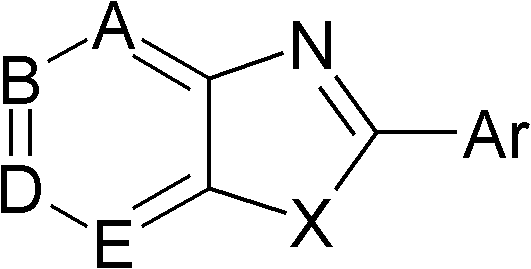
式IFormula I
其中X选自O、S和N-R’,其中R’选自氢、烷基、烯基、炔基、环烷基、杂环烷基、芳基烷基、芳基、杂芳基、酰基、芳基酰基、杂芳基酰基、磺酰基、氨基磺酰基、取代的氨基磺酰基、烷氧基羰基、环烷基氧基羰基、芳基氧基羰基、氨基甲酰基和取代的氨基甲酰基;wherein X is selected from O, S and N-R', wherein R' is selected from hydrogen, alkyl, alkenyl, alkynyl, cycloalkyl, heterocycloalkyl, arylalkyl, aryl, heteroaryl, Acyl, arylacyl, heteroarylacyl, sulfonyl, aminosulfonyl, substituted aminosulfonyl, alkoxycarbonyl, cycloalkyloxycarbonyl, aryloxycarbonyl, carbamoyl, and substituted aminomethyl Acyl;
Ar是取代的或未取代的芳基或杂芳基;且Ar is substituted or unsubstituted aryl or heteroaryl; and
A、B、D和E分别独立地为N或C-R1、C-R2、C-R3和C-R4,其中R1、R2、R3和R4独立地选自氢、取代的或未取代的烷基、烯基、炔基、环烷基、杂环烷基、芳基烷基、芳基、杂芳基、羟基、烷基氧基、芳基氧基、杂芳基氧基、酰氧基、芳基酰氧基、杂芳基酰氧基、烷基磺酰基氧基、芳基磺酰基氧基、硫基、烷基硫基、芳基硫基、氨基、烷基氨基、二烷基氨基、环烷基氨基、杂环烷基氨基、芳基氨基、杂芳基氨基、酰基氨基、芳基酰基氨基、杂芳基酰基氨基、烷基磺酰基氨基、芳基磺酰基氨基、酰基、芳基酰基、杂芳基酰基、烷基亚磺酰基、芳基亚磺酰基、烷基磺酰基、芳基磺酰基、氨基磺酰基、取代的氨基磺酰基、羧基、烷氧基羰基、环烷基氧基羰基、芳基氧基羰基、氨基甲酰基、取代的氨基甲酰基、卤素、氰基、异氰基和硝基;或R1和R2与它们所连接的碳一起可以形成取代的或未取代的环,或R2和R3或R3和R4与它们所连接的碳一起可以形成取代的或未取代的环,其可以是芳族或非芳族的并且在环中可以包括一个或多个杂原子,并且可以与芳族环或脂族环稠合。A, B, D and E are independently N or CR 1 , CR 2 , CR 3 and CR 4 , wherein R 1 , R 2 , R 3 and R 4 are independently selected from hydrogen, substituted or unsubstituted alkane radical, alkenyl, alkynyl, cycloalkyl, heterocycloalkyl, arylalkyl, aryl, heteroaryl, hydroxyl, alkyloxy, aryloxy, heteroaryloxy, acyloxy , aryl acyloxy, heteroaryl acyloxy, alkylsulfonyloxy, arylsulfonyloxy, thio, alkylthio, arylthio, amino, alkylamino, dialkyl Amino, cycloalkylamino, heterocycloalkylamino, arylamino, heteroarylamino, acylamino, arylacylamino, heteroarylacylamino, alkylsulfonylamino, arylsulfonylamino, acyl, Arylacyl, heteroarylacyl, alkylsulfinyl, arylsulfinyl, alkylsulfonyl, arylsulfonyl, aminosulfonyl, substituted aminosulfonyl, carboxyl, alkoxycarbonyl, cycloalkane oxycarbonyl, aryloxycarbonyl, carbamoyl, substituted carbamoyl, halogen, cyano, isocyano and nitro; or R and R together with the carbon to which they are attached may form a substituted or an unsubstituted ring, or R2 and R3 or R3 and R4 together with the carbon to which they are attached may form a substituted or unsubstituted ring which may be aromatic or non-aromatic and in the ring may One or more heteroatoms are included and may be fused to an aromatic or aliphatic ring.
本发明还提供了用于治疗或预防病毒感染或与其相关的疾病的方法,该方法包括将治疗有效量的下式I化合物或其药学上可接受的盐施用给需要其的哺乳动物:The present invention also provides a method for treating or preventing viral infection or diseases associated therewith, the method comprising administering a therapeutically effective amount of the following compound of formula I or a pharmaceutically acceptable salt thereof to a mammal in need thereof:
式IFormula I
其中X选自O、S和N-R’,其中R’选自氢、烷基、烯基、炔基、环烷基、杂环烷基、芳基烷基、芳基、杂芳基、酰基、芳基酰基、杂芳基酰基、磺酰基、氨基磺酰基、取代的氨基磺酰基、烷氧基羰基、环烷基氧基羰基、芳基氧基羰基、氨基甲酰基和取代的氨基甲酰基;wherein X is selected from O, S and N-R', wherein R' is selected from hydrogen, alkyl, alkenyl, alkynyl, cycloalkyl, heterocycloalkyl, arylalkyl, aryl, heteroaryl, Acyl, arylacyl, heteroarylacyl, sulfonyl, aminosulfonyl, substituted aminosulfonyl, alkoxycarbonyl, cycloalkyloxycarbonyl, aryloxycarbonyl, carbamoyl, and substituted aminomethyl Acyl;
Ar是取代的或未取代的芳基或杂芳基;且Ar is substituted or unsubstituted aryl or heteroaryl; and
A、B、D和E分别独立地为N或C-R1、C-R2、C-R3和C-R4,其中R1、R2、R3和R4独立地选自氢、取代的或未取代的烷基、烯基、炔基、环烷基、杂环烷基、芳基烷基、芳基、杂芳基、羟基、烷基氧基、芳基氧基、杂芳基氧基、酰氧基、芳基酰氧基、杂芳基酰氧基、烷基磺酰基氧基、芳基磺酰基氧基、硫基、烷基硫基、芳基硫基、氨基、烷基氨基、二烷基氨基、环烷基氨基、杂环烷基氨基、芳基氨基、杂芳基氨基、酰基氨基、芳基酰基氨基、杂芳基酰基氨基、烷基磺酰基氨基、芳基磺酰基氨基、酰基、芳基酰基、杂芳基酰基、烷基亚磺酰基、芳基亚磺酰基、烷基磺酰基、芳基磺酰基、氨基磺酰基、取代的氨基磺酰基、羧基、烷氧基羰基、环烷基氧基羰基、芳基氧基羰基、氨基甲酰基、取代的氨基甲酰基、卤素、氰基、异氰基和硝基;或R1和R2与它们所连接的碳一起可以形成取代的或未取代的环,或R2和R3或R3和R4与它们所连接的碳一起可以形成取代的或未取代的环,其可以是芳族或非芳族的并且在环中可以包括一个或多个杂原子,并且可以与芳族环或脂族环稠合。A, B, D and E are independently N or CR 1 , CR 2 , CR 3 and CR 4 , wherein R 1 , R 2 , R 3 and R 4 are independently selected from hydrogen, substituted or unsubstituted alkane radical, alkenyl, alkynyl, cycloalkyl, heterocycloalkyl, arylalkyl, aryl, heteroaryl, hydroxyl, alkyloxy, aryloxy, heteroaryloxy, acyloxy , aryl acyloxy, heteroaryl acyloxy, alkylsulfonyloxy, arylsulfonyloxy, thio, alkylthio, arylthio, amino, alkylamino, dialkyl Amino, cycloalkylamino, heterocycloalkylamino, arylamino, heteroarylamino, acylamino, arylacylamino, heteroarylacylamino, alkylsulfonylamino, arylsulfonylamino, acyl, Arylacyl, heteroarylacyl, alkylsulfinyl, arylsulfinyl, alkylsulfonyl, arylsulfonyl, aminosulfonyl, substituted aminosulfonyl, carboxyl, alkoxycarbonyl, cycloalkane oxycarbonyl, aryloxycarbonyl, carbamoyl, substituted carbamoyl, halogen, cyano, isocyano and nitro; or R and R together with the carbon to which they are attached may form a substituted or an unsubstituted ring, or R2 and R3 or R3 and R4 together with the carbon to which they are attached may form a substituted or unsubstituted ring which may be aromatic or non-aromatic and in the ring may One or more heteroatoms are included and may be fused to an aromatic or aliphatic ring.
本发明的其它目的和优势根据以下描述和所附权利要求将变得明显。Other objects and advantages of the present invention will become apparent from the following description and appended claims.
发明详述Detailed description of the invention
本发明化合物为以下通式I:The compound of the present invention is the following general formula I:

式IFormula I
其中X选自O、S和N-R’,其中R’选自氢、烷基、烯基、炔基、环烷基、杂环烷基、芳基烷基、芳基、杂芳基、酰基、芳基酰基、杂芳基酰基、磺酰基、氨基磺酰基、取代的氨基磺酰基、烷氧基羰基、环烷基氧基羰基、芳基氧基羰基、氨基甲酰基和取代的氨基甲酰基;wherein X is selected from O, S and N-R', wherein R' is selected from hydrogen, alkyl, alkenyl, alkynyl, cycloalkyl, heterocycloalkyl, arylalkyl, aryl, heteroaryl, Acyl, arylacyl, heteroarylacyl, sulfonyl, aminosulfonyl, substituted aminosulfonyl, alkoxycarbonyl, cycloalkyloxycarbonyl, aryloxycarbonyl, carbamoyl, and substituted aminomethyl Acyl;
Ar是取代的或未取代的芳基或杂芳基;且Ar is substituted or unsubstituted aryl or heteroaryl; and
A、B、D和E分别独立地为N或C-R1、C-R2、C-R3和C-R4,其中R1、R2、R3和R4独立地选自氢、取代的或未取代的烷基、烯基、炔基、环烷基、杂环烷基、芳基烷基、芳基、杂芳基、羟基、烷基氧基、芳基氧基、杂芳基氧基、酰氧基、芳基酰氧基、杂芳基酰氧基、烷基磺酰基氧基、芳基磺酰基氧基、硫基、烷基硫基、芳基硫基、氨基、烷基氨基、二烷基氨基、环烷基氨基、杂环烷基氨基、芳基氨基、杂芳基氨基、酰基氨基、芳基酰基氨基、杂芳基酰基氨基、烷基磺酰基氨基、芳基磺酰基氨基、酰基、芳基酰基、杂芳基酰基、烷基亚磺酰基、芳基亚磺酰基、烷基磺酰基、芳基磺酰基、氨基磺酰基、取代的氨基磺酰基、羧基、烷氧基羰基、环烷基氧基羰基、芳基氧基羰基、氨基甲酰基、取代的氨基甲酰基、卤素、氰基、异氰基和硝基;或R1和R2与它们所连接的碳一起可以形成取代的或未取代的环,或R2和R3或R3和R4与它们所连接的碳一起可以形成取代的或未取代的环,其可以是芳族或非芳族的并且在环中可以包括一个或多个杂原子,并且可以与芳族环或脂族环稠合。A, B, D and E are independently N or CR 1 , CR 2 , CR 3 and CR 4 , wherein R 1 , R 2 , R 3 and R 4 are independently selected from hydrogen, substituted or unsubstituted alkane radical, alkenyl, alkynyl, cycloalkyl, heterocycloalkyl, arylalkyl, aryl, heteroaryl, hydroxyl, alkyloxy, aryloxy, heteroaryloxy, acyloxy , aryl acyloxy, heteroaryl acyloxy, alkylsulfonyloxy, arylsulfonyloxy, thio, alkylthio, arylthio, amino, alkylamino, dialkyl Amino, cycloalkylamino, heterocycloalkylamino, arylamino, heteroarylamino, acylamino, arylacylamino, heteroarylacylamino, alkylsulfonylamino, arylsulfonylamino, acyl, Arylacyl, heteroarylacyl, alkylsulfinyl, arylsulfinyl, alkylsulfonyl, arylsulfonyl, aminosulfonyl, substituted aminosulfonyl, carboxyl, alkoxycarbonyl, cycloalkane oxycarbonyl, aryloxycarbonyl, carbamoyl, substituted carbamoyl, halogen, cyano, isocyano and nitro; or R and R together with the carbon to which they are attached may form a substituted or an unsubstituted ring, or R2 and R3 or R3 and R4 together with the carbon to which they are attached may form a substituted or unsubstituted ring which may be aromatic or non-aromatic and in the ring may One or more heteroatoms are included and may be fused to an aromatic or aliphatic ring.
优选地,X是硫且Ar是取代的芳基。同时优选地,A、B、D和E中的每一个是C-H。可选地,A、B、D和E中的每一个是C-H且D是C-CH3。Preferably, X is sulfur and Ar is substituted aryl. Also preferably, each of A, B, D and E is CH. Alternatively, each of A, B, D and E is CH and D is C- CH3 .
优选地,本发明化合物选自:N-(4-苯并噻唑-2-基-3-羟基-苯基)-4-甲氧基-苯甲酰胺;2,3-二氢-苯并[1,4]二氧杂环己烯-6-羧酸(4-苯并噻唑-2-基-苯基)-酰胺;2,4-二甲氧基-N-[4-(6-甲基-苯并噻唑-2-基)-苯基]-苯甲酰胺;N-(3-苯并噻唑-2-基-苯基)-2-甲氧基-苯甲酰胺;N-(4-苯并噻唑-2-基-3-氯-苯基)-3,4-二甲氧基-苯甲酰胺;N-(4-苯并噻唑-2-基-3-氯-苯基)-4-甲氧基-苯甲酰胺;4-二甲基氨基-N-[4-(6-甲基-苯并噻唑-2-基)-苯基]-苯甲酰胺;4-甲基-N-[4-(6-甲基-苯并噻唑-2-基)-苯基]-邻氨甲酰苯甲酸;N-[4-(6-甲基-苯并噻唑-2-基)-苯基]-3-(4-甲基-哌嗪-1-磺酰基)-苯甲酰胺;N-(4-苯并噻唑-2-基-苯基)-2-二甲基氨基-苯甲酰胺;和N-(4-苯并噻唑-2-基-3-氯-苯基)-2-甲氧基-苯甲酰胺。Preferably, the compound of the present invention is selected from: N-(4-benzothiazol-2-yl-3-hydroxy-phenyl)-4-methoxy-benzamide; 2,3-dihydro-benzo[ 1,4]dioxine-6-carboxylic acid (4-benzothiazol-2-yl-phenyl)-amide; 2,4-dimethoxy-N-[4-(6-methyl N-(3-benzothiazol-2-yl)-phenyl]-benzamide; N-(3-benzothiazol-2-yl-phenyl)-2-methoxy-benzamide; N-(4 -Benzothiazol-2-yl-3-chloro-phenyl)-3,4-dimethoxy-benzamide; N-(4-benzothiazol-2-yl-3-chloro-phenyl) -4-Methoxy-benzamide; 4-Dimethylamino-N-[4-(6-methyl-benzothiazol-2-yl)-phenyl]-benzamide; 4-methyl -N-[4-(6-Methyl-benzothiazol-2-yl)-phenyl]-phthamoylbenzoic acid; N-[4-(6-Methyl-benzothiazol-2-yl) )-phenyl]-3-(4-methyl-piperazine-1-sulfonyl)-benzamide; N-(4-benzothiazol-2-yl-phenyl)-2-dimethylamino - benzamide; and N-(4-benzothiazol-2-yl-3-chloro-phenyl)-2-methoxy-benzamide.
最优选地,本发明化合物为2,4-二甲氧基-N-[4-(6-甲基-苯并噻唑-2-基)-苯基]-苯甲酰胺。Most preferably, the compound of the invention is 2,4-dimethoxy-N-[4-(6-methyl-benzothiazol-2-yl)-phenyl]-benzamide.
本发明方法是用于治疗或预防病毒感染或与其相关的疾病,该方法包括将治疗有效量的如上所述的式I化合物施用给需要其的哺乳动物。The method of the present invention is for treating or preventing viral infection or diseases associated therewith, the method comprising administering a therapeutically effective amount of a compound of formula I as described above to a mammal in need thereof.
优选地,哺乳动物为人,且病毒感染为黄病毒感染。更优选地,黄病毒感染选自登革热病毒、西尼罗河热病毒、黄热病病毒、日本脑炎病毒和由蜱传播的脑炎病毒。最优选地,黄病毒为选自DEN-1、DEN-2、DEN-3和DEN-4的登革病毒。Preferably, the mammal is a human and the viral infection is a flavivirus infection. More preferably, the flavivirus infection is selected from dengue virus, West Nile virus, yellow fever virus, Japanese encephalitis virus and encephalitis virus transmitted by ticks. Most preferably, the flavivirus is a dengue virus selected from DEN-1, DEN-2, DEN-3 and DEN-4.
优选地,病毒感染与选自以下的病况有关:登革热、黄热病、西尼罗河热、圣路易脑炎、丙型肝炎、墨累河谷脑炎和日本脑炎。最优选地,病毒感染与登革热有关,其中所述登革热选自典型登革热、登革热出血热综合征和登革热休克综合征。Preferably, the viral infection is associated with a condition selected from the group consisting of dengue fever, yellow fever, West Nile fever, St. Louis encephalitis, hepatitis C, Murray Valley encephalitis and Japanese encephalitis. Most preferably, the viral infection is associated with dengue fever, wherein said dengue fever is selected from the group consisting of classic dengue, dengue hemorrhagic fever syndrome and dengue shock syndrome.
本发明方法还可包括以下试剂的共施用:a)其它抗病毒剂例如利巴韦林或西多福韦;b)疫苗;和/或c)干扰素或聚乙二醇化干扰素。The methods of the invention may also include the co-administration of: a) other antiviral agents such as ribavirin or cidofovir; b) vaccines; and/or c) interferon or pegylated interferon.
定义definition
根据该详细说明,应用以下的缩写和定义。必需注意的是,本文使用的单数形式“一个(a)”、“一种(an)”和“该(the)”包括复数指示物,除非上下文另有清楚地规定。According to this detailed description, the following abbreviations and definitions apply. It must be noted that as used herein the singular forms "a", "an" and "the" include plural referents unless the context clearly dictates otherwise.
本文讨论的出版物仅仅被提供用于它们的公开。本文不应理解为承认先于这些出版物的事实。另外,提供的公布日期可能与真实的公布日期不同,这可能需要单独进行证实。The publications discussed herein are provided solely for their disclosure. This article should not be construed as an admission of fact antedating these publications. In addition, the dates of publication provided may differ from the actual publication dates, which may need to be independently confirmed.
当提供了数值范围时,很清楚,每个居中值被包含在内。这些较小范围的上限和下限可独立地被引入到更小范围内,以所述范围内的任何被特别排除的端值为条件。当所述范围包括一个端值或两个端值时,排除了这些被包括的端值之一或二者的范围也被本发明所涵盖。还考虑了适合所述范围的任何值。Where numerical ranges are provided, it is clear that every intervening value is included. The upper and lower limits of these smaller ranges may independently be incorporated into the smaller ranges, subject to any specifically excluded endpoint in that range. Where the stated range includes one or both of the limits, ranges excluding either or both of those included limits are also encompassed by the invention. Any value that fits within the stated range is also contemplated.
除非另有定义,否则本文使用的所有的专业术语和科技术语具有本领域普通技术人员所常规理解的相同含义。与本文所述的方法和材料类似或等价的任何方法和材料还可用于实践或试验中。本文提及的所有的出版物通过引用并入本文,用于公开和描述与该出版物有关的方法和/或材料。Unless otherwise defined, all technical and scientific terms used herein have the same meaning as commonly understood by one of ordinary skill in the art. Any methods and materials similar or equivalent to those described herein can also be used in practice or testing. All publications mentioned herein are incorporated herein by reference to disclose and describe the methods and/or materials in connection with which the publication was disclosed.
“患者”或“受试者”意在包括任何哺乳动物。用于治疗的“哺乳动物”是指任何被分类为哺乳动物的动物,包括但不限于人,包括大鼠、小鼠和豚鼠在内的实验动物,家畜和农畜,以及动物园动物、运动动物或玩赏动物,诸如狗、马、猫、牛等等。"Patient" or "subject" is intended to include any mammal. "Mammal" for purposes of treatment means any animal classified as a mammal, including but not limited to humans, laboratory animals including rats, mice, and guinea pigs, domestic and farm animals, and zoo animals, sports animals Or play with animals, such as dogs, horses, cats, cows, etc.
本文使用的术语“效力”是指具体治疗方案的有效性。效力可根据疾病过程响应试剂而发生的改变来测量。The term "efficacy" as used herein refers to the effectiveness of a particular treatment regimen. Efficacy can be measured in terms of changes in the disease process in response to the agent.
本文使用的术语“成功”在长期治疗方案的背景中是指具体治疗方案的有效性。其包括效力、毒性(例如制剂或剂量单位的副作用和患者耐受性)、患者依从性等之间的平衡。对于被认为是“成功”的长期施用方案而言,其必需在患者护理的不同方面和效力之间平衡,从而获得有利的患者预后。The term "success" as used herein refers to the effectiveness of a particular treatment regimen in the context of a long-term treatment regimen. It includes the balance between potency, toxicity (eg, side effects of the formulation or dosage unit, and patient tolerance), patient compliance, and the like. For a long-term administration regimen to be considered "successful," it must balance different aspects of patient care and efficacy to achieve favorable patient outcomes.
本文使用的术语“治疗”等是指获得所需的药理学和生理学效果。就预防或部分预防疾病、其症状或病况而言,所述效果可以是预防性的,和/或就部分或完全治愈疾病、病况、症状或归因于该疾病的副作用而言,所述效果可以是治疗性的。本文使用的术语“治疗”覆盖了对哺乳动物诸如人中的疾病的任何治疗,并且包括:(a)预防疾病在可能倾向于患病但是还未被诊断为患病的受试者中发生,即,引起疾病的临床症状在可能倾向于患病但是尚未经历或显示疾病症状的受试者中的发展;(b)抑制疾病,即阻止或减轻疾病或其临床症状的发展;和(c)缓解疾病,即引起疾病和/或其症状或病况的消退。涵盖了治疗遭受与病理性炎症有关的疾病的患者。还涵盖了在长时段内预防、抑制或减轻由病理性炎症引起的副作用和/或在长时段内预防、抑制或减轻对生物系统中存在的不恰当的炎症的生理性应答引起的副作用。The term "treatment" and the like as used herein refers to obtaining a desired pharmacological and physiological effect. The effect may be prophylactic in terms of preventing or partially preventing a disease, its symptoms or conditions, and/or in terms of partially or completely curing the disease, condition, symptoms or side effects attributable to the disease. Can be therapeutic. The term "treatment" as used herein covers any treatment of a disease in a mammal, such as a human, and includes: (a) preventing a disease from occurring in a subject who may be predisposed to the disease but has not been diagnosed as having it, That is, causing the development of clinical symptoms of the disease in subjects who may be predisposed to the disease but who have not yet experienced or displayed symptoms of the disease; (b) inhibiting the disease, that is, preventing or reducing the development of the disease or its clinical symptoms; and (c) To alleviate a disease means to cause regression of a disease and/or its symptoms or conditions. Encompassed is the treatment of patients suffering from diseases associated with pathological inflammation. Also contemplated is the prevention, suppression or reduction over prolonged periods of side effects caused by pathological inflammation and/or the prevention, suppression or reduction over long periods of side effects caused by physiological responses to inappropriate inflammation present in biological systems.
如本文所用,“酰基”是指基团H-C(O)-、烷基-C(O)-、取代的烷基-C(O)-、烯基-C(O)-、取代的烯基-C(O)-、炔基-C(O)-、取代的炔基-C(O)-、环烷基-C(O)-、取代的环烷基-C(O)-、芳基-C(O)-、取代的芳基-C(O)-、杂芳基-C(O)-、取代的杂芳基-C(O)-、杂环基-C(O)-和取代的杂环基-C(O)-,其中烷基、取代的烷基、烯基、取代的烯基、炔基、取代的炔基、环烷基、取代的环烷基、芳基、取代的芳基、杂芳基、取代的杂芳基、杂环基和取代的杂环基如本文所定义。As used herein, "acyl" refers to the group H-C(O)-, alkyl-C(O)-, substituted alkyl-C(O)-, alkenyl-C(O)-, substituted alkenyl -C(O)-, alkynyl-C(O)-, substituted alkynyl-C(O)-, cycloalkyl-C(O)-, substituted cycloalkyl-C(O)-, aryl Base-C(O)-, Substituted Aryl-C(O)-, Heteroaryl-C(O)-, Substituted Heteroaryl-C(O)-, Heterocyclyl-C(O)- and substituted heterocyclyl-C(O)-, where alkyl, substituted alkyl, alkenyl, substituted alkenyl, alkynyl, substituted alkynyl, cycloalkyl, substituted cycloalkyl, aryl , substituted aryl, heteroaryl, substituted heteroaryl, heterocyclyl and substituted heterocyclyl are as defined herein.
“烷基氨基”是指基团-NRR,其中每一个R独立地选自:氢、烷基、取代的烷基、烯基、取代的烯基、炔基、取代的炔基、芳基、取代的芳基、环烷基、取代的环烷基、杂芳基、取代的杂芳基、杂环基、取代的杂环基,并且其中每一个R与氮原子连在一起形成杂环基或取代的杂环,其中烷基、取代的烷基、烯基、取代的烯基、炔基、取代的炔基、环烷基、取代的环烷基、芳基、取代的芳基、杂芳基、取代的杂芳基、杂环基和取代的杂环基如本文所定义。"Alkylamino" refers to the group -NRR, wherein each R is independently selected from the group consisting of hydrogen, alkyl, substituted alkyl, alkenyl, substituted alkenyl, alkynyl, substituted alkynyl, aryl, Substituted aryl, cycloalkyl, substituted cycloalkyl, heteroaryl, substituted heteroaryl, heterocyclyl, substituted heterocyclyl, and wherein each R is joined with a nitrogen atom to form a heterocyclyl Or substituted heterocycle, wherein alkyl, substituted alkyl, alkenyl, substituted alkenyl, alkynyl, substituted alkynyl, cycloalkyl, substituted cycloalkyl, aryl, substituted aryl, hetero Aryl, substituted heteroaryl, heterocyclyl and substituted heterocyclyl are as defined herein.
“烯基”是指优选含2-10个碳原子和更优选含2-6个碳原子并具有至少1个烯键不饱和度、优选具有1-2个烯键不饱和度的烯基。"Alkenyl" means an alkenyl group preferably containing 2-10 carbon atoms and more preferably 2-6 carbon atoms and having at least 1 ethylenic unsaturation, preferably 1-2 ethylenic unsaturation.
“烷氧基”是指基团“烷基-O-”,其包括,例如,甲氧基、乙氧基、正丙氧基、异丙氧基、正丁氧基、叔丁氧基、仲丁氧基、正戊氧基、正己氧基、1,2-二甲基丁氧基等等。"Alkoxy" refers to the group "alkyl-O-" which includes, for example, methoxy, ethoxy, n-propoxy, isopropoxy, n-butoxy, tert-butoxy, sec-butoxy, n-pentyloxy, n-hexyloxy, 1,2-dimethylbutoxy and the like.
“烷基”是指含1-10个碳原子或含1-6个碳原子的直链或支链的烷基。该术语的例子为诸如甲基、叔丁基、正庚基、辛基等等。"Alkyl" means a straight or branched chain alkyl group containing 1-10 carbon atoms or 1-6 carbon atoms. Examples of this term are eg methyl, tert-butyl, n-heptyl, octyl and the like.
“氨基”是指基团-NH2。"Amino" refers to the group -NH2 .
“芳基”或“Ar”是指含6-14个碳原子并具有单环(如苯基)或多个稠环(例如萘基或蒽基)的不饱和的芳族碳环基团,该稠环可为芳族或不为芳族(例如2-苯并噁唑啉酮,2H-1,4-苯并噁嗪-3(4H)-酮等等),条件是连结点通过芳环原子完成。"Aryl" or "Ar" refers to an unsaturated aromatic carbocyclic group containing 6-14 carbon atoms and having a single ring (such as phenyl) or multiple condensed rings (such as naphthyl or anthracenyl), The fused ring may or may not be aromatic (e.g. 2-benzoxazolinone, 2H-1,4-benzoxazin-3(4H)-one, etc.), provided that the point of attachment passes through the aromatic The ring atoms are complete.
“取代的芳基”是指被1-3个选自以下的取代基取代的芳基:羟基、酰基、酰基氨基、硫代羰基氨基、酰氧基、烷基、取代的烷基、烷氧基、取代的烷氧基、烯基、取代的烯基、炔基、取代的炔基、脒基、烷基脒基、硫脒基、氨基、氨基酰基、氨基羰基氧基、氨基羰基氨基、氨基硫代羰基氨基、芳基、取代的芳基、芳基氧基、取代的芳基氧基、环烷氧基、取代的环烷氧基、杂芳基氧基、取代的杂芳基氧基、杂环基氧基、取代的杂环基氧基、羧基、羧基烷基、羧基-取代的烷基、羧基-环烷基、羧基-取代的环烷基、羧基芳基、羧基-取代的芳基、羧基杂芳基、羧基-取代的杂芳基、羧基杂环基、羧基-取代的杂环基、羧基酰胺基、氰基、硫醇、硫烷基、取代的硫烷基、硫芳基、取代的硫芳基、硫杂芳基、取代的硫杂芳基、硫环烷基、取代的硫环烷基、硫杂环基、取代的硫杂环基、环烷基、取代的环烷基、胍基、胍基砜、卤代、硝基、杂芳基、取代的杂芳基、杂环基、取代的杂环基、环烷氧基、取代的环烷氧基、杂芳基氧基、取代的杂芳基氧基、杂环基氧基、取代的杂环基氧基、氧基羰基氨基、氧基硫代羰基氨基、-S(O)2-烷基、-S(O)2-取代的烷基、-S(O)2-环烷基、-S(O)2-取代的环烷基、-S(O)2-烯基、-S(O)2-取代的烯基、-S(O)2-芳基、-S(O)2-取代的芳基、-S(O)2-杂芳基、-S(O)2-取代的杂芳基、-S(O)2-杂环基、-S(O)2-取代的杂环基、-OS(O)2-烷基、-OS(O)2-取代的烷基、-OS(O)2-芳基、-OS(O)2-取代的芳基、-OS(O)2-杂芳基、-OS(O)2-取代的杂芳基、-OS(O)2-杂环基、-OS(O)2-取代的杂环基、-OS(O)2-NRR,其中R是氢或烷基、-NRS(O)2-烷基、-NRS(O)2-取代的烷基、-NRS(O)2-芳基、-NRS(O)2-取代的芳基、-NRS(O)2-杂芳基、-NRS(O)2-取代的杂芳基、-NRS(O)2-杂环基、-NRS(O)2-取代的杂环基、-NRS(O)2-NR-烷基、-NRS(O)2-NR-取代的烷基、-NRS(O)2-NR-芳基、-NRS(O)2-NR-取代的芳基、-NRS(O)2-NR-杂芳基、-NRS(O)2-NR-取代的杂芳基、-NRS(O)2-NR-杂环基、-NRS(O)2-NR-取代的杂环基,其中R是氢或烷基、单-和二-烷基氨基、单-和二-(取代的烷基)氨基、单-和二-芳基氨基、单-和二-取代的芳基氨基、单-和二-杂芳基氨基、单-和二-取代的杂芳基氨基、单-和二-杂环基氨基、单-和二-取代的杂环基氨基、不对称的二-取代的胺,其具有独立地选自以下的不同的取代基:烷基、取代的烷基、芳基、取代的芳基、杂芳基、取代的杂芳基、杂环基和取代的杂环基并且取代的芳基上的氨基被常规的保护基团例如Boc、Cbz、甲酰基等取代,或者被-SO2NRR取代,其中R是氢或烷基。"Substituted aryl" means an aryl group substituted with 1-3 substituents selected from the group consisting of hydroxy, acyl, acylamino, thiocarbonylamino, acyloxy, alkyl, substituted alkyl, alkoxy substituted alkoxy, alkenyl, substituted alkenyl, alkynyl, substituted alkynyl, amidino, alkylamidino, thiamidino, amino, aminoacyl, aminocarbonyloxy, aminocarbonylamino, Aminothiocarbonylamino, aryl, substituted aryl, aryloxy, substituted aryloxy, cycloalkoxy, substituted cycloalkoxy, heteroaryloxy, substituted heteroaryloxy radical, heterocyclyloxy, substituted heterocyclyloxy, carboxyl, carboxyalkyl, carboxy-substituted alkyl, carboxy-cycloalkyl, carboxy-substituted cycloalkyl, carboxyaryl, carboxy-substituted Aryl, carboxyheteroaryl, carboxy-substituted heteroaryl, carboxyheterocyclyl, carboxy-substituted heterocyclyl, carboxyamido, cyano, thiol, sulfanyl, substituted sulfanyl, Thiaryl, substituted thioaryl, thiaaryl, substituted thiaaryl, thiocycloalkyl, substituted thiocycloalkyl, thioheterocyclyl, substituted thioheterocyclyl, cycloalkyl, Substituted cycloalkyl, guanidino, guanidinosulfone, halo, nitro, heteroaryl, substituted heteroaryl, heterocyclyl, substituted heterocyclyl, cycloalkoxy, substituted cycloalkoxy , heteroaryloxy, substituted heteroaryloxy, heterocyclyloxy, substituted heterocyclyloxy, oxycarbonylamino, oxythiocarbonylamino, -S(O) 2 -alkyl , -S(O) 2 -substituted alkyl, -S(O) 2 -cycloalkyl, -S(O) 2 -substituted cycloalkyl, -S(O) 2 -alkenyl, -S( O) 2 -substituted alkenyl, -S(O) 2 -aryl, -S(O) 2 -substituted aryl, -S(O) 2 -heteroaryl, -S(O) 2 -substituted Heteroaryl, -S(O) 2 -heterocyclyl, -S(O) 2 -substituted heterocyclyl, -OS(O) 2 -alkyl, -OS(O) 2 -substituted alkyl , -OS(O) 2 -aryl, -OS(O) 2 -substituted aryl, -OS(O) 2 -heteroaryl, -OS(O) 2 -substituted heteroaryl, -OS( O) 2 -heterocyclyl, -OS(O) 2 -substituted heterocyclyl, -OS(O) 2 -NRR, wherein R is hydrogen or alkyl, -NRS(O) 2 -alkyl, -NRS (O) 2 -substituted alkyl, -NRS(O) 2 -aryl, -NRS(O) 2 -substituted aryl, -NRS(O) 2 -heteroaryl, -NRS(O) 2 - Substituted heteroaryl, -NRS(O) 2 -heterocyclyl, -NRS(O) 2 -substituted heterocyclyl, -NRS(O) 2 -NR-alkyl, -NRS(O) 2 -NR -substituted alkyl, -NRS(O) 2 -NR-aryl, -NRS(O) 2 -NR-substituted aryl, -NRS(O) 2 -NR-heteroaryl, -NRS(O) 2- NR-take Substituted heteroaryl, -NRS(O) 2 -NR-heterocyclyl, -NRS(O) 2 -NR-substituted heterocyclyl, wherein R is hydrogen or alkyl, mono- and di-alkylamino , mono- and di-(substituted alkyl)amino, mono- and di-arylamino, mono- and di-substituted arylamino, mono- and di-heteroarylamino, mono- and di-substituted Heteroarylamino, mono- and di-heterocyclylamino, mono- and di-substituted heterocyclylamino, asymmetric di-substituted amines having different substituents independently selected from the following: Alkyl, substituted alkyl, aryl, substituted aryl, heteroaryl, substituted heteroaryl, heterocyclyl and substituted heterocyclyl and the amino group on the substituted aryl is protected by conventional protecting groups such as Substituted by Boc, Cbz, formyl, etc., or by -SO2NRR , where R is hydrogen or alkyl.
“环烷基”是指含3-8个碳原子并具有单一环状环的环烷基,包括,例如,环丙基、环丁基、环戊基、环己基、环辛基等等。从该定义被排除的基团是多环烷基,诸如金刚烷基等等。"Cycloalkyl" means a cycloalkyl group having 3 to 8 carbon atoms and having a single cyclic ring, including, for example, cyclopropyl, cyclobutyl, cyclopentyl, cyclohexyl, cyclooctyl and the like. Groups excluded from this definition are polycycloalkyl groups such as adamantyl and the like.
“卤代”或“卤素”是指氟代、氯代、溴代和碘代。"Halo" or "halogen" refers to fluoro, chloro, bromo and iodo.
“杂芳基”是指含2-10个碳原子和在环内含1-4个选自氧、氮和硫原子或其氧化物的芳族碳环基团。这些杂芳基可具有单一环(例如吡啶基或呋喃基)或多个稠环(例如吲嗪基或苯并噻吩基),其中稠环中的一个或多个环可是芳族的或不是芳族的,条件是连结点通过芳环原子完成。另外,杂芳基的杂原子可被氧化,即,形成吡啶N-氧化物或1,1-二氧代-1,2,5-噻二唑等等。另外,环的碳原子可被氧代(=O)取代。术语“在杂芳基环中具有两个氮原子的杂芳基”是指在杂芳基环中含有两个、且只含有两个氮原子的杂芳基并且任选地在杂芳基环中包含1或2个其它杂原子诸如氧或硫的杂芳基。"Heteroaryl" means an aromatic carbocyclic group containing 2-10 carbon atoms and 1-4 atoms selected from oxygen, nitrogen and sulfur atoms or oxides thereof within the ring. These heteroaryl groups can have a single ring (such as pyridyl or furyl) or multiple fused rings (such as indolizinyl or benzothienyl), where one or more of the fused rings may be aromatic or not family, provided that the point of attachment is through an aromatic ring atom. Additionally, heteroatoms of heteroaryl groups can be oxidized, ie, to form pyridine N-oxides or 1,1-dioxo-1,2,5-thiadiazoles, and the like. In addition, ring carbon atoms may be substituted with oxo (=O). The term "heteroaryl having two nitrogen atoms in the heteroaryl ring" refers to a heteroaryl group containing two and only two nitrogen atoms in the heteroaryl ring and optionally in the heteroaryl ring A heteroaryl group in which contains 1 or 2 other heteroatoms such as oxygen or sulfur.
“取代的杂芳基”是指被1-3个选自以下的取代基取代的杂芳基:羟基、酰基、酰基氨基、硫代羰基氨基、酰氧基、烷基、取代的烷基、烷氧基、取代的烷氧基、烯基、取代的烯基、炔基、取代的炔基、脒基、烷基脒基、硫脒基、氨基、氨基酰基、氨基羰基氧基、氨基羰基氨基、氨基硫代羰基氨基、芳基、取代的芳基、芳基氧基、取代的芳基氧基、环烷氧基、取代的环烷氧基、杂芳基氧基、取代的杂芳基氧基、杂环基氧基、取代的杂环基氧基、羧基/羧基烷基、羧基-取代的烷基、羧基-环烷基、羧基-取代的环烷基、羧基芳基、羧基-取代的芳基、羧基杂芳基、羧基-取代的杂芳基、羧基杂环基、羧基-取代的杂环基、羧基酰胺基、氰基、硫醇、硫烷基、取代的硫烷基、硫芳基、取代的硫芳基、硫杂芳基、取代的硫杂芳基、硫环烷基、取代的硫环烷基、硫杂环基、取代的硫杂环基、环烷基、取代的环烷基、胍基、胍基砜、卤代、硝基、杂芳基、取代的杂芳基、杂环基、取代的杂环基、环烷氧基、取代的环烷氧基、杂芳基氧基、取代的杂芳基氧基、杂环基氧基、取代的杂环基氧基、氧基羰基氨基、氧基硫代羰基氨基、-S(O)2-烷基、-S(O)2-取代的烷基、-S(O)2-环烷基、-S(O)2-取代的环烷基、-S(O)2-烯基、-S(O)2-取代的烯基、-S(O)2-芳基、-S(O)2-取代的芳基、-S(O)2-杂芳基、-S(O)2-取代的杂芳基、-S(O)2-杂环基、S(O)2-取代的杂环基、-OS(O)2-烷基、-OS(O)2-取代的烷基、-OS(O)2-芳基、-OS(O)2-取代的芳基、-OS(O)2-杂芳基、-OS(O)2-取代的杂芳基、-OS(O)2-杂环基、-OS(O)2-取代的杂环基、-OSO2-NRR,其中R是氢或烷基、-NRS(O)2-烷基、-NRS(O)2-取代的烷基、-NRS(O)2-芳基、-NRS(O)2-取代的芳基、-NRS(O)2-杂芳基、-NRS(O)2-取代的杂芳基、-NRS(O)2-杂环基、-NRS(O)2-取代的杂环基、-NRS(O)2-NR-烷基、-NRS(O)2-NR-取代的烷基、-NRS(O)2-NR-芳基、-NRS(O)2-NR-取代的芳基、-NRS(O)2-NR-杂芳基、-NRS(O)2-NR-取代的杂芳基、-NRS(O)2-NR-杂环基、-NRS(O)2-NR-取代的杂环基,其中R是氢或烷基、单-和二-烷基氨基、单-和二-(取代的烷基)氨基、单-和二-芳基氨基、单-和二-取代的芳基氨基、单-和二-杂芳基氨基、单-和二-取代的杂芳基氨基、单-和二-杂环基氨基、单-和二-取代的杂环基氨基、不对称的二-取代的胺,其具有独立地选自以下的不同的取代基:烷基、取代的烷基、芳基、取代的芳基、杂芳基、取代的杂芳基、杂环基和取代的杂环基并且取代的芳基上的氨基被常规的保护基团诸如Boc、Cbz、甲酰基等取代,或者被-SO2NRR取代,其中R是氢或烷基。"Substituted heteroaryl" means a heteroaryl group substituted with 1-3 substituents selected from the group consisting of hydroxy, acyl, acylamino, thiocarbonylamino, acyloxy, alkyl, substituted alkyl, Alkoxy, substituted alkoxy, alkenyl, substituted alkenyl, alkynyl, substituted alkynyl, amidino, alkylamidino, thiamidino, amino, aminoacyl, aminocarbonyloxy, aminocarbonyl Amino, aminothiocarbonylamino, aryl, substituted aryl, aryloxy, substituted aryloxy, cycloalkoxy, substituted cycloalkoxy, heteroaryloxy, substituted heteroaryl oxy, heterocyclyloxy, substituted heterocyclyloxy, carboxy/carboxyalkyl, carboxy-substituted alkyl, carboxy-cycloalkyl, carboxy-substituted cycloalkyl, carboxyaryl, carboxyl -substituted aryl, carboxyheteroaryl, carboxy-substituted heteroaryl, carboxyheterocyclyl, carboxy-substituted heterocyclyl, carboxyamido, cyano, thiol, sulfanyl, substituted sulfane radical, thioaryl, substituted thioaryl, thiaaryl, substituted thioaryl, thiocycloalkyl, substituted thiocycloalkyl, thioheterocyclyl, substituted thioheterocyclyl, cycloalkane substituted cycloalkyl, guanidino, guanidinosulfone, halo, nitro, heteroaryl, substituted heteroaryl, heterocyclyl, substituted heterocyclyl, cycloalkoxy, substituted cycloalkane Oxy, heteroaryloxy, substituted heteroaryloxy, heterocyclyloxy, substituted heterocyclyloxy, oxycarbonylamino, oxythiocarbonylamino, -S(O) 2 - Alkyl, -S(O) 2 -substituted alkyl, -S(O) 2 -cycloalkyl, -S(O) 2 -substituted cycloalkyl, -S(O) 2 -alkenyl, - S(O) 2 -substituted alkenyl, -S(O) 2 -aryl, -S(O) 2 -substituted aryl, -S(O) 2 -heteroaryl, -S(O) 2 -Substituted heteroaryl, -S(O) 2 -heterocyclyl, S(O) 2 -substituted heterocyclyl, -OS(O) 2 -alkyl, -OS(O) 2 -substituted alkane radical, -OS(O) 2 -aryl, -OS(O) 2 -substituted aryl, -OS(O) 2 -heteroaryl, -OS(O) 2 -substituted heteroaryl, -OS (O) 2 -heterocyclyl, -OS(O) 2 -substituted heterocyclyl, -OSO 2 -NRR, wherein R is hydrogen or alkyl, -NRS(O) 2 -alkyl, -NRS(O ) 2 -substituted alkyl, -NRS(O) 2 -aryl, -NRS(O) 2 -substituted aryl, -NRS(O) 2 -heteroaryl, -NRS(O) 2 -substituted Heteroaryl, -NRS(O) 2 -heterocyclyl, -NRS(O) 2 -substituted heterocyclyl, -NRS(O) 2 -NR-alkyl, -NRS(O) 2 -NR-substituted Alkyl, -NRS(O) 2 -NR-aryl, -NRS(O) 2 -NR-substituted aryl, -NRS(O) 2 -NR-heteroaryl, -NRS(O) 2 - NR-replace Heteroaryl, -NRS(O) 2 -NR-heterocyclyl, -NRS(O) 2 -NR-substituted heterocyclyl, wherein R is hydrogen or alkyl, mono- and di-alkylamino, Mono- and di-(substituted alkyl)amino, mono- and di-arylamino, mono- and di-substituted arylamino, mono- and di-heteroarylamino, mono- and di-substituted Heteroarylamino, mono- and di-heterocyclylamino, mono- and di-substituted heterocyclylamino, asymmetric di-substituted amines having different substituents independently selected from the group consisting of: alkyl group, substituted alkyl, aryl, substituted aryl, heteroaryl, substituted heteroaryl, heterocyclyl and substituted heterocyclyl and the amino group on the substituted aryl is protected by a conventional protecting group such as Boc , Cbz, formyl, etc., or substituted by -SO 2 NRR, wherein R is hydrogen or alkyl.
”磺酰基”是指基团-S(O)2R,其中R选自氢、烷基、取代的烷基、烯基、取代的烯基、炔基、取代的炔基、芳基、取代的芳基、环烷基、取代的环烷基、杂芳基、取代的杂芳基、杂环基、取代的杂环基其中烷基、取代的烷基、烯基、取代的烯基、炔基、取代的炔基、环烷基、取代的环烷基、芳基、取代的芳基、杂芳基、取代的杂芳基、杂环基和取代的杂环基如本文所定义。"Sulfonyl" means the group -S(O) 2R , where R is selected from the group consisting of hydrogen, alkyl, substituted alkyl, alkenyl, substituted alkenyl, alkynyl, substituted alkynyl, aryl, substituted Aryl, cycloalkyl, substituted cycloalkyl, heteroaryl, substituted heteroaryl, heterocyclyl, substituted heterocyclyl wherein alkyl, substituted alkyl, alkenyl, substituted alkenyl, Alkynyl, substituted alkynyl, cycloalkyl, substituted cycloalkyl, aryl, substituted aryl, heteroaryl, substituted heteroaryl, heterocyclyl, and substituted heterocyclyl are as defined herein.
“任选取代的“是指所述基团可能未被取代或所述基团可能被取代。"Optionally substituted" means that the group may be unsubstituted or that the group may be substituted.
“药学上可接受的载体”是指可用于制备药物组合物或制剂的载体,其一般是安全的、无毒的,并且不是生物学不可接受的或在其它方面不可接受的,并且包括适于兽用以及人用药物应用的载体。"Pharmaceutically acceptable carrier" refers to a carrier that can be used to prepare a pharmaceutical composition or preparation, which is generally safe, non-toxic, and not biologically or otherwise unacceptable, and includes suitable Carriers for veterinary and human pharmaceutical applications.
“药学上可接受的阳离子”是指药学上可接受的盐的阳离子。"Pharmaceutically acceptable cation" refers to the cation of a pharmaceutically acceptable salt.
“药学上可接受的盐”是指保持化合物的生物有效性以及不是生物学不可接受的或在其它方面不可接受的性质的盐。药学上可接受的盐是指化合物的药学上可接受的盐,该盐得自本领域公知的各种有机和无机抗衡离子,并且包括,例如,钠、钾、钙、镁、铵、四烷基铵等等;并且当分子包含碱性官能团时,是有机酸或无机酸的盐,诸如盐酸盐、氢溴酸盐、酒石酸盐、甲磺酸盐、乙酸盐、马来酸盐、草酸盐等等。"Pharmaceutically acceptable salt" refers to salts that retain the biological effectiveness of the compound and are not biologically or otherwise unacceptable properties. A pharmaceutically acceptable salt refers to a pharmaceutically acceptable salt of a compound derived from various organic and inorganic counterions known in the art and includes, for example, sodium, potassium, calcium, magnesium, ammonium, tetraalkylene, ammonium, etc.; and when the molecule contains basic functional groups, salts of organic or inorganic acids, such as hydrochloride, hydrobromide, tartrate, methanesulfonate, acetate, maleate, Oxalates and more.
药学上可接受的碱加成盐可从无机碱和有机碱制备。得自无机碱的盐包括,例如,钠、钾、锂、铵、钙和镁的盐。得自有机碱的包括,例如,伯胺、仲胺和叔胺的盐,例如烷基胺、二烷基胺、三烷基胺、取代的烷基胺、二(取代的烷基)胺、三(取代的烷基)胺、烯基胺、二烯基胺、三烯基胺、取代的烯基胺、二(取代的烯基)胺、三(取代的烯基)胺、环烷基胺、二(环烷基)胺、三(环烷基)胺、取代的环烷基胺、二取代的环烷基胺、三取代的环烷基胺、环烯基胺、二(环烯基)胺、三(环烯基)胺、取代的环烯基胺、二取代的环烯基胺、三取代的环烯基胺、芳基胺、二芳基胺、三芳基胺、杂芳基胺、二杂芳基胺、三杂芳基胺、杂环基胺、二杂环基胺、三杂环基胺、混合的二胺和三胺,其中胺上的至少两个取代基不同,并且选自:烷基、取代的烷基、烯基、取代的烯基、环烷基、取代的环烷基、环烯基、取代的环烯基、芳基、杂芳基、杂环基等等。还包括其中两个或三个取代基与氨基的氮一起形成杂环基或杂芳基的胺。Pharmaceutically acceptable base addition salts can be prepared from inorganic and organic bases. Salts derived from inorganic bases include, for example, sodium, potassium, lithium, ammonium, calcium and magnesium salts. Those derived from organic bases include, for example, salts of primary, secondary, and tertiary amines, such as alkylamines, dialkylamines, trialkylamines, substituted alkylamines, di(substituted alkyl)amines, Tri(substituted alkyl)amines, alkenylamines, dienylamines, trienylamines, substituted alkenylamines, di(substituted alkenyl)amines, tri(substituted alkenyl)amines, cycloalkyl Amines, di(cycloalkyl)amines, tri(cycloalkyl)amines, substituted cycloalkylamines, disubstituted cycloalkylamines, trisubstituted cycloalkylamines, cycloalkenylamines, bis(cycloalkene base) amines, tri(cycloalkenyl) amines, substituted cycloalkenyl amines, disubstituted cycloalkenyl amines, trisubstituted cycloalkenyl amines, aryl amines, diaryl amines, triaryl amines, heteroaryl amines, diheteroarylamines, triheteroarylamines, heterocyclylamines, diheterocyclylamines, triheterocyclylamines, mixed diamines and triamines, wherein at least two substituents on the amines are different , and is selected from the group consisting of: alkyl, substituted alkyl, alkenyl, substituted alkenyl, cycloalkyl, substituted cycloalkyl, cycloalkenyl, substituted cycloalkenyl, aryl, heteroaryl, heterocyclic base and so on. Also included are amines in which two or three substituents, together with the nitrogen of the amino group, form a heterocyclyl or heteroaryl.
适当的胺的实例包括,例如,异丙基胺、三甲基胺、二乙基胺、三(异丙基)胺、三(正丙基)胺、乙醇胺、2-二甲基氨基乙醇、氨丁三醇、赖氨酸、精氨酸、组胺、咖啡因、普鲁卡因、哈胺、胆碱、甜菜碱、乙二胺、氨基葡萄糖、N-烷基葡糖胺、可可碱、嘌呤、哌嗪、哌啶、吗啉、N-乙基哌啶等等。还可理解的是,其它的羧酸衍生物也是可用的,例如,羧酸酰胺,包括甲酰胺,低级烷基甲酰胺,二烷基甲酰胺等等。Examples of suitable amines include, for example, isopropylamine, trimethylamine, diethylamine, tri(isopropyl)amine, tri(n-propyl)amine, ethanolamine, 2-dimethylaminoethanol, Tromethamine, Lysine, Arginine, Histamine, Caffeine, Procaine, Hamamine, Choline, Betaine, Ethylenediamine, Glucosamine, N-Alkylglucosamine, Theobromine , Purine, piperazine, piperidine, morpholine, N-ethylpiperidine, etc. It will also be appreciated that other carboxylic acid derivatives are useful, for example, carboxylic acid amides, including carboxamides, lower alkyl formamides, dialkyl formamides, and the like.
药学上可接受的酸加成盐可从无机酸和有机酸制备。得自无机酸的盐包括得自盐酸、氢溴酸、硫酸、硝酸、磷酸等等的盐。得自有机酸的盐包括得自乙酸、丙酸、羟基乙酸、丙酮酸、草酸、苹果酸、丙二酸、琥珀酸、马来酸、富马酸、酒石酸、柠檬酸、苯甲酸、肉桂酸、扁桃酸、甲磺酸、乙磺酸、对甲苯磺酸、水杨酸等等的盐。Pharmaceutically acceptable acid addition salts can be prepared from inorganic and organic acids. Salts derived from inorganic acids include those derived from hydrochloric, hydrobromic, sulfuric, nitric, phosphoric, and the like. Salts derived from organic acids include those derived from acetic, propionic, glycolic, pyruvic, oxalic, malic, malonic, succinic, maleic, fumaric, tartaric, citric, benzoic, cinnamic , salts of mandelic acid, methanesulfonic acid, ethanesulfonic acid, p-toluenesulfonic acid, salicylic acid, etc.
化合物可作为前体药物被使用。前体药物是指在当这种前体药物被施用到哺乳动物受试者时在体内释放活性母体药物的任何化合物。前体药物通过改变所存在的官能团被制备,改变方式为该改变基团可在体内裂解以释放母体化合物。前体药物包括其中羟基、氨基或巯基的化合物与任何在体内可裂解以分别再生成游离的羟基、氨基或巯基的基团结合的化合物。前体药物的实例包括但不限于羟基官能团的酯(例如乙酸酯、甲酸酯和苯甲酸酯衍生物)、氨基甲酸酯(例如N,N-二甲基氨基-羰基)等等。Compounds can be used as prodrugs. Prodrug refers to any compound that releases the active parent drug in vivo when such prodrug is administered to a mammalian subject. Prodrugs are prepared by altering a functional group present in such a way that the altered group can be cleaved in vivo to release the parent compound. Prodrugs include compounds in which a hydroxy, amino or thiol compound is bonded to any group that is cleavable in vivo to regenerate a free hydroxy, amino or thiol group, respectively. Examples of prodrugs include, but are not limited to, esters of hydroxy functional groups (e.g. acetate, formate and benzoate derivatives), carbamates (e.g. N,N-dimethylamino-carbonyl), etc. .
疾病的“治疗”包括:"Treatment" of a disease includes:
(1)预防疾病,即,导致疾病的临床症状在可能暴露于疾病或倾向于患病但是尚未经历或显示疾病症状的哺乳动物中不发展,(1) preventing disease, that is, causing clinical symptoms of disease not to develop in mammals that may be exposed to or predisposed to disease but have not yet experienced or displayed disease symptoms,
(2)抑制疾病,即阻止或减轻疾病或其临床症状的发展,或(2) inhibit the disease, that is, arrest or lessen the development of the disease or its clinical symptoms, or
(3)缓解疾病,即引起疾病或其临床症状的消退。(3) Alleviating the disease means causing the regression of the disease or its clinical symptoms.
“治疗有效量”是指当被施用到哺乳动物用于治疗疾病时,该化合物的足够实现疾病的治疗的量。“治疗有效量”根据化合物、疾病及其严重程度以及待治疗哺乳动物的年龄、体重等的不同而异。A "therapeutically effective amount" refers to an amount of the compound sufficient to effect treatment of the disease when administered to a mammal for the treatment of the disease. The "therapeutically effective amount" varies with the compound, the disease and its severity, and the age, weight, etc. of the mammal to be treated.
化合物的药物制剂Pharmaceutical formulations of compounds
通常,化合物通过这些化合物的任何可接受的施用方式以治疗有效量被施用。化合物可通过多种途径被施用,所述途径包括但不限于,口服、胃肠外(例如皮下、硬膜下、静脉内、肌肉内、鞘内、腹膜内、脑内、动脉内、或病灶内施用途径)、局部、鼻内、局部化(例如,手术施用或手术栓剂)、经直肠和经肺(例如气雾剂、吸入或粉末)。因此,这些化合物作为可注射和口服的组合物都是有效的。化合物可通过输注或快速浓注的方式被连续施用。Generally, the compounds are administered in therapeutically effective amounts by any of the acceptable modes of administration for these compounds. The compounds can be administered by a variety of routes including, but not limited to, oral, parenteral (e.g., subcutaneous, subdural, intravenous, intramuscular, intrathecal, intraperitoneal, intracerebral, intraarterial, or intralesional intranasal route), topical, intranasal, localized (eg, surgical administration or surgical suppository), rectal and pulmonary (eg, aerosol, inhalation or powder). Therefore, these compounds are effective as both injectable and oral compositions. The compound can be administered continuously by infusion or bolus injection.
化合物即活性成分的实际量,根据许多因素的不同而异,所述因素为诸如疾病(即待治疗的病况或疾病)的严重程度、受试者的年龄和相对健康状况、所用化合物的效力、施用途径和形式、以及其它因素。The actual amount of the compound, i.e., the active ingredient, will vary depending on many factors such as the severity of the disease (i.e., the condition or disease being treated), the age and relative health of the subject, the potency of the compound used, Route and form of administration, among other factors.
这些化合物的毒性和治疗效力可通过标准的药物过程在细胞培养或实验动物中来确定,例如,用于确定LD50(导致群体的50%致命的剂量)和ED50(在群体的50%中治疗有效的剂量)。在毒性效果和治疗效果之间的剂量比是治疗指数并且其可用比率LD50/ED50表示。Toxicity and therapeutic efficacy of these compounds can be determined by standard pharmaceutical procedures in cell culture or experimental animals, for example, to determine the LD 50 (dose fatal to 50% of the population) and the ED 50 (in 50% of the population). therapeutically effective dose). The dose ratio between toxic and therapeutic effects is the therapeutic index and it can be expressed as the ratio LD50 / ED50 .
从细胞培养试验和动物研究获得的数据可用于制定在人中所用的剂量范围。这些化合物的剂量处在包括只有很少毒性或没有毒性的ED50的循环浓度的范围内。该剂量可根据所用剂型以及所用施用途径的不同而在该范围内变化。对于使用的任何化合物而言,可最初从细胞培养试验估计治疗有效剂量。剂量可在动物模型中制定以实现循环血浆浓度范围,其包括在细胞培养试验中所确定的IC50(即,供试化合物实现症状的半数最大抑制所述的浓度)。这些信息可用于更精确地确定在人中可用的剂量。可通过例如高效液相色谱法测量血浆中的水平。The data obtained from cell culture assays and animal studies can be used in formulating a range of dosage for use in humans. The dosage of such compounds lies within a range of circulating concentrations that include the ED50 with little or no toxicity. The dosage can vary within this range depending upon the dosage form employed and the route of administration utilized. For any compound used, the therapeutically effective dose can be estimated initially from cell culture assays. A dose can be formulated in animal models to achieve a circulating plasma concentration range that includes the IC50 (ie, the concentration of the test compound which achieves a half-maximal inhibition of symptoms) determined in cell culture assays. Such information can be used to more accurately determine useful doses in humans. Levels in plasma can be measured, for example, by high performance liquid chromatography.
被施用到患者的药物组合物的量将根据正被施用的物质、施用目的诸如预防或治疗目的、患者的状态和施用方法等等的不同而改变。在治疗应用中,组合物以足以治愈或至少部分抑制疾病症状及其并发症的量被施用到已患病的患者。足够实现这一目的的量被定义为“治疗有效剂量”。有效用于这一应用的量根据正被治疗的疾病条件而定以及通过随诊临床医师根据诸如炎症的严重程度、患者的年龄、体重和一般条件等因素来判断。The amount of a pharmaceutical composition administered to a patient will vary depending on the substance being administered, the purpose of the administration, such as prophylactic or therapeutic purposes, the state of the patient, the method of administration, and the like. In therapeutic applications, compositions are administered to an already afflicted patient in an amount sufficient to cure or at least partially arrest the symptoms of the disease and its complications. An amount sufficient to accomplish this is defined as a "therapeutically effective dose". Amounts effective for this use will depend on the disease condition being treated and will be judged by the attending clinician on factors such as severity of inflammation, age, weight and general condition of the patient.
被施用到患者的组合物为上文所述的药物组合物形式。这些组合物可通过传统的灭菌技术进行灭菌或者可进行无菌过滤。得到的含水溶液可被包装,按照包装时的样子被使用,或者被冻干,在施用前将冻干制剂与无菌的含水载体合并。可理解,使用一些上文所述的赋形剂、载体或稳定剂可形成药物盐。The composition administered to the patient is in the form of a pharmaceutical composition as described above. These compositions may be sterilized by conventional sterilization techniques or may be sterile filtered. The resulting aqueous solutions can be packaged for use as packaged, or lyophilized, the lyophilized preparation being combined with a sterile aqueous carrier prior to administration. It will be appreciated that pharmaceutical salts may be formed using some of the above-mentioned excipients, carriers or stabilizers.
活性化合物在宽的剂量范围内是有效的并且一般以药学有效量或治疗有效量被施用。化合物的治疗剂量将根据,例如,实施治疗的具体应用、化合物的施用方式、患者的健康和状况、以及开处方医师的判断而定。例如,对于静脉内施用,剂量范围典型地为约0.5毫克到约100毫克/千克体重。有效剂量可从得自体外或动物模型试验体系的剂量反应曲线外推得到。典型地,临床医师将施用化合物直到达到实现所需效果的剂量为止。The active compounds are effective over a wide dosage range and are generally administered in a pharmaceutically or therapeutically effective amount. Therapeutic dosages of the compounds will depend, for example, on the particular application in which the treatment is being practiced, the mode of administration of the compound, the health and condition of the patient, and the judgment of the prescribing physician. For example, for intravenous administration, dosages typically range from about 0.5 mg to about 100 mg/kg body weight. Effective doses may be extrapolated from dose-response curves derived from in vitro or animal model test systems. Typically, the clinician will administer the compound until a dosage is reached to achieve the desired effect.
当作为药物被使用时,化合物通常以药物组合物的形式被施用。药物组合物包含上述的一种或多种化合物作为活性成分以及包含一种或多种药学上可接受的载体或赋形剂。所用的赋形剂通常适合对人受试者或其它哺乳动物施用。在制备组合物时,活性成分通常与赋形剂混合,用赋形剂稀释,或被包封在载体内,所述载体可以为胶囊、小袋、纸或其它容器的形式。当赋形剂充当稀释剂时,其可以是固体、半固体或液体材料,其用于活性成分的媒介物、载体或介质。因此,组合物可为以下形式:片剂、丸剂、粉剂、锭剂、小袋、扁囊剂、酏剂、悬浮剂、乳剂、溶液剂、糖浆剂、气雾剂(作为固体或在液体介质中),包含例如最多10重量%的活性化合物的软膏剂、软明胶胶囊和硬明胶胶囊、栓剂、无菌注射液,和无菌包装粉剂。When used as a medicine, the compound is usually administered in the form of a pharmaceutical composition. The pharmaceutical composition contains one or more compounds mentioned above as active ingredients and one or more pharmaceutically acceptable carriers or excipients. The excipients used are generally suitable for administration to human subjects or other mammals. In preparing the compositions, the active ingredient will usually be mixed with an excipient, diluted with an excipient, or enclosed within a carrier which may be in the form of a capsule, sachet, paper or other container. When the excipient acts as a diluent, it can be a solid, semi-solid or liquid material which serves as a vehicle, carrier or medium for the active ingredient. Thus, the composition may be in the form of tablets, pills, powders, lozenges, sachets, cachets, elixirs, suspensions, emulsions, solutions, syrups, aerosols (as a solid or in a liquid medium). ), ointments, soft and hard gelatin capsules, suppositories, sterile injectable solutions, and sterile packaged powders containing, for example, up to 10% by weight of the active compound.
在制备制剂中,在与其它成分合并之前可能必需研磨活性化合物以提供适当的粒度。如果活性化合物实质上是不溶的,其通常被研磨到小于200目的粒度。如果活性化合物实质上可溶于水,则通常通过研磨来调整粒度从而提供在制剂中的实质上均匀的分布,例如约40目。In preparing a formulation, it may be necessary to mill the active compound to provide the appropriate particle size prior to combining with the other ingredients. If the active compound is substantially insoluble, it is usually ground to a particle size of less than 200 mesh. If the active compound is substantially water soluble, the particle size is usually adjusted by milling to provide a substantially uniform distribution in the formulation, eg about 40 mesh.
适当的赋形剂的一些实例包括乳糖、葡萄糖、蔗糖、山梨醇、甘露醇、淀粉、阿拉伯树胶、磷酸钙、藻酸盐、黄蓍胶、明胶、硅酸钙、微晶纤维素、聚乙烯吡咯烷酮、纤维素、无菌水、糖浆剂和甲基纤维素。制剂可另外包括:润滑剂诸如滑石、硬脂酸镁和矿物油;润湿剂;乳化剂和助悬剂;防腐剂诸如羟基苯甲酸甲酯和羟基苯甲酸丙酯;甜味剂;和芳香剂。本发明的组合物可通过本领域已知的方法进行配制,从而在对患者施用后提供活性成分的迅速的、持续的或延迟的释放。Some examples of suitable excipients include lactose, dextrose, sucrose, sorbitol, mannitol, starch, acacia, calcium phosphate, alginate, tragacanth, gelatin, calcium silicate, microcrystalline cellulose, polyethylene Pyrrolidone, cellulose, sterile water, syrup and methylcellulose. The formulation may additionally include: lubricating agents such as talc, magnesium stearate, and mineral oil; wetting agents; emulsifying and suspending agents; preservatives such as methylparaben and propylparaben; sweetening agents; agent. The compositions of the present invention can be formulated so as to provide immediate, sustained or delayed release of the active ingredient after administration to the patient by methods known in the art.
活性化合物在药物组合物及其单位剂量形式中的量可根据具体应用、引入方式、特定化合物的效力以及所需浓度而广泛地改变或调节。术语“单位剂量形式”是指适合作为用于人受试者和其它哺乳动物的整体式剂量的物理离散的单位,每个单位包含经过计算以产生所需的治疗效果的预定量的活性物质以及适当的药物赋形剂。The amount of active compound in the pharmaceutical composition and its unit dosage form can be varied or adjusted widely depending on the particular application, mode of introduction, potency of the particular compound and desired concentration. The term "unit dosage form" refers to physically discrete units suitable as unitary dosages for human subjects and other mammals, each unit containing a predetermined quantity of active material calculated to produce the desired therapeutic effect, and appropriate pharmaceutical excipients.
化合物可在适当的惰性载体诸如无菌的生理盐水溶液中被配制用于胃肠外施用。被施用的剂量将根据施用途径来确定。The compounds can be formulated for parenteral administration in a suitable inert carrier, such as sterile physiological saline solution. The dose administered will be determined according to the route of administration.
通过静脉内制剂施用治疗剂在制药工业中是公知的。静脉内制剂除了其中治疗剂是可溶的组合物之外还具有某些性质。例如,该制剂将促进活性成分的总体稳定性,并且,制剂的制造应当是成本节约的。所有这些因素最终将决定静脉内制剂的总体成功性和有用性。Administration of therapeutic agents via intravenous formulations is well known in the pharmaceutical industry. Intravenous formulations have certain properties in addition to the composition in which the therapeutic agent is soluble. For example, the formulation will promote the overall stability of the active ingredient, and the formulation should be cost-effective to manufacture. All of these factors will ultimately determine the overall success and usefulness of an intravenous formulation.
可被包含在药物制剂和化合物中的其它的辅助添加剂如下:溶剂:乙醇、甘油、丙二醇;稳定剂:EDTA(乙二胺四乙酸)、柠檬酸;抗微生物防腐剂:苯甲醇、对羟基苯甲酸甲酯、对羟苯甲酸丙酯;缓冲剂:柠檬酸/柠檬酸钠、酒石酸氢钾、酒石酸氢钠、乙酸/乙酸钠、马来酸/马来酸钠、酞酸氢钠、磷酸/磷酸二氢钾、磷酸/磷酸二氢钠;和张力调节剂:氯化钠、甘露醇、葡萄糖。Other auxiliary additives that can be included in pharmaceutical preparations and compounds are as follows: solvents: ethanol, glycerin, propylene glycol; stabilizers: EDTA (ethylenediaminetetraacetic acid), citric acid; antimicrobial preservatives: benzyl alcohol, p-hydroxybenzene Methyl formate, Propyl paraben; Buffer: Citric acid/sodium citrate, potassium hydrogen tartrate, sodium hydrogen tartrate, acetic acid/sodium acetate, maleic acid/sodium maleate, sodium hydrogen phthalate, phosphoric acid/ Potassium monobasic phosphate, phosphoric acid/sodium dihydrogen phosphate; and tonicity modifiers: sodium chloride, mannitol, dextrose.
缓冲剂的存在是保持水性pH在约4到约8的范围所必需的。缓冲系统一般是弱酸及其可溶性盐的混合物,例如柠檬酸钠/柠檬酸;或二元酸的单阳离子盐或二阳离子盐,例如酒石酸氢钾;酒石酸氢钠,磷酸/磷酸二氢钾,和磷酸/磷酸氢二钠。The presence of buffering agents is necessary to maintain the aqueous pH in the range of about 4 to about 8. Buffer systems are generally mixtures of weak acids and their soluble salts, such as sodium citrate/citric acid; or monocationic or dicationic salts of dibasic acids, such as potassium hydrogen tartrate; sodium hydrogen tartrate, phosphoric acid/potassium dihydrogen phosphate, and Phosphoric acid/disodium hydrogen phosphate.
缓冲系统的用量根据(1)所需的pH;和(2)药物的量而定。一般地,缓冲剂的用量能够保持制剂pH为4到8。使用1∶1到10∶1摩尔比的缓冲剂(其中缓冲液的摩尔数被认为是缓冲剂成分例如柠檬酸钠和柠檬酸的合并的摩尔数)与药物的摩尔比。The amount of buffer system used depends on (1) the desired pH; and (2) the amount of drug. Generally, the buffering agent is used in an amount to maintain the pH of the formulation at 4-8. A 1:1 to 10:1 molar ratio of buffer (where moles of buffer are considered to be the combined moles of buffer components such as sodium citrate and citric acid) to drug is used.
有用的缓冲剂是每毫升5至50毫克的柠檬酸钠和每毫升1至15mg的柠檬酸的柠檬酸钠/柠檬酸,足够保持组合物的水性pH为4-6。A useful buffer is sodium citrate/citric acid of 5 to 50 mg per ml sodium citrate and 1 to 15 mg citric acid per ml, sufficient to maintain the aqueous pH of the composition at 4-6.
缓冲剂还可存在以通过与溶解的金属离子例如Ca、Mg、Fe、Al、Ba形成可溶性金属配合物来防止药物沉淀,所述金属离子可从玻璃容器或橡皮塞中浸出或存在于普通自来水中。缓冲剂可充当药物的竞争性络合剂并生成可溶性金属配合物,导致存在不受欢迎的微粒。Buffering agents may also be present to prevent drug precipitation by forming soluble metal complexes with dissolved metal ions such as Ca, Mg, Fe, Al, Ba that can leach from glass containers or rubber stoppers or are present in ordinary tap water middle. Buffers can act as competitive complexing agents for drugs and generate soluble metal complexes, resulting in the presence of undesirable particulates.
另外,可能需要存在试剂例如以约1-8毫克/毫升的量存在的氯化钠调节张力使其达到与人血是相同的值,从而避免当静脉内制剂被施用时发生红细胞的溶胀或收缩,导致不受欢迎的副作用诸如恶心或腹泻以及可能导致有关的血液病。通常,制剂的张力与人血的张力匹配,处在282到288mOsm/kg的范围内,通常是285mOsm/kg,其等于与0.9%氯化钠溶液相当的渗透压力。Additionally, the presence of agents such as sodium chloride in an amount of about 1-8 mg/ml may be required to adjust the tonicity to the same value as human blood, thereby avoiding red blood cell swelling or shrinkage when the intravenous formulation is administered , causing undesired side effects such as nausea or diarrhea and possibly associated blood disorders. Typically, the tonicity of the formulation matches that of human blood, in the range of 282 to 288 mOsm/kg, typically 285 mOsm/kg, which is equivalent to an osmotic pressure comparable to a 0.9% sodium chloride solution.
静脉内制剂可通过直接静脉内注射、静脉内浓注被施用,或者可通过加入适当的输注溶液诸如0.9%氯化钠注射液或其它适合的输注溶液进行输注施用。Intravenous formulations can be administered by direct intravenous injection, intravenous bolus injection, or can be administered by infusion by adding an appropriate infusion solution such as 0.9% sodium chloride injection or other suitable infusion solution.
该组合物优选以单位剂量形式进行配制,每个剂量包含约5至约100毫克的、更通常为约10至约30毫克的活性成分。术语“单位剂量形式”是指适合作为用于人受试者和其它哺乳动物的整体式剂量的物理离散的单位,每个单位包含经过计算以产生所需的治疗效果的预定量的活性物质以及适当的药物赋形剂。The compositions are preferably formulated in unit dosage form, each dosage containing from about 5 to about 100 mg, more usually from about 10 to about 30 mg, of the active ingredient. The term "unit dosage form" refers to physically discrete units suitable as unitary dosages for human subjects and other mammals, each unit containing a predetermined quantity of active material calculated to produce the desired therapeutic effect, and appropriate pharmaceutical excipients.
活性化合物在宽的剂量范围内是有效的并且一般以治疗有效量被施用。然而,可理解的是,化合物实际被施用的量将由医师根据相关情况而定,所述相关情况包括待治疗的病况,所选的施用途径,施用的真正化合物,个体患者的年龄、体重和应答,患者症状的严重程度等等。The active compounds are effective over a wide dosage range and are generally administered in a therapeutically effective amount. It is understood, however, that the actual amount of compound administered will be at the discretion of the physician depending on the circumstances including the condition being treated, the route of administration chosen, the actual compound being administered, the age, weight and response of the individual patient , the severity of the patient's symptoms, etc.
为了制备固体组合物诸如片剂,将主要活性成分与药物赋形剂混合,形成固体预制剂组合物,其包含本发明化合物的均匀混合物。当提到这些预制剂组合物是均匀时,其是指活性成分均匀地分散在整个组合物中,从而使得该组合物可被容易地再分成同等有效的单位剂量形式诸如片剂、丸剂和胶囊。该固体预制剂然后被再分成上述类型的、包含例如0.1到约2000毫克的活性成分的单位剂量形式。To prepare solid compositions such as tablets, the principal active ingredient is mixed with a pharmaceutical excipient to form a solid preformulation composition comprising a homogeneous mixture of the compounds of the invention. When these preformulation compositions are referred to as being homogeneous, it is meant that the active ingredient is dispersed uniformly throughout the composition such that the composition can be easily subdivided into equally effective unit dosage forms such as tablets, pills and capsules. . The solid preformulation is then subdivided into unit dosage forms of the type described above containing, for example, 0.1 to about 2000 mg of the active ingredient.
片剂或丸剂可被包衣或以其它方式进行配合,从而提供具有延长作用的优点的剂型。例如,片剂或丸剂可包含内部剂量组分和外部剂量组分,后者为前者外的包衣形式。两种组分可被肠溶层分开,所述肠溶层用于抵御在胃内的崩解并使得内部组分以完好形式进入十二指肠或推迟释放。可使用多种材料用于这种肠溶层或包衣,这种材料包括多种聚合物酸和聚合物酸与诸如虫胶、鲸蜡醇和醋酸纤维素的材料的混合物。Tablets or pills may be coated or otherwise compounded to provide a dosage form which has the advantage of prolonged action. For example, a tablet or pill may comprise an inner dosage component and an outer dosage component, the latter being a coating on the former. The two components can be separated by an enteric layer that resists disintegration in the stomach and allows the inner component to enter the duodenum in intact form or to delay release. A variety of materials can be used for such enteric layers or coatings, such materials including various polymeric acids and mixtures of polymeric acids with materials such as shellac, cetyl alcohol and cellulose acetate.
其中可并入新型组合物用于经口或注射施用的液体形式包括含水溶液、经适当调味的糖浆剂、水性或油性悬浮剂,和含有可食用油诸如棉子油、芝麻油、椰子油或花生油的调味乳剂,以及酏剂和类似的药物媒介物。Liquid forms in which the novel compositions may be incorporated for oral or injectable administration include aqueous solutions, suitably flavored syrups, aqueous or oily suspensions, and edible oils containing edible oils such as cottonseed oil, sesame oil, coconut oil, or peanut oil. flavored emulsions, as well as elixirs and similar pharmaceutical vehicles.
用于吸入或吹入的组合物包括在药学上可接受的水性溶剂或有机溶剂或其混合物中的悬浮剂,和粉剂。液体或固体组合物可包含上文所述的适当的药学上可接受的赋形剂。在药学上可接受的溶剂中的组合物可使用惰性气体形成气雾。气雾化溶液可直接从气雾装置被呼吸或者气雾装置可连接到面罩管路或间歇性正压呼吸机。溶液、悬浮剂或粉末组合物可从以适当方式递送该制剂的装置被施用。Compositions for inhalation or insufflation include suspensions in pharmaceutically acceptable aqueous or organic solvents or mixtures thereof, and powders. The liquid or solid compositions may contain suitable pharmaceutically acceptable excipients as described above. Compositions in pharmaceutically acceptable solvents may be aerosolized using inert gases. The aerosolized solution can be breathed directly from the aerosol device or the aerosol device can be connected to a mask circuit or intermittent positive pressure breathing machine. Solution, suspension or powder compositions may be administered from devices that deliver the formulation in an appropriate manner.
化合物可以以持续释放形式施用。持续释放制剂的适当实例包括包含化合物的固体疏水性聚合物的半透性基质,该基质是成型制品的形式,例如薄膜或微胶囊。持续释放基质的实例包括聚酯,水凝胶(例如,Langer等人,J.Biomed.Mater.Res.15:167-277(1981)和Langer,Chem.Tech.12:98-105(1982)所述的聚(甲基丙烯酸酯-2-羟基乙酯),或聚(乙烯基醇)),聚交酯(美国专利No.3,773,919),L-谷氨酸和γ乙基-L-谷氨酸酯的共聚物(Sidman等人,Biopolymers 22:547-556,1983),不可降解的乙烯-乙酸乙酯),Langer等人,同上),可降解的乳酸-羟基乙酸共聚物,诸如LUPRON DEPOTTM(即,由乳酸-羟基乙酸共聚物和乙酸亮内瑞林组成的可注射的微球体),和聚-D-(-)-3-羟基丁酸(EP 133,988)。The compounds can be administered in sustained release form. Suitable examples of sustained release formulations include semipermeable matrices of solid hydrophobic polymers comprising the compound in the form of shaped articles such as films or microcapsules. Examples of sustained release matrices include polyesters, hydrogels (e.g., Langer et al., J. Biomed. Mater. Res. 15: 167-277 (1981) and Langer, Chem. Tech. 12: 98-105 (1982) The poly(methacrylate-2-hydroxyethyl ester), or poly(vinyl alcohol)), polylactide (U.S. Patent No. 3,773,919), L-glutamic acid and gamma ethyl-L-glutamic acid Copolymers of amino acid esters (Sidman et al., Biopolymers 22:547-556, 1983), non-degradable ethylene-ethyl acetate), Langer et al., supra), degradable lactic acid-glycolic acid copolymers, such as LUPRON DEPOT ™ (ie, injectable microspheres composed of lactic-co-glycolic acid and leuprolide acetate), and poly-D-(-)-3-hydroxybutyric acid (EP 133,988).
化合物可以以持续释放形式被施用,例如,以储库型注射剂、植入制剂、或渗透泵形式被施用,其可以使活性成分持续释放的方式进行配制。用于持续释放制剂的植入剂是本领域中公知的。植入剂可用生物可降解或生物不可降解的聚合物配制而成,包括但不限于,微球体,厚片(slabs)。例如,乳酸和/或羟基乙酸的聚合物形成可被宿主充分耐受的易侵蚀的聚合物。The compounds can be administered in sustained release form, eg, as depot injections, implants, or osmotic pumps, which can be formulated so as to provide sustained release of the active ingredient. Implants for sustained release formulations are well known in the art. Implants may be formulated from biodegradable or nonbiodegradable polymers, including, but not limited to, microspheres, slabs. For example, polymers of lactic acid and/or glycolic acid form erodible polymers that are well tolerated by the host.
还可使用透皮递送装置(“贴剂”)。可使用这种透皮贴剂来提供化合物以受控的量进行连续或非连续输注。用于递送药剂的透皮贴剂的构建和应用是本领域公知的。例如,参见美国专利No.5,023,252,1991年6月11日授权,其通过引用并入。这种贴剂可被构建用于药剂的连续的、脉冲式的或一经要求立即释放。Transdermal delivery devices ("patches") may also be used. Such transdermal patches can be used to provide continuous or discontinuous infusion of the compound in controlled amounts. The construction and use of transdermal patches for the delivery of pharmaceutical agents is well known in the art. See, eg, US Patent No. 5,023,252, issued June 11, 1991, which is incorporated by reference. Such patches can be constructed for continuous, pulsatile or immediate-on-demand release of the agent.
当希望或必需将药物组合物引入到脑中时可使用直接或间接的放置技术。制剂技术通常牵涉将药物递送导管放置到宿主的脑室系统内以绕过血脑屏障。用于将生物因子转运到身体特定解剖区域的一个这种可移植型递送系统在美国专利No.5,011,472中描述,其通过引用并入本文。Direct or indirect placement techniques can be used when it is desired or necessary to introduce the pharmaceutical composition into the brain. Formulation techniques typically involve placing a drug delivery catheter into the host's ventricular system to bypass the blood-brain barrier. One such implantable delivery system for the transport of biological agents to specific anatomical regions of the body is described in US Patent No. 5,011,472, which is incorporated herein by reference.
间接技术通常牵涉将组合物进行配制以通过将亲水性药物转化成脂溶性药物而进行药物潜效化处理。潜伏化作用一般通过将药物上存在的羟基、羰基、硫酸基和伯胺基阻断来实现从而使药物具有更大的脂溶性并且可经受住跨血脑屏障的转运的考验。可选地,亲水性药物的递送可通过动脉内输注高渗溶液得以增强,所述高渗溶液可以瞬时打开血脑屏障。Indirect techniques generally involve formulating the composition for drug latentization by converting hydrophilic drugs to lipid-soluble drugs. Latency is generally achieved by blocking the hydroxyl, carbonyl, sulfate and primary amino groups present on the drug so that the drug is more lipid-soluble and can withstand the test of transport across the blood-brain barrier. Alternatively, delivery of hydrophilic drugs can be enhanced by intraarterial infusion of hypertonic solutions that transiently open the blood-brain barrier.
为了增强血清半衰期,化合物可被包封,被引入到脂质体内腔中,被制成胶体,或者可使用其它的常规技术来提供化合物的延长的血清半衰期。可获得多种方法用于制备脂质体,例如如Szoka等人的美国专利No.4,235,871、4,501,728和4,837,028中所述的,其每篇文献通过引用并入本文。To enhance serum half-life, the compound can be encapsulated, introduced into the liposome lumen, colloidal, or other conventional techniques can be used to provide an increased serum half-life of the compound. Various methods are available for preparing liposomes, such as described in US Patent Nos. 4,235,871, 4,501,728, and 4,837,028 to Szoka et al., each of which is incorporated herein by reference.
药物组合物适用于多种药物递送系统中。可用于本发明的适当的制剂参见Remington’s Pharmaceutical Sciences,Mace PublishingCompany,Philadelphia,PA,第17版(1985)。Pharmaceutical compositions are suitable for use in a variety of drug delivery systems. See Remington's Pharmaceutical Sciences, Mace Publishing Company, Philadelphia, PA, 17th Edition (1985) for suitable formulations that may be used in the present invention.
在以下实施例中,如果缩写未在上文被定义,则其具有公认的含义。另外,所有的温度为℃(除非另有说明)。使用以下的方法用于制备如下所述的化合物。In the following examples, abbreviations have recognized meanings if not defined above. Also, all temperatures are in °C (unless otherwise stated). The following methods were used for the preparation of the compounds described below.
实施例1-制剂1Example 1 - Formulation 1
制备了含有以下成分的硬明胶胶囊:Hard gelatin capsules containing the following ingredients were prepared:

将上述成分混合并以340mg量填充在硬明胶胶囊中。The above ingredients were mixed and filled in hard gelatin capsules in an amount of 340 mg.
实施例2-制剂2Example 2 - Formulation 2
使用以下成分制备了片剂:Tablets were prepared using the following ingredients:

将组分掺混并压缩成片,每片重240mg。The components are blended and compressed into tablets, each weighing 240 mg.
实施例3-制剂3Example 3 - Formulation 3
制备了含有以下组分的干粉吸入剂:A dry powder inhaler was prepared containing the following components:
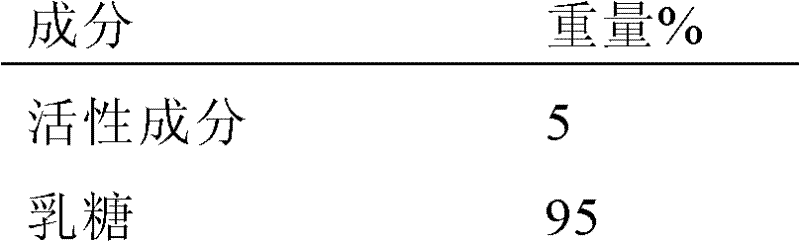
将活性混合物与乳糖混合,并将混合物加入到干粉吸入器中。Mix the active blend with lactose and add the mixture to the dry powder inhaler.
实施例4-制剂4Example 4 - Formulation 4
如下制备了片剂,每片含有30mg的活性成分:Tablets are prepared as follows, each containing 30 mg of active ingredient:

将活性成分、淀粉和纤维素通过No.20目美国筛并充分混合。将聚乙烯-吡咯烷酮的溶液与得到的粉末混合,然后使其通过No.16目美国筛。将如此得到的颗粒在50℃-60℃干燥并通过No.16目美国筛。将羧甲基淀粉钠、硬脂酸镁和滑石先通过No.30目美国筛,然后将其加入到颗粒中,然后混合并在压片机上压缩,得到片剂,每片重150mg。The active ingredient, starch and cellulose are passed through a No. 20 mesh U.S. sieve and mixed thoroughly. A solution of polyvinyl-pyrrolidone was mixed with the resulting powder, which was then passed through a No. 16 mesh U.S. sieve. The granules so obtained were dried at 50°C to 60°C and passed through a No. 16 mesh U.S. sieve. The sodium carboxymethyl starch, magnesium stearate and talc, first passed through a No. 30 mesh U.S. sieve, are then added to the granules which are then mixed and compressed on a tablet machine to give tablets, each weighing 150 mg.
实施例5-制剂5Example 5 - Formulation 5
如下制备了胶囊,每粒含有40mg的药物:Capsules, each containing 40 mg of the drug, were prepared as follows:

将活性成分、纤维素、淀粉、硬脂酸镁掺混,通过No.20目美国筛,并且以150mg的量填充到硬明胶胶囊中。The active ingredient, cellulose, starch, magnesium stearate are blended, passed through a No. 20 mesh U.S. sieve, and filled into hard gelatin capsules in quantities of 150 mg.
实施例6-制剂6Example 6 - Formulation 6
如下制备了栓剂,每剂含有25mg的活性成分:Suppositories containing 25 mg of active ingredient per dose are prepared as follows:
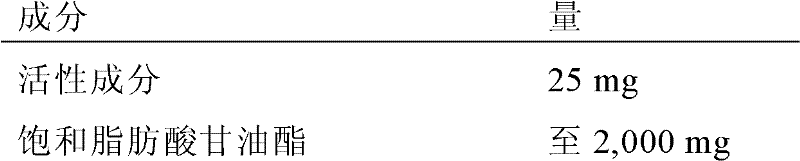
使活性成分通过No.60目美国筛并将其悬浮在已熔融的饱和脂肪酸甘油酷中(如果必需使用最小的加热)。然后将混合物倾入到公称容量为2.0g的栓剂模具中并冷却。Pass the active ingredient through a No. 60 mesh U.S. sieve and suspend it in the melted saturated fatty acid glycerides (using minimal heating if necessary). The mixture is then poured into suppository molds with a nominal capacity of 2.0 g and allowed to cool.
实施例7-制剂7Example 7 - Formulation 7
如下制备了悬浮液,每份含有50mg的药物/5.0ml剂量:Suspensions were prepared as follows, each serving containing 50 mg of drug per 5.0 ml dose:
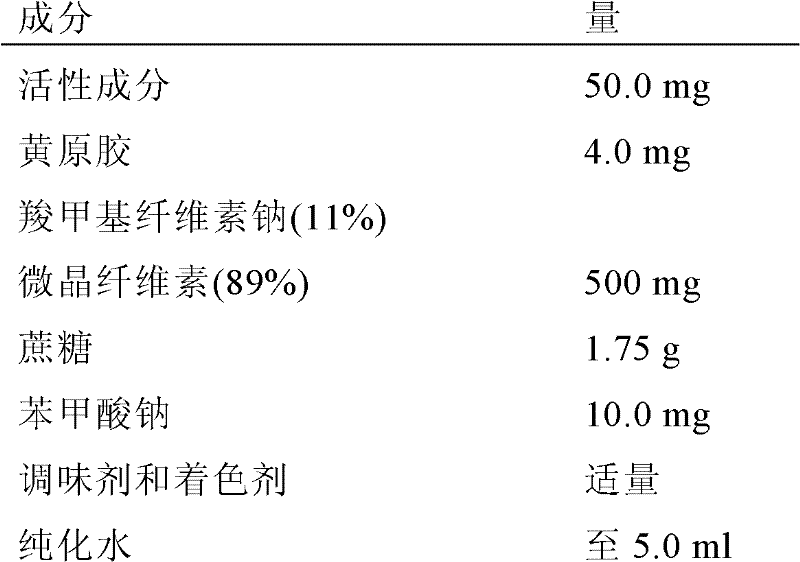
将药物、蔗糖和黄原胶掺混,通过No.10目美国筛,然后与己制得的微晶纤维素和羧甲基纤维素钠在水中的溶液混合。将苯甲酸钠、调味剂和着色剂用一些水稀释并在搅拌下加入。然后加入足够的水以获得所需体积。The drug, sucrose, and xanthan gum are blended, passed through a No. 10 mesh U.S. sieve, and mixed with a prepared solution of microcrystalline cellulose and sodium carboxymethylcellulose in water. The sodium benzoate, flavor and color are diluted with some of the water and added with stirring. Sufficient water is then added to obtain the desired volume.
实施例8-制剂8Example 8 - Formulation 8
如下制备了硬明胶胶囊,每粒含15mg的活性成分:Hard gelatin capsules, each containing 15 mg of active ingredient, are prepared as follows:

将活性成分、纤维素、淀粉和硬脂酸镁掺混,通过No.20目美国筛,并以560mg的量填充进硬明胶胶囊中。The active ingredient, cellulose, starch and magnesium stearate are blended, passed through a No. 20 mesh U.S. sieve, and filled into hard gelatin capsules in quantities of 560 mg.
实施例9-制剂9Example 9 - Formulation 9
可如下制备静脉内制剂:Intravenous formulations can be prepared as follows:

一般将治疗性化合物组合物置于具有无菌入口的容器中,例如静脉内溶液袋或小瓶中,其具有可被皮下注射针或类似的锐利工具刺穿的塞子。The therapeutic compound compositions are generally placed in a container having a sterile inlet, such as an intravenous solution bag or vial, with a stopper piercable by a hypodermic needle or similar sharp instrument.
实施例10-制剂10Example 10 - Formulation 10
可如下制备局部制剂:Topical formulations may be prepared as follows:

将白色软石蜡加热直到其熔融。引入液体石蜡和乳化蜡并搅拌直到熔融。加入活性成分并继续搅拌直到被分散。然后将混合物冷却得到固体。Heat white soft paraffin until it melts. Introduce liquid paraffin and emulsifying wax and stir until melted. Add the active ingredient and continue stirring until dispersed. The mixture was then cooled to give a solid.
实施例11-制剂11Example 11 - Formulation 11
可如下制备悬浮剂:使用以下过程制备了候选化合物在0.5%碳酸氢钠/盐水(w/v)中的浓度为30.0mg/mL的溶液:Suspensions can be prepared as follows: A solution of the candidate compound at a concentration of 30.0 mg/mL in 0.5% sodium bicarbonate/saline (w/v) is prepared using the following procedure:
制备0.5%碳酸氢钠/盐水储备溶液:100.0mLPrepare 0.5% sodium bicarbonate/saline stock solution: 100.0 mL
过程:process:
1.将0.5g碳酸氢钠加入到100mL容量瓶中。1. Add 0.5g of sodium bicarbonate to a 100mL volumetric flask.
2.加入约90.0mL的盐水并进行超声处理直到溶解。2. Add approximately 90.0 mL of saline and sonicate until dissolved.
3.添加适量的盐水达到100.0mL并充分混合。3. Add appropriate amount of saline to reach 100.0 mL and mix well.
制备30.0mg/mL的候选物化合物:10.0mLPreparation of 30.0 mg/mL candidate compound: 10.0 mL

过程:process:
1.将0.300g的候选化合物加入到10.0mL容量瓶中。1. Add 0.300 g of the candidate compound into a 10.0 mL volumetric flask.
2.加入约9.7mL的0.5%碳酸氢钠/盐水储备溶液。2. Add approximately 9.7 mL of 0.5% sodium bicarbonate/saline stock solution.
3.进行声处理直到候选化合物完全溶解。3. Sonicate until the candidate compound is completely dissolved.
4.添加适量的0.5%碳酸氢钠/盐水储备溶液达到10.0ml并混合。4. Add qs 0.5% sodium bicarbonate/saline stock solution up to 10.0 ml and mix.
实施例12-D用于测量登革热病毒诱导的细胞病变效应的高通量筛选的进展Example 12-D Advances in High Throughput Screening for Measuring Dengue Virus-Induced Cytopathic Effects
已经确立了敏感性和可重现性的高通量筛选(HTS)试验,用来测量由登革热病毒诱导的细胞病变效应(CPE)。为了确定在5天内产生完全CPE所需的登革热病毒储液的量,将Vero细胞单层接种到96孔板上并用登革热病毒储液的10倍系列稀释液感染,提供了约0.001PFU/细胞到0.1PFU/细胞的感染复数(MOI)。在感染后5天,将培养物用5%戊二醛固定并用0.1%结晶紫染色。用分光光度法在OD570定量表示由病毒诱导的CPE。从该分析,选择MOI为0.1PFU/细胞的登革热病毒储液用于HTS试验。为了建立96孔试验的信噪比(S/N)和评价孔-孔之间和试验-试验之间的变化性,进行了5个独立实验。将Vero细胞单层用0.1PFU/细胞的登革热病毒储液感染。每个板包含以下对照:一式四份的被病毒感染的孔,一式四份的未被感染的细胞孔和在500、250、125和62μM下利巴韦林的一式两份的剂量反应曲线作为参考标准。在感染后5天,对板进行了如上所述的处理。A sensitive and reproducible high-throughput screening (HTS) assay has been established to measure the cytopathic effect (CPE) induced by dengue virus. To determine the amount of dengue virus stock required to produce complete CPE within 5 days, Vero cell monolayers were seeded onto 96-well plates and infected with 10-fold serial dilutions of the dengue virus stock, providing approximately 0.001 PFU/cell to Multiplicity of infection (MOI) of 0.1 PFU/cell. Five days after infection, cultures were fixed with 5% glutaraldehyde and stained with 0.1% crystal violet. CPE induced by the virus was quantified at OD570 by spectrophotometry. From this analysis, a dengue virus stock with an MOI of 0.1 PFU/cell was selected for the HTS assay. To establish the signal-to-noise ratio (S/N) for the 96-well assay and to assess well-to-well and assay-to-experiment variability, five independent experiments were performed. Vero cell monolayers were infected with 0.1 PFU/cell of dengue virus stock. Each plate contained the following controls: quadruplicate wells infected with virus, quadruplicate wells of uninfected cells and duplicate dose-response curves of ribavirin at 500, 250, 125 and 62 μM as Guideline. Five days after infection, plates were treated as described above.
登革病毒CPE试验用于评价SIGA化学文库中抑制由登革热病毒诱导的CPE的那些化合物。每个评价试验由48个96-孔板组成,每个板80种化合物,从而每个试验产生4,608个数据点。在该通量下,我们能够在约52周内评价200,000种化合物。将化合物溶解于DMSO中,并且稀释于培养基中,以使每孔中的最终浓度为5μM化合物和0.5%DMSO。利用PerkinElmerII HT PLUS机器人系统将化合物机械地加至培养基中。在添加化合物后,用登革病毒(DEN-2新几内亚岛C株)感染培养物。5天孵育后,处理各板,并在PerkinElmerEnVision II板读数器系统上定量CPE。The dengue virus CPE assay was used to evaluate those compounds in the SIGA chemical library that inhibited CPE induced by dengue virus. Each evaluation assay consisted of 48 96-well plates with 80 compounds per plate, resulting in 4,608 data points per assay. At this throughput, we were able to evaluate 200,000 compounds in about 52 weeks. Compounds were dissolved in DMSO and diluted in media such that the final concentration in each well was 5 μM compound and 0.5% DMSO. Using PerkinElmer The II HT PLUS robotic system mechanically adds compounds to the culture medium. After compound addition, the culture was infected with dengue virus (DEN-2 New Guinea strain C). After 5 days of incubation, plates were processed and CPE was quantified on a PerkinElmer EnVision II plate reader system.
这些实验的结果表明了96孔试验形式是稳固的和可再生的。S/N比(细胞对照孔的信号(信号)/病毒对照孔的信号(噪音)的比率)是5.0±1.2。测量了每个单个板的孔-孔的变化性并发现对于阳性对照孔和阴性对照孔二者之间的相对标准偏差小于10%,并且总体的试验-试验变化性小于15%。使用该试验,利巴韦林的EC50值经测定为125±25μM。利巴韦林对抗登革热的有效性随着所用细胞类型的不同而变化,但是获得的值在所公开的该化合物的范围内(2,13,28)。合起来,这些结果表明敏感性的和可重现性的HTS试验已经成功地被开发,用来评价用于登革热病毒复制抑制剂的化合物库。The results of these experiments indicate that the 96-well assay format is robust and reproducible. The S/N ratio (signal (signal) of cell control wells/signal (noise) of virus control wells) was 5.0±1.2. Well-to-well variability was measured for each individual plate and the relative standard deviation was found to be less than 10% for both positive and negative control wells, and the overall assay-to-assay variability was less than 15%. Using this assay, the EC50 value of ribavirin was determined to be 125±25 μΜ. The effectiveness of ribavirin against dengue varied with the cell type used, but the values obtained were within the range disclosed for this compound (2, 13, 28). Taken together, these results indicate that a sensitive and reproducible HTS assay has been successfully developed to evaluate compound libraries for inhibitors of dengue virus replication.
实施例13-确定本发明化合物的抗登革热-2活性:Example 13 - Determination of the Anti-Dengue-2 Activity of Compounds of the Invention:
实施例12中所述的试验是登革热病毒抑制剂的高通量筛选的基础,针对登革热病毒试验了210,000个化合物库。进一步考察了以至少50%抑制由登革热病毒诱导的CPE的化合物的化学易处理性、效力和选择性。The assay described in Example 12 was the basis for a high-throughput screen for dengue virus inhibitors, testing a library of 210,000 compounds against dengue virus. Chemical tractability, potency and selectivity of compounds that inhibit dengue virus-induced CPE by at least 50% were further investigated.
最初,考察了符合条件的化合物的化学结构用于化学易处理性。化学易处理的化合物被定义为使用合理的化学方法即可合成得到,并且其具有化学稳定作用和可能的类似于药物的性质。评价了通过该药物化学过滤器的符合条件的化合物的效力。通过评价在较大浓度范围内的抑制活性来确定化合物的效力。使用非线性回归生成最佳拟合抑制曲线并用来计算50%有效浓度(EC50)。给定化合物的选择性或特异性通常被表示为其细胞毒性与其生物效应的比率。测报增殖试验用于计算50%细胞毒性浓度(CC50);该值与EC50的比率被称为治疗指数(T.I.=CC50/EC50)。两种类型的试验已用于确定细胞毒性,它们都是用于定量在代谢活性细胞中产生的还原酶活性的标准方法(22)。一种试验是测量3-(4,5-二甲基噻唑-2-基)-2,5-二苯基-溴化四唑盐(MTT)的还原的比色法,而另一种试验使用荧光测定法来测量刃天青(Alamar Blue)的还原。选择性可通过评估对抗来自不相关病毒家族的病毒的抑制作用来进一步表征。根据HTS筛选在初始符合条件的化合物库中发现16种具有抗登革热活性的符合条件的化合物,所有的EC50值为25μM以下。利用以数种药物浓度进行的产量试验证实这些化合物可对抗对四种血清型登革热中的每一种,并且确定每种血清型登革热的滴度。Initially, the chemical structures of eligible compounds were examined for chemical tractability. A chemically tractable compound is defined as a compound that is readily synthesized using rational chemistry and that possesses chemical stabilization and possibly drug-like properties. Eligible compounds passing the medicinal chemistry filter were evaluated for their potency. Compound potency is determined by evaluating inhibitory activity over a broad concentration range. A best fit inhibition curve was generated using nonlinear regression and used to calculate the 50% effective concentration ( EC50 ). The selectivity or specificity of a given compound is usually expressed as the ratio of its cytotoxicity to its biological effect. The proliferation assay is used to calculate the 50% cytotoxic concentration (CC50); the ratio of this value to the EC50 is called the therapeutic index (TI=CC50/EC50). Two types of assays have been used to determine cytotoxicity, and both are standard methods for quantifying reductase activity produced in metabolically active cells (22). One test is a colorimetric method measuring the reduction of 3-(4,5-dimethylthiazol-2-yl)-2,5-diphenyl-tetrazolium bromide (MTT), while the other Resazurin (Alamar Blue) reduction was measured using fluorimetry. Selectivity can be further characterized by assessing inhibition against viruses from unrelated virus families. According to the HTS screening, 16 qualified compounds with anti-dengue activity were found in the initial qualified compound library, all of which had EC50 values below 25 μM. The compounds were demonstrated against each of the four serotypes of dengue using yield assays at several drug concentrations and titers for each serotype of dengue were determined.
在病毒产量试验中测试了初次筛选中具有活性的化合物。表1显示了在一定的浓度范围内在病毒产量试验中考察了对抗登革热-2(新几内亚岛C株)的活性的一些化合物。如上所述,将在12孔板中的Vero细胞在0.1感染复数(MOI)下用登革热-2病毒感染,用化合物(或作为对照的DMSO)处理,在37℃培养,在感染后48小时收获,并在Vero细胞上滴定。通过ExcelFit计算EC50。以类似方式确定了对抗其它血清型登革病毒的活性。Compounds active in the primary screen were tested in virus yield assays. Table 1 shows some compounds whose activity against Dengue-2 (New Guinea strain C) was examined in the virus yield assay over a certain concentration range. Vero cells in 12-well plates were infected with Dengue-2 virus at a multiplicity of infection (MOI) of 0.1, treated with compounds (or DMSO as a control), incubated at 37°C, and harvested 48 hours post-infection as described above. , and titrated on Vero cells. EC50 was calculated by ExcelFit. Activity against other serotypes of dengue virus was determined in a similar manner.
化合物3被鉴定为初始符合条件的化合物库中最有效的且选择性的化合物之一,对抗所有四种血清型的登革热具有活性。获得该化合物的化学类似物,并且如所述测试了这些类似物,以便限定化学结构和生物活性之间的的联系(参见表1)。表1中所有标示A、B或C的化合物对登革热具有活性,EC50值为25μM或低于25μM。Compound 3 was identified as one of the most potent and selective compounds in the initial qualified compound library, active against all four serotypes of dengue. Chemical analogs of this compound were obtained and tested as described in order to define the link between chemical structure and biological activity (see Table 1). All compounds marked A, B or C in Table 1 are active against dengue with EC50 values of 25 μM or lower.
表1-本发明化合物及其抗-登革热2病毒活性的列表Table 1 - List of Compounds of the Invention and Their Anti-Dengue 2 Virus Activity

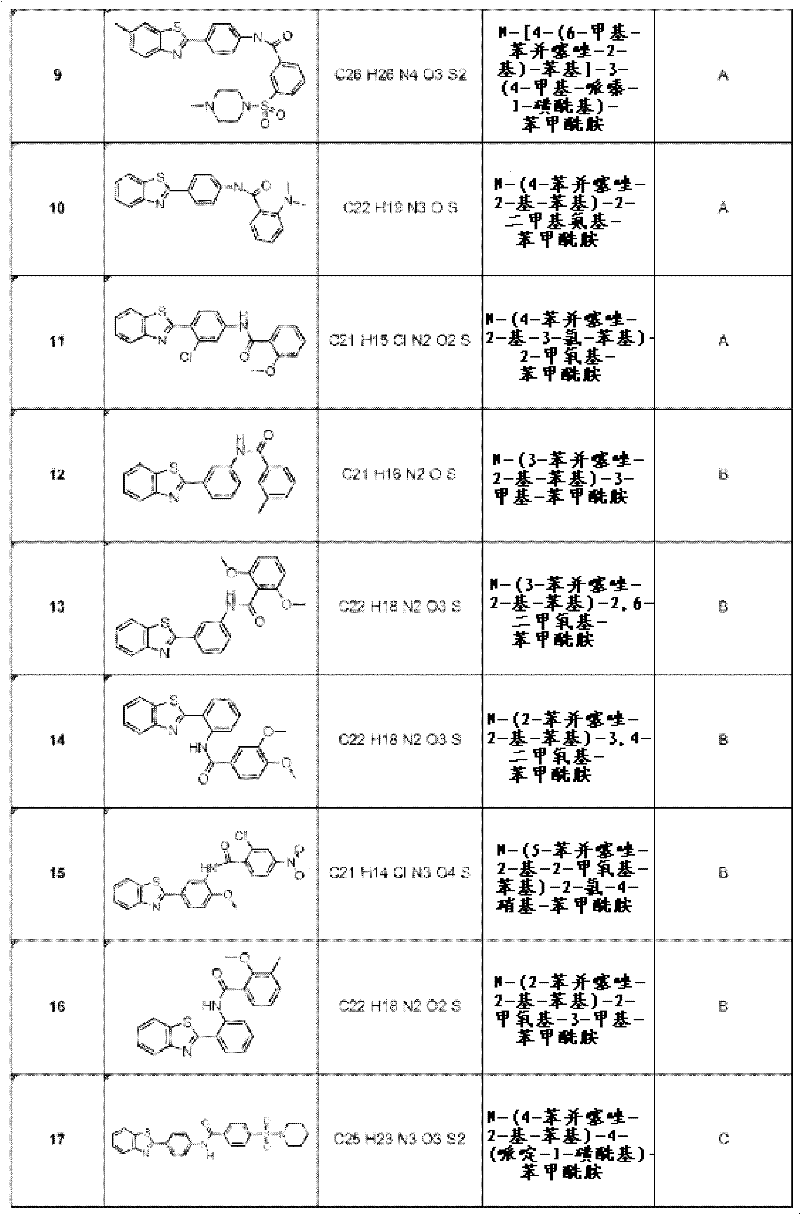


参考文献references
1.Barth,O.M.1999.Ultrastructural aspects of the dengue virus(flavivirus)particle morphogenesis.J Submicrosc Cytol Pathol 31:407-12.1.Barth, O.M.1999.Ultrastructural aspects of the dengue virus (flavivirus) particle morphogenesis.J Submicrosc Cytol Pathol 31:407-12.
2.Benarroch,D.,M.P.Egloff,L.Mulard,C.Guerreiro,J.L.Romette,and B.Canard.2004.A structural basis for the inhibition of theNS5 dengue virus mRNA 2′-O-methyltransferase domain by ribavirin5′-triphosphate.J Biol Chem 279:35638-43.2. Benarroch, D., M.P.Egloff, L.Mulard, C.Guerreiro, J.L.Romette, and B.Canard. 2004. A structural basis for the inhibition of the NS5 dengue virus mRNA 2′-O-methyltransferase domain by ribavirin5′- triphosphate. J Biol Chem 279: 35638-43.
3.Brinton,M.A.,and J.H.Dispoto.1988.Sequence and secondarystructure analysis of the 5′-terminal region of flavivirus genome RNA.Virology 162:290-9.3.Brinton, M.A., and J.H.Dispoto.1988.Sequence and secondary structure analysis of the 5′-terminal region of flavivirus genome RNA.Virology 162:290-9.
4.CDC.2005.Dengue Fever,http://www2.ncid.cdc.gov/travel/yb/utils/ybGet.asp?section=dis&obj=dengue.htm.4. CDC. 2005. Dengue Fever, http://www2.ncid.cdc.gov/travel/yb/utils/ybGet.asp? section=dis&obj=dengue.htm.
5.Edelman,R.,S.S.Wasserman,S.A.Bodison,R.J.Putnak,K.H.Eckels,D.Tang,N.Kanesa-Thasan,D.W.Vaughn,B.L.Innis,and W.Sun.2003.Phase I trial of 16 formulations of a tetravalent live-attenuateddengue vaccine.Am J Trop Med Hyg 69:48-60.5. Edelman, R., S.S. Wasserman, S.A. Bodison, R.J. Putnak, K.H. Eckels, D. Tang, N. Kanesa-Thasan, D.W. Vaughn, B.L. Innis, and W. Sun. 2003. Phase I trial of 16 formulations of a tetravalent live-attenuated dengue vaccine. Am J Trop Med Hyg 69:48-60.
6.Falgout,B.,M.Pethel,Y.M.Zhang,and C.J.Lai.1991.Bothnonstructural proteins NS2B and NS3 are required for the proteolyticprocessing of dengue virus nonstructural proteins.J Virol 65:2467-75.6. Falgout, B., M. Pethel, Y.M. Zhang, and C.J. Lai. 1991. Both nonstructural proteins NS2B and NS3 are required for the proteolytic processing of dengue virus nonstructural proteins. J Virol 65: 2467-75.
7.Fink,J.,F.Gu,and S.G.Vasudevan.2006.Role of T cells,cytokines and antibody in dengue fever and dengue haemorrhagic fever.Rev Med Virol 16:263-75.7. Fink, J., F.Gu, and S.G.Vasudevan. 2006. Role of T cells, cytokines and antibody in dengue fever and dengue haemorrhagic fever. Rev Med Virol 16: 263-75.
8.Halstead,S.B.1988.Pathogenesis of dengue:challenges tomolecular biology.Science 239:476-81.8. Halstead, S.B. 1988. Pathogenesis of dengue: challenges tomolecular biology. Science 239: 476-81.
9.Hase,T.,P.L.Summers,K.H.Eckels,and W.B.Baze.1987.Anelectron and immunoelectron microscopic study of dengue-2 virusinfection of cultured mosquito cells:maturation events.Arch Virol92:273-91.9. Hase, T., P.L. Summers, K.H. Eckels, and W.B. Baze. 1987. Anelectron and immunoelectron microscopic study of dengue-2 virus infection of cultured mosquito cells: maturation events. Arch Virol92: 273-91.
10.Hillen,W.,G.Klock,I.Kaffenberger,L.V.Wray,and W.S.Reznikoff.1982.Purification of the TET repressor and TET operator fromthe transposon Tn10 and characterization of their interaction.J Biol Chem257:6605-13.10. Hillen, W., G. Klock, I. Kaffenberger, L.V. Wray, and W.S. Reznikoff. 1982. Purification of the TET repressor and TET operator from the transposon Tn10 and characterization of their interaction. J Biol Chem257: 6605-13.
11.Kanesa-thasan,N.,W.Sun,G.Kim-Ahn,S.Van Albert,J.R.Putnak,A.King,B.Raengsakulsrach,H.Christ-Schmidt,K.Gilson,J.M.Zahradnik,D.W.Vaughn,B.L.Innis,J.F.Saluzzo,and C.H.Hoke,Jr.2001.Safety and immunogenicity of attenuated dengue virus vaccines(Aventis Pasteur)in human volunteers.Vaccine 19:3179-88.11. Kanesa-thasan, N., W. Sun, G. Kim-Ahn, S. Van Albert, J.R. Putnak, A. King, B. Raengsakulsrach, H. Christ-Schmidt, K. Gilson, J.M. Zahradnik, D.W. Vaughn , B.L.Innis, J.F.Saluzzo, and C.H.Hoke, Jr. 2001. Safety and immunogenicity of attenuated dengue virus vaccines (Aventis Pasteur) in human volunteers. Vaccine 19:3179-88.
12.Kitchener,S.,M.Nissen,P.Nasveld,R.Forrat,S.Yoksan,J.Lang,and J.F.Saluzzo.2006.Immunogenicity and safety of twolive-attenuated tetravalent dengue vaccine formulations in healthyAustralian adults.Vaccine 24:1238-41.12. Kitchener, S., M. Nissen, P. Nasveld, R. Forrat, S. Yoksan, J. Lang, and J. F. Saluzzo. 2006. Immunogenicity and safety of twolive-attenuated tetravalent dengue vaccine formulations in healthy Australian adults. Vaccine 24 : 1238-41.
13.Koff,W.C.,J.L.Elm,Jr.,and S.B.Halstead.1982.Antiviraleffects if ribavirin and 6-mercapto-9-tetrahydro-2-furylpurine againstdengue viruses in vitro.Antiviral Res 2:69-79.13. Koff, W.C., J.L.Elm, Jr., and S.B.Halstead. 1982. Antiviral effects if ribavirin and 6-mercapto-9-tetrahydro-2-furylpurine against dengue viruses in vitro. Antiviral Res 2:69-79.
14.Koff,W.C.,R.D.Pratt,J.L.Elm,Jr.,C.N.Venkateshan,and S.B.Halstead.1983.Treatment of intraeranial dengue virus infections inmice with a lipophilic derivative of ribavirin.Antimicrob AgentsChemother 24:134-6.14. Koff, W.C., R.D.Pratt, J.L.Elm, Jr., C.N.Venkateshan, and S.B.Halstead. 1983. Treatment of intraeranial dengue virus infections inmice with a lipophilic derivative of ribavirin. Antimicrob Agents Chemother -264: 13
15.Leitmeyer,K.C.,D.W.Vaughn,D.M.Watts,R.Salas,I.Villalobos,C.de,C.Ramos,and R.Rico-Hesse.1999.Dengue virusstructural differences that correlate with pathogenesis.J Virol 73:4738-47.15. Leitmeyer, K.C., D.W. Vaughn, D.M. Watts, R. Salas, I. Villalobos, C.de, C. Ramos, and R. Rico-Hesse. 1999. Dengue virus structural differences that correlate with pathogenesis. J Virol 73: 4738 -47.
16.Malinoski,F.J.,S.E.Hasty,M.A.Ussery,and J.M.Dalrymple.1990.Prophylactic ribavirin treatment of dengue type 1 infection in rhesusmonkeys.Antiviral Res 13:139-49.16. Malinoski, F.J., S.E.Hasty, M.A.Ussery, and J.M.Dalrymple. 1990. Prophylactic ribavirin treatment of dengue type 1 infection in rhesusmonkeys. Antiviral Res 13:139-49.
17.Markoff,L.,A.Chang,and B.Falgout.1994.Processing offlavivirus structural glycoproteins:stable membrane insertion ofpremembrane requires the envelope signal peptide.Virology 204:526-40.17. Markoff, L., A. Chang, and B. Falgout. 1994. Processing offlavivirus structural glycoproteins: stable membrane insertion of premembrane requires the envelope signal peptide. Virology 204: 526-40.
18.Medin,C.L.,K.A.Fitzgerald,and A.L.Rothman.2005.Denguevirus nonstructural protein NS5 induces interleukin-8 transcription andsecretion.J Virol 79:11053-61.18. Medin, C.L., K.A. Fitzgerald, and A.L. Rothman. 2005. Denguevirus nonstructural protein NS5 induces interleukin-8 transcription and secretion. J Virol 79: 11053-61.
19.Modis,Y.,S.Ogata,D.Clements,and S.C.Harrison.2003.Aligand-binding pocket in the dengue virus envelope glycoprotein.ProcNatl Acad Sci U S A 100:6986-91.19. Modis, Y., S.Ogata, D.Clements, and S.C.Harrison. 2003. Aligand-binding pocket in the dengue virus envelope glycoprotein. ProcNatl Acad Sci U S A 100: 6986-91.
20.Monath,T.P.1994.Dengue:the risk to developed and developingcountries.Proc Natl Acad Sci U S A 91:2395-400.20. Monath, T.P. 1994. Dengue: the risk to developed and developing countries. Proc Natl Acad Sci U S A 91: 2395-400.
21.Mukhopadhyay,S.,R.J.Kuhn,and M.G.Rossmann.2005.Astructural perspective of the flavivirus life cycle.Nat Rev Microbiol3:13-22.21.Mukhopadhyay, S., R.J.Kuhn, and M.G.Rossmann.2005.Astructural perspective of the flavivirus life cycle.Nat Rev Microbiol3:13-22.
22.O′Brien,J.,I.Wilson,T.Orton,and F.Pognan.2000.Investigation of the Alamar Blue(resazurin)fluorescent dye for theassessment of mammalian cell cytotoxicity.Eur J Biochem 267:5421-6.22. O′Brien, J., I.Wilson, T.Orton, and F.Pognan. 2000. Investigation of the Alamar Blue (resazurin) fluorescent dye for the assessment of mammalian cell cytotoxicity. Eur J Biochem 267: 5421-6.
23.PAHO.2006.Dengue and dengue hemorrhagic feverhttp://www.paho.org/english/ad/dpc/cd/dengue.htm.23.PAHO.2006.Dengue and dengue hemorrhagic feverhttp://www.paho.org/english/ad/dpc/cd/dengue.htm.
24.Raviprakash,K.,M.Sinha,C.G.Hayes,and K.R.Porter.1998.Conversion of dengue virus replicative form RNA(RF)to replicativeintermediate(RI)by nonstructural proteins NS-5 and NS-3.Am J TropMed Hyg 58:90-5.24. Raviprakash, K., M.Sinha, C.G.Hayes, and K.R.Porter.1998.Conversion of dengue virus replicative form RNA(RF)to replicative intermediate(RI)by nonstructural proteins NS-5 and NS-3.Am J TropMed Hyg 58:90-5.
25.Rothman,A.L.,and F.A.Ennis.1999.Immunopathogenesis ofDengue hemorrhagic fever.Virology 257:1-6.25. Rothman, A.L., and F.A. Ennis. 1999. Immunopathogenesis of Dengue hemorrhagic fever. Virology 257: 1-6.
26.Sabchareon,A.,J.Lang,P.Chanthavanich,S.Yoksan,R.Forrat,P.Attanath,C.Sirivichayakul,K.Pengsaa,C.Pojjaroen-Anant,W.Chokejindachai,A.Jagsudee,J.F.Saluzzo,and N.Bhamarapravati.2002.Safety and immunogenicity of tetravalent live-attenuated dengue vaccinesin Thai adult volunteers:role of serotype concentration,ratio,and multipledoses.Am J Trop Med Hyg 66:264-72.26. Sabchareon, A., J. Lang, P. Chanthavanich, S. Yoksan, R. Forrat, P. Attanath, C. Sirivichayakul, K. Pengsaa, C. Pojjaroen-Anant, W. Chokejindachai, A. Jagsudee, J.F. Saluzzo, and N. Bhamarapravati. 2002. Safety and immunogenicity of tetravalent live-attenuated dengue vaccines in Thai adult volunteers: role of serotype concentration, ratio, and multipledoses. Am J Trop Med Hyg 66: 264-72.
27.Schlesinger,S.,and M.J.Schlesinger.1990.Replication oftogaviridae and flaviviridae,p.697-710.In B.N.Fields,D.M.Knipe,R.M.Chanock,M.S.Hirsch,J.L.Melnick,T.P.Monath,and B.Roizrnan(ed.),Virology,2 ed,vol.1.Ravens Press,New York.27. Schlesinger, S., and M.J.Schlesinger.1990.Replication oftogaviridae and flaviviridae, p.697-710. In B.N.Fields, D.M.Knipe, R.M.Chanock, M.S.Hirsch, J.L.Melnick, T.P.Monath, and B.Roizrnan (ed. ), Virology, 2 ed, vol.1. Ravens Press, New York.
28.Takhampunya,R.,S.Ubol,H.S.Houng,C.E.Cameron,and R.Padmanabhan.2006.Inhibition of dengue virus replication bymycophenolic acid and ribavirin.J Gen Virol 87:1947-52.28. Takhampunya, R., S. Ubol, H.S.Houng, C.E. Cameron, and R. Padmanabhan. 2006. Inhibition of dengue virus replication by mycophenolic acid and ribavirin. J Gen Virol 87: 1947-52.
29.Thein,S.,M.M.Aung,T.N.Shwe,M.Aye,A.Zaw,K.Aye,K.M.Aye,and J.Aaskov.1997.Risk factors in dengue shock syndrome.AmJ Trop Med Hyg 56:566-72.29. Thein, S., M.M.Aung, T.N.Shwe, M.Aye, A.Zaw, K.Aye, K.M.Aye, and J.Aaskov. 1997. Risk factors in dengue shock syndrome. AmJ Trop Med Hyg 56:566- 72.
30.Uchil,P.D.,and V.Satchidanandam.2003.Architecture of theflaviviral replication complex.Protease,nuclease,and detergents revealencasement within double-layered membrane compartments.J Biol Chem278:24388-98.30. Uchil, P.D., and V. Satchidanandam. 2003. Architecture of the flaviviral replication complex. Protease, nuclease, and detergents revealen casement within double-layered membrane compartments. J Biol Chem278: 24388-98.
31.Umareddy,I.,A.Chao,A.Sampath,F.Gu,and S.G.Vasudevan.2006.Dengue virus NS4B interacts with NS3 and dissociates it fromsingle-stranded RNA.J Gen Virol 87:2605-14.31. Umareddy, I., A. Chao, A. Sampath, F. Gu, and S.G. Vasudevan. 2006. Dengue virus NS4B interacts with NS3 and dissociates it from single-stranded RNA. J Gen Virol 87: 2605-14.
32.WHO.2002.Dengue and dengue haemorrhagic fever,http://www.who.int/mediacentre/factsheets/fs117/en/.32. WHO. 2002. Dengue and dengue haemorrhagic fever, http://www.who.int/mediacentre/factsheets/fs117/en/.
33.WHO.1997.Dengue haemorrhagic fever,http://www.who.int/csr/resources/publications/dengue/Denguepublication/en/index.html.33. WHO. 1997. Dengue haemorrhagic fever, http://www.who.int/csr/resources/publications/dengue/Denguepublication/en/index.html.
本文应用的所有出版物为了所有目的通过引用整体并入。All publications used herein are incorporated by reference in their entirety for all purposes.
已经描述了本发明的优选的实施方案,但是本领域技术人员应理解,本发明可具有更广泛的应用。本分明的范围仅仅由权利要求书限制。A preferred embodiment of the invention has been described, but it will be appreciated by those skilled in the art that the invention has broader applicability. The scope of the invention is limited only by the claims.
Claims (26)


Applications Claiming Priority (3)
| Application Number | Priority Date | Filing Date | Title |
|---|---|---|---|
| US22177309P | 2009-06-30 | 2009-06-30 | |
| US61/221,773 | 2009-06-30 | ||
| PCT/US2010/039462 WO2011002635A1 (en) | 2009-06-30 | 2010-06-22 | Treatment and prevention of dengue virus infections |
Publications (1)
| Publication Number | Publication Date |
|---|---|
| CN102469788A true CN102469788A (en) | 2012-05-23 |
Family
ID=43411375
Family Applications (1)
| Application Number | Title | Priority Date | Filing Date |
|---|---|---|---|
| CN2010800294005A Pending CN102469788A (en) | 2009-06-30 | 2010-06-22 | Treatment and prevention of dengue virus infection |
Country Status (13)
| Country | Link |
|---|---|
| US (1) | US20150150852A1 (en) |
| EP (1) | EP2448410A4 (en) |
| JP (1) | JP2012532102A (en) |
| KR (1) | KR20120049852A (en) |
| CN (1) | CN102469788A (en) |
| AP (1) | AP2012006094A0 (en) |
| AU (1) | AU2010266570A1 (en) |
| BR (1) | BRPI1009034A2 (en) |
| CA (1) | CA2763194A1 (en) |
| IL (1) | IL216605A (en) |
| MX (1) | MX336687B (en) |
| WO (1) | WO2011002635A1 (en) |
| ZA (1) | ZA201109187B (en) |
Cited By (4)
| Publication number | Priority date | Publication date | Assignee | Title |
|---|---|---|---|---|
| CN106349184A (en) * | 2016-08-08 | 2017-01-25 | 江西师范大学 | Preparation method of 2- (ortho-alkylaryl) benzothiazole series |
| CN109265412A (en) * | 2018-11-19 | 2019-01-25 | 大连大学 | It is a kind of for detecting the probe compound and its detection method of fluorine ion |
| CN117222630A (en) * | 2021-02-12 | 2023-12-12 | Otc制药公司(Jsc) | 2-acetamido-6-hydroxy-benzothiophene derivatives with antiviral activity |
| CN119732952A (en) * | 2024-12-13 | 2025-04-01 | 长春中医药大学 | Application of 4,4′-(benzo[C][1,2,5]thiadiazole-4,7-diyl)diphenylamine compound in the preparation of anti-Ebola virus drugs |
Families Citing this family (63)
| Publication number | Priority date | Publication date | Assignee | Title |
|---|---|---|---|---|
| ES2634490T3 (en) | 2010-07-02 | 2017-09-28 | Gilead Sciences, Inc. | Napht-2-ylacetic acid derivatives to treat AIDS |
| CA2802492C (en) | 2010-07-02 | 2018-10-16 | Gilead Sciences, Inc. | 2-quinolinyl-acetic acid derivatives as hiv antiviral compounds |
| CA2812087A1 (en) | 2010-09-15 | 2012-03-22 | F. Hoffmann-La Roche Ag | Azabenzothiazole compounds, compositions and methods of use |
| CN102731394A (en) * | 2011-04-12 | 2012-10-17 | 中国科学院上海药物研究所 | Substituted quinoline-2-formaldehyde-phenylhydrazone derivative, and preparation method and application thereof |
| AP2013007249A0 (en) | 2011-04-21 | 2013-11-30 | Gilead Sciences Inc | Benzothiazole compounds and their pharmaceutical use |
| US9464064B2 (en) | 2011-09-07 | 2016-10-11 | University Of Kansas | HCV helicase inhibitors and methods of use thereof |
| AP2014007595A0 (en) | 2011-09-30 | 2014-04-30 | Kineta Inc | Anti-viral compounds |
| SG10201608528YA (en) | 2011-12-21 | 2016-12-29 | Novira Therapeutics Inc | Hepatitis b antiviral agents |
| WO2013103724A1 (en) | 2012-01-04 | 2013-07-11 | Gilead Sciences, Inc. | 2- (tert - butoxy) -2- (7 -methylquinolin- 6 - yl) acetic acid derivatives for treating aids |
| WO2013103738A1 (en) | 2012-01-04 | 2013-07-11 | Gilead Sciences, Inc. | Napthalene acetic acid derivatives against hiv infection |
| PH12014500842A1 (en) | 2012-04-20 | 2014-06-09 | Gilead Sciences Inc | Benzothiazol-6-yl acetic acid derivatives and their use for treating an hiv infection |
| JP2015533782A (en) | 2012-08-28 | 2015-11-26 | ヤンセン・サイエンシズ・アイルランド・ユーシー | Sulfamoyl-arylamide and its use as a medicament for the treatment of hepatitis B |
| CN102988352A (en) * | 2012-11-19 | 2013-03-27 | 何晓涛 | Application of Aphanamixoid A in medicine for treating dengue virus infection |
| US9073946B2 (en) | 2013-01-15 | 2015-07-07 | Kineta, Inc. | Anti-viral compounds |
| EP2961732B1 (en) | 2013-02-28 | 2017-04-12 | Janssen Sciences Ireland UC | Sulfamoyl-arylamides and the use thereof as medicaments for the treatment of hepatitis b |
| WO2014165128A2 (en) * | 2013-03-12 | 2014-10-09 | Novira Therapeutics, Inc. | Hepatitis b antiviral agents |
| AU2014247138B2 (en) | 2013-04-03 | 2018-06-28 | Janssen Sciences Ireland Uc | N-phenyl-carboxamide derivatives and the use thereof as medicaments for the treatment of hepatitis B |
| JO3603B1 (en) | 2013-05-17 | 2020-07-05 | Janssen Sciences Ireland Uc | Sulfamoyl pyrolamide derivatives and their use as medicines to treat hepatitis B |
| ES2774749T3 (en) | 2013-07-25 | 2020-07-22 | Janssen Sciences Ireland Unlimited Co | Glyoxamide-substituted pyrrolamide derivatives and their use as medicines for the treatment of hepatitis B |
| JP6452119B2 (en) | 2013-10-23 | 2019-01-16 | ヤンセン・サイエンシズ・アイルランド・アンリミテッド・カンパニー | Carboxamide derivatives and their use as pharmaceuticals for the treatment of hepatitis B |
| US9181288B2 (en) | 2014-01-16 | 2015-11-10 | Novira Therapeutics, Inc. | Azepane derivatives and methods of treating hepatitis B infections |
| US9169212B2 (en) | 2014-01-16 | 2015-10-27 | Novira Therapeutics, Inc. | Azepane derivatives and methods of treating hepatitis B infections |
| US10392349B2 (en) | 2014-01-16 | 2019-08-27 | Novira Therapeutics, Inc. | Azepane derivatives and methods of treating hepatitis B infections |
| KR20160128305A (en) | 2014-02-05 | 2016-11-07 | 노비라 테라퓨틱스, 인코포레이티드 | Combination therapy for treatment of hbv infections |
| CA2932551A1 (en) | 2014-02-06 | 2015-08-13 | Janssen Sciences Ireland Uc | Sulphamoylpyrrolamide derivatives and the use thereof as medicaments for the treatment of hepatitis b |
| US9400280B2 (en) | 2014-03-27 | 2016-07-26 | Novira Therapeutics, Inc. | Piperidine derivatives and methods of treating hepatitis B infections |
| TWI681951B (en) * | 2014-10-01 | 2020-01-11 | 美商健生醫藥公司 | Mono- or di-substituted indole derivatives as dengue viral replication inhibitors |
| CN107847762A (en) | 2015-03-19 | 2018-03-27 | 诺维拉治疗公司 | Azacyclooctane and azacyclononane derivatives and methods of treating hepatitis B infection |
| US10875876B2 (en) | 2015-07-02 | 2020-12-29 | Janssen Sciences Ireland Uc | Cyclized sulfamoylarylamide derivatives and the use thereof as medicaments for the treatment of hepatitis B |
| HK1259410A1 (en) | 2015-09-29 | 2019-11-29 | 诺维拉治疗公司 | Crystalline forms of a hepatitis b antiviral agent |
| TW201718581A (en) | 2015-10-19 | 2017-06-01 | 英塞特公司 | Heterocyclic compounds as immunomodulators |
| SMT202200369T1 (en) | 2015-11-19 | 2022-11-18 | Incyte Corp | Heterocyclic compounds as immunomodulators |
| MA44075A (en) | 2015-12-17 | 2021-05-19 | Incyte Corp | N-PHENYL-PYRIDINE-2-CARBOXAMIDE DERIVATIVES AND THEIR USE AS MODULATORS OF PROTEIN / PROTEIN PD-1 / PD-L1 INTERACTIONS |
| SG10202005790VA (en) | 2015-12-22 | 2020-07-29 | Incyte Corp | Heterocyclic compounds as immunomodulators |
| EP3848026A1 (en) | 2016-04-15 | 2021-07-14 | Novira Therapeutics Inc. | Combinations and methods comprising a capsid assembly inhibitor |
| ES2906460T3 (en) | 2016-05-06 | 2022-04-18 | Incyte Corp | Heterocyclic compounds as immunomodulators |
| TW201808902A (en) | 2016-05-26 | 2018-03-16 | 美商英塞特公司 | Heterocyclic compounds as immunomodulators |
| SG11201811414TA (en) | 2016-06-20 | 2019-01-30 | Incyte Corp | Heterocyclic compounds as immunomodulators |
| MA45669A (en) | 2016-07-14 | 2019-05-22 | Incyte Corp | HETEROCYCLIC COMPOUNDS USED AS IMMUNOMODULATORS |
| MA46045A (en) | 2016-08-29 | 2021-04-28 | Incyte Corp | HETEROCYCLIC COMPOUNDS USED AS IMMUNOMODULATORS |
| PL3558990T3 (en) | 2016-12-22 | 2022-12-19 | Incyte Corporation | Tetrahydro imidazo[4,5-c]pyridine derivatives as pd-l1 internalization inducers |
| MX391981B (en) | 2016-12-22 | 2025-03-21 | Incyte Corp | BENZOOXAZOLE DERIVATIVES AS IMMUNOMODULATORS. |
| US20180179179A1 (en) | 2016-12-22 | 2018-06-28 | Incyte Corporation | Heterocyclic compounds as immunomodulators |
| WO2018119236A1 (en) | 2016-12-22 | 2018-06-28 | Incyte Corporation | Triazolo[1,5-a]pyridine derivatives as immunomodulators |
| MA47099A (en) | 2016-12-22 | 2021-05-12 | Incyte Corp | BICYCLIC HETEROAROMATIC COMPOUNDS USED AS IMMUNOMODULATORS |
| MX2021011775A (en) | 2017-04-26 | 2023-01-10 | Basilea Pharm Int Ag | Processes for the preparation of furazanobenzimidazoles and crystalline forms thereof. |
| WO2019004825A1 (en) | 2017-06-28 | 2019-01-03 | Rijksuniversiteit Groningen | Tomatidine and analogs thereof for use as antiviral agent |
| WO2019175657A1 (en) | 2018-03-14 | 2019-09-19 | Janssen Sciences Ireland Unlimited Company | Capsid assembly modulator dosing regimen |
| UA128453C2 (en) | 2018-03-30 | 2024-07-17 | Інсайт Корпорейшн | HETEROCYCLIC COMPOUNDS AS IMMUNOMODULATORS |
| PL3790877T3 (en) | 2018-05-11 | 2023-06-12 | Incyte Corporation | Tetrahydro-imidazo[4,5-c]pyridine derivatives as pd-l1 immunomodulators |
| SI3860998T1 (en) | 2018-10-05 | 2024-06-28 | Annapurna Bio Inc. | Compounds and compositions for treating conditions associated with apj receptor activity |
| KR102146741B1 (en) * | 2018-10-31 | 2020-08-21 | 계명대학교 산학협력단 | Antiviral composition |
| KR20210130753A (en) | 2019-02-22 | 2021-11-01 | 얀센 사이언시즈 아일랜드 언리미티드 컴퍼니 | Amide derivatives useful for the treatment of HBV infection or HBV-induced disease |
| AR119732A1 (en) | 2019-05-06 | 2022-01-05 | Janssen Sciences Ireland Unlimited Co | AMIDE DERIVATIVES USEFUL IN THE TREATMENT OF HBV INFECTION OR HBV-INDUCED DISEASES |
| WO2021030162A1 (en) | 2019-08-09 | 2021-02-18 | Incyte Corporation | Salts of a pd-1/pd-l1 inhibitor |
| CN115175734B (en) | 2019-09-30 | 2024-04-19 | 因赛特公司 | Pyrido[3,2-D]pyrimidine compounds as immunomodulators |
| US20240190824A1 (en) * | 2019-10-24 | 2024-06-13 | Ono Pharmaceutical Co., Ltd. | Inhibitors of trek (twik related k+ channels) channel function |
| CA3160131A1 (en) | 2019-11-11 | 2021-05-20 | Incyte Corporation | Salts and crystalline forms of a pd-1/pd-l1 inhibitor |
| JP7588224B2 (en) | 2020-10-05 | 2024-11-21 | エンライブン インコーポレイテッド | 5- and 6-azaindole compounds for the inhibition of bcr-abl tyrosine kinase - Patents.com |
| WO2022099018A1 (en) | 2020-11-06 | 2022-05-12 | Incyte Corporation | Process of preparing a pd-1/pd-l1 inhibitor |
| MX2023005362A (en) | 2020-11-06 | 2023-06-22 | Incyte Corp | Process for making a pd-1/pd-l1 inhibitor and salts and crystalline forms thereof. |
| US11760756B2 (en) | 2020-11-06 | 2023-09-19 | Incyte Corporation | Crystalline form of a PD-1/PD-L1 inhibitor |
| KR20250119117A (en) | 2024-01-31 | 2025-08-07 | 국립경국대학교 산학협력단 | Antiviral composition against Japanese encephalitis virus comprising Cannabis sativa L. extract or fractions thereof as an active ingredient |
Citations (3)
| Publication number | Priority date | Publication date | Assignee | Title |
|---|---|---|---|---|
| CN1820022A (en) * | 2003-05-09 | 2006-08-16 | 贝林格尔.英格海姆国际有限公司 | Hepatitis c virus NS5B polymerase inhibitor binding pocket |
| WO2006121467A2 (en) * | 2004-11-22 | 2006-11-16 | Smithkline Beecham Corporation | Tetrahydrocarbazole derivatives for treating flaviridae viruses |
| CN101331116A (en) * | 2005-12-12 | 2008-12-24 | 健亚生物科技公司 | N-(6-membered aromatic ring) amido antiviral compound |
Family Cites Families (7)
| Publication number | Priority date | Publication date | Assignee | Title |
|---|---|---|---|---|
| US4431809A (en) * | 1981-04-13 | 1984-02-14 | Eli Lilly And Company | Antibiotic A-33853 derivatives |
| CA1299176C (en) * | 1985-07-02 | 1992-04-21 | Guy Dominic Diana | Process for preparing isoxazole and furan derivatives |
| EP1196410B1 (en) * | 1999-06-28 | 2004-02-18 | Janssen Pharmaceutica N.V. | Respiratory syncytial virus replication inhibitors |
| WO2007071434A1 (en) * | 2005-12-22 | 2007-06-28 | Smithkline Beecham Corporation | Antiviral 2-carboxy-thiophene compounds |
| GB0602046D0 (en) * | 2006-02-01 | 2006-03-15 | Smithkline Beecham Corp | Compounds |
| WO2008017688A1 (en) * | 2006-08-11 | 2008-02-14 | Smithkline Beecham Corporation | 2-carboxy thiophene derivatives as anti-viral agents |
| FR2907453B1 (en) * | 2006-10-24 | 2008-12-26 | Sanofi Aventis Sa | NOVEL FLUORENE DERIVATIVES, COMPOSITIONS CONTAINING SAME AND USE THEREOF |
-
2010
- 2010-06-22 CN CN2010800294005A patent/CN102469788A/en active Pending
- 2010-06-22 AU AU2010266570A patent/AU2010266570A1/en not_active Abandoned
- 2010-06-22 EP EP10794556.0A patent/EP2448410A4/en not_active Withdrawn
- 2010-06-22 KR KR1020117030640A patent/KR20120049852A/en not_active Abandoned
- 2010-06-22 CA CA2763194A patent/CA2763194A1/en not_active Abandoned
- 2010-06-22 WO PCT/US2010/039462 patent/WO2011002635A1/en not_active Ceased
- 2010-06-22 MX MX2011012983A patent/MX336687B/en unknown
- 2010-06-22 BR BRPI1009034A patent/BRPI1009034A2/en not_active IP Right Cessation
- 2010-06-22 AP AP2012006094A patent/AP2012006094A0/en unknown
- 2010-06-22 JP JP2012517646A patent/JP2012532102A/en active Pending
-
2011
- 2011-11-24 IL IL216605A patent/IL216605A/en not_active IP Right Cessation
- 2011-12-13 ZA ZA2011/09187A patent/ZA201109187B/en unknown
-
2015
- 2015-02-06 US US14/616,187 patent/US20150150852A1/en not_active Abandoned
Patent Citations (3)
| Publication number | Priority date | Publication date | Assignee | Title |
|---|---|---|---|---|
| CN1820022A (en) * | 2003-05-09 | 2006-08-16 | 贝林格尔.英格海姆国际有限公司 | Hepatitis c virus NS5B polymerase inhibitor binding pocket |
| WO2006121467A2 (en) * | 2004-11-22 | 2006-11-16 | Smithkline Beecham Corporation | Tetrahydrocarbazole derivatives for treating flaviridae viruses |
| CN101331116A (en) * | 2005-12-12 | 2008-12-24 | 健亚生物科技公司 | N-(6-membered aromatic ring) amido antiviral compound |
Cited By (5)
| Publication number | Priority date | Publication date | Assignee | Title |
|---|---|---|---|---|
| CN106349184A (en) * | 2016-08-08 | 2017-01-25 | 江西师范大学 | Preparation method of 2- (ortho-alkylaryl) benzothiazole series |
| CN106349184B (en) * | 2016-08-08 | 2021-10-26 | 江西师范大学 | Process for preparing 2- (ortho-alkylaryl) benzothiazoles |
| CN109265412A (en) * | 2018-11-19 | 2019-01-25 | 大连大学 | It is a kind of for detecting the probe compound and its detection method of fluorine ion |
| CN117222630A (en) * | 2021-02-12 | 2023-12-12 | Otc制药公司(Jsc) | 2-acetamido-6-hydroxy-benzothiophene derivatives with antiviral activity |
| CN119732952A (en) * | 2024-12-13 | 2025-04-01 | 长春中医药大学 | Application of 4,4′-(benzo[C][1,2,5]thiadiazole-4,7-diyl)diphenylamine compound in the preparation of anti-Ebola virus drugs |
Also Published As
| Publication number | Publication date |
|---|---|
| WO2011002635A1 (en) | 2011-01-06 |
| US20150150852A1 (en) | 2015-06-04 |
| BRPI1009034A2 (en) | 2019-09-24 |
| IL216605A (en) | 2015-04-30 |
| CA2763194A1 (en) | 2011-01-06 |
| MX336687B (en) | 2016-01-28 |
| JP2012532102A (en) | 2012-12-13 |
| KR20120049852A (en) | 2012-05-17 |
| MX2011012983A (en) | 2012-01-12 |
| EP2448410A1 (en) | 2012-05-09 |
| AP2012006094A0 (en) | 2012-02-29 |
| EP2448410A4 (en) | 2013-12-18 |
| AU2010266570A1 (en) | 2012-01-19 |
| IL216605A0 (en) | 2012-02-29 |
| ZA201109187B (en) | 2013-05-29 |
Similar Documents
| Publication | Publication Date | Title |
|---|---|---|
| CN102395273B (en) | Thienopyridine derivatives for the treatment and prevention of dengue virus infection | |
| CN102469788A (en) | Treatment and prevention of dengue virus infection | |
| US9029376B2 (en) | Small molecule inhibitors for the treatment or prevention of dengue virus infection | |
| US8993604B2 (en) | Treatment and prevention of dengue virus infections | |
| US9353051B2 (en) | Antiviral drugs for treatment or prevention of dengue infection | |
| JP2016501883A (en) | Thienopyridine derivatives for the treatment and prevention of dengue virus infection |
Legal Events
| Date | Code | Title | Description |
|---|---|---|---|
| C06 | Publication | ||
| PB01 | Publication | ||
| C10 | Entry into substantive examination | ||
| SE01 | Entry into force of request for substantive examination | ||
| WD01 | Invention patent application deemed withdrawn after publication |
Application publication date: 20120523 |
|
| WD01 | Invention patent application deemed withdrawn after publication |