KR20210130753A - Amide derivatives useful for the treatment of HBV infection or HBV-induced disease - Google Patents
Amide derivatives useful for the treatment of HBV infection or HBV-induced disease Download PDFInfo
- Publication number
- KR20210130753A KR20210130753A KR1020217029417A KR20217029417A KR20210130753A KR 20210130753 A KR20210130753 A KR 20210130753A KR 1020217029417 A KR1020217029417 A KR 1020217029417A KR 20217029417 A KR20217029417 A KR 20217029417A KR 20210130753 A KR20210130753 A KR 20210130753A
- Authority
- KR
- South Korea
- Prior art keywords
- compound
- alkyl
- group
- mmol
- independently selected
- Prior art date
- Legal status (The legal status is an assumption and is not a legal conclusion. Google has not performed a legal analysis and makes no representation as to the accuracy of the status listed.)
- Withdrawn
Links
Classifications
-
- C—CHEMISTRY; METALLURGY
- C07—ORGANIC CHEMISTRY
- C07D—HETEROCYCLIC COMPOUNDS
- C07D403/00—Heterocyclic compounds containing two or more hetero rings, having nitrogen atoms as the only ring hetero atoms, not provided for by group C07D401/00
- C07D403/02—Heterocyclic compounds containing two or more hetero rings, having nitrogen atoms as the only ring hetero atoms, not provided for by group C07D401/00 containing two hetero rings
- C07D403/12—Heterocyclic compounds containing two or more hetero rings, having nitrogen atoms as the only ring hetero atoms, not provided for by group C07D401/00 containing two hetero rings linked by a chain containing hetero atoms as chain links
-
- A—HUMAN NECESSITIES
- A61—MEDICAL OR VETERINARY SCIENCE; HYGIENE
- A61K—PREPARATIONS FOR MEDICAL, DENTAL OR TOILETRY PURPOSES
- A61K31/00—Medicinal preparations containing organic active ingredients
- A61K31/33—Heterocyclic compounds
- A61K31/395—Heterocyclic compounds having nitrogen as a ring hetero atom, e.g. guanethidine or rifamycins
- A61K31/40—Heterocyclic compounds having nitrogen as a ring hetero atom, e.g. guanethidine or rifamycins having five-membered rings with one nitrogen as the only ring hetero atom, e.g. sulpiride, succinimide, tolmetin, buflomedil
-
- A—HUMAN NECESSITIES
- A61—MEDICAL OR VETERINARY SCIENCE; HYGIENE
- A61K—PREPARATIONS FOR MEDICAL, DENTAL OR TOILETRY PURPOSES
- A61K31/00—Medicinal preparations containing organic active ingredients
- A61K31/33—Heterocyclic compounds
- A61K31/395—Heterocyclic compounds having nitrogen as a ring hetero atom, e.g. guanethidine or rifamycins
- A61K31/41—Heterocyclic compounds having nitrogen as a ring hetero atom, e.g. guanethidine or rifamycins having five-membered rings with two or more ring hetero atoms, at least one of which being nitrogen, e.g. tetrazole
-
- A—HUMAN NECESSITIES
- A61—MEDICAL OR VETERINARY SCIENCE; HYGIENE
- A61K—PREPARATIONS FOR MEDICAL, DENTAL OR TOILETRY PURPOSES
- A61K31/00—Medicinal preparations containing organic active ingredients
- A61K31/33—Heterocyclic compounds
- A61K31/395—Heterocyclic compounds having nitrogen as a ring hetero atom, e.g. guanethidine or rifamycins
- A61K31/41—Heterocyclic compounds having nitrogen as a ring hetero atom, e.g. guanethidine or rifamycins having five-membered rings with two or more ring hetero atoms, at least one of which being nitrogen, e.g. tetrazole
- A61K31/4164—1,3-Diazoles
- A61K31/4178—1,3-Diazoles not condensed 1,3-diazoles and containing further heterocyclic rings, e.g. pilocarpine, nitrofurantoin
-
- A—HUMAN NECESSITIES
- A61—MEDICAL OR VETERINARY SCIENCE; HYGIENE
- A61K—PREPARATIONS FOR MEDICAL, DENTAL OR TOILETRY PURPOSES
- A61K31/00—Medicinal preparations containing organic active ingredients
- A61K31/33—Heterocyclic compounds
- A61K31/395—Heterocyclic compounds having nitrogen as a ring hetero atom, e.g. guanethidine or rifamycins
- A61K31/41—Heterocyclic compounds having nitrogen as a ring hetero atom, e.g. guanethidine or rifamycins having five-membered rings with two or more ring hetero atoms, at least one of which being nitrogen, e.g. tetrazole
- A61K31/4192—1,2,3-Triazoles
-
- A—HUMAN NECESSITIES
- A61—MEDICAL OR VETERINARY SCIENCE; HYGIENE
- A61K—PREPARATIONS FOR MEDICAL, DENTAL OR TOILETRY PURPOSES
- A61K31/00—Medicinal preparations containing organic active ingredients
- A61K31/33—Heterocyclic compounds
- A61K31/395—Heterocyclic compounds having nitrogen as a ring hetero atom, e.g. guanethidine or rifamycins
- A61K31/435—Heterocyclic compounds having nitrogen as a ring hetero atom, e.g. guanethidine or rifamycins having six-membered rings with one nitrogen as the only ring hetero atom
- A61K31/44—Non condensed pyridines; Hydrogenated derivatives thereof
- A61K31/4427—Non condensed pyridines; Hydrogenated derivatives thereof containing further heterocyclic ring systems
- A61K31/4439—Non condensed pyridines; Hydrogenated derivatives thereof containing further heterocyclic ring systems containing a five-membered ring with nitrogen as a ring hetero atom, e.g. omeprazole
-
- A—HUMAN NECESSITIES
- A61—MEDICAL OR VETERINARY SCIENCE; HYGIENE
- A61P—SPECIFIC THERAPEUTIC ACTIVITY OF CHEMICAL COMPOUNDS OR MEDICINAL PREPARATIONS
- A61P31/00—Antiinfectives, i.e. antibiotics, antiseptics, chemotherapeutics
- A61P31/12—Antivirals
- A61P31/20—Antivirals for DNA viruses
-
- C—CHEMISTRY; METALLURGY
- C07—ORGANIC CHEMISTRY
- C07D—HETEROCYCLIC COMPOUNDS
- C07D207/00—Heterocyclic compounds containing five-membered rings not condensed with other rings, with one nitrogen atom as the only ring hetero atom
- C07D207/02—Heterocyclic compounds containing five-membered rings not condensed with other rings, with one nitrogen atom as the only ring hetero atom with only hydrogen or carbon atoms directly attached to the ring nitrogen atom
- C07D207/30—Heterocyclic compounds containing five-membered rings not condensed with other rings, with one nitrogen atom as the only ring hetero atom with only hydrogen or carbon atoms directly attached to the ring nitrogen atom having two double bonds between ring members or between ring members and non-ring members
- C07D207/34—Heterocyclic compounds containing five-membered rings not condensed with other rings, with one nitrogen atom as the only ring hetero atom with only hydrogen or carbon atoms directly attached to the ring nitrogen atom having two double bonds between ring members or between ring members and non-ring members with hetero atoms or with carbon atoms having three bonds to hetero atoms with at the most one bond to halogen, e.g. ester or nitrile radicals, directly attached to ring carbon atoms
-
- C—CHEMISTRY; METALLURGY
- C07—ORGANIC CHEMISTRY
- C07D—HETEROCYCLIC COMPOUNDS
- C07D401/00—Heterocyclic compounds containing two or more hetero rings, having nitrogen atoms as the only ring hetero atoms, at least one ring being a six-membered ring with only one nitrogen atom
- C07D401/14—Heterocyclic compounds containing two or more hetero rings, having nitrogen atoms as the only ring hetero atoms, at least one ring being a six-membered ring with only one nitrogen atom containing three or more hetero rings
-
- C—CHEMISTRY; METALLURGY
- C07—ORGANIC CHEMISTRY
- C07D—HETEROCYCLIC COMPOUNDS
- C07D405/00—Heterocyclic compounds containing both one or more hetero rings having oxygen atoms as the only ring hetero atoms, and one or more rings having nitrogen as the only ring hetero atom
- C07D405/14—Heterocyclic compounds containing both one or more hetero rings having oxygen atoms as the only ring hetero atoms, and one or more rings having nitrogen as the only ring hetero atom containing three or more hetero rings
-
- C—CHEMISTRY; METALLURGY
- C07—ORGANIC CHEMISTRY
- C07D—HETEROCYCLIC COMPOUNDS
- C07D409/00—Heterocyclic compounds containing two or more hetero rings, at least one ring having sulfur atoms as the only ring hetero atoms
- C07D409/14—Heterocyclic compounds containing two or more hetero rings, at least one ring having sulfur atoms as the only ring hetero atoms containing three or more hetero rings
Landscapes
- Chemical & Material Sciences (AREA)
- Health & Medical Sciences (AREA)
- Organic Chemistry (AREA)
- Life Sciences & Earth Sciences (AREA)
- Veterinary Medicine (AREA)
- Medicinal Chemistry (AREA)
- Public Health (AREA)
- General Health & Medical Sciences (AREA)
- Animal Behavior & Ethology (AREA)
- Pharmacology & Pharmacy (AREA)
- Epidemiology (AREA)
- Virology (AREA)
- Chemical Kinetics & Catalysis (AREA)
- Nuclear Medicine, Radiotherapy & Molecular Imaging (AREA)
- General Chemical & Material Sciences (AREA)
- Biotechnology (AREA)
- Oncology (AREA)
- Communicable Diseases (AREA)
- Engineering & Computer Science (AREA)
- Molecular Biology (AREA)
- Pharmaceuticals Containing Other Organic And Inorganic Compounds (AREA)
- Medicines That Contain Protein Lipid Enzymes And Other Medicines (AREA)
- Plural Heterocyclic Compounds (AREA)
- Pyrrole Compounds (AREA)
- Acyclic And Carbocyclic Compounds In Medicinal Compositions (AREA)
Abstract
본 출원은 하기 화학식 I:
[화학식 I]

[Formula I]
Description
본 출원은 아미드 유도체, 이의 제조 방법, 제약 조성물, 및 이의 용도, 더 구체적으로 만성 B형 간염 바이러스(HBV) 감염 또는 HBV-유발성 질환의 치료에 있어서의 이의 용도에 관한 것이다. The present application relates to amide derivatives, methods for their preparation, pharmaceutical compositions, and their use, and more particularly to their use in the treatment of chronic hepatitis B virus (HBV) infection or HBV-induced disease.
만성 B형 간염 바이러스(HBV) 감염은 전 세계 인구의 5%를 넘는 인구(전 세계적으로 3억 5천만명이 넘는 사람, 및 미국에서 125만명이 넘는 개인)에서 발생하는 중대한 세계적 건강 문제이다.Chronic hepatitis B virus (HBV) infection is a significant global health problem affecting more than 5% of the world's population (over 350 million people worldwide, and over 1.25 million individuals in the United States).
예방용 HBV 백신의 이용가능성에도 불구하고, 만성 HBV 감염의 부담은 개발 도상국의 대부분의 지역에서 최적이 아닌 치료 옵션과 지속적인 신규 감염률로 인해 계속해서 중대한, 해결되지 않은 전 세계적 의료 문제가 되고 있다.Despite the availability of prophylactic HBV vaccines, the burden of chronic HBV infection continues to be a significant, unresolved global health problem due to sub-optimal treatment options and persistent new infections in most regions of the developing world.
현행 치료제는 치유를 제공하지 않으며, 단지 두 부류의 에이전트(인터페론 알파 및 뉴클레오시드 유사체/바이러스 폴리머라아제의 억제제)에 한정되고; 약물 내성, 낮은 효능, 및 내용성 문제가 이들의 영향을 제한한다. 낮은 HBV 치유율은 적어도 부분적으로는, 바이러스 생성을 완전히 억제하는 것이 단일 항바이러스제에 의해서는 달성하기 어렵다는 사실에 기인한다. 그러나, HBV DNA의 지속적 억제는 간질환의 진행을 늦추고 간세포 암종의 예방을 돕는다. HBV-감염 환자에 대한 현행 치료법의 목표는 혈청중 HBV DNA를 낮은 수준 또는 검출불가능한 수준까지 감소시키고 궁극적으로는 간경변 및 간세포 암종의 발생을 감소시키거나 예방하는 것이다.Current therapeutics do not provide cure and are limited to only two classes of agents: interferon alpha and nucleoside analogs/inhibitors of viral polymerases; Drug resistance, low efficacy, and tolerability issues limit their impact. The low HBV cure rate is due, at least in part, to the fact that complete inhibition of virus production is difficult to achieve with a single antiviral agent. However, sustained inhibition of HBV DNA slows the progression of liver disease and aids in the prevention of hepatocellular carcinoma. The goal of current therapies for HBV-infected patients is to reduce serum HBV DNA to low or undetectable levels and ultimately reduce or prevent the development of cirrhosis and hepatocellular carcinoma.
HBV 캡시드 단백질은 바이러스 생명 주기 동안 필수적인 기능을 한다. HBV 캡시드/코어 단백질은 세포간 통과 동안 바이러스 게놈을 보호하는 준안정성 바이러스 입자 또는 단백질 쉘을 형성하고, 또한 게놈 캡시드화, 게놈 복제, 및 비리온의 형태 형성 및 탈출을 포함하는 바이러스 복제 과정에서 중추적인 역할을 한다.HBV capsid proteins play essential functions during the viral life cycle. HBV capsid/core proteins form metastable viral particles or protein shells that protect the viral genome during intercellular transit, and are also pivotal in viral replication processes including genome encapsidation, genome replication, and morphogenesis and escape of virions. acts as a person
캡시드 구조는 또한 바이러스 진입 후 탈코팅을 허용하도록 환경 신호(environmental cue)에 반응한다.The capsid structure also responds to environmental cues to allow decoating after viral entry.
이와 일관되게, 캡시드 조립 및 분해의 적절한 타이밍, 적절한 캡시드 안정성 및 코어 단백질 기능은 바이러스 감염성에 결정적인 것으로 밝혀졌다. Consistent with this, proper timing of capsid assembly and degradation, proper capsid stability and core protein function have been shown to be critical for viral infectivity.
WO2015011281(Janssen R&D Ireland)에는 글리옥사미드 치환된 피롤아미드 유도체가 개시되어 있고, WO2017156255(Emory University)에는 아미드 유도체가 개시되어 있고, WO2018039531(Gilead Sciences, Inc.)에는 HBV에 대해 활성인 화합물로서의 치환된 피롤리진 유도체가 개시되어 있다.WO2015011281 (Janssen R&D Ireland) discloses glyoxamide substituted pyrrolamide derivatives, WO2017156255 (Emory University) discloses amide derivatives, and WO2018039531 (Gilead Sciences, Inc.) discloses substitutions as active compounds against HBV pyrrolizine derivatives are disclosed.
바이러스 생성 억제를 증가시킬 수 있고 HBV 감염을 치료, 개선 또는 예방할 수 있는 치료제가 당업계에 필요하다. 이러한 치료제를 단독요법으로 또는 다른 HBV 치료 또는 보조 치료와 병용하여 HBV 감염 환자에게 투여하면, 바이러스 부담이 현저히 감소하고, 예후가 개선되고, 질환의 진행이 감소하고, 혈청전환율이 향상될 것이다.There is a need in the art for therapeutic agents that can increase the inhibition of virus production and can treat, ameliorate or prevent HBV infection. Administering these therapeutic agents as monotherapy or in combination with other HBV treatment or adjuvant treatment to HBV-infected patients will significantly reduce the viral burden, improve prognosis, reduce disease progression, and improve seroconversion rates.
특히, 캡시드 조립 조절이 가능한 화합물을 찾는 것이 요망된다. In particular, it is desirable to find compounds capable of modulating capsid assembly.
본 발명은 캡시드 조립 조절이 가능한 화합물에 관한 것이다. 본 발명의 화합물은 선행 기술 화합물에 대하여 특성들의 유리한 균형을 제공할 수 있다. 특히, 본 화합물은 상이한 프로파일을 나타내며, 개선된 용해도 및/또는 용량 비례 노출을 나타낼 수 있다. 따라서, 하기 화학식 I의 화합물(이의 입체이성질체 또는 호변이성질체 형태를 포함함), 또는 이의 제약상 허용가능한 염이 본원에 제공된다:The present invention relates to compounds capable of modulating capsid assembly. The compounds of the present invention can provide an advantageous balance of properties over prior art compounds. In particular, the present compounds exhibit different profiles and may exhibit improved solubility and/or dose proportional exposure. Accordingly, provided herein is a compound of Formula I, including stereoisomeric or tautomeric forms thereof, or a pharmaceutically acceptable salt thereof:
[화학식 I][Formula I]

여기서,here,

R1, R2 및 R3은 각각 독립적으로 H, F, Cl, Br, CHF2, CH2F, CF3, CN, C1- 4알킬 및 C3-6시클로알킬로 이루어진 군으로부터 선택되며;R 1, R 2 and R 3 are each independently selected from H, F, Cl, Br, CHF 2, CH 2 F, CF 3, CN, C 1- 4 alkyl and C 3-6 cycloalkyl group consisting of alkyl ;
R4는 H 및 F로 이루어진 군으로부터 선택되며;R 4 is selected from the group consisting of H and F;
R5는 H, C1-4알킬 및 C3-6시클로알킬로 이루어진 군으로부터 선택되며; R 5 is selected from the group consisting of H, C 1-4 alkyl and C 3-6 cycloalkyl;
Q는 Q is
할로 및 SO2Me로 이루어진 군으로부터 각각 독립적으로 선택되는 하나 이상의 치환체로 선택적으로 치환된 C2-5알킬, C 2-5 alkyl optionally substituted with one or more substituents each independently selected from the group consisting of halo and SO 2 Me;
할로겐, 더 구체적으로 하나 이상의 불소로 치환된 C2-3알케닐, halogen, more specifically C 2-3 alkenyl substituted with one or more fluorine;
3~6원 단환식 포화 고리, 3-6 membered monocyclic saturated ring,
3~9원 다환식 포화 고리 3-9 membered polycyclic saturated ring
(여기서, 상기 (3~6원 단환식 도는 3~9원 다환식) 포화 고리는 (Here, the (3-6 membered monocyclic or 3-9 membered polycyclic) saturated ring is
- 선택적으로 그리고 독립적으로, N, O 및 S로부터 각각 독립적으로 선택되는 하나 이상의 헤테로원자를 포함하고/하거나, - optionally and independently comprising one or more heteroatoms each independently selected from N, O and S;
- 선택적으로 그리고 독립적으로, F, 옥소, OH, C(=O)NHCH3 및 C1- 4알킬(하나 이상의 플루오로로 선택적으로 치환됨)로 이루어진 군으로부터 각각 독립적으로 선택되는 하나 이상의 치환체로 치환됨)로 이루어진 군으로부터 선택되며; - optionally and independently, F, oxo, OH, C(=O)NHCH 3 And C 1- 4 alkyl is selected from the group consisting of substituted) with one or more substituents each independently selected from the group consisting of (optionally substituted by by one or more fluoro);
R6은 H이며; R 6 is H;
R7은 R 7 is
페닐, phenyl,
할로, CN, CF3, CF2H, CH2F, C1- 4알킬, C3- 6시클로알킬, OH 및 OC1- 4알킬로 이루어진 군으로부터 각각 독립적으로 선택되는 하나 이상의 치환체로 치환된 페닐, Halo, CN, CF 3, CF 2 H, CH 2 F, C 1- 4 alkyl, C 3- 6 cycloalkyl, OH and OC 1- 4 substituted with one or more substituents each independently selected from the group consisting of alkyl phenyl,
피리딜,pyridyl,
할로, CN, CF3, CF2H, CH2F, C1- 4알킬, C3- 6시클로알킬, OH 및 OC1- 4알킬로 이루어진 군으로부터 각각 독립적으로 선택되는 하나 이상의 치환체로 치환된 피리딜, Halo, CN, CF 3, CF 2 H, CH 2 F, C 1- 4 alkyl, C 3- 6 cycloalkyl, OH and OC 1- 4 substituted with one or more substituents each independently selected from the group consisting of alkyl pyridyl,
피리미딜, pyrimidyl,
할로, CN, CF3, CF2H, CH2F, C1- 4알킬, C3- 6시클로알킬, OH 및 OC1- 4알킬로 이루어진 군으로부터 각각 독립적으로 선택되는 하나 이상의 치환체로 치환된 피리미딜, Halo, CN, CF 3, CF 2 H, CH 2 F, C 1- 4 alkyl, C 3- 6 cycloalkyl, OH and OC 1- 4 substituted with one or more substituents each independently selected from the group consisting of alkyl pyrimidyl,
피라지닐, pyrazinyl,
할로, CN, CF3, CF2H, CH2F, C1- 4알킬, C3- 6시클로알킬, OH 및 OC1- 4알킬로 이루어진 군으로부터 각각 독립적으로 선택되는 하나 이상의 치환체로 치환된 피라지닐, Halo, CN, CF 3, CF 2 H, CH 2 F, C 1- 4 alkyl, C 3- 6 cycloalkyl, OH and OC 1- 4 substituted with one or more substituents each independently selected from the group consisting of alkyl pyrazinyl,
피리다지닐, pyridazinyl,
할로, CN, CF3, CF2H, CH2F, C1- 4알킬, C3- 6시클로알킬, OH 및 OC1- 4알킬로 이루어진 군으로부터 각각 독립적으로 선택되는 하나 이상의 치환체로 치환된 피리다지닐, Halo, CN, CF 3, CF 2 H, CH 2 F, C 1- 4 alkyl, C 3- 6 cycloalkyl, OH and OC 1- 4 substituted with one or more substituents each independently selected from the group consisting of alkyl pyridazinyl,
N, O 및 S로부터 각각 독립적으로 선택되는 1 내지 4개의 헤테로원자를 포함하는 5원 불포화 복소환, 및5-membered unsaturated heterocycle containing 1 to 4 heteroatoms each independently selected from N, O and S, and
N, O 및 S로부터 각각 독립적으로 선택되는 1 내지 4개의 헤테로원자를 포함하며 할로, CN, CF3, CF2H, CH2F, C1- 4알킬, C3- 6시클로알킬, OH 및 OC1- 4알킬로 이루어진 군으로부터 각각 독립적으로 선택되는 하나 이상의 치환체로 치환된 5원 불포화 복소환으로 이루어진 군으로부터 선택되며;N, O or S containing from 1 to 4 heteroatoms each independently selected, and halo, CN, CF 3, CF 2 H, CH 2 F, C 1- 4 alkyl, C 3- 6 cycloalkyl, OH, and OC 1- 4 is selected from the group consisting of a 5-membered unsaturated heterocyclic ring substituted with one or more substituents each independently selected from the group consisting of alkyl;
X는 CR8이며; X is CR 8 ;
R8은 H, F, Cl, Br, CN, OC1- 4알킬, C3- 6시클로알킬, C2- 3알케닐 및 C1- 4알킬(하나 이상의 F 및 OCH3으로 선택적으로 치환됨)로 이루어진 군으로부터 각각 독립적으로 선택된다. R 8 is optionally substituted by H, F, Cl, Br, CN, OC 1- 4 alkyl, C 3- 6 cycloalkyl, C 2- 3 alkenyl and C 1- 4 alkyl (one or more F and OCH 3 ) are each independently selected from the group consisting of.
본 출원은 화학식 I의 적어도 하나의 화합물, 또는 이의 제약상 허용가능한 염을 제약상 허용가능한 담체와 함께 포함하는 제약 조성물을 제공한다.The present application provides pharmaceutical compositions comprising at least one compound of formula (I), or a pharmaceutically acceptable salt thereof, together with a pharmaceutically acceptable carrier.
본 출원은 적어도 하나의 개시된 화합물을 제약상 허용가능한 담체와 함께 포함하는 제약 조성물을 제공한다. 또 다른 양태에서, HBV 감염 또는 HBV-유도성 질환의 치료를 필요로 하는 개체에서 HBV 감염 또는 HBV-유도성 질환을 치료하는 방법이 본원에 제공되며, 본 방법은 치료적 유효량의 화학식 I의 화합물 또는 이의 제약상 허용가능한 염을 개체에게 투여하는 단계를 포함한다. The present application provides pharmaceutical compositions comprising at least one disclosed compound in association with a pharmaceutically acceptable carrier. In another aspect, provided herein is a method of treating HBV infection or HBV-induced disease in an individual in need thereof, comprising a therapeutically effective amount of a compound of Formula I or a pharmaceutically acceptable salt thereof to the subject.
본 출원은 HBV 감염 또는 HBV-유도성 질환의 예방 또는 치료를 필요로 하는 포유동물의 HBV 감염 또는 HBV-유도성 질환의 예방 또는 치료에서의 동시 사용, 개별 사용 또는 순차적 사용을 위한 병용 제제로서 제1 화합물 및 제2 화합물을 포함하는 생성물을 제공하며, 여기서, 상기 제1 화합물은 상기 제2 화합물과는 상이하고, 상기 제1 화합물은 화학식 I의 화합물, 또는 이의 제약상 허용가능한 염, 또는 제약 조성물(전술한 단락에 기술됨)이며, 상기 제2 화합물은 HBV 억제제이다.The present application relates to a combination preparation for simultaneous use, individual use or sequential use in the prevention or treatment of HBV infection or HBV-induced disease in a mammal in need of the prevention or treatment of HBV infection or HBV-induced disease. Provided is a product comprising a first compound and a second compound, wherein the first compound is different from the second compound, and wherein the first compound is a compound of Formula I, or a pharmaceutically acceptable salt thereof, or a pharmaceutical composition (as described in the preceding paragraph), wherein the second compound is an HBV inhibitor.
본 출원은 HBV DNA-함유 입자 또는 HBV RNA-함유 입자의 형성 또는 존재의 억제 또는 감소를 필요로 하는 개체에서 HBV DNA-함유 입자 또는 HBV RNA-함유 입자의 형성 또는 존재를 억제하거나 감소시키는 방법을 제공하며, 본 방법은 치료적 유효량의 화학식 I의 화합물 또는 이의 제약상 허용가능한 염을 개체에게 투여하는 단계를 포함한다. The present application provides a method of inhibiting or reducing the formation or presence of HBV DNA-containing particles or HBV RNA-containing particles in an individual in need thereof. provided, the method comprising administering to the subject a therapeutically effective amount of a compound of formula (I), or a pharmaceutically acceptable salt thereof.
본원에 제공된 임의의 방법은 적어도 하나의 추가 치료제, 더 구체적으로 적어도 하나의 다른 HBV 억제제를 개체에게 투여하는 단계를 추가로 포함할 수 있다.Any of the methods provided herein may further comprise administering to the subject at least one additional therapeutic agent, more specifically at least one other HBV inhibitor.
설명Explanation
HBV 감염 또는 HBV-관련(또는 HBV-유도성) 병태 또는 질환의 치료 또는 예방을 필요로 하는 대상체에서 HBV 감염 또는 HBV-관련(또는 HBV-유도성) 병태 또는 질환의 치료 또는 예방에 특히 유용한 화합물, 예를 들어 화학식 I의 화합물, 또는 이의 제약상 허용가능한 염이 본원에 제공된다.Compounds particularly useful for treating or preventing HBV infection or HBV-associated (or HBV-induced) condition or disease in a subject in need thereof , eg, a compound of Formula I, or a pharmaceutically acceptable salt thereof.
특정한 작용 기작에 구애됨이 없이, 이들 화합물은 HBV 복제 또는 감염성 입자의 생성에 필요한 HBV 캡시드 조립 및 다른 HBV 코어 단백질(HBc)의 기능을 조절 또는 방해하는 것으로 여겨지고/지거나 HBV 캡시드 조립을 방해하여 감염성 또는 복제 능력이 크게 감소된 빈 캡시드를 초래할 수 있다. 환언하면, 본원에 제공된 화합물은 캡시드 조립 조절제 또는 코어 단백질 알로스테릭 조절제(CpAM)로 작용할 수 있다. Without being bound by a particular mechanism of action, these compounds are believed to modulate or interfere with the functions of HBV capsid assembly and other HBV core proteins (HBc) required for HBV replication or production of infectious particles, and/or interfere with HBV capsid assembly and thereby infectivity. or an empty capsid with greatly reduced replication capacity. In other words, the compounds provided herein may act as capsid assembly modulators or core protein allosteric modulators (CpAM).
본원에 제공된 화합물은 강력한 항바이러스 활성을 가지며, 유리한 대사 특성, 조직 분포, 안전성 및 제약 프로파일을 나타내고 인간에서 사용하기에 적합한 것으로 여겨진다. 본 개시 화합물은 정상적인 바이러스 캡시드 조립 또는 분해를 조절하거나(예를 들어, 가속화하거나, 지연시키거나, 억제하거나, 방해하거나 또는 감소시키거나), 캡시드에 결합하거나 또는 세포 폴리단백질 및 전구체의 대사를 변경시킬 수 있다. 캡시드 단백질이 성숙할 때 또는 바이러스 감염 동안 상기 조절이 일어날 수 있다. 본 개시 화합물은 감염된 세포 내에서의 HBV RNA 입자의 생성 또는 방출, 또는 HBV cccDNA의 활성 또는 특성의 조절 방법에 사용될 수 있다. The compounds provided herein have potent antiviral activity, exhibit favorable metabolic properties, tissue distribution, safety and pharmaceutical profiles, and are believed to be suitable for use in humans. Compounds of the disclosure modulate (eg, accelerate, delay, inhibit, interfere with or reduce) normal viral capsid assembly or degradation, bind capsids, or alter metabolism of cellular polyproteins and precursors can do it Such regulation may occur when the capsid protein matures or during viral infection. The compounds of the present disclosure can be used in a method for the production or release of HBV RNA particles in infected cells, or for modulating the activity or properties of HBV cccDNA.
본 출원의 화합물은 HBV 캡시드 조립의 동역학을 가속화하여 Pol-pgRNA 복합체의 캡시드화를 방지하거나 이와 경쟁하고 이에 따라 pgRNA의 역전사를 차단할 수 있다.The compounds of the present application can accelerate the kinetics of HBV capsid assembly to prevent or compete with encapsidation of Pol-pgRNA complexes and thus block reverse transcription of pgRNA.
본 출원의 화합물은 예를 들어 B형 간염 바이러스 코어 단백질(HBc)의 스펙클링(speckling)을 유도하거나 유도하지 않는 화합물의 능력을 평가함으로써 평가될 수 있다.The compounds of the present application may be evaluated, for example, by evaluating the ability of the compounds to induce or not induce speckling of hepatitis B virus core protein (HBc).
HBc는 20면체 캡시드를 형성하는 약 21 kDa의 작은 단백질이다. HBc는 예를 들어 문헌[Diab et al. 2018 (Antiviral Research 149 (2018) 211-220)]에 기술되어 있다.HBc is a small protein of about 21 kDa that forms an icosahedral capsid. HBc is described, for example, in Diab et al. 2018 (Antiviral Research 149 (2018) 211-220).
캡시드 조립 조절제는 형태학적으로 온전한 캡시드의 형성 또는 다형성 비캡시드 구조의 형성을 유도할 수 있다. 다형성 비캡시드 구조는 HBV 코어 단백질에 대한 면역형광 염색에 의해 안정한 HBV-복제 세포주에서 시각화될 수 있으며 핵 및 세포질에서 "코어 스펙클링"으로 나타날 수 있다.Capsid assembly modulators can induce the formation of morphologically intact capsids or the formation of polymorphic non-capsid structures. Polymorphic noncapsid structures can be visualized in stable HBV-replicating cell lines by immunofluorescence staining for HBV core protein and can appear as “core speckling” in the nucleus and cytoplasm.
따라서 용어 "HBc 스펙클링"은 이러한 다형성 비캡시드 구조의 형성을 유도하는 능력을 지칭한다.Thus, the term “HBc speckling” refers to the ability to induce the formation of such polymorphic non-capsid structures.
일 양태에서, 본 출원은 더 구체적으로 HBc의 스펙클링을 유도하지 않는 화합물(본원에 기술된 바와 같음)에 관한 것이다. In one aspect, the present application more specifically relates to compounds (as described herein) that do not induce speckling of HBc.
또 다른 양태에서, 본 출원은 더 구체적으로 HBc의 스펙클링을 유도하는 화합물(본원에 기술된 바와 같음)에 관한 것이다.In another aspect, the present application more particularly relates to compounds (as described herein) that induce speckling of HBc.
HBc 스펙클링을 유도하거나 유도하지 않는 능력은 당업자가 적절하다고 생각하는 임의의 수단에 의해, 예를 들어 다음에 의해 평가될 수 있다:The ability to induce or not induce HBc speckling can be assessed by any means deemed appropriate by one of ordinary skill in the art, for example by:
- 본 출원의 화합물을 HBV-감염된 세포(예를 들어, (안정한) HBV-감염된 세포주로부터의 세포 또는 HBV 환자로부터 이전에 수집된 HBV 감염된 세포)와 접촉시킴;- contacting a compound of the present application with an HBV-infected cell (eg, a cell from a (stable) HBV-infected cell line or a previously collected HBV-infected cell from an HBV patient);
- 선택적으로 세포를 고정 및 투과화하거나 선택적으로 세포를 용해시킴; 및- optionally fixing and permeabilizing cells or selectively lysing cells; and
- 이들 세포와 본 출원의 화합물의 접촉이 이들 세포에서 HBc 스펙클링을 유도하는지 유도하지 않는지를 결정함.- to determine whether the contact of these cells with the compound of the present application induces HBc speckling in these cells or not.
이들 세포와 본 출원의 화합물의 접촉이 HBc 스펙클링을 유도하는지 유도하지 않는지를 결정하는 것은 예를 들어 HBc에 대한 면역형광 염색, 더 구체적으로 항-HBc 항체를 사용한 HBc에 대한 면역형광 염색을 포함할 수 있다.Determining whether contacting these cells with a compound of the present application induces HBc speckling includes, for example, immunofluorescent staining for HBc, more specifically immunofluorescent staining for HBc using an anti-HBc antibody. can do.
본 출원의 화합물이 HBc 스펙클링을 유도하는 능력을 갖는지 갖지 않는지를 결정하는 방법의 예는 하기 실시예에 기술된 방법 및 문헌[Corcuera et al. 2018, Antiviral Research (2018), doi/ 10.1016/j.antiviral.2018.07.011, "Novel non-heteroarylpyrimidine ( HAP ) capsid assembly modifiers have a different mode of action from HAPs in vitro"](문헌[Corcuera et al. 2018]의 §2.8 참조)에 기술된 면역형광 분석을 포함한다. 문헌[Corcuera et al. 2018]의 도 5는 테스트 화합물이 HBc 스펙클링을 유도할 때(도 5의 HAP-처리된 세포 참조) 및 테스트 화합물이 HBc 스펙클링을 유도하지 않을 때(도 5에서, HAP 이외의 CAM으로 처리된 세포 참조)의 HBV 코어 형태를 예시한다. Examples of methods for determining whether a compound of the present application has or does not have the ability to induce HBc speckling are those described in the Examples below and those described in Corcuera et al. 2018, Antiviral Research (2018), doi/10.1016/ j.antiviral.2018.07.011, "Novel non-heteroarylpyrimidine ( HAP ) capsid assembly modifiers have a different mode of action from HAPs in vitro" ] (Corcuera et al. 2018], see §2.8). Corcuera et al. 2018], when the test compound induces HBc speckling (see HAP-treated cells in FIG. 5) and when the test compound does not induce HBc speckling (in FIG. 5, treatment with a CAM other than HAP) HBV core morphology of old cells) is illustrated.
보완적으로, 분석적 크기 배제 크로마토그래피 및 전자 현미경 분석을 사용하여 그리고 재조합 HBV 코어 이량체를 사용하여(즉, HBV-감염 세포를 사용하지 않고 재조합 HBV 코어 이량체를 사용하여) 세포 무함유 생화학적 분석을 구현함으로써 화합물이 다형성 비캡시드 구조의 형성을 유도하고 있다는 것을 확인할 수 있다: 예를 들어, 문헌[Corcuera et al. 2018]의 §2.4~2.5. 및 도 2~3 참조; 예를 들어, 문헌[Berke et al. 2017 (Antimicrobial Agents and Chemotherapy August 2017 volume 61 Issue 8 e00560-17 "Capsid Assembly Modulators have a dual mechanism of action in primary human hepatocytes infected with Hepatitis B virus")]의 재료 및 방법과, 도 2 참조; 예를 들어, 문헌[Huber et al 2018 (ACS Infect Dis. 2018 Dec 24. doi: 10.1021/acsinfecdis.8b00235; "Novel Hepatitis B Virus Capsid-Targeting Antiviral that Aggregates Core Particles and Inhibits Nuclear Entry of Viral Cores")]의 실험 섹션 및 도 4 참조.Complementary, cell-free biochemistry using analytical size exclusion chromatography and electron microscopy analysis and using recombinant HBV core dimers (i.e., using recombinant HBV core dimers without HBV-infected cells). Implementation of the assay can confirm that the compound induces the formation of polymorphic non-capsid structures: see, eg, Corcuera et al. 2018] of §2.4~2.5. and Figures 2-3; See, eg, Berke et al. 2017 (Antimicrobial Agents and Chemotherapy August 2017 volume 61 Issue 8 e00560-17 " Capsid Assembly Modulators have a dual mechanism of action in primary human hepatocytes infected with Hepatitis B virus" )] and the materials and methods, see FIG. 2; See, e.g., Huber et al 2018 (ACS Infect Dis. 2018 Dec 24. doi: 10.1021/acsinfecdis.8b00235; "Novel Hepatitis B Virus Capsid-Targeting Antiviral that Aggregates Core Particles and Inhibits Nuclear Entry of Viral Cores"). See the experimental section of Fig. 4.
일 실시 형태에서, 본원에 기술된 화합물은 단독요법에 적합하고, 천연 또는 자연 HBV 주에 대해 그리고 현재 알려진 약물에 내성이 있는 HBV 주에 대해 효과적이다. 또 다른 실시 형태에서, 본원에 기술된 화합물은 병용 요법에 사용하기에 적합하다.In one embodiment, the compounds described herein are suitable for monotherapy and are effective against native or natural HBV strains and against HBV strains that are resistant to currently known drugs. In another embodiment, the compounds described herein are suitable for use in combination therapy.
본 출원의 요지를 설명하기 위해 사용된 다양한 용어의 정의가 아래에 열거되어 있다. 이들 정의는 특정한 경우에 달리 제한되지 않는 한, 개별적으로 또는 더 큰 그룹의 일부로서 본 명세서 및 청구범위 전체에 걸쳐 사용되는 용어에 적용된다. Listed below are definitions of various terms used to describe the subject matter of this application. These definitions apply to terms used throughout this specification and claims, either individually or as part of a larger group, unless otherwise limited in a particular case.
달리 정의되지 않는 한, 본원에 사용된 모든 기술 용어 및 과학 용어는 일반적으로, 당업자가 통상적으로 이해하는 것과 동일한 의미를 갖는다. 일반적으로, 본원에 사용된 명명법 및 세포 배양, 분자 유전학, 유기 화학, 및 펩티드 화학에서의 실험실 절차는 당업계에서 잘 알려져 있고 통상적으로 사용되는 것들이다.Unless defined otherwise, all technical and scientific terms used herein generally have the same meaning as commonly understood by one of ordinary skill in the art. In general, the nomenclature and laboratory procedures in cell culture, molecular genetics, organic chemistry, and peptide chemistry used herein are those well known and commonly used in the art.
본원에서 사용되는 바와 같이, 단수형 용어("a" 및 "an")는 하나 이상의(즉, 적어도 하나의) 이의 문법적 대상을 지칭한다. 예로서, "요소"는 하나의 요소 또는 하나보다 더 많은 요소를 의미한다. 더욱이, "포함하는"이라는 용어와, 다른 형태, 예컨대 "포함하고 있다", "포함하다", 및 "포함된"의 사용은 한정적인 것이 아니다.As used herein, the singular terms "a" and "an" refer to one or more (ie, at least one) grammatical objects thereof. By way of example, “an element” means one element or more than one element. Moreover, the use of the term "comprising" and other forms, such as "comprises," "includes," and "included," is not limiting.
본원에서 사용되는 바와 같이, 용어 "약"은 당업자에 의해 이해될 것이며, 그것이 사용되는 맥락에 따라 어느 정도 변할 것이다. 본원에서 사용되는 바와 같이, 양, 시간적 기간 등과 같은 측정가능한 값을 언급할 때, 용어 "약"은 명시된 값으로부터 ±20% 또는 ±10%(±5%, ±1% 및 ±0.1% 포함)의 변동을 포함함을 의미하며, 그 이유는 상기 변동이 본 개시 방법을 수행하기에 적절하기 때문이다.As used herein, the term “about” will be understood by one of ordinary skill in the art and will vary to some extent depending on the context in which it is used. As used herein, when referring to a measurable value such as an amount, period of time, etc., the term “about” means ±20% or ±10% (including ±5%, ±1% and ±0.1%) from the stated value. is meant to include a variation of , since the variation is suitable for carrying out the method of the present disclosure.
본원에서 사용되는 바와 같이, 용어 "캡시드 조립 조절제"는 정상적인 캡시드 조립(예를 들어, 성숙 동안) 또는 정상적인 캡시드 분해(예를 들어, 감염 동안)를 방해하거나 가속화하거나 억제하거나 저해하거나 지연시키거나 감소시키거나 변경시키거나, 또는 캡시드 안정성을 교란하고 이에 의해 비정상적인 캡시드의 형태 및 기능을 유도하는 화합물을 지칭한다. 일 실시 형태에서, 캡시드 조립 조절제는 캡시드 조립 또는 분해를 가속화함으로써 비정상적인 캡시드 형태를 유도한다. 또 다른 실시 형태에서, 캡시드 조립 조절제는 주요 캡시드 조립 단백질(CA)과 상호작용(예를 들어, 활성 부위에서의 결합, 알로스테릭 부위에서의 결합, 폴딩의 변경 또는 저해 등)함으로써 캡시드의 조립 또는 분해를 방해한다. 또 다른 실시 형태에서, 캡시드 조립 조절제는 CA의 구조 또는 기능(예를 들어, CA의 조립 능력, 분해 능력, 기질에의 결합 능력, 적합한 형태로의 폴딩 등)의 교란을 야기하며, 이는 바이러스 감염성을 약화시키거나 바이러스에 치명적이다.As used herein, the term “capsid assembly modulator” refers to interfering with, accelerating, inhibiting, inhibiting, delaying or reducing normal capsid assembly (eg, during maturation) or normal capsid degradation (eg, during infection). Refers to a compound that causes or alters, or perturbs capsid stability, thereby inducing aberrant capsid morphology and function. In one embodiment, the capsid assembly modulator induces aberrant capsid morphology by accelerating capsid assembly or degradation. In another embodiment, the capsid assembly modulator interacts with the major capsid assembly protein (CA) (eg, binding at an active site, binding at an allosteric site, altering or inhibiting folding, etc.) of capsid assembly. or interfere with decomposition. In another embodiment, the capsid assembly modulator causes a perturbation of the structure or function of the CA (eg, the ability of the CA to assemble, degrade, bind to a substrate, fold into a suitable form, etc.), which causes viral infectivity. weakens or is lethal to the virus.
본원에서 사용되는 바와 같이, 용어 "치료" 또는 "치료하는"은, HBV 감염, HBV 감염의 증상 또는 HBV 감염이 발생할 가능성을 치유하거나, 고치거나, 경감시키거나, 완화하거나, 변경하거나, 해결하거나, 개선시키거나, 호전시키거나 영향을 줄 목적으로, 치료제, 즉 본 개시 화합물(단독으로 또는 또 다른 약제와 조합하여)을, HBV 감염, HBV 감염의 증상 또는 HBV 감염이 발생할 가능성을 갖는 환자에게 적용하거나 투여하는 것으로 정의되거나, 환자로부터의 단리된 조직 또는 세포주에 (예를 들어, 진단 또는 생체 외 적용을 위하여) 치료제를 적용하거나 투여하는 것으로 정의된다. 이러한 치료는 약물유전체학 분야에서 얻은 지식을 기반으로 구체적으로 조정되거나 변형될 수 있다.As used herein, the term “treatment” or “treating” refers to curing, fixing, alleviating, ameliorating, altering, resolving or resolving HBV infection, symptoms of HBV infection, or the likelihood of developing HBV infection. , a therapeutic agent, i.e., a compound of the present disclosure (alone or in combination with another agent), for the purpose of improving, ameliorating or affecting Defined as applying or administering, or applying or administering a therapeutic agent to an isolated tissue or cell line from a patient (eg, for diagnostic or ex vivo applications). These treatments can be specifically tailored or modified based on knowledge gained in the field of pharmacogenomics.
본원에서 사용되는 바와 같이, 용어 "예방하다" 또는 "예방"은 아무것도 발생하지 않은 경우 장애 또는 질환 발생이 없음, 또는 이미 장애 또는 질환의 발생이 있었던 경우 추가의 장애 또는 질환 발생이 없음을 의미한다. 또한 장애 또는 질환과 관련된 증상의 일부 또는 전부를 예방하는 능력이 고려된다.As used herein, the term "prevent" or "prevention" means no occurrence of a disorder or disease if none occurs, or no development of a further disorder or disease if there has already been development of a disorder or disease. . Also contemplated is the ability to prevent some or all of the symptoms associated with the disorder or disease.
본원에서 사용되는 바와 같이, 용어 "환자", "개체" 또는 "대상체"는 인간 또는 비-인간 포유동물을 지칭한다. 비-인간 포유동물은 예를 들어 가축 및 애완 동물, 예컨대 양, 소, 돼지, 개, 고양이 및 쥣과 포유동물을 포함한다. 바람직하게는, 환자, 대상체 또는 개체는 인간이다.As used herein, the terms “patient,” “individual,” or “subject” refer to a human or non-human mammal. Non-human mammals include, for example, domestic animals and pets such as sheep, cattle, pigs, dogs, cats, and murine mammals. Preferably, the patient, subject or individual is a human.
본원에서 사용되는 바와 같이, 용어 "유효량", "제약적 유효량"및 "치료적 유효량"은 원하는 생물학적 결과를 제공하기에 충분하면서도 비독성인 에이전트의 양을 지칭한다. 그 결과는 질환의 징후, 증상, 또는 원인의 감소 또는 경감일 수 있거나, 또는 생체계의 임의의 다른 원하는 변경일 수 있다. 임의의 개별적인 경우에 적절한 치료량은 일상적인 실험을 사용하여 당업자에 의해 결정될 수 있다.As used herein, the terms “effective amount,” “pharmaceutically effective amount,” and “therapeutically effective amount” refer to an amount of an agent that is both sufficient and nontoxic to provide the desired biological result. The result may be a reduction or alleviation of the signs, symptoms, or causes of the disease, or any other desired alteration of the biological system. An appropriate therapeutic amount in any individual case can be determined by one of ordinary skill in the art using routine experimentation.
본원에서 사용되는 바와 같이, 용어 "제약상 허용가능한"은 화합물의 생물학적 활성 또는 특성을 손상시키지 않고 상대적으로 비독성인 담체 또는 희석제와 같은 물질을 지칭하며, 즉 이 물질은 바람직하지 않은 생물학적 효과를 유발하지 않거나 이 물질을 함유하는 조성물의 임의의 성분과 유해한 방식으로 상호작용하지 않고서 개체에게 투여될 수 있다. As used herein, the term “pharmaceutically acceptable” refers to a substance, such as a carrier or diluent, that does not impair the biological activity or properties of a compound and is relatively non-toxic, i.e., the substance causes an undesirable biological effect. It can be administered to a subject without interacting in a deleterious manner with any of the components of the composition containing the substance or the substance.
본원에서 사용되는 바와 같이, 용어 "제약상 허용가능한 염"은 본 개시 화합물의 유도체(여기서, 모 화합물은 기존의 산 또는 염기 모이어티를 그의 염 형태로 전환시킴으로써 변형됨)를 지칭한다. 제약상 허용가능한 염의 예는 아민과 같은 염기성 잔기의 광산 또는 유기 산 염; 카르복실산과 같은 산성 잔기의 알칼리 또는 유기 염 등을 포함하지만, 이에 한정되지 않는다. 본 출원의 제약상 허용가능한 염은 예를 들어 비독성 무기 또는 유기 산으로부터 형성된 모 화합물의 통상적인 비독성 염을 포함한다. 본 출원의 제약상 허용가능한 염은 통상적인 화학적 방법에 의해 염기성 또는 산성 모이어티를 함유하는 모 화합물로부터 합성될 수 있다. 일반적으로, 이러한 염은 이들 화합물의 유리 산 또는 염기 형태를 물 또는 유기 용매, 또는 이 둘의 혼합물에서 화학량론적 양의 적절한 염기 또는 산과 반응시킴으로써 제조될 수 있으며; 일반적으로 에테르, 에틸 아세테이트, 에탄올, 이소프로판올, 또는 아세토니트릴과 같은 비수성 매질이 바람직하다. 적합한 염의 목록은 문헌[Remington's Pharmaceutical Sciences, 17th ed., Mack Publishing Company, Easton, Pa., 1985, p. 1418 and Journal of Pharmaceutical Science, 66, issue 1, pp 1-19 (1977)]에서 발견되는데, 이들 각각은 본원에 그 전체가 참고로 포함된다.As used herein, the term “pharmaceutically acceptable salt” refers to a derivative of a compound of the present disclosure, wherein the parent compound is modified by converting an existing acid or base moiety to its salt form. Examples of pharmaceutically acceptable salts include mineral acid or organic acid salts of basic moieties such as amines; alkali or organic salts of acidic residues such as carboxylic acids; and the like. Pharmaceutically acceptable salts of the present application include conventional non-toxic salts of the parent compound formed, for example, from non-toxic inorganic or organic acids. Pharmaceutically acceptable salts of the present application can be synthesized from the parent compound containing a basic or acidic moiety by conventional chemical methods. In general, such salts can be prepared by reacting the free acid or base form of these compounds with a stoichiometric amount of the appropriate base or acid in water or an organic solvent, or a mixture of the two; Generally preferred are non-aqueous media such as ether, ethyl acetate, ethanol, isopropanol, or acetonitrile. A list of suitable salts can be found in Remington's Pharmaceutical Sciences, 17th ed., Mack Publishing Company, Easton, Pa., 1985, p. 1418 and Journal of Pharmaceutical Science, 66, issue 1, pp 1-19 (1977), each of which is incorporated herein by reference in its entirety.
본원에서 사용되는 바와 같이, 용어 "조성물" 또는 "제약 조성물"은 본 출원의 하나 이상의 화합물과 제약상 허용가능한 담체의 혼합물을 지칭한다. 제약 조성물은 환자 또는 대상체에게 화합물을 투여하는 것을 용이하게 한다. 정맥내, 경구, 에어로졸, 비경구, 안과, 폐 및 국소 투여를 포함하지만 이에 한정되지 않는, 화합물을 투여하는 다수의 기술이 당업계에 존재한다.As used herein, the term “composition” or “pharmaceutical composition” refers to a mixture of one or more compounds of the present application with a pharmaceutically acceptable carrier. The pharmaceutical composition facilitates administration of the compound to a patient or subject. Numerous techniques exist in the art for administering compounds, including, but not limited to, intravenous, oral, aerosol, parenteral, ophthalmic, pulmonary, and topical administration.
본원에서 사용되는 바와 같이, 용어 "제약상 허용가능한 담체"는 본 출원의 화합물을 환자 내로 또는 환자에게 운반하거나 수송하여 상기 화합물이 그의 의도된 기능을 수행할 수 있게 하는 데 관여하는, 제약상 허용가능한 물질, 조성물 또는 담체, 예컨대 액체 또는 고체 충전제, 안정제, 분산제, 현탁제, 희석제, 부형제, 증점제, 용매 또는 캡슐화 물질을 의미한다. 전형적으로, 이러한 구축물은 하나의 기관, 또는 신체의 일부로부터 또 다른 기관, 또는 신체의 일부로 운반 또는 수송된다. 각각의 담체는 본 출원의 화합물을 비롯한 제형의 다른 성분과 상용성이고 환자에게 해롭지 않다는 의미에서 "허용가능"해야 한다. 제약상 허용되는 담체 역할을 할 수 있는 물질의 일부 예는 다음을 포함한다: 당류, 예컨대 락토스, 글루코스 및 수크로스; 전분, 예컨대 옥수수 전분 및 감자 전분; 셀룰로오스 및 그의 유도체, 예컨대 소듐 카르복시메틸 셀룰로오스, 에틸 셀룰로오스 및 셀룰로오스 아세테이트; 분말형 트래거캔스; 맥아; 젤라틴; 활석; 부형제, 예컨대 코코아 버터 및 좌제 왁스; 오일, 예컨대 땅콩유, 면실유, 홍화유, 참기름, 올리브유, 옥수수유 및 대두유; 글리콜, 예컨대 프로필렌 글리콜; 폴리올, 예컨대 글리세린, 소르비톨, 만니톨 및 폴리에틸렌 글리콜; 에스테르, 예컨대 에틸 올레에이트 및 에틸 라우레이트; 한천; 완충제, 예컨대 수산화마그네슘 및 수산화알루미늄; 표면 활성제; 알긴산; 발열원이 없는 물; 등장 식염수; 링거액(Ringer’s solution); 에틸 알코올; 인산염 완충액; 및 제약 제형에 사용되는 다른 비독성 상용성 물질. As used herein, the term “pharmaceutically acceptable carrier” refers to a pharmaceutically acceptable carrier involved in carrying or transporting a compound of the present application into or to a patient so that the compound can perform its intended function. possible substances, compositions or carriers, such as liquid or solid fillers, stabilizers, dispersants, suspending agents, diluents, excipients, thickeners, solvents or encapsulating materials. Typically, such constructs are transported or transported from one organ, or body part, to another organ, or body part. Each carrier must be "acceptable" in the sense of being compatible with the other ingredients of the formulation, including the compound of the present application, and not injurious to the patient. Some examples of substances that can serve as pharmaceutically acceptable carriers include: sugars such as lactose, glucose and sucrose; starches such as corn starch and potato starch; cellulose and its derivatives such as sodium carboxymethyl cellulose, ethyl cellulose and cellulose acetate; powdered tragacanth; malt; gelatin; talc; excipients such as cocoa butter and suppository waxes; oils such as peanut oil, cottonseed oil, safflower oil, sesame oil, olive oil, corn oil and soybean oil; glycols such as propylene glycol; polyols such as glycerin, sorbitol, mannitol and polyethylene glycol; esters such as ethyl oleate and ethyl laurate; agar; buffers such as magnesium hydroxide and aluminum hydroxide; surface active agents; alginic acid; pyrogen-free water; isotonic saline; Ringer's solution; ethyl alcohol; phosphate buffer; and other non-toxic compatible substances used in pharmaceutical formulations.
본원에서 사용되는 바와 같이, "제약상 허용가능한 담체"는 또한 본 출원의 화합물의 활성과 양립가능하고 환자에게 생리학적으로 허용가능한 모든 코팅, 항균 및 항진균제 및 흡수 지연제 등을 포함한다. 보충적 활성 화합물이 또한 조성물 내에 혼입될 수 있다. 본 출원의 제약 조성물에 포함될 수 있는 다른 추가 성분은 당업계에 공지되어 있고, 예를 들어 본원에 참고로 포함된 문헌[Remington's Pharmaceutical Sciences (Genaro, Ed., Mack Publishing Co., 1985, Easton, PA)]에 기술되어 있다.As used herein, “pharmaceutically acceptable carrier” also includes all coatings, antibacterial and antifungal and absorption delaying agents, and the like, which are compatible with the activity of the compounds of the present application and are physiologically acceptable to the patient. Supplementary active compounds may also be incorporated into the compositions. Other additional ingredients that may be included in the pharmaceutical compositions of the present application are known in the art and are described, for example, in Remington's Pharmaceutical Sciences (Genaro, Ed., Mack Publishing Co., 1985, Easton, PA), which is incorporated herein by reference. )] are described.
본원에서 사용되는 바와 같이, 용어 "알킬"은 그 자체로 또는 또 다른 치환체의 일부로서, 달리 언급되지 않는 한 지정된 탄소 원자수를 갖는 직쇄 또는 분지쇄 탄화수소를 의미하며(즉, C1-C3알킬 또는 C1-3 알킬은 1 내지 3개의 탄소 원자를 갖는 알킬을 의미하며, C1-C4알킬 또는 C1-4 알킬은 1 내지 4개의 탄소를 갖는 알킬을 의미함), 직쇄 및 분지쇄를 포함한다. 예는 메틸, 에틸, 프로필, 이소프로필, 부틸, 이소부틸, tert-부틸을 포함한다. 알킬의 실시 형태는 일반적으로 C1-C10 알킬, 예컨대 C1-C6 알킬, 예컨대 C1-C4 알킬을 포함하지만, 이에 한정되지 않는다.As used herein, the term “alkyl,” by itself or as part of another substituent, means, unless otherwise stated, a straight or branched chain hydrocarbon having the specified number of carbon atoms (ie, C 1 -C 3 ). Alkyl or C 1-3 alkyl means alkyl having 1 to 3 carbon atoms, C 1 -C 4 alkyl or C 1-4 alkyl means alkyl having 1 to 4 carbons), straight chain and branched contains chains. Examples include methyl, ethyl, propyl, isopropyl, butyl, isobutyl, tert-butyl. Embodiments of alkyl generally include, but are not limited to, C 1 -C 10 alkyl, such as C 1 -C 6 alkyl, such as C 1 -C 4 alkyl.
본원에서 사용되는 바와 같이, 용어 "알케닐"은 그 자체로 또는 또 다른 치환체의 일부로서, 달리 언급되지 않는 한 지정된 탄소 원자수를 갖는, 적어도 하나의 탄소-탄소 이중 결합을 포함하는 직쇄 또는 분지쇄 탄화수소를 의미한다(즉, C2-C3 알케닐 또는 C2- 3알케닐은 2 내지 3개의 탄소 원자를 갖는 알케닐을 의미하며, C2-C4 알케닐 또는 C2- 4알케닐은 2 내지 4개의 탄소 원자를 갖는 알케닐을 의미한다). C4-C8 알케닐 또는 C4-8알케닐은 4 내지 8개의 탄소 원자를 갖는 알케닐을 의미한다. As used herein, the term "alkenyl," by itself or as part of another substituent, is a straight or branched chain comprising at least one carbon-carbon double bond, having the specified number of carbon atoms, unless otherwise stated. means chain hydrocarbons (ie C 2 -C3 Alkenyl or C 2- 3 alkenyl means an alkenyl group having 2 to 3 carbon atoms, and, C 2 -C 4 alkenyl or C 2- 4 alkenyl is an alkenyl group having 2 to 4 carbon atoms it means). C 4 -C 8 alkenyl or C 4-8 alkenyl means alkenyl having 4 to 8 carbon atoms.
본원에서 사용되는 바와 같이, 용어 "할로" 또는 "할로겐"은 단독으로 또는 또 다른 치환체의 일부로서, 달리 언급되지 않는 한 불소, 염소, 브롬, 또는 요오드 원자, 바람직하게는, 불소, 염소, 또는 브롬, 더 바람직하게는, 불소 또는 염소를 의미한다. As used herein, the term “halo” or “halogen”, alone or as part of another substituent, refers to, unless otherwise stated, a fluorine, chlorine, bromine, or iodine atom, preferably a fluorine, chlorine, or bromine, more preferably fluorine or chlorine.
본원에서 사용되는 바와 같이, 용어 "포화 고리"는 하나 이상의 헤테로원자를 선택적으로 함유하는 포화 고리를 지칭하며, 헤테로원자는 N, O 및 S로부터 독립적으로 선택된다. As used herein, the term “saturated ring” refers to a saturated ring optionally containing one or more heteroatoms, the heteroatoms being independently selected from N, O and S.
이러한 헤테로원자가 존재하지 않는 경우, 포화 고리는 시클로알킬이다. 용어 "시클로알킬"은 고리를 형성하는 각각의 원자(즉, 골격 원자)가 탄소 원자인 단환식 비방향족 포화 라디칼을 지칭한다. C3 -6 시클로알킬은 3 내지 6개의 고리 원자를 갖는 기를 포함한다. 이러한 3원 내지 6원 포화 고리는 시클로프로필, 시클로부틸, 시클로펜틸 및 시클로헥실을 포함하지만, 이에 한정되지 않는다. When no such heteroatom is present, the saturated ring is cycloalkyl. The term “cycloalkyl” refers to a monocyclic, non-aromatic saturated radical in which each atom forming the ring (ie, a skeletal atom) is a carbon atom. C 3 -6 cycloalkyl include groups having 3 to 6 ring atoms. Such 3- to 6-membered saturated rings include, but are not limited to, cyclopropyl, cyclobutyl, cyclopentyl and cyclohexyl.
포화 고리가 하나 이상의 헤테로원자를 함유하는 경우, 헤테로원자는 N, O 및 S로부터 독립적으로 선택된다. 당업자는 N, O 및 S로부터 독립적으로 선택되는 상기 하나 이상의 헤테로원자가 화학적으로 존재하지 않는 구조를 제공하지 않도록 선택됨을 이해할 것이다. 일반적으로, 이것은 당업자에 의해 비정상적인 것으로 간주되지 않는 화학을 지칭하는 것으로 이해될 것이다. 예를 들어, 숙련자는 일반적으로 단일 6원 포화 고리에 최대 3개의 질소, 산소 또는 황 원자가 존재할 수 있음을 인지할 것이다. 숙련자는 또한 일반적으로 단일, 5원 또는 6원 포화 고리에 질소/질소, 질소/산소, 황/질소, 산소/산소 및 황/황과 같은 2개의 헤테로원자의 여러 조합이 존재할 수 있음을 인식할 것이다. 일반적으로, O-O, S-N, S-S 및 O-S로 이루어진 군으로부터 선택되는 인접 결합은 존재하지 않는다. When the saturated ring contains one or more heteroatoms, the heteroatoms are independently selected from N, O and S. One of ordinary skill in the art will understand that said one or more heteroatoms independently selected from N, O and S are selected so as not to provide a chemically absent structure. In general, this will be understood to refer to chemistry that is not considered aberrant by one of ordinary skill in the art. For example, the skilled artisan will generally recognize that there may be up to three nitrogen, oxygen or sulfur atoms present in a single 6 membered saturated ring. The skilled artisan will also generally recognize that there may be several combinations of two heteroatoms such as nitrogen/nitrogen, nitrogen/oxygen, sulfur/nitrogen, oxygen/oxygen and sulfur/sulfur in a single, 5- or 6-membered saturated ring. will be. In general, there are no adjacent bonds selected from the group consisting of O-O, S-N, S-S and O-S.
포화 고리의 예는 1, 2 또는 3개의 헤테로원자, 더욱 더 구체적으로 1 또는 2개, 가장 특히 1개의 헤테로원자를 포함하는 헤테로시클릴 기를 포함하지만, 이에 한정되지 않는다. 상기 고리 헤테로원자는 각각 O, S, 및 N으로부터 선택된다. 일 실시 형태에서, 각각의 헤테로시클릴 기는 그의 고리 시스템에 3 내지 6개의 원자를 갖고, 단, 상기 기의 고리는 2개의 인접한 O 또는 S 원자를 함유하지 않는다. 헤테로시클릴 기는 달리 언급되지 않는 한, 안정한 구조를 제공하는 임의의 헤테로원자 또는 탄소 원자에서 분자의 나머지 부분에 부착될 수 있다. Examples of saturated rings include, but are not limited to, heterocyclyl groups containing 1, 2 or 3 heteroatoms, even more specifically 1 or 2, and most particularly 1 heteroatom. The ring heteroatoms are each selected from O, S, and N. In one embodiment, each heterocyclyl group has 3 to 6 atoms in its ring system, provided that the ring of the group does not contain two adjacent O or S atoms. A heterocyclyl group may be attached to the remainder of the molecule at any heteroatom or carbon atom that provides a stable structure, unless otherwise stated.
3원 헤테로시클릴 기의 예는 아지리딘을 포함하며, 이에 한정되지 않는다. 4원 헤테로시클릴 기의 예는 아제티딘 및 베타 락탐을 포함하며, 이에 한정되지 않는다. 5원 헤테로시클릴 기의 예는 피롤리딘, 옥사졸리딘, 및 티아졸리딘디온을 포함하며, 이에 한정되지 않는다. 6원 헤테로시클로알킬 기의 예는 피페리딘, 모르폴린, 및 피페라진을 포함하며, 이에 한정되지 않는다. Examples of 3-membered heterocyclyl groups include, but are not limited to, aziridine. Examples of 4-membered heterocyclyl groups include, but are not limited to, azetidine and beta-lactam. Examples of 5-membered heterocyclyl groups include, but are not limited to, pyrrolidine, oxazolidine, and thiazolidinedione. Examples of 6 membered heterocycloalkyl groups include, but are not limited to, piperidine, morpholine, and piperazine.
헤테로시클릴 기의 다른 비제한적 예는 단환식 기, 예컨대 아지리딘, 옥시란, 티이란, 아제티딘, 옥세탄, 티에탄, 피롤리딘, 피롤린, 피라졸리딘, 이미다졸린, 디옥솔란, 술폴란, 테트라히드로푸란, 티오판, 피페리딘, 피페라진, 모르폴린, 티오모르폴린을 포함한다. Other non-limiting examples of heterocyclyl groups include monocyclic groups such as aziridine, oxirane, thiirane, azetidine, oxetane, thietane, pyrrolidine, pyrroline, pyrazolidine, imidazoline, dioxolane. , sulfolane, tetrahydrofuran, thiophan, piperidine, piperazine, morpholine, thiomorpholine.
본원에서 사용되는 바와 같이, 용어 "5원 불포화 복소환"은 불포화 고리, 즉, 환형 구조에 하나 이상의 이중 결합을 함유하고 1 내지 4개의 헤테로원자를 함유하는 불포화 고리를 지칭하고, 헤테로원자는 N, O 및 S로부터 독립적으로 선택된다. 따라서 이러한 5원 불포화 복소환은 불포화되고 비방향족 또는 방향족 특성을 가질 수 있는 복소환을 지칭하며, 방향족 특성을 갖는 5원 불포화 복소환(헤테로아릴로도 지칭됨)이 바람직하다. 5원 불포화 복소환의 예는 이미다졸, 테트라졸 및 트리아졸을 포함하지만, 이에 한정되지 않는다.As used herein, the term “five membered unsaturated heterocycle” refers to an unsaturated ring, i.e., an unsaturated ring containing one or more double bonds in the cyclic structure and containing from 1 to 4 heteroatoms, wherein the heteroatoms are N , O and S. Accordingly, such a 5-membered unsaturated heterocycle refers to a heterocycle that is unsaturated and may have non-aromatic or aromatic properties, and a 5-membered unsaturated heterocycle having aromatic properties (also referred to as heteroaryl) is preferred. Examples of 5-membered unsaturated heterocycles include, but are not limited to, imidazole, tetrazole, and triazole.
본원에서 사용되는 바와 같이, 용어 "방향족"은 하나 이상의 다중불포화 고리를 갖고 방향족 특성을 갖는, 즉 (4n + 2)개의 비편재화 π(파이) 전자(n은 정수임)를 갖는 탄소환 또는 복소환을 지칭한다.As used herein, the term “aromatic” refers to a carbocyclic or heterocyclic ring having one or more polyunsaturated rings and having aromatic character, i.e., having (4n + 2) delocalized π (pi) electrons, where n is an integer. refers to
본원에서 사용되는 바와 같이, 단독으로 또는 다른 용어와 조합되어 사용되는 용어 "아릴"은, 달리 언급되지 않는 한, 하나 이상의 고리(전형적으로 1, 2 또는 3개의 고리)를 함유하는 탄소환식 방향족 시스템을 의미하며, 여기서, 이러한 고리들은 바이페닐과 같이 펜던트 방식으로 함께 부착될 수 있거나 나프탈렌과 같이 융합될 수 있다. 아릴 기의 예는 페닐, 안트라실, 및 나프틸을 포함한다. 바람직한 예로는 페닐(예를 들어, C6-아릴 또는 6원 아릴) 및 바이페닐(예를 들어, C12-아릴)이 있다. 일부 실시 형태에서, 아릴 기는 6 내지 16개의 탄소 원자를 갖는다. 일부 실시 형태에서, 아릴 기는 6개의 탄소 원자(6원 아릴로도 지칭됨) 내지 12개의 탄소 원자를 갖는다(예를 들어, C6-C12-아릴). 일부 실시 형태에서, 아릴 기는 6개의 탄소 원자를 갖는다(예를 들어, C6-아릴). As used herein, the term "aryl", used alone or in combination with other terms, means, unless otherwise stated, a carbocyclic aromatic system containing one or more rings (typically 1, 2 or 3 rings). where these rings may be attached together in a pendant manner, such as biphenyl, or may be fused, such as naphthalene. Examples of aryl groups include phenyl, anthracyl, and naphthyl. Preferred examples are phenyl (eg C 6 -aryl or 6 membered aryl) and biphenyl (eg C 12 -aryl). In some embodiments, an aryl group has 6 to 16 carbon atoms. In some embodiments, an aryl group has from 6 carbon atoms (also referred to as 6 membered aryl) to 12 carbon atoms (eg, C 6 -C 12 -aryl). In some embodiments, an aryl group has 6 carbon atoms (eg, C 6 -aryl).
본원에서 사용되는 바와 같이, 용어 "헤테로아릴" 또는 "헤테로방향족"은 방향족 특성을 갖는 복소환을 지칭한다. 방향족 특성과 관련하여, 당업자는 고리 원자의 수에 대한 통상적인 제한을 알고 있다. 일반적으로, 헤테로아릴 치환체는 탄소 원자의 수에 의해 정의될 수 있으며, 예를 들어 C1-12헤테로아릴, 예컨대 C3-9는 헤테로원자의 수를 포함하지 않고서 헤테로아릴 기 내에 포함된 탄소 원자의 수를 나타낸다. 예를 들어, C1-C9-헤테로아릴은 추가의 1 내지 4개의 헤테로원자를 포함할 것이다. 다환식 헤테로아릴은 부분 포화된 하나 이상의 고리를 포함할 수 있다. 헤테로아릴의 비제한적 예는 피리딜, 피라지닐, 피리미디닐 (예를 들어, 2- 및 4-피리미디닐을 포함함), 피리다지닐, 티에닐, 푸릴, 피롤릴 (예를 들어, 2-피롤릴을 포함함), 이미다졸릴, 티아졸릴, 옥사졸릴, 피라졸릴(예를 들어, 3- 및 5-피라졸릴을 포함함), 이소티아졸릴, 1,2,3-트리아졸릴, 1,2,4-트리아졸릴, 1,3,4-트리아졸릴, 테트라졸릴, 1,2,3-티아디아졸릴, 1,2,3-옥사디아졸릴, 1,3,4-티아디아졸릴 및 1,3,4-옥사디아졸릴을 포함한다. As used herein, the term “heteroaryl” or “heteroaromatic” refers to a heterocycle having aromatic character. With regard to aromatic properties, the skilled person is aware of the customary limits on the number of ring atoms. In general, the heteroaryl substituents may be defined by the number of carbon atoms, for example C 1 - 12 heteroaryl group, for example C 3-9 is a carbon atom contained in a hetero aryl, without including the number of the hetero atom group represents the number of For example, C 1 -C 9 -heteroaryl will contain an additional 1 to 4 heteroatoms. Polycyclic heteroaryl may contain one or more rings that are partially saturated. Non-limiting examples of heteroaryl include pyridyl, pyrazinyl, pyrimidinyl (including, for example, 2- and 4-pyrimidinyl), pyridazinyl, thienyl, furyl, pyrrolyl (e.g., 2-pyrrolyl), imidazolyl, thiazolyl, oxazolyl, pyrazolyl (including for example 3- and 5-pyrazolyl), isothiazolyl, 1,2,3-triazolyl , 1,2,4-triazolyl, 1,3,4-triazolyl, tetrazolyl, 1,2,3-thiadiazolyl, 1,2,3-oxadiazolyl, 1,3,4-thiadia zolyl and 1,3,4-oxadiazolyl.
다환식, 예컨대 이환식 복소환 및 헤테로아릴의 비제한적 예는 인돌릴(예를 들어, 3-, 4-, 5-, 6- 및 7-인돌릴을 포함함), 인돌리닐, 퀴놀릴, 테트라히드로퀴놀릴, 이소퀴놀릴(예를 들어, 1- 및 5-이소퀴놀릴), 1,2,3,4-테트라히드로이소퀴놀릴, 신놀리닐, 퀴녹살리닐(예를 들어, 2- 및 5-퀴녹살리닐을 포함함), 퀴나졸리닐, 프탈라지닐, 1,8-나프티리디닐, 1,4-벤조디옥사닐, 쿠마린, 디히드로쿠마린, 1,5-나프티리디닐, 벤조푸릴(예를 들어, 3-, 4-, 5-, 6- 및 7-벤조푸릴을 포함함), 2,3-디히드로벤조푸릴, 1,2-벤즈이속사졸릴, 벤조티에닐(예를 들어, 3-, 4-, 5-, 6-, 및 7-벤조티에닐을 포함함), 벤즈옥사졸릴, 벤조티아졸릴 (예를 들어, 2-벤조티아졸릴 및 5-벤조티아졸릴을 포함함), 퓨리닐, 벤즈이미다졸릴 (예를 들어, 2-벤즈이미다졸릴을 포함함), 벤조트리아졸릴, 티오잔티닐, 카르바졸릴, 카르볼리닐, 아크리디닐, 피롤리지디닐, 및 퀴놀리지디닐을 포함한다. Non-limiting examples of polycyclics such as bicyclic heterocycles and heteroaryls include indolyl (including, for example, 3-, 4-, 5-, 6- and 7-indolyl), indolinyl, quinolyl, tetra Hydroquinolyl, isoquinolyl (eg 1- and 5-isoquinolyl), 1,2,3,4-tetrahydroisoquinolyl, cinnolinyl, quinoxalinyl (eg 2- and 5-quinoxalinyl), quinazolinyl, phthalazinyl, 1,8-naphthyridinyl, 1,4-benzodioxanyl, coumarin, dihydrocoumarin, 1,5-naphthyridinyl, Benzofuryl (including e.g. 3-, 4-, 5-, 6- and 7-benzofuryl), 2,3-dihydrobenzofuryl, 1,2-benzisoxazolyl, benzothienyl (e.g. including 3-, 4-, 5-, 6-, and 7-benzothienyl), benzoxazolyl, benzothiazolyl (eg, 2-benzothiazolyl and 5-benzothiazolyl including), purinyl, benzimidazolyl (including for example 2-benzimidazolyl), benzotriazolyl, thioxanthinyl, carbazolyl, carbonolinyl, acridinyl, pyrrolizidi nyl, and quinolizidinyl.
본원에서 사용되는 바와 같이, 용어 "치환된"은 원자 또는 원자 그룹이 또 다른 그룹에 부착된 치환체로서 수소를 대체한 것을 의미한다. As used herein, the term “substituted” means that an atom or group of atoms has replaced hydrogen as a substituent attached to another group.
본원에서 사용되는 바와 같이, 용어 "...로부터 선택되다"(예를 들어, "R4는 A, B 및 C로부터 선택된다")는 용어 "...으로 이루어진 군으로부터 선택되다"(예를 들어, "R4는 A, B 및 C로 이루어진 군으로부터 선택된다")와 동등한 것으로 이해된다.As used herein, the term "selected from..." (eg, "R 4 is selected from A, B and C") refers to the term "selected from the group consisting of... eg "R 4 is selected from the group consisting of A, B and C").
본 출원은 하기 화학식 I의 화합물(이의 입체이성질체 또는 호변이성질체 형태를 포함함)을 제공한다: This application provides compounds of formula (I), including stereoisomeric or tautomeric forms thereof:
[화학식 I] [Formula I]

여기서, here,

R1, R2 및 R3은 각각 독립적으로 H, F, Cl, Br, CHF2, CH2F, CF3, CN, C1- 4알킬 및 C3- 6시클로알킬로 이루어진 군으로부터 선택되며;R 1, R 2 and R 3 each independently is selected from H, F, Cl, Br, CHF 2, CH 2 F, CF 3, CN, C 1- 4 alkyl and C 3- 6 cycloalkyl group consisting of alkyl ;
R4는 H 및 F로 이루어진 군으로부터 선택되며;R 4 is selected from the group consisting of H and F;
R5는 H, C1- 4알킬 및 C3- 6시클로알킬로 이루어진 군으로부터 선택되며; R 5 is H, C 1- 4 alkyl and C 3- 6 is selected from the group consisting of cycloalkyl;
Q는 Q is
할로겐 및 SO2Me로 이루어진 군으로부터 선택되는 하나 이상의 치환체로 선택적으로 치환된 C2- 5알킬, Optionally substituted with one or more substituents selected from the group consisting of halogen or SO 2 Me C 2- 5 alkyl,
할로겐, 더 구체적으로 하나 이상의 불소로 치환된 C2- 3알케닐, Halogen, more particularly a 2- C 3 alkenylene optionally substituted with one or more fluorine,
3~6원 단환식 포화 고리, 3-6 membered monocyclic saturated ring,
3~9원 다환식 포화 고리 3-9 membered polycyclic saturated ring
(여기서, 상기 (3~6원 단환식 도는 3~9원 다환식) 포화 고리는(Here, the (3-6 membered monocyclic or 3-9 membered polycyclic) saturated ring is
- 선택적으로(그리고 독립적으로), N, O 및 S로부터 독립적으로 선택되는 하나 이상의 헤테로원자를 포함하고/하거나, - optionally (and independently) comprising one or more heteroatoms independently selected from N, O and S;
- 선택적으로(그리고 독립적으로), F, 옥소, OH, C(=O)NHCH3 및 C1-4알킬(하나 이상의 불소로 선택적으로 치환됨)로 이루어진 군으로부터 선택되는 하나 이상의 치환체로 치환됨)로 이루어진 군으로부터 선택되며; - optionally (and independently), F, oxo, OH, C(=O)NHCH 3 and C 1-4 alkyl substituted with one or more substituents selected from the group consisting of optionally substituted with one or more fluorine;
R6은 H이며; R 6 is H;
R7은 R 7 is
페닐, phenyl,
할로겐, CN, CF3, CF2H, CH2F, C1- 4알킬, C3- 6시클로알킬, OH 및 OC1- 4알킬로 이루어진 군으로부터 선택되는 하나 이상의 치환체로 치환된 페닐, Halogen, CN, CF 3, CF 2 H, CH 2 F, C 1- 4 alkyl, C 3- 6 cycloalkyl, OH and OC 4 1- phenyl substituted with one or more substituents selected from the group consisting of alkyl,
피리딜,pyridyl,
할로겐, CN, CF3, CF2H, CH2F, C1- 4알킬, C3- 6시클로알킬, OH 및 OC1- 4알킬로 이루어진 군으로부터 선택되는 하나 이상의 치환체로 치환된 피리딜,Halogen, CN, CF 3, CF 2 H, CH 2 F, C 1- 4 alkyl, C 3- 6 cycloalkyl, OH and OC 1- 4 pyridyl substituted with one or more substituents selected from the group consisting of alkyl,
피리미딜, pyrimidyl,
할로겐, CN, CF3, CF2H, CH2F, C1- 4알킬, C3- 6시클로알킬, OH 및 OC1- 4알킬로 이루어진 군으로부터 선택되는 하나 이상의 치환체로 치환된 피리미딜, Halogen, CN, CF 3, CF 2 H, CH 2 F, C 1- 4 alkyl, C 3- 6 cycloalkyl, OH and OC 1- 4 the pyrimidyl substituted with one or more substituents selected from the group consisting of alkyl,
피라지닐, pyrazinyl,
할로겐, CN, CF3, CF2H, CH2F, C1- 4알킬, C3- 6시클로알킬, OH 및 OC1- 4알킬로 이루어진 군으로부터 선택되는 하나 이상의 치환체로 치환된 피라지닐, Possess a pyrazolyl substituted with halogen, CN, CF 3, CF 2 H, CH 2 F, C 1- 4 alkyl, C 3- 6 cycloalkyl, one or more substituents selected from the group consisting of OH and OC 1- 4 alkyl,
피리다지닐, pyridazinyl,
할로겐, CN, CF3, CF2H, CH2F, C1- 4알킬, C3- 6시클로알킬, OH 및 OC1- 4알킬로 이루어진 군으로부터 선택되는 하나 이상의 치환체로 치환된 피리다지닐, Halogen, CN, CF 3, CF 2 H, CH 2 F, C 1- 4 alkyl, C 3- 6 cycloalkyl, OH and OC 1- 4 possess all the flutes substituted with one or more substituents selected from the group consisting of alkyl ,
N, O 및 S로부터 독립적으로 선택되는 1 내지 4개의 헤테로원자를 포함하는 5원 불포화 복소환, 및5-membered unsaturated heterocycle containing 1 to 4 heteroatoms independently selected from N, O and S, and
N, O 및 S로부터 독립적으로 선택되는 1 내지 4개의 헤테로원자를 포함하며 할로겐, CN, CF3, CF2H, CH2F, C1- 4알킬, C3- 6시클로알킬, OH 및 OC1- 4알킬로 이루어진 군으로부터 선택되는 하나 이상의 치환체로 치환된 5원 불포화 복소환으로 이루어진 군으로부터 선택되며;N, O and containing from 1 to 4 heteroatoms independently selected from S and halogen, CN, CF 3, CF 2 H, CH 2 F, C 1- 4 alkyl, C 3- 6 cycloalkyl, OH and OC 1-4 is selected from the group consisting of a 5-membered unsaturated heterocyclic ring substituted with one or more substituents selected from the group consisting of alkyl;
X는 CR8이며;X is CR 8 ;
R8은 H, F, Cl, Br, CN, OC1- 4알킬, C3- 6시클로알킬, C2- 3알케닐 및 C1- 4알킬(하나 이상의 F 및 OCH3으로 선택적으로 치환됨)로 이루어진 군으로부터 선택된다. R 8 is optionally substituted by H, F, Cl, Br, CN, OC 1- 4 alkyl, C 3- 6 cycloalkyl, C 2- 3 alkenyl and C 1- 4 alkyl (one or more F and OCH 3 ) is selected from the group consisting of
화학식 I의 화합물의 일 실시 형태에서, Q는 하나 이상의 헤테로원자(헤테로원자는 N, O 및 S로부터 각각 독립적으로 선택됨)를 선택적으로 함유하며, F, 옥소, OH, C(=O)NHCH3, C1- 4알킬, 및 하나 이상의 플루오로로 치환된 C1- 4알킬로 이루어진 군으로부터 각각 독립적으로 선택되는 하나 이상의 치환체로 선택적으로 치환된 3~6원 단환식 포화 고리이다.In one embodiment of the compound of formula I, Q optionally contains one or more heteroatoms (heteroatoms are each independently selected from N, O and S), and F, oxo, OH, C(=O)NHCH 3 , a C 1- 4 alkyl, and optionally substituted 3 to 6-stage won from the group consisting of C 1- 4 alkyl substituted with one or more fluoro with one or more substituents each independently selected tricyclic saturated ring.
화학식 I의 화합물의 일 실시 형태에서, Q는 O 또는 S 헤테로원자를 선택적으로 함유하며, F, 옥소, OH, 및 하나 이상의 플루오로로 치환된 C1- 4알킬로 이루어진 군으로부터 각각 독립적으로 선택되는 하나 이상의 치환체로 선택적으로 치환된 3~6원 단환식 포화 고리, 더 구체적으로, 3~5원 단환식 포화 고리이다.In one embodiment of the compounds of formula (I), Q is O or S and containing a heteroatom and optionally, F, oxo, OH, and each independently selected from the group consisting of a C 1- 4 alkyl substituted with one or more fluoro 3 to 6 membered monocyclic saturated ring optionally substituted with one or more substituents, more specifically, 3 to 5 membered monocyclic saturated ring.
화학식 I의 화합물의 또 다른 추가 실시 형태에서, Q는 시클로프로필, 시클로부틸, 시클로펜틸, 옥세타닐, 및 티에타닐로 이루어진 군으로부터 선택되며, 더 구체적으로 시클로프로필 및 시클로부틸로부터 선택되며, 이들 각각은 F, 옥소, OH, 및 하나 이상의 플루오로로 치환된 C1- 4알킬로 이루어진 군으로부터 각각 독립적으로 선택되는 하나 이상의 치환체로 선택적으로 치환될 수 있다.In yet a further embodiment of the compound of formula (I), Q is selected from the group consisting of cyclopropyl, cyclobutyl, cyclopentyl, oxetanyl, and thietanyl, more particularly selected from cyclopropyl and cyclobutyl; each of which it may be optionally substituted by F, oxo, OH, and one or more substituents each independently selected from the group consisting of C 1- 4 alkyl substituted with one or more fluoro.
화학식 I의 화합물의 일 실시 형태에서, R7은 페닐이거나, 1 내지 4개의 헤테로원자(헤테로원자는 N, O 및 S로부터 각각 독립적으로 선택됨)를 함유하며 할로, CN, CF3, CF2H, CHF2, C1- 4알킬, C3- 6시클로알킬, OH 및 OC1- 4알킬로 이루어진 군으로부터 각각 독립적으로 선택되는 하나 이상의 치환체로 선택적으로 치환된 5원 불포화 복소환이다. 여기에서도, 헤테로원자의 수 및 조합은 위에서 논의된 바와 같이 비정상적인 화학을 포함하지 않는 것으로 이해될 것이다. 구체적으로, 치환체는 할로, C1-4알킬, 및 C3- 6시클로알킬, 더 구체적으로, C1- 4알킬로부터 선택될 수 있다.In one embodiment of the compound of formula I, R 7 is phenyl or contains 1 to 4 heteroatoms (heteroatoms are each independently selected from N, O and S) and is halo, CN, CF 3 , CF 2 H , CHF 2, a C 1- 4 alkyl, C 3- 6 cycloalkyl, OH and OC 4 1- optionally unsaturated 5- recalled clothing substituted with one or more substituents each independently selected from the group consisting of alkyl. Again, it will be understood that the number and combination of heteroatoms do not include aberrant chemistry as discussed above. Specifically, the substituents are halo, C 1-4 alkyl, and C 3- 6 cycloalkyl, more specifically, can be selected from C 1- 4 alkyl.
화학식 I의 화합물의 일 실시 형태에서, R7은 1 내지 4개의 헤테로원자(헤테로원자는 N, O 및 S로부터 각각 독립적으로 선택됨)를 함유하며 할로, CN, CF3, CF2H, CHF2, C1- 4알킬, C3- 6시클로알킬, OH 및 OC1- 4알킬로 이루어진 군으로부터 각각 독립적으로 선택되는 하나 이상의 치환체로 선택적으로 치환된 5원 불포화 복소환이다. 여기에서도, 헤테로원자의 수 및 조합은 위에서 논의된 바와 같이 비정상적인 화학을 포함하지 않는 것으로 이해될 것이다. In one embodiment of the compound of formula I, R 7 contains from 1 to 4 heteroatoms (heteroatoms are each independently selected from N, O and S) and is halo, CN, CF 3 , CF 2 H, CHF 2 , a C 1- 4 alkyl, C 3- 6 cycloalkyl, OH and OC 4 1- optionally unsaturated 5- recalled clothing substituted with one or more substituents each independently selected from the group consisting of alkyl. Again, it will be understood that the number and combination of heteroatoms do not include aberrant chemistry as discussed above.
화학식 I의 화합물의 추가 실시 형태에서, R7은 1 내지 4개의 질소 원자를 함유하며(구체적으로 이미다졸릴, 트리아졸릴 또는 테트라졸릴), 할로, C1- 4알킬, 및 C3-6시클로알킬로 이루어진 군으로부터 각각 독립적으로 선택되는 하나 이상의 치환체로 선택적으로 치환된 5원 불포화 복소환이다. 더 구체적으로, R7은 이미다졸릴, 트리아졸릴 및 테트라졸릴로 이루어진 군으로부터 선택되며, 이들 각각은 C1- 4알킬로부터 각각 독립적으로 선택되는 1개 또는 2개의 치환체로 선택적으로 치환될 수 있다.In a further embodiment of the compounds of formula (I), R 7 is one containing 1 to 4 nitrogen atoms, and (more specifically, an imidazolyl, a triazolyl or tetrazolyl), halo, C 1- 4 alkyl, and C 3-6 cycloalkyl A 5-membered unsaturated heterocycle optionally substituted with one or more substituents each independently selected from the group consisting of alkyl. More specifically, R 7 is thiazolyl already, is selected from the group consisting of triazolyl and tetrazolyl, each of which may be optionally substituted by one or two substituents each independently selected from C 1- 4 alkyl .
화학식 I의 화합물의 일 실시 형태에서, R1 및 R2 각각은 H이며, R3은 메틸, 클로로 또는 시아노이며, R4는 플루오로이다. In one embodiment of the compound of Formula I, each of R 1 and R 2 is H, R 3 is methyl, chloro or cyano, and R 4 is fluoro.
화학식 I의 화합물의 일 실시 형태에서, 

화학식 I의 화합물의 일 실시 형태에서, 
화학식 I의 화합물의 일 실시 형태에서, 구체적으로 
화학식 I의 화합물의 일 실시 형태에서, 구체적으로 
화학식 I의 화합물의 일 실시 형태에서, 구체적으로 


화학식 I의 화합물의 일 실시 형태에서, 구체적으로 
화학식 I의 화합물의 일 실시 형태에서, 구체적으로 
- 할로겐 및 SO2Me로 이루어진 군으로부터 각각 독립적으로 선택되는 하나 이상의 치환체로 선택적으로 치환된 C2- 5알킬, 또는- optionally substituted from the group consisting of halogen or SO 2 Me with one or more substituents each independently selected 2- C 5 alkyl, or
- 3~6원 단환식 포화 고리로서, - as a 3-6 membered monocyclic saturated ring,
- 선택적으로(그리고 독립적으로), N, O 및 S로부터 각각 독립적으로 선택되는 하나 이상의 헤테로원자를 포함하고/하거나, - optionally (and independently) comprising one or more heteroatoms each independently selected from N, O and S;
- 선택적으로(그리고 독립적으로), F, 옥소, OH, C(=O)NHCH3 및 C1- 4알킬(하나 이상의 플루오로로 선택적으로 치환됨)로 이루어진 군으로부터 각각 독립적으로 선택되는 하나 이상의 치환체로 치환된 3~6원 단환식 포화 고리이다.- optionally (and independently), F, oxo, OH, C(=O)NHCH 3 And C 1- 4 alkyl (one or more optionally substituted by fluoro), 3 to 6 won substituted with one or more substituents each independently selected from the group consisting of a single polycyclic saturated ring.
화학식 I의 화합물의 일 실시 형태에서, 구체적으로 
- 하나 이상의 할로 치환체, 구체적으로 플루오로로 선택적으로 치환된 C2- 5알킬, 또는- one or more halo substituents, specifically optionally substituted by fluoro 2- C 5 alkyl, or
- 3~6원 고리, 구체적으로, 3~5원 고리, 더 구체적으로, 시클로프로필, 시클로부틸, 옥세타닐, 티에타닐, 또는 시클로펜틸(이들 각각은 F, 옥소, OH, 및 CHF2로 이루어진 군으로부터 각각 독립적으로 선택되는 1개 또는 2개의 치환체로 선택적으로 치환됨)이다.- a 3- to 6-membered ring, specifically a 3- to 5-membered ring, more specifically, cyclopropyl, cyclobutyl, oxetanyl, thietanyl, or cyclopentyl, each of which is represented by F, oxo, OH, and CHF 2 optionally substituted with 1 or 2 substituents each independently selected from the group consisting of
화학식 I의 화합물의 일 실시 형태에서, 구체적으로 
- 하나 이상의 할로 치환체, 구체적으로 플루오로로 선택적으로 치환된 C2- 5알킬, 또는- one or more halo substituents, specifically optionally substituted by fluoro 2- C 5 alkyl, or
- 3~6원 고리, 구체적으로, 3~5원 고리, 더 구체적으로, 시클로프로필, 시클로부틸, 옥세타닐, 티에타닐, 또는 시클로펜틸(이들 각각은 F, 옥소, OH, 및 CHF2로 이루어진 군으로부터 각각 독립적으로 선택되는 1개 또는 2개의 치환체로 선택적으로 치환됨)이다.- a 3- to 6-membered ring, specifically a 3- to 5-membered ring, more specifically, cyclopropyl, cyclobutyl, oxetanyl, thietanyl, or cyclopentyl, each of which is represented by F, oxo, OH, and CHF 2 optionally substituted with 1 or 2 substituents each independently selected from the group consisting of
화학식 I의 화합물의 일 실시 형태에서, 구체적으로 
- 하나 이상의 플루오로 치환체로 선택적으로 치환되며 - optionally substituted with one or more fluoro substituents;
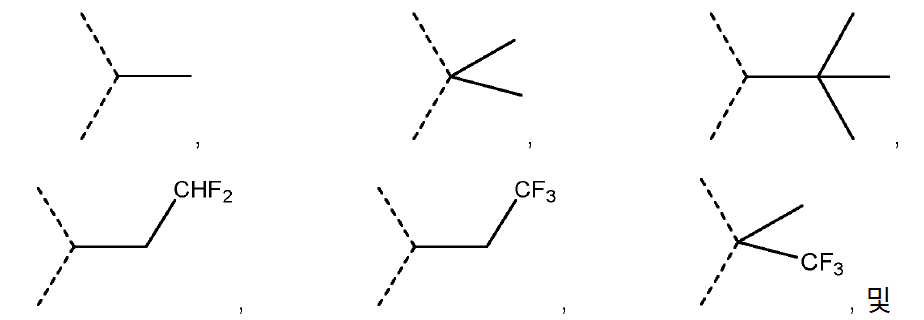

- 3,3-디플루오로시클로부틸이다.- 3,3-difluorocyclobutyl.
이상에서 또는 이하에서 논의되는 실시 형태의 모든 조합이 명시적으로 포함된다. All combinations of embodiments discussed above or below are expressly included.
본 출원에 따른 화합물은 하기 화학식을 갖는 화합물을 포함하지만 이에 한정되지 않는다:Compounds according to the present application include, but are not limited to, compounds having the formula:
[표 1][Table 1]

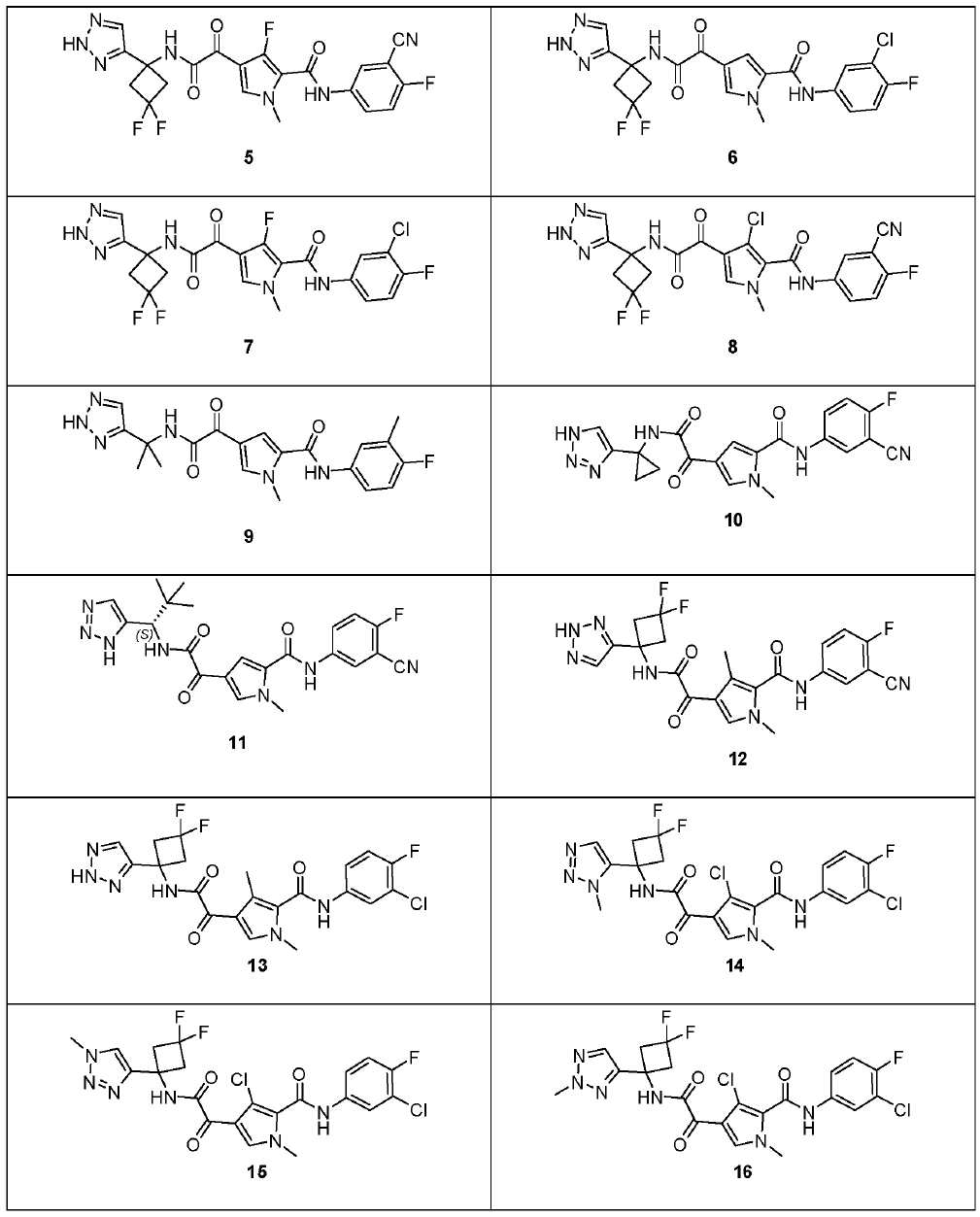
더 구체적으로, 본 출원에 따른 화합물은 화학식 1 또는 2를 갖는 화합물을 포함하지만 이에 한정되지 않는다(상기 표 1 참조).More specifically, the compound according to the present application includes, but is not limited to, a compound having Formula 1 or 2 (see Table 1 above).
더 구체적으로, 본 출원에 따른 화합물은 화학식 1~8 및 12~16(상기 표 1 참조), 더 구체적으로 화학식 2~8 및 12~16 중에서 선택되는 하기 화학식을 갖는 화합물을 포함하지만 이에 한정되지 않는다.More specifically, the compound according to the present application includes, but is not limited to, a compound having the following formula selected from Chemical Formulas 1 to 8 and 12 to 16 (see Table 1 above), and more specifically, Chemical Formulas 2 to 8 and 12 to 16. does not
더 구체적으로, 본 출원에 따른 화합물은 화학식 1 및 9~11(상기 표 1 참조) 중에서 선택되는 하기 화학식을 갖는 화합물을 포함하지만 이에 한정되지 않는다.More specifically, the compound according to the present application includes, but is not limited to, a compound having the following formula selected from Chemical Formulas 1 and 9 to 11 (see Table 1 above).
본 개시 화합물은 하나 이상의 입체중심을 보유할 수 있으며, 각각의 입체중심은 독립적으로 R 또는 S 배열로 존재할 수 있다. 절대 배열은 칸-인골드-프렐로그(Cahn-Ingold-Prelog) 시스템에 따라 명시된다. 본원에서 "RS"라는 표기가 사용되는 모든 경우에 있어, 이것은 달리 나타내지 않는 한 화합물이 라세미 혼합물임을 나타낸다. 본원에서 "* RS"라는 표기가 사용되는 모든 경우에 있어, 이것은 화합물이 시스 또는 트랜스 상대 배열의 2개의 거울상 이성질체의 라세미 혼합물임을 나타내며(솔리드/해시드 웨지(hashed wedged) 결합에 의해 추가로 명시된 바와 같음, 여기서, 솔리드/해시드 웨지 결합은 시스 또는 트랜스 부분입체이성질체를 나타내기 위해 무작위로 할당됨), 예를 들어 I37은 2개의 트랜스 거울상 이성질체의 라세미 혼합물에 상응한다. 입체화학적 배열은, 화합물 그 자체가 단일 입체이성질체로서 단리되었고 거울상 이성질체로서/부분입체 이성질체로서 순수하다 할지라도 절대 입체화학 특성이 결정되지 않은 경우 표시된 중심에서 (*R), (*S), (R*) 또는 (S*)로 할당될 수 있다. 본원에 개시된 화합물은 광학 활성 또는 라세미 형태로 존재한다. 본원에 개시된 화합물은 본원에 기술된 치료적으로 유용한 특성을 보유하는 라세미, 광학 활성, 위치이성질체 및 입체이성질체 형태 또는 이들의 조합을 포함하는 것으로 이해되어야 한다. 화합물의 절대 R 또는 S 입체화학이 결정될 수 없는 경우, 이것은 크로마토그래피 컬럼, 용출제 등에 의해 결정되는 바와 같은 특정 크로마토그래피 조건 하에서의 크로마토그래피 후 체류 시간에 의해 확인될 수 있다. The compounds of the present disclosure may possess one or more stereocenters, and each stereocenter may independently exist in the R or S configuration. Absolute alignment is specified according to the Cahn-Ingold-Prelog system. In all instances where the designation "RS " is used herein, it indicates that the compound is a racemic mixture, unless otherwise indicated. In all instances where the designation " * RS " is used herein, this indicates that the compound is a racemic mixture of two enantiomers in either cis or trans relative configuration (further by solid/hashed wedged bonds). As indicated, where solid/hashed wedge bonds are randomly assigned to indicate cis or trans diastereomers), eg I37, corresponds to a racemic mixture of the two trans enantiomers. The stereochemical configuration is (*R) , (*S) , (*R) , (*S) , (*R) , (*S) , ( R*) or (S*) . The compounds disclosed herein exist in optically active or racemic forms. It is to be understood that the compounds disclosed herein include racemic, optically active, regioisomeric and stereoisomeric forms or combinations thereof that possess the therapeutically useful properties described herein. If the absolute R or S stereochemistry of a compound cannot be determined, this can be ascertained by the retention time after chromatography under certain chromatographic conditions as determined by the chromatography column, eluent, etc.
입체이성질체 형태의 화합물은 동일한 시퀀스(sequence)의 결합으로 결합된 동일 원자들로 구성되지만 호환가능하지 않은 상이한 3차원 구조를 갖는 모든 가능한 화합물을 지칭한다. A compound in stereoisomeric form refers to all possible compounds composed of the same atoms joined by bonds in the same sequence, but having different incompatible three-dimensional structures.
광학 활성 형태의 제조는 비제한적인 예로서 재결정화 기술을 이용한 라세미 형태의 분할, 광학 활성 출발 물질로부터의 합성, 키랄 합성, 또는 키랄 고정상을 이용한 크로마토그래피 분리에 의한 것을 포함하여 임의의 적합한 방식으로 달성된다. 하나 이상의 이성질체의 혼합물이 본원에 기술된 개시된 화합물로서 사용될 수 있다. 본원에 기술된 화합물은 하나 이상의 키랄 중심을 함유할 수 있다. 이들 화합물은 입체 선택적 합성, 거울상 선택적 합성 또는 거울상 이성질체 또는 부분입체 이성질체의 혼합물의 분리를 포함하는 임의의 수단에 의해 제조될 수 있다. 화합물 및 이의 이성질체의 분할은 비제한적인 예로서 화학 공정, 효소 공정, 분별 결정화, 증류 및 크로마토그래피를 포함하는 임의의 수단에 의해 달성될 수 있다.Preparation of the optically active form may be carried out in any suitable manner, including, but not limited to, resolution of the racemic form using recrystallization techniques, synthesis from optically active starting materials, chiral synthesis, or chromatographic separation using a chiral stationary phase. is achieved with Mixtures of one or more isomers can be used as the disclosed compounds described herein. The compounds described herein may contain one or more chiral centers. These compounds may be prepared by any means, including stereoselective synthesis, enantioselective synthesis, or separation of mixtures of enantiomers or diastereomers. Resolution of a compound and its isomers can be accomplished by any means including, but not limited to, chemical processes, enzymatic processes, fractional crystallization, distillation and chromatography.
개시된 화합물은 호변이성질체로서 존재할 수 있다. "호변이성질체"는 분자의 한 원자로부터 동일한 분자의 또 다른 원자로의 양성자 이동을 지칭한다. 모든 호변이성질체가 본원에 제시된 화합물의 범주 내에 포함된다.The disclosed compounds may exist as tautomers. "Tautomer" refers to the transfer of a proton from one atom of a molecule to another atom of the same molecule. All tautomers are included within the scope of the compounds presented herein.
본원에 개시된 화합물은 또한, 동일한 원자 번호를 갖지만 자연에서 일반적으로 발견되는 원자 질량 또는 질량수와는 다른 원자 질량 또는 질량수를 갖는 원자로 하나 이상의 원자가 대체된 동위원소-표지 화합물을 포함한다. 본원에 개시된 화합물 내로의 포함에 적합한 동위원소의 예는 2H, 3H, 11C, 13C, 14C, 36Cl, 18F, 123I, 125I, 13N, 15N, 15O, 17O, 18O, 32P, 및 35S를 포함하며 이에 한정되지 않는다. 동위원소-표지 화합물은 약물 또는 기질 조직 분포 연구에 유용할 수 있다. 중수소와 같은 더 무거운 동위원소에 의한 치환은 더 큰 대사 안정성(이는 예를 들어, 생체 내 반감기의 증가 또는 투여량 요건의 감소로 이어질 수 있음)을 제공할 수 있다. The compounds disclosed herein also include isotopically-labeled compounds in which one or more atoms are replaced by an atom having the same atomic number but an atomic mass or mass number different from the atomic mass or mass number commonly found in nature. Examples of isotopes suitable for inclusion into the compounds disclosed herein include 2 H, 3 H, 11 C, 13 C, 14 C, 36 Cl, 18 F, 123 I, 125 I, 13 N, 15 N, 15 O, 17 O, 18 O, 32 P, and 35 S. Isotopically-labeled compounds may be useful in drug or substrate tissue distribution studies. Substitution with a heavier isotope such as deuterium may provide greater metabolic stability (which may lead to, for example, increased in vivo half-life or reduced dosage requirements).
양전자 방출 동위원소, 예컨대, 11C, 18F, 15O, 및 13N에 의한 치환은 기질 수용체 점유율을 검사하기 위한 양전자 방출 단층촬영(PET) 연구에 유용할 수 있다. 동위원소-표지 화합물은 임의의 적합한 방법에 의해, 또는 비표지 시약을 사용하는 대신에 적절한 동위원소-표지 시약을 사용하는 공정에 의해 제조될 수 있다.Substitution with positron emitting isotopes such as 11 C, 18 F, 15 O, and 13 N may be useful in positron emission tomography (PET) studies to examine substrate receptor occupancy. Isotopically-labeled compounds can be prepared by any suitable method, or by processes employing appropriate isotopically-labeled reagents instead of unlabeled reagents.
본원에 개시된 화합물은 발색단 또는 형광 모이어티, 생물발광 표지체, 또는 화학발광 표지체의 사용을 포함하지만 이에 한정되지 않는 다른 수단에 의해 표지될 수 있다.The compounds disclosed herein may be labeled by other means including, but not limited to, the use of a chromophore or fluorescent moiety, a bioluminescent label, or a chemiluminescent label.
본원에 개시된 화합물, 및 상이한 치환체를 갖는 다른 관련 화합물은 본원에 개시된 기술 및 재료와, 당업자에게 공지된 기술을 이용하여 합성될 수 있다. 본원에 개시된 바와 같은 화합물의 제조를 위한 일반적인 방법은 본원에 제공된 바와 같은 화학식에서 발견되는 다양한 모이어티의 도입을 위해 적절한 시약 및 조건의 사용에 의해 변경될 수 있다. The compounds disclosed herein, and other related compounds having different substituents, can be synthesized using the techniques and materials disclosed herein and techniques known to those skilled in the art. General methods for the preparation of compounds as disclosed herein can be modified by the use of appropriate reagents and conditions for the incorporation of the various moieties found in the formulas as provided herein.
본원에 개시된 화합물은 상업적 공급처로부터 입수가능한 화합물로부터 출발하여 임의의 적합한 절차를 사용하여 합성되거나, 본원에 기술된 절차를 사용하여 제조될 수 있다.The compounds disclosed herein can be synthesized using any suitable procedure starting from compounds available from commercial suppliers, or prepared using the procedures described herein.
본 출원의 화합물은 HBV 감염과 관련된 바이러스 로드의 감소를 필요로 하는 개체에서, 예를 들어 이를 필요로 하는 개체에게 치료적 유효량의 본 개시 화합물을 투여함으로써, HBV 감염과 관련된 바이러스 로드를 감소시키는 데 유용할 수 있다.The compounds of the present application are useful for reducing the viral load associated with HBV infection in a subject in need thereof, for example, by administering a therapeutically effective amount of a compound of the present disclosure to an individual in need thereof. It can be useful.
본 출원의 화합물은 HBV 감염의 재발의 감소를 필요로 하는 개체에서, 예를 들어 이를 필요로 하는 개체에게 치료적 유효량의 본 개시 화합물을 투여함으로써, HBV 감염의 재발을 감소시키는 데 유용할 수 있다.The compounds of the present application may be useful for reducing recurrence of HBV infection in a subject in need thereof, for example by administering a therapeutically effective amount of a compound of the present disclosure to an individual in need thereof. .
본 출원의 화합물은 HBV DNA-함유 입자 또는 HBV RNA-함유 입자의 형성 또는 존재의 억제 또는 감소를 필요로 하는 개체에서, 예를 들어 상기 개체에게 치료적 유효량의 본 개시 화합물을 투여함으로써, HBV DNA-함유 입자 또는 HBV RNA-함유 입자의 형성 또는 존재를 억제하거나 감소시키는 데 유용할 수 있다.A compound of the present application can be administered to an individual in need of inhibition or reduction in the formation or presence of HBV DNA-containing particles or HBV RNA-containing particles, for example by administering to said individual a therapeutically effective amount of a compound of the present disclosure, It may be useful for inhibiting or reducing the formation or presence of -containing particles or HBV RNA-containing particles.
본 출원의 화합물은 HBV 감염의 불리한 생리학적 영향의 감소를 필요로 하는 개체에서, 예를 들어 상기 개체에게 치료적 유효량의 본 개시 화합물을 투여함으로써, HBV 감염의 불리한 생리학적 영향을 감소시키는 데 유용할 수 있다.The compounds of the present application are useful for reducing the adverse physiological effects of HBV infection in a subject in need thereof, for example by administering a therapeutically effective amount of a compound of the present disclosure to the subject. can do.
본 출원의 화합물은, HBV 감염의 감소, 둔화, 또는 억제를 필요로 하는 개체에서, 예를 들어 상기 개체에게 치료적 유효량의 본 개시 화합물을 투여함으로써, HBV 감염을 감소시키거나, 둔화시키거나, 억제하는 데 유용할 수 있다.The compounds of the present application may be used to reduce, slow, or inhibit HBV infection in a subject in need thereof, for example, by administering to said subject a therapeutically effective amount of a compound of the present disclosure; It can be useful for suppression.
본 출원의 화합물은 HBV 감염으로부터의 간 손상의 역전의 유도를 필요로 하는 개체에서, 예를 들어 상기 개체에게 치료적 유효량의 본 개시 화합물을 투여함으로써, HBV 감염으로부터의 간 손상의 역전을 유도하는 데 유용할 수 있다.The compounds of the present application are for inducing reversal of liver damage from HBV infection in a subject in need thereof, e.g., by administering a therapeutically effective amount of a compound of the present disclosure to said subject. can be useful for
본 출원의 화합물은 HBV 감염에 대한 장기간 항바이러스 요법의 생리학적 영향의 감소를 필요로 하는 개체에서, 예를 들어 상기 개체에게 치료적 유효량의 본 개시 화합물을 투여함으로써, HBV 감염에 대한 장기간 항바이러스 요법의 생리학적 영향을 감소시키는 데 유용할 수 있다.The compounds of the present application may be administered to a subject in need of reduction of the physiological effects of long-term antiviral therapy against HBV infection, for example, by administering a therapeutically effective amount of a compound of the present disclosure to the subject, thereby providing a long-term antiviral against HBV infection. It may be useful in reducing the physiological effects of therapy.
본 출원의 화합물은 HBV 감염의 예방적 치료를 필요로 하는 개체에서, 예를 들어 상기 개체에게 치료적 유효량의 본 개시 화합물을 투여함으로써, HBV 감염을 예방적으로 치료하는 데 유용할 수 있으며, 여기서, 개체는 잠복성 HBV 감염을 앓고 있다.The compounds of the present application may be useful for prophylactic treatment of HBV infection in a subject in need thereof, for example by administering to said subject a therapeutically effective amount of a compound of the present disclosure, wherein , the subject has a latent HBV infection.
본 출원의 화합물은 필요로 하는 개체에서 정상적인 건강을 증진시키거나 정상화시키거나 회복시키거나, 정상적인 건강의 완전한 회복을 초래하거나, 기대 수명을 회복시키거나, 바이러스 감염을 해결하는 데 유용할 수 있다.The compounds of the present application may be useful in promoting, normalizing or restoring normal health, effecting full restoration of normal health, restoring life expectancy, or addressing viral infections in an individual in need thereof.
본 발명이 의약으로 사용하기 위한, 또는 포유동물, 구체적으로 인간에서 HBV 감염 또는 HBV-유도성 질환의 예방 또는 치료에 사용하기 위한 본 발명에 따른 화합물 또는 조성물에 관한 것으로 언급되는 경우, 사용을 위한 그러한 화합물 또는 조성물은 특정 관할권에서 예를 들어 대상체, 예컨대 포유동물, 구체적으로 인간에서의 치료 또는 예방을 위한 의약의 제조에 있어서의 본 발명에 따른 화합물 또는 조성물의 용도로서 해석되어야 함이 이해된다.For use when the present invention refers to a compound or composition according to the invention for use as a medicament, or for use in the prophylaxis or treatment of HBV infection or HBV-induced disease in a mammal, in particular a human It is understood that such compounds or compositions are to be construed in certain jurisdictions as, for example, the use of a compound or composition according to the invention in the manufacture of a medicament for the treatment or prophylaxis in a subject, such as a mammal, in particular a human.
본 출원은 본원에 기술된 바와 같은 적어도 하나의 화합물 또는 제약상 허용가능한 염을 포함하고, 적어도 하나의 제약상 허용가능한 담체를 추가로 포함하는 제약 조성물에 관한 것이다.The present application relates to a pharmaceutical composition comprising at least one compound or pharmaceutically acceptable salt as described herein, further comprising at least one pharmaceutically acceptable carrier.
본 출원은 의약으로 사용하기 위한 이러한 화합물 또는 제약상 허용가능한 염, 또는 이러한 제약 조성물에 관한 것이다.This application relates to such a compound or a pharmaceutically acceptable salt, or such a pharmaceutical composition, for use as a medicament.
본 출원은 HBV 감염 또는 HBV-유도성 질환의 예방 또는 치료를 필요로 하는 포유동물에서 HBV 감염 또는 HBV-유도성 질환의 예방 또는 치료에 사용하기 위한 이러한 화합물 또는 제약상 허용가능한 염, 또는 이러한 제약 조성물에 관한 것이다.The present application relates to such compounds or pharmaceutically acceptable salts, or such pharmaceuticals, for use in the prophylaxis or treatment of HBV infection or HBV-induced disease in a mammal in need thereof. to the composition.
본 출원은 만성 B형 간염의 예방, 이의 악화의 예방, 만성 B형 간염의 개선 또는 치료에 사용하기 위한 이러한 화합물 또는 제약상 허용가능한 염, 또는 이러한 제약 조성물에 관한 것이다. The present application relates to such a compound or a pharmaceutically acceptable salt, or such a pharmaceutical composition, for use in the prophylaxis of chronic hepatitis B, the prophylaxis of exacerbation thereof, the amelioration or treatment of chronic hepatitis B.
본 출원은 HBV-유도성 질환 또는 병태의 예방, 이의 악화의 예방, HBV-유도성 질환 또는 병태의 개선 또는 치료에 사용하기 위한 이러한 화합물 또는 제약상 허용가능한 염, 또는 이러한 제약 조성물에 관한 것이다.This application relates to such compounds or pharmaceutically acceptable salts, or such pharmaceutical compositions, for use in the prophylaxis, prevention of exacerbation of HBV-induced diseases or conditions, amelioration or treatment of HBV-induced diseases or conditions.
본 출원은 의약의 제조를 위한 이러한 화합물 또는 제약상 허용가능한 염의 용도, 또는 이러한 제약 조성물의 용도에 관한 것이다.This application relates to the use of such compounds or pharmaceutically acceptable salts for the manufacture of a medicament, or to the use of such pharmaceutical compositions.
본 출원은 HBV 감염 또는 HBV-유도성 질환의 예방 또는 치료를 필요로 하는 포유동물에서 HBV 감염 또는 HBV-유도성 질환을 예방 또는 치료하기 위한 의약의 제조에 있어서의 이러한 화합물 또는 제약상 허용가능한 염의 용도, 또는 이러한 제약 조성물의 용도에 관한 것이다.The present application relates to the use of such a compound or a pharmaceutically acceptable salt in the manufacture of a medicament for preventing or treating HBV infection or HBV-induced disease in a mammal in need thereof. to the use, or to the use of such a pharmaceutical composition.
본 출원은 만성 B형 간염의 예방, 이의 악화의 예방, 만성 B형 간염의 개선 또는 치료를 위한 의약의 제조에 있어서의 이러한 화합물 또는 제약상 허용가능한 염의 용도, 또는 이러한 제약 조성물의 용도에 관한 것이다. The present application relates to the use of such a compound or a pharmaceutically acceptable salt, or the use of such a pharmaceutical composition, in the manufacture of a medicament for the prevention, prevention of exacerbation of chronic hepatitis B, amelioration or treatment of chronic hepatitis B .
본 출원은 HBV-유도성 질환 또는 병태의 예방, 이의 악화의 예방, HBV-유도성 질환 또는 병태의 개선 또는 치료를 위한 의약의 제조에 있어서의 이러한 화합물 또는 제약상 허용가능한 염의 용도, 또는 이러한 제약 조성물의 용도에 관한 것이다.The present application relates to the use of such a compound or a pharmaceutically acceptable salt in the manufacture of a medicament for the prophylaxis, prevention of exacerbation of an HBV-induced disease or condition, amelioration or treatment of an HBV-induced disease or condition, or such pharmaceutical to the use of the composition.
HBV-유도성 질환 또는 병태는 진행성 간 섬유증, 간경화를 초래하는 염증 및 괴사, 말기 간 질환 및 간세포 암종을 포함한다. 부가적으로, HBV는 델타 간염 바이러스(hepatitis delta virus; HDV)에 대하여 헬퍼(helper) 바이러스로서 작용하며, 전 세계적으로 1500만명 초과의 사람이 HBV/HDV 동시감염되어 있을 수 있다고 추정되고, 이 경우 HBV만을 앓고 있는 환자에 비해 간경변으로의 빠른 진행의 위험이 증가하고 비대상성 간경변(hepatic decompensation)이 증가한다(문헌[Hughes, S.A. et al. Lancet 2011, 378, 73-85)]. 따라서 HDV는 HBV 감염을 앓고 있는 대상체를 감염시킨다. 특정 실시 형태에서, 본 발명의 화합물은 HBV/HDV 동시감염, 또는 HBV/HDV 동시감염과 관련된 질환의 치료 및/또는 예방에 사용될 수 있다. 따라서, 특정 실시 형태에서, HBV 감염은 구체적으로 HBV/HDV 동시감염이고, 포유동물, 구체적으로 인간은 HBV/HDV 동시감염될 수 있거나 HBV/HDV 동시감염의 위험이 있다.HBV-induced diseases or conditions include progressive liver fibrosis, inflammation and necrosis leading to cirrhosis, end-stage liver disease and hepatocellular carcinoma. Additionally, HBV acts as a helper virus against hepatitis delta virus (HDV), and it is estimated that more than 15 million people worldwide may be co-infected with HBV/HDV, in which case There is an increased risk of rapid progression to cirrhosis and increased hepatic decompensation compared to patients suffering from HBV alone (Hughes, SA et al. Lancet 2011, 378, 73-85). HDV thus infects subjects suffering from HBV infection. In certain embodiments, the compounds of the present invention may be used for the treatment and/or prophylaxis of HBV/HDV co-infection, or diseases associated with HBV/HDV co-infection. Thus, in certain embodiments, the HBV infection is specifically HBV/HDV co-infection, and a mammal, specifically a human, may be co-infected with or at risk of HBV/HDV co-infection.
본 출원은 상기 용도 중 임의의 것을 위한, 더 구체적으로 하기 항목 중 하나 이상의 예방, 이의 악화의 예방, 이의 개선 또는 치료에 사용하기 위한 이러한 화합물 또는 제약상 허용가능한 염, 또는 이러한 제약 조성물에 관한 것이다: This application relates to such a compound or a pharmaceutically acceptable salt, or such a pharmaceutical composition, for any of the above uses, and more particularly for use in the prophylaxis, prevention of exacerbation, amelioration or treatment of one or more of the following items. :
- 만성 간염, 더 구체적으로 만성 B형 간염 감염의 예방(즉, (B형) 간염 감염이 만성이 되는 것을 예방);- prevention of chronic hepatitis, more specifically chronic hepatitis B infection (ie, preventing hepatitis (B) infection from becoming chronic);
- 간염-관련 또는 간염-유도성 (만성) 질환 또는 병태, 더 구체적으로 B형 간염-관련 또는 B형 간염-유도성 (만성) 질환 또는 병태의 개선 또는 치료;- amelioration or treatment of a hepatitis-associated or hepatitis-induced (chronic) disease or condition, more specifically a hepatitis B-related or hepatitis B-induced (chronic) disease or condition;
- 간염-관련 또는 간염-유도성 (만성) 질환 또는 병태, 더 구체적으로 B형 간염-관련 또는 B형 간염-유도성 (만성) 질환 또는 병태의 악화의 예방;- prevention of a hepatitis-related or hepatitis-induced (chronic) disease or condition, more specifically a hepatitis B-related or hepatitis B-induced (chronic) disease or condition;
- (만성) 간염 감염, 더 구체적으로 (만성) B형 간염 감염에 의해 유도되는 간 섬유증의 병기 또는 간 손상 정도의 개선(퇴행, 또는 진행의 부재);- (chronic) hepatitis infection, more specifically amelioration (regression, or absence of progression) of the stage of liver fibrosis or the extent of liver damage induced by (chronic) hepatitis B infection;
- (만성) 간염 감염의 섬유화 진행률의 개선(감소), 더 구체적으로 (만성) 간염 감염을 갖는 대상체에서의, 더 구체적으로 (만성) B형 간염 감염에 의한 간경변의 예방(예를 들어, 대상체가 섬유증의 간경변 병기에 도달하는 것을 예방).- improving (reducing) the fibrotic progression of (chronic) hepatitis infection, more specifically preventing cirrhosis due to (chronic) hepatitis B infection in a subject having (chronic) hepatitis B infection (e.g., subject to prevent reaching the cirrhosis stage of fibrosis).
본 출원의 화합물은 비용매화 형태 및 용매화 형태로 존재할 수 있다. 본원에서 "용매화물"이라는 용어는, 본 출원의 화합물과 하나 이상의 제약상 허용가능한 용매 분자, 예를 들어, 에탄올을 포함하는 분자 복합체를 기술하는 데 사용된다.The compounds of the present application may exist in unsolvated and solvated forms. The term “solvate” is used herein to describe a molecular complex comprising a compound of the present application and one or more pharmaceutically acceptable solvent molecules, such as ethanol.
용어 "다형체"는 1개 초과의 형태 또는 결정 구조로 존재하는 본 출원의 화합물의 능력을 지칭한다.The term “polymorph” refers to the ability of a compound of the present application to exist in more than one form or crystal structure.
본 출원의 화합물은 결정질 또는 비정질 생성물로서 투여될 수 있다. 이것은 침전, 결정화, 동결 건조, 분무 건조 또는 증발 건조와 같은 방법에 의해, 예를 들어 고체 플러그, 분말 또는 필름으로서 수득될 수 있다. 이것은 단독으로, 또는 본 출원의 하나 이상의 다른 화합물과 조합되어, 또는 하나 이상의 다른 약물과 조합되어 투여될 수 있다. 일반적으로 이것은 하나 이상의 제약상 허용가능한 부형제와 결부된 제형으로서 투여될 것이다. 본원에서 "부형제"라는 용어는 본 출원의 화합물(들) 이외의 임의의 성분을 기술하는 데 사용된다. 부형제의 선택은 주로 특정 투여 방식, 용해도 및 안정성에 대한 부형제의 영향, 및 투여 형태의 성질과 같은 요인에 의존한다.The compounds of the present application may be administered as crystalline or amorphous products. It can be obtained by methods such as precipitation, crystallization, freeze drying, spray drying or evaporative drying, for example as solid plugs, powders or films. It may be administered alone, in combination with one or more other compounds of the present application, or in combination with one or more other drugs. Generally it will be administered as a formulation in association with one or more pharmaceutically acceptable excipients. The term "excipient" is used herein to describe any ingredient other than the compound(s) of the present application. The choice of excipient depends primarily on factors such as the particular mode of administration, the effect of the excipient on solubility and stability, and the nature of the dosage form.
본 출원은 또한 HBV 감염 또는 HBV-유도성 질환의 예방 또는 치료를 필요로 하는 포유동물에서의 HBV 감염 또는 HBV-유도성 질환의 예방 또는 치료에서의 동시 사용, 개별 사용 또는 순차적 사용을 위한 병용 제제로서 제1 화합물 및 제2 화합물을 포함하는 생성물을 제공하며, 여기서, 상기 제1 화합물은 상기 제2 화합물과는 상이하고, 상기 제1 화합물은 본원에 기술된 바와 같은 화합물 또는 제약상 허용가능한 염, 또는 본 출원의 제약 조성물이고, 상기 제2 화합물은 또 다른 HBV 억제제이다.The present application also relates to combination formulations for simultaneous, separate or sequential use in the prophylaxis or treatment of HBV infection or HBV-induced disease in a mammal in need thereof. A product comprising a first compound and a second compound as , or a pharmaceutical composition of the present application, wherein the second compound is another HBV inhibitor.
예를 들어, 제2 화합물은 HBV 병용 약물, HBV DNA 폴리머라아제 억제제, 면역조절제, toll-유사 수용체(TLR) 조절제, 인터페론 알파 수용체 리간드, 히알루로니다아제 억제제, b형 간염 표면 항원(HbsAg) 억제제, 세포독성 T-림프구 관련 단백질 4(ipi4) 억제제, 시클로필린 억제제, HBV 바이러스 진입 억제제, 바이러스 mRNA를 표적화하는 안티센스 올리고뉴클레오티드, 짧은 간섭 RNA(siRNA) 및 ddRNAi 엔도뉴클레아제 조절제, 리보뉴클레오티드 리덕타아제 억제제, HBV E 항원 억제제, 공유적 폐쇄 원형 DNA(covalently closed circular DNA; cccDNA) 억제제, 파르네소이드 X 수용체 작용제, HBV 항체, CCR2 케모카인 길항제, 티모신 작용제, 사이토카인, 핵단백질 조절제, 레틴산-유도성 유전자 1 자극제, NOD2 자극제, 포스파티딜이노시톨 3-키나아제(PI3K) 억제제, 인돌 아민 2,3-디옥시게나아제(IDO) 경로 억제제, PD-1 억제제, PD-L1 억제제, 재조합 티모신 알파-1, 브루톤 티로신 키나아제(BTK) 억제제, KDM 억제제, HBV 복제 억제제, 아르기나아제 억제제 및 다른 HBV 약물로 이루어진 군으로부터 선택되는 또 다른 HBV 억제제이다 For example, the second compound may be an HBV concomitant drug, HBV DNA polymerase inhibitor, immunomodulatory agent, toll-like receptor (TLR) modulator, interferon alpha receptor ligand, hyaluronidase inhibitor, hepatitis b surface antigen (HbsAg) Inhibitors, cytotoxic T-lymphocyte-associated protein 4 (ipi4) inhibitors, cyclophilin inhibitors, HBV virus entry inhibitors, antisense oligonucleotides targeting viral mRNA, short interfering RNA (siRNA) and ddRNAi endonuclease modulators, ribonucleotides Ductase inhibitors, HBV E antigen inhibitors, covalently closed circular DNA (cccDNA) inhibitors, farnesoid X receptor agonists, HBV antibodies, CCR2 chemokine antagonists, thymosin agonists, cytokines, nucleoprotein modulators, retin acid-inducible gene 1 stimulator, NOD2 stimulator, phosphatidylinositol 3-kinase (PI3K) inhibitor, indole amine 2,3-dioxygenase (IDO) pathway inhibitor, PD-1 inhibitor, PD-L1 inhibitor, recombinant thymosin alpha -1, another HBV inhibitor selected from the group consisting of Bruton's tyrosine kinase (BTK) inhibitors, KDM inhibitors, HBV replication inhibitors, arginase inhibitors and other HBV drugs
본 출원의 화합물 또는 이의 임의의 하위군(subgroup)은 투여 목적에 따라 다양한 제약적 형태로 제형화될 수 있다. 적절한 조성물로서는, 전신 투여 약물용으로 통상적으로 이용되는 모든 조성물이 언급될 수 있다. 본 출원의 제약 조성물을 제조하기 위하여, 활성 성분으로서의 특정 화합물(선택적으로 부가염 형태)의 유효량이 제약상 허용가능한 담체와의 친밀한 혼합물로 조합되며, 이러한 담체는 투여에 요망되는 제제의 형태에 따라 매우 다양한 형태를 취할 수 있다. 이러한 제약 조성물은 바람직하게는 예를 들어 경구 투여, 직장 투여 또는 경피 투여에 적합한 일원화 투여 형태로 존재한다. 예를 들어, 조성물을 경구 제형으로 제조하는 데 있어서, 현탁액, 시럽, 엘릭서, 에멀젼 및 용액과 같은 경구 액상 제조물의 경우, 예를 들어 물, 글리콜, 오일, 알코올 등; 또는 산제, 환제, 캡슐 및 정제의 경우 고체 담체, 예를 들어 전분, 당, 카올린, 희석제, 활택제, 결합제, 붕해제 등과 같은 임의의 일반적인 약학 매질이 이용될 수 있다. 투여의 용이성으로 인해, 정제 및 캡슐은 가장 유리한 경구 투여량 단위 형태를 대표하는데, 이 경우에는 고체 약학 담체가 명백히 이용된다. 사용 직전에 액체 형태로 전환될 수 있는 고체 형태 제제가 또한 포함된다. 경피 투여에 적합한 조성물에서, 담체는 선택적으로 침투 향상제 및/또는 적합한 습윤제를 포함하며, 이들은 선택적으로, 피부에 유의한 유해 영향을 끼치지 않는 임의의 성질의, 작은 비율의 적합한 첨가제와 배합된다. 상기 첨가제는 피부로의 투여를 용이하게 할 수 있고/있거나 요망되는 조성물을 제조하는 데 도움을 줄 수 있다. 이들 조성물은 다양한 방식으로, 예를 들어 경피 패치로서, 스팟온(spot-on)으로서, 연고로서 투여될 수 있다. 본 출원의 화합물은 또한 흡입 또는 통기를 통한 투여에 대한 당업계에서 사용되는 방법 및 제형에 의해 흡입 또는 통기를 통해 투여될 수 있다. 따라서, 일반적으로 본 출원의 화합물은 용액, 현탁액 또는 건조 분말의 형태로 폐에 투여될 수 있다. The compound of the present application or any subgroup thereof may be formulated in various pharmaceutical forms depending on the purpose of administration. As suitable compositions, mention may be made of all compositions conventionally used for systemically administered drugs. To prepare the pharmaceutical compositions of the present application, an effective amount of a particular compound as an active ingredient (optionally in the form of an addition salt) is combined in intimate admixture with a pharmaceutically acceptable carrier, which carrier, depending on the form of preparation desired for administration, is It can take many different forms. Such pharmaceutical compositions are preferably in unitary dosage form suitable, for example, for oral, rectal or transdermal administration. For example, in preparing the composition for oral dosage form, for oral liquid preparations such as suspensions, syrups, elixirs, emulsions and solutions, for example, water, glycols, oils, alcohols and the like; Or in the case of powders, pills, capsules and tablets, any common pharmaceutical medium such as solid carriers, for example, starch, sugar, kaolin, diluents, lubricants, binders, disintegrants, and the like can be used. Because of their ease of administration, tablets and capsules represent the most advantageous oral dosage unit form, in which case solid pharmaceutical carriers are obviously employed. Also included are solid form preparations which can be converted to liquid form shortly before use. In compositions suitable for transdermal administration, the carrier optionally comprises penetration enhancers and/or suitable wetting agents, which are optionally combined with suitable additives in small proportions of any nature that do not significantly adversely affect the skin. Such additives may facilitate administration to the skin and/or may assist in preparing a desired composition. These compositions can be administered in a variety of ways, for example, as a transdermal patch, as a spot-on, or as an ointment. The compounds of the present application may also be administered via inhalation or insufflation by methods and formulations used in the art for administration via inhalation or insufflation. Accordingly, in general, the compounds of the present application may be administered to the lungs in the form of a solution, suspension or dry powder.
투여의 용이성 및 투여량의 균일성을 위해 전술한 제약 조성물을 단위 투여 형태로 제형화하는 것이 특히 유리하다. 본원에서 사용되는 바와 같이, 단위 투여 형태는 일원화 투여형으로 적합한 물리적으로 분리된 단위를 말하는데, 각각의 단위는 필요한 약학적 담체와 결부되어 원하는 치료 효과를 생성하도록 계산된 소정량의 유효 성분을 포함한다. 그러한 단위 투여 형태의 예로는 정제(분할정(scored tablet) 또는 코팅정을 포함함), 캡슐, 환제, 분말 패킷(powder packet), 웨이퍼(wafer), 좌제(suppository), 주사 가능한 용액 또는 현탁액 등, 그리고 이의 분리형 복합 투여가 있다.It is particularly advantageous to formulate the aforementioned pharmaceutical compositions in unit dosage form for ease of administration and uniformity of dosage. As used herein, unit dosage form refers to physically discrete units suitable as unitary dosage forms, each unit comprising a predetermined quantity of active ingredient calculated to produce the desired therapeutic effect in association with the required pharmaceutical carrier. do. Examples of such unit dosage forms include tablets (including scored or coated tablets), capsules, pills, powder packets, wafers, suppositories, injectable solutions or suspensions, and the like. , and separate and combined administration thereof.
감염성 질환의 치료 분야의 숙련자라면 이하에 제시되는 테스트 결과로부터 유효량을 결정할 수 있을 것이다. 일반적으로 일일 유효량이 체중 1 ㎏ 당 0.01 mg 내지 50 mg, 더 바람직하게는 체중 1 ㎏ 당 0.1 mg 내지 10 mg인 것이 고려된다. 요구되는 용량을 하루 동안 2, 3, 또는 4회 또는 이보다 더 많은 횟수의 하위용량(sub-dose)으로서 적절한 간격으로 투여하는 것이 적절할 수 있다. 상기 하위용량은 예컨대 단위 투여 형태당 1 내지 1000 mg, 및 특히 5 내지 200 mg의 활성 성분을 포함하는 단위 투여 형태로서 제형화될 수 있다.A person skilled in the art of treating infectious diseases will be able to determine an effective amount from the test results presented below. It is generally contemplated that an effective daily amount is between 0.01 mg and 50 mg/kg of body weight, more preferably between 0.1 mg and 10 mg/kg of body weight. It may be appropriate to administer the required dose as two, three, or four or more sub-doses during the day at appropriate intervals. Said sub-dose may be formulated as a unit dosage form comprising, for example, from 1 to 1000 mg, and in particular from 5 to 200 mg, of active ingredient per unit dosage form.
당업자에게 잘 알려진 바와 같이, 정확한 투여의 빈도 및 투여량은 사용되는 화학식 I의 특정 화합물, 치료되는 특정 병태, 치료되는 병태의 중증도, 특정 환자의 연령, 체중 및 종합적인 건강 상태와, 개체가 복약 중일 수 있는 다른 약에 의존한다. 더욱이, 유효량은 치료받는 대상체의 반응에 따라, 및/또는 본 출원의 화합물을 처방하는 의사의 평가에 따라 감소 또는 증가될 수 있음이 명백하다. 따라서, 위에 언급된 유효량 범위는 단지 지침일 뿐이고, 본 출원의 범주 또는 용도를 임의의 정도로 제한하고자 하는 것은 아니다. As is well known to those skilled in the art, the precise frequency and dosage of administration will depend on the particular compound of formula (I) being used, the particular condition being treated, the severity of the condition being treated, the age, weight and general health of the particular patient, and the individual's medication regimen. Depends on other medications you may be taking. Moreover, it is apparent that the effective amount may be decreased or increased depending on the response of the subject being treated and/or as assessed by the physician prescribing the compound of the present application. Accordingly, the effective amount ranges mentioned above are only guidelines and are not intended to limit the scope or use of the present application to any extent.
화합물의 제조에서 여러 중간체 화합물을 사용할 수 있다. 이와 관련하여, 본 발명의 양태는 하기 화학식 II를 갖는 화합물에 관한 것이다:Several intermediate compounds can be used in the preparation of the compounds. In this regard, an aspect of the present invention relates to a compound having the formula (II):
[화학식 II][Formula II]

여기서, R1, R2, R3, R4, R5 및 X는 상기 언급된 의미를 갖는다. Here, R 1 , R 2 , R 3 , R 4 , R 5 and X have the meanings mentioned above.
화합물의 제조에서 화학식 II의 중간체를 예를 들어 하기 화학식 III의 중간체와 반응시킬 수 있다:In the preparation of compounds, an intermediate of formula (II) can be reacted, for example, with an intermediate of formula (III):
[화학식 III][Formula III]
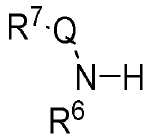
여기서, R6, R7 및 Q는 상기 언급된 의미를 갖는다. Here, R 6 , R 7 and Q have the meanings mentioned above.
본 발명에 따른 중간체는 아래에 주어진 합성예에 나타낸 화학식을 갖는 중간체 화합물을 포함하지만 이에 한정되지 않는다. Intermediates according to the present invention include, but are not limited to, intermediate compounds having the formulas shown in the synthetic examples given below.
"포함하는" 또는 "함유하는"과 동의어 "포함하고 있는"이라는 용어는 개방형이며 추가의 언급되지 않은 요소(들), 성분(들) 또는 방법 단계(들)를 배제하지 않는 반면, "~으로 이루어진"이라는 용어는 명시적으로 언급된 것이 아닌 임의의 추가적인 요소, 단계 또는 성분을 제외하는 폐쇄형 용어이다.The term "comprising", synonymous with "comprising" or "comprising," is open-ended and does not exclude further unrecited element(s), component(s) or method step(s), whereas "comprising" The term "consisting of" is a closed term excluding any additional element, step or ingredient not explicitly recited.
용어 "~으로 본질적으로 이루어진"은 부분 개방형 용어이며, 이는 추가의 언급되지 않은 요소(들), 단계(들) 또는 성분(들)이 본 출원의 요지의 기본적인 그리고 신규한 특성에 실질적으로 영향을 주지 않는 한 이러한 추가의 언급되지 않은 요소(들), 단계(들) 또는 성분(들)을 배제하지 않는다.The term “consisting essentially of” is a partially open-ended term, in which additional unrecited element(s), step(s) or component(s) substantially affect the basic and novel nature of the subject matter of the present application. It does not exclude such additional unrecited element(s), step(s) or component(s) unless otherwise noted.
따라서 용어 "포함하는"(또는 "포함하다")은 용어 "~으로 이루어진"("~으로 이루어지다")과, 용어 "~으로 본질적으로 이루어진"("~으로 본질적으로 이루어지다")을 포함한다. 따라서, 본 출원에서 용어 "포함하는"(또는 "포함하다")은, 더 구체적으로 용어 "~으로 이루어진"("~으로 이루어지다") 및 용어 "~으로 본질적으로 이루어진"("~으로 본질적으로 이루어지다")을 포함함을 의미한다.Thus, the term “comprising” (or “comprises”) includes the term “consisting of” (“consisting of”) and the term “consisting essentially of” (“consisting essentially of”). do. Thus, in this application the term "comprising" (or "comprises"), more specifically, the term "consisting of" ("consisting of") and the term "consisting essentially of" ("consisting essentially of" consists of").
본 출원의 독자를 돕기 위해 설명은 다양한 단락 또는 섹션으로 분리되었다. 이러한 분리는 소정의 단락 또는 섹션의 요지를 또 다른 단락 또는 섹션의 요지에서 분리하는 것으로 간주되어서는 안 된다. 반대로, 본 설명은 고려될 수 있는 다양한 섹션, 단락 및 문장의 모든 조합을 포함한다.To assist the reader of this application, the description has been divided into various paragraphs or sections. Such separation should not be construed as separating the subject matter of one paragraph or section from the subject matter of another paragraph or section. Conversely, this description includes all combinations of the various sections, paragraphs, and sentences that may be contemplated.
본원에 인용된 모든 참고 문헌의 각각의 관련 개시 내용이 구체적으로 참고로 포함된다. 하기 실시예는 예시로 제공되는 것으로서, 제한으로 제공되는 것이 아니다.Each relevant disclosure of all references cited herein is specifically incorporated by reference. The following examples are provided by way of illustration and not limitation.
실시예Example
이제 본 출원의 방법에 유용한 예시적인 화합물을 아래의 그의 일반적인 제조를 위한 예시적인 합성 스킴 및 하기의 구체적인 실시예를 참조하여 설명할 것이다. 당업자는 본원의 다양한 화합물을 얻기 위해, 원하는 생성물을 생성하기 위하여 적절한 경우 보호를 이용하거나 이용하지 않고서 궁극적으로 원하는 치환체가 반응 스킴을 통하여 운반되도록 출발 물질을 적합하게 선택할 수 있음을 인식할 것이다. 대안적으로, 궁극적으로 원하는 치환체 대신에 반응 스킴을 통해 운반될 수 있고 적절한 경우 원하는 치환체로 대체될 수 있는 적합한 기를 사용하는 것이 필요하거나 바람직할 수 있다. 달리 명시되지 않는 한, 변수는 화학식 I을 참조하여 상기 정의된 바와 같다. 반응은 용매의 융점과 환류 온도 사이, 바람직하게는 0℃와 용매의 환류 온도 사이에서 수행될 수 있다. 반응물을 통상적인 가열 또는 마이크로웨이브 가열을 사용하여 가열할 수 있다. 반응은 또한 용매의 정상 환류 온도보다 높은 온도에서 밀봉 가압 용기에서 수행될 수 있다.Exemplary compounds useful in the methods of the present application will now be described with reference to exemplary synthetic schemes for their general preparation below and specific examples below. Those skilled in the art will recognize that, to obtain the various compounds herein, starting materials can be suitably selected so that the desired substituent is ultimately carried through the reaction scheme with or without protection where appropriate to produce the desired product. Alternatively, it may ultimately be necessary or desirable to use suitable groups that may be carried through the reaction scheme and replaced by the desired substituents if appropriate in place of the desired substituents. Unless otherwise specified, variables are as defined above with reference to formula (I). The reaction may be carried out between the melting point of the solvent and the reflux temperature, preferably between 0° C. and the reflux temperature of the solvent. The reactants may be heated using conventional heating or microwave heating. The reaction may also be carried out in a sealed pressurized vessel at a temperature above the normal reflux temperature of the solvent.
1.One. 일반적 정보general information
1.1. LCMS 방법의 일반 절차1.1. General procedure of LCMS method
고성능 액체 크로마토그래피(HPLC) 측정은 LC 펌프, 다이오드-어레이(DAD) 또는 UV 검출기 및 컬럼(각각의 방법에 명시된 바와 같음)을 사용하여 수행하였다. 필요한 경우, 추가의 검출기를 포함시켰다(하기의 방법에 대한 표를 참조).High performance liquid chromatography (HPLC) measurements were performed using LC pumps, diode-array (DAD) or UV detectors and columns (as specified in each method). Additional detectors were included if necessary (see table for methods below).
컬럼으로부터의 유동물을 대기압 이온 공급원과 함께 구성된 질량 분광계(MS)로 가져왔다. 화합물의 공칭 단일동위원소 분자량(MW)의 확인을 허용하는 이온을 얻기 위해 조정 파라미터(예를 들어, 스캐닝 범위, 드웰 시간...)를 설정하는 것은 당업자의 지식 내에 있다. 적절한 소프트웨어로 데이터를 획득하였다. The flow from the column was brought into a mass spectrometer (MS) configured with an atmospheric pressure ion source. It is within the knowledge of the person skilled in the art to set tuning parameters (eg scanning range, dwell time...) to obtain ions that allow identification of the compound's nominal monoisotopic molecular weight (MW). Data were acquired with appropriate software.
화합물들은 그들의 실험 체류 시간(Rt) 및 이온에 의해 기술되어 있다. 데이터의 표에 상이하게 명시되어 있지 않다면, 보고된 분자 이온은 [M+H]+(양성자화된 분자) 및/또는 [M-H]- (탈양성자화된 분자)에 상응한다. 화합물이 직접적으로 이온화가능한 것이 아닌 경우, 부가 생성물의 유형이 명시된다(즉, [M+NH4]+, [M+HCOO]- 등). 모든 결과는 사용된 방법과 일반적으로 연관되는 실험적 불확실성을 가지고서 얻어졌다.Compounds are described by their experimental retention times (Rt) and ions. Reported molecular ions correspond to [M+H] + (protonated molecules) and/or [MH] - (deprotonated molecules), unless otherwise specified in the table of data. If the compound is not directly ionizable, the type of adduct is specified (ie, [M+NH 4 ] + , [M+HCOO] − , etc.). All results were obtained with experimental uncertainties generally associated with the method used.
이하에서, "BPR"은 배압 조절기를 의미하며, "SQD"는 단일 사중극자 검출기를, "MSD"는 질량 선택적 검출기를, "RT"는 실온을, "BEH"는 가교된 에틸실록산/실리카 하이브리드를, "DAD"는 다이오드 어레이 검출기를, "HSS"는 고강도 실리카를, "Q-Tof"는 사중극자 비행시간 질량 분광계를, "CLND"는 화학발광 질소 검출기를, "ELSD"는 증발 광 스캐닝 검출기를 의미한다.Hereinafter, "BPR" means back pressure regulator, "SQD" is single quadrupole detector, "MSD" is mass selective detector, "RT" is room temperature, "BEH" is crosslinked ethylsiloxane/silica hybrid , "DAD" for diode array detector, "HSS" for high intensity silica, "Q-Tof" for quadrupole time-of-flight mass spectrometer, "CLND" for chemiluminescent nitrogen detector, and "ELSD" for evaporative light scanning. means the detector.
LCMSLCMS // SFCSFC 방법 Way
유량은 mL/분으로 표현되며; 컬럼 온도(T)는 ℃ 단위로 표현되고; 실행 시간은 분으로 표현된다. Flow rates are expressed in mL/min; The column temperature (T) is expressed in °C; Execution time is expressed in minutes.
[표 2a][Table 2a]

[표 2b][Table 2b]


1.2. NMR 분석1.2. NMR analysis
1H NMR 스펙트럼은 1) Bruker DPX 400 MHz 분광계 또는 2) Bruker Avance 400 MHz 분광계 또는 c) Bruker Avance III 400 MHz 분광계 또는 d) Bruker Avance 600 MHz 분광계에서 기록되었다. 1 H NMR spectra were recorded on 1) a Bruker DPX 400 MHz spectrometer or 2) a Bruker Avance 400 MHz spectrometer or c) a Bruker Avance III 400 MHz spectrometer or d) a Bruker Avance 600 MHz spectrometer.
달리 기재되지 않는 한, 주위 온도에서의 NMR 스펙트럼을 기록하였다. 데이터를 다음과 같이 기록한다: 눈금의 TMS(δ = 0 ppm)에 대한 백만분율(ppm) 단위의 화학적 이동, 적분, 다중성 (s = 단일 피크, d = 이중 피크, t = 삼중 피크, q = 사중 피크, quin = 오중 피크, sext = 육중 피크, sept = 칠중 피크, m = 다중 피크, b = 브로드, 또는 이들의 조합), 헤르츠(Hz) 단위의 커플링 상수(들) J.Unless otherwise noted, NMR spectra at ambient temperature were recorded. The data are reported as follows: chemical shift in parts per million (ppm) versus TMS on the scale (δ = 0 ppm), integral, multiplicity (s = single peak, d = double peak, t = triple peak, q = quadruple peak, quin = quintet peak, sext = sixfold peak, sept = sevenfold peak, m = multiple peak, b = broad, or a combination thereof), coupling constant(s) in hertz (Hz) J.
2.2. 약어Abbreviation
[표 3][Table 3]
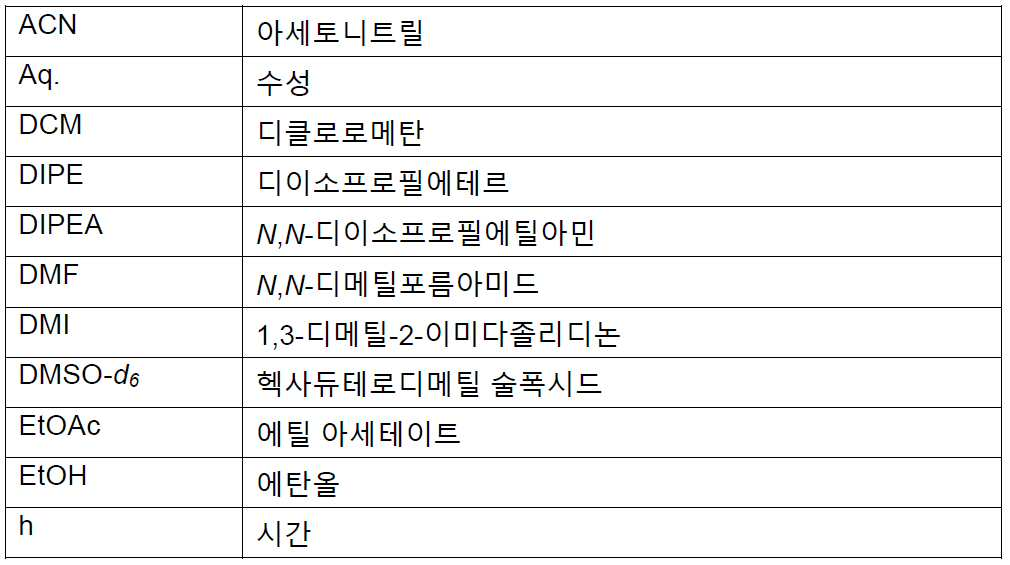
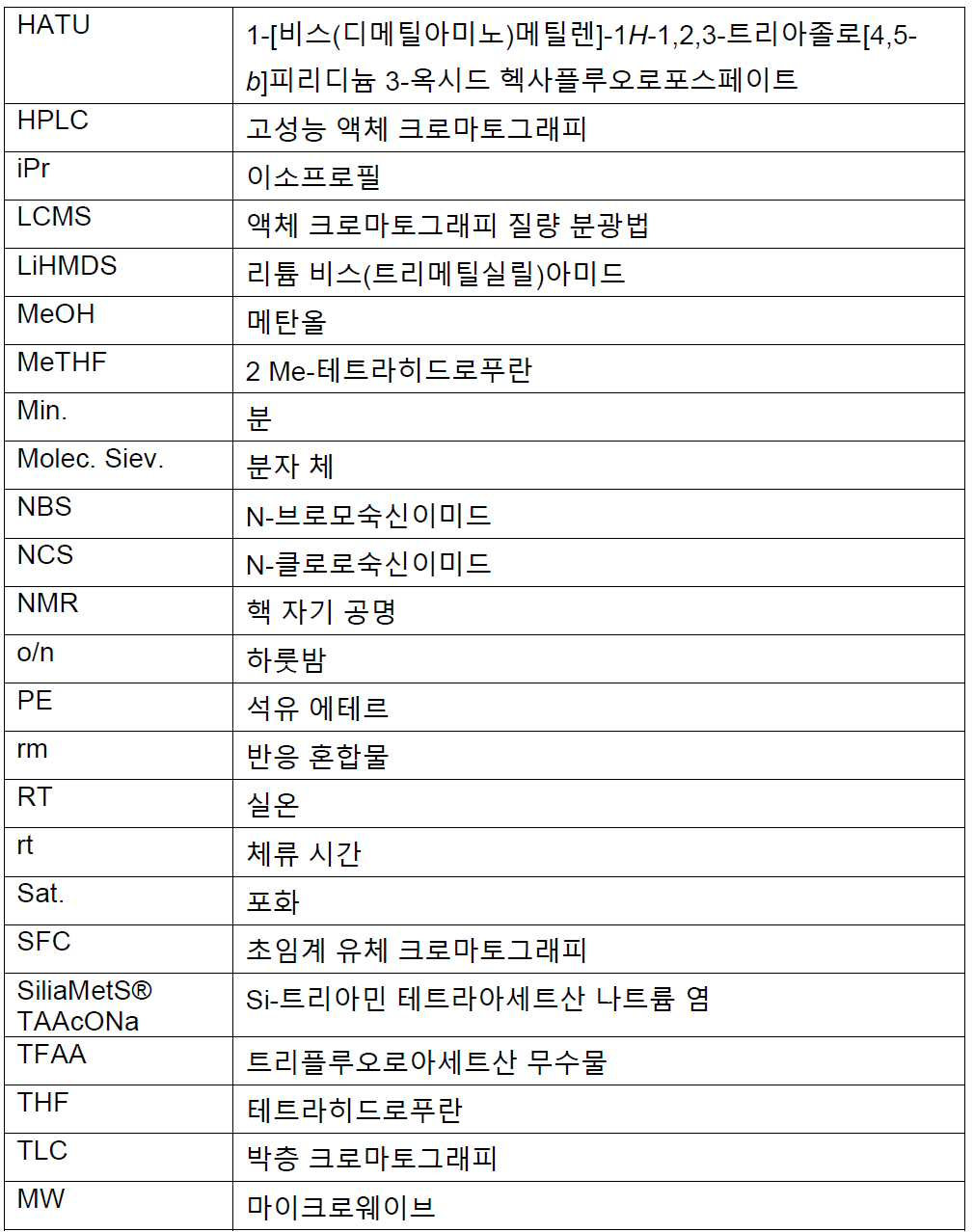
3.3. 절차 procedure
중간체의 합성synthesis of intermediates
중간체 intermediate I4c의I4c 합성 synthesis
단계 1 Step 1

에틸 3-플루오로-1-메틸-1H-피롤-2-카르복실레이트 (5 g, 29.21 mmol)를 THF (분자 체에서 건조) (80 mL)에 용해시켰다. 이 혼합물을 빙조에서 냉각시키고, 3-클로로-4-플루오로아닐린 (4.7 g, 32.1 mmol)을 첨가하였다. 리튬 비스(트리메틸실릴)아미드 (톨루엔 중 1 M) (58.4 mL, 58.4 mmol)를 10분의 기간에 걸쳐 적가하였다. 빙조를 제거하고, 상기 혼합물을 실온에서 1시간 동안 교반시켰다. 상기 혼합물을 포화 염화암모늄 (150 mL)으로 켄칭하고, 생성된 혼합물을 EtOAc (3 X 150 mL)를 사용하여 추출하였다. 합한 추출물을 염수 (200 mL)로 세척하고, Na2SO4로 건조시키고, 여과시키고, 진공에서 농축시켜 N-(3-클로로-4-플루오로페닐)-3-플루오로-1-메틸-1H-피롤-2-카르복스아미드 (7.3 g, 수율: 83%)를 베이지색 고형물로 수득하고, 이를 다음 단계에서 그대로 사용하였다. Ethyl 3-fluoro-1-methyl-1H-pyrrole-2-carboxylate (5 g, 29.21 mmol) was dissolved in THF (dry over molecular sieves) (80 mL). The mixture was cooled in an ice bath and 3-chloro-4-fluoroaniline (4.7 g, 32.1 mmol) was added. Lithium bis(trimethylsilyl)amide (1 M in toluene) (58.4 mL, 58.4 mmol) was added dropwise over a period of 10 min. The ice bath was removed and the mixture was stirred at room temperature for 1 hour. The mixture was quenched with saturated ammonium chloride (150 mL) and the resulting mixture was extracted using EtOAc (3 X 150 mL). The combined extracts were washed with brine (200 mL), dried over Na 2 SO 4 , filtered and concentrated in vacuo to N-(3-chloro-4-fluorophenyl)-3-fluoro-1-methyl- 1H-pyrrole-2-carboxamide (7.3 g, yield: 83%) was obtained as a beige solid, which was used as such in the next step.
단계 2 Step 2

N-(3-클로로-4-플루오로페닐)-3-플루오로-1-메틸-1H-피롤-2-카르복스아미드를 DCM (분자 체에서) (37 mL)에 용해시키고, 물/얼음 조에서 냉각시켰다 (부드러운 질소 유동 하에). DCM (분자 체에서) (18.7 mL) 중 에틸 옥살릴 클로라이드 (2.07 mL, 18.5 mmol)의 용액을 적가하고, 혼합물을 10분 동안 교반시켰다. 삼염화알루미늄 (2.95 g, 22.2 mmol)을 10분에 걸쳐 일부씩 첨가하고, 혼합물을 0℃에서 90분 동안 교반시켰다. 생성된 혼합물을 100 mL의 얼음물에 붓고, EtOAc (2x)로 추출하였다. 합한 추출물을 염수로 세척하고, 건조상태까지 증발시켜 중간체 I4b를 수득하였다. 잔사를 20 mL의 EtOH에 녹이고, NaOH (H2O 중 1 M) (11.87 mL, 11.9 mmol)를 첨가하고, 혼합물을 실온에서 40분 동안 교반시켰다. 상기 혼합물을 얼음 상에서 냉각시키고, 40 ml의 물 및 그 후 진한 HCl을 완전히 침전될 때까지 (pH = 1) 첨가하였다.N-(3-chloro-4-fluorophenyl)-3-fluoro-1-methyl-1H-pyrrole-2-carboxamide was dissolved in DCM (in molecular sieve) (37 mL), water/ice Cooled in a bath (under a gentle flow of nitrogen). A solution of ethyl oxalyl chloride (2.07 mL, 18.5 mmol) in DCM (in molecular sieve) (18.7 mL) was added dropwise and the mixture was stirred for 10 min. Aluminum trichloride (2.95 g, 22.2 mmol) was added portionwise over 10 min and the mixture was stirred at 0° C. for 90 min. The resulting mixture was poured into 100 mL of ice water and extracted with EtOAc (2x). The combined extracts were washed with brine and evaporated to dryness to give intermediate I4b. The residue was taken up in 20 mL of EtOH, NaOH ( 1 M in H 2 O) (11.87 mL, 11.9 mmol) was added and the mixture was stirred at room temperature for 40 min. The mixture was cooled on ice, 40 ml of water and then concentrated HCl were added until complete precipitation (pH = 1).
침전물을 여과 제거하고, 물로 세척하고, 진공에서 하룻밤 건조시켜 2-(5-((3-클로로-4-플루오로페닐)카르바모일)-4-플루오로-1-메틸-1H-피롤-3-일)-2-옥소아세트산 중간체 I4c (2.5 g, 수율: 85%)를 고형물로 수득하고, 이를 그대로 사용하였다.The precipitate was filtered off, washed with water and dried in vacuo overnight to 2-(5-((3-chloro-4-fluorophenyl)carbamoyl)-4-fluoro-1-methyl-1H-pyrrole- 3-yl)-2-oxoacetic acid Intermediate I4c (2.5 g, yield: 85%) was obtained as a solid, which was used as such.
달리 지시되지 않는 한, 하기 중간체를 중간체 I4a-c에 대해 보고된 절차에 따라 합성하였다.Unless otherwise indicated, the following intermediates were synthesized according to the procedures reported for intermediates I4a-c.


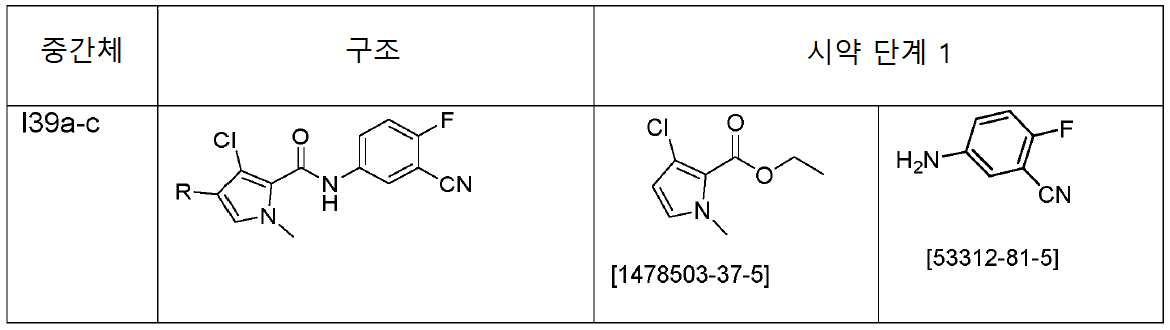
* 단계 1 : MeTHF 및 LiHMDS (THF 중 1.0 M)를 사용하였다.*Step 1: MeTHF and LiHMDS (1.0 M in THF) were used.
** 단계 1 : 또 다른 방법을 사용하였다: 톨루엔 (5.2 mL) 중 5-아미노-2-플루오로벤조니트릴 (997 mg, 7.32 mmol)의 용액에 트리메틸알루미늄 용액 (톨루엔 중 2 M) (3.66 mL, 7.32 mmol)을 실온에서 적가하고, 반응 혼합물을 5분 동안 교반시켰다. 톨루엔 (19 mL) 중 메틸 3-메톡시-1-메틸-1H-피롤-2-카르복실레이트 (826 mg, 4.88 mmol)의 용액을 첨가하고, 반응 혼합물을 80℃에서 하룻밤 교반시켰다. 반응 혼합물을 실온까지 냉각시키고, Na2SO4 십수화물 (500 mg)을 첨가하고, 반응 혼합물을 30분 동안 교반시켰다. 그 후 반응 혼합물을 Na2SO4로 건조시키고, 여과시키고 진공 하에 농축시켰다. 잔사를 실리카 컬럼 크로마토그래피 (85/15로부터 75/25까지의 시클로헥산/EtOAc)로 정제하여 N-(3-시아노-4-플루오로페닐)-3-메톡시-1-메틸-1H-피롤-2-카르복스아미드 중간체 12a (1.11 g, 83%의 수율)를 수득하였다. **Step 1: Another method was used: to a solution of 5-amino-2-fluorobenzonitrile (997 mg, 7.32 mmol) in toluene (5.2 mL) trimethylaluminum solution (2 M in toluene) (3.66 mL) , 7.32 mmol) was added dropwise at room temperature, and the reaction mixture was stirred for 5 minutes. A solution of methyl 3-methoxy-1-methyl-1H-pyrrole-2-carboxylate (826 mg, 4.88 mmol) in toluene (19 mL) was added and the reaction mixture was stirred at 80° C. overnight. The reaction mixture was cooled to room temperature, Na 2 SO 4 decahydrate (500 mg) was added and the reaction mixture was stirred for 30 min. The reaction mixture was then dried over Na 2 SO 4 , filtered and concentrated in vacuo. The residue was purified by silica column chromatography (cyclohexane/EtOAc from 85/15 to 75/25) to N-(3-cyano-4-fluorophenyl)-3-methoxy-1-methyl-1H- The pyrrole-2-carboxamide intermediate 12a (1.11 g, yield of 83%) was obtained.
중간체 intermediate I16c의I16c 합성 synthesis
단계 1 Step 1

3구 둥근 바닥 플라스크에 중간체 I11a (700 mg, 2.17 mmol), 시클로프로필보론산 (279 mg, 3.26 mmol), 트리시클로헥실포스핀 (182.81 mg, 0.65 mmol), 아세트산팔라듐 (73.18 mg, 0.326 mmol) 및 제3인산칼륨 (1.62 g, 7.61 mmol)을 충전시켰다. 플라스크를 진공 하에 소기시키고, N2로 역충전시켰다. 톨루엔 (43 mL) 및 물 (1.5 mL)을 첨가하고, 부드러운 N2 유동 (버블링)을 5분 동안 수행하였다. 상기 반응물을 그리고 그 후 혼합 현탁물을 교반시키고, 가열하였다 (100℃에서). 24시간 후, TLC 및 LCMS는 원하는 생성물과, 여전히 약간의 SM의 존재를 나타냈다. 반응물을 100℃에서 하룻밤 방치하였다 (총 48시간).Intermediate I11a (700 mg, 2.17 mmol), cyclopropylboronic acid (279 mg, 3.26 mmol), tricyclohexylphosphine (182.81 mg, 0.65 mmol), palladium acetate (73.18 mg, 0.326 mmol) in a 3-neck round bottom flask and potassium phosphate tribasic (1.62 g, 7.61 mmol). The flask was evacuated under vacuum and backfilled with N 2 . Toluene (43 mL) and water (1.5 mL) were added and a gentle N 2 flow (bubbling) was performed for 5 min. The reaction was then stirred and heated (at 100° C.) the mixed suspension. After 24 hours, TLC and LCMS showed the desired product and still some SM. The reaction was left overnight at 100° C. (48 hours total).
반응 혼합물을 물로 켄칭하고, 그 후 EtOAc (3x)로 추출하였다. 유기 상을 합하고, MgSO4로 건조시키고, 농축시켰다. 그 후 잔사를 실리카 컬럼 크로마토그래피 (70/30의 헵탄/EtOAc)로 정제하여 원하는 생성물 N-(3-시아노-4-플루오로페닐)-3-시클로프로필-1-메틸-1H-피롤-2-카르복스아미드 (208 mg, 34%의 수율)를 백색 고형물로 수득하였다. The reaction mixture was quenched with water, then extracted with EtOAc (3x). The organic phases were combined, dried over MgSO 4 and concentrated. The residue was then purified by silica column chromatography (70/30 heptane/EtOAc) to the desired product N-(3-cyano-4-fluorophenyl)-3-cyclopropyl-1-methyl-1H-pyrrole- 2-carboxamide (208 mg, yield of 34%) was obtained as a white solid.
단계 2Step 2

N-(3-시아노-4-플루오로페닐)-3-시클로프로필-1-메틸-1H-피롤-2-카르복스아미드를 DCM (4 mL)에 용해시키고, 물/얼음 조에서 냉각시켰다 (부드러운 질소 유동 하에). DCM (2 mL) 중 에틸 옥살릴 클로라이드 (0.18 mL, 1.59 mmol)의 용액을 적가하고, 혼합물을 10분 동안 교반시켰다. 염화알루미늄 (254 mg, 1.91 mmol)을 10분에 걸쳐 일부씩 첨가하고, 혼합물을 0℃에서 2시간 동안 교반시켰다. 4시간 후, LCMS는 원하는 생성물의 형성을 나타냈지만 여전히 약간의 출발 물질이 남아 있다. 반응 혼합물을 실온에서 하룻밤 교반시켰다.N-(3-cyano-4-fluorophenyl)-3-cyclopropyl-1-methyl-1H-pyrrole-2-carboxamide was dissolved in DCM (4 mL) and cooled in a water/ice bath. (under gentle nitrogen flow). A solution of ethyl oxalyl chloride (0.18 mL, 1.59 mmol) in DCM (2 mL) was added dropwise and the mixture was stirred for 10 min. Aluminum chloride (254 mg, 1.91 mmol) was added portionwise over 10 min and the mixture was stirred at 0° C. for 2 h. After 4 hours, LCMS showed the formation of the desired product but still some starting material remained. The reaction mixture was stirred at room temperature overnight.
반응 혼합물을 100 mL의 얼음물에 붓고, EtOAc (2 x 150mL)로 추출하였다. 합한 추출물을 염수로 세척하고, 전조상태까지 증발시켰다. 잔사를 4 ml의 EtOH에 녹이고, NaOH (H2O 중 1 M, 3.8 mL, 3.81 mmol)를 첨가하고, 혼합물을 실온에서 1시간 동안 교반시켰다. 얼음, 그 후 물 (14 mL) 및 그 후 진한 HCl을 완전히 침전될 때까지 (pH = 1) 첨가하였다. 침전물을 여과 제거하고, 물 (20 mL) 및 디에틸 에테르 (2 mL)로 세척하고, 진공 오븐에서 하룻밤 건조시켜 중간체 I16c (154 mg, 수율: 68%)를 옅은 베이지색 고형물로 수득하였다.The reaction mixture was poured into 100 mL of ice water and extracted with EtOAc (2×150 mL). The combined extracts were washed with brine and evaporated to crude condition. The residue was taken up in 4 ml of EtOH, NaOH ( 1 M in H 2 O, 3.8 mL, 3.81 mmol) was added and the mixture was stirred at room temperature for 1 h. Ice, then water (14 mL) and then concentrated HCl were added until complete precipitation (pH = 1). The precipitate was filtered off, washed with water (20 mL) and diethyl ether (2 mL) and dried in a vacuum oven overnight to give intermediate I16c (154 mg, yield: 68%) as a pale beige solid.
중간체 intermediate I17c의I17c 합성 synthesis

중간체 I10c (1 g, 2.89 mmol)를 CH3CN (20 mL) 및 DMF (10 mL)에 용해시켰다. NBS (772 mg, 4.34 mmol)를 0℃에서 첨가하였다. 실온에서 하룻밤 후, 약간의 출발 물질이 남아 있었다. Intermediate I10c (1 g, 2.89 mmol) was dissolved in CH 3 CN (20 mL) and DMF (10 mL). NBS (772 mg, 4.34 mmol) was added at 0°C. After overnight at room temperature, some starting material remained.
0℃에서, 추가의 NBS (50 mg)를 첨가하고, 그 후 반응 혼합물을 실온에서 추가로 하룻밤 교반시켰다. 상기 혼합물을 수성 포화 Na2S2O3 및 수성 포화 NaHCO3으로 처리하고, 에틸 아세테이트로 추출하였다. 원하는 분획을 분리하고, MgSO4로 건조시키고, 여과시키고, 감압 하에 농축시켰다. 조 생성물을 실리카 컬럼 크로마토그래피 (100/0에서 90/10까지의 DCM/MeOH 중 2% HCOOH)로 정제하여 중간체 I17c (2 g, 66/23의 원하는 생성물/출발 물질의 혼합물)를 수득하였다. At 0° C., more NBS (50 mg) was added, after which time the reaction mixture was stirred further overnight at room temperature. The mixture was treated with aqueous saturated Na 2 S 2 O 3 and aqueous saturated NaHCO 3 , and extracted with ethyl acetate. The desired fractions were separated, dried over MgSO 4 , filtered and concentrated under reduced pressure. The crude product was purified by silica column chromatography (2% HCOOH in DCM/MeOH from 100/0 to 90/10) to afford intermediate I17c (2 g, desired product/starting material mixture of 66/23).
중간체 intermediate I18b의I18b 합성 synthesis

CH3CN (60 mL)과 DMF (18 mL)의 혼합물 중 중간체 I6c (1.10 g, 3.05 mmol)의 용액에 NBS (1.08 g, 6.09 mmol)를 첨가하였다. 반응 혼합물을 실온에서 3시간 동안 교반시켰다. 아세토니트릴을 감압 하에 증발시키고, 물 (20 mL) 및 EtOAc (20 mL)를 첨가하였다. 층들을 분리하고, 수성 층을 EtOAc (3 x 50 mL)로 추출하였다. 합한 유기 층을 Na2SO4로 건조시키고, 여과시키고, 감압 하에 농축시켰다. 조 물질을 실리카 컬럼 크로마토그래피 (100/0에서 56/44까지의 시클로헥산/EtOAc)에서 정제하여 중간체 I18b (805 mg, 60%의 수율)를 백색 고형물로 수득하였다.To a solution of intermediate I6c (1.10 g, 3.05 mmol) in a mixture of CH 3 CN (60 mL) and DMF (18 mL) was added NBS (1.08 g, 6.09 mmol). The reaction mixture was stirred at room temperature for 3 hours. Acetonitrile was evaporated under reduced pressure and water (20 mL) and EtOAc (20 mL) were added. The layers were separated and the aqueous layer was extracted with EtOAc (3×50 mL). The combined organic layers were dried over Na 2 SO 4 , filtered and concentrated under reduced pressure. The crude material was purified on silica column chromatography (Cyclohexane/EtOAc from 100/0 to 56/44) to give Intermediate I18b (805 mg, yield of 60%) as a white solid.
중간체 intermediate I19c의I19c 합성 synthesis
단계 1Step 1

시안화구리 (94.3 mg, 1.05 mmol)를 DMF (15 mL) 중 중간체 I18b (309 mg, 0.702 mmol)의 용액에 첨가하였다. 반응 혼합물을 마이크로웨이브 조건 하에 160℃에서 30분 동안 가열하고, 그 후 실온까지 냉각시키고, 감압 하에 농축시켰다. 잔사를 EtOAc (40 mL) 및 물 (40 mL)에 녹이고, 그 후 33% 수성 암모니아 (약 10 드롭)를 첨가하였다. 층들을 분리하고, 수성 층을 EtOAc (20 mL)로 추출하였다. 합한 유기 층을 Na2SO4로 건조시키고, 여과시키고, 농축시켰다. 조 혼합물을 실리카 컬럼 크로마토그래피 (시클로헥산/EtOAc: 90/10에서 60/40까지)로 정제하여 에틸 2-(2-시아노-5-((3-시아노-4-플루오로페닐)카르바모일)-4-플루오로-1-메틸-1H-피롤-3-일)-2-옥소아세테이트 (121 mg, 37%의 수율)를 베이지색 고형물로 수득하였다. Copper cyanide (94.3 mg, 1.05 mmol) was added to a solution of intermediate I18b (309 mg, 0.702 mmol) in DMF (15 mL). The reaction mixture was heated under microwave conditions at 160° C. for 30 min, then cooled to room temperature and concentrated under reduced pressure. The residue was taken up in EtOAc (40 mL) and water (40 mL), then 33% aqueous ammonia (ca. 10 drops) was added. The layers were separated and the aqueous layer was extracted with EtOAc (20 mL). The combined organic layers were dried over Na 2 SO 4 , filtered and concentrated. The crude mixture was purified by silica column chromatography (cyclohexane/EtOAc: 90/10 to 60/40) to ethyl 2-(2-cyano-5-((3-cyano-4-fluorophenyl)car Bamoyl)-4-fluoro-1-methyl-1H-pyrrol-3-yl)-2-oxoacetate (121 mg, yield of 37%) was obtained as a beige solid.
단계 2Step 2
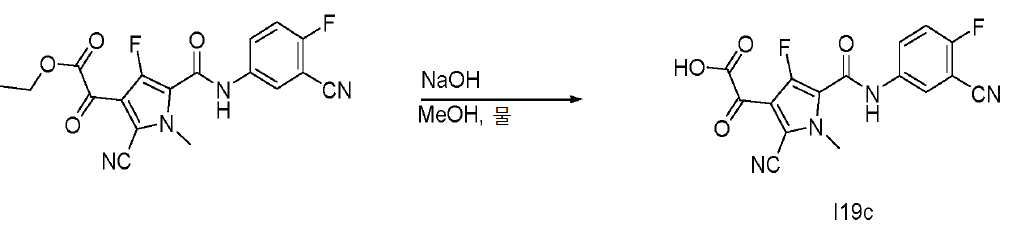
물 (0.8 mL)과 메탄올 (0.8 mL)의 혼합물 중 에틸 2-(2-시아노-5-((3-시아노-4-플루오로페닐)카르바모일)-4-플루오로-1-메틸-1H-피롤-3-일)-2-옥소아세테이트 (110 mg, 0.285 mmol)의 용액에 NaOH (0.85 mL, 물 중 1 M, 0.85 mmol)를 첨가하고, 반응 혼합물을 실온에서 2시간 동안 교반시켰다. 메탄올을 제거하고, 잔사를 물 (15 mL)에 희석시켰다. 수성 층을 EtOAc (15 mL)로 세척하였다. 그 후 수성 층을 pH가 대략 1이 될 때까지 1 M HCl의 수성 용액으로 산성화하고, EtOAc (2 x 20 mL)로 추출하였다. 합한 유기 층을 Na2SO4로 건조시키고, 여과시키고, 농축시켜 중간체 I19c (51 mg, 43%의 수율)를 백색 고형물로 수득하였다.Ethyl 2-(2-cyano-5-((3-cyano-4-fluorophenyl)carbamoyl)-4-fluoro-1- in a mixture of water (0.8 mL) and methanol (0.8 mL) To a solution of methyl-1H-pyrrol-3-yl)-2-oxoacetate (110 mg, 0.285 mmol) was added NaOH (0.85 mL, 1 M in water, 0.85 mmol) and the reaction mixture was stirred at room temperature for 2 hours. stirred. Methanol was removed and the residue was diluted in water (15 mL). The aqueous layer was washed with EtOAc (15 mL). The aqueous layer was then acidified with an aqueous solution of 1 M HCl until the pH was approximately 1, and extracted with EtOAc (2×20 mL). The combined organic layers were dried over Na 2 SO 4 , filtered and concentrated to give intermediate 19c (51 mg, 43% yield) as a white solid.
중간체 intermediate I20c의i20c 합성 synthesis
단계 1 Step 1

톨루엔 (25 mL) 중 중간체 I18b (400 mg, 0.909 mmol)의 용액에 시클로프로필 보론산 (156 mg, 1.82 mmol), 탄산세슘 (296 mg, 0.909 mmol) 및 Pd(dppf)Cl2·DCM (74.2 mg, 0.091 mmol)을 첨가하였다. 생성된 혼합물을 100℃에서 16시간 동안 교반시켰다. 물 (30 mL)을 첨가하고, 수성 층을 EtOAc (3 x 20 mL)로 추출하고, 합한 유기 층을 염수 (30 mL)로 세척하고, Na2SO4로 건조시키고, 여과시키고, 감압 하에 농축시켰다. 조 물질을 실리카 컬럼 크로마토그래피 (100/0으로부터 60/40까지의 시클로헥산/EtOAc)에서 정제하여 에틸 2-(5-((3-시아노-4-플루오로페닐)카르바모일)-2-시클로프로필-4-플루오로-1-메틸-1H-피롤-3-일)-2-옥소아세테이트 (342 mg, 70%의 수율)를 수득하였다.To a solution of intermediate I18b (400 mg, 0.909 mmol) in toluene (25 mL), cyclopropyl boronic acid (156 mg, 1.82 mmol), cesium carbonate (296 mg, 0.909 mmol) and Pd(dppf)Cl 2 DCM (74.2) mg, 0.091 mmol) was added. The resulting mixture was stirred at 100° C. for 16 hours. Water (30 mL) was added, the aqueous layer was extracted with EtOAc (3×20 mL) and the combined organic layers washed with brine (30 mL), dried over Na 2 SO 4 , filtered and concentrated under reduced pressure. did it The crude material was purified on silica column chromatography (Cyclohexane/EtOAc from 100/0 to 60/40) to ethyl 2-(5-((3-cyano-4-fluorophenyl)carbamoyl)-2 -Cyclopropyl-4-fluoro-1-methyl-1H-pyrrol-3-yl)-2-oxoacetate (342 mg, 70% yield) was obtained.
단계 2 Step 2

에탄올 (5 mL) 및 물 (0.5 mL) 중 에틸 2-(5-((3-시아노-4-플루오로페닐)카르바모일)-2-시클로프로필-4-플루오로-1-메틸-1H-피롤-3-일)-2-옥소아세테이트 (342 mg, 0.852 mmol)의 용액에 NaOH (2.56 mL, EtOH 중 1 M, 2.56 mmol)를 첨가하였다 (0℃에서). 혼합물을 실온에서 1시간 동안 교반시켰다. 물 (10 mL) 및 EtOAc (10 mL)를 첨가하였다. 유기 층을 버리고, pH = 1이 될 때까지 수성 층에 1 M HCl (5 mL)을 첨가하고, 그 후 EtOAc (10 mL)를 첨가하였다. 층들을 분리하고, 수성 층을 EtOAc (3 x 10 mL)로 추출하였다. 합한 유기 층을 황산나트륨으로 건조시키고, 여과시키고, 농축시켰다. 조 물질을 역상 플래시 크로마토그래피 (C18_IR_50_F0025, 98/2로부터 75/25까지의 물/ACN, 1시간)로 정제하여 불순한 황색 고형물을 수득하였다 역상 플래시 크로마토그래피 (C18_IR_50_F0025, 물 + 0.1 %의 HCOOH/ACN (98/2로부터 75/25까지), 40분)에 의한 두 번째 정제로 중간체 I20c (39 mg, 12%의 수율)를 백색 고형물로 수득하였다.Ethyl 2-(5-((3-cyano-4-fluorophenyl)carbamoyl)-2-cyclopropyl-4-fluoro-1-methyl- in ethanol (5 mL) and water (0.5 mL) To a solution of 1H-pyrrol-3-yl)-2-oxoacetate (342 mg, 0.852 mmol) was added NaOH (2.56 mL, 1 M in EtOH, 2.56 mmol) (at 0° C.). The mixture was stirred at room temperature for 1 hour. Water (10 mL) and EtOAc (10 mL) were added. The organic layer was discarded and 1 M HCl (5 mL) was added to the aqueous layer until pH = 1, then EtOAc (10 mL) was added. The layers were separated and the aqueous layer was extracted with EtOAc (3×10 mL). The combined organic layers were dried over sodium sulfate, filtered and concentrated. The crude material was purified by reverse phase flash chromatography (C18_IR_50_F0025, water/ACN from 98/2 to 75/25, 1 h) to give an impure yellow solid Reversed phase flash chromatography (C18_IR_50_F0025, water+0.1% HCOOH/ACN) (98/2 to 75/25), 40 min) gave intermediate I20c (39 mg, yield of 12%) as a white solid.
중간체 intermediate I21c의I21c 합성 synthesis
단계 1Step 1

디옥산 (15 mL) 중 중간체 I18b (235 mg, 0.534 mmol)의 용액에 트리메틸보록신 (0.448 mL, THF 중 50% (w/w) 용액, 1.60 mmol), 탄산칼륨 (221 mg, 1.60 mmol) 및 Pd(dppf)Cl2 ( 43.6 mg, 0.053 mmol)를 첨가하였다. 생성된 혼합물을 탈기시키고, 그 후 질소로 다시 충전시키고, 그 후 100℃에서 16시간 동안 교반시켰다. 물 (20 mL)을 첨가하고, 수성 층을 EtOAc (3 x 15 mL)로 추출하고, 합한 유기 층을 염수 (30 mL)로 세척하고, Na2SO4로 건조시키고, 여과시키고, 감압 하에 농축시켰다. 조 물질을 실리카 컬럼 크로마토그래피 (100/0으로부터 60/40까지의 시클로헥산/EtOAc)로 정제하여 에틸 2-(5-((3-시아노-4-플루오로페닐)카르바모일)-4-플루오로-1,2-디메틸-1H-피롤-3-일)-2-옥소아세테이트 (143 mg, 71%의 수율)를 백색 고형물로 수득하였다.To a solution of intermediate I18b (235 mg, 0.534 mmol) in dioxane (15 mL) trimethylboroxine (0.448 mL, 50% (w/w) solution in THF, 1.60 mmol), potassium carbonate (221 mg, 1.60 mmol) and Pd(dppf)Cl 2 ( 43.6 mg, 0.053 mmol) were added. The resulting mixture was degassed, then backfilled with nitrogen and then stirred at 100° C. for 16 h. Water (20 mL) was added, the aqueous layer was extracted with EtOAc (3×15 mL), and the combined organic layers were washed with brine (30 mL), dried over Na 2 SO 4 , filtered, and concentrated under reduced pressure. did it The crude material was purified by silica column chromatography (Cyclohexane/EtOAc from 100/0 to 60/40) to ethyl 2-(5-((3-cyano-4-fluorophenyl)carbamoyl)-4 -Fluoro-1,2-dimethyl-1H-pyrrol-3-yl)-2-oxoacetate (143 mg, yield of 71%) was obtained as a white solid.
단계 2Step 2

에탄올 (2 mL) 및 물 (0.2 mL) 중 에틸 2-(5-((3-시아노-4-플루오로페닐)카르바모일)-4-플루오로-1,2-디메틸-1H-피롤-3-일)-2-옥소아세테이트 (141 mg, 0.376 mmol)의 용액에 NaOH (1.13 mL, EtOH 중 1 M, 1.13 mmol)를 첨가하였다 (0℃에서). 혼합물을 실온에서 1시간 동안 교반시켰다. 물 (10 mL) 및 EtOAc (10 mL)를 첨가하였다. 유기 층을 버렸다. pH = 1이 될 때까지 수성 층에 1 M HCl (5 mL)을 첨가하고, 그 후 EtOAc (10 mL)를 첨가하였다. 층들을 분리하고, 수성 층을 EtOAc (3 x 10 mL)로 추출하였다. 합한 유기 층을 황산나트륨으로 건조시키고, 여과시키고, 농축시켜 중간체 I21c (114 mg, 88%의 수율)를 백색 고형물로 수득하였다. Ethyl 2-(5-((3-cyano-4-fluorophenyl)carbamoyl)-4-fluoro-1,2-dimethyl-1H-pyrrole in ethanol (2 mL) and water (0.2 mL) To a solution of -3-yl)-2-oxoacetate (141 mg, 0.376 mmol) was added NaOH (1.13 mL, 1 M in EtOH, 1.13 mmol) (at 0° C.). The mixture was stirred at room temperature for 1 hour. Water (10 mL) and EtOAc (10 mL) were added. The organic layer was discarded. 1 M HCl (5 mL) was added to the aqueous layer until pH = 1, then EtOAc (10 mL) was added. The layers were separated and the aqueous layer was extracted with EtOAc (3×10 mL). The combined organic layers were dried over sodium sulfate, filtered and concentrated to give intermediate I21c (114 mg, 88% yield) as a white solid.
중간체 intermediate I22c의I22c 합성 synthesis
단계 1 Step 1

중간체 I10b (550 mg, 1.5 mmol)를 CH3CN (10 mL) 및 DMF (5 mL)에 용해시켰다. NBS (534 mg, 2.99 mmol)를 0℃에서 첨가하고, 1시간 후, 반응 혼합물을 실온까지 가온하였다. 실온에서 2시간 후, LCMS는 반응의 완료를 나타냈다. 반응 혼합물을 EtOAc, 포화 수성 Na2S2O3 및 포화 수성 NaHCO3으로 켄칭하고, 에틸 아세테이트 (4x)로 추출하였다. 원하는 분획을 분리하고, MgSO4로 건조시키고, 여과시키고, 용매를 감압 하에 증발시켰다. 조 물질을 실리카 컬럼 크로마토그래피 (100/0에서 80/20까지의 헵탄/EtOAc)에서 정제하여 에틸 2-(2-브로모-5-((3-클로로-4-플루오로페닐)카르바모일)-4-플루오로-1-메틸-1H-피롤-3-일)-2-옥소아세테이트 (410 mg, 61%의 수율)를 수득하였다.Intermediate I10b (550 mg, 1.5 mmol) was dissolved in CH 3 CN (10 mL) and DMF (5 mL). NBS (534 mg, 2.99 mmol) was added at 0° C. and after 1 h the reaction mixture was warmed to room temperature. After 2 h at room temperature, LCMS showed the reaction was complete. The reaction mixture was quenched with EtOAc, saturated aqueous Na 2 S 2 O 3 and saturated aqueous NaHCO 3 , and extracted with ethyl acetate (4×). The desired fractions were separated, dried over MgSO 4 , filtered and the solvent evaporated under reduced pressure. The crude material was purified on silica column chromatography (heptane/EtOAc from 100/0 to 80/20) to ethyl 2-(2-bromo-5-((3-chloro-4-fluorophenyl)carbamoyl )-4-fluoro-1-methyl-1H-pyrrol-3-yl)-2-oxoacetate (410 mg, yield of 61%) was obtained.
단계 2 Step 2

MW 플라스크에서 DME (5.2 mL) 및 물 (1.7 mL)을 에틸 2-(2-브로모-5-((3-클로로-4-플루오로페닐)카르바모일)-4-플루오로-1-메틸-1H-피롤-3-일)-2-옥소아세테이트 (200 mg, 0.449 mmol), 시클로프로필보론산 (77 mg, 0.898 mmol) 및 인산칼륨 (352 mg, 1.66 mmol)의 혼합물에 첨가하였다. 상기 혼합물을 질소로 10분 동안 플러싱하고, 그 후 Pd(dppf)Cl2 (65.7 mg, 0.09 mmol)를 첨가하였다. 반응 혼합물을 90℃에서 하룻밤 교반시켰다. 실온까지 냉각시킨 후, 상기 혼합물을 EtOAc 및 물로 희석시켰다. 유기 층을 Na2SO4로 건조시키고, 진공에서 농축시켰지만, 단지 적은 양의 원하는 생성물 및 몇몇 불순물을 함유하였다.In a MW flask, DME (5.2 mL) and water (1.7 mL) were mixed with ethyl 2- (2-bromo-5-((3-chloro-4-fluorophenyl) carbamoyl) -4-fluoro-1- To a mixture of methyl-1H-pyrrol-3-yl)-2-oxoacetate (200 mg, 0.449 mmol), cyclopropylboronic acid (77 mg, 0.898 mmol) and potassium phosphate (352 mg, 1.66 mmol). The mixture was flushed with nitrogen for 10 min, after which time Pd(dppf)Cl 2 (65.7 mg, 0.09 mmol) was added. The reaction mixture was stirred at 90° C. overnight. After cooling to room temperature, the mixture was diluted with EtOAc and water. The organic layer was dried over Na 2 SO 4 and concentrated in vacuo, but contained only small amounts of the desired product and some impurities.
수성 상을 농축시키고, 생성된 고형물을 MeOH로 수 회 세척하고, 수집된 유기 용매를 농축시켰다. 조 물질을 실리카 컬럼 크로마토그래피 (100/0에서 0/100까지의 헵탄/EtOAc)로 정제하여 중간체 I22c (170 mg, 100%의 수율)를 수득하였다.The aqueous phase was concentrated, the resulting solid was washed several times with MeOH and the collected organic solvent was concentrated. The crude material was purified by silica column chromatography (heptane/EtOAc from 100/0 to 0/100) to give intermediate I22c (170 mg, yield of 100%).
중간체 intermediate I23c의I23c 합성 synthesis
단계 1 Step 1

중간체 I13b (300 mg, 0.62 mmol)를 아세토니트릴 (4 mL) 및 DMF (2 mL)에 용해시켰다. 트리플루오로메탄술폰산 (82 μL, 0.93 mmol)을 첨가하였다. NCS (82.8 mg, 0.62 mmol)를 0℃에서 첨가하였다. 반응 혼합물을 이 온도에서 30분 동안 교반시키고, 그 후 실온에서 하룻밤 교반시켰다. Intermediate I13b (300 mg, 0.62 mmol) was dissolved in acetonitrile (4 mL) and DMF (2 mL). Trifluoromethanesulfonic acid (82 μL, 0.93 mmol) was added. NCS (82.8 mg, 0.62 mmol) was added at 0°C. The reaction mixture was stirred at this temperature for 30 minutes, then at room temperature overnight.
상기 혼합물을 물로 켄칭하고, DCM (3x)으로 추출하고, 염수로 세척하고, Na2SO4로 건조시키고, 여과시키고, 감압 하에 농축시켰다.The mixture was quenched with water, extracted with DCM (3x), washed with brine, dried over Na 2 SO 4 , filtered and concentrated under reduced pressure.
이 조 물질을 실리카 겔 컬럼 크로마토그래피 (100/0으로부터 95/5까지의 DCM/MeOH)로 정제하여 에틸 2-(5-((3-브로모-4-플루오로페닐)카르바모일)-2-클로로-1,4-디메틸-1H-피롤-3-일)-2-옥소아세테이트 (180 mg, 82%의 순도, 53%의 수율)를 수득하였다.This crude material was purified by silica gel column chromatography (DCM/MeOH from 100/0 to 95/5) to ethyl 2-(5-((3-bromo-4-fluorophenyl)carbamoyl)- 2-Chloro-1,4-dimethyl-1H-pyrrol-3-yl)-2-oxoacetate (180 mg, purity of 82%, yield of 53%) was obtained.
단계 2Step 2

물/THF/MeOH (0.6/18/0.6 mL) 중 에틸 2-(5-((3-브로모-4-플루오로페닐)카르바모일)-2-클로로-1,4-디메틸-1H-피롤-3-일)-2-옥소아세테이트 (180 mg, 0.331 mmol) 및 LiOH 일수화물 (28 mg, 0.662 mmol)의 용액을 실온에서 2시간 교반시켰다. 상기 혼합물 용액을 농축시키고, 물로 희석시켰다. 그 후 DCM 및 1 N HCl을 첨가하고, 수성 상을 DCM으로 추출하였다. 합한 유기 층을 합하고, MgSO4로 건조시키고, 여과시키고, 농축시켜 중간체 I23c (140 mg)을 수득하고, 이 조 물질을 그대로 사용하였다.Ethyl 2-(5-((3-bromo-4-fluorophenyl)carbamoyl)-2-chloro-1,4-dimethyl-1H- in water/THF/MeOH (0.6/18/0.6 mL) A solution of pyrrol-3-yl)-2-oxoacetate (180 mg, 0.331 mmol) and LiOH monohydrate (28 mg, 0.662 mmol) was stirred at room temperature for 2 h. The mixture solution was concentrated and diluted with water. Then DCM and 1 N HCl were added and the aqueous phase was extracted with DCM. The combined organic layers were combined, dried over MgSO 4 , filtered and concentrated to give intermediate I23c (140 mg), which was used as such.
중간체 I24의 합성Synthesis of Intermediate I24
단계 1 Step 1

4℃에서 DME (4 mL) 중 tert-부톡시카르보닐)아미노)-3,3-디플루오로시클로펜탄카르복실산 (1 g, 3.77 mmol) 및 4-메틸모르폴린 (421 mg, 4.15 mmol)의 용액에 이소부틸 클로로포르메이트 (0.54 mL, 4.15 mmol)를 서서히 첨가하고, 반응 혼합물을 5분 동안 교반시키고, 그 후 예냉 (4℃) 플라스크 내로 여과시켰다. 물 (1.76 mL) 중 NaBH4 (213 mg, 5.65 mmol)를 첨가한 다음 즉시 물 (125 mL)을 첨가하였다. 그 후 반응물을 20℃까지 가온하고, 30분 동안 교반시켰다. 반응 혼합물을 DCM (3 x 20 mL)으로 추출하였다. 합한 유기 층을 감압 하에 농축시키고, 조 물질을 다음 단계에서 그대로 사용하였다. tert-butoxycarbonyl)amino)-3,3-difluorocyclopentanecarboxylic acid (1 g, 3.77 mmol) and 4-methylmorpholine (421 mg, 4.15 mmol) in DME (4 mL) at 4° C. ) was added slowly isobutyl chloroformate (0.54 mL, 4.15 mmol), and the reaction mixture was stirred for 5 min, then filtered into a precooled (4° C.) flask. NaBH 4 (213 mg, 5.65 mmol) in water (1.76 mL) was added followed immediately by water (125 mL). The reaction was then warmed to 20° C. and stirred for 30 min. The reaction mixture was extracted with DCM (3 x 20 mL). The combined organic layers were concentrated under reduced pressure and the crude material was used as such in the next step.
단계 2Step 2

2-요오독시벤조산 (1.05 g, 3.75 mmol)을 EtOAc (10 mL) 중 tert-부틸 (3,3-디플루오로-1-(히드록시메틸)시클로펜틸)카르바메이트 (0.75 g, 3 mmol)의 용액에 첨가하고, 80℃에서 하룻밤 가열하였다. 반응 혼합물을 빙조로 냉각시키고, 여과시키고, 여과액을 건조상태까지 증발시켰다. 잔사를 다음 단계에서 그대로 사용하였다.2-iodoxybenzoic acid (1.05 g, 3.75 mmol) was dissolved in EtOAc (10 mL) in tert-butyl (3,3-difluoro-1- (hydroxymethyl) cyclopentyl) carbamate (0.75 g, 3 mmol) ) and heated at 80 °C overnight. The reaction mixture was cooled with an ice bath, filtered and the filtrate evaporated to dryness. The residue was used as such in the next step.
단계 3Step 3

디메틸 (1-디아조-2-옥소프로필)포스포네이트 (0.45 mL, 3 mmol)를 0℃에서 MeOH 중 tert-부틸 (3,3-디플루오로-1-포르밀시클로펜틸)카르바메이트 (748 mg, 3 mmol) 및 K2CO3 (829 mg, 6 mmol)의 현탁물에 첨가하였다. 30분 후 반응 혼합물을 실온에 도달하게 하고 교반을 계속하였다 (하룻밤). 반응 혼합물을 건조상태까지 증발시켰다. 잔사를 디에틸 에테르 (5 mL)와 물 (5 mL) 사이에 분배하였다. 유기 층을 Na2SO4로 건조시키고, 여과시키고, 건조상태까지 증발시켰다. 잔사를 다음 단계에서 그대로 사용하였다.Dimethyl (1-diazo-2-oxopropyl)phosphonate (0.45 mL, 3 mmol) was dissolved in tert-butyl (3,3-difluoro-1-formylcyclopentyl)carbamate in MeOH at 0° C. (748 mg, 3 mmol) and K 2 CO 3 (829 mg, 6 mmol) were added to a suspension. After 30 min the reaction mixture was allowed to reach room temperature and stirring was continued (overnight). The reaction mixture was evaporated to dryness. The residue was partitioned between diethyl ether (5 mL) and water (5 mL). The organic layer was dried over Na 2 SO 4 , filtered and evaporated to dryness. The residue was used as such in the next step.
단계 4Step 4

tert-부틸 (1-에티닐-3,3-디플루오로시클로펜틸)카르바메이트 (0.5 g, 2.04 mmol), 아지도트리메틸실란 (0.8 mL, 5.71 mmol) 및 요오드화구리 (19.4 mg, 0.1 mmol)를 DMF (5 mL) 및 MeOH (0.5 mL)에 분배하고, 100℃에서 5시간 가열하였다. 휘발성 물질을 감압 하에 제거하고, 헵탄에서 EtOAc까지의 구배를 사용하여 실리카 컬럼 크로마토그래피에서 잔사를 정제하여 tert-부틸 (3,3-디플루오로-1-(2H-1,2,3-트리아졸-4-일)시클로펜틸)카르바메이트 (330 mg, 56%의 수율)를 백색 분말로 수득하였다. tert-Butyl (1-ethynyl-3,3-difluorocyclopentyl)carbamate (0.5 g, 2.04 mmol), azidotrimethylsilane (0.8 mL, 5.71 mmol) and copper iodide (19.4 mg, 0.1 mmol) ) was partitioned between DMF (5 mL) and MeOH (0.5 mL) and heated at 100° C. for 5 h. The volatiles were removed under reduced pressure and the residue was purified on silica column chromatography using a heptane to EtOAc gradient to tert-butyl (3,3-difluoro-1-(2H-1,2,3-tria) Zol-4-yl)cyclopentyl)carbamate (330 mg, yield of 56%) was obtained as a white powder.
단계 5 Step 5

Tert-부틸 (3,3-디플루오로-1-(2H-1,2,3-트리아졸-4-일)시클로펜틸)카르바메이트 (330 mg, 1.09 mmol)를 HCl (1.81 mL, iPrOH 중 6 M, 10.87 mmol)에 용해시키고, 실온에서 18시간 교반시켰다. 휘발성 물질을 감압 하에 제거하고, 잔사를 DIPE에 미분화하고, 여과시키고, 오븐에서 하룻밤 건조시켜 중간체 24 (200 mg, 66%의 수율)를 수득하였다.Tert-Butyl (3,3-difluoro-1-(2H-1,2,3-triazol-4-yl)cyclopentyl)carbamate (330 mg, 1.09 mmol) was dissolved in HCl (1.81 mL, iPrOH) 6 M in 10.87 mmol) and stirred at room temperature for 18 h. The volatiles were removed under reduced pressure and the residue was triturated in DIPE, filtered and dried in an oven overnight to give Intermediate 24 (200 mg, yield of 66%).
중간체 I25의 합성Synthesis of Intermediate I25
단계 1Step 1

디메틸 (1-디아조-2-옥소프로필)포스포네이트 (0.62 mL, 4.15 mmol)를 0℃에서 MeOH 중 tert-부틸 (4,4,4-트리플루오로-1-옥소부탄-2-일)카르바메이트 (1 g, 4.15 mmol) 및 K2CO3 (145 mg, 8.29 mmol)의 현탁물에 첨가하였다. 30분 후 반응 혼합물을 실온에 도달하게 하고 교반을 계속하였다 (하룻밤). 반응 혼합물을 건조상태까지 증발시켰다. 잔사를 디에틸 에테르 (5 mL)와 물 (5 mL) 사이에 분배하였다. 유기 층을 Na2SO4로 건조시키고, 여과시키고, 건조상태까지 증발시켰다. 잔사를 다음 단계에서 그대로 사용하였다.Dimethyl (1-diazo-2-oxopropyl)phosphonate (0.62 mL, 4.15 mmol) was dissolved in tert-butyl (4,4,4-trifluoro-1-oxobutan-2-yl) in MeOH at 0° C. ) was added to a suspension of carbamate (1 g, 4.15 mmol) and K 2 CO 3 (145 mg, 8.29 mmol). After 30 min the reaction mixture was allowed to reach room temperature and stirring was continued (overnight). The reaction mixture was evaporated to dryness. The residue was partitioned between diethyl ether (5 mL) and water (5 mL). The organic layer was dried over Na 2 SO 4 , filtered and evaporated to dryness. The residue was used as such in the next step.
단계 2Step 2
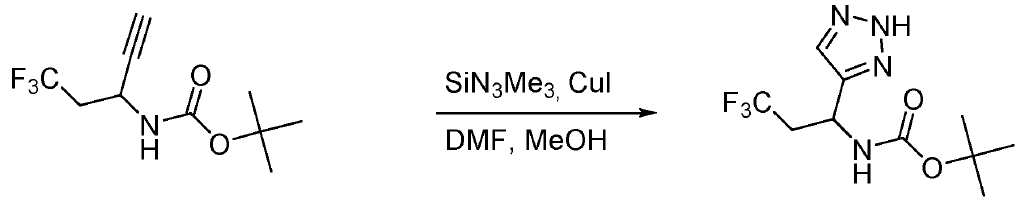
Tert-부틸 (5,5,5-트리플루오로펜트-1-인-3-일)카르바메이트 (0.75 g, 3.16 mmol), 아지도트리메틸실란 (1.23 mL, 8.85 mmol) 및 요오드화구리 (30.11 mg, 0.16 mmol)를 DMF (5 mL) 및 MeOH (0.5 mL)에 분배하고, 100℃에서 5시간 가열하였다. 휘발성 물질을 감압 하에 제거하고, 헵탄에서 EtOAc까지의 구배를 사용하여 실리카에서 잔사를 정제하여 tert-부틸 (3,3,3-트리플루오로-1-(2H-1,2,3-트리아졸-4-일)프로필)카르바메이트 (490 mg, 55%의 수율)를 백색 분말로 수득하였다.Tert-Butyl (5,5,5-trifluoropent-1-yn-3-yl)carbamate (0.75 g, 3.16 mmol), azidotrimethylsilane (1.23 mL, 8.85 mmol) and copper iodide (30.11) mg, 0.16 mmol) was partitioned between DMF (5 mL) and MeOH (0.5 mL) and heated at 100° C. for 5 h. The volatiles were removed under reduced pressure and the residue was purified on silica using a heptane to EtOAc gradient to tert-butyl (3,3,3-trifluoro-1-(2H-1,2,3-triazole) -4-yl)propyl)carbamate (490 mg, yield of 55%) was obtained as a white powder.
단계 3Step 3

Tert-부틸 (3,3,3-트리플루오로-1-(2H-1,2,3-트리아졸-4-일)프로필)카르바메이트 (500 mg, 1.78 mmol)를 HCl (2.97 mL, iPrOH 중 6 M, 17.84 mmol)에 용해시키고, 실온에서 18시간 교반시켰다. 휘발성 물질을 감압 하에 제거하고, 잔사를 DIPE에 미분화하고, 여과시키고, 오븐에서 하룻밤 건조시켜 중간체 I25 (230 mg, 62%의 수율)를 황색 분말로 수득하였다.Tert-butyl (3,3,3-trifluoro-1-(2H-1,2,3-triazol-4-yl)propyl)carbamate (500 mg, 1.78 mmol) was dissolved in HCl (2.97 mL, 6 M in iPrOH, 17.84 mmol) and stirred at room temperature for 18 h. The volatiles were removed under reduced pressure and the residue was triturated in DIPE, filtered and dried in an oven overnight to give Intermediate I25 (230 mg, 62% yield) as a yellow powder.
중간체 I26의 합성Synthesis of Intermediate I26
단계 1Step 1

빙냉 하에 트리에틸아민 (412 mg, 4.08 mmol) 및 디-tert-부틸 디카르보네이트 (593 mg, 2.72 mmol)를 디클로로메탄 (5 mL) 중 메틸 3-아미노티에탄-3-카르복실레이트 (200 mg, 1.36 mmol)의 용액에 첨가하였다. 상기 용액을 실온에서 5시간 동안 교반시켰다. 상기 혼합물을 디클로로메탄으로 추출하였다. 유기 층을 황산나트륨으로 건조시키고, 여과시켰다. 여과액을 진공에서 농축시키고, 조 물질을 다음 단계에서 그대로 사용하였다.Triethylamine (412 mg, 4.08 mmol) and di-tert-butyl dicarbonate (593 mg, 2.72 mmol) in dichloromethane (5 mL) under ice cooling were mixed with methyl 3-aminothiethane-3-carboxylate (200 mg, 1.36 mmol). The solution was stirred at room temperature for 5 hours. The mixture was extracted with dichloromethane. The organic layer was dried over sodium sulfate and filtered. The filtrate was concentrated in vacuo and the crude material was used as such in the next step.
단계 2Step 2

디클로로메탄 (20 ml) 중 메틸 3-((tert-부톡시카르보닐)아미노)티에탄-3-카르복실레이트 (1.5 g, 6.06 mmol)의 용액에 m-클로로퍼옥시벤조산 (2.62 g, 15.16 mmol)을 첨가하였다 (0℃에서). 상기 용액을 실온에서 8시간 동안 교반시켰다. 용매를 감압 하에 제거하고, 잔사를 재결정화 (EtOAc/헥산)로 정제하여 원하는 메틸 3-((tert-부톡시카르보닐)아미노)티에탄-3-카르복실레이트 1,1-디옥시드 (1.36 g, 80%의 수율)를 백색 고형물로 수득하였다. To a solution of methyl 3-((tert-butoxycarbonyl)amino)thiethane-3-carboxylate (1.5 g, 6.06 mmol) in dichloromethane (20 ml) m-chloroperoxybenzoic acid (2.62 g, 15.16) mmol) was added (at 0 °C). The solution was stirred at room temperature for 8 hours. The solvent was removed under reduced pressure, and the residue was purified by recrystallization (EtOAc/hexanes) to obtain the desired methyl 3-((tert-butoxycarbonyl)amino)thiethane-3-carboxylate 1,1-dioxide (1.36). g, yield of 80%) as a white solid.
단계 3Step 3

리튬 보로히드라이드 (4.87 mL, 19.48 mmol)를 건조 2-MeTHF (25 mL) 중 메틸 3-((tert-부톡시카르보닐)아미노)티에탄-3-카르복실레이트 1,1-디옥시드 (1.3 g, 4.87 mmol)의 빙냉 용액에 서서히 첨가하였다. 반응 혼합물을 15분에 걸쳐 실온에 도달하게 하고, 추가로 1시간 동안 교반시켰다. TLC는 출발 물질의 완전한 전환을 나타냈다. 온도를 20℃ 미만으로 유지하면서 시트르산 (9.74 mL, 1 M, 9.74 mmol)을 서서히 첨가하였다 (발포). 첨가 후 반응 혼합물을 물 (75 mL) 및 DCM (100 mL)으로 희석시켰다. 층들을 분리하고, 수성 층을 DCM (2 X 50 mL)으로 추출하였다. 합한 유기 층을 MgSO4로 건조시키고, 여과시키고, 건조상태까지 증발시켜 tert-부틸 (3-(히드록시메틸)-1,1-디옥시도티에탄-3-일)카르바메이트를 백색 분말로 수득하고, 이를 다음 단계에서 그대로 사용하였다.Lithium borohydride (4.87 mL, 19.48 mmol) was dissolved in dry 2-MeTHF (25 mL) with methyl 3-((tert-butoxycarbonyl)amino)thiethane-3-carboxylate 1,1-dioxide ( 1.3 g, 4.87 mmol) was added slowly to an ice-cold solution. The reaction mixture was allowed to reach room temperature over 15 minutes and stirred for an additional hour. TLC showed complete conversion of the starting material. Citric acid (9.74 mL, 1 M, 9.74 mmol) was added slowly (foaming) keeping the temperature below 20°C. After addition the reaction mixture was diluted with water (75 mL) and DCM (100 mL). The layers were separated and the aqueous layer was extracted with DCM (2 X 50 mL). The combined organic layers were dried over MgSO4, filtered and evaporated to dryness to give tert-butyl (3-(hydroxymethyl)-1,1-dioxidothietan-3-yl)carbamate as a white powder. and used as such in the next step.
단계 4Step 4

2-요오독시벤조산 (1.7 g, 6.07 mmol)을 EtOAc (75 mL) 중 tert-부틸 (3-(히드록시메틸)-1,1-디옥시도티에탄-3-일)카르바메이트 (1.22 g, 4.85 mmol)의 용액에 첨가하고, 80℃에서 하룻밤 가열하였다. 반응 혼합물을 빙조로 냉각시키고, 여과시키고, 여과액을 건조상태까지 증발시켰다. 헵탄에서 EtOAc까지의 구배를 사용하여 실리카 컬럼 크로마토그래피에서 잔사를 정제하여 tert-부틸 (3-포르밀-1,1-디옥시도티에탄-3-일)카르바메이트를 백색 분말로 수득하였다.2-iodoxybenzoic acid (1.7 g, 6.07 mmol) was dissolved in EtOAc (75 mL) with tert-butyl (3-(hydroxymethyl)-1,1-dioxidothietan-3-yl)carbamate (1.22 g) , 4.85 mmol) and heated at 80 °C overnight. The reaction mixture was cooled with an ice bath, filtered and the filtrate evaporated to dryness. Purification of the residue on silica column chromatography using a heptane to EtOAc gradient gave tert-butyl (3-formyl-1,1-dioxidothietan-3-yl)carbamate as a white powder.
중간체 I24 또는 중간체 I25와 유사한 방식으로, In a manner analogous to intermediate I24 or intermediate I25,
- 중간체 I26 
- 중간체 I27 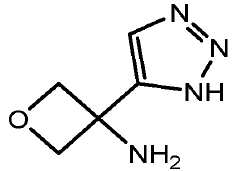
- 중간체 
- 중간체 I29 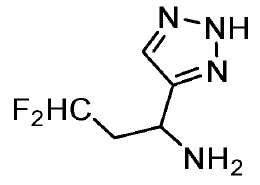
중간체 I30의 합성Synthesis of Intermediate I30
단계 1 Step 1

0℃에서 THF (8 mL) 중 2-{[(tert-부톡시)카르보닐]아미노}-3,3-디플루오로-2-메틸프로판산 (800 mg, 3.34 mmol)의 용액에 DIPEA (699 μL, 4.01 mmol)를 첨가하고 에틸 클로로포르메이트 (352 μL, 3.68 mmol)를 적가하였다. 상기 반응물을 0℃에서 2시간 교반시켰다. 형성된 침전물을 여과시키고, 무수 테트라히드로푸란 (5 mL)으로 세척하였다. 여과액을 0℃까지 냉각시키고, 이어서 리튬 보로히드라이드 용액 (1.67 mL, THF 중 4 N, 6.69 mmol)을 적가하였다. 상기 반응물을 실온에서 4시간 교반시켰다. 반응 혼합물을 물 (100 mL)로 희석시키고, EtOAc (3 x 100 mL)로 추출하였다. 합한 유기 층을 염수로 세척하고, Na2SO4로 건조시키고, 여과시키고, 감압 하에 농축시켰다. 조 물질을 실리카 겔 컬럼 크로마토그래피 (100/0으로부터 7/3까지의 시클로헥산/EtOAc)로 정제하여 tert-부틸 (1,1-디플루오로-3-히드록시-2-메틸프로판-2-일)카르바메이트 (473 mg, 63%의 수율)를 백색 고형물로 수득하였다. To a solution of 2-{[(tert-butoxy)carbonyl]amino}-3,3-difluoro-2-methylpropanoic acid (800 mg, 3.34 mmol) in THF (8 mL) at 0° C. 699 μL, 4.01 mmol) was added and ethyl chloroformate (352 μL, 3.68 mmol) was added dropwise. The reaction was stirred at 0° C. for 2 hours. The precipitate formed was filtered and washed with anhydrous tetrahydrofuran (5 mL). The filtrate was cooled to 0° C., then lithium borohydride solution (1.67 mL, 4 N in THF, 6.69 mmol) was added dropwise. The reaction was stirred at room temperature for 4 hours. The reaction mixture was diluted with water (100 mL) and extracted with EtOAc (3×100 mL). The combined organic layers were washed with brine, dried over Na 2 SO 4 , filtered and concentrated under reduced pressure. The crude material was purified by silica gel column chromatography (Cyclohexane/EtOAc from 100/0 to 7/3) to tert-butyl (1,1-difluoro-3-hydroxy-2-methylpropane-2- Day) carbamate (473 mg, 63% yield) was obtained as a white solid.
단계 2Step 2

0℃에서 DCM (16.8 mL) 중 tert-부틸 (1,1-디플루오로-2-메틸-3-옥소프로판-2-일)카르바메이트 (473 mg, 2.10 mmol)의 용액에 데스-마틴(Dess-Martin) 퍼요오디난 (1.25 g, 2.94mmol)을 첨가하였다. 상기 반응물을 6시간 동안 교반시켜 빙조가 실온까지 되돌아가게 하였다. 반응 혼합물을 1 M Na2S2O3 용액 (150 mL)으로 켄칭하였다. 수성 층을 EtAOc (3 x 100 mL)로 추출하였다. 합한 유기 층을 수성 포화 NaHCO3 용액 (2 x 100 mL), 염수로 세척하고, Na2SO4로 건조시키고, 감압 하에 농축시켰다. 조 물질을 실리카 컬럼 크로마토그래피 (100/0으로부터 8/2까지의 시클로헥산/EtOAc)로 정제하여 tert-부틸 (1,1-디플루오로-2-메틸-3-옥소프로판-2-일)카르바메이트 (451 mg, 96%)를 백색 고형물로 수득하였다. To a solution of tert-butyl (1,1-difluoro-2-methyl-3-oxopropan-2-yl)carbamate (473 mg, 2.10 mmol) in DCM (16.8 mL) at 0° C. Dess-Martin (Dess-Martin) periodinane (1.25 g, 2.94 mmol) was added. The reaction was stirred for 6 hours to allow the ice bath to return to room temperature. The reaction mixture was mixed with 1 M Na 2 S 2 O 3 solution (150 mL). The aqueous layer was extracted with EtAOc (3 x 100 mL). The combined organic layers were washed with aqueous saturated NaHCO 3 solution (2×100 mL), brine, dried over Na 2 SO 4 and concentrated under reduced pressure. The crude material was purified by silica column chromatography (Cyclohexane/EtOAc from 100/0 to 8/2) to tert-butyl (1,1-difluoro-2-methyl-3-oxopropan-2-yl) The carbamate (451 mg, 96%) was obtained as a white solid.
단계 3Step 3

0℃에서 메탄올 (7.9 mL) 중 tert-부틸 (1,1-디플루오로-2-메틸-3-옥소프로판-2-일)카르바메이트 (450 mg, 2.02 mmol)의 용액에 탄산칼륨 (557 mg, 4.03 mmol) 및 디메틸(1-디아조-2-옥소프로필)포스포네이트 (318 μL, 2.12 mmol)를 첨가하였다. 상기 반응물을 18시간 동안 교반시켜 빙조가 실온까지 되돌아가게 하였다. 반응 혼합물을 감압 하에 농축시켰다. 수득된 잔사를 H2O (100 mL)에 히석시키고, Et2O (3 x 100 mL)로 추출하였다. 합한 유기 층을 Na2SO4로 건조시키고, 여과시키고, 건조상태까지 농축시켰다. 수득된 잔사를 DCM (10 mL)에 용해시키고, Na2SO4로 건조시키고, 여과시키고, 농축시켜 tert-부틸 (1,1-디플루오로-2-메틸부트-3-인-2-일)카르바메이트 (326 mg, 74%)를 수득하였다.To a solution of tert-butyl (1,1-difluoro-2-methyl-3-oxopropan-2-yl)carbamate (450 mg, 2.02 mmol) in methanol (7.9 mL) at 0 °C was potassium carbonate ( 557 mg, 4.03 mmol) and dimethyl(1-diazo-2-oxopropyl)phosphonate (318 μL, 2.12 mmol) were added. The reaction was stirred for 18 hours to allow the ice bath to return to room temperature. The reaction mixture was concentrated under reduced pressure. The obtained residue was diluted in H 2 O (100 mL) and extracted with Et 2 O (3×100 mL). The combined organic layers were dried over Na 2 SO 4 , filtered and concentrated to dryness. The obtained residue was dissolved in DCM (10 mL), dried over Na 2 SO 4 , filtered and concentrated to tert-butyl (1,1-difluoro-2-methylbut-3-yn-2-yl) ) carbamate (326 mg, 74%).
단계 4Step 4

MW 바이알에서 DMF (3 mL)와 메탄올 (0.3 mL)의 혼합물 중 tert-부틸 (1,1-디플루오로-2-메틸부트-3-인-2-일)카르바메이트 (415 mg, 1.89 mmol)의 용액에 요오드화구리 (18.0 mg, 0.095 mmol) 및 아지도트리메틸실란 (702 μL, 5.30 mmol)을 첨가하였다. 반응 용기를 밀봉하고, 그 후 100℃에서 5시간 교반시켰다. 반응 혼합물을 EtOAc (100 mL)로 희석시키고, 염수 (3 x 100mL)로 세척하고, Na2SO4로 건조시키고, 여과시키고, 농축시켰다. 조 물질을 실리카 겔 컬럼 크로마토그래피 (100/0으로부터 95/5까지의 DCM/MeOH)에서 정제하여 tert-부틸 (1,1-디플루오로-2-(1H-1,2,3-트리아졸-4-일)프로판-2-일)카르바메이트 (629 mg, 86%)를 연한 황색 오일로 수득하고, 이를 다음 단계에서 그대로 사용하였다.tert-Butyl (1,1-difluoro-2-methylbut-3-yn-2-yl)carbamate (415 mg, 1.89) in a mixture of DMF (3 mL) and methanol (0.3 mL) in a MW vial mmol) were added copper iodide (18.0 mg, 0.095 mmol) and azidotrimethylsilane (702 μL, 5.30 mmol). The reaction vessel was sealed, and then stirred at 100°C for 5 hours. The reaction mixture was diluted with EtOAc (100 mL), washed with brine (3×100 mL), dried over Na 2 SO 4 , filtered and concentrated. The crude material was purified on silica gel column chromatography (DCM/MeOH from 100/0 to 95/5) to tert-butyl (1,1-difluoro-2-(1H-1,2,3-triazole) -4-yl)propan-2-yl)carbamate (629 mg, 86%) was obtained as a pale yellow oil, which was used as such in the next step.
단계 5: Step 5:

HCl (4.33 mL, iPrOH 중 6 N, 26.0 mmol) 중 tert-부틸 (1,1-디플루오로-2-(1H-1,2,3-트리아졸-4-일)프로판-2-일)카르바메이트 (625 mg, 1.63 mmol)의 용액을 실온에서 2시간 동안 교반시켰다. 반응 혼합물을 건조상태까지 농축시키고, DCM (5 x 10 mL)과 공동증발시키고, 50℃에서 하룻밤 진공 건조시켜 중간체 I30 (312 mg, 97%의 수율)을 연한 녹색 고형물로 수득하고, 이를 다음 단계에서 그대로 사용하였다.tert-Butyl (1,1-difluoro-2-(1H-1,2,3-triazol-4-yl)propan-2-yl) in HCl (4.33 mL, 6 N in iPrOH, 26.0 mmol) A solution of carbamate (625 mg, 1.63 mmol) was stirred at room temperature for 2 h. The reaction mixture was concentrated to dryness, co-evaporated with DCM (5 x 10 mL), and dried in vacuo at 50 °C overnight to afford Intermediate I30 (312 mg, 97% yield) as a pale green solid, which was used in the next step was used as is.
유사한 방식으로 중간체 I31 
유사한 방식으로 중간체 I32 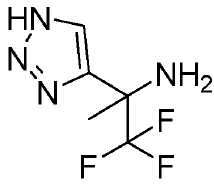
유사한 방식으로 중간체 I33 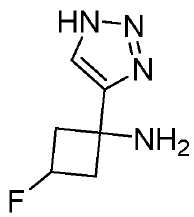
중간체 I34의 합성Synthesis of intermediate I34
단계 1 Step 1

0℃에서 DCM (36 mL) 중 메틸 1-{[(tert-부톡시)카르보닐]아미노}-3-히드록시시클로부탄-1-카르복실레이트 (900 mg, 3.67 mmol, 7/3 또는 3/7의 트랜스/시스 혼합물)의 용액에 이미다졸 (824 mg, 12.1 mmol) 및 tert-부틸디메틸실릴 클로라이드 (996 mg, 6.61 mmol)를 첨가하였다. 상기 반응물을 16시간 동안 교반시켜 빙조가 실온까지 되돌아가게 하였다. 반응 혼합물을 DCM (50 mL)으로 희석시키고, 수성 1 N HCl 용액 (2 x 150 mL), 수성 포화 NaHCO3 용액 (150 mL), 염수로 세척하고, Na2SO4로 건조시키고, 여과시키고, 농축시켜 메틸 1-((tert-부톡시카르보닐)아미노)-3-((tert-부틸디메틸실릴)옥시)시클로부탄-1-카르복실레이트를 수득하고, 이를 다음 단계에서 그대로 사용하였다. Methyl 1-{[(tert-butoxy)carbonyl]amino}-3-hydroxycyclobutane-1-carboxylate (900 mg, 3.67 mmol, 7/3 or 3) in DCM (36 mL) at 0° C. To a solution of /7 (trans/cis mixture) was added imidazole (824 mg, 12.1 mmol) and tert-butyldimethylsilyl chloride (996 mg, 6.61 mmol). The reaction was stirred for 16 h, allowing the ice bath to return to room temperature. The reaction mixture was diluted with DCM (50 mL), aqueous 1 N HCl solution (2×150 mL), aqueous saturated NaHCO 3 solution (150 mL), washed with brine, dried over Na 2 SO 4 , filtered and concentrated to methyl 1-((tert-butoxycarbonyl)amino)-3-((tert-butyldimethylsilyl)oxy ) cyclobutane-1-carboxylate was obtained, which was used as such in the next step.
단계 2Step 2
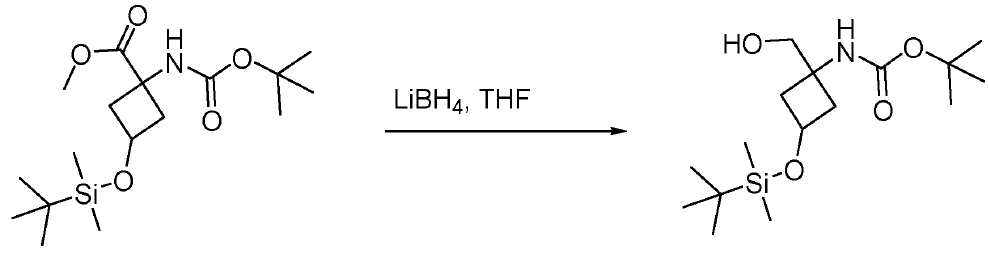
0℃에서 THF (36 mL) 중 메틸 1-((tert-부톡시카르보닐)아미노)-3-((tert-부틸디메틸실릴)옥시)시클로부탄-1-카르복실레이트 (1.63 g, 3.67 mmol)의 용액에 리튬 보로히드라이드 (2.75 mL, THF 중 4 N, 11.0 mmol)를 적가하였다. 상기 반응물을 3시간 동안 교반시켜 빙조가 실온까지 되돌아가게 하였다. 반응 혼합물을 물 (100 mL)로 희석시키고, EtOAc (3 x 100 mL)로 추출하였다. 합한 유기 층을 염수로 세척하고, Na2SO4로 건조시키고, 여과시키고, 감압 하에 농축시켰다. 조 물질을 실리카 겔 컬럼 크로마토그래피 (100/0으로부터 8/2까지의 시클로헥산/EtOAc)로 정제하여 tert-부틸 (3-((tert-부틸디메틸실릴)옥시)-1-(히드록시메틸)시클로부틸)카르바메이트 (1.15 g, 94%의 수율)를 백색 고형물로 수득하였다.Methyl 1-((tert-butoxycarbonyl)amino)-3-((tert-butyldimethylsilyl)oxy)cyclobutane-1-carboxylate (1.63 g, 3.67 mmol) in THF (36 mL) at 0° C. ) was added dropwise lithium borohydride (2.75 mL, 4 N in THF, 11.0 mmol). The reaction was stirred for 3 hours to allow the ice bath to return to room temperature. The reaction mixture was diluted with water (100 mL) and extracted with EtOAc (3×100 mL). The combined organic layers were washed with brine, dried over Na 2 SO 4 , filtered and concentrated under reduced pressure. The crude material was purified by silica gel column chromatography (Cyclohexane/EtOAc from 100/0 to 8/2) to tert-butyl (3-((tert-butyldimethylsilyl)oxy)-1-(hydroxymethyl) Cyclobutyl)carbamate (1.15 g, 94% yield) was obtained as a white solid.
단계 3Step 3
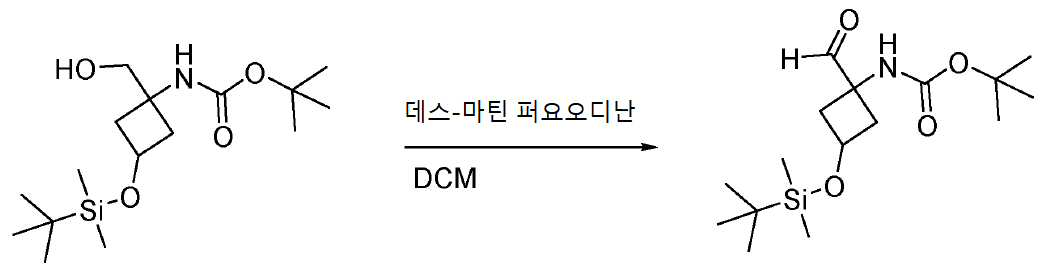
0℃에서 DCM (28 mL) 중 tert-부틸 (3-((tert-부틸디메틸실릴)옥시)-1-(히드록시메틸)시클로부틸)카르바메이트 (1.15 g, 3.45 mmol)의 용액에 데스-마틴 퍼요오디난 (2.05 g, 4.84 mmol)을 첨가하였다. 상기 반응물을 6시간 동안 교반시켜 빙조가 실온까지 되돌아가게 하였다. 반응 혼합물을 1 M Na2S2O3 용액 (150 mL)으로 켄칭하였다. 수성 층을 DCM (3 x 100mL)으로 추출하였다. 합한 유기 층을 수성 포화 NaHCO3 용액 (2 x 100 mL), 염수로 세척하고, Na2SO4로 건조시키고, 농축시켰다. 조 물질을 실리카 겔 컬럼 크로마토그래피 (100/0으로부터 8/2까지의 시클로헥산/EtOAc)로 정제하여 tert-부틸 (3-((tert-부틸디메틸실릴)옥시)-1-포르밀시클로부틸)카르바메이트 (1.07 g, 94%)를 백색 고형물로 수득하였다.To a solution of tert-butyl (3-((tert-butyldimethylsilyl)oxy)-1-(hydroxymethyl)cyclobutyl)carbamate (1.15 g, 3.45 mmol) in DCM (28 mL) at 0° C. -Martin periodinane (2.05 g, 4.84 mmol) was added. The reaction was stirred for 6 hours to allow the ice bath to return to room temperature. The reaction mixture was quenched with 1 M Na 2 S 2 O 3 solution (150 mL). The aqueous layer was extracted with DCM (3×100 mL). The combined organic layers were washed with aqueous saturated NaHCO 3 solution (2×100 mL), brine, dried over Na 2 SO 4 and concentrated. The crude material was purified by silica gel column chromatography (Cyclohexane/EtOAc from 100/0 to 8/2) to tert-butyl (3-((tert-butyldimethylsilyl)oxy)-1-formylcyclobutyl) The carbamate (1.07 g, 94%) was obtained as a white solid.
단계 4 Step 4

0℃에서 메탄올 (12.7 mL) 중 tert-부틸 (3-((tert-부틸디메틸실릴)옥시)-1-포르밀시클로부틸)카르바메이트 (1.07 g, 3.25 mmol)의 용액에 탄산칼륨 (899 mg, 6.51 mmol) 및 디메틸(1-디아조-2-옥소프로필)포스포네이트 (513 μL, 3.42 mmol)를 첨가하였다. 상기 반응물을 18시간 동안 교반시켜 빙조가 실온까지 되돌아가게 하였다. 상기 반응물을 농축시켰다. 수득된 잔사를 물 (100 mL)에 희석시키고, Et2O (3 x 150 mL)로 추출하였다. 합한 유기 층을 Na2SO4로 건조시키고, 여과시키고, 건조상태까지 농축시켜 tert-부틸 (3-((tert-부틸디메틸실릴)옥시)-1-에티닐시클로부틸)카르바메이트 (950 mg, 82%의 수율)를 백색 고형물로 수득하였다.To a solution of tert-butyl (3-((tert-butyldimethylsilyl)oxy)-1-formylcyclobutyl)carbamate (1.07 g, 3.25 mmol) in methanol (12.7 mL) at 0 °C was potassium carbonate (899) mg, 6.51 mmol) and dimethyl(1-diazo-2-oxopropyl)phosphonate (513 μL, 3.42 mmol) were added. The reaction was stirred for 18 hours to allow the ice bath to return to room temperature. The reaction was concentrated. The obtained residue was diluted in water (100 mL) and extracted with Et 2 O (3×150 mL). The combined organic layers were dried over Na 2 SO 4 , filtered and concentrated to dryness, tert-butyl (3-((tert-butyldimethylsilyl)oxy)-1-ethynylcyclobutyl)carbamate (950 mg , yield of 82%) as a white solid.
단계 5Step 5

THF (5.8 mL) 중 tert-부틸 (3-((tert-부틸디메틸실릴)옥시)-1-에티닐시클로부틸)카르바메이트 (900 mg, 2.52 mmol)의 용액에 구리(I) 3-메틸살리실레이트 (595 mg, 2.77 mmol) 및 아지도트리메틸실란 (401 μL, 3.02 mmol)을 첨가하였다. 반응 혼합물을 실온에서 4시간 교반시켰다. 반응 혼합물을 EtOAc (30 mL) 및 MeOH (30 mL)로 희석시키고, SiliaMetS® TAAcONa L=0.41 mmol/g (2.5 당량, 15 g)을 첨가하였다. 상기 현탁물을 1시간 교반시키고, 여과시켰다. 고체상을 MeOH로 세척하고, 여과액을 농축시켰다. 수득된 잔사를 EtOAc (100 mL)에 용해시키고, 수성 포화 NaHCO3 용액 (3 x 150 mL), 염수 (50 mL)로 세척하고, Na2SO4로 건조시키고, 여과시키고, 농축시켰다. 조 물질을 실리카 컬럼 크로마토그래피 (100/0으로부터 95/5까지의 DCM/MeOH)에서 정제하여 tert-부틸 (3-((tert-부틸디메틸실릴)옥시)-1-(2H-1,2,3-트리아졸-4-일)시클로부틸)카르바메이트 (898 mg, 90%의 수율)를 백색 고형물로 수득하였다.To a solution of tert-butyl (3-((tert-butyldimethylsilyl)oxy)-1-ethynylcyclobutyl)carbamate (900 mg, 2.52 mmol) in THF (5.8 mL) copper(I) 3-methyl Salicylate (595 mg, 2.77 mmol) and azidotrimethylsilane (401 μL, 3.02 mmol) were added. The reaction mixture was stirred at room temperature for 4 hours. The reaction mixture was diluted with EtOAc (30 mL) and MeOH (30 mL) and SiliaMetS® TAAcONa L=0.41 mmol/g (2.5 equiv, 15 g) was added. The suspension was stirred for 1 h and filtered. The solid phase was washed with MeOH and the filtrate was concentrated. The obtained residue was dissolved in EtOAc (100 mL), washed with aqueous saturated NaHCO 3 solution (3×150 mL), brine (50 mL), dried over Na 2 SO 4 , filtered and concentrated. The crude material was purified on silica column chromatography (DCM/MeOH from 100/0 to 95/5) to tert-butyl (3-((tert-butyldimethylsilyl)oxy)-1-(2H-1,2, 3-triazol-4-yl)cyclobutyl)carbamate (898 mg, 90% yield) was obtained as a white solid.
단계 6 Step 6

DCM (9.5 mL)과 HCl (9.55 mL, 디옥산 중 4 N, 38.2 mmol)의 혼합물 중 tert-부틸 (3-((tert-부틸디메틸실릴)옥시)-1-(2H-1,2,3-트리아졸-4-일)시클로부틸)카르바메이트 (890 mg, 2.39 mmol)의 용액을 실온에서 2시간 교반시켰다. 반응 혼합물을 건조상태까지 농축시키고, DCM (5 x 10 mL)과 공동증발시켜 556 mg의 중간체 I34를 백색 고형물로 수득하고 (수율은 정량적인 것으로 간주됨), 이를 다음 단계에서 그대로 사용하였다.tert-butyl (3-((tert-butyldimethylsilyl)oxy)-1-(2H-1,2,3) in a mixture of DCM (9.5 mL) and HCl (9.55 mL, 4 N in dioxane, 38.2 mmol) A solution of -triazol-4-yl)cyclobutyl)carbamate (890 mg, 2.39 mmol) was stirred at room temperature for 2 hours. The reaction mixture was concentrated to dryness and co-evaporated with DCM (5 x 10 mL) to give 556 mg of intermediate I34 as a white solid (yield was considered quantitative), which was used as such in the next step.
중간체 I35의 합성Synthesis of Intermediate I35
단계 1Step 1

메틸 1-([(tert-부톡시)카르보닐]아미노)-3,3-디플루오로시클로부탄-1-카르복실레이트 (5 g, 18.85 mmol) 및 히드라진 수화물을 MeOH (20 mL)에 용해시키고, 60℃에서 하룻밤 가열하였다. 침전물을 여과 제거하고, 건조시켜 tert-부틸 (3,3-디플루오로-1-(히드라진카르보닐)시클로부틸)카르바메이트 (4.02 g, 수율: 80%)를 백색 분말로 수득하였다.Dissolve methyl 1-([(tert-butoxy)carbonyl]amino)-3,3-difluorocyclobutane-1-carboxylate (5 g, 18.85 mmol) and hydrazine hydrate in MeOH (20 mL) and heated at 60 °C overnight. The precipitate was filtered off and dried to give tert-butyl (3,3-difluoro-1-(hydrazinecarbonyl)cyclobutyl)carbamate (4.02 g, yield: 80%) as a white powder.
단계 2 Step 2

Tert-부틸 (3,3-디플루오로-1-(히드라진카르보닐)시클로부틸)카르바메이트 (1 g, 3.77 mmol), 에틸 에탄이미도에이트.히드로클로라이드 (489 mg, 3.96 mmol) 및 NaOH (165.8 mg, 4.15 mmol)를 MeOH (10 mL)에 분배하고, 70℃에서 2시간 교반시켰다. LCMS는 생성물 형성을 나타냈다. 교반을 85℃에서 하룻밤 계속하였다. 휘발성 물질을 감압 하에 제거하고, 잔사를 DCM에 미분화하고, 여과시켜 tert-부틸 (3,3-디플루오로-1-(5-메틸-4H-1,2,4-트리아졸-3-일)시클로부틸)카르바메이트 분말 (848 mg, 78%의 수율)을 백색 물질로 수득하였다.Tert-butyl (3,3-difluoro-1-(hydrazinecarbonyl)cyclobutyl)carbamate (1 g, 3.77 mmol), ethyl ethanimidoate.hydrochloride (489 mg, 3.96 mmol) and NaOH ( 165.8 mg, 4.15 mmol) was partitioned into MeOH (10 mL) and stirred at 70° C. for 2 h. LCMS showed product formation. Stirring was continued overnight at 85°C. The volatiles were removed under reduced pressure, the residue was triturated in DCM, filtered and tert-butyl (3,3-difluoro-1-(5-methyl-4H-1,2,4-triazol-3-yl) )Cyclobutyl)carbamate powder (848 mg, yield of 78%) was obtained as a white material.
단계 3Step 3
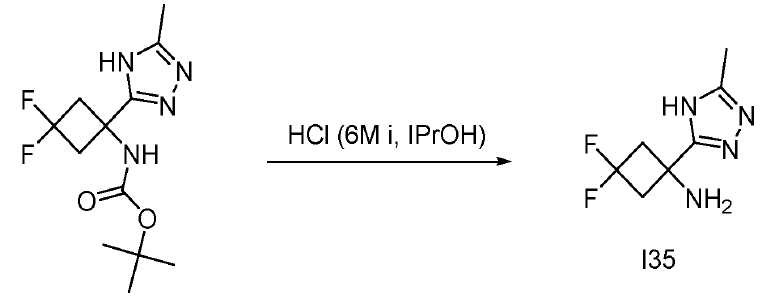
Tert-부틸 (3,3-디플루오로-1-(5-메틸-4H-1,2,4-트리아졸-3-일)시클로부틸)카르바메이트 (848 mg, 2.94 mmol)를 HCl (40 mL, iPrOH 중 6 M, 240 mmol)에 분배하고, 실온에서 하룻밤 교반시켰다. 휘발성 물질을 감압 하에 제거하고, 잔사를 MeOH에 재용해시키고, 건조상태까지 증발시켜 중간체 I35를 백색 분말로 수득하였다 (754 mg, 98%의 수율).Tert-butyl (3,3-difluoro-1-(5-methyl-4H-1,2,4-triazol-3-yl)cyclobutyl)carbamate (848 mg, 2.94 mmol) was dissolved in HCl ( 40 mL, 6 M in iPrOH, 240 mmol) and stirred at room temperature overnight. The volatiles were removed under reduced pressure and the residue was redissolved in MeOH and evaporated to dryness to give intermediate I35 as a white powder (754 mg, 98% yield).
중간체 I36의 합성Synthesis of Intermediate I36
단계 1 Step 1

Tert-부틸 (3,3-디플루오로-1-(5-메틸-4H-1,2,4-트리아졸-3-일)시클로부틸)카르바메이트 (1 g, 3.77 mmol), 에틸 포름이미데이트 히드로클로라이드 (474 mg, 4.34 mmol) 및 NaOH (165 mg, 4.15 mmol)를 MeOH (10 mL)에 현탁시키고, 70℃에서 하룻밤 교반시켰다. 휘발성 물질을 제거하고, 잔사를 EtOH (10 mL)에 분배하고, 마이크로웨이브에서 140℃에서 1시간 가열하였다. 반응 혼합물을 냉각시키고, 침전물을 여과 제거하여 tert-부틸 (3,3-디플루오로-1-(4H-1,2,4-트리아졸-3-일)시클로부틸)카르바메이트를 백색 분말로 수득하고, 이를 그대로 사용하였다.Tert-Butyl (3,3-difluoro-1-(5-methyl-4H-1,2,4-triazol-3-yl)cyclobutyl)carbamate (1 g, 3.77 mmol), ethyl form Imidate hydrochloride (474 mg, 4.34 mmol) and NaOH (165 mg, 4.15 mmol) were suspended in MeOH (10 mL) and stirred at 70° C. overnight. The volatiles were removed and the residue was partitioned into EtOH (10 mL) and heated in a microwave at 140° C. for 1 h. The reaction mixture was cooled and the precipitate was filtered off to give tert-butyl (3,3-difluoro-1-(4H-1,2,4-triazol-3-yl)cyclobutyl)carbamate as a white powder. obtained, and used as such.
단계 2Step 2
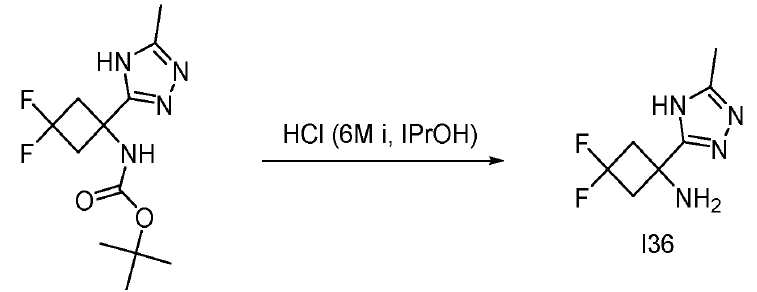
HCl (6.28 mL, iPrOH 중 6 M, 37.7 mmol)을 iPrOH (10 mL) 중 tert-부틸 (3,3-디플루오로-1-(4H-1,2,4-트리아졸-3-일)시클로부틸) (1.03 mg, 3.77 mmol)의 용액에 첨가하였다. 반응 혼합물을 실온에서 하룻밤 교반시켰다. 휘발성 물질을 감압 하에 제거하여 중간체 I36 (508 mg, 54%의 수율)을 백색 분말로 수득하였다.HCl (6.28 mL, 6 M in iPrOH, 37.7 mmol) in iPrOH (10 mL) in tert-butyl (3,3-difluoro-1-(4H-1,2,4-triazol-3-yl) cyclobutyl) (1.03 mg, 3.77 mmol). The reaction mixture was stirred at room temperature overnight. The volatiles were removed under reduced pressure to give intermediate 136 (508 mg, yield of 54%) as a white powder.
중간체 I37의 합성Synthesis of Intermediate I37
단계 1 Step 1

N2 하에 -78℃에서 테트라히드로푸란 (40 mL) 중 포타슘 tert-부톡시드 (2.98 g, 26.56 mmol)의 현탁물에 N-Cbz-2-포스포노글리신 트리메틸 에스테르 (8 g, 24.15 mmol)를 첨가하였다. 이것을 이 온도에서 30분 동안 교반시키고, 그 후 디플루오로아세트알데히드 에틸 헤미아세탈 (6.09 g, 48.30 mmol)을 서서히 첨가하였다. 생성된 혼합물을 실온까지 가온하고 18시간 동안 교반시켰다. 그 후, 반응 혼합물을 물로 켄칭하고, 1 N HCl 몇 드롭을 첨가하여 pH=5로 조정하였다. 상기 혼합물을 EtOAc로 추출하였다. 유기 층을 MgSO4로 건조시키고, 여과시키고, 농축시켰다. 조 물질을 실리카 컬럼 크로마토그래피 (70/30의 EtOAc/PE)에서 정제하여 메틸 (E)-2-(((벤질옥시)카르보닐)아미노)-4,4-디플루오로부트-2-에노에이트 (6 g, 87%의 수율)를 경질 오일로 수득하였다. To a suspension of potassium tert-butoxide (2.98 g, 26.56 mmol) in tetrahydrofuran (40 mL) at -78 °C under N 2 was added N-Cbz-2-phosphonoglycine trimethyl ester (8 g, 24.15 mmol) added. It was stirred at this temperature for 30 minutes, after which difluoroacetaldehyde ethyl hemiacetal (6.09 g, 48.30 mmol) was added slowly. The resulting mixture was warmed to room temperature and stirred for 18 h. After that, the reaction mixture was quenched with water and adjusted to pH=5 by adding a few drops of 1 N HCl. The mixture was extracted with EtOAc. The organic layer was dried over MgSO4, filtered and concentrated. The crude material was purified on silica column chromatography (EtOAc/PE of 70/30) to methyl (E)-2-(((benzyloxy)carbonyl)amino)-4,4-difluorobut-2-eno Eight (6 g, yield of 87%) was obtained as a light oil.
단계 2 Step 2

4-디메틸아미노피리딘 (0.26 g, 2.10 mmol, 0.1 당량)을 포함하는 테트라히드로푸란 (50 mL) 중 메틸 (E)-2-(((벤질옥시)카르보닐)아미노)-4,4-디플루오로부트-2-에노에이트 (6 g, 21.03 mmol, 1 당량)의 용액에 디-tert-부틸 디카르보네이트 (6.89 g, 31.55 mmol, 1.5 당량)를 0℃에서 첨가하였다. 생성된 혼합물을 실온에서 하룻밤 교반시켰다. 반응 혼합물을 감압 하에 농축시켰다. 잔사를 실리카 컬럼 크로마토그래피 (1/3의 EA/PE)에서 정제하여 (E)-메틸 2-((벤질옥시카르보닐)(tert-부톡시카르보닐)아미노)-4,4-디플루오로부트-2-에노에이트 (7 g, 86 %의 수율)를 경질 오일로 수득하였다.Methyl (E)-2-(((benzyloxy)carbonyl)amino)-4,4-di in tetrahydrofuran (50 mL) with 4-dimethylaminopyridine (0.26 g, 2.10 mmol, 0.1 equiv) To a solution of fluorobut-2-enoate (6 g, 21.03 mmol, 1 equiv) was added di-tert-butyl dicarbonate (6.89 g, 31.55 mmol, 1.5 equiv) at 0°C. The resulting mixture was stirred at room temperature overnight. The reaction mixture was concentrated under reduced pressure. The residue was purified by silica column chromatography (EA/PE of 1/3) to (E)-methyl 2-((benzyloxycarbonyl)(tert-butoxycarbonyl)amino)-4,4-difluoro But-2-enoate (7 g, 86% yield) was obtained as a light oil.
단계 3Step 3

DMSO (60 ml) 중 수소화나트륨 (0.61 g, 25.30 mmol)의 혼합물에 트리메틸술폭소늄 요오다이드 (5.78 mg, 26.27 mmol)를 첨가하고, 혼합물을 실온에서 1시간 동안 교반시켰다. 그 후 (E)-메틸 2-((벤질옥시카르보닐)(tert-부톡시카르보닐)아미노)-4,4- 디플루오로부트-2-에노에이트 (7.5 g, 19.46 mmol, 1 당량)를 첨가하고, 혼합물을 80℃에서 2시간 동안 가열하였다. 그 후 상기 반응물을 실온까지 냉각시키고, 18시간 동안 교반시켰다. 물 (5 mL)을 첨가하고, 이어서 1 N HCl을 첨가하여 pH를 5로 조정하였다. 이 혼합물을 에틸 아세테이트로 추출하고, MgSO4로 건조시키고, 여과시키고, 감압 하에 농축시켰다. 조 물질을 실리카 컬럼 크로마토그래피 (EtOAc/PE (85/15))에서 정제하여 메틸 1- ((벤질옥시카르보닐)(tert-부톡시카르보닐)아미노)-2-(디플루오로메틸)시클로프로판카르복실레이트 (2 g, 25 %의 수율) 및 메틸 1-(tert-부톡시카르보닐아미노)-2- (디플루오로메틸)시클로프로판카르복실레이트 (1.5 g, 29 %의 수율)를 오일로 수득하였다.To a mixture of sodium hydride (0.61 g, 25.30 mmol) in DMSO (60 ml) was added trimethylsulfoxonium iodide (5.78 mg, 26.27 mmol) and the mixture was stirred at room temperature for 1 h. Then (E)-methyl 2-((benzyloxycarbonyl)(tert-butoxycarbonyl)amino)-4,4-difluorobut-2-enoate (7.5 g, 19.46 mmol, 1 equiv) was added, and the mixture was heated at 80° C. for 2 hours. The reaction was then cooled to room temperature and stirred for 18 hours. Water (5 mL) was added followed by 1 N HCl to adjust the pH to 5. The mixture was extracted with ethyl acetate, dried over MgSO4, filtered and concentrated under reduced pressure. The crude material was purified on silica column chromatography (EtOAc/PE (85/15)) to methyl 1-((benzyloxycarbonyl)(tert-butoxycarbonyl)amino)-2-(difluoromethyl)cyclo propanecarboxylate (2 g, yield of 25%) and methyl 1-(tert-butoxycarbonylamino)-2-(difluoromethyl)cyclopropanecarboxylate (1.5 g, yield of 29%) obtained as an oil.
단계 4 Step 4
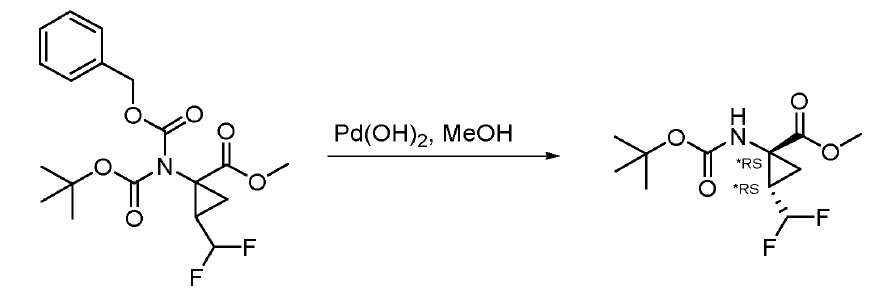
메탄올 (20 ml) 중 메틸 1-(((벤질옥시)카르보닐)(tert-부톡시카르보닐)아미노)-2-(디플루오로메틸)시클로프로판-1-카르복실레이트 (3 g, 7.5 mmol)의 용액에 수산화팔라듐 (105.5mg, 0.751 mmol)을 첨가하였다. 상기 용액을 실온에서 1시간 동안 교반시켰다. 반응 혼합물을 농축시켰다. 조 물질을 역 C18 컬럼 (0~60% H2O (0.5%TFA)/ACN)으로 정제하여 1-(tert-부톡시카르보닐아미노)-2-(디플루오로메틸)시클로프로판카르복실산 (1.27 g, 61%의 수율)을 백색 고형물로 수득하였다. Methyl 1-(((benzyloxy)carbonyl)(tert-butoxycarbonyl)amino)-2-(difluoromethyl)cyclopropane-1-carboxylate (3 g, 7.5) in methanol (20 ml) mmol) was added palladium hydroxide (105.5 mg, 0.751 mmol). The solution was stirred at room temperature for 1 hour. The reaction mixture was concentrated. The crude was purified by reverse C18 column (0-60% H 2 O (0.5% TFA)/ACN) to 1-(tert-butoxycarbonylamino)-2-(difluoromethyl)cyclopropanecarboxylic acid (1.27 g, yield of 61%) was obtained as a white solid.
단계 5Step 5

리튬 보로히드라이드 (7.5 mL, THF 중 4 M, 30 mmol)를 건조 Me-THF (50 mL) 중 1-(tert-부톡시카르보닐아미노)-2-(디플루오로메틸)시클로프로판카르복실산 (1.9 g, 7.17 mmol)의 빙냉 용액에 서서히 첨가하였다. 반응 혼합물을 15분에 걸쳐 실온에 도달하게 하고, 추가로 1시간 동안 교반시켰다. TLC는 출발 물질의 완전한 전환을 나타냈다. EtOAc (11.7 mL, 120 mmol)를 첨가하고, 반응 혼합물을 1시간 동안 교반시켰다. 반응 혼합물을 물 (100 mL) 및 DCM (100 mL)으로 희석시켰다. 층들을 분리하고, 수성 층을 DCM (2 X 50 mL)으로 추출하였다. 합한 유기 층을 MgSO4로 건조시키고, 여과시키고, 건조상태까지 증발시켜 tert-부틸 (2-(디플루오로메틸)-1-(히드록시메틸)시클로프로필)카르바메이트를 백색 분말로 수득하고, 이를 다음 단계에서 그대로 사용하였다.Lithium borohydride (7.5 mL, 4 M in THF, 30 mmol) was combined with 1-(tert-butoxycarbonylamino)-2-(difluoromethyl)cyclopropanecarboxyl in dry Me-THF (50 mL). To an ice-cold solution of acid (1.9 g, 7.17 mmol) was added slowly. The reaction mixture was allowed to reach room temperature over 15 minutes and stirred for an additional hour. TLC showed complete conversion of the starting material. EtOAc (11.7 mL, 120 mmol) was added and the reaction mixture was stirred for 1 h. The reaction mixture was diluted with water (100 mL) and DCM (100 mL). The layers were separated and the aqueous layer was extracted with DCM (2 X 50 mL). The combined organic layers were dried over MgSO 4 , filtered and evaporated to dryness to give tert-butyl (2-(difluoromethyl)-1-(hydroxymethyl)cyclopropyl)carbamate as a white powder , which was used as such in the next step.
단계 6~9: 중간체 I24를 수득한 것과 유사한 방식으로 중간체 I37 Steps 6-9: Intermediate I37 in a similar manner to obtaining intermediate I24

중간체 I38의 합성Synthesis of Intermediate I38
단계 1 Step 1

메틸 1-{[(tert-부톡시)카르보닐]아미노}-3,3-디플루오로시클로부탄-1-카르복실레이트 (10 g, 37.70 mmol) 및 수산화리튬 (1.81 g, 75.40 mmol,)의 혼합물에 THF/MeOH/H2O (v/v/v=3/1/1) (70 ml)의 혼합물을 첨가하였다. 상기 혼합물을 질소 하에 유지하고 실온에서 2시간 동안 교반시켰다. 반응 후, 유기 용매를 감압 하에 제거하였다. 백색 고형물이 나타날 때까지 (pH=2) 잔존 수상을 1 N HCl로 산성화하였다. 고형물을 여과를 통하여 수집하고, 감압 하에 건조시켜 1-((tert-부톡시카르보닐)아미노)-3,3-디플루오로시클로부탄-1-카르복실산 (8.8 g, 92%의 수율)을 백색 고형물로 수득하였다. Methyl 1-{[(tert-butoxy)carbonyl]amino}-3,3-difluorocyclobutane-1-carboxylate (10 g, 37.70 mmol) and lithium hydroxide (1.81 g, 75.40 mmol,) To a mixture of THF/MeOH/H 2 O (v/v/v=3/1/1) (70 ml) was added. The mixture was kept under nitrogen and stirred at room temperature for 2 hours. After the reaction, the organic solvent was removed under reduced pressure. The remaining aqueous phase was acidified with 1 N HCl until a white solid appeared (pH=2). The solid was collected via filtration and dried under reduced pressure to 1-((tert-butoxycarbonyl)amino)-3,3-difluorocyclobutane-1-carboxylic acid (8.8 g, 92% yield). was obtained as a white solid.
단계 2 Step 2

DMF (50 ml) 중 1-((tert-부톡시카르보닐)아미노)-3,3-디플루오로시클로부탄-1-카르복실산 (8.8 g, 35.03 mmol)의 용액에 염화암모늄 (9.37 g, 175 mmol) 및 HATU (19.98 g, 52.54 mmol)를 연속적으로 첨가하였다. 그 후, 생성된 혼합물에 DIPEA (22.64 g, 175.14 mmol)를 0℃에서 적가하였다. 반응 혼합물을 질소 하에 유지하고 실온에서 하룻밤 교반시켰다. 휘발성 물질을 압력 하에 제거하고 잔사를 EtOAc/헥산을 사용한 재결정화를 통해 정제하여 tert-부틸 (1-카르바모일-3,3-디플루오로시클로부틸)카르바메이트 (8.7 g, 99%의 수율)를 수득하였다.To a solution of 1-((tert-butoxycarbonyl)amino)-3,3-difluorocyclobutane-1-carboxylic acid (8.8 g, 35.03 mmol) in DMF (50 ml) ammonium chloride (9.37 g) , 175 mmol) and HATU (19.98 g, 52.54 mmol) were added successively. Thereafter, DIPEA (22.64 g, 175.14 mmol) was added dropwise to the resulting mixture at 0°C. The reaction mixture was kept under nitrogen and stirred at room temperature overnight. The volatiles were removed under pressure and the residue was purified via recrystallization with EtOAc/hexanes to obtain tert-butyl (1-carbamoyl-3,3-difluorocyclobutyl)carbamate (8.7 g, 99% of yield) was obtained.
단계 3Step 3

DCM (50 ml) 중 tert-부틸 (1-카르바모일-3,3-디플루오로시클로부틸)카르바메이트 (8.7 g, 34.77 mmol)의 용액에 피리딘 (11 g, 139.06 mmol)을 0℃에서 첨가하였다. 그 후, 트리플루오로아세트산 무수물 (14.60 g, 39.53 mmol)을 상기 온도에서 반응 혼합물에 적가하였다. 생성된 혼합물을 실온까지 가온하고, 2시간 동안 교반시켰다. 휘발성 물질을 감압 하에 제거하고, 잔사를 EA/헥산을 사용한 재결정화를 통해 정제하여 tert-부틸 (1-시아노-3,3-디플루오로시클로부틸)카르바메이트 (6.52 g, 81%의 수율)를 수득하였다.To a solution of tert-butyl (1-carbamoyl-3,3-difluorocyclobutyl)carbamate (8.7 g, 34.77 mmol) in DCM (50 ml) was added pyridine (11 g, 139.06 mmol) at 0° C. was added in Then trifluoroacetic anhydride (14.60 g, 39.53 mmol) was added dropwise to the reaction mixture at this temperature. The resulting mixture was warmed to room temperature and stirred for 2 h. The volatiles were removed under reduced pressure and the residue was purified via recrystallization with EA/hexanes to give tert-butyl (1-cyano-3,3-difluorocyclobutyl)carbamate (6.52 g, 81% of yield) was obtained.
단계 4Step 4

DMF (10 mL) 중 tert-부틸 (1-시아노-3,3-디플루오로시클로부틸)카르바메이트 (500 mg, 2.15 mmol)의 용액에 암모늄 (575 mg, 10.77 mmol) 및 소듐 아지드 (699 mg, 10.77 mmol)를 첨가하고, 반응 혼합물을 100℃에서 3시간 동안 가열하였다. 반응 혼합물을 실온까지 냉각시키고, decalite®로 여과시키고, DMF (2 mL)로 세척하고, 건조상태까지 농축시켰다. 잔사를 실리카 겔 컬럼 크로마토그래피 (0%로부터 100%까지의 헵탄 중 에틸 아세테이트)를 사용하여 정제하여 tert-부틸 (3,3-디플루오로-1-(2H-테트라졸-5-일)시클로부틸)카르바메이트 (400 mg, 수율: 67%)를 백색 분말로 수득하였다.To a solution of tert-butyl (1-cyano-3,3-difluorocyclobutyl)carbamate (500 mg, 2.15 mmol) in DMF (10 mL) with ammonium (575 mg, 10.77 mmol) and sodium azide (699 mg, 10.77 mmol) was added and the reaction mixture was heated at 100° C. for 3 h. The reaction mixture was cooled to room temperature, filtered over decalite®, washed with DMF (2 mL) and concentrated to dryness. The residue was purified using silica gel column chromatography (ethyl acetate in heptane from 0% to 100%) to tert-butyl (3,3-difluoro-1-(2H-tetrazol-5-yl)cyclo Butyl)carbamate (400 mg, yield: 67%) was obtained as a white powder.
단계 5Step 5

Tert-부틸 (3,3-디플루오로-1-(2H-테트라졸-5-일)시클로부틸)카르바메이트를 DCM/에틸 아세테이트 (10 mL / 5 mL)에 용해시키고, HCl (1.82 mL, 디옥산 중 4 M, 7.27 mmol)을 첨가하였다. 반응 혼합물을 실온에서 3일 동안 교반시켰다. 생성된 현탁물을 여과시키고, 고형물을 DCM으로 세척하여 중간체 I38 (132 mg, 85%)을 백색 고형물로 수득하였다.Tert-butyl (3,3-difluoro-1-(2H-tetrazol-5-yl)cyclobutyl)carbamate was dissolved in DCM/ethyl acetate (10 mL / 5 mL) and HCl (1.82 mL) , 4 M in dioxane, 7.27 mmol) was added. The reaction mixture was stirred at room temperature for 3 days. The resulting suspension was filtered and the solid was washed with DCM to afford intermediate I38 (132 mg, 85%) as a white solid.
중간체 intermediate I40c의i40c 합성 synthesis
단계 1Step 1

중간체 I39b (1.8 g, 4.765 mmol)를 아세토니트릴 (32 mL) 및 DMF (16 mL)에 현탁시켰다. NBS (1.3 g, 7.15 mmol)를 첨가하고, 혼합물을 실온에서 2시간 동안 교반시켰다. 아세토니트릴을 증류 제거하였다. 잔사를 얼음물에 적가하였다. 침전물을 여과 제거하고, 물로 세척하였다. 생성물을 진공 하에 건조시켜 에틸 2-(2-브로모-4-클로로-5-((3-시아노-4-플루오로페닐)카르바모일)-1-메틸-1H-피롤-3-일)-2-옥소아세테이트 (1.8 g, 수율: 83%)를 담황색 고형물로 수득하고, 이를 단계에서 그대로 사용하였다. Intermediate I39b (1.8 g, 4.765 mmol) was suspended in acetonitrile (32 mL) and DMF (16 mL). NBS (1.3 g, 7.15 mmol) was added and the mixture was stirred at room temperature for 2 h. Acetonitrile was distilled off. The residue was added dropwise to ice water. The precipitate was filtered off and washed with water. The product was dried under vacuum to ethyl 2-(2-bromo-4-chloro-5-((3-cyano-4-fluorophenyl)carbamoyl)-1-methyl-1H-pyrrol-3-yl )-2-oxoacetate (1.8 g, yield: 83%) was obtained as a pale yellow solid, which was used as such in the step.
단계 2 Step 2

에틸 2-(2-브로모-4-클로로-5-((3-시아노-4-플루오로페닐)카르바모일)-1-메틸-1H-피롤-3-일)-2-옥소아세테이트 (250 mg, 0.55 mmol), 테트라메틸주석 (159 μL, 1.09 mmol) DMF (2.5 mL)의 용액을 질소로 5분 동안 퍼지하였다. 테트라키스(트리페닐포스핀)팔라듐 (63 mg, 0.055 mmol)을 첨가하고, 반응 혼합물을 마이크로웨이브에서 140℃에서 30분 동안 조사하였다. 반응 혼합물을 농축시켰다. 잔사를 실리카 컬럼 크로마토그래피 (0/100에서 100/0까지의 EtOAc/헵탄)로 정제하였다. 생성물 분획을 농축시키고, 생성된 생성물을 DIPE에 미분화하고, 여과 제거하고, 진공 하에 건조시켜 에틸 2-(4-클로로-5-((3-시아노-4-플루오로페닐)카르바모일)-1,2-디메틸-1H-피롤-3-일)-2-옥소아세테이트 (156 mg, 수율: 72%)를 황백색 고형물로 수득하였다.Ethyl 2-(2-bromo-4-chloro-5-((3-cyano-4-fluorophenyl)carbamoyl)-1-methyl-1H-pyrrol-3-yl)-2-oxoacetate (250 mg, 0.55 mmol), tetramethyltin (159 μL, 1.09 mmol) in DMF (2.5 mL) was purged with nitrogen for 5 min. Tetrakis(triphenylphosphine)palladium (63 mg, 0.055 mmol) was added and the reaction mixture was irradiated in a microwave at 140° C. for 30 min. The reaction mixture was concentrated. The residue was purified by silica column chromatography (EtOAc/heptane from 0/100 to 100/0). The product fractions were concentrated and the resulting product was triturated in DIPE, filtered off and dried under vacuum to ethyl 2-(4-chloro-5-((3-cyano-4-fluorophenyl)carbamoyl) -1,2-Dimethyl-1H-pyrrol-3-yl)-2-oxoacetate (156 mg, yield: 72%) was obtained as an off-white solid.
단계 3Step 3

THF (10 mL), MeOH (10 mL) 및 물 (10 mL) 중 에틸 2-(4-클로로-5-((3-시아노-4-플루오로페닐)카르바모일)-1,2-디메틸-1H-피롤-3-일)-2-옥소아세테이트 (156 mg, 0.4 mmol)를 LiOH (1.19 mL, 물 중 1 M, 1.19 mmol)로 처리하고, 반응 혼합물을 실온에서 24시간 동안 교반시켰다. HCl (1.19 mL, H2O 중 1 M, 1.19 mmol)을 첨가하고, 생성된 혼합물을 물만 남을 때까지 증발시켰다. 수성 층을 EtOAc (3 X 50 mL)를 이용하여 추출하였다. 합한 유기물을 Na2SO4로 건조시키고, 여과시키고, 감압 하에 농축시켜 중간체 I40c를 수득하고, 이를 다음 단계에서 그대로 사용하였다. Ethyl 2-(4-chloro-5-((3-cyano-4-fluorophenyl)carbamoyl)-1,2- in THF (10 mL), MeOH (10 mL) and water (10 mL) Dimethyl-1H-pyrrol-3-yl)-2-oxoacetate (156 mg, 0.4 mmol) was treated with LiOH (1.19 mL, 1 M in water, 1.19 mmol) and the reaction mixture was stirred at room temperature for 24 h. . HCl (1.19 mL, 1 M in H 2 O, 1.19 mmol) was added and the resulting mixture was evaporated until only water remained. The aqueous layer was extracted with EtOAc (3 X 50 mL). The combined organics were dried over Na 2 SO 4 , filtered and concentrated under reduced pressure to give intermediate I40c, which was used as such in the next step.
최종 화합물의 합성Synthesis of final compound
화합물 compound 1One 의 합성synthesis of
N-(4-플루오로-3-메틸페닐)-1-메틸-4-(옥소{[1-(2H-1,2,3-트리아졸-4-일)에틸]아미노}아세틸)-1H-피롤-2-카르복스아미드 N- (4-fluoro-3-methylphenyl)-1-methyl-4-(oxo{[1-( 2H -1,2,3-triazol-4-yl)ethyl]amino}acetyl)-1 H -pyrrole-2-carboxamide

중간체 I1 (150 mg, 0.47 mmol, 96%의 순도), 중간체 I2 (186 mg, 1.66 mmol), DIPEA (0.41 mL, 2.37 mmol) 및 HATU (234 mg, 0.62 mmol)를 DMF (5 mL)에 용해시켰다. 반응 혼합물을 70℃에서 하룻밤 교반시켰다. 반응 혼합물을 실리카 카트리지에 로딩하고 생성물을 헵탄에서 (EtOAc:EtOH)(3:1)까지의 구배로 용출시켰다. 수득된 잔사를 실리카 컬럼 크로마토그래피 (헵탄/EtOAc)로 정제하였다. 세 번째 정제를 분취용 HPLC (고정상: RP XBridge Prep C18 OBD-10 μm, 50x150 mm, 이동상: NH4HCO3 (H2O 중 0.25%) / CH3CN)를 통하여 수행하여 화합물 1 (49.9 mg, 26%)을 수득하였다. Dissolve Intermediate I1 (150 mg, 0.47 mmol, 96% purity), Intermediate I2 (186 mg, 1.66 mmol), DIPEA (0.41 mL, 2.37 mmol) and HATU (234 mg, 0.62 mmol) in DMF (5 mL) did it The reaction mixture was stirred at 70° C. overnight. The reaction mixture was loaded onto a silica cartridge and the product eluted with a heptane to (EtOAc:EtOH) (3:1) gradient. The obtained residue was purified by silica column chromatography (heptane/EtOAc). A third purification was performed via preparative HPLC (stationary phase: RP XBridge Prep C18 OBD-10 μm, 50x150 mm, mobile phase: NH 4 HCO 3 ( 0.25% in H 2 O) / CH 3 CN) to compound 1 (49.9 mg). , 26%) was obtained.
1 H NMR (400 MHz, DMSO-d 6) δ ppm 14.51 - 15.11 (m, 1H), 10.05 (s, 1H), 8.99 - 9.12 (m, 1H), 8.15 (br d, J=1.3 Hz, 1H), 7.62 - 7.80 (m, 3H), 7.48 - 7.57 (m, 1H), 7.09 (t, J=9.2 Hz, 1H), 5.17 - 5.29 (m, 1H), 3.95 (s, 3H), 2.23 (d, J=1.8 Hz, 3H), 1.52 (d, J=7.0 Hz, 3H); LCMS (방법 A): Rt = 0.85분; 질량: C19H19FN6O3에 대한 이론치: 398.2, m/z 실측치: 399.2 [M+H]+ 1 H NMR (400 MHz, DMSO- d 6 ) δ ppm 14.51 - 15.11 (m, 1H), 10.05 (s, 1H), 8.99 - 9.12 (m, 1H), 8.15 (br d, J =1.3 Hz, 1H) ), 7.62 - 7.80 (m, 3H), 7.48 - 7.57 (m, 1H), 7.09 (t, J =9.2 Hz, 1H), 5.17 - 5.29 (m, 1H), 3.95 (s, 3H), 2.23 ( d, J =1.8 Hz, 3H), 1.52 (d, J =7.0 Hz, 3H); LCMS (Method A): Rt = 0.85 min; Mass: Found for C 19 H 19 FN 6 O 3 : 398.2, m/z found: 399.2 [M+H] +
화합물 compound 22 의 합성synthesis of
4-[{[3,3-디플루오로-1-(2H-1,2,3-트리아졸-4-일)시클로부틸]아미노}(옥소)아세틸]-N-(4-플루오로-3-메틸페닐)-1-메틸-1H-피롤-2-카르복스아미드4 - (4-fluoro - [{[3,3-difluoro -1- (2 H -1,2,3- triazol-4-yl) cyclobutyl] amino} (oxo) acetyl] - N -3-methylphenyl)-1-methyl-1 H -pyrrole-2-carboxamide

화합물 1의 합성에 대하여 보고된 절차에 따라 화합물 2 (143 mg, 65%)를 합성하였다. Compound 2 (143 mg, 65%) was synthesized according to the procedure reported for the synthesis of compound 1.
1 H NMR (400 MHz, DMSO-d 6) δ ppm 14.43 - 15.42 (m, 1H), 10.05 (s, 1H), 9.74 (s, 1H), 8.13 (d, J=1.3 Hz, 1H), 7.72 - 7.92 (m, 1H), 7.62 - 7.70 (m, 2H), 7.50 - 7.57 (m, 1H), 7.09 (t, J=9.2 Hz, 1H), 3.94 (s, 3H), 3.33 - 3.44 (m, 2H), 3.19 - 3.29 (m, 2H), 2.23 (d, J=1.8 Hz, 3H); LCMS (방법 A): Rt = 0.94분; 질량: C21H19F3N6O3에 대한 이론치: 460.2, m/z 실측치: 461.2 [M+H]+ 1 H NMR (400 MHz, DMSO- d 6 ) δ ppm 14.43 - 15.42 (m, 1H), 10.05 (s, 1H), 9.74 (s, 1H), 8.13 (d, J =1.3 Hz, 1H), 7.72 - 7.92 (m, 1H), 7.62 - 7.70 (m, 2H), 7.50 - 7.57 (m, 1H), 7.09 (t, J =9.2 Hz, 1H), 3.94 (s, 3H), 3.33 - 3.44 (m , 2H), 3.19 - 3.29 (m, 2H), 2.23 (d, J =1.8 Hz, 3H); LCMS (Method A): Rt = 0.94 min; Mass: Found for C 21 H 19 F 3 N 6 O 3 : 460.2, m/z found: 461.2 [M+H] +
달리 지시되지 않는 한, 하기 표의 화합물을 화합물 1에 대하여 보고된 절차에 따라 합성하였다. Unless otherwise indicated, the compounds in the table below were synthesized according to the procedures reported for compound 1.


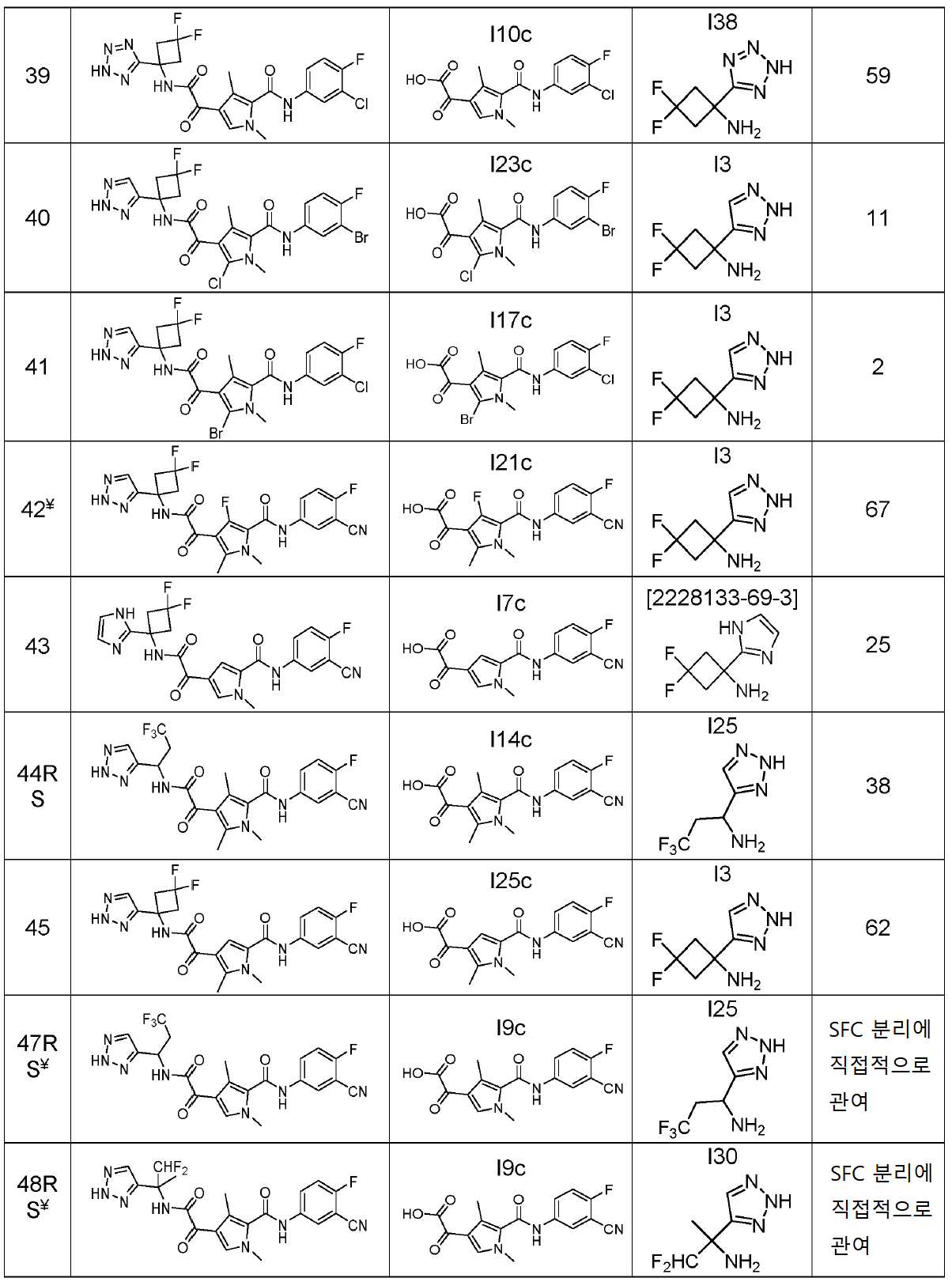
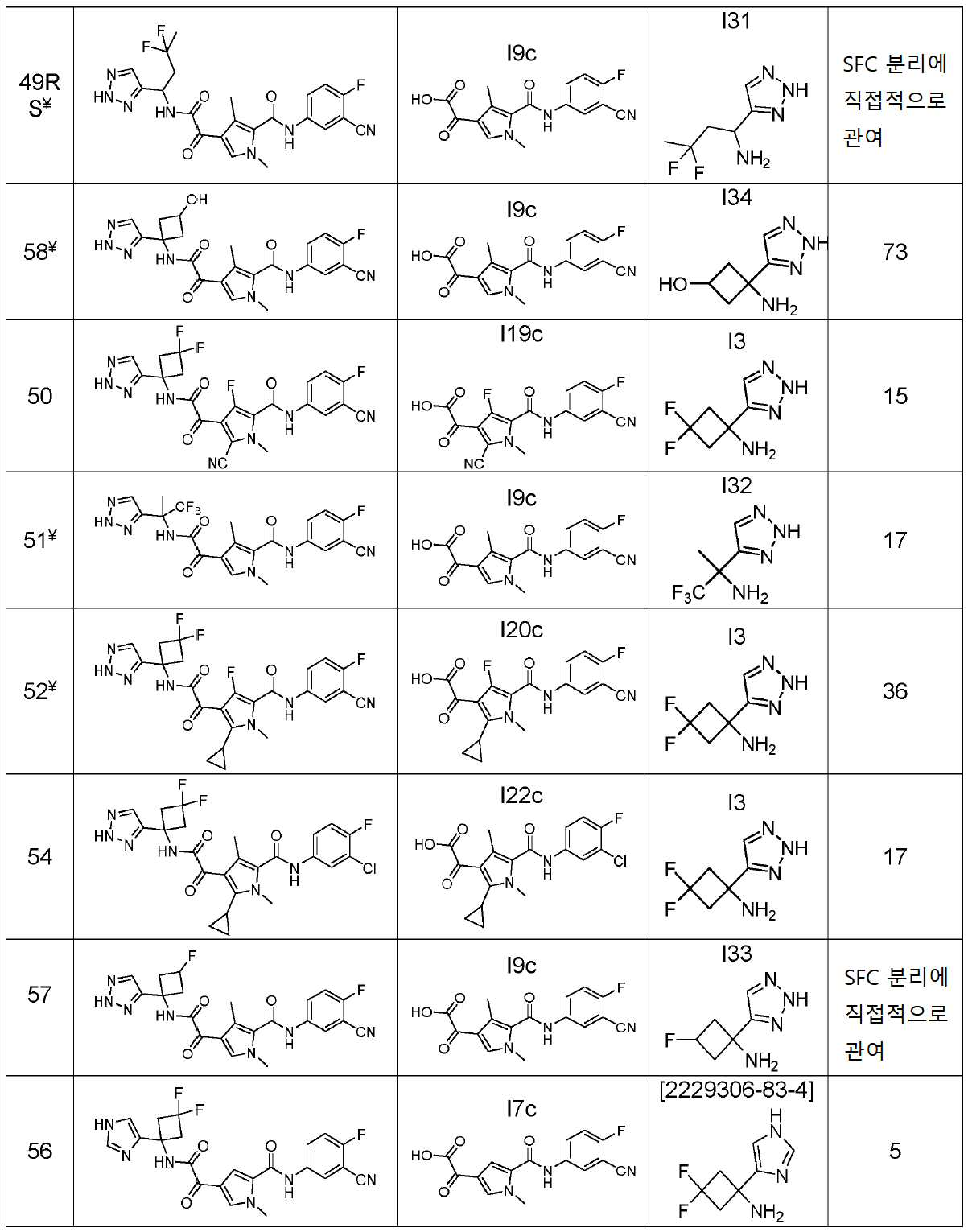

화합물 14~16의 합성Synthesis of compounds 14-16

DMF (1 mL) 중 화합물 3 (120 mg, 0.23 mmol)의 용액에 DMF (100 μl) 중 MeI (14.5 μL, 0.23 mmol) 및 Cs2CO3 (56.91 mg, 0.17 mmol)을 첨가하였다. 반응 혼합물을 실온에서 1시간 동안 교반시켰다. 반응 혼합물을 물 (10 mL) 내에 부었다. 백색 고형물을 여과시키고, 물 (2 x 1 mL)로 세척하였다. 고형물을 건조시키고, 실리카 겔 컬럼 크로마토그래피 (0/100으로부터 100/0까지의 에틸 아세테이트/헵탄)를 사용하여 정제하여 다음을 수득하였다: To a solution of compound 3 (120 mg, 0.23 mmol) in DMF (1 mL) was added MeI (14.5 μL, 0.23 mmol) and Cs 2 CO 3 (56.91 mg, 0.17 mmol) in DMF (100 μl). The reaction mixture was stirred at room temperature for 1 hour. The reaction mixture was poured into water (10 mL). The white solid was filtered and washed with water (2×1 mL). The solid was dried and purified using silica gel column chromatography (ethyl acetate/heptane from 0/100 to 100/0) to afford:
- 제1 화합물 (이를 메탄올에 현탁시키고, 건조상태까지 농축시켜 화합물 16을 백색 분말로 수득함 (81 mg, 수율: 65%))- Compound 1 (which was suspended in methanol and concentrated to dryness to give compound 16 as a white powder (81 mg, yield: 65%))
- 제2 화합물 14 (37 mg, 수율: 30%).- Second compound 14 (37 mg, yield: 30%).
- 제3 잔사 (이를 추가로 분취용 SFC (고정상: Chiralcel Diacel OJ 20 x 250 mm, 이동상: CO2, EtOH + 0.4 iPrNH2)로 정제하여 화합물 15 (7 mg, 수율: 7%)를 수득함)-The third residue (which was further purified by preparative SFC (stationary phase: Chiralcel Diacel OJ 20 x 250 mm, mobile phase: CO 2 , EtOH + 0.4 iPrNH 2 ) to give compound 15 (7 mg, yield: 7%) )
화합물 33의 합성Synthesis of compound 33

질소 분위기 하에 마이크로웨이브 튜브에 화합물 31 (150 mg, 0.273 mmol), 테트라키스(트리페닐포스핀)팔라듐(0)(63 mg, 0.055 mmol), 시안화아연 (51.21 mg, 0.436 mmol) 및 DMF (3 mL)를 첨가하였다. 반응 혼합물을 마이크로웨이브 조사 하에 180℃에서 40분 동안 가열하였다. LCMS는 출발 물질의 완전한 전환 및 원하는 생성물의 형성을 나타냈다. 반응 혼합물을 포화 NaHCO3 용액으로 켄칭하고, EtOAc로 3회 추출하였다. 합한 유기 층을 MgSO4로 건조시키고, 감압 하에 농축시켰다. 잔사를 실리카 컬럼 크로마토그래피 (30/70의 헵탄/EtOAc)에서 정제하여 화합물 33 (85 mg, 63%의 수율)을 백색 고형물로 수득하였다 (수율: 63%).Compound 31 (150 mg, 0.273 mmol), tetrakis(triphenylphosphine)palladium(0)(63 mg, 0.055 mmol), zinc cyanide (51.21 mg, 0.436 mmol) and DMF (3 mL) was added. The reaction mixture was heated at 180° C. for 40 minutes under microwave irradiation. LCMS showed complete conversion of the starting material and formation of the desired product. The reaction mixture was quenched with saturated NaHCO 3 solution and extracted 3 times with EtOAc. The combined organic layers were dried over MgSO 4 and concentrated under reduced pressure. The residue was purified on silica column chromatography (heptane of 30/70/EtOAc) to give compound 33 (85 mg, yield of 63%) as a white solid (yield: 63%).
화합물 35의 합성Synthesis of compound 35

화합물 13 (30 mg, 0.059 mmol)을 아세토니트릴 (0.4 mL) 및 DMF (0.2 mL)에 용해시켰다. 트리플루오로메탄술폰산 (8 μL, 0.0882 mmol)을 첨가하였다. N-클로로숙신이미드 (7.8 mg, 0.059 mmol)를 0℃에서 첨가하였다. 반응 혼합물을 0℃에서 30분 동안 교반시키고 그 후 실온에서 2시간 동안 교반시켰다. 추가의 N-클로로숙신이미드 (4 mg)를 첨가하고, 반응 혼합물을 추가로 1시간 동안 교반시켰다. LCMS는 반응의 완료를 나타냈다. 상기 혼합물을 물로 켄칭하고, DCM (3x)으로 추출하고, 염수로 세척하고, 건조시키고 (Na2SO4), 여과시키고, 진공에서 농축시켰다. 잔사를 분취용 SFC (고정상: Chiralpak Diacel AD 20 x 250 mm, 이동상: CO2, iPrOH + 0.4 iPrNH2)로 정제하여 화합물 35 (9 mg, 28%)를 백색 고형물로 수득하였다.Compound 13 (30 mg, 0.059 mmol) was dissolved in acetonitrile (0.4 mL) and DMF (0.2 mL). Trifluoromethanesulfonic acid (8 μL, 0.0882 mmol) was added. N-Chlorosuccinimide (7.8 mg, 0.059 mmol) was added at 0°C. The reaction mixture was stirred at 0° C. for 30 min and then at room temperature for 2 h. Additional N-chlorosuccinimide (4 mg) was added and the reaction mixture was stirred for an additional hour. LCMS showed the reaction was complete. The mixture was quenched with water, extracted with DCM (3x), washed with brine, dried (Na 2 SO 4 ), filtered and concentrated in vacuo. The residue was purified by preparative SFC (stationary phase: Chiralpak Diacel AD 20 x 250 mm, mobile phase: CO 2 , iPrOH + 0.4 iPrNH 2 ) to give compound 35 (9 mg, 28%) as a white solid.
화합물 37의 합성Synthesis of compound 37
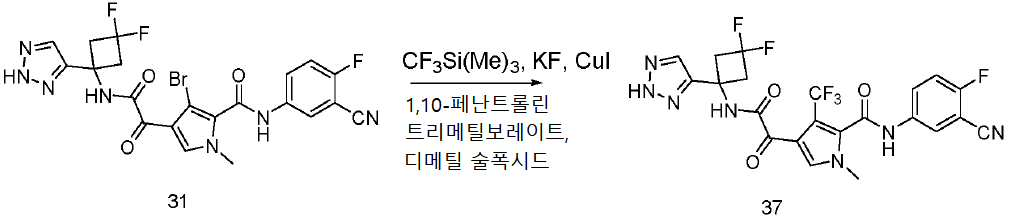
격막 캡과 교반 막대가 있는 오븐 건조 시험관에 화합물 31 (100 mg, 0.182 mmol), 플루오르화칼륨 (31.67 mg, 0.545 mmol), 요오드화구리 (6.92 mg, 0.036 mmol) 및 1,10-페난트롤린 (6.55 mg, 0.036 mmol)을 충전시켰다. 반응 용기를 닫고, 그 후 소기시키고, 질소로 재충전하였다 (버블링). DMSO (1.0 mL), 트리메틸 보레이트 (60.8 μL, 0.545 mmol) 및 (트리플루오로메틸)트리메틸실란 (80.5 μL, 0.545 mmol)을 시린지를 통하여 첨가하였다. 생성된 현탁물을 60℃에서 18시간 동안 교반시켰다. 반응 혼합물을 NH3 (25%)/포화 수성 NH4Cl의 1:1 혼합물로 켄칭하고, EtOAc로 추출하였다. 그 후 유기 층을 물로 세척하고, 합한 유기 층을 MgSO4로 건조시키고, 감압 하에 농축시켰다. 그 후 조 잔사를 분취용 HPLC (고정상: RP XBridge Prep C18 OBD- 5 μm, 50x250 mm, 이동상: 물 중 0.25% NH4HCO3 용액, CH3CN)로 정제하여 화합물 37 (9 mg, 9%의 수율)을 수득하였다.Compound 31 (100 mg, 0.182 mmol), potassium fluoride (31.67 mg, 0.545 mmol), copper iodide (6.92 mg, 0.036 mmol) and 1,10-phenanthroline ( 6.55 mg, 0.036 mmol). The reaction vessel was closed, then evacuated and backfilled with nitrogen (bubbling). DMSO (1.0 mL), trimethyl borate (60.8 μL, 0.545 mmol) and (trifluoromethyl)trimethylsilane (80.5 μL, 0.545 mmol) were added via syringe. The resulting suspension was stirred at 60° C. for 18 hours. The reaction mixture was quenched with a 1:1 mixture of NH 3 (25%)/sat. aq. NH 4 Cl and extracted with EtOAc. The organic layer was then washed with water, and the combined organic layers were dried over MgSO 4 and concentrated under reduced pressure. The crude residue was then purified by preparative HPLC (stationary phase: RP XBridge Prep C18 OBD- 5 μm, 50x250 mm, mobile phase: 0.25% NH 4 HCO 3 solution in water, CH 3 CN) to compound 37 (9 mg, 9%). yield) was obtained.
화합물 46 및 화합물 53의 합성Synthesis of compound 46 and compound 53
단계 1 Step 1
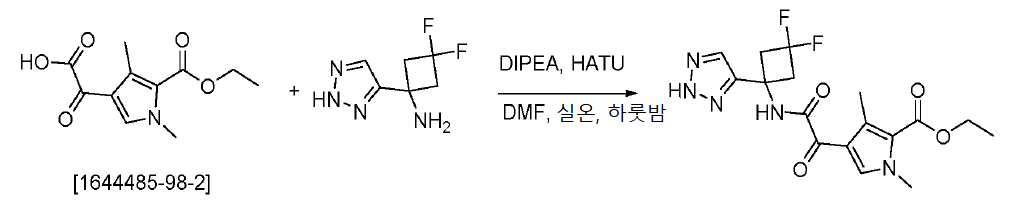
2-(5-(에톡시카르보닐)-1,4-디메틸-1H-피롤-3-일)-2-옥소아세트산 (3.0 g, 12.54 mmol), 3,3-디플루오로-1-(2H-1,2,3-트리아졸-4-일)시클로부탄-1-아민 (2.77 g, 13.17 mmol) 및 HATU (5.72 g, 15.05 mmol)를 DMF (30 mL)에 용해시켰다. DIPEA (8.64 mL, 16 mmol)를 적가하고, 생성된 혼합물을 실온에서 16시간 동안 교반시켰다. 조 물질을 실리카 플러그에 붓고 실리카 컬럼 크로마토그래피 (헵탄으로부터 EtOAc까지 (100/0으로부터 0/100까지))로 정제하였다. 원하는 분획을 진공에서 농축시키고, 진공 오븐에서 55℃에서 24시간 동안 건조시켜 에틸 4-(2-((3,3-디플루오로-1-(2H-1,2,3-트리아졸-4-일)시클로부틸)아미노)-2-옥소아세틸)-1,3-디메틸-1H-피롤-2-카르복실레이트 (4.5 g, 수율: 91%)를 수득하고, 이를 그대로 사용하였다.2-(5-(ethoxycarbonyl)-1,4-dimethyl-1H-pyrrol-3-yl)-2-oxoacetic acid (3.0 g, 12.54 mmol), 3,3-difluoro-1-( 2H-1,2,3-triazol-4-yl)cyclobutan-1-amine (2.77 g, 13.17 mmol) and HATU (5.72 g, 15.05 mmol) were dissolved in DMF (30 mL). DIPEA (8.64 mL, 16 mmol) was added dropwise and the resulting mixture was stirred at room temperature for 16 h. The crude material was poured onto a silica plug and purified by silica column chromatography (heptane to EtOAc (100/0 to 0/100)). The desired fractions were concentrated in vacuo and dried in a vacuum oven at 55° C. for 24 h to ethyl 4-(2-((3,3-difluoro-1-(2H-1,2,3-triazole-4). -yl)cyclobutyl)amino)-2-oxoacetyl)-1,3-dimethyl-1H-pyrrole-2-carboxylate (4.5 g, yield: 91%) was obtained, which was used as such.
단계 2Step 2

LiOH 수용액 (62 mL, 1 M, 61.72 mmol)을 THF (20 mL, 246.86 mmol) 중 에틸 4-(2-((3,3-디플루오로-1-(2H-1,2,3-트리아졸-4-일)시클로부틸)아미노)-2-옥소아세틸)-1,3-디메틸-1H-피롤-2-카르복실레이트 (2.44 g, 6.17 mmol)의 용액에 첨가하였다. 이 반응 혼합물을 실온에서 16시간 동안 교반시켰다. 물만 잔존 때까지 용매를 증발시키고, 생성된 수성 잔사를 0℃까지 냉각시키고 pH가 대략 3이 될 때까지 HCl (H2O 중 1 M)로 처리하였다. 수성 층을 Me-THF (3x25 mL)로 추출하였다. 합한 추출물을 Na2SO4로 건조시키고, 여과시키고, 감압 하에 증발시켜 4-(2-((3,3-디플루오로-1-(2H-1,2,3-트리아졸-4-일)시클로부틸)아미노)-2-옥소아세틸)-1,3-디메틸-1H-피롤-2-카르복실산 (1.65 g, 수율: 73%)을 백색 분말로 수득하고, 이를 그대로 사용하였다.Aqueous LiOH solution (62 mL, 1 M, 61.72 mmol) was dissolved in THF (20 mL, 246.86 mmol) in ethyl 4-(2-((3,3-difluoro-1-(2H-1,2,3-tria)) zol-4-yl)cyclobutyl)amino)-2-oxoacetyl)-1,3-dimethyl-1H-pyrrole-2-carboxylate (2.44 g, 6.17 mmol). The reaction mixture was stirred at room temperature for 16 hours. The solvent was evaporated until only water remained and the resulting aqueous residue was cooled to 0° C. and treated with HCl (1 M in H 2 O) until the pH was approximately 3. The aqueous layer was extracted with Me-THF (3x25 mL). The combined extracts were dried over Na 2 SO 4 , filtered and evaporated under reduced pressure to 4-(2-((3,3-difluoro-1-(2H-1,2,3-triazol-4-yl) )Cyclobutyl)amino)-2-oxoacetyl)-1,3-dimethyl-1H-pyrrole-2-carboxylic acid (1.65 g, yield: 73%) was obtained as a white powder, which was used as such.
단계 3Step 3

4-(2-((3,3-디플루오로-1-(2H-1,2,3-트리아졸-4-일)시클로부틸)아미노)-2-옥소아세틸)-1,3-디메틸-1H-피롤-2-카르복실산 (100 mg, 0.27 mmol)을 1,3-디메틸-2-이미다졸리디논 (DMI) (2 mL)에 용해시켰다. 3-아미노-2,6-디플루오로벤조니트릴 (83.92 mg, 0.54 mmol), DIPEA (238 μL, 1.36 mmol) 및 HATU (155 mg, 0.41 mmol)를 첨가하였다. 상기 혼합물을 50℃에서 114시간 동안 교반시켰다. LCMS는 60%의 원하는 생성물의 형성을 나타냈다. 반응 혼합물을 90℃에서 3시간 동안 가열하였다. (완전한 전환이 관찰되었으며), HCl (H2O 중 1 M) (15 mL, 15 mmol)에 부었다. 생성된 고형물을 여과시키고, 실리카 컬럼 크로마토그래피 (0/100으로부터 100/0까지의 헵탄 중 에틸 아세테이트)를 사용하여 정제하여 제1 분획을 황백색 분말로 수득하였다. 여과액을 2-MeTHF (3 x 10 mL)로 추출하고, 합한 유기 층을 염수로 세척하고, 감압 하에 농축시켜 제2 분획을 수득하였다. 상기 둘 다의 분획을 추가로 분취용 HPLC (고정상: RP XBridge Prep C18 OBD-10 μm,30x150 mm, 이동상: 물 중 0.25% NH4HCO3 용액, MeOH)로 정제하여 화합물 46 (13 mg, 수율: 9%)을 백색 고형물로 수득하였다.4-(2-((3,3-difluoro-1-(2H-1,2,3-triazol-4-yl)cyclobutyl)amino)-2-oxoacetyl)-1,3-dimethyl -1H-pyrrole-2-carboxylic acid (100 mg, 0.27 mmol) was dissolved in 1,3-dimethyl-2-imidazolidinone (DMI) (2 mL). 3-Amino-2,6-difluorobenzonitrile (83.92 mg, 0.54 mmol), DIPEA (238 μL, 1.36 mmol) and HATU (155 mg, 0.41 mmol) were added. The mixture was stirred at 50° C. for 114 hours. LCMS showed the formation of 60% of the desired product. The reaction mixture was heated at 90° C. for 3 hours. (complete conversion was observed ), poured into HCl (1 M in H 2 O) (15 mL, 15 mmol). The resulting solid was filtered and purified using silica column chromatography (ethyl acetate in heptane from 0/100 to 100/0) to give the first fraction as an off-white powder. The filtrate was extracted with 2-MeTHF (3 x 10 mL) and the combined organic layers were washed with brine and concentrated under reduced pressure to give a second fraction. Both fractions were further purified by preparative HPLC (stationary phase: RP XBridge Prep C18 OBD-10 μm, 30x150 mm, mobile phase: 0.25% NH 4 HCO 3 solution in water, MeOH) to compound 46 (13 mg, yield) : 9%) as a white solid.

2-(디플루오로메틸)피리딘-4-아민을 사용하여 화합물 46과 유사한 방식으로 화합물 53을 합성하였다 (5.3 mg, 수율: 2%).Compound 53 was synthesized in a similar manner to compound 46 using 2-(difluoromethyl)pyridin-4-amine (5.3 mg, yield: 2%).
화합물 55의 합성Synthesis of compound 55

건조 DMF (1 mL) 중 화합물 41 (110 mg, 0.192 mmol)의 용액에 시안화아연 (45 mg, 0.38 mmol)을 첨가하였다. 생성된 용액을 질소로 5분 동안 탈기하고, 테트라키스(트리페닐포스핀)팔라듐(0) (18 mg, 0.015 mmol)을 첨가하였다. 반응 혼합물을 밀봉하고 마이크로웨이브에서 120℃에서 60분 동안 가열하였다. LCMS는 1:1의 출발 물질:원하는 화합물의 비를 나타냈다. 일단 실온까지 냉각되면, 반응물을 감압 하에 농축시켰다. 생성된 잔사를을 DCM에 용해시키고, 포화 수성 NH4Cl을 첨가하였다. 상기 두 층을 분리하고, 수성 층을 DCM으로 추출하였다. 합한 유기 층을 염수로 세척하고, MgSO4로 건조시키고, 여과시키고, 감압 하에 농축시켰다. 조 물질을 분취용 SFC (고정상: Chiralpak Diacel ID 20 x 250 mm, 이동상: CO2, EtOH + 0.4 iPrNH2), 이어서 분취용 HPLC (고정상: RP XBridge Prep C18 OBD- 5 μm,50x250 mm, 이동상: 물 중 0.25% NH4HCO3 용액, CH3CN)로 정제하여 화합물 55 (4.5 mg, 5%)를 황색의 솜털 같은 고형물로 수득하였다.To a solution of compound 41 (110 mg, 0.192 mmol) in dry DMF (1 mL) was added zinc cyanide (45 mg, 0.38 mmol). The resulting solution was degassed with nitrogen for 5 min, and tetrakis(triphenylphosphine)palladium(0) (18 mg, 0.015 mmol) was added. The reaction mixture was sealed and heated in a microwave at 120° C. for 60 min. LCMS showed a ratio of starting material to desired compound of 1:1. Once cooled to room temperature, the reaction was concentrated under reduced pressure. The resulting residue was dissolved in DCM and saturated aqueous NH 4 Cl was added. The two layers were separated and the aqueous layer was extracted with DCM. The combined organic layers were washed with brine, dried over MgSO 4 , filtered and concentrated under reduced pressure. The crude material was purified by preparative SFC (stationary phase: Chiralpak Diacel ID 20 x 250 mm, mobile phase: CO 2 , EtOH + 0.4 iPrNH 2 ) followed by preparative HPLC (stationary phase: RP XBridge Prep C18 OBD- 5 μm, 50x250 mm, mobile phase: Purification with 0.25% NH 4 HCO 3 solution in water, CH 3 CN) gave compound 55 (4.5 mg, 5%) as a yellow fluffy solid.
하기 키랄 화합물을 상응하는 혼합물의 SPC 분리에 의해 수득하였다. The following chiral compounds were obtained by SPC separation of the corresponding mixture.
분취용 SFC(고정상: Chiralpak Daicel IG 20 x 250 mm, 이동상: CO2, MeOH-iPrOH 또는 iPrOH 또는 MeOH (50-50) + 0.4% iPrNH2)Preparative SFC (stationary phase: Chiralpak Daicel IG 20 x 250 mm, mobile phase: CO 2 , MeOH-iPrOH or iPrOH or MeOH (50-50) + 0.4% iPrNH2)


[표 1][Table 1]


[표 2][Table 2]

[표 3][Table 3]

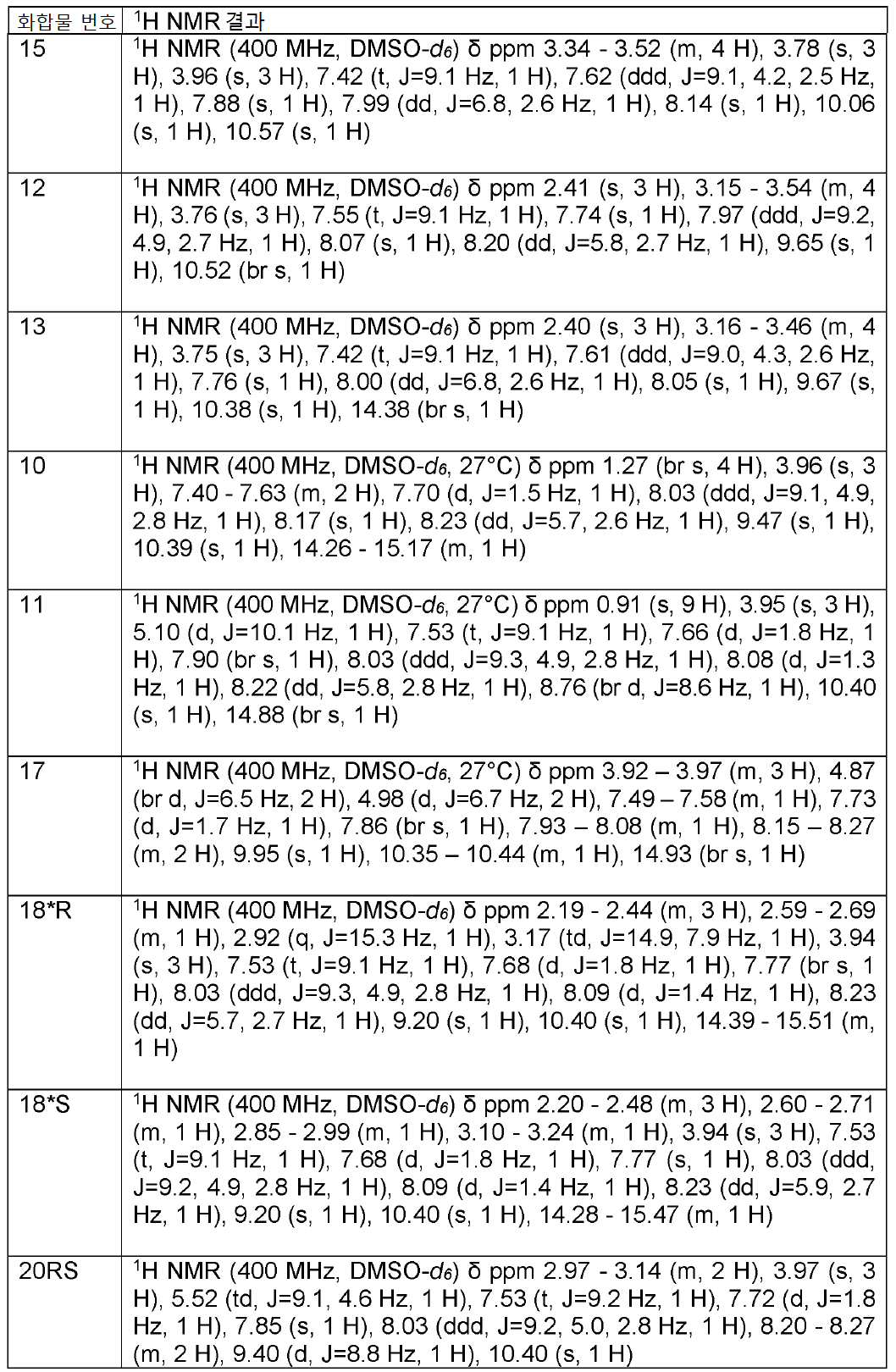
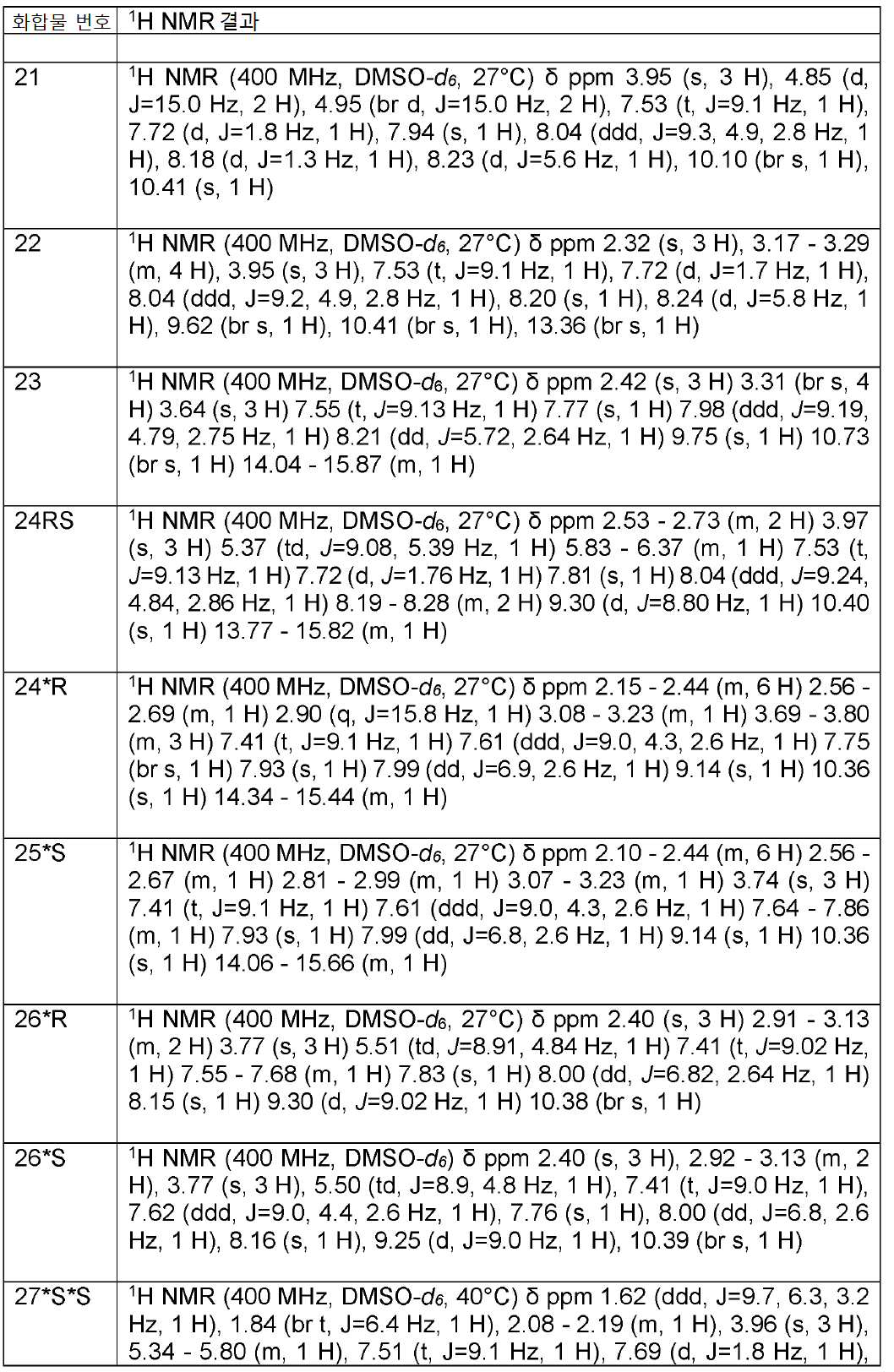

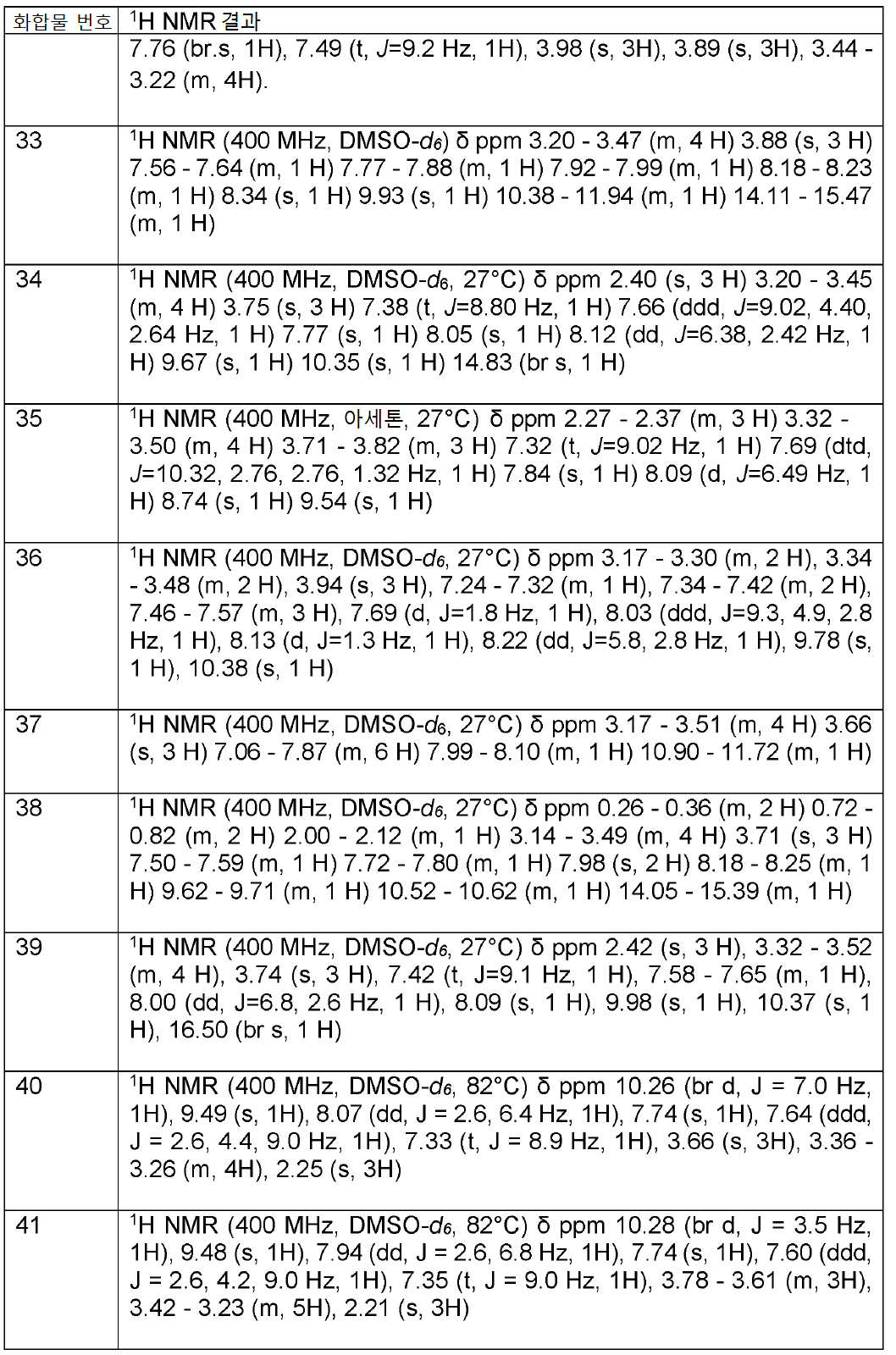


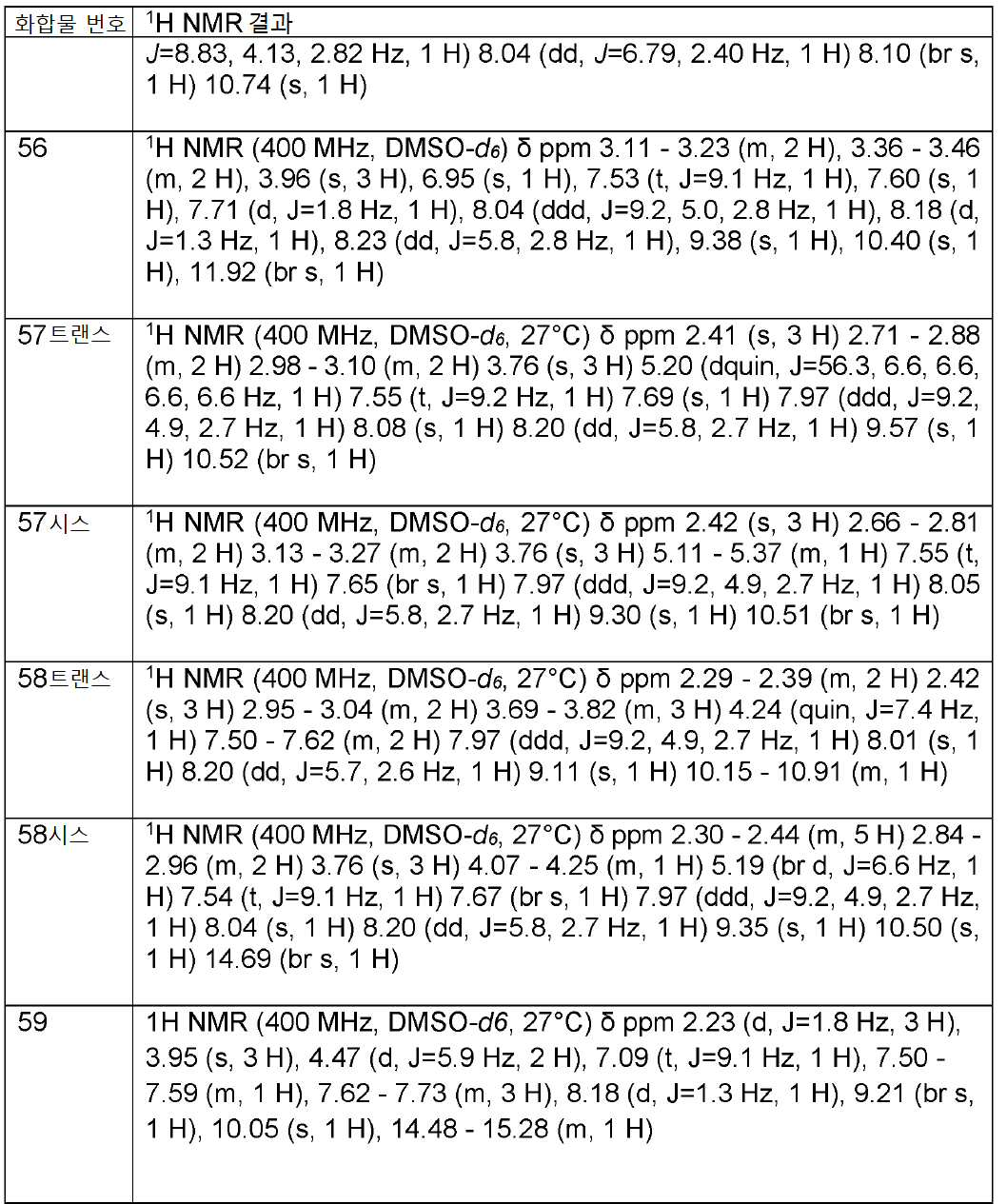
생물학적 biological 실시예Example -화학식 I의 화합물의 항--Anti- of the compound of formula (I)- HBVHBV 활성 activation
절차 procedure
안정한, 유도성 HBV 생산 세포주인 HepG2.117 세포주를 이용하여 항 HBV 활성을 측정하였는데, 상기 세포주는 독시사이클린의 부재 하에 HBV를 복제시킨다 (Tet-off 시스템). HepG2 세포주는 번호 HB-8065로 ATCC®로부터 입수가능하다. HepG2 세포주의 형질감염은 문헌[Sun and Nassal 2006 Journal of Hepatology 45 (2006) 636-645 "Stable HepG2 - and Huh7 -based human hepatoma cell lines for efficient regulated expression of infectious hepatitis B virus"]에 기술된 바와 같을 수 있다.Anti-HBV activity was measured using a stable, inducible HBV-producing cell line, the HepG2.117 cell line, which replicates HBV in the absence of doxycycline (Tet-off system). The HepG2 cell line is available from ATCC® under the number HB-8065. Transfection of the HepG2 cell line may be as described in Sun and Nassal 2006 Journal of Hepatology 45 (2006) 636-645 " Stable HepG2 - and Huh7 -based human hepatoma cell lines for efficient regulated expression of infectious hepatitis B virus". can
항바이러스 분석을 위해, HBV 복제를 유도하고, 이어서 96웰 플레이트에서 연속 희석 화합물로 처리하였다. 3일의 처리 후, 실시간 PCR 및 HBV 특이적 프라이머 세트 및 프로브를 사용한 세포내 HBV DNA의 정량화에 의해 항바이러스 활성을 결정하였다.For antiviral assays, HBV replication was induced and then treated with serially diluted compounds in 96-well plates. After 3 days of treatment, antiviral activity was determined by real-time PCR and quantification of intracellular HBV DNA using HBV specific primer sets and probes.
화합물들의 존재 하에 4일간 인큐베이션한 HepG2 또는 HepG2.117 세포를 사용하여 화합물들의 세포독성을 테스트하였다. Perkin Elmer ATPlite Luminescence Assay System을 사용하여 세포의 생존력을 평가하였다.The cytotoxicity of the compounds was tested using HepG2 or HepG2.117 cells incubated for 4 days in the presence of the compounds. Cell viability was assessed using the Perkin Elmer ATPlite Luminescence Assay System.
결과 result
[표 4][Table 4]


표 4에 예시된 항-HBV 활성 데이터로서, 화합물 1 및 2는 Ref. 화합물 59에 비해 각각 대략 10배 및 18배 개선의 항-HBV 활성 개선을 나타낸다.As the anti-HBV activity data exemplified in Table 4, compounds 1 and 2 are Ref. and approximately 10-fold and 18-fold improvement in anti-HBV activity compared to compound 59, respectively.
약동학적 평가Pharmacokinetic evaluation
약동학적 프로파일은 먹이를 먹인 수컷 C57BL 마우스 (n = 3마리/군)에서 평가되었다. 마우스는 2.5 mg/kg의 테스트 화합물 (PEG400/물 (70/30) 중 용액으로 제형화)을 정맥내 주사하고, 0.05, 0.117, 0.333, 1, 2, 4, 7 및 24시간에서 배측 중족 정맥으로부터 혈액 샘플을 수집하여 EDTA-함유 미세원심분리 튜브 내에 넣었다. 테스트 화합물을 10 mg/kg 및 50 mg/kg (PEG400 중 용액으로 제형화)으로 경구 투여하고, 0.5, 1, 2, 4, 7, 12 및 24시간에서 배측 중족 정맥으로부터 혈액 샘플을 수집하여 EDTA-함유 미세원심분리 튜브 내에 넣었다. 혈액 샘플을 즉시 4℃에서 원심분리하고, 혈장을 -80℃에서 보관하였다. 혈장 샘플로부터의 화합물 농도를 LC-MS/MS (LCMS-8050 기기)를 사용하여 분석하였다. 개별 혈장 농도-시간 프로파일은 Phoenix™ WinNonlin 버전 6.1 (미국 뉴저지주 체타라 소재)을 사용하여 비구획 약동학 분석(NCA)을 하였다. Pharmacokinetic profiles were evaluated in fed male C57BL mice (n = 3 mice/group). Mice were injected intravenously with 2.5 mg/kg of test compound (formulated as a solution in PEG400/water (70/30)) and dorsal metatarsal vein at 0.05, 0.117, 0.333, 1, 2, 4, 7 and 24 hours. Blood samples were collected from and placed into EDTA-containing microcentrifuge tubes. Test compounds were administered orally at 10 mg/kg and 50 mg/kg (formulated as a solution in PEG400) and blood samples were collected from the dorsal metatarsal vein at 0.5, 1, 2, 4, 7, 12 and 24 hours to collect EDTA - placed in the containing microcentrifuge tube. Blood samples were immediately centrifuged at 4°C and plasma was stored at -80°C. Compound concentrations from plasma samples were analyzed using LC-MS/MS (LCMS-8050 instrument). Individual plasma concentration-time profiles were subjected to noncompartmental pharmacokinetic analysis (NCA) using Phoenix™ WinNonlin version 6.1 (Chetara, NJ).
HT EQ 용해도 분석HT EQ Solubility Analysis
분석을 삼중으로 실행하였으며, 모든 액체 취급에 대해 Tecan Fluent를 사용하여 반자동화하였다. 20 μL의 10 mM 스톡 용액을 500 μL 96웰 플레이트에 분배하였다. DMSO를 증발시켰다 (Genevac). 교반 막대 및 400 μL의 완충액/생물학적 관련 배지를 추가하였다. 용액을 72시간 (pH2 및 pH7) 또는 24시간 (FaSSIF 및 FeSSIF) 동안 교반시켰다. 용액을 여과시키고, 여과액을 3점 보정 곡선을 사용하여 UPLC/UV로 정량화하였다.Assays were run in triplicate and semi-automated using Tecan Fluent for all liquid handling. Dispense 20 μL of 10 mM stock solution into 500 μL 96-well plates. DMSO was evaporated (Genevac). A stir bar and 400 μL of buffer/biologically relevant medium were added. The solution was stirred for 72 h (pH2 and pH7) or 24 h (FaSSIF and FeSSIF). The solution was filtered and the filtrate was quantified by UPLC/UV using a three-point calibration curve.
열역학적 용해도 분석Thermodynamic Solubility Analysis
x mg의 화합물에 500 μL의 용매를 첨가하였다 (최대 농도 y mg/mL). 24시간/72시간 진탕/교반 후 용액을 여과시키고 (0.45 μm 막), pH를 기록하였다. 여과액을 100 μg/mL (CH3CN/0.1 N HCl (1/1))의 최대 농도까지 희석시키고, 샘플을 LC/UV로 정량화하였다. 보정 표준은 100 μg/mL, 10 μg/mL 및 1 μg/mL이었다.500 μL of solvent was added to x mg of compound (maximum concentration y mg/mL). After 24 h/72 h shaking/stirring the solution was filtered (0.45 μm membrane) and the pH was recorded. The filtrate was diluted to a maximum concentration of 100 μg/mL (CH 3 CN/0.1 N HCl (1/1)) and the samples were quantified by LC/UV. Calibration standards were 100 μg/mL, 10 μg/mL and 1 μg/mL.
[표 5][Table 5]

HBCHBC 스펙클링의speckling 유도 또는 비-유도 Induced or non-induced
HepG2.117 세포를 독시사이클린의 부재 하에 DMSO 또는 테스트 화합물의 존재 하에 배양하였다.HepG2.117 cells were cultured in the presence of DMSO or test compound in the absence of doxycycline.
포름알데히드 고정 및 Triton-X-100 투과화 후, B형 간염 바이러스 코어 단백질 (HBc)을 일차 항-HBc 항체로 면역표지하였다. ALEXA 488-콘쥬게이션된 이차 항체를 일차 HBV 코어 신호의 형광 검출에 사용하였다. CELLMASK Deep Red 및 HOECHST 33258을 각각 세포질 및 핵의 검출에 사용하였으며, 이는 세포 구획의 분할을 가능하게 하였다.After formaldehyde fixation and Triton-X-100 permeabilization, hepatitis B virus core protein (HBc) was immunolabeled with a primary anti-HBc antibody. An ALEXA 488-conjugated secondary antibody was used for fluorescence detection of the primary HBV core signal. CELLMASK Deep Red and HOECHST 33258 were used for the detection of cytoplasm and nucleus, respectively, which allowed the division of cellular compartments.
상이한 형태학적 표현형을 검출할 수 있는 영상 분석 소프트웨어를 사용하여 세포질 또는 핵에서 HBV 코어의 수준을 결정하였다(고화질 영상 분석). The level of HBV core in the cytoplasm or nucleus was determined using image analysis software capable of detecting different morphological phenotypes (high-resolution image analysis).
본 발명의 화합물은 이 분석에서 테스트될 때 스펙클링을 나타냈다.Compounds of the invention exhibited speckling when tested in this assay.
Claims (17)
[화학식 I]

[여기서,

R1, R2 및 R3은 각각 독립적으로 H, F, Cl, Br, CHF2, CH2F, CF3, CN, C1- 4알킬 및 C3- 6시클로알킬로 이루어진 군으로부터 선택되며;
R4는 H 및 F로 이루어진 군으로부터 선택되며;
R5는 H, C1- 4알킬 및 C3- 6시클로알킬로 이루어진 군으로부터 선택되며;
Q는
할로겐 및 SO2Me로 이루어진 군으로부터 각각 독립적으로 선택되는 하나 이상의 치환체로 선택적으로 치환된 C2- 5알킬,
할로겐, 더 구체적으로 하나 이상의 플루오로로 치환된 C2- 3알케닐,
하나 이상의 헤테로원자(헤테로원자는 N, O 및 S로부터 각각 독립적으로 선택됨)를 선택적으로 함유하며, F, 옥소, OH, C(=O)NHCH3, 및 하나 이상의 플루오로로 선택적으로 치환된 C1- 4알킬로 이루어진 군으로부터 각각 독립적으로 선택되는 하나 이상의 치환체로 선택적으로 치환된 3~6원 단환식 포화 고리,
하나 이상의 헤테로원자(헤테로원자는 N, O 및 S로부터 각각 독립적으로 선택됨)를 선택적으로 함유하며, F, 옥소, OH, C(=O)NHCH3, 및 하나 이상의 플루오로로 선택적으로 치환된 C1- 4알킬로 이루어진 군으로부터 각각 독립적으로 선택되는 하나 이상의 치환체로 선택적으로 치환된 3~9원 다환식 포화 고리로 이루어진 군으로부터 선택되며;
R6은 H이며;
R7은
페닐,
할로, CN, CF3, CF2H, CH2F, C1- 4알킬, C3- 6시클로알킬, OH 및 OC1- 4알킬로 이루어진 군으로부터 각각 독립적으로 선택되는 하나 이상의 치환체로 치환된 페닐,
피리딜,
할로, CN, CF3, CF2H, CH2F, C1- 4알킬, C3- 6시클로알킬, OH 및 OC1- 4알킬로 이루어진 군으로부터 각각 독립적으로 선택되는 하나 이상의 치환체로 치환된 피리딜,
피리미딜,
할로, CN, CF3, CF2H, CH2F, C1- 4알킬, C3- 6시클로알킬, OH 및 OC1- 4알킬로 이루어진 군으로부터 각각 독립적으로 선택되는 하나 이상의 치환체로 치환된 피리미딜,
피라지닐,
할로, CN, CF3, CF2H, CH2F, C1- 4알킬, C3- 6시클로알킬, OH 및 OC1- 4알킬로 이루어진 군으로부터 각각 독립적으로 선택되는 하나 이상의 치환체로 치환된 피라지닐,
피리다지닐,
할로, CN, CF3, CF2H, CH2F, C1- 4알킬, C3- 6시클로알킬, OH 및 OC1- 4알킬로 이루어진 군으로부터 각각 독립적으로 선택되는 하나 이상의 치환체로 치환된 피리다지닐,
N, O 및 S로부터 각각 독립적으로 선택되는 1 내지 4개의 헤테로원자를 포함하는 5원 불포화 복소환,
N, O 및 S로부터 각각 독립적으로 선택되는 1 내지 4개의 헤테로원자를 포함하며 할로겐, CN, CF3, CF2H, CH2F, C1- 4알킬, C3- 6시클로알킬, OH 및 OC1- 4알킬로 이루어진 군으로부터 각각 독립적으로 선택되는 하나 이상의 치환체로 치환된 5원 불포화 복소환으로 이루어진 군으로부터 선택되며;
X는 CR8이며;
R8은 H, F, Cl, Br, CN, OC1- 4알킬, C3- 6시클로알킬, C2- 3알케닐 및 C1- 4알킬(하나 이상의 F 및 OCH3으로 선택적으로 치환됨)로 이루어진 군으로부터 선택됨]. A compound of formula (I), including a stereoisomeric or tautomeric form thereof, or a pharmaceutically acceptable salt or solvate thereof:
[Formula I]
[here,
R 1, R 2 and R 3 each independently is selected from H, F, Cl, Br, CHF 2, CH 2 F, CF 3, CN, C 1- 4 alkyl and C 3- 6 cycloalkyl group consisting of alkyl ;
R 4 is selected from the group consisting of H and F;
R 5 is H, C 1- 4 alkyl and C 3- 6 is selected from the group consisting of cycloalkyl;
Q is
Optionally substituted from the group consisting of halogen and SO 2 Me with one or more substituents each independently selected 2- C 5 alkyl,
Halogen, more particularly a 2- C 3 alkenylene optionally substituted with with one or more fluoro,
C optionally containing one or more heteroatoms, each heteroatom independently selected from N, O, and S , and optionally substituted with F, oxo, OH, C(=O)NHCH 3 , and one or more fluoro 1 from the group consisting of 4-alkyl with one or more substituents each independently selected optionally substituted 3-6 won a monocyclic saturated ring,
C optionally containing one or more heteroatoms, each heteroatom independently selected from N, O, and S , and optionally substituted with F, oxo, OH, C(=O)NHCH 3 , and one or more fluoro 1 - 4 with one or more substituents that are each independently selected from the group consisting of alkyl optionally is substituted with 3-9 won is selected from the group consisting of cyclic saturated ring;
R 6 is H;
R 7 is
phenyl,
Halo, CN, CF 3, CF 2 H, CH 2 F, C 1- 4 alkyl, C 3- 6 cycloalkyl, OH and OC 1- 4 substituted with one or more substituents each independently selected from the group consisting of alkyl phenyl,
pyridyl,
Halo, CN, CF 3, CF 2 H, CH 2 F, C 1- 4 alkyl, C 3- 6 cycloalkyl, OH and OC 1- 4 substituted with one or more substituents each independently selected from the group consisting of alkyl pyridyl,
pyrimidyl,
Halo, CN, CF 3, CF 2 H, CH 2 F, C 1- 4 alkyl, C 3- 6 cycloalkyl, OH and OC 1- 4 substituted with one or more substituents each independently selected from the group consisting of alkyl pyrimidyl,
pyrazinyl,
Halo, CN, CF 3, CF 2 H, CH 2 F, C 1- 4 alkyl, C 3- 6 cycloalkyl, OH and OC 1- 4 substituted with one or more substituents each independently selected from the group consisting of alkyl pyrazinyl,
pyridazinyl,
Halo, CN, CF 3, CF 2 H, CH 2 F, C 1- 4 alkyl, C 3- 6 cycloalkyl, OH and OC 1- 4 substituted with one or more substituents each independently selected from the group consisting of alkyl pyridazinyl,
5-membered unsaturated heterocycle containing 1 to 4 heteroatoms each independently selected from N, O and S;
N, O and containing from 1 to 4 heteroatoms independently selected from S and 4-halogen, CN, CF 3, CF 2 H, CH 2 F, C 1- alkyl, C 3- 6 cycloalkyl, OH, and OC 1- 4 is selected from the group consisting of a 5-membered unsaturated heterocyclic ring substituted with one or more substituents each independently selected from the group consisting of alkyl;
X is CR 8 ;
R 8 is optionally substituted by H, F, Cl, Br, CN, OC 1- 4 alkyl, C 3- 6 cycloalkyl, C 2- 3 alkenyl and C 1- 4 alkyl (one or more F and OCH 3 ) selected from the group consisting of].


Applications Claiming Priority (5)
| Application Number | Priority Date | Filing Date | Title |
|---|---|---|---|
| EP19158758.3 | 2019-02-22 | ||
| EP19158758 | 2019-02-22 | ||
| EP19159717.8 | 2019-02-27 | ||
| EP19159717 | 2019-02-27 | ||
| PCT/EP2020/054582 WO2020169784A1 (en) | 2019-02-22 | 2020-02-21 | Amide derivatives useful in the treatment of hbv infection or hbv-induced diseases |
Publications (1)
| Publication Number | Publication Date |
|---|---|
| KR20210130753A true KR20210130753A (en) | 2021-11-01 |
Family
ID=69740328
Family Applications (1)
| Application Number | Title | Priority Date | Filing Date |
|---|---|---|---|
| KR1020217029417A Withdrawn KR20210130753A (en) | 2019-02-22 | 2020-02-21 | Amide derivatives useful for the treatment of HBV infection or HBV-induced disease |
Country Status (12)
| Country | Link |
|---|---|
| US (1) | US11096931B2 (en) |
| EP (1) | EP3927698A1 (en) |
| JP (1) | JP2022521081A (en) |
| KR (1) | KR20210130753A (en) |
| CN (1) | CN113454077A (en) |
| AU (1) | AU2020223865A1 (en) |
| BR (1) | BR112021015618A2 (en) |
| CA (1) | CA3127152A1 (en) |
| MA (1) | MA55020A (en) |
| MX (1) | MX2021010145A (en) |
| TW (1) | TW202045499A (en) |
| WO (1) | WO2020169784A1 (en) |
Cited By (1)
| Publication number | Priority date | Publication date | Assignee | Title |
|---|---|---|---|---|
| WO2023055205A1 (en) | 2021-10-01 | 2023-04-06 | 주식회사 엘지화학 | Multiblock copolymer and preparation method therefor |
Families Citing this family (5)
| Publication number | Priority date | Publication date | Assignee | Title |
|---|---|---|---|---|
| UA129029C2 (en) * | 2019-04-03 | 2024-12-25 | Алігос Терапьютікс, Інк. | PYROL COMPOUNDS |
| CN114685514A (en) * | 2020-12-29 | 2022-07-01 | 广东东阳光药业有限公司 | Novel amide pyrrole compound and application thereof in medicines |
| WO2022156758A1 (en) * | 2021-01-22 | 2022-07-28 | 广东东阳光药业有限公司 | Novel amide pyrrole compound and use thereof in drugs |
| CN118974014B (en) * | 2022-03-17 | 2026-01-27 | 成都微芯药业有限公司 | Pyrrole amide compound and preparation method and application thereof |
| CN120943768A (en) * | 2024-05-14 | 2025-11-14 | 上海挚盟医药科技有限公司 | Amide compounds used for the treatment and/or prevention of hepatitis virus infection |
Family Cites Families (218)
| Publication number | Priority date | Publication date | Assignee | Title |
|---|---|---|---|---|
| US3843662A (en) | 1971-12-09 | 1974-10-22 | Pfizer | 2-halo-5-(substituted piperidino sulfonyl)benzoic acids |
| AU1508183A (en) | 1982-06-04 | 1983-12-08 | Beecham Group Plc | Benzamide and anilide derivatives of 8-azabicyclo-(3.2.1)- -octane |
| EP0135545A1 (en) | 1983-02-19 | 1985-04-03 | Beecham Group Plc | Azabicycloalkyl benzamide and anilide derivatives |
| JPS62142164A (en) | 1985-12-13 | 1987-06-25 | Ishihara Sangyo Kaisha Ltd | 4,5-dichloroimidazole based compound and pest controlling agent containing said compound |
| IN164880B (en) | 1986-01-30 | 1989-06-24 | Ishihara Sangyo Kaisha | |
| US5272167A (en) | 1986-12-10 | 1993-12-21 | Schering Corporation | Pharmaceutically active compounds |
| CA1339133C (en) | 1987-03-13 | 1997-07-29 | Rikuo Nasu | Imidazole compounds and biocidal composition comprising the same for controlling harmful organisms |
| US5571821A (en) | 1993-05-20 | 1996-11-05 | Texas Biotechnology Corporation | Sulfonamides and derivatives thereof that modulate the activity of endothelin |
| GB8904174D0 (en) | 1989-02-23 | 1989-04-05 | British Bio Technology | Compounds |
| US4962101A (en) | 1989-08-21 | 1990-10-09 | Merck & Co., Inc. | 2-(Heterocyclylalkyl)phenyl carbapenem antibacterial agents |
| GB9023082D0 (en) | 1990-10-24 | 1990-12-05 | Schering Agrochemicals Ltd | Fungicides |
| GB9109557D0 (en) | 1991-05-02 | 1991-06-26 | Wellcome Found | Chemical compounds |
| US5308826A (en) | 1993-04-22 | 1994-05-03 | Zeneca Limited | Herbicidal 4-substituted pyridyl-3-carbinols |
| GB9405347D0 (en) | 1994-03-18 | 1994-05-04 | Agrevo Uk Ltd | Fungicides |
| WO1995032949A1 (en) | 1994-05-27 | 1995-12-07 | James Black Foundation Limited | Gastrin and cck antagonists |
| US5795907A (en) | 1994-05-27 | 1998-08-18 | James Black Foundation Limited | Gastin and CCK receptor ligands |
| US5763618A (en) | 1995-05-12 | 1998-06-09 | Konica Corporation | Manufacturing method of sulfides |
| US5723411A (en) | 1995-10-31 | 1998-03-03 | E. I. Du Pont De Nemours And Company | Herbicidal pyridazinones |
| DE19540995A1 (en) | 1995-11-03 | 1997-05-07 | Hoechst Ag | Substituted sulfonimidamides, process for their preparation, their use as a medicament or diagnostic agent, and medicament containing them |
| GB9612884D0 (en) | 1996-06-20 | 1996-08-21 | Smithkline Beecham Plc | Novel compounds |
| US6025367A (en) | 1996-06-25 | 2000-02-15 | Smithkline Beecham Plc | Sulfonamide derivatives as 5HT7 receptor antagonists |
| WO1998023285A1 (en) | 1996-11-29 | 1998-06-04 | Smithkline Beecham Plc | Use of a combination of penciclovir and alpha-interferon in the manufacture of a medicament for the treatment of hepatitis b |
| US5939423A (en) | 1997-04-16 | 1999-08-17 | Sciclone Pharmaceuticals, Inc. | Treatment of hepatitis B infection with thymosin alpha 1 and famciclovir |
| US5919970A (en) | 1997-04-24 | 1999-07-06 | Allergan Sales, Inc. | Substituted diaryl or diheteroaryl methanes, ethers and amines having retinoid agonist, antagonist or inverse agonist type biological activity |
| US5994396A (en) | 1997-08-18 | 1999-11-30 | Centaur Pharmaceuticals, Inc. | Furansulfonic acid derivatives and pharmaceutical compositions containing the same |
| JP4253126B2 (en) | 1998-01-29 | 2009-04-08 | アムジェン インコーポレイテッド | PPAR-gamma modulator |
| AU754716B2 (en) | 1998-03-26 | 2002-11-21 | Japan Tobacco Inc. | Amide derivatives and nociceptin antagonists |
| US6251893B1 (en) | 1998-06-15 | 2001-06-26 | Nps Allelix Corp. | Bicyclic piperidine and piperazine compounds having 5-HT6 receptor affinity |
| DK1147089T3 (en) | 1999-01-15 | 2006-04-10 | Altana Pharma Ag | Phenylphenanthridines with PDE-IV inhibitory effect |
| CA2377092A1 (en) | 1999-07-16 | 2001-01-25 | Warner-Lambert Company | Method for treating chronic pain using mek inhibitors |
| US7816560B1 (en) | 1999-08-10 | 2010-10-19 | Thomas Jefferson University | Long chain n-alkyl compounds and oxa-derivatives thereof |
| BR0014076A (en) | 1999-09-17 | 2002-10-15 | Millennium Pharm Inc | Benzamides and related factor xa inhibitors |
| AR025884A1 (en) | 1999-10-01 | 2002-12-18 | Takeda Pharmaceutical | CYCLINE AMINE COMPOUNDS, ITS PRODUCTION AND USE |
| JP2003519697A (en) | 1999-12-28 | 2003-06-24 | ファイザー・プロダクツ・インク | Non-peptide VLA-4-dependent cell binding inhibitors useful for the treatment of inflammatory diseases, autoimmune diseases and respiratory diseases |
| AU2882801A (en) | 2000-01-28 | 2001-08-07 | Kaken Pharmaceutical Co., Ltd. | Azepine derivatives |
| US6511980B2 (en) | 2000-05-05 | 2003-01-28 | Ortho Mcneil Pharmaceutical, Inc. | Substituted diamine derivatives useful as motilin antagonists |
| EP1193268A1 (en) | 2000-09-27 | 2002-04-03 | Applied Research Systems ARS Holding N.V. | Pharmaceutically active sulfonamide derivatives bearing both lipophilic and ionisable moieties as inhibitors of protein Junkinases |
| WO2002051410A2 (en) | 2000-12-22 | 2002-07-04 | Akzo Nobel N.V. | Phenylthiazole and thiazoline derivatives and their use as antiparasitics |
| CN1247582C (en) | 2000-12-27 | 2006-03-29 | 大日本住友制药株式会社 | Novel carbapenem compounds |
| US7015012B2 (en) | 2001-02-09 | 2006-03-21 | Massachusetts Institute Of Technology | Methods of identifying agents that mediate polypeptide aggregation |
| US6650463B2 (en) | 2001-03-13 | 2003-11-18 | Seiko Epson Corporation | Electrophoretic display device |
| KR100713137B1 (en) | 2001-06-28 | 2007-05-02 | 동화약품공업주식회사 | Novel 2,4-difluorobenzamide derivatives |
| AU2002317377A1 (en) | 2001-07-20 | 2003-03-03 | Cancer Research Technology Limited | Biphenyl apurinic/apyrimidinic site endonuclease inhibitors to treat cancer |
| DE10136043A1 (en) | 2001-07-25 | 2003-02-13 | Degussa | Process for the production of modified carbon black |
| US6956035B2 (en) | 2001-08-31 | 2005-10-18 | Inotek Pharmaceuticals Corporation | Isoquinoline derivatives and methods of use thereof |
| AU2002347982A1 (en) | 2001-11-20 | 2003-06-10 | Eli Lilly And Company | 3-SUBSTITUTED OXINDOLE Beta3 AGONISTS |
| SE0201635D0 (en) | 2002-05-30 | 2002-05-30 | Astrazeneca Ab | Novel compounds |
| TW200410671A (en) | 2002-06-05 | 2004-07-01 | Inst Med Molecular Design Inc | Medicines for inhibiting the activation of AP-1 |
| CN1678311A (en) | 2002-06-27 | 2005-10-05 | 诺沃挪第克公司 | Arylcarbonyl derivatives useful as therapeutic agents |
| MXPA05000130A (en) | 2002-06-27 | 2005-02-17 | Novo Nordisk As | Aryl carbonyl derivatives as therapeutic agents. |
| WO2004011427A2 (en) | 2002-07-31 | 2004-02-05 | Smithkline Beecham Corporation | Substituted benzanilides as modulators of the ccr5 receptor |
| AU2003256923A1 (en) | 2002-07-31 | 2004-02-16 | Smithkline Beecham Corporation | Substituted benzanilides as modulators of the ccr5 receptor |
| US7186735B2 (en) | 2002-08-07 | 2007-03-06 | Sanofi-Aventis Deutschland Gmbh | Acylated arylcycloalkylamines and their use as pharmaceuticals |
| US7338956B2 (en) | 2002-08-07 | 2008-03-04 | Sanofi-Aventis Deutschland Gmbh | Acylamino-substituted heteroaromatic compounds and their use as pharmaceuticals |
| AU2003252738A1 (en) | 2002-08-09 | 2004-02-25 | Ajinomoto Co., Inc. | Remedy for intestinal diseases and visceral pain |
| US20040110802A1 (en) | 2002-08-23 | 2004-06-10 | Atli Thorarensen | Antibacterial benzoic acid derivatives |
| PL377087A1 (en) | 2002-09-06 | 2006-01-23 | Janssen Pharmaceutica, N.V. | Heterocyclic compounds |
| SE0202838D0 (en) | 2002-09-24 | 2002-09-24 | Astrazeneca Ab | Chemical compounds |
| US7378525B2 (en) | 2002-12-23 | 2008-05-27 | Millennium Pharmaceuticals, Inc. | CCR8 inhibitors |
| US7320989B2 (en) | 2003-02-28 | 2008-01-22 | Encysive Pharmaceuticals, Inc. | Pyridine, pyrimidine, quinoline, quinazoline, and naphthalene urotensin-II receptor antagonists |
| ATE524452T1 (en) | 2003-03-27 | 2011-09-15 | Cytokinetics Inc | SULFONAMIDES FOR TREATING CONGESTIVE HEART FAILURE, COMPOSITIONS AND USES THEREOF. |
| WO2004099192A2 (en) | 2003-04-30 | 2004-11-18 | The Institutes Of Pharmaceutical Discovery, Llc | Heterocycle substituted carboxylic acids as inhibitors of protein tyrosine phosphatase-1b |
| WO2004100947A2 (en) | 2003-05-06 | 2004-11-25 | Smithkline Beecham Corporation | Novel chemical compounds |
| MXPA05012268A (en) | 2003-05-13 | 2006-02-10 | Schering Corp | Bridged n-arylsulfonylpiperidines as gamma-secretase inhibitors. |
| EP1651595A2 (en) | 2003-05-30 | 2006-05-03 | Rigel Pharmaceuticals, Inc. | Ubiquitin ligase inhibitors |
| US20110275630A1 (en) | 2003-06-02 | 2011-11-10 | Abbott Laboratories | Isoindolinone kinase inhibitors |
| AR045047A1 (en) | 2003-07-11 | 2005-10-12 | Arena Pharm Inc | ARILO AND HETEROARILO DERIVATIVES TRISUSTITUIDOS AS MODULATORS OF METABOLISM AND PROFILAXIS AND TREATMENT OF DISORDERS RELATED TO THEMSELVES |
| GB0319151D0 (en) | 2003-08-14 | 2003-09-17 | Glaxo Group Ltd | Novel compounds |
| EP1678147B1 (en) | 2003-09-15 | 2012-08-08 | Lead Discovery Center GmbH | Pharmaceutically active 4,6-disubstituted aminopyrimidine derivatives as modulators of protein kinases |
| GB0325956D0 (en) | 2003-11-06 | 2003-12-10 | Addex Pharmaceuticals Sa | Novel compounds |
| US7498050B2 (en) | 2003-12-15 | 2009-03-03 | Kraft Foods Global Brands Llc | Edible spread composition and packaged product |
| DE102004009238A1 (en) | 2004-02-26 | 2005-09-08 | Merck Patent Gmbh | New aryl amide compounds are kinase inhibitors useful for the treatment and/or prophylaxis of e.g. tumors, psoriasis, rheumatoid arthritis, contact dermatitis, inflammations, endometriosis, scar and benign prostatic hyperplasia |
| WO2005087217A1 (en) | 2004-03-05 | 2005-09-22 | The General Hospital Corporation | Compositions and methods for modulating interaction between polypeptides |
| JP2007536344A (en) | 2004-05-04 | 2007-12-13 | ノボ ノルディスク アクティーゼルスカブ | New indole derivatives |
| WO2005115374A1 (en) | 2004-05-29 | 2005-12-08 | 7Tm Pharma A/S | Crth2 receptor ligands for therapeutic use |
| ATE444066T1 (en) | 2004-06-22 | 2009-10-15 | Schering Corp | LIGANDS FOR THE CANNABINOID RECEPTORS |
| EP1773768B8 (en) | 2004-07-30 | 2018-12-26 | Exelixis, Inc. | Pyrrole derivatives as pharmaceutical agents |
| DE102004042441A1 (en) | 2004-08-31 | 2006-04-06 | Sanofi-Aventis Deutschland Gmbh | Amino acid substituted hexahydro-pyrazino (1,2-a) pyrimidine-4,7-dione derivatives, process for their preparation and their use as medicaments |
| US20090118261A1 (en) | 2004-08-31 | 2009-05-07 | Astrazeneca Ab | Quinazolinone derivatives and their use as b-raf inhibitors |
| RU2007114080A (en) | 2004-10-13 | 2008-11-27 | Вайет (Us) | N-BENZylSULPHONIL-SUBSTITUTED ANALOGUES OF ANILINOPYRIMIDINE |
| KR20070072598A (en) | 2004-10-19 | 2007-07-04 | 노바티스 백신즈 앤드 다이아그노스틱스 인코포레이티드 | Indole and benzimidazole derivatives |
| TW200628463A (en) | 2004-11-10 | 2006-08-16 | Synta Pharmaceuticals Corp | Heteroaryl compounds |
| US20060122236A1 (en) | 2004-12-06 | 2006-06-08 | Wood Michael R | Substituted biaryl-carboxylate derivatives |
| TW200635899A (en) | 2004-12-22 | 2006-10-16 | Astrazeneca Ab | Chemical compounds |
| UY29300A1 (en) | 2004-12-22 | 2006-07-31 | Astrazeneca Ab | CHEMICAL COMPOUNDS |
| FI117653B (en) | 2005-02-21 | 2006-12-29 | Eigenor Oy | Procedure and arrangement for sensing objects with a radar |
| GB0510141D0 (en) | 2005-05-18 | 2005-06-22 | Addex Pharmaceuticals Sa | Novel compounds B3 |
| US20070032493A1 (en) | 2005-05-26 | 2007-02-08 | Synta Pharmaceuticals Corp. | Method for treating B cell regulated autoimmune disorders |
| WO2006128129A2 (en) | 2005-05-26 | 2006-11-30 | Synta Pharmaceuticals Corp. | Method for treating cancer |
| US7790726B2 (en) | 2005-08-16 | 2010-09-07 | Chemocentryx, Inc. | Monocyclic and bicyclic compounds and methods of use |
| AU2006290442B2 (en) | 2005-09-16 | 2010-07-29 | Arrow Therapeutics Limited | Biphenyl derivatives and their use in treating hepatitis C |
| CA2633541A1 (en) | 2005-12-12 | 2007-06-21 | Genelabs Technologies, Inc. | N-(6-membered aromatic ring)-amido anti-viral compounds |
| EP1962835A2 (en) | 2005-12-21 | 2008-09-03 | Schering Corporation | Treatment of nonalcoholic fatty liver disease using cholesterol lowering agents and/or h3 receptor antagonist/inverse agonist |
| EP1981849A1 (en) | 2005-12-29 | 2008-10-22 | LEK Pharmaceuticals D.D. | Heterocyclic compounds |
| WO2007131168A2 (en) | 2006-05-04 | 2007-11-15 | Institute For Hepatitis And Virus Research | Inhibitors of secretion of hepatitis b virus antigens for treatment of a chronic hepatitis virus |
| US8153803B2 (en) | 2006-07-18 | 2012-04-10 | The General Hospital Corporation | Compositions and methods for modulating sirtuin activity |
| US20080021063A1 (en) | 2006-07-18 | 2008-01-24 | Kazantsev Aleksey G | Compositions and methods for modulating sirtuin activity |
| FR2903985B1 (en) | 2006-07-24 | 2008-09-05 | Sanofi Aventis Sa | N- (AMINO-HETEROARYL) -1H-INDOLE-2-CARBOXAMIDE DERIVATIVES, THEIR PREPARATION AND THEIR THERAPEUTIC USE |
| FR2904316B1 (en) | 2006-07-31 | 2008-09-05 | Sanofi Aventis Sa | N- (AMINO-HETEROARYL) -1H-INDOLE-2-CARBOXAMIDE DERIVATIVES, THEIR PREPARATION AND THEIR THERAPEUTIC USE. |
| WO2008022171A1 (en) | 2006-08-17 | 2008-02-21 | Boehringer Ingelheim International Gmbh | Methods of using aryl sulfonyl compounds effective as soluble epoxide hydrolase inhibitors |
| US20100113421A1 (en) | 2006-10-06 | 2010-05-06 | Williams Theresa M | Non-nucleoside reverse transcriptase inhibitors |
| US8808702B2 (en) | 2006-12-13 | 2014-08-19 | Temple University-Of The Commonwealth System Of Higher Education | Sulfide, sulfoxide and sulfone chalcone analogues, derivatives thereof and therapeutic uses thereof |
| US20100022517A1 (en) | 2006-12-18 | 2010-01-28 | Richards Lori A | Ophthalmic formulation of rho kinase inhibitor compound |
| US8071779B2 (en) | 2006-12-18 | 2011-12-06 | Inspire Pharmaceuticals, Inc. | Cytoskeletal active rho kinase inhibitor compounds, composition and use |
| FR2910473B1 (en) | 2006-12-26 | 2009-02-13 | Sanofi Aventis Sa | N- (AMINO-HETEROARYL) -1H-PYRROLOPYRIDINE-2-CARBOXAMIDE DERIVATIVES, THEIR PREPARATION AND THEIR THERAPEUTIC USE. |
| JP2008179621A (en) | 2006-12-28 | 2008-08-07 | Taisho Pharmaceutical Co Ltd | Nitrogen-containing saturated heterocyclic compounds |
| JP2008184403A (en) | 2007-01-29 | 2008-08-14 | Japan Health Science Foundation | Novel hepatitis C virus inhibitor |
| AR065718A1 (en) | 2007-03-15 | 2009-06-24 | Novartis Ag | NITROGEN HETEROCICLICAL COMPOUNDS, USEFUL IN THE DIAGNOSIS AND TREATMENT OF HYPERPROLIFERATIVE DISORDERS. |
| US8097728B2 (en) | 2007-04-30 | 2012-01-17 | Philadelphia Health & Education Corporation | Iminosugar compounds with antiflavirus activity |
| JP5160637B2 (en) | 2007-05-04 | 2013-03-13 | アイアールエム・リミテッド・ライアビリティ・カンパニー | Compounds and compositions as c-kit and PDGFR kinase inhibitors |
| CN101328169B (en) | 2007-06-18 | 2011-05-25 | 张中能 | A kind of ethoxycarbonyl-substituted thiazole dihydropyrimidine |
| WO2009018219A2 (en) | 2007-07-28 | 2009-02-05 | University Of Chicago | Methods and compositions for modulating rad51 and homologous recombination |
| BRPI0815038A2 (en) | 2007-08-02 | 2015-03-17 | Hoffmann La Roche | USE OF BENZAMIDE DERIVATIVES FOR TREATMENT OF CNS DISORDERS |
| CN101429166B (en) | 2007-11-07 | 2013-08-21 | 上海特化医药科技有限公司 | Quinazoline ketone derivant, preparation method and application thereof |
| WO2009086303A2 (en) | 2007-12-21 | 2009-07-09 | University Of Rochester | Method for altering the lifespan of eukaryotic organisms |
| FR2926554B1 (en) | 2008-01-22 | 2010-03-12 | Sanofi Aventis | AZABICYCLIC CARBOXAMIDE DERIVATIVES, THEIR PREPARATION AND THERAPEUTIC USE THEREOF |
| FR2926555B1 (en) | 2008-01-22 | 2010-02-19 | Sanofi Aventis | BICYCLIC DERIVATIVES OF AZABICYCLIC CARBOXAMIDES, THEIR PREPARATION AND THEIR THERAPEUTIC USE |
| FR2926556B1 (en) | 2008-01-22 | 2010-02-19 | Sanofi Aventis | N-AZABICYCLIC CARBOXAMIDE DERIVATIVES, THEIR PREPARATION AND THEIR THERAPEUTIC APPLICATION |
| FR2926553B1 (en) | 2008-01-23 | 2010-02-19 | Sanofi Aventis | SILANYL SUBSTITUTED INDOLE-2-CARBOXAMIDE AND AZAINDOLE-2-CARBOXAMIDE DERIVATIVES, THEIR PREPARATION AND THEIR THERAPEUTIC USE |
| CU20080028A6 (en) | 2008-02-29 | 2011-02-24 | Ct Ingenieria Genetica Biotech | CHEMICAL COMPOUNDS OBTAINED IN SILICO FOR THE PREPARATION OF PHARMACEUTICAL COMPOSITIONS TO ATTENE OR INHIBIT INFECTION BY DENGUE VIRUSES AND OTHER FLAVIVIRUS |
| WO2009146013A1 (en) | 2008-03-31 | 2009-12-03 | Georgetown University | Myosin light chain phosphatase inhibitors |
| ES2527589T3 (en) | 2008-04-24 | 2015-01-27 | Msd K.K. | Long chain fatty acid elongation enzyme inhibitor comprising an arylsulfonyl derivative as active ingredient |
| US8207195B2 (en) | 2008-06-26 | 2012-06-26 | Inspire Pharmaceuticals, Inc. | Method for treating neurological and neuropathic diseases using rho kinase inhibitor compounds |
| US8410147B2 (en) | 2008-06-26 | 2013-04-02 | Inspire Pharmaceuticals, Inc. | Method for treating diseases associated with alterations in cellular integrity using Rho kinase inhibitor compounds |
| US20100008968A1 (en) | 2008-06-26 | 2010-01-14 | Lampe John W | Method for treating cardiovascular diseases using rho kinase inhibitor compounds |
| WO2009158587A1 (en) | 2008-06-26 | 2009-12-30 | Inspire Pharmaceuticals, Inc. | Method for treating pulmonary diseases using rho kinase inhibitor compounds |
| US20090325960A1 (en) | 2008-06-26 | 2009-12-31 | Fulcher Emilee H | Method for treating inflammatory diseases using rho kinase inhibitor compounds |
| US20090325959A1 (en) | 2008-06-26 | 2009-12-31 | Vittitow Jason L | Method for treating ophthalmic diseases using rho kinase inhibitor compounds |
| EP2321268A2 (en) | 2008-08-15 | 2011-05-18 | F. Hoffmann-La Roche AG | Bi-aryl aminotetralines |
| US9040488B2 (en) | 2008-09-02 | 2015-05-26 | Baruch S. Blumberg Institute | Imino sugar derivatives demonstrate potent antiviral activity and reduced toxicity |
| US8143269B2 (en) | 2008-10-03 | 2012-03-27 | Calcimedica, Inc. | Inhibitors of store operated calcium release |
| WO2010043592A1 (en) | 2008-10-15 | 2010-04-22 | Revotar Biopharmaceuticals Ag | Lipase inhibitors for use for the treatment of obesity |
| US8697685B2 (en) | 2008-11-20 | 2014-04-15 | Glaxosmithkline Llc | Chemical compounds |
| WO2010065782A1 (en) | 2008-12-04 | 2010-06-10 | Inspire Pharmaceuticals, Inc. | Method for treating pulmonary diseases using rho kinase inhibitor compounds |
| WO2010078430A1 (en) | 2008-12-30 | 2010-07-08 | Arqule, Inc. | Substituted 1h-pyrazolo[3,4-d]pyrimidine-6-amine compounds |
| WO2010088000A2 (en) | 2009-02-02 | 2010-08-05 | Angion Biomedica Corp. | Antifibrotic compounds and uses thereof |
| WO2010123139A1 (en) | 2009-04-24 | 2010-10-28 | 持田製薬株式会社 | Arylcarboxamide derivative having sulfamoyl group |
| CN102438984A (en) | 2009-05-19 | 2012-05-02 | 拜耳作物科学公司 | Insecticidal arylpyrrolines |
| CA3184380A1 (en) | 2009-05-27 | 2010-12-02 | Ptc Therapeutics, Inc. | Methods for treating cancer and non-neoplastic conditions |
| CN102469788A (en) | 2009-06-30 | 2012-05-23 | 西佳技术公司 | Treatment and prevention of dengue virus infection |
| US8703938B2 (en) | 2009-09-11 | 2014-04-22 | Enanta Pharmaceuticals, Inc. | Hepatitis C virus inhibitors |
| US8822700B2 (en) | 2009-09-11 | 2014-09-02 | Enanta Pharmaceuticals, Inc. | Hepatitis C virus inhibitors |
| WO2011035143A2 (en) | 2009-09-17 | 2011-03-24 | The Regents Of The University Of Michigan | Methods and compositions for inhibiting rho-mediated diseases and conditions |
| WO2011058766A1 (en) | 2009-11-16 | 2011-05-19 | Raqualia Pharma Inc. | Aryl carboxamide derivatives as ttx-s blockers |
| CN102093320B (en) | 2009-12-09 | 2013-08-28 | 扬子江药业集团上海海尼药业有限公司 | Soluble epoxide hydrolase inhibitor |
| EP2523936A1 (en) | 2010-01-15 | 2012-11-21 | Boehringer Ingelheim International GmbH | Compounds which modulate the cb2 receptor |
| WO2011088561A1 (en) | 2010-01-20 | 2011-07-28 | University Of Manitoba | Anti-viral compounds and compositions |
| WO2011109237A2 (en) | 2010-03-02 | 2011-09-09 | Emory University | Uses of noscapine and derivatives in subjects diagnosed with fap |
| CN102906080A (en) | 2010-03-11 | 2013-01-30 | 百时美施贵宝公司 | Compounds for the treatment of hepatitis C |
| CN102206172B (en) | 2010-03-30 | 2015-02-25 | 中国医学科学院医药生物技术研究所 | Substituted diaryl compound and preparation method and antiviral application thereof |
| WO2011123609A1 (en) | 2010-03-31 | 2011-10-06 | Glaxo Group Limited | Imidazolyl-imidazoles as kinase inhibitors |
| EP2566327B1 (en) | 2010-05-07 | 2017-03-29 | Glaxosmithkline LLC | Indoles |
| WO2011155898A1 (en) | 2010-06-11 | 2011-12-15 | Wadell Goeran | New antiviral compounds |
| US20130142827A1 (en) | 2010-06-25 | 2013-06-06 | Philadelphia Health & Education Corporation D/B/A | Induction of immune response |
| KR20130093093A (en) | 2010-07-19 | 2013-08-21 | 인스파이어 파마슈티컬스 인코퍼레이티드 | Bifunctional rho kinase inhibitor compounds, composition and use |
| EP2598478A2 (en) | 2010-07-26 | 2013-06-05 | Neurotherapeutics Pharma, Inc. | Arylsulfonamide derivatives, compositions, and methods of use |
| WO2012015760A1 (en) | 2010-07-27 | 2012-02-02 | Inspire Pharmaceuticals, Inc. | Method for treating ophthalmic diseases using kinase inhibitor compounds in prodrug forms |
| WO2012016133A2 (en) | 2010-07-29 | 2012-02-02 | President And Fellows Of Harvard College | Ros1 kinase inhibitors for the treatment of glioblastoma and other p53-deficient cancers |
| WO2012033956A1 (en) | 2010-09-08 | 2012-03-15 | Mithridion, Inc. | Cognition enhancing compounds and compositions, methods of making, and methods of treating |
| WO2012047856A2 (en) | 2010-10-04 | 2012-04-12 | Institute For Hepatitis And Virus Research | Novel inhibitors of secretion of hepatitis b virus antigens |
| GB201017345D0 (en) | 2010-10-14 | 2010-11-24 | Proximagen Ltd | Receptor antagonists |
| ES2585396T3 (en) | 2010-12-02 | 2016-10-05 | VIIV Healthcare UK (No.5) Limited | Alkylamides as inhibitors of HIV binding |
| WO2012080050A1 (en) | 2010-12-14 | 2012-06-21 | F. Hoffmann-La Roche Ag | Solid forms of a phenoxybenzenesulfonyl compound |
| GB201103419D0 (en) | 2011-02-28 | 2011-04-13 | Univ Aberdeen | |
| CN103608335B (en) | 2011-04-08 | 2018-02-23 | 爱尔兰詹森科学公司 | For treating the pyrimidine derivatives of virus infection |
| US8889716B2 (en) | 2011-05-10 | 2014-11-18 | Chdi Foundation, Inc. | Transglutaminase TG2 inhibitors, pharmaceutical compositions, and methods of use thereof |
| WO2013006394A1 (en) | 2011-07-01 | 2013-01-10 | Institute For Hepatitis And Virus Research | Sulfamoylbenzamide derivatives as antiviral agents against hbv infection |
| SG10201608528YA (en) | 2011-12-21 | 2016-12-29 | Novira Therapeutics Inc | Hepatitis b antiviral agents |
| KR102056665B1 (en) | 2012-01-06 | 2019-12-17 | 얀센 사이언시즈 아일랜드 언리미티드 컴퍼니 | 4,4-disubstituted-1,4-dihydropyrimidines and the use thereof as medicaments for the treatment of hepatitis B |
| AU2013226013B2 (en) | 2012-02-29 | 2016-08-11 | Baruch S. Blumberg Institute | Inhibitors of Hepatitis B Virus Covalently Closed Circular DNA Formation and Their Method of Use |
| US20130267517A1 (en) | 2012-03-31 | 2013-10-10 | Hoffmann-La Roche Inc. | Novel 4-methyl-dihydropyrimidines for the treatment and prophylaxis of hepatitis b virus infection |
| RU2014142598A (en) | 2012-03-31 | 2016-05-27 | Ф. Хоффманн-Ля Рош Аг | NEW 4-METHYLDHYDROPYRIMIDINES FOR THE TREATMENT AND PREVENTION OF HEPATITIS B VIRUS INFECTION |
| CA2871547C (en) | 2012-05-25 | 2021-05-25 | Janssen R&D Ireland | Uracyl spirooxetane nucleosides |
| CN104507488A (en) | 2012-06-01 | 2015-04-08 | 德雷塞尔大学 | Modulation of hepatitis b virus cccdna transcription |
| JO3300B1 (en) | 2012-06-06 | 2018-09-16 | Novartis Ag | Compounds and compositions for modulating egfr activity |
| TW201408652A (en) | 2012-07-11 | 2014-03-01 | Hoffmann La Roche | Aryl sultam derivatives as RORc modulators |
| JP2015533782A (en) | 2012-08-28 | 2015-11-26 | ヤンセン・サイエンシズ・アイルランド・ユーシー | Sulfamoyl-arylamide and its use as a medicament for the treatment of hepatitis B |
| ES2610758T3 (en) | 2012-08-28 | 2017-05-03 | Janssen Sciences Ireland Uc | Condensed bicyclic sulfamoyl derivatives and their use as medicines in the treatment of hepatitis B |
| EP2892893B2 (en) | 2012-09-10 | 2019-10-16 | F.Hoffmann-La Roche Ag | 6-amino acid heteroaryldihydropyrimidines for the treatment and prophylaxis of hepatitis b virus infection |
| HK1217649A1 (en) | 2012-12-27 | 2017-01-20 | 德雷克塞尔大学 | Novel antiviral agents against hbv infection |
| EP2961732B1 (en) | 2013-02-28 | 2017-04-12 | Janssen Sciences Ireland UC | Sulfamoyl-arylamides and the use thereof as medicaments for the treatment of hepatitis b |
| US9458176B2 (en) | 2013-02-28 | 2016-10-04 | Eisai R&D Management Co., Ltd. | Tetrahydroimidazo(1,5-D)[1,4]oxazepine derivative |
| WO2014165128A2 (en) | 2013-03-12 | 2014-10-09 | Novira Therapeutics, Inc. | Hepatitis b antiviral agents |
| US9944658B2 (en) | 2013-03-14 | 2018-04-17 | VenatoRx Pharmaceuticals, Inc. | Beta-lactamase inhibitors |
| AU2014247138B2 (en) | 2013-04-03 | 2018-06-28 | Janssen Sciences Ireland Uc | N-phenyl-carboxamide derivatives and the use thereof as medicaments for the treatment of hepatitis B |
| CA2909742C (en) | 2013-05-17 | 2020-08-04 | Janssen Sciences Ireland Uc | Sulphamoylthiophenamide derivatives and the use thereof as medicaments for the treatment of hepatitis b |
| JP6533217B2 (en) | 2013-05-17 | 2019-06-19 | エフ.ホフマン−ラ ロシュ アーゲーF. Hoffmann−La Roche Aktiengesellschaft | 6-Bridged Heteroaryldihydropyrimidines for the Treatment and Prevention of Hepatitis B Virus Infection |
| JO3603B1 (en) | 2013-05-17 | 2020-07-05 | Janssen Sciences Ireland Uc | Sulfamoyl pyrolamide derivatives and their use as medicines to treat hepatitis B |
| JP6466921B2 (en) | 2013-05-28 | 2019-02-06 | バイエル・クロップサイエンス・アクチェンゲゼルシャフト | Heterocyclic compounds as pest control agents |
| CN105229004B (en) | 2013-05-28 | 2017-05-03 | 阿斯利康(瑞典)有限公司 | Chemical compounds |
| WO2014198880A1 (en) | 2013-06-14 | 2014-12-18 | Ferrer Internacional, S.A. | 2-(2-aminophenoxy)-3-chloronaphthalene-1,4-dione compounds having orexin 2 receptor agonist activity |
| ES2774749T3 (en) | 2013-07-25 | 2020-07-22 | Janssen Sciences Ireland Unlimited Co | Glyoxamide-substituted pyrrolamide derivatives and their use as medicines for the treatment of hepatitis B |
| WO2015055764A1 (en) | 2013-10-18 | 2015-04-23 | Syngenta Participations Ag | 3-methanimidamid-pyridine derivatives as fungicides |
| JP6452119B2 (en) | 2013-10-23 | 2019-01-16 | ヤンセン・サイエンシズ・アイルランド・アンリミテッド・カンパニー | Carboxamide derivatives and their use as pharmaceuticals for the treatment of hepatitis B |
| CA2928003A1 (en) | 2013-11-14 | 2015-05-21 | Novira Therapeutics, Inc. | Azepane derivatives and methods of treating hepatitis b infections |
| JO3466B1 (en) | 2013-12-20 | 2020-07-05 | Takeda Pharmaceuticals Co | Tetrahydropyridopyrazines modulators of gpr6 |
| US9181288B2 (en) | 2014-01-16 | 2015-11-10 | Novira Therapeutics, Inc. | Azepane derivatives and methods of treating hepatitis B infections |
| US9169212B2 (en) | 2014-01-16 | 2015-10-27 | Novira Therapeutics, Inc. | Azepane derivatives and methods of treating hepatitis B infections |
| CN106163516B (en) | 2014-01-31 | 2019-05-28 | 考格尼申治疗股份有限公司 | Isoindoline compositions and methods of treating neurodegenerative diseases |
| KR20160128305A (en) | 2014-02-05 | 2016-11-07 | 노비라 테라퓨틱스, 인코포레이티드 | Combination therapy for treatment of hbv infections |
| CA2932551A1 (en) | 2014-02-06 | 2015-08-13 | Janssen Sciences Ireland Uc | Sulphamoylpyrrolamide derivatives and the use thereof as medicaments for the treatment of hepatitis b |
| JP6306750B2 (en) | 2014-03-07 | 2018-04-04 | エフ.ホフマン−ラ ロシュ アーゲーF. Hoffmann−La Roche Aktiengesellschaft | Novel 6-fused heteroaryl dihydropyrimidines for the treatment and prevention of hepatitis B virus infection |
| ES2748029T3 (en) | 2014-03-13 | 2020-03-12 | Univ Indiana Res & Tech Corp | Allosteric modulators of hepatitis B core protein |
| US9400280B2 (en) | 2014-03-27 | 2016-07-26 | Novira Therapeutics, Inc. | Piperidine derivatives and methods of treating hepatitis B infections |
| EP3122747B1 (en) | 2014-03-28 | 2020-05-20 | North & South Brother Pharmacy Investment Company Limited | Dihydropyrimidine compounds and their application in pharmaceuticals |
| RU2693897C2 (en) | 2014-05-30 | 2019-07-05 | Килу Фармасьютикал Ко., Лтд. | Derivative based on dihydropyrimido-ring as hbv inhibitor |
| DK3227262T3 (en) | 2014-12-02 | 2020-08-10 | Novira Therapeutics Inc | SULFIDALKYL AND PYRIDYL-REVERSE SULPHONAMIDE COMPOUNDS FOR HBV TREATMENT |
| CA2972434A1 (en) | 2014-12-30 | 2016-07-07 | Novira Therapeutics, Inc. | Derivatives and methods of treating hepatitis b infections |
| MA41338B1 (en) | 2015-01-16 | 2019-07-31 | Hoffmann La Roche | Pyrazine compounds for the treatment of infectious diseases |
| CN107847762A (en) | 2015-03-19 | 2018-03-27 | 诺维拉治疗公司 | Azacyclooctane and azacyclononane derivatives and methods of treating hepatitis B infection |
| US10442788B2 (en) | 2015-04-01 | 2019-10-15 | Enanta Pharmaceuticals, Inc. | Hepatitis B antiviral agents |
| AU2016249021A1 (en) | 2015-04-17 | 2017-10-19 | Assembly Biosciences, Inc. | Hepatitis B viral assembly effectors |
| US10738035B2 (en) | 2015-05-13 | 2020-08-11 | Enanta Pharmaceuticals, Inc. | Hepatitis B antiviral agents |
| US10875876B2 (en) | 2015-07-02 | 2020-12-29 | Janssen Sciences Ireland Uc | Cyclized sulfamoylarylamide derivatives and the use thereof as medicaments for the treatment of hepatitis B |
| HK1259410A1 (en) | 2015-09-29 | 2019-11-29 | 诺维拉治疗公司 | Crystalline forms of a hepatitis b antiviral agent |
| SG11201807569WA (en) | 2016-03-09 | 2018-10-30 | Univ Emory | Elimination of hepatitis b virus with antiviral agents |
| JOP20190024A1 (en) * | 2016-08-26 | 2019-02-19 | Gilead Sciences Inc | Substituted pyrrolizine compounds and uses thereof |
| CN109251212A (en) | 2017-07-14 | 2019-01-22 | 上海长森药业有限公司 | Inner ring sulfide amide-arylamides and its purposes for treating hepatitis B |
-
2020
- 2020-02-21 KR KR1020217029417A patent/KR20210130753A/en not_active Withdrawn
- 2020-02-21 MX MX2021010145A patent/MX2021010145A/en unknown
- 2020-02-21 MA MA055020A patent/MA55020A/en unknown
- 2020-02-21 EP EP20708446.8A patent/EP3927698A1/en not_active Withdrawn
- 2020-02-21 CN CN202080015964.7A patent/CN113454077A/en active Pending
- 2020-02-21 BR BR112021015618-6A patent/BR112021015618A2/en not_active IP Right Cessation
- 2020-02-21 CA CA3127152A patent/CA3127152A1/en active Pending
- 2020-02-21 AU AU2020223865A patent/AU2020223865A1/en not_active Abandoned
- 2020-02-21 JP JP2021547864A patent/JP2022521081A/en active Pending
- 2020-02-21 WO PCT/EP2020/054582 patent/WO2020169784A1/en not_active Ceased
- 2020-02-21 US US16/798,199 patent/US11096931B2/en not_active Expired - Fee Related
- 2020-02-21 TW TW109105730A patent/TW202045499A/en unknown
Cited By (1)
| Publication number | Priority date | Publication date | Assignee | Title |
|---|---|---|---|---|
| WO2023055205A1 (en) | 2021-10-01 | 2023-04-06 | 주식회사 엘지화학 | Multiblock copolymer and preparation method therefor |
Also Published As
| Publication number | Publication date |
|---|---|
| TW202045499A (en) | 2020-12-16 |
| JP2022521081A (en) | 2022-04-05 |
| MA55020A (en) | 2021-12-29 |
| US11096931B2 (en) | 2021-08-24 |
| BR112021015618A2 (en) | 2021-10-05 |
| CN113454077A (en) | 2021-09-28 |
| US20200268730A1 (en) | 2020-08-27 |
| MX2021010145A (en) | 2021-09-14 |
| AU2020223865A1 (en) | 2021-07-15 |
| WO2020169784A1 (en) | 2020-08-27 |
| EP3927698A1 (en) | 2021-12-29 |
| CA3127152A1 (en) | 2020-08-27 |
Similar Documents
| Publication | Publication Date | Title |
|---|---|---|
| KR20210130753A (en) | Amide derivatives useful for the treatment of HBV infection or HBV-induced disease | |
| US11267825B2 (en) | Highly active amino-thiazole substituted indole-2-carboxamides active against the hepatitis B virus (HBV) | |
| EP3022202B1 (en) | Autotaxin inhibitors comprising a heteroaromatic ring-benzyl-amide-cycle core | |
| US20110313167A1 (en) | Substituted Heterocycles as Therapeutic agents for treating cancer | |
| WO2011106650A2 (en) | Novel p53-mdm2/p53-mdm4 antagonists to treat proliferative disease | |
| WO2023164050A1 (en) | Compounds as glp-1r agonists | |
| US11771680B2 (en) | Pyrrole compounds | |
| TW201245144A (en) | Novel compounds useful for the treatment of metabolic and inflammatory diseases | |
| US20220363686A1 (en) | Novel 6,7-dihydro-4h-pyrazolo[1,5-a]pyrazine indole-2-carboxamides active against the hepatitis b virus (hbv) | |
| AU2016363719B2 (en) | 1,3,4-thiadiazole compounds and their use in treating cancer | |
| US11491148B2 (en) | Amide derivatives useful in the treatment of HBV infection or HBV-induced diseases | |
| KR20120109667A (en) | Novel compounds of inhibiting activity of heat shock protein | |
| EA046720B1 (en) | PYRROLE COMPOUNDS | |
| OA22136A (en) | Pyrrole compounds. | |
| CN101952289A (en) | What be used for the treatment of flaviviridae infections condenses the five rings derivative |
Legal Events
| Date | Code | Title | Description |
|---|---|---|---|
| PA0105 | International application |
St.27 status event code: A-0-1-A10-A15-nap-PA0105 |
|
| PG1501 | Laying open of application |
St.27 status event code: A-1-1-Q10-Q12-nap-PG1501 |
|
| P11-X000 | Amendment of application requested |
St.27 status event code: A-2-2-P10-P11-nap-X000 |
|
| P13-X000 | Application amended |
St.27 status event code: A-2-2-P10-P13-nap-X000 |
|
| PC1203 | Withdrawal of no request for examination |
St.27 status event code: N-1-6-B10-B12-nap-PC1203 |