WO2014144288A1 - Using rna-guided foki nucleases (rfns) to increase specificity for rna-guided genome editing - Google Patents
Using rna-guided foki nucleases (rfns) to increase specificity for rna-guided genome editing Download PDFInfo
- Publication number
- WO2014144288A1 WO2014144288A1 PCT/US2014/028630 US2014028630W WO2014144288A1 WO 2014144288 A1 WO2014144288 A1 WO 2014144288A1 US 2014028630 W US2014028630 W US 2014028630W WO 2014144288 A1 WO2014144288 A1 WO 2014144288A1
- Authority
- WO
- WIPO (PCT)
- Prior art keywords
- target
- rna
- grna
- cas9
- sites
- Prior art date
- Legal status (The legal status is an assumption and is not a legal conclusion. Google has not performed a legal analysis and makes no representation as to the accuracy of the status listed.)
- Ceased
Links
Classifications
-
- C—CHEMISTRY; METALLURGY
- C12—BIOCHEMISTRY; BEER; SPIRITS; WINE; VINEGAR; MICROBIOLOGY; ENZYMOLOGY; MUTATION OR GENETIC ENGINEERING
- C12N—MICROORGANISMS OR ENZYMES; COMPOSITIONS THEREOF; PROPAGATING, PRESERVING, OR MAINTAINING MICROORGANISMS; MUTATION OR GENETIC ENGINEERING; CULTURE MEDIA
- C12N15/00—Mutation or genetic engineering; DNA or RNA concerning genetic engineering, vectors, e.g. plasmids, or their isolation, preparation or purification; Use of hosts therefor
- C12N15/09—Recombinant DNA-technology
- C12N15/87—Introduction of foreign genetic material using processes not otherwise provided for, e.g. co-transformation
- C12N15/90—Stable introduction of foreign DNA into chromosome
- C12N15/902—Stable introduction of foreign DNA into chromosome using homologous recombination
- C12N15/907—Stable introduction of foreign DNA into chromosome using homologous recombination in mammalian cells
-
- C—CHEMISTRY; METALLURGY
- C12—BIOCHEMISTRY; BEER; SPIRITS; WINE; VINEGAR; MICROBIOLOGY; ENZYMOLOGY; MUTATION OR GENETIC ENGINEERING
- C12N—MICROORGANISMS OR ENZYMES; COMPOSITIONS THEREOF; PROPAGATING, PRESERVING, OR MAINTAINING MICROORGANISMS; MUTATION OR GENETIC ENGINEERING; CULTURE MEDIA
- C12N15/00—Mutation or genetic engineering; DNA or RNA concerning genetic engineering, vectors, e.g. plasmids, or their isolation, preparation or purification; Use of hosts therefor
- C12N15/09—Recombinant DNA-technology
- C12N15/11—DNA or RNA fragments; Modified forms thereof; Non-coding nucleic acids having a biological activity
- C12N15/113—Non-coding nucleic acids modulating the expression of genes, e.g. antisense oligonucleotides; Antisense DNA or RNA; Triplex- forming oligonucleotides; Catalytic nucleic acids, e.g. ribozymes; Nucleic acids used in co-suppression or gene silencing
-
- C—CHEMISTRY; METALLURGY
- C07—ORGANIC CHEMISTRY
- C07K—PEPTIDES
- C07K14/00—Peptides having more than 20 amino acids; Gastrins; Somatostatins; Melanotropins; Derivatives thereof
- C07K14/005—Peptides having more than 20 amino acids; Gastrins; Somatostatins; Melanotropins; Derivatives thereof from viruses
-
- C—CHEMISTRY; METALLURGY
- C07—ORGANIC CHEMISTRY
- C07K—PEPTIDES
- C07K14/00—Peptides having more than 20 amino acids; Gastrins; Somatostatins; Melanotropins; Derivatives thereof
- C07K14/195—Peptides having more than 20 amino acids; Gastrins; Somatostatins; Melanotropins; Derivatives thereof from bacteria
-
- C—CHEMISTRY; METALLURGY
- C12—BIOCHEMISTRY; BEER; SPIRITS; WINE; VINEGAR; MICROBIOLOGY; ENZYMOLOGY; MUTATION OR GENETIC ENGINEERING
- C12N—MICROORGANISMS OR ENZYMES; COMPOSITIONS THEREOF; PROPAGATING, PRESERVING, OR MAINTAINING MICROORGANISMS; MUTATION OR GENETIC ENGINEERING; CULTURE MEDIA
- C12N15/00—Mutation or genetic engineering; DNA or RNA concerning genetic engineering, vectors, e.g. plasmids, or their isolation, preparation or purification; Use of hosts therefor
- C12N15/01—Preparation of mutants without inserting foreign genetic material therein; Screening processes therefor
-
- C—CHEMISTRY; METALLURGY
- C12—BIOCHEMISTRY; BEER; SPIRITS; WINE; VINEGAR; MICROBIOLOGY; ENZYMOLOGY; MUTATION OR GENETIC ENGINEERING
- C12N—MICROORGANISMS OR ENZYMES; COMPOSITIONS THEREOF; PROPAGATING, PRESERVING, OR MAINTAINING MICROORGANISMS; MUTATION OR GENETIC ENGINEERING; CULTURE MEDIA
- C12N15/00—Mutation or genetic engineering; DNA or RNA concerning genetic engineering, vectors, e.g. plasmids, or their isolation, preparation or purification; Use of hosts therefor
- C12N15/09—Recombinant DNA-technology
- C12N15/10—Processes for the isolation, preparation or purification of DNA or RNA
- C12N15/102—Mutagenizing nucleic acids
-
- C—CHEMISTRY; METALLURGY
- C12—BIOCHEMISTRY; BEER; SPIRITS; WINE; VINEGAR; MICROBIOLOGY; ENZYMOLOGY; MUTATION OR GENETIC ENGINEERING
- C12N—MICROORGANISMS OR ENZYMES; COMPOSITIONS THEREOF; PROPAGATING, PRESERVING, OR MAINTAINING MICROORGANISMS; MUTATION OR GENETIC ENGINEERING; CULTURE MEDIA
- C12N15/00—Mutation or genetic engineering; DNA or RNA concerning genetic engineering, vectors, e.g. plasmids, or their isolation, preparation or purification; Use of hosts therefor
- C12N15/09—Recombinant DNA-technology
- C12N15/10—Processes for the isolation, preparation or purification of DNA or RNA
- C12N15/102—Mutagenizing nucleic acids
- C12N15/1031—Mutagenizing nucleic acids mutagenesis by gene assembly, e.g. assembly by oligonucleotide extension PCR
-
- C—CHEMISTRY; METALLURGY
- C12—BIOCHEMISTRY; BEER; SPIRITS; WINE; VINEGAR; MICROBIOLOGY; ENZYMOLOGY; MUTATION OR GENETIC ENGINEERING
- C12N—MICROORGANISMS OR ENZYMES; COMPOSITIONS THEREOF; PROPAGATING, PRESERVING, OR MAINTAINING MICROORGANISMS; MUTATION OR GENETIC ENGINEERING; CULTURE MEDIA
- C12N15/00—Mutation or genetic engineering; DNA or RNA concerning genetic engineering, vectors, e.g. plasmids, or their isolation, preparation or purification; Use of hosts therefor
- C12N15/09—Recombinant DNA-technology
- C12N15/11—DNA or RNA fragments; Modified forms thereof; Non-coding nucleic acids having a biological activity
-
- C—CHEMISTRY; METALLURGY
- C12—BIOCHEMISTRY; BEER; SPIRITS; WINE; VINEGAR; MICROBIOLOGY; ENZYMOLOGY; MUTATION OR GENETIC ENGINEERING
- C12N—MICROORGANISMS OR ENZYMES; COMPOSITIONS THEREOF; PROPAGATING, PRESERVING, OR MAINTAINING MICROORGANISMS; MUTATION OR GENETIC ENGINEERING; CULTURE MEDIA
- C12N15/00—Mutation or genetic engineering; DNA or RNA concerning genetic engineering, vectors, e.g. plasmids, or their isolation, preparation or purification; Use of hosts therefor
- C12N15/09—Recombinant DNA-technology
- C12N15/63—Introduction of foreign genetic material using vectors; Vectors; Use of hosts therefor; Regulation of expression
-
- C—CHEMISTRY; METALLURGY
- C12—BIOCHEMISTRY; BEER; SPIRITS; WINE; VINEGAR; MICROBIOLOGY; ENZYMOLOGY; MUTATION OR GENETIC ENGINEERING
- C12N—MICROORGANISMS OR ENZYMES; COMPOSITIONS THEREOF; PROPAGATING, PRESERVING, OR MAINTAINING MICROORGANISMS; MUTATION OR GENETIC ENGINEERING; CULTURE MEDIA
- C12N15/00—Mutation or genetic engineering; DNA or RNA concerning genetic engineering, vectors, e.g. plasmids, or their isolation, preparation or purification; Use of hosts therefor
- C12N15/09—Recombinant DNA-technology
- C12N15/63—Introduction of foreign genetic material using vectors; Vectors; Use of hosts therefor; Regulation of expression
- C12N15/79—Vectors or expression systems specially adapted for eukaryotic hosts
- C12N15/85—Vectors or expression systems specially adapted for eukaryotic hosts for animal cells
-
- C—CHEMISTRY; METALLURGY
- C12—BIOCHEMISTRY; BEER; SPIRITS; WINE; VINEGAR; MICROBIOLOGY; ENZYMOLOGY; MUTATION OR GENETIC ENGINEERING
- C12N—MICROORGANISMS OR ENZYMES; COMPOSITIONS THEREOF; PROPAGATING, PRESERVING, OR MAINTAINING MICROORGANISMS; MUTATION OR GENETIC ENGINEERING; CULTURE MEDIA
- C12N9/00—Enzymes; Proenzymes; Compositions thereof; Processes for preparing, activating, inhibiting, separating or purifying enzymes
- C12N9/0004—Oxidoreductases (1.)
- C12N9/0071—Oxidoreductases (1.) acting on paired donors with incorporation of molecular oxygen (1.14)
-
- C—CHEMISTRY; METALLURGY
- C12—BIOCHEMISTRY; BEER; SPIRITS; WINE; VINEGAR; MICROBIOLOGY; ENZYMOLOGY; MUTATION OR GENETIC ENGINEERING
- C12N—MICROORGANISMS OR ENZYMES; COMPOSITIONS THEREOF; PROPAGATING, PRESERVING, OR MAINTAINING MICROORGANISMS; MUTATION OR GENETIC ENGINEERING; CULTURE MEDIA
- C12N9/00—Enzymes; Proenzymes; Compositions thereof; Processes for preparing, activating, inhibiting, separating or purifying enzymes
- C12N9/10—Transferases (2.)
-
- C—CHEMISTRY; METALLURGY
- C12—BIOCHEMISTRY; BEER; SPIRITS; WINE; VINEGAR; MICROBIOLOGY; ENZYMOLOGY; MUTATION OR GENETIC ENGINEERING
- C12N—MICROORGANISMS OR ENZYMES; COMPOSITIONS THEREOF; PROPAGATING, PRESERVING, OR MAINTAINING MICROORGANISMS; MUTATION OR GENETIC ENGINEERING; CULTURE MEDIA
- C12N9/00—Enzymes; Proenzymes; Compositions thereof; Processes for preparing, activating, inhibiting, separating or purifying enzymes
- C12N9/10—Transferases (2.)
- C12N9/1003—Transferases (2.) transferring one-carbon groups (2.1)
- C12N9/1007—Methyltransferases (general) (2.1.1.)
-
- C—CHEMISTRY; METALLURGY
- C12—BIOCHEMISTRY; BEER; SPIRITS; WINE; VINEGAR; MICROBIOLOGY; ENZYMOLOGY; MUTATION OR GENETIC ENGINEERING
- C12N—MICROORGANISMS OR ENZYMES; COMPOSITIONS THEREOF; PROPAGATING, PRESERVING, OR MAINTAINING MICROORGANISMS; MUTATION OR GENETIC ENGINEERING; CULTURE MEDIA
- C12N9/00—Enzymes; Proenzymes; Compositions thereof; Processes for preparing, activating, inhibiting, separating or purifying enzymes
- C12N9/14—Hydrolases (3)
- C12N9/16—Hydrolases (3) acting on ester bonds (3.1)
-
- C—CHEMISTRY; METALLURGY
- C12—BIOCHEMISTRY; BEER; SPIRITS; WINE; VINEGAR; MICROBIOLOGY; ENZYMOLOGY; MUTATION OR GENETIC ENGINEERING
- C12N—MICROORGANISMS OR ENZYMES; COMPOSITIONS THEREOF; PROPAGATING, PRESERVING, OR MAINTAINING MICROORGANISMS; MUTATION OR GENETIC ENGINEERING; CULTURE MEDIA
- C12N9/00—Enzymes; Proenzymes; Compositions thereof; Processes for preparing, activating, inhibiting, separating or purifying enzymes
- C12N9/14—Hydrolases (3)
- C12N9/16—Hydrolases (3) acting on ester bonds (3.1)
- C12N9/22—Ribonucleases [RNase]; Deoxyribonucleases [DNase]
-
- C—CHEMISTRY; METALLURGY
- C12—BIOCHEMISTRY; BEER; SPIRITS; WINE; VINEGAR; MICROBIOLOGY; ENZYMOLOGY; MUTATION OR GENETIC ENGINEERING
- C12N—MICROORGANISMS OR ENZYMES; COMPOSITIONS THEREOF; PROPAGATING, PRESERVING, OR MAINTAINING MICROORGANISMS; MUTATION OR GENETIC ENGINEERING; CULTURE MEDIA
- C12N9/00—Enzymes; Proenzymes; Compositions thereof; Processes for preparing, activating, inhibiting, separating or purifying enzymes
- C12N9/96—Stabilising an enzyme by forming an adduct or a composition; Forming enzyme conjugates
-
- C—CHEMISTRY; METALLURGY
- C12—BIOCHEMISTRY; BEER; SPIRITS; WINE; VINEGAR; MICROBIOLOGY; ENZYMOLOGY; MUTATION OR GENETIC ENGINEERING
- C12Y—ENZYMES
- C12Y301/00—Hydrolases acting on ester bonds (3.1)
- C12Y301/21—Endodeoxyribonucleases producing 5'-phosphomonoesters (3.1.21)
- C12Y301/21004—Type II site-specific deoxyribonuclease (3.1.21.4)
-
- C—CHEMISTRY; METALLURGY
- C07—ORGANIC CHEMISTRY
- C07K—PEPTIDES
- C07K2319/00—Fusion polypeptide
-
- C—CHEMISTRY; METALLURGY
- C07—ORGANIC CHEMISTRY
- C07K—PEPTIDES
- C07K2319/00—Fusion polypeptide
- C07K2319/01—Fusion polypeptide containing a localisation/targetting motif
-
- C—CHEMISTRY; METALLURGY
- C07—ORGANIC CHEMISTRY
- C07K—PEPTIDES
- C07K2319/00—Fusion polypeptide
- C07K2319/80—Fusion polypeptide containing a DNA binding domain, e.g. Lacl or Tet-repressor
-
- C—CHEMISTRY; METALLURGY
- C12—BIOCHEMISTRY; BEER; SPIRITS; WINE; VINEGAR; MICROBIOLOGY; ENZYMOLOGY; MUTATION OR GENETIC ENGINEERING
- C12N—MICROORGANISMS OR ENZYMES; COMPOSITIONS THEREOF; PROPAGATING, PRESERVING, OR MAINTAINING MICROORGANISMS; MUTATION OR GENETIC ENGINEERING; CULTURE MEDIA
- C12N2310/00—Structure or type of the nucleic acid
- C12N2310/10—Type of nucleic acid
- C12N2310/20—Type of nucleic acid involving clustered regularly interspaced short palindromic repeats [CRISPR]
-
- C—CHEMISTRY; METALLURGY
- C12—BIOCHEMISTRY; BEER; SPIRITS; WINE; VINEGAR; MICROBIOLOGY; ENZYMOLOGY; MUTATION OR GENETIC ENGINEERING
- C12N—MICROORGANISMS OR ENZYMES; COMPOSITIONS THEREOF; PROPAGATING, PRESERVING, OR MAINTAINING MICROORGANISMS; MUTATION OR GENETIC ENGINEERING; CULTURE MEDIA
- C12N2710/00—MICROORGANISMS OR ENZYMES; COMPOSITIONS THEREOF; PROPAGATING, PRESERVING, OR MAINTAINING MICROORGANISMS; MUTATION OR GENETIC ENGINEERING; CULTURE MEDIA dsDNA viruses
- C12N2710/00011—Details
- C12N2710/00033—Use of viral protein as therapeutic agent other than vaccine, e.g. apoptosis inducing or anti-inflammatory
-
- C—CHEMISTRY; METALLURGY
- C12—BIOCHEMISTRY; BEER; SPIRITS; WINE; VINEGAR; MICROBIOLOGY; ENZYMOLOGY; MUTATION OR GENETIC ENGINEERING
- C12N—MICROORGANISMS OR ENZYMES; COMPOSITIONS THEREOF; PROPAGATING, PRESERVING, OR MAINTAINING MICROORGANISMS; MUTATION OR GENETIC ENGINEERING; CULTURE MEDIA
- C12N2770/00—MICROORGANISMS OR ENZYMES; COMPOSITIONS THEREOF; PROPAGATING, PRESERVING, OR MAINTAINING MICROORGANISMS; MUTATION OR GENETIC ENGINEERING; CULTURE MEDIA ssRNA viruses positive-sense
- C12N2770/00011—Details
- C12N2770/00033—Use of viral protein as therapeutic agent other than vaccine, e.g. apoptosis inducing or anti-inflammatory
-
- C—CHEMISTRY; METALLURGY
- C12—BIOCHEMISTRY; BEER; SPIRITS; WINE; VINEGAR; MICROBIOLOGY; ENZYMOLOGY; MUTATION OR GENETIC ENGINEERING
- C12N—MICROORGANISMS OR ENZYMES; COMPOSITIONS THEREOF; PROPAGATING, PRESERVING, OR MAINTAINING MICROORGANISMS; MUTATION OR GENETIC ENGINEERING; CULTURE MEDIA
- C12N2800/00—Nucleic acids vectors
- C12N2800/80—Vectors containing sites for inducing double-stranded breaks, e.g. meganuclease restriction sites
-
- C—CHEMISTRY; METALLURGY
- C12—BIOCHEMISTRY; BEER; SPIRITS; WINE; VINEGAR; MICROBIOLOGY; ENZYMOLOGY; MUTATION OR GENETIC ENGINEERING
- C12Y—ENZYMES
- C12Y114/00—Oxidoreductases acting on paired donors, with incorporation or reduction of molecular oxygen (1.14)
- C12Y114/11—Oxidoreductases acting on paired donors, with incorporation or reduction of molecular oxygen (1.14) with 2-oxoglutarate as one donor, and incorporation of one atom each of oxygen into both donors (1.14.11)
-
- C—CHEMISTRY; METALLURGY
- C12—BIOCHEMISTRY; BEER; SPIRITS; WINE; VINEGAR; MICROBIOLOGY; ENZYMOLOGY; MUTATION OR GENETIC ENGINEERING
- C12Y—ENZYMES
- C12Y201/00—Transferases transferring one-carbon groups (2.1)
- C12Y201/01—Methyltransferases (2.1.1)
-
- C—CHEMISTRY; METALLURGY
- C12—BIOCHEMISTRY; BEER; SPIRITS; WINE; VINEGAR; MICROBIOLOGY; ENZYMOLOGY; MUTATION OR GENETIC ENGINEERING
- C12Y—ENZYMES
- C12Y301/00—Hydrolases acting on ester bonds (3.1)
Definitions
- RNA-guided Fokl Nucleases RNNs
- RNA-guided genome editing e.g., editing using CRISPR/Cas9 systems
- FNNs RNA-guided Fokl Nucleases
- FokI-dCas9 fusion proteins e.g., FokI-dCas9 fusion proteins
- CRISPR clustered, regularly interspaced, short palindromic repeats
- Cas CRISPR-associated systems
- the Cas9 nuclease from S. pyogenes can be guided via base pair complementarity between the first 20 nucleotides of an engineered gRNA and the complementary strand of a target genomic DNA sequence of interest that lies next to a protospacer adjacent motif (PAM), e.g., a PAM matching the sequence NGG or NAG (Shen et al, Cell Res (2013); Dicarlo et al, Nucleic Acids Res (2013); Jiang et al, Nat Biotechnol 31 , 233-239 (2013); Jinek et al, Elife 2, e00471 (2013); Hwang et al, Nat Biotechnol 31, 227-229 (2013); Cong et al, Science 339, 819-823 (2013); Mali et al, Science 339, 823-826 (2013c); Cho et al, Nat
- CRISPR-Cas nucleases can tolerate up to five mismatches and still cleave; it is hard to predict the effects of any given single or combination of mismatches on activity. Taken together, these nucleases can show significant off-target effects but it can be challenging to predict these sites. Described herein are methods for increasing the specificity of genome editing using the
- RNA-guided Fokl Nucleases e.g., Fokl- Cas9 or FokI-dCas9-based fusion proteins.
- the invention provides FokI-dCas9 fusion proteins, comprising a Fokl catalytic domain sequence fused to the terminus, e.g., the N terminus, of dCas9, optionally with an intervening linker, e.g., a linker of from 2-30 amino acids, e.g., 4-12 amino acids, e.g., Gly 4 Ser.
- the Fokl catalytic domain comprises amino acids 388-583 or 408-583 of SEQ ID NO:4.
- the dCas9 comprises mutations at the dCas9 comprises mutations at D10, E762, H983, or D986; and at H840 or N863; e.g., at: (i) DIOA or DION; and (ii) H840A, H840Y or H840N.
- the invention provides nucleic acids encoding these fusion proteins, vector comprising the nucleic acids, and host cells harboring or expressing the nucleic acids, vectors, or fusion proteins.
- the invention provides methods for inducing a sequence- specific break in a double-stranded DNA molecule, e.g., in a genomic sequence in a cell, the method comprising expressing in the cell, or contacting the cell with, the FokI-dCas9 fusion protein described herein, and:
- each of the two single guide R As include sequences that are each complementary to one strand of the target sequence such that using both guide RNAs results in targeting both strands (i.e., one single guide RNA targets a first strand, and the other guide RNA targets the complementary strand), and Fokl cuts each strand resulting in a pair of nicks on opposite DNA strands, thereby creating a double-stranded break, or
- each of the two crRNAs include sequences that are complementary to one strand of the target sequence such that using both crRNAs results in targeting both strands (i.e., one crRNA targets a first strand, and the other crRNA targets the complementary strand), and Fokl cuts each strand resulting in a pair of nicks on opposite DNA strands, thereby creating a double- stranded break.
- the invention provides methods for increasing specificity of RNA-guided genome editing in a cell, the method comprising contacting the cell with an RNA-guided Fokl Nuclease (RFN) fusion protein described herein.
- RFN RNA-guided Fokl Nuclease
- the method may further comprise expressing in the cell, or contacting the cell with, (a) two single guide RNAs, wherein each of the two single guide RNAs include sequences that are each complementary to one strand of the target sequence such that using both guide RNAs results in targeting both strands (i.e., one single guide RNA targets a first strand, and the other guide RNA targets the complementary strand), and Fokl cuts each strand resulting in a pair of nicks on opposite DNA strands, thereby creating a double-stranded break, or
- each of the two crRNAs include sequences that are complementary to one strand of the target sequence such that using both crRNAs results in targeting both strands (i.e., one crRNA targets a first strand, and the other crRNA targets the complementary strand), and Fokl cuts each strand resulting in a pair of nicks on opposite DNA strands, thereby creating a double- stranded break.
- the two target genomic sequences i.e., the sequences to which the target complementarity regions of the crR A or single guide R As are complementary
- an indel mutation is induced between the two target sequences.
- the specificity of RNA-guided genome editing in a cell is increased.
- Figure 1 Schematic illustrating a gR A/Cas9 nuclease complex bound to its target DNA site. Scissors indicate approximate cleavage points of the Cas9 nuclease on the genomic DNA target site. Note the numbering of nucleotides on the guide RNA proceeds in an inverse fashion from 5' to 3'.
- FIG. 2B Schematic overview of the EGFP disruption assay. Repair of targeted Cas9-mediated double-stranded breaks in a single integrated EGFP-PEST reporter gene by error-prone NHEJ-mediated repair leads to frame-shift mutations that disrupt the coding sequence and associated loss of fluorescence in cells.
- Figures 2C-F Activities of RGNs harboring sgRNAs bearing (C) single mismatches, (D) adjacent double mismatches, (E) variably spaced double mismatches, and (F) increasing numbers of adjacent mismatches assayed on three different target sites in the EGFP reporter gene sequence. Mean activities of replicates (see Online Methods) are shown, normalized to the activity of a perfectly matched gRNA. Error bars indicate standard errors of the mean. Positions mismatched in each gRNA are highlighted in grey in the grid below. Sequences of the three EGFP target sites were as follows:
- EGFP Site 1 GGGCACGGGCAGCTTGCCGGTGG (SEQ ID NO : 1 )
- EGFP Site 2 GATGCCGTTCTTCTGCTTGTCGG (SEQ ID NO:2)
- EGFP Site 3 GGTGGTGCAGATGAACTTCAGGG (SEQ ID NO:3)
- Figure 2G Mismatches at the 5' end of the gRNA make CRISPR/Cas more sensitive more 3' mismatches.
- the gRNAs Watson-Crick base pair between the RNA&DNA with the exception of positions indicated with an "m" which are mismatched using the Watson-Crick transversion (i.e. EGFP Site#2 M18-19 is mismatched by changing the gRNA to its Watson-Crick partner at positions 18 & 19.
- positions near the 5 ' of the gRNA are generally very well tolerated, matches in these positions are important for nuclease activity when other residues are mismatched.
- Figure 2H Efficiency of Cas9 nuclease activities directed by gRNAs bearing variable length complementarity regions ranging from 15 to 25 nts in a human cell- based U20S EGFP disruption assay. Expression of a gRNA from the U6 promoter requires the presence of a 5 ' G and therefore it was only possible to evaluate gRNAs harboring certain lengths of complementarity to the target DNA site (15, 17, 19, 20, 21, 23, and 25 nts).
- Figure 3B Efficiencies of targeted indel mutations introduced at seven different human endogenous gene targets by matched standard and tru-RGNs.
- Figure 3C DNA sequences of indel mutations induced by RGNs using a tru- gRNA or a matched full-length gRNA targeted to the EMXl site.
- the portion of the target DNA site that interacts with the gRNA complementarity region is highlighted in grey with the first base of the PAM sequence shown in lowercase. Deletions are indicated by dashes highlighted in grey and insertions by italicized letters highlighted in grey. The net number of bases deleted or inserted and the number of times each sequence was isolated are shown to the right.
- FIG. 3E U20S.EGFP cells were transfected with variable amounts of full- length gRNA expression plasmids (top) or tru-gRNA expression plasmids (bottom) together with a fixed amount of Cas9 expression plasmid and then assayed for percentage of cells with decreased EGFP expression. Mean values from duplicate experiments are shown with standard errors of the mean. Note that the data obtained with tru-gRNA matches closely with data from experiments performed with full- length gRNA expression plasmids instead of tru-gRNA plasmids for these three EGFP target sites.
- Figure 3F U20S.EGFP cells were transfected with variable amount of Cas9 expression plasmid together with variable amounts of full-length gRNA expression plasmids (top) or tru-gRNA expression plasmids (bottom) (amounts determined for each tru-gRNA from the experiments of Figure 3E). Mean values from duplicate experiments are shown with standard errors of the mean. Note that the data obtained with tru-gRNA matches closely with data from experiments performed with full- length gRNA expression plasmids instead of tru-gRNA plasmids for these three EGFP target sites. The results of these titrations determined the concentrations of plasmids used in the EGFP disruption assays performed in Examples 1 and 2.
- Figures 4A-C RNA-guided Fokl nucleases and a CRISPR/Cas Subtype Ypest protein 4 (Csy4)-based multiplex gRNA expression system.
- FIG. 1 Schematic overview of a Csy4-based multiplex gRNA expression system.
- Two gRNAs (with any 5 ' end nucleotide) are co-expressed in a single transcript from a U6 promoter with each gRNA flanked by Csy4 recognition sites.
- Csy4 cleaves and releases gRNAs from the transcript.
- the Csy4 recognition site remains at the 3 ' end of the gRNA with a Csy4 nuclease bound to that site.
- Figures 5A-F Design and optimization of RNA-guided Fokl nucleases.
- FIGS 6A-D Dimerization of FokI-dCas9 RFNs is required for efficient genome editing activity.
- MLHl mutL homo log 1
- FIGS 7A-B Mutagenic activities of a Cas9 nickase or FokI-dCas9 co- expressed with a single gRNA.
- Indel mutation frequencies were determined by deep sequencing. Each indel frequency value reported was determined from a single deep sequencing library prepared from genomic DNA pooled from three independent transfection
- VEGFA Vascular Endothelial Growth Factor A
- DDB2 Damage- Specific DNA Binding Protein 2
- FANCF Fanconi Anemia, Complementation Group F
- FES Feline Sarcoma Oncogene
- RUNX Runt-Related Transcription Factor 1.
- Figures 8A-C Single Cas9 nickases can introduce point mutations with high efficiencies into their target sites.
- RGNs CRISPR RNA-guided nucleases
- T7EI assay (which, as performed in our laboratory, has a reliable detection limit of ⁇ 2 to 5% mutation frequency). Because these mutation rates were very high, it was possible to avoid using deep sequencing methods previously required to detect much lower frequency ZFN- and TALEN-induced off-target alterations (Pattanayak et al., Nat Methods 8, 765-770 (2011); Perez et al, Nat Biotechnol 26, 808-816 (2008);
- off-target sites were seen for a number of RGNs, identification of these sites was neither comprehensive nor genome -wide in scale. For the six RGNs studied, only a very small subset of the much larger total number of potential off-target sequences in the human genome was examined. Although examining such large numbers of loci for off-target mutations by T7EI assay is neither a practical nor a cost-effective strategy, the use of high-throughput sequencing in future studies might enable the interrogation of larger numbers of candidate off-target sites and provide a more sensitive method for detecting bona fide off-target mutations. For example, such an approach might enable the unveiling of additional off-target sites for the two RGNs for which we failed to uncover any off-target mutations.
- a number of strategies can be used to minimize the frequencies of genomic off-target mutations.
- the specific choice of RGN target site can be optimized; given that off-target sites that differ at up to five positions from the intended target site can be efficiently mutated by RGNs, choosing target sites with minimal numbers of off-target sites as judged by mismatch counting seems unlikely to be effective; thousands of potential off-target sites that differ by four or five positions within the 20 bp RNA:DNA complementarity region will typically exist for any given RGN targeted to a sequence in the human genome. It is also possible that the nucleotide content of the gRNA complementarity region might influence the range of potential off-target effects.
- RNA:DNA hybrids For example, high GC-content has been shown to stabilize RNA:DNA hybrids (Sugimoto et al, Biochemistry 34, 1121 1-11216 (1995)) and therefore might also be expected to make gRNA/genomic DNA hybridization more stable and more tolerant to mismatches. Additional experiments with larger numbers of gRNAs will be needed to assess if and how these two parameters (numbers of mismatched sites in the genome and stability of the RNA:DNA hybrid) influence the genome-wide specificities of RGNs. However, it is important to note that even if such predictive parameters can be defined, the effect of implementing such guidelines would be to further restrict the targeting range of RGNs.
- RGN-induced off-target effects might be to reduce the concentrations of gRNA and Cas9 nuclease expressed in the cell. This idea was tested using the RGNs for VEGFA target sites 2 and 3 in
- CRISPR-Cas RNA-guided nucleases based on the S.
- pyogenes Cas9 protein can have significant off-target mutagenic effects that are comparable to or higher than the intended on-target activity (Example 1). Such off-target effects can be problematic for research and in particular for potential therapeutic applications. Therefore, methods for improving the specificity of
- RGNs RNA guided nucleases
- Cas9 RGNs can induce high-frequency indel mutations at off-target sites in human cells (see also Cradick et al., 2013; Fu et al., 2013; Hsu et al., 2013; Pattanayak et al, 2013). These undesired alterations can occur at genomic sequences that differ by as many as five mismatches from the intended on- target site (see Example 1).
- RNA-guided nucleases are to be used for research and therapeutic applications.
- Dimerization is an attractive potential strategy for improving the specificity of Cas9 nucleases. This is distinct from a paired Cas9 nickase approach, which is not a true dimeric system. Paired nickases work by co-localizing two Cas9 nickases on a segment of DNA, thereby inducing high efficiency genome editing via an undefined mechanism. Because dimerization is not required for enzymatic activity, single Cas9 nickases can also induce indels with high efficiencies at certain sites (via an unknown mechanism) and can therefore potentially cause unwanted off-target mutations in the genome.
- one strategy to improve the specificity of RGNs is fusing a Fokl endonuclease domain to a catalytically inactive form of Cas9 bearing the D10A and H840A mutations (also known as dCas9).
- Fokl nuclease domain functions as a dimer and therefore two subunits must be recruited to the same local piece of DNA in order to induce a double-stranded break.
- Figure 9A and Example 2 two FokI-dCas9 fusions are recruited in an appropriate configuration using two different gRNAs to yield a double-stranded break.
- the Fokl- dCas9 fusions would bind to a site that is twice as long as that of a single RGN and therefore this system would be expected to be more specific.
- FokI-dCas9 fusion proteins wherein the Fokl sequence is fused to dCas9 (preferably to the amino-terminal end of dCas9, but also optionally to the carboxy terminus), optionally with an intervening linker, e.g., a linker of from 2-30 amino acids, e.g., 4-12 amino acids, e.g., Gly 4 Ser (SEQ ID NO:23) or (Gly 4 Ser) 3 .
- the fusion proteins include a linker between the dCas9 and the Fokl domains.
- Linkers that can be used in these fusion proteins (or between fusion proteins in a concatenated structure) can include any sequence that does not interfere with the function of the fusion proteins.
- the linkers are short, e.g., 2-20 amino acids, and are typically flexible (i.e., comprising amino acids with a high degree of freedom such as glycine, alanine, and serine).
- the linker comprises one or more units consisting of GGGS (SEQ ID NO:22) or GGGGS (SEQ ID NO:23), e.g., two, three, four, or more repeats of the GGGS (SEQ ID NO:22) or GGGGS (SEQ ID NO:23) unit.
- linker sequences can also be used.
- a RNA-guided Fokl nuclease platform in which dimerization, rather than just co-localization, is required for efficient genome editing activity. These nucleases can robustly mediate highly efficient genome editing in human cells and can reduce off-target mutations to undetectable levels as judged by sensitive deep sequencing methods. Also described is an efficient system for expressing pairs of gRNAs with any 5 ' end nucleotide, a method that confers a wider targeting range on the RFN platform. Finally, monomeric Cas9 nickases generally introduce more undesirable indels and point mutations than the nucleases described herein in the presence of a single gRNA.
- RNA-guided Fokl Nuclease (RFN) platform for performing robust and highly specific genome editing in human cells.
- RFNs require two gRNAs for activity and function as dimers.
- the engineering of an active RFN required fusion of the Fokl nuclease domain to the amino-terminal end of the dCas9 protein, an architecture different from ZFNs and TALENs in which the Fokl domain is fused to the carboxy-terminal end of engineered zinc finger or transcription activator-like effector repeat arrays.
- RFNs also require that the half-sites bound by each Fok-dCas9/gRNA complex have a particular relative orientation (PAMs out) with a relatively restricted intervening spacer length of 14 to 17 bps (although activity may be possible at additional spacings but with less consistent success).
- PAMs out relative orientation
- RFNs The dimeric nature of RFNs provides important specificity advantages relative to standard monomeric Cas9 nucleases. In an ideal dimeric system, little to no activity will be observed with monomers on half-sites.
- the present data demonstrate that FokI-dCas9 directed by a single gRNA induces very little or no mutagenesis at RFN half-sites. 12 single gRNAs (for six RFN target sites) were tested with co- expressed FokI-dCas9 and indels were observed at very low frequencies (range of 0.0045% to 0.47%), in some cases at levels as low as background rates observed in control cells in which there was no expression of gRNA or nuclease.
- Fokl nuclease domain functions as a dimer
- any indels observed with a single gR A are likely due to recruitment of a FokI-dCas9 dimer to the DNA.
- FokI-dCas9 dimer Regardless of mechanism, given that only very low level mutagenesis was observed when FokI-dCas9 was tested with single gRNAs at 12 on-target half-sites, it is very unlikely that any mutagenesis will be induced at partially mismatched, off-target half- sites. Indeed, an RFN targeted to VEGFA did not induce detectable mutations at known off-target sites of one of the gRNAs as judged by deep sequencing.
- RFNs are a true dimeric system, they possess a number of important advantages over paired nickase technology, which depends on co-localization but does not require dimerization.
- paired Cas9 nickases show greater promiscuity in the orientation and spacing of target half-sites than dimeric RFNs and therefore have a greater potential range of sites at which off-target mutations might be induced.
- Paired nickase half-sites can be oriented with their PAMs in or PAMs out and with spacer sequences ranging in length from 0 to 1000 bps (Ran et al, Cell 154, 1380-1389 (2013); Mali et al, Nat Biotechnol 31, 833-838 (2013); Cho et al, Genome Res (2013)).
- This promiscuity exists because the genome editing activities of Cas9 nickases do not depend on dimerization of the enzyme but rather just co- localization of the two nicks.
- RFNs are much more stringent in their specificities— half-sites must have their PAMs out and must be spaced apart by 14 to 17 bps, due to the requirement for two appropriately positioned Fokl cleavage domains for efficient cleavage.
- Fokl is a type lis restriction endonuclease that includes a DNA recognition domain and a catalytic (endonuclease) domain.
- the fusion proteins described herein can include all of Fokl or just the catalytic endonuclease domain, e.g., amino acids 388-583 or 408-583 of GenBank Acc. No. AAA24927.1, e.g., as described in Li et al, Nucleic Acids Res. 39(1): 359-372 (2011); Cathomen and Joung, Mol. Ther. 16: 1200-1207 (2008), or a mutated form of Fokl as described in Miller et al. Nat
- An exemplary nucleic acid sequence encoding Fokl is as follows:
- the Fokl nuclease used herein is at least about 50% identical SEQ ID NO:4, e.g., to amino acids 388-583 or 408-583 of SEQ ID NO:4. These variant nucleases must retain the ability to cleave DNA.
- the nucleotide sequences are about 50%, 55%, 60%, 65%, 70%, 75%, 80%, 85%, 90%, 95%, 99% or 100% identical to amino acids 388-583 or 408-583 of SEQ ID NO:4. In some embodiments, any differences from amino acids 388-583 or 408-583 of SEQ ID NO:4 are in non-conserved regions.
- the sequences are aligned for optimal comparison purposes (gaps are introduced in one or both of a first and a second amino acid or nucleic acid sequence as required for optimal alignment, and non-homologous sequences can be disregarded for comparison purposes).
- the length of a reference sequence aligned for comparison purposes is at least 50%> (in some embodiments, about 50%, 55%, 60%, 65%, 70%, 75%, 85%, 90%, 95%, or 100% of the length of the reference sequence is aligned).
- the nucleotides or residues at corresponding positions are then compared. When a position in the first sequence is occupied by the same nucleotide or residue as the corresponding position in the second sequence, then the molecules are identical at that position.
- the percent identity between the two sequences is a function of the number of identical positions shared by the sequences, taking into account the number of gaps, and the length of each gap, which need to be introduced for optimal alignment of the two sequences.
- the comparison of sequences and determination of percent identity between two sequences can be accomplished using a mathematical algorithm.
- the percent identity between two amino acid sequences is determined using the Needleman and Wunsch ((1970) J. Mol. Biol. 48:444-453) algorithm which has been incorporated into the GAP program in the GCG software package, using a Blossum 62 scoring matrix with a gap penalty of 12, a gap extend penalty of 4, and a frameshift gap penalty of 5.
- a number of bacteria express Cas9 protein variants.
- Streptococcus pyogenes is presently the most commonly used; some of the other Cas9 proteins have high levels of sequence identity with the S. pyogenes Cas9 and use the same guide R As. Others are more diverse, use different gR As, and recognize different PAM sequences as well (the 2-5 nucleotide sequence specified by the protein which is adjacent to the sequence specified by the RNA). Chylinski et al. classified Cas9 proteins from a large group of bacteria (RNA Biology 10:5, 1-12; 2013), and a large number of Cas9 proteins are listed in supplementary figure 1 and supplementary table 1 thereof, which are incorporated by reference herein. Additional Cas9 proteins are described in Esvelt et al., Nat Methods.
- Cas9 molecules of a variety of species can be used in the methods and compositions described herein. While the S. pyogenes and S. thermophilus Cas9 molecules are the subject of much of the disclosure herein, Cas9 molecules of, derived from, or based on the Cas9 proteins of other species listed herein can be used as well. In other words, while the much of the description herein uses S. pyogenes and S. thermophilus Cas9 molecules, Cas9 molecules from the other species can replace them. Such species include those set forth in the following table, which was created based on supplementary figure 1 of Chylinski et al, 2013.
- the constructs and methods described herein can include the use of any of those Cas9 proteins, and their corresponding guide RNAs or other guide RNAs that are compatible.
- the Cas9 from Streptococcus thermophilus LMD-9 CRISPR1 system has also been shown to function in human cells in Cong et al (Science 339, 819 (2013)).
- Cas9 orthologs from N. meningitides are described in Hou et al, Proc Natl Acad Sci U S A. 2013 Sep 24;110(39): 15644-9 and Esvelt et al, Nat Methods. 2013 Nov;10(l 1): 1116-21. Additionally, Jinek et al. showed in vitro that Cas9 orthologs from S. thermophilus and L.
- innocua (but not from N. meningitidis or C. jejuni, which likely use a different guide RNA), can be guided by a dual S. pyogenes gRNA to cleave target plasmid DNA, albeit with slightly decreased efficiency.
- the present system utilizes the Cas9 protein from S. pyogenes, either as encoded in bacteria or codon-optimized for expression in mammalian cells, containing mutations at D10, E762, H983, or D986 and H840 or N863, e.g., D10A/D10N and H840A/H840N/H840Y, to render the nuclease portion of the protein catalytically inactive; substitutions at these positions could be alanine (as they are in Nishimasu al, Cell 156, 935-949 (2014)) or they could be other residues, e.g., glutamine, asparagine, tyrosine, serine, or aspartate, e.g.,, E762Q, H983N, H983Y, D986N, N863D, N863S, or N863H ( Figure 1C).
- S. pyogenes either as encoded in bacteria or codon-optimized for expression in
- sequence of the catalytically inactive S. pyogenes Cas9 that can be used in the methods and compositions described herein is as follows; the exemplary mutations of D10A and H840A are in bold and underlined. 10 20 30 40 50 60
- PAAFKYFDTT IDRKRYTSTK EVLDATLIHQ SITGLYETRI DLSQLGGD SEQ ID NO: 5
- the Cas9 nuclease used herein is at least about 50% identical to the sequence of S. pyogenes Cas9, i.e., at least 50% identical to SEQ ID NO:5.
- the nucleotide sequences are about 50%>, 55%, 60%, 65%, 70%, 75%, 80%, 85%, 90%, 95%, 99% or 100% identical to SEQ ID NO:5.
- any differences from SEQ ID NO:5 are in non-conserved regions, as identified by sequence alignment of sequences set forth in Chylinski et al, RNA Biology 10:5, 1-12; 2013 (e.g., in supplementary figure 1 and supplementary table 1 thereof); Esvelt et al, Nat Methods. 2013 Nov; 10(11): 1116-21 and Fonfara et al, Nucl. Acids Res. (2014) 42 (4): 2577-2590. [Epub ahead of print 2013 Nov 22] doi: 10.1093/nar/gktl074. Identity is determined as set forth above.
- gRNAs Guide RNAs
- RNAs generally speaking come in two different systems: System 1, which uses separate crRNA and tracrRNAs that function together to guide cleavage by Cas9, and System 2, which uses a chimeric crRNA-tracrRNA hybrid that combines the two separate guide RNAs in a single system (referred to as a single guide RNA or sgRNA, see also Jinek et al., Science 2012; 337:816-821).
- the tracrRNA can be variably truncated and a range of lengths has been shown to function in both the separate system (system 1) and the chimeric gRNA system (system 2).
- tracrRNA may be truncated from its 3' end by at least 1, 2, 3, 4, 5, 6, 7, 8, 9, 10, 15, 20, 25, 30, 35 or 40 nts.
- the tracrRNA molecule may be truncated from its 5' end by at least 1, 2, 3, 4, 5, 6, 7, 8, 9, 10, 15, 20, 25, 30, 35 or 40 nts.
- the tracrRNA molecule may be truncated from both the 5' and 3' end, e.g., by at least 1, 2, 3, 4, 5, 6, 7, 8, 9, 10, 15 or 20 nts on the 5' end and at least 1, 2, 3, 4, 5, 6, 7, 8, 9, 10, 15, 20, 25, 30, 35 or 40 nts on the 3' end.
- vectors e.g., plasmids
- plasmids encoding more than one gRNA are used, e.g., plasmids encoding, 2, 3, 4, 5, or more gRNAs directed to different sites in the same region of the target gene.
- Cas9 nuclease can be guided to specific 17-20 nt genomic targets bearing an additional proximal protospacer adjacent motif (PAM), e.g., of sequence NGG, using a guide RNA, e.g., a single gRNA or a tracrRNA/crRNA, bearing 17-20 nts at its 5' end that are complementary to the complementary strand of the genomic DNA target site.
- PAM proximal protospacer adjacent motif
- the present methods can include the use of a single guide RNA comprising a crRNA fused to a normally trans-encoded tracrRNA, e.g., a single Cas9 guide RNA as described in Mali et al, Science 2013 Feb 15; 339(6121):823-6, with a sequence at the 5' end that is complementary to the target sequence, e.g., of 25-17, optionally 20 or fewer nucleotides (nts), e.g., 20, 19, 18, or 17 nts, preferably 17 or 18 nts, of the complementary strand to a target sequence immediately 5 Of a protospacer adjacent motif (PAM), e.g., NGG, NAG, or NNGG
- the single Cas9 guide RNA consists of the sequence:
- X17-20 is the nucleotide sequence complementary to 17-20 consecutive nucleotides of the target sequence.
- DNAs encoding the single guide RNAs have been described previously in the literature (Jinek et al, Science. 337(6096):816-21 (2012) and Jinek et al, Elife. 2:e00471 (2013)).
- the guide RNAs can include X N which can be any sequence, wherein N (in the RNA) can be 0-200, e.g., 0-100, 0-50, or 0-20, that does not interfere with the binding of the ribonucleic acid to Cas9.
- the guide RNA includes one or more Adenine (A) or Uracil (U) nucleotides on the 3 ' end.
- the RNA includes one or more U, e.g., 1 to 8 or more Us (e.g., U, UU, UUU, UUUU, UUUUU, UUUUU, UUUUUU, UUUUUU, UUUUUU, UUUUUUUUUU, UUUUUUUUUUU) at the 3' end of the molecule, as a result of the optional presence of one or more Ts used as a termination signal to terminate RNA PolIII transcription.
- gRNA e.g., the crRNA and tracrRNA found in naturally occurring systems.
- a single tracrRNA would be used in conjunction with multiple different crRNAs expressed using the present system, e.g., the following:
- the methods include contacting the cell with a tracrRNA comprising or consisting of the sequence
- the tracrRNA molecule may be truncated from its 3' end by at least 1, 2, 3, 4, 5, 6, 7, 8, 9, 10, 15, 20, 25, 30, 35 or 40 nts.
- the tracrR A molecule may be truncated from its 5 ' end by at least 1, 2, 3, 4, 5, 6, 7, 8, 9, 10, 15, 20, 25, 30, 35 or 40 nts.
- the tracrRNA molecule may be truncated from both the 5' and 3' end, e.g., by at least 1, 2, 3, 4, 5, 6, 7, 8, 9, 10, 15 or 20 nts on the 5' end and at least 1, 2, 3, 4, 5, 6, 7, 8, 9, 10, 15, 20, 25, 30, 35 or 40 nts on the 3' end.
- Exemplary tracrRNA sequences in addition to SEQ ID NO: 8 include the following:
- GGCACCGAGUCGGUGC SEQ ID NO: 18 or an active portion thereof.
- tracrRNA (SEQ ID NO: 14) is used as a crRNA, the following tracrRNA is used:
- tracrRNA is used as a crRNA, the following tracrRNA is used:
- the gRNA is targeted to a site that is at least three or more mismatches different from any sequence in the rest of the genome in order to minimize off-target effects.
- RNA oligonucleotides such as locked nucleic acids (LNAs) have been demonstrated to increase the specificity of RNA-DNA hybridization by locking the modified oligonucleotides in a more favorable (stable) conformation.
- LNAs locked nucleic acids
- 2'-0-methyl RNA is a modified base where there is an additional covalent linkage between the 2' oxygen and 4' carbon which when incorporated into oligonucleotides can improve overall thermal stability and selectivity (Formula I).
- the tru-gRNAs disclosed herein may comprise one or more modified RNA oligonucleotides.
- the truncated guide RNAs molecules described herein can have one, some or all of the 17-18 or 17-19 nts 5 ' region of the guideRNA complementary to the target sequence are modified, e.g., locked (2'-0-4'-C methylene bridge), 5'-methylcytidine, 2'-0-methyl-pseudouridine, or in which the ribose phosphate backbone has been replaced by a polyamide chain (peptide nucleic acid), e.g., a synthetic ribonucleic acid.
- a polyamide chain peptide nucleic acid
- one, some or all of the nucleotides of the tru-gRNA sequence may be modified, e.g., locked (2'-0-4'-C methylene bridge), 5'- methylcytidine, 2'-0-methyl-pseudouridine, or in which the ribose phosphate backbone has been replaced by a polyamide chain (peptide nucleic acid), e.g., a synthetic ribonucleic acid.
- the single guide RNAs and/or crRNAs and/or tracrRNAs can include one or more Adenine (A) or Uracil (U) nucleotides on the 3 ' end.
- A Adenine
- U Uracil
- RNA-DNA heteroduplexes can form a more promiscuous range of structures than their DNA-DNA counterparts.
- DNA-DNA duplexes are more sensitive to mismatches, suggesting that a DNA- guided nuclease may not bind as readily to off-target sequences, making them comparatively more specific than RNA-guided nucleases.
- the guide RNAs usable in the methods described herein can be hybrids, i.e., wherein one or more deoxyribonucleotides, e.g., a short DNA oligonucleotide, replaces all or part of the gRNA, e.g., all or part of the complementarity region of a gRNA.
- This DNA-based molecule could replace either all or part of the gRNA in a single gRNA system or alternatively might replace all of part of the crRNA and/or tracrRNA in a dual crRNA/tracrRNA system.
- complementarity region should more reliably target the intended genomic DNA sequences due to the general intolerance of DNA-DNA duplexes to mismatching compared to R A-DNA duplexes.
- Methods for making such duplexes are known in the art, See, e.g., Barker et al, BMC Genomics. 2005 Apr 22;6:57; and Sugimoto et al, Biochemistry. 2000 Sep 19;39(37): 11270-81.
- one or both can be synthetic and include one or more modified (e.g., locked) nucleotides or deoxyribonucleotides .
- complexes of Cas9 with these synthetic gR could be used to improve the genome-wide specificity of the CRISPR/Cas9 nuclease system.
- the methods described can include expressing in a cell, or contacting the cell with, a Cas9 gRNA plus a fusion protein as described herein.
- the nucleic acid encoding the guide RNA can be cloned into an intermediate vector for transformation into prokaryotic or eukaryotic cells for replication and/or expression.
- Intermediate vectors are typically prokaryote vectors, e.g., plasmids, or shuttle vectors, or insect vectors, for storage or manipulation of the nucleic acid encoding the fusion proteins for production of the fusion proteins.
- the nucleic acid encoding the fusion proteins can also be cloned into an expression vector, for administration to a plant cell, animal cell, preferably a mammalian cell or a human cell, fungal cell, bacterial cell, or protozoan cell.
- a sequence encoding a fusion protein is typically subcloned into an expression vector that contains a promoter to direct transcription.
- Suitable bacterial and eukaryotic promoters are well known in the art and described, e.g., in Sambrook et al., Molecular Cloning, A Laboratory Manual (3d ed. 2001); Kriegler, Gene Transfer and Expression: A Laboratory Manual (1990); and Current Protocols in Molecular Biology (Ausubel et al, eds., 2010).
- Bacterial expression systems for expressing the engineered protein are available in, e.g., E. coli, Bacillus sp., and Salmonella (Palva et al, 1983, Gene 22:229-235).
- Kits for such expression systems are commercially available. Eukaryotic expression systems for mammalian cells, yeast, and insect cells are well known in the art and are also commercially available.
- the promoter used to direct expression of a nucleic acid depends on the particular application. For example, a strong constitutive promoter is typically used for expression and purification of fusion proteins.
- a constitutive or an inducible promoter can be used, depending on the particular use of the guide RNA.
- a preferred promoter for administration of the guide RNA can be a weak promoter, such as HSV TK or a promoter having similar activity.
- the promoter can also include elements that are responsive to transactivation, e.g., hypoxia response elements, Gal4 response elements, lac repressor response element, and small molecule control systems such as tetracycline-regulated systems and the RU-486 system (see, e.g., Gossen & Bujard, 1992, Proc. Natl. Acad. Sci. USA, 89:5547; Oligino et al, 1998, Gene Ther., 5:491-496; Wang et al, 1997, Gene Ther., 4:432-441; Neering et al, 1996, Blood, 88: 1147-55; and Rendahl et al, 1998, Nat. BiotechnoL, 16:757-761).
- elements that are responsive to transactivation e.g., hypoxia response elements, Gal4 response elements, lac repressor response element, and small molecule control systems such as tetracycline-regulated systems and the RU-486 system (see, e
- the expression vector typically contains a transcription unit or expression cassette that contains all the additional elements required for the expression of the nucleic acid in host cells, either prokaryotic or eukaryotic.
- Atypical expression cassette thus contains a promoter operably linked, e.g., to the nucleic acid sequence encoding the gRNA, and any signals required, e.g., for efficient polyadenylation of the transcript, transcriptional termination, ribosome binding sites, or translation termination.
- Additional elements of the cassette may include, e.g., enhancers, and heterologous spliced intronic signals.
- the particular expression vector used to transport the genetic information into the cell is selected with regard to the intended use of the gRNA, e.g., expression in plants, animals, bacteria, fungus, protozoa, etc.
- Standard bacterial expression vectors include plasmids such as pBR322 based plasmids, pSKF, pET23D, and commercially available tag-fusion expression systems such as GST and LacZ.
- Expression vectors containing regulatory elements from eukaryotic viruses are often used in eukaryotic expression vectors, e.g., SV40 vectors, papilloma virus vectors, and vectors derived from Epstein-Barr virus.
- eukaryotic vectors include pMSG, pAV009/A+, pMTO10/A+, pMAMneo-5, baculovirus pDSVE, and any other vector allowing expression of proteins under the direction of the SV40 early promoter, SV40 late promoter, metallothionein promoter, murine mammary tumor virus promoter, Rous sarcoma virus promoter, polyhedrin promoter, or other promoters shown effective for expression in eukaryotic cells.
- the vectors for expressing the guide RNAs can include RNA Pol III promoters to drive expression of the guide RNAs, e.g., the HI, U6 or 7SK promoters. These human promoters allow for expression of gRNAs in mammalian cells following plasmid transfection. Alternatively, a T7 promoter may be used, e.g., for in vitro transcription, and the RNA can be transcribed in vitro and purified. Vectors suitable for the expression of short RNAs, e.g., siRNAs, shRNAs, or other small RNAs, can be used. With the Cys4-based multiplex system described in Figure 4B, multiple gRNAs can be expressed in a single transcript (driven by a RNA Pol II or Pol III promoter) and then cleaved out from that larger transcript.
- RNA Pol III promoters to drive expression of the guide RNAs.
- Some expression systems have markers for selection of stably transfected cell lines such as thymidine kinase, hygromycin B phosphotransferase, and dihydrofolate reductase.
- High yield expression systems are also suitable, such as using a baculovirus vector in insect cells, with the gRNA encoding sequence under the direction of the polyhedrin promoter or other strong baculovirus promoters.
- the elements that are typically included in expression vectors also include a replicon that functions in E. coli, a gene encoding antibiotic resistance to permit selection of bacteria that harbor recombinant plasmids, and unique restriction sites in nonessential regions of the plasmid to allow insertion of recombinant sequences.
- Standard transfection methods are used to produce bacterial, mammalian, yeast or insect cell lines that express large quantities of protein, which are then purified using standard techniques (see, e.g., Colley et al, 1989, J. Biol. Chem., 264: 17619-22; Guide to Protein Purification, in Methods in Enzymology, vol. 182 (Deutscher, ed., 1990)). Transformation of eukaryotic and prokaryotic cells are performed according to standard techniques (see, e.g., Morrison, 1977, J. Bacteriol. 132:349-351; Clark-Curtiss & Curtiss, Methods in Enzymology 101 :347-362 (Wu et al, eds, 1983).
- Any of the known procedures for introducing foreign nucleotide sequences into host cells may be used. These include the use of calcium phosphate transfection, polybrene, protoplast fusion, electroporation, nucleofection, liposomes,
- microinjection naked DNA, plasmid vectors, viral vectors, both episomal and integrative, and any of the other well-known methods for introducing cloned genomic DNA, cDNA, synthetic DNA or other foreign genetic material into a host cell (see, e.g., Sambrook et al., supra). It is only necessary that the particular genetic engineering procedure used be capable of successfully introducing at least one gene into the host cell capable of expressing the gRNA.
- the present invention includes the vectors and cells comprising the vectors.
- RGNs CRISPR RNA-guided nucleases
- Example 1 The following materials and methods were used in Example 1.
- DNA oligonucleotides harboring variable 20 nt sequences for Cas9 targeting were annealed to generate short double-strand DNA fragments with 4 bp overhangs compatible with ligation into BsmBI-digested plasmid pMLM3636. Cloning of these annealed oligonucleotides generates plasmids encoding a chimeric +103 single-chain guide RNA with 20 variable 5 ' nucleotides under expression of a U6 promoter
- pMLM3636 and the expression plasmid pJDS246 (encoding a codon optimized version of Cas9) used in this study are both available through the non-profit plasmid distribution service Addgene (addgene.org/crispr-cas).
- U20S.EGFP cells harboring a single integrated copy of an EGFP-PEST fusion gene were cultured as previously described (Reyon et al, Nat Biotech 30, 460- 465 (2012)).
- 200,000 cells were Nucleofected with the indicated amounts of gRNA expression plasmid and pJDS246 together with 30 ng of a Td- tomato-encoding plasmid using the SE Cell Line 4D-NucleofectorTM X Kit (Lonza) according to the manufacturer's protocol. Cells were analyzed 2 days post- transfection using a BD LSRII flow cytometer. Transfections for optimizing gR A/Cas9 plasmid concentration were performed in triplicate and all other transfections were performed in duplicate.
- PCR reactions were performed using Phusion Hot Start II high-fidelity DNA polymerase (NEB). Most loci amplified successfully using touchdown PCR (98 °C, 10 s; 72-62 °C, -1 °C/cycle, 15 s; 72 °C, 30 s]10 cycles, [98 °C, 10 s; 62 °C, 15 s; 72 °C, 30 s]25 cycles). PCR for the remaining targets were performed with 35 cycles at a constant annealing temperature of 68 °C or 72 °C and 3% DMSO or 1M betaine, if necessary. PCR products were analyzed on a QIAXCEL capillary electrophoresis system to verify both size and purity. Validated products were treated with ExoSap-IT (Affymetrix) and sequenced by the Sanger method (MGH DNA Sequencing Core) to verify each target site.
- NEB Phusion Hot Start II high-fidelity DNA polymerase
- Lipofectamine LTX reagent according to the manufacturer's instructions (Life Technologies). Genomic DNA was harvested from transfected U20S.EGFP,
- HEK293, or K562 cells using the QIAamp DNA Blood Mini Kit (QIAGEN), according to the manufacturer's instructions.
- QIAGEN QIAamp DNA Blood Mini Kit
- PCR was then performed using these genomic DNAs as templates as described above and purified using Ampure XP beads (Agencourt) according to the manufacturer's instructions. T7EI assays were performed as previously described (Reyon et al, 2012, supra).
- EGFP enhanced green fluorescent protein
- the activities of nucleases targeted to a single integrated EGFP reporter gene can be quantified by assessing loss of fiuorescence signal in human U20S.EGFP cells caused by inactivating frameshift insertion/deletion (indel) mutations introduced by error prone non-homologous end-joining (NHEJ) repair of nuclease-induced double- stranded breaks (DSBs) (Fig. 2B).
- sgRNAs three -100 nt single gRNAs targeted to different sequences within EGFP were used, as follows:
- EGFP Site 1 GGGCACGGGCAGCTTGCCGGTGG (SEQ ID NO : 1 )
- EGFP Site 2 GATGCCGTTCTTCTGCTTGTCGG (SEQ ID NO:2)
- Each of these sgRNAs can efficiently direct Cas9-mediated disruption of EGFP expression (see Example le and 2a, and FIGs. 3E (top) and 3F (top)).
- variant sgRNAs were generated for each of the three target sites harboring Watson-Crick transversion mismatches at positions 1 through 19 (numbered 1 to 20 in the 3' to 5' direction; see Fig. 1) and the abilities of these various sgR As to direct Cas9-mediated EGFP disruption in human cells tested (variant sgRNAs bearing a substitution at position 20 were not generated because this nucleotide is part of the U6 promoter sequence and therefore must remain a guanine to avoid affecting expression.)
- target site #1 was particularly sensitive to a mismatch at position 2 whereas target site #3 was most sensitive to mismatches at positions 1 and 8.
- variant sgRNAs were constructed bearing increasing numbers of mismatched positions ranging from positions 19 to 15 in the 5' end of the gRNA targeting region (where single and double mismatches appeared to be better tolerated).
- sgRNAs that target three different sites in the VEGFA gene, one in the EMX1 gene, one in the RNF2 gene, and one in the FANCF gene were used. These six sgRNAs efficiently directed Cas9-mediated indels at their respective endogenous loci in human U20S.EGFP cells as detected by T7
- T7EI Endonuclease I assay
- U20S.EGFP cells The loci assessed included all genomic sites that differ by one or two nucleotides as well as subsets of genomic sites that differ by three to six nucleotides and with a bias toward those that had one or more of these mismatches in the 5' half of the gRNA targeting sequence.
- T7EI assay four off-target sites (out of 53 candidate sites examined) for VEGFA site 1, twelve (out of 46 examined) for VEGFA site 2, seven (out of 64 examined) for VEGFA site 3 and one (out of 46 examined) for the EMX1 site were readily identified. No off-target mutations were detected among the 43 and 50 potential sites examined for the RNF2 or FANCF genes, respectively.
- the rates of mutation at verified off-target sites were very high, ranging from 5.6% to 125% (mean of 40%) of the rate observed at the intended target site.
- These bona fide off-targets included sequences with mismatches in the 3' end of the target site and with as many as a total of five mismatches, with most off-target sites occurring within protein coding genes.
- DNA sequencing of a subset of off-target sites provided additional molecular confirmation that indel mutations occur at the expected RGN cleavage site (Figs. 8A-C).
- NHEJ-mediated indel mutations at their intended on-target site in these two additional human cell lines (as assessed by T7EI assay), albeit with somewhat lower mutation frequencies than those observed in U20S.EGFP cells.
- Assessment of the 24 off-target sites for these four RGNs originally identified in U20S.EGFP cells revealed that many were again mutated in HEK293 and K562 cells with frequencies similar to those at their corresponding on-target site.
- DNA sequencing of a subset of these off-target sites from HEK293 cells provided additional molecular evidence that alterations are occurring at the expected genomic loci.
- Single guide RNAs were generated for three different sequences (EGFP SITES 1-3, shown above) located upstream of EGFP nucleotide 502, a position at which the introduction of frameshift mutations via non-homologous end- joining can robustly disrupt expression of EGFP (Maeder, M.L. et al, Mol Cell 31, 294-301 (2008); Reyon, D. et al, Nat Biotech 30, 460-465 (2012)).
- gRNA-expressing plasmid amounts (12.5 to 250 ng) was initially trans fected together with 750 ng of a plasmid expressing a codon-optimized version of the Cas9 nuclease into our U20S.EGFP reporter cells bearing a single copy, constitutively expressed EGFP-PEST reporter gene. All three RGNs efficiently disrupted EGFP expression at the highest concentration of gRNA plasmid (250 ng) (Fig. 3E (top)).
- RGNs for target sites #1 and #3 exhibited equivalent levels of disruption when lower amounts of gRNA-expressing plasmid were transfected whereas RGN activity at target site #2 dropped immediately when the amount of gRNA-expressing plasmid transfected was decreased (Fig. 3E (top)).
- the amount of Cas9-encoding plasmid (range from 50 ng to 750 ng) transfected into our U20S.EGFP reporter cells was titrated EGFP disruption assayed. As shown in Fig. 3F (top), target site #1 tolerated a three-fold decrease in the amount of Cas9-encoding plasmid transfected without substantial loss of EGFP disruption activity. However, the activities of RGNs targeting target sites #2 and #3 decreased immediately with a three-fold reduction in the amount of Cas9 plasmid transfected (Fig. 3F (top)).
- Off-target sites for each of the six RGNs targeted to the VEGFA, RNF2, FANCF, and EMX1 genes and the three RGNs targeted to EGFP Target Sites #1, #2 and #3 were identified in human genome sequence build GRCh37. Mismatches were only allowed for the 20 nt region to which the gRNA anneals and not to the PAM sequence.
- Example 2 Using pairs of guideRNAs with FokI-dCas9 fusion proteins
- Monomeric CRISPR-Cas9 nucleases are widely used for targeted genome editing but can induce unwanted off-target mutations with high frequencies.
- This example describes new dimeric RNA-guided Fokl Nucleases (RFNs) that recognize an extended, double-length sequence and that strictly depend on two single guide RNAs (gRNAs) for cleavage activity. RFNs can robustly edit DNA sequences in endogenous human genes with high efficiencies. Additionally, a method for expressing gRNAs bearing any 5 ' end nucleotide is described, a critical advance that gives dimeric RFNs a useful targeting range.
- RFNs RNA-guided Fokl Nucleases
- monomeric Cas9 nickases In direct comparisons, monomeric Cas9 nickases generally induce unwanted indels and unexpected focal point mutations with higher frequencies than RFNs directed by a matched single gRNA.
- RFNs combine the ease of CRISPR RNA-based targeting with the specificity enhancements of dimerization and provide an important new platform for research and therapeutic applications that require highly precise genome editing.
- Plasmids encoding single or multiplex gRNAs were assembled in a single-step ligation of annealed target site oligosduplexes (Integrated DNA Technologies) and a constant region oligoduplex (for multiplex gRNAs) with BsmBI-digested Csy4- flanked gRNA backbone (pSQT1313; Addgene).
- Multiplex gRNA encoding plasmids were constructed by ligating: 1) annealed oligos encoding the first target site, 2) phosphorylated annealed oligos encoding crRNA, tracrRNA, and Csy4-binding site, and 3) annealed oligos encoding the second target site, into a U6-Csy4site-gRNA plasmid backbone digested with BsmBI Type lis restriction enzyme.
- Csy4 RNA binding sites were attached to the 3' and 5' ends of a gRNA sequence and expressed with Cas9 in cells.
- the Csy4 RNA binding site sequence ' GUUC ACUGCCGUAUAGGC AGCUAAGAAA' was fused to the 5' and 3' end of the standard gRNA sequence.
- This sequence is a multiplex gRNA sequence flanked by Csy4 sites (underlined). Functionally, encoding these in multiplex on one transcript should have the same result as encoding them separately. Although all pairs of Csy4-flanked sgRNAs were expressed in a multiplex context in the experiments described herein, the sgRNAs can be encoded in multiplex sgRNAs separated by Csy4 sites encoded on one transcript as well as individual sgRNAs that have an additional Csy4 sequence.
- the first N20 sequence represents the sequence complementary to one strand of the target genomic sequence
- the second N20 sequence represents the sequence complementary to the other strand of the target genomic sequence.
- a plasmid encoding the Csy4 recognition site containing gR A was co- transfected with plasmid encoding Cas9 and Csy4 proteins separated by a '2A' peptide linkage.
- the results showed that gR As with Csy4 sites fused to the 5' and 3 ' ends remained capable of directing Cas9-mediated cleavage in human cells using the U20S-EGFP disruption assay previously described.
- Csy4 R A binding sites can be attached to 3 ' end of a gRNA sequence and complexes of these Csy4 site- containing gRNAs with Cas9 remain functional in the cell.
- the sequences of the FokI-dCas9 fusions are shown below, and include a GGGGS (SEQ ID NO:23) linker (underlined) between the Fokl and dCas9 and a nuclear localization sequence.
- FokI-dCas9 amino acid sequence (FokI-G4S-dCas9-nls-3XFLAG) MQLVKSELEEKKSELRHKLKYVPHEYIELIEIARNSTQDRILEMKVMEFFMKVYGYR GKHLGGSRKPDGAIYTVGSPIDYGVIVDTKAYSGGYNLPIGQADEMQRYVEENQTRN KHINPNEWWKVYPSSVTEFKFLFVSGHFKGNYKAQLTRLNHITNCNGAVLSVEELLI GGEMIKAGTLTLEEVRRKFNNGEINFGGGGSDKKYS IGLAIGTNSVGWAVITDEYKV PSKKFKVLGN DRHS IKKNLIGALLFDSGE AEATRLKRTARRRYTRRKNRICYLQE IFSNEMAKVDDSFFHRLEESFLVEEDKKHERHPIFG IVDEVAYHEKYP IYHLRKK LVDS DKADLRLIYLALAHMI
- FokI-dCas9 nucleotide sequence (FokI-G4S-dCas9-nls-3XFLAG)
- U20S.EGFP cells were cultured in the presence of 400 ⁇ g/ml of G418.
- U20S cells and U20S.EGFP cells were transfected using the DN-100 program of a Lonza 4D-Nucleofector according to the manufacturer's instructions.
- 750 ng of pCAG-Csy4-FokI-dCas9-nls nuclease plasmid and 250 ng of gRNA encoding plasmids were transfected together with 50 ng tdTomato expression plasmid (Clontech) as a transfection control.
- tdTomato expression plasmid (Clontech)
- U20S.EGFP cells 975 ng of human codon optimized pCAG-Csy4-T2A-nls-hFokI- dCas9-nls (SQT1601) or pCAG-Cas9-D10A nickase (NW3) were transfected along with 325 ng of gRNA vector and 10 ng of Td tomato expression plasmid and analyzed 3 days after transfection.
- HEK293 cells were transfected with 750 ng of nuclease plasmid, 250 ng of gRNA expression plasmid and 10 ng of Td tomato, using
- the EGFP disruption assay was performed as previously described (see Example 1 and Reyon et al, Nat Biotech 30, 460-465 (2012)) using U20S.EGFP reporter cells. Cells were assayed for EGFP and tdTomato expression using an BD Biosciences LSR II or Fortessa FACS analyzer.
- T7E1 assays were performed as previously described (Reyon et al, Nat Biotech 30, 460-465 (2012)). Briefly, genomic DNA was isolated 72 hours post transfection using the Agencourt DNAdvance Genomic DNA Isolation kit (Beckman Coulter Genomics) according to the manufacturer's instructions with a Sciclone G3 liquid-handling workstation (Caliper). PCR reactions to amplify genomic loci were performed using Phusion Hot- start Flex DNA polymerase (New England Biolabs).
- Samples were amplified using a two-step protocol (98 °C, 30 sec; (98 °C, 7 sec; 72 °C, 30 sec) x 35; 72 °C, 5 min) or a touchdown PCR protocol ((98 °C, 10 s; 72-62 °C, -1 °C/cycle, 15 s; 72 °C, 30 s) 10 cycles, (98 °C, 10 s; 62 °C, 15 s; 72 °C, 30 s) 25 cycles).
- 200 ng of purified PCR amplicons were denatured, hybridized, and treated with T7 Endonuclease I (New England Biolabs). Mutation frequency was quantified using a Qiaxcel capillary electrophoresis instrument (Qiagen) as previously described (Reyon et al, Nat Biotech 30, 460-465 (2012)).
- Short 200-350 bp PCR products were amplified using Phusion Hot- start FLEX DNA polymerase. PCR products were purified using Ampure XP beads (Beckman Coulter Genomics) according to manufacturer's instructions. Dual-indexed TruSeq Illumina deep sequencing libraries were prepared using a high-throughput library preparation system (Kapa Biosystems) on a Sciclone G3 liquid-handling workstation. Final adapter-ligated libraries were quantified using a Qiaxcel capillary electrophoresis instrument (Qiagen). 150 bp paired end sequencing was performed on an Illumina MiSeq Sequencer by the Dana-Farber Cancer Institute Molecular Biology Core.
- MiSeq paired-end reads were mapped to human genome reference GChr37 using bwa. Reads with an average quality score >30 were analyzed for insertion or deletion mutations that overlapped the intended target or candidate off-target nuclease binding site. Mutation analyses were conducted using the Genome Analysis Toolkit (GATK) and Python.
- GATK Genome Analysis Toolkit
- a target-site matching algorithm was implemented that looks for matches with less than a specified number of mismatches in a sliding window across the human genome.
- Example 2a Rationale for designing dimeric RNA-guided nucleases
- Example 2b Multiplex expression of gRNAs without 5 '-end nucleotide limitations
- the targeting range for a dimeric RNA-guided nuclease would be low using existing gRNA expression methods.
- Two sequence requirements typically restrict the targeting range of a dCas9 monomer: the requirement for a PAM sequence of 5'- NGG that is specified by the dCas9 and a requirement for a G nucleotide at the 5' end of the gRNA imposed by the use of a U6 promoter in most expression vectors. If, however, the requirement for the 5 ' G in the gRNA could be relieved, then the targeting range would improve by 16-fold.
- a plasmid was constructed from which two gRNAs, each flanked by cleavage sites for the Csy4 ribonuclease (Haurwitz et al, Science 329, 1355-1358 (2010)), can be expressed within a single RNA transcribed from a U6 promoter (Fig. 4B). Csy4 would be expected to process this transcript thereby releasing the two gRNAs.
- each processed gRNA should retain a Csy4 recognition site on its 3' end with a Csy4 protein bound to that site (Fig. 4B).
- gRNAs with any 5' nucleotide. This system was tested by using it to express two gRNAs targeted to sites within the EGFP reporter gene.
- Example 2c Construction and optimization of dimeric RNA-guided nucleases Two different hybrid proteins harboring the Fokl nuclease domain and the dCas9 protein were constructed: one in which the Fokl nuclease domain is fused to the carboxy-terminus of dCas9 (dCas9-FokI) and the other in which it is fused to the amino-terminus (FokI-dCas9) (Fig. 5A).
- the dCas9-FokI protein is analogous in architecture to ZFNs and TALENs (Fig. 5A).
- the dCas9-FokI protein did not show detectable EGFP disruption activity when co-expressed with any of the 60 gRNA pairs in human U20S.EGFP cells (Fig. 5E).
- screening of the FokI-dCas9 protein with the same 60 gRNA pairs did reveal EGFP disruption activity on target sites composed of half-sites in the PAM out orientation and with spacer lengths of 13 to 17 bps and of 26 bps (approximately one turn of the DNA helix more than the 13-17 bp spacer lengths) (Fig. 5B).
- FokI-dCas9 can be directed by two appropriately positioned gRNAs to efficiently cleave a full-length target site of interest.
- the complex of two FokI-dCas9 fusions and two gRNAs are referred to herein as RNA-guided Fokl Nucleases (RFNs).
- gRNA pairs were designed for 12 different target sites in nine different human genes (Table 2). Eleven of the 12 RFNs tested introduced indels with high efficiencies (range of 3 to 40%) at their intended target sites in human U20S.EGFP cells as judged by T7EI assay (Table 2). Similar results were obtained with these same 12 RFN pairs in HEK293 cells (Table 2). Sanger sequencing of successfully targeted alleles from U20S.EGFP cells revealed the introduction of a range of indels (primarily deletions) at the expected cleavage site (Fig. 5F). The high success rate and high efficiencies of modifications observed in two different human cell lines demonstrate the robustness of RFNs for modifying endogenous human genes.
- Example 2d RFNs possess extended specificities for their cleavage sites To test whether RFNs possess enhanced recognition specificities associated with dimerization, whether these nucleases strictly depend upon the presence of both gRNAs in a pair was examined. In an ideal dimeric system, single gRNAs should not be able to efficiently direct FokI-dCas9-induced indels. To perform an initial test, two pairs of gRNAs directed to two target sites in EGFP were used that had been shown to efficiently direct FokI-dCas9-induced indels to their target sites (EGFP sites 47 and 81) in human U20S.EGFP cells (Fig. 5C).
- Example 2e Monomeric Cas9 nickases induce higher rates of mutagenesis than single gRNA/FokI-dCas9 complexes
- FokI-dCas9 and Cas9 nickase were compared in the presence of a single gRNA at six dimeric human gene target sites (a total of 12 half-sites; Table 4). These particular sites were chosen because monomeric Cas9 nickases directed by just one and/or the other gRNA in a pair could induce indel mutations at these targets.
- Table 4 the activities of FokI-dCas9 or Cas9 nickase were assessed in the presence of both or only one or the other gRNAs.
- Example 2f Dimeric RFNs possess a high degree of specificity
- Dimeric RFNs directed by two gRNAs are not expected to induce appreciable off-target mutations in human cells.
- RFNs directed by a pair of gRNAs to cleave a full-length sequence composed of two half-sites, would be expected to specify up to 44 bps of DNA in the target site. A sequence of this length will, by chance, almost always be unique (except in certain circumstances where the target might lie in duplicated genome sequence).
- the most closely matched sites in the genome to this full-length site should, in most cases, possess a large number of mismatches, which in turn would be expected to minimize or abolish cleavage activity by an RFN dimer.
- VEGFA-2 1 4 9 99 447 1675 5608 18599
- VEGFA-3 1 20 120 623 2783 References
Landscapes
- Health & Medical Sciences (AREA)
- Life Sciences & Earth Sciences (AREA)
- Genetics & Genomics (AREA)
- Chemical & Material Sciences (AREA)
- Engineering & Computer Science (AREA)
- Organic Chemistry (AREA)
- Wood Science & Technology (AREA)
- Bioinformatics & Cheminformatics (AREA)
- Zoology (AREA)
- General Engineering & Computer Science (AREA)
- Biomedical Technology (AREA)
- Biotechnology (AREA)
- Molecular Biology (AREA)
- Biochemistry (AREA)
- General Health & Medical Sciences (AREA)
- Microbiology (AREA)
- Biophysics (AREA)
- Medicinal Chemistry (AREA)
- Physics & Mathematics (AREA)
- Plant Pathology (AREA)
- Crystallography & Structural Chemistry (AREA)
- Gastroenterology & Hepatology (AREA)
- Proteomics, Peptides & Aminoacids (AREA)
- Virology (AREA)
- Mycology (AREA)
- Cell Biology (AREA)
- Micro-Organisms Or Cultivation Processes Thereof (AREA)
- Peptides Or Proteins (AREA)
- Enzymes And Modification Thereof (AREA)
- Pharmaceuticals Containing Other Organic And Inorganic Compounds (AREA)
- Preparation Of Compounds By Using Micro-Organisms (AREA)
- Measuring Or Testing Involving Enzymes Or Micro-Organisms (AREA)
- Developing Agents For Electrophotography (AREA)
- Prostheses (AREA)
- Lubricants (AREA)
Abstract
Description


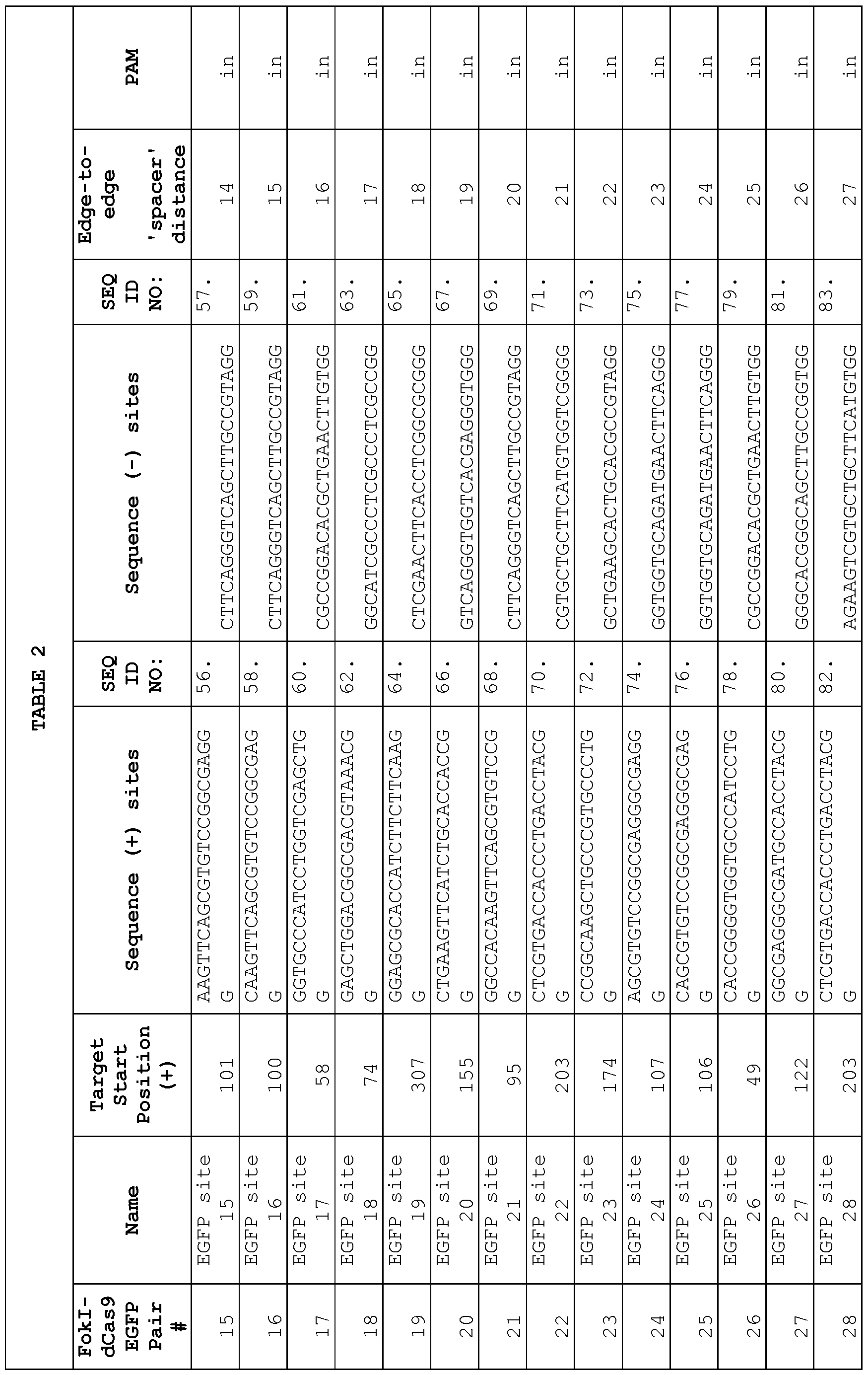
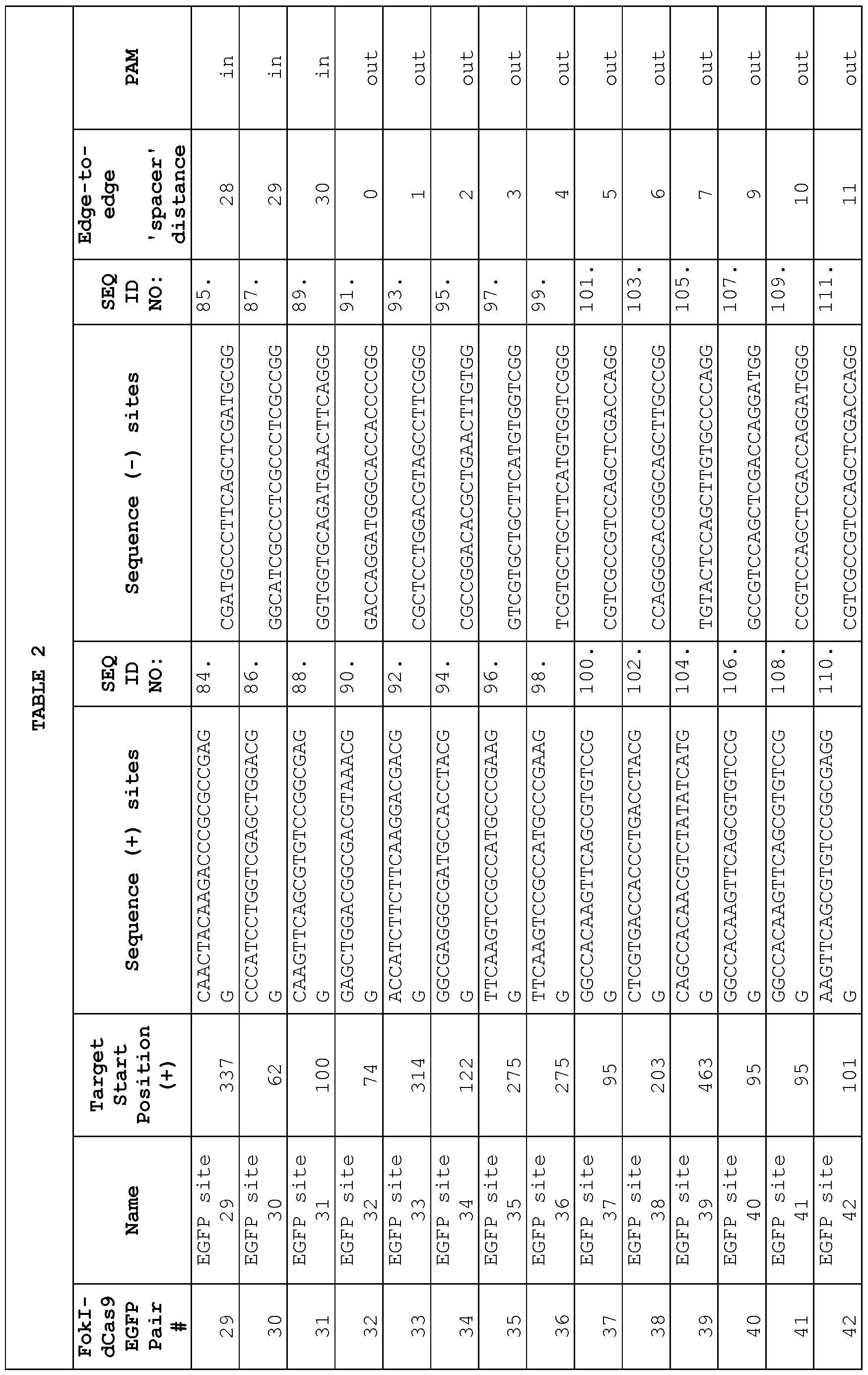


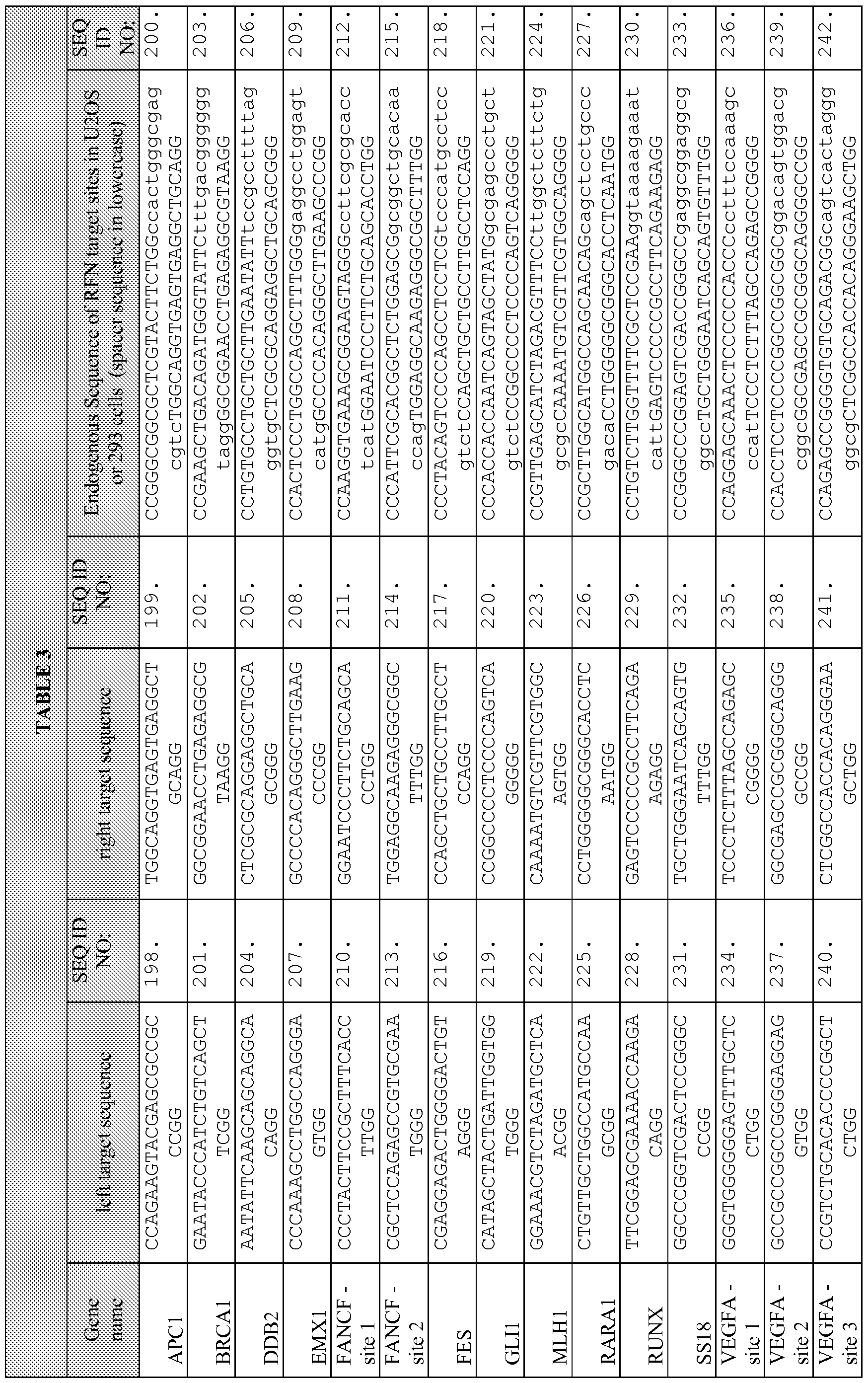


Claims
Priority Applications (29)
| Application Number | Priority Date | Filing Date | Title |
|---|---|---|---|
| KR1020157029177A KR102210322B1 (en) | 2013-03-15 | 2014-03-14 | Using rna-guided foki nucleases (rfns) to increase specificity for rna-guided genome editing |
| KR1020217002429A KR102271292B1 (en) | 2013-03-15 | 2014-03-14 | Using rna-guided foki nucleases (rfns) to increase specificity for rna-guided genome editing |
| CN201480027950.1A CN105247066B (en) | 2013-03-15 | 2014-03-14 | Increasing specificity of RNA-guided genome editing using RNA-guided FokI nuclease (RFN) |
| AU2014227653A AU2014227653B2 (en) | 2013-03-15 | 2014-03-14 | Using RNA-guided foki nucleases (RFNs) to increase specificity for RNA-guided genome editing |
| EP18208105.9A EP3467125B1 (en) | 2013-03-15 | 2014-03-14 | Using rna-guided foki nucleases (rfns) to increase specificity for rna-guided genome editing |
| CA2907198A CA2907198C (en) | 2013-03-15 | 2014-03-14 | Using rna-guided foki nucleases (rfns) to increase specificity for rna-guided genome editing |
| ES14764159T ES2713503T3 (en) | 2013-03-15 | 2014-03-14 | Use of RNA-guided FOKI nucleases (RFN) to increase the specificity for editing the RNA-guided genome |
| EP14764159.1A EP2971041B1 (en) | 2013-03-15 | 2014-03-14 | Using rna-guided foki nucleases (rfns) to increase specificity for rna-guided genome editing |
| JP2016502853A JP6622183B2 (en) | 2013-03-15 | 2014-03-14 | Increased specificity of RNA-guided genome editing using RNA-induced FokI nuclease (RFN) |
| US14/900,444 US10011850B2 (en) | 2013-06-21 | 2014-04-23 | Using RNA-guided FokI Nucleases (RFNs) to increase specificity for RNA-Guided Genome Editing |
| PCT/US2014/035162 WO2014204578A1 (en) | 2013-06-21 | 2014-04-23 | Using rna-guided foki nucleases (rfns) to increase specificity for rna-guided genome editing |
| CA2935032A CA2935032C (en) | 2013-12-26 | 2014-09-18 | Multiplex guide rnas |
| EP21191144.1A EP3985124A1 (en) | 2013-12-26 | 2014-09-18 | Multiplex guide rnas |
| KR1020167020111A KR20160102056A (en) | 2013-12-26 | 2014-09-18 | Multiplex guide rnas |
| EP14875819.6A EP3090044B1 (en) | 2013-12-26 | 2014-09-18 | Multiplex guide rnas |
| AU2014370416A AU2014370416B2 (en) | 2013-12-26 | 2014-09-18 | Multiplex guide RNAs |
| JP2016542968A JP6721508B2 (en) | 2013-12-26 | 2014-09-18 | Multiple guide RNA |
| CN201480076396.6A CN106103706B (en) | 2013-12-26 | 2014-09-18 | multiple guide RNA |
| CN202110920229.7A CN113684205B (en) | 2013-12-26 | 2014-09-18 | Multiple guide RNA |
| US15/107,550 US10526589B2 (en) | 2013-03-15 | 2014-09-18 | Multiplex guide RNAs |
| AU2017204909A AU2017204909B2 (en) | 2013-03-15 | 2017-07-17 | Using rna-guided foki nucleases (rfns) to increase specificity for rna-guided genome editing |
| US16/003,973 US10544433B2 (en) | 2013-03-15 | 2018-06-08 | Using RNA-guided FokI nucleases (RFNs) to increase specificity for RNA-guided genome editing |
| AU2019204675A AU2019204675B2 (en) | 2013-03-15 | 2019-07-01 | Using rna-guided foki nucleases (rfns) to increase specificity for rna-guided genome editing |
| JP2019218086A JP7005580B2 (en) | 2013-12-26 | 2019-12-02 | Multiple guide RNA |
| US16/735,146 US20200165587A1 (en) | 2013-12-26 | 2020-01-06 | Multiplex Guide RNAS |
| US16/751,578 US11098326B2 (en) | 2013-03-15 | 2020-01-24 | Using RNA-guided FokI nucleases (RFNs) to increase specificity for RNA-guided genome editing |
| AU2021203309A AU2021203309B2 (en) | 2013-12-26 | 2021-05-23 | Multiplex guide RNAs |
| AU2021203370A AU2021203370B2 (en) | 2013-03-15 | 2021-05-25 | Using rna-guided foki nucleases (rfns) to increase specificity for rna-guided genome editing |
| AU2023258349A AU2023258349A1 (en) | 2013-12-26 | 2023-10-31 | Multiplex guide RNAs |
Applications Claiming Priority (8)
| Application Number | Priority Date | Filing Date | Title |
|---|---|---|---|
| US201361799647P | 2013-03-15 | 2013-03-15 | |
| US61/799,647 | 2013-03-15 | ||
| US201361838178P | 2013-06-21 | 2013-06-21 | |
| US201361838148P | 2013-06-21 | 2013-06-21 | |
| US61/838,178 | 2013-06-21 | ||
| US61/838,148 | 2013-06-21 | ||
| US201361921007P | 2013-12-26 | 2013-12-26 | |
| US61/921,007 | 2013-12-26 |
Related Parent Applications (2)
| Application Number | Title | Priority Date | Filing Date |
|---|---|---|---|
| PCT/US2014/035162 Continuation WO2014204578A1 (en) | 2013-03-15 | 2014-04-23 | Using rna-guided foki nucleases (rfns) to increase specificity for rna-guided genome editing |
| US15/415,431 Continuation US10138476B2 (en) | 2013-03-15 | 2017-01-25 | Using RNA-guided FokI nucleases (RFNs) to increase specificity for RNA-guided genome editing |
Related Child Applications (4)
| Application Number | Title | Priority Date | Filing Date |
|---|---|---|---|
| PCT/US2014/029068 Continuation WO2014144592A2 (en) | 2013-03-15 | 2014-03-14 | Using truncated guide rnas (tru-grnas) to increase specificity for rna-guided genome editing |
| PCT/US2014/029304 Continuation WO2014144761A2 (en) | 2013-03-15 | 2014-03-14 | Increasing specificity for rna-guided genome editing |
| US14/900,444 Continuation-In-Part US10011850B2 (en) | 2013-06-21 | 2014-04-23 | Using RNA-guided FokI Nucleases (RFNs) to increase specificity for RNA-Guided Genome Editing |
| PCT/US2014/035162 Continuation-In-Part WO2014204578A1 (en) | 2013-03-15 | 2014-04-23 | Using rna-guided foki nucleases (rfns) to increase specificity for rna-guided genome editing |
Publications (1)
| Publication Number | Publication Date |
|---|---|
| WO2014144288A1 true WO2014144288A1 (en) | 2014-09-18 |
Family
ID=51537665
Family Applications (4)
| Application Number | Title | Priority Date | Filing Date |
|---|---|---|---|
| PCT/US2014/028630 Ceased WO2014144288A1 (en) | 2013-03-15 | 2014-03-14 | Using rna-guided foki nucleases (rfns) to increase specificity for rna-guided genome editing |
| PCT/US2014/027335 Ceased WO2014152432A2 (en) | 2013-03-15 | 2014-03-14 | Rna-guided targeting of genetic and epigenomic regulatory proteins to specific genomic loci |
| PCT/US2014/029304 Ceased WO2014144761A2 (en) | 2013-03-15 | 2014-03-14 | Increasing specificity for rna-guided genome editing |
| PCT/US2014/029068 Ceased WO2014144592A2 (en) | 2013-03-15 | 2014-03-14 | Using truncated guide rnas (tru-grnas) to increase specificity for rna-guided genome editing |
Family Applications After (3)
| Application Number | Title | Priority Date | Filing Date |
|---|---|---|---|
| PCT/US2014/027335 Ceased WO2014152432A2 (en) | 2013-03-15 | 2014-03-14 | Rna-guided targeting of genetic and epigenomic regulatory proteins to specific genomic loci |
| PCT/US2014/029304 Ceased WO2014144761A2 (en) | 2013-03-15 | 2014-03-14 | Increasing specificity for rna-guided genome editing |
| PCT/US2014/029068 Ceased WO2014144592A2 (en) | 2013-03-15 | 2014-03-14 | Using truncated guide rnas (tru-grnas) to increase specificity for rna-guided genome editing |
Country Status (12)
| Country | Link |
|---|---|
| US (17) | US9567603B2 (en) |
| EP (10) | EP3744842A1 (en) |
| JP (10) | JP6657069B2 (en) |
| KR (8) | KR102210319B1 (en) |
| CN (6) | CN105247066B (en) |
| AU (10) | AU2014228981B2 (en) |
| BR (1) | BR112015023489B1 (en) |
| CA (4) | CA2907198C (en) |
| ES (1) | ES2713503T3 (en) |
| IL (2) | IL289396B2 (en) |
| WO (4) | WO2014144288A1 (en) |
| ZA (1) | ZA201506814B (en) |
Cited By (114)
| Publication number | Priority date | Publication date | Assignee | Title |
|---|---|---|---|---|
| CN104531633A (en) * | 2014-11-18 | 2015-04-22 | 李云英 | Cas9-scForkI fusion protein and application thereof |
| WO2015035162A3 (en) * | 2013-09-06 | 2015-06-04 | President And Fellows Of Harvard College | Cas9 variants and uses thereof |
| US9068179B1 (en) | 2013-12-12 | 2015-06-30 | President And Fellows Of Harvard College | Methods for correcting presenilin point mutations |
| US9163284B2 (en) | 2013-08-09 | 2015-10-20 | President And Fellows Of Harvard College | Methods for identifying a target site of a Cas9 nuclease |
| US9228207B2 (en) | 2013-09-06 | 2016-01-05 | President And Fellows Of Harvard College | Switchable gRNAs comprising aptamers |
| WO2016057961A1 (en) * | 2014-10-10 | 2016-04-14 | Editas Medicine, Inc. | Compositions and methods for promoting homology directed repair |
| US9322006B2 (en) | 2011-07-22 | 2016-04-26 | President And Fellows Of Harvard College | Evaluation and improvement of nuclease cleavage specificity |
| US9359599B2 (en) | 2013-08-22 | 2016-06-07 | President And Fellows Of Harvard College | Engineered transcription activator-like effector (TALE) domains and uses thereof |
| US9512446B1 (en) | 2015-08-28 | 2016-12-06 | The General Hospital Corporation | Engineered CRISPR-Cas9 nucleases |
| US9526784B2 (en) | 2013-09-06 | 2016-12-27 | President And Fellows Of Harvard College | Delivery system for functional nucleases |
| US9567603B2 (en) | 2013-03-15 | 2017-02-14 | The General Hospital Corporation | Using RNA-guided FokI nucleases (RFNs) to increase specificity for RNA-guided genome editing |
| WO2017040348A1 (en) | 2015-08-28 | 2017-03-09 | The General Hospital Corporation | Engineered crispr-cas9 nucleases |
| WO2017059313A1 (en) | 2015-09-30 | 2017-04-06 | The General Hospital Corporation | Comprehensive in vitro reporting of cleavage events by sequencing (circle-seq) |
| US9834791B2 (en) | 2013-11-07 | 2017-12-05 | Editas Medicine, Inc. | CRISPR-related methods and compositions with governing gRNAS |
| WO2017209809A1 (en) * | 2016-06-02 | 2017-12-07 | Sigma-Aldrich Co. Llc | Using programmable dna binding proteins to enhance targeted genome modification |
| EP3167071A4 (en) * | 2014-07-09 | 2018-01-17 | Gen9, Inc. | Compositions and methods for site-directed dna nicking and cleaving |
| JP2018506987A (en) * | 2015-03-03 | 2018-03-15 | ザ ジェネラル ホスピタル コーポレイション | Genetically engineered CRISPR-Cas9 nuclease with altered PAM specificity |
| US9926546B2 (en) | 2015-08-28 | 2018-03-27 | The General Hospital Corporation | Engineered CRISPR-Cas9 nucleases |
| US9938521B2 (en) | 2014-03-10 | 2018-04-10 | Editas Medicine, Inc. | CRISPR/CAS-related methods and compositions for treating leber's congenital amaurosis 10 (LCA10) |
| WO2018071892A1 (en) | 2016-10-14 | 2018-04-19 | Joung J Keith | Epigenetically regulated site-specific nucleases |
| US10011850B2 (en) | 2013-06-21 | 2018-07-03 | The General Hospital Corporation | Using RNA-guided FokI Nucleases (RFNs) to increase specificity for RNA-Guided Genome Editing |
| WO2018129129A1 (en) * | 2017-01-05 | 2018-07-12 | Rutgers, The State University Of New Jersey | Targeted gene editing platform independent of dna double strand break and uses thereof |
| US10077453B2 (en) | 2014-07-30 | 2018-09-18 | President And Fellows Of Harvard College | CAS9 proteins including ligand-dependent inteins |
| US10081807B2 (en) | 2012-04-24 | 2018-09-25 | Gen9, Inc. | Methods for sorting nucleic acids and multiplexed preparative in vitro cloning |
| WO2018191603A1 (en) | 2017-04-14 | 2018-10-18 | University Of Massachusetts | Targeting cell tropism receptors to inhibit cytomegalovirus infection |
| US10113163B2 (en) | 2016-08-03 | 2018-10-30 | President And Fellows Of Harvard College | Adenosine nucleobase editors and uses thereof |
| US10167457B2 (en) | 2015-10-23 | 2019-01-01 | President And Fellows Of Harvard College | Nucleobase editors and uses thereof |
| US10202608B2 (en) | 2006-08-31 | 2019-02-12 | Gen9, Inc. | Iterative nucleic acid assembly using activation of vector-encoded traits |
| EP3473720A1 (en) * | 2013-08-22 | 2019-04-24 | Pioneer Hi-Bred International, Inc. | Genome modification using guide polynucleotide/cas endonuclease systems and methods of use |
| US10308931B2 (en) | 2012-03-21 | 2019-06-04 | Gen9, Inc. | Methods for screening proteins using DNA encoded chemical libraries as templates for enzyme catalysis |
| US10337001B2 (en) | 2014-12-03 | 2019-07-02 | Agilent Technologies, Inc. | Guide RNA with chemical modifications |
| US10428319B2 (en) | 2017-06-09 | 2019-10-01 | Editas Medicine, Inc. | Engineered Cas9 nucleases |
| US10457935B2 (en) | 2010-11-12 | 2019-10-29 | Gen9, Inc. | Protein arrays and methods of using and making the same |
| US10526589B2 (en) | 2013-03-15 | 2020-01-07 | The General Hospital Corporation | Multiplex guide RNAs |
| EP3502261A4 (en) * | 2016-08-19 | 2020-07-15 | Toolgen Incorporated | ARTIFICIALLY MADE REGULATORY SYSTEM FOR ANGIOGENESIS |
| US10745677B2 (en) | 2016-12-23 | 2020-08-18 | President And Fellows Of Harvard College | Editing of CCR5 receptor gene to protect against HIV infection |
| US10767175B2 (en) | 2016-06-08 | 2020-09-08 | Agilent Technologies, Inc. | High specificity genome editing using chemically modified guide RNAs |
| US20210040460A1 (en) | 2012-04-27 | 2021-02-11 | Duke University | Genetic correction of mutated genes |
| EP3812472A1 (en) | 2019-10-21 | 2021-04-28 | Albert-Ludwigs-Universität Freiburg | A truly unbiased in vitro assay to profile off-target activity of one or more target-specific programmable nucleases in cells (abnoba-seq) |
| US11028388B2 (en) | 2014-03-05 | 2021-06-08 | Editas Medicine, Inc. | CRISPR/Cas-related methods and compositions for treating Usher syndrome and retinitis pigmentosa |
| US11072789B2 (en) | 2012-06-25 | 2021-07-27 | Gen9, Inc. | Methods for nucleic acid assembly and high throughput sequencing |
| US11084014B2 (en) | 2010-11-12 | 2021-08-10 | Gen9, Inc. | Methods and devices for nucleic acids synthesis |
| US11111521B2 (en) | 2011-12-22 | 2021-09-07 | President And Fellows Of Harvard College | Compositions and methods for analyte detection |
| US11141493B2 (en) | 2014-03-10 | 2021-10-12 | Editas Medicine, Inc. | Compositions and methods for treating CEP290-associated disease |
| EP3728589A4 (en) * | 2017-12-22 | 2021-11-03 | G+Flas Life Sciences | Chimeric genome engineering molecules and methods |
| US11180793B2 (en) | 2015-04-24 | 2021-11-23 | Editas Medicine, Inc. | Evaluation of Cas9 molecule/guide RNA molecule complexes |
| US11236313B2 (en) | 2016-04-13 | 2022-02-01 | Editas Medicine, Inc. | Cas9 fusion molecules, gene editing systems, and methods of use thereof |
| US11242525B2 (en) | 2014-03-26 | 2022-02-08 | Editas Medicine, Inc. | CRISPR/CAS-related methods and compositions for treating sickle cell disease |
| US11268082B2 (en) | 2017-03-23 | 2022-03-08 | President And Fellows Of Harvard College | Nucleobase editors comprising nucleic acid programmable DNA binding proteins |
| US11286468B2 (en) | 2017-08-23 | 2022-03-29 | The General Hospital Corporation | Engineered CRISPR-Cas9 nucleases with altered PAM specificity |
| US11299767B2 (en) | 2013-03-12 | 2022-04-12 | President And Fellows Of Harvard College | Method for generating a three-dimensional nucleic acid containing matrix |
| US11306309B2 (en) | 2015-04-06 | 2022-04-19 | The Board Of Trustees Of The Leland Stanford Junior University | Chemically modified guide RNAs for CRISPR/CAS-mediated gene regulation |
| US11306324B2 (en) | 2016-10-14 | 2022-04-19 | President And Fellows Of Harvard College | AAV delivery of nucleobase editors |
| US11319532B2 (en) | 2017-08-30 | 2022-05-03 | President And Fellows Of Harvard College | High efficiency base editors comprising Gam |
| US11339437B2 (en) | 2014-03-10 | 2022-05-24 | Editas Medicine, Inc. | Compositions and methods for treating CEP290-associated disease |
| EP4017976A1 (en) * | 2019-08-20 | 2022-06-29 | Kemijski Institut | Coiled-coil mediated tethering of crispr/cas and exonucleases for enhanced genome editing |
| US11390884B2 (en) | 2015-05-11 | 2022-07-19 | Editas Medicine, Inc. | Optimized CRISPR/cas9 systems and methods for gene editing in stem cells |
| US11421251B2 (en) | 2015-10-13 | 2022-08-23 | Duke University | Genome engineering with type I CRISPR systems in eukaryotic cells |
| US11427817B2 (en) | 2015-08-25 | 2022-08-30 | Duke University | Compositions and methods of improving specificity in genomic engineering using RNA-guided endonucleases |
| US11447770B1 (en) | 2019-03-19 | 2022-09-20 | The Broad Institute, Inc. | Methods and compositions for prime editing nucleotide sequences |
| US11466271B2 (en) | 2017-02-06 | 2022-10-11 | Novartis Ag | Compositions and methods for the treatment of hemoglobinopathies |
| US11479793B2 (en) | 2015-07-15 | 2022-10-25 | Rutgers, The State University Of New Jersey | Nuclease-independent targeted gene editing platform and uses thereof |
| US11499151B2 (en) | 2017-04-28 | 2022-11-15 | Editas Medicine, Inc. | Methods and systems for analyzing guide RNA molecules |
| US11512311B2 (en) | 2016-03-25 | 2022-11-29 | Editas Medicine, Inc. | Systems and methods for treating alpha 1-antitrypsin (A1AT) deficiency |
| EP4095243A1 (en) | 2021-05-25 | 2022-11-30 | European Molecular Biology Laboratory | System for hybridization-based precision genome cleavage and editing, and uses thereof |
| US11542554B2 (en) | 2015-11-03 | 2023-01-03 | President And Fellows Of Harvard College | Method and apparatus for volumetric imaging |
| US11542509B2 (en) | 2016-08-24 | 2023-01-03 | President And Fellows Of Harvard College | Incorporation of unnatural amino acids into proteins using base editing |
| US11542496B2 (en) | 2017-03-10 | 2023-01-03 | President And Fellows Of Harvard College | Cytosine to guanine base editor |
| US11560566B2 (en) | 2017-05-12 | 2023-01-24 | President And Fellows Of Harvard College | Aptazyme-embedded guide RNAs for use with CRISPR-Cas9 in genome editing and transcriptional activation |
| US11566263B2 (en) | 2016-08-02 | 2023-01-31 | Editas Medicine, Inc. | Compositions and methods for treating CEP290 associated disease |
| US11597924B2 (en) | 2016-03-25 | 2023-03-07 | Editas Medicine, Inc. | Genome editing systems comprising repair-modulating enzyme molecules and methods of their use |
| US11661590B2 (en) | 2016-08-09 | 2023-05-30 | President And Fellows Of Harvard College | Programmable CAS9-recombinase fusion proteins and uses thereof |
| US11667911B2 (en) | 2015-09-24 | 2023-06-06 | Editas Medicine, Inc. | Use of exonucleases to improve CRISPR/CAS-mediated genome editing |
| US11680268B2 (en) | 2014-11-07 | 2023-06-20 | Editas Medicine, Inc. | Methods for improving CRISPR/Cas-mediated genome-editing |
| US11702662B2 (en) | 2011-08-26 | 2023-07-18 | Gen9, Inc. | Compositions and methods for high fidelity assembly of nucleic acids |
| US11713485B2 (en) | 2016-04-25 | 2023-08-01 | President And Fellows Of Harvard College | Hybridization chain reaction methods for in situ molecular detection |
| US11732274B2 (en) | 2017-07-28 | 2023-08-22 | President And Fellows Of Harvard College | Methods and compositions for evolving base editors using phage-assisted continuous evolution (PACE) |
| US11795443B2 (en) | 2017-10-16 | 2023-10-24 | The Broad Institute, Inc. | Uses of adenosine base editors |
| US11851690B2 (en) | 2017-03-14 | 2023-12-26 | Editas Medicine, Inc. | Systems and methods for the treatment of hemoglobinopathies |
| US11866726B2 (en) | 2017-07-14 | 2024-01-09 | Editas Medicine, Inc. | Systems and methods for targeted integration and genome editing and detection thereof using integrated priming sites |
| US11884915B2 (en) | 2021-09-10 | 2024-01-30 | Agilent Technologies, Inc. | Guide RNAs with chemical modification for prime editing |
| US11898179B2 (en) | 2017-03-09 | 2024-02-13 | President And Fellows Of Harvard College | Suppression of pain by gene editing |
| US11911415B2 (en) | 2015-06-09 | 2024-02-27 | Editas Medicine, Inc. | CRISPR/Cas-related methods and compositions for improving transplantation |
| US11912985B2 (en) | 2020-05-08 | 2024-02-27 | The Broad Institute, Inc. | Methods and compositions for simultaneous editing of both strands of a target double-stranded nucleotide sequence |
| US11920128B2 (en) | 2013-09-18 | 2024-03-05 | Kymab Limited | Methods, cells and organisms |
| US11963982B2 (en) | 2017-05-10 | 2024-04-23 | Editas Medicine, Inc. | CRISPR/RNA-guided nuclease systems and methods |
| WO2024084025A1 (en) | 2022-10-21 | 2024-04-25 | Keygene N.V. | Rna transfection in plant cells with modified rna |
| US11981917B2 (en) | 2013-06-04 | 2024-05-14 | President And Fellows Of Harvard College | RNA-guided transcriptional regulation |
| WO2024121354A1 (en) | 2022-12-08 | 2024-06-13 | Keygene N.V. | Duplex sequencing with covalently closed dna ends |
| US12031132B2 (en) | 2018-03-14 | 2024-07-09 | Editas Medicine, Inc. | Systems and methods for the treatment of hemoglobinopathies |
| US12098425B2 (en) | 2018-10-10 | 2024-09-24 | Readcoor, Llc | Three-dimensional spatial molecular indexing |
| US12110545B2 (en) | 2017-01-06 | 2024-10-08 | Editas Medicine, Inc. | Methods of assessing nuclease cleavage |
| WO2024209000A1 (en) | 2023-04-04 | 2024-10-10 | Keygene N.V. | Linkers for duplex sequencing |
| US12152241B2 (en) | 2014-06-25 | 2024-11-26 | The General Hospital Corporation | Targeting human satellite II (HSATII) |
| US12157760B2 (en) | 2018-05-23 | 2024-12-03 | The Broad Institute, Inc. | Base editors and uses thereof |
| US12203136B2 (en) | 2020-08-17 | 2025-01-21 | Readcoor, Llc | Methods and systems for spatial mapping of genetic variants |
| US12214056B2 (en) | 2016-07-19 | 2025-02-04 | Duke University | Therapeutic applications of CPF1-based genome editing |
| US12215366B2 (en) | 2015-02-09 | 2025-02-04 | Duke University | Compositions and methods for epigenome editing |
| US12215345B2 (en) | 2013-03-19 | 2025-02-04 | Duke University | Compositions and methods for the induction and tuning of gene expression |
| US12264341B2 (en) | 2020-01-24 | 2025-04-01 | The General Hospital Corporation | CRISPR-Cas enzymes with enhanced on-target activity |
| US12281338B2 (en) | 2018-10-29 | 2025-04-22 | The Broad Institute, Inc. | Nucleobase editors comprising GeoCas9 and uses thereof |
| US12286727B2 (en) | 2016-12-19 | 2025-04-29 | Editas Medicine, Inc. | Assessing nuclease cleavage |
| US12312613B2 (en) | 2020-01-24 | 2025-05-27 | The General Hospital Corporation | Unconstrained genome targeting with near-PAMless engineered CRISPR-Cas9 variants |
| US12331347B2 (en) | 2014-07-11 | 2025-06-17 | President And Fellows Of Harvard College | Methods for high-throughput labelling and detection of biological features in situ using microscopy |
| US12338436B2 (en) | 2018-06-29 | 2025-06-24 | Editas Medicine, Inc. | Synthetic guide molecules, compositions and methods relating thereto |
| US12351837B2 (en) | 2019-01-23 | 2025-07-08 | The Broad Institute, Inc. | Supernegatively charged proteins and uses thereof |
| US12390514B2 (en) | 2017-03-09 | 2025-08-19 | President And Fellows Of Harvard College | Cancer vaccine |
| US12406749B2 (en) | 2017-12-15 | 2025-09-02 | The Broad Institute, Inc. | Systems and methods for predicting repair outcomes in genetic engineering |
| US12428631B2 (en) | 2016-04-13 | 2025-09-30 | Duke University | CRISPR/Cas9-based repressors for silencing gene targets in vivo and methods of use |
| US12435330B2 (en) | 2019-10-10 | 2025-10-07 | The Broad Institute, Inc. | Methods and compositions for prime editing RNA |
| US12460231B2 (en) | 2014-04-02 | 2025-11-04 | Editas Medicine, Inc. | Crispr/CAS-related methods and compositions for treating primary open angle glaucoma |
| US12467086B2 (en) | 2011-10-14 | 2025-11-11 | President And Fellows Of Harvard College | Sequencing by structure assembly |
| US12473543B2 (en) | 2019-04-17 | 2025-11-18 | The Broad Institute, Inc. | Adenine base editors with reduced off-target effects |
| US12522807B2 (en) | 2018-07-09 | 2026-01-13 | The Broad Institute, Inc. | RNA programmable epigenetic RNA modifiers and uses thereof |
Families Citing this family (333)
| Publication number | Priority date | Publication date | Assignee | Title |
|---|---|---|---|---|
| EP2625292B1 (en) | 2010-10-07 | 2018-12-05 | The General Hospital Corporation | Biomarkers of cancer |
| BR112013024337A2 (en) | 2011-03-23 | 2017-09-26 | Du Pont | complex transgenic trace locus in a plant, plant or seed, method for producing in a plant a complex transgenic trace locus and expression construct |
| EP3461896B1 (en) | 2011-07-15 | 2023-11-29 | The General Hospital Corporation | Methods of transcription activator like effector assembly |
| GB201122458D0 (en) * | 2011-12-30 | 2012-02-08 | Univ Wageningen | Modified cascade ribonucleoproteins and uses thereof |
| US10039777B2 (en) | 2012-03-20 | 2018-08-07 | Neuro-Lm Sas | Methods and pharmaceutical compositions of the treatment of autistic syndrome disorders |
| PT3241902T (en) | 2012-05-25 | 2018-05-28 | Univ California | METHODS AND COMPOSITIONS FOR MODIFICATION OF TARGETED TARGET DNA BY RNA AND FOR MODULATION DIRECTED BY TRANSCRIPTION RNA |
| US9890364B2 (en) | 2012-05-29 | 2018-02-13 | The General Hospital Corporation | TAL-Tet1 fusion proteins and methods of use thereof |
| EP2906602B1 (en) * | 2012-10-12 | 2019-01-16 | The General Hospital Corporation | Transcription activator-like effector (tale) - lysine-specific demethylase 1 (lsd1) fusion proteins |
| CN108715602A (en) | 2012-12-06 | 2018-10-30 | 西格马-奥尔德里奇有限责任公司 | Genomic modification based on CRISPR and regulation and control |
| EP2931899A1 (en) | 2012-12-12 | 2015-10-21 | The Broad Institute, Inc. | Functional genomics using crispr-cas systems, compositions, methods, knock out libraries and applications thereof |
| SG10201707569YA (en) | 2012-12-12 | 2017-10-30 | Broad Inst Inc | Delivery, Engineering and Optimization of Systems, Methods and Compositions for Sequence Manipulation and Therapeutic Applications |
| EP3434776A1 (en) | 2012-12-12 | 2019-01-30 | The Broad Institute, Inc. | Methods, models, systems, and apparatus for identifying target sequences for cas enzymes or crispr-cas systems for target sequences and conveying results thereof |
| CN104995302B (en) | 2013-01-16 | 2021-08-31 | 爱默蕾大学 | CAS9-nucleic acid complexes and related uses |
| EP3345991B1 (en) | 2013-02-07 | 2019-09-04 | The General Hospital Corporation | Tale transcriptional activators |
| NZ712727A (en) | 2013-03-14 | 2017-05-26 | Caribou Biosciences Inc | Compositions and methods of nucleic acid-targeting nucleic acids |
| CN115261411A (en) * | 2013-04-04 | 2022-11-01 | 哈佛学院校长同事会 | Therapeutic uses of genome editing with CRISPR/Cas systems |
| US9267135B2 (en) * | 2013-06-04 | 2016-02-23 | President And Fellows Of Harvard College | RNA-guided transcriptional regulation |
| ES2987399T3 (en) * | 2013-06-05 | 2024-11-14 | Univ Duke | RNA-guided gene editing and gene regulation |
| JP6738728B2 (en) | 2013-06-17 | 2020-08-19 | ザ・ブロード・インスティテュート・インコーポレイテッド | Delivery and use of CRISPR-Cas systems, vectors and compositions for liver targeting and therapy |
| AU2014281031B2 (en) | 2013-06-17 | 2020-05-21 | Massachusetts Institute Of Technology | Delivery, use and therapeutic applications of the CRISPR-Cas systems and compositions for targeting disorders and diseases using viral components |
| WO2014204724A1 (en) | 2013-06-17 | 2014-12-24 | The Broad Institute Inc. | Delivery, engineering and optimization of tandem guide systems, methods and compositions for sequence manipulation |
| WO2014204725A1 (en) | 2013-06-17 | 2014-12-24 | The Broad Institute Inc. | Optimized crispr-cas double nickase systems, methods and compositions for sequence manipulation |
| WO2014204727A1 (en) | 2013-06-17 | 2014-12-24 | The Broad Institute Inc. | Functional genomics using crispr-cas systems, compositions methods, screens and applications thereof |
| WO2015006498A2 (en) | 2013-07-09 | 2015-01-15 | President And Fellows Of Harvard College | Therapeutic uses of genome editing with crispr/cas systems |
| WO2015021426A1 (en) * | 2013-08-09 | 2015-02-12 | Sage Labs, Inc. | A crispr/cas system-based novel fusion protein and its application in genome editing |
| US10584358B2 (en) | 2013-10-30 | 2020-03-10 | North Carolina State University | Compositions and methods related to a type-II CRISPR-Cas system in Lactobacillus buchneri |
| JP6793547B2 (en) | 2013-12-12 | 2020-12-02 | ザ・ブロード・インスティテュート・インコーポレイテッド | Optimization Function Systems, methods and compositions for sequence manipulation with the CRISPR-Cas system |
| WO2015089364A1 (en) | 2013-12-12 | 2015-06-18 | The Broad Institute Inc. | Crystal structure of a crispr-cas system, and uses thereof |
| MX2016007325A (en) | 2013-12-12 | 2017-07-19 | Broad Inst Inc | Compositions and methods of use of crispr-cas systems in nucleotide repeat disorders. |
| US9994831B2 (en) * | 2013-12-12 | 2018-06-12 | The Regents Of The University Of California | Methods and compositions for modifying a single stranded target nucleic acid |
| WO2015089473A1 (en) | 2013-12-12 | 2015-06-18 | The Broad Institute Inc. | Engineering of systems, methods and optimized guide compositions with new architectures for sequence manipulation |
| MX374529B (en) | 2013-12-12 | 2025-03-06 | Broad Inst Inc | SUPPLY, USE AND THERAPEUTIC APPLICATIONS OF CRISPR-CAS SYSTEMS AND COMPOSITIONS FOR GENOME EDITING. |
| JP2017527256A (en) | 2013-12-12 | 2017-09-21 | ザ・ブロード・インスティテュート・インコーポレイテッド | Delivery, use and therapeutic applications of CRISPR-Cas systems and compositions for HBV and viral diseases and disorders |
| KR20160102056A (en) * | 2013-12-26 | 2016-08-26 | 더 제너럴 하스피탈 코포레이션 | Multiplex guide rnas |
| US10787654B2 (en) | 2014-01-24 | 2020-09-29 | North Carolina State University | Methods and compositions for sequence guiding Cas9 targeting |
| CN111705365B (en) | 2014-02-11 | 2024-12-17 | 科罗拉多州立大学董事会(法人团体) | CRISPR supported multiplex genome engineering |
| US11439712B2 (en) | 2014-04-08 | 2022-09-13 | North Carolina State University | Methods and compositions for RNA-directed repression of transcription using CRISPR-associated genes |
| KR20170005494A (en) | 2014-05-30 | 2017-01-13 | 더 보드 어브 트러스티스 어브 더 리랜드 스탠포드 주니어 유니버시티 | Compositions and methods of delivering treatments for latent viral infections |
| WO2015200378A1 (en) | 2014-06-23 | 2015-12-30 | The General Hospital Corporation | Genomewide unbiased identification of dsbs evaluated by sequencing (guide-seq) |
| US20150376587A1 (en) * | 2014-06-25 | 2015-12-31 | Caribou Biosciences, Inc. | RNA Modification to Engineer Cas9 Activity |
| BR112017000482A2 (en) | 2014-07-11 | 2017-11-07 | Du Pont | methods for producing a mutant plant and for generating a plant, plant, seed, rna, methods for producing a cell, for duplicating a gene fragment, for replacing a first promoter sequence, for inserting a regulatory element in a nucleotide sequence, and for inserting an intron in a nucleotide sequence, maize plant and plant cell |
| WO2016022866A1 (en) | 2014-08-07 | 2016-02-11 | Agilent Technologies, Inc. | Cis-blocked guide rna |
| EP3186375A4 (en) | 2014-08-28 | 2019-03-13 | North Carolina State University | NEW CAS9 PROTEINS AND GUIDING ELEMENTS FOR DNA TARGETING AND THE GENOME EDITION |
| MX2017002930A (en) | 2014-09-12 | 2017-06-06 | Du Pont | Generation of site-specific-integration sites for complex trait loci in corn and soybean, and methods of use. |
| WO2016049258A2 (en) * | 2014-09-25 | 2016-03-31 | The Broad Institute Inc. | Functional screening with optimized functional crispr-cas systems |
| US20170233762A1 (en) * | 2014-09-29 | 2017-08-17 | The Regents Of The University Of California | Scaffold rnas |
| GB201418965D0 (en) | 2014-10-24 | 2014-12-10 | Ospedale San Raffaele And Fond Telethon | |
| US9816080B2 (en) | 2014-10-31 | 2017-11-14 | President And Fellows Of Harvard College | Delivery of CAS9 via ARRDC1-mediated microvesicles (ARMMs) |
| US12180263B2 (en) | 2014-11-06 | 2024-12-31 | President And Fellows Of Harvard College | Cells lacking B2M surface expression and methods for allogeneic administration of such cells |
| US11352666B2 (en) | 2014-11-14 | 2022-06-07 | Institute For Basic Science | Method for detecting off-target sites of programmable nucleases in a genome |
| WO2016076672A1 (en) * | 2014-11-14 | 2016-05-19 | 기초과학연구원 | Method for detecting off-target site of genetic scissors in genome |
| KR20160059994A (en) * | 2014-11-19 | 2016-05-27 | 기초과학연구원 | A method for regulation of gene expression by expressing Cas9 protein from the two independent vector |
| US10975392B2 (en) | 2014-12-05 | 2021-04-13 | Abcam Plc | Site-directed CRISPR/recombinase compositions and methods of integrating transgenes |
| JP6830437B2 (en) | 2014-12-10 | 2021-02-17 | リージェンツ オブ ザ ユニバーシティ オブ ミネソタ | Genetically modified cells, tissues and organs to treat the disease |
| EP3230452B1 (en) * | 2014-12-12 | 2025-06-11 | The Broad Institute, Inc. | Dead guides for crispr transcription factors |
| EP3985115A1 (en) * | 2014-12-12 | 2022-04-20 | The Broad Institute, Inc. | Protected guide rnas (pgrnas) |
| JP2017538427A (en) | 2014-12-18 | 2017-12-28 | インテグレイテッド ディーエヌエイ テクノロジーズ インコーポレイテッド | CRISPR composition and method of use |
| US20180179523A1 (en) * | 2014-12-18 | 2018-06-28 | Integrated Dna Technologies, Inc. | Crispr-based compositions and methods of use |
| US10190106B2 (en) | 2014-12-22 | 2019-01-29 | Univesity Of Massachusetts | Cas9-DNA targeting unit chimeras |
| EP3237615B2 (en) | 2014-12-24 | 2023-07-26 | The Broad Institute, Inc. | Crispr having or associated with destabilization domains |
| US11208638B2 (en) | 2015-01-12 | 2021-12-28 | The Regents Of The University Of California | Heterodimeric Cas9 and methods of use thereof |
| US11180792B2 (en) * | 2015-01-28 | 2021-11-23 | The Regents Of The University Of California | Methods and compositions for labeling a single-stranded target nucleic acid |
| PL3250691T3 (en) | 2015-01-28 | 2023-11-27 | Caribou Biosciences, Inc. | Crispr hybrid dna/rna polynucleotides and methods of use |
| KR102630802B1 (en) * | 2015-02-18 | 2024-01-31 | 아이오와 스테이트 유니버시티 리서치 파운데이션, 인코퍼레이티드 | Modification of the transcriptional repressor binding site within the NF-YC4 promoter for increased protein content and resistance to stress. |
| US10450576B2 (en) | 2015-03-27 | 2019-10-22 | E I Du Pont De Nemours And Company | Soybean U6 small nuclear RNA gene promoters and their use in constitutive expression of small RNA genes in plants |
| CA2988854A1 (en) | 2015-05-08 | 2016-11-17 | President And Fellows Of Harvard College | Universal donor stem cells and related methods |
| KR20220139447A (en) | 2015-05-29 | 2022-10-14 | 노쓰 캐롤라이나 스테이트 유니버시티 | Methods for screening bacteria, archaea, algae, and yeast using crispr nucleic acids |
| GB2543873A (en) | 2015-05-29 | 2017-05-03 | Agenovir Corp | Compositions and methods for cell targeted HPV treatment |
| US10117911B2 (en) | 2015-05-29 | 2018-11-06 | Agenovir Corporation | Compositions and methods to treat herpes simplex virus infections |
| EP3303634B1 (en) | 2015-06-03 | 2023-08-30 | The Regents of The University of California | Cas9 variants and methods of use thereof |
| WO2016193945A2 (en) | 2015-06-05 | 2016-12-08 | Novartis Ag | Methods and compositions for diagnosing, treating, and monitoring treatment of shank3 deficiency associated disorders |
| EP3726218B1 (en) * | 2015-06-10 | 2023-08-09 | Firmenich Sa | Cell lines for screening odorant and aroma receptors |
| IL298524B2 (en) | 2015-06-12 | 2024-03-01 | Lonza Walkersville Inc | Methods for nuclear reprogramming using synthetic transcription factors |
| US11155823B2 (en) | 2015-06-15 | 2021-10-26 | North Carolina State University | Methods and compositions for efficient delivery of nucleic acids and RNA-based antimicrobials |
| CA2989830A1 (en) | 2015-06-18 | 2016-12-22 | The Broad Institute, Inc. | Crispr enzyme mutations reducing off-target effects |
| WO2016205759A1 (en) | 2015-06-18 | 2016-12-22 | The Broad Institute Inc. | Engineering and optimization of systems, methods, enzymes and guide scaffolds of cas9 orthologs and variants for sequence manipulation |
| WO2017004279A2 (en) * | 2015-06-29 | 2017-01-05 | Massachusetts Institute Of Technology | Compositions comprising nucleic acids and methods of using the same |
| AU2016285724A1 (en) | 2015-06-29 | 2017-11-16 | Ionis Pharmaceuticals, Inc. | Modified CRISPR RNA and modified single CRISPR RNA and uses thereof |
| WO2017015637A1 (en) | 2015-07-22 | 2017-01-26 | Duke University | High-throughput screening of regulatory element function with epigenome editing technologies |
| CN108472314A (en) | 2015-07-31 | 2018-08-31 | 明尼苏达大学董事会 | Modified Cells and Therapeutics |
| US20180230450A1 (en) * | 2015-08-03 | 2018-08-16 | President And Fellows Of Harvard College | Cas9 Genome Editing and Transcriptional Regulation |
| WO2017024047A1 (en) * | 2015-08-03 | 2017-02-09 | Emendobio Inc. | Compositions and methods for increasing nuclease induced recombination rate in cells |
| WO2017040511A1 (en) * | 2015-08-31 | 2017-03-09 | Agilent Technologies, Inc. | Compounds and methods for crispr/cas-based genome editing by homologous recombination |
| WO2017044776A1 (en) * | 2015-09-10 | 2017-03-16 | Texas Tech University System | Single-guide rna (sgrna) with improved knockout efficiency |
| CA3000816A1 (en) | 2015-09-11 | 2017-03-16 | The General Hospital Corporation | Full interrogation of nuclease dsbs and sequencing (find-seq) |
| US11286480B2 (en) | 2015-09-28 | 2022-03-29 | North Carolina State University | Methods and compositions for sequence specific antimicrobials |
| MX390635B (en) * | 2015-10-06 | 2025-03-21 | Inst Basic Science | METHOD FOR PRODUCING COMPLETE PLANTS FROM PROTOPLASTS. |
| US9677090B2 (en) | 2015-10-23 | 2017-06-13 | Caribou Biosciences, Inc. | Engineered nucleic-acid targeting nucleic acids |
| EP3374501B1 (en) | 2015-11-11 | 2023-07-12 | Lonza Ltd | Crispr-associated (cas) proteins with reduced immunogenicity |
| CN108699101B (en) | 2015-11-20 | 2022-04-19 | 塞奇科学股份有限公司 | Preparative electrophoresis method for targeted purification of genomic DNA fragments |
| EP3382018B1 (en) * | 2015-11-25 | 2022-03-30 | National University Corporation Gunma University | Dna methylation editing kit and dna methylation editing method |
| EA201891317A3 (en) | 2015-11-30 | 2019-04-30 | Дьюк Юниверсити | THERAPEUTIC TARGETS FOR CORRECTION OF HUMAN DISTROPHIN GENE BY EDITING GENES AND METHODS OF THEIR APPLICATION |
| WO2017106251A1 (en) * | 2015-12-14 | 2017-06-22 | President And Fellows Of Harvard College | Cas discrimination using tuned guide rna |
| WO2017112620A1 (en) | 2015-12-22 | 2017-06-29 | North Carolina State University | Methods and compositions for delivery of crispr based antimicrobials |
| SG11201805217XA (en) * | 2015-12-28 | 2018-07-30 | Novartis Ag | Compositions and methods for the treatment of hemoglobinopathies |
| MX2018008345A (en) | 2016-01-11 | 2018-12-06 | Univ Leland Stanford Junior | Chimeric proteins and methods of immunotherapy. |
| BR112018013679A2 (en) | 2016-01-11 | 2019-01-22 | Univ Leland Stanford Junior | chimeric proteins and gene expression regulation methods |
| WO2017136794A1 (en) | 2016-02-03 | 2017-08-10 | Massachusetts Institute Of Technology | Structure-guided chemical modification of guide rna and its applications |
| US20190048415A1 (en) | 2016-02-10 | 2019-02-14 | The Regents Of The University Of Michigan | Detection of nucleic acids |
| WO2017143071A1 (en) | 2016-02-18 | 2017-08-24 | The Regents Of The University Of California | Methods and compositions for gene editing in stem cells |
| US10538750B2 (en) | 2016-02-29 | 2020-01-21 | Agilent Technologies, Inc. | Methods and compositions for blocking off-target nucleic acids from cleavage by CRISPR proteins |
| SG11201807478QA (en) | 2016-03-15 | 2018-09-27 | Apse Inc | Methods and compositions for increased double stranded rna production |
| JP2019515654A (en) | 2016-03-16 | 2019-06-13 | ザ ジェイ. デヴィッド グラッドストーン インスティテューツ | Methods and compositions for treating obesity and / or diabetes, and methods and compositions for identifying candidate treatment agents |
| EP3219799A1 (en) | 2016-03-17 | 2017-09-20 | IMBA-Institut für Molekulare Biotechnologie GmbH | Conditional crispr sgrna expression |
| CN106701765A (en) * | 2016-04-11 | 2017-05-24 | 广东赤萌医疗科技有限公司 | Polynucleotide for HIV (human immunodeficiency virus) infection treatment and application thereof for preparing medicines |
| CN107326046A (en) * | 2016-04-28 | 2017-11-07 | 上海邦耀生物科技有限公司 | A kind of method for improving foreign gene homologous recombination efficiency |
| CN113831407B (en) | 2016-05-20 | 2024-06-11 | 瑞泽恩制药公司 | Methods for breaking immune tolerance using multiple guide RNAs |
| US20190100732A1 (en) * | 2016-06-02 | 2019-04-04 | Yissum Research Development Company Of The Hebrew University Of Jerusalem Ltd. | Assay for the removal of methyl-cytosine residues from dna |
| WO2017217768A1 (en) * | 2016-06-15 | 2017-12-21 | 주식회사 툴젠 | Method for screening targeted genetic scissors by using multiple target system of on-target and off-target activity and use thereof |
| US10017760B2 (en) | 2016-06-24 | 2018-07-10 | Inscripta, Inc. | Methods for generating barcoded combinatorial libraries |
| EP3474849B1 (en) | 2016-06-27 | 2025-05-21 | The Broad Institute, Inc. | Compositions and methods for detecting and treating diabetes |
| US11359234B2 (en) | 2016-07-01 | 2022-06-14 | Microsoft Technology Licensing, Llc | Barcoding sequences for identification of gene expression |
| US10669558B2 (en) | 2016-07-01 | 2020-06-02 | Microsoft Technology Licensing, Llc | Storage through iterative DNA editing |
| US20180004537A1 (en) | 2016-07-01 | 2018-01-04 | Microsoft Technology Licensing, Llc | Molecular State Machines |
| WO2018010516A1 (en) * | 2016-07-13 | 2018-01-18 | 陈奇涵 | Method for specifically editing genomic dna and application thereof |
| JP7033583B2 (en) * | 2016-07-13 | 2022-03-10 | バーテックス ファーマシューティカルズ インコーポレイテッド | Methods, compositions and kits for increasing genome editing efficiency |
| US11168313B2 (en) * | 2016-07-26 | 2021-11-09 | The General Hospital Corporation | Variants of CRISPR from Prevotella and Francisella 1 (Cpf1) |
| CN109789185A (en) * | 2016-07-28 | 2019-05-21 | 基础科学研究院 | For treating the albumen containing CAS9 of eye disease and the pharmaceutical composition of guide RNA |
| MX2019001211A (en) | 2016-07-29 | 2019-09-16 | Regeneron Pharma | Mice comprising mutations resulting in expression of c-truncated fibrillin-1. |
| TWI791459B (en) | 2016-08-10 | 2023-02-11 | 日商領先基因生技股份有限公司 | Method for alteration of target site of eukaryotic cell genome |
| JP7308143B2 (en) * | 2016-08-19 | 2023-07-13 | ホワイトヘッド・インスティテュート・フォー・バイオメディカル・リサーチ | Methods for Editing DNA Methylation |
| SG11201901364VA (en) | 2016-08-24 | 2019-03-28 | Sangamo Therapeutics Inc | Engineered target specific nucleases |
| LT3504229T (en) | 2016-08-24 | 2021-12-10 | Sangamo Therapeutics, Inc. | Regulation of gene expression using engineered nucleases |
| CA3035910A1 (en) * | 2016-09-07 | 2018-03-15 | Flagship Pioneering, Inc. | Methods and compositions for modulating gene expression |
| WO2018048194A1 (en) * | 2016-09-07 | 2018-03-15 | 울산대학교 산학협력단 | Composition and method for improving sensitivity and specificity of detection of nucleic acids using dcas9 protein and grna binding to target nucleic acid sequence |
| CN110023494A (en) | 2016-09-30 | 2019-07-16 | 加利福尼亚大学董事会 | RNA-guided nucleic acid-modifying enzymes and methods of using the same |
| WO2018064681A1 (en) * | 2016-09-30 | 2018-04-05 | Poseida Therapeutics, Inc. | Modified stem cell memory t cells, methods of making and methods of using same |
| CN107880132B (en) * | 2016-09-30 | 2022-06-17 | 北京大学 | A kind of fusion protein and the method for using the same for homologous recombination |
| US10669539B2 (en) | 2016-10-06 | 2020-06-02 | Pioneer Biolabs, Llc | Methods and compositions for generating CRISPR guide RNA libraries |
| US11242542B2 (en) | 2016-10-07 | 2022-02-08 | Integrated Dna Technologies, Inc. | S. pyogenes Cas9 mutant genes and polypeptides encoded by same |
| WO2018068053A2 (en) | 2016-10-07 | 2018-04-12 | Integrated Dna Technologies, Inc. | S. pyogenes cas9 mutant genes and polypeptides encoded by same |
| EP4338799A3 (en) | 2016-10-18 | 2024-06-05 | Regents of the University of Minnesota | Tumor infiltrating lymphocytes and methods of therapy |
| US20180245065A1 (en) | 2016-11-01 | 2018-08-30 | Novartis Ag | Methods and compositions for enhancing gene editing |
| US20180282722A1 (en) * | 2016-11-21 | 2018-10-04 | Massachusetts Institute Of Technology | Chimeric DNA:RNA Guide for High Accuracy Cas9 Genome Editing |
| JP2019535287A (en) | 2016-11-22 | 2019-12-12 | インテグレイテツド・デイー・エヌ・エイ・テクノロジーズ・インコーポレイテツド | CRISPR / CPF1 system and method |
| EP3551757A1 (en) * | 2016-12-08 | 2019-10-16 | Intellia Therapeutics, Inc. | Modified guide rnas |
| US11293022B2 (en) | 2016-12-12 | 2022-04-05 | Integrated Dna Technologies, Inc. | Genome editing enhancement |
| EP3551218A4 (en) | 2016-12-12 | 2020-12-09 | Whitehead Institute for Biomedical Research | REGULATION OF TRANSCRIPTION BY CTCF LOOP ANCHORS |
| US10975388B2 (en) | 2016-12-14 | 2021-04-13 | Ligandal, Inc. | Methods and compositions for nucleic acid and protein payload delivery |
| EP3559232A1 (en) * | 2016-12-22 | 2019-10-30 | Intellia Therapeutics, Inc. | Compositions and methods for treating alpha-1 antitrypsin deficiency |
| JP2020503017A (en) * | 2016-12-28 | 2020-01-30 | アイオーニス ファーマシューティカルズ, インコーポレーテッドIonis Pharmaceuticals,Inc. | Modified CRISPR RNA and Use Thereof |
| EP3565891B1 (en) | 2017-01-09 | 2023-04-12 | Whitehead Institute for Biomedical Research | Methods of altering gene expression by perturbing transcription factor multimers that structure regulatory loops |
| US20180258418A1 (en) * | 2017-01-17 | 2018-09-13 | Institute For Basic Science | Method of identifying genome-wide off-target sites of base editors by detecting single strand breaks in genomic dna |
| KR102619197B1 (en) | 2017-01-23 | 2024-01-03 | 리제너론 파마슈티칼스 인코포레이티드 | HSD17B13 variant and its uses |
| EP3580337A4 (en) * | 2017-02-10 | 2020-12-02 | Zymergen, Inc. | MODULAR UNIVERSAL PLASMID DESIGN STRATEGY FOR COMPILING AND PROCESSING SEVERAL DNA CONSTRUCTS FOR SEVERAL HOST |
| US11518991B2 (en) | 2017-02-24 | 2022-12-06 | Georg-August-Universitaet Goettingen Stiftung Oeffentlichen Rechts, Universitaetsmedizin | Method for re-expression of different hypermethylated genes involved in fibrosis, like hypermethylated RASAL1 and use thereof in treatment of fibrosis as well as kit of parts for re-expression of hypermethylated genes including RASAL1 in a subject |
| WO2018165309A1 (en) | 2017-03-08 | 2018-09-13 | The Regents Of The University Of Michigan | Analyte detection |
| CN108660161B (en) * | 2017-03-31 | 2023-05-09 | 中国科学院脑科学与智能技术卓越创新中心 | Method for preparing chimeric gene-free knockout animal based on CRISPR/Cas9 technology |
| JP2020515250A (en) | 2017-04-07 | 2020-05-28 | セージ サイエンス, インコーポレイテッド | System and method for detecting genetic structural variation using integrated electrophoretic DNA purification |
| US11667677B2 (en) | 2017-04-21 | 2023-06-06 | The General Hospital Corporation | Inducible, tunable, and multiplex human gene regulation using CRISPR-Cpf1 |
| WO2018195545A2 (en) | 2017-04-21 | 2018-10-25 | The General Hospital Corporation | Variants of cpf1 (cas12a) with altered pam specificity |
| CN110997728A (en) | 2017-05-25 | 2020-04-10 | 通用医疗公司 | Binary base editor (BBE) structure and type II-CAS9 zinc finger editing |
| CN108977442B (en) * | 2017-06-05 | 2023-01-06 | 广州市锐博生物科技有限公司 | Systems for DNA editing and applications thereof |
| CA3065938A1 (en) | 2017-06-05 | 2018-12-13 | Regeneron Pharmaceuticals, Inc. | B4galt1 variants and uses thereof |
| EP3638792A1 (en) | 2017-06-14 | 2020-04-22 | Wisconsin Alumni Research Foundation | Modified guide rnas, crispr-ribonucleotprotein complexes and methods of use |
| BR112019026625A2 (en) | 2017-06-15 | 2020-06-30 | The Regents Of The University Of California | targeted non-viral DNA inserts |
| US9982279B1 (en) | 2017-06-23 | 2018-05-29 | Inscripta, Inc. | Nucleic acid-guided nucleases |
| US10011849B1 (en) | 2017-06-23 | 2018-07-03 | Inscripta, Inc. | Nucleic acid-guided nucleases |
| EP3645021A4 (en) | 2017-06-30 | 2021-04-21 | Intima Bioscience, Inc. | ADENO-ASSOCIATED VIRAL VECTORS FOR GENE THERAPY |
| EP3645721A1 (en) | 2017-06-30 | 2020-05-06 | Novartis AG | Methods for the treatment of disease with gene editing systems |
| CN111183226A (en) | 2017-07-11 | 2020-05-19 | 西格马-奥尔德里奇有限责任公司 | Use of nucleosome interacting protein domains to enhance targeted genomic modifications |
| KR20200033259A (en) | 2017-07-31 | 2020-03-27 | 리제너론 파마슈티칼스 인코포레이티드 | Methods and compositions for evaluating CRISPR / Cas-mediated destruction or deletion in vivo and CRISPR / Cas-induced recombination with exogenous donor nucleic acids |
| US11130999B2 (en) | 2017-07-31 | 2021-09-28 | Regeneron Pharmaceuticals, Inc. | Cas-ready mouse embryonic stem cells and mice and uses thereof |
| KR20200032117A (en) | 2017-07-31 | 2020-03-25 | 리제너론 파마슈티칼스 인코포레이티드 | Evaluation of CRISPR / Cas-induced recombination with exogenous donor nucleic acids in vivo |
| CN111278848B (en) | 2017-08-04 | 2023-06-27 | 北京大学 | TALE RVD for specifically recognizing methylation modified DNA base and application thereof |
| CN111278983A (en) | 2017-08-08 | 2020-06-12 | 北京大学 | gene knockout method |
| EP3585162B1 (en) | 2017-09-29 | 2023-08-30 | Regeneron Pharmaceuticals, Inc. | Rodents comprising a humanized ttr locus and methods of use |
| EP3694993A4 (en) | 2017-10-11 | 2021-10-13 | The General Hospital Corporation | METHOD OF DETECTING A SITE-SPECIFIC AND UNDESIRED GENOMIC DESAMINATION INDUCED BY BASE EDITING TECHNOLOGIES |
| CN107602707B (en) * | 2017-10-17 | 2021-04-23 | 湖北大学 | A dcas9-ω fusion protein that specifically regulates the expression of exogenous genes of Bacillus subtilis and its application |
| SG11202003798TA (en) | 2017-10-27 | 2020-05-28 | Univ California | Targeted replacement of endogenous t cell receptors |
| CN111527209B (en) * | 2017-11-01 | 2024-11-12 | 爱迪塔斯医药股份有限公司 | Methods, compositions and components for CRISPR-CAS9 editing of TGFBR2 in T cells for immunotherapy |
| WO2019087113A1 (en) | 2017-11-01 | 2019-05-09 | Novartis Ag | Synthetic rnas and methods of use |
| CN111448313A (en) * | 2017-11-16 | 2020-07-24 | 阿斯利康(瑞典)有限公司 | Compositions and methods for improving the effectiveness of Cas9-based knock-in strategies |
| EP3740580A4 (en) | 2018-01-19 | 2021-10-20 | Duke University | GENOMIC ENGINEERING WITH CRISPR-CAS SYSTEMS IN EUKARYOTES |
| CN109504711A (en) * | 2018-02-14 | 2019-03-22 | 复旦大学 | Method based on CRISPR/cas9 and peroxidase APEX2 system identification analysis specific gene group site interaction DNA |
| US11718849B2 (en) | 2018-02-19 | 2023-08-08 | Agilent Technologies, Inc. | Phosphopeptide-encoding oligonucleotide libraries and methods for detecting phosphorylation-dependent molecular interactions |
| WO2019165168A1 (en) | 2018-02-23 | 2019-08-29 | Pioneer Hi-Bred International, Inc. | Novel cas9 orthologs |
| WO2019183123A1 (en) | 2018-03-19 | 2019-09-26 | Regeneron Pharmaceuticals, Inc. | Transcription modulation in animals using crispr/cas systems |
| US20210155959A1 (en) | 2018-04-06 | 2021-05-27 | Children's Medical Center Corporation | Compositions and methods for somatic cell reprogramming and modulating imprinting |
| EP3781585A4 (en) | 2018-04-17 | 2022-01-26 | The General Hospital Corporation | SENSITIVE IN VITRO ASSAYS FOR SUBSTRATE AND SITE PREFERENCES OF NUCLEIC ACID BINDERS, MODIFIERS AND CLEAVATORS |
| SG11202009783WA (en) | 2018-04-19 | 2020-11-27 | Univ California | Compositions and methods for gene editing |
| WO2019213430A1 (en) * | 2018-05-03 | 2019-11-07 | The Board Of Trustees Of The Leland Stanford Junior University | Compositions and methods for nicking target dna sequences |
| CN108588123A (en) * | 2018-05-07 | 2018-09-28 | 南京医科大学 | CRISPR/Cas9 carriers combine the application in the blood product for preparing gene knock-out pig |
| JP7642531B2 (en) | 2018-05-11 | 2025-03-10 | ビーム セラピューティクス インク. | Methods for replacing pathogenic amino acids using a programmable base editor system |
| WO2019222545A1 (en) | 2018-05-16 | 2019-11-21 | Synthego Corporation | Methods and systems for guide rna design and use |
| EP3575396A1 (en) * | 2018-06-01 | 2019-12-04 | Algentech SAS | Gene targeting |
| CN110592141B (en) | 2018-06-13 | 2023-07-07 | 中国科学院上海有机化学研究所 | Compounds for modulating gene editing efficiency and uses thereof |
| US10227576B1 (en) | 2018-06-13 | 2019-03-12 | Caribou Biosciences, Inc. | Engineered cascade components and cascade complexes |
| US12227776B2 (en) | 2018-06-13 | 2025-02-18 | Caribou Biosciences, Inc. | Engineered cascade components and cascade complexes |
| WO2020014528A1 (en) | 2018-07-13 | 2020-01-16 | The Regents Of The University Of California | Retrotransposon-based delivery vehicle and methods of use thereof |
| KR20210044795A (en) | 2018-08-15 | 2021-04-23 | 지머젠 인코포레이티드 | Application of CRISPRi in high-throughput metabolic engineering |
| WO2020041456A1 (en) | 2018-08-22 | 2020-02-27 | The Regents Of The University Of California | Variant type v crispr/cas effector polypeptides and methods of use thereof |
| CA3109592A1 (en) | 2018-08-23 | 2020-02-27 | Sangamo Therapeutics, Inc. | Engineered target specific base editors |
| WO2020049158A1 (en) | 2018-09-07 | 2020-03-12 | Astrazeneca Ab | Compositions and methods for improved nucleases |
| WO2020072253A1 (en) | 2018-10-01 | 2020-04-09 | North Carolina State University | Recombinant type i crispr-cas system and uses thereof for screening for variant cells |
| WO2020072254A1 (en) | 2018-10-01 | 2020-04-09 | North Carolina State University | Recombinant type i crispr-cas system and uses thereof for killing target cells |
| US10711267B2 (en) | 2018-10-01 | 2020-07-14 | North Carolina State University | Recombinant type I CRISPR-Cas system |
| US12264313B2 (en) | 2018-10-01 | 2025-04-01 | North Carolina State University | Recombinant type I CRISPR-Cas system and uses thereof for genome modification and alteration of expression |
| US11407995B1 (en) | 2018-10-26 | 2022-08-09 | Inari Agriculture Technology, Inc. | RNA-guided nucleases and DNA binding proteins |
| US11434477B1 (en) | 2018-11-02 | 2022-09-06 | Inari Agriculture Technology, Inc. | RNA-guided nucleases and DNA binding proteins |
| US11739320B2 (en) | 2018-11-05 | 2023-08-29 | Wisconsin Alumni Research Foundation | Gene correction of Pompe disease and other autosomal recessive disorders via RNA-guided nucleases |
| WO2020097445A1 (en) | 2018-11-09 | 2020-05-14 | Inari Agriculture, Inc. | Rna-guided nucleases and dna binding proteins |
| WO2020123887A2 (en) | 2018-12-14 | 2020-06-18 | Pioneer Hi-Bred International, Inc. | Novel crispr-cas systems for genome editing |
| AU2019403015B2 (en) | 2018-12-20 | 2024-01-18 | Regeneron Pharmaceuticals, Inc. | Nuclease-mediated repeat expansion |
| US20220106584A1 (en) | 2019-01-14 | 2022-04-07 | INSERM (Institut National de la Santé et de la Recherche Médicale) | Methods and kits for generating and selecting a variant of a binding protein with increased binding affinity and/or specificity |
| EP3921417A4 (en) | 2019-02-04 | 2022-11-09 | The General Hospital Corporation | ADENINE DNA BASE EDITOR VARIANTS WITH REDUCED OFF-TARGET RNA EDITING |
| WO2020163856A1 (en) | 2019-02-10 | 2020-08-13 | The J. David Gladstone Institutes, A Testamentary Trust Established Under The Will Of J. David Gladstone | Modified mitochondrion and methods of use thereof |
| JP7239725B2 (en) | 2019-03-07 | 2023-03-14 | ザ リージェンツ オブ ザ ユニバーシティ オブ カリフォルニア | CRISPR-Cas effector polypeptides and methods of use thereof |
| SG11202108090XA (en) | 2019-03-18 | 2021-08-30 | Regeneron Pharma | Crispr/cas dropout screening platform to reveal genetic vulnerabilities associated with tau aggregation |
| ES2970541T3 (en) | 2019-03-18 | 2024-05-29 | Regeneron Pharma | CRISPR/CAS screening platform to identify genetic modifiers of tau seeding or aggregation |
| US20200318136A1 (en) | 2019-04-03 | 2020-10-08 | Regeneron Pharmaceuticals, Inc. | Methods and compositions for insertion of antibody coding sequences into a safe harbor locus |
| ES2966625T3 (en) | 2019-04-04 | 2024-04-23 | Regeneron Pharma | Rodents comprising a humanized coagulation factor 12 locus |
| AU2020253531C1 (en) | 2019-04-04 | 2022-06-16 | Regeneron Pharmaceuticals, Inc. | Methods for scarless introduction of targeted modifications into targeting vectors |
| CN113748205A (en) | 2019-04-12 | 2021-12-03 | 阿斯利康(瑞典)有限公司 | Compositions and methods for improved gene editing |
| JP7610339B2 (en) | 2019-06-04 | 2025-01-08 | リジェネロン・ファーマシューティカルズ・インコーポレイテッド | Non-human animals containing a humanized TTR locus with a beta slip mutation and methods of use |
| CA3137764A1 (en) | 2019-06-07 | 2020-12-10 | Regeneron Pharmaceuticals, Inc. | Non-human animals comprising a humanized albumin locus |
| AU2020290509B2 (en) | 2019-06-14 | 2024-11-28 | Regeneron Pharmaceuticals, Inc. | Models of tauopathy |
| JP2022548031A (en) | 2019-09-13 | 2022-11-16 | リジェネロン・ファーマシューティカルズ・インコーポレイテッド | Transcriptional regulation in animals using the CRISPR/CAS system delivered by lipid nanoparticles |
| WO2021061815A1 (en) | 2019-09-23 | 2021-04-01 | Omega Therapeutics, Inc. | COMPOSITIONS AND METHODS FOR MODULATING HEPATOCYTE NUCLEAR FACTOR 4-ALPHA (HNF4α) GENE EXPRESSION |
| US11331333B2 (en) | 2019-11-08 | 2022-05-17 | Georg-August-Universität Göttingen Stiftung Öffentichen Rechts, Universitätsmadizin | Treatment of aberrant fibroblast proliferation |
| CN114746125B (en) | 2019-11-08 | 2025-08-08 | 瑞泽恩制药公司 | CRISPR and AAV strategies for the treatment of X-linked juvenile retinoschisis |
| WO2021108561A1 (en) * | 2019-11-25 | 2021-06-03 | La Jolla Institute For Immunology | Methods and compositions for modulating heterochromatin dysfunction, genomic instability, and associated conditions |
| WO2021108363A1 (en) | 2019-11-25 | 2021-06-03 | Regeneron Pharmaceuticals, Inc. | Crispr/cas-mediated upregulation of humanized ttr allele |
| MX2022006950A (en) | 2019-12-11 | 2022-11-07 | Intellia Therapeutics Inc | Modified guide rnas for gene editing. |
| CN111088357B (en) * | 2019-12-31 | 2022-09-20 | 深圳大学 | Tumor marker for ESCC and application thereof |
| CA3169991A1 (en) | 2020-02-12 | 2021-08-19 | Massachusetts Eye And Ear Infirmary | Haplotype-based treatment of rp1 associated retinal degenerations |
| KR20230004456A (en) | 2020-03-04 | 2023-01-06 | 리제너론 파아마슈티컬스, 인크. | Methods and compositions for sensitization of tumor cells to immunotherapy |
| US20230122226A1 (en) * | 2020-03-05 | 2023-04-20 | Board Of Regents Of The University Of Nebraska | Crispr/cas9 system for multistrain hiv-1 treatment |
| US20230102342A1 (en) | 2020-03-23 | 2023-03-30 | Regeneron Pharmaceuticals, Inc. | Non-human animals comprising a humanized ttr locus comprising a v30m mutation and methods of use |
| JP7457833B2 (en) * | 2020-04-09 | 2024-03-28 | ヴァーヴ・セラピューティクス,インコーポレーテッド | Base editing of ANGPTL3 and methods of using it to treat disease |
| CN115916968A (en) * | 2020-05-04 | 2023-04-04 | 爱迪塔斯医药公司 | Selection by knock-in of essential genes |
| EP4146797A1 (en) | 2020-05-06 | 2023-03-15 | Orchard Therapeutics (Europe) Limited | Treatment for neurodegenerative diseases |
| US20230279438A1 (en) | 2020-05-13 | 2023-09-07 | Inserm (Institut National De La Santé Et La Recherche Médicale) | Base editing approaches for the treatment of betahemoglobinopathies |
| WO2021246165A1 (en) * | 2020-06-03 | 2021-12-09 | 国立大学法人広島大学 | Nucleic acid for demethylation of oasis gene and demethylation method using same |
| MX2022015284A (en) * | 2020-06-05 | 2023-01-19 | Univ California | COMPOSITIONS AND METHODS FOR EDITING THE EPIGENOME. |
| US20230235315A1 (en) | 2020-07-10 | 2023-07-27 | Horizon Discovery Limited | Method for producing genetically modified cells |
| CA3188895A1 (en) | 2020-08-11 | 2022-02-17 | Rami Aqeilan | Method for the treatment of wwox associated diseases |
| KR102674574B1 (en) * | 2020-09-02 | 2024-06-13 | 한국과학기술연구원 | A novel tracrRNA system for Cas9 |
| US20240016855A1 (en) | 2020-10-13 | 2024-01-18 | Centre National De La Recherche Scientifique (Cnrs) | Targeted-antibacterial-plasmids combining conjugation and crispr/cas systems and uses thereof |
| CN112430622A (en) * | 2020-10-26 | 2021-03-02 | 扬州大学 | FokI and dCpf1 fusion protein expression vector and site-directed gene editing method mediated by same |
| RU2762831C1 (en) * | 2020-10-26 | 2021-12-23 | Федеральное государственное бюджетное научное учреждение "Всероссийский научно-исследовательский институт сельскохозяйственной биотехнологии" (ФГБНУ ВНИИСБ) | Rna-conductor molecule for genomic editing of promoter region of vrn-a1 gene of monocotyledonous cereals using crispr/cas9 system |
| WO2022120022A1 (en) | 2020-12-02 | 2022-06-09 | Regeneron Pharmaceuticals, Inc. | Crispr sam biosensor cell lines and methods of use thereof |
| KR20220082186A (en) | 2020-12-10 | 2022-06-17 | 한세준 | The portable battery type UV-LED sterilizer |
| CA3207144A1 (en) | 2021-01-05 | 2022-07-14 | Horizon Discovery Limited | Method for producing genetically modified cells |
| AU2022216614A1 (en) | 2021-02-05 | 2023-02-23 | Christiana Care Gene Editing Institute, Inc. | Methods of and compositions for reducing gene expression and/or activity |
| WO2022180153A1 (en) | 2021-02-25 | 2022-09-01 | INSERM (Institut National de la Santé et de la Recherche Médicale) | Allele-specific genome editing of the nr2e3 mutation g56r |
| KR102882704B1 (en) * | 2021-03-03 | 2025-11-12 | 중앙대학교 산학협력단 | Method for Single-Base Genome Editing Using CRISPR/Cas9 System and Uses Thereof |
| CN113846019B (en) * | 2021-03-05 | 2023-08-01 | 海南师范大学 | A method for marine Nannochloropsis targeted epigenome genetic regulation |
| JP2024518793A (en) | 2021-05-27 | 2024-05-02 | アストラゼネカ・アクチエボラーグ | CAS9 Effector Proteins with Enhanced Stability |
| EP4352225A1 (en) | 2021-06-10 | 2024-04-17 | Intellia Therapeutics, Inc. | Modified guide rnas comprising an internal linker for gene editing |
| EP4377460A1 (en) | 2021-07-30 | 2024-06-05 | Tune Therapeutics, Inc. | Compositions and methods for modulating expression of methyl-cpg binding protein 2 (mecp2) |
| CA3227103A1 (en) | 2021-07-30 | 2023-02-02 | Matthew P. GEMBERLING | Compositions and methods for modulating expression of frataxin (fxn) |
| EP4387992A1 (en) | 2021-08-20 | 2024-06-26 | Wisconsin Alumni Research Foundation | Nonviral generation of genome edited chimeric antigen receptor t cells |
| WO2023056291A1 (en) | 2021-09-28 | 2023-04-06 | Acrigen Biosciences | Compositions and methods for nucleic acid modifications |
| EP4409000A1 (en) | 2021-09-28 | 2024-08-07 | INSERM (Institut National de la Santé et de la Recherche Médicale) | Base editing approaches for the treatment of beta-hemoglobinopathies |
| JP2024536135A (en) | 2021-09-30 | 2024-10-04 | アストラゼネカ・アクチエボラーグ | Use of inhibitors to increase the efficiency of CRISPR/Cas insertion |
| PE20241173A1 (en) | 2021-10-14 | 2024-05-28 | Arsenal Biosciences Inc | IMMUNE CELLS THAT HAVE CO-EXPRESSED HCRNA AND LOGIC GATE SYSTEMS |
| CA3234811A1 (en) | 2021-10-20 | 2023-04-27 | Steven Goldman | Rejuvenation treatment of age-related white matter loss |
| EP4423271A2 (en) | 2021-10-28 | 2024-09-04 | Regeneron Pharmaceuticals, Inc. | Crispr/cas-related methods and compositions for knocking out c5 |
| CA3237482A1 (en) | 2021-11-03 | 2023-05-11 | The J. David Gladstone Institutes, A Testamentary Trust Established Under The Will Of J. David Gladstone | Precise genome editing using retrons |
| EP4426822A2 (en) | 2021-11-03 | 2024-09-11 | Intellia Therapeutics, Inc. | Polynucleotides, compositions, and methods for genome editing |
| JP2024543966A (en) | 2021-12-01 | 2024-11-26 | アンスティチュ ナショナル ドゥ ラ サンテ エ ドゥ ラ ルシェルシュ メディカル | A method for increasing fetal hemoglobin content by editing the +55 kb region of the erythroid-specific BCL11A enhancer. |
| WO2023108047A1 (en) | 2021-12-08 | 2023-06-15 | Regeneron Pharmaceuticals, Inc. | Mutant myocilin disease model and uses thereof |
| US20230279442A1 (en) | 2021-12-15 | 2023-09-07 | Versitech Limited | Engineered cas9-nucleases and method of use thereof |
| CA3247928A1 (en) | 2022-01-14 | 2023-07-20 | Tune Therapeutics, Inc. | Compositions, systems, and methods for programming t cell phenotypes through targeted gene activation |
| WO2023137472A2 (en) | 2022-01-14 | 2023-07-20 | Tune Therapeutics, Inc. | Compositions, systems, and methods for programming t cell phenotypes through targeted gene repression |
| US20250113795A1 (en) * | 2022-01-20 | 2025-04-10 | Inari Agriculture Technology, Inc. | Improved soybean explant preparation and transformation |
| WO2023141602A2 (en) | 2022-01-21 | 2023-07-27 | Renagade Therapeutics Management Inc. | Engineered retrons and methods of use |
| EP4469574A1 (en) | 2022-01-25 | 2024-12-04 | INSERM (Institut National de la Santé et de la Recherche Médicale) | Base editing approaches for the treatment of beta-thalassemia |
| CA3242731A1 (en) | 2022-02-02 | 2023-08-10 | Regeneron Pharmaceuticals, Inc. | Insertion of anti-TFR:GAA and anti-CD63:GAA for the treatment of Pompe disease |
| WO2023152351A1 (en) | 2022-02-14 | 2023-08-17 | INSERM (Institut National de la Santé et de la Recherche Médicale) | Treatment of liver cancers by disrupting the beta-catenin/tcf-4 binding site located upstream of meg3 in the dlk1/dio3 locus |
| JP2025514304A (en) | 2022-04-29 | 2025-05-02 | リジェネロン・ファーマシューティカルズ・インコーポレイテッド | Identifying tissue-specific extragenic safe harbors for gene therapy |
| CA3256953A1 (en) | 2022-05-09 | 2023-11-16 | Regeneron Pharmaceuticals, Inc. | Vectors and methods for in vivo antibody production |
| EP4522647A1 (en) | 2022-05-10 | 2025-03-19 | Institut National de la Santé et de la Recherche Médicale | Base editing approaches for correcting the cd39 (cag>tag) mutation in patients suffering from beta-thalassemia |
| WO2023235725A2 (en) | 2022-05-31 | 2023-12-07 | Regeneron Pharmaceuticals, Inc. | Crispr-based therapeutics for c9orf72 repeat expansion disease |
| US20250381303A1 (en) | 2022-05-31 | 2025-12-18 | Regeneron Pharmaceuticals, Inc. | Crispr interference therapeutics for c9orf72 repeat expansion disease |
| IL317874A (en) | 2022-06-24 | 2025-02-01 | Tune Therapeutics Inc | Compositions, systems, and methods for reducing low-density lipoprotein through targeted gene repression |
| WO2024015881A2 (en) | 2022-07-12 | 2024-01-18 | Tune Therapeutics, Inc. | Compositions, systems, and methods for targeted transcriptional activation |
| WO2024020346A2 (en) | 2022-07-18 | 2024-01-25 | Renagade Therapeutics Management Inc. | Gene editing components, systems, and methods of use |
| WO2024018056A1 (en) | 2022-07-22 | 2024-01-25 | Institut National de la Santé et de la Recherche Médicale | Base editing approaches for correcting the ivs2-1 (g>a) mutation in patients suffering from βeta-thalassemia |
| WO2024026474A1 (en) | 2022-07-29 | 2024-02-01 | Regeneron Pharmaceuticals, Inc. | Compositions and methods for transferrin receptor (tfr)-mediated delivery to the brain and muscle |
| AU2023325407A1 (en) | 2022-08-19 | 2025-02-20 | Tune Therapeutics, Inc. | Compositions, systems, and methods for regulation of hepatitis b virus through targeted gene repression |
| WO2024044723A1 (en) | 2022-08-25 | 2024-02-29 | Renagade Therapeutics Management Inc. | Engineered retrons and methods of use |
| WO2024047247A1 (en) | 2022-09-02 | 2024-03-07 | Institut National de la Santé et de la Recherche Médicale | Base editing approaches for the treatment of amyotrophic lateral sclerosis |
| JP2025531268A (en) | 2022-09-19 | 2025-09-19 | チューン セラピューティクス インコーポレイテッド | Compositions, systems, and methods for modulating T cell function |
| EP4593872A1 (en) | 2022-09-28 | 2025-08-06 | Regeneron Pharmaceuticals, Inc. | Antibody resistant modified receptors to enhance cell-based therapies |
| EP4612184A1 (en) | 2022-11-04 | 2025-09-10 | Regeneron Pharmaceuticals, Inc. | Calcium voltage-gated channel auxiliary subunit gamma 1 (cacng1) binding proteins and cacng1-mediated delivery to skeletal muscle |
| US20240173426A1 (en) | 2022-11-14 | 2024-05-30 | Regeneron Pharmaceuticals, Inc. | Compositions and methods for fibroblast growth factor receptor 3-mediated delivery to astrocytes |
| CN115820603B (en) * | 2022-11-15 | 2024-07-05 | 吉林大学 | A single gene-specific M5C modification editing method based on dCasRx-NSUN6 |
| TW202440931A (en) * | 2022-12-23 | 2024-10-16 | 大陸商益杰立科(上海)生物科技有限公司 | Fusions and uses thereof |
| WO2024163683A2 (en) | 2023-02-01 | 2024-08-08 | Tune Therapeutics, Inc. | Systems, compositions, and methods for modulating expression of methyl-cpg binding protein 2 (mecp2) and x-inactive specific transcript (xist) |
| WO2024163678A2 (en) | 2023-02-01 | 2024-08-08 | Tune Therapeutics, Inc. | Fusion proteins and systems for targeted activation of frataxin (fxn) and related methods |
| EP4662313A1 (en) | 2023-02-06 | 2025-12-17 | Institut National de la Santé et de la Recherche Médicale | Enrichment of genetically modified hematopoietic stem cells through multiplex base editing |
| CN116376975B (en) * | 2023-02-27 | 2024-05-14 | 中国科学院脑科学与智能技术卓越创新中心 | Method for activating heterochromatin genes and application thereof |
| TW202436622A (en) | 2023-03-06 | 2024-09-16 | 美商英特利亞醫療公司 | Compositions and methods for hepatitis b virus (hbv) genome editing |
| CN118684781A (en) * | 2023-03-21 | 2024-09-24 | 深圳赫兹生命科学技术有限公司 | GnRH-VLP recombinant castration vaccine and preparation method thereof |
| EP4689155A1 (en) | 2023-03-29 | 2026-02-11 | Astrazeneca AB | Use of inhibitors to increase efficiency of crispr/cas insertions |
| AU2024270764A1 (en) | 2023-05-15 | 2025-12-04 | Nchroma Bio, Inc. | Compositions and methods for epigenetic regulation of hbv gene expression |
| AU2024309884A1 (en) | 2023-06-30 | 2025-12-18 | Regeneron Pharmaceuticals, Inc. | Methods and compositions for increasing homology-directed repair |
| WO2025017033A1 (en) | 2023-07-17 | 2025-01-23 | Institut National de la Santé et de la Recherche Médicale | Prime editing of the -115 region in the hbg1 and/or hbg2 promoter for increasing fetal hemoglobin content in a eukaryotic cell |
| WO2025017030A1 (en) | 2023-07-17 | 2025-01-23 | Institut National de la Santé et de la Recherche Médicale | Prime editing of the -200 region in the hbg1 and/or hbg2 promoter for increasing fetal hemoglobin content in a eukaryotic cell |
| KR20250016657A (en) * | 2023-07-21 | 2025-02-04 | 한국화학연구원 | Target gene expression system comprising dxCas9 and CRP derivatives and method thereof |
| US20250049896A1 (en) | 2023-07-28 | 2025-02-13 | Regeneron Pharmaceuticals, Inc. | Anti-tfr:acid sphingomyelinase for treatment of acid sphingomyelinase deficiency |
| AU2024315073A1 (en) | 2023-07-28 | 2026-01-22 | Regeneron Pharmaceuticals, Inc. | Use of bgh-sv40l tandem polya to enhance transgene expression during unidirectional gene insertion |
| US20250041455A1 (en) | 2023-07-28 | 2025-02-06 | Regeneron Pharmaceuticals, Inc. | Anti-tfr:gaa and anti-cd63:gaa insertion for treatment of pompe disease |
| WO2025029835A1 (en) | 2023-07-31 | 2025-02-06 | Tune Therapeutics, Inc. | Compositions and methods for modulating il-2 gene expression |
| WO2025029840A1 (en) | 2023-07-31 | 2025-02-06 | Tune Therapeutics, Inc. | Compositions and methods for multiplexed activation and repression of t cell gene expression |
| WO2025038494A1 (en) | 2023-08-11 | 2025-02-20 | Tune Therapeutics, Inc. | Compositions, systems, and methods for lymphoid cell differentiation using targeted gene activation |
| WO2025038648A1 (en) | 2023-08-14 | 2025-02-20 | Intellia Therapeutics, Inc. | Compositions and methods for genetically modifying transforming growth factor beta receptor type 2 (tgfβr2) |
| WO2025038637A1 (en) | 2023-08-14 | 2025-02-20 | Intellia Therapeutics, Inc. | Compositions and methods for genetically modifying transforming growth factor beta receptor type 2 (tgfβr2) |
| WO2025038642A1 (en) | 2023-08-14 | 2025-02-20 | Intellia Therapeutics, Inc. | Compositions and methods for genetically modifying cd70 |
| TW202521564A (en) | 2023-08-14 | 2025-06-01 | 美商英特利亞醫療公司 | Cd70 car-t compositions and methods for cell-based therapy |
| WO2025049524A1 (en) | 2023-08-28 | 2025-03-06 | Regeneron Pharmaceuticals, Inc. | Cxcr4 antibody-resistant modified receptors |
| WO2025049959A2 (en) | 2023-09-01 | 2025-03-06 | Renagade Therapeutics Management Inc. | Gene editing systems, compositions, and methods for treatment of vexas syndrome |
| WO2025059073A1 (en) | 2023-09-11 | 2025-03-20 | Tune Therapeutics, Inc. | Epigenetic editing methods and systems for differentiating stem cells |
| WO2025064408A1 (en) | 2023-09-18 | 2025-03-27 | The Broad Institute, Inc. | Compositions and methods for treating cardiovascular disease |
| WO2025081042A1 (en) | 2023-10-12 | 2025-04-17 | Renagade Therapeutics Management Inc. | Nickase-retron template-based precision editing system and methods of use |
| WO2025090427A1 (en) | 2023-10-23 | 2025-05-01 | University Of Rochester | Glial-targeted relief of hyperexcitability in neurodegenerative diseases |
| WO2025096638A2 (en) | 2023-10-30 | 2025-05-08 | Turnstone Biologics Corp. | Genetically modified tumor infilitrating lymphocytes and methods of producing and using the same |
| WO2025117544A1 (en) | 2023-11-29 | 2025-06-05 | The Broad Institute, Inc. | Engineered omega guide molecule and iscb compositions, systems, and methods of use thereof |
| WO2025155753A2 (en) | 2024-01-17 | 2025-07-24 | Renagade Therapeutics Management Inc. | Improved gene editing system, guides, and methods |
| WO2025174765A1 (en) | 2024-02-12 | 2025-08-21 | Renagade Therapeutics Management Inc. | Lipid nanoparticles comprising coding rna molecules for use in gene editing and as vaccines and therapeutic agents |
| WO2025184567A1 (en) | 2024-03-01 | 2025-09-04 | Regeneron Pharmaceuticals, Inc. | Methods and compositions for re-dosing aav using anti-cd40 antagonistic antibody to suppress host anti-aav antibody response |
| WO2025202473A1 (en) | 2024-03-28 | 2025-10-02 | Revvity Discovery Limited | A nucleic acid deaminase, a base editor and uses thereof |
| WO2025235388A1 (en) | 2024-05-06 | 2025-11-13 | Regeneron Pharmaceuticals, Inc. | Transgene genomic identification by nuclease-mediated long read sequencing |
| WO2025240946A1 (en) | 2024-05-17 | 2025-11-20 | Intellia Therapeutics, Inc. | Lipid nanoparticles and lipid nanoparticle compositions |
| WO2025250457A1 (en) | 2024-05-28 | 2025-12-04 | University Of Rochester | Enhanced brain transduction by gene therapeutics |
| WO2025255308A1 (en) | 2024-06-07 | 2025-12-11 | Intellia Therapeutics, Inc. | Cd8 co-receptor chimeric polypeptides in tcr cell therapy |
| WO2025260068A1 (en) | 2024-06-14 | 2025-12-18 | Tune Therapeutics, Inc. | Lipid nanoparticle formulation for delivery of nucleic acids to cells |
| WO2025265017A1 (en) | 2024-06-20 | 2025-12-26 | Regeneron Pharmaceuticals, Inc. | Ass1 gene insertion for the treatment of citrullinemia type i |
| WO2025261475A1 (en) * | 2024-06-21 | 2025-12-26 | 益杰立科(上海)生物科技有限公司 | Engineered gene transcriptional repression tool targeting vascular endothelial growth factor and use thereof |
| WO2026006542A2 (en) | 2024-06-26 | 2026-01-02 | Yale University | Compositions and methods for crispr/cas9 based reactivation of human angelman syndrome |
| WO2026015647A1 (en) | 2024-07-09 | 2026-01-15 | Tune Therapeutics, Inc. | Compositions, systems, and methods for cell differentiation using targeted gene activation of dll4 and/or vcam1 |
Citations (3)
| Publication number | Priority date | Publication date | Assignee | Title |
|---|---|---|---|---|
| US20100055793A1 (en) * | 2005-07-25 | 2010-03-04 | Johns Hopkins University | Site-specific modification of the human genome using custom-designed zinc finger nucleases |
| WO2012093833A2 (en) | 2011-01-03 | 2012-07-12 | Toolgen Incorporation | Genome engineering via designed tal effector nucleases |
| WO2015035162A2 (en) | 2013-09-06 | 2015-03-12 | President And Fellows Of Harvard College | Cas9 variants and uses thereof |
Family Cites Families (163)
| Publication number | Priority date | Publication date | Assignee | Title |
|---|---|---|---|---|
| US4603044A (en) | 1983-01-06 | 1986-07-29 | Technology Unlimited, Inc. | Hepatocyte Directed Vesicle delivery system |
| US4957773A (en) | 1989-02-13 | 1990-09-18 | Syracuse University | Deposition of boron-containing films from decaborane |
| US5436150A (en) | 1992-04-03 | 1995-07-25 | The Johns Hopkins University | Functional domains in flavobacterium okeanokoities (foki) restriction endonuclease |
| EP0781331B1 (en) | 1994-08-20 | 2008-09-03 | Gendaq Limited | Improvements in or relating to binding proteins for recognition of dna |
| US20030017149A1 (en) | 1996-10-10 | 2003-01-23 | Hoeffler James P. | Single chain monoclonal antibody fusion reagents that regulate transcription in vivo |
| US6534261B1 (en) | 1999-01-12 | 2003-03-18 | Sangamo Biosciences, Inc. | Regulation of endogenous gene expression in cells using zinc finger proteins |
| US20020164575A1 (en) | 1999-09-14 | 2002-11-07 | Sangamo Biosciences, Inc., A Delaware Corporation | Gene identification |
| CA2394850C (en) | 1999-12-06 | 2012-02-07 | Sangamo Biosciences, Inc. | Methods of using randomized libraries of zinc finger proteins for the identification of gene function |
| CA2407460C (en) | 2000-04-28 | 2013-06-25 | Sangamo Biosciences, Inc. | Targeted modification of chromatin structure |
| US6511808B2 (en) | 2000-04-28 | 2003-01-28 | Sangamo Biosciences, Inc. | Methods for designing exogenous regulatory molecules |
| US20030198627A1 (en) | 2001-09-01 | 2003-10-23 | Gert-Jan Arts | siRNA knockout assay method and constructs |
| WO2003072788A1 (en) | 2002-02-21 | 2003-09-04 | The Wistar Institute Of Anatomy And Biology | Methods and compositions for reversibly controlling expression of target genes in cells |
| JP2006513694A (en) * | 2002-06-11 | 2006-04-27 | ザ スクリップス リサーチ インスティテュート | Artificial transcription factor |
| AU2003304086A1 (en) | 2002-10-23 | 2004-11-26 | Massachussetts Institute Of Technlogy | Context sensitive parallel optimization of zinc finger dna binding domains |
| US7021555B2 (en) | 2004-01-06 | 2006-04-04 | Zoo Med Laboratories, Inc. | Spraying/misting for plants and animals |
| US7919277B2 (en) | 2004-04-28 | 2011-04-05 | Danisco A/S | Detection and typing of bacterial strains |
| DK2351772T3 (en) | 2005-02-18 | 2016-09-05 | Glaxosmithkline Biologicals Sa | Proteins and nucleic acids from meningitis / sepsis-associated Escherichia coli |
| WO2007014275A2 (en) | 2005-07-26 | 2007-02-01 | Sangamo Biosciences, Inc. | Targeted integration and expression of exogenous nucleic acid sequences |
| DK2341149T3 (en) | 2005-08-26 | 2017-02-27 | Dupont Nutrition Biosci Aps | Use of CRISPR-associated genes (Cas) |
| US7833784B2 (en) | 2005-11-28 | 2010-11-16 | The Scripps Research Institute | Zinc finger binding domains for TNN |
| ES2590925T3 (en) | 2006-05-19 | 2016-11-24 | Dupont Nutrition Biosciences Aps | Marked microorganisms and marking methods |
| CA2651494C (en) | 2006-05-25 | 2015-09-29 | Sangamo Biosciences, Inc. | Engineered cleavage half-domains |
| US20100034924A1 (en) | 2006-06-16 | 2010-02-11 | Christophe Fremaux | Bacterium |
| US9201063B2 (en) | 2006-11-16 | 2015-12-01 | General Electric Company | Sequential analysis of biological samples |
| WO2008093152A1 (en) * | 2007-02-01 | 2008-08-07 | Cellectis | Obligate heterodimer meganucleases and uses thereof |
| DK2126130T3 (en) | 2007-03-02 | 2015-06-29 | Dupont Nutrition Biosci Aps | CULTURES WITH IMPROVED phage resistance |
| US8153863B2 (en) | 2007-03-23 | 2012-04-10 | New York University | Transgenic plants expressing GLK1 and CCA1 having increased nitrogen assimilation capacity |
| CA2678055C (en) | 2007-04-10 | 2016-02-16 | Qiagen Gmbh | Rna interference tags |
| WO2008151032A2 (en) | 2007-05-31 | 2008-12-11 | Washington University In St. Louis | Arrays and methods comprising m. smithii gene products |
| EP2203470A4 (en) | 2007-09-25 | 2011-04-13 | Pastoral Greenhouse Gas Res Ltd | Vaccines and vaccine components for inhibition of microbial cells |
| FR2925918A1 (en) | 2007-12-28 | 2009-07-03 | Pasteur Institut | Typing or subtyping Salmonella bacteria comprises determining the variable sequence composition of a nucleic acid fragment amplified from the CRISPR1 and/or CRISPR2 locus |
| FR2930264B1 (en) | 2008-04-18 | 2013-02-22 | Gervais Danone Sa | NEW STRAIN OF LACTOBACILLUS PARACASEI SUBSP. PARACASEI WITH ANTIMICROBIAL AND IMMUNOMODULATORY PROPERTIES |
| JP2010017178A (en) | 2008-06-11 | 2010-01-28 | Sumitomo Chemical Co Ltd | Method for determining or detecting dna |
| JP2010017179A (en) | 2008-06-11 | 2010-01-28 | Sumitomo Chemical Co Ltd | Method for determining or detecting dna |
| US8546553B2 (en) | 2008-07-25 | 2013-10-01 | University Of Georgia Research Foundation, Inc. | Prokaryotic RNAi-like system and methods of use |
| JP2010068800A (en) | 2008-08-19 | 2010-04-02 | Sumitomo Chemical Co Ltd | Method for quantifying or detecting dna |
| JP2010048566A (en) | 2008-08-19 | 2010-03-04 | Sumitomo Chemical Co Ltd | Method for quantifying or detection of dna |
| US20100076057A1 (en) | 2008-09-23 | 2010-03-25 | Northwestern University | TARGET DNA INTERFERENCE WITH crRNA |
| WO2010037001A2 (en) * | 2008-09-26 | 2010-04-01 | Immune Disease Institute, Inc. | Selective oxidation of 5-methylcytosine by tet-family proteins |
| AU2009306206B2 (en) | 2008-10-21 | 2015-10-08 | Animal Health Trust | Diagnostic test for Streptococcus equi |
| US20110294873A1 (en) | 2008-10-23 | 2011-12-01 | Université de Lausanne | Gene Transfer Vectors Comprising At Least One Isolated DNA Molecule Having Insulator Or Boundary Properties And Methods To Identify The Same |
| WO2010054108A2 (en) | 2008-11-06 | 2010-05-14 | University Of Georgia Research Foundation, Inc. | Cas6 polypeptides and methods of use |
| RU2570562C2 (en) | 2008-11-07 | 2015-12-10 | ДюПон НЬЮТРИШН БАЙОСАЙЕНСИЗ АпС | Bifidobacteria crispr sequences |
| PL2352389T3 (en) | 2008-11-11 | 2016-07-29 | Alimentary Health Ltd | Bifidobacterium longum |
| GB2466177A (en) | 2008-12-03 | 2010-06-16 | Arab Science & Technology Found | Bacteriophage selection and breeding |
| PT2367938E (en) | 2008-12-12 | 2014-09-05 | Dupont Nutrition Biosci Aps | Genetic cluster of strains of streptococcus thermophilus having unique rheological properties for dairy fermentation |
| KR20100093626A (en) | 2009-02-17 | 2010-08-26 | 서강대학교산학협력단 | Phage therapy against pseudomonas aeruginosa |
| WO2010113037A1 (en) | 2009-04-03 | 2010-10-07 | Centre National De La Recherche Scientifique | Gene transfer vectors comprising genetic insulator elements and methods to identify genetic insulator elements |
| CA2760155A1 (en) | 2009-04-27 | 2010-11-11 | Pacific Biosciences Of California, Inc. | Real-time sequencing methods and systems |
| WO2010144151A2 (en) | 2009-06-12 | 2010-12-16 | Pacific Biosciences Of California, Inc. | Single-molecule real-time analysis of protein synthesis |
| US20120178647A1 (en) | 2009-08-03 | 2012-07-12 | The General Hospital Corporation | Engineering of zinc finger arrays by context-dependent assembly |
| AU2010299857A1 (en) | 2009-09-25 | 2012-04-19 | Basf Plant Science Company Gmbh | Plants having enhanced yield-related traits and a method for making the same |
| US9677125B2 (en) | 2009-10-21 | 2017-06-13 | General Electric Company | Detection of plurality of targets in biological samples |
| US20110269119A1 (en) | 2009-10-30 | 2011-11-03 | Synthetic Genomics, Inc. | Encoding text into nucleic acid sequences |
| CA2788560A1 (en) | 2010-02-08 | 2011-08-11 | Sangamo Biosciences, Inc. | Engineered cleavage half-domains |
| WO2011101696A1 (en) * | 2010-02-18 | 2011-08-25 | Cellectis | Improved meganuclease recombination system |
| US20120027786A1 (en) | 2010-02-23 | 2012-02-02 | Massachusetts Institute Of Technology | Genetically programmable pathogen sense and destroy |
| US10087431B2 (en) | 2010-03-10 | 2018-10-02 | The Regents Of The University Of California | Methods of generating nucleic acid fragments |
| CN103237883B (en) | 2010-03-12 | 2016-01-20 | 布鲁克哈文科学协会有限责任公司 | Enterobacter 638 and its application method |
| BR112012028805A2 (en) | 2010-05-10 | 2019-09-24 | The Regents Of The Univ Of California E Nereus Pharmaceuticals Inc | endoribonuclease compositions and methods of use thereof. |
| JP2013534417A (en) | 2010-06-14 | 2013-09-05 | アイオワ ステート ユニバーシティ リサーチ ファウンデーション,インコーポレーティッド | Nuclease activity of TAL effector and FOKI fusion protein |
| WO2012047726A1 (en) | 2010-09-29 | 2012-04-12 | The Broad Institute, Inc. | Methods for chromatin immuno-precipitations |
| CN103261213A (en) | 2010-10-20 | 2013-08-21 | 杜邦营养生物科学有限公司 | Lactococcus crispr-as sequences |
| EP2633040B1 (en) | 2010-10-27 | 2019-07-10 | Cellectis | Method for increasing the efficiency of double-strand break-induced mutagenesis |
| EP2663654A1 (en) | 2011-01-14 | 2013-11-20 | Life Technologies Corporation | Methods, compositions, and kits for detecting rare cells |
| US20140113376A1 (en) | 2011-06-01 | 2014-04-24 | Rotem Sorek | Compositions and methods for downregulating prokaryotic genes |
| ES2767884T5 (en) | 2011-07-04 | 2023-05-09 | Dsm Ip Assets Bv | Mixed anti-listeria culture and method for cheese production |
| EP3461896B1 (en) | 2011-07-15 | 2023-11-29 | The General Hospital Corporation | Methods of transcription activator like effector assembly |
| GB201122458D0 (en) | 2011-12-30 | 2012-02-08 | Univ Wageningen | Modified cascade ribonucleoproteins and uses thereof |
| SG10201606959PA (en) | 2012-02-24 | 2016-09-29 | Hutchinson Fred Cancer Res | Compositions and methods for the treatment of hemoglobinopathies |
| RU2639277C2 (en) | 2012-02-29 | 2017-12-20 | Сангамо Байосайенсиз, Инк. | Methods and compositions for huntington disease treatment |
| US9637739B2 (en) | 2012-03-20 | 2017-05-02 | Vilnius University | RNA-directed DNA cleavage by the Cas9-crRNA complex |
| WO2013141680A1 (en) | 2012-03-20 | 2013-09-26 | Vilnius University | RNA-DIRECTED DNA CLEAVAGE BY THE Cas9-crRNA COMPLEX |
| MX369788B (en) | 2012-05-02 | 2019-11-21 | Dow Agrosciences Llc | Targeted modification of malate dehydrogenase. |
| EP2847338B1 (en) | 2012-05-07 | 2018-09-19 | Sangamo Therapeutics, Inc. | Methods and compositions for nuclease-mediated targeted integration of transgenes |
| WO2013169398A2 (en) | 2012-05-09 | 2013-11-14 | Georgia Tech Research Corporation | Systems and methods for improving nuclease specificity and activity |
| PT3241902T (en) | 2012-05-25 | 2018-05-28 | Univ California | METHODS AND COMPOSITIONS FOR MODIFICATION OF TARGETED TARGET DNA BY RNA AND FOR MODULATION DIRECTED BY TRANSCRIPTION RNA |
| WO2013188037A2 (en) | 2012-06-11 | 2013-12-19 | Agilent Technologies, Inc | Method of adaptor-dimer subtraction using a crispr cas6 protein |
| EP2674501A1 (en) | 2012-06-14 | 2013-12-18 | Agence nationale de sécurité sanitaire de l'alimentation,de l'environnement et du travail | Method for detecting and identifying enterohemorrhagic Escherichia coli |
| US10025647B2 (en) * | 2012-06-30 | 2018-07-17 | Intel Corporation | Memory poisoning with hints |
| WO2014011901A2 (en) | 2012-07-11 | 2014-01-16 | Sangamo Biosciences, Inc. | Methods and compositions for delivery of biologics |
| KR102530118B1 (en) | 2012-07-25 | 2023-05-08 | 더 브로드 인스티튜트, 인코퍼레이티드 | Inducible dna binding proteins and genome perturbation tools and applications thereof |
| EP2893006B1 (en) | 2012-09-07 | 2018-08-22 | Dow AgroSciences LLC | Fad3 performance loci and corresponding target site specific binding proteins capable of inducing targeted breaks |
| CN104823055B (en) | 2012-10-09 | 2017-12-05 | 力保科学公司 | NMR quantification of branched-chain amino acids |
| EP2906602B1 (en) | 2012-10-12 | 2019-01-16 | The General Hospital Corporation | Transcription activator-like effector (tale) - lysine-specific demethylase 1 (lsd1) fusion proteins |
| WO2014071235A1 (en) | 2012-11-01 | 2014-05-08 | Massachusetts Institute Of Technology | Genetic device for the controlled destruction of dna |
| CN108715602A (en) * | 2012-12-06 | 2018-10-30 | 西格马-奥尔德里奇有限责任公司 | Genomic modification based on CRISPR and regulation and control |
| WO2014093655A2 (en) | 2012-12-12 | 2014-06-19 | The Broad Institute, Inc. | Engineering and optimization of systems, methods and compositions for sequence manipulation with functional domains |
| KR20150105634A (en) | 2012-12-12 | 2015-09-17 | 더 브로드 인스티튜트, 인코퍼레이티드 | Engineering and optimization of improved systems, methods and enzyme compositions for sequence manipulation |
| SG10201707569YA (en) | 2012-12-12 | 2017-10-30 | Broad Inst Inc | Delivery, Engineering and Optimization of Systems, Methods and Compositions for Sequence Manipulation and Therapeutic Applications |
| DK2784162T3 (en) | 2012-12-12 | 2015-07-13 | Broad Inst Inc | Design of systems, methods and optimized control manipulations for sequence manipulation |
| ES2553782T3 (en) | 2012-12-12 | 2015-12-11 | The Broad Institute, Inc. | Systems engineering, methods and guide compositions optimized for sequence manipulation |
| EP3434776A1 (en) | 2012-12-12 | 2019-01-30 | The Broad Institute, Inc. | Methods, models, systems, and apparatus for identifying target sequences for cas enzymes or crispr-cas systems for target sequences and conveying results thereof |
| EP4234696A3 (en) | 2012-12-12 | 2023-09-06 | The Broad Institute Inc. | Crispr-cas component systems, methods and compositions for sequence manipulation |
| EP2931899A1 (en) | 2012-12-12 | 2015-10-21 | The Broad Institute, Inc. | Functional genomics using crispr-cas systems, compositions, methods, knock out libraries and applications thereof |
| WO2014093694A1 (en) | 2012-12-12 | 2014-06-19 | The Broad Institute, Inc. | Crispr-cas nickase systems, methods and compositions for sequence manipulation in eukaryotes |
| US8697359B1 (en) | 2012-12-12 | 2014-04-15 | The Broad Institute, Inc. | CRISPR-Cas systems and methods for altering expression of gene products |
| JP6473419B2 (en) | 2012-12-13 | 2019-02-20 | ダウ アグロサイエンシィズ エルエルシー | DNA detection method for site-specific nuclease activity |
| DK3553174T3 (en) | 2012-12-17 | 2025-08-04 | Harvard College | RNA-GUIDED MODIFICATION OF THE HUMAN GENOME |
| MX2015008107A (en) * | 2012-12-19 | 2015-11-06 | Dow Agrosciences Llc | Improved soybean transformation for efficient and high-throughput transgenic event production. |
| NZ629569A (en) | 2013-01-14 | 2018-07-27 | Recombinetics Inc | Hornless livestock |
| US20140212869A1 (en) | 2013-01-25 | 2014-07-31 | Agilent Technologies, Inc. | Nucleic Acid Proximity Assay Involving the Formation of a Three-way junction |
| CN103233028B (en) | 2013-01-25 | 2015-05-13 | 南京徇齐生物技术有限公司 | Specie limitation-free eucaryote gene targeting method having no bio-safety influence and helical-structure DNA sequence |
| US10660943B2 (en) | 2013-02-07 | 2020-05-26 | The Rockefeller University | Sequence specific antimicrobials |
| EP3345991B1 (en) | 2013-02-07 | 2019-09-04 | The General Hospital Corporation | Tale transcriptional activators |
| WO2014127287A1 (en) | 2013-02-14 | 2014-08-21 | Massachusetts Institute Of Technology | Method for in vivo tergated mutagenesis |
| JP6491113B2 (en) | 2013-02-25 | 2019-03-27 | サンガモ セラピューティクス, インコーポレイテッド | Methods and compositions for enhancing nuclease-mediated gene disruption |
| EP2922393B2 (en) | 2013-02-27 | 2022-12-28 | Helmholtz Zentrum München - Deutsches Forschungszentrum für Gesundheit und Umwelt (GmbH) | Gene editing in the oocyte by cas9 nucleases |
| SG11201507138RA (en) | 2013-03-08 | 2015-10-29 | Oxford Nanopore Tech Ltd | Enzyme stalling method |
| US10612043B2 (en) | 2013-03-09 | 2020-04-07 | Agilent Technologies, Inc. | Methods of in vivo engineering of large sequences using multiple CRISPR/cas selections of recombineering events |
| NZ712727A (en) | 2013-03-14 | 2017-05-26 | Caribou Biosciences Inc | Compositions and methods of nucleic acid-targeting nucleic acids |
| HK1214306A1 (en) | 2013-03-15 | 2016-07-22 | Regents Of The University Of Minnesota | Engineering plant genomes using crispr/cas systems |
| US11332719B2 (en) | 2013-03-15 | 2022-05-17 | The Broad Institute, Inc. | Recombinant virus and preparations thereof |
| US9234213B2 (en) | 2013-03-15 | 2016-01-12 | System Biosciences, Llc | Compositions and methods directed to CRISPR/Cas genomic engineering systems |
| US20140273230A1 (en) | 2013-03-15 | 2014-09-18 | Sigma-Aldrich Co., Llc | Crispr-based genome modification and regulation |
| US20140349400A1 (en) | 2013-03-15 | 2014-11-27 | Massachusetts Institute Of Technology | Programmable Modification of DNA |
| US10760064B2 (en) | 2013-03-15 | 2020-09-01 | The General Hospital Corporation | RNA-guided targeting of genetic and epigenomic regulatory proteins to specific genomic loci |
| EP3744842A1 (en) | 2013-03-15 | 2020-12-02 | The General Hospital Corporation | Using truncated guide rnas (tru-grnas) to increase specificity for rna-guided genome editing |
| KR102223568B1 (en) | 2013-04-05 | 2021-03-04 | 다우 아그로사이언시즈 엘엘씨 | Methods and compositions for integration of an exogenous sequence within the genome of plants |
| US20150056629A1 (en) | 2013-04-14 | 2015-02-26 | Katriona Guthrie-Honea | Compositions, systems, and methods for detecting a DNA sequence |
| HRP20181648T1 (en) | 2013-04-16 | 2019-01-25 | Regeneron Pharmaceuticals, Inc. | TARGET GENOMIC TARGET MODIFICATION |
| CN103224947B (en) | 2013-04-28 | 2015-06-10 | 陕西师范大学 | Gene targeting system |
| CA2910427C (en) | 2013-05-10 | 2024-02-20 | Sangamo Biosciences, Inc. | Delivery methods and compositions for nuclease-mediated genome engineering |
| US9873907B2 (en) | 2013-05-29 | 2018-01-23 | Agilent Technologies, Inc. | Method for fragmenting genomic DNA using CAS9 |
| US20150067922A1 (en) | 2013-05-30 | 2015-03-05 | The Penn State Research Foundation | Gene targeting and genetic modification of plants via rna-guided genome editing |
| US20150315252A1 (en) | 2013-06-11 | 2015-11-05 | Clontech Laboratories, Inc. | Protein enriched microvesicles and methods of making and using the same |
| WO2014204724A1 (en) | 2013-06-17 | 2014-12-24 | The Broad Institute Inc. | Delivery, engineering and optimization of tandem guide systems, methods and compositions for sequence manipulation |
| US10011850B2 (en) | 2013-06-21 | 2018-07-03 | The General Hospital Corporation | Using RNA-guided FokI Nucleases (RFNs) to increase specificity for RNA-Guided Genome Editing |
| CN103343120B (en) | 2013-07-04 | 2015-03-04 | 中国科学院遗传与发育生物学研究所 | Wheat genome site-specific modification method |
| US9663782B2 (en) | 2013-07-19 | 2017-05-30 | Larix Bioscience Llc | Methods and compositions for producing double allele knock outs |
| WO2015021426A1 (en) | 2013-08-09 | 2015-02-12 | Sage Labs, Inc. | A crispr/cas system-based novel fusion protein and its application in genome editing |
| CA2922428A1 (en) | 2013-08-29 | 2015-03-05 | Temple University Of The Commonwealth System Of Higher Education | Methods and compositions for rna-guided treatment of hiv infection |
| SG10201801782PA (en) | 2013-09-04 | 2018-04-27 | Csir | Site-specific nuclease single-cell assay targeting gene regulatory elements to silence gene expression |
| US9074199B1 (en) | 2013-11-19 | 2015-07-07 | President And Fellows Of Harvard College | Mutant Cas9 proteins |
| MX388127B (en) | 2013-12-11 | 2025-03-19 | Regeneron Pharma | METHODS AND COMPOSITIONS FOR THE TARGETED MODIFICATION OF A GENOME. |
| WO2015089364A1 (en) | 2013-12-12 | 2015-06-18 | The Broad Institute Inc. | Crystal structure of a crispr-cas system, and uses thereof |
| JP2017501149A (en) | 2013-12-12 | 2017-01-12 | ザ・ブロード・インスティテュート・インコーポレイテッド | Delivery, use and therapeutic applications of CRISPR-CAS systems and compositions for targeting disorders and diseases using particle delivery components |
| US20150191744A1 (en) | 2013-12-17 | 2015-07-09 | University Of Massachusetts | Cas9 effector-mediated regulation of transcription, differentiation and gene editing/labeling |
| KR20160102056A (en) | 2013-12-26 | 2016-08-26 | 더 제너럴 하스피탈 코포레이션 | Multiplex guide rnas |
| EP3105327A4 (en) | 2014-02-12 | 2017-10-18 | Thomas Jefferson University | Compositions and methods of using microrna inhibitors |
| US9938521B2 (en) | 2014-03-10 | 2018-04-10 | Editas Medicine, Inc. | CRISPR/CAS-related methods and compositions for treating leber's congenital amaurosis 10 (LCA10) |
| US10590433B2 (en) | 2014-03-14 | 2020-03-17 | University Of Washington | Genomic insulator elements and uses thereof |
| AU2015234204A1 (en) | 2014-03-20 | 2016-10-06 | Universite Laval | CRISPR-based methods and products for increasing frataxin levels and uses thereof |
| WO2015153940A1 (en) | 2014-04-03 | 2015-10-08 | Massachusetts Institute Of Technology | Methods and compositions for the production of guide rna |
| WO2016073990A2 (en) | 2014-11-07 | 2016-05-12 | Editas Medicine, Inc. | Methods for improving crispr/cas-mediated genome-editing |
| MA41349A (en) | 2015-01-14 | 2017-11-21 | Univ Temple | RNA-GUIDED ERADICATION OF HERPES SIMPLEX TYPE I AND OTHER ASSOCIATED HERPES VIRUSES |
| PL3250691T3 (en) | 2015-01-28 | 2023-11-27 | Caribou Biosciences, Inc. | Crispr hybrid dna/rna polynucleotides and methods of use |
| SG11201706059SA (en) | 2015-01-30 | 2017-08-30 | Univ California | Protein delivery in primary hematopoietic cells |
| US10676726B2 (en) | 2015-02-09 | 2020-06-09 | Duke University | Compositions and methods for epigenome editing |
| WO2016141224A1 (en) | 2015-03-03 | 2016-09-09 | The General Hospital Corporation | Engineered crispr-cas9 nucleases with altered pam specificity |
| EP3302575A4 (en) | 2015-05-28 | 2019-01-16 | Coda Biotherapeutics | GENOME EDITION VECTORS |
| US9790490B2 (en) | 2015-06-18 | 2017-10-17 | The Broad Institute Inc. | CRISPR enzymes and systems |
| WO2016205759A1 (en) | 2015-06-18 | 2016-12-22 | The Broad Institute Inc. | Engineering and optimization of systems, methods, enzymes and guide scaffolds of cas9 orthologs and variants for sequence manipulation |
| AU2016308339A1 (en) | 2015-08-18 | 2018-04-12 | Baylor College Of Medicine | Methods and compositions for altering function and structure of chromatin loops and/or domains |
| US9926546B2 (en) | 2015-08-28 | 2018-03-27 | The General Hospital Corporation | Engineered CRISPR-Cas9 nucleases |
| US9512446B1 (en) | 2015-08-28 | 2016-12-06 | The General Hospital Corporation | Engineered CRISPR-Cas9 nucleases |
| HK1257676A1 (en) | 2015-08-28 | 2019-10-25 | The General Hospital Corporation | Engineered crispr-cas9 nucleases |
| KR20190067209A (en) | 2016-10-14 | 2019-06-14 | 더 제너럴 하스피탈 코포레이션 | The posteriorly regulated site-specific nuclease |
| WO2018148256A1 (en) | 2017-02-07 | 2018-08-16 | The Regents Of The University Of California | Gene therapy for haploinsufficiency |
| US11667677B2 (en) | 2017-04-21 | 2023-06-06 | The General Hospital Corporation | Inducible, tunable, and multiplex human gene regulation using CRISPR-Cpf1 |
| JP2021523719A (en) | 2018-05-17 | 2021-09-09 | ザ ジェネラル ホスピタル コーポレイション | CCCTC binding factor variant |
| JP2023503618A (en) | 2019-11-27 | 2023-01-31 | ザ ジェネラル ホスピタル コーポレイション | Systems and methods for activating gene expression |
| WO2021243289A1 (en) | 2020-05-29 | 2021-12-02 | The General Hospital Corporation | Systems and methods for stable and heritable alteration by precision editing (shape) |
-
2014
- 2014-03-14 EP EP20172393.9A patent/EP3744842A1/en not_active Withdrawn
- 2014-03-14 CN CN201480027950.1A patent/CN105247066B/en active Active
- 2014-03-14 EP EP18208105.9A patent/EP3467125B1/en active Active
- 2014-03-14 AU AU2014228981A patent/AU2014228981B2/en active Active
- 2014-03-14 EP EP21151899.8A patent/EP3865586A1/en not_active Withdrawn
- 2014-03-14 BR BR112015023489-5A patent/BR112015023489B1/en active IP Right Grant
- 2014-03-14 KR KR1020157029170A patent/KR102210319B1/en active Active
- 2014-03-14 CA CA2907198A patent/CA2907198C/en active Active
- 2014-03-14 JP JP2016502406A patent/JP6657069B2/en active Active
- 2014-03-14 WO PCT/US2014/028630 patent/WO2014144288A1/en not_active Ceased
- 2014-03-14 KR KR1020157029171A patent/KR102210323B1/en active Active
- 2014-03-14 CN CN201910766412.9A patent/CN110540991B/en active Active
- 2014-03-14 JP JP2016502976A patent/JP6980380B2/en active Active
- 2014-03-14 EP EP14764159.1A patent/EP2971041B1/en active Active
- 2014-03-14 CA CA2906724A patent/CA2906724A1/en active Pending
- 2014-03-14 KR KR1020217002427A patent/KR102271291B1/en active Active
- 2014-03-14 AU AU2014239665A patent/AU2014239665B2/en active Active
- 2014-03-14 KR KR1020217002429A patent/KR102271292B1/en active Active
- 2014-03-14 KR KR1020217002428A patent/KR102405549B1/en active Active
- 2014-03-14 EP EP20171165.2A patent/EP3741868B1/en active Active
- 2014-03-14 KR KR1020157029177A patent/KR102210322B1/en active Active
- 2014-03-14 EP EP24176701.1A patent/EP4428141A3/en active Pending
- 2014-03-14 CN CN201480026276.5A patent/CN105408483A/en active Pending
- 2014-03-14 JP JP2016502853A patent/JP6622183B2/en active Active
- 2014-03-14 US US14/213,479 patent/US9567603B2/en active Active
- 2014-03-14 EP EP14768877.4A patent/EP2970986B1/en active Active
- 2014-03-14 CN CN202110709688.0A patent/CN113563476A/en active Pending
- 2014-03-14 CN CN201480026133.4A patent/CN105408497B/en active Active
- 2014-03-14 WO PCT/US2014/027335 patent/WO2014152432A2/en not_active Ceased
- 2014-03-14 EP EP14764117.9A patent/EP2970208A4/en not_active Withdrawn
- 2014-03-14 US US14/213,723 patent/US9567604B2/en active Active
- 2014-03-14 US US14/775,930 patent/US10119133B2/en active Active
- 2014-03-14 KR KR1020227018265A patent/KR102602047B1/en active Active
- 2014-03-14 EP EP21197664.2A patent/EP3988667A1/en active Pending
- 2014-03-14 WO PCT/US2014/029304 patent/WO2014144761A2/en not_active Ceased
- 2014-03-14 KR KR1020237038728A patent/KR102874079B1/en active Active
- 2014-03-14 US US14/775,869 patent/US10378027B2/en active Active
- 2014-03-14 WO PCT/US2014/029068 patent/WO2014144592A2/en not_active Ceased
- 2014-03-14 US US14/776,620 patent/US9885033B2/en active Active
- 2014-03-14 CA CA2906553A patent/CA2906553C/en active Active
- 2014-03-14 ES ES14764159T patent/ES2713503T3/en active Active
- 2014-03-14 AU AU2014227653A patent/AU2014227653B2/en active Active
- 2014-03-14 EP EP14763916.5A patent/EP2971125B2/en active Active
- 2014-03-14 CN CN202010996829.7A patent/CN112301024A/en active Pending
- 2014-03-14 IL IL289396A patent/IL289396B2/en unknown
- 2014-03-14 CA CA3161835A patent/CA3161835A1/en active Pending
-
2015
- 2015-09-15 ZA ZA2015/06814A patent/ZA201506814B/en unknown
- 2015-09-16 IL IL241671A patent/IL241671B/en unknown
-
2017
- 2017-01-25 US US15/415,431 patent/US10138476B2/en active Active
- 2017-02-10 US US15/430,218 patent/US10415059B2/en active Active
- 2017-07-17 AU AU2017204909A patent/AU2017204909B2/en active Active
-
2018
- 2018-01-12 US US15/870,659 patent/US10844403B2/en active Active
- 2018-06-08 US US16/003,973 patent/US10544433B2/en active Active
-
2019
- 2019-07-01 AU AU2019204675A patent/AU2019204675B2/en active Active
- 2019-08-08 US US16/535,199 patent/US11168338B2/en active Active
- 2019-09-16 US US16/572,248 patent/US11634731B2/en active Active
- 2019-09-27 JP JP2019176599A patent/JP6960438B2/en active Active
- 2019-11-21 JP JP2019210428A patent/JP6878554B2/en not_active Expired - Fee Related
-
2020
- 2020-01-24 US US16/751,578 patent/US11098326B2/en active Active
- 2020-02-28 AU AU2020201465A patent/AU2020201465B2/en active Active
- 2020-03-26 JP JP2020055863A patent/JP7053706B2/en active Active
- 2020-07-23 AU AU2020207840A patent/AU2020207840B2/en active Active
- 2020-11-16 US US17/099,503 patent/US11920152B2/en active Active
-
2021
- 2021-04-28 JP JP2021075869A patent/JP7126588B2/en active Active
- 2021-05-25 AU AU2021203370A patent/AU2021203370B2/en active Active
- 2021-08-27 JP JP2021138479A patent/JP2021192624A/en active Pending
- 2021-10-06 US US17/450,135 patent/US12065668B2/en active Active
-
2022
- 2022-03-30 JP JP2022056499A patent/JP7379572B2/en active Active
- 2022-07-27 AU AU2022209254A patent/AU2022209254B2/en active Active
- 2022-10-13 AU AU2022252788A patent/AU2022252788B2/en active Active
-
2023
- 2023-01-30 JP JP2023011473A patent/JP2023061983A/en not_active Withdrawn
- 2023-03-06 US US18/178,675 patent/US20230407341A1/en active Pending
-
2024
- 2024-01-18 US US18/415,999 patent/US20240240207A1/en active Pending
- 2024-07-05 US US18/764,634 patent/US20250034597A1/en active Pending
Patent Citations (3)
| Publication number | Priority date | Publication date | Assignee | Title |
|---|---|---|---|---|
| US20100055793A1 (en) * | 2005-07-25 | 2010-03-04 | Johns Hopkins University | Site-specific modification of the human genome using custom-designed zinc finger nucleases |
| WO2012093833A2 (en) | 2011-01-03 | 2012-07-12 | Toolgen Incorporation | Genome engineering via designed tal effector nucleases |
| WO2015035162A2 (en) | 2013-09-06 | 2015-03-12 | President And Fellows Of Harvard College | Cas9 variants and uses thereof |
Non-Patent Citations (110)
| Title |
|---|
| "Current Protocols in Molecular Biology", 2010 |
| "GenBank", Database accession no. AAA24927.1 |
| "Guide to Protein Purification", vol. 182, 1990, article "Methods in Enzymology" |
| BARKER ET AL., BMC GENOMICS, vol. 6, 22 April 2005 (2005-04-22), pages 57 |
| BITINAITE ET AL., PROC. NATL. ACAD. SCI. USA, vol. 95, 1998, pages 10570 - 10575 |
| CATHOMEN; JOUNG, MOL. THER., vol. 16, 2008, pages 1200 - 1207 |
| CHENG, A.W.; WANG, H.; YANG, H.; SHI, L.; KATZ, Y.; THEUNISSEN, T.W.; RANGARAJAN, S.; SHIVALILA, C.S.; DADON, D.B.; JAENISCH, R.: "Multiplexed activation of endogenous genes by CRISPR-on, an RNA-guided transcriptional activator system", CELL RES, vol. 23, 2013, pages 1163 - 1171 |
| CHO ET AL., GENOME RES, 2013 |
| CHO ET AL., NAT BIOTECHNOL, vol. 31, 2013, pages 230 - 232 |
| CHO, S.W.; KIM, S.; KIM, J.M.; KIM, J.S.: "Targeted genome engineering in human cells with the Cas9 RNA-guided endonuclease", NAT BIOTECHNOL, vol. 31, 2013, pages 230 - 232 |
| CHYLINSKI ET AL., RNA BIOLOGY, vol. 10, no. 5, 2013, pages 1 - 12 |
| CHYLINSKI ET AL.: "classified Cas9 proteins from a large group of bacteria", RNA BIOLOGY, vol. 10, no. 5, 2013, pages 1 - 12 |
| CLARK-CURTISS; CURTISS ET AL.: "Methods in Enzymology", vol. 101, 1983, pages: 347 - 362 |
| COLLEY ET AL., J. BIOL. CHEM., vol. 264, 1989, pages 17619 - 22 |
| CONG ET AL., SCIENCE, vol. 339, 2013, pages 819 |
| CONG ET AL., SCIENCE, vol. 339, 2013, pages 819 - 823 |
| CONG ET AL., SCIENCE, vol. 339, no. 6121, 15 February 2013 (2013-02-15), pages 819 - 23 |
| CONG, L. ET AL.: "Multiplex genome engineering using CRISPR/Cas systems", SCIENCE, vol. 339, 2013, pages 819 - 823, XP055400719, DOI: doi:10.1126/science.1231143 |
| CRADICK, T.J.; FINE, E.J.; ANTICO, C.J.; BAO, G.: "CRISPR/Cas9 systems targeting beta-globin and CCR5 genes have substantial off-target activity", NUCLEIC ACIDS RES., 2013 |
| DICARLO ET AL., NUCLEIC ACIDS RES, 2013 |
| DICARLO, J.E. ET AL.: "Genome engineering in Saccharomyces cerevisiae using CRISPR-Cas systems", NUCLEIC ACIDS RES, 2013 |
| DING, Q.; REGAN, S.N.; XIA, Y.; OOSTROM, L.A.; COWAN, C.A.; MUSUNURU, K.: "Enhanced efficiency of human pluripotent stem cell genome editing through replacing TALENs with CRISPRs", CELL STEM CELL, vol. 12, 2013, pages 393 - 394, XP055247447, DOI: doi:10.1016/j.stem.2013.03.006 |
| ESVELT ET AL., NAT METHODS, vol. 10, no. 11, November 2013 (2013-11-01), pages 1116 - 21 |
| ESVELT ET AL., NAT METHODS, vol. 10, no. l 1, November 2013 (2013-11-01), pages 1116 - 21 |
| ESVELT ET AL., NAT METHODS., vol. 10, no. 11, November 2013 (2013-11-01), pages 1116 - 21 |
| FISHER, S.; BARRY, A.; ABREU, J.; MINIE, B.; NOLAN, J.; DELOREY, T.M.; YOUNG, G.; FENNELL, T.J.; ALLEN, A.; AMBROGIO, L. ET AL.: "A scalable, fully automated process for construction of sequence-ready human exome targeted capture libraries", GENOME BIOL, vol. 12, 2011, XP021091778, DOI: doi:10.1186/gb-2011-12-1-r1 |
| FONFARA ET AL., NUCL. ACIDS RES., vol. 42, no. 4, 2014, pages 2577 - 2590 |
| FONFARA ET AL.: "Phylogeny of Cas9 determines functional exchangeability of dual-RNA and Cas9 among orthologous type II CRISPR-Cas systems", NUCLEIC ACIDS RES., 22 November 2013 (2013-11-22) |
| FRIEDLAND, A.E.; TZUR, Y.B.; ESVELT, K.M.; COLAIACOVO, M.P.; CHURCH, G.M.; CALARCO, J.A.: "Heritable genome editing in C. elegans via a CRISPR-Cas9 system", NAT METHODS, vol. 10, 2013, pages 741 - 743, XP055429694, DOI: doi:10.1038/nmeth.2532 |
| FU ET AL.: "Methods in Enzymology", vol. 546, ELSEVIER, pages: 21 - 45 |
| FU, Y.; FODEN, J.A.; KHAYTER, C.; MAEDER, M.L.; REYON, D.; JOUNG, J.K.; SANDER, J.D.: "High-frequency off-target mutagenesis induced by CRISPR-Cas nucleases in human cells", NAT BIOTECHNOL, vol. 31, 2013, pages 822 - 826, XP055153951, DOI: doi:10.1038/nbt.2623 |
| GABRIEL ET AL., NAT BIOTECHNOL, vol. 29, 2011, pages 816 - 823 |
| GABRIEL, R. ET AL.: "An unbiased genome-wide analysis of zinc-finger nuclease specificity", NAT BIOTECHNOL, vol. 29, 2011, pages 816 - 823, XP055073828, DOI: doi:10.1038/nbt.1948 |
| GILBERT, L.A.; LARSON, M.H.; MORSUT, L.; LIU, Z.; BRAR, G.A.; TORRES, S.E.; STERN-GINOSSAR, N.; BRANDMAN, O.; WHITEHEAD, E.H.; DOU: "CRISPR-Mediated Modular RNA-Guided Regulation of Transcription in Eukaryotes", CELL, vol. 154, 2013, pages 442 - 451, XP055115843, DOI: doi:10.1016/j.cell.2013.06.044 |
| GOSSEN; BUJARD, PROC. NATL. ACAD. SCI. USA, vol. 89, 1992, pages 5547 |
| GRATZ ET AL., GENETICS, vol. 194, no. 4, 2013, pages 1029 - 35 |
| GRATZ, S.J. ET AL.: "Genome engineering of Drosophila with the CRISPR RNA-guided Cas9 nuclease", GENETICS, 2013 |
| GUILINGER ET AL.: "Fusion of catalytically inactive Cas9 to Fokl nuclease improves the specificity of genome modification.", NAT BIOTECHNOL, vol. 32, no. 6, 25 April 2014 (2014-04-25), pages 577 - 582, XP055157221 * |
| HAURWITZ ET AL., SCIENCE, vol. 329, 2010, pages 1355 - 1358 |
| HOCKEMEYER ET AL., NAT BIOTECHNOL, vol. 29, 2011, pages 731 - 734 |
| HOCKEMEYER, D. ET AL.: "Genetic engineering of human pluripotent cells using TALE nucleases", NAT BIOTECHNOL, vol. 29, 2011, pages 731 - 734, XP055018244, DOI: doi:10.1038/nbt.1927 |
| HORVATH ET AL., SCIENCE, vol. 327, 2010, pages 167 - 170 |
| HORVATH, P.; BARRANGOU, R.: "CRISPR/Cas, the immune system of bacteria and archaea", SCIENCE, vol. 327, 2010, pages 167 - 170, XP055016971, DOI: doi:10.1126/science.1179555 |
| HOU ET AL., PROC NATL ACAD SCI USA, vol. 110, no. 39, 24 September 2013 (2013-09-24), pages 15644 - 9 |
| HSU, P.D.; SCOTT, D.A.; WEINSTEIN, J.A.; RAN, F.A.; KONERMANN, S.; AGARWALA, V.; LI, Y.; FINE, E.J.; WU, X.; SHALEM, O. ET AL.: "DNA targeting specificity of RNA-guided Cas9 nucleases", NAT BIOTECHNOL, vol. 31, 2013, pages 827 - 832, XP055219426, DOI: doi:10.1038/nbt.2647 |
| HWANG ET AL., NAT BIOTECHNOL, vol. 31, 2013, pages 227 - 229 |
| HWANG, W.Y. ET AL.: "Efficient genome editing in zebrafish using a CRISPR-Cas system", NAT BIOTECHNOL, vol. 31, 2013, pages 227 - 229, XP055086625, DOI: doi:10.1038/nbt.2501 |
| HWANG, W.Y.; FU, Y.; REYON, D.; MAEDER, M.L.; KAINI, P.; SANDER, J.D.; JOUNG, J.K.; PETERSON, R.T.; YEH, J.R.: "Heritable and Precise Zebrafish Genome Editing Using a CRISPR-Cas System", PLOS ONE, vol. 8, 2013, pages e68708, XP055196397, DOI: doi:10.1371/journal.pone.0068708 |
| HWANG; FU ET AL., NAT BIOTECHNOL., vol. 31, no. 3, March 2013 (2013-03-01), pages 227 - 9 |
| JIANG ET AL., NAT BIOTECHNOL, vol. 31, 2013, pages 233 - 239 |
| JIANG, W.; BIKARD, D.; COX, D.; ZHANG, F.; MARRAFFINI, L.A.: "RNA-guided editing of bacterial genomes using CRISPR-Cas systems", NAT BIOTECHNOL, vol. 31, 2013, pages 233 - 239, XP055249123, DOI: doi:10.1038/nbt.2508 |
| JINEK ET AL., ELIFE, vol. 2, 2013, pages e00471 |
| JINEK ET AL., SCIENCE, vol. 337, 2012, pages 816 - 821 |
| JINEK ET AL., SCIENCE, vol. 337, no. 6096, 2012, pages 816 - 21 |
| JINEK ET AL.: "A programmable dual-RNA-guided DNA endonuclease in adaptive bacterial immunity.", SCIENCE, vol. 337, no. 6096, 17 August 2012 (2012-08-17), pages 816 - 821, XP055229606 * |
| JINEK, M. ET AL.: "A programmable dual-RNA-guided DNA endonuclease in adaptive bacterial immunity", SCIENCE, vol. 337, 2012, pages 816 - 821, XP055299674, DOI: doi:10.1126/science.1225829 |
| JINEK, M. ET AL.: "RNA-programmed genome editing in human cells", ELIFE, vol. 2, 2013, pages e00471, XP002699851, DOI: doi:10.7554/eLife.00471 |
| KRIEGLER: "Gene Transfer and Expression: A Laboratory Manual", 1990 |
| LI ET AL., NUCLEIC ACIDS RES., vol. 39, no. 1, 2011, pages 359 - 372 |
| LI, D.; QIU, Z.; SHAO, Y.; CHEN, Y.; GUAN, Y.; LIU, M.; LI, Y.; GAO, N.; WANG, L.; LU, X. ET AL.: "Heritable gene targeting in the mouse and rat using a CRISPR-Cas system", NAT BIOTECHNOL, vol. 31, 2013, pages 681 - 683, XP055372215, DOI: doi:10.1038/nbt.2661 |
| LI, W.; TENG, F.; LI, T.; ZHOU, Q.: "Simultaneous generation and germline transmission of multiple gene mutations in rat using CRISPR-Cas systems", NAT BIOTECHNOL, vol. 31, 2013, pages 684 - 686, XP055324100, DOI: doi:10.1038/nbt.2652 |
| MAEDER, M.L. ET AL., MOL CELL, vol. 31, 2008, pages 294 - 301 |
| MAEDER, M.L.; LINDER, S.J.; CASCIO, V.M.; FU, Y.; HO, Q.H.; JOUNG, J.K.: "CRISPR RNA-guided activation of endogenous human genes", NAT METHODS, vol. 10, 2013, pages 977 - 979, XP055291599, DOI: doi:10.1038/nmeth.2598 |
| MALI ET AL., NAT BIOTECHNOL, vol. 31, 2013, pages 833 - 838 |
| MALI ET AL., SCIENCE, vol. 339, 2013, pages 823 - 826 |
| MALI ET AL., SCIENCE, vol. 339, no. 6121, 15 February 2013 (2013-02-15), pages 823 - 6 |
| MALI, P. ET AL.: "RNA-guided human genome engineering via Cas9", SCIENCE, vol. 339, 2013, pages 823 - 826 |
| MALI, P.; AACH, J.; STRANGES, P.B.; ESVELT, K.M.; MOOSBURNER, M.; KOSURI, S.; YANG, L.; CHURCH, G.M.: "CAS9 transcriptional activators for target specificity screening and paired nickases for cooperative genome engineering", NAT BIOTECHNOL, vol. 31, 2013, pages 833 - 838, XP055294730, DOI: doi:10.1038/nbt.2675 |
| MALI, P.; ESVELT, K.M.; CHURCH, G.M.: "Cas9 as a versatile tool for engineering biology", NAT METHODS, vol. 10, 2013, pages 957 - 963, XP002718606, DOI: doi:10.1038/nmeth.2649 |
| MILLER ET AL., NAT BIOTECHNOL, vol. 25, 2007, pages 778 - 785 |
| MORRISON, J. BACTERIOL., vol. 132, 1977, pages 349 - 351 |
| NEEDLEMAN; WUNSCH, J. MOL. BIOL., vol. 48, 1970, pages 444 - 453 |
| NEERING ET AL., BLOOD, vol. 88, 1996, pages 1147 - 55 |
| NISHIMASU, CELL, vol. 156, 2014, pages 935 - 949 |
| OLIGINO ET AL., GENE THER., vol. 5, 1998, pages 491 - 496 |
| PALVA ET AL., GENE, vol. 22, 1983, pages 229 - 235 |
| PATTANAYAK ET AL., NAT METHODS, vol. 8, 2011, pages 765 - 770 |
| PATTANAYAK, V.; LIN, S.; GUILINGER, J.P.; MA, E.; DOUDNA, J.A.; LIU, D.R.: "High-throughput profiling of off-target DNA cleavage reveals RNA-programmed Cas9 nuclease specificity", NAT BIOTECHNOL, vol. 31, 2013, pages 839 - 843, XP055148795, DOI: doi:10.1038/nbt.2673 |
| PATTANAYAK, V.; RAMIREZ, C.L.; JOUNG, J.K.; LIU, D.R.: "Revealing off-target cleavage specificities of zinc-finger nucleases by in vitro selection", NAT METHODS, vol. 8, 2011, pages 765 - 770, XP055073829, DOI: doi:10.1038/nmeth.1670 |
| PEREZ ET AL., NAT BIOTECHNOL, vol. 26, 2008, pages 808 - 816 |
| PEREZ, E.E. ET AL.: "Establishment of HIV-1 resistance in CD4+ T cells by genome editing using zinc-finger nucleases", NAT BIOTECHNOL, vol. 26, 2008, pages 808 - 816, XP055024363, DOI: doi:10.1038/nbt1410 |
| PEREZ-PINERA, P.; KOCAK, D.D.; VOCKLEY, C.M.; ADLER, A.F.; KABADI, A.M.; POLSTEIN, L.R.; THAKORE, P.I.; GLASS, K.A.; OUSTEROUT, D.: "RNA-guided gene activation by CRISPR-Cas9-based transcription factors", NAT METHODS, vol. 10, 2013, pages 973 - 976, XP055181249, DOI: doi:10.1038/nmeth.2600 |
| QI ET AL.: "Repurposing CRISPR as an RNA-guided platform for sequence-specific control of gene expression.", CELL, vol. 152, no. 5, 28 February 2013 (2013-02-28), pages 1173 - 1183, XP055068548 * |
| QI, L.S.; LARSON, M.H.; GILBERT, L.A.; DOUDNA, J.A.; WEISSMAN, J.S.; ARKIN, A.P.; LIM, W.A.: "Repurposing CRISPR as an RNA-guided platform for sequence-specific control of gene expression", CELL, vol. 152, 2013, pages 1173 - 1183, XP055346792, DOI: doi:10.1016/j.cell.2013.02.022 |
| RAN ET AL., CELL, vol. 154, 2013, pages 1380 - 1389 |
| RAN, F.A.; HSU, P.D.; LIN, C.Y.; GOOTENBERG, J.S.; KONERMANN, S.; TREVINO, A.E.; SCOTT, D.A.; INOUE, A.; MATOBA, S.; ZHANG, Y. ET: "Double nicking by RNA-guided CRISPR Cas9 for enhanced genome editing specificity", CELL, vol. 154, 2013, pages 1380 - 1389, XP055299681, DOI: doi:10.1016/j.cell.2013.08.021 |
| RENDAHL ET AL., NAT. BIOTECHNOL., vol. 16, 1998, pages 757 - 761 |
| REYON ET AL., NAT BIOTECH, vol. 30, 2012, pages 460 - 465 |
| REYON, D. ET AL., NAT BIOTECH, vol. 30, 2012, pages 460 - 465 |
| REYON, D. ET AL.: "FLASH assembly of TALENs for high-throughput genome editing", NAT BIOTECH, vol. 30, 2012, pages 460 - 465, XP055171172, DOI: doi:10.1038/nbt.2170 |
| SAMBROOK ET AL.: "Molecular Cloning, A Laboratory Manual", 2001 |
| SANDER, J.D.; MAEDER, M.L.; REYON, D.; VOYTAS, D.F.; JOUNG, J.K.; DOBBS, D.: "ZiFiT (Zinc Finger Targeter): an updated zinc finger engineering tool", NUCLEIC ACIDS RES, vol. 38, 2010, pages W462 - 468, XP055247371, DOI: doi:10.1093/nar/gkq319 |
| SANDER, J.D.; RAMIREZ, C.L.; LINDER, S.J.; PATTANAYAK, V.; SHORESH, N.; KU, M.; FODEN, J.A.; REYON, D.; BERNSTEIN, B.E.; LIU, D.R.: "In silico abstraction of zinc finger nuclease cleavage profiles reveals an expanded landscape of off-target sites", NUCLEIC ACIDS RES., 2013 |
| SANDER, J.D.; ZABACK, P.; JOUNG, J.K.; VOYTAS, D.F.; DOBBS, D.: "Zinc Finger Targeter (ZiFiT): an engineered zinc finger/target site design tool", NUCLEIC ACIDS RES, vol. 35, 2007, pages W599 - 605, XP002543579, DOI: doi:10.1093/nar/gkm349 |
| SHEN ET AL., CELL RES, 2013 |
| SHEN, B. ET AL.: "Generation of gene-modified mice via Cas9/RNA-mediated gene targeting", CELL RES, 2013 |
| STERNBERG ET AL., RNA, vol. 18, 2012, pages 661 - 672 |
| SUGIMOTO ET AL., BIOCHEMISTRY, vol. 34, 1995, pages 11211 - 11216 |
| SUGIMOTO ET AL., BIOCHEMISTRY, vol. 39, no. 37, 19 September 2000 (2000-09-19), pages 11270 - 81 |
| SUGIMOTO, N. ET AL.: "Thermodynamic parameters to predict stability of RNA/DNA hybrid duplexes", BIOCHEMISTRY, vol. 34, 1995, pages 11211 - 11216, XP002250298, DOI: doi:10.1021/bi00035a029 |
| SZCZEPEK ET AL., NAT BIOTECHNOL, vol. 25, 2007, pages 786 - 793 |
| TERNS ET AL., CURR OPIN MICROBIOL, vol. 14, 2011, pages 321 - 327 |
| TERNS, M.P.; TERNS, R.M.: "CRISPR-based adaptive immune systems", CURR OPIN MICROBIOL, vol. 14, 2011, pages 321 - 327, XP055097823, DOI: doi:10.1016/j.mib.2011.03.005 |
| TSA I ET AL.: "Dimeric CRISPR RNA-guided Fokl nucleases for highly specific genome editing.", NAT BIOTECHNOL., vol. 32, no. 6, 25 April 2014 (2014-04-25), pages 569 - 576, XP055178523 * |
| WANG ET AL., CELL, vol. 153, 2013, pages 910 - 918 |
| WANG ET AL., GENE THER., vol. 4, 1997, pages 432 - 441 |
| WANG, H. ET AL.: "One-Step Generation of Mice Carrying Mutations in Multiple Genes by CRISPR/Cas-Mediated Genome Engineering", CELL, vol. 153, 2013, pages 910 - 918, XP028538358, DOI: doi:10.1016/j.cell.2013.04.025 |
| WIEDENHEFT ET AL., NATURE, vol. 482, 2012, pages 331 - 338 |
| WIEDENHEFT, B.; STERNBERG, S.H.; DOUDNA, J.A.: "RNA-guided genetic silencing systems in bacteria and archaea", NATURE, vol. 482, 2012, pages 331 - 338, XP002723433, DOI: doi:10.1038/nature10886 |
| YANG, L.; GUELL, M.; BYRNE, S.; YANG, J.L.; DE LOS ANGELES, A.; MALI, P.; AACH, J.; KIM-KISELAK, C.; BRIGGS, A.W.; RIOS, X. ET AL.: "Optimization of scarless human stem cell genome editing", NUCLEIC ACIDS RES, vol. 41, 2013, pages 9049 - 9061, XP055113989, DOI: doi:10.1093/nar/gkt555 |
Cited By (235)
| Publication number | Priority date | Publication date | Assignee | Title |
|---|---|---|---|---|
| US10202608B2 (en) | 2006-08-31 | 2019-02-12 | Gen9, Inc. | Iterative nucleic acid assembly using activation of vector-encoded traits |
| US11845054B2 (en) | 2010-11-12 | 2023-12-19 | Gen9, Inc. | Methods and devices for nucleic acids synthesis |
| US10457935B2 (en) | 2010-11-12 | 2019-10-29 | Gen9, Inc. | Protein arrays and methods of using and making the same |
| US10982208B2 (en) | 2010-11-12 | 2021-04-20 | Gen9, Inc. | Protein arrays and methods of using and making the same |
| US11084014B2 (en) | 2010-11-12 | 2021-08-10 | Gen9, Inc. | Methods and devices for nucleic acids synthesis |
| US9322006B2 (en) | 2011-07-22 | 2016-04-26 | President And Fellows Of Harvard College | Evaluation and improvement of nuclease cleavage specificity |
| US12006520B2 (en) | 2011-07-22 | 2024-06-11 | President And Fellows Of Harvard College | Evaluation and improvement of nuclease cleavage specificity |
| US10323236B2 (en) | 2011-07-22 | 2019-06-18 | President And Fellows Of Harvard College | Evaluation and improvement of nuclease cleavage specificity |
| US11702662B2 (en) | 2011-08-26 | 2023-07-18 | Gen9, Inc. | Compositions and methods for high fidelity assembly of nucleic acids |
| US12467086B2 (en) | 2011-10-14 | 2025-11-11 | President And Fellows Of Harvard College | Sequencing by structure assembly |
| US11293051B2 (en) | 2011-12-22 | 2022-04-05 | President And Fellows Of Harvard College | Compositions and methods for analyte detection |
| US11976318B2 (en) | 2011-12-22 | 2024-05-07 | President And Fellows Of Harvard College | Compositions and methods for analyte detection |
| US11566277B2 (en) | 2011-12-22 | 2023-01-31 | President And Fellows Of Harvard College | Compositions and methods for analyte detection |
| US11549136B2 (en) | 2011-12-22 | 2023-01-10 | President And Fellows Of Harvard College | Compositions and methods for analyte detection |
| US11293052B2 (en) | 2011-12-22 | 2022-04-05 | President And Fellows Of Harvard College | Compositions and methods for analyte detection |
| US11111521B2 (en) | 2011-12-22 | 2021-09-07 | President And Fellows Of Harvard College | Compositions and methods for analyte detection |
| US11639518B2 (en) | 2011-12-22 | 2023-05-02 | President And Fellows Of Harvard College | Compositions and methods for analyte detection |
| US11566276B2 (en) | 2011-12-22 | 2023-01-31 | President And Fellows Of Harvard College | Compositions and methods for analyte detection |
| US10308931B2 (en) | 2012-03-21 | 2019-06-04 | Gen9, Inc. | Methods for screening proteins using DNA encoded chemical libraries as templates for enzyme catalysis |
| US10081807B2 (en) | 2012-04-24 | 2018-09-25 | Gen9, Inc. | Methods for sorting nucleic acids and multiplexed preparative in vitro cloning |
| US10927369B2 (en) | 2012-04-24 | 2021-02-23 | Gen9, Inc. | Methods for sorting nucleic acids and multiplexed preparative in vitro cloning |
| US11976307B2 (en) | 2012-04-27 | 2024-05-07 | Duke University | Genetic correction of mutated genes |
| US20210040460A1 (en) | 2012-04-27 | 2021-02-11 | Duke University | Genetic correction of mutated genes |
| US11072789B2 (en) | 2012-06-25 | 2021-07-27 | Gen9, Inc. | Methods for nucleic acid assembly and high throughput sequencing |
| US12241057B2 (en) | 2012-06-25 | 2025-03-04 | Gen9, Inc. | Methods for nucleic acid assembly and high throughput sequencing |
| US12264358B2 (en) | 2013-03-12 | 2025-04-01 | President And Fellows Of Harvard College | Method of selectively sequencing amplicons in a biological sample |
| US11299767B2 (en) | 2013-03-12 | 2022-04-12 | President And Fellows Of Harvard College | Method for generating a three-dimensional nucleic acid containing matrix |
| US10544433B2 (en) | 2013-03-15 | 2020-01-28 | The General Hospital Corporation | Using RNA-guided FokI nucleases (RFNs) to increase specificity for RNA-guided genome editing |
| US10119133B2 (en) | 2013-03-15 | 2018-11-06 | The General Hospital Corporation | Using truncated guide RNAs (tru-gRNAs) to increase specificity for RNA-guided genome editing |
| US10415059B2 (en) | 2013-03-15 | 2019-09-17 | The General Hospital Corporation | Using truncated guide RNAs (tru-gRNAs) to increase specificity for RNA-guided genome editing |
| US11168338B2 (en) | 2013-03-15 | 2021-11-09 | The General Hospital Corporation | RNA-guided targeting of genetic and epigenomic regulatory proteins to specific genomic loci |
| US11634731B2 (en) | 2013-03-15 | 2023-04-25 | The General Hospital Corporation | Using truncated guide RNAs (tru-gRNAs) to increase specificity for RNA-guided genome editing |
| US9885033B2 (en) | 2013-03-15 | 2018-02-06 | The General Hospital Corporation | Increasing specificity for RNA-guided genome editing |
| US9567604B2 (en) | 2013-03-15 | 2017-02-14 | The General Hospital Corporation | Using truncated guide RNAs (tru-gRNAs) to increase specificity for RNA-guided genome editing |
| US10526589B2 (en) | 2013-03-15 | 2020-01-07 | The General Hospital Corporation | Multiplex guide RNAs |
| US11920152B2 (en) | 2013-03-15 | 2024-03-05 | The General Hospital Corporation | Increasing specificity for RNA-guided genome editing |
| US11098326B2 (en) | 2013-03-15 | 2021-08-24 | The General Hospital Corporation | Using RNA-guided FokI nucleases (RFNs) to increase specificity for RNA-guided genome editing |
| US12065668B2 (en) | 2013-03-15 | 2024-08-20 | The General Hospital Corporation | RNA-guided targeting of genetic and epigenomic regulatory proteins to specific genomic loci |
| US10378027B2 (en) | 2013-03-15 | 2019-08-13 | The General Hospital Corporation | RNA-guided targeting of genetic and epigenomic regulatory proteins to specific genomic loci |
| US10138476B2 (en) | 2013-03-15 | 2018-11-27 | The General Hospital Corporation | Using RNA-guided FokI nucleases (RFNs) to increase specificity for RNA-guided genome editing |
| US9567603B2 (en) | 2013-03-15 | 2017-02-14 | The General Hospital Corporation | Using RNA-guided FokI nucleases (RFNs) to increase specificity for RNA-guided genome editing |
| US10844403B2 (en) | 2013-03-15 | 2020-11-24 | The General Hospital Corporation | Increasing specificity for RNA-guided genome editing |
| US10760064B2 (en) | 2013-03-15 | 2020-09-01 | The General Hospital Corporation | RNA-guided targeting of genetic and epigenomic regulatory proteins to specific genomic loci |
| US12215345B2 (en) | 2013-03-19 | 2025-02-04 | Duke University | Compositions and methods for the induction and tuning of gene expression |
| US11981917B2 (en) | 2013-06-04 | 2024-05-14 | President And Fellows Of Harvard College | RNA-guided transcriptional regulation |
| US10011850B2 (en) | 2013-06-21 | 2018-07-03 | The General Hospital Corporation | Using RNA-guided FokI Nucleases (RFNs) to increase specificity for RNA-Guided Genome Editing |
| US10954548B2 (en) | 2013-08-09 | 2021-03-23 | President And Fellows Of Harvard College | Nuclease profiling system |
| US11920181B2 (en) | 2013-08-09 | 2024-03-05 | President And Fellows Of Harvard College | Nuclease profiling system |
| US10508298B2 (en) | 2013-08-09 | 2019-12-17 | President And Fellows Of Harvard College | Methods for identifying a target site of a CAS9 nuclease |
| US9163284B2 (en) | 2013-08-09 | 2015-10-20 | President And Fellows Of Harvard College | Methods for identifying a target site of a Cas9 nuclease |
| US12378566B2 (en) | 2013-08-22 | 2025-08-05 | Pioneer Hi-Bred International, Inc. | Plant genome modification using guide RNA/Cas endonuclease systems and methods of use |
| EP3473720A1 (en) * | 2013-08-22 | 2019-04-24 | Pioneer Hi-Bred International, Inc. | Genome modification using guide polynucleotide/cas endonuclease systems and methods of use |
| US11046948B2 (en) | 2013-08-22 | 2021-06-29 | President And Fellows Of Harvard College | Engineered transcription activator-like effector (TALE) domains and uses thereof |
| US12428645B2 (en) | 2013-08-22 | 2025-09-30 | Pioneer Hi-Bred International, Inc. | Methods for producing genetic modifications in a plant genome without incorporating a selectable transgene marker, and compositions thereof |
| US9359599B2 (en) | 2013-08-22 | 2016-06-07 | President And Fellows Of Harvard College | Engineered transcription activator-like effector (TALE) domains and uses thereof |
| US10227581B2 (en) | 2013-08-22 | 2019-03-12 | President And Fellows Of Harvard College | Engineered transcription activator-like effector (TALE) domains and uses thereof |
| US10597679B2 (en) | 2013-09-06 | 2020-03-24 | President And Fellows Of Harvard College | Switchable Cas9 nucleases and uses thereof |
| US9388430B2 (en) | 2013-09-06 | 2016-07-12 | President And Fellows Of Harvard College | Cas9-recombinase fusion proteins and uses thereof |
| US12473573B2 (en) | 2013-09-06 | 2025-11-18 | President And Fellows Of Harvard College | Switchable Cas9 nucleases and uses thereof |
| US9340799B2 (en) | 2013-09-06 | 2016-05-17 | President And Fellows Of Harvard College | MRNA-sensing switchable gRNAs |
| US9322037B2 (en) | 2013-09-06 | 2016-04-26 | President And Fellows Of Harvard College | Cas9-FokI fusion proteins and uses thereof |
| AU2021201257B2 (en) * | 2013-09-06 | 2023-02-16 | President And Fellows Of Harvard College | Cas9 variants and uses thereof |
| US9737604B2 (en) | 2013-09-06 | 2017-08-22 | President And Fellows Of Harvard College | Use of cationic lipids to deliver CAS9 |
| US10682410B2 (en) | 2013-09-06 | 2020-06-16 | President And Fellows Of Harvard College | Delivery system for functional nucleases |
| US11299755B2 (en) | 2013-09-06 | 2022-04-12 | President And Fellows Of Harvard College | Switchable CAS9 nucleases and uses thereof |
| US9526784B2 (en) | 2013-09-06 | 2016-12-27 | President And Fellows Of Harvard College | Delivery system for functional nucleases |
| US9340800B2 (en) | 2013-09-06 | 2016-05-17 | President And Fellows Of Harvard College | Extended DNA-sensing GRNAS |
| US9228207B2 (en) | 2013-09-06 | 2016-01-05 | President And Fellows Of Harvard College | Switchable gRNAs comprising aptamers |
| US9999671B2 (en) | 2013-09-06 | 2018-06-19 | President And Fellows Of Harvard College | Delivery of negatively charged proteins using cationic lipids |
| WO2015035162A3 (en) * | 2013-09-06 | 2015-06-04 | President And Fellows Of Harvard College | Cas9 variants and uses thereof |
| US10912833B2 (en) | 2013-09-06 | 2021-02-09 | President And Fellows Of Harvard College | Delivery of negatively charged proteins using cationic lipids |
| JP2016537008A (en) * | 2013-09-06 | 2016-12-01 | プレジデント アンド フェローズ オブ ハーバード カレッジ | Cas9 variants and their use |
| US10858639B2 (en) | 2013-09-06 | 2020-12-08 | President And Fellows Of Harvard College | CAS9 variants and uses thereof |
| US11920128B2 (en) | 2013-09-18 | 2024-03-05 | Kymab Limited | Methods, cells and organisms |
| US10190137B2 (en) | 2013-11-07 | 2019-01-29 | Editas Medicine, Inc. | CRISPR-related methods and compositions with governing gRNAS |
| US11390887B2 (en) | 2013-11-07 | 2022-07-19 | Editas Medicine, Inc. | CRISPR-related methods and compositions with governing gRNAS |
| US10640788B2 (en) | 2013-11-07 | 2020-05-05 | Editas Medicine, Inc. | CRISPR-related methods and compositions with governing gRNAs |
| US9834791B2 (en) | 2013-11-07 | 2017-12-05 | Editas Medicine, Inc. | CRISPR-related methods and compositions with governing gRNAS |
| US12215365B2 (en) | 2013-12-12 | 2025-02-04 | President And Fellows Of Harvard College | Cas variants for gene editing |
| US9840699B2 (en) | 2013-12-12 | 2017-12-12 | President And Fellows Of Harvard College | Methods for nucleic acid editing |
| US10465176B2 (en) | 2013-12-12 | 2019-11-05 | President And Fellows Of Harvard College | Cas variants for gene editing |
| US11124782B2 (en) | 2013-12-12 | 2021-09-21 | President And Fellows Of Harvard College | Cas variants for gene editing |
| JP2017500035A (en) * | 2013-12-12 | 2017-01-05 | プレジデント アンド フェローズ オブ ハーバード カレッジ | CAS variants for gene editing |
| JP2020164529A (en) * | 2013-12-12 | 2020-10-08 | プレジデント アンド フェローズ オブ ハーバード カレッジ | CAS manifolds for gene editing |
| US11053481B2 (en) | 2013-12-12 | 2021-07-06 | President And Fellows Of Harvard College | Fusions of Cas9 domains and nucleic acid-editing domains |
| US9068179B1 (en) | 2013-12-12 | 2015-06-30 | President And Fellows Of Harvard College | Methods for correcting presenilin point mutations |
| US11028388B2 (en) | 2014-03-05 | 2021-06-08 | Editas Medicine, Inc. | CRISPR/Cas-related methods and compositions for treating Usher syndrome and retinitis pigmentosa |
| US11141493B2 (en) | 2014-03-10 | 2021-10-12 | Editas Medicine, Inc. | Compositions and methods for treating CEP290-associated disease |
| US10253312B2 (en) | 2014-03-10 | 2019-04-09 | Editas Medicine, Inc. | CRISPR/CAS-related methods and compositions for treating Leber's Congenital Amaurosis 10 (LCA10) |
| US11339437B2 (en) | 2014-03-10 | 2022-05-24 | Editas Medicine, Inc. | Compositions and methods for treating CEP290-associated disease |
| US12234449B2 (en) | 2014-03-10 | 2025-02-25 | Editas Medicine, Inc. | CRISPR/Cas-related methods and compositions for treating Leber's congenital amaurosis 10 (LCA10) |
| US9938521B2 (en) | 2014-03-10 | 2018-04-10 | Editas Medicine, Inc. | CRISPR/CAS-related methods and compositions for treating leber's congenital amaurosis 10 (LCA10) |
| US11268086B2 (en) | 2014-03-10 | 2022-03-08 | Editas Medicine, Inc. | CRISPR/CAS-related methods and compositions for treating Leber's Congenital Amaurosis 10 (LCA10) |
| US11242525B2 (en) | 2014-03-26 | 2022-02-08 | Editas Medicine, Inc. | CRISPR/CAS-related methods and compositions for treating sickle cell disease |
| US12460231B2 (en) | 2014-04-02 | 2025-11-04 | Editas Medicine, Inc. | Crispr/CAS-related methods and compositions for treating primary open angle glaucoma |
| US12152241B2 (en) | 2014-06-25 | 2024-11-26 | The General Hospital Corporation | Targeting human satellite II (HSATII) |
| EP3167071A4 (en) * | 2014-07-09 | 2018-01-17 | Gen9, Inc. | Compositions and methods for site-directed dna nicking and cleaving |
| US12331347B2 (en) | 2014-07-11 | 2025-06-17 | President And Fellows Of Harvard College | Methods for high-throughput labelling and detection of biological features in situ using microscopy |
| US11578343B2 (en) | 2014-07-30 | 2023-02-14 | President And Fellows Of Harvard College | CAS9 proteins including ligand-dependent inteins |
| US12398406B2 (en) | 2014-07-30 | 2025-08-26 | President And Fellows Of Harvard College | CAS9 proteins including ligand-dependent inteins |
| US10704062B2 (en) | 2014-07-30 | 2020-07-07 | President And Fellows Of Harvard College | CAS9 proteins including ligand-dependent inteins |
| US10077453B2 (en) | 2014-07-30 | 2018-09-18 | President And Fellows Of Harvard College | CAS9 proteins including ligand-dependent inteins |
| AU2015330699B2 (en) * | 2014-10-10 | 2021-12-02 | Editas Medicine, Inc. | Compositions and methods for promoting homology directed repair |
| US12201699B2 (en) | 2014-10-10 | 2025-01-21 | Editas Medicine, Inc. | Compositions and methods for promoting homology directed repair |
| WO2016057961A1 (en) * | 2014-10-10 | 2016-04-14 | Editas Medicine, Inc. | Compositions and methods for promoting homology directed repair |
| AU2022201038B2 (en) * | 2014-10-10 | 2024-10-31 | Editas Medicine,Inc. | Compositions and methods for promoting homology directed repair |
| US11680268B2 (en) | 2014-11-07 | 2023-06-20 | Editas Medicine, Inc. | Methods for improving CRISPR/Cas-mediated genome-editing |
| CN104531633A (en) * | 2014-11-18 | 2015-04-22 | 李云英 | Cas9-scForkI fusion protein and application thereof |
| US10337001B2 (en) | 2014-12-03 | 2019-07-02 | Agilent Technologies, Inc. | Guide RNA with chemical modifications |
| US10900034B2 (en) | 2014-12-03 | 2021-01-26 | Agilent Technologies, Inc. | Guide RNA with chemical modifications |
| US12215366B2 (en) | 2015-02-09 | 2025-02-04 | Duke University | Compositions and methods for epigenome editing |
| US11859220B2 (en) | 2015-03-03 | 2024-01-02 | The General Hospital Corporation | Engineered CRISPR-Cas9 nucleases with altered PAM specificity |
| US10808233B2 (en) | 2015-03-03 | 2020-10-20 | The General Hospital Corporation | Engineered CRISPR-Cas9 nucleases with altered PAM specificity |
| JP2018506987A (en) * | 2015-03-03 | 2018-03-15 | ザ ジェネラル ホスピタル コーポレイション | Genetically engineered CRISPR-Cas9 nuclease with altered PAM specificity |
| US12180520B2 (en) | 2015-03-03 | 2024-12-31 | The General Hospital Corporation | Engineered CRISPR-Cas9 nucleases with altered PAM specificity |
| US11220678B2 (en) | 2015-03-03 | 2022-01-11 | The General Hospital Corporation | Engineered CRISPR-Cas9 nucleases with altered PAM specificity |
| US10767168B2 (en) | 2015-03-03 | 2020-09-08 | The General Hospital Corporation | Engineered CRISPR-Cas9 nucleases with altered PAM specificity |
| US11535846B2 (en) | 2015-04-06 | 2022-12-27 | The Board Of Trustees Of The Leland Stanford Junior University | Chemically modified guide RNAS for CRISPR/Cas-mediated gene regulation |
| US11306309B2 (en) | 2015-04-06 | 2022-04-19 | The Board Of Trustees Of The Leland Stanford Junior University | Chemically modified guide RNAs for CRISPR/CAS-mediated gene regulation |
| US11851652B2 (en) | 2015-04-06 | 2023-12-26 | The Board Of Trustees Of The Leland Stanford Junior | Compositions comprising chemically modified guide RNAs for CRISPR/Cas-mediated editing of HBB |
| US11180793B2 (en) | 2015-04-24 | 2021-11-23 | Editas Medicine, Inc. | Evaluation of Cas9 molecule/guide RNA molecule complexes |
| US11390884B2 (en) | 2015-05-11 | 2022-07-19 | Editas Medicine, Inc. | Optimized CRISPR/cas9 systems and methods for gene editing in stem cells |
| US11911415B2 (en) | 2015-06-09 | 2024-02-27 | Editas Medicine, Inc. | CRISPR/Cas-related methods and compositions for improving transplantation |
| US12188043B2 (en) | 2015-07-15 | 2025-01-07 | Rutgers, The State University Of New Jersey | Nuclease-independent targeted gene editing platform and uses thereof |
| US11479793B2 (en) | 2015-07-15 | 2022-10-25 | Rutgers, The State University Of New Jersey | Nuclease-independent targeted gene editing platform and uses thereof |
| US11427817B2 (en) | 2015-08-25 | 2022-08-30 | Duke University | Compositions and methods of improving specificity in genomic engineering using RNA-guided endonucleases |
| US10526591B2 (en) | 2015-08-28 | 2020-01-07 | The General Hospital Corporation | Engineered CRISPR-Cas9 nucleases |
| WO2017040348A1 (en) | 2015-08-28 | 2017-03-09 | The General Hospital Corporation | Engineered crispr-cas9 nucleases |
| EP4036236A1 (en) | 2015-08-28 | 2022-08-03 | The General Hospital Corporation | Engineered crispr-cas9 nucleases |
| US10093910B2 (en) | 2015-08-28 | 2018-10-09 | The General Hospital Corporation | Engineered CRISPR-Cas9 nucleases |
| US9512446B1 (en) | 2015-08-28 | 2016-12-06 | The General Hospital Corporation | Engineered CRISPR-Cas9 nucleases |
| US10633642B2 (en) | 2015-08-28 | 2020-04-28 | The General Hospital Corporation | Engineered CRISPR-Cas9 nucleases |
| US9926546B2 (en) | 2015-08-28 | 2018-03-27 | The General Hospital Corporation | Engineered CRISPR-Cas9 nucleases |
| US11060078B2 (en) | 2015-08-28 | 2021-07-13 | The General Hospital Corporation | Engineered CRISPR-Cas9 nucleases |
| US11667911B2 (en) | 2015-09-24 | 2023-06-06 | Editas Medicine, Inc. | Use of exonucleases to improve CRISPR/CAS-mediated genome editing |
| WO2017059313A1 (en) | 2015-09-30 | 2017-04-06 | The General Hospital Corporation | Comprehensive in vitro reporting of cleavage events by sequencing (circle-seq) |
| US11421251B2 (en) | 2015-10-13 | 2022-08-23 | Duke University | Genome engineering with type I CRISPR systems in eukaryotic cells |
| US12043852B2 (en) | 2015-10-23 | 2024-07-23 | President And Fellows Of Harvard College | Evolved Cas9 proteins for gene editing |
| US11214780B2 (en) | 2015-10-23 | 2022-01-04 | President And Fellows Of Harvard College | Nucleobase editors and uses thereof |
| US12344869B2 (en) | 2015-10-23 | 2025-07-01 | President And Fellows Of Harvard College | Nucleobase editors and uses thereof |
| US10167457B2 (en) | 2015-10-23 | 2019-01-01 | President And Fellows Of Harvard College | Nucleobase editors and uses thereof |
| US11542554B2 (en) | 2015-11-03 | 2023-01-03 | President And Fellows Of Harvard College | Method and apparatus for volumetric imaging |
| US11597924B2 (en) | 2016-03-25 | 2023-03-07 | Editas Medicine, Inc. | Genome editing systems comprising repair-modulating enzyme molecules and methods of their use |
| US11512311B2 (en) | 2016-03-25 | 2022-11-29 | Editas Medicine, Inc. | Systems and methods for treating alpha 1-antitrypsin (A1AT) deficiency |
| US12049651B2 (en) | 2016-04-13 | 2024-07-30 | Editas Medicine, Inc. | Cas9 fusion molecules, gene editing systems, and methods of use thereof |
| US12428631B2 (en) | 2016-04-13 | 2025-09-30 | Duke University | CRISPR/Cas9-based repressors for silencing gene targets in vivo and methods of use |
| US11236313B2 (en) | 2016-04-13 | 2022-02-01 | Editas Medicine, Inc. | Cas9 fusion molecules, gene editing systems, and methods of use thereof |
| US11713485B2 (en) | 2016-04-25 | 2023-08-01 | President And Fellows Of Harvard College | Hybridization chain reaction methods for in situ molecular detection |
| AU2021200636B2 (en) * | 2016-06-02 | 2023-03-02 | Sigma-Aldrich Co. Llc | Using programmable dna binding proteins to enhance targeted genome modification |
| US10266851B2 (en) | 2016-06-02 | 2019-04-23 | Sigma-Aldrich Co. Llc | Using programmable DNA binding proteins to enhance targeted genome modification |
| JP2023065365A (en) * | 2016-06-02 | 2023-05-12 | シグマ-アルドリッチ・カンパニー・リミテッド・ライアビリティ・カンパニー | Using Programmable DNA-Binding Proteins to Enhance Targeted Genome Modification |
| JP2019517795A (en) * | 2016-06-02 | 2019-06-27 | シグマ−アルドリッチ・カンパニー・リミテッド・ライアビリティ・カンパニーSigma−Aldrich Co., LLC | Use of programmable DNA binding proteins to enhance targeted genomic modification |
| US12275952B2 (en) | 2016-06-02 | 2025-04-15 | Sigma-Aldrich Co. Llc | Using programmable DNA binding proteins to enhance targeted genome modification |
| JP7220737B2 (en) | 2016-06-02 | 2023-02-10 | シグマ-アルドリッチ・カンパニー・リミテッド・ライアビリティ・カンパニー | Using Programmable DNA-Binding Proteins to Enhance Targeted Genome Modification |
| US12084675B2 (en) | 2016-06-02 | 2024-09-10 | Sigma-Aldrich Co. Llc | Using programmable DNA binding proteins to enhance targeted genome modification |
| JP2021121193A (en) * | 2016-06-02 | 2021-08-26 | シグマ−アルドリッチ・カンパニー・リミテッド・ライアビリティ・カンパニーSigma−Aldrich Co. LLC | Using programmable dna binding proteins to enhance targeted genome modification |
| WO2017209809A1 (en) * | 2016-06-02 | 2017-12-07 | Sigma-Aldrich Co. Llc | Using programmable dna binding proteins to enhance targeted genome modification |
| JP7535142B2 (en) | 2016-06-02 | 2024-08-15 | シグマ-アルドリッチ・カンパニー・リミテッド・ライアビリティ・カンパニー | Use of programmable DNA-binding proteins to enhance targeted genome modification |
| US10767175B2 (en) | 2016-06-08 | 2020-09-08 | Agilent Technologies, Inc. | High specificity genome editing using chemically modified guide RNAs |
| US12214056B2 (en) | 2016-07-19 | 2025-02-04 | Duke University | Therapeutic applications of CPF1-based genome editing |
| US11566263B2 (en) | 2016-08-02 | 2023-01-31 | Editas Medicine, Inc. | Compositions and methods for treating CEP290 associated disease |
| US11702651B2 (en) | 2016-08-03 | 2023-07-18 | President And Fellows Of Harvard College | Adenosine nucleobase editors and uses thereof |
| US10947530B2 (en) | 2016-08-03 | 2021-03-16 | President And Fellows Of Harvard College | Adenosine nucleobase editors and uses thereof |
| US11999947B2 (en) | 2016-08-03 | 2024-06-04 | President And Fellows Of Harvard College | Adenosine nucleobase editors and uses thereof |
| US10113163B2 (en) | 2016-08-03 | 2018-10-30 | President And Fellows Of Harvard College | Adenosine nucleobase editors and uses thereof |
| US11661590B2 (en) | 2016-08-09 | 2023-05-30 | President And Fellows Of Harvard College | Programmable CAS9-recombinase fusion proteins and uses thereof |
| EP3502261A4 (en) * | 2016-08-19 | 2020-07-15 | Toolgen Incorporated | ARTIFICIALLY MADE REGULATORY SYSTEM FOR ANGIOGENESIS |
| EP4012032A1 (en) * | 2016-08-19 | 2022-06-15 | Toolgen Incorporated | Artificially engineered angiogenesis regulatory system |
| US11999952B2 (en) | 2016-08-19 | 2024-06-04 | Toolgen Incorporated | Artificially-manipulated neovascularization regulatory system |
| US12084663B2 (en) | 2016-08-24 | 2024-09-10 | President And Fellows Of Harvard College | Incorporation of unnatural amino acids into proteins using base editing |
| US11542509B2 (en) | 2016-08-24 | 2023-01-03 | President And Fellows Of Harvard College | Incorporation of unnatural amino acids into proteins using base editing |
| WO2018071892A1 (en) | 2016-10-14 | 2018-04-19 | Joung J Keith | Epigenetically regulated site-specific nucleases |
| US11306324B2 (en) | 2016-10-14 | 2022-04-19 | President And Fellows Of Harvard College | AAV delivery of nucleobase editors |
| US12286727B2 (en) | 2016-12-19 | 2025-04-29 | Editas Medicine, Inc. | Assessing nuclease cleavage |
| US10745677B2 (en) | 2016-12-23 | 2020-08-18 | President And Fellows Of Harvard College | Editing of CCR5 receptor gene to protect against HIV infection |
| US11820969B2 (en) | 2016-12-23 | 2023-11-21 | President And Fellows Of Harvard College | Editing of CCR2 receptor gene to protect against HIV infection |
| WO2018129129A1 (en) * | 2017-01-05 | 2018-07-12 | Rutgers, The State University Of New Jersey | Targeted gene editing platform independent of dna double strand break and uses thereof |
| US12065666B2 (en) | 2017-01-05 | 2024-08-20 | Rutgers, The State University Of New Jersey | Targeted gene editing platform independent of DNA double strand break and uses thereof |
| US12110545B2 (en) | 2017-01-06 | 2024-10-08 | Editas Medicine, Inc. | Methods of assessing nuclease cleavage |
| US11466271B2 (en) | 2017-02-06 | 2022-10-11 | Novartis Ag | Compositions and methods for the treatment of hemoglobinopathies |
| US12390514B2 (en) | 2017-03-09 | 2025-08-19 | President And Fellows Of Harvard College | Cancer vaccine |
| US12516308B2 (en) | 2017-03-09 | 2026-01-06 | President And Fellows Of Harvard College | Suppression of pain by gene editing |
| US11898179B2 (en) | 2017-03-09 | 2024-02-13 | President And Fellows Of Harvard College | Suppression of pain by gene editing |
| US11542496B2 (en) | 2017-03-10 | 2023-01-03 | President And Fellows Of Harvard College | Cytosine to guanine base editor |
| US12435331B2 (en) | 2017-03-10 | 2025-10-07 | President And Fellows Of Harvard College | Cytosine to guanine base editor |
| US11851690B2 (en) | 2017-03-14 | 2023-12-26 | Editas Medicine, Inc. | Systems and methods for the treatment of hemoglobinopathies |
| US11268082B2 (en) | 2017-03-23 | 2022-03-08 | President And Fellows Of Harvard College | Nucleobase editors comprising nucleic acid programmable DNA binding proteins |
| WO2018191603A1 (en) | 2017-04-14 | 2018-10-18 | University Of Massachusetts | Targeting cell tropism receptors to inhibit cytomegalovirus infection |
| US11499151B2 (en) | 2017-04-28 | 2022-11-15 | Editas Medicine, Inc. | Methods and systems for analyzing guide RNA molecules |
| US11963982B2 (en) | 2017-05-10 | 2024-04-23 | Editas Medicine, Inc. | CRISPR/RNA-guided nuclease systems and methods |
| US11560566B2 (en) | 2017-05-12 | 2023-01-24 | President And Fellows Of Harvard College | Aptazyme-embedded guide RNAs for use with CRISPR-Cas9 in genome editing and transcriptional activation |
| US12297466B2 (en) | 2017-06-09 | 2025-05-13 | Editas Medicine, Inc. | Engineered Cas9 nucleases |
| US11098297B2 (en) | 2017-06-09 | 2021-08-24 | Editas Medicine, Inc. | Engineered Cas9 nucleases |
| US10428319B2 (en) | 2017-06-09 | 2019-10-01 | Editas Medicine, Inc. | Engineered Cas9 nucleases |
| US11866726B2 (en) | 2017-07-14 | 2024-01-09 | Editas Medicine, Inc. | Systems and methods for targeted integration and genome editing and detection thereof using integrated priming sites |
| US11732274B2 (en) | 2017-07-28 | 2023-08-22 | President And Fellows Of Harvard College | Methods and compositions for evolving base editors using phage-assisted continuous evolution (PACE) |
| US12359218B2 (en) | 2017-07-28 | 2025-07-15 | President And Fellows Of Harvard College | Methods and compositions for evolving base editors using phage-assisted continuous evolution (PACE) |
| US12241096B2 (en) | 2017-08-23 | 2025-03-04 | The General Hospital Corporation | Engineered CRISPR-Cas9 nucleases with altered PAM specificity |
| US11624058B2 (en) | 2017-08-23 | 2023-04-11 | The General Hospital Corporation | Engineered CRISPR-Cas9 nucleases with altered PAM specificity |
| US11286468B2 (en) | 2017-08-23 | 2022-03-29 | The General Hospital Corporation | Engineered CRISPR-Cas9 nucleases with altered PAM specificity |
| US11319532B2 (en) | 2017-08-30 | 2022-05-03 | President And Fellows Of Harvard College | High efficiency base editors comprising Gam |
| US11932884B2 (en) | 2017-08-30 | 2024-03-19 | President And Fellows Of Harvard College | High efficiency base editors comprising Gam |
| US11795443B2 (en) | 2017-10-16 | 2023-10-24 | The Broad Institute, Inc. | Uses of adenosine base editors |
| US12406749B2 (en) | 2017-12-15 | 2025-09-02 | The Broad Institute, Inc. | Systems and methods for predicting repair outcomes in genetic engineering |
| US11293019B2 (en) | 2017-12-22 | 2022-04-05 | Gflas Life Sciences, Inc. | Chimeric genome engineering molecules and methods |
| EP3728589A4 (en) * | 2017-12-22 | 2021-11-03 | G+Flas Life Sciences | Chimeric genome engineering molecules and methods |
| US12031132B2 (en) | 2018-03-14 | 2024-07-09 | Editas Medicine, Inc. | Systems and methods for the treatment of hemoglobinopathies |
| US12157760B2 (en) | 2018-05-23 | 2024-12-03 | The Broad Institute, Inc. | Base editors and uses thereof |
| US12338436B2 (en) | 2018-06-29 | 2025-06-24 | Editas Medicine, Inc. | Synthetic guide molecules, compositions and methods relating thereto |
| US12522807B2 (en) | 2018-07-09 | 2026-01-13 | The Broad Institute, Inc. | RNA programmable epigenetic RNA modifiers and uses thereof |
| US12098425B2 (en) | 2018-10-10 | 2024-09-24 | Readcoor, Llc | Three-dimensional spatial molecular indexing |
| US12281338B2 (en) | 2018-10-29 | 2025-04-22 | The Broad Institute, Inc. | Nucleobase editors comprising GeoCas9 and uses thereof |
| US12351837B2 (en) | 2019-01-23 | 2025-07-08 | The Broad Institute, Inc. | Supernegatively charged proteins and uses thereof |
| US12281303B2 (en) | 2019-03-19 | 2025-04-22 | The Broad Institute, Inc. | Methods and compositions for prime editing nucleotide sequences |
| US11447770B1 (en) | 2019-03-19 | 2022-09-20 | The Broad Institute, Inc. | Methods and compositions for prime editing nucleotide sequences |
| US12509680B2 (en) | 2019-03-19 | 2025-12-30 | The Broad Institute, Inc. | Methods and compositions for prime editing nucleotide sequences |
| US11643652B2 (en) | 2019-03-19 | 2023-05-09 | The Broad Institute, Inc. | Methods and compositions for prime editing nucleotide sequences |
| US11795452B2 (en) | 2019-03-19 | 2023-10-24 | The Broad Institute, Inc. | Methods and compositions for prime editing nucleotide sequences |
| US12473543B2 (en) | 2019-04-17 | 2025-11-18 | The Broad Institute, Inc. | Adenine base editors with reduced off-target effects |
| EP4017976B1 (en) * | 2019-08-20 | 2025-07-02 | Kemijski Institut | Coiled-coil mediated tethering of crispr/cas and exonucleases for enhanced genome editing |
| EP4017976A1 (en) * | 2019-08-20 | 2022-06-29 | Kemijski Institut | Coiled-coil mediated tethering of crispr/cas and exonucleases for enhanced genome editing |
| US12435330B2 (en) | 2019-10-10 | 2025-10-07 | The Broad Institute, Inc. | Methods and compositions for prime editing RNA |
| WO2021078645A1 (en) | 2019-10-21 | 2021-04-29 | Albert-Ludwigs-Universität Freiburg | A truly unbiased in vitro assay to profile off-target activity of one or more target-specific programmable nucleases in cells (abnoba-seq) |
| EP3812472A1 (en) | 2019-10-21 | 2021-04-28 | Albert-Ludwigs-Universität Freiburg | A truly unbiased in vitro assay to profile off-target activity of one or more target-specific programmable nucleases in cells (abnoba-seq) |
| US12264341B2 (en) | 2020-01-24 | 2025-04-01 | The General Hospital Corporation | CRISPR-Cas enzymes with enhanced on-target activity |
| US12312613B2 (en) | 2020-01-24 | 2025-05-27 | The General Hospital Corporation | Unconstrained genome targeting with near-PAMless engineered CRISPR-Cas9 variants |
| US12031126B2 (en) | 2020-05-08 | 2024-07-09 | The Broad Institute, Inc. | Methods and compositions for simultaneous editing of both strands of a target double-stranded nucleotide sequence |
| US11912985B2 (en) | 2020-05-08 | 2024-02-27 | The Broad Institute, Inc. | Methods and compositions for simultaneous editing of both strands of a target double-stranded nucleotide sequence |
| US12203136B2 (en) | 2020-08-17 | 2025-01-21 | Readcoor, Llc | Methods and systems for spatial mapping of genetic variants |
| EP4095243A1 (en) | 2021-05-25 | 2022-11-30 | European Molecular Biology Laboratory | System for hybridization-based precision genome cleavage and editing, and uses thereof |
| WO2022248477A1 (en) | 2021-05-25 | 2022-12-01 | European Molecular Biology Laboratory | System for hybridization-based precision genome cleavage and editing, and uses thereof |
| US11884915B2 (en) | 2021-09-10 | 2024-01-30 | Agilent Technologies, Inc. | Guide RNAs with chemical modification for prime editing |
| WO2024084025A1 (en) | 2022-10-21 | 2024-04-25 | Keygene N.V. | Rna transfection in plant cells with modified rna |
| WO2024121354A1 (en) | 2022-12-08 | 2024-06-13 | Keygene N.V. | Duplex sequencing with covalently closed dna ends |
| WO2024209000A1 (en) | 2023-04-04 | 2024-10-10 | Keygene N.V. | Linkers for duplex sequencing |
Also Published As
Similar Documents
| Publication | Publication Date | Title |
|---|---|---|
| US11098326B2 (en) | Using RNA-guided FokI nucleases (RFNs) to increase specificity for RNA-guided genome editing | |
| US10011850B2 (en) | Using RNA-guided FokI Nucleases (RFNs) to increase specificity for RNA-Guided Genome Editing |
Legal Events
| Date | Code | Title | Description |
|---|---|---|---|
| 121 | Ep: the epo has been informed by wipo that ep was designated in this application |
Ref document number: 14764159 Country of ref document: EP Kind code of ref document: A1 |
|
| ENP | Entry into the national phase |
Ref document number: 2907198 Country of ref document: CA Ref document number: 2016502853 Country of ref document: JP Kind code of ref document: A |
|
| NENP | Non-entry into the national phase |
Ref country code: DE |
|
| ENP | Entry into the national phase |
Ref document number: 2014227653 Country of ref document: AU Date of ref document: 20140314 Kind code of ref document: A |
|
| ENP | Entry into the national phase |
Ref document number: 20157029177 Country of ref document: KR Kind code of ref document: A |
|
| WWE | Wipo information: entry into national phase |
Ref document number: 2014764159 Country of ref document: EP |