TW202423982A - Antigen-binding molecule capable of binding to two or more antigen molecules repeatedly - Google Patents
Antigen-binding molecule capable of binding to two or more antigen molecules repeatedly Download PDFInfo
- Publication number
- TW202423982A TW202423982A TW112134224A TW112134224A TW202423982A TW 202423982 A TW202423982 A TW 202423982A TW 112134224 A TW112134224 A TW 112134224A TW 112134224 A TW112134224 A TW 112134224A TW 202423982 A TW202423982 A TW 202423982A
- Authority
- TW
- Taiwan
- Prior art keywords
- antigen
- binding
- binding molecule
- antibody
- receptor
- Prior art date
Links
- 239000000427 antigen Substances 0.000 title claims abstract description 1418
- 102000036639 antigens Human genes 0.000 title claims abstract description 1418
- 108091007433 antigens Proteins 0.000 title claims abstract description 1418
- 230000027455 binding Effects 0.000 title claims abstract description 1082
- 238000009739 binding Methods 0.000 title claims abstract description 916
- 238000000034 method Methods 0.000 claims description 234
- HNDVDQJCIGZPNO-UHFFFAOYSA-N histidine Natural products OC(=O)C(N)CC1=CN=CN1 HNDVDQJCIGZPNO-UHFFFAOYSA-N 0.000 claims description 154
- 230000001965 increasing effect Effects 0.000 claims description 53
- 125000000487 histidyl group Chemical group [H]N([H])C(C(=O)O*)C([H])([H])C1=C([H])N([H])C([H])=N1 0.000 claims description 37
- 125000003275 alpha amino acid group Chemical group 0.000 claims description 17
- 101710181478 Envelope glycoprotein GP350 Proteins 0.000 claims description 11
- 239000008194 pharmaceutical composition Substances 0.000 claims description 9
- 230000003042 antagnostic effect Effects 0.000 claims description 3
- 210000004027 cell Anatomy 0.000 description 161
- 235000001014 amino acid Nutrition 0.000 description 149
- 229940024606 amino acid Drugs 0.000 description 145
- 150000001413 amino acids Chemical class 0.000 description 144
- HNDVDQJCIGZPNO-YFKPBYRVSA-N L-histidine Chemical compound OC(=O)[C@@H](N)CC1=CN=CN1 HNDVDQJCIGZPNO-YFKPBYRVSA-N 0.000 description 116
- 238000004519 manufacturing process Methods 0.000 description 77
- 108090000623 proteins and genes Proteins 0.000 description 68
- 238000012216 screening Methods 0.000 description 63
- 230000002378 acidificating effect Effects 0.000 description 43
- 238000003780 insertion Methods 0.000 description 43
- 230000037431 insertion Effects 0.000 description 43
- 230000007935 neutral effect Effects 0.000 description 43
- 238000006467 substitution reaction Methods 0.000 description 42
- 102100026120 IgG receptor FcRn large subunit p51 Human genes 0.000 description 41
- 101710177940 IgG receptor FcRn large subunit p51 Proteins 0.000 description 41
- 102000005962 receptors Human genes 0.000 description 27
- 108020003175 receptors Proteins 0.000 description 27
- 238000010494 dissociation reaction Methods 0.000 description 24
- 230000005593 dissociations Effects 0.000 description 24
- 241001465754 Metazoa Species 0.000 description 22
- 230000014759 maintenance of location Effects 0.000 description 22
- 239000000126 substance Substances 0.000 description 22
- 241000282412 Homo Species 0.000 description 21
- 241000699670 Mus sp. Species 0.000 description 21
- 241000282693 Cercopithecidae Species 0.000 description 19
- 230000035772 mutation Effects 0.000 description 18
- 210000004379 membrane Anatomy 0.000 description 17
- 239000012528 membrane Substances 0.000 description 17
- 230000000694 effects Effects 0.000 description 16
- 230000003472 neutralizing effect Effects 0.000 description 16
- 102000004169 proteins and genes Human genes 0.000 description 16
- 230000001419 dependent effect Effects 0.000 description 15
- 230000012202 endocytosis Effects 0.000 description 15
- 108090000765 processed proteins & peptides Proteins 0.000 description 14
- 235000018102 proteins Nutrition 0.000 description 14
- 239000013598 vector Substances 0.000 description 14
- 230000008034 disappearance Effects 0.000 description 13
- 229920001184 polypeptide Polymers 0.000 description 13
- 102000004196 processed proteins & peptides Human genes 0.000 description 13
- 108020004414 DNA Proteins 0.000 description 12
- 238000007792 addition Methods 0.000 description 12
- 230000008859 change Effects 0.000 description 12
- 238000012217 deletion Methods 0.000 description 12
- 230000037430 deletion Effects 0.000 description 12
- 238000005516 engineering process Methods 0.000 description 11
- 238000001727 in vivo Methods 0.000 description 11
- 230000002035 prolonged effect Effects 0.000 description 11
- 241000699666 Mus <mouse, genus> Species 0.000 description 10
- 239000005557 antagonist Substances 0.000 description 10
- 230000003834 intracellular effect Effects 0.000 description 10
- 210000003712 lysosome Anatomy 0.000 description 10
- 230000001868 lysosomic effect Effects 0.000 description 10
- 241000196324 Embryophyta Species 0.000 description 9
- 125000000539 amino acid group Chemical group 0.000 description 9
- 230000007423 decrease Effects 0.000 description 9
- 230000002121 endocytic effect Effects 0.000 description 9
- 230000014509 gene expression Effects 0.000 description 9
- 230000002829 reductive effect Effects 0.000 description 9
- 241000283707 Capra Species 0.000 description 8
- -1 IL-6 Proteins 0.000 description 8
- 241000124008 Mammalia Species 0.000 description 8
- 206010028980 Neoplasm Diseases 0.000 description 8
- 230000003197 catalytic effect Effects 0.000 description 8
- 239000003814 drug Substances 0.000 description 8
- 239000013604 expression vector Substances 0.000 description 8
- 230000004927 fusion Effects 0.000 description 8
- 230000003100 immobilizing effect Effects 0.000 description 8
- 230000003053 immunization Effects 0.000 description 8
- 238000000338 in vitro Methods 0.000 description 8
- 230000036470 plasma concentration Effects 0.000 description 8
- 241000588724 Escherichia coli Species 0.000 description 7
- 235000002637 Nicotiana tabacum Nutrition 0.000 description 7
- 230000004075 alteration Effects 0.000 description 7
- 230000000295 complement effect Effects 0.000 description 7
- 230000009261 transgenic effect Effects 0.000 description 7
- DHMQDGOQFOQNFH-UHFFFAOYSA-N Glycine Chemical compound NCC(O)=O DHMQDGOQFOQNFH-UHFFFAOYSA-N 0.000 description 6
- 101710181613 Interleukin-31 Proteins 0.000 description 6
- 102100021596 Interleukin-31 Human genes 0.000 description 6
- 108010038501 Interleukin-6 Receptors Proteins 0.000 description 6
- 102000010781 Interleukin-6 Receptors Human genes 0.000 description 6
- 241000699660 Mus musculus Species 0.000 description 6
- 241000283973 Oryctolagus cuniculus Species 0.000 description 6
- 241000700159 Rattus Species 0.000 description 6
- 210000004102 animal cell Anatomy 0.000 description 6
- 229940125644 antibody drug Drugs 0.000 description 6
- 229940079593 drug Drugs 0.000 description 6
- 230000002708 enhancing effect Effects 0.000 description 6
- 238000002649 immunization Methods 0.000 description 6
- 239000003446 ligand Substances 0.000 description 6
- 238000005259 measurement Methods 0.000 description 6
- 230000001737 promoting effect Effects 0.000 description 6
- 238000011830 transgenic mouse model Methods 0.000 description 6
- 244000207740 Lemna minor Species 0.000 description 5
- 235000006439 Lemna minor Nutrition 0.000 description 5
- 241000208125 Nicotiana Species 0.000 description 5
- 210000000628 antibody-producing cell Anatomy 0.000 description 5
- 108020001507 fusion proteins Proteins 0.000 description 5
- 102000037865 fusion proteins Human genes 0.000 description 5
- 230000005847 immunogenicity Effects 0.000 description 5
- 210000004698 lymphocyte Anatomy 0.000 description 5
- 108020004707 nucleic acids Proteins 0.000 description 5
- 102000039446 nucleic acids Human genes 0.000 description 5
- 150000007523 nucleic acids Chemical class 0.000 description 5
- 108091033319 polynucleotide Proteins 0.000 description 5
- 102000040430 polynucleotide Human genes 0.000 description 5
- 239000002157 polynucleotide Substances 0.000 description 5
- 230000001235 sensitizing effect Effects 0.000 description 5
- 241000255789 Bombyx mori Species 0.000 description 4
- 206010011732 Cyst Diseases 0.000 description 4
- 241000238631 Hexapoda Species 0.000 description 4
- 101001076408 Homo sapiens Interleukin-6 Proteins 0.000 description 4
- 241000282567 Macaca fascicularis Species 0.000 description 4
- 239000000556 agonist Substances 0.000 description 4
- 210000004369 blood Anatomy 0.000 description 4
- 239000008280 blood Substances 0.000 description 4
- 238000004587 chromatography analysis Methods 0.000 description 4
- 238000010367 cloning Methods 0.000 description 4
- 208000031513 cyst Diseases 0.000 description 4
- 210000003527 eukaryotic cell Anatomy 0.000 description 4
- 239000012634 fragment Substances 0.000 description 4
- 102000052611 human IL6 Human genes 0.000 description 4
- 230000001900 immune effect Effects 0.000 description 4
- 235000013336 milk Nutrition 0.000 description 4
- 239000008267 milk Substances 0.000 description 4
- 210000004080 milk Anatomy 0.000 description 4
- 239000000203 mixture Substances 0.000 description 4
- 108010068617 neonatal Fc receptor Proteins 0.000 description 4
- 238000002360 preparation method Methods 0.000 description 4
- 238000000746 purification Methods 0.000 description 4
- 102100027211 Albumin Human genes 0.000 description 3
- 108010088751 Albumins Proteins 0.000 description 3
- 241000894006 Bacteria Species 0.000 description 3
- 241000282836 Camelus dromedarius Species 0.000 description 3
- 102000004127 Cytokines Human genes 0.000 description 3
- 108090000695 Cytokines Proteins 0.000 description 3
- 108091006020 Fc-tagged proteins Proteins 0.000 description 3
- 239000004471 Glycine Substances 0.000 description 3
- 108010021625 Immunoglobulin Fragments Proteins 0.000 description 3
- 102000008394 Immunoglobulin Fragments Human genes 0.000 description 3
- 108090001007 Interleukin-8 Proteins 0.000 description 3
- 102000004890 Interleukin-8 Human genes 0.000 description 3
- 108091028043 Nucleic acid sequence Proteins 0.000 description 3
- 108091034117 Oligonucleotide Proteins 0.000 description 3
- 241001494479 Pecora Species 0.000 description 3
- 206010035226 Plasma cell myeloma Diseases 0.000 description 3
- 235000001855 Portulaca oleracea Nutrition 0.000 description 3
- 240000004808 Saccharomyces cerevisiae Species 0.000 description 3
- 235000014680 Saccharomyces cerevisiae Nutrition 0.000 description 3
- 230000000890 antigenic effect Effects 0.000 description 3
- 230000001580 bacterial effect Effects 0.000 description 3
- 230000004071 biological effect Effects 0.000 description 3
- 238000011161 development Methods 0.000 description 3
- 230000018109 developmental process Effects 0.000 description 3
- 238000001943 fluorescence-activated cell sorting Methods 0.000 description 3
- 230000002538 fungal effect Effects 0.000 description 3
- 239000001963 growth medium Substances 0.000 description 3
- 210000004408 hybridoma Anatomy 0.000 description 3
- 230000016784 immunoglobulin production Effects 0.000 description 3
- 210000001161 mammalian embryo Anatomy 0.000 description 3
- 239000003550 marker Substances 0.000 description 3
- 238000012986 modification Methods 0.000 description 3
- 230000004048 modification Effects 0.000 description 3
- 201000000050 myeloid neoplasm Diseases 0.000 description 3
- 238000006386 neutralization reaction Methods 0.000 description 3
- 238000003752 polymerase chain reaction Methods 0.000 description 3
- 238000001556 precipitation Methods 0.000 description 3
- 210000002966 serum Anatomy 0.000 description 3
- 238000012360 testing method Methods 0.000 description 3
- 230000001225 therapeutic effect Effects 0.000 description 3
- 241000701447 unidentified baculovirus Species 0.000 description 3
- MZOFCQQQCNRIBI-VMXHOPILSA-N (3s)-4-[[(2s)-1-[[(2s)-1-[[(1s)-1-carboxy-2-hydroxyethyl]amino]-4-methyl-1-oxopentan-2-yl]amino]-5-(diaminomethylideneamino)-1-oxopentan-2-yl]amino]-3-[[2-[[(2s)-2,6-diaminohexanoyl]amino]acetyl]amino]-4-oxobutanoic acid Chemical compound OC[C@@H](C(O)=O)NC(=O)[C@H](CC(C)C)NC(=O)[C@H](CCCN=C(N)N)NC(=O)[C@H](CC(O)=O)NC(=O)CNC(=O)[C@@H](N)CCCCN MZOFCQQQCNRIBI-VMXHOPILSA-N 0.000 description 2
- NFGXHKASABOEEW-UHFFFAOYSA-N 1-methylethyl 11-methoxy-3,7,11-trimethyl-2,4-dodecadienoate Chemical compound COC(C)(C)CCCC(C)CC=CC(C)=CC(=O)OC(C)C NFGXHKASABOEEW-UHFFFAOYSA-N 0.000 description 2
- 230000010773 Antigen Neutralization Effects 0.000 description 2
- 241000228212 Aspergillus Species 0.000 description 2
- 108010028006 B-Cell Activating Factor Proteins 0.000 description 2
- 102100022005 B-lymphocyte antigen CD20 Human genes 0.000 description 2
- 244000063299 Bacillus subtilis Species 0.000 description 2
- 235000014469 Bacillus subtilis Nutrition 0.000 description 2
- 108091003079 Bovine Serum Albumin Proteins 0.000 description 2
- 102100031151 C-C chemokine receptor type 2 Human genes 0.000 description 2
- 101710149815 C-C chemokine receptor type 2 Proteins 0.000 description 2
- 102100024217 CAMPATH-1 antigen Human genes 0.000 description 2
- 101150013553 CD40 gene Proteins 0.000 description 2
- 108010065524 CD52 Antigen Proteins 0.000 description 2
- 241000282472 Canis lupus familiaris Species 0.000 description 2
- 241000700199 Cavia porcellus Species 0.000 description 2
- 102100025012 Dipeptidyl peptidase 4 Human genes 0.000 description 2
- 101100044298 Drosophila melanogaster fand gene Proteins 0.000 description 2
- 238000002965 ELISA Methods 0.000 description 2
- 102000004190 Enzymes Human genes 0.000 description 2
- 101150064015 FAS gene Proteins 0.000 description 2
- 108010058597 HLA-DR Antigens Proteins 0.000 description 2
- 102000006354 HLA-DR Antigens Human genes 0.000 description 2
- 101000897405 Homo sapiens B-lymphocyte antigen CD20 Proteins 0.000 description 2
- 101000908391 Homo sapiens Dipeptidyl peptidase 4 Proteins 0.000 description 2
- 101001043817 Homo sapiens Interleukin-31 receptor subunit alpha Proteins 0.000 description 2
- 101000878605 Homo sapiens Low affinity immunoglobulin epsilon Fc receptor Proteins 0.000 description 2
- 101000716102 Homo sapiens T-cell surface glycoprotein CD4 Proteins 0.000 description 2
- 108010073807 IgG Receptors Proteins 0.000 description 2
- 102000009490 IgG Receptors Human genes 0.000 description 2
- 108010041012 Integrin alpha4 Proteins 0.000 description 2
- 108010064593 Intercellular Adhesion Molecule-1 Proteins 0.000 description 2
- 102100037877 Intercellular adhesion molecule 1 Human genes 0.000 description 2
- 108010002352 Interleukin-1 Proteins 0.000 description 2
- 102000000589 Interleukin-1 Human genes 0.000 description 2
- 108090000174 Interleukin-10 Proteins 0.000 description 2
- 108090000177 Interleukin-11 Proteins 0.000 description 2
- 108010065805 Interleukin-12 Proteins 0.000 description 2
- 108090000172 Interleukin-15 Proteins 0.000 description 2
- 108010002350 Interleukin-2 Proteins 0.000 description 2
- 102000000588 Interleukin-2 Human genes 0.000 description 2
- 108010038453 Interleukin-2 Receptors Proteins 0.000 description 2
- 102000010789 Interleukin-2 Receptors Human genes 0.000 description 2
- 108010065637 Interleukin-23 Proteins 0.000 description 2
- 108010002386 Interleukin-3 Proteins 0.000 description 2
- 102000000646 Interleukin-3 Human genes 0.000 description 2
- 108090000978 Interleukin-4 Proteins 0.000 description 2
- 102000004388 Interleukin-4 Human genes 0.000 description 2
- 108010002616 Interleukin-5 Proteins 0.000 description 2
- 102000000743 Interleukin-5 Human genes 0.000 description 2
- 102000010786 Interleukin-5 Receptors Human genes 0.000 description 2
- 108010038484 Interleukin-5 Receptors Proteins 0.000 description 2
- 101710152369 Interleukin-6 receptor subunit beta Proteins 0.000 description 2
- 102100037795 Interleukin-6 receptor subunit beta Human genes 0.000 description 2
- 108010002586 Interleukin-7 Proteins 0.000 description 2
- 108010002335 Interleukin-9 Proteins 0.000 description 2
- CKLJMWTZIZZHCS-REOHCLBHSA-N L-aspartic acid Chemical compound OC(=O)[C@@H](N)CC(O)=O CKLJMWTZIZZHCS-REOHCLBHSA-N 0.000 description 2
- ZDXPYRJPNDTMRX-VKHMYHEASA-N L-glutamine Chemical compound OC(=O)[C@@H](N)CCC(N)=O ZDXPYRJPNDTMRX-VKHMYHEASA-N 0.000 description 2
- 241000283953 Lagomorpha Species 0.000 description 2
- 102100038007 Low affinity immunoglobulin epsilon Fc receptor Human genes 0.000 description 2
- 239000007987 MES buffer Substances 0.000 description 2
- 108010052285 Membrane Proteins Proteins 0.000 description 2
- 108010064136 Monocyte Chemoattractant Proteins Proteins 0.000 description 2
- 102000014962 Monocyte Chemoattractant Proteins Human genes 0.000 description 2
- 244000061176 Nicotiana tabacum Species 0.000 description 2
- 108090000630 Oncostatin M Proteins 0.000 description 2
- 102100031942 Oncostatin-M Human genes 0.000 description 2
- 108010081689 Osteopontin Proteins 0.000 description 2
- 102100040557 Osteopontin Human genes 0.000 description 2
- 102100040682 Platelet-derived growth factor D Human genes 0.000 description 2
- 101710170209 Platelet-derived growth factor D Proteins 0.000 description 2
- 101100335198 Pneumocystis carinii fol1 gene Proteins 0.000 description 2
- 241000288906 Primates Species 0.000 description 2
- 108050000258 Prostaglandin D receptors Proteins 0.000 description 2
- 102100024218 Prostaglandin D2 receptor 2 Human genes 0.000 description 2
- 241000283984 Rodentia Species 0.000 description 2
- 241000235070 Saccharomyces Species 0.000 description 2
- 102100036011 T-cell surface glycoprotein CD4 Human genes 0.000 description 2
- 108090001012 Transforming Growth Factor beta Proteins 0.000 description 2
- 102000004887 Transforming Growth Factor beta Human genes 0.000 description 2
- 108060008682 Tumor Necrosis Factor Proteins 0.000 description 2
- 102000000852 Tumor Necrosis Factor-alpha Human genes 0.000 description 2
- 102100036922 Tumor necrosis factor ligand superfamily member 13B Human genes 0.000 description 2
- 102100040245 Tumor necrosis factor receptor superfamily member 5 Human genes 0.000 description 2
- JLCPHMBAVCMARE-UHFFFAOYSA-N [3-[[3-[[3-[[3-[[3-[[3-[[3-[[3-[[3-[[3-[[3-[[5-(2-amino-6-oxo-1H-purin-9-yl)-3-[[3-[[3-[[3-[[3-[[3-[[5-(2-amino-6-oxo-1H-purin-9-yl)-3-[[5-(2-amino-6-oxo-1H-purin-9-yl)-3-hydroxyoxolan-2-yl]methoxy-hydroxyphosphoryl]oxyoxolan-2-yl]methoxy-hydroxyphosphoryl]oxy-5-(5-methyl-2,4-dioxopyrimidin-1-yl)oxolan-2-yl]methoxy-hydroxyphosphoryl]oxy-5-(6-aminopurin-9-yl)oxolan-2-yl]methoxy-hydroxyphosphoryl]oxy-5-(6-aminopurin-9-yl)oxolan-2-yl]methoxy-hydroxyphosphoryl]oxy-5-(6-aminopurin-9-yl)oxolan-2-yl]methoxy-hydroxyphosphoryl]oxy-5-(6-aminopurin-9-yl)oxolan-2-yl]methoxy-hydroxyphosphoryl]oxyoxolan-2-yl]methoxy-hydroxyphosphoryl]oxy-5-(5-methyl-2,4-dioxopyrimidin-1-yl)oxolan-2-yl]methoxy-hydroxyphosphoryl]oxy-5-(4-amino-2-oxopyrimidin-1-yl)oxolan-2-yl]methoxy-hydroxyphosphoryl]oxy-5-(5-methyl-2,4-dioxopyrimidin-1-yl)oxolan-2-yl]methoxy-hydroxyphosphoryl]oxy-5-(5-methyl-2,4-dioxopyrimidin-1-yl)oxolan-2-yl]methoxy-hydroxyphosphoryl]oxy-5-(6-aminopurin-9-yl)oxolan-2-yl]methoxy-hydroxyphosphoryl]oxy-5-(6-aminopurin-9-yl)oxolan-2-yl]methoxy-hydroxyphosphoryl]oxy-5-(4-amino-2-oxopyrimidin-1-yl)oxolan-2-yl]methoxy-hydroxyphosphoryl]oxy-5-(4-amino-2-oxopyrimidin-1-yl)oxolan-2-yl]methoxy-hydroxyphosphoryl]oxy-5-(4-amino-2-oxopyrimidin-1-yl)oxolan-2-yl]methoxy-hydroxyphosphoryl]oxy-5-(6-aminopurin-9-yl)oxolan-2-yl]methoxy-hydroxyphosphoryl]oxy-5-(4-amino-2-oxopyrimidin-1-yl)oxolan-2-yl]methyl [5-(6-aminopurin-9-yl)-2-(hydroxymethyl)oxolan-3-yl] hydrogen phosphate Polymers Cc1cn(C2CC(OP(O)(=O)OCC3OC(CC3OP(O)(=O)OCC3OC(CC3O)n3cnc4c3nc(N)[nH]c4=O)n3cnc4c3nc(N)[nH]c4=O)C(COP(O)(=O)OC3CC(OC3COP(O)(=O)OC3CC(OC3COP(O)(=O)OC3CC(OC3COP(O)(=O)OC3CC(OC3COP(O)(=O)OC3CC(OC3COP(O)(=O)OC3CC(OC3COP(O)(=O)OC3CC(OC3COP(O)(=O)OC3CC(OC3COP(O)(=O)OC3CC(OC3COP(O)(=O)OC3CC(OC3COP(O)(=O)OC3CC(OC3COP(O)(=O)OC3CC(OC3COP(O)(=O)OC3CC(OC3COP(O)(=O)OC3CC(OC3COP(O)(=O)OC3CC(OC3COP(O)(=O)OC3CC(OC3COP(O)(=O)OC3CC(OC3CO)n3cnc4c(N)ncnc34)n3ccc(N)nc3=O)n3cnc4c(N)ncnc34)n3ccc(N)nc3=O)n3ccc(N)nc3=O)n3ccc(N)nc3=O)n3cnc4c(N)ncnc34)n3cnc4c(N)ncnc34)n3cc(C)c(=O)[nH]c3=O)n3cc(C)c(=O)[nH]c3=O)n3ccc(N)nc3=O)n3cc(C)c(=O)[nH]c3=O)n3cnc4c3nc(N)[nH]c4=O)n3cnc4c(N)ncnc34)n3cnc4c(N)ncnc34)n3cnc4c(N)ncnc34)n3cnc4c(N)ncnc34)O2)c(=O)[nH]c1=O JLCPHMBAVCMARE-UHFFFAOYSA-N 0.000 description 2
- 239000002671 adjuvant Substances 0.000 description 2
- 238000001042 affinity chromatography Methods 0.000 description 2
- 238000004458 analytical method Methods 0.000 description 2
- 235000003704 aspartic acid Nutrition 0.000 description 2
- 210000003719 b-lymphocyte Anatomy 0.000 description 2
- OQFSQFPPLPISGP-UHFFFAOYSA-N beta-carboxyaspartic acid Natural products OC(=O)C(N)C(C(O)=O)C(O)=O OQFSQFPPLPISGP-UHFFFAOYSA-N 0.000 description 2
- 239000001506 calcium phosphate Substances 0.000 description 2
- 229910000389 calcium phosphate Inorganic materials 0.000 description 2
- 235000011010 calcium phosphates Nutrition 0.000 description 2
- 201000011510 cancer Diseases 0.000 description 2
- 238000006243 chemical reaction Methods 0.000 description 2
- 238000007796 conventional method Methods 0.000 description 2
- 210000004748 cultured cell Anatomy 0.000 description 2
- 238000001514 detection method Methods 0.000 description 2
- LOKCTEFSRHRXRJ-UHFFFAOYSA-I dipotassium trisodium dihydrogen phosphate hydrogen phosphate dichloride Chemical compound P(=O)(O)(O)[O-].[K+].P(=O)(O)([O-])[O-].[Na+].[Na+].[Cl-].[K+].[Cl-].[Na+] LOKCTEFSRHRXRJ-UHFFFAOYSA-I 0.000 description 2
- 230000009977 dual effect Effects 0.000 description 2
- 238000004520 electroporation Methods 0.000 description 2
- 210000001163 endosome Anatomy 0.000 description 2
- 229940088598 enzyme Drugs 0.000 description 2
- 239000012894 fetal calf serum Substances 0.000 description 2
- 238000001914 filtration Methods 0.000 description 2
- ZDXPYRJPNDTMRX-UHFFFAOYSA-N glutamine Natural products OC(=O)C(N)CCC(N)=O ZDXPYRJPNDTMRX-UHFFFAOYSA-N 0.000 description 2
- 235000004554 glutamine Nutrition 0.000 description 2
- 230000036541 health Effects 0.000 description 2
- 102000045410 human IL31RA Human genes 0.000 description 2
- 230000002209 hydrophobic effect Effects 0.000 description 2
- 230000002163 immunogen Effects 0.000 description 2
- 238000001114 immunoprecipitation Methods 0.000 description 2
- 230000006872 improvement Effects 0.000 description 2
- 238000001638 lipofection Methods 0.000 description 2
- 238000004811 liquid chromatography Methods 0.000 description 2
- 229920002521 macromolecule Polymers 0.000 description 2
- 108020004999 messenger RNA Proteins 0.000 description 2
- 230000009149 molecular binding Effects 0.000 description 2
- 230000036961 partial effect Effects 0.000 description 2
- 239000000825 pharmaceutical preparation Substances 0.000 description 2
- 229940127557 pharmaceutical product Drugs 0.000 description 2
- 239000002953 phosphate buffered saline Substances 0.000 description 2
- 210000001236 prokaryotic cell Anatomy 0.000 description 2
- 238000003127 radioimmunoassay Methods 0.000 description 2
- 230000006798 recombination Effects 0.000 description 2
- 238000005215 recombination Methods 0.000 description 2
- 238000000926 separation method Methods 0.000 description 2
- 239000000243 solution Substances 0.000 description 2
- 230000002194 synthesizing effect Effects 0.000 description 2
- ZRKFYGHZFMAOKI-QMGMOQQFSA-N tgfbeta Chemical compound C([C@H](NC(=O)[C@H](C(C)C)NC(=O)CNC(=O)[C@H](CCC(O)=O)NC(=O)[C@H](CCCNC(N)=N)NC(=O)[C@H](CC(N)=O)NC(=O)[C@H](CC(C)C)NC(=O)[C@H]([C@@H](C)O)NC(=O)[C@H](CCC(O)=O)NC(=O)[C@H]([C@@H](C)O)NC(=O)[C@H](CC(C)C)NC(=O)CNC(=O)[C@H](C)NC(=O)[C@H](CO)NC(=O)[C@H](CCC(N)=O)NC(=O)[C@@H](NC(=O)[C@H](C)NC(=O)[C@H](C)NC(=O)[C@@H](NC(=O)[C@H](CC(C)C)NC(=O)[C@@H](N)CCSC)C(C)C)[C@@H](C)CC)C(=O)N[C@@H]([C@@H](C)O)C(=O)N[C@@H](C(C)C)C(=O)N[C@@H](CC=1C=CC=CC=1)C(=O)N[C@@H](C)C(=O)N1[C@@H](CCC1)C(=O)N[C@@H]([C@@H](C)O)C(=O)N[C@@H](CC(N)=O)C(=O)N[C@@H](CCC(O)=O)C(=O)N[C@@H](C)C(=O)N[C@@H](CC=1C=CC=CC=1)C(=O)N[C@@H](CCCNC(N)=N)C(=O)N[C@@H](C)C(=O)N[C@@H](CC(C)C)C(=O)N1[C@@H](CCC1)C(=O)N1[C@@H](CCC1)C(=O)N[C@@H](CCCNC(N)=N)C(=O)N[C@@H](CCC(O)=O)C(=O)N[C@@H](CCCNC(N)=N)C(=O)N[C@@H](CO)C(=O)N[C@@H](CCCNC(N)=N)C(=O)N[C@@H](CC(C)C)C(=O)N[C@@H](CC(C)C)C(O)=O)C1=CC=C(O)C=C1 ZRKFYGHZFMAOKI-QMGMOQQFSA-N 0.000 description 2
- QORWJWZARLRLPR-UHFFFAOYSA-H tricalcium bis(phosphate) Chemical compound [Ca+2].[Ca+2].[Ca+2].[O-]P([O-])([O-])=O.[O-]P([O-])([O-])=O QORWJWZARLRLPR-UHFFFAOYSA-H 0.000 description 2
- MTCFGRXMJLQNBG-REOHCLBHSA-N (2S)-2-Amino-3-hydroxypropansäure Chemical compound OC[C@H](N)C(O)=O MTCFGRXMJLQNBG-REOHCLBHSA-N 0.000 description 1
- 108091032973 (ribonucleotides)n+m Proteins 0.000 description 1
- KSXTUUUQYQYKCR-LQDDAWAPSA-M 2,3-bis[[(z)-octadec-9-enoyl]oxy]propyl-trimethylazanium;chloride Chemical compound [Cl-].CCCCCCCC\C=C/CCCCCCCC(=O)OCC(C[N+](C)(C)C)OC(=O)CCCCCCC\C=C/CCCCCCCC KSXTUUUQYQYKCR-LQDDAWAPSA-M 0.000 description 1
- BFSVOASYOCHEOV-UHFFFAOYSA-N 2-diethylaminoethanol Chemical compound CCN(CC)CCO BFSVOASYOCHEOV-UHFFFAOYSA-N 0.000 description 1
- UZOVYGYOLBIAJR-UHFFFAOYSA-N 4-isocyanato-4'-methyldiphenylmethane Chemical compound C1=CC(C)=CC=C1CC1=CC=C(N=C=O)C=C1 UZOVYGYOLBIAJR-UHFFFAOYSA-N 0.000 description 1
- 241000589155 Agrobacterium tumefaciens Species 0.000 description 1
- 239000004475 Arginine Substances 0.000 description 1
- 241000228245 Aspergillus niger Species 0.000 description 1
- 241000283690 Bos taurus Species 0.000 description 1
- 241000700198 Cavia Species 0.000 description 1
- 108020004705 Codon Proteins 0.000 description 1
- SHZGCJCMOBCMKK-UHFFFAOYSA-N D-mannomethylose Natural products CC1OC(O)C(O)C(O)C1O SHZGCJCMOBCMKK-UHFFFAOYSA-N 0.000 description 1
- 108700022150 Designed Ankyrin Repeat Proteins Proteins 0.000 description 1
- 229920002307 Dextran Polymers 0.000 description 1
- 239000006144 Dulbecco’s modified Eagle's medium Substances 0.000 description 1
- 108090000790 Enzymes Proteins 0.000 description 1
- 108010008165 Etanercept Proteins 0.000 description 1
- PNNNRSAQSRJVSB-SLPGGIOYSA-N Fucose Natural products C[C@H](O)[C@@H](O)[C@H](O)[C@H](O)C=O PNNNRSAQSRJVSB-SLPGGIOYSA-N 0.000 description 1
- 241000233866 Fungi Species 0.000 description 1
- 108060003951 Immunoglobulin Proteins 0.000 description 1
- 102000001706 Immunoglobulin Fab Fragments Human genes 0.000 description 1
- 108010054477 Immunoglobulin Fab Fragments Proteins 0.000 description 1
- 102100034343 Integrase Human genes 0.000 description 1
- XUJNEKJLAYXESH-REOHCLBHSA-N L-Cysteine Chemical compound SC[C@H](N)C(O)=O XUJNEKJLAYXESH-REOHCLBHSA-N 0.000 description 1
- ONIBWKKTOPOVIA-BYPYZUCNSA-N L-Proline Chemical compound OC(=O)[C@@H]1CCCN1 ONIBWKKTOPOVIA-BYPYZUCNSA-N 0.000 description 1
- QNAYBMKLOCPYGJ-REOHCLBHSA-N L-alanine Chemical compound C[C@H](N)C(O)=O QNAYBMKLOCPYGJ-REOHCLBHSA-N 0.000 description 1
- ODKSFYDXXFIFQN-BYPYZUCNSA-P L-argininium(2+) Chemical compound NC(=[NH2+])NCCC[C@H]([NH3+])C(O)=O ODKSFYDXXFIFQN-BYPYZUCNSA-P 0.000 description 1
- SHZGCJCMOBCMKK-DHVFOXMCSA-N L-fucopyranose Chemical compound C[C@@H]1OC(O)[C@@H](O)[C@H](O)[C@@H]1O SHZGCJCMOBCMKK-DHVFOXMCSA-N 0.000 description 1
- AGPKZVBTJJNPAG-WHFBIAKZSA-N L-isoleucine Chemical compound CC[C@H](C)[C@H](N)C(O)=O AGPKZVBTJJNPAG-WHFBIAKZSA-N 0.000 description 1
- ROHFNLRQFUQHCH-YFKPBYRVSA-N L-leucine Chemical compound CC(C)C[C@H](N)C(O)=O ROHFNLRQFUQHCH-YFKPBYRVSA-N 0.000 description 1
- KDXKERNSBIXSRK-YFKPBYRVSA-N L-lysine Chemical compound NCCCC[C@H](N)C(O)=O KDXKERNSBIXSRK-YFKPBYRVSA-N 0.000 description 1
- FFEARJCKVFRZRR-BYPYZUCNSA-N L-methionine Chemical compound CSCC[C@H](N)C(O)=O FFEARJCKVFRZRR-BYPYZUCNSA-N 0.000 description 1
- COLNVLDHVKWLRT-QMMMGPOBSA-N L-phenylalanine Chemical compound OC(=O)[C@@H](N)CC1=CC=CC=C1 COLNVLDHVKWLRT-QMMMGPOBSA-N 0.000 description 1
- AYFVYJQAPQTCCC-GBXIJSLDSA-N L-threonine Chemical compound C[C@@H](O)[C@H](N)C(O)=O AYFVYJQAPQTCCC-GBXIJSLDSA-N 0.000 description 1
- QIVBCDIJIAJPQS-VIFPVBQESA-N L-tryptophane Chemical compound C1=CC=C2C(C[C@H](N)C(O)=O)=CNC2=C1 QIVBCDIJIAJPQS-VIFPVBQESA-N 0.000 description 1
- OUYCCCASQSFEME-QMMMGPOBSA-N L-tyrosine Chemical compound OC(=O)[C@@H](N)CC1=CC=C(O)C=C1 OUYCCCASQSFEME-QMMMGPOBSA-N 0.000 description 1
- KZSNJWFQEVHDMF-BYPYZUCNSA-N L-valine Chemical compound CC(C)[C@H](N)C(O)=O KZSNJWFQEVHDMF-BYPYZUCNSA-N 0.000 description 1
- ROHFNLRQFUQHCH-UHFFFAOYSA-N Leucine Natural products CC(C)CC(N)C(O)=O ROHFNLRQFUQHCH-UHFFFAOYSA-N 0.000 description 1
- KDXKERNSBIXSRK-UHFFFAOYSA-N Lysine Natural products NCCCCC(N)C(O)=O KDXKERNSBIXSRK-UHFFFAOYSA-N 0.000 description 1
- 239000004472 Lysine Substances 0.000 description 1
- OVRNDRQMDRJTHS-UHFFFAOYSA-N N-acelyl-D-glucosamine Natural products CC(=O)NC1C(O)OC(CO)C(O)C1O OVRNDRQMDRJTHS-UHFFFAOYSA-N 0.000 description 1
- OVRNDRQMDRJTHS-RTRLPJTCSA-N N-acetyl-D-glucosamine Chemical compound CC(=O)N[C@H]1C(O)O[C@H](CO)[C@@H](O)[C@@H]1O OVRNDRQMDRJTHS-RTRLPJTCSA-N 0.000 description 1
- MBLBDJOUHNCFQT-LXGUWJNJSA-N N-acetylglucosamine Natural products CC(=O)N[C@@H](C=O)[C@@H](O)[C@H](O)[C@H](O)CO MBLBDJOUHNCFQT-LXGUWJNJSA-N 0.000 description 1
- 241000282579 Pan Species 0.000 description 1
- 241000282520 Papio Species 0.000 description 1
- 239000002202 Polyethylene glycol Substances 0.000 description 1
- ONIBWKKTOPOVIA-UHFFFAOYSA-N Proline Natural products OC(=O)C1CCCN1 ONIBWKKTOPOVIA-UHFFFAOYSA-N 0.000 description 1
- 108010092799 RNA-directed DNA polymerase Proteins 0.000 description 1
- 239000012980 RPMI-1640 medium Substances 0.000 description 1
- 206010061603 Respiratory syncytial virus infection Diseases 0.000 description 1
- 101100221606 Saccharomyces cerevisiae (strain ATCC 204508 / S288c) COS7 gene Proteins 0.000 description 1
- 229920002684 Sepharose Polymers 0.000 description 1
- MTCFGRXMJLQNBG-UHFFFAOYSA-N Serine Natural products OCC(N)C(O)=O MTCFGRXMJLQNBG-UHFFFAOYSA-N 0.000 description 1
- FAPWRFPIFSIZLT-UHFFFAOYSA-M Sodium chloride Chemical compound [Na+].[Cl-] FAPWRFPIFSIZLT-UHFFFAOYSA-M 0.000 description 1
- 241000256248 Spodoptera Species 0.000 description 1
- 241000191940 Staphylococcus Species 0.000 description 1
- 241000194017 Streptococcus Species 0.000 description 1
- 241000187747 Streptomyces Species 0.000 description 1
- 241000282887 Suidae Species 0.000 description 1
- AYFVYJQAPQTCCC-UHFFFAOYSA-N Threonine Natural products CC(O)C(N)C(O)=O AYFVYJQAPQTCCC-UHFFFAOYSA-N 0.000 description 1
- 239000004473 Threonine Substances 0.000 description 1
- 101710120037 Toxin CcdB Proteins 0.000 description 1
- QIVBCDIJIAJPQS-UHFFFAOYSA-N Tryptophan Natural products C1=CC=C2C(CC(N)C(O)=O)=CNC2=C1 QIVBCDIJIAJPQS-UHFFFAOYSA-N 0.000 description 1
- KZSNJWFQEVHDMF-UHFFFAOYSA-N Valine Natural products CC(C)C(N)C(O)=O KZSNJWFQEVHDMF-UHFFFAOYSA-N 0.000 description 1
- 241000269368 Xenopus laevis Species 0.000 description 1
- 238000005377 adsorption chromatography Methods 0.000 description 1
- 230000009824 affinity maturation Effects 0.000 description 1
- 235000004279 alanine Nutrition 0.000 description 1
- 238000012867 alanine scanning Methods 0.000 description 1
- ODKSFYDXXFIFQN-UHFFFAOYSA-N arginine Natural products OC(=O)C(N)CCCNC(N)=N ODKSFYDXXFIFQN-UHFFFAOYSA-N 0.000 description 1
- 125000003118 aryl group Chemical group 0.000 description 1
- 238000003556 assay Methods 0.000 description 1
- 210000001124 body fluid Anatomy 0.000 description 1
- 239000010839 body fluid Substances 0.000 description 1
- 239000003054 catalyst Substances 0.000 description 1
- 125000002091 cationic group Chemical group 0.000 description 1
- 238000003163 cell fusion method Methods 0.000 description 1
- 210000000170 cell membrane Anatomy 0.000 description 1
- 239000003795 chemical substances by application Substances 0.000 description 1
- 210000004978 chinese hamster ovary cell Anatomy 0.000 description 1
- 239000002299 complementary DNA Substances 0.000 description 1
- 238000012136 culture method Methods 0.000 description 1
- 238000012258 culturing Methods 0.000 description 1
- XUJNEKJLAYXESH-UHFFFAOYSA-N cysteine Natural products SCC(N)C(O)=O XUJNEKJLAYXESH-UHFFFAOYSA-N 0.000 description 1
- 235000018417 cysteine Nutrition 0.000 description 1
- 210000000805 cytoplasm Anatomy 0.000 description 1
- 238000000354 decomposition reaction Methods 0.000 description 1
- 230000003247 decreasing effect Effects 0.000 description 1
- 238000000502 dialysis Methods 0.000 description 1
- 238000007865 diluting Methods 0.000 description 1
- 238000010790 dilution Methods 0.000 description 1
- 239000012895 dilution Substances 0.000 description 1
- 238000004821 distillation Methods 0.000 description 1
- 239000012636 effector Substances 0.000 description 1
- 238000001962 electrophoresis Methods 0.000 description 1
- 230000001804 emulsifying effect Effects 0.000 description 1
- 239000012091 fetal bovine serum Substances 0.000 description 1
- 238000002523 gelfiltration Methods 0.000 description 1
- 238000010353 genetic engineering Methods 0.000 description 1
- 150000004676 glycans Chemical class 0.000 description 1
- 230000013595 glycosylation Effects 0.000 description 1
- 238000006206 glycosylation reaction Methods 0.000 description 1
- 238000004128 high performance liquid chromatography Methods 0.000 description 1
- 239000005556 hormone Substances 0.000 description 1
- 229940088597 hormone Drugs 0.000 description 1
- 238000006460 hydrolysis reaction Methods 0.000 description 1
- 210000002865 immune cell Anatomy 0.000 description 1
- 230000036039 immunity Effects 0.000 description 1
- 102000018358 immunoglobulin Human genes 0.000 description 1
- 229940072221 immunoglobulins Drugs 0.000 description 1
- 238000000099 in vitro assay Methods 0.000 description 1
- 230000003993 interaction Effects 0.000 description 1
- XKTZWUACRZHVAN-VADRZIEHSA-N interleukin-8 Chemical compound C([C@H](NC(=O)[C@H](CC(O)=O)NC(=O)[C@H](CC=1C2=CC=CC=C2NC=1)NC(=O)[C@@H](NC(C)=O)CCSC)C(=O)N[C@@H](CC(O)=O)C(=O)N[C@@H](CC(O)=O)C(=O)N[C@@H](CC(C)C)C(=O)N[C@@H](CC(N)=O)C(=O)N[C@@H](CC=1C=CC=CC=1)C(=O)N[C@@H]([C@@H](C)O)C(=O)NCC(=O)N[C@@H](CCSC)C(=O)N1[C@H](CCC1)C(=O)N1[C@H](CCC1)C(=O)N[C@@H](C)C(=O)N[C@H](CC(O)=O)C(=O)N[C@H](CCC(O)=O)C(=O)N[C@H](CC(O)=O)C(=O)N[C@H](CC=1C=CC(O)=CC=1)C(=O)N[C@H](CO)C(=O)N1[C@H](CCC1)C(N)=O)C1=CC=CC=C1 XKTZWUACRZHVAN-VADRZIEHSA-N 0.000 description 1
- 229940096397 interleukin-8 Drugs 0.000 description 1
- 238000004255 ion exchange chromatography Methods 0.000 description 1
- AGPKZVBTJJNPAG-UHFFFAOYSA-N isoleucine Natural products CCC(C)C(N)C(O)=O AGPKZVBTJJNPAG-UHFFFAOYSA-N 0.000 description 1
- 229960000310 isoleucine Drugs 0.000 description 1
- 210000003734 kidney Anatomy 0.000 description 1
- 230000000670 limiting effect Effects 0.000 description 1
- 150000002632 lipids Chemical class 0.000 description 1
- 239000002502 liposome Substances 0.000 description 1
- 238000012423 maintenance Methods 0.000 description 1
- 210000004962 mammalian cell Anatomy 0.000 description 1
- 230000001404 mediated effect Effects 0.000 description 1
- 239000002609 medium Substances 0.000 description 1
- 201000001441 melanoma Diseases 0.000 description 1
- 230000004060 metabolic process Effects 0.000 description 1
- 229930182817 methionine Natural products 0.000 description 1
- 238000000520 microinjection Methods 0.000 description 1
- 239000007758 minimum essential medium Substances 0.000 description 1
- 238000002156 mixing Methods 0.000 description 1
- 229960001521 motavizumab Drugs 0.000 description 1
- 210000000287 oocyte Anatomy 0.000 description 1
- 238000004091 panning Methods 0.000 description 1
- 230000037361 pathway Effects 0.000 description 1
- 210000003200 peritoneal cavity Anatomy 0.000 description 1
- 230000002688 persistence Effects 0.000 description 1
- 238000002823 phage display Methods 0.000 description 1
- COLNVLDHVKWLRT-UHFFFAOYSA-N phenylalanine Natural products OC(=O)C(N)CC1=CC=CC=C1 COLNVLDHVKWLRT-UHFFFAOYSA-N 0.000 description 1
- 229920001223 polyethylene glycol Polymers 0.000 description 1
- 229920001282 polysaccharide Polymers 0.000 description 1
- 239000005017 polysaccharide Substances 0.000 description 1
- 230000002265 prevention Effects 0.000 description 1
- 239000013615 primer Substances 0.000 description 1
- 238000012514 protein characterization Methods 0.000 description 1
- 238000001742 protein purification Methods 0.000 description 1
- 238000002708 random mutagenesis Methods 0.000 description 1
- 238000001953 recrystallisation Methods 0.000 description 1
- 230000009467 reduction Effects 0.000 description 1
- 208000030925 respiratory syncytial virus infectious disease Diseases 0.000 description 1
- 210000002345 respiratory system Anatomy 0.000 description 1
- 108091008146 restriction endonucleases Proteins 0.000 description 1
- 230000000717 retained effect Effects 0.000 description 1
- 238000004366 reverse phase liquid chromatography Methods 0.000 description 1
- 238000003757 reverse transcription PCR Methods 0.000 description 1
- 238000012552 review Methods 0.000 description 1
- 150000003839 salts Chemical class 0.000 description 1
- 239000000523 sample Substances 0.000 description 1
- 230000028327 secretion Effects 0.000 description 1
- 235000004400 serine Nutrition 0.000 description 1
- 239000012090 serum-supplement Substances 0.000 description 1
- 230000008054 signal transmission Effects 0.000 description 1
- 230000011664 signaling Effects 0.000 description 1
- 239000011780 sodium chloride Substances 0.000 description 1
- 238000002415 sodium dodecyl sulfate polyacrylamide gel electrophoresis Methods 0.000 description 1
- 239000002904 solvent Substances 0.000 description 1
- 238000000638 solvent extraction Methods 0.000 description 1
- 230000009870 specific binding Effects 0.000 description 1
- 238000001228 spectrum Methods 0.000 description 1
- 238000003756 stirring Methods 0.000 description 1
- 238000007920 subcutaneous administration Methods 0.000 description 1
- 230000002459 sustained effect Effects 0.000 description 1
- 235000008521 threonine Nutrition 0.000 description 1
- 238000012549 training Methods 0.000 description 1
- 230000014616 translation Effects 0.000 description 1
- 210000004881 tumor cell Anatomy 0.000 description 1
- OUYCCCASQSFEME-UHFFFAOYSA-N tyrosine Natural products OC(=O)C(N)CC1=CC=C(O)C=C1 OUYCCCASQSFEME-UHFFFAOYSA-N 0.000 description 1
- 239000004474 valine Substances 0.000 description 1
- 238000009423 ventilation Methods 0.000 description 1
Classifications
-
- A—HUMAN NECESSITIES
- A61—MEDICAL OR VETERINARY SCIENCE; HYGIENE
- A61K—PREPARATIONS FOR MEDICAL, DENTAL OR TOILETRY PURPOSES
- A61K39/00—Medicinal preparations containing antigens or antibodies
- A61K39/12—Viral antigens
-
- A—HUMAN NECESSITIES
- A61—MEDICAL OR VETERINARY SCIENCE; HYGIENE
- A61K—PREPARATIONS FOR MEDICAL, DENTAL OR TOILETRY PURPOSES
- A61K39/00—Medicinal preparations containing antigens or antibodies
- A61K39/12—Viral antigens
- A61K39/145—Orthomyxoviridae, e.g. influenza virus
-
- A—HUMAN NECESSITIES
- A61—MEDICAL OR VETERINARY SCIENCE; HYGIENE
- A61P—SPECIFIC THERAPEUTIC ACTIVITY OF CHEMICAL COMPOUNDS OR MEDICINAL PREPARATIONS
- A61P37/00—Drugs for immunological or allergic disorders
-
- A—HUMAN NECESSITIES
- A61—MEDICAL OR VETERINARY SCIENCE; HYGIENE
- A61P—SPECIFIC THERAPEUTIC ACTIVITY OF CHEMICAL COMPOUNDS OR MEDICINAL PREPARATIONS
- A61P43/00—Drugs for specific purposes, not provided for in groups A61P1/00-A61P41/00
-
- C—CHEMISTRY; METALLURGY
- C07—ORGANIC CHEMISTRY
- C07K—PEPTIDES
- C07K16/00—Immunoglobulins [IGs], e.g. monoclonal or polyclonal antibodies
-
- C—CHEMISTRY; METALLURGY
- C07—ORGANIC CHEMISTRY
- C07K—PEPTIDES
- C07K16/00—Immunoglobulins [IGs], e.g. monoclonal or polyclonal antibodies
- C07K16/18—Immunoglobulins [IGs], e.g. monoclonal or polyclonal antibodies against material from animals or humans
- C07K16/24—Immunoglobulins [IGs], e.g. monoclonal or polyclonal antibodies against material from animals or humans against cytokines, lymphokines or interferons
- C07K16/244—Interleukins [IL]
-
- C—CHEMISTRY; METALLURGY
- C07—ORGANIC CHEMISTRY
- C07K—PEPTIDES
- C07K16/00—Immunoglobulins [IGs], e.g. monoclonal or polyclonal antibodies
- C07K16/18—Immunoglobulins [IGs], e.g. monoclonal or polyclonal antibodies against material from animals or humans
- C07K16/24—Immunoglobulins [IGs], e.g. monoclonal or polyclonal antibodies against material from animals or humans against cytokines, lymphokines or interferons
- C07K16/244—Interleukins [IL]
- C07K16/248—IL-6
-
- C—CHEMISTRY; METALLURGY
- C07—ORGANIC CHEMISTRY
- C07K—PEPTIDES
- C07K16/00—Immunoglobulins [IGs], e.g. monoclonal or polyclonal antibodies
- C07K16/18—Immunoglobulins [IGs], e.g. monoclonal or polyclonal antibodies against material from animals or humans
- C07K16/28—Immunoglobulins [IGs], e.g. monoclonal or polyclonal antibodies against material from animals or humans against receptors, cell surface antigens or cell surface determinants
- C07K16/2866—Immunoglobulins [IGs], e.g. monoclonal or polyclonal antibodies against material from animals or humans against receptors, cell surface antigens or cell surface determinants against receptors for cytokines, lymphokines, interferons
-
- C—CHEMISTRY; METALLURGY
- C12—BIOCHEMISTRY; BEER; SPIRITS; WINE; VINEGAR; MICROBIOLOGY; ENZYMOLOGY; MUTATION OR GENETIC ENGINEERING
- C12N—MICROORGANISMS OR ENZYMES; COMPOSITIONS THEREOF; PROPAGATING, PRESERVING, OR MAINTAINING MICROORGANISMS; MUTATION OR GENETIC ENGINEERING; CULTURE MEDIA
- C12N15/00—Mutation or genetic engineering; DNA or RNA concerning genetic engineering, vectors, e.g. plasmids, or their isolation, preparation or purification; Use of hosts therefor
- C12N15/09—Recombinant DNA-technology
- C12N15/10—Processes for the isolation, preparation or purification of DNA or RNA
- C12N15/1034—Isolating an individual clone by screening libraries
- C12N15/1037—Screening libraries presented on the surface of microorganisms, e.g. phage display, E. coli display
-
- G—PHYSICS
- G01—MEASURING; TESTING
- G01N—INVESTIGATING OR ANALYSING MATERIALS BY DETERMINING THEIR CHEMICAL OR PHYSICAL PROPERTIES
- G01N33/00—Investigating or analysing materials by specific methods not covered by groups G01N1/00 - G01N31/00
- G01N33/48—Biological material, e.g. blood, urine; Haemocytometers
- G01N33/50—Chemical analysis of biological material, e.g. blood, urine; Testing involving biospecific ligand binding methods; Immunological testing
- G01N33/68—Chemical analysis of biological material, e.g. blood, urine; Testing involving biospecific ligand binding methods; Immunological testing involving proteins, peptides or amino acids
- G01N33/6854—Immunoglobulins
-
- A—HUMAN NECESSITIES
- A61—MEDICAL OR VETERINARY SCIENCE; HYGIENE
- A61K—PREPARATIONS FOR MEDICAL, DENTAL OR TOILETRY PURPOSES
- A61K39/00—Medicinal preparations containing antigens or antibodies
- A61K2039/505—Medicinal preparations containing antigens or antibodies comprising antibodies
-
- A—HUMAN NECESSITIES
- A61—MEDICAL OR VETERINARY SCIENCE; HYGIENE
- A61K—PREPARATIONS FOR MEDICAL, DENTAL OR TOILETRY PURPOSES
- A61K39/00—Medicinal preparations containing antigens or antibodies
- A61K2039/54—Medicinal preparations containing antigens or antibodies characterised by the route of administration
- A61K2039/541—Mucosal route
- A61K2039/544—Mucosal route to the airways
-
- A—HUMAN NECESSITIES
- A61—MEDICAL OR VETERINARY SCIENCE; HYGIENE
- A61K—PREPARATIONS FOR MEDICAL, DENTAL OR TOILETRY PURPOSES
- A61K39/00—Medicinal preparations containing antigens or antibodies
- A61K2039/545—Medicinal preparations containing antigens or antibodies characterised by the dose, timing or administration schedule
-
- A—HUMAN NECESSITIES
- A61—MEDICAL OR VETERINARY SCIENCE; HYGIENE
- A61K—PREPARATIONS FOR MEDICAL, DENTAL OR TOILETRY PURPOSES
- A61K39/00—Medicinal preparations containing antigens or antibodies
- A61K2039/55—Medicinal preparations containing antigens or antibodies characterised by the host/recipient, e.g. newborn with maternal antibodies
- A61K2039/552—Veterinary vaccine
-
- C—CHEMISTRY; METALLURGY
- C07—ORGANIC CHEMISTRY
- C07K—PEPTIDES
- C07K2317/00—Immunoglobulins specific features
- C07K2317/20—Immunoglobulins specific features characterized by taxonomic origin
- C07K2317/24—Immunoglobulins specific features characterized by taxonomic origin containing regions, domains or residues from different species, e.g. chimeric, humanized or veneered
-
- C—CHEMISTRY; METALLURGY
- C07—ORGANIC CHEMISTRY
- C07K—PEPTIDES
- C07K2317/00—Immunoglobulins specific features
- C07K2317/50—Immunoglobulins specific features characterized by immunoglobulin fragments
- C07K2317/56—Immunoglobulins specific features characterized by immunoglobulin fragments variable (Fv) region, i.e. VH and/or VL
-
- C—CHEMISTRY; METALLURGY
- C07—ORGANIC CHEMISTRY
- C07K—PEPTIDES
- C07K2317/00—Immunoglobulins specific features
- C07K2317/50—Immunoglobulins specific features characterized by immunoglobulin fragments
- C07K2317/56—Immunoglobulins specific features characterized by immunoglobulin fragments variable (Fv) region, i.e. VH and/or VL
- C07K2317/565—Complementarity determining region [CDR]
-
- C—CHEMISTRY; METALLURGY
- C07—ORGANIC CHEMISTRY
- C07K—PEPTIDES
- C07K2317/00—Immunoglobulins specific features
- C07K2317/60—Immunoglobulins specific features characterized by non-natural combinations of immunoglobulin fragments
- C07K2317/62—Immunoglobulins specific features characterized by non-natural combinations of immunoglobulin fragments comprising only variable region components
- C07K2317/622—Single chain antibody (scFv)
-
- C—CHEMISTRY; METALLURGY
- C07—ORGANIC CHEMISTRY
- C07K—PEPTIDES
- C07K2317/00—Immunoglobulins specific features
- C07K2317/70—Immunoglobulins specific features characterized by effect upon binding to a cell or to an antigen
- C07K2317/76—Antagonist effect on antigen, e.g. neutralization or inhibition of binding
-
- C—CHEMISTRY; METALLURGY
- C07—ORGANIC CHEMISTRY
- C07K—PEPTIDES
- C07K2317/00—Immunoglobulins specific features
- C07K2317/70—Immunoglobulins specific features characterized by effect upon binding to a cell or to an antigen
- C07K2317/77—Internalization into the cell
-
- C—CHEMISTRY; METALLURGY
- C07—ORGANIC CHEMISTRY
- C07K—PEPTIDES
- C07K2317/00—Immunoglobulins specific features
- C07K2317/90—Immunoglobulins specific features characterized by (pharmaco)kinetic aspects or by stability of the immunoglobulin
- C07K2317/92—Affinity (KD), association rate (Ka), dissociation rate (Kd) or EC50 value
-
- C—CHEMISTRY; METALLURGY
- C12—BIOCHEMISTRY; BEER; SPIRITS; WINE; VINEGAR; MICROBIOLOGY; ENZYMOLOGY; MUTATION OR GENETIC ENGINEERING
- C12N—MICROORGANISMS OR ENZYMES; COMPOSITIONS THEREOF; PROPAGATING, PRESERVING, OR MAINTAINING MICROORGANISMS; MUTATION OR GENETIC ENGINEERING; CULTURE MEDIA
- C12N2760/00—MICROORGANISMS OR ENZYMES; COMPOSITIONS THEREOF; PROPAGATING, PRESERVING, OR MAINTAINING MICROORGANISMS; MUTATION OR GENETIC ENGINEERING; CULTURE MEDIA ssRNA viruses negative-sense
- C12N2760/00011—Details
- C12N2760/16011—Orthomyxoviridae
- C12N2760/16111—Influenzavirus A, i.e. influenza A virus
-
- C—CHEMISTRY; METALLURGY
- C12—BIOCHEMISTRY; BEER; SPIRITS; WINE; VINEGAR; MICROBIOLOGY; ENZYMOLOGY; MUTATION OR GENETIC ENGINEERING
- C12N—MICROORGANISMS OR ENZYMES; COMPOSITIONS THEREOF; PROPAGATING, PRESERVING, OR MAINTAINING MICROORGANISMS; MUTATION OR GENETIC ENGINEERING; CULTURE MEDIA
- C12N2760/00—MICROORGANISMS OR ENZYMES; COMPOSITIONS THEREOF; PROPAGATING, PRESERVING, OR MAINTAINING MICROORGANISMS; MUTATION OR GENETIC ENGINEERING; CULTURE MEDIA ssRNA viruses negative-sense
- C12N2760/00011—Details
- C12N2760/16011—Orthomyxoviridae
- C12N2760/16111—Influenzavirus A, i.e. influenza A virus
- C12N2760/16134—Use of virus or viral component as vaccine, e.g. live-attenuated or inactivated virus, VLP, viral protein
-
- C—CHEMISTRY; METALLURGY
- C12—BIOCHEMISTRY; BEER; SPIRITS; WINE; VINEGAR; MICROBIOLOGY; ENZYMOLOGY; MUTATION OR GENETIC ENGINEERING
- C12N—MICROORGANISMS OR ENZYMES; COMPOSITIONS THEREOF; PROPAGATING, PRESERVING, OR MAINTAINING MICROORGANISMS; MUTATION OR GENETIC ENGINEERING; CULTURE MEDIA
- C12N2770/00—MICROORGANISMS OR ENZYMES; COMPOSITIONS THEREOF; PROPAGATING, PRESERVING, OR MAINTAINING MICROORGANISMS; MUTATION OR GENETIC ENGINEERING; CULTURE MEDIA ssRNA viruses positive-sense
- C12N2770/00011—Details
- C12N2770/20011—Coronaviridae
- C12N2770/20071—Demonstrated in vivo effect
-
- G—PHYSICS
- G01—MEASURING; TESTING
- G01N—INVESTIGATING OR ANALYSING MATERIALS BY DETERMINING THEIR CHEMICAL OR PHYSICAL PROPERTIES
- G01N2500/00—Screening for compounds of potential therapeutic value
Landscapes
- Health & Medical Sciences (AREA)
- Life Sciences & Earth Sciences (AREA)
- Chemical & Material Sciences (AREA)
- Immunology (AREA)
- Organic Chemistry (AREA)
- General Health & Medical Sciences (AREA)
- Medicinal Chemistry (AREA)
- Molecular Biology (AREA)
- Engineering & Computer Science (AREA)
- Genetics & Genomics (AREA)
- Biochemistry (AREA)
- Proteomics, Peptides & Aminoacids (AREA)
- Biophysics (AREA)
- Biomedical Technology (AREA)
- Microbiology (AREA)
- Virology (AREA)
- Biotechnology (AREA)
- Bioinformatics & Cheminformatics (AREA)
- Animal Behavior & Ethology (AREA)
- Public Health (AREA)
- Veterinary Medicine (AREA)
- Pharmacology & Pharmacy (AREA)
- Urology & Nephrology (AREA)
- Hematology (AREA)
- Physics & Mathematics (AREA)
- General Engineering & Computer Science (AREA)
- Zoology (AREA)
- Wood Science & Technology (AREA)
- Mycology (AREA)
- Epidemiology (AREA)
- Pathology (AREA)
- Food Science & Technology (AREA)
- General Physics & Mathematics (AREA)
- Analytical Chemistry (AREA)
- Cell Biology (AREA)
- Crystallography & Structural Chemistry (AREA)
- Plant Pathology (AREA)
- Pulmonology (AREA)
- Nuclear Medicine, Radiotherapy & Molecular Imaging (AREA)
- General Chemical & Material Sciences (AREA)
Abstract
Description
本發明關於提升抗原結合分子的藥物動力之方法、增加抗原結合分子與抗原結合次數的方法、藥物動力提升之抗原結合分子、增加抗原結合分子與抗原結合次數之抗原結合分子、以及前述之製造方法。The present invention relates to a method for enhancing the pharmacokinetic of an antigen-binding molecule, a method for increasing the number of antigen-binding molecules binding to an antigen, an antigen-binding molecule with enhanced pharmacokinetic, an antigen-binding molecule with increased number of antigen-binding molecules binding to an antigen, and a production method thereof.
抗體在血漿中安定性高且副作用少,因此受到注意作為醫藥品。其中,IgG型的抗體藥物多數已上市,也是目前開發的抗體藥物的多數(非專利文獻1、2)。另外,適用於第二代抗體藥物的技術也開發出多種技術,已有提高效應物功能、抗原結合能力、藥物動力、穩定性、或降低免疫風險的技術問世(非專利文獻3)。由於抗體藥物的一般投藥量非常地高,考量製作成本高等的課題,難以製作皮下投藥的製劑。為了降低抗體藥物的投予量,考慮提高抗體藥物動力及提高抗體與抗原親和性(affinity)的方法。Antibodies are highly stable in plasma and have few side effects, so they have attracted attention as pharmaceuticals. Among them, most IgG-type antibody drugs are already on the market, and they are also the majority of antibody drugs currently under development (non-patent literature 1, 2). In addition, a variety of technologies applicable to second-generation antibody drugs have also been developed, and technologies that improve effector function, antigen binding ability, drug kinetics, stability, or reduce immune risks have been introduced (non-patent literature 3). Since the general dosage of antibody drugs is very high, it is difficult to prepare preparations for subcutaneous administration due to issues such as high production costs. In order to reduce the dosage of antibody drugs, methods of improving antibody drug kinetics and increasing the affinity between antibodies and antigens are considered.
提高抗體藥物動力的方法已有恆定區人工胺基酸取代的報告(非專利文獻4、5)。增加抗原結合能力、抗原中和能力的技術,已報導有親和力成熟技術(非專利文獻6),可藉由導入可變區的CDR區等的胺基酸變異,增強對抗原的結合活性。藉由抗原結合能力的增強,可使活體外( in vitro)的生物活性提高,或者降低投予量,可進一步提高活體內( in vivo)藥效(非專利文獻7)。 There are reports of artificial amino acid substitution in the constant region to improve the pharmacokinetic properties of antibodies (non-patent references 4 and 5). Affinity maturation technology has been reported to increase antigen binding and antigen neutralization abilities (non-patent reference 6), which can enhance antigen binding activity by introducing amino acid mutations in the CDR region of the variable region. By enhancing antigen binding ability, the biological activity in vitro can be improved, or the dosage can be reduced, further improving the efficacy in vivo (non-patent reference 7).
此外,每1分子抗體可中和的抗原量,與親和力有關,提高親和力可以較少的抗體量中和抗原,可使用各種方法增加抗體親和力。而且,如果可使與抗原共價結合的親和力變成無限大,則可能使1分子抗體與1分子抗原(2價時為2抗原)中和。然而,以目前的方法,化學理論的1分子抗體與1分子抗原(2價時為2抗原)的中和反應有限制,以抗原量以下的抗體量不可能完全中和抗原。因此,增加親和力的效果有一限度(非專利文獻9)。中和抗體時,為了使該中和效果持續一段時間,在此期間內必須投予大於生體內所產生的抗原量之抗體量,如果只有上述提高抗體藥物動力或者親和力成熟的技術,則必要抗體投予量的降低有限制。In addition, the amount of antigen that can be neutralized by one antibody molecule is related to affinity. Improving affinity allows a smaller amount of antibody to neutralize the antigen, and various methods can be used to increase antibody affinity. Moreover, if the affinity for covalent binding to the antigen can be made infinite, it is possible to neutralize one antibody molecule with one antigen molecule (two antigens in the case of bivalent). However, with current methods, the neutralization reaction of one antibody molecule with one antigen molecule (two antigens in the case of bivalent) is limited in chemical theory, and it is impossible to completely neutralize the antigen with an amount of antibody less than the amount of antigen. Therefore, the effect of increasing affinity has a limit (Non-patent document 9). When neutralizing antibodies, in order for the neutralization effect to continue for a period of time, an amount of antibody greater than the amount of antigen produced in the body must be administered during this period. If only the above-mentioned technology for improving the pharmacokinetic of antibodies or maturing affinity is used, the reduction in the necessary antibody dosage is limited.
因此,為了使低於抗原量的抗體量在目標時間內持續抗原中和效果,必須要以1個抗體中和複數個抗原。以1個抗體中和複數個抗原的方法,例如經由使抗體具有觸媒功能的觸媒抗體,使抗原不活化。蛋白質抗原的情形下,可經由水解抗原的胜肽鍵使其不活化,此水解反應以抗體為觸媒,可重複中和(不活化)抗原(非專利文獻8)。雖然至今已有許多觸媒抗體及觸媒抗體製作技術相關報告,但以具有充分觸媒活性的觸媒抗體作為醫藥品卻未有任何報導。即對於某抗原的抗體活體試驗中,與不具有一般觸媒功能的中和抗體相比,以低用量可發揮同等以上的效果,或者以相同投予量可發揮持續的效果之觸媒抗體,至今未有報導。Therefore, in order to maintain the antigen neutralization effect for a target period of time when the amount of antibody is lower than the amount of antigen, it is necessary to neutralize multiple antigens with one antibody. A method of neutralizing multiple antigens with one antibody is, for example, to inactivate the antigen by making the antibody have a catalytic function. In the case of protein antigens, the peptide bonds of the antigen can be hydrolyzed to make it inactivated. This hydrolysis reaction uses the antibody as a catalyst and can repeatedly neutralize (inactivate) the antigen (non-patent document 8). Although there have been many reports on catalytic antibodies and catalytic antibody production technology, there has been no report on catalytic antibodies with sufficient catalytic activity as pharmaceuticals. That is, in an in vivo antibody test for a certain antigen, there has been no report of a catalytic antibody that can exert an effect equal to or better than a neutralizing antibody without general catalytic function at a lower dosage, or that can exert a sustained effect at the same dosage.
因此,至今未有關於以1分子抗體中和複數個抗原並可發揮較一般中和抗體優秀的活體內效果之抗體,期望有新穎的抗體製作技術,降低投予量及延長持續性,以1抗體中和複數個抗原,且較一般中和抗體在活體內發揮效果。Therefore, there is no antibody that can neutralize multiple antigens with one antibody molecule and exert a better in vivo effect than general neutralizing antibodies. It is hoped that there will be a new antibody production technology that can reduce the dosage and prolong the duration, so that one antibody can neutralize multiple antigens and exert a better effect in vivo than general neutralizing antibodies.
本發明引用之先前技術如下: [先行技術文獻] [非專利文獻] The prior art cited in this invention is as follows: [Prior art literature] [Non-patent literature]
[非專利文獻1] Monoclonal antibody successes in the clinic, Janice M Reichert, Clark J Rosensweig, Laura B Faden & Matthew C Dewitz, Nature Biotechnology 23, 1073-1078 (2005) [非專利文獻2] Pavlou AK, Belsey MJ., The therapeutic antibodies market to 2008., Eur J Pharm Biopharm. 2005 Apr;59(3):389-96. [非專利文獻3] Kim SJ, Park Y, Hong HJ., Antibody engineering for the development of therapeutic antibodies., Mol Cells. 2005 Aug 31;20(1):17-29. Review. [非專利文獻4] Hinton PR, Xiong JM, Johlfs MG, Tang MT, Keller S, Tsurushita N., An engineered human IgG1 antibody with longer serum half-life., J Immunol. 2006 Jan 1;176(1):346-56 [非專利文獻5] Ghetie V, Popov S, Borvak J, Radu C, Matesoi D, Medesan C, Ober RJ, Ward ES., Increasing the serum persistence of an IgG fragment by random mutagenesis., Nat Biotechnol. 1997 Jul;15(7):637-40 [非專利文獻6] Proc Natl Acad Sci U S A. 2005 Jun 14;102(24):8466-71. Epub 2005 Jun 6. A general method for greatly improving the affinity of antibodies by using combinatorial libraries.Rajpal A, Beyaz N, Haber L, Cappuccilli G, Yee H, Bhatt RR, Takeuchi T, Lerner RA, Crea R. [非專利文獻7] Wu H, Pfarr DS, Johnson S, Brewah YA, Woods RM, Patel NK, White WI, Young JF, Kiener PA. Development of Motavizumab, an Ultra-potent Antibody for the Prevention of Respiratory Syncytial Virus Infection in the Upper and Lower Respiratory Tract. J Mol Biol. 2007, 368, 652-665 [非專利文獻8] Hanson CV, Nishiyama Y, Paul S. Catalytic antibodies and their applications.Curr Opin Biotechnol. 2005 Dec;16(6):631-6. [非專利文獻9] Rathanaswami P, Roalstad S, Roskos L, Su QJ, Lackie S, Babcook J. Demonstration of an in vivo generated sub-picomolar affinity fully human monoclonal antibody to interleukin-8. Biochem Biophys Res Commun. 2005 Sep 9;334(4):1004-13。 [Non-patent literature 1] Monoclonal antibody successes in the clinic, Janice M Reichert, Clark J Rosensweig, Laura B Faden & Matthew C Dewitz, Nature Biotechnology 23, 1073-1078 (2005) [Non-patent literature 2] Pavlou AK, Belsey MJ., The therapeutic antibodies market to 2008., Eur J Pharm Biopharm. 2005 Apr;59(3):389-96. [Non-patent literature 3] Kim SJ, Park Y, Hong HJ., Antibody engineering for the development of therapeutic antibodies., Mol Cells. 2005 Aug 31;20(1):17-29. Review. [Non-patent literature 4] Hinton PR, Xiong JM, Johlfs MG, Tang MT, Keller S, Tsurushita N., An engineered human IgG1 antibody with longer serum half-life., J Immunol. 2006 Jan 1;176(1):346-56 [Non-patent document 5] Ghetie V, Popov S, Borvak J, Radu C, Matesoi D, Medesan C, Ober RJ, Ward ES., Increasing the serum persistence of an IgG fragment by random mutagenesis., Nat Biotechnol. 1997 Jul;15(7):637-40 Patent document 6] Proc Natl Acad Sci U S A. 2005 Jun 14;102(24):8466-71. Epub 2005 Jun 6. A general method for greatly improving the affinity of antibodies by using combinatorial libraries.Rajpal A, Beyaz N, Haber L, Cappuccilli G, Yee H, Bhatt RR, Takeuchi T, Lerner RA, Crea R. [Non-patent document 7] Wu H, Pfarr DS, Johnson S, Brewah YA, Woods RM, Patel NK, White WI, Young JF, Kiener PA. Development of Motavizumab, an Ultra-potent Antibody for the Prevention of Respiratory Syncytial Virus Infection in the Upper and Lower Respiratory Tract. J Mol Biol. 2007, 368, 652-665 [Non-patent document 8] Hanson CV, Nishiyama Y, Paul S. Catalytic antibodies and their applications. Curr Opin Biotechnol. 2005 Dec;16(6):631-6. [Non-patent document 9] Rathanaswami P, Roalstad S, Roskos L, Su QJ, Lackie S, Babcook J. Demonstration of an in vivo generated sub-picomolar affinity fully human monoclonal antibody to interleukin-8. Biochem Biophys Res Commun. 2005 Sep 9;334(4):1004-13.
[發明所欲解決之問題][The problem the invention is trying to solve]
有鑑於上述之狀況,本發明之目的為提供:使抗原結合分子與抗原複數次結合之方法、提升抗原結合分子的藥物動力之方法、可與抗原複數次結合之抗原結合分子、改善藥物動力之抗原結合分子、包含該抗原結合分子之醫藥組成物、及前述之製造方法。 [解決問題之技術手段] In view of the above situation, the purpose of the present invention is to provide: a method for making an antigen-binding molecule bind to an antigen multiple times, a method for improving the pharmacokinetic properties of an antigen-binding molecule, an antigen-binding molecule that can bind to an antigen multiple times, an antigen-binding molecule with improved pharmacokinetic properties, a pharmaceutical composition comprising the antigen-binding molecule, and the aforementioned manufacturing method. [Technical means for solving the problem]
本發明人等係對具有抗原結合分子等抗原結合能力之多胜肽抗原複數次結合之方法、改善血漿中半衰期(血中半衰期)(提升藥物動力)之方法,進行研究。本發明人等進而發現以在早期內囊胞(endosome)內pH的抗原結合活性較在血漿中pH的抗原結合活性弱之抗原結合分子,與抗原複數次結合,可延長血漿中半衰期。The inventors of the present invention have studied methods for multiple binding of polypeptide antigens with antigen-binding ability such as antigen-binding molecules, and methods for improving the half-life in plasma (half-life in blood) (improving pharmacokinetic properties). The inventors of the present invention have further discovered that by multiple binding of antigens to antigens with antigen-binding molecules whose antigen-binding activity at the pH in the early endosome is weaker than that at the pH in plasma, the half-life in plasma can be prolonged.
本發明關於抗原結合分子與抗原複數次結合之方法、提升抗原結合分子的藥物動力之方法、與抗原複數次結合的抗原結合分子、提升藥物動力之抗原結合分子、提升藥物動力的抗原結合分子之製造方法。更具體地說: (1)對抗原在pH5.8的KD與在pH7.4的KD的比,KD (pH5.8)/KD(pH7.4)值為2以上的抗原結合分子。 (2)如上述(1)的抗原結合分子,其中KD(pH5.8)/KD (pH7.4)值為10以上。 (3)如上述(1)的抗原結合分子,其中KD(pH5.8)/KD (pH7.4)值為40以上。 (4)如上述(1)~(3)任一項的抗原結合分子,其特徵在於至少一個胺基酸由組胺酸取代或插入至少一個組胺酸。 (5)如上述(1)~(4)任一項的抗原結合分子,其特徵為具有拮抗活性。 (6)如上述(1)~(5)任一項的抗原結合分子,其特徵在於與膜抗原或可溶型抗原結合。 (7)如上述(1)~(6)任一項的抗原結合分子,其特徵在於該抗原結合分子為抗體。 (8)包含上述(1)~(7)任一項的抗原結合分子之醫藥組成物。 (9)提高抗原結合分子的藥物動力之方法,使該抗原結合分子在pH5.8的抗原結合活性較在pH7.4的抗原結合活性弱。 (10)增加抗原結合分子對抗原的結合次數之方法,使該抗原結合分子在pH5.8的抗原結合活性較在pH7.4的抗原結合活性弱。 (11)增加抗原結合分子可結合抗原數之方法,使該抗原結合分子在pH5.8的抗原結合活性較在pH7.4的抗原結合活性弱。 (12)細胞外與抗原結合分子結合的抗原在細胞內與抗原結合分子解離之方法,使該抗原結合分子在pH5.8的抗原結合活性較在pH7.4的抗原結合活性弱。 (13)與抗原結合狀態進入細胞內的抗原結合分子以未與抗原結合的狀態釋放於細胞外之方法,使該抗原結合分子在pH5.8的抗原結合活性較在pH7.4的抗原結合活性弱。 (14)增加抗原結合分子在血漿中抗原消失能力之方法,使該抗原結合分子在pH5.8的抗原結合活性較在pH7.4的抗原結合活性弱。 (15)如上述(9)~(14)任一項之方法,其特徵在於對抗原在pH5.8的KD與在pH7.4的KD的比,KD(pH5.8)/KD(pH7.4)值為2以上。 (16)如上述(9)~(14)任一項之方法,其特徵在於KD(pH5.8)/KD(pH7.4)值為10以上的抗原結合分子。 (17)如上述(9)~(14)任一項之方法,其特徵在於KD(pH5.8)/KD(pH7.4)值為40以上的抗原結合分子。 (18)提高藥物動力之方法,使抗原結合分子的至少一個胺基酸由組胺酸取代或插入至少一個組胺酸。 (19)增加抗原結合分子對抗原的結合次數之方法,使抗原結合分子的至少一個胺基酸由組胺酸取代或插入至少一個組胺酸。 (20)增加抗原結合分子可結合抗原數之方法,使抗原結合分子的至少一個胺基酸由組胺酸取代或插入至少一個組胺酸。 (21)細胞外與抗原結合分子結合的抗體在細胞內與抗原結合分子解離之方法,使該抗原結合分子的至少一個胺基酸由組胺酸取代或插入至少一個組胺酸。 (22)以抗原結合狀態進入細胞內的抗原結合分子以未與抗原結合的狀態釋放於細胞外之方法,使該抗原結合分子的至少一個胺基酸由組胺酸取代或插入至少一個組胺酸。 (23)增加抗原結合分子在血漿中抗原消失能力之方法,使該抗原結合分子的至少一個胺基酸由組胺酸取代或插入至少一個組胺酸。 (24)如上述(18)~(23)任一項之方法,其特徵在於該抗原結合分子以組胺酸取代或組胺酸插入後,在pH5.8的抗原結合活性與在pH7.4的抗原結合活性的比,KD(pH5.8)/KD(pH7.4)值,大於組胺酸取代或組胺酸插入前的值。 (25)如上述(9)~(24)任一項之方法,其特徵為該抗原結合分子具有拮抗活性。 (26)如上述(9)~(25)任一項之方法,其特徵在於該抗原結合分子與膜抗原或可溶性抗原結合。 (27)如上述(9)~(26)任一項之方法,其特徵在於該抗原結合分子為抗體。 (28)抗原結合分子之篩選方法,包括以下步驟: (a)取得抗原結合分子在pH6.7~pH10.0的抗原結合活性之步驟; (b)取得抗原結合分子在pH4.0~pH6.5的抗原結合活性之步驟;及 (c)選擇在pH6.7~pH10.0的抗原結合活性高於在pH4.0~pH6.5的抗原結合活性的抗原結合分子之步驟。 (29)如上述(28)之篩選方法,其特徵在於選擇在pH6.7~pH10.0的抗原結合活性為在pH4.0~pH6.5的抗原結合活性兩倍以上的抗體。 (30)抗原結合分子之篩選方法,包括以下步驟: (a)使抗原結合分子在pH6.7~pH10.0條件下與抗原結合之步驟; (b)將(a)與抗原結合之抗原結合分子置於pH4.0~pH6.5的條件下之步驟;及 (c)取得在pH4.0~pH6.5條件下解離的抗原結合分子之步驟。 (31)抗原結合分子之篩選方法,該抗原結合分子為在第一pH的結合活性高於第二pH的結合活性者,包括以下步驟: (a)將固定抗原的柱在第一pH條件下與該抗原結合分子結合之步驟; (b)在第一pH條件下結合於該柱的抗原結合分子,在第二pH條件下由該柱溶出之步驟;及 (c)取得該溶出的抗原結合分子之步驟。 (32)抗原結合分子之篩選方法,該抗原結合分子為在第一pH的結合活性高於第二pH的結合活性者,包括以下步驟: (a)將該抗原結合分子資料庫在第一pH條件下與固定抗原的柱結合之步驟; (b)在第二pH條件下,由該柱溶出抗原結合分子之步驟; (c)放大編碼該溶出的抗原結合分子的基因之步驟;及 (d)取得該溶出的抗原結合分子之步驟。 (33)如上述(31)或(32)之篩選方法,其特徵在於該第一pH為pH6.7~pH10.0,該第二pH為pH4.0~pH6.5。 (34)如上述(28)~(33)任一項之篩選方法,其特徵在於該抗原結合分子中至少一個以上的胺基酸由組胺酸取代或插入至少一個組胺酸。 (35)如上述(28)~(33)任一項之篩選方法,其目的在於獲得血漿中滯留性優良的抗原結合分子。 (36)如上述(28)~(33)任一項之篩選方法,其目的在於獲得可與抗原2次以上結合的抗原結合分子。 (37)如上述(28)~(33)任一項之篩選方法,其目的在於獲得可結合的抗原數較抗原結合部位多的抗原結合分子。 (38)如上述(28)~(33)任一項之篩選方法,其目的在於獲得細胞外與抗原結合在細胞內解離的抗原結合分子。 (39)如上述(28)~(33)任一項之篩選方法,其目的在於獲得以抗原結合狀態進入細胞內、以未與抗原結合的狀態釋放於細胞外之的抗原結合分子。 (40)如上述(28)~(33)任一項之篩選方法,其目的在於獲得增加血漿中抗原消失能力之抗原結合分子。 (41)如上述(28)~(40)任一項之篩選方法,該抗原結合分子作為醫藥組成物。 (42)如上述(28)~(41)任一項之篩選方法,其特徵為該抗原結合分子為抗體。 (43)抗原結合分子之製造方法,包括以下步驟: (a)取得抗原結合分子在pH6.7~pH10.0的抗原結合活性之步驟; (b)取得抗原結合分子在pH4.0~pH6.5的抗原結合活性之步驟; (c)選擇在pH6.7~pH10.0的抗原結合活性高於在pH4.0~pH6.5的抗原結合活性的抗原結合分子之步驟; (d)取得編碼(c)選擇的抗原結合分子之基因的步驟; (e)使用(d)所得的基因製造抗原結合分子之步驟。 (44)抗原結合分子之製造方法,包括以下步驟: (a)在pH6.7~pH10.0的條件下使抗原結合分子與抗原結合之步驟; (b)將(a)與抗原結合之抗原結合分子放置在pH4.0~pH6.5的條件下之步驟; (c)取得pH4.0~pH6.5條件下解離之抗原結合分子之步驟; (d)取得編碼(c)所得抗原結合分子的基因之步驟;及 (e)使用(d)所得基因製造抗原結合分子之步驟。 (45)抗原結合分子之製造方法,該抗原結合分子在第一pH的結合活性高於第二pH的結合活性,包括以下步驟: (a)將固定抗原的柱在第一pH條件下與該抗原結合分子結合之步驟; (b)在第一pH條件下與結合於柱的抗原結合分子,在第二pH條件下由該柱溶出之步驟; (c)取得該溶出的抗原結合分子之步驟; (d)取得編碼(c)所得抗原結合分子的基因之步驟;及 (e)使用(d)所得基因製造抗原結合分子之步驟。 (46)抗原結合分子之製造方法,該抗原結合分子在第一pH的結合活性高於第二pH的結合活性,包括以下步驟: (a)將抗原結合分子資料庫在第一pH條件下與固定抗原的柱結合之步驟; (b)在第二pH條件下由該柱溶出抗原結合分子之步驟; (c)放大編碼該溶出的抗原結合分子的基因之步驟; (d)取得該溶出的抗原結合分子之步驟; (e)取得編碼(d)所得抗原結合分子的基因之步驟;及 (f)使用(e)所得基因製造抗原結合分子之步驟。 (47)如上述(45)或(46)之製造方法,其特徵在於該第一pH為pH6.7~pH10.0,該第二pH為pH4.0~pH6.5。 (48)如上述(43)~(47)任一項之製造方法,更包括該抗原結合分子中至少一個以上的胺基酸由組胺酸取代或插入至少一個組胺酸之步驟。 (49)如上述(43)~(48)任一項之製造方法,其特徵為該抗原結合分子為抗體。 (50)包含由上述(43)~(49)任一項之製造方法所製造之抗原結合分子之醫藥組成物。 [發明效果] The present invention relates to a method for an antigen-binding molecule to bind to an antigen multiple times, a method for improving the pharmacokinetic properties of an antigen-binding molecule, an antigen-binding molecule that binds to an antigen multiple times, an antigen-binding molecule with improved pharmacokinetic properties, and a method for producing an antigen-binding molecule with improved pharmacokinetic properties. More specifically: (1) An antigen-binding molecule having a KD (pH5.8)/KD (pH7.4) value of 2 or more, which is a ratio of the KD of the antigen at pH5.8 to the KD at pH7.4. (2) An antigen-binding molecule as described in (1) above, wherein the KD (pH5.8)/KD (pH7.4) value is 10 or more. (3) An antigen-binding molecule as described in (1) above, wherein the KD (pH5.8)/KD (pH7.4) value is 40 or more. (4) An antigen-binding molecule as described in any one of (1) to (3) above, characterized in that at least one amino acid is substituted by histidine or at least one histidine is inserted. (5) An antigen-binding molecule as described in any one of (1) to (4) above, characterized in that it has antagonistic activity. (6) An antigen-binding molecule as described in any one of (1) to (5) above, characterized in that it binds to a membrane antigen or a soluble antigen. (7) An antigen-binding molecule as described in any one of (1) to (6) above, characterized in that the antigen-binding molecule is an antibody. (8) A pharmaceutical composition comprising the antigen-binding molecule as described in any one of (1) to (7) above. (9) A method for improving the pharmacokinetic of an antigen-binding molecule, such that the antigen-binding activity of the antigen-binding molecule at pH 5.8 is weaker than the antigen-binding activity at pH 7.4. (10) A method for increasing the number of times an antigen-binding molecule binds to an antigen, so that the antigen-binding activity of the antigen-binding molecule at pH 5.8 is weaker than that at pH 7.4. (11) A method for increasing the number of antigens that an antigen-binding molecule can bind to, so that the antigen-binding activity of the antigen-binding molecule at pH 5.8 is weaker than that at pH 7.4. (12) A method for causing an antigen bound to an antigen-binding molecule outside a cell to dissociate from the antigen-binding molecule inside a cell, so that the antigen-binding activity of the antigen-binding molecule at pH 5.8 is weaker than that at pH 7.4. (13) A method for causing an antigen-binding molecule that enters a cell in a state of being bound to an antigen to be released outside the cell in a state of not being bound to an antigen, so that the antigen-binding activity of the antigen-binding molecule at pH 5.8 is weaker than that at pH 7.4. (14) A method for increasing the antigen-disappearing ability of an antigen-binding molecule in plasma, so that the antigen-binding activity of the antigen-binding molecule at pH 5.8 is weaker than the antigen-binding activity at pH 7.4. (15) A method as described in any one of (9) to (14) above, characterized in that the ratio of the KD of the antigen at pH 5.8 to the KD at pH 7.4 is 2 or more. (16) A method as described in any one of (9) to (14) above, characterized in that the antigen-binding molecule has a KD (pH 5.8) / KD (pH 7.4) value of 10 or more. (17) A method as described in any one of (9) to (14) above, characterized in that the antigen-binding molecule has a KD (pH 5.8) / KD (pH 7.4) value of 40 or more. (18) A method for improving drug kinetics, wherein at least one amino acid of an antigen-binding molecule is replaced by histidine or at least one histidine is inserted into the antigen-binding molecule. (19) A method for increasing the number of times an antigen-binding molecule binds to an antigen, wherein at least one amino acid of an antigen-binding molecule is replaced by histidine or at least one histidine is inserted into the antigen-binding molecule. (20) A method for increasing the number of antigens that an antigen-binding molecule can bind to, wherein at least one amino acid of an antigen-binding molecule is replaced by histidine or at least one histidine is inserted into the antigen-binding molecule. (21) A method for causing an antibody that binds to an antigen-binding molecule outside a cell to dissociate from the antigen-binding molecule inside a cell, wherein at least one amino acid of the antigen-binding molecule is replaced by histidine or at least one histidine is inserted into the antigen-binding molecule. (22) A method for releasing an antigen-binding molecule that has entered a cell in an antigen-bound state outside the cell in an antigen-unbound state, wherein at least one amino acid of the antigen-binding molecule is replaced by histidine or at least one histidine is inserted. (23) A method for increasing the antigen-eliminating ability of an antigen-binding molecule in plasma, wherein at least one amino acid of the antigen-binding molecule is replaced by histidine or at least one histidine is inserted. (24) A method as described in any one of (18) to (23) above, characterized in that after the antigen-binding molecule is replaced by histidine or histidine is inserted, the ratio of the antigen-binding activity at pH 5.8 to the antigen-binding activity at pH 7.4, the KD (pH 5.8) / KD (pH 7.4) value, is greater than the value before the histidine replacement or histidine insertion. (25) A method as described in any one of (9) to (24) above, characterized in that the antigen-binding molecule has antagonistic activity. (26) A method as described in any one of (9) to (25) above, characterized in that the antigen-binding molecule binds to a membrane antigen or a soluble antigen. (27) A method as described in any one of (9) to (26) above, characterized in that the antigen-binding molecule is an antibody. (28) A method for screening antigen-binding molecules, comprising the following steps: (a) a step of obtaining the antigen-binding activity of the antigen-binding molecule at pH 6.7 to pH 10.0; (b) a step of obtaining the antigen-binding activity of the antigen-binding molecule at pH 4.0 to pH 6.5; and (c) a step of selecting an antigen-binding molecule whose antigen-binding activity at pH 6.7 to pH 10.0 is higher than that at pH 4.0 to pH 6.5. (29) The screening method of (28) above is characterized by selecting antibodies whose antigen binding activity at pH 6.7 to pH 10.0 is more than twice that at pH 4.0 to pH 6.5. (30) A screening method for antigen binding molecules, comprising the following steps: (a) allowing the antigen binding molecule to bind to an antigen under conditions of pH 6.7 to pH 10.0; (b) placing the antigen binding molecule bound to the antigen in (a) under conditions of pH 4.0 to pH 6.5; and (c) obtaining an antigen binding molecule that dissociates under conditions of pH 4.0 to pH 6.5. (31) A method for screening an antigen-binding molecule whose binding activity at a first pH is higher than that at a second pH, comprising the following steps: (a) a step of binding the antigen-binding molecule to a column immobilizing an antigen under a first pH condition; (b) a step of eluting the antigen-binding molecule bound to the column under a first pH condition from the column under a second pH condition; and (c) a step of obtaining the eluted antigen-binding molecule. (32) A method for screening antigen-binding molecules, wherein the antigen-binding molecules have a higher binding activity at a first pH than at a second pH, comprising the following steps: (a) a step of binding the antigen-binding molecule database to a column immobilizing an antigen under a first pH condition; (b) a step of eluting the antigen-binding molecules from the column under a second pH condition; (c) a step of amplifying a gene encoding the eluted antigen-binding molecules; and (d) a step of obtaining the eluted antigen-binding molecules. (33) The screening method as described in (31) or (32) above, characterized in that the first pH is pH 6.7 to pH 10.0, and the second pH is pH 4.0 to pH 6.5. (34) A screening method as described in any one of (28) to (33) above, characterized in that at least one amino acid in the antigen-binding molecule is replaced by histidine or at least one histidine is inserted. (35) A screening method as described in any one of (28) to (33) above, aimed at obtaining an antigen-binding molecule having excellent retention in plasma. (36) A screening method as described in any one of (28) to (33) above, aimed at obtaining an antigen-binding molecule that can bind to an antigen more than twice. (37) A screening method as described in any one of (28) to (33) above, aimed at obtaining an antigen-binding molecule that can bind to more antigens than the antigen-binding site. (38) The purpose of the screening method as described in any one of (28) to (33) above is to obtain an antigen-binding molecule that binds to an antigen outside a cell and dissociates inside the cell. (39) The purpose of the screening method as described in any one of (28) to (33) above is to obtain an antigen-binding molecule that enters a cell in an antigen-bound state and is released outside the cell in an antigen-unbound state. (40) The purpose of the screening method as described in any one of (28) to (33) above is to obtain an antigen-binding molecule that increases the ability to eliminate antigens in plasma. (41) The screening method as described in any one of (28) to (40) above is used as a pharmaceutical composition. (42) A screening method as described in any one of (28) to (41) above, characterized in that the antigen-binding molecule is an antibody. (43) A method for producing an antigen-binding molecule, comprising the following steps: (a) a step of obtaining the antigen-binding activity of the antigen-binding molecule at pH 6.7 to pH 10.0; (b) a step of obtaining the antigen-binding activity of the antigen-binding molecule at pH 4.0 to pH 6.5; (c) a step of selecting an antigen-binding molecule whose antigen-binding activity at pH 6.7 to pH 10.0 is higher than that at pH 4.0 to pH 6.5; (d) a step of obtaining a gene encoding the antigen-binding molecule selected in (c); (e) a step of producing an antigen-binding molecule using the gene obtained in (d). (44) A method for producing an antigen-binding molecule, comprising the following steps: (a) allowing the antigen-binding molecule to bind to an antigen under conditions of pH 6.7 to pH 10.0; (b) placing the antigen-binding molecule bound to the antigen in (a) under conditions of pH 4.0 to pH 6.5; (c) obtaining the antigen-binding molecule that dissociates under conditions of pH 4.0 to pH 6.5; (d) obtaining a gene encoding the antigen-binding molecule obtained in (c); and (e) using the gene obtained in (d) to produce an antigen-binding molecule. (45) A method for producing an antigen-binding molecule, wherein the binding activity of the antigen-binding molecule at a first pH is higher than the binding activity at a second pH, comprising the following steps: (a) a step of binding the antigen-binding molecule to a column immobilizing an antigen under a first pH condition; (b) a step of eluting the antigen-binding molecule bound to the column under a first pH condition from the column under a second pH condition; (c) a step of obtaining the eluted antigen-binding molecule; (d) a step of obtaining a gene encoding the antigen-binding molecule obtained in (c); and (e) a step of producing the antigen-binding molecule using the gene obtained in (d). (46) A method for producing an antigen-binding molecule, wherein the binding activity of the antigen-binding molecule at a first pH is higher than the binding activity at a second pH, comprising the following steps: (a) a step of binding an antigen-binding molecule database to a column immobilizing an antigen under a first pH condition; (b) a step of eluting the antigen-binding molecule from the column under a second pH condition; (c) a step of amplifying a gene encoding the eluted antigen-binding molecule; (d) a step of obtaining the eluted antigen-binding molecule; (e) a step of obtaining a gene encoding the antigen-binding molecule obtained in (d); and (f) a step of producing an antigen-binding molecule using the gene obtained in (e). (47) The method of producing as described in (45) or (46) above, wherein the first pH is between pH 6.7 and pH 10.0, and the second pH is between pH 4.0 and pH 6.5. (48) The manufacturing method as described in any one of (43) to (47) above, further comprising the step of replacing at least one amino acid in the antigen-binding molecule with histidine or inserting at least one histidine. (49) The manufacturing method as described in any one of (43) to (48) above, characterized in that the antigen-binding molecule is an antibody. (50) A pharmaceutical composition comprising an antigen-binding molecule manufactured by the manufacturing method as described in any one of (43) to (49) above. [Effect of the invention]
本發明提供使1分子抗原結合分子重複結合複數個抗原之法。1分子的抗原結合分子與複數個抗原結合,可提升該抗原結合分子的藥物動力,活體內發揮優於一般抗原結合分子的效果。The present invention provides a method for making one antigen-binding molecule repeatedly bind to multiple antigens. One antigen-binding molecule binds to multiple antigens, which can enhance the pharmacokinetic properties of the antigen-binding molecule and exert an effect in vivo that is superior to that of ordinary antigen-binding molecules.
本發明提供一種增加抗原結合分子與抗原結合次數之方法。更具體為,藉由抗原結合分子在酸性pH中的抗原結合能力較在中性pH中的抗原結合能力弱,增加抗原結合分子與抗原結合次數之方法。本發明更提供一種增加抗原結合分子與抗原結合次數之方法,其特徵在於該抗原結合分子的至少一個胺基酸由組胺酸取代或插入至少一個組胺酸。本發明更提供一種增加抗原結合分子與抗原結合次數之方法,其特徵在於該抗原結合分子之抗體恆定區中的胺基酸被取代、缺失、新增及/或插入。The present invention provides a method for increasing the number of times an antigen-binding molecule binds to an antigen. More specifically, the method increases the number of times an antigen-binding molecule binds to an antigen by making the antigen-binding ability of the antigen-binding molecule weaker in acidic pH than in neutral pH. The present invention further provides a method for increasing the number of times an antigen-binding molecule binds to an antigen, characterized in that at least one amino acid of the antigen-binding molecule is replaced by histidine or at least one histidine is inserted. The present invention further provides a method for increasing the number of times an antigen-binding molecule binds to an antigen, characterized in that amino acids in the antibody constant region of the antigen-binding molecule are replaced, deleted, added and/or inserted.
本發明又提供一種增加抗原結合分子可結合抗原數之方法。更具體為,藉由抗原結合分子在酸性pH中的抗原結合能力較在中性pH中的抗原結合能力弱,增加抗原結合分子可結合抗原數之方法。本發明更提供一種增加抗原結合分子可結合抗原數之方法,其特徵在於該抗原結合分子的至少一個胺基酸由組胺酸取代或插入至少一個組胺酸。本發明更提供一種增加抗原結合分子可結合抗原數之方法,其特徵在於該抗原結合分子之抗體恆定區中的胺基酸被取代、缺失、新增及/或插入。The present invention also provides a method for increasing the number of antigens that an antigen-binding molecule can bind to. More specifically, the method increases the number of antigens that an antigen-binding molecule can bind to by making the antigen-binding ability of the antigen-binding molecule weaker in acidic pH than in neutral pH. The present invention further provides a method for increasing the number of antigens that an antigen-binding molecule can bind to, characterized in that at least one amino acid of the antigen-binding molecule is replaced by histidine or at least one histidine is inserted. The present invention further provides a method for increasing the number of antigens that an antigen-binding molecule can bind to, characterized in that amino acids in the antibody constant region of the antigen-binding molecule are replaced, deleted, added and/or inserted.
本發明又提供一種細胞外與抗原結合分子結合的抗原在細胞內與抗原結合分子解離之方法。更具體為,藉由抗原結合分子在酸性pH中的抗原結合能力較在中性pH中的抗原結合能力弱,細胞外與抗原結合分子結合的抗原在細胞內與抗原結合分子解離之方法。本發明更提供一種細胞外與抗原結合分子結合的抗原在細胞內與抗原結合分子解離之方法,其特徵在於該抗原結合分子的至少一個胺基酸由組胺酸取代或插入至少一個組胺酸。本發明更提供一種細胞外與抗原結合分子結合的抗原在細胞內與抗原結合分子解離之方法,其特徵在於該抗原結合分子之抗體恆定區中的胺基酸被取代、缺失、新增及/或插入。The present invention also provides a method for dissociating an antigen bound to an antigen-binding molecule outside a cell from the antigen-binding molecule inside a cell. More specifically, the method is to dissociate an antigen bound to an antigen-binding molecule outside a cell from the antigen-binding molecule inside a cell by virtue of the antigen-binding ability of the antigen-binding molecule being weaker in acidic pH than in neutral pH. The present invention further provides a method for dissociating an antigen bound to an antigen-binding molecule outside a cell from the antigen-binding molecule inside a cell, wherein at least one amino acid of the antigen-binding molecule is replaced by histidine or at least one histidine is inserted. The present invention further provides a method for dissociating an antigen bound to an antigen-binding molecule outside a cell from the antigen-binding molecule inside a cell, wherein the amino acid in the constant region of the antibody of the antigen-binding molecule is replaced, deleted, added and/or inserted.
本發明又提供一種與抗原結合狀態進入細胞內的抗原結合分子以未與抗原結合的狀態釋放於細胞外之方法。更具體為,藉由抗原結合分子在酸性pH中的抗原結合能力較在中性pH中的抗原結合能力弱,與抗原結合狀態進入細胞內的抗原結合分子以未與抗原結合的狀態釋放於細胞外之方法。本發明更提供一種與抗原結合狀態進入細胞內的抗原結合分子以未與抗原結合的狀態釋放於細胞外之方法,其特徵在於該抗原結合分子的至少一個胺基酸由組胺酸取代或插入至少一個組胺酸。本發明更提供一種與抗原結合狀態進入細胞內的抗原結合分子以未與抗原結合的狀態釋放於細胞外之方法,其特徵在於該抗原結合分子之抗體恆定區中的胺基酸被取代、缺失、新增及/或插入。The present invention also provides a method for releasing an antigen-binding molecule that has entered a cell in a state of being bound to an antigen outside the cell in a state of not being bound to an antigen. More specifically, the antigen-binding ability of the antigen-binding molecule in an acidic pH is weaker than that in a neutral pH, so that the antigen-binding molecule that has entered a cell in a state of being bound to an antigen is released outside the cell in a state of not being bound to an antigen. The present invention further provides a method for releasing an antigen-binding molecule that has entered a cell in a state of being bound to an antigen outside the cell in a state of not being bound to an antigen, wherein at least one amino acid of the antigen-binding molecule is replaced by histidine or at least one histidine is inserted. The present invention further provides a method for releasing an antigen-binding molecule that has entered a cell in an antigen-bound state outside the cell in an antigen-unbound state, wherein the amino acid in the antibody constant region of the antigen-binding molecule is substituted, deleted, added and/or inserted.
本發明又提供一種增加抗原結合分子的血漿中抗原消失能力之方法。更具體為,藉由抗原結合分子在酸性pH中的抗原結合能力較在中性pH中的抗原結合能力弱,增加抗原結合分子的血漿中抗原消失能力之方法。本發明更提供一種增加抗原結合分子的血漿中抗原消失能力之方法,其特徵在於該抗原結合分子的至少一個胺基酸由組胺酸取代或插入至少一個組胺酸。本發明更提供一種增加抗原結合分子的血漿中抗原消失能力之方法,其特徵在於該抗原結合分子之抗體恆定區中的胺基酸被取代、缺失、新增及/或插入。The present invention also provides a method for increasing the ability of an antigen-binding molecule to make the antigen disappear in plasma. More specifically, the method increases the ability of an antigen-binding molecule to make the antigen disappear in plasma by making the antigen-binding ability of the antigen-binding molecule weaker in acidic pH than in neutral pH. The present invention further provides a method for increasing the ability of an antigen-binding molecule to make the antigen disappear in plasma, characterized in that at least one amino acid of the antigen-binding molecule is replaced by histidine or at least one histidine is inserted. The present invention further provides a method for increasing the ability of an antigen-binding molecule to make the antigen disappear in plasma, characterized in that amino acids in the antibody constant region of the antigen-binding molecule are replaced, deleted, added and/or inserted.
本發明又提供一種提高抗原結合分子的藥物動力之方法。更具體為,藉由抗原結合分子在酸性pH中的抗原結合能力較在中性pH中的抗原結合能力弱,提高抗原結合分子的藥物動力(延長血漿中滯留性)之方法。本發明更提供一種提高藥物動力之方法,其特徵在於該抗原結合分子的至少一個胺基酸由組胺酸取代或插入至少一個組胺酸。本發明更提供一種提高藥物動力之方法,其特徵在於該抗原結合分子之抗體恆定區中的胺基酸被取代、缺失、新增及/或插入。The present invention also provides a method for improving the pharmacokinetic of an antigen-binding molecule. More specifically, the method improves the pharmacokinetic of an antigen-binding molecule (prolongs plasma retention) by virtue of the fact that the antigen-binding ability of the antigen-binding molecule in acidic pH is weaker than that in neutral pH. The present invention further provides a method for improving pharmacokinetic, characterized in that at least one amino acid of the antigen-binding molecule is replaced by histidine or at least one histidine is inserted. The present invention further provides a method for improving pharmacokinetic, characterized in that the amino acids in the antibody constant region of the antigen-binding molecule are replaced, deleted, added and/or inserted.
本發明又提供一種增加抗原結合分子的血漿中抗原消失能力之方法。更具體為,藉由抗原結合分子在酸性pH中的抗原結合能力較在中性pH中的抗原結合能力弱,增加抗原結合分子的血漿中抗原消失能力之方法。本發明更提供一種增加抗原結合分子的血漿中抗原消失能力之方法,其特徵在於該抗原結合分子的至少一個胺基酸由組胺酸取代或插入至少一個組胺酸。本發明更提供一種增加抗原結合分子的血漿中抗原消失能力之方法,其特徵在於該抗原結合分子之抗體恆定區中的胺基酸被取代、缺失、新增及/或插入。The present invention also provides a method for increasing the ability of an antigen-binding molecule to make the antigen disappear in plasma. More specifically, the method increases the ability of an antigen-binding molecule to make the antigen disappear in plasma by making the antigen-binding ability of the antigen-binding molecule weaker in acidic pH than in neutral pH. The present invention further provides a method for increasing the ability of an antigen-binding molecule to make the antigen disappear in plasma, characterized in that at least one amino acid of the antigen-binding molecule is replaced by histidine or at least one histidine is inserted. The present invention further provides a method for increasing the ability of an antigen-binding molecule to make the antigen disappear in plasma, characterized in that amino acids in the antibody constant region of the antigen-binding molecule are replaced, deleted, added and/or inserted.
本發明中「藥物動力的提升」、「藥物動力的改善」、或「優良的藥物動力」可與「血漿中(血中)滯留性的提升」、「血漿中(血中)滯留性的改善」、或「優良的血漿中(血中)滯留性」互換,前述語句為相同意義。In the present invention, "enhancement of pharmacokinetic properties", "improvement of pharmacokinetic properties", or "excellent pharmacokinetic properties" can be interchanged with "enhancement of plasma (blood) retention", "improvement of plasma (blood) retention", or "excellent plasma (blood) retention", and the aforementioned expressions have the same meaning.
本發明中所謂在酸性pH中的抗原結合能力較在中性pH中的抗原結合能力弱,是指抗原結合分子在pH4.0~pH6.5的抗原結合活性較pH6.7~pH10.0的抗原結合活性弱。較佳是指抗原結合分子在pH5.5~pH6.5的抗原結合活性較pH7.0~pH8.0的抗原結合活性弱。更佳是指抗原結合分子在pH5.8的抗原結合活性較pH7.4的抗原結合活性弱。因此,本發明的酸性pH通常為pH4.0~pH6.5,較佳為pH5.5~pH6.5,更佳為pH5.8。本發明的中性pH通常為pH6.7~pH10.0,較佳為pH7.0~pH8.0,更佳為pH7.4。The antigen binding ability in acidic pH is weaker than that in neutral pH in the present invention, which means that the antigen binding activity of the antigen binding molecule at pH4.0~pH6.5 is weaker than that at pH6.7~pH10.0. Preferably, it means that the antigen binding activity of the antigen binding molecule at pH5.5~pH6.5 is weaker than that at pH7.0~pH8.0. More preferably, it means that the antigen binding activity of the antigen binding molecule at pH5.8 is weaker than that at pH7.4. Therefore, the acidic pH of the present invention is usually pH4.0~pH6.5, preferably pH5.5~pH6.5, and more preferably pH5.8. The neutral pH of the present invention is usually pH6.7~pH10.0, preferably pH7.0~pH8.0, and more preferably pH7.4.
本發明中所謂「抗原結合分子在酸性pH中的抗原結合能力較在中性pH中的抗原結合能力弱」的表現為,抗原結合分子在中性的抗原結合能力高於酸性pH的抗原結合能力。因此,本發明中,抗原結合分子在酸性pH的抗原結合能力與在中性的抗原結合能力差異宜大(例如後述的KD(pH5.8)/KD(pH7.4)的值宜大)。為了使抗原結合分子在酸性pH的抗原結合能力與在中性的抗原結合能力差異大,例如宜降低在酸性pH中的抗原結合能力,或提高在中性pH的抗原結合能力,又或者兩者同時進行。The so-called "antigen-binding ability of the antigen-binding molecule at acidic pH is weaker than that at neutral pH" in the present invention means that the antigen-binding ability of the antigen-binding molecule at neutral pH is higher than that at acidic pH. Therefore, in the present invention, the difference between the antigen-binding ability of the antigen-binding molecule at acidic pH and that at neutral pH should be large (for example, the value of KD (pH5.8)/KD (pH7.4) described later should be large). In order to make the difference between the antigen-binding ability of the antigen-binding molecule at acidic pH and that at neutral pH large, for example, it is preferable to reduce the antigen-binding ability at acidic pH, or to increase the antigen-binding ability at neutral pH, or to do both at the same time.
定抗原的結合活性時,pH以外的條件可由熟知該技術領域者適當選擇,無特別限制,例如實施例記載以MES緩衝液在37℃下測定。又抗原結合分子的抗原結合活性之測定可由該技術領域中習知方法進行,例如實施例記載使用Biacore(GE Healthcare)等測定。當抗原為可溶型抗原時,可使抗原流過固定抗原結合分子的晶片,進行檢測(analight),評估與可溶型抗原的結合能力。當抗原為膜型抗原時,可使抗原結合分子流過固定抗原的晶片進行檢測(analight),評估與膜型抗原的結合能力。When determining the binding activity of an antigen, conditions other than pH can be appropriately selected by those familiar with the art without particular limitation. For example, the embodiment records the determination at 37°C using MES buffer. The determination of the antigen binding activity of an antigen-binding molecule can be performed by methods known in the art. For example, the embodiment records the determination using Biacore (GE Healthcare) and the like. When the antigen is a soluble antigen, the antigen can be passed through a chip on which the antigen-binding molecule is fixed, and the detection (analight) is performed to evaluate the binding ability to the soluble antigen. When the antigen is a membrane-based antigen, the antigen-binding molecule can be passed through a chip on which the antigen-binding molecule is fixed, and the detection (analight) is performed to evaluate the binding ability to the membrane-based antigen.
本發明限於在酸性pH的抗原結合能力較在中性的抗原結合能力弱,但對於在酸性pH的抗原結合能力與在中性的抗原結合能力的差異沒有特別限制,但較佳為對抗原在pH5.8的KD與在pH7.4的KD(解離常數,Dissociation constant)的比,KD(pH5.8)/KD(pH7.4)值較佳為2以上,更佳為KD(pH5.8)/KD(pH7.4)值為10以上,宜更佳為KD(pH5.8)/KD(pH7.4)值為40以上。KD(pH5.8)/KD(pH7.4)值的上限沒有特別限定,由於該技術領域之技術製作的限制,可為400、1000、10000等,任何數值皆可。當抗原為可溶型抗原時,抗原結合活性的值可為KD(解離常數)值,但當抗原為膜型抗原時,抗原結合活性的值可為視KD(視解離常數;apparent dissociation constant)。KD(解離常數)及視KD(視解離常數)可用該技術領域中習知方法測定,例如Biacore(GE healthcare)、斯克恰圖(Scatchard plot)、FACS等。The present invention is limited to the antigen binding ability at acidic pH being weaker than that at neutral pH, but there is no particular limitation on the difference between the antigen binding ability at acidic pH and that at neutral pH, but it is preferably the ratio of the KD at pH 5.8 to the KD (dissociation constant) at pH 7.4, and the KD (pH 5.8) / KD (pH 7.4) value is preferably 2 or more, more preferably 10 or more, and more preferably 40 or more. The upper limit of the KD (pH 5.8) / KD (pH 7.4) value is not particularly limited, and due to the limitation of the technical production in this technical field, it can be 400, 1000, 10000, etc., and any value is acceptable. When the antigen is a soluble antigen, the value of the antigen binding activity may be a KD (dissociation constant) value, but when the antigen is a membrane antigen, the value of the antigen binding activity may be an apparent KD (apparent dissociation constant). KD (dissociation constant) and apparent KD (apparent dissociation constant) can be measured by methods known in the art, such as Biacore (GE healthcare), Scatchard plot, FACS, etc.
又本發明中顯示在酸性pH的抗原結合能力與在中性的抗原結合能力之差異的其他指標,可使用例如解離速度常數Kd(Dissociation rate constant)。使用Kd(解離速度常數)取代KD(解離常數)作為表示結合活性差異的指標時,對抗原在pH5.8的Kd(解離速度常數)與在pH7.4的Kd(解離速度常數)的比,Kd(pH5.8)/Kd(pH7.4)值較佳為2以上,更佳為5以上,在更佳為10以上,又更佳為30以上。Kd(pH5.8)/Kd(pH7.4)值的上限沒有特別限制,由於該技術領域之技術製作的限制,可為50、100、200等,任何數值皆可。In the present invention, other indicators that show the difference between the antigen binding ability at acidic pH and the antigen binding ability at neutral pH can be used, for example, the dissociation rate constant Kd (Dissociation rate constant). When Kd (dissociation rate constant) is used instead of KD (dissociation rate constant) as an indicator showing the difference in binding activity, the ratio of Kd (dissociation rate constant) at pH 5.8 to Kd (dissociation rate constant) at pH 7.4 for the antigen, Kd (pH 5.8) / Kd (pH 7.4) value is preferably 2 or more, more preferably 5 or more, more preferably 10 or more, and even more preferably 30 or more. The upper limit of the Kd (pH 5.8) / Kd (pH 7.4) value is not particularly limited, and due to the limitations of the technical production in this technical field, it can be 50, 100, 200, etc., and any value is acceptable.
當抗原為可溶型抗原時,抗原結合活性的值可為Kd(解離速度常數)值,但當抗原為膜型抗原時,抗原結合活性的值可為視Kd(視解離速度常數;apparent dissociation rate constant)。Kd(解離速度常數)及視Kd(視解離速度常數)可用該技術領域中習知方法測定,例如Biacore(GE healthcare)、FACS等。When the antigen is a soluble antigen, the value of the antigen binding activity may be a Kd (dissociation rate constant) value, but when the antigen is a membrane antigen, the value of the antigen binding activity may be an apparent Kd (apparent dissociation rate constant). Kd (dissociation rate constant) and apparent Kd (apparent dissociation rate constant) can be measured by methods known in the art, such as Biacore (GE healthcare), FACS, etc.
本發明中測定在不同pH中抗原結合分子的抗原結合活性,除pH以外,其他條件宜為相同。In the present invention, when determining the antigen-binding activity of antigen-binding molecules at different pH values, other conditions except pH are preferably the same.
抗原結合分子在pH5.8的抗原結合活性較在pH7.4的抗原結合活性弱之方法(賦予pH依賴結合能力之方法)沒有特別限制,可以任何方法進行。例如抗原結合分子中的胺基酸以組胺酸取代,或者在抗原結合分子中插入組胺酸,使其在pH5.8的抗原結合能力較在pH7.4的抗原結合能力弱之方法。以組胺酸取代抗體中的胺基酸可使抗體具有pH依賴性的抗原結合活性為已知(FEBS Letter, 309(1), 85-88, (1992))。組胺酸變異(取代)或插入所導入(進行)的位置沒有特別限定,只要比變異或插入前在pH5.8的抗原結合活性較在pH7.4的抗原結合活性弱(KD(pH5.8)/KD(pH7.4)值變大)即可,任何位置皆可。例如當抗原結合分子為抗體時,例如可為抗體的可變區。組胺酸變異或插入的導入(進行)數量可由該技術人士適當決定,可以只有1處以組胺酸取代,或也可只有1處插入組胺酸,亦可為2處以上的複數個位置以組胺酸取代,或者2處以上的複數個位置插入組胺酸。又可以同時導入除了組胺酸變異以外的變異(組胺酸以外的胺基酸變異)。也可以同時進行組胺酸變異及組胺酸插入。組胺酸的取代或組胺酸的插入可由該技術人士以習知的甘胺酸掃描之甘胺酸被組胺酸取代的組胺酸掃描等的方法,自由進行,由自由導入組胺酸變異或插入的抗原結合分子資料庫中,選擇較變異前KD(pH5.8)/KD(pH7.4)值變大的抗原結合分子。The method for making the antigen-binding activity of an antigen-binding molecule weaker at pH 5.8 than at pH 7.4 (the method for imparting pH-dependent binding ability) is not particularly limited and may be performed by any method. For example, an amino acid in an antigen-binding molecule may be substituted with histidine, or histidine may be inserted into an antigen-binding molecule to make the antigen-binding ability at pH 5.8 weaker than that at pH 7.4. It is known that replacing amino acids in an antibody with histidine can impart pH-dependent antigen-binding activity to the antibody (FEBS Letter, 309(1), 85-88, (1992)). The position where the histidine variation (substitution) or insertion is introduced (performed) is not particularly limited, as long as the antigen binding activity at pH 5.8 is weaker than the antigen binding activity at pH 7.4 before the variation or insertion (the KD (pH 5.8) / KD (pH 7.4) value becomes larger), any position is acceptable. For example, when the antigen binding molecule is an antibody, it can be, for example, the variable region of the antibody. The number of histidine variations or insertions introduced (performed) can be appropriately determined by the skilled person, and only one position can be substituted with histidine, or only one position can be inserted with histidine, or more than two positions can be substituted with histidine, or more than two positions can be inserted with histidine. Variations other than histidine variations (amino acid variations other than histidine) can also be introduced at the same time. Histidine variations and histidine insertions can also be performed at the same time. The substitution of histidine or the insertion of histidine can be freely performed by the skilled person using the known methods such as glycine scanning or histidine scanning in which glycine is replaced by histidine, and from the database of antigen-binding molecules into which histidine mutation or insertion is freely introduced, antigen-binding molecules having a larger KD (pH 5.8) / KD (pH 7.4) value than before the mutation are selected.
抗原結合分子的胺基酸以組胺酸取代,或者抗原結合分子的胺基酸中插入組胺酸的情形,沒有特別限制,但較佳為組胺酸取代或插入後的抗原結合分子在pH7.4的抗原結合活性與組胺酸取代或插入前的抗原結合分子在pH7.4的抗原結合活性相同者。此述之組胺酸取代或插入後的抗原結合分子在pH7.4的抗原結合活性與組胺酸取代或插入前的抗原結合分子在pH7.4的抗原結合活性相同者,表示該組胺酸取代或插入後的抗原結合分子為組胺酸取代或插入前的抗原結合分子之抗原結合活性的10%以上,較佳為50%以上,更佳為80%以上,又更佳為90%以上。如果經組胺酸取代或插入使抗原結合分子的抗原結合活性降低時,抗原結合分子中1或複數個胺基酸的取代、缺失、增加及/或插入等的抗原結合活性宜與組胺酸取代或插入前的抗原結合活性相同。本發明亦包含在上述之組胺酸取代或插入後進行1或複數個胺基酸的取代、缺失、增加及/或插入使結合活性相同之抗原結合分子。There are no particular limitations on the situation in which the amino acids of the antigen-binding molecule are replaced with histidine, or in which histidine is inserted into the amino acids of the antigen-binding molecule, but preferably the antigen-binding activity of the antigen-binding molecule after the histidine substitution or insertion at pH 7.4 is the same as the antigen-binding activity of the antigen-binding molecule before the histidine substitution or insertion at pH 7.4. The antigen-binding activity of the antigen-binding molecule after the histidine substitution or insertion at pH 7.4 being the same as the antigen-binding activity of the antigen-binding molecule before the histidine substitution or insertion here means that the antigen-binding activity of the antigen-binding molecule after the histidine substitution or insertion is 10% or more, preferably 50% or more, more preferably 80% or more, and even more preferably 90% or more of the antigen-binding activity of the antigen-binding molecule before the histidine substitution or insertion. If the antigen-binding activity of the antigen-binding molecule is reduced by histidine substitution or insertion, the antigen-binding activity of the antigen-binding molecule after substitution, deletion, addition and/or insertion of one or more amino acids is preferably the same as the antigen-binding activity before the histidine substitution or insertion. The present invention also includes antigen-binding molecules in which one or more amino acids are substituted, deleted, added and/or inserted after the above-mentioned histidine substitution or insertion so that the binding activity is the same.
又其他使抗原結合分子在pH5.8的抗原結合活性較在pH7.4的抗原結合活性弱之方法,例如抗原結合分子中的胺基酸以非天然胺基酸取代或抗原結合分子中的胺基酸插入非天然胺基酸之方法。非天然胺基酸已知可人為控制pKa Angew. Chem. Int. Ed. 2005, 44, 34、Chem Soc Rev. 2004 Sep 10;33(7):422-30.、Amino Acids. 1999;16(3-4):345- 79.)。因此,本發明中,可以非天然胺基酸取代上述組胺酸。又上述之組胺酸取代及/或插入,以及非天然胺基酸的取代及/或插入,可同時進行。本發明所使用的非天然胺基酸可為任何的非天然胺基酸,可使用該技術領域中公知的非天然胺基酸等。There are other methods for making the antigen binding activity of the antigen binding molecule at pH 5.8 weaker than that at pH 7.4, such as replacing the amino acids in the antigen binding molecule with non-natural amino acids or inserting non-natural amino acids into the amino acids in the antigen binding molecule. Non-natural amino acids are known to artificially control pKa Angew. Chem. Int. Ed. 2005, 44, 34, Chem Soc Rev. 2004 Sep 10;33(7):422-30., Amino Acids. 1999;16(3-4):345-79.). Therefore, in the present invention, the above-mentioned histidine can be replaced by a non-natural amino acid. Moreover, the above-mentioned histidine substitution and/or insertion, and the substitution and/or insertion of non-natural amino acids can be performed simultaneously. The non-natural amino acid used in the present invention may be any non-natural amino acid, and any non-natural amino acid known in the art may be used.
再者,當抗原結合分子為包含抗體恆定區的物質時,抗原結合分子在pH5.8的抗原結合活性較在pH7.4的抗原結合活性弱之方法,例如可改變抗原結合分子所含的抗體恆定區。此述之抗體恆定區的改變,具體例可為如實施例記載之取代為恆定區之方法。Furthermore, when the antigen-binding molecule is a substance comprising an antibody constant region, the antigen-binding activity of the antigen-binding molecule at pH 5.8 is weaker than that at pH 7.4, for example, by changing the antibody constant region contained in the antigen-binding molecule. The change of the antibody constant region described herein may specifically be a method of replacing the constant region as described in the Examples.
抗體恆定區的改變方法,例如多次檢討恆定區的同型物(IgG1、IgG2、IgG3、IgG4),選擇在pH5.8的抗原結合活性低(在pH5.8的解離速度加快)的同型物。又野生型的同型物的胺基酸序列(野生型IgG1、IgG2、IgG3、IgG4胺基酸序列)以胺基酸取代,使在pH5.8的抗原結合活性降低(在pH5.8的解離速度加快)之方法。同型物(IgG1、IgG2、IgG3、IgG4)抗體的恆定區的樞紐(hinge)區序列差異大,樞紐區的胺基酸序列不同對抗原結合活性產生大的影響,因此根據抗原或抗原決定部位的種類,選擇適當的同型物,可選擇在pH5.8的抗原結合活性降低(在pH5.8的解離速度加快)的同型物。又樞紐區的胺基酸序列的不同,對抗原結合活性產生大的影響,因此野生型同型物的胺基酸序列的胺基酸取代位置,希望在樞紐區。Methods for altering the constant region of an antibody include, for example, repeatedly reviewing isotypes of the constant region (IgG1, IgG2, IgG3, IgG4) and selecting isotypes with low antigen binding activity at pH 5.8 (faster dissociation rate at pH 5.8). Alternatively, a method for reducing the antigen binding activity at pH 5.8 (faster dissociation rate at pH 5.8) by replacing the amino acid sequence of the wild-type isotype (wild-type IgG1, IgG2, IgG3, IgG4 amino acid sequence) with amino acids. The hinge region sequence of the constant region of antibodies of the isotypes (IgG1, IgG2, IgG3, IgG4) varies greatly, and the difference in the amino acid sequence of the hinge region has a great influence on the antigen binding activity. Therefore, according to the type of antigen or antigenic determinant, the appropriate isotype is selected, and the isotype with reduced antigen binding activity at pH 5.8 (faster dissociation rate at pH 5.8) can be selected. In addition, the difference in the amino acid sequence of the hinge region has a great influence on the antigen binding activity, so the amino acid substitution position of the amino acid sequence of the wild-type isotype is preferably in the hinge region.
根據上述之方法,抗原結合物質在pH5.8的抗原結合活性較在pH7.4的抗原結合活性弱(KD(pH5.8)/KD(pH7.4)值變大)的情形,沒有特別限制,KD(pH5.8)/KD(pH7.4)值,與基本的抗體相比,通常宜為2倍以上,較佳為5倍以上,更佳為10倍以上者。According to the above method, there is no particular limitation in the case where the antigen-binding activity of the antigen-binding substance at pH 5.8 is weaker than that at pH 7.4 (the KD (pH 5.8) / KD (pH 7.4) value becomes larger). The KD (pH 5.8) / KD (pH 7.4) value is usually preferably 2 times or more, preferably 5 times or more, and more preferably 10 times or more, compared with the basic antibody.
本發明之所謂「提升藥物動力」,包括從抗原結合分子投予人、小鼠、大鼠、猿、兔、狗等動物開始,至血漿中消失(例如細胞內分解等,抗原結合分子不可能回到血漿中的狀態為止)的時間延長,以及抗原結合分子從投予至血漿中消失之間,與抗原可能結合的狀態(例如抗原結合分子未與抗原結合的狀態),在血漿中滯留的時間延長。抗原結合分子雖存在血漿中,但當該抗原結合分子已經與抗原結合時,該抗原結合分子無法與新的抗原結合。因此,如果延長抗原結合分子未與抗原結合的時間,則可與新抗原結合的時間變長(與新抗原結合的機會變多),可減少活體內抗原未與抗原結合分子結合的時間(換言之,可延長抗原與抗原結合分子結合的時間)。例如對血漿中等的活體內存在的抗原(與抗原結合分子結合的分子及未與抗原結合分子的抗原之總量)來說,與抗原結合分子結合的抗原的比例,通常在投予抗原結合分子後經過一段時間會減少。然而,如果延長抗原結合分子與抗原可能結合狀態的滯留時間,則可抑制其減少(例如降低減少的程度等),結果對從抗體投予經過一定時間後活體內存在的抗原而言,與抗原結合分子結合的抗原比例增高。The so-called "enhanced pharmacokinetic properties" of the present invention include extending the time from the administration of antigen-binding molecules to humans, mice, rats, monkeys, rabbits, dogs and other animals to their disappearance in plasma (e.g., decomposition within cells, so that the antigen-binding molecules cannot return to the plasma), and extending the retention time of antigen-binding molecules in the plasma from administration to their disappearance in the plasma in a state where they may bind to antigens (e.g., a state where the antigen-binding molecules are not bound to antigens). Although antigen-binding molecules exist in the plasma, when the antigen-binding molecules have already bound to antigens, they cannot bind to new antigens. Therefore, if the time during which the antigen-binding molecule is not bound to the antigen is prolonged, the time during which it can bind to a new antigen becomes longer (the chance of binding to a new antigen becomes greater), and the time during which the antigen in the body is not bound to the antigen-binding molecule can be reduced (in other words, the time during which the antigen binds to the antigen-binding molecule can be prolonged). For example, for antigens present in the body such as plasma (the total amount of molecules bound to the antigen-binding molecule and antigens not bound to the antigen-binding molecule), the proportion of antigens bound to the antigen-binding molecule generally decreases over a period of time after the administration of the antigen-binding molecule. However, if the retention time of the antigen-binding molecule in a state in which it is possible to bind to the antigen is prolonged, the decrease can be suppressed (e.g., the degree of decrease is reduced, etc.), and as a result, for antigens present in the body after a certain period of time from the administration of the antibody, the proportion of antigens bound to the antigen-binding molecule increases.
因此,本發明之「藥物動力的提升」不必一定要延長(變長)自投予抗原結合分子至抗原結合分子消失的時間。例如抗原結合分子自投予至消失的時間不變,但是當抗原結合分子以可與抗原結合的狀態(例如抗原結合分子未與抗原結合的狀態)在血漿中滯留的時間變長時,體內抗原未與抗原結合分子結合的時間減少(換言之,抗原與抗原結合分子結合的時間變長),或者當對體內存在的抗原而言,與抗原結合分子結合的抗原比例變高的情形時,皆包含於本發明之「藥物動力的提升」。因此,本發明之「藥物動力的提升」包括以下(1)~(4)任一種: (1)從投予抗原結合分子起,至抗原結合分子血漿中消失為止的時間延長。 (2)從投予抗原結合分子起,抗原結合分子以可與抗原結合之狀態在血漿中存在的時間延長。 (3)從投予抗原結合分子起,體內的抗原未與抗原結合分子結合的時間減少(體內抗原與抗原結合分子的結合時間延長)。 (4)對體內存在的抗原而言,與抗原結合分子結合的抗原的比例升高。 Therefore, the "pharmacokinetic enhancement" of the present invention does not necessarily mean prolonging (lengthening) the time from the administration of the antigen-binding molecule to the disappearance of the antigen-binding molecule. For example, the time from the administration of the antigen-binding molecule to its disappearance remains unchanged, but when the time that the antigen-binding molecule remains in the plasma in a state that can bind to the antigen (for example, the state in which the antigen-binding molecule is not bound to the antigen) is prolonged, the time that the antigen in the body is not bound to the antigen-binding molecule is reduced (in other words, the time that the antigen binds to the antigen-binding molecule is prolonged), or when the proportion of antigen bound to the antigen-binding molecule increases relative to the antigen present in the body, all of these are included in the "pharmacokinetic enhancement" of the present invention. Therefore, the "pharmacokinetic enhancement" of the present invention includes any of the following (1) to (4): (1) Prolongation of the time from the administration of the antigen-binding molecule to the disappearance of the antigen-binding molecule in the plasma. (2) From the time the antigen-binding molecule is administered, the time that the antigen-binding molecule exists in the plasma in a state where it can bind to the antigen is prolonged. (3) From the time the antigen-binding molecule is administered, the time that the antigen in the body is not bound to the antigen-binding molecule is decreased (the binding time between the antigen in the body and the antigen-binding molecule is prolonged). (4) With respect to the antigen present in the body, the proportion of the antigen bound to the antigen-binding molecule is increased.
又當抗原為存在血漿中的可溶型抗原時,即使抗原結合分子的藥物動力(自血漿中消失速度)相同,抗原結合分子結合的抗原消失提早。是因為抗原的藥物動力降低(提早從血漿中消失),對抗原相對的抗原結合分子的藥物動力提升的關係,亦即,抗原結合分子可以與抗原結合的狀態存在血漿中的時間延長有關。因此,本發明之抗原結合分子的「藥物動力的提升」的一態樣,包括從投予抗原結合分子開始,可溶型抗原的血漿中消失的速度(抗原結合分子的血漿中抗原消失能力)的上升。When the antigen is a soluble antigen present in plasma, even if the pharmacokinetic of the antigen-binding molecule (the speed of disappearance from plasma) is the same, the antigen bound by the antigen-binding molecule disappears earlier. This is because the pharmacokinetic of the antigen is reduced (disappears earlier from plasma), and the pharmacokinetic of the antigen-binding molecule relative to the antigen is increased, that is, the time that the antigen-binding molecule can exist in the plasma in the state of binding to the antigen is prolonged. Therefore, one aspect of the "pharmacokinetic enhancement" of the antigen-binding molecule of the present invention includes an increase in the speed of disappearance of the soluble antigen from plasma (the ability of the antigen-binding molecule to eliminate the antigen from plasma) starting from the administration of the antigen-binding molecule.
本發明中1分子的抗原結合分子是否與複數個抗原結合,當抗原為膜型抗原時,可從抗原結合分子的藥物動力是否提升來判斷。是否「提升藥物動力」可由以下描述來判斷。例如從投予抗原結合分子至抗原結合分子消失的時間是否延長,可經由測定抗原結合分子的血漿中半衰期、平均血漿中滯留時間、血漿中清除率等任一項的參數(藥物動能演習理解(南山堂))來判斷。例如當投予抗原結合分子於小鼠、大鼠、猿、兔、狗、人等,血漿中半衰期變長或者平均血漿中滯留時間亦長時,可謂抗原結合分子的藥物動力提升。這些參數可由該技術領域中公知方法來測定,例如使用藥物動力分析軟體WinNonlin(Pharsight),遵循其附上的操作書根據未區分(noncompartmental)分析適當評價。In the present invention, whether one molecule of the antigen-binding molecule binds to multiple antigens can be judged by whether the pharmacokinetic of the antigen-binding molecule is improved when the antigen is a membrane-type antigen. Whether the "pharmacokinetic" is "improved" can be judged by the following description. For example, whether the time from the administration of the antigen-binding molecule to the disappearance of the antigen-binding molecule is prolonged can be judged by measuring any one parameter of the antigen-binding molecule such as the plasma half-life, mean plasma retention time, and plasma clearance rate (pharmacokinetic training and understanding (Nanshan Hall)). For example, when the antigen-binding molecule is administered to mice, rats, monkeys, rabbits, dogs, humans, etc., and the plasma half-life becomes longer or the mean plasma retention time is also longer, it can be said that the pharmacokinetic of the antigen-binding molecule is improved. These parameters can be determined by methods known in the art, for example, using the pharmacokinetic analysis software WinNonlin (Pharsight) and following the instructions provided with the software to appropriately evaluate the noncompartmental analysis.
又抗原結合分子自投予至消失的時間中,以可與抗原結合的狀態存在血漿中的時間是否延長,可測定未與抗原結合的抗原結合分子的血漿中濃度,經測定未與抗原結合的抗原結合分子的血漿中半衰期、平均血漿中滯留時間、血漿中清除率等任一項的參數來判斷。未與抗原結合的抗原結合分子的血漿中濃度測定可由該技術領域公知方法實施,例如Clin Pharmacol. 2008 Apr;48(4):406-17測定。Furthermore, whether the time during which the antigen-binding molecule exists in the plasma in a state capable of binding to the antigen is prolonged from administration to disappearance can be determined by measuring the plasma concentration of the antigen-binding molecule not bound to the antigen, and by measuring any one of the parameters such as the plasma half-life, mean plasma retention time, and plasma clearance rate of the antigen-binding molecule not bound to the antigen. The plasma concentration of the antigen-binding molecule not bound to the antigen can be measured by methods known in the art, such as Clin Pharmacol. 2008 Apr;48(4):406-17.
又從投予抗原結合分子開始,體內抗原未與抗原結合分子結合的時間是否減少(抗原與抗原結合分子的結合時間變長),測定未與抗原結合分子結合的非結合型抗原的血漿中濃度,可判斷非結合型抗原的血漿中濃度低或對總抗原量的非結合型抗原量的比例低的維持時間。非結合型抗原的血漿中濃度或對總抗原量的非結合型抗原量的比例之測定可根據該技術領域中公知方法實施,例如Pharm Res. 2006 Jan;23(1):95-103測定。又抗原在體內顯示何種功能時,可由抗原是否經由中和抗原功能的抗原結合分子(拮抗分子)結合,或該抗原功能是否被中和來評估。抗原功能是否被中和可測定是否反應抗原功能的活體內標記物(marker)來評估。抗原是否經由活化抗原功能的抗原結合分子(拮抗分子)結合,可由測定是否反應抗原功能的活體內標記物(marker)來評估。Furthermore, from the time when the antigen-binding molecule is administered, whether the time in which the antigen in the body is not bound to the antigen-binding molecule decreases (the binding time between the antigen and the antigen-binding molecule becomes longer), the plasma concentration of the unbound antigen that is not bound to the antigen-binding molecule is measured, and the duration of the low plasma concentration of the unbound antigen or the low ratio of the amount of the unbound antigen to the total amount of the antigen can be determined. The measurement of the plasma concentration of the unbound antigen or the ratio of the amount of the unbound antigen to the total amount of the antigen can be carried out according to a well-known method in the art, for example, Pharm Res. 2006 Jan;23(1):95-103. Furthermore, when the antigen exhibits a certain function in the body, it can be evaluated by whether the antigen is bound by an antigen-binding molecule (antagonist molecule) that neutralizes the antigen function, or whether the antigen function is neutralized. Whether the antigen function is neutralized can be assessed by measuring whether an in vivo marker of the antigen function is activated. Whether the antigen is bound by an antigen-binding molecule (antagonist molecule) that activates the antigen function can be assessed by measuring whether an in vivo marker of the antigen function is activated.
非結合型抗原的血漿中濃度的測定、對總抗原量的非結合型抗原的抗原量的比例之測定、活體內標記物(marker)的測定等,沒有特別限制,但宜在投予抗原結合物質經過一段時間後進行為佳。本發明中”自投予抗原結合物質經過一段時間後”,並無特別限定,根據投予的抗原結合物質的性質等由該技術人士適時決定,例如投予抗原結合物質經過1日後、投予抗原結合物質經過3日後、投予抗原結合物質經過7日後、投予抗原結合物質經過14日後、投予抗原結合物質經過28日後等。The measurement of the concentration of the non-bound antigen in plasma, the measurement of the ratio of the amount of the non-bound antigen to the total amount of the antigen, the measurement of the marker in vivo, etc., are not particularly limited, but are preferably performed after a period of time has passed since the administration of the antigen-binding substance. In the present invention, "after a period of time has passed since the administration of the antigen-binding substance" is not particularly limited, and is determined by the skilled person in due course according to the properties of the administered antigen-binding substance, such as 1 day after the administration of the antigen-binding substance, 3 days after the administration of the antigen-binding substance, 7 days after the administration of the antigen-binding substance, 14 days after the administration of the antigen-binding substance, 28 days after the administration of the antigen-binding substance, etc.
本發明宜為提升人體中的藥物動力。當難以測量人血漿中滯留性時,可以小鼠(例如正常小鼠、人抗原表現轉殖基因鼠、人FcRn表現轉殖基因鼠等)或猿(例如食蟹猴等)的血漿中滯留性為基礎,預測人血漿中滯留性。The present invention is preferably used to enhance the pharmacokinetics of drugs in the human body. When it is difficult to measure the retention in human plasma, the retention in human plasma can be predicted based on the retention in plasma of mice (e.g., normal mice, human antigen-expressing transgenic mice, human FcRn-expressing transgenic mice, etc.) or monkeys (e.g., cynomolgus monkeys, etc.).
血漿中滯留性的測定方法沒有特別限定,例如可根據實施例記載之方法進行。The method for measuring the retention in plasma is not particularly limited, and can be carried out, for example, according to the method described in the Examples.
抗原結合分子是否可能與抗原複數次結合,可測定與血漿中相同中性條件下,與抗原結合分子結合的抗原在與內囊胞內相同的酸性條件下解離,再於中性條件下是否可與何種抗原結合來評估。具體來說,使用評估如Biacore的抗原結合分子-抗原反應的機器,在中性條件下形成抗原結合分子-抗原複合體,之後暴露在酸性條件下一定時間後,再於中性條件下測定抗原結合分子是否可與抗原結合而評估。與改變前抗原結合分子相比,具有pH依賴結合能力的抗原結合分子之抗原結合量增加2倍時,表示與改變前抗原結合分子相比,具有pH依賴結合能力的抗原結合分子之結合次數增加2倍。又當抗原為膜型抗原,與抗原結合的抗原結合分子經抗原進入溶酶體被分解而自血漿中消失時,與改變前抗原結合分子相比,評估具有pH依賴結合能力的抗原結合分子之藥物動力或與抗原結合時間哪一個增加,藉此可評估與改變前抗原結合分子相比,具有pH依賴結合能力的抗原結合分子之結合次數是否增加。例如與改變前抗原結合分子相比,具有pH依賴結合能力的抗原結合分子與抗原結合期增加2倍時,表示與改變前抗原結合分子相比,具有pH依賴結合能力的抗原結合分子之結合次數增加2倍。又測定未與抗原結合分子結合的非結合型抗原的血漿中濃度,非結合型抗原的血漿中濃度或對總抗原量的非結合型抗原的抗原量之比例低,維持時間為2倍延長時,表示與改變前抗原結合分子相比,具有pH依賴結合能力的抗原結合分子之結合次數增加2倍。Whether the antigen-binding molecule is likely to bind to the antigen multiple times can be assessed by measuring whether the antigen bound to the antigen-binding molecule dissociates under the same neutral conditions as in plasma under the same acidic conditions as in the endocytosis, and then assessing which antigen it can bind to under neutral conditions. Specifically, using a machine that assesses antigen-binding molecule-antigen reactions such as Biacore, an antigen-binding molecule-antigen complex is formed under neutral conditions, and then exposed to acidic conditions for a certain period of time, and then assessing whether the antigen-binding molecule can bind to the antigen under neutral conditions. When the amount of antigen-binding by the antigen-binding molecule with pH-dependent binding ability increases by 2 times compared to the antigen-binding molecule before the change, it means that the number of binding times of the antigen-binding molecule with pH-dependent binding ability increases by 2 times compared to the antigen-binding molecule before the change. When the antigen is a membrane antigen, and the antigen-binding molecule bound to the antigen disappears from the plasma after the antigen enters the lysosome and is decomposed, the pharmacokinetic or antigen-binding time of the antigen-binding molecule with pH-dependent binding ability is evaluated as compared to the antigen-binding molecule before the change, thereby evaluating whether the number of bindings of the antigen-binding molecule with pH-dependent binding ability is increased as compared to the antigen-binding molecule before the change. For example, when the antigen-binding time of the antigen-binding molecule with pH-dependent binding ability increases by 2 times as compared to the antigen-binding molecule before the change, it means that the number of bindings of the antigen-binding molecule with pH-dependent binding ability increases by 2 times as compared to the antigen-binding molecule before the change. The plasma concentration of unbound antigens not bound to the antigen-binding molecules was also measured. When the plasma concentration of unbound antigens or the ratio of the amount of unbound antigens to the total amount of antigens was low and the maintenance time was extended by 2 times, it means that the number of bindings of the antigen-binding molecules with pH-dependent binding ability increased by 2 times compared with the antigen-binding molecules before the change.
又當抗原為可溶型抗原時,如果在血漿中的中性條件下與抗原結合分子結合的抗原在內囊胞內解離,抗原結合分子回到血漿中,為了使抗原結合分子再於血漿中的中性條件下可與抗原結合,具有在內囊胞內的酸性條件下解離抗原性質的抗原結合分子可與抗原複數次結合。與抗原結合分子結合的抗原在內囊胞內未解離時(抗原與抗原結合分子結合的狀態回到血漿中)相比,與抗原結合分子結合的抗原在內囊胞內解離時,抗原如果到溶酶體被分解,因此抗原自血漿中的消失速度增加。亦即,以抗原自血漿中消失的速度作為指標,也可判斷抗原結合分子是否可與抗原複數次結合。抗原自血漿中消失的速度之測定,可例如投予活體內抗原(例如膜抗原)與抗原結合分子,測定投予後血漿中的抗原濃度。又抗原(例如膜抗原)在體內產生(分泌)時,如果抗原自血漿中消失的速度增加,血漿中抗原濃度降低,因此可以血漿中抗原濃度作為指標,可判斷抗原結合分子是否可與抗體複數次結合。When the antigen is a soluble antigen, if the antigen bound to the antigen-binding molecule under neutral conditions in the plasma dissociates in the endocytosis, the antigen-binding molecule returns to the plasma. In order for the antigen-binding molecule to be able to bind to the antigen again under neutral conditions in the plasma, the antigen-binding molecule that has the property of dissociating the antigen under acidic conditions in the endocytosis can bind to the antigen multiple times. When the antigen bound to the antigen-binding molecule is dissociated in the endocytosis, the antigen is decomposed in the lysosome, and the disappearance rate of the antigen from the plasma increases compared to when the antigen bound to the antigen-binding molecule is not dissociated in the endocytosis (the antigen returns to the plasma in the state of binding to the antigen-binding molecule). That is, using the disappearance rate of the antigen from the plasma as an indicator, it is also possible to judge whether the antigen-binding molecule can bind to the antigen multiple times. The rate at which an antigen disappears from plasma can be determined, for example, by administering an antigen (e.g., a membrane antigen) and an antigen-binding molecule into a living body and measuring the antigen concentration in plasma after the administration. When an antigen (e.g., a membrane antigen) is produced (secreted) in the body, if the rate at which the antigen disappears from plasma increases, the antigen concentration in plasma decreases. Therefore, the antigen concentration in plasma can be used as an indicator to determine whether the antigen-binding molecule can bind to the antibody multiple times.
本發明中所謂「增加抗原結合分子與抗原的結合次數」為投予人、小鼠、猿等抗原結合分子時,抗原結合分子與抗原結合,進入細胞內的步驟為1次,增加此步驟。所以本發明中所謂「抗原結合分子與抗原2次結合」為抗原結合分子與抗原結合進入細胞內後,抗原以解離狀態釋放於細胞外,釋放的抗原結合分子再度與抗原結合,進入細胞內者。The so-called "increasing the number of times the antigen-binding molecule binds to the antigen" in the present invention means that when the antigen-binding molecule is administered to humans, mice, monkeys, etc., the step of the antigen-binding molecule binding to the antigen and entering the cell is one time, and this step is increased. Therefore, the so-called "antigen-binding molecule binding to the antigen twice" in the present invention means that after the antigen-binding molecule binds to the antigen and enters the cell, the antigen is released outside the cell in a dissociated state, and the released antigen-binding molecule binds to the antigen again and enters the cell.
當抗原結合分子進入細胞內時,抗原結合分子可以與1個抗原結合之狀態進入,或可以與2個或2個以上抗原結合的狀態進入。When an antigen-binding molecule enters a cell, it may enter in a state of being bound to one antigen or in a state of being bound to two or more antigens.
本發明之「增加抗原結合分子與抗原的結合次數」,不必增加全部抗原結合分子的抗原結合次數,可為例如抗原結合分子組成物所含的抗原結合分子中,與抗原結合2次以上的抗原結合分子的比例升高,或抗原結合分子組成物所含的抗原結合分子的結合次數的平均值升高者等。The "increasing the number of antigen-binding frequencies of antigen-binding molecules" of the present invention does not necessarily mean increasing the number of antigen-binding frequencies of all antigen-binding molecules, and may mean, for example, increasing the proportion of antigen-binding molecules that bind to an antigen more than two times among the antigen-binding molecules contained in the antigen-binding molecule composition, or increasing the average number of binding frequencies of the antigen-binding molecules contained in the antigen-binding molecule composition.
本發明中較佳為,投予人抗原結合分子時的抗原結合分子與抗原的結合次數增加,但在難以測定人體的抗原結合次數時,也可以活體外測定結果、小鼠(例如抗原表現轉殖基因鼠、人FcRn表現轉殖基因鼠等)或猿(例如食蟹猿等)等的測定結果為基礎,預測人體的抗原結合次數。In the present invention, it is preferred that the number of antigen-binding molecules binding to the antigen increases when the antigen-binding molecules are administered to humans. However, when it is difficult to measure the number of antigen-binding molecules in humans, the number of antigen-binding molecules in humans can be predicted based on in vitro assay results, assay results of mice (e.g., antigen-expressing transgenic mice, human FcRn-expressing transgenic mice, etc.) or monkeys (e.g., cynomolgus monkeys, etc.).
本發明較佳為抗原結合分子與抗原2次以上結合者,例如抗原結合分子組成物所含的抗原結合分子至少10%以上、較佳30%以上、更佳50%以上、再更佳80%以上(例如90%以上、95%以上等)的抗原結合分子與抗原2次以上結合。The present invention preferably has antigen-binding molecules that bind to antigens more than twice, for example, at least 10% or more, preferably 30% or more, more preferably 50% or more, and even more preferably 80% or more (e.g. 90% or more, 95% or more, etc.) of the antigen-binding molecules contained in the antigen-binding molecule composition bind to antigens more than twice.
本發明之「增加抗原結合分子可結合抗原數」,表示從抗原結合分子投予人、鼠、猿等動物,至細胞內溶酶體分解之時間,抗原結合分子可結合抗原數增加。The "increase in the number of antigens that can be bound by antigen-binding molecules" of the present invention means that the number of antigens that can be bound by antigen-binding molecules increases from the time when the antigen-binding molecules are administered to humans, mice, monkeys, etc. to the time when they are decomposed by lysosomes in cells.
一般而言,IgG等抗體具有2個結合部位,因此1個抗體最多可以結合2個抗原,與抗原結合的抗體進入細胞內,經溶酶體與抗原共同被分解。因此,通常IgG等抗體最多可與2個抗原結合。根據本發明之方法,抗體等抗原結合分子在內囊胞內pH的抗原結合活性較在血漿中pH的抗原結合活性弱,因此進入細胞內的抗體等抗原結合分子在細胞內解離抗原,可再被釋放於細胞外與抗原結合。因此,本發明之方法可以多於抗原結合分子的抗原結合部位數的數量與抗原結合。具體地說,例如具有2個結合部位的IgG,使用本發明方法,自投予抗體至抗體分解的期間可有3個以上或4個以上的抗原結合。例如抗體為中和抗體時,「增加抗原結合分子可結合抗原數」可表示抗原結合分子可中和抗原數增加。因此,當抗體為中和抗體時,「結合」與「中和」是可以互換的。Generally speaking, antibodies such as IgG have two binding sites, so one antibody can bind to two antigens at most. Antibodies bound to antigens enter cells and are decomposed together with antigens through lysosomes. Therefore, antibodies such as IgG can usually bind to two antigens at most. According to the method of the present invention, the antigen-binding activity of antibodies and other antigen-binding molecules at the intracellular pH of the vesicle is weaker than the antigen-binding activity at the pH in the plasma. Therefore, antibodies and other antigen-binding molecules that enter cells dissociate antigens in cells and can be released outside the cells to bind to antigens. Therefore, the method of the present invention can bind to antigens in a number greater than the number of antigen-binding sites of the antigen-binding molecules. Specifically, for example, IgG with two binding sites can bind to more than three or more than four antigens from the time the antibody is administered to the time the antibody is decomposed using the method of the present invention. For example, when the antibody is a neutralizing antibody, "increasing the number of antigens that can be bound by antigen-binding molecules" can mean that the number of antigens that can be neutralized by antigen-binding molecules increases. Therefore, when the antibody is a neutralizing antibody, "binding" and "neutralization" are interchangeable.
本發明中「增加抗原結合分子可結合抗原數」,不必增加全部抗原結合分子中可結合抗原數,可為例如抗原結合分子組成物所含的抗原結合分子之可結合抗原數的平均值增加,或較抗原結合分子的抗原結合部位數多之可與抗原結合的抗原結合分子的比例提高者。In the present invention, "increasing the number of antigens that can be bound by antigen-binding molecules" does not necessarily mean increasing the number of antigens that can be bound by all antigen-binding molecules, but can mean, for example, increasing the average number of antigens that can be bound by antigen-binding molecules contained in the antigen-binding molecule composition, or increasing the proportion of antigen-binding molecules that can bind to antigens and have a larger number of antigen-binding sites than the antigen-binding molecules.
本發明中較佳為,投予人抗原結合分子時的抗原結合分子可結合抗原數增加者。但在難以測定人體該數量時,也可以活體外測定結果、小鼠(例如抗原表現轉殖基因鼠、人FcRn表現轉殖基因鼠等)或猿(例如食蟹猿等)等的測定結果為基礎,預測人體的可結合抗原數。一般來說,當抗體為中和抗體時,上述抗原結合分子與抗原的結合次數,與抗原結合分子可中和抗原數相關,因此可知抗原結合分子可中和抗原數的測定可與上述抗原結合分子與抗原的結合次數之測定相同進行。In the present invention, it is preferred that the number of antigens that can be bound by the antigen-binding molecule increases when the antigen-binding molecule is administered to a human. However, when it is difficult to determine the number in the human body, the number of antigens that can be bound by the human body can be estimated based on the results of in vitro measurements, the results of measurements of mice (e.g., antigen-expressing transgenic mice, human FcRn-expressing transgenic mice, etc.) or monkeys (e.g., cynomolgus monkeys, etc.). Generally, when the antibody is a neutralizing antibody, the number of times the antigen-binding molecule binds to the antigen is related to the number of antigens that the antigen-binding molecule can neutralize. Therefore, it can be seen that the determination of the number of antigens that can be neutralized by the antigen-binding molecule can be performed in the same manner as the determination of the number of times the antigen-binding molecule binds to the antigen.
又本發明提供一種體內抗原結合分子與抗原2次以上結合之方法,藉由投予在酸性pH中抗原結合活性較在中性pH中抗原結合活性低的抗原結合分子。The present invention also provides a method for allowing an antigen-binding molecule to bind to an antigen twice or more in vivo, by administering an antigen-binding molecule whose antigen-binding activity at acidic pH is lower than that at neutral pH.
又本發明關於中和較抗原結合分子的抗原結合部位數多的抗原之方法,在具有中和活性的抗原結合分子中,藉由投予在酸性pH中抗原結合活性低於在中性pH中抗原結合活性的抗原結合分子。較佳為藉由投予在酸性pH中抗原結合活性低於在中性pH中抗原結合活性的IgG,中和3個以上、較佳為4個以上的抗原之方法。The present invention also relates to a method for neutralizing an antigen having more antigen binding sites than an antigen binding molecule, wherein among the antigen binding molecules having neutralizing activity, an antigen binding molecule having lower antigen binding activity at acidic pH than at neutral pH is administered. Preferably, the method is a method for neutralizing three or more, preferably four or more, antigens by administering IgG having lower antigen binding activity at acidic pH than at neutral pH.
再者,本發明關於在細胞外與抗原結合分子結合的抗原在細胞內自抗原結合分子解離之方法,經由在酸性pH中抗原結合能力較在中性pH中抗原結合能力弱的抗原結合分子。本發明中抗原自抗原結合分子解離的位置可為細胞內的任一部位,但較佳在早期內囊胞內。本發明中「在細胞外與抗原結合分子結合的抗原在細胞內自抗原結合分子解離」,不必為與抗原結合分子結合進入細胞內的所有抗原在細胞內自抗原結合分子解離,細胞內自抗原結合分子解離的抗原比例,宜高於抗原結合分子在酸性pH中的抗原結合能力低於中性pH中抗原結合能力之前者。Furthermore, the present invention relates to a method for dissociating an antigen bound to an antigen-binding molecule outside a cell from the antigen-binding molecule inside a cell, through an antigen-binding molecule whose antigen-binding ability in acidic pH is weaker than that in neutral pH. In the present invention, the location where the antigen is dissociated from the antigen-binding molecule can be any part of the cell, but is preferably inside the early endocytic cell. In the present invention, "the antigen bound to the antigen-binding molecule outside the cell is dissociated from the antigen-binding molecule inside the cell" does not necessarily mean that all antigens that bind to the antigen-binding molecule and enter the cell are dissociated from the antigen-binding molecule inside the cell, and the proportion of antigens dissociated from the antigen-binding molecule inside the cell is preferably higher than the ratio of the antigen-binding molecule whose antigen-binding ability in acidic pH is lower than that in neutral pH.
再者,本發明關於促進細胞內未與抗原結合的抗原結合分子與FcRn結合之方法,經由抗原結合分子在酸性pH中抗原結合能力較在中性pH中抗原結合能力弱者。例如,通常FcRn在內囊胞內與抗原結合分子結合,但當抗原結合分子與膜型抗原結合時,考量因為無法與FcRn結合,本發明之較佳態樣為,當抗原為膜型抗原時,抗原結合分子在內囊胞內pH(酸性pH)中抗原結合能力較在血漿中pH(中性pH)的抗原結合能力弱,因此促進內囊胞內的抗原結合分子自抗原解離,而促進抗原結合分子與FcRn結合之方法。例如,當抗原為可溶型抗原時,不論有無抗原的結合,抗原結合分子可與FcRn結合,但因為抗原結合分子在內囊胞內pH(酸性pH)的抗原結合能力較血漿中pH(中性pH)的抗原結合能力弱,如果可促進內囊胞內抗原自抗原結合分子解離,則可促進”未與抗原結合”之抗原結合分子與FcRn結合。Furthermore, the present invention relates to a method for promoting the binding of antigen-binding molecules that are not bound to antigens in cells to FcRn, by promoting the antigen-binding ability of the antigen-binding molecules in acidic pH to be weaker than that in neutral pH. For example, FcRn usually binds to antigen-binding molecules in endocytic cells, but when antigen-binding molecules are bound to membrane-bound antigens, it is considered that they cannot bind to FcRn. Therefore, when the antigen is a membrane-bound antigen, the antigen-binding ability of the antigen-binding molecules in the pH of endocytic cells (acidic pH) is weaker than that in the pH of plasma (neutral pH), so the antigen-binding molecules in endocytic cells are promoted to dissociate from the antigen, thereby promoting the binding of antigen-binding molecules to FcRn. For example, when the antigen is a soluble antigen, the antigen-binding molecule can bind to FcRn regardless of whether the antigen is bound or not. However, because the antigen-binding ability of the antigen-binding molecule at the pH inside the cyst (acidic pH) is weaker than the antigen-binding ability at the pH in the plasma (neutral pH), if the dissociation of the antigen from the antigen-binding molecule inside the cyst can be promoted, the binding of the "unbound antigen" antigen-binding molecule to FcRn can be promoted.
不論抗原為膜型或可溶型的哪一種,未與抗原結合的抗原結合分子如果因FcRn可回到血漿中時,可再次與抗原結合,重複此步驟,可使抗原結合分子與抗原複數次結合。本發明中「促進細胞內抗原結合分子與FcRn結合」,不必全部的抗原結合分子與FcRn結合,但宜為細胞內與FcRn結合未與抗原結合之抗原結合分子的比例,高於抗原結合分子在內囊胞內pH的抗原結合能力低於血漿中pH的抗原結合能力之前者。本發明之促進細胞內抗原結合分子與FcRn結合的方法中,較佳的抗原結合分子例如與膜蛋白等的膜型抗原(膜抗原)結合之抗原結合分子。又其他較佳抗原結合分子例如與可溶型蛋白等的可溶型抗原結合之抗原結合分子。Regardless of whether the antigen is membrane-bound or soluble, antigen-binding molecules that are not bound to the antigen can bind to the antigen again if they can return to the plasma due to FcRn. By repeating this step, the antigen-binding molecules can bind to the antigen multiple times. In the present invention, "promoting the binding of intracellular antigen-binding molecules to FcRn" does not necessarily mean that all antigen-binding molecules bind to FcRn, but it is preferred that the ratio of intracellular antigen-binding molecules that are bound to FcRn but not to antigen is higher than the antigen-binding ability of the antigen-binding molecules at the intracellular pH lower than the antigen-binding ability at the pH in the plasma. In the method of promoting the binding of intracellular antigen-binding molecules to FcRn of the present invention, preferred antigen-binding molecules are, for example, antigen-binding molecules that bind to membrane-bound antigens (membrane antigens) such as membrane proteins. Other preferred antigen-binding molecules include antigen-binding molecules that bind to soluble antigens such as soluble proteins.
促進細胞內抗原結合分子與FcRn結合之方法,可為增強抗原結合分子細胞內(例如內囊胞內)與FcRn結合活性之方法。The method of promoting the binding of an antigen-binding molecule to FcRn in a cell may be a method of enhancing the binding activity of the antigen-binding molecule to FcRn in a cell (eg, in an endocytic cell).
本發明再關於以抗原結合的狀態進入細胞內的抗原結合分子以未與抗原結合的狀態釋放於細胞外之方法,經由使抗原結合分子在酸性pH的抗原結合能力較中性pH的抗原結合能力弱。本發明中「以抗原結合的狀態進入細胞內的抗原結合分子以未與抗原結合的狀態釋放於細胞外」,不必為以抗原結合的狀態進入細胞內的所有抗原結合分子以未與抗原結合的狀態釋放於細胞外,宜為釋放於細胞外的抗原結合分子的比例高於抗原結合分子在酸性pH的抗原結合能力低於中性pH的抗原結合能力之前者。較佳為釋放於細胞外的抗原結合分子維持的抗原結合能力。當以抗原結合的狀態進入細胞內的抗原結合分子以未與抗原結合的狀態釋放於細胞外之方法,也可為賦予抗原結合分子具有容易與抗原結合進入細胞內以未與抗原結合的狀態釋放於細胞外的性質之方法。The present invention further relates to a method for releasing an antigen-binding molecule that has entered a cell in an antigen-bound state outside the cell in an antigen-unbound state, by making the antigen-binding ability of the antigen-binding molecule at an acidic pH weaker than the antigen-binding ability at a neutral pH. In the present invention, "the antigen-binding molecule that has entered a cell in an antigen-bound state is released outside the cell in an antigen-unbound state" does not necessarily mean that all antigen-binding molecules that have entered a cell in an antigen-bound state are released outside the cell in an antigen-unbound state, but preferably means that the proportion of antigen-binding molecules released outside the cell is higher than the proportion of antigen-binding molecules whose antigen-binding ability at an acidic pH is lower than that at a neutral pH. Preferably, the antigen-binding ability of the antigen-binding molecule released outside the cell is maintained. The method may be a method in which an antigen-binding molecule that has entered a cell in an antigen-bound state is released outside the cell in an antigen-unbound state, or a method in which an antigen-binding molecule is endowed with the property of easily binding to an antigen, entering a cell, and being released outside the cell in an antigen-unbound state.
本發明更關於增加抗原結合分子血漿中抗原消失能力之方法,經由使抗原結合分子在酸性pH的抗原結合能力較中性pH的抗原結合能力弱。本發明中「血漿中抗原消失能力」為抗原結合分子投予活體內或活體分泌時,血漿中存在的抗原由血漿中消失的能力。因此,本發明中「增加抗原結合分子的血漿中抗原消失能力」,宜為體內投予抗原結合分子時自血漿中抗原消失的速度快於抗原結合分子在酸性pH的抗原結合能力低於中性pH的抗原結合能力之前的速度。抗原結合分子的血漿中抗原消失能力是否增加,可由例如投予活體內可溶型抗原與抗原結合分子,測定投予後可溶型抗原的血漿中濃度來判斷。經由抗原結合分子在酸性pH的抗原結合能力低於中性pH的抗原結合能力,當可溶型抗原及抗原結合分子投予後血漿中可溶型抗原濃度降低時,抗原結合分子的血漿中抗原消失能力增加來判斷。The present invention further relates to a method for increasing the ability of an antigen-binding molecule to make the antigen disappear from plasma by making the antigen-binding ability of the antigen-binding molecule at an acidic pH weaker than the antigen-binding ability at a neutral pH. In the present invention, "the ability to make the antigen disappear from plasma" refers to the ability of an antigen-binding molecule to disappear from plasma when the antigen-binding molecule is administered into a living body or secreted by the living body. Therefore, "increasing the ability of an antigen-binding molecule to make the antigen disappear from plasma" in the present invention preferably refers to the speed at which the antigen disappears from plasma when the antigen-binding molecule is administered into the body faster than the speed before the antigen-binding ability of the antigen-binding molecule at an acidic pH becomes lower than the antigen-binding ability at a neutral pH. Whether the ability of an antigen-binding molecule to make the antigen disappear from plasma is increased can be determined, for example, by administering a soluble antigen and an antigen-binding molecule into a living body and measuring the plasma concentration of the soluble antigen after administration. The antigen-binding ability of the antigen-binding molecule at acidic pH is lower than that at neutral pH. When the concentration of the soluble antigen in plasma decreases after the administration of the soluble antigen and the antigen-binding molecule, the ability of the antigen-binding molecule to eliminate the antigen in plasma increases.
本發明又關於提升抗原結合分子的藥物動力之方法,經由抗原結合分子的至少1個胺基酸被組胺酸或非天然胺基酸取代或者插入組胺酸或非天然胺基酸。The present invention also relates to a method for enhancing the pharmacokinetic of an antigen binding molecule, wherein at least one amino acid of the antigen binding molecule is replaced by histidine or a non-natural amino acid or histidine or a non-natural amino acid is inserted.
本發明還關於增加抗原結合分子與抗原結合次數之方法,經由抗原結合分子的至少1個胺基酸被組胺酸或非天然胺基酸取代或者插入組胺酸或非天然胺基酸。The present invention also relates to a method for increasing the number of times an antigen-binding molecule binds to an antigen, wherein at least one amino acid of the antigen-binding molecule is replaced by histidine or a non-natural amino acid or histidine or a non-natural amino acid is inserted.
本發明又關於增加抗原結合分子可結合抗原數之方法,經由抗原結合分子的至少1個胺基酸被組胺酸或非天然胺基酸取代或者插入組胺酸或非天然胺基酸。The present invention also relates to a method for increasing the number of antigens that can be bound by an antigen-binding molecule, wherein at least one amino acid of the antigen-binding molecule is replaced by histidine or a non-natural amino acid or histidine or a non-natural amino acid is inserted.
本發明又關於細胞外與抗原結合分子結合的抗原在細胞內自抗原結合分子解離之方法,經由抗原結合分子的至少1個胺基酸被組胺酸或非天然胺基酸取代或者插入組胺酸或非天然胺基酸。The present invention also relates to a method for dissociating an antigen bound to an antigen-binding molecule outside a cell from the antigen-binding molecule inside a cell, wherein at least one amino acid of the antigen-binding molecule is replaced by histidine or a non-natural amino acid or histidine or a non-natural amino acid is inserted.
本發明又關於以抗原結合狀態進入細胞內的抗原結合分子以未與抗原結合狀態釋放於細胞外之方法,經由抗原結合分子的至少1個胺基酸被組胺酸或非天然胺基酸取代或者插入組胺酸或非天然胺基酸。The present invention also relates to a method for releasing an antigen-binding molecule that has entered a cell in an antigen-bound state outside the cell in an antigen-unbound state, wherein at least one amino acid of the antigen-binding molecule is replaced by histidine or a non-natural amino acid or histidine or a non-natural amino acid is inserted.
本發明又關於增加抗原結合分子血漿中抗原消失能力之方法,經由抗原結合分子的至少1個胺基酸被組胺酸或非天然胺基酸取代或者插入組胺酸或非天然胺基酸。The present invention also relates to a method for increasing the antigen-eliminating ability of an antigen-binding molecule in plasma, wherein at least one amino acid of the antigen-binding molecule is replaced by histidine or a non-natural amino acid or histidine or a non-natural amino acid is inserted.
組胺酸或非天然胺基酸的變異(取代或插入)的導入位置沒有特別限制,任何部位以組胺酸或非天然胺基酸取代皆可,或者也可為任何位置插入組胺酸或非天然胺基酸。組胺酸或非天然胺基酸的取代或插入組胺酸或非天然胺基酸的部位較佳例如,影響抗原結合分子的抗原結合能力的區域。例如抗原結合分子為抗體時,可例如抗體的可變區或CDR等。組胺酸或非天然胺基酸變異的導入數目沒有特別限定,可以只有1處以組胺酸或非天然胺基酸取代,或也可只有1處插入組胺酸或非天然胺基酸。亦可為2處以上的複數個位置以組胺酸或非天然胺基酸取代,或者2處以上的複數個位置插入組胺酸或非天然胺基酸。除了組胺酸或非天然胺基酸的取代或插入外,其他胺基酸的缺失、增加、插入及/或取代等也可同時進行。The position of introduction of the variation (replacement or insertion) of histidine or non-natural amino acid is not particularly limited, and any position can be replaced with histidine or non-natural amino acid, or any position can be inserted with histidine or non-natural amino acid. The position of the substitution or insertion of histidine or non-natural amino acid is preferably, for example, a region that affects the antigen binding ability of the antigen binding molecule. For example, when the antigen binding molecule is an antibody, it can be, for example, the variable region or CDR of the antibody. The number of introduction of the variation of histidine or non-natural amino acid is not particularly limited, and only one position can be replaced with histidine or non-natural amino acid, or only one position can be inserted with histidine or non-natural amino acid. It can also be substituted with histidine or non-natural amino acid at more than 2 positions, or histidine or non-natural amino acid can be inserted at more than 2 positions. In addition to the substitution or insertion of histidine or non-natural amino acids, deletion, addition, insertion and/or substitution of other amino acids may also be performed simultaneously.
本發明之以組胺酸或非天然胺基酸取代的位置,例如當抗原結合分子為抗體時,可考慮為抗體CDR序列或決定CDR構造的序列為改變的位置,例如以下列舉的位置。又胺基酸位置如Kabat的恆定區(Kabat EA et al. 1991. Sequences of Proteins of Immunological Interest. NIH))所示。The positions of the present invention that are substituted with histidine or non-natural amino acids, for example, when the antigen-binding molecule is an antibody, can be considered as positions where the antibody CDR sequence or the sequence that determines the CDR structure is changed, such as the positions listed below. The amino acid positions are shown in the constant region of Kabat (Kabat EA et al. 1991. Sequences of Proteins of Immunological Interest. NIH)).
重鏈:H27、H31、H32、H33、H35、H50、H58、H59、H61、H62、H63、H64、H65、H99、H100b、H102。 輕鏈:L24、L27、L28、L32、L53、L54、L56、L90、L92、L94。 Heavy chain: H27, H31, H32, H33, H35, H50, H58, H59, H61, H62, H63, H64, H65, H99, H100b, H102. Light chain: L24, L27, L28, L32, L53, L54, L56, L90, L92, L94.
前述的改變位置中,H32、H61、L53、L90、L94為普遍性的高改變位置。Among the aforementioned change positions, H32, H61, L53, L90, and L94 are common high change positions.
沒有特別限定,抗原為IL-6受體(例如人IL-6受體)時的較佳改變位置如下列舉。Although not particularly limited, when the antigen is an IL-6 receptor (e.g., human IL-6 receptor), preferred alteration positions are listed below.
重鏈:H27、H31、H32、H35、H50、H58、H61、H62、H63、H64、H65、H100b、H102。 輕鏈:L24、L27、L28、L32、L53、L56、L90、L92、L94。 Heavy chain: H27, H31, H32, H35, H50, H58, H61, H62, H63, H64, H65, H100b, H102. Light chain: L24, L27, L28, L32, L53, L56, L90, L92, L94.
組合複數個位置以組胺酸或非天然胺基酸取代時的較佳組合,具體例如H27、H31、H35的組合;H27、H31、H32、H35、H58、H62、H102的組合;L32、L53的組合;L28、L32、L53的組合等。而且,重鏈與輕鏈的取代位置的較佳組合例如H27、H31、L32、L53的組合。Preferred combinations when multiple positions are substituted with histidine or non-natural amino acids include, for example, the combination of H27, H31, H35; the combination of H27, H31, H32, H35, H58, H62, H102; the combination of L32, L53; the combination of L28, L32, L53, etc. In addition, preferred combinations of heavy chain and light chain substitution positions include, for example, the combination of H27, H31, L32, L53.
當抗原為IL-6(例如人IL-6)時較佳的改變位置如以下列舉,但沒有特別限制。When the antigen is IL-6 (eg, human IL-6), preferred alteration positions are listed below, but are not particularly limited.
重鏈:H32、H59、H61、H99 輕鏈:L53、L54、L90、L94 Heavy chain: H32, H59, H61, H99 Light chain: L53, L54, L90, L94
當抗原為IL-31受體(例如人IL-31受體)時較佳的改變位置如H33。When the antigen is an IL-31 receptor (e.g., human IL-31 receptor), a preferred position for alteration is H33.
前述之位置可為只有1個位置以組胺酸或非天然胺基酸取代,或複數個位置以組胺酸或非天然胺基酸取代。Among the aforementioned positions, only one position may be substituted with histidine or a non-natural amino acid, or multiple positions may be substituted with histidine or a non-natural amino acid.
本發明之方法可根據任意的抗原結合分子調整,無關標的抗原種類。The method of the present invention can be adapted to any antigen-binding molecule, regardless of the type of target antigen.
本發明之抗原結合分子為具有與對象抗原特異性結合活性之物質,沒有特別限定。抗原結合分子較佳例如具有抗體的抗原結合區域的物質。抗體的抗原結合區域例如CDR或可變區。當抗體的抗原結合區域為CDR時,可包括全長抗體所含的6個CDR全部,也可包括1個或2個以上的CDR。當抗體的抗原結合區域包含CDR時,包含的CDR也可進行胺基酸的缺失、取代、增加及/或插入等,或者也可為部分CDR。The antigen-binding molecule of the present invention is a substance having specific binding activity with a target antigen, and is not particularly limited. The antigen-binding molecule is preferably a substance having an antigen-binding region of an antibody. The antigen-binding region of an antibody is, for example, a CDR or a variable region. When the antigen-binding region of an antibody is a CDR, it may include all six CDRs contained in a full-length antibody, or it may include one or more CDRs. When the antigen-binding region of an antibody includes a CDR, the included CDR may also be subjected to amino acid deletion, substitution, addition and/or insertion, etc., or may be a partial CDR.
當抗原結合分子包含抗體恆定區時,本發明關於提升抗原結合分子的藥物動力之方法,經由使抗原結合分子所含之抗體恆定區改變(胺基酸的取代、缺失、增加及/或插入等)。When the antigen-binding molecule comprises an antibody constant region, the present invention relates to a method for enhancing the pharmacokinetic activity of the antigen-binding molecule by altering the antibody constant region contained in the antigen-binding molecule (such as substitution, deletion, addition and/or insertion of amino acids).
當抗原結合分子包含抗體恆定區時,本發明關於增加抗原結合分子與抗原結合次數之方法,經由使抗原結合分子所含之抗體恆定區改變(胺基酸的取代、缺失、增加及/或插入等)。When the antigen-binding molecule comprises an antibody constant region, the present invention relates to a method for increasing the number of antigen-binding molecules binding to an antigen by altering the antibody constant region contained in the antigen-binding molecule (substitution, deletion, addition and/or insertion of amino acids, etc.).
當抗原結合分子包含抗體恆定區時,本發明關於增加抗原結合分子可結合抗原數之方法,經由使抗原結合分子所含之抗體恆定區改變(胺基酸的取代、缺失、增加及/或插入等)。When the antigen-binding molecule comprises an antibody constant region, the present invention relates to a method for increasing the number of antigens that can be bound by the antigen-binding molecule by altering the antibody constant region contained in the antigen-binding molecule (substitution, deletion, addition and/or insertion of amino acids, etc.).
當抗原結合分子包含抗體恆定區時,本發明關於細胞外與抗原結合分子結合的抗原在細胞內與抗原結合分子解離之方法,經由使抗原結合分子所含之抗體恆定區改變(胺基酸的取代、缺失、增加及/或插入等)。When the antigen-binding molecule comprises an antibody constant region, the present invention relates to a method for dissociating an antigen bound to an antigen-binding molecule outside a cell from the antigen-binding molecule inside a cell by altering the antibody constant region contained in the antigen-binding molecule (substitution, deletion, addition and/or insertion of amino acids, etc.).
當抗原結合分子包含抗體恆定區時,本發明關於與抗原結合的狀態進入細胞內的抗原結合分子以未與抗原結合的狀態釋放於細胞外之方法,經由使抗原結合分子所含之抗體恆定區改變(胺基酸的取代、缺失、增加及/或插入等)。When the antigen-binding molecule comprises an antibody constant region, the present invention relates to a method for releasing an antigen-binding molecule that has entered a cell in a state of being bound to an antigen outside the cell in a state of being not bound to an antigen, by altering the antibody constant region contained in the antigen-binding molecule (substitution, deletion, addition and/or insertion of amino acids, etc.).
當抗原結合分子包含抗體恆定區時,本發明關於增加抗原結合分子血漿中抗原消失能力之方法,經由使抗原結合分子所含之抗體恆定區改變(胺基酸的取代、缺失、增加及/或插入等)。When the antigen-binding molecule comprises an antibody constant region, the method of the present invention is to increase the antigen-eliminating ability of the antigen-binding molecule in plasma by changing the antibody constant region contained in the antigen-binding molecule (substitution, deletion, addition and/or insertion of amino acids, etc.).
本發明之抗原結合物質較佳態樣,例如包含FcRn結合區域的抗原結合物質。包含FcRn結合區域的抗原結合物質可經由FcRn救援路徑進入細胞內後,再回到血漿中。FcRn結合區域較佳為直接與FcRn結合的區域。FcRn結合區域的較佳例,如抗體的FcRn區。然而,具有白蛋白(albumin)或IgG等與FcRn結合能力的多胜肽之可結合區域,可藉由白蛋白或IgG等媒介間接與FcRn結合。因此,本發明之FcRn結合區域也可為具有與該FcRn結合能力的多胜肽結合的區域。A preferred embodiment of the antigen-binding substance of the present invention is, for example, an antigen-binding substance comprising an FcRn binding region. The antigen-binding substance comprising an FcRn binding region can enter the cell via the FcRn rescue pathway and then return to the plasma. The FcRn binding region is preferably a region that directly binds to FcRn. A preferred example of an FcRn binding region is the FcRn region of an antibody. However, a binding region of a polypeptide having the ability to bind to FcRn, such as albumin or IgG, can indirectly bind to FcRn through a medium such as albumin or IgG. Therefore, the FcRn binding region of the present invention can also be a region that binds to a polypeptide having the ability to bind to the FcRn.
本發明方法不特別限於辨識對象抗體等的抗原結合分子之抗原,也可為辨識任何抗原的抗體為對象。本發明之方法,例如提升藥物動力之抗體,可為辨識受體蛋白(膜結合型受體、可溶型受體)或細胞表面標記物(marker)等膜抗原的抗體、辨識細胞激素等可溶型抗原的抗體等。本發明中膜抗原的較佳例,如膜蛋白。本發明之可溶型抗原,例如可溶型蛋白。本發明之方法中,辨識提升藥物動力的抗體之抗原,具體例如IL-1、IL-2、IL-3、IL-4、IL-5、IL-6、IL-7、IL-8、IL-9、IL-10、IL-11、IL-12、IL-15、IL-31、IL-23、IL-2受體、IL-6受體、OSM受體、gp130、IL-5受體、CD40、CD4、Fas、骨橋蛋白(osteopontin)、CRTH2、CD26、PDGF-D、CD20、單核球趨化蛋白(Monocyte Chemotactic Protein)、CD23、TNF-α、HMGB-1、α4整合素(intergrin)、ICAM-1、CCR2、CD11a、CD3、IFNγ、BLyS、HLA-DR、TGF-β、CD52、IL-31受體等。較佳抗原為IL-6受體。The method of the present invention is not limited to antigens of antigen-binding molecules such as antibodies that are the target of recognition, and may be an antibody that recognizes any antigen. The method of the present invention, for example, an antibody that enhances the pharmacokinetic properties, may be an antibody that recognizes membrane antigens such as receptor proteins (membrane-bound receptors, soluble receptors) or cell surface markers, an antibody that recognizes soluble antigens such as cytokines, etc. Preferred examples of membrane antigens in the present invention are membrane proteins. Soluble antigens in the present invention are, for example, soluble proteins. In the method of the present invention, the antigen of the antibody that enhances the pharmacokinetic activity is identified, for example, IL-1, IL-2, IL-3, IL-4, IL-5, IL-6, IL-7, IL-8, IL-9, IL-10, IL-11, IL-12, IL-15, IL-31, IL-23, IL-2 receptor, IL-6 receptor, OSM receptor, gp130, IL-5 receptor, CD40, CD4, Fas, osteopontin, CRTH2, CD26, PDGF-D, CD20, monocyte chemotactic protein, CD23, TNF-α, HMGB-1, α4 integrin, ICAM-1, CCR2, CD11a, CD3, IFNγ, BLyS, HLA-DR, TGF-β, CD52, IL-31 receptor, etc. The preferred antigen is the IL-6 receptor.
本發明之方法中對象抗原結合分子可為例如具有拮抗(antagonist)活性之抗原結合分子(拮抗抗原結合分子)、具有激動(agonist)活性之抗原結合分子(激動抗原結合分子)等,較佳態樣為拮抗抗原結合分子,特別是辨識受體等膜抗原或細胞激素等可溶型抗原之拮抗抗原結合分子。例如,辨識受體之拮抗抗原結合分子,與受體結合,抑制受體與其配位體(ligand)結合,經由受體抑制訊息傳遞的抗原結合分子。The target antigen binding molecules in the method of the present invention may be, for example, antigen binding molecules with antagonist activity (antagonist antigen binding molecules), antigen binding molecules with agonist activity (agonist antigen binding molecules), etc. A preferred embodiment is an antagonist antigen binding molecule, particularly an antagonist antigen binding molecule that recognizes membrane antigens such as receptors or soluble antigens such as cytokines. For example, an antagonist antigen binding molecule that recognizes a receptor binds to the receptor, inhibits the binding of the receptor to its ligand, and inhibits signal transmission through the receptor.
本發明中作為對象的抗原結合分子沒有特別限定,可為任何的抗原結合分子。本發明所使用的抗原結合分子較佳具有抗原結合活性(抗原結合區域)與FcRn結合區域。本發明中特別是包含與人FcRn結合區域的抗原結合分子為佳。具有抗原結合活性與FcRn結合區域的抗原結合分子,例如抗體。本發明之抗體較佳例為IgG抗體。當IgG抗體作為抗體時,不限其種類,可使用IgG1、IgG2、IgG3、IgG4等同型物(subclass)的IgG。對於此述之同型物IgG的恆定區,亦可將胺基酸變異導入如M73的恆定區部分。導入的胺基酸變異例如增加或減少與Fcγ受體的結合(Proc Natl Acad Sci U S A. 2006 Mar 14;103(11):4005-10.)、增加或減少與FcRn的結合(J Biol Chem. 2001 Mar 2;276(9):6591-604),但不限於此。選擇IgG2等適當的恆定區可使pH依賴結合改變。The antigen binding molecules used as the object in the present invention are not particularly limited and can be any antigen binding molecules. The antigen binding molecules used in the present invention preferably have antigen binding activity (antigen binding region) and FcRn binding region. In the present invention, antigen binding molecules that contain human FcRn binding region are particularly preferred. Antigen binding molecules having antigen binding activity and FcRn binding region, such as antibodies. The preferred antibody of the present invention is IgG antibody. When IgG antibody is used as the antibody, its type is not limited, and IgG of isotypes (subclass) such as IgG1, IgG2, IgG3, and IgG4 can be used. For the constant region of the isotype IgG described here, amino acid mutations can also be introduced into the constant region portion such as M73. The introduced amino acid mutations may, for example, increase or decrease binding to Fcγ receptors (Proc Natl Acad Sci U S A. 2006 Mar 14;103(11):4005-10.), increase or decrease binding to FcRn (J Biol Chem. 2001 Mar 2;276(9):6591-604), but are not limited thereto. Selection of an appropriate constant region such as IgG2 may allow for changes in pH-dependent binding.
本發明之對象抗原結合分子為抗體時,該抗體可來自小鼠抗體、人抗體、大鼠抗體、兔抗體、羊抗體、駱駝抗體等獲來自任何動物的抗體。例如也可為鑲嵌抗體,其中人型化抗體等的胺基酸序列取代之改變抗體亦可。也可以是雙重特異性抗體,使各種分子結合的抗體修飾物、含抗體片段的多胜肽等。When the target antigen-binding molecule of the present invention is an antibody, the antibody can be derived from mouse antibody, human antibody, rat antibody, rabbit antibody, sheep antibody, camel antibody, etc., or any other animal. For example, it can also be a chimeric antibody, wherein an antibody with a modified amino acid sequence substitution such as a humanized antibody can also be used. It can also be a dual-specific antibody, an antibody modification that allows various molecules to bind, a polypeptide containing an antibody fragment, etc.
所謂「鑲嵌抗體」為組合不同動物來源的序列而製作的抗體。鑲嵌抗體的具體例,如小鼠抗體的重鏈、輕鏈的可變區(V)及人抗體的重鏈、輕鏈的恆定區(C)所形成的抗體。The so-called "chimeric antibodies" are antibodies produced by combining sequences from different animal sources. Specific examples of chimeric antibodies include antibodies formed by the heavy chain and light chain variable regions (V) of mouse antibodies and the heavy chain and light chain constant regions (C) of human antibodies.
所謂「人型化抗體」亦稱為重塑(reshaped)人抗體,即來自人以外的哺乳動物之抗體,例如小鼠抗體的互補決定區(complementary determining region;CDR)移植入人抗體的CDR之抗體。測定CDR的方法為公知(Kabat et al., Sequence of Proteins of Immunological Interest (1987), National Institute of Health, Bethesda, Md.; Chothia et al., Nature (1989) 342: 877))。一般的基因重組方法也是公知(參考EP125023或WO96/02576)。The so-called "humanized antibody" is also called a reshaped human antibody, that is, an antibody from a mammal other than a human, such as a mouse antibody, in which the complementary determining region (CDR) of a human antibody is transplanted. The method of determining CDR is well known (Kabat et al., Sequence of Proteins of Immunological Interest (1987), National Institute of Health, Bethesda, Md.; Chothia et al., Nature (1989) 342: 877). General gene recombination methods are also well known (see EP125023 or WO96/02576).
雙重特異性抗體為在一抗體分子內具有辨識不同抗原決定部位的可變區之抗體。雙重特異性抗體可為辨識2種以上不同抗原之抗體,也可以是辨識同一抗原上不同的2個以上抗原決定部位的抗體。Bispecific antibodies are antibodies that have variable regions that recognize different antigenic determinants in one antibody molecule. Bispecific antibodies can be antibodies that recognize two or more different antigens, or antibodies that recognize two or more different antigenic determinants on the same antigen.
含抗體片段之多胜肽例如Fab片段、F(ab)’2片段、scFv(Nat Biotechnol. 2005 Sep;23(9):1126-36.)區域抗體(dAb)(WO2004/058821,WO2003/002609)、scFv-Fc (WO2005037989)、dAb-Fc、Fc融合蛋白等。此述之分子中,特別是含有Fc區的分子因具有與FcRn結合活性,適合用於本發明發現之方法。Polypeptides containing antibody fragments, such as Fab fragments, F(ab)'2 fragments, scFv (Nat Biotechnol. 2005 Sep; 23(9): 1126-36.), regional antibodies (dAb) (WO2004/058821, WO2003/002609), scFv-Fc (WO2005037989), dAb-Fc, Fc fusion proteins, etc. Among the molecules mentioned above, molecules containing the Fc region are particularly suitable for use in the method discovered by the present invention because they have the activity of binding to FcRn.
又本發明可適用之抗原結合分子宜為抗體樣分子。所謂抗體樣分子為發揮與標靶分子結合功能的分子(Current Opinion in Biotechnology 2006, 17:653-658、Current Opinion in Biotechnology 2007, 18:1-10、Current Opinion in Structural Biology 1997, 7:463-469、Protein Science 2006, 15:14-27),例如DARPins(WO2002/ 020565)、Affibody(WO1995/001937)、Avimer(WO2004/ 044011, WO2005/040229)、Adnectin(WO2002/032925)等。可以是此述之抗體樣分子,但如果可對標的分子pH依賴結合,可以1分子與複數個標的分子結合。Antigen binding molecules applicable to the present invention are preferably antibody-like molecules. Antibody-like molecules are molecules that have the function of binding to target molecules (Current Opinion in Biotechnology 2006, 17:653-658, Current Opinion in Biotechnology 2007, 18:1-10, Current Opinion in Structural Biology 1997, 7:463-469, Protein Science 2006, 15:14-27), such as DARPins (WO2002/020565), Affibody (WO1995/001937), Avimer (WO2004/044011, WO2005/040229), Adnectin (WO2002/032925), etc. It may be the antibody-like molecule described above, but if it can bind to the target molecule in a pH-dependent manner, one molecule may bind to a plurality of target molecules.
抗原結合分子也可為與標的結合的受體蛋白及受體Fc融合蛋白,例如TNFR-Fc融合蛋白、IL1R-Fc融合蛋白、VEGFR-Fc融合蛋白、CTLA4-Fc融合蛋白等(Nat Med. 2003 Jan;9(1):47-52、BioDrugs. 2006;20(3):151-60.)。可以是此述之受體蛋白質及受體Fc融合蛋白,但如果可對標的分子pH依賴結合,可以1分子與複數個標的分子結合。Antigen binding molecules can also be receptor proteins and receptor Fc fusion proteins that bind to targets, such as TNFR-Fc fusion protein, IL1R-Fc fusion protein, VEGFR-Fc fusion protein, CTLA4-Fc fusion protein, etc. (Nat Med. 2003 Jan;9(1):47-52, BioDrugs. 2006;20(3):151-60.) They can be the receptor proteins and receptor Fc fusion proteins mentioned above, but if they can bind to target molecules in a pH-dependent manner, one molecule can bind to multiple target molecules.
抗原結合分子也可為與標的結合具有中和效果之人工配位體蛋白及人工配位體融合蛋白,例如變異IL-6(EMBO J. 1994 Dec 15;13(24):5863-70.)等。可以是此述之人工配位體蛋白及人工配位體融合蛋白,但如果可對標的分子pH依賴結合,可以1分子與複數個標的分子結合。Antigen binding molecules can also be artificial ligand proteins and artificial ligand fusion proteins that have a neutralizing effect on the target, such as variant IL-6 (EMBO J. 1994 Dec 15; 13(24): 5863-70.), etc. They can be the artificial ligand proteins and artificial ligand fusion proteins described above, but if they can bind to the target molecules in a pH-dependent manner, one molecule can bind to multiple target molecules.
本發明之抗體也可改變糖鏈。糖鏈改變的抗體例,如糖基化修飾的抗體(WO99/54342等)、缺少增加糖鏈的炭藻糖(fucose)之抗體(WO00/61739、WO02/31140、WO2006/ 067847、WO2006/067913等)、具有支鏈化(bisecting) GlcNAc的糖鏈之抗體(WO02/79255等)等。The antibodies of the present invention may also have altered sugar chains. Examples of antibodies with altered sugar chains include antibodies with modified glycosylation (WO99/54342, etc.), antibodies lacking fucose to increase sugar chains (WO00/61739, WO02/31140, WO2006/067847, WO2006/067913, etc.), antibodies with bisecting GlcNAc sugar chains (WO02/79255, etc.), etc.
本發明之方法係根據特定之理論,沒有限定,例如在酸性pH的抗原結合能力較中性pH的抗原結合能力弱者及提升藥物動力,以及與抗原複數次結合的關聯可如以下說明。The method of the present invention is based on a specific theory and is not limited thereto. For example, the antigen binding ability at acidic pH is weaker than that at neutral pH and the relationship between enhanced pharmacokinetic properties and multiple antigen binding can be described as follows.
例如,當抗體與膜抗原結合之抗體時,投予活體內的抗體與抗原結合,之後抗體以與抗原結合的狀態,與抗原一起經內在化(internalization)進入細胞內的內囊胞(endosome)。之後,抗體與抗原結合之狀態移向溶酶體(lysosome),抗體與抗原一起經溶酶體分解。經由內在化自血漿中消失稱為抗原依賴消失,已報導有多種抗體分子(Drug Discov Today. 2006 Jan;11(1-2):81-8)。1分子IgG抗體以2價與抗原結合時,1分子抗體以與2分子抗原結合之狀態被內在化(internalize),以此狀態經溶酶體分解。因此一般抗體,1分子IgG抗體無法與3分子以上的抗原結合。例如具有中和活性的1分子IgG抗體,不能與3分子以上的抗原中和。For example, when an antibody binds to a membrane antigen, the antibody is administered into the living body and binds to the antigen. After that, the antibody is internalized into the endosome in the cell in the state of binding to the antigen. After that, the antibody moves to the lysosome in the state of binding to the antigen, and the antibody and the antigen are decomposed by the lysosome. The disappearance from the plasma through internalization is called antigen-dependent disappearance, and many antibody molecules have been reported (Drug Discov Today. 2006 Jan;11(1-2):81-8). When one IgG antibody molecule binds to an antigen in a divalent state, one antibody molecule is internalized in the state of binding to two antigen molecules, and is decomposed by the lysosome in this state. Therefore, for general antibodies, one IgG antibody molecule cannot bind to more than three antigen molecules. For example, one IgG antibody molecule with neutralizing activity cannot neutralize more than three antigen molecules.
IgG分子在血漿中滯留性較長(消失晚)者作為IgG分子的救援受體,是因為已知的FcRn功能。因胞飲作用進入內囊胞的IgG分子,在內囊胞的酸性條件下,與內囊胞內表現的FcRn結合。無法與FcRn結合的IgG分子進入溶酶體,在該處被分解,而與FcRn結合的IgG分子移行至細胞表面,在血漿的中性條件下,與FcRn解離,再回到血漿中。IgG molecules that are retained longer in plasma (disappear later) serve as rescue receptors for IgG molecules because of the known function of FcRn. IgG molecules that enter the endocytosis due to endocytosis bind to FcRn expressed in the endocytosis under the acidic conditions of the endocytosis. IgG molecules that cannot bind to FcRn enter the lysosome and are decomposed there, while IgG molecules that bind to FcRn migrate to the cell surface, dissociate from FcRn under the neutral conditions of plasma, and return to the plasma.
當抗體為與可溶型抗原結合之抗體時,投予活體內的抗體與抗原結合,之後抗體與抗原結合的狀態,進入細胞內。進入細胞內的抗體多數經FcRn釋放於細胞外,但由於與抗原結合狀態釋放於細胞外,無法與抗體再度結合。因此,與膜抗體結合的抗體相同,一般抗體無法以1分子IgG抗體與3分子以上的抗原結合。When the antibody is an antibody that binds to a soluble antigen, the antibody administered into the living body binds to the antigen, and then enters the cell in the state of binding to the antigen. Most of the antibodies that enter the cell are released outside the cell through FcRn, but since they are released outside the cell in the state of binding to the antigen, they cannot bind to the antibody again. Therefore, like the antibody that binds to the membrane, the general antibody cannot bind to more than 3 antigen molecules with one IgG antibody molecule.
本發明人思考經內在化(internalization)與膜抗原等抗原結合之抗體,在進入細胞內內囊胞時,對於與抗原結合狀態之抗體移到溶酶體而被分解者,內囊胞內與抗原解離的IgG抗體可與在內囊胞內表現的FcRn結合。因此發現,血漿中與抗原結合強而在內囊胞內與抗原結合弱的抗體,在血漿中與抗原結合,與抗原形成複合體的狀態,經內在化進入細胞內的內囊胞中,在內囊胞內與抗原解離後,與FcRn結合,移行至細胞表面,以未與抗原結合之狀態再回到血漿中,可中和複數個膜型抗原。而且發現,血漿中與抗原結合強、內囊胞內與抗原結合弱的性質的抗體,即使是與可溶型抗原等抗原結合時,在內囊胞內與抗原解離,因此以未與抗原結合之狀態再釋放於血漿中,可中和複數個可溶型抗原。The inventors of the present invention considered that antibodies that bind to antigens such as membrane antigens through internalization, when entering the intracellular endocytosis, the antibodies in the state of binding to the antigens move to the lysosomes and are decomposed, while the IgG antibodies that are dissociated from the antigens in the endocytosis can bind to the FcRn expressed in the endocytosis. Therefore, it was found that antibodies that bind strongly to antigens in plasma but weakly to antigens in the endocytosis bind to antigens in plasma, form a complex with the antigen, enter the intracellular endocytosis through internalization, dissociate from the antigens in the endocytosis, bind to FcRn, migrate to the cell surface, and return to the plasma in a state of not binding to the antigen, and can neutralize multiple membrane antigens. Furthermore, it was found that antibodies that bind strongly to antigens in plasma but weakly to antigens in endocytic cells, even when bound to soluble antigens, dissociate from the antigens in endocytic cells and are released into the plasma in an unbound state, thereby neutralizing multiple soluble antigens.
本發明人特別著眼於血漿中pH與內囊胞內pH的差異,發現血漿中pH條件下與抗原結合強、內囊胞內pH條件下與抗原結合弱之抗體,可以1抗體分子與複數抗原結合,血漿中滯留性優良。The inventors of the present invention have paid special attention to the difference between the pH in plasma and the pH inside the cyst, and have found that an antibody that binds strongly to an antigen under the pH conditions in plasma and weakly to an antigen under the pH conditions inside the cyst can bind to multiple antigens with one antibody molecule and has excellent retention in plasma.
內囊胞為膜小胞中之一,在真核細胞的細胞質內形成網絡,負責細胞膜至溶酶體的過程中大分子的代謝。內囊胞內的pH已報導一般為pH5.5~pH6.0酸性(Nat Rev Mol Cell Biol. 2004 Feb;5(2):121-32.)。血漿中的pH已報導為約中性(通常為pH7.4)。Endocysts are one of the membrane vesicles that form a network in the cytoplasm of eukaryotic cells and are responsible for the metabolism of macromolecules from the cell membrane to the lysosome. The pH inside the endocyst has been reported to be generally acidic, pH 5.5 to pH 6.0 (Nat Rev Mol Cell Biol. 2004 Feb;5(2):121-32.). The pH in plasma has been reported to be approximately neutral (usually pH 7.4).
因此,在酸性pH的抗原結合活性較中性pH的抗原結合活性弱的抗原結合分子,在中性pH血漿中與抗原結合,進入細胞內後,在酸性pH的內囊胞內與抗原解離。與抗原解離的抗原結合分子與FcRn結合,移行至細胞表面,以未與抗原結合之狀態,再回到血漿中,結果可與抗原複數次結合,提升藥物動力。Therefore, antigen-binding molecules with weaker antigen-binding activity at acidic pH than at neutral pH bind to antigens in neutral pH plasma, enter cells, and then dissociate from antigens in the intracellular vesicle at acidic pH. The antigen-binding molecules that dissociate from antigens bind to FcRn, migrate to the cell surface, and return to the plasma in a state of not binding to antigens. As a result, they can bind to antigens multiple times, thereby enhancing the pharmacokinetics of drugs.
<抗原結合分子物質> 本發明提供在pH4.0~pH6.5中抗原結合活性低於在pH6.7~pH10.0中抗原結合活性之抗原結合分子,較佳為在pH5.0~pH6.0中抗原結合活性低於在pH7.0~pH8.0中抗原結合活性之抗原結合分子。在pH4.0~pH6.5中抗原結合活性低於在pH6.7~pH10.0中抗原結合活性之抗原結合分子,具體例如在pH5.8中抗原結合活性低於在pH7.4中抗原結合活性之抗原結合分子。在pH5.8中抗原結合活性低於在pH7.4中抗原結合活性之抗原結合分子,也可說為在pH7.4中抗原結合活性高於在pH5.8中抗原結合活性之抗原結合分子。 <Antigen-binding molecule substance> The present invention provides an antigen-binding molecule whose antigen-binding activity in pH4.0~pH6.5 is lower than that in pH6.7~pH10.0, preferably an antigen-binding molecule whose antigen-binding activity in pH5.0~pH6.0 is lower than that in pH7.0~pH8.0. Antigen-binding molecules whose antigen-binding activity in pH4.0~pH6.5 is lower than that in pH6.7~pH10.0, for example, antigen-binding molecules whose antigen-binding activity in pH5.8 is lower than that in pH7.4. Antigen-binding molecules whose antigen-binding activity in pH5.8 is lower than that in pH7.4 can also be said to be antigen-binding molecules whose antigen-binding activity in pH7.4 is higher than that in pH5.8.
本發明之在pH5.8中抗原結合活性低於在pH7.4中抗原結合活性之抗原結合分子,僅限於在pH5.8中抗原結合活性低於在pH7.4中之結合者,其結合活性的差,沒有特別限定,只要是在pH5.8中抗原結合活性較低即可。The antigen-binding molecules of the present invention whose antigen-binding activity at pH 5.8 is lower than that at pH 7.4 are limited to those whose antigen-binding activity at pH 5.8 is lower than that at pH 7.4. The difference in binding activity is not particularly limited as long as the antigen-binding activity at pH 5.8 is lower.
本發明之在pH5.8中抗原結合活性低於在pH7.4中抗原結合活性之抗原結合分子的較佳態樣,例如在pH7.4中抗原結合活性是在pH5.8中抗原結合活性的2倍以上的抗原結合分子,更佳例如在pH7.4中抗原結合活性是在pH5.8中抗原結合活性的10倍以上的抗原結合分子,再更佳在pH7.4中抗原結合活性是在pH5.8中抗原結合活性的40倍以上的抗原結合分子。A preferred aspect of the antigen-binding molecule of the present invention whose antigen-binding activity at pH 5.8 is lower than that at pH 7.4 is, for example, an antigen-binding molecule whose antigen-binding activity at pH 7.4 is more than twice that at pH 5.8, more preferably, an antigen-binding molecule whose antigen-binding activity at pH 7.4 is more than 10 times that at pH 5.8, and even more preferably, an antigen-binding molecule whose antigen-binding activity at pH 7.4 is more than 40 times that at pH 5.8.
具體而言,本發明之在pH5.8中抗原結合活性低於在pH7.4中抗原結合活性之抗原結合分子的較佳態樣,對抗原在pH5.8中KD與在pH7.4中KD比之KD(pH5.8)/KD(pH7.4)值為2以上,更佳為KD(pH5.8)/KD(pH7.4)值為10以上,再更佳為KD(pH5.8)/KD(pH7.4)值為40以上。KD(pH5.8)/ KD(pH7.4)值的上限沒有特別限制,限於該技術領域中可製作之技術,可為400、1000、10000等、或任何之值。Specifically, a preferred aspect of the antigen-binding molecule of the present invention whose antigen-binding activity at pH 5.8 is lower than that at pH 7.4 is that the ratio of the KD at pH 5.8 to the KD at pH 7.4 is 2 or more, more preferably 10 or more, and even more preferably 40 or more. The upper limit of the KD (pH 5.8) / KD (pH 7.4) value is not particularly limited, and can be 400, 1000, 10000, etc., or any other value, subject to the technology that can be produced in the art.
本發明之在pH5.8中抗原結合活性低於在pH7.4中抗原結合活性之抗原結合分子的其他態樣,對抗原在pH5.8中Kd與在pH7.4中Kd比之Kd(pH5.8)/Kd(pH7.4)值為2以上,更佳為Kd(pH5.8)/Kd(pH7.4)值為5以上,再更佳為Kd(pH5.8)/Kd(pH7.4)值為10以上,再更佳為Kd(pH5.8)/Kd(pH7.4)值為30以上。Kd(pH5.8)/Kd(pH7.4)值的上限沒有特別限制,限於該技術領域中可製作之技術,可為50、100、200等、或任何之值。In other aspects of the antigen-binding molecule of the present invention whose antigen-binding activity at pH 5.8 is lower than that at pH 7.4, the ratio of the Kd at pH 5.8 to the Kd at pH 7.4, Kd(pH5.8)/Kd(pH7.4), is 2 or more, more preferably 5 or more, even more preferably 10 or more, and even more preferably 30 or more. The upper limit of the Kd(pH5.8)/Kd(pH7.4) value is not particularly limited, and can be 50, 100, 200, etc., or any other value, subject to the technology that can be produced in the art.
測定抗原結合活性時pH以外的條件可由該技術人士適當選擇,沒有特別限定,例如根據實施例記載以MES緩衝液、37℃條件下測定。抗原結合分子之抗原結合活性的測定可根據該技術領域公知之技術測定,例如實施例記載之Biacore T100(GE Healthcare)等。The conditions other than pH for measuring antigen-binding activity can be appropriately selected by the skilled person and are not particularly limited. For example, the conditions are measured at 37° C. using MES buffer as described in the Examples. The antigen-binding activity of antigen-binding molecules can be measured using techniques known in the art, such as Biacore T100 (GE Healthcare) as described in the Examples.
考慮前述在酸性pH中與抗原結合弱的抗原結合分子,在內囊胞內的酸性條件下容易由抗原解離,可知在細胞內內在化後與FcRn結合容易釋放於細胞外。沒有在細胞內被分解,釋放於細胞外的抗原結合分子可再次與抗原結合。因此,例如抗原結合分子為中和抗原結合分子時,在內囊胞內酸性條件下容易與抗原解離的抗原結合分子,可複數次與抗原結合、與抗原中和。結果使在pH4.0~pH6.5中抗原結合活性低於在pH6.7~pH10.0中抗原結合活性之抗原結合分子,為血漿中滯留性優良之抗原結合分子。Considering that the aforementioned antigen-binding molecules that bind weakly to antigens at acidic pH are easily dissociated from antigens under acidic conditions in the endocytic cells, it can be seen that after being internalized in the cells, they bind to FcRn and are easily released outside the cells. Antigen-binding molecules that are not decomposed in the cells and released outside the cells can bind to antigens again. Therefore, for example, when the antigen-binding molecule is a neutralizing antigen-binding molecule, the antigen-binding molecule that is easily dissociated from the antigen under acidic conditions in the endocytic cells can bind to and neutralize the antigen multiple times. As a result, the antigen-binding molecule whose antigen-binding activity in pH4.0~pH6.5 is lower than that in pH6.7~pH10.0 is an antigen-binding molecule with excellent retention in plasma.
在pH5.8中抗原結合活性低於在pH7.4中抗原結合活性之抗原結合分子的較佳態樣,例如抗原結合分子中至少1個胺基酸被組胺酸或非天然胺基酸取代或插入至少1個組胺酸或非天然胺基酸之抗原結合分子。導入組胺酸或非天然胺基酸變異之位置沒有特別限定,只要與取代前相比,pH5.8中抗原結合活性較pH7.4中抗原結合活性弱的KD(pH5.8)/KD(pH7.4)值變大或Kd(pH5.8)/Kd(pH7.4)值變大者即可,任何位置皆可以。例如,當抗原結合分子為抗體時,例如可為抗體可變區或CDR等。以組胺酸或非天然胺基酸取代的胺基酸數或插入的胺基酸數可由該技術領域人士適當決定,可為1個胺基酸被組胺酸或非天然胺基酸取代、插入1個胺基酸、2個以上胺基酸被組胺酸或非天然胺基酸取代、或插入2個以上胺基酸。除了以組胺酸或非天然胺基酸取代或組胺酸或非天然胺基酸的插入以外,也可同時進行其他的胺基酸之缺失、增加、插入及/或取代等。以組胺酸或非天然胺基酸取代或組胺酸或非天然胺基酸的插入也可根據該技術領域公知之丙胺酸掃描之丙胺酸以組胺酸掃描之組胺酸取代等方法,隨意進行,隨意導入組胺酸或非天然胺基酸變異之抗原結合分子中,宜選擇與變異前相比,KD(pH5.8)/KD(pH7.4)值或Kd(pH5.8)/Kd (pH7.4)值變大之抗原結合分子。A preferred embodiment of an antigen-binding molecule in which the antigen-binding activity at pH 5.8 is lower than that at pH 7.4 is, for example, an antigen-binding molecule in which at least one amino acid is replaced by histidine or a non-natural amino acid or at least one histidine or a non-natural amino acid is inserted. The position where the histidine or non-natural amino acid mutation is introduced is not particularly limited, as long as the KD (pH 5.8) / KD (pH 7.4) value at which the antigen-binding activity at pH 5.8 is weaker than that at pH 7.4 becomes larger or the Kd (pH 5.8) / Kd (pH 7.4) value becomes larger compared to before the substitution, any position is acceptable. For example, when the antigen-binding molecule is an antibody, it may be, for example, an antibody variable region or CDR. The number of amino acids substituted with histidine or non-natural amino acids or the number of amino acids inserted can be appropriately determined by those skilled in the art, and can be 1 amino acid substituted with histidine or non-natural amino acids, 1 amino acid inserted, 2 or more amino acids substituted with histidine or non-natural amino acids, or 2 or more amino acids inserted. In addition to substitution with histidine or non-natural amino acids or insertion of histidine or non-natural amino acids, deletion, addition, insertion and/or substitution of other amino acids can also be performed simultaneously. Substitution with histidine or a non-natural amino acid or insertion of histidine or a non-natural amino acid can also be performed arbitrarily according to methods known in the art such as alanine scanning or histidine scanning, and can be arbitrarily introduced into antigen-binding molecules in which the histidine or non-natural amino acid is mutated. It is preferred to select antigen-binding molecules with a larger KD (pH 5.8) / KD (pH 7.4) value or Kd (pH 5.8) / Kd (pH 7.4) value compared to before the mutation.
進行如此組胺酸或非天然胺基酸之變異,且pH5.8中抗原結合活性低於pH7.4中抗原結合活性的抗原結合分子的較佳例,例如組胺酸或非天然胺基酸變異後在pH7.4中抗原結合活性與組胺酸或非天然胺基酸變異前在pH7.4中抗原結合活性相同的抗原結合分子。本發明所謂,組胺酸或非天然胺基酸變異後的抗原結合分子與組胺酸或非天然胺基酸變異前的抗原結合分子具有相同的抗原結合活性,表示以組胺酸或非天然胺基酸變異前之抗原結合分子之抗原結合活性為100%,組胺酸或非天然胺基酸變異後之抗原結合分子之抗原結合活性至少為10%以上,較佳為50%以上,更佳為80%以上,在更佳為90%以上者。也可以是組胺酸或非天然胺基酸變異後在pH7.4中抗原結合活性高於組胺酸或非天然胺基酸變異前在pH7.4中抗原結合活性。當以組胺酸或非天然胺基酸取代或插入而降低抗原結合分子之抗原結合活性時,可經由抗原結合分子中1或複數個胺基酸的取代、缺失、增加及/或插入等,使抗原結合活性與組胺酸取代或插入前的抗原結合活性相同。本發明亦包含因此種組胺酸取代或插入後進行1個或複數個胺基酸取代、缺失、增加及/或插入使結合活性相同之抗原結合分子。A preferred example of an antigen-binding molecule in which the histidine or non-natural amino acid is mutated and the antigen-binding activity at pH 5.8 is lower than the antigen-binding activity at pH 7.4 is, for example, an antigen-binding molecule in which the antigen-binding activity at pH 7.4 after the histidine or non-natural amino acid is mutated is the same as the antigen-binding activity at pH 7.4 before the histidine or non-natural amino acid is mutated. The present invention states that the antigen-binding molecule after histidine or non-natural amino acid mutation has the same antigen-binding activity as the antigen-binding molecule before histidine or non-natural amino acid mutation, which means that the antigen-binding activity of the antigen-binding molecule before histidine or non-natural amino acid mutation is 100%, and the antigen-binding activity of the antigen-binding molecule after histidine or non-natural amino acid mutation is at least 10% or more, preferably 50% or more, more preferably 80% or more, and more preferably 90% or more. It can also be that the antigen-binding activity of the antigen-binding molecule after histidine or non-natural amino acid mutation at pH 7.4 is higher than the antigen-binding activity of the antigen-binding molecule before histidine or non-natural amino acid mutation at pH 7.4. When the antigen-binding activity of an antigen-binding molecule is reduced by substitution or insertion of histidine or a non-natural amino acid, the antigen-binding activity can be made the same as that before the histidine substitution or insertion by substitution, deletion, addition and/or insertion of one or more amino acids in the antigen-binding molecule. The present invention also includes antigen-binding molecules having the same binding activity after such histidine substitution or insertion and substitution, deletion, addition and/or insertion of one or more amino acids.
抗原結合分子包含抗體恆定區之物質時,在pH5.8中抗原結合活性低於在pH7.4中抗原結合活性之抗原結合分子的較佳其他態樣,例如改變抗原結合分子所含的抗體恆定區之方法。改變後的抗體恆定區的具體例,如實施例記載之恆定區。When the antigen-binding molecule comprises a substance of an antibody constant region, another preferred aspect of the antigen-binding molecule is that the antigen-binding activity at pH 5.8 is lower than that at pH 7.4, for example, a method of changing the antibody constant region contained in the antigen-binding molecule. Specific examples of the changed antibody constant region are the constant regions described in the Examples.
經上述方法等使抗原結合物質在pH5.8中抗原結合活性較在pH7.4中抗原結合活性弱(KD(pH5.8)/KD(pH7.4)值變大)時,沒有特別限定,但KD(pH5.8)/KD(pH7.4)值與基本抗體相比,通常為2倍以上,較佳為5倍以上,更佳為10倍以上。When the antigen-binding activity of the antigen-binding substance at pH 5.8 is weakened as compared with that at pH 7.4 (the KD (pH 5.8) / KD (pH 7.4) value becomes larger) by the above-mentioned method, etc., there is no particular limitation, but the KD (pH 5.8) / KD (pH 7.4) value is usually more than 2 times, preferably more than 5 times, and more preferably more than 10 times that of the basic antibody.
本發明之抗原結合分子只要具有在pH4.0~pH6.5中抗原結合活性低於在pH6.7~pH10.0中抗原結合活性低之性質,可具有其他任何性質,例如可為激動(agonist)抗原結合分子或拮抗(antagonist)抗原結合分子等。本發明之較佳抗原結合分子例如拮抗抗原結合分子。拮抗抗原結合分子通常抑制配位體(激動劑)與受體結合,抑制因受體媒介而向細胞內訊息傳遞之抗原結合分子。The antigen-binding molecule of the present invention may have any other properties as long as the antigen-binding activity at pH 4.0 to pH 6.5 is lower than that at pH 6.7 to pH 10.0, for example, it may be an agonist antigen-binding molecule or an antagonist antigen-binding molecule. Preferred antigen-binding molecules of the present invention are, for example, antagonist antigen-binding molecules. Antagonist antigen-binding molecules generally inhibit the binding of ligands (agonists) to receptors, and inhibit receptor-mediated signaling into cells.
本發明提供以下至少1處胺基酸被組胺酸或非天然胺基酸取代之抗體。胺基酸位置如Kabat的恆定區(Kabat EA et al.1991. Sequences of Proteins of Immunological Interest. NIH)所示。The present invention provides antibodies wherein at least one of the following amino acids is substituted with histidine or a non-natural amino acid. The amino acid positions are as shown in the constant region of Kabat (Kabat EA et al. 1991. Sequences of Proteins of Immunological Interest. NIH).
重鏈:H27、H31、H32、H33、H35、H50、H58、H59、H61、H62、H63、H64、H65、H99、H100b、H102 輕鏈:L24、L27、L28、L32、L53、L54、L56、L90、L92、L94 Heavy chain: H27, H31, H32, H33, H35, H50, H58, H59, H61, H62, H63, H64, H65, H99, H100b, H102 Light chain: L24, L27, L28, L32, L53, L54, L56, L90, L92, L94
上述改變處中,以H32、H61、L53、L90、L94為普遍性高改變處。Among the above changes, H32, H61, L53, L90 and L94 are the most common changes.
當抗原為IL-6受體(例如人IL-6受體)時,較佳的改變處如以下列舉之處,但沒有特別限定。When the antigen is an IL-6 receptor (e.g., human IL-6 receptor), preferred alterations are listed below, but are not particularly limited.
重鏈:H27、H31、H32、H35、H50、H58、H61、H62、H63、H64、H65、H100b、H102 輕鏈:L24、L27、L28、L32、L53、L56、L90、L92、L94 Heavy chain: H27, H31, H32, H35, H50, H58, H61, H62, H63, H64, H65, H100b, H102 Light chain: L24, L27, L28, L32, L53, L56, L90, L92, L94
當組合數處被取代為組胺酸或非天然胺基酸時,較佳之組合具體例,如H27、H31、H35之組合;H27、H31、H32、H35、H58、H62、H102之組合;L32、L53之組合;L28、L32、L53之組合等。重鏈與輕鏈的取代處較佳組合,例如H27、H31、L32、L53之組合。When the combination of positions is replaced with histidine or non-natural amino acids, the preferred combinations include H27, H31, H35; H27, H31, H32, H35, H58, H62, H102; L32, L53; L28, L32, L53, etc. The preferred combination of heavy chain and light chain substitutions is, for example, H27, H31, L32, L53.
當抗原為IL-6(例如人IL-6)時,較佳的改變處如以下列舉之處,但沒有特別限定。When the antigen is IL-6 (e.g., human IL-6), preferred alterations are as listed below, but are not particularly limited.
重鏈:H32、H59、H61、H99 輕鏈:L53、L54、L90、L94 Heavy chain: H32, H59, H61, H99 Light chain: L53, L54, L90, L94
沒有特別的限制,但當抗原為IL-31受體(例如人IL-31受體)時,較佳的改變處為H33。There is no particular limitation, but when the antigen is an IL-31 receptor (eg, human IL-31 receptor), a preferred site of change is H33.
辨識本發明之抗原結合分子的抗原可為任何抗原。辨識本發明之抗體的抗原,具體例如上述之受體蛋白(膜結合型受體、可溶型受體)、細胞表面標記物(marker)等的膜抗原或細胞激素等的可溶型抗原,例如IL-1、IL-2、IL-3、IL-4、IL-5、IL-6、IL-7、IL-8、IL-9、IL-10、IL-11、IL-12、IL-15、IL-31、IL-23、IL-2受體、IL-6受體、OSM受體、gp130、IL-5受體、CD40、CD4、Fas、骨橋蛋白(osteopontin)、CRTH2、CD26、PDGF-D、CD20、單核球趨化蛋白(Monocyte Chemotactic Protein)、CD23、TNF-α、HMGB-1、α4整合素(intergrin)、ICAM-1、CCR2、CD11a、CD3、IFNγ、BLyS、HLA-DR、TGF-β、CD52、IL-31等。The antigen that recognizes the antigen-binding molecule of the present invention may be any antigen. The antigen that recognizes the antibody of the present invention includes, for example, the above-mentioned receptor proteins (membrane-bound receptors, soluble receptors), membrane antigens such as cell surface markers, or soluble antigens such as cytokines, such as IL-1, IL-2, IL-3, IL-4, IL-5, IL-6, IL-7, IL-8, IL-9, IL-10, IL-11, IL-12, IL-15, IL-31, IL-23, IL-2 receptor, IL-6 receptor, OSM receptor, gp130, IL-5 receptor, CD40, CD4, Fas, osteopontin, CRTH2, CD26, PDGF-D, CD20, monocyte chemotactic protein, etc. Protein), CD23, TNF-α, HMGB-1, α4 integrin (intergrin), ICAM-1, CCR2, CD11a, CD3, IFNγ, BLyS, HLA-DR, TGF-β, CD52, IL-31, etc.
更佳之抗原例如IL-6受體。A more preferred antigen is, for example, IL-6 receptor.
本發明之抗原結合分子如上所述。The antigen-binding molecules of the present invention are as described above.
本發明中,抗原結合分子的較佳態樣例如抗體。具有抗原結合活性及FcRn結合區域的抗體,例如IgG抗體。當以IgG抗體作為抗體時,不限定其種類,可使用IgG1、IgG2、IgG3、IgG4等。In the present invention, a preferred embodiment of the antigen-binding molecule is an antibody. An antibody having antigen-binding activity and an FcRn-binding region, such as an IgG antibody, is used as the antibody. When an IgG antibody is used as the antibody, its type is not limited, and IgG1, IgG2, IgG3, IgG4, etc. can be used.
本發明之抗體來源沒有特別限定,可為各種來源之抗體,例如使用小鼠抗體、人抗體、大鼠抗體、兔抗體、猿抗體、駱駝抗體等。又例如可為上述之鑲嵌抗體,其中人型化抗體等的胺基酸序列取代之改變抗體。又可為上述之雙重特異性抗體、結合各種分子之抗體修飾物、含抗體片段之多胜肽、糖鏈改變之抗體等。The source of the antibody of the present invention is not particularly limited, and can be antibodies of various sources, such as mouse antibodies, human antibodies, rat antibodies, rabbit antibodies, monkey antibodies, camel antibodies, etc. Another example is the above-mentioned embedded antibodies, wherein the amino acid sequence of humanized antibodies is substituted. It can also be the above-mentioned dual-specific antibodies, antibody modifications that bind to various molecules, polypeptides containing antibody fragments, antibodies with modified sugar chains, etc.
鑲嵌抗體的製作為公知,例如為人鼠鑲嵌抗體時,編碼抗體V區的DNA與編碼人抗體C區的DNA連結,將表現此二者的表現載體重組,導入宿主使產生,可得鑲嵌抗體。The preparation of chimeric antibodies is well known. For example, in the case of human-mouse chimeric antibodies, DNA encoding the antibody V region is linked to DNA encoding the human antibody C region, and an expression vector expressing the two is recombined and introduced into a host for production to obtain a chimeric antibody.
「人型化抗體」又稱為重塑(reshaped)人抗體,將來自人以外的哺乳動物之抗體,例如鼠抗體之互補性決定區域(complementary determining region; CDR)移植入人抗體的CDR者。測定CDR的方法已為公知(Kabat et al., Sequence of Proteins of Immunological Interest (1987), National Institute of Health, Bethesda, Md.; Chothia et al., Nature (1989) 342: 877)。一般基因重組的方法也屬公知(EP125023;WO96/02576)。人型化抗體經由公知方法,例如決定鼠抗體的CDR,將該CDR與人抗體的結構區(framework region; FR)連結之抗體,獲得編碼該抗體之DNA,使用一般人型化抗體之表現載體系統而產生。此述DNA可使用具有CDR及FR兩者末端區域重複的部分,製作數個寡核苷酸作為引子,經PCR法合成(WO98/13388)。藉由CDR連結的人抗體之FR,選擇使CDR形成良好的抗原結合部位。根據重塑人抗體之CDR形成適當的抗原結合部位,可視需要改變抗體的可變區中FR的胺基酸(Sato et al., Cancer Res. (1993) 53: 10.01-6)。可改變的FR中之胺基酸殘基包括與抗原直接、非共價結合的結合部分(Amit et al., Science (1986) 233: 747-53)、影響或作用CDR結構之部分(Chothia et al., J. Mol. Biol. (1987) 196: 901-17)、及與VH-VL相互作用有關之部分(EP239400)。"Humanized antibodies" are also called reshaped human antibodies. They are antibodies from mammals other than humans, such as mouse antibodies, with the complementary determining regions (CDRs) transplanted into the CDRs of human antibodies. Methods for determining CDRs are well known (Kabat et al., Sequence of Proteins of Immunological Interest (1987), National Institute of Health, Bethesda, Md.; Chothia et al., Nature (1989) 342: 877). General gene recombination methods are also well known (EP125023; WO96/02576). Humanized antibodies are produced by known methods, such as determining the CDRs of mouse antibodies, linking the CDRs to the framework regions (FRs) of human antibodies, obtaining DNA encoding the antibodies, and using general humanized antibody expression vector systems. The DNA can be synthesized by PCR using a portion of the DNA having duplications at both the CDR and FR terminal regions to prepare several oligonucleotides as primers (WO98/13388). The FR of the human antibody linked to the CDR is selected to form a good antigen binding site. In order to reshape the CDR of the human antibody to form an appropriate antigen binding site, the amino acids of the FR in the variable region of the antibody can be changed as needed (Sato et al., Cancer Res. (1993) 53: 10.01-6). The amino acid residues in the FR that can be modified include the binding portion that directly and non-covalently binds to the antigen (Amit et al., Science (1986) 233: 747-53), the portion that affects or acts on the CDR structure (Chothia et al., J. Mol. Biol. (1987) 196: 901-17), and the portion involved in VH-VL interaction (EP239400).
本發明中當抗體為鑲嵌抗體或人型化抗體時,此述之抗體的C區,較佳使用來自人抗體者。例如H鏈可使用Cγ1、Cγ2、Cγ3、Cγ4等,L鏈可使用Cκ、Cλ等。又為了增加或減少與Fcγ受體或FcRn的結合,為了改善抗體安定性及抗體產生,可視需要在人抗體C區導入胺基酸變異。本發明之鑲嵌抗體,較佳由來自人以外的哺乳動物之抗體的可變區與人抗體之恆定區所組成。另外,人型化抗體較佳由來自人以外之哺乳動物的抗體之CDR與人抗體之FR及C區所組成。人抗體之恆定區較佳包含FcRn結合區域,此抗體例如IgG(IgG1、IgG2、IgG3、IgG4)。本發明中人型化抗體所使用的恆定區宜為任何屬於同型物(isotype)的抗體之恆定區。較佳使用人IgG恆定區,但不限於此。又人型化抗體所利用的人抗體之FR,沒有特別限定,可使用任何同型物所屬之抗體者。In the present invention, when the antibody is a chimeric antibody or a humanized antibody, the C region of the antibody described herein is preferably from a human antibody. For example, Cγ1, Cγ2, Cγ3, Cγ4, etc. can be used for the H chain, and Cκ, Cλ, etc. can be used for the L chain. In order to increase or decrease the binding to Fcγ receptors or FcRn, to improve the antibody stability and antibody production, amino acid mutations can be introduced into the C region of the human antibody as needed. The chimeric antibody of the present invention is preferably composed of a variable region of an antibody from a mammal other than a human and a constant region of a human antibody. In addition, the humanized antibody is preferably composed of a CDR of an antibody from a mammal other than a human and a FR and C region of a human antibody. The constant region of a human antibody preferably includes an FcRn binding region, such as IgG (IgG1, IgG2, IgG3, IgG4). The constant region used in the humanized antibody of the present invention is preferably a constant region of any antibody belonging to an isotype. It is preferred to use a human IgG constant region, but it is not limited thereto. The FR of the human antibody used in the humanized antibody is not particularly limited, and any antibody belonging to an isotype can be used.
本發明中鑲嵌抗體及人型化抗體的可變區及恆定區,只要可顯示原始抗體結合特異性即可,可有缺失、取代、插入及/或增加等改變。The variable and constant regions of the chimeric antibodies and humanized antibodies of the present invention may be deleted, substituted, inserted and/or added as long as they can show the binding specificity of the original antibody.
利用人序列之鑲嵌抗體及人型化抗體,人體內的免疫原性降低,因此思考可用於治療目的等投予人。Chimeric antibodies and humanized antibodies with human sequences have reduced immunogenicity in the human body, and therefore they can be administered to humans for therapeutic purposes.
本發明之抗體可經任何方法獲得,例如原本與pH5.8的抗原結合活性高於pH7.4的抗原結合活性的抗體或抗原結合活性約相同之抗體,經由上述以組胺酸取代等,人為地使pH5.8的抗原結合活性低於pH7.4的抗原結合活性,再者,可選擇如以下所示之抗體資料庫及融合瘤所得的複數個抗體中,篩選pH5.8的抗原結合活性低於pH7.4的抗原結合活性者。The antibodies of the present invention can be obtained by any method. For example, an antibody whose antigen-binding activity at pH 5.8 is higher than that at pH 7.4, or an antibody whose antigen-binding activity is approximately the same, can be artificially made lower than that at pH 7.4 by substitution with histidine as described above. Furthermore, multiple antibodies obtained from the antibody database and fusion tumors shown below can be selected and those whose antigen-binding activity at pH 5.8 is lower than that at pH 7.4 can be screened.
抗體中的胺基酸以組胺酸取代時,組胺酸變異導入前的抗體H鏈或L鏈之胺基酸序列可使用已知序列,或者可使用以該技術領域中公知方法新獲得的抗體胺基酸序列。例如抗體可為由抗體資料庫取得者,也可由產生單株抗體的融合瘤所得之抗體,增殖(cloning)編碼該抗體的基因而取得。When the amino acid in the antibody is replaced by histidine, the amino acid sequence of the antibody H chain or L chain before the histidine mutation is introduced can use a known sequence, or a newly obtained antibody amino acid sequence using a method known in the art can be used. For example, the antibody can be obtained from an antibody database, or from an antibody obtained from a fusion tumor that produces a single antibody, and the gene encoding the antibody can be obtained by cloning.
關於抗體資料庫,已有多數抗體資料庫為公知,且抗體資料庫的製作方法也是公知,因此該技術人士可選擇適當抗體資料庫進行。例如抗體噬菌體資料庫可參考Clackson et al., Nature 1991, 352: 624-8、Marks et al., J. Mol. Biol. 1991, 222: 581-97;Waterhouses et al., Nucleic Acids Res. 1993, 21: 2265-6;Griffiths et al., EMBO J. 1994, 13: 324.0-60;Vaughan et al., Nature Biotechnology 1996, 14: 309-14;及特表平20-504970號。其他可使用將真核細胞資料庫化之方法(WO95/15393號)或微脂體(liposome)提示法等公知方法。又使用人抗體資料庫經淘選(panning)取得人抗體之技術亦屬已知。例如將人抗體的可變區作為單鏈抗體(scFv),經由噬菌體展示法(phage display)在噬菌體表面表現,選擇與抗原結合之噬菌體。分析選取的噬菌體基因,可決定編碼與抗原結合的人抗體之可變區的DNA序列。如果得知與抗原結合的scFv之DNA序列,可製作原本適當表現該序列之表現載體而取得人抗體。此述之方法為周知,可參考WO92/01047、WO92/20791、WO93/06213、WO93/11236、WO93/19172、WO95/01438、WO95/15388。Regarding antibody databases, many antibody databases are already known, and methods for preparing antibody databases are also known, so the skilled person can select an appropriate antibody database for use. For example, antibody phage databases can be found in Clackson et al., Nature 1991, 352: 624-8, Marks et al., J. Mol. Biol. 1991, 222: 581-97; Waterhouses et al., Nucleic Acids Res. 1993, 21: 2265-6; Griffiths et al., EMBO J. 1994, 13: 324.0-60; Vaughan et al., Nature Biotechnology 1996, 14: 309-14; and Japanese Patent Application No. 20-504970. Other known methods that can be used include the method of eukaryotic cell library (WO95/15393) or the liposome presentation method. The technology of obtaining human antibodies by panning using a human antibody database is also known. For example, the variable region of a human antibody is expressed on the surface of a phage as a single-chain antibody (scFv) by phage display, and phages that bind to the antigen are selected. By analyzing the selected phage genes, the DNA sequence encoding the variable region of the human antibody that binds to the antigen can be determined. If the DNA sequence of the scFv that binds to the antigen is known, an expression vector that properly expresses the sequence can be prepared to obtain the human antibody. The method described above is well known and reference may be made to WO92/01047, WO92/20791, WO93/06213, WO93/11236, WO93/19172, WO95/01438 and WO95/15388.
取得編碼來自融合瘤的抗體之基因的方法,基本上使用公知技術,以所希望的抗原或表現所希望抗原的細胞作為敏化抗原,將其進行一般免疫方法而產生免疫,將得到的免疫細胞經一般細胞融合法與公知的親代細胞融合,經一般篩選法,篩選如單株抗體的抗體產生細胞(融合瘤;hybridoma),由所得的融合瘤之mRNA使用反轉錄酶合成抗體可變區(V區)的cDNA,將其與編碼該所希望的抗原恆定區(C區)之DNA連結而得。The method for obtaining the gene encoding the antibody from the hybridoma basically uses the known technology, using the desired antigen or the cell expressing the desired antigen as the sensitizing antigen, subjecting it to the general immunization method to produce immunity, fusing the obtained immune cells with the known parental cells by the general cell fusion method, screening the antibody-producing cells (hybridoma) such as monoclonal antibodies by the general screening method, and synthesizing the cDNA of the antibody variable region (V region) from the mRNA of the obtained hybridoma using reverse transcriptase, and linking it with the DNA encoding the constant region (C region) of the desired antigen.
更具體地說,為了獲得編碼上述H鏈及L鏈的抗體基因之敏化抗原包括具有免疫原性的完全抗原,及含未顯示免疫原性的半抗原(hapten)之不完全抗原,但不限於此。例如可使用目的蛋白質之全長蛋白或部分蛋白等。其他由多醣類、核酸、脂質等所構成之物質,已知可形成抗原,本發明之抗體抗原沒有特別限定。抗原的調製可以該技術領域中公知方法進行,例如使用桿狀病毒(Baculovirus)方法(如WO98/46777等)等進行。融合瘤的製作例如Milstein等人的方法(G. Kohler and C. Milstein, Methods Enzymol. 1981, 73: 3-46))等進行。當抗原免疫原性低時,與具有免疫原性的白蛋白等大分子結合,可進行免疫。也可視需要使抗原與其他分子結合形成可溶型抗原。在以膜抗原(如受體等)狀的穿膜分子作為抗原時,可使用膜抗原的細胞外區域部分作為片段,細胞表面上表現穿膜分子的細胞作為免疫原。More specifically, the sensitizing antigens for obtaining the antibody genes encoding the above-mentioned H chain and L chain include complete antigens with immunogenicity and incomplete antigens containing haptens that do not show immunogenicity, but are not limited thereto. For example, the full-length protein or partial protein of the target protein can be used. Other substances composed of polysaccharides, nucleic acids, lipids, etc. are known to form antigens, and the antibody antigens of the present invention are not particularly limited. The preparation of antigens can be carried out by methods known in the art, such as the Baculovirus method (such as WO98/46777, etc.). The preparation of fusion tumors is carried out, for example, by the method of Milstein et al. (G. Kohler and C. Milstein, Methods Enzymol. 1981, 73: 3-46)). When the antigen has low immunogenicity, it can be combined with immunogenic macromolecules such as albumin for immunization. The antigen can also be combined with other molecules to form a soluble antigen as needed. When a transmembrane molecule in the form of a membrane antigen (such as a receptor, etc.) is used as the antigen, the extracellular region of the membrane antigen can be used as a fragment, and the cell expressing the transmembrane molecule on the cell surface can be used as the immunogen.
抗體產生細胞可使用上述適當敏化抗原進行動物免疫而得。或者也可為產生抗體所得的淋巴球在活體外免疫,形成抗體產生細胞。產生免疫之動物可使用各種哺乳動物,一般使用囓齒目、兔目、靈長目動物。例如小鼠、大鼠、豚鼠等囓齒目;兔等兔目;食蟹猴、恆河猴、狒狒、黑猩猩等猿猴等之靈長目動物。其他已知具有保留人抗體基因之轉殖基因動物,可使用此種動物獲得人抗體(參考WO96/34096; Mendez et al., Nat. Genet. 1997, 15: 146-56)。代替此種轉殖基因動物之使用,例如人淋巴球在活體外以所希望抗原或表現所希望抗原之細胞發生免疫,使敏化之淋巴球與人骨髓瘤(myeloma)細胞融合,例如與U266融合,獲得具有抗原結合活性之所希望的抗體(如特公平1-59878號)。又將具有全部人抗體基因之表現(repertory)的轉殖動物,以所希望抗原免疫,可獲得所希望之人抗體(如WO93/12227、WO92/03918、WO94/02602、WO96/34096、WO96/33735)。Antibody-producing cells can be obtained by immunizing animals with the above-mentioned appropriate sensitizing antigens. Alternatively, antibody-producing lymphocytes obtained by immunizing in vitro can be used to form antibody-producing cells. Various mammals can be used for immunization, and rodents, lagomorphs, and primates are generally used. For example, rodents such as mice, rats, and guinea pigs; lagomorphs such as rabbits; primates such as cynomolgus monkeys, Ganges monkeys, baboons, and chimpanzees. Other transgenic animals known to retain human antibody genes can be used to obtain human antibodies (see WO96/34096; Mendez et al., Nat. Genet. 1997, 15: 146-56). Instead of using such transgenic animals, for example, human lymphocytes can be immunized with desired antigens or cells expressing desired antigens in vitro, and the sensitized lymphocytes can be fused with human myeloma cells, such as U266, to obtain desired antibodies with antigen-binding activity (e.g., Japanese Patent Publication No. 1-59878). Also, transgenic animals expressing all human antibody genes can be immunized with desired antigens to obtain desired human antibodies (e.g., WO93/12227, WO92/03918, WO94/02602, WO96/34096, WO96/33735).
動物的免疫,可經由例如使敏化抗原以磷酸緩衝液生理食鹽水(PBS)或生理食鹽水等適當稀釋、懸浮,視需要混合佐劑、乳化後,注射於動物腹腔內或皮下來進行。之後,較佳與弗氏不完全佐劑(Freund’s incomplete adjuvant)混合的敏化抗原每日數次投予4~21日。抗體產生的確認可以慣用方法測定動物血清中之抗體力價。Animal immunization can be performed by, for example, appropriately diluting or suspending the sensitizing antigen in phosphate buffered saline (PBS) or saline, mixing with adjuvants as needed, emulsifying, and then injecting into the animal's peritoneal cavity or subcutaneously. Afterwards, the sensitizing antigen preferably mixed with Freund's incomplete adjuvant is administered several times a day for 4 to 21 days. The production of antibodies can be confirmed by measuring the antibody titer in the animal serum using conventional methods.
融合瘤可由以所希望之抗原免疫化之動物或淋巴球所得之抗體產生細胞,使用慣用的融合劑(例如聚乙二醇),與骨髓瘤細胞融合而製作(Goding, Monoclonal Antibodies: Principles and Practice, Academic Press, 1986, 59-103)。視需要以培養.增殖融合瘤、免疫沉澱、放射免疫分析(RIA)、酵素結合免疫吸附分析(ELISA)等公知分析法,測定該融合瘤所產生之抗體的結合特異性。之後,視需要以特異性、親和性或活性為目的,將產生該測定抗體的融合瘤經限制稀釋法等方法次選殖(subcloning)。Monoclonal antibodies can be prepared by fusing antibody-producing cells obtained from animals or lymphocytes immunized with the desired antigen with myeloma cells using a conventional fusing agent (e.g., polyethylene glycol) (Goding, Monoclonal Antibodies: Principles and Practice, Academic Press, 1986, 59-103). The binding specificity of the antibody produced by the monoclonal antibody can be determined by culturing and growing the monoclonal antibody, immunoprecipitation, radioimmunoassay (RIA), enzyme-linked immunosorbent assay (ELISA), and other known analytical methods as needed. Afterwards, the monoclonal antibody producing the test antibody can be subcloned by limiting dilution or other methods as needed for the purpose of specificity, affinity, or activity.
由具有編碼該選擇抗體之基因的融合瘤或抗體產生細胞(敏化淋巴球等),使用與抗體特異結合的探針(例如與編碼抗體恆定區之序列互補的寡核苷酸等),進行次選殖。又可由mRNA經RT-PCR進行選殖(cloning)。免疫球蛋白分為IgA、IgD、IgE、IgG及IgM之5種不同族(class)。而且,這些族可再分為幾個次族(subclass)(同型物;isotype)(例如IgG-1、IgG-2、IgG-3、及IgG-4;IgA-1及IgA-2等)。本發明中抗體製造所使用之H鏈及L鏈宜來自這些族及次族之抗體,沒有特別限制,但較佳為IgG。Sub-cloning is performed using a fusion tumor or antibody-producing cells (sensitized lymphocytes, etc.) that have a gene encoding the selected antibody, using a probe that specifically binds to the antibody (e.g., an oligonucleotide that is complementary to the sequence encoding the constant region of the antibody, etc.). Cloning can also be performed using mRNA by RT-PCR. Immunoglobulins are divided into five different classes: IgA, IgD, IgE, IgG, and IgM. Moreover, these classes can be further divided into several subclasses (isotypes) (e.g., IgG-1, IgG-2, IgG-3, and IgG-4; IgA-1 and IgA-2, etc.). The H chain and L chain used in the production of the antibody in the present invention are preferably from antibodies of these classes and subclasses, without particular limitation, but IgG is preferred.
此編碼H鏈及L鏈之基因可經基因工程方法改變。例如小鼠抗體、大鼠抗體、兔抗體、豚鼠抗體、羊抗體、駱駝抗體等抗體;以降低對人的異種免疫原性等為目的,人為改變的基因重組型抗體,例如鑲嵌抗體、人型化抗體等適當製作。鑲嵌抗體例如由小鼠抗體H鏈、L鏈的可變區及人抗體H鏈及L鏈的恆定區所組成之抗體,使編碼小鼠抗體可變區的DNA與編碼人抗體恆定區的DNA連結,將其重組於表現載體,導入宿主而產生。人型化抗體又稱為重塑(reshaped)人抗體,連接人以外的哺乳動物,例如鼠抗體的互補決定區(CDR)所設計的DNA序列,製作末端具有重疊部分的數個寡核苷酸,經PCR法合成。所得DNA與編碼人抗體恆定區的DNA連接,再將其與表現載體重組,導入宿主內而產生(EP239400;WO96/02576)。經CDR而連結之人抗體FR,互補性決定區域選擇形成良好抗原結合部位者。重塑人抗體的互補性決定區域,可視需要取代形成適當抗原結合部位之抗體的可變區之架構(framework)區之胺基酸(K. Sato et al., Cancer Res. 1993, 53: 10.01-10.06)。The genes encoding the H chain and L chain can be altered by genetic engineering methods. For example, antibodies such as mouse antibodies, rat antibodies, rabbit antibodies, guinea pig antibodies, sheep antibodies, and camel antibodies; artificially altered recombinant antibodies such as chimeric antibodies and humanized antibodies are appropriately prepared for the purpose of reducing heterologous immunogenicity to humans. Chimeric antibodies are antibodies composed of variable regions of the H chain and L chain of mouse antibodies and constant regions of the H chain and L chain of human antibodies. DNA encoding the variable region of mouse antibodies is linked to DNA encoding the constant region of human antibodies, which are recombined in an expression vector and introduced into a host for production. Humanized antibodies are also called reshaped human antibodies. They are made by connecting DNA sequences designed from complementary determining regions (CDRs) of non-human mammals, such as mouse antibodies, to produce several oligonucleotides with overlapping ends, which are synthesized by PCR. The resulting DNA is connected to the DNA encoding the constant region of the human antibody, which is then recombined with an expression vector and introduced into the host for production (EP239400; WO96/02576). The complementary determining regions of the human antibody FRs connected via the CDRs are selected to form good antigen binding sites. The complementary determining regions of the reshaped human antibodies can replace the amino acids in the framework region of the variable region of the antibody that forms the appropriate antigen binding site as needed (K. Sato et al., Cancer Res. 1993, 53: 10.01-10.06).
除上述人型化以外,也可考慮例如為了改善與抗原結合性等抗體之生物學特性而進行之改變。本發明之改變可根據部位特異的突然變異(例如Kunkel (1910.0) Proc. Natl. Acad. Sci. USA 82: 488)、PCR變異、卡式(cassette)變異等方法進行。一般生物學特性被改善的抗體變異體,對原始抗體可變區之胺基酸而言,具有70%以上、較佳80%以上、更佳90%以上(例如95%以上、97%、98%、99%等)之胺基酸序列相同性及/或類似性。本說明書中,序列相同性及/或類似性之定義為,取序列相同性為最大值,視需要將序列整列化及間隙(gap)導入後,與原始抗體殘基相同(相同殘基)或類似(分類為一般的胺基酸側鏈特性相同之群的胺基酸殘基)之胺基酸殘基比例。通常,天然胺基酸殘基以其側鏈性質分類為以下之群: (1)疏水性:丙胺酸、異白胺酸、纈胺酸、甲硫胺酸及白胺酸; (2)中性親水性:天冬醯胺酸、麩醯胺酸、半胱胺酸、蘇胺酸、及絲胺酸。 (3)酸性:天冬胺酸、及麩胺酸; (4)鹼性:精胺酸、組胺酸、及離胺酸; (5)鏈位置影響之殘基:甘胺酸、及脯胺酸;以及 (6)芳族性:酪胺酸、色胺酸、及苯丙胺酸。 In addition to the above-mentioned humanization, changes can also be considered for improving the biological properties of the antibody, such as antigen binding. The changes of the present invention can be carried out according to methods such as site-specific mutation (e.g., Kunkel (1910.0) Proc. Natl. Acad. Sci. USA 82: 488), PCR mutation, cassette mutation, etc. Generally, antibody variants with improved biological properties have an amino acid sequence identity and/or similarity of 70% or more, preferably 80% or more, and more preferably 90% or more (e.g., 95% or more, 97%, 98%, 99%, etc.) to the amino acids in the variable region of the original antibody. In this specification, sequence identity and/or similarity is defined as the ratio of amino acid residues that are identical (identical residues) or similar (amino acid residues classified into groups with the same general amino acid side chain properties) to the original antibody residues after taking the maximum value of sequence identity and optionally introducing gaps in the sequence. Generally, natural amino acid residues are classified into the following groups according to their side chain properties: (1) Hydrophobic: alanine, isoleucine, valine, methionine, and leucine; (2) Neutral hydrophilic: aspartic acid, glutamine, cysteine, threonine, and serine. (3) Acidic: aspartic acid and glutamine; (4) Basic: arginine, histidine, and lysine; (5) Chain position-dependent residues: glycine and proline; and (6) Aromatic: tyrosine, tryptophan, and phenylalanine.
通常H鏈及L鏈的可變區中存在的全部6個互補性決定區(超可變區;CDR)相互作用,形成抗體的抗原結合部位。已知即使其中之一可變區包含全部結合部位,只有降低親和性而已,仍有辨識、結合抗原的能力。因此,編碼本發明之H鏈及L鏈的抗體基因,較佳為該基因所編碼之多胜肽維持與所希望的抗原之結合性,宜編碼含H鏈及L鏈之各種抗原結合部位的片段部分。Generally, all six complementary determining regions (hypervariable regions; CDRs) present in the variable regions of the H chain and L chain interact with each other to form the antigen binding site of the antibody. It is known that even if one of the variable regions contains all the binding sites, it only reduces the affinity, and still has the ability to recognize and bind to the antigen. Therefore, the antibody gene encoding the H chain and L chain of the present invention is preferably such that the polypeptide encoded by the gene maintains the binding property with the desired antigen, and preferably encodes the fragments containing various antigen binding sites of the H chain and L chain.
重鏈可變區如上述通常由3個CDR區域與4個FR區域構成。本發明之較佳態樣中,供「改變」的胺基酸殘基,例如可從位於CDR區域或FR區域的胺基酸殘基中適當選擇。一般的CDR區域之胺基酸殘基的改變,對抗原結合能力降低。因此,本發明中供「改變」的胺基酸殘基,無特別限定,但較佳為位於FR區域之胺基酸殘基中適當選擇。確認CDR經改變而未降低結合能力的情形時,可選擇其處。由人或小鼠等生物中,抗體可變區之FR可利用之序列,可為該技術人士利用公用資料庫等適當取得者。As mentioned above, the recombinant chain variable region is usually composed of 3 CDR regions and 4 FR regions. In the preferred embodiment of the present invention, the amino acid residues for "alteration" can be appropriately selected from the amino acid residues located in the CDR region or the FR region. The change of the amino acid residues in the general CDR region reduces the antigen binding ability. Therefore, the amino acid residues for "alteration" in the present invention are not particularly limited, but are preferably appropriately selected from the amino acid residues located in the FR region. When it is confirmed that the CDR has been altered without reducing the binding ability, it can be selected. The available sequences of the FR of the antibody variable region from organisms such as humans or mice can be appropriately obtained by the technical personnel using public databases, etc.
本發明更提供編碼本發明之抗體的基因。編碼本發明抗體之基因可為任何基因,例如DNA、RNA、其他核酸類似物等。The present invention further provides a gene encoding the antibody of the present invention. The gene encoding the antibody of the present invention can be any gene, such as DNA, RNA, other nucleic acid analogs, etc.
本發明更提供具有上述基因之宿主細胞。該宿主細胞無特別限制,例如大腸桿菌或各種動物細胞等。宿主細胞例如使用為了本發明抗體之製造或表現之生產系統。為了多胜肽之製造的生產系統為活體外及活體內的生產系統。活體外的生產系統例如使用真核細胞的生產系統及使用原核細胞的生產系統。The present invention further provides a host cell having the above-mentioned gene. The host cell is not particularly limited, for example, Escherichia coli or various animal cells. The host cell is used, for example, in a production system for the production or expression of the antibody of the present invention. The production system for the production of polypeptides is an in vitro and in vivo production system. The in vitro production system includes, for example, a production system using eukaryotic cells and a production system using prokaryotic cells.
宿主細胞可使用真核細胞,例如動物細胞、植物細胞、真菌細胞。動物細胞例如哺乳類細胞如CHO(J. Exp. Med. (1995) 108: 94.0)、COS、HEK293、3T3、骨髓瘤、BHK(嬰兒豚鼠腎)、HeLa、Vero等;兩生類細胞,如南非爪蛙卵母細胞(Valle et al., Nature (1981) 291: 338-340);及昆蟲細胞,如Sf9、Sf21、Tn5。本發明抗體之表現中,較佳使用CHO-DG44、CHO-DX11B、COS7細胞、HEK293細胞、BHK細胞。動物細胞中,以大量表現為目的,較佳為CHO細胞。對宿主細胞導入受體,可使用例如磷酸鈣法、DEAE葡聚醣(dextran)法、陽離子核糖體DOTAP(Boehringer Mannheim製)法、電穿孔(electroporation)法、脂染(lipofection)法等方法進行。Host cells that can be used include eukaryotic cells, such as animal cells, plant cells, and fungal cells. Animal cells include mammalian cells such as CHO (J. Exp. Med. (1995) 108: 94.0), COS, HEK293, 3T3, myeloma, BHK (guinea pig kidney), HeLa, Vero, etc.; amphibian cells such as clawed frog oocytes (Valle et al., Nature (1981) 291: 338-340); and insect cells such as Sf9, Sf21, and Tn5. In the expression of the antibodies of the present invention, CHO-DG44, CHO-DX11B, COS7 cells, HEK293 cells, and BHK cells are preferably used. Among animal cells, CHO cells are preferred for mass expression. The receptor can be introduced into host cells by methods such as calcium phosphate method, DEAE dextran method, cationic ribosome DOTAP (Boehringer Mannheim) method, electroporation method, lipofection method, etc.
植物細胞已知例如來自菸草(Nicotiana tabacum)的細胞及浮萍(Lemna minor)作為蛋白質生產系統,此細胞經組織(callous)培養方法產生本發明之抗體。真菌細胞使用酵母,例如酵母菌(Saccharomyces)屬之細胞(如啤酒酵母(Saccharomyces cerevisiae)、裂殖酵母(Saccharomyces pombe)等)及絲狀菌如麴菌(Aspergillus)屬之細胞(黑麴菌(Aspergillus niger)等)之蛋白質表現系統為已知,可利用作為本發明之抗體產生宿主。Plant cells such as cells from tobacco (Nicotiana tabacum) and duckweed (Lemna minor) are known as protein production systems, and these cells produce the antibody of the present invention by a callous culture method. Fungal cells use yeast, such as cells of the genus Saccharomyces (e.g., Saccharomyces cerevisiae, Saccharomyces pombe, etc.) and filamentous fungi such as cells of the genus Aspergillus (Aspergillus niger, etc.), whose protein expression systems are known, and can be used as hosts for producing the antibody of the present invention.
使用原核細胞時為使用細菌細胞為生產系統。細菌細胞加上上述之大腸桿菌(E. coli),使用枯草桿菌之生產系統為已知,可利用為本發明之抗體產生。When prokaryotic cells are used, bacterial cells are used as a production system. Bacterial cells plus the above-mentioned Escherichia coli (E. coli), and production systems using Bacillus subtilis are known and can be used for the production of antibodies of the present invention.
<篩選方法> 本發明提供抗原結合分子之篩選方法,該抗原結合分子在酸性pH的抗原結合活性低於在中性pH的抗原結合活性。本發明又提供抗原結合分子之篩選方法,可以1分子抗原結合分子與複數個抗原結合。本發明又提供抗原結合分子之篩選方法,該抗原結合分子具有優良血漿中滯留性。本發明又提供抗原結合分子之篩選方法,使在細胞外與該抗原結合分子結合之抗原在細胞內解離者。本發明又提供抗原結合分子之篩選方法,該抗原結合分子以與抗原結合之狀態進入細胞內,以未與抗原結合之狀態釋放於細胞外。本發明又提供抗原結合分子之篩選方法,該抗原結合分子的血漿中抗原消失能力增加者。本發明更提供抗原結合分子之篩選方法,該抗原結合分子特別有用於製造醫藥組成物。 <Screening method> The present invention provides a screening method for antigen-binding molecules, wherein the antigen-binding activity of the antigen-binding molecule at an acidic pH is lower than the antigen-binding activity at a neutral pH. The present invention also provides a screening method for antigen-binding molecules, wherein one antigen-binding molecule can bind to a plurality of antigens. The present invention also provides a screening method for antigen-binding molecules, wherein the antigen-binding molecule has excellent plasma retention. The present invention also provides a screening method for antigen-binding molecules, wherein the antigen bound to the antigen-binding molecule outside the cell is dissociated inside the cell. The present invention also provides a screening method for antigen-binding molecules, wherein the antigen-binding molecule enters the cell in a state bound to the antigen and is released outside the cell in a state not bound to the antigen. The present invention also provides a method for screening antigen-binding molecules, wherein the antigen-binding molecules have an increased ability to eliminate antigens in plasma. The present invention further provides a method for screening antigen-binding molecules, wherein the antigen-binding molecules are particularly useful for manufacturing pharmaceutical compositions.
具體而言,本發明提供抗原結合分子之篩選方法,包括以下之步驟: (a)取得在pH6.7~pH10.0的抗原結合分子之抗原結合活性之步驟; (b)取得在pH4.0~pH6.5的抗原結合分子之抗原結合活性之步驟; (c)選擇在pH6.7~pH10.0的抗原結合活性高於在pH4.0~pH6.5的抗原結合活性的抗原結合分子之步驟。 Specifically, the present invention provides a method for screening antigen-binding molecules, comprising the following steps: (a) a step of obtaining the antigen-binding activity of the antigen-binding molecule at pH 6.7 to pH 10.0; (b) a step of obtaining the antigen-binding activity of the antigen-binding molecule at pH 4.0 to pH 6.5; (c) a step of selecting an antigen-binding molecule whose antigen-binding activity at pH 6.7 to pH 10.0 is higher than that at pH 4.0 to pH 6.5.
本發明之篩選方法中,pH6.7~pH10.0的抗原結合分子之抗原結合活性可為pH6.7~pH10.0的抗原結合活性,無特別限制,較佳之抗原結合活性例如pH7.0~pH8.0間的抗原結合活性,更佳為pH7.4的抗原結合活性。又pH4.0~pH6.5的抗原結合活性可為pH4.0~pH6.5的抗原結合活性,無特別限制,較佳之抗原結合活性例如pH5.5~pH6.5間的抗原結合活性,更佳為pH5.8或pH5.5的抗原結合活性。In the screening method of the present invention, the antigen-binding activity of the antigen-binding molecule at pH 6.7 to pH 10.0 may be the antigen-binding activity at pH 6.7 to pH 10.0, without particular limitation, and a preferred antigen-binding activity is, for example, the antigen-binding activity at pH 7.0 to pH 8.0, and more preferably, the antigen-binding activity at pH 7.4. Furthermore, the antigen-binding activity at pH 4.0 to pH 6.5 may be the antigen-binding activity at pH 4.0 to pH 6.5, without particular limitation, and a preferred antigen-binding activity is, for example, the antigen-binding activity at pH 5.5 to pH 6.5, and more preferably, the antigen-binding activity at pH 5.8 or pH 5.5.
抗原結合分子的抗原結合活性可為該技術領域人士公知方法而測定,除了pH以外,其他條件可由該技術領域人士適當決定。抗原結合分子的抗原結合活性可以KD(解離常數;dissociation constant)、視KD(視解離常數;apparent dissociation constant)、解離速度Kd (解離速度;Dissociation rate)、或視Kd(Apperent dissociation rate;視解離速度)而評估。這些方法可由該技術領域中公知方法測定,可使用例如Biacore(GE healthcare)、斯克恰圖(Scatchard plot)、FACS等。The antigen binding activity of an antigen binding molecule can be measured by methods known to those skilled in the art. In addition to pH, other conditions can be appropriately determined by those skilled in the art. The antigen binding activity of an antigen binding molecule can be evaluated by KD (dissociation constant), apparent KD (apparent dissociation constant), dissociation rate Kd (dissociation rate), or apparent Kd (apperent dissociation rate). These methods can be measured by methods known in the art, such as Biacore (GE healthcare), Scatchard plot, FACS, etc.
本發明中在pH6.7~pH10.0的抗原結合活性高於在pH4.0~pH6.5的抗原結合活性之抗原結合分子之選擇步驟,意義等同在pH4.0~pH6.5的抗原結合活性低於在pH6.7~pH10.0的抗原結合活性的抗原結合分子之選擇步驟。In the present invention, the step of selecting an antigen-binding molecule whose antigen-binding activity at pH 6.7 to pH 10.0 is higher than that at pH 4.0 to pH 6.5 is equivalent to the step of selecting an antigen-binding molecule whose antigen-binding activity at pH 4.0 to pH 6.5 is lower than that at pH 6.7 to pH 10.0.
只限於在pH6.7~pH10.0的抗原結合活性高於在pH4.0~pH6.5的抗原結合活性的抗原結合分子,但不限制在pH6.7~pH10.0的抗原結合活性與在pH4.0~pH6.5的抗原結合活性的差,較佳為在pH6.7~pH10.0的抗原結合活性為在pH4.0~pH6.5的抗原結合活性的2倍以上,更佳為10倍以上,再更佳為40倍以上。The invention is limited to antigen-binding molecules whose antigen-binding activity at pH 6.7 to pH 10.0 is higher than that at pH 4.0 to pH 6.5, but is not limited to the difference between the antigen-binding activity at pH 6.7 to pH 10.0 and the antigen-binding activity at pH 4.0 to pH 6.5. Preferably, the antigen-binding activity at pH 6.7 to pH 10.0 is more than 2 times the antigen-binding activity at pH 4.0 to pH 6.5, more preferably more than 10 times, and even more preferably more than 40 times.
本發明更提供抗原結合分子之篩選方法,包括以下步驟: (a)使該抗原結合分子在pH6.7~pH10.0條件下與抗原結合之步驟; (b)將該(a)與抗原結合之抗原結合分子置於pH4.0~ pH6.5的條件下之步驟;及 (c)取得在pH4.0~pH6.5條件下解離的抗原結合分子之步驟。 The present invention further provides a method for screening antigen-binding molecules, comprising the following steps: (a) allowing the antigen-binding molecule to bind to an antigen under conditions of pH 6.7 to pH 10.0; (b) placing the antigen-binding molecule bound to the antigen in (a) under conditions of pH 4.0 to pH 6.5; and (c) obtaining an antigen-binding molecule that dissociates under conditions of pH 4.0 to pH 6.5.
本發明更提供抗原結合分子之篩選方法,包括以下步驟: (a)選擇在pH4.0~pH6.5條件下未與抗原結合之抗原結合分子的步驟; (b)將(a)選擇之抗原結合分子在pH6.7~pH10.0的條件下與抗原結合之步驟;及 (c)取得在pH6.7~pH10.0條件下與抗原結合之抗原結合分子的步驟。 The present invention further provides a method for screening antigen-binding molecules, comprising the following steps: (a) a step of selecting antigen-binding molecules that are not bound to an antigen under conditions of pH 4.0 to pH 6.5; (b) a step of binding the antigen-binding molecules selected in (a) to an antigen under conditions of pH 6.7 to pH 10.0; and (c) a step of obtaining antigen-binding molecules that are bound to an antigen under conditions of pH 6.7 to pH 10.0.
本發明更提供抗原結合分子之篩選方法,包括以下步驟: (a)使該抗原結合分子在pH6.7~pH10.0條件下與抗原結合之步驟; (b)將該(a)與抗原結合之抗原結合分子置於pH4.0~ pH6.5的條件下之步驟; (c)取得在pH4.0~pH6.5條件下解離的抗原結合分子之步驟; (d)放大編碼該解離之抗原結合分子之基因的步驟;及 (e)取得溶出的抗原結合分子之步驟。 The present invention further provides a method for screening antigen-binding molecules, comprising the following steps: (a) allowing the antigen-binding molecule to bind to an antigen under conditions of pH 6.7 to pH 10.0; (b) placing the antigen-binding molecule bound to the antigen in (a) under conditions of pH 4.0 to pH 6.5; (c) obtaining the antigen-binding molecule that dissociates under conditions of pH 4.0 to pH 6.5; (d) amplifying the gene encoding the dissociated antigen-binding molecule; and (e) obtaining the dissolved antigen-binding molecule.
上述(a)~(d)步驟可重複2次以上。因此,本發明提供包含重複上述方法(a)~(d)步驟2次以上之步驟。(a)~(d)步驟的重複次數沒有一定限制,通常在10次以內。The above steps (a) to (d) may be repeated more than 2 times. Therefore, the present invention provides a method comprising repeating the above steps (a) to (d) more than 2 times. The number of repetitions of steps (a) to (d) is not limited, and is usually within 10 times.
本發明更提供抗原結合分子之篩選方法,包括以下步驟: (a)選擇在pH4.0~pH6.5條件下未與抗原結合之抗原結合分子的步驟; (b)將(a)選擇之抗原結合分子在pH6.7~pH10.0的條件下與抗原結合之步驟; (c)取得在pH6.7~pH10.0條件下與抗原結合之抗原結合分子的步驟; (d)放大編碼該解離之抗原結合分子之基因的步驟;及 (e)取得溶出的抗原結合分子之步驟。 The present invention further provides a method for screening antigen-binding molecules, comprising the following steps: (a) a step of selecting antigen-binding molecules that are not bound to an antigen under conditions of pH 4.0 to pH 6.5; (b) a step of binding the antigen-binding molecules selected in (a) to an antigen under conditions of pH 6.7 to pH 10.0; (c) a step of obtaining antigen-binding molecules that are bound to an antigen under conditions of pH 6.7 to pH 10.0; (d) a step of amplifying a gene encoding the dissociated antigen-binding molecule; and (e) a step of obtaining the dissolved antigen-binding molecule.
上述(a)~(d)步驟可重複2次以上。因此,本發明提供包含重複上述方法(a)~(d)步驟2次以上之步驟。(a)~(d)步驟的重複次數沒有一定限制,通常在10次以內。The above steps (a) to (d) may be repeated more than 2 times. Therefore, the present invention provides a method comprising repeating the above steps (a) to (d) more than 2 times. The number of repetitions of steps (a) to (d) is not limited, and is usually within 10 times.
本發明之篩選方法中,當使用噬菌體資料庫(phage library)等時,放大編碼該抗原結合分子之基因的步驟,也可為放大噬菌體之步驟。In the screening method of the present invention, when a phage library or the like is used, the step of amplifying the gene encoding the antigen-binding molecule may also be the step of amplifying the phage.
本發明方法中抗原與抗原結合分子的結合可以任何狀態進行,沒有特別限制。例如使固定化的抗原結合分子與抗原接觸,而使抗原結合分子與抗原結合,或使固定化的抗原與抗原結合分子接觸,使抗原結合分子與抗原結合。或者,在溶液中使抗原結合分子與抗原接觸而使抗原結合分子與抗原結合。In the method of the present invention, the binding of antigen and antigen-binding molecule can be carried out in any state without particular limitation. For example, an immobilized antigen-binding molecule is brought into contact with an antigen to allow the antigen-binding molecule to bind to the antigen, or an immobilized antigen is brought into contact with an antigen-binding molecule to allow the antigen-binding molecule to bind to the antigen. Alternatively, an antigen-binding molecule is brought into contact with an antigen in a solution to allow the antigen-binding molecule to bind to the antigen.
本發明更提供抗原結合分子之篩選方法,該抗原結合分子為在第一pH的結合活性高於第二pH的結合活性者,包括以下步驟: (a)將固定抗原的柱在第一pH條件下與該抗原結合分子結合之步驟; (b)在第一pH條件下結合於該柱的抗原結合分子,在第二pH條件下由該柱溶出之步驟; (c)取得該溶出的抗原結合分子之步驟。 The present invention further provides a method for screening antigen-binding molecules, wherein the antigen-binding molecules have a higher binding activity at a first pH than at a second pH, comprising the following steps: (a) a step of binding the antigen-binding molecules to a column immobilizing an antigen under a first pH condition; (b) a step of dissolving the antigen-binding molecules bound to the column under a first pH condition from the column under a second pH condition; (c) a step of obtaining the dissolved antigen-binding molecules.
本發明更提供抗原結合分子之篩選方法,該抗原結合分子為在第一pH的結合活性低於第二pH的結合活性者,包括以下步驟: (a)將固定抗原的柱在第一pH條件下使抗原結合分子通過之步驟; (b)回收在(a)步驟中未與柱結合而溶出的抗原結合分子之步驟; (c)使(b)回收的抗原結合分子在第二pH條件下與該柱結合之步驟; (d)取得在(c)步驟中與柱結合的抗原結合分子之步驟。 The present invention further provides a method for screening antigen-binding molecules, wherein the antigen-binding molecules have a binding activity at a first pH lower than that at a second pH, comprising the following steps: (a) a step of passing the antigen-binding molecules through a column on which the antigen is fixed under the first pH condition; (b) a step of recovering the antigen-binding molecules that are dissolved out in step (a) without binding to the column; (c) a step of allowing the antigen-binding molecules recovered in (b) to bind to the column under the second pH condition; (d) a step of obtaining the antigen-binding molecules that are bound to the column in step (c).
本發明更提供抗原結合分子之篩選方法,該抗原結合分子為再第一pH的結合活性高於第二pH的結合活性者,包括以下步驟: (a)將該抗原結合分子資料庫在第一pH條件下與固定抗原的柱結合之步驟; (b)在第二pH條件下,由該柱溶出抗原結合分子之步驟; (c)放大編碼該溶出的抗原結合分子的基因之步驟; (d)取得該溶出的抗原結合分子之步驟。 The present invention further provides a method for screening antigen-binding molecules, wherein the antigen-binding molecules have a higher binding activity at a first pH than at a second pH, comprising the following steps: (a) a step of binding the antigen-binding molecule database to a column immobilizing an antigen under a first pH condition; (b) a step of eluting the antigen-binding molecules from the column under a second pH condition; (c) a step of amplifying a gene encoding the eluted antigen-binding molecules; (d) a step of obtaining the eluted antigen-binding molecules.
上述(a)~(c)步驟可重複2次以上。因此,本發明提供包含重複上述方法(a)~(c)步驟2次以上之步驟。(a)~(c)步驟的重複次數沒有一定限制,通常在10次以內。The above steps (a) to (c) may be repeated more than 2 times. Therefore, the present invention provides a method comprising repeating the above steps (a) to (c) more than 2 times. The number of repetitions of steps (a) to (c) is not limited, and is usually within 10 times.
本發明中第一pH與第二pH只要是各自不同的pH即可,可為任何的pH。較佳的第一pH與第二pH的組合,例如第一pH為pH6.7~10.0之間的pH,第二pH為pH4.0~6.5之間的pH之組合,更佳的組合例如第一pH為pH7.0~8.0之間的pH,第二pH為pH5.5~6.5之間的pH之組合,再更佳之組合例如第一pH為pH7.4,第二pH為pH5.8或pH5.5之組合。In the present invention, the first pH and the second pH can be any pH as long as they are different from each other. A preferred combination of the first pH and the second pH is, for example, a combination in which the first pH is between pH 6.7 and 10.0 and the second pH is between pH 4.0 and 6.5. A more preferred combination is, for example, a combination in which the first pH is between pH 7.0 and 8.0 and the second pH is between pH 5.5 and 6.5. A still more preferred combination is, for example, a combination in which the first pH is pH 7.4 and the second pH is pH 5.8 or pH 5.5.
其他較佳的第一pH與第二pH的組合,例如第一pH為pH4.0~6.5之間的pH,第二pH為pH6.7~10.0之間的pH之組合,更佳的組合例如第一pH為pH5.5~6.5之間的pH,第二pH為pH7.0~8.0之間的pH之組合,再更佳之組合例如第一pH為pH5.8或pH5.5,第二pH為pH7.4之組合。Other preferred combinations of the first pH and the second pH include, for example, a first pH of pH 4.0 to 6.5 and a second pH of pH 6.7 to 10.0. A more preferred combination includes, for example, a first pH of pH 5.5 to 6.5 and a second pH of pH 7.0 to 8.0. A further preferred combination includes, for example, a first pH of pH 5.8 or pH 5.5 and a second pH of pH 7.4.
本發明方法所篩選的抗原結合分子可為任何抗原結合分子,例如本發明之篩選中所使用的上述抗原結合分子。例如可篩選具有天然序列的抗原結合分子,或篩選胺基酸序列貝取代的抗原結合分子。本發明中篩選的抗原結合分子,較佳例如該抗原結合分子中至少一個以上的胺基酸由組胺酸取代或插入至少一個組胺酸之抗原結合分子。組胺酸的取代或插入處沒有特別限制,可導入任何位置。又組胺酸之取代或插入可導入1處,或2處以上之複數處。本發明中所篩選的抗原結合分子,較佳例如含有改變的抗體恆定區之抗原結合分子。The antigen-binding molecules screened by the method of the present invention may be any antigen-binding molecules, such as the above-mentioned antigen-binding molecules used in the screening of the present invention. For example, antigen-binding molecules with natural sequences may be screened, or antigen-binding molecules with substituted amino acid sequences may be screened. The antigen-binding molecules screened in the present invention are preferably, for example, antigen-binding molecules in which at least one amino acid is replaced by histidine or at least one histidine is inserted. There is no particular limitation on the location of the replacement or insertion of histidine, and it can be introduced into any position. Furthermore, the replacement or insertion of histidine can be introduced into one place, or two or more places. The antigen-binding molecules screened in the present invention are preferably, for example, antigen-binding molecules containing altered antibody constant regions.
本發明方法中篩選的抗原結合分子可為,例如經組胺酸鏈等方法,將組胺酸的取代或插入導入不同處的複數個不同的抗原結合分子。The antigen-binding molecules screened in the method of the present invention may be a plurality of different antigen-binding molecules in which histidine substitution or insertion is introduced into different locations by methods such as histidine chaining.
因此,本發明之篩選方法更包含該抗原結合分子中至少一個以上的胺基酸由組胺酸取代或插入至少一個組胺酸之步驟。Therefore, the screening method of the present invention further comprises the step of replacing at least one amino acid in the antigen-binding molecule with histidine or inserting at least one histidine.
本發明之篩選方法也可使用非天然胺基酸取代組胺酸。因此本發明也可包括以非天然胺基酸取代上述組胺酸者。The screening method of the present invention can also use non-natural amino acids to replace histidine. Therefore, the present invention can also include those in which the above-mentioned histidine is replaced by non-natural amino acids.
又本發明之篩選方法可更包含改變抗體恆定區之胺基酸的步驟。The screening method of the present invention may further comprise the step of changing the amino acids in the constant region of the antibody.
本發明之篩選方法中被篩選的抗原結合物質可由任何方法調製,例如預先存在的抗體、預先存在的資料庫(噬菌體資料庫等)、來自動物免疫所得之融合瘤或免疫動物的B細胞所製作之抗體或資料庫、前述之抗體或資料庫中導入組胺酸或非天然胺基酸變異的抗體或資料庫(高組胺酸或非天然胺基酸含率的資料庫或特定處導入組胺酸或非天然安基酸變異的資料庫等)等。The antigen-binding substances to be screened in the screening method of the present invention can be prepared by any method, such as pre-existing antibodies, pre-existing libraries (such as phage libraries), antibodies or libraries produced by fusion tumors obtained from animal immunization or B cells of immunized animals, antibodies or libraries into which histidine or non-natural amino acid variants are introduced (libraries with high histidine or non-natural amino acid content or libraries into which histidine or non-natural amino acid variants are introduced at specific locations, etc.), etc.
本發明之篩選方法可獲得與抗體複數次結合且血漿中滯留性優之抗原結合分子。本發明之篩選方法可利用作為為了獲得血漿中滯留性優的抗原結合分子之篩選方法。The screening method of the present invention can obtain antigen-binding molecules that bind to antibodies multiple times and have excellent plasma retention. The screening method of the present invention can be used as a screening method for obtaining antigen-binding molecules with excellent plasma retention.
經本發明之篩選方法,可獲得在投予人、鼠、猿等動物時,與抗原2次以上結合之抗原結合分子。因此,本發明之篩選方法可利用作為為了獲得與抗原2次以上結合之抗原結合分子之篩選方法。The screening method of the present invention can obtain antigen-binding molecules that bind to an antigen more than twice when administered to humans, mice, monkeys, etc. Therefore, the screening method of the present invention can be used as a screening method for obtaining antigen-binding molecules that bind to an antigen more than twice.
又經本發明之篩選方法,可獲得在投予人、鼠、猿等動物時,與多於抗原結合分子的抗原結合部位之抗原結合的抗原結合分子。因此,本發明之篩選方法可利用作為為了獲得與多於抗原結合分子的抗原結合部位之抗原結合的抗原結合分子之篩選方法。例如當抗體為中和抗體時,本發明之篩選方法可利用作為為了獲得中和多於抗原結合分子的抗原結合部位之抗原的抗原結合分子之篩選方法。Furthermore, the screening method of the present invention can obtain antigen-binding molecules that bind to more antigens than the antigen-binding site of the antigen-binding molecule when administered to humans, mice, monkeys, etc. Therefore, the screening method of the present invention can be used as a screening method for obtaining antigen-binding molecules that bind to more antigens than the antigen-binding site of the antigen-binding molecule. For example, when the antibody is a neutralizing antibody, the screening method of the present invention can be used as a screening method for obtaining antigen-binding molecules that neutralize more antigens than the antigen-binding site of the antigen-binding molecule.
又經本發明之篩選方法,可獲得在投予人、鼠、猿等動物時,在細胞外結合的抗原在細胞內解離之抗原結合分子。因此,本發明之篩選方法可利用作為為了獲得在細胞外結合的抗原在細胞內解離之抗原結合分子之篩選方法。Furthermore, the screening method of the present invention can obtain antigen-binding molecules that dissociate antigens bound outside cells inside cells when administered to humans, mice, monkeys, etc. Therefore, the screening method of the present invention can be used as a screening method for obtaining antigen-binding molecules that dissociate antigens bound outside cells inside cells.
又經本發明之篩選方法,可獲得在投予人、鼠、猿等動物時,與抗原結合之狀態進入細胞內,未與抗原結合之狀態釋放於細胞外之抗原結合分子。因此,本發明之篩選方法可利用作為為了獲得與抗原結合之狀態進入細胞內,未與抗原結合之狀態釋放於細胞外之抗原結合分子之篩選方法。Furthermore, the screening method of the present invention can obtain antigen-binding molecules that enter cells in the state of binding to antigens and are released outside cells in the state of not binding to antigens when administered to humans, mice, monkeys, etc. Therefore, the screening method of the present invention can be used as a screening method for obtaining antigen-binding molecules that enter cells in the state of binding to antigens and are released outside cells in the state of not binding to antigens.
又經本發明之篩選方法,可獲得在投予人、鼠、猿等動物時,可使抗原在血漿中快速消失的抗原結合分子。因此,本發明之篩選方法可利用作為為了獲得使血漿中抗原消失能力增加(高)的抗原結合分子之篩選方法。Furthermore, the screening method of the present invention can obtain antigen-binding molecules that can rapidly eliminate antigens in plasma when administered to humans, mice, monkeys, etc. Therefore, the screening method of the present invention can be used as a screening method for obtaining antigen-binding molecules with increased (high) ability to eliminate antigens in plasma.
又前述之抗原結合分子可減少對患者的投藥量或投藥頻率,可減少總投藥量的結果,可思考作為特別優良的醫藥品。因此,本發明之篩選方法可利用作為用於醫藥組成物之抗原結合分子的篩選方法。Furthermore, the aforementioned antigen-binding molecules can reduce the dosage or frequency of administration to patients, thereby reducing the total dosage, and thus can be considered as particularly excellent pharmaceutical products. Therefore, the screening method of the present invention can be used as a screening method for antigen-binding molecules used in pharmaceutical compositions.
又本發明提供,與原始的資料庫相比,含有組胺酸的比例升高的資料庫。資料庫中所含的抗原結合分子所具有的組胺酸比例升高的資料庫,可用於前述篩選方法或後述製造方法。The present invention also provides a database containing an increased ratio of histidine compared to the original database. A database containing antigen-binding molecules having an increased ratio of histidine can be used in the aforementioned screening method or the following production method.
提高含組胺酸比例之資料庫的製作方法,可使用該技術領域公知之方法製作,例如以下之方法。為了製作資料庫合成核酸時,經三核苷酸法(J Mol Biol. 2008 Feb 29;376(4):1182-200.),包含相等確定率的編碼20種胺基酸的20種三鹼基密碼子(三核苷酸),使資料庫化部位含有相等確定率的20種胺基酸。此時,20種中編碼組胺酸的三核苷酸比例較其他胺基酸高,資料庫化部位中出現組胺酸的可能性增加。The method for preparing a database with an increased proportion of histidine can be prepared using a method known in the art, such as the following method. When synthesizing nucleic acids to prepare a database, 20 trinucleotide codons (trinucleotides) encoding 20 amino acids with equal certainty are included by the trinucleotide method (J Mol Biol. 2008 Feb 29; 376(4): 1182-200.), so that the database site contains 20 amino acids with equal certainty. At this time, the proportion of trinucleotides encoding histidine among the 20 amino acids is higher than that of other amino acids, and the possibility of histidine appearing in the database site increases.
<抗原結合分子製造方法> 本發明提供抗原結合分子之製造方法,該抗原結合分子在內囊胞內pH的抗原結合活性低於在血漿中pH的抗原結合活性者。本發明又提供抗原結合分子之製造方法,該抗原結合分子為血漿中滯留性優良者。本發明更提供抗原結合分子之製造方法,該抗原結合分子特別有用於醫藥組成物之製造。 <Antigen Binding Molecule Production Method> The present invention provides a method for producing an antigen binding molecule, wherein the antigen binding activity of the antigen binding molecule at the intracellular pH is lower than the antigen binding activity at the pH in plasma. The present invention also provides a method for producing an antigen binding molecule, wherein the antigen binding molecule has excellent retention in plasma. The present invention further provides a method for producing an antigen binding molecule, wherein the antigen binding molecule is particularly useful for the production of a pharmaceutical composition.
具體而言,本發明提供抗原結合分子之製造方法,包括以下步驟: (a)取得抗原結合分子在pH6.7~pH10.0的抗原結合活性之步驟; (b)取得抗原結合分子在pH4.0~pH6.5的抗原結合活性之步驟; (c)選擇在pH6.7~pH10.0的抗原結合活性高於在pH4.0~pH6.5的抗原結合活性的抗原結合分子之步驟; (d)取得編碼由(c)選擇的抗原結合分子之基因的步驟; (e)使用(d)所得的基因製造抗原結合分子之步驟。 Specifically, the present invention provides a method for producing an antigen-binding molecule, comprising the following steps: (a) a step of obtaining the antigen-binding activity of the antigen-binding molecule at pH 6.7 to pH 10.0; (b) a step of obtaining the antigen-binding activity of the antigen-binding molecule at pH 4.0 to pH 6.5; (c) a step of selecting an antigen-binding molecule whose antigen-binding activity at pH 6.7 to pH 10.0 is higher than that at pH 4.0 to pH 6.5; (d) a step of obtaining a gene encoding the antigen-binding molecule selected by (c); (e) a step of producing an antigen-binding molecule using the gene obtained by (d).
本發明提供抗原結合分子之製造方法,包括以下步驟: (a)在pH6.7~pH10.0的條件下使抗原結合分子與抗原結合之步驟; (b)將(a)與抗原結合之抗原結合分子放置在pH4.0~ pH6.5的條件下之步驟; (c)取得pH4.0~pH6.5條件下解離之抗原結合分子之步驟; (d)取得編碼(c)所得抗原結合分子的基因之步驟; (e)使用(d)所得基因製造抗原結合分子之步驟。 The present invention provides a method for producing an antigen-binding molecule, comprising the following steps: (a) a step of allowing an antigen-binding molecule to bind to an antigen under conditions of pH 6.7 to pH 10.0; (b) a step of placing the antigen-binding molecule bound to the antigen in (a) under conditions of pH 4.0 to pH 6.5; (c) a step of obtaining an antigen-binding molecule that dissociates under conditions of pH 4.0 to pH 6.5; (d) a step of obtaining a gene encoding the antigen-binding molecule obtained in (c); (e) a step of using the gene obtained in (d) to produce an antigen-binding molecule.
本發明更提供抗原結合分子之製造方法,包括以下步驟: (a)選擇在pH4.0~pH6.5的條件下未與抗原結合之抗原結合分子的步驟; (b)將(a)選擇的抗原結合分子在pH6.7~pH10.0的條件下與抗原結合之步驟; (c)取得pH6.7~pH10.0條件下與抗原結合之抗原結合分子之步驟; (d)取得編碼(c)所得抗原結合分子的基因之步驟; (e)使用(d)所得基因製造抗原結合分子之步驟。 The present invention further provides a method for producing an antigen-binding molecule, comprising the following steps: (a) a step of selecting an antigen-binding molecule that is not bound to an antigen under conditions of pH 4.0 to pH 6.5; (b) a step of binding the antigen-binding molecule selected in (a) to an antigen under conditions of pH 6.7 to pH 10.0; (c) a step of obtaining an antigen-binding molecule that is bound to an antigen under conditions of pH 6.7 to pH 10.0; (d) a step of obtaining a gene encoding the antigen-binding molecule obtained in (c); (e) a step of producing an antigen-binding molecule using the gene obtained in (d).
本發明更提供抗原結合分子之製造方法,包括以下步驟: (a)使抗原結合分子在pH6.7~pH10.0與抗原結合之步驟; (b)將(a)與抗原結合的抗原結合分子放置在pH4.0~ pH6.5的條件下之步驟; (c)取得在pH4.0~pH6.5的條件下解離的抗原結合分子之步驟; (d)放大編碼解離的抗原結合分子之基因的步驟; (e)取得溶出的抗原結合分子之步驟; (f)獲得編碼(e)取得的抗原結合分子之基因的步驟; (g)使用(f)所得的基因製造抗原結合分子之步驟。 The present invention further provides a method for producing an antigen-binding molecule, comprising the following steps: (a) allowing the antigen-binding molecule to bind to an antigen at pH 6.7 to pH 10.0; (b) placing the antigen-binding molecule bound to the antigen in (a) under conditions of pH 4.0 to pH 6.5; (c) obtaining the antigen-binding molecule that is dissociated under conditions of pH 4.0 to pH 6.5; (d) amplifying the gene encoding the dissociated antigen-binding molecule; (e) obtaining the dissolved antigen-binding molecule; (f) obtaining the gene encoding the antigen-binding molecule obtained in (e); (g) using the gene obtained in (f) to produce the antigen-binding molecule.
上述(a)~(d)步驟可重複2次以上。因此,本發明提供包含重複上述方法(a)~(d)步驟2次以上之步驟。(a)~(d)步驟的重複次數沒有一定限制,通常在10次以內。The above steps (a) to (d) may be repeated more than 2 times. Therefore, the present invention provides a method comprising repeating the above steps (a) to (d) more than 2 times. The number of repetitions of steps (a) to (d) is not limited, and is usually within 10 times.
本發明更提供抗原結合分子之製造方法,包括以下步驟: (a)選擇在pH4.0~pH6.5的條件下未與抗原結合之抗原結合分子之步驟; (b)將(a)選擇的抗原結合分子在pH6.7~pH10.0的條件下與抗原結合之步驟; (c)取得在pH6.7~pH10.0的條件下與抗原結合的抗原結合分子之步驟; (d)放大編碼解離的抗原結合分子之基因的步驟; (e)取得溶出的抗原結合分子之步驟; (f)獲得編碼(e)取得的抗原結合分子之基因的步驟; (g)使用(f)所得的基因製造抗原結合分子之步驟。 The present invention further provides a method for producing an antigen-binding molecule, comprising the following steps: (a) a step of selecting an antigen-binding molecule that is not bound to an antigen under conditions of pH 4.0 to pH 6.5; (b) a step of binding the antigen-binding molecule selected in (a) to an antigen under conditions of pH 6.7 to pH 10.0; (c) a step of obtaining an antigen-binding molecule that is bound to an antigen under conditions of pH 6.7 to pH 10.0; (d) a step of amplifying a gene encoding the dissociated antigen-binding molecule; (e) a step of obtaining the dissolved antigen-binding molecule; (f) a step of obtaining a gene encoding the antigen-binding molecule obtained in (e); (g) a step of producing an antigen-binding molecule using the gene obtained in (f).
上述(a)~(d)步驟可重複2次以上。因此,本發明提供包含重複上述方法(a)~(d)步驟2次以上之步驟。(a)~(d)步驟的重複次數沒有一定限制,通常在10次以內。The above steps (a) to (d) may be repeated more than 2 times. Therefore, the present invention provides a method comprising repeating the above steps (a) to (d) more than 2 times. The number of repetitions of steps (a) to (d) is not limited, and is usually within 10 times.
本發明更提供抗原結合分子之製造方法,該抗原結合分子在第一pH的結合活性高於第二pH的結合活性,包括以下步驟: (a)將固定抗原的柱在第一pH條件下與該抗原結合分子結合之步驟; (b)在第一pH條件下結合於該柱的抗原結合分子,在第二pH條件下由該柱溶出之步驟; (c)取得該溶出的抗原結合分子之步驟; (d)取得編碼(c)所得抗原結合分子的基因之步驟; (e)使用(d)所得基因製造抗原結合分子之步驟。 The present invention further provides a method for producing an antigen-binding molecule, wherein the binding activity of the antigen-binding molecule at a first pH is higher than that at a second pH, comprising the following steps: (a) a step of binding the antigen-binding molecule to a column immobilizing an antigen under a first pH condition; (b) a step of eluting the antigen-binding molecule bound to the column under a first pH condition from the column under a second pH condition; (c) a step of obtaining the eluted antigen-binding molecule; (d) a step of obtaining a gene encoding the antigen-binding molecule obtained in (c); (e) a step of producing the antigen-binding molecule using the gene obtained in (d).
本發明更提供抗原結合分子之製造方法,該抗原結合分子在第一pH的結合活性高於第二pH的結合活性,包括以下步驟: (a)將該抗原結合分子資料庫在第一pH條件下與固定抗原的柱結合之步驟; (b)該柱在第二pH條件下溶出抗原結合分子之步驟; (c)放大編碼該溶出的抗原結合分子的基因之步驟; (d)取得該溶出的抗原結合分子之步驟; (e)取得編碼(d)所得抗原結合分子的基因之步驟; (f)使用(e)所得基因製造抗原結合分子之步驟。 The present invention further provides a method for producing an antigen-binding molecule, wherein the binding activity of the antigen-binding molecule at a first pH is higher than the binding activity at a second pH, comprising the following steps: (a) a step of binding the antigen-binding molecule database to a column immobilizing an antigen under a first pH condition; (b) a step of dissolving the antigen-binding molecule from the column under a second pH condition; (c) a step of amplifying a gene encoding the dissolved antigen-binding molecule; (d) a step of obtaining the dissolved antigen-binding molecule; (e) a step of obtaining a gene encoding the antigen-binding molecule obtained in (d); (f) a step of producing an antigen-binding molecule using the gene obtained in (e).
上述(a)~(c)步驟可重複2次以上。因此,本發明提供包含重複上述方法(a)~(c)步驟2次以上之步驟。(a)~(c)步驟的重複次數沒有一定限制,通常在10次以內。The above steps (a) to (c) may be repeated more than 2 times. Therefore, the present invention provides a method comprising repeating the above steps (a) to (c) more than 2 times. The number of repetitions of steps (a) to (c) is not limited, and is usually within 10 times.
本發明之製造方法中,當使用噬菌體資料庫(phage library)等時,放大編碼該抗原結合分子之基因的步驟,也可為放大噬菌體之步驟。In the production method of the present invention, when a phage library or the like is used, the step of amplifying the gene encoding the antigen-binding molecule may also be a step of amplifying the phage.
本發明之製造方法中使用的抗原結合物質可由任何方法調製,例如預先存在的抗體、預先存在的資料庫(噬菌體資料庫等)、來自動物免疫所得之融合瘤或免疫動物的B細胞所製作之抗體或資料庫、前述之抗體或資料庫中導入組胺酸或非天然胺基酸變異的抗體或資料庫(高組胺酸或非天然胺基酸含率的資料庫或特定位處導入組胺酸或非天然安基酸變異的資料庫等)等。The antigen-binding substance used in the production method of the present invention can be prepared by any method, such as pre-existing antibodies, pre-existing libraries (such as phage libraries), antibodies or libraries produced by fusion tumors obtained from animal immunization or B cells of immunized animals, antibodies or libraries into which histidine or non-natural amino acid variants are introduced (libraries with high histidine or non-natural amino acid content or libraries into which histidine or non-natural amino acid variants are introduced at specific locations, etc.), etc.
上述製造方法中, pH6.7~pH10.0的抗原結合分子之抗原結合活性可為pH6.7~pH10.0的抗原結合活性,無特別限制,較佳之抗原結合活性例如pH7.0~pH8.0間的抗原結合活性,更佳為pH7.4的抗原結合活性。又pH4.0~pH6.5的抗原結合活性可為pH4.0~pH6.5的抗原結合活性,無特別限制,較佳之抗原結合活性例如pH5.5~pH6.5間的抗原結合活性,更佳為pH5.8或pH5.5的抗原結合活性。In the above production method, the antigen-binding activity of the antigen-binding molecule at pH 6.7 to pH 10.0 may be the antigen-binding activity at pH 6.7 to pH 10.0, without particular limitation, and a preferred antigen-binding activity is, for example, the antigen-binding activity at pH 7.0 to pH 8.0, and more preferably, the antigen-binding activity at pH 7.4. Furthermore, the antigen-binding activity at pH 4.0 to pH 6.5 may be the antigen-binding activity at pH 4.0 to pH 6.5, without particular limitation, and a preferred antigen-binding activity is, for example, the antigen-binding activity at pH 5.5 to pH 6.5, and more preferably, the antigen-binding activity at pH 5.8 or pH 5.5.
抗原結合分子的抗原結合活性可為該技術領域人士公知方法而測定,除了pH以外,其他條件可由該技術領域人士適當決定。The antigen-binding activity of an antigen-binding molecule can be measured by methods known to those skilled in the art. Except for pH, other conditions can be appropriately determined by those skilled in the art.
本發明中在pH6.7~pH10.0的抗原結合活性高於在pH4.0~pH6.5的抗原結合活性之抗原結合分子之選擇步驟,意義等同在pH4.0~pH6.5的抗原結合活性低於在pH6.7~pH10.0的抗原結合活性的抗原結合分子之選擇步驟。In the present invention, the step of selecting an antigen-binding molecule whose antigen-binding activity at pH 6.7 to pH 10.0 is higher than that at pH 4.0 to pH 6.5 is equivalent to the step of selecting an antigen-binding molecule whose antigen-binding activity at pH 4.0 to pH 6.5 is lower than that at pH 6.7 to pH 10.0.
只限於在pH6.7~pH10.0的抗原結合活性高於在pH4.0~pH6.5的抗原結合活性的抗原結合分子,但不限制在pH6.7~pH10.0的抗原結合活性與在pH4.0~pH6.5的抗原結合活性的差,較佳為在pH6.7~pH10.0的抗原結合活性為在pH4.0~pH6.5的抗原結合活性的2倍以上,更佳為10倍以上,再更佳為40倍以上。The invention is limited to antigen-binding molecules whose antigen-binding activity at pH 6.7 to pH 10.0 is higher than that at pH 4.0 to pH 6.5, but is not limited to the difference between the antigen-binding activity at pH 6.7 to pH 10.0 and the antigen-binding activity at pH 4.0 to pH 6.5. Preferably, the antigen-binding activity at pH 6.7 to pH 10.0 is more than 2 times the antigen-binding activity at pH 4.0 to pH 6.5, more preferably more than 10 times, and even more preferably more than 40 times.
上述製造方法中抗原與抗原結合分子的結合可以任何狀態進行,沒有特別限制。例如使固定化的抗原結合分子與抗原接觸,而使抗原結合分子與抗原結合,或使固定化的抗原與抗原結合分子接觸,使抗原結合分子與抗原結合。或者,在溶液中使抗原結合分子與抗原接觸而使抗原結合分子與抗原結合。In the above production method, the antigen and the antigen-binding molecule may be bound in any state without particular limitation. For example, an immobilized antigen-binding molecule may be brought into contact with an antigen to allow the antigen-binding molecule to bind to the antigen, or an immobilized antigen may be brought into contact with an antigen-binding molecule to allow the antigen-binding molecule to bind to the antigen. Alternatively, an antigen-binding molecule may be brought into contact with an antigen in a solution to allow the antigen-binding molecule to bind to the antigen.
上述製造方法中,第一pH與第二pH只要是各自不同的pH即可,可為任何的pH。較佳的第一pH與第二pH的組合,例如第一pH為pH6.7~10.0之間的pH,第二pH為pH4.0~6.5之間的pH之組合,更佳的組合例如第一pH為pH7.0~8.0之間的pH,第二pH為pH5.5~6.5之間的pH之組合,再更佳之組合例如第一pH為pH7.4,第二pH為pH5.8或pH5.5之組合。In the above production method, the first pH and the second pH can be any pH as long as they are different from each other. A preferred combination of the first pH and the second pH is, for example, a combination in which the first pH is between pH 6.7 and 10.0 and the second pH is between pH 4.0 and 6.5, a more preferred combination is, for example, a combination in which the first pH is between pH 7.0 and 8.0 and the second pH is between pH 5.5 and 6.5, and a still more preferred combination is, for example, a combination in which the first pH is pH 7.4 and the second pH is pH 5.8 or pH 5.5.
其他較佳的第一pH與第二pH的組合,例如第一pH為pH4.0~6.5之間的pH,第二pH為pH6.7~10.0之間的pH之組合,更佳的組合例如第一pH為pH5.5~6.5之間的pH,第二pH為pH7.0~8.0之間的pH之組合,再更佳之組合例如第一pH為pH5.8或pH5.5,第二pH為pH7.4之組合。Other preferred combinations of the first pH and the second pH include, for example, a first pH of pH 4.0 to 6.5 and a second pH of pH 6.7 to 10.0. A more preferred combination includes, for example, a first pH of pH 5.5 to 6.5 and a second pH of pH 7.0 to 8.0. A further preferred combination includes, for example, a first pH of pH 5.8 or pH 5.5 and a second pH of pH 7.4.
上述製造方法所製造的抗原結合分子可為任何抗原結合分子,例如抗原結合分子中至少一個以上的胺基酸由組胺酸取代或插入至少一個組胺酸之抗原結合分子。組胺酸的取代或插入處沒有特別限制,可導入任何位置。又組胺酸之取代或插入可導入1處,或2處以上之複數處。The antigen-binding molecule produced by the above production method may be any antigen-binding molecule, for example, an antigen-binding molecule in which at least one amino acid is replaced by histidine or at least one histidine is inserted. The position of the histidine substitution or insertion is not particularly limited and can be introduced into any position. Furthermore, the histidine substitution or insertion can be introduced into one position, or two or more positions.
因此,本發明之製造方法更包含該抗原結合分子中至少一個以上的胺基酸由組胺酸取代或插入至少一個組胺酸之步驟。Therefore, the production method of the present invention further comprises the step of replacing at least one amino acid in the antigen-binding molecule with histidine or inserting at least one histidine.
本發明之製造方法也可使用非天然胺基酸取代組胺酸。因此本發明也可包括以非天然胺基酸取代上述組胺酸者。The production method of the present invention can also use non-natural amino acids to replace histidine. Therefore, the present invention can also include those in which non-natural amino acids replace the above-mentioned histidine.
又上述之製造方法所製造的抗原結合分子的其他態樣,例如包含改變的抗體恆定區之抗原結合分子。因此本發明之製造方法更包括改變的抗體恆定區中之胺基酸的步驟。Other aspects of the antigen-binding molecule produced by the above-mentioned production method include, for example, an antigen-binding molecule comprising a modified antibody constant region. Therefore, the production method of the present invention further includes a step of modifying the amino acids in the antibody constant region.
本發明之製造方法所製造的抗原結合分子為血漿中滯留性優之抗原結合分子。因此,本發明之製造方法可利用作為血漿中滯留性優的抗原結合分子之製造方法。The antigen-binding molecule produced by the production method of the present invention is an antigen-binding molecule with excellent plasma retention. Therefore, the production method of the present invention can be used as a production method for antigen-binding molecules with excellent plasma retention.
又根據本發明之製造方法所製造之抗原結合分子,在投予人、鼠、猿等動物時,可與抗原2次以上結合者。因此,本發明之製造方法可利用作為與抗原2次以上結合之抗原結合分子之製造方法。Furthermore, the antigen-binding molecules produced by the production method of the present invention can bind to the antigen more than twice when administered to humans, mice, monkeys, etc. Therefore, the production method of the present invention can be used as a method for producing antigen-binding molecules that bind to the antigen more than twice.
又根據本發明之製造方法所製造之抗原結合分子,在投予人、鼠、猿等動物時,可與多於抗原結合分子的抗原結合部位之抗原結合者。因此,本發明之製造方法可利用作為與多於抗原結合分子的抗原結合部位之抗原結合之抗原結合分子之製造方法。Furthermore, the antigen-binding molecules produced by the production method of the present invention can bind to more antigens than the antigen-binding site of the antigen-binding molecule when administered to humans, mice, monkeys, etc. Therefore, the production method of the present invention can be used as a method for producing antigen-binding molecules that bind to more antigens than the antigen-binding site of the antigen-binding molecule.
又根據本發明之製造方法所製造之抗原結合分子,在投予人、鼠、猿等動物時,可在細胞外與抗原結合分子結合之抗原在細胞內與抗原結合分子解離者。因此,本發明之製造方法可利用作為在細胞外結合之抗原在細胞內解離之抗原結合分子之製造方法。Furthermore, when the antigen-binding molecules produced by the production method of the present invention are administered to humans, mice, monkeys, etc., the antigens that bind to the antigen-binding molecules outside the cells can be dissociated from the antigen-binding molecules inside the cells. Therefore, the production method of the present invention can be used as a production method for antigen-binding molecules that can dissociate antigens that bind to the antigen-binding molecules outside the cells inside the cells.
又根據本發明之製造方法所製造之抗原結合分子,在投予人、鼠、猿等動物時,可與抗原結合之狀態進入細胞內,未與抗原結合之狀態釋放於細胞外者。因此,本發明之製造方法可利用作為與抗原結合之狀態進入細胞內,未與抗原結合之狀態釋放於細胞外之抗原結合分子之製造方法。Furthermore, when the antigen-binding molecules produced by the production method of the present invention are administered to humans, mice, monkeys, and other animals, they can enter cells in the state of binding to antigens and be released outside the cells in the state of not binding to antigens. Therefore, the production method of the present invention can be used as a production method for antigen-binding molecules that can enter cells in the state of binding to antigens and be released outside the cells in the state of not binding to antigens.
又根據本發明之製造方法所製造之抗原結合分子,在投予人、鼠、猿等動物時,可使抗原在血漿中快速消失者。因此,本發明之製造方法可利用作為使血漿中抗原消失能力增加(高)的抗原結合分子之製造方法。Furthermore, the antigen-binding molecules produced by the production method of the present invention can rapidly eliminate the antigen in the plasma when administered to humans, mice, monkeys, etc. Therefore, the production method of the present invention can be used as a method for producing antigen-binding molecules with increased (high) ability to eliminate the antigen in the plasma.
又前述之抗原結合分子可減少對患者的投藥次數,可思考作為特別優良的醫藥品。因此,本發明之製造方法可利用作為用於醫藥組成物之抗原結合分子的製造方法。Furthermore, the aforementioned antigen-binding molecules can reduce the number of times a patient needs to take a drug, and can be considered as a particularly excellent pharmaceutical product. Therefore, the production method of the present invention can be used as a production method for antigen-binding molecules used in pharmaceutical compositions.
本發明之製造方法中所得的基因通常被載入(插入)適當的載體而導入宿主細胞。該載體為穩定地保持插入的核酸者,沒有特別限制,例如宿主可使用大腸桿菌,選殖(cloning)用的載體較佳為pBluescript載體(Stratagene社製)等,但也可利用市售的各種載體。生產本發明之抗原結合分子的目的中,使用載體的情形,表現載體特別有用。表現載體為在試管內、大腸桿菌內、培養細胞內、生物個體內表現抗原結合分子之載體,沒有特別限制,例如試管內表現者較佳為pBEST載體(promega社製);大腸桿菌內表現者較佳為pET載體(Invitrogen社製);培養細胞內表現較佳為pME18S-FL3載體(GenBank Accession No. AB009864);生物個體內表現較佳為pME18S載體(Mol Cell Biol. 8:466-472(1988))等。載體內本發明之DNA插入可使用常法,例如使用限制酶位置進行連接(ligate)反應(Current protocols in Molecular Biology edit. Ausubel et al. (1987) Publish. John Wiley & Sons. Section 11.4-11.11)。The gene obtained in the production method of the present invention is usually loaded (inserted) into a suitable vector and introduced into a host cell. The vector is not particularly limited as long as it can stably retain the inserted nucleic acid. For example, the host can be Escherichia coli, and the vector used for cloning is preferably pBluescript vector (manufactured by Stratagene), but various commercially available vectors can also be used. In the case of using a vector for the purpose of producing the antigen-binding molecule of the present invention, the expression vector is particularly useful. The expression vector is a vector that expresses the antigen-binding molecule in a test tube, in Escherichia coli, in cultured cells, or in an organism, and is not particularly limited. For example, the pBEST vector (promega) is preferred for in vitro expression; the pET vector (Invitrogen) is preferred for expression in Escherichia coli; the pME18S-FL3 vector (GenBank Accession No. AB009864) is preferred for expression in cultured cells; and the pME18S vector (Mol Cell Biol. 8:466-472 (1988)) is preferred for expression in an organism. The DNA of the present invention can be inserted into the vector using conventional methods, such as ligation reaction using restriction enzyme sites (Current protocols in Molecular Biology edit. Ausubel et al. (1987) Publish. John Wiley & Sons. Section 11.4-11.11).
上述宿主細胞沒有特別限制,根據目的使用各種宿主細胞。表現抗原結合分子之細胞,可例如細菌細胞(如鏈球菌(Streptococcus)、葡萄球菌(Staphylococcus)、大腸桿菌、鏈黴菌(Streptomyces)、枯草桿菌)、真菌細胞(如酵母菌、麴菌(Aspergillus))、昆蟲細胞(如果蠅細胞(Dorsophilla)S2、夜蛾細胞(Spodoptera)SF9)、動物細胞(如CHO、COS、HeLa、C127、3T3、BHK、HEK293、Bowes黑色素瘤細胞)及植物細胞。對宿主細胞的載體導入可進行如磷酸鈣沉澱法、電穿孔法(Current protocols in Molecular Biology edit. Ausubel et al. (1987) Publish. John Wiley & Sons. Section 9.1-9.9)、脂染法、微注射法等公知方法。The host cells are not particularly limited, and various host cells can be used according to the purpose. Cells expressing antigen-binding molecules may be, for example, bacterial cells (e.g., Streptococcus, Staphylococcus, Escherichia coli, Streptomyces, and Bacillus subtilis), fungal cells (e.g., yeast and Aspergillus), insect cells (e.g., Dorsophilla S2 and Spodoptera SF9), animal cells (e.g., CHO, COS, HeLa, C127, 3T3, BHK, HEK293, and Bowes melanoma cells), and plant cells. The vector can be introduced into host cells by known methods such as calcium phosphate precipitation, electroporation (Current protocols in Molecular Biology edit. Ausubel et al. (1987) Publish. John Wiley & Sons. Section 9.1-9.9), lipofection, and microinjection.
宿主細胞的培養可以公知方法進行。例如以動物細胞為宿主時,培養液可使用如DMEM、MEM、RPMI1640、IMDM。也可併用FBS、胎牛血清(FCS)等血清補充液,或無血清培養來培養細胞。培養的pH較佳為約6~8。培養通常在約30~40℃進行約15~200小時,可視需要更換培養基、通氣、攪拌。Host cells can be cultured by known methods. For example, when animal cells are used as hosts, culture media such as DMEM, MEM, RPMI1640, and IMDM can be used. Serum supplements such as FBS and fetal calf serum (FCS) can also be used, or serum-free culture can be used to culture cells. The pH of the culture is preferably about 6 to 8. The culture is usually carried out at about 30 to 40°C for about 15 to 200 hours, and the culture medium, ventilation, and stirring can be replaced as needed.
為了使宿主細胞中表現的抗原結合分子分泌於小胞體內腔、細胞週邊腔室、或細胞外環境,可重組具有適當分泌訊息為目的之多胜肽。此訊息可為對目的抗原結合分子為內因性,或為異種訊息。In order to secrete an antigen binding molecule expressed in a host cell into the intracellular lumen, the pericellular compartment, or the extracellular environment, a polypeptide having an appropriate secretion message can be recombined. This message can be endogenous to the target antigen binding molecule or a foreign message.
此外,活體外產生多胜肽的系統,例如使用動物的生產系統或使用植物的生產系統。導入以此動物或植物為目的的多核苷酸,使在動物或植物體內產生多胜肽而回收。本發明中「宿主」包括此種動物、植物。In addition, a system for producing polypeptides in vitro, such as a production system using animals or a production system using plants, introduces a polynucleotide targeted at the animal or plant, and produces the polypeptide in the animal or plant and recovers it. In the present invention, "host" includes such animals and plants.
使用動物時,使用哺乳動物、昆蟲的產生系統。哺乳動物可使用山羊、豬、羊、鼠、牛等(Vicki Glaser, SPECTRUM Biotechnology Applications (1993))。使用哺乳動物時可使用轉殖基因動物。When using animals, a production system of mammals or insects can be used. Mammals that can be used include goats, pigs, sheep, mice, and cows (Vicki Glaser, SPECTRUM Biotechnology Applications (1993)). When using mammals, transgenic animals can be used.
例如,編碼本發明之抗原結合分子的多核苷酸,與編碼山羊β酪蛋白狀的乳汁中原產生的多胜肽之基因,製作成融合基因。然後,將包含此融合基因的多核苷酸片段注入山羊胚胎中,將此胚胎移植至雌山羊。由接受胚胎的山羊所生下的轉殖基因山羊或其子代所產生的乳汁,可獲得目標抗原結合分子。為了使含有該轉殖基因山羊所產生的抗原結合分子之乳汁量增加,可投予該轉殖基因山羊適當的激素(Ebert et al., Bio/Technology (1994) 12: 699-702)。For example, a polynucleotide encoding the antigen-binding molecule of the present invention is prepared into a fusion gene with a gene encoding a polypeptide originally produced in goat β-casein-like milk. Then, the polynucleotide fragment containing the fusion gene is injected into a goat embryo, and the embryo is transplanted into a female goat. The milk produced by the transgenic goat or its offspring born by the goat that received the embryo can obtain the target antigen-binding molecule. In order to increase the amount of milk containing the antigen-binding molecule produced by the transgenic goat, appropriate hormones can be administered to the transgenic goat (Ebert et al., Bio/Technology (1994) 12: 699-702).
產生本發明之抗原結合分子的昆蟲,可使用例如蠶。使用蠶時,將編碼目的抗原結合分子的多核苷酸插入桿狀病毒(Baculovirus),以該桿狀病毒(Baculovirus)感染蠶,自該蠶體液取得目的抗原結合分子。Insects that produce the antigen-binding molecules of the present invention may be, for example, silkworms. When silkworms are used, a polynucleotide encoding the target antigen-binding molecule is inserted into a baculovirus, the baculovirus is used to infect the silkworms, and the target antigen-binding molecule is obtained from the body fluid of the silkworms.
使用植物產生本發明之抗原結合分子時,可使用例如菸草。使用菸草時,將編碼目的抗原結合分子之多核苷酸插入植物表現用載體,如pMON530,將此載體導入如腫瘤膿桿菌(Agrobacterium tumefaciens)的細菌。將此細菌感染菸草,如煙草(Nicotiana tabacum),由該菸草葉獲得所希望的抗原結合分子(Ma et al., Eur. J. Immunol. (1994) 24: 131-8)。或以相同細菌感染浮萍(Lemna minor),經選殖後由浮萍細胞獲得所希望的抗原結合分子(Cox KM et al. Nat. Biotechnol. 2006 Dec;24(12):1591-1597)。When using plants to produce the antigen-binding molecules of the present invention, tobacco can be used, for example. When using tobacco, a polynucleotide encoding the desired antigen-binding molecule is inserted into a plant expression vector, such as pMON530, and the vector is introduced into bacteria such as Agrobacterium tumefaciens. The bacteria are infected with tobacco, such as Nicotiana tabacum, and the desired antigen-binding molecule is obtained from the tobacco leaves (Ma et al., Eur. J. Immunol. (1994) 24: 131-8). Alternatively, duckweed (Lemna minor) is infected with the same bacteria, and the desired antigen-binding molecules are obtained from duckweed cells after selection (Cox KM et al. Nat. Biotechnol. 2006 Dec;24(12):1591-1597).
如此所得的抗原結合分子可由宿主細胞內或細胞外(培養基、乳汁等)分離,純化為實質上單純均勻的抗原結合分子。抗原結合分子的分離、純化,可使用一般的多胜肽純化之分離、純化方法,沒有限制。例如可適當選擇或組合層析柱、濾過、限外濾過、鹽析、溶劑沉澱、溶劑抽出、蒸餾、免疫沉澱、SDS-聚丙醯醯胺膠電泳、等電點電泳、透析、再結晶等,分離、純化抗原結合分子。The antigen-binding molecules thus obtained can be separated from inside or outside the host cells (culture medium, milk, etc.) and purified into substantially pure and uniform antigen-binding molecules. The separation and purification of antigen-binding molecules can be carried out by using general separation and purification methods for polypeptide purification without limitation. For example, chromatography columns, filtration, limit filtration, salt precipitation, solvent precipitation, solvent extraction, distillation, immunoprecipitation, SDS-polyacrylamide gel electrophoresis, isoelectric point electrophoresis, dialysis, recrystallization, etc. can be appropriately selected or combined to separate and purify antigen-binding molecules.
層析法例如親和性層析法、離子交換層析法、疏水性層析法、膠過濾、逆相層析法、吸附層析法等(Strategies for Protein Purification and Characterization: A Laboratory Course Manual. Ed Daniel R. Marshak et al.(1996) Cold Spring Harbor Laboratory Press)。此種層析法可使用液相層析法,例如HPLC、FPLC等液相層析法。親和性層析法所使用的柱,例如蛋白A柱、蛋白G柱。例如使用蛋白A柱,例如Hyper D, POROS, Sepharose F. F. (Pharmacia製)等。Examples of the chromatography method include affinity chromatography, ion exchange chromatography, hydrophobic chromatography, gel filtration, reverse phase chromatography, adsorption chromatography, etc. (Strategies for Protein Purification and Characterization: A Laboratory Course Manual. Ed Daniel R. Marshak et al. (1996) Cold Spring Harbor Laboratory Press). Such chromatography methods can use liquid chromatography methods, such as HPLC, FPLC and other liquid chromatography methods. Columns used in affinity chromatography methods include protein A columns and protein G columns. For example, protein A columns such as Hyper D, POROS, Sepharose F.F. (Pharmacia) and the like can be used.
在抗原結合分子純化前或純化後可視需要使適當蛋白質修飾酵素作用,或加上任意修飾,或除去部分胜肽。蛋白質修飾酵素可使用例如胰蛋白酶(trypsin)、胰凝乳蛋白酶(chymotrypsin)、賴醯胺內胜肽酶(lysylendopeptidase)、蛋白激酶(proteinkinase)、轉葡萄糖基酶(glucosylase)等。Before or after purification of the antigen-binding molecule, a suitable protein-modifying enzyme may be allowed to act, or any modification may be added, or part of the peptide may be removed. Examples of protein-modifying enzymes that can be used include trypsin, chymotrypsin, lysylendopeptidase, protein kinase, and glucosylase.
<抗IL-6受體的抗體> 本發明更提供以下(a)~(m)任一項記載之抗IL-6受體的抗體。 (a)抗體,包括重鏈可變區具有序列識別號:1(H53可變區)之胺基酸序列中第27位Tyr、第31位Asp、第32位Asp、第35位Trp、第51位Tyr、第59位Asn、第63位Ser、第106位Met、第108位Tyr之至少1個被His取代之胺基酸序列。 (b)抗體(H3pI),包括重鏈可變區具有序列識別號:1(H53可變區)之胺基酸序列中第27位Tyr、第31位Asp、及第35位Trp被His取代之胺基酸序列。 (c)抗體,包括重鏈可變區具有序列識別號:1(H53可變區)之胺基酸序列中第27位Tyr、第31位Asp、第32位Asp、第35位Trp、第59位Asn、第63位Ser、及第108位Tyr被 His取代之胺基酸序列。 (d)抗體(H170),包括重鏈可變區具有序列識別號:1(H53可變區)之胺基酸序列中第27位Tyr、第31位Asp、第32位Asp、第35位Trp、第59位Asn、第63位Ser、及第108位Tyr被His取代;且第99位Ser被Val取代;第103位Thr被Ile取代之胺基酸序列。 (e)抗體,包括重鏈可變區具有序列識別號:1(H53可變區)之胺基酸序列中第31位Asp、第51位Tyr、第63位Ser、第106位Met、及第108位Tyr被His取代之胺基酸序列。 (f)抗體(CLH5),包括重鏈可變區具有序列識別號:1(H53可變區)之胺基酸序列中第31位Asp、第51位Tyr、第63位Ser、第106位Met、及第108位Tyr被His取代;且第99位Ser被Phe取代;第103位Thr被Ile取代之胺基酸序列。 (g)抗體,包括輕鏈可變區具有序列識別號:2(PH1L可變區)之胺基酸序列中第28位Asp、第32位Tyr、第53位Glu、第56位Ser、第92位Asn之至少1個被His取代之胺基酸序列。 (h)抗體(L73),包括輕鏈可變區具有序列識別號:2(PH1L可變區)之胺基酸序列中第28位Asp、第32位Tyr、及第53位Glu被His取代之胺基酸序列。 (i)抗體(L82),包括輕鏈可變區具有序列識別號:1(H53可變區)之胺基酸序列中第32位Tyr及第53位Glu被His取代之胺基酸序列。 (j)抗體(CLL5),包括輕鏈可變區具有序列識別號:2(PH1L可變區)之胺基酸序列中第32位Tyr、第53位Glu、第56位Ser、及第92位Asn被His取代之胺基酸序列。 (k)抗體,包括(b)的重鏈可變區及(h)的輕鏈可變區。 (l)抗體,包括(d)的重鏈可變區及(i)的輕鏈可變區。 (m)抗體,包括(f)的重鏈可變區及(h)的輕鏈可變區。 <Anti-IL-6 receptor antibody> The present invention further provides an anti-IL-6 receptor antibody as described in any of the following (a) to (m). (a) An antibody comprising an amino acid sequence in which the heavy chain variable region has a sequence identification number: 1 (H53 variable region) in which at least one of Tyr at position 27, Asp at position 31, Asp at position 32, Trp at position 35, Tyr at position 51, Asn at position 59, Ser at position 63, Met at position 106, and Tyr at position 108 is replaced by His. (b) An antibody (H3pI) comprising an amino acid sequence in which the heavy chain variable region has a sequence identification number: 1 (H53 variable region) in which Tyr at position 27, Asp at position 31, and Trp at position 35 are replaced by His. (c) An antibody, comprising an amino acid sequence in which the 27th Tyr, the 31st Asp, the 32nd Asp, the 35th Trp, the 59th Asn, the 63rd Ser, and the 108th Tyr are replaced by His in the amino acid sequence of the heavy chain variable region with sequence identification number: 1 (H53 variable region). (d) An antibody (H170), comprising an amino acid sequence in which the 27th Tyr, the 31st Asp, the 32nd Asp, the 35th Trp, the 59th Asn, the 63rd Ser, and the 108th Tyr are replaced by His in the amino acid sequence of the heavy chain variable region with sequence identification number: 1 (H53 variable region); and the 99th Ser is replaced by Val; and the 103rd Thr is replaced by Ile. (e) An antibody, comprising an amino acid sequence in which Asp at position 31, Tyr at position 51, Ser at position 63, Met at position 106, and Tyr at position 108 are replaced by His in the amino acid sequence of the heavy chain variable region with sequence identification number: 1 (H53 variable region). (f) An antibody (CLH5), comprising an amino acid sequence in which Asp at position 31, Tyr at position 51, Ser at position 63, Met at position 106, and Tyr at position 108 are replaced by His; and Ser at position 99 is replaced by Phe; and Thr at position 103 is replaced by Ile in the amino acid sequence of the heavy chain variable region with sequence identification number: 1 (H53 variable region). (g) An antibody comprising an amino acid sequence in which at least one of Asp at position 28, Tyr at position 32, Glu at position 53, Ser at position 56, and Asn at position 92 in the amino acid sequence of sequence identification number: 2 (PH1L variable region) is replaced by His. (h) An antibody (L73) comprising an amino acid sequence in which Asp at position 28, Tyr at position 32, and Glu at position 53 in the amino acid sequence of sequence identification number: 2 (PH1L variable region) are replaced by His. (i) An antibody (L82) comprising an amino acid sequence in which Tyr at position 32 and Glu at position 53 in the amino acid sequence of sequence identification number: 1 (H53 variable region) are replaced by His. (j) Antibody (CLL5), comprising a light chain variable region having an amino acid sequence in which Tyr at position 32, Glu at position 53, Ser at position 56, and Asn at position 92 are replaced by His in the amino acid sequence of sequence identification number: 2 (PH1L variable region). (k) Antibody, comprising the heavy chain variable region of (b) and the light chain variable region of (h). (l) Antibody, comprising the heavy chain variable region of (d) and the light chain variable region of (i). (m) Antibody, comprising the heavy chain variable region of (f) and the light chain variable region of (h).
重鏈可變區包括序列識別號:1(H53可變區)之胺基酸序列中第27位Tyr、第31位Asp、第32位Asp、第35位Trp、第51位Tyr、第59位Asn、第63位Ser、第106位Met、第108位Tyr之至少1個被His取代之胺基酸序列,具體例如以下之重鏈可變區。 具有序列識別號:3(H3pI)之胺基酸序列之重鏈可變區。 具有序列識別號:4(H170)之胺基酸序列之重鏈可變區。 具有序列識別號:5(CLH5)之胺基酸序列之重鏈可變區。 The heavy chain variable region includes an amino acid sequence in which at least one of Tyr at position 27, Asp at position 31, Asp at position 32, Trp at position 35, Tyr at position 51, Asn at position 59, Ser at position 63, Met at position 106, and Tyr at position 108 is replaced by His in the amino acid sequence of sequence identification number: 1 (H53 variable region), and specifically includes the following heavy chain variable regions. A heavy chain variable region having an amino acid sequence of sequence identification number: 3 (H3pI). A heavy chain variable region having an amino acid sequence of sequence identification number: 4 (H170). A heavy chain variable region having an amino acid sequence of sequence identification number: 5 (CLH5).
輕鏈可變區具有序列識別號:2(PH1L可變區)之胺基酸序列中第28位Asp、第32位Tyr、第53位Glu、第56位Ser、第92位Asn之至少1個被His取代之胺基酸序列,具體例如以下之輕鏈可變區。 具有序列識別號:6(L73)之胺基酸序列之輕鏈可變區。 具有序列識別號:7(L82)之胺基酸序列之輕鏈可變區。 具有序列識別號:8(CLL5)之胺基酸序列之輕鏈可變區。 The light chain variable region has an amino acid sequence in which at least one of Asp at position 28, Tyr at position 32, Glu at position 53, Ser at position 56, and Asn at position 92 in the amino acid sequence of sequence identification number: 2 (PH1L variable region) is replaced by His, and specifically includes the following light chain variable regions. A light chain variable region having an amino acid sequence of sequence identification number: 6 (L73). A light chain variable region having an amino acid sequence of sequence identification number: 7 (L82). A light chain variable region having an amino acid sequence of sequence identification number: 8 (CLL5).
上述H3pI、H170、CLH5、L73、L82、及CLL5各抗體的胺基酸位置與胺基酸取代,如下表1所示。胺基酸位置以Kabat的恆定區顯示。The amino acid positions and amino acid substitutions of the above H3pI, H170, CLH5, L73, L82, and CLL5 antibodies are shown in Table 1. The amino acid positions are shown in the constant region of Kabat.
[表1]
*H鏈之第33位,及L鏈之第55位,在野生型(WT)中有組胺酸的序列。* Position 33 of the H chain and position 55 of the L chain have histidine sequences in the wild type (WT).
本發明提供一包括至少一種上述(a)~(j)任一項之胺基酸的抗體及該抗體的製造方法。因此,本發明之抗體亦包含上述(a)~(j)任一項之胺基酸取代,還有除上述(a)~(j)任一項之胺基酸取代以外的胺基酸取代。除上述(a)~(j)任一項之胺基酸取代以外的胺基酸取代,例如CDR部分的胺基酸序列之取代、缺失、增加及/或插入等,或FR之胺基酸序列的取代、缺失、增加及/或插入等。The present invention provides an antibody comprising at least one amino acid of any one of (a) to (j) above and a method for producing the antibody. Therefore, the antibody of the present invention also comprises the amino acid substitution of any one of (a) to (j) above, and amino acid substitutions other than the amino acid substitutions of any one of (a) to (j) above. Amino acid substitutions other than the amino acid substitutions of any one of (a) to (j) above, such as substitution, deletion, increase and/or insertion of the amino acid sequence of the CDR portion, or substitution, deletion, increase and/or insertion of the amino acid sequence of the FR.
本發明更提供以下(1)~(28)任一項記載之IL-6受體的抗體。 (1)抗體,包括重鏈可變區(VH1-IgG1可變區)具有序列識別號21(VH1-IgG1)之第1位至第119位之胺基酸序列。 (2)抗體,包括重鏈可變區(VH2-IgG1可變區)具有序列識別號22(VH2-IgG1)之第1位至第119位之胺基酸序列。 (3)抗體,包括重鏈可變區(VH3-IgG1可變區)具有序列識別號23(VH3-IgG1)之第1位至第119位之胺基酸序列。 (4)抗體,包括重鏈可變區(VH4-IgG1可變區)具有序列識別號24(VH4-IgG1)之第1位至第119位之胺基酸序列。 (5)抗體,包括輕鏈可變區(VL1-CK可變區)具有序列識別號25(VL1-CK)之第1位至第107位之胺基酸序列。 (6)抗體,包括輕鏈可變區(VL2-CK可變區)具有序列識別號26(VL2-CK)之第1位至第107位之胺基酸序列。 (7)抗體,包括輕鏈可變區(VL3-CK可變區)具有序列識別號27(VL3-CK)之第1位至第107位之胺基酸序列。 (8)抗體(Fv1-IgG1),包括(2)之重鏈可變區及(6)之輕鏈可變區。 (9)抗體(Fv2-IgG1),包括(1)之重鏈可變區及具有序列識別號:7(L82)之胺基酸序列的輕鏈可變區。 (10)抗體(Fv3-IgG1),包括(4)之重鏈可變區及(5)之輕鏈可變區。 (11)抗體(Fv4-IgG1),包括(3)之重鏈可變區及(7)之輕鏈可變區。 (12)抗體(VH3-IgG2ΔGK),包括具有序列識別號:33之胺基酸序列之重鏈。 (13)抗體(VH3-M58),包括具有序列識別號:34之胺基酸序列之重鏈。 (14)抗體(VH3-M73),包括具有序列識別號:35之胺基酸序列之重鏈。 (15)抗體(Fv4-IgG2ΔGK),包括(12)之重鏈及具有序列識別號:27(VL3-CK)之胺基酸序列的輕鏈。 (16)抗體(Fv4-M58),包括(13)之重鏈及具有序列識別號:27(VL3-CK)之胺基酸序列的輕鏈。 (17)抗體(Fv4-M73),包括(14)之重鏈及具有序列識別號:27(VL3-CK)之胺基酸序列的輕鏈。 (18)抗體(VH2-M71),包括具有序列識別號:36(VH2- M71)之胺基酸序列之重鏈。 (19)抗體(VH2-M73),包括具有序列識別號:37(VH2- M73)之胺基酸序列之重鏈。 (20)抗體(VH4-M71),包括具有序列識別號:38(VH4- M71)之胺基酸序列之重鏈。 (21)抗體(VH4-M73),包括具有序列識別號:39(VH4- M73)之胺基酸序列之重鏈。 (22)抗體(Fv1-M71),包括(18)之重鏈及具有序列識別號:26(VL2-CK)之胺基酸序列的輕鏈。 (23)抗體(Fv1-M73),包括(19)之重鏈及具有序列識別號:26(VL2-CK)之胺基酸序列的輕鏈。 (24)抗體(Fv3-M71),包括(20)之重鏈及具有序列識別號:25(VL1-CK)之胺基酸序列的輕鏈。 (25)抗體(Fv3-M73),包括(21)之重鏈及具有序列識別號:25(VL1-CK)之胺基酸序列的輕鏈。 (26)抗體,包括具有序列識別號:25(VL1-CK)之胺基酸序列之輕鏈。 (27)抗體,包括具有序列識別號:26(VL2-CK)之胺基酸序列之輕鏈。 (28)抗體,包括具有序列識別號:27(VL3-CK)之胺基酸序列之輕鏈。 The present invention further provides an antibody against an IL-6 receptor as described in any one of the following (1) to (28). (1) An antibody comprising a heavy chain variable region (VH1-IgG1 variable region) having an amino acid sequence from position 1 to position 119 of sequence identification number 21 (VH1-IgG1). (2) An antibody comprising a heavy chain variable region (VH2-IgG1 variable region) having an amino acid sequence from position 1 to position 119 of sequence identification number 22 (VH2-IgG1). (3) An antibody comprising a heavy chain variable region (VH3-IgG1 variable region) having an amino acid sequence from position 1 to position 119 of sequence identification number 23 (VH3-IgG1). (4) An antibody comprising a heavy chain variable region (VH4-IgG1 variable region) having an amino acid sequence from positions 1 to 119 of sequence identification number 24 (VH4-IgG1). (5) An antibody comprising a light chain variable region (VL1-CK variable region) having an amino acid sequence from positions 1 to 107 of sequence identification number 25 (VL1-CK). (6) An antibody comprising a light chain variable region (VL2-CK variable region) having an amino acid sequence from positions 1 to 107 of sequence identification number 26 (VL2-CK). (7) An antibody comprising a light chain variable region (VL3-CK variable region) having an amino acid sequence from positions 1 to 107 of sequence identification number 27 (VL3-CK). (8) Antibody (Fv1-IgG1), comprising the heavy chain variable region of (2) and the light chain variable region of (6). (9) Antibody (Fv2-IgG1), comprising the heavy chain variable region of (1) and the light chain variable region having the amino acid sequence of sequence identification number: 7 (L82). (10) Antibody (Fv3-IgG1), comprising the heavy chain variable region of (4) and the light chain variable region of (5). (11) Antibody (Fv4-IgG1), comprising the heavy chain variable region of (3) and the light chain variable region of (7). (12) Antibody (VH3-IgG2ΔGK), comprising the heavy chain having the amino acid sequence of sequence identification number: 33. (13) Antibody (VH3-M58), comprising a heavy chain having an amino acid sequence of sequence identification number: 34. (14) Antibody (VH3-M73), comprising a heavy chain having an amino acid sequence of sequence identification number: 35. (15) Antibody (Fv4-IgG2ΔGK), comprising a heavy chain of (12) and a light chain having an amino acid sequence of sequence identification number: 27 (VL3-CK). (16) Antibody (Fv4-M58), comprising a heavy chain of (13) and a light chain having an amino acid sequence of sequence identification number: 27 (VL3-CK). (17) Antibody (Fv4-M73), comprising the heavy chain of (14) and a light chain having an amino acid sequence of sequence identification number: 27 (VL3-CK). (18) Antibody (VH2-M71), comprising a heavy chain having an amino acid sequence of sequence identification number: 36 (VH2-M71). (19) Antibody (VH2-M73), comprising a heavy chain having an amino acid sequence of sequence identification number: 37 (VH2-M73). (20) Antibody (VH4-M71), comprising a heavy chain having an amino acid sequence of sequence identification number: 38 (VH4-M71). (21) Antibody (VH4-M73), comprising a heavy chain having an amino acid sequence of sequence identification number: 39 (VH4-M73). (22) Antibody (Fv1-M71), comprising a heavy chain of (18) and a light chain having an amino acid sequence of sequence identification number: 26 (VL2-CK). (23) Antibody (Fv1-M73), comprising a heavy chain of (19) and a light chain having an amino acid sequence of sequence identification number: 26 (VL2-CK). (24) Antibody (Fv3-M71), comprising a heavy chain of (20) and a light chain having an amino acid sequence of sequence identification number: 25 (VL1-CK). (25) Antibody (Fv3-M73), comprising the heavy chain of (21) and a light chain having an amino acid sequence of sequence identification number: 25 (VL1-CK). (26) Antibody, comprising a light chain having an amino acid sequence of sequence identification number: 25 (VL1-CK). (27) Antibody, comprising a light chain having an amino acid sequence of sequence identification number: 26 (VL2-CK). (28) Antibody, comprising a light chain having an amino acid sequence of sequence identification number: 27 (VL3-CK).
本發明更提供以下(a)~(v)任一項之FR或CDR。 (a)序列識別號:40之重鏈CDR1(VH1, 2, 3, 4)。 (b)序列識別號:41之重鏈CDR2(VH1, 2)。 (c)序列識別號:42之重鏈CDR2(VH3)。 (d)序列識別號:43之重鏈CDR2(VH4)。 (e)序列識別號:44之重鏈CDR3(VH1, 2)。 (f)序列識別號:45之重鏈CDR3(VH3, 4)。 (g)序列識別號:46之重鏈FR1(VH1, 2)。 (h)序列識別號:47之重鏈FR1(VH3, 4)。 (i)序列識別號:48之重鏈FR2(VH1, 2, 3, 4)。 (j)序列識別號:49之重鏈FR3(VH1)。 (k)序列識別號:50之重鏈FR3(VH2)。 (l)序列識別號:51之重鏈FR3(VH3, 4)。 (m)序列識別號:52之重鏈FR4(VH1, 2, 3, 4)。 (n)序列識別號:53之輕鏈CDR1(VL1, 2)。 (o)序列識別號:54之輕鏈CDR1(VL3)。 (p)序列識別號:55之輕鏈CDR2(VL1, 3)。 (q)序列識別號:56之輕鏈CDR2(VL2)。 (r)序列識別號:57之輕鏈CDR3(VL1, 2, 3)。 (s)序列識別號:58之輕鏈FR1(VL1, 2, 3)。 (t)序列識別號:59之輕鏈FR2(VL1, 2, 3)。 (u)序列識別號:60之輕鏈FR3(VL1, 2, 3)。 (v)序列識別號:61之輕鏈FR4(VL1, 2, 3)。 The present invention further provides any FR or CDR of (a) to (v) below. (a) Heavy chain CDR1 (VH1, 2, 3, 4) of sequence identification number 40. (b) Heavy chain CDR2 (VH1, 2) of sequence identification number 41. (c) Heavy chain CDR2 (VH3) of sequence identification number 42. (d) Heavy chain CDR2 (VH4) of sequence identification number 43. (e) Heavy chain CDR3 (VH1, 2) of sequence identification number 44. (f) Heavy chain CDR3 (VH3, 4) of sequence identification number 45. (g) Heavy chain FR1 (VH1, 2) of sequence identification number 46. (h) Heavy chain FR1 (VH3, 4) of SEQ ID NO: 47. (i) Heavy chain FR2 (VH1, 2, 3, 4) of SEQ ID NO: 48. (j) Heavy chain FR3 (VH1) of SEQ ID NO: 49. (k) Heavy chain FR3 (VH2) of SEQ ID NO: 50. (l) Heavy chain FR3 (VH3, 4) of SEQ ID NO: 51. (m) Heavy chain FR4 (VH1, 2, 3, 4) of SEQ ID NO: 52. (n) Light chain CDR1 (VL1, 2) of SEQ ID NO: 53. (o) Light chain CDR1 (VL3) of SEQ ID NO: 54. (p) SEQ ID NO: 55, light chain CDR2 (VL1, 3). (q) SEQ ID NO: 56, light chain CDR2 (VL2). (r) SEQ ID NO: 57, light chain CDR3 (VL1, 2, 3). (s) SEQ ID NO: 58, light chain FR1 (VL1, 2, 3). (t) SEQ ID NO: 59, light chain FR2 (VL1, 2, 3). (u) SEQ ID NO: 60, light chain FR3 (VL1, 2, 3). (v) SEQ ID NO: 61, light chain FR4 (VL1, 2, 3).
上述(a)~(v)各序列如第25圖所示。本發明又提供包括上述(a)~(v)任一項之FR或CDR之多胜肽。The sequences of (a) to (v) are shown in Figure 25. The present invention also provides a polypeptide comprising any FR or CDR of (a) to (v).
本發明之抗IL-6受體抗體可包括上述任一項之胺基酸取代之抗體片段或其修飾物。抗體片段,例如Fab、F(ab')2、Fv或以適當配位體連結H鎖及L鎖的Fv之訊息鏈Fv(scFv)、H鎖單獨區或L鎖單獨區(例如,Nat Biotechnol. 2005 Sep;23(9):1126-36.)、Unibody (WO2007059782 A1)、SMIP(WO2007014278 A2)。抗體的來源沒有特別限制,例如人抗體、小鼠抗體、大鼠抗體、兔抗體等。本發明之抗體也可為鑲嵌抗體、人型化抗體、完全人型化抗體等。The anti-IL-6 receptor antibody of the present invention may include any of the above-mentioned amino acid substituted antibody fragments or modifications thereof. Antibody fragments, such as Fab, F(ab')2, Fv, or a signal chain Fv (scFv) of Fv linked to H lock and L lock with an appropriate ligand, H lock single region or L lock single region (e.g., Nat Biotechnol. 2005 Sep;23(9):1126-36.), Unibody (WO2007059782 A1), SMIP (WO2007014278 A2). The source of the antibody is not particularly limited, such as human antibody, mouse antibody, rat antibody, rabbit antibody, etc. The antibody of the present invention may also be an embedded antibody, a humanized antibody, a fully humanized antibody, etc.
具體地說,抗體經酵素,例如木瓜酵素、胃蛋白酶處理,形成抗體片段,或者建構編碼此片段之基因,將其導入表現載體,於適當宿主細胞中表現(例如Co, M.S. et al., J. Immunol. (1994) 152, 2968-2976、Better, M. & Horwitz, A. H. Methods in Enzymology (1989) 178, 476-496 、Plueckthun, A. & Skerra, A. Methods in Enzymology (1989) 178, 497-515 、Lamoyi, E., Methods in Enzymology (1989) 121, 652-663 、Rousseaux, J. et al., Methods in Enzymology (1989) 121, 663-66、Bird, R. E. et al., TIBTECH (1991) 9, 132-137.)。Specifically, the antibody is treated with an enzyme, such as papain or pepsin, to form an antibody fragment, or a gene encoding the fragment is constructed and introduced into an expression vector for expression in a suitable host cell (e.g., Co, M.S. et al., J. Immunol. (1994) 152, 2968-2976, Better, M. & Horwitz, A. H. Methods in Enzymology (1989) 178, 476-496, Plueckthun, A. & Skerra, A. Methods in Enzymology (1989) 178, 497-515, Lamoyi, E., Methods in Enzymology (1989) 121, 652-663, Rousseaux, J. et al., Methods in Enzymology (1989) 121, 663-66, Bird, R. E. et al., TIBTECH (1991) 9, 132-137.).
因此,本發明提供製造經由本發明之多胜肽或編碼本發明多胜肽之基因所編碼的多胜肽之方法,包括培養含有編碼本發明之多胜肽之多核苷酸的載體之宿主細胞的步驟。Therefore, the present invention provides a method for producing a polypeptide encoded by the polypeptide of the present invention or a gene encoding the polypeptide of the present invention, comprising the step of culturing a host cell containing a vector of a polynucleotide encoding the polypeptide of the present invention.
更具體地說,本發明提供多胜肽之製造方法,包括以下步驟: (a)培養包括導入編碼本發明多胜肽之基因的載體之宿主細胞的步驟, (b)經該基因,取得所編碼之多胜肽的步驟。 More specifically, the present invention provides a method for producing a polypeptide, comprising the following steps: (a) a step of culturing a host cell into which a vector encoding a gene encoding the polypeptide of the present invention is introduced, (b) a step of obtaining the polypeptide encoded by the gene.
scFv獲得自連結抗體H鏈V區及L鏈V區者。此scFv中H鏈V區及L鏈V區藉由連接(ligate)而連結,較佳藉由胜肽連接(peptideligate)(Huston, J. S. et al.、Proc. Natl. Acad. Sci. U.S.A. (1988) 10.0, 5879-5883)。scFv中H鏈V區及L鏈V區也可來自上述抗體所記載任一者。連結V區的胜肽連接使用例如胺基酸12-19殘基所組成的單鏈胜肽。scFv is obtained by linking the H chain V region and the L chain V region of an antibody. In this scFv, the H chain V region and the L chain V region are linked by a linkage (ligate), preferably by a peptide linkage (peptide linkage) (Huston, J. S. et al., Proc. Natl. Acad. Sci. U.S.A. (1988) 10.0, 5879-5883). The H chain V region and the L chain V region in the scFv can also be derived from any of the antibodies described above. The peptide linkage to the V region uses, for example, a single chain peptide composed of amino acid 12-19 residues.
本發明之抗IL-6受體抗體包括恆定區時,該恆定區可為任何形式之恆定區,例如IgG1、IgG2、IgG4等。恆定區較佳為人抗體恆定區。人IgG1、人IgG2、人IgG4等恆定區可進行胺基酸序列的取代、缺失、增加及/或插入等之改變體。When the anti-IL-6 receptor antibody of the present invention includes a constant region, the constant region may be any form of constant region, such as IgG1, IgG2, IgG4, etc. The constant region is preferably a human antibody constant region. The constant regions of human IgG1, human IgG2, human IgG4, etc. may be modified by substitution, deletion, addition and/or insertion of amino acid sequences.
本發明之抗IL-6受體抗體所結合之IL-6受體,較佳為人IL-6受體。The IL-6 receptor bound by the anti-IL-6 receptor antibody of the present invention is preferably human IL-6 receptor.
本發明之抗IL-6受體抗體為血漿中滯留性優良之抗體,抗IL-6受體抗體與抗原可溶型IL-6受體及膜型IL-6受體可結合之狀態,存在血漿中的時間延長,活體內可溶型IL-6受體及膜型IL-6受體因抗IL-6受體抗體而使結合的時間延長。又該抗IL-6受體抗體可與IL-6受體2次以上結合,可考慮中和3個以上的IL-6受體。The anti-IL-6 receptor antibody of the present invention is an antibody with excellent retention in plasma. The anti-IL-6 receptor antibody can bind to the antigen soluble IL-6 receptor and the membrane IL-6 receptor, and the time of existence in the plasma is prolonged. The anti-IL-6 receptor antibody prolongs the binding time of the soluble IL-6 receptor and the membrane IL-6 receptor in vivo. The anti-IL-6 receptor antibody can bind to the IL-6 receptor more than twice, and it is considered to neutralize more than three IL-6 receptors.
<醫藥組合物> 本發明關於醫藥組成物,包括本發明之抗原結合分子、經本發明之篩選方法分離的抗原結合分子、或以本發明之製造方法所製造的抗原結合分子。本發明之抗原結合分子或以本發明之製造方法所製造的抗原結合分子具有優良的血漿中滯留性,期望可減少抗原結合分子的投予頻率,因而有效作為醫藥組成物。本發明之醫藥組成物可包括醫藥上容許載體。 <Pharmaceutical composition> The present invention relates to a pharmaceutical composition, including the antigen-binding molecule of the present invention, the antigen-binding molecule separated by the screening method of the present invention, or the antigen-binding molecule produced by the production method of the present invention. The antigen-binding molecule of the present invention or the antigen-binding molecule produced by the production method of the present invention has excellent plasma retention, and it is expected that the frequency of administration of the antigen-binding molecule can be reduced, thereby being effective as a pharmaceutical composition. The pharmaceutical composition of the present invention may include a pharmaceutically acceptable carrier.
本發明中醫藥組成物為一般疾病治療或預防、或檢查、診斷之藥劑。The Chinese medicinal composition of the present invention is a drug for treating or preventing, or examining and diagnosing general diseases.
本發明之醫藥組成物可由該技術領域中公知方法製劑化。例如可使用水或水以外的藥學容許液之無菌性溶液、或懸浮劑之注射劑型式非經口使用。藥學上容許載體或媒介物,具體例如無菌水或生理食鹽水、植物油、乳化劑、懸浮劑、界面活性劑、安定劑、香味劑、賦形劑、載劑、防腐劑、結合劑等,適當組合,考量一般認為的製藥實施所要求的單位用量型態予以混合、製劑化。此製劑的有效成份量可依使室範圍的適當容量而設定。The pharmaceutical composition of the present invention can be formulated by a method known in the art. For example, a sterile solution of water or a pharmaceutically acceptable liquid other than water, or an injection of a suspension can be used non-orally. Pharmaceutically acceptable carriers or vehicles, such as sterile water or physiological saline, vegetable oil, emulsifier, suspending agent, surfactant, stabilizer, flavoring agent, excipient, carrier, preservative, binder, etc., are appropriately combined and mixed and formulated in consideration of the unit dosage form generally required for pharmaceutical implementation. The amount of the effective ingredient in this preparation can be set according to the appropriate capacity of the chamber range.
注射用的無菌組成物可使用如注射用蒸餾水作為載劑,根據一般製劑實施的位處方。Sterile compositions for injection can use distilled water for injection as a carrier, for example, according to the general formulation practice.
注射用的水溶液,例如含有生理食鹽水、葡萄糖或其他輔助藥(例如D-山梨糖醇、D-甘露糖、D-甘露醇、氯化鈉)之等張溶液。也可併用適當的溶解輔助劑,例如醇(乙醇等)、聚醇(丙二醇、聚乙二醇等)、非離子界面活性劑(聚山梨糖醇80(TM)、HCO-50等)。Aqueous solutions for injection, such as isotonic solutions containing physiological saline, glucose or other auxiliary drugs (such as D-sorbitol, D-mannose, D-mannitol, sodium chloride). Appropriate dissolving auxiliary agents may also be used in combination, such as alcohols (ethanol, etc.), polyols (propylene glycol, polyethylene glycol, etc.), non-ionic surfactants (polysorbate 80 (TM), HCO-50, etc.).
油性液例如芝麻油、大豆油,可併用溶解輔助劑,如苯甲酸苯甲酯及/或苯甲醇。也可組合緩衝劑(如磷酸鹽緩衝液及乙酸鈉緩衝液)、止痛劑(普羅卡因(procaine)鹽酸)、安定劑(如苯甲醇及酚)、抗氧化劑。調製好的注射液通常填充於適當的安瓶。Oily liquids such as sesame oil and soybean oil may be used in combination with dissolving aids such as benzyl benzoate and/or benzyl alcohol. Buffers (such as phosphate buffers and sodium acetate buffers), analgesics (procaine hydrochloride), tranquilizers (such as benzyl alcohol and phenol), and antioxidants may also be combined. The prepared injection solution is usually filled into appropriate ampoules.
本發明之醫藥組成物較佳為非經口投予。例如可為注射劑型、經鼻投予劑型、經肺投予劑型、經皮投予型之組成物。可為例如靜脈內注射、肌肉注射、腹腔內注射、皮下注射等全身或局部投予。The pharmaceutical composition of the present invention is preferably administered non-orally. For example, it can be an injection, a nasal administration, a transpulmonary administration, or a transdermal administration. It can be administered systemically or locally, for example, by intravenous injection, intramuscular injection, intraperitoneal injection, or subcutaneous injection.
投予方法可根據患者年齡、症狀適當選擇。含有抗原結合分子的醫藥組成物的投予量可設定為,例如一次投予每1kg體重0.0001mg~1000mg的範圍。或者例如每一患者投予量為0.001~100000mg,但本發明不必限制於此數據。投予量及投予方法可根據患者體重、年齡、症狀等變動,可由該技術領域之人士考慮上述之條件而設定適當的投予量及投予方法。The administration method can be appropriately selected according to the patient's age and symptoms. The dosage of the pharmaceutical composition containing the antigen binding molecule can be set to, for example, a range of 0.0001 mg to 1000 mg per 1 kg of body weight for one administration. Or, for example, the dosage per patient is 0.001 to 100,000 mg, but the present invention is not necessarily limited to this data. The dosage and administration method can vary according to the patient's weight, age, symptoms, etc., and the appropriate dosage and administration method can be set by those skilled in the art in consideration of the above conditions.
本發明記載之胺基酸序列所含之胺基酸,在經過轉譯後修飾(例如N端的麩醯胺酸經焦麩醯氨化而修視為焦麩氨酸(pyroglutamic acid),為該技術領域中已知之修飾)時,該胺基酸雖經過轉譯後修飾,也包含於本發明記載之胺基酸序列。When the amino acids contained in the amino acid sequences described in the present invention are modified after translation (for example, the N-terminal glutamic acid is modified to pyroglutamic acid by pyroglutamyl amination, which is a modification known in the art), the amino acids are also included in the amino acid sequences described in the present invention even though they have been modified after translation.
本說明書中所引用的所有先前技術文獻為本說明書之參考。 [實施例] All prior art documents cited in this specification are references to this specification. [Example]
以下以實施例具體說明本發明,但本發明不限於該實施例。The present invention is specifically described below with reference to embodiments, but the present invention is not limited to the embodiments.
[實施例1]改變的人型化PM1抗體之製作 重組可溶型人IL-6受體(SR344)之製作 抗原人IL-6受體之重組人IL-6受體如以下調製。根據J.Biochem. 108, 673-676 (1990)揭露,製作N端第1位至第344位胺基酸序列所構成的可溶型人IL-6受體(以下稱為SR344) (Yamasaki et al、Science 1988;241:825-828 (GenBank # X12830))的CHO細胞恆定表現株。 [Example 1] Preparation of modified humanized PM1 antibody Preparation of recombinant soluble human IL-6 receptor (SR344) The recombinant human IL-6 receptor of the antigen human IL-6 receptor was prepared as follows. According to J. Biochem. 108, 673-676 (1990), a CHO cell constant expression strain consisting of a soluble human IL-6 receptor (hereinafter referred to as SR344) consisting of an amino acid sequence from position 1 to position 344 of the N-terminus (Yamasaki et al, Science 1988; 241: 825-828 (GenBank # X12830)) was prepared.
將表現SR344的CHO細胞所得的培養上清液,經過Blue Sepharose 6 FF柱層析法,將對SR344的特異性抗體固定於柱上,經過親和性層析法、膠濾過柱層析法的3個柱層析法,純化SR344。溶出主要峰的分層,作為最終純化物。The culture supernatant obtained from CHO cells expressing SR344 was subjected to Blue Sepharose 6 FF column chromatography, and the specific antibody against SR344 was immobilized on the column. SR344 was purified by three column chromatography methods: affinity chromatography and gel filtration column chromatography. The fraction with the main elution peak was used as the final purified product.
重組食蟹猴可溶型IL-6受體(cIL-6R)的製作 根據公開的紅猿的IL-6受體基因序列(Birney et al, Ensembl 2006, Nucleic Acids Res. 2006 Jan 1;34 (Database issue):D556-61.)製作原始寡DNA引子Rhe6Rf1 (序列識別號:16)、Rhe6Rr2(序列識別號:17)。將從食蟹猴胰臟所調製的cDNA作為鑄模,使用引子Rhe6Rf1、Rhe6Rr2,經PCR製造編碼食蟹猴IL-6受體全長基因之DNA片段。將得到的DNA片段作為鑄型,使用CynoIL6R N-EcoRI(序列識別號:18)及CynoIL6R C-NotI-His(序列識別號:19)之寡DNA引子,經PCR放大1131bp的DNA片段(序列識別號:20),該DNA片段編碼包括食蟹猴IL-6受體基因訊息區域的可溶型區域(Met1-Pro363)之蛋白質,該可溶型區域的C端增加6xHis。所得DNA片段經EcoRI-NotI分解,插入動物細胞的表現載體,製作CHO恆定表現株(產生cyno.sIL-6R之CHO細胞)。 Preparation of recombinant cynomolgus monkey soluble IL-6 receptor (cIL-6R) Based on the published red monkey IL-6 receptor gene sequence (Birney et al, Ensembl 2006, Nucleic Acids Res. 2006 Jan 1;34 (Database issue):D556-61.), the original oligo DNA primers Rhe6Rf1 (SEQ ID NO: 16) and Rhe6Rr2 (SEQ ID NO: 17) were prepared. The cDNA prepared from cynomolgus monkey pancreas was used as a casting template, and the primers Rhe6Rf1 and Rhe6Rr2 were used to produce a DNA fragment encoding the full-length gene of the cynomolgus monkey IL-6 receptor by PCR. The obtained DNA fragment was used as a cast, and the oligo DNA primers of CynoIL6R N-EcoRI (SEQ ID NO: 18) and CynoIL6R C-NotI-His (SEQ ID NO: 19) were used to amplify a 1131 bp DNA fragment (SEQ ID NO: 20) by PCR. The DNA fragment encodes a protein including the soluble region (Met1-Pro363) of the cynomolgus monkey IL-6 receptor gene message region, and 6xHis was added to the C-terminus of the soluble region. The obtained DNA fragment was digested by EcoRI-NotI and inserted into the expression vector of animal cells to produce a CHO constant expression strain (CHO cells that produce cyno.sIL-6R).
將產生cyno.sIL-6R之CHO細胞培養液以HisTrap柱(GE Healthcare Bioscience)純化後,以Amicon Ultra-15 Ultracel-10k(Millipore)濃縮,再經Superdex200pg16/60膠濾過柱(GE Healthcare Bioscience)純化,作成可溶型食蟹猴IL-6受體(以下稱為cIL-6R)的最終純化物。The CHO cell culture medium producing cyno.sIL-6R was purified by HisTrap column (GE Healthcare Bioscience), concentrated by Amicon Ultra-15 Ultracel-10k (Millipore), and purified by Superdex200pg16/60 gel filter column (GE Healthcare Bioscience) to prepare the final purified soluble cynomolgus monkey IL-6 receptor (hereinafter referred to as cIL-6R).
重組食蟹猴IL-6(cIL-6R)的製作 食蟹猴IL-6如以下製作。製作SWISSPROT Accession No.P79341登記之編碼212個胺基酸之鹼基序列,選殖入動物細胞表現載體,導入CHO細胞,製作恆定表現細胞株(產生cyno.IL-6之CHO細胞)。將產生cyno.IL-6之CHO細胞培養液以SP-Sepharose/FF柱(GE Healthcare Bioscience)純化後,以Amicon Ultra-15 Ultracel-5k (Millipore)濃縮,再經過Superdex75pg26/60膠濾過柱(GE Healthcare Bioscience)純化,使用Amicon Ultra-15 Ultracel-5k(Millipore)濃縮,作成可溶型食蟹猴IL-6受體(以下稱為cIL-6R)的最終純化物。 Preparation of recombinant cynomolgus monkey IL-6 (cIL-6R) Cynomolgus monkey IL-6 was prepared as follows. A base sequence encoding 212 amino acids registered with SWISSPROT Accession No. P79341 was prepared, cloned into an animal cell expression vector, introduced into CHO cells, and a constant expression cell line (CHO cells producing cyno.IL-6) was prepared. The CHO cell culture medium producing cyno.IL-6 was purified by SP-Sepharose/FF column (GE Healthcare Bioscience), concentrated by Amicon Ultra-15 Ultracel-5k (Millipore), purified by Superdex75pg26/60 gel filter column (GE Healthcare Bioscience), and concentrated by Amicon Ultra-15 Ultracel-5k (Millipore) to prepare the final purified product of soluble cynomolgus monkey IL-6 receptor (hereinafter referred to as cIL-6R).
人gp130表現之BaF3細胞株的建立 為了獲得顯示IL-6依賴增殖性的細胞株,經下示建立表現人gp130的BaF3細胞株。 Establishment of BaF3 cell line expressing human gp130 In order to obtain a cell line showing IL-6-dependent proliferation, a BaF3 cell line expressing human gp130 was established as follows.
以PCR法放大全長人gp130 cDNA(Hibi et al、Cell 1990;63:1149-1157 (GenBank # NM_002184)),去除pCHOI(Hirata et al、FEBS Letter 1994;356:244-248)的DHFR基因表現部位,將表現Zeocin耐受性的基因表現部位插入表現載體pCOS2Zeo及選殖,建構pCOS2Zeo/ gp130。另以PCR法放大全長人IL-6R cDNA,選殖pcDNA3.1(+)(Invitrogen),建構hIL-6R/pcDNA3.1 (+)。取10μg的pCOS2Zeo/gp130與懸浮於PBS的BaF3細胞(0.8x10 7個細胞)混合,以基因脈衝儀(gene pulser) (Bio-Rad),加入0.33kV、950μFD容量的脈衝。經電穿孔位處理將基因導入的BaF3細胞培養於含有0.2 ng/mL鼠介白素-3(Peprotech)、10% 胎牛血清(以下稱為FBS) (HyClone)的RPMI1640培養基(Invitrogen)過夜。加入含有100 ng/mL人介白素-6(R&D systems)、100 ng/mL 人介白素-6 可溶性受體(R&D systems)及10% FBS的RPMI1640培養基並篩選,建立表現人gp130表現的BaF3細胞株(以下稱為BaF3/gp130)。BaF3/gp130可在人介白素-6(R&D systems)及SR344存在下增殖而用來評估抗IL-6受體抗體的增殖抑制活性(即IL-6受體的中和活性)。 The full-length human gp130 cDNA (Hibi et al, Cell 1990; 63: 1149-1157 (GenBank # NM_002184)) was amplified by PCR, the DHFR gene expression site of pCHOI (Hirata et al, FEBS Letter 1994; 356: 244-248) was removed, and the gene expression site expressing Zeocin resistance was inserted into the expression vector pCOS2Zeo and cloned to construct pCOS2Zeo/gp130. The full-length human IL-6R cDNA was amplified by PCR, pcDNA3.1(+) (Invitrogen) was cloned, and hIL-6R/pcDNA3.1 (+) was constructed. 10 μg of pCOS2Zeo/gp130 was mixed with BaF3 cells (0.8x10 7 cells) suspended in PBS, and a pulse of 0.33 kV and 950 μFD was applied using a gene pulser (Bio-Rad). The BaF3 cells into which the gene was introduced by electroporation were cultured overnight in RPMI1640 medium (Invitrogen) containing 0.2 ng/mL mouse interleukin-3 (Peprotech) and 10% fetal bovine serum (hereinafter referred to as FBS) (HyClone). BaF3 cell line expressing human gp130 (hereinafter referred to as BaF3/gp130) was established by adding RPMI1640 medium containing 100 ng/mL human interleukin-6 (R&D systems), 100 ng/mL human interleukin-6 soluble receptor (R&D systems) and 10% FBS for screening. BaF3/gp130 can proliferate in the presence of human interleukin-6 (R&D systems) and SR344 and is used to evaluate the proliferation inhibitory activity of anti-IL-6 receptor antibodies (i.e., IL-6 receptor neutralization activity).
人型化抗IL-6受體抗體的製作 根據Cancer Res. 1993 Feb 15;53(4):851-6,使人型化鼠PM1抗體(野生型,以下以WT表示,H鏈WT為H(WT)(胺基酸序列 序列識別號:9),L鏈WT為L(WT) (胺基酸序列 序列識別號:10))的架構(framework)序列及CDR序列變異,製作改變的H鏈為H53(胺基酸序列 序列識別號:1)、PF1H(胺基酸序列 序列識別號:11);改變的L鏈為L28(胺基酸序列 序列識別號:12)、PF1L(胺基酸序列 序列識別號:2)。具體而言,使用QuikChange Site- Directed Mutagenesis Kit(Stratagene),以下述說明書記載之方法,製作變異體,所得的質體片段插入動物細胞表現載體,製作目標H鏈的表現載體及L鏈的表現載體。所得之表現載體鹼基序列由該技術領域之公知方法決定。 Preparation of humanized anti-IL-6 receptor antibody According to Cancer Res. 1993 Feb 15;53(4):851-6, the framework sequence and CDR sequence of humanized mouse PM1 antibody (wild type, hereinafter referred to as WT, H chain WT is H(WT) (amino acid sequence SEQ ID NO: 9), L chain WT is L(WT) (amino acid sequence SEQ ID NO: 10)) were mutated to produce the modified H chain H53 (amino acid sequence SEQ ID NO: 1) and PF1H (amino acid sequence SEQ ID NO: 11); the modified L chain L28 (amino acid sequence SEQ ID NO: 12) and PF1L (amino acid sequence SEQ ID NO: 2). Specifically, the QuikChange Site-Directed Mutagenesis Kit (Stratagene) was used to produce variants according to the method described in the following instructions, and the obtained plasmid fragments were inserted into animal cell expression vectors to produce expression vectors of the target H chain and L chain. The base sequence of the obtained expression vector was determined by a known method in the art.
人抗IL-6受體抗體的表現及純化 抗體的表現可用以下方法進行。將來自人胎兒腎癌細胞的HEK293H株(Invitrogen)懸浮於含有10 % 胎牛血清(Invitrogen)的DMEM培養基(Invitrogen),以5~6 × 10 5個 /mL細胞密度加入連接細胞用的培養皿(直徑10 cm, CORNING),每一培養皿加入10 mL,在CO 2中培養(37℃、5 % CO 2)過夜後,吸除培養基,再加入6.9 mL 的CHO-S-SFM-II (Invitrogen)培養基。製作的質體經脂染法(lipofection)導入細胞。回收所得的培養上清液後,離心分離(約2000 g、5分間、室溫),去除細胞,再將其通入0.22μm濾器MILLEX(R)-GV(Millipore),滅菌、獲得培養上清液。將該培養上清液以rProtein A SepharoseTM Fast Flow (Amersham Biosciences)該技術領域中公知方法純化。純化的抗體濃度以分光光度計測量280nm的吸光度而測定。從該測量值及由PACE法計算的吸光係數,計算抗體濃度(Protein Science 1995 ; 4 : 2411-2423)。 Expression of human anti-IL-6 receptor antibody and expression of purified antibody can be performed by the following method. HEK293H cell line (Invitrogen) from human fetal renal carcinoma was suspended in DMEM medium (Invitrogen) containing 10% fetal bovine serum (Invitrogen) and added to a culture dish for connecting cells (diameter 10 cm, CORNING) at a cell density of 5-6 × 10 5 /mL. 10 mL was added to each culture dish. After incubation in CO 2 (37°C, 5% CO 2 ) overnight, the medium was removed by aspiration and 6.9 mL of CHO-S-SFM-II (Invitrogen) medium was added. The prepared plasmid was introduced into the cells by lipofection. After the culture supernatant is recovered, it is centrifuged (about 2000 g, 5 minutes, room temperature) to remove cells, and then passed through a 0.22 μm filter MILLEX (R) -GV (Millipore) to sterilize and obtain the culture supernatant. The culture supernatant is purified by rProtein A SepharoseTM Fast Flow (Amersham Biosciences) according to a well-known method in the art. The concentration of the purified antibody is determined by measuring the absorbance at 280 nm with a spectrophotometer. The antibody concentration is calculated from the measured value and the absorbance coefficient calculated by the PACE method (Protein Science 1995; 4: 2411-2423).
[實施例2]pH依賴結合的抗體H3pI/L73之製作 可複數次中和抗原之抗體的製造方法 IgG分子為2價,因此以2處與抗原結合,1分子IgG分子可中和最多2分子抗原,但是不能中和3分子以上的抗原。因此為中和抗體時,為了使該中和效果維持一定時間,必須投予高於該一定時間所產生的抗原量之抗體量,對於抗體的藥物動力提升或親和力提升技術,有減少必要抗體投予量的限制。因此,1分子的IgG分子如果可以中和2分子以上的抗原,則以相同投予量可提升中和效果的持續性,且可減少維持達到相同持續性的必要投予量。 [Example 2] Preparation of pH-dependent binding antibody H3pI/L73 Method for preparing an antibody capable of neutralizing antigens multiple times IgG molecules are bivalent, so they bind to antigens at two locations. One IgG molecule can neutralize up to two antigen molecules, but cannot neutralize more than three antigen molecules. Therefore, in order to maintain the neutralizing effect for a certain period of time, it is necessary to administer an antibody amount higher than the amount of antigen produced in the certain period of time. For antibody pharmacokinetic enhancement or affinity enhancement technology, there is a limit on reducing the necessary antibody dosage. Therefore, if one IgG molecule can neutralize more than two antigen molecules, the duration of the neutralization effect can be improved with the same dosage, and the dosage required to maintain the same duration can be reduced.
中和抗體的情形,標靶抗原的種類有存在血漿中的可溶型抗原及在細胞表面表現的膜型抗原兩種。In the case of neutralizing antibodies, there are two types of target antigens: soluble antigens present in plasma and membrane antigens expressed on the cell surface.
當抗原為膜型抗原時,投予的抗體與細胞表面上的膜抗原結合,之後抗體與膜抗原結合,與抗原一起內在化(intenalization)進入細胞內的內囊胞,之後與抗原結合之狀態移到溶酶體,抗體與抗原一起在溶酶體被分解。經內在化,使膜抗原在血漿中消失稱為抗原依賴消失,已報導有多種抗體分子(Drug Discov Today. 2006 Jan;11(1-2): 81-8)。當1分子的IgG分子以2價與抗原結合時,則與2分子抗原結合,內在化後以結合狀態經溶酶體分解,因此,當為一般抗體時,1分子的IgG分子無法中和2分子以上的抗原(第1圖)。When the antigen is a membrane antigen, the administered antibody binds to the membrane antigen on the cell surface, and then the antibody binds to the membrane antigen and is internalized (intenalized) into the intracellular vesicle together with the antigen, and then moves to the lysosome in the state of binding with the antigen, where the antibody and the antigen are degraded together. The disappearance of the membrane antigen in the plasma after internalization is called antigen-dependent disappearance, and many antibody molecules have been reported (Drug Discov Today. 2006 Jan;11(1-2): 81-8). When one IgG molecule binds to the antigen in a divalent manner, it binds to two antigen molecules, and after internalization, it is degraded in the lysosome in the bound state. Therefore, when it is a general antibody, one IgG molecule cannot neutralize more than two antigen molecules (Figure 1).
IgG分子的血漿中滯留性長(消失慢)者,是因為IgG分子救援受體中已知的FcRn之功能(Nat Rev Immunol. 2007 Sep;7(9):715-25)。經胞飲作用進入內囊胞的IgG分子,在內囊胞內酸性條件下,與內囊胞內表現的FcRn結合。未與FcRn結合的IgG分子進入溶酶體,在該處被分解,但是與FcRn結合的IgG分子移到細胞表面,在血漿中的中性條件下,由FcRn解離,再回到血漿中(第2圖)。The reason why IgG molecules retain in plasma for a long time (disappear slowly) is because of the known function of FcRn in the IgG rescue receptor (Nat Rev Immunol. 2007 Sep;7(9):715-25). IgG molecules that enter the endocytic cells through endocytosis bind to FcRn expressed in the endocytic cells under the acidic conditions inside the endocytic cells. IgG molecules that do not bind to FcRn enter the lysosomes and are decomposed there, but IgG molecules that bind to FcRn move to the cell surface and are dissociated by FcRn under the neutral conditions in the plasma and return to the plasma (Figure 2).
與膜抗原結合的IgG分子經內在化進入細胞內的內囊胞,與抗原結合之狀態移到溶酶體被分解,IgG抗體以2價與抗原結合時,中和2分子抗原並與抗原共同被分解。經內在化進入細胞內內囊胞時,在內囊胞的酸性條件下,如果IgG抗體自抗原解離,則思考解離的抗體可與內囊胞內表現之FcRn結合。從抗原解離而與FcRn結合的IgG分子移到細胞表面,在血漿中的中性條件下,自FcRn解離再回到血漿中,回到血漿中的IgG分子可再度與新的膜抗原結合。經過反覆地進行,1分子的IgG分子可重複與膜型抗原結合,因此1分子的IgG分子可中和複數個抗原(第3圖)。IgG molecules bound to membrane antigens are internalized and enter the endosomes in the cell. The antigen-bound state moves to the lysosomes and is decomposed. When IgG antibodies bind to antigens in a divalent state, they neutralize two antigen molecules and are decomposed together with the antigen. When internalized and enter the endosomes in the cell, under the acidic conditions of the endosomes, if the IgG antibodies dissociate from the antigens, the dissociated antibodies can bind to the FcRn expressed in the endosomes. IgG molecules that dissociate from the antigens and bind to FcRn move to the cell surface. Under the neutral conditions in the plasma, they dissociate from the FcRn and return to the plasma. The IgG molecules that return to the plasma can bind to new membrane antigens again. After repeated processes, one IgG molecule can repeatedly bind to membrane antigens, so one IgG molecule can neutralize multiple antigens (Figure 3).
當抗原為可溶型抗原時,投予的抗體在血漿中與抗原結合,以抗原與抗體的複合體型態滯留在血漿中。通常對於抗體的血漿中滯留性因為上述FcRn功能而非常長(消失速度非常慢)者,抗原的血漿滯留性短(消失速度快)而與抗體結合的抗原,變成具有與抗體相同的血漿中滯留性(消失非常慢)。抗原在生體內通常以一定的速度產生,在無抗體存在下,以抗原的產生速度與抗原的消失速度配合的狀態為其濃度,抗原以該濃度存在於血漿中。當抗體存在下,抗原幾乎與抗體結合,抗原消失非常慢因此血漿中抗原濃度高於無抗體存在下者(Kidney Int. 2003, 64, 697-703、J. National Cancer Institute 2002, 94(19), 1484- 1493、J. Allergy and Clinical Immunology 1997, 100(1), 110-121、Eur. J. Immunol. 1993, 23; 2026-2029 )。假設抗體對抗原的親和力為無限大,抗原濃度上升,抗體從血漿中緩緩消失,從抗體與抗原的濃度一致以後,抗體的抗原中和效果隨時間減少。對可溶型抗原的中和效果,可為解離係數(KD)高,以少量抗體濃度中和,但是即使任何一個的親和力強,也不可能以存在的抗原濃度的1/2以下的抗體濃度中和抗原(Biochem Biophys Res Commun. 2005 Sep 9;334(4):1004-13)。與未與抗原結合的IgG分子相同,抗原結合的IgG分子也在血漿中經胞飲作用進入內囊胞,在內囊胞的酸性條件下與內囊胞內表現的FcRn結合。與FcRn結合的IgG分子與抗原結合狀態移到細胞表面,在血漿中的中性條件下從FcRn解離,IgG分子與抗原結合狀態再回到血漿中,因此不能與血漿中新的抗原結合。此時,如果在內囊胞內的酸性條件下,IgG分子可從抗原中解離,解離的抗原因為無法與FcRn結合,該抗原經溶酶體分解。另外,IgG分子與FcRn結合可能再回到血漿中。回到血漿中的IgG分子全部在內囊胞內與抗原解離,因此可在血漿中再度與新的抗原結合。反覆此過程,1分子的IgG分子可重複與可溶型抗原結合,使1分子的IgG分子可能中和複數個抗原(第4圖)。When the antigen is a soluble antigen, the administered antibody binds to the antigen in the plasma and remains in the plasma in the form of a complex of the antigen and the antibody. Generally, the plasma retention of the antibody is very long (disappears very slowly) due to the above-mentioned FcRn function, while the plasma retention of the antigen is short (disappears quickly), and the antigen bound to the antibody becomes the same plasma retention as the antibody (disappears very slowly). Antigens are usually produced at a certain rate in the body, and in the absence of antibodies, the antigen is present in the plasma at a concentration that is a combination of the antigen production rate and the antigen disappearance rate. When antibodies are present, antigens are almost bound to them and disappear very slowly, so the concentration of antigen in plasma is higher than that in the absence of antibodies (Kidney Int. 2003, 64, 697-703, J. National Cancer Institute 2002, 94(19), 1484-1493, J. Allergy and Clinical Immunology 1997, 100(1), 110-121, Eur. J. Immunol. 1993, 23; 2026-2029). Assuming that the affinity of antibodies for antigens is infinite, as the concentration of antigens increases, antibodies slowly disappear from plasma. After the concentrations of antibodies and antigens are the same, the antigen neutralization effect of antibodies decreases over time. The neutralization effect on soluble antigens can be high in dissociation coefficient (KD), and can be neutralized with a small amount of antibody concentration. However, even if any one of them has a strong affinity, it is impossible to neutralize the antigen with an antibody concentration less than 1/2 of the existing antigen concentration (Biochem Biophys Res Commun. 2005 Sep 9;334(4):1004-13). Like IgG molecules that are not bound to antigens, IgG molecules that are bound to antigens also enter the endocytosis in the plasma through endocytosis, and bind to FcRn expressed in the endocytosis under the acidic conditions of the endocytosis. IgG molecules bound to FcRn move to the cell surface in the state of antigen binding, dissociate from FcRn under the neutral conditions in plasma, and return to the plasma in the state of antigen binding, so they cannot bind to new antigens in the plasma. At this time, if under the acidic conditions in the endocytic cells, IgG molecules can be dissociated from the antigen. The reason for the dissociation is that the antigen cannot bind to FcRn, and the antigen is decomposed by the lysosome. In addition, the IgG molecules may return to the plasma after binding to FcRn. All IgG molecules that return to the plasma are dissociated from the antigen in the endocytic cells, so they can bind to new antigens again in the plasma. By repeating this process, one IgG molecule can repeatedly bind to soluble antigens, so that one IgG molecule can neutralize multiple antigens (Figure 4).
該抗原不論是膜型抗原、可溶型抗原,如果可在內囊胞內的酸性條件下使IgG從抗原解離,則1分子的IgG分子可達到重複中和抗原。要使內囊胞內的酸性條件下IgG抗體從抗原解離,酸性條件下抗原與抗體的結合必須要較在中性條件下更弱。為了必須在細胞表面中和膜抗原,必須在細胞表面pH7.4與抗原強力結合。內囊胞內的pH已報導通常為pH5.5~pH6.0(Nat Rev Mol Cell Biol. 2004 Feb;5(2):121-32.)。因此,考慮在pH5.5~pH6.0中與抗原結合弱的抗體,在內囊胞內的酸性條件下從抗原解離的抗體。亦即,如果是在細胞表面pH為pH7.4與抗原強結合,在內囊胞內pH為pH5.5~pH6.0與抗原弱結合的抗體,則1分子的IgG分子可中和複數個抗原,可提高藥物動力。Regardless of whether the antigen is a membrane antigen or a soluble antigen, if IgG can be dissociated from the antigen under the acidic conditions in the endocytosis, one IgG molecule can achieve repeated neutralization of the antigen. In order for IgG antibodies to be dissociated from antigens under acidic conditions in endocytosis, the binding between antigen and antibody under acidic conditions must be weaker than under neutral conditions. In order to neutralize membrane antigens on the cell surface, it is necessary to bind strongly to the antigen at pH 7.4 on the cell surface. The pH inside endocytosis has been reported to be generally pH 5.5 to pH 6.0 (Nat Rev Mol Cell Biol. 2004 Feb;5(2):121-32.). Therefore, it is considered that antibodies that bind weakly to antigens at pH 5.5 to pH 6.0 are antibodies that are dissociated from antigens under acidic conditions in endocytosis. In other words, if the antibody binds strongly to the antigen at pH 7.4 on the cell surface and weakly to the antigen at pH 5.5 to pH 6.0 inside the vesicle, one IgG molecule can neutralize multiple antigens, thus improving the drug's potency.
一般而言,蛋白質-蛋白質的相互作用由疏水相互作用、靜電相互作用、氫鍵所構成,該結合強度通常以結合係數(親和性;affinity)或視結合係數(親和性;avidity)來表現。在中性條件下(pH7.4)及酸性條件下(pH5.5~pH6.0)的結合強度變化之pH依賴的結合,存在於天然存在的蛋白質-蛋白質相互作用。例如上述之IgG分子與IgG分子的救援受體與已知的FcRn結合,在酸性條件下(pH5.5~pH6.0)強力結合,在中性條件下(pH7.4)結合非常弱。該多種pH依賴的結合,在變化的蛋白質-蛋白質相互作用中,該相互作用與組胺酸殘基有關。組胺酸殘基的pKa為6.0~6.5左右,因此在中性條件下(pH7.4)與酸性條件下(pH5.5~pH6.0)之間,組胺酸殘基的質子解離狀態改變。即組胺酸殘基在中性條件下(pH7.4)為未帶電荷的中性氫原子接受者之功能,在酸性條件下(pH5.5~pH6.0)為帶正電荷的氫原子提供者之功能。在已報導在上述IgG-FcRn交互作用中,存在IgG側的組胺酸殘基與pH依賴的結合有關(Mol Cell. 2001 Apr;7(4):867-77.)。In general, protein-protein interactions are composed of hydrophobic interactions, electrostatic interactions, and hydrogen bonds, and the binding strength is usually expressed as a binding coefficient (affinity) or an apparent binding coefficient (avidity). pH-dependent binding, in which the binding strength varies under neutral conditions (pH 7.4) and acidic conditions (pH 5.5 to pH 6.0), exists in naturally occurring protein-protein interactions. For example, the above-mentioned IgG molecule binds to the rescue receptor of the IgG molecule and the known FcRn, which binds strongly under acidic conditions (pH 5.5 to pH 6.0) and very weakly under neutral conditions (pH 7.4). Among the various pH-dependent bindings that vary in protein-protein interactions, the interaction is related to histidine residues. The pKa of histidine residues is about 6.0~6.5, so the proton dissociation state of histidine residues changes between neutral conditions (pH7.4) and acidic conditions (pH5.5~pH6.0). That is, the function of histidine residues is an uncharged neutral hydrogen atom acceptor under neutral conditions (pH7.4), and a positively charged hydrogen atom provider under acidic conditions (pH5.5~pH6.0). It has been reported that the presence of histidine residues on the IgG side is related to pH-dependent binding in the above-mentioned IgG-FcRn interaction (Mol Cell. 2001 Apr;7(4):867-77.).
因此,關於蛋白質-蛋白質相互作用之胺基酸殘基被組胺酸取代或交互作用處導入組胺酸者,可能賦予蛋白質-蛋白質相互作用之pH依賴性。抗體-抗原間的蛋白質-蛋白質的相互作用中也進行該嘗試,在抗蛋白溶菌酶抗體的CDR序列中導入組胺酸,成功取得在酸性條件下對抗原的結合性降低的抗體變異體(FEBS Letter (vol.309, No.1, 85-88, 1992))。而且已報導經由CDR序列中導入組胺酸,在癌組織的低pH下與抗原特異地組合,但在中性條件下弱結合的抗體(WO2003105757)。Therefore, the substitution of histidine for amino acid residues in protein-protein interactions or the introduction of histidine at the interaction site may give the protein-protein interaction pH dependence. This attempt has also been made in the protein-protein interaction between antibody and antigen. Histidine was introduced into the CDR sequence of the anti-lysozyme antibody, and an antibody variant with reduced antigen binding under acidic conditions was successfully obtained (FEBS Letter (vol.309, No.1, 85-88, 1992)). In addition, an antibody that specifically binds to an antigen at the low pH of cancer tissues but weakly binds under neutral conditions by introducing histidine into the CDR sequence has been reported (WO2003105757).
雖已報導該抗原抗體反應中導入pH依賴性之方法,但至今未有報導以在體液中pH為pH7.4中與抗原強結合,在內囊胞內pH為pH5.5~pH6.0中與抗原弱結合,1分子IgG分子中和複數個抗原的抗體。亦即沒有報導關於藉由導入維持在中性條件下結合而只有在酸性條件下的結合大幅降低的改變,與改變前的抗體相比,改變後的抗體在活體內與抗原複數次結合,使藥物動力提高,在相同投予量下提高中和效果的持續性之抗體的改變。Although methods for introducing pH dependence into the antigen-antibody reaction have been reported, there has been no report of an antibody that strongly binds to antigens at pH 7.4 in body fluids and weakly binds to antigens at pH 5.5 to pH 6.0 inside cysts, and neutralizes multiple antigens with one IgG molecule. In other words, there has been no report of an antibody that binds to antigens multiple times in vivo after the change compared to the antibody before the change, thereby improving the pharmacokinetic properties and increasing the duration of the neutralization effect at the same dosage by introducing a change that maintains binding under neutral conditions but greatly reduces binding under acidic conditions.
IL-6受體在活體內以可溶型IL-6受體及膜型IL-6受體兩種型態存在(Nat Clin Pract Rheumatol. 2006 Nov;2(11):619-26.)。抗IL-6受體抗體在與可溶型IL-6受體及膜型IL-6受體兩者結合,中和其生物學上的作用。抗IL-6受體抗體與膜型IL-6受體結合後,以與膜型IL-6受體結合的狀態經內在化進入細胞內的內囊胞,之後抗IL-6受體抗體與膜型IL-6受體結合之狀態一起移到溶酶體,經溶酶體分解。實際上已有報導指出,人型化抗IL-6受體抗體呈現非線性的清除(clearance),抗原依賴的消失大於人型化抗IL-6受體抗體的消失(The Journal of Rheumatology, 2003, 30;71426-1435)。即,1分子的人型化抗IL-6受體抗體與1分子或2分子的膜型IL-6受體(以1價或2價)結合,內在化後,以溶酶體分解。因此,如果可製造天然型的人型化抗IL-6受體抗體維持在中性條件下結合且只在酸性條件下的結合大幅降低之改變抗體(pH依賴結合的抗IL-6受體抗體),考慮以1分子人型化抗IL-6受體的抗體中和複數個分子的IL-6受體,因此與天然型的人型化抗IL-6受體抗體相比,pH依賴結合之抗IL-6受體抗體在活體內相同投予量可提高中和效果的持續性。IL-6 receptor exists in the body in two forms: soluble IL-6 receptor and membrane-bound IL-6 receptor (Nat Clin Pract Rheumatol. 2006 Nov;2(11):619-26.). Anti-IL-6 receptor antibodies bind to both soluble IL-6 receptor and membrane-bound IL-6 receptor, neutralizing their biological effects. After binding to membrane-bound IL-6 receptor, anti-IL-6 receptor antibodies are internalized into the intracellular vesicles in the membrane-bound state. Afterwards, anti-IL-6 receptor antibodies move to lysosomes together with the membrane-bound IL-6 receptor and are degraded by lysosomes. In fact, it has been reported that humanized anti-IL-6 receptor antibodies exhibit nonlinear clearance, and the antigen-dependent disappearance is greater than the disappearance of humanized anti-IL-6 receptor antibodies (The Journal of Rheumatology, 2003, 30;71426-1435). That is, one molecule of humanized anti-IL-6 receptor antibody binds to one or two molecules of membrane-type IL-6 receptor (monovalent or divalent), is internalized, and then degraded by lysosomes. Therefore, if a modified antibody (anti-IL-6 receptor antibody with pH-dependent binding) can be produced in which a natural humanized anti-IL-6 receptor antibody maintains binding under neutral conditions and only has a significantly reduced binding under acidic conditions, it is considered that one molecule of the humanized anti-IL-6 receptor antibody neutralizes multiple molecules of IL-6 receptor. Therefore, compared with the natural humanized anti-IL-6 receptor antibody, the pH-dependent binding anti-IL-6 receptor antibody can improve the sustainability of the neutralization effect at the same in vivo dosage.
pH依賴結合之人型化IL-6受體抗體H3pI/L73之製作 pH依賴結合導入抗原抗體反應的方法已報導在CDR導入組胺酸之方法(FEBS Letter (vol.309, No.1, 85-88, 1992))。由實施例1製作的H53/PF1L可變區表面所露出的胺基酸殘基及抗原的相互作用,確認殘基,使用MOE軟體(Chemical Computing Group Inc.),經同源性模式(Homology modeling)製作H53/PF1L的Fv區模式。由原始製作H53/PF1L序列資訊的立體構造模式,經組胺酸的導入,可導入與抗原pH依賴結合所考慮的變異處選擇為H27、H31、H35、L28、L32、L53(Kabat編號、Kabat EA et al. 1991. Sequences of Proteins of Immunological Interest. NIH)。H27、H31、H35的殘基被組胺酸取代的變異,以實施例1製作,導入於H53,形成H3pI(胺基酸序列 序列識別號:3),L28、L32、L53的殘基被組胺酸取代的變異,以實施例1製作,導入於PF1L,形成L73(胺基酸序列 序列識別號:6)。 Preparation of humanized IL-6 receptor antibody H3pI/L73 with pH-dependent binding The method of introducing antigen-antibody reaction by pH-dependent binding has been reported in the method of introducing histidine into CDR (FEBS Letter (vol.309, No.1, 85-88, 1992)). The amino acid residues exposed on the surface of the variable region of H53/PF1L prepared in Example 1 and the antigen were interacted with to confirm the residues, and the Fv region model of H53/PF1L was prepared by homology modeling using MOE software (Chemical Computing Group Inc.). Based on the stereostructure pattern of the original H53/PF1L sequence information, the variants considered for pH-dependent binding to antigens can be introduced by the introduction of histidine, which are selected as H27, H31, H35, L28, L32, and L53 (Kabat number, Kabat EA et al. 1991. Sequences of Proteins of Immunological Interest. NIH). The variants in which the residues of H27, H31, and H35 are replaced by histidine are prepared in Example 1 and introduced into H53 to form H3pI (amino acid sequence SEQ ID No.: 3). The variants in which the residues of L28, L32, and L53 are replaced by histidine are prepared in Example 1 and introduced into PF1L to form L73 (amino acid sequence SEQ ID No.: 6).
H3pI/L73的表現載體之製作、表現、純化 由選定處製作改變抗體,進行胺基酸的改變。將實施例1製作的H53(鹼基序列 序列識別號:13)及PF1L(鹼基序列 序列識別號:14)導入該變異中,製作H3pI(胺基酸序列 序列識別號:3)及L73(胺基酸序列 序列識別號:6)。具體地說,使用導入快速改變位的變異套組(QuikChange Site-Directed Mutagenesis Kit (Stratagene)),根據其指示之方法製作,獲得質體片段,將該質體片段插入動物細胞的表現載體,製作目的之H鏈表現載體及L鏈表現載體。所得的表現載體鹼基序列根據該技術領域中公知方法決定。H鏈為H3pI,L鏈為L73之H3pI/L73的表現、純化如實施例1之方法進行。 Preparation, expression, and purification of H3pI/L73 expression vectors The modified antibodies were prepared from the selected sites to perform amino acid changes. H53 (base sequence SEQ ID: 13) and PF1L (base sequence SEQ ID: 14) prepared in Example 1 were introduced into the mutation to prepare H3pI (amino acid sequence SEQ ID: 3) and L73 (amino acid sequence SEQ ID: 6). Specifically, a mutation kit for introducing a quick change site (QuikChange Site-Directed Mutagenesis Kit (Stratagene)) was used to prepare according to the method indicated therein to obtain a plasmid fragment, which was then inserted into an animal cell expression vector to prepare the target H chain expression vector and L chain expression vector. The base sequence of the expression vector obtained is determined according to the known method in the art. The expression and purification of H3pI/L73 with H chain being H3pI and L chain being L73 is carried out according to the method of Example 1.
[實施例3]使用噬菌體展示(phage display)技術賦予因CDR His改變所具有的pH依賴的抗原結合能力 人型化PM1抗體之scFv分子之製作 進行人型化抗IL-6抗體之人型化PM1抗體(Cancer Res. 1993 Feb 15;53(4):851-6)的scFv化。VH、VL區經PCR放大,製作在VH、VL間具有連結序列GGGGSGGGGSGGGGS (序列識別號:15)的人型化PM1 HL scFv。 [Example 3] Using phage display technology to impart pH-dependent antigen binding ability due to CDR His modification Preparation of scFv molecules of humanized PM1 antibodies The humanized PM1 antibody (Cancer Res. 1993 Feb 15;53(4):851-6) of the humanized anti-IL-6 antibody was converted into scFv. The VH and VL regions were amplified by PCR to produce a humanized PM1 HL scFv with a linker sequence of GGGGSGGGGSGGGGS (SEQ ID NO: 15) between VH and VL.
經組胺酸掃描選定可能導入組胺酸之位置 以製作的人型化PM1 HL scFv DNA為鑄模,經PCR製作各CDR胺基酸中之一的胺基酸為組胺酸的組胺酸資料庫。希望資料庫化的胺基酸密碼子,以相當於組胺酸的密碼子CAT作為引子進行PCR反應,建構部分資料庫,其他部分經一般PCR製作,經組合(assemble) PCR連接構成。建構的資料庫以Sfi I分解,插入相同以Sfi I分解的噬菌質體(phagemide)載體之pELBG lacI載體,轉形於XL1-Blue(stratagene)。使用所得之菌落(colony),進行噬菌體ELISA的抗原結合性評估及HL scFv序列分析。根據J.Mol.Biol 1992 ; 227 : 381-388,使用塗布1μg/mL的SR344之培養皿,進行噬菌體-ELISA。對於認為有SR344結合性的菌落,使用特異引子進行序列分析。 Selection of possible positions for histidine introduction by histidine scanning Using the humanized PM1 HL scFv DNA as a casting template, a histidine database in which one of the amino acids in each CDR is histidine was prepared by PCR. The amino acid codons that are desired to be databased were subjected to PCR reaction using the codon CAT, which is equivalent to histidine, as a primer to construct part of the database, and the other parts were prepared by general PCR and connected by assembly PCR. The constructed database was digested with Sfi I, inserted into the pELBG lacI vector of the phagemide vector that was also digested with Sfi I, and transformed into XL1-Blue (Stratagene). The resulting colonies were used for phage ELISA antigen binding evaluation and HL scFv sequence analysis. According to J.Mol.Biol 1992; 227: 381-388, phage-ELISA was performed using culture dishes coated with 1μg/mL of SR344. For colonies that were considered to have SR344 binding properties, sequence analysis was performed using specific primers.
以抗-Etag抗體(GE Healthcare)及抗-M13抗體(GE Healthcare)進行ELISA法計算噬菌體力價。以此數值,從對SR344的噬菌體ELISA結果與人型化PM1 HL scFv相比,將CDR殘基以組胺酸取代,選擇結合能力未大幅改變的位置。該位置如表2所示。各殘基的編號根據Kabat的恆定區(Kabat EA et al. 1991. Sequences of Proteins of Immunological Interest. NIH)。Phage titer was calculated by ELISA using anti-Etag antibody (GE Healthcare) and anti-M13 antibody (GE Healthcare). Based on this value, the CDR residues were replaced with histidine from the phage ELISA results of SR344 compared with the humanized PM1 HL scFv, and the positions where the binding ability did not change significantly were selected. The positions are shown in Table 2. The numbering of each residue is based on the constant region of Kabat (Kabat EA et al. 1991. Sequences of Proteins of Immunological Interest. NIH).
[表2]結合能力未大幅影響的組胺酸取代位置 H31, H50, H54, H56, H57, H58, H59, H60, H61, H62, H63, H64, H65, H100a, H100b, H102 L24, L26, L27, L28, L30, L31, L32, L52, L53, L54, L56, L90, L92, L93, L94 [Table 2] Histidine substitution positions that did not significantly affect binding ability H31, H50, H54, H56, H57, H58, H59, H60, H61, H62, H63, H64, H65, H100a, H100b, H102 L24, L26, L27, L28, L30, L31, L32, L52, L53, L54, L56, L90, L92, L93, L94
CDR組胺酸改變的資料庫之建構 如表2所示,以組胺酸取代而結合能力未大幅改變的CDR殘基(組胺酸可能導入位置)之胺基酸,進行原始序列(天然型序列)或組胺酸資料庫之設計。將實施例1製作之H鏈PF1H、L鏈PF1L序列為原始序列,在資料庫的位置中建構如原始序列或組胺酸(原始序列或組胺酸任一方)之資料庫。 Construction of database of CDR histidine changes As shown in Table 2, the amino acids of CDR residues (positions where histidine may be introduced) whose binding ability is not greatly changed by histidine substitution are designed as original sequence (natural sequence) or histidine database. The H chain PF1H and L chain PF1L sequences prepared in Example 1 are taken as original sequences, and a database such as original sequence or histidine (either original sequence or histidine) is constructed in the database position.
使用原始胺基酸密碼子或組胺酸密碼子之設計的引子進行PCR反應,在資料庫化的位置建構部分資料庫,其他部分以一般PCR或使用與該部分資料庫相同之合成引子之PCR反應製作,經組合(assemble) PCR連結建構(J.Mol.Biol 1996 ; 256 : 77-88)。A PCR reaction is performed using primers designed for the original amino acid codons or histidine codons to construct part of the database at the databased position, and the other parts are prepared by general PCR or PCR reaction using the same synthetic primers as the partial database, and then constructed by assemble PCR (J. Mol. Biol 1996; 256: 77-88).
根據J. Immunological Methods 1999 ;231:119-135,使用該資料庫建構核糖體展示(ribosome display)用資料庫。為了進行大腸桿菌無細胞系活體外轉譯,在5’端增加SDA序列(核糖體連接位)、T7啟動子,核糖體展示用的連接以在3’端gene3部分序列使用Sfi I而連結。According to J. Immunological Methods 1999; 231: 119-135, this database was used to construct a database for ribosome display. In order to perform in vitro translation in E. coli cell-free system, SDA sequence (ribosome attachment site) and T7 promoter were added to the 5' end, and the ligation for ribosome display was linked to the gene3 partial sequence at the 3' end using Sfi I.
經珠淘選(beads panning)由資料庫中取得pH依賴結合的scFv 為了只濃縮具有對SR344結合能力之scFv,根據Nature Biotechnology 2000 Dec ; 18 : 1287-1292,以核糖體展示法進行2次淘選。將調製的SR344使用NHS-PEO4-Biotin(Pierce)製作生物素化抗原。使用40 nM的生物素化抗原量進行淘選。 Obtaining pH-dependent binding scFv from the database by beads panning In order to concentrate only scFvs that have the ability to bind to SR344, two pannings were performed using the ribosome display method according to Nature Biotechnology 2000 Dec; 18: 1287-1292. The modulated SR344 was used to prepare the biotinylated antigen using NHS-PEO4-Biotin (Pierce). The biotinylated antigen was used at 40 nM for panning.
以所得的DNA池作為鑄模,使用特異性引子經PCR復原HL scFv。以Sfi I分解,插入同樣以Sfi I分解的噬菌質體(phagemide)載體之pELBG lacI載體,轉形於XL1-Blue(stratagene)。The obtained DNA pool was used as a casting template, and HL scFv was recovered by PCR using specific primers. The fragment was digested with Sfi I, inserted into the pELBG lacI vector of the phagemide vector which was also digested with Sfi I, and transformed into XL1-Blue (Stratagene).
培養具有目的質體的大腸桿菌於2YT/100μg/mL安比西林(Ampicilin)/2%葡萄糖培養基,增殖至0.4-0.6 O.D./mL。該處加入輔助噬菌體(helper phage) (M13KO7, 4.5x10 11pfu),37℃下靜置培養30分鐘,並在37℃下震盪培養30分鐘後,移到50 mL Falcon管,3000rpm離心10分鐘,再懸浮於2YT/100μg/mL安比西林(Ampicilin)/ 25μg/mL康黴素(kanamycin)/0.5 mM IPTG中,30℃下增殖一晚。 E. coli with the target plasmid was cultured in 2YT/100μg/mL Ampicilin/2% glucose medium and proliferated to 0.4-0.6 OD/mL. Helper phage (M13KO7, 4.5x10 11 pfu) was added thereto and cultured at 37°C for 30 minutes with shaking. After cultured at 37°C for 30 minutes, the tube was transferred to a 50 mL Falcon tube and centrifuged at 3000rpm for 10 minutes. The tube was then suspended in 2YT/100μg/mL Ampicilin/ 25μg/mL kanamycin/0.5 mM IPTG and proliferated overnight at 30°C.
將一晚培養的培養液經2.5 M NaCl/10%PEG沉澱後,以PBS稀釋,將噬菌體液作成噬菌體資料庫液。該噬菌體資料庫液中加入10% M-PBS(含10%脫脂牛乳的PBS)、1 M Tris-HCl,使終濃度為2.5% M-PBS, pH7.4。淘選使用一般方法固定於磁珠的抗原之淘選方法(J Immunol Methods. 2008 Mar 20;332(1-2):2-9.、J Immunol Methods. 2001 Jan 1;247(1-2):191-203.、Biotechnol Prog. 2002 Mar-Apr; 18(2):212-20.)。具體地說,在調製的噬菌體資料庫液中加入40pmol生物素標記的SR344,在37℃下與抗原接觸60分鐘。加入以5% M-PBS(含5%脫之牛乳的PBS)洗淨的鏈黴卵白素(Streptavidin)塗佈珠(Dynal M-280),37℃下結合15分鐘。該珠以0.5 Ml的PBST(含0.1% Tween-20的PBS, pH7.4)及PBS(pH7.4)清洗5次。該珠於37℃下1 mL的PBS(pH5.5)中懸浮,即回收噬菌體。在回收的噬菌體溶液中添加10 mL對數增殖期(OD600 0.4-0.5)的XL1-Blue,37℃下靜置30分鐘使其感染。將感染的大腸桿菌平塗(plating)於2YT/100μg/mL安比西林(Ampicilin)/2% 葡萄糖的225 mm x 225 mm培養盤。再度從大腸桿菌開始培養,進行同上述噬菌體培養,重複8次。The culture solution from overnight culture was precipitated with 2.5 M NaCl/10% PEG and then diluted with PBS to prepare the phage library solution. 10% M-PBS (PBS containing 10% skimmed milk) and 1 M Tris-HCl were added to the phage library solution to make the final concentration 2.5% M-PBS, pH 7.4. Panning was performed using the panning method of antigens immobilized on magnetic beads according to the general method (J Immunol Methods. 2008 Mar 20;332(1-2):2-9., J Immunol Methods. 2001 Jan 1;247(1-2):191-203., Biotechnol Prog. 2002 Mar-Apr; 18(2):212-20.). Specifically, 40 pmol of biotin-labeled SR344 was added to the prepared phage library solution and allowed to contact with the antigen at 37°C for 60 minutes. Streptavidin-coated beads (Dynal M-280) washed with 5% M-PBS (PBS containing 5% dehydrated milk) were added and allowed to bind at 37°C for 15 minutes. The beads were washed five times with 0.5 mL of PBST (PBS containing 0.1% Tween-20, pH 7.4) and PBS (pH 7.4). The beads were suspended in 1 mL of PBS (pH 5.5) at 37°C to recover the phages. 10 mL of XL1-Blue in the logarithmic growth phase (OD600 0.4-0.5) was added to the recovered phage solution and allowed to infect at 37°C for 30 minutes. Plating infected E. coli on a 225 mm x 225 mm plate in 2YT/100 μg/mL Ampicilin/2% glucose. Re-culture E. coli in the same manner as above, repeating 8 times.
以噬菌體ELISA評價 將上述單一菌落植菌於100μL 2YT/100μg/mL安比西林(Ampicilin)/2% 葡萄糖/12.5μg/mL四環黴素,30℃培養一晚。取該2μL植菌於300μL 2YT/100μg/mL安比西林(Ampicilin)/2% 葡萄糖,37℃培養4小時後,加入輔助噬菌體(helper phage) (M13KO7)9 x 10 8pfu,37℃下靜置30分鐘培養,37℃下30分鐘攪拌培養使感染。之後,培養基換為2YT/100μg/mL安比西林(Ampicilin)/25μg/mL康黴素(kanamycin)/0.5 mM IPTG 300μL。繼續於30℃培養一晚,離心回收上清液。離心的上清液40μL中加入50 mM PBS(pH7.4)360μL,供ELISA使用。在StreptaWell 96微滴定盤(Roche)塗布62.5 ng/mL含有生物素標記的SR344之PBS 100μL一晚。以PBST洗淨除去抗原後,在2% BSA-PBS 250μL中阻斷(blocking)1小時以上。去除2% BSA-PBS,加入所調製的培養上清,37℃下靜置1小時,使抗體結合。洗淨後、加入50 mM PBS(pH7.4)或50 mM PBS(pH5.5),37℃下靜置30分鐘培養。洗淨後,以2% BSA-PBS稀釋的HRP結合之抗M13抗体(Amersham Parmacia Biotech)與TMB 單一溶液(ZYMED)篩檢,加入硫酸使反應停止後,測定450 nm的吸光度。 Evaluation by phage ELISA The above single colony was inoculated with 100μL 2YT/100μg/mL Ampicilin/2% glucose/12.5μg/mL tetracycline and cultured at 30℃ overnight. 2μL of the inoculum was inoculated with 300μL 2YT/100μg/mL Ampicilin/2% glucose at 37℃ for 4 hours, and then 9 x 10 8 pfu of helper phage (M13KO7) was added and cultured at 37℃ for 30 minutes. Then, the culture was stirred and cultured at 37℃ for 30 minutes to allow infection. Afterwards, the culture medium was changed to 2YT/100μg/mL Ampicilin/25μg/mL kanamycin/0.5 mM IPTG 300μL. The cells were cultured at 30℃ for one night and the supernatant was recovered by centrifugation. 360μL of 50 mM PBS (pH7.4) was added to 40μL of the centrifuged supernatant for ELISA. 100μL of PBS containing 62.5 ng/mL biotin-labeled SR344 was applied to a StreptaWell 96 microtiter plate (Roche) overnight. After washing with PBST to remove the antigen, the cells were blocked in 250μL of 2% BSA-PBS for more than 1 hour. Remove 2% BSA-PBS, add the prepared culture supernatant, and incubate at 37°C for 1 hour to allow antibody binding. After washing, add 50 mM PBS (pH7.4) or 50 mM PBS (pH5.5), and incubate at 37°C for 30 minutes. After washing, screen with HRP-conjugated anti-M13 antibody (Amersham Parmacia Biotech) diluted in 2% BSA-PBS and TMB single solution (ZYMED), add sulfuric acid to stop the reaction, and measure the absorbance at 450 nm.
而且,使用此固定於磁珠的抗原之淘選,獲得具有強pH依賴結合能力之選殖株。對於被認為是弱的pH依賴結合能力之選殖株,使用特異的引子進行序列分析。在前述選殖株中,高確定率形成組胺酸之位置如表3所示。Furthermore, the selection using the antigen fixed on the magnetic beads resulted in the acquisition of strains with strong pH-dependent binding ability. For strains that were considered to have weak pH-dependent binding ability, sequence analysis was performed using specific primers. The positions where histidine was formed with high certainty in the aforementioned strains are shown in Table 3.
[表3]由噬菌體資料庫(磁珠淘選)發現的組胺酸取代位置 H50, H58, H61, H62, H63, H64, H65, H102 L24, L27, L28, L32, L53, L56, L90, L92, L94 [Table 3] Histidine substitution positions found by phage database (magnetic bead panning) H50, H58, H61, H62, H63, H64, H65, H102 L24, L27, L28, L32, L53, L56, L90, L92, L94
由柱淘選之資料庫取得pH依賴結合之scFv 使用一般固定於磁珠的抗原之淘選,得到具有強pH依賴結合能力的選殖株。使用固定於磁珠之抗原的淘選或使用固定於盤之抗原的淘選時,磁珠或盤在酸性條件下解離的噬菌體全部回收,因此pH依賴性弱的選殖株之噬菌體也被回收,可能是使最終濃縮的選殖株中包括具有強pH依賴性的選殖株之可能性低的原因。 Obtaining pH-dependent binding scFv from the database of column panning Panning using antigens fixed to magnetic beads generally obtains strains with strong pH-dependent binding ability. When panning using antigens fixed to magnetic beads or panning using antigens fixed to disks, all phages that are dissociated from magnetic beads or disks under acidic conditions are recovered, so phages of strains with weak pH dependence are also recovered, which may be the reason why the possibility of including strains with strong pH dependence in the final concentrated strains is low.
此處,檢討將抗原固定於柱的淘選方法為更嚴謹條件之淘選方法(第5圖)。至今未有報導指出使用固定抗原的柱之淘選方法獲得具有pH依賴結合能力的選殖株。當使用固定抗原之柱的淘選時,考慮在中性條件下結合的噬菌體在酸性條件溶出時,pH依賴性弱的選殖株在柱內與抗原再結合而難以溶出,pH依賴性強、不易在柱內再結合之選殖株則選擇性從柱中溶出。又使用固定於磁珠的抗原之淘選或固定於盤的抗原之淘選,在酸性條件下解離的噬菌體”全部”被回收,但是使用固定抗原的柱之淘選,當柱中流出酸性條件的緩衝液,開始溶出,回收”僅適當的分層”,可選擇回收具有強pH依賴結合能力之噬菌體。Here, the panning method with antigen fixed on a column is reviewed as a panning method with more stringent conditions (Figure 5). So far, there has been no report indicating that the panning method using a column with fixed antigen has obtained a selected strain with pH-dependent binding ability. When using a column with fixed antigen for panning, it is considered that when phages bound under neutral conditions are eluted under acidic conditions, selected strains with weak pH dependence will rebind with the antigen in the column and are difficult to be eluted, while selected strains with strong pH dependence and difficult to rebind in the column will be selectively eluted from the column. When using panning with antigens fixed to magnetic beads or panning with antigens fixed to plates, "all" phages that are released under acidic conditions are recovered. However, when using panning with an antigen-fixed column, when the acidic buffer flows out of the column, dissolution begins and "only the appropriate stratification" is recovered, and phages with strong pH-dependent binding ability can be selectively recovered.
首先製作固定抗原SR344之柱。將200μL鏈黴卵白素(Streptavidin) Sepharose(GE Healthcare)以1 mL PBS清洗後,懸浮於500μL的PBS,與400 pmol生物素標記的SR344於室溫下接觸1小時間。之後,在空柱(Amersham Pharmcia Biotech)內填充上述sepharose,以約3 mL的PBS洗淨該柱。以0.5% BSA-PBS(pH7.4)稀釋上述PEG沉澱的資料庫噬菌體(library phage)為1/25,通入0.45 nm 濾器後,添加於該柱。以約6 mL的PBS(pH7.4)洗淨後,流入50 mM MES-NaCl(pH5.5),形成低pH,溶出解離的抗體。回收適當的溶出分層,回收的噬菌體溶液添加於10 mL的對數增殖期(OD600 0.4-0.5)XL1-Blue,37℃靜置30分鐘使感染。First, prepare a column to immobilize the antigen SR344. After washing 200 μL of Streptavidin Sepharose (GE Healthcare) with 1 mL of PBS, suspend it in 500 μL of PBS and contact it with 400 pmol of biotin-labeled SR344 at room temperature for 1 hour. After that, fill the above sepharose in an empty column (Amersham Pharmcia Biotech) and wash the column with about 3 mL of PBS. Dilute the above PEG-precipitated library phage to 1/25 with 0.5% BSA-PBS (pH7.4), pass it through a 0.45 nm filter, and add it to the column. After washing with about 6 mL of PBS (pH7.4), flow into 50 mM MES-NaCl (pH5.5) to form a low pH and dissolve the dissociated antibody. Recover the appropriate elution layer, add the recovered phage solution to 10 mL of XL1-Blue in the logarithmic growth phase (OD600 0.4-0.5), and incubate at 37°C for 30 minutes to allow infection.
將感染的大腸桿菌,平塗於2YT/100μg/mL安比西林(Ampicilin)/2% 葡萄糖的225 mm x 225 mm盤中。再次由大腸桿菌培養開始,同上述之噬菌體培養,重複6次淘選。The infected E. coli was spread evenly on a 225 mm x 225 mm plate in 2YT/100 μg/mL Ampicilin/2% glucose. The panning was repeated 6 times starting with E. coli culture as described above for phage culture.
噬菌體ELISA的評價 以噬菌體ELISA進行所得噬菌體的評價。對於被認為pH依賴性強的選殖株,使用特異的引子,進行序列分析。結果與WT相比,獲得複數個被發現pH依賴結合強的選殖株。如第6圖所示,與WT相比,確認選殖株CL5(H鎖CLH5、L鎖CLL5)(CLH5:胺基酸序列 序列識別號:5;CLL5:胺基酸序列 序列識別號:8)為特別強的pH依賴結合。使用一般固定於磁珠的抗原之淘選而未去除的強pH依賴結合的抗體,在經由使用抗原固定於柱之淘選可被取得,可知使用將抗原固定於柱之淘選非常有效地作為pH依賴結合抗體由資料庫中取得的方法。發現pH依賴結合之複數個選殖株的胺基酸序列分析結果,在濃縮的選殖株中形成高確定率之組胺酸之位置,如表4所示。 Evaluation of phage ELISA The obtained phages were evaluated by phage ELISA. Sequence analysis was performed using specific primers for selected strains that were considered to have strong pH dependence. As a result, multiple selected strains were found to have strong pH-dependent binding compared to WT. As shown in Figure 6, compared to WT, selected strain CL5 (H-locked CLH5, L-locked CLL5) (CLH5: amino acid sequence SEQ ID No.: 5; CLL5: amino acid sequence SEQ ID No.: 8) was confirmed to have particularly strong pH-dependent binding. Antibodies with strong pH-dependent binding that were not removed by panning using antigens fixed to magnetic beads were obtained by panning using antigens fixed to columns. It can be seen that panning using antigens fixed to columns is very effective as a method for obtaining pH-dependent binding antibodies from the database. The amino acid sequence analysis results of multiple selected strains that were found to have pH-dependent binding revealed the positions of histidine with high certainty in the concentrated selected strains, as shown in Table 4.
[表4]經噬菌體資料庫(柱淘選)的組胺酸取代位置 H31, H50, H58, H62, H63, H65, H100b, H102 L24, L27, L28, L32, L53, L56, L90, L92, L94 [Table 4] Histidine substitution positions after phage database (column panning) H31, H50, H58, H62, H63, H65, H100b, H102 L24, L27, L28, L32, L53, L56, L90, L92, L94
[實施例4]人型化IL-6受體抗體的組胺酸改變體之表現及純化 人型化IL-6受體抗體的組胺酸改變抗體之表現載體的製作、表現、純化 噬菌體ELISA中被認為pH依賴性強的選殖株中,為了IgG化,將VH及VL分別由PCR放大,經XhoI/NheI分解及EcoRI分解,插入動物細胞表現用載體。各DNA片段的鹼基序列由該技術領域中公知方法決定。H鏈為CLH5、L鏈為實施例2所得的L73,將CLH5/L73作成IgG,及表現、純化。表現、純化的方法如實施例1記載之方法進行。 [Example 4] Expression and purification of histidine-modified humanized IL-6 receptor antibody Preparation, expression and purification of expression vector of histidine-modified humanized IL-6 receptor antibody In the selected strains considered to be highly pH-dependent in phage ELISA, VH and VL were amplified by PCR for IgG conversion, digested by XhoI/NheI and EcoRI, and inserted into animal cell expression vectors. The base sequence of each DNA fragment was determined by a method known in the art. The H chain was CLH5 and the L chain was L73 obtained in Example 2. CLH5/L73 was made into IgG, expressed and purified. The expression and purification methods were carried out as described in Example 1.
藉由變異位置的組合,進行具有更高pH依賴性的抗體製作。噬菌體資料庫中,由His被濃縮的位置、構造情報等,H鏈為實施例2所得的H3pI之H32、H58、H62、H102以組胺酸取代,且H95以纈胺酸取代,H99以異白胺酸取代,製作H170(序列識別號:4)。改變體的製作以實施例1記載之方法進行。又L鏈為實施例2作成的L73的第28位組胺酸被天冬胺酸(Asp)取代,製作L82(序列識別號:7)。改變體的製作以實施例1記載之方法進行。以實施例1之方法,H鏈為H170,L鏈為L82,將H170/L82製作成IgG,進行表現、純化。By combining the mutation positions, antibodies with higher pH dependence are prepared. In the phage database, based on the positions where His is concentrated and structural information, the H chain is H32, H58, H62, and H102 of H3pI obtained in Example 2 are replaced by histidine, and H95 is replaced by valine, and H99 is replaced by isoleucine, to produce H170 (SEQ ID NO: 4). The preparation of the variant is carried out according to the method described in Example 1. In addition, the L chain is L73 prepared in Example 2, and the 28th histidine is replaced by aspartic acid (Asp), to produce L82 (SEQ ID NO: 7). The preparation of the variant is carried out according to the method described in Example 1. Using the method of Example 1, the H chain is H170 and the L chain is L82. H170/L82 is prepared into IgG, expressed, and purified.
[實施例5] pH依賴結合抗體之IL-6中和活性評價 IgG化選殖株的人IL-6受體中和活性評價 人型化PM1抗體(野生型:WT)及以實施例2、4製作的H3pI/L73、CLH5/L73、H170/L82之4種,評估IL-6受體的中和活性。 [Example 5] Evaluation of pH-dependent IL-6 neutralizing activity of binding antibodies Evaluation of neutralizing activity of human IL-6 receptor by IgG selected strains Humanized PM1 antibody (wild type: WT) and four types of antibodies, H3pI/L73, CLH5/L73, and H170/L82 prepared in Examples 2 and 4, were used to evaluate the neutralizing activity of IL-6 receptor.
具體地說,使用顯示IL-6/IL-6受體依賴性增殖的BaF3/gp130,評估IL-6受體的中和活性。將BaF3/gp130以含10% FBS的RPMI1640培養基清洗3次後,以5 x 10 4細胞/mL懸浮於60 ng/mL的人介白素-6(TORAY)、60 ng/mL的重組可溶型人IL-6受體(SR344)及含10% FBS的RPMI1640培養基,於96-位盤(CORNING)每位注入50μL。其次,將純化的抗體以含10% FBS的RPMI1640稀釋,使每位以50μL分別混合。在37℃、5% CO 2條件下培養3天,每位加入20μL的PBS稀釋2倍的WST-8試藥(Cell Counting Kit-8、同仁化學研究所股份有限公司)、直接使用SUNRISE CLASSIC(TECAN)測定450 nm吸光度(參考波長620 nm)。培養2小時後,再測定450 nm吸光度(參考波長620 nm),以該2小時的吸光度變化為指標,評估IL-6受體的中和活性。結果如第7圖所示,與人型化PM1抗體(野生型:WT)相比,顯示H3pI/L73、CLH5/L73、H170/L82具有相同的生物學中和活性。 Specifically, the neutralization activity of IL-6 receptor was evaluated using BaF3/gp130, which exhibits IL-6/IL-6 receptor-dependent proliferation. After washing BaF3/gp130 three times with RPMI1640 medium containing 10% FBS, 5 x 10 4 cells/mL were suspended in 60 ng/mL human interleukin-6 (TORAY), 60 ng/mL recombinant soluble human IL-6 receptor (SR344), and RPMI1640 medium containing 10% FBS, and 50 μL was injected into each cell in a 96-position plate (CORNING). Next, the purified antibody was diluted with RPMI1640 containing 10% FBS, and 50 μL was mixed into each cell. After culturing for 3 days at 37°C and 5% CO 2 , 20 μL of PBS diluted 2-fold WST-8 reagent (Cell Counting Kit-8, Dojin Chemical Research Institute Co., Ltd.) was added to each cell, and the absorbance at 450 nm (reference wavelength 620 nm) was directly measured using SUNRISE CLASSIC (TECAN). After culturing for 2 hours, the absorbance at 450 nm (reference wavelength 620 nm) was measured again, and the neutralization activity of IL-6 receptor was evaluated using the change in absorbance over the 2 hours as an indicator. The results are shown in Figure 7, showing that H3pI/L73, CLH5/L73, and H170/L82 have the same biological neutralization activity as the humanized PM1 antibody (wild type: WT).
[實施例6]pH依賴結合抗體的Biacore分析 pH依賴結合選殖株對可溶型IL-6受體的結合分析 對人型化PM1抗體(野生型:WT)及實施例2、4製作的H3pI/L73、CLH5/L73、H170/L82的4種,以Biacore T100(GE Healthcare)進行在pH5.8及pH7.4中抗原抗體反應的速度理論之分析(緩衝液為10 mM MES pH7.4或pH5.8, 150 mM NaCl, 0.05% Tween20)。由胺基加帽(amine capping)法將重組蛋白A/G(Pierce)固定於感應晶片上,使其與多種抗體結合,此處作為檢測(analight),注入濃度調為9.8-400 nM濃度的SR344。觀察pH依賴結合的選殖株對SR344結合及解離的即時狀況(real type)(如第8、9圖)。全部測定在37℃下進行。使用Biacore T100 評估軟體(GE Healthcare),計算結合速度常數ka(1/Ms)及解離速度常數 kd(1/s),以該值計算解離常數KD (M)(表5)。再分別計算pH5.8與pH7.4的親和性比,評估pH依賴性結合。全部測定在37℃下進行。 [Example 6] Biacore analysis of pH-dependent binding antibodies Analysis of pH-dependent binding of selected clones to soluble IL-6 receptor The humanized PM1 antibody (wild type: WT) and the four antibodies H3pI/L73, CLH5/L73, and H170/L82 prepared in Examples 2 and 4 were analyzed by Biacore T100 (GE Healthcare) to analyze the theoretical rate of antigen-antibody reaction at pH 5.8 and pH 7.4 (buffer: 10 mM MES pH 7.4 or pH 5.8, 150 mM NaCl, 0.05% Tween 20). Recombinant protein A/G (Pierce) was fixed on the sensor chip by amine capping method and allowed to bind to various antibodies. SR344 was injected at a concentration of 9.8-400 nM as the detection (analight). The real-time binding and dissociation of the selected strains to SR344 were observed (as shown in Figures 8 and 9). All measurements were performed at 37°C. The binding rate constant ka (1/Ms) and the dissociation rate constant kd (1/s) were calculated using Biacore T100 evaluation software (GE Healthcare), and the dissociation constant KD (M) was calculated based on these values (Table 5). The affinity ratios at pH 5.8 and pH 7.4 were calculated to evaluate pH-dependent binding. All measurements were performed at 37°C.
分別計算pH5.8及pH7.4的親和性比值,H3pI/L73、H170/L82、CLH5/L73對SR344的pH依賴性結合(親和性)分別為41倍、394倍、66倍,每一選殖株與WT相比,皆顯示15倍以上的高pH依賴性結合。The affinity ratios at pH 5.8 and pH 7.4 were calculated, and the pH-dependent binding (affinity) of H3pI/L73, H170/L82, and CLH5/L73 to SR344 were 41-fold, 394-fold, and 66-fold, respectively. Each selected strain showed a pH-dependent binding that was more than 15 times higher than that of WT.
至今未有報導在血漿中pH7.4中與抗原強結合,在內囊胞內pH5.5~pH6.0中與抗原弱結合之抗IL-6受體的抗體。在本發明的想法下,獲得具有與WT的人型化IL-6受體抗體相同生物學中和活性,以及維持在pH7.4中的親和性之狀態,只有特異在pH5.8的親和性降低10倍以上的抗體。So far, there has been no report of an anti-IL-6 receptor antibody that strongly binds to the antigen at pH 7.4 in plasma and weakly binds to the antigen at pH 5.5 to pH 6.0 in the endocytic vesicle. Based on the idea of the present invention, an antibody with the same biological neutralization activity as the WT humanized IL-6 receptor antibody and the state of maintaining the affinity at pH 7.4, but with a specific affinity reduced by more than 10 times at pH 5.8, was obtained.
[表5]對SR344的pH依賴結合的選殖株之可溶型IL-6受體的結合比較 [Table 5] Comparison of soluble IL-6 receptor binding of selected strains with pH-dependent binding to SR344
pH依賴結合選殖株之膜型IL-6受體的結合分析 在製造的上述pH依賴結合的選殖株中,使用Biacore T100(GE Healthcare),觀察pH5.8及pH7.4中膜型IL-6受體的抗原抗體反應。以固定在感應晶片上的IL-6受體的結合之評價,評估膜型IL-6受體的結合。根據習知方法,將SR344生物素化,利用鏈黴卵白素(Streptavidin)與生物素的親和性,藉由鏈黴卵白素(Streptavidin)將生物素化的SR344固定在感應晶片上。此測定全程在37℃下進行,移動相的緩衝液為10 mM MES pH5.8, 150 mM NaCl, 0.05% Tween20,在該處pH7.4條件下注入pH依賴結合的選殖株,使其與SR344結合中(注入樣本的緩衝液為10 mM MES pH7.4, 150 mM NaCl, 0.05% Tween20),觀察在pH5.8移動相中各選殖株的pH依賴的解離(第10圖)。 Binding analysis of membrane-type IL-6 receptor of pH-dependent binding clones In the above-mentioned pH-dependent binding clones, antigen-antibody reactions of membrane-type IL-6 receptors at pH 5.8 and pH 7.4 were observed using Biacore T100 (GE Healthcare). The binding of membrane-type IL-6 receptors was evaluated by evaluating the binding of IL-6 receptors immobilized on a sensor chip. According to a known method, SR344 was biotinylated, and the biotinylated SR344 was immobilized on the sensor chip by streptavidin using the affinity of streptavidin to biotin. The whole process of the assay was conducted at 37°C. The mobile phase buffer was 10 mM MES pH5.8, 150 mM NaCl, 0.05% Tween20. The selected strains with pH-dependent binding were injected at pH7.4 to bind to SR344 (the buffer for injecting the sample was 10 mM MES pH7.4, 150 mM NaCl, 0.05% Tween20). The pH-dependent dissociation of each selected strain in the mobile phase at pH5.8 was observed (Figure 10).
樣本濃度為0.5μg/mL,只有在10 mM MES pH7.4, 150 mM NaCl, 0.05% Tween20中結合,在10 mM MES pH5.8, 150 mM NaCl, 0.05% Tween20中解離時的pH5.8中解離相,安裝Biacore T100 評價軟體(GE Healthcare),計算在pH5.8中的解離速度(kd(1/s))。相同地,樣本濃度為0.5μg/mL,只有在10 mM MES pH7.4, 150 mM NaCl, 0.05% Tween20中結合,在10 mM MES pH7.4, 150 mM NaCl, 0.05% Tween20中解離時的pH7.4中解離相,安裝Biacore T100 評價軟體(GE Healthcare),計算在pH7.4中的解離速度(kd(1/s))。各選殖株的pH依賴的解離速度係數如表6所示。The sample concentration was 0.5 μg/mL. It bound only in 10 mM MES pH7.4, 150 mM NaCl, 0.05% Tween20. The dissociation phase in pH5.8 when it dissociated in 10 mM MES pH5.8, 150 mM NaCl, 0.05% Tween20 was calculated using Biacore T100 evaluation software (GE Healthcare). Similarly, the sample concentration was 0.5 μg/mL, and only the pH 7.4 dissociation phase was calculated when the binding was performed in 10 mM MES pH 7.4, 150 mM NaCl, 0.05% Tween 20, and the dissociation rate (kd (1/s)) in pH 7.4 was calculated using Biacore T100 evaluation software (GE Healthcare). The pH-dependent dissociation rate coefficients of each selected strain are shown in Table 6.
[表6]對SR344之pH依賴結合的選殖株之膜型IL-6受體的解離速度係數比較 [Table 6] Comparison of dissociation rate coefficients of membrane-type IL-6 receptors of selected strains with pH-dependent binding to SR344
依照解離度的pH依賴性大小順序來看,由大到小為H3pI/L73、CLH5/L73、H170/L82,每一選殖株皆顯示較WT高的pH依賴性的膜型IL-6受體的解離。然而,pH依賴結合、解離的順序在可溶型IL-6受體及膜型IL-6受體中不同。在可溶型IL-6受體的結合分析中顯示最高pH依賴性結合的H170/L82,在膜型IL-6受體的結合分析中為最低pH依賴性結合。一般已知,在可溶型抗原中,IgG分子以1價(親和性)結合者,在膜型抗原係以2價(親和性)結合。如此可溶性抗原及膜型抗原的結合樣式不同,但卻影響H170/L82的pH依賴結合。In terms of pH dependence of dissociation, H3pI/L73, CLH5/L73, and H170/L82 are in descending order. Each selected strain shows a higher pH dependence than WT in dissociation of membrane-type IL-6 receptor. However, the order of pH-dependent binding and dissociation is different between soluble IL-6 receptor and membrane-type IL-6 receptor. H170/L82, which showed the highest pH-dependent binding in the binding analysis of soluble IL-6 receptor, showed the lowest pH-dependent binding in the binding analysis of membrane-type IL-6 receptor. It is generally known that IgG molecules bind to soluble antigens with univalent binding (affinity), while they bind to membrane-type antigens with bivalent binding (affinity). Thus, the binding patterns of soluble antigens and membrane-bound antigens are different, but they affect the pH-dependent binding of H170/L82.
[實施例7]pH依賴結合的抗體對抗原複數次結合的確認 如實施例2記載,pH依賴結合的抗體可對抗原複數次結合。即與抗原結合的pH依賴結合的抗體非特異性進入內囊胞內,但在內囊胞內酸性條件下由可溶型抗原解離。抗體與FcRn結合再回到血漿中,回到血漿中的抗體由於未與抗原結合,因此可再與新的抗原結合。重複此過程,可使pH依賴結合的抗體與抗原複數次結合。然而,不具有pH依賴結合的IgG抗體,在內囊胞條件下無法使全部抗原自抗體解離,因此藉由FcRn回到血漿中的抗體與抗原結合狀態,無法再與新的抗原結合。因此,幾乎1分子IgG抗體只能與2個抗原中和(以2價結合時)。 [Example 7] Confirmation of multiple binding of pH-dependent antibodies to antigens As described in Example 2, pH-dependent antibodies can bind to antigens multiple times. That is, the pH-dependent antibodies bound to antigens non-specifically enter the endocytosis, but are dissociated from soluble antigens under the acidic conditions in the endocytosis. The antibody binds to FcRn and returns to the plasma. Since the antibody returned to the plasma is not bound to the antigen, it can bind to new antigens again. Repeating this process allows the pH-dependent antibodies to bind to antigens multiple times. However, IgG antibodies that do not have pH-dependent binding cannot dissociate all antigens from the antibody under endocytosis conditions. Therefore, the antibody bound to the antigen that returns to the plasma through FcRn cannot bind to new antigens again. Therefore, almost one IgG antibody molecule can only neutralize two antigens (when binding in a divalent manner).
以實施例2、4製作的H3pI/L73、CLH5/L73、H170/L82三種的pH依賴結合的抗體,與人型化PM1抗體(野生型WT)相比,評估是否可與抗原SR344複數次結合。The three pH-dependent binding antibodies H3pI/L73, CLH5/L73, and H170/L82 prepared in Examples 2 and 4 were compared with the humanized PM1 antibody (wild-type WT) to evaluate whether they could bind to the antigen SR344 multiple times.
對於在pH7.4結合、在pH5.8解離,而可對抗原複數次結合者,以Biacore(GE Healthcare)評估。以胺基加帽法,將固定有重組蛋白A/G(Pierce)的感應晶片,與評價的抗體結合,流入pH7.4移動相(步驟1)。調整為pH7.4的SR344溶液作為檢測(analight)流入,使抗體在pH7.4下與SR344結合(步驟2)。在pH7.4的結合模擬血漿中抗原的結合。之後,只有將調整為pH5.8的緩衝液(不含SR344的溶液),作為檢測(analight)流入,使與抗體結合的抗原暴露在酸性條件下(步驟3)。在pH5.8的解離模擬內囊胞內抗體抗原複合體的結合狀態。之後再進行步驟2。此模擬經由FcRn回到血漿中的抗體再與新抗原結合者。之後,再進行步驟2,使抗體抗原複合體暴露在酸性條件下。以”步驟2→步驟3”的型態在37℃下重複複數次,可模擬反覆使抗體從血漿中經胞飲作用進入內囊胞內,經由FcRn回到血漿中(Nat Rev Immunol. 2007 Sep;7(9):715-25)之體內狀態。Biacore (GE Healthcare) was used to evaluate those that bind to the antigen multiple times, binding at pH 7.4 and dissociating at pH 5.8. The sensor chip immobilized with recombinant protein A/G (Pierce) was bound to the antibody to be evaluated by the amine capping method and flowed into the mobile phase at pH 7.4 (step 1). SR344 solution adjusted to pH 7.4 was flowed in as an analight to allow the antibody to bind to SR344 at pH 7.4 (step 2). Binding at pH 7.4 simulates the binding of the antigen in plasma. Afterwards, only the buffer solution adjusted to pH 5.8 (solution without SR344) was flowed in as an analight to expose the antigen bound to the antibody to acidic conditions (step 3). Dissociation at pH 5.8 simulates the binding state of the antibody-antigen complex in the endosomal cell. Then proceed to step 2. This simulates the antibody that returns to the plasma through FcRn and then binds to the new antigen. Then, proceed to step 2 again to expose the antibody-antigen complex to acidic conditions. Repeating the "step 2 → step 3" format several times at 37°C can simulate the in vivo state in which the antibody repeatedly enters the endosomal cell from the plasma through endocytosis and returns to the plasma through FcRn (Nat Rev Immunol. 2007 Sep;7(9):715-25).
對上述製作的pH依賴結合的選殖株,使用Biacore T100(GE Healthcare),分析在pH5.8, pH7.4中對抗原SR344的複數次結合能力。具體如下述進行之。測定全程在37℃下實施,首先以胺基加帽法將重組蛋白A/G(Pierce)固定在感應晶片上,移動相緩衝液為10 mM MES pH5.8, 150 mM NaCl, 0.05% Tween20,與上述樣本抗體結合(步驟1)。此作為檢測(analight),調配約40nM濃度的SR344,在pH7.4條件下注入3分鐘(注入SR344的緩衝液為10 mM MES pH7.4, 150 mM NaCl, 0.05% Tween20),使其結合(步驟2)。之後,停止注入SR344,將pH5.8的移動相以約70秒流入,使抗體/SR344複合體暴露在酸性條件下(步驟3)。此結合(步驟2)及酸性暴露(步驟3)步驟為1組,連續重複10組,即時觀察該訊號圖,如第11圖所示。WT在步驟3酸性暴露時的SR344解離少,因此之後的步驟2中可與新抗原結合的抗體比例非常地少。對此,pH依賴結合的選殖株,特別是H170/L82與CLH5/L73,在步驟3的酸性暴露時解離極大,結合的SR344幾乎解離,因此之後步驟2中幾乎抗體可與新抗原結合。H170/L82與CLH5/L73的結合(步驟2)及酸性暴露(步驟3)即使重複10組,每組中幾乎抗體可與新抗原結合。The pH-dependent binding clones prepared above were analyzed for multiple binding abilities to the antigen SR344 at pH 5.8 and pH 7.4 using Biacore T100 (GE Healthcare). The specific method is as follows. The whole process of the assay was carried out at 37°C. First, the recombinant protein A/G (Pierce) was immobilized on the sensor chip by the amino capping method. The mobile phase buffer was 10 mM MES pH 5.8, 150 mM NaCl, 0.05% Tween 20, and then bound to the above sample antibody (step 1). As an analight, SR344 was prepared at a concentration of about 40 nM and injected for 3 minutes under pH 7.4 conditions (the buffer for injecting SR344 was 10 mM MES pH 7.4, 150 mM NaCl, 0.05% Tween 20) to allow binding (step 2). Afterwards, the injection of SR344 was stopped, and the mobile phase at pH 5.8 was injected for about 70 seconds to expose the antibody/SR344 complex to acidic conditions (step 3). This binding (step 2) and acid exposure (step 3) step was repeated 10 times in a row, and the signal graph was observed in real time, as shown in Figure 11. WT had little SR344 dissociation during acidic exposure in step 3, so the proportion of antibodies that could bind to the new antigen in the subsequent step 2 was very small. In contrast, the selected strains with pH-dependent binding, especially H170/L82 and CLH5/L73, had extremely high dissociation during acidic exposure in step 3, and the bound SR344 was almost dissociated, so almost all antibodies could bind to the new antigen in the subsequent step 2. Even if the binding (step 2) and acidic exposure (step 3) of H170/L82 and CLH5/L73 were repeated 10 times, almost all antibodies could bind to the new antigen in each group.
使用獲得的訊號圖及Biacore T100 評估軟體(Biacore),計算各樣本的1組之SR344結合量,10組的經時加總值如第12圖所示。以10組所得的加總RU值相當為10次循環中結合的總抗原值。與WT相比,pH依賴結合的選殖株,特別是H170/L82與CLH5/L73,其結合的總抗原量最多,與WT相比顯示可重複約4倍量的抗原之結果。因此,對WT而言具有pH依賴結合者,重複與抗原結合,可中和複數個抗原。Using the obtained signal graph and Biacore T100 evaluation software (Biacore), the SR344 binding amount of 1 group of each sample was calculated, and the summed values of 10 groups over time are shown in Figure 12. The summed RU value obtained for 10 groups is equivalent to the total antigen value bound in 10 cycles. Compared with WT, the selected strains with pH-dependent binding, especially H170/L82 and CLH5/L73, have the largest total antigen binding amount, showing a result that can repeat about 4 times the amount of antigen compared with WT. Therefore, those with pH-dependent binding can neutralize multiple antigens by repeated binding to antigens compared with WT.
[實施例8] pH依賴結合抗體的人IL-6受體轉殖基因鼠之PK/PD試驗 IL-6受體在體內存在有可溶型IL-6受體及膜型IL-6受體兩種型態(Nat Clin Pract Rheumatol. 2006 Nov;2(11):619-26)。抗IL-6受體的抗體與可溶型IL-6受體及膜型IL-6受體兩者結合,為生物學作用之中和。抗IL-6受體的抗體與膜型IL-6受體結合後,與膜型IL-6受體結合的狀態,經內在化進入細胞內內囊胞,之後以抗IL-6受體的抗體與膜型IL-6受體結合之型態移到溶酶體,一起由溶酶體分解。以實施例6評價的pH依賴結合的抗IL-6受體的抗體為H3pI/L73、CLH5/L73、H170/L82,如果在內囊胞內酸性條件下解離,經由FcRn回到血漿中,則回到血漿中的抗體可再度與抗原結合,以1分子抗體可與複數個膜型IL-6受體中和。在內囊胞內酸性條件下解離者,經由FcRn回到血漿中者,是否可達到製作pH依賴結合的抗IL-6受體的抗體,可評價該抗體的藥物動力與WT相比是否改善。 [Example 8] PK/PD test of human IL-6 receptor transgenic mice with pH-dependent antibody binding IL-6 receptor exists in the body in two forms: soluble IL-6 receptor and membrane-type IL-6 receptor (Nat Clin Pract Rheumatol. 2006 Nov;2(11):619-26). Anti-IL-6 receptor antibodies bind to both soluble IL-6 receptor and membrane-type IL-6 receptor to neutralize biological effects. After the anti-IL-6 receptor antibody binds to the membrane-type IL-6 receptor, it is internalized into the intracellular vesicle in the state of binding to the membrane-type IL-6 receptor, and then moves to the lysosome in the form of the anti-IL-6 receptor antibody binding to the membrane-type IL-6 receptor, and is decomposed by the lysosome together. The pH-dependent binding anti-IL-6 receptor antibodies evaluated in Example 6 are H3pI/L73, CLH5/L73, and H170/L82. If they dissociate under acidic conditions in the endocytic vesicle and return to the plasma via FcRn, the antibodies returned to the plasma can bind to the antigen again, and one antibody molecule can neutralize multiple membrane-type IL-6 receptors. Whether the antibodies that dissociate under acidic conditions in the endocytic vesicle and return to the plasma via FcRn can be used to produce pH-dependent binding anti-IL-6 receptor antibodies can be evaluated to see whether the pharmacokinetic properties of the antibodies are improved compared to WT.
因此,評價人型化PM1抗體(野生型WT)及實施例2、4製作的H3pI/L73、CLH5/L73、H170/L82四種,在人IL-6受體轉殖基因鼠(hIL-6R tg鼠、Proc Natl Acad Sci U S A. 1995 May 23;92(11):4862-6)中的藥物動力。將WT及H3pI/L73、CLH5/L73、H170/L82靜脈內25 mg/kg單次投予hIL-6R tg鼠,在投予前及經時採血。採取的血液直接在4℃離心15,000rpm、15分鐘,取得血漿。分離的血漿保存在-20℃以下設定的冷凍庫中,至實施測定為止。Therefore, the pharmacokinetic properties of humanized PM1 antibody (wild-type WT) and four types of antibodies H3pI/L73, CLH5/L73, and H170/L82 prepared in Examples 2 and 4 were evaluated in human IL-6 receptor transgenic mice (hIL-6R tg mice, Proc Natl Acad Sci USA. 1995 May 23;92(11):4862-6). WT and H3pI/L73, CLH5/L73, and H170/L82 were intravenously administered to hIL-6R tg mice at a single dose of 25 mg/kg, and blood was collected before and after administration. The collected blood was directly centrifuged at 15,000 rpm for 15 minutes at 4°C to obtain plasma. The separated plasma was stored in a freezer set at below -20°C until the measurement was performed.
鼠血漿中濃度測定以ELISA法測定。調整血漿中檢測基準線試料的濃度為6.4、3.2、1.6、0.8、0.4、0.2、0.1μg/mL。將檢測基準線試料與鼠血漿測定試料分別注入以抗人IgG(γ-鏈特異性) F(ab')2(Sigma社製)固相化的免疫盤(Nunc-Immuno Plate,MaxiSorp(Nalge nunc International社製)),在室溫下靜置1小時後,依羊抗人IgG-BIOT(Southern Biotechnology Associates社製)及鏈黴卵白素(Streptavidin)-鹼磷酸酶共軛物(Roche Diagnostics社製)順序反應,以BluePhos 微位磷酸酶基質系統(BluePhos Microwell Phosphatase Substrates System)(Kirkegaard & Perry Laboratories社製)作為基質,進行顯色反應,測定微盤讀器上650nm吸光度。鼠血漿中濃度從檢測線的吸光度使用分析軟體SOFTmax PRO(Molecular Devices社製)計算。WT及H3pI/L73、CLH5/L73、H170/L82的血漿中濃度改變如第13圖所示。The concentration in mouse plasma was determined by ELISA. The concentration of the baseline test sample in plasma was adjusted to 6.4, 3.2, 1.6, 0.8, 0.4, 0.2, and 0.1 μg/mL. The detection baseline sample and the mouse plasma measurement sample were injected into the immunoplate (Nunc-Immuno Plate, MaxiSorp (Nalgen International)) immobilized with anti-human IgG (γ-chain specific) F(ab')2 (Sigma) and allowed to stand at room temperature for 1 hour. Then, they were reacted sequentially with goat anti-human IgG-BIOT (Southern Biotechnology Associates) and streptavidin-alkali phosphatase conjugate (Roche Diagnostics) and the BluePhos Microwell Phosphatase Substrates System (Kirkegaard & Perry Laboratories) was used as the matrix for color development. The absorbance at 650 nm was measured on a microplate reader. The concentration in mouse plasma was calculated from the absorbance of the detection line using the analysis software SOFTmax PRO (Molecular Devices). The changes in the plasma concentration of WT, H3pI/L73, CLH5/L73, and H170/L82 are shown in FIG13 .
與WT相比,H3pI/L73、CLH5/L73、H170/L82的藥物動力皆改善。其中以H3pI/L73及CLH5/L73的藥物動力大幅改善。與膜型IL-6受體結合的天然型抗IL-6受體抗體(WT),經內在化進入細胞內內囊胞,與抗原結合的狀態移到溶酶體分解,因此在血將中滯留性短。對此,pH依賴結合的抗IL-6受體抗體在內囊胞內酸性條件下從膜型IL-6受體之抗原解離,經由FcRn再回到血漿中。Compared with WT, the pharmacokinetic of H3pI/L73, CLH5/L73, and H170/L82 are all improved. Among them, the pharmacokinetic of H3pI/L73 and CLH5/L73 is greatly improved. The natural anti-IL-6 receptor antibody (WT) that binds to the membrane-type IL-6 receptor enters the intracellular vesicle after internalization, and the state of binding to the antigen is transferred to the lysosome for decomposition, so the retention in the blood is short. In contrast, the anti-IL-6 receptor antibody with pH-dependent binding is dissociated from the antigen of the membrane-type IL-6 receptor under the acidic conditions in the vesicle, and returns to the plasma through FcRn.
與WT相比,H3pI/L73、CLH5/L73、H170/L82的藥物動力皆改善,但是H170/L82血漿中滯留性延長效果較H3pI/L73、CLH5/L73小。通常IgG分子與膜型抗原為2價結合,因為抗IL-6受體抗體也是膜型IL-6受體以2價(親和性;avidity)結合後,被內在化。如實施例6所示,經Biacore分析中,H170/L82在與可溶型IL-6受體結合時,在pH5.8中快速從IL-6受體解離(第9圖),但在與膜型IL-6受體結合時,在pH5.8中從IL-6受體解離速度非常慢(第10圖)。因此,H170/L82的血漿中滯留性效果小,與膜型IL-6受體結合時在pH5.8中解離慢,因此在內在化後在內囊胞內無法充分解離。亦即,對膜型抗原而言,為了使1個IgG分子中和複數個膜型抗原,從2價結合(親和性;avidity)解離的pH依賴性,較以1價結合(親和性)的pH依賴性重要。Compared with WT, the pharmacokinetic of H3pI/L73, CLH5/L73, and H170/L82 were all improved, but the prolonged retention effect of H170/L82 in plasma was smaller than that of H3pI/L73 and CLH5/L73. Generally, IgG molecules bind to membrane antigens in a bivalent manner, because anti-IL-6 receptor antibodies also bind to membrane IL-6 receptors in a bivalent manner (affinity) and are internalized. As shown in Example 6, in Biacore analysis, H170/L82 rapidly dissociated from the IL-6 receptor at pH 5.8 when bound to the soluble IL-6 receptor (Figure 9), but dissociated from the IL-6 receptor at a very slow rate at pH 5.8 when bound to the membrane IL-6 receptor (Figure 10). Therefore, H170/L82 has a small effect of plasma retention, and dissociates slowly at pH 5.8 when bound to the membrane-bound IL-6 receptor, so it cannot dissociate sufficiently in the endocytic vesicle after internalization. In other words, for membrane-bound antigens, in order for one IgG molecule to neutralize multiple membrane-bound antigens, the pH dependence of dissociation from bivalent binding (affinity) is more important than the pH dependence of monovalent binding (affinity).
[實施例9] pH依賴結合抗體的食蟹猴之PK/PD試驗 在實施例8中pH依賴結合的抗IL-6受體抗體之藥物動力大幅改善,因此,pH依賴結合的抗IL-6受體抗體在內囊胞內酸性條件下,從膜型IL-6受體之抗原解離者,經FcRn再回到血漿中。如果再回到血漿中的抗體再度與膜型IL-6受體結合,與天然型抗IL-6受體的抗體比較,pH依賴結合的抗IL-6受體的抗體以相同投予量,持續較長對膜型抗IL-6受體之抗原的中和。又當IL-6受體以可溶型IL-6受體存在,也與可溶型IL-6受體中和有關,在相同投予量下,持續較長的中和。 [Example 9] PK/PD test of pH-dependent binding antibody in cynomolgus monkeys In Example 8, the pharmacokinetic of the pH-dependent binding anti-IL-6 receptor antibody was greatly improved. Therefore, the pH-dependent binding anti-IL-6 receptor antibody dissociated from the membrane-type IL-6 receptor antigen under the acidic conditions in the endocytic vesicle and returned to the plasma through FcRn. If the antibody returned to the plasma binds to the membrane-type IL-6 receptor again, the pH-dependent binding anti-IL-6 receptor antibody can neutralize the membrane-type anti-IL-6 receptor antigen for a longer period of time compared with the natural anti-IL-6 receptor antibody at the same dosage. When the IL-6 receptor exists as a soluble IL-6 receptor, it is also related to the neutralization of the soluble IL-6 receptor. At the same dosage, the neutralization lasts longer.
對於WT及H3pI/L73,評價在食蟹猴中的藥物動力。將WT及H3pI/L73以1 mg/kg靜脈內單次投予食蟹猴,投予前及經時採血。採取的血液直接在4℃離心15,000rpm、15分鐘,得到血漿。分離的血漿存放在設定-20℃的冷凍庫中,至測定為止。The pharmacokinetic properties of WT and H3pI/L73 in cynomolgus monkeys were evaluated. WT and H3pI/L73 were administered intravenously to cynomolgus monkeys at a single dose of 1 mg/kg, and blood was collected before and after administration. The collected blood was directly centrifuged at 15,000 rpm for 15 minutes at 4°C to obtain plasma. The separated plasma was stored in a freezer set at -20°C until the measurement.
食蟹猴血漿中濃度測定以ELISA法測定。首先將抗人IgG(γ-鏈特異性) F(ab')2抗體片段(SIGMA社製)分注入免疫盤(Nunc-Immuno Plate, MaxiSoup(Nalge nunc International社製))。4℃靜置1晚,製作抗人IgG固相盤。調製血漿濃度為3.2、1.6、0.8、0.4、0.2、0.1、0.05μg/Ml的檢測基準線試料,以及稀釋100倍以上的食蟹猴血漿測定試料,100μL的該檢測基準線試料及血漿測定試料中加入200μL的20 ng/mL食蟹猴IL-6R,室溫下靜置1小時。之後分注於固定有抗人IgG的盤中,再於室溫下靜置1小時。之後與生物素化抗人IL-6 R抗體(R&D社製)室溫下反應1小時,再與鏈黴卵白素(Streptavidin)- PolyHRP80(Stereospecific Detection Technologies 社製)室溫下反應1小時,將TMB 單組成 HRP微位基質(TMB One Component HRP Microwell Substrate (BioFX Laboratories社製))作為基質,進行顯色反應,以1N-硫酸(Showa Chemical社製)反應停止後,以微盤讀器測定450nm吸光度。食蟹猴血漿中濃度由基準線的吸光度分析軟體SOFTmax PRO(Molecular Devices社製)計算。WT及H3pI/L73的靜脈內投予後血漿中濃度變化如第14圖所示。結果為食蟹猴中與人IL-6受體轉殖基因鼠相同,與WT相比,H3pI/L73的藥物動力大幅改善。pH依賴結合的抗IL-6受體抗體之H3pI/L73的藥物動力大幅改善,因此H3pI/L73在內囊胞內酸性條件下,從膜型IL-6受體之抗原解離,經由FcRn再回到血漿中。The concentration in cynomolgus monkey plasma was measured by ELISA. First, the anti-human IgG (γ-chain specific) F(ab')2 antibody fragment (manufactured by SIGMA) was injected into the immunoplate (Nunc-Immuno Plate, MaxiSoup (manufactured by Nalgen International)). The plate was incubated at 4°C overnight to prepare an anti-human IgG solid phase plate. The plasma concentrations of the detection baseline samples were 3.2, 1.6, 0.8, 0.4, 0.2, 0.1, and 0.05 μg/Ml, and the cynomolgus monkey plasma measurement sample diluted 100 times or more was prepared. 200 μL of 20 ng/mL cynomolgus monkey IL-6R was added to 100 μL of the detection baseline sample and the plasma measurement sample, and the plate was incubated at room temperature for 1 hour. Then, the plate was dispensed into a plate fixed with anti-human IgG and then left at room temperature for 1 hour. Then, it was reacted with biotinylated anti-human IL-6 R antibody (R&D) at room temperature for 1 hour, and then with streptavidin-PolyHRP80 (Stereospecific Detection Technologies) at room temperature for 1 hour. The color reaction was performed using TMB One Component HRP Microwell Substrate (BioFX Laboratories) as the matrix. After the reaction was stopped with 1N-sulfuric acid (Showa Chemical), the absorbance at 450 nm was measured with a microplate reader. The concentration in cynomolgus monkey plasma was calculated using the absorbance analysis software SOFTmax PRO (Molecular Devices) based on the baseline. The changes in plasma concentrations of WT and H3pI/L73 after intravenous administration are shown in Figure 14. The results are similar to those of human IL-6 receptor transgenic mice in cynomolgus monkeys, and the pharmacokinetic properties of H3pI/L73 are significantly improved compared to WT. The pharmacokinetic properties of H3pI/L73, an anti-IL-6 receptor antibody with pH-dependent binding, are significantly improved. Therefore, H3pI/L73 dissociates from the membrane-type IL-6 receptor antigen under the acidic conditions in the endosomal cell and returns to the plasma via FcRn.
經由WT及H3pI/L73的靜脈內投予,評價食蟹猴的膜型IL-6受體為何種中和程度,因此,檢討以食蟹猴IL-6誘導的血漿C反應性蛋白(CRP)的檢體之影響。IL-6一旦與膜型IL-6受體結合便分泌CRP,因此CRP為膜型IL-6受體的中和指標。在WT及H3pI/L73投予後第3天(day 3)至第10天(day 10),連日於腰背部皮下投予1%非作用食蟹猴血漿之食蟹猴IL-6(實施例1製作之cyno.IL-6) 5μg/kg。食蟹猴IL-6在投予開始前(day 3)至投予後每24小時間隔(day 4~day 11)由潛在靜脈採血,分離血漿。各個體的CRP濃度使用SAIAS R CRP(關東化學株式會社),自動分析裝置(TBA-120FR、東芝MedicalSystems株式會社)測定。WT及H3pI/L73以食蟹猴IL-6誘導時的CRP濃度變化如第15圖所示。結果與WT相比,H3pI/L73的顯著CRP抑制期大幅延長。因此思考,pH依賴結合的抗IL-6受體抗體在內囊胞內酸性條件下從膜型IL-6受體的抗原解離,經由FcRn再回到血漿中,再度與膜型IL-6受體結合而中和,抑制CRP產生的時間較WT長。亦即,H3pI/L73顯示可以抗體1分子複數次與膜型IL-6受體結合中和。與WT相比,H3pI/L73延長抑制CRP產生的時間,因此顯示H3pI/L73經膜型IL-6受體之抗原經抗體結合的時間較WT長。The degree of neutralization of the membrane-type IL-6 receptor of cynomolgus monkeys was evaluated by intravenous administration of WT and H3pI/L73. Therefore, the effect of the sample of plasma C-reactive protein (CRP) induced by cynomolgus monkey IL-6 was examined. Once IL-6 binds to the membrane-type IL-6 receptor, CRP is secreted, so CRP is an indicator of the neutralization of the membrane-type IL-6 receptor. From day 3 to day 10 after the administration of WT and H3pI/L73, 5 μg/kg of cynomolgus monkey IL-6 (cyno.IL-6 prepared in Example 1) containing 1% of non-acting cynomolgus monkey plasma was subcutaneously administered in the back every day. Blood was collected from the venous vein before the start of cynomolgus monkey IL-6 administration (day 3) and every 24 hours after administration (day 4 to day 11), and plasma was separated. The CRP concentration of each individual was measured using SAIAS R CRP (Kanto Chemical Co., Ltd.) and an automatic analyzer (TBA-120FR, Toshiba Medical Systems Co., Ltd.). The changes in CRP concentrations of WT and H3pI/L73 when induced by cynomolgus monkey IL-6 are shown in Figure 15. The results showed that the significant CRP inhibition period of H3pI/L73 was significantly prolonged compared with WT. Therefore, it is thought that the pH-dependent binding anti-IL-6 receptor antibody dissociates from the membrane IL-6 receptor antigen under the acidic conditions in the endocytic vesicle, returns to the plasma through FcRn, and binds to the membrane IL-6 receptor again to neutralize it, and the time of inhibiting CRP production is longer than WT. In other words, H3pI/L73 shows that one antibody molecule can bind to the membrane IL-6 receptor multiple times to neutralize it. Compared with WT, H3pI/L73 prolongs the time of inhibiting CRP production, thus showing that the time of H3pI/L73 binding to the membrane IL-6 receptor antigen through the antibody is longer than WT.
經由WT及H3pI/L73的靜脈內投予,評價食蟹猴的可溶型IL-6受體為何種中和程度,因此測定食蟹猴血漿中非結合型食蟹猴可溶型IL-6受體濃度。取食蟹猴血漿30μL添加於具有乾燥的適量蛋白A(rProtein A Sepharose Fast Flow(GE Healthcare))的0.22μm過濾杯(Millipore)中,使血漿中存在的全部IgG型抗體(食蟹猴IgG、抗人IL-6受體抗體及抗人IL-6受體抗體-食蟹猴可溶型IL-6受體複合體)吸附於蛋白A。之後以高速離心機旋轉,回收流出的溶液(以下稱為「通過溶液」)。通過溶液不包含與蛋白A結合的抗人IL-6受體抗體-食蟹猴可溶型IL-6受體複合體,因此藉由測定蛋白A通過溶液中食蟹猴可溶型IL-6受體濃度,可測定非結合型的可溶型IL-6受體濃度。將食蟹猴IL-6受體檢測基準線試料調製為4000、2000、1000、500、250、125、62.5 pg/mL,及上述蛋白A處理的血漿樣本與SULFO-TAG NHS酯(Meso Scale Discovery社製)釕化的單株抗人IL-6抗體(R&D社製)與生物素抗人IL-6 R抗體(R&D社製)混合,在室溫下反應1小時。之後分注於SA塗佈的標準MA2400 96位盤(Meso Scale Discovery社製)。再於室溫反應1小時,洗淨後分別加入讀取緩衝液T(×4)(Meso Scale Discovery社製),直接以SECTOR 影像 2400(Meso Scale Discovery社製)測定。食蟹猴IL-6受體濃度由檢測基準線的反應,以分析軟體SOFTmax PRO(Molecular Devices社製)計算。WT及H3pI/L73的非結合型食蟹猴可溶型IL-6受體濃度變化如第16圖所示。結果與WT相比,H3pI/L73大幅延長與食蟹猴可溶型IL-6受體的大量中和期。因此,pH依賴結合的抗IL-6受體抗體H3pI/L73在內囊胞內酸性條件下從抗原可溶型IL-6受體解離,經由FcRn再回到血漿中,再度與可溶型IL-6受體結合而中和。H3pI/L73與WT相比,H3pI/L73延長抑制非結合型食蟹猴可溶型IL-6受體的時間,因此顯示與WT相比,H3pI/L73延長抗原可溶型IL-6受體與抗體結合的時間。The neutralization degree of soluble IL-6 receptor of cynomolgus monkeys was evaluated by intravenous administration of WT and H3pI/L73, and the concentration of non-bound soluble IL-6 receptor in cynomolgus monkey plasma was measured. 30 μL of cynomolgus monkey plasma was added to a 0.22 μm filter cup (Millipore) with an appropriate amount of dried protein A (rProtein A Sepharose Fast Flow (GE Healthcare)), and all IgG antibodies (cynomolgus monkey IgG, anti-human IL-6 receptor antibody, and anti-human IL-6 receptor antibody-cynomolgus monkey soluble IL-6 receptor complex) present in the plasma were adsorbed to protein A. After that, the solution was spun in a high-speed centrifuge and the outflowing solution (hereinafter referred to as "pass-through solution") was recovered. Since the passing solution does not contain the anti-human IL-6 receptor antibody-cynomolgus monkey soluble IL-6 receptor complex bound to protein A, the concentration of non-bound soluble IL-6 receptor can be measured by measuring the concentration of cynomolgus monkey soluble IL-6 receptor in the passing solution of protein A. Cynomolgus monkey IL-6 receptor detection baseline samples were prepared at 4000, 2000, 1000, 500, 250, 125, and 62.5 pg/mL, and the plasma samples treated with protein A were mixed with monoclonal anti-human IL-6 antibody (R&D) ruthenated with SULFO-TAG NHS ester (Meso Scale Discovery) and biotin anti-human IL-6 R antibody (R&D) and reacted at room temperature for 1 hour. Then, the samples were dispensed into SA-coated standard MA2400 96-position plates (Meso Scale Discovery). The plates were reacted at room temperature for 1 hour, and after washing, the reading buffer T (×4) (Meso Scale Discovery) was added and directly measured with SECTOR Image 2400 (Meso Scale Discovery). The concentration of cynomolgus monkey IL-6 receptor was calculated by the reaction of the detection baseline using the analysis software SOFTmax PRO (Molecular Devices). The changes in the concentration of non-bound cynomolgus monkey soluble IL-6 receptor of WT and H3pI/L73 are shown in Figure 16. The results showed that compared with WT, H3pI/L73 significantly prolonged the period of mass neutralization with cynomolgus monkey soluble IL-6 receptor. Therefore, the pH-dependent binding anti-IL-6 receptor antibody H3pI/L73 dissociates from the antigen-soluble IL-6 receptor under the acidic conditions in the endocytic vesicle, returns to the plasma through FcRn, and binds to the soluble IL-6 receptor again to neutralize it. Compared with WT, H3pI/L73 prolongs the time of inhibiting the non-bound cynomolgus monkey soluble IL-6 receptor, thus showing that compared with WT, H3pI/L73 prolongs the time of antigen-soluble IL-6 receptor binding to the antibody.
因此發現,相對於野生型IL-6受體抗體,在血漿中pH為pH7.4時結合強,在內囊胞內pH為pH5.8時與抗原結合弱之pH依賴結合的抗IL-6受體抗體,抗體從血漿中至消失的時間以及體內可溶型IL-6受體及膜型IL-6受體與抗體結合的的時間大幅延長。因此,可減少對患者的投予量或投予頻率,結果為降低總投予量,因此pH依賴結合的抗IL-6受體抗體特別優於作為IL-6拮抗劑之醫藥品。Therefore, it was found that, compared with wild-type IL-6 receptor antibodies, the time for the antibody to disappear from plasma and the time for the antibody to bind to the soluble IL-6 receptor and membrane IL-6 receptor in vivo were significantly prolonged for the anti-IL-6 receptor antibody with pH-dependent binding, which binds strongly at pH 7.4 in plasma and weakly at pH 5.8 in the intracellular vesicle. Therefore, the dosage or frequency of administration to the patient can be reduced, resulting in a reduction in the total dosage, and thus the anti-IL-6 receptor antibody with pH-dependent binding is particularly superior to pharmaceutical products as IL-6 antagonists.
[實施例10]可變區的最佳化而提升膜型IL-6受體的pH依賴結合 可變區H3pI/L73及CLH5/L82的最佳化 實施例9中顯示具有pH依賴結合能力的抗體發揮良好效果,更為了提高pH依賴結合能力,在實施例3所得的CLH5的CDR序列導入變異,製作VH1-IgG1(序列識別號:21)、VH2-IgG1(序列識別號:22)。又在H3pI的架構(framework)序列及CDR序列導入變異,製作VH3-IgG1(序列識別號:23)、VH4-IgG1(序列識別號:24)作為改變的H鏈。L73、L82的CDR序列導入變異,製作VL1-CK(序列識別號:25)、VL2-CK(序列識別號:26)、VL3-CK(序列識別號:27),作為改變L鏈。具體地說,使用快速改變位導向變異套組(Stratagene),依其說明書之方法製作變異體,獲得的質體片段插入哺乳動物表現載體,製作目標H鏈表現載體及L鏈表現載體。所得的表現載體的鹼基序列以該技術領域中公知方法決定。 [Example 10] Optimization of variable regions to enhance pH-dependent binding of membrane-type IL-6 receptors Optimization of variable regions H3pI/L73 and CLH5/L82 In Example 9, antibodies with pH-dependent binding ability were shown to have good effects. In order to further enhance the pH-dependent binding ability, mutations were introduced into the CDR sequence of CLH5 obtained in Example 3 to produce VH1-IgG1 (SEQ ID No.: 21) and VH2-IgG1 (SEQ ID No.: 22). Mutations were also introduced into the framework sequence and CDR sequence of H3pI to produce VH3-IgG1 (SEQ ID No.: 23) and VH4-IgG1 (SEQ ID No.: 24) as modified H chains. The CDR sequences of L73 and L82 were mutated to produce VL1-CK (sequence identification number: 25), VL2-CK (sequence identification number: 26), and VL3-CK (sequence identification number: 27) as the modified L chain. Specifically, the Rapid Change Site-Directed Mutation Kit (Stratagene) was used to produce variants according to the method in its instructions, and the obtained plasmid fragments were inserted into mammalian expression vectors to produce target H chain expression vectors and L chain expression vectors. The base sequence of the obtained expression vector was determined by a method known in the art.
以VH2-IgG1(序列識別號:22)為H鏈、VL2-CK(序列識別號:26)為L鏈作為Fv1-IgG1;以VH1-IgG1(序列識別號:21)為H鏈、L82為L鏈作為Fv2-IgG1;以VH4-IgG1(序列識別號:24)為H鏈、VL1-CK(序列識別號:25)為L鏈作為Fv3-IgG1;以VH3-IgG1(序列識別號:23)為H鏈、VL3-CK(序列識別號:27)為L鏈作為Fv4-IgG1。進行其中Fv2-IgG1及Fv4-IgG1的表現、純化。表現、純化如實施例1之方法進行。Fv1-IgG1 was prepared with VH2-IgG1 (SEQ ID NO: 22) as the H chain and VL2-CK (SEQ ID NO: 26) as the L chain; Fv2-IgG1 was prepared with VH1-IgG1 (SEQ ID NO: 21) as the H chain and L82 as the L chain; Fv3-IgG1 was prepared with VH4-IgG1 (SEQ ID NO: 24) as the H chain and VL1-CK (SEQ ID NO: 25) as the L chain; and Fv4-IgG1 was prepared with VH3-IgG1 (SEQ ID NO: 23) as the H chain and VL3-CK (SEQ ID NO: 27) as the L chain. Fv2-IgG1 and Fv4-IgG1 were expressed and purified. Expression and purification were carried out in the same manner as in Example 1.
pH依賴結合的選殖株之可溶型IL-6受體的結合分析 對於人型化PM1抗體(野生型WT)及實施例2、10製作的WT、H3pI/L73、Fv2-IgG1、Fv4-IgG1四種,使用Biacore T100(GE Healthcare),分析pH7.4中抗原抗體反應之速度論的分析(緩衝液為10 mM MES pH7.4, 150 mM NaCl, 0.05% Tween20)。經胺基加帽法,將抗IgGγ鏈特異性F(ab)2(Pierce)固定在感應晶片上,使其與多種抗體結合,以此作為檢測(analight),注入濃度調為9.8-40 nM的SR344。即時觀察pH依賴結合的選殖株對SR344的結合與解離。測定全程在37℃下進行。使用Biacore T100 評價軟體(GE Healthcare)計算結合速度常數ka (1/Ms)及解離速度常數kd (1/s),以此值計算解離常數KD (M) (表7)。 Binding analysis of soluble IL-6 receptors of selected strains with pH-dependent binding For humanized PM1 antibody (wild-type WT) and WT, H3pI/L73, Fv2-IgG1, and Fv4-IgG1 prepared in Examples 2 and 10, the rate analysis of antigen-antibody reaction at pH 7.4 was performed using Biacore T100 (GE Healthcare) (buffer: 10 mM MES pH 7.4, 150 mM NaCl, 0.05% Tween 20). Anti-IgGγ chain-specific F(ab)2 (Pierce) was immobilized on the sensor chip by amino capping method and allowed to bind to various antibodies as an analight, and SR344 at a concentration adjusted to 9.8-40 nM was injected. The binding and dissociation of the selected strains with pH-dependent binding to SR344 were observed in real time. The whole process of the measurement was carried out at 37°C. The binding rate constant ka (1/Ms) and the dissociation rate constant kd (1/s) were calculated using Biacore T100 evaluation software (GE Healthcare), and the dissociation constant KD (M) was calculated based on this value (Table 7).
[表7]由對SR344的pH依賴結合的選殖株之可溶型IL-6受體解離之解離速度常數的比較 [Table 7] Comparison of dissociation rate constants of soluble IL-6 receptor dissociation from selected strains with pH-dependent binding to SR344
分別計算出pH7.4的親和性後,對SR344的WT、H3pI/ L73-IgG1、Fv2-IgG1、Fv4-IgG1解離常數(親和性,KD值)分別為約2.7 nM,1.4 nM, 2.0 nM, 1.4 nM,顯示Fv2-IgG1、Fv4-IgG1與可溶型IL-6受體的結合能力與WT為相同以上。After calculating the affinity at pH 7.4, the dissociation constants (affinity, KD value) of WT, H3pI/L73-IgG1, Fv2-IgG1, and Fv4-IgG1 for SR344 were approximately 2.7 nM, 1.4 nM, 2.0 nM, and 1.4 nM, respectively, indicating that the binding ability of Fv2-IgG1 and Fv4-IgG1 to the soluble IL-6 receptor was equal to or better than that of WT.
pH依賴結合的選殖株對膜型IL-6受體的結合分析 製作的WT、H3pI/L73-IgG1、Fv2-IgG1、Fv4-IgG1四種,使用Biacore T100(GE Healthcare)觀察pH5.8, pH7.4中膜型IL-6受體的抗原抗體反應。評價對固定於感應晶片上的IL-6受體之結合,而評價對膜型IL-6受體的結合。SR344以該技術領域公知方法生物素化,利用鏈黴卵白素(Streptavidin)與生物素的親和性,經由鏈黴卵白素(Streptavidin)使生物素化的SR344固定在感應晶片上。測定全程37℃下進行,移動相的緩衝液為10 mM MES pH5.8, 150 mM NaCl, 0.05% Tween20,在此pH7.4條件下注入pH依賴結合的選殖株,與SR344結合(注入樣本的緩衝液為10 mM MES pH7.4, 150 mM NaCl, 0.05% Tween20),移動相的pH5.8觀測各選殖株的pH依賴的解離(第17圖)。 Analysis of pH-dependent binding of selected strains to membrane-type IL-6 receptor Four strains of WT, H3pI/L73-IgG1, Fv2-IgG1, and Fv4-IgG1 were prepared and the antigen-antibody reaction of membrane-type IL-6 receptor at pH 5.8 and pH 7.4 was observed using Biacore T100 (GE Healthcare). Binding to the IL-6 receptor immobilized on the sensor chip was evaluated to evaluate the binding to the membrane-type IL-6 receptor. SR344 was biotinylated by a method known in the art, and the affinity of streptavidin to biotin was utilized to immobilize the biotinylated SR344 on the sensor chip via streptavidin. The whole measurement was conducted at 37°C. The mobile phase buffer was 10 mM MES pH5.8, 150 mM NaCl, 0.05% Tween20. Under this pH7.4 condition, the selected strains with pH-dependent binding were injected to bind to SR344 (the buffer for injecting the sample was 10 mM MES pH7.4, 150 mM NaCl, 0.05% Tween20). The pH of the mobile phase was 5.8 to observe the pH-dependent dissociation of each selected strain (Figure 17).
樣本濃度為0.25μg/mL,在10 mM MES pH7.4, 150 mM NaCl, 0.05% Tween20結合,以10 mM MES pH5.8, 150 mM NaCl, 0.05% Tween20解離時,只有在pH5.8的解離相以Biacore T100評價軟體(GE Healthcare)經調整計算pH5.8的解離速度常數(k d(1/s))。相同地,樣本濃度為0.25μg/mL,在10 mM MES pH7.4, 150 mM NaCl, 0.05% Tween20結合,在10 mM MES pH7.4, 150 mM NaCl, 0.05% Tween20解離時,只有在pH7.4解離的解離相,使用Biacore T100評價軟體(GE Healthcare)經調整計算pH7.4的解離速度常數(k d(1/s))。各選殖株的pH依賴的解離速度常數如表8所示。 The sample concentration was 0.25 μg/mL. It was bound in 10 mM MES pH7.4, 150 mM NaCl, 0.05% Tween20 and dissociated in 10 mM MES pH5.8, 150 mM NaCl, 0.05% Tween20. The dissociation rate constant (k d (1/s)) at pH 5.8 was calculated using Biacore T100 evaluation software (GE Healthcare) after adjustment only in the dissociation phase at pH 5.8. Similarly, the sample concentration was 0.25 μg/mL, and the binding was performed in 10 mM MES pH7.4, 150 mM NaCl, 0.05% Tween20. The dissociation rate constant (k d (1/s)) at pH7.4 was calculated using Biacore T100 evaluation software (GE Healthcare) only in the dissociation phase at pH7.4. The pH-dependent dissociation rate constants of each selected strain are shown in Table 8.
[表8]對SR344的pH依賴結合的選殖株的膜型IL-6受體解離之解離速度常數比較 [Table 8] Comparison of dissociation rate constants of membrane-bound IL-6 receptors of selected strains with pH-dependent binding to SR344
分別計算pH依賴性的結果,WT、H3pI/L73-IgG1、Fv2-IgG1、Fv4-IgG1四種膜型IL-6受體對SR344的結合的pH依賴性,分別為1.0倍, 2.59倍, 7.18倍, 5.56倍,Fv2-IgG1、Fv4-IgG1顯示較H3pI/L73-IgG1高的pH依賴的膜型IL-6受體的解離。The results of calculating pH dependence showed that the pH dependence of the binding of WT, H3pI/L73-IgG1, Fv2-IgG1, and Fv4-IgG1 to SR344 was 1.0 times, 2.59 times, 7.18 times, and 5.56 times, respectively. Fv2-IgG1 and Fv4-IgG1 showed higher pH-dependent dissociation of membrane-based IL-6 receptors than H3pI/L73-IgG1.
由以上顯示,Fv2-IgG1、Fv4-IgG1維持與WT相同以上的可溶型IL-6受體之親和性,較H3pI/L73-IgG1為更強的膜型IL-6受體的pH依賴結合。The above results show that Fv2-IgG1 and Fv4-IgG1 maintain the same or higher affinity for soluble IL-6 receptor as WT, and have stronger pH-dependent binding to membrane IL-6 receptor than H3pI/L73-IgG1.
[實施例11]可變區最佳化的pH依賴抗體之人IL-6受體轉殖基因鼠的PK/PD試驗 使用實施例8的人IL-6受體轉殖基因鼠,評價實施例10製作、評價的Fv2-IgG1與Fv4-IgG1、及WT與H3pI/ L73-IgG1的藥物動力。將25 mg/kg 的WT及H3pI/ L73-IgG1、Fv2-IgG1、Fv4-IgG1靜脈內單次投予hIL-6R tg鼠,進行同實施例8的各抗體血漿濃度的測定。WT及H3pI/L73-IgG1、Fv2-IgG1、Fv4-IgG1的血漿中濃度變化如第18圖所示。 [Example 11] PK/PD test of variable region optimized pH-dependent antibody in human IL-6 receptor transgenic mice The human IL-6 receptor transgenic mice of Example 8 were used to evaluate the pharmacokinetic of Fv2-IgG1 and Fv4-IgG1, and WT and H3pI/L73-IgG1 prepared and evaluated in Example 10. 25 mg/kg of WT and H3pI/L73-IgG1, Fv2-IgG1, and Fv4-IgG1 were intravenously administered once to hIL-6R tg mice, and the plasma concentration of each antibody was measured in the same manner as in Example 8. The changes in the plasma concentrations of WT and H3pI/L73-IgG1, Fv2-IgG1, and Fv4-IgG1 are shown in Figure 18.
與實施例8相同,相較於WT,H3pI/L73-IgG1的藥物動力提高,而且Fv2-IgG1及Fv4-IgG1較H3pI/L73-IgG1具有更高的藥物動力。如實施例9中以食蟹猴測定的非結合型IL-6受體濃度,以相同方法測定本試驗的hIL-6R tg鼠,同時確認Fv2-IgG1及Fv4-IgG1對可溶型IL-6受體中和期較H3pI/L73-IgG1延長(未顯示數據)。根據實施例10所示,與H3pI/L73-IgG1相比,Fv2-IgG1及Fv4-IgG1與膜型IL-6受體的pH依賴結合提高,因此與膜型IL-6受體的pH依賴結合升高,可使藥物動力及與可溶型IL-6受體的中和期較H3pI/L73-IgG1高。As in Example 8, the pharmacokinetic of H3pI/L73-IgG1 was improved compared to WT, and Fv2-IgG1 and Fv4-IgG1 had higher pharmacokinetic than H3pI/L73-IgG1. As in Example 9, the concentration of non-bound IL-6 receptor was measured in cynomolgus monkeys, and the hIL-6R tg mice in this experiment were measured in the same manner, and it was confirmed that the neutralization period of Fv2-IgG1 and Fv4-IgG1 on soluble IL-6 receptor was prolonged compared to H3pI/L73-IgG1 (data not shown). As shown in Example 10, compared with H3pI/L73-IgG1, the pH-dependent binding of Fv2-IgG1 and Fv4-IgG1 to the membrane-type IL-6 receptor is improved. Therefore, the pH-dependent binding to the membrane-type IL-6 receptor is increased, which can make the drug kinetics and the neutralization period with the soluble IL-6 receptor higher than H3pI/L73-IgG1.
[實施例12]恆定區的最佳化使與膜型IL-6受體的pH依賴結合提升 Fv4-IgG1的恆定區最佳化 已報導一般對膜型抗原的結合依抗體的恆定區變化(J Immunol Methods. 1997 Jun 23;205(1):67-72.)。至今製作的pH依賴結合抗體的恆定區為IgG1同型物(isotype)。為了使其與膜型IL-6受體的pH依賴結合提升,檢討恆定區的最佳化。 [Example 12] Optimization of the constant region improves pH-dependent binding to membrane-type IL-6 receptor Optimization of the constant region of Fv4-IgG1 It has been reported that the constant region of antibodies that bind to membrane-type antigens generally varies (J Immunol Methods. 1997 Jun 23;205(1):67-72.). The constant region of the pH-dependent binding antibodies produced so far is the IgG1 isotype. In order to improve the pH-dependent binding to the membrane-type IL-6 receptor, the optimization of the constant region was examined.
天然型恆定區的恆定區IgG2(序列識別號:28)導入變異,製作恆定區IgG2ΔGK(序列識別號:29)。對恆定區IgG2ΔGK再導入變異,製作恆定區M58(序列識別號:30)。恆定區IgG2及恆定區M58再導入變異,製作恆定區M71(序列識別號:31)及M73(序列識別號:32)。The constant region of the natural constant region IgG2 (SEQ ID NO: 28) was mutated to produce constant region IgG2ΔGK (SEQ ID NO: 29). The constant region IgG2ΔGK was further mutated to produce constant region M58 (SEQ ID NO: 30). The constant region IgG2 and the constant region M58 were further mutated to produce constant region M71 (SEQ ID NO: 31) and M73 (SEQ ID NO: 32).
以實施例10製作的VH3-IgG1恆定區以IgG2ΔGK取代,製作VH3-IgG2ΔGK(序列識別號:33);恆定區以M58取代,製作VH3-M58(序列識別號:34);恆定區以M73取代,製作VH3-M73(序列識別號:35)。具體而言,實施例10使用的VH3恆定區部份經NheI/NotI分解及連接,建構以目標恆定區取代的表現載體。所得的表現載體之鹼基序列由該技術領域中公知方法決定。The constant region of VH3-IgG1 prepared in Example 10 was replaced with IgG2ΔGK to prepare VH3-IgG2ΔGK (SEQ ID NO: 33); the constant region was replaced with M58 to prepare VH3-M58 (SEQ ID NO: 34); the constant region was replaced with M73 to prepare VH3-M73 (SEQ ID NO: 35). Specifically, the constant region of VH3 used in Example 10 was partially decomposed and ligated by NheI/NotI to construct an expression vector replaced with the constant region of interest. The base sequence of the resulting expression vector was determined by a method known in the art.
對於VH3-IgG2ΔGK(序列識別號:33)為H鏈,VL3-CK(序列識別號:27)為L鏈的Fv4-IgG2;VH3-M58(序列識別號:34)為H鏈,VL3-CK(序列識別號:27)為L鏈的Fv4-M58;VH3-M73(序列識別號:35)為H鏈,VL3-CK(序列識別號:27)為L鏈的Fv4-M73,進行表現、純化。表現、純化如實施例1之方法進行。Expression and purification were performed for Fv4-IgG2 with VH3-IgG2ΔGK (SEQ ID NO: 33) as H chain and VL3-CK (SEQ ID NO: 27) as L chain; Fv4-M58 with VH3-M58 (SEQ ID NO: 34) as H chain and VL3-CK (SEQ ID NO: 27) as L chain; and Fv4-M73 with VH3-M73 (SEQ ID NO: 35) as H chain and VL3-CK (SEQ ID NO: 27) as L chain. Expression and purification were performed as described in Example 1.
最佳化恆定區的Fv4的可溶型IL-6受體之結合分析 關於製作的Fv4-IgG1、Fv4-IgG2、Fv4-M58、Fv4-M73及WT,同實施例10方法,即時觀察對SR344結合及解離。進行相同分析,計算結合速度常數k a(1/Ms)及解離速度常數k d(1/s),以該值計算解離常數KD (M) (表9)。 Binding analysis of soluble IL-6 receptor of Fv4 with optimized constant region For the prepared Fv4-IgG1, Fv4-IgG2, Fv4-M58, Fv4-M73 and WT, the binding and dissociation to SR344 were observed in real time by the same method as in Example 10. The same analysis was performed to calculate the association rate constant ka (1/Ms) and the dissociation rate constant kd (1/s), and the dissociation constant KD (M) was calculated based on these values (Table 9).
[表9]對SR344的pH依賴結合的選殖株之由可溶性IL-6受體解離的解離速度常數比較 [Table 9] Comparison of dissociation rate constants of selected strains with pH-dependent binding to SR344 from soluble IL-6 receptor
分別計算pH7.4的親和性結果,Fv4-IgG1、Fv4-IgG2、Fv4-M58、Fv4-M73對SR344的解離常數(親和性,KD值),分別為約1.4 nM,1.3 nM, 1.4 nM, 1.4 nM,顯示對SR344的pH依賴結合的選殖株對可溶型IL-6受體的結合能力,即使改變恆定區也沒有變化。因此,Fv1、Fv2、Fv3也同樣在改變恆定區時對可溶型IL-6受體的結合能力沒有改變。The affinity at pH 7.4 was calculated, and the dissociation constants (affinity, KD value) of Fv4-IgG1, Fv4-IgG2, Fv4-M58, and Fv4-M73 for SR344 were approximately 1.4 nM, 1.3 nM, 1.4 nM, and 1.4 nM, respectively, indicating that the binding ability of the selected strains for pH-dependent binding to SR344 to the soluble IL-6 receptor did not change even when the constant region was changed. Therefore, the binding ability of Fv1, Fv2, and Fv3 to the soluble IL-6 receptor did not change when the constant region was changed.
最佳化恆定區的Fv4的膜型IL-6受體之結合分析 關於製作的Fv4-IgG1、Fv4-IgG2、Fv4-M58、Fv4-M73及WT,同實施例10方法,使用Biacore T100(GE Healthcare),觀察pH5.8, pH7.4中膜型IL-6受體的抗原抗體反應。將pH依賴結合的選殖株在pH7.4條件下注入,使與SR344結合中,以pH5.8移動相,觀察各選殖株的pH依賴的解離,結果如第19圖。在進行同實施例10之方法,各選殖株的pH依賴的解離速度如表10所示。 Binding analysis of membrane-type IL-6 receptor of Fv4 with optimized constant region For the prepared Fv4-IgG1, Fv4-IgG2, Fv4-M58, Fv4-M73 and WT, the antigen-antibody reaction of membrane-type IL-6 receptor at pH 5.8 and pH 7.4 was observed using Biacore T100 (GE Healthcare) in the same manner as in Example 10. The selected strains with pH-dependent binding were injected under pH 7.4 conditions and bound to SR344. The pH-dependent dissociation of each selected strain was observed at pH 5.8 mobile phase. The results are shown in Figure 19. The pH-dependent dissociation rate of each selected strain in the same manner as in Example 10 is shown in Table 10.
[表10]對SR344的pH依賴結合的選殖株由膜型IL-6受體解離之解離速度常數比較 [Table 10] Comparison of dissociation rate constants of selected strains that bind pH-dependently to SR344 from membrane-type IL-6 receptor
分別計算pH依賴性的結果,Fv4-IgG1、Fv4-IgG2、Fv4-M58、Fv4-M73對SR344的pH依賴性,分別為5.6倍, 17.0倍, 17.6倍, 10.1倍,Fv4-IgG2、Fv4-M58、Fv4-M73顯示較Fv4-IgG1高的pH依賴的膜型IL-6受體的解離。The results of calculating pH dependence showed that the pH dependence of Fv4-IgG1, Fv4-IgG2, Fv4-M58, and Fv4-M73 on SR344 was 5.6 times, 17.0 times, 17.6 times, and 10.1 times, respectively. Fv4-IgG2, Fv4-M58, and Fv4-M73 showed higher pH-dependent dissociation of membrane-bound IL-6 receptor than Fv4-IgG1.
使用Fv4可變區的可溶型IL-6受體結合分析結果及膜型IL-6受體的結合分析結果,恆定區由IgG1被IgG2、M58及M73取代,卻未改變可溶型IL-6受體的親和性,發現可以只改善膜型IL-6受體的pH依賴結合。Fv1、Fv2、Fv3相同。The results of the soluble IL-6 receptor binding analysis using the Fv4 variable region and the membrane IL-6 receptor binding analysis showed that the constant region was replaced by IgG2, M58, and M73 from IgG1, but the affinity of the soluble IL-6 receptor was not changed. It was found that only the pH-dependent binding of the membrane IL-6 receptor could be improved. Fv1, Fv2, and Fv3 are the same.
[實施例13]最佳化恆定區的pH依賴結合抗體之人IL-6受體轉殖基因鼠的PK/PD試驗 使用實施例8之人IL-6受體轉殖基因鼠(hIL-6R tg鼠),評估實施例13製作的Fv4-IgG1、Fv4-IgG2、Fv4-M58的藥物動力,檢討恆定區對藥物動力的影響。取25 mg/kg的WT及Fv4-IgG1、Fv4-IgG2、Fv4-M58靜脈內單次投予hIL-6R tg鼠,進行同實施例8的各抗體的血漿中濃度測定。WT及Fv4-IgG1、Fv4-IgG2、Fv4-M58的血漿中濃度變化如第20圖所示。 [Example 13] PK/PD test of human IL-6 receptor transgenic mice with optimized constant region pH-dependent binding antibodies The human IL-6 receptor transgenic mice (hIL-6R tg mice) of Example 8 were used to evaluate the pharmacokinetic of Fv4-IgG1, Fv4-IgG2, and Fv4-M58 produced in Example 13, and the effect of constant region on pharmacokinetic was examined. 25 mg/kg of WT and Fv4-IgG1, Fv4-IgG2, and Fv4-M58 were intravenously administered once to hIL-6R tg mice, and the plasma concentration of each antibody was measured in the same manner as in Example 8. The changes in plasma concentrations of WT, Fv4-IgG1, Fv4-IgG2, and Fv4-M58 are shown in Figure 20.
同實施例11,與WT相比,Fv4-IgG1的藥物動力提高,而且,Fv4-IgG2、Fv4-M58較Fv4-IgG1的藥物動力更為提高。以實施例9中以食蟹猴測定之非結合型IL-6受體濃度之相同方法,測定本實施例中的hIL-6R tg鼠,確認Fv4-IgG2、Fv4-M58的可溶型IL-6受體的中和期較Fv4-IgG1的長(未顯示數據)。如實施例10所示,與Fv4-IgG1相比,Fv4-IgG2、Fv4-M58對膜型IL-6受體的pH依賴結合升高,因此恆定區由IgG1取代為IgG2或M58,使對膜型IL-6受體的pH依賴結合升高,可提升藥物動力及可溶型IL-6受體的中和期。因此,不只Fv4,Fv1、Fv2、Fv3也可將恆定區由IgG1取代為IgG2或M58,動物藥力及可溶型IL-6受體的中和期較IgG1提升。As in Example 11, the pharmacokinetic of Fv4-IgG1 was improved compared to WT, and the pharmacokinetic of Fv4-IgG2 and Fv4-M58 was even higher than that of Fv4-IgG1. The hIL-6R tg mouse in this example was measured by the same method as that used to measure the concentration of non-bound IL-6 receptor in cynomolgus monkeys in Example 9, and it was confirmed that the neutralization period of soluble IL-6 receptor of Fv4-IgG2 and Fv4-M58 was longer than that of Fv4-IgG1 (data not shown). As shown in Example 10, compared with Fv4-IgG1, Fv4-IgG2 and Fv4-M58 have increased pH-dependent binding to membrane-type IL-6 receptors, so the constant region is replaced by IgG2 or M58 from IgG1 to increase pH-dependent binding to membrane-type IL-6 receptors, which can improve drug potency and the neutralization period of soluble IL-6 receptors. Therefore, not only Fv4, but also Fv1, Fv2, and Fv3 can replace the constant region from IgG1 to IgG2 or M58, and the animal potency and the neutralization period of soluble IL-6 receptors are improved compared to IgG1.
[實施例14]可變區及恆定區最佳化之pH依賴結合抗體的製作 以上述相同之方法,製作VH2-IgG1的恆定區為M71、M73之VH2-M71(序列識別號:36)、VH2-M73(序列識別號:37)、VH4-IgG1的恆定區為M71、M73之VH4-M71(序列識別號:38)、VH4-M73(序列識別號:39)。 [Example 14] Preparation of pH-dependent binding antibodies with optimized variable and constant regions Using the same method as above, VH2-M71 (SEQ ID No.: 36) and VH2-M73 (SEQ ID No.: 37) with constant regions of M71 and M73 in VH2-IgG1, and VH4-M71 (SEQ ID No.: 38) and VH4-M73 (SEQ ID No.: 39) with constant regions of M71 and M73 in VH4-IgG1 were prepared.
對H鏈為VH2-M71、L鏈為VL2-CK之Fv1-M71;H鎖為VH2-M73、L鏈為VL2-CK之Fv1-M73;H鏈為VH4-M71、L鏈為VL1-CK之Fv3-M71;H鏈為VH4-M73、L鏈為VL1-CK之Fv3-M73進行表現、純化。表現、純化如實施例1之方法進行。Fv1-M71 with H chain VH2-M71 and L chain VL2-CK; Fv1-M73 with H chain VH2-M73 and L chain VL2-CK; Fv3-M71 with H chain VH4-M71 and L chain VL1-CK; and Fv3-M73 with H chain VH4-M73 and L chain VL1-CK were expressed and purified. The expression and purification were performed as in Example 1.
可變區及恆定區最佳化之pH依賴結合抗體的可溶型IL-6受體的結合分析 使用實施例10之方法,對人型化PM1抗體(野生型:WT)及上述製作的H3pI/L73-IgG1、Fv1-M71、Fv1-M73、Fv2-IgG1、Fv3-M71、Fv3-M73、Fv4-IgG1、Fv4-IgG2、Fv4-M58、Fv4-M73的11種,即時觀察對SR344的結合及解離。進行相同分析,計算結合速度常數 ka (1/Ms) 及解離速度常數 kd (1/s),以該值計算解離常數 KD (M) (表11)。 Binding analysis of soluble IL-6 receptor of pH-dependent binding antibodies with optimized variable and constant regions Using the method of Example 10, the binding and dissociation of SR344 were observed in real time for 11 types of humanized PM1 antibody (wild type: WT) and H3pI/L73-IgG1, Fv1-M71, Fv1-M73, Fv2-IgG1, Fv3-M71, Fv3-M73, Fv4-IgG1, Fv4-IgG2, Fv4-M58, and Fv4-M73 prepared above. The same analysis was performed to calculate the binding rate constant ka (1/Ms) and the dissociation rate constant kd (1/s), and the dissociation constant KD (M) was calculated using these values (Table 11).
[表11]對SR344的pH依賴結合的選殖株由可溶型IL-6受體解離的解離速度常數比較 [Table 11] Comparison of dissociation rate constants of selected strains that bind pH-dependently to SR344 from soluble IL-6 receptor
所得的10種pH依賴結合的選殖株全部對於可溶型IL-6受體皆具有與WT相同以上的解離常數(親和性,KD值)。All of the 10 pH-dependent binding clones obtained had dissociation constants (affinity, KD value) for soluble IL-6 receptor that were equal to or greater than that of WT.
可變區及恆定區最佳化的pH依賴結合抗體對膜型IL-6受體結合分析 使用實施例10之方法,對人型化PM1抗體(野生型:WT)及上述製作的H3pI/L73-IgG1、Fv1-M71、Fv1-M73、Fv2-IgG1、Fv3-M71、Fv3-M73、Fv4-IgG1、Fv4-IgG2、Fv4-M58、Fv4-M73的11種,使用Biacore T100(GE Healthcare),觀察在pH5.8, pH7.4中對膜型IL-6受體的抗原抗體反應。pH依賴結合的選殖株在pH7.4條件下注入,與SR344結合中,移動相的pH為5.8,觀察各選殖株的pH依賴解離,結果如第21圖所示(Fv1-M71、Fv1-M73、Fv3-M71、Fv3-M73如第21圖所示,其他如第17及19圖所示)。再以實施例10相同之方法進行分析,全部11種選殖株的解離速度常數的pH依賴性如表12所示。 Analysis of pH-dependent binding antibodies with optimized variable and constant regions to membrane-type IL-6 receptors Using the method of Example 10, the antigen-antibody reaction to membrane-type IL-6 receptors at pH 5.8 and pH 7.4 was observed for humanized PM1 antibody (wild type: WT) and 11 types of H3pI/L73-IgG1, Fv1-M71, Fv1-M73, Fv2-IgG1, Fv3-M71, Fv3-M73, Fv4-IgG1, Fv4-IgG2, Fv4-M58, and Fv4-M73 prepared above. The selected strains with pH-dependent binding were injected under pH 7.4 conditions. During the binding with SR344, the pH of the mobile phase was 5.8. The pH-dependent dissociation of each selected strain was observed, and the results are shown in Figure 21 (Fv1-M71, Fv1-M73, Fv3-M71, and Fv3-M73 are shown in Figure 21, and the others are shown in Figures 17 and 19). The same method as in Example 10 was used for analysis, and the pH dependence of the dissociation rate constants of all 11 selected strains is shown in Table 12.
[表12]對SR344的pH依賴結合的選殖株由膜型IL-6受體解離的解離速度常數的pH依賴性 [Table 12] pH dependence of the dissociation rate constant of the selected strains that bind pH-dependently to SR344 from the membrane-type IL-6 receptor
所得的10種pH依賴結合的選殖株,對膜型IL-6受體顯示pH依賴結合能力。再者,實施例9中,與WT相比,食蟹猴中抗體由血漿中至消失的時間及體內的可溶型IL-6受體及膜型IL-6受體經抗體結合的時間大幅延長者,與H3pI/L73-IgG1相比,Fv1-M71、Fv1-M73、Fv2-IgG1、Fv3-M71、Fv3-M73、Fv4-IgG1、Fv4-IgG2、Fv4-M58、Fv4-M73任一個與膜型IL-6受體的pH依賴結合皆提升。The 10 selected strains with pH-dependent binding showed pH-dependent binding ability to membrane-type IL-6 receptor. In Example 9, compared with WT, the time for the antibody to disappear from plasma and the time for the antibody to bind to soluble IL-6 receptor and membrane-type IL-6 receptor in vivo in cynomolgus monkeys were significantly prolonged. Compared with H3pI/L73-IgG1, the pH-dependent binding of Fv1-M71, Fv1-M73, Fv2-IgG1, Fv3-M71, Fv3-M73, Fv4-IgG1, Fv4-IgG2, Fv4-M58, and Fv4-M73 to membrane-type IL-6 receptor was improved.
[實施例15]可變區及恆定區最佳化的pH依賴結合抗體之食蟹猴的PK/PD試驗 公知的高親和性抗IL-6受體抗體之製作 公知的高親和性抗IL-6受體抗體為US 2007/0280945 A1記載之高親和性抗IL-6受體抗體之VQ8F11-21 hIgG1(US 2007/0280945 A1, 胺基酸序列19及27),將其建構在動物細胞表現用載體,使其表現。抗體可變區由重組合成的寡DNA之PCR法(聚合PCR)製作。恆定區以實施例1使用之表現載體經PCR放大。以聚合PCR法結合抗體可變區及恆定區,插入哺乳動物表現用載體。所得H鏈及L鏈DNA片段插入哺乳動物表現載體,製作目的H鏈表現載體及L鏈表現載體。所得的表現載體的鹼基序列由該技術領域中公知方法決定。使用製作的表現載體,進行表現、純化。表現、純化如實施例1之方法進行,獲得高親和性高IL-6受體抗體(高親和性Ab)。 [Example 15] PK/PD test of cynomolgus monkeys with optimized variable and constant region pH-dependent binding antibodies Preparation of known high-affinity anti-IL-6 receptor antibodies The known high-affinity anti-IL-6 receptor antibody is VQ8F11-21 hIgG1 (US 2007/0280945 A1, amino acid sequences 19 and 27) of the high-affinity anti-IL-6 receptor antibody described in US 2007/0280945 A1, which was constructed in an animal cell expression vector for expression. The variable region of the antibody was prepared by PCR (polymerase chain reaction) of recombinantly synthesized oligoDNA. The constant region was amplified by PCR using the expression vector used in Example 1. The variable region and constant region of the antibody were combined by polymerase chain reaction and inserted into a mammalian expression vector. The obtained H chain and L chain DNA fragments are inserted into the mammalian expression vector to produce the target H chain expression vector and L chain expression vector. The base sequence of the obtained expression vector is determined by a known method in the technical field. The prepared expression vector is used for expression and purification. The expression and purification are carried out according to the method of Example 1 to obtain a high-affinity high IL-6 receptor antibody (high-affinity Ab).
來自食蟹猴的PK/PD試驗 評價pH依賴結合的抗體H3pI/L73-IgG1及Fv1-M71、Fv1-M73、Fv2-IgG1、Fv3-M73、Fv4-M73及公知的高親和性抗IL-受體抗體(高親和性Ab)在食蟹猴中的藥物動力及藥效。以0.5 mg/kg的H3pI/L73-IgG1、Fv1-M71、Fv1-M73、Fv2-IgG1、Fv3-M73、Fv4-M73靜脈內單次投予食蟹猴,1.0 mg/kg的高親和性Ab靜脈內單次投予,投予前及經時採血。進行同實施例9測定各抗體血漿中濃度。H3pI/L73-IgG1、Fv1-M71、Fv1-M73、Fv2-IgG1、Fv3-M73、Fv4-M73、高親和性Ab的血漿中濃度變化如第21圖所示。為了評價食蟹猴的膜型IL-6受體以何種程度中和及是否中和的藥效,同實施例9,在抗體投予後第3天至第10天(高親和性Ab為第6天至第10天),取5μg/kg食蟹猴IL-6連日皮下投予腰背部,24小時後測定各個體的CRP濃度。各抗體投予時CRP濃度變化如第22圖所示。為了評價食蟹猴的可溶型IL-6受體以何種程度中和及是否中和的藥效,同實施例9,測定食蟹猴血漿中非結合型食蟹猴可溶型IL-6受體濃度。各抗體投予時非結合型食蟹猴可溶型IL-6受體濃度變化如第23圖所示。 PK/PD test from cynomolgus monkeys The pharmacokinetic and pharmacodynamic properties of pH-dependent binding antibodies H3pI/L73-IgG1, Fv1-M71, Fv1-M73, Fv2-IgG1, Fv3-M73, Fv4-M73, and known high-affinity anti-IL-receptor antibodies (high-affinity Ab) in cynomolgus monkeys were evaluated. 0.5 mg/kg of H3pI/L73-IgG1, Fv1-M71, Fv1-M73, Fv2-IgG1, Fv3-M73, and Fv4-M73 were intravenously administered to cynomolgus monkeys once, and 1.0 mg/kg of high-affinity Ab was intravenously administered once, and blood was collected before and over time. The plasma concentration of each antibody was determined in the same manner as in Example 9. The changes in plasma concentrations of H3pI/L73-IgG1, Fv1-M71, Fv1-M73, Fv2-IgG1, Fv3-M73, Fv4-M73, and high-affinity Ab are shown in Figure 21. In order to evaluate the degree of neutralization of the membrane-type IL-6 receptor of cynomolgus monkeys and whether it is neutralized, as in Example 9, 5 μg/kg of cynomolgus monkey IL-6 was subcutaneously administered to the back on consecutive days from the 3rd day to the 10th day after antibody administration (the high-affinity Ab was from the 6th day to the 10th day), and the CRP concentration of each individual was measured 24 hours later. The changes in CRP concentration when each antibody was administered are shown in Figure 22. In order to evaluate the degree to which the soluble IL-6 receptor of cynomolgus monkeys is neutralized and whether it is neutralized, the concentration of non-bound soluble IL-6 receptor of cynomolgus monkeys in plasma of cynomolgus monkeys was measured in the same manner as in Example 9. The changes in the concentration of non-bound soluble IL-6 receptor of cynomolgus monkeys when each antibody was administered are shown in Figure 23.
因此發現,與H3pI/L73-IgG1比較,Fv1-M71、Fv1- M73、Fv2-IgG1、Fv3-M73、Fv4-M73任一個皆維持抗體血漿中濃度高,CRP濃度及非結合型食蟹猴可溶型IL-6受體濃度低者。亦即顯示,與H3pI/L73-IgG1比較,膜型IL-6受體及可溶型IL-6受體經抗體結合的時間(換言之,中和的時間)被延長。Therefore, it was found that compared with H3pI/L73-IgG1, Fv1-M71, Fv1-M73, Fv2-IgG1, Fv3-M73, and Fv4-M73 all maintained high antibody plasma concentrations, low CRP concentrations, and low non-bound cynomolgus monkey soluble IL-6 receptor concentrations. In other words, compared with H3pI/L73-IgG1, the time for membrane IL-6 receptor and soluble IL-6 receptor to be bound by antibodies (in other words, the time for neutralization) was prolonged.
又此述之pH依賴結合的抗IL-6受體的抗體,與1.0 mg/kg投予的公知高親和性抗IL-6受體抗體(高親和性Ab)相比,確認僅一半投予量0.5 mg/kg即具有相同以上的中和效果及持續性,pH依賴結合的抗體與公知高親和性高IL-6受體抗體相比,具有優良的中和效果及持續性。Furthermore, the pH-dependent binding anti-IL-6 receptor antibody described herein was confirmed to have the same or higher neutralizing effect and persistence as the known high-affinity anti-IL-6 receptor antibody (high-affinity Ab) administered at 1.0 mg/kg, with only half the dosage of 0.5 mg/kg. The pH-dependent binding antibody has a superior neutralizing effect and persistence as compared to the known high-affinity high IL-6 receptor antibody.
表12記載的抗體中,本實施例未實施食蟹猴PK/PD試驗的抗體,與H3pI/L73-IgG1相比,確認對膜型IL-6受體的pH依賴結合提升,因此,其與H3pI/L73-IgG1相比,可知膜型IL-6受體及可溶型IL-6受體經抗體結合的時間(換言之,中和的時間、中和效果持續性)延長。Among the antibodies listed in Table 12, the antibodies in this Example that were not subjected to the cynomolgus monkey PK/PD test were confirmed to have enhanced pH-dependent binding to membrane-type IL-6 receptors compared to H3pI/L73-IgG1. Therefore, compared to H3pI/L73-IgG1, it was found that the time for the membrane-type IL-6 receptor and the soluble IL-6 receptor to be bound by the antibody (in other words, the time of neutralization and the duration of the neutralization effect) was prolonged.
實施例9中,H3pI/L73-IgG1與WT相比,抗體從血漿中至消失的時間,及體內可溶型IL-6受體及膜型IL-6受體經抗體結合的時間(中和效果的持續性)大幅延長。較H3pI/L73-IgG1具有優良中額效果持續性的Fv1-M71、Fv1-M73、Fv2-IgG1、Fv3-M71、Fv3-M73、Fv4-IgG1、Fv4-IgG2、Fv4-M58、Fv4-M73,與WT相比,可知其顯著改善的中和效果的持續性。In Example 9, compared with WT, H3pI/L73-IgG1 significantly prolonged the time for the antibody to disappear from the plasma and the time for the antibody to bind to the soluble IL-6 receptor and membrane IL-6 receptor in vivo (duration of the neutralization effect). Fv1-M71, Fv1-M73, Fv2-IgG1, Fv3-M71, Fv3-M73, Fv4-IgG1, Fv4-IgG2, Fv4-M58, and Fv4-M73, which had a better duration of neutralization effect than H3pI/L73-IgG1, showed significantly improved duration of neutralization effect compared with WT.
因此,對於抗IL-6受體的抗體,血漿中pH為pH7.4中與抗原結合強,在內囊胞內pH為pH5.8與抗原結合弱的pH依賴結合的抗IL-6受體抗體,可減少抗IL-6受體抗體患者的投予量或投予頻率,結果可大幅減少總投予量,可知其為極優的IL-6拮抗劑之醫藥品。Therefore, for anti-IL-6 receptor antibodies, the pH-dependent binding of anti-IL-6 receptor antibodies, which bind strongly to antigens at pH 7.4 in plasma and weakly to antigens at pH 5.8 inside the cyst, can reduce the dosage or frequency of administration of anti-IL-6 receptor antibodies to patients, and as a result, can significantly reduce the total dosage, indicating that it is an excellent IL-6 antagonist pharmaceutical product.
[實施例16] pH依賴結合的抗IL-6抗體之製作 抗IL-6抗體之表現及純化 如實施例1~15中人型化抗IL-6受體抗體中,人型化抗IL-6受體抗體的可變區,其CDR序列的中心導入組胺酸等的取代,成功創造複數個人型化IL-6受體抗體與IL-6受體結合具有pH依賴性的抗體,其全部重複與IL-6受體結合,發現大幅改善PK/PD。 [Example 16] Preparation of anti-IL-6 antibodies with pH-dependent binding Expression and purification of anti-IL-6 antibodies As in Examples 1 to 15, the variable region of the humanized anti-IL-6 receptor antibody, the center of its CDR sequence, was replaced by histidine, etc., and multiple humanized IL-6 receptor antibodies were successfully created to bind to the IL-6 receptor with pH dependence. All of them were repeatedly bound to the IL-6 receptor, and it was found that PK/PD was greatly improved.
因此,與抗IL-6受體抗體不同的抗原結合之抗體中,以相同的方法,檢討抗原與抗體結合是否可賦予pH依賴性。選擇人IL-6為不同的抗原,製作WO2004/039826記載的與人IL-6結合之抗IL-6抗體(抗-IL6野生型),由H鏈(WT)(胺基酸序列 序列識別號:62)與L鏈(WT)(胺基酸序列 序列識別號:63)所組成。以該技術領域公知的方法,將編碼目的抗體胺基酸序列的基因片段,插入動物細胞表現載體,製作目的H鏈表現載體及L鏈表現載體。所得的表現載體由該技術領域公知方法決定。抗-IL6野生型的表現及純化如實施例1之方法進行。Therefore, in antibodies that bind to antigens different from the anti-IL-6 receptor antibody, the same method is used to examine whether the binding of the antigen to the antibody can be given pH dependence. Human IL-6 is selected as a different antigen, and the anti-IL-6 antibody (anti-IL6 wild type) that binds to human IL-6 described in WO2004/039826 is prepared, which consists of an H chain (WT) (amino acid sequence sequence identification number: 62) and an L chain (WT) (amino acid sequence sequence identification number: 63). By a method known in the art, a gene fragment encoding the amino acid sequence of the target antibody is inserted into an animal cell expression vector to prepare a target H chain expression vector and an L chain expression vector. The resulting expression vector is determined by a method known in the art. The expression and purification of wild-type anti-IL6 were carried out as described in Example 1.
pH依賴的抗IL-6抗體的製作 對於由H鏈(WT)(胺基酸序列 序列識別號:62)與L鏈(WT)(胺基酸序列 序列識別號:63)所組成抗IL-6抗體(抗-IL6野生型),對CDR的胺基酸導入組胺酸的插入,檢討賦予抗體與IL-6結合之pH依賴性。檢討對CDR的胺基酸以組胺酸插入,篩選結果,與在pH7.4中結合相比,在pH5.8中的結合大幅降低,得到幾個選殖株顯示pH依賴結合。pH依賴的選殖株中組胺酸取代位置如表13所示。其中例如、H鏈(c1)(胺基酸序列 序列識別號:64)與L鏈(c1)(胺基酸序列 序列識別號:65)所組成的抗-IL6選殖株1,及H鏈(c1)(胺基酸序列 序列識別號:64)及L鏈(c2)(胺基酸序列 序列識別號:66)所構成的抗-IL6 選殖株2。抗-IL6選殖株1及抗-IL6選殖株2的表現及純化如實施例1記載之方法進行。 Preparation of pH-dependent anti-IL-6 antibody For an anti-IL-6 antibody (anti-IL6 wild type) composed of H chain (WT) (amino acid sequence SEQ ID NO: 62) and L chain (WT) (amino acid sequence SEQ ID NO: 63), the insertion of histidine into the amino acid of CDR was examined to examine the pH dependence of the antibody binding to IL-6. The results of the screening by inserting histidine into the amino acid of CDR showed that the binding at pH 5.8 was significantly reduced compared to the binding at pH 7.4, and several selected strains showed pH-dependent binding. The positions of histidine substitutions in the pH-dependent selected strains are shown in Table 13. For example, anti-IL6 strain 1 is composed of H chain (c1) (amino acid sequence SEQ ID No.: 64) and L chain (c1) (amino acid sequence SEQ ID No.: 65), and anti-IL6 strain 2 is composed of H chain (c1) (amino acid sequence SEQ ID No.: 64) and L chain (c2) (amino acid sequence SEQ ID No.: 66). The expression and purification of anti-IL6 strain 1 and anti-IL6 strain 2 are carried out according to the method described in Example 1.
[表13] pH依賴的選殖株中組胺酸取代位置 H32、H59、H61、H99 L53、L54、L90、L94 [Table 13] Histidine substitution positions in pH-dependent selected strains H32, H59, H61, H99 L53, L54, L90, L94
pH依賴結合的選殖株對人IL-6結合分析 上述製作的抗-IL6野生型、抗-IL6選殖株1、抗-IL6選殖株2的三種中,使用Biacore T100 (GE Healthcare),實施在pH5.5及pH7.4中抗原抗體反應的速度理論分析(緩衝液為DPBS(-) pH7.4或pH5.5, 150 mM NaCl)。以胺基加帽法將重組蛋白A/G (Pierce)固定於感應應晶片上,使其與多種抗體結合,作成檢測(analight)注入調整為適當濃度的人IL-6(TORAY)。測定全程在37℃下實施。使用Biacore T100評價軟體(GE Healthcare)計算結合速度常數 ka (1/Ms) 及解離速度常數 kd (1/s),以該值計算解離常數 KD (M) (表14)。再分別計算pH5.5與pH7.4的親和性比,評價pH依賴性結合。 Analysis of pH-dependent binding of selected strains to human IL-6 The three types of anti-IL6 wild type, anti-IL6 selected strain 1, and anti-IL6 selected strain 2 prepared above were subjected to theoretical analysis of the rate of antigen-antibody reaction at pH 5.5 and pH 7.4 using Biacore T100 (GE Healthcare) (buffer was DPBS (-) pH 7.4 or pH 5.5, 150 mM NaCl). Recombinant protein A/G (Pierce) was immobilized on a sensor chip by the amino capping method and allowed to bind to various antibodies. Human IL-6 (TORAY) adjusted to an appropriate concentration was injected as an assay (analight). The entire measurement was performed at 37°C. The Biacore T100 evaluation software (GE Healthcare) was used to calculate the binding rate constant ka (1/Ms) and the dissociation rate constant kd (1/s), and the dissociation constant KD (M) was calculated based on these values (Table 14). The affinity ratios at pH 5.5 and pH 7.4 were calculated to evaluate pH-dependent binding.
[表14]對IL-6的pH依賴結合的選殖株對IL-6結合的比較 [Table 14] Comparison of IL-6 binding by selected strains with pH-dependent binding to IL-6
分別計算出pH5.5與pH7.4的親和性比(KD(pH5.5)/ KD(pH7.4))的結果,對人IL-6的抗-IL6野生型、抗-IL6選殖株1、抗-IL6選殖株2的pH依賴結合分別為0.8倍、10.3倍、13.5倍,每一選殖株與WT比較,顯示10倍以上的高pH依賴結合。抗-IL6選殖株2的pH7.4與pH5.5的訊號圖如第26圖所示。The affinity ratios at pH 5.5 and pH 7.4 (KD (pH 5.5) / KD (pH 7.4)) were calculated, and the pH-dependent binding of anti-IL6 wild type, anti-IL6 clone 1, and anti-IL6 clone 2 to human IL-6 was 0.8 times, 10.3 times, and 13.5 times, respectively. Each clone showed a pH-dependent binding that was more than 10 times higher than WT. The signal graphs of anti-IL6 clone 2 at pH 7.4 and pH 5.5 are shown in Figure 26.
因此,不只抗IL-6受體抗體,抗IL-6抗體也在CDR序列的中心導入以組胺酸等胺基酸的取代,顯示可製作具有血漿中中性條件下與抗原強結合,內囊胞內酸性條件中與抗原結合低的pH依賴結合之抗體。如實施例1~15所示,具有pH依賴結合的抗IL-6受體抗體,經重複與IL-6受體結合,大幅改善PK/PD,因此可知,具有pH依賴結合的抗-IL6選殖株1、抗-IL6選殖株2,與抗-IL6野生型相比,與較多的抗原重複結合,大幅改善PK/PD。Therefore, not only the anti-IL-6 receptor antibody, but also the anti-IL-6 antibody has a substitution of amino acids such as histidine in the center of the CDR sequence, showing that it is possible to produce an antibody with pH-dependent binding that strongly binds to the antigen under neutral conditions in plasma and has low binding to the antigen under acidic conditions in the endocytic cell. As shown in Examples 1 to 15, the anti-IL-6 receptor antibody with pH-dependent binding significantly improves PK/PD after repeated binding to the IL-6 receptor. Therefore, it can be seen that the anti-IL6 strain 1 and the anti-IL6 strain 2 with pH-dependent binding repeatedly bind to more antigens compared to the anti-IL6 wild type, and significantly improve PK/PD.
[實施例17] pH依賴結合的抗IL-31受體抗體的製作 抗IL-3受體抗體的表現及純化 實施例1~15中,人型化抗IL-6受體抗體中,對人型化抗IL-6受體抗體的可變區,其CDR序列中心導入組胺酸等取代,成功地創造複數個賦予人型化抗IL-6受體抗體及IL-6受體結合之pH依賴性的抗體,其全部重複與IL-6受體結合,發現大幅改善PK/PD。 [Example 17] Preparation of pH-dependent binding anti-IL-31 receptor antibodies Expression and purification of anti-IL-3 receptor antibodies In Examples 1 to 15, in the humanized anti-IL-6 receptor antibody, histidine and other substitutions were introduced into the center of the CDR sequence of the variable region of the humanized anti-IL-6 receptor antibody, and multiple antibodies that gave the humanized anti-IL-6 receptor antibody and IL-6 receptor binding pH dependence were successfully created. All of them were repeated to bind to the IL-6 receptor, and it was found that PK/PD was greatly improved.
因此,與抗IL-6受體抗體不同的抗原結合之抗體,以同樣的方法,檢討抗原與抗體結合是否可賦予pH依賴性。選擇鼠IL-31受體作為不同的抗原,製作WO2007/142325記載的鼠IL-31受體結合的H鏈(WT)(胺基酸序列 序列識別號:67)及L鏈(WT)(胺基酸序列 序列識別號:68)所組成的抗IL-31受體抗体(抗-IL31R野生型)。以該技術領域公知的方法,將編碼目的抗體胺基酸序列的基因片段,插入動物細胞表現載體,製作目的H鏈表現載體及L鏈表現載體。所得的表現載體由該技術領域公知方法決定。抗-IL31R野生型的表現及純化如實施例1之方法進行。Therefore, antibodies that bind to different antigens from the anti-IL-6 receptor antibody are examined in the same manner to examine whether the binding of the antigen to the antibody can be given pH dependence. Mouse IL-31 receptor is selected as a different antigen, and an anti-IL-31 receptor antibody (anti-IL31R wild type) consisting of the H chain (WT) (amino acid sequence SEQ ID NO: 67) and L chain (WT) (amino acid sequence SEQ ID NO: 68) that bind to the mouse IL-31 receptor described in WO2007/142325 is prepared. By a method known in the art, a gene fragment encoding the amino acid sequence of the target antibody is inserted into an animal cell expression vector to prepare a target H chain expression vector and an L chain expression vector. The resulting expression vector is determined by a method known in the art. The expression and purification of anti-IL31R wild type were carried out as described in Example 1.
pH依賴的抗IL-31受體抗體的製作 對於由H鏈(WT)(胺基酸序列 序列識別號:67)及L鏈(WT)(胺基酸序列 序列識別號:68)所組成的抗IL-31受體抗体(抗-IL31R野生型),對CDR導入組胺酸的插入,檢討賦予抗體與IL-31受體結合之pH依賴性。檢討對CDR的胺基酸以組胺酸插入,篩選結果,與在pH7.4中結合相比,在pH5.8中的結合大幅降低,得到幾個選殖株顯示pH依賴結合。pH依賴的選殖株中組胺酸取代位置如表15所示。其中一個例如H鏈(c1)(胺基酸序列 序列識別號:69)及L鏈(WT)所組成的抗-IL31R選殖株1。抗-IL31R選殖株1的表現及純化如實施例1記載之方法進行。 Preparation of pH-dependent anti-IL-31 receptor antibody For an anti-IL-31 receptor antibody (anti-IL31R wild type) composed of H chain (WT) (amino acid sequence SEQ ID NO: 67) and L chain (WT) (amino acid sequence SEQ ID NO: 68), the pH dependence of the binding of the antibody to the IL-31 receptor was examined by inserting histidine into the CDR. The results of screening by inserting histidine into the amino acid of the CDR showed that the binding at pH 5.8 was significantly reduced compared to the binding at pH 7.4, and several selected strains showed pH-dependent binding. The positions of histidine substitutions in the pH-dependent selected strains are shown in Table 15. One of them is, for example, anti-IL31R strain 1 composed of H chain (c1) (amino acid sequence SEQ ID No.: 69) and L chain (WT). The expression and purification of anti-IL31R strain 1 were carried out according to the method described in Example 1.
[表15] pH依賴的選殖株中組胺酸取代位置 H33 [Table 15] Histidine substitution positions in pH-dependent selected strains H33
pH依賴結合的選殖株對可溶型IL-31受體結合分析 上述製作的抗-IL31R野生型、抗-IL31R選殖株1的兩種,使用Biacore T100 (GE Healthcare),實施在pH5.5及pH7.4中抗原抗體反應的速度理論分析(緩衝液為DPBS(-) pH7.4或pH5.5, 150 mM NaCl, 0.01% Tween20, 0.02% NaN 3)。以胺基加帽法將重組蛋白A/G (Pierce)固定於感應應晶片上,使其與多種抗體結合,作成檢測(analight)注入調整為適當濃度的可溶型鼠IL-31受體(WO2007/142325記載之方法調製)。測定全程在25℃下實施。使用Biacore T100評價軟體(GE Healthcare)計算結合速度常數 ka (1/Ms) 及解離速度常數 kd (1/s),以該值計算解離常數 KD (M) (表16)。再分別計算pH5.5與pH7.4的親和性比,評價pH依賴性結合。 Analysis of pH-dependent binding of clones to soluble IL-31 receptor The anti-IL31R wild type and anti-IL31R clone 1 prepared above were subjected to theoretical analysis of the rate of antigen-antibody reaction at pH 5.5 and pH 7.4 using Biacore T100 (GE Healthcare) (buffer was DPBS (-) pH 7.4 or pH 5.5, 150 mM NaCl, 0.01% Tween 20, 0.02% NaN 3 ). Recombinant protein A/G (Pierce) was immobilized on a sensor chip by the amino capping method and allowed to bind to a variety of antibodies to prepare an assay (analight) injected with soluble mouse IL-31 receptor adjusted to an appropriate concentration (prepared according to the method described in WO2007/142325). The entire measurement was performed at 25°C. The association rate constant ka (1/Ms) and dissociation rate constant kd (1/s) were calculated using Biacore T100 evaluation software (GE Healthcare), and the dissociation constant KD (M) was calculated based on these values (Table 16). The affinity ratios at pH 5.5 and pH 7.4 were calculated to evaluate pH-dependent binding.
[表16]對鼠IL-31受體的pH依賴結合的選殖株對鼠IL-31受體結合的比較 [Table 16] Comparison of selected strains binding to mouse IL-31 receptor in a pH-dependent manner
分別計算出pH5.5與pH7.4的親和性比(KD(pH5.5)/ KD(pH7.4))的結果,對鼠IL-31受體的抗-IL31R野生型、抗-IL31R選殖株1的pH依賴結合分別為3.2倍、1000倍,選殖株1與WT比較,顯示約300倍的高pH依賴結合。抗-IL31R選殖株的pH7.4與pH5.5的訊號圖如第27圖所示。The affinity ratios at pH 5.5 and pH 7.4 (KD(pH 5.5)/KD(pH 7.4)) were calculated, and the pH-dependent binding of the anti-IL31R wild type and anti-IL31R clone 1 to the mouse IL-31 receptor was 3.2 times and 1000 times, respectively. Clone 1 showed a pH-dependent binding of about 300 times higher than WT. The signal graphs of the anti-IL31R clone at pH 7.4 and pH 5.5 are shown in Figure 27.
因此,不只抗IL-6受體抗體及抗IL-6抗體,抗IL-31受體抗體也在CDR序列的中心導入以組胺酸等胺基酸的取代,顯示可製作具有血漿中中性條件下與抗原強結合,內囊胞內酸性條件中與抗原結合低的pH依賴結合之抗體。如實施例1~15所示,具有pH依賴結合的抗IL-6受體抗體,經重複與IL-6受體結合,大幅改善PK/PD,因此可知,具有pH依賴結合的抗-IL31R選殖株1,與抗-IL31R野生型相比,與較多的抗原重複結合,大幅改善PK/PD。Therefore, not only anti-IL-6 receptor antibodies and anti-IL-6 antibodies, but also anti-IL-31 receptor antibodies have been introduced into the center of the CDR sequence with substitutions of amino acids such as histidine, showing that antibodies with strong binding to antigens under neutral conditions in plasma and low binding to antigens under acidic conditions in the endosome can be produced. As shown in Examples 1 to 15, anti-IL-6 receptor antibodies with pH-dependent binding significantly improve PK/PD after repeated binding to IL-6 receptors. Therefore, it can be seen that anti-IL31R strain 1 with pH-dependent binding repeatedly binds to more antigens compared to the anti-IL31R wild type, significantly improving PK/PD.
[實施例18] pH依賴結合的抗體與抗原重複的結合 投予鼠的抗體之表現及純化 人型化IL-6受體抗體製作成以下四種。對IL-6受體未顯示pH依賴結合的一般抗體為H(WT)(胺基酸序列 序列識別號:9)與L(WT)(胺基酸序列 序列識別號:10)所組成的WT-IgG1;H54(胺基酸序列 序列識別號:70)與L28(胺基酸序列 序列識別號:12)所組成的H54/L28-IgG1;對IL-6受體顯示pH依賴結合的抗體,如實施例3製作的H170(胺基酸序列 序列識別號:4)與L82(胺基酸序列 序列識別號:7)所組成的H170/L82-IgG1;及實施例10製作的VH3-IgG1(序列識別號:23)與VL3-CK(序列識別號:27)所組成的Fv4-IgG1,由實施例1之方法進行表現及純化。 [Example 18] Repeated binding of pH-dependent binding antibodies to antigens Expression and purification of antibodies administered to mice Four types of humanized IL-6 receptor antibodies were prepared. General antibodies that do not show pH-dependent binding to IL-6 receptors are WT-IgG1 composed of H(WT) (amino acid sequence SEQ ID NO: 9) and L(WT) (amino acid sequence SEQ ID NO: 10); H54 (amino acid sequence SEQ ID NO: 70) and L28 (amino acid sequence SEQ ID NO: 12) composed of H54/L28-IgG1; antibodies that show pH-dependent binding to IL-6 receptors are H170 (amino acid sequence SEQ ID NO: 4) and L82 (amino acid sequence SEQ ID NO: 5) prepared in Example 3. H170/L82-IgG1 composed of sequence identification number: 7); and Fv4-IgG1 composed of VH3-IgG1 (sequence identification number: 23) and VL3-CK (sequence identification number: 27) prepared in Example 10, expressed and purified by the method of Example 1.
各抗體對可溶型IL-6受體結合分析 上述製作的WT-IgG1、H54/L28-IgG1、H170/L82-IgG1、及、Fv4-IgG1的四種,使用Biacore T100 (GE Healthcare),實施在pH5.5及pH7.4中抗原抗體反應的速度理論分析(緩衝液為10 mM MES pH7.4、或pH5.8, 150 mM NaCl, 0.05% Surfactant-P20)。以胺基加帽法將重組蛋白A/G (Pierce)固定於感應應晶片上,使其與多種抗體結合,作成檢測(analight)注入調整為適當濃度的SR344。即時觀察各種抗體對SR344的結合與解離。測定全程在37℃下實施。使用Biacore T100評價軟體(GE Healthcare)計算結合速度常數 ka (1/Ms) 及解離速度常數 kd (1/s),以該值計算解離常數 KD (M) (表17) Analysis of binding of each antibody to soluble IL-6 receptor The four types of WT-IgG1, H54/L28-IgG1, H170/L82-IgG1, and Fv4-IgG1 prepared above were subjected to theoretical analysis of the rate of antigen-antibody reaction at pH 5.5 and pH 7.4 using Biacore T100 (GE Healthcare) (buffer: 10 mM MES pH 7.4 or pH 5.8, 150 mM NaCl, 0.05% Surfactant-P20). Recombinant protein A/G (Pierce) was immobilized on the sensor chip by the amino capping method and allowed to bind to various antibodies. SR344 adjusted to an appropriate concentration was injected as an analight. The binding and dissociation of various antibodies to SR344 were observed in real time. The entire measurement was performed at 37°C. The association rate constant ka (1/Ms) and dissociation rate constant kd (1/s) were calculated using Biacore T100 evaluation software (GE Healthcare), and the dissociation constant KD (M) was calculated using these values (Table 17)
[表17]對SR344的各種抗體的可溶型L-6受體的結合速度(ka)、解離速度(kd)、解離常數(KD)之比較 [Table 17] Comparison of the binding rate (ka), dissociation rate (kd), and dissociation constant (KD) of various antibodies to SR344 soluble L-6 receptor
分別計算出pH5.8與pH7.4的親和性(KD值)比的結果,對SR344的WT-IgG1、H54/L28-IgG1、H170/L82-IgG1、及Fv4-IgG1的pH依賴結合(KD值比)分別為1.6倍、0.7倍、61.9倍、及27.3倍。又分別計算出pH5.8與pH7.4的解離速度(Kd值)比的結果,對SR344的WT-IgG1、H54/L28-IgG1、H170/L82-IgG1、及Fv4-IgG1的pH依賴性解離速度(Kd值比)分別為2.9倍、2.0倍、11.4倍、及38.8倍。因此,一般抗體WT-IgG1及H54/L28-IgG1幾乎未顯示pH依賴結合,但H170/L82-IgG1及Fv4-IgG1確認顯示pH依賴結合。有這些抗體在pH7.4中的親和性(KD值)約相同,可知其在血漿中對SR344的結合為相同程度。The results of calculating the affinity ratio (KD value) at pH 5.8 and pH 7.4 were respectively 1.6 times, 0.7 times, 61.9 times, and 27.3 times for WT-IgG1, H54/L28-IgG1, H170/L82-IgG1, and Fv4-IgG1 in pH-dependent binding (KD value ratio) to SR344, respectively. The results of calculating the dissociation rate ratio (Kd value) at pH 5.8 and pH 7.4 were respectively 2.9 times, 2.0 times, 11.4 times, and 38.8 times for WT-IgG1, H54/L28-IgG1, H170/L82-IgG1, and Fv4-IgG1 in pH-dependent dissociation rate (Kd value ratio) to SR344, respectively. Therefore, the general antibodies WT-IgG1 and H54/L28-IgG1 showed almost no pH-dependent binding, but H170/L82-IgG1 and Fv4-IgG1 showed pH-dependent binding. The affinity (KD value) of these antibodies at pH 7.4 was about the same, indicating that they bound to SR344 in plasma to the same extent.
小鼠的體內動態試驗 對未表現人L-6受體的小鼠(C57BL/6J;抗人IL-6受體的抗體未與小鼠L-6受體結合)單獨投予SR344(人IL-6受體:實施例1製作),或者同時投予SR344及抗人IL-6受體抗體後,評價SR344及抗人IL-6受體抗體之體內動態。以10 mL/kg的SR344溶液(5μg/mL)或SR344及抗人IL-6受體抗體的混合溶液(分別為5μg/mL、0.1 mg/mL)單次投予尾靜脈。此時,對SR344的抗人IL-6受體抗體過剩,可知SR344約與全部抗體結合。在投予後15分鐘、2小時、8小時、1天、2天、3天、4天、7天、14天、21天、28天採血。採血液直接放在4℃,15,000rpm離心15分鐘,得到血漿。分離的血漿存放在設定為-20℃以下的冷凍庫,直到實施測定。抗人IL-6受體抗體使用WT-IgG1、H54/L28-IgG1、H170/L82-IgG1、及Fv4-IgG1。 In vivo dynamics test in mice SR344 (human IL-6 receptor: prepared in Example 1) was administered alone or simultaneously to mice that did not express human L-6 receptor (C57BL/6J; anti-human IL-6 receptor antibody did not bind to mouse L-6 receptor) and the in vivo dynamics of SR344 and anti-human IL-6 receptor antibody were evaluated. A 10 mL/kg SR344 solution (5μg/mL) or a mixed solution of SR344 and anti-human IL-6 receptor antibody (5μg/mL and 0.1 mg/mL, respectively) was administered once into the tail vein. At this time, the anti-human IL-6 receptor antibody to SR344 was excessive, indicating that SR344 bound to almost all antibodies. Blood was collected at 15 minutes, 2 hours, 8 hours, 1 day, 2 days, 3 days, 4 days, 7 days, 14 days, 21 days, and 28 days after administration. The collected blood was directly placed at 4°C and centrifuged at 15,000 rpm for 15 minutes to obtain plasma. The separated plasma was stored in a freezer set at below -20°C until the measurement was performed. Anti-human IL-6 receptor antibodies used were WT-IgG1, H54/L28-IgG1, H170/L82-IgG1, and Fv4-IgG1.
以ELISA法測定血漿中抗人IL-6受體抗體濃度 鼠血漿中抗人IL-6受體抗體濃度測定以ELISA法測定。首先將抗人IgG(γ-鏈特異性) F(ab')2抗體片段(Sigma社製)分別注入免疫盤(Nunc-Immuno Plate, MaxiSorp(Nalge nunc International社製)),4℃靜置一晚,作成抗人IgG固化盤。調配血漿濃度為0.8、0.4、0.2、0.1、0.05、0.025、0.0125μg/Ml的檢測基準線試料及稀釋100倍以上的鼠血漿測定試料,將該檢測基準線試料與血漿測定試料100μL中,加入200μL的20 ng/mL之SR344,室溫下靜置1小時。之後,分注於抗人IgG固化盤,再於室溫下靜置1小時。之後,使生物素化抗人IL-6 R抗體(R&D)於室溫下反應1小時,再使鏈黴卵白素(Streptavidin)-PolyHRP80(Stereospecific Detection Technologies)在室溫下反應1小時,以TMB 單組成 HRP微位基質(BioFX Laboratories)作為基質,進行顯色反應,以1N硫酸(Showa Chemical)反應停止後,測定微盤讀器上450nm吸光度。鼠血漿中濃度從檢測線的吸光度使用分析軟體SOFTmax PRO(Molecular Devices社製)計算。此方法測定的靜脈內投予後的血漿中抗體濃度變化如第28圖所示。 Determination of anti-human IL-6 receptor antibody concentration in plasma by ELISA method The concentration of anti-human IL-6 receptor antibody in mouse plasma was determined by ELISA method. First, anti-human IgG (γ-chain specific) F(ab')2 antibody fragments (manufactured by Sigma) were injected into the immunoplate (Nunc-Immuno Plate, MaxiSorp (manufactured by Nalge nunc International)) and incubated at 4°C overnight to prepare an anti-human IgG solidified plate. Prepare the test baseline samples with plasma concentrations of 0.8, 0.4, 0.2, 0.1, 0.05, 0.025, and 0.0125 μg/Ml and the rat plasma test sample diluted more than 100 times. Add 200 μL of 20 ng/mL SR344 to 100 μL of the test baseline sample and plasma test sample, and let it stand at room temperature for 1 hour. Then, dispense it into the anti-human IgG immobilized plate and let it stand at room temperature for another 1 hour. Afterwards, the biotinylated anti-human IL-6 R antibody (R&D) was reacted at room temperature for 1 hour, and then Streptavidin-PolyHRP80 (Stereospecific Detection Technologies) was reacted at room temperature for 1 hour. The color reaction was performed using TMB monocomponent HRP micro-matrix (BioFX Laboratories) as the matrix. After the reaction was stopped with 1N sulfuric acid (Showa Chemical), the absorbance at 450nm on the microplate reader was measured. The concentration in mouse plasma was calculated from the absorbance of the detection line using the analysis software SOFTmax PRO (Molecular Devices). The changes in antibody concentration in plasma after intravenous administration measured by this method are shown in Figure 28.
電化學發光法的血漿中SR344濃度測定 鼠血漿中SR344濃度以電化學發光法測定。調整為2000、1000、500、250、125、62.5、31.25 pg/mL的SR344檢測基準線試料及50倍以上稀釋的鼠血漿測定試料,以SULFO-TAG NHS酯(Meso Scale Discovery)釕化的單株抗人IL-6抗體(R&D社製)與生物素抗人IL-6 R抗體(R&D社製)及WT-IgG1溶液混合,在37℃下反應1晚。此時,WT-IgG1終濃度為較樣本所含的抗人IL-6受體抗體濃度過剩的333μg/mL,目的為樣本中約全部的SR344與WT-IgG1結合的狀態。之後分注於標準MA400 PR鏈黴卵白素(Streptavidin)盤(Meso Scale Discovery)。再於室溫反應1小時,洗淨後分別加入讀取緩衝液T(×4)(Meso Scale Discovery社製),直接以SECTOR PR 400讀取器(Meso Scale Discovery社製)測定。SR344濃度由檢測基準線的反應,以分析軟體SOFTmax PRO(Molecular Devices社製)計算。以方法測定的靜脈內投予後血漿中SR344濃度變化如第29圖所示。 Determination of SR344 concentration in plasma by electrochemical luminescence The concentration of SR344 in mouse plasma was determined by electrochemical luminescence. SR344 detection baseline samples adjusted to 2000, 1000, 500, 250, 125, 62.5, and 31.25 pg/mL and mouse plasma measurement samples diluted more than 50 times were mixed with monoclonal anti-human IL-6 antibody (R&D) ruthenium-modified with SULFO-TAG NHS ester (Meso Scale Discovery), biotin anti-human IL-6 R antibody (R&D), and WT-IgG1 solution, and reacted at 37°C for 1 night. At this time, the final concentration of WT-IgG1 was 333μg/mL, which was in excess of the concentration of anti-human IL-6 receptor antibody contained in the sample. The purpose was to determine the state in which almost all SR344 in the sample was bound to WT-IgG1. Then, the plate was aliquoted onto a standard MA400 PR Streptavidin plate (Meso Scale Discovery). After reacting at room temperature for 1 hour, the plate was washed and then read with the reading buffer T (×4) (Meso Scale Discovery) and measured directly with the SECTOR PR 400 reader (Meso Scale Discovery). The concentration of SR344 was calculated by the reaction of the detection baseline using the analysis software SOFTmax PRO (Molecular Devices). The changes in SR344 concentration in plasma after intravenous administration measured by the method are shown in Figure 29.
pH依賴結合的效果 關於未顯示pH依賴結合效果的抗體WT-IgG1及H54/L28-IgG1,顯示pH依賴結合效果的抗體H170/L82-IgG1及Fv4-IgG1的抗體濃度變化,WT-IgG1、H54/L28-IgG1、及Fv4-IgG1大約相同,H170/L82-IgG1顯示較早消失。將血漿中濃度變化的數據以藥物動力分析軟體WinNonlin(Pharsight)分析結果,WT-IgG1、H54/L28- IgG1、Fv4-IgG1、H170/L82-IgG1的血漿中半衰期分別為21.0、28.8、26.2、7.5天。 Effect of pH-dependent binding Regarding the antibody concentration changes of WT-IgG1 and H54/L28-IgG1, which do not show pH-dependent binding effects, and H170/L82-IgG1 and Fv4-IgG1, which show pH-dependent binding effects, WT-IgG1, H54/L28-IgG1, and Fv4-IgG1 are approximately the same, and H170/L82-IgG1 disappears earlier. The data of plasma concentration changes were analyzed using the pharmacokinetic analysis software WinNonlin (Pharsight). The plasma half-lives of WT-IgG1, H54/L28-IgG1, Fv4-IgG1, and H170/L82-IgG1 were 21.0, 28.8, 26.2, and 7.5 days, respectively.
如實施例2記載,抗原為可溶型抗原時,投予的抗體在血漿中與抗原結合,以抗原與抗體的複合體型態滯留在血漿中。通常抗體的血漿中滯留性因FcRn功能而非常長(消失速度非常慢),相對於此,抗原的血漿滯留性短(消失速度快),因此與抗體結合的抗原具有與抗體相同程度的長血漿中滯留性(消失非常慢)。單獨投予人型化IL-6受體抗體的抗原之SR344(可溶型人IL-6受體)時,同樣地,SR344極早消失(血漿中半衰期0.2天)。SR344與未顯示pH依賴結合的一般抗體WT-IgG1或H54/L28-IgG1同時投予時,SR344的消失速度明顯下降,顯示長的血漿中滯留性(血漿中半衰期:WT-IgG1 5.3天、H54/L28-IgG1 6.3天)。與SR344同時投予的抗體約全部結合,因此與上述抗體結合的SR344因FcRn功能而與抗體具有相同的長血漿中滯留性。As described in Example 2, when the antigen is a soluble antigen, the administered antibody binds to the antigen in the plasma and is retained in the plasma in the form of a complex of the antigen and the antibody. Generally, the plasma retention of antibodies is very long (disappearance rate is very slow) due to the FcRn function. In contrast, the plasma retention of antigens is short (disappearance rate is fast), so the antigen bound to the antibody has the same degree of long plasma retention (disappearance rate is very slow) as the antibody. When SR344 (soluble human IL-6 receptor), which is an antigen of the humanized IL-6 receptor antibody, is administered alone, SR344 disappears very early (half-life in plasma is 0.2 days). When SR344 was co-administered with WT-IgG1 or H54/L28-IgG1, general antibodies that do not show pH-dependent binding, the rate of disappearance of SR344 was significantly reduced, showing long plasma retention (plasma half-life: 5.3 days for WT-IgG1 and 6.3 days for H54/L28-IgG1). Almost all of the antibodies co-administered with SR344 were bound, so SR344 bound to the above antibodies had the same long plasma retention as the antibodies due to FcRn function.
SR344與顯示pH依賴結合的抗體H170/L82-IgG1或Fv4-IgG1同時投予時,SR344的消失較與WT-IgG1或H54/L28-IgG1同時投予時,明顯快速(血漿中半減期:H170/L82-IgG1 1.3 天、Fv4-IgG1 0.6天)。以Fv4-IgG1特別明顯。Fv4-IgG1在pH7.4中的親和性與WT-IgG1及H54/L28-IgG1為相同以上,因此可知,SR344約全部與Fv4-IgG1結合。Fv4-IgG1與WT-IgG1及H54/L28-IgG1相比,儘管顯示相同或稍微長的血漿中滯留性的消失慢,但是與Fv4-IgG1結合的SR344的消失卻明顯快速。可由第4圖顯示之本發明概念來說明。未顯示pH依賴結合的一般抗體,抗體-可溶型抗原複合體在血漿中經胞飲作用進入內囊胞,在內囊胞的酸性條件下與在內囊胞內表現的FcRn結合,與FcRn結合的抗體-可溶型抗原複合體以該狀態移到細胞表面,再回到血漿中,因此與抗體結合的抗原具有與抗體相同的長血漿中滯留性(消失非常慢)。另外,顯示pH依賴結合的抗體在內囊胞內的酸性條件下與抗原解離,因此只有抗體與FcRn結合,再回到血漿中,從抗體解離的抗原沒有回到血漿中,被溶酶體分解,因此,抗原的消失較未顯示pH依賴結合的抗體消失明顯快速。亦即,SR344與未顯示pH依賴結合的抗體WT-IgG1及H54/L28-IgG1同時投予時,血漿中與內囊胞內SR344與WT-IgG1及H54/L28- IgG1結合而使SR344的消失與抗體相同地慢,但是SR344與pH依賴結合的抗體H170/L82-IgG1或Fv4-IgG1同時投予時,在內囊胞內低pH環境下SR344從抗體解離而使SR344極早消失。亦即,pH依賴結合的抗體H170/L82-IgG1或Fv4-IgG1在內囊胞內低pH環境下SR344解離,經FcRn再回到血漿中的H170/L82-IgG1或Fv4-IgG1多數未與SR344結合。因此,pH依賴結合的抗體,如第4圖所示,在內囊胞內低pH環境下解離抗原,以未與抗原結合狀態經FcRn回到血漿中,在血漿中可再度與新的抗原結合,重複此過程,顯示pH依賴結合的抗體可重複與複數個抗原結合。如實施例7所示的Biacore中,pH依賴結合的選殖株反應可與抗原重複結合,以對抗體的抗原之pH依賴結合增強者,可增加對抗原重複結合的次數。When SR344 was co-administered with the antibodies H170/L82-IgG1 or Fv4-IgG1 that show pH-dependent binding, SR344 disappeared significantly faster than when WT-IgG1 or H54/L28-IgG1 was co-administered (half-life in plasma: 1.3 days for H170/L82-IgG1, 0.6 days for Fv4-IgG1). This was particularly evident with Fv4-IgG1. The affinity of Fv4-IgG1 at pH 7.4 was equal to or greater than that of WT-IgG1 and H54/L28-IgG1, so it was found that almost all of SR344 was bound to Fv4-IgG1. Although Fv4-IgG1 shows the same or slightly longer plasma retention and disappears slowly compared to WT-IgG1 and H54/L28-IgG1, SR344 bound to Fv4-IgG1 disappears significantly faster. This can be explained by the concept of the present invention shown in Figure 4. For general antibodies that do not show pH-dependent binding, the antibody-soluble antigen complex enters the vesicle through endocytosis in the plasma, binds to FcRn expressed in the vesicle under the acidic conditions of the vesicle, and the antibody-soluble antigen complex bound to FcRn moves to the cell surface in this state and then returns to the plasma. Therefore, the antigen bound to the antibody has the same long plasma retention as the antibody (disappears very slowly). In addition, antibodies that show pH-dependent binding dissociate from antigens under acidic conditions inside the endocytic vesicle, so only the antibody binds to FcRn and then returns to the plasma. The antigen that dissociates from the antibody does not return to the plasma and is decomposed by the lysosome. Therefore, the disappearance of the antigen is significantly faster than that of antibodies that do not show pH-dependent binding. That is, when SR344 was co-administered with antibodies WT-IgG1 and H54/L28-IgG1 that do not show pH-dependent binding, SR344 bound to WT-IgG1 and H54/L28-IgG1 in plasma and within the vesicles, causing SR344 to disappear as slowly as the antibody. However, when SR344 was co-administered with antibodies H170/L82-IgG1 or Fv4-IgG1 that do show pH-dependent binding, SR344 dissociated from the antibody under the low pH environment within the vesicles, causing SR344 to disappear very early. That is, the pH-dependent binding antibodies H170/L82-IgG1 or Fv4-IgG1 dissociate from SR344 under the low pH environment in the endocyst, and most of the H170/L82-IgG1 or Fv4-IgG1 that returns to the plasma through FcRn does not bind to SR344. Therefore, as shown in Figure 4, the pH-dependent binding antibodies dissociate from the antigen under the low pH environment in the endocyst, and return to the plasma through FcRn in a state not bound to the antigen, and can bind to new antigens again in the plasma. This process is repeated, indicating that the pH-dependent binding antibodies can repeatedly bind to multiple antigens. In Biacore as shown in Example 7, the selected strains with pH-dependent binding can be repeatedly bound to the antigen, and the number of times of repeated binding to the antigen can be increased by enhancing the pH-dependent binding of the antibody to the antigen.
當抗原為可溶型抗原時,在血漿中中性條件下與抗體結合的抗原,在內囊胞內解離,如果抗體經FcRn回到血漿中,抗體可再於血漿中中性條件下與抗原結合,因此具有在內囊胞內酸性條件下解離抗原性質的抗體,可與抗原複數次結合。與抗體結合的抗原,與在內囊胞內未解離(抗原與抗體結合狀態回到血漿中)時相比,與抗體結合的抗原在內囊胞內解離時,抗原如果移到溶酶體而被分解,因此抗原從血漿中的消失速度增加。亦即,以血漿中消失速度為指標,可判斷抗體是否可與抗原複數次結合。抗原在血漿中的消失速度之測定,可例如本實施例所示,將抗原與抗體投予體內,測定投予後血漿中的抗原濃度。When the antigen is a soluble antigen, the antigen bound to the antibody under neutral conditions in the plasma is dissociated in the endocytosis. If the antibody returns to the plasma through FcRn, the antibody can bind to the antigen again under neutral conditions in the plasma. Therefore, the antibody that has the property of dissociating the antigen under acidic conditions in the endocytosis can bind to the antigen multiple times. Compared with the case where the antigen bound to the antibody is not dissociated in the endocytosis (the antigen and antibody return to the plasma in the bound state), when the antigen bound to the antibody dissociates in the endocytosis, if the antigen moves to the lysosome and is decomposed, the disappearance rate of the antigen from the plasma increases. That is, using the disappearance rate in the plasma as an indicator, it can be judged whether the antibody can bind to the antigen multiple times. The disappearance rate of an antigen in plasma can be measured, for example, as shown in this example, by administering an antigen and an antibody into the body and measuring the antigen concentration in plasma after administration.
與未顯示pH依賴結合的一般抗體相比,pH依賴結合的抗體,一個抗體可重複複數次與抗原結合,因此可大幅降低抗體投予量及大幅延長投予間隔。Compared with conventional antibodies that do not show pH-dependent binding, antibodies that do have pH-dependent binding can bind to antigens repeatedly multiple times, thereby significantly reducing the antibody dosage and significantly extending the administration interval.
根據本機制與抗原複數次重複結合,根據pH依賴的抗原抗體反應,如果可製作某種抗體在血漿中pH7.4結合,在內囊胞內酸性pH抗原解離的pH依賴結合之抗體,則可以一個抗體與抗原重複複數次結合。即本發明不僅對IL-6受體、IL-6、IL-31受體,不基於抗原種類,對任何抗原的抗體皆可一般適用的技術。According to this mechanism, the antigen can be repeatedly bound multiple times. According to the pH-dependent antigen-antibody reaction, if a certain antibody can be prepared that binds at pH 7.4 in plasma and dissociates from the antigen at the acidic pH inside the cyst, then one antibody can bind to the antigen repeatedly. That is, the present invention is a technology that is generally applicable to antibodies to any antigen, not only to IL-6 receptor, IL-6, and IL-31 receptor, but also to any antigen type.
無without
第1圖顯示與膜型抗原結合的抗體之分解路徑。 第2圖顯示經FcRn的IgG分子的救援機制(salvage machanism)。 第3圖顯示IgG分子在內囊胞內自膜型抗原解離,再度與新的抗原結合之模式圖。 第4圖顯示IgG分子在內囊胞內自可溶型抗原解離,再度與新的抗原結合之模式圖。 第5圖顯示固定抗原的柱淘選(column panning)。 第6圖顯示由柱淘選(column panning)所取得的選殖株的噬菌體ELISA結果圖。上圖顯示WT,下圖顯示CL5。 第7圖顯示pH依賴結合的抗IL-6受體抗體的生物學中和活性。 第8圖顯示pH依賴結合的抗IL-6受體抗體在pH7.4與可溶型IL-6受體結合的Biacore訊號圖的結果。由上往下依序顯示WT,H3pI/L73,H170/L82,CLH5/L73。 第9圖顯示pH依賴結合的抗IL-6受體抗體在pH5.8與可溶型IL-6受體結合的Biacore訊號圖的結果。由上往下依序顯示WT,H3pI/L73,H170/L82,及CLH5/L73。 第10圖顯示pH依賴結合的抗IL-6受體抗體與膜型IL-6受體的結合(pH7.4)及解離(pH5.8)的Biacore訊號圖的結果。由上往下依序顯示WT,H3pI/L73,H170/L82,及CLH5/L73。 第11圖顯示pH依賴結合的抗IL-6受體抗體與SR344重複結合的Biacore訊號圖。 第12圖顯示pH依賴結合的抗IL-6受體抗體與SR344重複結合實驗中的總抗原結合量。 第13圖顯示pH依賴結合的抗IL-6受體抗體在人IL-6受體轉殖基因鼠中的抗體血漿中濃度變化。 第14圖顯示pH依賴結合的抗IL-6受體抗體在食蟹猴(Macaca fascicularis)中的抗體血漿中濃度變化。 第15圖顯示pH依賴結合的抗IL-6受體抗體在食蟹猴中的CRP濃度變化。 第16圖顯示pH依賴結合的抗IL-6受體抗體在食蟹猴中的非結合型食蟹猴IL-6受體濃度變化。 第17圖顯示pH依賴結合的抗IL-6受體抗體與膜型IL-6受體結合(pH7.4)及解離(pH5.8)的Biacore訊號圖的結果。由上往下依序顯示WT,H3pI/L73-IgG1,Fv2-IgG1,及Fv4-IgG1。 第18圖顯示pH依賴結合的抗IL-6受體抗體在人IL-6受體轉殖基因鼠中的WT,H3pI/L73-IgG1,Fv2-IgG1,及Fv4-IgG1抗體血漿中濃度變化。 第19圖顯示pH依賴結合的抗IL-6受體抗體與膜型IL-6受體結合(pH7.4)及解離(pH5.8)的Biacore訊號圖的結果。由上往下依序顯示WT,Fv4-IgG1,Fv4-IgG2,及Fv4-M58。 第20圖顯示pH依賴結合的抗IL-6受體抗體在人IL-6受體轉殖基因鼠中的WT,Fv4-IgG1,Fv4-IgG2,及Fv4-M58抗體血漿中濃度變化。 第21圖顯示pH依賴結合的抗IL-6受體抗體與膜型IL-6受體結合(pH7.4)及解離(pH5.8)的Biacore訊號圖的結果。由上往下依序顯示Fv1-M73、Fv1-M73、Fv3-M71、及Fv3-M73。 第22圖顯示投予具有pH依賴結合的抗IL-6受體抗體的食蟹猴0.5mg/kg的H3pI/L73-IgG1、Fv1-M71、Fv1-M73、Fv2-IgG1、Fv3-M73、及Fv4-M73以及1.0mg/kg的高親和力Ab時,抗體血漿中濃度變化。 第23圖顯示pH依賴結合的抗IL-6受體抗體的食蟹猴中H3pI/L73-IgG1、Fv1-M71、Fv1-M73、Fv2-IgG1、Fv3-M73、Fv4-M73及高親和力Ab的投予群之CRP濃度變化。 第24圖顯示pH依賴結合的抗IL-6受體抗體的食蟹猴中H3pI/L73-IgG1、Fv1-M71、Fv1-M73、Fv2-IgG1、Fv3-M73、Fv4-M73及高親和力Ab的投予群之非結合型食蟹猴IL-6受體濃度變化。 第25圖顯示重鏈(VH1、VH2、VH3、VH4)及輕鏈(VL1、VL2、VL3)的FR1、FR2、FR3、FR4及CDR1、CDR2、CDR3之圖。星號位處為調整的序列中胺基酸變異部位。 第26圖顯示pH依賴結合的抗IL-6抗體之抗-IL6選殖株2在pH7.4及pH5.5與IL-6結合的Biacore訊號圖的結果。在pH7.4的圖中,由上往下依序顯示100、50、25、12.5、6.25ng/mL的IL-6。 第27圖顯示pH依賴結合的抗IL-31受體抗體之抗-IL31R選殖株1在pH7.4及pH5.5與IL-31受體結合的Biacore訊號圖的結果。在pH5.5的圖中,由上往下依序顯示100、50、25、12.5ng/mL的IL-31受體。 第28圖顯示靜脈內投予鼠SR344及抗人IL-6受體抗體的混合溶液後的血漿中抗體濃度變化。 第29圖顯示靜脈內投予鼠SR344及抗人IL-6受體抗體的混合溶液後的血漿中SR344濃度變化。 Figure 1 shows the degradation pathway of antibodies bound to membrane antigens. Figure 2 shows the salvage mechanism of IgG molecules via FcRn. Figure 3 shows a schematic diagram of IgG molecules dissociating from membrane antigens in endocytic cells and rebinding to new antigens. Figure 4 shows a schematic diagram of IgG molecules dissociating from soluble antigens in endocytic cells and rebinding to new antigens. Figure 5 shows column panning of fixed antigens. Figure 6 shows the results of phage ELISA of selected strains obtained by column panning. The upper figure shows WT and the lower figure shows CL5. Figure 7 shows the biological neutralization activity of anti-IL-6 receptor antibodies with pH-dependent binding. Figure 8 shows the results of the Biacore signal graph of pH-dependent binding of anti-IL-6 receptor antibodies to soluble IL-6 receptor at pH 7.4. WT, H3pI/L73, H170/L82, and CLH5/L73 are shown from top to bottom. Figure 9 shows the results of the Biacore signal graph of pH-dependent binding of anti-IL-6 receptor antibodies to soluble IL-6 receptor at pH 5.8. WT, H3pI/L73, H170/L82, and CLH5/L73 are shown from top to bottom. Figure 10 shows the results of the Biacore signal graph of pH-dependent binding of anti-IL-6 receptor antibodies to membrane-type IL-6 receptor binding (pH 7.4) and dissociation (pH 5.8). WT, H3pI/L73, H170/L82, and CLH5/L73 are shown in order from top to bottom. Figure 11 shows the Biacore signal diagram of pH-dependent binding anti-IL-6 receptor antibody and SR344 repeated binding. Figure 12 shows the total antigen binding amount in the pH-dependent binding anti-IL-6 receptor antibody and SR344 repeated binding experiment. Figure 13 shows the change of antibody plasma concentration of pH-dependent binding anti-IL-6 receptor antibody in human IL-6 receptor transgenic mice. Figure 14 shows the change of antibody plasma concentration of pH-dependent binding anti-IL-6 receptor antibody in cynomolgus monkeys (Macaca fascicularis). Figure 15 shows the changes in CRP concentration of pH-dependent anti-IL-6 receptor antibodies in cynomolgus monkeys. Figure 16 shows the changes in the concentration of non-bound cynomolgus monkey IL-6 receptor of pH-dependent anti-IL-6 receptor antibodies in cynomolgus monkeys. Figure 17 shows the results of Biacore signal graphs of pH-dependent anti-IL-6 receptor antibodies binding (pH7.4) and dissociation (pH5.8) to membrane-type IL-6 receptors. WT, H3pI/L73-IgG1, Fv2-IgG1, and Fv4-IgG1 are shown from top to bottom. Figure 18 shows the concentration changes of WT, H3pI/L73-IgG1, Fv2-IgG1, and Fv4-IgG1 anti-IL-6 receptor antibodies in plasma in human IL-6 receptor transgenic mice. Figure 19 shows the results of Biacore signal graphs of pH-dependent binding of anti-IL-6 receptor antibodies to membrane-type IL-6 receptors (pH 7.4) and dissociation (pH 5.8). WT, Fv4-IgG1, Fv4-IgG2, and Fv4-M58 are shown from top to bottom. Figure 20 shows the concentration changes of WT, Fv4-IgG1, Fv4-IgG2, and Fv4-M58 anti-IL-6 receptor antibodies in plasma in human IL-6 receptor transgenic mice. Figure 21 shows the results of Biacore signal graphs of pH-dependent binding anti-IL-6 receptor antibodies binding to membrane-type IL-6 receptor (pH 7.4) and dissociation (pH 5.8). Fv1-M73, Fv1-M73, Fv3-M71, and Fv3-M73 are shown from top to bottom. Figure 22 shows the changes in antibody plasma concentration when 0.5 mg/kg of H3pI/L73-IgG1, Fv1-M71, Fv1-M73, Fv2-IgG1, Fv3-M73, and Fv4-M73 with pH-dependent binding anti-IL-6 receptor antibodies and 1.0 mg/kg of high-affinity Ab were administered to cynomolgus monkeys. Figure 23 shows the changes in CRP concentration in the group of cynomolgus monkeys administered with pH-dependent binding anti-IL-6 receptor antibodies H3pI/L73-IgG1, Fv1-M71, Fv1-M73, Fv2-IgG1, Fv3-M73, Fv4-M73, and high-affinity Ab. Figure 24 shows the changes in non-binding cynomolgus monkey IL-6 receptor concentration in the group of cynomolgus monkeys administered with pH-dependent binding anti-IL-6 receptor antibodies H3pI/L73-IgG1, Fv1-M71, Fv1-M73, Fv2-IgG1, Fv3-M73, Fv4-M73, and high-affinity Ab. Figure 25 shows the FR1, FR2, FR3, FR4 and CDR1, CDR2, CDR3 of the heavy chain (VH1, VH2, VH3, VH4) and light chain (VL1, VL2, VL3). The asterisks are located at the amino acid variation sites in the adjusted sequences. Figure 26 shows the Biacore signal graph results of the pH-dependent binding of the anti-IL-6 clone 2 of the anti-IL-6 antibody binding to IL-6 at pH 7.4 and pH 5.5. In the pH 7.4 graph, 100, 50, 25, 12.5, and 6.25 ng/mL of IL-6 are shown from top to bottom. Figure 27 shows the results of the Biacore signal graph of the pH-dependent binding of the anti-IL31R clone 1 to the IL-31 receptor at pH 7.4 and pH 5.5. In the graph at pH 5.5, 100, 50, 25, and 12.5 ng/mL of IL-31 receptor are shown from top to bottom. Figure 28 shows the change in antibody concentration in plasma after intravenous administration of a mixed solution of mouse SR344 and anti-human IL-6 receptor antibody. Figure 29 shows the change in SR344 concentration in plasma after intravenous administration of a mixed solution of mouse SR344 and anti-human IL-6 receptor antibody.
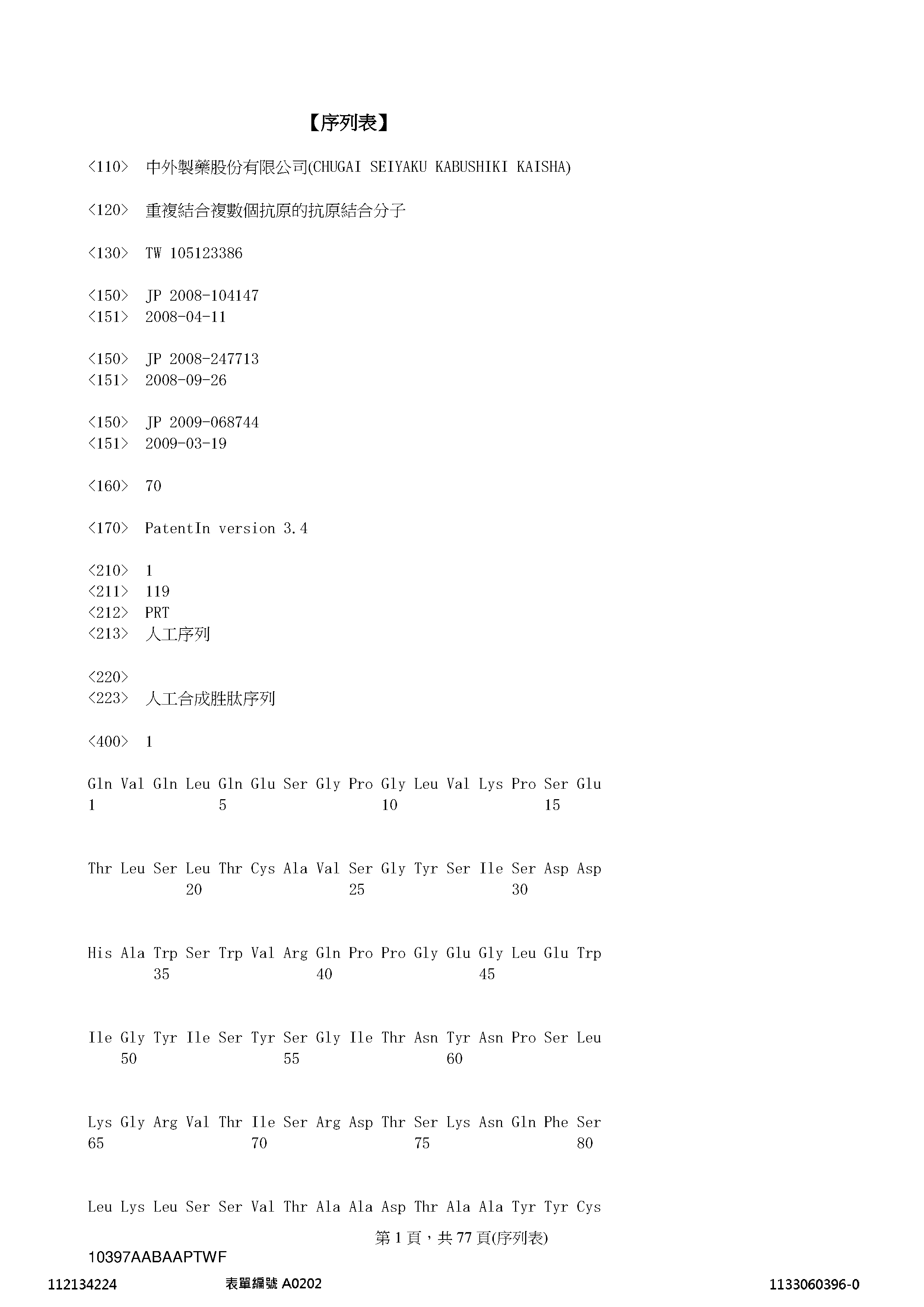


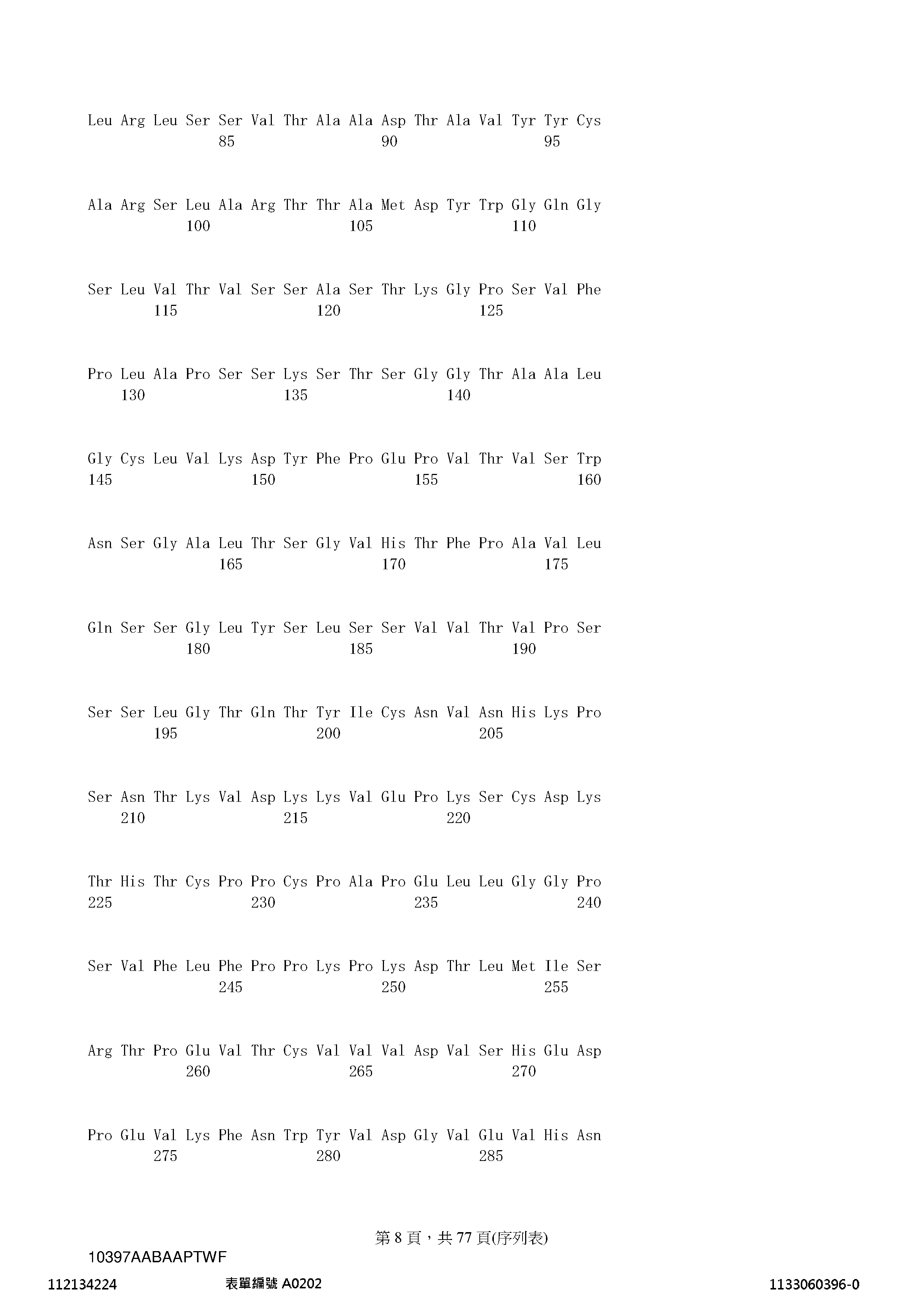


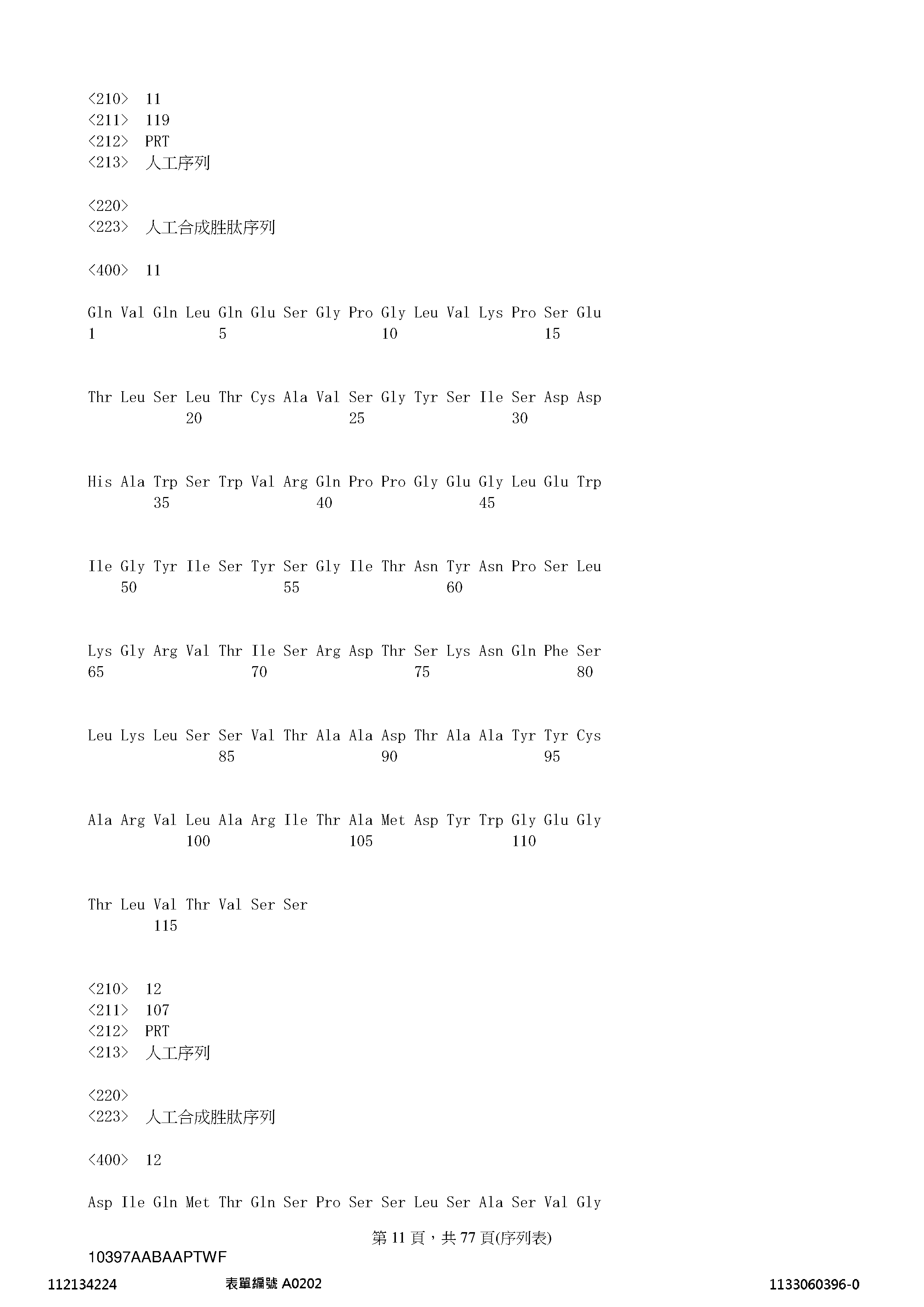


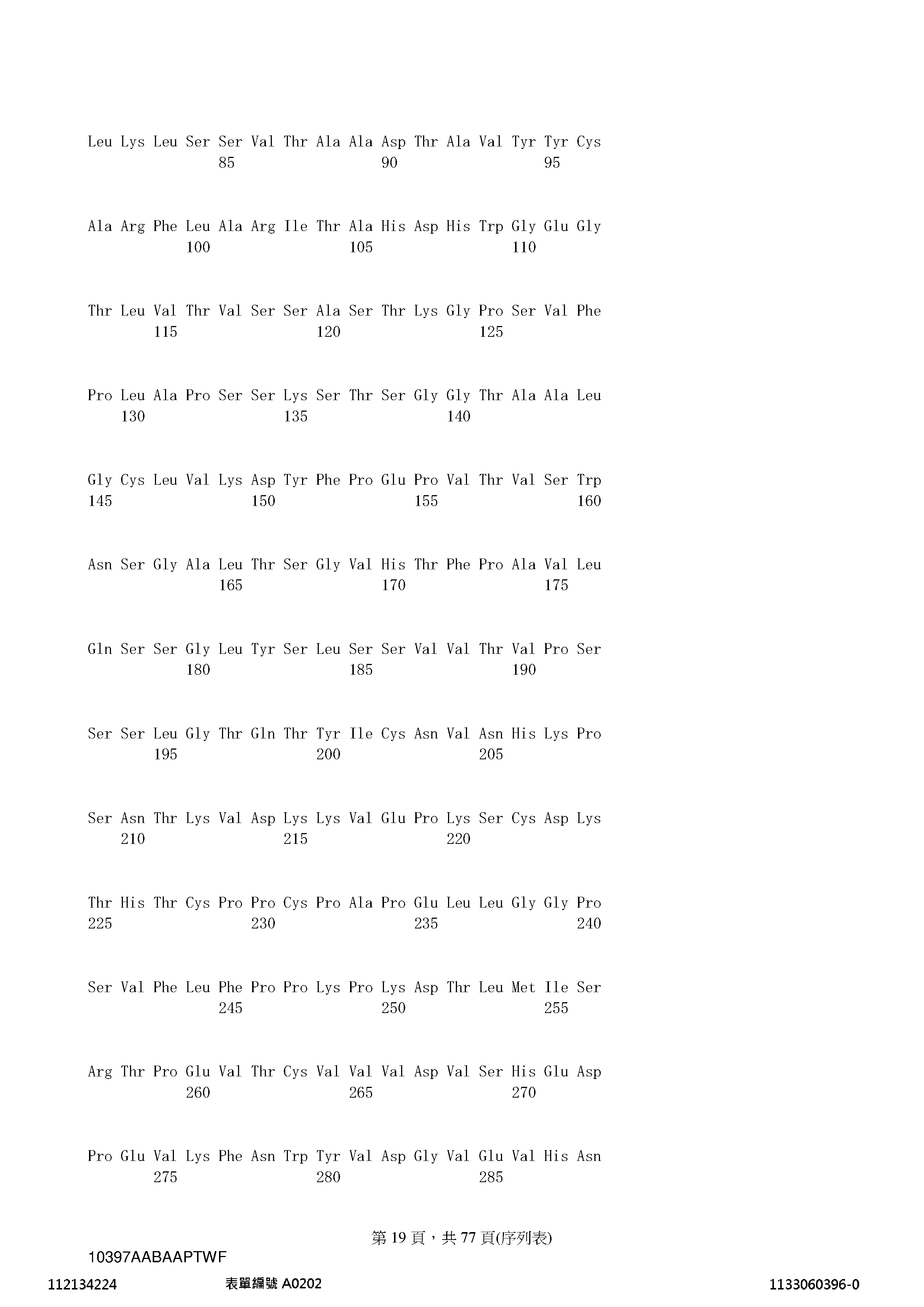


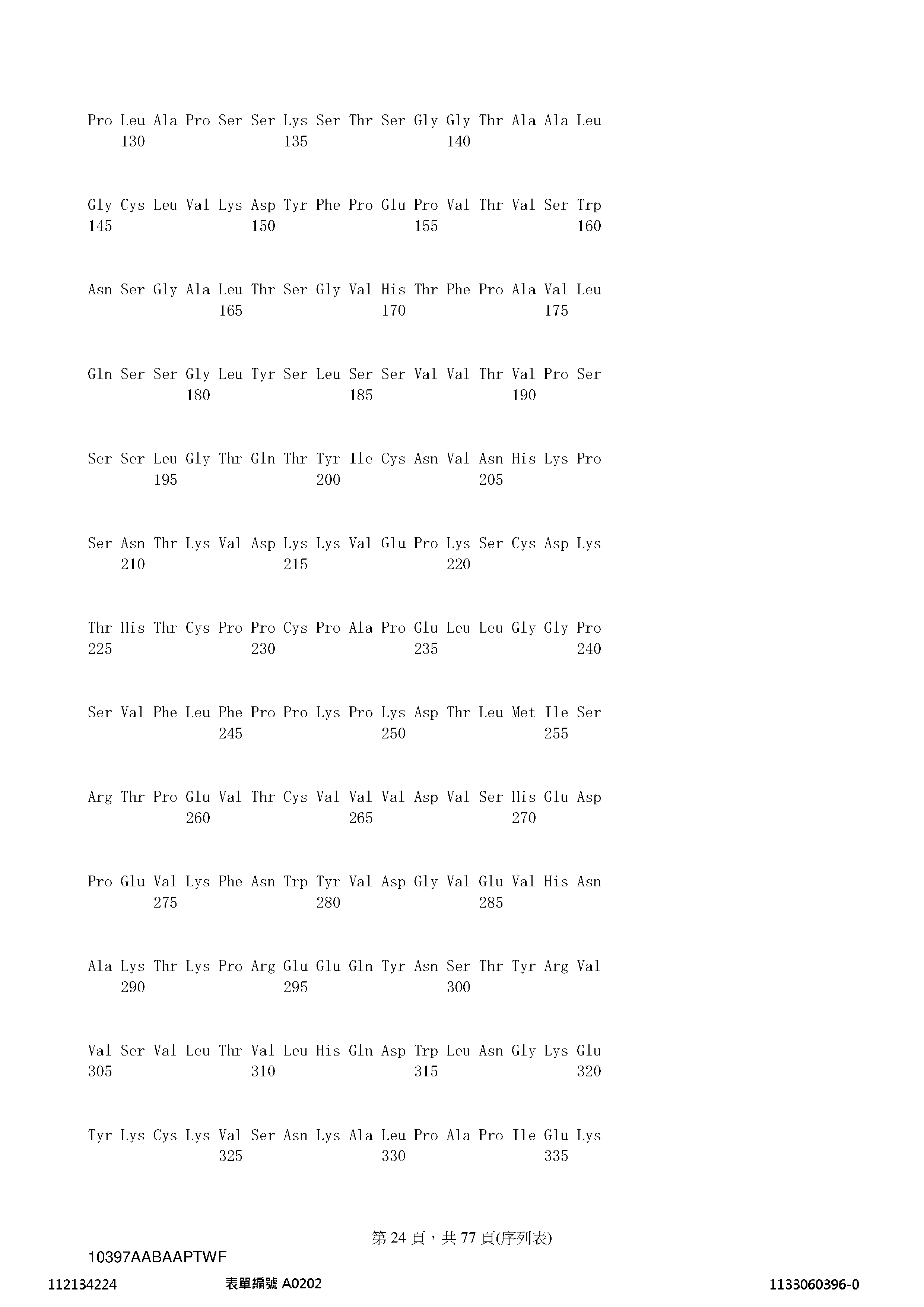

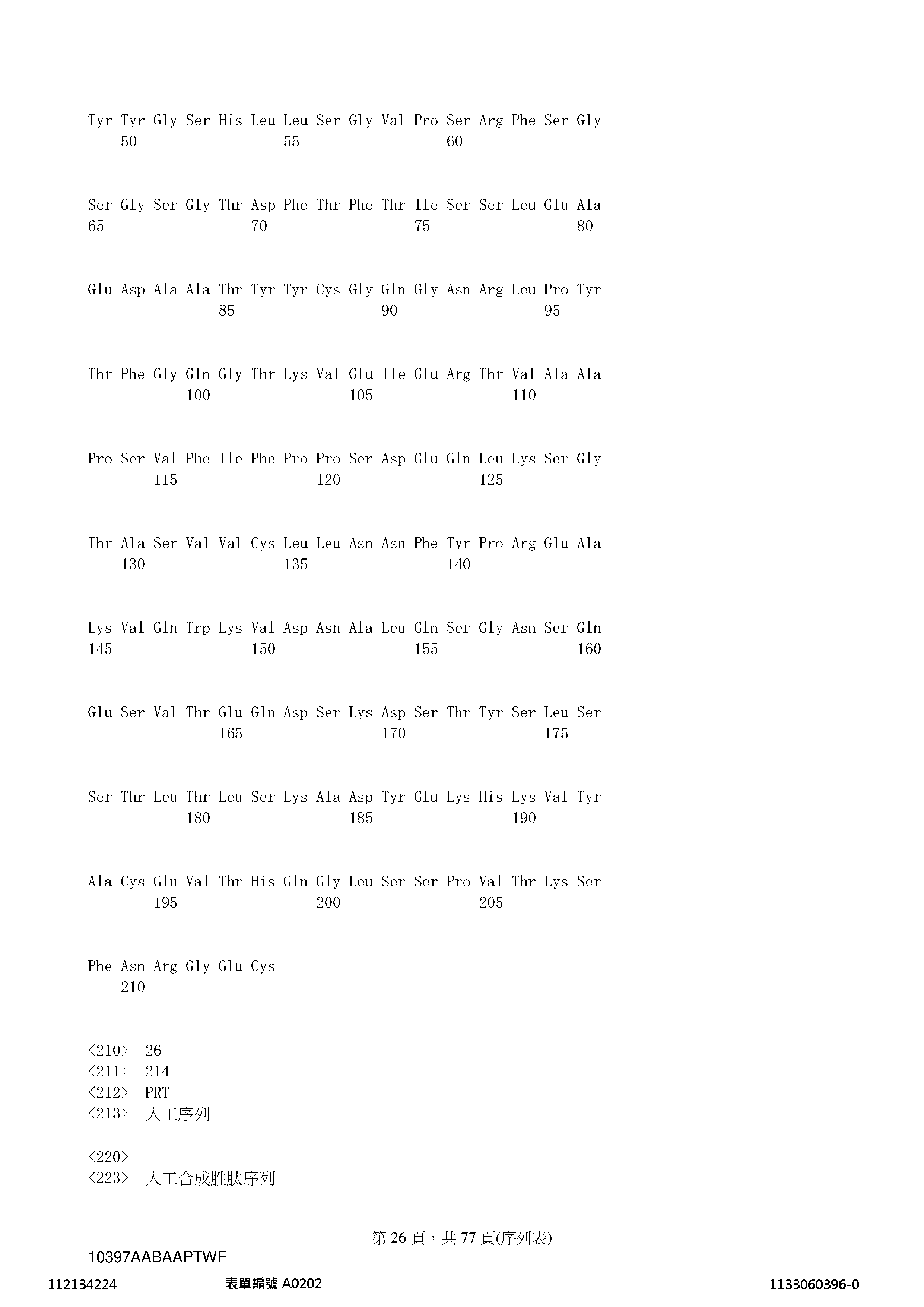

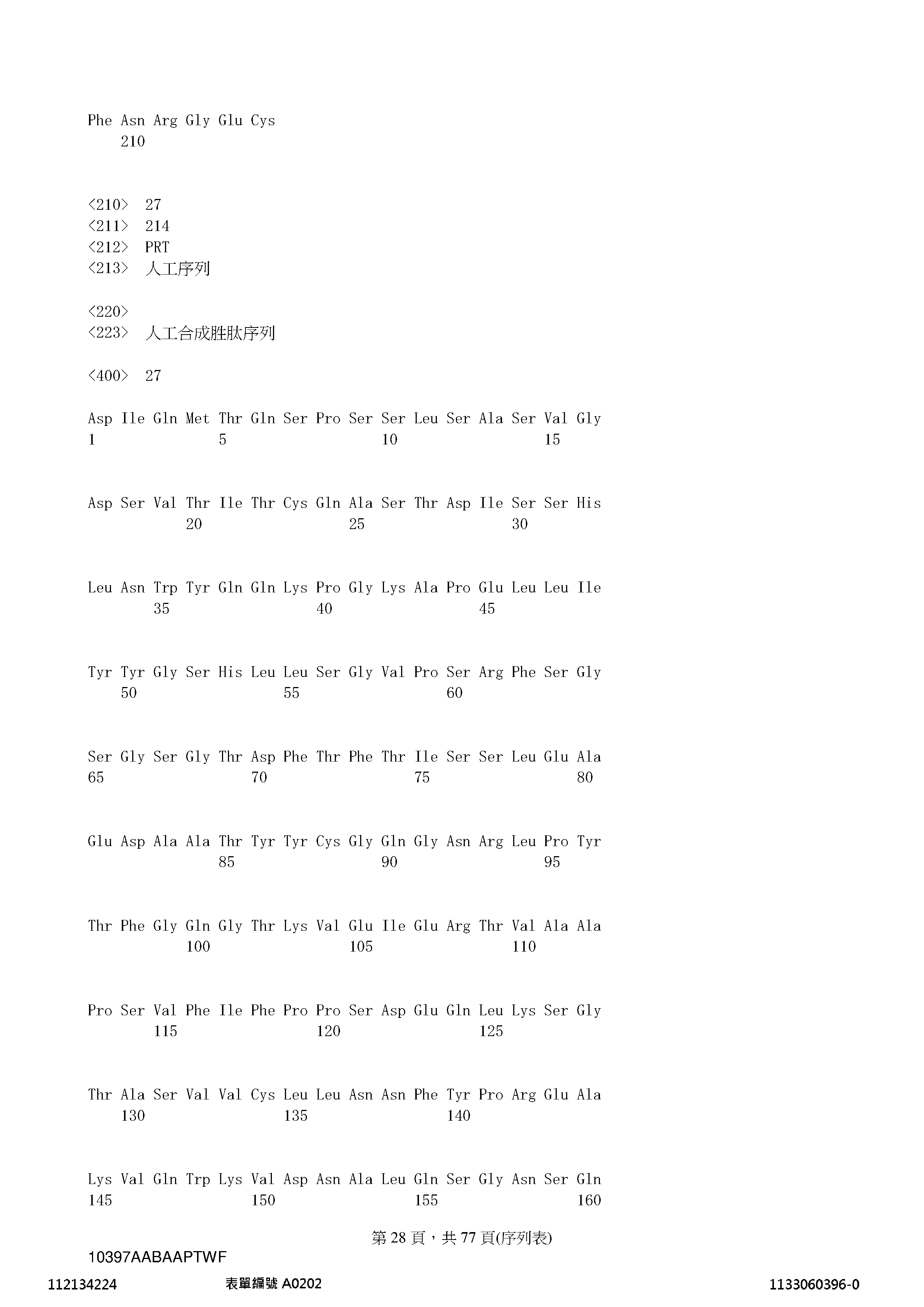


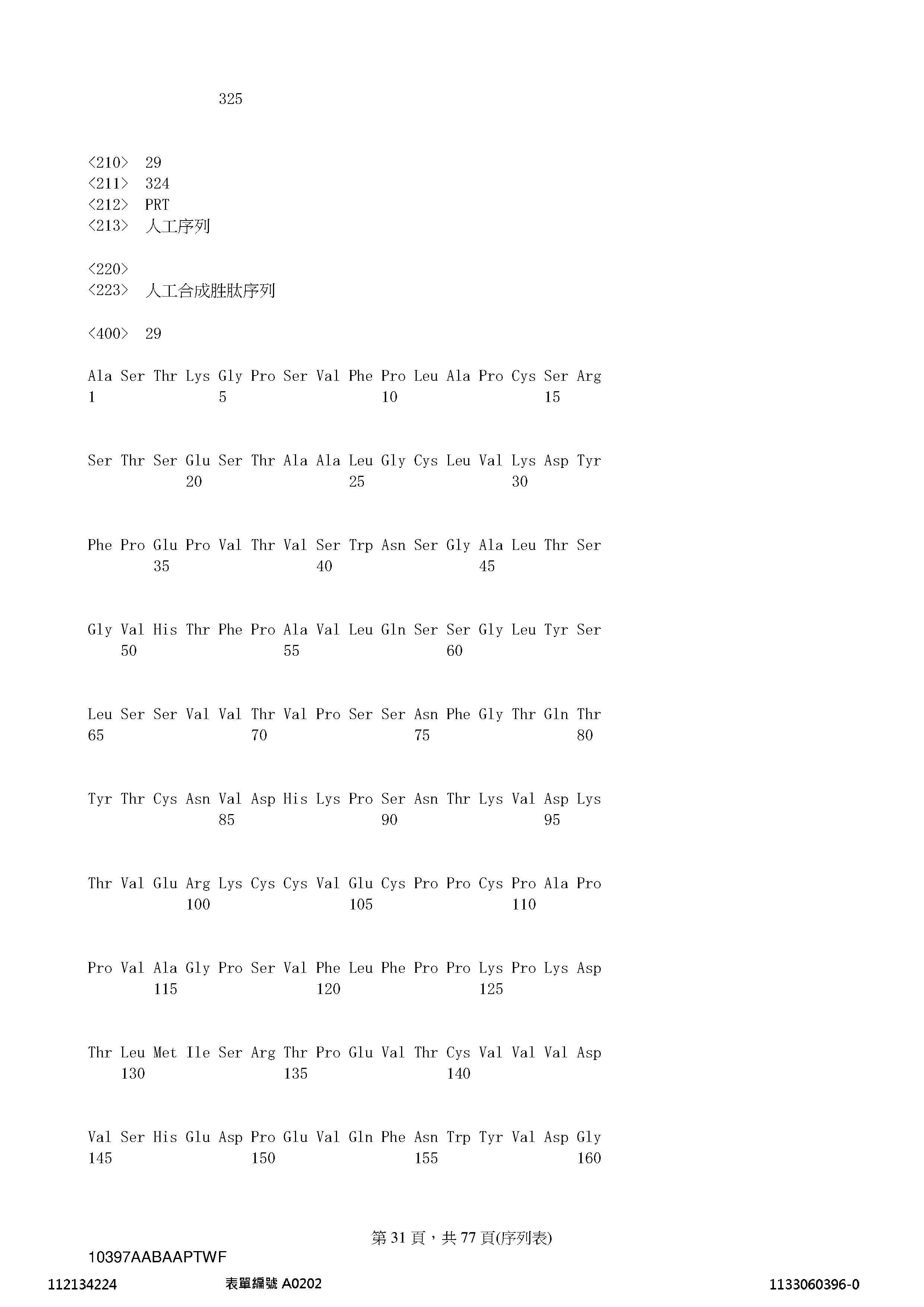
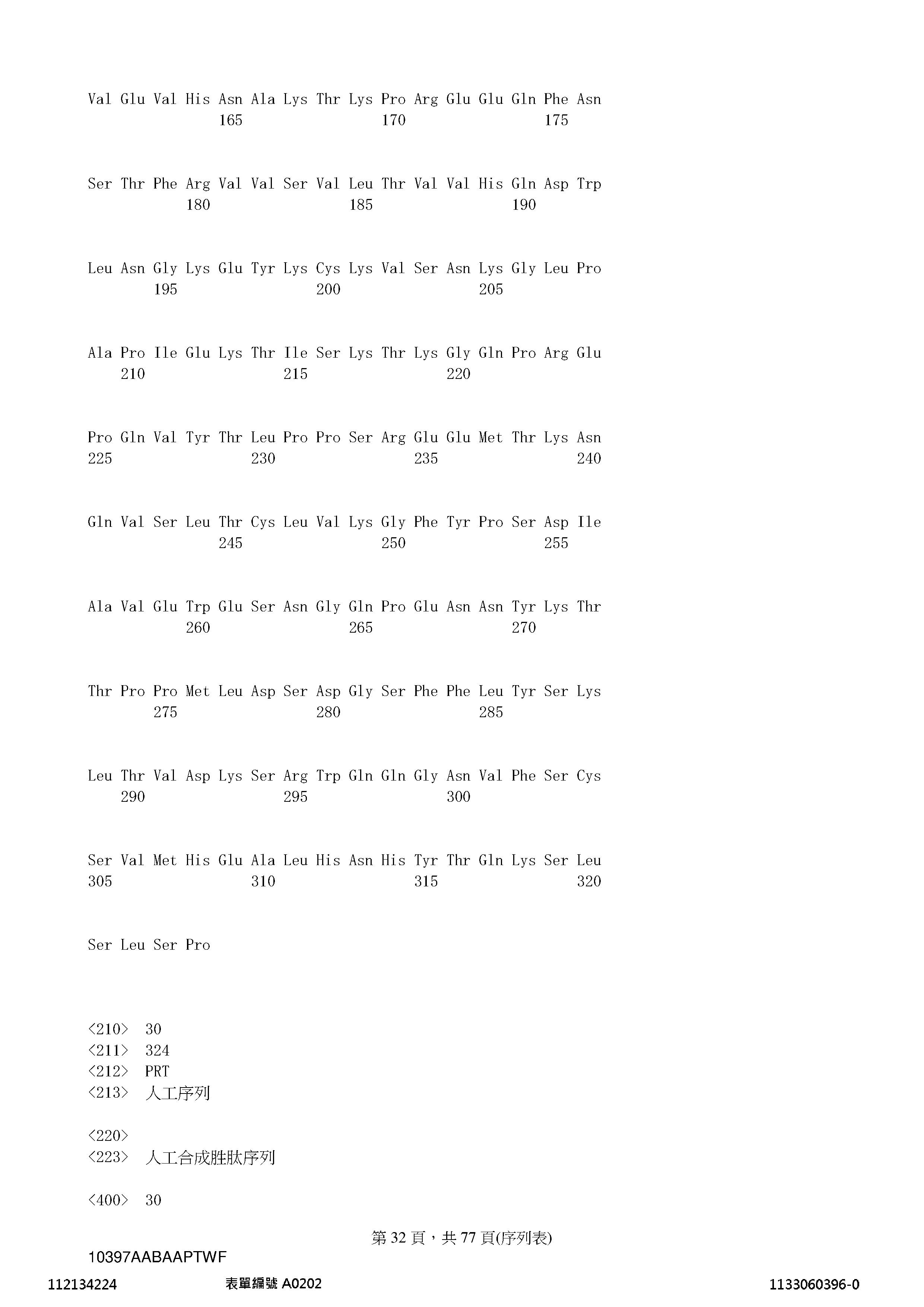

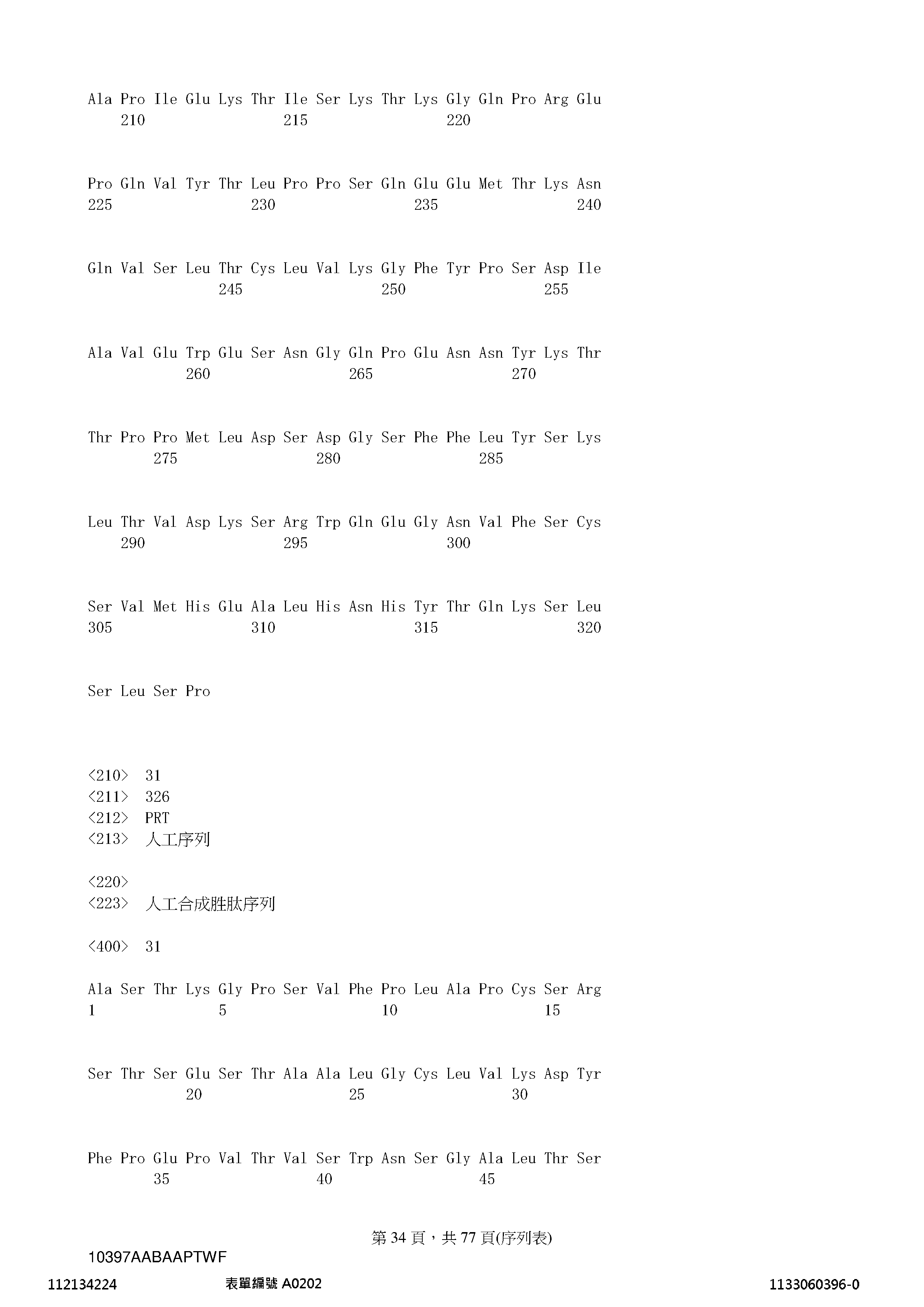

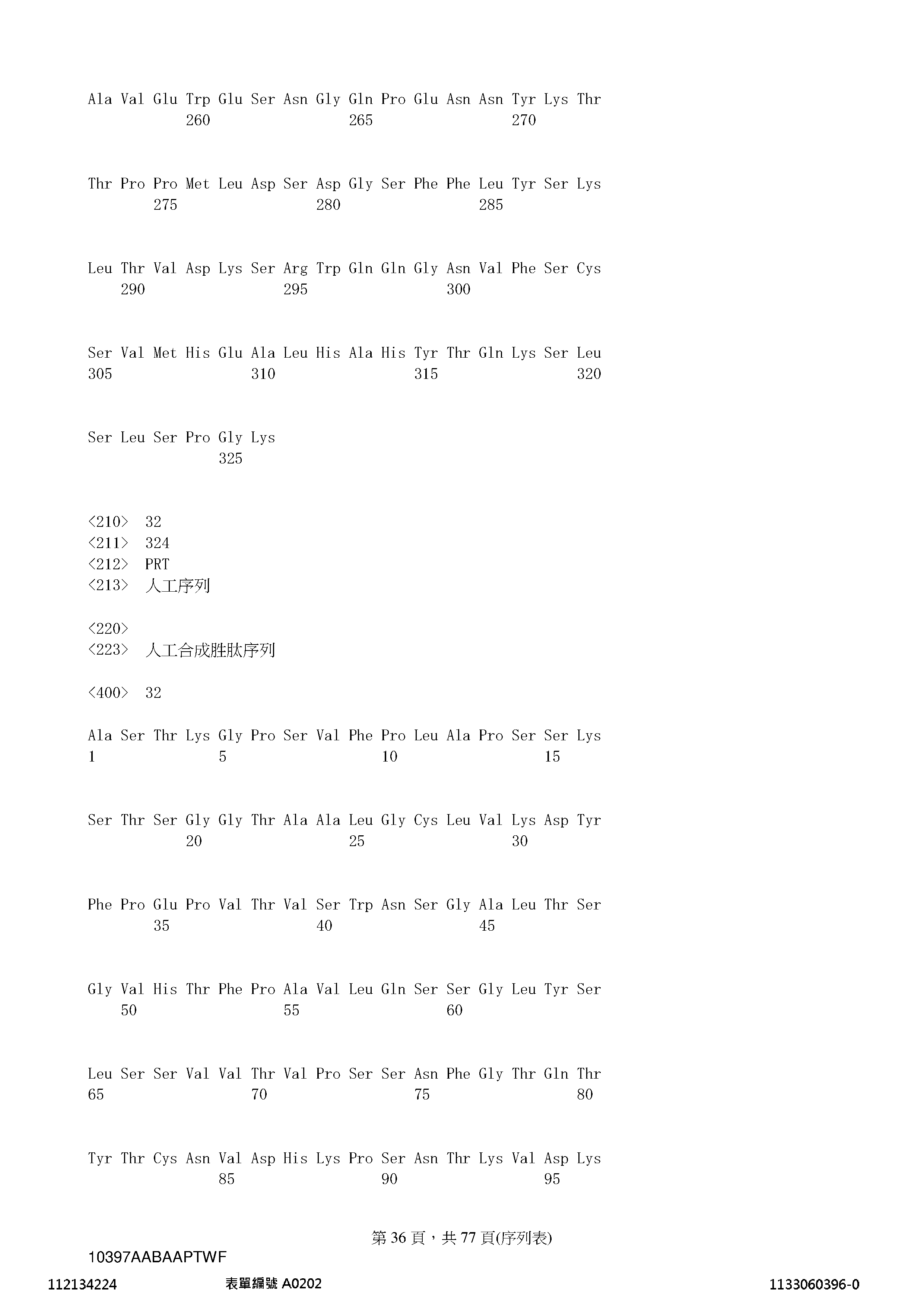
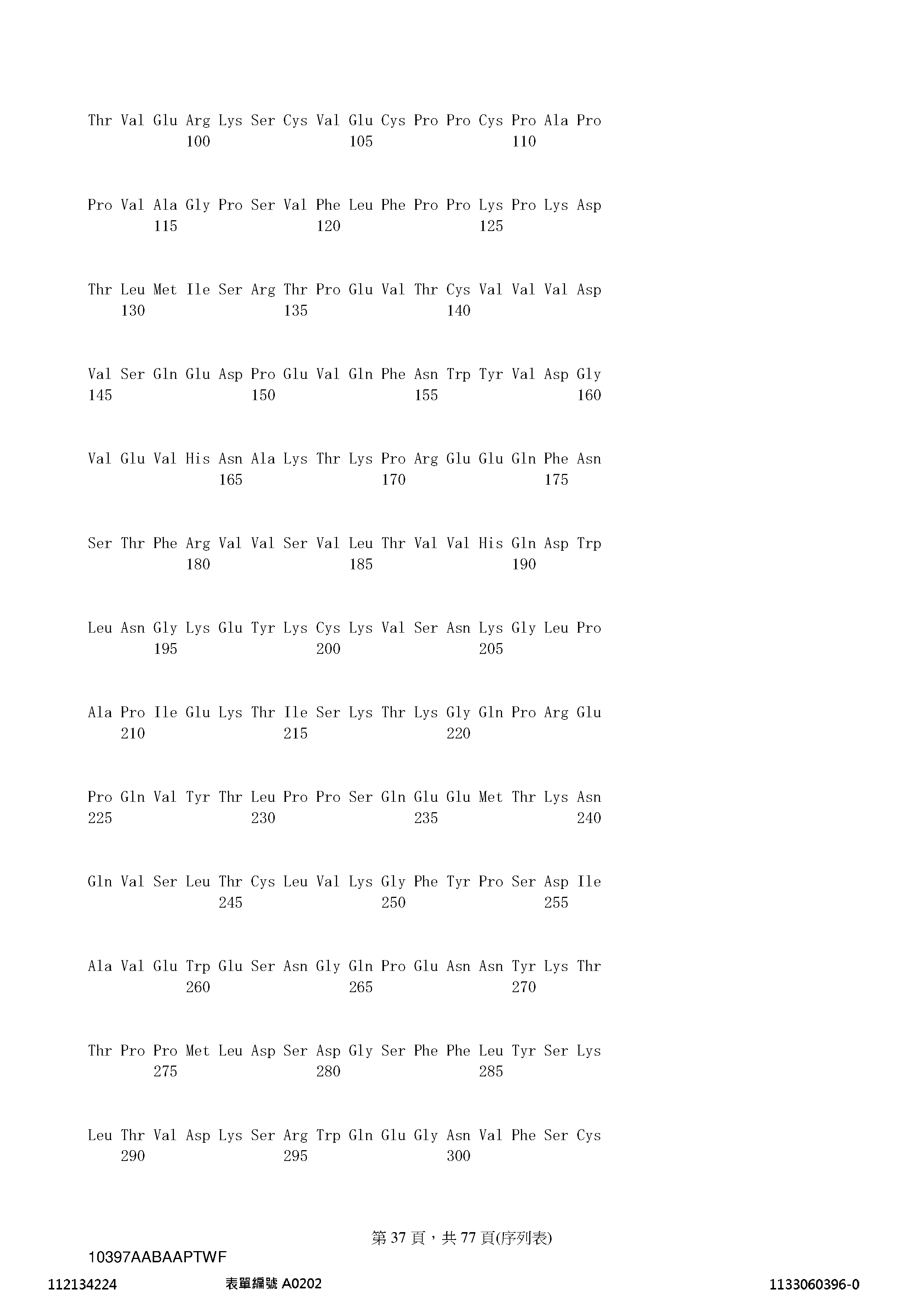

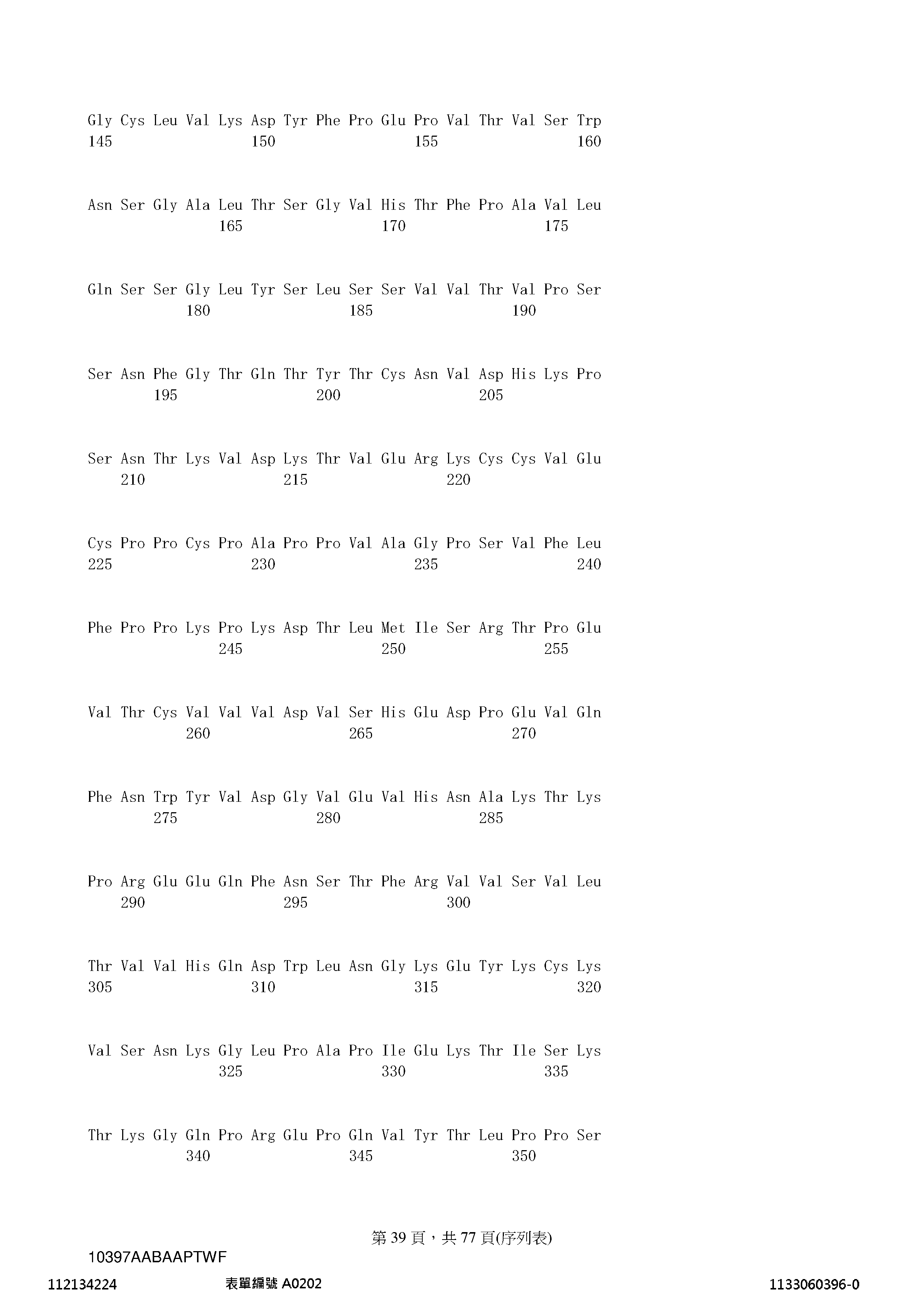


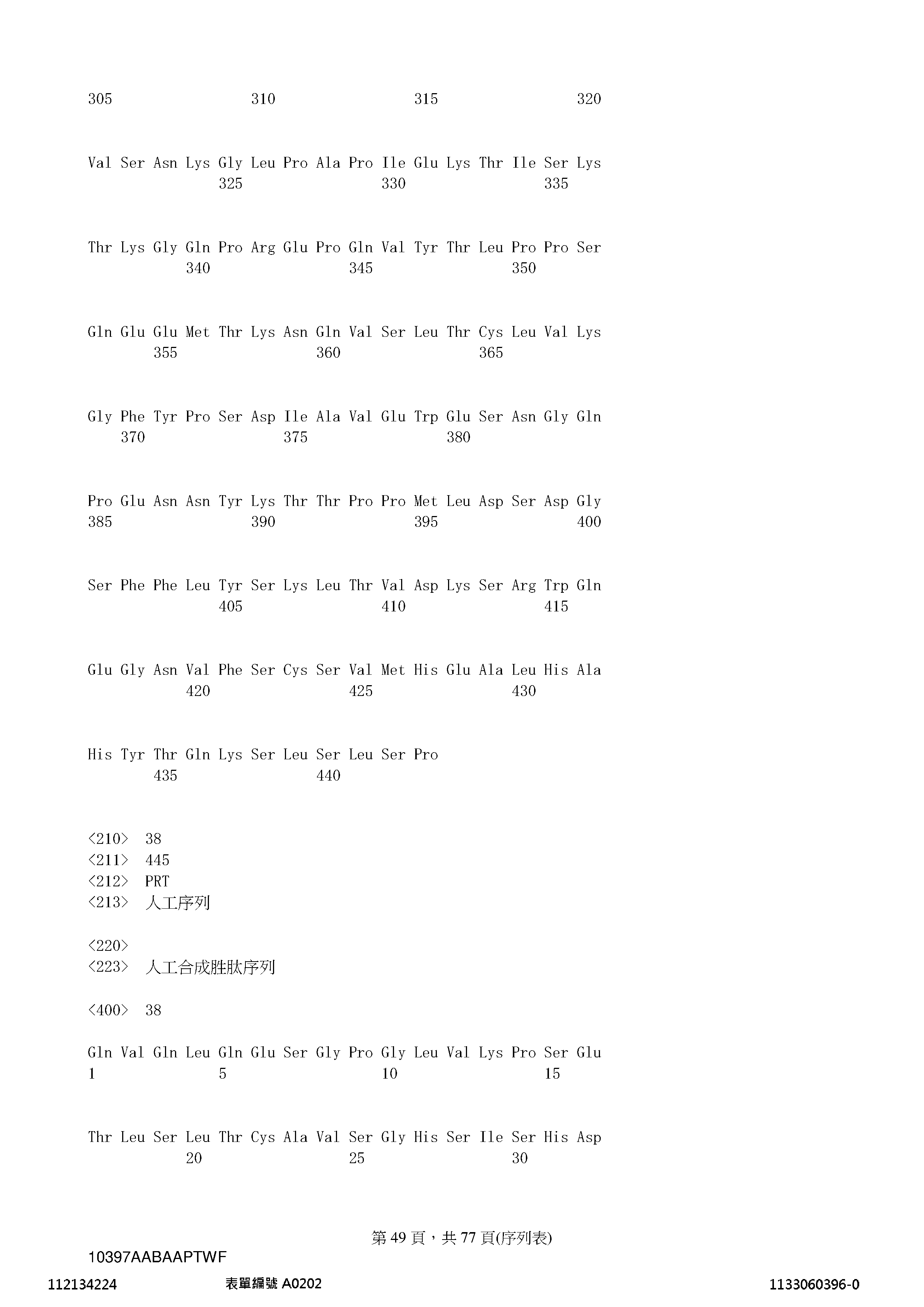


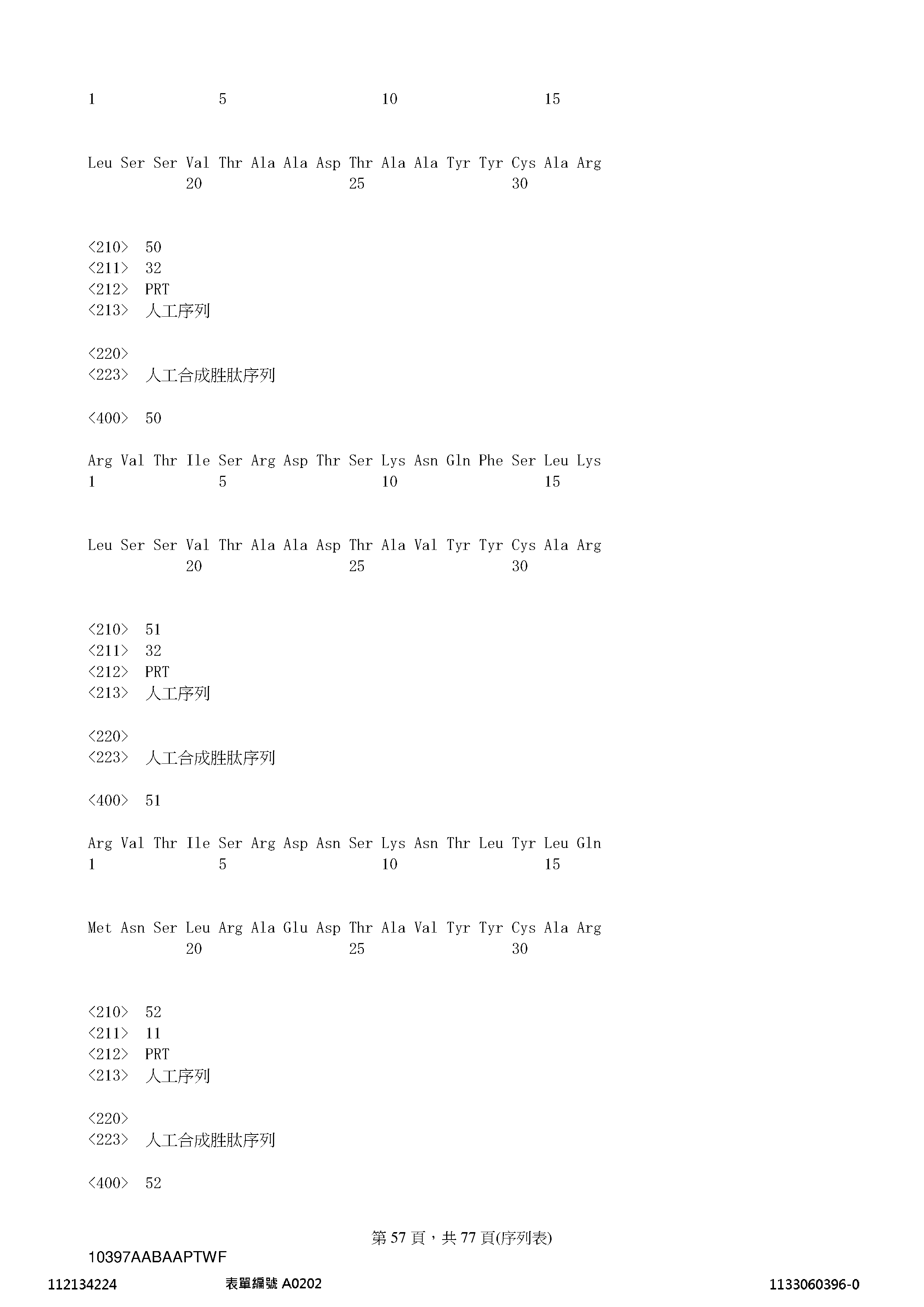
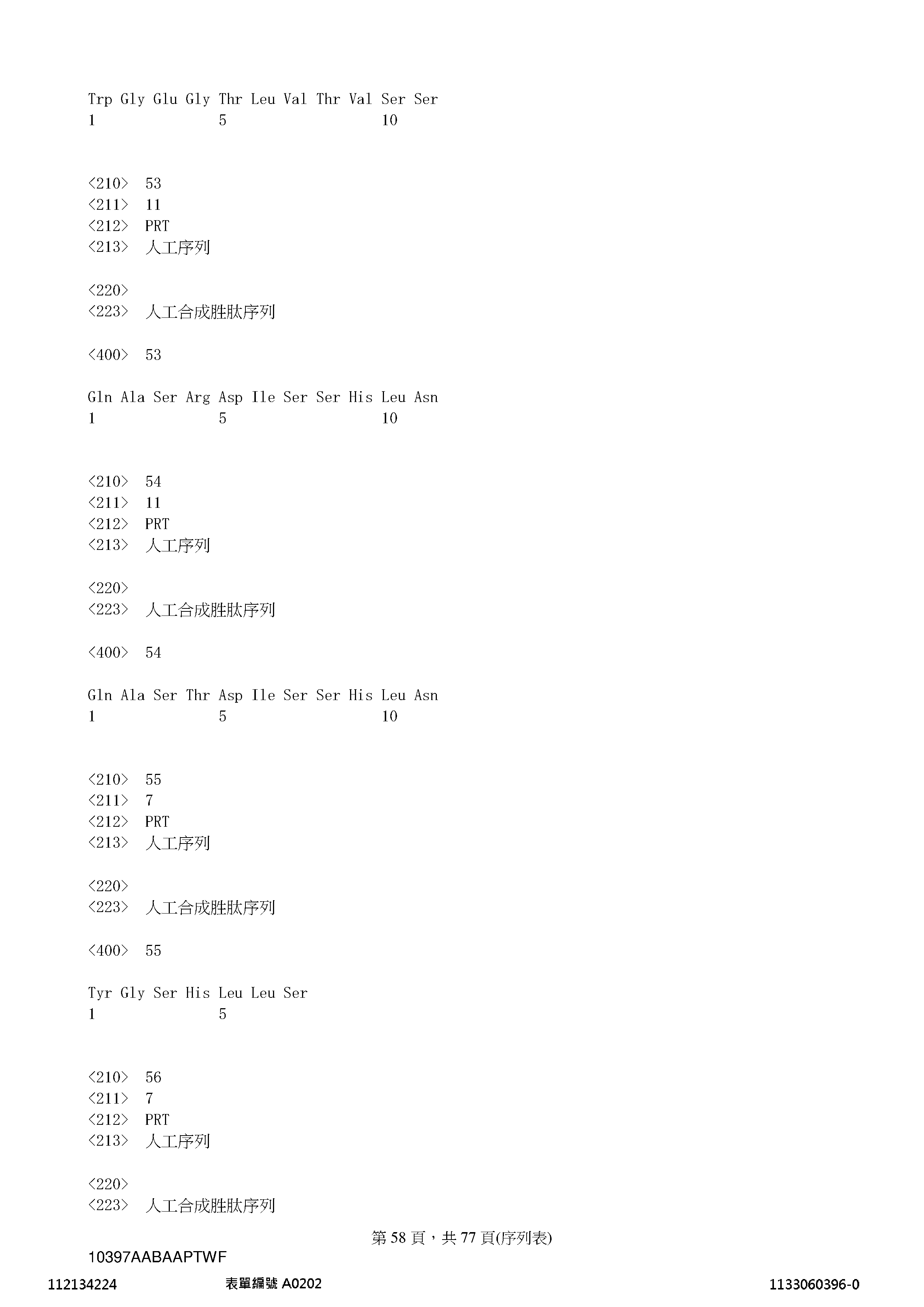

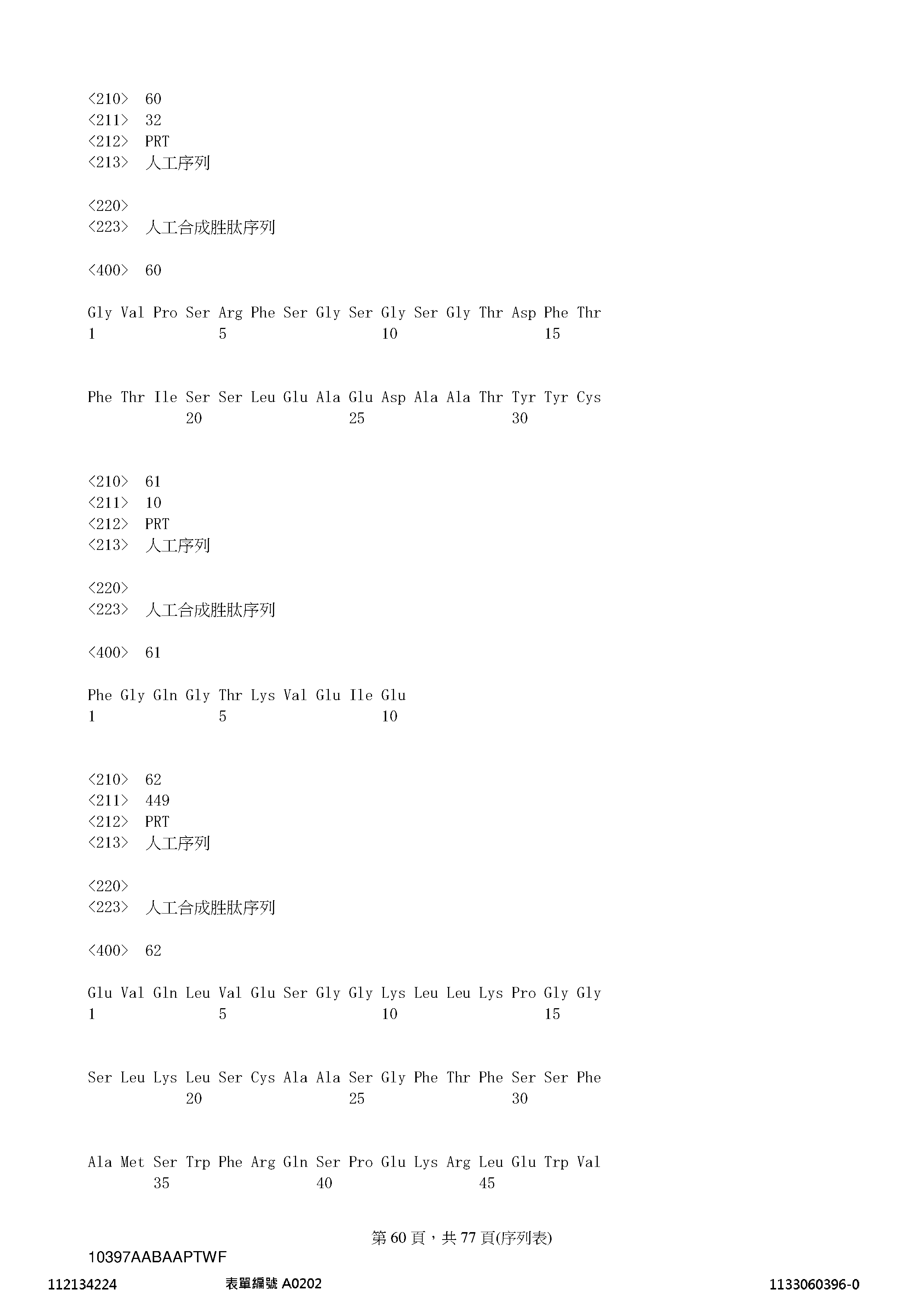
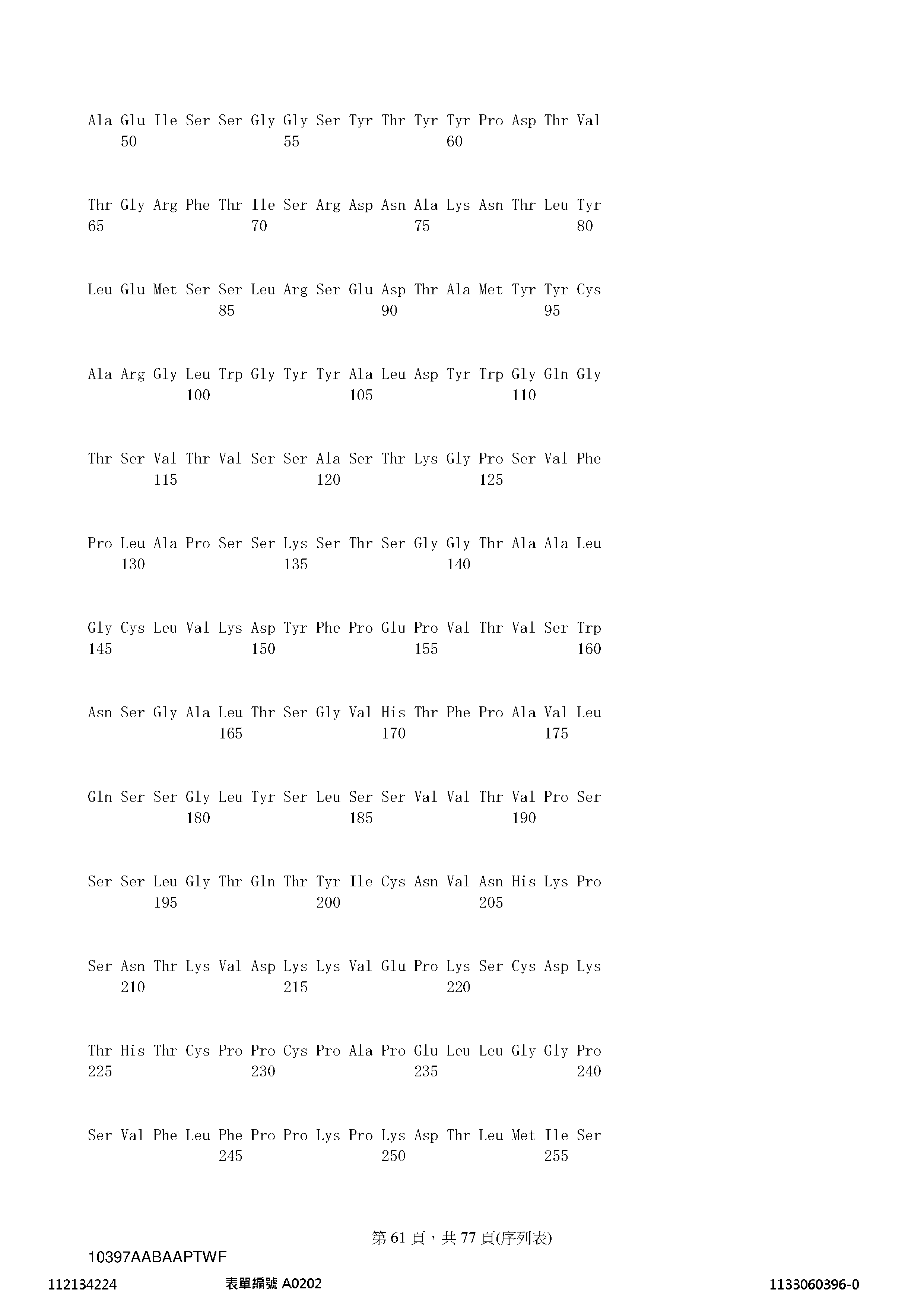


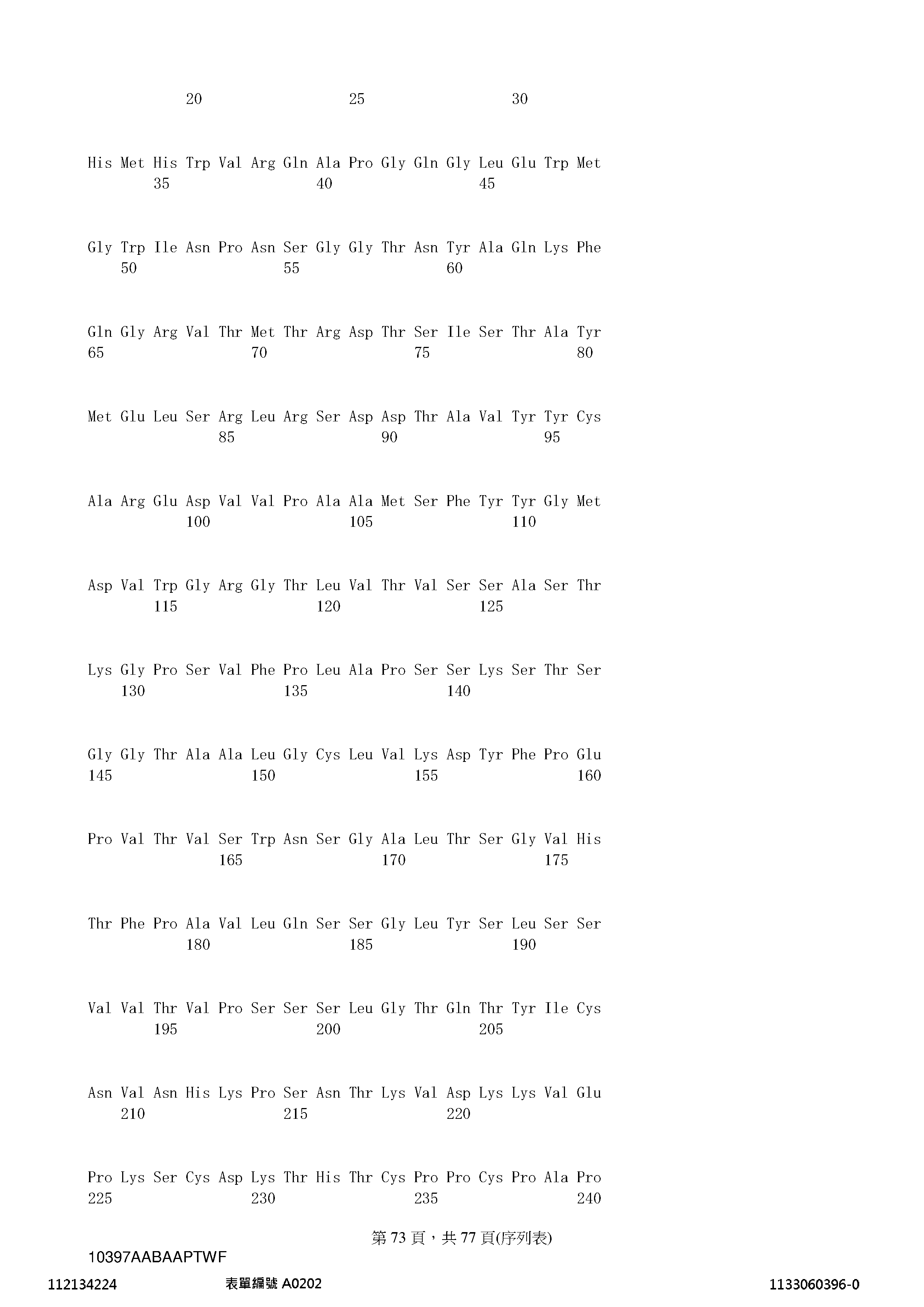

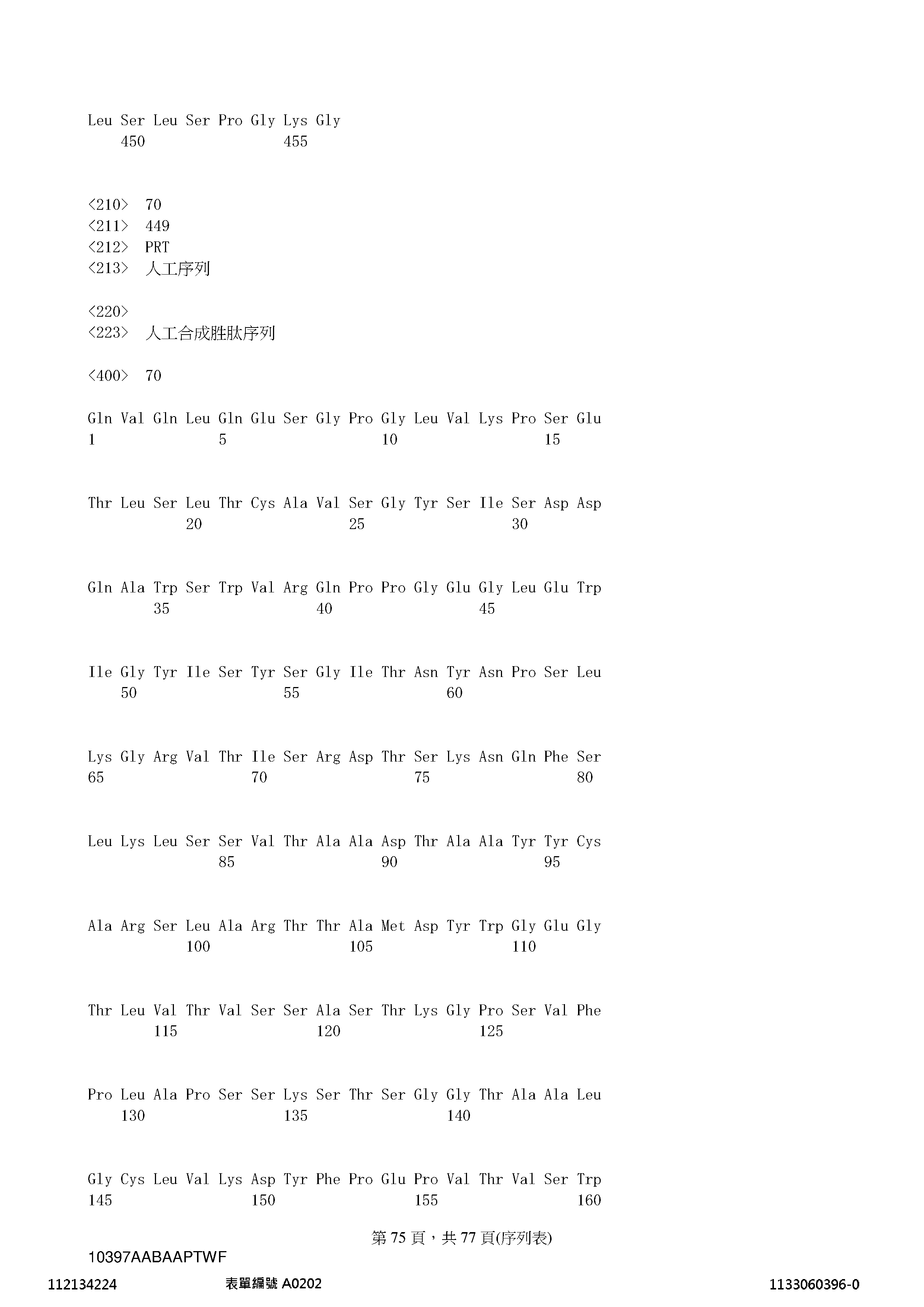


Claims (10)
Applications Claiming Priority (6)
| Application Number | Priority Date | Filing Date | Title |
|---|---|---|---|
| JP2008-104147 | 2008-04-11 | ||
| JP2008104147 | 2008-04-11 | ||
| JP2008247713 | 2008-09-26 | ||
| JP2008-247713 | 2008-09-26 | ||
| JP2009068744 | 2009-03-19 | ||
| JP2009-068744 | 2009-03-19 |
Publications (1)
| Publication Number | Publication Date |
|---|---|
| TW202423982A true TW202423982A (en) | 2024-06-16 |
Family
ID=41161956
Family Applications (7)
| Application Number | Title | Priority Date | Filing Date |
|---|---|---|---|
| TW105123386A TWI700293B (en) | 2008-04-11 | 2009-04-10 | Antibodies that repeatedly bind to multiple antigens |
| TW111124130A TWI818604B (en) | 2008-04-11 | 2009-04-10 | Antigen-binding molecules that repeatedly bind to multiple antigens |
| TW103130346A TW201447062A (en) | 2008-04-11 | 2009-04-10 | Antigen-binding molecule capable of binding to two or more antigen molecules repeatedly |
| TW108102915A TW201920257A (en) | 2008-04-11 | 2009-04-10 | Antigen-binding molecule capable of binding two or more antigen molecules repeatedly |
| TW098111949A TWI564021B (en) | 2008-04-11 | 2009-04-10 | Repeated binding of antigen to antigen binding molecules |
| TW112134224A TW202423982A (en) | 2008-04-11 | 2009-04-10 | Antigen-binding molecule capable of binding to two or more antigen molecules repeatedly |
| TW109128061A TWI787643B (en) | 2008-04-11 | 2009-04-10 | Antigen-binding molecules that repeatedly bind multiple antigens |
Family Applications Before (5)
| Application Number | Title | Priority Date | Filing Date |
|---|---|---|---|
| TW105123386A TWI700293B (en) | 2008-04-11 | 2009-04-10 | Antibodies that repeatedly bind to multiple antigens |
| TW111124130A TWI818604B (en) | 2008-04-11 | 2009-04-10 | Antigen-binding molecules that repeatedly bind to multiple antigens |
| TW103130346A TW201447062A (en) | 2008-04-11 | 2009-04-10 | Antigen-binding molecule capable of binding to two or more antigen molecules repeatedly |
| TW108102915A TW201920257A (en) | 2008-04-11 | 2009-04-10 | Antigen-binding molecule capable of binding two or more antigen molecules repeatedly |
| TW098111949A TWI564021B (en) | 2008-04-11 | 2009-04-10 | Repeated binding of antigen to antigen binding molecules |
Family Applications After (1)
| Application Number | Title | Priority Date | Filing Date |
|---|---|---|---|
| TW109128061A TWI787643B (en) | 2008-04-11 | 2009-04-10 | Antigen-binding molecules that repeatedly bind multiple antigens |
Country Status (33)
| Country | Link |
|---|---|
| US (10) | US20110111406A1 (en) |
| EP (7) | EP2708558B1 (en) |
| JP (15) | JP4954326B2 (en) |
| KR (7) | KR102469853B1 (en) |
| CN (6) | CN102056946A (en) |
| AR (2) | AR071656A1 (en) |
| BR (2) | BR122020017346B1 (en) |
| CA (1) | CA2721052C (en) |
| CO (1) | CO6311005A2 (en) |
| CR (3) | CR11783A (en) |
| DK (3) | DK2708559T3 (en) |
| EC (1) | ECSP10010600A (en) |
| ES (4) | ES2563483T3 (en) |
| HK (3) | HK1246157A1 (en) |
| HR (3) | HRP20240722T1 (en) |
| HU (3) | HUE028718T2 (en) |
| IL (3) | IL208516A (en) |
| LT (1) | LT2708559T (en) |
| MA (1) | MA32754B1 (en) |
| MX (2) | MX2010011184A (en) |
| MY (1) | MY195714A (en) |
| NO (1) | NO2708559T3 (en) |
| NZ (4) | NZ623716A (en) |
| PH (2) | PH12014502054B1 (en) |
| PL (4) | PL2275443T3 (en) |
| PT (2) | PT2708559T (en) |
| RU (2) | RU2571225C2 (en) |
| SG (3) | SG10201608379YA (en) |
| SI (2) | SI2708559T1 (en) |
| TR (2) | TR201808046T4 (en) |
| TW (7) | TWI700293B (en) |
| UA (1) | UA121453C2 (en) |
| WO (1) | WO2009125825A1 (en) |
Families Citing this family (228)
| Publication number | Priority date | Publication date | Assignee | Title |
|---|---|---|---|---|
| WO2005035753A1 (en) * | 2003-10-10 | 2005-04-21 | Chugai Seiyaku Kabushiki Kaisha | Double specific antibodies substituting for functional protein |
| WO2006106905A1 (en) | 2005-03-31 | 2006-10-12 | Chugai Seiyaku Kabushiki Kaisha | Process for production of polypeptide by regulation of assembly |
| US8470316B2 (en) * | 2005-10-14 | 2013-06-25 | Chugai Seiyaku Kabushiki Kaisha | Agents for suppressing damage to transplanted islets after islet transplantation |
| CA2626688C (en) | 2005-10-21 | 2017-10-03 | Chugai Seiyaku Kabushiki Kaisha | Agents for treating cardiopathy |
| AR057582A1 (en) * | 2005-11-15 | 2007-12-05 | Nat Hospital Organization | AGENTS TO DELETE INDUCTION OF CYTOTOXIC T LYMPHOCYTES |
| CN101370521A (en) * | 2006-01-27 | 2009-02-18 | 学校法人庆应义塾 | Therapeutic agent for diseases accompanied by choroidal angiogenesis |
| JP5144499B2 (en) | 2006-03-31 | 2013-02-13 | 中外製薬株式会社 | Antibody modification method for purifying bispecific antibodies |
| DK2006381T3 (en) | 2006-03-31 | 2016-02-22 | Chugai Pharmaceutical Co Ltd | PROCEDURE FOR REGULATING ANTIBODIES BLOOD PHARMACOKINETICS |
| US9260516B2 (en) | 2006-04-07 | 2016-02-16 | Osaka University | Method for promoting muscle regeneration by administering an antibody to the IL-6 receptor |
| WO2008090901A1 (en) * | 2007-01-23 | 2008-07-31 | Shinshu University | Chronic rejection inhibitor |
| JOP20080381B1 (en) | 2007-08-23 | 2023-03-28 | Amgen Inc | Antigen Binding Proteins to Proprotein Convertase subtillisin Kexin type 9 (pcsk9) |
| DK2202245T3 (en) | 2007-09-26 | 2016-11-21 | Chugai Pharmaceutical Co Ltd | A method of modifying an antibody isoelectric point VIA amino acid substitution in CDR |
| ES2566957T3 (en) | 2007-09-26 | 2016-04-18 | Chugai Seiyaku Kabushiki Kaisha | Constant region of modified antibody |
| KR20160074019A (en) | 2007-12-05 | 2016-06-27 | 추가이 세이야쿠 가부시키가이샤 | Anti-NR10 antibody and use thereof |
| UA121453C2 (en) | 2008-04-11 | 2020-06-10 | Чугей Сейяку Кабусікі Кайся | METHOD OF PREPARATION OF PHARMACEUTICAL COMPOSITION CONTAINING ANTIBODY |
| CN104906581A (en) * | 2008-06-05 | 2015-09-16 | 国立研究开发法人国立癌症研究中心 | Neuroinvasion inhibitor |
| TWI440469B (en) * | 2008-09-26 | 2014-06-11 | Chugai Pharmaceutical Co Ltd | Improved antibody molecules |
| TWI381848B (en) * | 2008-10-20 | 2013-01-11 | Imclone Llc | Anti-fibroblast growth factor receptor-3 (fgfr-3) antibodies and pharmaceutical composition comprising the same |
| US20130064834A1 (en) | 2008-12-15 | 2013-03-14 | Regeneron Pharmaceuticals, Inc. | Methods for treating hypercholesterolemia using antibodies to pcsk9 |
| JO3672B1 (en) | 2008-12-15 | 2020-08-27 | Regeneron Pharma | High Affinity Human Antibodies to PCSK9 |
| AU2023203304B9 (en) * | 2009-03-09 | 2026-02-05 | Bioatla, Llc | Mirac Proteins |
| US20100260739A1 (en) * | 2009-03-09 | 2010-10-14 | Bioatla, Llc | Mirac Proteins |
| AU2015204268B2 (en) * | 2009-03-09 | 2017-03-02 | Bioatla, Llc | Mirac Proteins |
| TWI682995B (en) | 2009-03-19 | 2020-01-21 | 日商中外製藥股份有限公司 | Antibody constant region alteration |
| WO2010106812A1 (en) * | 2009-03-19 | 2010-09-23 | Chugai Seiyaku Kabushiki Kaisha | Pharmaceutical formulation containing improved antibody molecules |
| TWI457134B (en) * | 2009-03-19 | 2014-10-21 | Chugai Pharmaceutical Co Ltd | Rheumatoid arthritis treatment |
| EP2409991B1 (en) | 2009-03-19 | 2017-05-03 | Chugai Seiyaku Kabushiki Kaisha | Antibody constant region variant |
| US9506919B2 (en) | 2009-04-13 | 2016-11-29 | The Board Of Trustees Of The Leland Stanford Junior University | Methods and devices for detecting the presence of an analyte in a sample |
| WO2010131733A1 (en) | 2009-05-15 | 2010-11-18 | 中外製薬株式会社 | Anti-axl antibody |
| JP5837821B2 (en) | 2009-09-24 | 2015-12-24 | 中外製薬株式会社 | Antibody constant region variants |
| JO3417B1 (en) | 2010-01-08 | 2019-10-20 | Regeneron Pharma | Stabilized formulations containing anti-interleukin-6 receptor (il-6r) antibodies |
| TWI505838B (en) | 2010-01-20 | 2015-11-01 | Chugai Pharmaceutical Co Ltd | Stabilized antibody |
| WO2011108714A1 (en) | 2010-03-04 | 2011-09-09 | 中外製薬株式会社 | Antibody constant region variant |
| KR20150002894A (en) * | 2010-03-11 | 2015-01-07 | 리나트 뉴로사이언스 코프. | ANTIBODIES WITH pH DEPENDENT ANTIGEN BINDING |
| JP5937019B2 (en) * | 2010-03-12 | 2016-06-22 | ザ ボード オブ トラスティーズ オブ ザ レランド スタンフォード ジュニア ユニバーシティー | Quantitative analysis of binding kinetics based on magnetic sensor |
| TWI667257B (en) | 2010-03-30 | 2019-08-01 | 中外製藥股份有限公司 | Antibodies with modified affinity to fcrn that promote antigen clearance |
| US9539322B2 (en) | 2010-05-28 | 2017-01-10 | National University Corporation Hokkaido University | Method of enhancing an antitumor T cell response by administering an anti-IL-6 receptor antibody |
| MX349622B (en) * | 2010-09-08 | 2017-08-07 | Halozyme Inc | Methods for assessing and identifying or evolving conditionally active therapeutic proteins. |
| WO2012044831A1 (en) | 2010-09-30 | 2012-04-05 | Board Of Trustees Of Northern Illinois University | Library-based methods and compositions for introducing molecular switch functionality into protein affinity reagents |
| PH12013500974A1 (en) | 2010-11-17 | 2013-07-08 | Chugai Pharmaceutical Co Ltd | Multi-specific antigen-binding molecule having alternative function to function of blood coagulation factor viii |
| KR102385507B1 (en) * | 2010-11-30 | 2022-04-12 | 추가이 세이야쿠 가부시키가이샤 | Antigen-binding molecule capable of binding to plurality of antigen molecules repeatedly |
| PL2668212T3 (en) | 2011-01-28 | 2018-08-31 | Sanofi Biotechnology | Human antibodies to pcsk9 for use in methods of treating particular groups of subjects |
| WO2012132067A1 (en) * | 2011-03-30 | 2012-10-04 | 中外製薬株式会社 | Retention of antigen-binding molecules in blood plasma and method for modifying immunogenicity |
| CA2827923C (en) | 2011-02-25 | 2021-11-23 | Chugai Seiyaku Kabushiki Kaisha | Fc.gamma.riib-specific fc antibody |
| WO2012133782A1 (en) | 2011-03-30 | 2012-10-04 | 中外製薬株式会社 | Retention of antigen-binding molecules in blood plasma and method for modifying immunogenicity |
| KR102639563B1 (en) | 2011-03-30 | 2024-02-21 | 추가이 세이야쿠 가부시키가이샤 | Method for altering plasma retention and immunogenicity of antigen-binding molecule |
| JOP20200043A1 (en) | 2011-05-10 | 2017-06-16 | Amgen Inc | Ways to treat or prevent cholesterol disorders |
| RU2641256C2 (en) | 2011-06-30 | 2018-01-16 | Чугаи Сейяку Кабусики Кайся | Heterodimerizated polypeptide |
| AR087305A1 (en) | 2011-07-28 | 2014-03-12 | Regeneron Pharma | STABILIZED FORMULATIONS CONTAINING ANTI-PCSK9 ANTIBODIES, PREPARATION METHOD AND KIT |
| PL4252857T3 (en) | 2011-09-16 | 2025-03-03 | Regeneron Pharmaceuticals, Inc. | Methods for reducing lipoprotein(a) levels by administering an inhibitor of proprotein convertase subtilisin kexin-9 (pcsk9) |
| TW201817745A (en) | 2011-09-30 | 2018-05-16 | 日商中外製藥股份有限公司 | Therapeutic antigen-binding molecule having an FcRn binding domain that promotes antigen clearance |
| TWI681970B (en) * | 2011-09-30 | 2020-01-11 | 日商中外製藥股份有限公司 | An antigen-binding molecule comprising an antigen-binding domain whose binding activity to an antigen is changed according to the ion concentration condition, and an FcRn-binding domain having binding activity to FcRn under pH-neutral conditions, and which induces an immune response against the target antigen |
| CN107287660A (en) | 2011-09-30 | 2017-10-24 | 中外制药株式会社 | Ion concentration dependence binding molecule library |
| JP6322411B2 (en) * | 2011-09-30 | 2018-05-09 | 中外製薬株式会社 | Antigen-binding molecules that promote the disappearance of antigens with multiple physiological activities |
| EP2762166B1 (en) * | 2011-09-30 | 2019-09-18 | Chugai Seiyaku Kabushiki Kaisha | Antigen-binding molecules for promoting elimination of antigens |
| WO2013051294A1 (en) | 2011-10-05 | 2013-04-11 | 中外製薬株式会社 | Antigen-binding molecule for promoting clearance from plasma of antigen comprising saccharide chain receptor-binding domain |
| TWI589299B (en) | 2011-10-11 | 2017-07-01 | 再生元醫藥公司 | Composition for treating rheumatoid arthritis and method of use thereof |
| LT2627773T (en) | 2011-10-17 | 2017-12-27 | Regeneron Pharmaceuticals, Inc. | Restricted immunoglobulin heavy chain mice |
| ES2732712T3 (en) | 2011-10-31 | 2019-11-25 | Chugai Pharmaceutical Co Ltd | Antigen binding molecule that has a regulated conjugation between the heavy chain and the light chain |
| SG10201609301QA (en) * | 2011-11-30 | 2016-12-29 | Chugai Pharmaceutical Co Ltd | Drug containing carrier into cell for forming immune complex |
| SG10201704849PA (en) | 2012-02-09 | 2017-07-28 | Chugai Pharmaceutical Co Ltd | Modified fc region of antibody |
| CN104125852B9 (en) | 2012-02-15 | 2017-05-17 | 弗·哈夫曼-拉罗切有限公司 | Fc-receptor based affinity chromatography |
| CA2865158C (en) * | 2012-02-24 | 2022-11-01 | Chugai Seiyaku Kabushiki Kaisha | Antigen-binding molecule for promoting disappearance of antigen via fc.gamma.riib |
| MY173376A (en) * | 2012-03-16 | 2020-01-21 | Regeneron Pharma | Mice that produce antigen?binding proteins with ph?dependent binding characteristics |
| US20140013456A1 (en) | 2012-03-16 | 2014-01-09 | Regeneron Pharmaceuticals, Inc. | Histidine Engineered Light Chain Antibodies and Genetically Modified Non-Human Animals for Generating the Same |
| DK2883449T3 (en) * | 2012-03-16 | 2018-04-23 | Regeneron Pharma | Histidine engineered light chain antibodies and genetically modified rodents to generate them |
| MX355944B (en) | 2012-03-16 | 2018-05-07 | Regeneron Pharma | Non-human animals expressing ph-sensitive immunoglobulin sequences. |
| WO2013177470A1 (en) | 2012-05-23 | 2013-11-28 | Genentech, Inc. | Selection method for therapeutic agents |
| CN107964042B (en) * | 2012-05-30 | 2022-04-19 | 中外制药株式会社 | Target tissue specific antigen binding molecules |
| DK2857419T3 (en) * | 2012-05-30 | 2021-03-29 | Chugai Pharmaceutical Co Ltd | Antigen-binding molecule for the elimination of aggregated antigens |
| JP2013253842A (en) | 2012-06-06 | 2013-12-19 | Univ Of Tokyo | Screening method for peptide connected to target molecule depending on ph |
| PL2858487T3 (en) | 2012-06-12 | 2020-06-01 | Regeneron Pharmaceuticals, Inc. | Humanized non-human animals with restricted immunoglobulin heavy chain loci |
| US11142563B2 (en) | 2012-06-14 | 2021-10-12 | Chugai Seiyaku Kabushiki Kaisha | Antigen-binding molecule containing modified Fc region |
| EP2882778B1 (en) * | 2012-08-13 | 2018-04-11 | Regeneron Pharmaceuticals, Inc. | Anti-pcsk9 antibodies with ph-dependent binding characteristics |
| JP6774164B2 (en) | 2012-08-24 | 2020-10-21 | 中外製薬株式会社 | Mouse FcγRII specific Fc antibody |
| AU2013306700B2 (en) | 2012-08-24 | 2019-05-02 | Chugai Seiyaku Kabushiki Kaisha | FcgammaRIIb-specific Fc region variant |
| KR102249779B1 (en) | 2012-12-27 | 2021-05-07 | 추가이 세이야쿠 가부시키가이샤 | Heterodimerized polypeptide |
| DK2840892T3 (en) | 2013-02-20 | 2018-07-23 | Regeneron Pharma | Non-human animals with modified heavy chain immunoglobulin sequences |
| PT2958938T (en) | 2013-02-20 | 2019-07-23 | Regeneron Pharma | Mice expressing humanized t-cell co-receptors |
| CN110192541B (en) * | 2013-02-22 | 2022-02-18 | 瑞泽恩制药公司 | Mice expressing humanized major histocompatibility complex |
| CA2903025C (en) * | 2013-03-11 | 2025-10-07 | Regeneron Pharmaceuticals, Inc. | Transgenic mice expressing chimeric major histocompatibility complex (mhc) class ii molecules |
| EP2970497B1 (en) * | 2013-03-15 | 2017-10-25 | Bayer HealthCare LLC | Anti-tfpi antibody variants with differential binding across ph range for improved pharmacokinetics |
| EP2976362B1 (en) | 2013-03-19 | 2019-10-23 | Beijing Shenogen Pharma Group Ltd. | Antibodies and methods for treating estrogen receptor-associated diseases |
| CA2897334A1 (en) | 2013-03-29 | 2014-10-02 | Alexion Pharmaceuticals, Inc. | Compositions and methods for increasing the serum half-life of a therapeutic agent targeting complement c5 |
| WO2014163101A1 (en) | 2013-04-02 | 2014-10-09 | 中外製薬株式会社 | Fc region variant |
| US10111953B2 (en) | 2013-05-30 | 2018-10-30 | Regeneron Pharmaceuticals, Inc. | Methods for reducing remnant cholesterol and other lipoprotein fractions by administering an inhibitor of proprotein convertase subtilisin kexin-9 (PCSK9) |
| WO2014197752A1 (en) | 2013-06-07 | 2014-12-11 | Regeneron Pharmaceuticals, Inc. | Methods fo inhibting atherosclerosis by administering an inhibitor of pcsk9 |
| JP6442404B2 (en) | 2013-06-11 | 2018-12-19 | 国立研究開発法人国立精神・神経医療研究センター | Method for predicting treatment prognosis in patients with relapsing-remitting multiple sclerosis (RRMS), and method for determining new treatment indication |
| HUE044747T2 (en) | 2013-09-18 | 2019-11-28 | Regeneron Pharma | Histidine engineered light chain antibodies and genetically modified non-human animals for generating the same |
| SG10201803449VA (en) | 2013-09-27 | 2018-05-30 | Chugai Pharmaceutical Co Ltd | Method for producing polypeptide heteromultimer |
| KR102551410B1 (en) | 2013-11-11 | 2023-07-04 | 추가이 세이야쿠 가부시키가이샤 | Antigen-binding molecule containing modified antibody variable region |
| TWI670077B (en) | 2013-11-12 | 2019-09-01 | 賽諾菲生物技術公司 | Dosing regimens for use with pcsk9 inhibitors |
| TWI664331B (en) | 2013-12-04 | 2019-07-01 | 日商中外製藥股份有限公司 | Antigen-binding molecules that change antigen-binding ability in response to compound concentration and its database |
| NZ631007A (en) | 2014-03-07 | 2015-10-30 | Alexion Pharma Inc | Anti-c5 antibodies having improved pharmacokinetics |
| WO2015175375A1 (en) | 2014-05-13 | 2015-11-19 | Short Jay M | Conditionally active biological proteins |
| WO2016000813A1 (en) * | 2014-06-30 | 2016-01-07 | Merck Patent Gmbh | Anti-tnfa antibodies with ph-dependent antigen binding |
| RU2735521C2 (en) | 2014-07-16 | 2020-11-03 | Санофи Байотекнолоджи | Methods of treating patients with heterozygous familial hypercholesterolemia (hefh) |
| MA40764A (en) | 2014-09-26 | 2017-08-01 | Chugai Pharmaceutical Co Ltd | THERAPEUTIC AGENT INDUCING CYTOTOXICITY |
| RU2714116C2 (en) | 2014-11-06 | 2020-02-11 | Ф. Хоффманн-Ля Рош Аг | VARIANTS OF Fc-DOMAIN WITH MODIFIED FcRn BINDING AND METHODS OF APPLICATION THEREOF |
| TWI880146B (en) | 2014-11-11 | 2025-04-11 | 日商中外製藥股份有限公司 | Database of antigen-binding molecules comprising altered antibody variable regions |
| US9765135B2 (en) | 2014-12-19 | 2017-09-19 | Chugai Seiyaku Kabushiki Kaisha | Anti-C5 antibodies |
| JP6227191B1 (en) | 2014-12-19 | 2017-11-08 | 中外製薬株式会社 | Anti-myostatin antibody, polypeptide comprising mutant Fc region, and method of use |
| EP3247723A1 (en) | 2015-01-22 | 2017-11-29 | Chugai Seiyaku Kabushiki Kaisha | A combination of two or more anti-c5 antibodies and methods of use |
| CN114773470A (en) | 2015-02-05 | 2022-07-22 | 中外制药株式会社 | Antibodies comprising an ion concentration-dependent antigen-binding domain, FC region variants, IL-8-binding antibodies and uses thereof |
| CN107531778A (en) | 2015-02-06 | 2018-01-02 | 赛尔伊迪克斯公司 | Antigen-conjugated immunoreagents |
| WO2016136933A1 (en) | 2015-02-27 | 2016-09-01 | 中外製薬株式会社 | Composition for treating il-6-related diseases |
| IL254589B2 (en) | 2015-03-31 | 2023-11-01 | Vhsquared Ltd | Peptide construct having a protease-cleavable linker |
| CN107438620A (en) | 2015-03-31 | 2017-12-05 | 韦斯夸尔德有限公司 | Polypeptide |
| JP7082484B2 (en) | 2015-04-01 | 2022-06-08 | 中外製薬株式会社 | Method for Producing Polypeptide Heterogeneous Multimer |
| US10676723B2 (en) | 2015-05-11 | 2020-06-09 | David Gordon Bermudes | Chimeric protein toxins for expression by therapeutic bacteria |
| WO2016186154A1 (en) | 2015-05-19 | 2016-11-24 | 国立研究開発法人国立精神・神経医療研究センター | Method for determining application of novel therapy to multiple sclerosis (ms) patient |
| CN107614014B (en) * | 2015-05-28 | 2022-07-12 | 生物辐射实验室股份有限公司 | Affinity ligands and methods relating thereto |
| AU2016308111A1 (en) | 2015-08-18 | 2018-03-01 | Regeneron Pharmaceuticals, Inc. | Anti-PCSK9 inhibitory antibodies for treating patients with hyperlipidemia undergoing lipoprotein apheresis |
| CN108271372B (en) * | 2015-09-18 | 2021-07-09 | 中外制药株式会社 | IL-8-binding antibody and its application |
| SG10201707267RA (en) * | 2015-12-18 | 2017-10-30 | Chugai Pharmaceutical Co Ltd | Anti-myostatin antibodies, polypeptides containing variant fc regions, and methods of use |
| SI3390442T1 (en) * | 2015-12-18 | 2024-01-31 | Chugai Seiyaku Kabushiki Kaisha | Anti-c5 antibodies and methods of use |
| EP3394098A4 (en) * | 2015-12-25 | 2019-11-13 | Chugai Seiyaku Kabushiki Kaisha | ANTI-MYOSTATIN ANTIBODIES AND METHODS OF USE |
| WO2017115773A1 (en) | 2015-12-28 | 2017-07-06 | 中外製薬株式会社 | Method for promoting efficiency of purification of fc region-containing polypeptide |
| RU2746754C2 (en) | 2016-03-14 | 2021-04-20 | Чугаи Сейяку Кабусики Кайся | Cell damage inducing therapeutic medicinal product for anticancer therapy |
| WO2017165464A1 (en) | 2016-03-21 | 2017-09-28 | Elstar Therapeutics, Inc. | Multispecific and multifunctional molecules and uses thereof |
| UA126900C2 (en) | 2016-04-28 | 2023-02-22 | Чугаі Сейяку Кабусікі Кайся | ANTIBODY CONTAINING DRUG |
| EP3463461A4 (en) | 2016-05-27 | 2020-05-20 | Alexion Pharmaceuticals, Inc. | METHODS OF TREATING GENERALIZED REFRACTORY SEVERE MYASTHENIA |
| US10633434B2 (en) | 2016-06-14 | 2020-04-28 | Regeneron Pharmaceuticals, Inc. | Anti-C5 antibodies |
| TWI610941B (en) * | 2016-06-17 | 2018-01-11 | Chugai Seiyaku Kabushiki Kaisha | Anti-C5 antibody and method of use |
| MX2018014375A (en) * | 2016-06-17 | 2019-04-22 | Chugai Pharmaceutical Co Ltd | Anti-myostatin antibodies and methods of use. |
| CN109716130B (en) * | 2016-07-18 | 2023-05-23 | 赛尔伊迪克斯公司 | Antigen-coupled hybridization reagents |
| EP3491135A1 (en) * | 2016-07-28 | 2019-06-05 | Laboratoire Français du Fractionnement et des Biotechnologies | Method for obtaining aptamers |
| IL264626B (en) | 2016-08-05 | 2022-07-01 | Chugai Pharmaceutical Co Ltd | A preparation for the prevention or treatment of diseases related to il-8 |
| CA3035033A1 (en) * | 2016-08-31 | 2018-03-08 | Bioatla, Llc | Conditionally active polypeptides and methods of generating them |
| SG10201607778XA (en) | 2016-09-16 | 2018-04-27 | Chugai Pharmaceutical Co Ltd | Anti-Dengue Virus Antibodies, Polypeptides Containing Variant Fc Regions, And Methods Of Use |
| US11168139B2 (en) | 2016-11-28 | 2021-11-09 | Chugai Seiyaku Kabushiki Kaisha | Antigen-binding domain, and polypeptide including conveying section |
| US11129906B1 (en) | 2016-12-07 | 2021-09-28 | David Gordon Bermudes | Chimeric protein toxins for expression by therapeutic bacteria |
| JP2020504105A (en) * | 2016-12-19 | 2020-02-06 | グレンマーク・ファーマシューティカルズ・エスエー | Novel TNFR agonists and uses thereof |
| US11608374B2 (en) | 2017-01-30 | 2023-03-21 | Chugai Seiyaku Kabushiki Kaisha | Anti-sclerostin antibodies and methods of use |
| CN110167961A (en) | 2017-01-31 | 2019-08-23 | 中外制药株式会社 | Pharmaceutical compositions for treating or preventing C5-related diseases and methods of treating or preventing C5-related diseases |
| US20200291089A1 (en) | 2017-02-16 | 2020-09-17 | Elstar Therapeutics, Inc. | Multifunctional molecules comprising a trimeric ligand and uses thereof |
| US10093731B2 (en) | 2017-02-24 | 2018-10-09 | Kindred Biosciences, Inc. | Anti-IL31 antibodies for veterinary use |
| EP3586872A4 (en) | 2017-02-24 | 2020-12-30 | Chugai Seiyaku Kabushiki Kaisha | PHARMACEUTICAL COMPOSITION, ANTIG-BINDING MOLECULES, TREATMENT METHODS AND SCREENING METHODS |
| UA125757C2 (en) | 2017-03-16 | 2022-06-01 | Медімм'Юн Лімітед | Anti-par2 antibodies and uses thereof |
| JP2020517242A (en) * | 2017-04-21 | 2020-06-18 | スターテン・バイオテクノロジー・ベー・フェー | Anti-ApoC3 antibody and method of using the same |
| US11851486B2 (en) | 2017-05-02 | 2023-12-26 | National Center Of Neurology And Psychiatry | Method for predicting and evaluating therapeutic effect in diseases related to IL-6 and neutrophils |
| GB201707484D0 (en) * | 2017-05-10 | 2017-06-21 | Argenx Bvba | Method of preparing ph-dependent antibodies |
| US20210246227A1 (en) | 2017-05-31 | 2021-08-12 | Elstar Therapeutics, Inc. | Multispecific molecules that bind to myeloproliferative leukemia (mpl) protein and uses thereof |
| JP7197865B2 (en) | 2017-07-18 | 2022-12-28 | 協和キリン株式会社 | Anti-human CCR1 monoclonal antibody |
| KR102576012B1 (en) | 2017-07-27 | 2023-09-07 | 알렉시온 파마슈티칼스, 인코포레이티드 | High Concentration Anti-C5 Antibody Formulation |
| WO2019035938A1 (en) | 2017-08-16 | 2019-02-21 | Elstar Therapeutics, Inc. | Multispecific molecules that bind to bcma and uses thereof |
| EP3698808B1 (en) | 2017-10-20 | 2025-01-01 | Hyogo College Of Medicine | Anti-il-6 receptor antibody-containing medicinal composition for preventing post-surgical adhesion |
| KR20200070355A (en) | 2017-10-26 | 2020-06-17 | 알렉시온 파마슈티칼스, 인코포레이티드 | Dosage and administration of anti-C5 antibodies for the treatment of paroxysmal nocturnal hemoglobinuria (PNH) and atypical hemolytic uremic syndrome (AHUS) |
| AU2018361957B2 (en) | 2017-10-31 | 2023-05-25 | Staten Biotechnology B.V. | Anti-ApoC3 antibodies and methods of use thereof |
| US10538583B2 (en) | 2017-10-31 | 2020-01-21 | Staten Biotechnology B.V. | Anti-APOC3 antibodies and compositions thereof |
| JPWO2019088143A1 (en) | 2017-11-01 | 2020-11-12 | 中外製薬株式会社 | Antibody variants and isoforms with reduced bioactivity |
| CN111556895B (en) * | 2017-11-14 | 2024-09-13 | 中外制药株式会社 | Anti-C1S antibodies and methods of use |
| WO2019107380A1 (en) | 2017-11-28 | 2019-06-06 | 中外製薬株式会社 | Polypeptide including antigen-binding domain and carrying section |
| US11952422B2 (en) | 2017-12-05 | 2024-04-09 | Chugai Seiyaku Kabushiki Kaisha | Antigen-binding molecule comprising altered antibody variable region binding CD3 and CD137 |
| CN120571008A (en) | 2017-12-13 | 2025-09-02 | 瑞泽恩制药公司 | Anti-C5 antibody combinations and uses thereof |
| EP3737692A4 (en) | 2018-01-09 | 2021-09-29 | Elstar Therapeutics, Inc. | CALRETICULIN-BINDING CONSTRUCTS AND GENERALLY MODIFIED T-CELLS FOR THE TREATMENT OF DISEASES |
| GB201802487D0 (en) | 2018-02-15 | 2018-04-04 | Argenx Bvba | Cytokine combination therapy |
| JP7049569B2 (en) * | 2018-03-06 | 2022-04-07 | 国立大学法人 東京大学 | Screening method for peptides that bind to target molecules in a pH-dependent manner |
| WO2019178364A2 (en) | 2018-03-14 | 2019-09-19 | Elstar Therapeutics, Inc. | Multifunctional molecules and uses thereof |
| WO2019178362A1 (en) | 2018-03-14 | 2019-09-19 | Elstar Therapeutics, Inc. | Multifunctional molecules that bind to calreticulin and uses thereof |
| CN112119090B (en) | 2018-03-15 | 2023-01-13 | 中外制药株式会社 | Anti-dengue virus antibodies cross-reactive to Zika virus and methods of use |
| BR112020018357A2 (en) | 2018-04-13 | 2020-12-29 | Chugai Seiyaku Kabushiki Kaisha | ANTICOMPLEMENT COMPONENT ANTIBODIES AND METHODS OF USE |
| EP3816182A4 (en) | 2018-05-30 | 2022-07-13 | Chugai Seiyaku Kabushiki Kaisha | LIGAND BINDING MOLECULE CONTAINING SINGLE DOMAIN ANTIBODY |
| ES2996257T3 (en) | 2018-05-31 | 2025-02-12 | Alexion Pharma Inc | Dosage and administration of anti-c5 antibodies for treatment of paroxysmal nocturnal hemoglobinuria (pnh) in pediatric patients |
| US12460012B2 (en) | 2018-06-04 | 2025-11-04 | Alexion Pharmaceuticals, Inc. | Dosage and administration of anti-C5 antibodies for treatment of atypical hemolytic uremic syndrome (aHUS) in pediatric patients |
| US11965035B2 (en) | 2018-06-26 | 2024-04-23 | Kyowa Kirin Co., Ltd. | Antibody binding to chondroitin sulfate proteoglycan 5 |
| CA3105000A1 (en) | 2018-06-26 | 2020-01-02 | Kyowa Kirin Co., Ltd. | Antibody binding to cell adhesion molecule 3 |
| US12312394B2 (en) | 2018-06-28 | 2025-05-27 | Alexion Pharmaceuticals, Inc. | Methods of producing anti-C5 antibodies |
| CN112955465A (en) | 2018-07-03 | 2021-06-11 | 马伦戈治疗公司 | anti-TCR antibody molecules and uses thereof |
| WO2020022262A1 (en) * | 2018-07-23 | 2020-01-30 | Chugai Seiyaku Kabushiki Kaisha | Target cell specific cytosol-penetrating antigen-binding molecules |
| BR112021001655A2 (en) | 2018-08-01 | 2021-05-04 | Chugai Seiyaku Kabushiki Kaisha | pharmaceutical composition for use in treating or preventing a c5-related disease and method for treating or preventing a c5-related disease |
| EP3835321A4 (en) | 2018-08-10 | 2022-11-02 | Chugai Seiyaku Kabushiki Kaisha | ANTI-CD137 ANTIGEN BINDING MOLECULE AND USE THEREOF |
| JP7523349B2 (en) | 2018-08-29 | 2024-07-26 | 中外製薬株式会社 | Antibody half molecules and methods for inhibiting homodimer formation of antibody half molecules |
| EA202191189A1 (en) | 2018-10-30 | 2021-08-06 | Алексион Фармасьютикалс, Инк. | Subcutaneous administration and dosage of antibodies to C5 for the treatment of paroxysmal nocturnal hemoglobinuria (PNH) |
| EP3903102B1 (en) | 2018-12-30 | 2023-04-12 | F. Hoffmann-La Roche AG | Ph-gradient spr-based binding assay |
| TW202521583A (en) | 2019-01-31 | 2025-06-01 | 法商賽諾菲生物技術公司 | Compositions and methods for treating juvenile idiopathic arthritis |
| WO2020172605A1 (en) | 2019-02-21 | 2020-08-27 | Elstar Therapeutics, Inc. | Antibody molecules that bind to nkp30 and uses thereof |
| CA3131014A1 (en) | 2019-02-21 | 2020-08-27 | Andreas Loew | Anti-tcr antibody molecules and uses thereof |
| CN114127113A (en) | 2019-02-21 | 2022-03-01 | 马伦戈治疗公司 | Multifunctional molecules binding to calreticulin and uses thereof |
| CA3130628A1 (en) | 2019-02-21 | 2020-08-27 | Marengo Therapeutics, Inc. | Multifunctional molecules that bind to t cells and uses thereof to treat autoimmune disorders |
| CN114026122B (en) | 2019-02-21 | 2024-12-31 | 马伦戈治疗公司 | Multifunctional molecules that bind to T cell-associated cancer cells and their uses |
| WO2020189748A1 (en) | 2019-03-19 | 2020-09-24 | 中外製薬株式会社 | Antigen-binding molecule containing antigen-binding domain of which binding activity to antigen is changed depending on mta, and library for obtaining said antigen-binding domain |
| CA3136398A1 (en) | 2019-04-10 | 2020-10-15 | Chugai Seiyaku Kabushiki Kaisha | Method for purifying fc region-modified antibody |
| GB2589049C (en) | 2019-04-11 | 2024-02-21 | argenx BV | Anti-IgE antibodies |
| TW202106712A (en) | 2019-04-24 | 2021-02-16 | 美商再生元醫藥公司 | Methods of diagnosis and treatment of rheumatoid arthritis |
| BR112021021689A2 (en) * | 2019-05-15 | 2022-03-22 | Chugai Pharmaceutical Co Ltd | Antigen binding molecule, pharmaceutical composition, and method |
| KR20220012338A (en) | 2019-05-23 | 2022-02-03 | 시아먼 유니버시티 | Novel Hepatitis B virus antibodies and uses thereof |
| MA56116A (en) | 2019-06-04 | 2022-04-13 | Stefano Fiore | COMPOSITIONS AND METHODS FOR TREATING PAIN IN SUBJECTS WITH RHEUMATOID ARTHRITIS |
| AU2020288499A1 (en) | 2019-06-05 | 2022-01-27 | Chugai Seiyaku Kabushiki Kaisha | Antibody cleavage site-binding molecule |
| CN114127277A (en) | 2019-06-05 | 2022-03-01 | 中外制药株式会社 | Protease substrates and polypeptides comprising protease cleavage sequences |
| US20220324969A1 (en) * | 2019-06-06 | 2022-10-13 | Mythic Therapeutics, Inc. | Antigen-binding protein constructs and uses thereof |
| EP3980465A4 (en) * | 2019-06-07 | 2023-11-01 | Adimab, LLC | Engineered ph-dependent anti-cd3 antibodies, and methods for their generation and use |
| MX2021015095A (en) * | 2019-06-07 | 2022-03-22 | Mythic Therapeutics Inc | Antigen-binding protein constructs and uses thereof. |
| AU2020294980A1 (en) | 2019-06-21 | 2022-02-17 | Sorriso Pharmaceuticals, Inc. | Polypeptides |
| US20220242945A1 (en) | 2019-06-21 | 2022-08-04 | Sorriso Pharmaceuticals, Inc. | Polypeptides |
| BR112022001693A2 (en) * | 2019-07-30 | 2022-06-07 | Mythic Therapeutics Inc | Antigen binding protein constructs and uses thereof |
| WO2021034913A1 (en) * | 2019-08-19 | 2021-02-25 | The Rockefeller University | Engineering ph-dependent antigen binding activity into anti-hiv antibodies with improved pharmacokinetics |
| CN114829604B (en) | 2019-10-16 | 2024-12-06 | 中外制药株式会社 | Antibodies, pharmaceutical compositions and methods |
| US11739142B2 (en) | 2019-12-18 | 2023-08-29 | Hoffmann-La Roche Inc. | Bispecific anti-CCL2 antibodies |
| MY202559A (en) | 2019-12-27 | 2024-05-08 | Chugai Pharmaceutical Co Ltd | Anti-ctla-4 antibody and use thereof |
| EP4084821A4 (en) | 2020-01-03 | 2024-04-24 | Marengo Therapeutics, Inc. | CD33-BINDING MULTIFUNCTIONAL MOLECULES AND THEIR USES |
| EP4084823A4 (en) | 2020-01-03 | 2024-05-15 | Marengo Therapeutics, Inc. | Anti-tcr antibody molecules and uses thereof |
| TWI895351B (en) | 2020-02-12 | 2025-09-01 | 日商中外製藥股份有限公司 | Anti-CD137 antigen binding molecules for the treatment of cancer |
| BR112022021216A2 (en) * | 2020-04-22 | 2022-12-06 | Kindred Biosciences Inc | ANTIBODIES, NUCLEIC ACID, HOST CELL, PHARMACEUTICAL COMPOSITIONS, METHODS OF PRODUCING AN ANTIBODY AND TREATMENT OF A SPECIES OF COMPANION ANIMAL AND METHODS FOR REDUCING THE IL31 SIGNALING FUNCTION IN A CELL AND FOR DETECTING IL31 IN A SAMPLE |
| KR20230028242A (en) | 2020-04-24 | 2023-02-28 | 마렝고 테라퓨틱스, 인크. | Multifunctional molecules that bind to T cell-associated cancer cells and their uses |
| WO2022025030A1 (en) | 2020-07-28 | 2022-02-03 | 中外製薬株式会社 | Prefilled syringe preparation with needle, provided with needle shield and including novel modified antibody |
| KR20230048059A (en) | 2020-07-31 | 2023-04-10 | 추가이 세이야쿠 가부시키가이샤 | Pharmaceutical composition comprising cells expressing chimeric receptors |
| CA3190766A1 (en) | 2020-08-26 | 2022-03-03 | Marengo Therapeutics, Inc. | Antibody molecules that bind to nkp30 and uses thereof |
| WO2022047046A1 (en) | 2020-08-26 | 2022-03-03 | Marengo Therapeutics, Inc. | Methods of detecting trbc1 or trbc2 |
| CN116249718A (en) | 2020-08-26 | 2023-06-09 | 马伦戈治疗公司 | Multifunctional molecules binding to calreticulin and uses thereof |
| US20230416371A1 (en) | 2020-08-28 | 2023-12-28 | Chugai Seiyaku Kabushiki Kaisha | Heterodimer fc polypeptide |
| LT4288456T (en) | 2021-02-03 | 2024-12-27 | Mythic Therapeutics, Inc. | ANTIBODY PRE-MET AND THEIR USE |
| CN116981357A (en) | 2021-03-31 | 2023-10-31 | 瑞泽恩制药公司 | Genetically modified mice containing humanized cellular immune system components with improved TCRB repertoire diversity |
| WO2022216993A2 (en) | 2021-04-08 | 2022-10-13 | Marengo Therapeutics, Inc. | Multifuntional molecules binding to tcr and uses thereof |
| AR125344A1 (en) | 2021-04-15 | 2023-07-05 | Chugai Pharmaceutical Co Ltd | ANTI-C1S ANTIBODY |
| JPWO2022244838A1 (en) | 2021-05-19 | 2022-11-24 | ||
| US12227574B2 (en) | 2021-06-17 | 2025-02-18 | Amberstone Biosciences, Inc. | Anti-CD3 constructs and uses thereof |
| AU2022295067A1 (en) | 2021-06-18 | 2023-12-21 | F. Hoffmann-La Roche Ag | Bispecific anti-ccl2 antibodies |
| AU2022297107B2 (en) | 2021-06-25 | 2024-08-01 | Chugai Seiyaku Kabushiki Kaisha | Use of anti-ctla-4 antibody |
| CR20240026A (en) | 2021-06-25 | 2024-03-14 | Chugai Pharmaceutical Co Ltd | Anti–ctla-4 antibody |
| KR20240133711A (en) | 2022-01-18 | 2024-09-04 | 아르제넥스 비브이 | galactin-10 antibody |
| KR20240141760A (en) | 2022-02-09 | 2024-09-27 | 고쿠리츠 켄큐 카이하츠 호진 이야쿠 키반 켄코 에이요 켄큐쇼 | An antibody or antibody fragment thereof that binds to FCRL1 |
| GB202211100D0 (en) | 2022-07-29 | 2022-09-14 | Stam Jord Cornelis | Lysosomal degradation |
| KR20240054896A (en) | 2022-10-18 | 2024-04-26 | 추가이 세이야쿠 가부시키가이샤 | USES OF ANTI-C1s ANTIBODY |
| KR20240080281A (en) | 2022-11-29 | 2024-06-07 | 엘지디스플레이 주식회사 | Display device and method of manufacturing the same |
| WO2025038492A1 (en) * | 2023-08-11 | 2025-02-20 | Abalytics Oncology, Inc. | Anti-ctla-4 antibodies and related binding molecules and methods and uses thereof |
| GB202319605D0 (en) | 2023-12-20 | 2024-01-31 | argenx BV | Monovalent binding molecules and methods of use |
| WO2026011013A1 (en) | 2024-07-02 | 2026-01-08 | Epibiologics, Inc. | Binding agents and uses thereof |
Family Cites Families (498)
| Publication number | Priority date | Publication date | Assignee | Title |
|---|---|---|---|---|
| JPS5229888B2 (en) | 1972-02-01 | 1977-08-04 | ||
| US4769320A (en) | 1982-07-27 | 1988-09-06 | New England Medical Center Hospitals, Inc. | Immunoassay means and methods useful in human native prothrombin and human abnormal prothorombin determinations |
| CA1209907A (en) * | 1982-04-12 | 1986-08-19 | Richard M. Bartholomew | Method of affinity purification employing monoclonal antibodies |
| JPS58201994A (en) | 1982-05-21 | 1983-11-25 | Hideaki Hagiwara | Method for producing antigen-specific human immunoglobulin |
| US4689299A (en) * | 1982-09-30 | 1987-08-25 | University Of Rochester | Human monoclonal antibodies against bacterial toxins |
| US4816567A (en) | 1983-04-08 | 1989-03-28 | Genentech, Inc. | Recombinant immunoglobin preparations |
| JPS6088703A (en) | 1983-10-18 | 1985-05-18 | 新日本製鐵株式会社 | Heavy load resistant pavement |
| GB8607679D0 (en) | 1986-03-27 | 1986-04-30 | Winter G P | Recombinant dna product |
| JPH06104071B2 (en) | 1986-08-24 | 1994-12-21 | 財団法人化学及血清療法研究所 | Factor IX Monoclonal antibody specific for conformation |
| US4801687A (en) * | 1986-10-27 | 1989-01-31 | Bioprobe International, Inc. | Monoclonal antibody purification process using protein A |
| JPS63149900A (en) | 1986-12-15 | 1988-06-22 | Toshiba Corp | Semiconductor memory |
| US4851341A (en) | 1986-12-19 | 1989-07-25 | Immunex Corporation | Immunoaffinity purification system |
| JPH01144991A (en) | 1987-12-02 | 1989-06-07 | Kagaku Oyobi Ketsusei Riyouhou Kenkyusho | Purification of blood coagulation factor viii |
| US5670373A (en) * | 1988-01-22 | 1997-09-23 | Kishimoto; Tadamitsu | Antibody to human interleukin-6 receptor |
| US5322678A (en) * | 1988-02-17 | 1994-06-21 | Neorx Corporation | Alteration of pharmacokinetics of proteins by charge modification |
| IL91778A (en) | 1988-09-28 | 1994-10-07 | Lilly Co Eli | Method fo rthe reduction of heterogeneity of monoclonal antibodies |
| US5126250A (en) * | 1988-09-28 | 1992-06-30 | Eli Lilly And Company | Method for the reduction of heterogeneity of monoclonal antibodies |
| US5530101A (en) | 1988-12-28 | 1996-06-25 | Protein Design Labs, Inc. | Humanized immunoglobulins |
| CA2006684C (en) | 1988-12-30 | 1996-12-17 | Charles T. Esmon | Monoclonal antibody against protein c |
| US5202253A (en) | 1988-12-30 | 1993-04-13 | Oklahoma Medical Research Foundation | Monoclonal antibody specific for protein C and antibody purification method |
| JPH0636741B2 (en) | 1989-11-08 | 1994-05-18 | 帝人株式会社 | Method for separating human protein C |
| EP0515571B1 (en) | 1990-02-16 | 1998-12-02 | Boston Biomedical Research Institute | Hybrid reagents capable of selectively releasing molecules into cells |
| US5130129A (en) | 1990-03-06 | 1992-07-14 | The Regents Of The University Of California | Method for enhancing antibody transport through capillary barriers |
| GB9015198D0 (en) | 1990-07-10 | 1990-08-29 | Brien Caroline J O | Binding substance |
| ATE185601T1 (en) | 1990-07-10 | 1999-10-15 | Cambridge Antibody Tech | METHOD FOR PRODUCING SPECIFIC BONDING PAIRS |
| JP2938569B2 (en) | 1990-08-29 | 1999-08-23 | ジェンファーム インターナショナル,インコーポレイティド | Method for producing xenogeneic immunoglobulin and transgenic mouse |
| WO1993012227A1 (en) | 1991-12-17 | 1993-06-24 | Genpharm International, Inc. | Transgenic non-human animals capable of producing heterologous antibodies |
| GB9022547D0 (en) | 1990-10-17 | 1990-11-28 | Wellcome Found | Purified immunoglobulin |
| JP3370324B2 (en) * | 1991-04-25 | 2003-01-27 | 中外製薬株式会社 | Reshaped human antibodies to human interleukin-6 receptor |
| US5468634A (en) * | 1991-06-24 | 1995-11-21 | The University Of North Carolina At Chapel Hill | Axl oncogene |
| JP3087857B2 (en) | 1991-07-04 | 2000-09-11 | 東洋紡績株式会社 | Dyeing treatment method for knitted knitted fabric |
| WO1993006213A1 (en) | 1991-09-23 | 1993-04-01 | Medical Research Council | Production of chimeric antibodies - a combinatorial approach |
| DE69233782D1 (en) | 1991-12-02 | 2010-05-20 | Medical Res Council | Preparation of Autoantibodies on Phage Surfaces Starting from Antibody Segment Libraries |
| US5667988A (en) | 1992-01-27 | 1997-09-16 | The Scripps Research Institute | Methods for producing antibody libraries using universal or randomized immunoglobulin light chains |
| GB9203459D0 (en) | 1992-02-19 | 1992-04-08 | Scotgen Ltd | Antibodies with germ-line variable regions |
| JP3507073B2 (en) | 1992-03-24 | 2004-03-15 | ケンブリッジ アンティボディー テクノロジー リミティド | Methods for producing members of a specific binding pair |
| AU4116793A (en) | 1992-04-24 | 1993-11-29 | Board Of Regents, The University Of Texas System | Recombinant production of immunoglobulin-like domains in prokaryotic cells |
| EP0652950B1 (en) | 1992-07-24 | 2007-12-19 | Amgen Fremont Inc. | Generation of xenogeneic antibodies |
| BR9204244A (en) | 1992-10-26 | 1994-05-03 | Cofap | Gray cast iron |
| RU2151612C1 (en) | 1992-12-01 | 2000-06-27 | Протеин Дизайн Лэбс, Инк. | Human immunoglobulin showing specificity to human protein l-selectin |
| US7393682B1 (en) | 1993-03-19 | 2008-07-01 | The Johns Hopkins University School Of Medicine | Polynucleotides encoding promyostatin polypeptides |
| JPH09507829A (en) | 1993-03-19 | 1997-08-12 | ジョーンズ ホプキンス ユニバーシティー スクール オブ メディシン | Growth differentiation factor-8 |
| JPH08511423A (en) | 1993-06-10 | 1996-12-03 | ジェネティック セラピー,インコーポレイテッド | Adenovirus vector for treatment of hemophilia |
| GB9313509D0 (en) | 1993-06-30 | 1993-08-11 | Medical Res Council | Chemisynthetic libraries |
| GB9314271D0 (en) | 1993-07-09 | 1993-08-18 | Inst Of Cancer The Research | Cell growth factor receptors |
| FR2707189B1 (en) | 1993-07-09 | 1995-10-13 | Gradient Ass | Method for treating combustion residues and installation for implementing said method. |
| IL107742A0 (en) | 1993-11-24 | 1994-02-27 | Yeda Res & Dev | Chemically-modified binding proteins |
| US6214613B1 (en) | 1993-12-03 | 2001-04-10 | Ashai Kasei Kogyo Kabushiki Kaisha | Expression screening vector |
| CA2177367A1 (en) | 1993-12-03 | 1995-06-08 | Andrew David Griffiths | Recombinant binding proteins and peptides |
| JPH07177572A (en) | 1993-12-20 | 1995-07-14 | Matsushita Electric Ind Co Ltd | Answering method for cordless phones |
| US6074642A (en) | 1994-05-02 | 2000-06-13 | Alexion Pharmaceuticals, Inc. | Use of antibodies specific to human complement component C5 for the treatment of glomerulonephritis |
| US5945311A (en) * | 1994-06-03 | 1999-08-31 | GSF--Forschungszentrumfur Umweltund Gesundheit | Method for producing heterologous bi-specific antibodies |
| DE122009000068I2 (en) | 1994-06-03 | 2011-06-16 | Ascenion Gmbh | Process for the preparation of heterologous bispecific antibodies |
| US8017121B2 (en) * | 1994-06-30 | 2011-09-13 | Chugai Seiyaku Kabushika Kaisha | Chronic rheumatoid arthritis therapy containing IL-6 antagonist as effective component |
| WO1996001653A1 (en) | 1994-07-11 | 1996-01-25 | Board Of Regents, The University Of Texas System | Methods and compositions for the specific coagulation of vasculature |
| KR100261941B1 (en) | 1994-07-13 | 2000-07-15 | 나가야마 오사무 | Reconstituted human antibody against human interleukin-8 |
| JP3865418B2 (en) | 1994-07-13 | 2007-01-10 | 中外製薬株式会社 | Reconstituted human antibody against human interleukin-8 |
| CN1156460A (en) | 1994-07-13 | 1997-08-06 | 中外制药株式会社 | Reconstituted human antibody against human interleukin-8 |
| US6048972A (en) | 1994-07-13 | 2000-04-11 | Chugai Pharmaceutical Co., Ltd. | Recombinant materials for producing humanized anti-IL-8 antibodies |
| TW416960B (en) | 1994-07-13 | 2001-01-01 | Chugai Pharmaceutical Co Ltd | Reshaped human antibody to human interleukin-8 |
| US6309636B1 (en) | 1995-09-14 | 2001-10-30 | Cancer Research Institute Of Contra Costa | Recombinant peptides derived from the Mc3 anti-BA46 antibody, methods of use thereof, and methods of humanizing antibody peptides |
| CZ296919B6 (en) | 1994-10-07 | 2006-07-12 | Chugai Seiyaku Kabushiki Kaisha | Pharmaceutical composition intended for treating chronic rheumatoid arthritis |
| CZ296979B6 (en) | 1994-10-21 | 2006-08-16 | Chugai Seiyaku Kabushiki Kaisha | Pharmaceutical composition for prevention or treatment of Castleman's disease |
| US5876950A (en) | 1995-01-26 | 1999-03-02 | Bristol-Myers Squibb Company | Monoclonal antibodies specific for different epitopes of human GP39 and methods for their use in diagnosis and therapy |
| US5731168A (en) | 1995-03-01 | 1998-03-24 | Genentech, Inc. | Method for making heteromultimeric polypeptides |
| DE69637481T2 (en) | 1995-04-27 | 2009-04-09 | Amgen Fremont Inc. | Human antibodies to IL-8 derived from immunized Xenomae |
| AU2466895A (en) | 1995-04-28 | 1996-11-18 | Abgenix, Inc. | Human antibodies derived from immunized xenomice |
| US5830478A (en) | 1995-06-07 | 1998-11-03 | Boston Biomedical Research Institute | Method for delivering functional domains of diphtheria toxin to a cellular target |
| WO1997010354A1 (en) | 1995-09-11 | 1997-03-20 | Kyowa Hakko Kogyo Co., Ltd. | ANTIBODY AGAINTS α-CHAIN OF HUMAN INTERLEUKIN 5 RECEPTOR |
| US5783186A (en) | 1995-12-05 | 1998-07-21 | Amgen Inc. | Antibody-induced apoptosis |
| CA2249195A1 (en) | 1996-03-18 | 1997-09-25 | Board Of Regents, The University Of Texas System | Immunoglobin-like domains with increased half lives |
| US6211150B1 (en) | 1996-07-19 | 2001-04-03 | Amgen Inc. | Analogs of cationic proteins |
| US7247302B1 (en) | 1996-08-02 | 2007-07-24 | Bristol-Myers Squibb Company | Method for inhibiting immunoglobulin-induced toxicity resulting from the use of immunoglobulins in therapy and in vivo diagnosis |
| DE69738522T2 (en) | 1996-08-02 | 2009-04-02 | Bristol-Myers Squibb Co. | A METHOD FOR INHIBITING IMMUNOGLOBINENE IN IMMUNOGLOBINS IN THERAPY AND IN VIVO DIAGNOSTIC IMMUNOGLOBININE-INDUCED TOXICITY |
| CZ106299A3 (en) | 1996-09-26 | 1999-08-11 | Chugai Seiyaku Kabushiki Kaisha | Antibodies to human parathyroid hormone related protein |
| US6025158A (en) | 1997-02-21 | 2000-02-15 | Genentech, Inc. | Nucleic acids encoding humanized anti-IL-8 monoclonal antibodies |
| US6277375B1 (en) | 1997-03-03 | 2001-08-21 | Board Of Regents, The University Of Texas System | Immunoglobulin-like domains with increased half-lives |
| WO1998042377A1 (en) | 1997-03-21 | 1998-10-01 | Chugai Seiyaku Kabushiki Kaisha | Preventives or remedies for sensitized t cell-related diseases containing il-6 antagonists as the active ingredient |
| US6884879B1 (en) | 1997-04-07 | 2005-04-26 | Genentech, Inc. | Anti-VEGF antibodies |
| FR2761994B1 (en) | 1997-04-11 | 1999-06-18 | Centre Nat Rech Scient | PREPARATION OF MEMBRANE RECEPTORS FROM EXTRACELLULAR BACULOVIRUSES |
| ES2183351T3 (en) | 1997-04-17 | 2003-03-16 | Amgen Inc | COMPOSITIONS THAT INCLUDE CONJUGATES OF STABLE ACTIVE HUMAN PROTEIN WITH AN FC CHAIN OF IMMUNOGLOBULINS AND METHODS. |
| IL132560A0 (en) | 1997-05-02 | 2001-03-19 | Genentech Inc | A method for making multispecific antibodies having heteromultimeric and common components |
| US5980893A (en) | 1997-07-17 | 1999-11-09 | Beth Israel Deaconess Medical Center, Inc. | Agonist murine monoclonal antibody as a stimulant for megakaryocytopoiesis |
| US20020187150A1 (en) * | 1997-08-15 | 2002-12-12 | Chugai Seiyaku Kabushiki Kaisha | Preventive and/or therapeutic agent for systemic lupus erythematosus comprising anti-IL-6 receptor antibody as an active ingredient |
| KR20080027967A (en) | 1997-08-15 | 2008-03-28 | 츄가이 세이야꾸 가부시키가이샤 | Preventive and / or therapeutic agent for systemic lupus erythematosus containing anti- interleukin-6 receptor antibody as an active ingredient |
| IL135221A0 (en) * | 1997-10-03 | 2001-05-20 | Chugai Pharmaceutical Co Ltd | Natural humanized antibody and methods for the preparation thereof |
| US6458355B1 (en) | 1998-01-22 | 2002-10-01 | Genentech, Inc. | Methods of treating inflammatory disease with anti-IL-8 antibody fragment-polymer conjugates |
| ES2299241T3 (en) * | 1998-03-17 | 2008-05-16 | Chugai Seiyaku Kabushiki Kaisha | PREVENTIVES OR REMEDIES FOR INFLAMMATORY INTESTINAL DISEASES CONTAINING ANTAGONIST ANTIBODIES OF THE IL-6 RECEIVER. |
| ATE375365T1 (en) | 1998-04-02 | 2007-10-15 | Genentech Inc | ANTIBODIES VARIANTS AND FRAGMENTS THEREOF |
| PT1071700E (en) | 1998-04-20 | 2010-04-23 | Glycart Biotechnology Ag | Glycosylation engineering of antibodies for improving antibody-dependent cellular cytotoxicity |
| GB9809951D0 (en) | 1998-05-08 | 1998-07-08 | Univ Cambridge Tech | Binding molecules |
| AU770555B2 (en) * | 1998-08-17 | 2004-02-26 | Abgenix, Inc. | Generation of modified molecules with increased serum half-lives |
| US6475718B2 (en) | 1998-09-08 | 2002-11-05 | Schering Aktiengesellschaft | Methods and compositions for modulating the interaction between the APJ receptor and the HIV virus |
| JP2002531466A (en) * | 1998-12-01 | 2002-09-24 | プロテイン デザイン ラブス, インコーポレイテッド | Humanized antibodies to gamma interferon |
| CA2342967A1 (en) | 1998-12-08 | 2000-06-15 | Biovation Limited | Modifying protein immunogenicity |
| US7183387B1 (en) | 1999-01-15 | 2007-02-27 | Genentech, Inc. | Polypeptide variants with altered effector function |
| US6737056B1 (en) | 1999-01-15 | 2004-05-18 | Genentech, Inc. | Polypeptide variants with altered effector function |
| EP1141024B1 (en) | 1999-01-15 | 2018-08-08 | Genentech, Inc. | POLYPEPTIDE COMPRISING A VARIANT HUMAN IgG1 Fc REGION |
| AU2006225302B2 (en) | 1999-03-25 | 2010-08-12 | AbbVie Deutschland GmbH & Co. KG | Human antibodies that bind human IL-12 and methods for producing |
| ES2601882T5 (en) | 1999-04-09 | 2021-06-07 | Kyowa Kirin Co Ltd | Procedure to monitor the activity of an immunofunctional molecule |
| ES2339843T3 (en) * | 1999-06-02 | 2010-05-26 | Chugai Seiyaku Kabushiki Kaisha | PROTEIN RECEIVING HEMATOPOYETINA NOVEDOSA, NR10. |
| US6331642B1 (en) | 1999-07-12 | 2001-12-18 | Hoffmann-La Roche Inc. | Vitamin D3 analogs |
| SK782002A3 (en) * | 1999-07-21 | 2003-08-05 | Lexigen Pharm Corp | FC fusion proteins for enhancing the immunogenicity of protein and peptide antigens |
| US20040058393A1 (en) | 2000-04-17 | 2004-03-25 | Naoshi Fukishima | Agonist antibodies |
| PL366025A1 (en) | 2000-05-03 | 2005-01-24 | Munich Biotech Ag | Cationic diagnostic, imaging and therapeutic agents associated with activated vascular sites |
| KR20060088905A (en) * | 2000-06-16 | 2006-08-07 | 휴먼 게놈 사이언시즈, 인코포레이티드 | Antibodies that immunospecifically bind to LYXs |
| AU2011244851A1 (en) | 2000-07-27 | 2011-11-24 | The John Hopkins University School Of Medicine | Promyostatin peptides and methods of using same |
| CA2421447C (en) | 2000-09-08 | 2012-05-08 | Universitat Zurich | Collections of repeat proteins comprising repeat modules |
| HU231090B1 (en) | 2000-10-06 | 2020-07-28 | Kyowa Kirin Co., Ltd. | Cells producing antibody compositions |
| ES2483991T3 (en) | 2000-10-10 | 2014-08-08 | Genentech, Inc. | Antibodies against C5 that inhibits the activation of type II endothelial cells |
| CA2418835A1 (en) | 2000-10-16 | 2002-04-25 | Phylos, Inc. | Protein scaffolds for antibody mimics and other binding proteins |
| EP1334731B1 (en) | 2000-10-25 | 2008-02-27 | Chugai Seiyaku Kabushiki Kaisha | Preventives or remedies for psoriasis containing as the active ingredient il-6 antagonist |
| AU2000279625A1 (en) * | 2000-10-27 | 2002-05-15 | Chugai Seiyaku Kabushiki Kaisha | Blood mmp-3 level-lowering agent containing il-6 antgonist as the active ingredient |
| EP1355919B1 (en) | 2000-12-12 | 2010-11-24 | MedImmune, LLC | Molecules with extended half-lives, compositions and uses thereof |
| US7754208B2 (en) | 2001-01-17 | 2010-07-13 | Trubion Pharmaceuticals, Inc. | Binding domain-immunoglobulin fusion proteins |
| UA80091C2 (en) | 2001-04-02 | 2007-08-27 | Chugai Pharmaceutical Co Ltd | Remedies for infant chronic arthritis-relating diseases and still's disease which contain an interleukin-6 (il-6) antagonist |
| JP2005500018A (en) | 2001-04-02 | 2005-01-06 | アイデック ファーマスーティカルズ コーポレイション | Recombinant antibody coexpressed with GnTIII |
| UA83791C2 (en) * | 2001-04-13 | 2008-08-26 | Байоджен Айдек Ма Инк. | Antibody to vla-1, pharmaceutical composition, containing thereof, and use of them for treatment individual having immunological disorder, mediated by vla-1 |
| US7667004B2 (en) | 2001-04-17 | 2010-02-23 | Abmaxis, Inc. | Humanized antibodies against vascular endothelial growth factor |
| US20030157561A1 (en) | 2001-11-19 | 2003-08-21 | Kolkman Joost A. | Combinatorial libraries of monomer domains |
| AU2002315857B2 (en) * | 2001-06-22 | 2007-07-26 | Kaisha, Chugai Seiyaku Kabushiki | Cell proliferation inhibitors containing anti-glypican 3 antibody |
| DE60237282D1 (en) | 2001-06-28 | 2010-09-23 | Domantis Ltd | DOUBLE-SPECIFIC LIGAND AND ITS USE |
| US20040161741A1 (en) | 2001-06-30 | 2004-08-19 | Elazar Rabani | Novel compositions and processes for analyte detection, quantification and amplification |
| BRPI0211953B8 (en) | 2001-08-17 | 2021-05-25 | Genentech Inc | monoclonal antibody or antigen-binding fragment that binds to c5 and c5a without the prevention of c5b formation, cell lineage, pharmaceutical composition, as well as in vitro method to inhibit c5a activity and in vitro diagnostic method |
| US7320789B2 (en) | 2001-09-26 | 2008-01-22 | Wyeth | Antibody inhibitors of GDF-8 and uses thereof |
| US20030190705A1 (en) | 2001-10-29 | 2003-10-09 | Sunol Molecular Corporation | Method of humanizing immune system molecules |
| ES2624547T3 (en) | 2001-11-14 | 2017-07-14 | Janssen Biotech, Inc. | Anti il 6 antibodies, compositions, methods and uses |
| CA2467633C (en) | 2001-12-03 | 2012-03-27 | Abgenix, Inc. | Antibody categorization based on binding characteristics |
| EP1464702A4 (en) | 2001-12-28 | 2005-09-21 | Chugai Pharmaceutical Co Ltd | METHOD FOR STABILIZING A PROTEIN |
| US7494804B2 (en) * | 2002-01-18 | 2009-02-24 | Zymogenetics, Inc. | Polynucleotide encoding cytokine receptor zcytor17 multimer |
| AU2003225525B2 (en) * | 2002-01-18 | 2008-07-24 | Zymogenetics, Inc. | Novel cytokine zcytor17 ligand |
| US20030224397A1 (en) | 2002-02-11 | 2003-12-04 | Genentech, Inc. | Antibody variants with faster antigen association rates |
| AR038568A1 (en) | 2002-02-20 | 2005-01-19 | Hoffmann La Roche | ANTI-A BETA ANTIBODIES AND ITS USE |
| US8093357B2 (en) | 2002-03-01 | 2012-01-10 | Xencor, Inc. | Optimized Fc variants and methods for their generation |
| US20040132101A1 (en) | 2002-09-27 | 2004-07-08 | Xencor | Optimized Fc variants and methods for their generation |
| US20070122406A1 (en) | 2005-07-08 | 2007-05-31 | Xencor, Inc. | Optimized proteins that target Ep-CAM |
| US7317091B2 (en) | 2002-03-01 | 2008-01-08 | Xencor, Inc. | Optimized Fc variants |
| US8188231B2 (en) | 2002-09-27 | 2012-05-29 | Xencor, Inc. | Optimized FC variants |
| AU2003217912A1 (en) | 2002-03-01 | 2003-09-16 | Xencor | Antibody optimization |
| EP1509770B1 (en) | 2002-05-31 | 2014-07-09 | GE Healthcare Bio-Sciences AB | Method of coupling binding agents to a substrate surface |
| WO2003107218A1 (en) * | 2002-05-31 | 2003-12-24 | セレスター・レキシコ・サイエンシズ株式会社 | Interaction predicting device |
| AU2003248652A1 (en) * | 2002-06-12 | 2003-12-31 | Genencor International, Inc. | Methods for improving a binding characteristic of a molecule |
| AU2003256266A1 (en) | 2002-06-12 | 2003-12-31 | Genencor International, Inc. | Methods and compositions for milieu-dependent binding of a targeted agent to a target |
| ITMI20021527A1 (en) | 2002-07-11 | 2004-01-12 | Consiglio Nazionale Ricerche | C5 COMPONENT ANTIBODIES OF COMPLEMENT AND THEIR USE |
| EP1382969A1 (en) | 2002-07-17 | 2004-01-21 | Max-Planck-Gesellschaft zur Förderung der Wissenschaften e.V. | Diagnosis and prevention of cancer cell invasion |
| EP1578928B1 (en) | 2002-09-16 | 2010-03-17 | The Johns Hopkins University | Metalloprotease activation of myostatin, and methods of modulating myostatin activity |
| WO2004029207A2 (en) | 2002-09-27 | 2004-04-08 | Xencor Inc. | Optimized fc variants and methods for their generation |
| US7361740B2 (en) | 2002-10-15 | 2008-04-22 | Pdl Biopharma, Inc. | Alteration of FcRn binding affinities or serum half-lives of antibodies by mutagenesis |
| ATE480562T1 (en) | 2002-10-15 | 2010-09-15 | Facet Biotech Corp | CHANGE IN FCRN BINDING AFFINITIES OR SERUM HALF-LIFE TIMES OF ANTIBODIES USING MUtagenesis |
| US7217797B2 (en) | 2002-10-15 | 2007-05-15 | Pdl Biopharma, Inc. | Alteration of FcRn binding affinities or serum half-lives of antibodies by mutagenesis |
| AU2003285874A1 (en) * | 2002-10-16 | 2004-05-04 | Amgen Inc. | HUMAN ANTI-IFN-Gamma NEUTRALIZING ANTIBODIES AS SELECTIVE IFN-Gamma PATHWAY INHIBITORS |
| AR047392A1 (en) | 2002-10-22 | 2006-01-18 | Wyeth Corp | NEUTRALIZATION OF ANTIBODIES AGAINST GDF 8 AND ITS USE FOR SUCH PURPOSES |
| JP4739763B2 (en) | 2002-12-16 | 2011-08-03 | ゲンマブ エー/エス | Human monoclonal antibody against interleukin 8 (IL-8) |
| CA2511910A1 (en) | 2002-12-27 | 2004-07-15 | Domantis Limited | Dual specific single domain antibodies specific for a ligand and for the receptor of the ligand |
| US20040223970A1 (en) * | 2003-02-28 | 2004-11-11 | Daniel Afar | Antibodies against SLC15A2 and uses thereof |
| RU2399381C2 (en) | 2003-02-28 | 2010-09-20 | Антидженикс Инк. | Use of lectins for glycoproteids and antigenic molecules oligomerisation activation |
| PT1601697E (en) | 2003-02-28 | 2007-09-04 | Lonza Biologics Plc | Antibody purification by protein a and ion exchange chromatography |
| US8388955B2 (en) | 2003-03-03 | 2013-03-05 | Xencor, Inc. | Fc variants |
| KR101230724B1 (en) | 2003-03-04 | 2013-02-07 | 알렉시온 파마슈티칼스, 인코포레이티드 | Method of Treating Autoimmune Disease By Inducing Antigen Presentation By Tolerance Inducing Antigen Presenting Cells |
| KR20110091598A (en) | 2003-03-24 | 2011-08-11 | 지모제넥틱스, 인코포레이티드 | Anti-IL-22RA antibodies and binding partners and methods of use in inflammation |
| GB2401040A (en) | 2003-04-28 | 2004-11-03 | Chugai Pharmaceutical Co Ltd | Method for treating interleukin-6 related diseases |
| US9051373B2 (en) | 2003-05-02 | 2015-06-09 | Xencor, Inc. | Optimized Fc variants |
| JP5110877B2 (en) | 2003-06-02 | 2012-12-26 | ワイス・エルエルシー | Use of myostatin (GDF8) inhibitors in combination with corticosteroids to treat neuromuscular disorders |
| JP2005004970A (en) | 2003-06-09 | 2005-01-06 | Hitachi Cable Ltd | Composite cable and advanced wiring system using the same |
| WO2004113387A2 (en) | 2003-06-24 | 2004-12-29 | Merck Patent Gmbh | Tumour necrosis factor receptor molecules with reduced immunogenicity |
| US7011924B2 (en) | 2003-07-30 | 2006-03-14 | Hynix Semiconductor Inc. | Photoresist polymers and photoresist compositions comprising the same |
| WO2005023193A2 (en) | 2003-09-04 | 2005-03-17 | Interleukin Genetics, Inc. | Methods of treating endometriosis |
| US20050152894A1 (en) * | 2003-09-05 | 2005-07-14 | Genentech, Inc. | Antibodies with altered effector functions |
| US8101720B2 (en) | 2004-10-21 | 2012-01-24 | Xencor, Inc. | Immunoglobulin insertions, deletions and substitutions |
| WO2005035753A1 (en) | 2003-10-10 | 2005-04-21 | Chugai Seiyaku Kabushiki Kaisha | Double specific antibodies substituting for functional protein |
| US20080075712A1 (en) * | 2003-10-14 | 2008-03-27 | Kunihiro Hattori | Double Specific Antibodies Substituting For Functional Proteins |
| EP1673395A1 (en) | 2003-10-15 | 2006-06-28 | PDL BioPharma, Inc. | Alteration of fc-fusion protein serum half-lives by mutagenesis of positions 250, 314 and/or 428 of the heavy chain constant region of ig |
| MXPA06003768A (en) | 2003-10-17 | 2006-06-23 | Chugai Pharmaceutical Co Ltd | Therapeutic agent for mesothelioma. |
| EP1675878A2 (en) | 2003-10-24 | 2006-07-05 | Avidia, Inc. | Ldl receptor class a and egf domain monomers and multimers |
| US7820800B2 (en) * | 2003-11-05 | 2010-10-26 | Ares Trading S.A. | Process for the purification of IL-18 binding protein |
| CA2545603A1 (en) * | 2003-11-12 | 2005-05-26 | Biogen Idec Ma Inc. | Neonatal fc receptor (fcrn)-binding polypeptide variants, dimeric fc binding proteins and methods related thereto |
| US20050100965A1 (en) | 2003-11-12 | 2005-05-12 | Tariq Ghayur | IL-18 binding proteins |
| EP1701979A2 (en) | 2003-12-03 | 2006-09-20 | Xencor, Inc. | Optimized antibodies that target the epidermal growth factor receptor |
| AU2004297616B2 (en) | 2003-12-04 | 2008-12-18 | Xencor, Inc. | Methods of generating variant proteins with increased host string content and compositions thereof |
| PT1691837E (en) * | 2003-12-10 | 2012-08-27 | Medarex Inc | Ip-10 antibodies and their uses |
| AR048210A1 (en) | 2003-12-19 | 2006-04-12 | Chugai Pharmaceutical Co Ltd | A PREVENTIVE AGENT FOR VASCULITIS. |
| WO2005077981A2 (en) | 2003-12-22 | 2005-08-25 | Xencor, Inc. | Fc POLYPEPTIDES WITH NOVEL Fc LIGAND BINDING SITES |
| JP2007535912A (en) | 2003-12-31 | 2007-12-13 | シェーリング−プラウ・リミテッド | Neutralizing epitope-based growth-enhancing vaccine |
| BRPI0506771A (en) | 2004-01-12 | 2007-05-22 | Applied Molecular Evolution | antibody and pharmaceutical composition |
| US20050169921A1 (en) | 2004-02-03 | 2005-08-04 | Leonard Bell | Method of treating hemolytic disease |
| US20070116710A1 (en) | 2004-02-03 | 2007-05-24 | Leonard Bell | Methods of treating hemolytic anemia |
| WO2005080429A2 (en) | 2004-02-11 | 2005-09-01 | Warner-Lambert Company Llc | Methods of treating osteoarthritis with anti-il-6 or anti-il6 receptor antibodies |
| ES2384176T3 (en) | 2004-03-23 | 2012-07-02 | Eli Lilly & Company | Anti-myostatin antibodies |
| KR20070035482A (en) | 2004-03-24 | 2007-03-30 | 추가이 세이야쿠 가부시키가이샤 | Inner Ear Disorders Treatment with Interlockin-6 Antagonist as Active Ingredient |
| EP3269738A1 (en) * | 2004-03-24 | 2018-01-17 | Chugai Seiyaku Kabushiki Kaisha | Subtypes of humanized antibody against interleukin-6 receptor |
| AR048335A1 (en) | 2004-03-24 | 2006-04-19 | Chugai Pharmaceutical Co Ltd | THERAPEUTIC AGENTS FOR INTERNAL EAR DISORDERS CONTAINING AN IL-6 ANTAGONIST AS AN ACTIVE INGREDIENT |
| EP1737890A2 (en) * | 2004-03-24 | 2007-01-03 | Xencor, Inc. | Immunoglobulin variants outside the fc region |
| US20050260711A1 (en) | 2004-03-30 | 2005-11-24 | Deepshikha Datta | Modulating pH-sensitive binding using non-natural amino acids |
| WO2005123780A2 (en) | 2004-04-09 | 2005-12-29 | Protein Design Labs, Inc. | Alteration of fcrn binding affinities or serum half-lives of antibodies by mutagenesis |
| MXPA06011796A (en) | 2004-04-16 | 2007-05-07 | Macrogenics Inc | FCgammaRIIB-SPECIFIC ANTIBODIES AND METHODS OF USE THEREOF. |
| CN102603895B (en) * | 2004-06-18 | 2016-09-28 | Ambrx公司 | Novel antigen-binding polypeptides and its purposes |
| EP1773391A4 (en) * | 2004-06-25 | 2009-01-21 | Medimmune Inc | Increasing the production of recombinant antibodies in mammalian cells by site-directed mutagenesis |
| ES2372503T3 (en) | 2004-07-06 | 2012-01-20 | Bioren, Inc. | REVISED MUTAGENESIS TO DEVELOP ALTERED POLYPEPTIDES WITH POTENTIATED PROPERTIES. |
| DE102004032634A1 (en) | 2004-07-06 | 2006-02-16 | Sms Demag Ag | Method and device for measuring and controlling the flatness and / or the strip tensions of a stainless steel strip or a stainless steel foil during cold rolling in a multi-roll stand, in particular in a 20-roll Sendizimir rolling mill |
| WO2006085967A2 (en) | 2004-07-09 | 2006-08-17 | Xencor, Inc. | OPTIMIZED ANTI-CD20 MONOCONAL ANTIBODIES HAVING Fc VARIANTS |
| CN103172731A (en) | 2004-07-15 | 2013-06-26 | 赞科股份有限公司 | Optimized Fc variants |
| EP1967529A1 (en) * | 2004-07-20 | 2008-09-10 | Symphogen A/S | Anti-rhesus D recombinant polyclonal antibody and methods of manufacture |
| JP5055603B2 (en) | 2004-08-04 | 2012-10-24 | メントリック・バイオテック・リミテッド・ライアビリティ・カンパニー | Mutated Fc region |
| US20060040325A1 (en) | 2004-08-16 | 2006-02-23 | Medimmune, Inc. | Integrin antagonists with enhanced antibody dependent cell-mediated cytoxicity activity |
| JP2008510466A (en) | 2004-08-19 | 2008-04-10 | ジェネンテック・インコーポレーテッド | Polypeptide variants with altered effector function |
| WO2006047350A2 (en) | 2004-10-21 | 2006-05-04 | Xencor, Inc. | IgG IMMUNOGLOBULIN VARIANTS WITH OPTIMIZED EFFECTOR FUNCTION |
| AU2005299716B2 (en) * | 2004-10-22 | 2012-09-06 | Amgen Inc. | Methods for refolding of recombinant antibodies |
| WO2007084253A2 (en) | 2005-11-28 | 2007-07-26 | Medimmune, Inc. | High affinity antibodies against hmgb1 and methods of use thereof |
| AU2005333602B2 (en) | 2004-10-22 | 2012-04-12 | Medimmune, Llc | High affinity antibodies against HMGB1 and methods of use thereof |
| AU2005302453A1 (en) | 2004-10-29 | 2006-05-11 | Medimmune, Llc | Methods of preventing and treating RSV infections and related conditions |
| CA2587766A1 (en) | 2004-11-10 | 2007-03-01 | Macrogenics, Inc. | Engineering fc antibody regions to confer effector function |
| AU2005304624B2 (en) | 2004-11-12 | 2010-10-07 | Xencor, Inc. | Fc variants with altered binding to FcRn |
| RU2412200C2 (en) | 2004-11-12 | 2011-02-20 | Ксенкор, Инк. | Fc-VERSIONS WITH CHANGED BINDING WITH FcRn |
| US8802820B2 (en) | 2004-11-12 | 2014-08-12 | Xencor, Inc. | Fc variants with altered binding to FcRn |
| US8367805B2 (en) | 2004-11-12 | 2013-02-05 | Xencor, Inc. | Fc variants with altered binding to FcRn |
| US20070135620A1 (en) * | 2004-11-12 | 2007-06-14 | Xencor, Inc. | Fc variants with altered binding to FcRn |
| US8329186B2 (en) | 2004-12-20 | 2012-12-11 | Isu Abxis Co., Ltd | Treatment of inflammation using BST2 inhibitor |
| JPWO2006067847A1 (en) | 2004-12-22 | 2008-06-12 | 中外製薬株式会社 | Antibody production method using cells in which fucose transporter function is inhibited |
| AU2005318700B2 (en) | 2004-12-23 | 2011-04-14 | Novo Nordisk A/S | Antibody binding affinity ligands |
| WO2006071877A2 (en) | 2004-12-27 | 2006-07-06 | Progenics Pharmaceuticals (Nevada), Inc. | Orally deliverable and anti-toxin antibodies and methods for making and using them |
| DK1831258T4 (en) | 2004-12-28 | 2023-08-28 | Innate Pharma Sa | Monoklonale antistoffer mod NKG2A |
| AU2006204791A1 (en) | 2005-01-12 | 2006-07-20 | Xencor, Inc | Antibodies and Fc fusion proteins with altered immunogenicity |
| GB0502358D0 (en) | 2005-02-04 | 2005-03-16 | Novartis Ag | Organic compounds |
| NZ538097A (en) | 2005-02-07 | 2006-07-28 | Ovita Ltd | Method and compositions for improving wound healing |
| US20060182743A1 (en) * | 2005-02-14 | 2006-08-17 | Janine Bilsborough | Methods of treating skin disorders using an IL-31RA antagonist |
| WO2006102095A2 (en) | 2005-03-18 | 2006-09-28 | Medimmune, Inc. | Framework-shuffling of antibodies |
| TW200722518A (en) | 2005-03-31 | 2007-06-16 | Chugai Pharmaceutical Co Ltd | Sc(fv)2 structural isomers |
| CA2602663A1 (en) | 2005-03-31 | 2006-10-05 | Xencor, Inc. | Fc variants with optimized properties |
| WO2006106905A1 (en) | 2005-03-31 | 2006-10-12 | Chugai Seiyaku Kabushiki Kaisha | Process for production of polypeptide by regulation of assembly |
| CA2957144C (en) | 2005-04-08 | 2020-06-02 | Chugai Seiyaku Kabushiki Kaisha | Antibody substituting for function of blood coagulation factor viii |
| CN101184777B (en) * | 2005-04-18 | 2013-07-17 | 安进研发(慕尼黑)股份有限公司 | Antibody neutralizer of human granulocyte-macrophage colony-stimulating factor |
| MX2007013058A (en) | 2005-04-20 | 2008-02-22 | Amgen Fremont Inc | High affinity fully human monoclonal antibodies to interleukin-8 and epitopes for such antibodies. |
| ZA200709291B (en) | 2005-04-25 | 2009-01-28 | Pfizer | Antibodies to myostatin |
| CA2606102C (en) | 2005-04-26 | 2014-09-30 | Medimmune, Inc. | Modulation of antibody effector function by hinge domain engineering |
| MY148086A (en) | 2005-04-29 | 2013-02-28 | Rinat Neuroscience Corp | Antibodies directed against amyloid-beta peptide and methods using same |
| PA8672101A1 (en) | 2005-04-29 | 2006-12-07 | Centocor Inc | ANTI-IL-6 ANTIBODIES, COMPOSITIONS, METHODS AND USES |
| US8003108B2 (en) | 2005-05-03 | 2011-08-23 | Amgen Inc. | Sclerostin epitopes |
| US7592429B2 (en) | 2005-05-03 | 2009-09-22 | Ucb Sa | Sclerostin-binding antibody |
| US8163881B2 (en) | 2005-05-31 | 2012-04-24 | The Board Of Regents Of The University Of Texas System | Immunoglobulin molecules with improved characteristics |
| US8945543B2 (en) * | 2005-06-10 | 2015-02-03 | Chugai Seiyaku Kabushiki Kaisha | Stabilizer for protein preparation comprising meglumine and use thereof |
| US10307481B2 (en) | 2005-07-25 | 2019-06-04 | Aptevo Research And Development Llc | CD37 immunotherapeutics and uses thereof |
| DK2573114T3 (en) | 2005-08-10 | 2016-07-04 | Macrogenics Inc | The identification and production of antibodies with variant Fc regions, and methods of using same |
| US7888486B2 (en) | 2005-08-19 | 2011-02-15 | Wyeth Llc | Antagonist antibodies against GDF-8 |
| WO2007041635A2 (en) | 2005-10-03 | 2007-04-12 | Xencor, Inc. | Fc variants with optimized fc receptor binding properties |
| CA2625998C (en) | 2005-10-06 | 2015-12-01 | Xencor, Inc. | Optimized anti-cd30 antibodies |
| JP5052517B2 (en) | 2005-10-06 | 2012-10-17 | イーライ リリー アンド カンパニー | Anti-myostatin antibody |
| UA92504C2 (en) | 2005-10-12 | 2010-11-10 | Эли Лилли Энд Компани | Anti-myostatin monoclonal antibody |
| US8470316B2 (en) | 2005-10-14 | 2013-06-25 | Chugai Seiyaku Kabushiki Kaisha | Agents for suppressing damage to transplanted islets after islet transplantation |
| CA2626688C (en) | 2005-10-21 | 2017-10-03 | Chugai Seiyaku Kabushiki Kaisha | Agents for treating cardiopathy |
| EP1957531B1 (en) * | 2005-11-07 | 2016-04-13 | Genentech, Inc. | Binding polypeptides with diversified and consensus vh/vl hypervariable sequences |
| AR057582A1 (en) | 2005-11-15 | 2007-12-05 | Nat Hospital Organization | AGENTS TO DELETE INDUCTION OF CYTOTOXIC T LYMPHOCYTES |
| AR057579A1 (en) | 2005-11-23 | 2007-12-05 | Merck & Co Inc | SPIROCICLICAL COMPOUNDS AS INHIBITORS OF ACETYLASE HISTONE (HDAC) |
| WO2007060411A1 (en) | 2005-11-24 | 2007-05-31 | Ucb Pharma S.A. | Anti-tnf alpha antibodies which selectively inhibit tnf alpha signalling through the p55r |
| JPWO2007061029A1 (en) | 2005-11-25 | 2009-05-07 | 学校法人慶應義塾 | Prostate cancer treatment |
| WO2007059782A1 (en) | 2005-11-28 | 2007-05-31 | Genmab A/S | Recombinant monovalent antibodies and methods for production thereof |
| NO346055B1 (en) | 2005-12-12 | 2022-01-24 | Ac Immune Sa | Antigen design, vaccine composition and method of manufacture thereof. |
| JP5231810B2 (en) | 2005-12-28 | 2013-07-10 | 中外製薬株式会社 | Antibody-containing stabilized preparation |
| PT2548577T (en) | 2005-12-29 | 2017-05-29 | Janssen Biotech Inc | Human anti-il-23 antibodies, compositions, methods and uses |
| CA2633439A1 (en) * | 2006-01-10 | 2007-11-22 | Zymogenetics, Inc. | Methods of treating pain and inflammation in neuronal tissue using il-31ra and osmrb antagonists |
| CN101370521A (en) | 2006-01-27 | 2009-02-18 | 学校法人庆应义塾 | Therapeutic agent for diseases accompanied by choroidal angiogenesis |
| AU2007212147A1 (en) | 2006-02-03 | 2007-08-16 | Medimmune, Llc | Protein formulations |
| US20070190056A1 (en) | 2006-02-07 | 2007-08-16 | Ravi Kambadur | Muscle regeneration compositions and uses therefor |
| WO2007097361A1 (en) | 2006-02-21 | 2007-08-30 | Protenova Co., Ltd. | Immunoglobulin affinity ligand |
| JP4179517B2 (en) | 2006-02-21 | 2008-11-12 | プロテノバ株式会社 | Immunoglobulin affinity ligand |
| CN101437501B (en) | 2006-03-02 | 2012-09-05 | 阿莱克申药物公司 | Prolonged allograft survival by inhibiting complement activity |
| CA3148917A1 (en) | 2006-03-08 | 2007-09-13 | Archemix Llc | Complement binding aptamers and anti-c5 agents useful in the treatment of ocular disorders |
| ES2965283T3 (en) | 2006-03-15 | 2024-05-28 | Alexion Pharma Inc | Treatment of patients with paroxysmal nocturnal hemoglobinuria using a complement inhibitor |
| NZ591252A (en) | 2006-03-17 | 2012-06-29 | Biogen Idec Inc | Methods of designing antibody or antigen binding fragments thereof with substituted non-covarying amino acids |
| CA2644663A1 (en) * | 2006-03-23 | 2007-09-27 | Kirin Pharma Kabushiki Kaisha | Agonist antibody to human thrombopoietin receptor |
| EP1999149A4 (en) | 2006-03-28 | 2010-01-20 | Biogen Idec Inc | Anti-igf-ir antibodies and uses thereof |
| JP5144499B2 (en) * | 2006-03-31 | 2013-02-13 | 中外製薬株式会社 | Antibody modification method for purifying bispecific antibodies |
| DK2006381T3 (en) | 2006-03-31 | 2016-02-22 | Chugai Pharmaceutical Co Ltd | PROCEDURE FOR REGULATING ANTIBODIES BLOOD PHARMACOKINETICS |
| SG170837A1 (en) | 2006-04-05 | 2011-05-30 | Abbott Biotech Ltd | Antibody purification |
| US9260516B2 (en) * | 2006-04-07 | 2016-02-16 | Osaka University | Method for promoting muscle regeneration by administering an antibody to the IL-6 receptor |
| TWI395754B (en) | 2006-04-24 | 2013-05-11 | Amgen Inc | Humanized c-kit antibody |
| PE20080262A1 (en) | 2006-05-25 | 2008-04-30 | Glaxo Group Ltd | HUMANIZED ANTIBODY AGAINST INTERLEUQUIN-18 |
| MX2008014804A (en) | 2006-06-02 | 2009-01-27 | Regeneron Pharma | High affinity antibodies to human il-6 receptor. |
| US8080248B2 (en) | 2006-06-02 | 2011-12-20 | Regeneron Pharmaceuticals, Inc. | Method of treating rheumatoid arthritis with an IL-6R antibody |
| WO2007142325A1 (en) | 2006-06-08 | 2007-12-13 | Chugai Seiyaku Kabushiki Kaisha | Preventive or remedy for inflammatory disease |
| EP2032602B1 (en) * | 2006-06-15 | 2013-03-27 | The Board of Trustees of the University of Arkansas | Monoclonal antibodies that selectively recognize methamphetamine and methamphetamine like compounds |
| PE20080943A1 (en) | 2006-06-23 | 2008-09-27 | Smithkline Beecham Corp | SALT TOLUENOSULPHONATE OF 4 - {[6-CHLORO-3 - ({[(2-CHLORO-3-FLUOROPHENYL) AMINO] CARBONYL} AMINO) -2-HYDROXYPHENYL] SULFONYL} -1-PIPERAZINACARBOXYLATE 1,1-DIMETHYLETHYL ANTAGON IL-8 RECEIVER |
| AR062223A1 (en) | 2006-08-09 | 2008-10-22 | Glycart Biotechnology Ag | MOLECULES OF ADHESION TO THE ANTIGEN THAT ADHER TO EGFR, VECTORS THAT CODE THEM, AND THEIR USES OF THESE |
| HRP20140331T1 (en) | 2006-08-14 | 2014-05-09 | Xencor, Inc. | OPTIMIZED CD19 DIRECTED ANTIBODIES |
| DE102006038844B4 (en) | 2006-08-18 | 2018-03-22 | Robert Bosch Gmbh | Device and method for controlling personal protective equipment |
| CN101511871B (en) | 2006-09-05 | 2012-07-18 | 伊莱利利公司 | Anti-myostatin antibodies |
| EP2066349B1 (en) | 2006-09-08 | 2012-03-28 | MedImmune, LLC | Humanized anti-cd19 antibodies and their use in treatment of tumors, transplantation and autoimmune diseases |
| WO2008036688A2 (en) | 2006-09-18 | 2008-03-27 | Xencor, Inc. | Optimized antibodies that target hm1.24 |
| JP2008104147A (en) | 2006-09-19 | 2008-05-01 | Ricoh Co Ltd | Imaging apparatus, imaging system, image data processing method, and program |
| AU2007319576B2 (en) * | 2006-10-06 | 2014-01-16 | The Government Of The United States Of America As Represented By The Secretary Of The Department Of Health And Human Services | Prevention of tissue ischemia, related methods and compositions |
| US20100034194A1 (en) | 2006-10-11 | 2010-02-11 | Siemens Communications Inc. | Eliminating unreachable subscribers in voice-over-ip networks |
| WO2008121160A2 (en) | 2006-11-21 | 2008-10-09 | Xencor, Inc. | Optimized antibodies that target cd5 |
| CN100455598C (en) | 2006-11-29 | 2009-01-28 | 中国抗体制药有限公司 | Functional humanized anti-human CD20 antibody and application thereof |
| WO2008091798A2 (en) | 2007-01-22 | 2008-07-31 | Xencor, Inc. | Optimized ca9 antibodies and methods of using the same |
| WO2008090901A1 (en) | 2007-01-23 | 2008-07-31 | Shinshu University | Chronic rejection inhibitor |
| EP2125893A2 (en) | 2007-01-23 | 2009-12-02 | Xencor, Inc. | Optimized cd40 antibodies and methods of using the same |
| US20110236374A1 (en) * | 2007-01-24 | 2011-09-29 | Kyowa Hakko Kirin Co., Ltd. | Genetically recombinant antibody composition capable of binding specifically to ganglioside gm2 |
| WO2008092117A2 (en) | 2007-01-25 | 2008-07-31 | Xencor, Inc. | Immunoglobulins with modifications in the fcr binding region |
| WO2008098115A2 (en) | 2007-02-07 | 2008-08-14 | Xencor, Inc. | Optimized igf-1r antibodies and methods of using the same |
| DE602008004296D1 (en) * | 2007-02-14 | 2011-02-17 | Vaccinex Inc | HUMANIZED ANTI-CD100 ANTIBODIES |
| DK2426144T3 (en) | 2007-02-23 | 2019-01-07 | Merck Sharp & Dohme | Manipulated Anti-IL-23P19 Antibodies |
| EA018204B1 (en) | 2007-03-20 | 2013-06-28 | Эли Лилли Энд Компани | Anti-sclerostin antibodies |
| KR20100015773A (en) | 2007-03-22 | 2010-02-12 | 노파르티스 아게 | C5 antigens and uses thereof |
| CL2008001071A1 (en) | 2007-04-17 | 2009-05-22 | Smithkline Beecham Corp | Method to obtain penta-specific antibody against human il-8 / cxcl8, gro-alpha / cxcl1, gro-beta / cxcl2), gro-gamma / cxcl3 and ena-78 / cxcl5; penta-specific antibody; production process of the same; vector, hybridoma or cella that comprises it; pharmaceutical composition; use to treat copd, other diseases. |
| GB0708002D0 (en) | 2007-04-25 | 2007-06-06 | Univ Sheffield | Antibodies |
| CA2687117A1 (en) | 2007-05-14 | 2008-11-27 | Biogen Idec Ma Inc. | Single-chain fc (scfc) regions, binding polypeptides comprising same, and methods related thereto |
| EP2708557A1 (en) | 2007-05-30 | 2014-03-19 | Xencor, Inc. | Method and compositions for inhibiting CD32B expressing cells |
| US20100291023A1 (en) | 2007-05-31 | 2010-11-18 | Genmab A/S | Method for extending the half-life of exogenous or endogenous soluble molecules |
| RU2010102064A (en) | 2007-06-25 | 2011-07-27 | Эсбатек, Эн Элкон Биомедикал Рисёрч Юнит Ллк (Ch) | METHOD OF DESIGNING BASED ON DETERMINATION OF SEQUENCES, METHOD OF OPTIMIZATION OF SINGLE-CHAIN ANTIBODIES |
| NZ581468A (en) | 2007-06-25 | 2012-09-28 | Esbatech Alcon Biomed Res Unit | Methods of modifying antibodies, and modified antibodies with improved functional properties |
| BRPI0813954A2 (en) | 2007-06-29 | 2020-10-06 | Quest Diagnostics Investments Incorporated | analysis of amino acids in the body fluid through liquid chromatography-mass spectrometry |
| JP5424330B2 (en) | 2007-07-26 | 2014-02-26 | 国立大学法人大阪大学 | A therapeutic agent for ocular inflammatory diseases comprising an interleukin 6 receptor inhibitor as an active ingredient |
| WO2009026117A2 (en) | 2007-08-16 | 2009-02-26 | Glaxo Group Limited | Novel compounds |
| JP2010537985A (en) | 2007-08-28 | 2010-12-09 | バイオジェン アイデック マサチューセッツ インコーポレイテッド | Anti-IGF-1R antibodies and uses thereof |
| WO2009032782A2 (en) | 2007-08-28 | 2009-03-12 | Biogen Idec Ma Inc. | Compositions that bind multiple epitopes of igf-1r |
| EP2031064A1 (en) | 2007-08-29 | 2009-03-04 | Boehringer Ingelheim Pharma GmbH & Co. KG | Method for increasing protein titres |
| CL2008002775A1 (en) | 2007-09-17 | 2008-11-07 | Amgen Inc | Use of a sclerostin binding agent to inhibit bone resorption. |
| PE20140132A1 (en) | 2007-09-26 | 2014-02-14 | Chugai Pharmaceutical Co Ltd | IL-6 ANTI-RECEPTOR ANTIBODY |
| ES2566957T3 (en) | 2007-09-26 | 2016-04-18 | Chugai Seiyaku Kabushiki Kaisha | Constant region of modified antibody |
| DK2202245T3 (en) * | 2007-09-26 | 2016-11-21 | Chugai Pharmaceutical Co Ltd | A method of modifying an antibody isoelectric point VIA amino acid substitution in CDR |
| WO2009041734A1 (en) | 2007-09-26 | 2009-04-02 | Kyowa Hakko Kirin Co., Ltd. | Agonistic antibody against human thrombopoietin receptor |
| CN101809162B (en) | 2007-09-28 | 2013-06-05 | 中外制药株式会社 | Anti-glypican-3 antibody having improved kinetics in plasma |
| AU2008308163B2 (en) | 2007-10-02 | 2013-03-21 | Chugai Seiyaku Kabushiki Kaisha | Therapeutic agents for graft-versus-host disease comprising interleukin 6 receptor inhibitor as active ingredient |
| KR100888133B1 (en) | 2007-10-02 | 2009-03-13 | 에스케이에너지 주식회사 | Method for preparing multicomponent bismuth molybdate catalyst composed of four metal components and method for preparing 1,3-butadiene using the catalyst |
| AR068767A1 (en) | 2007-10-12 | 2009-12-02 | Novartis Ag | ANTIBODIES AGAINST SCLEROSTIN, COMPOSITIONS AND METHODS OF USE OF THESE ANTIBODIES TO TREAT A PATHOLOGICAL DISORDER MEDIATIONED BY SCLEROSTIN |
| CA2702448A1 (en) | 2007-10-22 | 2009-04-30 | Merck Serono S.A. | Method for purifying fc-fusion proteins |
| PE20091163A1 (en) | 2007-11-01 | 2009-08-09 | Wyeth Corp | ANTIBODIES FOR GDF8 |
| KR101568051B1 (en) | 2007-11-15 | 2015-11-10 | 추가이 세이야쿠 가부시키가이샤 | Monoclonal antibody capable of binding to Anexelekto, and use thereof |
| MX2010006097A (en) | 2007-12-05 | 2010-08-04 | Chugai Pharmaceutical Co Ltd | Therapeutic agent for pruritus. |
| KR20160074019A (en) | 2007-12-05 | 2016-06-27 | 추가이 세이야쿠 가부시키가이샤 | Anti-NR10 antibody and use thereof |
| AU2008343855B2 (en) * | 2007-12-21 | 2013-08-15 | Amgen Inc. | Anti-amyloid antibodies and uses thereof |
| PL2235059T3 (en) | 2007-12-26 | 2015-08-31 | Xencor Inc | Fc variants with altered binding to fcrn |
| EP2229409B1 (en) | 2008-01-18 | 2012-09-26 | Stichting Sanquin Bloedvoorziening | Methods for increasing the therapeutic efficacy of immunoglobulin g class 3 (igg3) antibodies |
| JP5373823B2 (en) | 2008-01-29 | 2013-12-18 | アブリンクス エン.ヴェー. | Methods for stabilizing proteins and polypeptides |
| AU2015227424A1 (en) | 2008-04-11 | 2015-10-01 | Chugai Seiyaku Kabushiki Kaisha | Antigen-binding molecule capable of binding to two or more antigen molecules repeatedly |
| UA121453C2 (en) | 2008-04-11 | 2020-06-10 | Чугей Сейяку Кабусікі Кайся | METHOD OF PREPARATION OF PHARMACEUTICAL COMPOSITION CONTAINING ANTIBODY |
| US9315577B2 (en) * | 2008-05-01 | 2016-04-19 | Amgen Inc. | Anti-hepcidin antibodies and methods of use |
| RU2519645C2 (en) | 2008-05-14 | 2014-06-20 | Эгрикалчер Виктория Сервисиз Пти Лтд | Application of angiogenin or angiogenin agonists for treating diseases and disorders |
| CN104906581A (en) | 2008-06-05 | 2015-09-16 | 国立研究开发法人国立癌症研究中心 | Neuroinvasion inhibitor |
| ES2643411T3 (en) | 2008-08-05 | 2017-11-22 | Novartis Ag | Compositions and methods for antibodies directed to the complement protein C5 |
| PT2853545T (en) | 2008-09-17 | 2016-08-26 | Xencor Inc | Antibody specific for ige |
| TWI440469B (en) | 2008-09-26 | 2014-06-11 | Chugai Pharmaceutical Co Ltd | Improved antibody molecules |
| JP5229888B2 (en) | 2008-09-30 | 2013-07-03 | 独立行政法人産業技術総合研究所 | Protein A mutant protein and antibody capture agent with improved easy dissociation in weakly acidic region |
| CN110317272A (en) | 2008-10-14 | 2019-10-11 | 霍夫曼-拉罗奇有限公司 | Immunoglobulin variants and application thereof |
| CA3035432A1 (en) | 2008-11-10 | 2010-05-14 | Alexion Pharmaceuticals, Inc. | Methods and compositions for treating complement-associated disorders |
| JP5807300B2 (en) | 2008-11-18 | 2015-11-10 | 株式会社シノテスト | Method and reagent for measuring C-reactive protein in sample |
| JP5620918B2 (en) | 2008-11-25 | 2014-11-05 | ブリストル・マイヤーズ スクイブ カンパニー | IL-6 antagonist for increasing albumin and / or decreasing CRP |
| AR074777A1 (en) | 2008-12-19 | 2011-02-09 | Glaxo Group Ltd | PROTEINS OF UNION TO ANTIGEN |
| CN106995495A (en) | 2009-01-12 | 2017-08-01 | 希托马克斯医疗有限责任公司 | Modified antibodies composition and its preparation and application |
| CA2750533A1 (en) | 2009-01-23 | 2010-07-29 | Biogen Idec Ma Inc. | Stabilized fc polypeptides with reduced effector function and methods of use |
| EP2400981A4 (en) * | 2009-02-26 | 2013-02-27 | Lpath Inc | Humanized platelet activating factor antibody design using anti-lipid antibody templates |
| EP2409991B1 (en) * | 2009-03-19 | 2017-05-03 | Chugai Seiyaku Kabushiki Kaisha | Antibody constant region variant |
| TWI682995B (en) * | 2009-03-19 | 2020-01-21 | 日商中外製藥股份有限公司 | Antibody constant region alteration |
| WO2010106812A1 (en) | 2009-03-19 | 2010-09-23 | Chugai Seiyaku Kabushiki Kaisha | Pharmaceutical formulation containing improved antibody molecules |
| EP2233500A1 (en) | 2009-03-20 | 2010-09-29 | LFB Biotechnologies | Optimized Fc variants |
| WO2010131733A1 (en) | 2009-05-15 | 2010-11-18 | 中外製薬株式会社 | Anti-axl antibody |
| WO2010138610A2 (en) | 2009-05-26 | 2010-12-02 | The Johns Hopkins University | Novel desmin phosphorylation sites useful in diagnosis and intervention of cardiac disease |
| US8609097B2 (en) | 2009-06-10 | 2013-12-17 | Hoffmann-La Roche Inc. | Use of an anti-Tau pS422 antibody for the treatment of brain diseases |
| JP2012531418A (en) | 2009-06-23 | 2012-12-10 | アレクシオン ファーマシューティカルズ, インコーポレイテッド | Bispecific antibodies that bind complement proteins |
| US8945511B2 (en) | 2009-06-25 | 2015-02-03 | Paul Weinberger | Sensitive methods for detecting the presence of cancer associated with the over-expression of galectin-3 using biomarkers derived from galectin-3 |
| CA2766220C (en) | 2009-06-26 | 2021-02-09 | Regeneron Pharmaceuticals, Inc. | Readily isolated bispecific antibodies with native immunoglobulin format |
| GB0914691D0 (en) | 2009-08-21 | 2009-09-30 | Lonza Biologics Plc | Immunoglobulin variants |
| CA2772613C (en) | 2009-09-03 | 2020-03-10 | Schering Corporation | Anti-gitr antibodies |
| JP5837821B2 (en) * | 2009-09-24 | 2015-12-24 | 中外製薬株式会社 | Antibody constant region variants |
| MX338063B (en) | 2009-10-06 | 2016-04-01 | Medimmune Ltd | Rsv-specific binding molecule. |
| US8568726B2 (en) | 2009-10-06 | 2013-10-29 | Medimmune Limited | RSV specific binding molecule |
| PL2486141T3 (en) | 2009-10-07 | 2018-07-31 | Macrogenics, Inc. | Fc region-containing polypeptides that exhibit improved effector function due to alterations of the extent of fucosylation, and methods for their use |
| EP2493926B1 (en) | 2009-10-27 | 2020-03-11 | UCB Biopharma SRL | Function modifying nav 1.7 antibodies |
| CN101875696B (en) | 2009-11-11 | 2012-02-08 | 中国人民解放军军事医学科学院生物工程研究所 | A kind of antibody and its preparation method and application |
| EP2327725A1 (en) | 2009-11-26 | 2011-06-01 | InflaRx GmbH | Anti-C5a binding moieties with high blocking activity |
| AU329016S (en) | 2009-12-03 | 2009-12-22 | Non Entity 49398 | Induction system with integral air filter |
| HRP20200464T1 (en) | 2009-12-25 | 2020-06-26 | Chugai Seiyaku Kabushiki Kaisha | POLYPEPTIDE MODIFICATION METHOD FOR PURIFICATION OF POLYPEPTIDE MULTIMERS |
| US9624290B2 (en) | 2010-01-28 | 2017-04-18 | Ab Biosciences, Inc. | Lowered affinity antibodies and methods of making the same |
| US20120315267A1 (en) | 2010-02-09 | 2012-12-13 | Glaxosmithkline Llc | Novel uses |
| TW201127310A (en) * | 2010-02-11 | 2011-08-16 | jin-zhu Chen | Step-less finetuning buckle |
| JP5705242B2 (en) | 2010-02-19 | 2015-04-22 | ゼンコア インコーポレイテッド | Novel CTLA4-IG immune adhesin |
| BR112012022214A2 (en) | 2010-03-01 | 2017-07-04 | Alexion Pharma Inc | methods and compositions for treating degum disease |
| WO2011108714A1 (en) | 2010-03-04 | 2011-09-09 | 中外製薬株式会社 | Antibody constant region variant |
| KR20150002894A (en) | 2010-03-11 | 2015-01-07 | 리나트 뉴로사이언스 코프. | ANTIBODIES WITH pH DEPENDENT ANTIGEN BINDING |
| TW201206466A (en) | 2010-03-11 | 2012-02-16 | Rinat Neuroscience Corp | Antibodies with pH dependent antigen binding |
| JP2011184418A (en) | 2010-03-11 | 2011-09-22 | Tokyo Institute Of Technology | Affinity variable antibody |
| TWI667257B (en) | 2010-03-30 | 2019-08-01 | 中外製藥股份有限公司 | Antibodies with modified affinity to fcrn that promote antigen clearance |
| EP2563812A4 (en) | 2010-04-30 | 2016-01-13 | Alexion Pharma Inc | Antibodies having reduced immunogenicity in a human |
| JO3340B1 (en) | 2010-05-26 | 2019-03-13 | Regeneron Pharma | Antibodies to human gdf8 |
| EP2578233B1 (en) | 2010-05-28 | 2017-04-26 | National Cancer Center | Therapeutic agent for pancreatic cancer |
| UY33421A (en) | 2010-06-03 | 2011-12-30 | Glaxo Wellcome House | HUMANIZED ANTIGEN UNION PROTEINS |
| AU2011283694B2 (en) | 2010-07-29 | 2017-04-13 | Xencor, Inc. | Antibodies with modified isoelectric points |
| CN105440134A (en) | 2010-08-16 | 2016-03-30 | 安姆根公司 | Antibody of combination of muscle amicine, compound and method |
| MX349622B (en) | 2010-09-08 | 2017-08-07 | Halozyme Inc | Methods for assessing and identifying or evolving conditionally active therapeutic proteins. |
| WO2012032181A2 (en) | 2010-09-10 | 2012-03-15 | Allozyne, Inc | Novel antibody derivatives |
| EP4029881A1 (en) | 2010-11-08 | 2022-07-20 | F. Hoffmann-La Roche AG | Subcutaneously administered anti-il-6 receptor antibody |
| KR102385507B1 (en) | 2010-11-30 | 2022-04-12 | 추가이 세이야쿠 가부시키가이샤 | Antigen-binding molecule capable of binding to plurality of antigen molecules repeatedly |
| WO2012088247A2 (en) | 2010-12-22 | 2012-06-28 | Medimmune, Llc | Anti-c5/c5a/c5adesr antibodies and fragments |
| EP2662385A4 (en) | 2011-01-07 | 2015-11-11 | Chugai Pharmaceutical Co Ltd | METHOD FOR IMPROVING PHYSICAL PROPERTIES OF ANTIBODIES |
| CA2827923C (en) | 2011-02-25 | 2021-11-23 | Chugai Seiyaku Kabushiki Kaisha | Fc.gamma.riib-specific fc antibody |
| WO2012132067A1 (en) | 2011-03-30 | 2012-10-04 | 中外製薬株式会社 | Retention of antigen-binding molecules in blood plasma and method for modifying immunogenicity |
| WO2012133782A1 (en) | 2011-03-30 | 2012-10-04 | 中外製薬株式会社 | Retention of antigen-binding molecules in blood plasma and method for modifying immunogenicity |
| JP2014509588A (en) | 2011-03-01 | 2014-04-21 | アムジエン・インコーポレーテツド | Bispecific binding agent |
| CA2830254C (en) | 2011-03-16 | 2019-09-10 | Amgen Inc. | Fc variants |
| SMT201800489T1 (en) | 2011-04-19 | 2018-11-09 | Amgen Inc | Method for treating osteoporosis |
| US8778345B2 (en) | 2011-04-29 | 2014-07-15 | Apexigen, Inc. | Anti-CD40 antibodies |
| CA3025762C (en) | 2011-05-04 | 2021-11-09 | Omeros Corporation | Compositions for inhibiting masp-2 dependent complement activation |
| ES2732213T3 (en) | 2011-05-21 | 2019-11-21 | Macrogenics Inc | Molecules that bind to CD3 capable of binding to human and non-human CD3 |
| JP2014517846A (en) | 2011-05-25 | 2014-07-24 | メルク・シャープ・アンド・ドーム・コーポレーション | Process for producing Fc-containing polypeptides having improved properties |
| JP2014520148A (en) | 2011-06-20 | 2014-08-21 | セントルイス ユニバーシティ | Targeting neuromuscular junctions for treatment |
| UA117901C2 (en) | 2011-07-06 | 2018-10-25 | Ґенмаб Б.В. | METHOD FOR STRENGTHENING THE EFFECTORAL FUNCTION OF THE ORIGINAL POLYEPEPTIDE, ITS OPTIONS AND THEIR APPLICATIONS |
| WO2013012733A1 (en) | 2011-07-15 | 2013-01-24 | Biogen Idec Ma Inc. | Heterodimeric fc regions, binding molecules comprising same, and methods relating thereto |
| TW201817745A (en) | 2011-09-30 | 2018-05-16 | 日商中外製藥股份有限公司 | Therapeutic antigen-binding molecule having an FcRn binding domain that promotes antigen clearance |
| JP6322411B2 (en) | 2011-09-30 | 2018-05-09 | 中外製薬株式会社 | Antigen-binding molecules that promote the disappearance of antigens with multiple physiological activities |
| TWI681970B (en) | 2011-09-30 | 2020-01-11 | 日商中外製藥股份有限公司 | An antigen-binding molecule comprising an antigen-binding domain whose binding activity to an antigen is changed according to the ion concentration condition, and an FcRn-binding domain having binding activity to FcRn under pH-neutral conditions, and which induces an immune response against the target antigen |
| EP2762166B1 (en) | 2011-09-30 | 2019-09-18 | Chugai Seiyaku Kabushiki Kaisha | Antigen-binding molecules for promoting elimination of antigens |
| CN107287660A (en) | 2011-09-30 | 2017-10-24 | 中外制药株式会社 | Ion concentration dependence binding molecule library |
| WO2013051294A1 (en) | 2011-10-05 | 2013-04-11 | 中外製薬株式会社 | Antigen-binding molecule for promoting clearance from plasma of antigen comprising saccharide chain receptor-binding domain |
| SG10201609301QA (en) | 2011-11-30 | 2016-12-29 | Chugai Pharmaceutical Co Ltd | Drug containing carrier into cell for forming immune complex |
| CA2865158C (en) | 2012-02-24 | 2022-11-01 | Chugai Seiyaku Kabushiki Kaisha | Antigen-binding molecule for promoting disappearance of antigen via fc.gamma.riib |
| SG10201709018QA (en) | 2012-03-14 | 2017-11-29 | Regeneron Pharma | Multispecific antigen-binding molecules and uses thereof |
| MX355944B (en) | 2012-03-16 | 2018-05-07 | Regeneron Pharma | Non-human animals expressing ph-sensitive immunoglobulin sequences. |
| DK2883449T3 (en) | 2012-03-16 | 2018-04-23 | Regeneron Pharma | Histidine engineered light chain antibodies and genetically modified rodents to generate them |
| CA2869048C (en) | 2012-03-29 | 2023-10-17 | Novimmune S.A. | Anti-tlr4 antibodies and uses thereof |
| TWI619729B (en) | 2012-04-02 | 2018-04-01 | 再生元醫藥公司 | Anti-hla-b*27 antibodies and uses thereof |
| JP5988659B2 (en) | 2012-04-09 | 2016-09-07 | シャープ株式会社 | Blower |
| EP2844290A4 (en) | 2012-05-01 | 2015-12-16 | Glaxosmithkline Llc | NEW ANTIBODIES |
| US9255154B2 (en) | 2012-05-08 | 2016-02-09 | Alderbio Holdings, Llc | Anti-PCSK9 antibodies and use thereof |
| DK2857419T3 (en) | 2012-05-30 | 2021-03-29 | Chugai Pharmaceutical Co Ltd | Antigen-binding molecule for the elimination of aggregated antigens |
| CN107964042B (en) | 2012-05-30 | 2022-04-19 | 中外制药株式会社 | Target tissue specific antigen binding molecules |
| KR101704893B1 (en) | 2012-06-15 | 2017-02-08 | 화이자 인코포레이티드 | Improved antagonist antibodies against gdf-8 and uses therefor |
| BR112015000167B1 (en) | 2012-07-06 | 2021-11-23 | Genmab B.V. | DIMERIC PROTEIN, PROTEIN, COMPOSITION, KIT OF PARTS AND THEIR USES, AS WELL AS A METHOD TO INCREASE THE OLIGOMERIZATION IN SOLUTION OF A DIMERIC PROTEIN COMPRISING A FIRST AND SECOND POLYPEPTIDE, EACH COMPRISING AT LEAST ONE CH2 AND CH3 REGIONS HUMAN AND VARIANT DIMER PROTEIN |
| EP2882778B1 (en) | 2012-08-13 | 2018-04-11 | Regeneron Pharmaceuticals, Inc. | Anti-pcsk9 antibodies with ph-dependent binding characteristics |
| JP6774164B2 (en) | 2012-08-24 | 2020-10-21 | 中外製薬株式会社 | Mouse FcγRII specific Fc antibody |
| US9133269B2 (en) | 2012-08-24 | 2015-09-15 | Anaptysbio, Inc. | Humanized antibodies directed against complement protein C5 |
| AU2013306700B2 (en) | 2012-08-24 | 2019-05-02 | Chugai Seiyaku Kabushiki Kaisha | FcgammaRIIb-specific Fc region variant |
| TWI595007B (en) | 2012-09-10 | 2017-08-11 | Neotope Biosciences Ltd | Anti-mcam antibodies and associated methods of use |
| MX366666B (en) | 2012-09-13 | 2019-07-19 | Bristol Myers Squibb Co | Fibronectin based scaffold domain proteins that bind to myostatin. |
| TW201418707A (en) | 2012-09-21 | 2014-05-16 | Alexion Pharma Inc | Screening assays for complement component C5 antagonists |
| SG11201503271XA (en) | 2012-11-06 | 2015-05-28 | Scholar Rock Inc | Compositions and methods for modulating cell signaling |
| JP6758832B2 (en) | 2012-12-21 | 2020-09-30 | アベオ ファーマシューティカルズ, インコーポレイテッド | Anti-GDF15 antibody |
| US9701759B2 (en) | 2013-01-14 | 2017-07-11 | Xencor, Inc. | Heterodimeric proteins |
| JP2016505633A (en) | 2013-01-24 | 2016-02-25 | グラクソスミスクライン、インテレクチュアル、プロパティー、ディベロップメント、リミテッドGlaxosmithkline Intellectual Property Development Limited | TNFα antigen binding protein |
| BR112015018438A2 (en) | 2013-01-31 | 2017-07-18 | Seoul Nat Univ R&Db Foundation | c5 antibody and method for preventing and treating complement-related diseases |
| US9701743B2 (en) | 2014-02-20 | 2017-07-11 | Allergan, Inc. | Complement component C5 antibodies |
| US9481725B2 (en) | 2013-03-14 | 2016-11-01 | Alderbio Holdings, Llc | Antibodies to HGF and compositions containing |
| US10858417B2 (en) | 2013-03-15 | 2020-12-08 | Xencor, Inc. | Heterodimeric proteins |
| US9321686B2 (en) | 2013-03-15 | 2016-04-26 | Forta Corporation | Reinforcement fiber coating compositions, methods of making and treating, and uses for improved adhesion to asphalt and portland cement concrete |
| CN105530949A (en) | 2013-03-15 | 2016-04-27 | 安姆根有限公司 | Myostatin antagonism in human subjects |
| WO2014145159A2 (en) | 2013-03-15 | 2014-09-18 | Permeon Biologics, Inc. | Charge-engineered antibodies or compositions of penetration-enhanced targeting proteins and methods of use |
| CN111138543B (en) | 2013-03-15 | 2024-06-11 | Xencor股份有限公司 | Heterodimer protein |
| EP2968985A2 (en) | 2013-03-15 | 2016-01-20 | Amgen, Inc. | Human antigen binding proteins that bind to proprotein convertase subtilisin kexin type 9 |
| CA2897334A1 (en) | 2013-03-29 | 2014-10-02 | Alexion Pharmaceuticals, Inc. | Compositions and methods for increasing the serum half-life of a therapeutic agent targeting complement c5 |
| WO2014163101A1 (en) | 2013-04-02 | 2014-10-09 | 中外製薬株式会社 | Fc region variant |
| PT2981822T (en) | 2013-05-06 | 2020-12-07 | Scholar Rock Inc | Compositions and methods for growth factor modulation |
| KR20160021125A (en) | 2013-05-17 | 2016-02-24 | 쌩뜨레 나티오날 데 라 르세르쉬 생띠끄 (씨. 엔. 알. 에스) | Anti-cxcl1, cxcl7 and cxcl8 antibodies and their applications |
| ES2736326T3 (en) | 2013-05-31 | 2019-12-27 | Zymeworks Inc | Heteromultimers with reduced or silenced effector function |
| KR102216088B1 (en) | 2013-07-25 | 2021-02-15 | 싸이톰스 테라퓨틱스, 인크. | Multispecific antibodies, multispecific activatable antibodies and methods of using the same |
| AU2014307589A1 (en) | 2013-08-14 | 2016-02-11 | Novartis Ag | Methods of treating sporadic inclusion body myositis |
| US20160184391A1 (en) | 2013-08-16 | 2016-06-30 | Alexion Pharmaceuticals, Inc. | Treatment of graft rejection by administering a complement inhibitor to an organ prior to transplant |
| JP6456831B2 (en) | 2013-09-04 | 2019-01-23 | プロテノバ株式会社 | Immunoglobulin binding domain multimers |
| EP2853898B1 (en) | 2013-09-27 | 2017-01-04 | Medizinische Hochschule Hannover | Analysis of myostatin in serum |
| KR20160099087A (en) | 2013-12-20 | 2016-08-19 | 에프. 호프만-라 로슈 아게 | Bispecific her2 antibodies and methods of use |
| US20170248609A1 (en) | 2014-01-27 | 2017-08-31 | Novartis Ag | Biomarkers predictive of muscle atrophy, method and use |
| NZ631007A (en) | 2014-03-07 | 2015-10-30 | Alexion Pharma Inc | Anti-c5 antibodies having improved pharmacokinetics |
| TW201622746A (en) | 2014-04-24 | 2016-07-01 | 諾華公司 | Methods of improving or accelerating physical recovery after surgery for hip fracture |
| WO2016000813A1 (en) | 2014-06-30 | 2016-01-07 | Merck Patent Gmbh | Anti-tnfa antibodies with ph-dependent antigen binding |
| WO2016073879A2 (en) | 2014-11-06 | 2016-05-12 | Scholar Rock, Inc. | Transforming growth factor-related antibodies and uses thereof |
| AU2015342936B2 (en) | 2014-11-06 | 2020-10-08 | Scholar Rock, Inc. | Anti-pro/latent-Myostatin antibodies and uses thereof |
| CA2969800A1 (en) | 2014-12-08 | 2016-06-16 | Novartis Ag | Myostatin or activin antagonists for the treatment of sarcopenia |
| US9765135B2 (en) | 2014-12-19 | 2017-09-19 | Chugai Seiyaku Kabushiki Kaisha | Anti-C5 antibodies |
| JP6227191B1 (en) | 2014-12-19 | 2017-11-08 | 中外製薬株式会社 | Anti-myostatin antibody, polypeptide comprising mutant Fc region, and method of use |
| EP3247723A1 (en) | 2015-01-22 | 2017-11-29 | Chugai Seiyaku Kabushiki Kaisha | A combination of two or more anti-c5 antibodies and methods of use |
| CN114773470A (en) | 2015-02-05 | 2022-07-22 | 中外制药株式会社 | Antibodies comprising an ion concentration-dependent antigen-binding domain, FC region variants, IL-8-binding antibodies and uses thereof |
| WO2016136933A1 (en) | 2015-02-27 | 2016-09-01 | 中外製薬株式会社 | Composition for treating il-6-related diseases |
| US20190135903A1 (en) | 2015-03-31 | 2019-05-09 | Alexion Pharmaceuticals, Inc. | Identifying and treating subpopulations of paroxysmal nocturnal hemoglobinuria (pnh) patients |
| KR20170135967A (en) | 2015-04-15 | 2017-12-08 | 리제너론 파마슈티칼스 인코포레이티드 | Methods of increasing strength and function using GDF8 inhibitors |
| WO2016178980A1 (en) | 2015-05-01 | 2016-11-10 | Alexion Pharmaceuticals, Inc. | Efficacy of an anti-c5 antibody in the prevention of antibody mediated rejection in sensitized recipients of kindney thansplant |
| WO2016209956A1 (en) | 2015-06-26 | 2016-12-29 | Alexion Pharmaceuticals, Inc. | A method for treating a patient in compliance with vaccination with eculizumab or an eculizumab variant |
| US10940126B2 (en) | 2015-07-03 | 2021-03-09 | Camilla Svensson | Inhibition of IL-8 in the treatment of pain and/or bone loss |
| AU2016323447B2 (en) | 2015-09-15 | 2023-03-30 | Scholar Rock, Inc. | Anti-pro/latent-Myostatin antibodies and uses thereof |
| CN108271372B (en) | 2015-09-18 | 2021-07-09 | 中外制药株式会社 | IL-8-binding antibody and its application |
| TW201718014A (en) | 2015-10-12 | 2017-06-01 | 諾華公司 | Use of C5 inhibitors in Transplant Associated Microangiopathy |
| SI3390442T1 (en) | 2015-12-18 | 2024-01-31 | Chugai Seiyaku Kabushiki Kaisha | Anti-c5 antibodies and methods of use |
| SG10201707267RA (en) | 2015-12-18 | 2017-10-30 | Chugai Pharmaceutical Co Ltd | Anti-myostatin antibodies, polypeptides containing variant fc regions, and methods of use |
| US10233252B2 (en) | 2015-12-21 | 2019-03-19 | Wisconsin Alumni Research Foundation | pH-dependent antibodies targeting the transferrin receptor and methods of use thereof to deliver a therapeutic agent |
| EP3394098A4 (en) | 2015-12-25 | 2019-11-13 | Chugai Seiyaku Kabushiki Kaisha | ANTI-MYOSTATIN ANTIBODIES AND METHODS OF USE |
| SG11201805709RA (en) | 2016-01-08 | 2018-07-30 | Scholar Rock Inc | Anti-pro/latent myostatin antibodies and methods of use thereof |
| WO2017123636A1 (en) | 2016-01-11 | 2017-07-20 | Alexion Pharmaceuticals, Inc. | Dosage and administration of anti-c5 antibodies for treatment |
| WO2017132259A1 (en) | 2016-01-25 | 2017-08-03 | Shire Human Genetic Therapies, Inc. | Anti-c5 antibodies with enhanced ph switch |
| NZ789269A (en) | 2016-06-13 | 2026-01-30 | Scholar Rock Inc | Use of myostatin inhibitors and combination therapies |
| US10633434B2 (en) | 2016-06-14 | 2020-04-28 | Regeneron Pharmaceuticals, Inc. | Anti-C5 antibodies |
| TWI610941B (en) | 2016-06-17 | 2018-01-11 | Chugai Seiyaku Kabushiki Kaisha | Anti-C5 antibody and method of use |
| MX2018014375A (en) | 2016-06-17 | 2019-04-22 | Chugai Pharmaceutical Co Ltd | Anti-myostatin antibodies and methods of use. |
| IL264626B (en) | 2016-08-05 | 2022-07-01 | Chugai Pharmaceutical Co Ltd | A preparation for the prevention or treatment of diseases related to il-8 |
| US11608374B2 (en) | 2017-01-30 | 2023-03-21 | Chugai Seiyaku Kabushiki Kaisha | Anti-sclerostin antibodies and methods of use |
| CN110167961A (en) | 2017-01-31 | 2019-08-23 | 中外制药株式会社 | Pharmaceutical compositions for treating or preventing C5-related diseases and methods of treating or preventing C5-related diseases |
| BR112019019108A2 (en) | 2017-03-14 | 2020-04-22 | Five Prime Therapeutics, Inc. | antibodies, nucleic acid, compositions, cell, methods for preparing an antibody, to treat a subject with cancer, to treat an infectious disease, to treat an inflammation, to identify an ab, to improve an ab's anti-tumor efficacy, to improve the pharmacokinetics of an antibody, for selection of an antibody, to improve the effectiveness of antibodies, to isolate antibodies and to detect sight in a sample |
| UA125757C2 (en) | 2017-03-16 | 2022-06-01 | Медімм'Юн Лімітед | Anti-par2 antibodies and uses thereof |
| TWI826364B (en) | 2017-04-03 | 2023-12-21 | 德商因夫萊亞斯有限公司 | Activity |
| KR20200070355A (en) | 2017-10-26 | 2020-06-17 | 알렉시온 파마슈티칼스, 인코포레이티드 | Dosage and administration of anti-C5 antibodies for the treatment of paroxysmal nocturnal hemoglobinuria (PNH) and atypical hemolytic uremic syndrome (AHUS) |
| CN111683672A (en) | 2017-12-04 | 2020-09-18 | Ra制药公司 | complement activity regulator |
| BR112021001655A2 (en) | 2018-08-01 | 2021-05-04 | Chugai Seiyaku Kabushiki Kaisha | pharmaceutical composition for use in treating or preventing a c5-related disease and method for treating or preventing a c5-related disease |
| CA3136398A1 (en) | 2019-04-10 | 2020-10-15 | Chugai Seiyaku Kabushiki Kaisha | Method for purifying fc region-modified antibody |
-
2009
- 2009-04-10 UA UAA201411972A patent/UA121453C2/en unknown
- 2009-04-10 NZ NZ623716A patent/NZ623716A/en unknown
- 2009-04-10 EP EP13195713.6A patent/EP2708558B1/en not_active Revoked
- 2009-04-10 NZ NZ602884A patent/NZ602884A/en unknown
- 2009-04-10 KR KR1020217019078A patent/KR102469853B1/en active Active
- 2009-04-10 ES ES09729337.7T patent/ES2563483T3/en active Active
- 2009-04-10 CN CN2009801224666A patent/CN102056946A/en active Pending
- 2009-04-10 ES ES19154342T patent/ES2978400T3/en active Active
- 2009-04-10 EP EP15188815.3A patent/EP3056513A1/en not_active Withdrawn
- 2009-04-10 PT PT131957185T patent/PT2708559T/en unknown
- 2009-04-10 TR TR2018/08046T patent/TR201808046T4/en unknown
- 2009-04-10 MX MX2010011184A patent/MX2010011184A/en active IP Right Grant
- 2009-04-10 TR TR2018/08535T patent/TR201808535T4/en unknown
- 2009-04-10 DK DK13195718.5T patent/DK2708559T3/en active
- 2009-04-10 DK DK13195713.6T patent/DK2708558T3/en active
- 2009-04-10 HU HUE09729337A patent/HUE028718T2/en unknown
- 2009-04-10 MY MYPI2010004751A patent/MY195714A/en unknown
- 2009-04-10 SG SG10201608379YA patent/SG10201608379YA/en unknown
- 2009-04-10 WO PCT/JP2009/057309 patent/WO2009125825A1/en not_active Ceased
- 2009-04-10 SI SI200931852T patent/SI2708559T1/en unknown
- 2009-04-10 EP EP09729337.7A patent/EP2275443B1/en not_active Revoked
- 2009-04-10 US US12/936,587 patent/US20110111406A1/en not_active Abandoned
- 2009-04-10 KR KR1020177021142A patent/KR102057826B1/en active Active
- 2009-04-10 BR BR122020017346-7A patent/BR122020017346B1/en active IP Right Grant
- 2009-04-10 DK DK09729337.7T patent/DK2275443T3/en active
- 2009-04-10 PL PL09729337T patent/PL2275443T3/en unknown
- 2009-04-10 KR KR1020247019249A patent/KR20240113501A/en active Pending
- 2009-04-10 TW TW105123386A patent/TWI700293B/en active
- 2009-04-10 TW TW111124130A patent/TWI818604B/en active
- 2009-04-10 LT LTEP13195718.5T patent/LT2708559T/en unknown
- 2009-04-10 EP EP19154342.0A patent/EP3514180B1/en active Active
- 2009-04-10 SG SG2013027180A patent/SG189775A1/en unknown
- 2009-04-10 NZ NZ588507A patent/NZ588507A/en unknown
- 2009-04-10 CN CN201710902296.XA patent/CN107551270A/en active Pending
- 2009-04-10 TW TW103130346A patent/TW201447062A/en unknown
- 2009-04-10 CN CN201710902297.4A patent/CN107469077A/en active Pending
- 2009-04-10 CN CN2013101606315A patent/CN103251948A/en active Pending
- 2009-04-10 NO NO13195718A patent/NO2708559T3/no unknown
- 2009-04-10 KR KR1020207005619A patent/KR102269708B1/en active Active
- 2009-04-10 EP EP13195718.5A patent/EP2708559B1/en active Active
- 2009-04-10 JP JP2010507273A patent/JP4954326B2/en active Active
- 2009-04-10 KR KR1020197036522A patent/KR102084925B1/en active Active
- 2009-04-10 RU RU2010145939/10A patent/RU2571225C2/en active
- 2009-04-10 HR HRP20240722TT patent/HRP20240722T1/en unknown
- 2009-04-10 TW TW108102915A patent/TW201920257A/en unknown
- 2009-04-10 EP EP19154335.4A patent/EP3521311A1/en not_active Ceased
- 2009-04-10 HU HUE19154342A patent/HUE067049T2/en unknown
- 2009-04-10 CN CN201710902064.4A patent/CN107488228A/en active Pending
- 2009-04-10 BR BRPI0911431A patent/BRPI0911431B8/en active IP Right Grant
- 2009-04-10 PL PL13195718T patent/PL2708559T3/en unknown
- 2009-04-10 NZ NZ717429A patent/NZ717429A/en unknown
- 2009-04-10 CA CA2721052A patent/CA2721052C/en active Active
- 2009-04-10 ES ES13195713.6T patent/ES2671010T3/en active Active
- 2009-04-10 ES ES13195718.5T patent/ES2671403T3/en active Active
- 2009-04-10 EP EP22212441.4A patent/EP4238993A3/en active Pending
- 2009-04-10 HU HUE13195718A patent/HUE037386T2/en unknown
- 2009-04-10 CN CN201210295963XA patent/CN102993304A/en active Pending
- 2009-04-10 TW TW098111949A patent/TWI564021B/en active
- 2009-04-10 PT PT97293377T patent/PT2275443E/en unknown
- 2009-04-10 PL PL19154342.0T patent/PL3514180T3/en unknown
- 2009-04-10 KR KR1020107025124A patent/KR102051275B1/en active Active
- 2009-04-10 SI SI200931376T patent/SI2275443T1/en unknown
- 2009-04-10 KR KR1020227040226A patent/KR20220162801A/en not_active Ceased
- 2009-04-10 TW TW112134224A patent/TW202423982A/en unknown
- 2009-04-10 TW TW109128061A patent/TWI787643B/en active
- 2009-04-10 HR HRP20160209T patent/HRP20160209T1/en unknown
- 2009-04-10 PL PL13195713T patent/PL2708558T3/en unknown
- 2009-04-10 SG SG2013027206A patent/SG2013027206A/en unknown
- 2009-04-13 AR ARP090101284A patent/AR071656A1/en not_active Application Discontinuation
-
2010
- 2010-10-06 IL IL208516A patent/IL208516A/en active IP Right Grant
- 2010-10-06 CO CO10123949A patent/CO6311005A2/en not_active Application Discontinuation
- 2010-10-11 MX MX2014000923A patent/MX354670B/en unknown
- 2010-11-02 MA MA33312A patent/MA32754B1/en unknown
- 2010-11-08 CR CR11783A patent/CR11783A/en unknown
- 2010-11-10 EC EC2010010600A patent/ECSP10010600A/en unknown
-
2011
- 2011-08-04 JP JP2011171225A patent/JP4961501B2/en active Active
- 2011-12-08 JP JP2011268497A patent/JP5048866B2/en active Active
-
2012
- 2012-07-19 JP JP2012160692A patent/JP5503698B2/en active Active
- 2012-08-27 US US13/595,139 patent/US20130011866A1/en active Granted
-
2013
- 2013-05-08 US US13/889,512 patent/US9890377B2/en active Active
- 2013-05-08 US US13/889,484 patent/US9868948B2/en active Active
-
2014
- 2014-03-14 JP JP2014051047A patent/JP5824095B2/en active Active
- 2014-07-10 RU RU2014128324A patent/RU2756029C2/en active
- 2014-09-15 PH PH12014502054A patent/PH12014502054B1/en unknown
-
2015
- 2015-03-08 IL IL237599A patent/IL237599B/en active IP Right Grant
- 2015-10-08 JP JP2015199906A patent/JP6082447B2/en active Active
- 2015-12-10 CR CR20150656A patent/CR20150656A/en unknown
- 2015-12-10 CR CR20150655A patent/CR20150655A/en unknown
-
2017
- 2017-01-20 JP JP2017008075A patent/JP6417431B2/en active Active
-
2018
- 2018-04-13 US US15/952,945 patent/US10472623B2/en active Active
- 2018-04-13 US US15/952,951 patent/US20180282719A1/en not_active Abandoned
- 2018-04-30 HK HK18105598.5A patent/HK1246157A1/en unknown
- 2018-04-30 HK HK18105594.9A patent/HK1246311A1/en unknown
- 2018-04-30 HK HK18105600.1A patent/HK1246158A1/en unknown
- 2018-05-07 HR HRP20180708TT patent/HRP20180708T1/en unknown
- 2018-06-12 IL IL259956A patent/IL259956B/en active IP Right Grant
- 2018-08-30 PH PH12018501850A patent/PH12018501850A1/en unknown
- 2018-10-05 JP JP2018189946A patent/JP2019048810A/en not_active Withdrawn
-
2019
- 2019-03-22 US US16/361,498 patent/US20200048627A1/en not_active Abandoned
-
2020
- 2020-09-14 US US17/020,543 patent/US11371039B2/en active Active
- 2020-09-14 US US17/020,497 patent/US11359194B2/en active Active
- 2020-10-06 JP JP2020169015A patent/JP2021011490A/en not_active Withdrawn
- 2020-10-06 JP JP2020169016A patent/JP7033176B2/en active Active
- 2020-10-06 JP JP2020169014A patent/JP7177808B2/en active Active
-
2021
- 2021-06-04 JP JP2021094209A patent/JP7397823B2/en active Active
-
2022
- 2022-02-25 JP JP2022027962A patent/JP2022081533A/en active Pending
-
2023
- 2023-01-18 US US18/156,138 patent/US20240002836A1/en active Pending
- 2023-03-03 AR ARP230100542A patent/AR128700A2/en unknown
- 2023-06-28 JP JP2023105711A patent/JP7366312B2/en active Active
-
2024
- 2024-05-24 JP JP2024084653A patent/JP2024105708A/en active Pending
Also Published As
Similar Documents
| Publication | Publication Date | Title |
|---|---|---|
| JP7366312B2 (en) | Antigen-binding molecules that repeatedly bind to multiple antigen molecules | |
| HK1184710A (en) | Antigen-binding molecule binding to multiple antigen molecules repeatedly | |
| HK1154029A (en) | Antigen-binding molecule capable of binding to two or more antigen molecules repeatedly | |
| HK1179633A (en) | Antigen-binding molecule capable of binding to two or more antigen molecules repeatedly |