EP2233500A1 - Optimized Fc variants - Google Patents
Optimized Fc variants Download PDFInfo
- Publication number
- EP2233500A1 EP2233500A1 EP09305250A EP09305250A EP2233500A1 EP 2233500 A1 EP2233500 A1 EP 2233500A1 EP 09305250 A EP09305250 A EP 09305250A EP 09305250 A EP09305250 A EP 09305250A EP 2233500 A1 EP2233500 A1 EP 2233500A1
- Authority
- EP
- European Patent Office
- Prior art keywords
- variant
- amino acid
- region
- polypeptide
- fcrn
- Prior art date
- Legal status (The legal status is an assumption and is not a legal conclusion. Google has not performed a legal analysis and makes no representation as to the accuracy of the status listed.)
- Withdrawn
Links
- 108090000765 processed proteins & peptides Proteins 0.000 claims abstract description 238
- 102000004196 processed proteins & peptides Human genes 0.000 claims abstract description 234
- 229920001184 polypeptide Polymers 0.000 claims abstract description 233
- 230000004048 modification Effects 0.000 claims abstract description 204
- 238000012986 modification Methods 0.000 claims abstract description 204
- 150000001413 amino acids Chemical class 0.000 claims abstract description 189
- 102100026120 IgG receptor FcRn large subunit p51 Human genes 0.000 claims abstract description 103
- 230000001965 increasing effect Effects 0.000 claims abstract description 46
- 101710177940 IgG receptor FcRn large subunit p51 Proteins 0.000 claims abstract 2
- 125000003275 alpha amino acid group Chemical group 0.000 claims description 62
- NFGXHKASABOEEW-UHFFFAOYSA-N 1-methylethyl 11-methoxy-3,7,11-trimethyl-2,4-dodecadienoate Chemical compound COC(C)(C)CCCC(C)CC=CC(C)=CC(=O)OC(C)C NFGXHKASABOEEW-UHFFFAOYSA-N 0.000 claims description 53
- 150000007523 nucleic acids Chemical class 0.000 claims description 22
- 102000039446 nucleic acids Human genes 0.000 claims description 20
- 108020004707 nucleic acids Proteins 0.000 claims description 20
- 239000003814 drug Substances 0.000 claims description 12
- 239000013598 vector Substances 0.000 claims description 11
- 238000004519 manufacturing process Methods 0.000 claims description 7
- 239000008194 pharmaceutical composition Substances 0.000 claims description 6
- 238000012258 culturing Methods 0.000 claims description 3
- 235000001014 amino acid Nutrition 0.000 description 225
- 229940024606 amino acid Drugs 0.000 description 180
- 108090000623 proteins and genes Proteins 0.000 description 70
- 238000000034 method Methods 0.000 description 46
- 235000018102 proteins Nutrition 0.000 description 43
- 102000004169 proteins and genes Human genes 0.000 description 43
- 210000004027 cell Anatomy 0.000 description 41
- 108060003951 Immunoglobulin Proteins 0.000 description 39
- 102000018358 immunoglobulin Human genes 0.000 description 39
- 239000012634 fragment Substances 0.000 description 38
- 230000035772 mutation Effects 0.000 description 35
- 239000000427 antigen Substances 0.000 description 22
- 108091007433 antigens Proteins 0.000 description 22
- 102000036639 antigens Human genes 0.000 description 22
- 239000003446 ligand Substances 0.000 description 21
- 238000006467 substitution reaction Methods 0.000 description 19
- 238000002965 ELISA Methods 0.000 description 17
- PEDCQBHIVMGVHV-UHFFFAOYSA-N Glycerine Chemical compound OCC(O)CO PEDCQBHIVMGVHV-UHFFFAOYSA-N 0.000 description 15
- 238000002198 surface plasmon resonance spectroscopy Methods 0.000 description 14
- 238000012286 ELISA Assay Methods 0.000 description 13
- 238000001727 in vivo Methods 0.000 description 13
- 108020004414 DNA Proteins 0.000 description 12
- 108091006020 Fc-tagged proteins Proteins 0.000 description 11
- 229920001213 Polysorbate 20 Polymers 0.000 description 11
- 238000012217 deletion Methods 0.000 description 11
- 230000037430 deletion Effects 0.000 description 11
- 230000013595 glycosylation Effects 0.000 description 11
- 238000006206 glycosylation reaction Methods 0.000 description 11
- 108010068617 neonatal Fc receptor Proteins 0.000 description 11
- 239000000256 polyoxyethylene sorbitan monolaurate Substances 0.000 description 11
- 235000010486 polyoxyethylene sorbitan monolaurate Nutrition 0.000 description 11
- 102000005962 receptors Human genes 0.000 description 11
- 108020003175 receptors Proteins 0.000 description 11
- 206010028980 Neoplasm Diseases 0.000 description 10
- FAPWRFPIFSIZLT-UHFFFAOYSA-M Sodium chloride Chemical compound [Na+].[Cl-] FAPWRFPIFSIZLT-UHFFFAOYSA-M 0.000 description 10
- 150000001720 carbohydrates Chemical class 0.000 description 10
- 208000037265 diseases, disorders, signs and symptoms Diseases 0.000 description 10
- 239000000203 mixture Substances 0.000 description 10
- 230000010076 replication Effects 0.000 description 10
- 108010047041 Complementarity Determining Regions Proteins 0.000 description 9
- 241001465754 Metazoa Species 0.000 description 9
- 239000012636 effector Substances 0.000 description 9
- 230000006870 function Effects 0.000 description 9
- 230000004927 fusion Effects 0.000 description 9
- 241000699666 Mus <mouse, genus> Species 0.000 description 8
- 238000002703 mutagenesis Methods 0.000 description 8
- 231100000350 mutagenesis Toxicity 0.000 description 8
- 238000002708 random mutagenesis Methods 0.000 description 8
- 238000012216 screening Methods 0.000 description 8
- 210000002966 serum Anatomy 0.000 description 8
- 235000020183 skimmed milk Nutrition 0.000 description 8
- MTCFGRXMJLQNBG-REOHCLBHSA-N (2S)-2-Amino-3-hydroxypropansäure Chemical compound OC[C@H](N)C(O)=O MTCFGRXMJLQNBG-REOHCLBHSA-N 0.000 description 7
- 241000282412 Homo Species 0.000 description 7
- 238000007792 addition Methods 0.000 description 7
- 238000004458 analytical method Methods 0.000 description 7
- 201000011510 cancer Diseases 0.000 description 7
- 238000003780 insertion Methods 0.000 description 7
- 230000037431 insertion Effects 0.000 description 7
- 239000003053 toxin Substances 0.000 description 7
- 231100000765 toxin Toxicity 0.000 description 7
- 108700012359 toxins Proteins 0.000 description 7
- DCXYFEDJOCDNAF-UHFFFAOYSA-N Asparagine Natural products OC(=O)C(N)CC(N)=O DCXYFEDJOCDNAF-UHFFFAOYSA-N 0.000 description 6
- 241000894006 Bacteria Species 0.000 description 6
- 108020004705 Codon Proteins 0.000 description 6
- WQZGKKKJIJFFOK-GASJEMHNSA-N Glucose Natural products OC[C@H]1OC(O)[C@H](O)[C@@H](O)[C@@H]1O WQZGKKKJIJFFOK-GASJEMHNSA-N 0.000 description 6
- 108010001336 Horseradish Peroxidase Proteins 0.000 description 6
- DCXYFEDJOCDNAF-REOHCLBHSA-N L-asparagine Chemical compound OC(=O)[C@@H](N)CC(N)=O DCXYFEDJOCDNAF-REOHCLBHSA-N 0.000 description 6
- TWRXJAOTZQYOKJ-UHFFFAOYSA-L Magnesium chloride Chemical compound [Mg+2].[Cl-].[Cl-] TWRXJAOTZQYOKJ-UHFFFAOYSA-L 0.000 description 6
- 241000699670 Mus sp. Species 0.000 description 6
- 241000700159 Rattus Species 0.000 description 6
- MTCFGRXMJLQNBG-UHFFFAOYSA-N Serine Natural products OCC(N)C(O)=O MTCFGRXMJLQNBG-UHFFFAOYSA-N 0.000 description 6
- 229960000723 ampicillin Drugs 0.000 description 6
- AVKUERGKIZMTKX-NJBDSQKTSA-N ampicillin Chemical compound C1([C@@H](N)C(=O)N[C@H]2[C@H]3SC([C@@H](N3C2=O)C(O)=O)(C)C)=CC=CC=C1 AVKUERGKIZMTKX-NJBDSQKTSA-N 0.000 description 6
- 235000009582 asparagine Nutrition 0.000 description 6
- 229960001230 asparagine Drugs 0.000 description 6
- 239000008103 glucose Substances 0.000 description 6
- 229940072221 immunoglobulins Drugs 0.000 description 6
- 238000002372 labelling Methods 0.000 description 6
- 230000008569 process Effects 0.000 description 6
- 239000000047 product Substances 0.000 description 6
- 150000003384 small molecules Chemical class 0.000 description 6
- 239000000126 substance Substances 0.000 description 6
- 230000001225 therapeutic effect Effects 0.000 description 6
- 230000009261 transgenic effect Effects 0.000 description 6
- 108010087819 Fc receptors Proteins 0.000 description 5
- 102000009109 Fc receptors Human genes 0.000 description 5
- DHMQDGOQFOQNFH-UHFFFAOYSA-N Glycine Chemical compound NCC(O)=O DHMQDGOQFOQNFH-UHFFFAOYSA-N 0.000 description 5
- 241000124008 Mammalia Species 0.000 description 5
- 108091028043 Nucleic acid sequence Proteins 0.000 description 5
- 125000000539 amino acid group Chemical group 0.000 description 5
- -1 antibody Proteins 0.000 description 5
- 235000014633 carbohydrates Nutrition 0.000 description 5
- 230000004087 circulation Effects 0.000 description 5
- 229940127089 cytotoxic agent Drugs 0.000 description 5
- 201000010099 disease Diseases 0.000 description 5
- 208000035475 disorder Diseases 0.000 description 5
- 238000010494 dissociation reaction Methods 0.000 description 5
- 230000005593 dissociations Effects 0.000 description 5
- 108020001507 fusion proteins Proteins 0.000 description 5
- 102000037865 fusion proteins Human genes 0.000 description 5
- 238000011534 incubation Methods 0.000 description 5
- 230000003993 interaction Effects 0.000 description 5
- 239000002773 nucleotide Chemical group 0.000 description 5
- 125000003729 nucleotide group Chemical group 0.000 description 5
- 239000011780 sodium chloride Substances 0.000 description 5
- 239000007787 solid Substances 0.000 description 5
- 238000012360 testing method Methods 0.000 description 5
- 101710117290 Aldo-keto reductase family 1 member C4 Proteins 0.000 description 4
- 102000004127 Cytokines Human genes 0.000 description 4
- 108090000695 Cytokines Proteins 0.000 description 4
- 102000004190 Enzymes Human genes 0.000 description 4
- 108090000790 Enzymes Proteins 0.000 description 4
- 241000588724 Escherichia coli Species 0.000 description 4
- 241001524679 Escherichia virus M13 Species 0.000 description 4
- WHUUTDBJXJRKMK-UHFFFAOYSA-N Glutamic acid Natural products OC(=O)C(N)CCC(O)=O WHUUTDBJXJRKMK-UHFFFAOYSA-N 0.000 description 4
- 102000005385 Intramolecular Transferases Human genes 0.000 description 4
- 108010031311 Intramolecular Transferases Proteins 0.000 description 4
- CKLJMWTZIZZHCS-REOHCLBHSA-N L-aspartic acid Chemical compound OC(=O)[C@@H](N)CC(O)=O CKLJMWTZIZZHCS-REOHCLBHSA-N 0.000 description 4
- ZDXPYRJPNDTMRX-VKHMYHEASA-N L-glutamine Chemical compound OC(=O)[C@@H](N)CCC(N)=O ZDXPYRJPNDTMRX-VKHMYHEASA-N 0.000 description 4
- AYFVYJQAPQTCCC-GBXIJSLDSA-N L-threonine Chemical compound C[C@@H](O)[C@H](N)C(O)=O AYFVYJQAPQTCCC-GBXIJSLDSA-N 0.000 description 4
- OUYCCCASQSFEME-QMMMGPOBSA-N L-tyrosine Chemical compound OC(=O)[C@@H](N)CC1=CC=C(O)C=C1 OUYCCCASQSFEME-QMMMGPOBSA-N 0.000 description 4
- 239000004473 Threonine Substances 0.000 description 4
- 241000700605 Viruses Species 0.000 description 4
- 238000003556 assay Methods 0.000 description 4
- 102000015736 beta 2-Microglobulin Human genes 0.000 description 4
- 108010081355 beta 2-Microglobulin Proteins 0.000 description 4
- 239000000872 buffer Substances 0.000 description 4
- 230000015556 catabolic process Effects 0.000 description 4
- 150000001875 compounds Chemical class 0.000 description 4
- 238000005859 coupling reaction Methods 0.000 description 4
- 238000001514 detection method Methods 0.000 description 4
- 230000000694 effects Effects 0.000 description 4
- 210000001163 endosome Anatomy 0.000 description 4
- 238000005516 engineering process Methods 0.000 description 4
- 230000002255 enzymatic effect Effects 0.000 description 4
- 238000002474 experimental method Methods 0.000 description 4
- HNDVDQJCIGZPNO-UHFFFAOYSA-N histidine Natural products OC(=O)C(N)CC1=CN=CN1 HNDVDQJCIGZPNO-UHFFFAOYSA-N 0.000 description 4
- 230000001900 immune effect Effects 0.000 description 4
- 230000006872 improvement Effects 0.000 description 4
- 230000007246 mechanism Effects 0.000 description 4
- 239000008363 phosphate buffer Substances 0.000 description 4
- 238000000746 purification Methods 0.000 description 4
- 238000002864 sequence alignment Methods 0.000 description 4
- 238000002741 site-directed mutagenesis Methods 0.000 description 4
- 239000007790 solid phase Substances 0.000 description 4
- 235000000346 sugar Nutrition 0.000 description 4
- 241000283690 Bos taurus Species 0.000 description 3
- 108010012236 Chemokines Proteins 0.000 description 3
- 102000019034 Chemokines Human genes 0.000 description 3
- 102000018071 Immunoglobulin Fc Fragments Human genes 0.000 description 3
- 108010091135 Immunoglobulin Fc Fragments Proteins 0.000 description 3
- WHUUTDBJXJRKMK-VKHMYHEASA-N L-glutamic acid Chemical compound OC(=O)[C@@H](N)CCC(O)=O WHUUTDBJXJRKMK-VKHMYHEASA-N 0.000 description 3
- AGPKZVBTJJNPAG-WHFBIAKZSA-N L-isoleucine Chemical compound CC[C@H](C)[C@H](N)C(O)=O AGPKZVBTJJNPAG-WHFBIAKZSA-N 0.000 description 3
- ROHFNLRQFUQHCH-YFKPBYRVSA-N L-leucine Chemical compound CC(C)C[C@H](N)C(O)=O ROHFNLRQFUQHCH-YFKPBYRVSA-N 0.000 description 3
- COLNVLDHVKWLRT-QMMMGPOBSA-N L-phenylalanine Chemical compound OC(=O)[C@@H](N)CC1=CC=CC=C1 COLNVLDHVKWLRT-QMMMGPOBSA-N 0.000 description 3
- 230000004989 O-glycosylation Effects 0.000 description 3
- 241000283973 Oryctolagus cuniculus Species 0.000 description 3
- 238000012300 Sequence Analysis Methods 0.000 description 3
- AYFVYJQAPQTCCC-UHFFFAOYSA-N Threonine Natural products CC(O)C(N)C(O)=O AYFVYJQAPQTCCC-UHFFFAOYSA-N 0.000 description 3
- KZSNJWFQEVHDMF-UHFFFAOYSA-N Valine Natural products CC(C)C(N)C(O)=O KZSNJWFQEVHDMF-UHFFFAOYSA-N 0.000 description 3
- 235000004279 alanine Nutrition 0.000 description 3
- 230000010056 antibody-dependent cellular cytotoxicity Effects 0.000 description 3
- 235000003704 aspartic acid Nutrition 0.000 description 3
- 239000011324 bead Substances 0.000 description 3
- OQFSQFPPLPISGP-UHFFFAOYSA-N beta-carboxyaspartic acid Natural products OC(=O)C(N)C(C(O)=O)C(O)=O OQFSQFPPLPISGP-UHFFFAOYSA-N 0.000 description 3
- 239000011230 binding agent Substances 0.000 description 3
- 230000015572 biosynthetic process Effects 0.000 description 3
- 230000037396 body weight Effects 0.000 description 3
- 210000004899 c-terminal region Anatomy 0.000 description 3
- 230000008859 change Effects 0.000 description 3
- 238000010168 coupling process Methods 0.000 description 3
- 239000002254 cytotoxic agent Substances 0.000 description 3
- 231100000599 cytotoxic agent Toxicity 0.000 description 3
- 230000003247 decreasing effect Effects 0.000 description 3
- 229940079593 drug Drugs 0.000 description 3
- 210000001671 embryonic stem cell Anatomy 0.000 description 3
- 239000013604 expression vector Substances 0.000 description 3
- 235000013922 glutamic acid Nutrition 0.000 description 3
- 239000004220 glutamic acid Substances 0.000 description 3
- ZDXPYRJPNDTMRX-UHFFFAOYSA-N glutamine Natural products OC(=O)C(N)CCC(N)=O ZDXPYRJPNDTMRX-UHFFFAOYSA-N 0.000 description 3
- 230000036541 health Effects 0.000 description 3
- 230000002401 inhibitory effect Effects 0.000 description 3
- 238000002347 injection Methods 0.000 description 3
- 239000007924 injection Substances 0.000 description 3
- 108040006849 interleukin-2 receptor activity proteins Proteins 0.000 description 3
- AGPKZVBTJJNPAG-UHFFFAOYSA-N isoleucine Natural products CCC(C)C(N)C(O)=O AGPKZVBTJJNPAG-UHFFFAOYSA-N 0.000 description 3
- 229960000310 isoleucine Drugs 0.000 description 3
- 229910001629 magnesium chloride Inorganic materials 0.000 description 3
- 238000002823 phage display Methods 0.000 description 3
- BASFCYQUMIYNBI-UHFFFAOYSA-N platinum Substances [Pt] BASFCYQUMIYNBI-UHFFFAOYSA-N 0.000 description 3
- 230000002829 reductive effect Effects 0.000 description 3
- 230000001105 regulatory effect Effects 0.000 description 3
- 102220336912 rs774622259 Human genes 0.000 description 3
- 238000012163 sequencing technique Methods 0.000 description 3
- 239000001488 sodium phosphate Substances 0.000 description 3
- 229910000162 sodium phosphate Inorganic materials 0.000 description 3
- 125000006850 spacer group Chemical group 0.000 description 3
- 239000006228 supernatant Substances 0.000 description 3
- 238000002560 therapeutic procedure Methods 0.000 description 3
- RYFMWSXOAZQYPI-UHFFFAOYSA-K trisodium phosphate Chemical compound [Na+].[Na+].[Na+].[O-]P([O-])([O-])=O RYFMWSXOAZQYPI-UHFFFAOYSA-K 0.000 description 3
- OUYCCCASQSFEME-UHFFFAOYSA-N tyrosine Natural products OC(=O)C(N)CC1=CC=C(O)C=C1 OUYCCCASQSFEME-UHFFFAOYSA-N 0.000 description 3
- QKNYBSVHEMOAJP-UHFFFAOYSA-N 2-amino-2-(hydroxymethyl)propane-1,3-diol;hydron;chloride Chemical compound Cl.OCC(N)(CO)CO QKNYBSVHEMOAJP-UHFFFAOYSA-N 0.000 description 2
- VPFUWHKTPYPNGT-UHFFFAOYSA-N 3-(3,4-dihydroxyphenyl)-1-(5-hydroxy-2,2-dimethylchromen-6-yl)propan-1-one Chemical compound OC1=C2C=CC(C)(C)OC2=CC=C1C(=O)CCC1=CC=C(O)C(O)=C1 VPFUWHKTPYPNGT-UHFFFAOYSA-N 0.000 description 2
- 244000303258 Annona diversifolia Species 0.000 description 2
- 235000002198 Annona diversifolia Nutrition 0.000 description 2
- 239000004475 Arginine Substances 0.000 description 2
- 208000023275 Autoimmune disease Diseases 0.000 description 2
- 102100022005 B-lymphocyte antigen CD20 Human genes 0.000 description 2
- 241000193738 Bacillus anthracis Species 0.000 description 2
- 231100000699 Bacterial toxin Toxicity 0.000 description 2
- 241000282832 Camelidae Species 0.000 description 2
- 241000283707 Capra Species 0.000 description 2
- 241000282693 Cercopithecidae Species 0.000 description 2
- 208000035473 Communicable disease Diseases 0.000 description 2
- SRBFZHDQGSBBOR-IOVATXLUSA-N D-xylopyranose Chemical compound O[C@@H]1COC(O)[C@H](O)[C@H]1O SRBFZHDQGSBBOR-IOVATXLUSA-N 0.000 description 2
- 108010014303 DNA-directed DNA polymerase Proteins 0.000 description 2
- 102000016928 DNA-directed DNA polymerase Human genes 0.000 description 2
- 101150050927 Fcgrt gene Proteins 0.000 description 2
- 239000004471 Glycine Substances 0.000 description 2
- 108010031186 Glycoside Hydrolases Proteins 0.000 description 2
- 102000005744 Glycoside Hydrolases Human genes 0.000 description 2
- 101000897405 Homo sapiens B-lymphocyte antigen CD20 Proteins 0.000 description 2
- 101000623901 Homo sapiens Mucin-16 Proteins 0.000 description 2
- 102000009490 IgG Receptors Human genes 0.000 description 2
- 108010054477 Immunoglobulin Fab Fragments Proteins 0.000 description 2
- 102000001706 Immunoglobulin Fab Fragments Human genes 0.000 description 2
- QNAYBMKLOCPYGJ-REOHCLBHSA-N L-alanine Chemical compound C[C@H](N)C(O)=O QNAYBMKLOCPYGJ-REOHCLBHSA-N 0.000 description 2
- QIVBCDIJIAJPQS-VIFPVBQESA-N L-tryptophane Chemical compound C1=CC=C2C(C[C@H](N)C(O)=O)=CNC2=C1 QIVBCDIJIAJPQS-VIFPVBQESA-N 0.000 description 2
- KZSNJWFQEVHDMF-BYPYZUCNSA-N L-valine Chemical compound CC(C)[C@H](N)C(O)=O KZSNJWFQEVHDMF-BYPYZUCNSA-N 0.000 description 2
- ROHFNLRQFUQHCH-UHFFFAOYSA-N Leucine Natural products CC(C)CC(N)C(O)=O ROHFNLRQFUQHCH-UHFFFAOYSA-N 0.000 description 2
- 102100029205 Low affinity immunoglobulin gamma Fc region receptor II-b Human genes 0.000 description 2
- KDXKERNSBIXSRK-UHFFFAOYSA-N Lysine Natural products NCCCCC(N)C(O)=O KDXKERNSBIXSRK-UHFFFAOYSA-N 0.000 description 2
- 108091054437 MHC class I family Proteins 0.000 description 2
- 108010052285 Membrane Proteins Proteins 0.000 description 2
- 102100023123 Mucin-16 Human genes 0.000 description 2
- OVRNDRQMDRJTHS-CBQIKETKSA-N N-Acetyl-D-Galactosamine Chemical compound CC(=O)N[C@H]1[C@@H](O)O[C@H](CO)[C@H](O)[C@@H]1O OVRNDRQMDRJTHS-CBQIKETKSA-N 0.000 description 2
- MBLBDJOUHNCFQT-UHFFFAOYSA-N N-acetyl-D-galactosamine Natural products CC(=O)NC(C=O)C(O)C(O)C(O)CO MBLBDJOUHNCFQT-UHFFFAOYSA-N 0.000 description 2
- 230000004988 N-glycosylation Effects 0.000 description 2
- 102000035195 Peptidases Human genes 0.000 description 2
- 108091005804 Peptidases Proteins 0.000 description 2
- ONIBWKKTOPOVIA-UHFFFAOYSA-N Proline Natural products OC(=O)C1CCCN1 ONIBWKKTOPOVIA-UHFFFAOYSA-N 0.000 description 2
- 239000004365 Protease Substances 0.000 description 2
- 108010039491 Ricin Proteins 0.000 description 2
- 241000283984 Rodentia Species 0.000 description 2
- PXIPVTKHYLBLMZ-UHFFFAOYSA-N Sodium azide Chemical compound [Na+].[N-]=[N+]=[N-] PXIPVTKHYLBLMZ-UHFFFAOYSA-N 0.000 description 2
- 102100026144 Transferrin receptor protein 1 Human genes 0.000 description 2
- QIVBCDIJIAJPQS-UHFFFAOYSA-N Tryptophan Natural products C1=CC=C2C(CC(N)C(O)=O)=CNC2=C1 QIVBCDIJIAJPQS-UHFFFAOYSA-N 0.000 description 2
- YJQCOFNZVFGCAF-UHFFFAOYSA-N Tunicamycin II Natural products O1C(CC(O)C2C(C(O)C(O2)N2C(NC(=O)C=C2)=O)O)C(O)C(O)C(NC(=O)C=CCCCCCCCCC(C)C)C1OC1OC(CO)C(O)C(O)C1NC(C)=O YJQCOFNZVFGCAF-UHFFFAOYSA-N 0.000 description 2
- 239000002253 acid Substances 0.000 description 2
- 230000003321 amplification Effects 0.000 description 2
- 239000002246 antineoplastic agent Substances 0.000 description 2
- ODKSFYDXXFIFQN-UHFFFAOYSA-N arginine Natural products OC(=O)C(N)CCCNC(N)=N ODKSFYDXXFIFQN-UHFFFAOYSA-N 0.000 description 2
- 125000000613 asparagine group Chemical group N[C@@H](CC(N)=O)C(=O)* 0.000 description 2
- 239000000688 bacterial toxin Substances 0.000 description 2
- 210000004369 blood Anatomy 0.000 description 2
- 239000008280 blood Substances 0.000 description 2
- 230000017531 blood circulation Effects 0.000 description 2
- 210000000234 capsid Anatomy 0.000 description 2
- 238000012219 cassette mutagenesis Methods 0.000 description 2
- 238000012512 characterization method Methods 0.000 description 2
- 238000012412 chemical coupling Methods 0.000 description 2
- 238000003776 cleavage reaction Methods 0.000 description 2
- 230000000295 complement effect Effects 0.000 description 2
- 230000004540 complement-dependent cytotoxicity Effects 0.000 description 2
- 230000008878 coupling Effects 0.000 description 2
- 235000018417 cysteine Nutrition 0.000 description 2
- XUJNEKJLAYXESH-UHFFFAOYSA-N cysteine Natural products SCC(N)C(O)=O XUJNEKJLAYXESH-UHFFFAOYSA-N 0.000 description 2
- 230000022811 deglycosylation Effects 0.000 description 2
- 230000001419 dependent effect Effects 0.000 description 2
- 239000000975 dye Substances 0.000 description 2
- 210000002889 endothelial cell Anatomy 0.000 description 2
- 238000009472 formulation Methods 0.000 description 2
- 125000000487 histidyl group Chemical group [H]N([H])C(C(=O)O*)C([H])([H])C1=C([H])N([H])C([H])=N1 0.000 description 2
- 210000004408 hybridoma Anatomy 0.000 description 2
- 229940127121 immunoconjugate Drugs 0.000 description 2
- 238000000338 in vitro Methods 0.000 description 2
- 230000000968 intestinal effect Effects 0.000 description 2
- BPHPUYQFMNQIOC-NXRLNHOXSA-N isopropyl beta-D-thiogalactopyranoside Chemical compound CC(C)S[C@@H]1O[C@H](CO)[C@H](O)[C@H](O)[C@H]1O BPHPUYQFMNQIOC-NXRLNHOXSA-N 0.000 description 2
- 239000007791 liquid phase Substances 0.000 description 2
- 239000004337 magnesium citrate Substances 0.000 description 2
- 239000006249 magnetic particle Substances 0.000 description 2
- 230000014759 maintenance of location Effects 0.000 description 2
- 210000004962 mammalian cell Anatomy 0.000 description 2
- 239000000463 material Substances 0.000 description 2
- 238000005259 measurement Methods 0.000 description 2
- 230000001404 mediated effect Effects 0.000 description 2
- 238000002156 mixing Methods 0.000 description 2
- 210000001616 monocyte Anatomy 0.000 description 2
- 230000036438 mutation frequency Effects 0.000 description 2
- 108010087904 neutravidin Proteins 0.000 description 2
- 238000003199 nucleic acid amplification method Methods 0.000 description 2
- 229920001542 oligosaccharide Polymers 0.000 description 2
- 150000002482 oligosaccharides Chemical class 0.000 description 2
- 230000003287 optical effect Effects 0.000 description 2
- COLNVLDHVKWLRT-UHFFFAOYSA-N phenylalanine Natural products OC(=O)C(N)CC1=CC=CC=C1 COLNVLDHVKWLRT-UHFFFAOYSA-N 0.000 description 2
- 239000013641 positive control Substances 0.000 description 2
- 108020001580 protein domains Proteins 0.000 description 2
- 230000012743 protein tagging Effects 0.000 description 2
- 230000005180 public health Effects 0.000 description 2
- 238000012552 review Methods 0.000 description 2
- 229960004641 rituximab Drugs 0.000 description 2
- 239000000523 sample Substances 0.000 description 2
- 230000007017 scission Effects 0.000 description 2
- 230000037432 silent mutation Effects 0.000 description 2
- 241000894007 species Species 0.000 description 2
- 238000010561 standard procedure Methods 0.000 description 2
- 150000008163 sugars Chemical class 0.000 description 2
- 238000003786 synthesis reaction Methods 0.000 description 2
- 238000004448 titration Methods 0.000 description 2
- 238000012546 transfer Methods 0.000 description 2
- 239000001393 triammonium citrate Substances 0.000 description 2
- ZHSGGJXRNHWHRS-VIDYELAYSA-N tunicamycin Chemical compound O([C@H]1[C@@H]([C@H]([C@@H](O)[C@@H](CC(O)[C@@H]2[C@H]([C@@H](O)[C@@H](O2)N2C(NC(=O)C=C2)=O)O)O1)O)NC(=O)/C=C/CC(C)C)[C@H]1O[C@H](CO)[C@@H](O)[C@H](O)[C@H]1NC(C)=O ZHSGGJXRNHWHRS-VIDYELAYSA-N 0.000 description 2
- MEYZYGMYMLNUHJ-UHFFFAOYSA-N tunicamycin Natural products CC(C)CCCCCCCCCC=CC(=O)NC1C(O)C(O)C(CC(O)C2OC(C(O)C2O)N3C=CC(=O)NC3=O)OC1OC4OC(CO)C(O)C(O)C4NC(=O)C MEYZYGMYMLNUHJ-UHFFFAOYSA-N 0.000 description 2
- 241001515965 unidentified phage Species 0.000 description 2
- 239000004474 valine Substances 0.000 description 2
- 230000003612 virological effect Effects 0.000 description 2
- XLYOFNOQVPJJNP-UHFFFAOYSA-N water Chemical compound O XLYOFNOQVPJJNP-UHFFFAOYSA-N 0.000 description 2
- KYBXNPIASYUWLN-WUCPZUCCSA-N (2s)-5-hydroxypyrrolidine-2-carboxylic acid Chemical compound OC1CC[C@@H](C(O)=O)N1 KYBXNPIASYUWLN-WUCPZUCCSA-N 0.000 description 1
- 108091032973 (ribonucleotides)n+m Proteins 0.000 description 1
- LMDZBCPBFSXMTL-UHFFFAOYSA-N 1-ethyl-3-(3-dimethylaminopropyl)carbodiimide Chemical compound CCN=C=NCCCN(C)C LMDZBCPBFSXMTL-UHFFFAOYSA-N 0.000 description 1
- ZJNLYGOUHDJHMG-UHFFFAOYSA-N 1-n,4-n-bis(5-methylhexan-2-yl)benzene-1,4-diamine Chemical compound CC(C)CCC(C)NC1=CC=C(NC(C)CCC(C)C)C=C1 ZJNLYGOUHDJHMG-UHFFFAOYSA-N 0.000 description 1
- 125000000979 2-amino-2-oxoethyl group Chemical group [H]C([*])([H])C(=O)N([H])[H] 0.000 description 1
- PMUNIMVZCACZBB-UHFFFAOYSA-N 2-hydroxyethylazanium;chloride Chemical compound Cl.NCCO PMUNIMVZCACZBB-UHFFFAOYSA-N 0.000 description 1
- 229940117976 5-hydroxylysine Drugs 0.000 description 1
- 102100031585 ADP-ribosyl cyclase/cyclic ADP-ribose hydrolase 1 Human genes 0.000 description 1
- 108010066676 Abrin Proteins 0.000 description 1
- 229920001817 Agar Polymers 0.000 description 1
- 102000002260 Alkaline Phosphatase Human genes 0.000 description 1
- 108020004774 Alkaline Phosphatase Proteins 0.000 description 1
- 102100021266 Alpha-(1,6)-fucosyltransferase Human genes 0.000 description 1
- 206010002556 Ankylosing Spondylitis Diseases 0.000 description 1
- 102100038080 B-cell receptor CD22 Human genes 0.000 description 1
- 102100024222 B-lymphocyte antigen CD19 Human genes 0.000 description 1
- 102100032412 Basigin Human genes 0.000 description 1
- 102100026189 Beta-galactosidase Human genes 0.000 description 1
- 102100035875 C-C chemokine receptor type 5 Human genes 0.000 description 1
- 101710149870 C-C chemokine receptor type 5 Proteins 0.000 description 1
- 102100021935 C-C motif chemokine 26 Human genes 0.000 description 1
- 102100031650 C-X-C chemokine receptor type 4 Human genes 0.000 description 1
- 102100024217 CAMPATH-1 antigen Human genes 0.000 description 1
- 102100024263 CD160 antigen Human genes 0.000 description 1
- 102000017420 CD3 protein, epsilon/gamma/delta subunit Human genes 0.000 description 1
- 108050005493 CD3 protein, epsilon/gamma/delta subunit Proteins 0.000 description 1
- 101150013553 CD40 gene Proteins 0.000 description 1
- 102100032912 CD44 antigen Human genes 0.000 description 1
- 108010065524 CD52 Antigen Proteins 0.000 description 1
- 108010021064 CTLA-4 Antigen Proteins 0.000 description 1
- 229940045513 CTLA4 antagonist Drugs 0.000 description 1
- 101100454807 Caenorhabditis elegans lgg-1 gene Proteins 0.000 description 1
- 101500020184 Candida tropicalis Endonuclease PI-CtrI Proteins 0.000 description 1
- 108090000565 Capsid Proteins Proteins 0.000 description 1
- 208000005623 Carcinogenesis Diseases 0.000 description 1
- 201000009030 Carcinoma Diseases 0.000 description 1
- 208000024172 Cardiovascular disease Diseases 0.000 description 1
- 102000014914 Carrier Proteins Human genes 0.000 description 1
- 102100023321 Ceruloplasmin Human genes 0.000 description 1
- 102000009410 Chemokine receptor Human genes 0.000 description 1
- 108050000299 Chemokine receptor Proteins 0.000 description 1
- 102100028757 Chondroitin sulfate proteoglycan 4 Human genes 0.000 description 1
- 102100026735 Coagulation factor VIII Human genes 0.000 description 1
- 206010009900 Colitis ulcerative Diseases 0.000 description 1
- 241000699802 Cricetulus griseus Species 0.000 description 1
- 208000011231 Crohn disease Diseases 0.000 description 1
- 239000004971 Cross linker Substances 0.000 description 1
- 108700032819 Croton tiglium crotin II Proteins 0.000 description 1
- 102100039498 Cytotoxic T-lymphocyte protein 4 Human genes 0.000 description 1
- 238000001712 DNA sequencing Methods 0.000 description 1
- 206010013710 Drug interaction Diseases 0.000 description 1
- 102000001301 EGF receptor Human genes 0.000 description 1
- 108060006698 EGF receptor Proteins 0.000 description 1
- 101150029707 ERBB2 gene Proteins 0.000 description 1
- 241000196324 Embryophyta Species 0.000 description 1
- 102000009024 Epidermal Growth Factor Human genes 0.000 description 1
- 102000018651 Epithelial Cell Adhesion Molecule Human genes 0.000 description 1
- 108010066687 Epithelial Cell Adhesion Molecule Proteins 0.000 description 1
- 101710082714 Exotoxin A Proteins 0.000 description 1
- 108010021468 Fc gamma receptor IIA Proteins 0.000 description 1
- 108010021472 Fc gamma receptor IIB Proteins 0.000 description 1
- 108010021470 Fc gamma receptor IIC Proteins 0.000 description 1
- 102100023413 GRB2-related adapter protein Human genes 0.000 description 1
- JRZJKWGQFNTSRN-UHFFFAOYSA-N Geldanamycin Natural products C1C(C)CC(OC)C(O)C(C)C=C(C)C(OC(N)=O)C(OC)CCC=C(C)C(=O)NC2=CC(=O)C(OC)=C1C2=O JRZJKWGQFNTSRN-UHFFFAOYSA-N 0.000 description 1
- 102100041003 Glutamate carboxypeptidase 2 Human genes 0.000 description 1
- 102100033366 Glutathione hydrolase 1 proenzyme Human genes 0.000 description 1
- 102000003886 Glycoproteins Human genes 0.000 description 1
- 108090000288 Glycoproteins Proteins 0.000 description 1
- 208000009329 Graft vs Host Disease Diseases 0.000 description 1
- 102000009465 Growth Factor Receptors Human genes 0.000 description 1
- 108010009202 Growth Factor Receptors Proteins 0.000 description 1
- 102000006354 HLA-DR Antigens Human genes 0.000 description 1
- 108010058597 HLA-DR Antigens Proteins 0.000 description 1
- 241000238631 Hexapoda Species 0.000 description 1
- 102000008949 Histocompatibility Antigens Class I Human genes 0.000 description 1
- 102000018713 Histocompatibility Antigens Class II Human genes 0.000 description 1
- 101000777636 Homo sapiens ADP-ribosyl cyclase/cyclic ADP-ribose hydrolase 1 Proteins 0.000 description 1
- 101000690301 Homo sapiens Aldo-keto reductase family 1 member C4 Proteins 0.000 description 1
- 101000819490 Homo sapiens Alpha-(1,6)-fucosyltransferase Proteins 0.000 description 1
- 101000884305 Homo sapiens B-cell receptor CD22 Proteins 0.000 description 1
- 101000980825 Homo sapiens B-lymphocyte antigen CD19 Proteins 0.000 description 1
- 101000798441 Homo sapiens Basigin Proteins 0.000 description 1
- 101000897493 Homo sapiens C-C motif chemokine 26 Proteins 0.000 description 1
- 101000922348 Homo sapiens C-X-C chemokine receptor type 4 Proteins 0.000 description 1
- 101000761938 Homo sapiens CD160 antigen Proteins 0.000 description 1
- 101000868273 Homo sapiens CD44 antigen Proteins 0.000 description 1
- 101000916489 Homo sapiens Chondroitin sulfate proteoglycan 4 Proteins 0.000 description 1
- 101000911390 Homo sapiens Coagulation factor VIII Proteins 0.000 description 1
- 101000829735 Homo sapiens GRB2-related adapter protein Proteins 0.000 description 1
- 101000892862 Homo sapiens Glutamate carboxypeptidase 2 Proteins 0.000 description 1
- 101000997558 Homo sapiens Glutathione hydrolase 1 proenzyme Proteins 0.000 description 1
- 101000913079 Homo sapiens IgG receptor FcRn large subunit p51 Proteins 0.000 description 1
- 101000840258 Homo sapiens Immunoglobulin J chain Proteins 0.000 description 1
- 101001057504 Homo sapiens Interferon-stimulated gene 20 kDa protein Proteins 0.000 description 1
- 101001055144 Homo sapiens Interleukin-2 receptor subunit alpha Proteins 0.000 description 1
- 101000917824 Homo sapiens Low affinity immunoglobulin gamma Fc region receptor II-b Proteins 0.000 description 1
- 101000917839 Homo sapiens Low affinity immunoglobulin gamma Fc region receptor III-B Proteins 0.000 description 1
- 101000934338 Homo sapiens Myeloid cell surface antigen CD33 Proteins 0.000 description 1
- 101001024605 Homo sapiens Next to BRCA1 gene 1 protein Proteins 0.000 description 1
- 101001001487 Homo sapiens Phosphatidylinositol-glycan biosynthesis class F protein Proteins 0.000 description 1
- 101000595923 Homo sapiens Placenta growth factor Proteins 0.000 description 1
- 101001116548 Homo sapiens Protein CBFA2T1 Proteins 0.000 description 1
- 101000716102 Homo sapiens T-cell surface glycoprotein CD4 Proteins 0.000 description 1
- 101000914514 Homo sapiens T-cell-specific surface glycoprotein CD28 Proteins 0.000 description 1
- 101000914484 Homo sapiens T-lymphocyte activation antigen CD80 Proteins 0.000 description 1
- 101000835093 Homo sapiens Transferrin receptor protein 1 Proteins 0.000 description 1
- PMMYEEVYMWASQN-DMTCNVIQSA-N Hydroxyproline Chemical compound O[C@H]1CN[C@H](C(O)=O)C1 PMMYEEVYMWASQN-DMTCNVIQSA-N 0.000 description 1
- 206010020751 Hypersensitivity Diseases 0.000 description 1
- 108010073807 IgG Receptors Proteins 0.000 description 1
- 102000009786 Immunoglobulin Constant Regions Human genes 0.000 description 1
- 108010009817 Immunoglobulin Constant Regions Proteins 0.000 description 1
- 108010021625 Immunoglobulin Fragments Proteins 0.000 description 1
- 102000008394 Immunoglobulin Fragments Human genes 0.000 description 1
- 102000006496 Immunoglobulin Heavy Chains Human genes 0.000 description 1
- 108010019476 Immunoglobulin Heavy Chains Proteins 0.000 description 1
- 102100029571 Immunoglobulin J chain Human genes 0.000 description 1
- 102000012745 Immunoglobulin Subunits Human genes 0.000 description 1
- 108010079585 Immunoglobulin Subunits Proteins 0.000 description 1
- 108010067060 Immunoglobulin Variable Region Proteins 0.000 description 1
- 102000017727 Immunoglobulin Variable Region Human genes 0.000 description 1
- 102000000589 Interleukin-1 Human genes 0.000 description 1
- 108010002352 Interleukin-1 Proteins 0.000 description 1
- 102000003777 Interleukin-1 beta Human genes 0.000 description 1
- 108090000193 Interleukin-1 beta Proteins 0.000 description 1
- 108010065805 Interleukin-12 Proteins 0.000 description 1
- 108010002350 Interleukin-2 Proteins 0.000 description 1
- 102100026878 Interleukin-2 receptor subunit alpha Human genes 0.000 description 1
- 108010065637 Interleukin-23 Proteins 0.000 description 1
- 108090001005 Interleukin-6 Proteins 0.000 description 1
- 102100037792 Interleukin-6 receptor subunit alpha Human genes 0.000 description 1
- 208000003456 Juvenile Arthritis Diseases 0.000 description 1
- 206010059176 Juvenile idiopathic arthritis Diseases 0.000 description 1
- ONIBWKKTOPOVIA-BYPYZUCNSA-N L-Proline Chemical compound OC(=O)[C@@H]1CCCN1 ONIBWKKTOPOVIA-BYPYZUCNSA-N 0.000 description 1
- ODKSFYDXXFIFQN-BYPYZUCNSA-P L-argininium(2+) Chemical compound NC(=[NH2+])NCCC[C@H]([NH3+])C(O)=O ODKSFYDXXFIFQN-BYPYZUCNSA-P 0.000 description 1
- HNDVDQJCIGZPNO-YFKPBYRVSA-N L-histidine Chemical compound OC(=O)[C@@H](N)CC1=CN=CN1 HNDVDQJCIGZPNO-YFKPBYRVSA-N 0.000 description 1
- 102000000853 LDL receptors Human genes 0.000 description 1
- 108010001831 LDL receptors Proteins 0.000 description 1
- 102100029204 Low affinity immunoglobulin gamma Fc region receptor II-a Human genes 0.000 description 1
- 102100029206 Low affinity immunoglobulin gamma Fc region receptor II-c Human genes 0.000 description 1
- 102100029193 Low affinity immunoglobulin gamma Fc region receptor III-A Human genes 0.000 description 1
- 101710099301 Low affinity immunoglobulin gamma Fc region receptor III-A Proteins 0.000 description 1
- 102100029185 Low affinity immunoglobulin gamma Fc region receptor III-B Human genes 0.000 description 1
- 108060001084 Luciferase Proteins 0.000 description 1
- 239000005089 Luciferase Substances 0.000 description 1
- 208000019693 Lung disease Diseases 0.000 description 1
- 206010025323 Lymphomas Diseases 0.000 description 1
- 239000004472 Lysine Substances 0.000 description 1
- 102000043129 MHC class I family Human genes 0.000 description 1
- 108091054438 MHC class II family Proteins 0.000 description 1
- 241000282567 Macaca fascicularis Species 0.000 description 1
- 241000282560 Macaca mulatta Species 0.000 description 1
- 108010031099 Mannose Receptor Proteins 0.000 description 1
- 108010087870 Mannose-Binding Lectin Proteins 0.000 description 1
- 102000009112 Mannose-Binding Lectin Human genes 0.000 description 1
- 229930126263 Maytansine Natural products 0.000 description 1
- 206010027406 Mesothelioma Diseases 0.000 description 1
- 102100034256 Mucin-1 Human genes 0.000 description 1
- 108010008707 Mucin-1 Proteins 0.000 description 1
- 102100025243 Myeloid cell surface antigen CD33 Human genes 0.000 description 1
- NQTADLQHYWFPDB-UHFFFAOYSA-N N-Hydroxysuccinimide Chemical compound ON1C(=O)CCC1=O NQTADLQHYWFPDB-UHFFFAOYSA-N 0.000 description 1
- OVRNDRQMDRJTHS-UHFFFAOYSA-N N-acelyl-D-glucosamine Natural products CC(=O)NC1C(O)OC(CO)C(O)C1O OVRNDRQMDRJTHS-UHFFFAOYSA-N 0.000 description 1
- OVRNDRQMDRJTHS-FMDGEEDCSA-N N-acetyl-beta-D-glucosamine Chemical compound CC(=O)N[C@H]1[C@H](O)O[C@H](CO)[C@@H](O)[C@@H]1O OVRNDRQMDRJTHS-FMDGEEDCSA-N 0.000 description 1
- MBLBDJOUHNCFQT-LXGUWJNJSA-N N-acetylglucosamine Natural products CC(=O)N[C@@H](C=O)[C@@H](O)[C@H](O)[C@H](O)CO MBLBDJOUHNCFQT-LXGUWJNJSA-N 0.000 description 1
- 208000012902 Nervous system disease Diseases 0.000 description 1
- 208000025966 Neurological disease Diseases 0.000 description 1
- 206010030113 Oedema Diseases 0.000 description 1
- 108091034117 Oligonucleotide Proteins 0.000 description 1
- 108010038807 Oligopeptides Proteins 0.000 description 1
- 102000015636 Oligopeptides Human genes 0.000 description 1
- 239000008118 PEG 6000 Substances 0.000 description 1
- 208000002193 Pain Diseases 0.000 description 1
- 239000001888 Peptone Substances 0.000 description 1
- 108010080698 Peptones Proteins 0.000 description 1
- 206010057249 Phagocytosis Diseases 0.000 description 1
- 102100035194 Placenta growth factor Human genes 0.000 description 1
- 229920002584 Polyethylene Glycol 6000 Polymers 0.000 description 1
- 239000001825 Polyoxyethene (8) stearate Substances 0.000 description 1
- 101710098940 Pro-epidermal growth factor Proteins 0.000 description 1
- 101710194807 Protective antigen Proteins 0.000 description 1
- 108010076504 Protein Sorting Signals Proteins 0.000 description 1
- 101000913100 Rattus norvegicus IgG receptor FcRn large subunit p51 Proteins 0.000 description 1
- 101710100969 Receptor tyrosine-protein kinase erbB-3 Proteins 0.000 description 1
- 102100029986 Receptor tyrosine-protein kinase erbB-3 Human genes 0.000 description 1
- 101710100963 Receptor tyrosine-protein kinase erbB-4 Proteins 0.000 description 1
- 102100029981 Receptor tyrosine-protein kinase erbB-4 Human genes 0.000 description 1
- 240000004808 Saccharomyces cerevisiae Species 0.000 description 1
- 101500018343 Saccharomyces cerevisiae (strain ATCC 204508 / S288c) Endonuclease PI-SceI Proteins 0.000 description 1
- 206010039491 Sarcoma Diseases 0.000 description 1
- 229920002684 Sepharose Polymers 0.000 description 1
- 108010071390 Serum Albumin Proteins 0.000 description 1
- 102000007562 Serum Albumin Human genes 0.000 description 1
- 108010017898 Shiga Toxins Proteins 0.000 description 1
- VMHLLURERBWHNL-UHFFFAOYSA-M Sodium acetate Chemical compound [Na+].CC([O-])=O VMHLLURERBWHNL-UHFFFAOYSA-M 0.000 description 1
- 239000004268 Sodium erythorbin Substances 0.000 description 1
- 108010088160 Staphylococcal Protein A Proteins 0.000 description 1
- 108010090804 Streptavidin Proteins 0.000 description 1
- 108700011201 Streptococcus IgG Fc-binding Proteins 0.000 description 1
- 102100036011 T-cell surface glycoprotein CD4 Human genes 0.000 description 1
- 102100027213 T-cell-specific surface glycoprotein CD28 Human genes 0.000 description 1
- 102100027222 T-lymphocyte activation antigen CD80 Human genes 0.000 description 1
- 108010006785 Taq Polymerase Proteins 0.000 description 1
- 239000004098 Tetracycline Substances 0.000 description 1
- 239000003490 Thiodipropionic acid Substances 0.000 description 1
- 108010033576 Transferrin Receptors Proteins 0.000 description 1
- 206010052779 Transplant rejections Diseases 0.000 description 1
- 239000007983 Tris buffer Substances 0.000 description 1
- 102100040245 Tumor necrosis factor receptor superfamily member 5 Human genes 0.000 description 1
- 201000006704 Ulcerative Colitis Diseases 0.000 description 1
- 108010037026 Vacuolar Proton-Translocating ATPases Proteins 0.000 description 1
- 102000011731 Vacuolar Proton-Translocating ATPases Human genes 0.000 description 1
- 108010073929 Vascular Endothelial Growth Factor A Proteins 0.000 description 1
- 102100039037 Vascular endothelial growth factor A Human genes 0.000 description 1
- JLCPHMBAVCMARE-UHFFFAOYSA-N [3-[[3-[[3-[[3-[[3-[[3-[[3-[[3-[[3-[[3-[[3-[[5-(2-amino-6-oxo-1H-purin-9-yl)-3-[[3-[[3-[[3-[[3-[[3-[[5-(2-amino-6-oxo-1H-purin-9-yl)-3-[[5-(2-amino-6-oxo-1H-purin-9-yl)-3-hydroxyoxolan-2-yl]methoxy-hydroxyphosphoryl]oxyoxolan-2-yl]methoxy-hydroxyphosphoryl]oxy-5-(5-methyl-2,4-dioxopyrimidin-1-yl)oxolan-2-yl]methoxy-hydroxyphosphoryl]oxy-5-(6-aminopurin-9-yl)oxolan-2-yl]methoxy-hydroxyphosphoryl]oxy-5-(6-aminopurin-9-yl)oxolan-2-yl]methoxy-hydroxyphosphoryl]oxy-5-(6-aminopurin-9-yl)oxolan-2-yl]methoxy-hydroxyphosphoryl]oxy-5-(6-aminopurin-9-yl)oxolan-2-yl]methoxy-hydroxyphosphoryl]oxyoxolan-2-yl]methoxy-hydroxyphosphoryl]oxy-5-(5-methyl-2,4-dioxopyrimidin-1-yl)oxolan-2-yl]methoxy-hydroxyphosphoryl]oxy-5-(4-amino-2-oxopyrimidin-1-yl)oxolan-2-yl]methoxy-hydroxyphosphoryl]oxy-5-(5-methyl-2,4-dioxopyrimidin-1-yl)oxolan-2-yl]methoxy-hydroxyphosphoryl]oxy-5-(5-methyl-2,4-dioxopyrimidin-1-yl)oxolan-2-yl]methoxy-hydroxyphosphoryl]oxy-5-(6-aminopurin-9-yl)oxolan-2-yl]methoxy-hydroxyphosphoryl]oxy-5-(6-aminopurin-9-yl)oxolan-2-yl]methoxy-hydroxyphosphoryl]oxy-5-(4-amino-2-oxopyrimidin-1-yl)oxolan-2-yl]methoxy-hydroxyphosphoryl]oxy-5-(4-amino-2-oxopyrimidin-1-yl)oxolan-2-yl]methoxy-hydroxyphosphoryl]oxy-5-(4-amino-2-oxopyrimidin-1-yl)oxolan-2-yl]methoxy-hydroxyphosphoryl]oxy-5-(6-aminopurin-9-yl)oxolan-2-yl]methoxy-hydroxyphosphoryl]oxy-5-(4-amino-2-oxopyrimidin-1-yl)oxolan-2-yl]methyl [5-(6-aminopurin-9-yl)-2-(hydroxymethyl)oxolan-3-yl] hydrogen phosphate Polymers Cc1cn(C2CC(OP(O)(=O)OCC3OC(CC3OP(O)(=O)OCC3OC(CC3O)n3cnc4c3nc(N)[nH]c4=O)n3cnc4c3nc(N)[nH]c4=O)C(COP(O)(=O)OC3CC(OC3COP(O)(=O)OC3CC(OC3COP(O)(=O)OC3CC(OC3COP(O)(=O)OC3CC(OC3COP(O)(=O)OC3CC(OC3COP(O)(=O)OC3CC(OC3COP(O)(=O)OC3CC(OC3COP(O)(=O)OC3CC(OC3COP(O)(=O)OC3CC(OC3COP(O)(=O)OC3CC(OC3COP(O)(=O)OC3CC(OC3COP(O)(=O)OC3CC(OC3COP(O)(=O)OC3CC(OC3COP(O)(=O)OC3CC(OC3COP(O)(=O)OC3CC(OC3COP(O)(=O)OC3CC(OC3COP(O)(=O)OC3CC(OC3CO)n3cnc4c(N)ncnc34)n3ccc(N)nc3=O)n3cnc4c(N)ncnc34)n3ccc(N)nc3=O)n3ccc(N)nc3=O)n3ccc(N)nc3=O)n3cnc4c(N)ncnc34)n3cnc4c(N)ncnc34)n3cc(C)c(=O)[nH]c3=O)n3cc(C)c(=O)[nH]c3=O)n3ccc(N)nc3=O)n3cc(C)c(=O)[nH]c3=O)n3cnc4c3nc(N)[nH]c4=O)n3cnc4c(N)ncnc34)n3cnc4c(N)ncnc34)n3cnc4c(N)ncnc34)n3cnc4c(N)ncnc34)O2)c(=O)[nH]c1=O JLCPHMBAVCMARE-UHFFFAOYSA-N 0.000 description 1
- 150000007513 acids Chemical class 0.000 description 1
- 230000003213 activating effect Effects 0.000 description 1
- 208000009956 adenocarcinoma Diseases 0.000 description 1
- 230000002411 adverse Effects 0.000 description 1
- 239000008272 agar Substances 0.000 description 1
- 239000011543 agarose gel Substances 0.000 description 1
- 230000002776 aggregation Effects 0.000 description 1
- 238000004220 aggregation Methods 0.000 description 1
- 238000013019 agitation Methods 0.000 description 1
- 238000012867 alanine scanning Methods 0.000 description 1
- 230000002009 allergenic effect Effects 0.000 description 1
- 230000007815 allergy Effects 0.000 description 1
- WQZGKKKJIJFFOK-PHYPRBDBSA-N alpha-D-galactose Chemical compound OC[C@H]1O[C@H](O)[C@H](O)[C@@H](O)[C@H]1O WQZGKKKJIJFFOK-PHYPRBDBSA-N 0.000 description 1
- 230000004075 alteration Effects 0.000 description 1
- 230000001668 ameliorated effect Effects 0.000 description 1
- 125000003368 amide group Chemical group 0.000 description 1
- 230000003042 antagnostic effect Effects 0.000 description 1
- 230000003466 anti-cipated effect Effects 0.000 description 1
- 230000003097 anti-respiratory effect Effects 0.000 description 1
- 230000000890 antigenic effect Effects 0.000 description 1
- 238000013459 approach Methods 0.000 description 1
- 239000007864 aqueous solution Substances 0.000 description 1
- PYMYPHUHKUWMLA-UHFFFAOYSA-N arabinose Natural products OCC(O)C(O)C(O)C=O PYMYPHUHKUWMLA-UHFFFAOYSA-N 0.000 description 1
- 125000003118 aryl group Chemical group 0.000 description 1
- 208000006673 asthma Diseases 0.000 description 1
- 229940120638 avastin Drugs 0.000 description 1
- 210000003719 b-lymphocyte Anatomy 0.000 description 1
- SRBFZHDQGSBBOR-UHFFFAOYSA-N beta-D-Pyranose-Lyxose Natural products OC1COC(O)C(O)C1O SRBFZHDQGSBBOR-UHFFFAOYSA-N 0.000 description 1
- 108010005774 beta-Galactosidase Proteins 0.000 description 1
- 108091008324 binding proteins Proteins 0.000 description 1
- 230000004071 biological effect Effects 0.000 description 1
- 230000005540 biological transmission Effects 0.000 description 1
- 229960000074 biopharmaceutical Drugs 0.000 description 1
- 201000000053 blastoma Diseases 0.000 description 1
- 210000000424 bronchial epithelial cell Anatomy 0.000 description 1
- 239000001354 calcium citrate Substances 0.000 description 1
- 229930195731 calicheamicin Natural products 0.000 description 1
- HXCHCVDVKSCDHU-LULTVBGHSA-N calicheamicin Chemical compound C1[C@H](OC)[C@@H](NCC)CO[C@H]1O[C@H]1[C@H](O[C@@H]2C\3=C(NC(=O)OC)C(=O)C[C@](C/3=C/CSSSC)(O)C#C\C=C/C#C2)O[C@H](C)[C@@H](NO[C@@H]2O[C@H](C)[C@@H](SC(=O)C=3C(=C(OC)C(O[C@H]4[C@@H]([C@H](OC)[C@@H](O)[C@H](C)O4)O)=C(I)C=3C)OC)[C@@H](O)C2)[C@@H]1O HXCHCVDVKSCDHU-LULTVBGHSA-N 0.000 description 1
- 230000036952 cancer formation Effects 0.000 description 1
- 229940041514 candida albicans extract Drugs 0.000 description 1
- 125000003178 carboxy group Chemical group [H]OC(*)=O 0.000 description 1
- 231100000504 carcinogenesis Toxicity 0.000 description 1
- 230000010261 cell growth Effects 0.000 description 1
- 230000001413 cellular effect Effects 0.000 description 1
- 238000005119 centrifugation Methods 0.000 description 1
- 239000002738 chelating agent Substances 0.000 description 1
- 238000006243 chemical reaction Methods 0.000 description 1
- 239000003153 chemical reaction reagent Substances 0.000 description 1
- 239000003795 chemical substances by application Substances 0.000 description 1
- 210000004978 chinese hamster ovary cell Anatomy 0.000 description 1
- 208000019069 chronic childhood arthritis Diseases 0.000 description 1
- 230000001684 chronic effect Effects 0.000 description 1
- 208000037976 chronic inflammation Diseases 0.000 description 1
- 208000037893 chronic inflammatory disorder Diseases 0.000 description 1
- 238000010367 cloning Methods 0.000 description 1
- 239000002299 complementary DNA Substances 0.000 description 1
- 238000012790 confirmation Methods 0.000 description 1
- 230000021615 conjugation Effects 0.000 description 1
- 238000010276 construction Methods 0.000 description 1
- 230000001276 controlling effect Effects 0.000 description 1
- 239000006071 cream Substances 0.000 description 1
- 230000001186 cumulative effect Effects 0.000 description 1
- 102000003675 cytokine receptors Human genes 0.000 description 1
- 108010057085 cytokine receptors Proteins 0.000 description 1
- 231100000433 cytotoxic Toxicity 0.000 description 1
- 230000001472 cytotoxic effect Effects 0.000 description 1
- SUYVUBYJARFZHO-RRKCRQDMSA-N dATP Chemical compound C1=NC=2C(N)=NC=NC=2N1[C@H]1C[C@H](O)[C@@H](COP(O)(=O)OP(O)(=O)OP(O)(O)=O)O1 SUYVUBYJARFZHO-RRKCRQDMSA-N 0.000 description 1
- SUYVUBYJARFZHO-UHFFFAOYSA-N dATP Natural products C1=NC=2C(N)=NC=NC=2N1C1CC(O)C(COP(O)(=O)OP(O)(=O)OP(O)(O)=O)O1 SUYVUBYJARFZHO-UHFFFAOYSA-N 0.000 description 1
- RGWHQCVHVJXOKC-SHYZEUOFSA-J dCTP(4-) Chemical compound O=C1N=C(N)C=CN1[C@@H]1O[C@H](COP([O-])(=O)OP([O-])(=O)OP([O-])([O-])=O)[C@@H](O)C1 RGWHQCVHVJXOKC-SHYZEUOFSA-J 0.000 description 1
- HAAZLUGHYHWQIW-KVQBGUIXSA-N dGTP Chemical compound C1=NC=2C(=O)NC(N)=NC=2N1[C@H]1C[C@H](O)[C@@H](COP(O)(=O)OP(O)(=O)OP(O)(O)=O)O1 HAAZLUGHYHWQIW-KVQBGUIXSA-N 0.000 description 1
- NHVNXKFIZYSCEB-XLPZGREQSA-N dTTP Chemical compound O=C1NC(=O)C(C)=CN1[C@@H]1O[C@H](COP(O)(=O)OP(O)(=O)OP(O)(O)=O)[C@@H](O)C1 NHVNXKFIZYSCEB-XLPZGREQSA-N 0.000 description 1
- YSMODUONRAFBET-UHFFFAOYSA-N delta-DL-hydroxylysine Natural products NCC(O)CCC(N)C(O)=O YSMODUONRAFBET-UHFFFAOYSA-N 0.000 description 1
- 238000004925 denaturation Methods 0.000 description 1
- 230000036425 denaturation Effects 0.000 description 1
- 210000004443 dendritic cell Anatomy 0.000 description 1
- 238000011161 development Methods 0.000 description 1
- 238000002405 diagnostic procedure Methods 0.000 description 1
- 235000005911 diet Nutrition 0.000 description 1
- 230000037213 diet Effects 0.000 description 1
- MTHSVFCYNBDYFN-UHFFFAOYSA-N diethylene glycol Chemical compound OCCOCCO MTHSVFCYNBDYFN-UHFFFAOYSA-N 0.000 description 1
- 239000000539 dimer Substances 0.000 description 1
- AIUDWMLXCFRVDR-UHFFFAOYSA-N dimethyl 2-(3-ethyl-3-methylpentyl)propanedioate Chemical class CCC(C)(CC)CCC(C(=O)OC)C(=O)OC AIUDWMLXCFRVDR-UHFFFAOYSA-N 0.000 description 1
- PMMYEEVYMWASQN-UHFFFAOYSA-N dl-hydroxyproline Natural products OC1C[NH2+]C(C([O-])=O)C1 PMMYEEVYMWASQN-UHFFFAOYSA-N 0.000 description 1
- 238000001647 drug administration Methods 0.000 description 1
- 239000003937 drug carrier Substances 0.000 description 1
- 229960005501 duocarmycin Drugs 0.000 description 1
- 229930184221 duocarmycin Natural products 0.000 description 1
- 201000008184 embryoma Diseases 0.000 description 1
- 230000002708 enhancing effect Effects 0.000 description 1
- 108010028531 enomycin Proteins 0.000 description 1
- 102000052116 epidermal growth factor receptor activity proteins Human genes 0.000 description 1
- 108700015053 epidermal growth factor receptor activity proteins Proteins 0.000 description 1
- 229940082789 erbitux Drugs 0.000 description 1
- YSMODUONRAFBET-UHNVWZDZSA-N erythro-5-hydroxy-L-lysine Chemical compound NC[C@H](O)CC[C@H](N)C(O)=O YSMODUONRAFBET-UHNVWZDZSA-N 0.000 description 1
- 125000001495 ethyl group Chemical group [H]C([H])([H])C([H])([H])* 0.000 description 1
- 210000003722 extracellular fluid Anatomy 0.000 description 1
- 210000001723 extracellular space Anatomy 0.000 description 1
- 210000003754 fetus Anatomy 0.000 description 1
- 230000003176 fibrotic effect Effects 0.000 description 1
- 108091006047 fluorescent proteins Proteins 0.000 description 1
- 102000034287 fluorescent proteins Human genes 0.000 description 1
- 230000037433 frameshift Effects 0.000 description 1
- 125000000524 functional group Chemical group 0.000 description 1
- 229930182830 galactose Natural products 0.000 description 1
- 101150034785 gamma gene Proteins 0.000 description 1
- 239000000499 gel Substances 0.000 description 1
- QTQAWLPCGQOSGP-GBTDJJJQSA-N geldanamycin Chemical compound N1C(=O)\C(C)=C/C=C\[C@@H](OC)[C@H](OC(N)=O)\C(C)=C/[C@@H](C)[C@@H](O)[C@H](OC)C[C@@H](C)CC2=C(OC)C(=O)C=C1C2=O QTQAWLPCGQOSGP-GBTDJJJQSA-N 0.000 description 1
- 238000010363 gene targeting Methods 0.000 description 1
- 230000002068 genetic effect Effects 0.000 description 1
- 210000004602 germ cell Anatomy 0.000 description 1
- 125000000291 glutamic acid group Chemical group N[C@@H](CCC(O)=O)C(=O)* 0.000 description 1
- 229930182470 glycoside Natural products 0.000 description 1
- 150000002338 glycosides Chemical class 0.000 description 1
- 208000024908 graft versus host disease Diseases 0.000 description 1
- 230000012010 growth Effects 0.000 description 1
- 239000003102 growth factor Substances 0.000 description 1
- 230000002489 hematologic effect Effects 0.000 description 1
- 229940022353 herceptin Drugs 0.000 description 1
- 239000000833 heterodimer Substances 0.000 description 1
- 238000012165 high-throughput sequencing Methods 0.000 description 1
- 230000013632 homeostatic process Effects 0.000 description 1
- 239000005556 hormone Substances 0.000 description 1
- 229940088597 hormone Drugs 0.000 description 1
- 108091008039 hormone receptors Proteins 0.000 description 1
- 102000054751 human RUNX1T1 Human genes 0.000 description 1
- 210000003917 human chromosome Anatomy 0.000 description 1
- 125000002887 hydroxy group Chemical group [H]O* 0.000 description 1
- 125000002349 hydroxyamino group Chemical group [H]ON([H])[*] 0.000 description 1
- 229960002591 hydroxyproline Drugs 0.000 description 1
- 210000000987 immune system Anatomy 0.000 description 1
- 208000026278 immune system disease Diseases 0.000 description 1
- 230000036039 immunity Effects 0.000 description 1
- 230000005847 immunogenicity Effects 0.000 description 1
- 230000006698 induction Effects 0.000 description 1
- 239000012678 infectious agent Substances 0.000 description 1
- 208000027866 inflammatory disease Diseases 0.000 description 1
- 102000006495 integrins Human genes 0.000 description 1
- 108010044426 integrins Proteins 0.000 description 1
- 108010093036 interleukin receptors Proteins 0.000 description 1
- 102000002467 interleukin receptors Human genes 0.000 description 1
- 108040006858 interleukin-6 receptor activity proteins Proteins 0.000 description 1
- 210000002490 intestinal epithelial cell Anatomy 0.000 description 1
- 238000002955 isolation Methods 0.000 description 1
- 125000000741 isoleucyl group Chemical group [H]N([H])C(C(C([H])([H])[H])C([H])([H])C([H])([H])[H])C(=O)O* 0.000 description 1
- 230000000155 isotopic effect Effects 0.000 description 1
- 201000002215 juvenile rheumatoid arthritis Diseases 0.000 description 1
- 229930027917 kanamycin Natural products 0.000 description 1
- 229960000318 kanamycin Drugs 0.000 description 1
- SBUJHOSQTJFQJX-NOAMYHISSA-N kanamycin Chemical compound O[C@@H]1[C@@H](O)[C@H](O)[C@@H](CN)O[C@@H]1O[C@H]1[C@H](O)[C@@H](O[C@@H]2[C@@H]([C@@H](N)[C@H](O)[C@@H](CO)O2)O)[C@H](N)C[C@@H]1N SBUJHOSQTJFQJX-NOAMYHISSA-N 0.000 description 1
- 229930182823 kanamycin A Natural products 0.000 description 1
- 210000001985 kidney epithelial cell Anatomy 0.000 description 1
- 231100000518 lethal Toxicity 0.000 description 1
- 230000001665 lethal effect Effects 0.000 description 1
- 208000032839 leukemia Diseases 0.000 description 1
- 150000002632 lipids Chemical class 0.000 description 1
- 206010024627 liposarcoma Diseases 0.000 description 1
- 230000004807 localization Effects 0.000 description 1
- 230000007774 longterm Effects 0.000 description 1
- 239000006210 lotion Substances 0.000 description 1
- 210000003712 lysosome Anatomy 0.000 description 1
- 230000001868 lysosomic effect Effects 0.000 description 1
- 210000002540 macrophage Anatomy 0.000 description 1
- 230000036210 malignancy Effects 0.000 description 1
- 210000001161 mammalian embryo Anatomy 0.000 description 1
- 238000013507 mapping Methods 0.000 description 1
- 239000011159 matrix material Substances 0.000 description 1
- WKPWGQKGSOKKOO-RSFHAFMBSA-N maytansine Chemical compound CO[C@@H]([C@@]1(O)C[C@](OC(=O)N1)([C@H]([C@@H]1O[C@@]1(C)[C@@H](OC(=O)[C@H](C)N(C)C(C)=O)CC(=O)N1C)C)[H])\C=C\C=C(C)\CC2=CC(OC)=C(Cl)C1=C2 WKPWGQKGSOKKOO-RSFHAFMBSA-N 0.000 description 1
- 201000001441 melanoma Diseases 0.000 description 1
- 206010027191 meningioma Diseases 0.000 description 1
- 229910052751 metal Inorganic materials 0.000 description 1
- 239000002184 metal Substances 0.000 description 1
- MYWUZJCMWCOHBA-VIFPVBQESA-N methamphetamine Chemical compound CN[C@@H](C)CC1=CC=CC=C1 MYWUZJCMWCOHBA-VIFPVBQESA-N 0.000 description 1
- 229930182817 methionine Natural products 0.000 description 1
- 235000013336 milk Nutrition 0.000 description 1
- 239000008267 milk Substances 0.000 description 1
- 210000004080 milk Anatomy 0.000 description 1
- 238000010369 molecular cloning Methods 0.000 description 1
- 239000003068 molecular probe Substances 0.000 description 1
- 201000006417 multiple sclerosis Diseases 0.000 description 1
- 231100000219 mutagenic Toxicity 0.000 description 1
- 230000003505 mutagenic effect Effects 0.000 description 1
- 230000000869 mutational effect Effects 0.000 description 1
- YOHYSYJDKVYCJI-UHFFFAOYSA-N n-[3-[[6-[3-(trifluoromethyl)anilino]pyrimidin-4-yl]amino]phenyl]cyclopropanecarboxamide Chemical compound FC(F)(F)C1=CC=CC(NC=2N=CN=C(NC=3C=C(NC(=O)C4CC4)C=CC=3)C=2)=C1 YOHYSYJDKVYCJI-UHFFFAOYSA-N 0.000 description 1
- 229950006780 n-acetylglucosamine Drugs 0.000 description 1
- 230000001613 neoplastic effect Effects 0.000 description 1
- 201000011519 neuroendocrine tumor Diseases 0.000 description 1
- 230000007935 neutral effect Effects 0.000 description 1
- 230000003472 neutralizing effect Effects 0.000 description 1
- 210000004940 nucleus Anatomy 0.000 description 1
- 239000002674 ointment Substances 0.000 description 1
- 230000000771 oncological effect Effects 0.000 description 1
- 238000005457 optimization Methods 0.000 description 1
- 229940043515 other immunoglobulins in atc Drugs 0.000 description 1
- 229960001972 panitumumab Drugs 0.000 description 1
- 230000001717 pathogenic effect Effects 0.000 description 1
- 230000037361 pathway Effects 0.000 description 1
- 235000019319 peptone Nutrition 0.000 description 1
- 229940066779 peptones Drugs 0.000 description 1
- 230000002688 persistence Effects 0.000 description 1
- 230000008782 phagocytosis Effects 0.000 description 1
- 239000000546 pharmaceutical excipient Substances 0.000 description 1
- 108010076042 phenomycin Proteins 0.000 description 1
- 230000004962 physiological condition Effects 0.000 description 1
- 230000008884 pinocytosis Effects 0.000 description 1
- 230000003169 placental effect Effects 0.000 description 1
- 239000013612 plasmid Substances 0.000 description 1
- 229910052697 platinum Inorganic materials 0.000 description 1
- 229920001481 poly(stearyl methacrylate) Polymers 0.000 description 1
- 229920002704 polyhistidine Polymers 0.000 description 1
- 102000040430 polynucleotide Human genes 0.000 description 1
- 108091033319 polynucleotide Proteins 0.000 description 1
- 239000002157 polynucleotide Substances 0.000 description 1
- 239000004331 potassium propionate Substances 0.000 description 1
- 125000002924 primary amino group Chemical group [H]N([H])* 0.000 description 1
- 230000017854 proteolysis Effects 0.000 description 1
- 238000003908 quality control method Methods 0.000 description 1
- 230000002285 radioactive effect Effects 0.000 description 1
- 238000001959 radiotherapy Methods 0.000 description 1
- 230000009467 reduction Effects 0.000 description 1
- 229940116176 remicade Drugs 0.000 description 1
- 238000011160 research Methods 0.000 description 1
- 230000004044 response Effects 0.000 description 1
- 108091008146 restriction endonucleases Proteins 0.000 description 1
- 206010039073 rheumatoid arthritis Diseases 0.000 description 1
- 239000012146 running buffer Substances 0.000 description 1
- 229920006395 saturated elastomer Polymers 0.000 description 1
- 238000000926 separation method Methods 0.000 description 1
- 230000009919 sequestration Effects 0.000 description 1
- 125000003607 serino group Chemical group [H]N([H])[C@]([H])(C(=O)[*])C(O[H])([H])[H] 0.000 description 1
- 239000001632 sodium acetate Substances 0.000 description 1
- 235000017281 sodium acetate Nutrition 0.000 description 1
- 239000000243 solution Substances 0.000 description 1
- 239000003381 stabilizer Substances 0.000 description 1
- 238000001356 surgical procedure Methods 0.000 description 1
- 230000004083 survival effect Effects 0.000 description 1
- 230000009885 systemic effect Effects 0.000 description 1
- 229960002180 tetracycline Drugs 0.000 description 1
- 229930101283 tetracycline Natural products 0.000 description 1
- 235000019364 tetracycline Nutrition 0.000 description 1
- 150000003522 tetracyclines Chemical class 0.000 description 1
- ZRKFYGHZFMAOKI-QMGMOQQFSA-N tgfbeta Chemical compound C([C@H](NC(=O)[C@H](C(C)C)NC(=O)CNC(=O)[C@H](CCC(O)=O)NC(=O)[C@H](CCCNC(N)=N)NC(=O)[C@H](CC(N)=O)NC(=O)[C@H](CC(C)C)NC(=O)[C@H]([C@@H](C)O)NC(=O)[C@H](CCC(O)=O)NC(=O)[C@H]([C@@H](C)O)NC(=O)[C@H](CC(C)C)NC(=O)CNC(=O)[C@H](C)NC(=O)[C@H](CO)NC(=O)[C@H](CCC(N)=O)NC(=O)[C@@H](NC(=O)[C@H](C)NC(=O)[C@H](C)NC(=O)[C@@H](NC(=O)[C@H](CC(C)C)NC(=O)[C@@H](N)CCSC)C(C)C)[C@@H](C)CC)C(=O)N[C@@H]([C@@H](C)O)C(=O)N[C@@H](C(C)C)C(=O)N[C@@H](CC=1C=CC=CC=1)C(=O)N[C@@H](C)C(=O)N1[C@@H](CCC1)C(=O)N[C@@H]([C@@H](C)O)C(=O)N[C@@H](CC(N)=O)C(=O)N[C@@H](CCC(O)=O)C(=O)N[C@@H](C)C(=O)N[C@@H](CC=1C=CC=CC=1)C(=O)N[C@@H](CCCNC(N)=N)C(=O)N[C@@H](C)C(=O)N[C@@H](CC(C)C)C(=O)N1[C@@H](CCC1)C(=O)N1[C@@H](CCC1)C(=O)N[C@@H](CCCNC(N)=N)C(=O)N[C@@H](CCC(O)=O)C(=O)N[C@@H](CCCNC(N)=N)C(=O)N[C@@H](CO)C(=O)N[C@@H](CCCNC(N)=N)C(=O)N[C@@H](CC(C)C)C(=O)N[C@@H](CC(C)C)C(O)=O)C1=CC=C(O)C=C1 ZRKFYGHZFMAOKI-QMGMOQQFSA-N 0.000 description 1
- 229940124597 therapeutic agent Drugs 0.000 description 1
- 239000004308 thiabendazole Substances 0.000 description 1
- 125000003396 thiol group Chemical group [H]S* 0.000 description 1
- 125000000341 threoninyl group Chemical group [H]OC([H])(C([H])([H])[H])C([H])(N([H])[H])C(*)=O 0.000 description 1
- 210000001519 tissue Anatomy 0.000 description 1
- FGMPLJWBKKVCDB-UHFFFAOYSA-N trans-L-hydroxy-proline Natural products ON1CCCC1C(O)=O FGMPLJWBKKVCDB-UHFFFAOYSA-N 0.000 description 1
- 230000032258 transport Effects 0.000 description 1
- ITMCEJHCFYSIIV-UHFFFAOYSA-N triflic acid Chemical compound OS(=O)(=O)C(F)(F)F ITMCEJHCFYSIIV-UHFFFAOYSA-N 0.000 description 1
- LENZDBCJOHFCAS-UHFFFAOYSA-N tris Chemical compound OCC(N)(CO)CO LENZDBCJOHFCAS-UHFFFAOYSA-N 0.000 description 1
- 229940079023 tysabri Drugs 0.000 description 1
- 241000701447 unidentified baculovirus Species 0.000 description 1
- 239000012138 yeast extract Substances 0.000 description 1
Images


Classifications
-
- C—CHEMISTRY; METALLURGY
- C07—ORGANIC CHEMISTRY
- C07K—PEPTIDES
- C07K16/00—Immunoglobulins [IGs], e.g. monoclonal or polyclonal antibodies
- C07K16/18—Immunoglobulins [IGs], e.g. monoclonal or polyclonal antibodies against material from animals or humans
- C07K16/28—Immunoglobulins [IGs], e.g. monoclonal or polyclonal antibodies against material from animals or humans against receptors, cell surface antigens or cell surface determinants
-
- C—CHEMISTRY; METALLURGY
- C07—ORGANIC CHEMISTRY
- C07K—PEPTIDES
- C07K16/00—Immunoglobulins [IGs], e.g. monoclonal or polyclonal antibodies
-
- A—HUMAN NECESSITIES
- A61—MEDICAL OR VETERINARY SCIENCE; HYGIENE
- A61K—PREPARATIONS FOR MEDICAL, DENTAL OR TOILETRY PURPOSES
- A61K39/00—Medicinal preparations containing antigens or antibodies
- A61K39/395—Antibodies; Immunoglobulins; Immune serum, e.g. antilymphocytic serum
-
- A—HUMAN NECESSITIES
- A61—MEDICAL OR VETERINARY SCIENCE; HYGIENE
- A61P—SPECIFIC THERAPEUTIC ACTIVITY OF CHEMICAL COMPOUNDS OR MEDICINAL PREPARATIONS
- A61P1/00—Drugs for disorders of the alimentary tract or the digestive system
-
- A—HUMAN NECESSITIES
- A61—MEDICAL OR VETERINARY SCIENCE; HYGIENE
- A61P—SPECIFIC THERAPEUTIC ACTIVITY OF CHEMICAL COMPOUNDS OR MEDICINAL PREPARATIONS
- A61P1/00—Drugs for disorders of the alimentary tract or the digestive system
- A61P1/04—Drugs for disorders of the alimentary tract or the digestive system for ulcers, gastritis or reflux esophagitis, e.g. antacids, inhibitors of acid secretion, mucosal protectants
-
- A—HUMAN NECESSITIES
- A61—MEDICAL OR VETERINARY SCIENCE; HYGIENE
- A61P—SPECIFIC THERAPEUTIC ACTIVITY OF CHEMICAL COMPOUNDS OR MEDICINAL PREPARATIONS
- A61P11/00—Drugs for disorders of the respiratory system
-
- A—HUMAN NECESSITIES
- A61—MEDICAL OR VETERINARY SCIENCE; HYGIENE
- A61P—SPECIFIC THERAPEUTIC ACTIVITY OF CHEMICAL COMPOUNDS OR MEDICINAL PREPARATIONS
- A61P11/00—Drugs for disorders of the respiratory system
- A61P11/06—Antiasthmatics
-
- A—HUMAN NECESSITIES
- A61—MEDICAL OR VETERINARY SCIENCE; HYGIENE
- A61P—SPECIFIC THERAPEUTIC ACTIVITY OF CHEMICAL COMPOUNDS OR MEDICINAL PREPARATIONS
- A61P19/00—Drugs for skeletal disorders
- A61P19/02—Drugs for skeletal disorders for joint disorders, e.g. arthritis, arthrosis
-
- A—HUMAN NECESSITIES
- A61—MEDICAL OR VETERINARY SCIENCE; HYGIENE
- A61P—SPECIFIC THERAPEUTIC ACTIVITY OF CHEMICAL COMPOUNDS OR MEDICINAL PREPARATIONS
- A61P19/00—Drugs for skeletal disorders
- A61P19/04—Drugs for skeletal disorders for non-specific disorders of the connective tissue
-
- A—HUMAN NECESSITIES
- A61—MEDICAL OR VETERINARY SCIENCE; HYGIENE
- A61P—SPECIFIC THERAPEUTIC ACTIVITY OF CHEMICAL COMPOUNDS OR MEDICINAL PREPARATIONS
- A61P25/00—Drugs for disorders of the nervous system
-
- A—HUMAN NECESSITIES
- A61—MEDICAL OR VETERINARY SCIENCE; HYGIENE
- A61P—SPECIFIC THERAPEUTIC ACTIVITY OF CHEMICAL COMPOUNDS OR MEDICINAL PREPARATIONS
- A61P29/00—Non-central analgesic, antipyretic or antiinflammatory agents, e.g. antirheumatic agents; Non-steroidal antiinflammatory drugs [NSAID]
-
- A—HUMAN NECESSITIES
- A61—MEDICAL OR VETERINARY SCIENCE; HYGIENE
- A61P—SPECIFIC THERAPEUTIC ACTIVITY OF CHEMICAL COMPOUNDS OR MEDICINAL PREPARATIONS
- A61P31/00—Antiinfectives, i.e. antibiotics, antiseptics, chemotherapeutics
-
- A—HUMAN NECESSITIES
- A61—MEDICAL OR VETERINARY SCIENCE; HYGIENE
- A61P—SPECIFIC THERAPEUTIC ACTIVITY OF CHEMICAL COMPOUNDS OR MEDICINAL PREPARATIONS
- A61P35/00—Antineoplastic agents
-
- A—HUMAN NECESSITIES
- A61—MEDICAL OR VETERINARY SCIENCE; HYGIENE
- A61P—SPECIFIC THERAPEUTIC ACTIVITY OF CHEMICAL COMPOUNDS OR MEDICINAL PREPARATIONS
- A61P35/00—Antineoplastic agents
- A61P35/02—Antineoplastic agents specific for leukemia
-
- A—HUMAN NECESSITIES
- A61—MEDICAL OR VETERINARY SCIENCE; HYGIENE
- A61P—SPECIFIC THERAPEUTIC ACTIVITY OF CHEMICAL COMPOUNDS OR MEDICINAL PREPARATIONS
- A61P37/00—Drugs for immunological or allergic disorders
-
- A—HUMAN NECESSITIES
- A61—MEDICAL OR VETERINARY SCIENCE; HYGIENE
- A61P—SPECIFIC THERAPEUTIC ACTIVITY OF CHEMICAL COMPOUNDS OR MEDICINAL PREPARATIONS
- A61P37/00—Drugs for immunological or allergic disorders
- A61P37/02—Immunomodulators
- A61P37/06—Immunosuppressants, e.g. drugs for graft rejection
-
- A—HUMAN NECESSITIES
- A61—MEDICAL OR VETERINARY SCIENCE; HYGIENE
- A61P—SPECIFIC THERAPEUTIC ACTIVITY OF CHEMICAL COMPOUNDS OR MEDICINAL PREPARATIONS
- A61P37/00—Drugs for immunological or allergic disorders
- A61P37/08—Antiallergic agents
-
- A—HUMAN NECESSITIES
- A61—MEDICAL OR VETERINARY SCIENCE; HYGIENE
- A61P—SPECIFIC THERAPEUTIC ACTIVITY OF CHEMICAL COMPOUNDS OR MEDICINAL PREPARATIONS
- A61P7/00—Drugs for disorders of the blood or the extracellular fluid
-
- C—CHEMISTRY; METALLURGY
- C07—ORGANIC CHEMISTRY
- C07K—PEPTIDES
- C07K2317/00—Immunoglobulins specific features
- C07K2317/20—Immunoglobulins specific features characterized by taxonomic origin
- C07K2317/21—Immunoglobulins specific features characterized by taxonomic origin from primates, e.g. man
-
- C—CHEMISTRY; METALLURGY
- C07—ORGANIC CHEMISTRY
- C07K—PEPTIDES
- C07K2317/00—Immunoglobulins specific features
- C07K2317/50—Immunoglobulins specific features characterized by immunoglobulin fragments
- C07K2317/52—Constant or Fc region; Isotype
-
- C—CHEMISTRY; METALLURGY
- C07—ORGANIC CHEMISTRY
- C07K—PEPTIDES
- C07K2317/00—Immunoglobulins specific features
- C07K2317/90—Immunoglobulins specific features characterized by (pharmaco)kinetic aspects or by stability of the immunoglobulin
- C07K2317/92—Affinity (KD), association rate (Ka), dissociation rate (Kd) or EC50 value
Definitions
- the present invention relates to a variant of a parent polypeptide comprising an Fc region.
- the said variant exhibits increased binding to FcRn as compared to the parent polypeptide and comprises at least one amino acid modification in its Fc region.
- Monoclonal antibodies are used as therapeutics, to treat a variety of conditions including cancer, autoimmune diseases, chronic inflammatory diseases, transplant rejection, infectious diseases, and cardiovascular diseases.
- IgG is the most prevalent immunoglobulin class in humans and also the most utilized in therapeutic.
- the mechanism of IgG homeostasis has been elucidated through studies related to the transfer of passive immunity from mother to fetus or neonate in rodents ( Brambell, 1966, Lancet; 2(7473):1087-93 .; Rodewald, 1976, J Cell Bioi.;71(2):666-9 ; Jones et al., 1972, J Clin Invest., 51(11):2916-27 ).
- Brambell had postulated that there was a receptor for the maternofetal transmission of IgG and that the mechanism involved in maternofetal transfer of IgG and catabolism of IgG may be either the same or, at least, very closely related ( Brambell, 1966, Lancet; 2(7473):1087-93 ).
- FcRn neonatal Fc receptor
- the FcRn is a heterodimer that comprises a transmembrane ⁇ -chain with structural homology to the extracellular domains of the ⁇ -chain of major histocompatibility complex class I molecules, and a soluble light chain consisting of ⁇ 2 -microglobulin ( ⁇ 2 m) ( Simister and Mostov, 1989, Cold Spring Harb Symp Quant Biol.:54 Pt 1:571-80 ).
- the FcRn is expressed in placental cells, in intestinal, kidney and bronchial epithelial cells, in endothelial cells and in hematopoetic cells such as small intestinal macrophages, monocytes and monocyte-derived dendritic cells ( Zhu X et al., 2001, J Immunol.; 166:3266-76 ).
- FcRn binds its two major ligands, IgG and serum albumin, in a pH-dependent manner, with efficient binding at pH 6.0-6.5 and releasing at pH 7.0-7.5 ( Raghavan et al., 1995, Biochemistry., 34:14649-57 ).
- IgGs are internalized by non-specific pinocytosis into the endosomes of the endothelial cells where the low pH promotes binding to FcRn ( Ghetie and Ward, 1997, Nat. Biotechnol., 15 : 637-40 ). Bound IgG-FcRn complexes are recycled back to the cell surface and dissociate at the neutral pH of the extracellular fluid, returning to circulation in the blood. IgGs that do not bind to FcRn traffic into the lysosomes where they are degraded by proteases.
- the receptor According to the concentration-dependent catabolism mechanism for the survival of IgG, at low serum IgG concentrations the receptor would bind all endocytosed IgG, and efficiently return it to the circulation, yielding a long IgG half-life. Conversely, at high IgG concentrations, the receptor is saturated by IgG and a major fraction of the IgG is unbound by the receptor and traffics to be degraded, yielding a more rapid catabolism of the unbound IgG.
- Dall'Acqua et a/. (2002, J Immunol.;169:5171-80 ) described random mutagenesis and screening of human IgG1 hinge-Fc fragment phage display libraries against mouse FcRn. They disclosed random mutagenesis of positions 251, 252, 254-256, 308, 309, 311, 312, 314, 385-387, 389, 428, 433, 434, and 436.
- the major improvements in IgG1-human FcRn complex stability occur in substituting residues located in a band across the Fc-FcRn interface (M252, S254, T256, H433, N434, and Y436) and to lesser extend substitutions of residues at the periphery like V308, L309, Q311, G385, Q386, P387, and N389.
- the variant with the highest affinity to human FcRn was obtained by combining the M252Y/S254T/T256E and H433K/N434F/Y436H mutations and exhibited a 57-fold increase in affinity relative to the wild-type IgG1.
- Hinton et al. (2004, J Biol Chem.;279:6213-6 ) described two mutations, T250Q and M428L, which increased the binding of human IgG2 to human FcRn by about 3 and 7-fold, respectively.
- these two mutations induced a 28-fold increased binding capacity of IgG2.
- IgG2 mutants, M428L and T250Q/M428L showed half-lives about 2-fold longer than the wild-type antibody
- Dall'Acqua et a/. 2006, J. Biol. Chem.;281:23514-24 ) described a humanized anti-respiratory syncytial virus IgG1 whose Fc region was mutated at position 252, 254 and 256 (M252Y/S254T/T256E). These mutations increase the binding to human FcRn by about 10-fold at pH 6.0 while allowing efficient release at pH 7.4 ( Dall'Acqua et al., 2002, J Immunol.;169:5171-80 ). The in vivo behaviour of such a mutated human IgG1 exhibited a nearly 4-fold increase in serum half-life in cynomolgus monkey as compared to wild-type IgG1.
- U.S. Pat. No. 6,165,745 discloses a method of producing an antibody with a decreased biological half-life by introducing a mutation into the DNA segment encoding the antibody.
- the mutation includes an amino acid substitution at position 253, 310, 311, 433, or 434 of the Fc-hinge domain.
- PCT Publication No. WO 00/42072 discloses a polypeptide comprising a variant Fc region with altered FcRn binding affinity, which polypeptide comprises an amino acid modification at any one or more of amino acid positions 238, 252, 253, 254, 255, 256, 265, 272, 286, 288, 303, 305, 307, 309, 311, 312, 317, 340, 356, 360, 362, 376, 378, 380, 386, 388, 400, 413, 415, 424, 433, 434, 435, 436, 439, and 447 of the Fc region, wherein the numbering of the residues in the Fc region is that of the EU index (Kabat et al., op. cit.).
- PCT Publication No. WO 02/060919 A2 discloses a modified IgG comprising an IgG constant domain comprising one or more amino acid modifications relative to a wild-type IgG constant domain, wherein the modified IgG has an increased half-life compared to the half-life of an IgG having the wild-type IgG constant domain, and wherein the one or more amino acid modifications are at one or more of positions 251, 253, 255, 285-290, 308-314, 385-389, and 428-435.
- the present invention provides a variant of a parent polypeptide with optimized properties.
- the optimized properties comprise higher binding property to FcRn than the corresponding parent polypeptide.
- the said variant of a parent polypeptide comprises a Fc region, exhibits increased binding to FcRn as compared to the said parent polypeptide, and comprises at least one amino acid modification in the Fc region of said parent polypeptide, wherein said modification is selected from the group consisting of 226, 227, 228, 230, 231, 233, 234, 239, 241, 243, 246, 250, 252, 256, 259, 264, 265, 267, 269, 270, 276, 284, 285, 288, 289, 290, 291, 292, 294, 297, 298, 299, 301, 302, 303, 305, 307, 308, 309, 311, 315, 317, 320, 322, 325, 327, 330, 332, 334, 335, 338, 340, 342, 343, 345,
- the invention provides a pharmaceutical composition comprising the variant of the invention.
- the invention provides an isolated nucleic acid encoding the variant of the invention.
- the invention provides a vector comprising the nucleic acid described above.
- the invention provides a host cell containing a vector described above.
- the invention provides a method for producing a polypeptide variant comprising culturing the host cell described above so that the nucleic acid is expressed.
- the invention provides a medicament comprising a variant of the invention.
- the invention provides the use of a variant of the invention for the manufacture of a medicament.
- the invention provides a method for identifying Fc optimized variants.
- the numbering of the residues in the Fc region is that of the immunoglobulin heavy chain according to the EU index as in Kabat et al., Sequences of Proteins of Immunological Interest, 5th Ed. Public Health Service, National Institutes of Health, Bethesda, Md. (1991 ), expressly incorporated herein by reference.
- the "EU index as in Kabat” refers to the residue numbering of the human IgG1 EU antibody.
- polypeptide or "protein” as used herein is meant at least two covalently attached amino acids, which includes proteins, polypeptides, oligopeptides and peptides.
- amino acid as used herein is meant one of the 20 naturally occurring amino acids or any non-natural analogues that may be present at a specific, defined position.
- the naturally occurring amino acids can be abbreviated with the three letter code, or with the one letter code: Amino acid Three letter code
- One letter code alanine ala
- cysteine cys C glutamic acid glu E glutamine gln Q glutamine or glutamic acid glx Z glycine gly G histidine
- proline pro serine ser S threonine thr T tryptophan try W tyrosine tyr Y valine val V
- position as used herein is meant a location in the sequence of a protein. For Fc region, the positions are numbered according to the EU index as in Kabat.
- amino acid modification herein is meant a change in the amino acid sequence of a polypeptide.
- amino acid modifications which may be also termed “amino acid changes” herein include amino acid substitution, insertion, and/or deletion in a polypeptide sequence.
- amino acid substitution or “substitution” herein is meant the replacement of an amino acid at a particular position in a parent polypeptide sequence with another amino acid.
- substitution N434S refers to a variant polypeptide, in this case an Fc variant, in which the asparagine at position 434 is replaced with serine.
- amino acid insertion or “insertion” as used herein is meant the addition of an amino acid at a particular position in a parent polypeptide sequence.
- insert G>235-236 designates an insertion of glycine between positions 235 and 236.
- amino acid deletion or “deletion” as used herein is meant the removal of an amino acid at a particular position in a parent polypeptide sequence.
- E294del designates the deletion of glutamic acid at position 294.
- 434S or N434S, means that the parent amino acid in position 434, i.e. asparagine, is replaced by serine.
- the preferred format is the following: 2591/315D/434Y or V2591/N315D/N434Y. That means that there are three substitutions in the variant, one in positions 259, one in position 315 and one in position 434, and that amino acid in position 259 of the parent polypeptide, i.e. valine, is replaced by isoleucine, that the amino acid in position 315 of the parent polypeptide, i.e. asparagine, is replaced by aspartic acid and that the amino acid in position 434 of the parent polypeptide, i.e. asparagine, is replaced by tyrosine.
- variable region as used herein is meant the region of an immunoglobulin that comprises one or more Ig domains substantially encoded by any of the V ⁇ , V ⁇ , and/or VH genes that make up the kappa, lambda, and heavy chain immunoglobulin genetic loci respectively.
- Variables regions comprise Complementarity-Determining Regions (CDRs) and Framework Regions (FR).
- Fc or “Fc region”, as used herein is meant the polypeptide comprising the constant region of an antibody excluding the first constant region immunoglobulin domain.
- Fc refers to the last two constant region immunoglobulin domains of IgA, IgD, and IgG, the last three constant region immunoglobulin domains of IgE and IgM, and the flexible hinge N-terminal to these domains.
- Fc may include the J chain.
- Fc comprises immunoglobulin domains Cgamma2 and Cgamma3 (C ⁇ 2 and C ⁇ 3 which are CH2 and CH3 domains, respectively for IgGs) and the lower hinge region between Cgammal (Cy1) and Cgamma2 (C ⁇ 2).
- the human IgG1 heavy chain Fc region is defined herein to comprise residues C226 to its carboxyl-terminus, wherein the numbering is according to the EU index as in Kabat.
- the lower hinge refers to positions 226-236
- the CH2 domain refers to positions 237-340
- the CH3 domain refers to positions 341-447 according to the EU index as in Kabat.
- the corresponding Fc region of other immunoglobulins can be identified by sequence alignments.
- Fc may refer to this region in isolation, or this region in the context of an Fc polypeptide, as described below.
- Fc polypeptide as used herein is meant a polypeptide that comprises all or part of an Fc region.
- Fc polypeptides include, but are not limited to, antibodies, Fc fusions, isolated Fcs, Fc-conjugates and Fc fragments.
- antibody refers to any polypeptide which at least comprises (i) a Fc region and (ii) a binding polypeptide domain derived from a variable region of an immunoglobulin.
- the said binding polypeptide domain is able to bind specifically one given target antigen or a group of target antigens.
- a binding polypeptide domain which derives from a variable region of an immunoglobulin comprises one or more CDRs.
- Antibodies include, but are not limited to, full-length immunoglobulins, monoclonal antibodies, multi-specific antibodies, Fc-fusion protein comprising at least one variable region, synthetic antibodies (sometimes referred to herein as "antibody mimetics"), chimeric antibodies, humanized antibodies, fully human antibodies, antibody-fusion proteins, antibody conjugates and fragments of each respectively.
- full-length antibody or by “immunoglobulin” as used herein is meant the structure that constitutes the natural biological form of an antibody, including variable and constant regions.
- Full-length antibody covers monoclonal full-length antibodies, wild-type full-length antibodies, chimeric full-length antibodies, humanized full-length antibodies, the list not being limitative.
- full-length antibodies In most mammals, including humans and mice, the structure of full-length antibodies is generally a tetramer. Said tetramer is composed of two identical pairs of polypeptide chains, each pair having one "light” (typically having a molecular weight of about 25 kDa) and one "heavy” chain (typically having a molecular weight of about 50-70 kDa). In some mammals, for example in camels and Ilamas, full-length antibodies may consist of only two heavy chains, each heavy chain comprising a variable domain attached to the Fc region.
- each chain includes a variable region of about 100 to 110 or more amino acids primarily responsible for antigen recognition.
- variable region three loops are gathered for each of the V domains of the heavy chain and light chain to form an antigen-binding site.
- Each of the loops is referred to as a complementarity-determining region (hereinafter referred to as a "CDR"), in which the variation in the amino acid sequence is most significant.
- CDR complementarity-determining region
- each chain defines a constant region primarily responsible for effector function.
- Kabat et al. collected numerous primary sequences of the variable regions of heavy chains and light chains. Based on the degree of conservation of the sequences, they classified individual primary sequences into the CDR and the framework and made a list thereof (see Sequences of Immunological Interest, 5th edition, NIH publication, No. 91-3242, E. A. Kabat et al., incorporated by reference herein in its entirety).
- antibody In the case of human immunoglobulins, light chains are classified as kappa and lambda light chains. Heavy chains are classified as mu, delta, gamma, alpha, or epsilon, and define the antibody's isotype as IgM, IgD, IgG, IgA, and IgE, respectively.
- IgG has several subclasses, including, but not limited to IgGI, IgG2, IgG3, and IgG4.
- IgM has subclasses, including, but not limited to, IgM1 and IgM2.
- isotype as used herein is meant any of the subclasses of immunoglobulins defined by the chemical and antigenic characteristics of their constant regions.
- the known human immunoglobulin isotypes are IgG1, IgG2, IgG3, IgG4, IgA1, IgA2, IgM1, IgM2, IgD, and IgE.
- IgG as used herein is meant a polypeptide belonging to the class of antibodies that are substantially encoded by a recognized immunoglobulin gamma gene.
- IgG comprises the subclasses or isotypes IgG1, IgG2, IgG3, and IgG4.
- IgG comprises IgG1, IgG2a, IgG2b, IgG3.
- IgGs are tetramers and consist of two identical pairs of two immunoglobulin chains, each pair having one light and one heavy chain, each light chain comprising immunoglobulin domains VL and CL, and each heavy chain comprising immunoglobulin domains VH, C ⁇ 1 (also called CH1), C ⁇ 2 (also called CH2), and C ⁇ 3 (also called CH3).
- CH1 refers to positions 118-220
- CH2 domain refers to positions 237-340
- CH3 domain refers to positions 341-447 according to the EU index as in Kabat.
- IgG heavy chain also comprises a hinge domain which refers to positions 221-236 in the case of IgG1.
- parent polypeptide or "polypeptide parent” as used herein is meant an unmodified polypeptide that is subsequently modified to generate a variant.
- Said parent polypeptide may be a naturally occurring polypeptide, a variant of a naturally occurring polypeptide, engineered version of a naturally occurring polypeptide or a synthetic polypeptide.
- Parent polypeptide may refer to the polypeptide itself, or the amino acid sequence that encodes it.
- the parent polypeptide comprises an Fc region selected from the group of wild-type Fc regions, their fragments and their mutants. Accordingly, the parent polypeptide may optionally comprise pre-existing amino acid modifications in its Fc region (i.e. an Fc mutant) as compared to wild-type Fc regions.
- parent polypeptide is an antibody, an immunoglobulin, an Fc fusion polypeptide, an Fc conjugate, this list not being limitative.
- parent immunoglobulin as used herein is meant immunoglobulin polypeptide that is modified to generate a variant immunoglobulin
- parent antibody as used herein is meant antibody that is modified to generate a variant antibody. It should be noted that “parent antibody” includes, but are not limited to, known commercial, recombinantly produced antibodies.
- variant polypeptide By “variant polypeptide”, “polypeptide variant” or “variant” as used herein is meant a polypeptide sequence that differs from that of a parent polypeptide sequence by virtue of at least one amino acid modification.
- Variant may refer to Fc variant, Fc polypeptide variant, protein variant, antibody variant, immunoglobulin variant, IgG variant, this list not being limitative.
- immunoglobulin variant or “variant immunoglobulin” as used herein is meant an immunoglobulin sequence that differs from that of a parent immunoglobulin sequence by virtue of at least one amino acid modification.
- the parent polypeptide may be a naturally occurring or wild-type (WT) polypeptide, or may be a modified version of a WT polypeptide.
- Parent polypeptides of interest are polypeptides which comprise an Fc region as defined above.
- the variant of the invention has a polypeptide sequence that differs from that of a parent polypeptide sequence by virtue of at least one amino acid modification in the Fc region. Consequently a variant of interest comprises an Fc variant.
- Fc variant or “variant Fc” as used herein is meant an Fc sequence that differs from that of a parent Fc sequence by virtue of at least one amino acid modification.
- An Fc variant may be an isolated Fc region and fragments thereof, or may exist in the context of an antibody, Fc fusion, and fragments therefore, the list not being limitative.
- protein variant or “variant protein” as used herein is meant a protein that differs from a parent protein by virtue of at least one amino acid modification.
- antibody variant or “variant antibody” as used herein is meant an antibody that differs from a parent antibody by virtue of at least one amino acid modification.
- IgG variant or “variant IgG” as used herein is meant an antibody that differs from a parent IgG by virtue of at least one amino acid modification.
- the variant has at least one amino acid modification compared to the parent polypeptide, e.g. from about 1 to about 45 amino acid modifications, preferably from about 1 to about 20 amino acid modifications, and more preferably from about 1 to about 10 amino acid modifications.
- the variant sequence herein will preferably possess at least about 80% identity with its parent polypeptide sequence, and most preferably at least about 90% identity.
- a determined polypeptide having at least about 90% amino acid identity with a reference polypeptide possesses at least about 90%, 91%, 92%, 93%, 94%, 95%, 96%, 97%, 98%, 99% or 99.5% amino acid identity with the said reference polypeptide.
- the sequences are aligned for optimal comparison purposes. For example, gaps can be introduced in one or both of a first and a second amino acid sequence for optimal alignment and non-homologous sequences can be disregarded for comparison purposes.
- wild type or WT herein is meant an amino acid sequence or a nucleotide sequence that is found in nature, including allelic variations.
- a WT protein, polypeptide, antibody, immunoglobulin, IgG, etc. have an amino acid sequence or a nucleotide sequence that has not been intentionally modified.
- FcRn or “neonatal Fc Receptor” as used herein is meant a protein that binds the IgG antibody Fc region and is encoded at least in part by an FCRN gene.
- the FcRn may be from any organism, including but not limited to humans, mice, rats, rabbits, and monkeys.
- the functional FcRn protein comprises two polypeptides, often referred to as the heavy chain and light chain.
- the light chain is beta-2-microglobulin and the heavy chain is encoded by the FCRN gene.
- FcRn or FcRn protein refers to the complex of ⁇ -chain with beta-2-microglobulin.
- the gene coding for FcRn is called FCGRT.
- “increased FcRn binding” is meant the increase in binding affinity, in vivo or in vitro, of the variant of the invention to FcRn, compared to the parent polypeptide.
- the ability of the polypeptide variant to bind an FcRn may be evaluated in vitro by ELISA (Example IV.1) or SPR technology (Example IV.2).
- the variants which have an enhanced binding property for FcRn most often have an enhanced serum retention in vivo and, thus, an increased half-life.
- Fc regions are believed to have a longer half-life in vivo, because the binding to FcRn at pH 6 allow the sequestration of Fc regions into endosomes ( Ghetie and Ward, 1997 Immunol Today. 18(12): 592-598 , incorporated by reference herein in its entirety).
- the endosomal compartment then recycles the Fc regions to the cell surface. Once the compartment opens to the extracellular space, the higher pH, almost 7.4, induces the release of Fc regions back into the blood. Therefore, the amino acid modifications in the Fc region that will increase Fc regions' half-life in vivo will ideally increase FcRn binding at the lower pH while still allowing release of Fc region at higher pH.
- in vivo half-life refers to a biological half-life of a polypeptide of interest in the circulation of a given animal and is represented by the time required for half the quantity present in the circulation of the animal to be cleared from the circulation and/or other tissues in the animal.
- the present invention is based on the identification of amino acid modifications of Fc region which modifications increase the binding affinity of the Fc region for FcRn.
- the amino acid modifications of interest have been determined by generating two Fc variants libraries by random mutagenesis and by measuring the binding property of said variants for FcRn.
- the present invention relates to variants of parent polypeptides comprising an Fc region which display increased binding to FcRn as compared to said parent polypeptides.
- a parent polypeptide of the invention is a polypeptide comprising an Fc region.
- Said polypeptide may comprise one single polypeptide chain or several polypeptide chains which are not covalently linked together.
- Parent polypeptides include, but are not limited to, antibodies, Fc fusion proteins, Fc conjugates, Fc derivated polypeptides, isolated Fc and fragments thereof.
- said parent polypeptide may be a naturally occurring polypeptide, a variant of a naturally occurring polypeptide, an engineered version of a naturally occurring polypeptide, a synthetic polypeptide or a polypeptide comprising a non-proteinous fragment.
- An engineered version of a naturally occurring polypeptide is a polypeptide with is not encoded by a naturally occurring gene.
- the engineered polypeptide may be a chimeric antibody or a humanized antibody.
- the Fc region of the parent polypeptide is preferably selected from the group consisting of wild-type Fc regions of IgGs, fragments and mutants thereof.
- Fc region of IgG corresponds to the "lower hinge"-CH2-CH3 domain (For IgGs, CH2 and CH3 are also called C ⁇ 2 and C ⁇ 3 domains).
- the sequence of "lower hinge"-CH2-CH3 domain of the wild type human igG1 is the sequence of SEQ ID NO:1.
- the lower hinge refers to positions 226-236
- the CH2 domain refers to positions 237-340
- the CH3 domain refers to positions 341-447 according to the EU index as in Kabat.
- the analogous domains for other IgG sub-classes can be determined from amino acid sequence alignment of heavy chains or heavy chain fragments of said IgG sub-classes with that of human IgG1.
- Fragments of Fc region are defined as polypeptides which comprise one or more polypeptides derived from a wild-type Fc region, preferably from the "lower hinge-CH2-CH3" domain of a wild-type IgG.
- the said fragments have a dissociation constant for FcRn lower than 1 microM according to the SPR assay described in example IV.2.
- the parent polypeptide can comprise a wild-type Fc mutant i.e a Fc region which already comprises pre-existing amino acid modifications such as additions, insertions and/or substitutions with proviso that the said Fc mutant has a dissociation constant for FcRn lower than 1 microM according to the SPR assay described in example IV.2 and is not a wild-type Fc region.
- a wild-type Fc mutant i.e a Fc region which already comprises pre-existing amino acid modifications such as additions, insertions and/or substitutions with proviso that the said Fc mutant has a dissociation constant for FcRn lower than 1 microM according to the SPR assay described in example IV.2 and is not a wild-type Fc region.
- variant polypeptide or “variant” as used herein is meant a polypeptide sequence which differs from that of a parent polypeptide in virtue of at least one amino acid modification.
- the variant polypeptide according to the present invention displays an increased binding to FcRn as compared to the corresponding parent polypeptide. In other words, the affinity of the variant for FcRn is higher than that of the parent polypeptide.
- Such variants are optimized variants according to the invention.
- the affinity of the said polypeptides for FcRn can be evaluated by well-known methods of the prior art. For example, the one skilled in the art may determine the dissociation constant (Kd) using Surface Plasmon Resonance (SPR) experiments as illustrated in the example IV of the present application. If the variant has a Kd 1.1-fold lower than that of its corresponding parent then the said variant is an optimized variant according to the invention.
- Kd dissociation constant
- SPR Surface Plasmon Resonance
- an appropriate ELISA assay enables to compare the bond strength of the variant and that of the parent to FcRn as illustrated in examples II.4 and IV.1.
- the specific signals detected for the variant and the parent polypeptide are compared.
- the variant is an optimized variant of the invention if its specific signal is at least 1.2-fold stronger, more preferably at least 3.2-fold stronger than that of the parent polypeptide (i.e. at least as good as the Fc variant having the double amino acid modification T250Q/M428L).
- binding affinity can be indifferently determined by evaluating the full-length polypeptides or by evaluating the isolated Fc regions thereof.
- polypeptide variants of interest comprise at least one amino acid modification in its Fc region as compared to the parent polypeptide.
- the amino acid modifications are selected from the group consisting of amino acid insertions, deletions and substitutions.
- the at least one amino acid modification should be introduced at an amino acid position selected from the group consisting of 226, 227, 228, 230, 231, 233, 234, 239, 241, 243, 246, 250, 252, 256, 259, 264, 265, 267, 269, 270, 276, 284, 285, 288, 289, 290, 291, 292, 294, 297, 298, 299, 301, 302, 303, 305, 307, 308, 309, 311, 315,317, 320, 322, 325, 327, 330, 332, 334, 335, 338, 340, 342, 343, 345, 347, 350, 352, 354, 355, 356, 359, 360, 361, 362, 369, 370, 371, 375, 378, 380, 382, 383, 384, 385, 386, 387, 389, 3
- the "EU index as in Kabat” refers to the residue numbering of the human IgG1 EU antibody.
- the analogous positions for other Fc regions can be determined from amino acid sequence alignment of the said Fc regions with human IgG1 heavy chain fragment comprising the polypeptide of SEQ ID NO:1.
- Fig. 6 depicts the sequence alignment of human IgG1, IgG2, IgG3 and IgG4 heavy chain fragments comprising "lower hinge-CH2-CH3" domain.
- the polypeptide variant preferably has from 1 to 20 and more preferably from 1 to 10 amino acid modifications, at positions selected from the list cited above.
- 1 to 20 amino acid modifications encompasses 1, 2, 3, 4, 5, 6, 7, 8, 9, 10, 11, 12, 13, 14, 15, 16, 17, 18, 19 and 20 amino acid modifications.
- the said polypeptide variant sequence preferably possesses at least about 90% identity with its parent polypeptide sequence.
- a determined polypeptide having at least about 90 % amino acids with a reference polypeptide possesses at least about 90%, 91%, 92%, 93%, 94%, 95%, 96%, 97%, 98%, 99% or 99.5% amino acids identity with said reference polypeptide.
- the Fc variants of the present invention which display the highest binding affinity for FcRn generally comprise more than one amino acid modifications.
- the results obtained from phage ELISA assay described in example Il shows that the optimized variants comprising more than one amino acid modification may have a specific signal from about 3.2-fold to 30-fold stronger (see table 2 and table 3) than the wild-type Fc whereas the variants with a single point amino acid modification (see table 1) may have a signal from about 1.2-fold to 3.5-fold stronger than the wild-type Fc.
- the signal of the optimized variant may be from about 1-fold to about 10-fold stronger than that of Fc-H which refers to the Fc variant having the double amino acid modification T250Q/M428L.
- the said variant comprises at least two amino acid modifications selected from the list consisting of 226, 227, 228, 230, 231, 233, 234, 239, 241, 243, 246, 250, 252, 256, 259, 264, 265, 267, 269, 270, 276, 284, 285, 288, 289, 290, 291, 292, 294, 297, 298, 299, 301, 302, 303, 305, 307, 308, 309, 311, 315,317, 320, 322, 325, 327, 330, 332, 334, 335, 338, 340, 342, 343, 345, 347, 350, 352, 354, 355, 356, 359, 360, 361, 362, 369, 370, 371, 375, 378, 380, 382, 383, 384, 385, 386, 387, 389, 390, 392, 393, 394, 395, 396, 397, 398, 399, 400, 401,
- Fc variants which display the highest binding affinity for FcRn may have 3 to 6 amino acid modifications.
- the variant polypeptides of the invention may comprise 3 to 6 amino acid modifications at amino acid positions selected from the group consisting of 226, 227, 228, 230, 231, 233, 234, 239, 241, 243, 246, 250, 252, 256, 259, 264, 265, 267, 269, 270, 276, 284, 285, 288, 289, 290, 291, 292, 294, 297, 298, 299, 301, 302, 303, 305, 307, 308, 309, 311, 315,317, 320, 322, 325, 327, 330, 332, 334, 335, 338, 340, 342, 343, 345, 347, 350, 352, 354, 355, 356, 359, 360, 361, 362, 369, 370, 371, 375, 378, 380, 382, 383, 384, 385, 386, 387, 389, 390, 392, 393, 394, 395, 396, 397,
- amino acid modifications are preferably selected from the group of deletions and substitutions.
- Some amino acid positions of the above list - namely 226, 230, 241, 264, 307, 315, 330, 342, 362, 378, 382, 389, 396, 397, 421 and 434 - are key positions.
- the Fc variants which display high binding affinity for FcRn are likely to comprise at least one amino acid modification at the said amino acid positions.
- the polypeptide variant according to the invention comprises at least one amino acid modification at amino acid positions selected from the group consisting of 226, 230, 241, 264, 307, 315, 330, 342, 362, 378, 382, 389, 396, 397, 421 and 434 of the Fc region as compared to the parent polypeptide, wherein the numbering of the amino acids in the Fc region is that of the EU index as in Kabat.
- the sequencing of the Fc variants which display the strongest binding for FcRn have shown that the amino acid positions 230, 264, 307, 315, 330, 378 and 434 are the most often mutated positions.
- the at least one modification occurs at one position selected from the group consisting of 230, 264, 307, 315, 330, 378 and 434, more preferably from the group consisting of 264, 315, 378 and 434 of the Fc region as compared to the parent polypeptide, wherein the numbering of the amino acids in the Fc region is that of the EU index as in Kabat.
- the introduction of at least two amino acid modifications can noticeably enhance the binding affinity of Fc variant for FcRn as compared to the Fc parent.
- the polypeptide variant comprises at least two amino acid modifications, said at least two amino acid modifications comprising:
- the at least one amino acid modification (ii) can occur at any position of the list cited in (ii) except on position 434.
- polypeptide variant comprises at least two amino acid modifications, said at least two amino acid modifications comprising:
- the said variant comprises at least two amino acid modifications, said at least two amino acid modifications comprising:
- modification (i) does not occur at the same amino acid position as the modification (ii).
- the polypeptide variant comprises at least three amino acid modifications in its Fc region. Accordingly, the said at least three amino acid modifications may comprise:
- polypeptide variant comprises at least three amino acid modifications, said at least three amino acid modifications comprising:
- polypeptide variant comprises at least three amino acid modifications, said at least three amino acid modifications comprising:
- amino acid modifications are preferably selected from the group consisting of amino acid substitutions and deletions.
- a further object of the invention relates to a variant of a parent polypeptide comprising a Fc region which exhibits increased binding to FcRn as compared to said parent polypeptide and comprises at least one amino acid modification in the Fc region selected from the group consisting of 226G, 226Y, 227S, 227L, 228R, 228L, 230S, 230T, 230L, 230A, 230Q, 231T, 231V, 233D, 234R, 239A, 241 L, 241Y, 241 R, 243L, 246R, 250A, 252L, 256N, 259I, 264A, 264E, 264M, 265G, 265N, 267N, 267R, 269D, 269G, 270N, 270E, 276S, 284L, 285Y, 288R, 289I, 290R, 290E, 291 S, 291 Q, 292W, 294del, 2
- the said polypeptide comprises at least one modification selected from the group consisting of 226G, 227L, 230S, 230T, 230L, 231T, 241 L, 243L, 250A, 256N, 259I, 264E, 265G, 267R, 290E, 294del, 303A, 305A, 307P, 307A, 308I, 315D, 322R, 325S, 327V, 330V, 342R, 347R, 352S, 361 D, 362R, 362E, 370R, 378V, 378T, 382V, 383N, 386R, 386K, 387T, 389T, 389K, 392R, 395A, 396L, 397M, 403T, 404L, 415N, 416K, 421T, 426T, 428L, 433R, 434Y, 434S and 439R of the Fc region,
- the said variant has from 1 to 20, more preferably from 1 to 10 amino acid modifications selected from the above lists, as compared to the parent polypeptide.
- from 1 to 20 modifications is meant 1, 2, 3, 4, 5, 6, 7, 8, 9, 10, 11, 12, 13, 14, 15, 16, 17, 18, 19 and 20 modifications.
- the said variant comprises from 3 to 6 amino acid modifications selected from the group consisting of 226G, 226Y, 227S, 227L, 228R, 228L, 230S, 230T, 230L, 230A, 230Q, 231 T, 231V, 233D, 234R, 239A, 241L, 241Y, 241R, 243L, 246R, 250A, 252L, 256N, 259I, 264A, 264E, 264M, 265G, 265N, 267N, 267R, 269D, 269G, 270N, 270E, 276S, 284L, 285Y, 288R, 289I, 290R, 290E, 291 S, 291 Q, 292W, 294del, 297D, 298G, 298N, 299M, 299A, 299K, 301C, 302A, 303A, 303I, 305A,
- the said polypeptide comprises from 3 to 6 amino acid modifications selected from the group consisting of 226G, 227L, 230S, 230T, 230L, 231 T, 241 L, 243L, 250A, 256N, 259I, 264E, 265G, 267R, 290E, 294del, 303A, 305A, 307P, 307A, 3081, 315D, 322R, 325S, 327V, 330V, 342R, 347R, 352S, 361 D, 362R, 362E, 370R, 378V, 378T, 382V, 383N, 386R, 386K, 387T, 389T, 389K, 392R, 395A, 396L, 397M, 403T, 404L, 415N, 416K, 421T, 426T, 428L, 433R, 434Y, 434S and 439R of the Fc
- the Fc variants which display high binding affinity to FcRn are likely to comprise at least one amino acid modification selected from the said key modifications.
- the said polypeptide variant may comprise at least one modification selected from the group consisting of 226G, 230S, 230T, 230L, 241 L, 264E, 307P, 315D, 330V, 342R, 362R, 362E, 378V, 378T, 382V, 389T, 389K, 396L, 397M, 421 T, 434Y and 434S of the Fc region compared to said parent polypeptide, wherein the numbering of the amino acids in the Fc region is that of the EU index as in Kabat.
- the said polypeptide variant comprises at least one amino acid modification selected from the group consisting of 264E, 315D, 378V, 378T, 434Y and 434S of the Fc region as compared to said parent polypeptide, wherein the numbering of the amino acids in the Fc region is that of the EU index as in Kabat.
- the said polypeptide variant comprises at least one amino acid modification selected from the group consisting of 378V, 378T, 434Y and 434S of the Fc region as compared to said parent polypeptide, wherein the numbering of the amino acids in the Fc region is that of the EU index as in Kabat.
- At least two amino acid modifications can noticeably enhance the binding of Fc variants to FcRn as compared to the parents.
- At least one of said modifications may be selected from the key modifications i.e. from the group consisting of 226G, 230S, 230T, 230L, 241 L, 264E, 307P, 315D, 330V, 342R, 362R, 362E, 378V, 378T, 382V, 389T, 389K, 396L, 397M, 421T, 434Y and 434S.
- the said polypeptide variant comprises at least two amino acid modifications, the said at least two modifications comprising
- the said variant comprises at least two amino acid modifications, the said at least two modifications comprising
- the said variant comprises at least two amino acid modifications, the said at least two modifications comprising:
- a further object of the invention relates to a variant of a parent polypeptide comprising an Fc region which exhibits increased binding to FcRn as compared to said parent polypeptide and comprises at least one combination of amino acid modifications in the Fc region.
- the at least one combination of modifications is selected from the group consisting of:
- the said variant may further comprise at least one modification selected from the group of 226G, 226Y, 227S, 227L, 228R, 228L, 230S, 230T, 230L, 230A, 230Q, 231T, 231V, 233D, 234R, 239A, 241 L, 241 Y, 241 R, 243L, 246R, 250A, 252L, 256N, 259I, 264A, 264E, 264M, 265G, 265N, 267N, 267R, 269D, 269G, 270N, 270E, 276S, 284L, 285Y, 288R, 289I, 290R, 290E, 291 S, 291 Q, 292W, 294del, 297D, 298G, 298N, 299M, 299A, 299K, 301C, 302A, 303A, 303I, 305A, 307P, 307
- a variant according to the present invention comprises:
- the said variant comprises at least one combination of amino acid modifications selected from the group consisting of 250A/434Y, 307P/434Y, 230T/434S, 264E/396L, 378V/434Y, 378V/434S, 264E/378V, 264E/434S, 315D/330V, and 315D/434Y of the Fc region, wherein the numbering of the amino acids in the Fc region is that of the EU index as in Kabat.
- the said variant may further comprise at least one amino acid modification selected from the group of 226G, 226Y, 227S, 227L, 228R, 228L, 230S, 230T, 230L, 230A, 230Q, 231T, 231V, 233D, 234R, 239A, 241 L, 241Y, 241 R, 243L, 246R, 250A, 252L, 256N, 259I, 264A, 264E, 264M, 265G, 265N, 267N, 267R, 269D, 269G, 270N, 270E, 276S, 284L, 285Y, 288R, 289I, 290R, 290E, 291 S, 291 Q, 292W, 294del, 297D, 298G, 298N, 299M, 299A, 299K, 301C, 302A, 303A, 303I, 305A, 307P, 30
- a variant according to the present invention comprises:
- the said variant comprises at least one amino acid combination of modifications selected from the group consisting of:
- the said variant may comprise at least one additional modification selected from the group consisting of 226G, 226Y, 227S, 227L, 228R, 228L, 230S, 230T, 230L, 230A, 230Q, 231T, 231V, 233D, 234R, 239A, 241L, 241Y, 241 R, 243L, 246R, 250A, 252L, 256N, 259I, 264A, 264E, 264M, 265G, 265N, 267N, 267R, 269D, 269G, 270N, 270E, 276S, 284L, 285Y, 288R, 289I, 290R, 290E, 291 S, 291 Q, 292W, 294del, 297D, 298G, 298N, 299M, 299A, 299K, 301C, 302A, 303A, 303I, 305A, 307P, 30
- a variant according to the present invention comprises:
- the said variant comprises at least one amino acid combination of modifications selected from the group consisting of:
- the said variant may further comprise at least one additional modification selected from the group consisting of 226G, 226Y, 227S, 227L, 228R, 228L, 230S, 230T, 230L, 230A, 230Q, 231T, 231V, 233D, 234R, 239A, 241 L, 241 Y, 241 R, 243L, 246R, 250A, 252L, 256N, 259I, 264A, 264E, 264M, 265G, 265N, 267N, 267R, 269D, 269G, 270N, 270E, 276S, 284L, 285Y, 288R, 289I, 290R, 290E, 291 S, 291 Q, 292W, 294del, 297D, 298G, 298N, 299M, 299A, 299K, 301C, 302A, 303A, 303I, 305A, 307P
- a variant according to the present invention comprises:
- the said variant preferably has from 1 to 20, more preferably from 1 to 10 amino acid modifications as compared to the parent polypeptide.
- the said variant comprises one combination of amino acid modifications selected from the group consisting of 307A/315D/330V/382V/389T/434Y, 256N/378V/383N/434Y, 315D/330V/361D/378V/434Y, 259I/315D/434Y, 230S/315D/428L/434Y, 241 L/264E/307P/378V/433R, 250A/389K/434Y, 305A/315D/330V/395A/434Y, 264E/386R/396L/434S/439 R, 315D/330V/362R/434Y, 294del/307P/434Y, 305A/315D/330V/389K/434Y, 315D/327V/330V/397M/434Y, 230T/241 L/264E/265G/378V/421 T, 264E/396L/415N/434S, 227L/264E/378V/434S, 264E/3
- a further object of the invention is to provide polypeptide variants with increased binding for FcRn as compared to their parent polypeptides and comprising a Fc variant selected from the group consisting of 307A/315D/330V/382V/389T/434Y, 256N/378V/383N/434Y, 315D/330V/361D/378V/434Y, 259I/315D/434Y, 230S/315D/428L/434Y, 241 L/264E/307P/378V/433R, 250A/389K/434Y, 305A/315D/330V/395A/434Y, 264E/386R/396L/434S/439R, 315D/330V/362R/434Y, 294del/307P/434Y, 305A/315D/330V/389K/434Y, 315D/327V/330V/397M/434Y, 230T/241 L/264E/265G/378V/421 T, 264E/3
- the Fc region of their parent polypeptides may derive from the Fc regions of wild-type IgGs (e.g "lower hinge-CH2-CH3") and fragments thereof.
- the Fc region of parent polypeptides derives from the human IgG subclasses namely IgG1, IgG2, IgG3 and IgG4.
- the Fc region of the parent polypeptides is selected from the group consisting of the wild-type IgG1 Fc region (SEQ ID:NO1), the wild-type IgG2 Fc region (SEQ ID:NO2), the wild-type IgG3 Fc region (SEQ ID:NO3) and the wild-type IgG4 Fc region (SEQ ID:NO4).
- another object of the invention is a polypeptide comprising a IgG1 Fc variant wherein said IgG1 Fc variant comprises at least one amino acid modification as compared to the wild-type sequence of IgG1 Fc (SEQ ID NO:1) and displays an increased binding to FcRn as compared to the wild-type IgG1 Fc with the proviso that the sequence of said IgG1 Fc variant is not SEQ ID NO:2, SEQ ID NO:3 and SEQ ID NO:4.
- Another object of the invention is a polypeptide comprising an IgG2 Fc variant wherein said IgG2 Fc variant comprises at least one amino acid modification as compared to the wild-type sequence of IgG2 Fc (SEQ ID NO:2) and displays an increased binding to FcRn as compared to the wild-type IgG2 Fc with the proviso that the sequence of said IgG2 Fc variant is not SEQ ID NO:1, SEQ ID NO:3 and SEQ ID NO:4.
- An additional object of the invention is a polypeptide comprising an IgG3 Fc variant wherein said IgG3 Fc variant comprises at least one amino acid modification as compared to the wild-type sequence of IgG3 Fc (SEQ ID NO:3) and displays an increased binding to FcRn as compared to the wild-type IgG3 Fc with the proviso that the sequence of said IgG3 Fc variant is not SEQ ID NO:1, SEQ ID NO:2 and SEQ ID NO:4.
- Another object of the invention is a polypeptide comprising an IgG4 Fc variant wherein said IgG4 Fc variant comprises at least one amino acid modification as compared to the wild-type sequence of IgG4 Fc (SEQ ID NO:4) and displays an increased binding to FcRn as compared to the wild-type IgG4 Fc with the proviso that the sequence of said IgG2 Fc variant is not SEQ ID NO:1, SEQ ID NO:3 and SEQ ID NO:2.
- the at least one amino acid modification comprised in the IgG1, IgG2, IgG3 or IgG4 Fc variant polypeptides are selected from the group of amino acid modifications and combinations of amino acid modifications that are described above in the instant specification when generally defining the variant of a polypeptide comprising an Fc region and having an increased binding to FcRn as compared to the corresponding parent polypeptide.
- a variant according to the invention exhibits an increased binding to FcRn as compared to the corresponding parent polypeptide.
- the effector functions and the other binding properties of the said variant are similar to that of the corresponding parent.
- the said variant may particularly exhibit no change in binding to Fc-gamma receptors or C1q.
- the said variant has an increased binding to FcRn combined with one or more altered effector functions and/or binding to Fc ligands (other than FcRn).
- a further object of the invention is to provide variants which optionally comprise additional amino acid modifications which differ from those cited previously with the proviso that the resulting variants have an increased binding to FcRn as compared to the parent polypeptide.
- Fc modifications of the present invention may be combined with other Fc modifications which are known to increase the Fc affinity for FcRn (see for example the references cited in the part of the present application dedicated to the description of the related art).
- the Fc modifications may be combined with other Fc modifications including but not limited to modifications that alter effector function or interaction with one or more Fc ligands.
- such variants may display an increased binding to FcRn combined with an altered binding to one Fc ligand (other than FcRn) or/and an altered effector function as compared to the parent polypeptide.
- Fc ligands include but are not limited to Fc ⁇ Rs (Fc.gamma. receptors), C1q, C3, mannan binding lectin, mannose receptor, staphylococcal protein A, streptococcal protein G, and viral Fc ⁇ Rs.
- Fc ligands also include Fc receptor homologs (FcRH), which are a family of Fc receptors that are homologous to the Fc.gamma.Rs ( Davis et al., 2002, Immunological Reviews 190:123-136 ).
- effector function as used herein is meant a biochemical or cellular event that results from the interaction of an antibody Fc region with an Fc receptor or ligand. Effector functions include but are not limited to ADCC (Antibody-Dependent Cell-mediated Cytotoxicity), ADCP (Antibody-Dependent Cell-mediated Phagocytosis), and CDC (Complement Dependent Cytotoxicity).
- ADCC Antibody-Dependent Cell-mediated Cytotoxicity
- ADCP Antibody-Dependent Cell-mediated Phagocytosis
- CDC Complement Dependent Cytotoxicity
- the variants of the present invention encompass any polypeptide comprising an Fc region and displaying an increased binding affinity for FcRn as compared to its parent polypeptide with the proviso that the said polypeptide differs from its parent polypeptide in virtue of at least one amino acid modification or combination of amino acid modifications in the Fc region.
- the modifications and the combinations of amino acid modifications of interest are those described above when giving general features of the variants according to the invention.
- the variants include, but are not limited to, antibodies, Fc fusion proteins, Fc conjugates, isolated Fc and their fragments respectively.
- the variants can be an Fc-comprising binding protein.
- the variants comprising (i) an Fc variant and (ii) a binding polypeptide domain which is able to specifically bind to a given molecule.
- the polypeptide variants of the invention are selected from the group consisting of Fc-fusion protein variants and Fc-conjugate variants.
- Fc-fusion protein and Fc-conjugates consist of an Fc region linked to a partner.
- the Fc region can be linked to its partner with or without a spacer.
- an Fc fusion protein is a protein encoded by a single gene and comprises a protein, a polypeptide or a small peptide linked to an Fc region.
- An Fc fusion protein optionally comprises a peptide spacer. Virtually any protein or small molecule may be linked to Fc regions to generate an Fc fusion.
- Protein fusion partners may include, but are not limited to, the variable region of any antibody, a polypeptide derived from a variable region of any antibody, the target-binding region of a receptor, an adhesion molecule, a ligand, an enzyme, a cytokine, a chemokine, or some other protein or protein domain.
- the Fc-fusion protein can be an immunoadhesin i.e antibody-like protein which combines the binding domain of a heterologous "adhesion" protein (i.e receptor, ligand or enzyme) with a fragment of immunoglobulin constant domain (i.e. an Fc region) (see for a review about immunoadhesins, Ashkenazi A, Chamow SM. 1997, Curr Opin Immunol. ;9(2):195-200 ).
- Small peptide fusion partners may include, but are not limited to, any therapeutic agent that directs the Fc fusion to a therapeutic target.
- targets may be any molecule, preferably an extracellular receptor that is implicated in disease.
- an Fc conjugate results from the chemical coupling of a Fc region with a conjugate partner.
- the conjugate partner can be proteinaceous or non-proteinaceous.
- the coupling reaction generally uses functional groups on the Fc region and on the conjugate partner.
- Various linkers are known in the art to be appropriate for the synthesis of conjugate; for example, homo-or hetero-bifunctional linkers are well known (see, Pierce Chemical Company catalog, 2005-2006, technical section on cross-linkers, pages 321-350 , incorporated herein by reference.
- Suitable conjugate partners include, but are not limited to, therapeutic polypeptides, labels (for example of labels, see further below), drugs, cytotoxic agents, cytotoxic drugs (e.g., chemotherapeutic agents), toxins and active fragments of such toxins.
- Suitable toxins and their corresponding fragments include, but are not limited to, diptheria A chain, exotoxin A chain, ricin A chain, abrin A chain, curcin, crotin, phenomycin, enomycin and the like.
- a cytotoxic agent may be any radionuclide which can be directly conjugated to the Fc variant or sequestrated by a chelating agent which is covalently attached to the Fc variant.
- the conjugate partners can be selected from the group consisting of calicheamicin, auristatins, geldanamycin, maytansine, and duocarmycins and analogs; (for the latter, see U.S. 200310050331 , hereby incorporated by reference in its entirety).
- Such variants of interest may have an increased binding to FcRn at lowered pH (e.g at about pH 6), and substantially unmodified binding at higher pH (e.g. at about pH 7,4).
- Fc-fusion protein and Fc-conjugate variants which display increased in vivo half-lives as compared to parent polypeptides.
- the polypeptide variant of the present invention is a variant antibody of a parent antibody.
- antibody refers to any polypeptide which at least comprises (i) a Fc region and (ii) a binding polypeptide domain derived from a variable domain of an immunoglobulin.
- the said binding polypeptide domain is able to bind specifically one given target antigen or a group of target antigens.
- a binding polypeptide domain which derives from a variable region of an immunoglobulin comprises at least one or more CDRs.
- antibodies include, but are not limited to, full-length immunoglobulins, monoclonal antibodies, multi-specific antibodies, Fc-fusion protein comprising at least one variable region, synthetic antibodies (sometimes referred to herein as "antibody mimetics"), chimeric antibodies, humanized antibodies and fully human antibodies.
- Antibodies also encompass antibody-fusion proteins, antibody conjugates and fragments of each respectively.
- a variant antibody of the invention comprises, in its Fc region, at least one amino acid modification or combination of modifications above-cited that increase its binding affinity for FcRn as compared to its parent antibody.
- antibody variants that display increased binding affinity to FcRn at lowered pH (e.g at about pH 6), and have substantially unmodified binding at higher pH (e.g. at about pH 7,4).
- antibody variants which have increased in vivo half-lives as compared to parent polypeptides.
- a variant antibody of the invention is selected from the group consisting of variants of parent full-length antibodies.
- full length antibody herein is meant the structure that constitutes the natural biological form of an antibody, including variable and constant regions.
- the parent polypeptide of a full-length antibody variant of the present invention can be a wild-type antibody, a mutant of a wild-type antibody (e.g. comprising pre-existing modifications), an engineered version of a wild-type antibody (e.g. for example a chimeric, a humanized antibody or a fully human antibody, see further below), this list not being limitative.
- the structure of a full-length antibody is generally a tetramer except for some mammals such as Ilamas and camels in which some immunoglobulins are dimers.
- Each tetramer is typically composed of two identical pairs of polypeptide chains, each pair having one "light” (typically having a molecular weight of about 25 kDa) and one "heavy” chain (typically having a molecular weight of about 50-70 kDa).
- full-length antibodies are human immunoglobulins which encompass IgM, IgD, IgG, IgA and IgE classes.
- the said full-length antibody variant is selected from the group consisting of variants of IgGs.
- the said full-length antibody variant is selected from the group consisting of variants of human IgG1, IgG2, IgG3 and IgG4 with the proviso that the said Fc region sequence of said variant is not SEQ ID NO:1, SEQ ID NO:2, SEQ ID NO:3 and SEQ ID NO:4.
- the said IgG variant comprises one or more amino acid modifications as compared to its parent IgG, said one or more modifications or combinations of amino acid modifications are those previously described in the present specification when generally defining the variants of a polypeptide comprising a Fc region and having an increased binding to FcRn as compared to the corresponding parent polypeptide.
- the said antibody variant is selected from the group consisting of Fc-fusion protein comprising a binding polypeptide domain derived from a variable domain of an immunoglobulin.
- Fc-fusion protein comprising a binding polypeptide domain derived from a variable domain of an immunoglobulin.
- antibodies that comprise (a) a Fc variant of the inventions, and (b) one of the following binding polypeptide domains derived from a variable region of an immunoglobulin (i.e.
- the antibody is a minibody.
- Minibodies are minimized antibody-like proteins comprising a scFv joined to a CH3 domain ( Hu et al., 1996, Cancer Res. 56:3055-3061 , incorporated by reference herein in its entirety).
- the scFv can be joined to a full-length Fc region ( De Lorenzo et al., 2005, Carcinogenesis 26:1890-1895 , incorporated by reference herein its entirety), and may also include the hinge region or fragment thereof.
- the antibodies of the invention are selected from the group of multispecific antibodies, and notably from the group of bispecific antibodies which are sometimes referred to as "diabodies". These antibodies bind to two (or more) different antigens.
- Diabodies can be manufactured in a variety of ways known in the art ( Holliger and Winter, 1993, Current Opinion Biotechnol. 4:446-449 , incorporated by reference herein in its entirety), e.g., chemically prepared or derived from hybridomas.
- the scaffold components of the antibody variants can be a mixture from different species.
- Such antibody variant may be a chimeric antibody and/or a humanized antibody.
- both “chimeric antibodies” and “humanized antibodies” refer to antibodies that combine regions from more than one species.
- “chimeric antibodies” traditionally comprise variable region(s) from a non-human animal, generally the mouse (or rat, in some cases) and the constant region(s) from a human.
- humanized antibodies are chimeric antibodies that contain minimal sequence derived from non human immunoglobulin.
- a humanized antibody the entire antibody, except the CDRs, is encoded by a polynucleotide of human origin or is identical to a human antibody except within its CDRs.
- the CDRs some or all of which are encoded by nucleic acids originating in a non-human organism, are grafted into the beta-sheet framework of a human antibody variable region to create an antibody, the specificity of which is determined by the engrafted CDRs.
- the creation of such antibodies is described in, e.g., WO 92/11018 ; Jones, 1986, Nature 321:522-525 ; Verhoeyen et al., 1988, Science 239:1534-1536 , all incorporated by reference herein in their entirety.
- the humanized antibody optimally also will comprise at least a portion of an immunoglobulin constant region, typically that of a human immunoglobulin, and thus will typically comprise a human Fc region.
- Humanized antibodies can also be generated using mice with a genetically engineered immune system ( Roque et al., 2004, Biotechnol. Prog. 20:639-654 , incorporated by reference herein in its entirety).
- a variety of techniques and methods for humanizing and reshaping non-human antibodies are well known in the art (See Tsurushita & Vasquez, 2004, Humanization of Monoclonal Antibodies, Molecular Biology of B Cells, 533-545, Elsevier Science (USA ), and references cited therein, all incorporated by reference in their entirety).
- Humanization methods include but are not limited to methods described in Jones et al., 1986, Nature 321:522-525 ; Riechmann et al., 1988; Nature 332:323-329 ; Verhoeyen et al., 1988, Science, 239:1534-1536 ; Queen et al., 1989, Proc Natl Acad Sci, USA 86:10029-33 ; He et al., 1998, J. Immunol. 160: 1029-1035 ; Carter et al., 1992, Proc Natl Acad Sci USA 89:4285-9 ; Presta et al., 1997, Cancer Res. 57(20):4593-9 ; Gorman et al., 1991, Proc.
- Humanization or other methods of reducing the immunogenicity of nonhuman antibody variable regions may include resurfacing methods, as described for example in Roguska et al., 1994, Proc. Natl. Acad. Sci. USA 91:969-973 , incorporated by reference herein in its entirety.
- the said antibody variant is a fully human antibody with at least one amino acid modification as outlined herein.
- Fully human antibody or “complete human antibody” refers to an antibody entirely comprising sequences originating from human genes. In some cases this may be human antibodies that have the gene sequence of an antibody derived from a human chromosome with the modifications outlined herein. Alternatively, the components of the antibody may be human but not be derived from a single gene.
- human CDRs from one antibody can be combined with sequences, such as scaffold sequences, from one or more human antibodies.
- a variety of germline sequences can be combined to form a human antibody or human scaffold (e.g. for use in humanized or chimeric sequences as outlined above), as well as U.S. patent application Ser. No. 11/022,289 , incorporated herein by reference in its entirety.
- the antibody variant of the invention is selected from the group consisting of chimeric IgGs, humanized IgGs and fully-human IgGs.
- Covalent modifications of antibodies are also included within the scope of this invention, and are generally, but not always, done post-translationally. Such modifications include, but are not limited to, glycosylations, labelling and conjugation.
- the polypeptide variants disclosed herein can be modified to include one or more engineered glycoforms.
- engineered glycoform as used herein is meant a carbohydrate composition that is covalently attached to the polypeptide comprising the Fc variant, wherein said carbohydrate composition differs chemically from that of a polypeptide parent.
- Engineered glycoforms may be useful for a variety of purposes, including but not limited to enhancing or reducing effector function.
- the engineered glycoforms can be attached at any amino acid of the variant sequence. In a preferred embodiment, the said glycoforms are attached at amino acids of the Fc region.
- Engineered glycoforms may be generated by a variety of methods known in the art ( Uma ⁇ a et al., 1999, Nat Biotechnol 17:176-180 ; Davies et al., 2001, Biotechnol Bioeng 74:288-294 ; Shields et al., 2002, J Biol Chem 277:26733-26740 ; Shinkawa et al., 2003, J Biol Chem 278:3466-3473 ; U.S. Pat. No. 6,602,684 ; U.S. Ser. Nos.
- engineered glycoform may refer to the antibody variant that comprises the different carbohydrate or oligosaccharide.
- glycosylation patterns can depend on both the sequence of the protein (e.g., the presence or absence of particular glycosylation amino acid residues, discussed below), or the host cell or organism in which the protein is produced. Particular expression systems are discussed below.
- N-linked refers to the attachment of the carbohydrate moiety to the side chain of an asparagine residue.
- the tri-peptide sequences asparagine-X-serine and asparagine-X-threonine, where X is any amino acid except proline, are the recognition sequences for enzymatic attachment of the carbohydrate moiety to the asparagine side chain.
- O-linked glycosylation refers to the attachment of one of the sugars N-acetylgalactosamine, galactose, or xylose, to a hydroxyamino acid, most commonly serine or threonine, although 5-hydroxyproline or 5-hydroxylysine may also be used.
- Addition of glycosylation sites to the antibody is conveniently accomplished by altering the amino acid sequence such that it contains one or more of the above-described tri-peptide sequences (for N-linked glycosylation sites).
- the alteration may also be made by the addition of, or substitution by, one or more serine or threonine residues to the starting sequence (for O-linked glycosylation sites).
- the antibody amino acid sequence is preferably altered through changes at the DNA level, particularly by mutating the DNA encoding the target polypeptide at preselected bases such that codons are generated that will translate into the desired amino acids.
- Another means of increasing the number of carbohydrate moieties on the antibody is by chemical or enzymatic coupling of glycosides to the protein. These procedures are advantageous in that they do not require production of the protein in a host cell that has glycosylation capabilities for N- and O-linked glycosylation.
- the sugar(s) may be attached to (a) arginine and histidine, (b) free carboxyl groups, (c) free sulfhydryl groups such as those of cysteine, (d) free hydroxyl groups such as those of serine, threonine, or hydroxyproline, (e) aromatic residues such as those of phenylalanine, tyrosine, or tryptophan, or (f) the amide group of glutamine.
- Removal of carbohydrate moieties present on the starting antibody may be accomplished chemically or enzymatically.
- Chemical deglycosylation requires exposure of the protein to the compound trifluoromethanesulfonic acid, or an equivalent compound. This treatment results in the cleavage of most or all sugars except the linking sugar (N-acetylglucosamine or N-acetylgalactosamine), while leaving the polypeptide intact.
- Chemical deglycosylation is described by Hakimuddin et al., 1987, Arch. Biochem. Biophys. 259:52 and by Edge et al., 1981, Anal. Biochem. 118:131 .
- Enzymatic cleavage of carbohydrate moieties on polypeptides can be achieved by the use of a variety of endo- and exo-glycosidases as described by Thotakura et al., 1987, Meth. Enzymol. 138:350 .
- Glycosylation at potential glycosylation sites may be prevented by the use of the compound tunicamycin as described by Duskin et al., 1982, J. Biol. Chem. 257:3105 . Tunicamycin blocks the formation of protein-N-glycoside linkages.
- the antibody variant of the invention is selected from the group consisting of chimeric IgGs, humanized IgGs and fully-human IgGs which comprise engineered glycoforms.
- the covalent modification of the antibody variants of the invention comprises the addition of one or more labels. In some cases, these are considered antibody fusions.
- labeling group means any detectable label. In some embodiments, the labeling group is coupled to the antibody via spacer arms of various lengths to reduce potential steric hindrance. Various methods for labeling proteins are known in the art and may be used in performing the present invention.
- labels fall into a variety of classes, depending on the assay or on the diagnostic procedure in which they are to be detected: a) isotopic labels, which may be radioactive or heavy isotopes; b) magnetic labels (e.g., magnetic particles); c) redox active moieties; d) optical dyes; enzymatic groups (e.g. horseradish peroxidase, ⁇ -galactosidase, luciferase, alkaline phosphatase); e) biotinylated groups; and f) predetermined polypeptide epitopes recognized by a secondary reporter (e.g., leucine zipper pair sequences, binding sites for secondary antibodies, metal binding domains, epitope tags, etc.).
- a secondary reporter e.g., leucine zipper pair sequences, binding sites for secondary antibodies, metal binding domains, epitope tags, etc.
- Specific labels include optical dyes, including, but not limited to, chromophores, phosphors and fluorophores, with the latter being specific in many instances.
- Fluorophores can be either fluorescent "small molecules” fluorescent, or fluorescent proteins.
- the antibody variants of the present invention may be fused to or conjugated to a protein or a small molecule which are not used as a labelling group as described above.
- Virtually any protein or small molecule may be linked to an antibody.
- Protein fusion partners may include, but are not limited to, the target-binding region of a receptor, an adhesion molecule, a ligand, an enzyme, a cytokine, a chemokine, or some other protein or protein domain.
- Small molecules include, but are not limited to drugs, cytotoxic agents (e.g., chemotherapeutic agents), toxins or active fragments of such toxins.
- target antigen as used herein is meant the molecule that is bound specifically by the variable region of a given antibody or immunoglobulin.
- a target antigen may be a protein, a carbohydrate, a lipid, or other chemical compound.
- any antigen may be targeted, for example membrane proteins comprising but not limited to the RhD antigen, CD3, CD4, CD19, CD20, CD22, CD25, CD28, CD32B, CD33, CD38, CD40, CD44, CD52, CD71 (transferrin receptor), CD80, CD86, CTLA-4, CD147, CD160, CD224, growth factor receptors like those belonging to the ErbB family of receptors ErbB1, ErbB2, ErbB3, ErbB4 (EGFR, HER2/neu, HER3, HER4), VEGF-R1, VEGF-R2, IGF-R1, PIGF-R, MHC class I and MHC class II molecules, e.g.
- HLA-DR interleukin receptors like IL-1 R, IL-2R alpha, IL-2R beta and IL-2R gamma, IL-6R, hormone receptors like Müllerian inhibitory substance type II receptor, LDL receptor, NKp44L, chemokine receptors like CXCR4 and CCR5, integrins, adhesion molecules like CD2, ICAM, EpCAM.
- the membrane proteins also include tumour markers like GD2, GD3, CA125, MUC-1, MUC-16, carcinoembrionic antigen (CEA), Tn, glycoprotein 72, PSMA, HMW-MAA.
- Antibodies of the invention can also target soluble proteins, including but not limited to cytokines (for instance IL-1 beta, IL-2, IL-6, IL-12, IL-23, TGF beta, TNF alpha, IFN gamma), chemokines, growth factors like VEGF-A, EGF, PIGF, PDGF, IGF, hormones, bacterial toxins and toxins of other origin like botulinus toxin, ricin, B. anthracis protective antigen, B. anthracis lethal factor, B. anthacis edema factor, shigatoxins 1 and 2, viral antigens from different viruses, for example pathogenic viruses, an inhibitory antibody, including a FVIII inhibitory antibody.
- cytokines for instance IL-1 beta, IL-2, IL-6, IL-12, IL-23, TGF beta, TNF alpha, IFN gamma
- chemokines for instance IL-1 beta, IL-2, IL-6, IL-12,
- the variant of the present invention may target CD20.
- the parent polypeptide can be selected from: EMAB6 or EMAB603 (see WO2006064121 ), RITUXIMAB (Rituxan®, IDEC/Genentech/Roche) (see for example U.S. Pat. No. 5,736,137 , incorporated by reference in its entirety), HUMAX®-CD20, described in U.S. Pat. No.
- the variant of the present invention may target RhD antigen.
- the parent polypeptide can be selected from EMAB2 (see FR 03 12 229 ), Sym001 (Symphogen A/S) or MonoRho (ZLB, Zurich).
- the parent polypeptide may also be Avastin® (anti-VEGF), Remicade® (anti-TNF- ⁇ ), Erbitux®, Vectibix® (anti-EGFR), Tysabri® (anti-alpha4 chain of integrine), Herceptin® (anti-HER2/neu), the list not being limitative.
- Avastin® anti-VEGF
- Remicade® anti-TNF- ⁇
- Erbitux® Erbitux®
- Vectibix® anti-EGFR
- Tysabri® anti-alpha4 chain of integrine
- Herceptin® anti-HER2/neu
- the present application also provides variants that display an increased binding to FcRn combined with another optimized property selected from a variety of well-known therapeutically relevant properties.
- the most preferred property that may be optimized is the in vivo half-life.
- the variant should exhibit increased binding affinity to FcRn at lower pH, such as the pH associated with endosomes, e.g. pH 6.0, while maintaining the reduced affinity at higher pH, such as 7.4., to allow increased binding to FcRn into endosomes but normal release rates ( Dall'Acqua et al., 2002, J. Immunol. 169: 5171-5180 ; Gurbaxani et al., 2006, Mol Immunol. 43(9):1462-73 ).
- these variants with such modulated FcRn binding may optionally have other desirable properties, such as modulated Fc ⁇ R binding.
- the variants are optimized to possess enhanced affinity for a human activating Fc ⁇ R, preferably Fc ⁇ RIIIa in addition to the FcRn binding profile.
- the variants are optimized to have increased affinity for FcRn and increased or decreased affinity for a human Fc ⁇ R, including but not limited to Fc ⁇ RI, Fc ⁇ RIIa, Fc ⁇ RIIb, Fc ⁇ RIIc, and Fc ⁇ RIIIb including their allelic variations.
- the variants of the present invention may optionally have increased (or decreased) effector functions as well as an increased serum half-life.
- the variants of the invention may have increased ADCC activity and/or increased binding to a Fc ⁇ R as well as increased serum half-life.
- the variants may find use in a wide range of products.
- the variant is a therapeutic, a diagnostic, or a research reagent, preferably a therapeutic.
- the variant of the invention are anticipated to have longer in vivo half-lives, more precisely longer in vivo serum half-lives than their parent polypeptides.
- such variants have useful applications as parent polypeptide substitutes when the parent polypeptide is too rapidly cleared from the blood circulation or for use in the treatment of chronic or long-term diseases which requires long half-life active principles.
- the variants When the variants are selected from the group of antibodies, they may find use in an antibody composition that is monoclonal or polyclonal.
- the said antibody variants are used to kill target cells that bear the target antigen, for example cancer cells.
- the variants are used to block, antagonize or agonize the target antigen, for example for antagonizing a cytokine or cytokine receptor, for neutralizing an infectious agent like a bacterium or a virus or a toxin, for example, a bacterial toxin.
- the variants are used to block, antagonize or agonize the target antigen and kill the target cells that bear the target antigen.
- a variant antibody is administered to a patient to treat an antibody-related disorder.
- a "patient” for the purposes of the present invention includes humans and other animals, preferably mammals and most preferably humans.
- antibody related disorder or “antibody responsive disorder” or “condition” or “disease” herein are meant a disorder that may be ameliorated by the administration of a pharmaceutical composition comprising a variant of the present invention.
- Antibody related disorders include but are not limited to autoimmune diseases, immunological diseases, infectious diseases, inflammatory diseases, neurological diseases, pain, pulmonary diseases, hematological conditions, fibrotic conditions, and oncological and neoplastic diseases including cancer.
- cancer and “cancerous” herein refer to or describe the physiological condition in mammals that is typically characterized by unregulated cell growth.
- examples of cancer include but are not limited to carcinoma, lymphoma, blastoma, sarcoma (including liposarcoma), neuroendocrine tumors, mesothelioma, schwanoma, meningioma, adenocarcinoma, melanoma, and leukemia and lymphoid malignancies.
- rheumatoid arthritis juvenile rheumatoid arthritis, Crohn's disease, ulcerative colitis, Sjorgren's disease, multiple sclerosis, ankylosing spondylitis, asthma, allergies and allergenic conditions, graft versus host disease, and the like.
- a further object of the invention is to provide pharmaceutical compositions comprising the said variant.
- the said formulations are prepared by mixing the polypeptide variant having the desired degree of purity with optional physiologically acceptable pharmaceutically acceptable carrier, excipients or stabilizers in the form of lyophilised formulations or aqueous solutions. ( Remington's Pharmaceutical Sciences 16th edition, Osol, A. Ed., 1980 , incorporated by reference herein in its entirety). Such pharmaceutical compositions are destined for treating a patient in need.
- a therapeutically effective dose of the variant may be administered.
- therapeutically effective dose herein is meant a dose that produces the effects for which it is administered. The exact dose will depend on the purpose of the treatment, and will be ascertainable by one skilled in the art using known techniques. Dosages may range from 0.001 to 100 mg/kg of body weight or greater, for example 0.1, 1.0, 10, or 50 mg/kg of body weight, with 1 to 10mg/kg being preferred.
- Administration of the pharmaceutical composition comprising a variant may be done in a variety of ways, including, but not limited to, orally, subcutaneously, intravenously, parenterally, intranasally, intraortically, intraocularly, rectally, vaginally, transdermally, topically (e.g., gels, salves, lotions, creams, etc.), intraperitoneally, intramuscularly, intrapulmonary.
- orally subcutaneously, intravenously, parenterally, intranasally, intraortically, intraocularly, rectally, vaginally, transdermally, topically (e.g., gels, salves, lotions, creams, etc.), intraperitoneally, intramuscularly, intrapulmonary.
- Therapeutic described herein may be administered with other therapeutics concomitantly, i.e., the therapeutics described herein may be co-administered with other therapies or therapeutics, including for example, small molecules, other biologicals, radiation therapy, surgery, etc.
- Another object of the present invention is to provide isolated nucleic acids encoding variants according to the invention.
- the DNA encoding the parent polypeptide is available or can be obtained. Consequently, the DNA encoding the variant of interest can be generated by altering the DNA encoding parent polypeptide thanks to a variety of methods known in the prior art. These methods include, but are not limited to site-directed mutagenesis, random mutagenesis, PCR mutagenesis and cassette mutagenesis. Amino acid substitutions are preferably made by site-directed mutagenesis (see, for example, Zoller and Smith, 1982, Nucl. Acids Res. 10:6487-6500 ; Kunkel, 1985, Proc. Natl. Acad. Sci USA 82:488 , which are hereby incorporated by reference in their entireties).
- the desired amino acid sequence encoding a polypeptide variant can be determined and thus can be generated synthetically by well-known methods of the prior art.
- the variants of the present invention can be made by any method known in the art.
- the variant sequences e.g. IgG variant sequences
- the variant sequences are used to create nucleic acids that encode the member sequences, and that may then be cloned into host cells, expressed and assayed, if desired.
- These practices are carried out using well-known procedures, and a variety of methods that may find use in are described in Molecular Cloning - A Laboratory Manual, 3rd Ed. (Maniatis, Cold Spring Harbor Laboratory Press, New York, 2001 ), and Current Protocols in Molecular Biology (John Wiley & Sons ), both incorporated by reference in their entirety.
- the nucleic acids that encode the variants may be incorporated into an expression vector in order to express the protein.
- Expression vectors typically include a protein operably linked, that is, placed in a functional relationship, with control or regulatory sequences, selectable markers, any fusion partners, and/or additional elements.
- the variant (e.g. IgG variants) of the present invention may be produced by culturing a host cell transformed with nucleic acid, preferably an expression vector, containing nucleic acid encoding the variant, under the appropriate conditions to induce or cause expression of the protein.
- a wide variety of appropriate host cell lines may be used, including but not limited to mammalian cells, bacteria, insect cells, and yeast.
- Host cells may be, but not limited to, YB2/0 (YB2/3HL.P2.GII.IGAg.20 cell, deposit to the American Type Culture Collection, ATCC n°CRL-1662), SP2/0, YE2/0, 1 R983F, Namalwa, PERC6, CHO cell lines, particularly CHO-K-1, CHO-Lecl0, CHO-Lecl, CHO-Lecl3, CHO Pro-5, CHO dhfr-, Wil-2, Jurkat, Vero, Molt-4, COS-7, 293-HEK, BHK, KGH6, NSO, SP2/0-Ag 14, P3X63Ag8.653, C127, JC, LA7, ZR-45-30, hTERT, NM2C5, UACC-812 and the like.
- YB2/0 YB2/3HL.P2.GII.IGAg.20 cell, deposit to the American Type Culture Collection, ATCC n°CRL-1662
- the methods of introducing exogenous nucleic acid into host cells are well known in the art, and will vary with the host cell used.
- the variant is expressed in YB2/0 cell, and is an anti-CD20 antibody, or an anti-RhD antibody.
- the variant of present invention may be produced by a transgenic non-human animal or transgenic plant.
- a transgenic non-human animal can be obtained by directly injecting a desired gene into a fertilized egg ( Gordon et al., 1980 Proc Natl Acad Sci U S A.;77:7380-4 ).
- the transgenic non-human animals include mouse, rabbit, rat, goat, cow, cattle or fowl, and the like.
- a transgenic non-human animal having a desired gene can be obtained by introducing the desired gene into an embryonic stem cell and preparing the animal by an aggregation chimera method or injection chimera method ( Manipulating the Mouse Embryo, A Laboratory Manual, Second edition, Cold Spring Harbor Laboratory Press (1994 ); Gene Targeting, A Practical Approach, IRL Press at Oxford University Press (1993 )).
- embryonic stem cell include embryonic stem cells of mouse ( Evans and Kaufman, 1981, Nature; 292:154-156 ), rat, goat, rabbit, monkey, fowl, cattle and the like.
- a transgenic non-human animal can also be prepared using a clonal technique in which a nucleus into which a desired gene is introduced is transplanted into an enucleated egg ( Ryan et al., 1997 Science; 278: 873 - 876 ; Cibelli et al., 1998 Science, 280 : 1256-1258 ).
- the polypeptide variant can be produced by introducing DNA encoding the variant molecule into an animal prepared by the above method to thereby form and accumulate the variant molecule in the animal, and then collecting the polypeptide variant from the animal.
- the polypeptide variant may be made to be formed and accumulated in the milk, egg or the like of the animal.
- Another object of the invention is to provide a method for identifying Fc variants which are optimized variants i.e. which have an increased binding for an Fc ligand as compared to a corresponding wild-type Fc region. Said method comprising the steps of:
- the nucleic acid sequences comprised in the said nucleic acid library may be RNA or DNA.
- the said library comprises DNA sequences encoding Fc variants.
- the Fc control is selected from the group consisting of wild-type Fc regions and known Fc variants which have binding property for the Fc ligand equal or higher than that of wild-type Fc.
- the Fc ligand can be selected from FcRn and Fc.gamma.receptors, the list not being limitative.
- the nucleic acids of the library which encode Fc variants can be generated by altering the DNA sequence encoding for the wild-type Fc.
- alter the nucleic acid sequence is meant the introduction of mutations such as insertions, deletions or substitutions of nucleotides in a given nucleic acid sequence. Such mutations can be performed by well-known methods of the prior art. These methods include, but are not limited to, random mutagenesis, site-directed mutagenesis, PCR mutagenesis and cassette mutagenesis.
- the library is generated by random mutagenesis based on the use of one or more low fidelity DNA polymerases.
- random mutagenesis is described in the PCT application WO0238756 incorporated by reference in its entirety.
- the library may be generated by the mixing of sub-libraries generated with one single polymerase or a specified combination of polymerases as described in the material and methods part of the example of the present application.
- the said nucleic acid library is generated by altering the DNA sequences encoding for a pool of pre-optimized Fc variants using one of the above-mentioned methods. Random mutagenesis is preferably used.
- Pre-optimized Fc variants are Fc variants which comprise at least one amino acid modification and display an increased binding for the Fc ligand as compared to the wild-type Fc.
- Pre-optimized Fc variants have preferably 1 to 4 amino acid modifications as compared to the wild-type Fc.
- Such pre-optimized Fc variants can be obtained from the screening of a library generated by mutation of a wild-type Fc.
- the pool of pre-optimized Fc variants comprises several polypeptides, more preferably from about 2 to about 100 pre-optimized variants.
- the libraries generated from pre-optimized variants enable to select more optimized Fc variants.
- table 5 of the present application which shows the binding affinity of the best Fc variants selected from the screening of such a library.
- Step (ii) i.e the expression of Fc variants can be performed by well-known methods using host cells as described previously.
- the Fc library is expressed on the surface of bacteriophages (phage display) using standard procedures (see Smith, Science, 1985, 228: 1315 ).
- Step (iii) can be performed by generating Fc variants-Fc ligand complexes and then separating the bound Fc variants from the unbound Fc variants.
- the Fc ligand may be advantageously immobilized on a solid support or should be able to be immobilized on a solid support during the process of step (iii). Examples of such procedures are described in example II of the present application.
- the step (iii) preferably comprises several rounds of selection which enable to identify the most effective Fc ligands (for illustration see example II).
- step (iv) the binding properties of Fc variants for Fc ligand can be evaluated by well-known methods of the prior art.
- the one skilled in the art may perform an appropriate ELISA.
- the variant is selected if its specific signal is at least 1.2-fold stronger than that of the Fc parent.
- Appropriate ELISA assays can be performed on isolated Fc or on Fc displayed on phage as illustrated in example II and in example IV of the present application.
- the one skilled in the art may determine the dissociation constant using Surface Plasmon Resonance (SPR) experiments as illustrated in the example IV of the present application. If the variant has a dissociation constant 3-fold lower then that of the Fc parent then the said variant is selected in step (v).
- SPR Surface Plasmon Resonance
- soluble human FcRn using the baculovirus system was performed by GTP Technology (Labège, France) as previously described ( Popov et al., Mol. Immunol. 33:521-530 (1996 )).
- the derivative ⁇ -chain and the ⁇ 2 microglobulin chain were cloned into pFastBacDual under the P10 and polyhedrine promoters, respectively.
- FcRn-biot A biotinylated version of FcRn (FcRn-biot) was prepared by chemical coupling with the FluoReporter® Biotin-XX Protein Labeling Kit, F2610 (Molecular Probes) according to the manufacturer's protocol.
- a fusion protein was also produced containing the ⁇ 2 microglobulin chain and the ⁇ -chain fused to the amino terminal part of the bacteriophage p3 protein and the CVDE protein (FcRn-p3). More than 90% pure proteins were obtained after IgG-Sepharose and IMAC purification steps.
- the human Fc gene was double replicated with mutases using the 5' primer MG_619 : 5'-AGTACTGACTCTACCTAGGATCCTGCCCACCGTGC-3' (SEQ ID N°5) and the 3' primer MG_621 5'-ACTGCTCGATGTCCGTACTATGCGGCCGCGAATTC-3' (SEQ ID N°6) ( BamHI and EcoRI restriction sites are underlined and italic characters correspond to the non-specific tails).
- replication buffer was 50mM Tris HCl pH 8.8, 10mM MgCl 2 , 10mM KCl, 1 mM DTT and 1% (v/v) glycerol.
- Replication buffer for pol ⁇ was 25mM Tris HCI pH 7.2, 5mM MgCl 2 , 10mM KCl, 1mM DTT and 2.5% (v/v) glycerol.
- mutagenic replications were performed by adding 50 ⁇ M dATP/dCTP, 100 ⁇ M dTTP/dGTP and 1 ⁇ g of pol ⁇ or 100 ⁇ M dNTPs and 1 ⁇ g of pol ⁇ (or pol ⁇ and pol ⁇ , 1 ⁇ g of each mutase). The replication reaction was carried out at 37° C for two hours. The replication products were then desalted and concentrated on microcon columns (Millipore).
- the replication products previously obtained were amplified through a selective PCR with tail primers.
- the primers (MG_619 and MG_621) were designed with a tail that is non-complementary to the template allowing specific amplification of the DNA fragments synthesised by the mutases.
- a fraction of the replication products was added to a mixture containing the PCR buffer (20mM Tris-HCl pH 8.4, 50mM KCl), 1.5mM MgCl 2 , 10pmol of the 5' and 3' primers, 200 ⁇ M dNTPs and 1.25 U Platinum Taq DNA polymerase (InvitroGen).
- the PCR cycles were as follow, first cycle: 2 min. at 94° C, 10 sec. at 64° C, 30 sec. at 75°C, 1 min. at 94°C and then 30 selective cycles: 20 sec. at 94 °C and 30 sec. at 75° C.
- the amplified replication products were purified on 1% (w/v) agarose gels, digested with BamHI and EcoRI restriction enzymes and cloned into the pMG58 vector.
- the ligation mixtures were transformed in electrocompetent E. coli XL1-Blue cells and subsequently plated on solid 2YT medium (16g/l peptones, 10g/l yeast extract, 5g/l NaCl, 15g/l agar) supplemented with 100 ⁇ g/ml ampicillin and 1% (w/v) glucose. After growth, the number of colonies was determined to estimate the size of the libraries and 96 clones per library were randomly subjected to PCR and high throughput DNA sequencing. Cells were scrapped in 2YT medium with 15% glycerol, frozen and kept at -80°C.
- a first library was obtained using pol ⁇ on the wild type Fc gene and contained 3.2 ⁇ 10 6 clones (called Mut1.1).
- the DNA of this first library was used to generate the second and the third libraries, using respectively pol ⁇ (3.8 ⁇ 10 6 clones, Mutl.2) and pol ⁇ and ⁇ (3.0 ⁇ 10 6 clones, Mut1.3). This strategy in two cumulative replication steps permitted to increase the mutation rate.
- the fourth library was generated with polymerase ⁇ alone on the wild type Fc gene (1.0x10 6 clones, Mut1.4). Finally, these four libraries were proportionally mixed to obtain the final library called Mut1, representing 1.1x10 7 different clones.
- the quality of the different libraries generated previously was assessed by PCR on cells to amplify the Fc gene (with the 5' primer 5'-CAGGAAACAGCTATGACC-3' (SEQ ID NO: 7) and the 3' primer 5'-TCACGTGCAAAAGCAGCGGC -3' (SEQ ID NO:8) and high throughput sequencing (with the 5' primer 5'- TGATTACGCCAAGCTTGC -3' (SEQ ID NO:9).
- the sequences of 96 clones randomly picked in each library (Mut1.1 to Mut1.4 and Mut2.1 to Mut2.2) were thereby determined.
- 35 clones of the pooled library Mut1 and 86 clones of the pooled library Mut2 were also sequenced to control the quality of the final library before the selection process.
- Mut1 analysis the frequency of mutations of Mut1 library is of 6.3 mutations per kilo bases (kb), which means 4.2 mutations per gene (666 nt). Amongst these mutations, 81.4% are substitutions, 16.8% are deletions and 1.8% additions, these last two categories introducing frame shifts in the gene.
- the mutation frequency is of 4.0 mutations per kb, i. e. 2.7 mutations per gene (1 to 6 mutated nucleotides per gene). The mutation analysis was also performed at the protein level to determine the active part of the library.
- the Mut1 library contains 28.6% of clones expressing the wild type fragment (non mutated or with silent mutations), 40.0% of clones containing a sequence out of frame or with a stop codon (not expressed) and 31.4% of clones with a mutated sequence (Fc variants). These last clones represent the active part of the library, comprising 3.5x10 6 different clones with on average 2.3 mutated amino acids per molecule.
- Mut2 analysis the frequency of mutations of Mut2 library is of 4.5 mutations per kilo bases (kb), which means 3.0 mutations per gene. Amongst these mutations, 96.3% are substitutions, 3.2% are deletions and 0.5% additions. When considering only the sequences in frame, the mutation frequency is of 4.3 mutations per kb, i. e. 2.9 mutations per gene (1 to 7 mutated nucleotides per gene).
- the Mut2 library contains 17.4% of clones expressing the wild type fragment (non mutated or with silent mutations), 9.3% of clones containing a sequence out of frame or with a stop codon (not expressed) and 73.3% of clones with a mutated sequence (Fc variants). These last clones represent the active part of the library, comprising 1.5x10 7 different clones with on average 1.9 mutated aa per molecule.
- the Fc library was expressed at the surface of the bacteriophage M13 using standard procedures ( Smith GP, Science 228: 1315 (1985 )).
- phage-Fc production was continued overnight at 26°C, 230rpm in 2YT/Ampicillin/Glucose with IPTG 0.5mM and kanamycin 30 ⁇ g/ml.
- phages were precipitated with PEG6000 using standard protocols, resuspended in 1ml phosphate buffer pH6 (sodium phosphate 100mM, sodium chloride 50mM pH6.0, called P6) and titrated by infecting XL1-Blue cells.
- Three selection strategies were applied using different conditions ( Fig. 2 ) and 3 to 8 rounds of selection were performed per strategy (see below).
- phages were first incubated with 250nM or 100nM biotinylated FcRn in 1ml P6/5% skimmed milk/0.1 %Tween 20 for 1 hour at room temperature under low agitation. Streptavidin coated magnetic beads (Dynal), previously blocked with 5% skimmed milk in P6 were then added to the phages for 30 minutes at room temperature. Phage-bead complexes were washed 15 times with P6/0.1% Tween 20 using a magnet (magnetic particle concentrator, Dynal).
- Phages were eluted by incubation in 500 ⁇ l phosphate buffer pH7.4 (sodium phosphate 100mM, sodium chloride 50mM, pH 7.4) for 2 hours at room temperature. Beads were discarded using the magnet and eluted phages in the supernatants were collected. After titration, eluted phages were used to reinfect 10ml of exponentially growing XL1-Blue bacteria and subsequently plated on solid 2YT medium/ampicillin/glucose. The following day, cells were scrapped in 2YT medium with 15% glycerol, frozen and kept at -80°C until the next round of selection.
- phosphate buffer pH7.4 sodium phosphate 100mM, sodium chloride 50mM, pH 7.4
- Fc Variants were named according to the round of selection from which they were isolated (for Mut1 screening: B3A to B6A for strategy 1, S3A to S6A for strategy 2 and L3A/B to L6A-F for strategy 3, for Mut2 screening: C3A to C8A for strategy 1, T3A to T8A for strategy 2 and M3A/B for strategy 3). Numbers (1 to 96) refer to the localisation on the PCR plate for sequencing. Finally during the whole selection process, 227 different mutated clones were isolated for Mut1 and 223 different mutated clones for Mut2. All these clones were characterised using phage-ELISA assays.
- phage-Fc variants were produced as isolated clones on a 96-well plate in 800 ⁇ l cultures in 2YT/ampicillin/glucose infected with helper phage M13K07 (as described in paragraph 3). Phages produced overnight at 26°C were recovered in the supernatants after 30 minutes centrifugation at 3000g.
- Fc-H variant is the double mutant T250Q/M428L and was described as having an improved affinity for FcRn (x28, Hinton PR et al., J. Biol. Chem. 279(8): 6213-6216 (2004 )).
- This variant was generated by standard PCR protocols with two long oligonucleotides comprising the mutated codons and the restriction sites: 5' primer 5'-CG GGATCC TGCCCACCGTGCCCAGCACCTGAACTCCTGGGGGGACCG TCAGTCTTCCTCTTCCCCCCAAAACCCAAGGACCAACTCATGATCTCCC GGAC -3' (SEQ ID NO:10) and 3' primer 5'-GC GAATTC TTTACCCGGAGACAGGGAGAGGCTCTTCTGCGTGTAGTGG TTGTGCAGAGCCTCATGCAGCACGGAGCATGAGAAG -3' (SEQ ID NO:11) ( BamHI and EcoRI restriction sites are underlined and the characters in grey correspond to the mutated codons).
- the Fc-H variant had a specific signal on average 3.2-fold stronger than the wild type Fc, i.e. Fc-WT (ratio variant/Fc-WT) and amongst the 227 Fc-variants tested, 73 variants had a ratio/Fc-WT>3.2, which means that they had a better binding to FcRn than the Fc-H variant (table 2).
- Positive variants from MS1 and having a single point amino acid modification have a specific signal from about 1.2-fold to 3.5-fold stronger than the wild-type Fc (see table 1).
- Table 1 Variants having a single amino acid modification identified during MS1 or obtained by directed mutagenesis Variant name Mutation ratio/Fc-WT Variant name Mutation ratio/Fc-WT B4A_13 P228L 3.5 L3B_19 Q386R 1.2 B3A_32 P228R 3.1 B4A_12 K414R 1.1 B5A_35 P230S 2.8 B4A_29 K447E 1.1 L3A_20 V303A 2.8 L4F_02 A330T 1.1 L5D_47 P230Q 2.7 L5D_01 V305A 1.1 S3A_05 N434S 2.7 L6A_39 N389T 1.1 B4A_22A A378V 2.6 S5A 18A F404L 1.1 B5A_05 H433R 2.3 L5D_29A Q342K 1.1 S3A_04 P230T 2.3 B4A_44A K290R 1.1 B4A_08 V397M 2.2 L6C
- the 223 variants selected during MS2 were tested using the same ELISA protocol but in comparison with the Fc-H variant and the best Fc variant isolated during MS1 (S5A_41), because the difference between the Fc-WT signal and the signal of the Fc variants was too great to be compared on the same ELISA plate.
- 209 Fc variants were better than the Fc-H (ratio/Fc-H>1.1) and 39 Fc variant were better than the best Fc variant isolated during MS1.
- Table 4 mutations of MS1 and MS2 variants Position Percentage of variants Modification C226 3.9 G or Y P227 0.7 S or L P228 1.1 R or L P230 16.3 S, T , L, A or Q A231 1.4 T or V E233 0.4 D L234 0.4 R S239 0.4 A F241 9.2 L, Y or R F243 1.4 L K246 1.1 R T250 1.1 A M252 0.4 L T256 0.7 N V259 0.4 I V264 33.0 A, E or M D265 1.4 G or N S267 1.1 N or R E269 0.7 D or G D270 0.7 N or E N276 0.4 S V284 0.4 L H285 0.7 Y K288 0.4 R T289 0.4 I K290 0.7 R or E P291 1.1 S or Q R292 0.4 W E294 0.4 deletion N297 0.4 D S298 1.8 G or N T299 1.1 M, A or K R301
- 16 positions are preferentially mutated and are considered as key positions: C226, P230, F241, V264, T307, N315, A330, Q342, Q362, A378, E382, N389, P396, V397, N421 and N434.
- 4 positions are more preferably mutated and are considered as most preferred key positions: V264, N315, A378 and N434 ( Figure 4 ).
- the Fc-WT sequence as well as the Fc-H variant and Fc variants isolated during MS1 and MS2 were subcloned from the pMG58 phagemid vector into the pMG62 vector, using BamHI and EcoRI restriction sites, permitting soluble periplasmic expression with a C-terminal 6xHis tag for purification and a V5 tag for detection in ELISA assays.
- Production of recombinant Fc polypeptides was performed in HB2151 E. coli strain (induction with 0.5mM IPTG for 16 hours at 20°C). Purification was performed on Ni-NTA using standard protocols and around 200-500 ⁇ g of each polypeptide were obtained.
- the binding characteristics of the Fc variants produced in a soluble format were determined in comparison with the Fc-WT using an ELISA test at pH6.0 with FcRn-p3 coated on wells.
- Purified Fc variants (as described in III) serially diluted in P6/5% skimmed milk/0.1%Tween-20 were tested on Maxisorp immunoplates previously coated with 0.25 ⁇ g FcRn-p3/well and blocked with 5% skimmed milk in P6. After incubation for 2 hours at 37°C, wells were washed 3 times with P6/0.1% Tween-20 and bound Fc-variants were detected with an HRP anti-V5 antibody (invitroGen) ( Figure 5a ).
- the flow cells were activated for 3 min with a 1:1 mixture of 0.1 M N -hydroxysuccinimide and 0.1 M 3-( N,N- dimethylamino)propyl- N- ethylcarbodiimide at a flow rate of 30 ⁇ l/min.
- Recombinant human FcRn (5 ⁇ g/ml in 10 mM sodium acetate, pH 5.0) was injected over flow cell 2 for 8 min at 10 ⁇ l/min, which resulted in a surface density of 1200 to 1300 response units (RU). Surfaces were blocked with a 3-min injection of 1 M ethanolamine-HCl, pH 8.5.
- Flow cell 1 was used as a control surface without FcRn and was prepared similarly to sample flow cell. The data from this blank flow cell were subtracted from the sample data.
- Fc fragments were diluted in PBS/Tween-20 (50 mM phosphate buffer, pH 6.0, 150 mM NaCl, 0.02% NaN 3 , 0.01% Tween-20) which is used as running buffer in equilibrium binding experiments. All measurements were performed at 25°C with Fc fragment concentrations typically ranging from 1 to 200 nM at a flow rate of 10 ⁇ l/min. Data were collected for 10 min and 1-min pulse of PBS, pH 8 containing 0.05% Tween-20 was used to regenerate the surfaces. Sensorgrams were generated and analyzed by using BIAevaluation software version 3.1. The equilibrium RU observed for each injection was plotted against the concentration of Fc. The equilibrium Kd values were derived by analysis of the plots by using the steady-state affinity model included in the BIAevaluation software.
Landscapes
- Health & Medical Sciences (AREA)
- Chemical & Material Sciences (AREA)
- Organic Chemistry (AREA)
- Medicinal Chemistry (AREA)
- Life Sciences & Earth Sciences (AREA)
- General Health & Medical Sciences (AREA)
- Animal Behavior & Ethology (AREA)
- Pharmacology & Pharmacy (AREA)
- Public Health (AREA)
- Veterinary Medicine (AREA)
- General Chemical & Material Sciences (AREA)
- Nuclear Medicine, Radiotherapy & Molecular Imaging (AREA)
- Chemical Kinetics & Catalysis (AREA)
- Engineering & Computer Science (AREA)
- Bioinformatics & Cheminformatics (AREA)
- Immunology (AREA)
- Pulmonology (AREA)
- Biophysics (AREA)
- Biochemistry (AREA)
- Proteomics, Peptides & Aminoacids (AREA)
- Molecular Biology (AREA)
- Genetics & Genomics (AREA)
- Rheumatology (AREA)
- Hematology (AREA)
- Biomedical Technology (AREA)
- Oncology (AREA)
- Physical Education & Sports Medicine (AREA)
- Microbiology (AREA)
- Epidemiology (AREA)
- Mycology (AREA)
- Diabetes (AREA)
- Transplantation (AREA)
- Neurology (AREA)
- Communicable Diseases (AREA)
- Neurosurgery (AREA)
- Pain & Pain Management (AREA)
- Orthopedic Medicine & Surgery (AREA)
- Peptides Or Proteins (AREA)
- Micro-Organisms Or Cultivation Processes Thereof (AREA)
- Preparation Of Compounds By Using Micro-Organisms (AREA)
Abstract
Description
- The present invention relates to a variant of a parent polypeptide comprising an Fc region. The said variant exhibits increased binding to FcRn as compared to the parent polypeptide and comprises at least one amino acid modification in its Fc region.
- Monoclonal antibodies are used as therapeutics, to treat a variety of conditions including cancer, autoimmune diseases, chronic inflammatory diseases, transplant rejection, infectious diseases, and cardiovascular diseases. Currently, they are over twenty monoclonal antibodies or monoclonal antibody fragment products approved on the market, and more than four hundred in clinical development. Despite such acceptance and promise, there remains significant need for optimization of the structural and functional properties of antibodies.
- One of the critical issues in the use of monoclonal antibodies in therapy is their persistence in the blood circulation. The rate of antibody clearance directly affects the efficacy of therapy, and consequently, the frequency and the quantity of drug administration that may cause adverse effects in the patient and also increase medical costs.
- IgG is the most prevalent immunoglobulin class in humans and also the most utilized in therapeutic. The mechanism of IgG homeostasis has been elucidated through studies related to the transfer of passive immunity from mother to fetus or neonate in rodents (Brambell, 1966, Lancet; 2(7473):1087-93.; Rodewald, 1976, J Cell Bioi.;71(2):666-9; Jones et al., 1972, J Clin Invest., 51(11):2916-27). In early studies, Brambell had postulated that there was a receptor for the maternofetal transmission of IgG and that the mechanism involved in maternofetal transfer of IgG and catabolism of IgG may be either the same or, at least, very closely related (Brambell, 1966, Lancet; 2(7473):1087-93).
- Studies have found that the transport of IgG within and across polarized cells is mediated by binding of Fc region to a high-affinity Fc-receptor, named neonatal Fc receptor (FcRn). The FcRn is a heterodimer that comprises a transmembrane α-chain with structural homology to the extracellular domains of the α-chain of major histocompatibility complex class I molecules, and a soluble light chain consisting of β2-microglobulin (β2m) (Simister and Mostov, 1989, Cold Spring Harb Symp Quant Biol.:54 Pt 1:571-80). In humans, the FcRn is expressed in placental cells, in intestinal, kidney and bronchial epithelial cells, in endothelial cells and in hematopoetic cells such as small intestinal macrophages, monocytes and monocyte-derived dendritic cells (Zhu X et al., 2001, J Immunol.; 166:3266-76). FcRn binds its two major ligands, IgG and serum albumin, in a pH-dependent manner, with efficient binding at pH 6.0-6.5 and releasing at pH 7.0-7.5 (Raghavan et al., 1995, Biochemistry., 34:14649-57).
- The mechanism proposed for IgG protection from catabolism is that IgGs are internalized by non-specific pinocytosis into the endosomes of the endothelial cells where the low pH promotes binding to FcRn (Ghetie and Ward, 1997, Nat. Biotechnol., 15 : 637-40). Bound IgG-FcRn complexes are recycled back to the cell surface and dissociate at the neutral pH of the extracellular fluid, returning to circulation in the blood. IgGs that do not bind to FcRn traffic into the lysosomes where they are degraded by proteases. According to the concentration-dependent catabolism mechanism for the survival of IgG, at low serum IgG concentrations the receptor would bind all endocytosed IgG, and efficiently return it to the circulation, yielding a long IgG half-life. Conversely, at high IgG concentrations, the receptor is saturated by IgG and a major fraction of the IgG is unbound by the receptor and traffics to be degraded, yielding a more rapid catabolism of the unbound IgG.
- Various site-specific mutagenesis experiments in the Fc region of mouse IgGs have led to identification of certain critical amino acid residues involved in the interaction between IgG and FcRn (Kim et al., 1994, Eur J Immunol.;24:2429-34; Kim et al., 1994, Eur J Immunol ; 24:542-8 ; Medesan et al., 1996, Eur J Immunol. ;26:2533-6; Medesan et al., 1997, J Immunol.;158 : 2211-7). These studies and sequence comparison studies found that isoleucine at position 253, histidine at position 310, and histidine at position 435 (according to Kabat numbering, Kabat et al., Sequences of Proteins of Immunological Interest, 5th Ed. Public Health Service, National Institutes of Health, Bethesda, Md. (1991 )), are highly conserved in human and rodent IgGs, suggesting their importance in IgG-FcRn binding. These amino acid residues are located at the CH2-CH3 domains interface and the mapping of the functional site to these residues is consistent with the X-ray crystallographic structure of rat FcRn complexed with rat Fc (Burmeister et al., 1994, Nature; 372(6504):379-83).
- Ghetie et al. (1997, Nat. Biotechnol ; 15:637-40) randomly mutagenized position 252, position 254, and position 256 in a mouse IgG1 Fc-hinge fragment. One mutant showed an affinity three and a half times higher for mouse FcRn and a half-life about 23% or 65% longer in two mouse strains, respectively, as compared to that of the wild-type.
- Kim et al. (1999, Eur J Immunol ; 29:2819-25) mutagenized human IgG1 by amino acid substitutions at position 253, position 310, or position 435 of the Fc region. They found that the mutant Fc-hinge fragments have reduced serum half-lives in mice compared to the wild-type IgG1 Fc-hinge fragment, and concluded that Ile253, His310, and His435 play a central role in regulating the serum half-life of IgG.
- Hornick et al. (2000, J Nucl Med., 41:355-62) showed that a single amino acid substitution at position 253 in the Fc region of a chimeric human IgG1 antibody accelerates clearance in mice and improves immunoscintigraphy of solid tumors.
- Shields et al. (2001, J Biol Chem ; 276:6591-604) used alanine scanning mutagenesis to alter residues in the Fc region of a human IgG1 antibody and then assessed the binding to human FcRn. Positions that effectively abrogated binding to FcRn when changed to alanine include I253, S254, H435, and Y436. Other positions showed a less pronounced reduction in binding as follows: E233-G236, R255, K288, L309, S415, and H433. Several amino acid positions exhibited an improvement in FcRn binding when changed to alanine; notable among these are P238, T256, E272, V305, T307, Q311, D312, K317, D376, E380, E382, S424, and N434. Many other amino acid positions exhibited a slight improvement (D265, N286, V303, K360, Q362, and A378) or no change (S239, K246, K248, D249, M252, E258, T260, S267, H268, S269, D270, K274, N276, Y278, D280, V282, E283, H285, T289, K290, R292, E293, E294, Q295, Y296, N297, S298, R301, N315, E318, K320, K322, S324, K326, A327, P329, P331, E333, K334, T335, S337, K338, K340, Q342, R344, E345, Q345, Q347, R356, M358, T359, K360, N361, Y373, S375, S383, N384, Q386, E388, N389, N390, K392, L398, S400, D401, K414, R416, Q418, Q419, N421, V422, E430, T437, K439, S440, S442, S444, and K447) in FcRn binding.
- The most pronounced additivity was found for combination variants with improved binding to FcRn. At pH 6.0, the E380A/N434A variant showed over 8-fold better binding to FcRn, relative to native IgG1, compared with 2-fold for E380A and 3.5-fold for N434A. Adding T307A to this effected a 12-fold improvement in binding relative to native IgG1.
- Dall'Acqua et a/. (2002, J Immunol.;169:5171-80) described random mutagenesis and screening of human IgG1 hinge-Fc fragment phage display libraries against mouse FcRn. They disclosed random mutagenesis of positions 251, 252, 254-256, 308, 309, 311, 312, 314, 385-387, 389, 428, 433, 434, and 436. The major improvements in IgG1-human FcRn complex stability occur in substituting residues located in a band across the Fc-FcRn interface (M252, S254, T256, H433, N434, and Y436) and to lesser extend substitutions of residues at the periphery like V308, L309, Q311, G385, Q386, P387, and N389. The variant with the highest affinity to human FcRn was obtained by combining the M252Y/S254T/T256E and H433K/N434F/Y436H mutations and exhibited a 57-fold increase in affinity relative to the wild-type IgG1.
- Hinton et al. (2004, J Biol Chem.;279:6213-6) described two mutations, T250Q and M428L, which increased the binding of human IgG2 to human FcRn by about 3 and 7-fold, respectively. In combination, these two mutations induced a 28-fold increased binding capacity of IgG2. Injected to rhesus monkeys for pharmacokinetics studies, both IgG2 mutants, M428L and T250Q/M428L, showed half-lives about 2-fold longer than the wild-type antibody
- Dall'Acqua et a/. (2006, J. Biol. Chem.;281:23514-24) described a humanized anti-respiratory syncytial virus IgG1 whose Fc region was mutated at position 252, 254 and 256 (M252Y/S254T/T256E). These mutations increase the binding to human FcRn by about 10-fold at pH 6.0 while allowing efficient release at pH 7.4 (Dall'Acqua et al., 2002, J Immunol.;169:5171-80). The in vivo behaviour of such a mutated human IgG1 exhibited a nearly 4-fold increase in serum half-life in cynomolgus monkey as compared to wild-type IgG1.
- Additionally, various publications describe methods for obtaining physiologically active molecules whose half-lives are modified either by introducing an FcRn-binding polypeptide into the molecules (
WO 97/43316 U.S. Patent N° 5,869,046 ;U.S. Patent N° 5,747,035 ;WO 96/32478 WO 91/14438 WO 99/43713 WO 00/09560 U.S. Patent N° 4,703,039 ). -
U.S. Pat. No. 6,165,745 discloses a method of producing an antibody with a decreased biological half-life by introducing a mutation into the DNA segment encoding the antibody. The mutation includes an amino acid substitution at position 253, 310, 311, 433, or 434 of the Fc-hinge domain. The full disclosure ofU.S. Pat. No. 6,165,745 , as well as the full disclosure of all other U.S. patent references cited herein, are hereby incorporated by reference. -
PCT Publication No. WO 00/42072 -
PCT Publication No. WO 02/060919 A2 - There is still a need in the art for novel optimized Fc variants.
- The present invention provides a variant of a parent polypeptide with optimized properties. The optimized properties comprise higher binding property to FcRn than the corresponding parent polypeptide. In a preferred embodiment, the said variant of a parent polypeptide comprises a Fc region, exhibits increased binding to FcRn as compared to the said parent polypeptide, and comprises at least one amino acid modification in the Fc region of said parent polypeptide, wherein said modification is selected from the group consisting of 226, 227, 228, 230, 231, 233, 234, 239, 241, 243, 246, 250, 252, 256, 259, 264, 265, 267, 269, 270, 276, 284, 285, 288, 289, 290, 291, 292, 294, 297, 298, 299, 301, 302, 303, 305, 307, 308, 309, 311, 315, 317, 320, 322, 325, 327, 330, 332, 334, 335, 338, 340, 342, 343, 345, 347, 350, 352, 354, 355, 356, 359, 360, 361, 362, 369, 370, 371, 375, 378, 380, 382, 383, 384, 385, 386, 387, 389, 390, 392, 393, 394, 395, 396, 397, 398, 399, 400, 401, 403, 404, 408, 411, 412, 414, 415, 416, 418, 419, 420, 421, 422, 424, 426, 428, 433, 434, 438, 439, 440, 443, 444, 445, 446 and 447 of the Fc region as compared to said parent polypeptide, wherein the numbering of the amino acids in the Fc region is that of the EU index as in Kabat.
- In another embodiment, the invention provides a pharmaceutical composition comprising the variant of the invention.
- In another embodiment, the invention provides an isolated nucleic acid encoding the variant of the invention.
- In another embodiment, the invention provides a vector comprising the nucleic acid described above.
- In another embodiment, the invention provides a host cell containing a vector described above.
- In another embodiment, the invention provides a method for producing a polypeptide variant comprising culturing the host cell described above so that the nucleic acid is expressed.
- In another embodiment, the invention provides a medicament comprising a variant of the invention.
- In another embodiment, the invention provides the use of a variant of the invention for the manufacture of a medicament.
- In another embodiment, the invention provides a method for identifying Fc optimized variants.
-
-
Figure 1 shows the phagemid vector pMG58 in wich human Fc gene encoding amino acid residues 226-447 (EU index as in Kabat) derived from a human IgG1 heavy chain (Fc226, SEQ n°1) was cloned into.
CVDE: C-terminal part of the VMA1-derived endonuclease, VMA: vacuolar ATPase subunit (VMA), CPIII: C-terminal part of the capsid protein pIII (or p3) of the phage M13 -
Figure 2 shows the methods used for Fc variants selection in solid phase (2A) and in solution (2B). FcRn-biot refers to biotinylated FcRn and FcRn-p3 refers to FcRn-p3 fusion protein. The Fc-phage is bacteriophage M13 which expresses an Fc variant on its capsid. In solid phase selection, the wells of immunoplates are coated with FcRn-p3 fusion protein (Fc-Rn-p3) or with neutravidin followed by FcRn-biot. -
Figure 3 shows the principle of phage-ELISA assay performed on selected Fc variants. The Fc-phage is a bacteriophage M13 which expresses an Fc variant on its capsid. FcRn-p3 is FcRn-p3 fusion protein coated on wells of immunoplates. Anti-M13 refers to mouse anti-M13 antibody fused to Horseradish peroxidase (HRP) used for ELISA detection. -
Figure 4 shows a histogram which represents for each amino acid position of Fc IgG1 the percentage of mutants comprising a modification at said position. X-coordinate: amino acid number according to EU index as in Kabat of the mutated position. Y-coordinate: percentage of Fc variants containing the position mutated. -
Figure 5a shows the principle of ELISA assay dedicated to measure the binding affinity of Fc variants for FcRn. FcRn-p3 is an FcRn-p3 fusion protein coated on wells of immunoplates. Fc is an Fc variant comprising V5 tag for ELISA detection. Anti-V5 is an anti-V5 antibody fused to HRP. The antibody is used for ELISA detection. -
Figure 5b shows the dose-effect curves for wild-type Fc (rounds) and Fc-H variant (squares). X-coordinate: Concentration of Fc polypeptide. Y-coordinate: percentage of FcRn bound to Fc polypeptide. -
Figure 5c shows the dose-effect curve for wild type Fc (rounds) and S3A_07 variant (squares). X-coordinate: Concentration of Fc polypeptide. Y-coordinate: percentage of FcRn bound to Fc polypeptide. -
Figure 5d shows the dose-effect curves for wild type Fc (rounds) and S5A_41 (squares) variant. X-coordinate: Concentration of Fc polypeptide. Y-coordinate: percentage of FcRn bound to Fc polypeptide. -
Figure 6 shows alignments of native human IgG1 sequences referring to positions 216-447 (according to EU index in Kabat) with the corresponding sequences of human IgG2 (SEQ ID NO:14), human IgG3 (SEQ ID NO:15) and human IgG4 (SEQ ID NO:16). The IgG1 sequences refer to G1m1,17 allotype (SEQ ID NO:12) and to G1m3 allotype (SEQ ID NO:13). The "lower hinge-CH2-CH3" domain of IgG1 begins at position 216 (see arrow). - In order that the application may be more completely understood, several definitions are set forth below. Such definitions are meant to encompass grammatical equivalents.
- Throughout the present specification and claims, the numbering of the residues in the Fc region is that of the immunoglobulin heavy chain according to the EU index as in Kabat et al., Sequences of Proteins of Immunological Interest, 5th Ed. Public Health Service, National Institutes of Health, Bethesda, Md. (1991), expressly incorporated herein by reference. The "EU index as in Kabat" refers to the residue numbering of the human IgG1 EU antibody.
- By "polypeptide" or "protein" as used herein is meant at least two covalently attached amino acids, which includes proteins, polypeptides, oligopeptides and peptides.
- By "amino acid" as used herein is meant one of the 20 naturally occurring amino acids or any non-natural analogues that may be present at a specific, defined position.
- The naturally occurring amino acids can be abbreviated with the three letter code, or with the one letter code:
Amino acid Three letter code One letter code alanine ala A arginine arg R asparagine asn N aspartic acid asp D asparagine or aspartic acid asx B cysteine cys C glutamic acid glu E glutamine gln Q glutamine or glutamic acid glx Z glycine gly G histidine his H isoleucine ile I leucine leu L lysine lys K methionine met M phenylalanine phe F proline pro P serine ser S threonine thr T tryptophan try W tyrosine tyr Y valine val V - By "position" as used herein is meant a location in the sequence of a protein. For Fc region, the positions are numbered according to the EU index as in Kabat.
- By "amino acid modification" herein is meant a change in the amino acid sequence of a polypeptide. "Amino acid modifications" which may be also termed "amino acid changes" herein include amino acid substitution, insertion, and/or deletion in a polypeptide sequence. By "amino acid substitution" or "substitution" herein is meant the replacement of an amino acid at a particular position in a parent polypeptide sequence with another amino acid. For example, the substitution N434S refers to a variant polypeptide, in this case an Fc variant, in which the asparagine at position 434 is replaced with serine. By "amino acid insertion" or "insertion" as used herein is meant the addition of an amino acid at a particular position in a parent polypeptide sequence. For example, insert G>235-236 designates an insertion of glycine between positions 235 and 236. By "amino acid deletion" or "deletion" as used herein is meant the removal of an amino acid at a particular position in a parent polypeptide sequence. For example, E294del designates the deletion of glutamic acid at position 294.
- For example, the following format of modifications is preferentially used: 434S, or N434S, means that the parent amino acid in position 434, i.e. asparagine, is replaced by serine.
- In case of a combination of substitutions, the preferred format is the following: 2591/315D/434Y or V2591/N315D/N434Y. That means that there are three substitutions in the variant, one in positions 259, one in position 315 and one in position 434, and that amino acid in position 259 of the parent polypeptide, i.e. valine, is replaced by isoleucine, that the amino acid in position 315 of the parent polypeptide, i.e. asparagine, is replaced by aspartic acid and that the amino acid in position 434 of the parent polypeptide, i.e. asparagine, is replaced by tyrosine.
- By "variable region" as used herein is meant the region of an immunoglobulin that comprises one or more Ig domains substantially encoded by any of the Vκ, Vλ, and/or VH genes that make up the kappa, lambda, and heavy chain immunoglobulin genetic loci respectively. Variables regions comprise Complementarity-Determining Regions (CDRs) and Framework Regions (FR).
- By "Fc" or "Fc region", as used herein is meant the polypeptide comprising the constant region of an antibody excluding the first constant region immunoglobulin domain. Thus Fc refers to the last two constant region immunoglobulin domains of IgA, IgD, and IgG, the last three constant region immunoglobulin domains of IgE and IgM, and the flexible hinge N-terminal to these domains. For IgA and IgM, Fc may include the J chain. For IgG, Fc comprises immunoglobulin domains Cgamma2 and Cgamma3 (Cγ2 and Cγ3 which are CH2 and CH3 domains, respectively for IgGs) and the lower hinge region between Cgammal (Cy1) and Cgamma2 (Cγ2). The human IgG1 heavy chain Fc region is defined herein to comprise residues C226 to its carboxyl-terminus, wherein the numbering is according to the EU index as in Kabat. In the context of human IgG1, the lower hinge refers to positions 226-236, the CH2 domain refers to positions 237-340 and the CH3 domain refers to positions 341-447 according to the EU index as in Kabat. The corresponding Fc region of other immunoglobulins can be identified by sequence alignments.
- Fc may refer to this region in isolation, or this region in the context of an Fc polypeptide, as described below. By "Fc polypeptide" as used herein is meant a polypeptide that comprises all or part of an Fc region. Fc polypeptides include, but are not limited to, antibodies, Fc fusions, isolated Fcs, Fc-conjugates and Fc fragments.
- The term "antibody" is used herein in the broadest sense. "Antibody" refers to any polypeptide which at least comprises (i) a Fc region and (ii) a binding polypeptide domain derived from a variable region of an immunoglobulin. The said binding polypeptide domain is able to bind specifically one given target antigen or a group of target antigens. A binding polypeptide domain which derives from a variable region of an immunoglobulin comprises one or more CDRs. Antibodies include, but are not limited to, full-length immunoglobulins, monoclonal antibodies, multi-specific antibodies, Fc-fusion protein comprising at least one variable region, synthetic antibodies (sometimes referred to herein as "antibody mimetics"), chimeric antibodies, humanized antibodies, fully human antibodies, antibody-fusion proteins, antibody conjugates and fragments of each respectively.
- By "full-length antibody" or by "immunoglobulin" as used herein is meant the structure that constitutes the natural biological form of an antibody, including variable and constant regions. "Full length antibody" covers monoclonal full-length antibodies, wild-type full-length antibodies, chimeric full-length antibodies, humanized full-length antibodies, the list not being limitative.
- In most mammals, including humans and mice, the structure of full-length antibodies is generally a tetramer. Said tetramer is composed of two identical pairs of polypeptide chains, each pair having one "light" (typically having a molecular weight of about 25 kDa) and one "heavy" chain (typically having a molecular weight of about 50-70 kDa). In some mammals, for example in camels and Ilamas, full-length antibodies may consist of only two heavy chains, each heavy chain comprising a variable domain attached to the Fc region.
- The amino-terminal portion of each chain includes a variable region of about 100 to 110 or more amino acids primarily responsible for antigen recognition. In the variable region, three loops are gathered for each of the V domains of the heavy chain and light chain to form an antigen-binding site. Each of the loops is referred to as a complementarity-determining region (hereinafter referred to as a "CDR"), in which the variation in the amino acid sequence is most significant.
- The carboxy-terminal portion of each chain defines a constant region primarily responsible for effector function. Kabat et al. collected numerous primary sequences of the variable regions of heavy chains and light chains. Based on the degree of conservation of the sequences, they classified individual primary sequences into the CDR and the framework and made a list thereof (see Sequences of Immunological Interest, 5th edition, NIH publication, No. 91-3242, E. A. Kabat et al., incorporated by reference herein in its entirety).
- In the case of human immunoglobulins, light chains are classified as kappa and lambda light chains. Heavy chains are classified as mu, delta, gamma, alpha, or epsilon, and define the antibody's isotype as IgM, IgD, IgG, IgA, and IgE, respectively. IgG has several subclasses, including, but not limited to IgGI, IgG2, IgG3, and IgG4. IgM has subclasses, including, but not limited to, IgM1 and IgM2. Thus, "isotype" as used herein is meant any of the subclasses of immunoglobulins defined by the chemical and antigenic characteristics of their constant regions. The known human immunoglobulin isotypes are IgG1, IgG2, IgG3, IgG4, IgA1, IgA2, IgM1, IgM2, IgD, and IgE.
- By "IgG" as used herein is meant a polypeptide belonging to the class of antibodies that are substantially encoded by a recognized immunoglobulin gamma gene. In humans, IgG comprises the subclasses or isotypes IgG1, IgG2, IgG3, and IgG4. In mice, IgG comprises IgG1, IgG2a, IgG2b, IgG3. Full-length IgGs are tetramers and consist of two identical pairs of two immunoglobulin chains, each pair having one light and one heavy chain, each light chain comprising immunoglobulin domains VL and CL, and each heavy chain comprising immunoglobulin domains VH, Cγ1 (also called CH1), Cγ2 (also called CH2), and Cγ3 (also called CH3). In the context of human IgG1, "CH1" refers to positions 118-220, CH2 domain refers to positions 237-340 and CH3 domain refers to positions 341-447 according to the EU index as in Kabat. IgG heavy chain also comprises a hinge domain which refers to positions 221-236 in the case of IgG1.
- By "parent polypeptide" or "polypeptide parent" as used herein is meant an unmodified polypeptide that is subsequently modified to generate a variant. Said parent polypeptide may be a naturally occurring polypeptide, a variant of a naturally occurring polypeptide, engineered version of a naturally occurring polypeptide or a synthetic polypeptide. Parent polypeptide may refer to the polypeptide itself, or the amino acid sequence that encodes it. In the context of the present invention, the parent polypeptide comprises an Fc region selected from the group of wild-type Fc regions, their fragments and their mutants. Accordingly, the parent polypeptide may optionally comprise pre-existing amino acid modifications in its Fc region (i.e. an Fc mutant) as compared to wild-type Fc regions.
- Advantageously, the parent polypeptide is an antibody, an immunoglobulin, an Fc fusion polypeptide, an Fc conjugate, this list not being limitative. Accordingly, by "Parent immunoglobulin" as used herein is meant immunoglobulin polypeptide that is modified to generate a variant immunoglobulin, and by "parent antibody" as used herein is meant antibody that is modified to generate a variant antibody. It should be noted that "parent antibody" includes, but are not limited to, known commercial, recombinantly produced antibodies.
- As used herein, the term "at least one" is equal to "one or more".
- By "variant polypeptide", "polypeptide variant" or "variant" as used herein is meant a polypeptide sequence that differs from that of a parent polypeptide sequence by virtue of at least one amino acid modification.
- Variant may refer to Fc variant, Fc polypeptide variant, protein variant, antibody variant, immunoglobulin variant, IgG variant, this list not being limitative.
- By "immunoglobulin variant" or "variant immunoglobulin" as used herein is meant an immunoglobulin sequence that differs from that of a parent immunoglobulin sequence by virtue of at least one amino acid modification. The parent polypeptide may be a naturally occurring or wild-type (WT) polypeptide, or may be a modified version of a WT polypeptide.
- Parent polypeptides of interest are polypeptides which comprise an Fc region as defined above. Preferably the variant of the invention has a polypeptide sequence that differs from that of a parent polypeptide sequence by virtue of at least one amino acid modification in the Fc region. Consequently a variant of interest comprises an Fc variant.
- Accordingly, by "Fc variant" or "variant Fc" as used herein is meant an Fc sequence that differs from that of a parent Fc sequence by virtue of at least one amino acid modification. An Fc variant may be an isolated Fc region and fragments thereof, or may exist in the context of an antibody, Fc fusion, and fragments therefore, the list not being limitative.
- By "protein variant" or "variant protein" as used herein is meant a protein that differs from a parent protein by virtue of at least one amino acid modification. By "antibody variant" or "variant antibody" as used herein is meant an antibody that differs from a parent antibody by virtue of at least one amino acid modification. By "IgG variant" or "variant IgG" as used herein is meant an antibody that differs from a parent IgG by virtue of at least one amino acid modification. Preferably, the variant has at least one amino acid modification compared to the parent polypeptide, e.g. from about 1 to about 45 amino acid modifications, preferably from about 1 to about 20 amino acid modifications, and more preferably from about 1 to about 10 amino acid modifications.
- The variant sequence herein will preferably possess at least about 80% identity with its parent polypeptide sequence, and most preferably at least about 90% identity.
- As intended herein, a determined polypeptide having at least about 90% amino acid identity with a reference polypeptide possesses at least about 90%, 91%, 92%, 93%, 94%, 95%, 96%, 97%, 98%, 99% or 99.5% amino acid identity with the said reference polypeptide.
- To determine the percent of identity of two amino acid sequences, the sequences are aligned for optimal comparison purposes. For example, gaps can be introduced in one or both of a first and a second amino acid sequence for optimal alignment and non-homologous sequences can be disregarded for comparison purposes. For optimal comparison purposes, the percent of identity of two amino acid sequences can be achieved with CLUSTAL W (version 1.82) with the following parameters : (1) CPU MODE = ClustalW mp ; (2) ALIGNMENT = « full » ; (3) OUTPUT FORMAT = « aln w/numbers » ; (4) OUTPUT ORDER = « aligned » ; (5) COLOR ALIGNMENT = « no » ; (6) KTUP (word size) = « default » (7) WINDOW LENGTH = « default » (8) SCORE TYPE = « percent » ; (9) TOPDIAG = « default » ; (10) PAIRGAP = « default » (11) PHYLOGENETIC TREE/TREE TYPE = « none » ; (12) MATRIX = « default » ; (13) GAP OPEN = « default » ; (14) END GAPS = « default » ; (15) GAP EXTENSION = « default » ; (16) GAP DISTANCES = « default » ; (17) TREE TYPE = « cladogram » et (18) TREE GRAP DISTANCES = « hide ».
- By "wild type or WT" herein is meant an amino acid sequence or a nucleotide sequence that is found in nature, including allelic variations. A WT protein, polypeptide, antibody, immunoglobulin, IgG, etc. have an amino acid sequence or a nucleotide sequence that has not been intentionally modified.
- By "FcRn" or "neonatal Fc Receptor" as used herein is meant a protein that binds the IgG antibody Fc region and is encoded at least in part by an FCRN gene. The FcRn may be from any organism, including but not limited to humans, mice, rats, rabbits, and monkeys. As is known in the art, the functional FcRn protein comprises two polypeptides, often referred to as the heavy chain and light chain. The light chain is beta-2-microglobulin and the heavy chain is encoded by the FCRN gene. Unless otherwise noted herein, FcRn or FcRn protein refers to the complex of α-chain with beta-2-microglobulin. In human, the gene coding for FcRn is called FCGRT.
- By "increased FcRn binding" as used herein is meant the increase in binding affinity, in vivo or in vitro, of the variant of the invention to FcRn, compared to the parent polypeptide. The ability of the polypeptide variant to bind an FcRn may be evaluated in vitro by ELISA (Example IV.1) or SPR technology (Example IV.2). The variants which have an enhanced binding property for FcRn most often have an enhanced serum retention in vivo and, thus, an increased half-life.
- In order to increase the retention of the Fc region in vivo, the increase in binding affinity for FcRn must occur at around pH 6, while maintaining lower affinity at around pH 7.4.
- Although still under examination, Fc regions are believed to have a longer half-life in vivo, because the binding to FcRn at pH 6 allow the sequestration of Fc regions into endosomes (Ghetie and Ward, 1997 Immunol Today. 18(12): 592-598, incorporated by reference herein in its entirety). The endosomal compartment then recycles the Fc regions to the cell surface. Once the compartment opens to the extracellular space, the higher pH, almost 7.4, induces the release of Fc regions back into the blood. Therefore, the amino acid modifications in the Fc region that will increase Fc regions' half-life in vivo will ideally increase FcRn binding at the lower pH while still allowing release of Fc region at higher pH.
- The term "in vivo half-life" as used herein refers to a biological half-life of a polypeptide of interest in the circulation of a given animal and is represented by the time required for half the quantity present in the circulation of the animal to be cleared from the circulation and/or other tissues in the animal.
- The present invention is based on the identification of amino acid modifications of Fc region which modifications increase the binding affinity of the Fc region for FcRn. The amino acid modifications of interest have been determined by generating two Fc variants libraries by random mutagenesis and by measuring the binding property of said variants for FcRn.
- Accordingly, the present invention relates to variants of parent polypeptides comprising an Fc region which display increased binding to FcRn as compared to said parent polypeptides.
- A parent polypeptide of the invention is a polypeptide comprising an Fc region. Said polypeptide may comprise one single polypeptide chain or several polypeptide chains which are not covalently linked together. Parent polypeptides include, but are not limited to, antibodies, Fc fusion proteins, Fc conjugates, Fc derivated polypeptides, isolated Fc and fragments thereof. As a consequence, said parent polypeptide may be a naturally occurring polypeptide, a variant of a naturally occurring polypeptide, an engineered version of a naturally occurring polypeptide, a synthetic polypeptide or a polypeptide comprising a non-proteinous fragment. An engineered version of a naturally occurring polypeptide is a polypeptide with is not encoded by a naturally occurring gene. For example, the engineered polypeptide may be a chimeric antibody or a humanized antibody.
- The Fc region of the parent polypeptide is preferably selected from the group consisting of wild-type Fc regions of IgGs, fragments and mutants thereof. Herein, Fc region of IgG corresponds to the "lower hinge"-CH2-CH3 domain (For IgGs, CH2 and CH3 are also called Cγ2 and Cγ3 domains). The sequence of "lower hinge"-CH2-CH3 domain of the wild type human igG1 is the sequence of SEQ ID NO:1. In the context of human IgG1, the lower hinge refers to positions 226-236, the CH2 domain refers to positions 237-340 and the CH3 domain refers to positions 341-447 according to the EU index as in Kabat. The analogous domains for other IgG sub-classes can be determined from amino acid sequence alignment of heavy chains or heavy chain fragments of said IgG sub-classes with that of human IgG1.
- Fragments of Fc region are defined as polypeptides which comprise one or more polypeptides derived from a wild-type Fc region, preferably from the "lower hinge-CH2-CH3" domain of a wild-type IgG. The said fragments have a dissociation constant for FcRn lower than 1 microM according to the SPR assay described in example IV.2.
- As mentioned above, the parent polypeptide can comprise a wild-type Fc mutant i.e a Fc region which already comprises pre-existing amino acid modifications such as additions, insertions and/or substitutions with proviso that the said Fc mutant has a dissociation constant for FcRn lower than 1 microM according to the SPR assay described in example IV.2 and is not a wild-type Fc region.
- By "variant polypeptide" or "variant" as used herein is meant a polypeptide sequence which differs from that of a parent polypeptide in virtue of at least one amino acid modification.
- The variant polypeptide according to the present invention displays an increased binding to FcRn as compared to the corresponding parent polypeptide. In other words, the affinity of the variant for FcRn is higher than that of the parent polypeptide. Such variants are optimized variants according to the invention.
- The affinity of the said polypeptides for FcRn can be evaluated by well-known methods of the prior art. For example, the one skilled in the art may determine the dissociation constant (Kd) using Surface Plasmon Resonance (SPR) experiments as illustrated in the example IV of the present application. If the variant has a Kd 1.1-fold lower than that of its corresponding parent then the said variant is an optimized variant according to the invention.
- As an alternative, the one skilled in the art may perform an appropriate ELISA assay. An appropriate ELISA assay enables to compare the bond strength of the variant and that of the parent to FcRn as illustrated in examples II.4 and IV.1. The specific signals detected for the variant and the parent polypeptide are compared. The variant is an optimized variant of the invention if its specific signal is at least 1.2-fold stronger, more preferably at least 3.2-fold stronger than that of the parent polypeptide (i.e. at least as good as the Fc variant having the double amino acid modification T250Q/M428L).
- Appropriate ELISA assays are illustrated in example II and in example IV of the present application. The binding affinity can be indifferently determined by evaluating the full-length polypeptides or by evaluating the isolated Fc regions thereof.
- According to the invention, polypeptide variants of interest comprise at least one amino acid modification in its Fc region as compared to the parent polypeptide. The amino acid modifications are selected from the group consisting of amino acid insertions, deletions and substitutions.
- The applicants have shown that in order to obtain a polypeptide variant having increased binding to FcRn as compared to its parent polypeptide, the at least one amino acid modification should be introduced at an amino acid position selected from the group consisting of 226, 227, 228, 230, 231, 233, 234, 239, 241, 243, 246, 250, 252, 256, 259, 264, 265, 267, 269, 270, 276, 284, 285, 288, 289, 290, 291, 292, 294, 297, 298, 299, 301, 302, 303, 305, 307, 308, 309, 311, 315,317, 320, 322, 325, 327, 330, 332, 334, 335, 338, 340, 342, 343, 345, 347, 350, 352, 354, 355, 356, 359, 360, 361, 362, 369, 370, 371, 375, 378, 380, 382, 383, 384, 385, 386, 387, 389, 390, 392, 393, 394, 395, 396, 397, 398, 399, 400, 401, 403, 404, 408, 411, 412, 414, 415, 416, 418, 419, 420, 421, 422, 424, 426, 428, 433, 434, 438, 439, 440, 443, 444, 445, 446 and 447 of the Fc region as compared to said parent polypeptide, wherein the numbering of the amino acids in the Fc region is that of the EU index as in Kabat.
- Herein, the "EU index as in Kabat" refers to the residue numbering of the human IgG1 EU antibody. For example, the analogous positions for other Fc regions can be determined from amino acid sequence alignment of the said Fc regions with human IgG1 heavy chain fragment comprising the polypeptide of SEQ ID NO:1. For illustrative purpose,
Fig. 6 depicts the sequence alignment of human IgG1, IgG2, IgG3 and IgG4 heavy chain fragments comprising "lower hinge-CH2-CH3" domain. - By "at least one amino acid modification" as used herein means "one or more modifications". It is considered that the introduction of more than 20 amino acid modifications in the Fc region may drastically impair its biological activities. Accordingly, the polypeptide variant preferably has from 1 to 20 and more preferably from 1 to 10 amino acid modifications, at positions selected from the list cited above. By "1 to 20 amino acid modifications" as used herein encompasses 1, 2, 3, 4, 5, 6, 7, 8, 9, 10, 11, 12, 13, 14, 15, 16, 17, 18, 19 and 20 amino acid modifications. The said polypeptide variant sequence preferably possesses at least about 90% identity with its parent polypeptide sequence.
- As intended herein, a determined polypeptide having at least about 90 % amino acids with a reference polypeptide possesses at least about 90%, 91%, 92%, 93%, 94%, 95%, 96%, 97%, 98%, 99% or 99.5% amino acids identity with said reference polypeptide.
- The Fc variants of the present invention which display the highest binding affinity for FcRn generally comprise more than one amino acid modifications. The results obtained from phage ELISA assay described in example Il shows that the optimized variants comprising more than one amino acid modification may have a specific signal from about 3.2-fold to 30-fold stronger (see table 2 and table 3) than the wild-type Fc whereas the variants with a single point amino acid modification (see table 1) may have a signal from about 1.2-fold to 3.5-fold stronger than the wild-type Fc. As illustrated in table 3, the signal of the optimized variant may be from about 1-fold to about 10-fold stronger than that of Fc-H which refers to the Fc variant having the double amino acid modification T250Q/M428L.
- Accordingly, in a specific embodiment, the said variant comprises at least two amino acid modifications selected from the list consisting of 226, 227, 228, 230, 231, 233, 234, 239, 241, 243, 246, 250, 252, 256, 259, 264, 265, 267, 269, 270, 276, 284, 285, 288, 289, 290, 291, 292, 294, 297, 298, 299, 301, 302, 303, 305, 307, 308, 309, 311, 315,317, 320, 322, 325, 327, 330, 332, 334, 335, 338, 340, 342, 343, 345, 347, 350, 352, 354, 355, 356, 359, 360, 361, 362, 369, 370, 371, 375, 378, 380, 382, 383, 384, 385, 386, 387, 389, 390, 392, 393, 394, 395, 396, 397, 398, 399, 400, 401, 403, 404, 408, 411, 412, 414, 415, 416, 418, 419, 420, 421, 422, 424, 426, 428, 433, 434, 438, 439, 440, 443, 444, 445, 446 and 447 of the Fc region as compared to said parent polypeptide, wherein the numbering of the amino acids in the Fc region is that of the EU index as in Kabat.
- As described in table 5 of the present application, Fc variants which display the highest binding affinity for FcRn may have 3 to 6 amino acid modifications.
- Accordingly, in a further embodiment, the variant polypeptides of the invention may comprise 3 to 6 amino acid modifications at amino acid positions selected from the group consisting of 226, 227, 228, 230, 231, 233, 234, 239, 241, 243, 246, 250, 252, 256, 259, 264, 265, 267, 269, 270, 276, 284, 285, 288, 289, 290, 291, 292, 294, 297, 298, 299, 301, 302, 303, 305, 307, 308, 309, 311, 315,317, 320, 322, 325, 327, 330, 332, 334, 335, 338, 340, 342, 343, 345, 347, 350, 352, 354, 355, 356, 359, 360, 361, 362, 369, 370, 371, 375, 378, 380, 382, 383, 384, 385, 386, 387, 389, 390, 392, 393, 394, 395, 396, 397, 398, 399, 400, 401, 403, 404, 408, 411, 412, 414, 415, 416, 418, 419, 420, 421, 422, 424, 426, 428, 433, 434, 438, 439, 440, 443, 444, 445, 446 and 447 of the Fc region as compared to said parent polypeptide, wherein the numbering of the amino acids in the Fc region is that of the EU index as in Kabat.
- The amino acid modifications are preferably selected from the group of deletions and substitutions.
- Some amino acid positions of the above list - namely 226, 230, 241, 264, 307, 315, 330, 342, 362, 378, 382, 389, 396, 397, 421 and 434 - are key positions. In other words, the Fc variants which display high binding affinity for FcRn are likely to comprise at least one amino acid modification at the said amino acid positions.
- In certain embodiments, the polypeptide variant according to the invention comprises at least one amino acid modification at amino acid positions selected from the group consisting of 226, 230, 241, 264, 307, 315, 330, 342, 362, 378, 382, 389, 396, 397, 421 and 434 of the Fc region as compared to the parent polypeptide, wherein the numbering of the amino acids in the Fc region is that of the EU index as in Kabat.
- Among the above key positions, the sequencing of the Fc variants which display the strongest binding for FcRn have shown that the amino acid positions 230, 264, 307, 315, 330, 378 and 434 are the most often mutated positions. Accordingly, in another embodiment, the at least one modification occurs at one position selected from the group consisting of 230, 264, 307, 315, 330, 378 and 434, more preferably from the group consisting of 264, 315, 378 and 434 of the Fc region as compared to the parent polypeptide, wherein the numbering of the amino acids in the Fc region is that of the EU index as in Kabat.
- As mentioned above, the introduction of at least two amino acid modifications can noticeably enhance the binding affinity of Fc variant for FcRn as compared to the Fc parent.
- Accordingly, in an alternate embodiment, the polypeptide variant comprises at least two amino acid modifications, said at least two amino acid modifications comprising:
- (i) one modification at an amino acid position selected from the group consisting of 226, 230, 241, 264, 307, 315, 330, 342, 362, 378, 382, 389, 396, 397, 421, and 434; and
- (ii) at least one modification at an amino acid position selected from the group consisting of 226, 227, 228, 230, 231, 233, 234, 239, 241, 243, 246, 250, 252, 256, 259, 264, 265, 267, 269, 270, 276, 284, 285, 288, 289, 290, 291, 292, 294, 297, 298, 299, 301, 302, 303, 305, 307, 308, 309, 311, 315, 317, 320, 322, 325, 327, 330, 332, 334, 335, 338, 340, 342, 343, 345, 347, 350, 352, 354, 355, 356, 359, 360, 361, 362, 369, 370, 371, 375, 378, 380, 382, 383, 384, 385, 386, 387, 389, 390, 392, 393, 394, 395, 396, 397, 398, 399, 400, 401, 403, 404, 408, 411, 412, 414, 415, 416, 418, 419, 420, 421, 422, 424, 426, 428, 433, 434, 438, 439, 440, 443, 444, 445, 446 and 447,
- For example, according to the said proviso, if the amino acid modification (i) occurs at position 434, the at least one amino acid modification (ii) can occur at any position of the list cited in (ii) except on position 434.
- In another embodiment, the polypeptide variant comprises at least two amino acid modifications, said at least two amino acid modifications comprising:
- (i) one modification at an amino acid position selected from the group consisting of 264, 315, 378 and 434; and
- (ii) at least one modification at an amino acid position selected from the group consisting of 226, 227, 228, 230, 231, 233, 234, 239, 241, 243, 246, 250, 252, 256, 259, 264, 265, 267, 269, 270, 276, 284, 285, 288, 289, 290, 291, 292, 294, 297, 298, 299, 301, 302, 303, 305, 307, 308, 309, 311, 315,317, 320, 322, 325, 327, 330, 332, 334, 335, 338, 340, 342, 343, 345, 347, 350, 352, 354, 355, 356, 359, 360, 361, 362, 369, 370, 371, 375, 378, 380, 382, 383, 384, 385, 386, 387, 389, 390, 392, 393, 394, 395, 396, 397, 398, 399, 400, 401, 403, 404, 408, 411, 412, 414, 415, 416, 418, 419, 420, 421, 422, 424, 426, 428, 433, 434, 438, 439, 440, 443, 444, 445, 446 and 447
- In an additional embodiment, the said variant comprises at least two amino acid modifications, said at least two amino acid modifications comprising:
- (i) one amino acid modification at a position selected from the group consisting of 264, 315, 378 and 434; and
- (ii) at least one amino acid modification at a position selected from the group consisting of 226, 230, 241, 264, 307, 315, 330, 342, 362, 378, 382, 389, 396, 397, 421 and 434
- modification (i) does not occur at the same amino acid position as the modification (ii).
- In another additional embodiment the said variant comprises at least two amino acid modifications comprising:
- (i) one amino acid modification at a position selected from the group consisting of 378 and 434; and
- (ii) at least one amino acid modification at a position selected from the group consisting of 226, 230, 241, 264, 307, 315, 330, 342, 362, 378, 382, 389, 396, 397, 421 and 434
- In an alternate embodiment, the polypeptide variant comprises at least three amino acid modifications in its Fc region. Accordingly, the said at least three amino acid modifications may comprise:
- (i) two modifications at two amino acid positions selected from the group consisting of 226, 230, 241, 264, 307, 315, 330, 342, 362, 378, 382, 389, 396, 397, 421 and 434; and
- (ii) at least one modification at an amino acid position selected from the group consisting of 226, 227, 228, 230, 231, 233, 234, 239, 241, 243, 246, 250, 252, 256, 259, 264, 265, 267, 269, 270, 276, 284, 285, 288, 289, 290, 291, 292, 294, 297, 298, 299, 301, 302, 303, 305, 307, 308, 309, 311, 315, 317, 320, 322, 325, 327, 330, 332, 334, 335, 338, 340, 342, 343, 345, 347, 350, 352, 354, 355, 356, 359, 360, 361, 362, 369, 370, 371, 375, 378, 380, 382, 383, 384, 385, 386, 387, 389, 390, 392, 393, 394, 395, 396, 397, 398, 399, 400, 401, 403, 404, 408, 411, 412, 414, 415, 416, 418, 419, 420, 421, 422, 424, 426, 428, 433, 434, 438, 439, 440, 443, 444, 445, 446 and 447
- In an alternate embodiment, the polypeptide variant comprises at least three amino acid modifications, said at least three amino acid modifications comprising:
- (i) one modification at an amino acid position selected from the group consisting of 264, 315, 378 and 434;
- (ii) one modification at an amino acid position selected from the group consisting of 226, 230, 241, 264, 307, 315, 330, 342, 362, 378, 382, 389, 396, 397, 421 and 434; and
- (iii) at least one modification at an amino acid position selected from the group consisting of 227, 228, 230, 231, 233, 234, 239, 241, 243, 246, 250, 252, 256, 259, 264, 265, 267, 269, 270, 276, 284, 285, 288, 289, 290, 291, 292, 294, 297, 298, 299, 301, 302, 303, 305, 307, 308, 309, 311, 315,317, 320, 322, 325, 327, 330, 332, 334, 335, 338, 340, 342, 343, 345, 347, 350, 352, 354, 355, 356, 359, 360, 361, 362, 369, 370, 371, 375, 378, 380, 382, 383, 384, 385, 386, 387, 389, 390, 392, 393, 394, 395, 396, 397, 398, 399, 400, 401, 403, 404, 408, 411, 412, 414, 415, 416, 418, 419, 420, 421, 422, 424, 426, 428, 433, 434, 438, 439, 440, 443, 444, 445, 446 and 447
- In other embodiments, the polypeptide variant comprises at least three amino acid modifications, said at least three amino acid modifications comprising:
- (i) one modification at an amino acid position selected from the group consisting of 378 and 434;
- (ii) one modification at an amino acid position selected from the group of 226, 230, 241, 264, 307, 315, 330, 342, 362, 378, 382, 389, 396, 397, 421 and 434; and
- (iii) at least one modification at an amino acid position selected from the group consisting of 227, 228, 230, 231, 233, 234, 239, 241, 243, 246, 250, 252, 256, 259, 264, 265, 267, 269, 270, 276, 284, 285, 288, 289, 290, 291, 292, 294, 297, 298, 299, 301, 302, 303, 305, 307, 308, 309, 311, 315,317, 320, 322, 325, 327, 330, 332, 334, 335, 338, 340, 342, 343, 345, 347, 350, 352, 354, 355, 356, 359, 360, 361, 362, 369, 370, 371, 375, 378, 380, 382, 383, 384, 385, 386, 387, 389, 390, 392, 393, 394, 395, 396, 397, 398, 399, 400, 401, 403, 404, 408, 411, 412, 414, 415, 416, 418, 419, 420, 421, 422, 424, 426, 428, 433, 434, 438, 439, 440, 443, 444, 445, 446 and 447
- In all previously cited embodiments of the present invention, the amino acid modifications are preferably selected from the group consisting of amino acid substitutions and deletions.
- A further object of the invention relates to a variant of a parent polypeptide comprising a Fc region which exhibits increased binding to FcRn as compared to said parent polypeptide and comprises at least one amino acid modification in the Fc region selected from the group consisting of 226G, 226Y, 227S, 227L, 228R, 228L, 230S, 230T, 230L, 230A, 230Q, 231T, 231V, 233D, 234R, 239A, 241 L, 241Y, 241 R, 243L, 246R, 250A, 252L, 256N, 259I, 264A, 264E, 264M, 265G, 265N, 267N, 267R, 269D, 269G, 270N, 270E, 276S, 284L, 285Y, 288R, 289I, 290R, 290E, 291 S, 291 Q, 292W, 294del, 297D, 298G, 298N, 299M, 299A, 299K, 301C, 302A, 303A, 303I, 305A, 307P, 307A, 307N, 308I, 309P, 311R, 315D, 317R, 320T, 320E, 322R, 325S, 327V, 327T, 330V, 330T, 332V, 334E, 334R, 335A, 338R, 340E, 342R, 342E, 342K, 343S, 345Q, 345G, 347R, 350A, 352S, 354P, 355Q, 355G, 356N, 359A, 360N, 360R, 361 D, 361S, 362R, 362E, 369A, 370R, 371 D, 375A, 375G, 378V, 378T, 378S, 380Q, 382V, 382G, 383R, 383N, 384I, 384T, 385R, 386R, 386K, 387S, 387T, 389T, 389K, 389R, 390S, 392E, 392R, 393N, 394A, 395A, 395S, 396S, 396L, 397A, 397M, 398P, 399N, 400P, 401A, 401G, 403T, 404L, 408T, 411A, 412A, 414R, 415D, 415N, 416K, 416G, 418R, 418K, 418E, 419H, 420R, 421T, 421S, 421 D, 422A, 424L, 426T, 428L, 433R, 433P, 434Y, 434S, 434H, 438R, 439R, 440R, 440N, 443R, 444F, 444P, 445S, 446A, 447E and 447N of the Fc region, as compared to the parent polypeptide, wherein the numbering of the amino acids in the Fc region is that of the EU index as in Kabat.
- In an alternate embodiment, the said polypeptide comprises at least one modification selected from the group consisting of 226G, 227L, 230S, 230T, 230L, 231T, 241 L, 243L, 250A, 256N, 259I, 264E, 265G, 267R, 290E, 294del, 303A, 305A, 307P, 307A, 308I, 315D, 322R, 325S, 327V, 330V, 342R, 347R, 352S, 361 D, 362R, 362E, 370R, 378V, 378T, 382V, 383N, 386R, 386K, 387T, 389T, 389K, 392R, 395A, 396L, 397M, 403T, 404L, 415N, 416K, 421T, 426T, 428L, 433R, 434Y, 434S and 439R of the Fc region, as compared to the parent polypeptide, wherein the numbering of the amino acids in the Fc region is that of the EU index as in Kabat.
- Preferably, the said variant has from 1 to 20, more preferably from 1 to 10 amino acid modifications selected from the above lists, as compared to the parent polypeptide. As used herein, by "from 1 to 20 modifications" is meant 1, 2, 3, 4, 5, 6, 7, 8, 9, 10, 11, 12, 13, 14, 15, 16, 17, 18, 19 and 20 modifications.
- In some embodiments, the said variant comprises from 3 to 6 amino acid modifications selected from the group consisting of 226G, 226Y, 227S, 227L, 228R, 228L, 230S, 230T, 230L, 230A, 230Q, 231 T, 231V, 233D, 234R, 239A, 241L, 241Y, 241R, 243L, 246R, 250A, 252L, 256N, 259I, 264A, 264E, 264M, 265G, 265N, 267N, 267R, 269D, 269G, 270N, 270E, 276S, 284L, 285Y, 288R, 289I, 290R, 290E, 291 S, 291 Q, 292W, 294del, 297D, 298G, 298N, 299M, 299A, 299K, 301C, 302A, 303A, 303I, 305A, 307P, 307A, 307N, 308I, 309P, 311 R, 315D, 317R, 320T, 320E, 322R, 325S, 327V, 327T, 330V, 330T, 332V, 334E, 334R, 335A, 338R, 340E, 342R, 342E, 342K, 343S, 345Q, 345G, 347R, 350A, 352S, 354P, 355Q, 355G, 356N, 359A, 360N, 360R, 361 D, 361 S, 362R, 362E, 369A, 370R, 371 D, 375A, 375G, 378V, 378T, 378S, 380Q, 382V, 382G, 383R, 383N, 3841, 384T, 385R, 386R, 386K, 387S, 387T, 389T, 389K, 389R, 390S, 392E, 392R, 393N, 394A, 395A, 395S, 396S, 396L, 397A, 397M, 398P, 399N, 400P, 401A, 401G, 403T, 404L, 408T, 411A, 412A, 414R, 415D, 415N, 416K, 416G, 418R, 418K, 418E, 419H, 420R, 421 T, 421S, 421 D, 422A, 424L, 426T, 428L, 433R, 433P, 434Y, 434S, 434H, 438R, 439R, 440R, 440N, 443R, 444F, 444P, 445S, 446A, 447E and 447N of the Fc region, as compared to the parent polypeptide, wherein the numbering of the amino acids in the Fc region is that of the EU index as in Kabat.
- In an alternate embodiment, the said polypeptide comprises from 3 to 6 amino acid modifications selected from the group consisting of 226G, 227L, 230S, 230T, 230L, 231 T, 241 L, 243L, 250A, 256N, 259I, 264E, 265G, 267R, 290E, 294del, 303A, 305A, 307P, 307A, 3081, 315D, 322R, 325S, 327V, 330V, 342R, 347R, 352S, 361 D, 362R, 362E, 370R, 378V, 378T, 382V, 383N, 386R, 386K, 387T, 389T, 389K, 392R, 395A, 396L, 397M, 403T, 404L, 415N, 416K, 421T, 426T, 428L, 433R, 434Y, 434S and 439R of the Fc region, as compared to the parent polypeptide, wherein the numbering of the amino acids in the Fc region is that of the EU index as in Kabat.
- Some amino acid modifications of the above lists are key modifications. In other words, the Fc variants which display high binding affinity to FcRn are likely to comprise at least one amino acid modification selected from the said key modifications.
- Accordingly, the said polypeptide variant may comprise at least one modification selected from the group consisting of 226G, 230S, 230T, 230L, 241 L, 264E, 307P, 315D, 330V, 342R, 362R, 362E, 378V, 378T, 382V, 389T, 389K, 396L, 397M, 421 T, 434Y and 434S of the Fc region compared to said parent polypeptide, wherein the numbering of the amino acids in the Fc region is that of the EU index as in Kabat.
- In another embodiment, the said polypeptide variant comprises at least one amino acid modification selected from the group consisting of 264E, 315D, 378V, 378T, 434Y and 434S of the Fc region as compared to said parent polypeptide, wherein the numbering of the amino acids in the Fc region is that of the EU index as in Kabat.
- In a further embodiment, the said polypeptide variant comprises at least one amino acid modification selected from the group consisting of 378V, 378T, 434Y and 434S of the Fc region as compared to said parent polypeptide, wherein the numbering of the amino acids in the Fc region is that of the EU index as in Kabat.
- As mentioned above, the introduction of at least two amino acid modifications can noticeably enhance the binding of Fc variants to FcRn as compared to the parents. At least one of said modifications may be selected from the key modifications i.e. from the group consisting of 226G, 230S, 230T, 230L, 241 L, 264E, 307P, 315D, 330V, 342R, 362R, 362E, 378V, 378T, 382V, 389T, 389K, 396L, 397M, 421T, 434Y and 434S.
- In an alternate embodiment, the said polypeptide variant comprises at least two amino acid modifications, the said at least two modifications comprising
- (i) one modification selected from the group consisting of 226G, 230S, 230T, 230L, 241 L, 264E, 307P, 315D, 330V, 342R, 362R, 362E, 378V, 378T, 382V, 389T, 389K, 396L, 397M, 421T, 434Y and 434S; and
- (ii) at least one amino acid modification at an amino acid position selected from the group consisting of 227, 228, 230, 231, 233, 234, 239, 241, 243, 246, 250, 252, 256, 259, 264, 265, 267, 269, 270, 276, 284, 285, 288, 289, 290, 291, 292, 294, 297, 298, 299, 301, 302, 303, 305, 307, 308, 309, 311, 315,317, 320, 322, 325, 327, 330, 332, 334, 335, 338, 340, 342, 343, 345, 347, 350, 352, 354, 355, 356, 359, 360, 361, 362, 369, 370, 371, 375, 378, 380, 382, 383, 384, 385, 386, 387, 389, 390, 392, 393, 394, 395, 396, 397, 398, 399, 400, 401, 403, 404, 408, 411, 412, 414, 415, 416, 418, 419, 420, 421, 422, 424, 426, 428, 433, 434, 438, 439, 440, 443, 444, 445, 446 and 447
- In a further embodiment, the said variant comprises at least two amino acid modifications, the said at least two modifications comprising
- (i) one amino acid modification selected from the group consisting of 378V, 378T, 434Y and 434S; and
- (ii) at least one amino acid modification at an amino acid position selected from the group consisting of 226, 230, 241, 264, 307, 315, 330, 342, 362, 378, 382, 389, 396, 397, 421 and 434
- In another embodiment, the said variant comprises at least two amino acid modifications, the said at least two modifications comprising:
- (i) one amino acid modification selected from 378V, 378T, 434Y and 434S; and
- (ii) at least one amino acid modification selected from 226G, 230S, 230T, 230L, 241 L, 264E, 307P, 315D, 330V, 342R, 362R, 362E, 378V, 378T, 382V, 389T, 389K, 396L, 397M, 421T, 434Y and 434S, and more preferably, from 226G, 230S, 230T, 230L, 241 L, 264E, 307P, 315D, 330V, 362R, 378V, 378T, 389T, 389K, 434Y and 434S
- Accordingly, a further object of the invention relates to a variant of a parent polypeptide comprising an Fc region which exhibits increased binding to FcRn as compared to said parent polypeptide and comprises at least one combination of amino acid modifications in the Fc region.
- The at least one combination of modifications is selected from the group consisting of:
- 226G/330V, 230L/264E, 230L/378V, 230S/315D, 230S/434Y, 230T/378V, 241 L/434S, 250A/434Y, 264E/378T, 305A/315D, 305A/330V, 305A/434Y, 307P/434Y, 315D/389T, 330V/382V, 330V/389T, 378V/421T, 389K/434Y, 389T/434Y, 396L/434S, 230T/264E, 230T/315D, 230T/434S, 230T/434Y, 241 L/307P, 264E/307P, 264E/396L, 315D/362R, 315D/382V, 362R/434Y, 378V/434Y, 382V/434Y, 226G/315D, 226G/434Y, 241 U378V, 307P/378V, 241 U264E, 378V/434S, 264E/378V, 264E/434S, 315D/330V, 330V/434Y and 315D/434Y of the Fc region, wherein the numbering of the amino acids in the Fc region is that of the EU index as in Kabat.
- The said variant may further comprise at least one modification selected from the group of 226G, 226Y, 227S, 227L, 228R, 228L, 230S, 230T, 230L, 230A, 230Q, 231T, 231V, 233D, 234R, 239A, 241 L, 241 Y, 241 R, 243L, 246R, 250A, 252L, 256N, 259I, 264A, 264E, 264M, 265G, 265N, 267N, 267R, 269D, 269G, 270N, 270E, 276S, 284L, 285Y, 288R, 289I, 290R, 290E, 291 S, 291 Q, 292W, 294del, 297D, 298G, 298N, 299M, 299A, 299K, 301C, 302A, 303A, 303I, 305A, 307P, 307A, 307N, 308I, 309P, 311 R, 315D, 317R, 320T, 320E, 322R, 325S, 327V, 327T, 330V, 330T, 332V, 334E, 334R, 335A, 338R, 340E, 342R, 342E, 342K, 343S, 345Q, 345G, 347R, 350A, 352S, 354P, 355Q, 355G, 356N, 359A, 360N, 360R, 361 D, 361 S, 362R, 362E, 369A, 370R, 371 D, 375A, 375G, 378V, 378T, 378S, 380Q, 382V, 382G, 383R, 383N, 384I, 384T, 385R, 386R, 386K, 387S, 387T, 389T, 389K, 389R, 390S, 392E, 392R, 393N, 394A, 395A, 395S, 396S, 396L, 397A, 397M, 398P, 399N, 400P, 401 A, 401 G, 403T, 404L, 408T, 411A, 412A, 414R, 415D, 415N, 416K, 416G, 418R, 418K, 418E, 419H, 420R, 421T, 421S, 421D, 422A, 424L, 426T, 428L, 433R, 433P, 434Y, 434S, 434H, 438R, 439R, 440R, 440N, 443R, 444F, 444P, 445S, 446A, 447E and 447N of the Fc region, as compared to the parent polypeptide, wherein the numbering of the amino acids in the Fc region is that of the EU index as in Kabat.
- In another embodiment, a variant according to the present invention comprises:
- (i) at least one combination of amino acid modifications selected from the group consisting of :
- 226G/330V, 230L/264E, 230L/378V, 230S/315D, 230S/434Y, 230T/378V, 241L/434S, 250A/434Y, 264E/378T, 305A/315D, 305A/330V, 305A/434Y, 307P/434Y, 315D/389T, 330V/382V, 330V/389T, 378V/421 T, 389K/434Y, 389T/434Y, 396L/434S, 230T/264E, 230T/315D, 230T/434S, 230T/434Y, 241/307P, 264E/307P, 264E/396L, 315D/362R, 315D/382V, 362R/434Y, 378V/434Y, 382V/434Y, 226G/315D, 226G/434Y, 241L/378V, 307P/378V, 241L/264E, 378V/434S, 264E/378V, 264E/434S, 315D/330V, 330V/434Y, and 315D/434Y ; and
- (ii) at least one amino acid modifications selected from the group consisting of 226G, 227L, 230S, 230T, 230L, 231T, 241 L, 243L, 250A, 256N, 259I, 264E, 265G, 267R, 290E, 294del, 303A, 305A, 307P, 307A, 308I, 315D, 322R, 325S, 327V, 330V, 342R, 347R, 352S, 361 D, 362R, 362E, 370R, 378V, 378T, 382V, 383N, 386R, 386K, 387T, 389T, 389K, 392R, 395A, 396L, 397M, 403T, 404L, 415N, 416K, 421 T, 426T, 428L, 433R, 434Y, 434S and 439R
- In other embodiments, the said variant comprises at least one combination of amino acid modifications selected from the group consisting of 250A/434Y, 307P/434Y, 230T/434S, 264E/396L, 378V/434Y, 378V/434S, 264E/378V, 264E/434S, 315D/330V, and 315D/434Y of the Fc region, wherein the numbering of the amino acids in the Fc region is that of the EU index as in Kabat.
- The said variant may further comprise at least one amino acid modification selected from the group of 226G, 226Y, 227S, 227L, 228R, 228L, 230S, 230T, 230L, 230A, 230Q, 231T, 231V, 233D, 234R, 239A, 241 L, 241Y, 241 R, 243L, 246R, 250A, 252L, 256N, 259I, 264A, 264E, 264M, 265G, 265N, 267N, 267R, 269D, 269G, 270N, 270E, 276S, 284L, 285Y, 288R, 289I, 290R, 290E, 291 S, 291 Q, 292W, 294del, 297D, 298G, 298N, 299M, 299A, 299K, 301C, 302A, 303A, 303I, 305A, 307P, 307A, 307N, 308I, 309P, 311 R, 315D, 317R, 320T, 320E, 322R, 325S, 327V, 327T, 330V, 330T, 332V, 334E, 334R, 335A, 338R, 340E, 342R, 342E, 342K, 343S, 345Q, 345G, 347R, 350A, 352S, 354P, 355Q, 355G, 356N, 359A, 360N, 360R, 361 D, 361S, 362R, 362E, 369A, 370R, 371 D, 375A, 375G, 378V, 378T, 378S, 380Q, 382V, 382G, 383R, 383N, 384I, 384T, 385R, 386R, 386K, 387S, 387T, 389T, 389K, 389R, 390S, 392E, 392R, 393N, 394A, 395A, 395S, 396S, 396L, 397A, 397M, 398P, 399N, 400P, 401A, 401G, 403T, 404L, 408T, 411 A, 412A, 414R, 415D, 415N, 416K, 416G, 418R, 418K, 418E, 419H, 420R, 421T, 421S, 421 D, 422A, 424L, 426T, 428L, 433R, 433P, 434Y, 434S, 434H, 438R, 439R, 440R, 440N, 443R, 444F, 444P, 445S, 446A, 447E and 447N of the Fc region, as compared to the parent polypeptide, wherein the numbering of the amino acids in the Fc region is that of the EU index as in Kabat.
- In another embodiment, a variant according to the present invention comprises:
- (i) at least one combination of amino acid modifications selected from the group consisting of :
- 250A/434Y, 307P/434Y, 230T/434S, 264E/396L, 378V/434Y, 378V/434S, 264E/378V, 264E/434S, 315D/330V, and 315D/434Y; and
- (ii) at least one amino acid modifications selected from the group consisting of 226G, 227L, 230S, 230T, 230L, 231T, 241 L, 243L, 250A, 256N, 259I, 264E, 265G, 267R, 290E, 294del, 303A, 305A, 307P, 307A, 308I, 315D, 322R, 325S, 327V, 330V, 342R, 347R, 352S, 361 D, 362R, 362E, 370R, 378V, 378T, 382V, 383N, 386R, 386K, 387T, 389T, 389K, 392R, 395A, 396L, 397M, 403T, 404L, 415N, 416K, 421 T, 426T, 428L, 433R, 434Y, 434S and 439R
- In some embodiments, the said variant comprises at least one amino acid combination of modifications selected from the group consisting of:
- 226G/315D/330V, 226G/315D/434Y, 226G/330V/434Y, 230L/264E/378V, 230T/264E/378V, 230T/264E/434S, 230S/315D/434Y, 230T/315D/434Y, 230T/389T/434S, 241 L/264E/434S, 241 U264E/378V, 241 L/264E/307P, 241 U307P/378V, 250A/389K/434Y, 259I/315D/434Y 264E/378T/396L, 264E/378V/416K, 294del/307P/434Y, 264E/307P/378V, 264E/396L/434S, 264E/378V/434S, 305A/315D/330V, 305A/315D/434Y, 305A/330V/434Y, 307P/378V/434Y, 315D/330V/382V, 315D/330V/389T, 315D/389T/434Y, 315D/362R/434Y, 315D/382V/434Y, 315D/330V/434Y 330V/382V/434Y, 330V/389T/434Y, and 378V/383N/434Y of the Fc region, wherein the numbering of the amino acids in the Fc region is that of the EU index as in Kabat.
- The said variant may comprise at least one additional modification selected from the group consisting of 226G, 226Y, 227S, 227L, 228R, 228L, 230S, 230T, 230L, 230A, 230Q, 231T, 231V, 233D, 234R, 239A, 241L, 241Y, 241 R, 243L, 246R, 250A, 252L, 256N, 259I, 264A, 264E, 264M, 265G, 265N, 267N, 267R, 269D, 269G, 270N, 270E, 276S, 284L, 285Y, 288R, 289I, 290R, 290E, 291 S, 291 Q, 292W, 294del, 297D, 298G, 298N, 299M, 299A, 299K, 301C, 302A, 303A, 303I, 305A, 307P, 307A, 307N, 308I, 309P, 311 R, 315D, 317R, 320T, 320E, 322R, 325S, 327V, 327T, 330V, 330T, 332V, 334E, 334R, 335A, 338R, 340E, 342R, 342E, 342K, 343S, 345Q, 345G, 347R, 350A, 352S, 354P, 355Q, 355G, 356N, 359A, 360N, 360R, 361 D, 361S, 362R, 362E, 369A, 370R, 371 D, 375A, 375G, 378V, 378T, 378S, 380Q, 382V, 382G, 383R, 383N, 384I, 384T, 385R, 386R, 386K, 387S, 387T, 389T, 389K, 389R, 390S, 392E, 392R, 393N, 394A, 395A, 395S, 396S, 396L, 397A, 397M, 398P, 399N, 400P, 401A, 401G, 403T, 404L, 408T, 411A, 412A, 414R, 415D, 415N, 416K, 416G, 418R, 418K, 418E, 419H, 420R, 421T, 421S, 421D, 422A, 424L, 426T, 428L, 433R, 433P, 434Y, 434S, 434H, 438R, 439R, 440R, 440N, 443R, 444F, 444P, 445S, 446A, 447E and 447N of the Fc region, as compared to the parent polypeptide, wherein the numbering of the amino acids in the Fc region is that of the EU index as in Kabat.
- In another embodiment, a variant according to the present invention comprises:
- (i) at least one combination of amino acid modifications selected from the group consisting of :
- 226G/315D/330V, 226G/315D/434Y, 226G/330V/434Y, 230L/264E/378V, 230T/264E/378V, 230T/264E/434S, 230S/315D/434Y, 230T/315D/434Y, 230T/389T/434S, 241L/264E/434S, 241L/264E/378V, 241L/264E/307P, 241L/307P/378V, 250A/389K/434Y, 259I/315D/434Y 264E/378T/396L, 264E/378V/416K, 294del/307P/434Y, 264E/307P/378V, 264E/396L/434S, 264E/378V/434S, 305A/315D/330V, 305A/315D/434Y, 305A/330V/434Y, 307P/378V/434Y, 315D/330V/382V, 315D/330V/389T, 315D/389T/434Y, 315D/362R/434Y, 315D/382V/434Y, 315D/330V/434Y 330V/382V/434Y, 330V/389T/434Y, and 378V/383N/434Y; and
- (ii) at least one amino acid modification selected from the group consisting of 226G, 227L, 230S, 230T, 230L, 231T, 241 L, 243L, 250A, 256N, 259I, 264E, 265G, 267R, 290E, 294del, 303A, 305A, 307P, 307A, 308I, 315D, 322R, 325S, 327V, 330V, 342R, 347R, 352S, 361 D, 362R, 362E, 370R, 378V, 378T, 382V, 383N, 386R, 386K, 387T, 389T, 389K, 392R, 395A, 396L, 397M, 403T, 404L, 415N, 416K, 421T, 426T, 428L, 433R, 434Y, 434S and 439R
- In other embodiments, the said variant comprises at least one amino acid combination of modifications selected from the group consisting of:
- 226G/315D/434Y, 230S/315D/434Y, 230T/315D/434Y,
230T/264E/434S, 230T/389T/434S, 241 L/264E/378V, 241L/264E/434S, 250A/389K/434Y, 259I/315D/434Y, 264E/378T/396L, 264E/378V/416K, 264E/378V/434S, 264E/396L/434S, 294del/307P/434Y, 307P/378V/434Y, 315D/330V/434Y, 315D/382V/434Y and 378V/383N/434Y of the Fc region, wherein the numbering of the amino acids in the Fc region is that of the EU index as in Kabat. - The said variant may further comprise at least one additional modification selected from the group consisting of 226G, 226Y, 227S, 227L, 228R, 228L, 230S, 230T, 230L, 230A, 230Q, 231T, 231V, 233D, 234R, 239A, 241 L, 241 Y, 241 R, 243L, 246R, 250A, 252L, 256N, 259I, 264A, 264E, 264M, 265G, 265N, 267N, 267R, 269D, 269G, 270N, 270E, 276S, 284L, 285Y, 288R, 289I, 290R, 290E, 291 S, 291 Q, 292W, 294del, 297D, 298G, 298N, 299M, 299A, 299K, 301C, 302A, 303A, 303I, 305A, 307P, 307A, 307N, 308I, 309P, 311 R, 315D, 317R, 320T, 320E, 322R, 325S, 327V, 327T, 330V, 330T, 332V, 334E, 334R, 335A, 338R, 340E, 342R, 342E, 342K, 343S, 345Q, 345G, 347R, 350A, 352S, 354P, 355Q, 355G, 356N, 359A, 360N, 360R, 361 D, 361S, 362R, 362E, 369A, 370R, 371 D, 375A, 375G, 378V, 378T, 378S, 380Q, 382V, 382G, 383R, 383N, 384I, 384T, 385R, 386R, 386K, 387S, 387T, 389T, 389K, 389R, 390S, 392E, 392R, 393N, 394A, 395A, 395S, 396S, 396L, 397A, 397M, 398P, 399N, 400P, 401 A, 401 G, 403T, 404L, 408T, 411 A, 412A, 414R, 415D, 415N, 416K, 416G, 418R, 418K, 418E, 419H, 420R, 421T, 421S, 421 D, 422A, 424L, 426T, 428L, 433R, 433P, 434Y, 434S, 434H, 438R, 439R, 440R, 440N, 443R, 444F, 444P, 445S, 446A, 447E and 447N of the Fc region, as compared to the parent polypeptide, wherein the numbering of the amino acids in the Fc region is that of the EU index as in Kabat.
- In another embodiment, a variant according to the present invention comprises:
- (i) at least one combination of amino acid modifications selected from the group consisting of :
- 226G/315D/434Y, 230S/315D/434Y, 230T/315D/434Y, 230T/264E/434S, 230T/389T/434S, 241 U264E/378V, 241L/264E/434S, 250A/389K/434Y, 259I/315D/434Y, 264E/378T/396L, 264E/378V/416K, 264E/378V/434S, 264E/396L/434S, 294del/307P/434Y, 307P/378V/434Y, 315D/330V/434Y, 315D/382V/434Y and 378V/383N/434Y; and
- (ii) at least one amino acid modification selected from the group consisting of 226G, 227L, 230S, 230T, 230L, 231T, 241 L, 243L, 250A, 256N, 259I, 264E, 265G, 267R, 290E, 294del, 303A, 305A, 307P, 307A, 308I, 315D, 322R, 325S, 327V, 330V, 342R, 347R, 352S, 361 D, 362R, 362E, 370R, 378V, 378T, 382V, 383N, 386R, 386K, 387T, 389T, 389K, 392R, 395A, 396L, 397M, 403T, 404L, 415N, 416K, 421 T, 426T, 428L, 433R, 434Y, 434S and 439R
- In all previously cited embodiments, the said variant preferably has from 1 to 20, more preferably from 1 to 10 amino acid modifications as compared to the parent polypeptide.
- In an alternate embodiment, the said variant comprises one combination of amino acid modifications selected from the group consisting of 307A/315D/330V/382V/389T/434Y, 256N/378V/383N/434Y, 315D/330V/361D/378V/434Y, 259I/315D/434Y, 230S/315D/428L/434Y, 241 L/264E/307P/378V/433R, 250A/389K/434Y, 305A/315D/330V/395A/434Y, 264E/386R/396L/434S/439 R, 315D/330V/362R/434Y, 294del/307P/434Y, 305A/315D/330V/389K/434Y, 315D/327V/330V/397M/434Y, 230T/241 L/264E/265G/378V/421 T, 264E/396L/415N/434S, 227L/264E/378V/434S, 264E/378T/396L, 230T/315D/362R/426T/434Y, 226G/315D/330V/434Y, 230L/241 L/243U264E/307P/378V, 250A/315D/325S/330V/434Y, 290E/315D/342R/382V/434Y, 241L/315D/330V/392R/434Y, 241 L/264E/307P/378V/434S, 230T/264E/403T/434S, 264E/378V/416K, 230T/315D/362E/434Y, 226G/315D/434Y, 226G/315D/362R/434Y, 226G/264E/347R/370R/378V/434S, 3081/315 D/330V/382V/434Y, 230T/264E/378V/434S, 231T/241 L/264E/378T/397M/434S, 230L/264E/378V/434S, 230T/315D/330V/386K/434Y, 226G/315D/330V/389T/434Y, 267R/307P/378V/421 T/434Y, 230S/315D/387T/434Y, 230S/264E/352S/378V/434S and 230T/303A/322R/389T/404L/434S of Fc region, wherein the numbering of the amino acids in the Fc region is that of the EU index as in Kabat.
- A further object of the invention is to provide polypeptide variants with increased binding for FcRn as compared to their parent polypeptides and comprising a Fc variant selected from the group consisting of 307A/315D/330V/382V/389T/434Y, 256N/378V/383N/434Y, 315D/330V/361D/378V/434Y, 259I/315D/434Y, 230S/315D/428L/434Y, 241 L/264E/307P/378V/433R, 250A/389K/434Y, 305A/315D/330V/395A/434Y, 264E/386R/396L/434S/439R, 315D/330V/362R/434Y, 294del/307P/434Y, 305A/315D/330V/389K/434Y, 315D/327V/330V/397M/434Y, 230T/241 L/264E/265G/378V/421 T, 264E/396L/415N/434S, 227L/264E/378V/434S, 264E/378T/396L, 230T/315D/362R/426T/434Y, 226G/315D/330V/434Y, 230L/241 L/243U264E/307P/378V, 250A/315D/325S/330V/434Y, 290E/315D/342R/382V/434Y, 241L/315D/330V/392R/434Y, 241 L/264E/307P/378V/434S, 230T/264E/403T/434S, 264E/378V/416K, 230T/315D/362E/434Y, 226G/315D/434Y, 226G/315D/362R/434Y, 226G/264E/347R/370R/378V/434S, 308I/315D/330V/382V/434Y, 230T/264E/378V/434S, 231 T/241 L/264E/378T/397M/434S, 230L/264E/378V/434S, 230T/315D/330V/386K/434Y, 226G/315D/330V/389T/434Y, 267R/307P/378V/421 T/434Y, 230S/315D/387T/434Y, 230S/264E/352S/378V/434S and 230T/303A/322R/389T/404L/434S, wherein the numbering of the amino acids in the Fc region is that of the EU index as in Kabat.
- For all the above-mentioned variants according to the invention, the Fc region of their parent polypeptides may derive from the Fc regions of wild-type IgGs (e.g "lower hinge-CH2-CH3") and fragments thereof. In a more preferred embodiment, the Fc region of parent polypeptides derives from the human IgG subclasses namely IgG1, IgG2, IgG3 and IgG4. In another preferred embodiment, the Fc region of the parent polypeptides is selected from the group consisting of the wild-type IgG1 Fc region (SEQ ID:NO1), the wild-type IgG2 Fc region (SEQ ID:NO2), the wild-type IgG3 Fc region (SEQ ID:NO3) and the wild-type IgG4 Fc region (SEQ ID:NO4).
- In this context, another object of the invention is a polypeptide comprising a IgG1 Fc variant wherein said IgG1 Fc variant comprises at least one amino acid modification as compared to the wild-type sequence of IgG1 Fc (SEQ ID NO:1) and displays an increased binding to FcRn as compared to the wild-type IgG1 Fc with the proviso that the sequence of said IgG1 Fc variant is not SEQ ID NO:2, SEQ ID NO:3 and SEQ ID NO:4.
- Another object of the invention is a polypeptide comprising an IgG2 Fc variant wherein said IgG2 Fc variant comprises at least one amino acid modification as compared to the wild-type sequence of IgG2 Fc (SEQ ID NO:2) and displays an increased binding to FcRn as compared to the wild-type IgG2 Fc with the proviso that the sequence of said IgG2 Fc variant is not SEQ ID NO:1, SEQ ID NO:3 and SEQ ID NO:4.
- An additional object of the invention is a polypeptide comprising an IgG3 Fc variant wherein said IgG3 Fc variant comprises at least one amino acid modification as compared to the wild-type sequence of IgG3 Fc (SEQ ID NO:3) and displays an increased binding to FcRn as compared to the wild-type IgG3 Fc with the proviso that the sequence of said IgG3 Fc variant is not SEQ ID NO:1, SEQ ID NO:2 and SEQ ID NO:4.
- Another object of the invention is a polypeptide comprising an IgG4 Fc variant wherein said IgG4 Fc variant comprises at least one amino acid modification as compared to the wild-type sequence of IgG4 Fc (SEQ ID NO:4) and displays an increased binding to FcRn as compared to the wild-type IgG4 Fc with the proviso that the sequence of said IgG2 Fc variant is not SEQ ID NO:1, SEQ ID NO:3 and SEQ ID NO:2.
- In preferred embodiments, the at least one amino acid modification comprised in the IgG1, IgG2, IgG3 or IgG4 Fc variant polypeptides are selected from the group of amino acid modifications and combinations of amino acid modifications that are described above in the instant specification when generally defining the variant of a polypeptide comprising an Fc region and having an increased binding to FcRn as compared to the corresponding parent polypeptide.
- As described above, a variant according to the invention exhibits an increased binding to FcRn as compared to the corresponding parent polypeptide. In one embodiment, the effector functions and the other binding properties of the said variant are similar to that of the corresponding parent. The said variant may particularly exhibit no change in binding to Fc-gamma receptors or C1q.
- In another embodiment, the said variant has an increased binding to FcRn combined with one or more altered effector functions and/or binding to Fc ligands (other than FcRn).
- A further object of the invention is to provide variants which optionally comprise additional amino acid modifications which differ from those cited previously with the proviso that the resulting variants have an increased binding to FcRn as compared to the parent polypeptide.
- Accordingly, the Fc modifications of the present invention may be combined with other Fc modifications which are known to increase the Fc affinity for FcRn (see for example the references cited in the part of the present application dedicated to the description of the related art).
- Alternatively, the Fc modifications may be combined with other Fc modifications including but not limited to modifications that alter effector function or interaction with one or more Fc ligands. As a consequence, such variants may display an increased binding to FcRn combined with an altered binding to one Fc ligand (other than FcRn) or/and an altered effector function as compared to the parent polypeptide.
- Fc ligands include but are not limited to FcγRs (Fc.gamma. receptors), C1q, C3, mannan binding lectin, mannose receptor, staphylococcal protein A, streptococcal protein G, and viral FcγRs. Fc ligands also include Fc receptor homologs (FcRH), which are a family of Fc receptors that are homologous to the Fc.gamma.Rs (Davis et al., 2002, Immunological Reviews 190:123-136).
- By "effector function" as used herein is meant a biochemical or cellular event that results from the interaction of an antibody Fc region with an Fc receptor or ligand. Effector functions include but are not limited to ADCC (Antibody-Dependent Cell-mediated Cytotoxicity), ADCP (Antibody-Dependent Cell-mediated Phagocytosis), and CDC (Complement Dependent Cytotoxicity).
- The variants of the present invention encompass any polypeptide comprising an Fc region and displaying an increased binding affinity for FcRn as compared to its parent polypeptide with the proviso that the said polypeptide differs from its parent polypeptide in virtue of at least one amino acid modification or combination of amino acid modifications in the Fc region. The modifications and the combinations of amino acid modifications of interest are those described above when giving general features of the variants according to the invention.
- The variants (and thus the parent polypeptides) include, but are not limited to, antibodies, Fc fusion proteins, Fc conjugates, isolated Fc and their fragments respectively. In particular, the variants can be an Fc-comprising binding protein. In other words, the variants comprising (i) an Fc variant and (ii) a binding polypeptide domain which is able to specifically bind to a given molecule.
- In one embodiment, the polypeptide variants of the invention are selected from the group consisting of Fc-fusion protein variants and Fc-conjugate variants. Fc-fusion protein and Fc-conjugates consist of an Fc region linked to a partner. The Fc region can be linked to its partner with or without a spacer.
According to the present invention, an Fc fusion protein is a protein encoded by a single gene and comprises a protein, a polypeptide or a small peptide linked to an Fc region. An Fc fusion protein optionally comprises a peptide spacer. Virtually any protein or small molecule may be linked to Fc regions to generate an Fc fusion. Protein fusion partners may include, but are not limited to, the variable region of any antibody, a polypeptide derived from a variable region of any antibody, the target-binding region of a receptor, an adhesion molecule, a ligand, an enzyme, a cytokine, a chemokine, or some other protein or protein domain. In particular the Fc-fusion protein can be an immunoadhesin i.e antibody-like protein which combines the binding domain of a heterologous "adhesion" protein (i.e receptor, ligand or enzyme) with a fragment of immunoglobulin constant domain (i.e. an Fc region) (see for a review about immunoadhesins, Ashkenazi A, Chamow SM. 1997, Curr Opin Immunol. ;9(2):195-200). - Small peptide fusion partners may include, but are not limited to, any therapeutic agent that directs the Fc fusion to a therapeutic target. Such targets may be any molecule, preferably an extracellular receptor that is implicated in disease.
- According to the present invention, an Fc conjugate results from the chemical coupling of a Fc region with a conjugate partner. The conjugate partner can be proteinaceous or non-proteinaceous. The coupling reaction generally uses functional groups on the Fc region and on the conjugate partner. Various linkers are known in the art to be appropriate for the synthesis of conjugate; for example, homo-or hetero-bifunctional linkers are well known (see, Pierce Chemical Company catalog, 2005-2006, technical section on cross-linkers, pages 321-350, incorporated herein by reference.
- Suitable conjugate partners include, but are not limited to, therapeutic polypeptides, labels (for example of labels, see further below), drugs, cytotoxic agents, cytotoxic drugs (e.g., chemotherapeutic agents), toxins and active fragments of such toxins. Suitable toxins and their corresponding fragments include, but are not limited to, diptheria A chain, exotoxin A chain, ricin A chain, abrin A chain, curcin, crotin, phenomycin, enomycin and the like. A cytotoxic agent may be any radionuclide which can be directly conjugated to the Fc variant or sequestrated by a chelating agent which is covalently attached to the Fc variant. In additional embodiments, the conjugate partners can be selected from the group consisting of calicheamicin, auristatins, geldanamycin, maytansine, and duocarmycins and analogs; (for the latter, see
U.S. 200310050331 - Such variants of interest may have an increased binding to FcRn at lowered pH (e.g at about pH 6), and substantially unmodified binding at higher pH (e.g. at about pH 7,4). Of particular interest are Fc-fusion protein and Fc-conjugate variants which display increased in vivo half-lives as compared to parent polypeptides.
- In a preferred embodiment, the polypeptide variant of the present invention is a variant antibody of a parent antibody. The term "antibody" is used herein in the broadest sense. According to the present invention, "antibody" refers to any polypeptide which at least comprises (i) a Fc region and (ii) a binding polypeptide domain derived from a variable domain of an immunoglobulin. The said binding polypeptide domain is able to bind specifically one given target antigen or a group of target antigens. A binding polypeptide domain which derives from a variable region of an immunoglobulin comprises at least one or more CDRs. Herein, antibodies include, but are not limited to, full-length immunoglobulins, monoclonal antibodies, multi-specific antibodies, Fc-fusion protein comprising at least one variable region, synthetic antibodies (sometimes referred to herein as "antibody mimetics"), chimeric antibodies, humanized antibodies and fully human antibodies. Antibodies also encompass antibody-fusion proteins, antibody conjugates and fragments of each respectively. Accordingly a variant antibody of the invention comprises, in its Fc region, at least one amino acid modification or combination of modifications above-cited that increase its binding affinity for FcRn as compared to its parent antibody. Of particular interest are antibody variants that display increased binding affinity to FcRn at lowered pH (e.g at about pH 6), and have substantially unmodified binding at higher pH (e.g. at about pH 7,4). Furthermore, of particular interest are antibody variants which have increased in vivo half-lives as compared to parent polypeptides.
- In one embodiment, a variant antibody of the invention is selected from the group consisting of variants of parent full-length antibodies. By "full length antibody" herein is meant the structure that constitutes the natural biological form of an antibody, including variable and constant regions. The parent polypeptide of a full-length antibody variant of the present invention can be a wild-type antibody, a mutant of a wild-type antibody (e.g. comprising pre-existing modifications), an engineered version of a wild-type antibody (e.g. for example a chimeric, a humanized antibody or a fully human antibody, see further below), this list not being limitative. The structure of a full-length antibody is generally a tetramer except for some mammals such as Ilamas and camels in which some immunoglobulins are dimers. Each tetramer is typically composed of two identical pairs of polypeptide chains, each pair having one "light" (typically having a molecular weight of about 25 kDa) and one "heavy" chain (typically having a molecular weight of about 50-70 kDa).
- Examples of full-length antibodies are human immunoglobulins which encompass IgM, IgD, IgG, IgA and IgE classes.
- In preferred embodiments, the said full-length antibody variant is selected from the group consisting of variants of IgGs.
- In more preferred embodiments, the said full-length antibody variant is selected from the group consisting of variants of human IgG1, IgG2, IgG3 and IgG4 with the proviso that the said Fc region sequence of said variant is not SEQ ID NO:1, SEQ ID NO:2, SEQ ID NO:3 and SEQ ID NO:4.
- The said IgG variant comprises one or more amino acid modifications as compared to its parent IgG, said one or more modifications or combinations of amino acid modifications are those previously described in the present specification when generally defining the variants of a polypeptide comprising a Fc region and having an increased binding to FcRn as compared to the corresponding parent polypeptide.
- In another embodiment, the said antibody variant is selected from the group consisting of Fc-fusion protein comprising a binding polypeptide domain derived from a variable domain of an immunoglobulin. Of particular interest are antibodies that comprise (a) a Fc variant of the inventions, and (b) one of the following binding polypeptide domains derived from a variable region of an immunoglobulin (i.e. which comprise at least one CDR) : (i) the Fab fragment consisting of VL, VH, CL and CH1 domains, (ii) the Fd fragment consisting of the VH and CH1 domains, (iii) the Fv fragment consisting of the VL and VH domains of a single antibody; (iv) isolated CDR regions, (v) F(ab')2 fragments, a bivalent fragment comprising two linked Fab fragments (vi) single chain Fv molecules (scFv), wherein a VH domain and a VL domain are linked by a peptide linker which allows the two domains to associate to form an antigen binding site, (vii) bispecific single chain Fv and (viii) "diabodies" or "triabodies", multivalent or multispecific fragments constructed by gene fusion, this list not being limitative.
- In another embodiment, the antibody is a minibody. Minibodies are minimized antibody-like proteins comprising a scFv joined to a CH3 domain (Hu et al., 1996, Cancer Res. 56:3055-3061, incorporated by reference herein in its entirety). In some cases, the scFv can be joined to a full-length Fc region (De Lorenzo et al., 2005, Carcinogenesis 26:1890-1895, incorporated by reference herein its entirety), and may also include the hinge region or fragment thereof.
- In one embodiment, the antibodies of the invention are selected from the group of multispecific antibodies, and notably from the group of bispecific antibodies which are sometimes referred to as "diabodies". These antibodies bind to two (or more) different antigens. Diabodies can be manufactured in a variety of ways known in the art (Holliger and Winter, 1993, Current Opinion Biotechnol. 4:446-449, incorporated by reference herein in its entirety), e.g., chemically prepared or derived from hybridomas.
- In some embodiments, the scaffold components of the antibody variants can be a mixture from different species. Such antibody variant may be a chimeric antibody and/or a humanized antibody. In general, both "chimeric antibodies" and "humanized antibodies" refer to antibodies that combine regions from more than one species. For example, "chimeric antibodies" traditionally comprise variable region(s) from a non-human animal, generally the mouse (or rat, in some cases) and the constant region(s) from a human. For the most part, humanized antibodies are chimeric antibodies that contain minimal sequence derived from non human immunoglobulin. Generally, in a humanized antibody, the entire antibody, except the CDRs, is encoded by a polynucleotide of human origin or is identical to a human antibody except within its CDRs. The CDRs, some or all of which are encoded by nucleic acids originating in a non-human organism, are grafted into the beta-sheet framework of a human antibody variable region to create an antibody, the specificity of which is determined by the engrafted CDRs. The creation of such antibodies is described in, e.g.,
WO 92/11018 - In one embodiment, the said antibody variant is a fully human antibody with at least one amino acid modification as outlined herein. "Fully human antibody" or "complete human antibody" refers to an antibody entirely comprising sequences originating from human genes. In some cases this may be human antibodies that have the gene sequence of an antibody derived from a human chromosome with the modifications outlined herein. Alternatively, the components of the antibody may be human but not be derived from a single gene. Thus, for example, human CDRs from one antibody can be combined with sequences, such as scaffold sequences, from one or more human antibodies. For example, a variety of germline sequences can be combined to form a human antibody or human scaffold (e.g. for use in humanized or chimeric sequences as outlined above), as well as
U.S. patent application Ser. No. 11/022,289 , incorporated herein by reference in its entirety. - In certain embodiments, the antibody variant of the invention is selected from the group consisting of chimeric IgGs, humanized IgGs and fully-human IgGs.
- Covalent modifications of antibodies are also included within the scope of this invention, and are generally, but not always, done post-translationally. Such modifications include, but are not limited to, glycosylations, labelling and conjugation.
- Accordingly, in some embodiments, the polypeptide variants disclosed herein can be modified to include one or more engineered glycoforms. By "engineered glycoform" as used herein is meant a carbohydrate composition that is covalently attached to the polypeptide comprising the Fc variant, wherein said carbohydrate composition differs chemically from that of a polypeptide parent. Engineered glycoforms may be useful for a variety of purposes, including but not limited to enhancing or reducing effector function. The engineered glycoforms can be attached at any amino acid of the variant sequence. In a preferred embodiment, the said glycoforms are attached at amino acids of the Fc region.
- Engineered glycoforms may be generated by a variety of methods known in the art (Umaña et al., 1999, Nat Biotechnol 17:176-180; Davies et al., 2001, Biotechnol Bioeng 74:288-294; Shields et al., 2002, J Biol Chem 277:26733-26740; Shinkawa et al., 2003, J Biol Chem 278:3466-3473;
U.S. Pat. No. 6,602,684 ;U.S. Ser. Nos. 10/277,370 10/113,929 WO 00/61739A1 WO 01/29246A1 WO 02/31140A1 WO 02/30954A1 WO 01/77181 - Alternatively, engineered glycoform may refer to the antibody variant that comprises the different carbohydrate or oligosaccharide. As is known in the art, glycosylation patterns can depend on both the sequence of the protein (e.g., the presence or absence of particular glycosylation amino acid residues, discussed below), or the host cell or organism in which the protein is produced. Particular expression systems are discussed below.
- Glycosylation of polypeptides is typically either N-linked or O-linked. N-linked refers to the attachment of the carbohydrate moiety to the side chain of an asparagine residue. The tri-peptide sequences asparagine-X-serine and asparagine-X-threonine, where X is any amino acid except proline, are the recognition sequences for enzymatic attachment of the carbohydrate moiety to the asparagine side chain. Thus, the presence of either of these tri-peptide sequences in a polypeptide creates a potential glycosylation site. O-linked glycosylation refers to the attachment of one of the sugars N-acetylgalactosamine, galactose, or xylose, to a hydroxyamino acid, most commonly serine or threonine, although 5-hydroxyproline or 5-hydroxylysine may also be used.
- Addition of glycosylation sites to the antibody is conveniently accomplished by altering the amino acid sequence such that it contains one or more of the above-described tri-peptide sequences (for N-linked glycosylation sites). The alteration may also be made by the addition of, or substitution by, one or more serine or threonine residues to the starting sequence (for O-linked glycosylation sites). For ease, the antibody amino acid sequence is preferably altered through changes at the DNA level, particularly by mutating the DNA encoding the target polypeptide at preselected bases such that codons are generated that will translate into the desired amino acids.
- Another means of increasing the number of carbohydrate moieties on the antibody is by chemical or enzymatic coupling of glycosides to the protein. These procedures are advantageous in that they do not require production of the protein in a host cell that has glycosylation capabilities for N- and O-linked glycosylation. Depending on the coupling mode used, the sugar(s) may be attached to (a) arginine and histidine, (b) free carboxyl groups, (c) free sulfhydryl groups such as those of cysteine, (d) free hydroxyl groups such as those of serine, threonine, or hydroxyproline, (e) aromatic residues such as those of phenylalanine, tyrosine, or tryptophan, or (f) the amide group of glutamine. These methods are described in
WO 87/05330 published Sep. 11, 1987 - Removal of carbohydrate moieties present on the starting antibody may be accomplished chemically or enzymatically. Chemical deglycosylation requires exposure of the protein to the compound trifluoromethanesulfonic acid, or an equivalent compound. This treatment results in the cleavage of most or all sugars except the linking sugar (N-acetylglucosamine or N-acetylgalactosamine), while leaving the polypeptide intact. Chemical deglycosylation is described by Hakimuddin et al., 1987, Arch. Biochem. Biophys. 259:52 and by Edge et al., 1981, Anal. Biochem. 118:131. Enzymatic cleavage of carbohydrate moieties on polypeptides can be achieved by the use of a variety of endo- and exo-glycosidases as described by Thotakura et al., 1987, Meth. Enzymol. 138:350. Glycosylation at potential glycosylation sites may be prevented by the use of the compound tunicamycin as described by Duskin et al., 1982, J. Biol. Chem. 257:3105. Tunicamycin blocks the formation of protein-N-glycoside linkages.
- In some embodiments, the antibody variant of the invention is selected from the group consisting of chimeric IgGs, humanized IgGs and fully-human IgGs which comprise engineered glycoforms.
- In an alternative embodiment, the covalent modification of the antibody variants of the invention comprises the addition of one or more labels. In some cases, these are considered antibody fusions. The term "labeling group" means any detectable label. In some embodiments, the labeling group is coupled to the antibody via spacer arms of various lengths to reduce potential steric hindrance. Various methods for labeling proteins are known in the art and may be used in performing the present invention.
- In general, labels fall into a variety of classes, depending on the assay or on the diagnostic procedure in which they are to be detected: a) isotopic labels, which may be radioactive or heavy isotopes; b) magnetic labels (e.g., magnetic particles); c) redox active moieties; d) optical dyes; enzymatic groups (e.g. horseradish peroxidase, β-galactosidase, luciferase, alkaline phosphatase); e) biotinylated groups; and f) predetermined polypeptide epitopes recognized by a secondary reporter (e.g., leucine zipper pair sequences, binding sites for secondary antibodies, metal binding domains, epitope tags, etc.).
- Specific labels include optical dyes, including, but not limited to, chromophores, phosphors and fluorophores, with the latter being specific in many instances. Fluorophores can be either fluorescent "small molecules" fluorescent, or fluorescent proteins.
- In another embodiment, the antibody variants of the present invention may be fused to or conjugated to a protein or a small molecule which are not used as a labelling group as described above. Virtually any protein or small molecule may be linked to an antibody. Protein fusion partners may include, but are not limited to, the target-binding region of a receptor, an adhesion molecule, a ligand, an enzyme, a cytokine, a chemokine, or some other protein or protein domain. Small molecules include, but are not limited to drugs, cytotoxic agents (e.g., chemotherapeutic agents), toxins or active fragments of such toxins.
- As described above, the antibody variants of the invention are able to bind specifically one target antigen or a group of target antigens. By "target antigen" as used herein is meant the molecule that is bound specifically by the variable region of a given antibody or immunoglobulin. A target antigen may be a protein, a carbohydrate, a lipid, or other chemical compound.
- The choice of suitable antigen depends on the desired application. Virtually, any antigen may be targeted, for example membrane proteins comprising but not limited to the RhD antigen, CD3, CD4, CD19, CD20, CD22, CD25, CD28, CD32B, CD33, CD38, CD40, CD44, CD52, CD71 (transferrin receptor), CD80, CD86, CTLA-4, CD147, CD160, CD224, growth factor receptors like those belonging to the ErbB family of receptors ErbB1, ErbB2, ErbB3, ErbB4 (EGFR, HER2/neu, HER3, HER4), VEGF-R1, VEGF-R2, IGF-R1, PIGF-R, MHC class I and MHC class II molecules, e.g. HLA-DR, interleukin receptors like IL-1 R, IL-2R alpha, IL-2R beta and IL-2R gamma, IL-6R, hormone receptors like Müllerian inhibitory substance type II receptor, LDL receptor, NKp44L, chemokine receptors like CXCR4 and CCR5, integrins, adhesion molecules like CD2, ICAM, EpCAM. The membrane proteins also include tumour markers like GD2, GD3, CA125, MUC-1, MUC-16, carcinoembrionic antigen (CEA), Tn, glycoprotein 72, PSMA, HMW-MAA. Antibodies of the invention can also target soluble proteins, including but not limited to cytokines (for instance IL-1 beta, IL-2, IL-6, IL-12, IL-23, TGF beta, TNF alpha, IFN gamma), chemokines, growth factors like VEGF-A, EGF, PIGF, PDGF, IGF, hormones, bacterial toxins and toxins of other origin like botulinus toxin, ricin, B. anthracis protective antigen, B. anthracis lethal factor, B. anthacis edema factor, shigatoxins 1 and 2, viral antigens from different viruses, for example pathogenic viruses, an inhibitory antibody, including a FVIII inhibitory antibody.
- In a preferred embodiment, the variant of the present invention may target CD20. In this case, the parent polypeptide can be selected from: EMAB6 or EMAB603 (see
WO2006064121 ), RITUXIMAB (Rituxan®, IDEC/Genentech/Roche) (see for exampleU.S. Pat. No. 5,736,137 , incorporated by reference in its entirety), HUMAX®-CD20, described inU.S. Pat. No. 5,500,362 incorporated by reference in its entirety, AME-133 (Applied Molecular Evolution), hA20 (Immunomedics, Inc.), HumaLYM (Intracel), and PRO70769 (PCT/US2003/040426 , entitled "Immunoglobulin Variants and Uses Thereof", incorporated by reference in its entirety). - In another embodiment, the variant of the present invention may target RhD antigen. In this case, the parent polypeptide can be selected from EMAB2 (see
FR 03 12 229 - The parent polypeptide may also be Avastin® (anti-VEGF), Remicade® (anti-TNF-α), Erbitux®, Vectibix® (anti-EGFR), Tysabri® (anti-alpha4 chain of integrine), Herceptin® (anti-HER2/neu), the list not being limitative.
- The present application also provides variants that display an increased binding to FcRn combined with another optimized property selected from a variety of well-known therapeutically relevant properties. The most preferred property that may be optimized is the in vivo half-life. To display an increased in vivo half-life, the variant should exhibit increased binding affinity to FcRn at lower pH, such as the pH associated with endosomes, e.g. pH 6.0, while maintaining the reduced affinity at higher pH, such as 7.4., to allow increased binding to FcRn into endosomes but normal release rates (Dall'Acqua et al., 2002, J. Immunol. 169: 5171-5180; Gurbaxani et al., 2006, Mol Immunol. 43(9):1462-73).
Similarly, these variants with such modulated FcRn binding may optionally have other desirable properties, such as modulated FcγR binding. In one additional embodiment, the variants are optimized to possess enhanced affinity for a human activating FcγR, preferably FcγRIIIa in addition to the FcRn binding profile. In an alternate embodiment, the variants are optimized to have increased affinity for FcRn and increased or decreased affinity for a human FcγR, including but not limited to FcγRI, FcγRIIa, FcγRIIb, FcγRIIc, and FcγRIIIb including their allelic variations. In alternative embodiments, the variants of the present invention may optionally have increased (or decreased) effector functions as well as an increased serum half-life. In particularly preferred embodiments, the variants of the invention may have increased ADCC activity and/or increased binding to a FcγR as well as increased serum half-life. - The variants may find use in a wide range of products. In one embodiment the variant is a therapeutic, a diagnostic, or a research reagent, preferably a therapeutic.
- Since they display increased binding to FcRn, the variant of the invention are anticipated to have longer in vivo half-lives, more precisely longer in vivo serum half-lives than their parent polypeptides. As a consequence, such variants have useful applications as parent polypeptide substitutes when the parent polypeptide is too rapidly cleared from the blood circulation or for use in the treatment of chronic or long-term diseases which requires long half-life active principles.
- When the variants are selected from the group of antibodies, they may find use in an antibody composition that is monoclonal or polyclonal. In a preferred embodiment, the said antibody variants are used to kill target cells that bear the target antigen, for example cancer cells. In an alternate embodiment, the variants are used to block, antagonize or agonize the target antigen, for example for antagonizing a cytokine or cytokine receptor, for neutralizing an infectious agent like a bacterium or a virus or a toxin, for example, a bacterial toxin. In an alternately preferred embodiment, the variants are used to block, antagonize or agonize the target antigen and kill the target cells that bear the target antigen.
- In a preferred embodiment, a variant antibody is administered to a patient to treat an antibody-related disorder. A "patient" for the purposes of the present invention includes humans and other animals, preferably mammals and most preferably humans. By "antibody related disorder" or "antibody responsive disorder" or "condition" or "disease" herein are meant a disorder that may be ameliorated by the administration of a pharmaceutical composition comprising a variant of the present invention. Antibody related disorders include but are not limited to autoimmune diseases, immunological diseases, infectious diseases, inflammatory diseases, neurological diseases, pain, pulmonary diseases, hematological conditions, fibrotic conditions, and oncological and neoplastic diseases including cancer. By "cancer" and "cancerous" herein refer to or describe the physiological condition in mammals that is typically characterized by unregulated cell growth. Examples of cancer include but are not limited to carcinoma, lymphoma, blastoma, sarcoma (including liposarcoma), neuroendocrine tumors, mesothelioma, schwanoma, meningioma, adenocarcinoma, melanoma, and leukemia and lymphoid malignancies. Other conditions that may be treated include but are not limited to rheumatoid arthritis, juvenile rheumatoid arthritis, Crohn's disease, ulcerative colitis, Sjorgren's disease, multiple sclerosis, ankylosing spondylitis, asthma, allergies and allergenic conditions, graft versus host disease, and the like.
- A further object of the invention is to provide pharmaceutical compositions comprising the said variant. The said formulations are prepared by mixing the polypeptide variant having the desired degree of purity with optional physiologically acceptable pharmaceutically acceptable carrier, excipients or stabilizers in the form of lyophilised formulations or aqueous solutions. (Remington's Pharmaceutical Sciences 16th edition, Osol, A. Ed., 1980, incorporated by reference herein in its entirety). Such pharmaceutical compositions are destined for treating a patient in need.
- In order to treat a patient in need, a therapeutically effective dose of the variant may be administered. By "therapeutically effective dose" herein is meant a dose that produces the effects for which it is administered. The exact dose will depend on the purpose of the treatment, and will be ascertainable by one skilled in the art using known techniques. Dosages may range from 0.001 to 100 mg/kg of body weight or greater, for example 0.1, 1.0, 10, or 50 mg/kg of body weight, with 1 to 10mg/kg being preferred. As is known in the art, adjustments for protein degradation, systemic versus localized delivery, and rate of new protease synthesis, as well as the age, body weight, general health, sex, diet, time of administration, drug interaction and the severity of the condition may be necessary, and will be ascertainable with routine experimentation by those skilled in the art.
- Administration of the pharmaceutical composition comprising a variant may be done in a variety of ways, including, but not limited to, orally, subcutaneously, intravenously, parenterally, intranasally, intraortically, intraocularly, rectally, vaginally, transdermally, topically (e.g., gels, salves, lotions, creams, etc.), intraperitoneally, intramuscularly, intrapulmonary.
- Therapeutic described herein may be administered with other therapeutics concomitantly, i.e., the therapeutics described herein may be co-administered with other therapies or therapeutics, including for example, small molecules, other biologicals, radiation therapy, surgery, etc.
- Another object of the present invention is to provide isolated nucleic acids encoding variants according to the invention. Most often, the DNA encoding the parent polypeptide is available or can be obtained. Consequently, the DNA encoding the variant of interest can be generated by altering the DNA encoding parent polypeptide thanks to a variety of methods known in the prior art. These methods include, but are not limited to site-directed mutagenesis, random mutagenesis, PCR mutagenesis and cassette mutagenesis. Amino acid substitutions are preferably made by site-directed mutagenesis (see, for example, Zoller and Smith, 1982, Nucl. Acids Res. 10:6487-6500; Kunkel, 1985, Proc. Natl. Acad. Sci USA 82:488, which are hereby incorporated by reference in their entireties).
- Alternatively or additionally, the desired amino acid sequence encoding a polypeptide variant can be determined and thus can be generated synthetically by well-known methods of the prior art.
- Once their encoding nucleic acids are obtained, the variants of the present invention can be made by any method known in the art. In one embodiment, the variant sequences (e.g. IgG variant sequences) are used to create nucleic acids that encode the member sequences, and that may then be cloned into host cells, expressed and assayed, if desired. These practices are carried out using well-known procedures, and a variety of methods that may find use in are described in Molecular Cloning - A Laboratory Manual, 3rd Ed. (Maniatis, Cold Spring Harbor Laboratory Press, New York, 2001), and Current Protocols in Molecular Biology (John Wiley & Sons), both incorporated by reference in their entirety. The nucleic acids that encode the variants may be incorporated into an expression vector in order to express the protein. Expression vectors typically include a protein operably linked, that is, placed in a functional relationship, with control or regulatory sequences, selectable markers, any fusion partners, and/or additional elements. The variant (e.g. IgG variants) of the present invention may be produced by culturing a host cell transformed with nucleic acid, preferably an expression vector, containing nucleic acid encoding the variant, under the appropriate conditions to induce or cause expression of the protein. A wide variety of appropriate host cell lines may be used, including but not limited to mammalian cells, bacteria, insect cells, and yeast. For example, a variety of mammalian cell lines that may find use are described in the ATCC cell line catalog, available from the American Type Culture Collection. Host cells may be, but not limited to, YB2/0 (YB2/3HL.P2.GII.IGAg.20 cell, deposit to the American Type Culture Collection, ATCC n°CRL-1662), SP2/0, YE2/0, 1 R983F, Namalwa, PERC6, CHO cell lines, particularly CHO-K-1, CHO-Lecl0, CHO-Lecl, CHO-Lecl3, CHO Pro-5, CHO dhfr-, Wil-2, Jurkat, Vero, Molt-4, COS-7, 293-HEK, BHK, KGH6, NSO, SP2/0-Ag 14, P3X63Ag8.653, C127, JC, LA7, ZR-45-30, hTERT, NM2C5, UACC-812 and the like. The methods of introducing exogenous nucleic acid into host cells are well known in the art, and will vary with the host cell used. In a preferred embodiment of the invention, the variant is expressed in YB2/0 cell, and is an anti-CD20 antibody, or an anti-RhD antibody.
- In addition, the variant of present invention may be produced by a transgenic non-human animal or transgenic plant. Also, a transgenic non-human animal can be obtained by directly injecting a desired gene into a fertilized egg (Gordon et al., 1980 Proc Natl Acad Sci U S A.;77:7380-4). The transgenic non-human animals include mouse, rabbit, rat, goat, cow, cattle or fowl, and the like. A transgenic non-human animal having a desired gene can be obtained by introducing the desired gene into an embryonic stem cell and preparing the animal by an aggregation chimera method or injection chimera method (Manipulating the Mouse Embryo, A Laboratory Manual, Second edition, Cold Spring Harbor Laboratory Press (1994); Gene Targeting, A Practical Approach, IRL Press at Oxford University Press (1993)). Examples of the embryonic stem cell include embryonic stem cells of mouse (Evans and Kaufman, 1981, Nature; 292:154-156), rat, goat, rabbit, monkey, fowl, cattle and the like. In addition, a transgenic non-human animal can also be prepared using a clonal technique in which a nucleus into which a desired gene is introduced is transplanted into an enucleated egg (Ryan et al., 1997 Science; 278: 873 - 876 ; Cibelli et al., 1998 Science, 280 : 1256-1258). The polypeptide variant can be produced by introducing DNA encoding the variant molecule into an animal prepared by the above method to thereby form and accumulate the variant molecule in the animal, and then collecting the polypeptide variant from the animal. The polypeptide variant may be made to be formed and accumulated in the milk, egg or the like of the animal.
- Another object of the invention is to provide a method for identifying Fc variants which are optimized variants i.e. which have an increased binding for an Fc ligand as compared to a corresponding wild-type Fc region. Said method comprising the steps of:
- (i) generating a nucleic acid library consisting of a set of nucleic acids encoding Fc variants
- (ii) producing the Fc variants by the expression of the nucleic acids comprised in the said library
- (iii) selecting among the Fc variants produced in step (ii), those which are able to bind to the Fc ligand
- (iv) measuring the binding property of the Fc variants selected in step
- (iii) and that of one Fc control for the Fc ligand and
- (v) selecting the Fc variants which display an increased binding for the Fc ligand as compared to the said Fc control
- The nucleic acid sequences comprised in the said nucleic acid library may be RNA or DNA. In a preferred embodiment, the said library comprises DNA sequences encoding Fc variants.
- The Fc control is selected from the group consisting of wild-type Fc regions and known Fc variants which have binding property for the Fc ligand equal or higher than that of wild-type Fc.
- The Fc ligand can be selected from FcRn and Fc.gamma.receptors, the list not being limitative.
- In one embodiment, the nucleic acids of the library which encode Fc variants can be generated by altering the DNA sequence encoding for the wild-type Fc. As used herein, by "alter the nucleic acid sequence" is meant the introduction of mutations such as insertions, deletions or substitutions of nucleotides in a given nucleic acid sequence. Such mutations can be performed by well-known methods of the prior art. These methods include, but are not limited to, random mutagenesis, site-directed mutagenesis, PCR mutagenesis and cassette mutagenesis.
- In a preferred embodiment, the library is generated by random mutagenesis based on the use of one or more low fidelity DNA polymerases. Such random mutagenesis is described in the
PCT application WO0238756 - In another embodiment, the said nucleic acid library is generated by altering the DNA sequences encoding for a pool of pre-optimized Fc variants using one of the above-mentioned methods. Random mutagenesis is preferably used. Pre-optimized Fc variants are Fc variants which comprise at least one amino acid modification and display an increased binding for the Fc ligand as compared to the wild-type Fc. Pre-optimized Fc variants have preferably 1 to 4 amino acid modifications as compared to the wild-type Fc. Such pre-optimized Fc variants can be obtained from the screening of a library generated by mutation of a wild-type Fc. They also refer to Fc variants described in the prior art (for examples see above the first part of the present application dedicated to the description of the related art). The pool of pre-optimized Fc variants comprises several polypeptides, more preferably from about 2 to about 100 pre-optimized variants.
- The libraries generated from pre-optimized variants enable to select more optimized Fc variants. For illustration see table 5 of the present application which shows the binding affinity of the best Fc variants selected from the screening of such a library.
- Step (ii) i.e the expression of Fc variants can be performed by well-known methods using host cells as described previously. In a preferred embodiment the Fc library is expressed on the surface of bacteriophages (phage display) using standard procedures (see Smith, Science, 1985, 228: 1315).
- Step (iii) can be performed by generating Fc variants-Fc ligand complexes and then separating the bound Fc variants from the unbound Fc variants. In order to perform this separation step, the Fc ligand may be advantageously immobilized on a solid support or should be able to be immobilized on a solid support during the process of step (iii). Examples of such procedures are described in example II of the present application. The step (iii) preferably comprises several rounds of selection which enable to identify the most effective Fc ligands (for illustration see example II).
- In step (iv), the binding properties of Fc variants for Fc ligand can be evaluated by well-known methods of the prior art. For example, the one skilled in the art may perform an appropriate ELISA. The variant is selected if its specific signal is at least 1.2-fold stronger than that of the Fc parent. Appropriate ELISA assays can be performed on isolated Fc or on Fc displayed on phage as illustrated in example II and in example IV of the present application.
- As an alternative or for confirmation purpose, the one skilled in the art may determine the dissociation constant using Surface Plasmon Resonance (SPR) experiments as illustrated in the example IV of the present application. If the variant has a dissociation constant 3-fold lower then that of the Fc parent then the said variant is selected in step (v).
- The present invention is further illustrated by, without on any way being limited to, the examples below.
- The expression of soluble human FcRn using the baculovirus system was performed by GTP Technology (Labège, France) as previously described (Popov et al., Mol. Immunol. 33:521-530 (1996)). The α chain cDNA encoding the leader peptide and extracellular domains (codons 1-290) was tagged, with a TEV sequence and a 6 x polyhistidine tag. The derivative α-chain and the β2 microglobulin chain were cloned into pFastBacDual under the P10 and polyhedrine promoters, respectively. A biotinylated version of FcRn (FcRn-biot) was prepared by chemical coupling with the FluoReporter® Biotin-XX Protein Labeling Kit, F2610 (Molecular Probes) according to the manufacturer's protocol. A fusion protein was also produced containing the β2 microglobulin chain and the α-chain fused to the amino terminal part of the bacteriophage p3 protein and the CVDE protein (FcRn-p3). More than 90% pure proteins were obtained after IgG-Sepharose and IMAC purification steps.
- Human Fc gene encoding amino acid residues 226-447 ( EU index as in Kabat) i.e. Fc polypeptide, derived from a human lgG1 heavy chain (SEQ n°1), (Poul MA et al., Eur. J. Immunol. 25(7): 2005-2009 (1995) was cloned into the phagemid vector pMG58 (pMG58_Fc226,
Fig. 1 ) as a BamHI/EcoRI fragment using standard PCR protocols. The said vector is depicted inFigure 1 . Several fully randomised libraries were generated using the MUTAGEN™ procedure (WO0238756 - The human Fc gene (Fc gene) was double replicated with mutases using the 5' primer MG_619 : 5'-AGTACTGACTCTACCTAGGATCCTGCCCACCGTGC-3' (SEQ ID N°5) and the 3' primer MG_621 5'-ACTGCTCGATGTCCGTACTATGCGGCCGCGAATTC-3' (SEQ ID N°6) (BamHI and EcoRI restriction sites are underlined and italic characters correspond to the non-specific tails). A mixture containing 0.6µg of the pMG58_Fc226 plasmid as template (wild type Fc for Mut1 library or Fc variants for Mut2 library), primers MG_619 and MG_621 (250nM each) and the appropriate replication buffer (detailed below) was treated for 5 min. at 95° C and immediately cooled down to 4°C to denature DNA strands. For pol β, replication buffer was 50mM Tris HCl pH 8.8, 10mM MgCl2, 10mM KCl, 1 mM DTT and 1% (v/v) glycerol. Replication buffer for pol η (or pol η and pol τ) was 25mM Tris HCI pH 7.2, 5mM MgCl2, 10mM KCl, 1mM DTT and 2.5% (v/v) glycerol. After the denaturation step, mutagenic replications were performed by adding 50µM dATP/dCTP, 100µM dTTP/dGTP and 1µg of pol β or 100µM dNTPs and 1µg of pol η (or pol η and pol τ, 1µg of each mutase). The replication reaction was carried out at 37° C for two hours. The replication products were then desalted and concentrated on microcon columns (Millipore).
- The replication products previously obtained were amplified through a selective PCR with tail primers. The primers (MG_619 and MG_621) were designed with a tail that is non-complementary to the template allowing specific amplification of the DNA fragments synthesised by the mutases. A fraction of the replication products was added to a mixture containing the PCR buffer (20mM Tris-HCl pH 8.4, 50mM KCl), 1.5mM MgCl2, 10pmol of the 5' and 3' primers, 200µM dNTPs and 1.25 U Platinum Taq DNA polymerase (InvitroGen). The PCR cycles were as follow, first cycle: 2 min. at 94° C, 10 sec. at 64° C, 30 sec. at 75°C, 1 min. at 94°C and then 30 selective cycles: 20 sec. at 94 °C and 30 sec. at 75° C.
- The amplified replication products were purified on 1% (w/v) agarose gels, digested with BamHI and EcoRI restriction enzymes and cloned into the pMG58 vector. The ligation mixtures were transformed in electrocompetent E. coli XL1-Blue cells and subsequently plated on solid 2YT medium (16g/l peptones, 10g/l yeast extract, 5g/l NaCl, 15g/l agar) supplemented with 100 µg/ml ampicillin and 1% (w/v) glucose. After growth, the number of colonies was determined to estimate the size of the libraries and 96 clones per library were randomly subjected to PCR and high throughput DNA sequencing. Cells were scrapped in 2YT medium with 15% glycerol, frozen and kept at -80°C.
- For the first round of mutagenesis and screening (MS1), four different libraries were constructed. A first library was obtained using pol β on the wild type Fc gene and contained 3.2×10⁶ clones (called Mut1.1). The DNA of this first library was used to generate the second and the third libraries, using respectively pol β (3.8×10⁶ clones, Mutl.2) and pol η and τ (3.0×10⁶ clones, Mut1.3). This strategy in two cumulative replication steps permitted to increase the mutation rate. The fourth library was generated with polymerase η alone on the wild type Fc gene (1.0x10⁶ clones, Mut1.4). Finally, these four libraries were proportionally mixed to obtain the final library called Mut1, representing 1.1x10⁷ different clones.
- For the second round of mutagenesis and screening (MS2), two different libraries were constructed using a DNA pool of 42 single and double mutants isolated during MS1 and having improved FcRn-binding by phage-ELISA. A first library was obtained using pol β (1.9x10⁷ clones, Mut2.1) and a second library with pol η (1x10⁶ clones, Mut2.2). Finally, these two libraries were proportionally mixed to obtain the final library called Mut2, representing 2x10⁷ different clones.
- The quality of the different libraries generated previously was assessed by PCR on cells to amplify the Fc gene (with the 5' primer 5'-CAGGAAACAGCTATGACC-3' (SEQ ID NO: 7) and the 3' primer 5'-TCACGTGCAAAAGCAGCGGC -3' (SEQ ID NO:8) and high throughput sequencing (with the 5' primer 5'- TGATTACGCCAAGCTTGC -3' (SEQ ID NO:9). The sequences of 96 clones randomly picked in each library (Mut1.1 to Mut1.4 and Mut2.1 to Mut2.2) were thereby determined. Finally, 35 clones of the pooled library Mut1 and 86 clones of the pooled library Mut2 were also sequenced to control the quality of the final library before the selection process.
- The modifications of the mutated sequences were analysed using MilleGen proprietary software Mutanalyse4Fc adapted for the Fc molecule from the Mutanalyse 2.5 software described previously (Mondon et al., Biotechnol J. 2: 76-82 (2007)). This analysis confirmed that the mutations are randomly distributed along the entire gene, without any "hot spot"
- Mut1 analysis: the frequency of mutations of Mut1 library is of 6.3 mutations per kilo bases (kb), which means 4.2 mutations per gene (666 nt). Amongst these mutations, 81.4% are substitutions, 16.8% are deletions and 1.8% additions, these last two categories introducing frame shifts in the gene. When considering only the sequences in frame, the mutation frequency is of 4.0 mutations per kb, i. e. 2.7 mutations per gene (1 to 6 mutated nucleotides per gene). The mutation analysis was also performed at the protein level to determine the active part of the library. Finally, the Mut1 library contains 28.6% of clones expressing the wild type fragment (non mutated or with silent mutations), 40.0% of clones containing a sequence out of frame or with a stop codon (not expressed) and 31.4% of clones with a mutated sequence (Fc variants). These last clones represent the active part of the library, comprising 3.5x10⁶ different clones with on average 2.3 mutated amino acids per molecule.
- Mut2 analysis: the frequency of mutations of Mut2 library is of 4.5 mutations per kilo bases (kb), which means 3.0 mutations per gene. Amongst these mutations, 96.3% are substitutions, 3.2% are deletions and 0.5% additions. When considering only the sequences in frame, the mutation frequency is of 4.3 mutations per kb, i. e. 2.9 mutations per gene (1 to 7 mutated nucleotides per gene). At the protein level, the Mut2 library contains 17.4% of clones expressing the wild type fragment (non mutated or with silent mutations), 9.3% of clones containing a sequence out of frame or with a stop codon (not expressed) and 73.3% of clones with a mutated sequence (Fc variants). These last clones represent the active part of the library, comprising 1.5x10⁷ different clones with on average 1.9 mutated aa per molecule.
- The Fc library was expressed at the surface of the bacteriophage M13 using standard procedures (Smith GP, Science 228: 1315 (1985)). E. coli XL1-Blue bacteria containing the Mut1 library (pMG58 vector) were grown in 60ml of 2YT supplemented with 100µg/ml ampicillin, 15µg/ml tetracycline and 1% (w/v) glucose at 30°C, 230rpm until OD600nm = 0.6 is reached. Cells were then infected with M13 helper phage (M13KO7, Biolabs, ratio bacteria/phage = 1/3) at 37°C for 20 min and phage-Fc production was continued overnight at 26°C, 230rpm in 2YT/Ampicillin/Glucose with IPTG 0.5mM and kanamycin 30µg/ml. The following day, phages were precipitated with PEG6000 using standard protocols, resuspended in 1ml phosphate buffer pH6 (sodium phosphate 100mM, sodium chloride 50mM pH6.0, called P6) and titrated by infecting XL1-Blue cells. Three selection strategies were applied using different conditions (
Fig. 2 ) and3 to 8 rounds of selection were performed per strategy (see below). - For solid phase selections, 4x10¹¹ phages in P6/5% skimmed milk/0.1
%Tween 20 were incubated on 8 wells of Maxisorp immunoplates previously coated with 0.5µg neutravidin and 0.5µg biotinylated FcRn (strategy 1) or 0.5µg FcRn-p3 (strategy 2) and blocked with 5% skimmed milk in P6. After incubation for 2 hours at 37°C, wells were washed 20 times with P6/0.1% Tween 20 and eluted by incubation in 100µl phosphate buffer pH7.4 (sodium phosphate 100mM, sodium chloride 50mM pH7.4)/well for 2 hours at 37°C. After titration, eluted phages were used to reinfect 10ml of exponentially growing XL1-Blue bacteria and subsequently plated on solid 2YT medium/ampicillin/glucose. The following day, cells were scrapped in 2YT medium with 15% glycerol, frozen and kept at -80°C until the next round of selection. - For liquid phase selection, 4x10¹¹ phages were first incubated with 250nM or 100nM biotinylated FcRn in 1ml P6/5% skimmed milk/0.1
%Tween 20 for 1 hour at room temperature under low agitation. Streptavidin coated magnetic beads (Dynal), previously blocked with 5% skimmed milk in P6 were then added to the phages for 30 minutes at room temperature. Phage-bead complexes were washed 15 times with P6/0.1% Tween 20 using a magnet (magnetic particle concentrator, Dynal). Phages were eluted by incubation in 500µl phosphate buffer pH7.4 (sodium phosphate 100mM, sodium chloride 50mM, pH 7.4) for 2 hours at room temperature. Beads were discarded using the magnet and eluted phages in the supernatants were collected. After titration, eluted phages were used to reinfect 10ml of exponentially growing XL1-Blue bacteria and subsequently plated on solid 2YT medium/ampicillin/glucose. The following day, cells were scrapped in 2YT medium with 15% glycerol, frozen and kept at -80°C until the next round of selection. - During screening processes (MS1 and MS2), for each strategy, from
round 3 toround 8, 48 to 96 clones were sequenced after PCR on cells (as described in 1.2-c.). Sequence analysis was performed using MilleGen proprietary software AnalyseFc internally developed to rapidly analyse the selected Fc variants. Fc Variants were named according to the round of selection from which they were isolated (for Mut1 screening: B3A to B6A forstrategy 1, S3A to S6A forstrategy 2 and L3A/B to L6A-F forstrategy 3, for Mut2 screening: C3A to C8A forstrategy 1, T3A to T8A forstrategy 2 and M3A/B for strategy 3). Numbers (1 to 96) refer to the localisation on the PCR plate for sequencing. Finally during the whole selection process, 227 different mutated clones were isolated for Mut1 and 223 different mutated clones for Mut2. All these clones were characterised using phage-ELISA assays. - The sequence analysis of the improved Fc-variants isolated during MS1 showed that a large number of clones contained similar mutations (N434Y, N434S, P230S, P230T...). Directed mutagenesis was performed to remove these mutations in order to reveal the effect of the associated mutations. These new mutants were named based on the parental clone with an A or B added at the end of the name. 61 new mutants were tested. Some of these mutants are illustrated in table 1. The mutants considered as positive have a specific signal between 1.2 and 2.6-fold higher than that of Fc-WT in phage ELISA assay (see below).
- The binding characteristics of the variants isolated during MS1 and MS2 displayed on the phage were determined using an ELISA test at pH6.0 with FcRn-p3 coated on wells (
Fig. 3 ). Briefly, phage-Fc variants were produced as isolated clones on a 96-well plate in 800µl cultures in 2YT/ampicillin/glucose infected with helper phage M13K07 (as described in paragraph 3). Phages produced overnight at 26°C were recovered in the supernatants after 30 minutes centrifugation at 3000g. These supernatants were directly diluted (1/2 and 1/4) in P6/5% skimmed milk/0.1%Tween 20 and tested on Maxisorp immunoplates previously coated with 0.25µg FcRn-p3/well and blocked with 5% skimmed milk in P6. After incubation for 2 hours at 37°C, wells were washed 3 times with P6/0.1% Tween-20 and bound phages were detected with an HRP anti-M13 antibody (GE Healthcare). - Using this ELISA test, the 227 Fc variants selected during MS1 were tested in comparison with the wild type Fc (Fc-WT) and a positive control. This positive control (called Fc-H variant) is the double mutant T250Q/M428L and was described as having an improved affinity for FcRn (x28, Hinton PR et al., J. Biol. Chem. 279(8): 6213-6216 (2004)). This variant was generated by standard PCR protocols with two long oligonucleotides comprising the mutated codons and the restriction sites: 5' primer 5'-CGGGATCCTGCCCACCGTGCCCAGCACCTGAACTCCTGGGGGGACCG TCAGTCTTCCTCTTCCCCCCAAAACCCAAGGACCAACTCATGATCTCCC GGAC -3' (SEQ ID NO:10) and 3' primer 5'-GCGAATTCTTTACCCGGAGACAGGGAGAGGCTCTTCTGCGTGTAGTGG TTGTGCAGAGCCTCATGCAGCACGGAGCATGAGAAG -3' (SEQ ID NO:11) (BamHI and EcoRI restriction sites are underlined and the characters in grey correspond to the mutated codons). In the phage-ELISA assay, the Fc-H variant had a specific signal on average 3.2-fold stronger than the wild type Fc, i.e. Fc-WT (ratio variant/Fc-WT) and amongst the 227 Fc-variants tested, 73 variants had a ratio/Fc-WT>3.2, which means that they had a better binding to FcRn than the Fc-H variant (table 2). Positive variants from MS1 and having a single point amino acid modification have a specific signal from about 1.2-fold to 3.5-fold stronger than the wild-type Fc (see table 1).
Table 1: Variants having a single amino acid modification identified during MS1 or obtained by directed mutagenesis Variant name Mutation ratio/Fc-WT Variant name Mutation ratio/Fc-WT B4A_13 P228L 3.5 L3B_19 Q386R 1.2 B3A_32 P228R 3.1 B4A_12 K414R 1.1 B5A_35 P230S 2.8 B4A_29 K447E 1.1 L3A_20 V303A 2.8 L4F_02 A330T 1.1 L5D_47 P230Q 2.7 L5D_01 V305A 1.1 S3A_05 N434S 2.7 L6A_39 N389T 1.1 B4A_22A A378V 2.6 S5A 18A F404L 1.1 B5A_05 H433R 2.3 L5D_29A Q342K 1.1 S3A_04 P230T 2.3 B4A_44A K290R 1.1 B4A_08 V397M 2.2 L6C_10B D265G 1.1 B5A_25B N315D 2.1 L4A_39 D401G 1.0 B5A_ 15 M428L 2.0 B6A_34A N390S 1.0 L3B_21A V302A 1.9 L6C_44A T359A 1.0 S3A_25A V264E 1.9 B5A_04A N384I 1.0 L3A_01 T256N 1.8 S3A_24A E269D 1.0 S3A_08 P387S 1.8 L5D_09A T289I 1.0 L3A_35 S440N 1.7 S3A_01 Q311R 0.9 L3B_20 E382G 1.7 S3A_42 K360R 0.9 B3A_08 C226G 1.6 L4F_14 G371D 0.9 B5A_17A Q362E 1.6 L5B_35 N276S 0.9 B5A_43 R416G 1.6 L6A_29 S267N 0.9 L5A_01 N389K 1.5 B3A_02A N421S 0.9 S3A_09A S426T 1.4 S4A_17B Q362R 0.9 S3A_21 N297D 1.4 S3A_26A T394A 0.9 B3A_17 T307A 1.3 B5A_14A Q347R 0.9 B5A_31A Q342R 1.2 L6B_22 P395S 0.8 L3A_ 10 L309P 1.2 B5A_28A K360N 0.8 L3A_16 A378T 1.2 L5D_41A K322R 0.8 L3A_25 V264A 1.2 L5A_31 N361S 0.5 Table 2: variants selected during MS1 Variant name Mutations Ratio/Fc-WT S5A_41 P230T/V303A/K322R/N389T/F404UN434S 9.0 B5A_01 P228R/N434S 8.2 S5A_26 Q311 R/K334R/Q342E/N434Y 7.9 B4A_21 C226G/Q386R/N434Y 6.9 S4A_07 T307P/N389T/N434Y 6.6 B5A_48 P230S/N434S 6.5 L6B_31 P230T/V305A/T307A/A378V/L398P/N434S 6.3 S4A_01 P230T/P387S/N434S 6.2 S3A_24 P230Q/E269D/N434S 6.1 S4A_14 N276S/A378V/N434S 5.9 S4A_12 R355Q/T393N/S426T/N434Y 5.8 S5A_47 P230T/N434S 5.8 S5A_43 P230S/V284L/A378V 5.7 B5A_16 S239A/S298G/N315D/Q347R/N434Y/S440R 5.6 B5A_23 Q362E/N434Y 5.4 S4A_24 V264E/R301 C/A378V/E382G 5.4 L4A_28 M428UN434S/Q438R/P445S 5.2 S4A_03 A378V/N434S 5.2 S4A_29 P230Q/F241 L/V264E 5.2 S5A_07 A378V/N421 T/N434S 5.1 B6A-31 S375G/M428L/H433P 5.0 L5D_09 P230Q/T2891/N434S 4.8 S4A_06 K288R/T307P/N421 S/N434S 4.7 B5A_17 N315D/Q362R/N434Y 4.6 S4A_02 A378V/N434Y 4.6 S4A_36 P230Q/V264A/P352S/A378V 4.5 S4A_44 P227S/N434Y 4.5 L5B_14 C226G/N434S 4.4 L6B_41 P230S/M428L 4.4 S6A_48 R355Q/K392E/T393N/S426T/N434Y 4.4 B6A_41 N434Y/Q438R/K447E 4.3 L5D_18 V397M/N434S 4.3 S3A_25 V264E/N434S 4.3 S5A_20 P230Q/F241Y/K246R/D270E 4.3 S4A_25 D265G/S408T/N434Y/S444F 4.2 S4A_42 V264A/N434Y/G446A 4.2 B5A_18 V412A/M428L/H433R/N434S/K447E 4.1 B4A_39 E382G/N434S 4.0 L4A_45 P228L/N297D 4.0 L6A_11 M428L/H433R 4.0 S4A_30 V303A/N434S 4.0 B4A_01 E345Q/A378S/E380Q/N434Y 3.9 B4A_22 S383R/V397M/N434S 3.9 S4A_17 V302A/N389T/N434S 3.8 B4A_03 R292W/T307P/A330V/N434S 3.7 B5A_04 N3841/N434Y 3.7 B6A_20 K320T/N434Y/K439R/K447E 3.7 S4A_05 A378V/D401A/N434Y 3.7 S4A_11 N389T/N434Y 3.7 S6A_24 A231 T/V397M/N434S 3.7 B4A_46 G371D/N434Y 3.6 B5A_25 F243L/N315D/T411A/N434S 3.6 S3A_06 P230T/A231T/A378V 3.6 B3A_02 N421S/N434Y 3.5 B4A_13 P228L 3.5 S3A_07 V264E/A378V/E382G 3.5 S4A_27 M252L/N434S 3.5 B3A_15 L309P/N434S 3.4 B3A_34 N434Y/S440N 3.4 B6A_34 N315D/A330V/N434S 3.4 S3A_09 S426T/N434S/K439R 3.4 S5A_46 Q386R/N434Y 3.4 B4A_44 P230S/K290R 3.3 B6A_36 F241 UV305A/D356N/N434Y 3.3 L5D_29 Q342K/N434Y 3.3 S5A_05 N434Y/S440R 3.3 S5A_19 F243L/N434Y 3.3 S5A_27 A327V/A378V/N389T/N434Y 3.3 B5A_28 K360N/N434Y 3.2 L3A_39 S375G/P395S/N434S 3.2 L4A_15 P395S/N434H 3.2 L4F_16 N434Y/K447N 3.2 S5A_40 T299M/N434Y 3.2 - The 223 variants selected during MS2 were tested using the same ELISA protocol but in comparison with the Fc-H variant and the best Fc variant isolated during MS1 (S5A_41), because the difference between the Fc-WT signal and the signal of the Fc variants was too great to be compared on the same ELISA plate. Amongst the 223 Fc variants tested, 209 Fc variants were better than the Fc-H (ratio/Fc-H>1.1) and 39 Fc variant were better than the best Fc variant isolated during MS1. To compare the variants with the Fc-WT, an estimated ratio/Fc-WT was calculated by multiplying the ratio/Fc-H of the variants by the ratio/Fc-WT of the Fc-H (= 3.2) determined during MS1 (ratio/Fc-WT = 3.2xratio/Fc-H) (table 3)
Table 3: variants of MS2 Variant name Mutations Ratio/Fc-H Ratio/FWT C6A_69 T307A/N315D/A330V/E382V/N389T/N434Y 8.9 28.4 C6A_78 T256N/A378V/S383N/N434Y 8.7 27.8 T5A_74 N315D/A330V/N361D/A378V/N434Y 8.6 27.6 C6A_74 V2591/N315D/N434Y 8.5 27.2 C6A_60 P230S/N315D/M428L/N434Y 8.4 26.8 T5A_58 F241UV264E/T307P/A378V/H433R 8.1 26.1 C6A_72 T250A/N389K/N434Y 8.0 25.7 T5A_93 V305A/N315D/A330V/P395A/N434Y 8.0 25.7 T5A_78 V264E/Q386R/P396L/N434S/K439R 8.0 25.6 T5A_87 N315D/A330V/Q362R/N434Y 7.8 25.0 C6A_66 E294del/T307P/N434Y 7.7 24.6 C6A_85 V305A/N315D/A330V/N389K/N434Y 7.4 23.8 C8A_15 N315D/A327V/A330V/V397M/N434Y 7.4 23.7 T5A_89 P230T/F241UV264E/D265G/A378V/N421T 7.1 22.8 T7A_92 V264E/P396US415N/N434S 6.7 21.4 T6A_57 P227L/V264E/A378V/N434S 6.4 20.3 T5A_94 V264E/A378T/P396L 5.8 18.5 T6A_75 P230T/N315D/Q362R/S426T/N434Y 5.7 18.3 C3A_13 C226G/N315D/A330V/N434Y 5.6 17.9 T5A_55 P230L/F241UF243L/V264E/T307P/A378V 5.6 17.9 T6A_85 T250A/N315D/N325S/A330V/N434Y 5.1 16.3 C5A_39 K290E/N315D/Q342R/E382V/N434Y 5.0 15.9 T5A_57 F241L/N315D/A330V/K392R/N434Y 4.9 15.8 C5A_09 F241L/V264E/T307P/A378V/N434S 4.8 15.2 T6A_22 P230T/V264E/S403T/N434S 4.7 15.2 T5A_81 V264E/A378V/R416K 4.6 14.9 C6A_12 P230T/N315D/Q362E/N434Y 4.6 14.9 C4A_14 C226G/N315D/N434Y 4.6 14.8 T4A_42 C226G/N315D/Q362R/N434Y 4.6 14.7 T5A_25 C226G/V264E/Q347R/K370R/A378V/N434S 4.6 14.7 T4A_48 V308l/N315D/A330V/E382V/N434Y 4.5 14.5 C6A_48 P230T/V264E/A378V/N434S 4.5 14.4 T5A_45 A231T/F241L\V264E/A378T/V397M/N434S 4.5 14.3 T6A_23 P230L/V264E/A378V/N434S 4.4 14.1 C5A_65 P230T/N315D/A330V/Q386K/N434Y 4.2 13.5 C6A_88 C226G/N315D/A330V/N389T/N434Y 4.2 13.4 C4A_13 S267R/T307P/A378V/N421T/N434Y 4.1 13.2 C3A_35 P230S/N315D/P387T/N434Y 4.0 12.9 T4A_37 P230S/V264E/P352S/A378V/N434S 4.0 12.8 C5A_18 P230T/N315D/Q362R/N434Y 3.9 12.3 T3A_22 F241L/V264E/A378V/N434S 3.8 12.2 C5A_12 N315D/Q362E/N389K/N434Y 3.8 12.1 C4A_29 T307P/N315D/N361S/Q362R/N434Y 3.8 12.0 T4A_44 C226G/V264E/A378V/F404L 3.8 12.0 C3A_42 N315D/A330V/N389K/V397M/N434Y 3.7 12.0 C7A_82 P230T/K246R/N389T/P395S/N434Y 3.7 11.9 T4A_31 P230T/F241L/V264E/T307P/A378V 3.7 11.7 T7A_48 P230T/L234R/N315D/A330V/N434Y 3.6 11.6 T7A_49 P230T/N315D/K320E/Q362R/N434Y 3.6 11.6 C7A_43 V264E/T307P/A378V/P396S/N434S 3.6 11.5 T4A_26 V264E/T307P/A378V/E382G/Q386R 3.6 11.5 T4A_19 T307P/A378V/N434S 3.6 11.4 C4A_06 P230T/N315D/A330V/N434Y 3.6 11.4 T4A_46 P230T/N389K/N434Y 3.6 11.4 T8A_24 V264E/T307P/A378V/N434S 3.5 11.1 C6A_36 T307P/N315D/E382G/Q419H/N434Y 3.4 10.9 C7A_68 V264E/N315D/A378V/N390S/G420R/N434Y 3.4 10.9 C5A_15 V303A/N315D/A330V/E382V/N434Y 3.4 10.9 T5A_40 P230T/V264E/T307P/A378V/N421T 3.4 10.8 C4A_28 V264E/A378V/N434Y 3.4 10.8 C4A_41 N315D/A330V/Q362E/N434Y 3.4 10.8 T6A_42 C226G/N434Y 3.4 10.7 T4A_33 P230T/V264E/A378V/N389T/D399N/H433R 3.3 10.7 T5A_24 V264E/A378V/N434S 3.3 10.7 T8A_87 F241L/V264E/A378V/N421T/N434S/L443R 3.3 10.7 T6A_39 C226Y/A378V/N421T/N434S 3.3 10.4 C3A_45 F243L/N315D/A330V/N389K/N434Y 3.3 10.4 C3A_09 S298G/N434Y 3.2 10.4 T6A_21 N315D/A378V/N434Y 3.1 10.0 C6A_13 T307P/A378V/N434Y 3.1 10.0 C3A_27 N315D/S354P/S383N/N434Y 3.1 10.0 T6A_16 P230T/V264E/N315D/K370R/A378V 3.1 9.9 C3A_21 N315D/A330V/S400P/N434Y 3.0 9.8 C3A_08 V264E/P352S/A378V/N434S 3.0 9.7 T4A_18 N315D/Q342R/E382V/N434Y 3.0 9.7 T4A_04 N315D/A330V/E382V/N434Y 3.0 9.7 T7A_58 N315D/Q362E/N434Y 2.9 9.4 C6A_04 Q342R/E382V/N434Y 2.9 9.4 C5A_19 V264A/V305A/N315D/A330V/N434Y 2.9 9.3 T6A_13 P230T/N315D/A330V/Q362R/N434Y 2.9 9.3 T7A_87 P230S/N315D/Q362R/N434Y 2.9 9.3 C3A_24 T307P/N389T/D401G/N421T/N434Y 2.9 9.2 C4A_22 P230T/N434Y 2.9 9.1 T6A_47 P230T/K320T/N434Y 2.8 9.1 C5A_58 V264E/A378V/P396UN434S 2.8 9.1 T6A_40 P230A/F241L/V264E/A378V/N421T 2.8 9.1 T5A_51 V264E/A378V/F404L/N434S 2.8 9.0 C4A_25 N315D/A330V/V397M/N434Y 2.8 8.9 T3A_15 V264E/A378V/T394A/F404L/N434S 2.8 8.9 C7A_18 V264E/A378V/K414R/N421T/N434Y 2.8 8.9 T7A_18 V264E/A378V/Q386R/N434S 2.8 8.9 C4A_36 N315D/K320T/N434Y 2.8 8.9 C5A_75 T307N/N315D/N434Y 2.8 8.9 C5A_28 T307P/N434Y 2.8 8.8 T5A_05 V264E/E269G/A378V/N421T/N434S 2.7 8.8 C8A_41 N315D/E382V/H433P/N434Y 2.7 8.8 C5A_44 N315D/N389K/N434Y 2.7 8.7 C5A_03 V264A/N315D/N434Y 2.7 8.7 T4A_45 V264E/L309P/P396L/N434S 2.7 8.7 C4A_27 V264A/T299A/A378V/E382G/N434Y 2.7 8.7 T6A_12 V264E/A378V/N421T/N434S 2.7 8.6 T7A_76 V264E/K370R/A378V/P396L/H433R 2.7 8.5 T5A_08 V264E/P291Q/A378V/N434S 2.6 8.5 M3A_21 F241L/V264E/T307P/A378V/N421T 2.6 8.4 C5A_20 N315D/S415D/N434Y 2.6 8.4 T6A_09 P230T/T307A/N315D/A327V/N434Y 2.6 8.3 C7A_27 V264E/T307N/A378V/V397M/N434Y 2.6 8.2 T7A_46 V264E/A378V/G385R/N434S 2.6 8.2 T8A_81 V264A/N315D/E382V/N434Y 2.5 8.2 T7A_57 P230T/T307A/N315D/A330V/Q418E/N434Y 2.5 8.1 C3A_43 N315D/R416G/N434Y 2.5 8.1 C4A_18 N315D/A330V/A378V/N434Y 2.5 8.1 T4A_41 F241R/V264E/T307P/A378V 2.5 8.0 C3A_01 N315D/A330V/N434Y 2.5 8.0 T8A_41 V264E/P343S/A378V/N434S 2.5 7.9 T5A_28 F241L/V264E/A378V/N434Y 2.5 7.9 T3A_10 N315D/A330V/N389K/N434Y 2.4 7.8 T3A_01 V264E/T307P/A378V/N421T 2.4 7.8 T5A_59 Q342R/R355G/E382V/N434Y 2.4 7.8 M3B_09 V264A/N315D/A330V/N389K/N434Y 2.4 7.7 C8A_14 V305A/Q386R/N434Y 2.4 7.6 C4A_01 N315D/Q362R/N389K/N434Y 2.4 7.5 C4A_24 L309P/N315D/A330V/N434Y 2.3 7.5 C7A_13 F241L/V264E/A378V/N421T/N434Y 2.3 7.4 T4A_32 V264E/A378V/H433R 2.3 7.4 T3A_16 F241L/V264E/T307P/A378V 2.3 7.4 C7A_89 T307P/A327T/N389T/N421 T/N434Y 2.3 7.4 C5A_50 D270N/N315D/N434Y 2.3 7.3 T3A_41 V264E/T307P/A378V 2.3 7.2 C4A_45 K246R/H285Y/N315D/A330V/N434Y 2.3 7.2 T7A_24 V264E/A378V/N421T/N434Y 2.3 7.2 T4A_28 P230T/A378V 2.2 7.0 T5A_37 S298G/N315D/A330V/N434Y 2.2 7.0 C3A_31 N315D/A330V/N389K/D401G/N434Y 2.2 6.9 C4A_15 E233D/N315D/N434Y 2.2 6.9 C7A_02 V264E/K370R/A378V/N434Y 2.2 6.9 C7A_37 F241L/N315D/N389K/N434Y 2.2 6.9 C7A_69 V264E/H285Y/A378V/N434Y 2.1 6.9 C7A_52 D265G/A378V/N434Y 2.1 6.8 T5A_64 P230T/V264A/N325S/V397M/N434S 2.1 6.7 C7A_23 S298N/A378V/N434Y 2.1 6.6 C7A_67 N315D/A330V/N389R/N434Y 2.1 6.6 T5A_03 V264E/P396L/N434S 2.0 6.4 C8A_08 V264A/N315D/A330V/N434Y 2.0 6.4 C3A_03 N315D/N434Y 2.0 6.4 T3A_47 T307P/A378T/V397M 2.0 6.3 C5A_63 S298N/N315D/A330V/N434Y 2.0 6.3 T7A_17 V264E/P291S/Q362R/A378V/N434Y 2.0 6.3 T4A_43 I332V/K370R/A378V/N434S 2.0 6.3 M3A_18 T307P/A378V/N421T 1.9 6.2 C6A_05 T307A/N315D/A330V/N434Y 1.9 6.2 C3A_15 V264E/T307A/A378V 1.9 6.0 T5A_29 N315D/E382V/N434Y 1.9 6.0 T5A_52 N315D/A327V/A330V/N434Y 1.9 5.9 T8A_45 S375A/A378V/N434Y 1.8 5.9 C6A_21 N315D/A330V/K360R/N389K/N434Y 1.8 5.8 T7A_05 V264E/T359A/N434Y 1.8 5.8 T8A_50 V264E/P396L/N434Y 1.8 5.8 T7A_94 S267N/P352S/A378V/P396L/N434S 1.8 5.8 C6A_35 T250A/N315D/A330V/N434Y 1.8 5.7 C7A_22 N315D/K334E/A378V/N434Y 1.8 5.7 M3A_06 F241L/V264E/A378T/V397M 1.8 5.7 T7A_13 C226Y/N315D/N434Y 1.8 5.7 T5A_90 N315D/A330V/K392R/S424L/N434Y 1.8 5.7 C3A_39 A231V/Q342E/N434Y 1.8 5.6 T3A_13 N315D/V369A/N434Y 1.8 5.6 T8A_34 T307A/N315D/T335A/N434Y 1.8 5.6 M3A_26 V264E/T307P/K340E/Q342R/A378V 1.8 5.6 C3A_23 N389K/N434Y 1.8 5.6 M3A_08 V264E/T307P/A378T/V397M 1.7 5.6 C8A_61 P230T/V264E/P396L/N434Y 1.7 5.5 M3B_04 F241 L/V264E/Q342R/A378V 1.7 5.5 C4A_32 V264E/N315D/A378V 1.7 5.4 T7A_35 N315D/Q362R/N434Y/S444P 1.7 5.4 C7A_49 N315D/A330V/T394A/N434Y 1.7 5.3 C7A_28 N315D/S383N/N434Y 1.6 5.3 T6A_58 F241L/V264E/T307P/K338R/A378V/N434S 1.6 5.2 C6A_33 S426T/N434Y 1.6 5.2 C6A_93 V264M/D265N/N315D/A330V/N434Y 1.6 5.0 M3A_22 P230S/A378V/K439R 1.5 5.0 T3A_37 F241L/V264E/A378V 1.5 4.9 T7A_95 N315D/Q342R/N384T/N434Y 1.5 4.9 C3A_18 F241L/V264E/A378V/N421T 1.5 4.8 T3A_28 T307P/A378V/Q418R 1.5 4.8 T3A_06 T307P/A378V 1.5 4.8 C6A_23 V264E/N434Y 1.5 4.7 T3A_21 N315D/K317R/N434Y 1.5 4.7 T3A_34 V264E/P352S/A378V 1.4 4.6 C5A_48 T350A/N434Y 1.4 4.6 T3A_43 V264E/E345G/A378V 1.4 4.5 M3A_01 N361D/N434Y 1.4 4.4 T4A_39 V264E/A378V/P396L 1.4 4.4 C5A_41 N315D/A327T/A330V/Q362R/N434Y 1.3 4.3 M3A_34 S267N/T307N/K370R/A378V 1.3 4.3 T4A_34 V264E/A378V/Q418K 1.3 4.3 C3A_07 T307P/A330T/A378V 1.3 4.2 T3A_11 P291S/N315D/A327V/A330V/N434Y 1.3 4.0 C6A_02 T307N/N315D/A330V/N434Y 1.2 3.9 T3A_09 V264E/A378V/N421T 1.2 3.9 T5A_44 F241L/V264E/T307P/A378T/V397M 1.2 3.8 T3A_12 T256N/A378V 1.2 3.8 M3B_23 F241L/V264E/T307P 1.2 3.8 M3A_35 V264E/N315D/P396L 1.1 3.7 T3A_26 V397A/N434Y 1.1 3.6 T3A_08 V264E/A378V/F404L 1.1 3.5 T6A_93 T299K/Q311R/N315D/N434Y 1.1 3.5 M3A_12 N315D/Q362R/N421D/N434S 1.1 3.4 T3A_20 V3031/N434Y 1.1 3.4 T3A_30 V264E/A378V/V422A 1.1 3.4 - Overall, 282 Fc variants having better binding for FcRn than Fc-H were isolated during MS1 and MS2 processes. Analysis of the sequences of these 282 Fc variants revealed that they include mutations all over the molecule on 115 different positions (table 4).
Table 4: mutations of MS1 and MS2 variants Position Percentage of variants Modification C226 3.9 G or Y P227 0.7 S or L P228 1.1 R or L P230 16.3 S, T , L, A or Q A231 1.4 T or V E233 0.4 D L234 0.4 R S239 0.4 A F241 9.2 L, Y or R F243 1.4 L K246 1.1 R T250 1.1 A M252 0.4 L T256 0.7 N V259 0.4 I V264 33.0 A, E or M D265 1.4 G or N S267 1.1 N or R E269 0.7 D or G D270 0.7 N or E N276 0.4 S V284 0.4 L H285 0.7 Y K288 0.4 R T289 0.4 I K290 0.7 R or E P291 1.1 S or Q R292 0.4 W E294 0.4 deletion N297 0.4 D S298 1.8 G or N T299 1.1 M, A or K R301 0.4 C V302 0.4 A V303 1.4 A or I V305 2.1 A T307 16.3 P, A or N V308 0.4 I L309 1.1 P Q311 0.7 R N315 34.0 D K317 0.4 R K320 1.4 T or E K322 0.4 R N325 0.7 S A327 2.5 V or T A330 17.0 V or T 1332 0.4 V K334 0.7 E or R T335 0.4 A K338 0.4 R K340 0.4 E Q342 3.6 R, E or K P343 0.4 S E345 0.7 Q or G Q347 0.7 R T350 0.4 A P352 1.8 S S354 0.4 P R355 1.1 Q or G D356 0.4 N T359 0.4 A K360 0.7 N or R N361 1.1 D or S Q362 6.7 R or E V369 0.4 A K370 2.1 R G371 0.4 D S375 1.1 A or G A378 37.2 V, T or S E380 0.4 Q E382 6.0 V or G S383 1.4 R or N N384 0.7 I or T G385 0.4 R Q386 2.5 R or K P387 0.7 S or T N389 9.2 T, K or R N390 0.4 S K392 1.1 E or R T393 0.7 N T394 0.7 A P395 1.4 A or S P396 4.6 S or L V397 5.0 A or M L398 0.4 P D399 0.4 N S400 0.4 P D401 1.1 A or G S403 0.4 T F404 1.8 L S408 0.4 T T411 0.4 A V412 0.4 A K414 0.4 R S415 0.7 D or N R416 0.7 KorG Q418 1.1 R, K or E Q419 0.4 H G420 0.4 R N421 7.8 T, S or D V422 0.4 A S424 0.4 L S426 1.8 T M428 2.1 L H433 2.8 R or P N434 79.1 Y, S or H Q438 0.7 R K439 1.4 R S440 1.1 R or N L443 0.4 R S444 0.7 F or P P445 0.4 S G446 0.4 A K447 1.4 E or N - Moreover, 16 positions are preferentially mutated and are considered as key positions: C226, P230, F241, V264, T307, N315, A330, Q342, Q362, A378, E382, N389, P396, V397, N421 and N434. Particularly, 4 positions are more preferably mutated and are considered as most preferred key positions: V264, N315, A378 and N434 (
Figure 4 ). - Fc variants of MS2 having better binding for FcRn compared to the best variant of MS1 (S5A_41), are showed in Table 5.
Table 5 : best variants of MS2 Variant name Mutations Ratio/Fc-H Standard deviation Ratio/Fc-WT C6A_69 T307A/N315D/A330V/E382V/N389T/N434Y 8.9 1.7 28.4 C6A_78 T256N/A378V/S383N/N434Y 8.7 1.9 27.8 T5A_74 N315D/A330V/N361D/A378V/N434Y 8.6 1.6 27.6 C6A_74 V259l/N315D/N434Y 8.5 1.5 27.2 C6A_60 P230S/N315D/M428L/N434Y 8.4 1.8 26.8 T5A_58 F241L/V264E/T307P/A378V/H433R 8.1 1.5 26.1 C6A_72 T250A/N389K/N434Y 8.0 1.1 25.7 T5A_93 V305A/N315D/A330V/P395A/N434Y 8.0 1.6 25.7 T5A_78 V264E/Q386R/P396L/N434S/K439R 8.0 1.5 25.6 T5A_87 N315D/A330V/Q362R/N434Y 7.8 1.4 25.0 C6A_66 E294del/T307P/N434Y 7.7 0.9 24.6 C6A_85 V305A/N315D/A330V/N389K/N434Y 7.4 1.5 23.8 C8A_15 N315D/A327V/A330V/V397M/N434Y 7.4 1.8 23.7 T5A_89 P230T/F241L/V264E/D265G/A378V/N421T 7.1 1.2 22.8 T7A_92 V264E/P396L/S415N/N434S 6.7 1.5 21.4 T6A_57 P227L/V264E/A378V/N434S 6.4 1.7 20.3 T5A_94 V264E/A378T/P396L 5.8 1.0 18.5 T6A_75 P230T/N315D/Q362R/S426T/N434Y 5.7 1.3 18.3 C3A_13 C226G/N315D/A330V/N434Y 5.6 0.9 17.9 T5A_55 P230L/F241L/F243L/V264E/T307P/A378V 5.6 1.2 17.9 T6A_85 T250A/N315D/N325S/A330V/N434Y 5.1 1.7 16.3 C5A_39 K290E/N315D/Q342R/E382V/N434Y 5.0 0.6 15.9 T5A_57 F241L/N315D/A330V/K392R/N434Y 4.9 1.0 15.8 C5A_09 F241L/V264EIT307P/A378V/N434S 4.8 0.2 15.2 T6A_22 P230T/V264E/S403T/N434S 4.7 0.9 15.2 T5A_81 V264E/A378V/R416K 4.6 1.0 14.9 C6A_12 P230T/N315D/Q362E/N434Y 4.6 0.6 14.9 C4A_14 C226G/N315D/N434Y 4.6 0.8 14.8 T4A_42 C226G/N315D/Q362R/N434Y 4.6 0.4 14.7 T5A_25 C226G/V264E/Q347R/K370R/A378V/N434S 4.6 0.2 14.7 T4A_48 V3081/N315D/A330V/E382V/N434Y 4.5 0.7 14.5 C6A_48 P230T/V264E/A378V/N434S 4.5 0.8 14.4 T5A_45 A231T/F241L/V264E/A378T/V397M/N434S 4.5 0.6 14.3 T6A_23 P230L/V264E/A378V/N434S 4.4 0.7 14.1 C5A_65 P230T/N315D/A330V/Q386K/N434Y 4.2 0.5 13.5 C6A_88 C226G/N315D/A330V/N389T/N434Y 4.2 0.4 13.4 C4A_13 S267R/T307P/A378V/N421T/N434Y 4.1 0.3 13.2 C3A_35 P230S/N315D/P387T/N434Y 4.0 0.7 12.9 T4A_37 P230S/V264E/P352S/A378V/N434S 4.0 0.5 12.8 S5A_41 P230T/V303A/K322R/N389T/F404L/N434S 3.9 0.6 12.4 - The Fc-WT sequence as well as the Fc-H variant and Fc variants isolated during MS1 and MS2 were subcloned from the pMG58 phagemid vector into the pMG62 vector, using BamHI and EcoRI restriction sites, permitting soluble periplasmic expression with a C-terminal 6xHis tag for purification and a V5 tag for detection in ELISA assays. Production of recombinant Fc polypeptides was performed in HB2151 E. coli strain (induction with 0.5mM IPTG for 16 hours at 20°C). Purification was performed on Ni-NTA using standard protocols and around 200-500µg of each polypeptide were obtained.
- The binding characteristics of the Fc variants produced in a soluble format were determined in comparison with the Fc-WT using an ELISA test at pH6.0 with FcRn-p3 coated on wells. Purified Fc variants (as described in III) serially diluted in P6/5% skimmed milk/0.1%Tween-20 were tested on Maxisorp immunoplates previously coated with 0.25µg FcRn-p3/well and blocked with 5% skimmed milk in P6. After incubation for 2 hours at 37°C, wells were washed 3 times with P6/0.1% Tween-20 and bound Fc-variants were detected with an HRP anti-V5 antibody (invitroGen) (
Figure 5a ). ELISA test was performed on S5A_41, the best variant of MS1, and S3A_07, a variant equivalent to Fc-H variant, and Fc-H variant. These ELISA tests confirmed that Fc-H, S5A_41 and S3A_07 had improved binding to FcRn compared with the Fc-WT (Figure 5b ,Figure 5c andFigure 5d ). For each binding curve, the measurement of Fc concentration at 50% saturation of the curve was used to characterise the binding properties of the Fc variants compared to Fc-WT. The ratios thereby obtained confirmed that the S5A_41 is a better binder than Fc-H variant and S3A_07 is equivalent to Fc-H variant (Table 5). - The interaction of Fc variants with immobilized FcRn was monitored performed on a BIAcore X100 instrument using a CM5 sensor chip (Biacore, GE Healthcare). The methodology was similar to that previously described for analyzing Fc-FcRn interactions (Popov S. et al., Mol Immunol. 33(6):521-530 (1996)). Recombinant soluble FcRn was coupled to flow
cell 2 of the sensor chip using amine-coupling chemistry. The flow cells were activated for 3 min with a 1:1 mixture of 0.1 M N-hydroxysuccinimide and 0.1 M 3-(N,N-dimethylamino)propyl-N-ethylcarbodiimide at a flow rate of 30 µl/min. Recombinant human FcRn (5 µg/ml in 10 mM sodium acetate, pH 5.0) was injected overflow cell 2 for 8 min at 10 µl/min, which resulted in a surface density of 1200 to 1300 response units (RU). Surfaces were blocked with a 3-min injection of 1 M ethanolamine-HCl, pH 8.5. Flowcell 1 was used as a control surface without FcRn and was prepared similarly to sample flow cell. The data from this blank flow cell were subtracted from the sample data. - Fc fragments were diluted in PBS/Tween-20 (50 mM phosphate buffer, pH 6.0, 150 mM NaCl, 0.02% NaN3, 0.01% Tween-20) which is used as running buffer in equilibrium binding experiments. All measurements were performed at 25°C with Fc fragment concentrations typically ranging from 1 to 200 nM at a flow rate of 10 µl/min. Data were collected for 10 min and 1-min pulse of PBS,
pH 8 containing 0.05% Tween-20 was used to regenerate the surfaces. Sensorgrams were generated and analyzed by using BIAevaluation software version 3.1. The equilibrium RU observed for each injection was plotted against the concentration of Fc. The equilibrium Kd values were derived by analysis of the plots by using the steady-state affinity model included in the BIAevaluation software. - The Kd ratios thereby obtained confirmed that the S5A_41 is a better binder than Fc-H variant and S3A_07 is equivalent to Fc-H (Table 5).
Table 6: FcRn binding characterisation of the Fc variants using ELISA and Surface Plasmon Resonance (SPR) phage-ELISA Fc-rec-ELISA SPR Fc variants Ratio/Fc-WT Ratio/WT Kd (nM) Ratio/Fc-WT Fc-WT 1.0 1.0 569.9 1.0 Fc-H 3.2 27.1 75.2 7.6 S3A_07 3.5 25.3 110.1 5.2 S5A_41 9.0 66.3 53.5 10.7 Table 7 : Sequences included in the sequence listing SEQ ID NO: Sequences 1 Human IgG1 Fc (residues 226-447 according to EU index as Kabat) 2 Human IgG2 Fc 3 Human IgG3 Fc 4 Human IgG4 Fc 5 Primer 6 Primer 7 Primer 8 Primer 9 Primer 10 Primer 11 Primer 12 Fragment of heavy chain of human IgG1 G1m1,17 allotype 13 Fragment of heavy chain of human IgG1 G1m3 allotype 14 Fragment of the heavy chain of human IgG2 15 Fragment of the heavy chain of human IgG3 16 Fragment of the heavy chain of human IgG4 


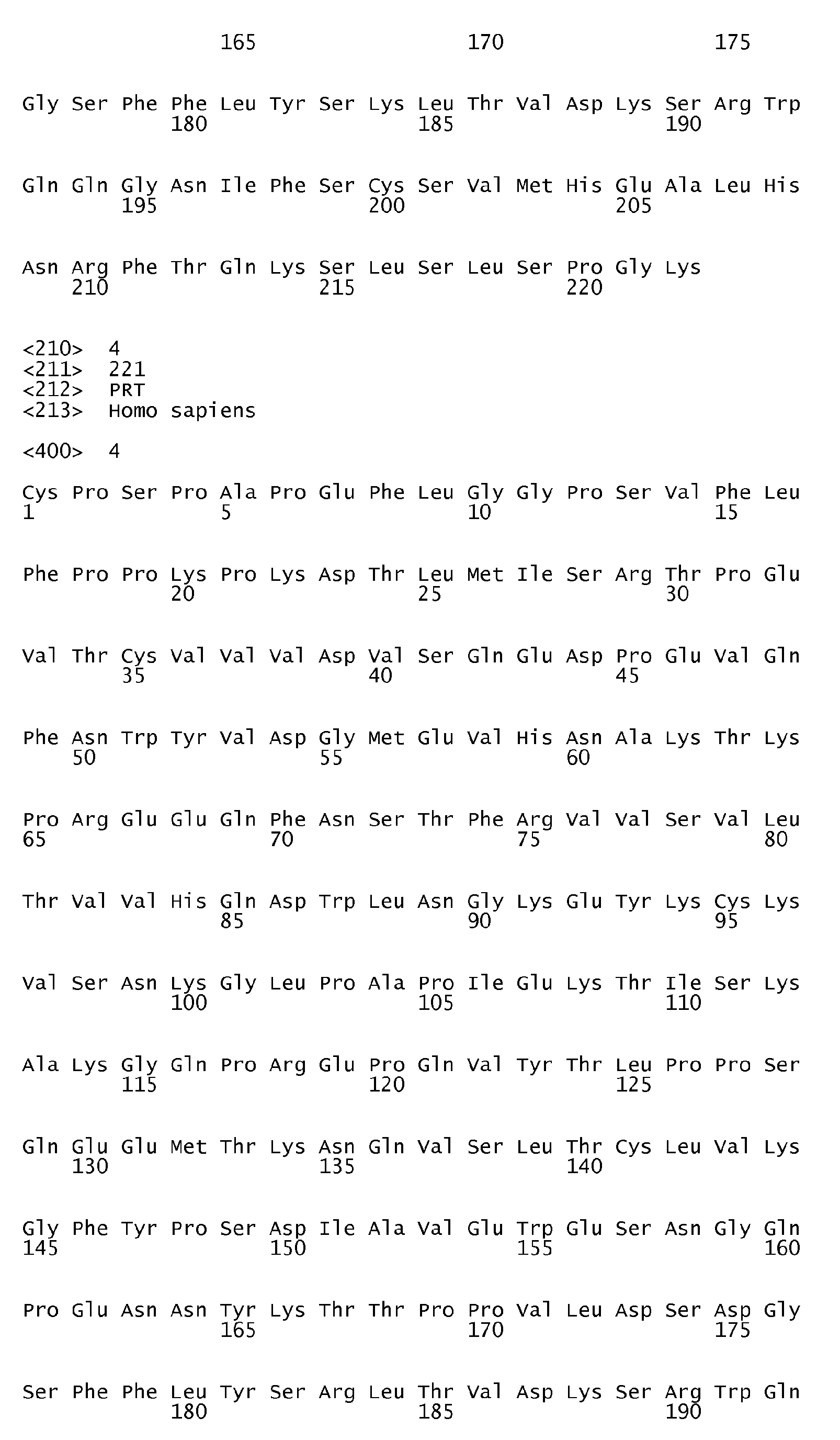


Claims (13)
- A variant of a parent polypeptide comprising a Fc region, which variant exhibits increased binding to FcRn as compared to said parent polypeptide and comprises at least two amino acid modifications, the said at least two amino acid modifications comprising :(i) one amino acid modification selected from the group consisting of 378V, 378T, 434Y and 434S, and(ii) at least amino acid modification selected from the group consisting of 226G, 230S, 230T, 230L, 241 L, 264E, 307P, 315D, 330V, 362R, 378V, 378T, 389T, 389K, 434Y and 434Sof the Fc region, wherein the numbering of the amino acids in the Fc region is that of the EU index as in Kabat and with the proviso that the modification (i) does not occur at the same amino acid position as the modification (ii)
- A variant according to claim 1, the said variant comprising at least one combination of amino acid modifications selected from the group consisting of 226G/315D/434Y, 230S/315D/434Y, 230T/315D/434Y, 230T/264E/434S, 230T/389T/434S, 241 L/264E/378V, 241L/264E/434S, 250A/389K/434Y, 2591/315D/434Y, 264E/378T/396L, 264E/378V/416K, 264E/378V/434S, 264E/396L/434S, 294del/307P/434Y, 307P/378V/434Y, 315D/330V/434Y, 315D/382V/434Y and 378V/383N/434Y of the Fc region as compared to said parent polypeptide, wherein the numbering of the amino acids in the Fc region is that of the EU index as in Kabat.
- A variant according to claim 2 wherein the said variant further comprises at least one amino acid modification selected from the group consisting of 226G, 227L, 230S, 230T, 230L, 231T, 241L, 243L, 250A, 256N, 2591, 264E, 265G, 267R, 290E, 294del, 303A, 305A, 307P, 307A, 308I, 315D, 322R, 325S, 327V, 330V, 342R, 347R, 352S, 361 D, 362R, 362E, 370R, 378V, 378T, 382V, 383N, 386R, 386K, 387T, 389T, 389K, 392R, 395A, 396L, 397M, 403T, 404L, 415N, 416K, 421T, 426T, 428L, 433R, 434Y, 434S and 439R of the Fc region, as compared to the parent polypeptide, wherein the numbering of the amino acids in the Fc region is that of the EU index as in Kabat.
- A variant according to any one of claims 1 or 2 wherein the said variant comprises one combination of amino acid modifications selecting from the group consisting of 307A/315D/330V/382V/389T/434Y, 256N/378V/383N/434Y, 315D/330V/361 D/378V/434Y, 2591/315D/434Y, 230S/315D/428L/434Y, 241 L/264E/307P/378V/433R, 250A/389K/434Y, 305A/315D/330V/395A/434Y, 264E/386R/396L/434S/439R, 315D/330V/362R/434Y, 294del/307P/434Y, 305A/315D/330V/389K/434Y, 315D/327V/330V/397M/434Y, 230T/241 L/264E/265G/378V/421 T, 264E/396L/415N/434S, 227L/264E/378V/434S, 264E/378T/396L, 230T/315D/362R/426T/434Y, 226G/315D/330V/434Y, 230L/241 L/243U264E/307P/378V, 250A/315D/325S/330V/434Y, 290E/315D/342R/382V/434Y, 241 L/315D/330V/392R/434Y, 241 L/264E/307P/378V/434S, 230T/264E/403T/434S, 264E/378V/416K, 230T/315D/362E/434Y, 226G/315D/434Y, 226G/315D/362R/434Y, 226G/264E/347R/370R/378V/434S, 3081/315D/330V/382V/434Y, 230T/264E/378V/434S, 231 T/241 L/264E/378T/397M/434S, 230L/264E/378V/434S, 230T/315D/330V/386K/434Y, 226G/315D/330V/389T/434Y, 267R/307P/378V/421 T/434Y, 230S/315D/387T/434Y, 230S/264E/352S/378V/434S and 230T/303A/322R/389T/404L/434S of the Fc region as compared to said parent polypeptide, wherein the numbering of the amino acids in the Fc region is that of the EU index as in Kabat
- A variant according to any one of claims 1 to 4, wherein said variant is an antibody
- A variant according to claim 5, wherein said antibody is an IgG antibody.
- A pharmaceutical composition comprising a variant as defined in anyone of claims 1 to 6.
- An isolated nucleic acid encoding a variant as defined in anyone of claims 1 to 6.
- A vector comprising the nucleic acid of claim 8.
- A host cell containing the vector of claim 9.
- A method for producing a variant according to any one of claims 1 to 6 comprising culturing the host cell of claim 10 so that the nucleic acid is expressed.
- A medicament comprising a variant according to any one of claims 1 to 6.
- Use of a variant according to any one of claims 1 to 12, for the manufacture of a medicament.
Priority Applications (32)
| Application Number | Priority Date | Filing Date | Title |
|---|---|---|---|
| EP09305250A EP2233500A1 (en) | 2009-03-20 | 2009-03-20 | Optimized Fc variants |
| PL20151751.3T PL3674318T3 (en) | 2009-03-20 | 2010-03-19 | Optimized Fc variants |
| CA2755905A CA2755905C (en) | 2009-03-20 | 2010-03-19 | Optimized fc variants |
| BRPI1014525-7A BRPI1014525B1 (en) | 2009-03-20 | 2010-03-19 | VARIANT OF A PRECURSOR POLYPEPTIDE, PHARMACEUTICAL COMPOSITION AND USE OF A VARIANT |
| TR2019/04385T TR201904385T4 (en) | 2009-03-20 | 2010-03-19 | Optimized Fc variants |
| US13/257,502 US8742074B2 (en) | 2009-03-20 | 2010-03-19 | Optimized FC variants |
| EP18175587.7A EP3395831B1 (en) | 2009-03-20 | 2010-03-19 | Optimized fc variants |
| KR1020117021990A KR101797248B1 (en) | 2009-03-20 | 2010-03-19 | Optimized FC variants |
| CN201510303059.2A CN104892762A (en) | 2009-03-20 | 2010-03-19 | Optimized Fc variants |
| PL14163605T PL2805969T4 (en) | 2009-03-20 | 2010-03-19 | Optimized FC variants |
| EP24207417.7A EP4491226A3 (en) | 2009-03-20 | 2010-03-19 | Optimized fc variants |
| CA2995516A CA2995516C (en) | 2009-03-20 | 2010-03-19 | Optimized fc variants |
| KR1020167023815A KR101757136B1 (en) | 2009-03-20 | 2010-03-19 | Optimized FC variants |
| CN201080017521.8A CN102405231B (en) | 2009-03-20 | 2010-03-19 | Optimized Fc variants |
| EP14163605.0A EP2805969B1 (en) | 2009-03-20 | 2010-03-19 | Optimized FC variants |
| ES20151751T ES3014619T3 (en) | 2009-03-20 | 2010-03-19 | Optimized fc variants |
| ES14163605T ES2726625T3 (en) | 2009-03-20 | 2010-03-19 | Optimized Fc variants |
| BR122021019353-3A BR122021019353B1 (en) | 2009-03-20 | 2010-03-19 | VARIANT OF A PRECURSOR POLYPEPTIDE, PHARMACEUTICAL COMPOSITION, ISOLATED NUCLEIC ACID, VECTOR, HOST CELL, METHOD FOR PRODUCING A VARIANT, DRUG, AND, USE OF A VARIANT |
| JP2012500274A JP5770710B2 (en) | 2009-03-20 | 2010-03-19 | Optimized Fc variant |
| KR1020167034673A KR101781318B1 (en) | 2009-03-20 | 2010-03-19 | Optimized FC variants |
| DK20151751.3T DK3674318T3 (en) | 2009-03-20 | 2010-03-19 | OPTIMIZED FC VARIANTS |
| DK14163605.0T DK2805969T3 (en) | 2009-03-20 | 2010-03-19 | Optimized Fc variants |
| PCT/EP2010/053644 WO2010106180A2 (en) | 2009-03-20 | 2010-03-19 | Optimized fc variants |
| US14/338,413 USRE45992E1 (en) | 2009-03-20 | 2010-03-19 | Optimized FC variants |
| US14/993,277 USRE46585E1 (en) | 2009-03-20 | 2010-03-19 | Optimized FC variants |
| CA3069425A CA3069425C (en) | 2009-03-20 | 2010-03-19 | Optimized fc variants |
| EP10709546A EP2408813A2 (en) | 2009-03-20 | 2010-03-19 | Optimized fc variants |
| EP20151751.3A EP3674318B1 (en) | 2009-03-20 | 2010-03-19 | Optimized fc variants |
| AU2010224800A AU2010224800B2 (en) | 2009-03-20 | 2010-03-19 | Optimized Fc variants |
| IL215041A IL215041A (en) | 2009-03-20 | 2011-09-08 | Optimized fc variants, pharmaceutical compositions and medicaments comprising the same and methods for their production |
| JP2015126168A JP5951856B2 (en) | 2009-03-20 | 2015-06-24 | Optimized Fc variant |
| IL245050A IL245050A0 (en) | 2009-03-20 | 2016-04-11 | Optimized fc variants, pharmaceutical compositions and medicaments comprising the same, and methods for their production |
Applications Claiming Priority (1)
| Application Number | Priority Date | Filing Date | Title |
|---|---|---|---|
| EP09305250A EP2233500A1 (en) | 2009-03-20 | 2009-03-20 | Optimized Fc variants |
Publications (1)
| Publication Number | Publication Date |
|---|---|
| EP2233500A1 true EP2233500A1 (en) | 2010-09-29 |
Family
ID=40578514
Family Applications (6)
| Application Number | Title | Priority Date | Filing Date |
|---|---|---|---|
| EP09305250A Withdrawn EP2233500A1 (en) | 2009-03-20 | 2009-03-20 | Optimized Fc variants |
| EP10709546A Withdrawn EP2408813A2 (en) | 2009-03-20 | 2010-03-19 | Optimized fc variants |
| EP20151751.3A Active EP3674318B1 (en) | 2009-03-20 | 2010-03-19 | Optimized fc variants |
| EP18175587.7A Active EP3395831B1 (en) | 2009-03-20 | 2010-03-19 | Optimized fc variants |
| EP14163605.0A Active EP2805969B1 (en) | 2009-03-20 | 2010-03-19 | Optimized FC variants |
| EP24207417.7A Pending EP4491226A3 (en) | 2009-03-20 | 2010-03-19 | Optimized fc variants |
Family Applications After (5)
| Application Number | Title | Priority Date | Filing Date |
|---|---|---|---|
| EP10709546A Withdrawn EP2408813A2 (en) | 2009-03-20 | 2010-03-19 | Optimized fc variants |
| EP20151751.3A Active EP3674318B1 (en) | 2009-03-20 | 2010-03-19 | Optimized fc variants |
| EP18175587.7A Active EP3395831B1 (en) | 2009-03-20 | 2010-03-19 | Optimized fc variants |
| EP14163605.0A Active EP2805969B1 (en) | 2009-03-20 | 2010-03-19 | Optimized FC variants |
| EP24207417.7A Pending EP4491226A3 (en) | 2009-03-20 | 2010-03-19 | Optimized fc variants |
Country Status (14)
| Country | Link |
|---|---|
| US (3) | USRE46585E1 (en) |
| EP (6) | EP2233500A1 (en) |
| JP (2) | JP5770710B2 (en) |
| KR (3) | KR101757136B1 (en) |
| CN (2) | CN104892762A (en) |
| AU (1) | AU2010224800B2 (en) |
| BR (2) | BR122021019353B1 (en) |
| CA (3) | CA2995516C (en) |
| DK (2) | DK2805969T3 (en) |
| ES (2) | ES3014619T3 (en) |
| IL (2) | IL215041A (en) |
| PL (2) | PL3674318T3 (en) |
| TR (1) | TR201904385T4 (en) |
| WO (1) | WO2010106180A2 (en) |
Cited By (12)
| Publication number | Priority date | Publication date | Assignee | Title |
|---|---|---|---|---|
| EP2537864A1 (en) * | 2011-06-24 | 2012-12-26 | LFB Biotechnologies | Fc variants with reduced effector functions |
| WO2013074598A1 (en) * | 2011-11-18 | 2013-05-23 | Merck Sharp & Dohme Corp. | Fc CONTAINING POLYPEPTIDES HAVING INCREASED ANTI-INFLAMMATORY PROPERTIES AND INCREASED FcRN BINDING |
| US9187552B2 (en) | 2010-05-27 | 2015-11-17 | Merck Sharp & Dohme Corp. | Method for preparing antibodies having improved properties |
| WO2015189249A1 (en) * | 2014-06-12 | 2015-12-17 | F. Hoffmann-La Roche Ag | Method for selecting antibodies with modified fcrn interaction |
| WO2016016586A1 (en) | 2014-08-01 | 2016-02-04 | Laboratoire Francais Du Fractionnement Et Des Biotechnologies | Method for producing variants having an fc with improved sialylation |
| EP2802604A4 (en) * | 2011-12-30 | 2016-02-17 | Hanmi Science Co Ltd | IMMUNOGLOBULIN FC VARIANTS |
| US9328170B2 (en) | 2011-05-25 | 2016-05-03 | Merck Sharp & Dohme Corp. | Method for preparing Fc containing polypeptides having improved properties |
| FR3038517A1 (en) * | 2015-07-06 | 2017-01-13 | Lab Francais Du Fractionnement | USE OF MODIFIED FC FRAGMENTS IN IMMUNOTHERAPY |
| WO2017021631A1 (en) * | 2015-08-04 | 2017-02-09 | Universite Francois Rabelais De Tours | Ig1 and the therapeutic use thereof |
| WO2019145455A1 (en) * | 2018-01-24 | 2019-08-01 | Genmab B.V. | Polypeptide variants and uses thereof |
| WO2019234094A1 (en) * | 2018-06-07 | 2019-12-12 | Ucb Biopharma Sprl | Multi-domain proteins with increased native state colloidal stability |
| EP3712166A1 (en) * | 2013-09-05 | 2020-09-23 | Amgen Inc. | Fc-containing molecules exhibiting predictable, consistent, and reproducible glycoform profiles |
Families Citing this family (167)
| Publication number | Priority date | Publication date | Assignee | Title |
|---|---|---|---|---|
| WO2006106905A1 (en) | 2005-03-31 | 2006-10-12 | Chugai Seiyaku Kabushiki Kaisha | Process for production of polypeptide by regulation of assembly |
| DK2006381T3 (en) | 2006-03-31 | 2016-02-22 | Chugai Pharmaceutical Co Ltd | PROCEDURE FOR REGULATING ANTIBODIES BLOOD PHARMACOKINETICS |
| JP5144499B2 (en) | 2006-03-31 | 2013-02-13 | 中外製薬株式会社 | Antibody modification method for purifying bispecific antibodies |
| ES2566957T3 (en) | 2007-09-26 | 2016-04-18 | Chugai Seiyaku Kabushiki Kaisha | Constant region of modified antibody |
| DK2202245T3 (en) | 2007-09-26 | 2016-11-21 | Chugai Pharmaceutical Co Ltd | A method of modifying an antibody isoelectric point VIA amino acid substitution in CDR |
| UA121453C2 (en) | 2008-04-11 | 2020-06-10 | Чугей Сейяку Кабусікі Кайся | METHOD OF PREPARATION OF PHARMACEUTICAL COMPOSITION CONTAINING ANTIBODY |
| TWI682995B (en) | 2009-03-19 | 2020-01-21 | 日商中外製藥股份有限公司 | Antibody constant region alteration |
| WO2011028952A1 (en) | 2009-09-02 | 2011-03-10 | Xencor, Inc. | Compositions and methods for simultaneous bivalent and monovalent co-engagement of antigens |
| WO2011108714A1 (en) | 2010-03-04 | 2011-09-09 | 中外製薬株式会社 | Antibody constant region variant |
| WO2011120135A1 (en) * | 2010-03-29 | 2011-10-06 | Zymeworks, Inc. | Antibodies with enhanced or suppressed effector function |
| US9441032B2 (en) | 2010-04-07 | 2016-09-13 | Agency For Science, Technology And Research | Binding molecules against Chikungunya virus and uses thereof |
| AU2011283694B2 (en) | 2010-07-29 | 2017-04-13 | Xencor, Inc. | Antibodies with modified isoelectric points |
| PH12013500974A1 (en) | 2010-11-17 | 2013-07-08 | Chugai Pharmaceutical Co Ltd | Multi-specific antigen-binding molecule having alternative function to function of blood coagulation factor viii |
| KR102385507B1 (en) | 2010-11-30 | 2022-04-12 | 추가이 세이야쿠 가부시키가이샤 | Antigen-binding molecule capable of binding to plurality of antigen molecules repeatedly |
| WO2012132067A1 (en) * | 2011-03-30 | 2012-10-04 | 中外製薬株式会社 | Retention of antigen-binding molecules in blood plasma and method for modifying immunogenicity |
| CA2827923C (en) | 2011-02-25 | 2021-11-23 | Chugai Seiyaku Kabushiki Kaisha | Fc.gamma.riib-specific fc antibody |
| PT2707391T (en) | 2011-05-13 | 2018-02-06 | Inserm Institut National De La Santa© Et De La Rech Ma©Dicale | Antibodies against her3 |
| AU2012273954A1 (en) | 2011-06-22 | 2014-01-09 | Inserm (Institut National De La Sante Et De La Recherche Medicale) | Anti-Axl antibodies and uses thereof |
| US9409988B2 (en) | 2011-06-22 | 2016-08-09 | Inserm (Institut National De La Sante Et De La Recherche Medicale) | Anti-Axl antibodies and uses thereof |
| RU2641256C2 (en) | 2011-06-30 | 2018-01-16 | Чугаи Сейяку Кабусики Кайся | Heterodimerizated polypeptide |
| UA117901C2 (en) * | 2011-07-06 | 2018-10-25 | Ґенмаб Б.В. | METHOD FOR STRENGTHENING THE EFFECTORAL FUNCTION OF THE ORIGINAL POLYEPEPTIDE, ITS OPTIONS AND THEIR APPLICATIONS |
| IL282122B2 (en) * | 2011-07-06 | 2025-10-01 | Genmab Bv | Antibody variants and uses thereof |
| TWI681970B (en) | 2011-09-30 | 2020-01-11 | 日商中外製藥股份有限公司 | An antigen-binding molecule comprising an antigen-binding domain whose binding activity to an antigen is changed according to the ion concentration condition, and an FcRn-binding domain having binding activity to FcRn under pH-neutral conditions, and which induces an immune response against the target antigen |
| EP2762166B1 (en) | 2011-09-30 | 2019-09-18 | Chugai Seiyaku Kabushiki Kaisha | Antigen-binding molecules for promoting elimination of antigens |
| JP6322411B2 (en) | 2011-09-30 | 2018-05-09 | 中外製薬株式会社 | Antigen-binding molecules that promote the disappearance of antigens with multiple physiological activities |
| TW201817745A (en) * | 2011-09-30 | 2018-05-16 | 日商中外製藥股份有限公司 | Therapeutic antigen-binding molecule having an FcRn binding domain that promotes antigen clearance |
| US10851178B2 (en) * | 2011-10-10 | 2020-12-01 | Xencor, Inc. | Heterodimeric human IgG1 polypeptides with isoelectric point modifications |
| US12466897B2 (en) * | 2011-10-10 | 2025-11-11 | Xencor, Inc. | Heterodimeric human IgG1 polypeptides with isoelectric point modifications |
| WO2013055809A1 (en) * | 2011-10-10 | 2013-04-18 | Xencor, Inc. | A method for purifying antibodies |
| ES2732712T3 (en) | 2011-10-31 | 2019-11-25 | Chugai Pharmaceutical Co Ltd | Antigen binding molecule that has a regulated conjugation between the heavy chain and the light chain |
| SG10201609301QA (en) | 2011-11-30 | 2016-12-29 | Chugai Pharmaceutical Co Ltd | Drug containing carrier into cell for forming immune complex |
| SG10201704849PA (en) | 2012-02-09 | 2017-07-28 | Chugai Pharmaceutical Co Ltd | Modified fc region of antibody |
| CA2865158C (en) | 2012-02-24 | 2022-11-01 | Chugai Seiyaku Kabushiki Kaisha | Antigen-binding molecule for promoting disappearance of antigen via fc.gamma.riib |
| CN107964042B (en) | 2012-05-30 | 2022-04-19 | 中外制药株式会社 | Target tissue specific antigen binding molecules |
| ES2758979T3 (en) * | 2012-07-06 | 2020-05-07 | Genmab Bv | Dimeric protein with triple mutations |
| BR112015000167B1 (en) * | 2012-07-06 | 2021-11-23 | Genmab B.V. | DIMERIC PROTEIN, PROTEIN, COMPOSITION, KIT OF PARTS AND THEIR USES, AS WELL AS A METHOD TO INCREASE THE OLIGOMERIZATION IN SOLUTION OF A DIMERIC PROTEIN COMPRISING A FIRST AND SECOND POLYPEPTIDE, EACH COMPRISING AT LEAST ONE CH2 AND CH3 REGIONS HUMAN AND VARIANT DIMER PROTEIN |
| EP3632462A1 (en) * | 2012-07-06 | 2020-04-08 | Genmab B.V. | Dimeric protein with triple mutations |
| AU2013306700B2 (en) | 2012-08-24 | 2019-05-02 | Chugai Seiyaku Kabushiki Kaisha | FcgammaRIIb-specific Fc region variant |
| HRP20171413T1 (en) * | 2012-10-02 | 2017-12-15 | Proclara Biosciences, Inc. | Use of p3 of bacteriophage fusion proteins as amyloid binding agents |
| EP2733153A1 (en) | 2012-11-15 | 2014-05-21 | INSERM (Institut National de la Santé et de la Recherche Médicale) | Methods for the preparation of immunoconjugates and uses thereof |
| EA201500741A1 (en) * | 2013-01-10 | 2016-01-29 | Генмаб Б.В. | HUMAN FG IGG1 OPTIONS AND THEIR APPLICATION |
| US10738132B2 (en) | 2013-01-14 | 2020-08-11 | Xencor, Inc. | Heterodimeric proteins |
| US10487155B2 (en) | 2013-01-14 | 2019-11-26 | Xencor, Inc. | Heterodimeric proteins |
| US10968276B2 (en) | 2013-03-12 | 2021-04-06 | Xencor, Inc. | Optimized anti-CD3 variable regions |
| US9605084B2 (en) | 2013-03-15 | 2017-03-28 | Xencor, Inc. | Heterodimeric proteins |
| US11053316B2 (en) | 2013-01-14 | 2021-07-06 | Xencor, Inc. | Optimized antibody variable regions |
| US9701759B2 (en) | 2013-01-14 | 2017-07-11 | Xencor, Inc. | Heterodimeric proteins |
| US10131710B2 (en) | 2013-01-14 | 2018-11-20 | Xencor, Inc. | Optimized antibody variable regions |
| US9738722B2 (en) | 2013-01-15 | 2017-08-22 | Xencor, Inc. | Rapid clearance of antigen complexes using novel antibodies |
| GB201302878D0 (en) * | 2013-02-19 | 2013-04-03 | Argen X Bv | Modified igG molecules |
| US10106624B2 (en) | 2013-03-15 | 2018-10-23 | Xencor, Inc. | Heterodimeric proteins |
| US10858417B2 (en) | 2013-03-15 | 2020-12-08 | Xencor, Inc. | Heterodimeric proteins |
| US10519242B2 (en) | 2013-03-15 | 2019-12-31 | Xencor, Inc. | Targeting regulatory T cells with heterodimeric proteins |
| EP3421495A3 (en) | 2013-03-15 | 2019-05-15 | Xencor, Inc. | Modulation of t cells with bispecific antibodies and fc fusions |
| WO2014163101A1 (en) | 2013-04-02 | 2014-10-09 | 中外製薬株式会社 | Fc region variant |
| KR101895634B1 (en) * | 2013-05-31 | 2018-09-05 | 한미약품 주식회사 | IgG4 Fc fragment comprising modified hinge region |
| ES2736326T3 (en) | 2013-05-31 | 2019-12-27 | Zymeworks Inc | Heteromultimers with reduced or silenced effector function |
| KR102116495B1 (en) * | 2013-08-28 | 2020-06-03 | 삼성디스플레이 주식회사 | Organic light-emitting diode comprising condensed cyclic compound |
| SG10201803449VA (en) | 2013-09-27 | 2018-05-30 | Chugai Pharmaceutical Co Ltd | Method for producing polypeptide heteromultimer |
| WO2015054039A1 (en) * | 2013-10-08 | 2015-04-16 | Merck Sharp & Dohme Corp. | Fc CONTAINING POLYPEPTIDES HAVING INCREASED BINDING TO FcGammaRIIB |
| FR3012453B1 (en) | 2013-10-31 | 2015-11-13 | Lab Francais Du Fractionnement | CHIMERIC PROTEIN FOR THE TREATMENT OF AMYLOSIS |
| ES2865196T3 (en) | 2013-11-07 | 2021-10-15 | Inst Nat Sante Rech Med | Neuregulin allosteric anti-human HER3 antibodies |
| WO2015073307A2 (en) * | 2013-11-13 | 2015-05-21 | Merck Sharp & Dohme Corp. | Fc CONTAINING POLYPEPTIDES HAVING INCREASED BINDING TO HUMAN DC-SIGN |
| KR20220152546A (en) | 2013-12-24 | 2022-11-16 | 더 보드 오브 리젠츠 오브 더 유니버시티 오브 텍사스 시스템 | Fcrn antagonists and methods of use |
| WO2015112597A1 (en) * | 2014-01-21 | 2015-07-30 | Belmont Biosciences, Inc. | Variants of igg fc with limited amine groups that retain functional properties |
| LT3122781T (en) | 2014-03-28 | 2020-03-25 | Xencor, Inc. | Bispecific antibodies that bind to cd38 and cd3 |
| MA40764A (en) | 2014-09-26 | 2017-08-01 | Chugai Pharmaceutical Co Ltd | THERAPEUTIC AGENT INDUCING CYTOTOXICITY |
| US10259887B2 (en) | 2014-11-26 | 2019-04-16 | Xencor, Inc. | Heterodimeric antibodies that bind CD3 and tumor antigens |
| TN2017000223A1 (en) | 2014-11-26 | 2018-10-19 | Xencor Inc | Heterodimeric antibodies that bind cd3 and tumor antigens |
| IL252467B (en) | 2014-11-26 | 2022-06-01 | Xencor Inc | Heterodimeric antibodies that bind cd3 and cd38 |
| US10398774B2 (en) | 2014-12-09 | 2019-09-03 | INSERM (Institut National de la Santé et de la Recherche Médicale) | Human monoclonal antibodies against AXL |
| JP6227191B1 (en) | 2014-12-19 | 2017-11-08 | 中外製薬株式会社 | Anti-myostatin antibody, polypeptide comprising mutant Fc region, and method of use |
| US10428155B2 (en) | 2014-12-22 | 2019-10-01 | Xencor, Inc. | Trispecific antibodies |
| CN114773470A (en) | 2015-02-05 | 2022-07-22 | 中外制药株式会社 | Antibodies comprising an ion concentration-dependent antigen-binding domain, FC region variants, IL-8-binding antibodies and uses thereof |
| WO2016135041A1 (en) | 2015-02-26 | 2016-09-01 | INSERM (Institut National de la Santé et de la Recherche Médicale) | Fusion proteins and antibodies comprising thereof for promoting apoptosis |
| US10227411B2 (en) | 2015-03-05 | 2019-03-12 | Xencor, Inc. | Modulation of T cells with bispecific antibodies and FC fusions |
| FR3034420A1 (en) | 2015-03-31 | 2016-10-07 | Lab Francais Du Fractionnement | ANTI-CD303 MONOCLONAL ANTIBODIES |
| JP7082484B2 (en) | 2015-04-01 | 2022-06-08 | 中外製薬株式会社 | Method for Producing Polypeptide Heterogeneous Multimer |
| FR3035879B1 (en) * | 2015-05-07 | 2025-02-28 | Lab Francais Du Fractionnement | FC MUTANTS WITH ALTERED FUNCTIONAL ACTIVITY |
| ES2898023T3 (en) | 2015-05-22 | 2022-03-03 | Inst Nat Sante Rech Med | Human monoclonal antibody fragments that inhibit both the catalytic activity of Cath-D and its binding to the LRP1 receptor |
| KR20180085800A (en) | 2015-12-07 | 2018-07-27 | 젠코어 인코포레이티드 | CD3 and heterodimeric antibodies that bind to PSMA |
| SG10201707267RA (en) | 2015-12-18 | 2017-10-30 | Chugai Pharmaceutical Co Ltd | Anti-myostatin antibodies, polypeptides containing variant fc regions, and methods of use |
| WO2017115773A1 (en) | 2015-12-28 | 2017-07-06 | 中外製薬株式会社 | Method for promoting efficiency of purification of fc region-containing polypeptide |
| RU2746754C2 (en) | 2016-03-14 | 2021-04-20 | Чугаи Сейяку Кабусики Кайся | Cell damage inducing therapeutic medicinal product for anticancer therapy |
| KR102640157B1 (en) | 2016-03-22 | 2024-02-27 | 인쎄름 (엥스띠뛰 나씨오날 드 라 쌍떼 에 드 라 흐쉐르슈 메디깔) | Humanized anti-claudin-1 antibodies and uses thereof |
| UA126900C2 (en) | 2016-04-28 | 2023-02-22 | Чугаі Сейяку Кабусікі Кайся | ANTIBODY CONTAINING DRUG |
| FR3051794A1 (en) * | 2016-05-31 | 2017-12-01 | Lab Francais Du Fractionnement | ANTIBODIES FOR THE TREATMENT OF CANCERS |
| MA45255A (en) | 2016-06-14 | 2019-04-17 | Xencor Inc | BISPECIFIC CONTROL POINT INHIBITORS ANTIBODIES |
| MX2018014375A (en) | 2016-06-17 | 2019-04-22 | Chugai Pharmaceutical Co Ltd | Anti-myostatin antibodies and methods of use. |
| CA3029328A1 (en) | 2016-06-28 | 2018-01-04 | Xencor, Inc. | Heterodimeric antibodies that bind somatostatin receptor 2 |
| FR3053688A1 (en) * | 2016-07-06 | 2018-01-12 | Laboratoire Francais Du Fractionnement Et Des Biotechnologies | FC MUTANTS WITH IMPROVED FUNCTIONAL ACTIVITY |
| CA3030099A1 (en) | 2016-07-08 | 2018-01-11 | Staten Biotechnology B.V. | Anti-apoc3 antibodies and methods of use thereof |
| CN109661406A (en) | 2016-07-29 | 2019-04-19 | 国家医疗保健研究所 | Antibodies targeting tumor-associated macrophages and their uses |
| BR112019001989A2 (en) | 2016-08-02 | 2019-08-20 | Visterra, Inc. | engineered polypeptides and uses thereof |
| IL264626B (en) | 2016-08-05 | 2022-07-01 | Chugai Pharmaceutical Co Ltd | A preparation for the prevention or treatment of diseases related to il-8 |
| US10793632B2 (en) | 2016-08-30 | 2020-10-06 | Xencor, Inc. | Bispecific immunomodulatory antibodies that bind costimulatory and checkpoint receptors |
| SG10201607778XA (en) | 2016-09-16 | 2018-04-27 | Chugai Pharmaceutical Co Ltd | Anti-Dengue Virus Antibodies, Polypeptides Containing Variant Fc Regions, And Methods Of Use |
| JP7142630B2 (en) | 2016-10-14 | 2022-09-27 | ゼンコア インコーポレイテッド | IL15/IL15Rα heterodimeric FC-fusion protein |
| US11021533B2 (en) | 2016-11-02 | 2021-06-01 | Vanderbilt University | Human Zika virus antibodies and methods of use therefor |
| KR101872455B1 (en) * | 2016-11-30 | 2018-06-28 | 국민대학교 산학협력단 | Antibody Fc Region Comprising a New Mutation |
| RS63818B1 (en) | 2017-02-17 | 2023-01-31 | Denali Therapeutics Inc | Engineered transferrin receptor binding polypeptides |
| EP3589654A1 (en) | 2017-03-02 | 2020-01-08 | INSERM (Institut National de la Santé et de la Recherche Médicale) | Antibodies having specificity to nectin-4 and uses thereof |
| FR3064007A1 (en) | 2017-03-20 | 2018-09-21 | Laboratoire Francais Du Fractionnement Et Des Biotechnologies | ANTIBODIES FOR THE TREATMENT OF CANCERS |
| KR101792205B1 (en) | 2017-04-13 | 2017-10-31 | 재단법인 오송첨단의료산업진흥재단 | Antibody Fc variants for Prolonged Serum Persistence |
| US11492415B2 (en) * | 2017-04-07 | 2022-11-08 | Kookmin University Industry Academy | Antibody Fc variants for increased blood half-life |
| KR101913743B1 (en) * | 2017-04-07 | 2018-11-01 | 국민대학교 산학협력단 | Antibody Fc variants for Prolonged Serum Half-Life |
| JP2020517242A (en) | 2017-04-21 | 2020-06-18 | スターテン・バイオテクノロジー・ベー・フェー | Anti-ApoC3 antibody and method of using the same |
| AU2018291497A1 (en) | 2017-06-30 | 2020-01-16 | Xencor, Inc. | Targeted heterodimeric Fc fusion proteins containing IL-15/IL-15Ra and antigen binding domains |
| ES2978167T3 (en) | 2017-09-19 | 2024-09-06 | Tillotts Pharma Ag | Antibody variants |
| HUE054261T2 (en) | 2017-09-19 | 2021-08-30 | Tillotts Pharma Ag | Antibody variants |
| EP3697449A1 (en) * | 2017-10-18 | 2020-08-26 | REGENXBIO Inc. | Treatment of ocular diseases and metastatic colon cancer with human post-translationally modified vegf-trap |
| US10538583B2 (en) | 2017-10-31 | 2020-01-21 | Staten Biotechnology B.V. | Anti-APOC3 antibodies and compositions thereof |
| AU2018361957B2 (en) | 2017-10-31 | 2023-05-25 | Staten Biotechnology B.V. | Anti-ApoC3 antibodies and methods of use thereof |
| JPWO2019088143A1 (en) | 2017-11-01 | 2020-11-12 | 中外製薬株式会社 | Antibody variants and isoforms with reduced bioactivity |
| US11312770B2 (en) | 2017-11-08 | 2022-04-26 | Xencor, Inc. | Bispecific and monospecific antibodies using novel anti-PD-1 sequences |
| US10981992B2 (en) | 2017-11-08 | 2021-04-20 | Xencor, Inc. | Bispecific immunomodulatory antibodies that bind costimulatory and checkpoint receptors |
| MX2020005981A (en) | 2017-12-08 | 2020-08-24 | Argenx Bvba | USE OF CRFN ANTAGONISTS FOR THE TREATMENT OF GENERALIZED MYASTENIA GRAVIS. |
| EP3498293A1 (en) | 2017-12-15 | 2019-06-19 | Institut National De La Sante Et De La Recherche Medicale (Inserm) | Treatment of monogenic diseases with an anti-cd45rc antibody |
| FR3075200B1 (en) * | 2017-12-15 | 2022-12-23 | Lab Francais Du Fractionnement | VARIANTS WITH FC FRAGMENT HAVING INCREASED AFFINITY FOR FCRN AND INCREASED AFFINITY FOR AT LEAST ONE FC FRAGMENT RECEIVER |
| JP7765181B2 (en) | 2017-12-19 | 2025-11-06 | ゼンコア インコーポレイテッド | Modified IL-2 FC fusion proteins |
| FR3076294B1 (en) | 2017-12-29 | 2022-01-28 | Lab Francais Du Fractionnement | METHOD FOR PURIFYING ANTIBODIES FROM RAW MILK |
| CN108101992B (en) * | 2017-12-31 | 2021-03-26 | 武汉班科生物技术股份有限公司 | CH2 structural domain mutant with enhanced binding with neonatal Fc receptor, and preparation method and application thereof |
| JP2018138022A (en) * | 2018-02-23 | 2018-09-06 | ゲンマブ ビー.ブイ. | Human igg1 fc region variants and uses thereof |
| CN112119090B (en) | 2018-03-15 | 2023-01-13 | 中外制药株式会社 | Anti-dengue virus antibodies cross-reactive to Zika virus and methods of use |
| US10982006B2 (en) | 2018-04-04 | 2021-04-20 | Xencor, Inc. | Heterodimeric antibodies that bind fibroblast activation protein |
| WO2019204646A1 (en) | 2018-04-18 | 2019-10-24 | Xencor, Inc. | Lag-3 targeted heterodimeric fusion proteins containing il-15/il-15ra fc-fusion proteins and lag-3 antigen binding domains |
| CA3097741A1 (en) | 2018-04-18 | 2019-10-24 | Xencor, Inc. | Tim-3 targeted heterodimeric fusion proteins containing il-15/il-15ra fc-fusion proteins and tim-3 antigen binding domains |
| MA52289A (en) | 2018-04-18 | 2021-02-24 | Xencor Inc | FC HETERODIMERUS IL-15 / IL-15RA FUSION PROTEINS AND THEIR USES |
| CN112867734A (en) | 2018-04-18 | 2021-05-28 | Xencor股份有限公司 | PD-1 targeting heterodimeric fusion proteins comprising an IL-15/IL-15Ra Fc fusion protein and a PD-1 antigen binding domain and uses thereof |
| CN112513073A (en) | 2018-06-08 | 2021-03-16 | 阿根思公司 | Compositions and methods for treating immune thrombocytopenia |
| AU2019355971B2 (en) | 2018-10-03 | 2025-05-08 | Xencor, Inc. | IL-12 heterodimeric Fc-fusion proteins |
| US11377477B2 (en) | 2018-10-12 | 2022-07-05 | Xencor, Inc. | PD-1 targeted IL-15/IL-15RALPHA fc fusion proteins and uses in combination therapies thereof |
| WO2020114616A1 (en) | 2018-12-07 | 2020-06-11 | Tillotts Pharma Ag | Topical treatment of immune checkpoint inhibitor induced diarrhoea, colitis or enterocolitis using antibodies and fragments thereof |
| EP3897853A1 (en) | 2018-12-20 | 2021-10-27 | Xencor, Inc. | Targeted heterodimeric fc fusion proteins containing il-15/il-15ra and nkg2d antigen binding domains |
| WO2020148207A1 (en) | 2019-01-14 | 2020-07-23 | INSERM (Institut National de la Santé et de la Recherche Médicale) | Human monoclonal antibodies binding to hla-a2 |
| CN113614107A (en) | 2019-01-23 | 2021-11-05 | Encefa公司 | CD31 competitors and uses thereof |
| BR112021016955A2 (en) | 2019-03-01 | 2021-11-23 | Xencor Inc | Composition, nucleic acid composition, expression vector composition, expression vector, host cell, methods of producing an ectonucleotide pyrophosphatase/phosphodiesterase family 3 member binding domain and of treating a cancer, anti-enpp3 antibody , and, heterodimeric antibody |
| JP7565951B2 (en) | 2019-06-07 | 2024-10-11 | アルジェニクス ビーブイ | Pharmaceutical formulations of FcRn inhibitors suitable for subcutaneous administration |
| JP7753184B2 (en) | 2019-07-16 | 2025-10-14 | インサーム(インスティテュ ナシオナル ドゥ ラ サンテ エ ドゥ ラ ルシェルシェ メディカル) | Antibodies specific to CD38 and uses thereof |
| WO2021041715A2 (en) * | 2019-08-30 | 2021-03-04 | University Of Kansas | Compositions including igg fc mutations and uses thereof |
| TW202128757A (en) | 2019-10-11 | 2021-08-01 | 美商建南德克公司 | Pd-1 targeted il-15/il-15ralpha fc fusion proteins with improved properties |
| EP4072682A1 (en) | 2019-12-09 | 2022-10-19 | Institut National de la Santé et de la Recherche Médicale (INSERM) | Antibodies having specificity to her4 and uses thereof |
| US11739142B2 (en) | 2019-12-18 | 2023-08-29 | Hoffmann-La Roche Inc. | Bispecific anti-CCL2 antibodies |
| US12403175B2 (en) | 2020-01-08 | 2025-09-02 | argenx BV | Methods for treating pemphigus disorders |
| CN115551553A (en) | 2020-05-12 | 2022-12-30 | Inserm(法国国家健康医学研究院) | Novel method for treating cutaneous T cell lymphoma and lymphoma of TFH origin |
| US11919956B2 (en) | 2020-05-14 | 2024-03-05 | Xencor, Inc. | Heterodimeric antibodies that bind prostate specific membrane antigen (PSMA) and CD3 |
| KR20230166150A (en) | 2020-08-19 | 2023-12-06 | 젠코어 인코포레이티드 | Anti-cd28 compositions |
| IL302388A (en) | 2020-11-02 | 2023-06-01 | Attralus Inc | Sap fc fusion proteins and methods of use |
| US11739144B2 (en) | 2021-03-09 | 2023-08-29 | Xencor, Inc. | Heterodimeric antibodies that bind CD3 and CLDN6 |
| KR20230154311A (en) | 2021-03-10 | 2023-11-07 | 젠코어 인코포레이티드 | Heterodimeric antibodies binding to CD3 and GPC3 |
| US20240270862A1 (en) | 2021-06-01 | 2024-08-15 | INSERM (Institut National de la Santé et de la Recherche Médicale) | Use of b cell depleting agents for the treatment of rheumatic heart disease |
| AU2022295067A1 (en) | 2021-06-18 | 2023-12-21 | F. Hoffmann-La Roche Ag | Bispecific anti-ccl2 antibodies |
| KR102821393B1 (en) * | 2021-10-18 | 2025-06-18 | 고려대학교 산학협력단 | Human IgG1 Fc variants with improved pH-dependent FcRn binding and Fc gamma receptor IIIa binding selectivity |
| KR102835109B1 (en) * | 2021-10-18 | 2025-07-18 | 고려대학교 산학협력단 | Human IgG1 Fc variants with improved pH-dependent FcRn binding and Fc gamma receptor IIa binding |
| WO2023242372A1 (en) | 2022-06-15 | 2023-12-21 | argenx BV | Fcrn/hsa binding molecules and methods of use |
| CN119677771A (en) * | 2022-08-02 | 2025-03-21 | 帕诺洛斯生物科技有限公司 | Modified fusion protein and its use |
| WO2024052503A1 (en) | 2022-09-08 | 2024-03-14 | Institut National de la Santé et de la Recherche Médicale | Antibodies having specificity to ltbp2 and uses thereof |
| WO2024061930A1 (en) | 2022-09-22 | 2024-03-28 | Institut National de la Santé et de la Recherche Médicale | New method to treat and diagnose peripheral t-cell lymphoma (ptcl) |
| WO2024170543A1 (en) | 2023-02-14 | 2024-08-22 | Institut National de la Santé et de la Recherche Médicale | Anti-cd44 antibodies and uses thereof |
| AU2024273407A1 (en) | 2023-05-17 | 2025-12-04 | Centre National De La Recherche Scientifique | Anti-cathepsin-d antibodies |
| WO2025012417A1 (en) | 2023-07-13 | 2025-01-16 | Institut National de la Santé et de la Recherche Médicale | Anti-neurotensin long fragment and anti-neuromedin n long fragment antibodies and uses thereof |
| KR20250037016A (en) | 2023-09-07 | 2025-03-17 | 한국전력공사 | (novel microogranism producing methane and method of producing methane using the same) |
| WO2025120015A1 (en) | 2023-12-06 | 2025-06-12 | Institut National de la Santé et de la Recherche Médicale | Cd5 targeting antibodies with depleting and t or b-cell activation effects |
| WO2025224297A1 (en) | 2024-04-26 | 2025-10-30 | Institut National de la Santé et de la Recherche Médicale | Antibodies having specificity to tgfbi and uses thereof |
| WO2025242732A1 (en) | 2024-05-21 | 2025-11-27 | Institut National de la Santé et de la Recherche Médicale | Pan antibodies against sars-cov-2 spike protein and uses thereof for therapeutical purposes |
| WO2025257181A1 (en) | 2024-06-11 | 2025-12-18 | Institut National de la Santé et de la Recherche Médicale | Antibodies targeting trans-active response dna-binding protein-43 (tdp-43) |
| CN120623322B (en) * | 2025-08-14 | 2025-12-05 | 成都蓉生药业有限责任公司 | Human IgG Fc variant, gene fragment, expression vector, host cell, igG antibody and preparation method and application of human IgG Fc variant |
Citations (25)
| Publication number | Priority date | Publication date | Assignee | Title |
|---|---|---|---|---|
| US2228904A (en) | 1939-05-10 | 1941-01-14 | Bjorkman Hugo Leonard | Wrench |
| WO1987005330A1 (en) | 1986-03-07 | 1987-09-11 | Michel Louis Eugene Bergh | Method for enhancing glycoprotein stability |
| WO1991014438A1 (en) | 1990-03-20 | 1991-10-03 | The Trustees Of Columbia University In The City Of New York | Chimeric antibodies with receptor binding ligands in place of their constant region |
| WO1992011018A1 (en) | 1990-12-19 | 1992-07-09 | Protein Design Labs, Inc. | Improved humanized immunoglobulins |
| US5500362A (en) | 1987-01-08 | 1996-03-19 | Xoma Corporation | Chimeric antibody with specificity to human B cell surface antigen |
| WO1996032478A1 (en) | 1995-04-14 | 1996-10-17 | Genentech, Inc. | Altered polypeptides with increased half-life |
| WO1997043316A1 (en) | 1996-05-10 | 1997-11-20 | Beth Israel Deaconess Medical Center, Inc. | Physiologically active molecules with extended half-lives and methods of using same |
| US5736137A (en) | 1992-11-13 | 1998-04-07 | Idec Pharmaceuticals Corporation | Therapeutic application of chimeric and radiolabeled antibodies to human B lymphocyte restricted differentiation antigen for treatment of B cell lymphoma |
| US5747035A (en) | 1995-04-14 | 1998-05-05 | Genentech, Inc. | Polypeptides with increased half-life for use in treating disorders involving the LFA-1 receptor |
| US5869046A (en) | 1995-04-14 | 1999-02-09 | Genentech, Inc. | Altered polypeptides with increased half-life |
| WO1999043713A1 (en) | 1998-02-25 | 1999-09-02 | Lexigen Pharmaceuticals Corporation | Enhancing the circulating half-life of antibody-based fusion proteins |
| WO2000009560A2 (en) | 1998-08-17 | 2000-02-24 | Abgenix, Inc. | Generation of modified molecules with increased serum half-lives |
| WO2000042072A2 (en) | 1999-01-15 | 2000-07-20 | Genentech, Inc. | Polypeptide variants with altered effector function |
| WO2000061739A1 (en) | 1999-04-09 | 2000-10-19 | Kyowa Hakko Kogyo Co., Ltd. | Method for controlling the activity of immunologically functional molecule |
| US6165745A (en) | 1992-04-24 | 2000-12-26 | Board Of Regents, The University Of Texas System | Recombinant production of immunoglobulin-like domains in prokaryotic cells |
| WO2001029246A1 (en) | 1999-10-19 | 2001-04-26 | Kyowa Hakko Kogyo Co., Ltd. | Process for producing polypeptide |
| WO2001077181A2 (en) | 2000-04-12 | 2001-10-18 | Laboratoire Francais Du Fractionnement Et Des Biotechnologies | Anti-rhesus d monoclonal antibodies |
| WO2002030954A1 (en) | 2000-10-06 | 2002-04-18 | Kyowa Hakko Kogyo Co., Ltd. | Method of purifying antibody |
| WO2002031140A1 (en) | 2000-10-06 | 2002-04-18 | Kyowa Hakko Kogyo Co., Ltd. | Cells producing antibody compositions |
| WO2002038756A1 (en) | 2000-11-08 | 2002-05-16 | Millegen | Use of mutagenic dna polymerase for producing random mutations |
| WO2002060919A2 (en) | 2000-12-12 | 2002-08-08 | Medimmune, Inc. | Molecules with extended half-lives, compositions and uses thereof |
| US20030050331A1 (en) | 2001-05-31 | 2003-03-13 | Medarex Inc. | Cytotoxic agents |
| US6602684B1 (en) | 1998-04-20 | 2003-08-05 | Glycart Biotechnology Ag | Glycosylation engineering of antibodies for improving antibody-dependent cellular cytotoxicity |
| WO2006064121A2 (en) | 2004-12-15 | 2006-06-22 | Laboratoire Francais Du Fractionnement Et Des Biotechnologies | Cytotoxic antibody directed against type b lymphoid hematopoietic proliferations |
| US11392902B2 (en) | 2017-06-06 | 2022-07-19 | United Parcel Service Of America, Inc. | Systems, methods, apparatuses and computer program products for providing notification of items for pickup and delivery |
Family Cites Families (16)
| Publication number | Priority date | Publication date | Assignee | Title |
|---|---|---|---|---|
| US2228908A (en) | 1939-07-12 | 1941-01-14 | Blaw Knox Co | Ferrous alloy mill roll |
| US4666884A (en) | 1984-04-10 | 1987-05-19 | New England Deaconess Hospital | Method of inhibiting binding of von Willebrand factor to human platelets and inducing interaction of platelets with vessel walls |
| WO1988007089A1 (en) * | 1987-03-18 | 1988-09-22 | Medical Research Council | Altered antibodies |
| US5033103A (en) | 1988-12-09 | 1991-07-16 | The United States Of America As Represented By The Secretary Of The Air Force | Model of the lateral inhibition, energy normalization, and noise suppression processes in the retina |
| ATE375365T1 (en) * | 1998-04-02 | 2007-10-15 | Genentech Inc | ANTIBODIES VARIANTS AND FRAGMENTS THEREOF |
| US7183387B1 (en) * | 1999-01-15 | 2007-02-27 | Genentech, Inc. | Polypeptide variants with altered effector function |
| CN101124245A (en) * | 2003-11-12 | 2008-02-13 | 比奥根艾迪克Ma公司 | Neonatal Fc receptor (FcRn)-binding polypeptide variants, dimeric Fc-binding proteins, and methods related thereto |
| CA2545603A1 (en) * | 2003-11-12 | 2005-05-26 | Biogen Idec Ma Inc. | Neonatal fc receptor (fcrn)-binding polypeptide variants, dimeric fc binding proteins and methods related thereto |
| BRPI0506771A (en) * | 2004-01-12 | 2007-05-22 | Applied Molecular Evolution | antibody and pharmaceutical composition |
| US8802820B2 (en) | 2004-11-12 | 2014-08-12 | Xencor, Inc. | Fc variants with altered binding to FcRn |
| AU2005304624B2 (en) | 2004-11-12 | 2010-10-07 | Xencor, Inc. | Fc variants with altered binding to FcRn |
| FR2894983B1 (en) | 2005-12-16 | 2012-08-17 | Lab Francais Du Fractionnement | ANTIBODY CHARACTERIZATION TEST. |
| KR100932915B1 (en) | 2007-12-11 | 2009-12-21 | 한국전자통신연구원 | Radial Control Device and Method |
| CN110317272A (en) * | 2008-10-14 | 2019-10-11 | 霍夫曼-拉罗奇有限公司 | Immunoglobulin variants and application thereof |
| US20100113929A1 (en) | 2008-10-31 | 2010-05-06 | National Tsing Hua University | High-frequency ultrasonic imaging system and method |
| US10817851B2 (en) | 2009-12-23 | 2020-10-27 | Aristocrat Technologies Australia Pty Limited | System and method for cashless gaming |
-
2009
- 2009-03-20 EP EP09305250A patent/EP2233500A1/en not_active Withdrawn
-
2010
- 2010-03-19 AU AU2010224800A patent/AU2010224800B2/en active Active
- 2010-03-19 PL PL20151751.3T patent/PL3674318T3/en unknown
- 2010-03-19 KR KR1020167023815A patent/KR101757136B1/en active Active
- 2010-03-19 EP EP10709546A patent/EP2408813A2/en not_active Withdrawn
- 2010-03-19 PL PL14163605T patent/PL2805969T4/en unknown
- 2010-03-19 EP EP20151751.3A patent/EP3674318B1/en active Active
- 2010-03-19 CN CN201510303059.2A patent/CN104892762A/en active Pending
- 2010-03-19 CN CN201080017521.8A patent/CN102405231B/en active Active
- 2010-03-19 BR BR122021019353-3A patent/BR122021019353B1/en active IP Right Grant
- 2010-03-19 WO PCT/EP2010/053644 patent/WO2010106180A2/en not_active Ceased
- 2010-03-19 CA CA2995516A patent/CA2995516C/en active Active
- 2010-03-19 CA CA3069425A patent/CA3069425C/en active Active
- 2010-03-19 KR KR1020117021990A patent/KR101797248B1/en active Active
- 2010-03-19 US US14/993,277 patent/USRE46585E1/en active Active
- 2010-03-19 US US13/257,502 patent/US8742074B2/en not_active Ceased
- 2010-03-19 DK DK14163605.0T patent/DK2805969T3/en active
- 2010-03-19 DK DK20151751.3T patent/DK3674318T3/en active
- 2010-03-19 TR TR2019/04385T patent/TR201904385T4/en unknown
- 2010-03-19 KR KR1020167034673A patent/KR101781318B1/en active Active
- 2010-03-19 CA CA2755905A patent/CA2755905C/en active Active
- 2010-03-19 EP EP18175587.7A patent/EP3395831B1/en active Active
- 2010-03-19 ES ES20151751T patent/ES3014619T3/en active Active
- 2010-03-19 EP EP14163605.0A patent/EP2805969B1/en active Active
- 2010-03-19 EP EP24207417.7A patent/EP4491226A3/en active Pending
- 2010-03-19 JP JP2012500274A patent/JP5770710B2/en active Active
- 2010-03-19 BR BRPI1014525-7A patent/BRPI1014525B1/en active IP Right Grant
- 2010-03-19 ES ES14163605T patent/ES2726625T3/en active Active
- 2010-03-19 US US14/338,413 patent/USRE45992E1/en active Active
-
2011
- 2011-09-08 IL IL215041A patent/IL215041A/en active IP Right Grant
-
2015
- 2015-06-24 JP JP2015126168A patent/JP5951856B2/en active Active
-
2016
- 2016-04-11 IL IL245050A patent/IL245050A0/en active IP Right Grant
Patent Citations (25)
| Publication number | Priority date | Publication date | Assignee | Title |
|---|---|---|---|---|
| US2228904A (en) | 1939-05-10 | 1941-01-14 | Bjorkman Hugo Leonard | Wrench |
| WO1987005330A1 (en) | 1986-03-07 | 1987-09-11 | Michel Louis Eugene Bergh | Method for enhancing glycoprotein stability |
| US5500362A (en) | 1987-01-08 | 1996-03-19 | Xoma Corporation | Chimeric antibody with specificity to human B cell surface antigen |
| WO1991014438A1 (en) | 1990-03-20 | 1991-10-03 | The Trustees Of Columbia University In The City Of New York | Chimeric antibodies with receptor binding ligands in place of their constant region |
| WO1992011018A1 (en) | 1990-12-19 | 1992-07-09 | Protein Design Labs, Inc. | Improved humanized immunoglobulins |
| US6165745A (en) | 1992-04-24 | 2000-12-26 | Board Of Regents, The University Of Texas System | Recombinant production of immunoglobulin-like domains in prokaryotic cells |
| US5736137A (en) | 1992-11-13 | 1998-04-07 | Idec Pharmaceuticals Corporation | Therapeutic application of chimeric and radiolabeled antibodies to human B lymphocyte restricted differentiation antigen for treatment of B cell lymphoma |
| US5869046A (en) | 1995-04-14 | 1999-02-09 | Genentech, Inc. | Altered polypeptides with increased half-life |
| US5747035A (en) | 1995-04-14 | 1998-05-05 | Genentech, Inc. | Polypeptides with increased half-life for use in treating disorders involving the LFA-1 receptor |
| WO1996032478A1 (en) | 1995-04-14 | 1996-10-17 | Genentech, Inc. | Altered polypeptides with increased half-life |
| WO1997043316A1 (en) | 1996-05-10 | 1997-11-20 | Beth Israel Deaconess Medical Center, Inc. | Physiologically active molecules with extended half-lives and methods of using same |
| WO1999043713A1 (en) | 1998-02-25 | 1999-09-02 | Lexigen Pharmaceuticals Corporation | Enhancing the circulating half-life of antibody-based fusion proteins |
| US6602684B1 (en) | 1998-04-20 | 2003-08-05 | Glycart Biotechnology Ag | Glycosylation engineering of antibodies for improving antibody-dependent cellular cytotoxicity |
| WO2000009560A2 (en) | 1998-08-17 | 2000-02-24 | Abgenix, Inc. | Generation of modified molecules with increased serum half-lives |
| WO2000042072A2 (en) | 1999-01-15 | 2000-07-20 | Genentech, Inc. | Polypeptide variants with altered effector function |
| WO2000061739A1 (en) | 1999-04-09 | 2000-10-19 | Kyowa Hakko Kogyo Co., Ltd. | Method for controlling the activity of immunologically functional molecule |
| WO2001029246A1 (en) | 1999-10-19 | 2001-04-26 | Kyowa Hakko Kogyo Co., Ltd. | Process for producing polypeptide |
| WO2001077181A2 (en) | 2000-04-12 | 2001-10-18 | Laboratoire Francais Du Fractionnement Et Des Biotechnologies | Anti-rhesus d monoclonal antibodies |
| WO2002030954A1 (en) | 2000-10-06 | 2002-04-18 | Kyowa Hakko Kogyo Co., Ltd. | Method of purifying antibody |
| WO2002031140A1 (en) | 2000-10-06 | 2002-04-18 | Kyowa Hakko Kogyo Co., Ltd. | Cells producing antibody compositions |
| WO2002038756A1 (en) | 2000-11-08 | 2002-05-16 | Millegen | Use of mutagenic dna polymerase for producing random mutations |
| WO2002060919A2 (en) | 2000-12-12 | 2002-08-08 | Medimmune, Inc. | Molecules with extended half-lives, compositions and uses thereof |
| US20030050331A1 (en) | 2001-05-31 | 2003-03-13 | Medarex Inc. | Cytotoxic agents |
| WO2006064121A2 (en) | 2004-12-15 | 2006-06-22 | Laboratoire Francais Du Fractionnement Et Des Biotechnologies | Cytotoxic antibody directed against type b lymphoid hematopoietic proliferations |
| US11392902B2 (en) | 2017-06-06 | 2022-07-19 | United Parcel Service Of America, Inc. | Systems, methods, apparatuses and computer program products for providing notification of items for pickup and delivery |
Non-Patent Citations (73)
| Title |
|---|
| "A Laboratory Manual", 1994, COLD SPRING HARBOR LABORATORY PRESS, article "Manipulating the Mouse Embryo" |
| "Current Protocols in Molecular Biology", JOHN WILEY & SONS |
| "Gene Targeting, A Practical Approach", 1993, IRL PRESS AT OXFORD UNIVERSITY PRESS |
| "Remington's Pharmaceutical Sciences 16th edition", 1980 |
| APLIN; WRISTON, CRC CRIT. REV. BIOCHEM., 1981, pages 259 - 306 |
| ASHKENAZI A; CHAMOW SM, CURR OPIN IMMUNOL., vol. 9, no. 2, 1997, pages 195 - 200 |
| BRAMBELL, LANCET, vol. 2, no. 7473, 1966, pages 1087 - 93 |
| BURMEISTER ET AL., NATURE, vol. 372, no. 6504, 1994, pages 379 - 83 |
| CARTER ET AL., PROC NATL ACAD SCI USA, vol. 89, 1992, pages 4285 - 9 |
| CIBELLI ET AL., SCIENCE, vol. 280, 1998, pages 1256 - 1258 |
| DALL'ACQUA ET AL., J IMMUNOL., vol. 169, 2002, pages 5171 - 80 |
| DALL'ACQUA ET AL., J. BIOL. CHEM., vol. 281, 2006, pages 23514 - 24 |
| DALL'ACQUA ET AL., J. IMMUNOL., vol. 169, 2002, pages 5171 - 5180 |
| DAVIES ET AL., BIOTECHNOL BIOENG, vol. 74, 2001, pages 288 - 294 |
| DAVIS ET AL., IMMUNOLOGICAL REVIEWS, vol. 190, 2002, pages 123 - 136 |
| DE LORENZO ET AL., CARCINOGENESIS, vol. 26, 2005, pages 1890 - 1895 |
| DUSKIN ET AL., J. BIOL. CHEM., vol. 257, 1982, pages 3105 |
| E. A. KABAT: "Sequences of Immunological Interest", NIH PUBLICATION |
| EDGE ET AL., ANAL. BIOCHEM., vol. 118, 1981, pages 131 |
| EMOND ET AL., PROTEIN ENG. DES. SEL., vol. 21, 2008, pages 267 - 274 |
| EVANS; KAUFMAN, NATURE, vol. 292, 1981, pages 154 - 156 |
| GHETIE ET AL., NAT. BIOTECHNOL, vol. 15, 1997, pages 637 - 40 |
| GHETIE V ET AL: "INCREASING THE SERUM PERSISTENCE OF AN IGG FRAGMENT BY RANDOM MUTAGENESIS", NATURE BIOTECHNOLOGY, NATURE PUBLISHING GROUP, NEW YORK, NY, US, vol. 15, no. 7, 1 January 1997 (1997-01-01), pages 637 - 640, XP000876642, ISSN: 1087-0156 * |
| GHETIE; WARD, IMMUNOL TODAY, vol. 18, no. 12, 1997, pages 592 - 598 |
| GHETIE; WARD, NAT. BIOTECHNOL., vol. 15, 1997, pages 637 - 40 |
| GORDON ET AL., PROC NATL ACAD SCI U S A., vol. 77, 1980, pages 7380 - 4 |
| GORMAN ET AL., PROC. NATL. ACAD. SCI. USA, vol. 88, 1991, pages 4181 - 4185 |
| GURBAXANI ET AL., MOL IMMUNOL., vol. 43, no. 9, 2006, pages 1462 - 73 |
| HAKIMUDDIN ET AL., ARCH. BIOCHEM. BIOPHYS, vol. 259, 1987, pages 52 |
| HE ET AL., J. IMMUNOL., vol. 160, 1998, pages 1029 - 1035 |
| HINTON ET AL., J BIOL CHEM., vol. 279, 2004, pages 6213 - 6 |
| HINTON PR ET AL., J. BIOL. CHEM., vol. 279, no. 8, 2004, pages 6213 - 6216 |
| HOLLIGER; WINTER, CURRENT OPINION BIOTECHNOL, vol. 4, 1993, pages 446 - 449 |
| HORNICK ET AL., J NUCL MED., vol. 41, 2000, pages 355 - 62 |
| HU ET AL., CANCER RES., vol. 56, 1996, pages 3055 - 3061 |
| JONES ET AL., J CLIN INVEST., vol. 51, no. 11, 1972, pages 2916 - 27 |
| JONES ET AL., NATURE, vol. 321, 1986, pages 522 - 525 |
| JONES, NATURE, vol. 321, 1986, pages 522 - 525 |
| KABAT ET AL.: "Sequences of Proteins of Immunological Interest", 1991, PUBLIC HEALTH SERVICE, NATIONAL INSTITUTES OF HEALTH |
| KIM ET AL., EUR J IMMUNOL, vol. 29, 1999, pages 2819 - 25 |
| KIM ET AL., EUR J IMMUNOL., vol. 24, 1994, pages 2429 - 34 |
| KIM, EUR J IMMUNOL, vol. 24, 1994, pages 542 - 8 |
| KUNKEL, PROC. NATL. ACAD. SCI USA, vol. 82, 1985, pages 488 |
| MANIATIS: "Molecular Cloning - A Laboratory Manual", 2001, COLD SPRING HARBOR LABORATORY PRESS |
| MEDESAN C ET AL: "COMPARATIVE STUDIES OF RAT IGG TO FURTHER DELINEATE THE FC:FCRN INTERACTION SITE", EUROPEAN JOURNAL OF IMMUNOLOGY, WILEY - V C H VERLAG GMBH & CO. KGAA, DE, vol. 28, no. 7, 1 January 1998 (1998-01-01), pages 2092 - 2100, XP000915239, ISSN: 0014-2980 * |
| MEDESAN ET AL., EUR J IMMUNOL., vol. 26, 1996, pages 2533 - 6 |
| MEDESAN ET AL., J IMMUNOL., vol. 158, 1997, pages 2211 - 7 |
| MONDON ET AL., BIOTECHNOL J., vol. 2, 2007, pages 76 - 82 |
| O'CONNOR ET AL., PROTEIN ENG, vol. 11, 1998, pages 321 - 8 |
| PIERCE CHEMICAL COMPANY CATALOG, 2005, pages 321 - 350 |
| POPOV ET AL., MOL. IMMUNOL., vol. 33, 1996, pages 521 - 530 |
| POPOV S. ET AL., MOL IMMUNOL., vol. 33, no. 6, 1996, pages 521 - 530 |
| POUL MA ET AL., EUR. J. IMMUNOL., vol. 25, no. 7, 1995, pages 2005 - 2009 |
| PRESTA ET AL., CANCER RES., vol. 57, no. 20, 1997, pages 4593 - 9 |
| QUEEN ET AL., PROC NATL ACAD SCI, USA, vol. 86, 1989, pages 10029 - 33 |
| RAGHAVAN ET AL., BIOCHEMISTRY, vol. 34, 1995, pages 14649 - 57 |
| RIECHMANN ET AL., NATURE, vol. 332, 1988, pages 323 - 329 |
| RODEWALD, J CELL BIOL., vol. 71, no. 2, 1976, pages 666 - 9 |
| ROGUSKA ET AL., PROC. NATL. ACAD. SCI. USA, vol. 91, 1994, pages 969 - 973 |
| ROQUE ET AL., BIOTECHNOL. PROG., vol. 20, 2004, pages 639 - 654 |
| RYAN ET AL., SCIENCE, vol. 278, 1997, pages 873 - 876 |
| SHIELDS ET AL., J BIOL CHEM, vol. 276, 2001, pages 6591 - 604 |
| SHIELDS ET AL., J BIOL CHEM, vol. 277, 2002, pages 26733 - 26740 |
| SHIELDS R L ET AL: "High resolution mapping of the binding site on human IgG1 for Fc gamma RI, Fc gamma RII, Fc gamma RIII, and FcRn and design of IgG1 variants with improved binding to the Fc gamma R", JOURNAL OF BIOLOGICAL CHEMISTRY, AMERICAN SOCIETY OF BIOLOCHEMICAL BIOLOGISTS, BIRMINGHAM, US, vol. 276, no. 9, 2 March 2001 (2001-03-02), pages 6591 - 6604, XP002495886, ISSN: 0021-9258, [retrieved on 20001128] * |
| SHINKAWA ET AL., J BIOL CHEM, vol. 278, 2003, pages 3466 - 3473 |
| SIMISTER; MOSTOV, COLD SPRING HARB SYMP QUANT BIOL., vol. 54, no. 1, 1989, pages 571 - 80 |
| SMITH GP, SCIENCE, vol. 228, 1985, pages 1315 |
| THOTAKURA ET AL., METH. ENZYMOL., vol. 138, 1987, pages 350 |
| TSURUSHITA; VASQUEZ: "Humanization of Monoclonal Antibodies, Molecular Biology of B Cells", 2004, ELSEVIER SCIENCE (USA), pages: 533 - 545 |
| UMANA ET AL., NAT BIOTECHNOL, vol. 17, 1999, pages 176 - 180 |
| VERHOEYEN ET AL., SCIENCE, vol. 239, 1988, pages 1534 - 1536 |
| ZHU X ET AL., J IMMUNOL., vol. 166, 2001, pages 3266 - 76 |
| ZOLLER; SMITH, NUCL. ACIDS RES., vol. 10, 1982, pages 6487 - 6500 |
Cited By (24)
| Publication number | Priority date | Publication date | Assignee | Title |
|---|---|---|---|---|
| US9187552B2 (en) | 2010-05-27 | 2015-11-17 | Merck Sharp & Dohme Corp. | Method for preparing antibodies having improved properties |
| US11959118B2 (en) | 2010-05-27 | 2024-04-16 | Merck Sharp & Dohme Llc | Fc-containing polypeptides having improved properties and comprising mutations at positions 243 and 264 of the Fc-region |
| US10858686B2 (en) | 2010-05-27 | 2020-12-08 | Merck Sharp & Dohme Corp. | Method for preparing antibodies having improved properties |
| US9328170B2 (en) | 2011-05-25 | 2016-05-03 | Merck Sharp & Dohme Corp. | Method for preparing Fc containing polypeptides having improved properties |
| CN107474138A (en) * | 2011-06-24 | 2017-12-15 | 法国血液分割暨生化制品实验室 | The Fc variants of effector function with reduction |
| WO2012175751A3 (en) * | 2011-06-24 | 2013-08-08 | Laboratoire Français Du Fractionnement Et Des Biotechnologies | Fc variants with reduced effector functions |
| EP2537864A1 (en) * | 2011-06-24 | 2012-12-26 | LFB Biotechnologies | Fc variants with reduced effector functions |
| WO2013074598A1 (en) * | 2011-11-18 | 2013-05-23 | Merck Sharp & Dohme Corp. | Fc CONTAINING POLYPEPTIDES HAVING INCREASED ANTI-INFLAMMATORY PROPERTIES AND INCREASED FcRN BINDING |
| EP2802604A4 (en) * | 2011-12-30 | 2016-02-17 | Hanmi Science Co Ltd | IMMUNOGLOBULIN FC VARIANTS |
| EP3656792A1 (en) * | 2011-12-30 | 2020-05-27 | Hanmi Science Co., Ltd. | Immunoglobulin fc variants |
| US11427627B2 (en) | 2013-09-05 | 2022-08-30 | Amgen Inc. | Fc-containing molecules exhibiting predictable, consistent, and reproducible glycoform profiles |
| EP3712166A1 (en) * | 2013-09-05 | 2020-09-23 | Amgen Inc. | Fc-containing molecules exhibiting predictable, consistent, and reproducible glycoform profiles |
| US20210041163A1 (en) * | 2014-06-12 | 2021-02-11 | Hoffmann-La Roche Inc. | Method for selecting antibodies with modified fcrn interaction |
| WO2015189249A1 (en) * | 2014-06-12 | 2015-12-17 | F. Hoffmann-La Roche Ag | Method for selecting antibodies with modified fcrn interaction |
| WO2016016586A1 (en) | 2014-08-01 | 2016-02-04 | Laboratoire Francais Du Fractionnement Et Des Biotechnologies | Method for producing variants having an fc with improved sialylation |
| FR3038517A1 (en) * | 2015-07-06 | 2017-01-13 | Lab Francais Du Fractionnement | USE OF MODIFIED FC FRAGMENTS IN IMMUNOTHERAPY |
| WO2017006052A3 (en) * | 2015-07-06 | 2017-04-20 | Laboratoire Francais Du Fractionnement Et Des Biotechnologies | Use of modified fc fragments in immunotherapy |
| EP3319989B1 (en) * | 2015-07-06 | 2025-01-08 | Laboratoire Français du Fractionnement et des Biotechnologies | Use of modified fc fragments in immunotherapy |
| US12247076B2 (en) | 2015-07-06 | 2025-03-11 | Laboratoire Français Du Fractionnement Et Des Biotechnologies | Use of modified Fc fragments in immunotherapy |
| WO2017021631A1 (en) * | 2015-08-04 | 2017-02-09 | Universite Francois Rabelais De Tours | Ig1 and the therapeutic use thereof |
| FR3039832A1 (en) * | 2015-08-04 | 2017-02-10 | Univ Francois Rabelais De Tours | IGG1 AND THEIR THERAPEUTIC USE |
| WO2019145455A1 (en) * | 2018-01-24 | 2019-08-01 | Genmab B.V. | Polypeptide variants and uses thereof |
| WO2019234094A1 (en) * | 2018-06-07 | 2019-12-12 | Ucb Biopharma Sprl | Multi-domain proteins with increased native state colloidal stability |
| US12327614B2 (en) | 2018-06-07 | 2025-06-10 | UCB Biopharma SRL | Multi-domain proteins with increased native state colloidal stability |
Also Published As
Similar Documents
| Publication | Publication Date | Title |
|---|---|---|
| USRE46585E1 (en) | Optimized FC variants | |
| JP2012524522A5 (en) | ||
| AU2018344416B2 (en) | IgG1 Fc mutants with ablated effector functions | |
| JP6224739B2 (en) | Anti-LAG-3 binding protein | |
| AU2015200990A1 (en) | Optimized Fc variants | |
| AU2016213792B2 (en) | Optimized Fc variants | |
| KR20250094703A (en) | Glycoengineered Fc variant polypeptides with enhanced effector function |
Legal Events
| Date | Code | Title | Description |
|---|---|---|---|
| PUAI | Public reference made under article 153(3) epc to a published international application that has entered the european phase |
Free format text: ORIGINAL CODE: 0009012 |
|
| AK | Designated contracting states |
Kind code of ref document: A1 Designated state(s): AT BE BG CH CY CZ DE DK EE ES FI FR GB GR HR HU IE IS IT LI LT LU LV MC MK MT NL NO PL PT RO SE SI SK TR |
|
| AX | Request for extension of the european patent |
Extension state: AL BA RS |
|
| AKY | No designation fees paid | ||
| REG | Reference to a national code |
Ref country code: DE Ref legal event code: R108 Effective date: 20110503 |
|
| STAA | Information on the status of an ep patent application or granted ep patent |
Free format text: STATUS: THE APPLICATION IS DEEMED TO BE WITHDRAWN |
|
| 18D | Application deemed to be withdrawn |
Effective date: 20110330 |