KR102216088B1 - Multispecific antibodies, multispecific activatable antibodies and methods of using the same - Google Patents
Multispecific antibodies, multispecific activatable antibodies and methods of using the same Download PDFInfo
- Publication number
- KR102216088B1 KR102216088B1 KR1020167005101A KR20167005101A KR102216088B1 KR 102216088 B1 KR102216088 B1 KR 102216088B1 KR 1020167005101 A KR1020167005101 A KR 1020167005101A KR 20167005101 A KR20167005101 A KR 20167005101A KR 102216088 B1 KR102216088 B1 KR 102216088B1
- Authority
- KR
- South Korea
- Prior art keywords
- antibody
- target
- multispecific
- activatable antibody
- multispecific activatable
- Prior art date
- Legal status (The legal status is an assumption and is not a legal conclusion. Google has not performed a legal analysis and makes no representation as to the accuracy of the status listed.)
- Expired - Fee Related
Links
Images




Classifications
-
- A—HUMAN NECESSITIES
- A61—MEDICAL OR VETERINARY SCIENCE; HYGIENE
- A61P—SPECIFIC THERAPEUTIC ACTIVITY OF CHEMICAL COMPOUNDS OR MEDICINAL PREPARATIONS
- A61P35/00—Antineoplastic agents
-
- A—HUMAN NECESSITIES
- A61—MEDICAL OR VETERINARY SCIENCE; HYGIENE
- A61K—PREPARATIONS FOR MEDICAL, DENTAL OR TOILETRY PURPOSES
- A61K47/00—Medicinal preparations characterised by the non-active ingredients used, e.g. carriers or inert additives; Targeting or modifying agents chemically bound to the active ingredient
- A61K47/50—Medicinal preparations characterised by the non-active ingredients used, e.g. carriers or inert additives; Targeting or modifying agents chemically bound to the active ingredient the non-active ingredient being chemically bound to the active ingredient, e.g. polymer-drug conjugates
- A61K47/51—Medicinal preparations characterised by the non-active ingredients used, e.g. carriers or inert additives; Targeting or modifying agents chemically bound to the active ingredient the non-active ingredient being chemically bound to the active ingredient, e.g. polymer-drug conjugates the non-active ingredient being a modifying agent
- A61K47/68—Medicinal preparations characterised by the non-active ingredients used, e.g. carriers or inert additives; Targeting or modifying agents chemically bound to the active ingredient the non-active ingredient being chemically bound to the active ingredient, e.g. polymer-drug conjugates the non-active ingredient being a modifying agent the modifying agent being an antibody, an immunoglobulin or a fragment thereof, e.g. an Fc-fragment
- A61K47/6801—Drug-antibody or immunoglobulin conjugates defined by the pharmacologically or therapeutically active agent
- A61K47/6803—Drugs conjugated to an antibody or immunoglobulin, e.g. cisplatin-antibody conjugates
-
- C—CHEMISTRY; METALLURGY
- C07—ORGANIC CHEMISTRY
- C07K—PEPTIDES
- C07K16/00—Immunoglobulins [IGs], e.g. monoclonal or polyclonal antibodies
- C07K16/18—Immunoglobulins [IGs], e.g. monoclonal or polyclonal antibodies against material from animals or humans
- C07K16/28—Immunoglobulins [IGs], e.g. monoclonal or polyclonal antibodies against material from animals or humans against receptors, cell surface antigens or cell surface determinants
-
- C—CHEMISTRY; METALLURGY
- C07—ORGANIC CHEMISTRY
- C07K—PEPTIDES
- C07K16/00—Immunoglobulins [IGs], e.g. monoclonal or polyclonal antibodies
- C07K16/18—Immunoglobulins [IGs], e.g. monoclonal or polyclonal antibodies against material from animals or humans
- C07K16/28—Immunoglobulins [IGs], e.g. monoclonal or polyclonal antibodies against material from animals or humans against receptors, cell surface antigens or cell surface determinants
- C07K16/2803—Immunoglobulins [IGs], e.g. monoclonal or polyclonal antibodies against material from animals or humans against receptors, cell surface antigens or cell surface determinants against the immunoglobulin superfamily
-
- C—CHEMISTRY; METALLURGY
- C07—ORGANIC CHEMISTRY
- C07K—PEPTIDES
- C07K16/00—Immunoglobulins [IGs], e.g. monoclonal or polyclonal antibodies
- C07K16/18—Immunoglobulins [IGs], e.g. monoclonal or polyclonal antibodies against material from animals or humans
- C07K16/28—Immunoglobulins [IGs], e.g. monoclonal or polyclonal antibodies against material from animals or humans against receptors, cell surface antigens or cell surface determinants
- C07K16/2803—Immunoglobulins [IGs], e.g. monoclonal or polyclonal antibodies against material from animals or humans against receptors, cell surface antigens or cell surface determinants against the immunoglobulin superfamily
- C07K16/2809—Immunoglobulins [IGs], e.g. monoclonal or polyclonal antibodies against material from animals or humans against receptors, cell surface antigens or cell surface determinants against the immunoglobulin superfamily against the T-cell receptor (TcR)-CD3 complex
-
- C—CHEMISTRY; METALLURGY
- C07—ORGANIC CHEMISTRY
- C07K—PEPTIDES
- C07K16/00—Immunoglobulins [IGs], e.g. monoclonal or polyclonal antibodies
- C07K16/18—Immunoglobulins [IGs], e.g. monoclonal or polyclonal antibodies against material from animals or humans
- C07K16/28—Immunoglobulins [IGs], e.g. monoclonal or polyclonal antibodies against material from animals or humans against receptors, cell surface antigens or cell surface determinants
- C07K16/2803—Immunoglobulins [IGs], e.g. monoclonal or polyclonal antibodies against material from animals or humans against receptors, cell surface antigens or cell surface determinants against the immunoglobulin superfamily
- C07K16/2818—Immunoglobulins [IGs], e.g. monoclonal or polyclonal antibodies against material from animals or humans against receptors, cell surface antigens or cell surface determinants against the immunoglobulin superfamily against CD28 or CD152
-
- C—CHEMISTRY; METALLURGY
- C07—ORGANIC CHEMISTRY
- C07K—PEPTIDES
- C07K16/00—Immunoglobulins [IGs], e.g. monoclonal or polyclonal antibodies
- C07K16/18—Immunoglobulins [IGs], e.g. monoclonal or polyclonal antibodies against material from animals or humans
- C07K16/28—Immunoglobulins [IGs], e.g. monoclonal or polyclonal antibodies against material from animals or humans against receptors, cell surface antigens or cell surface determinants
- C07K16/2863—Immunoglobulins [IGs], e.g. monoclonal or polyclonal antibodies against material from animals or humans against receptors, cell surface antigens or cell surface determinants against receptors for growth factors, growth regulators
-
- C—CHEMISTRY; METALLURGY
- C07—ORGANIC CHEMISTRY
- C07K—PEPTIDES
- C07K16/00—Immunoglobulins [IGs], e.g. monoclonal or polyclonal antibodies
- C07K16/18—Immunoglobulins [IGs], e.g. monoclonal or polyclonal antibodies against material from animals or humans
- C07K16/28—Immunoglobulins [IGs], e.g. monoclonal or polyclonal antibodies against material from animals or humans against receptors, cell surface antigens or cell surface determinants
- C07K16/2896—Immunoglobulins [IGs], e.g. monoclonal or polyclonal antibodies against material from animals or humans against receptors, cell surface antigens or cell surface determinants against molecules with a "CD"-designation, not provided for elsewhere
-
- C—CHEMISTRY; METALLURGY
- C07—ORGANIC CHEMISTRY
- C07K—PEPTIDES
- C07K16/00—Immunoglobulins [IGs], e.g. monoclonal or polyclonal antibodies
- C07K16/46—Hybrid immunoglobulins
- C07K16/468—Immunoglobulins having two or more different antigen binding sites, e.g. multifunctional antibodies
-
- C—CHEMISTRY; METALLURGY
- C07—ORGANIC CHEMISTRY
- C07K—PEPTIDES
- C07K2317/00—Immunoglobulins specific features
- C07K2317/30—Immunoglobulins specific features characterized by aspects of specificity or valency
- C07K2317/31—Immunoglobulins specific features characterized by aspects of specificity or valency multispecific
-
- C—CHEMISTRY; METALLURGY
- C07—ORGANIC CHEMISTRY
- C07K—PEPTIDES
- C07K2317/00—Immunoglobulins specific features
- C07K2317/50—Immunoglobulins specific features characterized by immunoglobulin fragments
-
- C—CHEMISTRY; METALLURGY
- C07—ORGANIC CHEMISTRY
- C07K—PEPTIDES
- C07K2317/00—Immunoglobulins specific features
- C07K2317/60—Immunoglobulins specific features characterized by non-natural combinations of immunoglobulin fragments
- C07K2317/62—Immunoglobulins specific features characterized by non-natural combinations of immunoglobulin fragments comprising only variable region components
- C07K2317/622—Single chain antibody (scFv)
-
- C—CHEMISTRY; METALLURGY
- C07—ORGANIC CHEMISTRY
- C07K—PEPTIDES
- C07K2317/00—Immunoglobulins specific features
- C07K2317/60—Immunoglobulins specific features characterized by non-natural combinations of immunoglobulin fragments
- C07K2317/64—Immunoglobulins specific features characterized by non-natural combinations of immunoglobulin fragments comprising a combination of variable region and constant region components
-
- C—CHEMISTRY; METALLURGY
- C07—ORGANIC CHEMISTRY
- C07K—PEPTIDES
- C07K2317/00—Immunoglobulins specific features
- C07K2317/70—Immunoglobulins specific features characterized by effect upon binding to a cell or to an antigen
- C07K2317/73—Inducing cell death, e.g. apoptosis, necrosis or inhibition of cell proliferation
-
- C—CHEMISTRY; METALLURGY
- C07—ORGANIC CHEMISTRY
- C07K—PEPTIDES
- C07K2317/00—Immunoglobulins specific features
- C07K2317/90—Immunoglobulins specific features characterized by (pharmaco)kinetic aspects or by stability of the immunoglobulin
- C07K2317/92—Affinity (KD), association rate (Ka), dissociation rate (Kd) or EC50 value
Landscapes
- Health & Medical Sciences (AREA)
- Chemical & Material Sciences (AREA)
- Immunology (AREA)
- Organic Chemistry (AREA)
- Medicinal Chemistry (AREA)
- Life Sciences & Earth Sciences (AREA)
- General Health & Medical Sciences (AREA)
- Biochemistry (AREA)
- Genetics & Genomics (AREA)
- Molecular Biology (AREA)
- Proteomics, Peptides & Aminoacids (AREA)
- Biophysics (AREA)
- Veterinary Medicine (AREA)
- Public Health (AREA)
- Animal Behavior & Ethology (AREA)
- Pharmacology & Pharmacy (AREA)
- Nuclear Medicine, Radiotherapy & Molecular Imaging (AREA)
- General Chemical & Material Sciences (AREA)
- Chemical Kinetics & Catalysis (AREA)
- Peptides Or Proteins (AREA)
- Medicines Containing Antibodies Or Antigens For Use As Internal Diagnostic Agents (AREA)
- Medicinal Preparation (AREA)
- Preparation Of Compounds By Using Micro-Organisms (AREA)
- Medicines That Contain Protein Lipid Enzymes And Other Medicines (AREA)
- Engineering & Computer Science (AREA)
- Bioinformatics & Cheminformatics (AREA)
- Micro-Organisms Or Cultivation Processes Thereof (AREA)
- Epidemiology (AREA)
Abstract
본 발명은 일반적으로 2개 이상의 상이한 항원 또는 에피토프에 특이적으로 결합하는 다중특이성 항체, 및 다중특이성 활성화 가능한 항체뿐만 아니라, 다양한 치료학적, 진단적 및 예방적 적응증에서 상기 다중특이성 항체 및/또는 다중특이성 활성화 가능한 항체를 제조 및 사용하는 방법에 관한 것이다.The present invention generally relates to a multispecific antibody that specifically binds to two or more different antigens or epitopes, and a multispecific activatable antibody, as well as the multispecific antibody and/or multispecific antibody in a variety of therapeutic, diagnostic and prophylactic indications. It relates to a method of making and using a specific activatable antibody.
Description
관련 출원Related application
본 출원은 2013년 7월 25일 출원된 미국 가출원 번호 제61/858,402호의 이점을 주장하고, 그의 내용은 그 전문이 본원에서 참조로 포함된다. This application claims the advantage of US Provisional Application No. 61/858,402, filed on July 25, 2013, the contents of which are incorporated herein by reference in their entirety.
본 발명의 기술분야Technical field of the present invention
본 발명은 일반적으로 2개 이상의 상이한 표적 또는 에피토프에 특이적으로 결합하는 다중특이성 항체, 및 다중특이성 활성화 가능한 항체뿐만 아니라, 다양한 치료학적, 진단적 및 예방적 적응증에서 상기 다중특이성 항체 및/또는 다중특이성 활성화 가능한 항체를 제조 및 사용하는 방법에 관한 것이다.The present invention generally relates to a multispecific antibody that specifically binds to two or more different targets or epitopes, and a multispecific activatable antibody, as well as the multispecific antibodies and/or multispecific antibodies in various therapeutic, diagnostic and prophylactic indications. It relates to a method of making and using a specific activatable antibody.
본 발명의 배경Background of the present invention
단일클론 항체는 각종 장애에서 치료학적 개입을 위한 분자로서 부상하였다. 그러나, 단일 단백질을 표적화하거나, 또는 중화시키는 것이, 단일특이성 단일클론 항체의 치료학적 사용을 제한하는 특정 장애를 효과적으로 치료하는 데 있어 항상 충분한 것은 아니다. 더욱이, 항체 기반 요법은 일반 질환에 대해서는 효과적인 치료법인 것으로 입증되었지만, 일부 사례에서는 광범위한 표적 발현에 기인한 독성이 그의 치료학적 유효성을 제한하였다. 추가로, 항체 기반 요법은, 예컨대, 투여 후 순환으로부터의 신속한 제거와 같은 다른 한계를 보였다. Monoclonal antibodies have emerged as molecules for therapeutic intervention in various disorders. However, targeting or neutralizing a single protein is not always sufficient to effectively treat certain disorders that limit the therapeutic use of monospecific monoclonal antibodies. Moreover, while antibody-based therapy has proven to be an effective therapy for common diseases, in some cases toxicity due to widespread target expression has limited its therapeutic effectiveness. Additionally, antibody based therapy has shown other limitations, such as rapid elimination from circulation after administration, for example.
따라서, 단일 분자를 이용하여 다중 표적 및/또는 다중 에피토프를 표적화할 수 있고, 또한 의도된 표적에 대한 선택성을 증가시키고, 투여시 역효과를 감소시키는 항체 및 치료제가 요구되고 있다. Therefore, there is a need for antibodies and therapeutic agents that can target multiple targets and/or multiple epitopes using a single molecule, increase selectivity for an intended target, and reduce adverse effects upon administration.
본 발명의 요약Summary of the invention
본 개시내용은 다중특이성 항체 및 다중특이성 활성화 가능한 항체를 제공한다. 본원에서 제공하는 다중특이성 항체는 2개 이상의 상이한 항원 또는 에피토프를 인식하는 항체이다. 본원에서 제공하는 다중특이성 활성화 가능한 항체는 마스킹 모이어티(MM: masking moiety)의 커플링이 항원 또는 에피토프 결합 도메인이 그의 표적에 결합할 수 있는 능력을 감소시킬 수 있도록 다중특이성 항체의 1개 이상의 항원 또는 에피토프 결합 도메인에 연결된 1개 이상의 MM을 포함하는 다중특이성 항체이다. 일부 실시양태에서, MM은 프로테아제에 대한 기질로서 기능하는 절단가능한 모이어티(CM: cleavable moiety)를 통해 다중특이성 항체의 항원 또는 에피토프 결합 도메인에 커플링된다. 본원에서 제공하는 활성화 가능한 다중특이성 항체는 순환 중 안정적이고, 치료 및/또는 진단의 의도된 부위에서 활성화되지만, 정상적인, 즉, 건강한 조직에서는 그렇지 않으며, 활성화되었을 때에는 상응하는, 비변형된 다중특이성 항체와 적어도 유사한 표적에의 결합을 보인다. The present disclosure provides multispecific antibodies and antibodies capable of multispecific activatable. Multispecific antibodies provided herein are antibodies that recognize two or more different antigens or epitopes. The multispecific activatable antibody provided herein is one or more antigens of the multispecific antibody such that coupling of a masking moiety (MM) reduces the ability of the antigen or epitope binding domain to bind to its target. Or a multispecific antibody comprising at least one MM linked to an epitope binding domain. In some embodiments, the MM is coupled to the antigen or epitope binding domain of the multispecific antibody through a cleavable moiety (CM) that functions as a substrate for a protease. The activatable multispecific antibodies provided herein are stable in circulation, activated at the intended site of treatment and/or diagnosis, but not in normal, i.e. healthy tissue, and when activated, the corresponding, unmodified multispecific antibodies Shows binding to a target at least similar to
일부 실시양태에서, 다중특이성 항체 및/또는 다중특이성 활성화 가능한 항체는 면역 효과기 세포에 인게이징(engaging)하도록 디자인되며, 이는 또한 본원에서 면역 효과기 인게이징 다중특이성 항체 및/또는 면역 효과기 인게이징 다중특이성 활성화 가능한 항체로 지칭된다. 일부 실시양태에서, 다중특이성 항체 및/또는 다중특이성 활성화 가능한 항체는 백혈구에 인게이징하도록 디자인되며, 이는 또한 본원에서 백혈구 인게이징 다중특이성 항체 및/또는 백혈구 인게이징 다중특이성 활성화 가능한 항체로 지칭된다. 일부 실시양태에서, 다중특이성 항체 및/또는 다중특이성 활성화 가능한 항체는 T 세포에 인게이징하도록 디자인되며, 이는 또한 본원에서 T 세포 인게이징 다중특이성 항체 및/또는 T 세포 인게이징 다중특이성 활성화 가능한 항체로 지칭된다. 일부 실시양태에서, 다중특이성 항체 및/또는 다중특이성 활성화 가능한 항체는 백혈구 상의, 예컨대, T 세포 상의, 자연살(NK: natural killer) 세포 상의, 골수성 단핵 세포 상의, 대식세포 상의, 및/또는 또 다른 면역 효과기 세포 상의 표면 항원에 인게이징한다. 일부 실시양태에서, 면역 효과기 세포는 백혈구이다. 일부 실시양태에서, 면역 효과기 세포는 T 세포이다. 일부 실시양태에서, 면역 효과기 세포는 NK 세포이다. 일부 실시양태에서, 면역 효과기 세포는 단핵 세포, 예컨대, 골수성 단핵 세포이다. 일부 실시양태에서, 다중특이성 항체 및/또는 다중특이성 활성화 가능한 항체는 1개 초과의 표적 및/또는 1개 초과의 에피토프에 결합하거나, 또는 다르게는 그와 상호작용하도록 디자인되며, 이는 또한 본원에서 다중 항원 표적화 항체 및/또는 다중 항원 표적화 활성화 가능한 항체로 지칭된다. 본원에서 사용되는 바, "표적" 및 "항원"이라는 용어는 상호교환적으로 사용된다. In some embodiments, the multispecific antibody and/or the multispecific activatable antibody is designed to engage immune effector cells, which are also referred to herein as immune effector engaging multispecific antibodies and/or immune effector engaging multispecificity. It is referred to as an activatable antibody. In some embodiments, a multispecific antibody and/or a multispecific activatable antibody is designed to engage leukocytes, which is also referred to herein as a leukocyte engaging multispecific antibody and/or a leukocyte engaging multispecific activatable antibody. In some embodiments, the multispecific antibody and/or the multispecific activatable antibody is designed to engage a T cell, which is also referred to herein as a T cell engaging multispecific antibody and/or a T cell engaging multispecific activatable antibody. Is referred to. In some embodiments, the multispecific antibody and/or multispecific activatable antibody is on leukocytes, such as on T cells, on natural killer (NK) cells, on myeloid mononuclear cells, on macrophages, and/or It engages with surface antigens on other immune effector cells. In some embodiments, the immune effector cells are white blood cells. In some embodiments, the immune effector cells are T cells. In some embodiments, the immune effector cells are NK cells. In some embodiments, the immune effector cells are mononuclear cells, such as myeloid mononuclear cells. In some embodiments, multispecific antibodies and/or multispecific activatable antibodies are designed to bind or otherwise interact with more than one target and/or more than one epitope, which is also designed to Antigen targeting antibodies and/or multiple antigen targeting activatable antibodies. As used herein, the terms “target” and “antigen” are used interchangeably.
일부 실시양태에서, 면역 효과기 세포 인게이징 다중특이성 항체로는 표적화 항체 또는 그의 항원 결합 단편 및 면역 효과기 세포 인게이징 항체 또는 그의 항원 결합부를 포함한다. 일부 실시양태에서, 면역 효과기 세포 인게이징 다중특이성 항체로는 암 표적화 항체 또는 그의 항원 결합 단편 및 면역 효과기 세포 인게이징 항체 또는 그의 항원 결합부를 포함한다. 일부 실시양태에서, 면역 효과기 세포 인게이징 다중특이성 항체로는 암 표적화 IgG 항체 또는 그의 항원 결합 단편 및 면역 효과기 세포 인게이징 scFv를 포함한다. 일부 실시양태에서, 면역 효과기 세포는 백혈구이다. 일부 실시양태에서, 면역 효과기 세포는 T 세포이다. 일부 실시양태에서, 면역 효과기 세포는 NK 세포이다. 일부 실시양태에서, 면역 효과기 세포는 골수성 단핵 세포이다. In some embodiments, the immune effector cell engaging multispecific antibody comprises a targeting antibody or antigen binding fragment thereof and an immune effector cell engaging antibody or antigen binding portion thereof. In some embodiments, the immune effector cell engaging multispecific antibody includes a cancer targeting antibody or antigen binding fragment thereof and an immune effector cell engaging antibody or antigen binding portion thereof. In some embodiments, the immune effector cell engaging multispecific antibody comprises a cancer targeting IgG antibody or antigen binding fragment thereof and an immune effector cell engaging scFv. In some embodiments, the immune effector cells are white blood cells. In some embodiments, the immune effector cells are T cells. In some embodiments, the immune effector cells are NK cells. In some embodiments, the immune effector cells are myeloid mononuclear cells.
일부 실시양태에서, T 세포 인게이징 다중특이성 항체로는 표적화 항체 또는 그의 항원 결합 단편 및 T 세포 인게이징 항체 또는 그의 항원 결합부를 포함한다. 일부 실시양태에서, T 세포 인게이징 다중특이성 항체로는 암 표적화 항체 또는 그의 항원 결합 단편 및 T 세포 인게이징 항체 또는 그의 항원 결합부를 포함한다. 일부 실시양태에서, T 세포 인게이징 다중특이성 항체로는 암 표적화 IgG 항체 또는 그의 항원 결합 단편 및 T 세포 인게이징 scFv를 포함한다. 일부 실시양태에서, T 세포 인게이징 다중특이성 항체로는 항CD3 엡실론(CD3ε, 이는 또한 본원에서 CD3e 및 CD3으로도 지칭) scFv 및 표적화 항체 또는 그의 항원 결합 단편을 포함한다. 일부 실시양태에서, T 세포 인게이징 다중특이성 항체로는 항CD3ε scFv 및 암 표적화 항체 또는 그의 항원 결합 단편을 포함한다. 일부 실시양태에서, T 세포 인게이징 다중특이성 항체로는 항CD3ε scFv 및 암 표적화 IgG 항체 또는 그의 항원 결합 단편을 포함한다. 일부 실시양태에서, T 세포 인게이징 다중특이성 항체로는 OKT3으로부터 유래된 항CD3 엡실론(CD3ε) scFv를 포함한다. 일부 실시양태에서, T 세포 인게이징 다중특이성 항체로는 항CTLA-4 scFv를 포함한다. In some embodiments, the T cell engaging multispecific antibody comprises a targeting antibody or antigen binding fragment thereof and a T cell engaging antibody or antigen binding portion thereof. In some embodiments, the T cell engaging multispecific antibody comprises a cancer targeting antibody or antigen binding fragment thereof and a T cell engaging antibody or antigen binding portion thereof. In some embodiments, the T cell engaging multispecific antibody comprises a cancer targeting IgG antibody or antigen binding fragment thereof and a T cell engaging scFv. In some embodiments, the T cell engaging multispecific antibodies include anti-CD3 epsilon (CD3ε, also referred to herein as CD3e and CD3) scFv and a targeting antibody or antigen binding fragment thereof. In some embodiments, T cell engaging multispecific antibodies include anti-CD3ε scFv and cancer targeting antibodies or antigen binding fragments thereof. In some embodiments, T cell engaging multispecific antibodies include anti-CD3ε scFv and cancer targeting IgG antibodies or antigen binding fragments thereof. In some embodiments, the T cell engaging multispecific antibody comprises an anti-CD3 epsilon (CD3ε) scFv derived from OKT3. In some embodiments, the T cell engaging multispecific antibody comprises an anti-CTLA-4 scFv.
일부 실시양태에서, 본 개시내용의 면역 효과기 세포 인게이징 다중특이성 활성화 가능한 항체로는 표적화 항체 또는 그의 항원 결합 단편 및/또는 면역 효과기 세포 인게이징 항체 또는 그의 항원 결합부 중 1개 이상이 마스킹되어 있는 것인, 표적화 항체 또는 그의 항원 결합 단편 및 면역 효과기 세포 인게이징 항체 또는 그의 항원 결합부를 포함한다. 일부 실시양태에서, 면역 효과기 세포 인게이징 항체 또는 그의 항원 결합 단편은 마스킹 모이어티(MM1)의 커플링이 제1 항체 또는 그의 항원 결합 단편(AB1)이 제1 표적에 결합할 수 있는 능력을 감소시킬 수 있도록 AB1이 MM1에 부착되어 있는 것인, 제1, 면역 효과기 세포 인게이징 표적에 결합하는 AB1을 포함한다. 일부 실시양태에서, 표적화 항체 또는 그의 항원 결합 단편은 마스킹 모이어티(MM2)의 커플링이 제2 항체 또는 그의 항원 결합 단편(AB2)이 제2 표적에 결합할 수 있는 능력을 감소시킬 수 있도록 AB2가 MM2에 부착되어 있는 것인, 제2 표적에 결합하는 AB2를 포함하는 제2 항체 또는 그의 단편을 포함한다. 일부 실시양태에서, 면역 효과기 세포 인게이징 항체 또는 그의 항원 결합 단편은 마스킹 모이어티(MM1)의 커플링이 제1 항체 또는 그의 항원 결합 단편(AB1)이 제1 표적에 결합할 수 있는 능력을 감소시킬 수 있도록 AB1이 MM1에 부착되어 있는 것인, 제1, 면역 효과기 세포 인게이징 표적에 결합하는 AB1을 포함하고, 표적화 항체 또는 그의 항원 결합 단편은 마스킹 모이어티(MM2)의 커플링이 제2 항체 또는 그의 항원 결합 단편(AB2)이 제2 표적에 결합할 수 있는 능력을 감소시킬 수 있도록 AB2가 MM2에 부착되어 있는 것인, 제2 표적에 결합하는 AB2를 포함하는 제2 항체 또는 그의 단편을 포함한다. 일부 실시양태에서, 비면역 효과기 세포 인게이징 항체는 암 표적화 항체이다. 일부 실시양태에서, 비면역 세포 효과기 항체는 IgG이다. 일부 실시양태에서, 면역 효과기 세포 인게이징 항체는 scFv이다. 일부 실시양태에서, 표적화 항체(예컨대, 비면역 세포 효과기 항체)는 IgG이고, 면역 효과기 세포 인게이징 항체는 scFv이다. 일부 실시양태에서, 면역 효과기 세포는 백혈구이다. 일부 실시양태에서, 면역 효과기 세포는 T 세포이다. 일부 실시양태에서, 면역 효과기 세포는 NK 세포이다. 일부 실시양태에서, 면역 효과기 세포는 골수성 단핵 세포이다. In some embodiments, the immune effector cell engaging multispecific activatable antibody of the present disclosure is a targeting antibody or antigen binding fragment thereof and/or one or more of the immune effector cell engaging antibody or antigen binding portions thereof are masked. And a targeting antibody or antigen-binding fragment thereof, and an immune effector cell engaging antibody or antigen-binding portion thereof. In some embodiments, the immune effector cell engaging antibody or antigen binding fragment thereof reduces the ability of the coupling of the masking moiety (MM1) to bind the first antibody or antigen binding fragment thereof (AB1) to the first target. It includes AB1 that binds to the first, immune effector cell-engaging target, to which AB1 is attached to MM1 so that it can be performed. In some embodiments, the targeting antibody or antigen-binding fragment thereof is AB2 such that coupling of the masking moiety (MM2) reduces the ability of the second antibody or antigen-binding fragment thereof (AB2) to bind a second target. Is attached to MM2, and a second antibody or fragment thereof comprising AB2 that binds to a second target. In some embodiments, the immune effector cell engaging antibody or antigen binding fragment thereof reduces the ability of the coupling of the masking moiety (MM1) to bind the first antibody or antigen binding fragment thereof (AB1) to the first target. The first, wherein the AB1 is attached to the MM1 so as to be able to be carried out, comprises AB1 that binds to the immune effector cell-engaging target, and the targeting antibody or antigen-binding fragment thereof is the second coupling of the masking moiety (MM2) A second antibody or fragment thereof comprising AB2 that binds to a second target, wherein AB2 is attached to MM2 so as to reduce the ability of the antibody or antigen-binding fragment thereof (AB2) to bind to the second target. Includes. In some embodiments, the non-immune effector cell engaging antibody is a cancer targeting antibody. In some embodiments, the non-immune cell effector antibody is an IgG. In some embodiments, the immune effector cell engaging antibody is an scFv. In some embodiments, the targeting antibody (eg, non-immune cell effector antibody) is an IgG and the immune effector cell-engaging antibody is an scFv. In some embodiments, the immune effector cells are white blood cells. In some embodiments, the immune effector cells are T cells. In some embodiments, the immune effector cells are NK cells. In some embodiments, the immune effector cells are myeloid mononuclear cells.
일부 실시양태에서, 본 개시내용의 T 세포 인게이징 다중특이성 활성화 가능한 항체는 표적화 항체 또는 그의 항원 결합 단편 및/또는 T 세포 인게이징 항체 또는 그의 항원 결합부 중 1개 이상이 마스킹되어 있는 것인, 표적화 항체 또는 그의 항원 결합 단편 및 T 세포 인게이징 항체 또는 그의 항원 결합부를 포함한다. 일부 실시양태에서, T 세포 인게이징 항체 또는 그의 항원 결합 단편은 마스킹 모이어티(MM1)의 커플링이 제1 항체 또는 그의 항원 결합 단편(AB1)이 제1 표적에 결합할 수 있는 능력을 감소시킬 수 있도록 AB1이 MM1에 부착되어 있는 것인, 제1, T 세포 인게이징 표적에 결합하는 AB1을 포함한다. 일부 실시양태에서, 표적화 항체 또는 그의 항원 결합 단편은 마스킹 모이어티(MM2)의 커플링이 제2 항체 또는 그의 항원 결합 단편(AB2)이 제2 표적에 결합할 수 있는 능력을 감소시킬 수 있도록 AB2가 MM2에 부착되어 있는 것인, 제2 표적에 결합하는 AB2를 포함하는 제2 항체 또는 그의 단편을 포함한다. 일부 실시양태에서, T 세포 인게이징 항체 또는 그의 항원 결합 단편은 마스킹 모이어티(MM1)의 커플링이 제1 항체 또는 그의 항원 결합 단편(AB1)이 제1 표적에 결합할 수 있는 능력을 감소시킬 수 있도록 AB1이 MM1에 부착되어 있는 것인, 제1, T 세포 인게이징 표적에 결합하는 AB1을 포함하고, 표적화 항체 또는 그의 항원 결합 단편은 마스킹 모이어티(MM2)의 커플링이 제2 항체 또는 그의 항원 결합 단편(AB2)이 제2 표적에 결합할 수 있는 능력을 감소시킬 수 있도록 AB2가 MM2에 부착되어 있는 것인, 제2 표적에 결합하는 AB2를 포함하는 제2 항체 또는 그의 단편을 포함한다. In some embodiments, the T cell engaging multispecific activatable antibody of the present disclosure is one or more of the targeting antibody or antigen binding fragment thereof and/or the T cell engaging antibody or antigen binding portion thereof is masked. Targeting antibodies or antigen-binding fragments thereof and T cell engaging antibodies or antigen-binding portions thereof. In some embodiments, the T cell engaging antibody or antigen-binding fragment thereof is such that coupling of the masking moiety (MM1) reduces the ability of the first antibody or antigen-binding fragment thereof (AB1) to bind to the first target. It includes AB1 that binds to the first, T cell engaging target, so that AB1 is attached to MM1. In some embodiments, the targeting antibody or antigen-binding fragment thereof is AB2 such that coupling of the masking moiety (MM2) reduces the ability of the second antibody or antigen-binding fragment thereof (AB2) to bind a second target. Is attached to MM2, and a second antibody or fragment thereof comprising AB2 that binds to a second target. In some embodiments, the T cell engaging antibody or antigen-binding fragment thereof is such that coupling of the masking moiety (MM1) reduces the ability of the first antibody or antigen-binding fragment thereof (AB1) to bind to the first target. The first, wherein the AB1 is attached to the MM1 so that it comprises AB1 that binds to the T cell engaging target, and the targeting antibody or antigen-binding fragment thereof is a second antibody or A second antibody comprising AB2 that binds to a second target, or a fragment thereof, wherein AB2 is attached to MM2 so as to reduce the ability of its antigen-binding fragment (AB2) to bind to the second target. do.
일부 실시양태에서, T 세포 인게이징 다중특이성 활성화 가능한 항체는 암 표적화 항체 또는 그의 항원 결합 단편 및/또는 T 세포 인게이징 항체 또는 그의 항원 결합부 중 1개 이상이 마스킹되어 있는 것인, 암 표적화 항체 또는 그의 항원 결합 단편 및 T 세포 인게이징 항체 또는 그의 항원 결합부를 포함한다. 일부 실시양태에서, T 세포 인게이징 항체 또는 그의 항원 결합 단편은 마스킹 모이어티(MM1)의 커플링이 제1 항체 또는 그의 항원 결합 단편(AB1)이 제1 표적에 결합할 수 있는 능력을 감소시킬 수 있도록 AB1이 MM1에 부착되어 있는 것인, 제1, T 세포 인게이징 표적에 결합하는 AB1을 포함한다. 일부 실시양태에서, 암 표적화 항체 또는 그의 항원 결합 단편은 마스킹 모이어티(MM2)의 커플링이 제2 항체 또는 그의 항원 결합 단편(AB2)이 제2 암 관련 표적에 결합할 수 있는 능력을 감소시킬 수 있도록 AB2가 MM2에 부착되어 있는 것인, 제2 암 관련 표적에 결합하는 AB2를 포함하는 제2 항체 또는 그의 단편을 포함한다. 일부 실시양태에서, T 세포 인게이징 항체 또는 그의 항원 결합 단편은 마스킹 모이어티(MM1)의 커플링이 제1 항체 또는 그의 항원 결합 단편(AB1)이 제1 표적에 결합할 수 있는 능력을 감소시킬 수 있도록 AB1이 MM1에 부착되어 있는 것인, 제1, T 세포 인게이징 표적에 결합하는 AB1을 포함하고, 암 표적화 항체 또는 그의 항원 결합 단편은 마스킹 모이어티(MM2)의 커플링이 제2 항체 또는 그의 항원 결합 단편(AB2)이 제2 암 관련 표적에 결합할 수 있는 능력을 감소시킬 수 있도록 AB2가 MM2에 부착되어 있는 것인, 제2 암 관련 표적에 결합하는 AB2를 포함하는 제2 항체 또는 그의 단편을 포함한다. In some embodiments, the T cell engaging multispecifically activatable antibody is a cancer targeting antibody wherein at least one of the cancer targeting antibody or antigen binding fragment thereof and/or the T cell engaging antibody or antigen binding portion thereof is masked. Or an antigen-binding fragment thereof and a T-cell engaging antibody or antigen-binding portion thereof. In some embodiments, the T cell engaging antibody or antigen-binding fragment thereof is such that coupling of the masking moiety (MM1) reduces the ability of the first antibody or antigen-binding fragment thereof (AB1) to bind to the first target. It includes AB1 that binds to the first, T cell engaging target, so that AB1 is attached to MM1. In some embodiments, the cancer targeting antibody or antigen-binding fragment thereof is such that coupling of the masking moiety (MM2) reduces the ability of the second antibody or antigen-binding fragment thereof (AB2) to bind a second cancer-related target. And a second antibody or fragment thereof comprising AB2 that binds to a second cancer-related target, in which AB2 is attached to MM2 so that it can be. In some embodiments, the T cell engaging antibody or antigen-binding fragment thereof is such that coupling of the masking moiety (MM1) reduces the ability of the first antibody or antigen-binding fragment thereof (AB1) to bind to the first target. The first, wherein the AB1 is attached to the MM1 so that it includes AB1 that binds to the T cell engaging target, and the cancer targeting antibody or antigen-binding fragment thereof is a second antibody that is coupled with a masking moiety (MM2). Or a second antibody comprising AB2 that binds to a second cancer-related target, wherein AB2 is attached to MM2 so that the ability of its antigen-binding fragment (AB2) to bind to a second cancer-related target is reduced. Or a fragment thereof.
일부 실시양태에서, T 세포 인게이징 다중특이성 활성화 가능한 항체는 암 표적화 IgG 항체 또는 그의 항원 결합 단편 및/또는 T 세포 인게이징 항체 또는 그의 항원 결합부 중 1개 이상이 마스킹되어 있는 것인, 암 표적화 IgG 항체 또는 그의 항원 결합 단편 및 T 세포 인게이징 scFv를 포함한다. 일부 실시양태에서, T 세포 인게이징 항체 또는 그의 항원 결합 단편은 마스킹 모이어티(MM1)의 커플링이 제1 항체 또는 그의 항원 결합 단편(AB1)이 제1 표적에 결합할 수 있는 능력을 감소시킬 수 있도록 AB1이 MM1에 부착되어 있는 것인, 제1, T 세포 인게이징 표적에 결합하는 AB1을 포함한다. 일부 실시양태에서, 암 표적화 IgG 항체 또는 그의 항원 결합 단편은 마스킹 모이어티(MM2)의 커플링이 제2 항체 또는 그의 항원 결합 단편(AB2)이 제2 암 관련 표적에 결합할 수 있는 능력을 감소시킬 수 있도록 AB2가 MM2에 부착되어 있는 것인, 제2 암 관련 표적에 결합하는 AB2를 포함하는 제2 항체 또는 그의 단편을 포함한다. 일부 실시양태에서, T 세포 인게이징 항체 또는 그의 항원 결합 단편은 마스킹 모이어티(MM1)의 커플링이 제1 항체 또는 그의 항원 결합 단편(AB1)이 제1 표적에 결합할 수 있는 능력을 감소시킬 수 있도록 AB1이 MM1에 부착되어 있는 것인, 제1, T 세포 인게이징 표적에 결합하는 AB1을 포함하고, 암 표적화 IgG 항체 또는 그의 항원 결합 단편은 마스킹 모이어티(MM2)의 커플링이 제2 항체 또는 그의 항원 결합 단편(AB2)이 제2 암 관련 표적에 결합할 수 있는 능력을 감소시킬 수 있도록 AB2가 MM2에 부착되어 있는 것인, 제2 암 관련 표적에 결합하는 AB2를 포함하는 제2 항체 또는 그의 단편을 포함한다.In some embodiments, the T cell engaging multispecific activatable antibody is a cancer targeting IgG antibody or antigen binding fragment thereof and/or at least one of the T cell engaging antibody or antigen binding portions thereof is masked. IgG antibodies or antigen binding fragments thereof and T cell engaging scFvs. In some embodiments, the T cell engaging antibody or antigen-binding fragment thereof is such that coupling of the masking moiety (MM1) reduces the ability of the first antibody or antigen-binding fragment thereof (AB1) to bind to the first target. It includes AB1 that binds to the first, T cell engaging target, so that AB1 is attached to MM1. In some embodiments, the coupling of the masking moiety (MM2) of the cancer targeting IgG antibody or antigen-binding fragment thereof reduces the ability of the second antibody or antigen-binding fragment thereof (AB2) to bind to a second cancer-related target. And a second antibody or fragment thereof comprising AB2 that binds to a second cancer-related target, in which AB2 is attached to MM2 so that it can be performed. In some embodiments, the T cell engaging antibody or antigen-binding fragment thereof is such that coupling of the masking moiety (MM1) reduces the ability of the first antibody or antigen-binding fragment thereof (AB1) to bind to the first target. The first, wherein the AB1 is attached to the MM1 so that it includes AB1 that binds to the T cell engaging target, and the cancer-targeting IgG antibody or antigen-binding fragment thereof is the second coupling of the masking moiety (MM2). A second comprising AB2 binding to a second cancer-related target, wherein AB2 is attached to MM2 so that the antibody or antigen-binding fragment thereof (AB2) can reduce the ability to bind to a second cancer-related target Antibodies or fragments thereof.
면역 효과기 세포 인게이징 다중특이성 활성화 가능한 항체의 일부 실시양태에서, 한 항원은 전형적으로 종양 세포 또는 질환과 관련된 다른 세포 유형의 표면 상에 존재하는 항원, 예컨대, 제한하는 것은 아니지만, 하기 표 1에 열거되어 있는 임의의 표적, 예컨대, 제한하는 것은 아니지만, EGFR, erbB2, EpCAM, Jagged, PD-L1, B7H3, 또는 CD71(트랜스페린 수용체)이고, 또 다른 항원은 전형적으로 T 세포, 자연살(NK) 세포, 골수성 단핵 세포, 대식세포, 및/또는 다른 면역 효과기 세포의 표면 상에 존재하는 자극성 또는 억제성 수용체, 예컨대, 제한하는 것은 아니지만, B7-H4, BTLA, CD3, CD4, CD8, CD16a, CD25, CD27, CD28, CD32, CD56, CD137, CTLA-4, GITR, HVEM, ICOS, LAG3, NKG2D, OX40, PD-1, TIGIT, TIM3, 또는 VISTA이다. 일부 실시양태에서, 항원은 T 세포 또는 NK 세포의 표면 상에 존재하는 자극성 수용체이고; 상기 자극성 수용체의 예로는 CD3, CD27, CD28, CD137(4-1BB로도 지칭된다), GITR, HVEM, ICOS, NKG2D, 및 OX40을 포함하나, 이에 한정되지 않는다. 일부 실시양태에서, 항원은 T 세포의 표면 상에 존재하는 억제성 수용체이고; 상기 억제성 수용체의 예로는 BTLA, CTLA-4, LAG3, PD-1, TIGIT, TIM3, 및 NK 발현 KIR을 포함하나, 이에 한정되지 않는다. T 세포 표면 항원에의 특이성을 부여하는 항체 도메인은 또한 T 세포 수용체, NK 세포 수용체, 대식세포 수용체, 및/또는 다른 면역 효과기 세포 수용체, 예컨대, 제한하는 것은 아니지만, B7-1, B7-2, B7H3, PD-L1, PD-L2, 또는 TNFSF9에 결합하는 리간드 또는 리간드 도메인에 의해 치환될 수 있다. In some embodiments of immune effector cell engaging multispecific activatable antibodies, one antigen is typically present on the surface of tumor cells or other cell types associated with the disease, such as, but not limited to, listed in Table 1 below. Any target that has been targeted, such as, but not limited to, EGFR, erbB2, EpCAM, Jagged, PD-L1, B7H3, or CD71 (transferin receptor), and another antigen is typically T cells, natural killer (NK) cells. , Stimulating or inhibitory receptors present on the surface of myeloid mononuclear cells, macrophages, and/or other immune effector cells, such as, but not limited to, B7-H4, BTLA, CD3, CD4, CD8, CD16a, CD25, CD27, CD28, CD32, CD56, CD137, CTLA-4, GITR, HVEM, ICOS, LAG3, NKG2D, OX40, PD-1, TIGIT, TIM3, or VISTA. In some embodiments, the antigen is a stimulatory receptor present on the surface of a T cell or NK cell; Examples of such stimulatory receptors include, but are not limited to, CD3, CD27, CD28, CD137 (also referred to as 4-1BB), GITR, HVEM, ICOS, NKG2D, and OX40. In some embodiments, the antigen is an inhibitory receptor present on the surface of a T cell; Examples of the inhibitory receptor include, but are not limited to, BTLA, CTLA-4, LAG3, PD-1, TIGIT, TIM3, and NK-expressing KIR. Antibody domains that confer specificity to T cell surface antigens are also T cell receptors, NK cell receptors, macrophage receptors, and/or other immune effector cell receptors, such as but not limited to B7-1, B7-2, B7H3, PD-L1, PD-L2, or may be substituted by a ligand or ligand domain that binds to TNFSF9.
본 개시내용의 한 실시양태는 암 미세환경에서 활성 가능하고, 암 표적 항체 및/또는 효능제 항체 중 1개 이상이 마스킹되어 있는 것인, 종양 표적에 대한 항체, 예를 들어, IgG 또는 scFv를 포함하고, 활성화된 T 세포 또는 NK 세포의 표면 상에서 발현된 공동 자극성 수용체에 대한 효능제 항체, 예를 들어, IgG 또는 scFv를 포함하는, 다중특이성 활성화 가능한 항체이다. 공동 자극성 수용체의 예로는 CD27, CD137, GITR, HVEM, NKG2D, 및 OX40을 포함하나, 이에 한정되지 않는다. 본 실시양태에서, 다중특이성 활성화 가능한 항체는 일단 종양 관련된 프로테아제에 의해 활성화되고 나면, 종양에 의존하는 방식으로 효과적으로 T 세포 또는 NK 세포 발현된 공동 자극성 수용체에 가교결합하고, 그를 활성화시킴으로써 임의의 종양 항원의 내인성 T 세포 항원 또는 NK 활성화 수용체를 통하여 그에 반응하는 T 세포의 활성을 증진시킬 것이다. 상기 T 세포 또는 NK 세포 공동 자극성 수용체의 활성화 의존성 성질은 그의 항원 특이성과 관계 없이 T 세포 모두를 활성화시키지 않으면서, 종양 특이 T 세포에 대한 활성화된 다중특이성 활성화 가능한 항체의 활성에 집중될 것이다. 한 실시양태에서, 적어도 다중특이성 활성화 가능한 항체의 공동 자극성 수용체 항체는 다중특이성 활성화 가능한 항체 중 종양 표적에 대한 항체에 의해 인식되는 항원 또한 발현하는 조직에 존재할 수 있는 자가반응성 T 세포의 활성화를 막기 위해 마스킹되며, 그의 활성은 공동 수용체 인게이징의 결핍에 의해 제한된다. One embodiment of the present disclosure is an antibody against a tumor target, e.g., an IgG or scFv, which is capable of being active in a cancer microenvironment and wherein at least one of the cancer targeting antibodies and/or agonist antibodies is masked. And agonist antibodies against co-stimulatory receptors expressed on the surface of activated T cells or NK cells, such as IgG or scFv, are multispecific activatable antibodies. Examples of co-stimulatory receptors include, but are not limited to, CD27, CD137, GITR, HVEM, NKG2D, and OX40. In this embodiment, the multispecific activatable antibody, once activated by a tumor-associated protease, effectively cross-links to a T cell or NK cell expressed co-stimulatory receptor in a tumor-dependent manner and activates any tumor antigen. It will enhance the activity of T cells in response to it through endogenous T cell antigens or NK activating receptors. The activation-dependent nature of the T cell or NK cell co-stimulatory receptor will focus on the activity of the activated multispecific activatable antibody against tumor specific T cells, without activating all of the T cells irrespective of their antigen specificity. In one embodiment, the co-stimulatory receptor antibody of at least the multispecific activatable antibody is to prevent activation of autoreactive T cells that may be present in tissues that also express the antigen recognized by the antibody against the tumor target among the multispecific activatable antibodies. Masked, and its activity is limited by a lack of co-receptor engagement.
본 개시내용의 한 실시양태는 T 세포 과자극을 특징으로 하는 질환, 예컨대, 제한하는 것은 아니지만, 자가면역 질환 또는 염증성 질환 미세환경에서 활성화 가능한 다중특이성 활성화 가능한 항체이다. 상기 다중특이성 활성화 가능한 항체는 자가면역 또는 염증성 질환에서 T 세포에 의해 표적화되는 조직에서 발현되는 표면 항원을 포함하는 표적에 대한 항체, 예를 들어, IgG 또는 scFv, 및 T 세포 또는 NK 세포의 표면 상에서 발현되는 억제성 수용체에 대한 항체, 예를 들어, IgG 또는 scFv를 포함하며, 여기서, 질환 조직 표적 항체 및/또는 T 세포 억제성 수용체 항체 중 1개 이상은 마스킹되어 있는 것을 포함한다. 억제성 수용체의 예로는 BTLA, CTLA-4, LAG3, PD-1, TIGIT, TIM3, 및 NK 발현 KIR을 포함하나, 이에 한정되지 않는다. 자가면역 질환에서 T 세포에 의해 표적화되는 조직 항원의 예로는 다발성 경화증에서 미엘린 또는 신경 세포 상에서 발현되는 표면 항원, 또는 1형 당뇨병에서 췌장 섬 세포 상에서 발현되는 표면 항원을 포함하나, 이에 한정되지 않는다. 본 실시양태에서, 자가면역 공격 또는 염증 하에 조직에 국재화될 때 다중특이성 활성화 가능한 항체는 활성화되고, T 세포 또는 NK 세포 억제성 수용체에 공동 인게이징하여 그의 내인성 TCR 또는 활성화 수용체를 통해 임의의 질환 조직 표적화된 항원에 반응하는 자가반응성 T 세포의 활성을 억제시킨다. 한 실시양태에서, 표적 항원 또한 발현될 수 있는 비질환 조직에서 원하는 T 세포 반응의 억제를 막기 위해 1개 이상의 또는 다중 항체는 마스킹된다. One embodiment of the present disclosure is a multispecific activatable antibody that is activatable in a disease characterized by T cell hyperstimulation, such as, but not limited to, an autoimmune disease or an inflammatory disease microenvironment. The multispecific activatable antibody is an antibody against a target including a surface antigen expressed in a tissue targeted by T cells in an autoimmune or inflammatory disease, for example, IgG or scFv, and on the surface of T cells or NK cells. Antibodies against an expressed inhibitory receptor, for example IgG or scFv, wherein at least one of the disease tissue targeting antibodies and/or T cell inhibitory receptor antibodies is masked. Examples of inhibitory receptors include, but are not limited to, BTLA, CTLA-4, LAG3, PD-1, TIGIT, TIM3, and NK expressing KIR. Examples of tissue antigens targeted by T cells in autoimmune diseases include, but are not limited to, surface antigens expressed on myelin or nerve cells in multiple sclerosis, or surface antigens expressed on pancreatic islet cells in
일부 실시양태에서, T 세포 인게이징 다중특이성 활성화 가능한 항체는 항CD3ε scFv 및/또는 표적화 항체 또는 그의 항원 결합부 중 1개 이상이 마스킹된 것인, 항CD3 엡실론(CD3ε, 이는 또한 본원에서 CD3e 및 CD3으로 지칭된다) scFv 및 표적화 항체 또는 그의 항원 결합 단편을 포함한다. 일부 실시양태에서, CD3ε scFv는 마스킹 모이어티(MM1)의 커플링이 제1 항체 또는 그의 항원 결합 단편(AB1)이 CD3ε에 결합할 수 있는 능력을 감소시킬 수 있도록 AB1이 MM1에 부착된 것인, CD3ε에 결합하는 AB1을 포함한다. 일부 실시양태에서, 표적화 항체 또는 그의 항원 결합 단편은 마스킹 모이어티(MM2)의 커플링이 제2 항체 또는 그의 항원 결합 단편(AB2)이 제2 표적에 결합할 수 있는 능력을 감소시킬 수 있도록 AB2가 MM2에 부착된 것인, 제2 표적에 결합하는 AB2를 포함하는 제2 항체 또는 그의 단편을 포함한다. 일부 실시양태에서, CD3ε scFv는 마스킹 모이어티(MM1)의 커플링이 제1 항체 또는 그의 항원 결합 단편(AB1)이 CD3ε에 결합할 수 있는 능력을 감소시킬 수 있도록 AB1이 MM1에 부착된 것인, CD3ε에 결합하는 AB1을 포함하고, 표적화 항체 또는 그의 항원 결합 단편은 마스킹 모이어티(MM2)의 커플링이 제2 항체 또는 그의 항원 결합 단편(AB2)이 제2 표적에 결합할 수 있는 능력을 감소시킬 수 있도록 AB2가 MM2에 부착된 것인, 제2 표적에 결합하는 AB2를 포함하는 제2 항체 또는 그의 단편을 포함한다. In some embodiments, the T cell engaging multispecific activatable antibody is anti-CD3 epsilon (CD3ε, also herein CD3e and/or one or more of the targeting antibody or antigen binding portion thereof is masked). CD3) scFv and targeting antibodies or antigen-binding fragments thereof. In some embodiments, the CD3ε scFv is wherein AB1 is attached to MM1 such that coupling of the masking moiety (MM1) reduces the ability of the first antibody or antigen binding fragment thereof (AB1) to bind CD3ε. , Contains AB1 that binds to CD3ε. In some embodiments, the targeting antibody or antigen-binding fragment thereof is AB2 such that coupling of the masking moiety (MM2) reduces the ability of the second antibody or antigen-binding fragment thereof (AB2) to bind a second target. Is attached to MM2, and a second antibody or fragment thereof comprising AB2 that binds to a second target. In some embodiments, the CD3ε scFv is wherein AB1 is attached to MM1 such that coupling of the masking moiety (MM1) reduces the ability of the first antibody or antigen binding fragment thereof (AB1) to bind CD3ε. , Comprising AB1 that binds to CD3ε, and the targeting antibody or antigen-binding fragment thereof has the ability of the second antibody or antigen-binding fragment thereof (AB2) to bind to a second target by coupling of the masking moiety (MM2). And a second antibody or fragment thereof comprising AB2 that binds to a second target, wherein AB2 is attached to MM2 so as to be reduced.
일부 실시양태에서, T 세포 인게이징 다중특이성 활성화 가능한 항체는 항CD3ε scFv 및/또는 암 표적화 항체 또는 그의 항원 결합부 중 1개 이상이 마스킹된 것인, 항CD3ε scFv 및 암 표적화 항체 또는 그의 항원 결합 단편을 포함한다. 일부 실시양태에서, CD3ε scFv는 마스킹 모이어티(MM1)의 커플링이 제1 항체 또는 그의 항원 결합 단편(AB1)이 CD3ε에 결합할 수 있는 능력을 감소시킬 수 있도록 AB1이 MM1에 부착된 것인, CD3ε에 결합하는 AB1을 포함한다. 일부 실시양태에서, 암 표적화 항체 또는 그의 항원 결합 단편은 마스킹 모이어티(MM2)의 커플링이 제2 항체 또는 그의 항원 결합 단편(AB2)이 제2 암 관련 표적에 결합할 수 있는 능력을 감소시킬 수 있도록 AB2가 MM2에 부착된 것인, 제2 암 관련 표적에 결합하는 AB2를 포함하는 제2 항체 또는 그의 단편을 포함한다. 일부 실시양태에서, CD3ε scFv는 마스킹 모이어티(MM1)의 커플링이 제1 항체 또는 그의 항원 결합 단편(AB1)이 CD3ε에 결합할 수 있는 능력을 감소시킬 수 있도록 AB1이 MM1에 부착된 것인, CD3ε에 결합하는 AB1을 포함하고, 암 표적화 항체 또는 그의 항원 결합 단편은 마스킹 모이어티(MM2)의 커플링이 제2 항체 또는 그의 항원 결합 단편(AB2)이 제2 암 관련 표적에 결합할 수 있는 능력을 감소시킬 수 있도록 AB2가 MM2에 부착된 것인, 제2 암 관련 표적에 결합하는 AB2를 포함하는 제2 항체 또는 그의 단편을 포함한다. In some embodiments, the T cell engaging multispecific activatable antibody is anti-CD3ε scFv and cancer targeting antibody or antigen binding thereof, wherein at least one of the anti-CD3ε scFv and/or cancer targeting antibody or antigen binding portions thereof is masked. Includes short stories. In some embodiments, the CD3ε scFv is wherein AB1 is attached to MM1 such that coupling of the masking moiety (MM1) reduces the ability of the first antibody or antigen binding fragment thereof (AB1) to bind CD3ε. , Contains AB1 that binds to CD3ε. In some embodiments, the cancer targeting antibody or antigen-binding fragment thereof is such that coupling of the masking moiety (MM2) reduces the ability of the second antibody or antigen-binding fragment thereof (AB2) to bind a second cancer-related target. And a second antibody or fragment thereof comprising AB2 that binds to a second cancer-related target, so that AB2 is attached to MM2. In some embodiments, the CD3ε scFv is wherein AB1 is attached to MM1 such that coupling of the masking moiety (MM1) reduces the ability of the first antibody or antigen binding fragment thereof (AB1) to bind CD3ε. , Including AB1 that binds to CD3ε, and the cancer-targeting antibody or antigen-binding fragment thereof is coupled with a masking moiety (MM2) to allow the second antibody or antigen-binding fragment thereof (AB2) to bind to a second cancer-related target. And a second antibody or fragment thereof comprising AB2 that binds to a second cancer-related target, wherein the AB2 is attached to MM2 so as to reduce the ability to be capable of reducing.
일부 실시양태에서, T 세포 인게이징 다중특이성 활성화 가능한 항체는 항CD3ε scFv 및/또는 암 표적화 IgG 항체 또는 그의 항원 결합부 중 1개 이상이 마스킹된 것인, 항CD3ε scFv 및 암 표적화 IgG 항체 또는 그의 항원 결합 단편을 포함한다. 일부 실시양태에서, CD3ε scFv는 마스킹 모이어티(MM1)의 커플링이 제1 항체 또는 그의 항원 결합 단편(AB1)이 CD3ε에 결합할 수 있는 능력을 감소시킬 수 있도록 AB1이 MM1에 부착된 것인, CD3ε에 결합하는 AB1을 포함한다. 일부 실시양태에서, 암 표적화 IgG 항체 또는 그의 항원 결합 단편은 마스킹 모이어티(MM2)의 커플링이 제2 항체 또는 그의 항원 결합 단편(AB2)이 제2 암 관련 표적에 결합할 수 있는 능력을 감소시킬 수 있도록 AB2가 MM2에 부착된 것인, 제2 암 관련 표적에 결합하는 AB2를 포함하는 제2 항체 또는 그의 단편을 포함한다. 일부 실시양태에서, CD3ε scFv는 마스킹 모이어티(MM1)의 커플링이 제1 항체 또는 그의 항원 결합 단편(AB1)이 CD3ε에 결합할 수 있는 능력을 감소시킬 수 있도록 AB1이 MM1에 부착된 것인, CD3ε에 결합하는 AB1을 포함하고, 암 표적화 항체 IgG 또는 그의 항원 결합 단편은 마스킹 모이어티(MM2)의 커플링이 제2 항체 또는 그의 항원 결합 단편(AB2)이 제2 암 관련 표적에 결합할 수 있는 능력을 감소시킬 수 있도록 AB2가 MM2에 부착된 것인, 제2 암 관련 표적에 결합하는 AB2를 포함하는 제2 항체 또는 그의 단편을 포함한다. In some embodiments, the T cell engaging multispecific activatable antibody is an anti-CD3ε scFv and/or cancer targeting IgG antibody or one or more of its antigen binding sites is masked, or And antigen-binding fragments. In some embodiments, the CD3ε scFv is wherein AB1 is attached to MM1 such that coupling of the masking moiety (MM1) reduces the ability of the first antibody or antigen binding fragment thereof (AB1) to bind CD3ε. , Contains AB1 that binds to CD3ε. In some embodiments, the coupling of the masking moiety (MM2) of the cancer targeting IgG antibody or antigen-binding fragment thereof reduces the ability of the second antibody or antigen-binding fragment thereof (AB2) to bind to a second cancer-related target. And a second antibody or fragment thereof comprising AB2 that binds to a second cancer-related target, wherein AB2 is attached to MM2 so that it can be performed. In some embodiments, the CD3ε scFv is wherein AB1 is attached to MM1 such that coupling of the masking moiety (MM1) reduces the ability of the first antibody or antigen binding fragment thereof (AB1) to bind CD3ε. , Including AB1 that binds to CD3ε, and the cancer-targeting antibody IgG or antigen-binding fragment thereof is the coupling of the masking moiety (MM2) to bind the second antibody or antigen-binding fragment thereof (AB2) to the second cancer-related target. And a second antibody or fragment thereof comprising AB2 that binds to a second cancer-associated target, wherein the AB2 is attached to MM2 so as to reduce the ability to reduce the ability.
일부 실시양태에서, T 세포 인게이징 다중특이성 활성화 가능한 항체는 표적화 항체 또는 그의 항원 결합 단편 및/또는 OKT3 scFv 또는 OKT3 유래의 scFv 중 1개 이상이 마스킹된 것인, OKT3으로부터 유래된 항CD3 엡실론(CD3ε) scFv를 포함한다. 일부 실시양태에서, OKT3 scFv 또는 OKT3 유래의 scFv는 마스킹 모이어티(MM1)의 커플링이 제1 항체 또는 그의 항원 결합 단편(AB1)이 CD3ε에 결합할 수 있는 능력을 감소시킬 수 있도록 AB1이 MM1에 부착된 것인, CD3ε에 결합하는 AB1을 포함한다. 일부 실시양태에서, 표적화 항체 또는 그의 항원 결합 단편은 마스킹 모이어티(MM2)의 커플링이 제2 항체 또는 그의 항원 결합 단편(AB2)이 제2 표적에 결합할 수 있는 능력을 감소시킬 수 있도록 AB2가 MM2에 부착된 것인, 제2 표적에 결합하는 AB2를 포함하는 제2 항체 또는 그의 단편을 포함한다. 일부 실시양태에서, OKT3 scFv 또는 OKT3 유래의 scFv는 마스킹 모이어티(MM1)의 커플링이 제1 항체 또는 그의 항원 결합 단편(AB1)이 CD3ε에 결합할 수 있는 능력을 감소시킬 수 있도록 AB1이 MM1에 부착된 것인, CD3ε에 결합하는 AB1을 포함하고, 표적화 항체 또는 그의 항원 결합 단편은 마스킹 모이어티(MM2)의 커플링이 제2 항체 또는 그의 항원 결합 단편(AB2)이 제2 표적에 결합할 수 있는 능력을 감소시킬 수 있도록 AB2가 MM2에 부착된 것인, 제2 표적에 결합하는 AB2를 포함하는 제2 항체 또는 그의 단편을 포함한다. In some embodiments, the T cell engaging multispecific activatable antibody is an anti-CD3 epsilon derived from OKT3, wherein the targeting antibody or antigen binding fragment thereof and/or at least one of the OKT3 scFv or OKT3 derived scFv is masked ( CD3ε) scFv. In some embodiments, the OKT3 scFv or the OKT3 derived scFv is such that the coupling of the masking moiety (MM1) reduces the ability of the first antibody or antigen binding fragment thereof (AB1) to bind CD3ε so that the AB1 is MM1. And AB1 that binds to CD3ε, which is attached to In some embodiments, the targeting antibody or antigen-binding fragment thereof is AB2 such that coupling of the masking moiety (MM2) reduces the ability of the second antibody or antigen-binding fragment thereof (AB2) to bind a second target. Is attached to MM2, and a second antibody or fragment thereof comprising AB2 that binds to a second target. In some embodiments, the OKT3 scFv or the OKT3 derived scFv is such that the coupling of the masking moiety (MM1) reduces the ability of the first antibody or antigen binding fragment thereof (AB1) to bind CD3ε so that the AB1 is MM1. It includes AB1 that binds to CD3ε, which is attached to, and the coupling of the masking moiety (MM2) to the targeting antibody or antigen-binding fragment thereof binds to the second antibody or antigen-binding fragment (AB2) And a second antibody or fragment thereof comprising AB2 that binds to a second target, wherein the AB2 is attached to MM2 so as to reduce the ability to do so.
일부 실시양태에서, T 세포 인게이징 다중특이성 활성화 가능한 항체는 OKT3 scFv 또는 OKT3 유래의 scFv 및/또는 암 표적화 항체 또는 그의 항원 결합부 중 1개 이상이 마스킹된 것인, OKT3 scFv 또는 OKT3 유래의 scFv 및 암 표적화 항체 또는 그의 항원 결합 단편을 포함한다. 일부 실시양태에서, OKT3 scFv 또는 OKT3 유래의 scFv는 마스킹 모이어티(MM1)의 커플링이 제1 항체 또는 그의 항원 결합 단편(AB1)이 CD3ε에 결합할 수 있는 능력을 감소시킬 수 있도록 AB1이 MM1에 부착된 것인, CD3ε에 결합하는 AB1을 포함한다. 일부 실시양태에서, 암 표적화 항체 또는 그의 항원 결합 단편은 마스킹 모이어티(MM2)의 커플링이 제2 항체 또는 그의 항원 결합 단편(AB2)이 제2 암 관련 표적에 결합할 수 있는 능력을 감소시킬 수 있도록 AB2가 MM2에 부착된 것인, 제2 암 관련 표적에 결합하는 AB2를 포함하는 제2 항체 또는 그의 단편을 포함한다. 일부 실시양태에서, OKT3 scFv 또는 OKT3 유래의 scFv는 마스킹 모이어티(MM1)의 커플링이 제1 항체 또는 그의 항원 결합 단편(AB1)이 CD3ε에 결합할 수 있는 능력을 감소시킬 수 있도록 AB1이 MM1에 부착된 것인, CD3ε에 결합하는 AB1을 포함하고, 암 표적화 항체 또는 그의 항원 결합 단편은 마스킹 모이어티(MM2)의 커플링이 제2 항체 또는 그의 항원 결합 단편(AB2)이 제2 암 관련 표적에 결합할 수 있는 능력을 감소시킬 수 있도록 AB2가 MM2에 부착된 것인, 제2 암 관련 표적에 결합하는 AB2를 포함하는 제2 항체 또는 그의 단편을 포함한다. In some embodiments, the T cell engaging multispecific activatable antibody is an OKT3 scFv or an OKT3 derived scFv, wherein at least one of the cancer targeting antibodies or antigen binding portions thereof is masked. And cancer targeting antibodies or antigen-binding fragments thereof. In some embodiments, the OKT3 scFv or the OKT3 derived scFv is such that the coupling of the masking moiety (MM1) reduces the ability of the first antibody or antigen binding fragment thereof (AB1) to bind CD3ε so that the AB1 is MM1. And AB1 that binds to CD3ε, which is attached to In some embodiments, the cancer targeting antibody or antigen-binding fragment thereof is such that coupling of the masking moiety (MM2) reduces the ability of the second antibody or antigen-binding fragment thereof (AB2) to bind a second cancer-related target. And a second antibody or fragment thereof comprising AB2 that binds to a second cancer-related target, so that AB2 is attached to MM2. In some embodiments, the OKT3 scFv or the OKT3 derived scFv is such that the coupling of the masking moiety (MM1) reduces the ability of the first antibody or antigen binding fragment thereof (AB1) to bind CD3ε so that the AB1 is MM1. Including AB1 that binds to CD3ε, which is attached to, and the cancer-targeting antibody or antigen-binding fragment thereof is a second antibody or antigen-binding fragment thereof (AB2) is associated with a second cancer. And a second antibody or fragment thereof comprising AB2 that binds to a second cancer-associated target, wherein AB2 is attached to MM2 so as to reduce the ability to bind to the target.
일부 실시양태에서, T 세포 인게이징 다중특이성 활성화 가능한 항체는 OKT3 scFv 또는 OKT3 유래의 scFv 및/또는 암 표적화 IgG 항체 또는 그의 항원 결합부 중 1개 이상이 마스킹된 것인, OKT3 scFv 또는 OKT3 유래의 scFv 및 암 표적화 IgG 항체 또는 그의 항원 결합 단편을 포함한다. 일부 실시양태에서, OKT3 scFv 또는 OKT3 유래의 scFv는 마스킹 모이어티(MM1)의 커플링이 제1 항체 또는 그의 항원 결합 단편(AB1)이 CD3ε에 결합할 수 있는 능력을 감소시킬 수 있도록 AB1이 MM1에 부착된 것인, CD3ε에 결합하는 AB1을 포함한다. 일부 실시양태에서, 암 표적화 IgG 항체 또는 그의 항원 결합 단편은 마스킹 모이어티(MM2)의 커플링이 제2 항체 또는 그의 항원 결합 단편(AB2)이 제2 암 관련 표적에 결합할 수 있는 능력을 감소시킬 수 있도록 AB2가 MM2에 부착된 것인, 제2 암 관련 표적에 결합하는 AB2를 포함하는 제2 항체 또는 그의 단편을 포함한다. 일부 실시양태에서, OKT3 scFv 또는 OKT3 유래의 scFv는 마스킹 모이어티(MM1)의 커플링이 제1 항체 또는 그의 항원 결합 단편(AB1)이 CD3ε에 결합할 수 있는 능력을 감소시킬 수 있도록 AB1이 MM1에 부착된 것인, CD3ε에 결합하는 AB1을 포함하고, 암 표적화 항체 IgG 또는 그의 항원 결합 단편은 마스킹 모이어티(MM2)의 커플링이 제2 항체 또는 그의 항원 결합 단편(AB2)이 제2 암 관련 표적에 결합할 수 있는 능력을 감소시킬 수 있도록 AB2가 MM2에 부착된 것인, 제2 암 관련 표적에 결합하는 AB2를 포함하는 제2 항체 또는 그의 단편을 포함한다. In some embodiments, the T cell engaging multispecific activatable antibody is an OKT3 scFv or OKT3 derived scFv and/or a cancer targeting IgG antibody or at least one of its antigen binding sites is masked. scFv and cancer targeting IgG antibodies or antigen binding fragments thereof. In some embodiments, the OKT3 scFv or the OKT3 derived scFv is such that the coupling of the masking moiety (MM1) reduces the ability of the first antibody or antigen binding fragment thereof (AB1) to bind CD3ε so that the AB1 is MM1. And AB1 that binds to CD3ε, which is attached to In some embodiments, the coupling of the masking moiety (MM2) of the cancer targeting IgG antibody or antigen-binding fragment thereof reduces the ability of the second antibody or antigen-binding fragment thereof (AB2) to bind to a second cancer-related target. And a second antibody or fragment thereof comprising AB2 that binds to a second cancer-related target, wherein AB2 is attached to MM2 so that it can be performed. In some embodiments, the OKT3 scFv or the OKT3 derived scFv is such that the coupling of the masking moiety (MM1) reduces the ability of the first antibody or antigen binding fragment thereof (AB1) to bind CD3ε so that the AB1 is MM1. It contains AB1 that binds to CD3ε, which is attached to, and the cancer-targeting antibody IgG or antigen-binding fragment thereof is a second antibody or antigen-binding fragment thereof (AB2) is a second cancer by coupling of a masking moiety (MM2). And a second antibody or fragment thereof comprising AB2 that binds to a second cancer-related target, wherein the AB2 is attached to MM2 so as to reduce the ability to bind to the relevant target.
일부 실시양태에서, T 세포 인게이징 다중특이성 활성화 가능한 항체는 표적화 항체 또는 그의 항원 결합 단편 및/또는 항CTLA-4 scFv 중 1개 이상이 마스킹된 것인, 항CTLA-4 scFv를 포함한다. 일부 실시양태에서, 항CTLA-4 scFv는 마스킹 모이어티(MM1)의 커플링이 제1 항체 또는 그의 항원 결합 단편(AB1)이 CTLA-4에 결합할 수 있는 능력을 감소시킬 수 있도록 AB1이 MM1에 부착된 것인, CTLA-4에 결합하는 AB1을 포함한다. 일부 실시양태에서, 표적화 항체 또는 그의 항원 결합 단편은 마스킹 모이어티(MM2)의 커플링이 제2 항체 또는 그의 항원 결합 단편(AB2)이 제2 표적에 결합할 수 있는 능력을 감소시킬 수 있도록 AB2가 MM2에 부착된 것인, 제2 표적에 결합하는 AB2를 포함하는 제2 항체 또는 그의 단편을 포함한다. 일부 실시양태에서, 항CTLA-4 scFv는 마스킹 모이어티(MM1)의 커플링이 제1 항체 또는 그의 항원 결합 단편(AB1)이 CTLA-4에 결합할 수 있는 능력을 감소시킬 수 있도록 AB1이 MM1에 부착된 것인, CTLA-4에 결합하는 AB1을 포함하고, 표적화 항체 또는 그의 항원 결합 단편은 마스킹 모이어티(MM2)의 커플링이 제2 항체 또는 그의 항원 결합 단편(AB2)이 제2 표적에 결합할 수 있는 능력을 감소시킬 수 있도록 AB2가 MM2에 부착된 것인, 제2 표적에 결합하는 AB2를 포함하는 제2 항체 또는 그의 단편을 포함한다. In some embodiments, the T cell engaging multispecific activatable antibody comprises an anti-CTLA-4 scFv, wherein one or more of the targeting antibody or antigen binding fragment thereof and/or an anti-CTLA-4 scFv is masked. In some embodiments, the anti-CTLA-4 scFv is such that the coupling of the masking moiety (MM1) reduces the ability of the first antibody or antigen-binding fragment thereof (AB1) to bind CTLA-4. And AB1 that binds to CTLA-4, which is attached to. In some embodiments, the targeting antibody or antigen-binding fragment thereof is AB2 such that coupling of the masking moiety (MM2) reduces the ability of the second antibody or antigen-binding fragment thereof (AB2) to bind a second target. Is attached to MM2, and a second antibody or fragment thereof comprising AB2 that binds to a second target. In some embodiments, the anti-CTLA-4 scFv is such that the coupling of the masking moiety (MM1) reduces the ability of the first antibody or antigen-binding fragment thereof (AB1) to bind CTLA-4. It comprises AB1 that binds to CTLA-4, and the targeting antibody or antigen-binding fragment thereof is a second antibody or antigen-binding fragment thereof (AB2) is a second target by coupling of a masking moiety (MM2). And a second antibody or fragment thereof comprising AB2 that binds to a second target, wherein AB2 is attached to MM2 so as to reduce the ability to bind to.
일부 실시양태에서, T 세포 인게이징 다중특이성 활성화 가능한 항체는 항CTLA-4 scFv 및/또는 표적화 IgG 항체 또는 그의 항원 결합부 중 1개 이상이 마스킹된 것인, 항CTLA-4 scFv 및 표적화 IgG 항체 또는 그의 항원 결합 단편을 포함한다. 일부 실시양태에서, 항CTLA-4 scFv는 마스킹 모이어티(MM1)의 커플링이 제1 항체 또는 그의 항원 결합 단편(AB1)이 CTLA-4에 결합할 수 있는 능력을 감소시킬 수 있도록 AB1이 MM1에 부착된 것인, CTLA-4에 결합하는 AB1을 포함한다. 일부 실시양태에서, 표적화 IgG 항체 또는 그의 항원 결합 단편은 마스킹 모이어티(MM2)의 커플링이 제2 항체 또는 그의 항원 결합 단편(AB2)이 제2 표적에 결합할 수 있는 능력을 감소시킬 수 있도록 AB2가 MM2에 부착된 것인, 제2 표적에 결합하는 AB2를 포함하는 제2 항체 또는 그의 단편을 포함한다. 일부 실시양태에서, 항CTLA-4 scFv는 마스킹 모이어티(MM1)의 커플링이 제1 항체 또는 그의 항원 결합 단편(AB1)이 CTLA-4에 결합할 수 있는 능력을 감소시킬 수 있도록 AB1이 MM1에 부착된 것인, CTLA-4에 결합하는 AB1을 포함하고, 표적화 항체 IgG 또는 그의 항원 결합 단편은 마스킹 모이어티(MM2)의 커플링이 제2 항체 또는 그의 항원 결합 단편(AB2)이 제2 표적에 결합할 수 있는 능력을 감소시킬 수 있도록 AB2가 MM2에 부착된 것인, 제2 표적에 결합하는 AB2를 포함하는 제2 항체 또는 그의 단편을 포함한다. In some embodiments, the T cell engaging multispecific activatable antibody is an anti-CTLA-4 scFv and/or a targeting IgG antibody or one or more of the antigen binding portions thereof is masked. Or an antigen-binding fragment thereof. In some embodiments, the anti-CTLA-4 scFv is such that the coupling of the masking moiety (MM1) reduces the ability of the first antibody or antigen-binding fragment thereof (AB1) to bind CTLA-4. And AB1 that binds to CTLA-4, which is attached to. In some embodiments, the targeting IgG antibody or antigen binding fragment thereof is such that coupling of the masking moiety (MM2) reduces the ability of the second antibody or antigen binding fragment thereof (AB2) to bind to a second target And a second antibody or fragment thereof comprising AB2 that binds to a second target, wherein AB2 is attached to MM2. In some embodiments, the anti-CTLA-4 scFv is such that the coupling of the masking moiety (MM1) reduces the ability of the first antibody or antigen-binding fragment thereof (AB1) to bind CTLA-4. It comprises AB1 that binds to CTLA-4, which is attached to, and the targeting antibody IgG or antigen-binding fragment thereof is a second antibody or antigen-binding fragment thereof (AB2) is a second coupling of a masking moiety (MM2) And a second antibody or fragment thereof comprising AB2 that binds a second target, wherein the AB2 is attached to MM2 so as to reduce the ability to bind to the target.
일부 실시양태에서, 다중 항원 표적화 항체 및/또는 다중 항원 표적화 활성화 가능한 항체는 제1 표적 및/또는 제1 에피토프에 결합하는 적어도 제1 항체 또는 그의 항원 결합 단편 및 제2 표적 및/또는 제2 에피토프를 결합하는 제2 항체 또는 그의 항원 결합 단편을 포함한다. 일부 실시양태에서, 다중 항원 표적화 항체 및/또는 다중 항원 표적화 활성화 가능한 항체는 2개 이상의 상이한 표적에 결합한다. 일부 실시양태에서, 다중 항원 표적화 항체 및/또는 다중 항원 표적화 활성화 가능한 항체는 동일한 표적 상의 2개 이상의 상이한 에피토프에 결합한다. 일부 실시양태에서, 다중 항원 표적화 항체 및/또는 다중 항원 표적화 활성화 가능한 항체는 동일한 표적 상의 2개 이상의 상이한 표적 및 2개 이상의 상이한 에피토프의 조합에 결합한다. In some embodiments, the multiple antigen targeting antibody and/or the multiple antigen targeting activatable antibody is at least a first antibody or antigen binding fragment thereof that binds to a first target and/or a first epitope and a second target and/or a second epitope. It includes a second antibody or antigen-binding fragment thereof that binds. In some embodiments, multiple antigen targeting antibodies and/or multiple antigen targeting activatable antibodies bind two or more different targets. In some embodiments, multiple antigen targeting antibodies and/or multiple antigen targeting activatable antibodies bind two or more different epitopes on the same target. In some embodiments, multiple antigen targeting antibodies and/or multiple antigen targeting activatable antibodies bind to a combination of two or more different targets and two or more different epitopes on the same target.
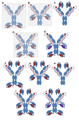
본 개시내용의 다중특이성 활성화 가능한 항체의 다양한 실시양태는 도 3a, 및 5-9에 제시되어 있다. 일부 실시양태에서, IgG를 포함하는 다중특이성 활성화 가능한 항체는 마스킹된 IgG 가변 도메인을 포함한다. 일부 실시양태에서, scFv를 포함하는 다중특이성 활성화 가능한 항체는 마스킹된 scFv 도메인을 포함한다. 일부 실시양태에서, 다중특이성 활성화 가능한 항체는 IgG 가변 도메인 중 1개 이상이 마스킹 모이어티에 커플링된 것인, IgG 가변 도메인 및 scFv 도메인, 둘 모두를 포함한다. 일부 실시양태에서, 다중특이성 활성화 가능한 항체는 scFv 도메인 중 1개 이상이 마스킹 모이어티에 커플링된 것인, IgG 가변 도메인 및 scFv 도메인, 둘 모두를 포함한다. 일부 실시양태에서, 다중특이성 활성화 가능한 항체는 IgG 가변 도메인 중 1개 이상이 마스킹 모이어티에 커플링되고, scFv 도메인 중 1개 이상이 마스킹 모이어티에 커플링된 것인, IgG 가변 도메인 및 scFv 도메인, 둘 모두를 포함한다. 일부 실시양태에서, 다중특이성 활성화 가능한 항체는 IgG 가변 도메인 및 scFv 도메인이 각각 그 자신의 마스킹 모이어티에 커플링된 것인, IgG 가변 도메인 및 scFv 도메인, 둘 모두를 포함한다. 일부 실시양태에서, 다중특이성 활성화 가능한 항체의 한 항체 도메인은 표적 항원에 대한 특이성을 가지고, 또 다른 항체 도메인은 T 세포 표면 항원에 대한 특이성을 가진다. 일부 실시양태에서, 다중특이성 활성화 가능한 항체의 한 항체 도메인은 표적 항원에 대한 특이성을 가지고, 또 다른 항체 도메인은 또 다른 표적 항원에 대한 특이성을 가진다. 일부 실시양태에서, 다중특이성 활성화 가능한 항체의 한 항체 도메인은 표적 항원의 에피토프에 대한 특이성을 가지고, 또 다른 항체 도메인은 표적 항원의 또 다른 에피토프에 대한 특이성을 가진다. Various embodiments of the multispecific activatable antibodies of the present disclosure are shown in Figures 3A and 5-9. In some embodiments, the multispecific activatable antibody comprising an IgG comprises a masked IgG variable domain. In some embodiments, a multispecific activatable antibody comprising an scFv comprises a masked scFv domain. In some embodiments, the multispecific activatable antibody comprises both an IgG variable domain and an scFv domain, wherein at least one of the IgG variable domains is coupled to a masking moiety. In some embodiments, the multispecific activatable antibody comprises both an IgG variable domain and an scFv domain, wherein at least one of the scFv domains is coupled to a masking moiety. In some embodiments, the multispecific activatable antibody has two IgG variable domains and scFv domains, wherein at least one of the IgG variable domains is coupled to a masking moiety and at least one of the scFv domains is coupled to the masking moiety Includes all. In some embodiments, the multispecific activatable antibody comprises both an IgG variable domain and an scFv domain, wherein the IgG variable domain and the scFv domain are each coupled to its own masking moiety. In some embodiments, one antibody domain of the multispecific activatable antibody has specificity for a target antigen and another antibody domain has specificity for a T cell surface antigen. In some embodiments, one antibody domain of the multispecific activatable antibody has specificity for a target antigen and another antibody domain has specificity for another target antigen. In some embodiments, one antibody domain of the multispecific activatable antibody has specificity for an epitope of the target antigen, and another antibody domain has specificity for another epitope of the target antigen.
다중특이성 활성화 가능한 항체에서, scFv는 IgG 활성화 가능한 항체의 중쇄의 카복실 말단에, IgG 활성화 가능한 항체의 경쇄의 카복실 말단에, 또는 IgG 활성화 가능한 항체의 중쇄 및 경쇄, 둘 모두의 카복실 말단에 융합될 수 있다. 다중특이성 활성화 가능한 항체에서, scFv는 IgG 활성화 가능한 항체의 중쇄의 아미노 말단에, IgG 활성화 가능한 항체의 경쇄의 아미노 말단에, 또는 IgG 활성화 가능한 항체의 중쇄 및 경쇄, 둘 모두의 아미노 말단에 융합될 수 있다. 다중특이성 활성화 가능한 항체에서, scFv는 IgG 활성화 가능한 항체의 하나 이상의 카복실 말단 및 하나 이상의 아미노 말단의 임의의 조합에 융합될 수 있다. 일부 실시양태에서, 절단가능한 모이어티(CM)에 연결된 마스킹 모이어티(MM)는 IgG의 항원 결합 도메인에 부착되어 그를 마스킹시킨다. 일부 실시양태에서, 절단가능한 모이어티(CM)에 연결된 마스킹 모이어티(MM)는 1개 이상의 scFv의 항원 결합 도메인에 부착되어 그를 마스킹시킨다. 일부 실시양태에서, 절단가능한 모이어티(CM)에 연결된 마스킹 모이어티(MM)는 IgG의 항원 결합 도메인에 부착되어 그를 마스킹시키고, 절단가능한 모이어티(CM)에 연결된 마스킹 모이어티(MM)는 1개 이상의 scFv의 항원 결합 도메인에 부착되어 그를 마스킹시킨다. In a multispecific activatable antibody, the scFv can be fused to the carboxyl terminus of the heavy chain of an IgG activatable antibody, to the carboxyl terminus of the light chain of an IgG activatable antibody, or to the carboxyl terminus of both heavy and light chains of an IgG activatable antibody. have. In multispecific activatable antibodies, the scFv can be fused to the amino terminus of the heavy chain of an IgG activatable antibody, to the amino terminus of the light chain of an IgG activatable antibody, or to the amino terminus of both heavy and light chains of an IgG activatable antibody. have. In multispecific activatable antibodies, the scFv can be fused to any combination of one or more carboxyl termini and one or more amino termini of an IgG activatable antibody. In some embodiments, a masking moiety (MM) linked to a cleavable moiety (CM) is attached to the antigen binding domain of an IgG to mask it. In some embodiments, a masking moiety (MM) linked to the cleavable moiety (CM) is attached to and masks the antigen binding domain of one or more scFvs. In some embodiments, the masking moiety (MM) linked to the cleavable moiety (CM) is attached to and masks the antigen binding domain of the IgG, and the masking moiety (MM) linked to the cleavable moiety (CM) is 1 It is attached to and masks the antigen binding domains of more than one scFv.
본 개시내용은 하기의 것을 포함하나, 이에 한정되지 않는 다중특이성 활성화 가능한 항체 구조의 일례를 제공한다: (VL-CL)2:(VH-CH1-CH2-CH3-L4-VH*-L3-VL*-L2-CM-L1-MM)2; (VL-CL)2:(VH-CH1-CH2-CH3-L4-VL*-L3-VH*-L2-CM-L1-MM)2; (MM-L1-CM-L2-VL-CL)2:(VH-CH1-CH2-CH3-L4-VH*-L3-VL*)2; (MM-L1-CM-L2-VL-CL)2:(VH-CH1-CH2-CH3-L4-VL*-L3-VH*)2; (VL-CL)2:(MM-L1-CM-L2-VL*-L3-VH*-L4-VH-CH1-CH2-CH3)2; (VL-CL)2:(MM-L1-CM-L2-VH*-L3-VL*-L4-VH-CH1-CH2-CH3)2; (MM-L1-CM-L2-VL-CL)2:(VL*-L3-VH*-L4-VH-CH1-CH2-CH3)2; (MM-L1-CM-L2-VL-CL)2:(VH*-L3-VL*-L4-VH-CH1-CH2-CH3)2; (VL-CL-L4-VH*-L3-VL*-L2-CM-L1-MM)2:(VH-CH1-CH2-CH3)2; (VL-CL-L4-VL*-L3-VH*-L2-CM-L1-MM)2:(VH-CH1-CH2-CH3)2; (MM-L1-CM-L2-VL*-L3-VH*-L4-VL-CL)2:(VH-CH1-CH2-CH3)2; (MM-L1-CM-L2-VH*-L3-VL*-L4-VL-CL)2:(VH-CH1-CH2-CH3)2; (VL-CL-L4-VH*-L3-VL*-L2-CM-L1-MM)2: (MM-L1-CM-L2-VL*-L3-VH*-L4-VH-CH1-CH2-CH3)2; (VL-CL-L4-VH*-L3-VL*-L2-CM-L1-MM)2: (MM-L1-CM-L2-VH*-L3-VL*-L4-VH-CH1-CH2-CH3)2; (VL-CL-L4-VL*-L3-VH*-L2-CM-L1-MM)2: (MM-L1-CM-L2-VL*-L3-VH*-L4-VH-CH1-CH2-CH3)2; (VL-CL-L4-VL*-L3-VH*-L2-CM-L1-MM)2: (MM-L1-CM-L2-VH*-L3-VL*-L4-VH-CH1-CH2-CH3)2; (VL-CL-L4-VH*-L3-VL*)2: (MM-L1-CM-L2-VL*-L3-VH*-L4-VH-CH1-CH2-CH3)2; (VL-CL-L4-VH*-L3-VL*)2: (MM-L1-CM-L2-VH*-L3-VL*-L4-VH-CH1-CH2-CH3)2; (VL-CL-L4-VL*-L3-VH*)2: (MM-L1-CM-L2-VL*-L3-VH*-L4-VH-CH1-CH2-CH3)2; (VL-CL-L4-VL*-L3-VH*)2: (MM-L1-CM-L2-VH*-L3-VL*-L4-VH-CH1-CH2-CH3)2; (VL-CL-L4-VH*-L3-VL*-L2-CM-L1-MM)2: (VL*-L3-VH*-L4-VH-CH1-CH2-CH3)2; (VL-CL-L4-VH*-L3-VL*-L2-CM-L1-MM)2: (VH*-L3-VL*-L4-VH-CH1-CH2-CH3)2; (VL-CL-L4-VL*-L3-VH*-L2-CM-L1-MM)2: (VL*-L3-VH*-L4-VH-CH1-CH2-CH3)2; 또는 (VL-CL-L4-VL*-L3-VH*-L2-CM-L1-MM)2: (VH*-L3-VL*-L4-VH-CH1-CH2-CH3)2(여기서, VL 및 VH는 IgG에 포함되어 있는, 제1 특이성의 경쇄 및 중쇄 가변 도메인을 나타내고; VL* 및 VH*는 scFv에 포함되어 있는, 제2 특이성의 가변 도메인을 나타내고; L1은 마스킹 모이어티(MM)와 절단가능한 모이어티(CM)를 연결하는 링커 펩티드이고; L2는 절단가능한 모이어티(CM)와 항체를 연결하는 링커 펩티드이고; L3은 scFv의 가변 도메인을 연결하는 링커 펩티드이고; L4는 제1 특이성의 항체를 제2 특이성의 항체에 연결하는 링커 펩티드이고; CL은 경쇄 불변 도메인이고; CH1, CH2, CH3은 중쇄 불변 도메인이다). 제1 및 제2 특이성은 임의의 항원 또는 에피토프에 대한 것일 수 있다. The present disclosure provides examples of multispecific activatable antibody structures including, but not limited to: (VL-CL) 2 :(VH-CH1-CH2-CH3-L4-VH*-L3-VL *-L2-CM-L1-MM) 2 ; (VL-CL) 2 :(VH-CH1-CH2-CH3-L4-VL*-L3-VH*-L2-CM-L1-MM) 2 ; (MM-L1-CM-L2-VL-CL) 2 :(VH-CH1-CH2-CH3-L4-VH*-L3-VL*) 2 ; (MM-L1-CM-L2-VL-CL) 2 :(VH-CH1-CH2-CH3-L4-VL*-L3-VH*) 2 ; (VL-CL) 2 :(MM-L1-CM-L2-VL*-L3-VH*-L4-VH-CH1-CH2-CH3) 2 ; (VL-CL) 2 :(MM-L1-CM-L2-VH*-L3-VL*-L4-VH-CH1-CH2-CH3) 2 ; (MM-L1-CM-L2-VL-CL) 2 :(VL*-L3-VH*-L4-VH-CH1-CH2-CH3) 2 ; (MM-L1-CM-L2-VL-CL) 2 :(VH*-L3-VL*-L4-VH-CH1-CH2-CH3) 2 ; (VL-CL-L4-VH*-L3-VL*-L2-CM-L1-MM) 2 :(VH-CH1-CH2-CH3) 2 ; (VL-CL-L4-VL*-L3-VH*-L2-CM-L1-MM) 2 :(VH-CH1-CH2-CH3) 2 ; (MM-L1-CM-L2-VL*-L3-VH*-L4-VL-CL) 2 :(VH-CH1-CH2-CH3) 2 ; (MM-L1-CM-L2-VH*-L3-VL*-L4-VL-CL) 2 :(VH-CH1-CH2-CH3) 2 ; (VL-CL-L4-VH*-L3-VL*-L2-CM-L1-MM) 2 : (MM-L1-CM-L2-VL*-L3-VH*-L4-VH-CH1-CH2- CH3) 2 ; (VL-CL-L4-VH*-L3-VL*-L2-CM-L1-MM) 2 : (MM-L1-CM-L2-VH*-L3-VL*-L4-VH-CH1-CH2- CH3) 2 ; (VL-CL-L4-VL*-L3-VH*-L2-CM-L1-MM) 2 : (MM-L1-CM-L2-VL*-L3-VH*-L4-VH-CH1-CH2- CH3) 2 ; (VL-CL-L4-VL*-L3-VH*-L2-CM-L1-MM) 2 : (MM-L1-CM-L2-VH*-L3-VL*-L4-VH-CH1-CH2- CH3) 2 ; (VL-CL-L4-VH*-L3-VL*) 2 : (MM-L1-CM-L2-VL*-L3-VH*-L4-VH-CH1-CH2-CH3) 2 ; (VL-CL-L4-VH*-L3-VL*) 2 : (MM-L1-CM-L2-VH*-L3-VL*-L4-VH-CH1-CH2-CH3) 2 ; (VL-CL-L4-VL*-L3-VH*) 2 : (MM-L1-CM-L2-VL*-L3-VH*-L4-VH-CH1-CH2-CH3) 2 ; (VL-CL-L4-VL*-L3-VH*) 2 : (MM-L1-CM-L2-VH*-L3-VL*-L4-VH-CH1-CH2-CH3)2; (VL-CL-L4-VH*-L3-VL*-L2-CM-L1-MM) 2 : (VL*-L3-VH*-L4-VH-CH1-CH2-CH3) 2 ; (VL-CL-L4-VH*-L3-VL*-L2-CM-L1-MM) 2 : (VH*-L3-VL*-L4-VH-CH1-CH2-CH3) 2 ; (VL-CL-L4-VL*-L3-VH*-L2-CM-L1-MM) 2 : (VL*-L3-VH*-L4-VH-CH1-CH2-CH3) 2 ; Or (VL-CL-L4-VL*-L3-VH*-L2-CM-L1-MM) 2 : (VH*-L3-VL*-L4-VH-CH1-CH2-CH3) 2 (here, VL And VH represents the first specific light and heavy chain variable domains contained in IgG; VL* and VH* represent the second specific variable domains contained in scFv; L1 represents the masking moiety (MM) Is a linker peptide connecting the cleavable moiety (CM) with the cleavable moiety (CM); L2 is a linker peptide connecting the cleavable moiety (CM) with the antibody; L3 is a linker peptide connecting the variable domain of scFv; L4 is the first It is a linker peptide connecting the antibody of specificity to the antibody of second specificity; CL is the light chain constant domain; CH1, CH2, CH3 are heavy chain constant domains). The first and second specificities can be for any antigen or epitope.
T 세포 인게이징 다중특이성 활성화 가능한 항체의 일부 실시양태에서, 한 항원은 전형적으로 종양 세포 또는 질환과 관련된 다른 세포 유형의 표면상에 존재하는 항원, 예컨대, 제한하는 것은 아니지만, 하기 표 1에 열거된 임의의 표적, 예컨대, 제한하는 것은 아니지만, EGFR, erbB2, EpCAM, Jagged, PD-L1, B7H3, 또는 CD71(트랜스페린 수용체)이고, 또 다른 항원은 전형적으로 T 세포, 자연살(NK) 세포, 골수성 단핵 세포, 대식세포, 및/또는 다른 면역 효과기 세포의 표면상에 존재하는 자극성(이는 또한 본원에서 활성화로 지칭된다) 또는 억제성 수용체, 예컨대, 제한하는 것은 아니지만, B7-H4, BTLA, CD3, CD4, CD8, CD16a, CD25, CD27, CD28, CD32, CD56, CD137(이는 또한 TNFRSF9로 지칭된다), CTLA-4, GITR, HVEM, ICOS, LAG3, NKG2D, OX40, PD-1, TIGIT, TIM3, 또는 VISTA이다. T 세포 표면 항원에 특이성을 부여하는 항체 도메인은 또한 T 세포 수용체, NK 세포 수용체, 대식세포 수용체, 및/또는 다른 면역 효과기 세포 수용체에 결합하는 리간드 또는 리간드 도메인, 예컨대, 제한하는 것은 아니지만, B7-1, B7-2, B7H3, PD-L1, PD-L2, 또는 TNFSF9에 의해 치환될 수 있다. 다중 항원 표적화 활성화 가능한 항체의 일부 실시양태에서, 한 항원은 하기 표 1에 열거된 표적 군으로부터 선택되고, 또 다른 항원은 하기 표 1에 열거된 표적 군으로부터 선택된다. In some embodiments of the T cell engaging multispecific activatable antibody, one antigen is typically present on the surface of a tumor cell or other cell type associated with a disease, such as but not limited to, listed in Table 1 Any target, such as, but not limited to, EGFR, erbB2, EpCAM, Jagged, PD-L1, B7H3, or CD71 (transferrin receptor), another antigen is typically T cells, natural killer (NK) cells, myeloid Stimulatory (also referred to herein as activation) or inhibitory receptors, such as, but not limited to, B7-H4, BTLA, CD3, present on the surface of monocytes, macrophages, and/or other immune effector cells CD4, CD8, CD16a, CD25, CD27, CD28, CD32, CD56, CD137 (also referred to as TNFRSF9), CTLA-4, GITR, HVEM, ICOS, LAG3, NKG2D, OX40, PD-1, TIGIT, TIM3, Or VISTA. Antibody domains that confer specificity on T cell surface antigens also bind to T cell receptors, NK cell receptors, macrophage receptors, and/or other immune effector cell receptors, such as, but not limited to, B7- 1, B7-2, B7H3, PD-L1, PD-L2, or TNFSF9 may be substituted. In some embodiments of multiple antigen targeting activatable antibodies, one antigen is selected from the target group listed in Table 1 below, and another antigen is selected from the target group listed in Table 1 below.
일부 실시양태에서, 표적화 항체는 항EGFR 항체이다. 일부 실시양태에서, 표적화 항체는 EGFR에의 결합에 대하여 특이적인 C225v5이다. 일부 실시양태에서, 표적화 항체는 EGFR에의 결합에 대하여 특이적인 C225이다. 일부 실시양태에서, 표적화 항체는 EGFR에의 결합에 대하여 특이적인 C225v4이다. 일부 실시양태에서, 표적화 항체는 EGFR에의 결합에 대하여 특이적인 C225v6이다. 일부 실시양태에서, 표적화 항체는 항Jagged 항체이다. 일부 실시양태에서, 표적화 항체는 인간 및 마우스 Jagged 1 및 Jagged 2에의 결합에 대하여 특이적인 4D11이다. 일부 실시양태에서, 표적화 항체는 인간 및 마우스 Jagged 1 및 Jagged 2에의 결합에 대하여 특이적인 4D11v2이다.In some embodiments, the targeting antibody is an anti-EGFR antibody. In some embodiments, the targeting antibody is C225v5 specific for binding to EGFR. In some embodiments, the targeting antibody is C225 specific for binding to EGFR. In some embodiments, the targeting antibody is C225v4 specific for binding to EGFR. In some embodiments, the targeting antibody is C225v6 specific for binding to EGFR. In some embodiments, the targeting antibody is an anti-Jagged antibody. In some embodiments, the targeting antibody is 4D11 specific for binding to human and mouse Jagged 1 and Jagged 2. In some embodiments, the targeting antibody is 4D11v2 specific for binding to human and mouse Jagged 1 and Jagged 2.
일부 실시양태에서, 표적화 항체는 활성화 가능한 항체 형태일 수 있다. 일부 실시양태에서, scFv(들)는 프로scFv 형태일 수 있다(예컨대, WO 2009/025846, WO 2010/081173 참조).In some embodiments, the targeting antibody may be in the form of an activatable antibody. In some embodiments, the scFv(s) may be in the form of pro scFv (see, eg, WO 2009/025846, WO 2010/081173).
일부 실시양태에서, scFv는 CD3ε에의 결합에 대하여 특이적이고, CD3ε에 결합하는 항체 또는 그의 단편, 예컨대, CH2527, FN18, H2C, OKT3, 2C11, UCHT1, 또는 V9이거나, 또는 그로부터 유래된 것이다. 일부 실시양태에서, scFv는 CTLA-4(이는 또한 본원에서 CTLA 및 CTLA4로 지칭된다)에의 결합에 대하여 특이적이다. In some embodiments, the scFv is specific for binding to CD3ε and is an antibody or fragment thereof that binds CD3ε, such as CH2527, FN18, H2C, OKT3, 2C11, UCHT1, or V9, or is derived therefrom. In some embodiments, the scFv is specific for binding to CTLA-4 (which is also referred to herein as CTLA and CTLA4).
일부 실시양태에서, 항CD3ε scFv는 하기 표 7에 및/또는 실시예 5에 제시된 서열로 이루어진 군으로부터 선택되는 서열을 포함한다. 일부 실시양태에서, 항CD3ε scFv는 표 7에 및/또는 실시예 5에 제시된 서열로 이루어진 군으로부터 선택되는 아미노산 서열과 적어도 90%, 91%, 92%, 93%, 94%, 95%, 96%, 97%, 98%, 99% 이상 동일한 아미노산 서열을 포함한다. In some embodiments, the anti-CD3ε scFv comprises a sequence selected from the group consisting of the sequences set forth in Table 7 below and/or in Example 5. In some embodiments, the anti-CD3ε scFv has an amino acid sequence selected from the group consisting of the sequences shown in Table 7 and/or in Example 5 and at least 90%, 91%, 92%, 93%, 94%, 95%, 96 %, 97%, 98%, 99% or more identical amino acid sequences.
일부 실시양태에서, scFv는 하나 이상의 T 세포, 하나 이상의 NK 세포 및/또는 하나 이상의 대식세포에의 결합에 대하여 특이적이다. 일부 실시양태에서, scFv는 B7-H4, BTLA, CD3, CD4, CD8, CD16a, CD25, CD27, CD28, CD32, CD56, CD137, CTLA-4, GITR, HVEM, ICOS, LAG3, NKG2D, OX40, PD-1, TIGIT, TIM3, 또는 VISTA로 이루어진 군으로부터 선택되는 표적에의 결합에 대하여 특이적이다.In some embodiments, the scFv is specific for binding to one or more T cells, one or more NK cells, and/or one or more macrophages. In some embodiments, the scFv is B7-H4, BTLA, CD3, CD4, CD8, CD16a, CD25, CD27, CD28, CD32, CD56, CD137, CTLA-4, GITR, HVEM, ICOS, LAG3, NKG2D, OX40, PD It is specific for binding to a target selected from the group consisting of -1, TIGIT, TIM3, or VISTA.
일부 실시양태에서, 본원에서 제공하는 다중특이성 항체, 다중특이성 활성화 가능한 항체, 컨쥬게이트된(conjugated) 다중특이성 항체 및/또는 컨쥬게이트된 다중특이성 활성화 가능한 항체는 Jagged 표적, 예컨대, Jagged 1 및/또는 Jagged 2에 특이적으로 결합하고, VH CDR1 서열, VH CDR2 서열, 및 VH CDR3 서열의 조합을 함유하며, 여기서, VH CDR1 서열, VH CDR2 서열, 및 VH CDR3 서열 중 1개 이상은 적어도 아미노산 서열 SYAMS(서열번호 6)를 포함하는 VH CDR1 서열; 적어도 아미노산 서열 SIDPEGRQTYYADSVKG(서열번호 7)를 포함하는 VH CD2 서열; 적어도 아미노산 서열 DIGGRSAFDY(서열번호 8)를 포함하는 VH CDR3 서열, 및 그의 조합으로부터 선택되는 것인, 적어도 제1 항체 또는 그의 항원 결합 단편(AB1)을 포함한다. In some embodiments, a multispecific antibody provided herein, a multispecific activatable antibody, a conjugated multispecific antibody and/or a conjugated multispecific activatable antibody is a Jagged target, such as Jagged 1 and/or It specifically binds to Jagged 2 and contains a combination of VH CDR1 sequence, VH CDR2 sequence, and VH CDR3 sequence, wherein at least one of the VH CDR1 sequence, VH CDR2 sequence, and VH CDR3 sequence is at least the amino acid sequence SYAMS VH CDR1 sequence comprising (SEQ ID NO: 6); A VH CD2 sequence comprising at least the amino acid sequence SIDPEGRQTYYADSVKG (SEQ ID NO: 7); A VH CDR3 sequence comprising at least the amino acid sequence DIGGRSAFDY (SEQ ID NO: 8), and at least a first antibody or antigen-binding fragment thereof (AB1), which is selected from a combination thereof.
일부 실시양태에서, 본원에서 제공하는 다중특이성 항체, 다중특이성 활성화 가능한 항체, 컨쥬게이트된 다중특이성 항체 및/또는 컨쥬게이트된 다중특이성 활성화 가능한 항체는 Jagged 표적, 예컨대, Jagged 1 및/또는 Jagged 2에 특이적으로 결합하고, VL CDR1 서열, VL CDR2 서열, 및 VL CDR3 서열의 조합을 함유하며, 여기서, VL CDR1 서열, VL CDR2 서열, 및 VL CDR3 서열 중 1개 이상은 적어도 아미노산 서열 RASQSISSY(서열번호 9)를 포함하는 VL CDR1 서열; 적어도 아미노산 서열 AASSLQS(서열번호 10)를 포함하는 VL CDR2 서열; 적어도 아미노산 서열 QQTVVAPPL(서열번호 11)을 포함하는 VL CDR3 서열, 및 그의 조합으로부터 선택되는 것인, 적어도 제1 항체 또는 그의 항원 결합 단편(AB1)을 포함한다. In some embodiments, the multispecific antibodies, multispecificity activatable antibodies, conjugated multispecificity antibodies and/or conjugated multispecificity activatable antibodies provided herein are directed to a Jagged target, such as Jagged 1 and/or Jagged 2. It specifically binds and contains a combination of VL CDR1 sequence, VL CDR2 sequence, and VL CDR3 sequence, wherein at least one of the VL CDR1 sequence, VL CDR2 sequence, and VL CDR3 sequence is at least the amino acid sequence RASQSISSY (SEQ ID NO: A VL CDR1 sequence comprising 9); A VL CDR2 sequence comprising at least the amino acid sequence AASSLQS (SEQ ID NO: 10); A VL CDR3 sequence comprising at least the amino acid sequence QQTVVAPPL (SEQ ID NO: 11), and at least a first antibody or antigen-binding fragment thereof (AB1) selected from a combination thereof.
일부 실시양태에서, 본원에서 제공하는 다중특이성 항체, 다중특이성 활성화 가능한 항체, 컨쥬게이트된 다중특이성 항체 및/또는 컨쥬게이트된 다중특이성 활성화 가능한 항체는 Jagged 표적, 예컨대, Jagged 1 및/또는 Jagged 2에 특이적으로 결합하고, VH CDR1 서열, VH CDR2 서열, 및 VH CDR3 서열의 조합을 함유하며, 여기서, VH CDR1 서열, VH CDR2 서열, 및 VH CDR3 서열 중 1개 이상은 아미노산 서열 SYAMS(서열번호 6)과 적어도 90%, 91%, 92%, 93%, 94%, 95%, 96%, 97%, 98%, 99% 이상 동일한 서열을 포함하는 VH CDR1 서열; 아미노산 서열 SIDPEGRQTYYADSVKG(서열번호 7)와 적어도 90%, 91%, 92%, 93%, 94%, 95%, 96%, 97%, 98%, 99% 이상 동일한 서열을 포함하는 VH CD2 서열; 아미노산 서열 DIGGRSAFDY(서열번호 8)와 적어도 90%, 91%, 92%, 93%, 94%, 95%, 96%, 97%, 98%, 99% 이상 동일한 서열을 포함하는 VH CDR3 서열, 및 그의 조합으로부터 선택되는 것인, 적어도 제1 항체 또는 그의 항원 결합 단편(AB1)을 포함한다. In some embodiments, the multispecific antibodies, multispecificity activatable antibodies, conjugated multispecificity antibodies and/or conjugated multispecificity activatable antibodies provided herein are directed to a Jagged target, such as Jagged 1 and/or Jagged 2. It specifically binds and contains a combination of VH CDR1 sequence, VH CDR2 sequence, and VH CDR3 sequence, wherein at least one of the VH CDR1 sequence, VH CDR2 sequence, and VH CDR3 sequence is the amino acid sequence SYAMS (SEQ ID NO: 6 ) A VH CDR1 sequence comprising a sequence identical to at least 90%, 91%, 92%, 93%, 94%, 95%, 96%, 97%, 98%, 99% or more; A VH CD2 sequence comprising a sequence that is at least 90%, 91%, 92%, 93%, 94%, 95%, 96%, 97%, 98%, 99% or more identical to the amino acid sequence SIDPEGRQTYYADSVKG (SEQ ID NO: 7); A VH CDR3 sequence comprising a sequence that is at least 90%, 91%, 92%, 93%, 94%, 95%, 96%, 97%, 98%, 99% or more identical to the amino acid sequence DIGGRSAFDY (SEQ ID NO: 8), and It comprises at least a first antibody or antigen-binding fragment thereof (AB1) selected from a combination thereof.
일부 실시양태에서, 본원에서 제공하는 다중특이성 항체, 다중특이성 활성화 가능한 항체, 컨쥬게이트된 다중특이성 항체 및/또는 컨쥬게이트된 다중특이성 활성화 가능한 항체는 Jagged 표적, 예컨대, Jagged 1 및/또는 Jagged 2에 특이적으로 결합하고, VL CDR1 서열, VL CDR2 서열, 및 VL CDR3 서열의 조합을 함유하며, 여기서, VL CDR1 서열, VL CDR2 서열, 및 VL CDR3 서열 중 1개 이상은 아미노산 서열 RASQSISSY(서열번호 9)와 적어도 90%, 91%, 92%, 93%, 94%, 95%, 96%, 97%, 98%, 99% 이상 동일한 서열을 포함하는 VL CDR1 서열; 아미노산 서열 AASSLQS(서열번호 10)와 적어도 90%, 91%, 92%, 93%, 94%, 95%, 96%, 97%, 98%, 99% 이상 동일한 서열을 포함하는 VL CDR2 서열; 및 아미노산 서열 QQTVVAPPL(서열번호 11)과 적어도 90%, 91%, 92%, 93%, 94%, 95%, 96%, 97%, 98%, 99% 이상 동일한 서열을 포함하는 VL CDR3 서열, 및 그의 조합으로부터 선택되는 것인, 적어도 제1 항체 또는 그의 항원 결합 단편(AB1)을 포함한다. In some embodiments, the multispecific antibodies, multispecificity activatable antibodies, conjugated multispecificity antibodies and/or conjugated multispecificity activatable antibodies provided herein are directed to a Jagged target, such as Jagged 1 and/or Jagged 2. It specifically binds and contains a combination of VL CDR1 sequence, VL CDR2 sequence, and VL CDR3 sequence, wherein at least one of the VL CDR1 sequence, VL CDR2 sequence, and VL CDR3 sequence is the amino acid sequence RASQSISSY (SEQ ID NO: 9 ) A VL CDR1 sequence comprising a sequence identical to at least 90%, 91%, 92%, 93%, 94%, 95%, 96%, 97%, 98%, 99% or more; A VL CDR2 sequence comprising a sequence that is at least 90%, 91%, 92%, 93%, 94%, 95%, 96%, 97%, 98%, 99% or more identical to the amino acid sequence AASSLQS (SEQ ID NO: 10); And a VL CDR3 sequence comprising a sequence that is at least 90%, 91%, 92%, 93%, 94%, 95%, 96%, 97%, 98%, 99% or more identical to the amino acid sequence QQTVVAPPL (SEQ ID NO: 11), And at least a first antibody or antigen-binding fragment thereof (AB1) selected from a combination thereof.
일부 실시양태에서, 본원에서 제공하는 다중특이성 항체, 다중특이성 활성화 가능한 항체, 컨쥬게이트된 다중특이성 항체 및/또는 컨쥬게이트된 다중특이성 활성화 가능한 항체는 Jagged 표적, 예컨대, Jagged 1 및/또는 Jagged 2에 특이적으로 결합하고, VH CDR1 서열, VH CDR2 서열, VH CDR3 서열, VL CDR1 서열, VL CDR2 서열, 및 VL CDR3 서열의 조합을 함유하며, 여기서, VH CDR1 서열은 적어도 아미노산 서열 SYAMS(서열번호 6)를 포함하고; VH CD2 서열은 적어도 아미노산 서열 SIDPEGRQTYYADSVKG(서열번호 7)를 포함하고; VH CDR3 서열은 적어도 아미노산 서열 DIGGRSAFDY(서열번호 8)를 포함하고; VL CDR1 서열은 적어도 아미노산 서열 RASQSISSY(서열번호 9)를 포함하고; VL CDR2 서열은 적어도 아미노산 서열 AASSLQS(서열번호 10)를 포함하고; VL CDR3 서열은 적어도 아미노산 서열 QQTVVAPPL(서열번호 11)을 포함하는 것인, 적어도 제1 항체 또는 그의 항원 결합 단편(AB1)을 포함한다.In some embodiments, the multispecific antibodies, multispecificity activatable antibodies, conjugated multispecificity antibodies and/or conjugated multispecificity activatable antibodies provided herein are directed to a Jagged target, such as Jagged 1 and/or Jagged 2. It specifically binds and contains a combination of VH CDR1 sequence, VH CDR2 sequence, VH CDR3 sequence, VL CDR1 sequence, VL CDR2 sequence, and VL CDR3 sequence, wherein the VH CDR1 sequence is at least the amino acid sequence SYAMS (SEQ ID NO: 6 ); The VH CD2 sequence comprises at least the amino acid sequence SIDPEGRQTYYADSVKG (SEQ ID NO: 7); The VH CDR3 sequence comprises at least the amino acid sequence DIGGRSAFDY (SEQ ID NO: 8); The VL CDR1 sequence comprises at least the amino acid sequence RASQSISSY (SEQ ID NO: 9); The VL CDR2 sequence comprises at least the amino acid sequence AASSLQS (SEQ ID NO: 10); The VL CDR3 sequence comprises at least a first antibody or antigen binding fragment thereof (AB1), which comprises at least the amino acid sequence QQTVVAPPL (SEQ ID NO: 11).
일부 실시양태에서, 본원에서 제공하는 다중특이성 항체, 다중특이성 활성화 가능한 항체, 컨쥬게이트된 다중특이성 항체 및/또는 컨쥬게이트된 다중특이성 활성화 가능한 항체는 Jagged 표적, 예컨대, Jagged 1 및/또는 Jagged 2에 특이적으로 결합하고, VH CDR1 서열, VH CDR2 서열, VH CDR3 서열, VL CDR1 서열, VL CDR2 서열, 및 VL CDR3 서열의 조합을 함유하며, 여기서, VH CDR1 서열은 아미노산 서열 SYAMS(서열번호 6)와 적어도 90%, 91%, 92%, 93%, 94%, 95%, 96%, 97%, 98%, 99% 이상 동일한 서열을 포함하고; VH CD2 서열은 아미노산 서열 SIDPEGRQTYYADSVKG(서열번호 7)와 적어도 90%, 91%, 92%, 93%, 94%, 95%, 96%, 97%, 98%, 99% 이상 동일한 서열을 포함하고; VH CDR3 서열은 아미노산 서열 DIGGRSAFDY(서열번호 8)와 적어도 90%, 91%, 92%, 93%, 94%, 95%, 96%, 97%, 98%, 99% 이상 동일한 서열을 포함하고; VL CDR1 서열은 아미노산 서열 RASQSISSY(서열번호 9)와 적어도 90%, 91%, 92%, 93%, 94%, 95%, 96%, 97%, 98%, 99% 이상 동일한 서열을 포함하고; VL CDR2 서열은 아미노산 서열 AASSLQS(서열번호 10)와 적어도 90%, 91%, 92%, 93%, 94%, 95%, 96%, 97%, 98%, 99% 이상 동일한 서열을 포함하고; VL CDR3 서열은 아미노산 서열 QQTVVAPPL(서열번호 11)과 적어도 90%, 91%, 92%, 93%, 94%, 95%, 96%, 97%, 98%, 99% 이상 동일한 서열을 포함하는 것인, 적어도 제1 항체 또는 그의 항원 결합 단편(AB1)을 포함한다. In some embodiments, the multispecific antibodies, multispecificity activatable antibodies, conjugated multispecificity antibodies and/or conjugated multispecificity activatable antibodies provided herein are directed to a Jagged target, such as Jagged 1 and/or Jagged 2. Specifically binds and contains a combination of VH CDR1 sequence, VH CDR2 sequence, VH CDR3 sequence, VL CDR1 sequence, VL CDR2 sequence, and VL CDR3 sequence, wherein the VH CDR1 sequence is the amino acid sequence SYAMS (SEQ ID NO: 6) At least 90%, 91%, 92%, 93%, 94%, 95%, 96%, 97%, 98%, 99% or more identical sequences to; The VH CD2 sequence comprises a sequence that is at least 90%, 91%, 92%, 93%, 94%, 95%, 96%, 97%, 98%, 99% or more identical to the amino acid sequence SIDPEGRQTYYADSVKG (SEQ ID NO: 7); The VH CDR3 sequence comprises a sequence that is at least 90%, 91%, 92%, 93%, 94%, 95%, 96%, 97%, 98%, 99% or more identical to the amino acid sequence DIGGRSAFDY (SEQ ID NO: 8); The VL CDR1 sequence comprises a sequence that is at least 90%, 91%, 92%, 93%, 94%, 95%, 96%, 97%, 98%, 99% or more identical to the amino acid sequence RASQSISSY (SEQ ID NO: 9); The VL CDR2 sequence comprises a sequence that is at least 90%, 91%, 92%, 93%, 94%, 95%, 96%, 97%, 98%, 99% or more identical to the amino acid sequence AASSLQS (SEQ ID NO: 10); The VL CDR3 sequence contains a sequence that is at least 90%, 91%, 92%, 93%, 94%, 95%, 96%, 97%, 98%, 99% or more identical to the amino acid sequence QQTVVAPPL (SEQ ID NO: 11). Phosphorus, at least a first antibody or antigen-binding fragment thereof (AB1).
일부 실시양태에서, 본원에서 제공하는 다중특이성 항체, 다중특이성 활성화 가능한 항체, 컨쥬게이트된 다중특이성 항체 및/또는 컨쥬게이트된 다중특이성 활성화 가능한 항체는 표피 성장 인자 수용체(EGFR: Epidermal Growth Factor Receptor)에 특이적으로 결합하고, VH CDR1 서열, VH CDR2 서열, 및 VH CDR3 서열의 조합을 함유하며, 여기서, VH CDR1 서열, VH CDR2 서열, 및 VH CDR3 서열 중 1개 이상은 적어도 아미노산 서열 NYGVH(서열번호 12)를 포함하는 VH CDR1 서열; 적어도 아미노산 서열 VIWSGGNTDYNTPFTS(서열번호 13)를 포함하는 VH CD2 서열; 적어도 아미노산 서열 ALTYYDYEFAY(서열번호 14)를 포함하는 VH CDR3 서열; 및 그의 조합으로부터 선택되는 것인, 적어도 제1 항체 또는 그의 항원 결합 단편(AB1)을 포함한다. In some embodiments, a multispecific antibody, a multispecific activatable antibody, a conjugated multispecific antibody and/or a conjugated multispecific activatable antibody provided herein is directed to an epidermal growth factor receptor (EGFR). It specifically binds and contains a combination of VH CDR1 sequence, VH CDR2 sequence, and VH CDR3 sequence, wherein at least one of the VH CDR1 sequence, VH CDR2 sequence, and VH CDR3 sequence is at least the amino acid sequence NYGVH (SEQ ID NO: 12) a VH CDR1 sequence; A VH CD2 sequence comprising at least the amino acid sequence VIWSGGNTDYNTPFTS (SEQ ID NO: 13); A VH CDR3 sequence comprising at least the amino acid sequence ALTYYDYEFAY (SEQ ID NO: 14); And at least a first antibody or antigen-binding fragment thereof (AB1) selected from a combination thereof.
일부 실시양태에서, 본원에서 제공하는 다중특이성 항체, 다중특이성 활성화 가능한 항체, 컨쥬게이트된 다중특이성 항체 및/또는 컨쥬게이트된 다중특이성 활성화 가능한 항체는 EGFR에 특이적으로 결합하고, VL CDR1 서열, VL CDR2 서열, 및 VL CDR3 서열의 조합을 함유하며, 여기서, VL CDR1 서열, VL CDR2 서열, 및 VL CDR3 서열 중 1개 이상은 적어도 아미노산 서열 RASQSIGTNIH(서열번호 15)를 포함하는 VL CDR1 서열; 적어도 아미노산 서열 KYASESIS(서열번호 16)를 포함하는 VL CDR2 서열; 및 적어도 아미노산 서열 QQNNNWPTT(서열번호 17)를 포함하는 VL CDR3 서열, 및 그의 조합으로부터 선택되는 것인, 적어도 제1 항체 또는 그의 항원 결합 단편(AB1)을 포함한다. In some embodiments, a multispecific antibody, multispecificity activatable antibody, conjugated multispecificity antibody and/or conjugated multispecificity activatable antibody provided herein specifically binds to EGFR, and the VL CDR1 sequence, VL A VL CDR1 sequence comprising a combination of a CDR2 sequence, and a VL CDR3 sequence, wherein at least one of the VL CDR1 sequence, VL CDR2 sequence, and VL CDR3 sequence comprises at least the amino acid sequence RASQSIGTNIH (SEQ ID NO: 15); A VL CDR2 sequence comprising at least the amino acid sequence KYASESIS (SEQ ID NO: 16); And at least a first antibody or antigen-binding fragment thereof (AB1), which is selected from a VL CDR3 sequence comprising at least the amino acid sequence QQNNNWPTT (SEQ ID NO: 17), and combinations thereof.
일부 실시양태에서, 본원에서 제공하는 다중특이성 항체, 다중특이성 활성화 가능한 항체, 컨쥬게이트된 다중특이성 항체 및/또는 컨쥬게이트된 다중특이성 활성화 가능한 항체는 EGFR에 특이적으로 결합하고, VH CDR1 서열, VH CDR2 서열, 및 VH CDR3 서열의 조합을 함유하며, 여기서, VH CDR1 서열, VH CDR2 서열, 및 VH CDR3 서열 중 1개 이상은 아미노산 서열 NYGVH(서열번호 12)와 적어도 90%, 91%, 92%, 93%, 94%, 95%, 96%, 97%, 98%, 99% 이상 동일한 서열을 포함하는 VH CDR1 서열; 아미노산 서열 VIWSGGNTDYNTPFTS(서열번호 13)와 적어도 90%, 91%, 92%, 93%, 94%, 95%, 96%, 97%, 98%, 99% 이상 동일한 서열을 포함하는 VH CDR2 서열; 아미노산 서열 ALTYYDYEFAY(서열번호 14)와 적어도 90%, 91%, 92%, 93%, 94%, 95%, 96%, 97%, 98%, 99% 이상 동일한 서열을 포함하는 VH CDR3 서열; 및 그의 조합으로부터 선택되는 것인, 적어도 제1 항체 또는 그의 항원 결합 단편(AB1)을 포함한다. In some embodiments, the multispecific antibodies, multispecificity activatable antibodies, conjugated multispecificity antibodies and/or conjugated multispecificity activatable antibodies provided herein specifically bind to EGFR, and the VH CDR1 sequence, VH CDR2 sequence, and a combination of VH CDR3 sequences, wherein at least one of the VH CDR1 sequence, VH CDR2 sequence, and VH CDR3 sequence is at least 90%, 91%, 92% with the amino acid sequence NYGVH (SEQ ID NO: 12) , VH CDR1 sequences comprising at least 93%, 94%, 95%, 96%, 97%, 98%, 99% identical sequences; A VH CDR2 sequence comprising a sequence that is at least 90%, 91%, 92%, 93%, 94%, 95%, 96%, 97%, 98%, 99% or more identical to the amino acid sequence VIWSGGNTDYNTPFTS (SEQ ID NO: 13); A VH CDR3 sequence comprising a sequence that is at least 90%, 91%, 92%, 93%, 94%, 95%, 96%, 97%, 98%, 99% or more identical to the amino acid sequence ALTYYDYEFAY (SEQ ID NO: 14); And at least a first antibody or antigen-binding fragment thereof (AB1) selected from a combination thereof.
일부 실시양태에서, 본원에서 제공하는 다중특이성 항체, 다중특이성 활성화 가능한 항체, 컨쥬게이트된 다중특이성 항체 및/또는 컨쥬게이트된 다중특이성 활성화 가능한 항체는 EGFR에 특이적으로 결합하고, VL CDR1 서열, VL CDR2 서열, 및 VL CDR3 서열의 조합을 함유하며, 여기서, VL CDR1 서열, VL CDR2 서열, 및 VL CDR3 서열 중 1개 이상은 아미노산 서열 RASQSIGTNIH(서열번호 15)와 적어도 90%, 91%, 92%, 93%, 94%, 95%, 96%, 97%, 98%, 99% 이상 동일한 서열을 포함하는 VL CDR1 서열; 아미노산 서열 KYASESIS(서열번호 16)와 적어도 90%, 91%, 92%, 93%, 94%, 95%, 96%, 97%, 98%, 99% 이상 동일한 서열을 포함하는 VL CDR2 서열; 및 아미노산 서열 QQNNNWPTT(서열번호 17)와 적어도 90%, 91%, 92%, 93%, 94%, 95%, 96%, 97%, 98%, 99% 이상 동일한 서열을 포함하는 VL CDR3 서열, 및 그의 조합으로부터 선택되는 것인, 적어도 제1 항체 또는 그의 항원 결합 단편(AB1)을 포함한다.In some embodiments, a multispecific antibody, multispecificity activatable antibody, conjugated multispecificity antibody and/or conjugated multispecificity activatable antibody provided herein specifically binds to EGFR, and the VL CDR1 sequence, VL CDR2 sequence, and a combination of VL CDR3 sequences, wherein at least one of the VL CDR1 sequence, VL CDR2 sequence, and VL CDR3 sequence is at least 90%, 91%, 92% with the amino acid sequence RASQSIGTNIH (SEQ ID NO: 15) A VL CDR1 sequence comprising at least 93%, 94%, 95%, 96%, 97%, 98%, 99% identical sequences; A VL CDR2 sequence comprising a sequence that is at least 90%, 91%, 92%, 93%, 94%, 95%, 96%, 97%, 98%, 99% or more identical to the amino acid sequence KYASESIS (SEQ ID NO: 16); And a VL CDR3 sequence comprising a sequence that is at least 90%, 91%, 92%, 93%, 94%, 95%, 96%, 97%, 98%, 99% or more identical to the amino acid sequence QQNNNWPTT (SEQ ID NO: 17), And at least a first antibody or antigen-binding fragment thereof (AB1) selected from a combination thereof.
일부 실시양태에서, 본원에서 제공하는 다중특이성 항체, 다중특이성 활성화 가능한 항체, 컨쥬게이트된 다중특이성 항체 및/또는 컨쥬게이트된 다중특이성 활성화 가능한 항체는 EGFR에 특이적으로 결합하고, VH CDR1 서열, VH CDR2 서열, VH CDR3 서열, VL CDR1 서열, VL CDR2 서열, 및 VL CDR3 서열의 조합을 함유하며, 여기서, VH CDR1 서열은 적어도 아미노산 서열 NYGVH(서열번호 12)를 포함하고; VH CD2 서열은 적어도 아미노산 서열 VIWSGGNTDYNTPFTS(서열번호 13)를 포함하고; VH CDR3 서열은 적어도 아미노산 서열 ALTYYDYEFAY(서열번호 14)를 포함하고; VL CDR1 서열은 적어도 아미노산 서열 RASQSIGTNIH(서열번호 15)를 포함하고; VL CDR2 서열은 적어도 아미노산 서열 KYASESIS(서열번호 16)를 포함하고; VL CDR3 서열은 적어도 아미노산 서열 QQNNNWPTT(서열번호 17)를 포함하는 것인, 적어도 제1 항체 또는 그의 항원 결합 단편(AB1)을 포함한다. In some embodiments, the multispecific antibodies, multispecificity activatable antibodies, conjugated multispecificity antibodies and/or conjugated multispecificity activatable antibodies provided herein specifically bind to EGFR, and the VH CDR1 sequence, VH Contains a combination of a CDR2 sequence, a VH CDR3 sequence, a VL CDR1 sequence, a VL CDR2 sequence, and a VL CDR3 sequence, wherein the VH CDR1 sequence comprises at least the amino acid sequence NYGVH (SEQ ID NO: 12); The VH CD2 sequence comprises at least the amino acid sequence VIWSGGNTDYNTPFTS (SEQ ID NO: 13); The VH CDR3 sequence comprises at least the amino acid sequence ALTYYDYEFAY (SEQ ID NO: 14); The VL CDR1 sequence comprises at least the amino acid sequence RASQSIGTNIH (SEQ ID NO: 15); The VL CDR2 sequence comprises at least the amino acid sequence KYASESIS (SEQ ID NO: 16); The VL CDR3 sequence comprises at least a first antibody or antigen-binding fragment thereof (AB1), which comprises at least the amino acid sequence QQNNNWPTT (SEQ ID NO: 17).
일부 실시양태에서, 본원에서 제공하는 다중특이성 항체, 다중특이성 활성화 가능한 항체, 컨쥬게이트된 다중특이성 항체 및/또는 컨쥬게이트된 다중특이성 활성화 가능한 항체는 EGFR에 특이적으로 결합하고, VH CDR1 서열, VH CDR2 서열, VH CDR3 서열, VL CDR1 서열, VL CDR2 서열, 및 VL CDR3 서열의 조합을 함유하며, 여기서, VH CDR1 서열은 아미노산 서열 NYGVH(서열번호 12)와 적어도 90%, 91%, 92%, 93%, 94%, 95%, 96%, 97%, 98%, 99% 이상 동일한 서열을 포함하고; VH CD2 서열은 아미노산 서열 VIWSGGNTDYNTPFTS(서열번호 13)와 적어도 90%, 91%, 92%, 93%, 94%, 95%, 96%, 97%, 98%, 99% 이상 동일한 서열을 포함하고; VH CDR3 서열은 아미노산 서열 ALTYYDYEFAY(서열번호 14)와 적어도 90%, 91%, 92%, 93%, 94%, 95%, 96%, 97%, 98%, 99% 이상 동일한 서열을 포함하고; VL CDR1 서열은 아미노산 서열 RASQSIGTNIH(서열번호 15)와 적어도 90%, 91%, 92%, 93%, 94%, 95%, 96%, 97%, 98%, 99% 이상 동일한 서열을 포함하고; VL CDR2 서열은 아미노산 서열 KYASESIS(서열번호 16)와 적어도 90%, 91%, 92%, 93%, 94%, 95%, 96%, 97%, 98%, 99% 이상 동일한 서열을 포함하고; VL CDR3 서열은 아미노산 서열 QQNNNWPTT(서열번호 17)와 적어도 90%, 91%, 92%, 93%, 94%, 95%, 96%, 97%, 98%, 99% 이상 동일한 서열을 포함하는 것인, 적어도 제1 항체 또는 그의 항원 결합 단편(AB1)을 포함한다. In some embodiments, the multispecific antibodies, multispecificity activatable antibodies, conjugated multispecificity antibodies and/or conjugated multispecificity activatable antibodies provided herein specifically bind to EGFR, and the VH CDR1 sequence, VH CDR2 sequence, VH CDR3 sequence, VL CDR1 sequence, VL CDR2 sequence, and a combination of VL CDR3 sequence, wherein the VH CDR1 sequence is at least 90%, 91%, 92% with the amino acid sequence NYGVH (SEQ ID NO: 12), 93%, 94%, 95%, 96%, 97%, 98%, 99% or more identical sequences; The VH CD2 sequence comprises a sequence that is at least 90%, 91%, 92%, 93%, 94%, 95%, 96%, 97%, 98%, 99% or more identical to the amino acid sequence VIWSGGNTDYNTPFTS (SEQ ID NO: 13); The VH CDR3 sequence comprises a sequence that is at least 90%, 91%, 92%, 93%, 94%, 95%, 96%, 97%, 98%, 99% or more identical to the amino acid sequence ALTYYDYEFAY (SEQ ID NO: 14); The VL CDR1 sequence comprises a sequence that is at least 90%, 91%, 92%, 93%, 94%, 95%, 96%, 97%, 98%, 99% or more identical to the amino acid sequence RASQSIGTNIH (SEQ ID NO: 15); The VL CDR2 sequence comprises a sequence that is at least 90%, 91%, 92%, 93%, 94%, 95%, 96%, 97%, 98%, 99% or more identical to the amino acid sequence KYASESIS (SEQ ID NO: 16); The VL CDR3 sequence contains a sequence that is at least 90%, 91%, 92%, 93%, 94%, 95%, 96%, 97%, 98%, 99% or more identical to the amino acid sequence QQNNNWPTT (SEQ ID NO: 17). Phosphorus, at least a first antibody or antigen-binding fragment thereof (AB1).
일부 실시양태에서, 본원에서 제공하는 다중특이성 항체, 다중특이성 활성화 가능한 항체, 컨쥬게이트된 다중특이성 항체 및/또는 컨쥬게이트된 다중특이성 활성화 가능한 항체는 적어도, 하기 표 7에 및/또는 그 안에 표 11을 포함하는 것인 실시예 5에 제시된 서열로 이루어진 군으로부터 선택되는 중쇄 아미노산 서열을 포함한다. 일부 실시양태에서, 본원에서 제공하는 다중특이성 항체, 다중특이성 활성화 가능한 항체, 컨쥬게이트된 다중특이성 항체 및/또는 컨쥬게이트된 다중특이성 활성화 가능한 항체는 적어도, 하기 표 7에 및/또는 그 안에 표 11을 포함하는 것인 실시예 5에 제시된 서열로 이루어진 군으로부터 선택되는 경쇄 아미노산 서열을 포함한다. 일부 실시양태에서, 본원에서 제공하는 다중특이성 항체, 다중특이성 활성화 가능한 항체, 컨쥬게이트된 다중특이성 항체 및/또는 컨쥬게이트된 다중특이성 활성화 가능한 항체는 적어도, 하기 표 7에 및/또는 그 안에 표 11을 포함하는 것인 실시예 5에 제시된 서열로 이루어진 군으로부터 선택되는 중쇄 아미노산 서열, 및 적어도, 하기 표 7에 및/또는 그 안에 표 11을 포함하는 것인 실시예 5에 제시된 서열로 이루어진 군으로부터 선택되는 경쇄 아미노산 서열을 포함한다. In some embodiments, the multispecific antibodies, multispecificity activatable antibodies, conjugated multispecificity antibodies and/or conjugated multispecificity activatable antibodies provided herein are at least in Table 7 below and/or Table 11 therein. It includes a heavy chain amino acid sequence selected from the group consisting of the sequence set forth in Example 5 that includes. In some embodiments, the multispecific antibodies, multispecificity activatable antibodies, conjugated multispecificity antibodies and/or conjugated multispecificity activatable antibodies provided herein are at least in Table 7 below and/or Table 11 therein. It includes a light chain amino acid sequence selected from the group consisting of the sequence set forth in Example 5 that includes. In some embodiments, the multispecific antibodies, multispecificity activatable antibodies, conjugated multispecificity antibodies and/or conjugated multispecificity activatable antibodies provided herein are at least in Table 7 below and/or Table 11 therein. From the group consisting of a heavy chain amino acid sequence selected from the group consisting of the sequence shown in Example 5, and at least, the sequence shown in Example 5, which includes Table 11 in Table 7 below and/or therein It contains a light chain amino acid sequence of choice.
일부 실시양태에서, 본원에서 제공하는 다중특이성 항체, 다중특이성 활성화 가능한 항체, 컨쥬게이트된 다중특이성 항체 및/또는 컨쥬게이트된 다중특이성 활성화 가능한 항체는 적어도, 하기 표 7에 및/또는 그 안에 표 11을 포함하는 것인 실시예 5에 제시된 서열로 이루어진 군으로부터 선택되는 아미노산 서열과 적어도 90%, 91%, 92%, 93%, 94%, 95%, 96%, 97%, 98%, 99% 이상 동일한 중쇄 아미노산 서열을 포함한다. 일부 실시양태에서, 본원에서 제공하는 다중특이성 항체, 다중특이성 활성화 가능한 항체, 컨쥬게이트된 다중특이성 항체 및/또는 컨쥬게이트된 다중특이성 활성화 가능한 항체는 적어도, 하기 표 7에 및/또는 그 안에 표 11을 포함하는 것인 실시예 5에 제시된 서열로 이루어진 군으로부터 선택되는 아미노산 서열과 적어도 90%, 91%, 92%, 93%, 94%, 95%, 96%, 97%, 98%, 99% 이상 동일한 경쇄 아미노산 서열을 포함한다. 일부 실시양태에서, 본원에서 제공하는 다중특이성 항체, 다중특이성 활성화 가능한 항체, 컨쥬게이트된 다중특이성 항체 및/또는 컨쥬게이트된 다중특이성 활성화 가능한 항체는 적어도, 하기 표 7에 및/또는 그 안에 표 11을 포함하는 것인 실시예 5에 제시된 서열로 이루어진 군으로부터 선택되는 아미노산 서열과 적어도 90%, 91%, 92%, 93%, 94%, 95%, 96%, 97%, 98%, 99% 이상 동일한 중쇄 아미노산 서열, 및 적어도, 하기 표 7에 및/또는 그 안에 표 11을 포함하는 것인 실시예 5에 제시된 서열로 이루어진 군으로부터 선택되는 아미노산 서열과 적어도 90%, 91%, 92%, 93%, 94%, 95%, 96%, 97%, 98%, 99% 이상 동일한 경쇄 아미노산 서열을 포함한다. In some embodiments, the multispecific antibodies, multispecificity activatable antibodies, conjugated multispecificity antibodies and/or conjugated multispecificity activatable antibodies provided herein are at least in Table 7 below and/or Table 11 therein. An amino acid sequence selected from the group consisting of the sequence set forth in Example 5 and comprising at least 90%, 91%, 92%, 93%, 94%, 95%, 96%, 97%, 98%, 99% It contains the same heavy chain amino acid sequence as above. In some embodiments, the multispecific antibodies, multispecificity activatable antibodies, conjugated multispecificity antibodies and/or conjugated multispecificity activatable antibodies provided herein are at least in Table 7 below and/or Table 11 therein. An amino acid sequence selected from the group consisting of the sequence set forth in Example 5 and comprising at least 90%, 91%, 92%, 93%, 94%, 95%, 96%, 97%, 98%, 99% It contains the same light chain amino acid sequence as above. In some embodiments, the multispecific antibodies, multispecificity activatable antibodies, conjugated multispecificity antibodies and/or conjugated multispecificity activatable antibodies provided herein are at least in Table 7 below and/or Table 11 therein. An amino acid sequence selected from the group consisting of the sequence set forth in Example 5 and comprising at least 90%, 91%, 92%, 93%, 94%, 95%, 96%, 97%, 98%, 99% At least 90%, 91%, 92% with an amino acid sequence selected from the group consisting of the sequence shown in Example 5, which is the same heavy chain amino acid sequence, and at least, in Table 7 below and/or including Table 11 therein, 93%, 94%, 95%, 96%, 97%, 98%, 99% or more identical light chain amino acid sequences.
일부 실시양태에서, 다중특이성 항체 및/또는 다중특이성 활성화 가능한 항체는 또한 AB에 컨쥬게이트된 작용제를 포함한다. 일부 실시양태에서, 작용제는 치료제이다. 일부 실시양태에서, 작용제는 항신생물제이다. 일부 실시양태에서, 작용제는 독소 또는 그의 단편이다. 일부 실시양태에서, 작용제는 링커를 통해 다중특이성 항체에 컨쥬게이트된다. 일부 실시양태에서, 링커는 비절단가능한 링커이다. 일부 실시양태에서, 작용제는 미세소관 억제제이다. 일부 실시양태에서, 작용제는 핵산 손상제, 예컨대, DNA 알킬화제 또는 DNA 인터컬레이터, 또는 다른 DNA 손상제이다. 일부 실시양태에서, 링커는 절단가능한 링커이다. 일부 실시양태에서, 작용제는 하기 표 4에 열거되어 있는 군으로부터 선택되는 작용제이다. 일부 실시양태에서, 작용제는 돌라스타틴이다. 일부 실시양태에서, 작용제는 아우리스타틴 또는 그의 유도체이다. 일부 실시양태에서, 작용제는 아우리스타틴 E 또는 그의 유도체이다. 일부 실시양태에서, 작용제는 모노메틸 아우리스타틴 E(MMAE)이다. 일부 실시양태에서, 작용제는 모노메틸 아우리스타틴 D(MMAD)이다. 일부 실시양태에서, 작용제는 메이탄시노이드 또는 메이탄시노이드 유도체이다. 일부 실시양태에서, 작용제는 DM1 또는 DM4이다. 일부 실시양태에서, 작용제는 듀오카르마이신 또는 그의 유도체이다. 일부 실시양태에서, 작용제는 칼리키아미신 또는 그의 유도체이다. 일부 실시양태에서, 작용제는 피롤로벤조디아제핀이다. In some embodiments, the multispecific antibody and/or the multispecific activatable antibody also comprises an agent conjugated to the AB. In some embodiments, the agent is a therapeutic agent. In some embodiments, the agent is an anti-neoplastic agent. In some embodiments, the agent is a toxin or fragment thereof. In some embodiments, the agent is conjugated to the multispecific antibody through a linker. In some embodiments, the linker is a non-cleavable linker. In some embodiments, the agent is a microtubule inhibitor. In some embodiments, the agent is a nucleic acid damaging agent, such as a DNA alkylating agent or DNA intercalator, or other DNA damaging agent. In some embodiments, the linker is a cleavable linker. In some embodiments, the agent is an agent selected from the group listed in Table 4 below. In some embodiments, the agent is dolastatin. In some embodiments, the agent is an auristatin or a derivative thereof. In some embodiments, the agent is auristatin E or a derivative thereof. In some embodiments, the agent is monomethyl auristatin E (MMAE). In some embodiments, the agent is monomethyl auristatin D (MMAD). In some embodiments, the agent is a maytansinoid or a maytansinoid derivative. In some embodiments, the agent is DM1 or DM4. In some embodiments, the agent is duocarmycin or a derivative thereof. In some embodiments, the agent is calicheamicin or a derivative thereof. In some embodiments, the agent is pyrrolobenzodiazepine.
일부 실시양태에서, 다중특이성 항체 및/또는 다중특이성 활성화 가능한 항체는 또한 검출가능한 모이어티를 포함한다. 일부 실시양태에서, 검출가능한 모이어티는 진단제이다.In some embodiments, the multispecific antibody and/or the multispecific activatable antibody also comprises a detectable moiety. In some embodiments, the detectable moiety is a diagnostic agent.
일부 실시양태에서, 다중특이성 항체 및/또는 다중특이성 활성화 가능한 항체는 천연적으로 하나 이상의 이황화 결합을 함유한다. 일부 실시양태에서, 다중특이성 항체 및/또는 다중특이성 활성화 가능한 항체는 하나 이상의 이황화 결합을 포함하도록 조작될 수 있다. In some embodiments, the multispecific antibody and/or the multispecific activatable antibody naturally contains one or more disulfide bonds. In some embodiments, multispecific antibodies and/or multispecific activatable antibodies can be engineered to include one or more disulfide bonds.
본 개시내용은 또한 본원에 기술된 다중특이성 항체 및/또는 다중특이성 활성화 가능한 항체를 코딩하는 단리된 핵산 분자뿐만 아니라, 상기 단리된 핵산 서열을 포함하는 벡터를 제공한다. 본 개시내용은 세포를 항체 발현을 유도하는 조건 하에서 배양함으로써 다중특이성 항체를 제조하는 방법으로서, 여기서, 세포는 상기 핵산 분자를 포함하는 것인 방법을 제공한다. 일부 실시양태에서, 세포는 상기 벡터를 포함한다. The present disclosure also provides isolated nucleic acid molecules encoding the multispecific antibodies and/or multispecific activatable antibodies described herein, as well as vectors comprising the isolated nucleic acid sequences. The present disclosure provides a method of producing a multispecific antibody by culturing a cell under conditions that induce antibody expression, wherein the cell comprises the nucleic acid molecule. In some embodiments, the cell comprises the vector.
본 개시내용은 또한 적어도, 제1 표적 또는 제1 에피토프에 특이적으로 결합하는 제1 항체 또는 그의 항원 결합 단편(AB1), 및 제2 표적 또는 제2 에피토프에 특이적으로 결합하는 제2 항체 또는 그의 항원 결합 단편(AB2)을 포함하는 다중특이성 활성화 가능한 항체 및/또는 다중특이성 활성화 가능한 항체 조성물로서, 여기서, 마스킹 모이어티(MM1)의 커플링이 AB1가 그의 표적에 결합할 수 있는 능력을 감소시킬 수 있도록 적어도 AB1이 MM1에 커플링되거나, 또는 다르게는 부착되어 있는 것인 다중특이성 활성화 가능한 항체 및/또는 다중특이성 활성화 가능한 항체 조성물을 제공한다. 일부 실시양태에서, MM1은 예를 들어, 피험체에서의 치료 부위 또는 진단 부위에서 AB1의 표적과 공국재화(co-localize)되는 프로테아제와 같은 프로테아제에 대한 기질을 포함하는 제1 절단가능한 모이어티(CM1) 서열을 통해 AB1에 커플링된다. 본원에서 제공하는 다중특이성 활성화 가능한 항체는 순환 중 안정적이고, 치료 및/또는 진단의 의도된 부위에서 활성화되지만, 정상적인, 즉, 건강한 조직에서는 그렇지 않으며, 활성화되었을 때에는 상응하는, 비변형된 다중특이성 항체와 적어도 유사한 AB1의 표적에의 결합을 보인다. The present disclosure also provides at least a first antibody or antigen-binding fragment thereof (AB1) that specifically binds to a first target or a first epitope, and a second antibody that specifically binds to a second target or second epitope, or A multispecific activatable antibody and/or a multispecific activatable antibody composition comprising an antigen binding fragment thereof (AB2), wherein the coupling of a masking moiety (MM1) reduces the ability of AB1 to bind its target. The multispecific activatable antibody and/or the multispecific activatable antibody composition is provided in which at least AB1 is coupled to, or otherwise attached to, the MM1 so as to be able to be used. In some embodiments, the MM1 is a first cleavable moiety comprising a substrate for a protease, e.g., a protease that co-localizes with the target of AB1 at a treatment site or diagnostic site in a subject ( CM1) is coupled to AB1 through the sequence. The multispecific activatable antibodies provided herein are stable in circulation, activated at the intended site of treatment and/or diagnosis, but not in normal, i.e. healthy tissue, and when activated, the corresponding, unmodified multispecific antibody The binding of AB1 to the target is at least similar to.
일부 실시양태에서, 다중특이성 활성화 가능한 항체는 MM1과 CM1 사이에 연결 펩티드를 포함한다. In some embodiments, the multispecific activatable antibody comprises a linking peptide between MM1 and CM1.
일부 실시양태에서, 다중특이성 활성화 가능한 항체는 CM1과 AB1 사이에 연결 펩티드를 포함한다. In some embodiments, the multispecific activatable antibody comprises a linking peptide between CM1 and AB1.
일부 실시양태에서, 활성화 가능한 항체는 제1 연결 펩티드(LP1: first linking peptide) 및 제2 연결 펩티드(LP2: 제2 linking peptide)를 포함하고, 다중특이성 활성화 가능한 항체의 적어도 일부는 절단되지 않은 상태에서 N 말단에서 C 말단으로 하기 순서로의 구조적 배열을 가진다: MM1-LP1-CM1-LP2-AB1 또는 AB1-LP2-CM1-LP1-MM1. 일부 실시양태에서, 두 연결 펩티드는 서로 동일할 필요는 없다. In some embodiments, the activatable antibody comprises a first linking peptide (LP1) and a second linking peptide (LP2), and at least a portion of the multispecific activatable antibody is uncut. It has a structural arrangement in the following order from N-terminus to C-terminus in: MM1-LP1-CM1-LP2-AB1 or AB1-LP2-CM1-LP1-MM1. In some embodiments, the two connecting peptides need not be identical to each other.
일부 실시양태에서, LP1 또는 LP2 중 적어도 하나는 (GS)n, (GGS)n, (GSGGS)n(서열번호 18) 및 (GGGS)n(서열번호 19)(여기서, n은 1 이상인 정수이다)으로 이루어진 군으로부터 선택되는 아미노산 서열을 포함한다. 일부 실시양태에서, LP1 또는 LP2 중 적어도 하나는 GGSG(서열번호 20), GGSGG(서열번호 21), GSGSG(서열번호 22), GSGGG(서열번호 23), GGGSG(서열번호 24), 및 GSSSG(서열번호 25)로 이루어진 군으로부터 선택되는 아미노산 서열을 포함한다. In some embodiments, at least one of LP1 or LP2 is (GS) n , (GGS) n , (GSGGS) n (SEQ ID NO: 18) and (GGGS) n (SEQ ID NO: 19), wherein n is an integer greater than or equal to 1. ) It includes an amino acid sequence selected from the group consisting of. In some embodiments, at least one of LP1 or LP2 is GGSG (SEQ ID NO: 20), GGSGG (SEQ ID NO: 21), GSGSG (SEQ ID NO: 22), GSGGG (SEQ ID NO: 23), GGGSG (SEQ ID NO: 24), and GSSSG ( It includes an amino acid sequence selected from the group consisting of SEQ ID NO: 25).
일부 실시양태에서, 다중특이성 활성화 가능한 항체는 적어도 제1 표적 또는 제1 에피토프에 특이적으로 결합하는 제1 항체 또는 그의 항원 결합 단편(AB1) 및 제2 표적 또는 제2 에피토프에 특이적으로 결합하는 제2 항체 또는 그의 항원 결합 단편(AB2)을 포함한다. 일부 실시양태에서, 다중특이성 활성화 가능한 항체 중의 각각의 AB는 독립적으로 단일클론 항체, 도메인 항체, 단일 쇄, Fab 단편, F(ab')2 단편, scFv, scAb, dAb, 단일 도메인 중쇄 항체, 및 단일 도메인 경쇄 항체로 이루어진 군으로부터 선택된다. 일부 실시양태에서, 다중특이성 활성화 가능한 항체 중의 각각의 AB는 설치류(예컨대, 마우스 또는 래트), 키메라, 인간화된 또는 완전한 인간 단일클론 항체이다.In some embodiments, the multispecific activatable antibody is a first antibody or antigen-binding fragment thereof (AB1) that specifically binds at least a first target or a first epitope and a second target or a second epitope that specifically binds. And a second antibody or antigen-binding fragment thereof (AB2). In some embodiments, each AB in the multispecific activatable antibody is independently a monoclonal antibody, domain antibody, single chain, Fab fragment, F(ab') 2 fragment, scFv, scAb, dAb, single domain heavy chain antibody, and It is selected from the group consisting of single domain light chain antibodies. In some embodiments, each AB in the multispecific activatable antibody is a rodent (eg, mouse or rat), chimeric, humanized or fully human monoclonal antibody.
일부 실시양태에서, 다중특이성 활성화 가능한 항체 중의 각각의 AB는 그의 상응하는 표적 또는 에피토프에의 결합에 대하여 약 100 nM 이하의 평형 해리 상수를 가진다. In some embodiments, each AB in the multispecific activatable antibody has an equilibrium dissociation constant of about 100 nM or less for binding to its corresponding target or epitope.
일부 실시양태에서, MM1은 그의 상응하는 AB에의 결합에 대하여, AB의 그의 상응하는 표적 또는 에피토프에의 평형 해리 상수보다 큰 평형 해리 상수를 가진다. In some embodiments, MM1 has an equilibrium dissociation constant greater than the equilibrium dissociation constant of the AB to its corresponding target or epitope for binding to its corresponding AB.
일부 실시양태에서, MM1은 그의 상응하는 AB에의 결합에 대하여, AB의 그의 상응하는 표적 또는 에피토프에의 평형 해리 상수 이하의 평형 해리 상수를 가진다. In some embodiments, MM1 has an equilibrium dissociation constant less than or equal to the equilibrium dissociation constant of the AB to its corresponding target or epitope for binding to its corresponding AB.
일부 실시양태에서, MM1은 다중특이성 활성화 가능한 항체가 절단된 상태일 때에는 상응하는 표적 또는 에피토프에의 결합에 대하여 그의 상응하는 AB를 방해하거나 그와 경쟁하지 않는다. In some embodiments, MM1 does not interfere with or compete with its corresponding AB for binding to the corresponding target or epitope when the multispecific activatable antibody is in a truncated state.
일부 실시양태에서, MM1은 길이가 약 2 내지 40개의 아미노산인 폴리펩티드이다. 일부 실시양태에서, 다중특이성 활성화 가능한 항체 중 각각의 MM은 길이가 40개 이하의 아미노산인 폴리펩티드이다. In some embodiments, MM1 is a polypeptide that is about 2 to 40 amino acids in length. In some embodiments, each MM in the multispecific activatable antibody is a polypeptide of no more than 40 amino acids in length.
일부 실시양태에서, MM1은 상응하는 AB의 표적의 것과 상이한 폴리펩티드 서열을 가진다. In some embodiments, the MM1 has a different polypeptide sequence than that of the target of the corresponding AB.
일부 실시양태에서, MM1은 상응하는 AB의 임의의 천연 결합 파트너와 50% 이하로 동일한 폴리펩티드 서열을 가진다. 일부 실시양태에서, MM1은 상응하는 AB의 임의의 천연 결합 파트너와 25% 이하로 동일한 폴리펩티드 서열을 가진다. 일부 실시양태에서, MM1은 상응하는 AB의 임의의 천연 결합 파트너와 10% 이하로 동일한 폴리펩티드 서열을 가진다. In some embodiments, the MM1 has a polypeptide sequence that is no more than 50% identical to any natural binding partner of the corresponding AB. In some embodiments, the MM1 has a polypeptide sequence that is no more than 25% identical to any natural binding partner of the corresponding AB. In some embodiments, the MM1 has a polypeptide sequence that is no more than 10% identical to any natural binding partner of the corresponding AB.
일부 실시양태에서, MM1의 커플링은, MM1에 커플링되었을 때, 그의 상응하는 표적 또는 에피토프로의 AB의 해리 상수(Kd)가 MM1에 커플링되지 않았을 때, 그의 상응하는 표적 또는 에피토프로의 AB의 Kd보다 20배 이상 더 크도록, 상응하는 AB가 그의 표적 또는 에피토프에 결합할 수 있는 능력을 감소시킨다. In some embodiments, the coupling of MM1, when coupled to MM1, to its corresponding target or epitope, when the dissociation constant (K d ) of the AB to its corresponding target or epitope is not coupled to MM1, to its corresponding target or epitope. Reduces the ability of the corresponding AB to bind its target or epitope so that it is at least 20 times greater than the K d of AB of.
일부 실시양태에서, MM1의 커플링은, MM1에 커플링되었을 때, 그의 상응하는 표적 또는 에피토프로의 AB의 해리 상수(Kd)가 MM1에 커플링되지 않았을 때, 그의 상응하는 표적 또는 에피토프로의 AB의 Kd보다 40배 이상 더 크도록, 상응하는 AB가 그의 표적 또는 에피토프에 결합할 수 있는 능력을 감소시킨다. In some embodiments, the coupling of MM1, when coupled to MM1, to its corresponding target or epitope, when the dissociation constant (K d ) of the AB to its corresponding target or epitope is not coupled to MM1, to its corresponding target or epitope. Reduces the ability of the corresponding AB to bind its target or epitope so that it is at least 40 times greater than the K d of the AB of.
일부 실시양태에서, MM1의 커플링은, MM1에 커플링되었을 때, 그의 상응하는 표적 또는 에피토프로의 AB의 해리 상수(Kd)가 MM1에 커플링되지 않았을 때, 그의 상응하는 표적 또는 에피토프로의 AB의 Kd보다 100배 이상 더 크도록, 상응하는 AB가 그의 표적 또는 에피토프에 결합할 수 있는 능력을 감소시킨다. In some embodiments, the coupling of MM1, when coupled to MM1, to its corresponding target or epitope, when the dissociation constant (K d ) of the AB to its corresponding target or epitope is not coupled to MM1, to its corresponding target or epitope. Reduces the ability of the corresponding AB to bind its target or epitope so that it is at least 100 times greater than the K d of AB of.
일부 실시양태에서, MM1의 커플링은, MM1에 커플링되었을 때, 그의 상응하는 표적 또는 에피토프로의 AB의 해리 상수(Kd)가 MM1에 커플링되지 않았을 때, 그의 상응하는 표적 또는 에피토프로의 AB의 Kd보다 1,000배 이상 더 크도록, 상응하는 AB가 그의 표적 또는 에피토프에 결합할 수 있는 능력을 감소시킨다. In some embodiments, the coupling of MM1, when coupled to MM1, to its corresponding target or epitope, when the dissociation constant (K d ) of the AB to its corresponding target or epitope is not coupled to MM1, to its corresponding target or epitope. It reduces the ability of the corresponding AB to bind its target or epitope so that it is at least 1,000 times greater than the K d of AB of.
일부 실시양태에서, MM1의 커플링은, MM1에 커플링되었을 때, 그의 상응하는 표적 또는 에피토프로의 AB의 해리 상수(Kd)가 MM1에 커플링되지 않았을 때, 그의 상응하는 표적 또는 에피토프로의 AB의 Kd보다 10,000배 이상 더 크도록, 상응하는 AB가 그의 표적 또는 에피토프에 결합할 수 있는 능력을 감소시킨다. In some embodiments, the coupling of MM1, when coupled to MM1, to its corresponding target or epitope, when the dissociation constant (K d ) of the AB to its corresponding target or epitope is not coupled to MM1, to its corresponding target or epitope. Reduces the ability of the corresponding AB to bind its target or epitope so that it is at least 10,000 times greater than the K d of AB of.
일부 실시양태에서, MM1은 본원에서 제공하는 실시예에 제시된 MM으로부터 선택되는 아미노산 서열이다. In some embodiments, MM1 is an amino acid sequence selected from MM set forth in the Examples provided herein.
일부 실시양태에서, 다중특이성 활성화 가능한 항체는 적어도, 다중특이성 활성화 가능한 항체가 절단되지 않은 상태일 때, AB2의 그의 표적에의 결합을 억제하는 제2 마스킹 모이어티(MM2), 및 제2 절단가능한 모이어티(CM2)는 제2 프로테아제에 대한 기질로서 기능하는 폴리펩티드인 것인, AB2에 커플링된 CM2를 포함한다. 일부 실시양태에서, CM2는 길이가 15개 이하의 아미노산 길이인 폴리펩티드이다. 일부 실시양태에서, 제2 프로테아제는 조직 내에서 제2 표적 또는 에피토프와 함께 공국재화되며, 여기서, 제2 프로테아제는 다중특이성 활성화 가능한 항체가 제2 프로테아제에 노출될 때, 다중특이성 활성화 가능한 항체 내의 CM2를 절단한다. 일부 실시양태에서, 제1 프로테아제 및 제2 프로테아제는 조직 내에서 제1 표적 또는 에피토프 및 제2 표적 또는 에피토프와 함께 공국재화된다. 일부 실시양태에서, 제1 프로테아제 및 제2 프로테아제는 동일한 프로테아제이다. 일부 실시양태에서, CM1 및 CM2는 동일한 프로테아제에 대해 상이한 기질이다. 일부 실시양태에서, 프로테아제는 하기 표 3에 제시된 것으로 이루어진 군으로부터 선택된다. 일부 실시양태에서, 제1 프로테아제 및 제2 프로테아제는 상이한 프로테아제이다. 일부 실시양태에서, 제1 프로테아제 및 제2 프로테아제는 하기 표 3에 제시된 것으로 이루어진 군으로부터 선택되는 상이한 프로테아제이다. In some embodiments, the multispecific activatable antibody is at least a second masking moiety (MM2) that inhibits the binding of AB2 to its target, and a second cleavable, when the multispecific activatable antibody is not cleaved. The moiety (CM2) comprises CM2 coupled to AB2, which is a polypeptide that functions as a substrate for a second protease. In some embodiments, the CM2 is a polypeptide that is no more than 15 amino acids in length. In some embodiments, the second protease is colocalized with a second target or epitope in the tissue, wherein the second protease is CM2 in the multispecific activatable antibody when the multispecific activatable antibody is exposed to the second protease. Cut. In some embodiments, the first protease and the second protease are colocalized with the first target or epitope and the second target or epitope within the tissue. In some embodiments, the first protease and the second protease are the same protease. In some embodiments, CM1 and CM2 are different substrates for the same protease. In some embodiments, the protease is selected from the group consisting of those shown in Table 3 below. In some embodiments, the first protease and the second protease are different proteases. In some embodiments, the first protease and the second protease are different proteases selected from the group consisting of those shown in Table 3 below.
일부 실시양태에서, 다중특이성 활성화 가능한 항체 중의 각각의 MM, 예컨대, MM1 및 적어도 MM2는 AB의 그의 상응하는 표적 또는 에피토프에의 평형 해리 상수보다 더 큰, 그의 상응하는 AB에의 결합에 대한 평형 해리 상수를 가진다. In some embodiments, each MM in the multispecific activatable antibody, e.g., MM1 and at least MM2, is an equilibrium dissociation constant for binding to its corresponding AB that is greater than the equilibrium dissociation constant of the AB to its corresponding target or epitope. Have.
일부 실시양태에서, 다중특이성 활성화 가능한 항체 중의 각각의 MM은 AB의 그의 상응하는 표적 또는 에피토프에의 평형 해리 상수 이하인, 그의 상응하는 AB에의 결합에 대한 평형 해리 상수를 가진다. In some embodiments, each MM in the multispecific activatable antibody has an equilibrium dissociation constant for binding to its corresponding AB that is less than or equal to the equilibrium dissociation constant of the AB to its corresponding target or epitope.
일부 실시양태에서, 다중특이성 활성화 가능한 항체 중의 각각의 MM은 다중특이성 활성화 가능한 항체가 절단된 상태일 때, 상응하는 표적 또는 에피토프에의 결합에 대하여 그의 상응하는 AB를 방해하거나 그와 경쟁하지 않는다. In some embodiments, each MM in the multispecific activatable antibody does not interfere with or compete with its corresponding AB for binding to the corresponding target or epitope when the multispecific activatable antibody is cleaved.
일부 실시양태에서, 다중특이성 활성화 가능한 항체 중의 각각의 MM은 길이가 약 2 내지 40개의 아미노산 길이인 폴리펩티드이다. 일부 실시양태에서, 다중특이성 활성화 가능한 항체 중의 각각의 MM은 길이가 40개 이하의 아미노산 길이인 폴리펩티드이다. In some embodiments, each MM in the multispecific activatable antibody is a polypeptide that is about 2 to 40 amino acids in length. In some embodiments, each MM in the multispecific activatable antibody is a polypeptide that is no more than 40 amino acids in length.
일부 실시양태에서, 다중특이성 활성화 가능한 항체 중의 각각의 MM은 상응하는 AB의 표적과 상이한 폴리펩티드 서열을 가진다. In some embodiments, each MM in the multispecific activatable antibody has a different polypeptide sequence than the target of the corresponding AB.
일부 실시양태에서, 다중특이성 활성화 가능한 항체 중의 각각의 MM은 상응하는 AB의 임의의 천연 결합 파트너와 50% 이하로 동일한 폴리펩티드 서열을 가진다. 일부 실시양태에서, 다중특이성 활성화 가능한 항체 중의 각각의 MM은 상응하는 AB의 임의의 천연 결합 파트너와 25% 이하로 동일한 폴리펩티드 서열을 가진다. 일부 실시양태에서, 다중특이성 활성화 가능한 항체 중의 각각의 MM은 상응하는 AB의 임의의 천연 결합 파트너와 10% 이하로 동일한 폴리펩티드 서열을 가진다. In some embodiments, each MM in the multispecific activatable antibody has a polypeptide sequence that is no more than 50% identical to any natural binding partner of the corresponding AB. In some embodiments, each MM in the multispecific activatable antibody has a polypeptide sequence that is no more than 25% identical to any natural binding partner of the corresponding AB. In some embodiments, each MM in the multispecific activatable antibody has a polypeptide sequence that is no more than 10% identical to any natural binding partner of the corresponding AB.
일부 실시양태에서, 각 MM의 커플링은, MM에 커플링되었을 때, 그의 상응하는 표적 또는 에피토프로의 AB의 해리 상수(Kd)가 MM에 커플링되지 않았을 때, 그의 상응하는 표적 또는 에피토프로의 AB의 Kd보다 20배 이상 더 크도록, 상응하는 AB가 그의 표적 또는 에피토프에 결합할 수 있는 능력을 감소시킨다. In some embodiments, the coupling of each MM, when coupled to the MM, when the dissociation constant (K d ) of the AB to its corresponding target or epitope is not coupled to the MM, its corresponding target or epitope Reduces the ability of the corresponding AB to bind its target or epitope so that it is at least 20 times greater than the K d of the AB of Rho.
일부 실시양태에서, 각 MM의 커플링은, MM에 커플링되었을 때, 그의 상응하는 표적 또는 에피토프로의 AB의 해리 상수(Kd)가 MM에 커플링되지 않았을 때, 그의 상응하는 표적 또는 에피토프로의 AB의 Kd보다 40배 이상 더 크도록, 상응하는 AB가 그의 표적 또는 에피토프에 결합할 수 있는 능력을 감소시킨다. In some embodiments, the coupling of each MM, when coupled to the MM, when the dissociation constant (K d ) of the AB to its corresponding target or epitope is not coupled to the MM, its corresponding target or epitope It reduces the ability of the corresponding AB to bind its target or epitope so that it is at least 40 times greater than the K d of the AB of Rho.
일부 실시양태에서, 각 MM의 커플링은, MM에 커플링되었을 때, 그의 상응하는 표적 또는 에피토프로의 AB의 해리 상수(Kd)가 MM에 커플링되지 않았을 때, 그의 상응하는 표적 또는 에피토프로의 AB의 Kd보다 100배 이상 더 크도록, 상응하는 AB가 그의 표적 또는 에피토프에 결합할 수 있는 능력을 감소시킨다. In some embodiments, the coupling of each MM, when coupled to the MM, when the dissociation constant (K d ) of the AB to its corresponding target or epitope is not coupled to the MM, its corresponding target or epitope Reduces the ability of the corresponding AB to bind its target or epitope so that it is at least 100 times greater than the K d of the AB of Rho.
일부 실시양태에서, 각 MM의 커플링은, MM에 커플링되었을 때, 그의 상응하는 표적 또는 에피토프로의 AB의 해리 상수(Kd)가 MM에 커플링되지 않았을 때, 그의 상응하는 표적 또는 에피토프로의 AB의 Kd보다 1,000배 이상 더 크도록, 상응하는 AB가 그의 표적 또는 에피토프에 결합할 수 있는 능력을 감소시킨다. In some embodiments, the coupling of each MM, when coupled to the MM, when the dissociation constant (K d ) of the AB to its corresponding target or epitope is not coupled to the MM, its corresponding target or epitope It reduces the ability of the corresponding AB to bind its target or epitope so that it is at least 1,000 times greater than the K d of the AB of Rho.
일부 실시양태에서, 각 MM의 커플링은, MM에 커플링되었을 때, 그의 상응하는 표적 또는 에피토프로의 AB의 해리 상수(Kd)가 MM에 커플링되지 않았을 때, 그의 상응하는 표적 또는 에피토프로의 AB의 Kd보다 10,000배 이상 더 크도록, 상응하는 AB가 그의 표적 또는 에피토프에 결합할 수 있는 능력을 감소시킨다. In some embodiments, the coupling of each MM, when coupled to the MM, when the dissociation constant (K d ) of the AB to its corresponding target or epitope is not coupled to the MM, its corresponding target or epitope It reduces the ability of the corresponding AB to bind its target or epitope so that it is at least 10,000 times greater than the K d of the AB of Rho.
일부 실시양태에서, 각 MM은 본원에서 제공하는 실시예에 제시된 MM으로부터 선택되는 아미노산 서열이다. In some embodiments, each MM is an amino acid sequence selected from MM set forth in the Examples provided herein.
일부 실시양태에서, 제1 절단가능한 모이어티(CM1) 서열을 절단하는 프로테아제는 조직 내에서 다중특이성 활성화 가능한 항체 중의 AB1의 표적과 함께 공국재화되며, 프로테아제는 다중특이성 활성화 가능한 항체가 프로테아제에 노출될 때, 다중특이성 활성화 가능한 항체 내의 CM1을 절단한다. In some embodiments, the protease that cleaves the first cleavable moiety (CM1) sequence is colocalized with the target of AB1 in the multispecific activatable antibody in the tissue, and the protease is the multispecific activatable antibody is exposed to the protease. At this time, CM1 in the multispecific activatable antibody is cut.
일부 실시양태에서, 다중특이성 활성화 가능한 항체는 1개 초과의 절단가능한 모이어티 서열을 포함하고, 1개 이상의 절단가능한 모이어티 서열을 절단하는 프로테아제는 조직 내에서 다중특이성 활성화 가능한 항체 중의 AB 영역 중 1개 이상의 것의 표적과 함께 공국재화되며, 프로테아제는 다중특이성 활성화 가능한 항체가 프로테아제에 노출될 때, 다중특이성 활성화 가능한 항체 내의 CM을 절단한다. In some embodiments, the multispecifically activatable antibody comprises more than one cleavable moiety sequence, and the protease that cleaves one or more cleavable moiety sequences is one of the AB regions of the multispecifically activatable antibody within the tissue. It is colocalized with targets of more than one, and the protease cleaves the CM in the multispecific activatable antibody when the multispecific activatable antibody is exposed to the protease.
일부 실시양태에서, 각각의 CM, 예컨대, CM1 및 적어도 CM2는, 절단되지 않은 상태에서 다중특이성 활성화 가능한 항체의 AB 영역 중 하나의 표적에의 결합이 그의 표적에의 비변형된 AB 결합의 평형 해리 상수보다 20배 이상 더 큰 평형 해리 상수로 이루어지도록 감소되고, 반면, 절단된 상태에서는 AB가 그의 표적에 결합하도록 다중특이성 활성화 가능한 항체 내에 배치되어 있다. In some embodiments, each CM, e.g., CM1 and at least CM2, in an uncleaved state, the binding to a target of one of the AB regions of the multispecific activatable antibody is equilibrium dissociation of the unmodified AB binding to its target. It is reduced to achieve an equilibrium dissociation constant that is at least 20 times greater than the constant, whereas in the truncated state the AB is placed in a multispecific activatable antibody to bind its target.
일부 실시양태에서, 각각의 CM은, 절단되지 않은 상태에서 다중특이성 활성화 가능한 항체의 AB 영역 중 하나의 표적에의 결합이 그의 표적에의 비변형된 AB 결합의 평형 해리 상수보다 40배 이상 더 큰 평형 해리 상수로 이루어지도록 감소되고, 반면, 절단된 상태에서는 AB가 그의 표적에 결합하도록 다중특이성 활성화 가능한 항체 내에 배치되어 있다. In some embodiments, each CM has a binding to a target of one of the AB regions of the multispecific activatable antibody in the uncleaved state is at least 40 times greater than the equilibrium dissociation constant of the unmodified AB binding to its target. It is reduced to achieve an equilibrium dissociation constant, whereas in the truncated state the AB is placed in a multispecific activatable antibody to bind its target.
일부 실시양태에서, 각각의 CM은, 절단되지 않은 상태에서 다중특이성 활성화 가능한 항체의 AB 영역 중 하나의 표적에의 결합이 그의 표적에의 비변형된 AB 결합의 평형 해리 상수보다 50배 이상 더 큰 평형 해리 상수로 이루어지도록 감소되고, 반면, 절단된 상태에서는 AB가 그의 표적에 결합하도록 다중특이성 활성화 가능한 항체 내에 배치되어 있다. In some embodiments, each CM has a binding to a target of one of the AB regions of the multispecific activatable antibody in the uncleaved state is at least 50 times greater than the equilibrium dissociation constant of the unmodified AB binding to its target. It is reduced to achieve an equilibrium dissociation constant, whereas in the truncated state the AB is placed in a multispecific activatable antibody to bind its target.
일부 실시양태에서, 각각의 CM은, 절단되지 않은 상태에서 다중특이성 활성화 가능한 항체의 AB 영역 중 하나의 표적에의 결합이 그의 표적에의 비변형된 AB 결합의 평형 해리 상수보다 100배 이상 더 큰 평형 해리 상수로 이루어지도록 감소되고, 반면, 절단된 상태에서는 AB가 그의 표적에 결합하도록 다중특이성 활성화 가능한 항체 내에 배치되어 있다. In some embodiments, each CM has a binding to a target of one of the AB regions of the multispecific activatable antibody in the uncleaved state is at least 100 times greater than the equilibrium dissociation constant of the unmodified AB binding to its target. It is reduced to achieve an equilibrium dissociation constant, whereas in the truncated state the AB is placed in a multispecific activatable antibody to bind its target.
일부 실시양태에서, 각각의 CM은, 절단되지 않은 상태에서 다중특이성 활성화 가능한 항체의 AB 영역 중 하나의 표적에의 결합이 그의 표적에의 비변형된 AB 결합의 평형 해리 상수보다 200배 이상 더 큰 평형 해리 상수로 이루어지도록 감소되고, 반면, 절단된 상태에서는 AB가 그의 표적에 결합하도록 다중특이성 활성화 가능한 항체 내에 배치되어 있다. In some embodiments, each CM has a binding to a target of one of the AB regions of the multispecific activatable antibody in the uncleaved state is at least 200 times greater than the equilibrium dissociation constant of the unmodified AB binding to its target. It is reduced to achieve an equilibrium dissociation constant, whereas in the truncated state the AB is placed in a multispecific activatable antibody to bind its target.
일부 실시양태에서, 다중특이성 활성화 가능한 항체 중 각각의 CM은 길이가 15개 이하의 아미노산 길이인 폴리펩티드이다. In some embodiments, each CM in the multispecific activatable antibody is a polypeptide that is no more than 15 amino acids in length.
일부 실시양태에서, 다중특이성 활성화 가능한 항체 중 1개 이상의 CM은 아미노산 서열 LSGRSDNH(서열번호 26)를 포함한다. 일부 실시양태에서, 1개 이상의 절단가능한 모이어티는 특정 프로테아제, 예를 들어, 다중특이성 활성화 가능한 항체의 1개 이상의 표적과 함께 공국재화되는 것으로 공지된 프로테아제와 함께 사용하기 위해 선택된다. 예를 들어, 본 개시내용의 다중특이성 활성화 가능한 항체에서 사용하는 데 적합한 절단가능한 모이어티는 1개 이상의 프로테아제, 예컨대, 우로키나제, 레구마인, 및/또는 마트립타제(이는 또한 본원에서 MT-SP1 또는 MTSP1로 지칭된다)에 의해 절단된다. 일부 실시양태에서, 적합한 절단가능한 모이어티는 하기 서열: TGRGPSWV(서열번호 27); SARGPSRW(서열번호 28); TARGPSFK(서열번호 29); LSGRSDNH(서열번호 26); GGWHTGRN(서열번호 30); HTGRSGAL(서열번호 31); PLTGRSGG(서열번호 32); AARGPAIH(서열번호 33); RGPAFNPM(서열번호 34); SSRGPAYL(서열번호 35); RGPATPIM(서열번호 36); RGPA(서열번호 37); GGQPSGMWGW(서열번호 38); FPRPLGITGL(서열번호 39); VHMPLGFLGP(서열번호 40); SPLTGRSG(서열번호 41); SAGFSLPA(서열번호 42); LAPLGLQRR(서열번호 43); SGGPLGVR(서열번호 44); 및/또는 PLGL(서열번호 45) 중 1개 이상의 것을 포함한다. In some embodiments, the CM of at least one of the multispecific activatable antibodies comprises the amino acid sequence LSGRSDNH (SEQ ID NO: 26). In some embodiments, the one or more cleavable moieties are selected for use with a particular protease, e.g., a protease known to colocalize with one or more targets of a multispecific activatable antibody. For example, suitable cleavable moieties for use in the multispecific activatable antibodies of the present disclosure include one or more proteases, such as urokinase, legumine, and/or matriptase (also herein MT- SP1 or MTSP1). In some embodiments, a suitable cleavable moiety comprises the following sequence: TGRGPSWV (SEQ ID NO: 27); SARGPSRW (SEQ ID NO: 28); TARGPSFK (SEQ ID NO: 29); LSGRSDNH (SEQ ID NO: 26); GGWHTGRN (SEQ ID NO: 30); HTGRSGAL (SEQ ID NO: 31); PLTGRSGG (SEQ ID NO: 32); AARGPAIH (SEQ ID NO: 33); RGPAFNPM (SEQ ID NO: 34); SSRGPAYL (SEQ ID NO: 35); RGPATPIM (SEQ ID NO: 36); RGPA (SEQ ID NO: 37); GGQPSGMWGW (SEQ ID NO: 38); FPRPLGITGL (SEQ ID NO: 39); VHMPLGFLGP (SEQ ID NO: 40); SPLTGRSG (SEQ ID NO: 41); SAGFSLPA (SEQ ID NO: 42); LAPLGLQRR (SEQ ID NO: 43); SGGPLGVR (SEQ ID NO: 44); And/or PLGL (SEQ ID NO: 45).
일부 실시양태에서, 다중특이성 활성화 가능한 항체 중 각각의 CM은 하기 표 3에 제시된 것으로 이루어진 군으로부터 선택되는 프로테아제에 대한 기질이다. 일부 실시양태에서, 프로테아제는 uPA, 레구마인, MT-SP1, ADAM17, BMP-1, TMPRSS3, TMPRSS4, 호중성 엘라스타제, MMP-7, MMP-9, MMP-12, MMP-13, 및 MMP-14로 이루어진 군으로부터 선택된다. 일부 실시양태에서, 프로테아제는 카텝신, 예컨대, 제한하는 것은 아니지만, 카텝신 S이다. 일부 실시양태에서, 다중특이성 활성화 가능한 항체 중 각각의 CM은 uPA(우로키나제 플라스미노겐 활성인자), 레구마인 및 MT-SP1(마트립타제)로 이루어진 군으로부터 선택되는 프로테아제에 대한 기질이다. 일부 실시양태에서, 프로테아제는 uPA를 포함한다. 일부 실시양태에서, 프로테아제는 레구마인을 포함한다. 일부 실시양태에서, 프로테아제는 MT-SP1을 포함한다. 일부 실시양태에서, 프로테아제는 매트릭스 메탈로프로테이나제(MMP: matrix metalloprotease)를 포함한다. In some embodiments, each CM in the multispecific activatable antibody is a substrate for a protease selected from the group consisting of those shown in Table 3 below. In some embodiments, the protease is uPA, legumine, MT-SP1, ADAM17, BMP-1, TMPRSS3, TMPRSS4, neutrophil elastase, MMP-7, MMP-9, MMP-12, MMP-13, and It is selected from the group consisting of MMP-14. In some embodiments, the protease is a cathepsin, such as, but not limited to, cathepsin S. In some embodiments, each CM in the multispecific activatable antibody is a substrate for a protease selected from the group consisting of uPA (Urokinase Plasminogen Activator), Legumine, and MT-SP1 (Matriptase). In some embodiments, the protease comprises uPA. In some embodiments, the protease comprises legumine. In some embodiments, the protease comprises MT-SP1. In some embodiments, the protease comprises a matrix metalloprotease (MMP).
일부 실시양태에서, 다중특이성 활성화 가능한 항체 중 1개 이상의 CM은 2개 이상의 프로테아제에 대한 기질이다. 일부 실시양태에서, 각 프로테아제는 하기 표 3에 제시된 것으로 이루어진 군으로부터 선택된다. 일부 실시양태에서, 다중특이성 활성화 가능한 항체 중 1개 이상의 CM은 2개 이상의 프로테아제에 대한 기질이며, 여기서, 프로테아제 중 하나는 uPA, 레구마인 및 MT-SP1로 이루어진 군으로부터 선택되고, 나머지 다른 프로테아제는 하기 표 3에 제시된 것으로 이루어진 군으로부터 선택된다. 일부 실시양태에서, 다중특이성 활성화 가능한 항체 중 1개 이상의 CM은 uPA, 레구마인 및 MT-SP1로 이루어진 군으로부터 선택되는 2개 이상의 프로테아제에 대한 기질이다. In some embodiments, at least one CM of the multispecific activatable antibody is a substrate for at least two proteases. In some embodiments, each protease is selected from the group consisting of those shown in Table 3 below. In some embodiments, at least one CM of the multispecific activatable antibody is a substrate for at least two proteases, wherein one of the proteases is selected from the group consisting of uPA, legumine and MT-SP1, and the other protease Is selected from the group consisting of those shown in Table 3 below. In some embodiments, the CM of at least one of the multispecific activatable antibodies is a substrate for at least two proteases selected from the group consisting of uPA, legumine, and MT-SP1.
일부 실시양태에서, 다중특이성 활성화 가능한 항체는 적어도 제1 CM(CM1) 및 제2 CM(CM2)을 포함한다. 일부 실시양태에서, CM1 및 CM2는 MM을 AB에 연결시키는 단일 절단가능한 링커의 일부이다. 일부 실시양태에서, CM1은 MM1을 AB1에 연결시키는 절단가능한 링커의 일부이고, CM2는 MM2를 AB2에 연결시키는 별개의 절단가능한 링커의 일부이다. 일부 실시양태에서, 다중특이성 활성화 가능한 항체는 2개 초과의 CM을 포함한다. 일부 실시양태에서, 상기 다중특이성 활성화 가능한 항체는 2개 초과의 CM 및 2개 초과의 MM을 포함한다. 일부 실시양태에서, CM1 및 CM2는 각각 길이가 15개 이항의 아미노산 길이인 폴리펩티드이다. 일부 실시양태에서, 제1 CM 및 제2 CM 중 적어도 하나는 하기 표 3에 열거된 것으로 이루어진 군으로부터 선택되는 프로테아제에 대한 기질로서 기능하는 폴리펩티드이다. 일부 실시양태에서, 제1 CM 및 제2 CM 중 적어도 하나는 uPA, 레구마인, 및 MT-SP1로 이루어진 군으로부터 선택되는 프로테아제에 대한 기질로서 기능하는 폴리펩티드이다. 일부 실시양태에서, 제1 CM은 표적 조직에서 uPA, 레구마인, 및 MT-SP1로 이루어진 군으로부터 선택되는 제1 절단제에 의해 절단되고, 제2 CM은 표적 조직에서 제2 절단제에 의해 절단된다. 일부 실시양태에서, 나머지 다른 한 프로테아제는 하기 표 3에 제시된 것으로 이루어진 군으로부터 선택된다. 일부 실시양태에서, 제1 절단제 및 제2 절단제는 하기 표 3에 열거된 것으로 이루어진 군으로부터 선택되는 동일한 프로테아제이고, 제1 CM 및 제2 CM은 효소에 대하여 상이한 기질이다. 일부 실시양태에서, 제1 절단제 및 제2 절단제는 uPA, 레구마인, 및 MT-SP1로 이루어진 군으로부터 선택되는 동일한 프로테아제이고, 제1 CM 및 제2 CM은 효소에 대하여 상이한 기질이다. 일부 실시양태에서, 제1 절단제 및 제2 절단제는 하기 표 3에 열거된 군으로부터 선택되는 동일한 프로테아제이고, 제1 CM 및 제2 CM은 동일한 기질이다. 일부 실시양태에서, 제1 절단제 및 제2 절단제는 상이한 프로테아제이다. 일부 실시양태에서, 제1 절단제 및 제2 절단제는 하기 표 3에 제시된 것으로 이루어진 군으로부터 선택되는 상이한 프로테아제이다. 일부 실시양태에서, 제1 절단제 및 제2 절단제는 조직 내에서 공국재화된다. 일부 실시양태에서, 제1 CM 및 제2 CM은 표적 조직에서 1개 이상의 절단제에 의해 절단된다. In some embodiments, the multispecific activatable antibody comprises at least a first CM (CM1) and a second CM (CM2). In some embodiments, CM1 and CM2 are part of a single cleavable linker that connects the MM to the AB. In some embodiments, CM1 is part of a cleavable linker linking MM1 to AB1, and CM2 is part of a separate cleavable linker linking MM2 to AB2. In some embodiments, the multispecific activatable antibody comprises more than two CMs. In some embodiments, the multispecific activatable antibody comprises more than 2 CMs and more than 2 MMs. In some embodiments, CM1 and CM2 are each a polypeptide that is 15 binomial amino acids in length. In some embodiments, at least one of the first CM and the second CM is a polypeptide that functions as a substrate for a protease selected from the group consisting of those listed in Table 3 below. In some embodiments, at least one of the first CM and the second CM is a polypeptide that functions as a substrate for a protease selected from the group consisting of uPA, legumine, and MT-SP1. In some embodiments, the first CM is cleaved in the target tissue by a first cleaving agent selected from the group consisting of uPA, legumine, and MT-SP1, and the second CM is cleaved in the target tissue by a second cleaving agent. It is cut. In some embodiments, the other protease is selected from the group consisting of those shown in Table 3 below. In some embodiments, the first cleaving agent and the second cleaving agent are the same protease selected from the group consisting of those listed in Table 3 below, and the first CM and the second CM are different substrates for the enzyme. In some embodiments, the first cleaving agent and the second cleaving agent are the same protease selected from the group consisting of uPA, legumine, and MT-SP1, and the first CM and the second CM are different substrates for the enzyme. In some embodiments, the first cleaving agent and the second cleaving agent are the same protease selected from the group listed in Table 3 below, and the first CM and the second CM are the same substrate. In some embodiments, the first cleaving agent and the second cleaving agent are different proteases. In some embodiments, the first cleaving agent and the second cleaving agent are different proteases selected from the group consisting of those shown in Table 3 below. In some embodiments, the first cutting agent and the second cutting agent are colocalized within the tissue. In some embodiments, the first CM and the second CM are cleaved by one or more cleaving agents in the target tissue.
일부 실시양태에서, 다중특이성 활성화 가능한 항체는 프로테아제에 노출되고, 그에 의해 절단되며, 이로써, 활성화된 또는 절단된 상태에서, 활성화된 다중특이성 활성화 가능한 항체는 프로테아제가 CM을 절단한 후, LP2 및/또는 CM 서열의 적어도 일부를 포함하는 경쇄 아미노산 서열을 포함한다. In some embodiments, the multispecific activatable antibody is exposed to and cleaved by a protease, whereby, in an activated or cleaved state, the activated multispecific activatable antibody is LP2 and/or after the protease cleaves the CM. Or a light chain amino acid sequence comprising at least a portion of the CM sequence.
일부 실시양태에서, 다중특이성 활성화 가능한 항체는 또한 신호 펩티드를 포함한다. 일부 실시양태에서, 신호 펩티드는 스페이서를 통해 다중특이성 활성화 가능한 항체에 컨쥬게이트된다. 일부 실시양태에서, 스페이서는 신호 펩티드의 부재하에 다중특이성 활성화 가능한 항체에 컨쥬게이트된다. 일부 실시양태에서, 스페이서는 다중특이성 활성화 가능한 항체의 MM 중 1개 이상의 것에 직접 연결된다. In some embodiments, the multispecific activatable antibody also comprises a signal peptide. In some embodiments, the signal peptide is conjugated to a multispecific activatable antibody through a spacer. In some embodiments, the spacer is conjugated to a multispecific activatable antibody in the absence of a signal peptide. In some embodiments, the spacer is directly linked to one or more of the MM of the multispecific activatable antibody.
일부 실시양태에서, 절단되지 않은 상태에서 다중특이성 활성화 가능한 항체는 제1 MM에 직접 연결된 스페이서를 포함하고, N 말단에서 C 말단으로 스페이서-MM1-CM-AB1의 구조적 배열을 가진다. 일부 실시양태에서, 스페이서는 적어도 아미노산 서열 QGQSGQ(서열번호 46)를 포함한다. In some embodiments, the multispecific activatable antibody in the uncleaved state comprises a spacer directly linked to the first MM and has a structural arrangement of spacer-MM1-CM-AB1 from N-terminus to C-terminus. In some embodiments, the spacer comprises at least the amino acid sequence QGQSGQ (SEQ ID NO: 46).
일부 실시양태에서, 다중특이성 활성화 가능한 항체의 혈청 반감기는 상응하는 다중특이성 항체의 것보다 길고;, 예컨대, 다중특이성 활성화 가능한 항체의 pK는 상응하는 다중특이성 항체의 것보다 길다. 일부 실시양태에서, 다중특이성 활성화 가능한 항체의 혈청 반감기는 상응하는 다중특이성 항체의 것과 유사하다. 일부 실시양태에서, 다중특이성 활성화 가능한 항체의 혈청 반감기는 유기체에게 투여되었을 때, 15일 이상이다. 일부 실시양태에서, 다중특이성 활성화 가능한 항체의 혈청 반감기는 유기체에게 투여되었을 때, 12일 이상이다. 일부 실시양태에서, 다중특이성 활성화 가능한 항체의 혈청 반감기는 유기체에게 투여되었을 때, 11일 이상이다. 일부 실시양태에서, 다중특이성 활성화 가능한 항체의 혈청 반감기는 유기체에게 투여되었을 때, 10일 이상이다. 일부 실시양태에서, 다중특이성 활성화 가능한 항체의 혈청 반감기는 유기체에게 투여되었을 때, 9일 이상이다. 일부 실시양태에서, 다중특이성 활성화 가능한 항체의 혈청 반감기는 유기체에게 투여되었을 때, 8일 이상이다. 일부 실시양태에서, 다중특이성 활성화 가능한 항체의 혈청 반감기는 유기체에게 투여되었을 때, 7일 이상이다. 일부 실시양태에서, 다중특이성 활성화 가능한 항체의 혈청 반감기는 유기체에게 투여되었을 때, 6일 이상이다. 일부 실시양태에서, 다중특이성 활성화 가능한 항체의 혈청 반감기는 유기체에게 투여되었을 때, 5일 이상이다. 일부 실시양태에서, 다중특이성 활성화 가능한 항체의 혈청 반감기는 유기체에게 투여되었을 때, 4일 이상이다. 일부 실시양태에서, 다중특이성 활성화 가능한 항체의 혈청 반감기는 유기체에게 투여되었을 때, 3일 이상이다. 일부 실시양태에서, 다중특이성 활성화 가능한 항체의 혈청 반감기는 유기체에게 투여되었을 때, 2일 이상이다. 일부 실시양태에서, 다중특이성 활성화 가능한 항체의 혈청 반감기는 유기체에게 투여되었을 때, 24시간 이상이다. 일부 실시양태에서, 다중특이성 활성화 가능한 항체의 혈청 반감기는 유기체에게 투여되었을 때, 20시간 이상이다. 일부 실시양태에서, 다중특이성 활성화 가능한 항체의 혈청 반감기는 유기체에게 투여되었을 때, 18시간 이상이다. 일부 실시양태에서, 다중특이성 활성화 가능한 항체의 혈청 반감기는 유기체에게 투여되었을 때, 16시간 이상이다. 일부 실시양태에서, 다중특이성 활성화 가능한 항체의 혈청 반감기는 유기체에게 투여되었을 때, 14시간 이상이다. 일부 실시양태에서, 다중특이성 활성화 가능한 항체의 혈청 반감기는 유기체에게 투여되었을 때, 12시간 이상이다. 일부 실시양태에서, 다중특이성 활성화 가능한 항체의 혈청 반감기는 유기체에게 투여되었을 때, 10시간 이상이다. 일부 실시양태에서, 다중특이성 활성화 가능한 항체의 혈청 반감기는 유기체에게 투여되었을 때, 8시간 이상이다. 일부 실시양태에서, 다중특이성 활성화 가능한 항체의 혈청 반감기는 유기체에게 투여되었을 때, 6시간 이상이다. 일부 실시양태에서, 다중특이성 활성화 가능한 항체의 혈청 반감기는 유기체에게 투여되었을 때, 4시간 이상이다. 일부 실시양태에서, 다중특이성 활성화 가능한 항체의 혈청 반감기는 유기체에게 투여되었을 때, 3시간 이상이다. In some embodiments, the serum half-life of the multispecific activatable antibody is longer than that of the corresponding multispecific antibody; e.g., the pK of the multispecific activatable antibody is longer than that of the corresponding multispecific antibody. In some embodiments, the serum half-life of the multispecific activatable antibody is similar to that of the corresponding multispecific antibody. In some embodiments, the serum half-life of the multispecific activatable antibody, when administered to an organism, is at least 15 days. In some embodiments, the serum half-life of the multispecific activatable antibody, when administered to an organism, is at least 12 days. In some embodiments, the serum half-life of the multispecific activatable antibody, when administered to an organism, is at least 11 days. In some embodiments, the serum half-life of the multispecific activatable antibody, when administered to an organism, is at least 10 days. In some embodiments, the serum half-life of the multispecific activatable antibody, when administered to an organism, is at least 9 days. In some embodiments, the serum half-life of the multispecific activatable antibody, when administered to an organism, is at least 8 days. In some embodiments, the serum half-life of the multispecific activatable antibody, when administered to an organism, is at least 7 days. In some embodiments, the serum half-life of the multispecific activatable antibody, when administered to an organism, is at least 6 days. In some embodiments, the serum half-life of the multispecific activatable antibody, when administered to an organism, is at least 5 days. In some embodiments, the serum half-life of the multispecific activatable antibody, when administered to an organism, is at least 4 days. In some embodiments, the serum half-life of the multispecific activatable antibody, when administered to an organism, is at least 3 days. In some embodiments, the serum half-life of the multispecific activatable antibody, when administered to an organism, is at least 2 days. In some embodiments, the serum half-life of the multispecific activatable antibody, when administered to an organism, is at least 24 hours. In some embodiments, the serum half-life of the multispecific activatable antibody, when administered to an organism, is at least 20 hours. In some embodiments, the serum half-life of the multispecific activatable antibody, when administered to an organism, is at least 18 hours. In some embodiments, the serum half-life of the multispecific activatable antibody, when administered to an organism, is at least 16 hours. In some embodiments, the serum half-life of the multispecific activatable antibody, when administered to an organism, is at least 14 hours. In some embodiments, the serum half-life of the multispecific activatable antibody, when administered to an organism, is at least 12 hours. In some embodiments, the serum half-life of the multispecific activatable antibody, when administered to an organism, is at least 10 hours. In some embodiments, the serum half-life of the multispecific activatable antibody, when administered to an organism, is at least 8 hours. In some embodiments, the serum half-life of the multispecific activatable antibody, when administered to an organism, is at least 6 hours. In some embodiments, the serum half-life of the multispecific activatable antibody, when administered to an organism, is at least 4 hours. In some embodiments, the serum half-life of the multispecific activatable antibody, when administered to an organism, is at least 3 hours.
본 개시내용은 또한 표적에 특이적으로 결합하는 적어도 제1 항체 또는 항체 단편(AB1) 및 제2 항체 또는 항체 단편(AB2)을 포함하는 다중특이성 활성화 가능한 항체를 포함하며, 여기서, 다중특이성 활성화 가능한 항체 중의 적어도 제1 AB는 그의 표적에 결합할 수 있는 AB1의 능력을 감소시키는 마스킹 모이어티(MM1)에 커플링된 것인, 조성물 및 방법을 제공한다. 일부 실시양태에서, 각각의 AB는 각 표적에 결합할 수 있는 그의 상응하는 AB의 능력을 감소시키는 MM에 커플링된다. 예를 들어, 이중특이성 활성화 가능한 항체 실시양태에서, AB1은 그의 표적에 결합할 수 있는 AB1의 능력을 감소시키는 제1 마스킹 모이어티(MM1)에 커플링되고, AB2는 그의 표적에 결합할 수 있는 AB2의 능력을 감소시키는 제2 마스킹 모이어티(MM2)에 커플링된다. 일부 실시양태에서, 다중특이성 활성화 가능한 항체는 2개 초과의 AB 영역을 포함하고; 상기 실시양태에서, AB1은 그의 표적에 결합할 수 있는 AB1의 능력을 감소시키는 제1 마스킹 모이어티(MM1)에 커플링되고, AB2는 그의 표적에 결합할 수 있는 AB2의 능력을 감소시키는 제2 마스킹 모이어티(MM2)에 커플링되고, AB3은 그의 표적에 결합할 수 있는 AB3의 능력을 감소시키는 제3 마스킹 모이어티(MM3)에 커플링되며, 다중특이성 활성화 가능한 항체 중 각 AB에 대하여 상기와 같이 이루어진다. The present disclosure also includes a multispecific activatable antibody comprising at least a first antibody or antibody fragment (AB1) and a second antibody or antibody fragment (AB2) that specifically binds to a target, wherein the multispecific activatable Compositions and methods are provided, wherein at least the first AB in the antibody is coupled to a masking moiety (MM1) that reduces the ability of AB1 to bind its target. In some embodiments, each AB is coupled to a MM, which reduces the ability of its corresponding AB to bind each target. For example, in a bispecific activatable antibody embodiment, AB1 is coupled to a first masking moiety (MM1) that reduces the ability of AB1 to bind its target, and AB2 is capable of binding its target. It is coupled to a second masking moiety (MM2) that reduces the ability of AB2. In some embodiments, the multispecific activatable antibody comprises more than two AB regions; In this embodiment, AB1 is coupled to a first masking moiety (MM1) that reduces the ability of AB1 to bind its target, and AB2 is a second that reduces the ability of AB2 to bind its target. Coupled to a masking moiety (MM2), AB3 is coupled to a third masking moiety (MM3) that reduces the ability of AB3 to bind its target, and for each AB of the multispecific activatable antibodies It is done like this.
일부 실시양태에서, 다중특이성 활성화 가능한 항체는 프로테아제에 대한 기질인 1개 이상의 절단가능한 모이어티(CM)로서, 여기서, CM은 MM을 AB에 연결하는 것인 CM을 추가로 포함한다. 예를 들어, 일부 실시양태에서, 다중특이성 활성화 가능한 항체는 표적에 특이적으로 결합하는 적어도 제1 항체 또는 항체 단편(AB1) 및 제2 항체 또는 항체 단편(AB2)을 포함하고, 여기서, 다중특이성 활성화 가능한 항체 중의 적어도 제1 AB는 제1 절단가능한 모이어티(CM1)를 통해 그의 표적에 결합할 수 있는 AB1의 능력을 감소시키는 마스킹 모이어티(MM1)에 커플링된다. 일부 이중특이성 활성화 가능한 항체 실시양태에서, AB1은 CM1을 통해 MM1에 커플링되고, AB2는 제2 절단가능한 모이어티(CM2)를 통해 그의 표적에 결합할 수 있는 AB2의 능력을 감소시키는 제2 마스킹 모이어티(MM2)에 커플링된다. 일부 실시양태에서, 다중특이성 활성화 가능한 항체는 2개 초과의 AB 영역을 포함하고; 본 실시양태 중 일부에서, AB1은 CM1을 통해 MM1에 커플링되고, AB2는 CM2를 통해 MM2에 커플링되고, AB3은 제3 절단가능한 모이어티(CM3)를 통해 그의 표적에 결합할 수 있는 AB2의 능력을 감소시키는 제3 마스킹 모이어티(MM3)에 커플링되며, 다중특이성 활성화 가능한 항체 중 각 AB에 대하여 상기와 같이 이루어진다. In some embodiments, the multispecific activatable antibody is at least one cleavable moiety (CM) that is a substrate for a protease, wherein the CM further comprises a CM that connects the MM to the AB. For example, in some embodiments, the multispecific activatable antibody comprises at least a first antibody or antibody fragment (AB1) and a second antibody or antibody fragment (AB2) that specifically bind to a target, wherein the multispecificity At least a first AB in the activatable antibody is coupled to a masking moiety (MM1) that reduces the ability of AB1 to bind its target via a first cleavable moiety (CM1). In some bispecific activatable antibody embodiments, AB1 is coupled to MM1 through CM1 and AB2 is a second masking that reduces the ability of AB2 to bind its target through a second cleavable moiety (CM2). It is coupled to the moiety MM2. In some embodiments, the multispecific activatable antibody comprises more than two AB regions; In some of these embodiments, AB1 is coupled to MM1 through CM1, AB2 is coupled to MM2 through CM2, and AB3 is AB2 capable of binding its target through a third cleavable moiety (CM3). It is coupled to a third masking moiety (MM3) to reduce the ability of the multispecifically activatable antibody, as described above for each AB.
본원에서 제공하는 조성물 및 방법을 통해 다중특이성 활성화 가능한 항체의 활성(예컨대, 마스킹, 활성화 또는 결합 활성)을 손상시키지 않으면서, AB 영역 중 임의의 것 중의 하나 이상의 시스테인 잔기에 하나 이상의 작용제를 부착시킬 수 있다. 일부 실시양태에서, 본원에서 제공하는 조성물 및 방법을 통해 MM 중 임의의 것 내의 하나 이상의 이황화 결합을 환원 또는 다르게는 파괴시키지 않으면서 AB 영역 중 임의의 것 중의 하나 이상의 시스테인 잔기에 하나 이상의 작용제를 부착시킬 수 있다. 본원에서 제공하는 조성물 및 방법을 통해 바람직하게는 다중특이성 활성화 가능한 항체의 MM 중 임의의 것에 컨쥬게이트된 작용제(들) 없이도, 하나 이상의 작용제, 예컨대, 다양한 치료제, 진단제 및/또는 예방제 중 임의의 것에 컨쥬게이트된 다중특이성 활성화 가능한 항체가 제조된다. 본원에서 제공하는 조성물 및 방법을 통해 각각의 MM이 절단되지 않은 상태의 다중특이성 활성화 가능한 항체의 그의 상응하는 AB를 효과적으로 및 효율적으로 마스킹시킬 수 있는 능력을 보유하는 컨쥬게이트된 다중특이성 활성화 가능한 항체가 제조된다. 본원에서 제공하는 조성물 및 방법을 통해 활성화 가능한 항체가 CM을 절단할 수 있는 프로테아제의 존재 하에서 여전히 활성화된 상태인, 즉, 절단된 상태인 컨쥬게이트된 다중특이성 활성화 가능한 항체가 제조된다. The compositions and methods provided herein allow one or more agents to be attached to one or more cysteine residues in any of the AB regions without impairing the activity (e.g., masking, activation or binding activity) of the multispecific activatable antibody. I can. In some embodiments, attaching one or more agents to one or more cysteine residues in any of the AB regions without reducing or otherwise destroying one or more disulfide bonds in any of the MM via the compositions and methods provided herein. I can make it. Through the compositions and methods provided herein, preferably without the agent(s) conjugated to any of the MM of the multispecific activatable antibody, one or more agents, such as any of a variety of therapeutic, diagnostic and/or prophylactic agents. A multispecific activatable antibody conjugated to one is prepared. Through the compositions and methods provided herein, a conjugated multispecific activatable antibody having the ability to effectively and efficiently mask its corresponding AB of the multispecific activatable antibody in the uncleaved state of each MM is Is manufactured. Through the compositions and methods provided herein, a conjugated multispecific activatable antibody is prepared in which the activatable antibody is still active, that is, in a truncated state in the presence of a protease capable of cleaving CM.
다중특이성 활성화 가능한 항체는 작용제에 대하여 1개 이상의 컨쥬게이션 지점을 가지지만, 본원에서 제공하는 방법 및 조성물에서, 작용제에의 컨쥬게이션을 위해서는 모든 가능한 컨쥬게이션 지점보다 적게 이용가능하다. 일부 실시양태에서, 하나 이상의 컨쥬게이션 지점은 이황화 결합에 관여하는 황 원자이다. 일부 실시양태에서, 하나 이상의 컨쥬게이션 지점은 쇄간 이황화 결합에 관여하는 황 원자이다. 일부 실시양태에서, 하나 이상의 컨쥬게이션 지점은 쇄간 황화 결합에 관여하는 황 원자이지만, 쇄내 이황화 결합에 관여하는 황 원자는 아니다. 일부 실시양태에서, 하나 이상의 컨쥬게이션 지점은 시스테인 또는 황 원자를 함유하는 다른 아미노산 잔기의 황 원자이다. 상기 잔기는 항체 구조에서 천연적으로 발생될 수 있거나, 또는 부위 지정 돌연변이유발법, 화학적 전환, 또는 비천연 아미노산의 오도입(mis-incorporation)에 의해 항체 내로 도입될 수 있다. Multispecific activatable antibodies have at least one conjugation point for an agent, but in the methods and compositions provided herein, fewer than all possible conjugation points are available for conjugation to an agent. In some embodiments, one or more points of conjugation are sulfur atoms involved in disulfide bonds. In some embodiments, one or more points of conjugation are sulfur atoms involved in interchain disulfide bonds. In some embodiments, the one or more conjugation points are sulfur atoms involved in interchain sulfide bonds, but not sulfur atoms involved in intrachain disulfide bonds. In some embodiments, one or more points of conjugation is a sulfur atom of a cysteine or other amino acid residue containing a sulfur atom. These residues can occur naturally in the antibody structure, or can be introduced into the antibody by site-directed mutagenesis, chemical conversion, or mis-incorporation of non-natural amino acids.
AB 중 하나 이상의 것에 하나 이상의 쇄간 이황화 결합을 가지고, 상응하는 MM 중에 하나 이상의 쇄내 이황화 결합을 가지는 다중특이성 활성화 가능한 항체의 컨쥬게이트를 제조하는 방법 또한 제공하고, 유리 티올과 반응성인 약물을 제공한다. 본 발명은 일반적으로 환원제, 예컨대, TCEP로 활성화 가능한 항체 중의 쇄간 이황화 결합을 환원시키고; 유리 티올과 반응성인 약물을 부분적으로 환원된 활성화 가능한 항체에 컨쥬게이트시키는 것을 포함한다. 본원에서 사용되는 바, 부분적 환원이라는 용어는 다중특이성 활성화 가능한 항체를 환원제를 접촉시키고, 모든 이황화 결합보다 적게, 예컨대, 모든 가능한 컨쥬게이션 부위보다 적게 환원되는 상황을 의미한다. 일부 실시양태에서, 모든 가능한 컨쥬게이션 부위의 99%, 98%, 97%, 96%, 95%, 90%, 85%, 80%, 75%, 70%, 65%, 60%, 55%, 50%, 45%, 40%, 35%, 30%, 25%, 20%, 15%, 10% 미만, 또는 5% 미만이 환원된다. A method of preparing a conjugate of a multispecific activatable antibody having at least one interchain disulfide bond to at least one of the AB and at least one intrachain disulfide bond in the corresponding MM is also provided, and a drug reactive with free thiols is provided. The present invention generally reduces interchain disulfide bonds in antibodies activatable with a reducing agent such as TCEP; And conjugating a drug that is reactive with free thiols to a partially reduced activatable antibody. As used herein, the term partial reduction refers to a situation in which a multispecific activatable antibody is brought into contact with a reducing agent and reduced less than all disulfide bonds, such as less than all possible conjugation sites. In some embodiments, 99%, 98%, 97%, 96%, 95%, 90%, 85%, 80%, 75%, 70%, 65%, 60%, 55% of all possible conjugation sites, Less than 50%, 45%, 40%, 35%, 30%, 25%, 20%, 15%, 10%, or less than 5% is reduced.
추가의 다른 실시양태에서, 다중특이성 활성화 가능한 항체를 환원시키고, 그에 작용제, 예컨대, 약물을 컨쥬게이트시켜 작용제의 배치에 선택성을 부여하는 방법을 제공한다. 본 방법은 일반적으로 활성화 가능한 항체의 마스킹 모이어티 또는 다른 비AB 부분 중 임의의 것에서 임의의 컨쥬게이션이 환원되지 않도록 환원제로 다중특이성 활성화 가능한 항체를 부분적으로 환원시키고, 다중특이성 활성화 가능한 항체의 AB 영역 중 하나 이상의 것에서 작용제를 쇄간 티올에 컨쥬게이트시키는 것을 포함한다. 컨쥬게이션 부위(들)는 컨쥬게이션이 원하는 부위에서 이루어질 수 있게 작용제가 원하는 곳에 배치되도록 선택된다. 환원제는 예를 들어, TCEP이다. 환원 반응 조건, 예컨대, 환원제 대 활성화 가능한 항체의 비율, 인큐베이션 기간, 인큐베이션 동안의 온도, 환원 반응액의 pH 등은 MM이 절단되지 않은 상태의 활성화 가능한 항체의 AB를 효과적으로 및 효율적으로 마스킹시킬 수 있는 능력을 보유하는, 컨쥬게이트된 활성화 가능한 항체를 제조하는 조건을 확인함으로써 결정된다. 환원제 대 다중특이성 활성화 가능한 항체의 비율은 활성화 가능한 항체에 따라 달라질 것이다. 일부 실시양태에서, 환원제 대 다중특이성 활성화 가능한 항체의 비율은 약 20:1 내지 1:1, 약 10:1 내지 1:1, 약 9:1 내지 1:1, 약 8:1 내지 1:1, 약 7:1 내지 1:1, 약 6:1 내지 1:1, 약 5:1 내지 1:1, 약 4:1 내지 1:1, 약 3:1 내지 1:1, 약 2:1 내지 1:1, 약 20:1 내지 1:1.5, 약 10:1 내지 1:1.5, 약 9:1 내지 1:1.5, 약 8:1 내지 1:1.5, 약 7:1 내지 1:1.5, 약 6:1 내지 1:1.5, 약 5:1 내지 1:1.5, 약 4:1 내지 1:1.5, 약 3:1 내지 1:1.5, 약 2:1 내지 1:1.5, 약 1.5:1 내지 1:1.5, 또는 약 1:1 내지 1:1.5 범위가 될 것이다. 일부 실시양태에서, 비율은 약 5:1 내지 1:1 범위이다. 일부 실시양태에서, 비율은 약 5:1 내지 1.5:1 범위이다. 일부 실시양태에서, 비율은 약 4:1 내지 1:1 범위이다. 일부 실시양태에서, 비율은 약 4:1 내지 1.5:1 범위이다. 일부 실시양태에서, 비율은 약 8:1 내지 약 1:1 범위이다. 일부 실시양태에서, 비율은 약 2.5:1 내지 1:1 범위이다.In yet other embodiments, a method of reducing a multispecific activatable antibody and conjugating an agent, such as a drug to it, confers selectivity to a batch of agents is provided. The present method generally reduces the multispecifically activatable antibody with a reducing agent so that any conjugation is not reduced in any of the masking moieties or other non-AB portions of the activatable antibody, and the AB region of the multispecifically activatable antibody And conjugating the agent to an interchain thiol in one or more of the above. The conjugation site(s) are selected such that the agent is placed where desired so that conjugation occurs at the desired site. The reducing agent is, for example, TCEP. Reduction reaction conditions, such as the ratio of the reducing agent to the activatable antibody, the period of incubation, the temperature during the incubation, the pH of the reduction reaction solution, etc. can effectively and efficiently mask the AB of the activatable antibody in the state where the MM is not cleaved. It is determined by identifying the conditions for making the conjugated activatable antibody that retains the ability. The ratio of reducing agent to multispecific activatable antibody will depend on the activatable antibody. In some embodiments, the ratio of reducing agent to multispecific activatable antibody is about 20:1 to 1:1, about 10:1 to 1:1, about 9:1 to 1:1, about 8:1 to 1:1 , About 7:1 to 1:1, about 6:1 to 1:1, about 5:1 to 1:1, about 4:1 to 1:1, about 3:1 to 1:1, about 2:1 To 1:1, about 20:1 to 1:1.5, about 10:1 to 1:1.5, about 9:1 to 1:1.5, about 8:1 to 1:1.5, about 7:1 to 1:1.5, About 6:1 to 1:1.5, about 5:1 to 1:1.5, about 4:1 to 1:1.5, about 3:1 to 1:1.5, about 2:1 to 1:1.5, about 1.5:1 to 1:1.5, or about 1:1 to 1:1.5. In some embodiments, the ratio ranges from about 5:1 to 1:1. In some embodiments, the ratio ranges from about 5:1 to 1.5:1. In some embodiments, the ratio ranges from about 4:1 to 1:1. In some embodiments, the ratio ranges from about 4:1 to 1.5:1. In some embodiments, the ratio ranges from about 8:1 to about 1:1. In some embodiments, the ratio ranges from about 2.5:1 to 1:1.
일부 실시양태에서, 다중특이성 활성화 가능한 항체의 AB 영역 중 하나 이상의 것에서 쇄간 이황화 결합을 환원시키고, 작용제, 예컨대, 티올 함유 작용제, 예컨대, 약물을 생성된 쇄간 티올에 컨쥬게이트시켜 AB 상에 작용제(들)를 선택적으로 국재화시키는 방법을 제공한다. 본 방법은 일반적으로 환원제로 AB 영역 중 하나 이상의 것을 부분적으로 환원시켜 활성화 가능한 항체 중의 모든 가능한 쇄간 티올을 형성하지 않으면서, 2개 이상의 쇄간 티올을 형성하고; 작용제를 부분적으로 환원된 AB의 쇄간 티올에 컨쥬게이트시키는 것을 포함한다. 예를 들어, 다중특이성 활성화 가능한 항체의 AB 영역 중 하나 이상의 것을 원하는 비율의 환원제:활성화 가능한 항체로 약 37℃에서 약 1시간 동안 부분적으로 환원시킨다. 일부 실시양태에서, 환원제 대 활성화 가능한 항체의 비율은 약 20:1 내지 1:1, 약 10:1 내지 1:1, 약 9:1 내지 1:1, 약 8:1 내지 1:1, 약 7:1 내지 1:1, 약 6:1 내지 1:1, 약 5:1 내지 1:1, 약 4:1 내지 1:1, 약 3:1 내지 1:1, 약 2:1 내지 1:1, 약 20:1 내지 1:1.5, 약 10:1 내지 1:1.5, 약 9:1 내지 1:1.5, 약 8:1 내지 1:1.5, 약 7:1 내지 1:1.5, 약 6:1 내지 1:1.5, 약 5:1 내지 1:1.5, 약 4:1 내지 1:1.5, 약 3:1 내지 1:1.5, 약 2:1 내지 1:1.5, 약 1.5:1 내지 1:1.5, 또는 약 1:1 내지 1:1.5 범위가 될 것이다. 일부 실시양태에서, 비율은 약 5:1 내지 1:1 범위이다. 일부 실시양태에서, 비율은 약 5:1 내지 1.5:1 범위이다. 일부 실시양태에서, 비율은 약 4:1 내지 1:1 범위이다. 일부 실시양태에서, 비율은 약 4:1 내지 1.5:1 범위이다. 일부 실시양태에서, 비율은 약 8:1 내지 약 1:1 범위이다. 일부 실시양태에서, 비율은 약 2.5:1 내지 1:1 범위이다.In some embodiments, the agent(s) on the AB by reducing interchain disulfide bonds in one or more of the AB regions of the multispecific activatable antibody and conjugating an agent, such as a thiol-containing agent, such as a drug, to the resulting interchain thiol. ) To selectively localize. The method generally involves partial reduction of one or more of the AB regions with a reducing agent to form two or more interchain thiols without forming all possible interchain thiols in the activatable antibody; And conjugating the agent to the interchain thiol of the partially reduced AB. For example, one or more of the AB regions of the multispecific activatable antibody are partially reduced at about 37° C. for about 1 hour with a desired ratio of reducing agent: activatable antibody. In some embodiments, the ratio of reducing agent to activatable antibody is about 20:1 to 1:1, about 10:1 to 1:1, about 9:1 to 1:1, about 8:1 to 1:1, about 7:1 to 1:1, about 6:1 to 1:1, about 5:1 to 1:1, about 4:1 to 1:1, about 3:1 to 1:1, about 2:1 to 1 :1, about 20:1 to 1:1.5, about 10:1 to 1:1.5, about 9:1 to 1:1.5, about 8:1 to 1:1.5, about 7:1 to 1:1.5, about 6 :1 to 1:1.5, about 5:1 to 1:1.5, about 4:1 to 1:1.5, about 3:1 to 1:1.5, about 2:1 to 1:1.5, about 1.5:1 to 1: 1.5, or about 1:1 to 1:1.5. In some embodiments, the ratio ranges from about 5:1 to 1:1. In some embodiments, the ratio ranges from about 5:1 to 1.5:1. In some embodiments, the ratio ranges from about 4:1 to 1:1. In some embodiments, the ratio ranges from about 4:1 to 1.5:1. In some embodiments, the ratio ranges from about 8:1 to about 1:1. In some embodiments, the ratio ranges from about 2.5:1 to 1:1.
티올 함유 시약은 예를 들어, 시스테인 또는 N-아세틸 시스테인일 수 있다. 환원제는 예를 들어, TCEP일 수 있다. 일부 실시양태에서, 환원된 활성화 가능한 항체는 예를 들어, 컬럼 크로마토그래피, 투석, 또는 투석 여과를 이용하여 컨쥬게이션 이전에 정제될 수 있다. 별법으로, 환원된 항체는 부분 환원 이후 및 컨쥬게이션 이전에 정제되지 않는다.The thiol containing reagent can be, for example, cysteine or N-acetyl cysteine. The reducing agent can be, for example, TCEP. In some embodiments, the reduced activatable antibody can be purified prior to conjugation using, for example, column chromatography, dialysis, or diafiltration. Alternatively, the reduced antibody is not purified after partial reduction and prior to conjugation.
본 개시내용은 또한 다중특이성 활성화 가능한 항체 중 1개 이상의 쇄간 이황화 결합이 다중특이성 활성화 가능한 항체 중 임의의 쇄내 이황화 결합은 파괴하지 않으면서 환원제로 환원된 것인 부분적으로 환원된 다중특이성 활성화 가능한 항체로서, 여기서, 다중특이성 활성화 가능한 항체는 표적에 특이적으로 결합하는 적어도 제1 항체 또는 그의 항원 결합 단편(AB1), 절단되지 않은 상태의 다중특이성 활성화 가능한 항체의 AB1의 표적에의 결합을 억제하는 제1 마스킹 모이어티(MM1), AB1에 커플링된 제1 절단가능한 모이어티(CM1)(여기서, CM1은 프로테아제에 대한 기질로서 기능하는 폴리펩티드이다), 및 제2 표적에 특이적으로 결합하는 제2 항체 또는 그의 항원 결합 단편(AB2)을 포함하는 것인, 부분적으로 환원된 다중특이성 활성화 가능한 항체를 제공한다. 일부 실시양태에서, MM1은 CM1을 통해 AB1에 커플링된다. 일부 실시양태에서, 다중특이성 활성화 가능한 항체의 하나 이상의 쇄내 이황화 결합(들)은 환원제에 의해 파괴되지 않는다. 일부 실시양태에서, 다중특이성 활성화 가능한 항체 내의 MM1의 하나 이상의 쇄내 이황화 결합(들)은 환원제에 의해 파괴되지 않는다. 일부 실시양태에서, 환원제는 TCEP이다. The present disclosure also provides a partially reduced multispecific activatable antibody wherein at least one interchain disulfide bond in the multispecific activatable antibody is reduced with a reducing agent without destroying any intrachain disulfide bonds in any of the multispecific activatable antibodies. , Wherein the multispecifically activatable antibody is at least a first antibody or antigen-binding fragment thereof (AB1) that specifically binds to a target, an agent that inhibits the binding of AB1 to the target of the multispecifically activatable antibody in an
일부 실시양태에서, 본원에 기술된 다중특이성 항체 및/또는 다중특이성 활성화 가능한 항체는 하나 이상의 추가의 작용제와 함께 또는 추가의 작용제의 조합물로 사용된다. 적합한 추가의 작용제는 의도된 적용을 위한, 예컨대, 암을 위한 현행 제약 요법 및/또는 수술 요법을 포함한다. 예를 들어, 다중특이성 항체 및/또는 다중특이성 활성화 가능한 항체는 추가의 화학요법제 또는 항신생물제와 함께 사용될 수 있다. In some embodiments, the multispecific antibodies and/or multispecific activatable antibodies described herein are used with one or more additional agents or in combination of additional agents. Suitable additional agents include current pharmaceutical and/or surgical therapies for the intended application, such as for cancer. For example, multispecific antibodies and/or multispecific activatable antibodies can be used with additional chemotherapeutic or anti-neoplastic agents.
일부 실시양태에서, 다중특이성 항체 및/또는 다중특이성 활성화 가능한 항체 및 추가의 작용제는 단일 치료학적 조성물로 제제화되고, 다중특이성 항체 및/또는 다중특이성 활성화 가능한 항체 및 추가의 작용제는 동시에 투여된다. 별법으로, 다중특이성 항체 및/또는 다중특이성 활성화 가능한 항체 및 추가의 작용제는 서로 별개의 것이며, 예컨대, 각각은 별개의 치료학적 조성물로 제제화되고, 다중특이성 항체 및/또는 다중특이성 활성화 가능한 항체 및 추가의 작용제는 동시에 투여되거나, 또는 다중특이성 항체 및/또는 다중특이성 활성화 가능한 항체 및 추가의 작용제는 치료 요법 동안 상이한 시점에 투여된다. 예를 들어, 다중특이성 항체 및/또는 다중특이성 활성화 가능한 항체는 추가의 작용제 투여 이전에 투여되거나, 다중특이성 항체 및/또는 다중특이성 활성화 가능한 항체는 추가의 작용제 투여 이후에 투여되거나, 또는 다중특이성 항체 및/또는 다중특이성 활성화 가능한 항체 및 추가의 작용제는 교대로 투여되는 방식으로 투여된다. 본원에 기술된 바와 같이, 항다중특이성 항체 및/또는 다중특이성 활성화 가능한 항체 및 추가의 작용제는 단일 용량으로 또는 다회 용량으로 투여된다. In some embodiments, the multispecific antibody and/or the multispecific activatable antibody and the additional agent are formulated into a single therapeutic composition, and the multispecific antibody and/or the multispecific activatable antibody and the additional agent are administered simultaneously. Alternatively, the multispecific antibody and/or the multispecific activatable antibody and the additional agent are separate from each other, e.g., each formulated in a separate therapeutic composition, and the multispecific antibody and/or the multispecific activatable antibody and the additional The agents of are administered simultaneously, or the multispecific antibody and/or the multispecific activatable antibody and additional agents are administered at different times during the treatment regimen. For example, the multispecific antibody and/or the multispecific activatable antibody is administered prior to the administration of the additional agent, the multispecific antibody and/or the multispecific activatable antibody is administered after the administration of the additional agent, or the multispecific antibody And/or the multispecific activatable antibody and the additional agent are administered in an alternating manner. As described herein, anti-multispecific antibodies and/or multispecific activatable antibodies and additional agents are administered in a single dose or in multiple doses.
본 개시내용은 또한 본원에 기술된 다중특이성 항체 및/또는 다중특이성 활성화 가능한 항체를 코딩하는 단리된 핵산 분자뿐만 아니라, 상기 핵산 서열을 포함하는 벡터를 제공한다. 본 개시내용은 다중특이성 항체 및/또는 다중특이성 활성화 가능한 항체의 발현을 유도하는 조건 하에서 세포를 배양하며, 여기서, 세포는 상기 핵산 분자를 포함하는 것인, 다중특이성 항체 및/또는 다중특이성 활성화 가능한 항체를 제조하는 방법을 제공한다. 일부 실시양태에서, 세포는 상기 벡터를 포함한다. The present disclosure also provides isolated nucleic acid molecules encoding the multispecific antibodies and/or multispecific activatable antibodies described herein, as well as vectors comprising such nucleic acid sequences. The present disclosure cultivates a cell under conditions that induce the expression of a multispecific antibody and/or a multispecific activatable antibody, wherein the cell comprises the nucleic acid molecule, a multispecific antibody and/or a multispecific activatable Methods of making antibodies are provided. In some embodiments, the cell comprises the vector.
본 개시내용은 또한 (a) 다중특이성 항체 및/또는 다중특이성 활성화 가능한 항체의 발현을 유도하는 조건 하에서 다중특이성 항체 및/또는 다중특이성 활성화 가능한 항체를 코딩하는 핵산 구성물을 포함하는 세포를 배양하고, 및 (b) 다중특이성 항체 및/또는 다중특이성 활성화 가능한 항체를 회수함으로써, 본 개시내용의 다중특이성 항체 및/또는 다중특이성 활성화 가능한 항체를 제조하는 방법을 제공한다.The present disclosure also provides (a) culturing cells comprising a nucleic acid construct encoding a multispecific antibody and/or a multispecific activatable antibody under conditions that induce expression of the multispecific antibody and/or the multispecific activatable antibody, And (b) recovering the multispecific antibody and/or the multispecific activatable antibody, thereby providing a method of preparing the multispecific antibody and/or the multispecific activatable antibody of the present disclosure.
본 개시내용은 또한 본 치료 또는 예방을 필요로 하는 피험체에게 본 개시내용의 다중특이성 항체 및/또는 다중특이성 활성화 가능한 항체를 투여함으로써 하나 이상의 병상의 증상을 치료하거나, 예방하거나, 그의 진행을 지연시키거나, 또는 다르게는 그를 호전시키거나, 또는 상기 병상과 관련된 증상을 경감시키는 방법을 제공한다. 치료하고자 하는 피험체는, 예컨대, 인간 또는 다른 포유동물이다. 일부 실시양태에서, 피험체는 비인간 포유동물, 예컨대, 비인간 영장류, 반려 동물(예컨대, 고양이, 개, 말), 농장 동물, 노동 동물, 또는 동물원 동물이다. 일부 실시양태에서, 피험체는 설치류이다.The present disclosure also treats, prevents, or delays progression of one or more symptoms of one or more conditions by administering a multispecific antibody and/or a multispecific activatable antibody of the present disclosure to a subject in need thereof A method of causing, or otherwise ameliorating, or alleviating the symptoms associated with the condition is provided. The subject to be treated is, for example, a human or other mammal. In some embodiments, the subject is a non-human mammal, such as a non-human primate, companion animal (eg, cat, dog, horse), farm animal, labor animal, or zoo animal. In some embodiments, the subject is a rodent.
본 개시내용은 또한 본 유도를 필요로 하는 피험체에게 본 개시내용의 다중특이성 활성화 가능한 항체를 투여함으로써 표적 의존성 T 세포 활성화 및 표적 세포의 사멸을 유도하는 방법으로서, 여기서, 다중특이성 활성화 가능한 항체가 절단된 상태일 때, 예컨대, 다중특이성 활성화 가능한 항체 중의 각 마스킹 모이어티가 상응하는 AB 도메인에 더 이상 부착되어 있지 않거나, 또는 다르게는 그와 결합되어 있지 않을 때, 표적 의존성 T 세포 활성화 및 표적 세포의 사멸이 이루어지고, 다중특이성 활성화 가능한 항체가 절단되지 않은 상태일 때, 예컨대, 다중특이성 활성화 가능한 항체 중의 1개 이상의 마스킹 모이어티가 상응하는 AB 도메인에 부착되어 있거나, 또는 다르게는 그와 결합되어 있을 때, 표적 의존성 T 세포 활성화 및 표적 세포의 사멸이 감소되거나, 또는 다르게는 억제되는 것인 방법을 제공한다. 본원에 기술된 다중특이성 활성화 가능한 항체 중 임의의 것은 상기 방법에서 사용하는 데 적합하다. 치료하고자 하는 피험체는, 예컨대, 인간 또는 다른 포유동물이다. 일부 실시양태에서, 피험체는 비인간 포유동물, 예컨대, 비인간 영장류, 반려 동물(예컨대, 고양이, 개, 말), 농장 동물, 노동 동물, 또는 동물원 동물이다. 일부 실시양태에서, 피험체는 설치류이다.The present disclosure is also a method of inducing target-dependent T cell activation and target cell death by administering a multispecific activatable antibody of the present disclosure to a subject in need thereof, wherein the multispecific activatable antibody is When in a truncated state, e.g., when each masking moiety in the multispecific activatable antibody is no longer attached or otherwise bound to the corresponding AB domain, target dependent T cell activation and target cells And the multispecific activatable antibody is not cleaved, e.g., one or more masking moieties in the multispecific activatable antibody are attached to the corresponding AB domain, or otherwise associated with it. When present, target dependent T cell activation and target cell death are reduced or otherwise inhibited. Any of the multispecific activatable antibodies described herein are suitable for use in this method. The subject to be treated is, for example, a human or other mammal. In some embodiments, the subject is a non-human mammal, such as a non-human primate, companion animal (eg, cat, dog, horse), farm animal, labor animal, or zoo animal. In some embodiments, the subject is a rodent.
본 방법 및 용도의 실시양태 중 임의의 것에서 사용되는 다중특이성 항체 및/또는 다중특이성 활성화 가능한 항체는 질환의 임의의 단계에서 및/또는 T 세포 활성화 및 표적 세포의 사멸이 요구되는 임의의 단계에서 투여될 수 있다. 예를 들어, 상기 다중특이성 항체 및/또는 다중특이성 활성화 가능한 항체는 조기 단계부터 전이 단계까지, 임의 병기의 암을 앓는 환자에게 투여될 수 있다. 피험체 및 환자라는 용어는 본원에서 상호교환적으로 사용된다. 본 방법 및 용도의 실시양태 중 임의의 것에서 사용되는 다중특이성 항체 및/또는 다중특이성 활성화 가능한 항체는 네오애주번트 요법을 포함하는 치료 요법에서 사용될 수 있다. 본 방법 및 용도의 실시양태 중 임의의 것에서 사용되는 다중특이성 항체 및/또는 다중특이성 활성화 가능한 항체는 단독으로 투여될 수 있거나, 또는 소분자 억제제를 비롯한, 하나 이상의 추가의 작용제, 다른 항체 기반 요법, 폴리펩티드 또는 펩티드 기반 요법, 핵산 기반 요법 및/또는 다른 생물학적 제제와 함께 조합하여 투여될 수 있다. The multispecific antibodies and/or multispecific activatable antibodies used in any of the embodiments of the methods and uses are administered at any stage of the disease and/or at any stage where T cell activation and killing of target cells are required. Can be. For example, the multispecific antibody and/or the multispecific activatable antibody can be administered to a patient suffering from any stage of cancer, from an early stage to a metastatic stage. The terms subject and patient are used interchangeably herein. Multispecific antibodies and/or multispecific activatable antibodies used in any of the embodiments of the methods and uses can be used in therapeutic regimens including neoadjuvant therapy. The multispecific antibodies and/or multispecific activatable antibodies used in any of the embodiments of the methods and uses may be administered alone, or one or more additional agents, including small molecule inhibitors, other antibody-based therapies, polypeptides. Or in combination with peptide based therapy, nucleic acid based therapy and/or other biological agents.
본 개시내용은 또한 다양한 진단학적 및/또는 예방학적 적응증에서 중특이성 항체 및/또는 다중특이성 활성화 가능한 항체를 사용하기 위한 방법 및 키트를 제공한다. 예를 들어, 본 개시내용은 (i) 피험체 또는 샘플을 적어도 제1 마스킹 모이어티(MM1), 절단제에 의해 절단되는 제1 절단가능한 모이어티(CM1), 및 관심의 대상이 되는 표적에 특이적으로 결합하는 적어도 제1 항원 결합 도메인 또는 그의 단편(AB1) 및 제2 표적 및/또는 제2 에피토프에 특이적으로 결합하는 제2 항원 결합 도메인 또는 그의 단편(AB2)을 포함하는 다중특이성 활성화 가능한 항체와 접촉시키는 단계로서, (a) 여기서, MM1은 AB1의 표적에의 결합을 억제하는 펩티드이고, 여기서, MM1은 AB1의 천연적으로 발생된 결합 파트너의 아미노산 서열을 가지지 않고, AB1의 천연 결합 파트너의 변형된 형태가 아니고; (b) 여기서, 절단되지 않은, 활성화되지 않은 상태에서 MM1은 AB1의 표적에의 특이 결합을 방해하고, 절단된, 활성화된 상태에서 MM1은 AB1의 표적에의 특이 결합을 방해하거나 그와 경쟁하지 않는 것인 단계; 및 (ii) 피험체 또는 샘플에서 활성화된 다중특이성 활성화 가능한 항체의 수준을 측정하는 단계로서, 여기서, 피험체 또는 샘플에서 활성화된 다중특이성 활성화 가능한 항체의 검출가능한 수준은 절단제 및 표적이 피험체 또는 샘플에 존재함을 나타내고, 여기서, 피험체 또는 샘플에서 활성화된 다중특이성 활성화 가능한 항체가 검출가능한 수준으로 존재하지 않는 것은 절단제, 표적 또는 절단제 및 표적, 둘 모두가 피험체 또는 샘플에 부재하고/거나, 충분하게 존재하지 않는다는 것을 나타내는 것인 단계에서 의해, 피험체 또는 샘플에서 관심의 대상이 되는 절단제 및 표적의 존재 또는 부재를 검출하기 위한 방법 및 키트를 제공한다. The present disclosure also provides methods and kits for using bispecific antibodies and/or multispecific activatable antibodies in a variety of diagnostic and/or prophylactic indications. For example, the present disclosure provides (i) a subject or sample to at least a first masking moiety (MM1), a first cleavable moiety that is cleaved by a cleaving agent (CM1), and a target of interest. Multispecific activation comprising at least a first antigen binding domain or fragment thereof (AB1) that specifically binds and a second antigen binding domain or fragment thereof (AB2) that specifically binds to a second target and/or a second epitope Contacting with a possible antibody, wherein (a) where MM1 is a peptide that inhibits binding of AB1 to the target, wherein MM1 does not have the amino acid sequence of the naturally occurring binding partner of AB1, and the natural Not a modified form of the binding partner; (b) wherein, in the uncleaved and inactivated state, MM1 interferes with the specific binding of AB1 to the target, and in the cleaved, activated state, MM1 interferes with or does not compete with the specific binding of AB1 to the target. A step that does not; And (ii) measuring the level of the multispecific activatable antibody activated in the subject or sample, wherein the detectable level of the multispecific activatable antibody activated in the subject or sample is determined by the cleavage agent and the target. Or present in a sample, wherein the absence of a detectable level of the multispecific activatable antibody activated in the subject or sample means that both the cleavage agent, the target or cleavage agent and the target are absent in the subject or sample. And/or indicating that they are not sufficiently present, thereby providing methods and kits for detecting the presence or absence of a target and a cleavage agent of interest in a subject or sample.
일부 실시양태에서, 활성화 가능한 다중특이성 활성화 가능한 항체는 치료제가 컨쥬게이트된 활성화 가능한 다중특이성 활성화 가능한 항체이다. 일부 실시양태에서, 활성화 가능한 다중특이성 활성화 가능한 항체는 작용제에 컨쥬게이트되지 않는 것이다. 일부 실시양태에서, 활성화 가능한 다중특이성 활성화 가능한 항체는 검출가능한 표지를 포함한다. 일부 실시양태에서, 검출가능한 표지는 AB1 상에 배치되어 있다. 일부 실시양태에서, 피험체 또는 샘플에서 활성화된 다중특이성 활성화 가능한 항체의 수준을 측정하는 단계는 활성화된 다중특이성 활성화 가능한 항체에 특이적으로 결합하는 제2 시약을 사용함으로써 달성되며, 여기서, 시약은 검출가능한 표지를 포함한다. 일부 실시양태에서, 제2 시약은 검출가능한 표지를 포함하는 항체이다. In some embodiments, the activatable multispecific activatable antibody is an activatable multispecific activatable antibody to which a therapeutic agent has been conjugated. In some embodiments, the activatable multispecific activatable antibody is one that is not conjugated to an agent. In some embodiments, the activatable multispecific activatable antibody comprises a detectable label. In some embodiments, the detectable label is disposed on AB1. In some embodiments, determining the level of the activated multispecific activatable antibody in the subject or sample is achieved by using a second reagent that specifically binds to the activated multispecific activatable antibody, wherein the reagent is It contains a detectable label. In some embodiments, the second reagent is an antibody comprising a detectable label.
본 방법 및 키트의 일부 실시양태에서, 활성화 가능한 다중특이성 활성화 가능한 항체는 검출가능한 표지를 포함한다. 본 방법 및 키트의 일부 실시양태에서, 검출가능한 표지는 영상화제, 조영제, 효소, 형광성 표지, 발색단, 염료, 하나 이상의 금속 이온, 또는 리간드 기반 표지를 포함한다. 본 방법 및 키트의 일부 실시양태에서, 영상화제는 방사성 동위원소를 포함한다. 본 방법 및 키트의 일부 실시양태에서, 방사성 동위원소는 인듐 또는 테크네튬이다. 본 방법 및 키트의 일부 실시양태에서, 조영제는 요오드, 가돌리늄 또는 철 산화물을 포함한다. 본 방법 및 키트의 일부 실시양태에서, 효소는 홀스래디쉬 퍼옥시다아제, 알칼리성 포스파타제, 또는 β-갈락토시다아제를 포함한다. 본 방법 및 키트의 일부 실시양태에서, 형광성 표지는 황색 형광성 단백질(YFP: yellow fluorescent protein), 청록색 형광성 단백질(CFP: cyan fluorescent protein), 녹색 형광성 단백질(GFP: green fluorescent protein), 변형된 적색 형광성 단백질(mRFP: modified red fluorescent protein), 적색 형광성 단백질 tdimer2 (RFP tdimer2), HCRED, 또는 유로퓸 유도체를 포함한다. 본 방법 및 키트의 일부 실시양태에서, 발광성 표지는 N-메틸아크리듐 유도체를 포함한다. 본 방법의 일부 실시양태에서, 표지는 알렉스플루오르(AlexFluor)® 표지, 예컨대, 알렉스 플루오르® 680 또는 알렉스 플루오르® 750을 포함한다. 본 방법 및 키트의 일부 실시양태에서, 리간드 기반 표지는 비오틴, 아비딘, 스트렙트아비딘 또는 하나 이상의 합텐을 포함한다. In some embodiments of the methods and kits, the activatable multispecific activatable antibody comprises a detectable label. In some embodiments of the methods and kits, the detectable label comprises an imaging agent, contrast agent, enzyme, fluorescent label, chromophore, dye, one or more metal ions, or ligand based labels. In some embodiments of the present methods and kits, the imaging agent comprises a radioactive isotope. In some embodiments of the methods and kits, the radioactive isotope is indium or technetium. In some embodiments of the methods and kits, the contrast agent comprises iodine, gadolinium, or iron oxide. In some embodiments of the methods and kits, the enzyme comprises horseradish peroxidase, alkaline phosphatase, or β-galactosidase. In some embodiments of the methods and kits, the fluorescent label is a yellow fluorescent protein (YFP), a cyan fluorescent protein (CFP), a green fluorescent protein (GFP), a modified red fluorescent protein. Protein (mRFP: modified red fluorescent protein), red fluorescent protein tdimer2 (RFP tdimer2), HCRED, or europium derivatives are included. In some embodiments of the methods and kits, the luminescent label comprises an N-methylacridium derivative. In some embodiments of the method, the cover includes a fluorocarbon Alex (AlexFluor) ® cover, e.g., Alex 680 ® fluorine or fluorine Alex ® 750. In some embodiments of the methods and kits, the ligand-based label comprises biotin, avidin, streptavidin, or one or more haptens.
본 방법 및 키트의 일부 실시양태에서, 피험체는 포유동물이다. 본 방법 및 키트의 일부 실시양태에서, 피험체는 인간이다. 일부 실시양태에서, 피험체는 비인간 포유동물, 예컨대, 비인간 영장류, 반려 동물(예컨대, 고양이, 개, 말), 농장 동물, 노동 동물, 또는 동물원 동물이다. 일부 실시양태에서, 피험체는 설치류이다.In some embodiments of the methods and kits, the subject is a mammal. In some embodiments of the methods and kits, the subject is a human. In some embodiments, the subject is a non-human mammal, such as a non-human primate, companion animal (eg, cat, dog, horse), farm animal, labor animal, or zoo animal. In some embodiments, the subject is a rodent.
본 방법의 일부 실시양태에서, 본 방법은 생체내 방법이다. 본 방법의 일부 실시양태에서, 본 방법은 계내 방법이다. 본 방법의 일부 실시양태에서, 본 방법은 생체외 방법이다. 본 방법의 일부 실시양태에서, 본 방법은 시험관내 방법이다.In some embodiments of the method, the method is an in vivo method. In some embodiments of the method, the method is an in situ method. In some embodiments of the method, the method comprises ex vivo That's the way. In some embodiments of the method, the method comprises in vitro That's the way.
본 방법 및 키트의 일부 실시양태에서, 본 방법 또는 키트는 본 개시내용의 다중특이성 활성화 가능한 항체를 이용하여 치료하는 데 적합한 환자 집단을 확인하거나, 또는 다르게는 그를 정련하는 데 사용된다. 예를 들어, 본 방법에서 시험되는 다중특이성 활성화 가능한 항체 중 제1 절단가능한 모이어티(CM1)에서 기질을 절단하는 프로테아제 및 표적, 둘 모두에 대하여 양성 반응을 보이는 환자는 상기 CM1을 포함하는 상기 다중특이성 활성화 가능한 항체를 이용한 치료에 대해 적합한 후보인 것으로 확인된다. 유사하게, 본 방법에서 시험되는 다중특이성 활성화 가능한 항체 중 CM1에서 기질을 절단하는 프로테아제 및 표적, 둘 모두에 대하여 음성 반응을 보이는 환자는 또 다른 형태의 요법에 대해 적합한 후보인 것으로 확인될 수 있다. In some embodiments of the methods and kits, the methods or kits are used to identify, or otherwise refine, patient populations suitable for treatment with the multispecific activatable antibodies of the present disclosure. For example, in the multispecific activatable antibody tested in the present method, a patient who shows positive reaction to both a protease and a target that cleaves a substrate at the first cleavable moiety (CM1) is the multiplex comprising the CM1. It is found to be a suitable candidate for treatment with specific activatable antibodies. Similarly, among the multispecific activatable antibodies tested in this method, patients who exhibit negative responses to both the target and the protease that cleave the substrate in CM1 can be identified as suitable candidates for another form of therapy.
일부 실시양태에서, 방법 또는 키트는 본 개시내용의 다중특이성 활성화 가능한 항체 및/또는 컨쥬게이트된 다중특이성 활성화 가능한 항체(예컨대, 치료제가 컨쥬게이트된 다중특이성 활성화 가능한 항체)를 이용하여 치료한 후, 다중특이성 항체 및/또는 다중특이성 활성화 가능한 항체 및/또는 컨쥬게이트된 다중특이성 활성화 가능한 항체를 그를 필요로 하는 피험체에게 투여함으로써 치료하는 데 적합한 환자 집단을 확인하거나, 또는 다르게는 그를 정련하는 데 사용된다. 예를 들어, 본 방법에서 시험되는 다중특이성 활성화 가능한 항체 및/또는 컨쥬게이트된 다중특이성 활성화 가능한 항체 중 제1 절단가능한 모이어티(CM1)에서 기질을 절단하는 프로테아제 및 표적, 둘 모두에 대하여 양성 반응을 보이는 환자는 상기 CM1을 포함하는 다중특이성 활성화 가능한 항체 및/또는 상기 CM1을 포함하는 컨쥬게이트된 다중특이성 활성화 가능한 항체를 이용한 치료에 대해 적합한 후보인 것으로 확인되고, 이어서, 환자는 시험된 치료학상 유효량의 다중특이성 활성화 가능한 항체 및/또는 컨쥬게이트된 다중특이성 활성화 가능한 항체를 투여받는다. 유사하게, 본 방법을 사용하여 시험된 다중특이성 활성화 가능한 항체 및/또는 컨쥬게이트된 다중특이성 활성화 가능한 항체 중 CM1에서 기질을 절단하는 프로테아제 및 표적, 둘 모두에 대하여 음성 반응을 보이는 환자는 또 다른 형태의 요법에 대해 적합한 후보인 것으로 확인될 수 있다.In some embodiments, the method or kit is after treatment with a multispecific activatable antibody of the present disclosure and/or a conjugated multispecific activatable antibody (e.g., a multispecific activatable antibody conjugated with a therapeutic agent), Use to identify, or otherwise refine, patient populations suitable for treatment by administering multispecific antibodies and/or multispecific activatable antibodies and/or conjugated multispecific activatable antibodies to a subject in need thereof. do. For example, the protease that cleaves the substrate at the first cleavable moiety (CM1) of the multispecific activatable antibody and/or conjugated multispecific activatable antibody tested in the present method and a target, both positive reaction Patients showing a polyspecific activatable antibody comprising CM1 and/or a conjugated multispecific activatable antibody comprising CM1 were identified as suitable candidates for treatment, and then the patient was tested An effective amount of a multispecific activatable antibody and/or a conjugated multispecific activatable antibody is administered. Similarly, among the multispecific activatable antibodies and/or conjugated multispecific activatable antibodies tested using this method, patients who show a negative response to both the protease and target that cleave the substrate at CM1 have another form. Can be identified as a suitable candidate for the therapy of.
일부 실시양태에서, 치료에 적합한 다중특이성 활성화 가능한 항체 및/또는 컨쥬게이트된 다중특이성 활성화 가능한 항체, 예컨대, 환자에 의해 질환 부위에서 절단되는 CM을 포함하는 다중특이성 활성화 가능한 항체 및/또는 컨쥬게이트된 다중특이성 활성화 가능한 항체가 확인될 때까지, 상기 환자는 다른 다중특이성 항체 및/또는 다중특이성 활성화 가능한 항체 및/또는 컨쥬게이트된 다중특이성 활성화 가능한 항체로 시험될 수 있다. 일부 실시양태에서, 이어서, 환자는 환자가 양성 반응을 보인 다중특이성 활성화 가능한 항체 및/또는 컨쥬게이트된 다중특이성 활성화 가능한 항체를 치료학상 유효량으로 투여받는다. In some embodiments, a multispecific activatable antibody and/or a conjugated multispecific activatable antibody suitable for treatment, e.g., a multispecific activatable antibody and/or conjugated, comprising a CM cleaved at a disease site by a patient. Until a multispecific activatable antibody is identified, the patient can be tested with another multispecific antibody and/or a multispecific activatable antibody and/or a conjugated multispecific activatable antibody. In some embodiments, the patient is then administered a therapeutically effective amount of the multispecific activatable antibody and/or the conjugated multispecific activatable antibody for which the patient has tested positive.
본 개시내용에 따른 제약 조성물은 본 개시내용의 다중특이성 항체 및/또는 다중특이성 활성화 가능한 항체 및 담체를 포함할 수 있다. 본 제약 조성물은 키트, 예컨대, 진단용 키트에서 사용될 수 있다. Pharmaceutical compositions according to the present disclosure may comprise a multispecific antibody and/or a multispecific activatable antibody and carrier of the present disclosure. The pharmaceutical composition can be used in a kit, such as a diagnostic kit.
당업자는 본 개시내용의 항체가 다양한 용도를 가진다는 것을 이해할 것이다. 예를 들어, 본 개시내용의 단백질은 다양한 장애에 대한 치료제로서 사용된다. 본 개시내용의 항체는 또한 진단용 키트에서 시약으로서 또는 진단 도구로서 사용되거나, 상기 항체는 치료학적 시약을 생성하는 경쟁 검정법에서 사용될 수 있다.Those of skill in the art will understand that the antibodies of the present disclosure have a variety of uses. For example, the proteins of the present disclosure are used as therapeutic agents for a variety of disorders. Antibodies of the present disclosure can also be used as reagents in diagnostic kits or as diagnostic tools, or the antibodies can be used in competition assays to produce therapeutic reagents.
도 1a-1b는 (문헌 [Chan and Carter, Nat. Rev. Immunol. 2010]으로부터 개조된) 다양한 다양한 이중특이성 항체 포맷을 도시한 도해이다.
도 2a-2c는 본 개시내용의 조성물 및 방법에서 사용하는 데 적합한 다양한 다중특이성 항체 포맷을 도시한 일련의 도해이다. 이중특이성 항체에서, scFv는 IgG 항체의 중쇄(Hc)의 카복실 말단에(도 2a); 경쇄(Lc)의 카복실 말단에(도 2b); 또는 중쇄 및 경쇄, 둘 모두의 카복실 말단에(도 2c)에 융합될 수 있다. 도 2d는 다중특이성 항체 융합체의 발현을 위한 단일 유전적 구성물의 다이어그램이다.
도 3a는 본 개시내용의 조성물 및 방법에서 사용하는 데 적합한 다양한 다중특이성 활성화 가능한 항체 포맷을 도시한 일련의 도해이다. 도 3b는 다중특이성 활성화 가능한 항체 융합체의 발현을 위한 유전적 구성물의 다이어그램이다.
도 4, 패널 a-j는 본 개시내용의 다중특이성 항체의 가능한 순열의 선택된 세트에 관한 일련의 개략적 다이어그램이다. 회색 음영 표시된 박스는 도 2에 제시된 입체구조에 적용되고, 이는 완전성 및 비교를 위해 본원에 포함된다.
도 5, 패널 a-j는 본 개시내용의 다중특이성 활성화 가능한 항체의 가능한 순열의 선택된 세트에 관한 일련의 개략적 다이어그램이다. 회색 음영 표시된 박스는 도 3에 제시된 입체구조에 적용되고, 이는 완전성 및 비교를 위해 본원에 포함된다. 특히, 본 도면은 일차 항원 결합 부위는 마스킹되고(즉, 활성 가능하고), 추가의 항원 결합 도메인(들)은 마스킹되지 않은 다중특이성 활성화 가능한 항체를 보여주는 것이다.
도 6, 패널 a-j는 항원 결합 도메인 모두가 마스킹된 다중특이성 활성화 가능한 항체의 어레이에 관한 일련의 개략적 다이어그램이다.
도 7, 패널 a-j는 이차 항원 결합 도메인은 마스킹되고, 추가의 항원 결합 도메인(들)은 마스킹되지 않은 다중특이성 활성화 가능한 항체의 어레이에 관한 일련의 개략적 다이어그램이다.
도 8, 패널 a-j는 항원 결합 도메인 전부는 아니지만, 대다수가 마스킹되고, 1개 이상의 추가의 항원 결합 도메인(들)은 마스킹되지 않은 다중특이성 활성화 가능한 항체의 어레이에 관한 일련의 개략적 다이어그램이다.
도 9, 패널 a-d는 일차 항원 결합 도메인 및 또 다른 항원 결합 도메인은 마스킹되고, 남은 항원 결합 도메인(들)은 마스킹되지 않은 다중특이성 활성화 가능한 항체의 어레이에 관한 일련의 개략적 다이어그램이다.
도 10은 각 단일특이성 항체 또는 활성화 가능한 항체, 샘플 9-11와 비교하여, scFv 융합된 중쇄, 샘플 1-8의 분자량을 입증하는, 다중특이성 항체 및 다중특이성 활성화 가능한 항체의 PAGE 분석을 도시한 사진이다.
도 11은 그의 동족체 항원에 특이적으로 결합할 수 있는 다중특이성 항체의 능력을 도시하는 그래프이다.
도 12a-12b는 (a) 마우스 및 (b) 인간 CTLA-4에 특이적으로 결합할 수 있는, 항인간 CTLA-4 scFv를 포함하는 다중특이성 항체 및 다중특이성 활성화 가능한 항체의 능력을 도시하는 일련의 그래프이다.
도 13은 ELIS결합 실험에서 인간 CD3ε에 특이적으로 결합할 수 있는, 본원에서 항EGFR 다중특이성 활성화 가능한 항체 3954-1204-C225v5-OKT3 및 항Jagged 다중특이성 활성화 가능한 항체 5342-1204-4D11v2-OKT3으로 지칭되는 OKT3 함유 다중특이성 활성화 가능한 항체의 능력을 도시하는 그래프이다.
도 14a-14b는 중쇄 scFv 융합체의 절단 없이 다중특이성 활성화 가능한 항체의 활성화를 입증하는 uPA 분해물의 PAGE 분석을 도시한 일련의 사진이다.
도 15는 다양한 표적에 결합할 수 있는 활성화된 다중특이성 활성화 가능한 항체의 능력을 도시한 일련의 그래프이다.
도 16a는 본 개시내용의 다중특이성 항체의 CD3ε 양성 주르카트(Jurkat) T 세포에의 결합을 도시하는 그래프이다.
도 16b는 본 개시내용의 다중특이성 항체의 CD3ε 양성 주르카트 T 세포 및 EGFR에의 공동 결합을 도시하는 그래프이다.
도 17은 본 개시내용의 다중특이성 항체에 의한 주르카트 T 세포의 EGFR 의존성 활성화를 도시하는 일련의 그래프이다.
도 18a는 본 개시내용의 다중특이성 항체에 의한 일차 CD8+ T 세포의 EGFR 의존성 활성화를 도시한 그래프이다.
도 18b는 본 개시내용의 다중특이성 항체에 의한 표적 세포의 EGFR 의존성 사멸을 도시한 그래프이다.
도 18c는 EGFR 음성 U266 세포에서의 최소 활성화와 비교하여, EGFR을 발현하는 SW480 세포에서의 다중특이성 항체 C225v5-OKT3m-H-N에 의한 일차 T 세포의 CD69 활성화를 도시한 일련의 그래프이다.
도 18d는 EGFR 음성 U266 세포에서의 무시해도 될 정도의 사멸과 비교하여, EGFR을 발현하는 SW480 세포에서의 다중특이성 항체 C225v5-OKT3m-H-N에 의한 표적 세포의 EGFR 의존성 사멸을 도시한 일련의 그래프이다.
도 19는 EGFR 음성 U266 세포주에서는 용해가 없는 것과 비교하여, 다중특이성 항체 C225v5-OKT3m-H-N에 의한 EGFR을 발현하는 세포주 패널의 일차 T 세포 용해를 도시한 일련의 그래프이다.
도 20a 및 도 20b는 다중특이성 항체 C225v5-OKT3m-H-N에 의한 EGFR 결합과 비교하여 다중특이성 활성화 가능한 항체 3954-1204-C225v5-OKT3m-H-N의 EGFR을 발현하는 세포에의 결합이 감소되었음을 도시한 일련의 그래프이다. 추가로, 도 20a 및 도 20b는 마트립타제(이는 또한 본원에서 MTSP1 또는 MT-SP1로도 지칭된다)에 의한 다중특이성 활성화 가능한 항체 3954-1204-C225v5-OKT3m-H-N의 프로테아제 활성화가 EGFR 결합을 다중특이성 항체 C225v5-OKT3m-H-N에 의해 나타나는 것과 등가인 수준으로 회복시킨다는 것을 입증한다. 도 20a 및 도 20b는 또한 상기 다중특이성 활성화 가능한 항체 및 다중특이성 항체가 각각의 개별 단일특이성 활성화 가능한 항체 및 단일특이성 항체의 것과 유사한 방식으로 EGFR에 결합한다는 것을 입증한다.
도 21a 및 도 21b는 다중특이성 활성화 가능한 항체 3954-1204-C225v5-OKT3m-H-N, 활성화된 다중특이성 활성화 가능한 항체 3954-1204-C225v5-OKT3m-H-N, 및 다중특이성 항체 C225v5-OKT3m-H-N의 CD3ε 양성 주르카트 T 세포에의 결합을 도시한 일련의 그래프이다.
도 22는 다중특이성 항체 C225v5-OKT3m-H-N에 의한 활성화와 비교하여, 다중특이성 활성화 가능한 항체 3954-1204-C225v5-OKT3m-H-N에 의한 주르카트 T 세포의 EGFR 의존성 활성화가 감소되었음을 도시한 그래프이다. 추가로, 본 도면은 마트립타제에 의한 다중특이성 활성화 가능한 항체 3954-1204-C225v5-OKT3m-H-N의 프로테아제 활성화가 EGFR 의존성 활성화를 다중특이성 항체 C225v5-OKT3m-H-N에 의해 나타나는 것과 등가인 수준으로 회복시킨다는 것을 입증한다.
도 23a는 다중특이성 항체 C225v5-OKT3m-H-N에 의한 활성화와 비교하여 다중특이성 활성화 가능한 항체 3954-1204-C225v5-OKT3m-H-N에 의한 일차 CD8+ T 세포의 EGFR 의존성 활성화가 감소되었음을 도시한 그래프이다. 추가로, 본 도면은 마트립타제에 의한 다중특이성 활성화 가능한 항체 3954-1204-C225v5-OKT3m-H-N의 프로테아제 활성화가 EGFR 의존성 활성화를 다중특이성 항체 C225v5-OKT3m-H-N에 의해 나타나는 것과 등가인 수준으로 회복시킨다는 것을 입증한다.
도 23b는 다중특이성 항체 C225v5-OKT3m-H-N에 의한 사멸과 비교하여 다중특이성 활성화 가능한 항체 3954-1204-C225v5-OKT3m-H-N에 의한 표적 세포의 EGFR 의존성 사멸이 감소되었음을 도시한 그래프이다. 추가로, 본 도면은 마트립타제에 의한 다중특이성 활성화 가능한 항체 3954-1204-C225v5-OKT3m-H-N의 프로테아제 활성화가 EGFR 의존성 표적 세포 사멸을 다중특이성 항체 C225v5-OKT3m-H-N에 의해 나타나는 것과 등가인 수준으로 회복시킨다는 것을 입증한다. 1A-1B are diagrams showing a variety of different bispecific antibody formats (modified from Chan and Carter, Nat. Rev. Immunol. 2010).
2A-2C are a series of diagrams depicting various multispecific antibody formats suitable for use in the compositions and methods of the present disclosure. In bispecific antibodies, scFv is at the carboxyl terminus of the heavy chain (Hc) of an IgG antibody (FIG. 2A ); At the carboxyl end of the light chain (Lc) (FIG. 2B ); Or to the carboxyl terminus of both the heavy and light chains (FIG. 2C ). 2D is a diagram of a single genetic construct for expression of a multispecific antibody fusion.
3A is a series of diagrams depicting various multispecific activatable antibody formats suitable for use in the compositions and methods of the present disclosure. 3B is a diagram of a genetic construct for expression of a multispecific activatable antibody fusion.
4, panel aj is a series of schematic diagrams of a selected set of possible permutations of the multispecific antibodies of the present disclosure. The gray shaded boxes apply to the three-dimensional structure shown in FIG. 2, which is incorporated herein for completeness and comparison.
5, panel aj is a series of schematic diagrams of a selected set of possible permutations of the multispecific activatable antibodies of the present disclosure. The gray shaded boxes apply to the three-dimensional structure shown in Fig. 3, which is incorporated herein for completeness and comparison. In particular, this figure shows a multispecific activatable antibody with the primary antigen binding site masked (ie, active) and the additional antigen binding domain(s) unmasked.
6, panel aj is a series of schematic diagrams of an array of multispecific activatable antibodies in which all of the antigen binding domains are masked.
Figure 7, Panel aj is a series of schematic diagrams of an array of multispecific activatable antibodies with the secondary antigen binding domain masked and the additional antigen binding domain(s) unmasked.
Figure 8, panel aj is a series of schematic diagrams of an array of multispecific activatable antibodies with all but not all of the antigen binding domains masked and one or more additional antigen binding domain(s) unmasked.
9, panel ad is a series of schematic diagrams of an array of multispecific activatable antibodies with the primary antigen binding domain and another antigen binding domain masked and the remaining antigen binding domain(s) unmasked.
Figure 10 shows the PAGE analysis of the multispecific antibody and the multispecific activatable antibody, demonstrating the molecular weight of the scFv fused heavy chain, samples 1-8, compared to each monospecific antibody or activatable antibody, Samples 9-11. It's a picture.
11 is a graph showing the ability of a multispecific antibody to specifically bind to its homolog antigen.
12A-12B is a series showing the ability of a multispecific antibody comprising an anti-human CTLA-4 scFv and a multispecific activatable antibody capable of specifically binding to (a) mouse and (b) human CTLA-4. Is a graph of.
FIG. 13 shows the anti-EGFR multispecificity activatable antibody 3954-1204-C225v5-OKT3 and the anti-Jagged multispecificity activatable antibody 5342-1204-4D11v2-OKT3 herein, which can specifically bind to human CD3ε in ELIS binding experiments. It is a graph showing the ability of a multispecific activatable antibody containing OKT3 referred to.
14A-14B are a series of photographs showing PAGE analysis of uPA digests demonstrating activation of multispecifically activatable antibodies without cleavage of heavy chain scFv fusions.
15 is a series of graphs depicting the ability of activated multispecific activatable antibodies to bind to various targets.
16A is a graph showing the binding of multispecific antibodies of the present disclosure to CD3ε positive Jurkat T cells.
16B is a graph showing the co-binding of multispecific antibodies of the present disclosure to CD3ε positive Jurkat T cells and EGFR.
17 is a series of graphs depicting EGFR dependent activation of Jurkat T cells by multispecific antibodies of the present disclosure.
18A is a graph depicting EGFR dependent activation of primary CD8 + T cells by multispecific antibodies of the present disclosure.
18B is a graph showing EGFR dependent killing of target cells by multispecific antibodies of the present disclosure.
18C is a series of graphs showing CD69 activation of primary T cells by multispecific antibody C225v5-OKT3m-HN in SW480 cells expressing EGFR compared to minimal activation in EGFR negative U266 cells.
18D is a series of graphs showing EGFR-dependent killing of target cells by multispecific antibody C225v5-OKT3m-HN in SW480 cells expressing EGFR, compared to negligible killing in EGFR negative U266 cells. .
FIG. 19 is a series of graphs showing primary T cell lysis of a panel of cell lines expressing EGFR by multispecific antibody C225v5-OKT3m-HN compared to that without lysis in the EGFR negative U266 cell line.
20A and 20B are a series showing that the binding of the multispecific activatable antibody 3954-1204-C225v5-OKT3m-HN to EGFR-expressing cells is reduced compared to the EGFR binding by the multispecific antibody C225v5-OKT3m-HN. Is a graph of. In addition, Figures 20A and 20B show that the protease activation of the multispecific activatable antibody 3954-1204-C225v5-OKT3m-HN by Matriptase (also referred to herein as MTSP1 or MT-SP1) multiplexes EGFR binding. It demonstrates that it recovers to a level equivalent to that exhibited by the specific antibody C225v5-OKT3m-HN. Figures 20A and 20B also demonstrate that the multispecific activatable antibody and the multispecific antibody bind to EGFR in a manner similar to that of each individual monospecific activatable antibody and monospecific antibody.
21A and 21B show CD3ε positive of the multispecific activatable antibody 3954-1204-C225v5-OKT3m-HN, the activated multispecific activatable antibody 3954-1204-C225v5-OKT3m-HN, and the multispecific antibody C225v5-OKT3m-HN. It is a series of graphs showing binding to Jurkat T cells.
Figure 22 is a graph showing that EGFR-dependent activation of Jurkat T cells by the multispecifically activatable antibody 3954-1204-C225v5-OKT3m-HN is reduced compared to the activation by the multispecific antibody C225v5-OKT3m-HN. In addition, the present figure shows that the protease activation of the multispecifically activatable antibody 3954-1204-C225v5-OKT3m-HN by matriptase recovers the EGFR-dependent activation to a level equivalent to that shown by the multispecific antibody C225v5-OKT3m-HN. It proves that it is done.
23A is a graph showing that EGFR-dependent activation of primary CD8+ T cells by the multispecifically activatable antibody 3954-1204-C225v5-OKT3m-HN is reduced compared to that by the multispecific antibody C225v5-OKT3m-HN. In addition, the present figure shows that the protease activation of the multispecifically activatable antibody 3954-1204-C225v5-OKT3m-HN by matriptase recovers the EGFR-dependent activation to a level equivalent to that shown by the multispecific antibody C225v5-OKT3m-HN. It proves that it is done.
23B is a graph showing that EGFR-dependent killing of target cells by the multispecific activatable antibody 3954-1204-C225v5-OKT3m-HN is reduced compared to killing by the multispecific antibody C225v5-OKT3m-HN. In addition, the present figure shows that the protease activation of the multispecifically activatable antibody 3954-1204-C225v5-OKT3m-HN by matriptase is equivalent to that shown by the multispecific antibody C225v5-OKT3m-HN in EGFR-dependent target cell death. It proves that it recovers with.
본 개시내용은 다중특이성 항체 및/또는 다중특이성 활성화 가능한 항체를 제공한다. 본원에서 사용되는 바, 다중특이성 항체는 2개 이상의 상이한 항원 또는 에피토프를 인식하는 항체이고, 다중특이성 활성화 가능한 항체는 마스킹 모이어티(MM)의 커플링이 항원 또는 에피토프 결합 도메인이 그의 표적에 결합할 수 있는 능력을 감소시킬 수 있도록 다중특이성 항체의 1개 이상의 항원 또는 에피토프 결합 도메인에 연결된 1개 이상의 MM을 포함하는 다중특이성 항체이다. 본원에서 제공하는 활성화 가능한 다중특이성 항체는 순환 중 안정적이고, 치료 및/또는 진단의 의도된 부위에서 활성화되지만, 정상적인, 즉, 건강한 조직에서는 그렇지 않으며, 활성화되었을 때에는 상응하는, 비변형된 다중특이성 항체와 적어도 유사한 표적에의 결합을 보인다. The present disclosure provides multispecific antibodies and/or multispecific activatable antibodies. As used herein, a multispecific antibody is an antibody that recognizes two or more different antigens or epitopes, and a multispecific activatable antibody requires that the coupling of a masking moiety (MM) binds the antigen or epitope binding domain to its target. It is a multispecific antibody comprising one or more MM linked to one or more antigens or epitope binding domains of a multispecific antibody so as to reduce its ability to be capable of. The activatable multispecific antibodies provided herein are stable in circulation, activated at the intended site of treatment and/or diagnosis, but not in normal, i.e. healthy tissue, and when activated, the corresponding, unmodified multispecific antibodies Shows binding to a target at least similar to
다중특이성 항체의 비제한적인 예로는 이중특이성 항체, 삼중특이성 항체, 사중특이성 항체, 및 다른 다중특이성 항체를 포함한다. 본원에서 제공하는 다중특이성 항체는 또한 다가이고; 본원에서 사용되는 바, 다가란, 결합 부위가 동일하거나 상이한 항원 또는 에피토프를 인식하는지 여부와는 상관없이, 항체 상의 결합 부위의 총 개수를 나타낸다. 다중특이성 활성화 가능한 항체의 비제한적인 예로는 이중특이성 활성화 가능한 항체, 삼중특이성 활성화 가능한 항체, 사중특이성 활성화 가능한 항체, 및 다른 다중특이성 활성화 가능한 항체를 포함한다. 본원에서 제공하는 다중특이성 활성화 가능한 항체는 또한 다가이다. Non-limiting examples of multispecific antibodies include bispecific antibodies, trispecific antibodies, tetraspecific antibodies, and other multispecific antibodies. Multispecific antibodies provided herein are also multivalent; As used herein, multivalent refers to the total number of binding sites on an antibody, regardless of whether the binding sites recognize the same or different antigens or epitopes. Non-limiting examples of multispecific activatable antibodies include bispecific activatable antibodies, trispecific activatable antibodies, tetraspecific activatable antibodies, and other multispecific activatable antibodies. Multispecific activatable antibodies provided herein are also multivalent.
일부 실시양태에서, 다중특이성 항체 또는 그의 단편 및/또는 다중특이성 활성화 가능한 항체 또는 그의 단편은 T 세포 및/또는 다른 면역 효과기 세포에 인게이징하도록 디자인된다. T 세포에 인게이징하는 다중특이성 활성화 가능한 항체 또는 그의 단편 또한 본원에서 T 세포 인게이징 다중특이성 항체 또는 그의 단편 및/또는 T 세포 인게이징 다중특이성 활성화 가능한 항체 또는 그의 단편으로 지칭된다. 면역 효과기 세포에 인게이징하는 다중특이성 활성화 가능한 항체 또는 그의 단편 또한 본원에서 면역 효과기 세포 인게이징 다중특이성 항체 또는 그의 단편 및/또는 면역 효과기 세포 인게이징 다중특이성 활성화 가능한 항체 또는 그의 단편으로 지칭된다. 일부 실시양태에서, 다중특이성 항체 또는 그의 단편 및/또는 다중특이성 활성화 가능한 항체 또는 그의 단편은 1개 초과의 표적 및/또는 1개 초과의 에피토프에 결합하거나, 또는 다르게는 그와 상호작용하도록 디자인되며, 이는 또한 본원에서 다중 항원 표적화 항체 또는 그의 단편 및/또는 다중 항원 표적화 활성화 가능한 항체 또는 그의 단편으로 지칭된다.In some embodiments, the multispecific antibody or fragment thereof and/or the multispecific activatable antibody or fragment thereof are designed to engage T cells and/or other immune effector cells. A multispecific activatable antibody or fragment thereof that engages a T cell is also referred to herein as a T cell engaging multispecificity activatable antibody or fragment thereof and/or a T cell engaging multispecific activatable antibody or fragment thereof. Multispecifically activatable antibodies or fragments thereof that engage immune effector cells are also referred to herein as immune effector cell engagement multispecifically activatable antibodies or fragments thereof and/or immune effector cells engaging multispecifically activatable antibodies or fragments thereof. In some embodiments, the multispecific antibody or fragment thereof and/or the multispecific activatable antibody or fragment thereof are designed to bind to, or otherwise interact with, more than one target and/or more than one epitope, and , Which are also referred to herein as multiple antigen targeting antibodies or fragments thereof and/or multiple antigen targeting activatable antibodies or fragments thereof.
일부 실시양태에서, 다중특이성 항체 또는 그의 단편은 IgG 도메인 및 scFv 도메인을 포함한다. 일부 실시양태에서, 다중특이성 항체 또는 그의 단편은 IgG 가변 도메인 및 scFv 도메인을 포함한다. 일부 실시양태에서, 다중특이성 항체 또는 그의 단편의 한 항체 도메인은 표적 항원에 대한 특이성을 가지고, 또 다른 항체 도메인은 T 세포 표면 항원에 대한 특이성을 가진다. 일부 실시양태에서, 다중특이성 항체 또는 그의 단편의 한 항체 도메인은 표적 항원에 대한 특이성을 가지고, 또 다른 항체 도메인은 또 다른 표적 항원에 대한 특이성을 가진다. 일부 실시양태에서, 다중특이성 항체 또는 그의 단편의 한 항체 도메인은 표적 항원의 에피토프에 대한 특이성을 가지고, 또 다른 항체 도메인은 동일한 표적 항원의 또 다른 에피토프에 대한 특이성을 가진다. In some embodiments, the multispecific antibody or fragment thereof comprises an IgG domain and a scFv domain. In some embodiments, the multispecific antibody or fragment thereof comprises an IgG variable domain and a scFv domain. In some embodiments, one antibody domain of the multispecific antibody or fragment thereof has specificity for a target antigen and another antibody domain has specificity for a T cell surface antigen. In some embodiments, one antibody domain of the multispecific antibody or fragment thereof has specificity for a target antigen and another antibody domain has specificity for another target antigen. In some embodiments, one antibody domain of the multispecific antibody or fragment thereof has specificity for an epitope of the target antigen, and another antibody domain has specificity for another epitope of the same target antigen.
본 개시내용의 다중특이성 활성화 가능한 항체 또는 그의 단편의 다양한 실시양태는 도 3a, 및 5-9에 제시되어 있다. 일부 실시양태에서, IgG를 포함하는 다중특이성 활성화 가능한 항체 또는 그의 단편은 마스킹된 IgG 가변 도메인을 포함한다. 일부 실시양태에서, scFv를 포함하는 다중특이성 활성화 가능한 항체 또는 그의 단편은 마스킹된 scFv 도메인을 포함한다. 일부 실시양태에서, 다중특이성 활성화 가능한 항체 또는 그의 단편은 IgG 가변 도메인 중 1개 이상이 마스킹 모이어티에 커플링된 것인, IgG 가변 도메인 및 scFv 도메인, 둘 모두를 포함한다. 일부 실시양태에서, 다중특이성 활성화 가능한 항체 또는 그의 단편은 scFv 도메인 중 1개 이상이 마스킹 모이어티에 커플링된 것인, IgG 가변 도메인 및 scFv 도메인, 둘 모두를 포함한다. 일부 실시양태에서, 다중특이성 활성화 가능한 항체 또는 그의 단편은 IgG 가변 도메인 중 1개 이상이 마스킹 모이어티에 커플링되고, scFv 도메인 중 1개 이상이 마스킹 모이어티에 커플링된 것인, IgG 가변 도메인 및 scFv 도메인, 둘 모두를 포함한다. 일부 실시양태에서, 다중특이성 활성화 가능한 항체 또는 그의 단편은 IgG 가변 도메인 및 scFv 도메인이 각각 그 자신의 마스킹 모이어티에 커플링된 것인, IgG 가변 도메인 및 scFv 도메인, 둘 모두를 포함한다. 일부 실시양태에서, 다중특이성 활성화 가능한 항체 또는 그의 단편의 한 항체 도메인은 표적 항원에 대한 특이성을 가지고, 또 다른 항체 도메인은 T 세포 표면 항원에 대한 특이성을 가진다. 일부 실시양태에서, 다중특이성 활성화 가능한 항체 또는 그의 단편의 한 항체 도메인은 표적 항원에 대한 특이성을 가지고, 또 다른 항체 도메인은 또 다른 표적 항원에 대한 특이성을 가진다. 일부 실시양태에서, 다중특이성 활성화 가능한 항체 또는 그의 단편의 한 항체 도메인은 표적 항원의 에피토프에 대한 특이성을 가지고, 또 다른 항체 도메인은 동일한 표적 항원의 또 다른 에피토프에 대한 특이성을 가진다. Various embodiments of multispecific activatable antibodies or fragments thereof of the present disclosure are shown in Figures 3A, and 5-9. In some embodiments, the multispecific activatable antibody or fragment thereof comprising an IgG comprises a masked IgG variable domain. In some embodiments, the multispecific activatable antibody or fragment thereof comprising an scFv comprises a masked scFv domain. In some embodiments, the multispecific activatable antibody or fragment thereof comprises both an IgG variable domain and an scFv domain, wherein at least one of the IgG variable domains is coupled to a masking moiety. In some embodiments, the multispecific activatable antibody or fragment thereof comprises both an IgG variable domain and an scFv domain, wherein at least one of the scFv domains is coupled to a masking moiety. In some embodiments, the multispecific activatable antibody or fragment thereof is an IgG variable domain and scFv, wherein at least one of the IgG variable domains is coupled to a masking moiety, and at least one of the scFv domains is coupled to the masking moiety. Domain, including both. In some embodiments, the multispecific activatable antibody or fragment thereof comprises both an IgG variable domain and an scFv domain, wherein the IgG variable domain and the scFv domain are each coupled to its own masking moiety. In some embodiments, one antibody domain of the multispecific activatable antibody or fragment thereof has specificity for a target antigen and another antibody domain has specificity for a T cell surface antigen. In some embodiments, one antibody domain of the multispecific activatable antibody or fragment thereof has specificity for a target antigen and another antibody domain has specificity for another target antigen. In some embodiments, one antibody domain of the multispecific activatable antibody or fragment thereof has specificity for an epitope of the target antigen, and another antibody domain has specificity for another epitope of the same target antigen.
일부 실시양태에서, 본 개시내용의 다중특이성 항체 또는 그의 단편은 적어도 (i) T 세포 상의 표면 항원인 제1, T 세포 인게이징 표적에 결합하는 제1 항체 또는 그의 항원 결합 단편(AB1)을 포함하는 T 세포 인게이징 항체 또는 그의 단편 및 (ii) 제2 표적에 결합하는 제2 항체 또는 그의 항원 결합 단편(AB2)을 포함하는 제2 항체 또는 그의 단편을 포함한다. 일부 실시양태에서, 제1 및 제2 표적은 동일한 항원이다. 일부 실시양태에서, 제1 및 제2 표적은 상이한 항원이다. 일부 실시양태에서, 제1 및 제2 표적은 동일한 항원 상의 상이한 에피토프이다. 일부 실시양태에서, T 세포 인게이징 항체 또는 그의 단편은 표적 특이 항체의 중쇄의 N 말단에 부착된다. 일부 실시양태에서, T 세포 인게이징 항체 또는 그의 단편은 표적 특이 항체의 중쇄의 C 말단에 부착된다. 일부 실시양태에서, T 세포 인게이징 항체 또는 그의 단편은 표적 특이 항체의 경쇄의 N 말단에 부착된다. 일부 실시양태에서, T 세포 인게이징 항체 또는 그의 단편은 표적 특이 항체의 경쇄의 C 말단에 부착된다. 일부 실시양태에서, 다중특이성 항체는 다중특이성 항체의 하나 이상의 N 말단 및/또는 하나 이상의 C 말단의 조합에 부착된 면역 효과기 세포 인게이징 항체 또는 그의 단편을 포함한다. 본 개시내용은 또한 자연살(NK) 세포, 단핵 세포, 예컨대, 골수성 단핵 세포, 대식세포, 및/또는 다른 면역 효과기 세포의 표면 항원에 결합하는 것을 포함하는 다중특이성 항체를 포함한다. In some embodiments, a multispecific antibody or fragment thereof of the present disclosure comprises at least (i) a first antibody or antigen binding fragment thereof (AB1) that binds to a first, T cell engaging target that is a surface antigen on a T cell. And a second antibody or fragment thereof comprising a T cell engaging antibody or fragment thereof and (ii) a second antibody or antigen-binding fragment thereof (AB2) that binds to a second target. In some embodiments, the first and second targets are the same antigen. In some embodiments, the first and second targets are different antigens. In some embodiments, the first and second targets are different epitopes on the same antigen. In some embodiments, the T cell engaging antibody or fragment thereof is attached to the N terminus of the heavy chain of the target specific antibody. In some embodiments, the T cell engaging antibody or fragment thereof is attached to the C terminus of the heavy chain of the target specific antibody. In some embodiments, the T cell engaging antibody or fragment thereof is attached to the N-terminus of the light chain of the target specific antibody. In some embodiments, the T cell engaging antibody or fragment thereof is attached to the C terminus of the light chain of the target specific antibody. In some embodiments, the multispecific antibody is attached to a combination of one or more N-terminus and/or one or more C-terminus of the multispecific antibody. Immune effector cell-engaging antibodies or fragments thereof. The present disclosure also includes multispecific antibodies comprising binding to surface antigens of natural killer (NK) cells, mononuclear cells, such as myeloid mononuclear cells, macrophages, and/or other immune effector cells.
일부 실시양태에서, 본 개시내용의 다중특이성 항체 또는 그의 단편은 OX40/GITR, CD137/ GITR, CD137/OX40, CD27/NKG2D 및 활성화 수용체의 추가의 조합을 포함하나, 이에 한정되지 않는 하나 이상의 T 세포 활성화 수용체에 인게이징하는 2개 이상의 T 세포 인게이징 항체 또는 그의 단편, 예컨대, T 세포 인게이징 scFv 단편, 및 T 세포 인게이징 scFv 단편이 표적 결합 항체의 두 아암 모두에 연결되어 있는 것인 한 표적 결합 항체를 포함한다. 일부 실시양태에서, 본 개시내용의 다중특이성 항체 또는 그의 단편은 하나 이상의 T 세포 억제성 수용체에 인게이징하는 2개의 T 세포 인게이징 항체 또는 그의 단편, 및 T 세포 인게이징 scFv 단편이 표적 결합 항체의 두 아암 모두에 연결되어 있는 것인 한 표적 결합 항체를 포함한다. 일부 실시양태에서, 2개의 T 세포 인게이징 항체 단편은 동일한 T 세포 인게이징 표적에 결합한다. 일부 실시양태에서, 2개의 T 세포 인게이징 항체 단편은 상이한 T 세포 인게이징 표적에 결합한다. 일부 실시양태에서, 2개의 T 세포 인게이징 항체 단편은 동일한 T 세포 인게이징 표적 상의 상이한 에피토프에 결합한다.In some embodiments, the multispecific antibody or fragment thereof of the present disclosure includes, but is not limited to, additional combinations of OX40/GITR, CD137/GITR, CD137/OX40, CD27/NKG2D and activating receptors. A target as long as two or more T cell engaging antibodies or fragments thereof that engage an activating receptor, such as a T cell engaging scFv fragment, and a T cell engaging scFv fragment, are linked to both arms of the target binding antibody. It includes binding antibodies. In some embodiments of the present disclosure, a multi-specific antibody or fragment thereof is ingeyi Gong two T cell engagement easing antibody or a fragment thereof, and the T cell engagement easing scFv fragment the target-binding antibody to one or more T cell inhibitory receptor of It includes a target binding antibody as long as it is linked to both arms. In some embodiments, two T cell engaging antibody fragments bind to the same T cell engaging target. In some embodiments, two T cell engaging antibody fragments bind to different T cell engaging targets. In some embodiments, the two T cell engaging antibody fragments are It binds to different epitopes on the same T cell engaging target.
일부 실시양태에서, 본 개시내용의 다중특이성 항체 또는 그의 단편은 적어도 (i) 제1, T 세포 인게이징 표적에 결합하는 제1 항체 또는 그의 항원 결합 단편(AB1)을 포함하는 T 세포 인게이징 항체의 항원 결합 단편을 포함하는 제1 아암, 및 (ii) 제2 표적에 결합하는 제2 항체 또는 그의 항원 결합 단편(AB2)을 포함하는 표적 결합 항체의 항원 결합 단편을 포함하는 제2 아암을 포함한다. 일부 실시양태에서, 다중특이성 항체 또는 그의 단편은 (iii) 적어도 제3 표적에 결합하는 제3 항체 또는 그의 항원 결합 단편(AB3)을 포함하는 표적 결합 항체의 제3 항원 결합 단편을 포함한다. 일부 실시양태에서, 제2 및 제3 또는 그 이상의 표적은 동일한 항원이다. 일부 실시양태에서, 제2 및 제3 또는 그 이상의 표적은 상이한 항원이다. 일부 실시양태에서, 제2 및 제3 또는 그 이상의 표적은 동일한 항원 상의 상이한 에피토프이다. In some embodiments, the multispecific antibody or fragment thereof of the present disclosure is a T cell engaging antibody comprising at least (i) a first, a first antibody or antigen binding fragment thereof (AB1) that binds to a T cell engaging target. A first arm comprising an antigen-binding fragment of, and (ii) a second arm comprising an antigen-binding fragment of a target-binding antibody comprising a second antibody or antigen-binding fragment thereof (AB2) that binds to a second target. do. In some embodiments, the multispecific antibody or fragment thereof comprises (iii) a third antigen binding fragment of a target binding antibody comprising a third antibody or antigen binding fragment thereof (AB3) that binds at least a third target. In some embodiments, the second and third or more targets are the same antigen. In some embodiments, the second and third or more targets are different antigens. In some embodiments, the second and third or more targets are different epitopes on the same antigen.
일부 실시양태에서, 본 개시내용의 다중특이성 활성화 가능한 항체 또는 그의 단편은 적어도 (i) T 세포 상의 표면 항원인 제1, T 세포 인게이징 표적에 결합하는 제1 항체 또는 그의 항원 결합 단편(AB1)을 포함하는 T 세포 인게이징 항체 또는 그의 단편으로서, 여기서, AB1은 마스킹 모이어티(MM)의 커플링이 AB1가 제1 표적에 결합할 수 있는 능력을 감소시킬 수 있도록 MM에 부착되어 있는 것인, T 세포 인게이징 항체 또는 그의 단편 및 (ii) 제2 표적에 결합하는 제2 항체 또는 그의 항원 결합 단편(AB2)을 포함하는 제2 항체 또는 그의 단편을 포함한다. 일부 실시양태에서, 제1 및 제2 표적은 동일한 항원이다. 일부 실시양태에서, 제1 및 제2 표적은 상이한 항원이다. 일부 실시양태에서, 제1 및 제2 표적은 동일한 항원 상의 상이한 에피토프이다. 일부 실시양태에서, T 세포 인게이징 항체 또는 그의 단편은 표적 특이 항체의 중쇄의 N 말단에 부착되어 있다. 일부 실시양태에서, T 세포 인게이징 항체 또는 그의 단편은 표적 특이 항체의 중쇄의 C 말단에 부착되어 있다. 일부 실시양태에서, T 세포 인게이징 항체 또는 그의 단편은 표적 특이 항체의 경쇄의 N 말단에 부착되어 있다. 일부 실시양태에서, T 세포 인게이징 항체 또는 그의 단편은 표적 특이 항체의 경쇄의 C 말단에 부착되어 있다. 일부 실시양태에서, 다중특이성 활성화 가능한 항체는 다중특이성 활성화 가능한 항체의 하나 이상의 N 말단 및/또는 하나 이상의 C 말단의 조합에 부착된 T 세포 인게이징 항체 또는 그의 단편을 포함한다. 본 개시내용은 또한 또 다른 면역 효과기 세포 인게이징 항체 또는 그의 단편, 예컨대, 자연살(NK) 세포, 단핵 세포, 예컨대, 골수성 단핵 세포, 대식세포, 및/또는 다른 면역 효과기 세포의 표면 항원에 결합하는 것을 포함하는 다중특이성 활성화 가능한 항체를 포함한다. In some embodiments, the multispecific activatable antibody or fragment thereof of the present disclosure comprises at least (i) a first antibody that binds to a first, T cell engaging target that is a surface antigen on a T cell, or an antigen binding fragment thereof (AB1) A T cell engaging antibody or fragment thereof, wherein AB1 is attached to the MM so that coupling of the masking moiety (MM) reduces the ability of AB1 to bind to a first target. , A second antibody or fragment thereof comprising a T cell engaging antibody or fragment thereof, and (ii) a second antibody or antigen-binding fragment thereof (AB2) that binds to a second target. In some embodiments, the first and second targets are the same antigen. In some embodiments, the first and second targets are different antigens. In some embodiments, the first and second targets are different epitopes on the same antigen. In some embodiments, the T cell engaging antibody or fragment thereof is attached to the N-terminus of the heavy chain of the target specific antibody. In some embodiments, the T cell engaging antibody or fragment thereof is attached to the C terminus of the heavy chain of the target specific antibody. In some embodiments, the T cell engaging antibody or fragment thereof is attached to the N-terminus of the light chain of the target specific antibody. In some embodiments, the T cell engaging antibody or fragment thereof is attached to the C-terminus of the light chain of the target specific antibody. In some embodiments, a multispecific activatable antibody comprises a T cell engaging antibody or fragment thereof attached to a combination of one or more N-terminus and/or one or more C-terminus of the multispecifically activatable antibody. The present disclosure also binds to the surface antigen of another immune effector cell engaging antibody or fragment thereof, such as natural killer (NK) cells, mononuclear cells, such as myeloid mononuclear cells, macrophages, and/or other immune effector cells. It includes a multispecific activatable antibody, including those.
일부 실시양태에서, 본 개시내용의 다중특이성 활성화 가능한 항체 또는 그의 단편은 적어도 (i) OX40/GITR, CD137/ GITR, CD137/OX40, CD27/NKG2D, 및 활성화 수용체의 추가의 조합을 포함하나, 이에 한정되지 않는, 하나 이상의 T 세포 활성화 수용체에 인게이징하는 2개의 T 세포 인게이징 항체 또는 그의 항체 단편, 예컨대, T 세포 인게이징 scFv 단편으로서, 여기서, T 세포 인게이징 항체 단편 중 하나의 AB1은 마스킹 모이어티(MM)의 커플링이 AB1가 그의 각 T 세포 인게이징 표적에 결합할 수 있는 능력을 감소시킬 수 있도록 MM에 부착되어 있는 것인, 2개의 T 세포 인게이징 항체 또는 그의 항체 단편, 및 (ii) T 세포 인게이징 scFv 단편이 표적 결합 항체의 두 아암 모두에 연결되어 있는 것인 한 표적 결합 항체를 포함한다. 일부 실시양태에서, 본 개시내용의 다중특이성 항체 또는 그의 단편은 하나 이상의 T 세포 억제성 수용체에 인게이징하는 2개의 T 세포 인게이징 항체 또는 그의 단편 및 T 세포 인게이징 scFv 단편이 표적 결합 항체의 두 아암 모두에 연결되어 있는 것인 한 표적 결합 항체를 포함한다. 일부 실시양태에서, 2개의 T 세포 인게이징 항체 단편은 동일한 T 세포 인게이징 표적에 결합한다. 일부 실시양태에서, 2개의 T 세포 인게이징 항체 단편은 상이한 T 세포 인게이징 표적에 결합한다. 일부 실시양태에서, 2개의 T 세포 인게이징 항체 단편은 동일한 T 세포 인게이징 표적 상의 상이한 에피토프에 결합한다.In some embodiments, a multispecific activatable antibody or fragment thereof of the present disclosure comprises at least (i) a further combination of OX40/GITR, CD137/GITR, CD137/OX40, CD27/NKG2D, and activating receptors, Without limitation, two T cell engaging antibodies or antibody fragments thereof that engage at least one T cell activating receptor, such as a T cell engaging scFv fragment, wherein AB1 of one of the T cell engaging antibody fragments is masked Two T cell engaging antibodies or antibody fragments thereof, wherein the coupling of the moiety (MM) is attached to the MM so that the AB1 can reduce its ability to bind to its respective T cell engaging target, and (ii) T cell engaging scFv fragments include target binding antibodies as long as they are linked to both arms of the target binding antibody. In some embodiments, a multispecific antibody or fragment thereof of the present disclosure comprises two T cell engaging antibodies or fragments thereof that engage one or more T cell inhibitory receptors and a T cell engaging scFv fragment of the target binding antibody. It includes a target binding antibody as long as it is linked to both arms. In some embodiments, two T cell engaging antibody fragments bind to the same T cell engaging target. In some embodiments, two T cell engaging antibody fragments bind different T cell engaging targets. In some embodiments, two T cell engaging antibody fragments bind to different epitopes on the same T cell engaging target.
일부 실시양태에서, 본 개시내용의 다중특이성 활성화 가능한 항체 또는 그의 단편은 적어도 (i) OX40/GITR, CD137/ GITR, CD137/OX40, CD27/NKG2D 및 활성화 수용체의 추가의 조합을 포함하나, 이에 한정되지 않는 하나 이상의 T 세포 활성화 수용체에 인게이징하는 2개의 T 세포 인게이징 항체 또는 그의 항체 단편으로서, 여기서, T 세포 인게이징 항체 단편의 각각의 AB1은 각 마스킹 모이어티(MM)의 그의 각 AB1에의 커플링이 AB1가 그의 각 T 세포 인게이징 표적에 결합할 수 있는 능력을 감소시킬 수 있도록 그 자신의 MM에 부착되어 있는 것인, 2개의 T 세포 인게이징 항체 또는 그의 항체 단편, 및 (ii) T 세포 인게이징 scFv 단편이 표적 결합 항체의 두 아암 모두에 연결되어 있는 것인 한 표적 결합 항체를 포함한다. 일부 실시양태에서, 본 개시내용의 다중특이성 항체 또는 그의 단편은 하나 이상의 T 세포 억제성 수용체에 인게이징하는 2개의 T 세포 인게이징 항체 또는 그의 단편 및 T 세포 인게이징 scFv 단편이 표적 결합 항체의 두 아암 모두에 연결되어 있는 것인 한 표적 결합 항체를 포함한다. 일부 실시양태에서, 2개의 T 세포 인게이징 항체 단편은 동일한 T 세포 인게이징 표적에 결합한다. 일부 실시양태에서, 2개의 T 세포 인게이징 항체 단편은 상이한 T 세포 인게이징 표적에 결합한다. 일부 실시양태에서, 2개의 T 세포 인게이징 항체 단편은 동일한 T 세포 인게이징 표적 상의 상이한 에피토프에 결합한다. 일부 실시양태에서, T 세포 인게이징 항체 또는 그의 단편은 하나 이상의 T 세포 활성화 수용체 대신 하나 이상의 T 세포 억제성 수용체에 인게이징한다.In some embodiments, a multispecific activatable antibody or fragment thereof of the present disclosure includes, but is limited to, further combinations of at least (i) OX40/GITR, CD137/GITR, CD137/OX40, CD27/NKG2D and activating receptors. One or more T cells not activated Two T cell engaging antibodies or antibody fragments thereof that engage receptors, wherein each AB1 of the T cell engaging antibody fragment is the coupling of each masking moiety (MM) to its respective AB1, wherein AB1 is each of its respective Two T cell engaging antibodies or antibody fragments thereof, which are attached to their own MM so as to reduce the ability to bind to a T cell engaging target, and (ii) a T cell engaging scFv fragment It includes a target binding antibody as long as it is linked to both arms of the target binding antibody. In some embodiments, a multispecific antibody or fragment thereof of the present disclosure comprises two T cell engaging antibodies or fragments thereof that engage one or more T cell inhibitory receptors and a T cell engaging scFv fragment of the target binding antibody. It includes a target binding antibody as long as it is linked to both arms. In some embodiments, two T cell engaging antibody fragments bind to the same T cell engaging target. In some embodiments, two T cell engaging antibody fragments bind to different T cell engaging targets. In some embodiments, two T cell engaging antibody fragments bind to different epitopes on the same T cell engaging target. In some embodiments, the T cell engaging antibody or fragment thereof engages one or more T cell inhibitory receptors instead of one or more T cell activating receptors.
일부 실시양태에서, 본 개시내용의 다중특이성 활성화 가능한 항체 또는 그의 단편은 적어도 (i) 제1, T 세포 인게이징 표적에 결합하는 제1 항체 또는 그의 항원 결합 단편(AB1)을 포함하는 T 세포 인게이징 항체의 항원 결합 단편을 포함하는 제1 아암으로서, 여기서, AB1은 마스킹 모이어티(MM)의 커플링이 AB1가 제1 표적에 결합할 수 있는 능력을 감소시킬 수 있도록 MM에 부착되어 있는 것인 제1 아암 및 (ii) 제2 표적에 결합하는 제2 항체 또는 그의 항원 결합 단편(AB2)을 포함하는 표적 결합 항체의 항원 결합 단편을 포함하는 제2 아암을 포함한다. 일부 실시양태에서, 제1 및 제2 표적은 동일한 항원이다. 일부 실시양태에서, 제1 및 제2 표적은 상이한 항원이다. 일부 실시양태에서, 제1 및 제2 표적은 동일한 항원 상의 상이한 에피토프이다. 일부 실시양태에서, T 세포 인게이징 항체 또는 그의 단편은 하나 이상의 T 세포 활성화 수용체 대신 하나 이상의 T 세포 억제성 수용체에 인게이징한다. In some embodiments, the multispecific activatable antibody of the present disclosure or fragment thereof is a T cell comprising at least (i) a first antibody or antigen binding fragment thereof (AB1) that binds to a first, T cell engaging target. A first arm comprising an antigen-binding fragment of an easing antibody, wherein AB1 is attached to the MM such that coupling of the masking moiety (MM) reduces the ability of AB1 to bind to the first target. And a second arm comprising an antigen-binding fragment of a target-binding antibody comprising a phosphorus first arm and (ii) a second antibody or antigen-binding fragment thereof (AB2) that binds to a second target. In some embodiments, the first and second targets are the same antigen. In some embodiments, the first and second targets are different antigens. In some embodiments, the first and second targets are different epitopes on the same antigen. In some embodiments, a T cell engaging antibody or fragment thereof engages one or more T cell inhibitory receptors instead of one or more T cell activating receptors.
일부 실시양태에서, 본 개시내용의 다중특이성 활성화 가능한 항체 또는 그의 단편은 적어도 (i) T 세포 상의 표면 항원인 제1, T 세포 인게이징 표적에 결합하는 제1 항체 또는 그의 항원 결합 단편(AB1)을 포함하는 T 세포 인게이징 항체 또는 그의 단편, 및 (ii) 제2 표적에 결합하는 제2 항체 또는 그의 항원 결합 단편(AB2)을 포함하는 제2 항체 또는 그의 단편으로서, 여기서, AB2는 마스킹 모이어티(MM)의 커플링이 AB2가 제2 표적에 결합할 수 있는 능력을 감소시킬 수 있도록 MM에 부착되어 있는 것인, 제2 항체 또는 그의 단편을 포함한다. 일부 실시양태에서, 제1 및 제2 표적은 상이한 항원이다. 일부 실시양태에서, 제1 및 제2 표적은 동일한 항원 상의 상이한 에피토프이다. 일부 실시양태에서, T 세포 인게이징 항체 또는 그의 단편은 표적 특이 항체의 중쇄의 N 말단에 부착되어 있다. 일부 실시양태에서, T 세포 인게이징 항체 또는 그의 단편은 표적 특이 항체의 중쇄의 C 말단에 부착되어 있다. 일부 실시양태에서, T 세포 인게이징 항체 또는 그의 단편은 표적 특이 항체의 경쇄의 N 말단에 부착되어 있다. 일부 실시양태에서, T 세포 인게이징 항체 또는 그의 단편은 표적 특이 항체의 경쇄의 C 말단에 부착되어 있다. 일부 실시양태에서, 다중특이성 활성화 가능한 항체는 다중특이성 활성화 가능한 항체의 하나 이상의 N 말단 및/또는 하나 이상의 C 말단의 조합에 부착된 T 세포 인게이징 항체 또는 그의 단편을 포함한다. 본 개시내용은 또한 또 다른 면역 효과기 세포 인게이징 항체 또는 그의 단편, 예컨대, 자연살(NK) 세포, 단핵 세포, 예컨대, 골수성 단핵 세포, 대식세포, 및/또는 다른 면역 효과기 세포의 표면 항원에 결합하는 것을 포함하는 다중특이성 활성화 가능한 항체를 포함한다. In some embodiments, the multispecific activatable antibody or fragment thereof of the present disclosure is at least (i) a first antibody that binds to a first, T cell engaging target, which is a surface antigen on a T cell, or an antigen binding fragment thereof (AB1). A second antibody or fragment thereof comprising a T cell engaging antibody or fragment thereof, and (ii) a second antibody or antigen-binding fragment thereof (AB2) that binds to a second target, wherein AB2 is a masking moiety And a second antibody or fragment thereof, which is attached to the MM such that coupling of the T (MM) reduces the ability of AB2 to bind to the second target. In some embodiments, the first and second targets are different antigens. In some embodiments, the first and second targets are different epitopes on the same antigen. In some embodiments, the T cell engaging antibody or fragment thereof is attached to the N terminus of the heavy chain of the target specific antibody. In some embodiments, T cell engagement The antibody or fragment thereof is attached to the C-terminus of the heavy chain of the target specific antibody. In some embodiments, the T cell engaging antibody or fragment thereof is attached to the N-terminus of the light chain of the target specific antibody. In some embodiments, the T cell engaging antibody or fragment thereof is attached to the C terminus of the light chain of the target specific antibody. In some embodiments, a multispecific activatable antibody comprises a T cell engaging antibody or fragment thereof attached to a combination of one or more N-terminus and/or one or more C-terminus of the multispecifically activatable antibody. The present disclosure also binds to the surface antigen of another immune effector cell engaging antibody or fragment thereof, such as natural killer (NK) cells, mononuclear cells, such as myeloid mononuclear cells, macrophages, and/or other immune effector cells. It includes a multispecific activatable antibody including those.
일부 실시양태에서, 본 개시내용의 다중특이성 활성화 가능한 항체 또는 그의 단편은 적어도 (i) OX40/GITR, CD137/ GITR, CD137/OX40, CD27/NKG2D, 및 활성화 수용체의 추가의 조합을 포함하나, 이에 한정되지 않는 하나 이상의 T 세포 활성화 수용체에 인게이징하는 2개의 T 세포 인게이징 항체 또는 그의 항체 단편, 및 (ii) 제2 표적에 결합하는 제2 항체 또는 그의 항원 결합 단편(AB2)을 포함하는 한 표적 결합 항체로서, 여기서, AB2는 마스킹 모이어티(MM)의 커플링이 AB2가 제2 표적에 결합할 수 있는 능력을 감소시킬 수 있도록 MM에 부착되어 있고, 여기서, T 세포 인게이징 scFv 단편은 표적 결합 항체의 두 아암 모두에 연결되어 있는 것인 2개의 T 세포 인게이징 항체 또는 그의 항체 단편을 포함한다. 일부 실시양태에서, 본 개시내용의 다중특이성 항체 또는 그의 단편은 하나 이상의 T 세포 억제성 수용체에 인게이징하는 2개의 T 세포 인게이징 항체 또는 그의 단편, 및 T 세포 인게이징 scFv 단편이 표적 결합 항체의 두 아암 모두에 연결되어 있는 것인 한 표적 결합 항체를 포함한다. 일부 실시양태에서, 2개의 T 세포 인게이징 항체 단편은 동일한 T 세포 인게이징 표적에 결합한다. 일부 실시양태에서, 2개의 T 세포 인게이징 항체 단편은 상이한 T 세포 인게이징 표적에 결합한다. 일부 실시양태에서, 2개의 T 세포 인게이징 항체 단편은 동일한 T 세포 인게이징 표적 상의 상이한 에피토프에 결합한다. 일부 실시양태에서, T 세포 인게이징 항체 또는 그의 단편은 하나 이상의 T 세포 활성화 수용체 대신 하나 이상의 T 세포 억제성 수용체에 인게이징한다.In some embodiments, a multispecific activatable antibody or fragment thereof of the present disclosure comprises at least (i) a further combination of OX40/GITR, CD137/GITR, CD137/OX40, CD27/NKG2D, and activating receptors, As long as it comprises, but not limited to, two T cell engaging antibodies or antibody fragments thereof that engage at least one T cell activating receptor, and (ii) a second antibody or antigen-binding fragment thereof (AB2) that binds to a second target. As a target binding antibody, wherein AB2 is attached to the MM such that coupling of the masking moiety (MM) reduces the ability of AB2 to bind to a second target, wherein the T cell engaging scFv fragment is And two T cell engaging antibodies or antibody fragments thereof that are linked to both arms of the target binding antibody. In some embodiments, a multispecific antibody or fragment thereof of the present disclosure comprises two T cell engaging antibodies or fragments thereof that engage one or more T cell inhibitory receptors, and a T cell engaging scFv fragment of the target binding antibody. It includes a target binding antibody as long as it is linked to both arms. In some embodiments, two T cell engaging antibody fragments bind to the same T cell engaging target. In some embodiments, two T cell engaging antibody fragments bind different T cell engaging targets. In some embodiments, two T cell engaging antibody fragments bind to different epitopes on the same T cell engaging target. In some embodiments, a T cell engaging antibody or fragment thereof engages one or more T cell inhibitory receptors instead of one or more T cell activating receptors.
일부 실시양태에서, 본 개시내용의 다중특이성 활성화 가능한 항체 또는 그의 단편은 적어도 (i) T 세포 인게이징 항체의 항원 결합 단편을 포함하는 제1 아암 및 (ii) 제2 표적에 결합하는 제2 항체 또는 그의 항원 결합 단편(AB2)을 포함하는 표적 결합 항체의 항원 결합 단편을 포함하는 제2 아암으로서, 여기서, AB2는 마스킹 모이어티(MM)의 커플링이 AB2가 제2 표적에 결합할 수 있는 능력을 감소시킬 수 있도록 MM에 부착되어 있는 것인, 제2 아암을 포함한다. 일부 실시양태에서, 제1 및 제2 표적은 동일한 항원이다. 일부 실시양태에서, 제1 및 제2 표적은 상이한 항원이다. 일부 실시양태에서, 제1 및 제2 표적은 동일한 항원 상의 상이한 에피토프이다. 일부 실시양태에서, T 세포 인게이징 항체 또는 그의 단편은 하나 이상의 T 세포 활성화 수용체 대신 하나 이상의 T 세포 억제성 수용체에 인게이징한다. In some embodiments, the multispecific activatable antibody or fragment thereof of the present disclosure comprises at least (i) a first arm comprising an antigen binding fragment of a T cell engaging antibody and (ii) a second antibody that binds to a second target. Or a second arm comprising an antigen-binding fragment of a target-binding antibody comprising an antigen-binding fragment (AB2) thereof, wherein AB2 is the coupling of the masking moiety (MM) to allow AB2 to bind to the second target And a second arm, which is attached to the MM so as to reduce capacity. In some embodiments, the first and second targets are the same antigen. In some embodiments, the first and second targets are different antigens. In some embodiments, the first and second targets are different epitopes on the same antigen. In some embodiments, a T cell engaging antibody or fragment thereof engages one or more T cell inhibitory receptors instead of one or more T cell activating receptors.
일부 실시양태에서, 본 개시내용의 다중특이성 활성화 가능한 항체 또는 그의 단편은 적어도 (i) T 세포 상의 표면 항원인 제1, T 세포 인게이징 표적에 결합하는 제1 항체 또는 그의 항원 결합 단편(AB1)을 포함하는 T 세포 인게이징 항체 또는 그의 단편으로서, 여기서, AB1은 마스킹 모이어티(MM1)의 커플링이 AB1이 제1 표적에 결합할 수 있는 능력을 감소시킬 수 있도록 MM1에 부착되어 있는 것인 T 세포 인게이징 항체 또는 그의 단편, 및 (ii) 제2 표적에 결합하는 제2 항체 또는 그의 항원 결합 단편(AB2)을 포함하는 제2 항체 또는 그의 단편으로서, 여기서, AB2는 마스킹 모이어티(MM2)의 커플링이 AB2가 제2 표적에 결합할 수 있는 능력을 감소시킬 수 있도록 MM2에 부착되어 있는 것인, 제2 항체 또는 그의 단편을 포함한다. 일부 실시양태에서, 제1 및 제2 표적은 동일한 항원이다. 일부 실시양태에서, 제1 및 제2 표적은 상이한 항원이다. 일부 실시양태에서, 제1 및 제2 표적은 동일한 항원 상의 상이한 에피토프이다. 일부 실시양태에서, T 세포 인게이징 항체 또는 그의 단편은 표적 특이 항체의 중쇄의 N 말단에 부착되어 있다. 일부 실시양태에서, T 세포 인게이징 항체 또는 그의 단편은 표적 특이 항체의 중쇄의 C 말단에 부착되어 있다. 일부 실시양태에서, T 세포 인게이징 항체 또는 그의 단편은 표적 특이 항체의 경쇄의 N 말단에 부착되어 있다. 일부 실시양태에서, T 세포 인게이징 항체 또는 그의 단편은 표적 특이 항체의 경쇄의 C 말단에 부착되어 있다. 일부 실시양태에서, 다중특이성 활성화 가능한 항체는 다중특이성 활성화 가능한 항체의 하나 이상의 N 말단 및/또는 하나 이상의 C 말단의 조합에 부착된 T 세포 인게이징 항체 또는 그의 단편을 포함한다. 본 개시내용은 또한 또 다른 면역 효과기 세포 인게이징 항체 또는 그의 단편, 예컨대, 자연살(NK) 세포, 단핵 세포, 예컨대, 골수성 단핵 세포, 대식세포, 및/또는 다른 면역 효과기 세포의 표면 항원에 결합하는 것을 포함하는 다중특이성 활성화 가능한 항체를 포함한다. In some embodiments, the multispecific activatable antibody or fragment thereof of the present disclosure is at least (i) a first antibody that binds to a first, T cell engaging target, which is a surface antigen on a T cell, or an antigen binding fragment thereof (AB1). A T cell engaging antibody or fragment thereof, wherein AB1 is attached to MM1 such that coupling of the masking moiety (MM1) reduces the ability of AB1 to bind to a first target. A second antibody or fragment thereof comprising a T cell engaging antibody or fragment thereof, and (ii) a second antibody or antigen-binding fragment thereof (AB2) that binds to a second target, wherein AB2 is a masking moiety (MM2 ) Is attached to MM2 such that the coupling of AB2 can reduce the ability of AB2 to bind to the second target, or a fragment thereof. In some embodiments, the first and second targets are the same antigen. In some embodiments, the first and second targets are different antigens. In some embodiments, the first and second targets are different epitopes on the same antigen. In some embodiments, the T cell engaging antibody or fragment thereof is attached to the N-terminus of the heavy chain of the target specific antibody. In some embodiments, the T cell engaging antibody or fragment thereof is attached to the C terminus of the heavy chain of the target specific antibody. In some embodiments, the T cell engaging antibody or fragment thereof is attached to the N-terminus of the light chain of the target specific antibody. In some embodiments, the T cell engaging antibody or fragment thereof is attached to the C-terminus of the light chain of the target specific antibody. In some embodiments, a multispecific activatable antibody comprises a T cell engaging antibody or fragment thereof attached to a combination of one or more N-terminus and/or one or more C-terminus of the multispecifically activatable antibody. The present disclosure also binds to the surface antigen of another immune effector cell engaging antibody or fragment thereof, such as natural killer (NK) cells, mononuclear cells, such as myeloid mononuclear cells, macrophages, and/or other immune effector cells. It includes a multispecific activatable antibody, including those.
일부 실시양태에서, 본 개시내용의 다중특이성 활성화 가능한 항체 또는 그의 단편은 적어도 (i) OX40/GITR, CD137/ GITR, CD137/OX40, CD27/NKG2D, 및 활성화 수용체의 추가의 조합을 포함하나, 이에 한정되지 않는, 하나 이상의 T 세포 활성화 수용체에 인게이징하는 2개의 T 세포 인게이징 항체 또는 그의 항체 단편, 예컨대, T 세포 인게이징 scFv 단편으로서, 여기서, T 세포 인게이징 항체 단편 중 하나의 AB1은 마스킹 모이어티(MM)의 커플링이 AB1가 그의 각 T 세포 인게이징 표적에 결합할 수 있는 능력을 감소시킬 수 있도록 MM에 부착되어 있는 것인, 2개의 T 세포 인게이징 항체 또는 그의 항체 단편, 및 (ii) 제2 표적에 결합하는 제2 항체 또는 그의 항원 결합 단편(AB2)을 포함하는 한 표적 결합 항체로서, 여기서, AB2는 마스킹 모이어티(MM2)의 커플링이 AB2가 제2 표적에 결합할 수 있는 능력을 감소시킬 수 있도록 MM2에 부착되어 있고, 여기서, T 세포 인게이징 scFv 단편이 표적 결합 항체의 두 아암 모두에 연결되어 있는 것인 한 표적 결합 항체를 포함한다. 일부 실시양태에서, 본 개시내용의 다중특이성 항체 또는 그의 단편은 하나 이상의 T 세포 억제성 수용체에 인게이징하는 2개의 T 세포 인게이징 항체 또는 그의 단편, 및 T 세포 인게이징 scFv 단편이 표적 결합 항체의 두 아암 모두에 연결되어 있는 것인 한 표적 결합 항체를 포함한다. 일부 실시양태에서, 2개의 T 세포 인게이징 항체 단편은 동일한 T 세포 인게이징 표적에 결합한다. 일부 실시양태에서, 2개의 T 세포 인게이징 항체 단편은 상이한 T 세포 인게이징 표적에 결합한다. 일부 실시양태에서, 2개의 T 세포 인게이징 항체 단편은 동일한 T 세포 인게이징 표적 상의 상이한 에피토프에 결합한다. 일부 실시양태에서, T 세포 인게이징 항체 또는 그의 단편은 하나 이상의 T 세포 활성화 수용체 대신 하나 이상의 T 세포 억제성 수용체에 인게이징한다. In some embodiments, a multispecific activatable antibody or fragment thereof of the present disclosure comprises at least (i) a further combination of OX40/GITR, CD137/GITR, CD137/OX40, CD27/NKG2D, and activating receptors, Without limitation, two T cell engaging antibodies or antibody fragments thereof that engage at least one T cell activating receptor, such as a T cell engaging scFv fragment, wherein AB1 of one of the T cell engaging antibody fragments is masked Two T cell engaging antibodies or antibody fragments thereof, wherein the coupling of the moiety (MM) is attached to the MM so that the AB1 can reduce its ability to bind to its respective T cell engaging target, and (ii) a target-binding antibody comprising a second antibody or antigen-binding fragment thereof (AB2) that binds to a second target, wherein AB2 is the coupling of the masking moiety (MM2), wherein AB2 binds to the second target. It is attached to MM2 so as to reduce its ability to do so, and includes a target binding antibody as long as the T cell engaging scFv fragment is linked to both arms of the target binding antibody. In some embodiments, a multispecific antibody or fragment thereof of the present disclosure comprises two T cell engaging antibodies or fragments thereof that engage one or more T cell inhibitory receptors, and a T cell engaging scFv fragment of the target binding antibody. It includes a target binding antibody as long as it is linked to both arms. In some embodiments, two T cell engaging antibody fragments bind to the same T cell engaging target. In some embodiments, two T cell engaging antibody fragments bind different T cell engaging targets. In some embodiments, two T cell engaging antibody fragments bind to different epitopes on the same T cell engaging target. In some embodiments, a T cell engaging antibody or fragment thereof engages one or more T cell inhibitory receptors instead of one or more T cell activating receptors.
일부 실시양태에서, 본 개시내용의 다중특이성 활성화 가능한 항체 또는 그의 단편은 적어도 (i) OX40/GITR, CD137/ GITR, CD137/OX40, CD27/NKG2D, 및 활성화 수용체의 추가의 조합을 포함하나, 이에 한정되지 않는 하나 이상의 T 세포 활성화 수용체에 인게이징하는 2개의 T 세포 인게이징 항체 또는 그의 항체 단편, 예컨대, T 세포 인게이징 scFv 단편으로서, 여기서, T 세포 인게이징 항체 단편의 각각의 AB1은 각 마스킹 모이어티(MM1)의 그의 각 AB1에의 커플링이 AB1가 그의 각 T 세포 인게이징 표적에 결합할 수 있는 능력을 감소시킬 수 있도록 그 자신의 MM1에 부착되어 있는 것인, 2개의 T 세포 인게이징 항체 또는 그의 항체 단편, 및 (ii) 제2 표적에 결합하는 제2 항체 또는 그의 항원 결합 단편(AB2)을 포함하는 한 표적 결합 항체로서, 여기서, AB2는 마스킹 모이어티(MM2)의 커플링이 AB2가 제2 표적에 결합할 수 있는 능력을 감소시킬 수 있도록 MM2에 부착되어 있고, 여기서, T 세포 인게이징 scFv 단편이 표적 결합 항체의 두 아암 모두에 연결되어 있는 것인 한 표적 결합 항체를 포함한다. 일부 실시양태에서, 본 개시내용의 다중특이성 항체 또는 그의 단편은 하나 이상의 T 세포 억제성 수용체에 인게이징하는 2개의 T 세포 인게이징 항체 또는 그의 단편, 및 T 세포 인게이징 scFv 단편이 표적 결합 항체의 두 아암 모두에 연결되어 있는 것인 한 표적 결합 항체를 포함한다. 일부 실시양태에서, 2개의 T 세포 인게이징 항체 단편은 동일한 T 세포 인게이징 표적에 결합한다. 일부 실시양태에서, 2개의 T 세포 인게이징 항체 단편은 상이한 T 세포 인게이징 표적에 결합한다. 일부 실시양태에서, 2개의 T 세포 인게이징 항체 단편은 동일한 T 세포 인게이징 표적 상의 상이한 에피토프에 결합한다. 일부 실시양태에서, T 세포 인게이징 항체 또는 그의 단편은 하나 이상의 T 세포 활성화 수용체 대신 하나 이상의 T 세포 억제성 수용체에 인게이징한다. In some embodiments, a multispecific activatable antibody or fragment thereof of the present disclosure comprises at least (i) a further combination of OX40/GITR, CD137/GITR, CD137/OX40, CD27/NKG2D, and activating receptors, Two T cell engaging antibodies or antibody fragments thereof that engage one or more, but not limited to, one or more T cell activating receptors, such as T cell engaging scFv fragments, wherein each AB1 of the T cell engaging antibody fragment is each masking Engaging two T cells, wherein the coupling of a moiety (MM1) to its respective AB1 is attached to its own MM1 so that AB1 can reduce its ability to bind to its respective T cell engaging target. An antibody or antibody fragment thereof, and (ii) a second antibody or antigen-binding fragment thereof (AB2) that binds to a second target, wherein AB2 is a coupling of a masking moiety (MM2) AB2 is attached to MM2 so as to reduce its ability to bind to a second target, wherein the T cell engaging scFv fragment comprises a target binding antibody as long as it is linked to both arms of the target binding antibody. do. In some embodiments, a multispecific antibody or fragment thereof of the present disclosure comprises two T cell engaging antibodies or fragments thereof that engage one or more T cell inhibitory receptors, and a T cell engaging scFv fragment of the target binding antibody. It includes a target binding antibody as long as it is linked to both arms. In some embodiments, two T cell engaging antibody fragments bind to the same T cell engaging target. In some embodiments, two T cell engaging antibody fragments bind different T cell engaging targets. In some embodiments, two T cell engaging antibody fragments bind to different epitopes on the same T cell engaging target. In some embodiments, a T cell engaging antibody or fragment thereof engages one or more T cell inhibitory receptors instead of one or more T cell activating receptors.
일부 실시양태에서, 본 개시내용의 다중특이성 활성화 가능한 항체 또는 그의 단편은 적어도 (i) 제1, T 세포 인게이징 표적에 결합하는 제1 항체 또는 그의 항원 결합 단편(AB1)을 포함하는 T 세포 인게이징 항체의 항원 결합 단편을 포함하는 제1 아암으로서, 여기서, AB1은 마스킹 모이어티(MM)의 커플링이 AB1가 제1 표적에 결합할 수 있는 능력을 감소시킬 수 있도록 MM1에 부착되어 있는 것인 제1 아암 및 (ii) 제2 표적에 결합하는 제2 항체 또는 그의 항원 결합 단편(AB2)을 포함하는 표적 결합 항체의 항원 결합 단편을 포함하는 제2 아암으로서, 여기서, AB2는 마스킹 모이어티(MM)의 커플링이 AB2가 제2 표적에 결합할 수 있는 능력을 감소시킬 수 있도록 MM2에 부착되어 있는 것인 제2 아암을 포함한다. 일부 실시양태에서, 제1 및 제2 표적은 동일한 항원이다. 일부 실시양태에서, 제1 및 제2 표적은 상이한 항원이다. 일부 실시양태에서, 제1 및 제2 표적은 동일한 항원 상의 상이한 에피토프이다. 일부 실시양태에서, T 세포 인게이징 항체 또는 그의 단편은 하나 이상의 T 세포 활성화 수용체 대신 하나 이상의 T 세포 억제성 수용체에 인게이징한다. In some embodiments, the multispecific activatable antibody of the present disclosure or fragment thereof is a T cell comprising at least (i) a first antibody or antigen binding fragment thereof (AB1) that binds to a first, T cell engaging target. A first arm comprising an antigen-binding fragment of an easing antibody, wherein AB1 is attached to MM1 such that coupling of the masking moiety (MM) reduces the ability of AB1 to bind to the first target. A second arm comprising an antigen-binding fragment of a target-binding antibody comprising a phosphorus first arm and (ii) a second antibody or antigen-binding fragment thereof (AB2) that binds to a second target, wherein AB2 is a masking moiety And a second arm that is attached to MM2 such that the coupling of (MM) reduces the ability of AB2 to bind to the second target. In some embodiments, the first and second targets are the same antigen. In some embodiments, the first and second targets are different antigens. In some embodiments, the first and second targets are different epitopes on the same antigen. In some embodiments, a T cell engaging antibody or fragment thereof engages one or more T cell inhibitory receptors instead of one or more T cell activating receptors.
일부 실시양태에서, 표적 항원은 정상적인, 건강한 조직 상, 및 이환된 조직 상, 둘 모두에서 고도로 발현되는 항원이다. 일부 실시양태에서, 표적 항원은 정상적인, 건강한 조직 상, 및 이환된 조직 상, 둘 모두에서 고도로 발현되는, 표 1로부터의 항원이다. In some embodiments, the target antigen is an antigen that is highly expressed both on normal, healthy tissue, and on affected tissue. In some embodiments, the target antigen is an antigen from Table 1 that is highly expressed on both normal, healthy tissue, and affected tissue.
일부 실시양태에서, 표적 항원은 이환된 조직 상에서는 고도로 발현되지만, 정상적인, 건강한 조직 상에서는 고도로 발현되지 않는 항원이다. 일부 실시양태에서, 표적 항원은 이환된 조직 상에서는 고도로 발현되지만, 정상적인, 건강한 조직 상에서는 고도로 발현되지 않는, 표 1로부터의 항원이다. 표적 항원은 정상적인, 건강한 조직 상에서는 발현될 수 있지만, 정상적인, 건강한 조직 상에서는 고도로 또는 다르게는 과다발현되지 않는다. In some embodiments, the target antigen is an antigen that is highly expressed on affected tissue, but not highly expressed on normal, healthy tissue. In some embodiments, the target antigen is an antigen from Table 1 that is highly expressed on affected tissues, but not highly expressed on normal, healthy tissues. The target antigen can be expressed on normal, healthy tissue, but not highly or otherwise overexpressed on normal, healthy tissue.
일부 실시양태에서, 마스킹 모이어티(MM)는 프로테아제에 대한 기질로서 기능하는 절단가능한 모이어티(CM)를 통해 항체 또는 그의 항원 결합 단편(AB)에 커플링된다. 본 개시내용의 다중특이성 활성화 가능한 항체에서 사용하기에 적합한 프로테아제는 의도된 치료 및/또는 진단 부위에서의 프로테아제 발현에 기초하여 결정된다. 일부 실시양태에서, 프로테아제는 u형 플라스미노겐 활성인자(uPA: u-type plasminogen activator, 이는 또한 우로키나제로도 지칭된다), 레구마인, 및/또는 마트립타제(이는 또한 MT-SP1 또는 MTSP1로도 지칭된다)이다. 일부 실시양태에서, 프로테아제는 매트릭스 메탈로프로테아제(MMP)이다.In some embodiments, the masking moiety (MM) is coupled to the antibody or antigen binding fragment thereof (AB) via a cleavable moiety (CM) that functions as a substrate for a protease. Proteases suitable for use in the multispecific activatable antibodies of the present disclosure are determined based on the expression of the protease at the intended therapeutic and/or diagnostic site. In some embodiments, the protease is a u-type plasminogen activator (uPA, also referred to as a urokinase), legumine, and/or matriptase (which is also MT-SP1 or It is also referred to as MTSP1). In some embodiments, the protease is a matrix metalloprotease (MMP).
일부 실시양태에서, 다중특이성 활성화 가능한 항체는 비절단가능한 링커를 통해 항체 또는 그의 항원 결합 단편(AB)에 커플링된 마스킹 모이어티(MM)를 포함하도록 조작된다. 예를 들어, 일부 실시양태에서, 다중특이성 활성화 가능한 항체는, T 세포 인게이징 항체 또는 그의 항원 결합 단편이 제1, T 세포 인게이징 표적에 결합하는 제1 항체 또는 그의 항원 결합 단편(AB1)을 포함하고, 여기서, AB1은, MM의 커플링이 AB1가 제1 표적에 결합할 수 있는 능력을 감소시킬 수 있도록 비절단가능한 링커를 통해 마스킹 모이어티(MM1)에 부착되어 있고, 표적화 항체 또는 그의 항원 결합 단편은 마스킹되지 않은 것인, 표적화 항체 또는 그의 항원 결합 단편 및 T 세포 인게이징 항체 또는 그의 항원 결합부를 포함하는 T 세포 인게이징 다중특이성 활성화 가능한 항체이다. In some embodiments, the multispecific activatable antibody is engineered to include a masking moiety (MM) coupled to the antibody or antigen binding fragment (AB) thereof via an uncleavable linker. For example, in some embodiments, the multispecific activatable antibody comprises a first antibody or antigen-binding fragment thereof (AB1) in which the T cell engaging antibody or antigen-binding fragment thereof binds the first, T cell engaging target. Wherein AB1 is attached to the masking moiety (MM1) through a non-cleavable linker such that coupling of the MM reduces the ability of AB1 to bind to the first target, and the targeting antibody or its The antigen-binding fragment is an unmasked, T-cell engaging multispecifically activatable antibody comprising a targeting antibody or antigen-binding fragment thereof and a T cell engaging antibody or antigen-binding portion thereof.
일부 실시양태에서, 다중특이성 활성화 가능한 항체는 T 세포 인게이징 다중특이성 활성화 가능한 항체로서, 표적화 항체 또는 그의 항원 결합 단편 및 T 세포 인게이징 항체 또는 그의 항원 결합부를 포함하고, 여기서, T 세포 인게이징 항체 또는 그의 항원 결합 단편이 제1, T 세포 인게이징 표적에 결합하는 제1 항체 또는 그의 항원 결합 단편(AB1)을 포함하고, 여기서, AB1은 MM의 커플링이 AB1가 제1 표적에 결합할 수 있는 능력을 감소시킬 수 있도록 비절단가능한 링커를 통해 마스킹 모이어티(MM1)에 부착되어 있고, 표적화 항체 또는 그의 항원 결합 단편은 제2 표적에 결합하는 제2 항체 또는 그의 항원 결합 단편(AB2)을 포함하고, 여기서, AB2는 MM의 커플링이 AB2가 제2 표적에 결합할 수 있는 능력을 감소시킬 수 있도록 절단가능한 링커를 통해 마스킹 모이어티(MM2)에 부착되어 있다.In some embodiments, the multispecifically activatable antibody is a T cell engaging multispecifically activatable antibody comprising a targeting antibody or antigen binding fragment thereof and a T cell engaging antibody or antigen binding portion thereof, wherein the T cell engaging antibody Or the antigen-binding fragment thereof comprises a first antibody or antigen-binding fragment thereof (AB1) that binds to the first, T cell engaging target, wherein AB1 is the coupling of MM so that AB1 can bind to the first target. It is attached to the masking moiety (MM1) through a non-cleavable linker so as to reduce the ability of the targeting antibody or antigen-binding fragment thereof to bind a second antibody or antigen-binding fragment thereof (AB2). Wherein the AB2 is attached to the masking moiety (MM2) through a cleavable linker such that coupling of the MM reduces the ability of AB2 to bind to a second target.
이중특이성 항체의 일반적인 개념은 문헌 [Chan, A.C. and Carter, P.J., Nature Reviews Immunol. 10, 301-316 (2010)]에 인용된 바와 같이 적어도 50년 전에 최초로 도입되었다(문헌 [Nisonoff, A. and Mandy, W.J., Nature 194, 355-359 (1962)). The general concept of bispecific antibodies is described in Chan, A.C. and Carter, P.J., Nature Reviews Immunol. 10, 301-316 (2010)], it was first introduced at least 50 years ago (Nisonoff, A. and Mandy, W.J., Nature 194, 355-359 (1962)).
다양한 이중특이성 플랫폼이 기술되어 있다(예컨대, 도 1; 문헌 [Liu, M.A., et al., Proc. Natl. Acad. Sci. USA 82, 8648-8652 (1985)] 참조; 문헌 [Kroesen, B.J., et al. Adv. Drug Delivery Rev. 31, 105-129 (1998)]; [Marvin, J.S. and Zhu, Z., Acta Pharm. Sinica 26, 649-658 (2005)]; [Chan and Carter, Nat. Rev. Immunol. 2010]; [Fitzgerald and Lugovsky, MAbs. 3(3):299-309 (2011)]; [Riethmuller, G., Cancer Immunity 12, 12-18 (2012)]에 의해 리뷰). 이중특이성 항체를 구성하기 위한 일반 개념은 2개 이상의 표적 항원에 결합할 수 있는 분자를 구성하기 위해 일반적으로 다중 면역글로불린 도메인에 기초하여 단백질 결합 도메인과 함께 연결시키는 것이며, 이는 IgG 유사 생리학적 분포, 약동학적 성질, 및 효과기 기능을 입증한다. 후자의 것으로는 항체 의존성 세포독성(ADCC: antibody-dependent cytotoxicity), 보체 의존성 세포독성(CDC: complement-dependent cytotoxicity), T 세포 동원(BiTE™)(예컨대, 문헌 [Baeuerle, P.A. and Reinhardt, C., Cancer Res. 69, 4941-4944 (2009)] 참조), 및 TandAb™(예컨대, 문헌 [Cochlovius et al., Cancer Res. 60, 4336-4341 (2000)] 참조)), 및/또는 항체 약물 컨쥬게이트(ADC: antibody-drug conjugate) 형태로 화학적으로 컨쥬게이트된 모이어티, 예컨대, 미세소관 억제제, DNA 알킬화제, 또는 다른 독소의 형태로 세포독성 페이로드의 전달을 포함할 수 있다. 다수의 이중특이성 항체 포맷이 연구되고 있으며, 여기서, 그의 차선적 생산 및 약리학적 특성에도 불구하고 종래 이종이량체 IgG 및 BiTE™는 임상적으로 가장 진보된 것을 나타낸다(문헌 [Chan and Carter, Nat. Rev. Immunol. 2010] 참조). 이중특이성 항체는 선택된 특정 포맷 및 표적 항원의 구체적인 특징에 기초하여 다수의 잠재적인 용도를 가지며; 모든 이중특이성 포맷 모두가 모든 적용에 적절한 것은 아니다. 예를 들어, 투 인 원(Two-in-one) Fab 포맷(문헌 [Bostrom, J., et al., Science 323, 1610-1614 (2009)])은 어느 한 방식/또는 그러한 방식으로 항원 A 및 B에 결합하기 위한 단일 결합 도메인으로 구성되며; 따라서, 이러한 유형의 이중특이성은 2 카피수의 항원 A, 2 카피수의 항원 B, 또는 각 항원 중 한 카피에 인게이징할 수 있다. 한편, DVD 포맷(문헌 [Wu, C., et al., Nature Biotechnol. 25, 1290-1297 (2007)])은 2 카피수의 항원 B 이외에도 2 카피수의 항원 A의 인게이징을 위해 제공한다. 각 결합 도메인의 이격화 및 상대적인 배향 또한 의도된 활성-예를 들어, 수용체 가교 결합을 부여하도록 하는 방식으로 다양한 항원의 인게이징에 중요할 수 있으며(문헌 [Jackman, J., et al., J. Biol. Chem. 285, 20850-20859 (2010)]), 각 수용체 중 한 카피의 인게이징이 필요한 경우, 2개의 상이한 항원 각각의 것과 1가 상호작용을 필요로 할 수 있다. Various bispecific platforms have been described (see, e.g., Figure 1; Liu, MA, et al., Proc. Natl. Acad. Sci. USA 82, 8648-8652 (1985); Kroesen, BJ,) et al. Adv. Drug Delivery Rev. 31, 105-129 (1998)]; [Marvin, JS and Zhu, Z., Acta Pharm. Sinica 26, 649-658 (2005)]; [Chan and Carter, Nat. Rev. Immunol. 2010]; [Fitzgerald and Lugovsky, MAbs. 3(3):299-309 (2011)]; [Review by Riethmuller, G., Cancer Immunity 12, 12-18 (2012)]). The general concept for constructing bispecific antibodies is to link together protein binding domains, usually based on multiple immunoglobulin domains, to construct a molecule capable of binding two or more target antigens, which is an IgG-like physiological distribution, Demonstrate pharmacokinetic properties, and effector function. The latter are antibody-dependent cytotoxicity (ADCC), complement-dependent cytotoxicity (CDC), and T cell mobilization (BiTE™) (e.g. , Baeuerle, PA and Reinhardt, C. , Cancer Res. 69, 4941-4944 (2009)), and TandAb™ (see, eg , Cochlovius et al., Cancer Res. 60, 4336-4341 (2000)), and/or antibody drugs It may involve the delivery of a cytotoxic payload in the form of a moiety chemically conjugated in the form of an antibody-drug conjugate (ADC), such as a microtubule inhibitor, a DNA alkylating agent, or other toxin. A number of bispecific antibody formats are being studied, where, despite their suboptimal production and pharmacological properties, conventional heterodimeric IgG and BiTE™ represent the most clinically advanced (Chan and Carter, Nat. Rev. Immunol. 2010]. Bispecific antibodies have a number of potential uses based on the specific format selected and the specific characteristics of the target antigen; Not all bispecific formats are suitable for all applications. For example, the two-in-one Fab format (Bostrom, J., et al., Science 323, 1610-1614 (2009)) can be used in either manner/or antigen A And a single binding domain for binding to B; Thus, this type of bispecificity can engage 2 copies of antigen A, 2 copies of antigen B, or one copy of each antigen. On the other hand, the DVD format (Wu, C., et al., Nature Biotechnol. 25, 1290-1297 (2007)) is provided for engaging 2 copies of antigen A in addition to 2 copies of antigen B. . The spacing and relative orientation of each binding domain can also be important for the engagement of various antigens in such a way as to confer the intended activity-for example, receptor crosslinking (Jackman, J., et al., J). Biol. Chem. 285, 20850-20859 (2010)], may require monovalent interactions with each of the two different antigens if the engagement of one copy of each receptor is required.
이중특이성 항체 적용 중 기계적으로 상이한 분야로는 세포독성에 대하여 표적화되는 세포(예컨대, 종양 세포)의 표면 상의 항원, 및 세포독성 면역 세포(예컨대, T 세포)의 표면 상의 항원, 둘 모두에 인게이징하는 이중특이성을 구성함으로써 면역 효과기 세포(예컨대, 세포독성 T 림프구, NK 세포, 및/또는 골수성 효과기 세포)를 동원하여 종양 세포를 공격하는 것을 포함한다. 카투막소맙은 암 세포 상에서 종양 항원 EpCAM을 표적화하고, T 세포 표면 상의 CD3에의 결합을 통해 세포독성 T 세포를 동원하는, 임상적으로 입증된 이중특이성 항체의 일례이지만(문헌 [Linke, R., Klein, A., and Seimetz, D., mAbs 2, 129-136 (2010)]); 그러나, 그의 사용은 제한되어 왔고, 이는 복강내 투여를 필요로 한다. BiTE™ 항체는 다른 약리학적 특성을 가지는 상이한 포맷으로 T 세포 동원을 달성하는 이중특이성 항체이며(문헌 [Baeuerle, P.A. and Reinhardt, C., Anti-Cancer Res. 69, 4941-4944 (2009)])-특히, BiTE 항체는 2개의 단일 쇄 가변 단편(scFv)으로 구성되고, 생체내에서 매우 짧은 약리학적 반감기를 가지며; 따라서, 연속적인 주입을 통한 전달을 필요로 한다. TandAb™로 지칭되는 유사한 포맷은 2개의 가변 도메인이 표적 항원에 결합하고, 2개의 가변 도메인은 T 세포의 표면 상의 CD3에 결합하는 것인, 4가, 이중특이성 디아바디 구성물이다(문헌 [Cochlovius et al., Cancer Res. 60, 4336-4341 (2000)]). 상기와 같은 포맷은 표적 항원 및 T 세포 표면 항원, 둘 모두에의 2가 인게이징이 T 세포 인게이징 및 항원에 대한 세포독성을 위해 사용될 수 있다는 것을 보여준다. 그러나, TandAb 포맷은 또한 생체 내에서 매우 짧은 반감기를 가진다. Mechanically different fields of application of bispecific antibodies include antigens on the surface of cells targeted for cytotoxicity (e.g., tumor cells), and antigens on the surface of cytotoxic immune cells (e.g., T cells), engaging both. By constructing the bispecific nature of which comprises mobilizing immune effector cells (eg, cytotoxic T lymphocytes, NK cells, and/or myeloid effector cells) to attack tumor cells. Catumaxomab is an example of a clinically proven bispecific antibody that targets the tumor antigen EpCAM on cancer cells and recruits cytotoxic T cells through binding to CD3 on the T cell surface (Linke, R., Klein, A., and Seimetz, D.,
T 세포 인게이징 이중특이성 항체의 일반적인 한계는 T 세포 세포독성이 극도로 강력할 수 있고, 세포 표면 상의 상대적으로 낮은 수준의 표적 항원에 의해 활성화될 수 있다는 사실과 관련된다. 그러므로, 건강한 조직 상에서 예컨대, EGFR과 같은 표적 항원이 심지어 중간 정도의 수준으로 발현된 경우에도 유의적인 독성이 일어날 수 있으며, 이는 임상의 치료학적 적용을 제한하거나, 막을 수 있다(문헌 [Lutterbuese, R. et al., Proc. Natl. Acad. Sci. USA 107, 12605-12610 (2010)]). 따라서, 안전성이 개선된, 예컨대, 독성이 감소된 효과적인 항체 기반 치료제가 요구되고 있다. A general limitation of T cell engaging bispecific antibodies is related to the fact that T cell cytotoxicity can be extremely potent and can be activated by relatively low levels of target antigens on the cell surface. Therefore, significant toxicity can occur even when target antigens such as EGFR are expressed at moderate levels on healthy tissues, which may limit or prevent clinical therapeutic applications (Lutterbuese, R. et al., Proc. Natl. Acad. Sci. USA 107, 12605-12610 (2010)]). Therefore, there is a need for an effective antibody-based therapeutic agent with improved safety, eg, reduced toxicity.
본 개시내용의 다중특이성 활성화 가능한 항체는 다중특이성 활성화 가능한 항체 활성이 국재화된 질환 환경으로 한정되기 때문에, 다중특이성(예컨대, 이중특이성) 항체보다 안전하다. 일부 실시양태에서, 다중특이성 활성화 가능한 항체는 면역 효과기 세포 인게이징 다중특이성 활성화 가능한 항체이다. 일부 실시양태에서, 다중특이성 활성화 가능한 항체는 T 세포 인게이징 다중특이성 활성화 가능한 항체이다. 일부 실시양태에서, 다중특이성 활성화 가능한 항체는 2개 이상의 표적을 인식한다. 일부 실시양태에서, 다중특이성 활성화 가능한 항체는 IgG의 장기간의 반감기 특성을 부여하는 IgG-scFv 포맷을 포함한다. 일부 실시양태에서, 상기 다중특이성 활성화 가능한 항체는 FcRn 결합 부위에서의 Fc 돌연변이 사용을 통해 추가로 변조될 수 있다(문헌 [Petkova, S. B. et al., Intl. Immunol. 18, 1759-1769 (2006))]; [Deng, R. et al., mAbs 4, 101-109 (2012))]; [Olafson, T Methods Mol. Biol. 907, 537-556 (2012)]). 일부 실시양태에서, 상기 다중특이성 활성화 가능한 항체는 Fc 도메인 중에, 표적에서 벗어난 독성을 감소시키기 위하여 IgG 효과기 기능(ADCC 및 CDC)을 감소시키는 돌연변이, 예컨대, N297A 돌연변이를 포함한다(문헌 [Lund, J. et al., Mol. Immunol. 29, 53-39 (1992)]).Multispecific activatable antibodies of the present disclosure are safer than multispecific (eg, bispecific) antibodies because multispecific activatable antibody activity is limited to a localized disease environment. In some embodiments, the multispecific activatable antibody is an immune effector cell engaging multispecific activatable antibody. In some embodiments, the multispecific activatable antibody is a T cell engaging multispecific activatable antibody. In some embodiments, a multispecific activatable antibody recognizes two or more targets. In some embodiments, the multispecific activatable antibody comprises an IgG-scFv format that confers the long-term half-life properties of IgG. In some embodiments, the multispecific activatable antibody can be further modulated through the use of an Fc mutation at the FcRn binding site (Petkova, SB et al., Intl. Immunol. 18, 1759-1769 (2006)). )]; [Deng, R. et al.,
다중특이성 활성화 가능한 항체는 다중의 질환 상태의 특징으로 널리 인정되는 프로테아제 활성의 상향 조절에 영향을 미침으로써 상기 치료제의 질환 조직 특이 표적화를 달성할 수 있다. 활성화 가능한 항체는 절단가능한 모이어티(CM), 예컨대, 프로테아제-절단가능한 모이어티를 통해 항체에 연결된, 마스킹 모이어티(MM)를 포함하도록 변형된 IgG 항체, 또는 그의 단편, 예컨대, scFv 영역, Fab 영역, 단일 VH 또는 VL 도메인의 사용에 기초한다(예컨대, PCT 국제 공개 번호 WO 2009/025846(2009년 2월 26일 공개); PCT 국제 공개 번호 WO 2010/081173(2010년 7월 15일 공개) 참조). 별법으로, 비항체 단백질 도메인(예컨대, PCT 국제 공개 번호 WO 2010/096838(2010년 8월 26일 공개); [Boersma, Y.L. et al., J. Biol. Chem. 286, 41273-41285 (2011)] 참조)은 하나 이상의 결합 특이성을 달성하는 데 사용될 수 있다. 다중특이성 항체, 예컨대, 종래 IgG는 다중특이성 활성화 가능한 항체 제조를 위한 출발점으로서 사용될 수 있다. 상기 다중특이성 활성화 가능한 항체를 통해 모체 다중특이성 항체에 의해 인식되는 모든 항원에 대한 고친화성 표적화를 달성할 수 있지만, 조직 특이성은 선택적으로 활성화된 절단가능한 링커에 의해 지배될 수 있다. 사용되는 다중특이성 포맷에 따라, MM 및 CM은 적절한 도메인의 N 또는 C 말단에 배치될 수 있다. Multispecific activatable antibodies can achieve disease tissue specific targeting of the therapeutic agent by affecting the up-regulation of protease activity, which is widely recognized as a characteristic of multiple disease states. The activatable antibody is an IgG antibody modified to include a masking moiety (MM) linked to the antibody via a cleavable moiety (CM), such as a protease-cleavable moiety, or a fragment thereof, such as a scFv region, Fab Domain, based on the use of a single VH or VL domain (e.g., PCT International Publication No. WO 2009/025846 (published February 26, 2009); PCT International Publication No. WO 2010/081173 (published July 15, 2010) Reference). Alternatively, non-antibody protein domains (e.g., PCT International Publication No. WO 2010/096838, published Aug. 26, 2010); Boersma, YL et al., J. Biol. Chem. 286, 41273-41285 (2011) ] Can be used to achieve one or more binding specificities. Multispecific antibodies, such as conventional IgG, can be used as a starting point for the production of multispecific activatable antibodies. Although the multispecific activatable antibody can achieve high affinity targeting for all antigens recognized by the parental multispecific antibody, tissue specificity can be dominated by a selectively activated cleavable linker. Depending on the multispecific format used, MM and CM can be placed at the N or C terminus of the appropriate domain.
다중특이성 활성화 가능한 항체는 제2 항원에의 결합에 대한 특이성을 가지는 (IgG 또는 다른 단백질로부터 유래된 것일 수 있는) 또 다른 도메인에 합성적으로 또는 생합성적으로 연결된, 제1 항원에 대한 특이성을 가지는 1개 이상의 IgG 유래 도메인을 포함한다. 추가의 특이성은 상기 다중특이성 활성화 가능한 항체를 제1 항원, 제2 항원 또는 추가의 항원에 대한 추가의 결합 특이성을 부여하는 하나 이상의 추가의 도메인에 연결시킴으로써 부가될 수 있다. 일부 실시양태에서, 다중특이성 활성화 가능한 항체는 적절한 마스킹 모이어티(MM)에 의해 마스킹된 상기 도메인 중 하나 이상의 것을 포함한다. 도 1a-1b에 기술된 각각의 다중특이성 포맷은 잠재적으로는 면역글로불린 도메인 중 하나 이상의 것의 항원 결합 모이어티 중 하나 이상의 것을 마스킹시킴으로써 다중특이성 활성화 가능한 항체로 전환될 수 있다. 적합한 다중특이성 활성화 가능한 항체 포맷의 예는 도 3a, 및 5-9에 제시되어 있다.The multispecific activatable antibody has specificity for a first antigen, synthetically or biosynthetically linked to another domain (which may be derived from IgG or other protein) having specificity for binding to a second antigen. It contains one or more IgG derived domains. Additional specificity can be added by linking the multispecifically activatable antibody to one or more additional domains that confer additional binding specificity for a first antigen, a second antigen or an additional antigen. In some embodiments, the multispecific activatable antibody comprises one or more of these domains masked by an appropriate masking moiety (MM). Each of the multispecific formats described in FIGS. 1A-1B can potentially be converted to a multispecific activatable antibody by masking one or more of the antigen binding moieties of one or more of the immunoglobulin domains. Examples of suitable multispecific activatable antibody formats are shown in Figures 3A, and 5-9.
특이 항원에 대한 특이성을 부여하는 scFv 도메인을 사용함으로써 다중특이성 항체 및 다중특이성 활성화 가능한 항체를 모듈식으로 구성할 수 있다. 이중특이성 항체의 구성을 위해 IgG 중쇄 또는 경쇄의 말단에 융합된 scFv 도메인(들)을 사용하는 것은 앞서 기술된 바 있다(예컨대, 문헌 [Orcutt, K.D. et al., Prot. Eng. Design Select. 23, 221-228 (2010))]; [Dong et al., (2011)] 참조). 상기 포맷("IgG-scFv")을 통해 IgG는, 제1 특이성은 IgG의 가변 도메인에서 코딩되고, 제2 특이성은 가요성 링커 영역을 통해 부착된 scFv 도메인에서 코딩되는 것인, 이중특이성 항체로 전환될 수 있다. 상기 포맷의 변형은 scFv 도메인을 중쇄 또는 경쇄의 N 또는 C 말단에 융합시키는 것을 포함하며; scFv는 동일한 또는 상이한 항원 결합 특이성을 가질 수 있다(문헌 [Spangler, J. B. et al., J. Mol. Biol. 422, 532-544 (2012)]). 추가로, 중쇄 이종이량체를 사용함으로써(예를 들어, 놉-홀(knob-hole) 또는 유사 구성물을 사용함으로써), 상이한 특이성의 scFv는 각 중쇄의 N 또는 C 말단에 부착될 수 있다. By using the scFv domain that confers specificity for a specific antigen, multispecific antibodies and antibodies capable of multispecific activation can be modularly constructed. The use of scFv domain(s) fused to the ends of an IgG heavy or light chain for the construction of a bispecific antibody has been previously described (eg, Orcutt, KD et al., Prot. Eng. Design Select. 23 , 221-228 (2010)); [Dong et al., (2011)]). Through the above format ("IgG-scFv"), IgG is a bispecific antibody, wherein the first specificity is encoded in the variable domain of IgG, and the second specificity is encoded in the scFv domain attached through the flexible linker region. Can be converted. Modifications to this format include fusing the scFv domain to the N or C terminus of the heavy or light chain; The scFv can have the same or different antigen binding specificities (Spangler, J. B. et al., J. Mol. Biol. 422, 532-544 (2012)). Additionally, by using heavy chain heterodimers (eg, by using knob-holes or similar constructs), scFvs of different specificities can be attached to the N or C termini of each heavy chain.
일부 실시양태에서, 다중특이성 활성화 가능한 항체는 마스킹된 IgG 가변 도메인을 포함한다. 일부 실시양태에서, 다중특이성 활성화 가능한 항체는 마스킹된 scFv 도메인을 포함한다. 일부 실시양태에서, 다중특이성 활성화 가능한 항체는 마스킹된 IgG 가변 도메인 및 scFv 도메인, 둘 모두를 포함한다. 일부 실시양태에서, 다중특이성 활성화 가능한 항체의 한 항체 도메인은 표적 항원에 대한 특이성을 가지고, 또 다른 항체 도메인은 T 세포 표면 항원에 대한 특이성을 가진다. 일부 실시양태에서, 다중특이성 활성화 가능한 항체의 한 항체 도메인은 표적 항원에 대한 특이성을 가지고, 또 다른 항체 도메인은 또 다른 표적 항원에 대한 특이성을 가진다. 일부 실시양태에서, 다중특이성 활성화 가능한 항체의 한 항체 도메인은 표적 항원의 에피토프에 대한 특이성을 가지고, 또 다른 항체 도메인은 표적 항원의 또 다른 에피토프에 대한 특이성을 가진다. In some embodiments, the multispecific activatable antibody comprises a masked IgG variable domain. In some embodiments, the multispecific activatable antibody comprises a masked scFv domain. In some embodiments, the multispecific activatable antibody comprises both a masked IgG variable domain and a scFv domain. In some embodiments, one antibody domain of the multispecific activatable antibody has specificity for a target antigen and another antibody domain has specificity for a T cell surface antigen. In some embodiments, one antibody domain of the multispecific activatable antibody has specificity for a target antigen and another antibody domain has specificity for another target antigen. In some embodiments, one antibody domain of the multispecific activatable antibody has specificity for an epitope of the target antigen, and another antibody domain has specificity for another epitope of the target antigen.
본 개시내용은 하기를 포함하나, 이에 한정되지 않는 다중특이성 활성화 가능한 항체 구조의 일례를 제공한다: (VL-CL)2:(VH-CH1-CH2-CH3-L4-VH*-L3-VL*-L2-CM-L1-MM)2; (VL-CL)2:(VH-CH1-CH2-CH3-L4-VL*-L3-VH*-L2-CM-L1-MM)2; (MM-L1-CM-L2-VL-CL)2:(VH-CH1-CH2-CH3-L4-VH*-L3-VL*)2; (MM-L1-CM-L2-VL-CL)2:(VH-CH1-CH2-CH3-L4-VL*-L3-VH*)2; (VL-CL)2:(MM-L1-CM-L2-VL*-L3-VH*-L4-VH-CH1-CH2-CH3)2; (VL-CL)2:(MM-L1-CM-L2-VH*-L3-VL*-L4-VH-CH1-CH2-CH3)2; (MM-L1-CM-L2-VL-CL)2:(VL*-L3-VH*-L4-VH-CH1-CH2-CH3)2; (MM-L1-CM-L2-VL-CL)2:(VH*-L3-VL*-L4-VH-CH1-CH2-CH3)2; (VL-CL-L4-VH*-L3-VL*-L2-CM-L1-MM)2:(VH-CH1-CH2-CH3)2; (VL-CL-L4-VL*-L3-VH*-L2-CM-L1-MM)2:(VH-CH1-CH2-CH3)2; (MM-L1-CM-L2-VL*-L3-VH*-L4-VL-CL)2:(VH-CH1-CH2-CH3)2; (MM-L1-CM-L2-VH*-L3-VL*-L4-VL-CL)2:(VH-CH1-CH2-CH3)2; (VL-CL-L4-VH*-L3-VL*-L2-CM-L1-MM)2: (MM-L1-CM-L2-VL*-L3-VH*-L4-VH-CH1-CH2-CH3)2; (VL-CL-L4-VH*-L3-VL*-L2-CM-L1-MM)2: (MM-L1-CM-L2-VH*-L3-VL*-L4-VH-CH1-CH2-CH3)2; (VL-CL-L4-VL*-L3-VH*-L2-CM-L1-MM)2: (MM-L1-CM-L2-VL*-L3-VH*-L4-VH-CH1-CH2-CH3)2; (VL-CL-L4-VL*-L3-VH*-L2-CM-L1-MM)2: (MM-L1-CM-L2-VH*-L3-VL*-L4-VH-CH1-CH2-CH3)2; (VL-CL-L4-VH*-L3-VL*)2: (MM-L1-CM-L2-VL*-L3-VH*-L4-VH-CH1-CH2-CH3)2; (VL-CL-L4-VH*-L3-VL*)2: (MM-L1-CM-L2-VH*-L3-VL*-L4-VH-CH1-CH2-CH3)2; (VL-CL-L4-VL*-L3-VH*)2: (MM-L1-CM-L2-VL*-L3-VH*-L4-VH-CH1-CH2-CH3)2; (VL-CL-L4-VL*-L3-VH*)2: (MM-L1-CM-L2-VH*-L3-VL*-L4-VH-CH1-CH2-CH3)2; (VL-CL-L4-VH*-L3-VL*-L2-CM-L1-MM)2: (VL*-L3-VH*-L4-VH-CH1-CH2-CH3)2; (VL-CL-L4-VH*-L3-VL*-L2-CM-L1-MM)2: (VH*-L3-VL*-L4-VH-CH1-CH2-CH3)2; (VL-CL-L4-VL*-L3-VH*-L2-CM-L1-MM)2: (VL*-L3-VH*-L4-VH-CH1-CH2-CH3)2; 또는 (VL-CL-L4-VL*-L3-VH*-L2-CM-L1-MM)2: (VH*-L3-VL*-L4-VH-CH1-CH2-CH3)2(여기서, VL 및 VH는 IgG에 포함되어 있는, 제1 특이성의 경쇄 및 중쇄 가변 도메인을 나타내고; VL* 및 VH*는 scFv에 포함되어 있는, 제2 특이성의 가변 도메인을 나타내고; L1은 마스킹 모이어티(MM)와 절단가능한 모이어티(CM)를 연결하는 링커 펩티드이고; L2는 절단가능한 모이어티(CM)와 항체를 연결하는 링커 펩티드이고; L3은 scFv의 가변 도메인을 연결하는 링커 펩티드이고; L4는 제1 특이성의 항체를 제2 특이성의 항체에 연결하는 링커 펩티드이고; CL은 경쇄 불변 도메인이고; CH1, CH2, CH3은 중쇄 불변 도메인이다). 제1 및 제2 특이성은 임의의 항원 또는 에피토프에 대한 것일 수 있다. 추가의 구조로는 하기의 것을 포함하나, 이에 한정되지 않는다: (VL-CL-L4-VH*-L3-VL*-L2-CM-L1-MM)2:(VH-CH1-CH2-CH3)2; (VL-CL-L4-VL*-L3-VH*-L2-CM-L1-MM)2:(VH-CH1-CH2-CH3)2; (MM-L1-CM-L2-VL-CL-L4-VH*-L3-VL*)2:(VH-CH1-CH2-CH3)2; (MM-L1-CM-L2-VL-CL--L4-VL*-L3-VH*)2:(VH-CH1-CH2-CH3)2; (VL-CL-L4-VH*-L3-VL*-L2-CM-L1-MM)2:(VH-CH1-CH2-CH3-L4-VH*-L3-VL*-L2-CM-L1-MM)2; (VL-CL-L4-VL*-L3-VH*-L2-CM-L1-MM)2:(VH-CH1-CH2-CH3-L4-VL*-L3-VH*-L2-CM-L1-MM)2; (MM-L1-CM-L2-VL-CL-L4-VH*-L3-VL*)2:(VH-CH1-CH2-CH3)2; 또는 (MM-L1-CM-L2-VL-CL--L4-VL*-L3-VH*)2:(VH-CH1-CH2-CH3)2.The present disclosure provides examples of multispecific activatable antibody structures including, but not limited to: (VL-CL) 2 :(VH-CH1-CH2-CH3-L4-VH*-L3-VL* -L2-CM-L1-MM) 2 ; (VL-CL) 2 :(VH-CH1-CH2-CH3-L4-VL*-L3-VH*-L2-CM-L1-MM) 2 ; (MM-L1-CM-L2-VL-CL) 2 :(VH-CH1-CH2-CH3-L4-VH*-L3-VL*) 2 ; (MM-L1-CM-L2-VL-CL) 2 :(VH-CH1-CH2-CH3-L4-VL*-L3-VH*) 2 ; (VL-CL) 2 :(MM-L1-CM-L2-VL*-L3-VH*-L4-VH-CH1-CH2-CH3) 2 ; (VL-CL) 2 :(MM-L1-CM-L2-VH*-L3-VL*-L4-VH-CH1-CH2-CH3) 2 ; (MM-L1-CM-L2-VL-CL) 2 :(VL*-L3-VH*-L4-VH-CH1-CH2-CH3) 2 ; (MM-L1-CM-L2-VL-CL) 2 :(VH*-L3-VL*-L4-VH-CH1-CH2-CH3) 2 ; (VL-CL-L4-VH*-L3-VL*-L2-CM-L1-MM) 2 :(VH-CH1-CH2-CH3) 2 ; (VL-CL-L4-VL*-L3-VH*-L2-CM-L1-MM) 2 :(VH-CH1-CH2-CH3) 2 ; (MM-L1-CM-L2-VL*-L3-VH*-L4-VL-CL) 2 :(VH-CH1-CH2-CH3) 2 ; (MM-L1-CM-L2-VH*-L3-VL*-L4-VL-CL) 2 :(VH-CH1-CH2-CH3) 2 ; (VL-CL-L4-VH*-L3-VL*-L2-CM-L1-MM) 2 : (MM-L1-CM-L2-VL*-L3-VH*-L4-VH-CH1-CH2- CH3) 2 ; (VL-CL-L4-VH*-L3-VL*-L2-CM-L1-MM) 2 : (MM-L1-CM-L2-VH*-L3-VL*-L4-VH-CH1-CH2- CH3) 2 ; (VL-CL-L4-VL*-L3-VH*-L2-CM-L1-MM) 2 : (MM-L1-CM-L2-VL*-L3-VH*-L4-VH-CH1-CH2- CH3) 2 ; (VL-CL-L4-VL*-L3-VH*-L2-CM-L1-MM) 2 : (MM-L1-CM-L2-VH*-L3-VL*-L4-VH-CH1-CH2- CH3) 2 ; (VL-CL-L4-VH*-L3-VL*) 2 : (MM-L1-CM-L2-VL*-L3-VH*-L4-VH-CH1-CH2-CH3) 2 ; (VL-CL-L4-VH*-L3-VL*) 2 : (MM-L1-CM-L2-VH*-L3-VL*-L4-VH-CH1-CH2-CH3) 2 ; (VL-CL-L4-VL*-L3-VH*) 2 : (MM-L1-CM-L2-VL*-L3-VH*-L4-VH-CH1-CH2-CH3) 2 ; (VL-CL-L4-VL*-L3-VH*) 2 : (MM-L1-CM-L2-VH*-L3-VL*-L4-VH-CH1-CH2-CH3)2; (VL-CL-L4-VH*-L3-VL*-L2-CM-L1-MM) 2 : (VL*-L3-VH*-L4-VH-CH1-CH2-CH3) 2 ; (VL-CL-L4-VH*-L3-VL*-L2-CM-L1-MM) 2 : (VH*-L3-VL*-L4-VH-CH1-CH2-CH3) 2 ; (VL-CL-L4-VL*-L3-VH*-L2-CM-L1-MM) 2 : (VL*-L3-VH*-L4-VH-CH1-CH2-CH3) 2 ; Or (VL-CL-L4-VL*-L3-VH*-L2-CM-L1-MM) 2 : (VH*-L3-VL*-L4-VH-CH1-CH2-CH3) 2 (here, VL And VH represents the first specific light and heavy chain variable domains contained in IgG; VL* and VH* represent the second specific variable domains contained in scFv; L1 represents the masking moiety (MM) Is a linker peptide connecting the cleavable moiety (CM) with the cleavable moiety (CM); L2 is a linker peptide connecting the cleavable moiety (CM) with the antibody; L3 is a linker peptide connecting the variable domain of scFv; L4 is the first It is a linker peptide connecting the antibody of specificity to the antibody of second specificity; CL is the light chain constant domain; CH1, CH2, CH3 are heavy chain constant domains). The first and second specificities can be for any antigen or epitope. Additional structures include, but are not limited to: (VL-CL-L4-VH*-L3-VL*-L2-CM-L1-MM) 2 :(VH-CH1-CH2-CH3) 2 ; (VL-CL-L4-VL*-L3-VH*-L2-CM-L1-MM) 2 :(VH-CH1-CH2-CH3) 2 ; (MM-L1-CM-L2-VL-CL-L4-VH*-L3-VL*) 2 :(VH-CH1-CH2-CH3) 2 ; (MM-L1-CM-L2-VL-CL--L4-VL*-L3-VH*) 2 :(VH-CH1-CH2-CH3) 2 ; (VL-CL-L4-VH*-L3-VL*-L2-CM-L1-MM) 2 :(VH-CH1-CH2-CH3-L4-VH*-L3-VL*-L2-CM-L1- MM) 2 ; (VL-CL-L4-VL*-L3-VH*-L2-CM-L1-MM) 2 :(VH-CH1-CH2-CH3-L4-VL*-L3-VH*-L2-CM-L1- MM) 2 ; (MM-L1-CM-L2-VL-CL-L4-VH*-L3-VL*) 2 :(VH-CH1-CH2-CH3) 2 ; Or (MM-L1-CM-L2-VL-CL--L4-VL*-L3-VH*) 2 :(VH-CH1-CH2-CH3) 2 .
일부 실시양태에서, IgG를 포함하는 다중특이성 활성화 가능한 항체는 마스킹된 IgG 가변 도메인을 포함한다. 일부 실시양태에서, scFv를 포함하는 다중특이성 활성화 가능한 항체는 마스킹된 scFv 도메인을 포함한다. 일부 실시양태에서, 다중특이성 활성화 가능한 항체는 IgG 가변 도메인 중 1개 이상이 마스킹 모이어티에 커플링된 것인, IgG 가변 도메인 및 scFv 도메인, 둘 모두를 포함한다. 일부 실시양태에서, 다중특이성 활성화 가능한 항체는 scFv 도메인 중 1개 이상이 마스킹 모이어티에 커플링된 것인, IgG 가변 도메인 및 scFv 도메인, 둘 모두를 포함한다. 일부 실시양태에서, 다중특이성 활성화 가능한 항체는 IgG 가변 도메인 중 1개 이상이 마스킹 모이어티에 커플링되고, scFv 도메인 중 1개 이상이 마스킹 모이어티에 커플링된 것인, IgG 가변 도메인 및 scFv 도메인, 둘 모두를 포함한다. 일부 실시양태에서, 다중특이성 활성화 가능한 항체는 IgG 가변 도메인 및 scFv 도메인이 각각 그 자신의 마스킹 모이어티에 커플링된 것인, IgG 가변 도메인 및 scFv 도메인, 둘 모두를 포함한다. 일부 실시양태에서, 다중특이성 활성화 가능한 항체의 한 항체 도메인은 표적 항원에 대한 특이성을 가지고, 또 다른 항체 도메인은 T 세포 표면 항원에 대한 특이성을 가진다. 일부 실시양태에서, 다중특이성 활성화 가능한 항체의 한 항체 도메인은 표적 항원에 대한 특이성을 가지고, 또 다른 항체 도메인은 또 다른 표적 항원에 대한 특이성을 가진다. 일부 실시양태에서, 다중특이성 활성화 가능한 항체의 한 항체 도메인은 표적 항원의 에피토프에 대한 특이성을 가지고, 또 다른 항체 도메인은 표적 항원의 또 다른 에피토프에 대한 특이성을 가진다.In some embodiments, the multispecific activatable antibody comprising an IgG comprises a masked IgG variable domain. In some embodiments, a multispecific activatable antibody comprising an scFv comprises a masked scFv domain. In some embodiments, the multispecific activatable antibody comprises both an IgG variable domain and an scFv domain, wherein at least one of the IgG variable domains is coupled to a masking moiety. In some embodiments, the multispecific activatable antibody comprises both an IgG variable domain and an scFv domain, wherein at least one of the scFv domains is coupled to a masking moiety. In some embodiments, the multispecific activatable antibody has two IgG variable domains and scFv domains, wherein at least one of the IgG variable domains is coupled to a masking moiety and at least one of the scFv domains is coupled to the masking moiety Includes all. In some embodiments, the multispecific activatable antibody comprises both an IgG variable domain and an scFv domain, wherein the IgG variable domain and the scFv domain are each coupled to its own masking moiety. In some embodiments, one antibody domain of the multispecific activatable antibody has specificity for a target antigen and another antibody domain has specificity for a T cell surface antigen. In some embodiments, one antibody domain of the multispecific activatable antibody has specificity for a target antigen and another antibody domain has specificity for another target antigen. In some embodiments, one antibody domain of the multispecific activatable antibody has specificity for an epitope of the target antigen, and another antibody domain has specificity for another epitope of the target antigen.
면역 효과기 세포 인게이징 다중특이성 활성화 가능한 항체, 예컨대, T 세포 인게이징 다중특이성 활성화 가능한 항체의 일부 실시양태에서, 한 항원은 전형적으로 종양 세포 또는 질환과 관련된 다른 세포 유형의 표면 상에 존재하는 항원, 예컨대, 제한하는 것은 아니지만, 표 1에 열거되어 있는 임의의 표적, 예컨대, 제한하는 것은 아니지만, EGFR, erbB2, EpCAM, Jagged, PD-L1, B7H3, 또는 CD71(트랜스페린 수용체)이고, 또 다른 항원은 전형적으로 T 세포, 자연살(NK) 세포, 골수성 단핵 세포, 대식세포, 및/또는 다른 면역 효과기 세포의 표면 상에 존재하는 자극성 또는 억제성 항원, 예컨대, 제한하는 것은 아니지만, B7-H4, BTLA, CD3, CD4, CD8, CD16a, CD25, CD27, CD28, CD32, CD56, CD137, CTLA-4, GITR, HVEM, ICOS, LAG3, NKG2D, OX40, PD-1, TIGIT, TIM3, 또는 VISTA이다. T 세포 표면 항원에의 특이성을 부여하는 항체 도메인은 또한 T 세포 수용체, NK 세포 수용체, 대식세포 수용체, 및/또는 다른 면역 효과기 세포 수용체, 예컨대, 제한하는 것은 아니지만, B7-1, B7-2, B7H3, PD-L1, PD-L2, 또는 TNFSF9에 결합하는 리간드 또는 리간드 도메인에 의해 치환될 수 있다. 다중 항원 표적화 활성화 가능한 항체의 일부 실시양태에서, 한 항원은 표 1에 열거된 표적으로 이루어진 군으로부터 선택되고, 또 다른 항원은 표 1에 열거된 표적으로 이루어진 군으로부터 선택된다. In some embodiments of an immune effector cell engaging multispecific activatable antibody, such as a T cell engaging multispecific activatable antibody, one antigen is an antigen typically present on the surface of a tumor cell or another cell type associated with a disease, For example, but not limited to any target listed in Table 1, such as, but not limited to, EGFR, erbB2, EpCAM, Jagged, PD-L1, B7H3, or CD71 (transferrin receptor), another antigen is Stimulating or inhibitory antigens typically present on the surface of T cells, natural killer (NK) cells, myeloid mononuclear cells, macrophages, and/or other immune effector cells, such as, but not limited to, B7-H4, BTLA , CD3, CD4, CD8, CD16a, CD25, CD27, CD28, CD32, CD56, CD137, CTLA-4, GITR, HVEM, ICOS, LAG3, NKG2D, OX40, PD-1, TIGIT, TIM3, or VISTA. Antibody domains that confer specificity to T cell surface antigens are also T cell receptors, NK cell receptors, macrophage receptors, and/or other immune effector cell receptors, such as but not limited to B7-1, B7-2, B7H3, PD-L1, PD-L2, or may be substituted by a ligand or ligand domain that binds to TNFSF9. In some embodiments of multiple antigen targeting activatable antibodies, one antigen is selected from the group consisting of targets listed in Table 1, and another antigen is selected from the group consisting of targets listed in Table 1.
일부 실시양태에서, T 세포 표면 제시 표적에의 결합에 대해 특이적인 단일 쇄 가변 도메인은 세포 표면 항원에 결합하는 완전한 인간 IgG1 항체(표적화 항체)의 카복실 말단에 융합된다. scFv는 중쇄의 카복실 말단에, 경쇄의 카복실 말단에, 또는 상기 두 쇄 모두에 융합될 수 있다(도 2). 일부 실시양태에서, T 세포 표면 제시 표적에의 결합에 대해 특이적인 단일 쇄 가변 도메인은 세포 표면 항원에 결합하는 완전한 인간 IgG1 항체(표적화 항체)의 아미노 말단에 융합된다. scFv는 중쇄의 아미노 말단에, 경쇄의 아미노 말단에, 또는 상기 두 쇄 모두에 융합될 수 있다. 융합체는 단일 유전적 구성물로서 구성되고, 배양물 중 세포에서 발현된다. 표적화 항체는 하나 이상의 종양 표면 항원, 또는 고갈에 대해 표적화된 임의의 세포에의 결합에 대해 특이적일 수 있다. scFv는 동일한 또는 상이한 항원에 대해 특이적일 수 있다. In some embodiments, a single chain variable domain specific for binding to a T cell surface presenting target is fused to the carboxyl terminus of a fully human IgG1 antibody (targeting antibody) that binds to a cell surface antigen. The scFv can be fused to the carboxyl end of the heavy chain, to the carboxyl end of the light chain, or to both chains (FIG. 2 ). In some embodiments, a single chain variable domain specific for binding to a T cell surface presenting target is fused to the amino terminus of a fully human IgG1 antibody (targeting antibody) that binds to a cell surface antigen. The scFv can be fused to the amino terminus of the heavy chain, to the amino terminus of the light chain, or to both chains. Fusions are constructed as a single genetic construct and are expressed in cells in culture. The targeting antibody may be specific for binding to one or more tumor surface antigens, or any cells targeted for depletion. The scFv can be specific for the same or different antigens.
일부 실시양태에서, 표적화 항체는 항EGFR 항체이다. 일부 실시양태에서, 표적화 항체는 EGFR에의 결합에 대하여 특이적인 C225v5이다. 일부 실시양태에서, 표적화 항체는 EGFR에의 결합에 대하여 특이적인 C225이다. 일부 실시양태에서, 표적화 항체는 EGFR에의 결합에 대하여 특이적인 C225v4이다. 일부 실시양태에서, 표적화 항체는 EGFR에의 결합에 대하여 특이적인 C225v6이다. 일부 실시양태에서, 표적화 항체는 항Jagged 항체이다. 일부 실시양태에서, 표적화 항체는 인간 및 마우스 Jagged 1 및 Jagged 2에의 결합에 대하여 특이적인 4D11이다. 일부 실시양태에서, 표적화 항체는 인간 및 마우스 Jagged 1 및 Jagged 2에의 결합에 대하여 특이적인 4D11v2이다. In some embodiments, the targeting antibody is an anti-EGFR antibody. In some embodiments, the targeting antibody is C225v5 specific for binding to EGFR. In some embodiments, the targeting antibody is C225 specific for binding to EGFR. In some embodiments, the targeting antibody is C225v4 specific for binding to EGFR. In some embodiments, the targeting antibody is C225v6 specific for binding to EGFR. In some embodiments, the targeting antibody is an anti-Jagged antibody. In some embodiments, the targeting antibody is 4D11 specific for binding to human and mouse Jagged 1 and Jagged 2. In some embodiments, the targeting antibody is 4D11v2 specific for binding to human and mouse Jagged 1 and Jagged 2.
일부 실시양태에서, 표적화 항체는 활성화 가능한 항체 형태일 수 있다. 일부 실시양태에서, scFv(들)는 프로scFv 형태일 수 있다(예컨대, WO 2009/025846, WO 2010/081173 참조).In some embodiments, the targeting antibody may be in the form of an activatable antibody. In some embodiments, the scFv(s) may be in the form of proscFv (see, eg, WO 2009/025846, WO 2010/081173).
일부 실시양태에서, scFv는 예컨대, OKT3과 같이 CD3ε에의 결합에 대하여 특이적이다. 일부 실시양태에서, scFv CTLA-4(이는 또한 본원에서 CTLA 및 CTLA4로도 지칭된다)에의 결합에 대하여 특이적이다. In some embodiments, the scFv is specific for binding to CD3ε, such as OKT3. In some embodiments, it is specific for binding to scFv CTLA-4, which is also referred to herein as CTLA and CTLA4.
일부 실시양태에서, scFv는 하나 이상의 T 세포, 하나 이상의 NK 세포 및/또는 하나 이상의 대식세포에의 결합에 대하여 특이적이다. 일부 실시양태에서, scFv는 B7-H4, BTLA, CD3, CD4, CD8, CD16a, CD25, CD27, CD28, CD32, CD56, CD137, CTLA-4, GITR, HVEM, ICOS, LAG3, NKG2D, OX40, PD-1, TIGIT, TIM3, 또는 VISTA, 및 그의 조합으로 이루어진 군으로부터 선택되는 표적에의 결합에 대하여 특이적이다. In some embodiments, the scFv is specific for binding to one or more T cells, one or more NK cells, and/or one or more macrophages. In some embodiments, the scFv is B7-H4, BTLA, CD3, CD4, CD8, CD16a, CD25, CD27, CD28, CD32, CD56, CD137, CTLA-4, GITR, HVEM, ICOS, LAG3, NKG2D, OX40, PD It is specific for binding to a target selected from the group consisting of -1, TIGIT, TIM3, or VISTA, and combinations thereof.
정의Justice
달리 정의되지 않는 한, 본 개시내용과 관련되어 사용되는 과학 용어 및 기술 용어는 당업계의 숙련가에 의해 통상적으로 이해되는 의미를 가져야 한다. 추가로, 문맥상 달리 요구되지 않는 한, 단수 용어는 복수 용어를 포함하여야 하고, 복수 용어는 단수 용어를 포함하여야 한다. 일반적으로, 본원에서 기술하는 세포 및 조직 배양, 분자 생물학, 및 단백질 및 올리고뉴클레오티드 또는 폴리뉴클레오티드 화학법 및 하이브리드화와 관련되어 이용되는 명명법 및 기법은 당업계에 주지되고, 통상적으로 사용되는 것이다. 재조합 DNA, 올리고뉴클레오티드 합성, 및 조직 배양 및 형질전환(예를 들면, 전기천공, 리포펙션)을 위해 표준 기법이 사용된다. 효소 반응 및 정제 기법은 제조사의 설명서에 따라 수행되거나, 또는 당업계에서 통상적으로 수행되거나 또는 본원에 기술된 바와 같이 수행된다. 상기 기법 및 방법은 일반적으로 당업계에 주지된 종래 방법에 따라 및 본 명세서 전역에 걸쳐 인용되고, 논의되는 다양한 일반 및 더욱 구체적인 참고 문헌에 기술된 바와 같이 수행된다. 예컨대, 문헌 [Sambrook et al. Molecular Cloning: A Laboratory Manual (2d ed., Cold Spring Harbor Laboratory Press, Cold Spring Harbor, N.Y. (1989))]를 참조할 수 있다. 본원과 관련되어 이용된 명명법 및 본원에 기술된 실험실 방법 및 기술, 분석 화학, 합성 유기 화학, 및 의학 및 제약 화학은 당업계에 주지이고 통용되는 것이다. 화학 합성, 화학 분석, 제약 제제, 제제, 및 전달 및 환자 치료에는 표준 기법이 이용된다. Unless otherwise defined, scientific and technical terms used in connection with the present disclosure should have the meanings commonly understood by one of ordinary skill in the art. Additionally, unless otherwise required by context, singular terms should include plural terms and plural terms should include the singular terms. In general, the nomenclatures and techniques used in connection with cell and tissue culture, molecular biology, and protein and oligonucleotide or polynucleotide chemistry and hybridization described herein are well known and commonly used in the art. Standard techniques are used for recombinant DNA, oligonucleotide synthesis, and tissue culture and transformation (eg, electroporation, lipofection). Enzymatic reaction and purification techniques are performed according to the manufacturer's instructions, or are commonly performed in the art, or as described herein. The techniques and methods are generally performed according to conventional methods well known in the art and as described in the various general and more specific references cited throughout this specification and discussed. See, eg , Sambrook et al . Molecular Cloning: A Laboratory Manual (2d ed., Cold Spring Harbor Laboratory Press, Cold Spring Harbor, NY (1989)). The nomenclature used in connection with this application and the laboratory methods and techniques described herein, analytical chemistry, synthetic organic chemistry, and medical and pharmaceutical chemistry are known and commonly used in the art. Standard techniques are used for chemical synthesis, chemical analysis, pharmaceutical formulations, formulations, and delivery and patient treatment.
본 개시내용에 따라 사용되는 바, 달리 명시되지 않는 한, 하기 용어는 하기 의미를 가지는 것으로 이해하여야 한다:As used in accordance with the present disclosure, unless otherwise indicated, the following terms are to be understood as having the following meanings:
본원에서 사용되는 바, "항체"라는 용어는 면역글로불린 분자 및 면역글로불린(Ig) 분자의 면역학적 활성인 부분, 즉, 항원과 특이적으로 결합하는(면역 반응하는) 항원 결합 부위를 함유하는 분자를 의미한다. "특이적으로 결합하다" 또는 "~와 면역 반응하다" 또는 "면역특이적으로 결합하다"라는 것은 항체가 원하는 항원의 하나 이상의 항원 결정기와 반응하고, 다른 폴리펩티드와는 반응하지 않거나, 또는 훨씬 더 낮은 친화도((Kd > 10-6)으로 결합한다는 것을 의미한다. 항체는 다중클론, 단일클론, 키메라, 완전한 인간, 도메인 항체, 단일 쇄, Fab, 및 F(ab')2 단편s, scFvs, 및 Fab 발현 라이브러리를 포함하나, 이에 한정되지 않는다.As used herein, the term "antibody" refers to an immunoglobulin molecule and an immunologically active portion of an immunoglobulin (Ig) molecule, ie, a molecule containing an antigen-binding site that specifically binds to an antigen (immune reacting). Means. “Specifically binds” or “immune reacts with” or “immunospecifically binds” means that the antibody reacts with one or more antigenic determinants of the desired antigen and does not react with other polypeptides, or even more. Means binding with low affinity ((K d > 10 -6 ). Antibodies are polyclonal, monoclonal, chimeric, fully human, domain antibodies, single chain, Fab, and F(ab') 2 fragments, scFvs, and Fab expression libraries.
기본적인 항체 구조 단위는 사량체를 포함하는 것으로 알려져 있다. 각 사량체는 각 쌍은 하나의 "경쇄"(약 25 kDa) 및 하나의 "중쇄"(약 50-70 kDa)를 가지는 것인, 2개의 동일한 폴리펩티드 쇄 쌍으로 구성된다. 각 쇄의 아미노 말단부는 주로 항원 인식을 담당하는 약 100 내지 110개 이상의 아미노산으로 이루어진 가변 영역을 포함한다. 각 쇄의 카르복시 말단부는 주로 효과기 기능을 담당하는 불변 영역을 정의한다. 일반적으로, 인간으로부터 수득된 항체 분자는 분자 내 존재하는 중쇄의 성질이 서로 상이한, 임의의 IgG, IgM, IgA, IgE 및 IgD 부류와 관련된다. 특정 부류는 또한, 예컨대, IgG1, IgG2, IgG3, IgG4 및 다른 하위부류를 갖는다. 추가로, 인간에서 경쇄는 카파 쇄 또는 람다 쇄일 수 있다.Basic antibody structural units are known to contain tetramers. Each tetramer consists of two identical pairs of polypeptide chains, wherein each pair has one “light chain” (about 25 kDa) and one “heavy chain” (about 50-70 kDa). The amino terminus of each chain contains a variable region consisting of about 100 to 110 or more amino acids mainly responsible for antigen recognition. The carboxy terminus of each chain defines a constant region mainly responsible for the effector function. In general, antibody molecules obtained from humans are associated with any class of IgG, IgM, IgA, IgE and IgD, which differ from each other in the nature of the heavy chains present in the molecule. Certain classes also have, for example, IgG 1 , IgG 2 , IgG 3 , IgG 4 and other subclasses. Additionally, the light chain in humans may be a kappa chain or a lambda chain.
"단일클론 항체"(mAb) 또는 "단일클론 항체 조성물"이라는 용어는 본원에서 사용되는 바, "단일클론 항체"(mAb) 또는 "단일클론 항체 조성물"은 고유한 경쇄 유전자 생성물 및 고유한 중쇄 유전자 생성물로 이루어진 항체 분자의 오직 한 분자종을 함유하는 항체 분자 집단을 의미한다. 특히, 단일클론 항체의 상보성 결정 영역(CDR: complementarity determining region)은 집단의 모든 분자에서 동일하다. MAb는 그에 대한 고유한 결합 친화도를 특징으로 하는 항원의 특정 에피토프와 면역 반응할 수 있는 항원 결합 부위를 함유한다. The terms “monoclonal antibody” (mAb) or “monoclonal antibody composition” are used herein, where “monoclonal antibody” (mAb) or “monoclonal antibody composition” refers to a unique light chain gene product and a unique heavy chain gene. It refers to a population of antibody molecules containing only one molecular species of the antibody molecule consisting of the product. In particular, the complementarity determining region (CDR) of a monoclonal antibody is the same for all molecules in the population. MAbs contain an antigen binding site capable of immune reaction with a specific epitope of an antigen characterized by its intrinsic binding affinity for it.
"항원 결합 부위" 또는 "결합부"라는 용어는 항원 결합에 참여하는 면역글로불린 분자의 일부를 의미한다. 항원 결합 부위는 중쇄("H") 및 경쇄("L")의 N 말단 가변("V") 영역의 아미노산 잔기에 의해 형성된다. "초가변성 영역"으로 지칭되는 중쇄 및 경쇄의 V 영역내 3개의 고도의 분기성 스트레치가 "프레임워크 영역" 또는 "FR"이라고 알려져 있는 더욱 보존적인 측면에 인접하는 스트레치 사이에 삽입되어 있다. 따라서, "FR"이라는 용어는 면역글로불린내 초가변 영역 사이 및 그 옆에서 자연적으로 존재하는 아미노산 서열을 의미한다. 항체 분자에서, 경쇄의 3개 초가변 영역 및 중쇄의 3개 초가변 영역은 항원 결합 표면을 형성하도록 3차원적 공간에서 서로에 대해 상대적으로 배치되어 있다. 항원 결합 표면은 결합된 항원의 3차원 표면에 상보적이고, 각 중쇄 및 경쇄의 3개 초가변 영역은 "상보성 결정 영역" 또는 "CDR"로 지칭된다. 각 도메인에 대한 아미노산 정렬은 문헌 [Kabat Sequences of Proteins of Immunological Interest (National Institutes of Health, Bethesda, Md. (1987 and 1991))], 또는 [Chothia & Lesk J. Mol. Biol. 196:901-917 (1987)], [Chothia et al. Nature 342:878-883 (1989)]의 정의에 따라 이루어진다.The term "antigen binding site" or "binding site" refers to a portion of an immunoglobulin molecule that participates in antigen binding. The antigen binding site is formed by amino acid residues of the N-terminal variable ("V") region of the heavy ("H") and light ("L") chains. Three highly branched stretches in the V region of the heavy and light chains referred to as the “hypervariable region” are inserted between the stretches adjacent to the more conservative flanks known as the “framework region” or “FR”. Thus, the term "FR" refers to an amino acid sequence that naturally exists between and next to the hypervariable regions in an immunoglobulin. In an antibody molecule, the three hypervariable regions of the light chain and the three hypervariable regions of the heavy chain are arranged relative to each other in a three-dimensional space to form an antigen binding surface. The antigen binding surface is complementary to the three-dimensional surface of the bound antigen, and the three hypervariable regions of each heavy and light chain are referred to as "complementarity determining regions" or "CDRs". Amino acid alignment for each domain is described in Kabat Sequences of Proteins of Immunological Interest (National Institutes of Health, Bethesda, Md. (1987 and 1991)), or in Chothia & Lesk J. Mol. Biol. 196:901-917 (1987)], Chothia et al . Nature 342:878-883 (1989)].
본원에서 사용되는 바, "에피토프"라는 용어는 면역글로불린, scFv, 또는 T 세포 수용체에 특이적으로 결합할 수 있는 임의의 단백질 결정기를 포함한다. "에피토프"라는 용어는 면역글로불린 또는 T 세포 수용체에 특이적으로 결합할 수 있는 임의의 단백질 결정기를 포함한다. 에피토프 결정기는 일반적으로 분자, 예컨대, 아미노산 또는 당 측쇄의 화학적으로 활성인 표면 그룹화로 이루어지고, 일반적으로 특이적인 3차원 구조 특징뿐만 아니라, 특이적인 전하 특징을 가진다. 예를 들어, 항체는 폴리펩티드의 N 말단 또는 C 말단에 대해 생성될 수 있다. 항체는 해리 상수가 ≤ 1 μM일 경우 특이적으로 결합한다고 할 수 있으며, 예를 들어, 일부 실시양태에서 ≤ 100 nM일 때, 일부 실시양태에서 ≤ 10 nM일때 특이적으로 결합한다고 한다. As used herein, the term “epitope” includes immunoglobulins, scFvs, or any protein determinant capable of specifically binding to a T cell receptor. The term “epitope” includes any protein determinant capable of specifically binding an immunoglobulin or T cell receptor. Epitope determinants generally consist of chemically active surface groupings of molecules such as amino acids or sugar side chains, and generally have specific three-dimensional structural characteristics as well as specific charge characteristics. For example, antibodies can be raised against the N-terminus or C-terminus of a polypeptide. An antibody can be said to specifically bind when the dissociation constant is ≤ 1 μM, for example, when it is ≤ 100 nM in some embodiments, it is said to specifically bind when it is ≤ 10 nM in some embodiments.
본원에서 사용되는 바, "특이적 결합," "면역학적 결합" 및 "면역학적 결합 특성"이라는 용어는 면역글로불린 분자와 그 면역글로불린이 특이적인 항체 간에 발생하는 유형의 비공유적 상호작용을 의미한다. 면역학적 결합 상호작용의 강도, 또는 친화도는 상호작용의 해리 상수(Kd)라는 용어로 표현될 수 있으며, 여기서, Kd가 작을수록 친화도는 더 크다는 것을 나타낸다. 선택된 폴리펩티드의 면역학적 결합 특성은 당업계에 주지된 방법을 이용하여 정량될 수 있다. 이러한 한 방법은 항원 결합 부위/항원 복합체 형성 및 해리 속도를 측정하는 것을 포함하고, 여기서, 이들 속도는 복합체 파트너의 농도, 상호작용의 친화도, 및 양 방향 속도에 균등하게 영향을 미치는 기하학적 파라미터에 따라 좌우된다. 따라서, "온 속도 상수"(K온) 및 "오프 속도 상수"(K오프)는 농도, 및 실제 해리 및 회합 속도를 계산하여 측정될 수 있다(문헌 [Nature 361:186-87 (1993)]). K오프/K온의 비율은 친화도와 관련없는 모든 파라미터를 취소시킬 수 있고, 해리 상수 Kd와 동일하다(일반적으로, 문헌 [Davies et al.(1990) Annual Rev Biochem 59:439-473] 참조). 본 개시내용의 항체는 검정법, 예컨대, 방사성 리간드 결합 검정법 또는 당업자에게 공지된 유사한 검정법을 통해 측정시, 평형 결합 상수(Kd)가 ≤1 μM일 때, 예를 들어, 일부 실시양태에서 ≤ 100 nM, 일부 실시양태에서 ≤ 10 nM, 및 일부 실시양태에서 ≤ 100 pM 내지 약 1 pM일 때 EGFR에 특이적으로 결합한다고 할 수 있다. As used herein, the terms "specific binding,""immunologicalbinding" and "immunological binding property" refer to the type of non-covalent interaction that occurs between an immunoglobulin molecule and an antibody for which the immunoglobulin is specific. . The strength, or affinity, of an immunological binding interaction can be expressed in terms of the dissociation constant (K d ) of the interaction, where the smaller the K d is, the greater the affinity. The immunological binding properties of a selected polypeptide can be quantified using methods well known in the art. One such method involves measuring the rate of antigen binding site/antigen complex formation and dissociation, wherein these rates depend on the concentration of the complex partner, the affinity of the interaction, and a geometric parameter that equally affects the bidirectional rate. Depends on Thus, the “on rate constant” (K on ) and “off rate constant” (K off ) can be determined by calculating the concentration, and the actual dissociation and association rate (Nature 361:186-87 (1993)). ). The ratio of K off / K on can cancel all parameters not related to affinity, and is equal to the dissociation constant K d (generally, see Davies et al. (1990) Annual Rev Biochem 59:439-473). ). Antibodies of the present disclosure, as measured through assays such as radioligand binding assays or similar assays known to those of skill in the art, when the equilibrium binding constant (K d ) is ≤ 1 μM, e.g., ≤ 100 in some embodiments. nM, in some embodiments ≤ 10 nM, and in some embodiments ≤ 100 pM to about 1 pM, can be said to specifically bind to EGFR.
본원에서 사용되는 바, "단리된 폴리뉴클레오티드"라는 용어는 게놈, cDNA, 또는 합성 기원 또는 그의 일부 조합의 폴리뉴클레오티드를 의미하며, 그의 기원에 기인하여, "단리된 폴리뉴클레오티드는 (1) "단리된 폴리뉴클레오티드"가 자연에서 발견되는 폴리뉴클레오티드의 일부 또는 전부와 회합되지 않거나, (2) 자연적으로 연결되지 않은 폴리뉴클레오티드에 작동가능하게 연결되거나, 또는 (3) 보다 큰 서열의 부분으로서 자연에서 발생되지 않는다. 본 개시내용에 따른 폴리뉴클레오티드는 본원에 제시된 중쇄 면역글로불린 분자를 코딩하는 핵산 분자, 및 본원에 제시된 경쇄 면역글로불린 분자를 코딩하는 핵산 분자를 포함한다. As used herein, the term "isolated polynucleotide" refers to a polynucleotide of genomic, cDNA, or synthetic origin or some combination thereof, and due to its origin, an "isolated polynucleotide is (1) "isolated A polynucleotide"is not associated with some or all of a polynucleotide found in nature, (2) operably linked to a polynucleotide that is not naturally linked, or (3) occurring in nature as part of a larger sequence Polynucleotides according to the present disclosure include nucleic acid molecules encoding heavy chain immunoglobulin molecules presented herein, and nucleic acid molecules encoding light chain immunoglobulin molecules presented herein.
본원에서 사용되는 바, "단리된 단백질"이라는 용어는 cDNA, 재조합 RNA, 또는 합성 기원의 단백질 또는 그의 일부 조합을 의미하며, 그의 기원, 또는 유도화의 공급원에 따라, "단리된 단백질"은 (1)은 자연에서 발견되는 단백질과 회합되지 않거나, (2) 동일한 공급원 유래의 다른 단백질이 없거나, 예컨대, 뮤린 단백질이 없거나, (3) 상이한 종 유래의 세포에 의해 발현되거나, 또는 (4) 자연적으로 발생하지 않는다. As used herein, the term “isolated protein” refers to a protein of cDNA, recombinant RNA, or synthetic origin or some combination thereof, and depending on its origin, or source of derivatization, “isolated protein” means (1 ) Is not associated with a protein found in nature, (2) no other protein from the same source, such as no murine protein, (3) expressed by cells from different species, or (4) naturally Does not occur.
본원에서 사용되는 "폴리펩티드"라는 용어는 일반 용어로서 천연 단백질, 단편, 또는 폴리펩티드 서열의 유사체를 의미한다. 따라서, 천연 단백질 단편, 및 유사체는 폴리펩티드 속의 종이다. 본 개시내용에 따른 폴리펩티드는 본원에 제시된 중쇄 면역글로불린 분자, 및 본원에 제시된 경쇄 면역글로불린 분자뿐만 아니라, 중쇄 면역글로불린 분자와 경쇄 면역글로불린 분자, 예컨대, 카파 경쇄 면역글로불린 분자를 포함하는 조합에 의해 또는 그의 반대 조합에 의해 형성된 항체 분자와, 그의 단편 및 유사체를 포함한다. As used herein, the term "polypeptide" is a generic term meaning a native protein, fragment, or analog of a polypeptide sequence. Thus, natural protein fragments, and analogs, are species in the polypeptide genus. Polypeptides according to the present disclosure may be prepared by a combination comprising a heavy chain immunoglobulin molecule provided herein, and a light chain immunoglobulin molecule provided herein, as well as a heavy chain immunoglobulin molecule and a light chain immunoglobulin molecule, such as a kappa light chain immunoglobulin molecule, or Antibody molecules formed by their opposite combinations, and fragments and analogs thereof.
객체에 적용하는 바와 같이 본원에서 사용되는 "천연적으로 발생된"이라는 용어는 객체가 자연에 존재할 수 있다는 사실을 의미한다. 예를 들어, 자연 공급원에서 단리될 수 있고, 실험실 등에서 인간에 의해 의도적으로 변형되지 않은 유기체(바이러스 포함) 내에 존재하는 폴리펩티드 또는 폴리뉴클레오티드 서열은 천연적으로 발생된 것이다. The term "naturally occurring" as used herein as applied to an object means the fact that an object can exist in nature. For example, polypeptides or polynucleotide sequences that can be isolated from natural sources and present in organisms (including viruses) that have not been intentionally modified by humans in a laboratory or the like are naturally occurring.
본원에서 사용되는 바, "작동가능하게 연결된"이라는 용어는 그렇게 기술된 성분의 위치가 의도하는 방식으로 그들이 기능할 수 있는 관계로 존재함을 의미한다. 코딩 서열에 "작동가능하게 연결된" 제어 서열은 코딩 서열의 발현이 제어 서열과 호환되는 조건 하에서 코딩 서열의 발현이 이루어지도록 결찰된다. As used herein, the term “operably linked” means that the locations of the components so described exist in a relationship that allows them to function in the intended manner. A control sequence “operably linked” to the coding sequence is ligated such that expression of the coding sequence occurs under conditions in which expression of the coding sequence is compatible with the control sequence.
본원에서 사용되는 바, "제어 서열"이라는 용어는 그들이 결찰되는 코딩 서열의 발현 및 프로세싱을 실행하는 데 필수적인 폴리뉴클레오티드 서열을 의미한다. 이러한 제어 서열의 성질은 원핵생물내 숙주 유기체에 따라 상이하며, 이러한 제어 서열은 일반적으로 프로모터, 리보솜 결합 부위, 진핵생물내 전사 종결 서열을 포함하고, 일반적으로 이러한 제어 서열을 프로모터 및 전사 종결 서열을 포함한다. "제어 서열"이라는 용어는 최소한으로, 그 존재가 발현 및 프로세싱에 본질적인 모든 성분들을 포함하고자 하는 의도이며, 또한 그 존재가 유리한 추가 성분, 예를 들면, 리더 서열 및 융합 파트너 서열을 포함한다. 본원에서 언급되는 용어 "폴리뉴클레오티드"는 길이가 10개 이상의 염기로 이루어진 뉴클레오티드, 리보뉴클레오티드 또는 데옥시뉴클레오티드 또는 이들 뉴클레오티드 유형의 변형된 형태를 의미한다. 이 용어는 DNA의 단일 가닥 형태 및 이중 가닥 형태를 포함한다. As used herein, the term “control sequence” refers to a polynucleotide sequence essential for carrying out the expression and processing of the coding sequence to which they are ligated. The nature of these control sequences differs depending on the host organism in prokaryote, and these control sequences generally include promoters, ribosome binding sites, and transcription termination sequences in eukaryotes, and generally these control sequences are used as promoters and transcription termination sequences. Include. The term “control sequence” is intended to include, to a minimum, all components whose presence is essential for expression and processing, and also includes additional components that are advantageous in their presence, such as leader sequences and fusion partner sequences. The term “polynucleotide” as referred to herein refers to nucleotides, ribonucleotides or deoxynucleotides of 10 or more bases in length or modified forms of these nucleotide types. The term includes single-stranded and double-stranded forms of DNA.
본원에서 언급하는 용어 올리고뉴클레오티드는 천연적으로 발생된, 및 비천연적으로 발생된 올리고뉴클레오티드 연결에 의해 함께 연결된 천연적으로 발생된, 및 변형된 뉴클레오티드를 포함한다. 올리고뉴클레오티드는 일반적으로 200개 이하의 염기 길이를 포함하는 폴리뉴클레오티드 서브세트이다. 일부 실시양태에서, 올리고뉴클레오티드는 길이는 10 내지 60개의 염기 길이이다. 예를 들면, 일부 실시양태에서 길이는 12, 13, 14, 15, 16, 17, 18, 19, 또는 20 내지 40개의 염기 길이이다. 올리고뉴클레오티드는 일반적으로 예를 들어, 프로브의 경우는 단일 가닥이지만, 올리고뉴클레오티드는 예를 들어, 유전자 돌연변이체의 구성에 사용하기 위해서는 이중 가닥일 수 있다. 본 개시내용의 올리고뉴클레오티드는 센스 또는 안티센스 올리고뉴클레오티드이다. The term oligonucleotide as referred to herein includes naturally occurring, and naturally occurring, and modified nucleotides linked together by linkages of naturally occurring and non-naturally occurring oligonucleotides. Oligonucleotides are generally a subset of polynucleotides comprising 200 or less bases in length. In some embodiments, the oligonucleotide is 10 to 60 bases in length. For example, in some embodiments the length is 12, 13, 14, 15, 16, 17, 18, 19, or 20 to 40 bases in length. Oligonucleotides are generally single stranded, for example in the case of probes, but oligonucleotides may be double stranded, for example, for use in the construction of genetic mutants. Oligonucleotides of the present disclosure are sense or antisense oligonucleotides.
본원에서 언급하는 "천연적으로 발생된 뉴클레오티드"라는 용어는 데옥시리보뉴클레오티드 및 리보뉴클레오티드를 포함한다. 본원에서 언급되는 "변형된 뉴클레오티드"라는 용어는 변형되거나, 치환된 당 기 등을 가지는 뉴클레오티드를 포함한다. 본원에서 언급하는 용어 "올리고뉴클레오티드 연결"은 올리고뉴클레오티드 연결, 예컨대, 포스포로티오에이트, 포스포로디티오에이트, 포스포로셀레로에이트, 포스포로디셀레노에이트, 포스포로아닐로티오에이트, 포스포르아닐라데이트, 포스포론미데이트 등을 포함한다. 예컨대, 문헌 [LaPlanche et al. Nucl. Acids Res. 14:9081 (1986)]; [Stec et al. J. Am. Chem. Soc. 106:6077 (1984)], [Stein et al. Nucl. Acids Res. 16:3209 (1988)], [Zon et al. Anti Cancer Drug Design 6:539 (1991)]; [Zon et al. Oligonucleotides and Analogues: A Practical Approach, pp. 87-108 (F. Eckstein, Ed., Oxford University Press, Oxford Engl및 (1991))]; 미국 특허 번호 제5,151,510호(Stec 등); [Uhlmann and Peyman Chemical Reviews 90:543 (1990)]을 참조할 수 있다. 올리고뉴클레오티드는 원하는 경우, 검출을 위해 표지를 포함할 수 있다. The term "naturally occurring nucleotide" as referred to herein includes deoxyribonucleotides and ribonucleotides. The term "modified nucleotide" as referred to herein includes nucleotides having a modified or substituted sugar group and the like. The term "oligonucleotide linkage" as referred to herein is an oligonucleotide linkage, such as phosphorothioate, phosphorodithioate, phosphoroseleroate, phosphorodiselenoate, phosphoroanilothioate, phosphoro It includes aniladate, phosphoronmidate, and the like. for example, See LaPlanche et al . Nucl. Acids Res. 14:9081 (1986)]; [Stec et al . J. Am. Chem. Soc. 106:6077 (1984)], Stein et al . Nucl. Acids Res. 16:3209 (1988)], Zon et al . Anti Cancer Drug Design 6:539 (1991)]; [Zon et al . Oligonucleotides and Analogues: A Practical Approach, pp. 87-108 (F. Eckstein, Ed., Oxford University Press, Oxford Engl and (1991))]; US Patent No. 5,151,510 (Stec et al.); See Uhlmann and Peyman Chemical Reviews 90:543 (1990). Oligonucleotides can include a label for detection, if desired.
본원에서 사용되는 바, 20개의 통상적인 아미노산 및 그 약어는 통상의 용법에 따른다. 문헌 [Immunology - A Synthesis (2nd Edition, E.S. Golub and D.R. Gren, Eds., Sinauer Associates, Sunderland7 Mass. (1991))]을 참조할 수 있다. 20개의 통상적인 아미노산의 입체이성질체(예를 들면, D-아미노산), 비천연 아미노산, 예컨대, α,α-이중치환된 아미노산, N-알킬 아미노산, 락트산, 및 다른 비통상의 아미노산도 또한 본 개시내용의 폴리펩티드에 대해 적합한 성분일 수 있다. 비통상적인 아미노산의 예에는 4 하이드록시프롤린, γ-카복시글루타메이트, ε-N, N,N-트리메틸리신, ε-N-아세틸리신, O-포스포세린, N-아세틸세린, N-포르밀메티오닌, 3-메틸히스티딘, 5-하이드록시리신, σ-N-메틸아르기닌, 및 다른 유사한 아미노산 및 이미노산(예를 들면, 4-하이드록시프롤린)을 포함한다. 본원에서 사용되는 폴리펩티드 표기법에서는, 표준 용법 및 관례에 따라서, 왼쪽 방향은 아미노 말단 방향이고, 오른쪽은 카복시 말단 방향이다. As used herein, the 20 common amino acids and their abbreviations follow conventional usage. See Immunology-A Synthesis (2nd Edition, E.S. Golub and D.R. Gren, Eds., Sinauer Associates,
유사하게, 달리 명시되지 않는 한, 단일 가닥 폴리뉴클레오티드의 왼쪽 단부는 5'이고, 이중 가닥 폴리뉴클레오티드 서열의 왼쪽 방향은 5' 방향으로 언급된다. 초기 RNA 전사체의 5'에서 3' 부가 방향은 전사 방향을 의미하며, RNA와 동일한 서열을 갖고 5'인 DNA 가닥 상의 서열 영역에서 RNA 전사체의 5' 말단을 "상류 서열"이라 하고, RNA와 동일한 서열을 가지며 3'인 DNA 가닥 상의 서열 영역에서 RNA 전사체의 3' 말단까지를 "하류 서열"이라고 한다. Similarly, unless otherwise specified, the left end of a single stranded polynucleotide is 5'and the left direction of a double stranded polynucleotide sequence is referred to as the 5'direction. The 5'to 3'addition direction of the initial RNA transcript refers to the direction of transcription, and the 5'end of the RNA transcript in the sequence region on the 5'DNA strand having the same sequence as the RNA is called the "upstream sequence", and the RNA The sequence region on the DNA strand that has the same sequence as and is 3'to the 3'end of the RNA transcript is called the "downstream sequence".
폴리펩티드에 대해 적용되는 용어 "실질적인 동일성"은 예컨대, 디폴트 갭 가중치를 이용하는 프로그램 GAP 또는 BESTFIT에 의해 최적으로 정렬되었을 때, 2개 펩티드가 80% 이상의 서열 동일성, 예를 들어, 일부 실시양태에서, 90% 이상의 서열 동일성, 일부 실시양태에서, 95% 이상의 서열 동일성, 및 일부 실시양태에서, 99% 이상의 서열 동일성을 공유함을 의미한다. The term “substantial identity” as applied to a polypeptide means that the two peptides have at least 80% sequence identity, e.g., in some embodiments, 90 when optimally aligned, e.g., by the program GAP or BESTFIT using default gap weights. % Or more sequence identity, in some embodiments at least 95% sequence identity, and in some embodiments at least 99% sequence identity.
일부 실시양태에서, 동일하지 않은 잔기 위치는 보존적 아미노산 치환과 다르다. In some embodiments, non-identical residue positions differ from conservative amino acid substitutions.
본원에서 논의되는 바와 같이, 항체 또는 면역글로불린 분자의 아미노산 서열에서 소수의 변이는, 아미노산 서열 중 그러한 변이가 적어도 75%, 예를 들면, 적어도 80%, 90%, 95%, 및 일부 실시양태에서 99%를 유지하는 한, 본 발명에 포함되는 것으로 간주한다. 구체적으로 보존적 아미노산 치환을 고려한다. 보존적 치환은 그들의 측쇄와 관련된 아미노산 패밀리 내에서 일어나는 것이다. 유전적으로 코딩된 아미노산은 일반적으로 다음의 패밀리로 나뉘어진다: (1) 산성 아미노산은 아스파르테이트, 글루타메이트이다; (2) 염기성 아미노산은 리신, 아르기닌, 히스티딘이다; (3) 비극성 아미노산은 알라닌, 발린, 류신, 이소류신, 프롤린, 페닐알라닌, 메티오닌, 트립토판이다; 그리고 (4) 비하전된 극성 아미노산은 글리신, 아스파라긴, 글루타민, 시스테인, 세린, 트레오닌, 티로신이다. 친수성 아미노산은 아르기닌, 아스파라긴, 아스파르테이트, 글루타민, 글루타메이트, 히스티딘, 리신, 세린 및 트레오닌을 포함한다. 소수성 아미노산은 알라닌, 시스테인, 이소류신, 류신, 메티오닌, 페닐알라닌, 프롤린, 트립토판, 티로신 및 발린을 포함한다. 아미노산의 다른 패밀리는 (i) 지방족 하이드록시 패밀리인 세린 및 트레오닌; (ii) 아미드 함유 패밀리인 아스파라긴 및 글루타민; (iii) 지방족 패밀리인 알라닌, 발린, 류신 및 이소류신; 및 (iv) 방향족 패밀리인 페닐알라닌, 트립토판 및 티로신을 포함한다. 예를 들면, 이소류신 또는 발린으로 단리된 치환, 글루타메이트로 아스파르테이트 치환, 세린으로 트레오닌 치환, 또는 구조적으로 관련 있는 아미노산으로의 아미노산의 유사 치환은 특히 그러한 치환이 프레임워크 부위 내 아미노산을 포함하지 않으면, 최종 분자의 결합 또는 특성에 주요한 효과를 갖지 않을 것으로 예측하는 것이 타당하다. 아미노산 변화가 기능성 펩티드를 생성하는지 여부는 폴리펩티드 유도체의 비활성을 분석하여 용이하게 결정할 수 있다. 분석 검정법은 본원에 상세하게 기술한다. 항체 또는 면역글로불린 분자의 단편 또는 유사체는 당업자가 쉽게 제조할 수 있다. 일부 실시양태에서, 단편 또는 유사체의 아미노 말단 및 카복시 말단은 기능성 도메인의 경계 근처에서 존재한다. 구조 및 기능 도메인은 공공 또는 사유 서열 데이타 염기와 뉴클레오티드 및/또는 아미노산 서열 데이타를 비교하여 확인할 수 있다. 전산화된 비교 방법을 사용하여 공지된 구조 및/또는 기능의 다른 단백질에서 존재하는 서열 모티프 또는 예상되는 단백질 입체구조 도메인을 확인한다. 공지된 3차 구조로 폴딩되는 단백질 서열을 확인하는 방법은 공지되어 있다. 문헌 [Bowie et al. Science 253:164(1991)]를 참조한다. 따라서, 상기 예들은 당업자가 본 개시내용에 따라 구조 및 기능적 도메인을 정의하는데 사용할 수 있는 서열 모티프 및 구조적 입체구조를 확인할 수 있음을 보여준다. As discussed herein, minor variations in the amino acid sequence of the antibody or immunoglobulin molecule, such variations in the amino acid sequence are at least 75%, e.g., at least 80%, 90%, 95%, and in some embodiments As long as 99% is maintained, it is considered to be included in the present invention. Specifically, consider conservative amino acid substitutions. Conservative substitutions are those that occur within the family of amino acids associated with their side chains. Genetically encoded amino acids are generally divided into the following families: (1) acidic amino acids are aspartate, glutamate; (2) basic amino acids are lysine, arginine, histidine; (3) non-polar amino acids are alanine, valine, leucine, isoleucine, proline, phenylalanine, methionine, tryptophan; And (4) uncharged polar amino acids are glycine, asparagine, glutamine, cysteine, serine, threonine, and tyrosine. Hydrophilic amino acids include arginine, asparagine, aspartate, glutamine, glutamate, histidine, lysine, serine and threonine. Hydrophobic amino acids include alanine, cysteine, isoleucine, leucine, methionine, phenylalanine, proline, tryptophan, tyrosine and valine. Other families of amino acids include (i) serine and threonine, the aliphatic hydroxy family; (ii) asparagine and glutamine, the amide containing families; (iii) the aliphatic family of alanine, valine, leucine and isoleucine; And (iv) the aromatic family of phenylalanine, tryptophan and tyrosine. For example, an isolated substitution with isoleucine or valine, an aspartate substitution with glutamate, a threonine substitution with serine, or a similar substitution of an amino acid with a structurally related amino acid, especially if such substitution does not include an amino acid in the framework region. However, it is reasonable to predict that it will not have a major effect on the binding or properties of the final molecule. Whether amino acid changes produce functional peptides can be readily determined by analyzing the specific activity of the polypeptide derivative. Analytical assays are described in detail herein. Fragments or analogs of antibodies or immunoglobulin molecules can be readily prepared by those skilled in the art. In some embodiments, the amino terminus and carboxy terminus of the fragment or analog are near the boundary of the functional domain. Structural and functional domains can be identified by comparing public or private sequence data bases with nucleotide and/or amino acid sequence data. Computerized comparison methods are used to identify sequence motifs or predicted protein conformational domains present in other proteins of known structure and/or function. A method for identifying a protein sequence that folds into a known tertiary structure is known. See Bowie et al. Science 253:164 (1991). Thus, the above examples show that one skilled in the art can identify sequence motifs and structural conformations that can be used to define structural and functional domains according to the present disclosure.
일부 실시양태에서, 아미노산 치환은 (1) 단백질분해에 대한 감수성을 감소시키고, (2) 산화에 대한 감수성을 감소시키며, (3) 단백질 복합체를 형성하기 위한 결합 친화성을 변경시키며, (4) 결합 친화성을 변경시키고, (4) 이러한 유사체의 다른 물리화학적 또는 기능적 특성을 부여하거나 또는 변형시킨다. 유사체는 천연적으로 발생된 펩티드 서열이 아닌 다른 서열의 다양한 돌연변이 단백질을 포함할 수 있다. 예를 들어, 단일 또는 다중의 아미노산 치환(예컨대, 보존적 아미노산 치환)은 천연적으로 발생된 서열에서(예컨대, 분자간의 접촉을 형성하는 도메인(들) 외부의 폴리펩티드 부분에서) 이루어질 수 있다. 보존적 아미노산 치환은 모체 서열의 구조적 특징을 실질적으로 변화시키면 안된다(예컨대, 치환 아미노산은 모체 서열 내에 존재하는 나선을 파괴하거나, 또는 모체 서열을 특징짓는 다른 유형의 2차 구조를 파괴하는 경향을 보여서는 안된다). 당업계에 알려져 있는 폴리펩티드 2차 및 3차 구조의 예는 문헌 [Proteins, Structures and Molecular Principles (Creighton, Ed., W. H. Freeman and Company, New York (1984))]; [Introduction to Protein Structure (C. Branden and J. Tooze, eds., Garland Publishing, New York, N.Y. (1991))]; 및 [Thornton et at. Nature 354:105 (1991)]에 기술되어 있다. In some embodiments, amino acid substitutions (1) reduce susceptibility to proteolysis, (2) reduce susceptibility to oxidation, (3) alter binding affinity to form protein complexes, and (4) Alters binding affinity and (4) imparts or modifies other physicochemical or functional properties of such analogs. Analogs may include various mutant proteins of sequences other than naturally occurring peptide sequences. For example, single or multiple amino acid substitutions (eg, conservative amino acid substitutions) can be made in naturally occurring sequences (eg, in the portion of the polypeptide outside the domain(s) forming intermolecular contacts). Conservative amino acid substitutions should not substantially alter the structural characteristics of the parental sequence (e.g. , substitutional amino acids tend to destroy helices present within the parental sequence, or other types of secondary structures that characterize the parental sequence. Not). Examples of polypeptide secondary and tertiary structures known in the art are described in Proteins, Structures and Molecular Principles (Creighton, Ed., WH Freeman and Company, New York (1984)); [Introduction to Protein Structure (C. Branden and J. Tooze, eds., Garland Publishing, New York, NY (1991))]; And Thornton et at. Nature 354:105 (1991).
본원에서 사용되는 바, "폴리펩티드 단편"이라는 용어는 아미노 말단 및/또는 카복시 말단 결실 및/또는 하나 이상의 내부 결실(들)을 가지지만, 남은 아미노산 서열은 예를 들어, 전장의 cDNA 서열로부터 추론되는 천연적으로 발생된 서열내 상응하는 위치와 동일한 폴리펩티드를 의미한다. 단편의 길이는 전형적으로 5, 6, 8 또는 10개 이상의 아미노산 길이, 예를 들어, 일부 실시양태에서, 14개 이상의 아미노산 길이, 일부 실시양태에서, 20개 이상의 아미노산 길이, 일반적으로 50개 이상의 아미노산 길이, 및 일부 실시양태에서, 70개 이상의 아미노산 길이이다. 본원에서 사용되는 바, "유사체"라는 용어는 추론된 아미노산 서열의 일부분과 실질적으로 동일하고, 적합한 결합 조건 하에서 EGFR과 특이적으로 결합하는 25개 이상의 아미노산으로 이루어진 세그먼트로 구성된 폴리펩티드를 의미한다. 전형적으로, 폴리펩티드 유사체는 천연적으로 발생된 서열에 대해 보존적 아미노산 치환(또는 부가 또는 결실)을 포함한다. 유사체는 전형적으로 20개 이상의 아미노산 길이, 예를 들어, 일부 실시양태에서, 적어도 50개 이상의 아미노산 길이이고, 대개는 전장의 천연적으로 발생된 폴리펩티드만큼 장쇄일 수 있다. As used herein, the term "polypeptide fragment" has an amino terminal and/or carboxy terminal deletion and/or one or more internal deletion(s), but the remaining amino acid sequence is, for example, deduced from the full length cDNA sequence. It refers to a polypeptide that is identical to the corresponding position in the naturally occurring sequence. The length of the fragment is typically at least 5, 6, 8 or 10 amino acids in length, e.g., in some embodiments, at least 14 amino acids in length, in some embodiments, at least 20 amino acids in length, generally at least 50 amino acids. Length, and in some embodiments, at least 70 amino acids in length. As used herein, the term “analog” refers to a polypeptide consisting of a segment consisting of 25 or more amino acids that is substantially identical to a portion of the inferred amino acid sequence and specifically binds EGFR under suitable binding conditions. Typically, polypeptide analogs contain conservative amino acid substitutions (or additions or deletions) to naturally occurring sequences. Analogs are typically 20 or more amino acids long, for example, in some embodiments, at least 50 or more amino acids long, and may be as long as usually as long as the full length naturally occurring polypeptide.
본원에서 사용되는 바, "작용제"라는 용어는 화학적 화합물, 화학적 화합물의 혼합물, 생물학적 거대 분자 또는 생물학적 물질 유래의 추출물을 의미한다. As used herein, the term “agent” refers to a chemical compound, a mixture of chemical compounds, a biological macromolecule or an extract derived from a biological substance.
본원에서 사용되는 바, "표지" 또는 "표지화된"이라는 용어는 예컨대, 방사성 표지화된 아미노산의 도입에 의해 또는 마킹된 아비딘(예컨대, 광학 또는 열량측정 방법으로 검출될 수 있는 효소 활성 또는 형광성 마커를 함유하는 스트렙트아비딘)에 의해 검출할 수 있는 비오티닐화된 모이어티를 폴리펩티드에 부착하여 검출가능한 마커를 도입하는 것을 의미한다. 특정 상황하에서, 표지 또는 마커는 또한 치료적인 것일 수 있다. 폴리펩티드 및 당단백질을 표지화하는 다양한 방법이 당업계에 공지되어 있으며, 사용될 수 있다. 폴리펩티드에 대한 표지의 예로는 하기의 것을 포함하나, 이에 한정되지 않는다: 방사성 동위원소 또는 방사성핵종(예컨대, 3H, 14C, 15N, 35S, 90Y, 99Tc, 111In, 125I, 131I), 형광성 표지(예컨대, 형광단, 로다민, 란탄계 인광체), 효소적 표지(예컨대, 홀스래디쉬 퍼옥시다아제, β-갈락토시다제, 루시퍼라제, 알칼리성 포스파타제), 화학발광제, 비오티닐 기, 2차 리포터에 의해 인식되는 미리 결정된 폴리펩티드 에피토프(예컨대, 류신 지퍼쌍 서열, 2차 항체용 결합 부위, 금속 결합 도메인, 에피토프 태그). 일부 실시양태에서, 표지는 잠재적인 입체 방해를 감소시키도록 다양한 길이의 스페이서 아암에 의해 부착된다. 본원에서 사용되는 바, "제약 제제 또는 약물"이라는 용어는 환자에게 적절하게 투여되었을 때, 원하는 치료적 효능을 유도할 수 있는 화학적 화합물 또는 조성물을 의미한다. As used herein, the term "labeled" or "labeled" refers to an enzymatic activity or fluorescent marker that can be detected, for example, by the introduction of a radiolabeled amino acid or marked avidin (eg, by optical or calorimetric methods). It means to introduce a detectable marker by attaching a biotinylated moiety detectable by the containing streptavidin) to the polypeptide. Under certain circumstances, the label or marker may also be therapeutic. Various methods of labeling polypeptides and glycoproteins are known in the art and can be used. Examples of labels for the polypeptide include, but are not limited to: radioactive isotopes or radionuclides (eg , 3 H, 14 C, 15 N, 35 S, 90 Y, 99 Tc, 111 In, 125 I , 131 I), fluorescent label (e.g. , fluorophore, rhodamine, lanthanum phosphor), enzymatic label (e.g. horseradish peroxidase, β-galactosidase, luciferase, alkaline phosphatase), chemiluminescent agent , A biotinyl group, a predetermined polypeptide epitope recognized by a secondary reporter (eg, a leucine zipper pair sequence, a binding site for a secondary antibody, a metal binding domain, an epitope tag). In some embodiments, labels are attached by spacer arms of varying lengths to reduce potential steric hindrance. As used herein, the term “pharmaceutical agent or drug” refers to a chemical compound or composition capable of inducing a desired therapeutic effect when properly administered to a patient.
본원에서 사용되는 바, "실질적으로 순수한"이란 목적하는 종이 존재하는 우세한 종(즉, 몰 기준으로 조성물 중 임의의 다른 개별 종보다 더 풍부)이고, 실질적으로 정제된 분획은 목적하는 종이 존재하는 전체 거대 분자 종의 약 50%(몰 기준) 이상을 포함하는 조성물이다. As used herein, "substantially pure" is the predominant species present in the desired species (i.e., more abundant on a molar basis than any other individual species in the composition), and the substantially purified fraction is the total amount of the desired species present. A composition comprising at least about 50% (molar basis) of the macromolecular species.
일반적으로, 실질적으로 순수한 조성물은 조성물에 존재하는 전체 거대분자 종의 약 80% 초과, 예를 들어, 일부 실시양태에서, 약 85%, 90%, 95%, 및 99% 초과를 포함할 것이다. 일부 실시양태에서, 목적 종은 본질적으로 균질하게 정제되고(오염 종은 통상의 검출 방법으로는 조성물 중에서 검출할 수 없다), 여기서, 조성물은 본질적으로 단일 거대 분자 종으로 이루어진다. In general, a substantially pure composition will comprise more than about 80% of the total macromolecular species present in the composition, for example, in some embodiments, more than about 85%, 90%, 95%, and 99%. In some embodiments, the desired species is purified to be essentially homogeneous (contaminating species cannot be detected in the composition by conventional detection methods), wherein the composition consists essentially of a single macromolecular species.
환자라는 용어는 인간 및 수의학적 피험체를 포함한다.The term patient includes human and veterinary subjects.
본원의 다른 화학 용어는 문헌 [The McGraw-Hill Dictionary of Chemical Terms (Parker, S., Ed., McGraw-Hill, San Francisco (1985))]에 예시된 바와 같은 당업계의 통상적인 용법에 따라 사용된다. Other chemical terms herein are used according to conventional usage in the art as exemplified in The McGraw-Hill Dictionary of Chemical Terms (Parker, S., Ed., McGraw-Hill, San Francisco (1985)). do.
다중특이성 항체 및 다중특이성 활성화 가능한 항체Multispecific antibodies and antibodies capable of multispecific activation
본 개시내용의 예시적인 다중특이성 항체 및/또는 다중특이성 활성화 가능한 항체는 예를 들어, 본원에서 제공하는 실시예에 제시되어 있는 것, 및 그의 변이체를 포함한다. Exemplary multispecific antibodies and/or multispecific activatable antibodies of the present disclosure include, for example, those set forth in the Examples provided herein, and variants thereof.
일부 비제한적인 실시양태에서, 다중특이성 항체에서 다중특이성 항체 중 하나 이상은 하기 표 1에 열거되어 있는 임의의 표적에 대한 결합 파트너이다. In some non-limiting embodiments, in a multispecific antibody, at least one of the multispecific antibodies is a binding partner for any target listed in Table 1 below.
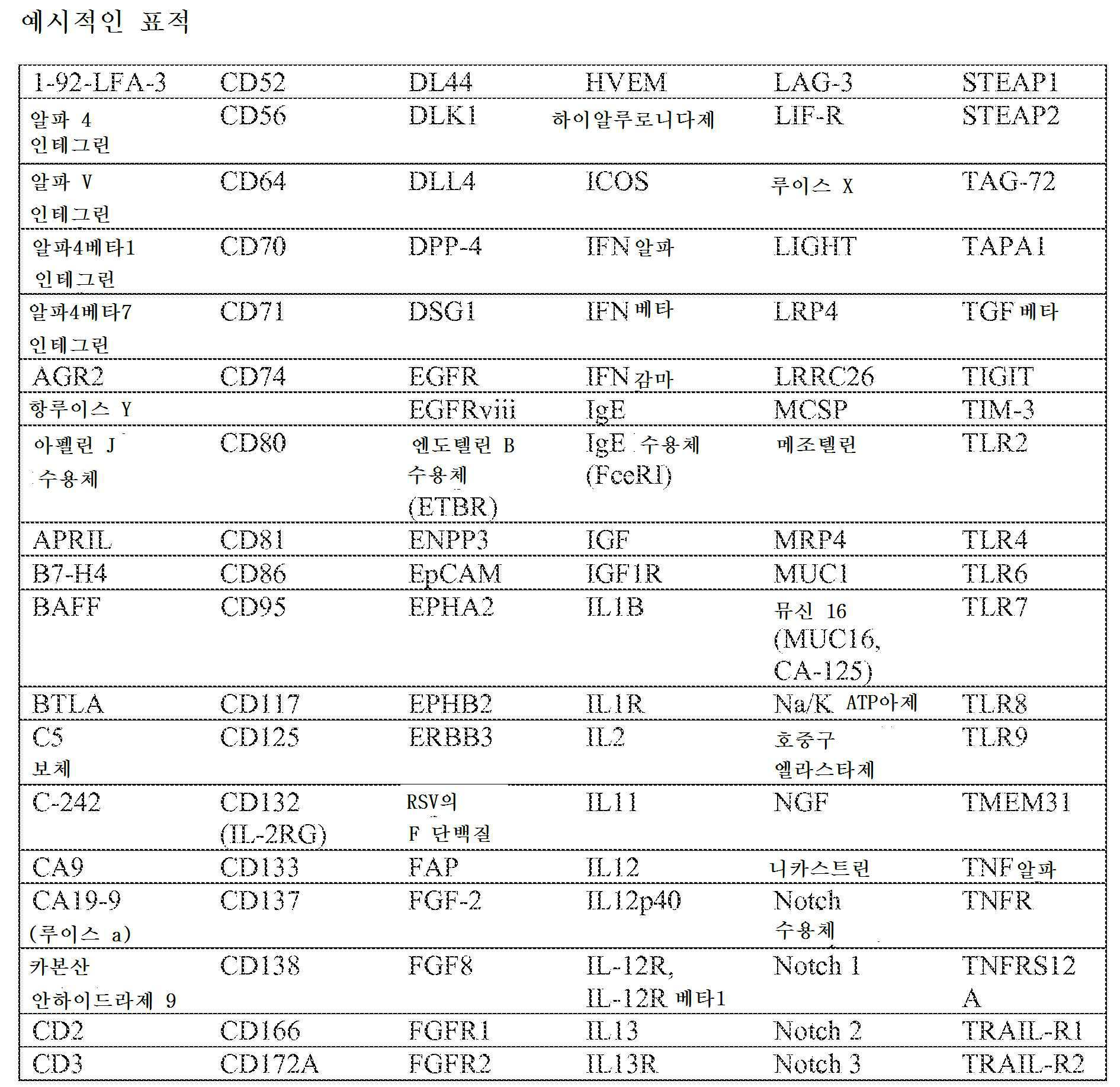

일부 비제한적인 실시양태에서, 다중특이성 항체의 AB 중 하나 이상은 본원에서 제공하는 실시예에서 표 7에 기재되어 있는 서열이거나, 그로부터 유래된 것이다. In some non-limiting embodiments, one or more of the ABs of the multispecific antibody is or is derived from the sequence set forth in Table 7 in the Examples provided herein.
일부 비제한적인 실시양태에서, 다중특이성 항체의 AB 중 하나 이상은 하기 표 2에 열거된 항체이거나, 또는 그로부터 유래된 것이다. In some non-limiting embodiments, one or more of the ABs of the multispecific antibody are, or are derived from, the antibodies listed in Table 2 below.
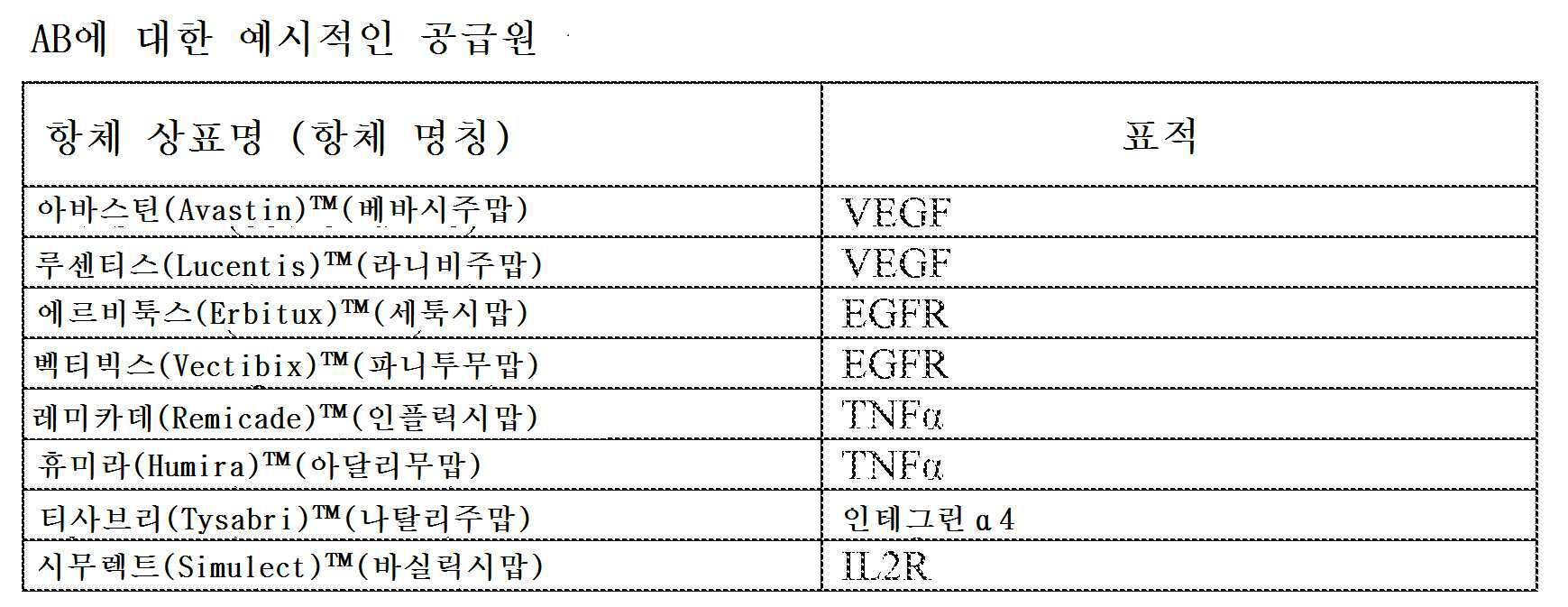
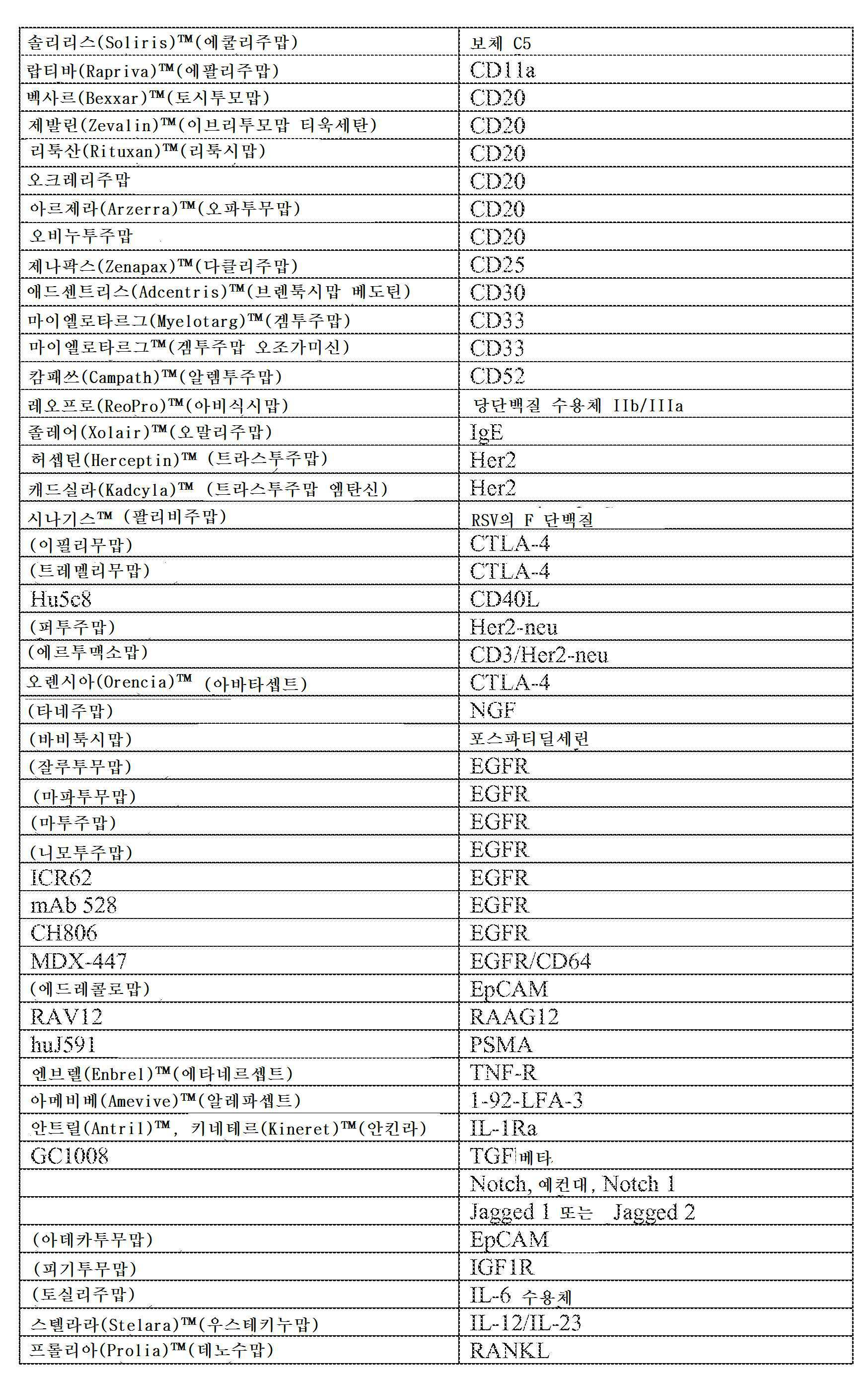
본원에 기술된 다중특이성 항체 및/또는 다중특이성 활성화 가능한 항체아 동일한 에피토프에 결합하는 다중특이성 항체 및/또는 다중특이성 활성화 가능한 항체 또한 본 개시내용에 포함된다. Multispecific antibodies and/or multispecific activatable antibodies described herein that bind to the same epitope as well as multispecific antibodies and/or multispecific activatable antibodies are also included in the present disclosure.
과도한 실험 없이도 다중특이성 항체 및/또는 다중특이성 활성화 가능한 항체가 본 개시내용의 다중특이성 항체 및/또는 다중특이성 활성화 가능한 항체와 동일하거나, 또는 유사한 특이성을 가지는지 여부는 전자가 후자가 표적에 결합하는 것을 방해하는지를 확인함으로써 측정할 수 있다는 것을 당업자는 이해할 것이다. 본 개시내용의 다중특이성 항체 및/또는 다중특이성 활성화 가능한 항체에 의한 결합 감소로 제시되는 바와 같이, 시험되는 다중특이성 항체 및/또는 다중특이성 활성화 가능한 항체가 본 개시내용의 다중특이성 항체 및/또는 다중특이성 활성화 가능한 항체와 경쟁하는 경우, 이때 두 다중특이성 항체 및/또는 다중특이성 활성화 가능한 항체는 동일한, 또는 매우 밀접한 관련이 있는 에피토프에 결합한다. Without undue experimentation, whether the multispecific antibody and/or the multispecific activatable antibody has the same or similar specificity as the multispecific antibody and/or the multispecific activatable antibody of the present disclosure, the former binds the target. It will be appreciated by those skilled in the art that this can be measured by ascertaining whether it interferes. The multispecific antibodies and/or multispecific activatable antibodies to be tested are multispecific antibodies and/or multispecific antibodies of the present disclosure, as indicated by reduced binding by the multispecific antibodies and/or multispecific activatable antibodies of the present disclosure. When competing with a specific activatable antibody, then the two multispecific antibodies and/or the multispecific activatable antibody bind to the same, or very closely related epitope.
다중특이성 항체 및/또는 다중특이성 활성화 가능한 항체가 본 개시내용의 다중특이성 항체 및/또는 다중특이성 활성화 가능한 항체와 동일하거나, 또는 유사한 특이성을 가지는지 여부를 측정하는 한 실시양태는 본 개시내용의 다중특이성 항체 및/또는 다중특이성 활성화 가능한 항체를 일반적인 반응성을 띠는 가용성 표적과 함께 미리 인큐베이션시키고, 시험되는 다중특이성 항체 및/또는 다중특이성 활성화 가능한 항체를 첨가하여 시험되는 다중특이성 항체 및/또는 다중특이성 활성화 가능한 항체의 표적에 결합할 수 있는 그의 능력이 억제되었는지 여부를 측정하는 것이다. 시험되는 다중특이성 항체 및/또는 다중특이성 활성화 가능한 항체가 억제된 경우에는 아마도 이는 본 개시내용의 다중특이성 항체 및/또는 다중특이성 활성화 가능한 항체와 동일하거나, 또는 기능상 등가인 에피토프 특이성을 가지는 것이다. One embodiment determining whether a multispecific antibody and/or a multispecific activatable antibody has the same or similar specificity as a multispecific antibody and/or a multispecific activatable antibody of the present disclosure The multispecific antibody and/or multispecificity tested by incubating the specific antibody and/or the multispecific activatable antibody with a soluble target with a general reactivity, and adding the multispecific antibody and/or the multispecific activatable antibody to be tested. It is to measure whether the ability of the activatable antibody to bind to the target is inhibited. If the multispecific antibody and/or the multispecific activatable antibody to be tested is inhibited, it is likely that it has the same or functionally equivalent epitope specificity as the multispecific antibody and/or the multispecific activatable antibody of the present disclosure.
다중특이성 항체 및/또는 다중특이성 활성화 가능한 항체는 예를 들어, 하기 제공하는 실시예에 기술된 방법을 사용하여 생성된다. 다중특이성 항체 및/또는 다중특이성 활성화 가능한 항체는 또한 항체 제조 및/또는 정제에 대하여 당업계에 알려져 있는 다수의 기법들 중 임의의 것을 사용하여 생성될 수 있다. Multispecific antibodies and/or multispecific activatable antibodies are generated, for example, using the methods described in the Examples provided below. Multispecific antibodies and/or multispecific activatable antibodies can also be generated using any of a number of techniques known in the art for antibody preparation and/or purification.
다중특이성 항체 및/또는 다중특이성 활성화 가능한 항체에서 사용하기 위한 항체 단편, 예컨대, Fv, F(ab')2 및 Fab는 예컨대, 프로테아제 또는 화학적 절단에 의해 온전한 단백질의 절단에 의해 제조될 수 있다. 별법으로, 절두된 유전자가 디자인된다. 예를 들어, F(ab')2 단편의 일부를 코딩하는 키메라 유전자는 H 쇄의 CH1 도메인 및 힌지 영역, 및 후속하여 번역 종결 코돈을 포함하며, 이로써 절두된 분자를 수득할 수 있다.Antibody fragments for use in multispecific antibodies and/or multispecific activatable antibodies, such as Fv, F(ab') 2 and Fab, are, for example, It can be prepared by cleavage of intact proteins by protease or chemical cleavage. Alternatively, the truncated gene is designed. For example, a chimeric gene encoding a portion of the F(ab') 2 fragment contains the CH1 domain and hinge region of the H chain, and subsequently a translation stop codon, thereby obtaining a truncated molecule.
발현 벡터는 플라스미드, 레트로바이러스, YAC, EBV 유래 에피솜 등을 포함한다. 편리한 벡터는 임의의 VH 또는 VL 서열이 쉽게 삽입되어 발현될 수 있도록 조작된 적절한 제한효소와 함께, 기능적으로 완전한 인간 CH 또는 CL 면역글로불린 서열을 코딩하는 것이다. 상기 벡터에서, 스플라이싱은 일반적으로 삽입된 J 영역내 스플라이싱 도너 부위와 인간 C 영역에 선행하는 스플라이싱 억셉트 부위 사이에서 일어나고, 또한 인간 CH 엑손 내 존재하는 스플라이스 영역에서 일어난다. 폴리아데닐화 및 전사 종결은 코딩 영역의 하류에 천연 염색체 부위에서 일어난다. 생성된 항체는 레트로바이러스 LTR, 예를 들어, SV-40 조기 프로모터(문헌 [Okayama et al. Mol. Cell. Bio. 3:280 (1983)]), 루이스 육종 바이러스 LTR(문헌 [Gorman et al. P.N.A.S. 79:6777 (1982)), 및 몰로니 뮤린 백혈병 바이러스 LTR(문헌 [Grosschedl et al. Cell 41:885 (1985)])을 비롯한 임의의 강력한 프로모터에 연결될 수 있다. 또한, 이해할 수 있는 바와 같이, 천연 Ig 프로모터 등이 사용될 수 있다. Expression vectors include plasmids, retroviruses, YACs, EBV derived episomes, and the like. A convenient vector is one that encodes a functionally complete human CH or CL immunoglobulin sequence, with an appropriate restriction enzyme engineered so that any VH or VL sequence can be easily inserted and expressed. In these vectors, splicing generally occurs between the splicing donor site in the inserted J region and the splicing accept site preceding the human C region, and also in the splice region present in the human CH exon. Polyadenylation and transcription termination occur at the site of the native chromosome downstream of the coding region. The resulting antibodies are retroviral LTR, for example SV-40 early promoter (Okayama et al . Mol. Cell. Bio. 3:280 (1983)), Lewis sarcoma virus LTR (Gorman et al . PNAS 79:6777 (1982)), and Moloney murine leukemia virus LTR (Grosschedl et al . Cell 41:885 (1985)). Also, as will be appreciated, natural Ig promoters and the like can be used.
추가로, 다중특이성 항체 및/또는 다중특이성 활성화 가능한 항체는 당업계에 주지된 기법을 이용하여, 제한 없이, 파지 디스플레이, 레트로바이러스 디스플레이, 리보솜 디스플레이, 및 다른 기법을 비롯한, 디스플레이 유형 기술을 통해 생성될 수 있고, 생성된 분자에 대해 추가의 성숙화, 예컨대, 당업계에 주지된 기법 등과 같은, 친화성 성숙화가 수행될 수 있다(문헌 [Wright et al. Crit, Reviews in Immunol. 12125-168 (1992)], [Hanes and Pluckthun PNAS USA 94:4937-4942 (1997)](리보솜 디스플레이), [Parmley and Smith Gene 73:305-318 (1988)](vkwl 디스플레이), [Scott, TIBS, vol. 17:241-245 (1992)], [Cwirla et al. PNAS USA 87:6378-6382 (1990)], [Russel et al. Nucl. Acids Research 21:1081-1085 (1993)], [Hoganboom et al. Immunol. Reviews 130:43-68 (1992)], [Chiswell and McCafferty TIBTECH; 10:80-8A (1992)], 및 미국 특허 번호 제5,733,743호). Additionally, multispecific antibodies and/or multispecific activatable antibodies are produced through display type techniques, including, without limitation, phage display, retroviral display, ribosome display, and other techniques using techniques well known in the art. The resulting molecule may be subjected to further maturation, such as, for example, techniques well known in the art, and the like (Wright et al . Crit, Reviews in Immunol. 12125-168 (1992). )], [Hanes and Pluckthun PNAS USA 94:4937-4942 (1997)] (ribosome display), [Parmley and Smith Gene 73:305-318 (1988)] (vkwl display), [Scott, TIBS, vol. 17 :241-245 (1992)], [Cwirla et al . PNAS USA 87:6378-6382 (1990)], [Russel et al . Nucl. Acids Research 21:1081-1085 (1993)], [Hoganboom et al . Immunol. Reviews 130:43-68 (1992)], Chiswell and McCafferty TIBTECH; 10:80-8A (1992), and US Pat. No. 5,733,743).
질환 및 장애를 치료하는 데 항체의 효능을 개선시키기 위해 효과기 기능을 증진시키거나, 감소시키기 위한 목적으로 효과기 기능에 대해 본 개시내용의 다중특이성 항체 및/또는 다중특이성 활성화 가능한 항체를 변형시키는 것이 바람직할 수 있다. 예를 들어, 시스테인 잔기(들)를 Fc 영역에 도입하여 이 영역에 쇄간 이황화 결합이 형성될 수 있게 할 수 있다. 이렇게 생성된 동종이량체 항체는 내재능 및/또는 증가된 보체 매개 세포 사멸 및 항체 의존성 세포성 세포독성(ADCC: antibody-dependent cellular cytotoxicity)을 개선시킬 수 있다(문헌 [Caron et al., J. Exp Med., 176: 1191-1195 (1992)] 및 [Shopes, J. Immunol., 148: 2918-2922 (1992)] 참조). 별법으로, 항체는 이중 Fc 영역을 가지도록 조작될 수 있으며, 이로써, 보체 용해 및 ADCC 능력이 증진될 수 있다(문헌 [Stevenson et al., Anti-Cancer Drug Design, 3: 219-230 (1989)]). 일부 실시양태에서, 당화 부위를 제거하여 Fc 기능을 감소시키는 Fc 돌연변이가 제조될 수 있다. It is desirable to modify the multispecific antibodies and/or multispecific activatable antibodies of the present disclosure for effector function for the purpose of enhancing or reducing effector function to improve the efficacy of the antibody in treating diseases and disorders. can do. For example, cysteine residue(s) can be introduced into the Fc region to allow interchain disulfide bonds to form in this region. The homodimeric antibody thus generated can improve endogenous and/or increased complement-mediated cell death and antibody-dependent cellular cytotoxicity (ADCC) (Caron et al., J. Exp Med., 176: 1191-1195 (1992) and Shopes, J. Immunol., 148: 2918-2922 (1992)). Alternatively, antibodies can be engineered to have dual Fc regions, whereby complement lysis and ADCC capacity can be enhanced ( Stevenson et al., Anti-Cancer Drug Design, 3: 219-230 (1989). ]). In some embodiments, Fc mutations can be made that reduce Fc function by removing glycosylation sites.
다중특이성 활성화 가능한 항체Antibodies capable of multispecific activation
본원에서 제공하는 다중특이성 활성화 가능한 항체 및 다중특이성 활성화 가능한 항체 조성물은 제1 표적 및/또는 제1 에피토프에 특이적으로 결합하는 적어도 제1 항체 또는 그의 항체 단편(이는 통틀어 본 개시내용 전역에 걸쳐 AB1로 지칭된다) 및 제2 표적 및/또는 제2 에피토프에 특이적으로 결합하는 제2 항체 또는 그의 항체 단편(이는 통틀어 본 개시내용 전역에 걸쳐 AB2로 지칭된다)을 포함하며, 여기서, AB 중 하나 이상은 마스킹 모이어티(MM)에 의해 변형된다. 일부 실시양태에서, 다중특이성 활성화 가능한 항체에서 각 AB는 그 자신의 마스킹 모이어티에 의해 변형된다. Multispecifically activatable antibodies and multispecifically activatable antibody compositions provided herein include at least a first antibody or antibody fragment thereof that specifically binds to a first target and/or a first epitope, which collectively comprises AB1 throughout the present disclosure. ) And a second antibody or antibody fragment thereof that specifically binds to a second target and/or a second epitope, which is collectively referred to as AB2 throughout the present disclosure, wherein one of the ABs The above is deformed by the masking moiety (MM). In some embodiments, each AB in a multispecific activatable antibody is modified by its own masking moiety.
다중특이성 활성화 가능한 항체에서 AB 중 1개 이상의 것이 MM으로 변형되고, 그의 표적의 존재 하에 있을 때, AB의 그의 표적에의 특이적인 결합은 MM으로 변형되지 않은 AB의 표적에의 특이적인 결합 또는 모체 AB의 표적에의 특이적인 결합과 비교하였을 때, 감소되거나, 또는 억제되어 있다. In a multispecific activatable antibody, when at least one of the AB is modified with MM and in the presence of its target, the specific binding of the AB to its target is the specific binding of the non-MM-modified AB to the target or parent When compared to the specific binding of the AB to the target, it is reduced or inhibited.
MM으로 변형된 AB의 표적에의 Kd는 MM으로 변형되지 않은 AB의 표적에의, 또는 모체 AB의 표적에의 Kd보다 적어도 5, 10, 20, 25, 40, 50, 100, 250, 500, 1,000, 2,500, 5,000, 10,000, 50,000, 100,000, 500,000, 1,000,000, 5,000,000, 10,000,000, 50,000,000배 이상, 5-10, 10-100, 10-1,000, 10-10,000, 10-100,000, 10-1,000,000, 10-10,000,000, 100-1,000, 100-10,000, 100-100,000, 100-1,000,000, 100-10,000,000, 1,000-10,000, 1,000-100,000, 1,000-1,000,000, 1000-10,000,000, 10,000-100,000, 10,000-1,000,000, 10,000-10,000,000, 100,000-1,000,000, 또는 100,000-10,000,000배 더 크다. 반대로, MM으로 변형된 AB의 표적에의 결합 친화도는 MM으로 변형되지 않은 AB의 표적에의, 또는 모체 AB의 표적에의 결합 친화도보다 적어도 5, 10, 20, 25, 40, 50, 100, 250, 500, 1,000, 2,500, 5,000, 10,000, 50,000, 100,000, 500,000, 1,000,000, 5,000,000, 10,000,000, 50,000,000배 이상, 또는 5-10, 10-100, 10-1,000, 10-10,000, 10-100,000, 10-1,000,000, 10-10,000,000, 100-1,000, 100-10,000, 100-100,000, 100-1,000,000, 100-10,000,000, 1,000-10,000, 1,000-100,000, 1,000-1,000,000, 1000-10,000,000, 10,000-100,000, 10,000-1,000,000, 10,000-10,000,000, 100,000-1,000,000, 또는 100,000-10,000,000배 더 낮다. The K d to the target of the AB modified with MM is at least 5, 10, 20, 25, 40, 50, 100, 250, than the K d of the target of the AB not modified with the MM, or the target of the parent AB, 500, 1,000, 2,500, 5,000, 10,000, 50,000, 100,000, 500,000, 1,000,000, 5,000,000, 10,000,000, 50,000,000 times more, 5-10, 10-100, 10-1,000, 10-10,000, 10-100,000, 10-1,000,000, 10-10,000,000, 100-1,000, 100-10,000, 100-100,000, 100-1,000,000, 100-10,000,000, 1,000-10,000, 1,000-100,000, 1,000-1,000,000, 1000-10,000,000, 10,000-100,000, 10,000-1,000,000, 10,000- 10,000,000, 100,000-1,000,000, or 100,000-10,000,000 times larger. Conversely, the binding affinity of the MM-modified AB to the target is at least 5, 10, 20, 25, 40, 50, or more than the binding affinity of the non-MM-modified AB to the target or the parental AB to the target. 100, 250, 500, 1,000, 2,500, 5,000, 10,000, 50,000, 100,000, 500,000, 1,000,000, 5,000,000, 10,000,000, 50,000,000 times or more, or 5-10, 10-100, 10-1,000, 10-10,000, 10-100,000 , 10-1,000,000, 10-10,000,000, 100-1,000, 100-10,000, 100-100,000, 100-1,000,000, 100-10,000,000, 1,000-10,000, 1,000-100,000, 1,000-1,000,000, 1000-10,000,000, 10,000-100,000, 10,000 -1,000,000, 10,000-10,000,000, 100,000-1,000,000, or 100,000-10,000,000 times lower.
다중특이성 활성화 가능한 항체에서 AB 중 1개 이상의 것에 대한 MM의 해리 상수(Kd)는 일반적으로 표적에의 AB의 Kd보다 더 크다. AB에의 MM의 Kd는 표적에의 AB의 Kd보다 5, 10, 25, 50, 100, 250, 500, 1,000, 2,500, 5,000, 10,000, 100,000, 1,000,000 또는 심지어 10,000,000배 이상 더 클 수 있다. 반대로, AB에의 MM의 결합 친화도는 일반적으로 표적에의 AB의 결합 친화도보다 더 낮다. AB에의 MM의 결합 친화도는 표적에의 AB의 결합 친화도보다 5, 10, 25, 50, 100, 250, 500, 1,000, 2,500, 5,000, 10,000, 100,000, 1,000,000 또는 심지어 10,000,000배 이상 더 낮을 수 있다. In a multispecific activatable antibody, the dissociation constant (K d ) of the MM for one or more of the ABs is generally greater than the K d of the AB to the target. The K d of the MM to the AB may be 5, 10, 25, 50, 100, 250, 500, 1,000, 2,500, 5,000, 10,000, 100,000, 1,000,000, or even 10,000,000 times greater than the K d of the AB to the target. Conversely, the binding affinity of the MM to the AB is generally lower than the binding affinity of the AB to the target. The binding affinity of the MM to the AB may be 5, 10, 25, 50, 100, 250, 500, 1,000, 2,500, 5,000, 10,000, 100,000, 1,000,000 or even 10,000,000 times lower than the binding affinity of the AB to the target. have.
다중특이성 활성화 가능한 항체에서 AB 중 1개 이상의 것이 MM으로 변형되고, 표적의 존재 하에 있을 때, AB의 그의 표적에의 특이적인 결합은 MM으로 변형되지 않은 AB의 표적에의 특이적인 결합 또는 모체 AB의 표적에의 특이적인 결합과 비교하였을 때, 감소되거나, 또는 억제되어 있다. MM으로 변형되지 않은 AB의 표적에의 결합 또는 모체 AB의 표적에의 결합과 비교하였을 때, MM으로 변형된 경우의 AB의 표적에 결합할 수 있는 능력은 생체내 또는 시험관내 검정법으로 측정되었을 때, 적어도 2, 4, 6, 8, 12, 28, 24, 30, 36, 48, 60, 72, 84, 또는 96시간, 또는 5, 10, 15, 30, 45, 60, 90, 120, 150, 또는 180일, 또는 1, 2, 3, 4, 5, 6, 7, 8, 9, 10, 11, 또는 12개월 이상 동안 50%, 60%, 70%, 80%, 90%, 92%, 93%, 94%, 95%, 96%, 97%, 98%, 99% 및 심지어 100% 이상만큼 감소될 수 있다. In a multispecific activatable antibody, when at least one of the ABs is modified with MM and in the presence of a target, the specific binding of the AB to its target is the specific binding of the non-MM-modified AB to the target or the parent AB When compared to the specific binding of the target to, it is reduced or inhibited. When compared to the binding of the non-MM-modified AB to the target or the parental AB to the target, the ability of the AB to bind to the target when modified with MM was measured by in vivo or in vitro assays. , At least 2, 4, 6, 8, 12, 28, 24, 30, 36, 48, 60, 72, 84, or 96 hours, or 5, 10, 15, 30, 45, 60, 90, 120, 150 , Or 180 days, or 50%, 60%, 70%, 80%, 90%, 92% for 1, 2, 3, 4, 5, 6, 7, 8, 9, 10, 11, or 12 months or longer , 93%, 94%, 95%, 96%, 97%, 98%, 99% and even 100% or more.
MM은 다중특이성 활성화 가능한 항체에서 AB 중 1개 이상의 것의 그의 표적에의 결합을 억제시킨다. MM은 AB의 항원 결합 도메인에 결합하고, AB의 그의 표적에의 결합을 억제시킨다. MM은 AB의 표적에의 결합을 입체적으로 억제시킬 수 있다. MM은 AB의 표적에의 결합을 알로스테릭하게 억제시킬 수 있다. AB가 MM으로 변형되거나, 또는 그에 커플링되고, 표적의 존재 하에 있을 때, 이러한 실시양태에서, 생체내 또는 시험관내 검정법으로 측정되었을 때, 적어도 2, 4, 6, 8, 12, 28, 24, 30, 36, 48, 60, 72, 84, 또는 96시간, 또는 5, 10, 15, 30, 45, 60, 90, 120, 150, 또는 180일, 또는 1, 2, 3, 4, 5, 6, 7, 8, 9, 10, 11, 또는 12개월 이상 동안 AB의 표적에의 결합은 없거나, 또는 실질적으로 없거나, 또는 상기 AB의 표적에의 결합은 MM으로 변형되지 않은 AB, 모체 AB, 또는 MM에 커플링되지 않은 AB의 표적에의 결합과 비교하였을 때, 0.001%, 0.01%, 0.1%, 1%, 2%, 3%, 4%, 5%, 6%, 7%, 8%, 9%, 10%, 15%, 20%, 25%, 30%, 35%, 40%, 또는 50% 이하이다. MM inhibits the binding of one or more of the ABs to its target in a multispecific activatable antibody. MM binds to the antigen binding domain of the AB and inhibits the binding of the AB to its target. MM can sterically inhibit the binding of AB to the target. MM can allostericly inhibit the binding of AB to the target. When the AB is modified to MM, or coupled thereto, and in the presence of a target, in this embodiment, at least 2, 4, 6, 8, 12, 28, 24 as measured by in vivo or in vitro assays. , 30, 36, 48, 60, 72, 84, or 96 hours, or 5, 10, 15, 30, 45, 60, 90, 120, 150, or 180 days, or 1, 2, 3, 4, 5 , No, or substantially no binding of the AB to the target for at least 6, 7, 8, 9, 10, 11, or 12 months, or the binding of the AB to the target is not modified with MM, the parent AB , Or 0.001%, 0.01%, 0.1%, 1%, 2%, 3%, 4%, 5%, 6%, 7%, 8 when compared to the binding of the AB not coupled to the MM to the target %, 9%, 10%, 15%, 20%, 25%, 30%, 35%, 40%, or 50% or less.
다중특이성 활성화 가능한 항체에서 AB 중 1개 이상의 것이 MM에 커플링되거나, 또는 그에 의해 변형되었을 때, MM은 AB의 그의 표적에의 특이적이 결합을 '마스킹'시키거나, 또는 감소시키거나, 또는 다르게는 억제시킨다. 다중특이성 활성화 가능한 항체에서 AB 중 1개 이상의 것이 MM에 커플링되거나, 또는 그에 의해 변형되었을 때, 상기 커플링 또는 변형은 AB가 그의 표적에 특이적으로 결합할 수 있는 능력을 감소시키거나, 또는 억제시키는 구조적 변화를 일으킬 수 있다. When one or more of the ABs in a multispecific activatable antibody are coupled to or modified by MM, the MM'masks', or reduces, or otherwise, the specific binding of the AB to its target. Suppresses. When one or more of the ABs in a multispecific activatable antibody are coupled to or modified by MM, the coupling or modification reduces the ability of the AB to specifically bind to its target, or It can cause structural changes that inhibit it.
다중특이성 활성화 가능한 항체에서, 1개 이상의 AB가 MM에 커플링되거나, 또는 그에 의해 변형되었을 때, 다중특이성 활성화 가능한 항체의 적어도 일부는 하기 식으로 표현될 수 있다(아미노(N) 말단 영역에서 카복시(C) 말단 영역의 순서로): In multispecific activatable antibodies, when at least one AB is coupled to or modified by MM, at least a portion of the multispecific activatable antibody can be represented by the following formula (carboxy in the amino (N) terminal region) (C) in the order of the terminal regions):
(MM)-(AB)(MM)-(AB)
(AB)-(MM)(AB)-(MM)
(MM)-L-(AB)(MM)-L-(AB)
(AB)-L-(MM)(AB)-L-(MM)
여기서, MM은 마스킹 모이어티이고, AB는 항체 또는 그의 항체 단편이고, L은 링커이다. 다수의 실시양태에서, 가요성을 제공하기 위해 하나 이상의 링커, 예컨대, 가요성 링커를 조성물 내로 바람직할 수 있다. Where MM is a masking moiety, AB is an antibody or antibody fragment thereof, and L is a linker. In many embodiments, one or more linkers, such as flexible linkers, may be desirable into the composition to provide flexibility.
특정 실시양태에서, MM은 AB의 천연 결합 파트너가 아니다. 일부 실시양태에서, MM은 AB의 어느 천연 결합 파트너와의 상동성도 함유하지 않거나, 또는 실질적으로 함유하지 않는다. 다른 실시양태에서, MM은 AB의 어느 천연 결합 파트너와 5%, 10%, 15%, 20%, 25%, 30%, 35%, 40%, 45%, 50%, 55%, 60%, 65%, 70%, 75%, 또는 80% 이하로 유사한 것이다. 일부 실시양태에서, MM은 AB의 어느 천연 결합 파트너와 5%, 10%, 15%, 20%, 25%, 30%, 35%, 40%, 45%, 50%, 55%, 60%, 65%, 70%, 75%, 또는 80% 이하로 동일한 것이다. 일부 실시양태에서, MM은 AB의 어느 천연 결합 파트너와 25% 이하로 동일한 것이다. 일부 실시양태에서, MM은 AB의 어느 천연 결합 파트너와 50% 이하로 동일한 것이다. 일부 실시양태에서, MM은 AB의 어느 천연 결합 파트너와 20% 이하로 동일한 것이다. 일부 실시양태에서, MM은 AB의 어느 천연 결합 파트너와 10% 이하로 동일한 것이다. In certain embodiments, the MM is not a natural binding partner of the AB. In some embodiments, the MM contains no or substantially no homology to any natural binding partner of the AB. In other embodiments, the MM is 5%, 10%, 15%, 20%, 25%, 30%, 35%, 40%, 45%, 50%, 55%, 60% with any natural binding partner of the AB, Less than 65%, 70%, 75%, or 80% similar. In some embodiments, the MM is 5%, 10%, 15%, 20%, 25%, 30%, 35%, 40%, 45%, 50%, 55%, 60%, with any natural binding partner of the AB, The same is not more than 65%, 70%, 75%, or 80%. In some embodiments, the MM is no more than 25% identical to any natural binding partner of the AB. In some embodiments, the MM is no more than 50% identical to any natural binding partner of the AB. In some embodiments, the MM is no more than 20% identical to any natural binding partner of the AB. In some embodiments, the MM is no more than 10% identical to any natural binding partner of the AB.
일부 실시양태에서, 다중특이성 활성화 가능한 항체는 MM에 의해 변형된 AB를 포함하고, 하나 이상의 절단가능한 모이어티(CM) 또한 포함한다. 상기 다중특이성 활성화 가능한 항체는 AB의 표적에의 활성화 가능한/전환 가능한 결합을 보인다. 다중특이성 활성화 가능한 항체는 일반적으로 마스킹 모이어티(MM) 및 변형가능한 또는 절단가능한 모이어티(CM)에 의해 변형된, 또는 그의 커플링된 1개 이상의 항체 또는 항체 단편(AB)을 포함한다. 일부 실시양태에서, CM은 관심의 대상이 되는 프로테아제에 대한 기질로서의 역할을 하는 아미노산 서열을 함유한다. In some embodiments, the multispecific activatable antibody comprises an AB modified by MM, and also comprises one or more cleavable moieties (CM). The multispecific activatable antibody shows activatable/switchable binding of the AB to the target. Multispecific activatable antibodies generally comprise one or more antibodies or antibody fragments (AB) modified by, or coupled to, a masking moiety (MM) and a deformable or cleavable moiety (CM). In some embodiments, the CM contains an amino acid sequence that serves as a substrate for a protease of interest.
절단된(또는 상대적으로 활성인) 상태이고, 표적의 존재 하에 있을 때, 상응하는 AB가 표적에 결합하고, 반면 절단되지 않은 (또는 상대적으로 비활성인) 상태이고, 표적의 존재 하에 있을 때, AB의 그의 표적에의 특이적인 결합은 감소되거나, 억제되도록 각 MM 및 CM이 배치되게 다중특이성 활성화 가능한 항체의 요소는 배열된다. AB의 그의 표적에의 특이적인 결합은 그의 표적에 특이적으로 결합할 수 있는 AB의 능력의 MM에 의한 억제 또는 마스킹에 기인하여 감소될 수 있다. When in a truncated (or relatively active) state and in the presence of a target, the corresponding AB binds to the target, whereas when in an uncleaved (or relatively inactive) state and in the presence of a target, the AB The elements of the multispecific activatable antibody are arranged such that each MM and CM are arranged so that the specific binding of its target to its target is reduced or inhibited. The specific binding of an AB to its target can be reduced due to inhibition or masking by MM of the AB's ability to specifically bind to its target.
MM 및 CM으로 변형된 각 AB의 표적에의 Kd는 MM 및 CM으로 변형되지 않은 AB의 표적에의, 또는 모체 AB의 표적에의 Kd보다 적어도 5, 10, 20, 25, 40, 50, 100, 250, 500, 1,000, 2,500, 5,000, 10,000, 50,000, 100,000, 500,000, 1,000,000, 5,000,000, 10,000,000, 50,000,00050,000,000배 이상, 또는 5-10, 10-100, 10-1,000, 10-10,000, 10-100,000, 10-1,000,000, 10-10,000,000, 100-1,000, 100-10,000, 100-100,000, 100-1,000,000, 100-10,000,000, 1,000-10,000, 1,000-100,000, 1,000-1,000,000, 1000-10,000,000, 10,000-100,000, 10,000-1,000,000, 10,000-10,000,000, 100,000-1,000,000, 또는 100,000-10,000,000배 더 크다. 반대로, MM 및 CM으로 변형된 각 AB의 표적에의 결합 친화도는 MM 및 CM으로 변형되지 않은 AB의 표적에의, 또는 모체 AB의 표적에의 결합 친화도보다 적어도 5, 10, 20, 25, 40, 50, 100, 250, 500, 1,000, 2,500, 5,000, 10,000, 50,000, 100,000, 500,000, 1,000,000, 5,000,000, 10,000,000, 50,000,000배 이상, 또는 5-10, 10-100, 10-1,000, 10-10,000, 10-100,000, 10-1,000,000, 10-10,000,000, 100-1,000, 100-10,000, 100-100,000, 100-1,000,000, 100-10,000,000, 1,000-10,000, 1,000-100,000, 1,000-1,000,000, 1000-10,000,000, 10,000-100,000, 10,000-1,000,000, 10,000-10,000,000, 100,000-1,000,000, 또는 100,000-10,000,000배 더 낮다.The K d to the target of each AB modified with MM and CM is at least 5, 10, 20, 25, 40, 50 than the K d to the target of the AB not modified with MM and CM, or to the target of the parent AB. , 100, 250, 500, 1,000, 2,500, 5,000, 10,000, 50,000, 100,000, 500,000, 1,000,000, 5,000,000, 10,000,000, 50,000,00050,000,000 times or more, or 5-10, 10-100, 10-1,000, 10- 10,000, 10-100,000, 10-1,000,000, 10-10,000,000, 100-1,000, 100-10,000, 100-100,000, 100-1,000,000, 100-10,000,000, 1,000-10,000, 1,000-100,000, 1,000-1,000,000, 1000-10,000,000, 10,000-100,000, 10,000-1,000,000, 10,000-10,000,000, 100,000-1,000,000, or 100,000-10,000,000 times larger. Conversely, the binding affinity of each AB modified with MM and CM to the target is at least 5, 10, 20, 25 than the binding affinity of the AB not modified with MM and CM to the target or to the target of the parent AB. , 40, 50, 100, 250, 500, 1,000, 2,500, 5,000, 10,000, 50,000, 100,000, 500,000, 1,000,000, 5,000,000, 10,000,000, 50,000,000 times or more, or 5-10, 10-100, 10-1,000, 10- 10,000, 10-100,000, 10-1,000,000, 10-10,000,000, 100-1,000, 100-10,000, 100-100,000, 100-1,000,000, 100-10,000,000, 1,000-10,000, 1,000-100,000, 1,000-1,000,000, 1000-10,000,000, 10,000-100,000, 10,000-1,000,000, 10,000-10,000,000, 100,000-1,000,000, or 100,000-10,000,000 times lower.
1개 이상의 AB가 MM 및 CM으로 변형되고, 표적의 존재 하에 있지만, 변형제(예를 들어, 프로테아제)의 존재 하에 있지 않을 때, AB의 그의 표적에의 특이적인 결합은 MM 및 CM으로 변형되지 않은 AB의 표적에의 특이적인 결합 또는 모체 AB의 표적에의 특이적인 결합과 비교하였을 때, 감소되거나, 또는 억제되어 있다. 모체 AB의 그의 표적에의 결합 또는 MM 및 CM으로 변형되지 않은 AB의 그의 표적에의 결합과 비교하였을 때, MM 및 CM으로 변형된 경우의 AB의 표적에 결합할 수 있는 능력은 생체내 또는 시험관내 검정법으로 측정되었을 때, 적어도 2, 4, 6, 8, 12, 28, 24, 30, 36, 48, 60, 72, 84, 또는 96시간, 또는 5, 10, 15, 30, 45, 60, 90, 120, 150, 또는 180일, 또는 1, 2, 3, 4, 5, 6, 7, 8, 9, 10, 11, 또는 12개월 이상 동안 50%, 60%, 70%, 80%, 90%, 92%, 93%, 94%, 95%, 96%, 97%, 98%, 99% 및 심지어 100% 이상만큼 감소될 수 있다. When at least one AB is modified with MM and CM, in the presence of a target, but not in the presence of a modifier (e.g., protease), the specific binding of the AB to its target is not modified with MM and CM. When compared to specific binding of the non-AB to the target or specific binding of the parent AB to the target, it is reduced or inhibited. When compared to the binding of the parental AB to its target or the binding of an AB that has not been modified with MM and CM to its target, the ability of the AB to bind to the target of the AB when modified with MM and CM is either in vivo or tested. At least 2, 4, 6, 8, 12, 28, 24, 30, 36, 48, 60, 72, 84, or 96 hours, or 5, 10, 15, 30, 45, 60, as measured by in vitro assay , 90, 120, 150, or 180 days, or 50%, 60%, 70%, 80% for at least 1, 2, 3, 4, 5, 6, 7, 8, 9, 10, 11, or 12 months , 90%, 92%, 93%, 94%, 95%, 96%, 97%, 98%, 99% and even 100% or more.
본원에서 사용되는 바, 절단된 상태라는 용어는 프로테아제에 의한 CM의 변형 이후의 다중특이성 활성화 가능한 항체의 상태를 의미한다. 본원에서 사용되는 바, 절단되지 않은 상태라는 용어는 프로테아제에 의한 CM의 절단이 없는 다중특이성 활성화 가능한 항체의 상태를 의미한다. 상기 논의된 바와 같이, "다중특이성 활성화 가능한 항체"라는 용어는 본원에서 그의 절단되지 않은(천연) 상태뿐만 아니라, 그의 절단된 상태, 둘 모두의 다중특이성 활성화 가능한 항체를 의미하는 것으로 사용된다. 일부 실시양태에서, 절단된 다중특이성 활성화 가능한 항체는 프로테아제에 의한 CM의 절단으로 인해 MM이 결여되어 있으며, 이로써, 적어도 MM은 유리될 수 있다는 것(예컨대, MM이 공유 결합(예컨대, 시스테인 잔기 사이의 이황화 결합)에 의해 다중특이성 활성화 가능한 항체에 연결되지 않은 경우)은 당업계의 숙련가에게 자명할 것이다. As used herein, the term truncated state refers to the state of a multispecifically activatable antibody after modification of the CM by a protease. As used herein, the term uncleaved state refers to the state of a multispecific activatable antibody without cleavage of CM by a protease. As discussed above, the term “multispecific activatable antibody” is used herein to mean an antibody capable of multispecific activatable, both in its uncleaved (natural) state, as well as its cleaved state. In some embodiments, the truncated multispecific activatable antibody lacks MM due to cleavage of the CM by a protease, such that at least MM can be freed (e.g., MM is covalently bonded (e.g., between cysteine residues). Is not linked to a multispecific activatable antibody by disulfide bonds) will be apparent to those skilled in the art.
활성화 가능한 또는 전환 가능한이라는 것은 다중특이성 활성화 가능한 항체가 억제, 마스킹 또는 절단되지 않은 상태(즉, 제1 입체 구조)일 때, 표적에 대해 제1 결합 수준을 보이고, 비억제, 비마스킹 및/또는 절단된 상태(즉, 제2 입체구조) 에서는 표적에 대해 제2 결합 수준을 보이는 것을 의미하며, 여기서, 제2 표적 결합 수준은 제1 결합 수준보다 크다. 일반적으로, 다중특이성 활성화 가능한 항체의 상응하는 AB에 대한 표적의 접근성은 상기 절단제 부재시보다 CM을 절단할 수 있는 절단제 존재시에 더 크다. 따라서, 다중특이성 활성화 가능한 항체가 절단되지 않은 상태일 때, 1개 이상의 AB는 표적 결합이 억제되고, 표적 결합이 마스킹될 수 있으며(즉, 제1 입체구조는 AB가 표적에 결합할 수 없는 것이다), 절단 상태에서는 AB는 표적 결합에 대해 억제되지 않거나 또는 마스킹되지 않는다.Activatable or switchable means that when the multispecific activatable antibody is in a state that is not inhibited, masked or cleaved (i.e., the first conformation), it exhibits a first level of binding to the target, and is non-inhibiting, non-masking and/or In the truncated state (ie, the second conformation), it means showing a second level of binding to the target, wherein the second level of target binding is greater than the first level of binding. In general, the accessibility of the target to the corresponding AB of the multispecific activatable antibody is greater in the presence of a cleaving agent capable of cleaving CM than in the absence of the cleaving agent. Thus, when the multispecific activatable antibody is not cleaved, one or more ABs are inhibited from target binding, and target binding may be masked (i.e., the first conformation is that the AB cannot bind to the target. ), in the truncated state, the AB is not inhibited or masked against target binding.
다중특이성 활성화 가능한 항체의 CM 및 AB는 제1 AB가 제1 표적 및/또는 에피토프에 대한 결합 모이어티를 나타내고, CM이 피험체에서 치료 부위 또는 진단 부위에서 표적과 함께 공국재화되는 프로테아제에 대한 기질을 나타내도록 선택된다. 본원에 개시된 다중특이성 활성화 가능한 항체는 예를 들어, CM 내 부위를 절단할 수 있는 프로테아제가 비치료 부위의 조직(예를 들어, 건강한 조직내)에서보다 치료 부위 또는 진단 부위의 표적 함유 조직에서 상대적으로 더 높은 수준으로 존재하는 경우 특정 용도가 발견된다. CM and AB of the multispecific activatable antibody are substrates for proteases in which the first AB represents a binding moiety for a first target and/or an epitope, and the CM colocalizes with the target at the treatment or diagnostic site in the subject. Is chosen to represent The multispecific activatable antibodies disclosed herein have, for example, a protease capable of cleaving a site in the CM relative to the target-containing tissue at the treatment site or diagnostic site than in the tissue at the untreated site (eg, in healthy tissue). If present at a higher level, a specific use is found.
일부 실시양태에서, 다중특이성 활성화 가능한 항체는 AB가 마스킹되지 않았거나, 또는 다르게는 그의 표적에의 결합이 억제되지 않는 경우, 독성 및/또는 다르게는 비치료 부위에서 제1 AB의 결합으로 인해 발생될 수 있는 유해한 부작용을 감소된 값으로 제공한다. In some embodiments, the multispecific activatable antibody is toxic and/or otherwise due to binding of the first AB at the untreated site when the AB is not masked, or otherwise binding to its target is not inhibited. It provides a reduced value for possible harmful side effects.
일반적으로, 다중특이성 활성화 가능한 항체는 입체구조적으로 제한되는 경우, MM이 AB를 마스킹시키거나, 또는 AB의 그의 표적에의 결합을 감소시키도록 관심의 대상이 되는 제1 AB를 선택하고, 활성화 가능한 항체의 나머지 부분을 구성함으로써 디자인될 수 있다. 구조적 디자인 기준은 상기와 같은 기능적 특징을 제공하는 것을 고려하여야 한다.In general, the multispecific activatable antibody, when constrained by conformation, selects the first AB of interest such that the MM masks the AB or reduces the binding of the AB to its target, and the activatable It can be designed by constructing the rest of the antibody. Structural design criteria should consider providing the above functional features.
억제되지 않은 입체구조 대비 억제시 표적 결합에 대해 원하는 동적 범위의 전환 가능한 표현형을 나타내는 다중특이성 활성화 가능한 항체를 제공한다. 동적 범위는 일반적으로 (a) 제1 조건 세트하에서 파라미터의 최대 검출 수준 대 (b) 제2 조건 세트 하에서 상기 파라미터의 최소 검출 값의 비율을 의미한다. 예를 들어, 다중특이성 활성화 가능한 항체와 관련하여, 동적 범위란 활성화 가능한 항체의 CM을 절단할 수 있는 프로테아제 존재 하에서 다중특이성 활성화 가능한 항체에 결합하는 표적 단백질의 최대 검출 수준 대 (b) 프로테아제 부재하에서 다중특이성 활성화 가능한 항체에 결합하는 표적 단백질의 최소 검출 수준의 비율을 의미한다. 다중특이성 활성화 가능한 항체의 동적 범위는 활성화 가능한 항체 절단제 처리의 평형 해리 상수에 대한 다중특이성 활성화 가능한 항체 절단제(예컨대, 효소) 처리의 평형 해리 상수의 비율로서 계산할 수 있다. 다중특이성 활성화 가능한 항체의 동적 범위가 클수록, 활성화 가능한 항체의 전환 가능한 표현형은 양호화된다. 동적 범위 값이 상대적으로 더 높은(예를 들어, 1 초과) 활성화 가능한 항체는 더욱 바람직한 전환성 표현형을 나타내며, 이로써, 활성화 가능한 항체에 의한 표적 단백질 결합이 절단제 부재시보다 활성화 가능한 항체의 CM을 절단할 수 있는 절단제(예를 들어, 효소) 존재 하에서 더욱 큰 정도로 일어난다(예컨대, 대부분 일어난다). It provides a multispecific activatable antibody that exhibits a switchable phenotype of a desired dynamic range for target binding upon inhibition compared to an uninhibited conformation. Dynamic range generally means the ratio of (a) the maximum detection level of a parameter under a first set of conditions to (b) the minimum detection value of the parameter under a second set of conditions. For example, with respect to multispecific activatable antibodies, dynamic range refers to the maximum detection level of the target protein binding to the multispecific activatable antibody in the presence of a protease capable of cleaving the CM of the activatable antibody versus (b) in the absence of a protease. It refers to the ratio of the minimum detection level of a target protein that binds to a multispecific activatable antibody. The dynamic range of the multispecific activatable antibody can be calculated as the ratio of the equilibrium dissociation constant of treatment with the multispecific activatable antibody cleavage agent (eg, enzyme) to the equilibrium dissociation constant of the activatable antibody cleavage agent treatment. The larger the dynamic range of the multispecific activatable antibody, the better the convertible phenotype of the activatable antibody is. Activatable antibodies with relatively higher dynamic range values (e.g., greater than 1) exhibit a more preferred convertible phenotype, whereby binding of the target protein by the activatable antibody will cleave the CM of the activatable antibody than in the absence of a cleaving agent. It occurs to a greater extent (e.g. most occurs) in the presence of a capable cleavage agent (e.g., enzyme).
다중특이성 활성화 가능한 항체는 다양한 구조적 입체구조로 제공될 수 있다. 다중특이성 활성화 가능한 항체의 적어도 일부에 대한 예시적인 식은 하기에 제공되어 있다. 제1 AB, 상응하는 MM 및 CM의 N 말단에서 C 말단으로의 순서는 활성화 가능한 항체 내에서 역전될 수 있다는 것을 특히 고려한다. 또한, 예컨대, CM은 MM 내에 함유되도록 CM 및 MM은 아미노산 서열 내에서 중복될 수 있다는 것도 특히 고려한다. Antibodies capable of multispecific activatable can be provided in a variety of structural configurations. Exemplary formulas for at least some of the multispecific activatable antibodies are provided below. It is particularly contemplated that the order of the N-terminus to C-terminus of the first AB, the corresponding MM and CM can be reversed in the activatable antibody. It is also particularly contemplated that CM and MM may overlap within the amino acid sequence such that, for example, CM is contained within MM.
예를 들어, 다중특이성 활성화 가능한 항체의 적어도 일부는 하기 식으로 표현될 수 있다(아미노(N) 말단 영역에서 카복시(C) 말단 영역의 순서로): For example, at least some of the multispecific activatable antibodies can be represented by the following formula (in the order of amino (N) terminal region to carboxy (C) terminal region):
(MM)-(CM)-(AB)(MM)-(CM)-(AB)
(AB)-(CM)-(MM)(AB)-(CM)-(MM)
여기서, MM은 마스킹 모이어티이고, CM은 절단가능한 모이어티이고, AB는 제1 항체 또는 그의 단편이다. MM 및 CM이 상기 식에서 개별 성분으로 표시되었지만, MM 및 CM의 아미노산 서열은 예컨대, CM이 완전하게 또는 부분적으로 MM 내에 함유되도록 중복될 수 있음을 고려한다는 것에 주의하여야 한다. 추가로, 상기 식은 활성화 가능한 항체 요소에 대해 N 말단 또는 C 말단에 배치될 수 있는 추가의 아미노산 서열을 제공한다. Here, MM is a masking moiety, CM is a cleavable moiety, and AB is a first antibody or fragment thereof. It should be noted that although MM and CM are indicated as separate components in the above formulas, it is contemplated that the amino acid sequences of MM and CM may overlap such that, for example, CM is completely or partially contained within the MM. Additionally, the above formula provides additional amino acid sequences that can be placed at the N-terminus or C-terminus for the activatable antibody element.
특정 실시양태에서, MM은 AB의 천연 결합 파트너가 아니다. 일부 실시양태에서, MM은 AB의 어느 천연 결합 파트너와의 상동성도 함유하지 않거나, 또는 실질적으로 함유하지 않는다. 다른 실시양태에서, MM은 AB의 어느 천연 결합 파트너와 5%, 10%, 15%, 20%, 25%, 30%, 35%, 40%, 45%, 50%, 55%, 60%, 65%, 70%, 75%, 또는 80% 이하로 유사한 것이다. 일부 실시양태에서, MM은 AB의 어느 천연 결합 파트너와 5%, 10%, 15%, 20%, 25%, 30%, 35%, 40%, 45%, 50%, 55%, 60%, 65%, 70%, 75%, 또는 80% 이하로 동일한 것이다. 일부 실시양태에서, MM은 AB의 어느 천연 결합 파트너와 50% 이하로 동일한 것이다. 일부 실시양태에서, MM은 AB의 어느 천연 결합 파트너와 25% 이하로 동일한 것이다. 일부 실시양태에서, MM은 AB의 어느 천연 결합 파트너와 20% 이하로 동일한 것이다. 일부 실시양태에서, MM은 AB의 어느 천연 결합 파트너와 10% 이하로 동일한 것이다. In certain embodiments, the MM is not a natural binding partner of the AB. In some embodiments, the MM contains no or substantially no homology to any natural binding partner of the AB. In other embodiments, the MM is 5%, 10%, 15%, 20%, 25%, 30%, 35%, 40%, 45%, 50%, 55%, 60% with any natural binding partner of the AB, Less than 65%, 70%, 75%, or 80% similar. In some embodiments, the MM is 5%, 10%, 15%, 20%, 25%, 30%, 35%, 40%, 45%, 50%, 55%, 60%, with any natural binding partner of the AB, The same is not more than 65%, 70%, 75%, or 80%. In some embodiments, the MM is no more than 50% identical to any natural binding partner of the AB. In some embodiments, the MM is no more than 25% identical to any natural binding partner of the AB. In some embodiments, the MM is no more than 20% identical to any natural binding partner of the AB. In some embodiments, the MM is no more than 10% identical to any natural binding partner of the AB.
다수의 실시양태에서, MM-CM 접합부, CM-AB 접합부, 또는 둘 모두 중 하나 이상의 것에서 가요성을 제공하도록 다중특이성 활성화 가능한 항체 구성물에 하나 이상의 링커, 예컨대, 가요성 링커를 삽입하는 것이 바람직할 수 있다. 예를 들어, AB, MM, 및/또는 CM은 원하는 가요성을 제공하도록 충분한 개수의 잔기(예컨대, Gly, Ser, Asp, Asn, 특히, Gly 및 Ser, 특히, Gly)를 함유하지 않을 수 있다. 따라서, 상기 다중특이성 활성화 가능한 항체 구성물의 전환 가능한 표현형은 가요성 링커를 제공하도록 하나 이상의 아미노산의 도입이 도움이 될 수 있다. 추가로, 하기 기술되는 바와 같이, 다중특이성 활성화 가능한 항체가 입체구조적으로 제한된 구성물로서 제공되는 경우, 가요성 링커는 절단되지 않은 다중특이성 활성화 가능한 항체 내의 고리 구조의 형성 및 유지가 용이하도록 작동가능하게 삽입될 수 있다. In many embodiments, it would be desirable to insert one or more linkers, such as flexible linkers, in the multispecific activatable antibody construct to provide flexibility at one or more of the MM-CM junction, CM-AB junction, or both. I can. For example, AB, MM, and/or CM may not contain a sufficient number of residues (e.g., Gly, Ser, Asp, Asn, especially Gly and Ser, in particular Gly) to provide the desired flexibility. . Thus, the incorporation of one or more amino acids may be helpful to provide a flexible linker for the convertible phenotype of the multispecific activatable antibody construct. In addition, as described below, when the multispecific activatable antibody is provided as a conformationally restricted construct, the flexible linker is operable to facilitate formation and maintenance of the ring structure in the uncleaved multispecific activatable antibody. Can be inserted.
예를 들어, 특정 실시양태에서, 다중특이성 활성화 가능한 항체는 하기 식 중 하나를 포함한다(여기서, 하기 식은 N 말단에서 C 말단 방향 또는 C 말단에서 N 말단 방향으로의 아미노산 서열을 나타낸다):For example, in certain embodiments, the multispecific activatable antibody comprises one of the following formulas, wherein the following formula represents an amino acid sequence from the N-terminus to the C-terminal direction or from the C-terminal to N-terminal direction:
(MM)-L1-(CM)-(AB)(MM)-L1-(CM)-(AB)
(MM)-(CM)-L2-(AB)(MM)-(CM)-L2-(AB)
(MM)-L1-(CM)-L2-(AB)(MM)-L1-(CM)-L2-(AB)
여기서, MM, CM, 및 AB는 하기 정의된 바와 같고; 여기서, L1 및 L2는 각각 독립적으로 및 임의적으로 존재하거나 또는 부재하고, 1개 이상의 가요성 아미노산(예컨대, Gly)을 포함하는 동일하거나, 또는 상이한 가요성 링커이다. 추가로, 상기 식은 다중특이성 활성화 가능한 항체 요소에 대하여 N 말단 또는 C 말단에 배치될 수 있는 추가의 아미노산 서열을 제공한다. 예로는 표적화 모이어티(예컨대, 표적 조직에 존재하는 세포의 수용체에 대한 리간드) 및 혈청 반감기 연장 모이어티(예컨대, 혈청 단백질, 예컨대, 면역글로불린(예컨대, IgG) 또는 혈청 알부민(예컨대, 인간 혈청 알부민(HAS: human serum albumin))에 결합하는 폴리펩티드)을 포함하나, 이에 한정되지 않는다.Where MM, CM, and AB are as defined below; Where L1 and L2 are each independently and optionally present or absent, and are the same or different flexible linkers comprising one or more flexible amino acids (eg, Gly). Additionally, the above formula provides an additional amino acid sequence that can be placed at the N-terminus or C-terminus for the multispecific activatable antibody element. Examples include targeting moieties (e.g., ligands for receptors on cells present in the target tissue) and serum half-life extending moieties (e.g., serum proteins such as immunoglobulins (e.g. IgG) or serum albumin (e.g., human serum albumin). (HAS: human serum albumin)), but is not limited thereto.
일부 비제한적인 실시양태에서, 다중특이성 활성화 가능한 항체에서 AB 중 하나 이상은 표 1에 열거된 임의 표적에 대한 결합 파트너이다.In some non-limiting embodiments, one or more of the ABs in the multispecific activatable antibody is a binding partner for any target listed in Table 1.
일부 비제한적인 실시양태에서, 다중특이성 활성화 가능한 항체에서 AB 중 하나 이상은 본원에서 제공하는 실시예 중 하기 표 7에 기재되어 있는 서열을 포함하거나, 그 서열이거나, 또는 그로부터 유래된 것이다. In some non-limiting embodiments, one or more of the ABs in the multispecific activatable antibody comprises, is, or is derived from a sequence set forth in Table 7 below of the Examples provided herein.
일부 비제한적인 실시양태에서, 다중특이성 활성화 가능한 항체에서 AB 중 하나 이상은 본원에서 제공하는 실시예 중 실시예 5에 기재되어 있는 서열을 포함하거나, 그 서열이거나, 또는 그로부터 유래된 것이다. 일부 비제한적인 실시양태에서, 다중특이성 활성화 가능한 항체에서 AB 중 하나 이상은 본원에서 제공하는 실시예 중 하기 표 11에 기재되어 있는 서열을 포함하거나, 그 서열이거나, 또는 그로부터 유래된 것이다. In some non-limiting embodiments, one or more of the ABs in the multispecific activatable antibody comprises, is, or is derived from the sequence described in Example 5 of the Examples provided herein. In some non-limiting embodiments, one or more of the ABs in the multispecific activatable antibody comprises, is, or is derived from a sequence set forth in Table 11 below of the Examples provided herein.
일부 비제한적인 실시양태에서, 다중특이성 활성화 가능한 항체에서 AB 중 하나 이상은 표 2에 열거된 항체로부터 유래된 것이다.In some non-limiting embodiments, one or more of the ABs in the multispecific activatable antibody are derived from an antibody listed in Table 2.
일부 실시양태에서, 마스킹 모이어티는 특정 항체 또는 항체 단편과의 사용을 위해 선택된다. 예를 들어, EGFR에 결합하는 항체와 함께 사용되는 데 적합한 마스킹 모이어티로는 서열 CISPRG(서열번호 75)을 포함하는 MM을 포함한다. 비제한적인 일례로, MM은 서열, 예컨대, CISPRGC(서열번호 339), CISPRGCG(서열번호 76); CISPRGCPDGPYVMY(서열번호 77); CISPRGCPDGPYVM(서열번호 78), CISPRGCEPGTYVPT(서열번호 79) 및 CISPRGCPGQIWHPP(서열번호 80)를 포함할 수 있다. 다른 적합한 마스킹 모이어티로는 PCT 공개 번호 WO 2010/081173에 개시된 EGFR 특이 마스크 중 임의의 것, 예컨대, 비제한적인 일례로, GSHCLIPINMGAPSC(서열번호 81); CISPRGCGGSSASQSGQGSHCLIPINMGAPSC(서열번호 82); CNHHYFYTCGCISPRGCPG(서열번호 83); ADHVFWGSYGCISPRGCPG(서열번호 84); CHHVYWGHCGCISPRGCPG(서열번호 85); CPHFTTTSCGCISPRGCPG(서열번호 86); CNHHYHYYCGCISPRGCPG(서열번호 87); CPHVSFGSCGCISPRGCPG(서열번호 88); CPYYTLSYCGCISPRGCPG(서열번호 89); CNHVYFGTCGCISPRGCPG(서열번호 90); CNHFTLTTCGCISPRGCPG(서열번호 91); CHHFTLTTCGCISPRGCPG(서열번호 92); YNPCATPMCCISPRGCPG(서열번호 93); CNHHYFYTCGCISPRGCG(서열번호 94); CNHHYHYYCGCISPRGCG(서열번호 95); CNHVYFGTCGCISPRGCG(서열번호 96); CHHVYWGHCGCISPRGCG(서열번호 97); CPHFTTTSCGCISPRGCG(서열번호 98); CNHFTLTTCGCISPRGCG(서열번호 99); CHHFTLTTCGCISPRGCG(서열번호 100); CPYYTLSYCGCISPRGCG(서열번호 101); CPHVSFGSCGCISPRGCG(서열번호 102); ADHVFWGSYGCISPRGCG(서열번호 103); YNPCATPMCCISPRGCG(서열번호 104); CHHVYWGHCGCISPRGCG(서열번호 105); C(N/P)H(H/V/F)(Y/T)(F/W/T/L)(Y/G/T/S)(T/S/Y/H)CGCISPRGCG(서열번호 106); CISPRGCGQPIPSVK(서열번호 107); CISPRGCTQPYHVSR(서열번호 108); 및/또는 CISPRGCNAVSGLGS(서열번호 109)를 포함한다. In some embodiments, the masking moiety is selected for use with a particular antibody or antibody fragment. For example, masking moieties suitable for use with antibodies that bind EGFR include MM comprising the sequence CISPRG (SEQ ID NO: 75). As a non-limiting example, the MM may contain sequences such as CISPRGC (SEQ ID NO: 339), CISPRGCG (SEQ ID NO: 76); CISPRGCPDGPYVMY (SEQ ID NO: 77); CISPRGCPDGPYVM (SEQ ID NO: 78), CISPRGCEPGTYVPT (SEQ ID NO: 79), and CISPRGCPGQIWHPP (SEQ ID NO: 80). Other suitable masking moieties include any of the EGFR specific masks disclosed in PCT Publication No. WO 2010/081173, such as, by way of non-limiting example, GSHCLIPINMGAPSC (SEQ ID NO: 81); CISPRGCGGSSASQSGQGSHCLIPINMGAPSC (SEQ ID NO: 82); CNHHYFYTCGCISPRGCPG (SEQ ID NO: 83); ADHVFWGSYGCISPRGCPG (SEQ ID NO: 84); CHHVYWGHCGCISPRGCPG (SEQ ID NO: 85); CPHFTTTSCGCISPRGCPG (SEQ ID NO: 86); CNHHYHYYCGCISPRGCPG (SEQ ID NO: 87); CPHVSFGSCGCISPRGCPG (SEQ ID NO: 88); CPYYTLSYCGCISPRGCPG (SEQ ID NO: 89); CNHVYFGTCGCISPRGCPG (SEQ ID NO: 90); CNHFTLTTCGCISPRGCPG (SEQ ID NO: 91); CHHFTLTTCGCISPRGCPG (SEQ ID NO: 92); YNPCATPMCCISPRGCPG (SEQ ID NO: 93); CNHHYFYTCGCISPRGCG (SEQ ID NO: 94); CNHHYHYYCGCISPRGCG (SEQ ID NO: 95); CNHVYFGTCGCISPRGCG (SEQ ID NO: 96); CHHVYWGHCGCISPRGCG (SEQ ID NO: 97); CPHFTTTSCGCISPRGCG (SEQ ID NO: 98); CNHFTLTTCGCISPRGCG (SEQ ID NO: 99); CHHFTLTTCGCISPRGCG (SEQ ID NO: 100); CPYYTLSYCGCISPRGCG (SEQ ID NO: 101); CPHVSFGSCGCISPRGCG (SEQ ID NO: 102); ADHVFWGSYGCISPRGCG (SEQ ID NO: 103); YNPCATPMCCISPRGCG (SEQ ID NO: 104); CHHVYWGHCGCISPRGCG (SEQ ID NO: 105); C(N/P)H(H/V/F)(Y/T)(F/W/T/L)(Y/G/T/S)(T/S/Y/H) CGCISPRGCG(SEQ ID NO: 106); CISPRGCGQPIPSVK (SEQ ID NO: 107); CISPRGCTQPYHVSR (SEQ ID NO: 108); And/or CISPRGCNAVSGLGS (SEQ ID NO: 109).
Jagged 표적, 예컨대, Jagged 1 및/또는 Jagged 2에 결합하는 항체와 함께 사용하기에 적합한 마스킹 모이어티로는 비제한적인 일례로, 서열, 예컨대, QGQSGQCNIWLVGGDCRGWQG(서열번호 338); QGQSGQGQQQWCNIWINGGDCRGWNG(서열번호 110); PWCMQRQDFLRCPQP(서열번호 111); QLGLPAYMCTFECLR(서열번호 112); CNLWVSGGDCGGLQG(서열번호 113); SCSLWTSGSCLPHSP(서열번호 114); YCLQLPHYMQAMCGR(서열번호 115); CFLYSCTDVSYWNNT(서열번호 116); PWCMQRQDYLRCPQP(서열번호 117); CNLWISGGDCRGLAG(서열번호 118); CNLWVSGGDCRGVQG(서열번호 119); CNLWVSGGDCRGLRG(서열번호 120); CNLWISGGDCRGLPG(서열번호 121); CNLWVSGGDCRDAPW(서열번호 122); CNLWVSGGDCRDLLG(서열번호 123); CNLWVSGGDCRGLQG(서열번호 124); CNLWLHGGDCRGWQG(서열번호 125); CNIWLVGGDCRGWQG(서열번호 126); CTTWFCGGDCGVMRG(서열번호 127); CNIWGPSVDCGALLG(서열번호 128); CNIWVNGGDCRSFEG(서열번호 129); YCLNLPRYMQDMCWA(서열번호 130); YCLALPHYMQADCAR(서열번호 131); CFLYSCGDVSYWGSA(서열번호 132); CYLYSCTDSAFWNNR(서열번호 133); CYLYSCNDVSYWSNT(서열번호 134); CFLYSCTDVSYW(서열번호 135); CFLYSCTDVAYWNSA(서열번호 136); CFLYSCTDVSYWGDT(서열번호 137); CFLYSCTDVSYWGNS(서열번호 138); CFLYSCTDVAYWNNT(서열번호 139); CFLYSCGDVSYWGNPGLS(서열번호 140); CFLYSCTDVAYWSGL(서열번호 141); CYLYSCTDGSYWNST(서열번호 142); CFLYSCSDVSYWGNI(서열번호 143); CFLYSCTDVAYW(서열번호 144); CFLYSCTDVSYWGST(서열번호 145); CFLYSCTDVAYWGDT(서열번호 146); GCNIWLNGGDCRGWVDPLQG(서열번호 147); GCNIWLVGGDCRGWIGDTNG(서열번호 148); GCNIWLVGGDCRGWIEDSNG(서열번호 149); GCNIWANGGDCRGWIDNIDG(서열번호 150); GCNIWLVGGDCRGWLGEAVG(서열번호 151); GCNIWLVGGDCRGWLEEAVG(서열번호 152); GGPALCNIWLNGGDCRGWSG(서열번호 153); GAPVFCNIWLNGGDCRGWMG(서열번호 154); GQQQWCNIWINGGDCRGWNG(서열번호 155); GKSEFCNIWLNGGDCRGWIG(서열번호 156); GTPGGCNIWANGGDCRGWEG(서열번호 157); GASQYCNLWINGGDCRGWRG(서열번호 158); GCNIWLVGGDCRPWVEGG(서열번호 159); GCNIWAVGGDCRPFVDGG(서열번호 160); GCNIWLNGGDCRAWVDTG(서열번호 161); GCNIWIVGGDCRPFINDG(서열번호 162); GCNIWLNGGDCRPVVFGG(서열번호 163); GCNIWLSGGDCRMFMNEG(서열번호 164); GCNIWVNGGDCRSFVYSG(서열번호 165); GCNIWLNGGDCRGWEASG(서열번호 166); GCNIWAHGGDCRGFIEPG(서열번호 167); GCNIWLNGGDCRTFVASG(서열번호 168); GCNIWAHGGDCRGFIEPG(서열번호 169); GFLENCNIWLNGGDCRTG(서열번호 170); GIYENCNIWLNGGDCRMG(서열번호 171); 및/또는 GIPDNCNIWINGGDCRYG(서열번호 172)를 포함하는 마스킹 모이어티를 포함한다.Masking moieties suitable for use with antibodies that bind to Jagged targets such as Jagged 1 and/or Jagged 2 include, but are not limited to, sequences such as QGQSGQCNIWLVGGDCRGWQG (SEQ ID NO: 338); QGQSGQGQQQWCNIWINGGDCRGWNG (SEQ ID NO: 110); PWCMQRQDFLRCPQP (SEQ ID NO: 111); QLGLPAYMCTFECLR (SEQ ID NO: 112); CNLWVSGGDCGGLQG (SEQ ID NO: 113); SCSLWTSGSCLPHSP (SEQ ID NO: 114); YCLQLPHYMQAMCGR (SEQ ID NO: 115); CFLYSCTDVSYWNNT (SEQ ID NO: 116); PWCMQRQDYLRCPQP (SEQ ID NO: 117); CNLWISGGDCRGLAG (SEQ ID NO: 118); CNLWVSGGDCRGVQG (SEQ ID NO: 119); CNLWVSGGDCRGLRG (SEQ ID NO: 120); CNLWISGGDCRGLPG (SEQ ID NO: 121); CNLWVSGGDCRDAPW (SEQ ID NO: 122); CNLWVSGGDCRDLLG (SEQ ID NO: 123); CNLWVSGGDCRGLQG (SEQ ID NO: 124); CNLWLHGGDCRGWQG (SEQ ID NO: 125); CNIWLVGGDCRGWQG (SEQ ID NO: 126); CTTWFCGGDCGVMRG (SEQ ID NO: 127); CNIWGPSVDCGALLG (SEQ ID NO: 128); CNIWVNGGDCRSFEG (SEQ ID NO: 129); YCLNLPRYMQDMCWA (SEQ ID NO: 130); YCLALPHYMQADCAR (SEQ ID NO: 131); CFLYSCGDVSYWGSA (SEQ ID NO: 132); CYLYSCTDSAFWNNR (SEQ ID NO: 133); CYLYSCNDVSYWSNT (SEQ ID NO: 134); CFLYSCTDVSYW (SEQ ID NO: 135); CFLYSCTDVAYWNSA (SEQ ID NO: 136); CFLYSCTDVSYWGDT (SEQ ID NO: 137); CFLYSCTDVSYWGNS (SEQ ID NO: 138); CFLYSCTDVAYWNNT (SEQ ID NO: 139); CFLYSCGDVSYWGNPGLS (SEQ ID NO: 140); CFLYSCTDVAYWSGL (SEQ ID NO: 141); CYLYSCTDGSYWNST (SEQ ID NO: 142); CFLYSCSDVSYWGNI (SEQ ID NO: 143); CFLYSCTDVAYW (SEQ ID NO: 144); CFLYSCTDVSYWGST (SEQ ID NO: 145); CFLYSCTDVAYWGDT (SEQ ID NO: 146); GCNIWLNGGDCRGWVDPLQG (SEQ ID NO: 147); GCNIWLVGGDCRGWIGDTNG (SEQ ID NO: 148); GCNIWLVGGDCRGWIEDSNG (SEQ ID NO: 149); GCNIWANGGDCRGWIDNIDG (SEQ ID NO: 150); GCNIWLVGGDCRGWLGEAVG (SEQ ID NO: 151); GCNIWLVGGDCRGWLEEAVG (SEQ ID NO: 152); GGPALCNIWLNGGDCRGWSG (SEQ ID NO: 153); GAPVFCNIWLNGGDCRGWMG (SEQ ID NO: 154); GQQQWCNIWINGGDCRGWNG (SEQ ID NO: 155); GKSEFCNIWLNGGDCRGWIG (SEQ ID NO: 156); GTPGGCNIWANGGDCRGWEG (SEQ ID NO: 157); GASQYCNLWINGGDCRGWRG (SEQ ID NO: 158); GCNIWLVGGDCRPWVEGG (SEQ ID NO: 159); GCNIWAVGGDCRPFVDGG (SEQ ID NO: 160); GCNIWLNGGDCRAWVDTG (SEQ ID NO: 161); GCNIWIVGGDCRPFINDG (SEQ ID NO: 162); GCNIWLNGGDCRPVVFGG (SEQ ID NO: 163); GCNIWLSGGDCRMFMNEG (SEQ ID NO: 164); GCNIWVNGGDCRSFVYSG (SEQ ID NO: 165); GCNIWLNGGDCRGWEASG (SEQ ID NO: 166); GCNIWAHGGDCRGFIEPG (SEQ ID NO: 167); GCNIWLNGGDCRTFVASG (SEQ ID NO: 168); GCNIWAHGGDCRGFIEPG (SEQ ID NO: 169); GFLENCNIWLNGGDCRTG (SEQ ID NO: 170); GIYENCNIWLNGGDCRMG (SEQ ID NO: 171); And/or a masking moiety comprising GIPDNCNIWINGGDCRYG (SEQ ID NO: 172).
인터류킨 6 표적, 예컨대, 인터류킨 6 수용체(IL-6R)에 결합하는 항체와 함께 사용하기에 적합한 마스킹 모이어티로는 비제한적인 일례로, 서열, 예컨대, QGQSGQYGSCSWNYVHIFMDC(서열번호 174); QGQSGQGDFDIPFPAHWVPIT(서열번호 175); QGQSGQMGVPAGCVWNYAHIFMDC(서열번호 176); YRSCNWNYVSIFLDC(서열번호 177); PGAFDIPFPAHWVPNT(서열번호 178); ESSCVWNYVHIYMDC(서열번호 179); YPGCKWNYDRIFLDC(서열번호 180); YRTCSWNYVGIFLDC(서열번호 181); YGSCSWNYVHIFMDC(서열번호 182); YGSCSWNYVHIFLDC(서열번호 183); YGSCNWNYVHIFLDC(서열번호 184); YTSCNWNYVHIFMDC(서열번호 185); YPGCKWNYDRIFLDC(서열번호 186); WRSCNWNYAHIFLDC(서열번호 187); WSNCHWNYVHIFLDC(서열번호 188); DRSCTWNYVRISYDC(서열번호 189); SGSCKWDYVHIFLDC(서열번호 190); SRSCIWNYAHIHLDC(서열번호 191); SMSCYWQYERIFLDC(서열번호 192); YRSCNWNYVSIFLDC(서열번호 193); YGSCSWNYVHIFMDC(서열번호 194); SGSCKWDYVHIFLDC(서열번호 195); YKSCHWDYVHIFLDC(서열번호 196); YGSCTWNYVHIFMEC(서열번호 197); FSSCNWNYVHIFLDC(서열번호 198); WRSCNWNYAHIFLDC(서열번호 199); YGSCQWNYVHIFLDC(서열번호 200); YRSCNWNYVHIFLDC(서열번호 201); NMSCHWDYVHIFLDC(서열번호 202); FGPCTWNYARISWDC(서열번호 203); XXsCXWXYvhIfXdC(서열번호 204); MGVPAGCVWNYAHIFMDC(서열번호 205); RDTGGQCRWDYVHIFMDC(서열번호 206); AGVPAGCTWNYVHIFMEC(서열번호 207); VGVPNGCVWNYAHIFMEC(서열번호 208); DGGPAGCSWNYVHIFMEC(서열번호 209); AVGPAGCWWNYVHIFMEC(서열번호 210); CTWNYVHIFMDCGEGEGP(서열번호 211); GGVPEGCTWNYAHIFMEC(서열번호 212); AEVPAGCWWNYVHIFMEC(서열번호 213); AGVPAGCTWNYVHIFMEC(서열번호 214); SGASGGCKWNYVHIFMDC(서열번호 215); MGVPAGCVWNYAHIFMDC(서열번호 216); TPGCRWNYVHIFMECEAL(서열번호 217); VGVPNGCVWNYAHIFMEC(서열번호 218); PGAFDIPFPAHWVPNT(서열번호 219); RGACDIPFPAHWIPNT(서열번호 220); QGDFDIPFPAHWVPIT(서열번호 221); XGafDIPFPAHWvPnT(서열번호 222); RGDGNDSDIPFPAHWVPRT(서열번호 223); SGVGRDRDIPFPAHWVPRT(서열번호 224); WAGGNDCDIPFPAHWIPNT(서열번호 225); WGDGMDVDIPFPAHWVPVT(서열번호 226); AGSGNDSDIPFPAHWVPRT(서열번호 227); ESRSGYADIPFPAHWVPRT(서열번호 228); 및/또는 RECGRCGDIPFPAHWVPRT(서열번호 173)를 포함하는 마스킹 모이어티를 포함한다.Masking moieties suitable for use with antibodies that bind interleukin 6 targets, such as interleukin 6 receptor (IL-6R), include, but are not limited to, sequences such as QGQSGQYGSCSWNYVHIFMDC (SEQ ID NO: 174); QGQSGQGDFDIPFPAHWVPIT (SEQ ID NO: 175); QGQSGQMGVPAGCVWNYAHIFMDC (SEQ ID NO: 176); YRSCNWNYVSIFLDC (SEQ ID NO: 177); PGAFDIPFPAHWVPNT (SEQ ID NO: 178); ESSCVWNYVHIYMDC (SEQ ID NO: 179); YPGCKWNYDRIFLDC (SEQ ID NO: 180); YRTCSWNYVGIFLDC (SEQ ID NO: 181); YGSCSWNYVHIFMDC (SEQ ID NO: 182); YGSCSWNYVHIFLDC (SEQ ID NO: 183); YGSCNWNYVHIFLDC (SEQ ID NO: 184); YTSCNWNYVHIFMDC (SEQ ID NO: 185); YPGCKWNYDRIFLDC (SEQ ID NO: 186); WRSCNWNYAHIFLDC (SEQ ID NO: 187); WSNCHWNYVHIFLDC (SEQ ID NO: 188); DRSCTWNYVRISYDC (SEQ ID NO: 189); SGSCKWDYVHIFLDC (SEQ ID NO: 190); SRSCIWNYAHIHLDC (SEQ ID NO: 191); SMSCYWQYERIFLDC (SEQ ID NO: 192); YRSCNWNYVSIFLDC (SEQ ID NO: 193); YGSCSWNYVHIFMDC (SEQ ID NO: 194); SGSCKWDYVHIFLDC (SEQ ID NO: 195); YKSCHWDYVHIFLDC (SEQ ID NO: 196); YGSCTWNYVHIFMEC (SEQ ID NO: 197); FSSCNWNYVHIFLDC (SEQ ID NO: 198); WRSCNWNYAHIFLDC (SEQ ID NO: 199); YGSCQWNYVHIFLDC (SEQ ID NO: 200); YRSCNWNYVHIFLDC (SEQ ID NO: 201); NMSCHWDYVHIFLDC (SEQ ID NO: 202); FGPCTWNYARISWDC (SEQ ID NO: 203); XXsCXWXYvhIfXdC (SEQ ID NO: 204); MGVPAGCVWNYAHIFMDC (SEQ ID NO: 205); RDTGGQCRWDYVHIFMDC (SEQ ID NO: 206); AGVPAGCTWNYVHIFMEC (SEQ ID NO: 207); VGVPNGCVWNYAHIFMEC (SEQ ID NO: 208); DGGPAGCSWNYVHIFMEC (SEQ ID NO: 209); AVGPAGCWWNYVHIFMEC (SEQ ID NO: 210); CTWNYVHIFMDCGEGEGP (SEQ ID NO: 211); GGVPEGCTWNYAHIFMEC (SEQ ID NO: 212); AEVPAGCWWNYVHIFMEC (SEQ ID NO: 213); AGVPAGCTWNYVHIFMEC (SEQ ID NO: 214); SGASGGCKWNYVHIFMDC (SEQ ID NO: 215); MGVPAGCVWNYAHIFMDC (SEQ ID NO: 216); TPGCRWNYVHIFMECEAL (SEQ ID NO: 217); VGVPNGCVWNYAHIFMEC (SEQ ID NO: 218); PGAFDIPFPAHWVPNT (SEQ ID NO: 219); RGACDIPFPAHWIPNT (SEQ ID NO: 220); QGDFDIPFPAHWVPIT (SEQ ID NO: 221); XGafDIPFPAHWvPnT (SEQ ID NO: 222); RGDGNDSDIPFPAHWVPRT (SEQ ID NO: 223); SGVGRDRDIPFPAHWVPRT (SEQ ID NO: 224); WAGGNDCDIPFPAHWIPNT (SEQ ID NO: 225); WGDGMDVDIPFPAHWVPVT (SEQ ID NO: 226); AGSGNDSDIPFPAHWVPRT (SEQ ID NO: 227); ESRSGYADIPFPAHWVPRT (SEQ ID NO: 228); And/or a masking moiety including RECGRCGDIPFPAHWVPRT (SEQ ID NO: 173).
일부 실시양태에서, 다중특이성 활성화 가능한 항체의 절단가능한 모이어티(CM)는 프로테아제, 일반적으로 세포외 프로테아제에 대한 기질로서의 역할을 할 수 있는 아미노산 서열을 포함한다. CM은 다중특이성 활성화 가능한 항체의 1개 이상의 AB의 원하는 표적과 조직에 함께 공국재화되는 프로테아제에 기초하여 선택될 수 있다. 프로테아제의 기질이 당업계에 공지되어 있는 것인 프로테아제와 함께 관심의 대상이 되는 표적이 공국재화되는 다양한 상이한 조건이 공지되어 있다. 암의 예에서, 표적 조직은 암성 조직, 특히, 고형 종양의 암성 조직일 수 있다. 수많은 암, 예컨대, 고형 종양 중 공지된 기질을 가지는 증가된 수준의 프로테아제가 문헌상으로 보고되어 있다. 예컨대, 문헌 [La Rocca et al, (2004) British J. of Cancer 90(7): 1414-1421]을 참조할 수 있다. 질환의 비제한적인 예로는 모든 유형의 암(유방암, 폐암, 결장직장암, 전립샘암, 흑색종, 두부경부암, 췌장암 등), 류마티스성 관절염, 크론병, SLE, 심혈관 손상, 허혈 등을 포함한다. 예를 들어, 적응증으로는 T 세포 급성 림프아구성 백혈병(T-ALL: T-cell acute lymphoblastic leukemia)을 비롯한 백혈병, 다발성 골수종을 비롯한 림프아구성 질환, 및 폐암, 결장직장암, 전립샘암, 췌장암 및 삼중 음성 유방암을 비롯한 유방암을 포함한, 고형 종양을 포함한다. 예를 들어, 적응증은 골 질환 또는 원발성 종양이 기원과 상관없이, 암의 전이; 비제한적인 일례로, ER/PR+ 유방암, Her2+ 유방암, 삼중 음성 유방암을 비롯한 유방암; 결장직장암; 자궁내막암; 위암; 아교모세포종; 두부경부암; 예컨대, 식도암; 폐암, 예컨대, 비제한적인 일례로, 비소세포 폐암; 다발성 골수종 난소암; 췌장암; 전립샘암; 육종, 예컨대, 골육종; 신장암, 예컨대, 비제한적인 일례로, 신장 세포 암종; 및/또는 피부암, 예컨대, 비제한적인 일례로, 편평 세포암, 기저 세포 암종, 흑색종을 포함한다. 일부 실시양태에서, 암은 편평 세포암이다. 일부 실시양태에서, 암은 피부 편평 세포 암종이다. 일부 실시양태에서, 암은 편평 세포 암종이다. 일부 실시양태에서, 암은 두부경부 편평 세포 암종이다. 일부 실시양태에서, 암은 폐 편평 세포 암종이다. In some embodiments, the cleavable moiety (CM) of a multispecific activatable antibody comprises an amino acid sequence that can serve as a substrate for a protease, generally extracellular protease. The CM can be selected based on the desired target of one or more ABs of the multispecific activatable antibody and the protease colocalized to the tissue. A variety of different conditions are known in which the target of interest is colocalized with a protease, in which the substrate of the protease is known in the art. In the example of cancer, the target tissue may be a cancerous tissue, in particular a cancerous tissue of a solid tumor. Among a number of cancers, such as solid tumors, increased levels of proteases with a known matrix have been reported in the literature. See, for example, La Rocca et al, (2004) British J. of Cancer 90(7): 1414-1421. Non-limiting examples of diseases include all types of cancer (breast cancer, lung cancer, colorectal cancer, prostate cancer, melanoma, head and neck cancer, pancreatic cancer, etc.), rheumatoid arthritis, Crohn's disease, SLE, cardiovascular injury, ischemia, and the like. For example, indications include leukemia, including T-cell acute lymphoblastic leukemia (T-ALL), lymphoblastic diseases, including multiple myeloma, and lung cancer, colorectal cancer, prostate cancer, pancreatic cancer, and Includes solid tumors, including breast cancer, including triple negative breast cancer. For example, indications include metastasis of cancer, regardless of the origin of the bone disease or primary tumor; In a non-limiting example, breast cancer including ER/PR+ breast cancer, Her2+ breast cancer, triple negative breast cancer; Colorectal cancer; Endometrial cancer; Stomach cancer; Glioblastoma; Head and neck cancer; Eg esophageal cancer; Lung cancer, such as, but not limited to, non-small cell lung cancer; Multiple myeloma ovarian cancer; Pancreatic cancer; Prostate cancer; Sarcoma, such as osteosarcoma; Kidney cancer such as, but not limited to, renal cell carcinoma; And/or skin cancer, such as, but not limited to, squamous cell carcinoma, basal cell carcinoma, melanoma. In some embodiments, the cancer is squamous cell carcinoma. In some embodiments, the cancer is cutaneous squamous cell carcinoma. In some embodiments, the cancer is squamous cell carcinoma. In some embodiments, the cancer is a head and neck squamous cell carcinoma. In some embodiments, the cancer is lung squamous cell carcinoma.
CM은 약 0.001-1500 x 104 M-1S-1 또는 0.001, 0.005, 0.01, 0.05, 0.1, 0.5, 1, 2.5, 5, 7.5, 10, 15, 20, 25, 50, 75, 100, 125, 150, 200, 250, 500, 750, 1000, 1250, 또는 1500 x 104 M-1S-1 이상의 속도로 효소에 의해 특이적으로 절단된다. CM is about 0.001-1500 x 10 4 M -1 S -1 or 0.001, 0.005, 0.01, 0.05, 0.1, 0.5, 1, 2.5, 5, 7.5, 10, 15, 20, 25, 50, 75, 100, It is specifically cleaved by the enzyme at a rate of 125, 150, 200, 250, 500, 750, 1000, 1250, or 1500 x 10 4 M -1 S -1 or higher.
효소에 의한 특이적인 절단을 위해, 효소와 CM 사이의 접촉이 이루어진다. MM 및 CM에 커플링된 적어도 제1 AB를 포함하는 다중특이성 활성화 가능한 항체가 표적 및 충분한 효소 활성의 존재 하에 있을 때, CM은 절단될 수 있다. 충분한 효소 활성이란 CM과 접촉할 수 있고, 절단할 수 있는 효소의 능력을 의미할 수 있다. 효소는 CM 인근에 있을 수 있지만, 다른 세포성 인자 또는 효소의 단백질 변형으로 인해 절단될 수 없다는 것도 쉽게 구상될 수 있다. For specific cleavage by the enzyme, a contact is made between the enzyme and the CM. When the multispecific activatable antibody comprising at least a first AB coupled to MM and CM is in the presence of a target and sufficient enzymatic activity, the CM can be cleaved. Sufficient enzymatic activity may refer to the ability of the enzyme to be able to contact and cleave CM. The enzyme may be in the vicinity of the CM, but it can also be easily envisioned that it cannot be cleaved due to other cellular factors or protein modifications of the enzyme.
예시적인 기질로는 하기 표 3에의 하기 효소 또는 프로테아제 중 하나 이상의 것에 의해 절단가능한 기질을 포함하나, 이에 한정되지 않는다:Exemplary substrates include, but are not limited to, substrates cleavable by one or more of the following enzymes or proteases in Table 3 below:
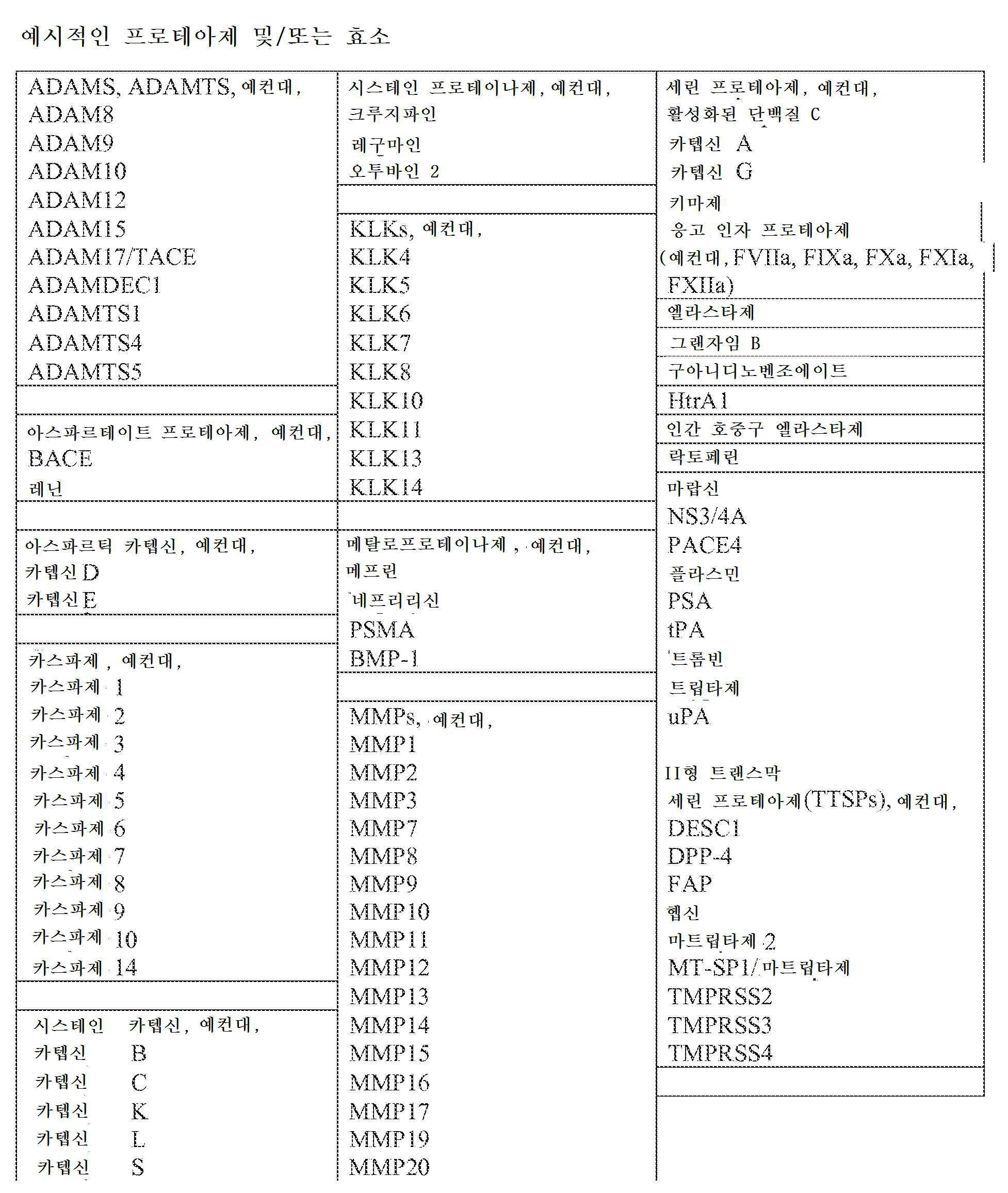
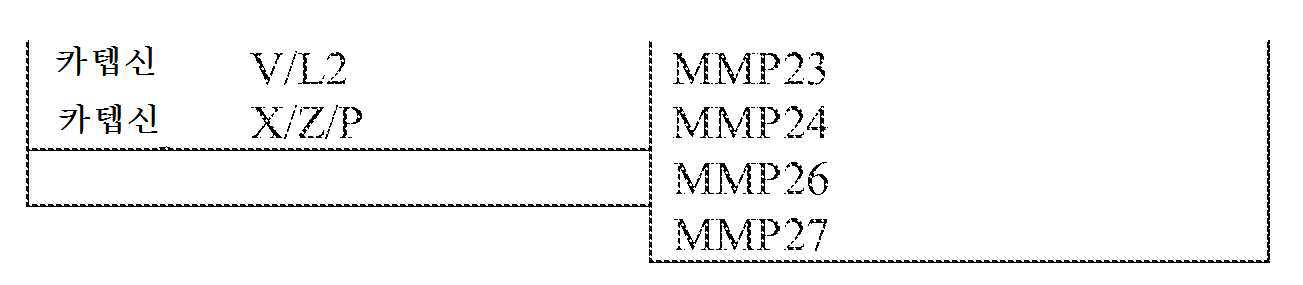
예를 들어, 일부 실시양태에서, 기질은 하기 효소 또는 프로테아제: uPA, 레구마인, MT-SP1, ADAM17, BMP-1, TMPRSS3, TMPRSS4, MMP-9, MMP-12, MMP-13, 및/또는 MMP-14 중 하나 이상의 것에 의해 절단가능한 것이다. 일부 실시양태에서, 프로테아제는 uPA, 레구마인, 및 MT-SP1로 이루어진 군으로부터 선택된다. 일부 실시양태에서, 프로테아제는 매트릭스 메탈로프로테이나제이다. 일부 실시양태에서, 프로테아제는 uPA를 포함한다. 일부 실시양태에서, 프로테아제는 레구마인을 포함한다. 일부 실시양태에서, 프로테아제는 MT-SP1을 포함한다.For example, in some embodiments, the substrate is the following enzyme or protease: uPA, legumine, MT-SP1, ADAM17, BMP-1, TMPRSS3, TMPRSS4, MMP-9, MMP-12, MMP-13, and/ Or it is cleavable by one or more of MMP-14. In some embodiments, the protease is selected from the group consisting of uPA, legumine, and MT-SP1. In some embodiments, the protease is a matrix metalloproteinase. In some embodiments, the protease comprises uPA. In some embodiments, the protease comprises legumine. In some embodiments, the protease comprises MT-SP1.
일부 실시양태에서, CM은 특정 프로테아제와의 사용을 위해 선택된다. 일부 실시양태에서, CM은 ADAM 17, BMP-1, 시스테인 프로테아제, 예컨대, 카텝신, HtrA1, 레구마인, 마트립타제(MT-SP1), 매트릭스 메탈로프로테아제(MMP), 호중성 엘라스타제, TMPRSS, 예컨대, TMPRSS3 또는 TMPRSS4, 트롬빈, 및 u형 플라스미노겐 활성인자(uPA, 이는 또한 우로키나제로도 지칭된다)로 이루어진 군으로부터 선택되는 1개 이상의 프로테아제에 대한 기질이다. In some embodiments, the CM is selected for use with a specific protease. In some embodiments, the CM is ADAM 17, BMP-1, cysteine protease, such as cathepsin, HtrA1, legumine, matriptase (MT-SP1), matrix metalloprotease (MMP), neutrophil elastase. , TMPRSS, such as TMPRSS3 or TMPRSS4, thrombin, and u-type plasminogen activator (uPA, which is also referred to as urokinase) is a substrate for one or more proteases selected from the group consisting of.
일부 실시양태에서, CM은 ADAM17에 대한 기질이다. 일부 실시양태에서, CM은 BMP-1에 대한 기질이다. 일부 실시양태에서, CM은 카텝신에 대한 기질이다. 일부 실시양태에서, CM은 시스테인 프로테아제에 대한 기질이다. 일부 실시양태에서, CM은 HtrA1에 대한 기질이다. 일부 실시양태에서, CM은 레구마인에 대한 기질이다. 일부 실시양태에서, CM은 MT-SP1에 대한 기질이다. 일부 실시양태에서, CM은 MMP에 대한 기질이다. 일부 실시양태에서, CM은 호중성 엘라스타제에 대한 기질이다. 일부 실시양태에서, CM은 트롬빈에 대한 기질이다. 일부 실시양태에서, CM은 TMPRSS에 대한 기질이다. 일부 실시양태에서, CM은 TMPRSS3에 대한 기질이다. 일부 실시양태에서, CM은 TMPRSS4에 대한 기질이다. 일부 실시양태에서, CM은 uPA에 대한 기질이다.In some embodiments, the CM is a substrate for ADAM17. In some embodiments, the CM is a substrate for BMP-1. In some embodiments, the CM is a substrate for cathepsin. In some embodiments, the CM is a substrate for cysteine protease. In some embodiments, the CM is a substrate for HtrA1. In some embodiments, the CM is a substrate for legumine. In some embodiments, the CM is a substrate for MT-SP1. In some embodiments, the CM is a substrate for MMP. In some embodiments, the CM is a substrate for neutrophil elastase. In some embodiments, the CM is a substrate for thrombin. In some embodiments, the CM is a substrate for TMPRSS. In some embodiments, the CM is a substrate for TMPRSS3. In some embodiments, the CM is a substrate for TMPRSS4. In some embodiments, the CM is a substrate for uPA.
일부 실시양태에서, 절단가능한 모이어티는 특정 프로테아제, 예를 들어, 활성화 가능한 항체의 표적과 함께 공국재화되는 것으로 알려져 있는 프로테아제와의 사용을 위해 선택된다. 예를 들어, 본 개시내용의 활성화 가능한 항체에서 사용하는 데 적합한 절단가능한 모이어티로는 서열 TGRGPSWV(서열번호 27); SARGPSRW(서열번호 28); TARGPSFK(서열번호 29); LSGRSDNH(서열번호 26); GGWHTGRN(서열번호 30); HTGRSGAL(서열번호 31); PLTGRSGG(서열번호 32); AARGPAIH(서열번호 33); RGPAFNPM(서열번호 34); SSRGPAYL(서열번호 35); RGPATPIM(서열번호 36); RGPA(서열번호 37); GGQPSGMWGW(서열번호 38); FPRPLGITGL(서열번호 39); VHMPLGFLGP(서열번호 40); SPLTGRSG(서열번호 41); SAGFSLPA(서열번호 42); LAPLGLQRR(서열번호 43); SGGPLGVR(서열번호 44); 및/또는 PLGL(서열번호 45)을 포함한다. In some embodiments, the cleavable moiety is selected for use with a specific protease, e.g., a protease known to colocalize with the target of the activatable antibody. For example, suitable cleavable moieties for use in the activatable antibodies of the present disclosure include the sequence TGRGPSWV (SEQ ID NO: 27); SARGPSRW (SEQ ID NO: 28); TARGPSFK (SEQ ID NO: 29); LSGRSDNH (SEQ ID NO: 26); GGWHTGRN (SEQ ID NO: 30); HTGRSGAL (SEQ ID NO: 31); PLTGRSGG (SEQ ID NO: 32); AARGPAIH (SEQ ID NO: 33); RGPAFNPM (SEQ ID NO: 34); SSRGPAYL (SEQ ID NO: 35); RGPATPIM (SEQ ID NO: 36); RGPA (SEQ ID NO: 37); GGQPSGMWGW (SEQ ID NO: 38); FPRPLGITGL (SEQ ID NO: 39); VHMPLGFLGP (SEQ ID NO: 40); SPLTGRSG (SEQ ID NO: 41); SAGFSLPA (SEQ ID NO: 42); LAPLGLQRR (SEQ ID NO: 43); SGGPLGVR (SEQ ID NO: 44); And/or PLGL (SEQ ID NO: 45).
일부 실시양태에서, CM은 1개 이상의 매트릭스 메탈로프로테아제(MMP)에 대한 기질이다. MMP의 예로는 MMP1; MMP2; MMP3; MMP7; MMP8; MMP9; MMP10; MMP11; MMP12; MMP13; MMP14; MMP15; MMP16; MMP17; MMP19; MMP20; MMP23; MMP24; MMP26; 및 MMP27을 포함한다. 일부 실시양태에서, CM은 MMP9, MMP14, MMP1, MMP3, MMP13, MMP17, MMP11, 및 MMP19에 대한 기질이다. 일부 실시양태에서, CM은 MMP7에 대한 기질이다. 일부 실시양태에서, CM은 MMP9에 대한 기질이다. 일부 실시양태에서, CM은 MMP14에 대한 기질이다. 일부 실시양태에서, CM은 2개 이상의 MMP에 대한 기질이다. 일부 실시양태에서, CM은 적어도 MMP9 및 MMP14에 대한 기질이다. 일부 실시양태에서, CM은 동일한 MMP에 대한 2개 이상의 기질을 포함한다. 일부 실시양태에서, CM은 적어도 2개 이상의 MMP9 기질을 포함한다. 일부 실시양태에서, CM은 적어도 2개 이상의 MMP14 기질을 포함한다.In some embodiments, the CM is a substrate for one or more matrix metalloproteases (MMPs). Examples of MMP include MMP1; MMP2; MMP3; MMP7; MMP8; MMP9; MMP10; MMP11; MMP12; MMP13; MMP14; MMP15; MMP16; MMP17; MMP19; MMP20; MMP23; MMP24; MMP26; And MMP27. In some embodiments, the CM is a substrate for MMP9, MMP14, MMP1, MMP3, MMP13, MMP17, MMP11, and MMP19. In some embodiments, the CM is a substrate for MMP7. In some embodiments, the CM is a substrate for MMP9. In some embodiments, the CM is a substrate for MMP14. In some embodiments, the CM is a substrate for two or more MMPs. In some embodiments, the CM is a substrate for at least MMP9 and MMP14. In some embodiments, the CM comprises two or more substrates for the same MMP. In some embodiments, the CM comprises at least two or more MMP9 substrates. In some embodiments, the CM comprises at least two or more MMP14 substrates.
일부 실시양태에서, CM은 MMP에 대한 기질이고, 서열 ISSGLLSS(서열번호 316); QNQALRMA(서열번호 317); AQNLLGMV(서열번호 318); STFPFGMF(서열번호 319); PVGYTSSL(서열번호 320); DWLYWPGI(서열번호 321); MIAPVAYR(서열번호 322); RPSPMWAY(서열번호 21); WATPRPMR(서열번호 323); FRLLDWQW(서열번호 324); LKAAPRWA(서열번호 325); GPSHLVLT(서열번호 326); LPGGLSPW(서열번호 327); MGLFSEAG(서열번호 328); SPLPLRVP(서열번호 329); RMHLRSLG(서열번호 330); LAAPLGLL(서열번호 331); AVGLLAPP(서열번호 332); LLAPSHRA(서열번호 333); PAGLWLDP(서열번호 334); 및/또는 ISSGLSS(서열번호 335)를 포함한다. In some embodiments, the CM is a substrate for MMP and has the sequence ISSGLLSS (SEQ ID NO: 316); QNQALRMA (SEQ ID NO: 317); AQNLLGMV (SEQ ID NO: 318); STFPFGMF (SEQ ID NO: 319); PVGYTSSL (SEQ ID NO: 320); DWLYWPGI (SEQ ID NO: 321); MIAPVAYR (SEQ ID NO: 322); RPSPMWAY (SEQ ID NO: 21); WATPRPMR (SEQ ID NO: 323); FRLLDWQW (SEQ ID NO: 324); LKAAPRWA (SEQ ID NO: 325); GPSHLVLT (SEQ ID NO: 326); LPGGLSPW (SEQ ID NO: 327); MGLFSEAG (SEQ ID NO: 328); SPLPLRVP (SEQ ID NO: 329); RMHLRSLG (SEQ ID NO: 330); LAAPLGLL (SEQ ID NO: 331); AVGLLAPP (SEQ ID NO: 332); LLAPSHRA (SEQ ID NO: 333); PAGLWLDP (SEQ ID NO: 334); And/or ISSGLSS (SEQ ID NO: 335).
일부 실시양태에서, 본 개시내용의 다중특이성 항체 및/또는 다중특이성 활성화 가능한 항체는 재조합 DNA 기술 및 진핵성 또는 원핵성 종에서의 발현을 사용하여 생합성적으로 제조될 수 있다. 다중특이성 활성화 가능한 항체의 경우, 마스킹 모이어티, (절단가능한 모이어티(CM), 및 항체 쇄(중쇄 또는 경쇄)를 포함할 수 있는) 링커 서열을 코딩하는 cDNA는 5'→3' (번역된 생성물에서 N 말단에서 C 말단) 서열로 연결되어 핵산 구성물을 생성할 수 있고, 이 핵산 구성물은 종래의 항체 발현 프로세스 후 다중특이성 활성화 가능한 항체 단백질로서 발현된다. 일부 실시양태에서, 다중특이성 활성화 가능한 항체는 CM-항체를 발현한 후, 상기 단백질의 N 말단에서, 또는 그 부근에서 화학적으로 마스크와 커플링함으로써 반합성적으로 제조될 수 있다. 일부 실시양태에서, 다중특이성 활성화 가능한 항체는 항체를 발현한 후, 다중특이성 활성화 가능한 항체가 절단되지 않은 상태에서 N 말단에서 C 말단으로 하기: MM-CM-AB 또는 AB-CM-MM와 같은 구조적 배열을 가지도록 상기 단백질의 N 말단에서, 또는 그 부근에서 화학적으로 마스크 및 CM과 커플링함으로써 제조될 수 있다. In some embodiments, multispecific antibodies and/or multispecific activatable antibodies of the present disclosure can be produced biosynthetically using recombinant DNA technology and expression in eukaryotic or prokaryotic species. For multispecific activatable antibodies, cDNA encoding a linker sequence (which may include a masking moiety, a cleavable moiety (CM), and an antibody chain (heavy or light chain)) is 5'→3' (translated In the product, N-terminal to C-terminal) sequences can be linked to produce a nucleic acid construct, which is expressed as a multispecific activatable antibody protein after a conventional antibody expression process. In some embodiments, multispecific activatable antibodies can be made semi-synthetically by expressing the CM-antibody and then chemically coupling with a mask at or near the N-terminus of the protein. In some embodiments, the multispecific activatable antibody is expressed from the N-terminus to the C-terminus in the state in which the multispecific activatable antibody is not cleaved after expressing the antibody: structural, such as MM-CM-AB or AB-CM-MM It can be prepared by chemically coupling the mask and CM at or near the N-terminus of the protein to have an arrangement.
본원에 기술된 조성물에서 사용되는 데 적합한 링커는 일반적으로 변형된 AB 또는 다중특이성 활성화 가능한 항체의 가요성을 제공하여 적어도 제1 AB의 표적에의 결합의 억제를 촉진시키는 것이다. 상기 링커는 일반적으로 가용성 링커로서 지칭된다. 적합한 링커는 쉽게 선택될 수 있으며, 예컨대, 1개의 아미노산(예컨대, Gly) 내지 20개의 아미노산, 2개의 아미노산 내지 15개의 아미노산, 3개의 아미노산 내지 12개의 아미노산(4개의 아미노산 내지 10개의 아미노산, 5개의 아미노산 내지 9개의 아미노산, 6개의 아미노산 내지 8개의 아미노산, 또는 7개의 아미노산 내지 8개의 아미노산 포함)과 같이, 상이한 길이의 적합한 것 중 임의의 것일 수 있으며, 그의 길이는 1, 2, 3, 4, 5, 6, 7, 8, 9, 10, 11, 12, 13, 14, 15, 16, 17, 18, 19, 또는 20개의 아미노산 길이일 수 있다. Linkers suitable for use in the compositions described herein are generally those that provide flexibility of the modified AB or multispecific activatable antibody to facilitate inhibition of binding of at least the first AB to the target. Such linkers are generally referred to as soluble linkers. Suitable linkers can be easily selected, e.g. 1 amino acid (e.g. Gly) to 20 amino acids, 2 amino acids to 15 amino acids, 3 amino acids to 12 amino acids (4 amino acids to 10 amino acids, 5 Amino acids to 9 amino acids, 6 amino acids to 8 amino acids, or 7 amino acids to 8 amino acids), which can be any of the suitable ones of different lengths, the length of which is 1, 2, 3, 4, It may be 5, 6, 7, 8, 9, 10, 11, 12, 13, 14, 15, 16, 17, 18, 19, or 20 amino acids long.
예시적인 가요성 링커로는 글리신 중합체 (G)n, 글리신-세린 중합체(예를 들어, (GS)n, (GSGGS)n(서열번호 18) 및 (GGGS)n(서열번호 19)(여기서, n은 1 이상인 정수이다) 포함)), 글리신-알라닌 중합체, 알라닌-세린 중합체, 및 당업계에 공지된 다른 가요성 링커를 포함한다. 글리신 및 글리신-세린 중합체는 상대적으로 비구조적이며, 따라서, 성분 사이의 중성 테더로서의 역할을 할 수 있다. 글리신은 심지어 알라닌보다도 유의적으로 더욱 phi-psi 공간에 접근하며, 보다 긴 측쇄를 가지는 잔기보다 훨씬 더 적게 제약된다 (문헌 [Scheraga, Rev. Computational Chem. 11173-142 (1992)] 참조). 예시적인 가요성 링커로는 Gly-Gly-Ser-Gly(서열번호 20), Gly-Gly-Ser-Gly-Gly(서열번호 21), Gly-Ser-Gly-Ser-Gly(서열번호 22), Gly-Ser-Gly-Gly-Gly(서열번호 23), Gly-Gly-Gly-Ser-Gly(서열번호 24), Gly-Ser-Ser-Ser-Gly(서열번호 25) 등을 포함하나, 이에 한정되지 않는다. 당업계의 숙련가는 활성화 가능한 항체의 디자인이 모두 또는 부분적으로 가요성인 링커를 포함할 수 있으며, 이로써, 링커는 원하는 다중특이성 활성화 가능한 항체 구조를 제공하기 위해 가용성 링커뿐만 아니라, 덜 가요성인 구조를 부여하는 하나 이상의 일부분을 포함할 수 있다는 것을 이해할 것이다. Exemplary flexible linkers include glycine polymer (G)n, glycine-serine polymer (e.g., (GS)n, (GSGGS)n (SEQ ID NO: 18) and (GGGS)n (SEQ ID NO: 19), wherein n is an integer greater than or equal to 1))), glycine-alanine polymer, alanine-serine polymer, and other flexible linkers known in the art. Glycine and glycine-serine polymers are relatively non-structural and can thus serve as neutral tethers between components. Glycine even accesses the phi-psi space significantly more than alanine, and is much less constrained than residues with longer side chains (see Scheraga, Rev. Computational Chem. 11173-142 (1992)). Exemplary flexible linkers include Gly-Gly-Ser-Gly (SEQ ID NO: 20), Gly-Gly-Ser-Gly-Gly (SEQ ID NO: 21), Gly-Ser-Gly-Ser-Gly (SEQ ID NO: 22), Gly-Ser-Gly-Gly-Gly (SEQ ID NO: 23), Gly-Gly-Gly-Ser-Gly (SEQ ID NO: 24), Gly-Ser-Ser-Ser-Gly (SEQ ID NO: 25), etc. Not limited. Those skilled in the art may include a linker in which the design of the activatable antibody is all or partly flexible, whereby the linker imparts a less flexible structure as well as a soluble linker to provide the desired multispecific activatable antibody structure. It will be appreciated that it may include more than one portion of the body.
상기 기술된 요소 이외에도, 다중특이성 활성화 가능한 항체는 추가의 요소, 예컨대, 다중특이성 활성화 가능한 항체의 아미노산 서열 N 또는 C 말단을 함유할 수 있다. 예를 들어, 다중특이성 활성화 가능한 항체는 관심의 대상이 되는 세포 또는 조직으로의 전달을 촉진시키기 위해 표적화 모이어티를 포함할 수 있다. 다중특이성 활성화 가능한 항체는 작용제, 예컨대, 치료제, 항신생물제, 독소 또는 그의 단편, 검출가능한 모이어티 또는 진단제에 컨쥬게이트될 수 있다. 작용제의 예는 본원에 개시되어 있다. In addition to the elements described above, the multispecifically activatable antibody may contain additional elements, such as the N or C terminus of the amino acid sequence of the multispecifically activatable antibody. For example, a multispecific activatable antibody can include a targeting moiety to facilitate delivery to a cell or tissue of interest. Multispecific activatable antibodies can be conjugated to an agent such as a therapeutic agent, an anti-neoplastic agent, a toxin or fragment thereof, a detectable moiety or a diagnostic agent. Examples of agents are disclosed herein.
다중특이성 활성화 가능한 항체는 또한 비제한적인 일례의 것을 비롯하여, 본 개시내용의 다중특이성 항체와 함께 컨쥬게이트된 작용제, 링커 및 본원에 기술된 다른 성분들 중 임의의 것, 하기 표 4에 열거된 작용제 중 임의의 것 및/또는 하기 표 5 및/또는 표 6에 열거된 링커 중 임의의 것을 포함할 수 있다. Multispecific activatable antibodies also include, but are not limited to, agents conjugated with multispecific antibodies of the present disclosure, linkers, and any of the other components described herein, agents listed in Table 4 below. And/or any of the linkers listed in Table 5 and/or Table 6 below.
컨쥬게이트된Conjugated 다중특이성 항체 및 Multispecific antibodies and 컨쥬게이트된Conjugated 다중특이성 활성화 가능한 항체 Antibodies capable of multispecific activation
본 개시내용은 또한 세포독성제, 예컨대, 독소(예컨대, 박테리아, 진균, 식물, 또는 동물 기원의 효소적으로 활성인 독소, 또는 그의 단편), 또는 방사성 동위원소(즉, 방사성 컨쥬게이트)에 컨쥬게이트된 다중특이성 항체 및/또는 다중특이성 활성화 가능한 항체를 포함하는 면역컨쥬게이트에 관한 것이다. 적합한 세포독성제로는 예를 들어, 돌라스타틴 및 그의 유도체(예컨대, 아우리스타틴 E, AFP, MMAD, MMAF, MMAE)를 포함한다. 예를 들어, 세포독성제는 모노메틸 아우리스타틴 E(MMAE)이다. 일부 실시양태에서, 작용제는 모노메틸 아우리스타틴 D(MMAD)이다. 일부 실시양태에서, 작용제는 하기 표 4에 열거되어 있는 군으로부터 선택되는 작용제이다. 일부 실시양태에서, 작용제는 돌라스타틴이다. 일부 실시양태에서, 작용제는 아우리스타틴 또는 그의 유도체이다. 일부 실시양태에서, 작용제는 아우리스타틴 E 또는 그의 유도체이다. 일부 실시양태에서, 작용제는 모노메틸 아우리스타틴 E(MMAE)이다. 일부 실시양태에서, 작용제는 메이탄시노이드 또는 메이탄시노이드 유도체이다. 일부 실시양태에서, 작용제는 DM1 또는 DM4이다. 일부 실시양태에서, 작용제는 듀오카르마이신 또는 그의 유도체이다. 일부 실시양태에서, 작용제는 칼리키아미신 또는 그의 유도체이다. 일부 실시양태에서, 작용제는 피롤로벤조디아제핀이다.The present disclosure also conjugates to cytotoxic agents, such as toxins (e.g., enzymatically active toxins of bacterial, fungal, plant, or animal origin, or fragments thereof), or radioactive isotopes (i.e., radioactive conjugates). It relates to an immunoconjugate comprising a gated multispecific antibody and/or a multispecific activatable antibody. Suitable cytotoxic agents include, for example, dolastatin and derivatives thereof (eg, auristatin E, AFP, MMAD, MMAF, MMAE). For example, the cytotoxic agent is monomethyl auristatin E (MMAE). In some embodiments, the agent is monomethyl auristatin D (MMAD). In some embodiments, the agent is an agent selected from the group listed in Table 4 below. In some embodiments, the agent is dolastatin. In some embodiments, the agent is an auristatin or a derivative thereof. In some embodiments, the agent is auristatin E or a derivative thereof. In some embodiments, the agent is monomethyl auristatin E (MMAE). In some embodiments, the agent is a maytansinoid or a maytansinoid derivative. In some embodiments, the agent is DM1 or DM4. In some embodiments, the agent is duocarmycin or a derivative thereof. In some embodiments, the agent is calicheamicin or a derivative thereof. In some embodiments, the agent is pyrrolobenzodiazepine.
사용될 수 있는 효소적으로 활성인 독소 및 그의 단편으로는 디프테리아 A 쇄, 디프테리아 독소의 비결합 활성 단편, 외독소 A 쇄(슈도모나스 아에루기노사(Pseudomonas aeruginosa) 유래), 리신 A 쇄, 아브린 A 쇄, 모데신 A 쇄, 알파 사르신, 유동나무(Aleurites fordii) 단백질, 디안틴 단백질, 미국 자리공(Phytolaca americana) 단백질(PAPI, PAPII, 및 PAP-S), 여주(momordica charantia) 억제제, 커신, 크로틴, 사파오나리 오피시날리스(sapaonaria officinalis) 억제제, 젤로닌, 미토겔린, 레스트릭토신, 페노마이신, 에노마이신 및 트리코테센을 포함한다. 다양한 방사성핵종이 방사성 컨쥬게이트된 항체의 제조에 이용가능하다. 그 예로는 212Bi, 64Cu, 125I, 131I, 131In, 99mTc, 90Y, 186Re, 및 89Zr을 포함한다. Enzymatically active toxins and fragments thereof that can be used include diphtheria A chain, non-binding active fragment of diphtheria toxin, exotoxin A chain (from Pseudomonas aeruginosa ), lysine A chain, abrin A chain , Modecin A chain, alpha sarsin , Aleurites fordii protein, diantin protein, US Phytolaca americana protein (PAPI, PAPII, and PAP-S), momordica charantia inhibitor, cursin, crocodile Tin, sapaonaria officinalis inhibitors, gelonine, mitogelin, restrictocin, phenomycin, enomycin and tricotene. A variety of radionuclides are available for the preparation of radioconjugated antibodies. Examples include 212 Bi, 64 Cu, 125 I, 131 I, 131 In, 99m Tc, 90 Y, 186 Re, and 89 Zr.
항체 및 세포독성제의 컨쥬게이트는 다양한 이작용성 단백질 커플링제, 예컨대, N-숙신이미딜-3-(2-피리딜디티올) 프로피오네이트(SPDP), 이미노티올란(IT), 이미도에스테르의 이작용성 유도체(예컨대, 디메틸 아디피미데이트 HCL), 활성 에스테르(예컨대, 디숙신이미딜 수베레이트), 알데하이드(예컨대, 글루타르알데하이드), 비스-아지도 화합물(예컨대, 비스(p-아지도벤조일)헥산디아민), 비스-디아조늄 유도체(예컨대, 비스-(p-디아조늄벤조일)-에틸렌디아민), 디이소시아네이트(예컨대, 톨리엔 2,6-디이소시아네이트), 및 비스-활성 불소 화합물(예컨대, 1,5-디플루오로-2,4-디니트로벤젠)을 사용하여 제조된다. 예를 들어, 리신 면역독소는 문헌 [Vitetta et al., Science 238: 1098 (1987)]에 기술된 바와 같이 제조될 수 있다. 탄소-14-표지화된 1-이소티오시아네이토벤질-3-메틸디에틸렌 트리아민펜타아세트산(MX-DTPA)은 방사성뉴클레오티드의 항체에의 컨쥬게이트를 위한 예시적인 킬레이트화제이다(WO94/11026 참조).Conjugates of antibodies and cytotoxic agents are various bifunctional protein coupling agents such as N-succinimidyl-3-(2-pyridyldithiol) propionate (SPDP), iminothiolane (IT), imidoester. Difunctional derivatives of (e.g., dimethyl adipimidate HCL), active esters (e.g., disuccinimidyl suberate), aldehydes (e.g. glutaraldehyde), bis-azido compounds (e.g., bis(p-azido Benzoyl) hexanediamine), bis-diazonium derivatives (e.g. bis-(p-diazoniumbenzoyl)-ethylenediamine), diisocyanates (e.g.
하기 표 4에는 본원에 기술된 기술내용에서 사용될 수 있는 예시적인 제약 제제의 일부가 열거되어 있지만, 이는 어느 방식으로든 배타적인 목록을 의미하는 것은 아니다. Table 4 below lists some of the exemplary pharmaceutical formulations that can be used in the context described herein, but this is not meant to be an exhaustive list in any way.

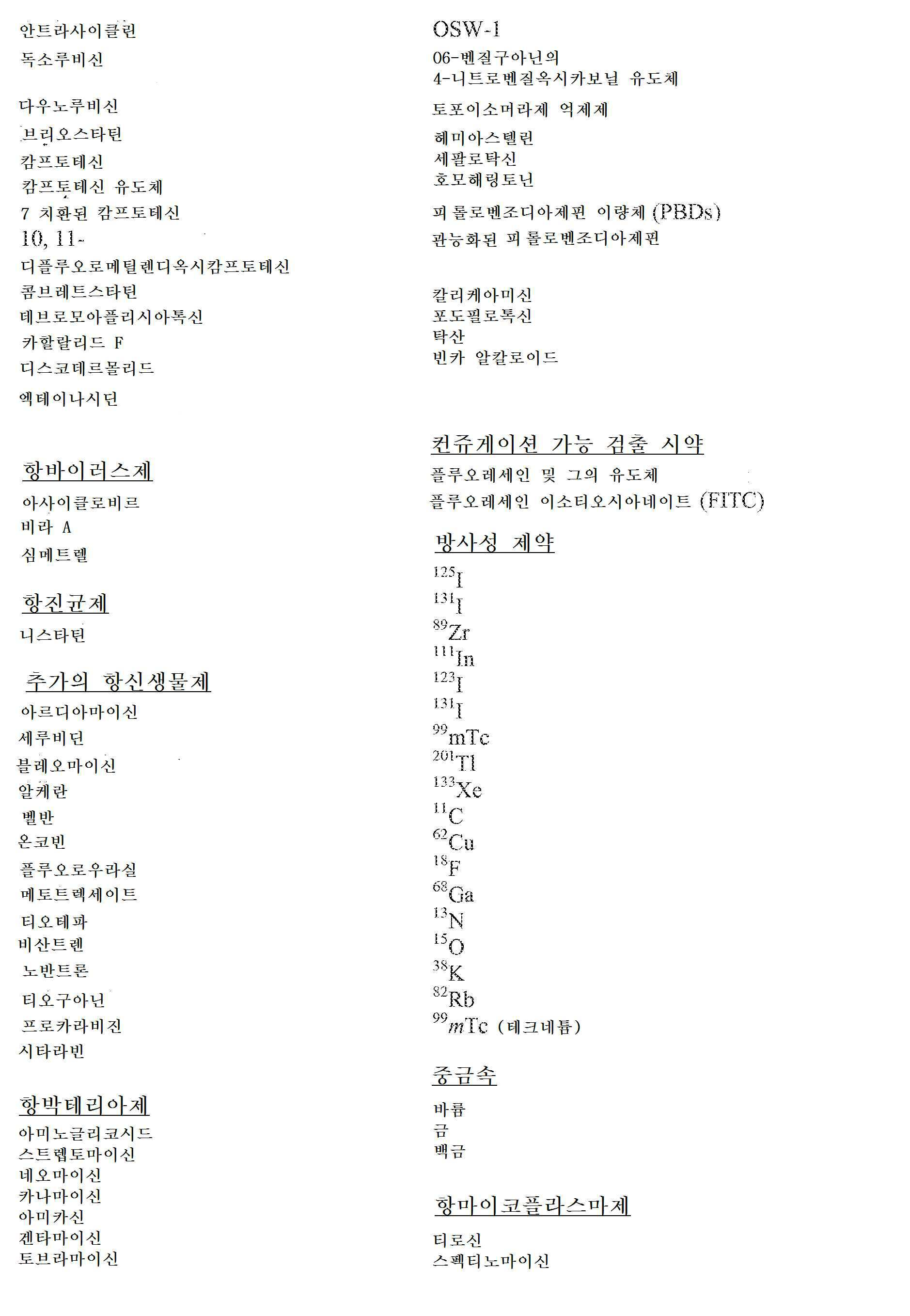

당업계의 숙련가는 매우 다양한 가능성이 있는 모이어티가 본 개시내용의 생성된 다중특이성 항체 및/또는 다중특이성 활성화 가능한 항체에 커플링될 수 있다는 것을 이해할 것이다(예를 들어, 문헌 ["Conjugate Vaccines", Contributions to Microbiology and Immunology, J. M. Cruse and R. E. Lewis, Jr (eds), Carger Press, New York, (1989)](상기 문헌은 그 내용 전문이 본원에서 참조로 포함된다) 참조). Those of skill in the art will understand that a wide variety of possible moieties can be coupled to the resulting multispecific antibodies and/or multispecific activatable antibodies of the present disclosure (see, eg , “Conjugate Vaccines”). , Contributions to Microbiology and Immunology, JM Cruse and RE Lewis, Jr (eds), Carger Press, New York, (1989)], which is incorporated herein by reference in its entirety).
커플링은 항체 및 다른 모이어티가 그의 개별 활성을 보유하는 한 2개 분자에 결합하게 되는 임의의 화학 반응에 의해 달성될 수 있다. 이러한 연결은 많은 화학 기전, 예를 들어, 공유 결합, 친화성 결합, 인터칼레이션, 배위 결합 및 착체화를 포함할 수 있다. 그러나, 일부 실시양태에서, 바람직한 결합은 공유 결합이다. 공유 결합은 존재하는 측쇄의 직접적인 축합에 의해서 또는 외부 가교 분자의 도입에 의해 획득될 수 있다. 다수의 2가 또는 다가 연결제는 단백질 분자, 예컨대, 본 개시내용의 항체를 다른 분자에 커플링하는 데 유용하다. 예를 들어, 대표적인 커플링제로는 유기 화합물, 예컨대, 티오에스테르, 카보디이미드, 숙신이미드 에스테르, 디이소시아네이트, 글루타르알데하이드, 디아조벤젠 및 헥사메틸렌 디아민을 포함한다. 상기 목록은 당업계에 공지된 다양한 부류의 커플링제를 배제하고자 하는 것이 아니며, 단지 보다 일반적인 커플링제에 대한 예이다(문헌 [Killen and Lindstrom, Jour. Immun. 133:1335-2549 (1984)]; [Jansen et al., Immunological Reviews 62:185-216 (1982)]; 및 [Vitetta et al., Science 238:1098 (1987)] 참조). Coupling can be accomplished by any chemical reaction that causes the antibody and other moieties to bind to two molecules as long as they retain their individual activity. Such linkages can involve many chemical mechanisms, such as covalent bonding, affinity bonding, intercalation, coordination bonding and complexing. However, in some embodiments, a preferred bond is a covalent bond. Covalent bonds can be obtained by direct condensation of existing side chains or by introduction of external crosslinking molecules. Many divalent or multivalent linking agents are useful for coupling protein molecules, such as antibodies of the present disclosure, to other molecules. For example, representative coupling agents include organic compounds such as thioesters, carbodiimides, succinimide esters, diisocyanates, glutaraldehyde, diazobenzenes and hexamethylene diamines. The above list is not intended to exclude the various classes of coupling agents known in the art, but is merely an example of a more general coupling agent (Killen and Lindstrom, Jour. Immun. 133:1335-2549 (1984)); [Jansen et al., Immunological Reviews 62:185-216 (1982)]; and Vitetta et al., Science 238:1098 (1987)).
일부 실시양태에서, 본원에서 제공하는 조성물 및 방법 이외에도, 컨쥬게이트된 활성화 가능한 항체는 또한 부위 특이 컨쥬게이션을 위해 활성화 가능한 항체 서열에 삽입된, 또는 다르게는 포함된 변형된 아미노산 서열을 통해 변형될 수 있다. 상기 변형된 아미노산 서열은 컨쥬게이트된 활성화 가능한 항체 내에서 컨쥬게이트된 작용제의 배치 및/또는 투여량이 제어될 수 있도록 디자인된다. 예를 들어, 활성화 가능한 항체는 반응성 티올 기를 제공하며, 단백질 폴딩 및 조립에는 부정적인 영향을 미치지도 않고, 항원 결합도 변경시키지 않는, 경쇄 및 중쇄 상의 위치에 시스테인 치환을 포함하도록 조작될 수 있다. 일부 실시양태에서, 활성화 가능한 항체는 컨쥬게이션을 위해 적합한 부위를 제공하기 위하여 활성화 가능한 항체 내에 하나 이상의 비천연 아미노산 잔기를 포함하거나, 또는 다르게는 그를 도입하도록 조작될 수 있다. 일부 실시양태에서, 활성화 가능한 항체는 활성화 가능한 항체 서열 내에 효소적으로 활성화 가능한 펩티드 서열을 포함하거나, 또는 다르게는 그를 도입하도록 조작될 수 있다. In some embodiments, in addition to the compositions and methods provided herein, the conjugated activatable antibody can also be modified via a modified amino acid sequence inserted or otherwise contained in the activatable antibody sequence for site specific conjugation. have. The modified amino acid sequence is designed such that the placement and/or dosage of the conjugated agent within the conjugated activatable antibody can be controlled. For example, activatable antibodies can be engineered to include cysteine substitutions at positions on the light and heavy chains that provide reactive thiol groups and do not negatively affect protein folding and assembly, nor alter antigen binding. In some embodiments, the activatable antibody can be engineered to contain, or otherwise introduce, one or more non-natural amino acid residues within the activatable antibody to provide suitable sites for conjugation. In some embodiments, the activatable antibody can be engineered to include, or otherwise introduce, an enzymatically activatable peptide sequence within the activatable antibody sequence.
적합한 링커는 문헌에 기술되어 있다(예를 들어, MBS(M-말레이미도벤조일-N-하이드록시숙신이미드 에스테르)의 사용을 기술하는 문헌 [Ramakrishnan, S. et al., Cancer Res. 44:201-208 (1984)]참조). 또한, 올리고펩티드 링커에 의해 항체에 커플링된 할로겐화된 아세틸 하이드라지드 유도체의 사용을 기술하는 미국 특허 번호 제5,030,719호를 참조할 수 있다. 특히 적합한 링커로는 (i) SMPT(4-숙신이미딜옥시카보닐-알파-메틸-알파-(2-피리딜-디티오)-톨루엔(피어스 켐. 컴퍼니(Pierce Chem. Co.), 카탈로그 (21558G); (ii) SPDP(숙신이미딜-6 [3-(2-피리딜디티오) 프로피온아미도]헥사노에이트(피어스 켐. 컴퍼니, 카탈로그 번호 21651G); 및 (iii) 술포-LC-SPDP(술포숙신이미딜 6 [3-(2-피리딜디티오)-프로피안아미드]헥사노에이트 (피어스 켐. 컴퍼니, 카탈로그 번호 2165-G)를 포함한다. 추가의 링커로는 SMCC, 술포-SMCC, SPDB, 또는 술포-SPDB를 포함하나, 이에 한정되지 않는다.Suitable linkers are described in the literature (for example, Ramakrishnan, S. et al., Cancer Res. 44: describing the use of MBS (M-maleimidobenzoyl-N-hydroxysuccinimide ester)). 201-208 (1984)]. See also US Pat. No. 5,030,719 which describes the use of halogenated acetyl hydrazide derivatives coupled to antibodies by oligopeptide linkers. Particularly suitable linkers include (i) SMPT(4-succinimidyloxycarbonyl-alpha-methyl-alpha-(2-pyridyl-dithio)-toluene (Pierce Chem. Co., catalogue) (21558G); (ii) SPDP (succinimidyl-6 [3-(2-pyridyldithio) propionamido]hexanoate (Pierce Chem. Company, Cat. No. 21651G); And (iii) Sulfo-LC -SPDP (sulfosuccinimidyl 6 [3-(2-pyridyldithio)-propianamide] hexanoate (Pierce Chem. Company, Cat. No. 2165-G). Additional linkers include SMCC, Sulfo-SMCC, SPDB, or sulfo-SPDB.
상기 기술된 링커는 상이한 속성을 가지는 성분을 함유하며, 이로써, 물리화학적 특성이 상이한 컨쥬게이트가 생성된다. 예를 들어, 링커 SMPT는 입체 장애 이황화 결합을 함유하고, 안정성이 증가된 컨쥬게이트를 형성할 수 있다. 이황화 결합은 시험관내에서는 절단되기 때문에 이황화 결합은 일반적으로 다른 결합보다는 덜 안정적인 바, 이에 컨쥬게이트는 덜 이용된다. The linkers described above contain components with different properties, thereby resulting in conjugates with different physicochemical properties. For example, linker SMPT contains sterically hindered disulfide bonds and can form conjugates with increased stability. Since disulfide bonds are cleaved in vitro, disulfide bonds are generally less stable than other bonds, so conjugates are less used.
시약 EDC(1-에틸-3-(3-디메틸아미노프로필)카보디이미드 하이드로클로라이드는 카복실산 및 1차 및 2차 아민으로 출발하여 카복스아미드를 생성하는 데 유용하다. 따라서, EDC는 항체 중 리신 잔기를 링커 또는 독소 중의 카복실산과 연결시키는 데, 또는 항체 중 아스파르테이트 또는 글루타메이트 잔기를 링커 또는 독소 중의 아민과 연결시키는 데 사용될 수 있다. EDC를 사용하는 상기 컨쥬게이션 반응은 NHS(N-하이드록시숙신이미드) 또는 술포-NHS(N-하이드록시-3-옥시술포닐숙신이미드) 첨가에 의해 증진될 수 있다. 상기 컨쥬게이션 반응에 NHS 또는 술포-NHS를 첨가하면 컨쥬게이션 반응의 속도, 완전성, 선택성, 및/또는 재현가능성은 증진될 수 있다. The reagent EDC(1-ethyl-3-(3-dimethylaminopropyl)carbodiimide hydrochloride is useful for producing carboxamides starting with carboxylic acids and primary and secondary amines. Thus, EDC is lysine in the antibody. It can be used to link the moiety with the linker or the carboxylic acid in the toxin, or the aspartate or glutamate moiety in the antibody with the linker or the amine in the toxin. The conjugation reaction using EDC is NHS(N-hydroxy Succinimide) or sulfo-NHS (N-hydroxy-3-oxysulfonylsuccinimide) can be enhanced by adding NHS or sulfo-NHS to the conjugation reaction, the rate of conjugation reaction, Completeness, selectivity, and/or reproducibility can be enhanced.
일부 실시양태에서, 링커는 절단가능한 것이다. 일부 실시양태에서, 링커는 비절단가능한 것이다. 일부 실시양태에서, 2개 이상의 링커가 존재한다. 2개 이상의 링커는 모두 동일한 것으로, 예컨대, 절단가능하거나, 또는 비절단가능한 것이거나, 또는 2개 이상의 링커는 상이한 것으로, 예컨대, 1개 이상은 절단가능한 것이고, 1개 이상은 비절단가능한 것이다.In some embodiments, the linker is cleavable. In some embodiments, the linker is non-cleavable. In some embodiments, there are two or more linkers. The two or more linkers are all the same, e.g., cleavable or non-cleavable, or the two or more linkers are different, e.g., one or more is cleavable and one or more is non-cleavable.
본 개시내용은 작용제를 다중특이성 항체 및/또는 다중특이성 활성화 가능한 항체의 Ab에 부착시키는 데 수개의 방법을 사용한다: (a) AB의 탄수화물 모이어티에의 부착, 또는 (b) AB의 술프하이드릴 기에의 부착, 또는 (c) AB의 아미노 기에의 부착, 또는 (d) AB의 카복실 기에의 부착. 본 개시내용에 따라, AB는 하나는 AB와 반응하고, 하나는 작용제와 반응하는 2개 이상의 반응성 기를 가지는 중간 링커를 통해 작용제에 공유적으로 부착될 수 있다. 임의의 상용성 유기 화합물을 포함할 수 있는 링커는 AB(또는 작용제)와의 반응이 AB 반응성 및 선택성에 부정적인 영향을 미치지 않도록 선택될 수 있다. 추가로, 링커의 작용제에의 부착은 작용제의 활성을 파괴시키지 않을 수 있다. 산화된 항체 또는 산화된 항체 단편과 반응하기 적합한 링커는 1차 아민, 2차 아민, 하이드라진, 하이드라지드, 하이드록실아민, 페닐하이드라진, 세미카바지드 및 티오세미카바지드 기로 이루어진 군으로부터 선택된 아민을 함유하는 것을 포함한다. 상기 반응성 작용기는 링커의 구조의 일부분으로서 존재하거나, 또는 상기 기를 함유하지 않는 링커의 적합한 화학적 변형에 의해 도입될 수 있다. The present disclosure uses several methods to attach an agent to the Ab of a multispecific antibody and/or a multispecific activatable antibody: (a) attachment of the AB to the carbohydrate moiety, or (b) the sulfhydryl of the AB. Attachment to a group, or (c) attachment of AB to an amino group, or (d) attachment of AB to a carboxyl group. In accordance with the present disclosure, the AB may be covalently attached to an agent through an intermediate linker having two or more reactive groups, one reacting with the AB and one reacting with the agent. Linkers, which may include any compatible organic compound, may be selected such that reaction with the AB (or agonist) does not negatively affect the AB reactivity and selectivity. Additionally, attachment of a linker to an agent may not disrupt the activity of the agent. Linkers suitable for reacting with the oxidized antibody or oxidized antibody fragment include an amine selected from the group consisting of primary amine, secondary amine, hydrazine, hydrazide, hydroxylamine, phenylhydrazine, semicarbazide and thiosemicarbazide groups. Includes containing. The reactive functional group may be present as part of the structure of the linker or may be introduced by suitable chemical modification of the linker that does not contain the group.
본 개시내용에 따라, 다중특이성 항체 및/또는 다중특이성 활성화 가능한 항체의 환원된 AB에의 부착에 적합한 링커로는 환원된 항체 또는 단편의 술프하이드릴 기와 반응할 수 있는 특정 반응성 기를 가지는 것을 포함한다. 이러한 반응성 기로는 반응성 할로알킬 기(예를 들어, 할로아세틸 기 포함), p-머큐리벤조에이트 기 및 미카엘 유형 부가 반응을 수행할 수 있는 기(예를 들어, 말레이미드 및 문헌 [Mitra and Lawton, 1979, J. Amer. Chem. Soc. 101: 3097-3110]에 기술된 유형의 기 포함)를 포함하나, 이에 한정되지 않는다. In accordance with the present disclosure, linkers suitable for attachment of a multispecific antibody and/or a multispecific activatable antibody to a reduced AB include those having specific reactive groups capable of reacting with the sulfhydryl groups of the reduced antibody or fragment. Such reactive groups include reactive haloalkyl groups (including, for example, haloacetyl groups), p-mercurybenzoate groups and groups capable of carrying out Michael type addition reactions (eg maleimide and literature [Mitra and Lawton, 1979, J. Amer. Chem. Soc. 101: 3097-3110).
본 개시내용에 따라, 다중특이성 항체 및/또는 다중특이성 활성화 가능한 항체의 산화된 AB도 아닌, 환원된 AB도 아닌 것에의 부착에 적합한 링커로는 AB내 변형되지 않은 리신 잔기 내 존재하는 1차 아미노 기와 반응할 수 있는 특정 작용기를 가지는 것을 포함한다. 이러한 반응기는 NHS 카복실산 또는 카본산 에스테르, 술포-NHS 카복실산 또는 카본산 에스테르, 4-니트로페닐 카복실산 또는 카본산 에스테르, 펜타플루오로페닐 카복실산 또는 카본산 에스테르, 아실 이미다졸, 이소시아네이트, 및 이소티오시아네이트를 포함하나, 이에 한정되지 않는다. In accordance with the present disclosure, linkers suitable for attachment of a multispecific antibody and/or a multispecific activatable antibody to neither an oxidized AB nor a reduced AB include the primary amino present in the unmodified lysine residue in the AB. Includes those having specific functional groups capable of reacting with groups. These reactors include NHS carboxylic acid or carboxylic acid ester, sulfo-NHS carboxylic acid or carboxylic acid ester, 4-nitrophenyl carboxylic acid or carboxylic acid ester, pentafluorophenyl carboxylic acid or carboxylic acid ester, acyl imidazole, isocyanate, and isothiocyanate. Including, but not limited to.
본 개시내용에 따라, 산화된 AB도 아닌, 환원된 AB도 아닌 것에의 부착에 적합한 링커로는 적합한 시약으로 활성화된, AB내 아스파르테이트는 글루타메이트 잔기에 존재하는 카복실산 기와 반응할 수 있는 특정 작용기를 가지는 것을 포함한다. 적합한 활성화 시약은 부가된 NHS 또는 술포-NHS가 있거나 또는 없는, EDC, 및 카복스아미드 형성에 이용되는 다른 탈수화제를 포함한다. 이러한 예에서, 적합한 링커에 존재하는 작용기는 1차 및 2차 아민, 하이드라진, 하이드록실아민, 및 하이드라지드를 포함한다. In accordance with the present disclosure, aspartate in AB, activated with a suitable reagent as a linker suitable for attachment to neither oxidized nor reduced AB, is a specific functional group capable of reacting with the carboxylic acid group present on the glutamate moiety. Includes having Suitable activating reagents include EDC, with or without added NHS or sulfo-NHS, and other dehydrating agents used to form carboxamides. In this example, functional groups present in suitable linkers include primary and secondary amines, hydrazines, hydroxylamines, and hydrazides.
작용제는 링커가 AB가 부착되기 이전 또는 이후에 링커에 부착될 수 있다. 특정 적용에서, 링커가 회합된 작용제가 없는 AB 링커 중간체를 먼저 제조하는 것이 바람직할 수 있다. 특정 적용에 따라, 이어서, 특정 작용제를 링커에 공유적으로 부착시킬 수 있다. 다른 실시양태에서 AB는 먼저 MM, CM 및 회합된 링커에 결합된 후 컨쥬게이션 목적용 링커에 부착된다. The agent may be attached to the linker before or after the linker is attached to the AB. In certain applications, it may be desirable to first prepare an AB linker intermediate free of the agent to which the linker is associated. Depending on the particular application, certain agents may then be covalently attached to the linker. In other embodiments, the AB is first attached to the MM, CM and associated linker and then to the linker for conjugation purposes.
분지형 링커: 구체적인 실시양태에서, 작용제 부착을 위한 다중 부위를 가지는 분지형 링커가 이용된다. 다중 부위 링커를 위해, AB에의 단일 공유 부착으로 다수 부위에서 작용제에 결합할 수 있는 AB-링커 중간체가 생성될 수 있다. 부위들은 알데히드 또는 술프히드릴 기이거나, 또는 작용제가 부착될 수 있는 임의의 화학 부위일 수 있다. Branched Linker : In a specific embodiment, a branched linker having multiple sites for agent attachment is used. For multi-site linkers, a single covalent attachment to the AB can result in an AB-linker intermediate capable of binding to an agent at multiple sites. The moieties can be aldehyde or sulfhydryl groups, or any chemical moiety to which an agent can be attached.
별법으로, 보다 높은 비활성(또는 AB에 대한 작용제의 보다 높은 비율)은 AB 상에 복수 개의 부위에서 단일 부위 링커의 결합에 의해 달성될 수 있다. 이러한 복수 개의 부위는 2가지 방법 중 어느 하나에 의해 AB에 도입될 수 있다. 첫번째, 동일한 AB 내에 다중의 알데히드 기 및/또는 술프히드릴 기를 생성시킬 수 있다. 두번째, 링커에의 후속 부착을 위한 복수 개의 작용 부위를 가지는 "분지형 링커"를 AB의 알데히드 또는 술프히드릴에 부착시킬 수 있다. 분지형 링커 또는 다중 부위 링커의 작용성 부위는 알데히드 또는 술프히드릴 기이거나, 또는 링커가 부착될 수 있는 임의의 화학 부위일 수 있다. 훨씬 더 높은 비활성은 이들 2가지 접근법을 조합하여, 즉, AB 상의 수개의 부위에서 다중 부위 링커를 부착시킴으로써 얻을 수 있다. Alternatively, higher specific activity (or higher ratio of agent to AB) can be achieved by binding of single site linkers at multiple sites on the AB. These multiple sites can be introduced into the AB by either of two methods. First, it is possible to produce multiple aldehyde groups and/or sulfhydryl groups in the same AB. Second, a "branched linker" having a plurality of functional sites for subsequent attachment to the linker can be attached to the aldehyde or sulfhydryl of the AB. The functional moiety of a branched linker or multi-site linker may be an aldehyde or sulfhydryl group, or any chemical moiety to which a linker may be attached. Even higher specific activity can be achieved by combining these two approaches, i.e. attaching a multi-site linker at several sites on the AB.
절단가능한 링커: 보체계의 효소, 예컨대, 제한하는 것은 아니지만, 우로키나아제, 조직 플라스미노겐 활성인자, 트립신, 플라스민, 또는 단백질분해 활성을 가지는 다른 효소에 의한 절단에 감수성인 펩티드 링커는 본 개시내용의 한 실시양태에서 사용될 수 있다. 본 개시내용의 한 방법에 따라서, 작용제는 보체에 의한 절단에 감수성인 링커를 통해 부착된다. 항체는 보체를 활성화시킬 수 있는 부류로부터 선택된다. 따라서, 항체-작용제 컨쥬게이트는 보체 캐스캐이드를 활성화시키고, 표적 부위에서 작용제를 유리시킨다. 본 개시내용의 또 다른 방법에 따라, 작용제는 단백질분해 활성을 가지는 효소, 예컨대, 우로키나아제, 조직 플라스미노겐 활성인자, 플라스민, 또는 트립신에 의한 절단에 감수성인 링커를 통해 부착된다. 이러한 절단가능한 링커는 세포외 독소, 예컨대, 비제한적인 일례로, 표 4에 제시된 것 중 임의의 세포외 독소를 포함하는 컨쥬게이트된 활성화 가능한 항체에서 유용하다. Cleavable linker: enzyme of the complement system, such as, but not limited to, urokinase, tissue plasminogen activator, trypsin, plasmin, or a peptide linker susceptible to cleavage by other enzymes having proteolytic activity are disclosed the details Can be used in one embodiment of. According to one method of the present disclosure, the agent is attached through a linker susceptible to cleavage by complement. Antibodies are selected from the class capable of activating complement. Thus, the antibody-agent conjugate activates the complement cascade and releases the agent at the target site. According to another method of the present disclosure, the agent is attached through a linker susceptible to cleavage by enzymes having proteolytic activity, such as urokinase, tissue plasminogen activator, plasmin, or trypsin. Such cleavable linkers are useful in conjugated activatable antibodies comprising extracellular toxins, such as, but not limited to, any extracellular toxins shown in Table 4.
절단가능한 링커 서열의 비제한적인 예를 하기 표 5에 제공하고 있다.Non-limiting examples of cleavable linker sequences are provided in Table 5 below.
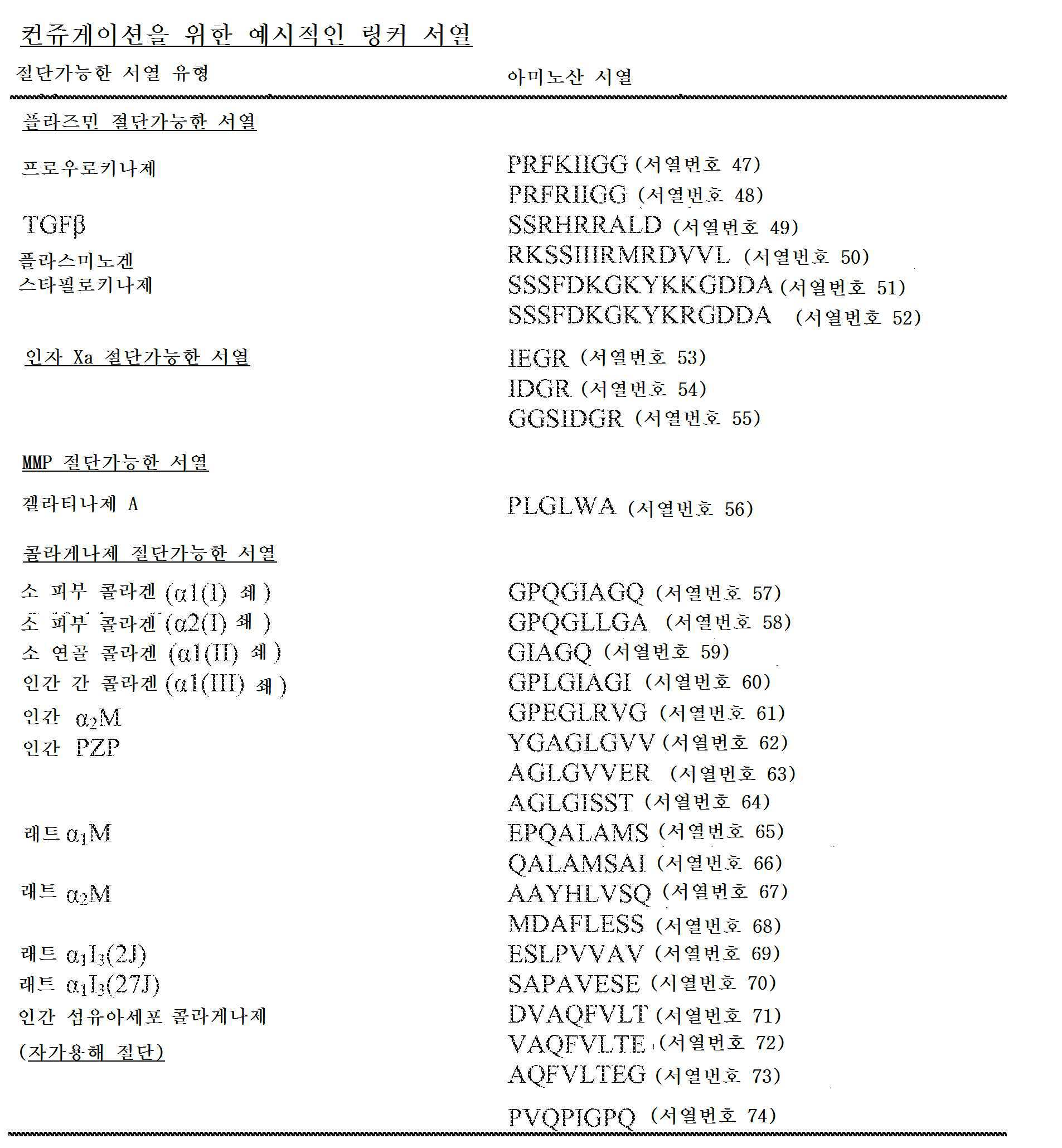
추가로, 작용제는 이황화 결합(예를 들어, 시스테인 분자 상의 이황화 결합)을 통해 AB에 부착될 수 있다. 다수의 종양은 천연적으로 고수준의 글라타티온(환원제)를 방출하는 바, 이는 이황화 결합을 환원시키고, 이어서, 전달 부위에서 작용제를 유리시킨다. 특정의 구체적인 실시양태에서, CM을 변형시킬 수 있는 환원제는 또한 컨쥬게이트된 활성화 가능한 항체의 링커도 변형시킬 수 있다. Additionally, the agent may be attached to the AB via a disulfide bond (eg, a disulfide bond on a cysteine molecule). Many tumors naturally release high levels of glatathione (reducing agent), which reduces disulfide bonds and then releases the agent at the site of delivery. In certain specific embodiments, a reducing agent capable of modifying the CM can also modify the linker of the conjugated activatable antibody.
스페이서 및 절단가능한 요소: 추가의 또 다른 실시양태에서, 활성화 가능한 항체의 작용제 및 AB 사이의 이격화를 최적화시키도록 위해 링커를 구성하는 것인 필요할 수 있다. 이는 하기 일반식의 링커를 이용하여 수행될 수 있다: Spacers and Cleavable Elements: In yet another embodiment, it may be necessary to construct the linker to optimize the spacing between the AB and the agent of the activatable antibody. This can be done using a linker of the general formula:
W - (CH2)n - QW-(CH 2 ) n-Q
여기서, here,
W는 --NH--CH2-- 또는 --CH2--이고;W is --NH--CH 2 - or --CH 2 --;
Q는 아미노산, 펩티드이고Q is an amino acid, a peptide
n은 정수 0 내지 20이다. n is an integer of 0 to 20.
추가의 다른 실시양태에서, 링커는 스페이서 요소 및 절단가능한 요소를 포함할 수 있다. 스페이서 요소는 절단가능한 성분이 절단을 담당하는 효소에 보다 접근가능하도록 AB의 코어로부터 멀리 떨어져 있는 곳에 절단가능한 성분을 배치하는 역할을 한다. 상기 기술된 특정의 분지형 링커는 스페이서 요소로서의 역할을 할 수 있다. In yet other embodiments, the linker may comprise a spacer element and a cleavable element. The spacer element serves to place the cleavable component away from the core of the AB so that the cleavable component is more accessible to the enzyme responsible for the cleavage. Certain branched linkers described above can serve as spacer elements.
본 논의 전역에 걸쳐, 링커의 작용제에의 부착(또는 스페이서 요소의 단가능한 요소에의 부착, 또는 단가능한 요소의 작용제에의 부착)은 특정 방식의 부착 또는 반응을 필요로 하지 않음을 이해하여야 한다. 적합한 안정성 및 생물학적 상용성을 가지는 생성물을 제공하는 임의의 반응이 허용가능하다. Throughout this discussion, it should be understood that attachment of a linker to an agent (or attachment of a spacer element to a single-capable element, or attachment of a single-capable element to an agent) does not require any particular manner of attachment or reaction. . Any reaction that provides a product with suitable stability and biological compatibility is acceptable.
혈청 보체 및 링커의 선택: 본 개시내용의 한 방법에 따라, 작용제의 유리가 바람직한 경우, 보체를 활성화시킬 수 있는 부류의 항체인 AB가 사용된다. 생성된 컨쥬게이트는 항원에 결합하는 능력 및 보체 캐스캐이드를 활성화시키는 능력 둘 모두를 보유한다. 따라서, 본 개시내용의 이러한 실시양태에 따라, 작용제는 절단가능한 링커 또는 절단가능한 요소의 한쪽 단부에 연결되고, 링커 기의 다른 나머지 한 단부는 AB 상의 특이 부위에 부착된다 . 예를 들어, 작용제가 하이드록시 기 또는 아미노 기를 가지는 경우, 각각 에스테르 또는 아미드 결합을 통해 펩티드, 아미노산 또는 다른 적합하게 선택된 링커의 카복시 말단에 부착될 수 있다. 예를 들어, 상기 작용제는 카보디이미드 반응을 통해 링커 펩티드에 부착될 수 있다. 작용제가 링커와의 부착을 방해하는 작용기를 함유하면, 이들 방해 작용기는 일단 생성물 컨쥬게이트 또는 중간체가 제조되고 나면, 부착 및 탈차단 이전에 차단될 수 있다. 이어서, 링커의 반대 또는 아미노 말단은 바로 또는 보체를 활성화할 수 있는 AB와의 결합을 위한 추가 변형 이후에 사용된다. Selection of Serum Complement and Linker : According to one method of the present disclosure, where release of the agent is desired, AB, a class of antibodies capable of activating complement, is used. The resulting conjugate retains both the ability to bind the antigen and the ability to activate the complement cascade. Thus, according to this embodiment of the present disclosure, the agent is linked to one end of a cleavable linker or cleavable element, and the other end of the linker group is attached to a specific site on the AB. For example, if the agent has a hydroxy group or an amino group, it can be attached to the carboxy terminus of the peptide, amino acid or other suitably selected linker via an ester or amide bond, respectively. For example, the agent can be attached to a linker peptide via a carbodiimide reaction. If the agent contains functional groups that prevent attachment to the linker, these interfering functional groups can be blocked prior to attachment and deblocking once the product conjugate or intermediate has been prepared. The opposite or amino terminus of the linker is then used either immediately or after further modification for binding with the AB capable of activating complement.
링커(또는 링커의 스페이서 요소)는 임의의 바람직한 길이일 수 있고, 이중 한쪽 단부는 활성화 가능한 항체의 AB 상의 특이 부위에 공유적으로 부착될 수 있다. 링커 또는 스페이서 요소의 다른 단부는 아미노산 또는 펩티드 링커에 부착될 수 있다. The linker (or spacer element of the linker) may be of any desired length, with one end of which may be covalently attached to a specific site on the AB of the activatable antibody. The other end of the linker or spacer element may be attached to an amino acid or peptide linker.
따라서, 이들 컨쥬게이트가 보체 존재 하에서 항원에 결합할 경우, 링커에 작용제를 부착시키는 아미드 또는 에스테르 결합은 절단될 것이며, 이로써, 활성 형태인 작용제가 유리될 것이다. 이러한 컨쥬게이트는 피험체에 투여되었을 때, 표적 부위에 작용제의 전달 및 유리를 수행할 것이고, 제한 없이 표 4에 제시된 바와 같은 제약 제제, 항생제, 항대사산물, 항증식제 등의 생체내 전달에 특히 효과적이다.Thus, if these conjugates bind to the antigen in the presence of complement, the amide or ester bond that attaches the agent to the linker will be cleaved, thereby liberating the agent in its active form. When these conjugates are administered to a subject, they will deliver and release the agent to the target site, without limitation, for in vivo delivery of pharmaceutical preparations, antibiotics, anti-metabolites, anti-proliferative agents, etc. as shown in Table 4. It is particularly effective.
보체 활성화가 없이 방출을 위한 링커: 표적화된 전달의 추가의 또 다른 용도에서, 보체 활성화 없이 작용제의 유리는 보체 캐스캐이드의 활성화가 궁극적으로 표적 세포를 용해시키는 바, 이에 바람직하다. 따라서, 상기 접근법은 작용제의 전달 및 방출이 표적 세포를 사멸하지 않고 수행되어야 할 때 유용하다. 세포 매개인자, 예컨대 ,호르몬, 효소, 코르티코스테로이드, 신경전달인자, 유전자 또는 효소를 표적 세포로 전달하는 것이 바람직할 때, 이러한 것이 목표가 된다. 이들 컨쥬게이트는 혈청 프로테아제에 의한 절단에 중간 정도로 감수성인 링커를 통해 보체를 활성화시킬 수 없는 AB에 작용제를 부착시킴으로써 제조될 수 있다. 이러한 컨쥬게이트를 개체에게 투여할 때, 항원-항체 복합체는 신속하게 형성되지만, 작용제의 절단은 서서히 일어나는 바, 이로써, 표적 부위로 화합물이 유리된다. Linkers for release without complement activation : In another further use of targeted delivery, the release of the agent without complement activation is preferred for this as activation of the complement cascade ultimately lyses the target cells. Thus, this approach is useful when the delivery and release of the agent should be performed without killing the target cells. When it is desirable to deliver cell mediators such as hormones, enzymes, corticosteroids, neurotransmitters, genes or enzymes to target cells, this is the goal. These conjugates can be prepared by attaching an agent to an AB that is unable to activate complement through a linker that is moderately sensitive to cleavage by serum proteases. When such a conjugate is administered to a subject, the antigen-antibody complex is rapidly formed, but cleavage of the agent occurs slowly, thereby releasing the compound to the target site.
생화학적 가교 링커: 다른 실시양태에서, 활성화 가능한 항체는 특정의 생화학적 가교 링커를 이용하여 하나 이상의 치료제에 컨쥬게이트될 수 있다. 가교 결합 시약은 2종의 상이한 분자의 작용기를 함께 연결하는 분자 브릿지를 형성한다. 단계식 방식으로 2종의 상이한 단백질을 연결하기 위해서, 이종이중작용성 가교 링커는 원치않는 동종중합체 형성을 제거하는데 사용될 수 있다. Biochemical crosslinker : In other embodiments, the activatable antibody can be conjugated to one or more therapeutic agents using certain biochemical crosslinkers. Crosslinking reagents form molecular bridges that link the functional groups of two different molecules together. In order to link two different proteins in a stepwise manner, heterobifunctional crosslinking linkers can be used to eliminate unwanted homopolymer formation.
리소좀 프로테아제에 의해 절단가능한 펩티딜 링커 또한 유용하고, 예로는, Val-Cit, Val-Ala 또는 다른 이중펩티드가 있다. 추가로, 리소좀의 낮은 pH 환경에서 절단가능한 산 불안정성 링커가 사용될 수 있고, 그 예로는 비스-시알릴 에테르가 있다. 다른 적합한 링커는 카텝신 불안정성 기질, 특히, 산성 pH에서 최적의 기능을 나타내는 것을 포함한다 .Peptidyl linkers cleavable by lysosomal proteases are also useful, examples being Val-Cit, Val-Ala or other dipeptides. In addition, acid labile linkers that are cleavable in the low pH environment of the lysosome can be used, examples of which are bis-sialyl ether. Other suitable linkers include cathepsin labile substrates, particularly those that exhibit optimal function at acidic pH.
예시적인 이종이작용성 가교 링커는 하기 표 6에 언급되어 있다.Exemplary heterobifunctional crosslinking linkers are mentioned in Table 6 below.

비절단가능한 링커 또는 직접 부착: 본 개시내용의 추가의 다른 실시양태에서, 컨쥬게이트는 작용제가 표적에 전달되지만, 방출되지 않도록 디자인될 수 있다. 이는 직접 또는 비절단가능한 링커를 통해 AB에 작용제를 부착시킴으로써 수행될 수 있다. Non-cleavable linker or direct attachment : In further other embodiments of the present disclosure, the conjugate can be designed such that the agent is delivered to the target, but not released. This can be done by attaching the agent to the AB either directly or through a non-cleavable linker.
이러한 비절단가능한 링커는 아미노산, 펩티드, D-아미노산 또는 후속하여 본원에 기술된 방법에 의해 AB에의 부착에 사용될 수 있는 작용기를 포함하도록 변형될 수 있는 다른 유기 화합물을 포함할 수 있다. 이러한 유기 링커에 대한 일반식은 하기와 같을 수 있다: Such non-cleavable linkers may include amino acids, peptides, D-amino acids, or other organic compounds that may be subsequently modified to include functional groups that may be used for attachment to the AB by the methods described herein. The general formula for this organic linker can be as follows:
W - (CH2)n - QW-(CH 2 ) n-Q
여기서,here,
W은 --NH--CH2-- 또는 --CH2--이고; W is --NH - CH 2 - or --CH 2 - and;
Q는 아미노산, 펩티드이고; Q is an amino acid, a peptide;
n은 정수 0 내지 20이다. n is an integer of 0 to 20.
비절단가능한 컨쥬게이트: 별법으로, 화합물은 보체를 활성화시키는 않는 AB에 부착될 수 있다. 보체 활성화를 할 수 없는 AB를 이용하는 경우, 이러한 부착은 활성화된 보체에 의한 절단에 감수성인 링커를 이용하거나 또는 활성화된 보체에 의한 절단에 비감수성인 링커를 이용하여 수행될 수 있다. Non-cuttable Conjugate : Alternatively, the compound can be attached to the AB that does not activate complement. When using an AB that is not capable of complement activation, such attachment may be performed using a linker that is sensitive to cleavage by the activated complement or a linker that is insensitive to cleavage by the activated complement.
본원에서 개시된 항체는 또한 면역리포솜으로서 제제화될 수 있다. 항체를 함유하는 리포솜은 당업계에 공지된 방법, 예컨대, 문헌 [Epstein et al., Proc. Natl. Acad. Sci. USA, 82: 3688 (1985)]; [Hwang et al., Proc. Natl Acad. Sci. USA, 77: 4030 (1980)]; 및 미국 특허 번호 제4,485,045호 및 제4,544,545호에 개시된 방법에 의해 제조된다. 순환 시간이 증진된 리포솜은 미국 특허 번호 제5,013,556호에 기술되어 있다. Antibodies disclosed herein can also be formulated as immunoliposomes. Liposomes containing antibodies can be prepared by methods known in the art, such as Epstein et al., Proc. Natl. Acad. Sci. USA, 82:3688 (1985)]; [Hwang et al., Proc. Natl Acad. Sci. USA, 77: 4030 (1980)]; And U.S. Patent Nos. 4,485,045 and 4,544,545. Liposomes with enhanced circulation time are described in US Pat. No. 5,013,556.
특히 유용한 리포솜은 포스파티딜콜린, 콜레스테롤, 및 PEG 유도화된 포스파티딜에탄올아민(PEG-PE)을 포함하는 지질 조성물을 이용한 역상 증발법에 의해 생성될 수 있다. 리포솜은 정해진 공극 크기의 필터를 통해 압출시킴으로써 원하는 직경을 가지는 리포솜을 수득할 수 있다. 본 개시내용의 항체의 Fab' 단편은 문헌 [Martin et al., J. Biol. Chem., 257: 286-288 (1982)]에 기술되어 있는 바와 같이 이황화-상호교환 반응을 통해 리포솜에 컨쥬게이트될 수 있다. Particularly useful liposomes can be produced by reverse phase evaporation using a lipid composition comprising phosphatidylcholine, cholesterol, and PEG-derived phosphatidylethanolamine (PEG-PE). The liposome can be extruded through a filter having a predetermined pore size to obtain a liposome having a desired diameter. Fab' fragments of the antibodies of the present disclosure are described in Martin et al., J. Biol. Chem., 257: 286-288 (1982)] can be conjugated to liposomes via a disulfide-interchange reaction.
비결합Uncoupled 입체 solid 모이어티Moiety 또는 or 비결합Uncoupled 입체 solid 모이어티에On the moiety 대한 결합 파트너를 가지는 다중특이성 활성화 가능한 항체 Antibodies capable of multispecific activatable with binding partners to
본 개시내용은 또한 비결합 입체 모이어티(NB: non-binding steric moieties) 또는 비결합 입체 모이어티에 대한 결합 파트너(BP: binding partner)를 포함하는 다중특이성 활성화 가능한 항체로서, 여기서, BP는 NB를 다중특이성 활성화 가능한 항체로 동원하거나, 또는 다르게는 유인하는 것인 다중특이성 활성화 가능한 항체를 제공한다. 본원에서 제공하는 다중특이성 활성화 가능한 항체는 예를 들어, 비결합 입체 모이어티(NB), 절단가능한 링커 (CL) 및 적어도 제1 표적 또는 에피토프에 결합하는 제1 항체 또는 항체 단편(AB1)을 포함하는 다중특이성 활성화 가능한 항체; 비결합 입체 모이어티(BP)에 대한 결합 파트너, CL 및 AB1을 포함하는 다중특이성 활성화 가능한 항체; 및 NB를 동원하는 BP, CL 및 제1 표적 또는 에피토프에 결합하는 AB1을 포함하는 다중특이성 활성화 가능한 항체를 포함한다. NB가 CL 및 AB1에 공유적으로 연결되어 있거나, 또는 AB 및 CL에 공유적으로 연결된 BP와 상호작용에 의해 회합된 다중특이성 활성화 가능한 항체는 본원에서 "NB 함유 다중특이성 활성화 가능한 항체"로 지칭된다. 활성화 가능한 또는 전환 가능한이란, 활성화 가능한 항체가 억제, 마스킹 또는 절단되지 않은 상태일 때(즉, 제1 입체구조일 때), 활성화 가능한 항체는 표적에의 결합에 대해 제1 수준을 나타내며, 활성화 가능한 항체가 비억제, 비마스킹 및/또는 절단된 상태일 때(즉, 제2 입체구조일 때, 즉, 활성화된 항체일 때), 표적에의 결합에 대해 제2 결합 수준을 나타내는 것을 의미하고, 여기서, 표적 결합의 제2 수준은 표적 결합의 제2 수준보다 크다. 다중특이성 활성화 가능한 항체 조성물은 종래 항체 치료제에 비하여 증가된 생체이용률 및 더욱 바람직한 생체분포를 나타낼 수 있다. The present disclosure is also a multispecific activatable antibody comprising a non-binding steric moieties (NB) or a binding partner for a non-binding steric moiety (BP), wherein BP is NB A multispecific activatable antibody is provided which is recruited or otherwise attracted by a multispecific activatable antibody. Multispecific activatable antibodies provided herein include, for example, an unbound steric moiety (NB), a cleavable linker (CL) and a first antibody or antibody fragment (AB1) that binds at least a first target or epitope. Multispecific activatable antibodies; A multispecific activatable antibody comprising a binding partner for a non-binding steric moiety (BP), CL and AB1; And a multispecific activatable antibody comprising BP, CL that recruits NB and AB1 that binds to a first target or epitope. Multispecific activatable antibodies in which NB is covalently linked to CL and AB1 or associated by interaction with BP covalently linked to AB and CL are referred to herein as “NB-containing multispecific activatable antibodies” . Activatable or switchable means when the activatable antibody is in a state that is not inhibited, masked or cleaved (i.e., in the first conformation), the activatable antibody exhibits a first level of binding to the target, and the activatable When the antibody is in an uninhibited, unmasked and/or truncated state (i.e., when it is in the second conformation, that is, when it is an activated antibody), it is meant to exhibit a second level of binding to the target, Here, the second level of target binding is greater than the second level of target binding. Antibody compositions capable of multispecific activatable can exhibit increased bioavailability and more desirable biodistribution compared to conventional antibody therapeutics.
일부 실시양태에서, 다중특이성 활성화 가능한 항체는 다중특이성 활성화 가능한 항체가 마스킹되지 않았거나, 또는 다르게는 상기 부위에의 결합이 억제되었다면, 비치료 부위 및/또는 비진단 부위에서 다중특이성 활성화 가능한 항체의 결합으로 인해 발생할 수 있는 낮은 독성 및/또는 유해한 부작용을 제공한다. In some embodiments, the multispecific activatable antibody is a multispecific activatable antibody at an untreated site and/or a non-diagnostic site if the multispecific activatable antibody is not masked, or otherwise binding to the site is inhibited. It provides low toxicity and/or deleterious side effects that may occur due to binding.
한 실시양태에서, 다중특이성 활성화 가능한 항체는 비결합 입체 모이어티(NB); 절단가능한 링커 (CL); 및 제1 표적 또는 에피토프에 특이적으로 결합하는 적어도 제1 항체 또는 항체 단편(AB1)을 포함하고, 여기서, NB는 AB1에 특이적으로 결합하지 않는 폴리펩티드이고; CL은 효소에 대한 기질(S)을 포함하는 폴리펩티드이고; CL은 절단되지 않은 상태에서는 NB가 AB1의 그의 표적에의 결합을 방해하고, 절단된 상태에서는 NB가 AB1의 그의 표적에의 결합을 방해하지 않도록 배치되고; NB는 효소에 의한 CL의 절단을 억제하지 않는다. 본원 전역에 걸쳐 사용되는 바, 폴리펩티드라는 용어는 거대 폴리펩티드, 전장의 단백질 및 그의 단편을 비롯한, 2개 이상의 아미노산 잔기를 포함하는 임의의 폴리펩티드를 의미하며, 폴리펩티드라는 용어는 단일 쇄 폴리펩티드로 한정되지 않고, 다중 단위, 예컨대, 다중 쇄 폴리펩티드를 포함할 수 있다. 폴리펩티드가 길이가 짧은 경우, 예를 들어, 총 50개 미만의 아미노산인 경우, 펩티드 및 폴리펩티드라는 용어는 본원에서 상호교환적으로 사용되면, 폴리펩티드가 보다 긴 경우, 예를 들어, 50개 이상의 아미노산인 경우, 폴리펩티드 및 단백질이라는 용어는 본원에서 상호교환적으로 사용된다. In one embodiment, the multispecific activatable antibody comprises an unbound steric moiety (NB); Cleavable linker (CL); And at least a first antibody or antibody fragment (AB1) that specifically binds to a first target or epitope, wherein NB is a polypeptide that does not specifically bind to AB1; CL is a polypeptide comprising a substrate (S) for an enzyme; CL is arranged such that in the uncleaved state, NB interferes with the binding of AB1 to its target, and in the cleaved state, the NB does not interfere with the binding of AB1 to its target; NB does not inhibit enzymatic cleavage of CL. As used throughout this application, the term polypeptide refers to any polypeptide comprising two or more amino acid residues, including large polypeptides, full-length proteins and fragments thereof, and the term polypeptide is not limited to single-chain polypeptides. , Multiple units, such as multi-chain polypeptides. When the polypeptide is short in length, e.g., less than 50 amino acids in total, the terms peptide and polypeptide are used interchangeably herein when the polypeptide is longer, e.g., 50 or more amino acids. Wherein, the terms polypeptide and protein are used interchangeably herein.
한 실시양태에서, 다중특이성 활성화 가능한 항체는 비결합 입체 모이어티(NB); 절단가능한 링커(CL); 및 제1 표적 또는 에피토프에 특이적으로 결합하는 적어도 제1 항체 또는 항체 단편(AB1)를 포함하고, 여기서, (i) NB는 AB1에 특이적으로 결합하지 않는 폴리펩티드를 포함하고; (ii) CL은 길이가 50개 이하의 아미노산인 폴리펩티드로서, 효소에 대한 기질(S)를 포함하는 것이고; (iii) CL은 절단되지 않은 상태에서는 NB가 AB1의 그의 표적에의 결합을 방해하고, 절단된 상태에서는 NB가 AB1의 그의 표적에의 결합을 방해하지 않도록 배치되고; (iv) NB는 효소에 의한 CL의 절단을 억제하지 않는다. 예를 들어, CL의 길이는 15개 이하의 아미노산, 길이는 20개 이하의 아미노산, 길이는 25개 이하의 아미노산, 길이는 30개 이하의 아미노산, 길이는 35개 이하의 아미노산, 길이는 40개 이하의 아미노산, 길이는 45개 이하의 아미노산, 길이는 50개 이하의 아미노산, 길이는 10-50개의 아미노산 범위, 길이는 15-50개의 아미노산 범위, 길이는 15-50개의 아미노산 범위, 길이는 20-50개의 아미노산 범위, 길이는 25-50개의 아미노산 범위, 길이는 30-50개의 아미노산 범위, 길이는 35-50개의 아미노산 범위, 길이는 40-50개의 아미노산 범위, 길이는 45-50개의 아미노산 범위, 길이는 10-40개의 아미노산 범위, 길이는 15-40개의 아미노산 범위, 길이는 20-40개의 아미노산 범위, 길이는 25-40개의 아미노산 범위, 길이는 30-40개의 아미노산 범위, 길이는 35-40개의 아미노산 범위, 길이는 10-30개의 아미노산 범위, 길이는 15-30개의 아미노산, 아미노산 범위, 길이는 20-30개의 아미노산 범위, 길이는 25-30개의 아미노산 범위, 길이는 10-20개의 아미노산 범위, 또는 길이는 10-15개의 아미노산 범위이다.In one embodiment, the multispecific activatable antibody comprises an unbound steric moiety (NB); Cleavable linker (CL); And at least a first antibody or antibody fragment (AB1) that specifically binds to a first target or epitope, wherein (i) NB comprises a polypeptide that does not specifically bind to AB1; (ii) CL is a polypeptide having a length of 50 amino acids or less, which includes a substrate (S) for an enzyme; (iii) the CL is arranged such that in the uncleaved state NB interferes with the binding of AB1 to its target, and in the cleaved state, the NB does not interfere with the binding of AB1 to its target; (iv) NB does not inhibit cleavage of CL by enzymes. For example, CL has a length of 15 amino acids or less, a length of 20 amino acids or less, a length of 25 amino acids or less, a length of 30 amino acids or less, a length of 35 amino acids or less, and a length of 40 amino acids. Less than or equal to amino acids, length less than 45 amino acids, length less than 50 amino acids, length range 10-50 amino acids, length range 15-50 amino acids, length range 15-50 amino acids, length 20 -50 amino acids range, length 25-50 amino acids range, length 30-50 amino acids range, length 35-50 amino acid range, length 40-50 amino acid range, length 45-50 amino acid range , The length is in the range of 10-40 amino acids, the length is in the range of 15-40 amino acids, the length is in the range of 20-40 amino acids, the length is in the range of 25-40 amino acids, the length is in the range of 30-40 amino acids, the length is 35- 40 amino acids range, length 10-30 amino acids range, length 15-30 amino acids length range, amino acid range, length 20-30 amino acids range, length 25-30 amino acid range, length 10-20 amino acids The range, or length, is in the range of 10-15 amino acids.
한 실시양태에서, 다중특이성 활성화 가능한 항체는 비결합 입체 모이어티(NB); 절단가능한 링커 (CL); 및 제1 표적 또는 에피토프에 특이적으로 결합하는 적어도 제1 항체 또는 항체 단편(AB1)을 포함하고, 여기서, (i) NB는 AB1에 특이적으로 결합하지 않는 폴리펩티드를 포함하고; (ii) CL은 효소에 대한 기질(S)을 포함하는 폴리펩티드이고; (iii) CL은 절단되지 않은 상태에서는 NB가 AB1의 그의 표적에의 결합을 방해하고, 절단된 상태에서는 NB가 AB1의 그의 표적에의 결합을 방해하지 않도록 배치되고; (iv) NB는 효소에 의한 CL의 절단을 억제하지 않고; (v) 다중특이성 활성화 가능한 항체의 적어도 일부는 절단되지 않은 상태에서 하기와 같이 N 말단에서 C 말단으로 구조적 배열을 가진다: NB-CL-AB1 또는 AB1-CL-NB.In one embodiment, the multispecific activatable antibody comprises an unbound steric moiety (NB); Cleavable linker (CL); And at least a first antibody or antibody fragment (AB1) that specifically binds to a first target or epitope, wherein (i) NB comprises a polypeptide that does not specifically bind to AB1; (ii) CL is a polypeptide comprising a substrate (S) for an enzyme; (iii) the CL is arranged such that in the uncleaved state NB interferes with the binding of AB1 to its target, and in the cleaved state, the NB does not interfere with the binding of AB1 to its target; (iv) NB does not inhibit enzymatic cleavage of CL; (v) At least some of the multispecific activatable antibodies have a structural arrangement from N-terminus to C-terminus as follows in the uncleaved state: NB-CL-AB1 or AB1-CL-NB.
한 실시양태에서, 다중특이성 활성화 가능한 항체는 비결합 입체 모이어티(NB); 절단가능한 링커 (CL); 및 제1 표적 또는 에피토프에 특이적으로 결합하는 적어도 제1 항체 또는 항체 단편(AB1)을 포함하고, 여기서 (i) NB는 AB1에 특이적으로 결합하지 않는 폴리펩티드를 포함하고; (ii) CL은 효소에 대한 기질(S)을 포함하는 폴리펩티드이고; (iii) CL은 절단되지 않은 상태에서는 NB가 AB1의 그의 표적에의 결합을 방해하고, 절단된 상태에서는 NB가 AB1의 그의 표적에의 결합을 방해하지 않도록 배치되고, 여기서, 절단되지 않은 활성화 가능한 항체에서 NB는 AB1의 그의 표적에 결합할 수 있는 능력을 절단된 AB1의 그의 표적에 결합할 수 있는 능력과 비교하여 50% 이상만큼, 예를 들어, 60% 이상만큼, 70% 이상만큼, 75% 이상만큼, 80% 이상만큼, 85% 이상만큼, 90% 이상만큼, 95% 이상만큼, 96% 이상만큼, 97% 이상만큼, 98% 이상만큼, 99% 이상만큼, 100% 이상만큼 감소시키고; (iv) NB는 효소에 의한 CL의 절단을 억제하지 않는다. AB의 그의 표적에 결합할 수 있는 능력의 감소는 예를 들어, 본원에 기술된 바와 같은 검정법, 또는 시험관내 표적 치환 검정법, 예컨대, PCT 공개 번호 WO 2009/025846 및 WO 2010/081173에 기술된 검정법을 사용하여 측정된다. In one embodiment, the multispecific activatable antibody comprises an unbound steric moiety (NB); Cleavable linker (CL); And at least a first antibody or antibody fragment (AB1) that specifically binds to a first target or epitope, wherein (i) NB comprises a polypeptide that does not specifically bind to AB1; (ii) CL is a polypeptide comprising a substrate (S) for an enzyme; (iii) CL is arranged such that in the uncleaved state, the NB interferes with the binding of AB1 to its target, and in the cleaved state, the NB does not interfere with the binding of AB1 to its target, wherein the uncleaved activatable In an antibody, the NB compares the ability of AB1 to bind its target by at least 50%, e.g. by at least 60%, by at least 70%, as compared to the ability of the cleaved AB1 to bind to its target. Reduce by% or more, 80% or more, 85% or more, 90% or more, 95% or more, 96% or more, 97% or more, 98% or more, 99% or more, 100% or more ; (iv) NB does not inhibit cleavage of CL by enzymes. The reduction in the ability of an AB to bind its target is, for example, an assay as described herein, or an in vitro target substitution assay, such as the assays described in PCT Publication Nos. WO 2009/025846 and WO 2010/081173. It is measured using
한 실시양태에서, 다중특이성 활성화 가능한 항체는 비결합 입체 모이어티(NB)에 대한 결합 파트너(BP); 절단가능한 링커 (CL); 및 제1 표적 및/또는 에피토프에 특이적으로 결합하는 적어도 제1 항체 또는 항체 단편(AB1)을 포함하고, 여기서, BP는 그에 노출되었을 때 NB에 결합하는 폴리펩티드이고; NB는 AB1에 특이적으로 결합하지 않고; CL은 효소에 대한 기질(S)을 포함하는 폴리펩티드이고; CL은 절단되지 않은 상태에서 NB의 존재 하에서는 NB가 AB의 표적에의 결합을 방해하고, 절단된 상태에서는 NB가 AB의 표적에의 결합을 방해하지 않도록 배치되고, BP는 AB의 표적에의 결합을 방해하지 않고; NB 및 BP는 효소에 의한 CL의 절단을 억제하지 않는다. 본 실시양태의 일부 예에서, 활성화 가능한 항체의 BP는 임의적으로 NB에 결합한다. 한 실시양태에서, NB는 생체내에서 활성화 가능한 항체의 BP에 의해 동원된다. In one embodiment, the multispecific activatable antibody comprises a binding partner (BP) for an unbound steric moiety (NB); Cleavable linker (CL); And at least a first antibody or antibody fragment (AB1) that specifically binds to a first target and/or epitope, wherein BP is a polypeptide that binds to NB when exposed to it; NB does not specifically bind to AB1; CL is a polypeptide comprising a substrate (S) for an enzyme; CL is arranged so that NB interferes with the binding of AB to the target in the presence of NB in the uncleaved state, and in the cleaved state, the NB is arranged so that it does not interfere with binding of the AB to the target, and BP binds to the target of AB. Without disturbing; NB and BP do not inhibit cleavage of CL by enzymes. In some examples of this embodiment, the BP of the activatable antibody optionally binds to NB. In one embodiment, the NB is recruited by the BP of the antibody activatable in vivo.
상기 다중특이성 활성화 가능한 항체 실시양태 중 임의의 것의 일부 예에서, 다중특이성 활성화 가능한 항체는 조성물로서 제제화된다. 상기 실시양태 중 일부에서, 조성물은 또한 NB를 포함하며, 여기서, NB는 BP, CL, 및 AB를 포함하는 다중특이성 활성화 가능한 항체와 함께 공동으로 제제화된다. 본 실시양태의 일부 예에서, BP는 알부민 결합 펩티드, 피브리노겐 결합 펩티드, 피브로넥틴 결합 펩티드, 헤모글로빈 결합 펩티드, 트랜스페린 결합 펩티드, 면역글로불린 도메인 결합 펩티드, 및 다른 혈청 단백질 결합 펩티드로 이루어진 군으로부터 선택된다. In some examples of any of the above multispecific activatable antibody embodiments, the multispecific activatable antibody is formulated as a composition. In some of the above embodiments, the composition also comprises NB, wherein the NB is co-formulated with a multispecific activatable antibody comprising BP, CL, and AB. In some examples of this embodiment, the BP is selected from the group consisting of albumin binding peptide, fibrinogen binding peptide, fibronectin binding peptide, hemoglobin binding peptide, transferrin binding peptide, immunoglobulin domain binding peptide, and other serum protein binding peptides.
상기 다중특이성 활성화 가능한 항체 실시양태 중 임의의 것의 일부 예에서, NB는 가용성인 구형 단백질이다. 상기 다중특이성 활성화 가능한 항체 실시양태 중 임의의 것의 일부 예에서, NB는 혈류로 순환하는 단백질이다. 상기 다중특이성 활성화 가능한 항체 실시양태 중 임의의 것의 일부 예에서, NB는 알부민, 피브리노겐, 피브로넥틴, 헤모글로빈, 트랜스페린, 면역글로불린 도메인, 및 다른 혈청 단백질로 이루어진 군으로부터 선택된다. In some examples of any of the above multispecific activatable antibody embodiments, the NB is a soluble globular protein. In some examples of any of the above multispecific activatable antibody embodiments, the NB is a protein that circulates into the bloodstream. In some examples of any of the above multispecific activatable antibody embodiments, the NB is selected from the group consisting of albumin, fibrinogen, fibronectin, hemoglobin, transferrin, immunoglobulin domain, and other serum proteins.
상기 다중특이성 활성화 가능한 항체 실시양태 중 임의의 것의 일부 예에서, CL은 프로테아제에 대한 기질(S)을 포함하는 폴리펩티드이다. 상기 다중특이성 활성화 가능한 항체 실시양태 중 임의의 것의 일부 예에서, 프로테아제는 조직 중 그의 표적과 함께 공국재화되고, 프로테아제는 다중특이성 활성화 가능한 항체가 프로테아제에 노출될 때, 다중특이성 활성화 가능한 항체 중 CL을 절단한다. 상기 다중특이성 활성화 가능한 항체 실시양태 중 임의의 것의 일부 예에서, CL은 길이가 50개 이하의 아미노산인 폴리펩티드이다. 상기 다중특이성 활성화 가능한 항체 실시양태 중 임의의 것의 일부 예에서, CL은 길이가 최대 15개의 아미노산, 예컨대, 3개의 아미노산 길이, 4개의 아미노산 길이, 5개의 아미노산 길이, 6개의 아미노산 길이, 7개의 아미노산 길이, 8개의 아미노산 길이, 9개의 아미노산 길이, 10개의 아미노산 길이, 11개의 아미노산 길이, 12개의 아미노산 길이, 13개의 아미노산 길이, 14개의 아미노산 길이, 또는 15개의 아미노산 길이인 것인, 기질(S)을 포함하는 폴리펩티드이다. In some examples of any of the above multispecific activatable antibody embodiments, the CL is a polypeptide comprising a substrate (S) for a protease. In some examples of any of the above multispecific activatable antibody embodiments, the protease is colocalized with its target in the tissue, and the protease releases the CL of the multispecific activatable antibody when the multispecific activatable antibody is exposed to the protease. Cut. In some examples of any of the above multispecific activatable antibody embodiments, CL is a polypeptide that is no more than 50 amino acids in length. In some examples of any of the above multispecific activatable antibody embodiments, CL is up to 15 amino acids in length, such as 3 amino acids long, 4 amino acids long, 5 amino acids long, 6 amino acids long, 7 amino acids. Substrate (S) of length, 8 amino acids long, 9 amino acids long, 10 amino acids long, 11 amino acids long, 12 amino acids long, 13 amino acids long, 14 amino acids long, or 15 amino acids long It is a polypeptide containing.
상기 다중특이성 활성화 가능한 항체 실시양태 중 임의의 것의 일부 예에서, 다중특이성 활성화 가능한 항체의 적어도 일부는 절단되지 않은 상태에서 하기와 같이 N 말단에서 C 말단으로 구조적 배열을 가진다: NB-CL-AB, AB-CL-NB, BP-CL-AB 또는 AB-CL-BP. 다중특이성 활성화 가능한 항체가 BP를 포함하고, 다중특이성 활성화 가능한 항체가 상응하는 NB의 존재 하에 있는 실시양태에서, 다중특이성 활성화 가능한 항체의 적어도 일부는 절단되지 않은 상태에서 하기와 같이 N 말단에서 C 말단으로 구조적 배열을 가진다: NB:BP-CM-AB 또는 AB-CM-BP:NB(여기서, ":"은 상호작용, 예컨대, NB와 BP 사이의 결합을 나타낸다). In some examples of any of the above multispecific activatable antibody embodiments, at least a portion of the multispecific activatable antibody has a structural arrangement from N-terminus to C-terminus in the uncleaved state as follows: NB-CL-AB, AB-CL-NB, BP-CL-AB or AB-CL-BP. In embodiments in which the multispecific activatable antibody comprises BP, and the multispecific activatable antibody is in the presence of the corresponding NB, at least a portion of the multispecific activatable antibody is uncleaved and at the N terminus to the C terminus as follows: It has a structural arrangement as: NB:BP-CM-AB or AB-CM-BP:NB (where ":" denotes an interaction, eg, a binding between NB and BP).
상기 다중특이성 활성화 가능한 항체 실시양태 중 임의의 것의 일부 예에서, 다중특이성 활성화 가능한 항체는 그의 표적에 특이적으로 결합하는 항체 또는 그의 항원 결합 단편을 포함하고, 단일클론 항체, 도메인 항체, 단일 쇄, Fab 단편, F(ab')2 단편, scFv, scab, dAb, 단일 도메인 중쇄 항체, 및 단일 도메인 경쇄 항체이다. 일부 실시양태에서, 그의 표적에 결합하는 상기 항체 또는 그의 면역학상 활성인 단편은 마우스, 키메라, 인간화된 또는 완전한 인간 단일클론 항체이다.In some examples of any of the above multispecific activatable antibody embodiments, the multispecifically activatable antibody comprises an antibody or antigen binding fragment thereof that specifically binds to its target, and comprises a monoclonal antibody, domain antibody, single chain, Fab fragment, F(ab') 2 fragment, scFv, scab, dAb, single domain heavy chain antibody, and single domain light chain antibody. In some embodiments, the antibody or immunologically active fragment thereof that binds its target is a mouse, chimeric, humanized or fully human monoclonal antibody.
상기 다중특이성 활성화 가능한 항체 실시양태 중 임의의 것의 일부 예에서, 다중특이성 활성화 가능한 항체는 또한 AB에 컨쥬게이트된 작용제를 포함한다. 일부 실시양태에서, 작용제는 치료제이다. 일부 실시양태에서, 작용제는 항신생물제이다. 일부 실시양태에서, 작용제는 독소 또는 그의 단편이다. 일부 실시양태에서, 작용제는 링커를 통해 AB에 컨쥬게이트된다. 일부 실시양태에서, 링커는 절단가능한 링커이다. 일부 실시양태에서, 작용제는 표 4에 열거되어 있는 군으로부터 선택되는 작용제이다. 일부 실시양태에서, 작용제는 돌라스타틴이다. 일부 실시양태에서, 작용제는 아우리스타틴 또는 그의 유도체이다. 일부 실시양태에서, 작용제는 아우리스타틴 E 또는 그의 유도체이다. 일부 실시양태에서, 작용제는 모노메틸 아우리스타틴 E(MMAE)이다. 일부 실시양태에서, 작용제는 모노메틸 아우리스타틴 D(MMAD)이다. 일부 실시양태에서, 작용제는 메이탄시노이드 또는 메이탄시노이드 유도체이다. 일부 실시양태에서, 작용제는 DM1 또는 DM4이다. 일부 실시양태에서, 작용제는 듀오카르마이신 또는 그의 유도체이다. 일부 실시양태에서, 작용제는 칼리키아미신 또는 그의 유도체이다. 일부 실시양태에서, 작용제는 피롤로벤조디아제핀이다. In some examples of any of the above multispecific activatable antibody embodiments, the multispecific activatable antibody also comprises an agent conjugated to the AB. In some embodiments, the agent is a therapeutic agent. In some embodiments, the agent is an anti-neoplastic agent. In some embodiments, the agent is a toxin or fragment thereof. In some embodiments, the agent is conjugated to the AB through a linker. In some embodiments, the linker is a cleavable linker. In some embodiments, the agent is an agent selected from the group listed in Table 4. In some embodiments, the agent is dolastatin. In some embodiments, the agent is an auristatin or a derivative thereof. In some embodiments, the agent is auristatin E or a derivative thereof. In some embodiments, the agent is monomethyl auristatin E (MMAE). In some embodiments, the agent is monomethyl auristatin D (MMAD). In some embodiments, the agent is a maytansinoid or a maytansinoid derivative. In some embodiments, the agent is DM1 or DM4. In some embodiments, the agent is duocarmycin or a derivative thereof. In some embodiments, the agent is calicheamicin or a derivative thereof. In some embodiments, the agent is pyrrolobenzodiazepine.
상기 다중특이성 활성화 가능한 항체 실시양태 중 임의의 것의 일부 예에서, 다중특이성 활성화 가능한 항체는 또한 검출가능한 모이어티를 포함한다. 일부 실시양태에서, 검출가능한 모이어티는 진단제이다.In some examples of any of the above multispecific activatable antibody embodiments, the multispecific activatable antibody also comprises a detectable moiety. In some embodiments, the detectable moiety is a diagnostic agent.
상기 다중특이성 활성화 가능한 항체 실시양태 중 임의의 것의 일부 예에서, 다중특이성 활성화 가능한 항체는 또한 스페이서를 포함한다. 상기 다중특이성 활성화 가능한 항체 실시양태 중 임의의 것의 일부 예에서, 다중특이성 활성화 가능한 항체는 또한 신호 펩티드를 포함한다. 일부 실시양태에서, 신호 펩티드는 스페이서를 통해 다중특이성 활성화 가능한 항체에 컨쥬게이트된다. 상기 다중특이성 활성화 가능한 항체 실시양태 중 임의의 것의 일부 예에서, 스페이서는 다중특이성 활성화 가능한 항체의 MM에 직접적으로 연결된다. In some examples of any of the above multispecific activatable antibody embodiments, the multispecifically activatable antibody also comprises a spacer. In some examples of any of the above multispecific activatable antibody embodiments, the multispecific activatable antibody also comprises a signal peptide. In some embodiments, the signal peptide is conjugated to a multispecific activatable antibody through a spacer. In some examples of any of the above multispecific activatable antibody embodiments, the spacer is directly linked to the MM of the multispecific activatable antibody.
일부 실시양태에서, 다중특이성 활성화 가능한 항체의 혈청 반감기는 상응하는 다중특이성 항체의 것보다 더 길고; 예컨대, 다중특이성 활성화 가능한 항체의 pK는 상응하는 다중특이성 항체의 것보다 더 길다. 일부 실시양태에서, 다중특이성 활성화 가능한 항체의 혈청 반감기는 상응하는 다중특이성 항체의 것과 유사하다. 일부 실시양태에서, 유기체에게 투여되었을 때, 다중특이성 활성화 가능한 항체의 혈청 반감기는 15일 이상이다. 일부 실시양태에서, 유기체에게 투여되었을 때, 다중특이성 활성화 가능한 항체의 혈청 반감기는 12일 이상이다. 일부 실시양태에서, 유기체에게 투여되었을 때, 다중특이성 활성화 가능한 항체의 혈청 반감기는 11일 이상이다. 일부 실시양태에서, 유기체에게 투여되었을 때, 다중특이성 활성화 가능한 항체의 혈청 반감기는 10일 이상이다. 일부 실시양태에서, 유기체에게 투여되었을 때, 다중특이성 활성화 가능한 항체의 혈청 반감기는 9일 이상이다. 일부 실시양태에서, 유기체에게 투여되었을 때, 다중특이성 활성화 가능한 항체의 혈청 반감기는 8일 이상이다. 일부 실시양태에서, 유기체에게 투여되었을 때, 다중특이성 활성화 가능한 항체의 혈청 반감기는 7일 이상이다. 일부 실시양태에서, 유기체에게 투여되었을 때, 다중특이성 활성화 가능한 항체의 혈청 반감기는 6일 이상이다. 일부 실시양태에서, 유기체에게 투여되었을 때, 다중특이성 활성화 가능한 항체의 혈청 반감기는 5일 이상이다. 일부 실시양태에서, 유기체에게 투여되었을 때, 다중특이성 활성화 가능한 항체의 혈청 반감기는 4일 이상이다. 일부 실시양태에서, 유기체에게 투여되었을 때, 다중특이성 활성화 가능한 항체의 혈청 반감기는 3일 이상이다. 일부 실시양태에서, 유기체에게 투여되었을 때, 다중특이성 활성화 가능한 항체의 혈청 반감기는 2일 이상이다. 일부 실시양태에서, 유기체에게 투여되었을 때, 다중특이성 활성화 가능한 항체의 혈청 반감기는 24시간 이상이다. 일부 실시양태에서, 유기체에게 투여되었을 때, 다중특이성 활성화 가능한 항체의 혈청 반감기는 20시간 이상이다. 일부 실시양태에서, 유기체에게 투여되었을 때, 다중특이성 활성화 가능한 항체의 혈청 반감기는 18시간 이상이다. 일부 실시양태에서, 유기체에게 투여되었을 때, 다중특이성 활성화 가능한 항체의 혈청 반감기는 16시간 이상이다. 일부 실시양태에서, 유기체에게 투여되었을 때, 다중특이성 활성화 가능한 항체의 혈청 반감기는 14시간 이상이다. 일부 실시양태에서, 유기체에게 투여되었을 때, 다중특이성 활성화 가능한 항체의 혈청 반감기는 12시간 이상이다. 일부 실시양태에서, 유기체에게 투여되었을 때, 다중특이성 활성화 가능한 항체의 혈청 반감기는 10시간 이상이다. 일부 실시양태에서, 유기체에게 투여되었을 때, 다중특이성 활성화 가능한 항체의 혈청 반감기는 8시간 이상이다. 일부 실시양태에서, 유기체에게 투여되었을 때, 다중특이성 활성화 가능한 항체의 혈청 반감기는 6시간 이상이다. 일부 실시양태에서, 유기체에게 투여되었을 때, 다중특이성 활성화 가능한 항체의 혈청 반감기는 4시간 이상이다. 일부 실시양태에서, 유기체에게 투여되었을 때, 다중특이성 활성화 가능한 항체의 혈청 반감기는 3시간 이상이다. In some embodiments, the serum half-life of the multispecific activatable antibody is longer than that of the corresponding multispecific antibody; For example, the pK of a multispecific activatable antibody is longer than that of a corresponding multispecific antibody. In some embodiments, the serum half-life of the multispecific activatable antibody is similar to that of the corresponding multispecific antibody. In some embodiments, when administered to an organism, the serum half-life of the multispecific activatable antibody is at least 15 days. In some embodiments, when administered to an organism, the serum half-life of the multispecific activatable antibody is at least 12 days. In some embodiments, when administered to an organism, the serum half-life of the multispecific activatable antibody is at least 11 days. In some embodiments, when administered to an organism, the serum half-life of the multispecific activatable antibody is at least 10 days. In some embodiments, when administered to an organism, the serum half-life of the multispecific activatable antibody is at least 9 days. In some embodiments, when administered to an organism, the serum half-life of the multispecific activatable antibody is at least 8 days. In some embodiments, when administered to an organism, the serum half-life of the multispecific activatable antibody is at least 7 days. In some embodiments, when administered to an organism, the serum half-life of the multispecific activatable antibody is at least 6 days. In some embodiments, when administered to an organism, the serum half-life of the multispecific activatable antibody is at least 5 days. In some embodiments, when administered to an organism, the serum half-life of the multispecific activatable antibody is at least 4 days. In some embodiments, when administered to an organism, the serum half-life of the multispecific activatable antibody is at least 3 days. In some embodiments, when administered to an organism, the serum half-life of the multispecific activatable antibody is at least 2 days. In some embodiments, when administered to an organism, the serum half-life of the multispecific activatable antibody is at least 24 hours. In some embodiments, when administered to an organism, the serum half-life of the multispecific activatable antibody is at least 20 hours. In some embodiments, when administered to an organism, the serum half-life of the multispecific activatable antibody is at least 18 hours. In some embodiments, when administered to an organism, the serum half-life of the multispecific activatable antibody is at least 16 hours. In some embodiments, when administered to an organism, the serum half-life of the multispecific activatable antibody is at least 14 hours. In some embodiments, when administered to an organism, the serum half-life of the multispecific activatable antibody is at least 12 hours. In some embodiments, when administered to an organism, the serum half-life of the multispecific activatable antibody is at least 10 hours. In some embodiments, when administered to an organism, the serum half-life of the multispecific activatable antibody is at least 8 hours. In some embodiments, when administered to an organism, the serum half-life of the multispecific activatable antibody is at least 6 hours. In some embodiments, when administered to an organism, the serum half-life of the multispecific activatable antibody is at least 4 hours. In some embodiments, when administered to an organism, the serum half-life of the multispecific activatable antibody is at least 3 hours.
본 개시내용은 또한 상기 다중특이성 활성화 가능한 항체 중 임의의 것을 코딩하는 단리된 핵산 분자뿐만 아니라, 이러한 단리된 핵산 서열을 포함하는 벡터를 제공한다. 본 개시내용은 세포를 다중특이성 활성화 가능한 항체의 발현을 유도하는 조건 하에서 배양함으로써 다중특이성 활성화 가능한 항체를 제조하는 방법으로서, 여기서, 세포는 상기 핵산 서열을 포함하는 것인 방법을 제공한다. 일부 실시양태에서, 세포는 상기 벡터를 포함한다. The present disclosure also provides isolated nucleic acid molecules encoding any of the above multispecific activatable antibodies, as well as vectors comprising such isolated nucleic acid sequences. The present disclosure provides a method of producing a multispecifically activatable antibody by culturing a cell under conditions that induce expression of the multispecifically activatable antibody, wherein the cell comprises the nucleic acid sequence. In some embodiments, the cell comprises the vector.
NB 함유 다중특이성 활성화 가능한 항체의 표적에의 해리 상수(Kd)는 NB 또는 NB:BP와 회합되지 않은 경우의 AB의 표적에의 Kd보다 더 크다. NB 함유 다중특이성 활성화 가능한 항체의 표적에의 해리 상수(Kd)는 모체 AB의 표적에의 Kd보다 더 크다. 예를 들어, NB 함유 다중특이성 활성화 가능한 항체의 표적에의 Kd는 NB 또는 NB:BP와 회합되지 않은 경우의 AB의, 또는 모체 AB의 표적에의 Kd보다 적어도 5, 10, 25, 50, 100, 250, 500, 1,000, 2,500, 5,000, 10,000, 50,000, 100,000, 500,000, 1,000,000, 5,000,000, 10,000,000, 50,000,000배 이상, 또는 5-10, 10-100, 10-1,000, 10-10,000, 10-100,000, 10-1,000,000, 10-10,000,000, 100-1,000, 100-10,000, 100-100,000, 100-1,000,000, 100-10,000,000, 1,000-10,000, 1,000-100,000, 1,000-1,000,000, 1000-10,000,000, 10,000-100,000, 10,000-1,000,000, 10,000-10,000,000, 100,000-1,000,000, 또는 100,000-10,000,000배 더 크다. 반대로, NB 함유 다중특이성 활성화 가능한 항체의 표적에의 결합 친화도는 NB 또는 NB:BP와 회합되지 않은 경우의 AB의 표적에의 결합 친화도보다 낮거나, 또는 모체 AB의 표적에의 결합 친화도보다 낮다. 예를 들어, NB 함유 다중특이성 활성화 가능한 항체의 표적에의 결합 친화도는 적어도 5, 10, 25, 50, 100, 250, 500, 1,000, 2,500, 5,000, 10,000, 50,000, 100,000, 500,000, 1,000,000, 5,000,000, 10,000,000, 50,000,000배 이상, 또는 5-10, 10-100, 10-1,000, 10-10,000, 10-100,000, 10-1,000,000, 10-10,000,000, 100-1,000, 100-10,000, 100-100,000, 100-1,000,000, 100-10,000,000, 1,000-10,000, 1,000-100,000, 1,000-1,000,000, 1000-10,000,000, 10,000-100,000, 10,000-1,000,000, 10,000-10,000,000, 100,000-1,000,000, 또는 100,000-10,000,000배로 NB 또는 NB:BP와 회합되지 않은 경우의 AB의 표적에의 결합 친화도보다 낮거나, 또는 모체 AB의 표적에의 결합 친화도보다 낮다. The dissociation constant (K d ) of the NB containing multispecific activatable antibody to the target is greater than the K d of the AB to the target when not associated with NB or NB:BP. The dissociation constant (K d ) of the NB containing multispecific activatable antibody to the target is greater than the K d of the parent AB to the target. For example, NB-containing target in the multi-specific activatable antibody K d is NB or NB: the BP in the case that is not associated AB, or at least than the K d of the
NB 함유 다중특이성 활성화 가능한 항체가 그의 표적의 존재 하에 있을 때, NB 또는 NB:BP와 회합되지 않은 경우의 AB의 특이적인 결합과 비교하여, AB의 그의 표적에의 특이적인 결합은 감소 또는 억제된다. NB 함유 다중특이성 활성화 가능한 항체가 그의 표적의 존재 하에 있을 때, 모체 AB의 그의 표적에의 특이적인 결합과 비교하여, AB의 그의 표적에의 특이적인 결합은 감소 또는 억제된다. NB 또는 NB:BP와 회합되지 않은 경우의 AB의 표적에의 결합, 또는 모체 AB의 그의 표적에의 결합과 비교하였을 때, NB 함유 다중특이성 활성화 가능한 항체의 그의 표적에 결합할 수 있는 능력은 생체내 또는 시험관내 검정법으로 측정되었을 때, 적어도 2, 4, 6, 8, 12, 28, 24, 30, 36, 48, 60, 72, 84, 또는 96시간, 또는 5, 10, 15, 30, 45, 60, 90, 120, 150, 또는 180일, 또는 1, 2, 3, 4, 5, 6, 7, 8, 9, 10, 11, 또는 12개월 이상 동안 50%, 60%, 70%, 80%, 90%, 92%, 93%, 94%, 95%, 96%, 97%, 98%, 99%, 또는 이상만큼 감소된다. When the NB-containing multispecific activatable antibody is in the presence of its target, the specific binding of the AB to its target is reduced or inhibited compared to the specific binding of the AB when it is not associated with NB or NB:BP. . When an NB containing multispecific activatable antibody is in the presence of its target, compared to the specific binding of the parent AB to its target, the specific binding of the AB to its target is reduced or inhibited. The ability of the NB-containing multispecific activatable antibody to bind to its target when compared to the binding of the AB to the target when not associated with NB or NB:BP, or the binding of the parent AB to its target, is determined in vivo. At least 2, 4, 6, 8, 12, 28, 24, 30, 36, 48, 60, 72, 84, or 96 hours, or 5, 10, 15, 30, as measured by in vitro or in vitro assays, 45, 60, 90, 120, 150, or 180 days, or 50%, 60%, 70% for 1, 2, 3, 4, 5, 6, 7, 8, 9, 10, 11, or 12 months or longer , 80%, 90%, 92%, 93%, 94%, 95%, 96%, 97%, 98%, 99%, or more.
NB 함유 다중특이성 활성화 가능한 항체가 그의 표적의 존재 하에 있지만, 변형제(예를 들어, 프로테아제 또는 다른 효소)의 존재 하에 있지 않을 때, NB 또는 NB:BP와 회합되지 않은 경우의 AB의 특이적인 결합과 비교하여, AB의 그의 표적에의 특이적인 결합은 감소 또는 억제된다. NB 함유 다중특이성 활성화 가능한 항체가 그의 표적의 존재 하에 있지만, 변형제(예를 들어, 프로테아제, 다른 효소, 환원제, 또는 빛)의 존재 하에 있지 않을 때, 모체 AB의 그의 표적에의 특이적인 결합과 비교하여, AB의 그의 표적에의 특이적인 결합은 감소 또는 억제된다. NB 또는 NB:BP와 회합되지 않은 경우의 AB의 표적에의 결합, 또는 모체 AB의 그의 표적에의 결합과 비교하였을 때, NB 함유 다중특이성 활성화 가능한 항체의 그의 표적에 결합할 수 있는 능력은 생체내 또는 시험관내 검정법으로 측정되었을 때, 적어도 2, 4, 6, 8, 12, 28, 24, 30, 36, 48, 60, 72, 84, 또는 96시간, 또는 5, 10, 15, 30, 45, 60, 90, 120, 150, 또는 180일, 또는 1, 2, 3, 4, 5, 6, 7, 8, 9, 10, 11, 또는 12개월 이상 동안 50%, 60%, 70%, 80%, 90%, 92%, 93%, 94%, 95%, 96%, 97%, 98%, 99%, 또는 이상만큼 감소된다. Specific binding of AB when the NB-containing multispecific activatable antibody is in the presence of its target, but not in the presence of a modifier (e.g., protease or other enzyme), and does not associate with NB or NB:BP Compared to, the specific binding of AB to its target is reduced or inhibited. When the NB-containing multispecific activatable antibody is in the presence of its target, but not in the presence of a modifier (e.g., protease, other enzyme, reducing agent, or light), specific binding of the parent AB to its target and In comparison, the specific binding of the AB to its target is reduced or inhibited. The ability of the NB-containing multispecific activatable antibody to bind to its target when compared to the binding of the AB to the target when not associated with NB or NB:BP, or the binding of the parent AB to its target, is determined in vivo. At least 2, 4, 6, 8, 12, 28, 24, 30, 36, 48, 60, 72, 84, or 96 hours, or 5, 10, 15, 30, as measured by in vitro or in vitro assays, 45, 60, 90, 120, 150, or 180 days, or 50%, 60%, 70% for 1, 2, 3, 4, 5, 6, 7, 8, 9, 10, 11, or 12 months or longer , 80%, 90%, 92%, 93%, 94%, 95%, 96%, 97%, 98%, 99%, or more.
상기 다중특이성 활성화 가능한 항체 실시양태 중 임의의 것의 일부 예에서, 다중특이성 활성화 가능한 항체는 AB에 컨쥬게이트된 작용제를 포함하며, 이로써, 다중특이성 활성화 가능한 항체 컨쥬게이트가 제조된다. 다중특이성 활성화 가능한 항체 컨쥬게이트의 일부 실시양태에서, 작용제는 치료제이다. 일부 실시양태에서, 작용제는 진단제이다. 일부 실시양태에서, 작용제는 검출가능한 마커이다. 다중특이성 활성화 가능한 항체 컨쥬게이트의 일부 실시양태에서, 작용제는 항신생물제이다. 다중특이성 활성화 가능한 항체 컨쥬게이트의 일부 실시양태에서, 작용제는 독소 또는 그의 단편이다. 다중특이성 활성화 가능한 항체 컨쥬게이트의 일부 실시양태에서, 작용제는 링커를 통해 AB에 컨쥬게이트된다. 다중특이성 활성화 가능한 항체 컨쥬게이트의 일부 실시양태에서, 링커는 절단가능한 링커이다. 일부 실시양태에서, 작용제는 표 4에 열거되어 있는 군으로부터 선택되는 작용제이다. 일부 실시양태에서, 작용제는 돌라스타틴이다. 일부 실시양태에서, 작용제는 아우리스타틴 또는 그의 유도체이다. 일부 실시양태에서, 작용제는 아우리스타틴 E 또는 그의 유도체이다. 일부 실시양태에서, 작용제는 모노메틸 아우리스타틴 E(MMAE)이다. 일부 실시양태에서, 작용제는 모노메틸 아우리스타틴 D(MMAD)이다. 일부 실시양태에서, 작용제는 메이탄시노이드 또는 메이탄시노이드 유도체이다. 일부 실시양태에서, 작용제는 DM1 또는 DM4이다. 일부 실시양태에서, 작용제는 듀오카르마이신 또는 그의 유도체이다. 일부 실시양태에서, 작용제는 칼리키아미신 또는 그의 유도체이다. 일부 실시양태에서, 작용제는 피롤로벤조디아제핀이다.In some examples of any of the above multispecific activatable antibody embodiments, the multispecific activatable antibody comprises an agent conjugated to the AB, thereby making the multispecific activatable antibody conjugate. In some embodiments of the multispecific activatable antibody conjugate, the agent is a therapeutic agent. In some embodiments, the agent is a diagnostic agent. In some embodiments, the agent is a detectable marker. In some embodiments of the multispecific activatable antibody conjugate, the agent is an anti-neoplastic agent. In some embodiments of the multispecific activatable antibody conjugate, the agent is a toxin or fragment thereof. In some embodiments of the multispecific activatable antibody conjugate, the agent is conjugated to the AB through a linker. In some embodiments of the multispecific activatable antibody conjugate, the linker is a cleavable linker. In some embodiments, the agent is an agent selected from the group listed in Table 4. In some embodiments, the agent is dolastatin. In some embodiments, the agent is an auristatin or a derivative thereof. In some embodiments, the agent is auristatin E or a derivative thereof. In some embodiments, the agent is monomethyl auristatin E (MMAE). In some embodiments, the agent is monomethyl auristatin D (MMAD). In some embodiments, the agent is a maytansinoid or a maytansinoid derivative. In some embodiments, the agent is DM1 or DM4. In some embodiments, the agent is duocarmycin or a derivative thereof. In some embodiments, the agent is calicheamicin or a derivative thereof. In some embodiments, the agent is pyrrolobenzodiazepine.
상기 다중특이성 활성화 가능한 항체 실시양태 중 임의의 것의 일부 예에서, 다중특이성 활성화 가능한 항체는 이중 표적 결합 다중특이성 활성화 가능한 항체이다. 상기 이중 표적 결합 다중특이성 활성화 가능한 항체는 동일한 또는 상이한 표적에 결합할 수 있는 2개의 Ab를 함유한다. 구체적인 실시양태에서, 이중 표적화 다중특이성 활성화 가능한 항체는 이중특이성 항체 또는 항체 단편을 함유한다. In some examples of any of the above multispecific activatable antibody embodiments, the multispecific activatable antibody is a dual target binding multispecific activatable antibody. The double target binding multispecific activatable antibody contains two Abs capable of binding to the same or different targets. In specific embodiments, the dual targeting multispecific activatable antibody contains a bispecific antibody or antibody fragment.
이중 표적 결합 다중특이성 활성화 가능한 항체는 다중특이성 활성화 가능한 항체의 AB에 결합할 수 있는 표적 중 하나 또는 둘 모두와 표적 조직 내에 공국재화되는 절단제에 의해 절단가능한 CL을 가지도록 디자인된다. 동일하거나 또는 상이한 표적에 대해 1개 초과의 AB를 가지는 이중 표적 결합 다중특이성 활성화 가능한 항체는 1개 초과의 CL을 가지도록 디자인될 수 있고, 여기서, 제1 CL은 제1 표적 조직에서 절단제에 의해 절단가능하고 여기서, 제2 CL은 제2 표적 조직에서 절단제에 의해 절단가능하며, 표적 중 하나 이상의 것은 활성화 가능한 항체의 AB에 결합한다. 한 실시양태에서, 제1 및 제2 표적 조직은 공간적으로 분리되어 있으며, 예를 들어, 유기체에서 다른 부위에 존재한다. 한 실시양태에서, 제1 및 제2 표적 조직은 시간상 분리된 동일한 조직, 예를 들어, 상이한 두 시점의 동일한 조직, 예를 들어, 제1 시점은 조직이 조기 단계의 종양일 때이고, 제2 시점은 말기 단계의 종양일 때이다. Dual target binding multispecific activatable antibodies are designed to have one or both targets capable of binding to the AB of the multispecific activatable antibody and a CL cleavable by a cleavable agent that colocalizes within the target tissue. A dual target binding multispecific activatable antibody having more than one AB for the same or different targets can be designed to have more than one CL, wherein the first CL is a cleavage agent in the first target tissue. And wherein the second CL is cleavable by a cleaving agent in the second target tissue, and at least one of the targets binds to the AB of the activatable antibody. In one embodiment, the first and second target tissues are spatially separated, e.g., at different sites in the organism. In one embodiment, the first and second target tissues are the same tissue separated in time, e.g., the same tissue at two different time points, e.g., the first time point is when the tissue is an early stage tumor, and the second time point Is when it is a late stage tumor.
본 개시내용은 또한 본원에 기술된 다중특이성 활성화 가능한 항체를 코딩하는 핵산 분자를 제공한다. 본 개시내용은 또한 상기 핵산을 포함하는 벡터를 제공한다. 본원에 기술된 다중특이성 활성화 가능한 항체는 세포를 다중특이성 활성화 가능한 항체 발현을 유도하는 조건 하에서 배양함으로써 제조되며, 여기서, 세포는 상기 핵산 분자 또는 벡터를 포함한다.The present disclosure also provides nucleic acid molecules encoding the multispecific activatable antibodies described herein. The present disclosure also provides a vector comprising the nucleic acid. The multispecific activatable antibodies described herein are prepared by culturing cells under conditions that induce expression of the multispecific activatable antibody, wherein the cell comprises the nucleic acid molecule or vector.
본 개시내용은 또한 다중특이성 활성화 가능한 항체를 제조하는 방법을 제공한다. 한 실시양태에서, 본 방법은 (a) 다중특이성 활성화 가능한 항체를 코딩하는 핵산 구성물을 포함하는 세포를 다중특이성 활성화 가능한 항체 발현을 유도하는 조건 하에서 배양하는 단계로서, 여기서, 다중특이성 활성화 가능한 항체는 (i) 비결합 입체 모이어티(NB); (ii) 절단가능한 링커 (CL); 및 (iii) 표적에 특이적으로 결합하는 항체 또는 그의 항원 결합 단편(AB)을 포함하고, 여기서 (1) NB는 AB에 특이적으로 결합하지 않고; (2) CL은 효소에 대한 기질(S)을 포함하는 폴리펩티드이고; (3) CL은 절단되지 않은 상태에서는 NB가 AB의 표적에의 결합을 방해하고, 절단된 상태에서는 NB가 AB의 표적에의 결합을 방해하지 않도록 배치되고; (4) NB는 효소에 의한 CL의 절단을 억제하지 않는 것인 단계; 및 (b) 다중특이성 활성화 가능한 항체를 회수하는 단계를 포함한다. The present disclosure also provides a method of making a multispecific activatable antibody. In one embodiment, the method comprises (a) culturing a cell comprising a nucleic acid construct encoding a multispecifically activatable antibody under conditions that induce expression of a multispecifically activatable antibody, wherein the multispecifically activatable antibody is (i) an unbound steric moiety (NB); (ii) a cleavable linker (CL); And (iii) an antibody or antigen-binding fragment thereof (AB) that specifically binds to a target, wherein (1) NB does not specifically bind to AB; (2) CL is a polypeptide containing a substrate (S) for an enzyme; (3) CL is arranged such that in the uncleaved state, the NB interferes with the binding of the AB to the target, and in the cleaved state, the NB does not interfere with the binding of the AB to the target; (4) NB does not inhibit cleavage of CL by enzymes; And (b) recovering the multispecifically activatable antibody.
또 다른 실시양태에서, 본 방법은 (a) 다중특이성 활성화 가능한 항체를 코딩하는 핵산 구성물을 포함하는 세포를 다중특이성 활성화 가능한 항체 발현을 유도하는 조건 하에서 배양하는 단계로서, 여기서, 다중특이성 활성화 가능한 항체는 (i) 비결합 입체 모이어티(NB)에 대한 결합 파트너(BP); (ii) 절단가능한 링커 (CL); 및 (iii) 표적에 특이적으로 결합하는 항체 또는 그의 항원 결합 단편(AB)을 포함하고, 여기서, (1) NB는 AB에 특이적으로 결합하지 않고; (2) CL은 효소에 대한 기질(S)을 포함하는 폴리펩티드이고; (3) CL은 절단되지 않은 상태에서 NB의 존재 하에서는 NB가 AB의 표적에의 결합을 방해하고, 절단된 상태에서는 NB가 AB의 표적에의 결합을 방해하지 않고, BP가 AB의 표적에의 결합을 방해하지 않도록 배치되고; (4) NB 및 BP는 효소에 의한 CL의 절단을 억제하지 않는 것인 단계; 및 (b) 다중특이성 활성화 가능한 항체를 회수하는 단계를 포함한다. 본 실시양태의 일부 예에서, 다중특이성 활성화 가능한 항체의 BP는 NB에 결합한다. In another embodiment, the method comprises (a) culturing a cell comprising a nucleic acid construct encoding a multispecifically activatable antibody under conditions that induce expression of a multispecifically activatable antibody, wherein the multispecifically activatable antibody (I) a binding partner (BP) for an unbound steric moiety (NB); (ii) a cleavable linker (CL); And (iii) an antibody or antigen-binding fragment thereof (AB) that specifically binds to a target, wherein (1) NB does not specifically bind to AB; (2) CL is a polypeptide containing a substrate (S) for an enzyme; (3) CL is in the uncleaved state and in the presence of NB, NB interferes with the binding of the AB to the target. In the cleaved state, the NB does not interfere with the binding of the AB to the target, and BP to the target of the AB. Arranged so as not to interfere with the bonding; (4) NB and BP do not inhibit cleavage of CL by enzymes; And (b) recovering the multispecifically activatable antibody. In some examples of this embodiment, the BP of the multispecific activatable antibody binds to NB.
다중특이성 항체 및 다중특이성 활성화 가능한 항체의 용도Use of multispecific antibodies and antibodies capable of multispecific activation
본 개시내용에 따른 치료학적 엔티티의 투여는 적합한 담체, 부형제, 및 개선된 이송, 전달, 내성 등을 제공하기 위해 제제로 도입되는 다른 작용제와 함께 투여된다는 것을 이해할 것이다. 다수의 적절한 제제는 모든 약사에게 알려진 처방서인 문헌 [Remington's Pharmaceutical Sciences (15th ed, Mack Publishing Company, Easton, PA (1975))], 특히, 문헌 내의 (Blaug, Seymour)에 의한 87장에서 살펴볼 수 있다. 이들 제제는 예를 들어, 분말, 페이스트, 연고, 젤리, 왁스, 오일, 지질, 지질(양이온성 또는 음이온성) 함유 소포체(예컨대, 리포펙틴(Lipofectin)™), DNA 컨쥬게이트, 무수 수착 페이스트, 수중유 및 유중수 에멀젼, 에멀젼 카보왁스(다양한 분자량의 폴리에틸렌 글리콜), 반고형 겔, 카보왁스를 함유하는 반고형 혼합물을 포함한다. 상기 혼합물 중 임의의 것은 본 개시내용에 따른 치료 및 요법에서 적절할 수 있지만, 단, 제제 중 활성 성분은 제제에 의해 불활성화되지 않고, 제제는 투여 경로와 생리적으로 상용성이고, 내성인 것을 조건으로 한다. 또한, 문헌 [Baldrick P. "Pharmaceutical excipient development: the need for preclinical guidance." Regul. Toxicol Pharmacol. 32(2):210-8 (2000)], [Wang W. "Lyophilization and development of solid protein pharmaceuticals." Int. J. Pharm. 203(1-2):1-60 (2000)], [Charman WN "Lipids, lipophilic drugs, and oral drug delivery-some emerging concepts." J Pharm Sci.89(8):967-78 (2000)], [Powell et al. "Compendium of excipients for parenteral formulations" PDA J Pharm Sci Technol. 52:238-311 (1998)] 및 약사에게 주지된 제제, 부형제 및 담체와 관련된 추가 정보에 대한 문헌내 인용부를 참조할 수 있다. It will be appreciated that administration of a therapeutic entity according to the present disclosure is administered with suitable carriers, excipients, and other agents introduced into the formulation to provide improved transport, delivery, tolerance, and the like. A number of suitable formulations can be found in Remington's Pharmaceutical Sciences (15th ed, Mack Publishing Company, Easton, PA (1975)), a prescription known to all pharmacists, in particular in Chapter 87 by Blaug, Seymour in the literature. . These formulations are, for example, powders, pastes, ointments, jelly, waxes, oils, lipids, lipids (cationic or anionic) containing endoplasmic reticulum (e.g. Lipofectin™), DNA conjugates, anhydrous sorption pastes, Oil-in-water and water-in-oil emulsions, emulsion carbowax (polyethylene glycols of various molecular weights), semi-solid gels, and semi-solid mixtures containing carbowax. Any of the above mixtures may be suitable for treatment and therapy according to the present disclosure, provided that the active ingredient in the formulation is not inactivated by the formulation, and the formulation is physiologically compatible with the route of administration and is resistant. do. See also Baldrick P. "Pharmaceutical excipient development: the need for preclinical guidance." Regul. Toxicol Pharmacol. 32(2):210-8 (2000)], [Wang W. "Lyophilization and development of solid protein pharmaceuticals." Int. J. Pharm. 203(1-2):1-60 (2000)], [Charman WN "Lipids, lipophilic drugs, and oral drug delivery-some emerging concepts." J Pharm Sci. 89(8):967-78 (2000)], [Powell et al . "Compendium of excipients for parenteral formulations" PDA J Pharm Sci Technol. 52:238-311 (1998)] and for further information relating to formulations, excipients and carriers known to pharmacists.
한 실시양태에서, 본 개시내용의 다중특이성 항체 및/또는 다중특이성 활성화 가능한 항체는 치료제로서 사용될 수 있다. 상기 작용제는 일반적으로 피험체에서 질환 또는 병상을 진단, 예후, 모니터, 치료, 경감, 및/또는 예방하는 데 사용될 수 있다. 치료학적 요법은 표준 방법을 이용하여 장애를 앓는 (또는 장애가 발병될 위험이 있는) 피험체, 예컨대, 인간 환자 또는 다른 포유동물을 확인함으로써 수행된다. 일부 실시양태에서, 다중특이성 항체 및/또는 다중특이성 활성화 가능한 항체 제제, 예를 들어, 그의 2개 이상의 표적 항원에 대하여 고도한 특이성 및 고도한 친화성을 가지는 것이 피험체에게 투여되고, 이는 일반적으로 표적과의 그의 결합에 기인하여 효과를 발휘하게 될 것이다. 다중특이성 항체 및/또는 다중특이성 활성화 가능한 항체 투여는 하나 이상의 표적의 신호전달 기능을 폐지, 또는 억제, 또는 방해할 수 있다. 다중특이성 항체 및/또는 다중특이성 활성화 가능한 항체 투여는 그에 천연적으로 결합하는 내인성 리간드와 하나 이상의 표적의 결합을 폐지, 또는 억제, 또는 방해할 수 있다. In one embodiment, the multispecific antibodies and/or multispecific activatable antibodies of the present disclosure can be used as therapeutic agents. Such agents can generally be used to diagnose, prognosis, monitor, treat, alleviate, and/or prevent a disease or condition in a subject. Therapeutic regimen is performed by identifying a subject suffering from (or at risk of developing a disorder), such as a human patient or other mammal, using standard methods. In some embodiments, a multispecific antibody and/or a multispecific activatable antibody preparation, e.g., one having high specificity and high affinity for two or more target antigens thereof, is administered to a subject, which is generally It will be effective due to its binding to the target. Administration of a multispecific antibody and/or a multispecific activatable antibody may abolish, inhibit, or interfere with the signaling function of one or more targets. Administration of a multispecific antibody and/or a multispecific activatable antibody may abolish, inhibit, or interfere with the binding of one or more targets with an endogenous ligand that naturally binds thereto.
일반적으로, 질환 또는 장애의 경감 또는 치료는 질환 또는 장애와 관련된 하나 이상의 증상 또는 의학적 문제를 줄이는 것을 포함한다. 예를 들어, 암인 경우, 치료학상 유효량의 약물은 하기 중 하나 또는 그의 조합을 실행할 수 있다: 암세포수 감소; 종양 크기 축소; 주변 기관으로의 암 세포 침윤 억제(즉, 어느 정도 감소시키고/시키거나 중지); 종양 전이 억제; 어느 정도로 종양 성장 억제; 및/또는 암과 관련된 하나 이상의 증상을 어느 정도 완화. 일부 실시양태에서, 본 개시내용의 조성물은 피험체, 예컨대, 인간 또는 다른 포유동물, 예컨대, 비인간 영장류, 반려 동물(예컨대, 고양이, 개, 말), 농장 동물, 노동 동물, 또는 동물원 동물에서 질환 또는 장애의 발병 또는 재발을 예방하는 데 사용될 수 있다. 피험체 및 환자라는 용어는 본원에서 상호교환적으로 사용된다. In general, alleviation or treatment of a disease or disorder includes reducing one or more symptoms or medical problems associated with the disease or disorder. For example, in the case of cancer, a therapeutically effective amount of a drug can effect one or a combination of the following: reducing the number of cancer cells; Reduction in tumor size; Inhibiting (ie, reducing to some extent and/or stopping) cancer cell invasion into surrounding organs; Inhibition of tumor metastasis; Inhibition of tumor growth to some extent; And/or alleviating to some extent one or more symptoms associated with cancer. In some embodiments, the compositions of the present disclosure may contain disease in a subject, such as a human or other mammal, such as a non-human primate, a companion animal (e.g., cat, dog, horse), farm animal, labor animal, or zoo animal. Or it can be used to prevent the onset or recurrence of the disorder. The terms subject and patient are used interchangeably herein.
본 개시내용의 다중특이성 항체 및/또는 다중특이성 활성화 가능한 항체의 치료학상 유효량은 일반적으로 치료학적 목적을 달성하는 데 필요한 양에 관한 것이다. 상기 언급한 바와 같이, 이는 일부 경우에서 표적의 기능을 방해하는, 다중특이성 항체 및/또는 다중특이성 활성화 가능한 항체와 그의 표적 항원 사이의 결합 상호작용일 수 있다. 투여에 필요한 양은 추가로 그의 특이 항원에 대한 다중특이성 항체 및/또는 다중특이성 활성화 가능한 항체의 결합 친화도에 의존적이며, 또한 투여되는 다중특이성 항체 및/또는 다중특이성 활성화 가능한 항체가 자유 부피로부터 투여받는 다른 피험체로 격감되는 속도에 따라 좌우된다. 본 개시내용의 다중특이성 항체 및/또는 항체 단편 및/또는 다중특이성 활성화 가능한 항체의 치료학상 유효 투약을 위한 일반적인 범위는 비제한적인 일례로 약 0.1 mg/kg(체중) 내지 약 50 mg/kg(체중)일 수 있다. 일반적인 투약 빈도는 예를 들어, 1일 2회 내지 주 1회 범위일 수있다. A therapeutically effective amount of a multispecific antibody and/or a multispecific activatable antibody of the present disclosure generally relates to the amount necessary to achieve a therapeutic purpose. As mentioned above, this can be a binding interaction between a multispecific antibody and/or a multispecific activatable antibody and its target antigen, which in some cases interferes with the function of the target. The amount required for administration further depends on the binding affinity of the multispecific antibody and/or the multispecific activatable antibody for its specific antigen, and the multispecific antibody and/or the multispecific activatable antibody to be administered is administered from a free volume. It depends on the rate of depletion to other subjects. The general range for therapeutically effective dosing of the multispecific antibodies and/or antibody fragments and/or multispecific activatable antibodies of the present disclosure is by way of non-limiting example, from about 0.1 mg/kg (body weight) to about 50 mg/kg ( Body weight). Typical dosing frequencies can range, for example, from twice a day to once a week.
치료 유효성은 특정 장애를 진단 또는 치료하는 임의의 공지 방법과 관련하여 측정된다. 원하는 특이성을 가지는 다중특이성 항체 및/또는 다중특이성 활성화 가능한 항체를 스크리닝하는 방법으로는 효소 연결 면역흡착 검정법(ELISA: enzyme linked immunosorbent assay) 및 당업계에 공지된 다른 면역학적으로 매개된 기법을 포함하나, 이에 한정되지 않는다. Treatment effectiveness is measured with respect to any known method of diagnosing or treating a particular disorder. Methods for screening for multispecific antibodies and/or multispecific activatable antibodies having the desired specificity include enzyme linked immunosorbent assay (ELISA) and other immunologically mediated techniques known in the art. , Is not limited thereto.
또 다른 실시양태에서, 2개 이상의 표적에 대한 다중특이성 항체 및/또는 다중특이성 활성화 가능한 항체는 표적의 국재화 및/또는 정량화와 관련된 당업계에 공지된 방법에서 사용된다(예를 들어, 적절한 생리학적 샘플 내 하나 이상의 표적의 수준을 측정하는 데, 진단 방법에서 사용하는 데, 단백질을 영상화하는 데 있어서의 용도 등을 위해 사용). 주어진 실시양태에서, 2개 이상의 표적에 대한 다중특이성 항체 및/또는 다중특이성 활성화 가능한 항체, 또는 항체 유래의 항원 결합 도메인을 함유하는, 항체의 유도체, 단편, 유사체 또는 상동체는 약리학상 활성인 화합물(이하 "치료제"로서 지칭된다)로서 사용된다. In another embodiment, multispecific antibodies and/or multispecific activatable antibodies against two or more targets are used in methods known in the art related to localization and/or quantification of targets (e.g., appropriate physiological To measure the level of one or more targets in a medical sample, for use in diagnostic methods, for use in imaging proteins, etc.). In a given embodiment, a multispecific antibody and/or a multispecific activatable antibody to two or more targets, or a derivative, fragment, analog or homolog of an antibody containing an antigen binding domain derived from the antibody, is pharmacologically active. (Hereinafter referred to as “therapeutic agent”).
또 다른 실시양태에서, 2개 이상의 표적에 대한 다중특이성 항체 및/또는 다중특이성 활성화 가능한 항체는 표준 기법, 예컨대, 면역친화법, 크로마토그래피 또는 면역침강법에 의해 하나 이상의 표적을 단리시키는 데 사용될 수 있다. 2개 이상의 표적에 대한 다중특이성 항체 및/또는 다중특이성 활성화 가능한 항체(또는 그의 단편)는, 예컨대, 주어진 치료 요법의 효능을 측정하기 위해 임상 검사 방법의 일부로서 조직 중내 단백질 수준을 진단적으로 모니터링하는 데 사용된다. 항체를 검출가능한 물질에 커플링(즉, 물리적으로 연결)시킴으로써 검출을 촉진시킬 수 있다. 검출가능한 물질의 예로는 다양한 효소, 보결기, 형광성 물질, 발광성 물질, 생물발광성 물질, 및 방사성 물질을 포함한다. 적합한 효소의 예로는 홀스래디쉬 퍼옥시다제, 알칼리성 포스파타제, β갈락토시다제, 또는 아세틸콜린에스터라제를 포함하고; 적합한 보결기 착체의 예로는 스트렙트아비딘/비오틴 및 아비딘/비오틴을 포함하고; 적합한 형광성 물질의 예로는 엄벨리페론, 플루오레세인, 플루오레세인 이소티오시아네이트, 로다민, 디클로로트리아지닐아민 플루오레세인, 단실 클로라이드 또는 피코에리트린을 포함하고; 발광성 물질의 예로는 루미놀을 포함하고; 생물발광성 물질의 예로는 루시퍼라제, 루시페린, 및 에쿠오린을 포함하고; 적합한 방사성 물질의 예로는 125I, 131I, 35S 또는 3H를 포함한다. In another embodiment, multispecific antibodies against two or more targets and/or multispecific activatable antibodies can be used to isolate one or more targets by standard techniques, such as immunoaffinity, chromatography or immunoprecipitation. have. Multispecific antibodies and/or multispecific activatable antibodies (or fragments thereof) directed against two or more targets are used to diagnostically monitor protein levels in tissues as part of a clinical testing method, e.g., to determine the efficacy of a given treatment regimen. Used to Detection can be facilitated by coupling (ie, physically linking) the antibody to a detectable substance. Examples of detectable substances include various enzymes, prosthetic groups, fluorescent substances, luminescent substances, bioluminescent substances, and radioactive substances. Examples of suitable enzymes include horseradish peroxidase, alkaline phosphatase, β galactosidase, or acetylcholinesterase; Examples of suitable prosthetic group complexes include streptavidin/biotin and avidin/biotin; Examples of suitable fluorescent materials include umbelliferone, fluorescein, fluorescein isothiocyanate, rhodamine, dichlorotriazinylamine fluorescein, dansyl chloride or phycoerythrin; Examples of luminescent materials include luminol; Examples of bioluminescent substances include luciferase, luciferin, and equorine; Examples of suitable radioactive materials include 125 I, 131 I, 35 S or 3 H.
추가의 또 다른 실시양태에서, 2개 이상의 표적에 대한 다중특이성 항체 및/또는 다중특이성 활성화 가능한 항체는 샘플에서 하나 이상의 표적(또는 그의 단편)의 존재를 검출하기 위한 작용제로서 사용될 수 있다. 일부 실시양태에서, 항체는 검출가능한 표지를 함유한다. 항체는 다중클론이거나, 또는 일부 실시양태에서, 단일클론이다. 온전한 항체, 또는 그의 단편(예컨대, Fab, scFv, 또는 F(ab)2)이 사용된다. 프로브 또는 항체와 관련하여 "표지화된"이라는 용어는 항체 또는 프로브에 검출가능한 물질을 커플링(즉, 물리적으로 연결)하여 프로브 또는 항체를 직접 표지화하는 것뿐만 아니라, 직접적으로 표지화된 또 다른 시약과의 반응성에 의해 프로브 또는 항체를 간접 표지화하는 것을 포함하는 것으로 한다. 간접 표지화의 예로는 형광 표지화된 스트렙트아비딘으로 검출될 수 있도록 비오틴으로 항체를 말단 표지하는 것과 형광 표지된 2차 항체를 이용해 1차 항체를 검출하는 것을 포함한다. "생물학적 샘플"이라는 용어는 피험체로부터 단리된 조직, 세포 및 생물학적 유체뿐만 아니라, 피험체 내에 존재하는 조직, 세포 및 유체를 포함하는 것으로 한다. 따라서 "생물학적 샘플"이라는 용어의 용법에는 혈액 및 혈청, 혈장, 또는 림프를 포함하는 혈액의 성분 또는 분획이 포함된다. 즉, 본 개시내용의 검출 방법은 생체내 및 시험관내 생물학적 샘플에서 단백질을 검출하는 데 사용될 수 있다. 예를 들어, 피분석물 단백질의 검출을 위한 시험관내 기법으로는 효소 연결 면역흡착 검정법(ELISA), 웨스턴 블롯, 면역침강법, 및 면역형광법을 포함한다. 면역검정법을 수행하는 방법은 예를 들어, 문헌 ["ELISA: Theory and Practice: Methods in Molecular Biology", Vol. 42, J. R. Crowther (Ed.) Human Press, Totowa, NJ, 1995]; ["Immunoassay", E. Diamandis and T. Christopoulus, Academic Press, Inc., San Diego, CA, 1996]; 및 ["Practice and Theory of Enzyme Immunoassays", P. Tijssen, Elsevier Science Publishers, Amsterdam, 1985]에 기술되어 있다. 추가로, 피분석물 단백질의 검출을 위한 생체내 기법으로는 피험체 내로 표지화된 항피분석물 단백질 항체를 도입하는 것을 포함한다. 예를 들어, 항체는 피험체 내에서 그의 존재 및 위치가 표준 영상화 기법을 통해 검출될 수 있는 방사성 마커로 표지화될 수 있다. In yet another embodiment, multispecific antibodies and/or multispecific activatable antibodies to two or more targets can be used as an agent to detect the presence of one or more targets (or fragments thereof) in a sample. In some embodiments, the antibody contains a detectable label. Antibodies are polyclonal or, in some embodiments, monoclonal. Intact antibodies, or fragments thereof (eg, F ab , scFv, or F (ab)2 ) are used. The term “labeled” in the context of a probe or antibody refers to the direct labeling of the probe or antibody by coupling (ie, physically linking) the antibody or a detectable substance to the probe, as well as with another directly labeled reagent. It shall include indirect labeling of a probe or an antibody by the reactivity of. Examples of indirect labeling include end-labeling the antibody with biotin so that it can be detected with fluorescently labeled streptavidin, and detecting the primary antibody using a fluorescently labeled secondary antibody. The term "biological sample" is intended to include tissues, cells, and biological fluids isolated from a subject, as well as tissues, cells, and fluids present in the subject. Thus, the usage of the term "biological sample" includes blood and components or fractions of blood, including serum, plasma, or lymph. That is, the detection method of the present disclosure can be used to detect proteins in biological samples in vivo and in vitro. For example, in vitro techniques for detection of an analyte protein include enzyme-linked immunosorbent assay (ELISA), Western blot, immunoprecipitation, and immunofluorescence. Methods of performing immunoassays are described, for example, in "ELISA: Theory and Practice: Methods in Molecular Biology", Vol. 42, JR Crowther (Ed.) Human Press, Totowa, NJ, 1995]; ["Immunoassay", E. Diamandis and T. Christopoulus, Academic Press, Inc., San Diego, CA, 1996]; And ["Practice and Theory of Enzyme Immunoassays", P. Tijssen, Elsevier Science Publishers, Amsterdam, 1985]. Additionally, an in vivo technique for detection of an analyte protein includes introducing a labeled anti-analyte protein antibody into a subject. For example, an antibody can be labeled with a radioactive marker whose presence and location in a subject can be detected through standard imaging techniques.
본 개시내용의 다중특이성 항체 및/또는 다중특이성 활성화 가능한 항체는 또한 다양한 진단학적 및 예방학적 제제에서 유용하다. 한 실시양태에서, 다중특이성 항체 및/또는 다중특이성 활성화 가능한 항체는 상기 언급된 장애 중 하나 이상의 것의 발생 위험이 있는 환자에게 투여된다. 하나 이상의 장애에 대한 환자 또는 기관의 소인은 유전형, 혈청학적 또는 생화학적 마커를 이용하여 측정될 수 있다. The multispecific antibodies and/or multispecific activatable antibodies of the present disclosure are also useful in a variety of diagnostic and prophylactic agents. In one embodiment, the multispecific antibody and/or the multispecific activatable antibody is administered to a patient at risk of developing one or more of the above mentioned disorders. The predisposition of a patient or organ to one or more disorders can be measured using genotypic, serological or biochemical markers.
본 개시내용의 또 다른 실시양태에서, 다중특이성 항체 및/또는 다중특이성 활성화 가능한 항체는 상기 언급된 장애 중 하나 이상의 것과 관련된 임상 적응증으로 진단받은 인간 개체에게 투여된다. 진단시, 다중특이성 항체 및/또는 다중특이성 활성화 가능한 항체는 임상 적응증의 효과를 완화시키거나 또는 역전시키기 위해 투여된다. In another embodiment of the present disclosure, the multispecific antibody and/or the multispecific activatable antibody is administered to a human individual diagnosed with a clinical indication associated with one or more of the above mentioned disorders. At diagnosis, multispecific antibodies and/or multispecific activatable antibodies are administered to mitigate or reverse the effect of the clinical indication.
다중특이성 항체 및/또는 다중특이성 활성화 가능한 항체는 또한 환자 샘플 중 하나 이상의 표적을 검출하는 데 유용하며, 따라서, 진단제로서 유용하다. 예를 들어, 본 개시내용의 다중특이성 항체 및/또는 다중특이성 활성화 가능한 항체는 환자 샘플 중 하나 이상의 표적 수준을 검출하기 위한 시험관내 검정법, 예컨대, ELISA에서 이용된다. Multispecific antibodies and/or multispecific activatable antibodies are also useful for detecting one or more targets in a patient sample and, therefore, as diagnostic agents. For example, multispecific antibodies and/or multispecific activatable antibodies of the present disclosure are used in an in vitro assay, such as an ELISA, to detect the level of one or more targets in a patient sample.
한 실시양태에서, 다중특이성 항체 및/또는 다중특이성 활성화 가능한 항체를 고체 지지체(예컨대, 마이크로티터 플레이트의 웰(들)) 상에 고정화시킨다. 고정화된 항체 및/또는 활성화 가능한 항체는 시험 샘플 중에 존재할 수 있는 임의의 표적(들)에 대한 포획 항체로서의 역할을 한다. 고정화된 다중특이성 항체 및/또는 고정화된 다중특이성 활성화 가능한 항체를 환자 샘플과 접촉시키기 전에, 고체 지지체를 세정하고, 차단제, 예컨대, 우유 단백질 또는 알부민으로 처리하여 피분석물의 비특이적인 흡착을 막는다. In one embodiment, a multispecific antibody and/or a multispecific activatable antibody is immobilized on a solid support (eg, well(s) of a microtiter plate). The immobilized antibody and/or activatable antibody serves as a capture antibody against any target(s) that may be present in the test sample. Prior to contacting the immobilized multispecific antibody and/or immobilized multispecific activatable antibody with the patient sample, the solid support is washed and treated with a blocking agent such as milk protein or albumin to prevent non-specific adsorption of the analyte.
이어서, 웰을 항원을 함유하는 것으로 의심되는 시험 샘플로 처리하거나, 또는 표준량의 항원을 함유하는 용액으로 처리한다. 상기 샘플은 예컨대, 병상의 진단에 고려되는 수준으로 순환 항원을 가지는 것으로 의심되는 피험체로부터의 혈청 샘플이다. 시험 샘플 또는 표준물을 세정한 후, 고체 지지체를 검출가능하게 표지화된 2차 항체로 처리한다. 표지화된 2차 항체는 검출 항체로서의 역할을 한다. 검출가능한 표지의 수준을 측정하고, 시험 샘플 중 표적 항원(들)의 농도는 표준 샘플로부터 얻은 표준 곡선과 비교하여 측정된다. The wells are then treated with a test sample suspected of containing the antigen, or with a solution containing a standard amount of the antigen. The sample is, for example, a serum sample from a subject suspected of having circulating antigen at a level considered for diagnosis of the condition. After washing the test sample or standard, the solid support is treated with a detectably labeled secondary antibody. The labeled secondary antibody serves as a detection antibody. The level of detectable label is determined, and the concentration of target antigen(s) in the test sample is determined by comparison with a standard curve obtained from a standard sample.
시험관내 진단 검정법에서 다중특이성 항체 및/또는 다중특이성 활성화 가능한 항체를 사용하여 수득한 결과에 기초하여, 표적 항원(들)의 발현 수준에 기초하여 피험체에서의 질환 병기를 확인할 수 있다는 것을 이해할 것이다. 주어진 질환의 경우, 혈액 샘플은 질환의 치료적 처치시 다양한 시점, 및/또는 질환의 진행시 다양한 병기에서 그러한 것으로 진단받은 피험체로부터 채취한다. 각 진행기 또는 요법에 대해 통계학상 유의적인 결과를 제공하는 샘플 집단을 이용하여, 각 병기의 특징인 것으로 간주될 수 있는 항원 농도 범위를 지정한다. It will be appreciated that, based on the results obtained using multispecific antibodies and/or multispecific activatable antibodies in in vitro diagnostic assays, disease stage in a subject can be identified based on the level of expression of the target antigen(s). . For a given disease, blood samples are taken from subjects diagnosed as such at various time points in the therapeutic treatment of the disease, and/or at various stages in the progression of the disease. A sample population that provides statistically significant results for each stage or regimen is used to specify a range of antigen concentrations that can be considered characteristic of each stage.
다중특이성 항체 및/또는 다중특이성 활성화 가능한 항체는 또한 진단 및/또는 영상화 방법에서도 사용될 수 있다. 일부 실시양태에서, 상기 방법은 시험관내 방법이다. 일부 실시양태에서, 상기 방법은 생체내 방법이다. 일부 실시양태에서, 상기 방법은 계내 방법이다. 일부 실시양태에서, 상기 방법은 생체외 방법이다. 예를 들어, 효소적으로 절단가능한 CM을 가지는 다중특이성 항체 및/또는 다중특이성 활성화 가능한 항체를 사용하여 CM을 절단할 수 있는 효소의 존재 또는 부재를 검출할 수 있다. 상기 다중특이성 항체 및/또는 다중특이성 활성화 가능한 항체는 주어진 숙주 유기체의 조직 또는 주어진 세포내에서 다중특이성 활성화된 항체(즉, 다중특이성 활성화 가능한 항체의 절단으로부터 생성된 항체)의 측정된 축적을 통해 효소 활성(또는 일부 실시양태에서, 이황화 결합을 감소시킬 수 있는 증가된 환원 가능성의 환경)의 생체내 검출(예를 들어, 정성 또는 정량)을 포함할 수 있는 진단에서 사용될 수 있다. 상기와 같은 활성화된 다중특이성 항체의 축적은 조직이 효소 활성(또는 CM의 성질에 따라 좌우되는 증가된 환원 가능성)을 발현할 뿐만 아니라, 조직이 활성화된 항체가 결합하는 1개 이상의 표적을 발현함을 의미한다. Multispecific antibodies and/or multispecific activatable antibodies can also be used in diagnostic and/or imaging methods. In some embodiments, the method is an in vitro method. In some embodiments, the method is an in vivo method. In some embodiments, the method is an in situ method. In some embodiments, the method is an ex vivo method. For example, a multispecific antibody having an enzymatically cleavable CM and/or a multispecific activatable antibody can be used to detect the presence or absence of an enzyme capable of cleaving CM. The multispecific antibody and/or the multispecific activatable antibody is an enzyme through the measured accumulation of multispecifically activated antibodies (i.e., antibodies resulting from cleavage of the multispecific activatable antibody) in the tissues or cells of a given host organism. It can be used in diagnostics that may include in vivo detection (eg, qualitative or quantitative) of activity (or, in some embodiments, an environment of increased reducibility that may reduce disulfide bonds). Accumulation of such activated multispecific antibodies not only causes the tissue to express enzymatic activity (or increased reduction potential depending on the nature of CM), but also the tissue expresses one or more targets to which the activated antibody binds. Means.
예를 들어, CM은 생물학상 제한된 부위(예컨대, 종기, 기관 등)에서 바이러스 또는 박테리아 감염 부위에서, 종양 부위에서 발견되는 프로테아제에 대한 프로테아제 기질로 선택될 수 있다. AB 중 하나 이상은 표적 항원에 결합하는 것일 수 있다. 당업자에게 친숙한 방법을 이용하여, 검출가능한 표지(예컨대, 형광성 표지 또는 방사성 표지 또는 방사성 추적자)는 다중특이성 항체 및/또는 다중특이성 활성화 가능한 항체의 AB 또는 다른 영역에 컨쥬게이트될 수 있다. 적합한 검출가능한 표지는 상기 스크리닝 방법과 관련하여 논의되며, 추가의 구체적인 예는 하기에 제공한다. 그 활성이 관심의 대상이 되는 질환 조직에서 상승한 프로테아제와 함께, 질환 상태의 단백질 또는 펩티드에 특이적인 1개 이상의 AB를 이용하여, 활성화 가능한 항체는 CM 특이 효소가 검출가능한 수준으로 존재하지 않거나, 또는 질환 조직에서 보다 낮은 수준으로 존재하거나, 또는 불활성(예를 들어, 자이모겐 형태 또는 억제제와의 복합체로 존재하는 경우)인 조직에 비하여 질환 조직에 대한 결합 비율은 증가된 비율로 나타나게 될 것이다. 소형 단백질 및 펩티드는 신장 여과 시스템에 의해 혈액으로부터 신속하게 제거되고, CM에 대해 특이적인 효소가 검출가능한 수준으로 존재하지 않기 때문에(또는 비질환 조직에서는 낮은 수준으로 존재하거나 또는 불활성 입체구조로 존재하기 때문에), 질환 조직에서 활성화된 다중특이성 항체의 축적은 비질환 조직에 비해 증진된다. For example, CM can be selected as a protease substrate for proteases found in tumor sites, at sites of viral or bacterial infection at biologically restricted sites (eg, boils, organs, etc.). One or more of the ABs may be those that bind to a target antigen. Using methods familiar to those skilled in the art, detectable labels (eg, fluorescent labels or radiolabels or radioactive tracers) can be conjugated to the AB or other regions of the multispecific antibody and/or the multispecific activatable antibody. Suitable detectable labels are discussed with respect to the above screening methods, and further specific examples are provided below. Using at least one AB specific for a protein or peptide in a disease state, with a protease whose activity is elevated in the diseased tissue of interest, the activatable antibody does not exist at a detectable level of the CM specific enzyme, or Compared to tissues that are present at lower levels in the diseased tissue, or inactive (eg, in the form of zymogens or in complexes with inhibitors), the rate of binding to the diseased tissue will appear at an increased rate. Small proteins and peptides are quickly removed from the blood by the renal filtration system, and because enzymes specific for CM are not present at detectable levels (or at low levels in non-disease tissues or in inactive conformational structures). Therefore), the accumulation of activated multispecific antibodies in diseased tissues is enhanced compared to non-disease tissues.
또 다른 예에서, 활성화 가능한 다중특이성 항체는 샘플 내 절단제의 존재 또는 부재를 검출하는 데 사용될 수 있다. 예를 들어, 다중특이성 활성화 가능한 항체가 효소에 의한 절단에 감수성인 CM을 함유하는 경우, 활성화가능한 다중특이성 항체는 샘플 내 효소의 존재를 검출(정량적으로 또는 정성적으로)하는 데 사용될 수 있다. 또 다른 예에서, 다중특이성 활성화 가능한 항체가 환원제에 의한 절단에 감수성인 CM을 함유하는 경우, 다중특이성 활성화 가능한 항체는 샘플 내 환원 상태의 존재를 검출(정량적으로 또는 정성적으로)하는 데 사용될 수 있다. 이들 방법에서의 분석을 촉진시키기 위해, 다중특이성 활성화 가능한 항체는 검출가능하게 표지될 수 있고, 지지체(예컨대, 고체 지지체, 예컨대, 슬라이드 또는 비드)에 결합될 수 있다. 검출가능한 표지는 절단 후 유리되지 않는 활성화 가능한 항체의 부분 상에 위치할 수 있으며, 예를 들어, 검출가능한 표지는 켄칭된 형광성 표지이거나, 또는 절단이 일어날 때까지는 검출가능되지 않는 다른 표지일 수 있다. 검정법은 예를 들어, 고정화된, 검출가능하게 표지화된 다중특이성 활성화 가능한 항체를 절단이 일어나기에 충분한 시간 동안 효소 및/또는 환원제를 함유하는 것으로 의심되는 샘플과 접촉시킨 후, 세척하여 과량의 샘플 및 오염물을 세척함으로써 수행될 수 있다. 이어서, 샘플 내 절단제(예를 들어, 효소 또는 환원제)의 존재 또는 부재는 샘플과 접촉 이전의 다중특이성 활성화 가능한 항체의 검출가능한 신호 변화, 예컨대, 샘플 내 절단제에 의한 다중특이성 활성화 가능한 항체의 절단에 의한 검출가능한 신호의 증가 및/또는 그러한 신호의 존재에 의해 평가된다. In another example, activatable multispecific antibodies can be used to detect the presence or absence of a cleaving agent in a sample. For example, if the multispecific activatable antibody contains CM that is sensitive to enzymatic cleavage, the activatable multispecific antibody can be used to detect (quantitatively or qualitatively) the presence of the enzyme in the sample. In another example, when the multispecific activatable antibody contains a CM that is susceptible to cleavage by a reducing agent, the multispecific activatable antibody can be used to detect (quantitatively or qualitatively) the presence of a reduced state in the sample. have. To facilitate analysis in these methods, multispecific activatable antibodies can be detectably labeled and bound to a support (eg, a solid support such as a slide or beads). The detectable label may be located on a portion of the activatable antibody that is not freed after cleavage, for example, the detectable label may be a quenched fluorescent label, or another label that is not detectable until cleavage occurs. . Assays include, for example, contacting an immobilized, detectably labeled multispecific activatable antibody with a sample suspected of containing an enzyme and/or a reducing agent for a time sufficient for cleavage to occur, followed by washing to obtain excess sample and This can be done by washing the contaminants. The presence or absence of a cleaving agent (e.g., enzyme or reducing agent) in the sample is then a detectable signal change of the multispecifically activatable antibody prior to contact with the sample, e.g., of the multispecific activatable antibody by a cleaving agent in the sample. It is assessed by the increase of the detectable signal by truncation and/or the presence of such signal.
상기 검출 방법은 절단된 경우 다중특이성 활성화 가능한 항체의 1개 이상의 AB에 결합할 수 있는 표적의 존재 또는 부재도 또한 검출할 수 있도록 적합화될 수 있다. 따라서, 본 검정법은 절단제의 존재 또는 부재 및 관심의 대상이 되는 표적의 존재 또는 부재를 평가하도록 적합화될 수 있다. 절단제의 존재 또는 부재는 상기 기술된 바와 같이 다중특이성 활성화 가능한 항체의 검출가능한 표지의 존재 및/또는 증가에 의해 검출될 수 있고, 표적의 존재 또는 부재는 예컨대, 검출가능하게 표지화된 항표적 항체를 사용하여, 표적-AB 복합체의 검출에 의해 검출될 수 있다. The detection method can be adapted to detect also the presence or absence of a target capable of binding to one or more ABs of the multispecific activatable antibody when truncated. Thus, the assay can be adapted to assess the presence or absence of a cleaving agent and the presence or absence of a target of interest. The presence or absence of a cleaving agent can be detected by the presence and/or increase of a detectable label of a multispecific activatable antibody as described above, and the presence or absence of a target is, for example, a detectably labeled anti-target antibody. Can be detected by detection of the target-AB complex.
다중특이성 활성화 가능한 항체는 또한 예컨대, 프로테아제 절단, 및 특정 표적에의 결합에 의해 활성화 가능한 항체 활성화를 입증하기 위한 계내 영상화에 유용하다. 계내 영상화는 생물학적 샘플, 예컨대, 세포 배양물 또는 조직 섹션 중 표적 및 단백질분해 활성의 국재화를 가능하게 하는 기법이다. 이러한 기법을 이용하여 검출가능한 표지(예컨대, 형광성 표지)의 존재를 기반으로 주어진 표적에의 결합 및 단백질분해 활성, 둘 모두를 확인할 수 있다. Multispecific activatable antibodies are also useful for in situ imaging to demonstrate activatable antibody activation, such as by protease cleavage and binding to a specific target. In situ imaging is a technique that allows the localization of targets and proteolytic activity in a biological sample, such as a cell culture or tissue section. These techniques can be used to identify both binding and proteolytic activity to a given target based on the presence of a detectable label (eg, a fluorescent label).
이들 기법은 건강한 조직 또는 질환 부위(예컨대, 종양 조직)에서 유래된 임의의 냉동 세포 또는 조직을 이용하는 데 유용하다. 이들 기법은 또한 신선한 세포 또는 조직 샘플을 이용하는 데 유용하다. These techniques are useful for using any frozen cells or tissues derived from healthy tissue or disease sites (eg, tumor tissue). These techniques are also useful for using fresh cell or tissue samples.
이러한 기법에서, 활성화 가능한 항체는 검출가능한 표지로 표지화된다. 검출가능한 표지는 형광성 염료(예컨대, 형광단, 플루오레세인 이소티오시아네이트(FITC: Fluorescein Isothiocyanate), 로다민 이소티오시아네이트(TRITC), 알렉스 플루오르(Alexa Fluor)® 표지), 근적외선(NIR: near infrared) 염료(예컨대, Q도트(Qdot)® 나노크리스탈), 콜로이드성 금속, 합텐, 방사성 마커, 비오틴 및 증폭 시약, 예컨대, 스트렙트아비딘, 또는 효소(예컨대, 홀스래디쉬 퍼옥시다제 또는 알칼리성 포스파타제)일 수 있다. In this technique, the activatable antibody is labeled with a detectable label. Detectable labels include fluorescent dyes (e.g., fluorophore, Fluorescein Isothiocyanate (FITC), rhodamine isothiocyanate (TRITC), Alexa Fluor® label), near infrared (NIR: near infrared) dyes (e.g. Qdot® nanocrystal), colloidal metals, haptens, radioactive markers, biotin and amplification reagents such as streptavidin, or enzymes (e.g. horseradish peroxidase or alkaline Phosphatase).
표지화된, 다중특이성 활성화 가능한 항체와 함께 인큐베이션된 샘플 내 표지의 검출은 샘플이 표적을 함유하고, 다중특이성 활성화 가능한 항체의 CM에 대해 특이적인 프로테아제를 함유한다는 것을 나타내는 것이다. 일부 실시양태에서, 프로테아제의 존재는 본원에 기술된 바와 같은 광범위 스펙트럼 프로테아제 억제제를 사용하여, 및/또는 프로테아제에 특이적인 작용제, 예를 들어, 항체, 예컨대, 프로테아제 마트립타아제(MT-SP1)에 특이적이고, MT-SP1의 단백질분해 활성을 억제시키는 A11을 이용함으로써 확인할 수 있다; 예컨대, 2010년 11월 11일 공개된 국제 공개 번호 WO 2010/129609를 참조할 수 있다. 예컨대, 본원에 기술된 것과 같은 광범위 스펙트럼 프로테아제 억제제를 사용하는 것이고/거나, 선택성이 더욱 큰 억제제를 이용함으로써 이루어지는 동일한 접근법을 이용하여 활성화 가능한 항체의 CM에 특이적인 프로테아제 또는 프로테아제 부류를 확인할 수 있다. 일부 실시양태에서, 표적의 존재는 표적에 특이적인 작용제를 사용하여 확인할 수 있거나, 또는 검출가능한 표지는 표지화되지 않은 표적과 경쟁할 수 있다. 일부 실시양태에서, 표지화되지 않은 활성화 가능한 항체를 이용할 수 있는데, 표지화된 2차 항체 또는 보다 복잡한 검출 시스템을 이용해 검출할 수 있다. Detection of the label in a sample incubated with a labeled, multispecific activatable antibody indicates that the sample contains a target and contains a protease specific for the CM of the multispecific activatable antibody. In some embodiments, the presence of a protease is determined using a broad spectrum protease inhibitor as described herein, and/or to an agent specific for the protease, e.g., an antibody, such as the protease matriptase (MT-SP1). It is specific and can be confirmed by using A11, which inhibits the proteolytic activity of MT-SP1; For example, reference may be made to International Publication No. WO 2010/129609 published on November 11, 2010. For example, using a broad spectrum protease inhibitor as described herein, and/or by using a more selective inhibitor, the same approach can be used to identify a protease or class of proteases specific for the CM of the activatable antibody. In some embodiments, the presence of a target can be confirmed using an agent specific for the target, or a detectable label can compete with an unlabeled target. In some embodiments, unlabeled activatable antibodies can be used, which can be detected using labeled secondary antibodies or more complex detection systems.
유사한 기법 또한 피험체, 예컨대, 인간을 비롯한 포유동물에서의 형광성 신호의 검출이 질환 부위가 표적을 함유하고, 다중특이성 활성화 가능한 항체의 CM에 특이적인 프로테아제를 함유한다는 것을 나타내는 생체내 영상화에 유용하다. Similar techniques are also useful for in vivo imaging where detection of a fluorescent signal in a subject, such as a mammal, including humans, indicates that the disease site contains a target and contains a protease specific for the CM of the multispecific activatable antibody. .
이들 기법은 또한 다중특이성 활성화 가능한 항체 중의 프로테아제 특이 CM에 기초하여 다양한 세포, 조직, 및 유기체에서 프로테아제 활성을 검출, 확인 또는 특징 규명하기 위한 시약으로서 및/또는 키트에서 유용하다. These techniques are also useful in kits and/or as reagents for detecting, identifying or characterizing protease activity in a variety of cells, tissues, and organisms based on protease specific CM in multispecific activatable antibodies.
다중특이성 항체 및/또는 다중특이성 활성화 가능한 항체의 치료학적 투여 및 제제Therapeutic administration and preparation of multispecific antibodies and/or multispecific activatable antibodies
본 개시내용에 따른 치료학적 엔티티의 투여는 적합한 담체, 부형제, 및 개선된 이송, 전달, 내성 등을 제공하기 위해 제제로 도입되는 다른 작용제와 함께 투여된다는 것을 이해할 것이다. 다수의 적절한 제제는 모든 약사에게 알려진 처방서인 문헌 [Remington's Pharmaceutical Sciences (15th ed, Mack Publishing Company, Easton, PA (1975)], 특히, 문헌 내의 (Blaug, Seymour)에 의한 87장에서 살펴볼 수 있다. 이들 제제는 예를 들어, 분말, 페이스트, 연고, 젤리, 왁스, 오일, 지질, 지질(양이온성 또는 음이온성) 함유 소포체(예컨대, 리포펙틴™), DNA 컨쥬게이트, 무수 수착 페이스트, 수중유 및 유중수 에멀젼, 에멀젼 카보왁스(다양한 분자량의 폴리에틸렌 글리콜), 반고형 겔, 카보왁스를 함유하는 반고형 혼합물을 포함한다. 상기 혼합물 중 임의의 것은 본 개시내용에 따른 치료 및 요법에서 적절할 수 있지만, 단, 제제 중 활성 성분은 제제에 의해 불활성화되지 않고, 제제는 투여 경로와 생리적으로 상용성이고, 내성인 것을 조건으로 한다. 또한, 문헌 [Baldrick P. "Pharmaceutical excipient development: the need for preclinical guidance." Regul. Toxicol Pharmacol. 32(2):210-8 (2000)], [Wang W. "Lyophilization and development of solid protein pharmaceuticals." Int. J. Pharm. 203(1-2):1-60 (2000)], [Charman WN "Lipids, lipophilic drugs, and oral drug delivery-some emerging concepts." J Pharm Sci.89(8):967-78 (2000)], [Powell et al. "Compendium of excipients for parenteral formulations" PDA J Pharm Sci Technol. 52:238-311 (1998)] 및 약사에게 주지된 제제, 부형제 및 담체와 관련된 추가 정보에 대한 문헌내 인용부를 참조할 수 있다.It will be appreciated that administration of a therapeutic entity according to the present disclosure is administered with suitable carriers, excipients, and other agents introduced into the formulation to provide improved transport, delivery, tolerance, and the like. A number of suitable formulations can be found in Remington's Pharmaceutical Sciences (15th ed, Mack Publishing Company, Easton, PA (1975)), a prescription known to all pharmacists, in particular in Chapter 87 by Blaug, Seymour in the literature. These formulations include, for example, powders, pastes, ointments, jellies, waxes, oils, lipids, lipids (cationic or anionic) containing endoplasmic reticulum (e.g. Lipofectin™), DNA conjugates, anhydrous sorption pastes, oil-in-water and Water-in-oil emulsions, emulsion carbowax (polyethylene glycols of various molecular weights), semi-solid gels, semi-solid mixtures containing carbowax Any of these mixtures may be suitable in treatment and therapy according to the present disclosure, although However, the active ingredient in the formulation is not inactivated by the formulation, and the formulation is physiologically compatible with the route of administration and is tolerated. See Baldrick P. "Pharmaceutical excipient development: the need for preclinical guidance"." Regul. Toxicol Pharmacol. 32(2):210-8 (2000)], [Wang W. "Lyophilization and development of solid protein pharmaceuticals." Int. J. Pharm. 203(1-2):1-60 (2000)], [Charman WN "Lipids, lipophilic drugs, and oral drug delivery-some emerging concepts." J Pharm Sci. 89(8):967-78 (2000)], [Powell et al . "Compendium of excipients" for parenteral formulations" PDA J Pharm Sci Technol. 52:238-311 (1998)] and additional information regarding formulations, excipients and carriers known to pharmacists You can refer to the citation in the literature for
일부 실시양태에서, 다중특이성 항체, 다중특이성 활성화 가능한 항체 및/또는 컨쥬게이트된 다중특이성 활성화 가능한 항체 조성물은 하나 이상의 추가의 작용제와 함께 또는 추가의 작용제의 조합물로 투여된다. 적합한 추가의 작용제는 의도된 적용을 위한 현행 제약 요법 및/또는 수술 요법을 포함한다. 예를 들어, 다중특이성 항체, 다중특이성 활성화 가능한 항체 및/또는 컨쥬게이트된 다중특이성 활성화 가능한 항체 조성물은 추가의 화학요법제 또는 항신생물제와 함께 사용될 수 있다. 예를 들어, 다중특이성 항체, 다중특이성 활성화 가능한 항체 및/또는 컨쥬게이트된 다중특이성 활성화 가능한 항체 조성물 및 추가의 작용제는 단일 치료학적 조성물로 제제화되고, 다중특이성 항체, 다중특이성 활성화 가능한 항체 및/또는 컨쥬게이트된 다중특이성 활성화 가능한 항체 조성물 및 추가의 작용제는 동시에 투여된다. 별법으로, 다중특이성 항체, 다중특이성 활성화 가능한 항체 및/또는 컨쥬게이트된 다중특이성 활성화 가능한 항체 조성물 및 추가의 작용제는 서로 별개의 것이며, 예컨대, 각각은 별개의 치료학적 조성물로 제제화되고, 다중특이성 항체, 다중특이성 활성화 가능한 항체 및/또는 컨쥬게이트된 다중특이성 활성화 가능한 항체 조성물 및 추가의 작용제는 동시에 투여되거나, 다중특이성 항체, 다중특이성 활성화 가능한 항체 및/또는 컨쥬게이트된 다중특이성 활성화 가능한 항체 조성물 및 추가의 작용제는 치료 요법 동안 상이한 시점에 투여된다. 예를 들어, 다중특이성 항체, 다중특이성 활성화 가능한 항체 및/또는 컨쥬게이트된 다중특이성 활성화 가능한 항체 조성물은 추가의 작용제의 투여 이전에 투여되거나, 다중특이성 항체, 다중특이성 활성화 가능한 항체 및/또는 컨쥬게이트된 다중특이성 활성화 가능한 항체 조성물은 추가의 작용제 투여 이후에 투여되거나, 또는 다중특이성 항체, 다중특이성 활성화 가능한 항체 및/또는 컨쥬게이트된 다중특이성 활성화 가능한 항체 조성물 및 추가의 작용제는 교대로 투여되는 방식으로 투여된다. 본원에 기술된 바와 같이, 다중특이성 항체, 다중특이성 활성화 가능한 항체 및/또는 컨쥬게이트된 다중특이성 활성화 가능한 항체 조성물 및 추가의 작용제는 단일 용량으로 또는 다회 용량으로 투여된다. In some embodiments, the multispecific antibody, multispecific activatable antibody and/or conjugated multispecific activatable antibody composition is administered with one or more additional agents or in combination of additional agents. Suitable additional agents include current pharmaceutical therapy and/or surgical therapy for the intended application. For example, multispecific antibodies, multispecific activatable antibodies and/or conjugated multispecific activatable antibody compositions can be used in conjunction with additional chemotherapeutic or anti-neoplastic agents. For example, multispecific antibodies, multispecific activatable antibodies and/or conjugated multispecific activatable antibody compositions and additional agents are formulated into a single therapeutic composition, and multispecific antibodies, multispecific activatable antibodies and/or The conjugated multispecific activatable antibody composition and the additional agent are administered simultaneously. Alternatively, the multispecific antibody, the multispecific activatable antibody and/or the conjugated multispecific activatable antibody composition and the additional agent are distinct from each other, e.g., each formulated in a separate therapeutic composition, and the multispecific antibody , A multispecific activatable antibody and/or a conjugated multispecific activatable antibody composition and an additional agent are administered simultaneously, or a multispecific antibody, a multispecific activatable antibody and/or a conjugated multispecific activatable antibody composition and addition The agents of are administered at different times during the treatment regimen. For example, a multispecific antibody, multispecific activatable antibody and/or conjugated multispecific activatable antibody composition may be administered prior to administration of an additional agent, or a multispecific antibody, multispecific activatable antibody and/or conjugate The resulting multispecific activatable antibody composition may be administered after administration of the additional agent, or the multispecific antibody, the multispecific activatable antibody and/or the conjugated multispecific activatable antibody composition and the additional agent are administered alternately. Is administered. As described herein, multispecific antibodies, multispecific activatable antibodies and/or conjugated multispecific activatable antibody compositions and additional agents are administered in a single dose or in multiple doses.
일부 실시양태에서, 추가의 작용제는 다중특이성 항체, 다중특이성 활성화 가능한 항체 및/또는 컨쥬게이트된 다중특이성 활성화 가능한 항체 조성물에 커플링되거나, 또는 다르게는 부착된다. In some embodiments, the additional agent is coupled or otherwise attached to a multispecific antibody, a multispecific activatable antibody and/or a conjugated multispecific activatable antibody composition.
적합한 추가의 작용제는 의도된 적용 목적(즉, 사멸, 세포 증식 예방, 호르몬 요법 또는 유전자 요법)에 따라 선택된다. 상기 작용제로는 예를 들어, 제약 제제, 독소, 독소의 단편, 알킬화제, 효소, 항생제, 항대사산물, 항증식제, 호르몬, 신경전달물질, DNA, RNA, siRNA, 올리고뉴클레오티드, 안티센스 RNA, 앱타머, 진단제, 방사성 불투과성 염료, 방사성 동위원소, 형광원 화합물, 자성 표지, 나노입자, 마커 화합물, 렉틴, 세포막 투과성을 변경하는 화합물, 광화학 화합물, 소형 분자, 리포솜, 미셀, 유전자 요법 벡터, 바이러스 벡터 등을 포함할 수 있지만, 이에 한정되지 않는다. 마지막으로, 제제의 조합 또는 상이한 부류의 작용제의 조합이 이용될 수 있다. Suitable additional agents are selected depending on the intended application purpose (i.e. death, prevention of cell proliferation, hormone therapy or gene therapy). Examples of such agents include pharmaceutical preparations, toxins, fragments of toxins, alkylating agents, enzymes, antibiotics, anti-metabolites, antiproliferative agents, hormones, neurotransmitters, DNA, RNA, siRNA, oligonucleotides, antisense RNA, apps Tamers, diagnostic agents, radiopaque dyes, radioactive isotopes, fluorescent compounds, magnetic labels, nanoparticles, marker compounds, lectins, compounds that alter cell membrane permeability, photochemical compounds, small molecules, liposomes, micelles, gene therapy vectors, Viral vectors may be included, but are not limited thereto. Finally, combinations of agents or combinations of different classes of agents can be used.
다중특이성 항체, 본 개시내용의 다중특이성 활성화 가능한 항체 및/또는 컨쥬게이트된 다중특이성 활성화 가능한 항체 조성물(이는 또한 본원에서 "활성 화합물"로도 지칭된다), 및 그의 유도체, 단편, 유사체 또는 상동체는 투여에 적합한 제약 조성물 내로 혼입될 수 있다. 이러한 조성물을 제조하는 데 관여하는 원리 및 고려사항뿐만 아니라, 화합물 선택 가이드가 예를 들어, 하기 문헌 [Remington's Pharmaceutical Sciences: The Science And Practice Of Pharmacy 19th ed. (Alfonso R. Gennaro, et al., editors) Mack Pub. Co., Easton, Pa.:1995]; [Drug Absorption Enhancement:Concepts, Possibilities, Limitations, And Trends, Harwood Academic Publishers, Langhorne, Pa., 1994]; 및 [Peptide And Protein Drug Delivery (Advances In Parenteral Sciences, Vol. 4), 1991, M. Dekker, New York]에 제공되어 있다. Multispecific antibodies, multispecific activatable antibodies of the present disclosure and/or conjugated multispecific activatable antibody compositions (also referred to herein as “active compounds”), and derivatives, fragments, analogs or homologs thereof It can be incorporated into pharmaceutical compositions suitable for administration. The principles and considerations involved in preparing such compositions, as well as a guide for selecting compounds, are described, for example, in Remington's Pharmaceutical Sciences: The Science And Practice Of Pharmacy 19th ed. (Alfonso R. Gennaro, et al., editors) Mack Pub. Co., Easton, Pa.: 1995]; [Drug Absorption Enhancement: Concepts, Possibilities, Limitations, And Trends, Harwood Academic Publishers, Langhorne, Pa., 1994]; And [Peptide And Protein Drug Delivery (Advances In Parenteral Sciences, Vol. 4), 1991, M. Dekker, New York].
상기 조성물은 전형적으로 다중특이성 항체 및/또는 다중특이성 활성화 가능한 항체 및 제약상 허용되는 담체를 포함한다. 다중특이성 항체 및/또는 다중특이성 활성화 가능한 항체가 AB 도메인의 단편을 포함하는 경우, 표적 단백질의 결합 도메인에 특이적으로 결합하는 AB의 가장 작은 단편이 사용될 수 있다. 예를 들어, 항체의 가변 영역 서열을 기반으로, 펩티드 분자는 표적 단백질 서열에 결합하는 AB의 능력을 보유하도록 디자인될 수 있다. 상기 펩티드는 재조합 DNA 기술에 의해 화학적으로 합성되거나, 제조될 수 있다(예컨대, 문헌 [Marasco et al., Proc. Natl. Acad. Sci. USA, 90: 7889-7893 (1993)] 참조). The composition typically comprises a multispecific antibody and/or a multispecific activatable antibody and a pharmaceutically acceptable carrier. When the multispecific antibody and/or the multispecific activatable antibody comprises a fragment of the AB domain, the smallest fragment of the AB that specifically binds to the binding domain of the target protein may be used. For example, based on the variable region sequence of an antibody, a peptide molecule can be designed to retain the AB's ability to bind to a target protein sequence. The peptides can be chemically synthesized or prepared by recombinant DNA technology (see, eg, Marasco et al., Proc. Natl. Acad. Sci. USA, 90: 7889-7893 (1993)).
본원에서 사용되는 바, "제약상 허용되는 담체"라는 용어는 제약 투여와 상용성인, 임의의 모든 용매, 분산 매질, 코팅제, 항박테리아제 및 항진균제, 등장제 및 흡수 지연제 등을 포함하는 것으로 한다. 적합한 담체는 당업계의 표준 참고서인 문헌 [Remington's Pharmaceutical Sciences](상기 문헌은 본원에서 참조로 포함된다)의 최신판에 기술되어 있다. 상기 담체 또는 희석제의 적합한 예로는 물, 염수, 링거액, 덱스트로스액 및 5% 인간 혈청 알부민을 포함하나, 이에 한정되지 않는다. 리포솜 및 비수성 비히클, 예컨대, 고정유 또한 사용될 수 있다. 제약상 활성인 물질에 대한 상기 매질 및 작용제의 사용은 당업계에 주지되어 있다. 임의의 통상적인 매질 또는 작용제가 활성 화합물과 비상용성이라는 것을 제외하고, 조성물에서의 그의 사용을 고려한다. As used herein, the term "pharmaceutically acceptable carrier" is intended to include any and all solvents, dispersion media, coatings, antibacterial and antifungal agents, isotonic and absorption delaying agents, and the like, which are compatible with pharmaceutical administration. . Suitable carriers are described in the latest edition of Remington's Pharmaceutical Sciences, a standard reference in the art, which is incorporated herein by reference. Suitable examples of such carriers or diluents include, but are not limited to, water, saline, Ringer's solution, dextrose solution, and 5% human serum albumin. Liposomes and non-aqueous vehicles such as fixed oils can also be used. The use of such media and agents for pharmaceutically active substances is well known in the art. Their use in the composition is contemplated, except that any conventional medium or agent is incompatible with the active compound.
생체내 투여에 사용하고자 하는 제제는 멸균성이어야 한다. 이는 멸균 여과막을 통한 여과를 통해 쉽게 달성된다. The formulation to be used for in vivo administration must be sterile. This is easily achieved through filtration through a sterile filtration membrane.
본 개시내용의 제약 조성물은 의도하는 투여 경로와 상용성이 되도록 제제화된다. 투여 경로의 예로는 비경구, 예컨대, 정맥내, 피내, 피하, 경구(예컨대, 흡입), 경피(즉, 국소), 경점막 및 직장 투여를 포함한다. 비경구, 피내, 또는 피하 적용을 위해 사용되는 액제 또는 현탁제는 하기 성분을 포함할 수 있다: 멸균 희석제, 예컨대, 주사용수, 염수액, 고정유, 폴리에틸렌 글리콜, 글리세린, 프로필렌 글리콜 또는 다른 합성 용매; 항박테리아제, 예컨대, 벤질 알콜 또는 메틸 파라벤; 항산화제, 예컨대, 아스코르브산 또는 중아황산나트륨; 킬레이트화제, 예컨대, 에틸렌디아민테트라아세트산(EDTA); 완충제, 예컨대, 아세테이트, 시트레이트 또는 포스페이트, 및 등장성 조정제, 예컨대, 염화나트륨 또는 덱스트로스. pH는 산 또는 염기, 예컨대, 염산 또는 수산화나트륨을 이용하여 조정할 수 있다. 비경구 제제는 유리 또는 플라스틱으로 제조된 앰플, 1회용 시린지 또는 다회 투약용 바이알 내로 봉입될 수 있다. Pharmaceutical compositions of the present disclosure are formulated to be compatible with the intended route of administration. Examples of routes of administration include parenteral, such as intravenous, intradermal, subcutaneous, oral (eg, inhalation), transdermal (ie, topical), transmucosal and rectal administration. Solutions or suspensions used for parenteral, intradermal, or subcutaneous applications may contain the following components: sterile diluents such as water for injection, saline solution, fixed oil, polyethylene glycol, glycerin, propylene glycol or other synthetic solvents. ; Antibacterial agents such as benzyl alcohol or methyl paraben; Antioxidants such as ascorbic acid or sodium bisulfite; Chelating agents such as ethylenediaminetetraacetic acid (EDTA); Buffers such as acetate, citrate or phosphate, and tonicity modifiers such as sodium chloride or dextrose. The pH can be adjusted with an acid or a base such as hydrochloric acid or sodium hydroxide. Parenteral preparations may be enclosed in ampoules, disposable syringes or multi-dose vials made of glass or plastic.
주사용으로 적합한 제약 조성물은 멸균된 수용액(수용성) 또는 분산액 및 멸균 주사액 또는 분산액의 즉석 조제용 멸균 분제를 포함한다. 정맥내 투여를 위해, 적합한 담체로는 생리적 염수, 정균수, 크레모포어 EL(Cremophor EL™)(BASF: 미국 뉴저지주 파시퍼니) 또는 포스페이트 완충처리된 염수(PBS: phosphate buffered saline)를 포함한다. 모든 경우에서, 조성물은 멸균성이어야 하고, 용이한 주사능이 존재하는 정도로 유동성이어야 한다. 제조 및 보관 조건 하에서 안정적이어야하며, 미생물, 예컨대, 박테리아 및 진균의 오염 작용에 대해 보존되어야 한다. 담체는 예를 들어, 물, 에탄올, 폴리올(예를 들어, 글리세롤, 프로필렌 글리콜, 및 액상 폴리에틸렌 글리콜 등), 및 그의 적합한 혼합물을 함유하는 용매 또는 분산 매질일 수 있다. 적합한 유동성은 예를 들어, 코팅제, 예컨대, 레시틴의 이용에 의해, 분산제인 경우, 요구되는 입자 크기 유지에 의해, 및 계면활성제 이용에 의해 유지될 수 있다. 미생물 작용의 예방은 다양한 항박테리아제 및 항진균제, 예를 들어, 파라벤, 클로로부탄올, 페놀, 아스코르브산, 티메로살 등에 의해 달성될 수 있다. 많은 경우에서, 등장화제, 예를 들어, 당, 폴리알콜, 예컨대, 만닛톨, 소르비톨, 염화나트륨을 조성물에 포함시키는 것이 적합하다. 흡수를 지연시키는 작용제, 예를 들어, 알루미늄 모노스테아레이트 및 젤라틴을 조성물에 포함시킴으로써 주사 조성물은 장기간 흡수될 수 있게 만들 수 있다. Pharmaceutical compositions suitable for injection include sterile aqueous solutions (water-soluble) or dispersions and sterile powders for the extemporaneous preparation of sterile injectable solutions or dispersions. For intravenous administration, suitable carriers include physiological saline, bacteriostatic water, Cremophor EL™ (BASF: Parsippany, NJ) or phosphate buffered saline (PBS). In all cases, the composition must be sterile and must be fluid to the extent that easy syringability exists. It must be stable under the conditions of manufacture and storage and must be preserved against the contaminating action of microorganisms such as bacteria and fungi. The carrier can be, for example, a solvent or dispersion medium containing water, ethanol, polyol (eg, glycerol, propylene glycol, and liquid polyethylene glycol, etc.), and suitable mixtures thereof. Suitable flowability can be maintained, for example, by the use of a coating agent such as lecithin, in the case of a dispersant, by maintaining the required particle size, and by using a surfactant. Prevention of microbial action can be achieved by various antibacterial and antifungal agents, such as parabens, chlorobutanol, phenol, ascorbic acid, thimerosal and the like. In many cases, it is suitable to include isotonic agents, such as sugars, polyalcohols, such as mannitol, sorbitol, sodium chloride in the composition. Injectable compositions can be made absorbable for a long time by including in the composition an agent that delays absorption, such as aluminum monostearate and gelatin.
멸균 주사액은 상기 열거된 성분들 중 하나 또는 그의 조합과 함께 활성 화합물을 필요한 양으로 적절한 용매 중에 혼입시킨 후, 필요할 경우, 여과 멸균시킴으로써 제조될 수 있다. 일반적으로, 분산액은 기초 분산 매질 및 상기 열거된 것 에서 필요한 다른 성분을 함유하는 멸균 비히클 내로 활성 화합물을 혼입시킴으로써 제조될 수 있다. 멸균 주사액의 제조를 위한 멸균 분제인 경우, 제조 방법은 진공 건조 및 동결 건조시켜 그의 사전 멸균 여과된 용액으로부터 활성 성분과 임의의 추가의 원하는 성분의 분제를 수득하는 것이다. Sterile injectable solutions can be prepared by incorporating the active compound together with one or a combination of the ingredients listed above in a suitable solvent in the required amount, and then, if necessary, by filter sterilization. In general, dispersions can be prepared by incorporating the active compound into a sterile vehicle containing the basic dispersion medium and other ingredients required by those listed above. In the case of sterile powders for the preparation of sterile injectable solutions, the preparation method is vacuum drying and freeze drying to obtain powders of the active ingredient and any further desired ingredients from their pre-sterilized filtered solution.
경구 조성물은 일반적으로 불활성 희석제 또는 식용 담체를 포함한다. 이들은 젤라틴 캡슐에 봉입되어 정제로 압착될 수 있다. 경구 치료 투여 목적을 위해, 활성 화합물은 부형제와 함께 혼입되고, 정제, 트로키, 또는 캡슐제 형태로 사용될 수 있다. 경구 조성물은 또한 구강 세척제로 사용하기 위한 유동성 담체를 사용해 제조할 수 있으며, 여기서, 유동성 담체 중 화합물은 경구적으로 적용되고, 스위싱(swished)하고 뱉거나, 삼킬 수 있다. 제약상 상용성인 결합제, 및/또는 애주번트 물질이 조성물의 일부로서 포함될 수 있다. 정제, 환제, 캡슐제, 트로키 등은 하기 성분 중 임의의 것, 또는 성질이 유사한 화합물을 함유할 수 있다: 결합제, 예컨대, 미세결정질 셀룰로스, 검 트라가칸트 또는 젤라틴; 부형제, 예컨대, 전분 또는 락토스, 붕해제, 예컨대, 알긴산, 프리모겔 또는 옥수수 전분; 윤활제, 예컨대, 마그네슘 스테아레이트, 스테로트; 활액제, 예컨대, 콜로이드성 이산화규소; 감미제, 예컨대, 수크로스 또는 사카린; 또는 향미제, 예컨대, 페퍼민트, 메틸 살리실레이트, 또는 오렌지 향미제. Oral compositions generally include an inert diluent or an edible carrier. They can be enclosed in gelatin capsules and compressed into tablets. For the purposes of oral therapeutic administration, the active compounds are incorporated with excipients and can be used in the form of tablets, troches, or capsules. Oral compositions can also be prepared using a flowable carrier for use as an oral rinse, wherein the compound in the flowable carrier can be applied orally, swished and spit, or swallowed. Pharmaceutically compatible binders, and/or adjuvant materials may be included as part of the composition. Tablets, pills, capsules, troches, and the like may contain any of the following ingredients, or compounds having similar properties: binders such as microcrystalline cellulose, gum tragacanth or gelatin; Excipients such as starch or lactose, disintegrants such as alginic acid, primogel or corn starch; Lubricants such as magnesium stearate, sterot; Synovial fluids such as colloidal silicon dioxide; Sweetening agents such as sucrose or saccharin; Or flavoring agents such as peppermint, methyl salicylate, or orange flavoring agents.
흡입에 의한 투여를 위해, 화합물은 적합한 추진제, 예컨대, 가스, 예컨대 이산화탄소를 함유하는 압축 용기 또는 분배기, 또는 분무기로부터 에어로졸 분무 형태로 전달된다. For administration by inhalation, the compounds are delivered in the form of aerosol sprays from compressed containers or dispensers, or nebulizers containing a suitable propellant, such as a gas such as carbon dioxide.
전신 투여는 또한 경점막 또는 경피 수단에 의해 이루어질 수 있다. 경점막 또는 경피 투여를 위해서, 투과되는 장벽에 적절한 투과제가 제제에 사용된다. 이러한 투과제는 일반적으로 당업계에 공지되어 있고, 예를 들어, 경점막 투여를 위해서, 계면활성제, 담즙염, 및 후시드산 유도체를 포함한다. 경점막 투여는 비내 분무 또는 좌제의 사용을 통해 수행될 수 있다. 경피 투여를 위해서, 활성 화합물은 일반적으로 당업계에 공지되어 있는 바와 같이, 연고, 고약, 겔, 또는 크림으로 제제화된다. Systemic administration can also be effected by transmucosal or transdermal means. For transmucosal or transdermal administration, penetrants suitable for the permeable barrier are used in the formulation. Such penetrants are generally known in the art, and include, for example, for transmucosal administration, surfactants, bile salts, and fusidic acid derivatives. Transmucosal administration can be carried out through nasal spray or use of suppositories. For transdermal administration, the active compound is generally formulated as an ointment, salve, gel, or cream, as is known in the art.
화합물은 또한 좌제(예를 들어, 종래의 좌제 베이스, 예컨대, 코코아 버터 및 다른 글리세리드와 함께 사용) 또는 직장 전달용 보류 관장 형태로 제조될 수 있다. The compounds may also be prepared in the form of suppositories (eg, used with conventional suppository bases such as cocoa butter and other glycerides) or in the form of a holding enema for rectal delivery.
한 실시양태에서, 활성 화합물은 임플란트 및 미세캡슐화된 절단 시스템을 비롯한, 예컨대, 지효성/방출 조절현 제제와 같이, 체내에서의 신속한 제거로부터 화합물을 보호할 수 있는 담체와 함께 제조된다. 생체분해성, 생체상용성 중합체, 예컨대, 에틸렌 비닐 아세테이트, 폴리안하이드라이드, 폴리글리콜산, 콜라겐, 폴리오르토에스테르, 및 폴리락트산 등이 사용될 수 있다. 상기 제제의 제조 방법은 당업자에게 자명할 것이다. In one embodiment, the active compound is prepared with a carrier capable of protecting the compound from rapid elimination in the body, including implants and microencapsulated cleavage systems, such as sustained release/controlled release formulations. Biodegradable, biocompatible polymers such as ethylene vinyl acetate, polyanhydride, polyglycolic acid, collagen, polyorthoester, and polylactic acid may be used. The method of preparing the formulation will be apparent to those skilled in the art.
예를 들어, 활성 성분은 예를 들어, 코아세르베이션 기법에 의해 또는 계면 중합화에 의해 제조된 미세캡슐, 예를 들어, 각각 하이드록시메틸셀룰로스 또는 젤라틴 미세캡슐 및 폴리-(메틸메타크릴레이트) 미세캡슐에, 콜로이드성 약물 전달 시스템(예를 들어, 리포솜, 알부민 미세구, 미세에멀젼, 나노입자 및 나노캡슐)에, 또는 마크로에멀젼에 포획될 수 있다. For example, the active ingredients are microcapsules prepared, for example by coacervation techniques or by interfacial polymerization, for example hydroxymethylcellulose or gelatin microcapsules respectively and poly-(methylmethacrylate) It can be entrapped in microcapsules, in colloidal drug delivery systems (eg, liposomes, albumin microspheres, microemulsions, nanoparticles and nanocapsules), or in macroemulsions.
지효성 방출 제제가 제조될 수 있다. 지효성 방출 제제의 적합한 예는 매트릭스가 성형품, 예컨대, 필름 또는 미세캡슐 형태인, 항체를 함유하는 고형 소수성 중합체의 반투과성 매트릭스를 포함한다. 지효성 방출 매트릭스의 예로는 폴리에스테르, 하이드로겔(예를 들어, 폴리(2-하이드록시에틸-메타크릴레이트), 또는 폴리(비닐알콜)), 폴리락티드(미국 특허 번호 제3,773,919호), L-글루탐산 및 γ 에틸-L-글루타메이트의 공중합체, 비분해성 에틸렌비닐 아세테이트, 분해성 락트산-글리콜산 공중합체, 예컨대, 루프론 데포(LUPRON DEPOT)™(락트산-글리콜산 공중합체 및 루프롤라이드 아세테이트로 구성된 주사용 미세구), 및 폴리-D-(-)-3-하이드록시부티르산을 포함한다. 중합체, 예컨대, 에틸렌-비닐 아세테이트 및 락트산-글리콜산은 100일 이상 동안에 걸쳐 분자를 방출시킬 수 있고, 특정 하이드로겔은 보다 짧은 기간 동안 단백질을 방출한다. Sustained release formulations can be prepared. Suitable examples of sustained release formulations include semipermeable matrices of solid hydrophobic polymers containing antibodies, in which the matrix is in the form of a shaped article, such as a film or microcapsule. Examples of sustained release matrices include polyester, hydrogel (e.g., poly(2-hydroxyethyl-methacrylate), or poly(vinyl alcohol)), polylactide (US Pat. No. 3,773,919), L -Copolymer of glutamic acid and γ ethyl-L-glutamate, non-degradable ethylene vinyl acetate, degradable lactic acid-glycolic acid copolymer, such as LUPRON DEPOT™ (lactic acid-glycolic acid copolymer and luplolide acetate Composed of microspheres for injection), and poly-D-(-)-3-hydroxybutyric acid. Polymers such as ethylene-vinyl acetate and lactic acid-glycolic acid can release molecules over 100 days or more, and certain hydrogels release proteins for shorter periods of time.
물질은 또한 알자 코포레이션(Alza Corporation) 및 노바 파마슈티칼즈, 인크(Nova Pharmaceuticals, Inc.)으로부터 상업적으로 입수할 수 있다. 리포솜 현탁제(바이러스 항원에 대한 단일클론 항체로 감염된 세포로 표적화되는 리포솜 포함)은 또한 제약상 허용되는 담체로서 사용될 수 있다. 이는 당업자에게 공지된 방법, 예를 들어, 미국 특허 번호 제4,522,811호에 기술된 바와 같은 방법에 따라 제조될 수 있다. The material is also commercially available from Alza Corporation and Nova Pharmaceuticals, Inc. Liposomal suspensions (including liposomes targeted to cells infected with monoclonal antibodies against viral antigens) can also be used as pharmaceutically acceptable carriers. It can be prepared according to methods known to those of skill in the art, for example as described in US Pat. No. 4,522,811.
투여 용이성 및 투약 균일성을 위해 투여 단위 형태로 경구 또는 비경구 조성물을 제제화하는 것이 특히 이로울 것이다. 본원에서 사용되는 바 투여 단위 형태란 치료하고자 하는 피험체를 위한 단위 투약물로 적합화된 물리적으로 분리된 단위를 의미하며; 각 단위는 필요한 제약 담체와 함께 원하는 치료학적 효과를 발휘하도록 계산된 미리 결정된 양의 활성 화합물을 함유한다. 본 개시내용의 투여 단위 형태에 관한 상세사항은 활성 화합물의 고유한 특징 및 얻고자 하는 특정 치료 효과, 및 개체의 치료를 위한 활성 화합물을 배합하는 분야에서의 고유한 제약 에 의해 좌우되고, 그에 직접적으로 의존한다. It would be particularly advantageous to formulate oral or parenteral compositions in dosage unit form for ease of administration and uniformity of dosage. As used herein, dosage unit form refers to a physically separate unit adapted as a unit dosage for a subject to be treated; Each unit contains a predetermined amount of active compound calculated to exert the desired therapeutic effect together with the required pharmaceutical carrier. The details of the dosage unit form of the present disclosure depend on, and are direct to, the unique characteristics of the active compound and the specific therapeutic effect to be obtained, and the unique pharmaceuticals in the field of formulating the active compound for the treatment of an individual. Depends on
제약 조성물은 투여 설명서와 함께 용기, 팩, 또는 분배기에 포함될 수 있다. The pharmaceutical composition may be included in a container, pack, or dispenser with instructions for administration.
제제는 또한 치료하고자 하는 특정 적응증에 필요한 1개 초과의 활성 화합물, 예를 들어, 예를 들어, 서로 악영향을 주지 않는 상보적인 활성을 가지는 것을 포함할 수 있다. 별법으로, 또는 추가로, 조성물은 그 작용을 증진시키는 작용제, 예컨대, 세포독성제, 사이토카인, 화학요법제, 성장 억제제를 포함할 수 있다. 상기 분자는 의도하는 목적에 효과적인 양으로 조합되어 적절하게 존재한다.The formulation may also contain more than one active compound as necessary for the particular indication to be treated, for example those having complementary activities that do not adversely affect each other. Alternatively, or in addition, the composition may include an agent that enhances its action, such as a cytotoxic agent, cytokine, chemotherapeutic agent, growth inhibitory agent. The molecules are suitably present in combination in an amount effective for the intended purpose.
한 실시양태에서, 활성 화합물은 조합 요법으로, 즉, 다른 작용제, 예컨대, 병적 상태 또는 장채, 예컨대, 자가면역 장애 및 염증성 질환을 치료하는 데 유용한 치료제와 함께 조합하여 투여된다. 상기 맥락에서 "조합하여"라는 용어는 작용제가 실질적으로 동시발생적으로, 동시에 또는 순차적으로 제공된다는 것을 의미한다. 순차적으로 제공되는 경우, 제2 화합물의 투여를 개시할 때, 2종 화합물 중 제1 화합물은 치료 부위에서 효과적인 농도로 여전히 검출가능하다.In one embodiment, the active compounds are administered in combination therapy, i.e., in combination with other agents such as therapeutic agents useful for treating pathological conditions or intestines such as autoimmune disorders and inflammatory diseases. The term "in combination" in this context means that the agents are provided substantially simultaneously, simultaneously or sequentially. When given sequentially, upon initiating administration of the second compound, the first of the two compounds is still detectable at an effective concentration at the treatment site.
예를 들어, 조합 요법은 하기에서 더욱 상세하게 기술되는 바와 같이, 하나 이상의 추가의 치료제, 예컨대, 하나 이상의 사이토카인 및 성장 인자 억제제, 면역억제제, 항염증제, 대사 억제제, 효소 억제제, 및/또는 세포독성제 또는 세포분열 억제제와 함께 공동 제제화되고/거나, 공동 투여되는 본 개시내용의 하나 이상의 항체를 포함할 수 있다. 추가로, 본원에 기술된 하나 이상의 항체는 본원에 기술된 2종 이상의 치료제와 함께 조합하여 사용될 수 있다. 상기 조합 요법은 유리하게는 투여되는 치료제를 보다 낮은 투여량으로 이용할 수 있으며, 이로써, 다양한 단일요법과 관련된 가능한 독성 또는 합병증을 피할 수 있다.For example, the combination therapy may be one or more additional therapeutic agents, such as one or more cytokines and growth factor inhibitors, immunosuppressants, anti-inflammatory agents, metabolic inhibitors, enzyme inhibitors, and/or cytotoxic agents, as described in more detail below. It may comprise one or more antibodies of the present disclosure that are co-formulated and/or co-administered with an agent or cytostatic inhibitor. Additionally, one or more antibodies described herein may be used in combination with two or more therapeutic agents described herein. The combination therapy advantageously allows the use of lower dosages of the therapeutic agent administered, thereby avoiding possible toxicity or complications associated with various monotherapy.
또 다른 실시양태에서, 본 개시내용의 하나 이상의 항체는 하나 이상의 항염증성 약물, 면역억제제, 또는 대사 또는 효소 억제제와 함께 공동 제제화되고/거나, 공동 투여될 수 있다. 본원에 기술된 항체와 함께 조합하여 사용될 수 있는 약물 또는 억제제의 비제한적인 예로는 하기의 것 중 하나 이상의 것을 포함하나, 이에 한정되지 않는다: 비스테로이드성 항염증성 약물(들)(NSAID: nonsteroidal anti-inflammatory drug), 예를 들어, 이부프로펜, 테니답, 나프록센, 멜록시캄, 피록시캄, 디클로페낙, 및 인도메타신; 술파살라진; 코르티코스테로이드, 예컨대, 프레드니솔론; 사이토카인 억제성 항염증증 약물(들)(CSAID: cytokine suppressive anti-inflammatory drug); 뉴클레오티드 생합성 억제제, 예컨대, 퓨린 생합성 억제제, 폴레이트 길항제(예컨대, 메토트렉세이트 (N-[4-[[(2,4-디아미노-6-프테리디닐)메틸]메틸아미노]벤조일]-L글루탐산); 및 피리미딘 생합성 억제제, 예컨대, 디하이드로오로테이트 데하이드로게나제(DHODH: dihydroorotate dehydrogenase) 억제제. 본 개시내용의 항체와 함께 조합하여 사용하는 데 적합한 치료제로는 NSAID, CSAID, (DHODH) 억제제(예컨대, 레플루노미드), 및 폴레이트 길항제(예컨대, 메토트렉세이트)를 포함한다. In another embodiment, one or more antibodies of the present disclosure may be co-formulated and/or co-administered with one or more anti-inflammatory drugs, immunosuppressants, or metabolic or enzyme inhibitors. Non-limiting examples of drugs or inhibitors that can be used in combination with the antibodies described herein include, but are not limited to, one or more of the following: nonsteroidal anti-inflammatory drug(s) (NSAID) -inflammatory drugs), for example ibuprofen, tenidab, naproxen, meloxicam, piroxicam, diclofenac, and indomethacin; Sulfasalazine; Corticosteroids such as prednisolone; Cytokine suppressive anti-inflammatory drug (CSAID); Inhibitors of nucleotide biosynthesis, such as inhibitors of purine biosynthesis, folate antagonists (e.g. methotrexate (N-[4-[[(2,4-diamino-6-pteridinyl)methyl]methylamino]benzoyl]-Lglutamic acid) ; And pyrimidine biosynthesis inhibitors, such as dihydroorotate dehydrogenase (DHODH) inhibitors. Suitable therapeutic agents for use in combination with the antibodies of the present disclosure include NSAID, CSAID, (DHODH) inhibitors ( Eg leflunomide), and folate antagonists (eg methotrexate).
추가의 억제제의 예로는 하기 중 하나 이상의 것을 포함한다: 코르티코스테로이드(경구, 흡입 및 국소 주사); 면역억제제, 예컨대, 사이클로스포린, 타클로리무스(FK-506); 및 mTOR 억제제, 예컨대, 시롤리무스(라파마이신-라파뮨(RAPAMUNE)™ 또는 라파마이신 유도체, 예컨대, 가용성 라파마이신 유도체(예컨대, 에스테르 라파마이신 유도체, 예컨대, CCI-779); 염증유발성 사이토카인, 예컨대, TNFα 또는 IL-1에 의한 신호전달을 방해하는 작용제(예컨대, IRAK, NIK, IKK, p38 또는 MAP 키나제 억제제); COX2 억제제, 예컨대, 셀레콕시브, 로페콕시브, 및 그의 변이체; 포스포디에스터라제 억제제, 예컨대, R973401(포스포디에스터라제 IV형 억제제); 포스포리파제 억제제, 예컨대, 세포질 포스포리파제 2(cPLA2)의 억제제(예컨대, 트리플루오로메틸 케톤 유사체); 혈관 내피 세포 성장 인자 또는 성장 인자 수용체의 억제제, 예컨대, VEGF 억제제 및/또는 VEGF-R 억제제; 및 혈관신생의 억제제. 본 개시내용의 항체와 조합하여 사용하기 적합한 치료제는 면역억제제, 예컨대, 사이클로스포린, 카를로리무스(FK-506); mTOR 억제제, 예컨대, 시롤리무스(라파마이신) 또는 라파마이신 유도체, 예컨대, 가용성 라파마이신 유도체(예컨대, 에스테르 라파마이신 유도체, 예컨대, CCI-779); COX2 억제제, 예컨대, 셀레콕시브 및 그의 변이체; 및 포스포리파제 억제제, 예컨대, 세포질 포스포리파제 2(cPLA2)의 억제제, 예컨대, 트리플루오로메틸 케톤 유사체이다. Examples of additional inhibitors include one or more of the following: corticosteroids (oral, inhalation and topical injection); Immunosuppressants such as cyclosporine, taclolimus (FK-506); And mTOR inhibitors, such as sirolimus (rapamycin-rapamune™ or rapamycin derivatives such as soluble rapamycin derivatives (eg ester rapamycin derivatives such as CCI-779); proinflammatory cytokines , For example, agents that interfere with signaling by TNFα or IL-1 (eg, IRAK, NIK, IKK, p38 or MAP kinase inhibitors); COX2 inhibitors such as celecoxib, rofecoxib, and variants thereof; Force Podiesterase inhibitors, such as R973401 (phosphodiesterase type IV inhibitor); phospholipase inhibitors, such as inhibitors of cytoplasmic phospholipase 2 (cPLA2) (e.g., trifluoromethyl ketone analogues); vascular endothelium Inhibitors of cell growth factor or growth factor receptors, such as VEGF inhibitors and/or VEGF-R inhibitors; and inhibitors of angiogenesis.Therapies suitable for use in combination with the antibodies of the present disclosure include immunosuppressants such as cyclosporine, carlolimus (FK-506); mTOR inhibitors such as sirolimus (rapamycin) or rapamycin derivatives such as soluble rapamycin derivatives (e.g. ester rapamycin derivatives such as CCI-779); COX2 inhibitors such as cele Coxib and variants thereof; and phospholipase inhibitors, such as inhibitors of cytoplasmic phospholipase 2 (cPLA2), such as trifluoromethyl ketone analogs.
본 개시내용의 항체와 함께 조합될 수 있는 치료제의 추가의 예로는 하기 중 하나 이상의 것을 포함한다: 6-머캅토퓨린(6-MP); 아자티오프린, 술파살라진; 메살라진; 올살라진; 클로로퀸/하이드록시클로로퀸(플라케닐(PLAQUENIL)®); 펜실라민; 아우로티오르날레이트(근육내 및 경구); 아자티오프린; 코이키신; 베타-2 아드레날린수용체 효능제(살부타몰, 터부탈린, 살메테랄); 크잔틴(테오필린, 아르니노필린); 크로모글리케이트; 네도크로밀; 케토티펜; 이프라트로피움 및 옥시트로피움; 마이코페놀레이트 모페틸; 아데노신 효능제; 항트롬빈제; 보체 억제제; 및 아드레날린 작용제.Additional examples of therapeutic agents that can be combined with an antibody of the present disclosure include one or more of the following: 6-mercaptopurine (6-MP); Azathioprine, sulfasalazine; Mesalazine; Olsalazine; (® Plastic alkenyl (PLAQUENIL)) chloroquine / hydroxy chloroquine; Pensilamine; Aurothionalate (intramuscular and oral); Azathioprine; Koikicin; Beta-2 adrenergic receptor agonists (salbutamol, tabtalin, salmeteral); Xanthine (theophylline, arninophylline); Chromoglycate; Nedocromil; Ketotifen; Ipratropium and oxytropium; Mycophenolate mofetil; Adenosine agonist; Antithrombin drugs; Complement inhibitors; And adrenaline agonists.
본원에서 인용된 모든 공개문헌 및 특허 문헌은 마치 상기 공개문헌 또는 문헌이 각각 구체적이고 개별적으로 본원에서 참조로 포함되어 있는 것으로 명시되어 있는 것과 같이 본원에서 참조로 포함된다. 공개문헌 및 특허 문헌을 인용하는 것은 상기 중 임의의 것이 적절한 선행 기술임을 인정하고자 하는 것도 아니며, 동일 내용 또는 동일 일자에 관하여 어떤 승인도 포함하고자 하는 것도 아니다. 여기서, 본 발명은 기재된 설명에 의해 기술되었지만, 당업자는 본 발명이 다양한 실시양태로 실시될 수 있고, 하기 설명 및 하기 실시예는 예시 목적의 것이며, 하기의 청구범위를 제한하고자 하는 것이 아님을 이해할 것이다. All publications and patent documents cited herein are incorporated herein by reference as if the publications or documents were each specifically and individually indicated to be incorporated herein by reference. Citation of publications and patent documents is not intended to admit that any of the above is suitable prior art, nor is it intended to include any approval with respect to the same content or date. Here, although the present invention has been described by the description described, those skilled in the art will understand that the present invention may be practiced in various embodiments, and the following description and the following examples are for illustrative purposes and are not intended to limit the scope of the following claims. will be.
실시예Example
하기 표 7에 제시된 하기 서열은 본원에서 제공하는 실시예 전역에 걸쳐 사용된 서열을 포함한다:The following sequences set forth in Table 7 below include sequences used throughout the examples provided herein:
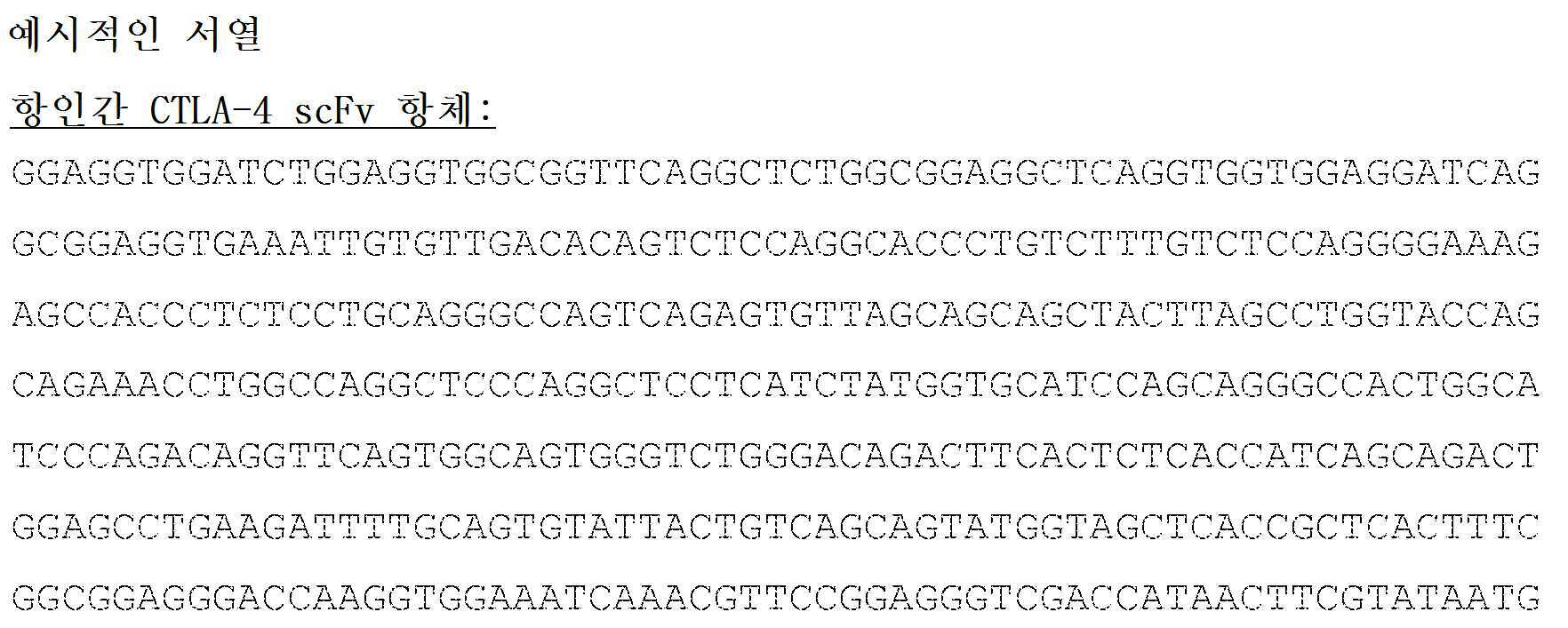


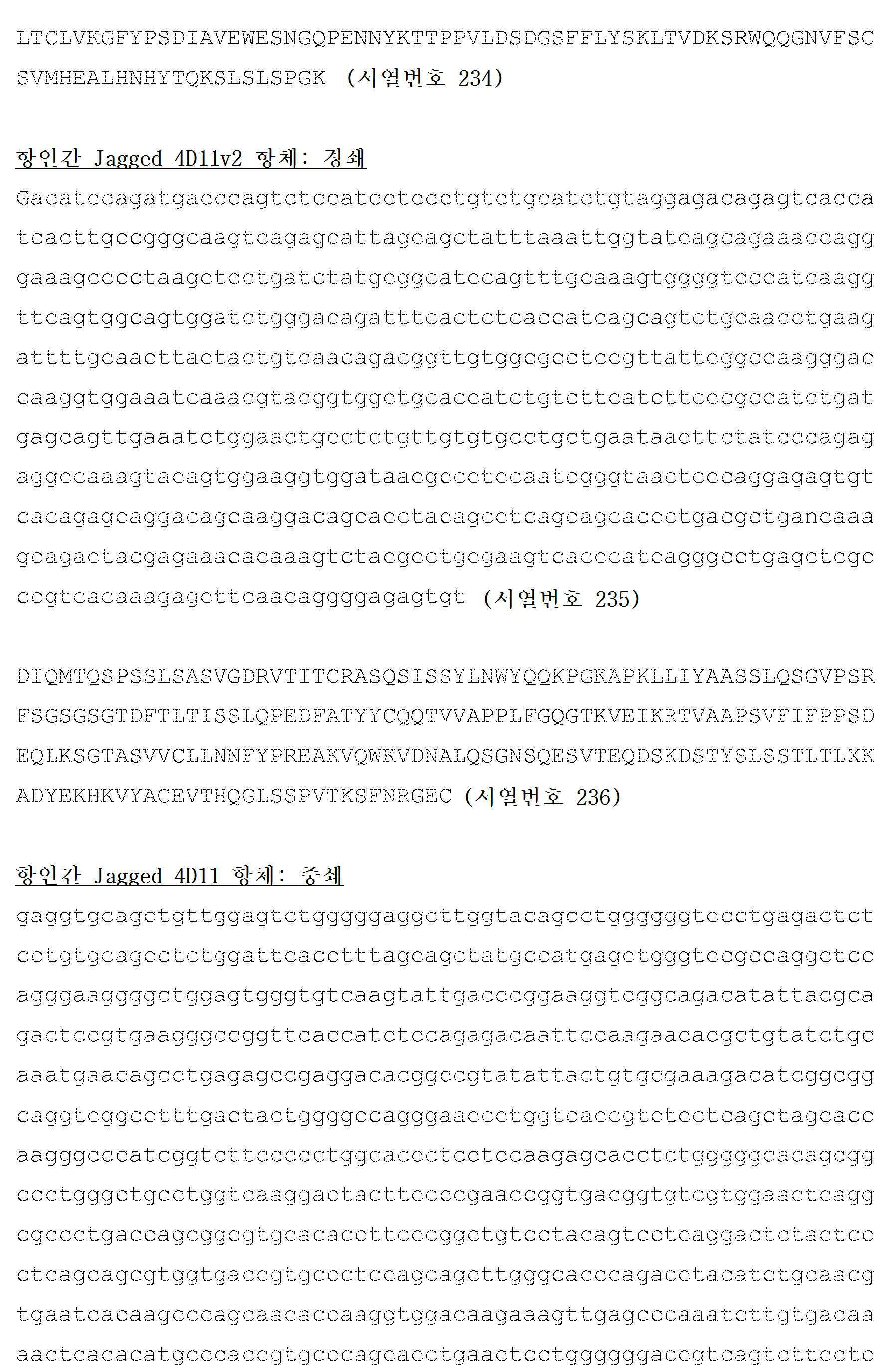
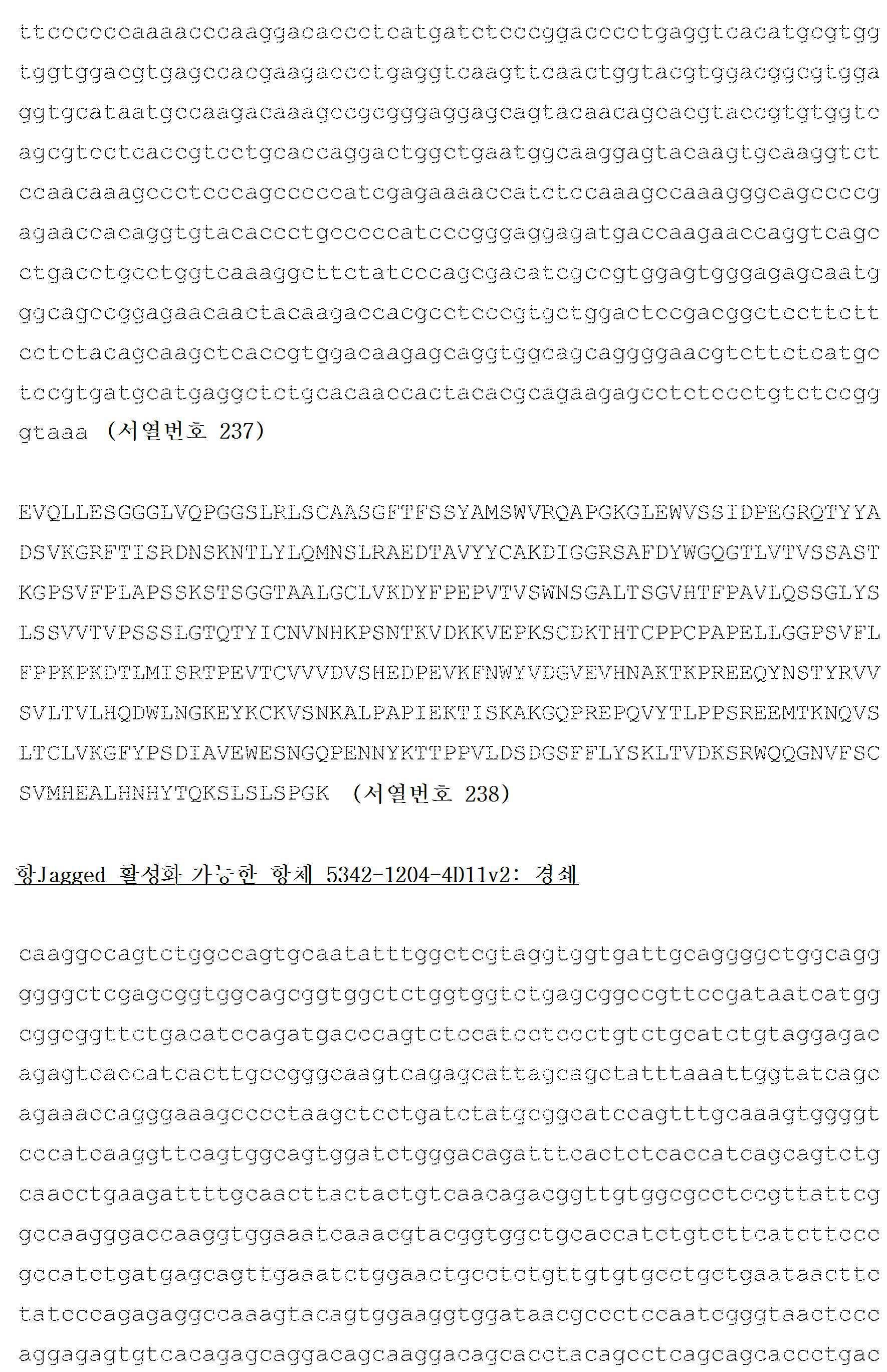

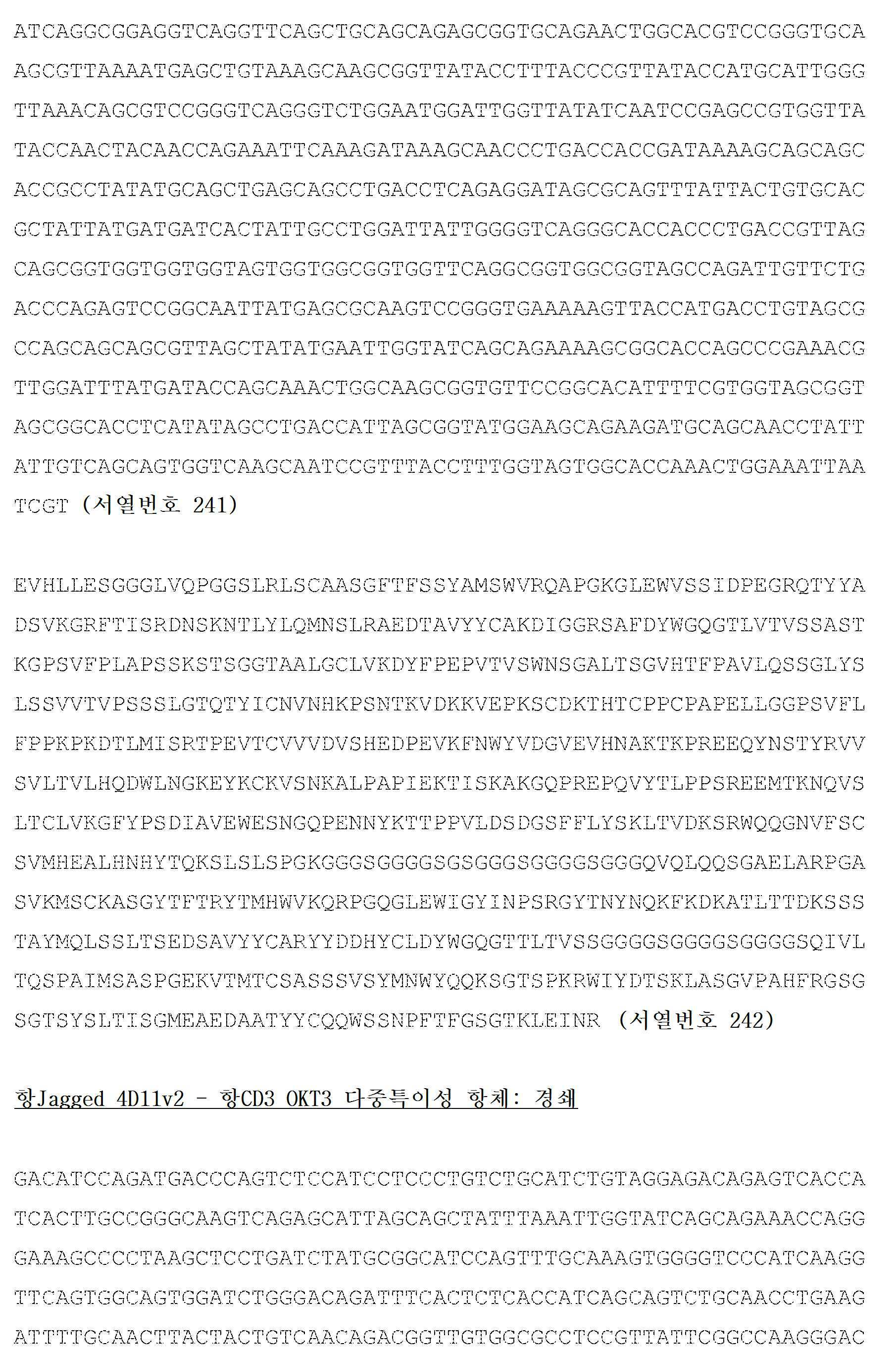
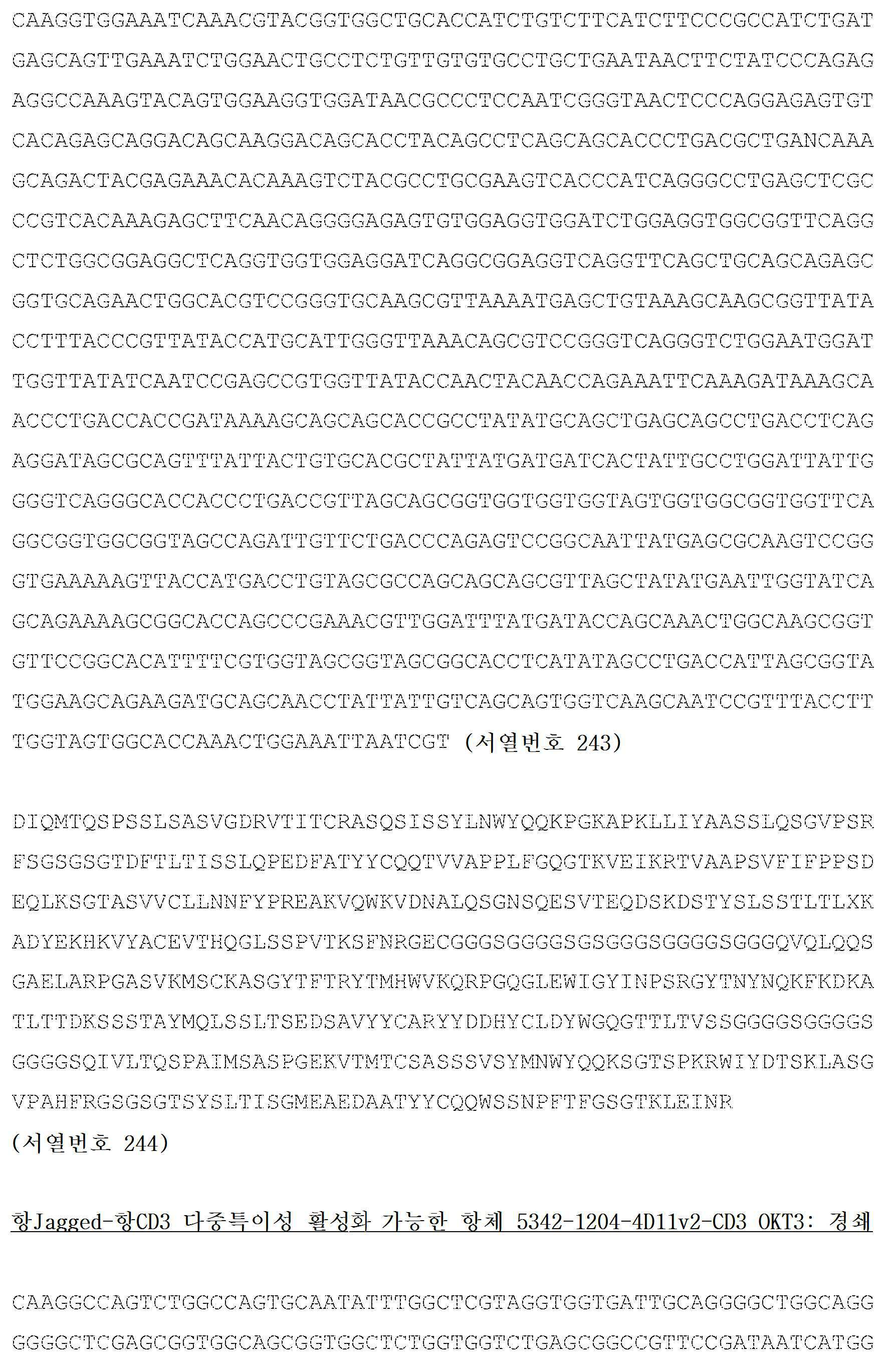
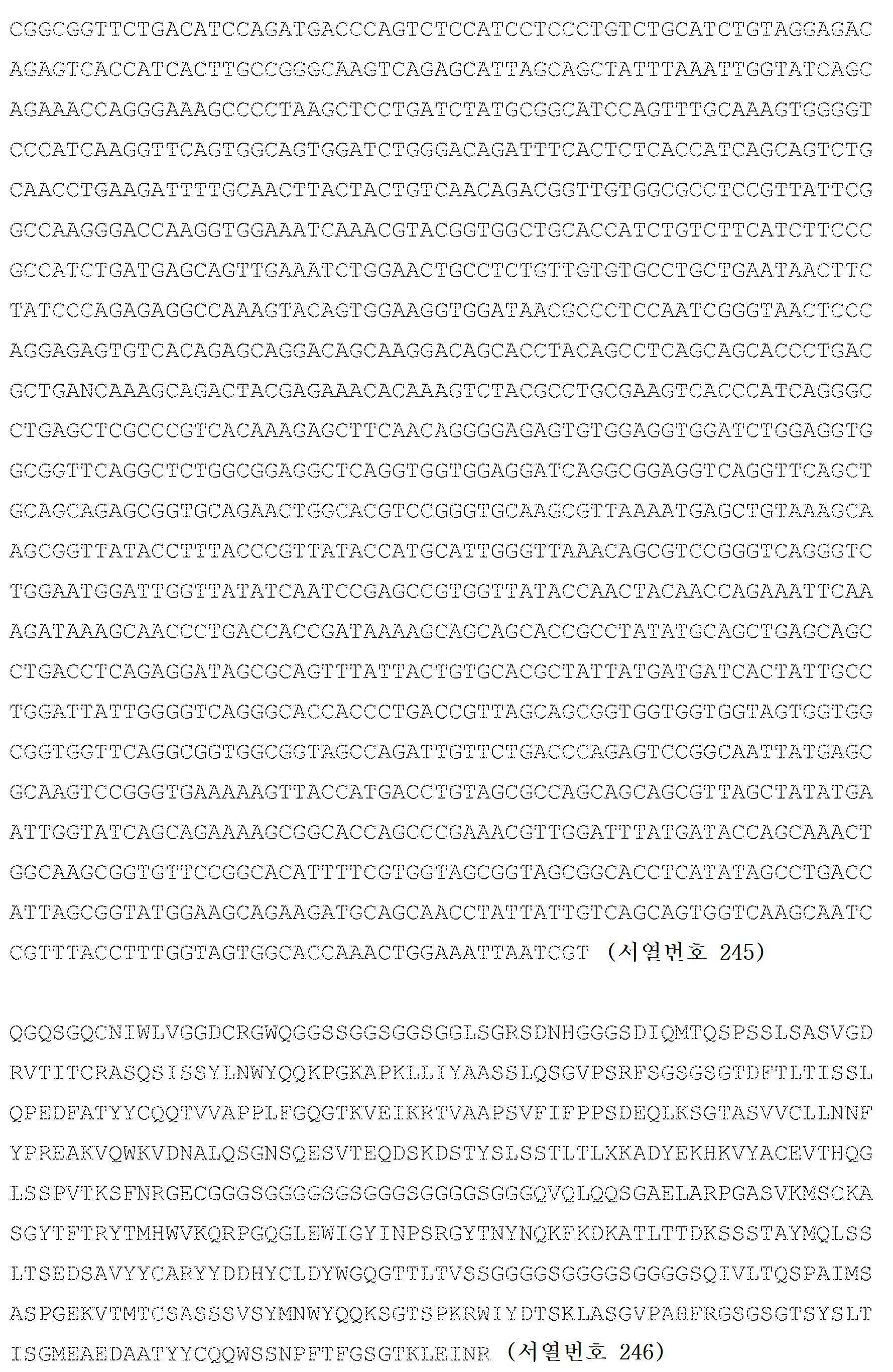
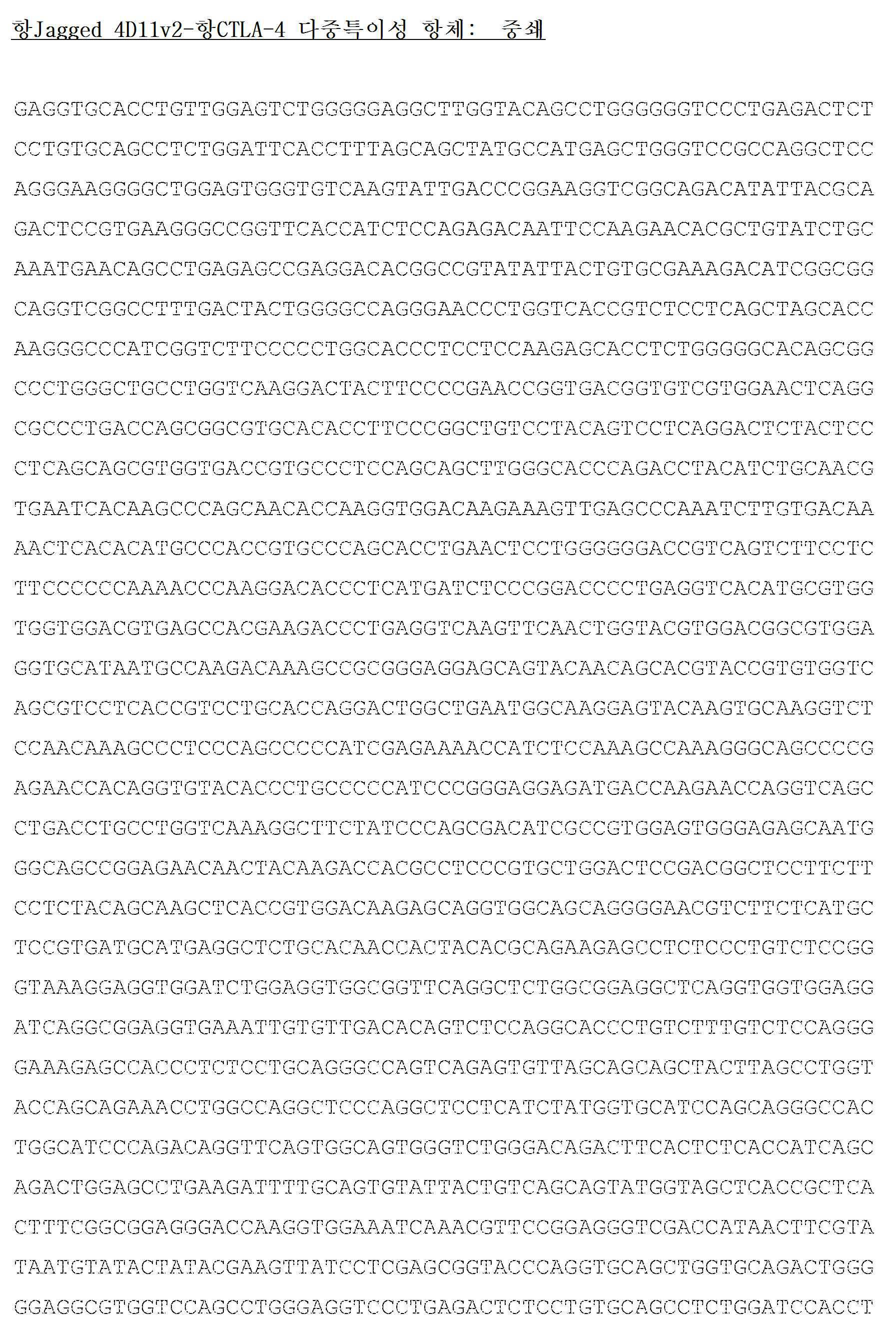
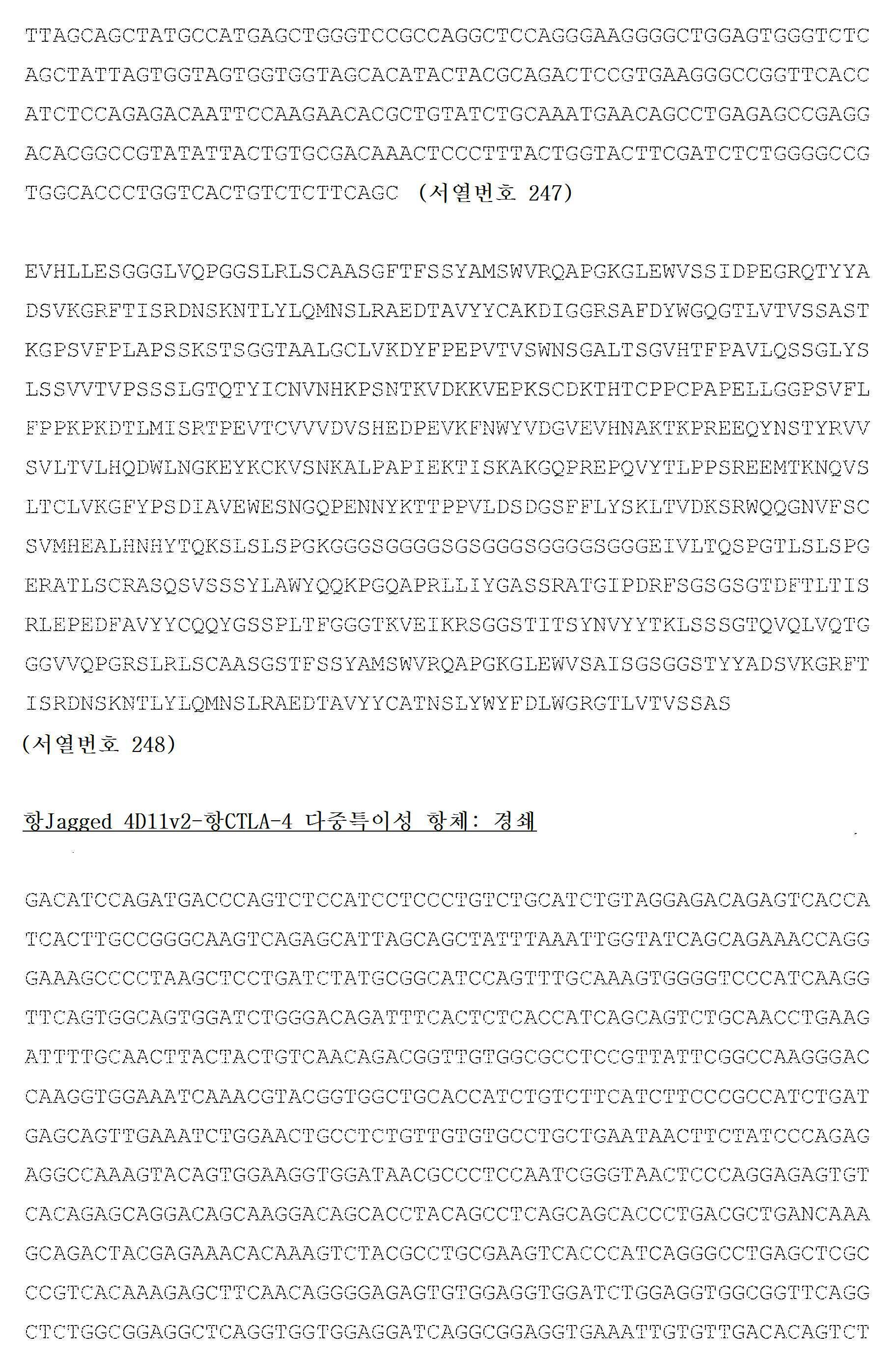
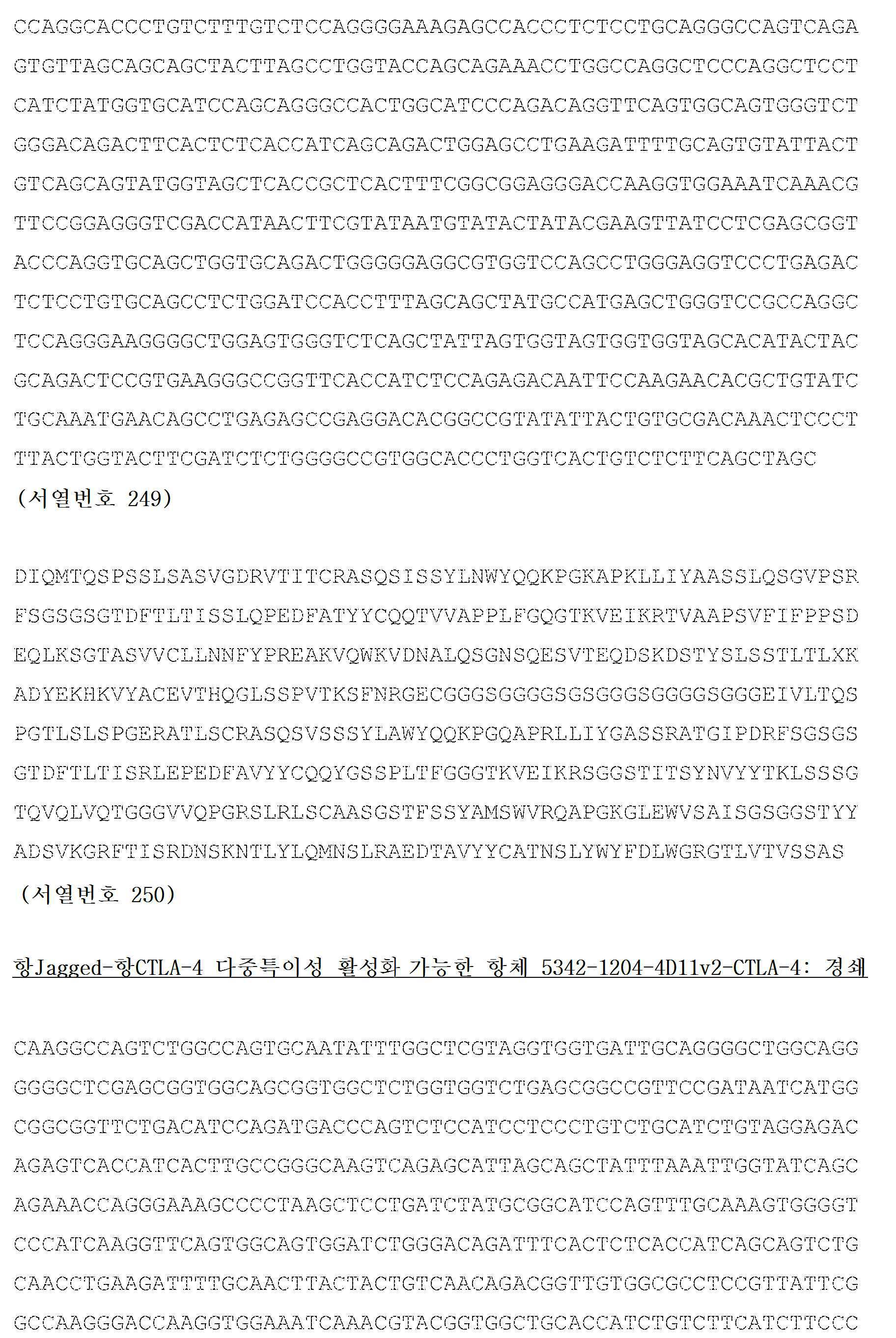


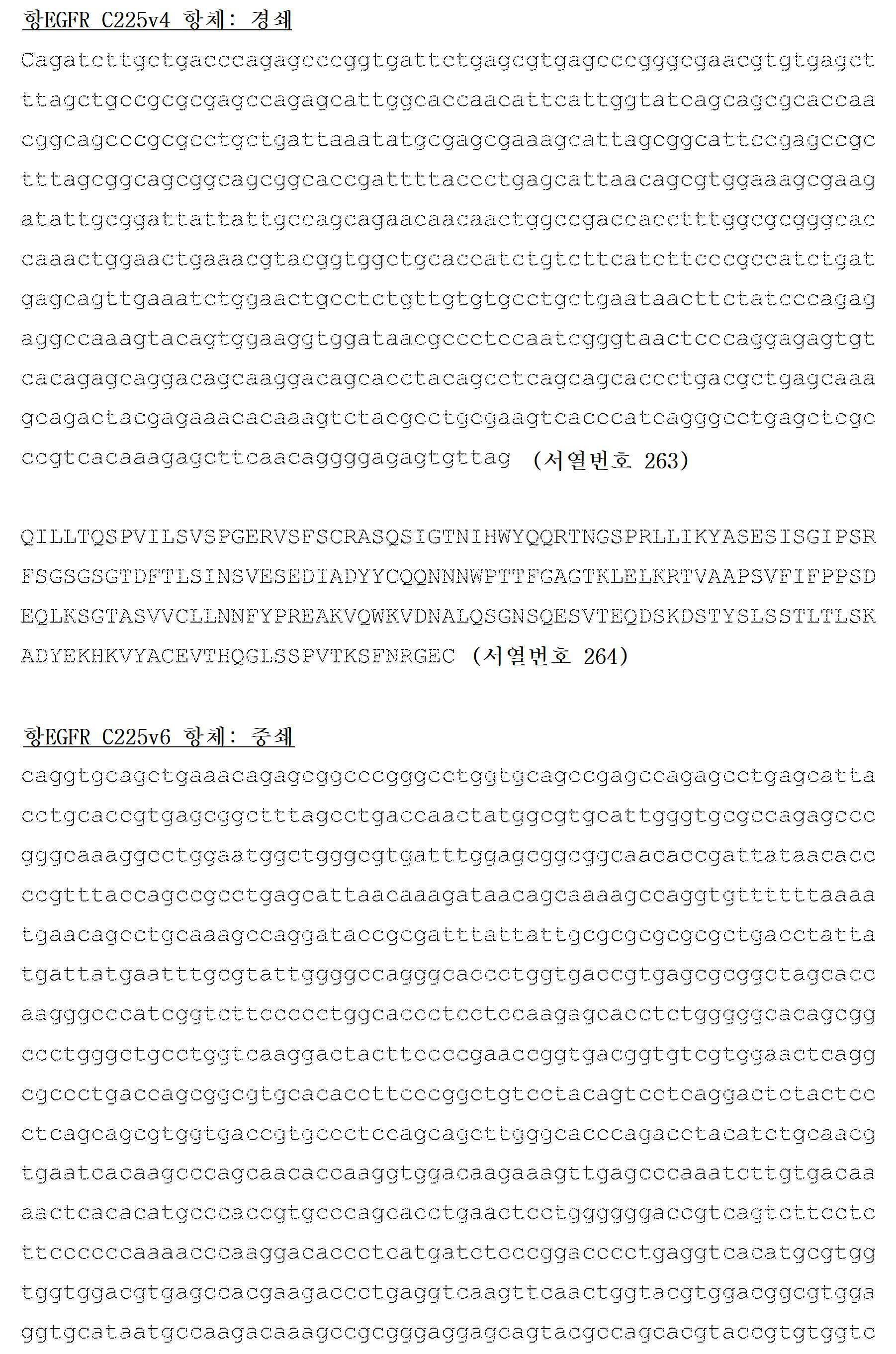


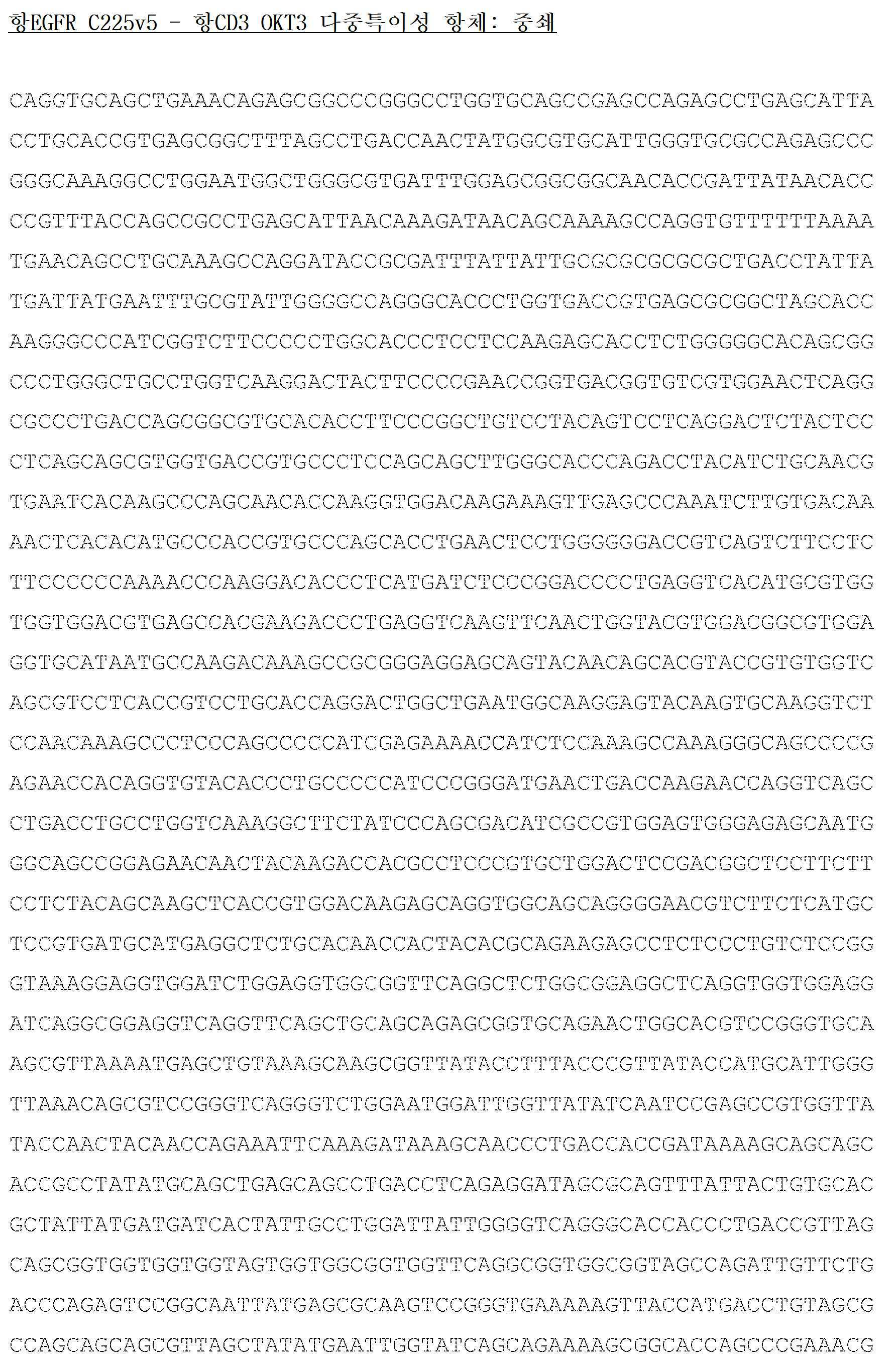


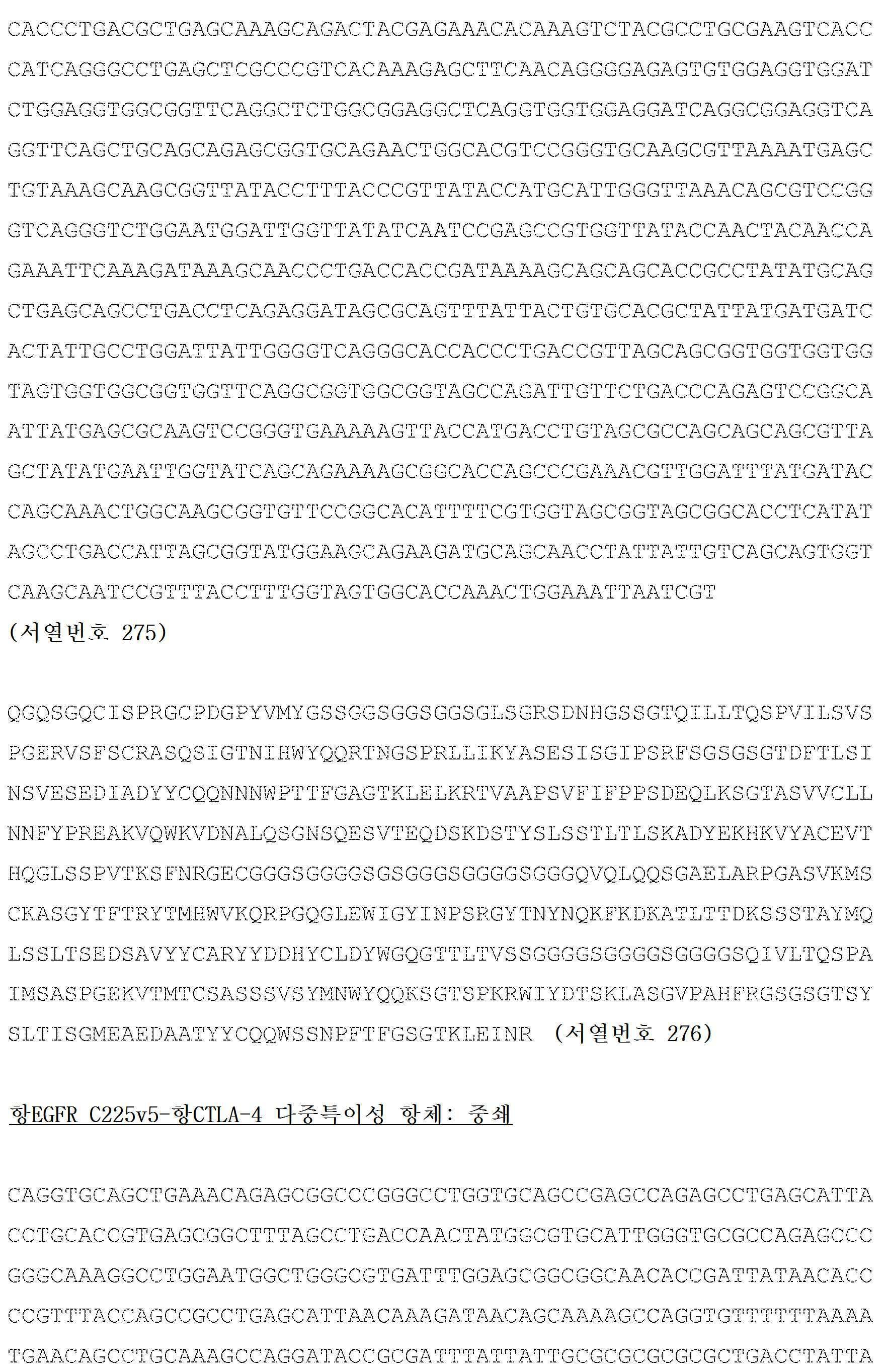

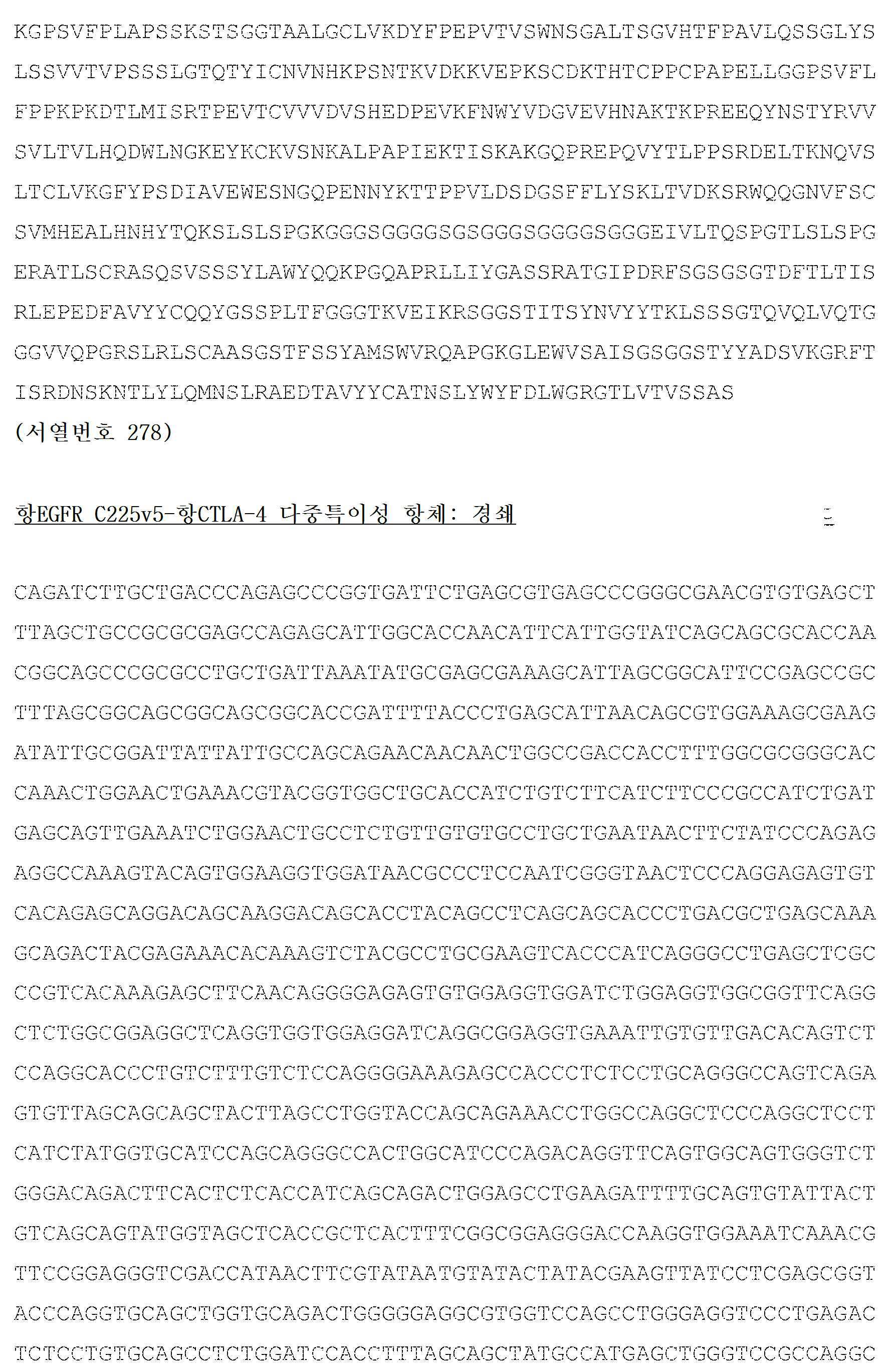


실시예Example 1: 다중특이성1: multispecificity 항체 제조 Antibody production
본 실시예는 항Jagged-CD3, 항Jagged-CTLA-4, 항EGFR-CD3 및 항EGFR-CTLA-4 다중특이성 항체의 구성, 발현, 및 정제를 입증한다. This example demonstrates the construction, expression, and purification of anti-Jagged-CD3, anti-Jagged-CTLA-4, anti-EGFR-CD3 and anti-EGFR-CTLA-4 multispecific antibodies.
벡터를 사용하여 상기 제시된 항Jagged(4D11v2) 중쇄, 5342-1204-4D11v2 경쇄, 항EGFR C225v5 중쇄, 및 3954-1204-C225v5 경쇄 서열을 발현시켰다. 상기 벡터는 2013년 4월 26일 출원된 공계류 중인 출원 PCT/US2013/038540(발명의 명칭: "Activatable Antibodies That Bind Epidermal Growth Factor Receptor And Methods Of Use Thereof") 및 2013년 6월 21일 출원된 공계류 중인 PCT/US2013/047109(발명의 명칭: "Anti-Jagged Antibodies, Activatable Anti-Jagged Antibodies and Methods of Use Thereof")(상기 출원은 각각 그 내용 전문이 본원에서 참조로 포함된다)에 기술되어 있다. The vector was used to express the anti-Jagged(4D11v2) heavy chain, 5342-1204-4D11v2 light chain, anti EGFR C225v5 heavy chain, and 3954-1204-C225v5 light chain sequences presented above. The vector is a co-pending application PCT/US2013/038540 filed on April 26, 2013 (name of the invention: "Activatable Antibodies That Bind Epidermal Growth Factor Receptor And Methods Of Use Thereof") and filed on June 21, 2013. PCT/US2013/047109 pending (invention title: "Anti-Jagged Antibodies, Activatable Anti-Jagged Antibodies and Methods of Use Thereof") (the above applications are each incorporated herein by reference in its entirety). have.
벡터를 제한 효소 NheI 및 NotI로 분해하고, 벡터 단편을 겔 전기영동으로 단리시켰다. 삽입체를 하기와 같이 제조하였다. 인간 IgG CH2CH3 단편을 포프 하이드로 4D11v2(Pop Hygro 4D11v2)로부터 프라이머 HCForNhe(표 8, 서열번호 3) 및 프라이머 HCRevOL(표 8, 서열번호 4)을 이용하여 반응 1에서 증폭시키고, CTLA-4 scFv는 CTLA-4 scFv cDNA(서열번호 229)로부터 프라이머 CTRevNot(표 8, 서열번호 1) 및 프라이머 CTForOL(표 8, 서열번호 2)을 이용하여 반응 2에서 증폭시키고, OKT3 scFv는 OKT3 scFv cDNA(서열번호 231)로부터 프라이머 OKRevNot(표 8, 서열번호 5) 및 프라이머 CTForOL(표 8, 서열번호 2)을 이용하여 반응 3에서 증폭시켰다. 10%의 반응물 1, 10%의 반응물 2를 조합하고, 프라이머, HCForNhe 및 CTRevNot로 증폭시켜 인간 IgG, CH2CH3/CTLA-4 scFv 융합체를 제조하였다. Vectors were digested with restriction enzymes NheI and NotI, and vector fragments were isolated by gel electrophoresis. The insert was prepared as follows. Human IgG CH2CH3 fragment was amplified in

증폭 후, 생성된 DNA를 제한 효소 NheI 및 NotI로 분해시키고, CH2CH3/CTLA-4 scFv 융합체 DNA를 겔 전기영동에 의해 단리시켰다. 10%의 반응물 1, 10%의 반응물 3을 조합하고, 프라이머, HCForNhe 및 CTRevNot로 증폭시켜 인간 IgG, CH2CH3/OKT3 scFv 융합체를 제조하였다. 증폭 후, 생성된 DNA를 제한 효소 NheI 및 NotI로 분해시키고, CH2CH3/CTLA-4 scFv 융합체 DNA를 겔 전기영동에 의해 단리시켰다. After amplification, the resulting DNA was digested with restriction enzymes NheI and NotI, and CH2CH3/CTLA-4 scFv fusion DNA was isolated by gel electrophoresis. 10% of
CH2CH3/scFv 단편을 발현 벡터 내로 삽입하기 위해, 하기 표 9에 제시된 하기 조합을 T4 DNA 리가제(인비트로겐 인크(Invitrogen Inc.: 미국 캘리포니아주 칼즈배드))와 함께 밤새도록 결찰시켰다. 결찰시킨 후, DNA를 E. 콜라이(E. coli) 균주 MC106 내로 형질전환시키고, 암피실린 저항성에 대해 선별하였다. DNA 서열분석을 통해 올바른 다중특이성 항체 또는 다중특이성 활성화 가능한 항체를 코딩하는 DNA 삽입체를 함유하는 클론을 확인하고, 포유동물 세포 형질감염을 위해 DNA를 제조하였다. To insert the CH2CH3/scFv fragment into the expression vector, the following combinations shown in Table 9 below were ligated with T4 DNA ligase (Invitrogen Inc., Carlsbad, CA, USA) overnight. After ligation, the DNA E. coli (E. coli) Transformed into strain MC106 and selected for ampicillin resistance. DNA sequencing was performed to identify the correct multispecific antibody or a clone containing a DNA insert encoding a multispecific activatable antibody, and DNA was prepared for mammalian cell transfection.
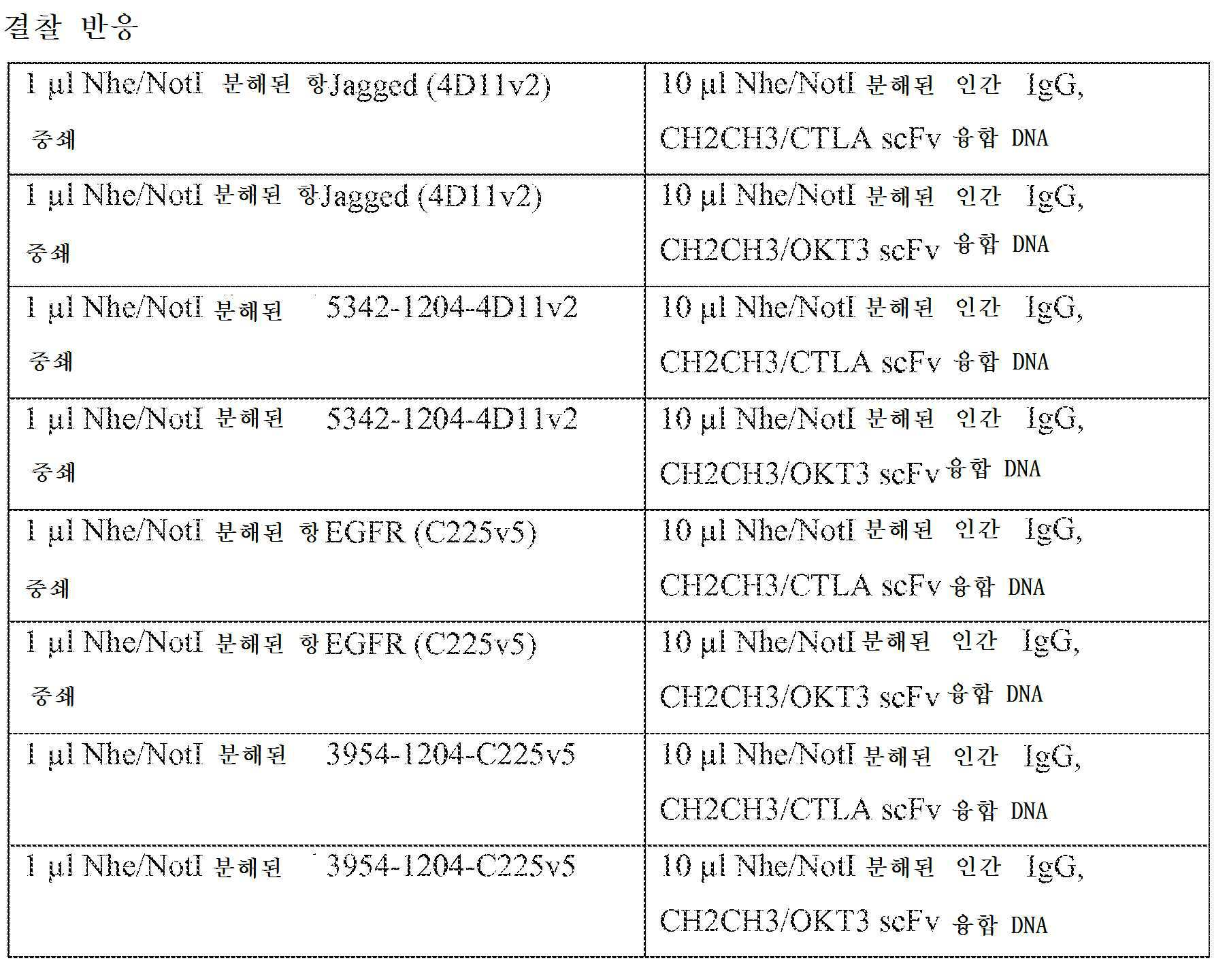
실시예Example 2: 다중특이성2: multispecificity 항체 및 다중특이성 활성화 가능한 항체 제조 Preparation of antibodies and antibodies capable of multispecific activation
일시적으로 형질감염된 HEK-293 세포로부터 완전한 인간 IgG를 발현시켰다. 하기 표 10에 제시된, 상이한 중쇄 및 경쇄 발현 벡터로 공동 형질감염시켜 다중특이성 활성화 가능한 항체를 발현시킬 수 있었다. Fully human IgG was expressed from transiently transfected HEK-293 cells. The multispecific activatable antibodies could be expressed by co-transfection with different heavy and light chain expression vectors, shown in Table 10 below.
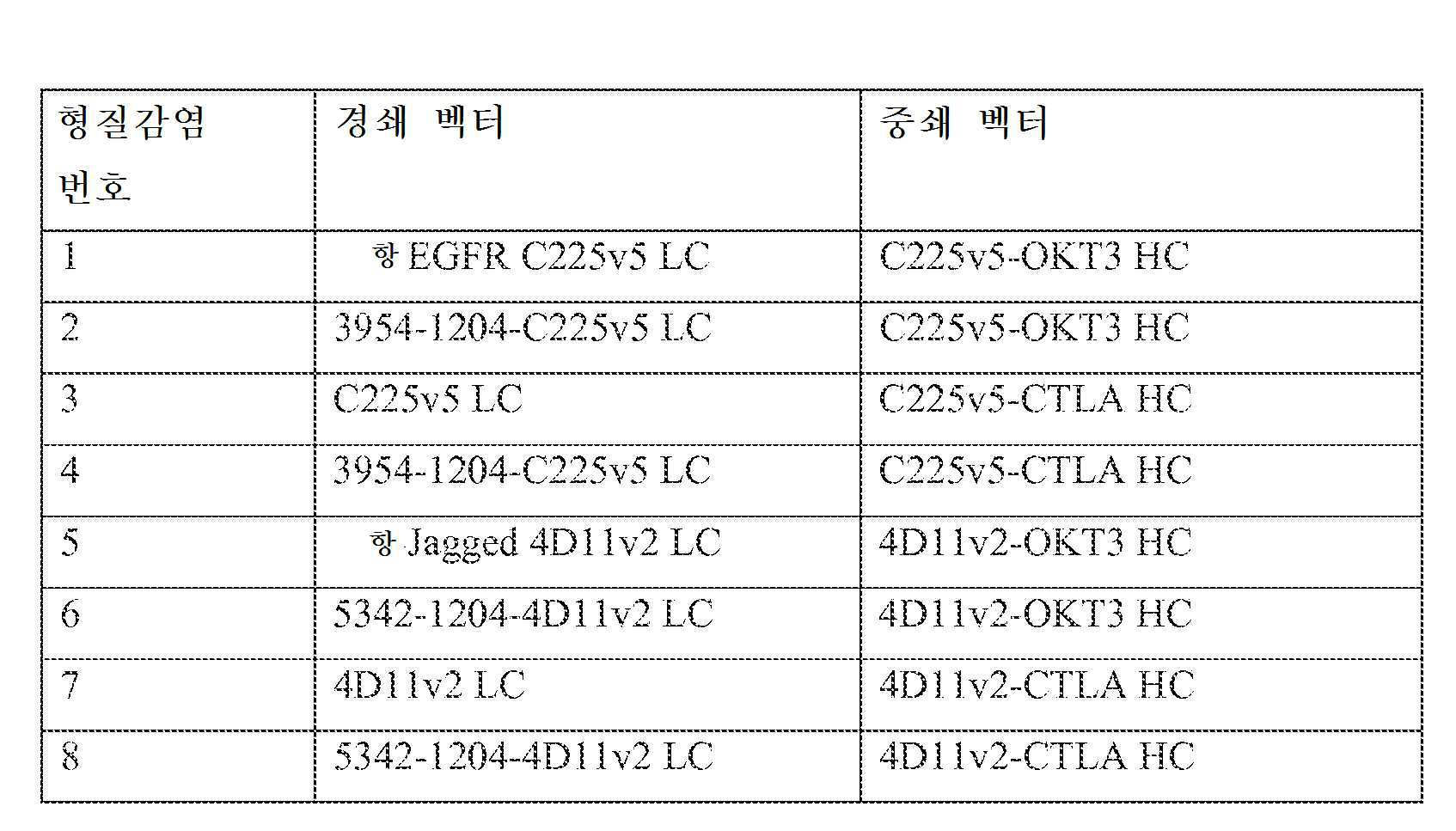
HEK-293 세포에서 발현된 다중특이성 항체 및 다중특이성 활성화 가능한 항체를 프로테인 A(Protein A) 크로마토그래피에 의해 정제하였다.Multispecific antibodies and multispecific activatable antibodies expressed in HEK-293 cells were purified by Protein A chromatography.
결합 검정법: 도 11에 제시된 바와 같이, ELISA 결합 실험을 통해 항Jagged-CTLA-4 및 항Jagged-OKT3 다중특이성 항체 및 다중특이성 활성화 가능한 항체가 인간 Jagged 1에 결합하였고, 항EGFR-CTLA-4 및 항EGFR-OKT3 다중특이성 항체 및 다중특이성 활성화 가능한 항체가 인간 EGFR에 특이적으로 결합하였다는 것이 밝혀졌다. Binding Assay: As shown in FIG. 11, anti-Jagged-CTLA-4 and anti-Jagged-OKT3 multispecific antibodies and multispecific activatable antibodies were bound to human Jagged 1 through ELISA binding experiments, and It was found that the anti-EGFR-OKT3 multispecific antibody and the multispecific activatable antibody specifically bound to human EGFR.
인간 Jagged 1-Fc(R&D 시스템즈(R&D Systems); 카탈로그 번호 1277-JG-050) 및 인간 EGFR(R&D 시스템즈, 카탈로그 번호 344-ER-050)을 96 웰 ELISA 플레이트의 상이한 웰에 흡착시켰다. 정제된 항Jagged-CTLA 및 항Jagged-OKT3, 항EGFR-CTLA 또는 항EGFR-OKT3 항체를 플레이트에 적용시키고, 결합할 수 있도록 하였다. 항인간 IgG-HRP 컨쥬게이트(Fab 특이, 시그마(Sigma): 미국 미주리주 세인트 루이스; 카탈로그 번호 A0293-1ML)를 이용하여 결합된 항체를 시각화하고, 발색성 기질 TMB로 현상시켰다. Human Jagged 1-Fc (R&D Systems; Cat. No. 1277-JG-050) and human EGFR (R&D Systems, Cat. No. 344-ER-050) were adsorbed to different wells of a 96 well ELISA plate. Purified anti-Jagged-CTLA and anti-Jagged-OKT3, anti-EGFR-CTLA, or anti-EGFR-OKT3 antibodies were applied to the plate and allowed to bind. The bound antibodies were visualized using an anti-human IgG-HRP conjugate (Fab specific, Sigma: St. Louis, Mo.; Cat. No. A0293-1ML) and developed with the chromogenic substrate TMB.
도 12a 및 도 12b에 제시된 바와 같이, ELISA 결합 실험을 통해 항Jagged-CTLA-4 및 항EGFR-CTLA-4가 인간 및 마우스 CTLA-4, 둘 모두에 특이적으로 결합하였다는 것이 밝혀졌다(항인간 CTLA-4 항체는 마우스 및 인간 CTLA-4, 둘 모두에 교차 반응한다): 인간 CTLA-4(R&D 시스템즈; 카탈로그 번호 325-CT-200/CF) 또는 마우스 CTLA-4(R&D 시스템즈, 카탈로그 번호 434-CT-200/CF) 중 하나를 별개의 96 웰 ELISA 플레이트의 웰에 부착시켰다. 정제된 항Jagged 4D11v2-CTLA-4, 항Jagged 활성화 가능한 항체 5342-1204-4D11v2-CTLA-4, 항EGFR C225v5-CTLA-4 또는 활성화 가능한 항체 3954-1204-C225v5-CTLA-4를 플레이트에 적용시키고, 결합할 수 있도록 하였다. 항인간 IgG-HRP 컨쥬게이트(Fab 특이, 시그마: 미국 미주리주 세인트 루이스; 카탈로그 번호 A0293-1ML)를 이용하여 결합된 항체를 시각화하고, 발색성 기질 TMB로 현상시켰다. 인간 CD3ε에 특이성인 항체-OKT3 융합체의 결합하지 못하는 무능력함에 의해 결합 특이성이 입증되었다. 12A and 12B, it was found through ELISA binding experiments that anti-Jagged-CTLA-4 and anti-EGFR-CTLA-4 specifically bound to both human and mouse CTLA-4 (anti Human CTLA-4 antibody cross-reacts to both mouse and human CTLA-4): human CTLA-4 (R&D Systems; Cat. No. 325-CT-200/CF) or mouse CTLA-4 (R&D Systems, Cat. No. 434-CT-200/CF) was attached to the wells of a separate 96 well ELISA plate. Purified anti-Jagged 4D11v2-CTLA-4, anti-Jagged activatable antibody 5342-1204-4D11v2-CTLA-4, anti-EGFR C225v5-CTLA-4 or activatable antibody 3954-1204-C225v5-CTLA-4 were applied to the plate and , Made it possible to combine. The bound antibodies were visualized using an anti-human IgG-HRP conjugate (Fab specific, Sigma: St. Louis, Mo.; Cat. No. A0293-1ML) and developed with the chromogenic substrate TMB. The binding specificity was demonstrated by the inability to bind the antibody-OKT3 fusion specific for human CD3ε.
실시예Example 3: CD3ε에의3: to CD3ε OKT3OKT3 결합 Combination
도 13에 제시된 바와 같이, ELISA-결합 실험을 통해 항EGFR 다중특이성 활성화 가능한 항체 3954-1204-C225v5-OKT3 및 항Jagged 다중특이성 활성화 가능한 항체 5342-1204-4D11v2-OKT3이 인간 CD3ε에 특이적으로 결합한다는 것이 밝혀졌다. 인간 CD3ε(노보프로테인(NovoProtein), 카탈로그 번호 C578)을 96 웰 ELISA 플레이트의 웰에 부착시켰다. 정제된 항EGFR 다중특이성 활성화 가능한 항체 3954-1204-C225v5-CTLA-4, 항EGFR 다중특이성 활성화 가능한 항체 3954-1204-C225v5-OKT3, 항Jagged 다중특이성 활성화 가능한 항체 5342-1204-4D11v2-CTLA-4, 또는 항Jagged 다중특이성 활성화 가능한 항체 5342-1204-4D11v2-OKT3을 플레이트에 적용시키고, 결합할 수 있도록 하였다. 항인간 IgG-HRP 컨쥬게이트(Fab 특이, 시그마: 미국 미주리주 세인트 루이스; 카탈로그 번호 A0293-1ML)를 이용하여 결합된 항체를 시각화하고, 발색성 기질 TMB로 현상시켰다. As shown in Figure 13, through an ELISA-binding experiment, the anti-EGFR multispecific activatable antibody 3954-1204-C225v5-OKT3 and the anti-Jagged multispecific activatable antibody 5342-1204-4D11v2-OKT3 specifically bind to human CD3ε. It turned out to be. Human CD3ε (NovoProtein, Cat. No. C578) was attached to the wells of a 96 well ELISA plate. Purified anti-EGFR multispecific activatable antibody 3954-1204-C225v5-CTLA-4, anti-EGFR multispecific activatable antibody 3954-1204-C225v5-OKT3, anti-Jagged multispecific activatable antibody 5342-1204-4D11v2-CTLA-4 , Or anti-Jagged multispecific activatable antibody 5342-1204-4D11v2-OKT3 was applied to the plate and allowed to bind. The bound antibodies were visualized using an anti-human IgG-HRP conjugate (Fab specific, Sigma: St. Louis, Mo.; Cat. No. A0293-1ML) and developed with the chromogenic substrate TMB.
실시예Example 4: 다중특이성4: multispecificity 활성화 가능한 항체의 프로테아제 활성화 Protease activation of activatable antibodies
활성화Activation
다중특이성 항체 및 다중특이성 활성화 가능한 항체를 PBS 중에서 최종 농도 0.8 mg/ml로 희석시켰다. 재조합 인간 uPA(R&D 시스템즈, 카탈로그 1310-SE)를 최종 농도 700 nM으로 첨가하고, 37℃에서 ~20 h 동안 인큐베이션시켰다. 하기 기술되는 바와 같이 SDS-PAGE 분석을 위해 분해물 분취물을 제거하고, 제조하고, 결합 ELISA 검정법으로 분석하기 위해 PBS; 0.05% 트윈 20 및 10 mg/mL 우혈청 알부민 중에서 100 nM으로 희석시켰다. Multispecific antibodies and multispecific activatable antibodies were diluted in PBS to a final concentration of 0.8 mg/ml. Recombinant human uPA (R&D Systems, Cat. 1310-SE) was added to a final concentration of 700 nM and incubated at 37° C. for -20 h. PBS for removing aliquots of lysate for SDS-PAGE analysis, preparing and analyzing by binding ELISA assay as described below; Diluted to 100 nM in 0.05
PAGE를 위해, 샘플을 1xLDS 샘플 완충체 중에서 70℃에서 10 min 동안 변성시키고, TCEP를 최종 농도 40 mM으로 첨가한 후, 전기영동시켰다. 6 ㎍의 항체를 NuPAGE 10% 비스-트리스 겔(인비트로겐) 상에 로딩시키고, MOPS 전기영동 완충제를 사용하여 크기에 의해 단백질을 분리하였다. 전기영동 후, 겔을 쿠마시 블루(Coomassie blue)로 염색시키고, 결과는 도 14a-14b에 제시되어 있다. uPA 존재 하에서의 항EGFR 활성화 가능한 항체 3954-1204-C225v5, 항EGFR 다중특이성 활성화 가능한 항체 3954-1204-C225v5-CTLA-4, 항Jagged 활성화 가능한 항체 5342-1204-4D11v2, 및 항Jagged 다중특이성 활성화 가능한 항체 5342-1204-4D11v2-CTLA-4 경쇄 이동도 변화는 다중특이성 활성화 가능한 항체의 단백질 분해 활성화를 입증한다. 중쇄 융합체의 임의의 이동도 변화 부족은 프로테아제 절단에 대한 저항성을 입증한다. For PAGE, samples were denatured for 10 min at 70° C. in 1×LDS sample buffer, and TCEP was added to a final concentration of 40 mM, followed by electrophoresis. 6 μg of antibody was loaded on a NuPAGE 10% Bis-Tris gel (Invitrogen), and proteins were separated by size using MOPS electrophoresis buffer. After electrophoresis, the gel was stained with Coomassie blue, and the results are shown in FIGS. 14A-14B. Anti-EGFR activatable antibody 3954-1204-C225v5, anti-EGFR multispecific activatable antibody 3954-1204-C225v5-CTLA-4, anti-Jagged activatable antibody 5342-1204-4D11v2, and anti-Jagged multispecific activatable antibody in the presence of uPA 5342-1204-4D11v2-CTLA-4 light chain mobility changes demonstrate proteolytic activation of multispecific activatable antibodies. The lack of any mobility changes of the heavy chain fusion demonstrates resistance to protease cleavage.
결합 검정법Binding assay
도 15의 패널 a는 항EGFR 다중특이성 활성화 가능한 항체 3954-1204-C225v5-CTLA-4가 EGFR에 결합하였는데, ELISA에 의하면, C225v5(3 nM)또는 C225v5-CTLA-4(0.33 nM)에 비하여 더 낮은 친화도(Kd = 12.8 nM)로 결합하였다는 것을 보여주는 것이다. 그러나, 일단 uPA에 의해 활성화되고 나면, 항EGFR 다중특이성 활성화 가능한 항체 3954-1204-C225v5-CTLA-4는 C225v5 (0.21 nM) 및 C225v5-CTLA4(0.33 nM)와 비교하여 유사한 친화도(0.45 nM)로 EGFR에 결합하에 결합하였다. uPA는 중쇄의 카복실 말단에 융합된 항CTLA4 scFv를 절단하지 않았다는 점이 중요하다: 도 15의 패널 b에서 도시된 바와 같이, uPA 처리가 인간 CTLA4에의 결합에는 어떤 영향도 미치지 않았다. Panel a of FIG. 15 shows that the anti-EGFR multispecific activatable antibody 3954-1204-C225v5-CTLA-4 bound to EGFR, according to ELISA, more than C225v5 (3 nM) or C225v5-CTLA-4 (0.33 nM). It shows that it bound with low affinity (Kd = 12.8 nM). However, once activated by uPA, anti-EGFR multispecific activatable antibody 3954-1204-C225v5-CTLA-4 has similar affinity (0.45 nM) compared to C225v5 (0.21 nM) and C225v5-CTLA4 (0.33 nM). And bound to EGFR. It is important to note that uPA did not cleave the anti-CTLA4 scFv fused to the carboxyl terminus of the heavy chain: as shown in panel b of FIG. 15, uPA treatment had no effect on binding to human CTLA4.
유사하게, 항Jagged 다중특이성 활성화 가능한 항체 5342-1204-4D11v2-CTLA-4는 인간 Jagged 1에 결합하였는데, ELISA에 의하면, 4D11v2(0.44 nM) 또는 4D11v2-CTLA4(0.77 nM)에 비하여 더 낮은 친화도(15 nM)로 결합하였다. 일단 활성화되고 나면, 항Jagged 다중특이성 활성화 가능한 항체 5342-1204-4D11v2-CTLA-4는 4D11v2(0.54 nM) 및 4D11v2-CTLA4(0.92 nM)와 유사한 친화도로 인간 Jagged 1에 결합하였다(도 15, 패널 C). uPA 처리가 CTLA4 결합에는 어떤 영향도 미치지 않았다(도 15, 패널 d). ELIS결합 측정은 하기와 같이 수행하였다. 인간 Jagged 1-Fc(R&D 시스템즈; 카탈로그 번호 1277-JG-050), 인간 EGFR(R&D 시스템즈, Cat#344-ER-050) 또는 인간 CTLA4(R&D 시스템즈; 카탈로그 번호 325-CT-200/CF)를 96 웰 ELISA 플레이트의 웰 상에 흡착시켰다. 비처리된 항체 및 uPA 처리된 항체인 다중특이성 항체 또는 다중특이성 활성화 가능한 항체를 100 nM을 출발로 하여 3배 희석된 희석액을 플레이트에 적용시키고, 1시간 동안 플레이트 결합된 항원과 결합할 수 있도록 하였다. 결합 후, 항인간 IgG-HRP 컨쥬게이트(Fab 특이, 시그마: 미국 미주리주 세인트 루이스; 카탈로그 번호 A0293-1ML)를 이용하여 결합된 항체를 시각화하고, 발색성 기질 TMB로 현상시켰다. Similarly, anti-Jagged multispecific activatable antibody 5342-1204-4D11v2-CTLA-4 bound to human Jagged 1, which, according to ELISA, had a lower affinity than 4D11v2 (0.44 nM) or 4D11v2-CTLA4 (0.77 nM). (15 nM). Once activated, anti-Jagged multispecific activatable antibody 5342-1204-4D11v2-CTLA-4 bound to human Jagged 1 with similar affinity to 4D11v2 (0.54 nM) and 4D11v2-CTLA4 (0.92 nM) (Figure 15, panel C). uPA treatment had no effect on CTLA4 binding (FIG. 15, panel d). ELIS binding measurement was performed as follows. Human Jagged 1-Fc (R&D Systems; Cat#1277-JG-050), human EGFR (R&D Systems, Cat#344-ER-050) or human CTLA4 (R&D Systems; Cat#325-CT-200/CF). Adsorbed onto the wells of a 96 well ELISA plate. Untreated antibody and uPA-treated antibody, multispecific antibody or multispecific activatable antibody, starting at 100 nM, was applied to the plate with a 3-fold diluted dilution, and allowed to bind to the plate-bound antigen for 1 hour. . After binding, the bound antibody was visualized using an anti-human IgG-HRP conjugate (Fab specific, Sigma: St. Louis, Mo.; Cat. No. A0293-1ML) and developed with the chromogenic substrate TMB.
실시예Example 5: 추가의5: additional 다중특이성 항체 및 다중특이성 활성화 가능한 항체 서열 Multispecific antibodies and multispecific activatable antibody sequences
본 실시예는 추가의 다중특이성 항체 및 다중특이성 활성화 가능한 항체의 서열을 제공한다.This example provides the sequences of additional multispecific antibodies and multispecific activatable antibodies.

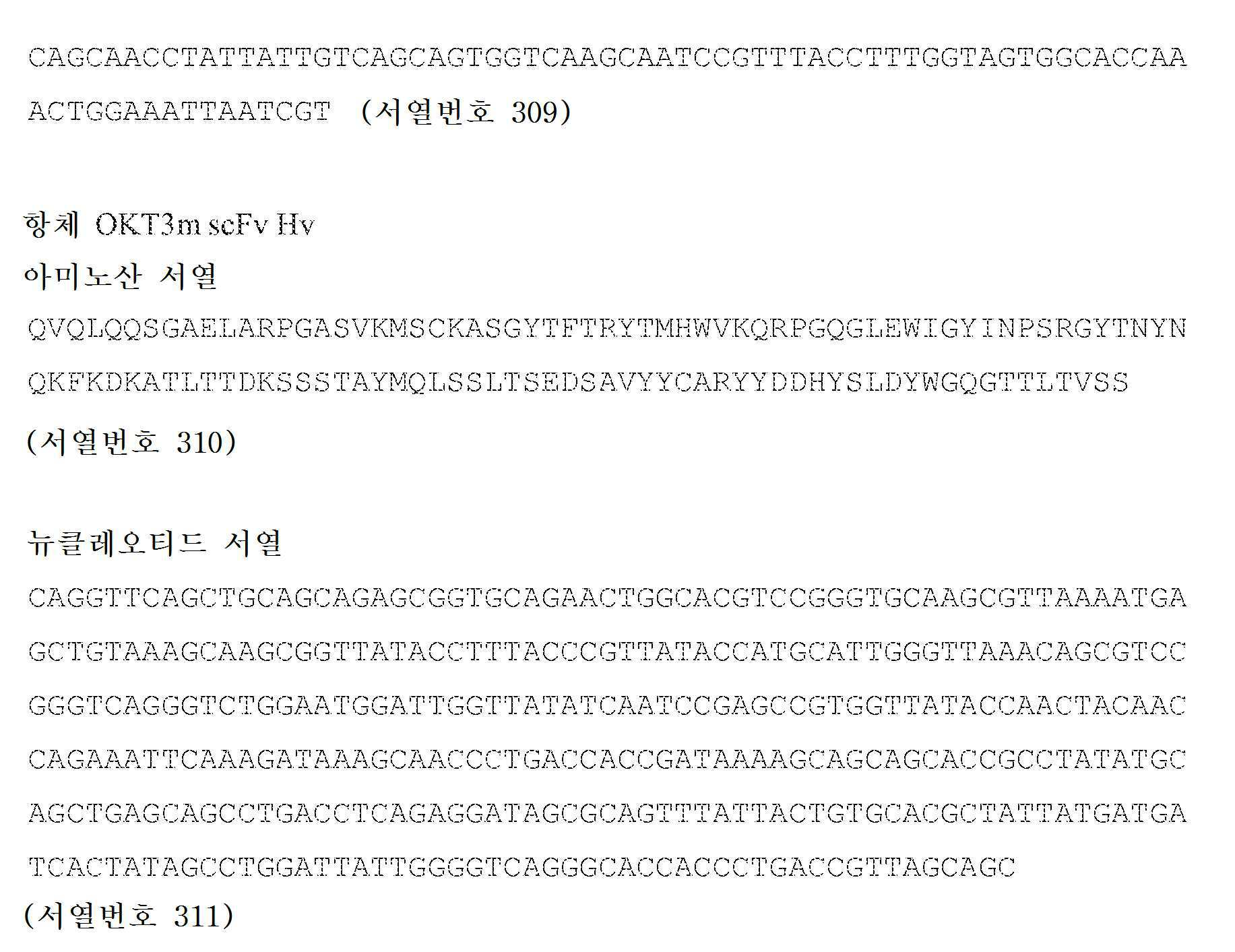
각각 다중특이성 항체 또는 활성화 가능한 항체를 제조하기 위해 항체 또는 활성화 가능한 항체의 중쇄(HC) 또는 경쇄(LC)의 C 말단에 부착될 수 있도록 허용하는 장쇄의 링커를 포함하는 항체 OKT3m scFv.Antibody OKT3m scFv comprising a long-chain linker allowing attachment to the C-terminus of the heavy (HC) or light (LC) chain of the antibody or activatable antibody, respectively, to prepare a multispecific antibody or activatable antibody.


각각 다중특이성 항체 또는 활성화 가능한 항체를 제조하기 위해 항체 또는 활성화 가능한 항체의 HC의 N 말단에 부착될 수 있도록 허용하는 단쇄의 링커를 포함하는 항체 OKT3m scFv.The antibody OKT3m scFv, each comprising a single chain linker allowing attachment to the N-terminus of the antibody or the HC of the activatable antibody to produce a multispecific antibody or activatable antibody.

다중특이성 항체 C225v5-OKT3m-H-N 중쇄(항체 C225v5 HC의 N 말단에 부착된 항체 OKT3m)Multispecific antibody C225v5-OKT3m-H-N heavy chain (antibody OKT3m attached to the N-terminus of antibody C225v5 HC)

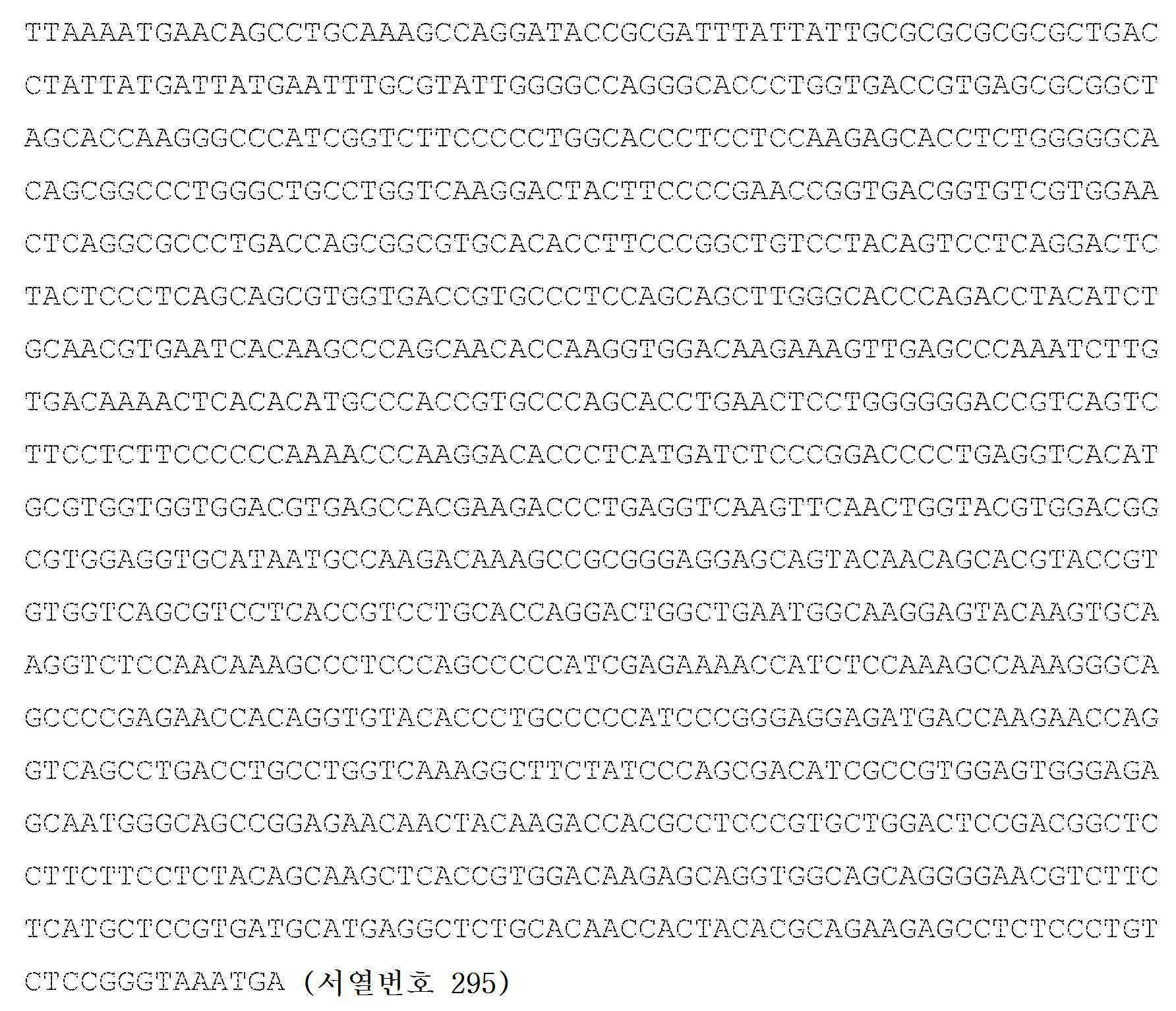
다중특이성 항체 C225v5-OKT3m-H-C 중쇄(항체 C225v5 HC의 C 말단에 부착된 항체 OKT3m)Multispecific antibody C225v5-OKT3m-H-C heavy chain (antibody OKT3m attached to the C-terminus of antibody C225v5 HC)
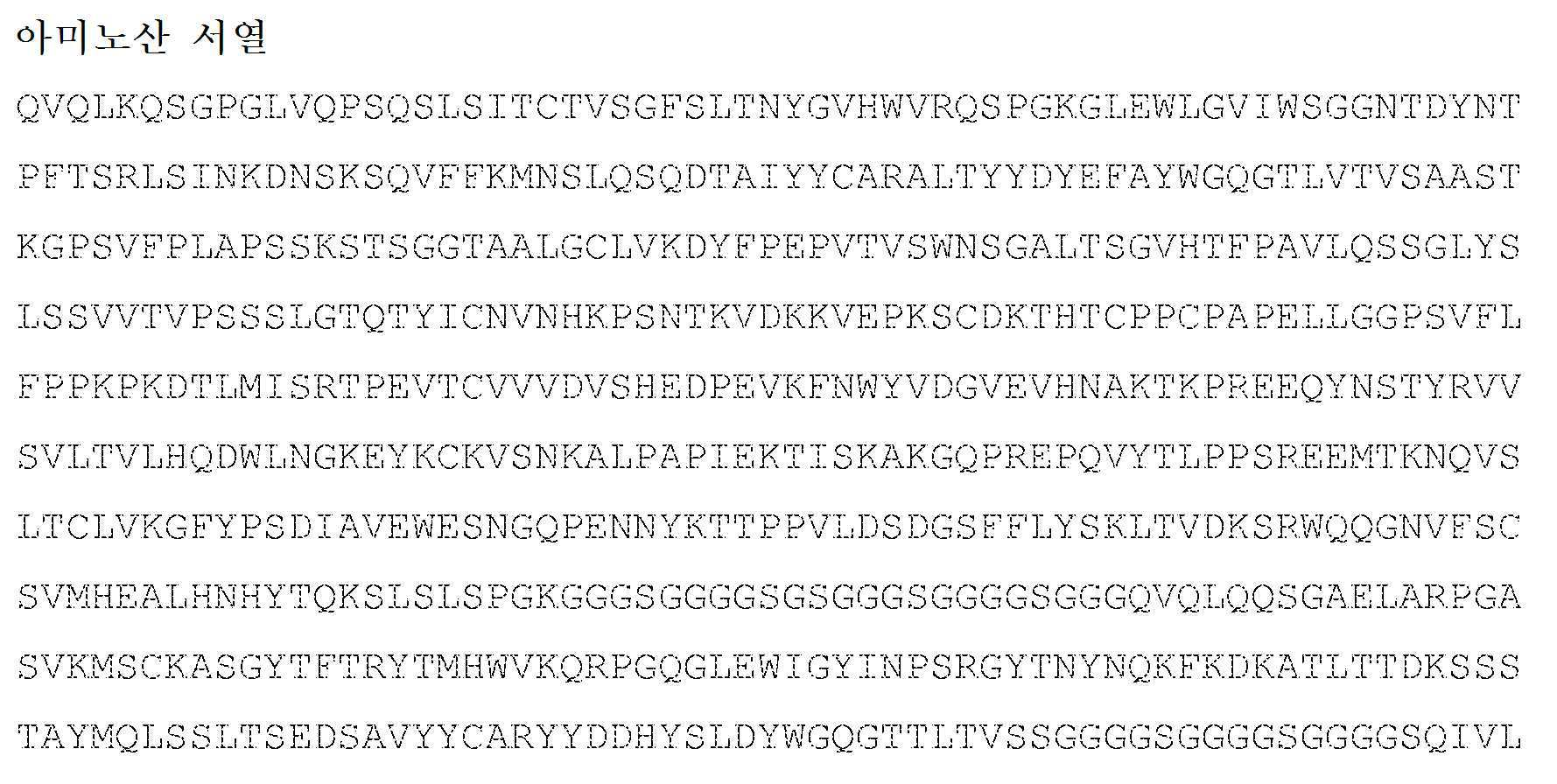
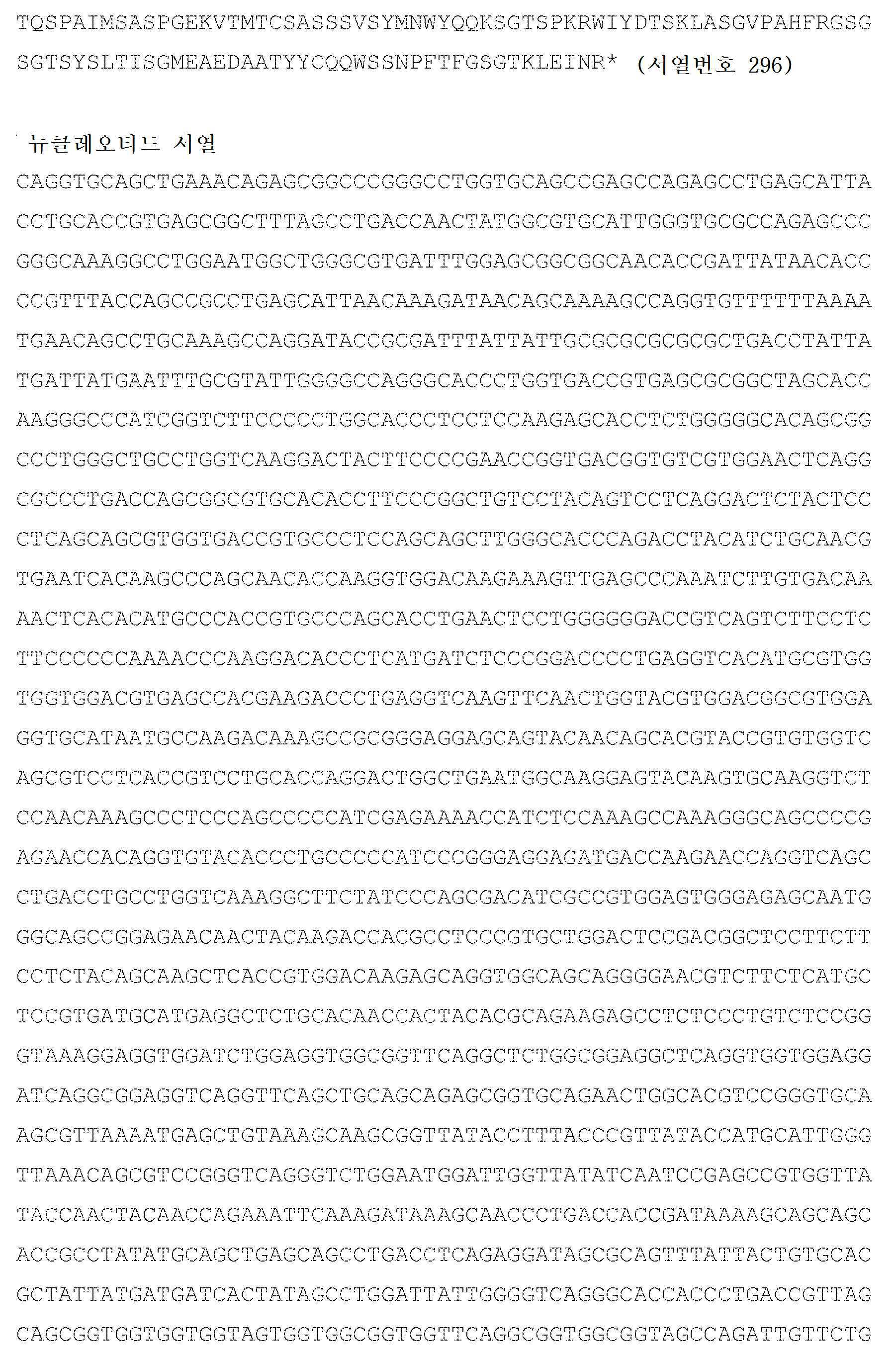
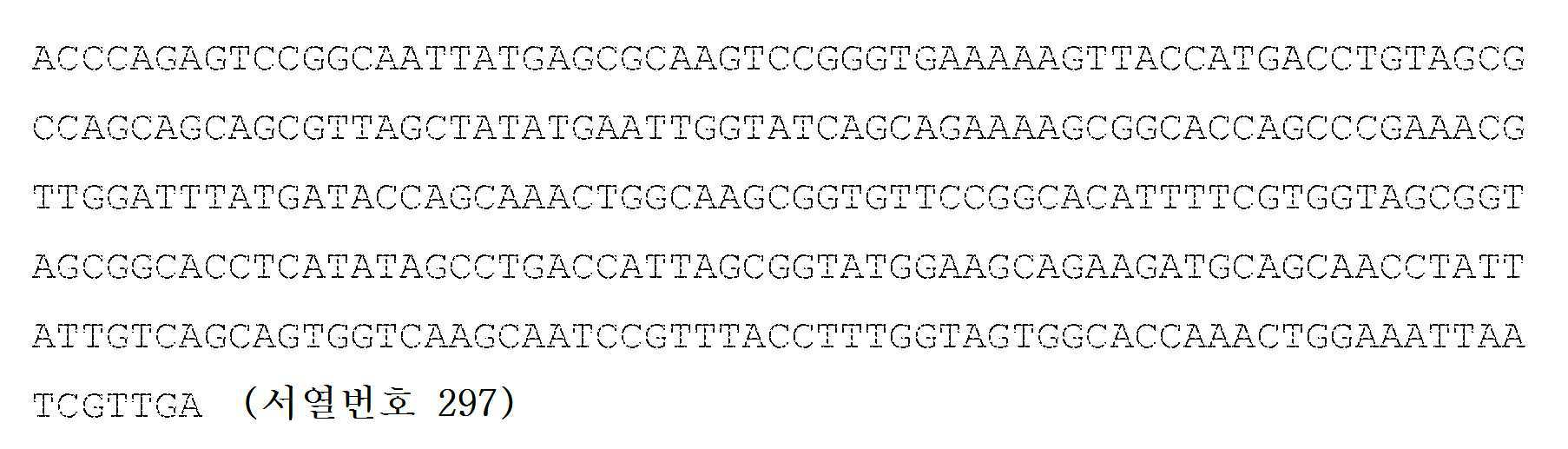
다중특이성 항체 C225v5-OKT3m-L-C 경쇄(항체 C225v5 LC의 C 말단에 부착된 항체 OKT3m)Multispecific antibody C225v5-OKT3m-L-C light chain (antibody OKT3m attached to the C-terminus of antibody C225v5 LC)
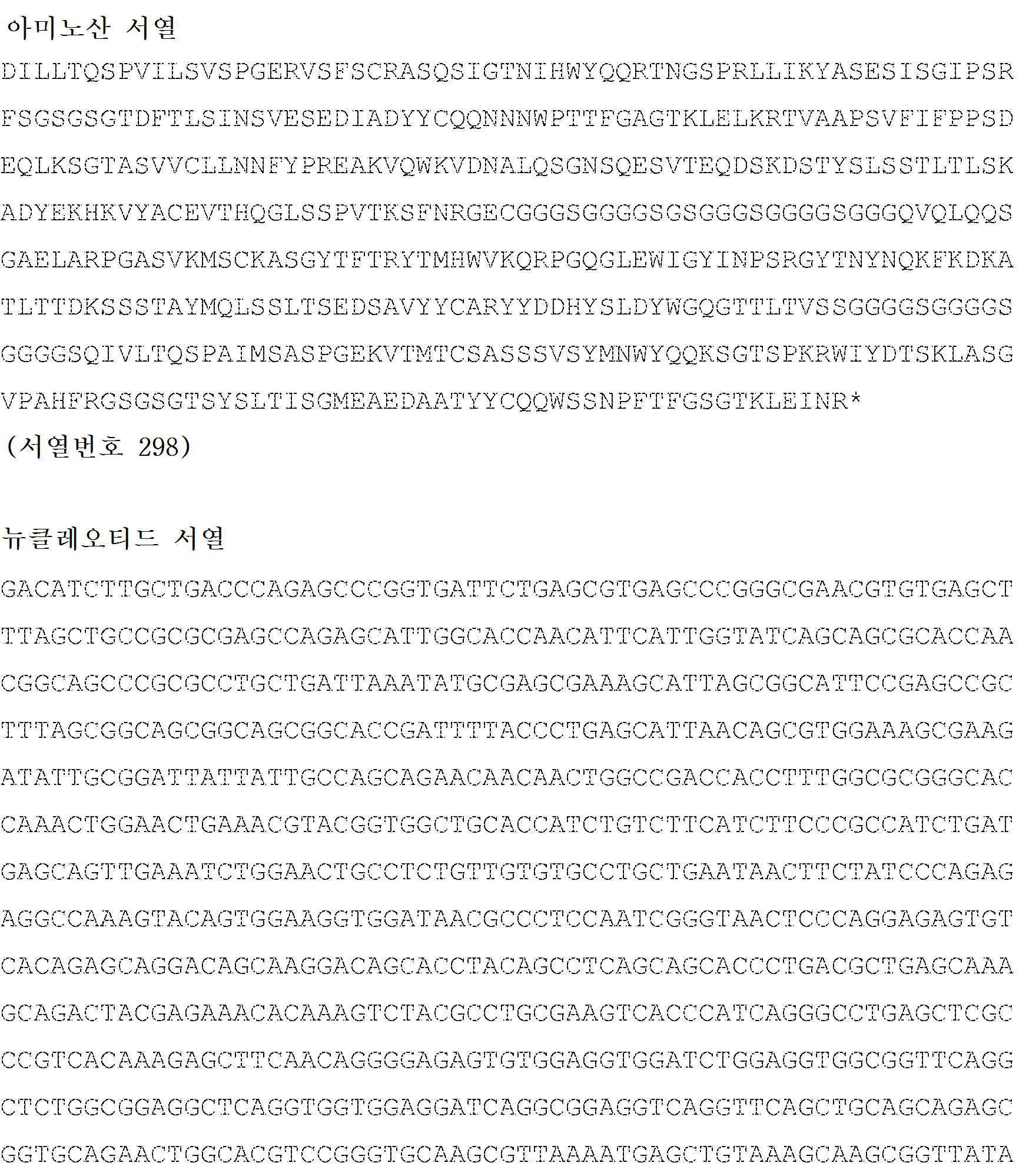

다중특이성 항체 C225v5(N297Q)-OKT3m-H-N 중쇄 Multispecific antibody C225v5(N297Q)-OKT3m-H-N heavy chain
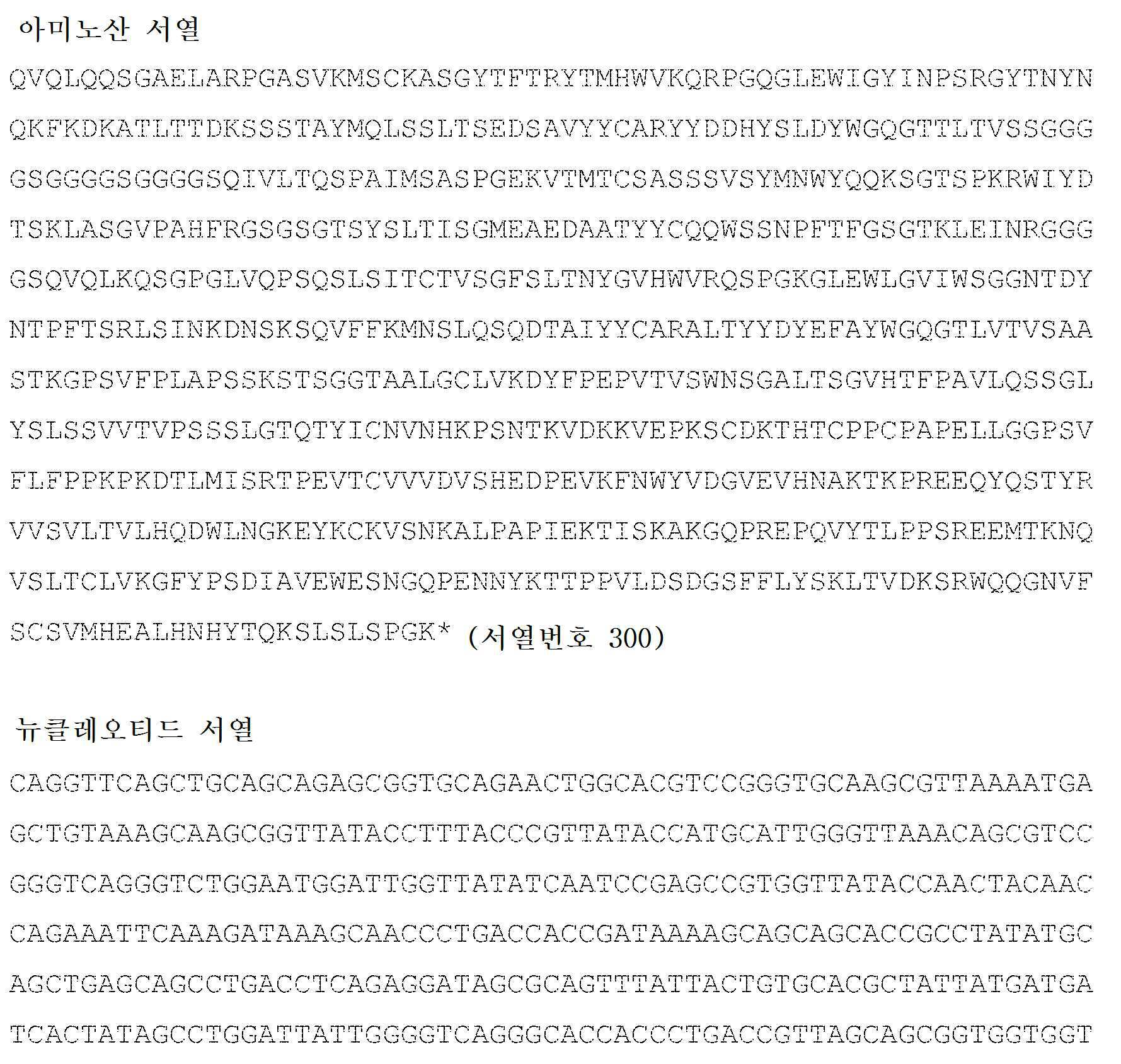

다중특이성 항체 C225v5(N297Q)-OKT3m-H-C 중쇄 Multispecific antibody C225v5(N297Q)-OKT3m-H-C heavy chain

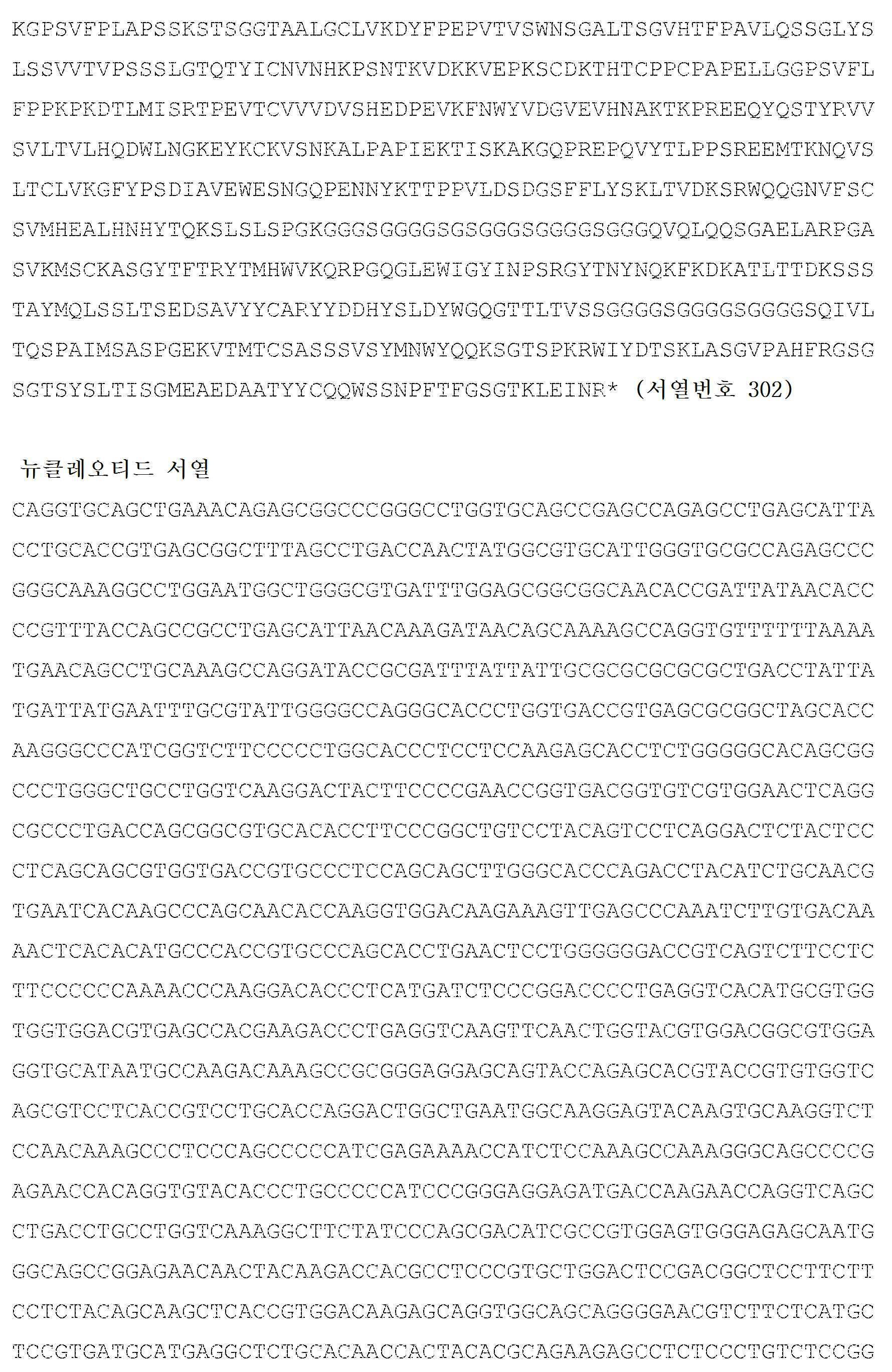

다중특이성 항체 C225v5(N297Q)-OKT3m-L-C 경쇄 Multispecific antibody C225v5(N297Q)-OKT3m-L-C light chain
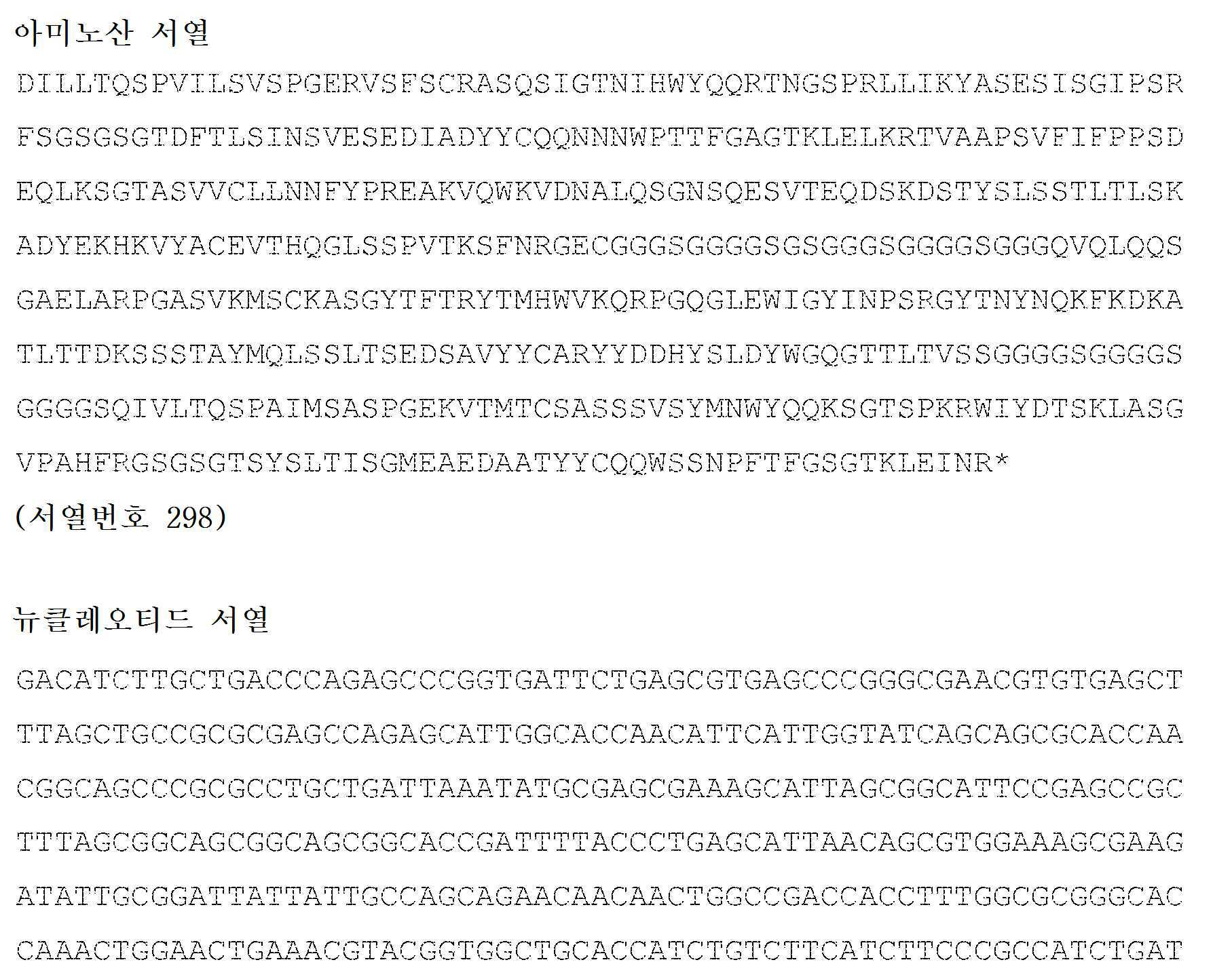

항체 C225v5(N297Q) 중쇄Antibody C225v5 (N297Q) heavy chain
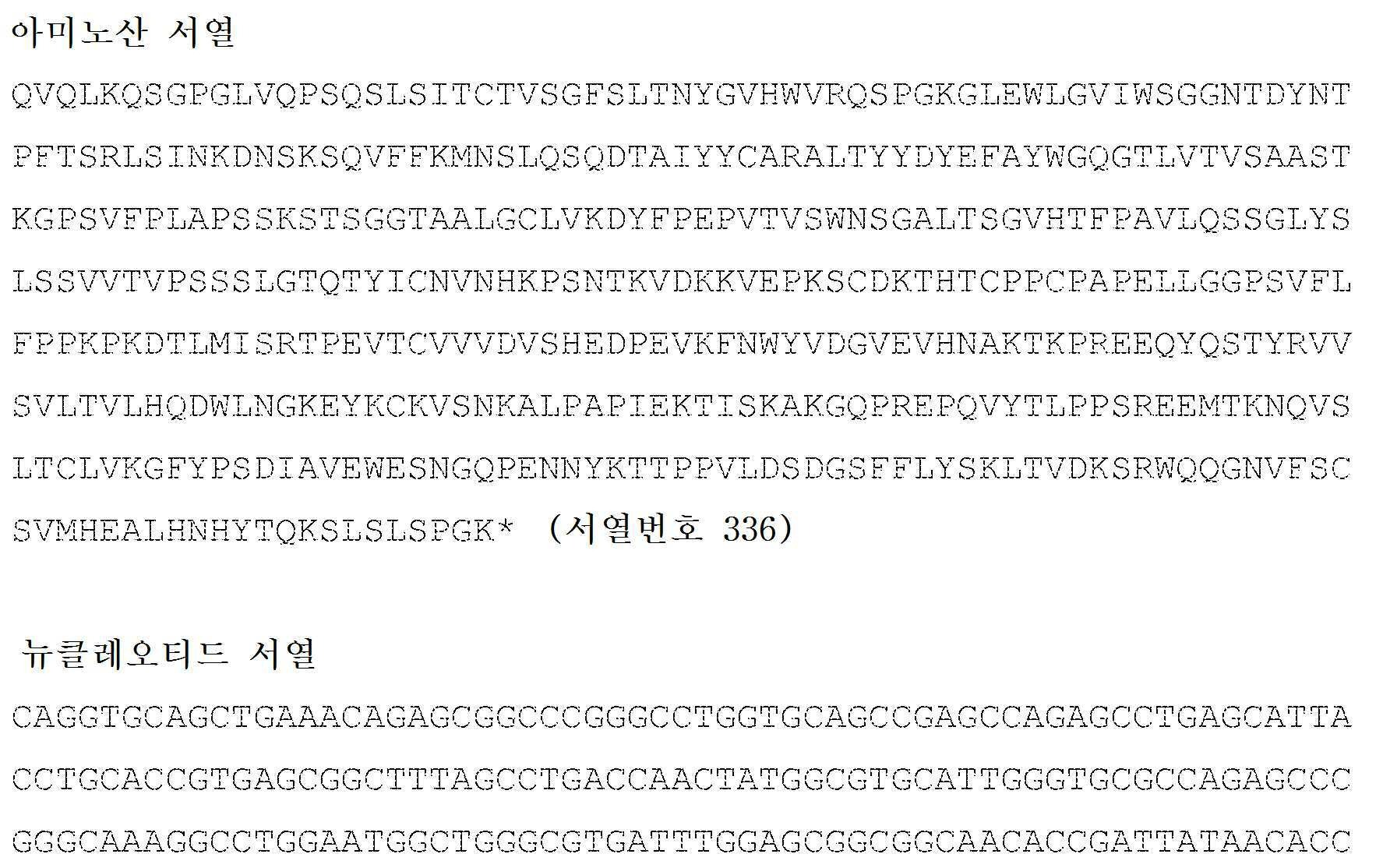
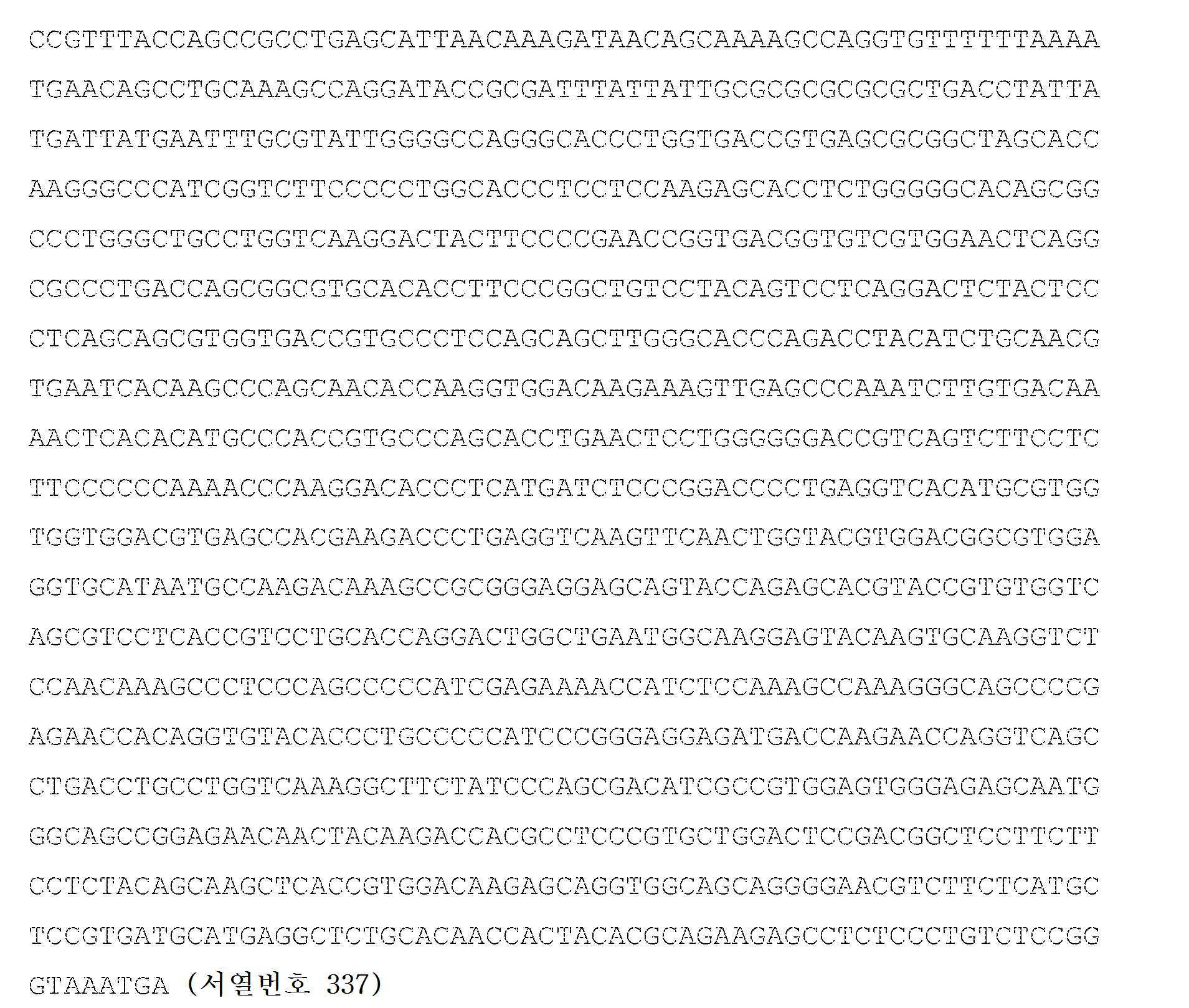
활성화 가능한 항체 3954-1204-C225v5 경쇄Activatable antibody 3954-1204-C225v5 light chain


경쇄 3954-1204-C225 플라스미드 및 중쇄 C225v5-OKT3m-H-N 플라스미드를 포함하는, 다중특이성 활성화 가능한 항체 3954-1204-C225v5-OKT3m-H-N.Multispecific activatable antibody 3954-1204-C225v5-OKT3m-H-N, comprising the light chain 3954-1204-C225 plasmid and the heavy chain C225v5-OKT3m-H-N plasmid.
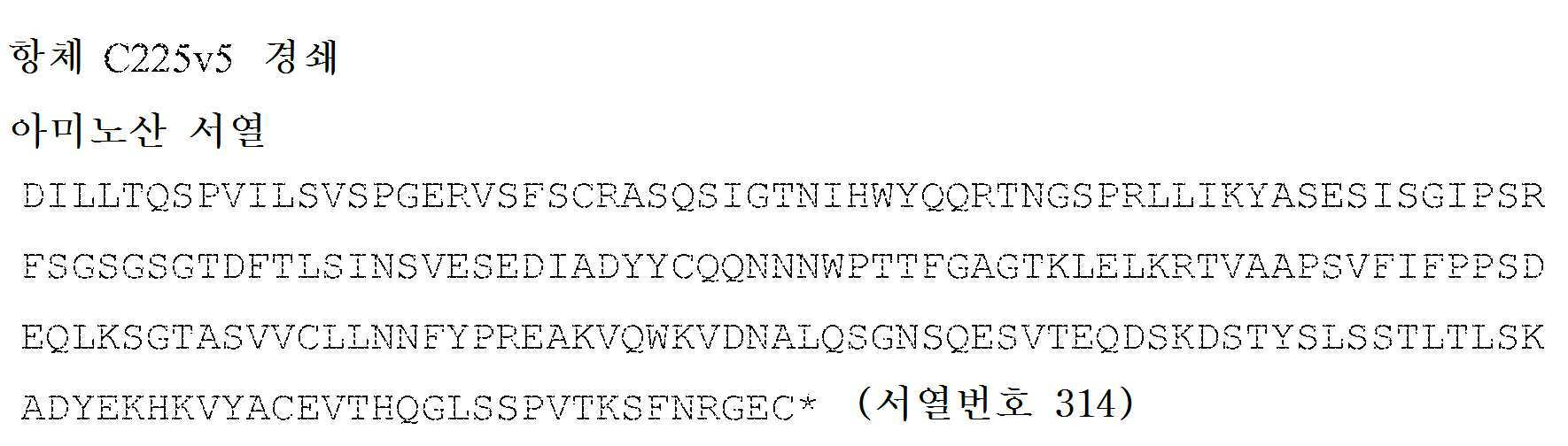

하기 표 11은 본 개시내용의 다중특이성 항체 또는 다중특이성 활성화 가능한 항체를 제조하기 위한 중쇄(HC) 및 경쇄(LC) 서열의 쌍 형성의 일례를 보여주는 것이다. 본원에서 사용되는 바, 경쇄를 언급하는 경우, C225v5를 포함하는 항체 경쇄는 또한 C225를 포함하는 경쇄로도 지칭된다. Table 11 below shows an example of pairing of heavy chain (HC) and light chain (LC) sequences to prepare a multispecific antibody or a multispecific activatable antibody of the present disclosure. As used herein, when referring to a light chain, an antibody light chain comprising C225v5 is also referred to as a light chain comprising C225.

실시예Example 6: 6: 주르카트Jurkat T 세포 상의 On T cells CD3ε에의To CD3ε 다중특이성 항체의 결합 Binding of multispecific antibodies
본 실시예는 본 개시내용의 다중특이성 항체의 T 세포에 결합할 수 있는 능력을 입증한다. This example demonstrates the ability of the multispecific antibodies of the present disclosure to bind to T cells.
3가지 포맷의 다중특이성 항체를 시험하였다: (1) (T 세포 상의 CD3ε(이는 또한 본원에서 CD3ε 및 CD3으로도 지칭된다)에 결합하는) OKT3m scFv가 항EGFR 항체 C225v5의 중쇄의 N 말단에 부착되어 있는 다중특이성 항체인 C225v5-OKT3m-H-N; (2) OKT3m scFv가 항EGFR 항체 C225v5의 중쇄의 C 말단에 부착되어 있는 다중특이성 항체인 C225v5-OKT3m-H-C; 및 (3) OKT3m scFv가 항EGFR 항체 C225v5의 경쇄의 C 말단에 부착되어 있는 다중특이성 항체인 C225v5-OKT3m-L-C. 상기 다중특이성 항체의 아미노산 서열은, C225v5 및 OKT3 항체의 아미노산 서열과 같이 본원에 제공되어 있다. 이소형 대조군, 즉, 인간 IgG1 이소형 대조군, 엔조(Enzo), 카탈로그 ALX-804-133-C100 또한 시험하였다. Three formats of multispecific antibodies were tested: (1) OKT3m scFv (which binds to CD3ε on T cells (which is also referred to herein as CD3ε and CD3)) attached to the N-terminus of the heavy chain of anti-EGFR antibody C225v5 C225v5-OKT3m-HN, a multispecific antibody that has been prepared; (2) C225v5-OKT3m-HC, a multispecific antibody in which OKT3m scFv is attached to the C-terminus of the heavy chain of anti-EGFR antibody C225v5; And (3) C225v5-OKT3m-LC, a multispecific antibody in which OKT3m scFv is attached to the C-terminus of the light chain of anti-EGFR antibody C225v5. The amino acid sequence of the multispecific antibody is provided herein as the amino acid sequence of the C225v5 and OKT3 antibodies. Isotype control, i.e. human IgG 1 isotype control, Enzo, catalog ALX-804-133-C100 was also tested.
3개의 다중특이성 항체 포맷이 CD3ε 양성 주르카트 T 세포(이는 또한 본원에서 주르카트 세포 및 주르카트로도 지칭된다)에 결합할 수 있는지 여부를 측정하기 위해, 유세포 분석법 기반 검정법을 수행하였다. 주르카트 T 세포(클론 E6-1, ATCC, TIB-152)를 글루타맥스(GlutaMAX)™(라이프 테크놀러지즈(Life Technologies), 카탈로그 72400-120), 10% 열 불활성화된 우태아 혈청(HI-FBS: Heat Inactivated-Fetal Bovine Serum, 라이프 테크놀러지즈, 카탈로그 10438-026), 100 U/ml 페니실린, 및 100 ㎍/ml 스트렙토마이신(라이프 테크놀러지즈, 카탈로그 15140-122)을 포함하는 RPMI-1640(이는 또한 본원에서 완전 배지로 지칭된다) 중에서 ATCC의 가이던스에 따라 배양하였다. 원심분리(200xg, 4℃, 5 min)에 의해 세포를 수거하고, 2% HI-FBS를 포함하는 PBS(FACS 완충제) 중에 재현탁시켰다. 웰당 약 250,000개의 주르카트 세포를 96 웰 U 바닥 플레이트로 옮기고, 수거하고, 시험하고자 하는 항체 50 마이크로리터(이는 또한 본원에서 ㎕ 또는 ul로도 지칭된다) 중에 재현탁시켰다. 항체의 출발 농도는 다중특이성 항체의 경우, 100 nM이고, 이소형 대조군의 166.7 nM이었고, 이어서, 각 항체에 대하여 총 8개의 농도로 5배로 일련으로 희석시켰다. To determine whether the three multispecific antibody formats can bind to CD3ε positive Jurkat T cells (also referred to herein as Jurkat cells and Jurkat), a flow cytometry based assay was performed. Jurkat T cells (clone E6-1, ATCC, TIB-152) were treated with GlutaMAX™ (Life Technologies, catalog 72400-120), 10% heat inactivated fetal calf serum (HI -FBS: RPMI-1640 containing Heat Inactivated-Fetal Bovine Serum, Life Technologies, catalog 10438-026), 100 U/ml penicillin, and 100 μg/ml streptomycin (Life Technologies, catalog 15140-122) ( It is also referred to herein as complete medium) in accordance with the guidance of ATCC. Cells were harvested by centrifugation (200xg, 4° C., 5 min) and resuspended in PBS (FACS buffer) containing 2% HI-FBS. About 250,000 Jurkat cells per well were transferred to a 96 well U bottom plate, harvested, and resuspended in 50 microliters of antibody to be tested (also referred to herein as μl or ul). The starting concentration of the antibody was 100 nM for the multispecific antibody and 166.7 nM for the isotype control, followed by serial dilutions of 5 folds with a total of 8 concentrations for each antibody.
세포 및 항체를 약 1시간 동안 진탕시키면서 4℃에서 인큐베이션시키고, 수거하고, 200 ㎕의 FACS 완충제로 3회에 걸쳐 세척하였다. 생성된 주르카트 세포를 50 ㎕의 알렉사플루오르® 647 컨쥬게이트된 항인간 IgG(H+L)(잭슨 이뮤노리서치(Jackson ImmunoResearch), 카탈로그 709-606-149) 중에 재현탁시키고, 약 30 min 동안 진탕시키면서 4℃에서 인큐베이션시켰다. 생성된 주르카트 세포를 수거하고, 200 ㎕의 FACS 완충제로 3회에 걸쳐 세척하고, 2.5 ㎍/ml 7-AAD(BD 파르미겐(BD Pharmigen), 카탈로그 559925)를 포함하는 최종 부피 150 ㎕의 FACS 완충제 중에 재현탁시켰다. 샘플을 BD 어큐리 C6(BD Accuri C6) 유세포 분석기(BD 바이오사이언시즈(BD Biosciences)) 상에 분석하고, 플로우조(FlowJo) V10(트리스타(Treestar))를 이용하여 생존가능한 세포의 정중 형광 강도(MFI: median fluorescence intensity)를 계산하였다. 7-AAD 염색은 전방 측방 산란 게이트가 생존가능한 T 세포를 확인는 데 충분하였다는 것을 보여주었다. EC50 값은 그래프패드 프리즘 6(GraphPad Prism 6)에서 데이터를 로그(효능제) 대 반응(3개의 파라미터)으로 곡선 피팅하여 계산하였다. Cells and antibodies were incubated at 4° C. with shaking for about 1 hour, harvested, and washed 3 times with 200 μl of FACS buffer. The resulting Jurkat cells were resuspended in 50 μl of AlexaFluor® 647 conjugated anti-human IgG (H+L) (Jackson ImmunoResearch, catalog 709-606-149) and for about 30 min. Incubated at 4° C. with shaking. The resulting Jurkat cells were harvested, washed three times with 200 μl of FACS buffer, and a final volume of 150 μl of FACS containing 2.5 μg/ml 7-AAD (BD Pharmigen, catalog 559925). Resuspended in buffer. Samples were analyzed on a BD Accuri C6 flow cytometer (BD Biosciences), and median fluorescence of viable cells using FlowJo V10 (Treestar) Intensity (MFI: median fluorescence intensity) was calculated. 7-AAD staining showed that the forward lateral scatter gate was sufficient to identify viable T cells. EC 50 values were calculated by curve fitting the data in a
도 16a는 3개의 다중특이성 항체 포맷이 모두 주르카트 T 세포에 결합하였으며, EC50 값은 한 자릿수의 nM 내지 nM 이하인 범위인 것을 입증하는 것이다. FIG. 16A demonstrates that all three multispecific antibody formats bound to Jurkat T cells, and that the EC 50 values ranged from nM to nM or less of one digit.
실시예Example 7: 다중특이성 항체는 7: Multispecific antibodies are CD3εCD3ε 발현 T 세포 및 재조합 인간 Expressing T cells and recombinant human EGFR에On EGFR 결합한다. Combine.
본 실시예는 T 세포 및 표적 항원 함유 세포, 둘 모두에 결합할 수 있는(이는 또한 본원에서 공동 결합으로 지칭된다) 본 개시내용의 다중특이성 항체의 능력을 입증한다. This example demonstrates the ability of the multispecific antibodies of the present disclosure to be able to bind to both T cells and cells containing the target antigen (which is also referred to herein as co-binding).
다중특이성 항체 C225v5-OKT3m-H-N, C225v5-OKT3m-H-C, 또는 C225v5-OKT3m-L-C가 CD3ε 양성 주르카트 T 세포 및 EGFR에 결합할 수 있는지 여부를 측정하기 위해, 유세포 분석법 기반 검정법을 수행하였다. 주르카트 세포를 포화 농도의 다중특이성 항체로 전처리한 후, 비오티닐화된 EGFR로 적정하고, 스트렙트아비딘, R-피코에리트린 컨쥬게이트(SAPE: Streptavidin, R-Phycoerythrin Conjugate)로 검출하였다. 이소형 대조군, 즉, 인간 IgG1 이소형 대조군, 엔조, 카탈로그 ALX-804-133-C100 또한 시험하였다. To determine whether the multispecific antibodies C225v5-OKT3m-HN, C225v5-OKT3m-HC, or C225v5-OKT3m-LC can bind to CD3ε positive Jurkat T cells and EGFR, a flow cytometry-based assay was performed. Jurkat cells were pretreated with a saturation concentration of multispecific antibody, titrated with biotinylated EGFR, and detected with streptavidin and R-phycoerythrin conjugate (SAPE: Streptavidin, R-Phycoerythrin Conjugate). An isotype control, i.e. a human IgG 1 isotype control, Enzo, catalog ALX-804-133-C100 was also tested.
주르카트 세포를 본원에 기술된 바와 같이 배양하고, 수거하였다. 웰당 약 500,000개의 주르카트 세포를 U 바닥 플레이트로 옮기고, 수거하고, 50 ㎕의 40 nM 다중특이성 항체 또는 67 nM 이소타입 항체 중에 재현탁시켰다. 세포를 약 1시간 동안 진탕시키면서 4℃에서 인큐베이션시키고, 수거하고, 200 ㎕의 FACS 완충제로 3회에 걸쳐 세척하였다. (본 개시내용의 다중특이성 항체에 결합하는) 생성된 주르카트 세포를 50 ㎕의 비오티닐화된 재조합 인간 EGFR 단백질(앱캠(Abcam), 카탈로그 ab168702)에 출발 농도를 약 290 nM으로 하여 총 8개의 농도로 5배로 일련으로 희석시켜 재현탁시켰다. 세포를 약 1시간 동안 진탕시키면서 4℃에서 인큐베이션시키고, 수거하고, 200 ㎕의 FACS 완충제로 3회에 걸쳐 세척하였다. 생성된 주르카트 세포를 50 ㎕ 10 ㎍/ml 스트렙트아비딘, R-피코에리트린 컨쥬게이트(라이프 테크놀러지즈, S866) 중에 재현탁시키고, 약 1시간 동안 진탕시키면서 4℃에서 인큐베이션시켰다. 세포를 수거하고, 200 ㎕ FACS 완충제로 1회 세척하고, 150 ㎕ FACS 완충제 중에 재현탁시켰다. 본원에 기술된 바와 같이 샘플을 BD 어큐리 C6 상에서 분석하고, MFI를 계산하였다. EC50 값은 본원에 기술된 바와 같이 그래프패드 프리즘 6에서 계산하였다. Jurkat cells were cultured and harvested as described herein. About 500,000 Jurkat cells per well were transferred to U bottom plates, harvested and resuspended in 50 μl of 40 nM multispecific antibody or 67 nM isotype antibody. Cells were incubated at 4° C. with shaking for about 1 hour, harvested, and washed 3 times with 200 μl of FACS buffer. The resulting Jurkat cells (binding to the multispecific antibody of the present disclosure) were added to 50 μl of biotinylated recombinant human EGFR protein (Abcam, catalog ab168702) with a starting concentration of about 290 nM for a total of 8 cells. Resuspended by serial dilution at 5 times concentration. Cells were incubated at 4° C. with shaking for about 1 hour, harvested, and washed 3 times with 200 μl of FACS buffer. The resulting Jurkat cells were resuspended in 50
도 16b는 3개의 다중특이성 항체 포맷 모두가 T 세포 상의 CD3ε에의 동시 결합을 필요로 한, 농도 의존성 EGFR 결합을 보였다는 것을 입증하는 것이다. EC50 값은 nM 이하 내지 한 자릿수의 nM 범위였다.Figure 16B demonstrates that all three multispecific antibody formats showed concentration dependent EGFR binding, requiring simultaneous binding to CD3ε on T cells. EC 50 values ranged from nM or less to one digit nM.
실시예Example 8: 다중특이성 항체에 의한 T 세포의 표적 의존성 활성화 8: Target-dependent activation of T cells by multispecific antibodies
본 실시예는 표적 의존성 방식으로 T 세포를 활성화시킬 수 있는 본 개시내용의 다중특이성 항체의 능력을 입증한다. This example demonstrates the ability of the multispecific antibodies of the present disclosure to activate T cells in a target dependent manner.
다중특이성 항체 C225v5-OKT3m-H-N, C225v5-OKT3m-H-C, 또는 C225v5-OKT3m-L-C에 의한 주르카트 T 세포 및 EGFR-양성 표적 세포의 공동 인게이징이 주르카트 세포의 활성화를 유도할 수 있는지 여부를 측정하기 위하여, 유세포 분석법 기반 검정법을 사용하였다. 주르카트 세포 및 CFSE 표지화된 표적 세포를 약 15 h 동안 공동 배양하고, 염색하여 조기 T 세포 활성화 마커인, CD69의 표면 발현에 대해 T 세포 활성화를 평가하였다. Whether co-engaging of Jurkat T cells and EGFR-positive target cells by multispecific antibodies C225v5-OKT3m-HN, C225v5-OKT3m-HC, or C225v5-OKT3m-LC can induce activation of Jurkat cells. To measure, a flow cytometry based assay was used. Jurkat cells and CFSE labeled target cells were co-cultured for about 15 h and stained to assess T cell activation for surface expression of CD69, an early T cell activation marker.
SW480 세포로도 또한 지칭되는 EGFR-양성 SW480 세포(ATCC, 카탈로그 CCL-228) 및 U266 세포로도 또한 지칭되는 EGFR 음성 U266 세포(ATCC, 카탈로그 TIB-196)를 각각 글루타맥스™, 10% HI-FBS, 100 U/ml 페니실린, 및 100 ㎍/ml 스트렙토마이신을 포함하는 RPMI-1640(이는 완전 배지로 지칭된다) 중에서 ATCC의 가이던스에 따라 배양하였다. 상기 표적 세포를 수거하고, PBS로 1회에 걸쳐 세척하고, PBS 중에 2x10⁶개의 세포/ml로 재현탁시켰다. 5 mM CFSE 스톡(라이프 테크놀러지즈, 셀트레이스™ CFSE 셀 프로리러페이션 키트(CellTrace™ CFSE Cell Proliferation Kit), 카탈로그 C34554)을 DMSO 중에서 제조하고, PBS 중에서 30 nM으로 희석시켰다. PBS/CFSE 작업용 스톡을 즉시 사용하였다. 동량의 표적 세포 및 CFSE 스톡을 최종 CFSE 농도 15 nM 및 최종 세포 밀도 1x10⁶개의 세포/ml로 조합하였다. 세포를 37℃에서 15 min 동안 인큐베이션시켰다. 동량의 HI-FBS를 첨가하여 표지화를 켄칭하였다. 인큐베이션된 표적 세포를 수거하고, 완전 배지로 1회에 걸쳐 세척하고, 완전 배지 중에 5x10⁵개의 세포/ml로 재현탁시켰다. 웰당 50 ㎕의 세포 현탁액을 웰당 총 25,000개의 표적 세포로 96 웰 평평한 바닥 플레이트에 첨가하였다. EGFR-positive SW480 cells (ATCC, catalog CCL-228), also referred to as SW480 cells, and EGFR negative U266 cells (ATCC, catalog TIB-196), also referred to as U266 cells, were respectively treated with Glutamax™, 10% HI -FBS, 100 U/ml penicillin, and 100 μg/ml streptomycin containing RPMI-1640 (this is referred to as complete medium) in accordance with the guidance of ATCC. The target cells were harvested, washed once with PBS, and resuspended at 2×10 6 cells/ml in PBS. 5 mM CFSE stock (Life Technologies, CellTrace™ CFSE Cell Proliferation Kit, catalog C34554) was prepared in DMSO and diluted to 30 nM in PBS. The PBS/CFSE working stock was used immediately. Equal amounts of target cells and CFSE stock were combined with a final CFSE concentration of 15 nM and a final cell density of 1×10 6 cells/ml. Cells were incubated at 37° C. for 15 min. The labeling was quenched by adding the same amount of HI-FBS. The incubated target cells were harvested, washed once with complete medium, and resuspended at 5 ×10 5 cells/ml in complete medium. 50 μl of cell suspension per well was added to a 96 well flat bottom plate with a total of 25,000 target cells per well.
주르카트 T 세포를 본원에 기술된 바와 같이 배양하였다. 주르카트 세포를 수거하고, 완전 배지 중에 1x10⁶개의 세포/ml로 재현탁시키고, 웰당 50 ㎕의 세포 현탁액을 웰당 총 50,000 주르카트 세포로 표적 세포를 함유하는 평평한 바닥 플레이트에 첨가하였다. 효과기 T 세포 대 표적 세포의 비율은 2:1이었다. Jurkat T cells were cultured as described herein. Jurkat cells were harvested, resuspended at 1×10 6 cells/ml in complete medium, and 50 μl of cell suspension per well was added to a flat bottom plate containing target cells for a total of 50,000 Jurkat cells per well. The ratio of effector T cells to target cells was 2:1.
3회에 걸쳐 농축된 항체 스톡을 완전 배지 중에서 제조하였다. 최고 농도는 각 다중특이성 항체 포맷의 경우, 1.2 nM이고, OKT3(바이오레젼드(BioLegend), 카탈로그 317304), C225v5(그의 아미노산 서열은 본원에 제공되어 있다), 및 이소형 대조군 항체의 경우, 1.5 nM이었다. 각 항체에 대하여 총 8개의 농도로 완전 배지 중에서 5배의 일련의 희석액을 제조하였다. 각 다중특이성 항체 포맷의 경우, 출발 농도를 400 pM으로 하여, 또는 OKT3, C225v5, 및 이소타입 항체 각각의 경우, 출발 농도를 500 pM으로 하여 모든 스톡을 3배로 희석시켜, 웰당 50 ㎕의 항체를 T 세포 및 표적 세포를 함유하는 평평한 바닥 플레이트에 첨가하였다. Antibody stocks concentrated in triplicate were prepared in complete medium. The highest concentration is 1.2 nM for each multispecific antibody format, OKT3 (BioLegend, catalog 317304), C225v5 (its amino acid sequence is provided herein), and 1.5 nM for isotype control antibodies. Was. A 5-fold serial dilution was prepared in complete medium with a total of 8 concentrations for each antibody. For each multispecific antibody format, the starting concentration was 400 pM, or for each of OKT3, C225v5, and isotype antibodies, the starting concentration was 500 pM, and all stocks were diluted three-fold, 50 μl of antibody per well. It was added to a flat bottom plate containing T cells and target cells.
약 15 h 경과 후, 세포를 U 바닥 플레이트로 옮기고, 수거하였다. 회수율을 최대화시키기 위해, 세포 배양 플레이트를 150 ㎕ FACS 완충제로 세척하고, 세액을 U 바닥 플레이트로 옮겨 놓았다. 세포를 수거하고, 50 ㎕ 항CD69 PE 컨쥬게이트된 항체(BD 바이오사이언시즈, 카탈로그 555531, 제조사의 권고 농도로 사용) 중에 재현탁시키고, 4℃에서 1 h 동안 진탕시키면서 염색시켰다. 세포를 200 ㎕ FACS 완충제로 1회에 걸쳐 세척하고, 최종 부피 150 ㎕ 중에 재현시켰다. 단일 색상 대조군을 사용하여 BD 어큐리 C6 상에서 보정하였다. 10,000개의 세포를 전방 측장 산란기에서 수집하고, 플로우조를 이용하여 CFSE 음성 게이트 및 MFI를 계산하였다. EC50 값은 본원에 기술된 바와 같이 그래프패드 프리즘 6에서 계산하였다. After about 15 h, cells were transferred to U bottom plate and harvested. To maximize recovery, the cell culture plate was washed with 150 μl FACS buffer and the wash was transferred to a U bottom plate. Cells were harvested, resuspended in 50 μl anti-CD69 PE conjugated antibody (BD Biosciences, catalog 555531, used at manufacturer's recommended concentration) and stained with shaking at 4° C. for 1 h. Cells were washed once with 200 μl FACS buffer and regenerated in a final volume of 150 μl. A single color control was used to calibrate on the BD Acury C6. 10,000 cells were collected in an anterior length scatterer, and CFSE negative gate and MFI were calculated using a flow bath. EC 50 values were calculated on
도 17은 pM 농도 이하의 농도를 시작으로 입증된 바, 가장 강력한 CD69 활성화는 주르카트 T 세포 및 EGFR-양성 SW480 세포, 둘 모두의 존재 하에서 공동 배양된 각 다중특이성 항체 포맷에 의존한다는 것을 입증한다. 대조적으로, EGFR 음성 U266 세포와 함께 공동 배양하여 유도된 T 세포 활성화는 유의적으로 덜 효과적이었고, 이는 EGFR 양성 세포에 의해 유도된 활성화와 비교하여 최대 CD69 유도는 75% 감소 및 nM 이하의 EC50 값을 보였다. U266 세포가 사용되었을 때와 같이, 다중특이성 항체의 EGFR 비의존적 활성화는 OKT3 항체의 것과 유사하였고, C225v5 및 이소형 대조군 항체의 경우, 무시해도 될 정도의 CD69 염색이 관찰되었다. Figure 17 demonstrates starting at concentrations below the pM concentration, demonstrating that the most potent CD69 activation depends on each multispecific antibody format co-cultured in the presence of both Jurkat T cells and EGFR-positive SW480 cells. . In contrast, T cell activation induced by co-culture with EGFR negative U266 cells was significantly less effective, which resulted in a 75% reduction in maximal CD69 induction compared to activation induced by EGFR positive cells and an EC 50 of less than nM. Showed value. As when U266 cells were used, EGFR independent activation of the multispecific antibody was similar to that of the OKT3 antibody, and negligible CD69 staining was observed for the C225v5 and isotype control antibodies.
실시예Example 9: 다중특이성 항체에 의한 일차 CD8 9: Primary CD8 by multispecific antibody ++ T 세포의 표적 의존성 활성화 Target-dependent activation of T cells
본 실시예는 일차 CD8 양성(CD8+) T 세포를 활성화시킬 수 있는 본 개시내용의 다중특이성 항체의 능력을 입증한다. This example demonstrates the ability of the multispecific antibodies of the present disclosure to activate primary CD8 positive (CD8 + ) T cells.
다중특이성 항체 C225v5-OKT3m-H-N, C225v5-OKT3m-H-C, 또는 C225v5-OKT3m-L-C가 일차 인간 CD8+ T 세포의 EGFR 의존성 활성화를 매개할 수 있는지 여부를 측정하기 위하여, 유세포 분석법 기반 검정법을 수행하였다. 인간 말초 혈액 단핵 세포(PBMC: human peripheral blood mononuclear cell)로부터 유래된 CD8+ T 세포 및 DDAO-SE 표지화된 표적 세포를 밤새도록 공동으로 배양하고, 조기 활성화 마커인, CD69에 대해 염색하여 활성화를 평가하였다. To determine whether the multispecific antibodies C225v5-OKT3m-HN, C225v5-OKT3m-HC, or C225v5-OKT3m-LC can mediate EGFR dependent activation of primary human CD8 + T cells, a flow cytometry-based assay was performed. . CD8 + T cells derived from human peripheral blood mononuclear cells (PBMC) and DDAO-SE-labeled target cells were co-cultured overnight, and their activation was evaluated by staining for CD69, an early activation marker. I did.
EGFR-양성 SW480 세포를 배양하고, 본원에 기술된 바와 같이 표지화하되, 단, 하기를 예외로 하였다: (1) SW480 표적 세포를 셀트레이스™ 파레드(CellTrace™ FarRed) DDAO-SE(라이프 테크놀러지즈, 카탈로그 C34553)로 표지화하였고, (2) 완전 배지를 25 U/ml IL-2(R&D 시스템즈, 카탈로그 202-IL-050/CF)로 보충하였다. 웰당 총 25,000개의 표적 세포를 위해 웰당 50 ㎕의 표적 세포 현탁액(5x10⁵개의 세포/ml)을 96 웰, 평평한 바닥 플레이트에 첨가하였다. EGFR-positive SW480 cells were cultured and labeled as described herein, with the following exception: (1) SW480 target cells were treated with CellTrace™ FarRed DDAO-SE (Life Technologies , Catalog C34553), and (2) complete medium supplemented with 25 U/ml IL-2 (R&D Systems, catalog 202-IL-050/CF). For a total of 25,000 target cells per well, 50 μl of the target cell suspension ( 5 ×10 5 cells/ml) per well was added to a 96 well, flat bottom plate.
신선한 정상적인 말초 혈액 CD8+ 세포독성 T 세포(올셀즈(AllCells), 카탈로그 PB009-3)를 올셀즈(미국 캘리포니아주 알라메다)로부터 입수하고, 원심분리(200xg, RT, 15 min)에 의해 수거하고, 25 U/ml IL-2로 보충된 완전 배지 중에 1.5x10⁶개의 세포/ml로 재현탁시켰다. 웰당 총 약 75,000개의 CD8+ 세포독성 T 세포 및 3:1 비율의 T 세포 대 표적 세포를 위해 표적 세포를 함유하는 평평한 바닥 플레이트에 웰당 50 ㎕의 세포 현탁액을 첨가하였다. Fresh normal peripheral blood CD8 + cytotoxic T cells (AllCells, catalog PB009-3) were obtained from AllCells (Alameda, CA, USA), collected by centrifugation (200xg, RT, 15 min) and , Resuspended at 1.5×10 6 cells/ml in complete medium supplemented with 25 U/ml IL-2. For a total of about 75,000 CD8 + cytotoxic T cells per well and a 3:1 ratio of T cells to target cells, 50 μl of cell suspension per well were added to a flat bottom plate containing target cells.
25 U/ml IL-2로 보충된 완전 배지 중에서 3회 농축된 항체 스톡을 제조하였다. 최고 농도는 600 pM이었고, 이어서, 각 항체에 대하여 총 8개의 농도로 5배로 일련으로 희석시켰다. CD8+ 세포 및 표적 세포를 함유하는 평평한 바닥 플레이트에 웰당 50 ㎕의 항체를 첨가하고, 출발 농도를 200 pM으로 하여 모든 스톡을 3배로 희석시켰다. Antibody stocks were prepared 3 times concentrated in complete medium supplemented with 25 U/ml IL-2. The highest concentration was 600 pM, followed by serial dilutions in 5-fold with a total of 8 concentrations for each antibody. 50 μl of antibody per well was added to a flat bottom plate containing CD8 + cells and target cells, and all stocks were diluted 3-fold with a starting concentration of 200 pM.
밤새도록 인큐베이션시킨 후, 본원에 기술된 발광성 세포독성 검정법을 위해 평평한 바닥 플레이트를 원심분리시키고, 100 ㎕의 상청액을 제거하였다. 남은 상청액을 U 바닥 플레이트로 옮기고, 평평한 바닥 플레이트 중의 세포를 0.25% 트립신(라이프 테크놀러지즈, 카탈로그 25200-056)으로 분리시켰다. 3 부피의 FACS 완충제를 첨가하여 트립신 활성을 켄칭시키고, 세포 현탁액을 U 바닥 플레이트로 옮겼다. 수거한 후, 세포를 50 ㎕의, 항CD69 PE/항CD8 FITC 칵테일(항CD8 FITC, BD 바이오사이언시즈, 카탈로그 561948), FITC 이소형 대조군(BD 바이오사이언시즈, 카탈로그 340755), 또는 PE 이소형 대조군(BD 바이오사이언시즈, 카탈로그 340761) 중 하나에서 재현탁시켰다. 모든 항체는 제조사가 권고하는 농도로 사용하였다. 세포를 4℃에서 1 h 동안 진탕시키면서 염색시키고, 수거하고, 2.5 ㎍/ml 7-AAD를 포함하는 최종 부피 150 ㎕의 FACS 완충제 중에 재현탁시켰다. 단일 색상 대조군을 사용하여 BD 어큐리 C6 상에서 보정하고, 고정 부피의 세포 현탁액을 수집하였다. CD8+ 세포에 대한 게이팅은 표적 세포와 생존가능한 T 세포를 구별하는 데 충분하였다. 활성화는 PE 이소형 대조군 이상으로 CD69를 발현하는 T 세포의 비율(%)로서 정량화하였다. After overnight incubation, the flat bottom plate was centrifuged for the luminescent cytotoxicity assay described herein and 100 μl of the supernatant was removed. The remaining supernatant was transferred to a U bottom plate and cells in the flat bottom plate were separated with 0.25% trypsin (Life Technologies, Cat. 25200-056). Trypsin activity was quenched by addition of 3 volumes of FACS buffer, and the cell suspension was transferred to a U bottom plate. After collection, cells were harvested in 50 μl of anti-CD69 PE/anti-CD8 FITC cocktail (anti-CD8 FITC, BD Biosciences, catalog 561948), FITC isotype control (BD Biosciences, catalog 340755), or PE isotype Resuspended in one of the controls (BD Biosciences, catalog 340761). All antibodies were used at the concentration recommended by the manufacturer. Cells were stained with shaking for 1 h at 4° C., harvested, and resuspended in 150 μl FACS buffer in a final volume containing 2.5 μg/ml 7-AAD. A single color control was used to calibrate on BD Acury C6 and a fixed volume of cell suspension was collected. Gating on CD8 + cells was sufficient to differentiate between target cells and viable T cells. Activation was quantified as the percentage (%) of T cells expressing CD69 above the PE isotype control.
도 18a는 3개의 다중특이성 항체 포맷 모두가 한 자릿수의 pM EC50 값인, 일차 CD8+ T 세포의 농도 의존성 활성화를 입증하였다. OKT3, C225v5, 또는 인간 IgG1 이소형 대조군(엔조) 항체로 처리한 결과, CD69는 무시해도 될 정도로 유도되었다. FIG. 18A demonstrates concentration dependent activation of primary CD8 + T cells, where all three multispecific antibody formats are single-digit pM EC 50 values. As a result of treatment with OKT3, C225v5, or human IgG1 isotype control (enzo) antibody, CD69 was induced to a negligible degree.
실시예Example 10: 다중특이성10: multispecificity 항체에 의한 표적 세포의 표적 의존성 사멸 Target-dependent killing of target cells by antibodies
본 실시예는 T 세포 지정 표적 의존성 세포 용해를 유도할 수 있는 본 개시내용의 다중특이성 항체의 능력을 입증한다. This example demonstrates the ability of the multispecific antibodies of the present disclosure to induce T cell directed target dependent cell lysis.
다중특이성 항체 C225v5-OKT3m-H-N, C225v5-OKT3m-H-C, 또는 C225v5-OKT3m-L-C가 T 세포 지정 표적 의존성 세포 용해를 유도할 수 있는지 여부를 측정하기 위해, SW480 세포를 본원에 기술된 바와 같이 3:1의 효과기 대 표적 세포 비율로 CD8+ T 세포와 함께 공동 배양하였다. 밤새도록 인큐베이션시킨 후, 100 ㎕의 막 완전성을 상실한 후, 이어서 세포용해가 이루어지는 세포에 의해 방출되는 세포에 의해 방출되는 프로테아제의 활성을 측정하기 위해 발광성 펩티드 기질을 사용하는 제조사의 프로토콜(사이토톡스-글로™ 사이토톡시티 어세이(CytoTox-Glo™ Cytotoxicity Assay), 카탈로그 G9292, 프로메가(Promega))에 따라 세포독성과 관련된 뚜렷한 프로테아제 활성에 대하여 백색 벽 96 웰 플레이트(가르니에 바이오 원(Greiner Bio One) 카탈로그 655098)에서 검정하였다. 표적 세포의 다중특이성 항체 의존성 세포독성은 비처리된 값의 배경 감산 후에 발광으로 표현하였고, 프리즘(Prism)에서 곡선 피팅 분석하여 로그(효능제) 대 반응(3개의 파라미터)으로 플롯팅하였다. To determine whether the multispecific antibody C225v5-OKT3m-HN, C225v5-OKT3m-HC, or C225v5-OKT3m-LC can induce T cell directed target dependent cell lysis, SW480 cells were subjected to 3 as described herein. Co-cultured with CD8 + T cells at an effector to target cell ratio of :1. After overnight incubation, 100 μl of membrane integrity is lost, and then the manufacturer's protocol using a luminescent peptide substrate to measure the activity of the protease released by the cells released by the cells undergoing cytolysis (Cytotox- White wall 96 well plates (Greiner Bio One) for distinct protease activity associated with cytotoxicity according to the CytoTox-Glo™ Cytotoxicity Assay, catalog G9292, Promega) Catalog 655098). Multispecific antibody dependent cytotoxicity of target cells was expressed as luminescence after background subtraction of untreated values, and plotted as log (agonist) versus response (three parameters) by curve fitting analysis in Prism.
도 18b는 3개의 다중특이성 항체 포맷은 모두 SW480 세포의 T 세포 매개 사멸을 유도하였다는 것을 입증한다. 예상대로, OKT3 항체 단독의 것은 SW480 세포의 검출가능한 정도의 사멸을 보이지 않았고, 이는 다중특이성 항체에 의한 효과적인 세포독성을 위해서는 CD3 및 종양 표적, 둘 모두의 공동 인게이징이 필요하다는 것을 제안하는 것이다. 18B demonstrates that all three multispecific antibody formats induced T cell mediated death of SW480 cells. As expected, the OKT3 antibody alone did not show a detectable degree of killing of SW480 cells, suggesting that co-engaging of both CD3 and tumor targets is required for effective cytotoxicity by multispecific antibodies.
실시예Example 11: 다중특이성11: multispecificity 항체에 의한 표적 의존성 T 세포 활성화 및 표적 세포의 사멸 Target-dependent T cell activation and killing of target cells by antibody
본 실시예는 CD8+ T 세포의 T 세포 지정 표적 의존성 활성화 및 표적 세포의 사멸을 유도할 수 있는 본 개시내용의 다중특이성 항체의 능력을 입증한다. This example demonstrates the ability of the multispecific antibodies of the present disclosure to induce T cell directed target dependent activation of CD8 + T cells and death of target cells.
관찰된 T 세포 활성화가 표적 세포에 의한 EGFR 발현에 의존하는지 여부를 측정하기 위해, CFSE 표지화된 EGFR-양성 SW480 세포 또는 EGFR 음성 U266 세포를 각각 상기 기술된 바와 같이 200 pM을 출발로 하여 5배 희석된, 다중특이성 항체 C225v5-OKT3m-H-N 또는 OKT3의 존재 하에서 인간 CD8+ T 세포와 함께 공동 배양하였다. 본원에 기술된 방법을 사용하여 T 세포로부터 표적 세포를 구별하기 위해 표적 세포(30 nM)의 CFSE 표지화를 사용하였다. 냉동된 정상 말초 혈액 CD8+ 세포독성 T 세포(올셀즈, 카탈로그 PB009-3F)를 제조사가 지시한 바와 같이 해동시켰다. 밤새도록 인큐베이션시킨 후, T 세포(CFSE 음성 세포)를 본원에 기술된 바와 같이 조기 활성화 마커인 CD69의 표면 발현에 대해 검정하였다. 간략하면, 세포를 검정용 플레이트로부터 제거하고, 트립신(라이프 테크놀러지즈)을 이용하여 부착성 세포를 제거하고, FACS 완충제로 세포를 1회에 걸쳐 세척하였다. 세포를 1시간 동안 항CD69-PE(BD 바이오사이언시즈)로 염색하였다. 세포를 세척하고, 세포 표면 CD69 발현에 대하여 BD 어큐리 C6 상에서 분석하였다. 본원에 기술된 바와 같이 MFI 값을 계산하였다. 결과는 FCS 익스프레스(FCS Express) 분석용 소프트웨어를 이용하여 이소형 대조군 이상으로 CD69를 발현하는 T 세포의 비율(%)로서 표현하고, 프리즘에서 곡선 피팅 분석하여 로그(효능제) 대 반응(3개의 파라미터)으로 플롯팅하였다. To determine whether the observed T cell activation is dependent on EGFR expression by target cells, CFSE-labeled EGFR-positive SW480 cells or EGFR negative U266 cells were diluted 5-fold starting from 200 pM, respectively, as described above. And co-cultured with human CD8 + T cells in the presence of the multispecific antibody C225v5-OKT3m-HN or OKT3. CFSE labeling of target cells (30 nM) was used to differentiate target cells from T cells using the methods described herein. Frozen normal peripheral blood CD8 + cytotoxic T cells (All Cells, catalog PB009-3F) were thawed as directed by the manufacturer. After overnight incubation, T cells (CFSE negative cells) were assayed for surface expression of CD69, an early activation marker, as described herein. Briefly, cells were removed from the assay plate, adherent cells were removed using trypsin (Life Technologies), and cells were washed once with FACS buffer. Cells were stained with anti-CD69-PE (BD Biosciences) for 1 hour. Cells were washed and analyzed on BD Acury C6 for cell surface CD69 expression. MFI values were calculated as described herein. Results are expressed as the percentage (%) of T cells expressing CD69 above the isotype control using FCS Express analysis software, and curve fitting analysis in a prism was performed to analyze log (agonist) versus response (three Parameters).
도 18c에 제시된 바와 같이, 다중특이성 항체 C225v5-OKT3m-H-N은 SW480 세포의 존재 하에서 pM 농도 이하의 농도에서 강력한 T 세포 활성화, 및 U266 세포에 의해서는 심지어 SW480 세포와 함께 사용된 농도보다 3 로그 더 높은 더 큰 농도에서도 단지 최소의 T 세포 활성화를 입증하였다. OKT3 항체는 최소의 T 세포 활성화를 보였다. 상기 결과는 효과적인 T 세포 활성화는 표적 세포의 EGFR 발현에 의존한다는 것을 입증하였다. As shown in Figure 18C, the multispecific antibody C225v5-OKT3m-HN has potent T cell activation at concentrations below the pM concentration in the presence of SW480 cells, and by
표적 세포 사멸을 위한 EGFR 발현의 의존을 측정하기 위해 SW480 또는 U266 세포와 함께 공동 배양된 100 ㎕의 T 세포 상청액을 세포독성과 관련된 프로테아제 활성에 대하여 측정하였다(사이토톡스-글로, 프로메가). U266 반응을 제시하기 위해 배경 감산을 수행하지 않고 결과를 발광으로 표현하고, 프리즘에서 분석 로그(효능제) 대 반응(3개의 파라미터)을 피팅하는 곡선으로 플롯팅하였다.To determine the dependence of EGFR expression for target cell death, 100 μl of T cell supernatant co-cultured with SW480 or U266 cells was measured for protease activity related to cytotoxicity (Cytotox-Glo, Promega). Results were expressed as luminescence without performing background subtraction to present the U266 reaction and plotted as a curve fitting the log of analysis (agonist) versus response (three parameters) in a prism.
도 18d는 다중특이성 항체 C225v5-OKT3m-H-N이 pM 농도 이하의 농도에서 EGFR을 발현하는 SW480 세포의 세포독성을 유도하지만, EGFR 음성 U266 세포의 인식가능한 정도의 사멸은 검출되지 않았다는 것을 도시하는 것이다. OKT3 항체는 또한 SW480 또는 U266 세포의 어떤 인식가능한 정도의 사멸도 보이지 않았다. 18D shows that the multispecific antibody C225v5-OKT3m-H-N induces cytotoxicity of SW480 cells expressing EGFR at concentrations below the pM concentration, but no recognizable degree of death of EGFR negative U266 cells was detected. The OKT3 antibody also did not show any recognizable degree of killing of SW480 or U266 cells.
실시예Example 12: T 세포에 인게이징하여 12: by engaging T cells EGFR을EGFR 발현하는 세포주 패널을 사멸시킬 수 있는 다중특이성 항체의 능력 Ability of multispecific antibodies to kill a panel of expressing cell lines
본 실시예는 T 세포에 인게이징하여 EGFR을 발현하는 세포주 패널을 사멸시킬 수 있는 본 개시내용의 다중특이성 항체의 능력을 입증한다. This example demonstrates the ability of the multispecific antibodies of the present disclosure to engage T cells and kill a panel of cell lines expressing EGFR.
다중특이성 항체 C225v5-OKT3m-H-N이 추가의 EGFR을 발현하는 세포주의 세포독성을 유도할 수 있는지 여부를 측정하기 위해, 인간 CD8+ T 세포를 하기 EGFR을 발현하는 세포주와 함께 5:1 효과기 대 표적 비율로(단, 예외적으로, U266 세포는 96 웰 평평한 바닥 플레이트에서 3:1 비율로 배양하여 사용하였다) 및 다중특이성 항체 C225v5-OKT3m-H-N의 적정으로 백색 벽 96 웰 플레이트 중 RPMI-1640, 2% 인간 혈청에서 공동 배양하였다: HEK-293, HCT-15, HCT 116, Hs 766T, HT-29, NCI-H2405, SW480, SK-OV-3, 및 EGFR 음성 세포주인 U266(모든 세포주는 ATCC로부터 입수). 항EGFR 항체 C225v5(200 pM)를 음성 대조군으로서 사용하였다. 밤새도록 인큐베이션시킨 후, 사이토톡스-글로™ 사이토톡시티 어세이의 발광성 펩티드 기질을 직접 플레이트(150 ㎕의 상청액)에 첨가하여 방출된 프로테아제의 활성을 측정하였고, 단, 예외적으로, U266 샘플의 경우, 100 ㎕의 U266 상청액을 사용하여 프로테아제 활성에 대해 검정하였다. 결과는 비처리된 값의 배경 감산 후에 발광으로 표현하였고, 프리즘에서 곡선 피팅 분석하여 로그(효능제) 대 반응(3개의 파라미터)으로 플롯팅하였다. To determine whether the multispecific antibody C225v5-OKT3m-HN can induce cytotoxicity of additional EGFR-expressing cell lines, human CD8 + T cells were subjected to 5:1 effector versus target with the following EGFR-expressing cell lines. RPMI-1640, 2 in a white wall 96 well plate by titration of the ratio (with exception, U266 cells were cultured in a 3:1 ratio in a 96 well flat bottom plate) and multispecific antibody C225v5-OKT3m-HN. % Human serum was co-cultured: HEK-293, HCT-15, HCT 116, Hs 766T, HT-29, NCI-H2405, SW480, SK-OV-3, and U266, an EGFR negative cell line (all cell lines from ATCC get). Anti-EGFR antibody C225v5 (200 pM) was used as a negative control. After overnight incubation, the luminescent peptide substrate of the Cytotox-Glo™ Cytotoxicity Assay was added directly to the plate (150 μl of the supernatant) to measure the activity of the released protease, except for the U266 sample. , 100 μl of U266 supernatant was used to assay for protease activity. Results were expressed as luminescence after background subtraction of untreated values, and plotted as log (agonist) versus response (three parameters) by curve fitting analysis in a prism.
도 19는 다중특이성 항체 C225v5-OKT3m-H-N으로 처리된 EGFR을 발현하는 세포주는 모두 CD8+ T 세포의 존재 하에서 용량 의존성 세포독성을 보였다는 것을 입증하는 것이다. 대조적으로, EGFR 음성 U266 세포는 다중특이성 항체 C225v5-OKT3m-H-N에 의해 어떤 영향도 받지 않은 상태 그대로 유지되었다. 200 pM의 항EGFR 항체 C225v5로 처리된 세포주 중 어느 것도 그의 EGFR 발현과는 상관없이 세포독성에 관한 어떤 증거도 보이지 않았다. Figure 19 demonstrates that all cell lines expressing EGFR treated with the multispecific antibody C225v5-OKT3m-HN showed dose-dependent cytotoxicity in the presence of CD8 + T cells. In contrast, EGFR negative U266 cells remained unaffected by the multispecific antibody C225v5-OKT3m-HN. None of the cell lines treated with 200 pM of anti-EGFR antibody C225v5 showed any evidence of cytotoxicity regardless of its EGFR expression.
실시예Example 13: 다중특이성13: multispecificity 활성화 가능한 항체에 의한 By activatable antibodies EGFREGFR 결합 약화 Bond weakening
본 실시예는 본 개시내용의 다중특이성 항체에 의한 EGFR 결합과 비교하여 본 개시내용의 다중특이성 활성화 가능한 항체에 의한 EGFR 결합이 약화되었음을 입증한다. 본 실시예는 또한 프로테아제 절단가능한 모이어티를 포함하는 다중특이성 활성화 가능한 항체의 EGFR 결합이 상기 프로테아제에 의한 다중특이성 활성화 가능한 항체의 절단시에 회복된다는 것을 입증한다. This example demonstrates that EGFR binding by the multispecific activatable antibodies of the present disclosure is attenuated compared to EGFR binding by the multispecific antibodies of the present disclosure. This example also demonstrates that EGFR binding of a multispecific activatable antibody comprising a protease cleavable moiety is restored upon cleavage of the multispecific activatable antibody by the protease.
다중특이성 활성화 가능한 항체 3954-1204-C225v5-OKT3m-H-N, 활성화된 다중특이성 활성화 가능한 항체 3954-1204-C225v5-OKT3m-H-N, 및 다중특이성 항체 C225v5-OKT3m-H-N을 EGFR을 발현하는 SW480 세포에 결합할 수 있는 그의 능력에 대하여 시험하였다. Binding of multispecific activatable antibody 3954-1204-C225v5-OKT3m-HN, activated multispecific activatable antibody 3954-1204-C225v5-OKT3m-HN, and multispecific antibody C225v5-OKT3m-HN to SW480 cells expressing EGFR Tested for his ability to do.
다중특이성 활성화 가능한 항체의 활성화를 하기와 같이 수행하였다: 활성 부위 적정된 마트립타제(본원에서 MT-SP1 및 MTSP1로 지칭; R&D 시스템즈로부터 입수, 카탈로그 3946-SE-010)를 100 nM의 최종 농도로 첨가하여 PBS 중 825 ㎍의 다중특이성 활성화 가능한 항체 3954-1204-C225v5-OKT3m-H-N을 절단하였다. 분해물을 37℃ 밤새도록 인큐베이션시키고, 모세관 전기영동 분석(GX-II 캐필러리 일렉트로포레시스(GX-II GX-II Capillary Electrophoresis), 퍼킨 엘머(Perkin Elmer))을 위해 분취량을 제거함으로써 절단을 확인하였다. 프로테인 A 정제에 의해 프로테아제 및 절단된 마스킹 모이어티를 제거하였다. 간략하면, PBS를 이용하여 분해된 샘플을 2 ml로 희석시키고, 평형화된 Mab셀렉트 슈레(MabSelect SuRe)™ 비드(GE 헬쓰케어 라이프 사이언시즈(GE Healthcare Life Sciences), 제품 11-0026-01 AD) 상에 로딩하였다. 비드를 5 칼럼 부피(CV: column volume)의 1xPBS로 세척한 후, 5% 이소프로필 알콜(IPA: isopropyl alcohol)로 보충된 5 CV의 5xPBS로 세척하고, 최종적으로 5 CV의 1xPBS로 세척하였다. 항체를 10 CV의 0.1 M 글리신(pH 3.0)으로 용리시키고, 분획을 1 M 트리스(pH 8.0)로 중화시키고, 풀링하고, 농축시키고, 완충제를 PBS로 교체하였다. Activation of the multispecific activatable antibody was carried out as follows: active site titrated matriptase (referred to herein as MT-SP1 and MTSP1; obtained from R&D Systems, catalog 3946-SE-010) at a final concentration of 100 nM. And 825 μg of multispecific activatable antibody 3954-1204-C225v5-OKT3m-HN in PBS was digested. The digestion was incubated at 37° C. overnight, and the digestion was accomplished by removing aliquots for capillary electrophoresis (GX-II GX-II Capillary Electrophoresis, Perkin Elmer). Confirmed. Protease and truncated masking moieties were removed by Protein A purification. Briefly, the digested sample was diluted to 2 ml with PBS, and equilibrated MabSelect SuRe™ beads (GE Healthcare Life Sciences, product 11-0026-01 AD) Loaded onto. The beads were washed with 5 column volumes (CV) of 1×PBS, followed by 5 CV of 5×PBS supplemented with 5% isopropyl alcohol (IPA), and finally 5 CV of 1×PBS. Antibody was eluted with 10 CV of 0.1 M glycine (pH 3.0), fractions were neutralized with 1 M Tris (pH 8.0), pooled, concentrated, and buffer was replaced with PBS.
EGFR을 발현하는 SW480 세포를 세포 해리 완충제(시그마, 카탈로그 C5789)로 제거하고, 세척하고, FACS 완충제 중 1000 nM의 다중특이성 활성화 가능한 항체 3954-1204-C225v5-OKT3m-H-N, 활성화된 다중특이성 활성화 가능한 항체 3954-1204-C225v5-OKT3m-H-N, 다중특이성 항체 C225v5-OKT3m-H-N, 활성화 가능한 항체 3954-1204-C225v5, 또는 항체 C225v5의 5배 희석된 희석액과 함께 얼음 상에서 1시간 동안 인큐베이션시켰다. 세포를 FACS 완충제로 3회에 걸쳐 세척하고, FACS 완충제 중에서 2차 항체, 즉, 항인간 Fc감마 특이 AF488(잭슨 이뮤노리서치 카탈로그 109-546-098)과 함께 1:400으로 얼음 상에서 인큐베이션시켰다. 세포를 FACS 완충제로 3회에 걸쳐 세척하고, AF488의 MFI를 BD 어큐리(BD 바이오사이언시즈) 유세포 분석기 상에서 판독하였다. 오직 이차 항체 대조군만을 포함하는 샘플의 MFI를 실험상 MFI로부터 감산하고, 프리즘에서 곡선 피팅 분석하여 로그(효능제) 대 반응(3개의 파라미터)으로 플롯팅하였다. SW480 cells expressing EGFR are removed with cell dissociation buffer (Sigma, catalog C5789), washed, and 1000 nM multispecifically activable antibody 3954-1204-C225v5-OKT3m-HN in FACS buffer, activated multispecifically activated Antibody 3954-1204-C225v5-OKT3m-HN, multispecific antibody C225v5-OKT3m-HN, activatable antibody 3954-1204-C225v5, or a 5-fold diluted dilution of antibody C225v5 were incubated on ice for 1 hour. Cells were washed three times with FACS buffer and incubated on ice at 1:400 with a secondary antibody, anti-human Fcgamma specific AF488 (Jackson Immunoresearch catalog 109-546-098) in FACS buffer. Cells were washed 3 times with FACS buffer, and the MFI of AF488 was read on a BD Acury (BD Biosciences) flow cytometer. The MFI of the sample containing only the secondary antibody control was experimentally subtracted from the MFI and plotted as log (agonist) versus response (three parameters) by curve fitting analysis in a prism.
도 20a는 다중특이성 항체 C225v5-OKT3m-H-N에 의한 EGFR 결합과 비교하여 다중특이성 활성화 가능한 항체 3954-1204-C225v5-OKT3m-H-N에 의한 EGFR 결합이 약화되었지만, 다중특이성 활성화 가능한 항체의 EGFR 결합은 마트립타제에 의한 다중특이성 활성화 가능한 항체의 프로테아제 절단시에는 완전하게 회복되었다는 것을 입증한다. 도 20b는 항체 C225v5에 의한, 및 활성화 가능한 항체 3954-1204-C225v5에 의한 EGFR 결합이 각각 다중특이성 항체 C225v5-OKT3m-H-N 및 다중특이성 활성화 가능한 항체 3954-1204-C225v5-OKT3m-H-N에 의한 EGFR 결합과 유사하였다는 것을 보여주는 것이며, 이는 다중특이성 포맷에 존재하는 항CD3ε 모이어티는 다중특이성 항체 또는 다중특이성 활성화 가능한 항체 중 어느 하나의 EGFR 결합 프로파일을 변경시키지 않았다는 것을 입증하는 것이다. Figure 20a is compared with the EGFR binding by the multispecific antibody C225v5-OKT3m-HN, EGFR binding by the multispecific activatable antibody 3954-1204-C225v5-OKT3m-HN is weakened, but the EGFR binding of the multispecifically activable antibody is Mart. Protease cleavage of the multispecific activatable antibody by Liptase proves that it was completely recovered. Figure 20b shows EGFR binding by antibody C225v5 and by activatable antibody 3954-1204-C225v5 by multispecific antibody C225v5-OKT3m-HN and multispecifically activatable antibody 3954-1204-C225v5-OKT3m-HN respectively. This demonstrates that the anti-CD3ε moiety present in the multispecific format did not alter the EGFR binding profile of either the multispecific antibody or the multispecific activatable antibody.
실시예Example 14: CD3 14: CD3 ++ T 세포에 결합할 수 있는 다중특이성 활성화 가능한 항체의 능력 Ability of multispecific activatable antibodies to bind to T cells
본 실시예는 본 실시양태 모두인 다중특이성 활성화 가능한 항체, 활성화된 다중특이성 활성화 가능한 항체, 및 다중특이성 항체는 각각 CD3+ T 세포에 결합할 수 있다는 것을 입증한다. This example demonstrates that the multispecific activatable antibody, activated multispecific activatable antibody, and multispecific antibody, which are all of these embodiments, can each bind to CD3 + T cells.
CD3ε 결합은 항EGFR 다중특이성 활성화 가능한 항체의 EGFR 결합 부위의 마스킹에 영향을 받는지 여부를 측정하기 위해, 본원에 기술된 바와 같이 다중특이성 활성화 가능한 항체 3954-1204-C225v5-OKT3m-H-N, 활성화된 다중특이성 활성화 가능한 항체 3954-1204-C225v5-OKT3m-H-N, 및 다중특이성 항체 C225v5-OKT3m-H-N을 이용하여 주르카트 T 세포 결합 검정법을 수행하였다. 주르카트 세포를 FACS 완충제 중 1000 nM의 다중특이성 활성화 가능한 항체 3954-1204-C225v5-OKT3m-H-N, 마트립타제 활성화된 다중특이성 활성화 가능한 항체 3954-1204-C225v5-OKT3m-H-N, 또는 다중특이성 항체 C225v5-OKT3m-H-N의 5배 희석된 희석액과 함께 4℃에서 1시간 동안 인큐베이션시켰다. 세포를 3회에 걸쳐 세척하고, 2차 항체, 즉, 항인간 Fc감마 특이 AF488(잭슨 이뮤노리서치)과 함께 1:400으로 인큐베이션시켰다. 세포를 3회에 걸쳐 세척하고, AF488의 MFI를 BD 어큐리(BD 바이오사이언시즈) 유세포 분석기 상에서 판독하였다. 오직 이차 항체 대조군만을 포함하는 샘플의 MFI를 실험상 MFI로부터 감산하고, 프리즘에서 곡선 피팅 분석하여 로그(효능제) 대 반응(3개의 파라미터)으로 플롯팅하였다. In order to determine whether CD3ε binding is affected by the masking of the EGFR binding site of the anti-EGFR multispecific activatable antibody, the multispecific activatable antibody 3954-1204-C225v5-OKT3m-HN, activated multiplex as described herein Jurkat T cell binding assay was performed using the specific activatable antibody 3954-1204-C225v5-OKT3m-HN, and the multispecific antibody C225v5-OKT3m-HN. Jurkat cells in FACS buffer with 1000 nM of multispecific activatable antibody 3954-1204-C225v5-OKT3m-HN, Matriptase activated multispecific activatable antibody 3954-1204-C225v5-OKT3m-HN, or multispecific antibody C225v5 -OKT3m-HN was incubated for 1 hour at 4°C with a 5-fold diluted dilution. Cells were washed three times and incubated 1:400 with a secondary antibody, ie, anti-human Fcgamma specific AF488 (Jackson Immuno Research). Cells were washed three times and the MFI of AF488 was read on a BD Acury (BD Biosciences) flow cytometer. The MFI of the sample containing only the secondary antibody control was experimentally subtracted from the MFI and plotted as log (agonist) versus response (three parameters) by curve fitting analysis in a prism.
도 21a는 다중특이성 활성화 가능한 항체 3954-1204-C225v5-OKT3m-H-N 및 다중특이성 항체 C225v5-OKT3m-H-N이 주르카트 T 세포에 대하여 등가인 결합을 보였다는 것을 입증한다. 도 21b는 다중특이성 활성화 가능한 항체 3954-1204-C225v5-OKT3m-H-N and 활성화된 다중특이성 활성화 가능한 항체 3954-1204-C225v5-OKT3m-H-N이 주르카트 T 세포에 대하여 등가인 결합을 보였다는 것을 입증한다. 본 결과는 다중특이성 활성화 가능한 항체의 EGFR 결합 모이어티의 마스킹이 T 세포에 인게이징할 수 있는 다중특이성 활성화 가능한 항체의 능력에는 영향을 미치지 않는다는 것을 시사한다. 21A demonstrates that the multispecific activatable antibody 3954-1204-C225v5-OKT3m-H-N and the multispecific antibody C225v5-OKT3m-H-N showed equivalent binding to Jurkat T cells. Figure 21b demonstrates that the multispecific activatable antibody 3954-1204-C225v5-OKT3m-HN and the activated multispecific activatable antibody 3954-1204-C225v5-OKT3m-HN showed equivalent binding to Jurkat T cells. . This result suggests that masking of the EGFR binding moiety of the multispecific activatable antibody does not affect the ability of the multispecific activatable antibody to engage T cells.
실시예Example 15: 다중특이성 활성화 가능한 항체에 의한 표적 의존성 T 세포 활성화 15: Target-dependent T cell activation by multispecific activatable antibodies
본 실시예는 본 개시내용의 다중특이성 항체에 의해 나타나는 활성화와 비교하여 본 개시내용의 다중특이성 활성화 가능한 항체의 표적 의존성 T 세포 활성화가 약화되었다는 것을 입증한다. 본 실시예는 또한 프로테아제 절단가능한 모이어티를 포함하는 다중특이성 활성화 가능한 항체에 의한 표적 의존성 T 세포 활성화가 상기 프로테아제에 의한 다중특이성 활성화 가능한 항체의 절단시에 회복된다는 것을 입증한다. This example demonstrates that target dependent T cell activation of the multispecific activatable antibodies of the present disclosure is attenuated compared to the activation exhibited by the multispecific antibodies of the present disclosure. This example also demonstrates that target dependent T cell activation by a multispecific activatable antibody comprising a protease cleavable moiety is restored upon cleavage of the multispecific activatable antibody by the protease.
항EGFR 다중특이성 활성화 가능한 항체의 EGFR 결합 부위의 마스킹이 표적 의존성 T 세포 활성화를 약화시키는지 여부를 측정하기 위해, 및 다중특이성 활성화 가능한 항체의 프로테아제 활성화가 활성화를 회복시키는지 여부를 측정하기 위해, 본원에 기술된 바와 같이 주르카트 활성화 검정법을 수행하여, 본원에 기술된 바와 같이, 다중특이성 활성화 가능한 항체 3954-1204-C225v5-OKT3m-H-N, 활성화된 다중특이성 활성화 가능한 항체 3954-1204-C225v5-OKT3m-H-N, 다중특이성 항체 C225v5-OKT3m-H-N, 항EGFR 항체 C225v5, 및 시나기스(Synagis)(메디이뮨(Medimmune)) 이소형 대조군을 시험하였다. To determine whether masking of the EGFR binding site of an anti-EGFR multispecific activatable antibody attenuates target-dependent T cell activation, and to determine whether protease activation of a multispecific activatable antibody restores activation, By performing the Jurkat activation assay as described herein, the multispecific activatable antibody 3954-1204-C225v5-OKT3m-HN, activated multispecific activatable antibody 3954-1204-C225v5-OKT3m, as described herein -HN, multispecific antibody C225v5-OKT3m-HN, anti-EGFR antibody C225v5, and Synagis (Medimmune) isotype controls were tested.
도 22는 EGFR을 발현하는 SW480 세포와 함께 공동 배양된 주르카트 T 세포의 CD69 유도에 의해 측정된 바, 다중특이성 활성화 가능한 항체 3954-1204-C225v5-OKT3m-H-N에 의한 EGFR 의존성 활성화는 다중특이성 항체 C225v5-OKT3m-H-N에 ?? 나타난 EGFR 의존성 활성화와 비교하였을 때 약화되었다는 것을 입증한다. 본 도면은 또한 다중특이성 활성화 가능한 항체에 의한 EGFR 의존성 활성화가 마트립타제에 의한 다중특이성 활성화 가능한 항체의 프로테아제 절단시에 완전하게 회복되었다는 것을 나타낸다. 항EGFR C225v5 및 이소형 대조군 항체, 어느 것도 T 세포의 활성화를 나타내지 않았다. Figure 22 is as measured by CD69 induction of Jurkat T cells co-cultured with SW480 cells expressing EGFR, EGFR-dependent activation by multispecific activatable antibody 3954-1204-C225v5-OKT3m-HN is a multispecific antibody C225v5-OKT3m-HN ?? It demonstrates that it was attenuated when compared to the indicated EGFR dependent activation. This figure also shows that EGFR dependent activation by the multispecific activatable antibody was completely restored upon protease cleavage of the multispecific activatable antibody by Matriptase. Neither anti-EGFR C225v5 nor isotype control antibody showed activation of T cells.
실시예Example 16: 다중특이성16: multispecificity 활성화 가능한 항체에 의한 표적 의존성 T 세포 활성화 및 표적 세포의 사멸 Target-dependent T cell activation and killing of target cells by activatable antibodies
본 실시예는 본 개시내용의 다중특이성 항체에 의하 나타난 활성과 비교하여 본 개시내용의 다중특이성 활성화 가능한 항체에 의한 표적 의존성 T 세포 활성화 및 표적 세포의 사멸이 약화되었음을 입증한다. 본 실시예는 또한 프로테아제 절단가능한 모이어티를 포함하는 다중특이성 활성화 가능한 항체의 표적 의존성 T 세포 활성화 및 표적 세포의 사멸이 상기 프로테아제에 의한 다중특이성 활성화 가능한 항체의 절단시에 회복된다는 것을 입증한다. This example demonstrates that target dependent T cell activation and target cell killing by the multispecific activatable antibodies of the present disclosure are attenuated compared to the activity exhibited by the multispecific antibodies of the present disclosure. This example also demonstrates that target dependent T cell activation and killing of target cells of a multispecific activatable antibody comprising a protease cleavable moiety is restored upon cleavage of the multispecific activatable antibody by the protease.
항EGFR 다중특이성 활성화 가능한 항체의 EGFR 결합 부위의 마스킹이 표적 의존성 활성화를 약화시키는지 여부를 측정하기 위해, 및 다중특이성 활성화 가능한 항체의 프로테아제 활성화가 활성화를 회복시키는지 여부를 측정하기 위해, 본원에 기술된 바와 같이 주르카트 활성화 검정법을 수행하여, 본원에 기술된 바와 같이, 다중특이성 활성화 가능한 항체 3954-1204-C225v5-OKT3m-H-N, 활성화된 다중특이성 활성화 가능한 항체 3954-1204-C225v5-OKT3m-H-N, 다중특이성 항체 C225v5-OKT3m-H-N, 항CD3ε 항체 OKT3, 항EGFR 항체 C225v5, 및 이소형 대조군을 시험하였다. To determine whether masking of the EGFR binding site of an anti-EGFR multispecific activatable antibody attenuates target-dependent activation, and to determine whether protease activation of a multispecific activatable antibody restores activation, herein By performing the Jurkat activation assay as described, multispecific activatable antibody 3954-1204-C225v5-OKT3m-HN, activated multispecific activatable antibody 3954-1204-C225v5-OKT3m-HN, as described herein. , Multispecific antibody C225v5-OKT3m-HN, anti-CD3ε antibody OKT3, anti-EGFR antibody C225v5, and isotype control were tested.
항EGFR 다중특이성 활성화 가능한 항체의 EGFR 결합 부위의 마스킹이 세포독성에 미치는 영향, 및 활성화된 다중특이성 활성화 가능한 항체의 세포독성 활성을 회복시킬 수 있는 프로테아제 활성화의 능력을 측정하기 위해, EGFR을 발현하는 SW480 세포를 T 세포와 함께 5:1 효과기 대 표적 세포 비율로 200 pM을 출발로 하여 다중특이성 활성화 가능한 항체 3954-1204-C225v5-OKT3m-H-N, 활성화된 다중특이성 활성화 가능한 항체 3954-1204-C225v5-OKT3m-H-N, 또는 다중특이성 항체 C225v5-OKT3m-H-N의 5배 희석된 일련의 희석액을 이용하여 공동 배양하였다. 200 pM의 OKT3, C225v5, 및 이소형 대조군 시나기스(메디이뮨) IgG1 항체를 대조군으로서 사용하였다. 밤새도록 인큐베이션시킨 후, 100 ㎕의 상청액을 백색 벽 96 웰 플레이트에서 세포독성과 관련된 뚜렷한 프로테아제 활성에 대하여 검정하였다(사이토톡스-글로, 프로메가). 결과는 비처리된 값의 배경 감산 후에 발광으로 표현하였고, 프리즘에서 곡선 피팅 분석하여 로그(효능제) 대 반응(3개의 파라미터)으로 플롯팅하였다. In order to measure the effect of masking of the EGFR binding site of the anti-EGFR multispecific activatable antibody on cytotoxicity, and the ability of protease activation to restore the cytotoxic activity of the activated multispecific activatable antibody, expressing EGFR SW480 cells with T cells in a 5:1 effector to target cell ratio starting at 200 pM, the multispecific activatable antibody 3954-1204-C225v5-OKT3m-HN, the activated multispecific activatable antibody 3954-1204-C225v5- It was co-cultured with OKT3m-HN, or a 5-fold serial dilution of multispecific antibody C225v5-OKT3m-HN. 200 pM of OKT3, C225v5, and isotype control synagis (Mediimmun) IgG1 antibody were used as controls. After overnight incubation, 100 μl of the supernatant was assayed for distinct protease activity associated with cytotoxicity in white walled 96 well plates (Cytotox-Glo, Promega). Results were expressed as luminescence after background subtraction of untreated values, and plotted as log (agonist) versus response (three parameters) by curve fitting analysis in a prism.
도 23a는 EGFR을 발현하는 SW480 세포와 함께 공동 배양된 일차 T 세포의 CD69 유도에 의해 측정된 바, 다중특이성 활성화 가능한 항체 3954-1204-C225v5-OKT3m-H-N에 의한 EGFR 의존성 활성화가 다중특이성 항체 C225v5-OKT3m-H-N에 의해 나타난 EGFR 의존성 활성화와 비교하여 약화되었음을 입증한다. 본 도면은 또한 다중특이성 활성화 가능한 항체에 의한 EGFR 의존성 활성화가 마트립타제에 의한 다중특이성 활성화 가능한 항체의 프로테아제 절단시에 완전하게 회복되었다는 것을 나타낸다. OKT3, 항EGFR C225v5, 및 시나기스 IgG1이소형 대조군 항체는 T 세포의 활성화를 무시해도 될 정도로 나타내었다. Figure 23a is as measured by CD69 induction of primary T cells co-cultured with SW480 cells expressing EGFR, EGFR-dependent activation by multispecific activatable antibody 3954-1204-C225v5-OKT3m-HN is multispecific antibody C225v5 It demonstrates attenuation compared to the EGFR dependent activation exhibited by -OKT3m-HN. This figure also shows that EGFR dependent activation by the multispecific activatable antibody was completely restored upon protease cleavage of the multispecific activatable antibody by Matriptase. OKT3, anti-EGFR C225v5, and synagis IgG1 isotype control antibodies showed negligible activation of T cells.
도 23b는 다중특이성 활성화 가능한 항체 3954-1204-C225v5-OKT3m-H-N에 의한 SW480 세포의 EGFR 의존성 용해는 다중특이성 항체 C225v5-OKT3m-H-N에 의한 나타난 EGFR 의존성 세포독성과 비교하여 약화되었다는 것을 입증한다. 본 도면은 또한 다중특이성 활성화 가능한 항체에 의한 EGFR 의존성 세포독성이 마트립타제에 의한 다중특이성 활성화 가능한 항체의 프로테아제 절단시에 완전하게 회복되었다는 것을 나타낸다. C225v5 및 OKT3 및 시나기스 IgG1 이소형 대조군 항체는 무시해도 될 정도의 세포독성을 보였다. 23B demonstrates that EGFR-dependent lysis of SW480 cells by the multispecific activatable antibody 3954-1204-C225v5-OKT3m-H-N was attenuated compared to the EGFR-dependent cytotoxicity exhibited by the multispecific antibody C225v5-OKT3m-H-N. This figure also shows that EGFR dependent cytotoxicity by the multispecific activatable antibody was completely recovered upon protease cleavage of the multispecific activatable antibody by Matriptase. The C225v5 and OKT3 and Synagis IgG1 isotype control antibodies showed negligible cytotoxicity.
다른 실시양태Other embodiments
본 발명은 그의 상세한 설명과 함께 기술되었지만, 상기 설명은 본 발명의 범주를 예시하고자 하는 것이지, 제한하고자 하는 것이 아니며, 본 발명의 범주는 첨부된 청구범위의 범주에 의해 정의된다. 다른 측면, 이점, 및 변형도 하기 청구범위의 범주 내에 포함된다. While the invention has been described in conjunction with its detailed description, the above description is intended to illustrate, not limit, the scope of the invention, and the scope of the invention is defined by the scope of the appended claims. Other aspects, advantages, and variations are also included within the scope of the following claims.
SEQUENCE LISTING
<110> CytomX Therapeutics, Inc.
Lowman, Henry Bernard
West, James William
La Porte, Sherry Lynn
Irving, Bryan Allen
Hostetter, Daniel Robert
Wong, Chihunt
<120> MULTISPECIFIC ANTIBODIES, MULTISPECIFIC ACTIVATABLE ANTIBODIES
AND METHODS OF USING THE SAME
<130> CYTM-025/001WO 322001-2133
<140> PCT/US14/48289
<141> 2014-07-25
<150> US 61/858,402
<151> 2013-07-25
<160> 339
<170> PatentIn version 3.5
<210> 1
<211> 34
<212> DNA
<213> Artificial Sequence
<220>
<223> Primer CTRevNot
<400> 1
tcgagcggcc gctcaactag ctgaagagac agtg 34
<210> 2
<211> 44
<212> DNA
<213> Artificial Sequence
<220>
<223> Primer CTForOL
<400> 2
gccctctaga ctcgatctag ctagctgaag agacagtgac cagg 44
<210> 3
<211> 27
<212> DNA
<213> Artificial Sequence
<220>
<223> Primer HCForNhe
<400> 3
ctcagctagc accagggccc atcggtc 27
<210> 4
<211> 32
<212> DNA
<213> Artificial Sequence
<220>
<223> Primer HCRevOL
<400> 4
ctttacccgg agacagggag aggctcttct gc 32
<210> 5
<211> 35
<212> DNA
<213> Artificial Sequence
<220>
<223> Primer OKREVNot
<400> 5
ctcgagcggc cgctcaacga ttaatttcca gtttg 35
<210> 6
<211> 5
<212> PRT
<213> Artificial Sequence
<220>
<223> anti-Jagged VH CDR1
<400> 6
Ser Tyr Ala Met Ser
1 5
<210> 7
<211> 17
<212> PRT
<213> Artificial Sequence
<220>
<223> anti-Jagged VH CDR2
<400> 7
Ser Ile Asp Pro Glu Gly Arg Gln Thr Tyr Tyr Ala Asp Ser Val Lys
1 5 10 15
Gly
<210> 8
<211> 10
<212> PRT
<213> Artificial Sequence
<220>
<223> anti-Jagged VH CDR3
<400> 8
Asp Ile Gly Gly Arg Ser Ala Phe Asp Tyr
1 5 10
<210> 9
<211> 9
<212> PRT
<213> Artificial Sequence
<220>
<223> anti-Jagged VL CDR1
<400> 9
Arg Ala Ser Gln Ser Ile Ser Ser Tyr
1 5
<210> 10
<211> 7
<212> PRT
<213> Artificial Sequence
<220>
<223> anti-Jagged VL CDR2
<400> 10
Ala Ala Ser Ser Leu Gln Ser
1 5
<210> 11
<211> 9
<212> PRT
<213> Artificial Sequence
<220>
<223> anti-Jagged VL CDR3
<400> 11
Gln Gln Thr Val Val Ala Pro Pro Leu
1 5
<210> 12
<211> 5
<212> PRT
<213> Artificial Sequence
<220>
<223> anti-EGFR VH CDR1
<400> 12
Asn Tyr Gly Val His
1 5
<210> 13
<211> 16
<212> PRT
<213> Artificial Sequence
<220>
<223> anti-EGFR VH CDR2
<400> 13
Val Ile Trp Ser Gly Gly Asn Thr Asp Tyr Asn Thr Pro Phe Thr Ser
1 5 10 15
<210> 14
<211> 11
<212> PRT
<213> Artificial Sequence
<220>
<223> anti-EGFR VH CDR3
<400> 14
Ala Leu Thr Tyr Tyr Asp Tyr Glu Phe Ala Tyr
1 5 10
<210> 15
<211> 11
<212> PRT
<213> Artificial Sequence
<220>
<223> anti-EGFR VL CDR1
<400> 15
Arg Ala Ser Gln Ser Ile Gly Thr Asn Ile His
1 5 10
<210> 16
<211> 8
<212> PRT
<213> Artificial Sequence
<220>
<223> anti-EGFR VL CDR2
<400> 16
Lys Tyr Ala Ser Glu Ser Ile Ser
1 5
<210> 17
<211> 9
<212> PRT
<213> Artificial Sequence
<220>
<223> anti-EGFR VL CDR3
<400> 17
Gln Gln Asn Asn Asn Trp Pro Thr Thr
1 5
<210> 18
<211> 5
<212> PRT
<213> Artificial Sequence
<220>
<223> linking peptide
<220>
<221> REPEAT
<222> (1)..(5)
<223> May be repeated
<400> 18
Gly Ser Gly Gly Ser
1 5
<210> 19
<211> 4
<212> PRT
<213> Artificial Sequence
<220>
<223> linking peptide
<220>
<221> REPEAT
<222> (1)..(4)
<223> May be repeated
<400> 19
Gly Gly Gly Ser
1
<210> 20
<211> 4
<212> PRT
<213> Artificial Sequence
<220>
<223> linking peptide
<400> 20
Gly Gly Ser Gly
1
<210> 21
<211> 5
<212> PRT
<213> Artificial Sequence
<220>
<223> linking peptide
<400> 21
Gly Gly Ser Gly Gly
1 5
<210> 22
<211> 5
<212> PRT
<213> Artificial Sequence
<220>
<223> linking peptide
<400> 22
Gly Ser Gly Ser Gly
1 5
<210> 23
<211> 5
<212> PRT
<213> Artificial Sequence
<220>
<223> linking peptide
<400> 23
Gly Ser Gly Gly Gly
1 5
<210> 24
<211> 5
<212> PRT
<213> Artificial Sequence
<220>
<223> linking peptide
<400> 24
Gly Gly Gly Ser Gly
1 5
<210> 25
<211> 5
<212> PRT
<213> Artificial Sequence
<220>
<223> linking peptide
<400> 25
Gly Ser Ser Ser Gly
1 5
<210> 26
<211> 8
<212> PRT
<213> Artificial Sequence
<220>
<223> cleavable moiety
<400> 26
Leu Ser Gly Arg Ser Asp Asn His
1 5
<210> 27
<211> 8
<212> PRT
<213> Artificial Sequence
<220>
<223> cleavable moiety
<400> 27
Thr Gly Arg Gly Pro Ser Trp Val
1 5
<210> 28
<211> 8
<212> PRT
<213> Artificial Sequence
<220>
<223> cleavable moiety
<400> 28
Ser Ala Arg Gly Pro Ser Arg Trp
1 5
<210> 29
<211> 8
<212> PRT
<213> Artificial Sequence
<220>
<223> cleavable moiety
<400> 29
Thr Ala Arg Gly Pro Ser Phe Lys
1 5
<210> 30
<211> 8
<212> PRT
<213> Artificial Sequence
<220>
<223> cleavable moiety
<400> 30
Gly Gly Trp His Thr Gly Arg Asn
1 5
<210> 31
<211> 8
<212> PRT
<213> Artificial Sequence
<220>
<223> cleavable moiety
<400> 31
His Thr Gly Arg Ser Gly Ala Leu
1 5
<210> 32
<211> 8
<212> PRT
<213> Artificial Sequence
<220>
<223> cleavable moiety
<400> 32
Pro Leu Thr Gly Arg Ser Gly Gly
1 5
<210> 33
<211> 8
<212> PRT
<213> Artificial Sequence
<220>
<223> cleavable moiety
<400> 33
Ala Ala Arg Gly Pro Ala Ile His
1 5
<210> 34
<211> 8
<212> PRT
<213> Artificial Sequence
<220>
<223> cleavable moiety
<400> 34
Arg Gly Pro Ala Phe Asn Pro Met
1 5
<210> 35
<211> 8
<212> PRT
<213> Artificial Sequence
<220>
<223> cleavable moiety
<400> 35
Ser Ser Arg Gly Pro Ala Tyr Leu
1 5
<210> 36
<211> 8
<212> PRT
<213> Artificial Sequence
<220>
<223> cleavable moiety
<400> 36
Arg Gly Pro Ala Thr Pro Ile Met
1 5
<210> 37
<211> 4
<212> PRT
<213> Artificial Sequence
<220>
<223> cleavable moiety
<400> 37
Arg Gly Pro Ala
1
<210> 38
<211> 10
<212> PRT
<213> Artificial Sequence
<220>
<223> cleavable moiety
<400> 38
Gly Gly Gln Pro Ser Gly Met Trp Gly Trp
1 5 10
<210> 39
<211> 10
<212> PRT
<213> Artificial Sequence
<220>
<223> cleavable moiety
<400> 39
Phe Pro Arg Pro Leu Gly Ile Thr Gly Leu
1 5 10
<210> 40
<211> 10
<212> PRT
<213> Artificial Sequence
<220>
<223> cleavable moiety
<400> 40
Val His Met Pro Leu Gly Phe Leu Gly Pro
1 5 10
<210> 41
<211> 8
<212> PRT
<213> Artificial Sequence
<220>
<223> cleavable moiety
<400> 41
Ser Pro Leu Thr Gly Arg Ser Gly
1 5
<210> 42
<211> 8
<212> PRT
<213> Artificial Sequence
<220>
<223> cleavable moiety
<400> 42
Ser Ala Gly Phe Ser Leu Pro Ala
1 5
<210> 43
<211> 9
<212> PRT
<213> Artificial Sequence
<220>
<223> cleavable moiety
<400> 43
Leu Ala Pro Leu Gly Leu Gln Arg Arg
1 5
<210> 44
<211> 8
<212> PRT
<213> Artificial Sequence
<220>
<223> cleavable moiety
<400> 44
Ser Gly Gly Pro Leu Gly Val Arg
1 5
<210> 45
<211> 4
<212> PRT
<213> Artificial Sequence
<220>
<223> cleavable moiety
<400> 45
Pro Leu Gly Leu
1
<210> 46
<211> 6
<212> PRT
<213> Artificial Sequence
<220>
<223> spacer peptide
<400> 46
Gln Gly Gln Ser Gly Gln
1 5
<210> 47
<211> 8
<212> PRT
<213> Artificial Sequence
<220>
<223> cleavable linker sequence
<400> 47
Pro Arg Phe Lys Ile Ile Gly Gly
1 5
<210> 48
<211> 8
<212> PRT
<213> Artificial Sequence
<220>
<223> cleavable linker sequence
<400> 48
Pro Arg Phe Arg Ile Ile Gly Gly
1 5
<210> 49
<211> 9
<212> PRT
<213> Artificial Sequence
<220>
<223> cleavable linker sequence
<400> 49
Ser Ser Arg His Arg Arg Ala Leu Asp
1 5
<210> 50
<211> 14
<212> PRT
<213> Artificial Sequence
<220>
<223> cleavable linker sequence
<400> 50
Arg Lys Ser Ser Ile Ile Ile Arg Met Arg Asp Val Val Leu
1 5 10
<210> 51
<211> 15
<212> PRT
<213> Artificial Sequence
<220>
<223> cleavable linker sequence
<400> 51
Ser Ser Ser Phe Asp Lys Gly Lys Tyr Lys Lys Gly Asp Asp Ala
1 5 10 15
<210> 52
<211> 15
<212> PRT
<213> Artificial Sequence
<220>
<223> cleavable linker sequence
<400> 52
Ser Ser Ser Phe Asp Lys Gly Lys Tyr Lys Arg Gly Asp Asp Ala
1 5 10 15
<210> 53
<211> 4
<212> PRT
<213> Artificial Sequence
<220>
<223> cleavable linker sequence
<400> 53
Ile Glu Gly Arg
1
<210> 54
<211> 4
<212> PRT
<213> Artificial Sequence
<220>
<223> cleavable linker sequence
<400> 54
Ile Asp Gly Arg
1
<210> 55
<211> 7
<212> PRT
<213> Artificial Sequence
<220>
<223> cleavable linker sequence
<400> 55
Gly Gly Ser Ile Asp Gly Arg
1 5
<210> 56
<211> 6
<212> PRT
<213> Artificial Sequence
<220>
<223> cleavable linker sequence
<400> 56
Pro Leu Gly Leu Trp Ala
1 5
<210> 57
<211> 8
<212> PRT
<213> Artificial Sequence
<220>
<223> cleavable linker sequence
<400> 57
Gly Pro Gln Gly Ile Ala Gly Gln
1 5
<210> 58
<211> 8
<212> PRT
<213> Artificial Sequence
<220>
<223> cleavable linker sequence
<400> 58
Gly Pro Gln Gly Leu Leu Gly Ala
1 5
<210> 59
<211> 5
<212> PRT
<213> Artificial Sequence
<220>
<223> cleavable linker sequence
<400> 59
Gly Ile Ala Gly Gln
1 5
<210> 60
<211> 8
<212> PRT
<213> Artificial Sequence
<220>
<223> cleavable linker sequence
<400> 60
Gly Pro Leu Gly Ile Ala Gly Ile
1 5
<210> 61
<211> 8
<212> PRT
<213> Artificial Sequence
<220>
<223> cleavable linker sequence
<400> 61
Gly Pro Glu Gly Leu Arg Val Gly
1 5
<210> 62
<211> 8
<212> PRT
<213> Artificial Sequence
<220>
<223> cleavable linker sequence
<400> 62
Tyr Gly Ala Gly Leu Gly Val Val
1 5
<210> 63
<211> 8
<212> PRT
<213> Artificial Sequence
<220>
<223> cleavable linker sequence
<400> 63
Ala Gly Leu Gly Val Val Glu Arg
1 5
<210> 64
<211> 8
<212> PRT
<213> Artificial Sequence
<220>
<223> cleavable linker sequence
<400> 64
Ala Gly Leu Gly Ile Ser Ser Thr
1 5
<210> 65
<211> 8
<212> PRT
<213> Artificial Sequence
<220>
<223> cleavable linker sequence
<400> 65
Glu Pro Gln Ala Leu Ala Met Ser
1 5
<210> 66
<211> 8
<212> PRT
<213> Artificial Sequence
<220>
<223> cleavable linker sequence
<400> 66
Gln Ala Leu Ala Met Ser Ala Ile
1 5
<210> 67
<211> 8
<212> PRT
<213> Artificial Sequence
<220>
<223> cleavable linker sequence
<400> 67
Ala Ala Tyr His Leu Val Ser Gln
1 5
<210> 68
<211> 8
<212> PRT
<213> Artificial Sequence
<220>
<223> cleavable linker sequence
<400> 68
Met Asp Ala Phe Leu Glu Ser Ser
1 5
<210> 69
<211> 8
<212> PRT
<213> Artificial Sequence
<220>
<223> cleavable linker sequence
<400> 69
Glu Ser Leu Pro Val Val Ala Val
1 5
<210> 70
<211> 8
<212> PRT
<213> Artificial Sequence
<220>
<223> cleavable linker sequence
<400> 70
Ser Ala Pro Ala Val Glu Ser Glu
1 5
<210> 71
<211> 8
<212> PRT
<213> Artificial Sequence
<220>
<223> cleavable linker sequence
<400> 71
Asp Val Ala Gln Phe Val Leu Thr
1 5
<210> 72
<211> 8
<212> PRT
<213> Artificial Sequence
<220>
<223> cleavable linker sequence
<400> 72
Val Ala Gln Phe Val Leu Thr Glu
1 5
<210> 73
<211> 8
<212> PRT
<213> Artificial Sequence
<220>
<223> cleavable linker sequence
<400> 73
Ala Gln Phe Val Leu Thr Glu Gly
1 5
<210> 74
<211> 8
<212> PRT
<213> Artificial Sequence
<220>
<223> cleavable linker sequence
<400> 74
Pro Val Gln Pro Ile Gly Pro Gln
1 5
<210> 75
<211> 6
<212> PRT
<213> Artificial Sequence
<220>
<223> masking moiety
<400> 75
Cys Ile Ser Pro Arg Gly
1 5
<210> 76
<211> 8
<212> PRT
<213> Artificial Sequence
<220>
<223> masking moiety
<400> 76
Cys Ile Ser Pro Arg Gly Cys Gly
1 5
<210> 77
<211> 15
<212> PRT
<213> Artificial Sequence
<220>
<223> masking moiety
<400> 77
Cys Ile Ser Pro Arg Gly Cys Pro Asp Gly Pro Tyr Val Met Tyr
1 5 10 15
<210> 78
<211> 14
<212> PRT
<213> Artificial Sequence
<220>
<223> masking moiety
<400> 78
Cys Ile Ser Pro Arg Gly Cys Pro Asp Gly Pro Tyr Val Met
1 5 10
<210> 79
<211> 15
<212> PRT
<213> Artificial Sequence
<220>
<223> masking moiety
<400> 79
Cys Ile Ser Pro Arg Gly Cys Glu Pro Gly Thr Tyr Val Pro Thr
1 5 10 15
<210> 80
<211> 15
<212> PRT
<213> Artificial Sequence
<220>
<223> masking moiety
<400> 80
Cys Ile Ser Pro Arg Gly Cys Pro Gly Gln Ile Trp His Pro Pro
1 5 10 15
<210> 81
<211> 15
<212> PRT
<213> Artificial Sequence
<220>
<223> masking moiety
<400> 81
Gly Ser His Cys Leu Ile Pro Ile Asn Met Gly Ala Pro Ser Cys
1 5 10 15
<210> 82
<211> 32
<212> PRT
<213> Artificial Sequence
<220>
<223> masking moiety
<400> 82
Cys Ile Ser Pro Arg Gly Cys Gly Gly Ser Ser Ala Ser Gln Ser Gly
1 5 10 15
Gln Gly Ser His Cys Leu Ile Pro Ile Asn Met Gly Ala Pro Ser Cys
20 25 30
<210> 83
<211> 19
<212> PRT
<213> Artificial Sequence
<220>
<223> masking moiety
<400> 83
Cys Asn His His Tyr Phe Tyr Thr Cys Gly Cys Ile Ser Pro Arg Gly
1 5 10 15
Cys Pro Gly
<210> 84
<211> 19
<212> PRT
<213> Artificial Sequence
<220>
<223> masking moiety
<400> 84
Ala Asp His Val Phe Trp Gly Ser Tyr Gly Cys Ile Ser Pro Arg Gly
1 5 10 15
Cys Pro Gly
<210> 85
<211> 19
<212> PRT
<213> Artificial Sequence
<220>
<223> masking moiety
<400> 85
Cys His His Val Tyr Trp Gly His Cys Gly Cys Ile Ser Pro Arg Gly
1 5 10 15
Cys Pro Gly
<210> 86
<211> 19
<212> PRT
<213> Artificial Sequence
<220>
<223> masking moiety
<400> 86
Cys Pro His Phe Thr Thr Thr Ser Cys Gly Cys Ile Ser Pro Arg Gly
1 5 10 15
Cys Pro Gly
<210> 87
<211> 19
<212> PRT
<213> Artificial Sequence
<220>
<223> masking moiety
<400> 87
Cys Asn His His Tyr His Tyr Tyr Cys Gly Cys Ile Ser Pro Arg Gly
1 5 10 15
Cys Pro Gly
<210> 88
<211> 19
<212> PRT
<213> Artificial Sequence
<220>
<223> masking moiety
<400> 88
Cys Pro His Val Ser Phe Gly Ser Cys Gly Cys Ile Ser Pro Arg Gly
1 5 10 15
Cys Pro Gly
<210> 89
<211> 19
<212> PRT
<213> Artificial Sequence
<220>
<223> masking moiety
<400> 89
Cys Pro Tyr Tyr Thr Leu Ser Tyr Cys Gly Cys Ile Ser Pro Arg Gly
1 5 10 15
Cys Pro Gly
<210> 90
<211> 19
<212> PRT
<213> Artificial Sequence
<220>
<223> masking moiety
<400> 90
Cys Asn His Val Tyr Phe Gly Thr Cys Gly Cys Ile Ser Pro Arg Gly
1 5 10 15
Cys Pro Gly
<210> 91
<211> 19
<212> PRT
<213> Artificial Sequence
<220>
<223> masking moiety
<400> 91
Cys Asn His Phe Thr Leu Thr Thr Cys Gly Cys Ile Ser Pro Arg Gly
1 5 10 15
Cys Pro Gly
<210> 92
<211> 19
<212> PRT
<213> Artificial Sequence
<220>
<223> masking moiety
<400> 92
Cys His His Phe Thr Leu Thr Thr Cys Gly Cys Ile Ser Pro Arg Gly
1 5 10 15
Cys Pro Gly
<210> 93
<211> 18
<212> PRT
<213> Artificial Sequence
<220>
<223> masking moiety
<400> 93
Tyr Asn Pro Cys Ala Thr Pro Met Cys Cys Ile Ser Pro Arg Gly Cys
1 5 10 15
Pro Gly
<210> 94
<211> 18
<212> PRT
<213> Artificial Sequence
<220>
<223> masking moiety
<400> 94
Cys Asn His His Tyr Phe Tyr Thr Cys Gly Cys Ile Ser Pro Arg Gly
1 5 10 15
Cys Gly
<210> 95
<211> 18
<212> PRT
<213> Artificial Sequence
<220>
<223> masking moiety
<400> 95
Cys Asn His His Tyr His Tyr Tyr Cys Gly Cys Ile Ser Pro Arg Gly
1 5 10 15
Cys Gly
<210> 96
<211> 18
<212> PRT
<213> Artificial Sequence
<220>
<223> masking moiety
<400> 96
Cys Asn His Val Tyr Phe Gly Thr Cys Gly Cys Ile Ser Pro Arg Gly
1 5 10 15
Cys Gly
<210> 97
<211> 18
<212> PRT
<213> Artificial Sequence
<220>
<223> masking moiety
<400> 97
Cys His His Val Tyr Trp Gly His Cys Gly Cys Ile Ser Pro Arg Gly
1 5 10 15
Cys Gly
<210> 98
<211> 18
<212> PRT
<213> Artificial Sequence
<220>
<223> masking moiety
<400> 98
Cys Pro His Phe Thr Thr Thr Ser Cys Gly Cys Ile Ser Pro Arg Gly
1 5 10 15
Cys Gly
<210> 99
<211> 18
<212> PRT
<213> Artificial Sequence
<220>
<223> masking moiety
<400> 99
Cys Asn His Phe Thr Leu Thr Thr Cys Gly Cys Ile Ser Pro Arg Gly
1 5 10 15
Cys Gly
<210> 100
<211> 18
<212> PRT
<213> Artificial Sequence
<220>
<223> masking moiety
<400> 100
Cys His His Phe Thr Leu Thr Thr Cys Gly Cys Ile Ser Pro Arg Gly
1 5 10 15
Cys Gly
<210> 101
<211> 18
<212> PRT
<213> Artificial Sequence
<220>
<223> masking moiety
<400> 101
Cys Pro Tyr Tyr Thr Leu Ser Tyr Cys Gly Cys Ile Ser Pro Arg Gly
1 5 10 15
Cys Gly
<210> 102
<211> 18
<212> PRT
<213> Artificial Sequence
<220>
<223> masking moiety
<400> 102
Cys Pro His Val Ser Phe Gly Ser Cys Gly Cys Ile Ser Pro Arg Gly
1 5 10 15
Cys Gly
<210> 103
<211> 18
<212> PRT
<213> Artificial Sequence
<220>
<223> masking moiety
<400> 103
Ala Asp His Val Phe Trp Gly Ser Tyr Gly Cys Ile Ser Pro Arg Gly
1 5 10 15
Cys Gly
<210> 104
<211> 17
<212> PRT
<213> Artificial Sequence
<220>
<223> masking moiety
<400> 104
Tyr Asn Pro Cys Ala Thr Pro Met Cys Cys Ile Ser Pro Arg Gly Cys
1 5 10 15
Gly
<210> 105
<211> 18
<212> PRT
<213> Artificial Sequence
<220>
<223> masking moiety
<400> 105
Cys His His Val Tyr Trp Gly His Cys Gly Cys Ile Ser Pro Arg Gly
1 5 10 15
Cys Gly
<210> 106
<211> 18
<212> PRT
<213> Artificial Sequence
<220>
<223> masking moiety
<220>
<221> MISC_FEATURE
<222> (2)..(2)
<223> Xaa may be Asn or Pro
<220>
<221> MISC_FEATURE
<222> (4)..(4)
<223> Xaa may be His, Val or Phe
<220>
<221> MISC_FEATURE
<222> (5)..(5)
<223> Xaa may be Tyr or Thr
<220>
<221> MISC_FEATURE
<222> (6)..(6)
<223> Xaa may be Phe, Trp, Thr or Leu
<220>
<221> MISC_FEATURE
<222> (7)..(7)
<223> Xaa may be Tyr, Gly, Thr or Ser
<220>
<221> MISC_FEATURE
<222> (8)..(8)
<223> Xaa may be Thr, Ser, Tyr or His
<400> 106
Cys Xaa His Xaa Xaa Xaa Xaa Xaa Cys Gly Cys Ile Ser Pro Arg Gly
1 5 10 15
Cys Gly
<210> 107
<211> 15
<212> PRT
<213> Artificial Sequence
<220>
<223> masking moiety
<400> 107
Cys Ile Ser Pro Arg Gly Cys Gly Gln Pro Ile Pro Ser Val Lys
1 5 10 15
<210> 108
<211> 15
<212> PRT
<213> Artificial Sequence
<220>
<223> masking moiety
<400> 108
Cys Ile Ser Pro Arg Gly Cys Thr Gln Pro Tyr His Val Ser Arg
1 5 10 15
<210> 109
<211> 15
<212> PRT
<213> Artificial Sequence
<220>
<223> masking moiety
<400> 109
Cys Ile Ser Pro Arg Gly Cys Asn Ala Val Ser Gly Leu Gly Ser
1 5 10 15
<210> 110
<211> 26
<212> PRT
<213> Artificial Sequence
<220>
<223> masking moiety
<400> 110
Gln Gly Gln Ser Gly Gln Gly Gln Gln Gln Trp Cys Asn Ile Trp Ile
1 5 10 15
Asn Gly Gly Asp Cys Arg Gly Trp Asn Gly
20 25
<210> 111
<211> 15
<212> PRT
<213> Artificial Sequence
<220>
<223> masking moiety
<400> 111
Pro Trp Cys Met Gln Arg Gln Asp Phe Leu Arg Cys Pro Gln Pro
1 5 10 15
<210> 112
<211> 15
<212> PRT
<213> Artificial Sequence
<220>
<223> masking moiety
<400> 112
Gln Leu Gly Leu Pro Ala Tyr Met Cys Thr Phe Glu Cys Leu Arg
1 5 10 15
<210> 113
<211> 15
<212> PRT
<213> Artificial Sequence
<220>
<223> masking moiety
<400> 113
Cys Asn Leu Trp Val Ser Gly Gly Asp Cys Gly Gly Leu Gln Gly
1 5 10 15
<210> 114
<211> 15
<212> PRT
<213> Artificial Sequence
<220>
<223> masking moiety
<400> 114
Ser Cys Ser Leu Trp Thr Ser Gly Ser Cys Leu Pro His Ser Pro
1 5 10 15
<210> 115
<211> 15
<212> PRT
<213> Artificial Sequence
<220>
<223> masking moiety
<400> 115
Tyr Cys Leu Gln Leu Pro His Tyr Met Gln Ala Met Cys Gly Arg
1 5 10 15
<210> 116
<211> 15
<212> PRT
<213> Artificial Sequence
<220>
<223> masking moiety
<400> 116
Cys Phe Leu Tyr Ser Cys Thr Asp Val Ser Tyr Trp Asn Asn Thr
1 5 10 15
<210> 117
<211> 15
<212> PRT
<213> Artificial Sequence
<220>
<223> masking moiety
<400> 117
Pro Trp Cys Met Gln Arg Gln Asp Tyr Leu Arg Cys Pro Gln Pro
1 5 10 15
<210> 118
<211> 15
<212> PRT
<213> Artificial Sequence
<220>
<223> masking moiety
<400> 118
Cys Asn Leu Trp Ile Ser Gly Gly Asp Cys Arg Gly Leu Ala Gly
1 5 10 15
<210> 119
<211> 15
<212> PRT
<213> Artificial Sequence
<220>
<223> masking moiety
<400> 119
Cys Asn Leu Trp Val Ser Gly Gly Asp Cys Arg Gly Val Gln Gly
1 5 10 15
<210> 120
<211> 15
<212> PRT
<213> Artificial Sequence
<220>
<223> masking moiety
<400> 120
Cys Asn Leu Trp Val Ser Gly Gly Asp Cys Arg Gly Leu Arg Gly
1 5 10 15
<210> 121
<211> 15
<212> PRT
<213> Artificial Sequence
<220>
<223> masking moiety
<400> 121
Cys Asn Leu Trp Ile Ser Gly Gly Asp Cys Arg Gly Leu Pro Gly
1 5 10 15
<210> 122
<211> 15
<212> PRT
<213> Artificial Sequence
<220>
<223> masking moiety
<400> 122
Cys Asn Leu Trp Val Ser Gly Gly Asp Cys Arg Asp Ala Pro Trp
1 5 10 15
<210> 123
<211> 15
<212> PRT
<213> Artificial Sequence
<220>
<223> masking moiety
<400> 123
Cys Asn Leu Trp Val Ser Gly Gly Asp Cys Arg Asp Leu Leu Gly
1 5 10 15
<210> 124
<211> 15
<212> PRT
<213> Artificial Sequence
<220>
<223> masking moiety
<400> 124
Cys Asn Leu Trp Val Ser Gly Gly Asp Cys Arg Gly Leu Gln Gly
1 5 10 15
<210> 125
<211> 15
<212> PRT
<213> Artificial Sequence
<220>
<223> masking moiety
<400> 125
Cys Asn Leu Trp Leu His Gly Gly Asp Cys Arg Gly Trp Gln Gly
1 5 10 15
<210> 126
<211> 15
<212> PRT
<213> Artificial Sequence
<220>
<223> masking moiety
<400> 126
Cys Asn Ile Trp Leu Val Gly Gly Asp Cys Arg Gly Trp Gln Gly
1 5 10 15
<210> 127
<211> 15
<212> PRT
<213> Artificial Sequence
<220>
<223> masking moiety
<400> 127
Cys Thr Thr Trp Phe Cys Gly Gly Asp Cys Gly Val Met Arg Gly
1 5 10 15
<210> 128
<211> 15
<212> PRT
<213> Artificial Sequence
<220>
<223> masking moiety
<400> 128
Cys Asn Ile Trp Gly Pro Ser Val Asp Cys Gly Ala Leu Leu Gly
1 5 10 15
<210> 129
<211> 15
<212> PRT
<213> Artificial Sequence
<220>
<223> masking moiety
<400> 129
Cys Asn Ile Trp Val Asn Gly Gly Asp Cys Arg Ser Phe Glu Gly
1 5 10 15
<210> 130
<211> 15
<212> PRT
<213> Artificial Sequence
<220>
<223> masking moiety
<400> 130
Tyr Cys Leu Asn Leu Pro Arg Tyr Met Gln Asp Met Cys Trp Ala
1 5 10 15
<210> 131
<211> 15
<212> PRT
<213> Artificial Sequence
<220>
<223> masking moiety
<400> 131
Tyr Cys Leu Ala Leu Pro His Tyr Met Gln Ala Asp Cys Ala Arg
1 5 10 15
<210> 132
<211> 15
<212> PRT
<213> Artificial Sequence
<220>
<223> masking moiety
<400> 132
Cys Phe Leu Tyr Ser Cys Gly Asp Val Ser Tyr Trp Gly Ser Ala
1 5 10 15
<210> 133
<211> 15
<212> PRT
<213> Artificial Sequence
<220>
<223> masking moiety
<400> 133
Cys Tyr Leu Tyr Ser Cys Thr Asp Ser Ala Phe Trp Asn Asn Arg
1 5 10 15
<210> 134
<211> 15
<212> PRT
<213> Artificial Sequence
<220>
<223> masking moiety
<400> 134
Cys Tyr Leu Tyr Ser Cys Asn Asp Val Ser Tyr Trp Ser Asn Thr
1 5 10 15
<210> 135
<211> 12
<212> PRT
<213> Artificial Sequence
<220>
<223> masking moiety
<400> 135
Cys Phe Leu Tyr Ser Cys Thr Asp Val Ser Tyr Trp
1 5 10
<210> 136
<211> 15
<212> PRT
<213> Artificial Sequence
<220>
<223> masking moiety
<400> 136
Cys Phe Leu Tyr Ser Cys Thr Asp Val Ala Tyr Trp Asn Ser Ala
1 5 10 15
<210> 137
<211> 15
<212> PRT
<213> Artificial Sequence
<220>
<223> masking moiety
<400> 137
Cys Phe Leu Tyr Ser Cys Thr Asp Val Ser Tyr Trp Gly Asp Thr
1 5 10 15
<210> 138
<211> 15
<212> PRT
<213> Artificial Sequence
<220>
<223> masking moiety
<400> 138
Cys Phe Leu Tyr Ser Cys Thr Asp Val Ser Tyr Trp Gly Asn Ser
1 5 10 15
<210> 139
<211> 15
<212> PRT
<213> Artificial Sequence
<220>
<223> masking moiety
<400> 139
Cys Phe Leu Tyr Ser Cys Thr Asp Val Ala Tyr Trp Asn Asn Thr
1 5 10 15
<210> 140
<211> 18
<212> PRT
<213> Artificial Sequence
<220>
<223> masking moiety
<400> 140
Cys Phe Leu Tyr Ser Cys Gly Asp Val Ser Tyr Trp Gly Asn Pro Gly
1 5 10 15
Leu Ser
<210> 141
<211> 15
<212> PRT
<213> Artificial Sequence
<220>
<223> masking moiety
<400> 141
Cys Phe Leu Tyr Ser Cys Thr Asp Val Ala Tyr Trp Ser Gly Leu
1 5 10 15
<210> 142
<211> 15
<212> PRT
<213> Artificial Sequence
<220>
<223> masking moiety
<400> 142
Cys Tyr Leu Tyr Ser Cys Thr Asp Gly Ser Tyr Trp Asn Ser Thr
1 5 10 15
<210> 143
<211> 15
<212> PRT
<213> Artificial Sequence
<220>
<223> masking moiety
<400> 143
Cys Phe Leu Tyr Ser Cys Ser Asp Val Ser Tyr Trp Gly Asn Ile
1 5 10 15
<210> 144
<211> 12
<212> PRT
<213> Artificial Sequence
<220>
<223> masking moiety
<400> 144
Cys Phe Leu Tyr Ser Cys Thr Asp Val Ala Tyr Trp
1 5 10
<210> 145
<211> 15
<212> PRT
<213> Artificial Sequence
<220>
<223> masking moiety
<400> 145
Cys Phe Leu Tyr Ser Cys Thr Asp Val Ser Tyr Trp Gly Ser Thr
1 5 10 15
<210> 146
<211> 15
<212> PRT
<213> Artificial Sequence
<220>
<223> masking moiety
<400> 146
Cys Phe Leu Tyr Ser Cys Thr Asp Val Ala Tyr Trp Gly Asp Thr
1 5 10 15
<210> 147
<211> 20
<212> PRT
<213> Artificial Sequence
<220>
<223> masking moiety
<400> 147
Gly Cys Asn Ile Trp Leu Asn Gly Gly Asp Cys Arg Gly Trp Val Asp
1 5 10 15
Pro Leu Gln Gly
20
<210> 148
<211> 20
<212> PRT
<213> Artificial Sequence
<220>
<223> masking moiety
<400> 148
Gly Cys Asn Ile Trp Leu Val Gly Gly Asp Cys Arg Gly Trp Ile Gly
1 5 10 15
Asp Thr Asn Gly
20
<210> 149
<211> 20
<212> PRT
<213> Artificial Sequence
<220>
<223> masking moiety
<400> 149
Gly Cys Asn Ile Trp Leu Val Gly Gly Asp Cys Arg Gly Trp Ile Glu
1 5 10 15
Asp Ser Asn Gly
20
<210> 150
<211> 20
<212> PRT
<213> Artificial Sequence
<220>
<223> masking moiety
<400> 150
Gly Cys Asn Ile Trp Ala Asn Gly Gly Asp Cys Arg Gly Trp Ile Asp
1 5 10 15
Asn Ile Asp Gly
20
<210> 151
<211> 20
<212> PRT
<213> Artificial Sequence
<220>
<223> masking moiety
<400> 151
Gly Cys Asn Ile Trp Leu Val Gly Gly Asp Cys Arg Gly Trp Leu Gly
1 5 10 15
Glu Ala Val Gly
20
<210> 152
<211> 20
<212> PRT
<213> Artificial Sequence
<220>
<223> masking moiety
<400> 152
Gly Cys Asn Ile Trp Leu Val Gly Gly Asp Cys Arg Gly Trp Leu Glu
1 5 10 15
Glu Ala Val Gly
20
<210> 153
<211> 20
<212> PRT
<213> Artificial Sequence
<220>
<223> masking moiety
<400> 153
Gly Gly Pro Ala Leu Cys Asn Ile Trp Leu Asn Gly Gly Asp Cys Arg
1 5 10 15
Gly Trp Ser Gly
20
<210> 154
<211> 20
<212> PRT
<213> Artificial Sequence
<220>
<223> masking moiety
<400> 154
Gly Ala Pro Val Phe Cys Asn Ile Trp Leu Asn Gly Gly Asp Cys Arg
1 5 10 15
Gly Trp Met Gly
20
<210> 155
<211> 20
<212> PRT
<213> Artificial Sequence
<220>
<223> masking moiety
<400> 155
Gly Gln Gln Gln Trp Cys Asn Ile Trp Ile Asn Gly Gly Asp Cys Arg
1 5 10 15
Gly Trp Asn Gly
20
<210> 156
<211> 20
<212> PRT
<213> Artificial Sequence
<220>
<223> masking moiety
<400> 156
Gly Lys Ser Glu Phe Cys Asn Ile Trp Leu Asn Gly Gly Asp Cys Arg
1 5 10 15
Gly Trp Ile Gly
20
<210> 157
<211> 20
<212> PRT
<213> Artificial Sequence
<220>
<223> masking moiety
<400> 157
Gly Thr Pro Gly Gly Cys Asn Ile Trp Ala Asn Gly Gly Asp Cys Arg
1 5 10 15
Gly Trp Glu Gly
20
<210> 158
<211> 20
<212> PRT
<213> Artificial Sequence
<220>
<223> masking moiety
<400> 158
Gly Ala Ser Gln Tyr Cys Asn Leu Trp Ile Asn Gly Gly Asp Cys Arg
1 5 10 15
Gly Trp Arg Gly
20
<210> 159
<211> 18
<212> PRT
<213> Artificial Sequence
<220>
<223> masking moiety
<400> 159
Gly Cys Asn Ile Trp Leu Val Gly Gly Asp Cys Arg Pro Trp Val Glu
1 5 10 15
Gly Gly
<210> 160
<211> 18
<212> PRT
<213> Artificial Sequence
<220>
<223> masking moiety
<400> 160
Gly Cys Asn Ile Trp Ala Val Gly Gly Asp Cys Arg Pro Phe Val Asp
1 5 10 15
Gly Gly
<210> 161
<211> 18
<212> PRT
<213> Artificial Sequence
<220>
<223> masking moiety
<400> 161
Gly Cys Asn Ile Trp Leu Asn Gly Gly Asp Cys Arg Ala Trp Val Asp
1 5 10 15
Thr Gly
<210> 162
<211> 18
<212> PRT
<213> Artificial Sequence
<220>
<223> masking moiety
<400> 162
Gly Cys Asn Ile Trp Ile Val Gly Gly Asp Cys Arg Pro Phe Ile Asn
1 5 10 15
Asp Gly
<210> 163
<211> 18
<212> PRT
<213> Artificial Sequence
<220>
<223> masking moiety
<400> 163
Gly Cys Asn Ile Trp Leu Asn Gly Gly Asp Cys Arg Pro Val Val Phe
1 5 10 15
Gly Gly
<210> 164
<211> 18
<212> PRT
<213> Artificial Sequence
<220>
<223> masking moiety
<400> 164
Gly Cys Asn Ile Trp Leu Ser Gly Gly Asp Cys Arg Met Phe Met Asn
1 5 10 15
Glu Gly
<210> 165
<211> 18
<212> PRT
<213> Artificial Sequence
<220>
<223> masking moiety
<400> 165
Gly Cys Asn Ile Trp Val Asn Gly Gly Asp Cys Arg Ser Phe Val Tyr
1 5 10 15
Ser Gly
<210> 166
<211> 18
<212> PRT
<213> Artificial Sequence
<220>
<223> masking moiety
<400> 166
Gly Cys Asn Ile Trp Leu Asn Gly Gly Asp Cys Arg Gly Trp Glu Ala
1 5 10 15
Ser Gly
<210> 167
<211> 18
<212> PRT
<213> Artificial Sequence
<220>
<223> masking moiety
<400> 167
Gly Cys Asn Ile Trp Ala His Gly Gly Asp Cys Arg Gly Phe Ile Glu
1 5 10 15
Pro Gly
<210> 168
<211> 18
<212> PRT
<213> Artificial Sequence
<220>
<223> masking moiety
<400> 168
Gly Cys Asn Ile Trp Leu Asn Gly Gly Asp Cys Arg Thr Phe Val Ala
1 5 10 15
Ser Gly
<210> 169
<211> 18
<212> PRT
<213> Artificial Sequence
<220>
<223> masking moiety
<400> 169
Gly Cys Asn Ile Trp Ala His Gly Gly Asp Cys Arg Gly Phe Ile Glu
1 5 10 15
Pro Gly
<210> 170
<211> 18
<212> PRT
<213> Artificial Sequence
<220>
<223> masking moiety
<400> 170
Gly Phe Leu Glu Asn Cys Asn Ile Trp Leu Asn Gly Gly Asp Cys Arg
1 5 10 15
Thr Gly
<210> 171
<211> 18
<212> PRT
<213> Artificial Sequence
<220>
<223> masking moiety
<400> 171
Gly Ile Tyr Glu Asn Cys Asn Ile Trp Leu Asn Gly Gly Asp Cys Arg
1 5 10 15
Met Gly
<210> 172
<211> 18
<212> PRT
<213> Artificial Sequence
<220>
<223> masking moiety
<400> 172
Gly Ile Pro Asp Asn Cys Asn Ile Trp Ile Asn Gly Gly Asp Cys Arg
1 5 10 15
Tyr Gly
<210> 173
<211> 19
<212> PRT
<213> Artificial Sequence
<220>
<223> masking moiety
<400> 173
Arg Glu Cys Gly Arg Cys Gly Asp Ile Pro Phe Pro Ala His Trp Val
1 5 10 15
Pro Arg Thr
<210> 174
<211> 21
<212> PRT
<213> Artificial Sequence
<220>
<223> masking moiety
<400> 174
Gln Gly Gln Ser Gly Gln Tyr Gly Ser Cys Ser Trp Asn Tyr Val His
1 5 10 15
Ile Phe Met Asp Cys
20
<210> 175
<211> 21
<212> PRT
<213> Artificial Sequence
<220>
<223> masking moiety
<400> 175
Gln Gly Gln Ser Gly Gln Gly Asp Phe Asp Ile Pro Phe Pro Ala His
1 5 10 15
Trp Val Pro Ile Thr
20
<210> 176
<211> 24
<212> PRT
<213> Artificial Sequence
<220>
<223> masking moiety
<400> 176
Gln Gly Gln Ser Gly Gln Met Gly Val Pro Ala Gly Cys Val Trp Asn
1 5 10 15
Tyr Ala His Ile Phe Met Asp Cys
20
<210> 177
<211> 15
<212> PRT
<213> Artificial Sequence
<220>
<223> masking moiety
<400> 177
Tyr Arg Ser Cys Asn Trp Asn Tyr Val Ser Ile Phe Leu Asp Cys
1 5 10 15
<210> 178
<211> 16
<212> PRT
<213> Artificial Sequence
<220>
<223> masking moiety
<400> 178
Pro Gly Ala Phe Asp Ile Pro Phe Pro Ala His Trp Val Pro Asn Thr
1 5 10 15
<210> 179
<211> 15
<212> PRT
<213> Artificial Sequence
<220>
<223> masking moiety
<400> 179
Glu Ser Ser Cys Val Trp Asn Tyr Val His Ile Tyr Met Asp Cys
1 5 10 15
<210> 180
<211> 15
<212> PRT
<213> Artificial Sequence
<220>
<223> masking moiety
<400> 180
Tyr Pro Gly Cys Lys Trp Asn Tyr Asp Arg Ile Phe Leu Asp Cys
1 5 10 15
<210> 181
<211> 15
<212> PRT
<213> Artificial Sequence
<220>
<223> masking moiety
<400> 181
Tyr Arg Thr Cys Ser Trp Asn Tyr Val Gly Ile Phe Leu Asp Cys
1 5 10 15
<210> 182
<211> 15
<212> PRT
<213> Artificial Sequence
<220>
<223> masking moiety
<400> 182
Tyr Gly Ser Cys Ser Trp Asn Tyr Val His Ile Phe Met Asp Cys
1 5 10 15
<210> 183
<211> 15
<212> PRT
<213> Artificial Sequence
<220>
<223> masking moiety
<400> 183
Tyr Gly Ser Cys Ser Trp Asn Tyr Val His Ile Phe Leu Asp Cys
1 5 10 15
<210> 184
<211> 15
<212> PRT
<213> Artificial Sequence
<220>
<223> masking moiety
<400> 184
Tyr Gly Ser Cys Asn Trp Asn Tyr Val His Ile Phe Leu Asp Cys
1 5 10 15
<210> 185
<211> 15
<212> PRT
<213> Artificial Sequence
<220>
<223> masking moiety
<400> 185
Tyr Thr Ser Cys Asn Trp Asn Tyr Val His Ile Phe Met Asp Cys
1 5 10 15
<210> 186
<211> 15
<212> PRT
<213> Artificial Sequence
<220>
<223> masking moiety
<400> 186
Tyr Pro Gly Cys Lys Trp Asn Tyr Asp Arg Ile Phe Leu Asp Cys
1 5 10 15
<210> 187
<211> 15
<212> PRT
<213> Artificial Sequence
<220>
<223> masking moiety
<400> 187
Trp Arg Ser Cys Asn Trp Asn Tyr Ala His Ile Phe Leu Asp Cys
1 5 10 15
<210> 188
<211> 15
<212> PRT
<213> Artificial Sequence
<220>
<223> masking moiety
<400> 188
Trp Ser Asn Cys His Trp Asn Tyr Val His Ile Phe Leu Asp Cys
1 5 10 15
<210> 189
<211> 15
<212> PRT
<213> Artificial Sequence
<220>
<223> masking moiety
<400> 189
Asp Arg Ser Cys Thr Trp Asn Tyr Val Arg Ile Ser Tyr Asp Cys
1 5 10 15
<210> 190
<211> 15
<212> PRT
<213> Artificial Sequence
<220>
<223> masking moiety
<400> 190
Ser Gly Ser Cys Lys Trp Asp Tyr Val His Ile Phe Leu Asp Cys
1 5 10 15
<210> 191
<211> 15
<212> PRT
<213> Artificial Sequence
<220>
<223> masking moiety
<400> 191
Ser Arg Ser Cys Ile Trp Asn Tyr Ala His Ile His Leu Asp Cys
1 5 10 15
<210> 192
<211> 15
<212> PRT
<213> Artificial Sequence
<220>
<223> masking moiety
<400> 192
Ser Met Ser Cys Tyr Trp Gln Tyr Glu Arg Ile Phe Leu Asp Cys
1 5 10 15
<210> 193
<211> 15
<212> PRT
<213> Artificial Sequence
<220>
<223> masking moiety
<400> 193
Tyr Arg Ser Cys Asn Trp Asn Tyr Val Ser Ile Phe Leu Asp Cys
1 5 10 15
<210> 194
<211> 15
<212> PRT
<213> Artificial Sequence
<220>
<223> masking moiety
<400> 194
Tyr Gly Ser Cys Ser Trp Asn Tyr Val His Ile Phe Met Asp Cys
1 5 10 15
<210> 195
<211> 15
<212> PRT
<213> Artificial Sequence
<220>
<223> masking moiety
<400> 195
Ser Gly Ser Cys Lys Trp Asp Tyr Val His Ile Phe Leu Asp Cys
1 5 10 15
<210> 196
<211> 15
<212> PRT
<213> Artificial Sequence
<220>
<223> masking moiety
<400> 196
Tyr Lys Ser Cys His Trp Asp Tyr Val His Ile Phe Leu Asp Cys
1 5 10 15
<210> 197
<211> 15
<212> PRT
<213> Artificial Sequence
<220>
<223> masking moiety
<400> 197
Tyr Gly Ser Cys Thr Trp Asn Tyr Val His Ile Phe Met Glu Cys
1 5 10 15
<210> 198
<211> 15
<212> PRT
<213> Artificial Sequence
<220>
<223> masking moiety
<400> 198
Phe Ser Ser Cys Asn Trp Asn Tyr Val His Ile Phe Leu Asp Cys
1 5 10 15
<210> 199
<211> 15
<212> PRT
<213> Artificial Sequence
<220>
<223> masking moiety
<400> 199
Trp Arg Ser Cys Asn Trp Asn Tyr Ala His Ile Phe Leu Asp Cys
1 5 10 15
<210> 200
<211> 15
<212> PRT
<213> Artificial Sequence
<220>
<223> masking moiety
<400> 200
Tyr Gly Ser Cys Gln Trp Asn Tyr Val His Ile Phe Leu Asp Cys
1 5 10 15
<210> 201
<211> 15
<212> PRT
<213> Artificial Sequence
<220>
<223> masking moiety
<400> 201
Tyr Arg Ser Cys Asn Trp Asn Tyr Val His Ile Phe Leu Asp Cys
1 5 10 15
<210> 202
<211> 15
<212> PRT
<213> Artificial Sequence
<220>
<223> masking moiety
<400> 202
Asn Met Ser Cys His Trp Asp Tyr Val His Ile Phe Leu Asp Cys
1 5 10 15
<210> 203
<211> 15
<212> PRT
<213> Artificial Sequence
<220>
<223> masking moiety
<400> 203
Phe Gly Pro Cys Thr Trp Asn Tyr Ala Arg Ile Ser Trp Asp Cys
1 5 10 15
<210> 204
<211> 15
<212> PRT
<213> Artificial Sequence
<220>
<223> masking moiety
<220>
<221> misc_feature
<222> (1)..(2)
<223> Xaa may be any amino acid
<220>
<221> misc_feature
<222> (5)..(5)
<223> Xaa may be any amino acid
<220>
<221> misc_feature
<222> (7)..(7)
<223> Xaa may be any amino acid
<220>
<221> misc_feature
<222> (13)..(13)
<223> Xaa may be any amino acid
<400> 204
Xaa Xaa Ser Cys Xaa Trp Xaa Tyr Val His Ile Phe Xaa Asp Cys
1 5 10 15
<210> 205
<211> 18
<212> PRT
<213> Artificial Sequence
<220>
<223> masking moiety
<400> 205
Met Gly Val Pro Ala Gly Cys Val Trp Asn Tyr Ala His Ile Phe Met
1 5 10 15
Asp Cys
<210> 206
<211> 18
<212> PRT
<213> Artificial Sequence
<220>
<223> masking moiety
<400> 206
Arg Asp Thr Gly Gly Gln Cys Arg Trp Asp Tyr Val His Ile Phe Met
1 5 10 15
Asp Cys
<210> 207
<211> 18
<212> PRT
<213> Artificial Sequence
<220>
<223> masking moiety
<400> 207
Ala Gly Val Pro Ala Gly Cys Thr Trp Asn Tyr Val His Ile Phe Met
1 5 10 15
Glu Cys
<210> 208
<211> 18
<212> PRT
<213> Artificial Sequence
<220>
<223> masking moiety
<400> 208
Val Gly Val Pro Asn Gly Cys Val Trp Asn Tyr Ala His Ile Phe Met
1 5 10 15
Glu Cys
<210> 209
<211> 18
<212> PRT
<213> Artificial Sequence
<220>
<223> masking moiety
<400> 209
Asp Gly Gly Pro Ala Gly Cys Ser Trp Asn Tyr Val His Ile Phe Met
1 5 10 15
Glu Cys
<210> 210
<211> 18
<212> PRT
<213> Artificial Sequence
<220>
<223> masking moiety
<400> 210
Ala Val Gly Pro Ala Gly Cys Trp Trp Asn Tyr Val His Ile Phe Met
1 5 10 15
Glu Cys
<210> 211
<211> 18
<212> PRT
<213> Artificial Sequence
<220>
<223> masking moiety
<400> 211
Cys Thr Trp Asn Tyr Val His Ile Phe Met Asp Cys Gly Glu Gly Glu
1 5 10 15
Gly Pro
<210> 212
<211> 18
<212> PRT
<213> Artificial Sequence
<220>
<223> masking moiety
<400> 212
Gly Gly Val Pro Glu Gly Cys Thr Trp Asn Tyr Ala His Ile Phe Met
1 5 10 15
Glu Cys
<210> 213
<211> 18
<212> PRT
<213> Artificial Sequence
<220>
<223> masking moiety
<400> 213
Ala Glu Val Pro Ala Gly Cys Trp Trp Asn Tyr Val His Ile Phe Met
1 5 10 15
Glu Cys
<210> 214
<211> 18
<212> PRT
<213> Artificial Sequence
<220>
<223> masking moiety
<400> 214
Ala Gly Val Pro Ala Gly Cys Thr Trp Asn Tyr Val His Ile Phe Met
1 5 10 15
Glu Cys
<210> 215
<211> 18
<212> PRT
<213> Artificial Sequence
<220>
<223> masking moiety
<400> 215
Ser Gly Ala Ser Gly Gly Cys Lys Trp Asn Tyr Val His Ile Phe Met
1 5 10 15
Asp Cys
<210> 216
<211> 18
<212> PRT
<213> Artificial Sequence
<220>
<223> masking moiety
<400> 216
Met Gly Val Pro Ala Gly Cys Val Trp Asn Tyr Ala His Ile Phe Met
1 5 10 15
Asp Cys
<210> 217
<211> 18
<212> PRT
<213> Artificial Sequence
<220>
<223> masking moiety
<400> 217
Thr Pro Gly Cys Arg Trp Asn Tyr Val His Ile Phe Met Glu Cys Glu
1 5 10 15
Ala Leu
<210> 218
<211> 18
<212> PRT
<213> Artificial Sequence
<220>
<223> masking moiety
<400> 218
Val Gly Val Pro Asn Gly Cys Val Trp Asn Tyr Ala His Ile Phe Met
1 5 10 15
Glu Cys
<210> 219
<211> 16
<212> PRT
<213> Artificial Sequence
<220>
<223> masking moiety
<400> 219
Pro Gly Ala Phe Asp Ile Pro Phe Pro Ala His Trp Val Pro Asn Thr
1 5 10 15
<210> 220
<211> 16
<212> PRT
<213> Artificial Sequence
<220>
<223> masking moiety
<400> 220
Arg Gly Ala Cys Asp Ile Pro Phe Pro Ala His Trp Ile Pro Asn Thr
1 5 10 15
<210> 221
<211> 16
<212> PRT
<213> Artificial Sequence
<220>
<223> masking moiety
<400> 221
Gln Gly Asp Phe Asp Ile Pro Phe Pro Ala His Trp Val Pro Ile Thr
1 5 10 15
<210> 222
<211> 16
<212> PRT
<213> Artificial Sequence
<220>
<223> masking moiety
<220>
<221> misc_feature
<222> (1)..(1)
<223> Xaa may be any amino acid
<400> 222
Xaa Gly Ala Phe Asp Ile Pro Phe Pro Ala His Trp Val Pro Asn Thr
1 5 10 15
<210> 223
<211> 19
<212> PRT
<213> Artificial Sequence
<220>
<223> masking moiety
<400> 223
Arg Gly Asp Gly Asn Asp Ser Asp Ile Pro Phe Pro Ala His Trp Val
1 5 10 15
Pro Arg Thr
<210> 224
<211> 19
<212> PRT
<213> Artificial Sequence
<220>
<223> masking moiety
<400> 224
Ser Gly Val Gly Arg Asp Arg Asp Ile Pro Phe Pro Ala His Trp Val
1 5 10 15
Pro Arg Thr
<210> 225
<211> 19
<212> PRT
<213> Artificial Sequence
<220>
<223> masking moiety
<400> 225
Trp Ala Gly Gly Asn Asp Cys Asp Ile Pro Phe Pro Ala His Trp Ile
1 5 10 15
Pro Asn Thr
<210> 226
<211> 19
<212> PRT
<213> Artificial Sequence
<220>
<223> masking moiety
<400> 226
Trp Gly Asp Gly Met Asp Val Asp Ile Pro Phe Pro Ala His Trp Val
1 5 10 15
Pro Val Thr
<210> 227
<211> 19
<212> PRT
<213> Artificial Sequence
<220>
<223> masking moiety
<400> 227
Ala Gly Ser Gly Asn Asp Ser Asp Ile Pro Phe Pro Ala His Trp Val
1 5 10 15
Pro Arg Thr
<210> 228
<211> 19
<212> PRT
<213> Artificial Sequence
<220>
<223> masking moiety
<400> 228
Glu Ser Arg Ser Gly Tyr Ala Asp Ile Pro Phe Pro Ala His Trp Val
1 5 10 15
Pro Arg Thr
<210> 229
<211> 819
<212> DNA
<213> Artificial Sequence
<220>
<223> Anti-human CTLA-4 scFv Antibody
<400> 229
ggaggtggat ctggaggtgg cggttcaggc tctggcggag gctcaggtgg tggaggatca 60
ggcggaggtg aaattgtgtt gacacagtct ccaggcaccc tgtctttgtc tccaggggaa 120
agagccaccc tctcctgcag ggccagtcag agtgttagca gcagctactt agcctggtac 180
cagcagaaac ctggccaggc tcccaggctc ctcatctatg gtgcatccag cagggccact 240
ggcatcccag acaggttcag tggcagtggg tctgggacag acttcactct caccatcagc 300
agactggagc ctgaagattt tgcagtgtat tactgtcagc agtatggtag ctcaccgctc 360
actttcggcg gagggaccaa ggtggaaatc aaacgttccg gagggtcgac cataacttcg 420
tataatgtat actatacgaa gttatcctcg agcggtaccc aggtgcagct ggtgcagact 480
gggggaggcg tggtccagcc tgggaggtcc ctgagactct cctgtgcagc ctctggatcc 540
acctttagca gctatgccat gagctgggtc cgccaggctc cagggaaggg gctggagtgg 600
gtctcagcta ttagtggtag tggtggtagc acatactacg cagactccgt gaagggccgg 660
ttcaccatct ccagagacaa ttccaagaac acgctgtatc tgcaaatgaa cagcctgaga 720
gccgaggaca cggccgtata ttactgtgcg acaaactccc tttactggta cttcgatctc 780
tggggccgtg gcaccctggt cactgtctct tcagctagc 819
<210> 230
<211> 273
<212> PRT
<213> Artificial Sequence
<220>
<223> Anti-human CTLA-4 scFv Antibody
<400> 230
Gly Gly Gly Ser Gly Gly Gly Gly Ser Gly Ser Gly Gly Gly Ser Gly
1 5 10 15
Gly Gly Gly Ser Gly Gly Gly Glu Ile Val Leu Thr Gln Ser Pro Gly
20 25 30
Thr Leu Ser Leu Ser Pro Gly Glu Arg Ala Thr Leu Ser Cys Arg Ala
35 40 45
Ser Gln Ser Val Ser Ser Ser Tyr Leu Ala Trp Tyr Gln Gln Lys Pro
50 55 60
Gly Gln Ala Pro Arg Leu Leu Ile Tyr Gly Ala Ser Ser Arg Ala Thr
65 70 75 80
Gly Ile Pro Asp Arg Phe Ser Gly Ser Gly Ser Gly Thr Asp Phe Thr
85 90 95
Leu Thr Ile Ser Arg Leu Glu Pro Glu Asp Phe Ala Val Tyr Tyr Cys
100 105 110
Gln Gln Tyr Gly Ser Ser Pro Leu Thr Phe Gly Gly Gly Thr Lys Val
115 120 125
Glu Ile Lys Arg Ser Gly Gly Ser Thr Ile Thr Ser Tyr Asn Val Tyr
130 135 140
Tyr Thr Lys Leu Ser Ser Ser Gly Thr Gln Val Gln Leu Val Gln Thr
145 150 155 160
Gly Gly Gly Val Val Gln Pro Gly Arg Ser Leu Arg Leu Ser Cys Ala
165 170 175
Ala Ser Gly Ser Thr Phe Ser Ser Tyr Ala Met Ser Trp Val Arg Gln
180 185 190
Ala Pro Gly Lys Gly Leu Glu Trp Val Ser Ala Ile Ser Gly Ser Gly
195 200 205
Gly Ser Thr Tyr Tyr Ala Asp Ser Val Lys Gly Arg Phe Thr Ile Ser
210 215 220
Arg Asp Asn Ser Lys Asn Thr Leu Tyr Leu Gln Met Asn Ser Leu Arg
225 230 235 240
Ala Glu Asp Thr Ala Val Tyr Tyr Cys Ala Thr Asn Ser Leu Tyr Trp
245 250 255
Tyr Phe Asp Leu Trp Gly Arg Gly Thr Leu Val Thr Val Ser Ser Ala
260 265 270
Ser
<210> 231
<211> 792
<212> DNA
<213> Artificial Sequence
<220>
<223> Anti-human CD3 epsilon OKT3 scFv Antibody
<400> 231
ggaggtggat ctggaggtgg cggttcaggc tctggcggag gctcaggtgg tggaggatca 60
ggcggaggtc aggttcagct gcagcagagc ggtgcagaac tggcacgtcc gggtgcaagc 120
gttaaaatga gctgtaaagc aagcggttat acctttaccc gttataccat gcattgggtt 180
aaacagcgtc cgggtcaggg tctggaatgg attggttata tcaatccgag ccgtggttat 240
accaactaca accagaaatt caaagataaa gcaaccctga ccaccgataa aagcagcagc 300
accgcctata tgcagctgag cagcctgacc tcagaggata gcgcagttta ttactgtgca 360
cgctattatg atgatcacta ttgcctggat tattggggtc agggcaccac cctgaccgtt 420
agcagcggtg gtggtggtag tggtggcggt ggttcaggcg gtggcggtag ccagattgtt 480
ctgacccaga gtccggcaat tatgagcgca agtccgggtg aaaaagttac catgacctgt 540
agcgccagca gcagcgttag ctatatgaat tggtatcagc agaaaagcgg caccagcccg 600
aaacgttgga tttatgatac cagcaaactg gcaagcggtg ttccggcaca ttttcgtggt 660
agcggtagcg gcacctcata tagcctgacc attagcggta tggaagcaga agatgcagca 720
acctattatt gtcagcagtg gtcaagcaat ccgtttacct ttggtagtgg caccaaactg 780
gaaattaatc gt 792
<210> 232
<211> 264
<212> PRT
<213> Artificial Sequence
<220>
<223> Anti-human CD3 epsilon OKT3 scFv Antibody
<400> 232
Gly Gly Gly Ser Gly Gly Gly Gly Ser Gly Ser Gly Gly Gly Ser Gly
1 5 10 15
Gly Gly Gly Ser Gly Gly Gly Gln Val Gln Leu Gln Gln Ser Gly Ala
20 25 30
Glu Leu Ala Arg Pro Gly Ala Ser Val Lys Met Ser Cys Lys Ala Ser
35 40 45
Gly Tyr Thr Phe Thr Arg Tyr Thr Met His Trp Val Lys Gln Arg Pro
50 55 60
Gly Gln Gly Leu Glu Trp Ile Gly Tyr Ile Asn Pro Ser Arg Gly Tyr
65 70 75 80
Thr Asn Tyr Asn Gln Lys Phe Lys Asp Lys Ala Thr Leu Thr Thr Asp
85 90 95
Lys Ser Ser Ser Thr Ala Tyr Met Gln Leu Ser Ser Leu Thr Ser Glu
100 105 110
Asp Ser Ala Val Tyr Tyr Cys Ala Arg Tyr Tyr Asp Asp His Tyr Cys
115 120 125
Leu Asp Tyr Trp Gly Gln Gly Thr Thr Leu Thr Val Ser Ser Gly Gly
130 135 140
Gly Gly Ser Gly Gly Gly Gly Ser Gly Gly Gly Gly Ser Gln Ile Val
145 150 155 160
Leu Thr Gln Ser Pro Ala Ile Met Ser Ala Ser Pro Gly Glu Lys Val
165 170 175
Thr Met Thr Cys Ser Ala Ser Ser Ser Val Ser Tyr Met Asn Trp Tyr
180 185 190
Gln Gln Lys Ser Gly Thr Ser Pro Lys Arg Trp Ile Tyr Asp Thr Ser
195 200 205
Lys Leu Ala Ser Gly Val Pro Ala His Phe Arg Gly Ser Gly Ser Gly
210 215 220
Thr Ser Tyr Ser Leu Thr Ile Ser Gly Met Glu Ala Glu Asp Ala Ala
225 230 235 240
Thr Tyr Tyr Cys Gln Gln Trp Ser Ser Asn Pro Phe Thr Phe Gly Ser
245 250 255
Gly Thr Lys Leu Glu Ile Asn Arg
260
<210> 233
<211> 1347
<212> DNA
<213> Artificial Sequence
<220>
<223> Anti-human Jagged 4D11v2 Antibody Heavy Chain
<400> 233
gaggtgcacc tgttggagtc tgggggaggc ttggtacagc ctggggggtc cctgagactc 60
tcctgtgcag cctctggatt cacctttagc agctatgcca tgagctgggt ccgccaggct 120
ccagggaagg ggctggagtg ggtgtcaagt attgacccgg aaggtcggca gacatattac 180
gcagactccg tgaagggccg gttcaccatc tccagagaca attccaagaa cacgctgtat 240
ctgcaaatga acagcctgag agccgaggac acggccgtat attactgtgc gaaagacatc 300
ggcggcaggt cggcctttga ctactggggc cagggaaccc tggtcaccgt ctcctcagct 360
agcaccaagg gcccatcggt cttccccctg gcaccctcct ccaagagcac ctctgggggc 420
acagcggccc tgggctgcct ggtcaaggac tacttccccg aaccggtgac ggtgtcgtgg 480
aactcaggcg ccctgaccag cggcgtgcac accttcccgg ctgtcctaca gtcctcagga 540
ctctactccc tcagcagcgt ggtgaccgtg ccctccagca gcttgggcac ccagacctac 600
atctgcaacg tgaatcacaa gcccagcaac accaaggtgg acaagaaagt tgagcccaaa 660
tcttgtgaca aaactcacac atgcccaccg tgcccagcac ctgaactcct ggggggaccg 720
tcagtcttcc tcttcccccc aaaacccaag gacaccctca tgatctcccg gacccctgag 780
gtcacatgcg tggtggtgga cgtgagccac gaagaccctg aggtcaagtt caactggtac 840
gtggacggcg tggaggtgca taatgccaag acaaagccgc gggaggagca gtacaacagc 900
acgtaccgtg tggtcagcgt cctcaccgtc ctgcaccagg actggctgaa tggcaaggag 960
tacaagtgca aggtctccaa caaagccctc ccagccccca tcgagaaaac catctccaaa 1020
gccaaagggc agccccgaga accacaggtg tacaccctgc ccccatcccg ggaggagatg 1080
accaagaacc aggtcagcct gacctgcctg gtcaaaggct tctatcccag cgacatcgcc 1140
gtggagtggg agagcaatgg gcagccggag aacaactaca agaccacgcc tcccgtgctg 1200
gactccgacg gctccttctt cctctacagc aagctcaccg tggacaagag caggtggcag 1260
caggggaacg tcttctcatg ctccgtgatg catgaggctc tgcacaacca ctacacgcag 1320
aagagcctct ccctgtctcc gggtaaa 1347
<210> 234
<211> 449
<212> PRT
<213> Artificial Sequence
<220>
<223> Anti-human Jagged 4D11v2 Antibody Heavy Chain
<400> 234
Glu Val His Leu Leu Glu Ser Gly Gly Gly Leu Val Gln Pro Gly Gly
1 5 10 15
Ser Leu Arg Leu Ser Cys Ala Ala Ser Gly Phe Thr Phe Ser Ser Tyr
20 25 30
Ala Met Ser Trp Val Arg Gln Ala Pro Gly Lys Gly Leu Glu Trp Val
35 40 45
Ser Ser Ile Asp Pro Glu Gly Arg Gln Thr Tyr Tyr Ala Asp Ser Val
50 55 60
Lys Gly Arg Phe Thr Ile Ser Arg Asp Asn Ser Lys Asn Thr Leu Tyr
65 70 75 80
Leu Gln Met Asn Ser Leu Arg Ala Glu Asp Thr Ala Val Tyr Tyr Cys
85 90 95
Ala Lys Asp Ile Gly Gly Arg Ser Ala Phe Asp Tyr Trp Gly Gln Gly
100 105 110
Thr Leu Val Thr Val Ser Ser Ala Ser Thr Lys Gly Pro Ser Val Phe
115 120 125
Pro Leu Ala Pro Ser Ser Lys Ser Thr Ser Gly Gly Thr Ala Ala Leu
130 135 140
Gly Cys Leu Val Lys Asp Tyr Phe Pro Glu Pro Val Thr Val Ser Trp
145 150 155 160
Asn Ser Gly Ala Leu Thr Ser Gly Val His Thr Phe Pro Ala Val Leu
165 170 175
Gln Ser Ser Gly Leu Tyr Ser Leu Ser Ser Val Val Thr Val Pro Ser
180 185 190
Ser Ser Leu Gly Thr Gln Thr Tyr Ile Cys Asn Val Asn His Lys Pro
195 200 205
Ser Asn Thr Lys Val Asp Lys Lys Val Glu Pro Lys Ser Cys Asp Lys
210 215 220
Thr His Thr Cys Pro Pro Cys Pro Ala Pro Glu Leu Leu Gly Gly Pro
225 230 235 240
Ser Val Phe Leu Phe Pro Pro Lys Pro Lys Asp Thr Leu Met Ile Ser
245 250 255
Arg Thr Pro Glu Val Thr Cys Val Val Val Asp Val Ser His Glu Asp
260 265 270
Pro Glu Val Lys Phe Asn Trp Tyr Val Asp Gly Val Glu Val His Asn
275 280 285
Ala Lys Thr Lys Pro Arg Glu Glu Gln Tyr Asn Ser Thr Tyr Arg Val
290 295 300
Val Ser Val Leu Thr Val Leu His Gln Asp Trp Leu Asn Gly Lys Glu
305 310 315 320
Tyr Lys Cys Lys Val Ser Asn Lys Ala Leu Pro Ala Pro Ile Glu Lys
325 330 335
Thr Ile Ser Lys Ala Lys Gly Gln Pro Arg Glu Pro Gln Val Tyr Thr
340 345 350
Leu Pro Pro Ser Arg Glu Glu Met Thr Lys Asn Gln Val Ser Leu Thr
355 360 365
Cys Leu Val Lys Gly Phe Tyr Pro Ser Asp Ile Ala Val Glu Trp Glu
370 375 380
Ser Asn Gly Gln Pro Glu Asn Asn Tyr Lys Thr Thr Pro Pro Val Leu
385 390 395 400
Asp Ser Asp Gly Ser Phe Phe Leu Tyr Ser Lys Leu Thr Val Asp Lys
405 410 415
Ser Arg Trp Gln Gln Gly Asn Val Phe Ser Cys Ser Val Met His Glu
420 425 430
Ala Leu His Asn His Tyr Thr Gln Lys Ser Leu Ser Leu Ser Pro Gly
435 440 445
Lys
<210> 235
<211> 642
<212> DNA
<213> Artificial Sequence
<220>
<223> Anti-human Jagged 4D11v2 Antibody Light Chain
<220>
<221> misc_feature
<222> (545)..(545)
<223> n may be any nucleotide
<400> 235
gacatccaga tgacccagtc tccatcctcc ctgtctgcat ctgtaggaga cagagtcacc 60
atcacttgcc gggcaagtca gagcattagc agctatttaa attggtatca gcagaaacca 120
gggaaagccc ctaagctcct gatctatgcg gcatccagtt tgcaaagtgg ggtcccatca 180
aggttcagtg gcagtggatc tgggacagat ttcactctca ccatcagcag tctgcaacct 240
gaagattttg caacttacta ctgtcaacag acggttgtgg cgcctccgtt attcggccaa 300
gggaccaagg tggaaatcaa acgtacggtg gctgcaccat ctgtcttcat cttcccgcca 360
tctgatgagc agttgaaatc tggaactgcc tctgttgtgt gcctgctgaa taacttctat 420
cccagagagg ccaaagtaca gtggaaggtg gataacgccc tccaatcggg taactcccag 480
gagagtgtca cagagcagga cagcaaggac agcacctaca gcctcagcag caccctgacg 540
ctgancaaag cagactacga gaaacacaaa gtctacgcct gcgaagtcac ccatcagggc 600
ctgagctcgc ccgtcacaaa gagcttcaac aggggagagt gt 642
<210> 236
<211> 214
<212> PRT
<213> Artificial Sequence
<220>
<223> Anti-human Jagged 4D11v2 Antibody Light Chain
<220>
<221> misc_feature
<222> (182)..(182)
<223> Xaa may be any amino acid
<400> 236
Asp Ile Gln Met Thr Gln Ser Pro Ser Ser Leu Ser Ala Ser Val Gly
1 5 10 15
Asp Arg Val Thr Ile Thr Cys Arg Ala Ser Gln Ser Ile Ser Ser Tyr
20 25 30
Leu Asn Trp Tyr Gln Gln Lys Pro Gly Lys Ala Pro Lys Leu Leu Ile
35 40 45
Tyr Ala Ala Ser Ser Leu Gln Ser Gly Val Pro Ser Arg Phe Ser Gly
50 55 60
Ser Gly Ser Gly Thr Asp Phe Thr Leu Thr Ile Ser Ser Leu Gln Pro
65 70 75 80
Glu Asp Phe Ala Thr Tyr Tyr Cys Gln Gln Thr Val Val Ala Pro Pro
85 90 95
Leu Phe Gly Gln Gly Thr Lys Val Glu Ile Lys Arg Thr Val Ala Ala
100 105 110
Pro Ser Val Phe Ile Phe Pro Pro Ser Asp Glu Gln Leu Lys Ser Gly
115 120 125
Thr Ala Ser Val Val Cys Leu Leu Asn Asn Phe Tyr Pro Arg Glu Ala
130 135 140
Lys Val Gln Trp Lys Val Asp Asn Ala Leu Gln Ser Gly Asn Ser Gln
145 150 155 160
Glu Ser Val Thr Glu Gln Asp Ser Lys Asp Ser Thr Tyr Ser Leu Ser
165 170 175
Ser Thr Leu Thr Leu Xaa Lys Ala Asp Tyr Glu Lys His Lys Val Tyr
180 185 190
Ala Cys Glu Val Thr His Gln Gly Leu Ser Ser Pro Val Thr Lys Ser
195 200 205
Phe Asn Arg Gly Glu Cys
210
<210> 237
<211> 1347
<212> DNA
<213> Artificial Sequence
<220>
<223> Anti-human Jagged 4D11 Antibody Heavy Chain
<400> 237
gaggtgcagc tgttggagtc tgggggaggc ttggtacagc ctggggggtc cctgagactc 60
tcctgtgcag cctctggatt cacctttagc agctatgcca tgagctgggt ccgccaggct 120
ccagggaagg ggctggagtg ggtgtcaagt attgacccgg aaggtcggca gacatattac 180
gcagactccg tgaagggccg gttcaccatc tccagagaca attccaagaa cacgctgtat 240
ctgcaaatga acagcctgag agccgaggac acggccgtat attactgtgc gaaagacatc 300
ggcggcaggt cggcctttga ctactggggc cagggaaccc tggtcaccgt ctcctcagct 360
agcaccaagg gcccatcggt cttccccctg gcaccctcct ccaagagcac ctctgggggc 420
acagcggccc tgggctgcct ggtcaaggac tacttccccg aaccggtgac ggtgtcgtgg 480
aactcaggcg ccctgaccag cggcgtgcac accttcccgg ctgtcctaca gtcctcagga 540
ctctactccc tcagcagcgt ggtgaccgtg ccctccagca gcttgggcac ccagacctac 600
atctgcaacg tgaatcacaa gcccagcaac accaaggtgg acaagaaagt tgagcccaaa 660
tcttgtgaca aaactcacac atgcccaccg tgcccagcac ctgaactcct ggggggaccg 720
tcagtcttcc tcttcccccc aaaacccaag gacaccctca tgatctcccg gacccctgag 780
gtcacatgcg tggtggtgga cgtgagccac gaagaccctg aggtcaagtt caactggtac 840
gtggacggcg tggaggtgca taatgccaag acaaagccgc gggaggagca gtacaacagc 900
acgtaccgtg tggtcagcgt cctcaccgtc ctgcaccagg actggctgaa tggcaaggag 960
tacaagtgca aggtctccaa caaagccctc ccagccccca tcgagaaaac catctccaaa 1020
gccaaagggc agccccgaga accacaggtg tacaccctgc ccccatcccg ggaggagatg 1080
accaagaacc aggtcagcct gacctgcctg gtcaaaggct tctatcccag cgacatcgcc 1140
gtggagtggg agagcaatgg gcagccggag aacaactaca agaccacgcc tcccgtgctg 1200
gactccgacg gctccttctt cctctacagc aagctcaccg tggacaagag caggtggcag 1260
caggggaacg tcttctcatg ctccgtgatg catgaggctc tgcacaacca ctacacgcag 1320
aagagcctct ccctgtctcc gggtaaa 1347
<210> 238
<211> 449
<212> PRT
<213> Artificial Sequence
<220>
<223> Anti-human Jagged 4D11 Antibody Heavy Chain
<400> 238
Glu Val Gln Leu Leu Glu Ser Gly Gly Gly Leu Val Gln Pro Gly Gly
1 5 10 15
Ser Leu Arg Leu Ser Cys Ala Ala Ser Gly Phe Thr Phe Ser Ser Tyr
20 25 30
Ala Met Ser Trp Val Arg Gln Ala Pro Gly Lys Gly Leu Glu Trp Val
35 40 45
Ser Ser Ile Asp Pro Glu Gly Arg Gln Thr Tyr Tyr Ala Asp Ser Val
50 55 60
Lys Gly Arg Phe Thr Ile Ser Arg Asp Asn Ser Lys Asn Thr Leu Tyr
65 70 75 80
Leu Gln Met Asn Ser Leu Arg Ala Glu Asp Thr Ala Val Tyr Tyr Cys
85 90 95
Ala Lys Asp Ile Gly Gly Arg Ser Ala Phe Asp Tyr Trp Gly Gln Gly
100 105 110
Thr Leu Val Thr Val Ser Ser Ala Ser Thr Lys Gly Pro Ser Val Phe
115 120 125
Pro Leu Ala Pro Ser Ser Lys Ser Thr Ser Gly Gly Thr Ala Ala Leu
130 135 140
Gly Cys Leu Val Lys Asp Tyr Phe Pro Glu Pro Val Thr Val Ser Trp
145 150 155 160
Asn Ser Gly Ala Leu Thr Ser Gly Val His Thr Phe Pro Ala Val Leu
165 170 175
Gln Ser Ser Gly Leu Tyr Ser Leu Ser Ser Val Val Thr Val Pro Ser
180 185 190
Ser Ser Leu Gly Thr Gln Thr Tyr Ile Cys Asn Val Asn His Lys Pro
195 200 205
Ser Asn Thr Lys Val Asp Lys Lys Val Glu Pro Lys Ser Cys Asp Lys
210 215 220
Thr His Thr Cys Pro Pro Cys Pro Ala Pro Glu Leu Leu Gly Gly Pro
225 230 235 240
Ser Val Phe Leu Phe Pro Pro Lys Pro Lys Asp Thr Leu Met Ile Ser
245 250 255
Arg Thr Pro Glu Val Thr Cys Val Val Val Asp Val Ser His Glu Asp
260 265 270
Pro Glu Val Lys Phe Asn Trp Tyr Val Asp Gly Val Glu Val His Asn
275 280 285
Ala Lys Thr Lys Pro Arg Glu Glu Gln Tyr Asn Ser Thr Tyr Arg Val
290 295 300
Val Ser Val Leu Thr Val Leu His Gln Asp Trp Leu Asn Gly Lys Glu
305 310 315 320
Tyr Lys Cys Lys Val Ser Asn Lys Ala Leu Pro Ala Pro Ile Glu Lys
325 330 335
Thr Ile Ser Lys Ala Lys Gly Gln Pro Arg Glu Pro Gln Val Tyr Thr
340 345 350
Leu Pro Pro Ser Arg Glu Glu Met Thr Lys Asn Gln Val Ser Leu Thr
355 360 365
Cys Leu Val Lys Gly Phe Tyr Pro Ser Asp Ile Ala Val Glu Trp Glu
370 375 380
Ser Asn Gly Gln Pro Glu Asn Asn Tyr Lys Thr Thr Pro Pro Val Leu
385 390 395 400
Asp Ser Asp Gly Ser Phe Phe Leu Tyr Ser Lys Leu Thr Val Asp Lys
405 410 415
Ser Arg Trp Gln Gln Gly Asn Val Phe Ser Cys Ser Val Met His Glu
420 425 430
Ala Leu His Asn His Tyr Thr Gln Lys Ser Leu Ser Leu Ser Pro Gly
435 440 445
Lys
<210> 239
<211> 774
<212> DNA
<213> Artificial Sequence
<220>
<223> Anti-Jagged Activatable Antibody 5342-1204-4D11v2 Light
Chain
<400> 239
caaggccagt ctggccagtg caatatttgg ctcgtaggtg gtgattgcag gggctggcag 60
gggggctcga gcggtggcag cggtggctct ggtggtctga gcggccgttc cgataatcat 120
ggcggcggtt ctgacatcca gatgacccag tctccatcct ccctgtctgc atctgtagga 180
gacagagtca ccatcacttg ccgggcaagt cagagcatta gcagctattt aaattggtat 240
cagcagaaac cagggaaagc ccctaagctc ctgatctatg cggcatccag tttgcaaagt 300
ggggtcccat caaggttcag tggcagtgga tctgggacag atttcactct caccatcagc 360
agtctgcaac ctgaagattt tgcaacttac tactgtcaac agacggttgt ggcgcctccg 420
ttattcggcc aagggaccaa ggtggaaatc aaacgtacgg tggctgcacc atctgtcttc 480
atcttcccgc catctgatga gcagttgaaa tctggaactg cctctgttgt gtgcctgctg 540
aataacttct atcccagaga ggccaaagta cagtggaagg tggataacgc cctccaatcg 600
ggtaactccc aggagagtgt cacagagcag gacagcaagg acagcaccta cagcctcagc 660
agcaccctga cgctgagcaa agcagactac gagaaacaca aagtctacgc ctgcgaagtc 720
acccatcagg gcctgagctc gcccgtcaca aagagcttca acaggggaga gtgt 774
<210> 240
<211> 258
<212> PRT
<213> Artificial Sequence
<220>
<223> Anti-Jagged Activatable Antibody 5342-1204-4D11v2 Light
Chain
<220>
<221> misc_feature
<222> (226)..(226)
<223> Xaa may be any amino acid
<400> 240
Gln Gly Gln Ser Gly Gln Cys Asn Ile Trp Leu Val Gly Gly Asp Cys
1 5 10 15
Arg Gly Trp Gln Gly Gly Ser Ser Gly Gly Ser Gly Gly Ser Gly Gly
20 25 30
Leu Ser Gly Arg Ser Asp Asn His Gly Gly Gly Ser Asp Ile Gln Met
35 40 45
Thr Gln Ser Pro Ser Ser Leu Ser Ala Ser Val Gly Asp Arg Val Thr
50 55 60
Ile Thr Cys Arg Ala Ser Gln Ser Ile Ser Ser Tyr Leu Asn Trp Tyr
65 70 75 80
Gln Gln Lys Pro Gly Lys Ala Pro Lys Leu Leu Ile Tyr Ala Ala Ser
85 90 95
Ser Leu Gln Ser Gly Val Pro Ser Arg Phe Ser Gly Ser Gly Ser Gly
100 105 110
Thr Asp Phe Thr Leu Thr Ile Ser Ser Leu Gln Pro Glu Asp Phe Ala
115 120 125
Thr Tyr Tyr Cys Gln Gln Thr Val Val Ala Pro Pro Leu Phe Gly Gln
130 135 140
Gly Thr Lys Val Glu Ile Lys Arg Thr Val Ala Ala Pro Ser Val Phe
145 150 155 160
Ile Phe Pro Pro Ser Asp Glu Gln Leu Lys Ser Gly Thr Ala Ser Val
165 170 175
Val Cys Leu Leu Asn Asn Phe Tyr Pro Arg Glu Ala Lys Val Gln Trp
180 185 190
Lys Val Asp Asn Ala Leu Gln Ser Gly Asn Ser Gln Glu Ser Val Thr
195 200 205
Glu Gln Asp Ser Lys Asp Ser Thr Tyr Ser Leu Ser Ser Thr Leu Thr
210 215 220
Leu Xaa Lys Ala Asp Tyr Glu Lys His Lys Val Tyr Ala Cys Glu Val
225 230 235 240
Thr His Gln Gly Leu Ser Ser Pro Val Thr Lys Ser Phe Asn Arg Gly
245 250 255
Glu Cys
<210> 241
<211> 2139
<212> DNA
<213> Artificial Sequence
<220>
<223> Anti-Jagged 4D11v2 - anti-CD3 OKT3 Multispecific Antibody
Heavy Chain
<400> 241
gaggtgcacc tgttggagtc tgggggaggc ttggtacagc ctggggggtc cctgagactc 60
tcctgtgcag cctctggatt cacctttagc agctatgcca tgagctgggt ccgccaggct 120
ccagggaagg ggctggagtg ggtgtcaagt attgacccgg aaggtcggca gacatattac 180
gcagactccg tgaagggccg gttcaccatc tccagagaca attccaagaa cacgctgtat 240
ctgcaaatga acagcctgag agccgaggac acggccgtat attactgtgc gaaagacatc 300
ggcggcaggt cggcctttga ctactggggc cagggaaccc tggtcaccgt ctcctcagct 360
agcaccaagg gcccatcggt cttccccctg gcaccctcct ccaagagcac ctctgggggc 420
acagcggccc tgggctgcct ggtcaaggac tacttccccg aaccggtgac ggtgtcgtgg 480
aactcaggcg ccctgaccag cggcgtgcac accttcccgg ctgtcctaca gtcctcagga 540
ctctactccc tcagcagcgt ggtgaccgtg ccctccagca gcttgggcac ccagacctac 600
atctgcaacg tgaatcacaa gcccagcaac accaaggtgg acaagaaagt tgagcccaaa 660
tcttgtgaca aaactcacac atgcccaccg tgcccagcac ctgaactcct ggggggaccg 720
tcagtcttcc tcttcccccc aaaacccaag gacaccctca tgatctcccg gacccctgag 780
gtcacatgcg tggtggtgga cgtgagccac gaagaccctg aggtcaagtt caactggtac 840
gtggacggcg tggaggtgca taatgccaag acaaagccgc gggaggagca gtacaacagc 900
acgtaccgtg tggtcagcgt cctcaccgtc ctgcaccagg actggctgaa tggcaaggag 960
tacaagtgca aggtctccaa caaagccctc ccagccccca tcgagaaaac catctccaaa 1020
gccaaagggc agccccgaga accacaggtg tacaccctgc ccccatcccg ggaggagatg 1080
accaagaacc aggtcagcct gacctgcctg gtcaaaggct tctatcccag cgacatcgcc 1140
gtggagtggg agagcaatgg gcagccggag aacaactaca agaccacgcc tcccgtgctg 1200
gactccgacg gctccttctt cctctacagc aagctcaccg tggacaagag caggtggcag 1260
caggggaacg tcttctcatg ctccgtgatg catgaggctc tgcacaacca ctacacgcag 1320
aagagcctct ccctgtctcc gggtaaagga ggtggatctg gaggtggcgg ttcaggctct 1380
ggcggaggct caggtggtgg aggatcaggc ggaggtcagg ttcagctgca gcagagcggt 1440
gcagaactgg cacgtccggg tgcaagcgtt aaaatgagct gtaaagcaag cggttatacc 1500
tttacccgtt ataccatgca ttgggttaaa cagcgtccgg gtcagggtct ggaatggatt 1560
ggttatatca atccgagccg tggttatacc aactacaacc agaaattcaa agataaagca 1620
accctgacca ccgataaaag cagcagcacc gcctatatgc agctgagcag cctgacctca 1680
gaggatagcg cagtttatta ctgtgcacgc tattatgatg atcactattg cctggattat 1740
tggggtcagg gcaccaccct gaccgttagc agcggtggtg gtggtagtgg tggcggtggt 1800
tcaggcggtg gcggtagcca gattgttctg acccagagtc cggcaattat gagcgcaagt 1860
ccgggtgaaa aagttaccat gacctgtagc gccagcagca gcgttagcta tatgaattgg 1920
tatcagcaga aaagcggcac cagcccgaaa cgttggattt atgataccag caaactggca 1980
agcggtgttc cggcacattt tcgtggtagc ggtagcggca cctcatatag cctgaccatt 2040
agcggtatgg aagcagaaga tgcagcaacc tattattgtc agcagtggtc aagcaatccg 2100
tttacctttg gtagtggcac caaactggaa attaatcgt 2139
<210> 242
<211> 713
<212> PRT
<213> Artificial Sequence
<220>
<223> Anti-Jagged 4D11v2 - anti-CD3 OKT3 Multispecific Antibody
Heavy Chain
<400> 242
Glu Val His Leu Leu Glu Ser Gly Gly Gly Leu Val Gln Pro Gly Gly
1 5 10 15
Ser Leu Arg Leu Ser Cys Ala Ala Ser Gly Phe Thr Phe Ser Ser Tyr
20 25 30
Ala Met Ser Trp Val Arg Gln Ala Pro Gly Lys Gly Leu Glu Trp Val
35 40 45
Ser Ser Ile Asp Pro Glu Gly Arg Gln Thr Tyr Tyr Ala Asp Ser Val
50 55 60
Lys Gly Arg Phe Thr Ile Ser Arg Asp Asn Ser Lys Asn Thr Leu Tyr
65 70 75 80
Leu Gln Met Asn Ser Leu Arg Ala Glu Asp Thr Ala Val Tyr Tyr Cys
85 90 95
Ala Lys Asp Ile Gly Gly Arg Ser Ala Phe Asp Tyr Trp Gly Gln Gly
100 105 110
Thr Leu Val Thr Val Ser Ser Ala Ser Thr Lys Gly Pro Ser Val Phe
115 120 125
Pro Leu Ala Pro Ser Ser Lys Ser Thr Ser Gly Gly Thr Ala Ala Leu
130 135 140
Gly Cys Leu Val Lys Asp Tyr Phe Pro Glu Pro Val Thr Val Ser Trp
145 150 155 160
Asn Ser Gly Ala Leu Thr Ser Gly Val His Thr Phe Pro Ala Val Leu
165 170 175
Gln Ser Ser Gly Leu Tyr Ser Leu Ser Ser Val Val Thr Val Pro Ser
180 185 190
Ser Ser Leu Gly Thr Gln Thr Tyr Ile Cys Asn Val Asn His Lys Pro
195 200 205
Ser Asn Thr Lys Val Asp Lys Lys Val Glu Pro Lys Ser Cys Asp Lys
210 215 220
Thr His Thr Cys Pro Pro Cys Pro Ala Pro Glu Leu Leu Gly Gly Pro
225 230 235 240
Ser Val Phe Leu Phe Pro Pro Lys Pro Lys Asp Thr Leu Met Ile Ser
245 250 255
Arg Thr Pro Glu Val Thr Cys Val Val Val Asp Val Ser His Glu Asp
260 265 270
Pro Glu Val Lys Phe Asn Trp Tyr Val Asp Gly Val Glu Val His Asn
275 280 285
Ala Lys Thr Lys Pro Arg Glu Glu Gln Tyr Asn Ser Thr Tyr Arg Val
290 295 300
Val Ser Val Leu Thr Val Leu His Gln Asp Trp Leu Asn Gly Lys Glu
305 310 315 320
Tyr Lys Cys Lys Val Ser Asn Lys Ala Leu Pro Ala Pro Ile Glu Lys
325 330 335
Thr Ile Ser Lys Ala Lys Gly Gln Pro Arg Glu Pro Gln Val Tyr Thr
340 345 350
Leu Pro Pro Ser Arg Glu Glu Met Thr Lys Asn Gln Val Ser Leu Thr
355 360 365
Cys Leu Val Lys Gly Phe Tyr Pro Ser Asp Ile Ala Val Glu Trp Glu
370 375 380
Ser Asn Gly Gln Pro Glu Asn Asn Tyr Lys Thr Thr Pro Pro Val Leu
385 390 395 400
Asp Ser Asp Gly Ser Phe Phe Leu Tyr Ser Lys Leu Thr Val Asp Lys
405 410 415
Ser Arg Trp Gln Gln Gly Asn Val Phe Ser Cys Ser Val Met His Glu
420 425 430
Ala Leu His Asn His Tyr Thr Gln Lys Ser Leu Ser Leu Ser Pro Gly
435 440 445
Lys Gly Gly Gly Ser Gly Gly Gly Gly Ser Gly Ser Gly Gly Gly Ser
450 455 460
Gly Gly Gly Gly Ser Gly Gly Gly Gln Val Gln Leu Gln Gln Ser Gly
465 470 475 480
Ala Glu Leu Ala Arg Pro Gly Ala Ser Val Lys Met Ser Cys Lys Ala
485 490 495
Ser Gly Tyr Thr Phe Thr Arg Tyr Thr Met His Trp Val Lys Gln Arg
500 505 510
Pro Gly Gln Gly Leu Glu Trp Ile Gly Tyr Ile Asn Pro Ser Arg Gly
515 520 525
Tyr Thr Asn Tyr Asn Gln Lys Phe Lys Asp Lys Ala Thr Leu Thr Thr
530 535 540
Asp Lys Ser Ser Ser Thr Ala Tyr Met Gln Leu Ser Ser Leu Thr Ser
545 550 555 560
Glu Asp Ser Ala Val Tyr Tyr Cys Ala Arg Tyr Tyr Asp Asp His Tyr
565 570 575
Cys Leu Asp Tyr Trp Gly Gln Gly Thr Thr Leu Thr Val Ser Ser Gly
580 585 590
Gly Gly Gly Ser Gly Gly Gly Gly Ser Gly Gly Gly Gly Ser Gln Ile
595 600 605
Val Leu Thr Gln Ser Pro Ala Ile Met Ser Ala Ser Pro Gly Glu Lys
610 615 620
Val Thr Met Thr Cys Ser Ala Ser Ser Ser Val Ser Tyr Met Asn Trp
625 630 635 640
Tyr Gln Gln Lys Ser Gly Thr Ser Pro Lys Arg Trp Ile Tyr Asp Thr
645 650 655
Ser Lys Leu Ala Ser Gly Val Pro Ala His Phe Arg Gly Ser Gly Ser
660 665 670
Gly Thr Ser Tyr Ser Leu Thr Ile Ser Gly Met Glu Ala Glu Asp Ala
675 680 685
Ala Thr Tyr Tyr Cys Gln Gln Trp Ser Ser Asn Pro Phe Thr Phe Gly
690 695 700
Ser Gly Thr Lys Leu Glu Ile Asn Arg
705 710
<210> 243
<211> 1434
<212> DNA
<213> Artificial Sequence
<220>
<223> Anti-Jagged 4D11v2 - anti-CD3 OKT3 Multispecific Antibody
Light Chain
<220>
<221> misc_feature
<222> (545)..(545)
<223> n may be any nucleotide
<400> 243
gacatccaga tgacccagtc tccatcctcc ctgtctgcat ctgtaggaga cagagtcacc 60
atcacttgcc gggcaagtca gagcattagc agctatttaa attggtatca gcagaaacca 120
gggaaagccc ctaagctcct gatctatgcg gcatccagtt tgcaaagtgg ggtcccatca 180
aggttcagtg gcagtggatc tgggacagat ttcactctca ccatcagcag tctgcaacct 240
gaagattttg caacttacta ctgtcaacag acggttgtgg cgcctccgtt attcggccaa 300
gggaccaagg tggaaatcaa acgtacggtg gctgcaccat ctgtcttcat cttcccgcca 360
tctgatgagc agttgaaatc tggaactgcc tctgttgtgt gcctgctgaa taacttctat 420
cccagagagg ccaaagtaca gtggaaggtg gataacgccc tccaatcggg taactcccag 480
gagagtgtca cagagcagga cagcaaggac agcacctaca gcctcagcag caccctgacg 540
ctgancaaag cagactacga gaaacacaaa gtctacgcct gcgaagtcac ccatcagggc 600
ctgagctcgc ccgtcacaaa gagcttcaac aggggagagt gtggaggtgg atctggaggt 660
ggcggttcag gctctggcgg aggctcaggt ggtggaggat caggcggagg tcaggttcag 720
ctgcagcaga gcggtgcaga actggcacgt ccgggtgcaa gcgttaaaat gagctgtaaa 780
gcaagcggtt atacctttac ccgttatacc atgcattggg ttaaacagcg tccgggtcag 840
ggtctggaat ggattggtta tatcaatccg agccgtggtt ataccaacta caaccagaaa 900
ttcaaagata aagcaaccct gaccaccgat aaaagcagca gcaccgccta tatgcagctg 960
agcagcctga cctcagagga tagcgcagtt tattactgtg cacgctatta tgatgatcac 1020
tattgcctgg attattgggg tcagggcacc accctgaccg ttagcagcgg tggtggtggt 1080
agtggtggcg gtggttcagg cggtggcggt agccagattg ttctgaccca gagtccggca 1140
attatgagcg caagtccggg tgaaaaagtt accatgacct gtagcgccag cagcagcgtt 1200
agctatatga attggtatca gcagaaaagc ggcaccagcc cgaaacgttg gatttatgat 1260
accagcaaac tggcaagcgg tgttccggca cattttcgtg gtagcggtag cggcacctca 1320
tatagcctga ccattagcgg tatggaagca gaagatgcag caacctatta ttgtcagcag 1380
tggtcaagca atccgtttac ctttggtagt ggcaccaaac tggaaattaa tcgt 1434
<210> 244
<211> 478
<212> PRT
<213> Artificial Sequence
<220>
<223> Anti-Jagged 4D11v2 - anti-CD3 OKT3 Multispecific Antibody
Light Chain
<220>
<221> misc_feature
<222> (182)..(182)
<223> Xaa may be any amino acid
<400> 244
Asp Ile Gln Met Thr Gln Ser Pro Ser Ser Leu Ser Ala Ser Val Gly
1 5 10 15
Asp Arg Val Thr Ile Thr Cys Arg Ala Ser Gln Ser Ile Ser Ser Tyr
20 25 30
Leu Asn Trp Tyr Gln Gln Lys Pro Gly Lys Ala Pro Lys Leu Leu Ile
35 40 45
Tyr Ala Ala Ser Ser Leu Gln Ser Gly Val Pro Ser Arg Phe Ser Gly
50 55 60
Ser Gly Ser Gly Thr Asp Phe Thr Leu Thr Ile Ser Ser Leu Gln Pro
65 70 75 80
Glu Asp Phe Ala Thr Tyr Tyr Cys Gln Gln Thr Val Val Ala Pro Pro
85 90 95
Leu Phe Gly Gln Gly Thr Lys Val Glu Ile Lys Arg Thr Val Ala Ala
100 105 110
Pro Ser Val Phe Ile Phe Pro Pro Ser Asp Glu Gln Leu Lys Ser Gly
115 120 125
Thr Ala Ser Val Val Cys Leu Leu Asn Asn Phe Tyr Pro Arg Glu Ala
130 135 140
Lys Val Gln Trp Lys Val Asp Asn Ala Leu Gln Ser Gly Asn Ser Gln
145 150 155 160
Glu Ser Val Thr Glu Gln Asp Ser Lys Asp Ser Thr Tyr Ser Leu Ser
165 170 175
Ser Thr Leu Thr Leu Xaa Lys Ala Asp Tyr Glu Lys His Lys Val Tyr
180 185 190
Ala Cys Glu Val Thr His Gln Gly Leu Ser Ser Pro Val Thr Lys Ser
195 200 205
Phe Asn Arg Gly Glu Cys Gly Gly Gly Ser Gly Gly Gly Gly Ser Gly
210 215 220
Ser Gly Gly Gly Ser Gly Gly Gly Gly Ser Gly Gly Gly Gln Val Gln
225 230 235 240
Leu Gln Gln Ser Gly Ala Glu Leu Ala Arg Pro Gly Ala Ser Val Lys
245 250 255
Met Ser Cys Lys Ala Ser Gly Tyr Thr Phe Thr Arg Tyr Thr Met His
260 265 270
Trp Val Lys Gln Arg Pro Gly Gln Gly Leu Glu Trp Ile Gly Tyr Ile
275 280 285
Asn Pro Ser Arg Gly Tyr Thr Asn Tyr Asn Gln Lys Phe Lys Asp Lys
290 295 300
Ala Thr Leu Thr Thr Asp Lys Ser Ser Ser Thr Ala Tyr Met Gln Leu
305 310 315 320
Ser Ser Leu Thr Ser Glu Asp Ser Ala Val Tyr Tyr Cys Ala Arg Tyr
325 330 335
Tyr Asp Asp His Tyr Cys Leu Asp Tyr Trp Gly Gln Gly Thr Thr Leu
340 345 350
Thr Val Ser Ser Gly Gly Gly Gly Ser Gly Gly Gly Gly Ser Gly Gly
355 360 365
Gly Gly Ser Gln Ile Val Leu Thr Gln Ser Pro Ala Ile Met Ser Ala
370 375 380
Ser Pro Gly Glu Lys Val Thr Met Thr Cys Ser Ala Ser Ser Ser Val
385 390 395 400
Ser Tyr Met Asn Trp Tyr Gln Gln Lys Ser Gly Thr Ser Pro Lys Arg
405 410 415
Trp Ile Tyr Asp Thr Ser Lys Leu Ala Ser Gly Val Pro Ala His Phe
420 425 430
Arg Gly Ser Gly Ser Gly Thr Ser Tyr Ser Leu Thr Ile Ser Gly Met
435 440 445
Glu Ala Glu Asp Ala Ala Thr Tyr Tyr Cys Gln Gln Trp Ser Ser Asn
450 455 460
Pro Phe Thr Phe Gly Ser Gly Thr Lys Leu Glu Ile Asn Arg
465 470 475
<210> 245
<211> 1566
<212> DNA
<213> Artificial Sequence
<220>
<223> Anti-Jagged-anti-CD3 Multispecific Activatable Antibody
5342-1204-4D11v2-CD3 OKT3 Light Chain
<220>
<221> misc_feature
<222> (677)..(677)
<223> n may be any nucleotide
<400> 245
caaggccagt ctggccagtg caatatttgg ctcgtaggtg gtgattgcag gggctggcag 60
gggggctcga gcggtggcag cggtggctct ggtggtctga gcggccgttc cgataatcat 120
ggcggcggtt ctgacatcca gatgacccag tctccatcct ccctgtctgc atctgtagga 180
gacagagtca ccatcacttg ccgggcaagt cagagcatta gcagctattt aaattggtat 240
cagcagaaac cagggaaagc ccctaagctc ctgatctatg cggcatccag tttgcaaagt 300
ggggtcccat caaggttcag tggcagtgga tctgggacag atttcactct caccatcagc 360
agtctgcaac ctgaagattt tgcaacttac tactgtcaac agacggttgt ggcgcctccg 420
ttattcggcc aagggaccaa ggtggaaatc aaacgtacgg tggctgcacc atctgtcttc 480
atcttcccgc catctgatga gcagttgaaa tctggaactg cctctgttgt gtgcctgctg 540
aataacttct atcccagaga ggccaaagta cagtggaagg tggataacgc cctccaatcg 600
ggtaactccc aggagagtgt cacagagcag gacagcaagg acagcaccta cagcctcagc 660
agcaccctga cgctgancaa agcagactac gagaaacaca aagtctacgc ctgcgaagtc 720
acccatcagg gcctgagctc gcccgtcaca aagagcttca acaggggaga gtgtggaggt 780
ggatctggag gtggcggttc aggctctggc ggaggctcag gtggtggagg atcaggcgga 840
ggtcaggttc agctgcagca gagcggtgca gaactggcac gtccgggtgc aagcgttaaa 900
atgagctgta aagcaagcgg ttataccttt acccgttata ccatgcattg ggttaaacag 960
cgtccgggtc agggtctgga atggattggt tatatcaatc cgagccgtgg ttataccaac 1020
tacaaccaga aattcaaaga taaagcaacc ctgaccaccg ataaaagcag cagcaccgcc 1080
tatatgcagc tgagcagcct gacctcagag gatagcgcag tttattactg tgcacgctat 1140
tatgatgatc actattgcct ggattattgg ggtcagggca ccaccctgac cgttagcagc 1200
ggtggtggtg gtagtggtgg cggtggttca ggcggtggcg gtagccagat tgttctgacc 1260
cagagtccgg caattatgag cgcaagtccg ggtgaaaaag ttaccatgac ctgtagcgcc 1320
agcagcagcg ttagctatat gaattggtat cagcagaaaa gcggcaccag cccgaaacgt 1380
tggatttatg ataccagcaa actggcaagc ggtgttccgg cacattttcg tggtagcggt 1440
agcggcacct catatagcct gaccattagc ggtatggaag cagaagatgc agcaacctat 1500
tattgtcagc agtggtcaag caatccgttt acctttggta gtggcaccaa actggaaatt 1560
aatcgt 1566
<210> 246
<211> 522
<212> PRT
<213> Artificial Sequence
<220>
<223> Anti-Jagged-anti-CD3 Multispecific Activatable Antibody
5342-1204-4D11v2-CD3 OKT3 Light Chain
<220>
<221> misc_feature
<222> (226)..(226)
<223> Xaa may be any amino acid
<400> 246
Gln Gly Gln Ser Gly Gln Cys Asn Ile Trp Leu Val Gly Gly Asp Cys
1 5 10 15
Arg Gly Trp Gln Gly Gly Ser Ser Gly Gly Ser Gly Gly Ser Gly Gly
20 25 30
Leu Ser Gly Arg Ser Asp Asn His Gly Gly Gly Ser Asp Ile Gln Met
35 40 45
Thr Gln Ser Pro Ser Ser Leu Ser Ala Ser Val Gly Asp Arg Val Thr
50 55 60
Ile Thr Cys Arg Ala Ser Gln Ser Ile Ser Ser Tyr Leu Asn Trp Tyr
65 70 75 80
Gln Gln Lys Pro Gly Lys Ala Pro Lys Leu Leu Ile Tyr Ala Ala Ser
85 90 95
Ser Leu Gln Ser Gly Val Pro Ser Arg Phe Ser Gly Ser Gly Ser Gly
100 105 110
Thr Asp Phe Thr Leu Thr Ile Ser Ser Leu Gln Pro Glu Asp Phe Ala
115 120 125
Thr Tyr Tyr Cys Gln Gln Thr Val Val Ala Pro Pro Leu Phe Gly Gln
130 135 140
Gly Thr Lys Val Glu Ile Lys Arg Thr Val Ala Ala Pro Ser Val Phe
145 150 155 160
Ile Phe Pro Pro Ser Asp Glu Gln Leu Lys Ser Gly Thr Ala Ser Val
165 170 175
Val Cys Leu Leu Asn Asn Phe Tyr Pro Arg Glu Ala Lys Val Gln Trp
180 185 190
Lys Val Asp Asn Ala Leu Gln Ser Gly Asn Ser Gln Glu Ser Val Thr
195 200 205
Glu Gln Asp Ser Lys Asp Ser Thr Tyr Ser Leu Ser Ser Thr Leu Thr
210 215 220
Leu Xaa Lys Ala Asp Tyr Glu Lys His Lys Val Tyr Ala Cys Glu Val
225 230 235 240
Thr His Gln Gly Leu Ser Ser Pro Val Thr Lys Ser Phe Asn Arg Gly
245 250 255
Glu Cys Gly Gly Gly Ser Gly Gly Gly Gly Ser Gly Ser Gly Gly Gly
260 265 270
Ser Gly Gly Gly Gly Ser Gly Gly Gly Gln Val Gln Leu Gln Gln Ser
275 280 285
Gly Ala Glu Leu Ala Arg Pro Gly Ala Ser Val Lys Met Ser Cys Lys
290 295 300
Ala Ser Gly Tyr Thr Phe Thr Arg Tyr Thr Met His Trp Val Lys Gln
305 310 315 320
Arg Pro Gly Gln Gly Leu Glu Trp Ile Gly Tyr Ile Asn Pro Ser Arg
325 330 335
Gly Tyr Thr Asn Tyr Asn Gln Lys Phe Lys Asp Lys Ala Thr Leu Thr
340 345 350
Thr Asp Lys Ser Ser Ser Thr Ala Tyr Met Gln Leu Ser Ser Leu Thr
355 360 365
Ser Glu Asp Ser Ala Val Tyr Tyr Cys Ala Arg Tyr Tyr Asp Asp His
370 375 380
Tyr Cys Leu Asp Tyr Trp Gly Gln Gly Thr Thr Leu Thr Val Ser Ser
385 390 395 400
Gly Gly Gly Gly Ser Gly Gly Gly Gly Ser Gly Gly Gly Gly Ser Gln
405 410 415
Ile Val Leu Thr Gln Ser Pro Ala Ile Met Ser Ala Ser Pro Gly Glu
420 425 430
Lys Val Thr Met Thr Cys Ser Ala Ser Ser Ser Val Ser Tyr Met Asn
435 440 445
Trp Tyr Gln Gln Lys Ser Gly Thr Ser Pro Lys Arg Trp Ile Tyr Asp
450 455 460
Thr Ser Lys Leu Ala Ser Gly Val Pro Ala His Phe Arg Gly Ser Gly
465 470 475 480
Ser Gly Thr Ser Tyr Ser Leu Thr Ile Ser Gly Met Glu Ala Glu Asp
485 490 495
Ala Ala Thr Tyr Tyr Cys Gln Gln Trp Ser Ser Asn Pro Phe Thr Phe
500 505 510
Gly Ser Gly Thr Lys Leu Glu Ile Asn Arg
515 520
<210> 247
<211> 2162
<212> DNA
<213> Artificial Sequence
<220>
<223> Anti-Jagged 4D11v2-anti-CTLA-4 Multispecific Antibody
Heavy Chain
<400> 247
gaggtgcacc tgttggagtc tgggggaggc ttggtacagc ctggggggtc cctgagactc 60
tcctgtgcag cctctggatt cacctttagc agctatgcca tgagctgggt ccgccaggct 120
ccagggaagg ggctggagtg ggtgtcaagt attgacccgg aaggtcggca gacatattac 180
gcagactccg tgaagggccg gttcaccatc tccagagaca attccaagaa cacgctgtat 240
ctgcaaatga acagcctgag agccgaggac acggccgtat attactgtgc gaaagacatc 300
ggcggcaggt cggcctttga ctactggggc cagggaaccc tggtcaccgt ctcctcagct 360
agcaccaagg gcccatcggt cttccccctg gcaccctcct ccaagagcac ctctgggggc 420
acagcggccc tgggctgcct ggtcaaggac tacttccccg aaccggtgac ggtgtcgtgg 480
aactcaggcg ccctgaccag cggcgtgcac accttcccgg ctgtcctaca gtcctcagga 540
ctctactccc tcagcagcgt ggtgaccgtg ccctccagca gcttgggcac ccagacctac 600
atctgcaacg tgaatcacaa gcccagcaac accaaggtgg acaagaaagt tgagcccaaa 660
tcttgtgaca aaactcacac atgcccaccg tgcccagcac ctgaactcct ggggggaccg 720
tcagtcttcc tcttcccccc aaaacccaag gacaccctca tgatctcccg gacccctgag 780
gtcacatgcg tggtggtgga cgtgagccac gaagaccctg aggtcaagtt caactggtac 840
gtggacggcg tggaggtgca taatgccaag acaaagccgc gggaggagca gtacaacagc 900
acgtaccgtg tggtcagcgt cctcaccgtc ctgcaccagg actggctgaa tggcaaggag 960
tacaagtgca aggtctccaa caaagccctc ccagccccca tcgagaaaac catctccaaa 1020
gccaaagggc agccccgaga accacaggtg tacaccctgc ccccatcccg ggaggagatg 1080
accaagaacc aggtcagcct gacctgcctg gtcaaaggct tctatcccag cgacatcgcc 1140
gtggagtggg agagcaatgg gcagccggag aacaactaca agaccacgcc tcccgtgctg 1200
gactccgacg gctccttctt cctctacagc aagctcaccg tggacaagag caggtggcag 1260
caggggaacg tcttctcatg ctccgtgatg catgaggctc tgcacaacca ctacacgcag 1320
aagagcctct ccctgtctcc gggtaaagga ggtggatctg gaggtggcgg ttcaggctct 1380
ggcggaggct caggtggtgg aggatcaggc ggaggtgaaa ttgtgttgac acagtctcca 1440
ggcaccctgt ctttgtctcc aggggaaaga gccaccctct cctgcagggc cagtcagagt 1500
gttagcagca gctacttagc ctggtaccag cagaaacctg gccaggctcc caggctcctc 1560
atctatggtg catccagcag ggccactggc atcccagaca ggttcagtgg cagtgggtct 1620
gggacagact tcactctcac catcagcaga ctggagcctg aagattttgc agtgtattac 1680
tgtcagcagt atggtagctc accgctcact ttcggcggag ggaccaaggt ggaaatcaaa 1740
cgttccggag ggtcgaccat aacttcgtat aatgtatact atacgaagtt atcctcgagc 1800
ggtacccagg tgcagctggt gcagactggg ggaggcgtgg tccagcctgg gaggtccctg 1860
agactctcct gtgcagcctc tggatccacc tttagcagct atgccatgag ctgggtccgc 1920
caggctccag ggaaggggct ggagtgggtc tcagctatta gtggtagtgg tggtagcaca 1980
tactacgcag actccgtgaa gggccggttc accatctcca gagacaattc caagaacacg 2040
ctgtatctgc aaatgaacag cctgagagcc gaggacacgg ccgtatatta ctgtgcgaca 2100
aactcccttt actggtactt cgatctctgg ggccgtggca ccctggtcac tgtctcttca 2160
gc 2162
<210> 248
<211> 722
<212> PRT
<213> Artificial Sequence
<220>
<223> Anti-Jagged 4D11v2-anti-CTLA-4 Multispecific Antibody
Heavy Chain
<400> 248
Glu Val His Leu Leu Glu Ser Gly Gly Gly Leu Val Gln Pro Gly Gly
1 5 10 15
Ser Leu Arg Leu Ser Cys Ala Ala Ser Gly Phe Thr Phe Ser Ser Tyr
20 25 30
Ala Met Ser Trp Val Arg Gln Ala Pro Gly Lys Gly Leu Glu Trp Val
35 40 45
Ser Ser Ile Asp Pro Glu Gly Arg Gln Thr Tyr Tyr Ala Asp Ser Val
50 55 60
Lys Gly Arg Phe Thr Ile Ser Arg Asp Asn Ser Lys Asn Thr Leu Tyr
65 70 75 80
Leu Gln Met Asn Ser Leu Arg Ala Glu Asp Thr Ala Val Tyr Tyr Cys
85 90 95
Ala Lys Asp Ile Gly Gly Arg Ser Ala Phe Asp Tyr Trp Gly Gln Gly
100 105 110
Thr Leu Val Thr Val Ser Ser Ala Ser Thr Lys Gly Pro Ser Val Phe
115 120 125
Pro Leu Ala Pro Ser Ser Lys Ser Thr Ser Gly Gly Thr Ala Ala Leu
130 135 140
Gly Cys Leu Val Lys Asp Tyr Phe Pro Glu Pro Val Thr Val Ser Trp
145 150 155 160
Asn Ser Gly Ala Leu Thr Ser Gly Val His Thr Phe Pro Ala Val Leu
165 170 175
Gln Ser Ser Gly Leu Tyr Ser Leu Ser Ser Val Val Thr Val Pro Ser
180 185 190
Ser Ser Leu Gly Thr Gln Thr Tyr Ile Cys Asn Val Asn His Lys Pro
195 200 205
Ser Asn Thr Lys Val Asp Lys Lys Val Glu Pro Lys Ser Cys Asp Lys
210 215 220
Thr His Thr Cys Pro Pro Cys Pro Ala Pro Glu Leu Leu Gly Gly Pro
225 230 235 240
Ser Val Phe Leu Phe Pro Pro Lys Pro Lys Asp Thr Leu Met Ile Ser
245 250 255
Arg Thr Pro Glu Val Thr Cys Val Val Val Asp Val Ser His Glu Asp
260 265 270
Pro Glu Val Lys Phe Asn Trp Tyr Val Asp Gly Val Glu Val His Asn
275 280 285
Ala Lys Thr Lys Pro Arg Glu Glu Gln Tyr Asn Ser Thr Tyr Arg Val
290 295 300
Val Ser Val Leu Thr Val Leu His Gln Asp Trp Leu Asn Gly Lys Glu
305 310 315 320
Tyr Lys Cys Lys Val Ser Asn Lys Ala Leu Pro Ala Pro Ile Glu Lys
325 330 335
Thr Ile Ser Lys Ala Lys Gly Gln Pro Arg Glu Pro Gln Val Tyr Thr
340 345 350
Leu Pro Pro Ser Arg Glu Glu Met Thr Lys Asn Gln Val Ser Leu Thr
355 360 365
Cys Leu Val Lys Gly Phe Tyr Pro Ser Asp Ile Ala Val Glu Trp Glu
370 375 380
Ser Asn Gly Gln Pro Glu Asn Asn Tyr Lys Thr Thr Pro Pro Val Leu
385 390 395 400
Asp Ser Asp Gly Ser Phe Phe Leu Tyr Ser Lys Leu Thr Val Asp Lys
405 410 415
Ser Arg Trp Gln Gln Gly Asn Val Phe Ser Cys Ser Val Met His Glu
420 425 430
Ala Leu His Asn His Tyr Thr Gln Lys Ser Leu Ser Leu Ser Pro Gly
435 440 445
Lys Gly Gly Gly Ser Gly Gly Gly Gly Ser Gly Ser Gly Gly Gly Ser
450 455 460
Gly Gly Gly Gly Ser Gly Gly Gly Glu Ile Val Leu Thr Gln Ser Pro
465 470 475 480
Gly Thr Leu Ser Leu Ser Pro Gly Glu Arg Ala Thr Leu Ser Cys Arg
485 490 495
Ala Ser Gln Ser Val Ser Ser Ser Tyr Leu Ala Trp Tyr Gln Gln Lys
500 505 510
Pro Gly Gln Ala Pro Arg Leu Leu Ile Tyr Gly Ala Ser Ser Arg Ala
515 520 525
Thr Gly Ile Pro Asp Arg Phe Ser Gly Ser Gly Ser Gly Thr Asp Phe
530 535 540
Thr Leu Thr Ile Ser Arg Leu Glu Pro Glu Asp Phe Ala Val Tyr Tyr
545 550 555 560
Cys Gln Gln Tyr Gly Ser Ser Pro Leu Thr Phe Gly Gly Gly Thr Lys
565 570 575
Val Glu Ile Lys Arg Ser Gly Gly Ser Thr Ile Thr Ser Tyr Asn Val
580 585 590
Tyr Tyr Thr Lys Leu Ser Ser Ser Gly Thr Gln Val Gln Leu Val Gln
595 600 605
Thr Gly Gly Gly Val Val Gln Pro Gly Arg Ser Leu Arg Leu Ser Cys
610 615 620
Ala Ala Ser Gly Ser Thr Phe Ser Ser Tyr Ala Met Ser Trp Val Arg
625 630 635 640
Gln Ala Pro Gly Lys Gly Leu Glu Trp Val Ser Ala Ile Ser Gly Ser
645 650 655
Gly Gly Ser Thr Tyr Tyr Ala Asp Ser Val Lys Gly Arg Phe Thr Ile
660 665 670
Ser Arg Asp Asn Ser Lys Asn Thr Leu Tyr Leu Gln Met Asn Ser Leu
675 680 685
Arg Ala Glu Asp Thr Ala Val Tyr Tyr Cys Ala Thr Asn Ser Leu Tyr
690 695 700
Trp Tyr Phe Asp Leu Trp Gly Arg Gly Thr Leu Val Thr Val Ser Ser
705 710 715 720
Ala Ser
<210> 249
<211> 1461
<212> DNA
<213> Artificial Sequence
<220>
<223> Anti-Jagged 4D11v2-anti-CTLA-4 Multispecific Antibody
Light Chain
<220>
<221> misc_feature
<222> (545)..(545)
<223> n may be any nucleotide
<400> 249
gacatccaga tgacccagtc tccatcctcc ctgtctgcat ctgtaggaga cagagtcacc 60
atcacttgcc gggcaagtca gagcattagc agctatttaa attggtatca gcagaaacca 120
gggaaagccc ctaagctcct gatctatgcg gcatccagtt tgcaaagtgg ggtcccatca 180
aggttcagtg gcagtggatc tgggacagat ttcactctca ccatcagcag tctgcaacct 240
gaagattttg caacttacta ctgtcaacag acggttgtgg cgcctccgtt attcggccaa 300
gggaccaagg tggaaatcaa acgtacggtg gctgcaccat ctgtcttcat cttcccgcca 360
tctgatgagc agttgaaatc tggaactgcc tctgttgtgt gcctgctgaa taacttctat 420
cccagagagg ccaaagtaca gtggaaggtg gataacgccc tccaatcggg taactcccag 480
gagagtgtca cagagcagga cagcaaggac agcacctaca gcctcagcag caccctgacg 540
ctgancaaag cagactacga gaaacacaaa gtctacgcct gcgaagtcac ccatcagggc 600
ctgagctcgc ccgtcacaaa gagcttcaac aggggagagt gtggaggtgg atctggaggt 660
ggcggttcag gctctggcgg aggctcaggt ggtggaggat caggcggagg tgaaattgtg 720
ttgacacagt ctccaggcac cctgtctttg tctccagggg aaagagccac cctctcctgc 780
agggccagtc agagtgttag cagcagctac ttagcctggt accagcagaa acctggccag 840
gctcccaggc tcctcatcta tggtgcatcc agcagggcca ctggcatccc agacaggttc 900
agtggcagtg ggtctgggac agacttcact ctcaccatca gcagactgga gcctgaagat 960
tttgcagtgt attactgtca gcagtatggt agctcaccgc tcactttcgg cggagggacc 1020
aaggtggaaa tcaaacgttc cggagggtcg accataactt cgtataatgt atactatacg 1080
aagttatcct cgagcggtac ccaggtgcag ctggtgcaga ctgggggagg cgtggtccag 1140
cctgggaggt ccctgagact ctcctgtgca gcctctggat ccacctttag cagctatgcc 1200
atgagctggg tccgccaggc tccagggaag gggctggagt gggtctcagc tattagtggt 1260
agtggtggta gcacatacta cgcagactcc gtgaagggcc ggttcaccat ctccagagac 1320
aattccaaga acacgctgta tctgcaaatg aacagcctga gagccgagga cacggccgta 1380
tattactgtg cgacaaactc cctttactgg tacttcgatc tctggggccg tggcaccctg 1440
gtcactgtct cttcagctag c 1461
<210> 250
<211> 487
<212> PRT
<213> Artificial Sequence
<220>
<223> Anti-Jagged 4D11v2-anti-CTLA-4 Multispecific Antibody
Light Chain
<220>
<221> misc_feature
<222> (182)..(182)
<223> Xaa may be any amino acid
<400> 250
Asp Ile Gln Met Thr Gln Ser Pro Ser Ser Leu Ser Ala Ser Val Gly
1 5 10 15
Asp Arg Val Thr Ile Thr Cys Arg Ala Ser Gln Ser Ile Ser Ser Tyr
20 25 30
Leu Asn Trp Tyr Gln Gln Lys Pro Gly Lys Ala Pro Lys Leu Leu Ile
35 40 45
Tyr Ala Ala Ser Ser Leu Gln Ser Gly Val Pro Ser Arg Phe Ser Gly
50 55 60
Ser Gly Ser Gly Thr Asp Phe Thr Leu Thr Ile Ser Ser Leu Gln Pro
65 70 75 80
Glu Asp Phe Ala Thr Tyr Tyr Cys Gln Gln Thr Val Val Ala Pro Pro
85 90 95
Leu Phe Gly Gln Gly Thr Lys Val Glu Ile Lys Arg Thr Val Ala Ala
100 105 110
Pro Ser Val Phe Ile Phe Pro Pro Ser Asp Glu Gln Leu Lys Ser Gly
115 120 125
Thr Ala Ser Val Val Cys Leu Leu Asn Asn Phe Tyr Pro Arg Glu Ala
130 135 140
Lys Val Gln Trp Lys Val Asp Asn Ala Leu Gln Ser Gly Asn Ser Gln
145 150 155 160
Glu Ser Val Thr Glu Gln Asp Ser Lys Asp Ser Thr Tyr Ser Leu Ser
165 170 175
Ser Thr Leu Thr Leu Xaa Lys Ala Asp Tyr Glu Lys His Lys Val Tyr
180 185 190
Ala Cys Glu Val Thr His Gln Gly Leu Ser Ser Pro Val Thr Lys Ser
195 200 205
Phe Asn Arg Gly Glu Cys Gly Gly Gly Ser Gly Gly Gly Gly Ser Gly
210 215 220
Ser Gly Gly Gly Ser Gly Gly Gly Gly Ser Gly Gly Gly Glu Ile Val
225 230 235 240
Leu Thr Gln Ser Pro Gly Thr Leu Ser Leu Ser Pro Gly Glu Arg Ala
245 250 255
Thr Leu Ser Cys Arg Ala Ser Gln Ser Val Ser Ser Ser Tyr Leu Ala
260 265 270
Trp Tyr Gln Gln Lys Pro Gly Gln Ala Pro Arg Leu Leu Ile Tyr Gly
275 280 285
Ala Ser Ser Arg Ala Thr Gly Ile Pro Asp Arg Phe Ser Gly Ser Gly
290 295 300
Ser Gly Thr Asp Phe Thr Leu Thr Ile Ser Arg Leu Glu Pro Glu Asp
305 310 315 320
Phe Ala Val Tyr Tyr Cys Gln Gln Tyr Gly Ser Ser Pro Leu Thr Phe
325 330 335
Gly Gly Gly Thr Lys Val Glu Ile Lys Arg Ser Gly Gly Ser Thr Ile
340 345 350
Thr Ser Tyr Asn Val Tyr Tyr Thr Lys Leu Ser Ser Ser Gly Thr Gln
355 360 365
Val Gln Leu Val Gln Thr Gly Gly Gly Val Val Gln Pro Gly Arg Ser
370 375 380
Leu Arg Leu Ser Cys Ala Ala Ser Gly Ser Thr Phe Ser Ser Tyr Ala
385 390 395 400
Met Ser Trp Val Arg Gln Ala Pro Gly Lys Gly Leu Glu Trp Val Ser
405 410 415
Ala Ile Ser Gly Ser Gly Gly Ser Thr Tyr Tyr Ala Asp Ser Val Lys
420 425 430
Gly Arg Phe Thr Ile Ser Arg Asp Asn Ser Lys Asn Thr Leu Tyr Leu
435 440 445
Gln Met Asn Ser Leu Arg Ala Glu Asp Thr Ala Val Tyr Tyr Cys Ala
450 455 460
Thr Asn Ser Leu Tyr Trp Tyr Phe Asp Leu Trp Gly Arg Gly Thr Leu
465 470 475 480
Val Thr Val Ser Ser Ala Ser
485
<210> 251
<211> 1593
<212> DNA
<213> Artificial Sequence
<220>
<223> Anti-Jagged-anti-CTLA-4 Multispecific Activatable Antibody
5342-1204-4D11v2-CTLA-4 Light Chain
<220>
<221> misc_feature
<222> (677)..(677)
<223> n may be any nucleotide
<400> 251
caaggccagt ctggccagtg caatatttgg ctcgtaggtg gtgattgcag gggctggcag 60
gggggctcga gcggtggcag cggtggctct ggtggtctga gcggccgttc cgataatcat 120
ggcggcggtt ctgacatcca gatgacccag tctccatcct ccctgtctgc atctgtagga 180
gacagagtca ccatcacttg ccgggcaagt cagagcatta gcagctattt aaattggtat 240
cagcagaaac cagggaaagc ccctaagctc ctgatctatg cggcatccag tttgcaaagt 300
ggggtcccat caaggttcag tggcagtgga tctgggacag atttcactct caccatcagc 360
agtctgcaac ctgaagattt tgcaacttac tactgtcaac agacggttgt ggcgcctccg 420
ttattcggcc aagggaccaa ggtggaaatc aaacgtacgg tggctgcacc atctgtcttc 480
atcttcccgc catctgatga gcagttgaaa tctggaactg cctctgttgt gtgcctgctg 540
aataacttct atcccagaga ggccaaagta cagtggaagg tggataacgc cctccaatcg 600
ggtaactccc aggagagtgt cacagagcag gacagcaagg acagcaccta cagcctcagc 660
agcaccctga cgctgancaa agcagactac gagaaacaca aagtctacgc ctgcgaagtc 720
acccatcagg gcctgagctc gcccgtcaca aagagcttca acaggggaga gtgtggaggt 780
ggatctggag gtggcggttc aggctctggc ggaggctcag gtggtggagg atcaggcgga 840
ggtgaaattg tgttgacaca gtctccaggc accctgtctt tgtctccagg ggaaagagcc 900
accctctcct gcagggccag tcagagtgtt agcagcagct acttagcctg gtaccagcag 960
aaacctggcc aggctcccag gctcctcatc tatggtgcat ccagcagggc cactggcatc 1020
ccagacaggt tcagtggcag tgggtctggg acagacttca ctctcaccat cagcagactg 1080
gagcctgaag attttgcagt gtattactgt cagcagtatg gtagctcacc gctcactttc 1140
ggcggaggga ccaaggtgga aatcaaacgt tccggagggt cgaccataac ttcgtataat 1200
gtatactata cgaagttatc ctcgagcggt acccaggtgc agctggtgca gactggggga 1260
ggcgtggtcc agcctgggag gtccctgaga ctctcctgtg cagcctctgg atccaccttt 1320
agcagctatg ccatgagctg ggtccgccag gctccaggga aggggctgga gtgggtctca 1380
gctattagtg gtagtggtgg tagcacatac tacgcagact ccgtgaaggg ccggttcacc 1440
atctccagag acaattccaa gaacacgctg tatctgcaaa tgaacagcct gagagccgag 1500
gacacggccg tatattactg tgcgacaaac tccctttact ggtacttcga tctctggggc 1560
cgtggcaccc tggtcactgt ctcttcagct agc 1593
<210> 252
<211> 531
<212> PRT
<213> Artificial Sequence
<220>
<223> Anti-Jagged-anti-CTLA-4 Multispecific Activatable Antibody
5342-1204-4D11v2-CTLA-4 Light Chain
<220>
<221> misc_feature
<222> (226)..(226)
<223> Xaa may be any amino acid
<400> 252
Gln Gly Gln Ser Gly Gln Cys Asn Ile Trp Leu Val Gly Gly Asp Cys
1 5 10 15
Arg Gly Trp Gln Gly Gly Ser Ser Gly Gly Ser Gly Gly Ser Gly Gly
20 25 30
Leu Ser Gly Arg Ser Asp Asn His Gly Gly Gly Ser Asp Ile Gln Met
35 40 45
Thr Gln Ser Pro Ser Ser Leu Ser Ala Ser Val Gly Asp Arg Val Thr
50 55 60
Ile Thr Cys Arg Ala Ser Gln Ser Ile Ser Ser Tyr Leu Asn Trp Tyr
65 70 75 80
Gln Gln Lys Pro Gly Lys Ala Pro Lys Leu Leu Ile Tyr Ala Ala Ser
85 90 95
Ser Leu Gln Ser Gly Val Pro Ser Arg Phe Ser Gly Ser Gly Ser Gly
100 105 110
Thr Asp Phe Thr Leu Thr Ile Ser Ser Leu Gln Pro Glu Asp Phe Ala
115 120 125
Thr Tyr Tyr Cys Gln Gln Thr Val Val Ala Pro Pro Leu Phe Gly Gln
130 135 140
Gly Thr Lys Val Glu Ile Lys Arg Thr Val Ala Ala Pro Ser Val Phe
145 150 155 160
Ile Phe Pro Pro Ser Asp Glu Gln Leu Lys Ser Gly Thr Ala Ser Val
165 170 175
Val Cys Leu Leu Asn Asn Phe Tyr Pro Arg Glu Ala Lys Val Gln Trp
180 185 190
Lys Val Asp Asn Ala Leu Gln Ser Gly Asn Ser Gln Glu Ser Val Thr
195 200 205
Glu Gln Asp Ser Lys Asp Ser Thr Tyr Ser Leu Ser Ser Thr Leu Thr
210 215 220
Leu Xaa Lys Ala Asp Tyr Glu Lys His Lys Val Tyr Ala Cys Glu Val
225 230 235 240
Thr His Gln Gly Leu Ser Ser Pro Val Thr Lys Ser Phe Asn Arg Gly
245 250 255
Glu Cys Gly Gly Gly Ser Gly Gly Gly Gly Ser Gly Ser Gly Gly Gly
260 265 270
Ser Gly Gly Gly Gly Ser Gly Gly Gly Glu Ile Val Leu Thr Gln Ser
275 280 285
Pro Gly Thr Leu Ser Leu Ser Pro Gly Glu Arg Ala Thr Leu Ser Cys
290 295 300
Arg Ala Ser Gln Ser Val Ser Ser Ser Tyr Leu Ala Trp Tyr Gln Gln
305 310 315 320
Lys Pro Gly Gln Ala Pro Arg Leu Leu Ile Tyr Gly Ala Ser Ser Arg
325 330 335
Ala Thr Gly Ile Pro Asp Arg Phe Ser Gly Ser Gly Ser Gly Thr Asp
340 345 350
Phe Thr Leu Thr Ile Ser Arg Leu Glu Pro Glu Asp Phe Ala Val Tyr
355 360 365
Tyr Cys Gln Gln Tyr Gly Ser Ser Pro Leu Thr Phe Gly Gly Gly Thr
370 375 380
Lys Val Glu Ile Lys Arg Ser Gly Gly Ser Thr Ile Thr Ser Tyr Asn
385 390 395 400
Val Tyr Tyr Thr Lys Leu Ser Ser Ser Gly Thr Gln Val Gln Leu Val
405 410 415
Gln Thr Gly Gly Gly Val Val Gln Pro Gly Arg Ser Leu Arg Leu Ser
420 425 430
Cys Ala Ala Ser Gly Ser Thr Phe Ser Ser Tyr Ala Met Ser Trp Val
435 440 445
Arg Gln Ala Pro Gly Lys Gly Leu Glu Trp Val Ser Ala Ile Ser Gly
450 455 460
Ser Gly Gly Ser Thr Tyr Tyr Ala Asp Ser Val Lys Gly Arg Phe Thr
465 470 475 480
Ile Ser Arg Asp Asn Ser Lys Asn Thr Leu Tyr Leu Gln Met Asn Ser
485 490 495
Leu Arg Ala Glu Asp Thr Ala Val Tyr Tyr Cys Ala Thr Asn Ser Leu
500 505 510
Tyr Trp Tyr Phe Asp Leu Trp Gly Arg Gly Thr Leu Val Thr Val Ser
515 520 525
Ser Ala Ser
530
<210> 253
<211> 1350
<212> DNA
<213> Artificial Sequence
<220>
<223> Anti-EGFR C225v5 Antibody Heavy Chain
<400> 253
caggtgcagc tgaaacagag cggcccgggc ctggtgcagc cgagccagag cctgagcatt 60
acctgcaccg tgagcggctt tagcctgacc aactatggcg tgcattgggt gcgccagagc 120
ccgggcaaag gcctggaatg gctgggcgtg atttggagcg gcggcaacac cgattataac 180
accccgttta ccagccgcct gagcattaac aaagataaca gcaaaagcca ggtgtttttt 240
aaaatgaaca gcctgcaaag ccaggatacc gcgatttatt attgcgcgcg cgcgctgacc 300
tattatgatt atgaatttgc gtattggggc cagggcaccc tggtgaccgt gagcgcggct 360
agcaccaagg gcccatcggt cttccccctg gcaccctcct ccaagagcac ctctgggggc 420
acagcggccc tgggctgcct ggtcaaggac tacttccccg aaccggtgac ggtgtcgtgg 480
aactcaggcg ccctgaccag cggcgtgcac accttcccgg ctgtcctaca gtcctcagga 540
ctctactccc tcagcagcgt ggtgaccgtg ccctccagca gcttgggcac ccagacctac 600
atctgcaacg tgaatcacaa gcccagcaac accaaggtgg acaagaaagt tgagcccaaa 660
tcttgtgaca aaactcacac atgcccaccg tgcccagcac ctgaactcct ggggggaccg 720
tcagtcttcc tcttcccccc aaaacccaag gacaccctca tgatctcccg gacccctgag 780
gtcacatgcg tggtggtgga cgtgagccac gaagaccctg aggtcaagtt caactggtac 840
gtggacggcg tggaggtgca taatgccaag acaaagccgc gggaggagca gtacaacagc 900
acgtaccgtg tggtcagcgt cctcaccgtc ctgcaccagg actggctgaa tggcaaggag 960
tacaagtgca aggtctccaa caaagccctc ccagccccca tcgagaaaac catctccaaa 1020
gccaaagggc agccccgaga accacaggtg tacaccctgc ccccatcccg ggatgaactg 1080
accaagaacc aggtcagcct gacctgcctg gtcaaaggct tctatcccag cgacatcgcc 1140
gtggagtggg agagcaatgg gcagccggag aacaactaca agaccacgcc tcccgtgctg 1200
gactccgacg gctccttctt cctctacagc aagctcaccg tggacaagag caggtggcag 1260
caggggaacg tcttctcatg ctccgtgatg catgaggctc tgcacaacca ctacacgcag 1320
aagagcctct ccctgtctcc gggtaaatga 1350
<210> 254
<211> 449
<212> PRT
<213> Artificial Sequence
<220>
<223> Anti-EGFR C225v5 Antibody Heavy Chain
<400> 254
Gln Val Gln Leu Lys Gln Ser Gly Pro Gly Leu Val Gln Pro Ser Gln
1 5 10 15
Ser Leu Ser Ile Thr Cys Thr Val Ser Gly Phe Ser Leu Thr Asn Tyr
20 25 30
Gly Val His Trp Val Arg Gln Ser Pro Gly Lys Gly Leu Glu Trp Leu
35 40 45
Gly Val Ile Trp Ser Gly Gly Asn Thr Asp Tyr Asn Thr Pro Phe Thr
50 55 60
Ser Arg Leu Ser Ile Asn Lys Asp Asn Ser Lys Ser Gln Val Phe Phe
65 70 75 80
Lys Met Asn Ser Leu Gln Ser Gln Asp Thr Ala Ile Tyr Tyr Cys Ala
85 90 95
Arg Ala Leu Thr Tyr Tyr Asp Tyr Glu Phe Ala Tyr Trp Gly Gln Gly
100 105 110
Thr Leu Val Thr Val Ser Ala Ala Ser Thr Lys Gly Pro Ser Val Phe
115 120 125
Pro Leu Ala Pro Ser Ser Lys Ser Thr Ser Gly Gly Thr Ala Ala Leu
130 135 140
Gly Cys Leu Val Lys Asp Tyr Phe Pro Glu Pro Val Thr Val Ser Trp
145 150 155 160
Asn Ser Gly Ala Leu Thr Ser Gly Val His Thr Phe Pro Ala Val Leu
165 170 175
Gln Ser Ser Gly Leu Tyr Ser Leu Ser Ser Val Val Thr Val Pro Ser
180 185 190
Ser Ser Leu Gly Thr Gln Thr Tyr Ile Cys Asn Val Asn His Lys Pro
195 200 205
Ser Asn Thr Lys Val Asp Lys Lys Val Glu Pro Lys Ser Cys Asp Lys
210 215 220
Thr His Thr Cys Pro Pro Cys Pro Ala Pro Glu Leu Leu Gly Gly Pro
225 230 235 240
Ser Val Phe Leu Phe Pro Pro Lys Pro Lys Asp Thr Leu Met Ile Ser
245 250 255
Arg Thr Pro Glu Val Thr Cys Val Val Val Asp Val Ser His Glu Asp
260 265 270
Pro Glu Val Lys Phe Asn Trp Tyr Val Asp Gly Val Glu Val His Asn
275 280 285
Ala Lys Thr Lys Pro Arg Glu Glu Gln Tyr Asn Ser Thr Tyr Arg Val
290 295 300
Val Ser Val Leu Thr Val Leu His Gln Asp Trp Leu Asn Gly Lys Glu
305 310 315 320
Tyr Lys Cys Lys Val Ser Asn Lys Ala Leu Pro Ala Pro Ile Glu Lys
325 330 335
Thr Ile Ser Lys Ala Lys Gly Gln Pro Arg Glu Pro Gln Val Tyr Thr
340 345 350
Leu Pro Pro Ser Arg Asp Glu Leu Thr Lys Asn Gln Val Ser Leu Thr
355 360 365
Cys Leu Val Lys Gly Phe Tyr Pro Ser Asp Ile Ala Val Glu Trp Glu
370 375 380
Ser Asn Gly Gln Pro Glu Asn Asn Tyr Lys Thr Thr Pro Pro Val Leu
385 390 395 400
Asp Ser Asp Gly Ser Phe Phe Leu Tyr Ser Lys Leu Thr Val Asp Lys
405 410 415
Ser Arg Trp Gln Gln Gly Asn Val Phe Ser Cys Ser Val Met His Glu
420 425 430
Ala Leu His Asn His Tyr Thr Gln Lys Ser Leu Ser Leu Ser Pro Gly
435 440 445
Lys
<210> 255
<211> 642
<212> DNA
<213> Artificial Sequence
<220>
<223> Anti-EGFR C225v5 Antibody Light Chain
<400> 255
cagatcttgc tgacccagag cccggtgatt ctgagcgtga gcccgggcga acgtgtgagc 60
tttagctgcc gcgcgagcca gagcattggc accaacattc attggtatca gcagcgcacc 120
aacggcagcc cgcgcctgct gattaaatat gcgagcgaaa gcattagcgg cattccgagc 180
cgctttagcg gcagcggcag cggcaccgat tttaccctga gcattaacag cgtggaaagc 240
gaagatattg cggattatta ttgccagcag aacaacaact ggccgaccac ctttggcgcg 300
ggcaccaaac tggaactgaa acgtacggtg gctgcaccat ctgtcttcat cttcccgcca 360
tctgatgagc agttgaaatc tggaactgcc tctgttgtgt gcctgctgaa taacttctat 420
cccagagagg ccaaagtaca gtggaaggtg gataacgccc tccaatcggg taactcccag 480
gagagtgtca cagagcagga cagcaaggac agcacctaca gcctcagcag caccctgacg 540
ctgagcaaag cagactacga gaaacacaaa gtctacgcct gcgaagtcac ccatcagggc 600
ctgagctcgc ccgtcacaaa gagcttcaac aggggagagt gt 642
<210> 256
<211> 214
<212> PRT
<213> Artificial Sequence
<220>
<223> Anti-EGFR C225v5 Antibody Light Chain
<400> 256
Gln Ile Leu Leu Thr Gln Ser Pro Val Ile Leu Ser Val Ser Pro Gly
1 5 10 15
Glu Arg Val Ser Phe Ser Cys Arg Ala Ser Gln Ser Ile Gly Thr Asn
20 25 30
Ile His Trp Tyr Gln Gln Arg Thr Asn Gly Ser Pro Arg Leu Leu Ile
35 40 45
Lys Tyr Ala Ser Glu Ser Ile Ser Gly Ile Pro Ser Arg Phe Ser Gly
50 55 60
Ser Gly Ser Gly Thr Asp Phe Thr Leu Ser Ile Asn Ser Val Glu Ser
65 70 75 80
Glu Asp Ile Ala Asp Tyr Tyr Cys Gln Gln Asn Asn Asn Trp Pro Thr
85 90 95
Thr Phe Gly Ala Gly Thr Lys Leu Glu Leu Lys Arg Thr Val Ala Ala
100 105 110
Pro Ser Val Phe Ile Phe Pro Pro Ser Asp Glu Gln Leu Lys Ser Gly
115 120 125
Thr Ala Ser Val Val Cys Leu Leu Asn Asn Phe Tyr Pro Arg Glu Ala
130 135 140
Lys Val Gln Trp Lys Val Asp Asn Ala Leu Gln Ser Gly Asn Ser Gln
145 150 155 160
Glu Ser Val Thr Glu Gln Asp Ser Lys Asp Ser Thr Tyr Ser Leu Ser
165 170 175
Ser Thr Leu Thr Leu Ser Lys Ala Asp Tyr Glu Lys His Lys Val Tyr
180 185 190
Ala Cys Glu Val Thr His Gln Gly Leu Ser Ser Pro Val Thr Lys Ser
195 200 205
Phe Asn Arg Gly Glu Cys
210
<210> 257
<211> 1347
<212> DNA
<213> Artificial Sequence
<220>
<223> Anti-EGFR C225v5 Antibody Heavy Chain
<400> 257
caggtgcagc tgaaacagag cggcccgggc ctggtgcagc cgagccagag cctgagcatt 60
acctgcaccg tgagcggctt tagcctgacc aactatggcg tgcattgggt gcgccagagc 120
ccgggcaaag gcctggaatg gctgggcgtg atttggagcg gcggcaacac cgattataac 180
accccgttta ccagccgcct gagcattaac aaagataaca gcaaaagcca ggtgtttttt 240
aaaatgaaca gcctgcaaag caacgatacc gcgatttatt attgcgcgcg cgcgctgacc 300
tattatgatt atgaatttgc gtattggggc cagggcaccc tggtgaccgt gagcgcggct 360
agcaccaagg gcccatcggt cttccccctg gcaccctcct ccaagagcac ctctgggggc 420
acagcggccc tgggctgcct ggtcaaggac tacttccccg aaccggtgac ggtgtcgtgg 480
aactcaggcg ccctgaccag cggcgtgcac accttcccgg ctgtcctaca gtcctcagga 540
ctctactccc tcagcagcgt ggtgaccgtg ccctccagca gcttgggcac ccagacctac 600
atctgcaacg tgaatcacaa gcccagcaac accaaggtgg acaagcgcgt tgagcccaaa 660
tcttgtgaca aaactcacac atgcccaccg tgcccagcac ctgaactcct ggggggaccg 720
tcagtcttcc tcttcccccc aaaacccaag gacaccctca tgatctcccg gacccctgag 780
gtcacatgcg tggtggtgga cgtgagccac gaagaccctg aggtcaagtt caactggtac 840
gtggacggcg tggaggtgca taatgccaag acaaagccgc gggaggagca gtacaacagc 900
acgtaccgtg tggtcagcgt cctcaccgtc ctgcaccagg actggctgaa tggcaaggag 960
tacaagtgca aggtctccaa caaagccctc ccagccccca tcgagaaaac catctccaaa 1020
gccaaagggc agccccgaga accacaggtg tacaccctgc ccccatcccg ggatgaactg 1080
accaagaacc aggtcagcct gacctgcctg gtcaaaggct tctatcccag cgacatcgcc 1140
gtggagtggg agagcaatgg gcagccggag aacaactaca agaccacgcc tcccgtgctg 1200
gactccgacg gctccttctt cctctacagc aagctcaccg tggacaagag caggtggcag 1260
caggggaacg tcttctcatg ctccgtgatg catgaggctc tgcacaacca ctacacgcag 1320
aagagcctct ccctgtctcc gggtaaa 1347
<210> 258
<211> 449
<212> PRT
<213> Artificial Sequence
<220>
<223> Anti-EGFR C225v5 Antibody Heavy Chain
<400> 258
Gln Val Gln Leu Lys Gln Ser Gly Pro Gly Leu Val Gln Pro Ser Gln
1 5 10 15
Ser Leu Ser Ile Thr Cys Thr Val Ser Gly Phe Ser Leu Thr Asn Tyr
20 25 30
Gly Val His Trp Val Arg Gln Ser Pro Gly Lys Gly Leu Glu Trp Leu
35 40 45
Gly Val Ile Trp Ser Gly Gly Asn Thr Asp Tyr Asn Thr Pro Phe Thr
50 55 60
Ser Arg Leu Ser Ile Asn Lys Asp Asn Ser Lys Ser Gln Val Phe Phe
65 70 75 80
Lys Met Asn Ser Leu Gln Ser Asn Asp Thr Ala Ile Tyr Tyr Cys Ala
85 90 95
Arg Ala Leu Thr Tyr Tyr Asp Tyr Glu Phe Ala Tyr Trp Gly Gln Gly
100 105 110
Thr Leu Val Thr Val Ser Ala Ala Ser Thr Lys Gly Pro Ser Val Phe
115 120 125
Pro Leu Ala Pro Ser Ser Lys Ser Thr Ser Gly Gly Thr Ala Ala Leu
130 135 140
Gly Cys Leu Val Lys Asp Tyr Phe Pro Glu Pro Val Thr Val Ser Trp
145 150 155 160
Asn Ser Gly Ala Leu Thr Ser Gly Val His Thr Phe Pro Ala Val Leu
165 170 175
Gln Ser Ser Gly Leu Tyr Ser Leu Ser Ser Val Val Thr Val Pro Ser
180 185 190
Ser Ser Leu Gly Thr Gln Thr Tyr Ile Cys Asn Val Asn His Lys Pro
195 200 205
Ser Asn Thr Lys Val Asp Lys Lys Val Glu Pro Lys Ser Cys Asp Lys
210 215 220
Thr His Thr Cys Pro Pro Cys Pro Ala Pro Glu Leu Leu Gly Gly Pro
225 230 235 240
Ser Val Phe Leu Phe Pro Pro Lys Pro Lys Asp Thr Leu Met Ile Ser
245 250 255
Arg Thr Pro Glu Val Thr Cys Val Val Val Asp Val Ser His Glu Asp
260 265 270
Pro Glu Val Lys Phe Asn Trp Tyr Val Asp Gly Val Glu Val His Asn
275 280 285
Ala Lys Thr Lys Pro Arg Glu Glu Gln Tyr Asn Ser Thr Tyr Arg Val
290 295 300
Val Ser Val Leu Thr Val Leu His Gln Asp Trp Leu Asn Gly Lys Glu
305 310 315 320
Tyr Lys Cys Lys Val Ser Asn Lys Ala Leu Pro Ala Pro Ile Glu Lys
325 330 335
Thr Ile Ser Lys Ala Lys Gly Gln Pro Arg Glu Pro Gln Val Tyr Thr
340 345 350
Leu Pro Pro Ser Arg Asp Glu Leu Thr Lys Asn Gln Val Ser Leu Thr
355 360 365
Cys Leu Val Lys Gly Phe Tyr Pro Ser Asp Ile Ala Val Glu Trp Glu
370 375 380
Ser Asn Gly Gln Pro Glu Asn Asn Tyr Lys Thr Thr Pro Pro Val Leu
385 390 395 400
Asp Ser Asp Gly Ser Phe Phe Leu Tyr Ser Lys Leu Thr Val Asp Lys
405 410 415
Ser Arg Trp Gln Gln Gly Asn Val Phe Ser Cys Ser Val Met His Glu
420 425 430
Ala Leu His Asn His Tyr Thr Gln Lys Ser Leu Ser Leu Ser Pro Gly
435 440 445
Lys
<210> 259
<211> 648
<212> DNA
<213> Artificial Sequence
<220>
<223> Anti-EGFR C225v5 Antibody Light Chain
<400> 259
ggcggtaccc agatcttgct gacccagagc ccggtgattc tgagcgtgag cccgggcgaa 60
cgtgtgagct ttagctgccg cgcgagccag agcattggca ccaacattca ttggtatcag 120
cagcgcacca acggcagccc gcgcctgctg attaaatatg cgagcgaaag cattagcggc 180
attccgagcc gctttagcgg cagcggcagc ggcaccgatt ttaccctgag cattaacagc 240
gtggaaagcg aagatattgc ggattattat tgccagcaga acaacaactg gccgaccacc 300
tttggcgcgg gcaccaaact ggaactgaaa cgtacggtgg ctgcaccatc tgtcttcatc 360
ttcccgccat ctgatgagca gttgaaatct ggaactgcct ctgttgtgtg cctgctgaat 420
aacttctatc ccagagaggc caaagtacag tggaaggtgg ataacgccct ccaatcgggt 480
aactcccagg agagtgtcac agagcaggac agcaaggaca gcacctacag cctcagcagc 540
accctgacgc tgagcaaagc agactacgag aaacacaaag tctacgcctg cgaagtcacc 600
catcagggcc tgagctcgcc cgtcacaaag agcttcaaca ggggagcg 648
<210> 260
<211> 214
<212> PRT
<213> Artificial Sequence
<220>
<223> Anti-EGFR C225v5 Antibody Light Chain
<400> 260
Asp Ile Leu Leu Thr Gln Ser Pro Val Ile Leu Ser Val Ser Pro Gly
1 5 10 15
Glu Arg Val Ser Phe Ser Cys Arg Ala Ser Gln Ser Ile Gly Thr Asn
20 25 30
Ile His Trp Tyr Gln Gln Arg Thr Asn Gly Ser Pro Arg Leu Leu Ile
35 40 45
Lys Tyr Ala Ser Glu Ser Ile Ser Gly Ile Pro Ser Arg Phe Ser Gly
50 55 60
Ser Gly Ser Gly Thr Asp Phe Thr Leu Ser Ile Asn Ser Val Glu Ser
65 70 75 80
Glu Asp Ile Ala Asp Tyr Tyr Cys Gln Gln Asn Asn Asn Trp Pro Thr
85 90 95
Thr Phe Gly Ala Gly Thr Lys Leu Glu Leu Lys Arg Thr Val Ala Ala
100 105 110
Pro Ser Val Phe Ile Phe Pro Pro Ser Asp Glu Gln Leu Lys Ser Gly
115 120 125
Thr Ala Ser Val Val Cys Leu Leu Asn Asn Phe Tyr Pro Arg Glu Ala
130 135 140
Lys Val Gln Trp Lys Val Asp Asn Ala Leu Gln Ser Gly Asn Ser Gln
145 150 155 160
Glu Ser Val Thr Glu Gln Asp Ser Lys Asp Ser Thr Tyr Ser Leu Ser
165 170 175
Ser Thr Leu Thr Leu Ser Lys Ala Asp Tyr Glu Lys His Lys Val Tyr
180 185 190
Ala Cys Glu Val Thr His Gln Gly Leu Ser Ser Pro Val Thr Lys Ser
195 200 205
Phe Asn Arg Gly Glu Cys
210
<210> 261
<211> 1350
<212> DNA
<213> Artificial Sequence
<220>
<223> Anti-EGFR C225v4 Antibody Heavy Chain
<400> 261
caggtgcagc tgaaacagag cggcccgggc ctggtgcagc cgagccagag cctgagcatt 60
acctgcaccg tgagcggctt tagcctgacc aactatggcg tgcattgggt gcgccagagc 120
ccgggcaaag gcctggaatg gctgggcgtg atttggagcg gcggcaacac cgattataac 180
accccgttta ccagccgcct gagcattaac aaagataaca gcaaaagcca ggtgtttttt 240
aaaatgaaca gcctgcaaag caacgatacc gcgatttatt attgcgcgcg cgcgctgacc 300
tattatgatt atgaatttgc gtattggggc cagggcaccc tggtgaccgt gagcgcggct 360
agcaccaagg gcccatcggt cttccccctg gcaccctcct ccaagagcac ctctgggggc 420
acagcggccc tgggctgcct ggtcaaggac tacttccccg aaccggtgac ggtgtcgtgg 480
aactcaggcg ccctgaccag cggcgtgcac accttcccgg ctgtcctaca gtcctcagga 540
ctctactccc tcagcagcgt ggtgaccgtg ccctccagca gcttgggcac ccagacctac 600
atctgcaacg tgaatcacaa gcccagcaac accaaggtgg acaagaaagt tgagcccaaa 660
tcttgtgaca aaactcacac atgcccaccg tgcccagcac ctgaactcct ggggggaccg 720
tcagtcttcc tcttcccccc aaaacccaag gacaccctca tgatctcccg gacccctgag 780
gtcacatgcg tggtggtgga cgtgagccac gaagaccctg aggtcaagtt caactggtac 840
gtggacggcg tggaggtgca taatgccaag acaaagccgc gggaggagca gtacaacagc 900
acgtaccgtg tggtcagcgt cctcaccgtc ctgcaccagg actggctgaa tggcaaggag 960
tacaagtgca aggtctccaa caaagccctc ccagccccca tcgagaaaac catctccaaa 1020
gccaaagggc agccccgaga accacaggtg tacaccctgc ccccatcccg ggatgaactg 1080
accaagaacc aggtcagcct gacctgcctg gtcaaaggct tctatcccag cgacatcgcc 1140
gtggagtggg agagcaatgg gcagccggag aacaactaca agaccacgcc tcccgtgctg 1200
gactccgacg gctccttctt cctctacagc aagctcaccg tggacaagag caggtggcag 1260
caggggaacg tcttctcatg ctccgtgatg catgaggctc tgcacaacca ctacacgcag 1320
aagagcctct ccctgtctcc gggtaaatga 1350
<210> 262
<211> 449
<212> PRT
<213> Artificial Sequence
<220>
<223> Anti-EGFR C225v4 Antibody Heavy Chain
<400> 262
Gln Val Gln Leu Lys Gln Ser Gly Pro Gly Leu Val Gln Pro Ser Gln
1 5 10 15
Ser Leu Ser Ile Thr Cys Thr Val Ser Gly Phe Ser Leu Thr Asn Tyr
20 25 30
Gly Val His Trp Val Arg Gln Ser Pro Gly Lys Gly Leu Glu Trp Leu
35 40 45
Gly Val Ile Trp Ser Gly Gly Asn Thr Asp Tyr Asn Thr Pro Phe Thr
50 55 60
Ser Arg Leu Ser Ile Asn Lys Asp Asn Ser Lys Ser Gln Val Phe Phe
65 70 75 80
Lys Met Asn Ser Leu Gln Ser Asn Asp Thr Ala Ile Tyr Tyr Cys Ala
85 90 95
Arg Ala Leu Thr Tyr Tyr Asp Tyr Glu Phe Ala Tyr Trp Gly Gln Gly
100 105 110
Thr Leu Val Thr Val Ser Ala Ala Ser Thr Lys Gly Pro Ser Val Phe
115 120 125
Pro Leu Ala Pro Ser Ser Lys Ser Thr Ser Gly Gly Thr Ala Ala Leu
130 135 140
Gly Cys Leu Val Lys Asp Tyr Phe Pro Glu Pro Val Thr Val Ser Trp
145 150 155 160
Asn Ser Gly Ala Leu Thr Ser Gly Val His Thr Phe Pro Ala Val Leu
165 170 175
Gln Ser Ser Gly Leu Tyr Ser Leu Ser Ser Val Val Thr Val Pro Ser
180 185 190
Ser Ser Leu Gly Thr Gln Thr Tyr Ile Cys Asn Val Asn His Lys Pro
195 200 205
Ser Asn Thr Lys Val Asp Lys Lys Val Glu Pro Lys Ser Cys Asp Lys
210 215 220
Thr His Thr Cys Pro Pro Cys Pro Ala Pro Glu Leu Leu Gly Gly Pro
225 230 235 240
Ser Val Phe Leu Phe Pro Pro Lys Pro Lys Asp Thr Leu Met Ile Ser
245 250 255
Arg Thr Pro Glu Val Thr Cys Val Val Val Asp Val Ser His Glu Asp
260 265 270
Pro Glu Val Lys Phe Asn Trp Tyr Val Asp Gly Val Glu Val His Asn
275 280 285
Ala Lys Thr Lys Pro Arg Glu Glu Gln Tyr Asn Ser Thr Tyr Arg Val
290 295 300
Val Ser Val Leu Thr Val Leu His Gln Asp Trp Leu Asn Gly Lys Glu
305 310 315 320
Tyr Lys Cys Lys Val Ser Asn Lys Ala Leu Pro Ala Pro Ile Glu Lys
325 330 335
Thr Ile Ser Lys Ala Lys Gly Gln Pro Arg Glu Pro Gln Val Tyr Thr
340 345 350
Leu Pro Pro Ser Arg Asp Glu Leu Thr Lys Asn Gln Val Ser Leu Thr
355 360 365
Cys Leu Val Lys Gly Phe Tyr Pro Ser Asp Ile Ala Val Glu Trp Glu
370 375 380
Ser Asn Gly Gln Pro Glu Asn Asn Tyr Lys Thr Thr Pro Pro Val Leu
385 390 395 400
Asp Ser Asp Gly Ser Phe Phe Leu Tyr Ser Lys Leu Thr Val Asp Lys
405 410 415
Ser Arg Trp Gln Gln Gly Asn Val Phe Ser Cys Ser Val Met His Glu
420 425 430
Ala Leu His Asn His Tyr Thr Gln Lys Ser Leu Ser Leu Ser Pro Gly
435 440 445
Lys
<210> 263
<211> 645
<212> DNA
<213> Artificial Sequence
<220>
<223> Anti-EGFR C225v4 Antibody Light Chain
<400> 263
cagatcttgc tgacccagag cccggtgatt ctgagcgtga gcccgggcga acgtgtgagc 60
tttagctgcc gcgcgagcca gagcattggc accaacattc attggtatca gcagcgcacc 120
aacggcagcc cgcgcctgct gattaaatat gcgagcgaaa gcattagcgg cattccgagc 180
cgctttagcg gcagcggcag cggcaccgat tttaccctga gcattaacag cgtggaaagc 240
gaagatattg cggattatta ttgccagcag aacaacaact ggccgaccac ctttggcgcg 300
ggcaccaaac tggaactgaa acgtacggtg gctgcaccat ctgtcttcat cttcccgcca 360
tctgatgagc agttgaaatc tggaactgcc tctgttgtgt gcctgctgaa taacttctat 420
cccagagagg ccaaagtaca gtggaaggtg gataacgccc tccaatcggg taactcccag 480
gagagtgtca cagagcagga cagcaaggac agcacctaca gcctcagcag caccctgacg 540
ctgagcaaag cagactacga gaaacacaaa gtctacgcct gcgaagtcac ccatcagggc 600
ctgagctcgc ccgtcacaaa gagcttcaac aggggagagt gttag 645
<210> 264
<211> 214
<212> PRT
<213> Artificial Sequence
<220>
<223> Anti-EGFR C225v4 Antibody Light Chain
<400> 264
Gln Ile Leu Leu Thr Gln Ser Pro Val Ile Leu Ser Val Ser Pro Gly
1 5 10 15
Glu Arg Val Ser Phe Ser Cys Arg Ala Ser Gln Ser Ile Gly Thr Asn
20 25 30
Ile His Trp Tyr Gln Gln Arg Thr Asn Gly Ser Pro Arg Leu Leu Ile
35 40 45
Lys Tyr Ala Ser Glu Ser Ile Ser Gly Ile Pro Ser Arg Phe Ser Gly
50 55 60
Ser Gly Ser Gly Thr Asp Phe Thr Leu Ser Ile Asn Ser Val Glu Ser
65 70 75 80
Glu Asp Ile Ala Asp Tyr Tyr Cys Gln Gln Asn Asn Asn Trp Pro Thr
85 90 95
Thr Phe Gly Ala Gly Thr Lys Leu Glu Leu Lys Arg Thr Val Ala Ala
100 105 110
Pro Ser Val Phe Ile Phe Pro Pro Ser Asp Glu Gln Leu Lys Ser Gly
115 120 125
Thr Ala Ser Val Val Cys Leu Leu Asn Asn Phe Tyr Pro Arg Glu Ala
130 135 140
Lys Val Gln Trp Lys Val Asp Asn Ala Leu Gln Ser Gly Asn Ser Gln
145 150 155 160
Glu Ser Val Thr Glu Gln Asp Ser Lys Asp Ser Thr Tyr Ser Leu Ser
165 170 175
Ser Thr Leu Thr Leu Ser Lys Ala Asp Tyr Glu Lys His Lys Val Tyr
180 185 190
Ala Cys Glu Val Thr His Gln Gly Leu Ser Ser Pro Val Thr Lys Ser
195 200 205
Phe Asn Arg Gly Glu Cys
210
<210> 265
<211> 1350
<212> DNA
<213> Artificial Sequence
<220>
<223> Anti-EGFR C225v6 Antibody Heavy Chain
<400> 265
caggtgcagc tgaaacagag cggcccgggc ctggtgcagc cgagccagag cctgagcatt 60
acctgcaccg tgagcggctt tagcctgacc aactatggcg tgcattgggt gcgccagagc 120
ccgggcaaag gcctggaatg gctgggcgtg atttggagcg gcggcaacac cgattataac 180
accccgttta ccagccgcct gagcattaac aaagataaca gcaaaagcca ggtgtttttt 240
aaaatgaaca gcctgcaaag ccaggatacc gcgatttatt attgcgcgcg cgcgctgacc 300
tattatgatt atgaatttgc gtattggggc cagggcaccc tggtgaccgt gagcgcggct 360
agcaccaagg gcccatcggt cttccccctg gcaccctcct ccaagagcac ctctgggggc 420
acagcggccc tgggctgcct ggtcaaggac tacttccccg aaccggtgac ggtgtcgtgg 480
aactcaggcg ccctgaccag cggcgtgcac accttcccgg ctgtcctaca gtcctcagga 540
ctctactccc tcagcagcgt ggtgaccgtg ccctccagca gcttgggcac ccagacctac 600
atctgcaacg tgaatcacaa gcccagcaac accaaggtgg acaagaaagt tgagcccaaa 660
tcttgtgaca aaactcacac atgcccaccg tgcccagcac ctgaactcct ggggggaccg 720
tcagtcttcc tcttcccccc aaaacccaag gacaccctca tgatctcccg gacccctgag 780
gtcacatgcg tggtggtgga cgtgagccac gaagaccctg aggtcaagtt caactggtac 840
gtggacggcg tggaggtgca taatgccaag acaaagccgc gggaggagca gtacgccagc 900
acgtaccgtg tggtcagcgt cctcaccgtc ctgcaccagg actggctgaa tggcaaggag 960
tacaagtgca aggtctccaa caaagccctc ccagccccca tcgagaaaac catctccaaa 1020
gccaaagggc agccccgaga accacaggtg tacaccctgc ccccatcccg ggatgaactg 1080
accaagaacc aggtcagcct gacctgcctg gtcaaaggct tctatcccag cgacatcgcc 1140
gtggagtggg agagcaatgg gcagccggag aacaactaca agaccacgcc tcccgtgctg 1200
gactccgacg gctccttctt cctctacagc aagctcaccg tggacaagag caggtggcag 1260
caggggaacg tcttctcatg ctccgtgatg catgaggctc tgcacaacca ctacacgcag 1320
aagagcctct ccctgtctcc gggtaaatga 1350
<210> 266
<211> 449
<212> PRT
<213> Artificial Sequence
<220>
<223> Anti-EGFR C225v6 Antibody Heavy Chain
<400> 266
Gln Val Gln Leu Lys Gln Ser Gly Pro Gly Leu Val Gln Pro Ser Gln
1 5 10 15
Ser Leu Ser Ile Thr Cys Thr Val Ser Gly Phe Ser Leu Thr Asn Tyr
20 25 30
Gly Val His Trp Val Arg Gln Ser Pro Gly Lys Gly Leu Glu Trp Leu
35 40 45
Gly Val Ile Trp Ser Gly Gly Asn Thr Asp Tyr Asn Thr Pro Phe Thr
50 55 60
Ser Arg Leu Ser Ile Asn Lys Asp Asn Ser Lys Ser Gln Val Phe Phe
65 70 75 80
Lys Met Asn Ser Leu Gln Ser Gln Asp Thr Ala Ile Tyr Tyr Cys Ala
85 90 95
Arg Ala Leu Thr Tyr Tyr Asp Tyr Glu Phe Ala Tyr Trp Gly Gln Gly
100 105 110
Thr Leu Val Thr Val Ser Ala Ala Ser Thr Lys Gly Pro Ser Val Phe
115 120 125
Pro Leu Ala Pro Ser Ser Lys Ser Thr Ser Gly Gly Thr Ala Ala Leu
130 135 140
Gly Cys Leu Val Lys Asp Tyr Phe Pro Glu Pro Val Thr Val Ser Trp
145 150 155 160
Asn Ser Gly Ala Leu Thr Ser Gly Val His Thr Phe Pro Ala Val Leu
165 170 175
Gln Ser Ser Gly Leu Tyr Ser Leu Ser Ser Val Val Thr Val Pro Ser
180 185 190
Ser Ser Leu Gly Thr Gln Thr Tyr Ile Cys Asn Val Asn His Lys Pro
195 200 205
Ser Asn Thr Lys Val Asp Lys Lys Val Glu Pro Lys Ser Cys Asp Lys
210 215 220
Thr His Thr Cys Pro Pro Cys Pro Ala Pro Glu Leu Leu Gly Gly Pro
225 230 235 240
Ser Val Phe Leu Phe Pro Pro Lys Pro Lys Asp Thr Leu Met Ile Ser
245 250 255
Arg Thr Pro Glu Val Thr Cys Val Val Val Asp Val Ser His Glu Asp
260 265 270
Pro Glu Val Lys Phe Asn Trp Tyr Val Asp Gly Val Glu Val His Asn
275 280 285
Ala Lys Thr Lys Pro Arg Glu Glu Gln Tyr Ala Ser Thr Tyr Arg Val
290 295 300
Val Ser Val Leu Thr Val Leu His Gln Asp Trp Leu Asn Gly Lys Glu
305 310 315 320
Tyr Lys Cys Lys Val Ser Asn Lys Ala Leu Pro Ala Pro Ile Glu Lys
325 330 335
Thr Ile Ser Lys Ala Lys Gly Gln Pro Arg Glu Pro Gln Val Tyr Thr
340 345 350
Leu Pro Pro Ser Arg Asp Glu Leu Thr Lys Asn Gln Val Ser Leu Thr
355 360 365
Cys Leu Val Lys Gly Phe Tyr Pro Ser Asp Ile Ala Val Glu Trp Glu
370 375 380
Ser Asn Gly Gln Pro Glu Asn Asn Tyr Lys Thr Thr Pro Pro Val Leu
385 390 395 400
Asp Ser Asp Gly Ser Phe Phe Leu Tyr Ser Lys Leu Thr Val Asp Lys
405 410 415
Ser Arg Trp Gln Gln Gly Asn Val Phe Ser Cys Ser Val Met His Glu
420 425 430
Ala Leu His Asn His Tyr Thr Gln Lys Ser Leu Ser Leu Ser Pro Gly
435 440 445
Lys
<210> 267
<211> 645
<212> DNA
<213> Artificial Sequence
<220>
<223> Anti-EGFR C225v6 Antibody Light Chain
<400> 267
cagatcttgc tgacccagag cccggtgatt ctgagcgtga gcccgggcga acgtgtgagc 60
tttagctgcc gcgcgagcca gagcattggc accaacattc attggtatca gcagcgcacc 120
aacggcagcc cgcgcctgct gattaaatat gcgagcgaaa gcattagcgg cattccgagc 180
cgctttagcg gcagcggcag cggcaccgat tttaccctga gcattaacag cgtggaaagc 240
gaagatattg cggattatta ttgccagcag aacaacaact ggccgaccac ctttggcgcg 300
ggcaccaaac tggaactgaa acgtacggtg gctgcaccat ctgtcttcat cttcccgcca 360
tctgatgagc agttgaaatc tggaactgcc tctgttgtgt gcctgctgaa taacttctat 420
cccagagagg ccaaagtaca gtggaaggtg gataacgccc tccaatcggg taactcccag 480
gagagtgtca cagagcagga cagcaaggac agcacctaca gcctcagcag caccctgacg 540
ctgagcaaag cagactacga gaaacacaaa gtctacgcct gcgaagtcac ccatcagggc 600
ctgagctcgc ccgtcacaaa gagcttcaac aggggagagt gttag 645
<210> 268
<211> 214
<212> PRT
<213> Artificial Sequence
<220>
<223> Anti-EGFR C225v6 Antibody Light Chain
<400> 268
Gln Ile Leu Leu Thr Gln Ser Pro Val Ile Leu Ser Val Ser Pro Gly
1 5 10 15
Glu Arg Val Ser Phe Ser Cys Arg Ala Ser Gln Ser Ile Gly Thr Asn
20 25 30
Ile His Trp Tyr Gln Gln Arg Thr Asn Gly Ser Pro Arg Leu Leu Ile
35 40 45
Lys Tyr Ala Ser Glu Ser Ile Ser Gly Ile Pro Ser Arg Phe Ser Gly
50 55 60
Ser Gly Ser Gly Thr Asp Phe Thr Leu Ser Ile Asn Ser Val Glu Ser
65 70 75 80
Glu Asp Ile Ala Asp Tyr Tyr Cys Gln Gln Asn Asn Asn Trp Pro Thr
85 90 95
Thr Phe Gly Ala Gly Thr Lys Leu Glu Leu Lys Arg Thr Val Ala Ala
100 105 110
Pro Ser Val Phe Ile Phe Pro Pro Ser Asp Glu Gln Leu Lys Ser Gly
115 120 125
Thr Ala Ser Val Val Cys Leu Leu Asn Asn Phe Tyr Pro Arg Glu Ala
130 135 140
Lys Val Gln Trp Lys Val Asp Asn Ala Leu Gln Ser Gly Asn Ser Gln
145 150 155 160
Glu Ser Val Thr Glu Gln Asp Ser Lys Asp Ser Thr Tyr Ser Leu Ser
165 170 175
Ser Thr Leu Thr Leu Ser Lys Ala Asp Tyr Glu Lys His Lys Val Tyr
180 185 190
Ala Cys Glu Val Thr His Gln Gly Leu Ser Ser Pro Val Thr Lys Ser
195 200 205
Phe Asn Arg Gly Glu Cys
210
<210> 269
<211> 786
<212> DNA
<213> Artificial Sequence
<220>
<223> Anti-EGFR Activatable Antibody 3954-1204-C225v5 Light
Chain
<400> 269
caaggccagt ctggccagtg catctcacct cgtggttgtc cggacggccc atacgtcatg 60
tacggctcga gcggtggcag cggtggctct ggtggatccg gtctgagcgg ccgttccgat 120
aatcatggca gtagcggtac ccagatcttg ctgacccaga gcccggtgat tctgagcgtg 180
agcccgggcg aacgtgtgag ctttagctgc cgcgcgagcc agagcattgg caccaacatt 240
cattggtatc agcagcgcac caacggcagc ccgcgcctgc tgattaaata tgcgagcgaa 300
agcattagcg gcattccgag ccgctttagc ggcagcggca gcggcaccga ttttaccctg 360
agcattaaca gcgtggaaag cgaagatatt gcggattatt attgccagca gaacaacaac 420
tggccgacca cctttggcgc gggcaccaaa ctggaactga aacgtacggt ggctgcacca 480
tctgtcttca tcttcccgcc atctgatgag cagttgaaat ctggaactgc ctctgttgtg 540
tgcctgctga ataacttcta tcccagagag gccaaagtac agtggaaggt ggataacgcc 600
ctccaatcgg gtaactccca ggagagtgtc acagagcagg acagcaagga cagcacctac 660
agcctcagca gcaccctgac gctgagcaaa gcagactacg agaaacacaa agtctacgcc 720
tgcgaagtca cccatcaggg cctgagctcg cccgtcacaa agagcttcaa caggggagag 780
tgttag 786
<210> 270
<211> 261
<212> PRT
<213> Artificial Sequence
<220>
<223> Anti-EGFR Activatable Antibody 3954-1204-C225v5 Light
Chain
<400> 270
Gln Gly Gln Ser Gly Gln Cys Ile Ser Pro Arg Gly Cys Pro Asp Gly
1 5 10 15
Pro Tyr Val Met Tyr Gly Ser Ser Gly Gly Ser Gly Gly Ser Gly Gly
20 25 30
Ser Gly Leu Ser Gly Arg Ser Asp Asn His Gly Ser Ser Gly Thr Gln
35 40 45
Ile Leu Leu Thr Gln Ser Pro Val Ile Leu Ser Val Ser Pro Gly Glu
50 55 60
Arg Val Ser Phe Ser Cys Arg Ala Ser Gln Ser Ile Gly Thr Asn Ile
65 70 75 80
His Trp Tyr Gln Gln Arg Thr Asn Gly Ser Pro Arg Leu Leu Ile Lys
85 90 95
Tyr Ala Ser Glu Ser Ile Ser Gly Ile Pro Ser Arg Phe Ser Gly Ser
100 105 110
Gly Ser Gly Thr Asp Phe Thr Leu Ser Ile Asn Ser Val Glu Ser Glu
115 120 125
Asp Ile Ala Asp Tyr Tyr Cys Gln Gln Asn Asn Asn Trp Pro Thr Thr
130 135 140
Phe Gly Ala Gly Thr Lys Leu Glu Leu Lys Arg Thr Val Ala Ala Pro
145 150 155 160
Ser Val Phe Ile Phe Pro Pro Ser Asp Glu Gln Leu Lys Ser Gly Thr
165 170 175
Ala Ser Val Val Cys Leu Leu Asn Asn Phe Tyr Pro Arg Glu Ala Lys
180 185 190
Val Gln Trp Lys Val Asp Asn Ala Leu Gln Ser Gly Asn Ser Gln Glu
195 200 205
Ser Val Thr Glu Gln Asp Ser Lys Asp Ser Thr Tyr Ser Leu Ser Ser
210 215 220
Thr Leu Thr Leu Ser Lys Ala Asp Tyr Glu Lys His Lys Val Tyr Ala
225 230 235 240
Cys Glu Val Thr His Gln Gly Leu Ser Ser Pro Val Thr Lys Ser Phe
245 250 255
Asn Arg Gly Glu Cys
260
<210> 271
<211> 2139
<212> DNA
<213> Artificial Sequence
<220>
<223> Anti-EGFR C225v5 - Anti-CD3 OKT3 Multispecific Antibody
Heavy Chain
<400> 271
caggtgcagc tgaaacagag cggcccgggc ctggtgcagc cgagccagag cctgagcatt 60
acctgcaccg tgagcggctt tagcctgacc aactatggcg tgcattgggt gcgccagagc 120
ccgggcaaag gcctggaatg gctgggcgtg atttggagcg gcggcaacac cgattataac 180
accccgttta ccagccgcct gagcattaac aaagataaca gcaaaagcca ggtgtttttt 240
aaaatgaaca gcctgcaaag ccaggatacc gcgatttatt attgcgcgcg cgcgctgacc 300
tattatgatt atgaatttgc gtattggggc cagggcaccc tggtgaccgt gagcgcggct 360
agcaccaagg gcccatcggt cttccccctg gcaccctcct ccaagagcac ctctgggggc 420
acagcggccc tgggctgcct ggtcaaggac tacttccccg aaccggtgac ggtgtcgtgg 480
aactcaggcg ccctgaccag cggcgtgcac accttcccgg ctgtcctaca gtcctcagga 540
ctctactccc tcagcagcgt ggtgaccgtg ccctccagca gcttgggcac ccagacctac 600
atctgcaacg tgaatcacaa gcccagcaac accaaggtgg acaagaaagt tgagcccaaa 660
tcttgtgaca aaactcacac atgcccaccg tgcccagcac ctgaactcct ggggggaccg 720
tcagtcttcc tcttcccccc aaaacccaag gacaccctca tgatctcccg gacccctgag 780
gtcacatgcg tggtggtgga cgtgagccac gaagaccctg aggtcaagtt caactggtac 840
gtggacggcg tggaggtgca taatgccaag acaaagccgc gggaggagca gtacaacagc 900
acgtaccgtg tggtcagcgt cctcaccgtc ctgcaccagg actggctgaa tggcaaggag 960
tacaagtgca aggtctccaa caaagccctc ccagccccca tcgagaaaac catctccaaa 1020
gccaaagggc agccccgaga accacaggtg tacaccctgc ccccatcccg ggatgaactg 1080
accaagaacc aggtcagcct gacctgcctg gtcaaaggct tctatcccag cgacatcgcc 1140
gtggagtggg agagcaatgg gcagccggag aacaactaca agaccacgcc tcccgtgctg 1200
gactccgacg gctccttctt cctctacagc aagctcaccg tggacaagag caggtggcag 1260
caggggaacg tcttctcatg ctccgtgatg catgaggctc tgcacaacca ctacacgcag 1320
aagagcctct ccctgtctcc gggtaaagga ggtggatctg gaggtggcgg ttcaggctct 1380
ggcggaggct caggtggtgg aggatcaggc ggaggtcagg ttcagctgca gcagagcggt 1440
gcagaactgg cacgtccggg tgcaagcgtt aaaatgagct gtaaagcaag cggttatacc 1500
tttacccgtt ataccatgca ttgggttaaa cagcgtccgg gtcagggtct ggaatggatt 1560
ggttatatca atccgagccg tggttatacc aactacaacc agaaattcaa agataaagca 1620
accctgacca ccgataaaag cagcagcacc gcctatatgc agctgagcag cctgacctca 1680
gaggatagcg cagtttatta ctgtgcacgc tattatgatg atcactattg cctggattat 1740
tggggtcagg gcaccaccct gaccgttagc agcggtggtg gtggtagtgg tggcggtggt 1800
tcaggcggtg gcggtagcca gattgttctg acccagagtc cggcaattat gagcgcaagt 1860
ccgggtgaaa aagttaccat gacctgtagc gccagcagca gcgttagcta tatgaattgg 1920
tatcagcaga aaagcggcac cagcccgaaa cgttggattt atgataccag caaactggca 1980
agcggtgttc cggcacattt tcgtggtagc ggtagcggca cctcatatag cctgaccatt 2040
agcggtatgg aagcagaaga tgcagcaacc tattattgtc agcagtggtc aagcaatccg 2100
tttacctttg gtagtggcac caaactggaa attaatcgt 2139
<210> 272
<211> 713
<212> PRT
<213> Artificial Sequence
<220>
<223> Anti-EGFR C225v5 - Anti-CD3 OKT3 Multispecific Antibody
Heavy Chain
<400> 272
Gln Val Gln Leu Lys Gln Ser Gly Pro Gly Leu Val Gln Pro Ser Gln
1 5 10 15
Ser Leu Ser Ile Thr Cys Thr Val Ser Gly Phe Ser Leu Thr Asn Tyr
20 25 30
Gly Val His Trp Val Arg Gln Ser Pro Gly Lys Gly Leu Glu Trp Leu
35 40 45
Gly Val Ile Trp Ser Gly Gly Asn Thr Asp Tyr Asn Thr Pro Phe Thr
50 55 60
Ser Arg Leu Ser Ile Asn Lys Asp Asn Ser Lys Ser Gln Val Phe Phe
65 70 75 80
Lys Met Asn Ser Leu Gln Ser Gln Asp Thr Ala Ile Tyr Tyr Cys Ala
85 90 95
Arg Ala Leu Thr Tyr Tyr Asp Tyr Glu Phe Ala Tyr Trp Gly Gln Gly
100 105 110
Thr Leu Val Thr Val Ser Ala Ala Ser Thr Lys Gly Pro Ser Val Phe
115 120 125
Pro Leu Ala Pro Ser Ser Lys Ser Thr Ser Gly Gly Thr Ala Ala Leu
130 135 140
Gly Cys Leu Val Lys Asp Tyr Phe Pro Glu Pro Val Thr Val Ser Trp
145 150 155 160
Asn Ser Gly Ala Leu Thr Ser Gly Val His Thr Phe Pro Ala Val Leu
165 170 175
Gln Ser Ser Gly Leu Tyr Ser Leu Ser Ser Val Val Thr Val Pro Ser
180 185 190
Ser Ser Leu Gly Thr Gln Thr Tyr Ile Cys Asn Val Asn His Lys Pro
195 200 205
Ser Asn Thr Lys Val Asp Lys Lys Val Glu Pro Lys Ser Cys Asp Lys
210 215 220
Thr His Thr Cys Pro Pro Cys Pro Ala Pro Glu Leu Leu Gly Gly Pro
225 230 235 240
Ser Val Phe Leu Phe Pro Pro Lys Pro Lys Asp Thr Leu Met Ile Ser
245 250 255
Arg Thr Pro Glu Val Thr Cys Val Val Val Asp Val Ser His Glu Asp
260 265 270
Pro Glu Val Lys Phe Asn Trp Tyr Val Asp Gly Val Glu Val His Asn
275 280 285
Ala Lys Thr Lys Pro Arg Glu Glu Gln Tyr Asn Ser Thr Tyr Arg Val
290 295 300
Val Ser Val Leu Thr Val Leu His Gln Asp Trp Leu Asn Gly Lys Glu
305 310 315 320
Tyr Lys Cys Lys Val Ser Asn Lys Ala Leu Pro Ala Pro Ile Glu Lys
325 330 335
Thr Ile Ser Lys Ala Lys Gly Gln Pro Arg Glu Pro Gln Val Tyr Thr
340 345 350
Leu Pro Pro Ser Arg Asp Glu Leu Thr Lys Asn Gln Val Ser Leu Thr
355 360 365
Cys Leu Val Lys Gly Phe Tyr Pro Ser Asp Ile Ala Val Glu Trp Glu
370 375 380
Ser Asn Gly Gln Pro Glu Asn Asn Tyr Lys Thr Thr Pro Pro Val Leu
385 390 395 400
Asp Ser Asp Gly Ser Phe Phe Leu Tyr Ser Lys Leu Thr Val Asp Lys
405 410 415
Ser Arg Trp Gln Gln Gly Asn Val Phe Ser Cys Ser Val Met His Glu
420 425 430
Ala Leu His Asn His Tyr Thr Gln Lys Ser Leu Ser Leu Ser Pro Gly
435 440 445
Lys Gly Gly Gly Ser Gly Gly Gly Gly Ser Gly Ser Gly Gly Gly Ser
450 455 460
Gly Gly Gly Gly Ser Gly Gly Gly Gln Val Gln Leu Gln Gln Ser Gly
465 470 475 480
Ala Glu Leu Ala Arg Pro Gly Ala Ser Val Lys Met Ser Cys Lys Ala
485 490 495
Ser Gly Tyr Thr Phe Thr Arg Tyr Thr Met His Trp Val Lys Gln Arg
500 505 510
Pro Gly Gln Gly Leu Glu Trp Ile Gly Tyr Ile Asn Pro Ser Arg Gly
515 520 525
Tyr Thr Asn Tyr Asn Gln Lys Phe Lys Asp Lys Ala Thr Leu Thr Thr
530 535 540
Asp Lys Ser Ser Ser Thr Ala Tyr Met Gln Leu Ser Ser Leu Thr Ser
545 550 555 560
Glu Asp Ser Ala Val Tyr Tyr Cys Ala Arg Tyr Tyr Asp Asp His Tyr
565 570 575
Cys Leu Asp Tyr Trp Gly Gln Gly Thr Thr Leu Thr Val Ser Ser Gly
580 585 590
Gly Gly Gly Ser Gly Gly Gly Gly Ser Gly Gly Gly Gly Ser Gln Ile
595 600 605
Val Leu Thr Gln Ser Pro Ala Ile Met Ser Ala Ser Pro Gly Glu Lys
610 615 620
Val Thr Met Thr Cys Ser Ala Ser Ser Ser Val Ser Tyr Met Asn Trp
625 630 635 640
Tyr Gln Gln Lys Ser Gly Thr Ser Pro Lys Arg Trp Ile Tyr Asp Thr
645 650 655
Ser Lys Leu Ala Ser Gly Val Pro Ala His Phe Arg Gly Ser Gly Ser
660 665 670
Gly Thr Ser Tyr Ser Leu Thr Ile Ser Gly Met Glu Ala Glu Asp Ala
675 680 685
Ala Thr Tyr Tyr Cys Gln Gln Trp Ser Ser Asn Pro Phe Thr Phe Gly
690 695 700
Ser Gly Thr Lys Leu Glu Ile Asn Arg
705 710
<210> 273
<211> 1434
<212> DNA
<213> Artificial Sequence
<220>
<223> Anti-EGFR C225v5 - Anti-CD3 OKT3 Multispecific Antibody
Light Chain
<400> 273
cagatcttgc tgacccagag cccggtgatt ctgagcgtga gcccgggcga acgtgtgagc 60
tttagctgcc gcgcgagcca gagcattggc accaacattc attggtatca gcagcgcacc 120
aacggcagcc cgcgcctgct gattaaatat gcgagcgaaa gcattagcgg cattccgagc 180
cgctttagcg gcagcggcag cggcaccgat tttaccctga gcattaacag cgtggaaagc 240
gaagatattg cggattatta ttgccagcag aacaacaact ggccgaccac ctttggcgcg 300
ggcaccaaac tggaactgaa acgtacggtg gctgcaccat ctgtcttcat cttcccgcca 360
tctgatgagc agttgaaatc tggaactgcc tctgttgtgt gcctgctgaa taacttctat 420
cccagagagg ccaaagtaca gtggaaggtg gataacgccc tccaatcggg taactcccag 480
gagagtgtca cagagcagga cagcaaggac agcacctaca gcctcagcag caccctgacg 540
ctgagcaaag cagactacga gaaacacaaa gtctacgcct gcgaagtcac ccatcagggc 600
ctgagctcgc ccgtcacaaa gagcttcaac aggggagagt gtggaggtgg atctggaggt 660
ggcggttcag gctctggcgg aggctcaggt ggtggaggat caggcggagg tcaggttcag 720
ctgcagcaga gcggtgcaga actggcacgt ccgggtgcaa gcgttaaaat gagctgtaaa 780
gcaagcggtt atacctttac ccgttatacc atgcattggg ttaaacagcg tccgggtcag 840
ggtctggaat ggattggtta tatcaatccg agccgtggtt ataccaacta caaccagaaa 900
ttcaaagata aagcaaccct gaccaccgat aaaagcagca gcaccgccta tatgcagctg 960
agcagcctga cctcagagga tagcgcagtt tattactgtg cacgctatta tgatgatcac 1020
tattgcctgg attattgggg tcagggcacc accctgaccg ttagcagcgg tggtggtggt 1080
agtggtggcg gtggttcagg cggtggcggt agccagattg ttctgaccca gagtccggca 1140
attatgagcg caagtccggg tgaaaaagtt accatgacct gtagcgccag cagcagcgtt 1200
agctatatga attggtatca gcagaaaagc ggcaccagcc cgaaacgttg gatttatgat 1260
accagcaaac tggcaagcgg tgttccggca cattttcgtg gtagcggtag cggcacctca 1320
tatagcctga ccattagcgg tatggaagca gaagatgcag caacctatta ttgtcagcag 1380
tggtcaagca atccgtttac ctttggtagt ggcaccaaac tggaaattaa tcgt 1434
<210> 274
<211> 478
<212> PRT
<213> Artificial Sequence
<220>
<223> Anti-EGFR C225v5 - Anti-CD3 OKT3 Multispecific Antibody
Light Chain
<400> 274
Gln Ile Leu Leu Thr Gln Ser Pro Val Ile Leu Ser Val Ser Pro Gly
1 5 10 15
Glu Arg Val Ser Phe Ser Cys Arg Ala Ser Gln Ser Ile Gly Thr Asn
20 25 30
Ile His Trp Tyr Gln Gln Arg Thr Asn Gly Ser Pro Arg Leu Leu Ile
35 40 45
Lys Tyr Ala Ser Glu Ser Ile Ser Gly Ile Pro Ser Arg Phe Ser Gly
50 55 60
Ser Gly Ser Gly Thr Asp Phe Thr Leu Ser Ile Asn Ser Val Glu Ser
65 70 75 80
Glu Asp Ile Ala Asp Tyr Tyr Cys Gln Gln Asn Asn Asn Trp Pro Thr
85 90 95
Thr Phe Gly Ala Gly Thr Lys Leu Glu Leu Lys Arg Thr Val Ala Ala
100 105 110
Pro Ser Val Phe Ile Phe Pro Pro Ser Asp Glu Gln Leu Lys Ser Gly
115 120 125
Thr Ala Ser Val Val Cys Leu Leu Asn Asn Phe Tyr Pro Arg Glu Ala
130 135 140
Lys Val Gln Trp Lys Val Asp Asn Ala Leu Gln Ser Gly Asn Ser Gln
145 150 155 160
Glu Ser Val Thr Glu Gln Asp Ser Lys Asp Ser Thr Tyr Ser Leu Ser
165 170 175
Ser Thr Leu Thr Leu Ser Lys Ala Asp Tyr Glu Lys His Lys Val Tyr
180 185 190
Ala Cys Glu Val Thr His Gln Gly Leu Ser Ser Pro Val Thr Lys Ser
195 200 205
Phe Asn Arg Gly Glu Cys Gly Gly Gly Ser Gly Gly Gly Gly Ser Gly
210 215 220
Ser Gly Gly Gly Ser Gly Gly Gly Gly Ser Gly Gly Gly Gln Val Gln
225 230 235 240
Leu Gln Gln Ser Gly Ala Glu Leu Ala Arg Pro Gly Ala Ser Val Lys
245 250 255
Met Ser Cys Lys Ala Ser Gly Tyr Thr Phe Thr Arg Tyr Thr Met His
260 265 270
Trp Val Lys Gln Arg Pro Gly Gln Gly Leu Glu Trp Ile Gly Tyr Ile
275 280 285
Asn Pro Ser Arg Gly Tyr Thr Asn Tyr Asn Gln Lys Phe Lys Asp Lys
290 295 300
Ala Thr Leu Thr Thr Asp Lys Ser Ser Ser Thr Ala Tyr Met Gln Leu
305 310 315 320
Ser Ser Leu Thr Ser Glu Asp Ser Ala Val Tyr Tyr Cys Ala Arg Tyr
325 330 335
Tyr Asp Asp His Tyr Cys Leu Asp Tyr Trp Gly Gln Gly Thr Thr Leu
340 345 350
Thr Val Ser Ser Gly Gly Gly Gly Ser Gly Gly Gly Gly Ser Gly Gly
355 360 365
Gly Gly Ser Gln Ile Val Leu Thr Gln Ser Pro Ala Ile Met Ser Ala
370 375 380
Ser Pro Gly Glu Lys Val Thr Met Thr Cys Ser Ala Ser Ser Ser Val
385 390 395 400
Ser Tyr Met Asn Trp Tyr Gln Gln Lys Ser Gly Thr Ser Pro Lys Arg
405 410 415
Trp Ile Tyr Asp Thr Ser Lys Leu Ala Ser Gly Val Pro Ala His Phe
420 425 430
Arg Gly Ser Gly Ser Gly Thr Ser Tyr Ser Leu Thr Ile Ser Gly Met
435 440 445
Glu Ala Glu Asp Ala Ala Thr Tyr Tyr Cys Gln Gln Trp Ser Ser Asn
450 455 460
Pro Phe Thr Phe Gly Ser Gly Thr Lys Leu Glu Ile Asn Arg
465 470 475
<210> 275
<211> 1575
<212> DNA
<213> Artificial Sequence
<220>
<223> Anti-EGFR - anti-CD3 Multispecific Activatable Antibody
3954-1204-C225v5-OKT3 Light Chain
<400> 275
caaggccagt ctggccagtg catctcacct cgtggttgtc cggacggccc atacgtcatg 60
tacggctcga gcggtggcag cggtggctct ggtggatccg gtctgagcgg ccgttccgat 120
aatcatggca gtagcggtac ccagatcttg ctgacccaga gcccggtgat tctgagcgtg 180
agcccgggcg aacgtgtgag ctttagctgc cgcgcgagcc agagcattgg caccaacatt 240
cattggtatc agcagcgcac caacggcagc ccgcgcctgc tgattaaata tgcgagcgaa 300
agcattagcg gcattccgag ccgctttagc ggcagcggca gcggcaccga ttttaccctg 360
agcattaaca gcgtggaaag cgaagatatt gcggattatt attgccagca gaacaacaac 420
tggccgacca cctttggcgc gggcaccaaa ctggaactga aacgtacggt ggctgcacca 480
tctgtcttca tcttcccgcc atctgatgag cagttgaaat ctggaactgc ctctgttgtg 540
tgcctgctga ataacttcta tcccagagag gccaaagtac agtggaaggt ggataacgcc 600
ctccaatcgg gtaactccca ggagagtgtc acagagcagg acagcaagga cagcacctac 660
agcctcagca gcaccctgac gctgagcaaa gcagactacg agaaacacaa agtctacgcc 720
tgcgaagtca cccatcaggg cctgagctcg cccgtcacaa agagcttcaa caggggagag 780
tgtggaggtg gatctggagg tggcggttca ggctctggcg gaggctcagg tggtggagga 840
tcaggcggag gtcaggttca gctgcagcag agcggtgcag aactggcacg tccgggtgca 900
agcgttaaaa tgagctgtaa agcaagcggt tataccttta cccgttatac catgcattgg 960
gttaaacagc gtccgggtca gggtctggaa tggattggtt atatcaatcc gagccgtggt 1020
tataccaact acaaccagaa attcaaagat aaagcaaccc tgaccaccga taaaagcagc 1080
agcaccgcct atatgcagct gagcagcctg acctcagagg atagcgcagt ttattactgt 1140
gcacgctatt atgatgatca ctattgcctg gattattggg gtcagggcac caccctgacc 1200
gttagcagcg gtggtggtgg tagtggtggc ggtggttcag gcggtggcgg tagccagatt 1260
gttctgaccc agagtccggc aattatgagc gcaagtccgg gtgaaaaagt taccatgacc 1320
tgtagcgcca gcagcagcgt tagctatatg aattggtatc agcagaaaag cggcaccagc 1380
ccgaaacgtt ggatttatga taccagcaaa ctggcaagcg gtgttccggc acattttcgt 1440
ggtagcggta gcggcacctc atatagcctg accattagcg gtatggaagc agaagatgca 1500
gcaacctatt attgtcagca gtggtcaagc aatccgttta cctttggtag tggcaccaaa 1560
ctggaaatta atcgt 1575
<210> 276
<211> 525
<212> PRT
<213> Artificial Sequence
<220>
<223> Anti-EGFR - anti-CD3 Multispecific Activatable Antibody
3954-1204-C225v5-OKT3 Light Chain
<400> 276
Gln Gly Gln Ser Gly Gln Cys Ile Ser Pro Arg Gly Cys Pro Asp Gly
1 5 10 15
Pro Tyr Val Met Tyr Gly Ser Ser Gly Gly Ser Gly Gly Ser Gly Gly
20 25 30
Ser Gly Leu Ser Gly Arg Ser Asp Asn His Gly Ser Ser Gly Thr Gln
35 40 45
Ile Leu Leu Thr Gln Ser Pro Val Ile Leu Ser Val Ser Pro Gly Glu
50 55 60
Arg Val Ser Phe Ser Cys Arg Ala Ser Gln Ser Ile Gly Thr Asn Ile
65 70 75 80
His Trp Tyr Gln Gln Arg Thr Asn Gly Ser Pro Arg Leu Leu Ile Lys
85 90 95
Tyr Ala Ser Glu Ser Ile Ser Gly Ile Pro Ser Arg Phe Ser Gly Ser
100 105 110
Gly Ser Gly Thr Asp Phe Thr Leu Ser Ile Asn Ser Val Glu Ser Glu
115 120 125
Asp Ile Ala Asp Tyr Tyr Cys Gln Gln Asn Asn Asn Trp Pro Thr Thr
130 135 140
Phe Gly Ala Gly Thr Lys Leu Glu Leu Lys Arg Thr Val Ala Ala Pro
145 150 155 160
Ser Val Phe Ile Phe Pro Pro Ser Asp Glu Gln Leu Lys Ser Gly Thr
165 170 175
Ala Ser Val Val Cys Leu Leu Asn Asn Phe Tyr Pro Arg Glu Ala Lys
180 185 190
Val Gln Trp Lys Val Asp Asn Ala Leu Gln Ser Gly Asn Ser Gln Glu
195 200 205
Ser Val Thr Glu Gln Asp Ser Lys Asp Ser Thr Tyr Ser Leu Ser Ser
210 215 220
Thr Leu Thr Leu Ser Lys Ala Asp Tyr Glu Lys His Lys Val Tyr Ala
225 230 235 240
Cys Glu Val Thr His Gln Gly Leu Ser Ser Pro Val Thr Lys Ser Phe
245 250 255
Asn Arg Gly Glu Cys Gly Gly Gly Ser Gly Gly Gly Gly Ser Gly Ser
260 265 270
Gly Gly Gly Ser Gly Gly Gly Gly Ser Gly Gly Gly Gln Val Gln Leu
275 280 285
Gln Gln Ser Gly Ala Glu Leu Ala Arg Pro Gly Ala Ser Val Lys Met
290 295 300
Ser Cys Lys Ala Ser Gly Tyr Thr Phe Thr Arg Tyr Thr Met His Trp
305 310 315 320
Val Lys Gln Arg Pro Gly Gln Gly Leu Glu Trp Ile Gly Tyr Ile Asn
325 330 335
Pro Ser Arg Gly Tyr Thr Asn Tyr Asn Gln Lys Phe Lys Asp Lys Ala
340 345 350
Thr Leu Thr Thr Asp Lys Ser Ser Ser Thr Ala Tyr Met Gln Leu Ser
355 360 365
Ser Leu Thr Ser Glu Asp Ser Ala Val Tyr Tyr Cys Ala Arg Tyr Tyr
370 375 380
Asp Asp His Tyr Cys Leu Asp Tyr Trp Gly Gln Gly Thr Thr Leu Thr
385 390 395 400
Val Ser Ser Gly Gly Gly Gly Ser Gly Gly Gly Gly Ser Gly Gly Gly
405 410 415
Gly Ser Gln Ile Val Leu Thr Gln Ser Pro Ala Ile Met Ser Ala Ser
420 425 430
Pro Gly Glu Lys Val Thr Met Thr Cys Ser Ala Ser Ser Ser Val Ser
435 440 445
Tyr Met Asn Trp Tyr Gln Gln Lys Ser Gly Thr Ser Pro Lys Arg Trp
450 455 460
Ile Tyr Asp Thr Ser Lys Leu Ala Ser Gly Val Pro Ala His Phe Arg
465 470 475 480
Gly Ser Gly Ser Gly Thr Ser Tyr Ser Leu Thr Ile Ser Gly Met Glu
485 490 495
Ala Glu Asp Ala Ala Thr Tyr Tyr Cys Gln Gln Trp Ser Ser Asn Pro
500 505 510
Phe Thr Phe Gly Ser Gly Thr Lys Leu Glu Ile Asn Arg
515 520 525
<210> 277
<211> 2166
<212> DNA
<213> Artificial Sequence
<220>
<223> Anti-EGFR C225v5-Anti-CTLA-4 Multispecific Antibody
Heavy Chain
<400> 277
caggtgcagc tgaaacagag cggcccgggc ctggtgcagc cgagccagag cctgagcatt 60
acctgcaccg tgagcggctt tagcctgacc aactatggcg tgcattgggt gcgccagagc 120
ccgggcaaag gcctggaatg gctgggcgtg atttggagcg gcggcaacac cgattataac 180
accccgttta ccagccgcct gagcattaac aaagataaca gcaaaagcca ggtgtttttt 240
aaaatgaaca gcctgcaaag ccaggatacc gcgatttatt attgcgcgcg cgcgctgacc 300
tattatgatt atgaatttgc gtattggggc cagggcaccc tggtgaccgt gagcgcggct 360
agcaccaagg gcccatcggt cttccccctg gcaccctcct ccaagagcac ctctgggggc 420
acagcggccc tgggctgcct ggtcaaggac tacttccccg aaccggtgac ggtgtcgtgg 480
aactcaggcg ccctgaccag cggcgtgcac accttcccgg ctgtcctaca gtcctcagga 540
ctctactccc tcagcagcgt ggtgaccgtg ccctccagca gcttgggcac ccagacctac 600
atctgcaacg tgaatcacaa gcccagcaac accaaggtgg acaagaaagt tgagcccaaa 660
tcttgtgaca aaactcacac atgcccaccg tgcccagcac ctgaactcct ggggggaccg 720
tcagtcttcc tcttcccccc aaaacccaag gacaccctca tgatctcccg gacccctgag 780
gtcacatgcg tggtggtgga cgtgagccac gaagaccctg aggtcaagtt caactggtac 840
gtggacggcg tggaggtgca taatgccaag acaaagccgc gggaggagca gtacaacagc 900
acgtaccgtg tggtcagcgt cctcaccgtc ctgcaccagg actggctgaa tggcaaggag 960
tacaagtgca aggtctccaa caaagccctc ccagccccca tcgagaaaac catctccaaa 1020
gccaaagggc agccccgaga accacaggtg tacaccctgc ccccatcccg ggatgaactg 1080
accaagaacc aggtcagcct gacctgcctg gtcaaaggct tctatcccag cgacatcgcc 1140
gtggagtggg agagcaatgg gcagccggag aacaactaca agaccacgcc tcccgtgctg 1200
gactccgacg gctccttctt cctctacagc aagctcaccg tggacaagag caggtggcag 1260
caggggaacg tcttctcatg ctccgtgatg catgaggctc tgcacaacca ctacacgcag 1320
aagagcctct ccctgtctcc gggtaaagga ggtggatctg gaggtggcgg ttcaggctct 1380
ggcggaggct caggtggtgg aggatcaggc ggaggtgaaa ttgtgttgac acagtctcca 1440
ggcaccctgt ctttgtctcc aggggaaaga gccaccctct cctgcagggc cagtcagagt 1500
gttagcagca gctacttagc ctggtaccag cagaaacctg gccaggctcc caggctcctc 1560
atctatggtg catccagcag ggccactggc atcccagaca ggttcagtgg cagtgggtct 1620
gggacagact tcactctcac catcagcaga ctggagcctg aagattttgc agtgtattac 1680
tgtcagcagt atggtagctc accgctcact ttcggcggag ggaccaaggt ggaaatcaaa 1740
cgttccggag ggtcgaccat aacttcgtat aatgtatact atacgaagtt atcctcgagc 1800
ggtacccagg tgcagctggt gcagactggg ggaggcgtgg tccagcctgg gaggtccctg 1860
agactctcct gtgcagcctc tggatccacc tttagcagct atgccatgag ctgggtccgc 1920
caggctccag ggaaggggct ggagtgggtc tcagctatta gtggtagtgg tggtagcaca 1980
tactacgcag actccgtgaa gggccggttc accatctcca gagacaattc caagaacacg 2040
ctgtatctgc aaatgaacag cctgagagcc gaggacacgg ccgtatatta ctgtgcgaca 2100
aactcccttt actggtactt cgatctctgg ggccgtggca ccctggtcac tgtctcttca 2160
gctagc 2166
<210> 278
<211> 722
<212> PRT
<213> Artificial Sequence
<220>
<223> Anti-EGFR C225v5-Anti-CTLA-4 Multispecific Antibody
Heavy Chain
<400> 278
Gln Val Gln Leu Lys Gln Ser Gly Pro Gly Leu Val Gln Pro Ser Gln
1 5 10 15
Ser Leu Ser Ile Thr Cys Thr Val Ser Gly Phe Ser Leu Thr Asn Tyr
20 25 30
Gly Val His Trp Val Arg Gln Ser Pro Gly Lys Gly Leu Glu Trp Leu
35 40 45
Gly Val Ile Trp Ser Gly Gly Asn Thr Asp Tyr Asn Thr Pro Phe Thr
50 55 60
Ser Arg Leu Ser Ile Asn Lys Asp Asn Ser Lys Ser Gln Val Phe Phe
65 70 75 80
Lys Met Asn Ser Leu Gln Ser Gln Asp Thr Ala Ile Tyr Tyr Cys Ala
85 90 95
Arg Ala Leu Thr Tyr Tyr Asp Tyr Glu Phe Ala Tyr Trp Gly Gln Gly
100 105 110
Thr Leu Val Thr Val Ser Ala Ala Ser Thr Lys Gly Pro Ser Val Phe
115 120 125
Pro Leu Ala Pro Ser Ser Lys Ser Thr Ser Gly Gly Thr Ala Ala Leu
130 135 140
Gly Cys Leu Val Lys Asp Tyr Phe Pro Glu Pro Val Thr Val Ser Trp
145 150 155 160
Asn Ser Gly Ala Leu Thr Ser Gly Val His Thr Phe Pro Ala Val Leu
165 170 175
Gln Ser Ser Gly Leu Tyr Ser Leu Ser Ser Val Val Thr Val Pro Ser
180 185 190
Ser Ser Leu Gly Thr Gln Thr Tyr Ile Cys Asn Val Asn His Lys Pro
195 200 205
Ser Asn Thr Lys Val Asp Lys Lys Val Glu Pro Lys Ser Cys Asp Lys
210 215 220
Thr His Thr Cys Pro Pro Cys Pro Ala Pro Glu Leu Leu Gly Gly Pro
225 230 235 240
Ser Val Phe Leu Phe Pro Pro Lys Pro Lys Asp Thr Leu Met Ile Ser
245 250 255
Arg Thr Pro Glu Val Thr Cys Val Val Val Asp Val Ser His Glu Asp
260 265 270
Pro Glu Val Lys Phe Asn Trp Tyr Val Asp Gly Val Glu Val His Asn
275 280 285
Ala Lys Thr Lys Pro Arg Glu Glu Gln Tyr Asn Ser Thr Tyr Arg Val
290 295 300
Val Ser Val Leu Thr Val Leu His Gln Asp Trp Leu Asn Gly Lys Glu
305 310 315 320
Tyr Lys Cys Lys Val Ser Asn Lys Ala Leu Pro Ala Pro Ile Glu Lys
325 330 335
Thr Ile Ser Lys Ala Lys Gly Gln Pro Arg Glu Pro Gln Val Tyr Thr
340 345 350
Leu Pro Pro Ser Arg Asp Glu Leu Thr Lys Asn Gln Val Ser Leu Thr
355 360 365
Cys Leu Val Lys Gly Phe Tyr Pro Ser Asp Ile Ala Val Glu Trp Glu
370 375 380
Ser Asn Gly Gln Pro Glu Asn Asn Tyr Lys Thr Thr Pro Pro Val Leu
385 390 395 400
Asp Ser Asp Gly Ser Phe Phe Leu Tyr Ser Lys Leu Thr Val Asp Lys
405 410 415
Ser Arg Trp Gln Gln Gly Asn Val Phe Ser Cys Ser Val Met His Glu
420 425 430
Ala Leu His Asn His Tyr Thr Gln Lys Ser Leu Ser Leu Ser Pro Gly
435 440 445
Lys Gly Gly Gly Ser Gly Gly Gly Gly Ser Gly Ser Gly Gly Gly Ser
450 455 460
Gly Gly Gly Gly Ser Gly Gly Gly Glu Ile Val Leu Thr Gln Ser Pro
465 470 475 480
Gly Thr Leu Ser Leu Ser Pro Gly Glu Arg Ala Thr Leu Ser Cys Arg
485 490 495
Ala Ser Gln Ser Val Ser Ser Ser Tyr Leu Ala Trp Tyr Gln Gln Lys
500 505 510
Pro Gly Gln Ala Pro Arg Leu Leu Ile Tyr Gly Ala Ser Ser Arg Ala
515 520 525
Thr Gly Ile Pro Asp Arg Phe Ser Gly Ser Gly Ser Gly Thr Asp Phe
530 535 540
Thr Leu Thr Ile Ser Arg Leu Glu Pro Glu Asp Phe Ala Val Tyr Tyr
545 550 555 560
Cys Gln Gln Tyr Gly Ser Ser Pro Leu Thr Phe Gly Gly Gly Thr Lys
565 570 575
Val Glu Ile Lys Arg Ser Gly Gly Ser Thr Ile Thr Ser Tyr Asn Val
580 585 590
Tyr Tyr Thr Lys Leu Ser Ser Ser Gly Thr Gln Val Gln Leu Val Gln
595 600 605
Thr Gly Gly Gly Val Val Gln Pro Gly Arg Ser Leu Arg Leu Ser Cys
610 615 620
Ala Ala Ser Gly Ser Thr Phe Ser Ser Tyr Ala Met Ser Trp Val Arg
625 630 635 640
Gln Ala Pro Gly Lys Gly Leu Glu Trp Val Ser Ala Ile Ser Gly Ser
645 650 655
Gly Gly Ser Thr Tyr Tyr Ala Asp Ser Val Lys Gly Arg Phe Thr Ile
660 665 670
Ser Arg Asp Asn Ser Lys Asn Thr Leu Tyr Leu Gln Met Asn Ser Leu
675 680 685
Arg Ala Glu Asp Thr Ala Val Tyr Tyr Cys Ala Thr Asn Ser Leu Tyr
690 695 700
Trp Tyr Phe Asp Leu Trp Gly Arg Gly Thr Leu Val Thr Val Ser Ser
705 710 715 720
Ala Ser
<210> 279
<211> 1461
<212> DNA
<213> Artificial Sequence
<220>
<223> Anti-EGFR C225v5-Anti-CTLA-4 Multispecific Antibody
Light Chain
<400> 279
cagatcttgc tgacccagag cccggtgatt ctgagcgtga gcccgggcga acgtgtgagc 60
tttagctgcc gcgcgagcca gagcattggc accaacattc attggtatca gcagcgcacc 120
aacggcagcc cgcgcctgct gattaaatat gcgagcgaaa gcattagcgg cattccgagc 180
cgctttagcg gcagcggcag cggcaccgat tttaccctga gcattaacag cgtggaaagc 240
gaagatattg cggattatta ttgccagcag aacaacaact ggccgaccac ctttggcgcg 300
ggcaccaaac tggaactgaa acgtacggtg gctgcaccat ctgtcttcat cttcccgcca 360
tctgatgagc agttgaaatc tggaactgcc tctgttgtgt gcctgctgaa taacttctat 420
cccagagagg ccaaagtaca gtggaaggtg gataacgccc tccaatcggg taactcccag 480
gagagtgtca cagagcagga cagcaaggac agcacctaca gcctcagcag caccctgacg 540
ctgagcaaag cagactacga gaaacacaaa gtctacgcct gcgaagtcac ccatcagggc 600
ctgagctcgc ccgtcacaaa gagcttcaac aggggagagt gtggaggtgg atctggaggt 660
ggcggttcag gctctggcgg aggctcaggt ggtggaggat caggcggagg tgaaattgtg 720
ttgacacagt ctccaggcac cctgtctttg tctccagggg aaagagccac cctctcctgc 780
agggccagtc agagtgttag cagcagctac ttagcctggt accagcagaa acctggccag 840
gctcccaggc tcctcatcta tggtgcatcc agcagggcca ctggcatccc agacaggttc 900
agtggcagtg ggtctgggac agacttcact ctcaccatca gcagactgga gcctgaagat 960
tttgcagtgt attactgtca gcagtatggt agctcaccgc tcactttcgg cggagggacc 1020
aaggtggaaa tcaaacgttc cggagggtcg accataactt cgtataatgt atactatacg 1080
aagttatcct cgagcggtac ccaggtgcag ctggtgcaga ctgggggagg cgtggtccag 1140
cctgggaggt ccctgagact ctcctgtgca gcctctggat ccacctttag cagctatgcc 1200
atgagctggg tccgccaggc tccagggaag gggctggagt gggtctcagc tattagtggt 1260
agtggtggta gcacatacta cgcagactcc gtgaagggcc ggttcaccat ctccagagac 1320
aattccaaga acacgctgta tctgcaaatg aacagcctga gagccgagga cacggccgta 1380
tattactgtg cgacaaactc cctttactgg tacttcgatc tctggggccg tggcaccctg 1440
gtcactgtct cttcagctag c 1461
<210> 280
<211> 487
<212> PRT
<213> Artificial Sequence
<220>
<223> Anti-EGFR C225v5-Anti-CTLA-4 Multispecific Antibody
Light Chain
<400> 280
Gln Ile Leu Leu Thr Gln Ser Pro Val Ile Leu Ser Val Ser Pro Gly
1 5 10 15
Glu Arg Val Ser Phe Ser Cys Arg Ala Ser Gln Ser Ile Gly Thr Asn
20 25 30
Ile His Trp Tyr Gln Gln Arg Thr Asn Gly Ser Pro Arg Leu Leu Ile
35 40 45
Lys Tyr Ala Ser Glu Ser Ile Ser Gly Ile Pro Ser Arg Phe Ser Gly
50 55 60
Ser Gly Ser Gly Thr Asp Phe Thr Leu Ser Ile Asn Ser Val Glu Ser
65 70 75 80
Glu Asp Ile Ala Asp Tyr Tyr Cys Gln Gln Asn Asn Asn Trp Pro Thr
85 90 95
Thr Phe Gly Ala Gly Thr Lys Leu Glu Leu Lys Arg Thr Val Ala Ala
100 105 110
Pro Ser Val Phe Ile Phe Pro Pro Ser Asp Glu Gln Leu Lys Ser Gly
115 120 125
Thr Ala Ser Val Val Cys Leu Leu Asn Asn Phe Tyr Pro Arg Glu Ala
130 135 140
Lys Val Gln Trp Lys Val Asp Asn Ala Leu Gln Ser Gly Asn Ser Gln
145 150 155 160
Glu Ser Val Thr Glu Gln Asp Ser Lys Asp Ser Thr Tyr Ser Leu Ser
165 170 175
Ser Thr Leu Thr Leu Ser Lys Ala Asp Tyr Glu Lys His Lys Val Tyr
180 185 190
Ala Cys Glu Val Thr His Gln Gly Leu Ser Ser Pro Val Thr Lys Ser
195 200 205
Phe Asn Arg Gly Glu Cys Gly Gly Gly Ser Gly Gly Gly Gly Ser Gly
210 215 220
Ser Gly Gly Gly Ser Gly Gly Gly Gly Ser Gly Gly Gly Glu Ile Val
225 230 235 240
Leu Thr Gln Ser Pro Gly Thr Leu Ser Leu Ser Pro Gly Glu Arg Ala
245 250 255
Thr Leu Ser Cys Arg Ala Ser Gln Ser Val Ser Ser Ser Tyr Leu Ala
260 265 270
Trp Tyr Gln Gln Lys Pro Gly Gln Ala Pro Arg Leu Leu Ile Tyr Gly
275 280 285
Ala Ser Ser Arg Ala Thr Gly Ile Pro Asp Arg Phe Ser Gly Ser Gly
290 295 300
Ser Gly Thr Asp Phe Thr Leu Thr Ile Ser Arg Leu Glu Pro Glu Asp
305 310 315 320
Phe Ala Val Tyr Tyr Cys Gln Gln Tyr Gly Ser Ser Pro Leu Thr Phe
325 330 335
Gly Gly Gly Thr Lys Val Glu Ile Lys Arg Ser Gly Gly Ser Thr Ile
340 345 350
Thr Ser Tyr Asn Val Tyr Tyr Thr Lys Leu Ser Ser Ser Gly Thr Gln
355 360 365
Val Gln Leu Val Gln Thr Gly Gly Gly Val Val Gln Pro Gly Arg Ser
370 375 380
Leu Arg Leu Ser Cys Ala Ala Ser Gly Ser Thr Phe Ser Ser Tyr Ala
385 390 395 400
Met Ser Trp Val Arg Gln Ala Pro Gly Lys Gly Leu Glu Trp Val Ser
405 410 415
Ala Ile Ser Gly Ser Gly Gly Ser Thr Tyr Tyr Ala Asp Ser Val Lys
420 425 430
Gly Arg Phe Thr Ile Ser Arg Asp Asn Ser Lys Asn Thr Leu Tyr Leu
435 440 445
Gln Met Asn Ser Leu Arg Ala Glu Asp Thr Ala Val Tyr Tyr Cys Ala
450 455 460
Thr Asn Ser Leu Tyr Trp Tyr Phe Asp Leu Trp Gly Arg Gly Thr Leu
465 470 475 480
Val Thr Val Ser Ser Ala Ser
485
<210> 281
<211> 1602
<212> DNA
<213> Artificial Sequence
<220>
<223> Anti-EGFR - Anti-CTLA-4 Multispecific Activatable Antibody
3954-1204-C225v5-CTLA-4 Light Chain
<400> 281
caaggccagt ctggccagtg catctcacct cgtggttgtc cggacggccc atacgtcatg 60
tacggctcga gcggtggcag cggtggctct ggtggatccg gtctgagcgg ccgttccgat 120
aatcatggca gtagcggtac ccagatcttg ctgacccaga gcccggtgat tctgagcgtg 180
agcccgggcg aacgtgtgag ctttagctgc cgcgcgagcc agagcattgg caccaacatt 240
cattggtatc agcagcgcac caacggcagc ccgcgcctgc tgattaaata tgcgagcgaa 300
agcattagcg gcattccgag ccgctttagc ggcagcggca gcggcaccga ttttaccctg 360
agcattaaca gcgtggaaag cgaagatatt gcggattatt attgccagca gaacaacaac 420
tggccgacca cctttggcgc gggcaccaaa ctggaactga aacgtacggt ggctgcacca 480
tctgtcttca tcttcccgcc atctgatgag cagttgaaat ctggaactgc ctctgttgtg 540
tgcctgctga ataacttcta tcccagagag gccaaagtac agtggaaggt ggataacgcc 600
ctccaatcgg gtaactccca ggagagtgtc acagagcagg acagcaagga cagcacctac 660
agcctcagca gcaccctgac gctgagcaaa gcagactacg agaaacacaa agtctacgcc 720
tgcgaagtca cccatcaggg cctgagctcg cccgtcacaa agagcttcaa caggggagag 780
tgtggaggtg gatctggagg tggcggttca ggctctggcg gaggctcagg tggtggagga 840
tcaggcggag gtgaaattgt gttgacacag tctccaggca ccctgtcttt gtctccaggg 900
gaaagagcca ccctctcctg cagggccagt cagagtgtta gcagcagcta cttagcctgg 960
taccagcaga aacctggcca ggctcccagg ctcctcatct atggtgcatc cagcagggcc 1020
actggcatcc cagacaggtt cagtggcagt gggtctggga cagacttcac tctcaccatc 1080
agcagactgg agcctgaaga ttttgcagtg tattactgtc agcagtatgg tagctcaccg 1140
ctcactttcg gcggagggac caaggtggaa atcaaacgtt ccggagggtc gaccataact 1200
tcgtataatg tatactatac gaagttatcc tcgagcggta cccaggtgca gctggtgcag 1260
actgggggag gcgtggtcca gcctgggagg tccctgagac tctcctgtgc agcctctgga 1320
tccaccttta gcagctatgc catgagctgg gtccgccagg ctccagggaa ggggctggag 1380
tgggtctcag ctattagtgg tagtggtggt agcacatact acgcagactc cgtgaagggc 1440
cggttcacca tctccagaga caattccaag aacacgctgt atctgcaaat gaacagcctg 1500
agagccgagg acacggccgt atattactgt gcgacaaact ccctttactg gtacttcgat 1560
ctctggggcc gtggcaccct ggtcactgtc tcttcagcta gc 1602
<210> 282
<211> 534
<212> PRT
<213> Artificial Sequence
<220>
<223> Anti-EGFR - Anti-CTLA-4 Multispecific Activatable Antibody
3954-1204-C225v5-CTLA-4 Light Chain
<400> 282
Gln Gly Gln Ser Gly Gln Cys Ile Ser Pro Arg Gly Cys Pro Asp Gly
1 5 10 15
Pro Tyr Val Met Tyr Gly Ser Ser Gly Gly Ser Gly Gly Ser Gly Gly
20 25 30
Ser Gly Leu Ser Gly Arg Ser Asp Asn His Gly Ser Ser Gly Thr Gln
35 40 45
Ile Leu Leu Thr Gln Ser Pro Val Ile Leu Ser Val Ser Pro Gly Glu
50 55 60
Arg Val Ser Phe Ser Cys Arg Ala Ser Gln Ser Ile Gly Thr Asn Ile
65 70 75 80
His Trp Tyr Gln Gln Arg Thr Asn Gly Ser Pro Arg Leu Leu Ile Lys
85 90 95
Tyr Ala Ser Glu Ser Ile Ser Gly Ile Pro Ser Arg Phe Ser Gly Ser
100 105 110
Gly Ser Gly Thr Asp Phe Thr Leu Ser Ile Asn Ser Val Glu Ser Glu
115 120 125
Asp Ile Ala Asp Tyr Tyr Cys Gln Gln Asn Asn Asn Trp Pro Thr Thr
130 135 140
Phe Gly Ala Gly Thr Lys Leu Glu Leu Lys Arg Thr Val Ala Ala Pro
145 150 155 160
Ser Val Phe Ile Phe Pro Pro Ser Asp Glu Gln Leu Lys Ser Gly Thr
165 170 175
Ala Ser Val Val Cys Leu Leu Asn Asn Phe Tyr Pro Arg Glu Ala Lys
180 185 190
Val Gln Trp Lys Val Asp Asn Ala Leu Gln Ser Gly Asn Ser Gln Glu
195 200 205
Ser Val Thr Glu Gln Asp Ser Lys Asp Ser Thr Tyr Ser Leu Ser Ser
210 215 220
Thr Leu Thr Leu Ser Lys Ala Asp Tyr Glu Lys His Lys Val Tyr Ala
225 230 235 240
Cys Glu Val Thr His Gln Gly Leu Ser Ser Pro Val Thr Lys Ser Phe
245 250 255
Asn Arg Gly Glu Cys Gly Gly Gly Ser Gly Gly Gly Gly Ser Gly Ser
260 265 270
Gly Gly Gly Ser Gly Gly Gly Gly Ser Gly Gly Gly Glu Ile Val Leu
275 280 285
Thr Gln Ser Pro Gly Thr Leu Ser Leu Ser Pro Gly Glu Arg Ala Thr
290 295 300
Leu Ser Cys Arg Ala Ser Gln Ser Val Ser Ser Ser Tyr Leu Ala Trp
305 310 315 320
Tyr Gln Gln Lys Pro Gly Gln Ala Pro Arg Leu Leu Ile Tyr Gly Ala
325 330 335
Ser Ser Arg Ala Thr Gly Ile Pro Asp Arg Phe Ser Gly Ser Gly Ser
340 345 350
Gly Thr Asp Phe Thr Leu Thr Ile Ser Arg Leu Glu Pro Glu Asp Phe
355 360 365
Ala Val Tyr Tyr Cys Gln Gln Tyr Gly Ser Ser Pro Leu Thr Phe Gly
370 375 380
Gly Gly Thr Lys Val Glu Ile Lys Arg Ser Gly Gly Ser Thr Ile Thr
385 390 395 400
Ser Tyr Asn Val Tyr Tyr Thr Lys Leu Ser Ser Ser Gly Thr Gln Val
405 410 415
Gln Leu Val Gln Thr Gly Gly Gly Val Val Gln Pro Gly Arg Ser Leu
420 425 430
Arg Leu Ser Cys Ala Ala Ser Gly Ser Thr Phe Ser Ser Tyr Ala Met
435 440 445
Ser Trp Val Arg Gln Ala Pro Gly Lys Gly Leu Glu Trp Val Ser Ala
450 455 460
Ile Ser Gly Ser Gly Gly Ser Thr Tyr Tyr Ala Asp Ser Val Lys Gly
465 470 475 480
Arg Phe Thr Ile Ser Arg Asp Asn Ser Lys Asn Thr Leu Tyr Leu Gln
485 490 495
Met Asn Ser Leu Arg Ala Glu Asp Thr Ala Val Tyr Tyr Cys Ala Thr
500 505 510
Asn Ser Leu Tyr Trp Tyr Phe Asp Leu Trp Gly Arg Gly Thr Leu Val
515 520 525
Thr Val Ser Ser Ala Ser
530
<210> 283
<211> 18
<212> DNA
<213> Artificial Sequence
<220>
<223> spacer peptide coding sequence
<400> 283
caaggccagt ctggccag 18
<210> 284
<211> 45
<212> DNA
<213> Artificial Sequence
<220>
<223> masking peptide coding sequence
<400> 284
tgcatctcac ctcgtggttg tccggacggc ccatacgtca tgtac 45
<210> 285
<211> 39
<212> DNA
<213> Artificial Sequence
<220>
<223> linker peptide coding sequence
<400> 285
ggctcgagcg gtggcagcgg tggctctggt ggatccggt 39
<210> 286
<211> 24
<212> DNA
<213> Artificial Sequence
<220>
<223> 1204 Substrate coding sequence
<400> 286
ctgagcggcc gttccgataa tcat 24
<210> 287
<211> 15
<212> DNA
<213> Artificial Sequence
<220>
<223> linker peptide coding sequence
<400> 287
ggcagtagcg gtacc 15
<210> 288
<211> 13
<212> PRT
<213> Artificial Sequence
<220>
<223> linker peptide
<400> 288
Gly Ser Ser Gly Gly Ser Gly Gly Ser Gly Gly Ser Gly
1 5 10
<210> 289
<211> 5
<212> PRT
<213> Artificial Sequence
<220>
<223> linker peptide
<400> 289
Gly Ser Ser Gly Thr
1 5
<210> 290
<211> 264
<212> PRT
<213> Artificial Sequence
<220>
<223> Antibody OKT3m scFv with long linker
<400> 290
Gly Gly Gly Ser Gly Gly Gly Gly Ser Gly Ser Gly Gly Gly Ser Gly
1 5 10 15
Gly Gly Gly Ser Gly Gly Gly Gln Val Gln Leu Gln Gln Ser Gly Ala
20 25 30
Glu Leu Ala Arg Pro Gly Ala Ser Val Lys Met Ser Cys Lys Ala Ser
35 40 45
Gly Tyr Thr Phe Thr Arg Tyr Thr Met His Trp Val Lys Gln Arg Pro
50 55 60
Gly Gln Gly Leu Glu Trp Ile Gly Tyr Ile Asn Pro Ser Arg Gly Tyr
65 70 75 80
Thr Asn Tyr Asn Gln Lys Phe Lys Asp Lys Ala Thr Leu Thr Thr Asp
85 90 95
Lys Ser Ser Ser Thr Ala Tyr Met Gln Leu Ser Ser Leu Thr Ser Glu
100 105 110
Asp Ser Ala Val Tyr Tyr Cys Ala Arg Tyr Tyr Asp Asp His Tyr Ser
115 120 125
Leu Asp Tyr Trp Gly Gln Gly Thr Thr Leu Thr Val Ser Ser Gly Gly
130 135 140
Gly Gly Ser Gly Gly Gly Gly Ser Gly Gly Gly Gly Ser Gln Ile Val
145 150 155 160
Leu Thr Gln Ser Pro Ala Ile Met Ser Ala Ser Pro Gly Glu Lys Val
165 170 175
Thr Met Thr Cys Ser Ala Ser Ser Ser Val Ser Tyr Met Asn Trp Tyr
180 185 190
Gln Gln Lys Ser Gly Thr Ser Pro Lys Arg Trp Ile Tyr Asp Thr Ser
195 200 205
Lys Leu Ala Ser Gly Val Pro Ala His Phe Arg Gly Ser Gly Ser Gly
210 215 220
Thr Ser Tyr Ser Leu Thr Ile Ser Gly Met Glu Ala Glu Asp Ala Ala
225 230 235 240
Thr Tyr Tyr Cys Gln Gln Trp Ser Ser Asn Pro Phe Thr Phe Gly Ser
245 250 255
Gly Thr Lys Leu Glu Ile Asn Arg
260
<210> 291
<211> 795
<212> DNA
<213> Artificial Sequence
<220>
<223> Antibody OKT3m scFv with long linker
<400> 291
ggaggtggat ctggaggtgg cggttcaggc tctggcggag gctcaggtgg tggaggatca 60
ggcggaggtc aggttcagct gcagcagagc ggtgcagaac tggcacgtcc gggtgcaagc 120
gttaaaatga gctgtaaagc aagcggttat acctttaccc gttataccat gcattgggtt 180
aaacagcgtc cgggtcaggg tctggaatgg attggttata tcaatccgag ccgtggttat 240
accaactaca accagaaatt caaagataaa gcaaccctga ccaccgataa aagcagcagc 300
accgcctata tgcagctgag cagcctgacc tcagaggata gcgcagttta ttactgtgca 360
cgctattatg atgatcacta tagcctggat tattggggtc agggcaccac cctgaccgtt 420
agcagcggtg gtggtggtag tggtggcggt ggttcaggcg gtggcggtag ccagattgtt 480
ctgacccaga gtccggcaat tatgagcgca agtccgggtg aaaaagttac catgacctgt 540
agcgccagca gcagcgttag ctatatgaat tggtatcagc agaaaagcgg caccagcccg 600
aaacgttgga tttatgatac cagcaaactg gcaagcggtg ttccggcaca ttttcgtggt 660
agcggtagcg gcacctcata tagcctgacc attagcggta tggaagcaga agatgcagca 720
acctattatt gtcagcagtg gtcaagcaat ccgtttacct ttggtagtgg caccaaactg 780
gaaattaatc gttga 795
<210> 292
<211> 246
<212> PRT
<213> Artificial Sequence
<220>
<223> Antibody OKT3m scFv with short linker
<400> 292
Gln Val Gln Leu Gln Gln Ser Gly Ala Glu Leu Ala Arg Pro Gly Ala
1 5 10 15
Ser Val Lys Met Ser Cys Lys Ala Ser Gly Tyr Thr Phe Thr Arg Tyr
20 25 30
Thr Met His Trp Val Lys Gln Arg Pro Gly Gln Gly Leu Glu Trp Ile
35 40 45
Gly Tyr Ile Asn Pro Ser Arg Gly Tyr Thr Asn Tyr Asn Gln Lys Phe
50 55 60
Lys Asp Lys Ala Thr Leu Thr Thr Asp Lys Ser Ser Ser Thr Ala Tyr
65 70 75 80
Met Gln Leu Ser Ser Leu Thr Ser Glu Asp Ser Ala Val Tyr Tyr Cys
85 90 95
Ala Arg Tyr Tyr Asp Asp His Tyr Ser Leu Asp Tyr Trp Gly Gln Gly
100 105 110
Thr Thr Leu Thr Val Ser Ser Gly Gly Gly Gly Ser Gly Gly Gly Gly
115 120 125
Ser Gly Gly Gly Gly Ser Gln Ile Val Leu Thr Gln Ser Pro Ala Ile
130 135 140
Met Ser Ala Ser Pro Gly Glu Lys Val Thr Met Thr Cys Ser Ala Ser
145 150 155 160
Ser Ser Val Ser Tyr Met Asn Trp Tyr Gln Gln Lys Ser Gly Thr Ser
165 170 175
Pro Lys Arg Trp Ile Tyr Asp Thr Ser Lys Leu Ala Ser Gly Val Pro
180 185 190
Ala His Phe Arg Gly Ser Gly Ser Gly Thr Ser Tyr Ser Leu Thr Ile
195 200 205
Ser Gly Met Glu Ala Glu Asp Ala Ala Thr Tyr Tyr Cys Gln Gln Trp
210 215 220
Ser Ser Asn Pro Phe Thr Phe Gly Ser Gly Thr Lys Leu Glu Ile Asn
225 230 235 240
Arg Gly Gly Gly Gly Ser
245
<210> 293
<211> 738
<212> DNA
<213> Artificial Sequence
<220>
<223> Antibody OKT3m scFv with short linker
<400> 293
caggttcagc tgcagcagag cggtgcagaa ctggcacgtc cgggtgcaag cgttaaaatg 60
agctgtaaag caagcggtta tacctttacc cgttatacca tgcattgggt taaacagcgt 120
ccgggtcagg gtctggaatg gattggttat atcaatccga gccgtggtta taccaactac 180
aaccagaaat tcaaagataa agcaaccctg accaccgata aaagcagcag caccgcctat 240
atgcagctga gcagcctgac ctcagaggat agcgcagttt attactgtgc acgctattat 300
gatgatcact atagcctgga ttattggggt cagggcacca ccctgaccgt tagcagcggt 360
ggtggtggta gtggtggcgg tggttcaggc ggtggcggta gccagattgt tctgacccag 420
agtccggcaa ttatgagcgc aagtccgggt gaaaaagtta ccatgacctg tagcgccagc 480
agcagcgtta gctatatgaa ttggtatcag cagaaaagcg gcaccagccc gaaacgttgg 540
atttatgata ccagcaaact ggcaagcggt gttccggcac attttcgtgg tagcggtagc 600
ggcacctcat atagcctgac cattagcggt atggaagcag aagatgcagc aacctattat 660
tgtcagcagt ggtcaagcaa tccgtttacc tttggtagtg gcaccaaact ggaaattaat 720
cgtggaggtg gtggatcc 738
<210> 294
<211> 695
<212> PRT
<213> Artificial Sequence
<220>
<223> Multispecific antibody C225v5-OKT3m-H-N heavy chain
<400> 294
Gln Val Gln Leu Gln Gln Ser Gly Ala Glu Leu Ala Arg Pro Gly Ala
1 5 10 15
Ser Val Lys Met Ser Cys Lys Ala Ser Gly Tyr Thr Phe Thr Arg Tyr
20 25 30
Thr Met His Trp Val Lys Gln Arg Pro Gly Gln Gly Leu Glu Trp Ile
35 40 45
Gly Tyr Ile Asn Pro Ser Arg Gly Tyr Thr Asn Tyr Asn Gln Lys Phe
50 55 60
Lys Asp Lys Ala Thr Leu Thr Thr Asp Lys Ser Ser Ser Thr Ala Tyr
65 70 75 80
Met Gln Leu Ser Ser Leu Thr Ser Glu Asp Ser Ala Val Tyr Tyr Cys
85 90 95
Ala Arg Tyr Tyr Asp Asp His Tyr Ser Leu Asp Tyr Trp Gly Gln Gly
100 105 110
Thr Thr Leu Thr Val Ser Ser Gly Gly Gly Gly Ser Gly Gly Gly Gly
115 120 125
Ser Gly Gly Gly Gly Ser Gln Ile Val Leu Thr Gln Ser Pro Ala Ile
130 135 140
Met Ser Ala Ser Pro Gly Glu Lys Val Thr Met Thr Cys Ser Ala Ser
145 150 155 160
Ser Ser Val Ser Tyr Met Asn Trp Tyr Gln Gln Lys Ser Gly Thr Ser
165 170 175
Pro Lys Arg Trp Ile Tyr Asp Thr Ser Lys Leu Ala Ser Gly Val Pro
180 185 190
Ala His Phe Arg Gly Ser Gly Ser Gly Thr Ser Tyr Ser Leu Thr Ile
195 200 205
Ser Gly Met Glu Ala Glu Asp Ala Ala Thr Tyr Tyr Cys Gln Gln Trp
210 215 220
Ser Ser Asn Pro Phe Thr Phe Gly Ser Gly Thr Lys Leu Glu Ile Asn
225 230 235 240
Arg Gly Gly Gly Gly Ser Gln Val Gln Leu Lys Gln Ser Gly Pro Gly
245 250 255
Leu Val Gln Pro Ser Gln Ser Leu Ser Ile Thr Cys Thr Val Ser Gly
260 265 270
Phe Ser Leu Thr Asn Tyr Gly Val His Trp Val Arg Gln Ser Pro Gly
275 280 285
Lys Gly Leu Glu Trp Leu Gly Val Ile Trp Ser Gly Gly Asn Thr Asp
290 295 300
Tyr Asn Thr Pro Phe Thr Ser Arg Leu Ser Ile Asn Lys Asp Asn Ser
305 310 315 320
Lys Ser Gln Val Phe Phe Lys Met Asn Ser Leu Gln Ser Gln Asp Thr
325 330 335
Ala Ile Tyr Tyr Cys Ala Arg Ala Leu Thr Tyr Tyr Asp Tyr Glu Phe
340 345 350
Ala Tyr Trp Gly Gln Gly Thr Leu Val Thr Val Ser Ala Ala Ser Thr
355 360 365
Lys Gly Pro Ser Val Phe Pro Leu Ala Pro Ser Ser Lys Ser Thr Ser
370 375 380
Gly Gly Thr Ala Ala Leu Gly Cys Leu Val Lys Asp Tyr Phe Pro Glu
385 390 395 400
Pro Val Thr Val Ser Trp Asn Ser Gly Ala Leu Thr Ser Gly Val His
405 410 415
Thr Phe Pro Ala Val Leu Gln Ser Ser Gly Leu Tyr Ser Leu Ser Ser
420 425 430
Val Val Thr Val Pro Ser Ser Ser Leu Gly Thr Gln Thr Tyr Ile Cys
435 440 445
Asn Val Asn His Lys Pro Ser Asn Thr Lys Val Asp Lys Lys Val Glu
450 455 460
Pro Lys Ser Cys Asp Lys Thr His Thr Cys Pro Pro Cys Pro Ala Pro
465 470 475 480
Glu Leu Leu Gly Gly Pro Ser Val Phe Leu Phe Pro Pro Lys Pro Lys
485 490 495
Asp Thr Leu Met Ile Ser Arg Thr Pro Glu Val Thr Cys Val Val Val
500 505 510
Asp Val Ser His Glu Asp Pro Glu Val Lys Phe Asn Trp Tyr Val Asp
515 520 525
Gly Val Glu Val His Asn Ala Lys Thr Lys Pro Arg Glu Glu Gln Tyr
530 535 540
Asn Ser Thr Tyr Arg Val Val Ser Val Leu Thr Val Leu His Gln Asp
545 550 555 560
Trp Leu Asn Gly Lys Glu Tyr Lys Cys Lys Val Ser Asn Lys Ala Leu
565 570 575
Pro Ala Pro Ile Glu Lys Thr Ile Ser Lys Ala Lys Gly Gln Pro Arg
580 585 590
Glu Pro Gln Val Tyr Thr Leu Pro Pro Ser Arg Glu Glu Met Thr Lys
595 600 605
Asn Gln Val Ser Leu Thr Cys Leu Val Lys Gly Phe Tyr Pro Ser Asp
610 615 620
Ile Ala Val Glu Trp Glu Ser Asn Gly Gln Pro Glu Asn Asn Tyr Lys
625 630 635 640
Thr Thr Pro Pro Val Leu Asp Ser Asp Gly Ser Phe Phe Leu Tyr Ser
645 650 655
Lys Leu Thr Val Asp Lys Ser Arg Trp Gln Gln Gly Asn Val Phe Ser
660 665 670
Cys Ser Val Met His Glu Ala Leu His Asn His Tyr Thr Gln Lys Ser
675 680 685
Leu Ser Leu Ser Pro Gly Lys
690 695
<210> 295
<211> 2088
<212> DNA
<213> Artificial Sequence
<220>
<223> Multispecific antibody C225v5-OKT3m-H-N heavy chain
<400> 295
caggttcagc tgcagcagag cggtgcagaa ctggcacgtc cgggtgcaag cgttaaaatg 60
agctgtaaag caagcggtta tacctttacc cgttatacca tgcattgggt taaacagcgt 120
ccgggtcagg gtctggaatg gattggttat atcaatccga gccgtggtta taccaactac 180
aaccagaaat tcaaagataa agcaaccctg accaccgata aaagcagcag caccgcctat 240
atgcagctga gcagcctgac ctcagaggat agcgcagttt attactgtgc acgctattat 300
gatgatcact atagcctgga ttattggggt cagggcacca ccctgaccgt tagcagcggt 360
ggtggtggta gtggtggcgg tggttcaggc ggtggcggta gccagattgt tctgacccag 420
agtccggcaa ttatgagcgc aagtccgggt gaaaaagtta ccatgacctg tagcgccagc 480
agcagcgtta gctatatgaa ttggtatcag cagaaaagcg gcaccagccc gaaacgttgg 540
atttatgata ccagcaaact ggcaagcggt gttccggcac attttcgtgg tagcggtagc 600
ggcacctcat atagcctgac cattagcggt atggaagcag aagatgcagc aacctattat 660
tgtcagcagt ggtcaagcaa tccgtttacc tttggtagtg gcaccaaact ggaaattaat 720
cgtggaggtg gtggatccca ggtgcagctg aaacagagcg gcccgggcct ggtgcagccg 780
agccagagcc tgagcattac ctgcaccgtg agcggcttta gcctgaccaa ctatggcgtg 840
cattgggtgc gccagagccc gggcaaaggc ctggaatggc tgggcgtgat ttggagcggc 900
ggcaacaccg attataacac cccgtttacc agccgcctga gcattaacaa agataacagc 960
aaaagccagg tgttttttaa aatgaacagc ctgcaaagcc aggataccgc gatttattat 1020
tgcgcgcgcg cgctgaccta ttatgattat gaatttgcgt attggggcca gggcaccctg 1080
gtgaccgtga gcgcggctag caccaagggc ccatcggtct tccccctggc accctcctcc 1140
aagagcacct ctgggggcac agcggccctg ggctgcctgg tcaaggacta cttccccgaa 1200
ccggtgacgg tgtcgtggaa ctcaggcgcc ctgaccagcg gcgtgcacac cttcccggct 1260
gtcctacagt cctcaggact ctactccctc agcagcgtgg tgaccgtgcc ctccagcagc 1320
ttgggcaccc agacctacat ctgcaacgtg aatcacaagc ccagcaacac caaggtggac 1380
aagaaagttg agcccaaatc ttgtgacaaa actcacacat gcccaccgtg cccagcacct 1440
gaactcctgg ggggaccgtc agtcttcctc ttccccccaa aacccaagga caccctcatg 1500
atctcccgga cccctgaggt cacatgcgtg gtggtggacg tgagccacga agaccctgag 1560
gtcaagttca actggtacgt ggacggcgtg gaggtgcata atgccaagac aaagccgcgg 1620
gaggagcagt acaacagcac gtaccgtgtg gtcagcgtcc tcaccgtcct gcaccaggac 1680
tggctgaatg gcaaggagta caagtgcaag gtctccaaca aagccctccc agcccccatc 1740
gagaaaacca tctccaaagc caaagggcag ccccgagaac cacaggtgta caccctgccc 1800
ccatcccggg aggagatgac caagaaccag gtcagcctga cctgcctggt caaaggcttc 1860
tatcccagcg acatcgccgt ggagtgggag agcaatgggc agccggagaa caactacaag 1920
accacgcctc ccgtgctgga ctccgacggc tccttcttcc tctacagcaa gctcaccgtg 1980
gacaagagca ggtggcagca ggggaacgtc ttctcatgct ccgtgatgca tgaggctctg 2040
cacaaccact acacgcagaa gagcctctcc ctgtctccgg gtaaatga 2088
<210> 296
<211> 713
<212> PRT
<213> Artificial Sequence
<220>
<223> Multispecific antibody C225v5-OKT3m-H-C heavy chain
<400> 296
Gln Val Gln Leu Lys Gln Ser Gly Pro Gly Leu Val Gln Pro Ser Gln
1 5 10 15
Ser Leu Ser Ile Thr Cys Thr Val Ser Gly Phe Ser Leu Thr Asn Tyr
20 25 30
Gly Val His Trp Val Arg Gln Ser Pro Gly Lys Gly Leu Glu Trp Leu
35 40 45
Gly Val Ile Trp Ser Gly Gly Asn Thr Asp Tyr Asn Thr Pro Phe Thr
50 55 60
Ser Arg Leu Ser Ile Asn Lys Asp Asn Ser Lys Ser Gln Val Phe Phe
65 70 75 80
Lys Met Asn Ser Leu Gln Ser Gln Asp Thr Ala Ile Tyr Tyr Cys Ala
85 90 95
Arg Ala Leu Thr Tyr Tyr Asp Tyr Glu Phe Ala Tyr Trp Gly Gln Gly
100 105 110
Thr Leu Val Thr Val Ser Ala Ala Ser Thr Lys Gly Pro Ser Val Phe
115 120 125
Pro Leu Ala Pro Ser Ser Lys Ser Thr Ser Gly Gly Thr Ala Ala Leu
130 135 140
Gly Cys Leu Val Lys Asp Tyr Phe Pro Glu Pro Val Thr Val Ser Trp
145 150 155 160
Asn Ser Gly Ala Leu Thr Ser Gly Val His Thr Phe Pro Ala Val Leu
165 170 175
Gln Ser Ser Gly Leu Tyr Ser Leu Ser Ser Val Val Thr Val Pro Ser
180 185 190
Ser Ser Leu Gly Thr Gln Thr Tyr Ile Cys Asn Val Asn His Lys Pro
195 200 205
Ser Asn Thr Lys Val Asp Lys Lys Val Glu Pro Lys Ser Cys Asp Lys
210 215 220
Thr His Thr Cys Pro Pro Cys Pro Ala Pro Glu Leu Leu Gly Gly Pro
225 230 235 240
Ser Val Phe Leu Phe Pro Pro Lys Pro Lys Asp Thr Leu Met Ile Ser
245 250 255
Arg Thr Pro Glu Val Thr Cys Val Val Val Asp Val Ser His Glu Asp
260 265 270
Pro Glu Val Lys Phe Asn Trp Tyr Val Asp Gly Val Glu Val His Asn
275 280 285
Ala Lys Thr Lys Pro Arg Glu Glu Gln Tyr Asn Ser Thr Tyr Arg Val
290 295 300
Val Ser Val Leu Thr Val Leu His Gln Asp Trp Leu Asn Gly Lys Glu
305 310 315 320
Tyr Lys Cys Lys Val Ser Asn Lys Ala Leu Pro Ala Pro Ile Glu Lys
325 330 335
Thr Ile Ser Lys Ala Lys Gly Gln Pro Arg Glu Pro Gln Val Tyr Thr
340 345 350
Leu Pro Pro Ser Arg Glu Glu Met Thr Lys Asn Gln Val Ser Leu Thr
355 360 365
Cys Leu Val Lys Gly Phe Tyr Pro Ser Asp Ile Ala Val Glu Trp Glu
370 375 380
Ser Asn Gly Gln Pro Glu Asn Asn Tyr Lys Thr Thr Pro Pro Val Leu
385 390 395 400
Asp Ser Asp Gly Ser Phe Phe Leu Tyr Ser Lys Leu Thr Val Asp Lys
405 410 415
Ser Arg Trp Gln Gln Gly Asn Val Phe Ser Cys Ser Val Met His Glu
420 425 430
Ala Leu His Asn His Tyr Thr Gln Lys Ser Leu Ser Leu Ser Pro Gly
435 440 445
Lys Gly Gly Gly Ser Gly Gly Gly Gly Ser Gly Ser Gly Gly Gly Ser
450 455 460
Gly Gly Gly Gly Ser Gly Gly Gly Gln Val Gln Leu Gln Gln Ser Gly
465 470 475 480
Ala Glu Leu Ala Arg Pro Gly Ala Ser Val Lys Met Ser Cys Lys Ala
485 490 495
Ser Gly Tyr Thr Phe Thr Arg Tyr Thr Met His Trp Val Lys Gln Arg
500 505 510
Pro Gly Gln Gly Leu Glu Trp Ile Gly Tyr Ile Asn Pro Ser Arg Gly
515 520 525
Tyr Thr Asn Tyr Asn Gln Lys Phe Lys Asp Lys Ala Thr Leu Thr Thr
530 535 540
Asp Lys Ser Ser Ser Thr Ala Tyr Met Gln Leu Ser Ser Leu Thr Ser
545 550 555 560
Glu Asp Ser Ala Val Tyr Tyr Cys Ala Arg Tyr Tyr Asp Asp His Tyr
565 570 575
Ser Leu Asp Tyr Trp Gly Gln Gly Thr Thr Leu Thr Val Ser Ser Gly
580 585 590
Gly Gly Gly Ser Gly Gly Gly Gly Ser Gly Gly Gly Gly Ser Gln Ile
595 600 605
Val Leu Thr Gln Ser Pro Ala Ile Met Ser Ala Ser Pro Gly Glu Lys
610 615 620
Val Thr Met Thr Cys Ser Ala Ser Ser Ser Val Ser Tyr Met Asn Trp
625 630 635 640
Tyr Gln Gln Lys Ser Gly Thr Ser Pro Lys Arg Trp Ile Tyr Asp Thr
645 650 655
Ser Lys Leu Ala Ser Gly Val Pro Ala His Phe Arg Gly Ser Gly Ser
660 665 670
Gly Thr Ser Tyr Ser Leu Thr Ile Ser Gly Met Glu Ala Glu Asp Ala
675 680 685
Ala Thr Tyr Tyr Cys Gln Gln Trp Ser Ser Asn Pro Phe Thr Phe Gly
690 695 700
Ser Gly Thr Lys Leu Glu Ile Asn Arg
705 710
<210> 297
<211> 2142
<212> DNA
<213> Artificial Sequence
<220>
<223> Multispecific antibody C225v5-OKT3m-H-C heavy chain
<400> 297
caggtgcagc tgaaacagag cggcccgggc ctggtgcagc cgagccagag cctgagcatt 60
acctgcaccg tgagcggctt tagcctgacc aactatggcg tgcattgggt gcgccagagc 120
ccgggcaaag gcctggaatg gctgggcgtg atttggagcg gcggcaacac cgattataac 180
accccgttta ccagccgcct gagcattaac aaagataaca gcaaaagcca ggtgtttttt 240
aaaatgaaca gcctgcaaag ccaggatacc gcgatttatt attgcgcgcg cgcgctgacc 300
tattatgatt atgaatttgc gtattggggc cagggcaccc tggtgaccgt gagcgcggct 360
agcaccaagg gcccatcggt cttccccctg gcaccctcct ccaagagcac ctctgggggc 420
acagcggccc tgggctgcct ggtcaaggac tacttccccg aaccggtgac ggtgtcgtgg 480
aactcaggcg ccctgaccag cggcgtgcac accttcccgg ctgtcctaca gtcctcagga 540
ctctactccc tcagcagcgt ggtgaccgtg ccctccagca gcttgggcac ccagacctac 600
atctgcaacg tgaatcacaa gcccagcaac accaaggtgg acaagaaagt tgagcccaaa 660
tcttgtgaca aaactcacac atgcccaccg tgcccagcac ctgaactcct ggggggaccg 720
tcagtcttcc tcttcccccc aaaacccaag gacaccctca tgatctcccg gacccctgag 780
gtcacatgcg tggtggtgga cgtgagccac gaagaccctg aggtcaagtt caactggtac 840
gtggacggcg tggaggtgca taatgccaag acaaagccgc gggaggagca gtacaacagc 900
acgtaccgtg tggtcagcgt cctcaccgtc ctgcaccagg actggctgaa tggcaaggag 960
tacaagtgca aggtctccaa caaagccctc ccagccccca tcgagaaaac catctccaaa 1020
gccaaagggc agccccgaga accacaggtg tacaccctgc ccccatcccg ggaggagatg 1080
accaagaacc aggtcagcct gacctgcctg gtcaaaggct tctatcccag cgacatcgcc 1140
gtggagtggg agagcaatgg gcagccggag aacaactaca agaccacgcc tcccgtgctg 1200
gactccgacg gctccttctt cctctacagc aagctcaccg tggacaagag caggtggcag 1260
caggggaacg tcttctcatg ctccgtgatg catgaggctc tgcacaacca ctacacgcag 1320
aagagcctct ccctgtctcc gggtaaagga ggtggatctg gaggtggcgg ttcaggctct 1380
ggcggaggct caggtggtgg aggatcaggc ggaggtcagg ttcagctgca gcagagcggt 1440
gcagaactgg cacgtccggg tgcaagcgtt aaaatgagct gtaaagcaag cggttatacc 1500
tttacccgtt ataccatgca ttgggttaaa cagcgtccgg gtcagggtct ggaatggatt 1560
ggttatatca atccgagccg tggttatacc aactacaacc agaaattcaa agataaagca 1620
accctgacca ccgataaaag cagcagcacc gcctatatgc agctgagcag cctgacctca 1680
gaggatagcg cagtttatta ctgtgcacgc tattatgatg atcactatag cctggattat 1740
tggggtcagg gcaccaccct gaccgttagc agcggtggtg gtggtagtgg tggcggtggt 1800
tcaggcggtg gcggtagcca gattgttctg acccagagtc cggcaattat gagcgcaagt 1860
ccgggtgaaa aagttaccat gacctgtagc gccagcagca gcgttagcta tatgaattgg 1920
tatcagcaga aaagcggcac cagcccgaaa cgttggattt atgataccag caaactggca 1980
agcggtgttc cggcacattt tcgtggtagc ggtagcggca cctcatatag cctgaccatt 2040
agcggtatgg aagcagaaga tgcagcaacc tattattgtc agcagtggtc aagcaatccg 2100
tttacctttg gtagtggcac caaactggaa attaatcgtt ga 2142
<210> 298
<211> 478
<212> PRT
<213> Artificial Sequence
<220>
<223> Multispecific antibody C225v5-OKT3m-L-C light chain
<400> 298
Asp Ile Leu Leu Thr Gln Ser Pro Val Ile Leu Ser Val Ser Pro Gly
1 5 10 15
Glu Arg Val Ser Phe Ser Cys Arg Ala Ser Gln Ser Ile Gly Thr Asn
20 25 30
Ile His Trp Tyr Gln Gln Arg Thr Asn Gly Ser Pro Arg Leu Leu Ile
35 40 45
Lys Tyr Ala Ser Glu Ser Ile Ser Gly Ile Pro Ser Arg Phe Ser Gly
50 55 60
Ser Gly Ser Gly Thr Asp Phe Thr Leu Ser Ile Asn Ser Val Glu Ser
65 70 75 80
Glu Asp Ile Ala Asp Tyr Tyr Cys Gln Gln Asn Asn Asn Trp Pro Thr
85 90 95
Thr Phe Gly Ala Gly Thr Lys Leu Glu Leu Lys Arg Thr Val Ala Ala
100 105 110
Pro Ser Val Phe Ile Phe Pro Pro Ser Asp Glu Gln Leu Lys Ser Gly
115 120 125
Thr Ala Ser Val Val Cys Leu Leu Asn Asn Phe Tyr Pro Arg Glu Ala
130 135 140
Lys Val Gln Trp Lys Val Asp Asn Ala Leu Gln Ser Gly Asn Ser Gln
145 150 155 160
Glu Ser Val Thr Glu Gln Asp Ser Lys Asp Ser Thr Tyr Ser Leu Ser
165 170 175
Ser Thr Leu Thr Leu Ser Lys Ala Asp Tyr Glu Lys His Lys Val Tyr
180 185 190
Ala Cys Glu Val Thr His Gln Gly Leu Ser Ser Pro Val Thr Lys Ser
195 200 205
Phe Asn Arg Gly Glu Cys Gly Gly Gly Ser Gly Gly Gly Gly Ser Gly
210 215 220
Ser Gly Gly Gly Ser Gly Gly Gly Gly Ser Gly Gly Gly Gln Val Gln
225 230 235 240
Leu Gln Gln Ser Gly Ala Glu Leu Ala Arg Pro Gly Ala Ser Val Lys
245 250 255
Met Ser Cys Lys Ala Ser Gly Tyr Thr Phe Thr Arg Tyr Thr Met His
260 265 270
Trp Val Lys Gln Arg Pro Gly Gln Gly Leu Glu Trp Ile Gly Tyr Ile
275 280 285
Asn Pro Ser Arg Gly Tyr Thr Asn Tyr Asn Gln Lys Phe Lys Asp Lys
290 295 300
Ala Thr Leu Thr Thr Asp Lys Ser Ser Ser Thr Ala Tyr Met Gln Leu
305 310 315 320
Ser Ser Leu Thr Ser Glu Asp Ser Ala Val Tyr Tyr Cys Ala Arg Tyr
325 330 335
Tyr Asp Asp His Tyr Ser Leu Asp Tyr Trp Gly Gln Gly Thr Thr Leu
340 345 350
Thr Val Ser Ser Gly Gly Gly Gly Ser Gly Gly Gly Gly Ser Gly Gly
355 360 365
Gly Gly Ser Gln Ile Val Leu Thr Gln Ser Pro Ala Ile Met Ser Ala
370 375 380
Ser Pro Gly Glu Lys Val Thr Met Thr Cys Ser Ala Ser Ser Ser Val
385 390 395 400
Ser Tyr Met Asn Trp Tyr Gln Gln Lys Ser Gly Thr Ser Pro Lys Arg
405 410 415
Trp Ile Tyr Asp Thr Ser Lys Leu Ala Ser Gly Val Pro Ala His Phe
420 425 430
Arg Gly Ser Gly Ser Gly Thr Ser Tyr Ser Leu Thr Ile Ser Gly Met
435 440 445
Glu Ala Glu Asp Ala Ala Thr Tyr Tyr Cys Gln Gln Trp Ser Ser Asn
450 455 460
Pro Phe Thr Phe Gly Ser Gly Thr Lys Leu Glu Ile Asn Arg
465 470 475
<210> 299
<211> 1437
<212> DNA
<213> Artificial Sequence
<220>
<223> Multispecific antibody C225v5-OKT3m-L-C light chain
<400> 299
gacatcttgc tgacccagag cccggtgatt ctgagcgtga gcccgggcga acgtgtgagc 60
tttagctgcc gcgcgagcca gagcattggc accaacattc attggtatca gcagcgcacc 120
aacggcagcc cgcgcctgct gattaaatat gcgagcgaaa gcattagcgg cattccgagc 180
cgctttagcg gcagcggcag cggcaccgat tttaccctga gcattaacag cgtggaaagc 240
gaagatattg cggattatta ttgccagcag aacaacaact ggccgaccac ctttggcgcg 300
ggcaccaaac tggaactgaa acgtacggtg gctgcaccat ctgtcttcat cttcccgcca 360
tctgatgagc agttgaaatc tggaactgcc tctgttgtgt gcctgctgaa taacttctat 420
cccagagagg ccaaagtaca gtggaaggtg gataacgccc tccaatcggg taactcccag 480
gagagtgtca cagagcagga cagcaaggac agcacctaca gcctcagcag caccctgacg 540
ctgagcaaag cagactacga gaaacacaaa gtctacgcct gcgaagtcac ccatcagggc 600
ctgagctcgc ccgtcacaaa gagcttcaac aggggagagt gtggaggtgg atctggaggt 660
ggcggttcag gctctggcgg aggctcaggt ggtggaggat caggcggagg tcaggttcag 720
ctgcagcaga gcggtgcaga actggcacgt ccgggtgcaa gcgttaaaat gagctgtaaa 780
gcaagcggtt atacctttac ccgttatacc atgcattggg ttaaacagcg tccgggtcag 840
ggtctggaat ggattggtta tatcaatccg agccgtggtt ataccaacta caaccagaaa 900
ttcaaagata aagcaaccct gaccaccgat aaaagcagca gcaccgccta tatgcagctg 960
agcagcctga cctcagagga tagcgcagtt tattactgtg cacgctatta tgatgatcac 1020
tatagcctgg attattgggg tcagggcacc accctgaccg ttagcagcgg tggtggtggt 1080
agtggtggcg gtggttcagg cggtggcggt agccagattg ttctgaccca gagtccggca 1140
attatgagcg caagtccggg tgaaaaagtt accatgacct gtagcgccag cagcagcgtt 1200
agctatatga attggtatca gcagaaaagc ggcaccagcc cgaaacgttg gatttatgat 1260
accagcaaac tggcaagcgg tgttccggca cattttcgtg gtagcggtag cggcacctca 1320
tatagcctga ccattagcgg tatggaagca gaagatgcag caacctatta ttgtcagcag 1380
tggtcaagca atccgtttac ctttggtagt ggcaccaaac tggaaattaa tcgttag 1437
<210> 300
<211> 695
<212> PRT
<213> Artificial Sequence
<220>
<223> Multispecific antibody C225v5 N297Q - OKT3m-H-N heavy
chain
<400> 300
Gln Val Gln Leu Gln Gln Ser Gly Ala Glu Leu Ala Arg Pro Gly Ala
1 5 10 15
Ser Val Lys Met Ser Cys Lys Ala Ser Gly Tyr Thr Phe Thr Arg Tyr
20 25 30
Thr Met His Trp Val Lys Gln Arg Pro Gly Gln Gly Leu Glu Trp Ile
35 40 45
Gly Tyr Ile Asn Pro Ser Arg Gly Tyr Thr Asn Tyr Asn Gln Lys Phe
50 55 60
Lys Asp Lys Ala Thr Leu Thr Thr Asp Lys Ser Ser Ser Thr Ala Tyr
65 70 75 80
Met Gln Leu Ser Ser Leu Thr Ser Glu Asp Ser Ala Val Tyr Tyr Cys
85 90 95
Ala Arg Tyr Tyr Asp Asp His Tyr Ser Leu Asp Tyr Trp Gly Gln Gly
100 105 110
Thr Thr Leu Thr Val Ser Ser Gly Gly Gly Gly Ser Gly Gly Gly Gly
115 120 125
Ser Gly Gly Gly Gly Ser Gln Ile Val Leu Thr Gln Ser Pro Ala Ile
130 135 140
Met Ser Ala Ser Pro Gly Glu Lys Val Thr Met Thr Cys Ser Ala Ser
145 150 155 160
Ser Ser Val Ser Tyr Met Asn Trp Tyr Gln Gln Lys Ser Gly Thr Ser
165 170 175
Pro Lys Arg Trp Ile Tyr Asp Thr Ser Lys Leu Ala Ser Gly Val Pro
180 185 190
Ala His Phe Arg Gly Ser Gly Ser Gly Thr Ser Tyr Ser Leu Thr Ile
195 200 205
Ser Gly Met Glu Ala Glu Asp Ala Ala Thr Tyr Tyr Cys Gln Gln Trp
210 215 220
Ser Ser Asn Pro Phe Thr Phe Gly Ser Gly Thr Lys Leu Glu Ile Asn
225 230 235 240
Arg Gly Gly Gly Gly Ser Gln Val Gln Leu Lys Gln Ser Gly Pro Gly
245 250 255
Leu Val Gln Pro Ser Gln Ser Leu Ser Ile Thr Cys Thr Val Ser Gly
260 265 270
Phe Ser Leu Thr Asn Tyr Gly Val His Trp Val Arg Gln Ser Pro Gly
275 280 285
Lys Gly Leu Glu Trp Leu Gly Val Ile Trp Ser Gly Gly Asn Thr Asp
290 295 300
Tyr Asn Thr Pro Phe Thr Ser Arg Leu Ser Ile Asn Lys Asp Asn Ser
305 310 315 320
Lys Ser Gln Val Phe Phe Lys Met Asn Ser Leu Gln Ser Gln Asp Thr
325 330 335
Ala Ile Tyr Tyr Cys Ala Arg Ala Leu Thr Tyr Tyr Asp Tyr Glu Phe
340 345 350
Ala Tyr Trp Gly Gln Gly Thr Leu Val Thr Val Ser Ala Ala Ser Thr
355 360 365
Lys Gly Pro Ser Val Phe Pro Leu Ala Pro Ser Ser Lys Ser Thr Ser
370 375 380
Gly Gly Thr Ala Ala Leu Gly Cys Leu Val Lys Asp Tyr Phe Pro Glu
385 390 395 400
Pro Val Thr Val Ser Trp Asn Ser Gly Ala Leu Thr Ser Gly Val His
405 410 415
Thr Phe Pro Ala Val Leu Gln Ser Ser Gly Leu Tyr Ser Leu Ser Ser
420 425 430
Val Val Thr Val Pro Ser Ser Ser Leu Gly Thr Gln Thr Tyr Ile Cys
435 440 445
Asn Val Asn His Lys Pro Ser Asn Thr Lys Val Asp Lys Lys Val Glu
450 455 460
Pro Lys Ser Cys Asp Lys Thr His Thr Cys Pro Pro Cys Pro Ala Pro
465 470 475 480
Glu Leu Leu Gly Gly Pro Ser Val Phe Leu Phe Pro Pro Lys Pro Lys
485 490 495
Asp Thr Leu Met Ile Ser Arg Thr Pro Glu Val Thr Cys Val Val Val
500 505 510
Asp Val Ser His Glu Asp Pro Glu Val Lys Phe Asn Trp Tyr Val Asp
515 520 525
Gly Val Glu Val His Asn Ala Lys Thr Lys Pro Arg Glu Glu Gln Tyr
530 535 540
Gln Ser Thr Tyr Arg Val Val Ser Val Leu Thr Val Leu His Gln Asp
545 550 555 560
Trp Leu Asn Gly Lys Glu Tyr Lys Cys Lys Val Ser Asn Lys Ala Leu
565 570 575
Pro Ala Pro Ile Glu Lys Thr Ile Ser Lys Ala Lys Gly Gln Pro Arg
580 585 590
Glu Pro Gln Val Tyr Thr Leu Pro Pro Ser Arg Glu Glu Met Thr Lys
595 600 605
Asn Gln Val Ser Leu Thr Cys Leu Val Lys Gly Phe Tyr Pro Ser Asp
610 615 620
Ile Ala Val Glu Trp Glu Ser Asn Gly Gln Pro Glu Asn Asn Tyr Lys
625 630 635 640
Thr Thr Pro Pro Val Leu Asp Ser Asp Gly Ser Phe Phe Leu Tyr Ser
645 650 655
Lys Leu Thr Val Asp Lys Ser Arg Trp Gln Gln Gly Asn Val Phe Ser
660 665 670
Cys Ser Val Met His Glu Ala Leu His Asn His Tyr Thr Gln Lys Ser
675 680 685
Leu Ser Leu Ser Pro Gly Lys
690 695
<210> 301
<211> 2088
<212> DNA
<213> Artificial Sequence
<220>
<223> Multispecific antibody C225v5 N297Q - OKT3m-H-N heavy
chain
<400> 301
caggttcagc tgcagcagag cggtgcagaa ctggcacgtc cgggtgcaag cgttaaaatg 60
agctgtaaag caagcggtta tacctttacc cgttatacca tgcattgggt taaacagcgt 120
ccgggtcagg gtctggaatg gattggttat atcaatccga gccgtggtta taccaactac 180
aaccagaaat tcaaagataa agcaaccctg accaccgata aaagcagcag caccgcctat 240
atgcagctga gcagcctgac ctcagaggat agcgcagttt attactgtgc acgctattat 300
gatgatcact atagcctgga ttattggggt cagggcacca ccctgaccgt tagcagcggt 360
ggtggtggta gtggtggcgg tggttcaggc ggtggcggta gccagattgt tctgacccag 420
agtccggcaa ttatgagcgc aagtccgggt gaaaaagtta ccatgacctg tagcgccagc 480
agcagcgtta gctatatgaa ttggtatcag cagaaaagcg gcaccagccc gaaacgttgg 540
atttatgata ccagcaaact ggcaagcggt gttccggcac attttcgtgg tagcggtagc 600
ggcacctcat atagcctgac cattagcggt atggaagcag aagatgcagc aacctattat 660
tgtcagcagt ggtcaagcaa tccgtttacc tttggtagtg gcaccaaact ggaaattaat 720
cgtggaggtg gtggatccca ggtgcagctg aaacagagcg gcccgggcct ggtgcagccg 780
agccagagcc tgagcattac ctgcaccgtg agcggcttta gcctgaccaa ctatggcgtg 840
cattgggtgc gccagagccc gggcaaaggc ctggaatggc tgggcgtgat ttggagcggc 900
ggcaacaccg attataacac cccgtttacc agccgcctga gcattaacaa agataacagc 960
aaaagccagg tgttttttaa aatgaacagc ctgcaaagcc aggataccgc gatttattat 1020
tgcgcgcgcg cgctgaccta ttatgattat gaatttgcgt attggggcca gggcaccctg 1080
gtgaccgtga gcgcggctag caccaagggc ccatcggtct tccccctggc accctcctcc 1140
aagagcacct ctgggggcac agcggccctg ggctgcctgg tcaaggacta cttccccgaa 1200
ccggtgacgg tgtcgtggaa ctcaggcgcc ctgaccagcg gcgtgcacac cttcccggct 1260
gtcctacagt cctcaggact ctactccctc agcagcgtgg tgaccgtgcc ctccagcagc 1320
ttgggcaccc agacctacat ctgcaacgtg aatcacaagc ccagcaacac caaggtggac 1380
aagaaagttg agcccaaatc ttgtgacaaa actcacacat gcccaccgtg cccagcacct 1440
gaactcctgg ggggaccgtc agtcttcctc ttccccccaa aacccaagga caccctcatg 1500
atctcccgga cccctgaggt cacatgcgtg gtggtggacg tgagccacga agaccctgag 1560
gtcaagttca actggtacgt ggacggcgtg gaggtgcata atgccaagac aaagccgcgg 1620
gaggagcagt accagagcac gtaccgtgtg gtcagcgtcc tcaccgtcct gcaccaggac 1680
tggctgaatg gcaaggagta caagtgcaag gtctccaaca aagccctccc agcccccatc 1740
gagaaaacca tctccaaagc caaagggcag ccccgagaac cacaggtgta caccctgccc 1800
ccatcccggg aggagatgac caagaaccag gtcagcctga cctgcctggt caaaggcttc 1860
tatcccagcg acatcgccgt ggagtgggag agcaatgggc agccggagaa caactacaag 1920
accacgcctc ccgtgctgga ctccgacggc tccttcttcc tctacagcaa gctcaccgtg 1980
gacaagagca ggtggcagca ggggaacgtc ttctcatgct ccgtgatgca tgaggctctg 2040
cacaaccact acacgcagaa gagcctctcc ctgtctccgg gtaaatga 2088
<210> 302
<211> 713
<212> PRT
<213> Artificial Sequence
<220>
<223> Multispecific antibody C225v5 N297Q - OKT3m-H-C heavy
chain
<400> 302
Gln Val Gln Leu Lys Gln Ser Gly Pro Gly Leu Val Gln Pro Ser Gln
1 5 10 15
Ser Leu Ser Ile Thr Cys Thr Val Ser Gly Phe Ser Leu Thr Asn Tyr
20 25 30
Gly Val His Trp Val Arg Gln Ser Pro Gly Lys Gly Leu Glu Trp Leu
35 40 45
Gly Val Ile Trp Ser Gly Gly Asn Thr Asp Tyr Asn Thr Pro Phe Thr
50 55 60
Ser Arg Leu Ser Ile Asn Lys Asp Asn Ser Lys Ser Gln Val Phe Phe
65 70 75 80
Lys Met Asn Ser Leu Gln Ser Gln Asp Thr Ala Ile Tyr Tyr Cys Ala
85 90 95
Arg Ala Leu Thr Tyr Tyr Asp Tyr Glu Phe Ala Tyr Trp Gly Gln Gly
100 105 110
Thr Leu Val Thr Val Ser Ala Ala Ser Thr Lys Gly Pro Ser Val Phe
115 120 125
Pro Leu Ala Pro Ser Ser Lys Ser Thr Ser Gly Gly Thr Ala Ala Leu
130 135 140
Gly Cys Leu Val Lys Asp Tyr Phe Pro Glu Pro Val Thr Val Ser Trp
145 150 155 160
Asn Ser Gly Ala Leu Thr Ser Gly Val His Thr Phe Pro Ala Val Leu
165 170 175
Gln Ser Ser Gly Leu Tyr Ser Leu Ser Ser Val Val Thr Val Pro Ser
180 185 190
Ser Ser Leu Gly Thr Gln Thr Tyr Ile Cys Asn Val Asn His Lys Pro
195 200 205
Ser Asn Thr Lys Val Asp Lys Lys Val Glu Pro Lys Ser Cys Asp Lys
210 215 220
Thr His Thr Cys Pro Pro Cys Pro Ala Pro Glu Leu Leu Gly Gly Pro
225 230 235 240
Ser Val Phe Leu Phe Pro Pro Lys Pro Lys Asp Thr Leu Met Ile Ser
245 250 255
Arg Thr Pro Glu Val Thr Cys Val Val Val Asp Val Ser His Glu Asp
260 265 270
Pro Glu Val Lys Phe Asn Trp Tyr Val Asp Gly Val Glu Val His Asn
275 280 285
Ala Lys Thr Lys Pro Arg Glu Glu Gln Tyr Gln Ser Thr Tyr Arg Val
290 295 300
Val Ser Val Leu Thr Val Leu His Gln Asp Trp Leu Asn Gly Lys Glu
305 310 315 320
Tyr Lys Cys Lys Val Ser Asn Lys Ala Leu Pro Ala Pro Ile Glu Lys
325 330 335
Thr Ile Ser Lys Ala Lys Gly Gln Pro Arg Glu Pro Gln Val Tyr Thr
340 345 350
Leu Pro Pro Ser Arg Glu Glu Met Thr Lys Asn Gln Val Ser Leu Thr
355 360 365
Cys Leu Val Lys Gly Phe Tyr Pro Ser Asp Ile Ala Val Glu Trp Glu
370 375 380
Ser Asn Gly Gln Pro Glu Asn Asn Tyr Lys Thr Thr Pro Pro Val Leu
385 390 395 400
Asp Ser Asp Gly Ser Phe Phe Leu Tyr Ser Lys Leu Thr Val Asp Lys
405 410 415
Ser Arg Trp Gln Gln Gly Asn Val Phe Ser Cys Ser Val Met His Glu
420 425 430
Ala Leu His Asn His Tyr Thr Gln Lys Ser Leu Ser Leu Ser Pro Gly
435 440 445
Lys Gly Gly Gly Ser Gly Gly Gly Gly Ser Gly Ser Gly Gly Gly Ser
450 455 460
Gly Gly Gly Gly Ser Gly Gly Gly Gln Val Gln Leu Gln Gln Ser Gly
465 470 475 480
Ala Glu Leu Ala Arg Pro Gly Ala Ser Val Lys Met Ser Cys Lys Ala
485 490 495
Ser Gly Tyr Thr Phe Thr Arg Tyr Thr Met His Trp Val Lys Gln Arg
500 505 510
Pro Gly Gln Gly Leu Glu Trp Ile Gly Tyr Ile Asn Pro Ser Arg Gly
515 520 525
Tyr Thr Asn Tyr Asn Gln Lys Phe Lys Asp Lys Ala Thr Leu Thr Thr
530 535 540
Asp Lys Ser Ser Ser Thr Ala Tyr Met Gln Leu Ser Ser Leu Thr Ser
545 550 555 560
Glu Asp Ser Ala Val Tyr Tyr Cys Ala Arg Tyr Tyr Asp Asp His Tyr
565 570 575
Ser Leu Asp Tyr Trp Gly Gln Gly Thr Thr Leu Thr Val Ser Ser Gly
580 585 590
Gly Gly Gly Ser Gly Gly Gly Gly Ser Gly Gly Gly Gly Ser Gln Ile
595 600 605
Val Leu Thr Gln Ser Pro Ala Ile Met Ser Ala Ser Pro Gly Glu Lys
610 615 620
Val Thr Met Thr Cys Ser Ala Ser Ser Ser Val Ser Tyr Met Asn Trp
625 630 635 640
Tyr Gln Gln Lys Ser Gly Thr Ser Pro Lys Arg Trp Ile Tyr Asp Thr
645 650 655
Ser Lys Leu Ala Ser Gly Val Pro Ala His Phe Arg Gly Ser Gly Ser
660 665 670
Gly Thr Ser Tyr Ser Leu Thr Ile Ser Gly Met Glu Ala Glu Asp Ala
675 680 685
Ala Thr Tyr Tyr Cys Gln Gln Trp Ser Ser Asn Pro Phe Thr Phe Gly
690 695 700
Ser Gly Thr Lys Leu Glu Ile Asn Arg
705 710
<210> 303
<211> 2142
<212> DNA
<213> Artificial Sequence
<220>
<223> Multispecific antibody C225v5 N297Q - OKT3m-H-C heavy
chain
<400> 303
caggtgcagc tgaaacagag cggcccgggc ctggtgcagc cgagccagag cctgagcatt 60
acctgcaccg tgagcggctt tagcctgacc aactatggcg tgcattgggt gcgccagagc 120
ccgggcaaag gcctggaatg gctgggcgtg atttggagcg gcggcaacac cgattataac 180
accccgttta ccagccgcct gagcattaac aaagataaca gcaaaagcca ggtgtttttt 240
aaaatgaaca gcctgcaaag ccaggatacc gcgatttatt attgcgcgcg cgcgctgacc 300
tattatgatt atgaatttgc gtattggggc cagggcaccc tggtgaccgt gagcgcggct 360
agcaccaagg gcccatcggt cttccccctg gcaccctcct ccaagagcac ctctgggggc 420
acagcggccc tgggctgcct ggtcaaggac tacttccccg aaccggtgac ggtgtcgtgg 480
aactcaggcg ccctgaccag cggcgtgcac accttcccgg ctgtcctaca gtcctcagga 540
ctctactccc tcagcagcgt ggtgaccgtg ccctccagca gcttgggcac ccagacctac 600
atctgcaacg tgaatcacaa gcccagcaac accaaggtgg acaagaaagt tgagcccaaa 660
tcttgtgaca aaactcacac atgcccaccg tgcccagcac ctgaactcct ggggggaccg 720
tcagtcttcc tcttcccccc aaaacccaag gacaccctca tgatctcccg gacccctgag 780
gtcacatgcg tggtggtgga cgtgagccac gaagaccctg aggtcaagtt caactggtac 840
gtggacggcg tggaggtgca taatgccaag acaaagccgc gggaggagca gtaccagagc 900
acgtaccgtg tggtcagcgt cctcaccgtc ctgcaccagg actggctgaa tggcaaggag 960
tacaagtgca aggtctccaa caaagccctc ccagccccca tcgagaaaac catctccaaa 1020
gccaaagggc agccccgaga accacaggtg tacaccctgc ccccatcccg ggaggagatg 1080
accaagaacc aggtcagcct gacctgcctg gtcaaaggct tctatcccag cgacatcgcc 1140
gtggagtggg agagcaatgg gcagccggag aacaactaca agaccacgcc tcccgtgctg 1200
gactccgacg gctccttctt cctctacagc aagctcaccg tggacaagag caggtggcag 1260
caggggaacg tcttctcatg ctccgtgatg catgaggctc tgcacaacca ctacacgcag 1320
aagagcctct ccctgtctcc gggtaaagga ggtggatctg gaggtggcgg ttcaggctct 1380
ggcggaggct caggtggtgg aggatcaggc ggaggtcagg ttcagctgca gcagagcggt 1440
gcagaactgg cacgtccggg tgcaagcgtt aaaatgagct gtaaagcaag cggttatacc 1500
tttacccgtt ataccatgca ttgggttaaa cagcgtccgg gtcagggtct ggaatggatt 1560
ggttatatca atccgagccg tggttatacc aactacaacc agaaattcaa agataaagca 1620
accctgacca ccgataaaag cagcagcacc gcctatatgc agctgagcag cctgacctca 1680
gaggatagcg cagtttatta ctgtgcacgc tattatgatg atcactatag cctggattat 1740
tggggtcagg gcaccaccct gaccgttagc agcggtggtg gtggtagtgg tggcggtggt 1800
tcaggcggtg gcggtagcca gattgttctg acccagagtc cggcaattat gagcgcaagt 1860
ccgggtgaaa aagttaccat gacctgtagc gccagcagca gcgttagcta tatgaattgg 1920
tatcagcaga aaagcggcac cagcccgaaa cgttggattt atgataccag caaactggca 1980
agcggtgttc cggcacattt tcgtggtagc ggtagcggca cctcatatag cctgaccatt 2040
agcggtatgg aagcagaaga tgcagcaacc tattattgtc agcagtggtc aagcaatccg 2100
tttacctttg gtagtggcac caaactggaa attaatcgtt ga 2142
<210> 304
<211> 261
<212> PRT
<213> Artificial Sequence
<220>
<223> Activatable antibody 3954-1204-C225v5 light chain
<400> 304
Gln Gly Gln Ser Gly Gln Cys Ile Ser Pro Arg Gly Cys Pro Asp Gly
1 5 10 15
Pro Tyr Val Met Tyr Gly Ser Ser Gly Gly Ser Gly Gly Ser Gly Gly
20 25 30
Ser Gly Leu Ser Gly Arg Ser Asp Asn His Gly Ser Ser Gly Thr Gln
35 40 45
Ile Leu Leu Thr Gln Ser Pro Val Ile Leu Ser Val Ser Pro Gly Glu
50 55 60
Arg Val Ser Phe Ser Cys Arg Ala Ser Gln Ser Ile Gly Thr Asn Ile
65 70 75 80
His Trp Tyr Gln Gln Arg Thr Asn Gly Ser Pro Arg Leu Leu Ile Lys
85 90 95
Tyr Ala Ser Glu Ser Ile Ser Gly Ile Pro Ser Arg Phe Ser Gly Ser
100 105 110
Gly Ser Gly Thr Asp Phe Thr Leu Ser Ile Asn Ser Val Glu Ser Glu
115 120 125
Asp Ile Ala Asp Tyr Tyr Cys Gln Gln Asn Asn Asn Trp Pro Thr Thr
130 135 140
Phe Gly Ala Gly Thr Lys Leu Glu Leu Lys Arg Thr Val Ala Ala Pro
145 150 155 160
Ser Val Phe Ile Phe Pro Pro Ser Asp Glu Gln Leu Lys Ser Gly Thr
165 170 175
Ala Ser Val Val Cys Leu Leu Asn Asn Phe Tyr Pro Arg Glu Ala Lys
180 185 190
Val Gln Trp Lys Val Asp Asn Ala Leu Gln Ser Gly Asn Ser Gln Glu
195 200 205
Ser Val Thr Glu Gln Asp Ser Lys Asp Ser Thr Tyr Ser Leu Ser Ser
210 215 220
Thr Leu Thr Leu Ser Lys Ala Asp Tyr Glu Lys His Lys Val Tyr Ala
225 230 235 240
Cys Glu Val Thr His Gln Gly Leu Ser Ser Pro Val Thr Lys Ser Phe
245 250 255
Asn Arg Gly Glu Cys
260
<210> 305
<211> 1578
<212> DNA
<213> Artificial Sequence
<220>
<223> Activatable antibody 3954-1204-C225v5 light chain
<400> 305
caaggccagt ctggccagtg catctcacct cgtggttgtc cggacggccc atacgtcatg 60
tacggctcga gcggtggcag cggtggctct ggtggatccg gtctgagcgg ccgttccgat 120
aatcatggca gtagcggtac ccagatcttg ctgacccaga gcccggtgat tctgagcgtg 180
agcccgggcg aacgtgtgag ctttagctgc cgcgcgagcc agagcattgg caccaacatt 240
cattggtatc agcagcgcac caacggcagc ccgcgcctgc tgattaaata tgcgagcgaa 300
agcattagcg gcattccgag ccgctttagc ggcagcggca gcggcaccga ttttaccctg 360
agcattaaca gcgtggaaag cgaagatatt gcggattatt attgccagca gaacaacaac 420
tggccgacca cctttggcgc gggcaccaaa ctggaactga aacgtacggt ggctgcacca 480
tctgtcttca tcttcccgcc atctgatgag cagttgaaat ctggaactgc ctctgttgtg 540
tgcctgctga ataacttcta tcccagagag gccaaagtac agtggaaggt ggataacgcc 600
ctccaatcgg gtaactccca ggagagtgtc acagagcagg acagcaagga cagcacctac 660
agcctcagca gcaccctgac gctgagcaaa gcagactacg agaaacacaa agtctacgcc 720
tgcgaagtca cccatcaggg cctgagctcg cccgtcacaa agagcttcaa caggggagag 780
tgtggaggtg gatctggagg tggcggttca ggctctggcg gaggctcagg tggtggagga 840
tcaggcggag gtcaggttca gctgcagcag agcggtgcag aactggcacg tccgggtgca 900
agcgttaaaa tgagctgtaa agcaagcggt tataccttta cccgttatac catgcattgg 960
gttaaacagc gtccgggtca gggtctggaa tggattggtt atatcaatcc gagccgtggt 1020
tataccaact acaaccagaa attcaaagat aaagcaaccc tgaccaccga taaaagcagc 1080
agcaccgcct atatgcagct gagcagcctg acctcagagg atagcgcagt ttattactgt 1140
gcacgctatt atgatgatca ctatagcctg gattattggg gtcagggcac caccctgacc 1200
gttagcagcg gtggtggtgg tagtggtggc ggtggttcag gcggtggcgg tagccagatt 1260
gttctgaccc agagtccggc aattatgagc gcaagtccgg gtgaaaaagt taccatgacc 1320
tgtagcgcca gcagcagcgt tagctatatg aattggtatc agcagaaaag cggcaccagc 1380
ccgaaacgtt ggatttatga taccagcaaa ctggcaagcg gtgttccggc acattttcgt 1440
ggtagcggta gcggcacctc atatagcctg accattagcg gtatggaagc agaagatgca 1500
gcaacctatt attgtcagca gtggtcaagc aatccgttta cctttggtag tggcaccaaa 1560
ctggaaatta atcgttag 1578
<210> 306
<211> 241
<212> PRT
<213> Artificial Sequence
<220>
<223> Antibody OKT3m scFv
<400> 306
Gln Val Gln Leu Gln Gln Ser Gly Ala Glu Leu Ala Arg Pro Gly Ala
1 5 10 15
Ser Val Lys Met Ser Cys Lys Ala Ser Gly Tyr Thr Phe Thr Arg Tyr
20 25 30
Thr Met His Trp Val Lys Gln Arg Pro Gly Gln Gly Leu Glu Trp Ile
35 40 45
Gly Tyr Ile Asn Pro Ser Arg Gly Tyr Thr Asn Tyr Asn Gln Lys Phe
50 55 60
Lys Asp Lys Ala Thr Leu Thr Thr Asp Lys Ser Ser Ser Thr Ala Tyr
65 70 75 80
Met Gln Leu Ser Ser Leu Thr Ser Glu Asp Ser Ala Val Tyr Tyr Cys
85 90 95
Ala Arg Tyr Tyr Asp Asp His Tyr Ser Leu Asp Tyr Trp Gly Gln Gly
100 105 110
Thr Thr Leu Thr Val Ser Ser Gly Gly Gly Gly Ser Gly Gly Gly Gly
115 120 125
Ser Gly Gly Gly Gly Ser Gln Ile Val Leu Thr Gln Ser Pro Ala Ile
130 135 140
Met Ser Ala Ser Pro Gly Glu Lys Val Thr Met Thr Cys Ser Ala Ser
145 150 155 160
Ser Ser Val Ser Tyr Met Asn Trp Tyr Gln Gln Lys Ser Gly Thr Ser
165 170 175
Pro Lys Arg Trp Ile Tyr Asp Thr Ser Lys Leu Ala Ser Gly Val Pro
180 185 190
Ala His Phe Arg Gly Ser Gly Ser Gly Thr Ser Tyr Ser Leu Thr Ile
195 200 205
Ser Gly Met Glu Ala Glu Asp Ala Ala Thr Tyr Tyr Cys Gln Gln Trp
210 215 220
Ser Ser Asn Pro Phe Thr Phe Gly Ser Gly Thr Lys Leu Glu Ile Asn
225 230 235 240
Arg
<210> 307
<211> 723
<212> DNA
<213> Artificial Sequence
<220>
<223> Antibody OKT3m scFv
<400> 307
caggttcagc tgcagcagag cggtgcagaa ctggcacgtc cgggtgcaag cgttaaaatg 60
agctgtaaag caagcggtta tacctttacc cgttatacca tgcattgggt taaacagcgt 120
ccgggtcagg gtctggaatg gattggttat atcaatccga gccgtggtta taccaactac 180
aaccagaaat tcaaagataa agcaaccctg accaccgata aaagcagcag caccgcctat 240
atgcagctga gcagcctgac ctcagaggat agcgcagttt attactgtgc acgctattat 300
gatgatcact atagcctgga ttattggggt cagggcacca ccctgaccgt tagcagcggt 360
ggtggtggta gtggtggcgg tggttcaggc ggtggcggta gccagattgt tctgacccag 420
agtccggcaa ttatgagcgc aagtccgggt gaaaaagtta ccatgacctg tagcgccagc 480
agcagcgtta gctatatgaa ttggtatcag cagaaaagcg gcaccagccc gaaacgttgg 540
atttatgata ccagcaaact ggcaagcggt gttccggcac attttcgtgg tagcggtagc 600
ggcacctcat atagcctgac cattagcggt atggaagcag aagatgcagc aacctattat 660
tgtcagcagt ggtcaagcaa tccgtttacc tttggtagtg gcaccaaact ggaaattaat 720
cgt 723
<210> 308
<211> 107
<212> PRT
<213> Artificial Sequence
<220>
<223> Antibody OKT3m scFv LV
<400> 308
Gln Ile Val Leu Thr Gln Ser Pro Ala Ile Met Ser Ala Ser Pro Gly
1 5 10 15
Glu Lys Val Thr Met Thr Cys Ser Ala Ser Ser Ser Val Ser Tyr Met
20 25 30
Asn Trp Tyr Gln Gln Lys Ser Gly Thr Ser Pro Lys Arg Trp Ile Tyr
35 40 45
Asp Thr Ser Lys Leu Ala Ser Gly Val Pro Ala His Phe Arg Gly Ser
50 55 60
Gly Ser Gly Thr Ser Tyr Ser Leu Thr Ile Ser Gly Met Glu Ala Glu
65 70 75 80
Asp Ala Ala Thr Tyr Tyr Cys Gln Gln Trp Ser Ser Asn Pro Phe Thr
85 90 95
Phe Gly Ser Gly Thr Lys Leu Glu Ile Asn Arg
100 105
<210> 309
<211> 321
<212> DNA
<213> Artificial Sequence
<220>
<223> Antibody OKT3m scFv LV
<400> 309
cagattgttc tgacccagag tccggcaatt atgagcgcaa gtccgggtga aaaagttacc 60
atgacctgta gcgccagcag cagcgttagc tatatgaatt ggtatcagca gaaaagcggc 120
accagcccga aacgttggat ttatgatacc agcaaactgg caagcggtgt tccggcacat 180
tttcgtggta gcggtagcgg cacctcatat agcctgacca ttagcggtat ggaagcagaa 240
gatgcagcaa cctattattg tcagcagtgg tcaagcaatc cgtttacctt tggtagtggc 300
accaaactgg aaattaatcg t 321
<210> 310
<211> 119
<212> PRT
<213> Artificial Sequence
<220>
<223> Antibody OKT3m scFv Hv
<400> 310
Gln Val Gln Leu Gln Gln Ser Gly Ala Glu Leu Ala Arg Pro Gly Ala
1 5 10 15
Ser Val Lys Met Ser Cys Lys Ala Ser Gly Tyr Thr Phe Thr Arg Tyr
20 25 30
Thr Met His Trp Val Lys Gln Arg Pro Gly Gln Gly Leu Glu Trp Ile
35 40 45
Gly Tyr Ile Asn Pro Ser Arg Gly Tyr Thr Asn Tyr Asn Gln Lys Phe
50 55 60
Lys Asp Lys Ala Thr Leu Thr Thr Asp Lys Ser Ser Ser Thr Ala Tyr
65 70 75 80
Met Gln Leu Ser Ser Leu Thr Ser Glu Asp Ser Ala Val Tyr Tyr Cys
85 90 95
Ala Arg Tyr Tyr Asp Asp His Tyr Ser Leu Asp Tyr Trp Gly Gln Gly
100 105 110
Thr Thr Leu Thr Val Ser Ser
115
<210> 311
<211> 357
<212> DNA
<213> Artificial Sequence
<220>
<223> Antibody OKT3m scFv Hv
<400> 311
caggttcagc tgcagcagag cggtgcagaa ctggcacgtc cgggtgcaag cgttaaaatg 60
agctgtaaag caagcggtta tacctttacc cgttatacca tgcattgggt taaacagcgt 120
ccgggtcagg gtctggaatg gattggttat atcaatccga gccgtggtta taccaactac 180
aaccagaaat tcaaagataa agcaaccctg accaccgata aaagcagcag caccgcctat 240
atgcagctga gcagcctgac ctcagaggat agcgcagttt attactgtgc acgctattat 300
gatgatcact atagcctgga ttattggggt cagggcacca ccctgaccgt tagcagc 357
<210> 312
<211> 8
<212> PRT
<213> Artificial Sequence
<220>
<223> cleavable moiety
<400> 312
Arg Pro Ser Pro Met Trp Ala Tyr
1 5
<210> 313
<211> 645
<212> DNA
<213> Artificial Sequence
<220>
<223> C225v5 LIGHT CHAIN
<400> 313
cagatcttgc tgacccagag cccggtgatt ctgagcgtga gcccgggcga acgtgtgagc 60
tttagctgcc gcgcgagcca gagcattggc accaacattc attggtatca gcagcgcacc 120
aacggcagcc cgcgcctgct gattaaatat gcgagcgaaa gcattagcgg cattccgagc 180
cgctttagcg gcagcggcag cggcaccgat tttaccctga gcattaacag cgtggaaagc 240
gaagatattg cggattatta ttgccagcag aacaacaact ggccgaccac ctttggcgcg 300
ggcaccaaac tggaactgaa acgtacggtg gctgcaccat ctgtcttcat cttcccgcca 360
tctgatgagc agttgaaatc tggaactgcc tctgttgtgt gcctgctgaa taacttctat 420
cccagagagg ccaaagtaca gtggaaggtg gataacgccc tccaatcggg taactcccag 480
gagagtgtca cagagcagga cagcaaggac agcacctaca gcctcagcag caccctgacg 540
ctgagcaaag cagactacga gaaacacaaa gtctacgcct gcgaagtcac ccatcagggc 600
ctgagctcgc ccgtcacaaa gagcttcaac aggggagagt gttag 645
<210> 314
<211> 214
<212> PRT
<213> Artificial Sequence
<220>
<223> Multispecific activatable antibody
3954-1204-C225v5-OKT3m-H-N
<400> 314
Asp Ile Leu Leu Thr Gln Ser Pro Val Ile Leu Ser Val Ser Pro Gly
1 5 10 15
Glu Arg Val Ser Phe Ser Cys Arg Ala Ser Gln Ser Ile Gly Thr Asn
20 25 30
Ile His Trp Tyr Gln Gln Arg Thr Asn Gly Ser Pro Arg Leu Leu Ile
35 40 45
Lys Tyr Ala Ser Glu Ser Ile Ser Gly Ile Pro Ser Arg Phe Ser Gly
50 55 60
Ser Gly Ser Gly Thr Asp Phe Thr Leu Ser Ile Asn Ser Val Glu Ser
65 70 75 80
Glu Asp Ile Ala Asp Tyr Tyr Cys Gln Gln Asn Asn Asn Trp Pro Thr
85 90 95
Thr Phe Gly Ala Gly Thr Lys Leu Glu Leu Lys Arg Thr Val Ala Ala
100 105 110
Pro Ser Val Phe Ile Phe Pro Pro Ser Asp Glu Gln Leu Lys Ser Gly
115 120 125
Thr Ala Ser Val Val Cys Leu Leu Asn Asn Phe Tyr Pro Arg Glu Ala
130 135 140
Lys Val Gln Trp Lys Val Asp Asn Ala Leu Gln Ser Gly Asn Ser Gln
145 150 155 160
Glu Ser Val Thr Glu Gln Asp Ser Lys Asp Ser Thr Tyr Ser Leu Ser
165 170 175
Ser Thr Leu Thr Leu Ser Lys Ala Asp Tyr Glu Lys His Lys Val Tyr
180 185 190
Ala Cys Glu Val Thr His Gln Gly Leu Ser Ser Pro Val Thr Lys Ser
195 200 205
Phe Asn Arg Gly Glu Cys
210
<210> 315
<211> 1437
<212> DNA
<213> Artificial Sequence
<220>
<223> Multispecific activatable antibody
3954-1204-C225v5-OKT3m-H-N
<400> 315
gacatcttgc tgacccagag cccggtgatt ctgagcgtga gcccgggcga acgtgtgagc 60
tttagctgcc gcgcgagcca gagcattggc accaacattc attggtatca gcagcgcacc 120
aacggcagcc cgcgcctgct gattaaatat gcgagcgaaa gcattagcgg cattccgagc 180
cgctttagcg gcagcggcag cggcaccgat tttaccctga gcattaacag cgtggaaagc 240
gaagatattg cggattatta ttgccagcag aacaacaact ggccgaccac ctttggcgcg 300
ggcaccaaac tggaactgaa acgtacggtg gctgcaccat ctgtcttcat cttcccgcca 360
tctgatgagc agttgaaatc tggaactgcc tctgttgtgt gcctgctgaa taacttctat 420
cccagagagg ccaaagtaca gtggaaggtg gataacgccc tccaatcggg taactcccag 480
gagagtgtca cagagcagga cagcaaggac agcacctaca gcctcagcag caccctgacg 540
ctgagcaaag cagactacga gaaacacaaa gtctacgcct gcgaagtcac ccatcagggc 600
ctgagctcgc ccgtcacaaa gagcttcaac aggggagagt gtggaggtgg atctggaggt 660
ggcggttcag gctctggcgg aggctcaggt ggtggaggat caggcggagg tcaggttcag 720
ctgcagcaga gcggtgcaga actggcacgt ccgggtgcaa gcgttaaaat gagctgtaaa 780
gcaagcggtt atacctttac ccgttatacc atgcattggg ttaaacagcg tccgggtcag 840
ggtctggaat ggattggtta tatcaatccg agccgtggtt ataccaacta caaccagaaa 900
ttcaaagata aagcaaccct gaccaccgat aaaagcagca gcaccgccta tatgcagctg 960
agcagcctga cctcagagga tagcgcagtt tattactgtg cacgctatta tgatgatcac 1020
tatagcctgg attattgggg tcagggcacc accctgaccg ttagcagcgg tggtggtggt 1080
agtggtggcg gtggttcagg cggtggcggt agccagattg ttctgaccca gagtccggca 1140
attatgagcg caagtccggg tgaaaaagtt accatgacct gtagcgccag cagcagcgtt 1200
agctatatga attggtatca gcagaaaagc ggcaccagcc cgaaacgttg gatttatgat 1260
accagcaaac tggcaagcgg tgttccggca cattttcgtg gtagcggtag cggcacctca 1320
tatagcctga ccattagcgg tatggaagca gaagatgcag caacctatta ttgtcagcag 1380
tggtcaagca atccgtttac ctttggtagt ggcaccaaac tggaaattaa tcgttag 1437
<210> 316
<211> 8
<212> PRT
<213> Artificial Sequence
<220>
<223> cleavable moiety
<400> 316
Ile Ser Ser Gly Leu Leu Ser Ser
1 5
<210> 317
<211> 8
<212> PRT
<213> Artificial Sequence
<220>
<223> cleavable moiety
<400> 317
Gln Asn Gln Ala Leu Arg Met Ala
1 5
<210> 318
<211> 8
<212> PRT
<213> Artificial Sequence
<220>
<223> cleavable moiety
<400> 318
Ala Gln Asn Leu Leu Gly Met Val
1 5
<210> 319
<211> 8
<212> PRT
<213> Artificial Sequence
<220>
<223> cleavable moiety
<400> 319
Ser Thr Phe Pro Phe Gly Met Phe
1 5
<210> 320
<211> 8
<212> PRT
<213> Artificial Sequence
<220>
<223> cleavable moiety
<400> 320
Pro Val Gly Tyr Thr Ser Ser Leu
1 5
<210> 321
<211> 8
<212> PRT
<213> Artificial Sequence
<220>
<223> cleavable moiety
<400> 321
Asp Trp Leu Tyr Trp Pro Gly Ile
1 5
<210> 322
<211> 8
<212> PRT
<213> Artificial Sequence
<220>
<223> cleavable moiety
<400> 322
Met Ile Ala Pro Val Ala Tyr Arg
1 5
<210> 323
<211> 8
<212> PRT
<213> Artificial Sequence
<220>
<223> cleavable moiety
<400> 323
Trp Ala Thr Pro Arg Pro Met Arg
1 5
<210> 324
<211> 8
<212> PRT
<213> Artificial Sequence
<220>
<223> cleavable moiety
<400> 324
Phe Arg Leu Leu Asp Trp Gln Trp
1 5
<210> 325
<211> 8
<212> PRT
<213> Artificial Sequence
<220>
<223> cleavable moiety
<400> 325
Leu Lys Ala Ala Pro Arg Trp Ala
1 5
<210> 326
<211> 8
<212> PRT
<213> Artificial Sequence
<220>
<223> cleavable moiety
<400> 326
Gly Pro Ser His Leu Val Leu Thr
1 5
<210> 327
<211> 8
<212> PRT
<213> Artificial Sequence
<220>
<223> cleavable moiety
<400> 327
Leu Pro Gly Gly Leu Ser Pro Trp
1 5
<210> 328
<211> 8
<212> PRT
<213> Artificial Sequence
<220>
<223> cleavable moiety
<400> 328
Met Gly Leu Phe Ser Glu Ala Gly
1 5
<210> 329
<211> 8
<212> PRT
<213> Artificial Sequence
<220>
<223> cleavable moiety
<400> 329
Ser Pro Leu Pro Leu Arg Val Pro
1 5
<210> 330
<211> 8
<212> PRT
<213> Artificial Sequence
<220>
<223> cleavable moiety
<400> 330
Arg Met His Leu Arg Ser Leu Gly
1 5
<210> 331
<211> 8
<212> PRT
<213> Artificial Sequence
<220>
<223> cleavable moiety
<400> 331
Leu Ala Ala Pro Leu Gly Leu Leu
1 5
<210> 332
<211> 8
<212> PRT
<213> Artificial Sequence
<220>
<223> cleavable moiety
<400> 332
Ala Val Gly Leu Leu Ala Pro Pro
1 5
<210> 333
<211> 8
<212> PRT
<213> Artificial Sequence
<220>
<223> cleavable moiety
<400> 333
Leu Leu Ala Pro Ser His Arg Ala
1 5
<210> 334
<211> 8
<212> PRT
<213> Artificial Sequence
<220>
<223> cleavable moiety
<400> 334
Pro Ala Gly Leu Trp Leu Asp Pro
1 5
<210> 335
<211> 7
<212> PRT
<213> Artificial Sequence
<220>
<223> cleavable moiety
<400> 335
Ile Ser Ser Gly Leu Ser Ser
1 5
<210> 336
<211> 449
<212> PRT
<213> Artificial Sequence
<220>
<223> Antibody C225v5 N297Q heavy chain
<400> 336
Gln Val Gln Leu Lys Gln Ser Gly Pro Gly Leu Val Gln Pro Ser Gln
1 5 10 15
Ser Leu Ser Ile Thr Cys Thr Val Ser Gly Phe Ser Leu Thr Asn Tyr
20 25 30
Gly Val His Trp Val Arg Gln Ser Pro Gly Lys Gly Leu Glu Trp Leu
35 40 45
Gly Val Ile Trp Ser Gly Gly Asn Thr Asp Tyr Asn Thr Pro Phe Thr
50 55 60
Ser Arg Leu Ser Ile Asn Lys Asp Asn Ser Lys Ser Gln Val Phe Phe
65 70 75 80
Lys Met Asn Ser Leu Gln Ser Gln Asp Thr Ala Ile Tyr Tyr Cys Ala
85 90 95
Arg Ala Leu Thr Tyr Tyr Asp Tyr Glu Phe Ala Tyr Trp Gly Gln Gly
100 105 110
Thr Leu Val Thr Val Ser Ala Ala Ser Thr Lys Gly Pro Ser Val Phe
115 120 125
Pro Leu Ala Pro Ser Ser Lys Ser Thr Ser Gly Gly Thr Ala Ala Leu
130 135 140
Gly Cys Leu Val Lys Asp Tyr Phe Pro Glu Pro Val Thr Val Ser Trp
145 150 155 160
Asn Ser Gly Ala Leu Thr Ser Gly Val His Thr Phe Pro Ala Val Leu
165 170 175
Gln Ser Ser Gly Leu Tyr Ser Leu Ser Ser Val Val Thr Val Pro Ser
180 185 190
Ser Ser Leu Gly Thr Gln Thr Tyr Ile Cys Asn Val Asn His Lys Pro
195 200 205
Ser Asn Thr Lys Val Asp Lys Lys Val Glu Pro Lys Ser Cys Asp Lys
210 215 220
Thr His Thr Cys Pro Pro Cys Pro Ala Pro Glu Leu Leu Gly Gly Pro
225 230 235 240
Ser Val Phe Leu Phe Pro Pro Lys Pro Lys Asp Thr Leu Met Ile Ser
245 250 255
Arg Thr Pro Glu Val Thr Cys Val Val Val Asp Val Ser His Glu Asp
260 265 270
Pro Glu Val Lys Phe Asn Trp Tyr Val Asp Gly Val Glu Val His Asn
275 280 285
Ala Lys Thr Lys Pro Arg Glu Glu Gln Tyr Gln Ser Thr Tyr Arg Val
290 295 300
Val Ser Val Leu Thr Val Leu His Gln Asp Trp Leu Asn Gly Lys Glu
305 310 315 320
Tyr Lys Cys Lys Val Ser Asn Lys Ala Leu Pro Ala Pro Ile Glu Lys
325 330 335
Thr Ile Ser Lys Ala Lys Gly Gln Pro Arg Glu Pro Gln Val Tyr Thr
340 345 350
Leu Pro Pro Ser Arg Glu Glu Met Thr Lys Asn Gln Val Ser Leu Thr
355 360 365
Cys Leu Val Lys Gly Phe Tyr Pro Ser Asp Ile Ala Val Glu Trp Glu
370 375 380
Ser Asn Gly Gln Pro Glu Asn Asn Tyr Lys Thr Thr Pro Pro Val Leu
385 390 395 400
Asp Ser Asp Gly Ser Phe Phe Leu Tyr Ser Lys Leu Thr Val Asp Lys
405 410 415
Ser Arg Trp Gln Gln Gly Asn Val Phe Ser Cys Ser Val Met His Glu
420 425 430
Ala Leu His Asn His Tyr Thr Gln Lys Ser Leu Ser Leu Ser Pro Gly
435 440 445
Lys
<210> 337
<211> 1350
<212> DNA
<213> Artificial Sequence
<220>
<223> Antibody C225v5 N297Q heavy chain
<400> 337
caggtgcagc tgaaacagag cggcccgggc ctggtgcagc cgagccagag cctgagcatt 60
acctgcaccg tgagcggctt tagcctgacc aactatggcg tgcattgggt gcgccagagc 120
ccgggcaaag gcctggaatg gctgggcgtg atttggagcg gcggcaacac cgattataac 180
accccgttta ccagccgcct gagcattaac aaagataaca gcaaaagcca ggtgtttttt 240
aaaatgaaca gcctgcaaag ccaggatacc gcgatttatt attgcgcgcg cgcgctgacc 300
tattatgatt atgaatttgc gtattggggc cagggcaccc tggtgaccgt gagcgcggct 360
agcaccaagg gcccatcggt cttccccctg gcaccctcct ccaagagcac ctctgggggc 420
acagcggccc tgggctgcct ggtcaaggac tacttccccg aaccggtgac ggtgtcgtgg 480
aactcaggcg ccctgaccag cggcgtgcac accttcccgg ctgtcctaca gtcctcagga 540
ctctactccc tcagcagcgt ggtgaccgtg ccctccagca gcttgggcac ccagacctac 600
atctgcaacg tgaatcacaa gcccagcaac accaaggtgg acaagaaagt tgagcccaaa 660
tcttgtgaca aaactcacac atgcccaccg tgcccagcac ctgaactcct ggggggaccg 720
tcagtcttcc tcttcccccc aaaacccaag gacaccctca tgatctcccg gacccctgag 780
gtcacatgcg tggtggtgga cgtgagccac gaagaccctg aggtcaagtt caactggtac 840
gtggacggcg tggaggtgca taatgccaag acaaagccgc gggaggagca gtaccagagc 900
acgtaccgtg tggtcagcgt cctcaccgtc ctgcaccagg actggctgaa tggcaaggag 960
tacaagtgca aggtctccaa caaagccctc ccagccccca tcgagaaaac catctccaaa 1020
gccaaagggc agccccgaga accacaggtg tacaccctgc ccccatcccg ggaggagatg 1080
accaagaacc aggtcagcct gacctgcctg gtcaaaggct tctatcccag cgacatcgcc 1140
gtggagtggg agagcaatgg gcagccggag aacaactaca agaccacgcc tcccgtgctg 1200
gactccgacg gctccttctt cctctacagc aagctcaccg tggacaagag caggtggcag 1260
caggggaacg tcttctcatg ctccgtgatg catgaggctc tgcacaacca ctacacgcag 1320
aagagcctct ccctgtctcc gggtaaatga 1350
<210> 338
<211> 21
<212> PRT
<213> Artificial Sequence
<220>
<223> masking moiety
<400> 338
Gln Gly Gln Ser Gly Gln Cys Asn Ile Trp Leu Val Gly Gly Asp Cys
1 5 10 15
Arg Gly Trp Gln Gly
20
<210> 339
<211> 7
<212> PRT
<213> Artificial Sequence
<220>
<223> masking moiety
<400> 339
Cys Ile Ser Pro Arg Gly Cys
1 5
SEQUENCE LISTING
<110> CytomX Therapeutics, Inc.
Lowman, Henry Bernard
West, James William
La Porte, Sherry Lynn
Irving, Bryan Allen
Hostetter, Daniel Robert
Wong, Chihunt
<120> MULTISPECIFIC ANTIBODIES, MULTISPECIFIC ACTIVATABLE ANTIBODIES
AND METHODS OF USING THE SAME
<130> CYTM-025/001WO 322001-2133
<140> PCT/US14/48289
<141> 2014-07-25
<150> US 61/858,402
<151> 2013-07-25
<160> 339
<170> PatentIn version 3.5
<210> 1
<211> 34
<212> DNA
<213> Artificial Sequence
<220>
<223> Primer CTRevNot
<400> 1
tcgagcggcc gctcaactag ctgaagagac agtg 34
<210> 2
<211> 44
<212> DNA
<213> Artificial Sequence
<220>
<223> Primer CTForOL
<400> 2
gccctctaga ctcgatctag ctagctgaag agacagtgac cagg 44
<210> 3
<211> 27
<212> DNA
<213> Artificial Sequence
<220>
<223> Primer HCForNhe
<400> 3
ctcagctagc accagggccc atcggtc 27
<210> 4
<211> 32
<212> DNA
<213> Artificial Sequence
<220>
<223> Primer HCRevOL
<400> 4
ctttacccgg agacagggag aggctcttct gc 32
<210> 5
<211> 35
<212> DNA
<213> Artificial Sequence
<220>
<223> Primer OKREVNot
<400> 5
ctcgagcggc cgctcaacga ttaatttcca gtttg 35
<210> 6
<211> 5
<212> PRT
<213> Artificial Sequence
<220>
<223> anti-Jagged VH CDR1
<400> 6
Ser Tyr Ala Met Ser
1 5
<210> 7
<211> 17
<212> PRT
<213> Artificial Sequence
<220>
<223> anti-Jagged VH CDR2
<400> 7
Ser Ile Asp Pro Glu Gly Arg Gln Thr Tyr Tyr Ala Asp Ser Val Lys
1 5 10 15
Gly
<210> 8
<211> 10
<212> PRT
<213> Artificial Sequence
<220>
<223> anti-Jagged VH CDR3
<400> 8
Asp Ile Gly Gly Arg Ser Ala Phe Asp Tyr
1 5 10
<210> 9
<211> 9
<212> PRT
<213> Artificial Sequence
<220>
<223> anti-Jagged VL CDR1
<400> 9
Arg Ala Ser Gln Ser Ile Ser Ser Tyr
1 5
<210> 10
<211> 7
<212> PRT
<213> Artificial Sequence
<220>
<223> anti-Jagged VL CDR2
<400> 10
Ala Ala Ser Ser Leu Gln Ser
1 5
<210> 11
<211> 9
<212> PRT
<213> Artificial Sequence
<220>
<223> anti-Jagged VL CDR3
<400> 11
Gln Gln Thr Val Val Ala Pro Pro Leu
1 5
<210> 12
<211> 5
<212> PRT
<213> Artificial Sequence
<220>
<223> anti-EGFR VH CDR1
<400> 12
Asn Tyr Gly Val His
1 5
<210> 13
<211> 16
<212> PRT
<213> Artificial Sequence
<220>
<223> anti-EGFR VH CDR2
<400> 13
Val Ile Trp Ser Gly Gly Asn Thr Asp Tyr Asn Thr Pro Phe Thr Ser
1 5 10 15
<210> 14
<211> 11
<212> PRT
<213> Artificial Sequence
<220>
<223> anti-EGFR VH CDR3
<400> 14
Ala Leu Thr Tyr Tyr Asp Tyr Glu Phe Ala Tyr
1 5 10
<210> 15
<211> 11
<212> PRT
<213> Artificial Sequence
<220>
<223> anti-EGFR VL CDR1
<400> 15
Arg Ala Ser Gln Ser Ile Gly Thr Asn Ile His
1 5 10
<210> 16
<211> 8
<212> PRT
<213> Artificial Sequence
<220>
<223> anti-EGFR VL CDR2
<400> 16
Lys Tyr Ala Ser Glu Ser Ile Ser
1 5
<210> 17
<211> 9
<212> PRT
<213> Artificial Sequence
<220>
<223> anti-EGFR VL CDR3
<400> 17
Gln Gln Asn Asn Asn Trp Pro Thr Thr
1 5
<210> 18
<211> 5
<212> PRT
<213> Artificial Sequence
<220>
<223> linking peptide
<220>
<221> REPEAT
<222> (1)..(5)
<223> May be repeated
<400> 18
Gly Ser Gly Gly Ser
1 5
<210> 19
<211> 4
<212> PRT
<213> Artificial Sequence
<220>
<223> linking peptide
<220>
<221> REPEAT
<222> (1)..(4)
<223> May be repeated
<400> 19
Gly Gly Gly Ser
One
<210> 20
<211> 4
<212> PRT
<213> Artificial Sequence
<220>
<223> linking peptide
<400> 20
Gly Gly Ser Gly
One
<210> 21
<211> 5
<212> PRT
<213> Artificial Sequence
<220>
<223> linking peptide
<400> 21
Gly Gly Ser Gly Gly
1 5
<210> 22
<211> 5
<212> PRT
<213> Artificial Sequence
<220>
<223> linking peptide
<400> 22
Gly Ser Gly Ser Gly
1 5
<210> 23
<211> 5
<212> PRT
<213> Artificial Sequence
<220>
<223> linking peptide
<400> 23
Gly Ser Gly Gly Gly
1 5
<210> 24
<211> 5
<212> PRT
<213> Artificial Sequence
<220>
<223> linking peptide
<400> 24
Gly Gly Gly Ser Gly
1 5
<210> 25
<211> 5
<212> PRT
<213> Artificial Sequence
<220>
<223> linking peptide
<400> 25
Gly Ser Ser Ser Gly
1 5
<210> 26
<211> 8
<212> PRT
<213> Artificial Sequence
<220>
<223> cleavable moiety
<400> 26
Leu Ser Gly Arg Ser Asp Asn His
1 5
<210> 27
<211> 8
<212> PRT
<213> Artificial Sequence
<220>
<223> cleavable moiety
<400> 27
Thr Gly Arg Gly Pro Ser Trp Val
1 5
<210> 28
<211> 8
<212> PRT
<213> Artificial Sequence
<220>
<223> cleavable moiety
<400> 28
Ser Ala Arg Gly Pro Ser Arg Trp
1 5
<210> 29
<211> 8
<212> PRT
<213> Artificial Sequence
<220>
<223> cleavable moiety
<400> 29
Thr Ala Arg Gly Pro Ser Phe Lys
1 5
<210> 30
<211> 8
<212> PRT
<213> Artificial Sequence
<220>
<223> cleavable moiety
<400> 30
Gly Gly Trp His Thr Gly Arg Asn
1 5
<210> 31
<211> 8
<212> PRT
<213> Artificial Sequence
<220>
<223> cleavable moiety
<400> 31
His Thr Gly Arg Ser Gly Ala Leu
1 5
<210> 32
<211> 8
<212> PRT
<213> Artificial Sequence
<220>
<223> cleavable moiety
<400> 32
Pro Leu Thr Gly Arg Ser Gly Gly
1 5
<210> 33
<211> 8
<212> PRT
<213> Artificial Sequence
<220>
<223> cleavable moiety
<400> 33
Ala Ala Arg Gly Pro Ala Ile His
1 5
<210> 34
<211> 8
<212> PRT
<213> Artificial Sequence
<220>
<223> cleavable moiety
<400> 34
Arg Gly Pro Ala Phe Asn Pro Met
1 5
<210> 35
<211> 8
<212> PRT
<213> Artificial Sequence
<220>
<223> cleavable moiety
<400> 35
Ser Ser Arg Gly Pro Ala Tyr Leu
1 5
<210> 36
<211> 8
<212> PRT
<213> Artificial Sequence
<220>
<223> cleavable moiety
<400> 36
Arg Gly Pro Ala Thr Pro Ile Met
1 5
<210> 37
<211> 4
<212> PRT
<213> Artificial Sequence
<220>
<223> cleavable moiety
<400> 37
Arg Gly Pro Ala
One
<210> 38
<211> 10
<212> PRT
<213> Artificial Sequence
<220>
<223> cleavable moiety
<400> 38
Gly Gly Gln Pro Ser Gly Met Trp Gly Trp
1 5 10
<210> 39
<211> 10
<212> PRT
<213> Artificial Sequence
<220>
<223> cleavable moiety
<400> 39
Phe Pro Arg Pro Leu Gly Ile Thr Gly Leu
1 5 10
<210> 40
<211> 10
<212> PRT
<213> Artificial Sequence
<220>
<223> cleavable moiety
<400> 40
Val His Met Pro Leu Gly Phe Leu Gly Pro
1 5 10
<210> 41
<211> 8
<212> PRT
<213> Artificial Sequence
<220>
<223> cleavable moiety
<400> 41
Ser Pro Leu Thr Gly Arg Ser Gly
1 5
<210> 42
<211> 8
<212> PRT
<213> Artificial Sequence
<220>
<223> cleavable moiety
<400> 42
Ser Ala Gly Phe Ser Leu Pro Ala
1 5
<210> 43
<211> 9
<212> PRT
<213> Artificial Sequence
<220>
<223> cleavable moiety
<400> 43
Leu Ala Pro Leu Gly Leu Gln Arg Arg
1 5
<210> 44
<211> 8
<212> PRT
<213> Artificial Sequence
<220>
<223> cleavable moiety
<400> 44
Ser Gly Gly Pro Leu Gly Val Arg
1 5
<210> 45
<211> 4
<212> PRT
<213> Artificial Sequence
<220>
<223> cleavable moiety
<400> 45
Pro Leu Gly Leu
One
<210> 46
<211> 6
<212> PRT
<213> Artificial Sequence
<220>
<223> spacer peptide
<400> 46
Gln Gly Gln Ser Gly Gln
1 5
<210> 47
<211> 8
<212> PRT
<213> Artificial Sequence
<220>
<223> cleavable linker sequence
<400> 47
Pro Arg Phe Lys Ile Ile Gly Gly
1 5
<210> 48
<211> 8
<212> PRT
<213> Artificial Sequence
<220>
<223> cleavable linker sequence
<400> 48
Pro Arg Phe Arg Ile Ile Gly Gly
1 5
<210> 49
<211> 9
<212> PRT
<213> Artificial Sequence
<220>
<223> cleavable linker sequence
<400> 49
Ser Ser Arg His Arg Arg Ala Leu Asp
1 5
<210> 50
<211> 14
<212> PRT
<213> Artificial Sequence
<220>
<223> cleavable linker sequence
<400> 50
Arg Lys Ser Ser Ile Ile Ile Arg Met Arg Asp Val Val Leu
1 5 10
<210> 51
<211> 15
<212> PRT
<213> Artificial Sequence
<220>
<223> cleavable linker sequence
<400> 51
Ser Ser Ser Phe Asp Lys Gly Lys Tyr Lys Lys Gly Asp Asp Ala
1 5 10 15
<210> 52
<211> 15
<212> PRT
<213> Artificial Sequence
<220>
<223> cleavable linker sequence
<400> 52
Ser Ser Ser Phe Asp Lys Gly Lys Tyr Lys Arg Gly Asp Asp Ala
1 5 10 15
<210> 53
<211> 4
<212> PRT
<213> Artificial Sequence
<220>
<223> cleavable linker sequence
<400> 53
Ile Glu Gly Arg
One
<210> 54
<211> 4
<212> PRT
<213> Artificial Sequence
<220>
<223> cleavable linker sequence
<400> 54
Ile Asp Gly Arg
One
<210> 55
<211> 7
<212> PRT
<213> Artificial Sequence
<220>
<223> cleavable linker sequence
<400> 55
Gly Gly Ser Ile Asp Gly Arg
1 5
<210> 56
<211> 6
<212> PRT
<213> Artificial Sequence
<220>
<223> cleavable linker sequence
<400> 56
Pro Leu Gly Leu Trp Ala
1 5
<210> 57
<211> 8
<212> PRT
<213> Artificial Sequence
<220>
<223> cleavable linker sequence
<400> 57
Gly Pro Gln Gly Ile Ala Gly Gln
1 5
<210> 58
<211> 8
<212> PRT
<213> Artificial Sequence
<220>
<223> cleavable linker sequence
<400> 58
Gly Pro Gln Gly Leu Leu Gly Ala
1 5
<210> 59
<211> 5
<212> PRT
<213> Artificial Sequence
<220>
<223> cleavable linker sequence
<400> 59
Gly Ile Ala Gly Gln
1 5
<210> 60
<211> 8
<212> PRT
<213> Artificial Sequence
<220>
<223> cleavable linker sequence
<400> 60
Gly Pro Leu Gly Ile Ala Gly Ile
1 5
<210> 61
<211> 8
<212> PRT
<213> Artificial Sequence
<220>
<223> cleavable linker sequence
<400> 61
Gly Pro Glu Gly Leu Arg Val Gly
1 5
<210> 62
<211> 8
<212> PRT
<213> Artificial Sequence
<220>
<223> cleavable linker sequence
<400> 62
Tyr Gly Ala Gly Leu Gly Val Val
1 5
<210> 63
<211> 8
<212> PRT
<213> Artificial Sequence
<220>
<223> cleavable linker sequence
<400> 63
Ala Gly Leu Gly Val Val Glu Arg
1 5
<210> 64
<211> 8
<212> PRT
<213> Artificial Sequence
<220>
<223> cleavable linker sequence
<400> 64
Ala Gly Leu Gly Ile Ser Ser Thr
1 5
<210> 65
<211> 8
<212> PRT
<213> Artificial Sequence
<220>
<223> cleavable linker sequence
<400> 65
Glu Pro Gln Ala Leu Ala Met Ser
1 5
<210> 66
<211> 8
<212> PRT
<213> Artificial Sequence
<220>
<223> cleavable linker sequence
<400> 66
Gln Ala Leu Ala Met Ser Ala Ile
1 5
<210> 67
<211> 8
<212> PRT
<213> Artificial Sequence
<220>
<223> cleavable linker sequence
<400> 67
Ala Ala Tyr His Leu Val Ser Gln
1 5
<210> 68
<211> 8
<212> PRT
<213> Artificial Sequence
<220>
<223> cleavable linker sequence
<400> 68
Met Asp Ala Phe Leu Glu Ser Ser
1 5
<210> 69
<211> 8
<212> PRT
<213> Artificial Sequence
<220>
<223> cleavable linker sequence
<400> 69
Glu Ser Leu Pro Val Val Ala Val
1 5
<210> 70
<211> 8
<212> PRT
<213> Artificial Sequence
<220>
<223> cleavable linker sequence
<400> 70
Ser Ala Pro Ala Val Glu Ser Glu
1 5
<210> 71
<211> 8
<212> PRT
<213> Artificial Sequence
<220>
<223> cleavable linker sequence
<400> 71
Asp Val Ala Gln Phe Val Leu Thr
1 5
<210> 72
<211> 8
<212> PRT
<213> Artificial Sequence
<220>
<223> cleavable linker sequence
<400> 72
Val Ala Gln Phe Val Leu Thr Glu
1 5
<210> 73
<211> 8
<212> PRT
<213> Artificial Sequence
<220>
<223> cleavable linker sequence
<400> 73
Ala Gln Phe Val Leu Thr Glu Gly
1 5
<210> 74
<211> 8
<212> PRT
<213> Artificial Sequence
<220>
<223> cleavable linker sequence
<400> 74
Pro Val Gln Pro Ile Gly Pro Gln
1 5
<210> 75
<211> 6
<212> PRT
<213> Artificial Sequence
<220>
<223> masking moiety
<400> 75
Cys Ile Ser Pro Arg Gly
1 5
<210> 76
<211> 8
<212> PRT
<213> Artificial Sequence
<220>
<223> masking moiety
<400> 76
Cys Ile Ser Pro Arg Gly Cys Gly
1 5
<210> 77
<211> 15
<212> PRT
<213> Artificial Sequence
<220>
<223> masking moiety
<400> 77
Cys Ile Ser Pro Arg Gly Cys Pro Asp Gly Pro Tyr Val Met Tyr
1 5 10 15
<210> 78
<211> 14
<212> PRT
<213> Artificial Sequence
<220>
<223> masking moiety
<400> 78
Cys Ile Ser Pro Arg Gly Cys Pro Asp Gly Pro Tyr Val Met
1 5 10
<210> 79
<211> 15
<212> PRT
<213> Artificial Sequence
<220>
<223> masking moiety
<400> 79
Cys Ile Ser Pro Arg Gly Cys Glu Pro Gly Thr Tyr Val Pro Thr
1 5 10 15
<210> 80
<211> 15
<212> PRT
<213> Artificial Sequence
<220>
<223> masking moiety
<400> 80
Cys Ile Ser Pro Arg Gly Cys Pro Gly Gln Ile Trp His Pro Pro
1 5 10 15
<210> 81
<211> 15
<212> PRT
<213> Artificial Sequence
<220>
<223> masking moiety
<400> 81
Gly Ser His Cys Leu Ile Pro Ile Asn Met Gly Ala Pro Ser Cys
1 5 10 15
<210> 82
<211> 32
<212> PRT
<213> Artificial Sequence
<220>
<223> masking moiety
<400> 82
Cys Ile Ser Pro Arg Gly Cys Gly Gly Ser Ser Ala Ser Gln Ser Gly
1 5 10 15
Gln Gly Ser His Cys Leu Ile Pro Ile Asn Met Gly Ala Pro Ser Cys
20 25 30
<210> 83
<211> 19
<212> PRT
<213> Artificial Sequence
<220>
<223> masking moiety
<400> 83
Cys Asn His His Tyr Phe Tyr Thr Cys Gly Cys Ile Ser Pro Arg Gly
1 5 10 15
Cys Pro Gly
<210> 84
<211> 19
<212> PRT
<213> Artificial Sequence
<220>
<223> masking moiety
<400> 84
Ala Asp His Val Phe Trp Gly Ser Tyr Gly Cys Ile Ser Pro Arg Gly
1 5 10 15
Cys Pro Gly
<210> 85
<211> 19
<212> PRT
<213> Artificial Sequence
<220>
<223> masking moiety
<400> 85
Cys His His Val Tyr Trp Gly His Cys Gly Cys Ile Ser Pro Arg Gly
1 5 10 15
Cys Pro Gly
<210> 86
<211> 19
<212> PRT
<213> Artificial Sequence
<220>
<223> masking moiety
<400> 86
Cys Pro His Phe Thr Thr Thr Ser Cys Gly Cys Ile Ser Pro Arg Gly
1 5 10 15
Cys Pro Gly
<210> 87
<211> 19
<212> PRT
<213> Artificial Sequence
<220>
<223> masking moiety
<400> 87
Cys Asn His His Tyr His Tyr Tyr Cys Gly Cys Ile Ser Pro Arg Gly
1 5 10 15
Cys Pro Gly
<210> 88
<211> 19
<212> PRT
<213> Artificial Sequence
<220>
<223> masking moiety
<400> 88
Cys Pro His Val Ser Phe Gly Ser Cys Gly Cys Ile Ser Pro Arg Gly
1 5 10 15
Cys Pro Gly
<210> 89
<211> 19
<212> PRT
<213> Artificial Sequence
<220>
<223> masking moiety
<400> 89
Cys Pro Tyr Tyr Thr Leu Ser Tyr Cys Gly Cys Ile Ser Pro Arg Gly
1 5 10 15
Cys Pro Gly
<210> 90
<211> 19
<212> PRT
<213> Artificial Sequence
<220>
<223> masking moiety
<400> 90
Cys Asn His Val Tyr Phe Gly Thr Cys Gly Cys Ile Ser Pro Arg Gly
1 5 10 15
Cys Pro Gly
<210> 91
<211> 19
<212> PRT
<213> Artificial Sequence
<220>
<223> masking moiety
<400> 91
Cys Asn His Phe Thr Leu Thr Thr Cys Gly Cys Ile Ser Pro Arg Gly
1 5 10 15
Cys Pro Gly
<210> 92
<211> 19
<212> PRT
<213> Artificial Sequence
<220>
<223> masking moiety
<400> 92
Cys His His Phe Thr Leu Thr Thr Cys Gly Cys Ile Ser Pro Arg Gly
1 5 10 15
Cys Pro Gly
<210> 93
<211> 18
<212> PRT
<213> Artificial Sequence
<220>
<223> masking moiety
<400> 93
Tyr Asn Pro Cys Ala Thr Pro Met Cys Cys Ile Ser Pro Arg Gly Cys
1 5 10 15
Pro Gly
<210> 94
<211> 18
<212> PRT
<213> Artificial Sequence
<220>
<223> masking moiety
<400> 94
Cys Asn His His Tyr Phe Tyr Thr Cys Gly Cys Ile Ser Pro Arg Gly
1 5 10 15
Cys Gly
<210> 95
<211> 18
<212> PRT
<213> Artificial Sequence
<220>
<223> masking moiety
<400> 95
Cys Asn His His Tyr His Tyr Tyr Cys Gly Cys Ile Ser Pro Arg Gly
1 5 10 15
Cys Gly
<210> 96
<211> 18
<212> PRT
<213> Artificial Sequence
<220>
<223> masking moiety
<400> 96
Cys Asn His Val Tyr Phe Gly Thr Cys Gly Cys Ile Ser Pro Arg Gly
1 5 10 15
Cys Gly
<210> 97
<211> 18
<212> PRT
<213> Artificial Sequence
<220>
<223> masking moiety
<400> 97
Cys His His Val Tyr Trp Gly His Cys Gly Cys Ile Ser Pro Arg Gly
1 5 10 15
Cys Gly
<210> 98
<211> 18
<212> PRT
<213> Artificial Sequence
<220>
<223> masking moiety
<400> 98
Cys Pro His Phe Thr Thr Thr Ser Cys Gly Cys Ile Ser Pro Arg Gly
1 5 10 15
Cys Gly
<210> 99
<211> 18
<212> PRT
<213> Artificial Sequence
<220>
<223> masking moiety
<400> 99
Cys Asn His Phe Thr Leu Thr Thr Cys Gly Cys Ile Ser Pro Arg Gly
1 5 10 15
Cys Gly
<210> 100
<211> 18
<212> PRT
<213> Artificial Sequence
<220>
<223> masking moiety
<400> 100
Cys His His Phe Thr Leu Thr Thr Cys Gly Cys Ile Ser Pro Arg Gly
1 5 10 15
Cys Gly
<210> 101
<211> 18
<212> PRT
<213> Artificial Sequence
<220>
<223> masking moiety
<400> 101
Cys Pro Tyr Tyr Thr Leu Ser Tyr Cys Gly Cys Ile Ser Pro Arg Gly
1 5 10 15
Cys Gly
<210> 102
<211> 18
<212> PRT
<213> Artificial Sequence
<220>
<223> masking moiety
<400> 102
Cys Pro His Val Ser Phe Gly Ser Cys Gly Cys Ile Ser Pro Arg Gly
1 5 10 15
Cys Gly
<210> 103
<211> 18
<212> PRT
<213> Artificial Sequence
<220>
<223> masking moiety
<400> 103
Ala Asp His Val Phe Trp Gly Ser Tyr Gly Cys Ile Ser Pro Arg Gly
1 5 10 15
Cys Gly
<210> 104
<211> 17
<212> PRT
<213> Artificial Sequence
<220>
<223> masking moiety
<400> 104
Tyr Asn Pro Cys Ala Thr Pro Met Cys Cys Ile Ser Pro Arg Gly Cys
1 5 10 15
Gly
<210> 105
<211> 18
<212> PRT
<213> Artificial Sequence
<220>
<223> masking moiety
<400> 105
Cys His His Val Tyr Trp Gly His Cys Gly Cys Ile Ser Pro Arg Gly
1 5 10 15
Cys Gly
<210> 106
<211> 18
<212> PRT
<213> Artificial Sequence
<220>
<223> masking moiety
<220>
<221> MISC_FEATURE
<222> (2)..(2)
<223> Xaa may be Asn or Pro
<220>
<221> MISC_FEATURE
<222> (4)..(4)
<223> Xaa may be His, Val or Phe
<220>
<221> MISC_FEATURE
<222> (5)..(5)
<223> Xaa may be Tyr or Thr
<220>
<221> MISC_FEATURE
<222> (6)..(6)
<223> Xaa may be Phe, Trp, Thr or Leu
<220>
<221> MISC_FEATURE
<222> (7)..(7)
<223> Xaa may be Tyr, Gly, Thr or Ser
<220>
<221> MISC_FEATURE
<222> (8)..(8)
<223> Xaa may be Thr, Ser, Tyr or His
<400> 106
Cys Xaa His Xaa Xaa Xaa Xaa Xaa Cys Gly Cys Ile Ser Pro Arg Gly
1 5 10 15
Cys Gly
<210> 107
<211> 15
<212> PRT
<213> Artificial Sequence
<220>
<223> masking moiety
<400> 107
Cys Ile Ser Pro Arg Gly Cys Gly Gln Pro Ile Pro Ser Val Lys
1 5 10 15
<210> 108
<211> 15
<212> PRT
<213> Artificial Sequence
<220>
<223> masking moiety
<400> 108
Cys Ile Ser Pro Arg Gly Cys Thr Gln Pro Tyr His Val Ser Arg
1 5 10 15
<210> 109
<211> 15
<212> PRT
<213> Artificial Sequence
<220>
<223> masking moiety
<400> 109
Cys Ile Ser Pro Arg Gly Cys Asn Ala Val Ser Gly Leu Gly Ser
1 5 10 15
<210> 110
<211> 26
<212> PRT
<213> Artificial Sequence
<220>
<223> masking moiety
<400> 110
Gln Gly Gln Ser Gly Gln Gly Gln Gln Gln Trp Cys Asn Ile Trp Ile
1 5 10 15
Asn Gly Gly Asp Cys Arg Gly Trp Asn Gly
20 25
<210> 111
<211> 15
<212> PRT
<213> Artificial Sequence
<220>
<223> masking moiety
<400> 111
Pro Trp Cys Met Gln Arg Gln Asp Phe Leu Arg Cys Pro Gln Pro
1 5 10 15
<210> 112
<211> 15
<212> PRT
<213> Artificial Sequence
<220>
<223> masking moiety
<400> 112
Gln Leu Gly Leu Pro Ala Tyr Met Cys Thr Phe Glu Cys Leu Arg
1 5 10 15
<210> 113
<211> 15
<212> PRT
<213> Artificial Sequence
<220>
<223> masking moiety
<400> 113
Cys Asn Leu Trp Val Ser Gly Gly Asp Cys Gly Gly Leu Gln Gly
1 5 10 15
<210> 114
<211> 15
<212> PRT
<213> Artificial Sequence
<220>
<223> masking moiety
<400> 114
Ser Cys Ser Leu Trp Thr Ser Gly Ser Cys Leu Pro His Ser Pro
1 5 10 15
<210> 115
<211> 15
<212> PRT
<213> Artificial Sequence
<220>
<223> masking moiety
<400> 115
Tyr Cys Leu Gln Leu Pro His Tyr Met Gln Ala Met Cys Gly Arg
1 5 10 15
<210> 116
<211> 15
<212> PRT
<213> Artificial Sequence
<220>
<223> masking moiety
<400> 116
Cys Phe Leu Tyr Ser Cys Thr Asp Val Ser Tyr Trp Asn Asn Thr
1 5 10 15
<210> 117
<211> 15
<212> PRT
<213> Artificial Sequence
<220>
<223> masking moiety
<400> 117
Pro Trp Cys Met Gln Arg Gln Asp Tyr Leu Arg Cys Pro Gln Pro
1 5 10 15
<210> 118
<211> 15
<212> PRT
<213> Artificial Sequence
<220>
<223> masking moiety
<400> 118
Cys Asn Leu Trp Ile Ser Gly Gly Asp Cys Arg Gly Leu Ala Gly
1 5 10 15
<210> 119
<211> 15
<212> PRT
<213> Artificial Sequence
<220>
<223> masking moiety
<400> 119
Cys Asn Leu Trp Val Ser Gly Gly Asp Cys Arg Gly Val Gln Gly
1 5 10 15
<210> 120
<211> 15
<212> PRT
<213> Artificial Sequence
<220>
<223> masking moiety
<400> 120
Cys Asn Leu Trp Val Ser Gly Gly Asp Cys Arg Gly Leu Arg Gly
1 5 10 15
<210> 121
<211> 15
<212> PRT
<213> Artificial Sequence
<220>
<223> masking moiety
<400> 121
Cys Asn Leu Trp Ile Ser Gly Gly Asp Cys Arg Gly Leu Pro Gly
1 5 10 15
<210> 122
<211> 15
<212> PRT
<213> Artificial Sequence
<220>
<223> masking moiety
<400> 122
Cys Asn Leu Trp Val Ser Gly Gly Asp Cys Arg Asp Ala Pro Trp
1 5 10 15
<210> 123
<211> 15
<212> PRT
<213> Artificial Sequence
<220>
<223> masking moiety
<400> 123
Cys Asn Leu Trp Val Ser Gly Gly Asp Cys Arg Asp Leu Leu Gly
1 5 10 15
<210> 124
<211> 15
<212> PRT
<213> Artificial Sequence
<220>
<223> masking moiety
<400> 124
Cys Asn Leu Trp Val Ser Gly Gly Asp Cys Arg Gly Leu Gln Gly
1 5 10 15
<210> 125
<211> 15
<212> PRT
<213> Artificial Sequence
<220>
<223> masking moiety
<400> 125
Cys Asn Leu Trp Leu His Gly Gly Asp Cys Arg Gly Trp Gln Gly
1 5 10 15
<210> 126
<211> 15
<212> PRT
<213> Artificial Sequence
<220>
<223> masking moiety
<400> 126
Cys Asn Ile Trp Leu Val Gly Gly Asp Cys Arg Gly Trp Gln Gly
1 5 10 15
<210> 127
<211> 15
<212> PRT
<213> Artificial Sequence
<220>
<223> masking moiety
<400> 127
Cys Thr Thr Trp Phe Cys Gly Gly Asp Cys Gly Val Met Arg Gly
1 5 10 15
<210> 128
<211> 15
<212> PRT
<213> Artificial Sequence
<220>
<223> masking moiety
<400> 128
Cys Asn Ile Trp Gly Pro Ser Val Asp Cys Gly Ala Leu Leu Gly
1 5 10 15
<210> 129
<211> 15
<212> PRT
<213> Artificial Sequence
<220>
<223> masking moiety
<400> 129
Cys Asn Ile Trp Val Asn Gly Gly Asp Cys Arg Ser Phe Glu Gly
1 5 10 15
<210> 130
<211> 15
<212> PRT
<213> Artificial Sequence
<220>
<223> masking moiety
<400> 130
Tyr Cys Leu Asn Leu Pro Arg Tyr Met Gln Asp Met Cys Trp Ala
1 5 10 15
<210> 131
<211> 15
<212> PRT
<213> Artificial Sequence
<220>
<223> masking moiety
<400> 131
Tyr Cys Leu Ala Leu Pro His Tyr Met Gln Ala Asp Cys Ala Arg
1 5 10 15
<210> 132
<211> 15
<212> PRT
<213> Artificial Sequence
<220>
<223> masking moiety
<400> 132
Cys Phe Leu Tyr Ser Cys Gly Asp Val Ser Tyr Trp Gly Ser Ala
1 5 10 15
<210> 133
<211> 15
<212> PRT
<213> Artificial Sequence
<220>
<223> masking moiety
<400> 133
Cys Tyr Leu Tyr Ser Cys Thr Asp Ser Ala Phe Trp Asn Asn Arg
1 5 10 15
<210> 134
<211> 15
<212> PRT
<213> Artificial Sequence
<220>
<223> masking moiety
<400> 134
Cys Tyr Leu Tyr Ser Cys Asn Asp Val Ser Tyr Trp Ser Asn Thr
1 5 10 15
<210> 135
<211> 12
<212> PRT
<213> Artificial Sequence
<220>
<223> masking moiety
<400> 135
Cys Phe Leu Tyr Ser Cys Thr Asp Val Ser Tyr Trp
1 5 10
<210> 136
<211> 15
<212> PRT
<213> Artificial Sequence
<220>
<223> masking moiety
<400> 136
Cys Phe Leu Tyr Ser Cys Thr Asp Val Ala Tyr Trp Asn Ser Ala
1 5 10 15
<210> 137
<211> 15
<212> PRT
<213> Artificial Sequence
<220>
<223> masking moiety
<400> 137
Cys Phe Leu Tyr Ser Cys Thr Asp Val Ser Tyr Trp Gly Asp Thr
1 5 10 15
<210> 138
<211> 15
<212> PRT
<213> Artificial Sequence
<220>
<223> masking moiety
<400> 138
Cys Phe Leu Tyr Ser Cys Thr Asp Val Ser Tyr Trp Gly Asn Ser
1 5 10 15
<210> 139
<211> 15
<212> PRT
<213> Artificial Sequence
<220>
<223> masking moiety
<400> 139
Cys Phe Leu Tyr Ser Cys Thr Asp Val Ala Tyr Trp Asn Asn Thr
1 5 10 15
<210> 140
<211> 18
<212> PRT
<213> Artificial Sequence
<220>
<223> masking moiety
<400> 140
Cys Phe Leu Tyr Ser Cys Gly Asp Val Ser Tyr Trp Gly Asn Pro Gly
1 5 10 15
Leu Ser
<210> 141
<211> 15
<212> PRT
<213> Artificial Sequence
<220>
<223> masking moiety
<400> 141
Cys Phe Leu Tyr Ser Cys Thr Asp Val Ala Tyr Trp Ser Gly Leu
1 5 10 15
<210> 142
<211> 15
<212> PRT
<213> Artificial Sequence
<220>
<223> masking moiety
<400> 142
Cys Tyr Leu Tyr Ser Cys Thr Asp Gly Ser Tyr Trp Asn Ser Thr
1 5 10 15
<210> 143
<211> 15
<212> PRT
<213> Artificial Sequence
<220>
<223> masking moiety
<400> 143
Cys Phe Leu Tyr Ser Cys Ser Asp Val Ser Tyr Trp Gly Asn Ile
1 5 10 15
<210> 144
<211> 12
<212> PRT
<213> Artificial Sequence
<220>
<223> masking moiety
<400> 144
Cys Phe Leu Tyr Ser Cys Thr Asp Val Ala Tyr Trp
1 5 10
<210> 145
<211> 15
<212> PRT
<213> Artificial Sequence
<220>
<223> masking moiety
<400> 145
Cys Phe Leu Tyr Ser Cys Thr Asp Val Ser Tyr Trp Gly Ser Thr
1 5 10 15
<210> 146
<211> 15
<212> PRT
<213> Artificial Sequence
<220>
<223> masking moiety
<400> 146
Cys Phe Leu Tyr Ser Cys Thr Asp Val Ala Tyr Trp Gly Asp Thr
1 5 10 15
<210> 147
<211> 20
<212> PRT
<213> Artificial Sequence
<220>
<223> masking moiety
<400> 147
Gly Cys Asn Ile Trp Leu Asn Gly Gly Asp Cys Arg Gly Trp Val Asp
1 5 10 15
Pro Leu Gln Gly
20
<210> 148
<211> 20
<212> PRT
<213> Artificial Sequence
<220>
<223> masking moiety
<400> 148
Gly Cys Asn Ile Trp Leu Val Gly Gly Asp Cys Arg Gly Trp Ile Gly
1 5 10 15
Asp Thr Asn Gly
20
<210> 149
<211> 20
<212> PRT
<213> Artificial Sequence
<220>
<223> masking moiety
<400> 149
Gly Cys Asn Ile Trp Leu Val Gly Gly Asp Cys Arg Gly Trp Ile Glu
1 5 10 15
Asp Ser Asn Gly
20
<210> 150
<211> 20
<212> PRT
<213> Artificial Sequence
<220>
<223> masking moiety
<400> 150
Gly Cys Asn Ile Trp Ala Asn Gly Gly Asp Cys Arg Gly Trp Ile Asp
1 5 10 15
Asn Ile Asp Gly
20
<210> 151
<211> 20
<212> PRT
<213> Artificial Sequence
<220>
<223> masking moiety
<400> 151
Gly Cys Asn Ile Trp Leu Val Gly Gly Asp Cys Arg Gly Trp Leu Gly
1 5 10 15
Glu Ala Val Gly
20
<210> 152
<211> 20
<212> PRT
<213> Artificial Sequence
<220>
<223> masking moiety
<400> 152
Gly Cys Asn Ile Trp Leu Val Gly Gly Asp Cys Arg Gly Trp Leu Glu
1 5 10 15
Glu Ala Val Gly
20
<210> 153
<211> 20
<212> PRT
<213> Artificial Sequence
<220>
<223> masking moiety
<400> 153
Gly Gly Pro Ala Leu Cys Asn Ile Trp Leu Asn Gly Gly Asp Cys Arg
1 5 10 15
Gly Trp Ser Gly
20
<210> 154
<211> 20
<212> PRT
<213> Artificial Sequence
<220>
<223> masking moiety
<400> 154
Gly Ala Pro Val Phe Cys Asn Ile Trp Leu Asn Gly Gly Asp Cys Arg
1 5 10 15
Gly Trp Met Gly
20
<210> 155
<211> 20
<212> PRT
<213> Artificial Sequence
<220>
<223> masking moiety
<400> 155
Gly Gln Gln Gln Trp Cys Asn Ile Trp Ile Asn Gly Gly Asp Cys Arg
1 5 10 15
Gly Trp Asn Gly
20
<210> 156
<211> 20
<212> PRT
<213> Artificial Sequence
<220>
<223> masking moiety
<400> 156
Gly Lys Ser Glu Phe Cys Asn Ile Trp Leu Asn Gly Gly Asp Cys Arg
1 5 10 15
Gly Trp Ile Gly
20
<210> 157
<211> 20
<212> PRT
<213> Artificial Sequence
<220>
<223> masking moiety
<400> 157
Gly Thr Pro Gly Gly Cys Asn Ile Trp Ala Asn Gly Gly Asp Cys Arg
1 5 10 15
Gly Trp Glu Gly
20
<210> 158
<211> 20
<212> PRT
<213> Artificial Sequence
<220>
<223> masking moiety
<400> 158
Gly Ala Ser Gln Tyr Cys Asn Leu Trp Ile Asn Gly Gly Asp Cys Arg
1 5 10 15
Gly Trp Arg Gly
20
<210> 159
<211> 18
<212> PRT
<213> Artificial Sequence
<220>
<223> masking moiety
<400> 159
Gly Cys Asn Ile Trp Leu Val Gly Gly Asp Cys Arg Pro Trp Val Glu
1 5 10 15
Gly Gly
<210> 160
<211> 18
<212> PRT
<213> Artificial Sequence
<220>
<223> masking moiety
<400> 160
Gly Cys Asn Ile Trp Ala Val Gly Gly Asp Cys Arg Pro Phe Val Asp
1 5 10 15
Gly Gly
<210> 161
<211> 18
<212> PRT
<213> Artificial Sequence
<220>
<223> masking moiety
<400> 161
Gly Cys Asn Ile Trp Leu Asn Gly Gly Asp Cys Arg Ala Trp Val Asp
1 5 10 15
Thr Gly
<210> 162
<211> 18
<212> PRT
<213> Artificial Sequence
<220>
<223> masking moiety
<400> 162
Gly Cys Asn Ile Trp Ile Val Gly Gly Asp Cys Arg Pro Phe Ile Asn
1 5 10 15
Asp Gly
<210> 163
<211> 18
<212> PRT
<213> Artificial Sequence
<220>
<223> masking moiety
<400> 163
Gly Cys Asn Ile Trp Leu Asn Gly Gly Asp Cys Arg Pro Val Val Phe
1 5 10 15
Gly Gly
<210> 164
<211> 18
<212> PRT
<213> Artificial Sequence
<220>
<223> masking moiety
<400> 164
Gly Cys Asn Ile Trp Leu Ser Gly Gly Asp Cys Arg Met Phe Met Asn
1 5 10 15
Glu Gly
<210> 165
<211> 18
<212> PRT
<213> Artificial Sequence
<220>
<223> masking moiety
<400> 165
Gly Cys Asn Ile Trp Val Asn Gly Gly Asp Cys Arg Ser Phe Val Tyr
1 5 10 15
Ser Gly
<210> 166
<211> 18
<212> PRT
<213> Artificial Sequence
<220>
<223> masking moiety
<400> 166
Gly Cys Asn Ile Trp Leu Asn Gly Gly Asp Cys Arg Gly Trp Glu Ala
1 5 10 15
Ser Gly
<210> 167
<211> 18
<212> PRT
<213> Artificial Sequence
<220>
<223> masking moiety
<400> 167
Gly Cys Asn Ile Trp Ala His Gly Gly Asp Cys Arg Gly Phe Ile Glu
1 5 10 15
Pro Gly
<210> 168
<211> 18
<212> PRT
<213> Artificial Sequence
<220>
<223> masking moiety
<400> 168
Gly Cys Asn Ile Trp Leu Asn Gly Gly Asp Cys Arg Thr Phe Val Ala
1 5 10 15
Ser Gly
<210> 169
<211> 18
<212> PRT
<213> Artificial Sequence
<220>
<223> masking moiety
<400> 169
Gly Cys Asn Ile Trp Ala His Gly Gly Asp Cys Arg Gly Phe Ile Glu
1 5 10 15
Pro Gly
<210> 170
<211> 18
<212> PRT
<213> Artificial Sequence
<220>
<223> masking moiety
<400> 170
Gly Phe Leu Glu Asn Cys Asn Ile Trp Leu Asn Gly Gly Asp Cys Arg
1 5 10 15
Thr Gly
<210> 171
<211> 18
<212> PRT
<213> Artificial Sequence
<220>
<223> masking moiety
<400> 171
Gly Ile Tyr Glu Asn Cys Asn Ile Trp Leu Asn Gly Gly Asp Cys Arg
1 5 10 15
Met Gly
<210> 172
<211> 18
<212> PRT
<213> Artificial Sequence
<220>
<223> masking moiety
<400> 172
Gly Ile Pro Asp Asn Cys Asn Ile Trp Ile Asn Gly Gly Asp Cys Arg
1 5 10 15
Tyr Gly
<210> 173
<211> 19
<212> PRT
<213> Artificial Sequence
<220>
<223> masking moiety
<400> 173
Arg Glu Cys Gly Arg Cys Gly Asp Ile Pro Phe Pro Ala His Trp Val
1 5 10 15
Pro Arg Thr
<210> 174
<211> 21
<212> PRT
<213> Artificial Sequence
<220>
<223> masking moiety
<400> 174
Gln Gly Gln Ser Gly Gln Tyr Gly Ser Cys Ser Trp Asn Tyr Val His
1 5 10 15
Ile Phe Met Asp Cys
20
<210> 175
<211> 21
<212> PRT
<213> Artificial Sequence
<220>
<223> masking moiety
<400> 175
Gln Gly Gln Ser Gly Gln Gly Asp Phe Asp Ile Pro Phe Pro Ala His
1 5 10 15
Trp Val Pro Ile Thr
20
<210> 176
<211> 24
<212> PRT
<213> Artificial Sequence
<220>
<223> masking moiety
<400> 176
Gln Gly Gln Ser Gly Gln Met Gly Val Pro Ala Gly Cys Val Trp Asn
1 5 10 15
Tyr Ala His Ile Phe Met Asp Cys
20
<210> 177
<211> 15
<212> PRT
<213> Artificial Sequence
<220>
<223> masking moiety
<400> 177
Tyr Arg Ser Cys Asn Trp Asn Tyr Val Ser Ile Phe Leu Asp Cys
1 5 10 15
<210> 178
<211> 16
<212> PRT
<213> Artificial Sequence
<220>
<223> masking moiety
<400> 178
Pro Gly Ala Phe Asp Ile Pro Phe Pro Ala His Trp Val Pro Asn Thr
1 5 10 15
<210> 179
<211> 15
<212> PRT
<213> Artificial Sequence
<220>
<223> masking moiety
<400> 179
Glu Ser Ser Cys Val Trp Asn Tyr Val His Ile Tyr Met Asp Cys
1 5 10 15
<210> 180
<211> 15
<212> PRT
<213> Artificial Sequence
<220>
<223> masking moiety
<400> 180
Tyr Pro Gly Cys Lys Trp Asn Tyr Asp Arg Ile Phe Leu Asp Cys
1 5 10 15
<210> 181
<211> 15
<212> PRT
<213> Artificial Sequence
<220>
<223> masking moiety
<400> 181
Tyr Arg Thr Cys Ser Trp Asn Tyr Val Gly Ile Phe Leu Asp Cys
1 5 10 15
<210> 182
<211> 15
<212> PRT
<213> Artificial Sequence
<220>
<223> masking moiety
<400> 182
Tyr Gly Ser Cys Ser Trp Asn Tyr Val His Ile Phe Met Asp Cys
1 5 10 15
<210> 183
<211> 15
<212> PRT
<213> Artificial Sequence
<220>
<223> masking moiety
<400> 183
Tyr Gly Ser Cys Ser Trp Asn Tyr Val His Ile Phe Leu Asp Cys
1 5 10 15
<210> 184
<211> 15
<212> PRT
<213> Artificial Sequence
<220>
<223> masking moiety
<400> 184
Tyr Gly Ser Cys Asn Trp Asn Tyr Val His Ile Phe Leu Asp Cys
1 5 10 15
<210> 185
<211> 15
<212> PRT
<213> Artificial Sequence
<220>
<223> masking moiety
<400> 185
Tyr Thr Ser Cys Asn Trp Asn Tyr Val His Ile Phe Met Asp Cys
1 5 10 15
<210> 186
<211> 15
<212> PRT
<213> Artificial Sequence
<220>
<223> masking moiety
<400> 186
Tyr Pro Gly Cys Lys Trp Asn Tyr Asp Arg Ile Phe Leu Asp Cys
1 5 10 15
<210> 187
<211> 15
<212> PRT
<213> Artificial Sequence
<220>
<223> masking moiety
<400> 187
Trp Arg Ser Cys Asn Trp Asn Tyr Ala His Ile Phe Leu Asp Cys
1 5 10 15
<210> 188
<211> 15
<212> PRT
<213> Artificial Sequence
<220>
<223> masking moiety
<400> 188
Trp Ser Asn Cys His Trp Asn Tyr Val His Ile Phe Leu Asp Cys
1 5 10 15
<210> 189
<211> 15
<212> PRT
<213> Artificial Sequence
<220>
<223> masking moiety
<400> 189
Asp Arg Ser Cys Thr Trp Asn Tyr Val Arg Ile Ser Tyr Asp Cys
1 5 10 15
<210> 190
<211> 15
<212> PRT
<213> Artificial Sequence
<220>
<223> masking moiety
<400> 190
Ser Gly Ser Cys Lys Trp Asp Tyr Val His Ile Phe Leu Asp Cys
1 5 10 15
<210> 191
<211> 15
<212> PRT
<213> Artificial Sequence
<220>
<223> masking moiety
<400> 191
Ser Arg Ser Cys Ile Trp Asn Tyr Ala His Ile His Leu Asp Cys
1 5 10 15
<210> 192
<211> 15
<212> PRT
<213> Artificial Sequence
<220>
<223> masking moiety
<400> 192
Ser Met Ser Cys Tyr Trp Gln Tyr Glu Arg Ile Phe Leu Asp Cys
1 5 10 15
<210> 193
<211> 15
<212> PRT
<213> Artificial Sequence
<220>
<223> masking moiety
<400> 193
Tyr Arg Ser Cys Asn Trp Asn Tyr Val Ser Ile Phe Leu Asp Cys
1 5 10 15
<210> 194
<211> 15
<212> PRT
<213> Artificial Sequence
<220>
<223> masking moiety
<400> 194
Tyr Gly Ser Cys Ser Trp Asn Tyr Val His Ile Phe Met Asp Cys
1 5 10 15
<210> 195
<211> 15
<212> PRT
<213> Artificial Sequence
<220>
<223> masking moiety
<400> 195
Ser Gly Ser Cys Lys Trp Asp Tyr Val His Ile Phe Leu Asp Cys
1 5 10 15
<210> 196
<211> 15
<212> PRT
<213> Artificial Sequence
<220>
<223> masking moiety
<400> 196
Tyr Lys Ser Cys His Trp Asp Tyr Val His Ile Phe Leu Asp Cys
1 5 10 15
<210> 197
<211> 15
<212> PRT
<213> Artificial Sequence
<220>
<223> masking moiety
<400> 197
Tyr Gly Ser Cys Thr Trp Asn Tyr Val His Ile Phe Met Glu Cys
1 5 10 15
<210> 198
<211> 15
<212> PRT
<213> Artificial Sequence
<220>
<223> masking moiety
<400> 198
Phe Ser Ser Cys Asn Trp Asn Tyr Val His Ile Phe Leu Asp Cys
1 5 10 15
<210> 199
<211> 15
<212> PRT
<213> Artificial Sequence
<220>
<223> masking moiety
<400> 199
Trp Arg Ser Cys Asn Trp Asn Tyr Ala His Ile Phe Leu Asp Cys
1 5 10 15
<210> 200
<211> 15
<212> PRT
<213> Artificial Sequence
<220>
<223> masking moiety
<400> 200
Tyr Gly Ser Cys Gln Trp Asn Tyr Val His Ile Phe Leu Asp Cys
1 5 10 15
<210> 201
<211> 15
<212> PRT
<213> Artificial Sequence
<220>
<223> masking moiety
<400> 201
Tyr Arg Ser Cys Asn Trp Asn Tyr Val His Ile Phe Leu Asp Cys
1 5 10 15
<210> 202
<211> 15
<212> PRT
<213> Artificial Sequence
<220>
<223> masking moiety
<400> 202
Asn Met Ser Cys His Trp Asp Tyr Val His Ile Phe Leu Asp Cys
1 5 10 15
<210> 203
<211> 15
<212> PRT
<213> Artificial Sequence
<220>
<223> masking moiety
<400> 203
Phe Gly Pro Cys Thr Trp Asn Tyr Ala Arg Ile Ser Trp Asp Cys
1 5 10 15
<210> 204
<211> 15
<212> PRT
<213> Artificial Sequence
<220>
<223> masking moiety
<220>
<221> misc_feature
<222> (1)..(2)
<223> Xaa may be any amino acid
<220>
<221> misc_feature
<222> (5)..(5)
<223> Xaa may be any amino acid
<220>
<221> misc_feature
<222> (7)..(7)
<223> Xaa may be any amino acid
<220>
<221> misc_feature
<222> (13)..(13)
<223> Xaa may be any amino acid
<400> 204
Xaa Xaa Ser Cys Xaa Trp Xaa Tyr Val His Ile Phe Xaa Asp Cys
1 5 10 15
<210> 205
<211> 18
<212> PRT
<213> Artificial Sequence
<220>
<223> masking moiety
<400> 205
Met Gly Val Pro Ala Gly Cys Val Trp Asn Tyr Ala His Ile Phe Met
1 5 10 15
Asp Cys
<210> 206
<211> 18
<212> PRT
<213> Artificial Sequence
<220>
<223> masking moiety
<400> 206
Arg Asp Thr Gly Gly Gln Cys Arg Trp Asp Tyr Val His Ile Phe Met
1 5 10 15
Asp Cys
<210> 207
<211> 18
<212> PRT
<213> Artificial Sequence
<220>
<223> masking moiety
<400> 207
Ala Gly Val Pro Ala Gly Cys Thr Trp Asn Tyr Val His Ile Phe Met
1 5 10 15
Glu Cys
<210> 208
<211> 18
<212> PRT
<213> Artificial Sequence
<220>
<223> masking moiety
<400> 208
Val Gly Val Pro Asn Gly Cys Val Trp Asn Tyr Ala His Ile Phe Met
1 5 10 15
Glu Cys
<210> 209
<211> 18
<212> PRT
<213> Artificial Sequence
<220>
<223> masking moiety
<400> 209
Asp Gly Gly Pro Ala Gly Cys Ser Trp Asn Tyr Val His Ile Phe Met
1 5 10 15
Glu Cys
<210> 210
<211> 18
<212> PRT
<213> Artificial Sequence
<220>
<223> masking moiety
<400> 210
Ala Val Gly Pro Ala Gly Cys Trp Trp Asn Tyr Val His Ile Phe Met
1 5 10 15
Glu Cys
<210> 211
<211> 18
<212> PRT
<213> Artificial Sequence
<220>
<223> masking moiety
<400> 211
Cys Thr Trp Asn Tyr Val His Ile Phe Met Asp Cys Gly Glu Gly Glu
1 5 10 15
Gly Pro
<210> 212
<211> 18
<212> PRT
<213> Artificial Sequence
<220>
<223> masking moiety
<400> 212
Gly Gly Val Pro Glu Gly Cys Thr Trp Asn Tyr Ala His Ile Phe Met
1 5 10 15
Glu Cys
<210> 213
<211> 18
<212> PRT
<213> Artificial Sequence
<220>
<223> masking moiety
<400> 213
Ala Glu Val Pro Ala Gly Cys Trp Trp Asn Tyr Val His Ile Phe Met
1 5 10 15
Glu Cys
<210> 214
<211> 18
<212> PRT
<213> Artificial Sequence
<220>
<223> masking moiety
<400> 214
Ala Gly Val Pro Ala Gly Cys Thr Trp Asn Tyr Val His Ile Phe Met
1 5 10 15
Glu Cys
<210> 215
<211> 18
<212> PRT
<213> Artificial Sequence
<220>
<223> masking moiety
<400> 215
Ser Gly Ala Ser Gly Gly Cys Lys Trp Asn Tyr Val His Ile Phe Met
1 5 10 15
Asp Cys
<210> 216
<211> 18
<212> PRT
<213> Artificial Sequence
<220>
<223> masking moiety
<400> 216
Met Gly Val Pro Ala Gly Cys Val Trp Asn Tyr Ala His Ile Phe Met
1 5 10 15
Asp Cys
<210> 217
<211> 18
<212> PRT
<213> Artificial Sequence
<220>
<223> masking moiety
<400> 217
Thr Pro Gly Cys Arg Trp Asn Tyr Val His Ile Phe Met Glu Cys Glu
1 5 10 15
Ala Leu
<210> 218
<211> 18
<212> PRT
<213> Artificial Sequence
<220>
<223> masking moiety
<400> 218
Val Gly Val Pro Asn Gly Cys Val Trp Asn Tyr Ala His Ile Phe Met
1 5 10 15
Glu Cys
<210> 219
<211> 16
<212> PRT
<213> Artificial Sequence
<220>
<223> masking moiety
<400> 219
Pro Gly Ala Phe Asp Ile Pro Phe Pro Ala His Trp Val Pro Asn Thr
1 5 10 15
<210> 220
<211> 16
<212> PRT
<213> Artificial Sequence
<220>
<223> masking moiety
<400> 220
Arg Gly Ala Cys Asp Ile Pro Phe Pro Ala His Trp Ile Pro Asn Thr
1 5 10 15
<210> 221
<211> 16
<212> PRT
<213> Artificial Sequence
<220>
<223> masking moiety
<400> 221
Gln Gly Asp Phe Asp Ile Pro Phe Pro Ala His Trp Val Pro Ile Thr
1 5 10 15
<210> 222
<211> 16
<212> PRT
<213> Artificial Sequence
<220>
<223> masking moiety
<220>
<221> misc_feature
<222> (1)..(1)
<223> Xaa may be any amino acid
<400> 222
Xaa Gly Ala Phe Asp Ile Pro Phe Pro Ala His Trp Val Pro Asn Thr
1 5 10 15
<210> 223
<211> 19
<212> PRT
<213> Artificial Sequence
<220>
<223> masking moiety
<400> 223
Arg Gly Asp Gly Asn Asp Ser Asp Ile Pro Phe Pro Ala His Trp Val
1 5 10 15
Pro Arg Thr
<210> 224
<211> 19
<212> PRT
<213> Artificial Sequence
<220>
<223> masking moiety
<400> 224
Ser Gly Val Gly Arg Asp Arg Asp Ile Pro Phe Pro Ala His Trp Val
1 5 10 15
Pro Arg Thr
<210> 225
<211> 19
<212> PRT
<213> Artificial Sequence
<220>
<223> masking moiety
<400> 225
Trp Ala Gly Gly Asn Asp Cys Asp Ile Pro Phe Pro Ala His Trp Ile
1 5 10 15
Pro Asn Thr
<210> 226
<211> 19
<212> PRT
<213> Artificial Sequence
<220>
<223> masking moiety
<400> 226
Trp Gly Asp Gly Met Asp Val Asp Ile Pro Phe Pro Ala His Trp Val
1 5 10 15
Pro Val Thr
<210> 227
<211> 19
<212> PRT
<213> Artificial Sequence
<220>
<223> masking moiety
<400> 227
Ala Gly Ser Gly Asn Asp Ser Asp Ile Pro Phe Pro Ala His Trp Val
1 5 10 15
Pro Arg Thr
<210> 228
<211> 19
<212> PRT
<213> Artificial Sequence
<220>
<223> masking moiety
<400> 228
Glu Ser Arg Ser Gly Tyr Ala Asp Ile Pro Phe Pro Ala His Trp Val
1 5 10 15
Pro Arg Thr
<210> 229
<211> 819
<212> DNA
<213> Artificial Sequence
<220>
<223> Anti-human CTLA-4 scFv Antibody
<400> 229
ggaggtggat ctggaggtgg cggttcaggc tctggcggag gctcaggtgg tggaggatca 60
ggcggaggtg aaattgtgtt gacacagtct ccaggcaccc tgtctttgtc tccaggggaa 120
agagccaccc tctcctgcag ggccagtcag agtgttagca gcagctactt agcctggtac 180
cagcagaaac ctggccaggc tcccaggctc ctcatctatg gtgcatccag cagggccact 240
ggcatcccag acaggttcag tggcagtggg tctgggacag acttcactct caccatcagc 300
agactggagc ctgaagattt tgcagtgtat tactgtcagc agtatggtag ctcaccgctc 360
actttcggcg gagggaccaa ggtggaaatc aaacgttccg gagggtcgac cataacttcg 420
tataatgtat actatacgaa gttatcctcg agcggtaccc aggtgcagct ggtgcagact 480
gggggaggcg tggtccagcc tgggaggtcc ctgagactct cctgtgcagc ctctggatcc 540
acctttagca gctatgccat gagctgggtc cgccaggctc cagggaaggg gctggagtgg 600
gtctcagcta ttagtggtag tggtggtagc acatactacg cagactccgt gaagggccgg 660
ttcaccatct ccagagacaa ttccaagaac acgctgtatc tgcaaatgaa cagcctgaga 720
gccgaggaca cggccgtata ttactgtgcg acaaactccc tttactggta cttcgatctc 780
tggggccgtg gcaccctggt cactgtctct tcagctagc 819
<210> 230
<211> 273
<212> PRT
<213> Artificial Sequence
<220>
<223> Anti-human CTLA-4 scFv Antibody
<400> 230
Gly Gly Gly Ser Gly Gly Gly Gly Ser Gly Ser Gly Gly Gly Ser Gly
1 5 10 15
Gly Gly Gly Ser Gly Gly Gly Glu Ile Val Leu Thr Gln Ser Pro Gly
20 25 30
Thr Leu Ser Leu Ser Pro Gly Glu Arg Ala Thr Leu Ser Cys Arg Ala
35 40 45
Ser Gln Ser Val Ser Ser Ser Tyr Leu Ala Trp Tyr Gln Gln Lys Pro
50 55 60
Gly Gln Ala Pro Arg Leu Leu Ile Tyr Gly Ala Ser Ser Arg Ala Thr
65 70 75 80
Gly Ile Pro Asp Arg Phe Ser Gly Ser Gly Ser Gly Thr Asp Phe Thr
85 90 95
Leu Thr Ile Ser Arg Leu Glu Pro Glu Asp Phe Ala Val Tyr Tyr Cys
100 105 110
Gln Gln Tyr Gly Ser Ser Pro Leu Thr Phe Gly Gly Gly Thr Lys Val
115 120 125
Glu Ile Lys Arg Ser Gly Gly Ser Thr Ile Thr Ser Tyr Asn Val Tyr
130 135 140
Tyr Thr Lys Leu Ser Ser Ser Gly Thr Gln Val Gln Leu Val Gln Thr
145 150 155 160
Gly Gly Gly Val Val Gln Pro Gly Arg Ser Leu Arg Leu Ser Cys Ala
165 170 175
Ala Ser Gly Ser Thr Phe Ser Ser Tyr Ala Met Ser Trp Val Arg Gln
180 185 190
Ala Pro Gly Lys Gly Leu Glu Trp Val Ser Ala Ile Ser Gly Ser Gly
195 200 205
Gly Ser Thr Tyr Tyr Ala Asp Ser Val Lys Gly Arg Phe Thr Ile Ser
210 215 220
Arg Asp Asn Ser Lys Asn Thr Leu Tyr Leu Gln Met Asn Ser Leu Arg
225 230 235 240
Ala Glu Asp Thr Ala Val Tyr Tyr Cys Ala Thr Asn Ser Leu Tyr Trp
245 250 255
Tyr Phe Asp Leu Trp Gly Arg Gly Thr Leu Val Thr Val Ser Ser Ala
260 265 270
Ser
<210> 231
<211> 792
<212> DNA
<213> Artificial Sequence
<220>
<223> Anti-human CD3 epsilon OKT3 scFv Antibody
<400> 231
ggaggtggat ctggaggtgg cggttcaggc tctggcggag gctcaggtgg tggaggatca 60
ggcggaggtc aggttcagct gcagcagagc ggtgcagaac tggcacgtcc gggtgcaagc 120
gttaaaatga gctgtaaagc aagcggttat acctttaccc gttataccat gcattgggtt 180
aaacagcgtc cgggtcaggg tctggaatgg attggttata tcaatccgag ccgtggttat 240
accaactaca accagaaatt caaagataaa gcaaccctga ccaccgataa aagcagcagc 300
accgcctata tgcagctgag cagcctgacc tcagaggata gcgcagttta ttactgtgca 360
cgctattatg atgatcacta ttgcctggat tattggggtc agggcaccac cctgaccgtt 420
agcagcggtg gtggtggtag tggtggcggt ggttcaggcg gtggcggtag ccagattgtt 480
ctgacccaga gtccggcaat tatgagcgca agtccgggtg aaaaagttac catgacctgt 540
agcgccagca gcagcgttag ctatatgaat tggtatcagc agaaaagcgg caccagcccg 600
aaacgttgga tttatgatac cagcaaactg gcaagcggtg ttccggcaca ttttcgtggt 660
agcggtagcg gcacctcata tagcctgacc attagcggta tggaagcaga agatgcagca 720
acctattatt gtcagcagtg gtcaagcaat ccgtttacct ttggtagtgg caccaaactg 780
gaaattaatc gt 792
<210> 232
<211> 264
<212> PRT
<213> Artificial Sequence
<220>
<223> Anti-human CD3 epsilon OKT3 scFv Antibody
<400> 232
Gly Gly Gly Ser Gly Gly Gly Gly Ser Gly Ser Gly Gly Gly Ser Gly
1 5 10 15
Gly Gly Gly Ser Gly Gly Gly Gln Val Gln Leu Gln Gln Ser Gly Ala
20 25 30
Glu Leu Ala Arg Pro Gly Ala Ser Val Lys Met Ser Cys Lys Ala Ser
35 40 45
Gly Tyr Thr Phe Thr Arg Tyr Thr Met His Trp Val Lys Gln Arg Pro
50 55 60
Gly Gln Gly Leu Glu Trp Ile Gly Tyr Ile Asn Pro Ser Arg Gly Tyr
65 70 75 80
Thr Asn Tyr Asn Gln Lys Phe Lys Asp Lys Ala Thr Leu Thr Thr Asp
85 90 95
Lys Ser Ser Ser Thr Ala Tyr Met Gln Leu Ser Ser Leu Thr Ser Glu
100 105 110
Asp Ser Ala Val Tyr Tyr Cys Ala Arg Tyr Tyr Asp Asp His Tyr Cys
115 120 125
Leu Asp Tyr Trp Gly Gln Gly Thr Thr Leu Thr Val Ser Ser Gly Gly
130 135 140
Gly Gly Ser Gly Gly Gly Gly Ser Gly Gly Gly Gly Ser Gln Ile Val
145 150 155 160
Leu Thr Gln Ser Pro Ala Ile Met Ser Ala Ser Pro Gly Glu Lys Val
165 170 175
Thr Met Thr Cys Ser Ala Ser Ser Ser Val Ser Tyr Met Asn Trp Tyr
180 185 190
Gln Gln Lys Ser Gly Thr Ser Pro Lys Arg Trp Ile Tyr Asp Thr Ser
195 200 205
Lys Leu Ala Ser Gly Val Pro Ala His Phe Arg Gly Ser Gly Ser Gly
210 215 220
Thr Ser Tyr Ser Leu Thr Ile Ser Gly Met Glu Ala Glu Asp Ala Ala
225 230 235 240
Thr Tyr Tyr Cys Gln Gln Trp Ser Ser Asn Pro Phe Thr Phe Gly Ser
245 250 255
Gly Thr Lys Leu Glu Ile Asn Arg
260
<210> 233
<211> 1347
<212> DNA
<213> Artificial Sequence
<220>
<223> Anti-human Jagged 4D11v2 Antibody Heavy Chain
<400> 233
gaggtgcacc tgttggagtc tgggggaggc ttggtacagc ctggggggtc cctgagactc 60
tcctgtgcag cctctggatt cacctttagc agctatgcca tgagctgggt ccgccaggct 120
ccagggaagg ggctggagtg ggtgtcaagt attgacccgg aaggtcggca gacatattac 180
gcagactccg tgaagggccg gttcaccatc tccagagaca attccaagaa cacgctgtat 240
ctgcaaatga acagcctgag agccgaggac acggccgtat attactgtgc gaaagacatc 300
ggcggcaggt cggcctttga ctactggggc cagggaaccc tggtcaccgt ctcctcagct 360
agcaccaagg gcccatcggt cttccccctg gcaccctcct ccaagagcac ctctgggggc 420
acagcggccc tgggctgcct ggtcaaggac tacttccccg aaccggtgac ggtgtcgtgg 480
aactcaggcg ccctgaccag cggcgtgcac accttcccgg ctgtcctaca gtcctcagga 540
ctctactccc tcagcagcgt ggtgaccgtg ccctccagca gcttgggcac ccagacctac 600
atctgcaacg tgaatcacaa gcccagcaac accaaggtgg acaagaaagt tgagcccaaa 660
tcttgtgaca aaactcacac atgcccaccg tgcccagcac ctgaactcct ggggggaccg 720
tcagtcttcc tcttcccccc aaaacccaag gacaccctca tgatctcccg gacccctgag 780
gtcacatgcg tggtggtgga cgtgagccac gaagaccctg aggtcaagtt caactggtac 840
gtggacggcg tggaggtgca taatgccaag acaaagccgc gggaggagca gtacaacagc 900
acgtaccgtg tggtcagcgt cctcaccgtc ctgcaccagg actggctgaa tggcaaggag 960
tacaagtgca aggtctccaa caaagccctc ccagccccca tcgagaaaac catctccaaa 1020
gccaaagggc agccccgaga accacaggtg tacaccctgc ccccatcccg ggaggagatg 1080
accaagaacc aggtcagcct gacctgcctg gtcaaaggct tctatcccag cgacatcgcc 1140
gtggagtggg agagcaatgg gcagccggag aacaactaca agaccacgcc tcccgtgctg 1200
gactccgacg gctccttctt cctctacagc aagctcaccg tggacaagag caggtggcag 1260
caggggaacg tcttctcatg ctccgtgatg catgaggctc tgcacaacca ctacacgcag 1320
aagagcctct ccctgtctcc gggtaaa 1347
<210> 234
<211> 449
<212> PRT
<213> Artificial Sequence
<220>
<223> Anti-human Jagged 4D11v2 Antibody Heavy Chain
<400> 234
Glu Val His Leu Leu Glu Ser Gly Gly Gly Leu Val Gln Pro Gly Gly
1 5 10 15
Ser Leu Arg Leu Ser Cys Ala Ala Ser Gly Phe Thr Phe Ser Ser Tyr
20 25 30
Ala Met Ser Trp Val Arg Gln Ala Pro Gly Lys Gly Leu Glu Trp Val
35 40 45
Ser Ser Ile Asp Pro Glu Gly Arg Gln Thr Tyr Tyr Ala Asp Ser Val
50 55 60
Lys Gly Arg Phe Thr Ile Ser Arg Asp Asn Ser Lys Asn Thr Leu Tyr
65 70 75 80
Leu Gln Met Asn Ser Leu Arg Ala Glu Asp Thr Ala Val Tyr Tyr Cys
85 90 95
Ala Lys Asp Ile Gly Gly Arg Ser Ala Phe Asp Tyr Trp Gly Gln Gly
100 105 110
Thr Leu Val Thr Val Ser Ser Ala Ser Thr Lys Gly Pro Ser Val Phe
115 120 125
Pro Leu Ala Pro Ser Ser Lys Ser Thr Ser Gly Gly Thr Ala Ala Leu
130 135 140
Gly Cys Leu Val Lys Asp Tyr Phe Pro Glu Pro Val Thr Val Ser Trp
145 150 155 160
Asn Ser Gly Ala Leu Thr Ser Gly Val His Thr Phe Pro Ala Val Leu
165 170 175
Gln Ser Ser Gly Leu Tyr Ser Leu Ser Ser Val Val Thr Val Pro Ser
180 185 190
Ser Ser Leu Gly Thr Gln Thr Tyr Ile Cys Asn Val Asn His Lys Pro
195 200 205
Ser Asn Thr Lys Val Asp Lys Lys Val Glu Pro Lys Ser Cys Asp Lys
210 215 220
Thr His Thr Cys Pro Pro Cys Pro Ala Pro Glu Leu Leu Gly Gly Pro
225 230 235 240
Ser Val Phe Leu Phe Pro Pro Lys Pro Lys Asp Thr Leu Met Ile Ser
245 250 255
Arg Thr Pro Glu Val Thr Cys Val Val Val Asp Val Ser His Glu Asp
260 265 270
Pro Glu Val Lys Phe Asn Trp Tyr Val Asp Gly Val Glu Val His Asn
275 280 285
Ala Lys Thr Lys Pro Arg Glu Glu Gln Tyr Asn Ser Thr Tyr Arg Val
290 295 300
Val Ser Val Leu Thr Val Leu His Gln Asp Trp Leu Asn Gly Lys Glu
305 310 315 320
Tyr Lys Cys Lys Val Ser Asn Lys Ala Leu Pro Ala Pro Ile Glu Lys
325 330 335
Thr Ile Ser Lys Ala Lys Gly Gln Pro Arg Glu Pro Gln Val Tyr Thr
340 345 350
Leu Pro Pro Ser Arg Glu Glu Met Thr Lys Asn Gln Val Ser Leu Thr
355 360 365
Cys Leu Val Lys Gly Phe Tyr Pro Ser Asp Ile Ala Val Glu Trp Glu
370 375 380
Ser Asn Gly Gln Pro Glu Asn Asn Tyr Lys Thr Thr Pro Pro Val Leu
385 390 395 400
Asp Ser Asp Gly Ser Phe Phe Leu Tyr Ser Lys Leu Thr Val Asp Lys
405 410 415
Ser Arg Trp Gln Gln Gly Asn Val Phe Ser Cys Ser Val Met His Glu
420 425 430
Ala Leu His Asn His Tyr Thr Gln Lys Ser Leu Ser Leu Ser Pro Gly
435 440 445
Lys
<210> 235
<211> 642
<212> DNA
<213> Artificial Sequence
<220>
<223> Anti-human Jagged 4D11v2 Antibody Light Chain
<220>
<221> misc_feature
<222> (545).. (545)
<223> n may be any nucleotide
<400> 235
gacatccaga tgacccagtc tccatcctcc ctgtctgcat ctgtaggaga cagagtcacc 60
atcacttgcc gggcaagtca gagcattagc agctatttaa attggtatca gcagaaacca 120
gggaaagccc ctaagctcct gatctatgcg gcatccagtt tgcaaagtgg ggtcccatca 180
aggttcagtg gcagtggatc tgggacagat ttcactctca ccatcagcag tctgcaacct 240
gaagattttg caacttacta ctgtcaacag acggttgtgg cgcctccgtt attcggccaa 300
gggaccaagg tggaaatcaa acgtacggtg gctgcaccat ctgtcttcat cttcccgcca 360
tctgatgagc agttgaaatc tggaactgcc tctgttgtgt gcctgctgaa taacttctat 420
cccagagagg ccaaagtaca gtggaaggtg gataacgccc tccaatcggg taactcccag 480
gagagtgtca cagagcagga cagcaaggac agcacctaca gcctcagcag caccctgacg 540
ctgancaaag cagactacga gaaacacaaa gtctacgcct gcgaagtcac ccatcagggc 600
ctgagctcgc ccgtcacaaa gagcttcaac aggggagagt gt 642
<210> 236
<211> 214
<212> PRT
<213> Artificial Sequence
<220>
<223> Anti-human Jagged 4D11v2 Antibody Light Chain
<220>
<221> misc_feature
<222> (182)..(182)
<223> Xaa may be any amino acid
<400> 236
Asp Ile Gln Met Thr Gln Ser Pro Ser Ser Leu Ser Ala Ser Val Gly
1 5 10 15
Asp Arg Val Thr Ile Thr Cys Arg Ala Ser Gln Ser Ile Ser Ser Tyr
20 25 30
Leu Asn Trp Tyr Gln Gln Lys Pro Gly Lys Ala Pro Lys Leu Leu Ile
35 40 45
Tyr Ala Ala Ser Ser Leu Gln Ser Gly Val Pro Ser Arg Phe Ser Gly
50 55 60
Ser Gly Ser Gly Thr Asp Phe Thr Leu Thr Ile Ser Ser Leu Gln Pro
65 70 75 80
Glu Asp Phe Ala Thr Tyr Tyr Cys Gln Gln Thr Val Val Ala Pro Pro
85 90 95
Leu Phe Gly Gln Gly Thr Lys Val Glu Ile Lys Arg Thr Val Ala Ala
100 105 110
Pro Ser Val Phe Ile Phe Pro Pro Ser Asp Glu Gln Leu Lys Ser Gly
115 120 125
Thr Ala Ser Val Val Cys Leu Leu Asn Asn Phe Tyr Pro Arg Glu Ala
130 135 140
Lys Val Gln Trp Lys Val Asp Asn Ala Leu Gln Ser Gly Asn Ser Gln
145 150 155 160
Glu Ser Val Thr Glu Gln Asp Ser Lys Asp Ser Thr Tyr Ser Leu Ser
165 170 175
Ser Thr Leu Thr Leu Xaa Lys Ala Asp Tyr Glu Lys His Lys Val Tyr
180 185 190
Ala Cys Glu Val Thr His Gln Gly Leu Ser Ser Pro Val Thr Lys Ser
195 200 205
Phe Asn Arg Gly Glu Cys
210
<210> 237
<211> 1347
<212> DNA
<213> Artificial Sequence
<220>
<223> Anti-human Jagged 4D11 Antibody Heavy Chain
<400> 237
gaggtgcagc tgttggagtc tgggggaggc ttggtacagc ctggggggtc cctgagactc 60
tcctgtgcag cctctggatt cacctttagc agctatgcca tgagctgggt ccgccaggct 120
ccagggaagg ggctggagtg ggtgtcaagt attgacccgg aaggtcggca gacatattac 180
gcagactccg tgaagggccg gttcaccatc tccagagaca attccaagaa cacgctgtat 240
ctgcaaatga acagcctgag agccgaggac acggccgtat attactgtgc gaaagacatc 300
ggcggcaggt cggcctttga ctactggggc cagggaaccc tggtcaccgt ctcctcagct 360
agcaccaagg gcccatcggt cttccccctg gcaccctcct ccaagagcac ctctgggggc 420
acagcggccc tgggctgcct ggtcaaggac tacttccccg aaccggtgac ggtgtcgtgg 480
aactcaggcg ccctgaccag cggcgtgcac accttcccgg ctgtcctaca gtcctcagga 540
ctctactccc tcagcagcgt ggtgaccgtg ccctccagca gcttgggcac ccagacctac 600
atctgcaacg tgaatcacaa gcccagcaac accaaggtgg acaagaaagt tgagcccaaa 660
tcttgtgaca aaactcacac atgcccaccg tgcccagcac ctgaactcct ggggggaccg 720
tcagtcttcc tcttcccccc aaaacccaag gacaccctca tgatctcccg gacccctgag 780
gtcacatgcg tggtggtgga cgtgagccac gaagaccctg aggtcaagtt caactggtac 840
gtggacggcg tggaggtgca taatgccaag acaaagccgc gggaggagca gtacaacagc 900
acgtaccgtg tggtcagcgt cctcaccgtc ctgcaccagg actggctgaa tggcaaggag 960
tacaagtgca aggtctccaa caaagccctc ccagccccca tcgagaaaac catctccaaa 1020
gccaaagggc agccccgaga accacaggtg tacaccctgc ccccatcccg ggaggagatg 1080
accaagaacc aggtcagcct gacctgcctg gtcaaaggct tctatcccag cgacatcgcc 1140
gtggagtggg agagcaatgg gcagccggag aacaactaca agaccacgcc tcccgtgctg 1200
gactccgacg gctccttctt cctctacagc aagctcaccg tggacaagag caggtggcag 1260
caggggaacg tcttctcatg ctccgtgatg catgaggctc tgcacaacca ctacacgcag 1320
aagagcctct ccctgtctcc gggtaaa 1347
<210> 238
<211> 449
<212> PRT
<213> Artificial Sequence
<220>
<223> Anti-human Jagged 4D11 Antibody Heavy Chain
<400> 238
Glu Val Gln Leu Leu Glu Ser Gly Gly Gly Leu Val Gln Pro Gly Gly
1 5 10 15
Ser Leu Arg Leu Ser Cys Ala Ala Ser Gly Phe Thr Phe Ser Ser Tyr
20 25 30
Ala Met Ser Trp Val Arg Gln Ala Pro Gly Lys Gly Leu Glu Trp Val
35 40 45
Ser Ser Ile Asp Pro Glu Gly Arg Gln Thr Tyr Tyr Ala Asp Ser Val
50 55 60
Lys Gly Arg Phe Thr Ile Ser Arg Asp Asn Ser Lys Asn Thr Leu Tyr
65 70 75 80
Leu Gln Met Asn Ser Leu Arg Ala Glu Asp Thr Ala Val Tyr Tyr Cys
85 90 95
Ala Lys Asp Ile Gly Gly Arg Ser Ala Phe Asp Tyr Trp Gly Gln Gly
100 105 110
Thr Leu Val Thr Val Ser Ser Ala Ser Thr Lys Gly Pro Ser Val Phe
115 120 125
Pro Leu Ala Pro Ser Ser Lys Ser Thr Ser Gly Gly Thr Ala Ala Leu
130 135 140
Gly Cys Leu Val Lys Asp Tyr Phe Pro Glu Pro Val Thr Val Ser Trp
145 150 155 160
Asn Ser Gly Ala Leu Thr Ser Gly Val His Thr Phe Pro Ala Val Leu
165 170 175
Gln Ser Ser Gly Leu Tyr Ser Leu Ser Ser Val Val Thr Val Pro Ser
180 185 190
Ser Ser Leu Gly Thr Gln Thr Tyr Ile Cys Asn Val Asn His Lys Pro
195 200 205
Ser Asn Thr Lys Val Asp Lys Lys Val Glu Pro Lys Ser Cys Asp Lys
210 215 220
Thr His Thr Cys Pro Pro Cys Pro Ala Pro Glu Leu Leu Gly Gly Pro
225 230 235 240
Ser Val Phe Leu Phe Pro Pro Lys Pro Lys Asp Thr Leu Met Ile Ser
245 250 255
Arg Thr Pro Glu Val Thr Cys Val Val Val Asp Val Ser His Glu Asp
260 265 270
Pro Glu Val Lys Phe Asn Trp Tyr Val Asp Gly Val Glu Val His Asn
275 280 285
Ala Lys Thr Lys Pro Arg Glu Glu Gln Tyr Asn Ser Thr Tyr Arg Val
290 295 300
Val Ser Val Leu Thr Val Leu His Gln Asp Trp Leu Asn Gly Lys Glu
305 310 315 320
Tyr Lys Cys Lys Val Ser Asn Lys Ala Leu Pro Ala Pro Ile Glu Lys
325 330 335
Thr Ile Ser Lys Ala Lys Gly Gln Pro Arg Glu Pro Gln Val Tyr Thr
340 345 350
Leu Pro Pro Ser Arg Glu Glu Met Thr Lys Asn Gln Val Ser Leu Thr
355 360 365
Cys Leu Val Lys Gly Phe Tyr Pro Ser Asp Ile Ala Val Glu Trp Glu
370 375 380
Ser Asn Gly Gln Pro Glu Asn Asn Tyr Lys Thr Thr Pro Pro Val Leu
385 390 395 400
Asp Ser Asp Gly Ser Phe Phe Leu Tyr Ser Lys Leu Thr Val Asp Lys
405 410 415
Ser Arg Trp Gln Gln Gly Asn Val Phe Ser Cys Ser Val Met His Glu
420 425 430
Ala Leu His Asn His Tyr Thr Gln Lys Ser Leu Ser Leu Ser Pro Gly
435 440 445
Lys
<210> 239
<211> 774
<212> DNA
<213> Artificial Sequence
<220>
<223> Anti-Jagged Activatable Antibody 5342-1204-4D11v2 Light
Chain
<400> 239
caaggccagt ctggccagtg caatatttgg ctcgtaggtg gtgattgcag gggctggcag 60
gggggctcga gcggtggcag cggtggctct ggtggtctga gcggccgttc cgataatcat 120
ggcggcggtt ctgacatcca gatgacccag tctccatcct ccctgtctgc atctgtagga 180
gacagagtca ccatcacttg ccgggcaagt cagagcatta gcagctattt aaattggtat 240
cagcagaaac cagggaaagc ccctaagctc ctgatctatg cggcatccag tttgcaaagt 300
ggggtcccat caaggttcag tggcagtgga tctgggacag atttcactct caccatcagc 360
agtctgcaac ctgaagattt tgcaacttac tactgtcaac agacggttgt ggcgcctccg 420
ttattcggcc aagggaccaa ggtggaaatc aaacgtacgg tggctgcacc atctgtcttc 480
atcttcccgc catctgatga gcagttgaaa tctggaactg cctctgttgt gtgcctgctg 540
aataacttct atcccagaga ggccaaagta cagtggaagg tggataacgc cctccaatcg 600
ggtaactccc aggagagtgt cacagagcag gacagcaagg acagcaccta cagcctcagc 660
agcaccctga cgctgagcaa agcagactac gagaaacaca aagtctacgc ctgcgaagtc 720
acccatcagg gcctgagctc gcccgtcaca aagagcttca acaggggaga gtgt 774
<210> 240
<211> 258
<212> PRT
<213> Artificial Sequence
<220>
<223> Anti-Jagged Activatable Antibody 5342-1204-4D11v2 Light
Chain
<220>
<221> misc_feature
<222> (226)..(226)
<223> Xaa may be any amino acid
<400> 240
Gln Gly Gln Ser Gly Gln Cys Asn Ile Trp Leu Val Gly Gly Asp Cys
1 5 10 15
Arg Gly Trp Gln Gly Gly Ser Ser Gly Gly Ser Gly Gly Ser Gly Gly
20 25 30
Leu Ser Gly Arg Ser Asp Asn His Gly Gly Gly Ser Asp Ile Gln Met
35 40 45
Thr Gln Ser Pro Ser Ser Leu Ser Ala Ser Val Gly Asp Arg Val Thr
50 55 60
Ile Thr Cys Arg Ala Ser Gln Ser Ile Ser Ser Tyr Leu Asn Trp Tyr
65 70 75 80
Gln Gln Lys Pro Gly Lys Ala Pro Lys Leu Leu Ile Tyr Ala Ala Ser
85 90 95
Ser Leu Gln Ser Gly Val Pro Ser Arg Phe Ser Gly Ser Gly Ser Gly
100 105 110
Thr Asp Phe Thr Leu Thr Ile Ser Ser Leu Gln Pro Glu Asp Phe Ala
115 120 125
Thr Tyr Tyr Cys Gln Gln Thr Val Val Ala Pro Pro Leu Phe Gly Gln
130 135 140
Gly Thr Lys Val Glu Ile Lys Arg Thr Val Ala Ala Pro Ser Val Phe
145 150 155 160
Ile Phe Pro Pro Ser Asp Glu Gln Leu Lys Ser Gly Thr Ala Ser Val
165 170 175
Val Cys Leu Leu Asn Asn Phe Tyr Pro Arg Glu Ala Lys Val Gln Trp
180 185 190
Lys Val Asp Asn Ala Leu Gln Ser Gly Asn Ser Gln Glu Ser Val Thr
195 200 205
Glu Gln Asp Ser Lys Asp Ser Thr Tyr Ser Leu Ser Ser Thr Leu Thr
210 215 220
Leu Xaa Lys Ala Asp Tyr Glu Lys His Lys Val Tyr Ala Cys Glu Val
225 230 235 240
Thr His Gln Gly Leu Ser Ser Pro Val Thr Lys Ser Phe Asn Arg Gly
245 250 255
Glu Cys
<210> 241
<211> 2139
<212> DNA
<213> Artificial Sequence
<220>
<223> Anti-Jagged 4D11v2-anti-CD3 OKT3 Multispecific Antibody
Heavy Chain
<400> 241
gaggtgcacc tgttggagtc tgggggaggc ttggtacagc ctggggggtc cctgagactc 60
tcctgtgcag cctctggatt cacctttagc agctatgcca tgagctgggt ccgccaggct 120
ccagggaagg ggctggagtg ggtgtcaagt attgacccgg aaggtcggca gacatattac 180
gcagactccg tgaagggccg gttcaccatc tccagagaca attccaagaa cacgctgtat 240
ctgcaaatga acagcctgag agccgaggac acggccgtat attactgtgc gaaagacatc 300
ggcggcaggt cggcctttga ctactggggc cagggaaccc tggtcaccgt ctcctcagct 360
agcaccaagg gcccatcggt cttccccctg gcaccctcct ccaagagcac ctctgggggc 420
acagcggccc tgggctgcct ggtcaaggac tacttccccg aaccggtgac ggtgtcgtgg 480
aactcaggcg ccctgaccag cggcgtgcac accttcccgg ctgtcctaca gtcctcagga 540
ctctactccc tcagcagcgt ggtgaccgtg ccctccagca gcttgggcac ccagacctac 600
atctgcaacg tgaatcacaa gcccagcaac accaaggtgg acaagaaagt tgagcccaaa 660
tcttgtgaca aaactcacac atgcccaccg tgcccagcac ctgaactcct ggggggaccg 720
tcagtcttcc tcttcccccc aaaacccaag gacaccctca tgatctcccg gacccctgag 780
gtcacatgcg tggtggtgga cgtgagccac gaagaccctg aggtcaagtt caactggtac 840
gtggacggcg tggaggtgca taatgccaag acaaagccgc gggaggagca gtacaacagc 900
acgtaccgtg tggtcagcgt cctcaccgtc ctgcaccagg actggctgaa tggcaaggag 960
tacaagtgca aggtctccaa caaagccctc ccagccccca tcgagaaaac catctccaaa 1020
gccaaagggc agccccgaga accacaggtg tacaccctgc ccccatcccg ggaggagatg 1080
accaagaacc aggtcagcct gacctgcctg gtcaaaggct tctatcccag cgacatcgcc 1140
gtggagtggg agagcaatgg gcagccggag aacaactaca agaccacgcc tcccgtgctg 1200
gactccgacg gctccttctt cctctacagc aagctcaccg tggacaagag caggtggcag 1260
caggggaacg tcttctcatg ctccgtgatg catgaggctc tgcacaacca ctacacgcag 1320
aagagcctct ccctgtctcc gggtaaagga ggtggatctg gaggtggcgg ttcaggctct 1380
ggcggaggct caggtggtgg aggatcaggc ggaggtcagg ttcagctgca gcagagcggt 1440
gcagaactgg cacgtccggg tgcaagcgtt aaaatgagct gtaaagcaag cggttatacc 1500
tttacccgtt ataccatgca ttgggttaaa cagcgtccgg gtcagggtct ggaatggatt 1560
ggttatatca atccgagccg tggttatacc aactacaacc agaaattcaa agataaagca 1620
accctgacca ccgataaaag cagcagcacc gcctatatgc agctgagcag cctgacctca 1680
gaggatagcg cagtttatta ctgtgcacgc tattatgatg atcactattg cctggattat 1740
tggggtcagg gcaccaccct gaccgttagc agcggtggtg gtggtagtgg tggcggtggt 1800
tcaggcggtg gcggtagcca gattgttctg acccagagtc cggcaattat gagcgcaagt 1860
ccgggtgaaa aagttaccat gacctgtagc gccagcagca gcgttagcta tatgaattgg 1920
tatcagcaga aaagcggcac cagcccgaaa cgttggattt atgataccag caaactggca 1980
agcggtgttc cggcacattt tcgtggtagc ggtagcggca cctcatatag cctgaccatt 2040
agcggtatgg aagcagaaga tgcagcaacc tattattgtc agcagtggtc aagcaatccg 2100
tttacctttg gtagtggcac caaactggaa attaatcgt 2139
<210> 242
<211> 713
<212> PRT
<213> Artificial Sequence
<220>
<223> Anti-Jagged 4D11v2-anti-CD3 OKT3 Multispecific Antibody
Heavy Chain
<400> 242
Glu Val His Leu Leu Glu Ser Gly Gly Gly Leu Val Gln Pro Gly Gly
1 5 10 15
Ser Leu Arg Leu Ser Cys Ala Ala Ser Gly Phe Thr Phe Ser Ser Tyr
20 25 30
Ala Met Ser Trp Val Arg Gln Ala Pro Gly Lys Gly Leu Glu Trp Val
35 40 45
Ser Ser Ile Asp Pro Glu Gly Arg Gln Thr Tyr Tyr Ala Asp Ser Val
50 55 60
Lys Gly Arg Phe Thr Ile Ser Arg Asp Asn Ser Lys Asn Thr Leu Tyr
65 70 75 80
Leu Gln Met Asn Ser Leu Arg Ala Glu Asp Thr Ala Val Tyr Tyr Cys
85 90 95
Ala Lys Asp Ile Gly Gly Arg Ser Ala Phe Asp Tyr Trp Gly Gln Gly
100 105 110
Thr Leu Val Thr Val Ser Ser Ala Ser Thr Lys Gly Pro Ser Val Phe
115 120 125
Pro Leu Ala Pro Ser Ser Lys Ser Thr Ser Gly Gly Thr Ala Ala Leu
130 135 140
Gly Cys Leu Val Lys Asp Tyr Phe Pro Glu Pro Val Thr Val Ser Trp
145 150 155 160
Asn Ser Gly Ala Leu Thr Ser Gly Val His Thr Phe Pro Ala Val Leu
165 170 175
Gln Ser Ser Gly Leu Tyr Ser Leu Ser Ser Val Val Thr Val Pro Ser
180 185 190
Ser Ser Leu Gly Thr Gln Thr Tyr Ile Cys Asn Val Asn His Lys Pro
195 200 205
Ser Asn Thr Lys Val Asp Lys Lys Val Glu Pro Lys Ser Cys Asp Lys
210 215 220
Thr His Thr Cys Pro Pro Cys Pro Ala Pro Glu Leu Leu Gly Gly Pro
225 230 235 240
Ser Val Phe Leu Phe Pro Pro Lys Pro Lys Asp Thr Leu Met Ile Ser
245 250 255
Arg Thr Pro Glu Val Thr Cys Val Val Val Asp Val Ser His Glu Asp
260 265 270
Pro Glu Val Lys Phe Asn Trp Tyr Val Asp Gly Val Glu Val His Asn
275 280 285
Ala Lys Thr Lys Pro Arg Glu Glu Gln Tyr Asn Ser Thr Tyr Arg Val
290 295 300
Val Ser Val Leu Thr Val Leu His Gln Asp Trp Leu Asn Gly Lys Glu
305 310 315 320
Tyr Lys Cys Lys Val Ser Asn Lys Ala Leu Pro Ala Pro Ile Glu Lys
325 330 335
Thr Ile Ser Lys Ala Lys Gly Gln Pro Arg Glu Pro Gln Val Tyr Thr
340 345 350
Leu Pro Pro Ser Arg Glu Glu Met Thr Lys Asn Gln Val Ser Leu Thr
355 360 365
Cys Leu Val Lys Gly Phe Tyr Pro Ser Asp Ile Ala Val Glu Trp Glu
370 375 380
Ser Asn Gly Gln Pro Glu Asn Asn Tyr Lys Thr Thr Pro Pro Val Leu
385 390 395 400
Asp Ser Asp Gly Ser Phe Phe Leu Tyr Ser Lys Leu Thr Val Asp Lys
405 410 415
Ser Arg Trp Gln Gln Gly Asn Val Phe Ser Cys Ser Val Met His Glu
420 425 430
Ala Leu His Asn His Tyr Thr Gln Lys Ser Leu Ser Leu Ser Pro Gly
435 440 445
Lys Gly Gly Gly Ser Gly Gly Gly Gly Ser Gly Ser Gly Gly Gly Ser
450 455 460
Gly Gly Gly Gly Ser Gly Gly Gly Gln Val Gln Leu Gln Gln Ser Gly
465 470 475 480
Ala Glu Leu Ala Arg Pro Gly Ala Ser Val Lys Met Ser Cys Lys Ala
485 490 495
Ser Gly Tyr Thr Phe Thr Arg Tyr Thr Met His Trp Val Lys Gln Arg
500 505 510
Pro Gly Gln Gly Leu Glu Trp Ile Gly Tyr Ile Asn Pro Ser Arg Gly
515 520 525
Tyr Thr Asn Tyr Asn Gln Lys Phe Lys Asp Lys Ala Thr Leu Thr Thr
530 535 540
Asp Lys Ser Ser Ser Thr Ala Tyr Met Gln Leu Ser Ser Leu Thr Ser
545 550 555 560
Glu Asp Ser Ala Val Tyr Tyr Cys Ala Arg Tyr Tyr Asp Asp His Tyr
565 570 575
Cys Leu Asp Tyr Trp Gly Gln Gly Thr Thr Leu Thr Val Ser Ser Gly
580 585 590
Gly Gly Gly Ser Gly Gly Gly Gly Ser Gly Gly Gly Gly Ser Gln Ile
595 600 605
Val Leu Thr Gln Ser Pro Ala Ile Met Ser Ala Ser Pro Gly Glu Lys
610 615 620
Val Thr Met Thr Cys Ser Ala Ser Ser Ser Val Ser Tyr Met Asn Trp
625 630 635 640
Tyr Gln Gln Lys Ser Gly Thr Ser Pro Lys Arg Trp Ile Tyr Asp Thr
645 650 655
Ser Lys Leu Ala Ser Gly Val Pro Ala His Phe Arg Gly Ser Gly Ser
660 665 670
Gly Thr Ser Tyr Ser Leu Thr Ile Ser Gly Met Glu Ala Glu Asp Ala
675 680 685
Ala Thr Tyr Tyr Cys Gln Gln Trp Ser Ser Asn Pro Phe Thr Phe Gly
690 695 700
Ser Gly Thr Lys Leu Glu Ile Asn Arg
705 710
<210> 243
<211> 1434
<212> DNA
<213> Artificial Sequence
<220>
<223> Anti-Jagged 4D11v2-anti-CD3 OKT3 Multispecific Antibody
Light Chain
<220>
<221> misc_feature
<222> (545).. (545)
<223> n may be any nucleotide
<400> 243
gacatccaga tgacccagtc tccatcctcc ctgtctgcat ctgtaggaga cagagtcacc 60
atcacttgcc gggcaagtca gagcattagc agctatttaa attggtatca gcagaaacca 120
gggaaagccc ctaagctcct gatctatgcg gcatccagtt tgcaaagtgg ggtcccatca 180
aggttcagtg gcagtggatc tgggacagat ttcactctca ccatcagcag tctgcaacct 240
gaagattttg caacttacta ctgtcaacag acggttgtgg cgcctccgtt attcggccaa 300
gggaccaagg tggaaatcaa acgtacggtg gctgcaccat ctgtcttcat cttcccgcca 360
tctgatgagc agttgaaatc tggaactgcc tctgttgtgt gcctgctgaa taacttctat 420
cccagagagg ccaaagtaca gtggaaggtg gataacgccc tccaatcggg taactcccag 480
gagagtgtca cagagcagga cagcaaggac agcacctaca gcctcagcag caccctgacg 540
ctgancaaag cagactacga gaaacacaaa gtctacgcct gcgaagtcac ccatcagggc 600
ctgagctcgc ccgtcacaaa gagcttcaac aggggagagt gtggaggtgg atctggaggt 660
ggcggttcag gctctggcgg aggctcaggt ggtggaggat caggcggagg tcaggttcag 720
ctgcagcaga gcggtgcaga actggcacgt ccgggtgcaa gcgttaaaat gagctgtaaa 780
gcaagcggtt atacctttac ccgttatacc atgcattggg ttaaacagcg tccgggtcag 840
ggtctggaat ggattggtta tatcaatccg agccgtggtt ataccaacta caaccagaaa 900
ttcaaagata aagcaaccct gaccaccgat aaaagcagca gcaccgccta tatgcagctg 960
agcagcctga cctcagagga tagcgcagtt tattactgtg cacgctatta tgatgatcac 1020
tattgcctgg attattgggg tcagggcacc accctgaccg ttagcagcgg tggtggtggt 1080
agtggtggcg gtggttcagg cggtggcggt agccagattg ttctgaccca gagtccggca 1140
attatgagcg caagtccggg tgaaaaagtt accatgacct gtagcgccag cagcagcgtt 1200
agctatatga attggtatca gcagaaaagc ggcaccagcc cgaaacgttg gatttatgat 1260
accagcaaac tggcaagcgg tgttccggca cattttcgtg gtagcggtag cggcacctca 1320
tatagcctga ccattagcgg tatggaagca gaagatgcag caacctatta ttgtcagcag 1380
tggtcaagca atccgtttac ctttggtagt ggcaccaaac tggaaattaa tcgt 1434
<210> 244
<211> 478
<212> PRT
<213> Artificial Sequence
<220>
<223> Anti-Jagged 4D11v2-anti-CD3 OKT3 Multispecific Antibody
Light Chain
<220>
<221> misc_feature
<222> (182)..(182)
<223> Xaa may be any amino acid
<400> 244
Asp Ile Gln Met Thr Gln Ser Pro Ser Ser Leu Ser Ala Ser Val Gly
1 5 10 15
Asp Arg Val Thr Ile Thr Cys Arg Ala Ser Gln Ser Ile Ser Ser Tyr
20 25 30
Leu Asn Trp Tyr Gln Gln Lys Pro Gly Lys Ala Pro Lys Leu Leu Ile
35 40 45
Tyr Ala Ala Ser Ser Leu Gln Ser Gly Val Pro Ser Arg Phe Ser Gly
50 55 60
Ser Gly Ser Gly Thr Asp Phe Thr Leu Thr Ile Ser Ser Leu Gln Pro
65 70 75 80
Glu Asp Phe Ala Thr Tyr Tyr Cys Gln Gln Thr Val Val Ala Pro Pro
85 90 95
Leu Phe Gly Gln Gly Thr Lys Val Glu Ile Lys Arg Thr Val Ala Ala
100 105 110
Pro Ser Val Phe Ile Phe Pro Pro Ser Asp Glu Gln Leu Lys Ser Gly
115 120 125
Thr Ala Ser Val Val Cys Leu Leu Asn Asn Phe Tyr Pro Arg Glu Ala
130 135 140
Lys Val Gln Trp Lys Val Asp Asn Ala Leu Gln Ser Gly Asn Ser Gln
145 150 155 160
Glu Ser Val Thr Glu Gln Asp Ser Lys Asp Ser Thr Tyr Ser Leu Ser
165 170 175
Ser Thr Leu Thr Leu Xaa Lys Ala Asp Tyr Glu Lys His Lys Val Tyr
180 185 190
Ala Cys Glu Val Thr His Gln Gly Leu Ser Ser Pro Val Thr Lys Ser
195 200 205
Phe Asn Arg Gly Glu Cys Gly Gly Gly Ser Gly Gly Gly Gly Ser Gly
210 215 220
Ser Gly Gly Gly Ser Gly Gly Gly Gly Ser Gly Gly Gly Gln Val Gln
225 230 235 240
Leu Gln Gln Ser Gly Ala Glu Leu Ala Arg Pro Gly Ala Ser Val Lys
245 250 255
Met Ser Cys Lys Ala Ser Gly Tyr Thr Phe Thr Arg Tyr Thr Met His
260 265 270
Trp Val Lys Gln Arg Pro Gly Gln Gly Leu Glu Trp Ile Gly Tyr Ile
275 280 285
Asn Pro Ser Arg Gly Tyr Thr Asn Tyr Asn Gln Lys Phe Lys Asp Lys
290 295 300
Ala Thr Leu Thr Thr Asp Lys Ser Ser Ser Thr Ala Tyr Met Gln Leu
305 310 315 320
Ser Ser Leu Thr Ser Glu Asp Ser Ala Val Tyr Tyr Cys Ala Arg Tyr
325 330 335
Tyr Asp Asp His Tyr Cys Leu Asp Tyr Trp Gly Gln Gly Thr Thr Leu
340 345 350
Thr Val Ser Ser Gly Gly Gly Gly Ser Gly Gly Gly Gly Ser Gly Gly
355 360 365
Gly Gly Ser Gln Ile Val Leu Thr Gln Ser Pro Ala Ile Met Ser Ala
370 375 380
Ser Pro Gly Glu Lys Val Thr Met Thr Cys Ser Ala Ser Ser Ser Val
385 390 395 400
Ser Tyr Met Asn Trp Tyr Gln Gln Lys Ser Gly Thr Ser Pro Lys Arg
405 410 415
Trp Ile Tyr Asp Thr Ser Lys Leu Ala Ser Gly Val Pro Ala His Phe
420 425 430
Arg Gly Ser Gly Ser Gly Thr Ser Tyr Ser Leu Thr Ile Ser Gly Met
435 440 445
Glu Ala Glu Asp Ala Ala Thr Tyr Tyr Cys Gln Gln Trp Ser Ser Asn
450 455 460
Pro Phe Thr Phe Gly Ser Gly Thr Lys Leu Glu Ile Asn Arg
465 470 475
<210> 245
<211> 1566
<212> DNA
<213> Artificial Sequence
<220>
<223> Anti-Jagged-anti-CD3 Multispecific Activatable Antibody
5342-1204-4D11v2-CD3 OKT3 Light Chain
<220>
<221> misc_feature
<222> (677)..(677)
<223> n may be any nucleotide
<400> 245
caaggccagt ctggccagtg caatatttgg
Claims (72)
제1 표적 또는 에피토프에 특이적으로 결합하는 항체(AB1)로서, AB1은 중쇄 및 경쇄를 포함하는 IgG 항체인 항체(AB1);
제2 표적 또는 에피토프에 특이적으로 결합하는 scFv(AB2)로서, AB2는 AB1의 각 중쇄의 아미노 말단에 융합된 scFv(AB2);
다중특이성 활성화 가능한 항체가 절단되지 않은 상태일 때, AB1의 그의 표적에의 결합을 억제하는, AB1에 커플링된 제1 마스킹 모이어티(MM1);
AB1에 커플링된 제1 절단가능한 모이어티(CM1)로서, CM1은 제1 프로테아제에 대한 기질로서 기능하는 폴리펩티드이고, CM1이 MM1에 연결된 제1 절단가능한 모이어티(CM1);
다중특이성 활성화 가능한 항체가 절단되지 않은 상태일 때, AB2의 그의 표적에의 결합을 억제하는, AB2에 커플링된 제2 마스킹 모이어티(MM2); 및
AB2에 커플링된 제2 절단가능한 모이어티(CM2)로서, CM2는 제2 프로테아제에 대한 기질로서 기능하는 폴리펩티드이고, CM2가 MM2에 연결된 제2 절단가능한 모이어티(CM2)
를 포함하는, 다중특이성 활성화 가능한 항체.In the activated state, as a multispecific activatable antibody that binds to two or more targets, or two or more epitopes, or a combination thereof, the multispecifically activatable antibody
An antibody (AB1) that specifically binds to a first target or epitope, wherein AB1 is an IgG antibody comprising heavy and light chains (AB1);
A scFv (AB2) that specifically binds to a second target or epitope, wherein AB2 is a scFv (AB2) fused to the amino terminus of each heavy chain of AB1;
A first masking moiety (MM1) coupled to AB1 that inhibits the binding of AB1 to its target when the multispecific activatable antibody is not cleaved;
A first cleavable moiety (CM1) coupled to AB1, wherein CM1 is a polypeptide that functions as a substrate for a first protease, and CM1 is a first cleavable moiety linked to MM1 (CM1);
A second masking moiety (MM2) coupled to AB2 that inhibits the binding of AB2 to its target when the multispecific activatable antibody is not cleaved; And
As a second cleavable moiety (CM2) coupled to AB2, CM2 is a polypeptide that functions as a substrate for a second protease, and CM2 is a second cleavable moiety (CM2) linked to MM2
Containing, multispecific activatable antibody.
(a) AB1에의 결합에 대하여, AB1의 그의 표적 또는 에피토프에의 평형 해리 상수보다 더 큰 평형 해리 상수를 가짐;
(b) CM1은, 절단되지 않은 상태에서 MM1이 AB1의 제1 표적 또는 제1 에피토프에의 특이적인 결합을 방해하도록 활성화 가능한 항체 내에 배치됨;
(c) 다중특이성 활성화 가능한 항체가 절단된 상태일 때 MM1은 AB1의 제1 표적에의 결합을 방해하거나 그와 경쟁하지 않음;
(d) MM1 폴리펩티드 서열은 제1 표적의 것과 상이함;
(e) MM1 폴리펩티드 서열은 AB1의 임의의 천연 결합 파트너와 50% 이하로 동일함; 및
(f) MM1은 40개 이하의 아미노산 길이의 폴리펩티드임.The multispecific activatable antibody of claim 1, wherein the MM1 has one or more properties selected from the group consisting of the following properties:
(a) for binding to AB1, having an equilibrium dissociation constant greater than the equilibrium dissociation constant of AB1 to its target or epitope;
(b) CM1 is placed in an activatable antibody such that, in an uncleaved state, MM1 interferes with specific binding of AB1 to a first target or a first epitope;
(c) MM1 does not interfere with or compete with the binding of AB1 to the first target when the multispecific activatable antibody is cleaved;
(d) the MM1 polypeptide sequence is different from that of the first target;
(e) the MM1 polypeptide sequence is no more than 50% identical to any natural binding partner of AB1; And
(f) MM1 is a polypeptide of 40 amino acids or less in length.
(a) AB2에의 결합에 대하여, AB2의 그의 표적 또는 에피토프에의 평형 해리 상수보다 더 큰 평형 해리 상수를 가짐;
(b) CM2는, 절단되지 않은 상태에서 MM2가 AB2의 제2 표적 또는 제2 에피토프에의 특이적인 결합을 방해하도록 활성화 가능한 항체 내에 배치됨;
(c) 다중특이성 활성화 가능한 항체가 절단된 상태일 때 MM2는 AB2의 제2 표적에의 결합을 방해하거나 그와 경쟁하지 않음;
(d) MM2 폴리펩티드 서열은 제2 표적의 것과 상이함;
(e) MM2 폴리펩티드 서열은 AB2의 임의의 천연 결합 파트너와 50% 이하로 동일함; 및
(f) MM2는 40개 이하의 아미노산 길이의 폴리펩티드임.The multispecific activatable antibody of claim 1, wherein the MM2 has one or more properties selected from the group consisting of the following properties:
(a) for binding to AB2, it has an equilibrium dissociation constant greater than the equilibrium dissociation constant of AB2 to its target or epitope;
(b) CM2 is placed in an activatable antibody such that, in the uncleaved state, MM2 interferes with specific binding of AB2 to a second target or a second epitope;
(c) when the multispecific activatable antibody is in a truncated state, MM2 does not interfere with or compete with the binding of AB2 to the second target;
(d) the MM2 polypeptide sequence is different from that of the second target;
(e) the MM2 polypeptide sequence is no more than 50% identical to any natural binding partner of AB2; And
(f) MM2 is a polypeptide of 40 amino acids or less in length.
MM1과 CM1 사이의 연결 펩티드; 또는
CM1과 AB1 사이의 연결 펩티드; 또는
제1 연결 펩티드(LP1) 및 제2 연결 펩티드(LP2)로서, 절단되지 않은 상태의 다중특이성 활성화 가능한 항체는 N 말단에서 C 말단으로 하기와 같은 구조적 배열: MM1-LP1-CM1-LP2-AB1 또는 AB1-LP2-CM1-LP1-MM1을 가지고, 선택적으로 2개의 연결 펩티드는 서로 동일할 필요가 없으며, 선택적으로 LP1 및 LP2는 각각 1 내지 20개의 아미노산 길이의 펩티드인 제1 연결 펩티드 및 제2 연결 펩티드
를 포함하는 다중특이성 활성화 가능한 항체.The method of claim 1, wherein the multispecifically activatable antibody is
A connecting peptide between MM1 and CM1; or
A linking peptide between CM1 and AB1; or
As the first linking peptide (LP1) and the second linking peptide (LP2), the multispecific activatable antibody in an uncleaved state has the following structural arrangement from N to C terminus: MM1-LP1-CM1-LP2-AB1 or With AB1-LP2-CM1-LP1-MM1, optionally the two connecting peptides do not have to be identical to each other, optionally LP1 and LP2 are a first connecting peptide and a second connecting peptide, each of which is a peptide of 1 to 20 amino acids in length Peptide
Multispecific activatable antibody comprising a.
제1 프로테아제 및 제2 프로테아제는 조직 내에서 제1 표적 또는 에피토프 및 제2 표적 또는 에피토프와 함께 공국재화되거나;
제1 프로테아제 및 제2 프로테아제는 동일한 프로테아제이며, 선택적으로 CM1 및 CM2는 동일한 프로테아제에 대한 상이한 기질이고, 선택적으로 프로테아제는 표 3에 제시된 것으로 이루어진 군으로부터 선택되거나; 또는
제1 프로테아제 및 제2 프로테아제는 상이한 프로테아제이며, 선택적으로 제1 프로테아제 및 제2 프로테아제는 표 3에 제시된 것으로 이루어진 군으로부터 선택되는 상이한 프로테아제
인 것인 다중특이성 활성화 가능한 항체.The method of claim 1, wherein the second protease is colocalized with a second target or epitope in the tissue, and the second protease releases CM2 in the multispecific activatable antibody when the multispecific activatable antibody is exposed to the second protease. Cutting, optionally
The first protease and the second protease are colocalized with the first target or epitope and the second target or epitope within the tissue;
The first protease and the second protease are the same protease, optionally CM1 and CM2 are different substrates for the same protease, optionally the protease is selected from the group consisting of those shown in Table 3; or
The first protease and the second protease are different proteases, optionally the first protease and the second protease are different proteases selected from the group consisting of those shown in Table 3.
Multispecific activatable antibody that is.
면역 효과기 세포 인게이징(engaging) scFv;
백혈구 인게이징 scFv;
T 세포 인게이징 scFv;
NK 세포 인게이징 scFv;
대식세포 인게이징 scFv; 또는
단핵 세포 인게이징 scFv
인 것인 다중특이성 활성화 가능한 항체.The method of claim 1, wherein AB2 is
Immune effector cell engaging scFv;
Leukocyte engaging scFv;
T cell engaging scFv;
NK cell engaging scFv;
Macrophage engaging scFv; or
Monocyte Engaging scFv
Multispecific activatable antibody that is.
AB1은 표 1 중의 표적 군으로부터 선택되는 표적에 결합하는 항체, 또는 그의 항원 결합 단편이거나, 또는
AB1은 항Jagged 항체 또는 항EGFR 항체, 또는 그의 항원 결합 단편이거나, 또는
AB1은 표 7에 제시된 서열 번호의 아미노산 서열들로 이루어진 군으로부터 선택된 아미노산 서열을 포함하거나, 또는
AB1은 항Jagged 항체 또는 그의 항원 결합 단편, 또는 항EGFR 항체 또는 그의 항원 결합 단편이고, AB2는 항CD3 엡실론 scFv 또는 그의 항원 결합 단편, 또는 항CTLA-4 scFv 또는 그의 항원 결합 단편이거나, 또는
다중특이성 활성화 가능한 항체는 서열번호 292, 294, 300, 304, 306, 308, 310, 336에 기재된 아미노산 서열들로 이루어진 군에서 선택된 아미노산 서열 또는 그의 임의의 조합을 포함하는 것인 다중특이성 활성화 가능한 항체.The method of claim 1,
AB1 is an antibody that binds to a target selected from the target group in Table 1, or an antigen-binding fragment thereof, or
AB1 is an anti-Jagged antibody or an anti-EGFR antibody, or an antigen-binding fragment thereof, or
AB1 comprises an amino acid sequence selected from the group consisting of the amino acid sequences of SEQ ID NOs shown in Table 7, or
AB1 is an anti-Jagged antibody or antigen-binding fragment thereof, or an anti-EGFR antibody or antigen-binding fragment thereof, and AB2 is an anti-CD3 epsilon scFv or antigen-binding fragment thereof, or an anti-CTLA-4 scFv or antigen-binding fragment thereof, or
The multispecific activatable antibody is one comprising an amino acid sequence selected from the group consisting of amino acid sequences set forth in SEQ ID NOs: 292, 294, 300, 304, 306, 308, 310, 336 or any combination thereof. .
AB1은 제1 에피토프에 결합하고, AB2는 제2 에피토프에 결합하고, 선택적으로 제1 에피토프 및 제2 에피토프는 동일한 표적 또는 상이한 표적 상에 존재하는 것인 다중특이성 활성화 가능한 항체.The method of any one of claims 1 to 11, wherein AB1 binds to the first target, AB2 binds to the second target, and the first target and the second target are different, or
AB1 binds a first epitope, AB2 binds a second epitope, and optionally the first epitope and the second epitope are on the same target or on different targets.
(a) 제1항의 다중특이성 활성화 가능한 항체의 발현을 유도하는 조건 하에서 제1항의 다중특이성 활성화 가능한 항체를 코딩하는 핵산 구성물을 포함하는 세포를 배양하는 단계, 및
(b) 활성화 가능한 항체를 회수하는 단계
를 포함하는, 제1항의 다중특이성 활성화 가능한 항체를 제조하는 방법.In an activated state, a method for producing a multispecific activatable antibody of claim 1 that binds to two or more targets, or two or more epitopes, or a combination thereof,
(a) culturing a cell containing a nucleic acid construct encoding the multispecifically activatable antibody of claim 1 under conditions that induce expression of the multispecifically activatable antibody of claim 1, and
(b) recovering the activatable antibody
A method for producing the multispecific activatable antibody of claim 1 comprising a.
Applications Claiming Priority (3)
| Application Number | Priority Date | Filing Date | Title |
|---|---|---|---|
| US201361858402P | 2013-07-25 | 2013-07-25 | |
| US61/858,402 | 2013-07-25 | ||
| PCT/US2014/048289 WO2015013671A1 (en) | 2013-07-25 | 2014-07-25 | Multispecific antibodies, multispecific activatable antibodies and methods of using the same |
Publications (2)
| Publication Number | Publication Date |
|---|---|
| KR20160035065A KR20160035065A (en) | 2016-03-30 |
| KR102216088B1 true KR102216088B1 (en) | 2021-02-15 |
Family
ID=51299065
Family Applications (1)
| Application Number | Title | Priority Date | Filing Date |
|---|---|---|---|
| KR1020167005101A Expired - Fee Related KR102216088B1 (en) | 2013-07-25 | 2014-07-25 | Multispecific antibodies, multispecific activatable antibodies and methods of using the same |
Country Status (17)
| Country | Link |
|---|---|
| US (2) | US11161906B2 (en) |
| EP (3) | EP3406633B1 (en) |
| JP (4) | JP6693872B2 (en) |
| KR (1) | KR102216088B1 (en) |
| CN (2) | CN113150164A (en) |
| AU (2) | AU2014292924B2 (en) |
| BR (1) | BR112016001611B1 (en) |
| CA (1) | CA2918795A1 (en) |
| DK (2) | DK3406633T3 (en) |
| ES (2) | ES2683268T3 (en) |
| HR (1) | HRP20220553T1 (en) |
| IL (1) | IL243752B (en) |
| PL (1) | PL3406633T3 (en) |
| PT (1) | PT3406633T (en) |
| RS (1) | RS63152B1 (en) |
| RU (1) | RU2727836C2 (en) |
| WO (1) | WO2015013671A1 (en) |
Families Citing this family (177)
| Publication number | Priority date | Publication date | Assignee | Title |
|---|---|---|---|---|
| DK2006381T3 (en) | 2006-03-31 | 2016-02-22 | Chugai Pharmaceutical Co Ltd | PROCEDURE FOR REGULATING ANTIBODIES BLOOD PHARMACOKINETICS |
| DK2202245T3 (en) | 2007-09-26 | 2016-11-21 | Chugai Pharmaceutical Co Ltd | A method of modifying an antibody isoelectric point VIA amino acid substitution in CDR |
| UA121453C2 (en) | 2008-04-11 | 2020-06-10 | Чугей Сейяку Кабусікі Кайся | METHOD OF PREPARATION OF PHARMACEUTICAL COMPOSITION CONTAINING ANTIBODY |
| KR102385507B1 (en) | 2010-11-30 | 2022-04-12 | 추가이 세이야쿠 가부시키가이샤 | Antigen-binding molecule capable of binding to plurality of antigen molecules repeatedly |
| GB201203442D0 (en) | 2012-02-28 | 2012-04-11 | Univ Birmingham | Immunotherapeutic molecules and uses |
| CN104540518A (en) | 2012-04-27 | 2015-04-22 | 西托姆克斯治疗公司 | Activatable antibodies that bind epidermal growth factor receptor and methods of use thereof |
| US20150203591A1 (en) * | 2012-08-02 | 2015-07-23 | Regeneron Pharmaceuticals, Inc. | Mutivalent antigen-binding proteins |
| JP6774164B2 (en) | 2012-08-24 | 2020-10-21 | 中外製薬株式会社 | Mouse FcγRII specific Fc antibody |
| AU2013306700B2 (en) | 2012-08-24 | 2019-05-02 | Chugai Seiyaku Kabushiki Kaisha | FcgammaRIIb-specific Fc region variant |
| WO2014163101A1 (en) | 2013-04-02 | 2014-10-09 | 中外製薬株式会社 | Fc region variant |
| JP6545666B2 (en) | 2013-05-28 | 2019-07-17 | ディーシービー−ユーエスエー エルエルシーDcb−Usa Llc | Antibody locker for protein drug inactivation |
| KR102216088B1 (en) | 2013-07-25 | 2021-02-15 | 싸이톰스 테라퓨틱스, 인크. | Multispecific antibodies, multispecific activatable antibodies and methods of using the same |
| CN104342453A (en) * | 2013-08-06 | 2015-02-11 | 深圳先进技术研究院 | Minicircle DNA recombinant parent plasmid containing genetically engineered antibody gene expression cassette, minicircle DNA containing the expression cassette and application thereof |
| US9540440B2 (en) | 2013-10-30 | 2017-01-10 | Cytomx Therapeutics, Inc. | Activatable antibodies that bind epidermal growth factor receptor and methods of use thereof |
| US9737623B2 (en) | 2013-12-11 | 2017-08-22 | Cytomx Therapeutics, Inc. | Antibodies that bind activatable antibodies and methods of use thereof |
| EP3192812B1 (en) | 2013-12-17 | 2020-05-27 | Genentech, Inc. | Anti-cd3 antibodies and methods of use |
| WO2015148479A1 (en) * | 2014-03-26 | 2015-10-01 | Siemens Healthcare Diagnostics Inc. | Luminescent oxygen channeling immunoassay utilizing three antibodies and methods of production and use thereof |
| ES2761675T3 (en) * | 2014-05-30 | 2020-05-20 | Henlix Biotech Co Ltd | Anti-epidermal growth factor receptor (EGFR) antibodies |
| AU2015292374B2 (en) * | 2014-07-25 | 2020-09-03 | Memorial Sloan Kettering Cancer Center | Bispecific HER2 and CD3 binding molecules |
| US10669337B2 (en) | 2014-07-25 | 2020-06-02 | Cytomx Therapeutics, Inc. | Bispecific anti-CD3 antibodies, bispecific activatable anti-CD3 antibodies, and methods of using the same |
| US11820832B2 (en) * | 2014-07-25 | 2023-11-21 | Memorial Sloan Kettering Cancer Center | Bispecific HER2 and CD3 binding molecules |
| CA2968162A1 (en) | 2014-11-20 | 2016-05-26 | F. Hoffmann-La Roche Ag | Common light chains and methods of use |
| DK3221356T3 (en) | 2014-11-20 | 2020-11-02 | Hoffmann La Roche | T cell activating bispecific antigen binding molecules against folr1 and cd3 |
| JP6227191B1 (en) | 2014-12-19 | 2017-11-08 | 中外製薬株式会社 | Anti-myostatin antibody, polypeptide comprising mutant Fc region, and method of use |
| JP6744313B2 (en) * | 2015-01-02 | 2020-08-26 | ダイアックス コーポレーション | Bispecific antibodies to plasma kallikrein and factor XII |
| BR112017015136A2 (en) * | 2015-01-14 | 2018-01-30 | Compass Therapeutics Llc | multispecific immunomodulator antigen binding construct polypeptide, multispecific immunomodulator antigen binding construct, conjugate, pharmaceutical composition, method for treating an individual with cancer, method for inhibiting or reducing cancer growth, composition, cell, method of making a polypeptide of multispecific immunomodulatory antigen binding construct, vector or vector set and kit |
| CN114773470A (en) | 2015-02-05 | 2022-07-22 | 中外制药株式会社 | Antibodies comprising an ion concentration-dependent antigen-binding domain, FC region variants, IL-8-binding antibodies and uses thereof |
| SG11201707383PA (en) * | 2015-03-13 | 2017-10-30 | Cytomx Therapeutics Inc | Anti-pdl1 antibodies, activatable anti-pdl1 antibodies, and methods of use thereof |
| US10179817B2 (en) * | 2015-05-04 | 2019-01-15 | Cytomx Therapeutics, Inc. | Anti-CD71 antibodies, activatable anti-CD71 antibodies, and methods of use thereof |
| HRP20200721T1 (en) * | 2015-05-04 | 2020-10-02 | Cytomx Therapeutics Inc. | Anti-cd166 antibodies, activatable anti-cd166 antibodies, and methods of use thereof |
| JP6841754B2 (en) | 2015-05-13 | 2021-03-10 | 中外製薬株式会社 | Method for identifying multiple antigen-binding molecular fusions, pharmaceutical compositions, linear epitopes, and methods for producing multiple antigen-binding molecular fusions |
| TWI614264B (en) * | 2015-05-20 | 2018-02-11 | 免疫功坊股份有限公司 | Multi-arm conjugate containing peptide peptide and application thereof |
| BR112017024899A2 (en) | 2015-05-21 | 2018-11-13 | Harpoon Therapeutics, Inc. | trispecific binding proteins and methods of use. |
| EP3310811B1 (en) | 2015-06-16 | 2021-06-16 | Genentech, Inc. | Anti-cd3 antibodies and methods of use |
| WO2017015431A1 (en) | 2015-07-21 | 2017-01-26 | Dyax Corp. | A monoclonal antibody inhibitor of factor xiia |
| US11466093B2 (en) * | 2015-07-27 | 2022-10-11 | The General Hospital Corporation | Antibody derivatives with conditionally enabled effector function |
| US10654931B2 (en) | 2015-08-11 | 2020-05-19 | Osaka University | Antibody |
| IL319047A (en) | 2015-08-28 | 2025-04-01 | Amunix Operating Inc | Chimeric polypeptide assembly and methods of making and using the same |
| EA039736B1 (en) * | 2015-09-15 | 2022-03-04 | Сайтомкс Терапьютикс, Инк. | Anti-pdl1 antibodies, activatable anti-pdl1 antibodies, and methods of use thereof |
| ES2769958T3 (en) | 2015-09-18 | 2020-06-29 | Prometheus Biosciences Inc | Flavor concentrates with a fluid texture based on two starches |
| EP3356403A2 (en) | 2015-10-02 | 2018-08-08 | H. Hoffnabb-La Roche Ag | Bispecific antibodies specific for a costimulatory tnf receptor |
| KR102783230B1 (en) | 2015-11-09 | 2025-03-19 | 알.피.쉐러 테크놀러지즈 엘엘씨 | Anti-CD22 antibody-maytansine conjugate and method of use thereof |
| DK3377103T4 (en) * | 2015-11-19 | 2025-05-19 | Revitope Ltd | Functional antibody fragment complementation for a two-components system for redirected killing of unwanted cells |
| US10533157B1 (en) | 2015-12-03 | 2020-01-14 | Nantbio, Inc. | Recombinant NK cells expressing co-stimulatory molecules |
| EP3394098A4 (en) | 2015-12-25 | 2019-11-13 | Chugai Seiyaku Kabushiki Kaisha | ANTI-MYOSTATIN ANTIBODIES AND METHODS OF USE |
| IL260289B (en) * | 2016-01-08 | 2022-08-01 | Bioalliance Cv | Quadrivalent anti-psgl-1 antibodies and uses thereof |
| EP3192810A1 (en) * | 2016-01-14 | 2017-07-19 | Deutsches Krebsforschungszentrum | Psma binding antibody and uses thereof |
| US12128102B2 (en) | 2016-03-08 | 2024-10-29 | Takeda Pharmaceutical Company Limited | Constrained conditionally activated binding proteins |
| WO2017162587A1 (en) * | 2016-03-22 | 2017-09-28 | F. Hoffmann-La Roche Ag | Protease-activated t cell bispecific molecules |
| PL3433280T3 (en) * | 2016-03-22 | 2023-07-31 | F. Hoffmann-La Roche Ag | Protease-activated t cell bispecific molecules |
| US11623958B2 (en) | 2016-05-20 | 2023-04-11 | Harpoon Therapeutics, Inc. | Single chain variable fragment CD3 binding proteins |
| JP7101621B2 (en) | 2016-05-20 | 2022-07-15 | ハープーン セラピューティクス,インク. | Single domain serum albumin binding protein |
| BR112018073761A2 (en) | 2016-05-20 | 2019-02-26 | Harpoon Therapeutics, Inc. | single chain variable fragment cd3 binding proteins |
| EP3474901B1 (en) | 2016-06-27 | 2025-08-06 | Tagworks Pharmaceuticals B.V. | Cleavable tetrazine used in bio-orthogonal drug activation |
| IL264626B (en) | 2016-08-05 | 2022-07-01 | Chugai Pharmaceutical Co Ltd | A preparation for the prevention or treatment of diseases related to il-8 |
| AU2017321625A1 (en) * | 2016-08-30 | 2019-04-04 | Xencor, Inc. | Bispecific immunomodulatory antibodies that bind costimulatory and checkpoint receptors |
| CN106632681B (en) * | 2016-10-11 | 2017-11-14 | 北京东方百泰生物科技有限公司 | Anti- EGFR and AntiCD3 McAb bispecific antibody and its application |
| KR102613430B1 (en) * | 2016-10-19 | 2023-12-18 | 더 스크립스 리서치 인스티튜트 | Chimeric antigen receptor effector cell switches with humanized targeting moieties and/or optimized chimeric antigen receptor-interacting domains and uses thereof |
| CA3041340A1 (en) * | 2016-11-09 | 2018-05-17 | Agenus Inc. | Anti-ox40 antibodies, anti-gitr antibodies, and methods of use thereof |
| CA3042435A1 (en) | 2016-11-15 | 2018-05-24 | Genentech, Inc. | Dosing for treatment with anti-cd20/anti-cd3 bispecific antibodies |
| KR20190087539A (en) | 2016-11-23 | 2019-07-24 | 하푼 테라퓨틱스, 인크. | PSMA-targeted triple specific proteins and methods of use |
| WO2018098354A1 (en) | 2016-11-23 | 2018-05-31 | Harpoon Therapeutics, Inc. | Prostate specific membrane antigen binding protein |
| AU2017371225A1 (en) | 2016-12-09 | 2019-05-16 | Seagen Inc. | Bivalent antibodies masked by coiled coils |
| CN110114674B (en) * | 2016-12-13 | 2023-05-09 | 豪夫迈·罗氏有限公司 | Method for determining the presence of a target antigen in a tumor sample |
| CN108264561B (en) * | 2016-12-30 | 2021-09-10 | 惠和生物技术(上海)有限公司 | Tri-functional molecule combining CD19, CD3 and T cell negative co-stimulatory molecule and application thereof |
| US11046768B2 (en) | 2017-01-27 | 2021-06-29 | Memorial Sloan Kettering Cancer Center | Bispecific HER2 and CD3 binding molecules |
| KR20190118172A (en) | 2017-02-08 | 2019-10-17 | 드래곤플라이 쎄라퓨틱스, 인크. | Multispecific Binding Proteins for Activation of Natural Killer Cells and Their Therapeutic Uses in Cancer Treatment |
| JP7685821B2 (en) | 2017-02-20 | 2025-05-30 | ドラゴンフライ セラピューティクス, インコーポレイテッド | Proteins that bind to Her2, NKG2D and CD16 |
| KR20200130514A (en) * | 2017-02-27 | 2020-11-18 | 드래곤플라이 쎄라퓨틱스, 인크. | Multispecific binding proteins targeting caix, ano1, mesothelin,trop2, cea, or claudin-18.2 |
| EP3589662A4 (en) | 2017-02-28 | 2020-12-30 | Harpoon Therapeutics, Inc. | INDUCTIBLE MONOVALENT ANTIGBINDING PROTEIN |
| CN110382542B (en) | 2017-03-29 | 2023-06-09 | 豪夫迈·罗氏有限公司 | Bispecific antigen-binding molecules targeting co-stimulatory TNF receptors |
| AU2018243114C1 (en) * | 2017-03-29 | 2022-05-05 | Cytoarm Co., Ltd. | Antigen-specific T cells and uses thereof |
| TW202515920A (en) | 2017-04-11 | 2025-04-16 | 美商因荷布瑞克斯生物科學公司 | Multispecific polypeptide constructs having constrained cd3 binding and methods of using the same |
| CN108690138A (en) * | 2017-04-12 | 2018-10-23 | 鸿运华宁(杭州)生物医药有限公司 | It is a kind of can be with people CD19 or CD20 and people the CD3 bispecific antibody combined and its application |
| CA3063362A1 (en) | 2017-05-12 | 2018-11-15 | Harpoon Therapeutics, Inc. | Msln targeting trispecific proteins and methods of use |
| CA3063359A1 (en) | 2017-05-12 | 2018-11-15 | Harpoon Therapeutics, Inc. | Mesothelin binding proteins |
| WO2018217947A1 (en) * | 2017-05-23 | 2018-11-29 | Dragonfly Therapeutics, Inc. | A protein binding nkg2d, cd16 and a tumor-associated antigen |
| US11168144B2 (en) | 2017-06-01 | 2021-11-09 | Cytomx Therapeutics, Inc. | Activatable anti-PDL1 antibodies, and methods of use thereof |
| US11649286B2 (en) * | 2017-06-25 | 2023-05-16 | Systimmune Inc. | Tri-specific antibodies |
| JP7399852B2 (en) * | 2017-06-25 | 2023-12-18 | システィミューン, インク. | Multispecific antibodies and their production and use methods |
| WO2019005641A1 (en) * | 2017-06-25 | 2019-01-03 | Systimmune, Inc. | Guidance and navigation control proteins and method of making and using thereof |
| KR102838340B1 (en) * | 2017-06-25 | 2025-07-24 | 시스트이뮨, 인코포레이티드 | Multi-specific antibodies and methods for their preparation and use |
| WO2019018828A1 (en) | 2017-07-20 | 2019-01-24 | Cytomx Therapeutics, Inc. | Methods of qualitatively and/or quantitatively analyzing properties of activatable antibodies and uses thereof |
| JP2020531430A (en) | 2017-08-16 | 2020-11-05 | ブリストル−マイヤーズ スクイブ カンパニーBristol−Myers Squibb Company | Anti-CTLA4 probody therapy targeting antibodies |
| PE20212205A1 (en) | 2017-09-08 | 2021-11-18 | Maverick Therapeutics Inc | RESTRICTED CONDITIONALLY ACTIVATED BINDING PROTEINS |
| IL315737A (en) | 2017-10-13 | 2024-11-01 | Harpoon Therapeutics Inc | B cell maturation antigen binding proteins |
| KR102425983B1 (en) | 2017-10-13 | 2022-07-29 | 하푼 테라퓨틱스, 인크. | Trispecific Proteins and Methods of Use |
| US11472889B2 (en) | 2017-10-14 | 2022-10-18 | Cytomx Therapeutics, Inc. | Antibodies, activatable antibodies, bispecific antibodies, and bispecific activatable antibodies and methods of use thereof |
| WO2019118411A2 (en) * | 2017-12-11 | 2019-06-20 | Triphase Accelerator U.S. Corporation | Anti-cd22 antibody-maytansine conjugates, combinations, and methods of use thereof |
| GB201721338D0 (en) | 2017-12-19 | 2018-01-31 | Kymab Ltd | Anti-icos Antibodies |
| CR20200391A (en) | 2018-02-08 | 2020-10-19 | Genentech Inc | Bispecific antigen-binding molecules and methods of use |
| CN112040971A (en) | 2018-02-08 | 2020-12-04 | 蜻蜓疗法股份有限公司 | Combination cancer therapy involving multispecific binding proteins that activate natural killer cells |
| DK3749346T3 (en) | 2018-02-08 | 2024-09-09 | Dragonfly Therapeutics Inc | ANTIBODY VARIABLE DOMAIN COMBINATIONS TARGETING THE NKG2D RECEPTOR |
| TW201942134A (en) | 2018-02-20 | 2019-11-01 | 美商蜻蜓醫療公司 | Multi-specific binding proteins that bind CD33, NKG2D, and CD16, and methods of use |
| WO2019183218A1 (en) | 2018-03-20 | 2019-09-26 | Cytomx Therapeutics, Inc. | Systems and methods for quantitative pharmacological modeling of activatable antibody species in mammalian subjects |
| CA3096123A1 (en) | 2018-04-11 | 2019-10-17 | Inhibrx, Inc. | Multispecific polypeptide constructs having constrained cd3 binding and related methods and uses |
| EP3788077A1 (en) | 2018-05-02 | 2021-03-10 | CytomX Therapeutics, Inc. | Antibodies, activatable antibodies, bispecific antibodies, and bispecific activatable antibodies and methods of use thereof |
| US20210299286A1 (en) | 2018-05-04 | 2021-09-30 | Tagworks Pharmaceuticals B.V. | Tetrazines for high click conjugation yield in vivo and high click release yield |
| WO2019222294A1 (en) | 2018-05-14 | 2019-11-21 | Werewolf Therapeutics, Inc. | Activatable cytokine polypeptides and methods of use thereof |
| BR112020023330A2 (en) | 2018-05-14 | 2021-04-20 | Harpoon Therapeutics, Inc. | binding portion for conditional activation of immunoglobulin molecules |
| CN113840832A (en) | 2018-05-14 | 2021-12-24 | 狼人治疗公司 | Activatable interleukin-2 polypeptides and methods of using the same |
| US20210353652A1 (en) * | 2018-06-04 | 2021-11-18 | Trustees Of Tufts College | Tumor microenvironment-activated drug-binder conjugates, and uses related thereto |
| SG11202012405WA (en) * | 2018-06-14 | 2021-01-28 | Bioatla Inc | Multi-specific antibody constructs |
| CA3105891A1 (en) | 2018-07-24 | 2020-01-30 | Inhibrx, Inc. | Multispecific polypeptide constructs containing a constrained cd3 binding domain and a receptor binding region and methods of using the same |
| MA53333A (en) | 2018-07-31 | 2021-11-03 | Amgen Inc | PHARMACEUTICAL FORMULATIONS OF MASKED ANTIBODIES |
| AU2019318083A1 (en) | 2018-08-08 | 2021-02-25 | Dragonfly Therapeutics, Inc. | Multi-specific binding proteins that bind BCMA, NKG2D and CD16, and methods of use |
| KR20250112921A (en) | 2018-08-08 | 2025-07-24 | 드래곤플라이 쎄라퓨틱스, 인크. | Proteins binding nkg2d, cd16 and a tumor-associated antigen |
| EA202091888A1 (en) | 2018-08-08 | 2020-10-23 | Драгонфлай Терапьютикс, Инк. | VARIABLE ANTIBODY DOMAINS TARGETED ON THE NKG2D RECEPTOR |
| US12195544B2 (en) | 2018-09-21 | 2025-01-14 | Harpoon Therapeutics, Inc. | EGFR binding proteins and methods of use |
| EP3856771A4 (en) | 2018-09-25 | 2022-06-29 | Harpoon Therapeutics, Inc. | Dll3 binding proteins and methods of use |
| CN112789028A (en) * | 2018-10-01 | 2021-05-11 | 美国安进公司 | Methods for reducing aggregation of bispecific antibodies |
| US12331320B2 (en) | 2018-10-10 | 2025-06-17 | The Research Foundation For The State University Of New York | Genome edited cancer cell vaccines |
| CN113518647A (en) | 2018-10-11 | 2021-10-19 | 印希比股份有限公司 | 5T4 single domain antibodies and therapeutic compositions thereof |
| EP3864049A1 (en) | 2018-10-11 | 2021-08-18 | Inhibrx, Inc. | Pd-1 single domain antibodies and therapeutic compositions thereof |
| JP2022512684A (en) | 2018-10-11 | 2022-02-07 | インヒブルクス インコーポレイテッド | B7H3 single domain antibody and therapeutic composition thereof |
| EP3864045A2 (en) | 2018-10-11 | 2021-08-18 | Inhibrx, Inc. | Dll3 single domain antibodies and therapeutic compositions thereof |
| EP3934762A1 (en) | 2019-03-05 | 2022-01-12 | Takeda Pharmaceutical Company Limited | Constrained conditionally activated binding proteins |
| KR20220008866A (en) | 2019-05-14 | 2022-01-21 | 하푼 테라퓨틱스, 인크. | EpCAM binding proteins and methods of use |
| BR112021022682A2 (en) | 2019-05-14 | 2022-02-22 | Provention Bio Inc | Methods and compositions for preventing type 1 diabetes |
| SG11202112541RA (en) | 2019-05-14 | 2021-12-30 | Werewolf Therapeutics Inc | Separation moieties and methods and use thereof |
| KR20250156861A (en) | 2019-05-21 | 2025-11-03 | 노파르티스 아게 | Cd19 binding molecules and uses thereof |
| JP7684656B2 (en) * | 2019-06-11 | 2025-05-28 | 小野薬品工業株式会社 | Immunosuppressants |
| WO2020251878A1 (en) | 2019-06-11 | 2020-12-17 | Bristol-Myers Squibb Company | Anti-ctla4 antibody prodruggable (probody) at a cdr position |
| DK3983363T3 (en) | 2019-06-17 | 2024-06-24 | Tagworks Pharmaceuticals B V | CONNECTIONS FOR QUICK AND EFFECTIVE CLICK RELEASE |
| IL289094A (en) | 2019-06-17 | 2022-02-01 | Tagworks Pharmaceuticals B V | Tetrazines for high click release speed and yield |
| MX2022004218A (en) | 2019-10-10 | 2022-07-19 | Y Biologics Inc | Multispecific fusion protein and use thereof. |
| AU2020379735A1 (en) | 2019-11-05 | 2022-05-26 | Regeneron Pharmaceuticals, Inc. | N-terminal SCFV multispecific binding molecules |
| JP2023503258A (en) | 2019-11-14 | 2023-01-27 | ウェアウルフ セラピューティクス, インコーポレイテッド | Activatable cytokine polypeptides and methods of use thereof |
| WO2021097800A1 (en) * | 2019-11-22 | 2021-05-27 | Abl Bio Inc. | Anti-pd-l1/anti-b7-h3 multispecific antibodies and uses thereof |
| AU2020397229A1 (en) * | 2019-12-06 | 2022-06-30 | Oncoone Research & Development Gmbh | Anti-oxMIF/anti-CD3 bispecific antibody constructs |
| EP4072584B1 (en) | 2019-12-13 | 2026-01-28 | Genentech, Inc. | Anti-ly6g6d antibodies and methods of use |
| EP4097129A1 (en) | 2020-01-29 | 2022-12-07 | Inhibrx, Inc. | Cd28 single domain antibodies and multivalent and multispecific constructs thereof |
| JP2023512297A (en) * | 2020-01-31 | 2023-03-24 | ゲンサン バイオファーマ インコーポレイテッド | Bispecific T cell engager |
| KR20220144841A (en) | 2020-02-21 | 2022-10-27 | 하푼 테라퓨틱스, 인크. | FLT3 Binding Proteins and Methods of Use |
| TWI874613B (en) * | 2020-03-17 | 2025-03-01 | 美商西雅圖免疫公司 | MINIATURE GUIDANCE AND NAVIGATION CONTROL (miniGNC) ANTIBODY-LIKE PROTEINS AND METHODS OF MAKING AND USING THEREOF |
| WO2021207657A1 (en) | 2020-04-09 | 2021-10-14 | Cytomx Therapeutics, Inc. | Compositions containing activatable antibodies |
| EP4146271A4 (en) | 2020-05-06 | 2024-09-04 | Dragonfly Therapeutics, Inc. | Proteins binding nkg2d, cd16 and clec12a |
| CA3182445A1 (en) | 2020-06-11 | 2021-12-16 | Francisco Leon | Methods and compositions for preventing type 1 diabetes |
| WO2022032045A1 (en) | 2020-08-05 | 2022-02-10 | Synthekine, Inc. | IL10Rα/IL2Rγ SYNTHETIC CYTOKINES |
| US12018085B2 (en) | 2020-08-05 | 2024-06-25 | Synthekine, Inc. | Interferon-gamma R2 (IFNGR2) binding molecules comprising single-domain antibodies and method of use thereof to treat autoimmune and inflammatory diseases |
| WO2022032023A2 (en) | 2020-08-05 | 2022-02-10 | Synthekine, Inc. | Il23r binding molecules and methods of use |
| EP4192490A4 (en) | 2020-08-05 | 2025-01-01 | Synthekine, Inc. | IL27Ra BINDING MOLECULES AND METHODS OF USE |
| CN117242088A (en) | 2020-08-05 | 2023-12-15 | 辛德凯因股份有限公司 | IL10 receptor binding molecules and methods of use |
| EP4192863A4 (en) | 2020-08-05 | 2025-07-30 | Synthekine Inc | IL2RG-BINDING MOLECULES AND METHODS OF USE |
| JP7767391B2 (en) | 2020-08-05 | 2025-11-11 | シンセカイン インコーポレイテッド | IL10Ra-binding molecules and methods of use |
| CN116723859A (en) | 2020-08-05 | 2023-09-08 | 辛德凯因股份有限公司 | IL27Rα binding molecules and methods of use |
| WO2022032042A1 (en) | 2020-08-05 | 2022-02-10 | Synthekine, Inc. | Il12 receptor synthetic cytokines and methods of use |
| WO2022032037A1 (en) * | 2020-08-05 | 2022-02-10 | Synthekine, Inc. | Il23 receptor synthetic cytokines and methods of use |
| EP4192862A4 (en) | 2020-08-05 | 2025-01-08 | Synthekine, Inc. | GP130 BINDING MOLECULES AND METHODS OF USE |
| US12122839B2 (en) | 2020-08-05 | 2024-10-22 | Synthekine, Inc. | IFNGR binding synthetic cytokines and methods of use |
| WO2022031929A1 (en) | 2020-08-05 | 2022-02-10 | Synthekine, Inc. | Il12rb1-binding molecules and methods of use |
| US12234291B2 (en) | 2020-08-05 | 2025-02-25 | Synthekine, Inc. | IL2RB binding molecules and methods of use |
| KR20230061393A (en) | 2020-08-05 | 2023-05-08 | 신테카인, 인크. | IL10Rb Binding Molecules and Methods of Use |
| TW202237653A (en) * | 2020-12-09 | 2022-10-01 | 美商詹努克斯治療有限公司 | Compositions and methods related to tumor activated antibodies targeting trop2 and effector cell antigens |
| WO2022170619A1 (en) * | 2021-02-11 | 2022-08-18 | Adagene Pte. Ltd. | Anti-cd3 antibodies and methods of use thereof |
| CN117222663A (en) | 2021-03-03 | 2023-12-12 | 蜻蜓疗法股份有限公司 | Methods of treating cancer using multispecific binding proteins that bind NKG2D, CD16, and tumor-associated antigens |
| EP4319814A4 (en) * | 2021-04-08 | 2025-03-26 | Board of Regents, The University of Texas System | Methods for the activation and expansion of natural killer cells and combinations with bispecific antibodies |
| BR112023023775A2 (en) | 2021-05-14 | 2024-02-20 | Genentech Inc | METHODS FOR TREATING AN INDIVIDUAL WITH A CD20-POSITIVE CELL PROLIFERATIVE DISORDER AND FOR TREATING A POPULATION OF INDIVIDUALS WITH A CD20-POSITIVE CELL PROLIFERATIVE DISORDER |
| WO2023064955A1 (en) | 2021-10-15 | 2023-04-20 | Cytomx Therapeutics, Inc. | Activatable anti-cd3, anti-egfr, heteromultimeric bispecific polypeptide complex |
| US20230174995A1 (en) | 2021-10-15 | 2023-06-08 | Cytomx Therapeutics, Inc. | Activatable polypeptide complex |
| KR20240115809A (en) | 2021-10-15 | 2024-07-26 | 싸이톰스 테라퓨틱스, 인크. | Activatable polypeptide complex |
| US20250136689A1 (en) * | 2022-02-04 | 2025-05-01 | Duke University | Compositions for and methods of treating hematological cancers |
| US20230293688A1 (en) * | 2022-02-11 | 2023-09-21 | Interius Biotherapeutics, Inc. | Fusogenic rhabdovirus glycoproteins and uses thereof |
| CN114316062B (en) * | 2022-03-02 | 2022-06-07 | 珠海臻谱基因科技有限公司北京分公司 | Multispecific antibody targeting HIV gp120 protein and human CD3 molecule and application thereof |
| IL316049A (en) | 2022-04-13 | 2024-11-01 | Genentech Inc | Pharmaceutical compositions of mosunetuzumab and methods of use |
| EP4619427A1 (en) * | 2022-11-15 | 2025-09-24 | F. Hoffmann-La Roche AG | Recombinant binding proteins with activatable effector domain |
| WO2025036848A1 (en) | 2023-08-11 | 2025-02-20 | Wuxi Biologics (Shanghai) Co., Ltd. | Anti-muc16 antibodies and uses thereof |
| WO2025038668A1 (en) | 2023-08-14 | 2025-02-20 | Voro Therapeutics, Inc. | Therapeutic binding agents that conditionally promote myeloid cell activity against target cells and uses thereof |
| WO2025036892A1 (en) | 2023-08-14 | 2025-02-20 | Morphosys Ag | Cycat halfbody molecules comprising sterically occluding moieties |
| WO2025113643A1 (en) | 2023-12-01 | 2025-06-05 | Gilead Sciences Inc. | Anti-fap-light fusion protein and use thereof |
| WO2025189116A1 (en) * | 2024-03-08 | 2025-09-12 | Synthetic Design Lab, Inc. | Multivalent multispecific constructs for targeted payload delivery |
| US20250297006A1 (en) * | 2024-03-20 | 2025-09-25 | Regeneron Pharmaceuticals, Inc. | Masked Multispecific Antigen-Binding Molecules with Cleavable Linkers |
| WO2025235515A1 (en) | 2024-05-07 | 2025-11-13 | Cytomx Therapeutics, Inc. | Activatable polypeptide complex formulations |
| WO2025240659A2 (en) | 2024-05-14 | 2025-11-20 | Cytomx Therapeutics, Inc. | Activatable constructs, compositions and methods |
| WO2025237931A1 (en) * | 2024-05-15 | 2025-11-20 | F. Hoffmann-La Roche Ag | Recombinant binding proteins with conditionally activatable t cell and nk cell recruiting effector domains |
| WO2025259871A1 (en) | 2024-06-14 | 2025-12-18 | Gilead Sciences, Inc. | Anti-ccr8 antibodies and uses thereof |
| WO2026024841A1 (en) * | 2024-07-24 | 2026-01-29 | Astellas Us Llc | Bispecific antibodies that bind cd3 and muc1 and methods of use thereof |
Citations (1)
| Publication number | Priority date | Publication date | Assignee | Title |
|---|---|---|---|---|
| WO2010081173A2 (en) | 2009-01-12 | 2010-07-15 | Cytomx Therapeutics, Llc | Modified antibody compositions, methods of making and using thereof |
Family Cites Families (94)
| Publication number | Priority date | Publication date | Assignee | Title |
|---|---|---|---|---|
| US3773919A (en) | 1969-10-23 | 1973-11-20 | Du Pont | Polylactide-drug mixtures |
| US4485045A (en) | 1981-07-06 | 1984-11-27 | Research Corporation | Synthetic phosphatidyl cholines useful in forming liposomes |
| US4522811A (en) | 1982-07-08 | 1985-06-11 | Syntex (U.S.A.) Inc. | Serial injection of muramyldipeptides and liposomes enhances the anti-infective activity of muramyldipeptides |
| US4544545A (en) | 1983-06-20 | 1985-10-01 | Trustees University Of Massachusetts | Liposomes containing modified cholesterol for organ targeting |
| US5030719A (en) | 1986-08-28 | 1991-07-09 | Teijin Limited | Cytotoxic antibody conjugates and a process for preparation thereof |
| WO1991001752A1 (en) | 1989-07-27 | 1991-02-21 | Fred Hutchinson Cancer Research Center | Immunosuppressive monoclonal antibodies, hybridomas and methods of transplantation |
| US5013556A (en) | 1989-10-20 | 1991-05-07 | Liposome Technology, Inc. | Liposomes with enhanced circulation time |
| GB8928874D0 (en) | 1989-12-21 | 1990-02-28 | Celltech Ltd | Humanised antibodies |
| US5151510A (en) | 1990-04-20 | 1992-09-29 | Applied Biosystems, Inc. | Method of synethesizing sulfurized oligonucleotide analogs |
| US5968509A (en) | 1990-10-05 | 1999-10-19 | Btp International Limited | Antibodies with binding affinity for the CD3 antigen |
| GB9021679D0 (en) | 1990-10-05 | 1990-11-21 | Gorman Scott David | Antibody preparation |
| JP4124480B2 (en) | 1991-06-14 | 2008-07-23 | ジェネンテック・インコーポレーテッド | Immunoglobulin variants |
| GB9206422D0 (en) | 1992-03-24 | 1992-05-06 | Bolt Sarah L | Antibody preparation |
| US5733743A (en) | 1992-03-24 | 1998-03-31 | Cambridge Antibody Technology Limited | Methods for producing members of specific binding pairs |
| US7381803B1 (en) | 1992-03-27 | 2008-06-03 | Pdl Biopharma, Inc. | Humanized antibodies against CD3 |
| ATE139900T1 (en) | 1992-11-13 | 1996-07-15 | Idec Pharma Corp | THERAPEUTIC USE OF CHIMERIC AND LABELED ANTIBODIES AGAINST HUMAN B LYMPHOCYTE RESTRICTED DIFFERENTIATION ANTIGEN FOR THE TREATMENT OF B CELL LYMPHOMA |
| US5885573A (en) | 1993-06-01 | 1999-03-23 | Arch Development Corporation | Methods and materials for modulation of the immunosuppressive activity and toxicity of monoclonal antibodies |
| IT1271461B (en) | 1993-12-01 | 1997-05-28 | Menarini Ricerche Sud Spa | ANTI-CD3 / ANTI-EGFR MONOCLONAL ANTI-BODY ANTIBODY, PROCESS FOR PRODUCTION AND ITS USE. |
| US5834597A (en) | 1996-05-20 | 1998-11-10 | Protein Design Labs, Inc. | Mutated nonactivating IgG2 domains and anti CD3 antibodies incorporating the same |
| GB9815909D0 (en) | 1998-07-21 | 1998-09-16 | Btg Int Ltd | Antibody preparation |
| WO2001091798A2 (en) | 2000-06-01 | 2001-12-06 | Universite Catholique De Louvain | Tumor activated prodrug compounds |
| US7465790B2 (en) | 2000-10-09 | 2008-12-16 | Isis Innovation, Inc. | Therapeutic antibodies |
| AU2001293995B2 (en) | 2000-10-09 | 2005-10-13 | Cytomx Therapeutics, Inc. | Therapeutic antibodies |
| EP1600459A3 (en) * | 2002-06-28 | 2005-12-07 | Domantis Limited | Ligand |
| US20040109855A1 (en) | 2002-07-23 | 2004-06-10 | Herman Waldmann | Therapeutic antibodies with reduced side effect |
| US8809504B2 (en) | 2002-09-03 | 2014-08-19 | Vit Lauermann | Inhibitor which is deactivatable by a reagent produced by a target cell |
| AU2004242845B2 (en) | 2003-05-31 | 2011-06-02 | Amgen Research (Munich) Gmbh | Human-anti-human CD3 binding molecules |
| EP1668114B1 (en) | 2003-08-18 | 2009-11-04 | The Regents of the University of California | Polypeptide display libraries and methods of making and using thereof |
| NZ546173A (en) | 2003-10-16 | 2009-04-30 | Micromet Ag | Multispecific deimmunized CD3-binders |
| AU2006232310B9 (en) | 2005-04-06 | 2011-07-21 | Ibc Pharmaceuticals, Inc. | Improved stably tethered structures of defined compositions with multiple functions or binding specificities |
| US20070041905A1 (en) | 2005-08-19 | 2007-02-22 | Hoffman Rebecca S | Method of treating depression using a TNF-alpha antibody |
| CA2620886C (en) | 2005-08-31 | 2017-03-14 | The Regents Of The University Of California | Cellular libraries of peptide sequences (clips) and methods of using the same |
| US20100209437A1 (en) | 2005-09-12 | 2010-08-19 | Greg Elson | Anti-CD3 Antibody Fromulations |
| DK1940881T3 (en) | 2005-10-11 | 2017-02-20 | Amgen Res Munich Gmbh | COMPOSITIONS WITH ARTICLE CROSS-SPECIFIC ANTIBODIES AND APPLICATIONS THEREOF |
| US20090220529A1 (en) * | 2006-03-10 | 2009-09-03 | Diatos, S.A. | Anticancer Drugs Conjugated to Antibody via an Enzyme Cleavable Linker |
| NZ591252A (en) | 2006-03-17 | 2012-06-29 | Biogen Idec Inc | Methods of designing antibody or antigen binding fragments thereof with substituted non-covarying amino acids |
| GB0605702D0 (en) * | 2006-03-21 | 2006-05-03 | Biotransformations Ltd | Materials and methods for immune cell stimulation |
| RU2487888C2 (en) | 2006-06-12 | 2013-07-20 | ЭМЕРДЖЕНТ ПРОДАКТ ДИВЕЛОПМЕНТ СИЭТЛ, ЭлЭлСи | Single-chain multivalent binding proteins with effector function |
| AU2007260769A1 (en) * | 2006-06-14 | 2007-12-21 | Imclone Llc | Lyophilized formulations of anti-EGFR antibodies |
| CN103694350B (en) | 2007-04-03 | 2018-04-24 | 安进研发(慕尼黑)股份有限公司 | Cross-species-specific cd 3-epsilon binding domain |
| PT2520590T (en) | 2007-04-03 | 2018-11-14 | Amgen Res Munich Gmbh | CROSS-SPECIFIC CONNECTION DOMAIN |
| KR101626988B1 (en) | 2007-04-03 | 2016-06-02 | 암젠 리서치 (뮌헨) 게엠베하 | Cross-species-specific bispecific binders |
| WO2009014726A1 (en) | 2007-07-26 | 2009-01-29 | The Regents Of The University Of California | Methods for enhancing bacterial cell display of proteins and peptides |
| KR20100058509A (en) * | 2007-07-31 | 2010-06-03 | 메디뮨 엘엘씨 | Multispecific epitope binding proteins and uses thereof |
| CA3128656A1 (en) | 2007-08-22 | 2009-02-26 | The Regents Of The University Of California | Activatable binding polypeptides and methods of identification and use thereof |
| CA2738568C (en) * | 2008-10-01 | 2024-02-20 | Micromet Ag | Cross-species-specific single domain bispecific single chain antibody |
| CA2738565C (en) | 2008-10-01 | 2023-10-10 | Micromet Ag | Cross-species-specific psmaxcd3 bispecific single chain antibody |
| WO2010042904A2 (en) * | 2008-10-10 | 2010-04-15 | Trubion Pharmaceuticals, Inc. | Tcr complex immunotherapeutics |
| WO2010077643A1 (en) | 2008-12-08 | 2010-07-08 | Tegopharm Corporation | Masking ligands for reversible inhibition of multivalent compounds |
| US8895702B2 (en) | 2008-12-08 | 2014-11-25 | City Of Hope | Development of masked therapeutic antibodies to limit off-target effects; application to anti-EGFR antibodies |
| LT3903829T (en) | 2009-02-13 | 2023-06-12 | Immunomedics, Inc. | Immunoconjugates with an intracellularly-cleavable linkage |
| CN102481341B (en) | 2009-02-23 | 2017-05-17 | 希托马克斯医疗有限公司 | Proproteins and methods of use thereof |
| US20100241584A1 (en) * | 2009-03-20 | 2010-09-23 | Bank Of America | Flexible design pension account |
| US9315584B2 (en) | 2009-03-25 | 2016-04-19 | Tohoku University | LH-type bispecific antibody |
| JP2012525155A (en) | 2009-05-01 | 2012-10-22 | アボット・ラボラトリーズ | Dual variable domain immunoglobulin and use thereof |
| US9309325B2 (en) | 2009-05-07 | 2016-04-12 | The Regents Of The University Of California | Antibodies and methods of use thereof |
| NZ598929A (en) | 2009-09-01 | 2014-05-30 | Abbvie Inc | Dual variable domain immunoglobulins and uses thereof |
| PL2542590T5 (en) | 2010-03-05 | 2020-08-10 | The Johns Hopkins University | Compositions and Methods for Target Immunomodulatory Antibodies and Fusion Proteins |
| TWI653333B (en) | 2010-04-01 | 2019-03-11 | 安進研究(慕尼黑)有限責任公司 | Cross-species specific PSMAxCD3 bispecific single chain antibody |
| KR101612999B1 (en) | 2010-08-24 | 2016-04-15 | 로슈 글리카트 아게 | Activatable bispecific antibodies |
| PH12013500974A1 (en) * | 2010-11-17 | 2013-07-08 | Chugai Pharmaceutical Co Ltd | Multi-specific antigen-binding molecule having alternative function to function of blood coagulation factor viii |
| US9249217B2 (en) | 2010-12-03 | 2016-02-02 | Secretary, DHHS | Bispecific EGFRvIII x CD3 antibody engaging molecules |
| TWI743461B (en) | 2011-03-28 | 2021-10-21 | 法商賽諾菲公司 | Dual variable region antibody-like binding proteins having cross-over binding region orientation |
| JP6400470B2 (en) | 2011-05-16 | 2018-10-03 | ジェネロン(シャンハイ)コーポレイション リミテッド | Multispecific Fab fusion proteins and methods of use |
| ES2732213T3 (en) | 2011-05-21 | 2019-11-21 | Macrogenics Inc | Molecules that bind to CD3 capable of binding to human and non-human CD3 |
| US9120835B2 (en) * | 2011-06-28 | 2015-09-01 | Daiichi Sankyo Company Limited | Phosphoric acid ester derivatives |
| US8790651B2 (en) * | 2011-07-21 | 2014-07-29 | Zoetis Llc | Interleukin-31 monoclonal antibody |
| CA2844540C (en) | 2011-08-23 | 2018-10-16 | Roche Glycart Ag | Bispecific antibodies specific for t-cell activating antigens and a tumor antigen and methods of use |
| KR101723273B1 (en) | 2011-08-23 | 2017-04-04 | 로슈 글리카트 아게 | Fc-free antibodies comprising two fab fragments and methods of use |
| HUE033245T2 (en) | 2011-12-19 | 2017-11-28 | Synimmune Gmbh | Bispecific antibody molecule |
| GB201203442D0 (en) * | 2012-02-28 | 2012-04-11 | Univ Birmingham | Immunotherapeutic molecules and uses |
| CN104540518A (en) * | 2012-04-27 | 2015-04-22 | 西托姆克斯治疗公司 | Activatable antibodies that bind epidermal growth factor receptor and methods of use thereof |
| WO2013192546A1 (en) * | 2012-06-22 | 2013-12-27 | Cytomx Therapeutics, Inc. | Activatable antibodies having non-binding steric moieties and mehtods of using the same |
| JP2015521625A (en) * | 2012-06-22 | 2015-07-30 | シトムクス セラピューティクス,インコーポレイティド | Anti-Jagged1 / Jagged2 cross-reactive antibodies, activatable anti-Jagged antibodies and methods for their use |
| WO2014012085A2 (en) | 2012-07-13 | 2014-01-16 | Zymeworks Inc. | Bispecific asymmetric heterodimers comprising anti-cd3 constructs |
| JOP20200236A1 (en) | 2012-09-21 | 2017-06-16 | Regeneron Pharma | Anti-cd3 antibodies, bispecific antigen-binding molecules that bind cd3 and cd20, and uses thereof |
| WO2014052462A2 (en) * | 2012-09-25 | 2014-04-03 | Cytomx Therapeutics, Inc. | Activatable antibodies that bind interleukin-6 receptor and methods of use thereof |
| US10261083B2 (en) * | 2013-01-04 | 2019-04-16 | Cytomx Therapeutics, Inc. | Compositions and methods for detecting protease activity in biological systems |
| WO2014172024A1 (en) * | 2013-04-19 | 2014-10-23 | Exxonmobil Chemical Patents Inc. | Molecular sieve, cok-5, its synthesis and use |
| US9517276B2 (en) * | 2013-06-04 | 2016-12-13 | Cytomx Therapeutics, Inc. | Compositions and methods for conjugating activatable antibodies |
| DK3016681T5 (en) | 2013-07-05 | 2020-05-04 | Genmab As | Humanized or chimeric CD3 antibodies |
| KR102216088B1 (en) * | 2013-07-25 | 2021-02-15 | 싸이톰스 테라퓨틱스, 인크. | Multispecific antibodies, multispecific activatable antibodies and methods of using the same |
| AU2014293011A1 (en) * | 2013-07-26 | 2016-03-17 | Race Oncology Ltd. | Compositions to improve the therapeutic benefit of bisantrene |
| US9540440B2 (en) * | 2013-10-30 | 2017-01-10 | Cytomx Therapeutics, Inc. | Activatable antibodies that bind epidermal growth factor receptor and methods of use thereof |
| CN114106099B (en) * | 2014-01-31 | 2024-05-24 | 西托姆克斯治疗公司 | Substrates and other cleavable moieties for proteolytic enzymes and U-shaped plasminogen activators and methods of use thereof |
| US10669337B2 (en) | 2014-07-25 | 2020-06-02 | Cytomx Therapeutics, Inc. | Bispecific anti-CD3 antibodies, bispecific activatable anti-CD3 antibodies, and methods of using the same |
| MA40894A (en) | 2014-11-04 | 2017-09-12 | Glenmark Pharmaceuticals Sa | HETERODIMERIC IMMUNOGLOBULINS RE-TARGET CD3 / CD38 T-LYMPHOCYTES AND THEIR PRODUCTION PROCESSES |
| MA41374A (en) | 2015-01-20 | 2017-11-28 | Cytomx Therapeutics Inc | MATRIX METALLOPROTEASE CLIVABLE AND SERINE PROTEASE CLIVABLE SUBSTRATES AND METHODS OF USE THEREOF |
| WO2016179335A1 (en) * | 2015-05-04 | 2016-11-10 | Cytomx Therapeutics, Inc. | Anti-itga3 antibodies, activatable anti-itga3 antibodies, and methods of use thereof |
| HRP20200721T1 (en) * | 2015-05-04 | 2020-10-02 | Cytomx Therapeutics Inc. | Anti-cd166 antibodies, activatable anti-cd166 antibodies, and methods of use thereof |
| US10179817B2 (en) * | 2015-05-04 | 2019-01-15 | Cytomx Therapeutics, Inc. | Anti-CD71 antibodies, activatable anti-CD71 antibodies, and methods of use thereof |
| CA3017776A1 (en) | 2016-03-15 | 2017-09-21 | Generon (Shanghai) Corporation Ltd. | Multispecific fab fusion proteins and use thereof |
| US11472889B2 (en) | 2017-10-14 | 2022-10-18 | Cytomx Therapeutics, Inc. | Antibodies, activatable antibodies, bispecific antibodies, and bispecific activatable antibodies and methods of use thereof |
| EP3788077A1 (en) | 2018-05-02 | 2021-03-10 | CytomX Therapeutics, Inc. | Antibodies, activatable antibodies, bispecific antibodies, and bispecific activatable antibodies and methods of use thereof |
-
2014
- 2014-07-25 KR KR1020167005101A patent/KR102216088B1/en not_active Expired - Fee Related
- 2014-07-25 WO PCT/US2014/048289 patent/WO2015013671A1/en not_active Ceased
- 2014-07-25 EP EP18163581.4A patent/EP3406633B1/en not_active Revoked
- 2014-07-25 CN CN202110398024.7A patent/CN113150164A/en active Pending
- 2014-07-25 US US14/340,872 patent/US11161906B2/en active Active
- 2014-07-25 HR HRP20220553TT patent/HRP20220553T1/en unknown
- 2014-07-25 CA CA2918795A patent/CA2918795A1/en active Pending
- 2014-07-25 CN CN201480052778.5A patent/CN105722859B/en active Active
- 2014-07-25 DK DK18163581.4T patent/DK3406633T3/en active
- 2014-07-25 AU AU2014292924A patent/AU2014292924B2/en not_active Ceased
- 2014-07-25 DK DK14748461.2T patent/DK3024851T3/en active
- 2014-07-25 JP JP2016530085A patent/JP6693872B2/en active Active
- 2014-07-25 PL PL18163581T patent/PL3406633T3/en unknown
- 2014-07-25 RU RU2016106115A patent/RU2727836C2/en active
- 2014-07-25 EP EP22159480.7A patent/EP4067383A1/en active Pending
- 2014-07-25 ES ES14748461.2T patent/ES2683268T3/en active Active
- 2014-07-25 PT PT181635814T patent/PT3406633T/en unknown
- 2014-07-25 RS RS20220391A patent/RS63152B1/en unknown
- 2014-07-25 ES ES18163581T patent/ES2912932T3/en active Active
- 2014-07-25 EP EP14748461.2A patent/EP3024851B1/en active Active
- 2014-07-25 BR BR112016001611-4A patent/BR112016001611B1/en active IP Right Grant
-
2016
- 2016-01-24 IL IL243752A patent/IL243752B/en unknown
-
2020
- 2020-02-11 AU AU2020200981A patent/AU2020200981B2/en not_active Ceased
- 2020-04-16 JP JP2020073634A patent/JP7036860B2/en active Active
-
2021
- 2021-04-14 US US17/230,240 patent/US20210238291A1/en active Pending
-
2022
- 2022-02-25 JP JP2022027548A patent/JP2022065174A/en active Pending
-
2024
- 2024-03-28 JP JP2024054350A patent/JP2024083331A/en active Pending
Patent Citations (1)
| Publication number | Priority date | Publication date | Assignee | Title |
|---|---|---|---|---|
| WO2010081173A2 (en) | 2009-01-12 | 2010-07-15 | Cytomx Therapeutics, Llc | Modified antibody compositions, methods of making and using thereof |
Also Published As
Similar Documents
| Publication | Publication Date | Title |
|---|---|---|
| AU2020200981B2 (en) | Multispecific antibodies, multispecific activatable antibodies and methods of using the same | |
| AU2021257963B2 (en) | Matrix metalloprotease-cleavable and serine protease- cleavable substrates and methods of use thereof | |
| AU2015292406B2 (en) | Anti-CD3 antibodies, activatable anti-CD3 antibodies, multispecific anti-CD3 antibodies, multispecific activatable anti-CD3 antibodies, and methods of using the same | |
| JP2023002706A (en) | Anti-PDL1 antibodies, activatable anti-PDL1 antibodies, and methods of use thereof | |
| KR102229732B1 (en) | Antibodies comprising chimeric constant domains | |
| KR102230620B1 (en) | Antibody constructs for cdh19 and cd3 | |
| KR101588598B1 (en) | Targeted immunoconjugates | |
| KR20150037857A (en) | Anti-jagged 1/jagged 2 cross-reactive antibodies, activatable anti-jagged antibodies and methods of use thereof | |
| KR20160018579A (en) | Compositions and methods for conjugating activatable antibodies | |
| CN112062855B (en) | Development and application of drug therapeutic agent containing adapter | |
| CN115916335A (en) | Anti-GLP1R antagonist antibodies and methods of use thereof | |
| KR20220029563A (en) | ACTRII binding protein and uses thereof | |
| RU2815683C2 (en) | Multispecific antibodies, multispecific activated antibodies and methods of use thereof | |
| RU2801209C2 (en) | Dog antibodies with modified ch2-ch3 sequences | |
| HK40000977A (en) | Multispecific antibodies, multispecific activatable antibodies and methods of using the same | |
| HK40000977B (en) | Multispecific antibodies, multispecific activatable antibodies and methods of using the same | |
| HK1224687B (en) | Multispecific antibodies, multispecific activatable antibodies and methods of using the same | |
| HK1224687A1 (en) | Multispecific antibodies, multispecific activatable antibodies and methods of using the same |
Legal Events
| Date | Code | Title | Description |
|---|---|---|---|
| PA0105 | International application |
St.27 status event code: A-0-1-A10-A15-nap-PA0105 |
|
| P11-X000 | Amendment of application requested |
St.27 status event code: A-2-2-P10-P11-nap-X000 |
|
| P13-X000 | Application amended |
St.27 status event code: A-2-2-P10-P13-nap-X000 |
|
| PG1501 | Laying open of application |
St.27 status event code: A-1-1-Q10-Q12-nap-PG1501 |
|
| P22-X000 | Classification modified |
St.27 status event code: A-2-2-P10-P22-nap-X000 |
|
| R18-X000 | Changes to party contact information recorded |
St.27 status event code: A-3-3-R10-R18-oth-X000 |
|
| E13-X000 | Pre-grant limitation requested |
St.27 status event code: A-2-3-E10-E13-lim-X000 |
|
| P11-X000 | Amendment of application requested |
St.27 status event code: A-2-2-P10-P11-nap-X000 |
|
| P13-X000 | Application amended |
St.27 status event code: A-2-2-P10-P13-nap-X000 |
|
| PA0201 | Request for examination |
St.27 status event code: A-1-2-D10-D11-exm-PA0201 |
|
| PA0302 | Request for accelerated examination |
St.27 status event code: A-1-2-D10-D17-exm-PA0302 St.27 status event code: A-1-2-D10-D16-exm-PA0302 |
|
| E902 | Notification of reason for refusal | ||
| PE0902 | Notice of grounds for rejection |
St.27 status event code: A-1-2-D10-D21-exm-PE0902 |
|
| T11-X000 | Administrative time limit extension requested |
St.27 status event code: U-3-3-T10-T11-oth-X000 |
|
| R17-X000 | Change to representative recorded |
St.27 status event code: A-3-3-R10-R17-oth-X000 |
|
| P11-X000 | Amendment of application requested |
St.27 status event code: A-2-2-P10-P11-nap-X000 |
|
| P13-X000 | Application amended |
St.27 status event code: A-2-2-P10-P13-nap-X000 |
|
| E90F | Notification of reason for final refusal | ||
| PE0902 | Notice of grounds for rejection |
St.27 status event code: A-1-2-D10-D21-exm-PE0902 |
|
| P11-X000 | Amendment of application requested |
St.27 status event code: A-2-2-P10-P11-nap-X000 |
|
| P13-X000 | Application amended |
St.27 status event code: A-2-2-P10-P13-nap-X000 |
|
| E701 | Decision to grant or registration of patent right | ||
| PE0701 | Decision of registration |
St.27 status event code: A-1-2-D10-D22-exm-PE0701 |
|
| GRNT | Written decision to grant | ||
| PR0701 | Registration of establishment |
St.27 status event code: A-2-4-F10-F11-exm-PR0701 |
|
| PR1002 | Payment of registration fee |
St.27 status event code: A-2-2-U10-U12-oth-PR1002 Fee payment year number: 1 |
|
| PG1601 | Publication of registration |
St.27 status event code: A-4-4-Q10-Q13-nap-PG1601 |
|
| PR1001 | Payment of annual fee |
St.27 status event code: A-4-4-U10-U11-oth-PR1001 Fee payment year number: 4 |
|
| P22-X000 | Classification modified |
St.27 status event code: A-4-4-P10-P22-nap-X000 |
|
| PC1903 | Unpaid annual fee |
St.27 status event code: A-4-4-U10-U13-oth-PC1903 Not in force date: 20250209 Payment event data comment text: Termination Category : DEFAULT_OF_REGISTRATION_FEE |
|
| H13 | Ip right lapsed |
Free format text: ST27 STATUS EVENT CODE: N-4-6-H10-H13-OTH-PC1903 (AS PROVIDED BY THE NATIONAL OFFICE); TERMINATION CATEGORY : DEFAULT_OF_REGISTRATION_FEE Effective date: 20250209 |
|
| PC1903 | Unpaid annual fee |
St.27 status event code: N-4-6-H10-H13-oth-PC1903 Ip right cessation event data comment text: Termination Category : DEFAULT_OF_REGISTRATION_FEE Not in force date: 20250209 |