KR102730587B1 - Use of N-functionalized alkoxy pyrazole compounds as nitrification inhibitors - Google Patents
Use of N-functionalized alkoxy pyrazole compounds as nitrification inhibitors Download PDFInfo
- Publication number
- KR102730587B1 KR102730587B1 KR1020207026931A KR20207026931A KR102730587B1 KR 102730587 B1 KR102730587 B1 KR 102730587B1 KR 1020207026931 A KR1020207026931 A KR 1020207026931A KR 20207026931 A KR20207026931 A KR 20207026931A KR 102730587 B1 KR102730587 B1 KR 102730587B1
- Authority
- KR
- South Korea
- Prior art keywords
- formula
- compounds
- plant
- compound
- phenyl
- Prior art date
- Legal status (The legal status is an assumption and is not a legal conclusion. Google has not performed a legal analysis and makes no representation as to the accuracy of the status listed.)
- Active
Links
Classifications
-
- C—CHEMISTRY; METALLURGY
- C05—FERTILISERS; MANUFACTURE THEREOF
- C05G—MIXTURES OF FERTILISERS COVERED INDIVIDUALLY BY DIFFERENT SUBCLASSES OF CLASS C05; MIXTURES OF ONE OR MORE FERTILISERS WITH MATERIALS NOT HAVING A SPECIFIC FERTILISING ACTIVITY, e.g. PESTICIDES, SOIL-CONDITIONERS, WETTING AGENTS; FERTILISERS CHARACTERISED BY THEIR FORM
- C05G3/00—Mixtures of one or more fertilisers with additives not having a specially fertilising activity
- C05G3/90—Mixtures of one or more fertilisers with additives not having a specially fertilising activity for affecting the nitrification of ammonium compounds or urea in the soil
-
- A—HUMAN NECESSITIES
- A01—AGRICULTURE; FORESTRY; ANIMAL HUSBANDRY; HUNTING; TRAPPING; FISHING
- A01N—PRESERVATION OF BODIES OF HUMANS OR ANIMALS OR PLANTS OR PARTS THEREOF; BIOCIDES, e.g. AS DISINFECTANTS, AS PESTICIDES OR AS HERBICIDES; PEST REPELLANTS OR ATTRACTANTS; PLANT GROWTH REGULATORS
- A01N43/00—Biocides, pest repellants or attractants, or plant growth regulators containing heterocyclic compounds
- A01N43/48—Biocides, pest repellants or attractants, or plant growth regulators containing heterocyclic compounds having rings with two nitrogen atoms as the only ring hetero atoms
- A01N43/56—1,2-Diazoles; Hydrogenated 1,2-diazoles
-
- A—HUMAN NECESSITIES
- A01—AGRICULTURE; FORESTRY; ANIMAL HUSBANDRY; HUNTING; TRAPPING; FISHING
- A01N—PRESERVATION OF BODIES OF HUMANS OR ANIMALS OR PLANTS OR PARTS THEREOF; BIOCIDES, e.g. AS DISINFECTANTS, AS PESTICIDES OR AS HERBICIDES; PEST REPELLANTS OR ATTRACTANTS; PLANT GROWTH REGULATORS
- A01N43/00—Biocides, pest repellants or attractants, or plant growth regulators containing heterocyclic compounds
- A01N43/48—Biocides, pest repellants or attractants, or plant growth regulators containing heterocyclic compounds having rings with two nitrogen atoms as the only ring hetero atoms
- A01N43/58—1,2-Diazines; Hydrogenated 1,2-diazines
-
- C—CHEMISTRY; METALLURGY
- C05—FERTILISERS; MANUFACTURE THEREOF
- C05C—NITROGENOUS FERTILISERS
- C05C3/00—Fertilisers containing other salts of ammonia or ammonia itself, e.g. gas liquor
-
- C—CHEMISTRY; METALLURGY
- C05—FERTILISERS; MANUFACTURE THEREOF
- C05C—NITROGENOUS FERTILISERS
- C05C9/00—Fertilisers containing urea or urea compounds
-
- C—CHEMISTRY; METALLURGY
- C07—ORGANIC CHEMISTRY
- C07D—HETEROCYCLIC COMPOUNDS
- C07D231/00—Heterocyclic compounds containing 1,2-diazole or hydrogenated 1,2-diazole rings
- C07D231/02—Heterocyclic compounds containing 1,2-diazole or hydrogenated 1,2-diazole rings not condensed with other rings
- C07D231/10—Heterocyclic compounds containing 1,2-diazole or hydrogenated 1,2-diazole rings not condensed with other rings having two or three double bonds between ring members or between ring members and non-ring members
- C07D231/12—Heterocyclic compounds containing 1,2-diazole or hydrogenated 1,2-diazole rings not condensed with other rings having two or three double bonds between ring members or between ring members and non-ring members with only hydrogen atoms, hydrocarbon or substituted hydrocarbon radicals, directly attached to ring carbon atoms
-
- C—CHEMISTRY; METALLURGY
- C07—ORGANIC CHEMISTRY
- C07D—HETEROCYCLIC COMPOUNDS
- C07D231/00—Heterocyclic compounds containing 1,2-diazole or hydrogenated 1,2-diazole rings
- C07D231/02—Heterocyclic compounds containing 1,2-diazole or hydrogenated 1,2-diazole rings not condensed with other rings
- C07D231/10—Heterocyclic compounds containing 1,2-diazole or hydrogenated 1,2-diazole rings not condensed with other rings having two or three double bonds between ring members or between ring members and non-ring members
- C07D231/14—Heterocyclic compounds containing 1,2-diazole or hydrogenated 1,2-diazole rings not condensed with other rings having two or three double bonds between ring members or between ring members and non-ring members with hetero atoms or with carbon atoms having three bonds to hetero atoms with at the most one bond to halogen, e.g. ester or nitrile radicals, directly attached to ring carbon atoms
- C07D231/18—One oxygen or sulfur atom
-
- C—CHEMISTRY; METALLURGY
- C07—ORGANIC CHEMISTRY
- C07D—HETEROCYCLIC COMPOUNDS
- C07D231/00—Heterocyclic compounds containing 1,2-diazole or hydrogenated 1,2-diazole rings
- C07D231/02—Heterocyclic compounds containing 1,2-diazole or hydrogenated 1,2-diazole rings not condensed with other rings
- C07D231/10—Heterocyclic compounds containing 1,2-diazole or hydrogenated 1,2-diazole rings not condensed with other rings having two or three double bonds between ring members or between ring members and non-ring members
- C07D231/14—Heterocyclic compounds containing 1,2-diazole or hydrogenated 1,2-diazole rings not condensed with other rings having two or three double bonds between ring members or between ring members and non-ring members with hetero atoms or with carbon atoms having three bonds to hetero atoms with at the most one bond to halogen, e.g. ester or nitrile radicals, directly attached to ring carbon atoms
- C07D231/18—One oxygen or sulfur atom
- C07D231/20—One oxygen atom attached in position 3 or 5
-
- C—CHEMISTRY; METALLURGY
- C07—ORGANIC CHEMISTRY
- C07D—HETEROCYCLIC COMPOUNDS
- C07D231/00—Heterocyclic compounds containing 1,2-diazole or hydrogenated 1,2-diazole rings
- C07D231/54—Heterocyclic compounds containing 1,2-diazole or hydrogenated 1,2-diazole rings condensed with carbocyclic rings or ring systems
-
- C—CHEMISTRY; METALLURGY
- C07—ORGANIC CHEMISTRY
- C07D—HETEROCYCLIC COMPOUNDS
- C07D231/00—Heterocyclic compounds containing 1,2-diazole or hydrogenated 1,2-diazole rings
- C07D231/54—Heterocyclic compounds containing 1,2-diazole or hydrogenated 1,2-diazole rings condensed with carbocyclic rings or ring systems
- C07D231/56—Benzopyrazoles; Hydrogenated benzopyrazoles
-
- C—CHEMISTRY; METALLURGY
- C07—ORGANIC CHEMISTRY
- C07D—HETEROCYCLIC COMPOUNDS
- C07D401/00—Heterocyclic compounds containing two or more hetero rings, having nitrogen atoms as the only ring hetero atoms, at least one ring being a six-membered ring with only one nitrogen atom
- C07D401/02—Heterocyclic compounds containing two or more hetero rings, having nitrogen atoms as the only ring hetero atoms, at least one ring being a six-membered ring with only one nitrogen atom containing two hetero rings
- C07D401/04—Heterocyclic compounds containing two or more hetero rings, having nitrogen atoms as the only ring hetero atoms, at least one ring being a six-membered ring with only one nitrogen atom containing two hetero rings directly linked by a ring-member-to-ring-member bond
-
- C—CHEMISTRY; METALLURGY
- C07—ORGANIC CHEMISTRY
- C07D—HETEROCYCLIC COMPOUNDS
- C07D403/00—Heterocyclic compounds containing two or more hetero rings, having nitrogen atoms as the only ring hetero atoms, not provided for by group C07D401/00
- C07D403/02—Heterocyclic compounds containing two or more hetero rings, having nitrogen atoms as the only ring hetero atoms, not provided for by group C07D401/00 containing two hetero rings
- C07D403/04—Heterocyclic compounds containing two or more hetero rings, having nitrogen atoms as the only ring hetero atoms, not provided for by group C07D401/00 containing two hetero rings directly linked by a ring-member-to-ring-member bond
-
- C—CHEMISTRY; METALLURGY
- C07—ORGANIC CHEMISTRY
- C07D—HETEROCYCLIC COMPOUNDS
- C07D403/00—Heterocyclic compounds containing two or more hetero rings, having nitrogen atoms as the only ring hetero atoms, not provided for by group C07D401/00
- C07D403/02—Heterocyclic compounds containing two or more hetero rings, having nitrogen atoms as the only ring hetero atoms, not provided for by group C07D401/00 containing two hetero rings
- C07D403/12—Heterocyclic compounds containing two or more hetero rings, having nitrogen atoms as the only ring hetero atoms, not provided for by group C07D401/00 containing two hetero rings linked by a chain containing hetero atoms as chain links
-
- C—CHEMISTRY; METALLURGY
- C07—ORGANIC CHEMISTRY
- C07D—HETEROCYCLIC COMPOUNDS
- C07D471/00—Heterocyclic compounds containing nitrogen atoms as the only ring hetero atoms in the condensed system, at least one ring being a six-membered ring with one nitrogen atom, not provided for by groups C07D451/00 - C07D463/00
- C07D471/02—Heterocyclic compounds containing nitrogen atoms as the only ring hetero atoms in the condensed system, at least one ring being a six-membered ring with one nitrogen atom, not provided for by groups C07D451/00 - C07D463/00 in which the condensed system contains two hetero rings
- C07D471/04—Ortho-condensed systems
-
- Y—GENERAL TAGGING OF NEW TECHNOLOGICAL DEVELOPMENTS; GENERAL TAGGING OF CROSS-SECTIONAL TECHNOLOGIES SPANNING OVER SEVERAL SECTIONS OF THE IPC; TECHNICAL SUBJECTS COVERED BY FORMER USPC CROSS-REFERENCE ART COLLECTIONS [XRACs] AND DIGESTS
- Y02—TECHNOLOGIES OR APPLICATIONS FOR MITIGATION OR ADAPTATION AGAINST CLIMATE CHANGE
- Y02E—REDUCTION OF GREENHOUSE GAS [GHG] EMISSIONS, RELATED TO ENERGY GENERATION, TRANSMISSION OR DISTRIBUTION
- Y02E50/00—Technologies for the production of fuel of non-fossil origin
- Y02E50/30—Fuel from waste, e.g. synthetic alcohol or diesel
-
- Y—GENERAL TAGGING OF NEW TECHNOLOGICAL DEVELOPMENTS; GENERAL TAGGING OF CROSS-SECTIONAL TECHNOLOGIES SPANNING OVER SEVERAL SECTIONS OF THE IPC; TECHNICAL SUBJECTS COVERED BY FORMER USPC CROSS-REFERENCE ART COLLECTIONS [XRACs] AND DIGESTS
- Y02—TECHNOLOGIES OR APPLICATIONS FOR MITIGATION OR ADAPTATION AGAINST CLIMATE CHANGE
- Y02P—CLIMATE CHANGE MITIGATION TECHNOLOGIES IN THE PRODUCTION OR PROCESSING OF GOODS
- Y02P60/00—Technologies relating to agriculture, livestock or agroalimentary industries
- Y02P60/20—Reduction of greenhouse gas [GHG] emissions in agriculture, e.g. CO2
- Y02P60/21—Dinitrogen oxide [N2O], e.g. using aquaponics, hydroponics or efficiency measures
-
- Y—GENERAL TAGGING OF NEW TECHNOLOGICAL DEVELOPMENTS; GENERAL TAGGING OF CROSS-SECTIONAL TECHNOLOGIES SPANNING OVER SEVERAL SECTIONS OF THE IPC; TECHNICAL SUBJECTS COVERED BY FORMER USPC CROSS-REFERENCE ART COLLECTIONS [XRACs] AND DIGESTS
- Y02—TECHNOLOGIES OR APPLICATIONS FOR MITIGATION OR ADAPTATION AGAINST CLIMATE CHANGE
- Y02W—CLIMATE CHANGE MITIGATION TECHNOLOGIES RELATED TO WASTEWATER TREATMENT OR WASTE MANAGEMENT
- Y02W30/00—Technologies for solid waste management
- Y02W30/40—Bio-organic fraction processing; Production of fertilisers from the organic fraction of waste or refuse
Landscapes
- Organic Chemistry (AREA)
- Chemical & Material Sciences (AREA)
- Life Sciences & Earth Sciences (AREA)
- Pest Control & Pesticides (AREA)
- Dentistry (AREA)
- Zoology (AREA)
- Health & Medical Sciences (AREA)
- Engineering & Computer Science (AREA)
- Agronomy & Crop Science (AREA)
- General Health & Medical Sciences (AREA)
- Wood Science & Technology (AREA)
- Plant Pathology (AREA)
- Environmental Sciences (AREA)
- Soil Sciences (AREA)
- Agricultural Chemicals And Associated Chemicals (AREA)
- Nitrogen Condensed Heterocyclic Rings (AREA)
- Fertilizers (AREA)
- Plural Heterocyclic Compounds (AREA)
- Breeding Of Plants And Reproduction By Means Of Culturing (AREA)
Abstract
본 발명은 N-관능화 알콕시 피라졸 화합물인 식 (I) 의 신규한 질화작용 저해제의 용도에 관한 것이다. 나아가, 본 발명은 질화작용 저해제, 즉 질화작용을 감소시키기 위한 식 (I) 의 화합물의 용도, 뿐 아니라 식 (I) 의 질화작용 저해제를 포함하는 농약 혼합물 및 조성물에 관한 것이다.The present invention relates to the use of novel nitrification inhibitors of the formula (I), which are N-functionalized alkoxy pyrazole compounds. Furthermore, the present invention relates to the use of nitrification inhibitors, i.e. compounds of the formula (I), for reducing nitrification, as well as to agrochemical mixtures and compositions comprising nitrification inhibitors of the formula (I).
Description
본 발명은 N-관능화 알콕시 피라졸 화합물인 식 I 의 신규한 질화작용 (nitrification) 저해제에 관한 것이다. 나아가, 본 발명은 질화작용 저해제, 즉 질화작용을 감소시키기 위한 식 I 의 화합물의 용도, 뿐 아니라 식 I 의 질화작용 저해제를 포함하는 농약 혼합물 및 조성물에 관한 것이다. 나아가, 본 발명은 식물, 식물이 생장하거나 생장할 수 있는 토양 및/또는 소재지를 상기 질화작용 저해제로 처리하는 것을 포함하는 질화작용을 감소시키기 위한 방법, 및 상기 질화작용 저해제를 적용함으로써 비료 또는 조성물을 처리하는 방법을 포함한다.The present invention relates to novel nitrification inhibitors of the formula I, which are N-functionalized alkoxy pyrazole compounds. Furthermore, the present invention relates to the use of nitrification inhibitors, i.e. compounds of the formula I, for reducing nitrification, as well as to pesticide mixtures and compositions comprising the nitrification inhibitors of the formula I. Furthermore, the present invention comprises a method for reducing nitrification, comprising treating a plant, a soil and/or a site on which a plant grows or can grow, with said nitrification inhibitor, and a method for treating a fertilizer or a composition by applying said nitrification inhibitor.
질소는 식물 생장 및 생식을 위한 필수적인 요소이다. 토양 내 식물 이용 가능한 질소 (암모늄 및 니트레이트) 의 약 25% 는, 부식질 (humus), 식물 및 동물 잔류물 및 유기 비료와 같은 유기 질소 화합물의 분해 과정 (무기질화) 에서 유래한다. 대략 5% 는 강우량에서 유래한다. 하지만, 세계적으로 볼 때, 가장 큰 부분 (70%) 은, 무기 질소 비료에 의해 식물에 공급된다. 주로 사용되는 질소 비료는 암모늄 화합물 또는 이의 유도체를 포함하며, 즉 전세계적으로 적용되는 질소 비료의 거의 90% 는 NH4 + 형태이다 (Subbarao et al., 2012, Advances in Agronomy, 114, 249-302). 이는, 특히, NH4 + 동화가 NO3 - 와 같은 다른 질소 공급원의 동화에 비해 에너지적으로 보다 효율적이라는 사실에 기인한다.Nitrogen is an essential element for plant growth and reproduction. About 25% of the plant-available nitrogen (ammonium and nitrate) in the soil comes from the decomposition (mineralization) of organic nitrogen compounds such as humus, plant and animal residues, and organic fertilizers. Approximately 5% comes from rainfall. However, worldwide, the largest portion (70%) is supplied to plants by inorganic nitrogen fertilizers. The most commonly used nitrogen fertilizers contain ammonium compounds or their derivatives, i.e., almost 90% of the nitrogen fertilizers applied worldwide are in the NH4 + form (Subbarao et al., 2012, Advances in Agronomy, 114, 249-302). This is due in particular to the fact that NH4 + assimilation is energetically more efficient than assimilation of other nitrogen sources such as NO3- .
나아가, 양이온인 NH4 + 는, 음으로 하전된 점토 표면 및 토양 유기물의 관능기에 의해 정전기적으로 유지된다. 이러한 결합은 지하수로의 침출에 의한 NH4 +-손실을 제한할 정도로 충분히 강하다. 대조적으로, 음으로 하전된 NO3 - 는, 토양에 결합하지 않고, 식물의 뿌리 영역 밖으로 침출되기 쉽다. 또한, 니트레이트는, 니트레이트 및 니트라이트 (NO2 -) 의 아산화질소 (N2O) 및 분자 질소 (N2) 와 같은 기체 형태의 질소로의 미생물 전환인 탈질화작용에 의해 손실될 수 있다.Furthermore, the cation NH4 + is held electrostatically by the negatively charged clay surfaces and functional groups of soil organic matter. This bond is strong enough to limit NH4 + -loss by leaching into groundwater. In contrast, the negatively charged NO3- does not bind to the soil and is readily leached out of the root zone of plants. Nitrate can also be lost by denitrification, the microbial conversion of nitrate and nitrite ( NO2- ) to gaseous nitrogen such as nitrous oxide ( N2O ) and molecular nitrogen ( N2 ).
하지만, 암모늄 (NH4 +) 화합물은, 질화작용으로서 공지된 과정에서, 비교적 단시간에, 토양 미생물에 의해 니트레이트 (NO3 -) 로 전환된다. 질화작용은 토양 박테리아 개체군의 아주 흔한 구성요소인 니트로소모나스 (Nitrosomonas) 및 니트로박터 (Nitrobacter) 속의 암모니아-산화 박테리아 (AOB), 화학무기영양 박테리아의 2 가지 군에 의해 주로 수행된다. 질화작용을 담당하는데 있어 필수적인 효소는, 암모니아 모노옥시게나아제 (AMO) 로서, 이는 또한 암모니아-산화 고세균에서 발견된다 (Subbarao et al., 2012, Advances in Agronomy, 114, 249-302).However, ammonium ( NH4 + ) compounds are converted to nitrate ( NO3- ) by soil microorganisms in a relatively short period of time, in a process known as nitrification. Nitrification is mainly performed by two groups of ammonia-oxidizing bacteria (AOB), chemolithotrophic bacteria of the genera Nitrosomonas and Nitrobacter , which are very common components of the soil bacterial population. The essential enzyme responsible for nitrification is ammonia monooxygenase (AMO), which is also found in ammonia-oxidizing archaea (Subbarao et al., 2012, Advances in Agronomy, 114, 249-302).
질화작용 과정은 통상적으로 질소 누출 및 환경 오염을 야기한다. 각종 손실의 결과, 적용된 질소 비료의 대략 50% 가 비료 첨가 이듬해 동안 손실된다 (Nelson and Huber; Nitrification inhibitors for corn production (2001), National Corn Handbook, Iowa State University 참조).The nitrification process typically results in nitrogen loss and environmental pollution. As a result of various losses, approximately 50% of the applied nitrogen fertilizer is lost during the year following fertilizer application (Nelson and Huber; Nitrification inhibitors for corn production (2001), National Corn Handbook, Iowa State University).
질화작용 저해제 사용의 대책으로서, 대부분 비료와 함께 사용되는 것이 제안되었다. 적합한 질화작용 저해제에는, 생물학적 질화작용 저해제 (BNI), 예컨대 리놀레산, 알파-리놀렌산, 메틸 p-쿠마레이트, 메틸 페룰레이트, MHPP, 카란진 (Karanjin), 브라키아락톤 (brachialacton) 또는 p-벤조퀴논 소르고레온 (sorgoleone) 이 포함된다 (Subbarao et al., 2012, Advances in Agronomy, 114, 249-302). 보다 적합한 질화작용 저해제는, 합성 화학 저해제, 예컨대 니트라피린 (Nitrapyrin), 디시안디아미드 (DCD), 3,4-디메틸 피라졸 포스페이트 (DMPP), 4-아미노-1,2,4-트리아졸 히드로클로라이드 (ATC), 1-아미도-2-티오우레아 (ASU), 2-아미노-4-클로로-6-메틸피리미딘 (AM), 5-에톡시-3-트리클로로메틸-1,2,4-티오디아졸 (테라졸 (terrazole)), 또는 2-술파닐아미도티아졸 (ST) 이다 (Slangen and Kerkhoff, 1984, Fertilizer research, 5(1), 1-76).As a countermeasure for the use of nitrification inhibitors, their use mostly together with fertilizers has been proposed. Suitable nitrification inhibitors include biological nitrification inhibitors (BNIs), such as linoleic acid, alpha-linolenic acid, methyl p-coumarate, methyl ferulate, MHPP, Karanjin, brachialacton or the p-benzoquinone sorgoleone (Subbarao et al., 2012, Advances in Agronomy, 114, 249-302). More suitable nitrification inhibitors are synthetic chemical inhibitors such as Nitrapyrin, dicyandiamide (DCD), 3,4-dimethyl pyrazole phosphate (DMPP), 4-amino-1,2,4-triazole hydrochloride (ATC), 1-amido-2-thiourea (ASU), 2-amino-4-chloro-6-methylpyrimidine (AM), 5-ethoxy-3-trichloromethyl-1,2,4-thiodiazole (terrazole), or 2-sulfanilamidothiazole (ST) (Slangen and Kerkhoff, 1984, Fertilizer research, 5(1), 1-76).
그러나, 다수의 이러한 저해제는 단지 최적이 아닌 것으로 작용한다. 또한, 세계 인구는 앞으로 20-30 년 내에 크게 증가할 것으로 예상되기 때문에, 충분한 양과 품질의 식량 생산이 필요하다. 이를 달성하기 위하여, 질소 비료의 사용을 2050 년 까지 2 배로 늘려야 할 것이다. 환경적인 이유로, 이는 불가능한데, 그 이유는, 식수의 니트레이트 수준, 지표수의 부영양화 및 공기로의 가스 배출이 이미 많은 지역에서 심각한 수준에 도달하여, 수질 오염 및 공기 오염을 야기하였기 때문이다. 하지만, 질화작용 저해제가 사용되면, 비료 효율이 유의하게 증가되기 때문에, 보다 적은 비료가 적용될 수 있다. 따라서, 신규한 질화작용 저해제 뿐 아니라 이의 사용 방법에 대한 명백한 요구가 존재한다.However, many of these inhibitors simply do not work optimally. In addition, the world population is expected to increase significantly in the next 20-30 years, which requires sufficient quantity and quality of food production. To achieve this, the use of nitrogen fertilizers would have to double by 2050. For environmental reasons, this is not possible, since nitrate levels in drinking water, eutrophication of surface waters, and gas emissions into the air have already reached critical levels in many areas, resulting in water and air pollution. However, when nitrification inhibitors are used, fertilizer efficiency is significantly increased, so less fertilizer can be applied. Therefore, there is a clear need for novel nitrification inhibitors as well as methods for their use.
특히, Sharma et al. (JP Sharma, HK Taneja, SS Tomar Pesticide Research Journal, 2006, 18(1), 7-11) 은 질화작용 저해제로서 3-에톡시-5-메틸피라졸을 개시한다. 그러나, 이러한 화합물은 높은 휘발성을 가져 장기간 적용에 불리하다는 것이 발견되었다.In particular, Sharma et al. (JP Sharma, HK Taneja, SS Tomar Pesticide Research Journal, 2006, 18(1), 7-11) disclose 3-ethoxy-5-methylpyrazole as a nitrification inhibitor. However, this compound was found to have high volatility, which is disadvantageous for long-term application.
본 발명의 목적은 개선된 질화작용 저해제를 제공하는 것이었다.It was an object of the present invention to provide an improved nitrification inhibitor.
특히, 본 발명의 목적은 질화작용 저해제로서 높은 활성을 갖는 동시에 선행 기술에 기재된 질화작용 저해제에 비해 감소된 휘발성 및 독성을 갖는 질화작용 저해제를 제공하는 것이었다.In particular, it was an object of the present invention to provide a nitrification inhibitor having high activity as a nitrification inhibitor and reduced volatility and toxicity compared to the nitrification inhibitors described in the prior art.
추가로, 본 발명의 목적은 비용-효율적으로 제조될 수 있고, 환경적으로 안전한 질화작용 저해제를 제공하는 것이었다.Additionally, it was an object of the present invention to provide a nitrification inhibitor which can be manufactured cost-effectively and is environmentally safe.
놀랍게도, 식 I 의 N-관능화 알콕시 피라졸 화합물 또는 이의 염, 입체이성질체, 호변이성질체 또는 N-옥시드인 본 발명에 따른 질화작용 저해제를 사용하여 이러한 목적이 달성될 수 있다는 것을 발견하였다:Surprisingly, it has been found that this object can be achieved by using a nitrification inhibitor according to the present invention, which is an N-functionalized alkoxy pyrazole compound of formula I or a salt, stereoisomer, tautomer or N-oxide thereof:

[식 중,[During the meal,
R1 은 H, C1-C6-알킬, C3-C6-시클로알킬, 벤질, 알릴, CHRaC(=O)ORb, CHRaC(=O)NRbRc, 또는 페닐이고, 여기서 상기 페닐 기는 미치환되거나 하나 이상의, 동일하거나 상이한 치환기 Rx 로 치환되고;R 1 is H, C 1 -C 6 -alkyl, C 3 -C 6 -cycloalkyl, benzyl, allyl, CHR a C(=O)OR b , CHR a C(=O)NR b R c , or phenyl, wherein said phenyl group is unsubstituted or substituted with one or more, identical or different, substituents R x ;
R2 는 할로겐, C1-C6-알킬, C3-C6-시클로알킬, 벤질, 알릴, 프로파르길, 또는 페닐이고, 여기서 상기 페닐 기는 미치환되거나 하나 이상의, 동일하거나 상이한 치환기 Rx 로 치환되고;R 2 is halogen, C 1 -C 6 -alkyl, C 3 -C 6 -cycloalkyl, benzyl, allyl, propargyl, or phenyl, wherein the phenyl group is unsubstituted or substituted with one or more, identical or different, substituents R x ;
RN 은 C1-C6-알킬, C3-C6-시클로알킬, 벤질, 알릴, 프로파르길, 또는 페닐이고, 여기서 상기 기는 미치환되거나 하나 이상의, 동일하거나 상이한 치환기 Ry 로 치환되고;R N is C 1 -C 6 -alkyl, C 3 -C 6 -cycloalkyl, benzyl, allyl, propargyl, or phenyl, wherein said group is unsubstituted or substituted with one or more, identical or different, substituents R y ;
CHRaC(=O)ORb, CHRaC(=O)NRbRc, CH(C(=O)ORb)CH2(C(=O)ORb) 이고;CHR a C(=O)OR b , CHR a C(=O)NR b R c , CH(C(=O)OR b )CH 2 (C(=O)OR b );
C(=O)Rd, C(=O)ORb, C(=O)NRbRc, CHRaORb, 또는 CHRaNRe(C=O)Rf 이고;C(=O)R d , C(=O)OR b , C(=O)NR b R c , CHR a OR b , or CHR a NR e (C=O)R f ;
Ra 는 H, C1-C4-알킬, C1-C4-할로알킬, C3-C8-시클로알킬, 페닐, 또는 페닐-C1-C2-알킬이고;R a is H, C 1 -C 4 -alkyl, C 1 -C 4 -haloalkyl, C 3 -C 8 -cycloalkyl, phenyl, or phenyl-C 1 -C 2 -alkyl;
Rb 는 H, C1-C4-알킬, C1-C4-할로알킬, C3-C8-시클로알킬, 페닐, 또는 페닐-C1-C2-알킬이고;R b is H, C 1 -C 4 -alkyl, C 1 -C 4 -haloalkyl, C 3 -C 8 -cycloalkyl, phenyl, or phenyl-C 1 -C 2 -alkyl;
Rc 는 H, C1-C4-알킬, C1-C4-할로알킬, 또는 페닐이고;R c is H, C 1 -C 4 -alkyl, C 1 -C 4 -haloalkyl, or phenyl;
Rd 는 H, C1-C8-알킬, C2-C8-알케닐, C2-C8-알키닐, 페닐, 또는 페닐-C1-C2-알킬이고, 여기서 이러한 기는 미치환되거나 기 COOH 로 치환되고;R d is H, C 1 -C 8 -alkyl, C 2 -C 8 -alkenyl, C 2 -C 8 -alkynyl, phenyl, or phenyl-C 1 -C 2 -alkyl, wherein such group is unsubstituted or substituted by the group COOH;
Re 는 H, C1-C4-알킬, C3-C8-시클로알킬, 또는 C6-C10-아릴이고;R e is H, C 1 -C 4 -alkyl, C 3 -C 8 -cycloalkyl, or C 6 -C 10 -aryl;
Rf 는 H, 또는 C1-C4-알킬이고;R f is H, or C 1 -C 4 -alkyl;
Rx 는 할로겐, C1-C4-알킬, C1-C4-할로알킬, C1-C4-알콕시, 또는 C1-C4-할로알콕시이고;R x is halogen, C 1 -C 4 -alkyl, C 1 -C 4 -haloalkyl, C 1 -C 4 -alkoxy, or C 1 -C 4 -haloalkoxy;
Ry 는 할로겐, CN, OH, NO2, COOH, NRbRc, NRb(C=O)Rf, C(=O)NRbRc, C1-C4-알킬, C1-C4-할로알킬, C1-C4-알콕시, C1-C4-할로알콕시, C1-C4-알킬카르보닐, C1-C4-알킬카르복시, C1-C4-알킬티오, C1-C4-알킬술포닐, 및 S(O)2NRbRc 이고;R y is halogen, CN, OH, NO 2 , COOH, NR b R c , NR b (C=O)R f , C(=O)NR b R c , C 1 -C 4 -alkyl, C 1 -C 4 -haloalkyl, C 1 -C 4 -alkoxy, C 1 -C 4 -haloalkoxy, C 1 -C 4 -alkylcarbonyl, C 1 -C 4 -alkylcarboxy, C 1 -C 4 -alkylthio, C 1 -C 4 -alkylsulfonyl, and S(O) 2 NR b R c ;
n 은 0, 1, 또는 2 임].n is 0, 1, or 2].
본 발명자들은 놀랍게도 상기 및 하기에 정의된 식 I 의 화합물을 적용함으로써, 암모늄의 니트레이트로의 질화작용이 유의하게 감소될 수 있다는 것을 발견하였다. 추가로, 놀랍게도 식 I 의 화합물은 낮은 독성 및 낮은 휘발성을 나타낸다.The present inventors surprisingly found that by applying the compound of formula I defined above and below, the nitrification of ammonium to nitrate can be significantly reduced. In addition, surprisingly, the compound of formula I exhibits low toxicity and low volatility.
따라서, 한 구현예에 있어서, 본 발명은 질화작용 저해제로서의 하기 식 I 의 N-관능화 알콕시 피라졸 화합물 또는 이의 염, 입체이성질체, 호변이성질체 또는 N-옥시드의 용도에 관한 것이다:Thus, in one embodiment, the present invention relates to the use of an N-functionalized alkoxy pyrazole compound of formula I or a salt, stereoisomer, tautomer or N-oxide thereof as a nitrification inhibitor:
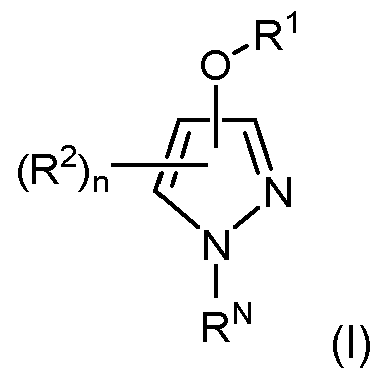
[식 중,[During the meal,
R1 은 H, C1-C6-알킬, C3-C6-시클로알킬, 벤질, 알릴, CHRaC(=O)ORb, CHRaC(=O)NRbRc, 또는 페닐이고, 여기서 상기 페닐 기는 미치환되거나 하나 이상의, 동일하거나 상이한 치환기 Rx 로 치환되고;R 1 is H, C 1 -C 6 -alkyl, C 3 -C 6 -cycloalkyl, benzyl, allyl, CHR a C(=O)OR b , CHR a C(=O)NR b R c , or phenyl, wherein said phenyl group is unsubstituted or substituted with one or more, identical or different, substituents R x ;
R2 는 할로겐, C1-C6-알킬, C3-C6-시클로알킬, 벤질, 알릴, 프로파르길, 또는 페닐이고, 여기서 상기 페닐 기는 미치환되거나 하나 이상의, 동일하거나 상이한 치환기 Rx 로 치환되고;R 2 is halogen, C 1 -C 6 -alkyl, C 3 -C 6 -cycloalkyl, benzyl, allyl, propargyl, or phenyl, wherein the phenyl group is unsubstituted or substituted with one or more, identical or different, substituents R x ;
RN 은 C1-C6-알킬, C3-C6-시클로알킬, 벤질, 알릴, 프로파르길, 또는 페닐이고, 여기서 상기 기는 미치환되거나 하나 이상의, 동일하거나 상이한 치환기 Ry 로 치환되고;R N is C 1 -C 6 -alkyl, C 3 -C 6 -cycloalkyl, benzyl, allyl, propargyl, or phenyl, wherein said group is unsubstituted or substituted with one or more, identical or different, substituents R y ;
CHRaC(=O)ORb, CHRaC(=O)NRbRc, CH(C(=O)ORb)CH2(C(=O)ORb) 이고;CHR a C(=O)OR b , CHR a C(=O)NR b R c , CH(C(=O)OR b )CH 2 (C(=O)OR b );
C(=O)Rd, C(=O)ORb, C(=O)NRbRc, CHRaORb, 또는 CHRaNRe(C=O)Rf 이고;C(=O)R d , C(=O)OR b , C(=O)NR b R c , CHR a OR b , or CHR a NR e (C=O)R f ;
Ra 는 H, C1-C4-알킬, C1-C4-할로알킬, C3-C8-시클로알킬, 페닐, 또는 페닐-C1-C2-알킬이고;R a is H, C 1 -C 4 -alkyl, C 1 -C 4 -haloalkyl, C 3 -C 8 -cycloalkyl, phenyl, or phenyl-C 1 -C 2 -alkyl;
Rb 는 H, C1-C4-알킬, C1-C4-할로알킬, C3-C8-시클로알킬, 페닐, 또는 페닐-C1-C2-알킬이고;R b is H, C 1 -C 4 -alkyl, C 1 -C 4 -haloalkyl, C 3 -C 8 -cycloalkyl, phenyl, or phenyl-C 1 -C 2 -alkyl;
Rc 는 H, C1-C4-알킬, C1-C4-할로알킬, 또는 페닐이고;R c is H, C 1 -C 4 -alkyl, C 1 -C 4 -haloalkyl, or phenyl;
Rd 는 H, C1-C8-알킬, C2-C8-알케닐, C2-C8-알키닐, 페닐, 또는 페닐-C1-C2-알킬이고, 여기서 이러한 기는 미치환되거나 기 COOH 로 치환되고;R d is H, C 1 -C 8 -alkyl, C 2 -C 8 -alkenyl, C 2 -C 8 -alkynyl, phenyl, or phenyl-C 1 -C 2 -alkyl, wherein such group is unsubstituted or substituted by the group COOH;
Re 는 H, C1-C4-알킬, C3-C8-시클로알킬, 또는 C6-C10-아릴이고;R e is H, C 1 -C 4 -alkyl, C 3 -C 8 -cycloalkyl, or C 6 -C 10 -aryl;
Rf 는 H, 또는 C1-C4-알킬이고;R f is H, or C 1 -C 4 -alkyl;
Rx 는 할로겐, C1-C4-알킬, C1-C4-할로알킬, C1-C4-알콕시, 또는 C1-C4-할로알콕시이고;R x is halogen, C 1 -C 4 -alkyl, C 1 -C 4 -haloalkyl, C 1 -C 4 -alkoxy, or C 1 -C 4 -haloalkoxy;
Ry 는 할로겐, CN, OH, NO2, COOH, NRbRc, NRb(C=O)Rf, C(=O)NRbRc, C1-C4-알킬, C1-C4-할로알킬, C1-C4-알콕시, C1-C4-할로알콕시, C1-C4-알킬카르보닐, C1-C4-알킬카르복시, C1-C4-알킬티오, C1-C4-알킬술포닐, 및 S(O)2NRbRc 이고;R y is halogen, CN, OH, NO 2 , COOH, NR b R c , NR b (C=O)R f , C(=O)NR b R c , C 1 -C 4 -alkyl, C 1 -C 4 -haloalkyl, C 1 -C 4 -alkoxy, C 1 -C 4 -haloalkoxy, C 1 -C 4 -alkylcarbonyl, C 1 -C 4 -alkylcarboxy, C 1 -C 4 -alkylthio, C 1 -C 4 -alkylsulfonyl, and S(O) 2 NR b R c ;
n 은 0, 1, 또는 2 임].n is 0, 1, or 2].
상기 용도의 하나의 바람직한 구현예에서, 상기 식 I 의 화합물에서,In one preferred embodiment of the above use, in the compound of formula I,
R1 은 C1-C6-알킬, 벤질, 또는 알릴이다.R 1 is C 1 -C 6 -alkyl, benzyl, or allyl.
상기 용도의 또 다른 바람직한 구현예에서, 상기 식 I 의 화합물에서,In another preferred embodiment of the above use, in the compound of formula I,
n 은 0 이고, 즉 R2 는 부재하거나,n is 0, i.e. R 2 is absent, or
n 은 1 이고, R2 는 C1-C3-알킬 또는 페닐이다.n is 1 and R 2 is C 1 -C 3 -alkyl or phenyl.
상기 용도의 또 다른 바람직한 구현예에서, 상기 식 I 의 화합물에서,In another preferred embodiment of the above use, in the compound of formula I,
RN 은 C(=O)Rd, CHRaC(=O)ORb, CHRaC(=O)NRbRc, CH(C(=O)ORb)CH2(C(=O)ORb), 또는 CHRaNRe(C=O)Rf 이다.R N is C(=O)R d , CHR a C(=O)OR b , CHR a C(=O)NR b R c , CH(C(=O)OR b )CH 2 (C(=O )OR b ), or CHR a NR e (C=O)R f .
상기 용도의 또 다른 바람직한 구현예에서, 상기 식 I 의 화합물에서,In another preferred embodiment of the above use, in the compound of formula I,
Ra 는 H 이고;R a is H;
Rb 는 H 또는 C1-C4-알킬이고;R b is H or C 1 -C 4 -alkyl;
Rc 는 H 또는 C1-C4-알킬이고;R c is H or C 1 -C 4 -alkyl;
Rd 는 C1-C3-알킬이고;R d is C 1 -C 3 -alkyl;
Re 는 H 이고;R e is H;
Rf 는 H 또는 CH3 이다.R f is H or CH 3 .
추가의 양상에서, 본 발명은 상기 정의된 바와 같은 하나 이상의 식 I 의 화합물 및 하나 이상의 담체를 포함하는, 질화작용을 감소시키는데 사용하기 위한 조성물에 관한 것이다.In a further aspect, the present invention relates to a composition for use in reducing nitrification, comprising at least one compound of formula I as defined above and at least one carrier.
추가의 양상에서, 본 발명은 하나 이상의 비료 및 상기 정의된 바와 같은 하나 이상의 식 I 의 화합물; 또는 하나 이상의 비료 및 질화작용을 감소시키는데 사용되는 상기 언급된 바와 같은 조성물을 포함하는 농약 혼합물에 관한 것이다.In a further aspect, the present invention relates to an agrochemical mixture comprising at least one fertilizer and at least one compound of formula I as defined above; or at least one fertilizer and a composition as mentioned above used to reduce nitrification.
바람직한 구현예에서, 상기 정의된 바와 같은 식 I 의 상기 화합물은, 비료와 조합으로 질화작용을 감소시키는데 사용된다. 추가의 특정 구현예에서, 상기 정의된 바와 같은 식 I 의 상기 화합물은, 상기 언급된 바와 같은 농약 혼합물의 형태로, 비료와 조합으로 질화작용을 감소시키는데 사용된다. 추가의 바람직한 구현예에서, 상기 언급된 바와 같은 상기 질화작용의 감소는, 식물 내 또는 상에서, 식물의 뿌리 영역에서, 토양 또는 토양 대체물 (soil substituent) 내 또는 상에서 및/또는 식물이 생장하거나 생장할 수 있는 소재지에서 일어난다.In a preferred embodiment, the compound of formula I as defined above is used for reducing nitrification in combination with a fertilizer. In a further specific embodiment, the compound of formula I as defined above is used for reducing nitrification in combination with a fertilizer, in the form of a pesticide mixture as mentioned above. In a further preferred embodiment, the reduction of nitrification as mentioned above takes place in or on the plant, in the root zone of the plant, in or on the soil or soil substituent and/or at a location where the plant grows or can grow.
또 다른 양상에서, 본 발명은 토양 또는 토양 대체물 상에서 생장하는 식물 및/또는 식물이 생장하거나 생장할 수 있는 소재지 또는 토양 또는 토양 대체물을, 상기 정의된 바와 같은 하나 이상의 식 I 의 화합물, 또는 상기 정의된 바와 같은 농약 조성물로 처리하는 것을 포함하는, 질화작용을 감소시키기 위한 방법에 관한 것이다. 방법의 바람직한 구현예에서, 식물 및/또는 식물이 생장하거나 생장할 수 있는 소재지 또는 토양 또는 토양 대체물에 부가적으로 비료가 제공된다. 방법의 추가의 바람직한 구현예에서, 질화작용 저해제, 즉 식 I 의 화합물 및 상기 비료의 적용은, 동시에 또는 시간차를 두고 수행된다. 특히 바람직한 구현예에서, 상기 시간차는 1 일, 2 일, 3 일, 1 주, 2 주 또는 3 주의 간격이다. 시간차를 두는 적용의 경우, 질화작용 저해제가 먼저 적용된 후, 비료가 적용될 수 있다. 방법의 추가의 바람직한 구현예에서, 제 1 단계에서 상기 정의된 바와 같은 질화작용 저해제가 종자, 식물 및/또는 식물이 생장하거나 생장할 수 있는 소재지에 적용되고, 제 2 단계에서 비료가 식물 및/또는 식물이 생장하거나 생장할 수 있는 소재지에 적용되며, 여기서 제 1 단계에서의 상기 질화작용 저해제 및 제 2 단계에서의 비료의 적용은, 적어도 1 일, 2 일, 3 일, 4 일, 5 일, 6 일, 1 주, 2 주 또는 3 주의 시간차를 두고 수행된다. 시간차를 두는 적용의 다른 구현예에서, 비료가 처음에 적용될 수 있고, 이어서 상기 정의된 바와 같은 질화작용 저해제가 적용될 수 있다. 방법의 추가의 바람직한 구현예에서, 제 1 단계에서 비료가 식물 및/또는 식물이 생장하거나 생장할 수 있는 소재지에 적용되고, 제 2 단계에서 상기 정의된 바와 같은 질화작용 저해제가 종자, 식물 및/또는 식물이 생장하거나 생장할 수 있는 소재지에 적용되며, 여기서 제 1 단계에서의 상기 비료 및 제 2 단계에서의 상기 질화작용 저해제의 적용은, 적어도 1 일, 2 일, 3 일, 4 일, 5 일, 6 일, 1 주, 2 주 또는 3 주의 시간차를 두고 수행된다.In another aspect, the present invention relates to a method for reducing nitrification, comprising treating plants growing on soil or a soil substitute and/or a site on which plants grow or can grow or a soil or a soil substitute with one or more compounds of formula I as defined above, or an agrochemical composition as defined above. In a preferred embodiment of the method, a fertilizer is additionally provided to the plants and/or the site on which plants grow or can grow or the soil or a soil substitute. In a further preferred embodiment of the method, the application of the nitrification inhibitor, i.e. the compound of formula I and the fertilizer are carried out simultaneously or with a time difference. In a particularly preferred embodiment, the time difference is an interval of 1 day, 2 days, 3 days, 1 week, 2 weeks or 3 weeks. In the case of a time difference application, the nitrification inhibitor may be applied first, followed by the application of the fertilizer. In a further preferred embodiment of the method, in a first step a nitrification inhibitor as defined above is applied to the seeds, the plants and/or the locus on which the plants grow or are capable of growing, and in a second step a fertilizer is applied to the plants and/or the locus on which the plants grow or are capable of growing, wherein the application of the nitrification inhibitor in the first step and the application of the fertilizer in the second step are carried out with a time difference of at least 1 day, 2 days, 3 days, 4 days, 5 days, 6 days, 1 week, 2 weeks or 3 weeks. In another embodiment of the staggered application, the fertilizer can be applied first, followed by the application of the nitrification inhibitor as defined above. In a further preferred embodiment of the method, in the first step a fertilizer is applied to the plants and/or to the locus on which the plants grow or are capable of growing, and in the second step a nitrification inhibitor as defined above is applied to the seeds, the plants and/or to the locus on which the plants grow or are capable of growing, wherein the application of the fertilizer in the first step and the application of the nitrification inhibitor in the second step are carried out with a time difference of at least 1 day, 2 days, 3 days, 4 days, 5 days, 6 days, 1 week, 2 weeks or 3 weeks.
또 다른 양상에서, 본 발명은 상기 정의된 질화작용 저해제의 적용을 포함하는, 비료의 처리 방법; 또는 상기 정의된 질화작용 저해제의 적용을 포함하는, 상기 정의된 조성물의 처리 방법에 관한 것이다.In another aspect, the present invention relates to a method for treating a fertilizer, comprising application of a nitrification inhibitor as defined above; or a method for treating a composition as defined above, comprising application of a nitrification inhibitor as defined above.
본 발명의 용도, 농약 혼합물 또는 방법의 바람직한 구현예에서, 상기 비료는 NPK 비료, 암모늄 니트레이트, 칼슘 암모늄 니트레이트, 암모늄 술페이트 니트레이트, 암모늄 술페이트 또는 암모늄 포스페이트와 같은 고체 또는 액체 암모늄-함유 무기 비료; 액체 거름 (manure), 반-액체 거름, 바이오가스 거름, 외양간 거름 (stable manure) 및 짚 거름, 지렁이분 (worm casting), 퇴비, 해조류 또는 구아노, 또는 우레아, 포름알데히드 우레아, 무수 암모늄, 우레아 암모늄 니트레이트 (UAN) 용액, 우레아 황, 우레아계 NPK-비료, 또는 우레아 암모늄 술페이트와 같은 우레아-함유 비료와 같은 고체 또는 액체 유기 비료이다. In a preferred embodiment of the use, the pesticide mixture or the method of the present invention, the fertilizer is a solid or liquid ammonium-containing inorganic fertilizer such as NPK fertilizer, ammonium nitrate, calcium ammonium nitrate, ammonium sulfate nitrate, ammonium sulfate or ammonium phosphate; a solid or liquid organic fertilizer such as liquid manure, semi-liquid manure, biogas manure, stable manure and straw manure, worm castings, compost, seaweed or guano, or a urea-containing fertilizer such as urea, formaldehyde urea, anhydrous ammonium, urea ammonium nitrate (UAN) solution, urea sulfur, urea-based NPK-fertilizers or urea ammonium sulfate.
본 발명의 용도 또는 방법의 추가의 바람직한 구현예에서, 상기 식물은 밀, 보리, 귀리, 호밀, 대두, 옥수수, 감자, 유채, 카놀라, 해바라기, 목화, 사탕수수, 사탕무, 쌀과 같은 농업 식물, 또는 시금치, 양상추, 아스파라거스, 또는 양배추와 같은 채소; 또는 수수; 산림 식물; 관상용 식물; 또는 원예 식물 (각각 이의 자연적인 형태 또는 유전적으로 변형된 형태로) 이다.In a further preferred embodiment of the use or method of the present invention, the plant is an agricultural plant such as wheat, barley, oats, rye, soybean, corn, potato, rapeseed, canola, sunflower, cotton, sugarcane, sugar beet, rice; or a vegetable such as spinach, lettuce, asparagus, or cabbage; or sorghum; a forest plant; an ornamental plant; or a horticultural plant (each in its natural form or in a genetically modified form).
식 I 의 화합물은 유기 화학의 표준 방법에 의해 제조될 수 있다. 일반적으로, 피라졸 화합물의 적합한 제조 방법은 "Progress in Heterocyclic Chemistry", Vol. 27, G.W. Gribble, J.A. Joule, Elsevier, 2015, Chapter 5.4.2 에 기재되어 있다.Compounds of formula I can be prepared by standard methods of organic chemistry. In general, suitable methods for preparing pyrazole compounds are described in "Progress in Heterocyclic Chemistry", Vol. 27, G.W. Gribble, J.A. Joule, Elsevier, 2015, Chapter 5.4.2.
OR1 기는 피라졸 고리 형성에 적합한 개시 물질을 선택함으로써 도입될 수 있다.OR group 1 can be introduced by selecting an initiator suitable for pyrazole ring formation.
3-알콕시-피라졸의 합성에 대한 일반적인 방법은, 예를 들어 : a) Sadrine Guillou, Frederic J. Bonhomme, Yves L. Janin, Synthesis 2008, 3504-3508; 또는 b) WO 2010/015657 A2 에 기재된 바와 같은 다양한 β-케토에스테르 및 히드라진 히드로클로라이드 간의 반응을 포함하고, 이는 하기 제시되어 있다:General methods for the synthesis of 3-alkoxy-pyrazoles include the reaction between various β-ketoesters and hydrazine hydrochloride as described, for example, in: a) Sadrine Guillou, Frederic J. Bonhomme, Yves L. Janin, Synthesis 2008, 3504-3508; or b) WO 2010/015657 A2, which is presented below:
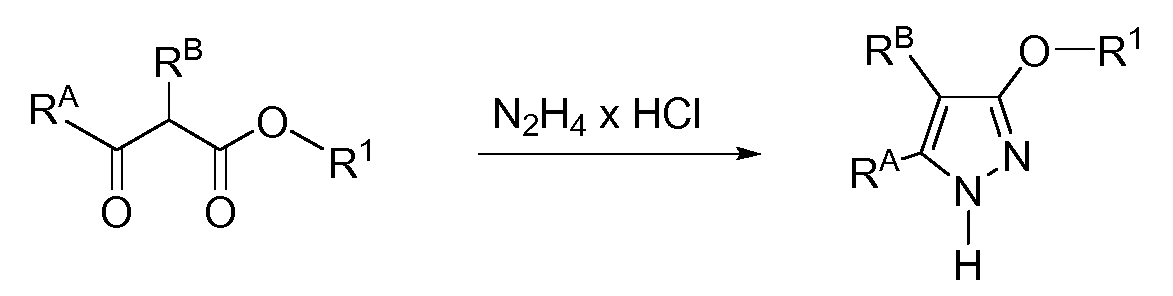
RA 및 RB 는 수소일 수 있거나, R2 에 대해 상기 제공된 임의의 의미를 가질 수 있다.R A and R B can be hydrogen or have any of the meanings given above for R 2 .
Mazaahir Kidwai, Arti Jain, Roona Poddar, Journal of Organometallic Chemistry 696 (2011) 1939-1944 는, N 상에 치환된 3-알콕시-피라졸이, 상기 반응에서 히드라진 대신에 N-치환된 히드라진 유도체가 사용되는 경우 직접 수득된다는 것을 보였다.Mazaahir Kidwai, Arti Jain, Roona Poddar, Journal of Organometallic Chemistry 696 (2011) 1939-1944 showed that 3-alkoxy-pyrazoles substituted on N were directly obtained when N-substituted hydrazine derivatives were used instead of hydrazine in the above reaction.
추가로, 3-알콕시 기는 예를 들어 a) D. Piomelli and coworkers, Synthesis 2016, 2739-2756, 또는 b) Sandrine Guillou, Yves L. Janin, Chem. Eur. J. 2010, 16, 4669 - 4677 에 기재된 바와 같은 적합한 히드록시피라졸 유도체를 알킬화함으로써 도입될 수 있다.Additionally, 3-alkoxy groups can be introduced by alkylating suitable hydroxypyrazole derivatives as described for example in a) D. Piomelli and coworkers, Synthesis 2016, 2739-2756, or b) Sandrine Guillou, Yves L. Janin, Chem. Eur. J. 2010, 16 , 4669 - 4677.
위치 4 에 알콕시 기를 갖는 피라졸을 합성하기 위한 다양한 방법은 William F. Vernier, Laurent Gomez, Tetrahedron Letters 2017, 4587-4590 에 기재되었다.Various methods for the synthesis of pyrazoles having an alkoxy group at position 4 are described in William F. Vernier, Laurent Gomez, Tetrahedron Letters 2017 , 4587-4590.
RN 이, 예를 들어 C1-C6-알킬인 경우, RN-치환기는 하기 반응식에 따라, LG 가 이탈 기를 나타내는 식 III 의 화합물과 식 II 의 화합물을 반응시킴으로써 도입될 수 있다.When R N is, for example, C 1 -C 6 -alkyl, the R N -substituent can be introduced by reacting a compound of formula III, wherein LG represents a leaving group, with a compound of formula II, according to the following reaction scheme.

예를 들어, 다양한 알킬화 또는 아실화 시약 RN-LG 가 메틸요오다이드와의 3-메톡시-4-니트로-1H-피라졸의 N-메틸화와 유사하게 사용될 수 있고, 이는 WO 2009/153589 A1 또는 WO 2011/048082 A1 에 기재된 바와 같이 1-메틸-3-메톡시-4-니트로-1H-피라졸을 제공한다.For example, various alkylating or acylating reagents R N -LG can be used analogously to the N-methylation of 3-methoxy-4-nitro-1H-pyrazole with methyl iodide, which gives 1-methyl-3-methoxy-4-nitro-1H-pyrazole as described in WO 2009/153589 A1 or WO 2011/048082 A1.
RN 으로서 CH2OH 기의 도입은 Simona Lupsor, Mircea Iovu and Florin Aonofriesei, Med. Chem. Res. 2012, 3035-3042 에 기재된 바와 같이 포름알데히드와 피라졸을 반응시킴으로써 수행될 수 있다.Introduction of CH 2 OH groups as R N can be accomplished by reacting formaldehyde with pyrazole as described in Simona Lupsor, Mircea Iovu and Florin Aonofriesei, Med. Chem. Res. 2012, 3035-3042.
유사하게, Michael 첨가가 말레산 유도체로 수행되어 치환기 RN 을 형성할 수 있다.Similarly, Michael addition can be performed with maleic acid derivatives to form the substituents R N .
RN 이 예를 들어 포름아미드인 피라졸 화합물의 제조 방법은 DE 10 2011 120 098 A1 및 WO 2013/079197 A1 에 기재되어 있다.A process for preparing pyrazole compounds, where R N is for example formamide, is described in DE 10 2011 120 098 A1 and WO 2013/079197 A1.
치환기 RN 이 도입되기 전, 상이한 호변이성질체가 형성되어 치환기 RN 의 도입 후 이성질체 혼합물의 형성을 유도할 수 있다는 것을 이해해야 한다. 본 발명의 특정한 바람직한 구현예에서, 상기 이성질체 혼합물은 질화작용 저해제로서 사용될 수 있다.It should be understood that before the introduction of the substituent R N , different tautomers may be formed, which may lead to the formation of an isomer mixture after the introduction of the substituent R N . In certain preferred embodiments of the present invention, the isomer mixture can be used as a nitrification inhibitor.
치환기 R2 는 방향족 치환 반응을 포함하는 표준 반응에 의해, 또는 피라졸 고리 형성에 적합한 개시 물질을 선택함으로써 도입될 수 있다.The substituent R 2 can be introduced by standard reactions involving aromatic substitution reactions, or by selecting a starting material suitable for pyrazole ring formation.
본 발명의 예시적인 구현예를 상세하게 설명하기 전, 본 발명의 이해를 위해 중요한 정의가 제공된다.Before describing exemplary embodiments of the present invention in detail, some definitions that are important for understanding the present invention are provided.
본 명세서 및 첨부된 청구범위에 사용된 바, 단수 형태의 표현은 또한, 문맥에서 명백하게 달리 지시되지 않는 한, 각각의 복수형을 포함한다. 본 발명의 맥락에서, 용어 "약" 및 "대략" 은, 당업자가 논의되는 특징의 기술적 효과를 여전히 보장하기 위한 것으로 이해할 수 있는, 정확도의 간격을 의미한다. 용어 통상적으로는, 제시된 수치로부터의 ±20 %, 바람직하게는 ±15 %, 더욱 바람직하게는 ±10 %, 및 보다 더욱 바람직하게는 ±5 % 의 편차를 의미한다. 용어 "포함하는" 는 제한하는 것이 아니라고 이해된다. 본 발명의 목적을 위하여, 용어 "~로 이루어진" 은, 용어 "~로 구성되는" 의 바람직한 구현예로 간주된다. 이하, 한 군이 적어도 특정 수의 구현예를 포함하는 것으로 정의되는 경우, 이는 또한 바람직하게는 단지 이러한 구현예로만 이루어진 군을 포함하는 것을 의미한다. 나아가, 명세서 및 청구범위에서의 용어 "제 1", "제 2", "제 3" 또는 "(a)", "(b)", "(c)", "(d)" 등은, 유사한 요소를 구별하기 위해 사용되며, 순차적 또는 연대순으로 기재할 필요는 없다. 이와 같이 사용된 용어는 적절한 환경 하에서 교환가능하게 사용되며, 본원에 기재된 본 발명의 구현예는 본원에 기재된 또는 예시된 바와 다른 순서로 작동될 수 있다고 이해된다. 용어 "제 1", "제 2", "제 3" 또는 "(a)", "(b)", "(c)", "(d)", "i", "ii" 등이 방법 또는 사용 또는 검정의 단계와 관련된 경우, 단계 사이에 시간 또는 시간 간격의 일관성이 없으며, 즉 단계들은 동시에 수행될 수 있거나, 본 특허출원에서 달리 지시되지 않는 한, 상기 또는 하기에 설정된 바와 같이, 상기 단계 사이에 수 초, 분, 시간, 일, 주, 개월 또는 심지어 수 년의 시간 간격이 존재할 수 있다. 본 발명은 본원에 기재된 특정 방법, 프로토콜, 시약 등이 달라질 수 있기 때문에, 이들에 제한되지 않는다고 이해된다. 또한, 본원에 사용된 용어는 단지 특정 구현예를 설명하기 위한 목적이며, 오로지 첨부된 청구범위에 의해 제한될 수 있는 본 발명의 범위를 제한하고자 의도된 것이 아니라고 이해된다. 달리 정의되지 않는 한, 본원에 사용된 모든 기술적 및 과학적 용어는, 당업자가 통상적으로 이해하는 바와 동일한 의미를 갖는다.As used in this specification and the appended claims, the singular forms also include their plural forms, unless the context clearly dictates otherwise. In the context of the present invention, the terms "about" and "approximately" refer to an interval of precision that a person skilled in the art would understand to still ensure the technical effectiveness of the feature being discussed. The term typically refers to a deviation of ±20%, preferably ±15%, more preferably ±10%, and even more preferably ±5% from the stated numerical value. The term "comprising" is to be understood as not limiting. For the purposes of the present invention, the term "consisting of" is to be considered a preferred embodiment of the term "consisting of." Hereinafter, where a group is defined as comprising at least a certain number of embodiments, this also means preferably including a group consisting solely of such embodiments. Furthermore, the terms "first", "second", "third" or "(a)", "(b)", "(c)", "(d)", etc. in the specification and claims are used to distinguish similar elements and are not necessarily described in sequential or chronological order. It is to be understood that such terms, as used herein, are used interchangeably under appropriate circumstances, and that the embodiments of the invention described herein may be operated in orders other than those described or exemplified herein. When the terms "first", "second", "third" or "(a)", "(b)", "(c)", "(d)", "i", "ii", etc. refer to steps of a method or use or assay, there is no consistency of time or time interval between the steps, i.e., the steps may be performed concurrently, or there may be time intervals of seconds, minutes, hours, days, weeks, months, or even years between the steps, as set forth above or below, unless otherwise indicated in this patent application. It is to be understood that the present invention is not limited to the specific methods, protocols, reagents, etc. described herein, as such may vary. It is also to be understood that the terminology used herein is for the purpose of describing particular embodiments only, and is not intended to limit the scope of the present invention which may be limited only by the appended claims. Unless defined otherwise, all technical and scientific terms used herein have the same meaning as commonly understood by one of ordinary skill in the art.
용어 "질화작용 저해제" 는, 본 맥락에서, 질화작용 과정의 속도를 늦추거나 이를 중단시키는 화학 물질로서 이해된다. 따라서, 질화작용 저해제는, 니트로소모나스 종과 같은 박테리아의 활성을 저해함으로써, 암모늄의 니트레이트로의 자연적인 변형을 지연시킨다. 본원에 사용된 바와 같은 용어 "질화작용" 은 산소를 이용한 암모니아 (NH3) 또는 암모늄 (NH4 +) 의 니트라이트 (NO2 -) 로의 생물학적 산화, 이어서 미생물에 의한 이러한 니트라이트의 니트레이트 (NO3 -) 로의 산화로서 이해된다. 니트레이트 (NO3 -) 이외에, 아산화질소가 또한 질화작용을 통해 생성된다. 질화작용은 토양 내 질소 사이클에서 중요한 단계이다. 따라서, 질화작용의 저해는 N2O 손실을 또한 감소시킬 수 있다. 용어 질화작용 저해제는 질화작용을 저해하기 위한 이와 같은 화합물의 용도와 동등한 것으로 간주된다.The term "nitrification inhibitor" is understood in the present context as a chemical substance which slows down or stops the nitrification process. Thus, nitrification inhibitors delay the natural transformation of ammonium into nitrate by inhibiting the activity of bacteria such as Nitrosomonas species. The term "nitrification" as used herein is understood as the biological oxidation of ammonia (NH 3 ) or ammonium (NH 4 + ) to nitrite (NO 2 - ) with the help of oxygen, followed by the oxidation of this nitrite to nitrate (NO 3 - ) by microorganisms. In addition to nitrate (NO 3 - ), nitrous oxide is also formed through nitrification. Nitrification is an important step in the nitrogen cycle in soil. Thus, inhibition of nitrification can also reduce N 2 O losses. The term nitrification inhibitor is considered equivalent to the use of such compounds for inhibiting nitrification.
용어 "본 발명에 따른 화합물(들)", 또는 "식 I 의 화합물" 은, 본원에 정의된 바와 같은 화합물(들) 뿐 아니라 이의 입체이성질체, 염, 호변이성질체 또는 N-옥시드를 포함한다. 용어 "본 발명의 화합물(들)" 은, 용어 "본 발명에 따른 화합물(들)" 과 동등한 것으로 이해되며, 따라서 또한 이의 입체이성질체, 염, 호변이성질체 또는 N-옥시드를 포함하는 것으로 이해된다.The term "compound(s) according to the invention", or "compound of formula I", includes compound(s) as defined herein as well as stereoisomers, salts, tautomers or N-oxides thereof. The term "compound(s) of the invention" is to be understood as being equivalent to the term "compound(s) according to the invention", and thus also includes stereoisomers, salts, tautomers or N-oxides thereof.
치환 패턴에 따라, 본 발명에 따른 화합물은 하나 이상의 키랄 중심을 가질 수 있고, 이 경우 이는 거울상 이성질체 또는 부분입체이성질체의 혼합물로서 존재한다. 본 발명은 본 발명에 따른 화합물의 단일 순수 거울상 이성질체 또는 순수 부분입체이성질체, 및 이의 혼합물, 및 본 발명에 따른 화합물의 순수 거울상 이성질체 또는 순수 부분입체이성질체 또는 이의 혼합물의 본 발명에 따른 용도 모두를 제공한다. 본 발명에 따른 적합한 화합물은 또한 모든 가능한 기하학적 입체이성질체 (시스/트랜스 이성질체) 및 이의 혼합물을 포함한다. 시스/트랜스 이성질체는 알켄, 탄소-질소 이중-결합 또는 아미드 기에 대해 존재할 수 있다. 용어 "입체이성질체(들)" 은 광학 이성질체, 예컨대 거울상 이성질체 또는 부분입체이성질체 (후자는 분자에 1 개 초과의 키랄 중심으로 인해 존재함), 뿐만 아니라 기하 이성질체 (시스/트랜스 이성질체) 모두를 포함한다. 본 발명은 화학식 I 의 화합물의 모든 가능한 입체이성질체, 즉 단일 거울상 이성질체 또는 부분입체이성질체, 뿐만 아니라 이의 혼합물에 관한 것이다.Depending on the substitution pattern, the compounds according to the invention may have one or more chiral centers, in which case they exist as mixtures of enantiomers or diastereomers. The invention provides both the use according to the invention of single pure enantiomers or pure diastereomers of the compounds according to the invention, and mixtures thereof, as well as the use according to the invention of pure enantiomers or pure diastereomers or mixtures thereof of the compounds according to the invention. Suitable compounds according to the invention also include all possible geometrical stereoisomers (cis/trans isomers) and mixtures thereof. Cis/trans isomers can exist for the alkene, the carbon-nitrogen double bond or the amide group. The term "stereoisomer(s)" includes both optical isomers, such as enantiomers or diastereomers (the latter being present due to more than one chiral center in the molecule), as well as geometrical isomers (cis/trans isomers). The present invention relates to all possible stereoisomers of the compounds of formula I, i.e. single enantiomers or diastereomers, as well as mixtures thereof.
식 I 의 화합물은 비결정질이거나, 안정성과 같은 상이한 거시적 특성을 갖거나 활성과 같은 상이한 생물학적 특성을 나타낼 수 있는 하나 이상의 상이한 결정질 상태 (다형체) 로 존재할 수 있다. 본 발명은 식 I 의 비결정질 및 결정질 화합물, 각각의 화합물 I 의 상이한 결정질 상태의 혼합물, 뿐 아니라 이의 비결정질 또는 결정질 염에 관한 것이다.The compound of formula I may be amorphous or may exist in one or more different crystalline states (polymorphs) which may have different macroscopic properties, such as stability, or may exhibit different biological properties, such as activity. The present invention relates to amorphous and crystalline compounds of formula I, to mixtures of different crystalline states of each compound I, as well as to amorphous or crystalline salts thereof.
식 I 의 화합물의 염은 바람직하게는 농업적으로 허용가능한 염이다. 이는 통상의 방식으로, 예를 들어 식 I 의 화합물이 염기성 관능기를 갖는 경우, 화합물을 해당 음이온의 산과 반응시킴으로써 형성될 수 있다. 식 I 의 화합물의 농업적으로 유용한 염은, 특히 이의 양이온 및 음이온이, 각각, 식 I 의 화합물의 작용 방식에 악영향을 미치지 않는, 산 부가 염을 포함한다. 유용한 산 부가 염의 음이온은 주로 클로라이드, 브로마이드, 플루오라이드, 히드로겐술페이트, 술페이트, 디히드로겐포스페이트, 히드로겐포스페이트, 포스페이트, 니트레이트, 바이카르보네이트, 카르보네이트, 헥사플루오로실리케이트, 헥사플루오로포스페이트, 벤조에이트, 바람직하게는 포스페이트 및 C1-C4-알칸산의 음이온, 바람직하게는 포르메이트, 아세테이트, 프로피오네이트 및 부티레이트이다. 이는 바람직하게는 식 I 의 화합물을 해당 음이온의 산, 바람직하게는 염산, 브롬화수소산, 황산, 인산 또는 질산과 반응시킴으로써 형성될 수 있다.The salts of the compounds of the formula I are preferably agriculturally acceptable salts. These can be formed in a customary manner, for example by reacting the compound with an acid of the corresponding anion, if the compound of the formula I has a basic functional group. Agriculturally useful salts of the compounds of the formula I include in particular acid addition salts, the cation and the anion of which, respectively, do not adversely affect the mode of action of the compound of the formula I. The anions of useful acid addition salts are mainly chloride, bromide, fluoride, hydrogensulfate, sulfate, dihydrogenphosphate, hydrogenphosphate, phosphate, nitrate, bicarbonate, carbonate, hexafluorosilicate, hexafluorophosphate, benzoate, preferably phosphate and anions of C 1 -C 4 -alkanoic acids, preferably formate, acetate, propionate and butyrate. This can preferably be formed by reacting the compound of formula I with an acid of the corresponding anion, preferably hydrochloric acid, hydrobromic acid, sulfuric acid, phosphoric acid or nitric acid.
용어 "N-옥시드" 는, 3차 질소 원자, 예를 들어 피리딘 질소 원자가 N-옥시드 모이어티로 산화되는 임의의 식 I 의 화합물을 포함한다.The term "N-oxide" includes any compound of formula I wherein a tertiary nitrogen atom, for example a pyridine nitrogen atom, is oxidized to an N-oxide moiety.
식 I 의 화합물의 호변이성질체가, 예를 들어 방향족 고리에서 임의의 하나의 치환기가 호변이성질 형태를 갖는 경우 존재할 수 있다. 바람직한 호변이성질체는 케토-에놀 호변이성질체를 포함한다.Tautomers of the compound of formula I may exist, for example, when any one substituent in the aromatic ring has a tautomeric form. Preferred tautomers include keto-enol tautomers.
상기 변수의 정의에서 언급된 유기 모이어티는 - 용어 할로겐과 마찬가지로 - 개별적인 군 구성원의 개별적인 목록에 대한 집합적 용어이다. 접두어 Cn-Cm 는, 각각의 경우, 기 내 탄소 원자의 가능한 수를 나타낸다.The organic moieties mentioned in the definitions of the above variables are collective terms for a list of individual group members - as is the term halogen. The prefixes C n -C m indicate, in each case, the possible number of carbon atoms in the group.
용어 "할로겐" 은, 각각의 경우, 플루오린, 브롬, 염소 또는 요오드, 특히 플루오린, 염소 또는 브롬을 나타낸다.The term "halogen" denotes, in each case, fluorine, bromine, chlorine or iodine, especially fluorine, chlorine or bromine.
본원에 사용된 바와 같은 용어 "알킬" 은 각각의 경우 통상적으로 1 내지 4 개의 탄소 원자, 바람직하게는 1 내지 3 개의 탄소 원자를 갖는 직쇄 또는 분지형 알킬 기를 나타낸다. 바람직한 알킬 기는 메틸, 에틸, n-프로필, 이소-프로필, n-부틸, 2-부틸, 이소-부틸, tert-부틸, n-펜틸, 1-메틸부틸, 2-메틸부틸, 3-메틸부틸, 및 2,2-디메틸프로필을 포함한다. 메틸, 에틸, n-프로필 및 이소-프로필이 특히 바람직하다.The term "alkyl" as used herein denotes in each case a straight-chain or branched alkyl group typically having 1 to 4 carbon atoms, preferably 1 to 3 carbon atoms. Preferred alkyl groups include methyl, ethyl, n-propyl, iso-propyl, n-butyl, 2-butyl, iso-butyl, tert-butyl, n-pentyl, 1-methylbutyl, 2-methylbutyl, 3-methylbutyl, and 2,2-dimethylpropyl. Methyl, ethyl, n-propyl and iso-propyl are particularly preferred.
본원에 사용된 바와 같은 용어 "할로알킬" 은, 각각의 경우, 통상적으로 1 내지 4 개의 탄소 원자, 바람직하게는 1 내지 3 개의 탄소 원자, 특히 1 또는 2 개의 탄소 원자를 갖는 직쇄 또는 분지형 알킬기로서, 여기서 이러한 기의 수소 원자는 부분적으로 또는 전체적으로 할로겐 원자로 대체된다. 바람직한 할로알킬 모이어티는, C1-C4-할로알킬, 더욱 바람직하게는 C1-C3-할로알킬 또는 C1-C2-할로알킬, 특히 C1-C2-플루오로알킬, 예컨대 플루오로메틸, 디플루오로메틸, 트리플루오로메틸, 1-플루오로에틸, 2-플루오로에틸, 2,2-디플루오로에틸, 2,2,2-트리플루오로에틸, 펜타플루오로에틸 등으로부터 선택된다. 트리플루오르메틸이 본 발명에 따라 특히 바람직하다.The term "haloalkyl" as used herein denotes in each case a straight-chain or branched alkyl group typically having 1 to 4 carbon atoms, preferably 1 to 3 carbon atoms, in particular 1 or 2 carbon atoms, wherein the hydrogen atoms of this group are partly or completely replaced by halogen atoms. Preferred haloalkyl moieties are selected from C 1 -C 4 -haloalkyl, more preferably C 1 -C 3 -haloalkyl or C 1 -C 2 -haloalkyl, in particular C 1 -C 2 -fluoroalkyl, such as fluoromethyl, difluoromethyl, trifluoromethyl, 1-fluoroethyl, 2-fluoroethyl, 2,2-difluoroethyl, 2,2,2-trifluoroethyl, pentafluoroethyl and the like. Trifluoromethyl is particularly preferred according to the invention.
본원에 사용된 바와 같은 용어 "알콕시" 는, 각각의 경우, 산소 기를 통해 결합되며, 통상적으로 1 내지 4 개의 탄소 원자, 바람직하게는 1 내지 3 개의 탄소 원자, 특히 1 또는 2 개의 탄소 원자를 갖는 직쇄 또는 분지형 알킬기를 나타낸다. 알콕시 기의 예는, 메톡시, 에톡시, n-프로폭시, 이소-프로폭시, n-부틸옥시, 2-부틸옥시, 이소-부틸옥시, tert.-부틸옥시 등이다.The term "alkoxy" as used herein denotes, in each case, a straight-chain or branched alkyl group having typically 1 to 4 carbon atoms, preferably 1 to 3 carbon atoms, in particular 1 or 2 carbon atoms, which is bonded via an oxygen group. Examples of alkoxy groups are methoxy, ethoxy, n-propoxy, iso-propoxy, n-butyloxy, 2-butyloxy, iso-butyloxy, tert.-butyloxy and the like.
본원에 사용된 바와 같은 용어 "할로알콕시" 는, 각각의 경우, 통상적으로 1 내지 4 개의 탄소 원자, 바람직하게는 1 내지 3 개의 탄소 원자, 특히 1 또는 2 개의 탄소 원자를 갖는 직쇄 또는 분지형 알콕시 기를 나타내고, 이러한 기의 수소 원자는 부분적으로 또는 전체적으로 할로겐 원자, 특히 플루오린 원자로 대체된다. 바람직한 할로알콕시 모이어티는 C1-C4-할로알콕시, 특히 C1-C2-플루오로알콕시, 예컨대 플루오로메톡시, 디플루오로메톡시, 트리플루오로메톡시, 1-플루오로에톡시, 2-플루오로에톡시, 2,2-디플루오로에톡시, 2,2,2-트리플루오로에톡시, 2-클로로-2-플루오로에톡시, 2-클로로-2,2-디플루오로-에톡시, 2,2디클로로-2-플루오르에톡시, 2,2,2-트리클로로에톡시, 펜타플루오로에톡시 등을 포함한다.The term "haloalkoxy" as used herein denotes in each case a straight-chain or branched alkoxy group typically having 1 to 4 carbon atoms, preferably 1 to 3 carbon atoms, in particular 1 or 2 carbon atoms, the hydrogen atoms of which are partly or completely replaced by halogen atoms, in particular fluorine atoms. Preferred haloalkoxy moieties include C 1 -C 4 -haloalkoxy, particularly C 1 -C 2 -fluoroalkoxy, such as fluoromethoxy, difluoromethoxy, trifluoromethoxy, 1-fluoroethoxy, 2-fluoroethoxy, 2,2-difluoroethoxy, 2,2,2-trifluoroethoxy, 2-chloro-2-fluoroethoxy, 2-chloro-2,2-difluoro-ethoxy, 2,2dichloro-2-fluoroethoxy, 2,2,2-trichloroethoxy, pentafluoroethoxy and the like.
본원에 사용된 바와 같은 용어 "알케닐" 은, 각각의 경우, 적어도 단일 불포화 탄화수소 라디칼, 즉 통상적으로 2 내지 4 개의 탄소 원자, 바람직하게는 2 또는 3 개의 탄소 원자를 갖는 하나 이상의 탄소-탄소 이중 결합을 갖는 탄화수소 라디칼, 예를 들어 비닐, 알릴 (2-프로펜-1-일), 1-프로펜-1-일, 2-프로펜-2-일, 메트알릴 (2-메틸프로프-2-엔-1-일), 2-부텐-1-일, 3-부텐-1-일, 2-펜텐-1-일, 3-펜텐-1-일, 4-펜텐-1-일, 1-메틸부트-2-엔-1-일, 2-에틸프로프-2-엔-1-일 등을 나타낸다.The term "alkenyl" as used herein denotes in each case at least a monounsaturated hydrocarbon radical, i.e. a hydrocarbon radical having at least one carbon-carbon double bond having usually 2 to 4 carbon atoms, preferably 2 or 3 carbon atoms, for example vinyl, allyl (2-propen-1-yl), 1-propen-1-yl, 2-propen-2-yl, methallyl (2-methylprop-2-en-1-yl), 2-buten-1-yl, 3-buten-1-yl, 2-penten-1-yl, 3-penten-1-yl, 4-penten-1-yl, 1-methylbut-2-en-1-yl, 2-ethylprop-2-en-1-yl and the like.
본원에 사용된 바와 같은 용어 "알키닐" 은, 각각의 경우, 하나 이상의 탄소-탄소 삼중 결합을 갖고, 통상적으로 2 내지 4 개, 바람직하게는 2 또는 3 개의 탄소 원자 또는 3 또는 4 개의 탄소 원자를 갖는 탄화수소 라디칼, 예를 들어 에티닐, 프로파르길 (2-프로핀-1-일, 또한 프로프-2-인-1-일로 지칭됨), 1-프로핀-1-일 (또한 프로프-1-인-1-일로 지칭됨), 1-메틸프로프-2-인-1-일, 2-부틴-1-일, 3-부틴-1-일, 1-펜틴-1-일, 3-펜틴-1-일, 4-펜틴-1-일, 1-메틸부트-2-인-1-일, 1-에틸프로프-2-인-1-일 등을 나타낸다. 본 발명에 따른 바람직한 알키닐 기는 에티닐이다.The term "alkynyl" as used herein denotes in each case a hydrocarbon radical having at least one carbon-carbon triple bond and usually having 2 to 4, preferably 2 or 3, carbon atoms or 3 or 4 carbon atoms, for example ethynyl, propargyl (2-propyn-1-yl, also referred to as prop-2-yn-1-yl), 1-propyn-1-yl (also referred to as prop-1-yn-1-yl), 1-methylprop-2-yn-1-yl, 2-butyn-1-yl, 3-butyn-1-yl, 1-pentyn-1-yl, 3-pentyn-1-yl, 4-pentyn-1-yl, 1-methylbut-2-yn-1-yl, 1-ethylprop-2-yn-1-yl and the like. A preferred alkynyl group according to the invention is ethynyl.
본원에 사용된 바와 같은 용어 "페닐알킬" 은 분자의 나머지에 알킬 기, 바람직하게는 C1-C2-알킬 기, 특히 메틸 기 (= 페닐메틸) 를 통해 결합되는 페닐 기를 나타낸다. 가장 바람직한 페닐알킬 기는 벤질이다.The term "phenylalkyl" as used herein denotes a phenyl group which is bonded to the remainder of the molecule via an alkyl group, preferably a C 1 -C 2 -alkyl group, especially a methyl group (= phenylmethyl). The most preferred phenylalkyl group is benzyl.
본원에 사용된 바와 같은 및 시클로알콕시 및 시클로알킬티오의 시클로알킬 모이어티에서 용어 "시클로알킬" 은 각각의 경우 통상적으로 3 내지 10 또는 3 내지 6 개의 탄소 원자를 갖는 모노시클릭 시클로지방족 라디칼, 예컨대 시클로프로필, 시클로부틸, 시클로펜틸, 시클로헥실, 시클로헵틸, 시클로옥틸, 시클로노닐 및 시클로데실, 바람직하게는 시클로프로필, 시클로부틸, 시클로펜틸, 및 시클로헥실을 의미한다.As used herein, the term "cycloalkyl" in the cycloalkyl moiety of cycloalkoxy and cycloalkylthio means in each case a monocyclic cycloaliphatic radical typically having from 3 to 10 or from 3 to 6 carbon atoms, such as cyclopropyl, cyclobutyl, cyclopentyl, cyclohexyl, cycloheptyl, cyclooctyl, cyclononyl and cyclodecyl, preferably cyclopropyl, cyclobutyl, cyclopentyl, and cyclohexyl.
용어 "알킬카르보닐" 은 분자의 나머지에 카르보닐 기 (C=O) 의 탄소 원자를 통해 결합되는 상기 정의된 알킬 기를 의미한다.The term "alkylcarbonyl" means an alkyl group as defined above which is bonded to the remainder of the molecule through a carbon atom of the carbonyl group (C=O).
본원에 사용된 바와 같은 용어 "알킬카르복시" 는 1 내지 10 개의 탄소 원자, 바람직하게는 1 내지 4 개의 탄소 원자 (= C1-C4-알킬카르복시), 바람직하게는 1 내지 3 개의 탄소 원자를 갖는 직쇄 또는 분지형 포화 알킬 기를 의미하고, 이는 알킬 기의 임의의 위치에서 카르복실 기를 통해 결합된다.The term "alkylcarboxy" as used herein means a straight-chain or branched saturated alkyl group having 1 to 10 carbon atoms, preferably 1 to 4 carbon atoms (= C 1 -C 4 -alkylcarboxy), preferably 1 to 3 carbon atoms, which is bonded via a carboxyl group at any position of the alkyl group.
본원에 사용된 바와 같은 용어 "알킬티오" "(알킬술파닐: 알킬-S-)" 은 1 내지 10 개의 탄소 원자, 바람직하게는 1 내지 4 개의 탄소 원자 (= C1-C4-알킬티오), 보다 바람직하게는 1 내지 3 개의 탄소 원자를 갖는 직쇄 또는 분지형 포화 알킬 기를 의미하고, 이는 황 원자를 통해 부착된다.The term "alkylthio""(alkylsulfanyl:alkyl-S-)" as used herein means a straight-chain or branched saturated alkyl group having 1 to 10 carbon atoms, preferably 1 to 4 carbon atoms (= C 1 -C 4 -alkylthio), more preferably 1 to 3 carbon atoms, which is attached via a sulfur atom.
본원에 사용된 바와 같은 용어 "알킬술포닐" (알킬-S(=O)2-) 은 1 내지 10 개의 탄소 원자, 바람직하게는 1 내지 4 개의 탄소 원자 (= C1-C4-알킬술포닐), 바람직하게는 1 내지 3 개의 탄소 원자를 갖는 직쇄 또는 분지형 포화 알킬 기를 의미하고, 이는 알킬 기의 임의의 위치에서 술포닐 기의 황 원자를 통해 결합된다.The term "alkylsulfonyl" (alkyl-S(=O) 2 -) as used herein means a straight-chain or branched saturated alkyl group having 1 to 10 carbon atoms, preferably 1 to 4 carbon atoms (= C 1 -C 4 -alkylsulfonyl), preferably 1 to 3 carbon atoms, which is bonded via the sulfur atom of the sulfonyl group at any position of the alkyl group.
상기 설명된 바와 같이, 본 발명은 한 양상에서 질화작용 저해제로서의 식 I 의 N-관능화 알콕시 피라졸 화합물 또는 이의 염, 입체이성질체, 호변이성질체 또는 N-옥시드의 용도에 관한 것이다:As described above, the present invention relates in one aspect to the use of an N-functionalized alkoxy pyrazole compound of formula I or a salt, stereoisomer, tautomer or N-oxide thereof as a nitrification inhibitor:

[식 중,[During the meal,
R1 은 H, C1-C6-알킬, C3-C6-시클로알킬, 벤질, 알릴, CHRaC(=O)ORb, CHRaC(=O)NRbRc, 또는 페닐이고, 여기서 상기 페닐 기는 미치환되거나 하나 이상의, 동일하거나 상이한 치환기 Rx 로 치환되고;R 1 is H, C 1 -C 6 -alkyl, C 3 -C 6 -cycloalkyl, benzyl, allyl, CHR a C(=O)OR b , CHR a C(=O)NR b R c , or phenyl, wherein said phenyl group is unsubstituted or substituted with one or more, identical or different, substituents R x ;
R2 는 할로겐, C1-C6-알킬, C3-C6-시클로알킬, 벤질, 알릴, 프로파르길, 또는 페닐이고, 여기서 상기 페닐 기는 미치환되거나 하나 이상의, 동일하거나 상이한 치환기 Rx 로 치환되고;R 2 is halogen, C 1 -C 6 -alkyl, C 3 -C 6 -cycloalkyl, benzyl, allyl, propargyl, or phenyl, wherein the phenyl group is unsubstituted or substituted with one or more, identical or different, substituents R x ;
RN 은 C1-C6-알킬, C3-C6-시클로알킬, 벤질, 알릴, 프로파르길, 또는 페닐이고, 여기서 상기 기는 미치환되거나 하나 이상의, 동일하거나 상이한 치환기 Ry 로 치환되고;R N is C 1 -C 6 -alkyl, C 3 -C 6 -cycloalkyl, benzyl, allyl, propargyl, or phenyl, wherein said group is unsubstituted or substituted with one or more, identical or different, substituents R y ;
CHRaC(=O)ORb, CHRaC(=O)NRbRc, CH(C(=O)ORb)CH2(C(=O)ORb) 이고;CHR a C(=O)OR b , CHR a C(=O)NR b R c , CH(C(=O)OR b )CH 2 (C(=O)OR b );
C(=O)Rd, C(=O)ORb, C(=O)NRbRc, CHRaORb, 또는 CHRaNRe(C=O)Rf 이고;C(=O)R d , C(=O)OR b , C(=O)NR b R c , CHR a OR b , or CHR a NR e (C=O)R f ;
Ra 는 H, C1-C4-알킬, C1-C4-할로알킬, C3-C8-시클로알킬, 페닐, 또는 페닐-C1-C2-알킬이고;R a is H, C 1 -C 4 -alkyl, C 1 -C 4 -haloalkyl, C 3 -C 8 -cycloalkyl, phenyl, or phenyl-C 1 -C 2 -alkyl;
Rb 는 H, C1-C4-알킬, C1-C4-할로알킬, C3-C8-시클로알킬, 페닐, 또는 페닐-C1-C2-알킬이고;R b is H, C 1 -C 4 -alkyl, C 1 -C 4 -haloalkyl, C 3 -C 8 -cycloalkyl, phenyl, or phenyl-C 1 -C 2 -alkyl;
Rc 는 H, C1-C4-알킬, C1-C4-할로알킬, 또는 페닐이고;R c is H, C 1 -C 4 -alkyl, C 1 -C 4 -haloalkyl, or phenyl;
Rd 는 H, C1-C8-알킬, C2-C8-알케닐, C2-C8-알키닐, 페닐, 또는 페닐-C1-C2-알킬이고, 여기서 이러한 기는 미치환되거나 기 COOH 로 치환되고;R d is H, C 1 -C 8 -alkyl, C 2 -C 8 -alkenyl, C 2 -C 8 -alkynyl, phenyl, or phenyl-C 1 -C 2 -alkyl, wherein such group is unsubstituted or substituted by the group COOH;
Re 는 H, C1-C4-알킬, C3-C8-시클로알킬, 또는 C6-C10-아릴이고;R e is H, C 1 -C 4 -alkyl, C 3 -C 8 -cycloalkyl, or C 6 -C 10 -aryl;
Rf 는 H, 또는 C1-C4-알킬이고;R f is H, or C 1 -C 4 -alkyl;
Rx 는 할로겐, C1-C4-알킬, C1-C4-할로알킬, C1-C4-알콕시, 또는 C1-C4-할로알콕시이고;R x is halogen, C 1 -C 4 -alkyl, C 1 -C 4 -haloalkyl, C 1 -C 4 -alkoxy, or C 1 -C 4 -haloalkoxy;
Ry 는 할로겐, CN, OH, NO2, COOH, NRbRc, NRb(C=O)Rf, C(=O)NRbRc, C1-C4-알킬, C1-C4-할로알킬, C1-C4-알콕시, C1-C4-할로알콕시, C1-C4-알킬카르보닐, C1-C4-알킬카르복시, C1-C4-알킬티오, C1-C4-알킬술포닐, 및 S(O)2NRbRc 이고;R y is halogen, CN, OH, NO 2 , COOH, NR b R c , NR b (C=O)R f , C(=O)NR b R c , C 1 -C 4 -alkyl, C 1 -C 4 -haloalkyl, C 1 -C 4 -alkoxy, C 1 -C 4 -haloalkoxy, C 1 -C 4 -alkylcarbonyl, C 1 -C 4 -alkylcarboxy, C 1 -C 4 -alkylthio, C 1 -C 4 -alkylsulfonyl, and S(O) 2 NR b R c ;
n 은 0, 1, 또는 2 임].n is 0, 1, or 2].
n 이 2 인 경우, 독립적으로 R2 에 대해 상기 정의된 치환기의 군으로부터 선택되는 2 개의 R2 치환기가 존재한다는 것이 이해된다.When n is 2, it is understood that there are two R 2 substituents independently selected from the group of substituents defined above for R 2 .
본 발명의 모든 양상에 관련되는 식 I 의 화합물에 관한 바람직한 구현예는 하기에 정의된다.Preferred embodiments of the compound of formula I relevant to all aspects of the present invention are defined below.
본 발명의 한 구현예에서, 식 I 의 화합물은 In one embodiment of the present invention, the compound of formula I is
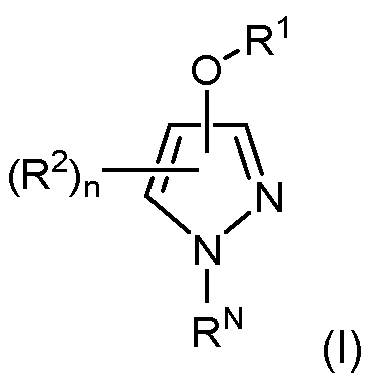
하기 식 I.1, I.2, 또는 I.3 중 어느 하나의 화합물이다:A compound of any one of the following formulas I.1, I.2, or I.3:

식 I.1, I.2, 또는 I.3 의 화합물에 관해, 바람직한 것은 n 이 0 또는 1 인 것, 즉 R2 가 부재이거나 단 하나의 R2 가 존재하는 것이다.With respect to compounds of formula I.1, I.2, or I.3, it is preferred that n is 0 or 1, i.e. R 2 is absent or only one R 2 is present.
식 I 의 화합물의 합성에 따라, 또한 예를 들어 식 I.1 의 화합물 및 식 I.3 의 화합물의 혼합물이 N-치환기 RN 의 도입 단계 전 호변이성질화로 인해 존재할 수 있다는 것을 이해해야 한다. 따라서, 식 I 의 화합물은 특정한 구현예에서 또한 식 I.1 의 화합물 및 식 I.3 의 화합물의 혼합물로서 존재할 수 있다. 추가로, 식 I.2 화합물의 혼합물은, 적어도 하나의 치환기 R2 가 존재하는 경우 수득될 수 있다.Depending on the synthesis of the compounds of formula I, it should also be understood that mixtures of compounds of formula I.1 and compounds of formula I.3 may also exist due to tautomerization before the introduction step of the N-substituent R N . Thus, the compounds of formula I can in certain embodiments also exist as mixtures of compounds of formula I.1 and compounds of formula I.3. Additionally, mixtures of compounds of formula I.2 can be obtained if at least one substituent R 2 is present.
추가로, 치환기 R2 의 존재 또는 부재 및 이의 위치에 따라, 상이한 구조가 식 I 의 화합물에 관해 바람직할 수 있음을 이해해야 한다.Additionally, it should be understood that depending on the presence or absence of the substituent R 2 and its position, different structures may be preferred for the compound of formula I.
따라서, 식 I 의 화합물, 특히 식 I.1 의 화합물은 하나의 특히 바람직한 구현예에서, 하기 도시된 식 I.1(i), I.1(ii), 또는 I.1(iii) 중 어느 하나의 화합물이다.Thus, the compound of formula I, in particular the compound of formula I.1, is in one particularly preferred embodiment a compound of any one of formulas I.1(i), I.1(ii), or I.1(iii) depicted below.
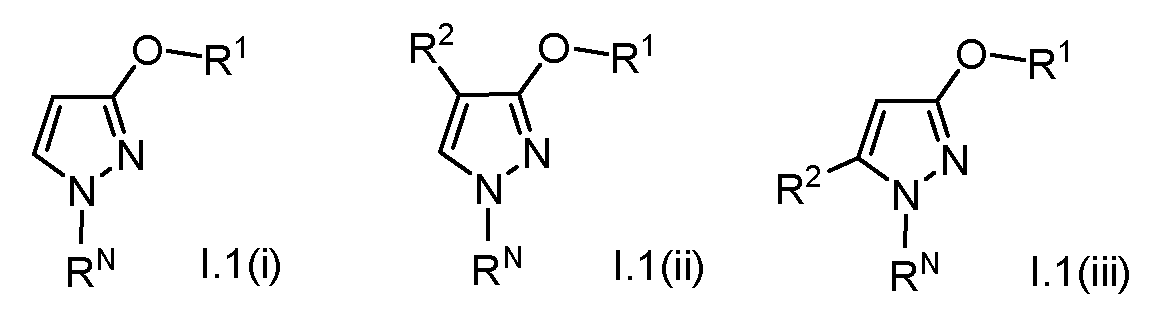
또 다른 특히 바람직한 구현예에서, 식 I 의 화합물, 특히 식 I.2 의 화합물은 하기 도시된 식 I.2(i), I.2(ii), 또는 I.2(iii) 중 어느 하나의 화합물이다. In another particularly preferred embodiment, the compound of formula I, in particular the compound of formula I.2, is a compound of any one of formulae I.2(i), I.2(ii), or I.2(iii) depicted below.
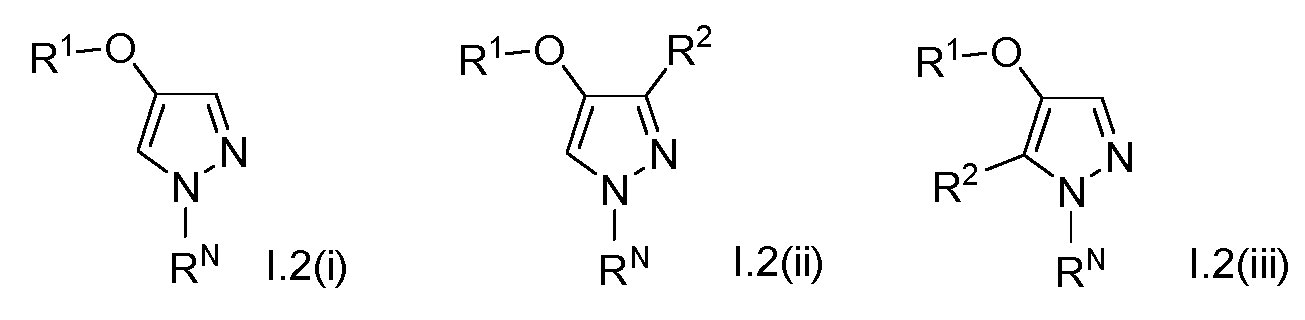
또 다른 특히 바람직한 구현예에서, 식 I 의 화합물, 특히 식 I.3 의 화합물은 하기 도시된 식 I.3(i), I.3(ii), 또는 I.3(iii) 중 어느 하나의 화합물이다.In another particularly preferred embodiment, the compound of formula I, in particular the compound of formula I.3, is a compound of any one of formulae I.3(i), I.3(ii), or I.3(iii) depicted below.
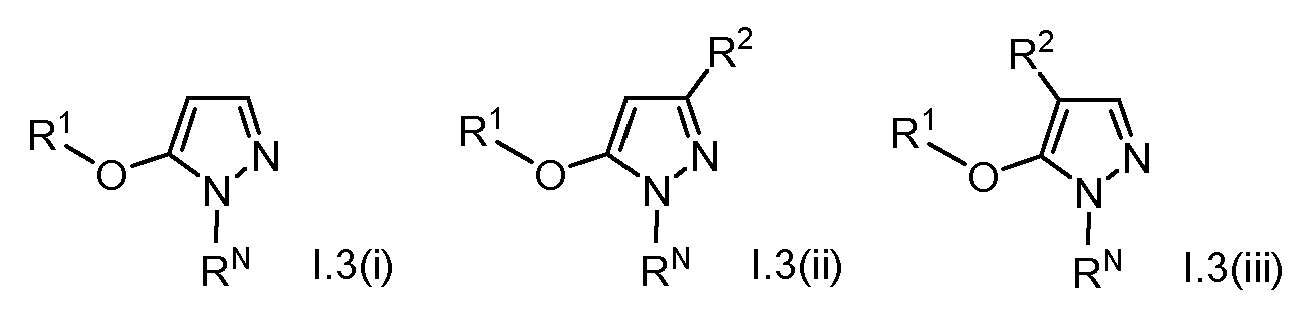
본 발명의 또 다른 바람직한 구현예에서, 식 I 의 화합물, 바람직하게는 식 I.1, I.2, 또는 I.3 의 화합물, 특히 식 I.1(i), I.1(ii), 또는 I.1(iii) 의 화합물, 또는 식 I.2(i), I.2(ii), 또는 I.2(iii) 의 화합물, 또는 식 I.3(i), I.3(ii), 또는 I.3(iii) 의 화합물에서,In another preferred embodiment of the present invention, in a compound of formula I, preferably a compound of formula I.1, I.2, or I.3, in particular a compound of formula I.1(i), I.1(ii), or I.1(iii), or a compound of formula I.2(i), I.2(ii), or I.2(iii), or a compound of formula I.3(i), I.3(ii), or I.3(iii),
R1 은 H, C1-C6-알킬, C3-C6-시클로알킬, 벤질, 알릴, CHRaC(=O)ORb, CHRaC(=O)NRbRc, 또는 페닐이고, 여기서 상기 페닐 기는 미치환되거나 하나 이상의, 동일하거나 상이한 치환기 Rx 로 치환되고;R 1 is H, C 1 -C 6 -alkyl, C 3 -C 6 -cycloalkyl, benzyl, allyl, CHR a C(=O)OR b , CHR a C(=O)NR b R c , or phenyl, wherein the phenyl group is unsubstituted or substituted with one or more, identical or different, substituents R x ;
R2 는 존재하는 경우, 할로겐, C1-C6-알킬, C3-C6-시클로알킬, 벤질, 알릴, 프로파르길, 또는 페닐이고, 여기서 상기 페닐 기는 미치환되거나 하나 이상의, 동일하거나 상이한 치환기 Rx 로 치환되고;R 2 , if present, is halogen, C 1 -C 6 -alkyl, C 3 -C 6 -cycloalkyl, benzyl, allyl, propargyl, or phenyl, wherein the phenyl group is unsubstituted or substituted with one or more, identical or different, substituents R x ;
Ra, Rb, Rc 및 Rx 는 상기 정의된 바와 같고;R a , R b , R c and R x are as defined above;
특히 바람직하게는Especially preferably
R1 은 C1-C6-알킬, 벤질, 알릴이고;R 1 is C 1 -C 6 -alkyl, benzyl, allyl;
R2 는 존재하는 경우, C1-C3-알킬 또는 페닐이다.R 2 , if present, is C 1 -C 3 -alkyl or phenyl.
상기 바람직한 구현예에 관해, RN 의 의미는 식 I 의 화합물에 관해 상기 제공된 의미에 상응한다.With respect to the above preferred embodiments, the meaning of R N corresponds to the meaning provided above with respect to the compound of formula I.
따라서, 상기 정의된 식 I.1, I.2, 또는 I.3 의 화합물에 관해, 특히 바람직한 것은 R2 가 존재하는 경우 C1-C3-알킬 또는 페닐이고, R1 이 C1-C6-알킬, 벤질, 알릴인 것이다.Therefore, with respect to compounds of formula I.1, I.2, or I.3 as defined above, particularly preferred are those in which R 2 , when present, is C 1 -C 3 -alkyl or phenyl, and R 1 is C 1 -C 6 -alkyl, benzyl, allyl.
본 발명의 한 바람직한 구현예에서, 식 I 의 화합물은 n 이 0 또는 1 이고, R2 가 존재하는 경우 C1-C3-알킬 또는 페닐이고, R1 이 C1-C6-알킬, 벤질, 알릴인 식 I.1 의 화합물이다.In one preferred embodiment of the present invention, the compound of formula I is a compound of formula I.1, wherein n is 0 or 1, R 2 , when present, is C 1 -C 3 -alkyl or phenyl, and R 1 is C 1 -C 6 -alkyl, benzyl, allyl.
본 발명의 한 바람직한 구현예에서, 식 I 의 화합물은 n 이 0 또는 1 이고, R2 가 존재하는 경우 C1-C3-알킬 또는 페닐이고, R1 이 C1-C6-알킬, 벤질, 알릴인 식 I.2 의 화합물이다.In one preferred embodiment of the present invention, the compound of formula I is a compound of formula I.2, wherein n is 0 or 1, R 2 , when present, is C 1 -C 3 -alkyl or phenyl, and R 1 is C 1 -C 6 -alkyl, benzyl, allyl.
본 발명의 한 바람직한 구현예에서, 식 I 의 화합물은 n 이 0 또는 1 이고, R2 가 존재하는 경우 C1-C3-알킬 또는 페닐이고, R1 이 C1-C6-알킬, 벤질, 알릴인 식 I.3 의 화합물이다.In one preferred embodiment of the present invention, the compound of formula I is a compound of formula I.3, wherein n is 0 or 1, R 2 , when present, is C 1 -C 3 -alkyl or phenyl, and R 1 is C 1 -C 6 -alkyl, benzyl, allyl.
상기 바람직한 구현예에 관해, RN 의 의미는 식 I 의 화합물에 관해 상기 제공된 의미에 상응한다.With respect to the above preferred embodiments, the meaning of R N corresponds to the meaning provided above with respect to the compound of formula I.
하나의 특히 바람직한 구현예에 있어서, 식 I 의 화합물은 R1 이 C1-C6-알킬, 벤질, 알릴인 식 I.1(i) 의 화합물 이다.In one particularly preferred embodiment, the compound of formula I is a compound of formula I.1(i) wherein R 1 is C 1 -C 6 -alkyl, benzyl, allyl.
하나의 특히 바람직한 구현예에 있어서, 식 I 의 화합물은 R2 가 C1-C3-알킬 또는 페닐이고, R1 이 C1-C6-알킬, 벤질, 알릴인 식 I.1(ii) 의 화합물이다.In one particularly preferred embodiment, the compound of formula I is a compound of formula I.1(ii) wherein R 2 is C 1 -C 3 -alkyl or phenyl and R 1 is C 1 -C 6 -alkyl, benzyl, allyl.
하나의 특히 바람직한 구현예에 있어서, 식 I 의 화합물은 R2 가 C1-C3-알킬 또는 페닐이고, R1 이 C1-C6-알킬, 벤질, 알릴인 식 I.1(iii) 의 화합물이다.In one particularly preferred embodiment, the compound of formula I is a compound of formula I.1(iii) wherein R 2 is C 1 -C 3 -alkyl or phenyl and R 1 is C 1 -C 6 -alkyl, benzyl, allyl.
하나의 특히 바람직한 구현예에 있어서, 식 I 의 화합물은 R1 이 C1-C6-알킬, 벤질, 알릴인 식 I.2(i) 의 화합물이다.In one particularly preferred embodiment, the compound of formula I is a compound of formula I.2(i), wherein R 1 is C 1 -C 6 -alkyl, benzyl, allyl.
하나의 특히 바람직한 구현예에 있어서, 식 I 의 화합물은 R2 가 C1-C3-알킬 또는 페닐이고, R1 이 C1-C6-알킬, 벤질, 알릴인 식 I.2(ii) 의 화합물이다.In one particularly preferred embodiment, the compound of formula I is a compound of formula I.2(ii) wherein R 2 is C 1 -C 3 -alkyl or phenyl and R 1 is C 1 -C 6 -alkyl, benzyl, allyl.
하나의 특히 바람직한 구현예에 있어서, 식 I 의 화합물은 R2 가 C1-C3-알킬 또는 페닐이고, R1 이 C1-C6-알킬, 벤질, 알릴인 식 I.2(iii) 의 화합물이다.In one particularly preferred embodiment, the compound of formula I is a compound of formula I.2(iii) wherein R 2 is C 1 -C 3 -alkyl or phenyl and R 1 is C 1 -C 6 -alkyl, benzyl, allyl.
하나의 특히 바람직한 구현예에 있어서, 식 I 의 화합물은 R1 이 C1-C6-알킬, 벤질, 알릴인 식 I.3(i) 의 화합물이다. In one particularly preferred embodiment, the compound of formula I is a compound of formula I.3(i), wherein R 1 is C 1 -C 6 -alkyl, benzyl, allyl.
하나의 특히 바람직한 구현예에 있어서, 식 I 의 화합물은 R2 가 C1-C3-알킬 또는 페닐이고, R1 이 C1-C6-알킬, 벤질, 알릴인 식 I.3(ii) 의 화합물이다.In one particularly preferred embodiment, the compound of formula I is a compound of formula I.3(ii), wherein R 2 is C 1 -C 3 -alkyl or phenyl and R 1 is C 1 -C 6 -alkyl, benzyl, allyl.
하나의 특히 바람직한 구현예에 있어서, 식 I 의 화합물은 R2 가 C1-C3-알킬 또는 페닐이고, R1 이 C1-C6-알킬, 벤질, 알릴인 식 I.3(iii) 의 화합물이다.In one particularly preferred embodiment, the compound of formula I is a compound of formula I.3(iii) wherein R 2 is C 1 -C 3 -alkyl or phenyl and R 1 is C 1 -C 6 -alkyl, benzyl, allyl.
상기 특히 바람직한 구현예에 관해, RN 의 의미는 식 I 의 화합물에 관해 상기 제공된 의미에 상응한다.With respect to the particularly preferred embodiment above, the meaning of R N corresponds to the meaning provided above with respect to the compound of formula I.
본 발명의 또 다른 구현예에서, 식 I 의 화합물, 바람직하게는 식 I.1, I.2, 또는 I.3 의 화합물, 특히 식 I.1(i), I.1.(ii), 또는 I.1(iii) 의 화합물, 또는 식 I.2.(i), I.2(ii), 또는 I.2(iii) 의 화합물, 또는 식 I.3(i), I.3(ii), 또는 I.3(iii) 의 화합물에서,In another embodiment of the present invention, a compound of formula I, preferably a compound of formula I.1, I.2, or I.3, in particular a compound of formula I.1(i), I.1.(ii), or I.1(iii), or a compound of formula I.2.(i), I.2(ii), or I.2(iii), or a compound of formula I.3(i), I.3(ii), or I.3(iii),
RN 은 C1-C6-알킬, C3-C6-시클로알킬, 벤질, 알릴, 프로파르길, 또는 페닐이고, 여기서 상기 기는 미치환되거나 하나 이상의, 동일하거나 상이한 치환기 Ry 로 치환되고;R N is C 1 -C 6 -alkyl, C 3 -C 6 -cycloalkyl, benzyl, allyl, propargyl, or phenyl, wherein said group is unsubstituted or substituted with one or more, identical or different, substituents R y ;
CHRaC(=O)ORb, CHRaC(=O)NRbRc, CH(C(=O)ORb)CH2(C(=O)ORb) 이고;CHR a C(=O)OR b , CHR a C(=O)NR b R c , CH(C(=O)OR b )CH 2 (C(=O)OR b );
C(=O)Rd, C(=O)ORb, C(=O)NRbRc, CHRaORb, 또는 CHRaNRe(C=O)Rf 이고;C(=O)R d , C(=O)OR b , C(=O)NR b R c , CHR a OR b , or CHR a NR e (C=O)R f ;
Ra 는 H, C1-C4-알킬, C1-C4-할로알킬, C3-C8-시클로알킬, 페닐, 또는 페닐-C1-C2-알킬이고;R a is H, C 1 -C 4 -alkyl, C 1 -C 4 -haloalkyl, C 3 -C 8 -cycloalkyl, phenyl, or phenyl-C 1 -C 2 -alkyl;
Rb 는 H, C1-C4-알킬, C1-C4-할로알킬, C3-C8-시클로알킬, 페닐, 또는 페닐-C1-C2-알킬이고;R b is H, C 1 -C 4 -alkyl, C 1 -C 4 -haloalkyl, C 3 -C 8 -cycloalkyl, phenyl, or phenyl-C 1 -C 2 -alkyl;
Rc 는 H, C1-C4-알킬, C1-C4-할로알킬, 또는 페닐이고;R c is H, C 1 -C 4 -alkyl, C 1 -C 4 -haloalkyl, or phenyl;
Rd 는 H, C1-C8-알킬, C2-C8-알케닐, C2-C8-알키닐, 페닐, 또는 페닐-C1-C2-알킬이고, 이러한 기는 미치환되거나 기 COOH 로 치환되고;R d is H, C 1 -C 8 -alkyl, C 2 -C 8 -alkenyl, C 2 -C 8 -alkynyl, phenyl, or phenyl-C 1 -C 2 -alkyl, which group is unsubstituted or substituted by the group COOH;
Re 는 H, C1-C4-알킬, C3-C8-시클로알킬, 또는 C6-C10-아릴이고;R e is H, C 1 -C 4 -alkyl, C 3 -C 8 -cycloalkyl, or C 6 -C 10 -aryl;
Rf 는 H, 또는 C1-C4-알킬이고;R f is H, or C 1 -C 4 -alkyl;
Ry 는 할로겐, CN, OH, NO2, COOH, NRbRc, NRb(C=O)Rf, C(=O)NRbRc, C1-C4-알킬, C1-C4-할로알킬, C1-C4-알콕시, C1-C4-할로알콕시, C1-C4-알킬카르보닐, C1-C4-알킬카르복시, C1-C4-알킬티오, C1-C4-알킬술포닐, 및 S(O)2NRbRc 이고;R y is halogen, CN, OH, NO 2 , COOH, NR b R c , NR b (C=O)R f , C(=O)NR b R c , C 1 -C 4 -alkyl, C 1 -C 4 -haloalkyl, C 1 -C 4 -alkoxy, C 1 -C 4 -haloalkoxy, C 1 -C 4 -alkylcarbonyl, C 1 -C 4 -alkylcarboxy, C 1 -C 4 -alkylthio, C 1 -C 4 -alkylsulfonyl, and S(O) 2 NR b R c ;
바람직하게는Preferably
RN 은 C1-C6-알킬, C3-C6-시클로알킬, 벤질, 알릴, 프로파르길, 또는 페닐이고, 여기서 상기 기는 미치환되거나 하나 이상의, 동일하거나 상이한 치환기 Ry 로 치환되고;R N is C 1 -C 6 -alkyl, C 3 -C 6 -cycloalkyl, benzyl, allyl, propargyl, or phenyl, wherein said group is unsubstituted or substituted with one or more, identical or different, substituents R y ;
CHRaC(=O)ORb, CHRaC(=O)NRbRc, CH(C(=O)ORb)CH2(C(=O)ORb) 이고;CHR a C(=O)OR b , CHR a C(=O)NR b R c , CH(C(=O)OR b )CH 2 (C(=O)OR b );
C(=O)Rd, C(=O)ORb, C(=O)NRbRc, CHRaORb, 또는 CHRaNRe(C=O)Rf 이고;C(=O)R d , C(=O)OR b , C(=O)NR b R c , CHR a OR b , or CHR a NR e (C=O)R f ;
Ra 는 H, C1-C4-알킬, C1-C4-할로알킬, C3-C8-시클로알킬, 페닐, 또는 페닐-C1-C2-알킬이고;R a is H, C 1 -C 4 -alkyl, C 1 -C 4 -haloalkyl, C 3 -C 8 -cycloalkyl, phenyl, or phenyl-C 1 -C 2 -alkyl;
Rb 는 H, C1-C4-알킬, C1-C4-할로알킬, C3-C8-시클로알킬, 페닐, 또는 페닐-C1-C2-알킬이고;R b is H, C 1 -C 4 -alkyl, C 1 -C 4 -haloalkyl, C 3 -C 8 -cycloalkyl, phenyl, or phenyl-C 1 -C 2 -alkyl;
Rc 는 H, C1-C4-알킬, C1-C4-할로알킬, 또는 페닐이고;R c is H, C 1 -C 4 -alkyl, C 1 -C 4 -haloalkyl, or phenyl;
Rd 는 H, 또는 C1-C4-알킬이고;R d is H, or C 1 -C 4 -alkyl;
Re 는 H, 또는 C1-C4-알킬이고;R e is H, or C 1 -C 4 -alkyl;
Rf 는 H, 또는 C1-C4-알킬이고;R f is H, or C 1 -C 4 -alkyl;
Ry 는 할로겐, CN, OH, NO2, C1-C4-알킬, C1-C4-할로알킬, C1-C4-알콕시, 및 C1-C4-할로알콕시이고;R y is halogen, CN, OH, NO 2 , C 1 -C 4 -alkyl, C 1 -C 4 -haloalkyl, C 1 -C 4 -alkoxy, and C 1 -C 4 -haloalkoxy;
특히 바람직하게는Especially preferably
RN 은 C(=O)Rd, CHRaC(=O)ORb, CHRaC(=O)NRbRc, CH(C(=O)ORb)CH2(C(=O)ORb), 또는 CHRaNRe(C=O)Rf 이고;R N is C(=O)R d , CHR a C(=O)OR b , CHR a C(=O)NR b R c , CH(C(=O)OR b )CH 2 (C(=O )OR b ), or CHR a NR e (C=O)R f ;
Ra 는 H 이고;R a is H;
Rb 는 H 또는 C1-C4-알킬이고;R b is H or C 1 -C 4 -alkyl;
Rc 는 H 또는 C1-C4-알킬이고;R c is H or C 1 -C 4 -alkyl;
Rd 는 C1-C3-알킬이고;R d is C 1 -C 3 -alkyl;
Re 는 H 이고;R e is H;
Rf 는 H 또는 CH3 이다.R f is H or CH 3 .
본 발명의 하나의 바람직한 구현예에서, 식 I 의 화합물에서,In one preferred embodiment of the present invention, in the compound of formula I,
RN 은 C(=O)Rd 이고, 바람직하게는 Rd 는 C1-C3-알킬이다.R N is C(=O)R d , preferably R d is C 1 -C 3 -alkyl.
상기 화합물은 식 I.A 의 화합물로 지칭된다.The above compound is referred to as a compound of formula I.A.

본 발명의 또 다른 바람직한 구현예에서, 식 I 의 화합물에서,In another preferred embodiment of the present invention, in the compound of formula I,
RN 은 CHRaC(=O)ORb 이고, 바람직하게는 Ra 는 H 이고, Rb 는 H 또는 C1-C4-알킬이다.R N is CHR a C(=O)OR b , preferably R a is H and R b is H or C 1 -C 4 -alkyl.
상기 화합물은 식 I.B 의 화합물로 지칭된다.The above compound is referred to as a compound of formula I.B.

본 발명의 또 다른 바람직한 구현예에서, 식 I 의 화합물에서,In another preferred embodiment of the present invention, in the compound of formula I,
RN 은 CHRaC(=O)NRbRc 이고, 바람직하게는 Ra 는 H 이고, Rb 는 H 또는 C1-C4-알킬이고, Rc 는 H 또는 C1-C4-알킬이다.R N is CHR a C(=O)NR b R c , preferably R a is H, R b is H or C 1 -C 4 -alkyl, and R c is H or C 1 -C 4 -alkyl.
상기 화합물은 식 I.C 의 화합물로 지칭된다.The above compound is referred to as a compound of formula I.C.
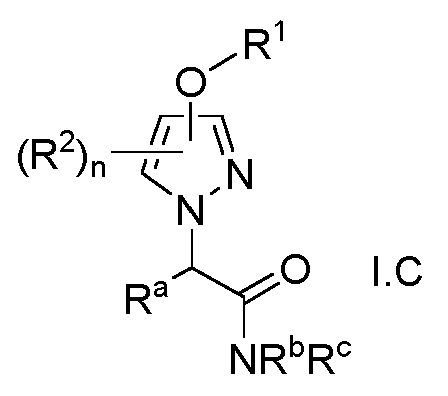
본 발명의 또 다른 바람직한 구현예에서, 식 I 의 화합물에서,In another preferred embodiment of the present invention, in the compound of formula I,
RN 은 CH(C(=O)ORb)CH2(C(=O)ORb) 이고, 바람직하게는 Rb 는 H 또는 C1-C4-알킬이다. 이에 관해, 2 개의 Rb 치환기는 서로 동일하거나 상이할 수 있다.R N is CH(C(=O)OR b )CH 2 (C(=O)OR b ), and preferably R b is H or C 1 -C 4 -alkyl. In this regard, the two R b substituents may be the same or different.
상기 화합물은 식 I.D 의 화합물로 지칭된다.The above compound is referred to as a compound of formula I.D.
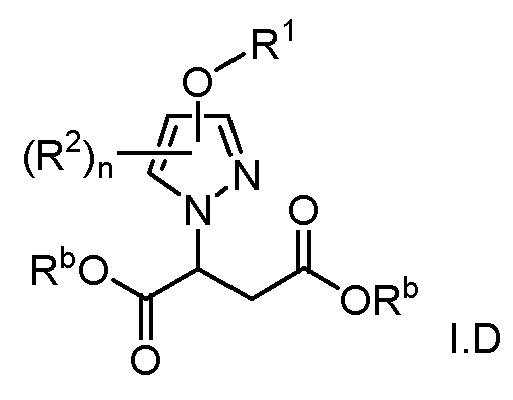
본 발명의 또 다른 바람직한 구현예에서, 식 I 의 화합물에서,In another preferred embodiment of the present invention, in the compound of formula I,
RN 은 CHRaNRe(C=O)Rf 이고, 바람직하게는 Ra 는 H 이고, Re 는 H 이고, Rf 는 H 또는 CH3 이다.R N is CHR a NR e (C=O)R f , preferably R a is H, R e is H, and R f is H or CH 3 .
상기 화합물은 식 I.E 의 화합물로 지칭된다.The above compound is referred to as a compound of formula I.E.
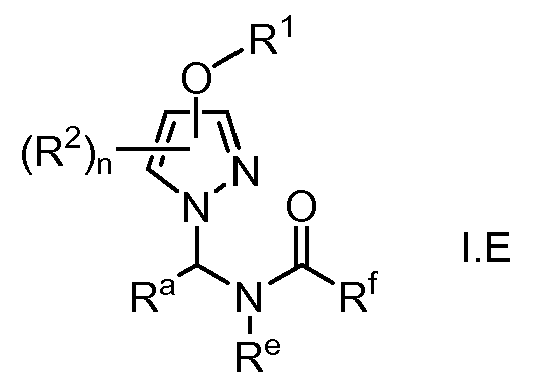
R1 및 R2 에 관한 상기 선호도가 상기 식 I.A, I.B, I.C, I.D 및 I.E 에도 적용된다는 것을 이해해야 한다.It should be understood that the above preferences with respect to R 1 and R 2 also apply to the above formulas IA, IB, IC, ID and IE.
따라서, 본 발명에 따른 용도를 위해 특히 바람직한 화합물은 하기 도시된 식 I.1.A, I.1.B, I.1.C, I.1.D 또는 I.1.E 의 화합물이다.Therefore, particularly preferred compounds for use according to the present invention are compounds of formula I.1.A, I.1.B, I.1.C, I.1.D or I.1.E as depicted below.

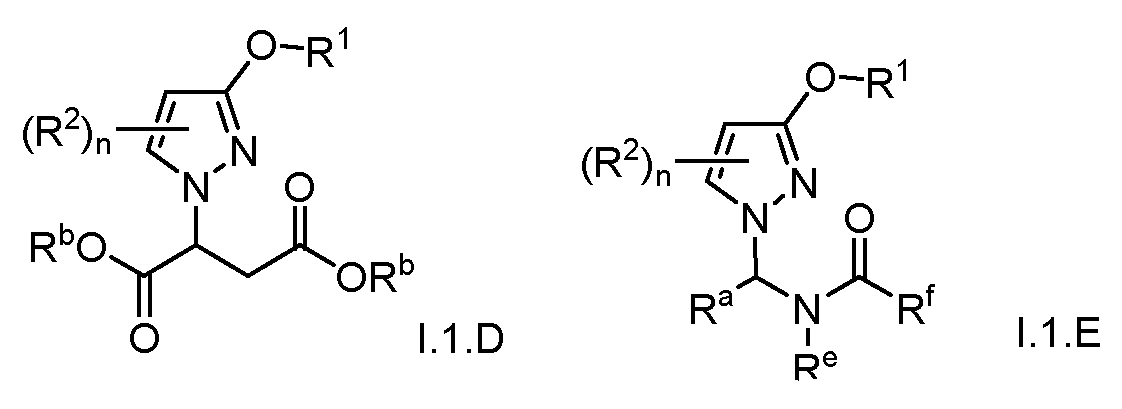
R1 및 R2 의 의미는 바람직하게는 식 I 의 화합물, 특히 식 I.1 의 화합물에 관해 상기 제공된 의미에 상응한다. 추가로, 바람직한 것은 n 이 0 또는 1 인 것이다. n 이 1 인 경우, 피라졸 고리에서의 각각의 위치는 식 I.1(ii), 또는 I.1(iii) 의 화합물에 관해 제시된 바와 같은 R2 에 의해 인식될 수 있다. 나아가, Ra, Rb, Rc, Rd, Re, 및 Rf 의 의미는 바람직하게는 식 I.A, I.B, I.C, I.D, 및I.E 의 화합물에 관해 상기 제공된 의미에 상응한다. 2 개의 치환기 Rb 가 존재하는 경우, 이들은 서로 동일하거나 상이할 수 있다는 것을 이해해야 한다.The meanings of R 1 and R 2 preferably correspond to the meanings given above for the compounds of the formula I, in particular for the compounds of the formula I.1. Additionally, preference is given to n being 0 or 1. When n is 1, each position in the pyrazole ring can be recognized by R 2 as given for the compounds of the formula I.1(ii), or I.1(iii). Furthermore, the meanings of R a , R b , R c , R d , R e and R f preferably correspond to the meanings given above for the compounds of the formulas IA, IB, IC, ID, and IE. It should be understood that, if two substituents R b are present, these can be identical or different from each other.
추가로, 본 발명에 따른 용도를 위해 특히 바람직한 화합물은 하기 도시된 식 I.2.A, I.2.B, I.2.C, I.2.D 또는 I.2.E 의 화합물이다.Additionally, particularly preferred compounds for use according to the present invention are compounds of formula I.2.A, I.2.B, I.2.C, I.2.D or I.2.E as depicted below.
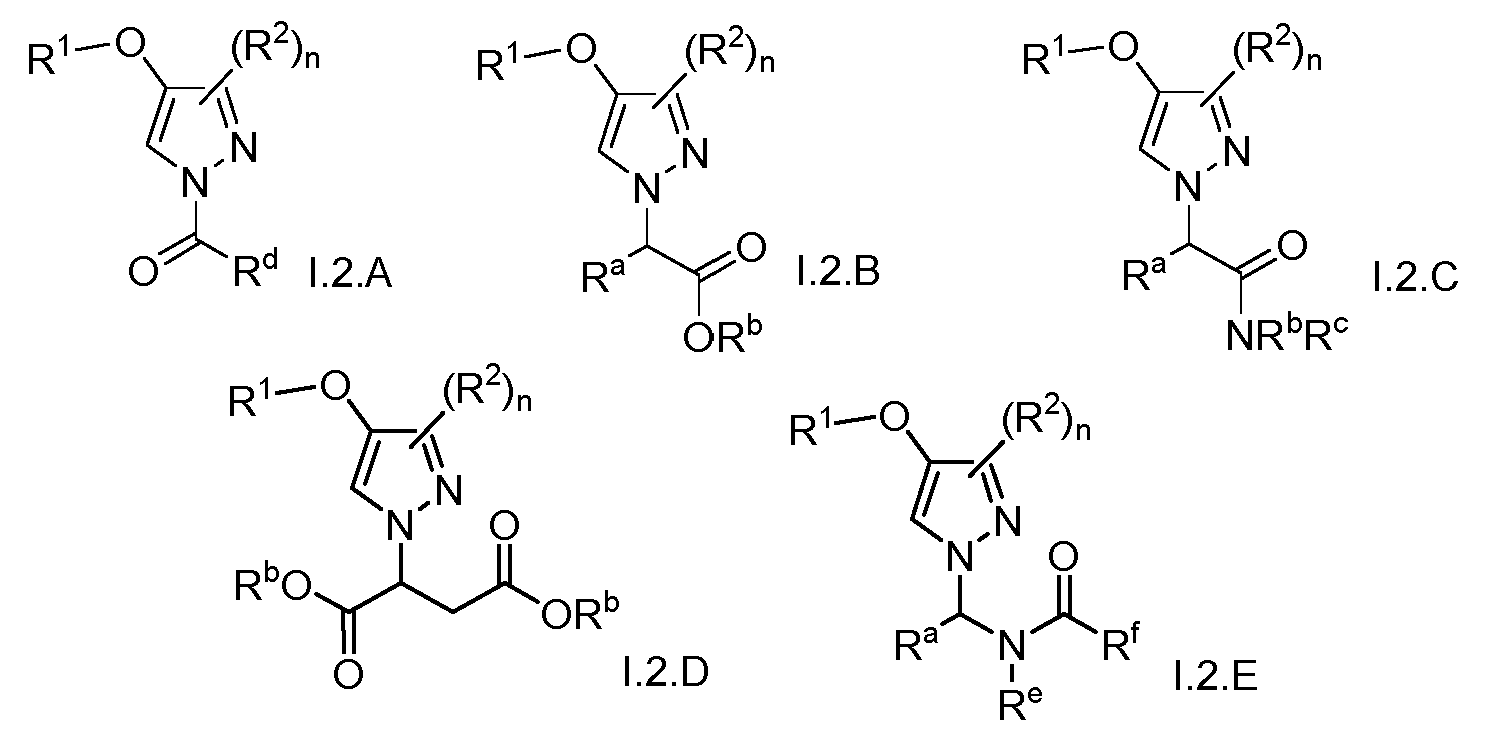
R1 및 R2 의 의미는 바람직하게는 식 I 의 화합물, 특히 식 I.2 의 화합물에 관해 상기 제공된 의미에 상응한다. 추가로, 바람직한 것은 n 이 0 또는 1 인 것이다. n 이 1 인 경우, 피라졸 고리에서의 각각의 위치는 식 I.2(ii), 또는 I.2(iii) 의 화합물에 관해 제시된 바와 같은 R2 에 의해 인식될 수 있다. 나아가, Ra, Rb, Rc, Rd, Re, 및 Rf 의 의미는 바람직하게는 식 I.A, I.B, I.C, I.D, 및 I.E 의 화합물에 관해 상기 제공된 의미에 상응한다. 2 개의 치환기 Rb 가 존재하는 경우, 이들은 서로 동일하거나 상이할 수 있다는 것을 이해해야 한다.The meanings of R 1 and R 2 preferably correspond to the meanings given above for the compounds of the formula I, in particular for the compounds of the formula I.2. Additionally, preference is given to n being 0 or 1. When n is 1, each position in the pyrazole ring can be recognized by R 2 as given for the compounds of the formula I.2(ii), or I.2(iii). Furthermore, the meanings of R a , R b , R c , R d , R e and R f preferably correspond to the meanings given above for the compounds of the formulas IA, IB, IC, ID, and IE. It should be understood that, if two substituents R b are present, they can be identical or different from each other.
추가로, 본 발명에 따른 용도를 위해 특히 바람직한 화합물은 하기 도시된 식 I.3.A, I.3.B, I.3.C, I.3.D 또는 I.3.E 의 화합물이다.Additionally, particularly preferred compounds for use according to the present invention are compounds of formula I.3.A, I.3.B, I.3.C, I.3.D or I.3.E as depicted below.
R1 및 R2 의 의미는 바람직하게는 식 I 의 화합물, 특히 식 I.3 의 화합물에 관해 상기 제공된 의미에 상응한다. 추가로, 바람직한 것은 n 이 0 또는 1 인 것이다. n 이 1 인 경우, 피라졸 고리에서의 각각의 위치는 식 I.3(ii), 또는 I.3(iii) 의 화합물에 관해 제시된 바와 같은 R2 에 의해 인식될 수 있다. 나아가, Ra, Rb, Rc, Rd, Re, 및 Rf 의 의미는 바람직하게는 식 I.A, I.B, I.C, I.D, 및 I.E 의 화합물에 관해 상기 제공된 의미에 상응한다. 2 개의 치환기 Rb 가 존재하는 경우, 이들은 서로 동일하거나 상이할 수 있다는 것을 이해해야 한다.The meanings of R 1 and R 2 preferably correspond to the meanings given above for the compounds of the formula I, in particular for the compounds of the formula I.3. Additionally, preference is given to n being 0 or 1. When n is 1, each position in the pyrazole ring can be recognized by R 2 as given for the compounds of the formula I.3(ii), or I.3(iii). Furthermore, the meanings of R a , R b , R c , R d , R e and R f preferably correspond to the meanings given above for the compounds of the formulas IA, IB, IC, ID, and IE. It should be understood that, if two substituents R b are present, these can be identical or different from each other.
따라서, 식 I 의 특히 바람직한 화합물, 특히 식 I.1, I.2, 또는 I.3 의 화합물은 하기 구현예에 정리되어 있다.Accordingly, particularly preferred compounds of formula I, in particular compounds of formula I.1, I.2, or I.3, are summarized in the embodiments below.
구현예 1 Implementation Example 1
RN 이 C(=O)Rd 이고, 각각의 경우 표 A(i) 의 하나의 열에 해당하는 식 I.1(i) 의 화합물R N is C(=O)R d , and in each case, a compound of formula I.1(i) corresponding to one column of Table A(i)
구현예 2Implementation Example 2
RN 이 C(=O)Rd 이고, 각각의 경우 표 A(i) 의 하나의 열에 해당하는 식 I.2(i) 의 화합물R N is C(=O)R d , and in each case, a compound of formula I.2(i) corresponding to one column of Table A(i)
구현예 3Implementation Example 3
RN 이 C(=O)Rd 이고, 각각의 경우 표 A(i) 의 하나의 열에 해당하는 식 I.3(i) 의 화합물R N is C(=O)R d , and in each case the compound of formula I.3(i) corresponds to one column of Table A(i).
표 A(i)Table A(i)
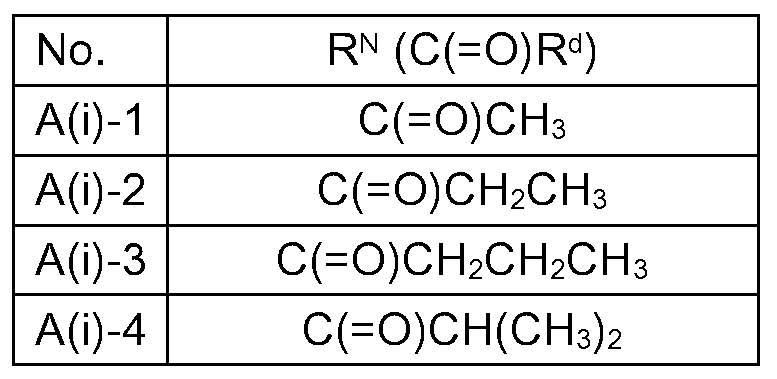
구현예 1 내지 3 에 관해 R1 의 의미는 바람직하게는 식 I 의 화합물, 특히 식 I.1, I.2, 또는 I.3 의 화합물에 관해 상기 제공된 의미에 상응한다.With respect to embodiments 1 to 3, the meaning of R 1 preferably corresponds to the meaning given above with respect to the compounds of formula I, in particular the compounds of formula I.1, I.2, or I.3.
구현예 4Implementation Example 4
RN 이 CHRaC(=O)ORb 이고, 각각의 경우 표 A(ii) 의 하나의 열에 해당하는 식 I.1(i) 의 화합물R N is CHR a C(=O)OR b , and in each case, a compound of formula I.1(i) corresponding to one column of Table A(ii)
구현예 5Implementation Example 5
RN 이 CHRaC(=O)ORb 이고, 각각의 경우 표 A(ii) 의 하나의 열에 해당하는 식 I.2(i) 의 화합물R N is CHR a C(=O)OR b , and in each case, the compound of formula I.2(i) corresponds to one column of Table A(ii).
구현예 6Implementation Example 6
RN 이 CHRaC(=O)ORb 이고, 각각의 경우 표 A(ii) 의 하나의 열에 해당하는 식 I.3(i) 의 화합물R N is CHR a C(=O)OR b , and in each case the compound of formula I.3(i) corresponds to one column of Table A(ii).
표 A(ii)Table A(ii)

구현예 4 내지 6 에 관해 R1 의 의미는 바람직하게는 식 I 의 화합물, 특히 식 I.1, I.2, 또는 I.3 의 화합물에 관해 상기 제공된 의미에 상응한다.With respect to embodiments 4 to 6, the meaning of R 1 preferably corresponds to the meaning given above with respect to the compounds of formula I, in particular the compounds of formula I.1, I.2, or I.3.
구현예 7Implementation Example 7
RN 이 CHRaC(=O)NRbRc 이고, 각각의 경우 표 A(iii) 의 하나의 열에 해당하는 식 I.1(i) 의 화합물R N is CHR a C(=O)NR b R c , and in each case, a compound of formula I.1(i) corresponding to one column of Table A(iii)
구현예 8Implementation Example 8
RN 이 CHRaC(=O)NRbRc 이고, 각각의 경우 표 A(iii) 의 하나의 열에 해당하는 식 I.2(i) 의 화합물R N is CHR a C(=O)NR b R c , and in each case, a compound of formula I.2(i) corresponding to one column of Table A(iii)
구현예 9Implementation Example 9
RN 이 CHRaC(=O)NRbRc 이고, 각각의 경우 표 A(iii) 의 하나의 열에 해당하는 식 I.3(i) 의 화합물R N is CHR a C(=O)NR b R c , and in each case, a compound of formula I.3(i) corresponding to one column of Table A(iii).
표 A(iii)Table A(iii)

구현예 7 내지 9 에 관해 R1 의 의미는 바람직하게는 식 I 의 화합물, 특히 식 I.1, I.2, 또는 I.3 의 화합물에 관해 상기 제공된 의미에 상응한다.With respect to embodiments 7 to 9, the meaning of R 1 preferably corresponds to the meaning given above with respect to the compounds of formula I, in particular the compounds of formula I.1, I.2, or I.3.
구현예 10Implementation Example 10
RN 이 CH(C(=O)ORb)CH2(C(=O)ORb) 이고, 각각의 경우 표 A(iv) 의 하나의 열에 해당하는 식 I.1(i) 의 화합물R N is CH(C(=O)OR b )CH 2 (C(=O)OR b ), and in each case, compounds of formula I.1(i) corresponding to one column of Table A(iv).
구현예 11Implementation Example 11
RN 이 CH(C(=O)ORb)CH2(C(=O)ORb) 이고, 각각의 경우 표 A(iv) 의 하나의 열에 해당하는 식 I.2(i) 의 화합물R N is CH(C(=O)OR b )CH 2 (C(=O)OR b ), and in each case, compounds of formula I.2(i) corresponding to one column of Table A(iv).
구현예 12Implementation Example 12
RN 이 CH(C(=O)ORb)CH2(C(=O)ORb) 이고, 각각의 경우 표 A(iv) 의 하나의 열에 해당하는 식 I.3(i) 의 화합물R N is CH(C(=O)OR b )CH 2 (C(=O)OR b ), and in each case, compounds of formula I.3(i) corresponding to one column of Table A(iv).
표 A(iv)Table A(iv)

구현예 10 내지 12 에 관해 R1 의 의미는 바람직하게는 식 I 의 화합물, 특히 식 I.1, I.2, 또는 I.3 의 화합물에 관해 상기 제공된 의미에 상응한다.With respect to embodiments 10 to 12, the meaning of R 1 preferably corresponds to the meaning given above with respect to the compounds of formula I, in particular the compounds of formula I.1, I.2, or I.3.
구현예 13Implementation Example 13
RN 이 CHRaNRe(C=O)Rf 이고, 각각의 경우 표 A(v) 의 하나의 열에 해당하는 식 I.1(i) 의 화합물R N is CHR a NR e (C=O)R f , and in each case, compounds of formula I.1(i) corresponding to one column of Table A(v)
구현예 14Implementation Example 14
RN 이 CHRaNRe(C=O)Rf 이고, 각각의 경우 표 A(v) 의 하나의 열에 해당하는 식 I.2(i) 의 화합물R N is CHR a NR e (C=O)R f , and in each case, compounds of formula I.2(i) corresponding to one column of Table A(v)
구현예 15Implementation Example 15
RN 이 CHRaNRe(C=O)Rf 이고, 각각의 경우 표 A(v) 의 하나의 열에 해당하는 식 I.3(i) 의 화합물R N is CHR a NR e (C=O)R f , and in each case, compounds of formula I.3(i) corresponding to one column of Table A(v)
표 A(v)Table A(v)
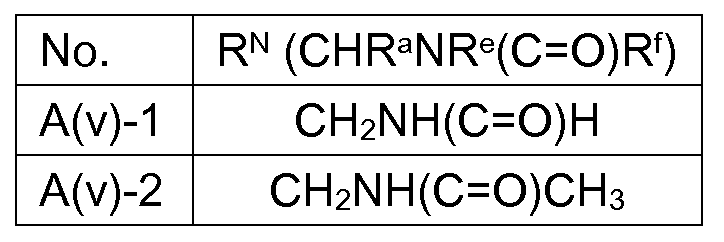
구현예 13 내지 15 에 관해 R1 의 의미는 바람직하게는 식 I 의 화합물, 특히 식 I.1, I.2, 또는 I.3 의 화합물에 관해 상기 제공된 의미에 상응한다.With respect to embodiments 13 to 15, the meaning of R 1 preferably corresponds to the meaning given above with respect to the compounds of formula I, in particular the compounds of formula I.1, I.2, or I.3.
본 발명의 방법, 용도, 조성물, 및 혼합물에 관해, 특히 이들의 용도의 관점에서, 바람직한 것은 하기 표에 정리된 식 I 의 화합물이다.With respect to the methods, uses, compositions, and mixtures of the present invention, particularly from the viewpoint of their uses, preferred are compounds of formula I as summarized in the table below.
표 1Table 1
R2 가 부재이고, RN (C(=O)Rd) 및 R1 의 조합이 각각의 경우 표 B 의 하나의 열에 해당하는 식 I.1(i) 의 화합물Compounds of formula I.1(i) in which R 2 is absent and the combination of R N (C(=O)R d ) and R 1 corresponds to one column of Table B in each case.
표 2Table 2
R2 가 부재이고, RN (C(=O)Rd) 및 R1 의 조합이 각각의 경우 표 B 의 하나의 열에 해당하는 식 I.2(i) 의 화합물Compounds of formula I.2(i) in which R 2 is absent and the combination of R N (C(=O)R d ) and R 1 corresponds to one column of Table B in each case.
표 3Table 3
R2 가 부재이고, RN (C(=O)Rd) 및 R1 의 조합이 각각의 경우 표 B 의 하나의 열에 해당하는 식 I.3(i) 의 화합물Compounds of formula I.3(i) in which R 2 is absent and the combination of R N (C(=O)R d ) and R 1 corresponds to one column of Table B in each case.
표 4Table 4
R2 가 CH3 이고, RN (C(=O)Rd) 및 R1 의 조합이 각각의 경우 표 B 의 하나의 열에 해당하는 식 I.1(ii) 의 화합물Compounds of formula I.1(ii) in which R 2 is CH 3 and the combination of R N (C(=O)R d ) and R 1 corresponds to one column of Table B in each case.
표 5Table 5
R2 가 CH3 이고, RN (C(=O)Rd) 및 R1 의 조합이 각각의 경우 표 B 의 하나의 열에 해당하는 식 I.1(iii) 의 화합물Compounds of formula I.1(iii) in which R 2 is CH 3 and the combination of R N (C(=O)R d ) and R 1 corresponds to one column of Table B in each case.
표 6Table 6
R2 가 CH3 이고, RN (C(=O)Rd) 및 R1 의 조합이 각각의 경우 표 B 의 하나의 열에 해당하는 식 I.2(ii) 의 화합물Compounds of formula I.2(ii) in which R 2 is CH 3 and the combination of R N (C(=O)R d ) and R 1 corresponds to one column of Table B in each case.
표 7Table 7
R2 가 CH3 이고, RN (C(=O)Rd) 및 R1 의 조합이 각각의 경우 표 B 의 하나의 열에 해당하는 식 I.2(iii) 의 화합물Compounds of formula I.2(iii) in which R 2 is CH 3 and the combination of R N (C(=O)R d ) and R 1 corresponds to one column of Table B in each case.
표 8Table 8
R2 가 CH3 이고, RN (C(=O)Rd) 및 R1 의 조합이 각각의 경우 표 B 의 하나의 열에 해당하는 식 I.3(ii) 의 화합물Compounds of formula I.3(ii) in which R 2 is CH 3 and the combination of R N (C(=O)R d ) and R 1 corresponds to one column of Table B in each case.
표 9Table 9
R2 가 CH3 이고, RN (C(=O)Rd) 및 R1 의 조합이 각각의 경우 표 B 의 하나의 열에 해당하는 식 I.3(iii) 의 화합물Compounds of formula I.3(iii) in which R 2 is CH 3 and the combination of R N (C(=O)R d ) and R 1 corresponds to one column of Table B in each case.
표 10Table 10
R2 가 CH2CH3 이고, RN (C(=O)Rd) 및 R1 의 조합이 각각의 경우 표 B 의 하나의 열에 해당하는 식 I.1(ii) 의 화합물Compounds of formula I.1(ii) in which R 2 is CH 2 CH 3 and the combination of R N (C(=O)R d ) and R 1 corresponds to one column of Table B in each case.
표 11Table 11
R2 가 CH2CH3 이고, RN (C(=O)Rd) 및 R1 의 조합이 각각의 경우 표 B 의 하나의 열에 해당하는 식 I.1(iii) 의 화합물Compounds of formula I.1(iii) in which R 2 is CH 2 CH 3 and the combination of R N (C(=O)R d ) and R 1 corresponds to one column of Table B in each case.
표 12Table 12
R2 가 CH2CH3 이고, RN (C(=O)Rd) 및 R1 의 조합이 각각의 경우 표 B 의 하나의 열에 해당하는 식 I.2(ii) 의 화합물Compounds of formula I.2(ii) in which R 2 is CH 2 CH 3 and the combination of R N (C(=O)R d ) and R 1 corresponds to one column of Table B in each case.
표 13Table 13
R2 가 CH2CH3 이고, RN (C(=O)Rd) 및 R1 의 조합이 각각의 경우 표 B 의 하나의 열에 해당하는 식 I.2(iii) 의 화합물Compounds of formula I.2(iii) in which R 2 is CH 2 CH 3 and the combination of R N (C(=O)R d ) and R 1 corresponds to one column of Table B in each case.
표 14Table 14
R2 가 CH2CH3 이고, RN (C(=O)Rd) 및 R1 의 조합이 각각의 경우 표 B 의 하나의 열에 해당하는 식 I.3(ii) 의 화합물Compounds of formula I.3(ii) in which R 2 is CH 2 CH 3 and the combination of R N (C(=O)R d ) and R 1 corresponds to one column of Table B in each case.
표 15Table 15
R2 가 CH2CH3 이고, RN (C(=O)Rd) 및 R1 의 조합이 각각의 경우 표 B 의 하나의 열에 해당하는 식 I.3(iii) 의 화합물Compounds of formula I.3(iii) in which R 2 is CH 2 CH 3 and the combination of R N (C(=O)R d ) and R 1 corresponds to one column of Table B in each case.
표 16 Table 16
R2 가 CH2CH2CH3 이고, RN (C(=O)Rd) 및 R1 의 조합이 각각의 경우 표 B 의 하나의 열에 해당하는 식 I.1(ii) 의 화합물Compounds of formula I.1(ii) in which R 2 is CH 2 CH 2 CH 3 and the combination of R N (C(=O)R d ) and R 1 corresponds to one column of Table B in each case.
표 17Table 17
R2 가 CH(CH3)2 이고, RN (C(=O)Rd) 및 R1 의 조합이 각각의 경우 표 B 의 하나의 열에 해당하는 식 I.1(ii) 의 화합물Compounds of formula I.1(ii) in which R 2 is CH(CH 3 ) 2 and the combination of R N (C(=O)R d ) and R 1 corresponds to one column of Table B in each case.
표 18Table 18
R2 가 CH2CH2CH3 이고, RN (C(=O)Rd) 및 R1 의 조합이 각각의 경우 표 B 의 하나의 열에 해당하는 식 I.1(iii) 의 화합물Compounds of formula I.1(iii) in which R 2 is CH 2 CH 2 CH 3 and the combination of R N (C(=O)R d ) and R 1 corresponds to one column of Table B in each case.
표 19Table 19
R2 가 CH(CH3)2 이고, RN (C(=O)Rd) 및 R1 의 조합이 각각의 경우 표 B 의 하나의 열에 해당하는 식 I.1(iii) 의 화합물Compounds of formula I.1(iii) in which R 2 is CH(CH 3 ) 2 and the combination of R N (C(=O)R d ) and R 1 corresponds to one column of Table B in each case.
표 20Table 20
R2 가 CH2CH2CH3 이고, RN (C(=O)Rd) 및 R1 의 조합이 각각의 경우 표 B 의 하나의 열에 해당하는 식 I.2(ii) 의 화합물Compounds of formula I.2(ii) in which R 2 is CH 2 CH 2 CH 3 and the combination of R N (C(=O)R d ) and R 1 corresponds to one column of Table B in each case.
표 21Table 21
R2 가 CH(CH3)2 이고, RN (C(=O)Rd) 및 R1 의 조합이 각각의 경우 표 B 의 하나의 열에 해당하는 식 I.2(ii) 의 화합물Compounds of formula I.2(ii) in which R 2 is CH(CH 3 ) 2 and the combination of R N (C(=O)R d ) and R 1 corresponds to one column of Table B in each case.
표 22Table 22
R2 가 CH2CH2CH3 이고, RN (C(=O)Rd) 및 R1 의 조합이 각각의 경우 표 B 의 하나의 열에 해당하는 식 I.2(iii) 의 화합물Compounds of formula I.2(iii) in which R 2 is CH 2 CH 2 CH 3 and the combination of R N (C(=O)R d ) and R 1 corresponds to one column of Table B in each case.
표 23Table 23
R2 가 CH(CH3)2 이고, RN (C(=O)Rd) 및 R1 의 조합이 각각의 경우 표 B 의 하나의 열에 해당하는 식 I.2(iii) 의 화합물Compounds of formula I.2(iii) in which R 2 is CH(CH 3 ) 2 and the combination of R N (C(=O)R d ) and R 1 corresponds to one column of Table B in each case.
표 24Table 24
R2 가 CH2CH2CH3 이고, RN (C(=O)Rd) 및 R1 의 조합이 각각의 경우 표 B 의 하나의 열에 해당하는 식 I.3(ii) 의 화합물Compounds of formula I.3(ii) in which R 2 is CH 2 CH 2 CH 3 and the combination of R N (C(=O)R d ) and R 1 corresponds to one column of Table B in each case.
표 25Table 25
R2 가 CH(CH3)2 이고, RN (C(=O)Rd) 및 R1 의 조합이 각각의 경우 표 B 의 하나의 열에 해당하는 식 I.3(ii) 의 화합물Compounds of formula I.3(ii) in which R 2 is CH(CH 3 ) 2 and the combination of R N (C(=O)R d ) and R 1 corresponds to one column of Table B in each case.
표 26Table 26
R2 가 CH2CH2CH3 이고, RN (C(=O)Rd) 및 R1 의 조합이 각각의 경우 표 B 의 하나의 열에 해당하는 식 I.3(iii) 의 화합물Compounds of formula I.3(iii) in which R 2 is CH 2 CH 2 CH 3 and the combination of R N (C(=O)R d ) and R 1 corresponds to one column of Table B in each case.
표 27Table 27
R2 가 CH(CH3)2 이고, RN (C(=O)Rd) 및 R1 의 조합이 각각의 경우 표 B 의 하나의 열에 해당하는 식 I.3(iii) 의 화합물Compounds of formula I.3(iii) in which R 2 is CH(CH 3 ) 2 and the combination of R N (C(=O)R d ) and R 1 corresponds to one column of Table B in each case.
표 28Table 28
R2 가 페닐이고, RN (C(=O)Rd) 및 R1 의 조합이 각각의 경우 표 B 의 하나의 열에 해당하는 식 I.1(ii) 의 화합물Compounds of formula I.1(ii) in which R 2 is phenyl and the combination of R N (C(=O)R d ) and R 1 corresponds in each case to one column of Table B.
표 29Table 29
R2 가 페닐이고, RN (C(=O)Rd) 및 R1 의 조합이 각각의 경우 표 B 의 하나의 열에 해당하는 식 I.1(iii) 의 화합물Compounds of formula I.1(iii) in which R 2 is phenyl and the combination of R N (C(=O)R d ) and R 1 corresponds in each case to one column of Table B.
표 30Table 30
R2 가 페닐이고, RN (C(=O)Rd) 및 R1 의 조합이 각각의 경우 표 B 의 하나의 열에 해당하는 식 I.2(ii) 의 화합물Compounds of formula I.2(ii) in which R 2 is phenyl and the combination of R N (C(=O)R d ) and R 1 corresponds in each case to one column of Table B.
표 31Table 31
R2 가 페닐이고, RN (C(=O)Rd) 및 R1 의 조합이 각각의 경우 표 B 의 하나의 열에 해당하는 식 I.2(iii) 의 화합물Compounds of formula I.2(iii) in which R 2 is phenyl and the combination of R N (C(=O)R d ) and R 1 corresponds in each case to one column of Table B.
표 32Table 32
R2 가 페닐이고, RN (C(=O)Rd) 및 R1 의 조합이 각각의 경우 표 B 의 하나의 열에 해당하는 식 I.3(ii) 의 화합물Compounds of formula I.3(ii) in which R 2 is phenyl and the combination of R N (C(=O)R d ) and R 1 corresponds in each case to one column of Table B.
표 33Table 33
R2 가 페닐이고, RN (C(=O)Rd) 및 R1 의 조합이 각각의 경우 표 B 의 하나의 열에 해당하는 식 I.3(iii) 의 화합물Compounds of formula I.3(iii) in which R 2 is phenyl and the combination of R N (C(=O)R d ) and R 1 corresponds in each case to one column of Table B.
표 BTable B
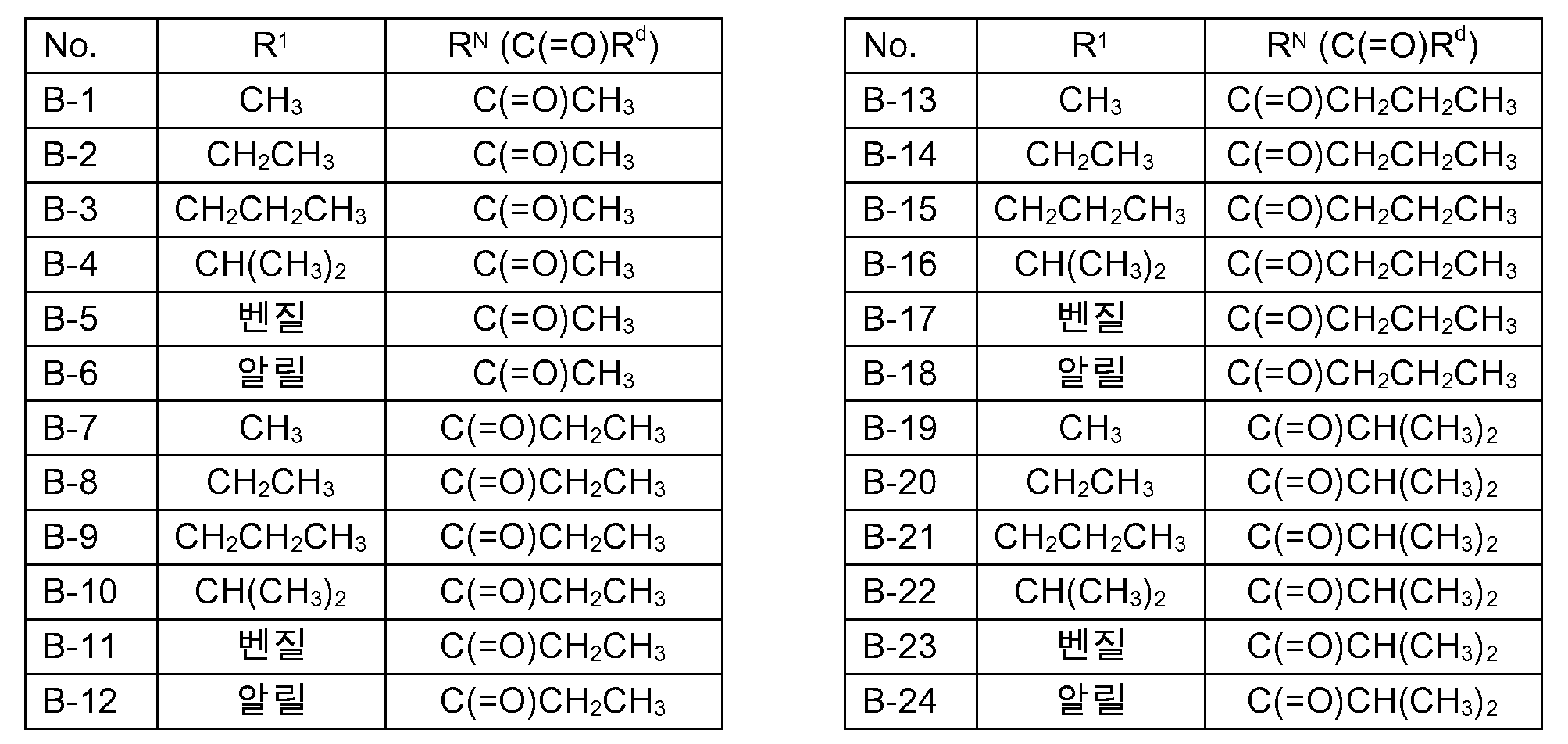
표 34Table 34
R2 가 부재이고, RN (CHRaC(=O)ORb) 및 R1 의 조합이 각각의 경우 표 C 의 하나의 열에 해당하는 식 I.1(i) 의 화합물Compounds of formula I.1(i) in which R 2 is absent and the combination of R N (CHR a C(=O)OR b ) and R 1 corresponds to one column of Table C in each case.
표 35Table 35
R2 가 부재이고, RN (CHRaC(=O)ORb) 및 R1 의 조합이 각각의 경우 표 C 의 하나의 열에 해당하는 식 I.2(i) 의 화합물Compounds of formula I.2(i) in which R 2 is absent and the combination of R N (CHR a C(=O)OR b ) and R 1 corresponds to one column of Table C in each case.
표 36Table 36
R2 가 부재이고, RN (CHRaC(=O)ORb) 및 R1 의 조합이 각각의 경우 표 C 의 하나의 열에 해당하는 식 I.3(i) 의 화합물Compounds of formula I.3(i) in which R 2 is absent and the combination of R N (CHR a C(=O)OR b ) and R 1 corresponds to one column of Table C in each case.
표 37Table 37
R2 가 CH3 이고, RN (CHRaC(=O)ORb) 및 R1 의 조합이 각각의 경우 표 C 의 하나의 열에 해당하는 식 I.1(ii) 의 화합물Compounds of formula I.1(ii) in which R 2 is CH 3 and the combination of R N (CHR a C(=O)OR b ) and R 1 corresponds in each case to one column of Table C.
표 38Table 38
R2 가 CH3 이고, RN (CHRaC(=O)ORb) 및 R1 의 조합이 각각의 경우 표 C 의 하나의 열에 해당하는 식 I.1(iii) 의 화합물Compounds of formula I.1(iii) in which R 2 is CH 3 and the combination of R N (CHR a C(=O)OR b ) and R 1 corresponds to one column of Table C in each case.
표 39Table 39
R2 가 CH3 이고, RN (CHRaC(=O)ORb) 및 R1 의 조합이 각각의 경우 표 C 의 하나의 열에 해당하는 식 I.2(ii) 의 화합물Compounds of formula I.2(ii) in which R 2 is CH 3 and the combination of R N (CHR a C(=O)OR b ) and R 1 corresponds to one column of Table C in each case.
표 40Table 40
R2 가 CH3 이고, RN (CHRaC(=O)ORb) 및 R1 의 조합이 각각의 경우 표 C 의 하나의 열에 해당하는 식 I.2(iii) 의 화합물Compounds of formula I.2(iii) in which R 2 is CH 3 and the combination of R N (CHR a C(=O)OR b ) and R 1 corresponds to one column of Table C in each case.
표 41Table 41
R2 가 CH3 이고, RN (CHRaC(=O)ORb) 및 R1 의 조합이 각각의 경우 표 C 의 하나의 열에 해당하는 식 I.3(ii) 의 화합물Compounds of formula I.3(ii) in which R 2 is CH 3 and the combination of R N (CHR a C(=O)OR b ) and R 1 corresponds to one column of Table C in each case.
표 42Table 42
R2 가 CH3 이고, RN (CHRaC(=O)ORb) 및 R1 의 조합이 각각의 경우 표 C 의 하나의 열에 해당하는 식 I.3(iii) 의 화합물Compounds of formula I.3(iii) in which R 2 is CH 3 and the combination of R N (CHR a C(=O)OR b ) and R 1 corresponds to one column of Table C in each case.
표 43Table 43
R2 가 CH2CH3 이고, RN (CHRaC(=O)ORb) 및 R1 의 조합이 각각의 경우 표 C 의 하나의 열에 해당하는 식 I.1(ii) 의 화합물Compounds of formula I.1(ii) in which R 2 is CH 2 CH 3 and the combination of R N (CHR a C(=O)OR b ) and R 1 corresponds to one column of Table C in each case.
표 44 Table 44
R2 가 CH2CH3 이고, RN (CHRaC(=O)ORb) 및 R1 의 조합이 각각의 경우 표 C 의 하나의 열에 해당하는 식 I.1(iii) 의 화합물Compounds of formula I.1(iii) in which R 2 is CH 2 CH 3 and the combination of R N (CHR a C(=O)OR b ) and R 1 corresponds to one column of Table C in each case.
표 45Table 45
R2 가 CH2CH3 이고, RN (CHRaC(=O)ORb) 및 R1 의 조합이 각각의 경우 표 C 의 하나의 열에 해당하는 식 I.2(ii) 의 화합물Compounds of formula I.2(ii) in which R 2 is CH 2 CH 3 and the combination of R N (CHR a C(=O)OR b ) and R 1 corresponds to one column of Table C in each case.
표 46Table 46
R2 가 CH2CH3 이고, RN (CHRaC(=O)ORb) 및 R1 의 조합이 각각의 경우 표 C 의 하나의 열에 해당하는 식 I.2(iii) 의 화합물Compounds of formula I.2(iii) in which R 2 is CH 2 CH 3 and the combination of R N (CHR a C(=O)OR b ) and R 1 corresponds to one column of Table C in each case.
표 47Table 47
R2 가 CH2CH3 이고, RN (CHRaC(=O)ORb) 및 R1 의 조합이 각각의 경우 표 C 의 하나의 열에 해당하는 식 I.3(ii) 의 화합물Compounds of formula I.3(ii) in which R 2 is CH 2 CH 3 and the combination of R N (CHR a C(=O)OR b ) and R 1 corresponds to one column of Table C in each case.
표 48 Table 48
R2 가 CH2CH3 이고, RN (CHRaC(=O)ORb) 및 R1 의 조합이 각각의 경우 표 C 의 하나의 열에 해당하는 식 I.3(iii) 의 화합물Compounds of formula I.3(iii) in which R 2 is CH 2 CH 3 and the combination of R N (CHR a C(=O)OR b ) and R 1 corresponds to one column of Table C in each case.
표 49Table 49
R2 가 CH2CH2CH3 이고, RN (CHRaC(=O)ORb) 및 R1 의 조합이 각각의 경우 표 C 의 하나의 열에 해당하는 식 I.1(ii) 의 화합물A compound of formula I.1(ii) in which R 2 is CH 2 CH 2 CH 3 and the combination of R N (CHR a C(=O)OR b ) and R 1 corresponds to one column of Table C in each case.
표 50 Table 50
R2 가 CH(CH3)2 이고, RN (CHRaC(=O)ORb) 및 R1 의 조합이 각각의 경우 표 C 의 하나의 열에 해당하는 식 I.1(ii) 의 화합물Compounds of formula I.1(ii) in which R 2 is CH(CH 3 ) 2 and the combination of R N (CHR a C(=O)OR b ) and R 1 corresponds to one column of Table C in each case.
표 51Table 51
R2 가 CH2CH2CH3 이고, RN (CHRaC(=O)ORb) 및 R1 의 조합이 각각의 경우 표 C 의 하나의 열에 해당하는 식 I.1(iii) 의 화합물Compounds of formula I.1(iii) in which R 2 is CH 2 CH 2 CH 3 and the combination of R N (CHR a C(=O)OR b ) and R 1 corresponds to one column of Table C in each case.
표 52Table 52
R2 가 CH(CH3)2 이고, RN (CHRaC(=O)ORb) 및 R1 의 조합이 각각의 경우 표 C 의 하나의 열에 해당하는 식 I.1(iii) 의 화합물Compounds of formula I.1(iii) in which R 2 is CH(CH 3 ) 2 and the combination of R N (CHR a C(=O)OR b ) and R 1 corresponds to one column of Table C in each case.
표 53Table 53
R2 가 CH2CH2CH3 이고, RN (CHRaC(=O)ORb) 및 R1 의 조합이 각각의 경우 표 C 의 하나의 열에 해당하는 식 I.2(ii) 의 화합물Compounds of formula I.2(ii) in which R 2 is CH 2 CH 2 CH 3 and the combination of R N (CHR a C(=O)OR b ) and R 1 corresponds to one column of Table C in each case.
표 54Table 54
R2 가 CH(CH3)2 이고, RN (CHRaC(=O)ORb) 및 R1 의 조합이 각각의 경우 표 C 의 하나의 열에 해당하는 식 I.2(ii) 의 화합물Compounds of formula I.2(ii) in which R 2 is CH(CH 3 ) 2 and the combination of R N (CHR a C(=O)OR b ) and R 1 corresponds to one column of Table C in each case.
표 55Table 55
R2 가 CH2CH2CH3 이고, RN (CHRaC(=O)ORb) 및 R1 의 조합이 각각의 경우 표 C 의 하나의 열에 해당하는 식 I.2(iii) 의 화합물Compounds of formula I.2(iii) in which R 2 is CH 2 CH 2 CH 3 and the combination of R N (CHR a C(=O)OR b ) and R 1 corresponds to one column of Table C in each case.
표 56Table 56
R2 가 CH(CH3)2 이고, RN (CHRaC(=O)ORb) 및 R1 의 조합이 각각의 경우 표 C 의 하나의 열에 해당하는 식 I.2(iii) 의 화합물Compounds of formula I.2(iii) in which R 2 is CH(CH 3 ) 2 and the combination of R N (CHR a C(=O)OR b ) and R 1 corresponds to one column of Table C in each case.
표 57Table 57
R2 가 CH2CH2CH3 이고, RN (CHRaC(=O)ORb) 및 R1 의 조합이 각각의 경우 표 C 의 하나의 열에 해당하는 식 I.3(ii) 의 화합물Compounds of formula I.3(ii) in which R 2 is CH 2 CH 2 CH 3 and the combination of R N (CHR a C(=O)OR b ) and R 1 corresponds to one column of Table C in each case.
표 58Table 58
R2 가 CH(CH3)2 이고, RN (CHRaC(=O)ORb) 및 R1 의 조합이 각각의 경우 표 C 의 하나의 열에 해당하는 식 I.3(ii) 의 화합물Compounds of formula I.3(ii) in which R 2 is CH(CH 3 ) 2 and the combination of R N (CHR a C(=O)OR b ) and R 1 corresponds to one column of Table C in each case.
표 59Table 59
R2 가 CH2CH2CH3 이고, RN (CHRaC(=O)ORb) 및 R1 의 조합이 각각의 경우 표 C 의 하나의 열에 해당하는 식 I.3(iii) 의 화합물Compounds of formula I.3(iii) in which R 2 is CH 2 CH 2 CH 3 and the combination of R N (CHR a C(=O)OR b ) and R 1 corresponds to one column of Table C in each case.
표 60Table 60
R2 가 CH(CH3)2 이고, RN (CHRaC(=O)ORb) 및 R1 의 조합이 각각의 경우 표 C 의 하나의 열에 해당하는 식 I.3(iii) 의 화합물Compounds of formula I.3(iii) in which R 2 is CH(CH 3 ) 2 and the combination of R N (CHR a C(=O)OR b ) and R 1 corresponds to one column of Table C in each case.
표 61Table 61
R2 가 페닐이고, RN (CHRaC(=O)ORb) 및 R1 의 조합이 각각의 경우 표 C 의 하나의 열에 해당하는 식 I.1(ii) 의 화합물Compounds of formula I.1(ii) in which R 2 is phenyl, and the combination of R N (CHR a C(=O)OR b ) and R 1 corresponds in each case to one column of Table C.
표 62Table 62
R2 가 페닐이고, RN (CHRaC(=O)ORb) 및 R1 의 조합이 각각의 경우 표 C 의 하나의 열에 해당하는 식 I.1(iii) 의 화합물Compounds of formula I.1(iii) in which R 2 is phenyl, and the combination of R N (CHR a C(=O)OR b ) and R 1 corresponds in each case to one column of Table C.
표 63Table 63
R2 가 페닐이고, RN (CHRaC(=O)ORb) 및 R1 의 조합이 각각의 경우 표 C 의 하나의 열에 해당하는 식 I.2(ii) 의 화합물Compounds of formula I.2(ii) in which R 2 is phenyl, and the combination of R N (CHR a C(=O)OR b ) and R 1 corresponds in each case to one column of Table C.
표 64Table 64
R2 가 페닐이고, RN (CHRaC(=O)ORb) 및 R1 의 조합이 각각의 경우 표 C 의 하나의 열에 해당하는 식 I.2(iii) 의 화합물Compounds of formula I.2(iii) in which R 2 is phenyl, and the combination of R N (CHR a C(=O)OR b ) and R 1 corresponds in each case to one column of Table C.
표 65Table 65
R2 가 페닐이고, RN (CHRaC(=O)ORb) 및 R1 의 조합이 각각의 경우 표 C 의 하나의 열에 해당하는 식 I.3(ii) 의 화합물Compounds of formula I.3(ii) in which R 2 is phenyl, and the combination of R N (CHR a C(=O)OR b ) and R 1 corresponds in each case to one column of Table C.
표 66Table 66
R2 가 페닐이고, RN (CHRaC(=O)ORb) 및 R1 의 조합이 각각의 경우 표 C 의 하나의 열에 해당하는 식 I.3(iii) 의 화합물Compounds of formula I.3(iii) in which R 2 is phenyl, and the combination of R N (CHR a C(=O)OR b ) and R 1 corresponds in each case to one column of Table C.
표 CTable C
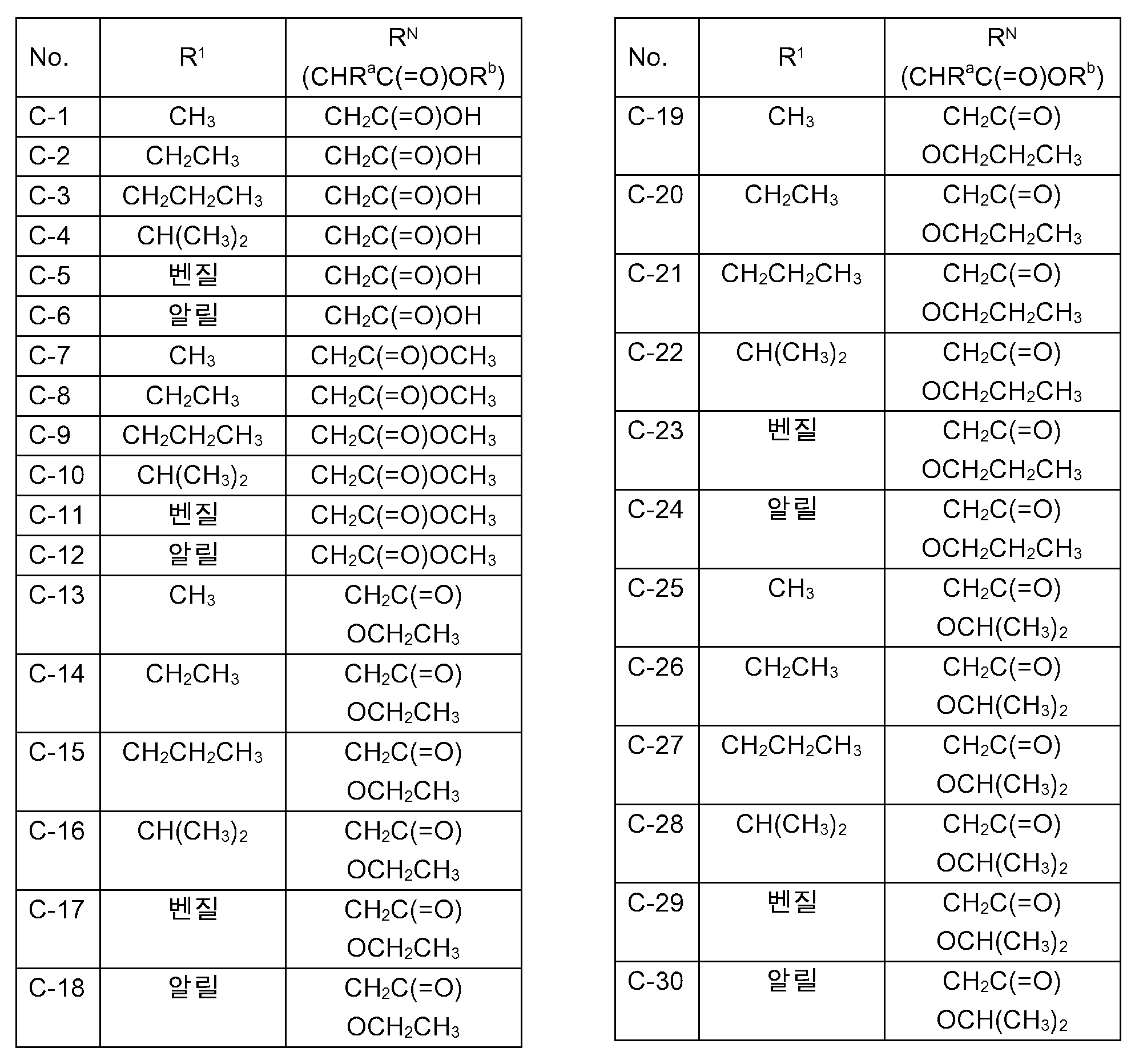
표 67Table 67
R2 가 부재이고, RN (CHRaC(=O)NRbRc) 및 R1 의 조합이 각각의 경우 표 D 의 하나의 열에 상응하는 식 I.1(i) 의 화합물Compounds of formula I.1(i) in which R 2 is absent and the combination of R N (CHR a C(=O)NR b R c ) and R 1 corresponds in each case to one column of Table D.
표 68Table 68
R2 가 부재이고, RN (CHRaC(=O)NRbRc) 및 R1 의 조합이 각각의 경우 표 D 의 하나의 열에 상응하는 식 I.2(i) 의 화합물Compounds of formula I.2(i) in which R 2 is absent and the combination of R N (CHR a C(=O)NR b R c ) and R 1 corresponds in each case to one column of Table D.
표 69Table 69
R2 가 부재이고, RN (CHRaC(=O)NRbRc) 및 R1 의 조합이 각각의 경우 표 D 의 하나의 열에 상응하는 식 I.3(i) 의 화합물Compounds of formula I.3(i) in which R 2 is absent and the combination of R N (CHR a C(=O)NR b R c ) and R 1 corresponds in each case to one column of Table D.
표 70Table 70
R2 가 CH3 이고, RN (CHRaC(=O)NRbRc) 및 R1 의 조합이 각각의 경우 표 D 의 하나의 열에 상응하는 식 I.1(ii) 의 화합물Compounds of formula I.1(ii) in which R 2 is CH 3 and the combination of R N (CHR a C(=O)NR b R c ) and R 1 corresponds in each case to one column of Table D.
표 71Table 71
R2 가 CH3 이고, RN (CHRaC(=O)NRbRc) 및 R1 의 조합이 각각의 경우 표 D 의 하나의 열에 상응하는 식 I.1(iii) 의 화합물Compounds of formula I.1(iii) in which R 2 is CH 3 and the combination of R N (CHR a C(=O)NR b R c ) and R 1 corresponds in each case to one column of Table D.
표 72Table 72
R2 가 CH3 이고, RN (CHRaC(=O)NRbRc) 및 R1 의 조합이 각각의 경우 표 D 의 하나의 열에 상응하는 식 I.2(ii) 의 화합물Compounds of formula I.2(ii) in which R 2 is CH 3 and the combination of R N (CHR a C(=O)NR b R c ) and R 1 corresponds in each case to one column of Table D.
표 73Table 73
R2 가 CH3 이고, RN (CHRaC(=O)NRbRc) 및 R1 의 조합이 각각의 경우 표 D 의 하나의 열에 상응하는 식 I.2(iii) 의 화합물Compounds of formula I.2(iii) in which R 2 is CH 3 and the combination of R N (CHR a C(=O)NR b R c ) and R 1 corresponds in each case to one column of Table D.
표 74Table 74
R2 가 CH3 이고, RN (CHRaC(=O)NRbRc) 및 R1 의 조합이 각각의 경우 표 D 의 하나의 열에 상응하는 식 I.3(ii) 의 화합물Compounds of formula I.3(ii) in which R 2 is CH 3 and the combination of R N (CHR a C(=O)NR b R c ) and R 1 corresponds in each case to one column of Table D.
표 75Table 75
R2 가 CH3 이고, RN (CHRaC(=O)NRbRc) 및 R1 의 조합이 각각의 경우 표 D 의 하나의 열에 상응하는 식 I.3(iii) 의 화합물Compounds of formula I.3(iii) in which R 2 is CH 3 and the combination of R N (CHR a C(=O)NR b R c ) and R 1 corresponds in each case to one column of Table D.
표 76Table 76
R2 가 CH2CH3 이고, RN (CHRaC(=O)NRbRc) 및 R1 의 조합이 각각의 경우 표 D 의 하나의 열에 상응하는 식 I.1(ii) 의 화합물Compounds of formula I.1(ii) in which R 2 is CH 2 CH 3 and the combination of R N (CHR a C(=O)NR b R c ) and R 1 corresponds in each case to one column of Table D.
표 77Table 77
R2 가 CH2CH3 이고, RN (CHRaC(=O)NRbRc) 및 R1 의 조합이 각각의 경우 표 D 의 하나의 열에 상응하는 식 I.1(iii) 의 화합물Compounds of formula I.1(iii) in which R 2 is CH 2 CH 3 and the combination of R N (CHR a C(=O)NR b R c ) and R 1 corresponds in each case to one column of Table D.
표 78Table 78
R2 가 CH2CH3 이고, RN (CHRaC(=O)NRbRc) 및 R1 의 조합이 각각의 경우 표 D 의 하나의 열에 상응하는 식 I.2(ii) 의 화합물Compounds of formula I.2(ii) in which R 2 is CH 2 CH 3 and the combination of R N (CHR a C(=O)NR b R c ) and R 1 corresponds in each case to one column of Table D.
표 79Table 79
R2 가 CH2CH3 이고, RN (CHRaC(=O)NRbRc) 및 R1 의 조합이 각각의 경우 표 D 의 하나의 열에 상응하는 식 I.2(iii) 의 화합물Compounds of formula I.2(iii) in which R 2 is CH 2 CH 3 and the combination of R N (CHR a C(=O)NR b R c ) and R 1 corresponds in each case to one column of Table D.
표 80Table 80
R2 가 CH2CH3 이고, RN (CHRaC(=O)NRbRc) 및 R1 의 조합이 각각의 경우 표 D 의 하나의 열에 상응하는 식 I.3(ii) 의 화합물Compounds of formula I.3(ii) in which R 2 is CH 2 CH 3 and the combination of R N (CHR a C(=O)NR b R c ) and R 1 corresponds in each case to one column of Table D.
표 81Table 81
R2 가 CH2CH3 이고, RN (CHRaC(=O)NRbRc) 및 R1 의 조합이 각각의 경우 표 D 의 하나의 열에 상응하는 식 I.3(iii) 의 화합물Compounds of formula I.3(iii) in which R 2 is CH 2 CH 3 and the combination of R N (CHR a C(=O)NR b R c ) and R 1 corresponds in each case to one column of Table D.
표 82Table 82
R2 가 CH2CH2CH3 이고, RN (CHRaC(=O)NRbRc) 및 R1 의 조합이 각각의 경우 표 D 의 하나의 열에 상응하는 식 I.1(ii) 의 화합물Compounds of formula I.1(ii) in which R 2 is CH 2 CH 2 CH 3 and the combination of R N (CHR a C(=O)NR b R c ) and R 1 corresponds in each case to one column of Table D.
표 83 Table 83
R2 가 CH(CH3)2 이고, RN (CHRaC(=O)NRbRc) 및 R1 의 조합이 각각의 경우 표 D 의 하나의 열에 상응하는 식 I.1(ii) 의 화합물Compounds of formula I.1(ii) in which R 2 is CH(CH 3 ) 2 and the combination of R N (CHR a C(=O)NR b R c ) and R 1 corresponds in each case to one column of Table D.
표 84Table 84
R2 가 CH2CH2CH3 이고, RN (CHRaC(=O)NRbRc) 및 R1 의 조합이 각각의 경우 표 D 의 하나의 열에 상응하는 식 I.1(iii) 의 화합물Compounds of formula I.1(iii) in which R 2 is CH 2 CH 2 CH 3 and the combination of R N (CHR a C(=O)NR b R c ) and R 1 corresponds in each case to one column of Table D.
표 85Table 85
R2 가 CH(CH3)2 이고, RN (CHRaC(=O)NRbRc) 및 R1 의 조합이 각각의 경우 표 D 의 하나의 열에 상응하는 식 I.1(iii) 의 화합물Compounds of formula I.1(iii) in which R 2 is CH(CH 3 ) 2 and the combination of R N (CHR a C(=O)NR b R c ) and R 1 corresponds in each case to one column of Table D.
표 86Table 86
R2 가 CH2CH2CH3 이고, RN (CHRaC(=O)NRbRc) 및 R1 의 조합이 각각의 경우 표 D 의 하나의 열에 상응하는 식 I.2(ii) 의 화합물Compounds of formula I.2(ii) in which R 2 is CH 2 CH 2 CH 3 and the combination of R N (CHR a C(=O)NR b R c ) and R 1 corresponds in each case to one column of Table D.
표 87Table 87
R2 가 CH(CH3)2 이고, RN (CHRaC(=O)NRbRc) 및 R1 의 조합이 각각의 경우 표 D 의 하나의 열에 상응하는 식 I.2(ii) 의 화합물Compounds of formula I.2(ii) in which R 2 is CH(CH 3 ) 2 and the combination of R N (CHR a C(=O)NR b R c ) and R 1 corresponds in each case to one column of Table D.
표 88Table 88
R2 가 CH2CH2CH3 이고, RN (CHRaC(=O)NRbRc) 및 R1 의 조합이 각각의 경우 표 D 의 하나의 열에 상응하는 식 I.2(iii) 의 화합물Compounds of formula I.2(iii) in which R 2 is CH 2 CH 2 CH 3 and the combination of R N (CHR a C(=O)NR b R c ) and R 1 corresponds in each case to one column of Table D.
표 89Table 89
R2 가 CH(CH3)2 이고, RN (CHRaC(=O)NRbRc) 및 R1 의 조합이 각각의 경우 표 D 의 하나의 열에 상응하는 식 I.2(iii) 의 화합물Compounds of formula I.2(iii) in which R 2 is CH(CH 3 ) 2 and the combination of R N (CHR a C(=O)NR b R c ) and R 1 corresponds in each case to one column of Table D.
표 90Table 90
R2 가 CH2CH2CH3 이고, RN (CHRaC(=O)NRbRc) 및 R1 의 조합이 각각의 경우 표 D 의 하나의 열에 상응하는 식 I.3(ii) 의 화합물Compounds of formula I.3(ii) in which R 2 is CH 2 CH 2 CH 3 and the combination of R N (CHR a C(=O)NR b R c ) and R 1 corresponds in each case to one column of Table D.
표 91Table 91
R2 가 CH(CH3)2 이고, RN (CHRaC(=O)NRbRc) 및 R1 의 조합이 각각의 경우 표 D 의 하나의 열에 상응하는 식 I.3(ii) 의 화합물Compounds of formula I.3(ii) in which R 2 is CH(CH 3 ) 2 and the combination of R N (CHR a C(=O)NR b R c ) and R 1 corresponds in each case to one column of Table D.
표 92Table 92
R2 가 CH2CH2CH3 이고, RN (CHRaC(=O)NRbRc) 및 R1 의 조합이 각각의 경우 표 D 의 하나의 열에 상응하는 식 I.3(iii) 의 화합물Compounds of formula I.3(iii) in which R 2 is CH 2 CH 2 CH 3 and the combination of R N (CHR a C(=O)NR b R c ) and R 1 corresponds in each case to one column of Table D.
표 93Table 93
R2 가 CH(CH3)2 이고, RN (CHRaC(=O)NRbRc) 및 R1 의 조합이 각각의 경우 표 D 의 하나의 열에 상응하는 식 I.3(iii) 의 화합물Compounds of formula I.3(iii) in which R 2 is CH(CH 3 ) 2 and the combination of R N (CHR a C(=O)NR b R c ) and R 1 corresponds in each case to one column of Table D.
표 94Table 94
R2 가 페닐이고, RN (CHRaC(=O)NRbRc) 및 R1 의 조합이 각각의 경우 표 D 의 하나의 열에 상응하는 식 I.1(ii) 의 화합물Compounds of formula I.1(ii) in which R 2 is phenyl, and the combination of R N (CHR a C(=O)NR b R c ) and R 1 corresponds in each case to one column of Table D.
표 95Table 95
R2 가 페닐이고, RN (CHRaC(=O)NRbRc) 및 R1 의 조합이 각각의 경우 표 D 의 하나의 열에 상응하는 식 I.1(iii) 의 화합물Compounds of formula I.1(iii) in which R 2 is phenyl, and the combination of R N (CHR a C(=O)NR b R c ) and R 1 corresponds in each case to one column of Table D.
표 96Table 96
R2 가 페닐이고, RN (CHRaC(=O)NRbRc) 및 R1 의 조합이 각각의 경우 표 D 의 하나의 열에 상응하는 식 I.2(ii) 의 화합물Compounds of formula I.2(ii) in which R 2 is phenyl, and the combination of R N (CHR a C(=O)NR b R c ) and R 1 corresponds in each case to one column of Table D.
표 97Table 97
R2 가 페닐이고, RN (CHRaC(=O)NRbRc) 및 R1 의 조합이 각각의 경우 표 D 의 하나의 열에 상응하는 식 I.2(iii) 의 화합물Compounds of formula I.2(iii) in which R 2 is phenyl, and the combination of R N (CHR a C(=O)NR b R c ) and R 1 corresponds in each case to one column of Table D.
표 98Table 98
R2 가 페닐이고, RN (CHRaC(=O)NRbRc) 및 R1 의 조합이 각각의 경우 표 D 의 하나의 열에 상응하는 식 I.3(ii) 의 화합물Compounds of formula I.3(ii) in which R 2 is phenyl, and the combination of R N (CHR a C(=O)NR b R c ) and R 1 corresponds in each case to one column of Table D.
표 99Table 99
R2 가 페닐이고, RN (CHRaC(=O)NRbRc) 및 R1 의 조합이 각각의 경우 표 D 의 하나의 열에 상응하는 식 I.3(iii) 의 화합물Compounds of formula I.3(iii) in which R 2 is phenyl, and the combination of R N (CHR a C(=O)NR b R c ) and R 1 corresponds in each case to one column of Table D.
표 DTable D
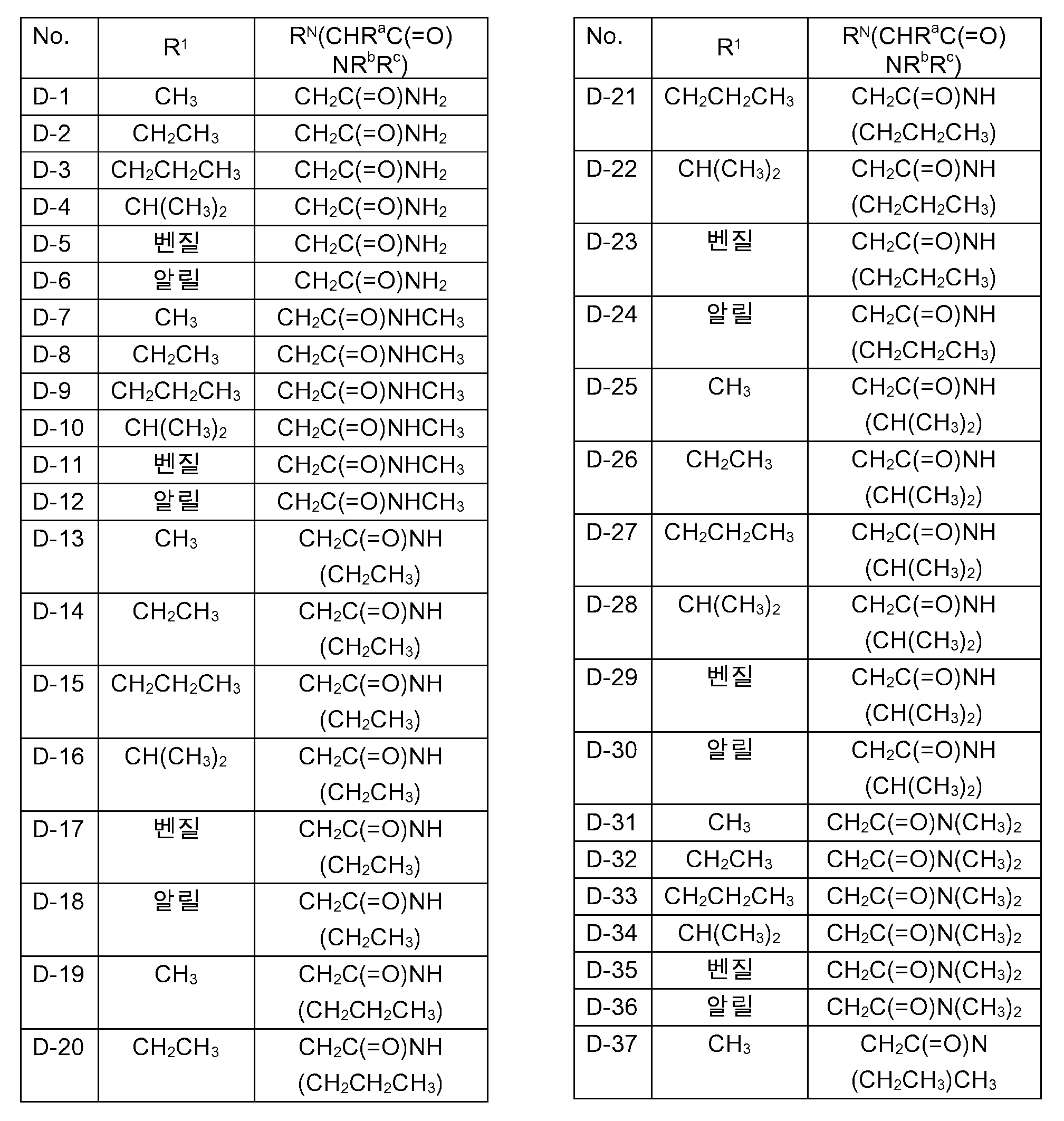

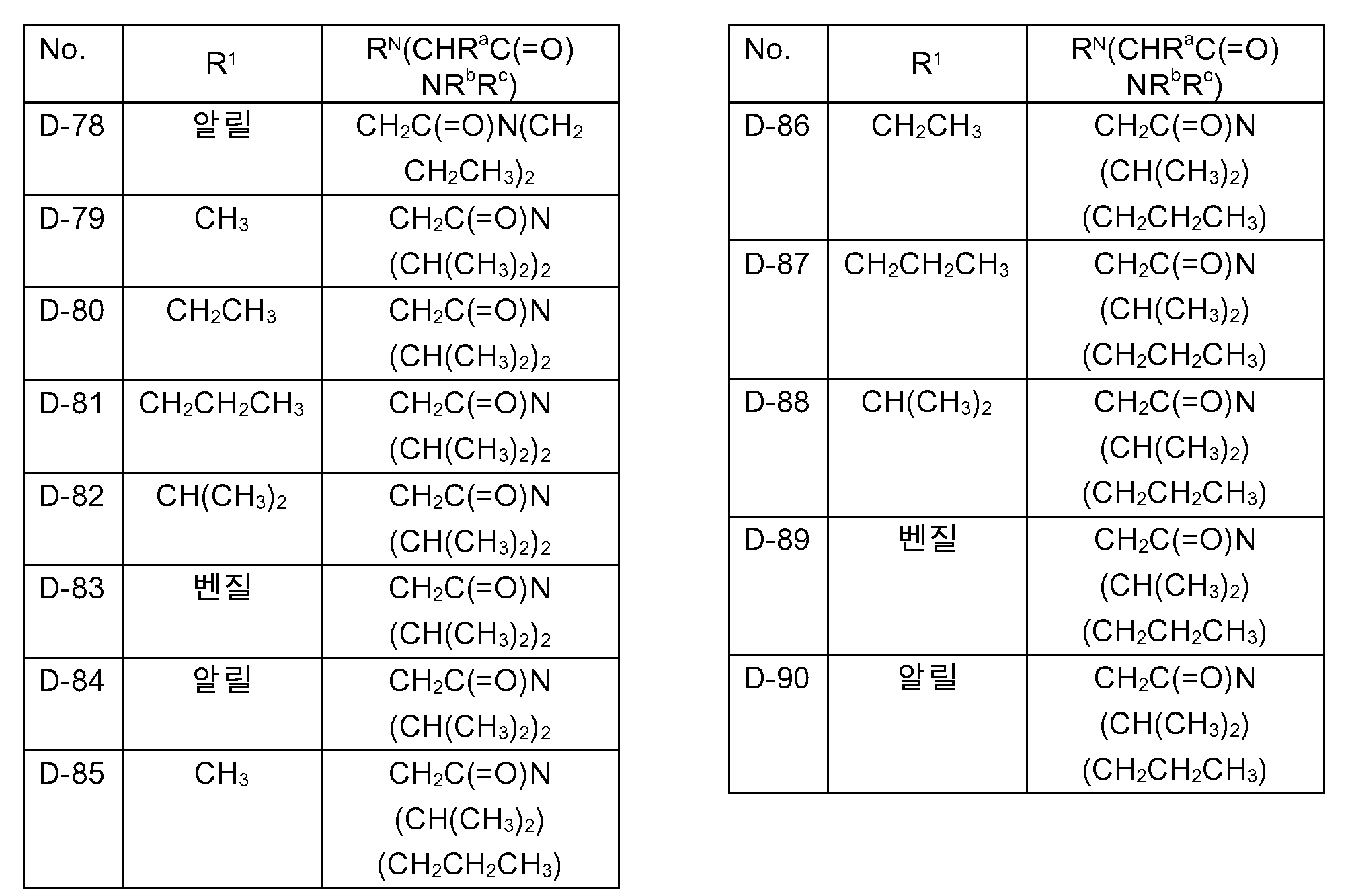
표 100Table 100
R2 가 부재이고, RN (CH(C(=O)ORb)CH2(C(=O)ORb)) 및 R1 의 조합이 각각의 경우 표 E 의 하나의 열에 상응하는 식 I.1(i) 의 화합물Compounds of formula I.1(i) in which R 2 is absent and the combination of R N (CH(C(=O)OR b )CH 2 (C(=O)OR b )) and R 1 corresponds in each case to one column of Table E
표 101Table 101
R2 가 부재이고, RN (CH(C(=O)ORb)CH2(C(=O)ORb)) 및 R1 의 조합이 각각의 경우 표 E 의 하나의 열에 상응하는 식 I.2(i) 의 화합물Compounds of formula I.2(i) in which R 2 is absent and the combination of R N (CH(C(=O)OR b )CH 2 (C(=O)OR b )) and R 1 corresponds in each case to one column of Table E
표 102Table 102
R2 가 부재이고, RN (CH(C(=O)ORb)CH2(C(=O)ORb)) 및 R1 의 조합이 각각의 경우 표 E 의 하나의 열에 상응하는 식 I.3(i) 의 화합물Compounds of formula I.3(i) in which R 2 is absent and the combination of R N (CH(C(=O)OR b )CH 2 (C(=O)OR b )) and R 1 corresponds in each case to one column of Table E
표 103Table 103
R2 가 CH3 이고, RN (CH(C(=O)ORb)CH2(C(=O)ORb)) 및 R1 의 조합이 각각의 경우 표 E 의 하나의 열에 상응하는 식 I.1(ii) 의 화합물Compounds of formula I.1(ii) in which R 2 is CH 3 and the combination of R N (CH(C(=O)OR b )CH 2 (C(=O)OR b )) and R 1 corresponds in each case to one column of Table E
표 104Table 104
R2 가 CH3 이고, RN (CH(C(=O)ORb)CH2(C(=O)ORb)) 및 R1 의 조합이 각각의 경우 표 E 의 하나의 열에 상응하는 식 I.1(iii) 의 화합물Compounds of formula I.1(iii) in which R 2 is CH 3 and the combination of R N (CH(C(=O)OR b )CH 2 (C(=O)OR b )) and R 1 corresponds in each case to one column of Table E
표 105Table 105
R2 가 CH3 이고, RN (CH(C(=O)ORb)CH2(C(=O)ORb)) 및 R1 의 조합이 각각의 경우 표 E 의 하나의 열에 상응하는 식 I.2(ii) 의 화합물Compounds of formula I.2(ii) in which R 2 is CH 3 and the combination of R N (CH(C(=O)OR b )CH 2 (C(=O)OR b )) and R 1 corresponds in each case to one column of Table E
표 106Table 106
R2 가 CH3 이고, RN (CH(C(=O)ORb)CH2(C(=O)ORb)) 및 R1 의 조합이 각각의 경우 표 E 의 하나의 열에 상응하는 식 I.2(iii) 의 화합물Compounds of formula I.2(iii) in which R 2 is CH 3 and the combination of R N (CH(C(=O)OR b )CH 2 (C(=O)OR b )) and R 1 corresponds in each case to one column of Table E.
표 107Table 107
R2 가 CH3 이고, RN (CH(C(=O)ORb)CH2(C(=O)ORb)) 및 R1 의 조합이 각각의 경우 표 E 의 하나의 열에 상응하는 식 I.3(ii) 의 화합물Compounds of formula I.3(ii) in which R 2 is CH 3 and the combination of R N (CH(C(=O)OR b )CH 2 (C(=O)OR b )) and R 1 corresponds in each case to one column of Table E.
표 108Table 108
R2 가 CH3 이고, RN (CH(C(=O)ORb)CH2(C(=O)ORb)) 및 R1 의 조합이 각각의 경우 표 E 의 하나의 열에 상응하는 식 I.3(iii) 의 화합물Compounds of formula I.3(iii) in which R 2 is CH 3 and the combination of R N (CH(C(=O)OR b )CH 2 (C(=O)OR b )) and R 1 corresponds in each case to one column of Table E.
표 109Table 109
R2 가 CH2CH3 이고, RN (CH(C(=O)ORb)CH2(C(=O)ORb)) 및 R1 의 조합이 각각의 경우 표 E 의 하나의 열에 상응하는 식 I.1(ii) 의 화합물Compounds of formula I.1(ii) in which R 2 is CH 2 CH 3 and the combination of R N (CH(C(=O)OR b )CH 2 (C(=O)OR b )) and R 1 corresponds in each case to one column of Table E.
표 110Table 110
R2 가 CH2CH3 이고, RN (CH(C(=O)ORb)CH2(C(=O)ORb)) 및 R1 의 조합이 각각의 경우 표 E 의 하나의 열에 상응하는 식 I.1(iii) 의 화합물Compounds of formula I.1(iii) in which R 2 is CH 2 CH 3 and the combination of R N (CH(C(=O)OR b )CH 2 (C(=O)OR b )) and R 1 corresponds in each case to one column of Table E.
표 111Table 111
R2 가 CH2CH3 이고, RN (CH(C(=O)ORb)CH2(C(=O)ORb)) 및 R1 의 조합이 각각의 경우 표 E 의 하나의 열에 상응하는 식 I.2(ii) 의 화합물Compounds of formula I.2(ii) in which R 2 is CH 2 CH 3 and the combination of R N (CH(C(=O)OR b )CH 2 (C(=O)OR b )) and R 1 corresponds in each case to one column of Table E.
표 112Table 112
R2 가 CH2CH3 이고, RN (CH(C(=O)ORb)CH2(C(=O)ORb)) 및 R1 의 조합이 각각의 경우 표 E 의 하나의 열에 상응하는 식 I.2(iii) 의 화합물Compounds of formula I.2(iii) in which R 2 is CH 2 CH 3 and the combination of R N (CH(C(=O)OR b )CH 2 (C(=O)OR b )) and R 1 corresponds in each case to one column of Table E.
표 113Table 113
R2 가 CH2CH3 이고, RN (CH(C(=O)ORb)CH2(C(=O)ORb)) 및 R1 의 조합이 각각의 경우 표 E 의 하나의 열에 상응하는 식 I.3(ii) 의 화합물Compounds of formula I.3(ii) in which R 2 is CH 2 CH 3 and the combination of R N (CH(C(=O)OR b )CH 2 (C(=O)OR b )) and R 1 corresponds in each case to one column of Table E.
표 114Table 114
R2 가 CH2CH3 이고, RN (CH(C(=O)ORb)CH2(C(=O)ORb)) 및 R1 의 조합이 각각의 경우 표 E 의 하나의 열에 상응하는 식 I.3(iii) 의 화합물Compounds of formula I.3(iii) in which R 2 is CH 2 CH 3 and the combination of R N (CH(C(=O)OR b )CH 2 (C(=O)OR b )) and R 1 corresponds in each case to one column of Table E.
표 115Table 115
R2 가 CH2CH2CH3 이고, RN (CH(C(=O)ORb)CH2(C(=O)ORb)) 및 R1 의 조합이 각각의 경우 표 E 의 하나의 열에 상응하는 식 I.1(ii) 의 화합물Compounds of formula I.1(ii) in which R 2 is CH 2 CH 2 CH 3 and the combination of R N (CH(C(=O)OR b )CH 2 (C(=O)OR b )) and R 1 corresponds in each case to one column of Table E.
표 116Table 116
R2 가 CH(CH3)2 이고, RN (CH(C(=O)ORb)CH2(C(=O)ORb)) 및 R1 의 조합이 각각의 경우 표 E 의 하나의 열에 상응하는 식 I.1(ii) 의 화합물Compounds of formula I.1(ii) in which R 2 is CH(CH 3 ) 2 and the combination of R N (CH(C(=O)OR b )CH 2 (C(=O)OR b )) and R 1 corresponds in each case to one column of Table E
표 117Table 117
R2 가 CH2CH2CH3 이고, RN (CH(C(=O)ORb)CH2(C(=O)ORb)) 및 R1 의 조합이 각각의 경우 표 E 의 하나의 열에 상응하는 식 I.1(iii) 의 화합물Compounds of formula I.1(iii) in which R 2 is CH 2 CH 2 CH 3 and the combination of R N (CH(C(=O)OR b )CH 2 (C(=O)OR b )) and R 1 corresponds in each case to one column of Table E.
표 118Table 118
R2 가 CH(CH3)2 이고, RN (CH(C(=O)ORb)CH2(C(=O)ORb)) 및 R1 의 조합이 각각의 경우 표 E 의 하나의 열에 상응하는 식 I.1(iii) 의 화합물Compounds of formula I.1(iii) in which R 2 is CH(CH 3 ) 2 and the combination of R N (CH(C(=O)OR b )CH 2 (C(=O)OR b )) and R 1 corresponds in each case to one column of Table E.
표 119Table 119
R2 가 CH2CH2CH3 이고, RN (CH(C(=O)ORb)CH2(C(=O)ORb)) 및 R1 의 조합이 각각의 경우 표 E 의 하나의 열에 상응하는 식 I.2(ii) 의 화합물Compounds of formula I.2(ii) in which R 2 is CH 2 CH 2 CH 3 and the combination of R N (CH(C(=O)OR b )CH 2 (C(=O)OR b )) and R 1 corresponds in each case to one column of Table E.
표 120Table 120
R2 가 CH(CH3)2 이고, RN (CH(C(=O)ORb)CH2(C(=O)ORb)) 및 R1 의 조합이 각각의 경우 표 E 의 하나의 열에 상응하는 식 I.2(ii) 의 화합물Compounds of formula I.2(ii) in which R 2 is CH(CH 3 ) 2 and the combination of R N (CH(C(=O)OR b )CH 2 (C(=O)OR b )) and R 1 corresponds in each case to one column of Table E.
표 121Table 121
R2 가 CH2CH2CH3 이고, RN (CH(C(=O)ORb)CH2(C(=O)ORb)) 및 R1 의 조합이 각각의 경우 표 E 의 하나의 열에 상응하는 식 I.2(iii) 의 화합물Compounds of formula I.2(iii) in which R 2 is CH 2 CH 2 CH 3 and the combination of R N (CH(C(=O)OR b )CH 2 (C(=O)OR b )) and R 1 corresponds in each case to one column of Table E.
표 122Table 122
R2 가 CH(CH3)2 이고, RN (CH(C(=O)ORb)CH2(C(=O)ORb)) 및 R1 의 조합이 각각의 경우 표 E 의 하나의 열에 상응하는 식 I.2(iii) 의 화합물Compounds of formula I.2(iii) in which R 2 is CH(CH 3 ) 2 and the combination of R N (CH(C(=O)OR b )CH 2 (C(=O)OR b )) and R 1 corresponds in each case to one column of Table E.
표 123Table 123
R2 가 CH2CH2CH3 이고, RN (CH(C(=O)ORb)CH2(C(=O)ORb)) 및 R1 의 조합이 각각의 경우 표 E 의 하나의 열에 상응하는 식 I.3(ii) 의 화합물Compounds of formula I.3(ii) in which R 2 is CH 2 CH 2 CH 3 and the combination of R N (CH(C(=O)OR b )CH 2 (C(=O)OR b )) and R 1 corresponds in each case to one column of Table E.
표 124Table 124
R2 가 CH(CH3)2 이고, RN (CH(C(=O)ORb)CH2(C(=O)ORb)) 및 R1 의 조합이 각각의 경우 표 E 의 하나의 열에 상응하는 식 I.3(ii) 의 화합물Compounds of formula I.3(ii) in which R 2 is CH(CH 3 ) 2 and the combination of R N (CH(C(=O)OR b )CH 2 (C(=O)OR b )) and R 1 corresponds in each case to one column of Table E.
표 125Table 125
R2 가 CH2CH2CH3 이고, RN (CH(C(=O)ORb)CH2(C(=O)ORb)) 및 R1 의 조합이 각각의 경우 표 E 의 하나의 열에 상응하는 식 I.3(iii) 의 화합물Compounds of formula I.3(iii) in which R 2 is CH 2 CH 2 CH 3 and the combination of R N (CH(C(=O)OR b )CH 2 (C(=O)OR b )) and R 1 corresponds in each case to one column of Table E.
표 126Table 126
R2 가 CH(CH3)2 이고, RN (CH(C(=O)ORb)CH2(C(=O)ORb)) 및 R1 의 조합이 각각의 경우 표 E 의 하나의 열에 상응하는 식 I.3(iii) 의 화합물Compounds of formula I.3(iii) in which R 2 is CH(CH 3 ) 2 and the combination of R N (CH(C(=O)OR b )CH 2 (C(=O)OR b )) and R 1 corresponds in each case to one column of Table E.
표 127Table 127
R2 가 페닐이고, RN (CH(C(=O)ORb)CH2(C(=O)ORb)) 및 R1 의 조합이 각각의 경우 표 E 의 하나의 열에 상응하는 식 I.1(ii) 의 화합물Compounds of formula I.1(ii) in which R 2 is phenyl, and the combination of R N (CH(C(=O)OR b )CH 2 (C(=O)OR b )) and R 1 corresponds in each case to one column of Table E
표 128Table 128
R2 가 페닐이고, RN (CH(C(=O)ORb)CH2(C(=O)ORb)) 및 R1 의 조합이 각각의 경우 표 E 의 하나의 열에 상응하는 식 I.1(iii) 의 화합물Compounds of formula I.1(iii) in which R 2 is phenyl, and the combination of R N (CH(C(=O)OR b )CH 2 (C(=O)OR b )) and R 1 corresponds in each case to one row of Table E
표 129Table 129
R2 가 페닐이고, RN (CH(C(=O)ORb)CH2(C(=O)ORb)) 및 R1 의 조합이 각각의 경우 표 E 의 하나의 열에 상응하는 식 I.2(ii) 의 화합물Compounds of formula I.2(ii) in which R 2 is phenyl, and the combination of R N (CH(C(=O)OR b )CH 2 (C(=O)OR b )) and R 1 corresponds in each case to one column of Table E
표 130Table 130
R2 가 페닐이고, RN (CH(C(=O)ORb)CH2(C(=O)ORb)) 및 R1 의 조합이 각각의 경우 표 E 의 하나의 열에 상응하는 식 I.2(iii) 의 화합물Compounds of formula I.2(iii) in which R 2 is phenyl, and the combination of R N (CH(C(=O)OR b )CH 2 (C(=O)OR b )) and R 1 corresponds in each case to one column of Table E.
표 131Table 131
R2 가 페닐이고, RN (CH(C(=O)ORb)CH2(C(=O)ORb)) 및 R1 의 조합이 각각의 경우 표 E 의 하나의 열에 상응하는 식 I.3(ii) 의 화합물Compounds of formula I.3(ii) in which R 2 is phenyl, and the combination of R N (CH(C(=O)OR b )CH 2 (C(=O)OR b )) and R 1 corresponds in each case to one column of Table E.
표 132Table 132
R2 가 페닐이고, RN (CH(C(=O)ORb)CH2(C(=O)ORb)) 및 R1 의 조합이 각각의 경우 표 E 의 하나의 열에 상응하는 식 I.3(iii) 의 화합물Compounds of formula I.3(iii) in which R 2 is phenyl, and the combination of R N (CH(C(=O)OR b )CH 2 (C(=O)OR b )) and R 1 corresponds in each case to one column of Table E.
표 ETable E
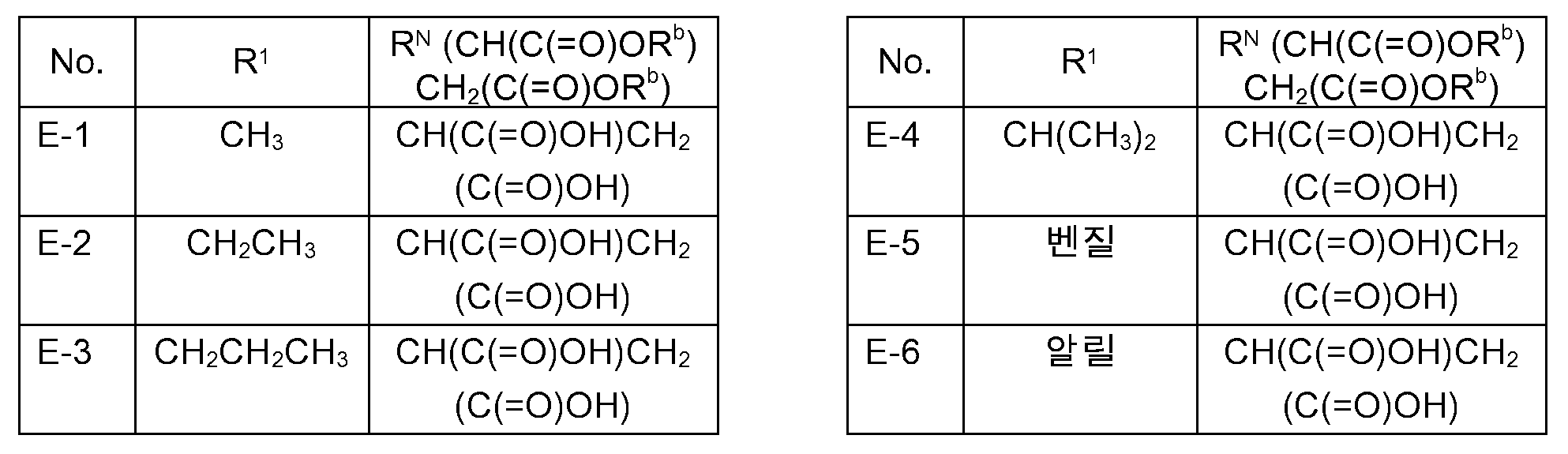

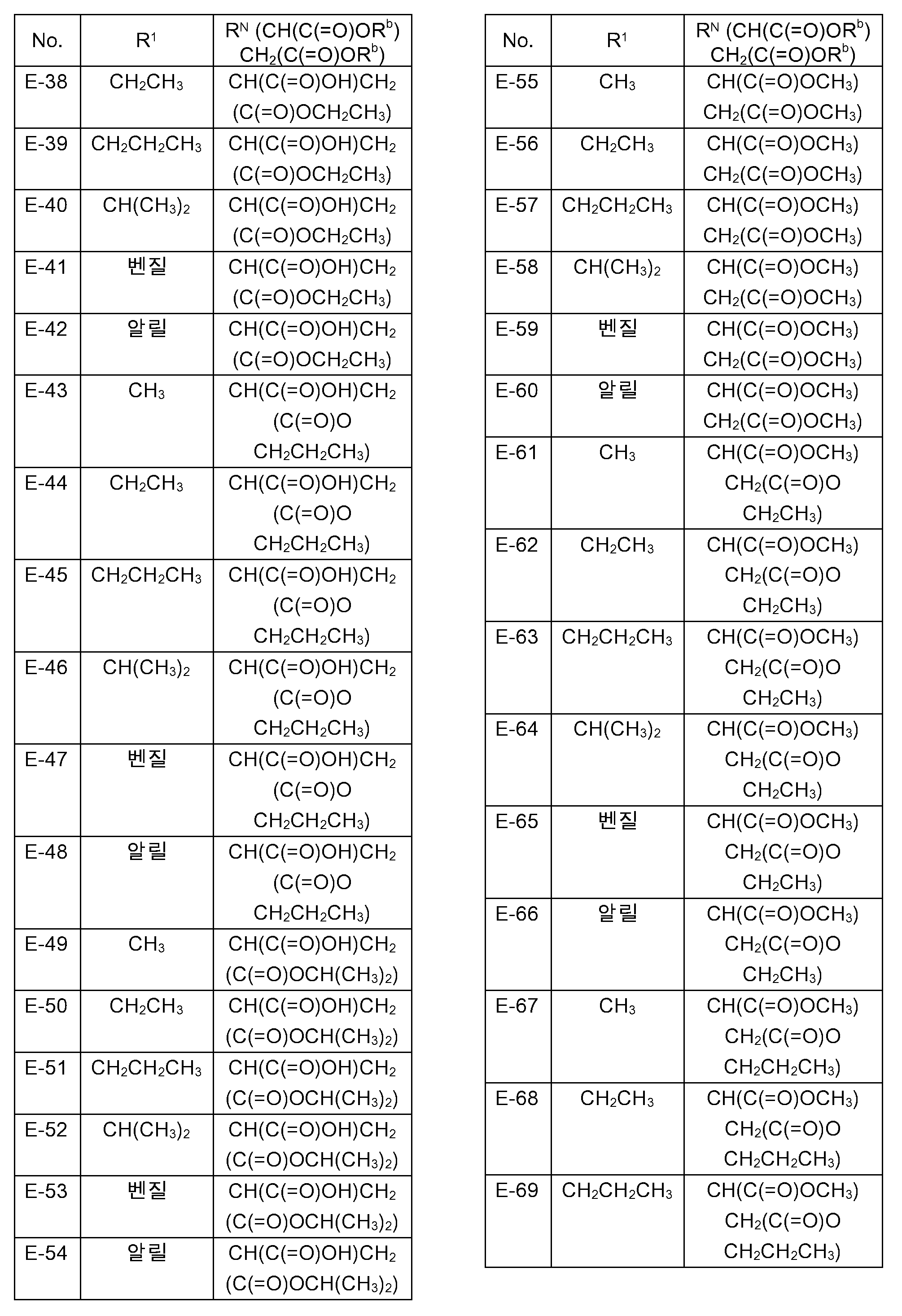
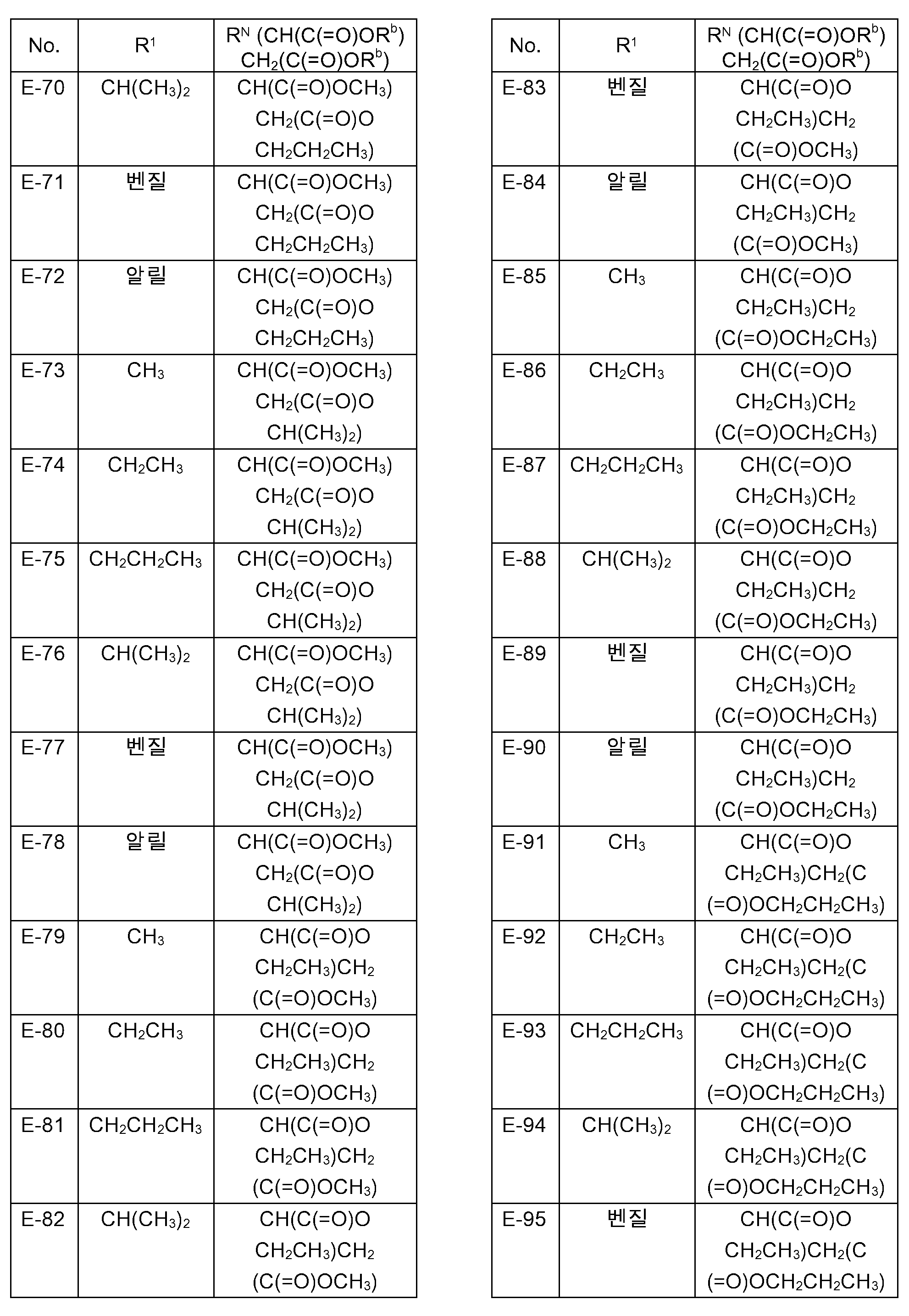

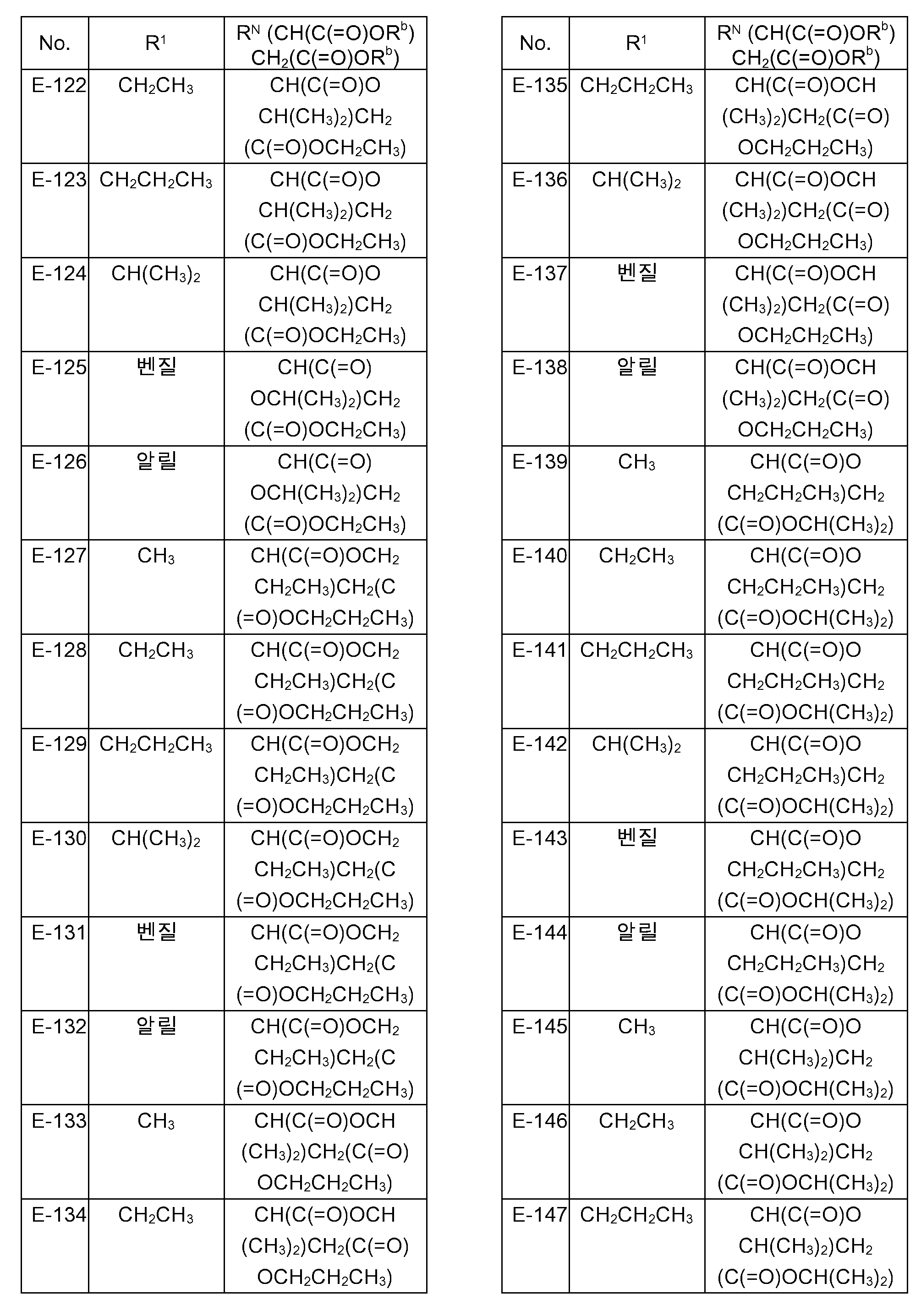
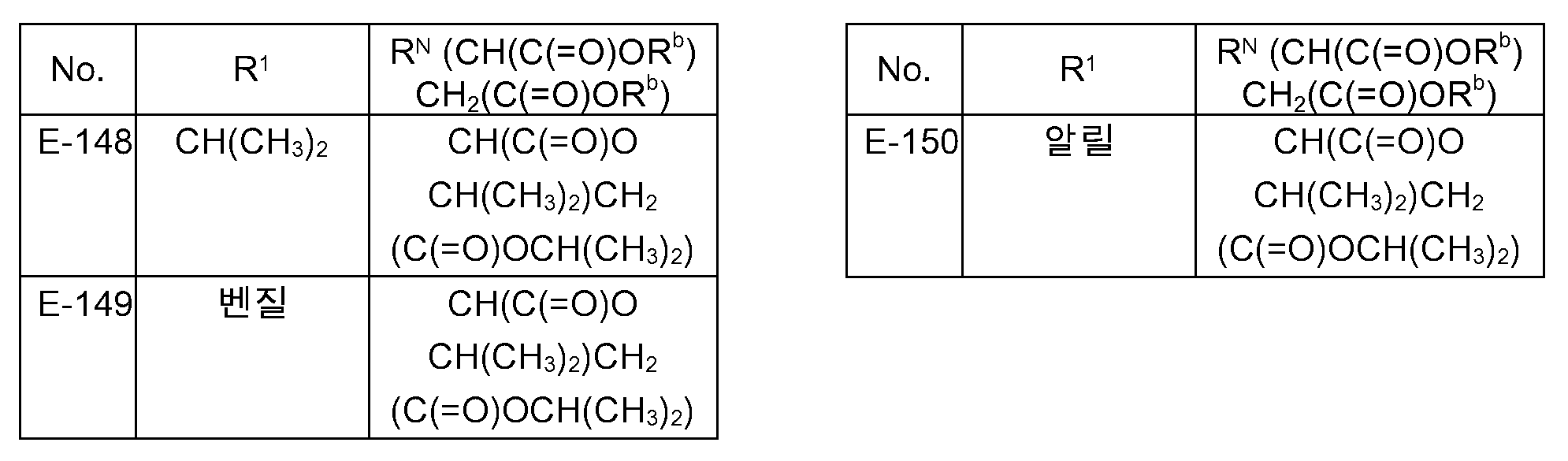
표 133Table 133
R2 가 부재이고, RN (CHRaNRe(C=O)Rf) 및 R1 의 조합이 각각의 경우 표 F 의 하나의 열에 상응하는 식 I.1(i) 의 화합물Compounds of formula I.1(i) in which R 2 is absent and the combination of R N (CHR a NR e (C=O)R f ) and R 1 corresponds in each case to one column of Table F
표 134Table 134
R2 가 부재이고, RN (CHRaNRe(C=O)Rf) 및 R1 의 조합이 각각의 경우 표 F 의 하나의 열에 상응하는 식 I.2(i) 의 화합물Compounds of formula I.2(i) in which R 2 is absent and the combination of R N (CHR a NR e (C=O)R f ) and R 1 corresponds to one column of Table F in each case.
표 135Table 135
R2 가 부재이고, RN (CHRaNRe(C=O)Rf) 및 R1 의 조합이 각각의 경우 표 F 의 하나의 열에 상응하는 식 I.3(i) 의 화합물Compounds of formula I.3(i) in which R 2 is absent and the combination of R N (CHR a NR e (C=O)R f ) and R 1 corresponds to one column of Table F in each case.
표 136Table 136
R2 가 CH3 이고, RN (CHRaNRe(C=O)Rf) 및 R1 의 조합이 각각의 경우 표 F 의 하나의 열에 상응하는 식 I.1(ii) 의 화합물Compounds of formula I.1(ii) in which R 2 is CH 3 and the combination of R N (CHR a NR e (C=O)R f ) and R 1 corresponds in each case to one column of Table F.
표 137Table 137
R2 가 CH3 이고, RN (CHRaNRe(C=O)Rf) 및 R1 의 조합이 각각의 경우 표 F 의 하나의 열에 상응하는 식 I.1(iii) 의 화합물Compounds of formula I.1(iii) in which R 2 is CH 3 and the combination of R N (CHR a NR e (C=O)R f ) and R 1 corresponds in each case to one column of Table F.
표 138Table 138
R2 가 CH3 이고, RN (CHRaNRe(C=O)Rf) 및 R1 의 조합이 각각의 경우 표 F 의 하나의 열에 상응하는 식 I.2(ii) 의 화합물Compounds of formula I.2(ii) in which R 2 is CH 3 and the combination of R N (CHR a NR e (C=O)R f ) and R 1 corresponds in each case to one column of Table F.
표 139Table 139
R2 가 CH3 이고, RN (CHRaNRe(C=O)Rf) 및 R1 의 조합이 각각의 경우 표 F 의 하나의 열에 상응하는 식 I.2(iii) 의 화합물Compounds of formula I.2(iii) in which R 2 is CH 3 and the combination of R N (CHR a NR e (C=O)R f ) and R 1 corresponds in each case to one column of Table F.
표 140Table 140
R2 가 CH3 이고, RN (CHRaNRe(C=O)Rf) 및 R1 의 조합이 각각의 경우 표 F 의 하나의 열에 상응하는 식 I.3(ii) 의 화합물Compounds of formula I.3(ii) in which R 2 is CH 3 and the combination of R N (CHR a NR e (C=O)R f ) and R 1 corresponds in each case to one column of Table F.
표 141Table 141
R2 가 CH3 이고, RN (CHRaNRe(C=O)Rf) 및 R1 의 조합이 각각의 경우 표 F 의 하나의 열에 상응하는 식 I.3(iii) 의 화합물Compounds of formula I.3(iii) in which R 2 is CH 3 and the combination of R N (CHR a NR e (C=O)R f ) and R 1 corresponds in each case to one column of Table F.
표 142Table 142
R2 가 CH2CH3 이고, RN (CHRaNRe(C=O)Rf) 및 R1 의 조합이 각각의 경우 표 F 의 하나의 열에 상응하는 식 I.1(ii) 의 화합물Compounds of formula I.1(ii) in which R 2 is CH 2 CH 3 and the combination of R N (CHR a NR e (C=O)R f ) and R 1 corresponds in each case to one column of Table F.
표 143Table 143
R2 가 CH2CH3 이고, RN (CHRaNRe(C=O)Rf) 및 R1 의 조합이 각각의 경우 표 F 의 하나의 열에 상응하는 식 I.1(iii) 의 화합물Compounds of formula I.1(iii) in which R 2 is CH 2 CH 3 and the combination of R N (CHR a NR e (C=O)R f ) and R 1 corresponds in each case to one column of Table F.
표 144Table 144
R2 가 CH2CH3 이고, RN (CHRaNRe(C=O)Rf) 및 R1 의 조합이 각각의 경우 표 F 의 하나의 열에 상응하는 식 I.2(ii) 의 화합물Compounds of formula I.2(ii) in which R 2 is CH 2 CH 3 and the combination of R N (CHR a NR e (C=O)R f ) and R 1 corresponds in each case to one column of Table F.
표 145Table 145
R2 가 CH2CH3 이고, RN (CHRaNRe(C=O)Rf) 및 R1 의 조합이 각각의 경우 표 F 의 하나의 열에 상응하는 식 I.2(iii) 의 화합물Compounds of formula I.2(iii) in which R 2 is CH 2 CH 3 and the combination of R N (CHR a NR e (C=O)R f ) and R 1 corresponds in each case to one column of Table F.
표 146Table 146
R2 가 CH2CH3 이고, RN (CHRaNRe(C=O)Rf) 및 R1 의 조합이 각각의 경우 표 F 의 하나의 열에 상응하는 식 I.3(ii) 의 화합물Compounds of formula I.3(ii) in which R 2 is CH 2 CH 3 and the combination of R N (CHR a NR e (C=O)R f ) and R 1 corresponds in each case to one column of Table F.
표 147Table 147
R2 가 CH2CH3 이고, RN (CHRaNRe(C=O)Rf) 및 R1 의 조합이 각각의 경우 표 F 의 하나의 열에 상응하는 식 I.3(iii) 의 화합물Compounds of formula I.3(iii) in which R 2 is CH 2 CH 3 and the combination of R N (CHR a NR e (C=O)R f ) and R 1 corresponds in each case to one column of Table F.
표 148Table 148
R2 가 CH2CH2CH3 이고, RN (CHRaNRe(C=O)Rf) 및 R1 의 조합이 각각의 경우 표 F 의 하나의 열에 상응하는 식 I.1(ii) 의 화합물Compounds of formula I.1(ii) in which R 2 is CH 2 CH 2 CH 3 and the combination of R N (CHR a NR e (C=O)R f ) and R 1 corresponds in each case to one column of Table F.
표 149Table 149
R2 가 CH(CH3)2 이고, RN (CHRaNRe(C=O)Rf) 및 R1 의 조합이 각각의 경우 표 F 의 하나의 열에 상응하는 식 I.1(ii) 의 화합물Compounds of formula I.1(ii) in which R 2 is CH(CH 3 ) 2 and the combination of R N (CHR a NR e (C=O)R f ) and R 1 corresponds in each case to one column of Table F.
표 150Table 150
R2 가 CH2CH2CH3 이고, RN (CHRaNRe(C=O)Rf) 및 R1 의 조합이 각각의 경우 표 F 의 하나의 열에 상응하는 식 I.1(iii) 의 화합물Compounds of formula I.1(iii) in which R 2 is CH 2 CH 2 CH 3 and the combination of R N (CHR a NR e (C=O)R f ) and R 1 corresponds in each case to one column of Table F.
표 151Table 151
R2 가 CH(CH3)2 이고, RN (CHRaNRe(C=O)Rf) 및 R1 의 조합이 각각의 경우 표 F 의 하나의 열에 상응하는 식 I.1(iii) 의 화합물Compounds of formula I.1(iii) in which R 2 is CH(CH 3 ) 2 and the combination of R N (CHR a NR e (C=O)R f ) and R 1 corresponds in each case to one column of Table F.
표 152Table 152
R2 가 CH2CH2CH3 이고, RN (CHRaNRe(C=O)Rf) 및 R1 의 조합이 각각의 경우 표 F 의 하나의 열에 상응하는 식 I.2(ii) 의 화합물Compounds of formula I.2(ii) in which R 2 is CH 2 CH 2 CH 3 and the combination of R N (CHR a NR e (C=O)R f ) and R 1 corresponds in each case to one column of Table F.
표 153Table 153
R2 가 CH(CH3)2 이고, RN (CHRaNRe(C=O)Rf) 및 R1 의 조합이 각각의 경우 표 F 의 하나의 열에 상응하는 식 I.2(ii) 의 화합물Compounds of formula I.2(ii) in which R 2 is CH(CH 3 ) 2 and the combination of R N (CHR a NR e (C=O)R f ) and R 1 corresponds in each case to one column of Table F.
표 154Table 154
R2 가 CH2CH2CH3 이고, RN (CHRaNRe(C=O)Rf) 및 R1 의 조합이 각각의 경우 표 F 의 하나의 열에 상응하는 식 I.2(iii) 의 화합물Compounds of formula I.2(iii) in which R 2 is CH 2 CH 2 CH 3 and the combination of R N (CHR a NR e (C=O)R f ) and R 1 corresponds in each case to one column of Table F.
표 155Table 155
R2 가 CH(CH3)2 이고, RN (CHRaNRe(C=O)Rf) 및 R1 의 조합이 각각의 경우 표 F 의 하나의 열에 상응하는 식 I.2(iii) 의 화합물Compounds of formula I.2(iii) in which R 2 is CH(CH 3 ) 2 and the combination of R N (CHR a NR e (C=O)R f ) and R 1 corresponds in each case to one column of Table F.
표 156Table 156
R2 가 CH2CH2CH3 이고, RN (CHRaNRe(C=O)Rf) 및 R1 의 조합이 각각의 경우 표 F 의 하나의 열에 상응하는 식 I.3(ii) 의 화합물Compounds of formula I.3(ii) in which R 2 is CH 2 CH 2 CH 3 and the combination of R N (CHR a NR e (C=O)R f ) and R 1 corresponds in each case to one column of Table F.
표 157Table 157
R2 가 CH(CH3)2 이고, RN (CHRaNRe(C=O)Rf) 및 R1 의 조합이 각각의 경우 표 F 의 하나의 열에 상응하는 식 I.3(ii) 의 화합물Compounds of formula I.3(ii) in which R 2 is CH(CH 3 ) 2 and the combination of R N (CHR a NR e (C=O)R f ) and R 1 corresponds in each case to one column of Table F.
표 158Table 158
R2 가 CH2CH2CH3 이고, RN (CHRaNRe(C=O)Rf) 및 R1 의 조합이 각각의 경우 표 F 의 하나의 열에 상응하는 식 I.3(iii) 의 화합물Compounds of formula I.3(iii) in which R 2 is CH 2 CH 2 CH 3 and the combination of R N (CHR a NR e (C=O)R f ) and R 1 corresponds in each case to one column of Table F.
표 159Table 159
R2 가 CH(CH3)2 이고, RN (CHRaNRe(C=O)Rf) 및 R1 의 조합이 각각의 경우 표 F 의 하나의 열에 상응하는 식 I.3(iii) 의 화합물Compounds of formula I.3(iii) in which R 2 is CH(CH 3 ) 2 and the combination of R N (CHR a NR e (C=O)R f ) and R 1 corresponds in each case to one column of Table F.
표 160Table 160
R2 가 페닐이고, RN (CHRaNRe(C=O)Rf) 및 R1 의 조합이 각각의 경우 표 F 의 하나의 열에 상응하는 식 I.1(ii) 의 화합물Compounds of formula I.1(ii) in which R 2 is phenyl, and the combination of R N (CHR a NR e (C=O)R f ) and R 1 corresponds in each case to one column of Table F.
표 161Table 161
R2 가 페닐이고, RN (CHRaNRe(C=O)Rf) 및 R1 의 조합이 각각의 경우 표 F 의 하나의 열에 상응하는 식 I.1(iii) 의 화합물Compounds of formula I.1(iii) in which R 2 is phenyl, and the combination of R N (CHR a NR e (C=O)R f ) and R 1 corresponds in each case to one column of Table F.
표 162Table 162
R2 가 페닐이고, RN (CHRaNRe(C=O)Rf) 및 R1 의 조합이 각각의 경우 표 F 의 하나의 열에 상응하는 식 I.2(ii) 의 화합물Compounds of formula I.2(ii) in which R 2 is phenyl, and the combination of R N (CHR a NR e (C=O)R f ) and R 1 corresponds in each case to one column of Table F.
표 163Table 163
R2 가 페닐이고, RN (CHRaNRe(C=O)Rf) 및 R1 의 조합이 각각의 경우 표 F 의 하나의 열에 상응하는 식 I.2(iii) 의 화합물Compounds of formula I.2(iii) in which R 2 is phenyl, and the combination of R N (CHR a NR e (C=O)R f ) and R 1 corresponds in each case to one column of Table F.
표 164Table 164
R2 가 페닐이고, RN (CHRaNRe(C=O)Rf) 및 R1 의 조합이 각각의 경우 표 F 의 하나의 열에 상응하는 식 I.3(ii) 의 화합물Compounds of formula I.3(ii) in which R 2 is phenyl, and the combination of R N (CHR a NR e (C=O)R f ) and R 1 corresponds in each case to one column of Table F.
표 165Table 165
R2 가 페닐이고, RN (CHRaNRe(C=O)Rf) 및 R1 의 조합이 각각의 경우 표 F 의 하나의 열에 상응하는 식 I.3(iii) 의 화합물Compounds of formula I.3(iii) in which R 2 is phenyl, and the combination of R N (CHR a NR e (C=O)R f ) and R 1 corresponds in each case to one column of Table F.
표 FTable F

상기 표에 정의된 화합물은 질화작용 감소 측면에서 유리할 뿐 아니라 예를 들어 이의 낮은 휘발성 및/또는 이의 환경 안전성의 관점에서, 유리한 특성을 갖는다는 사실을 발견하였다. 추가로, 본 발명에 따른 화합물은 비용-효율적으로 제조될 수 있다.It was found that the compounds defined in the above table have advantageous properties not only in terms of reducing nitrification, but also, for example, in terms of their low volatility and/or their environmental safety. In addition, the compounds according to the invention can be produced cost-effectively.
또한, 상기 화합물의 조합, 특히 상기 개괄된 바와 같이 N-치환기가 도입된 후 이성질체 혼합물로서 수득되는 화합물의 조합이 본 발명에 따른 질화작용 저해제로서 사용될 수 있다는 것을 이해해야 한다.It should also be understood that combinations of the above compounds, particularly combinations of compounds obtained as isomer mixtures after introduction of N-substituents as outlined above, can be used as nitrification inhibitors according to the present invention.
본 발명의 방법, 용도, 조성물, 및 혼합물에 관해, 특히 이의 용도의 관점에서, 하기 바람직한 구현예가 부가적으로 관련된다.With respect to the methods, uses, compositions and mixtures of the present invention, particularly with respect to their uses, the following preferred embodiments are additionally relevant.
중심 양상에서, 본 발명은 이에 따라 질화작용 저해제로서의 본원에 정의된 식 I 의 화합물의 용도, 또는 질화작용을 감소시키기 위한 본원에 정의된 식 I 의 화합물을 포함하는 조성물의 용도에 관한 것이다. 본원에 정의된 식 I 의 화합물 또는 이의 유도체 또는 염, 특히 식 I 의 화합물 및/또는 이의 염 또는 적합한 유도체뿐 아니라 상기 식 I 의 화합물을 포함하는 조성물 또는 상기 식 I 의 화합물을 포함하는 농약 혼합물은 질화작용을 감소시키기 위해 사용될 수 있다.In a central aspect, the present invention therefore relates to the use of compounds of the formula I as defined herein as nitrification inhibitors, or to the use of compositions comprising compounds of the formula I as defined herein for reducing nitrification. Compounds of the formula I as defined herein or derivatives or salts thereof, in particular compounds of the formula I and/or salts or suitable derivatives thereof, as well as compositions comprising said compounds of the formula I or pesticide mixtures comprising said compounds of the formula I can be used for reducing nitrification.
사용은 본원에 정의된 바와 같은 질화작용 저해제, 조성물 또는 농약 혼합물을, 토양 상에서 생장하는 식물 및/또는 식물이 생장하거나 생장할 수 있는 소재지에 적용하는 것을 기반으로 하거나, 사용은 본원에 정의된 바와 같은 질화작용 저해제, 조성물 또는 농약 혼합물을 식물이 생장하거나 생장할 수 있는 토양 또는 토양 대체물에 적용하는 것을 기반으로 할 수 있다. 특정 구현예에서, 질화작용 저해제는, 예를 들어 후속되는 농업 활동을 위한 예비적 활동으로서, 식물의 부재 하에서 질화작용을 감소시키기 위하여, 또는 농업과 관련이 없는 다른 기술 분야에서 질화작용을 감소시키기 위하여, 예를 들어 환경 보호, 수자원 보호, 에너지 생산 또는 유사한 목적을 위하여 사용될 수 있다. 특정 구현예에서, 본 발명에 따른 질화작용 저해제, 또는 상기 질화작용 저해제를 포함하는 조성물은, 오수, 슬러리, 거름 또는 동물의 똥, 예를 들어 돼지 또는 소의 배설물에서의 질화작용의 감소를 위해 사용될 수 있다. 예를 들어, 본 발명에 따른 질화작용 저해제, 또는 상기 질화작용 저해제를 포함하는 조성물은, 오수 플랜트, 바이오가스 플랜트, 외양간, 액체 거름 탱크 또는 컨테이너 등에서의 질화작용의 감소를 위해 사용될 수 있다. 추가로, 질화작용 저해제, 또는 상기 질화작용 저해제를 포함하는 조성물은 배기공기 시스템, 바람직하게는 마구간 또는 외양간의 배기공기 시스템에서 사용될 수 있다. 본 발명은 따라서 또한 배기공기, 바람직하게는 마구간 또는 외양간의 배기공기를 처리하기 위한 식 I 의 화합물의 용도에 관한 것이다. 추가의 구현예에서, 본 발명에 따른 질화작용 저해제, 또는 상기 질화작용 저해제를 포함하는 조성물은, 동물, 예를 들어 생산성이 있는 가축 그 자체에서의 질화작용의 감소를 위해 사용될 수 있다. 따라서, 본 발명에 따른 질화작용 저해제, 또는 상기 질화작용 저해제를 포함하는 조성물은, 동물, 예를 들어 포유동물에, 예를 들어 적합한 사료와 함께 공급되어, 동물의 위장관 내 질화작용의 감소를 유도함으로써, 결국 위장관으로부터의 배출물의 감소를 유도할 수 있다. 이러한 활동, 즉 본 발명에 따른 질화작용 저해제, 또는 상기 질화작용 저해제를 포함하는 조성물의 공급은, 1 내지 수 회, 예를 들어 각각 2, 3, 4, 5, 6, 7 일 마다, 또는 각각 1 주, 2 주, 3 주 마다, 또는 1 개월, 2 개월마다 등으로 반복될 수 있다.The use may be based on applying the nitrification inhibitor, the composition or the pesticide mixture as defined herein to plants growing on soil and/or to a site where plants grow or may grow, or the use may be based on applying the nitrification inhibitor, the composition or the pesticide mixture as defined herein to soil or a soil substitute where plants grow or may grow. In certain embodiments, the nitrification inhibitor may be used to reduce nitrification in the absence of plants, for example as a preparatory action for subsequent agricultural activities, or to reduce nitrification in other technical fields not related to agriculture, for example for environmental protection, water resource protection, energy production or similar purposes. In certain embodiments, the nitrification inhibitor according to the invention, or a composition comprising said nitrification inhibitor, may be used to reduce nitrification in sewage, slurry, manure or animal excrement, for example in pig or cow excrement. For example, the nitrification inhibitor according to the invention, or a composition comprising said nitrification inhibitor, can be used for reducing nitrification in sewage plants, biogas plants, barns, liquid manure tanks or containers, etc. Additionally, the nitrification inhibitor or a composition comprising said nitrification inhibitor can be used in exhaust air systems, preferably in exhaust air systems of stables or barns. The invention therefore also relates to the use of compounds of the formula I for treating exhaust air, preferably exhaust air of stables or barns. In a further embodiment, the nitrification inhibitor according to the invention, or a composition comprising said nitrification inhibitor, can be used for reducing nitrification in animals, for example productive livestock themselves. Therefore, the nitrification inhibitor according to the present invention, or a composition comprising said nitrification inhibitor, can be supplied to an animal, for example a mammal, for example together with a suitable feed, to induce a decrease in nitrification in the gastrointestinal tract of the animal, thereby ultimately inducing a decrease in excretion from the gastrointestinal tract. This action, i.e. the supply of the nitrification inhibitor according to the present invention, or a composition comprising said nitrification inhibitor, can be repeated 1 to several times, for example every 2, 3, 4, 5, 6, 7 days, or every 1 week, 2 weeks, 3 weeks, or every 1 month, 2 months, etc.
사용은 추가로 상기 본원에 정의된 바와 같은 질화작용 저해제 또는 이의 유도체 또는 염, 특히 식 I 의 화합물 및/또는 이의 염 또는 적합한 유도체뿐 아니라 상기 본원에 정의된 바와 같은 상기 질화작용 저해제를 포함하는 조성물, 또는 상기 질화작용 저해제를 포함하는 농약 혼합물을 질화작용이 일어나거나, 일어날 것으로 추정 또는 예상되는 환경, 영역 또는 구역에 적용하는 것을 포함할 수 있다. 상기 환경, 영역 또는 구역은 식물 또는 토양을 포함하지 않을 수 있다. 예를 들어, 저해제는 예를 들어 효소 반응 등을 기반으로 하는 실험실 환경에서의 질화작용의 저해를 위해 사용될 수 있다. 또한, 온실 또는 유사한 실내 시설에서의 사용도 고려된다.The use may further comprise applying a nitrification inhibitor or a derivative or salt thereof as defined herein above, in particular a compound of formula I and/or a salt or suitable derivative thereof, as well as a composition comprising said nitrification inhibitor as defined herein above, or a pesticide mixture comprising said nitrification inhibitor, to an environment, area or zone where nitrification occurs, is expected or is expected to occur. The environment, area or zone may not comprise plants or soil. For example, the inhibitor may be used for the inhibition of nitrification in a laboratory setting, for example based on enzymatic reactions or the like. Also contemplated is use in greenhouses or similar indoor facilities.
본원에 사용된 바와 같은 용어 "질화작용을 감소시키는 것" 또는 "질화작용의 감소" 는 예를 들어 암모늄의 니트레이트로의 자연적인 변환을 지연시키거나 제거함으로써, 질화작용 과정의 속도를 늦추거나 중단시키는 것을 의미한다. 이러한 감소는 저해제 또는 상기 저해제를 포함하는 조성물이 적용되는 식물 또는 소재지에서의 질화작용의 완전한 또는 부분적 제거일 수 있다. 예를 들어, 부분적 제거는 식물 상 또는 내, 또는 식물이 생장하거나 생장할 수 있는 토양 또는 토양 대체물 내 또는 상에서의 잔류 질화작용을, 질화작용 저해제가 사용되지 않은 대조군 상황과 비교하여 약 90% 내지 1%, 예를 들어 90%, 85%, 80%, 70%, 60%, 50%, 40%, 30%, 20%, 10% 또는 10% 미만, 예를 들어 5% 또는 5% 미만이 되도록 유도할 수 있다. 특정 구현예에서, 부분적 제거는 식물 상 또는 내 또는 식물이 생장하거나 생장할 수 있는 토양 또는 토양 대체물 내 또는 상에서의 잔류 질화작용을, 질화작용 저해제가 사용되지 않은 대조군 상황과 비교하여 1% 미만, 예를 들어 0.5%, 0.1% 또는 그 미만이 되도록 유도할 수 있다.The term "reducing nitrification" or "reducing nitrification" as used herein means slowing down or stopping the nitrification process, for example by delaying or eliminating the natural conversion of ammonium to nitrate. Such reduction can be complete or partial elimination of nitrification in a plant or a locus to which the inhibitor or a composition comprising the inhibitor is applied. For example, partial elimination can result in residual nitrification on or within the plant, or in or upon the soil or soil substitute in which the plant grows or may grow, being about 90% to 1%, for example 90%, 85%, 80%, 70%, 60%, 50%, 40%, 30%, 20%, 10% or less than 10%, for example 5% or less than 5%, as compared to a control situation in which no nitrification inhibitor is used. In certain embodiments, partial removal can result in residual nitrification on or within the plant or in or on the soil or soil substitute in which the plant is growing or can grow to be less than 1%, for example 0.5%, 0.1% or less, compared to a control situation in which no nitrification inhibitor is used.
상기 본원에 정의된 바와 같은 질화작용 저해제, 또는 질화작용을 저해하기 위한 본원에 정의된 바와 같은 조성물의 사용은 1 회 사용이거나, 반복 사용일 수 있다. 1 회 사용으로서, 질화작용 저해제 또는 해당 조성물은 이의 표적 부위, 예를 들어 토양 또는 소재지, 또는 물체, 예를 들어 식물에 생리학적으로 적절한 시간 간격에서 단 1 회, 예를 들어 1 년에 1 회, 또는 매 2 내지 5 년에 1 회, 또는 식물의 수명 동안 1 회 제공될 수 있다.The use of a nitrification inhibitor as defined herein, or a composition as defined herein for inhibiting nitrification, may be a single use or a repeated use. As a single use, the nitrification inhibitor or the composition may be provided to its target site, e.g., soil or a site, or an object, e.g., a plant, only once at a physiologically relevant time interval, for example once a year, or once every 2 to 5 years, or once during the life of the plant.
다른 구현예에서, 사용은 시간 주기 당 적어도 1 회 반복될 수 있고, 예를 들어 상기 본원에 정의된 바와 같은 질화작용 저해제, 또는 본원에 정의된 바와 같은 조성물은 이의 표적 부위 또는 물체에서의 질화작용을 감소시키기 위하여, 수 일, 수 주 또는 수 개월의 시간 간격 내에서 2 회 사용될 수 있다. 질화작용 저해제의 사용과 관련하여 사용된 바와 같은 용어 "적어도 1 회" 는 저해제가 2 회 또는 수 회 사용될 수 있으며, 즉 질화작용 저해제로의 적용 또는 처리의 반복 또는 다중 반복이 고려될 수 있다는 것을 의미한다. 이러한 반복은 사용의 2 회, 3 회, 4 회, 5 회, 6 회, 7 회, 8 회, 9 회, 10 회 또는 그 보다 빈번한 반복일 수 있다.In another embodiment, the use can be repeated at least once per time period, for example the nitrification inhibitor as defined herein, or the composition as defined herein, can be used twice within a time interval of several days, several weeks or several months to reduce nitrification at its target site or object. The term "at least once" as used in connection with the use of the nitrification inhibitor means that the inhibitor can be used twice or several times, i.e. repeated or multiple repetitions of the application or treatment with the nitrification inhibitor are contemplated. Such repetitions can be 2, 3, 4, 5, 6, 7, 8, 9, 10 or more frequent repetitions of the use.
본 발명에 따른 질화작용 저해제는 임의의 적합한 형태로 사용될 수 있다. 예를 들어, 이는 코팅되거나 비(非)코팅된 과립으로서, 액체 또는 반-액체 형태로, 분무가능한 실체로서 또는 관개 접근법 등으로 사용될 수 있다. 특정 구현예에서, 본원에 정의된 바와 같은 질화작용 저해제는 그 자체대로, 즉 제형, 비료, 부가적인 물, 코팅, 또는 임의의 추가 성분 없이 적용되거나 사용될 수 있다.The nitrification inhibitor according to the present invention may be used in any suitable form. For example, it may be used as coated or uncoated granules, in liquid or semi-liquid form, as a sprayable entity or in an irrigation approach, etc. In certain embodiments, the nitrification inhibitor as defined herein may be applied or used as such, i.e. without a formulation, fertilizer, additional water, coating, or any additional components.
본원에 사용된 바와 같은 용어 "관개" 는 식물 또는 식물이 생장하거나 생장할 수 있는 소재지 또는 토양 또는 토양 대체물의 급수를 의미하며, 여기서 상기 급수는 물과 함께 본 발명에 따른 질화작용 저해제의 공급을 포함한다. The term "irrigation" as used herein means watering of a plant or a site where plants grow or are capable of growing or of the soil or soil substitute, wherein said watering comprises supply of a nitrification inhibitor according to the present invention together with water.
추가의 양상에서, 본 발명은 하나 이상의 질화작용 저해제 (여기서 상기 질화작용 저해제는 상기 본원에 정의된 바와 같은 식 I 의 화합물 또는 유도체임); 및 하나 이상의 담체를 포함하는 질화작용 감소용 조성물에 관한 것이다.In a further aspect, the present invention relates to a composition for reducing nitrification comprising at least one nitrification inhibitor, wherein said nitrification inhibitor is a compound or derivative of formula I as defined herein above; and at least one carrier.
본원에 사용된 바와 같은 용어 "질화작용 감소용 조성물" 은 질화작용이 일어날 수 있는 임의의 상황 또는 환경에서 질화작용을 감소시키는데 적합한, 예를 들어 유효한 농도 및 양의 성분, 예컨대 질화작용 저해제, 특히 본원에 정의된 바와 같은 식 I 의 화합물 또는 유도체를 포함하는 조성물을 의미한다. 하나의 구현예에서, 질화작용은 식물의 소재지 내 또는 상 또는 에서 감소될 수 있다. 통상적으로, 질화작용은 식물의 뿌리 영역에서 감소될 수 있다. 하지만, 이러한 질화작용의 감소가 일어날 수 있는 영역은 식물 및 이의 환경에 제한되지 않으며, 또한 박테리아를 질화하는 임의의 기타 서식지 또는 효소 활성의 질화작용이 발견될 수 있거나 또는 일반적인 방식으로 기능할 수 있는 임의의 위치, 예를 들어 오수 플랜트, 바이오가스 플랜트, 생산성이 있는 가축, 예를 들어 젖소, 돼지 등으로부터 동물 배설물이 포함될 수 있다. 본원에 정의된 바와 같은 질화작용 저해제의 "유효량" 또는 "유효 농도" 는 당업자에게 공지된 적합한 시험관내 및 생체내 시험에 따라 측정될 수 있다. 이러한 양 및 농도는 소재지, 식물, 토양, 기후 조건 또는 질화작용 과정에 영향을 미칠 수 있는 임의의 기타 적합한 매개변수에 따라 조정될 수 있다.The term "composition for reducing nitrification" as used herein means a composition comprising, for example, an effective concentration and amount of a component, such as a nitrification inhibitor, particularly a compound or derivative of formula I as defined herein, suitable for reducing nitrification in any situation or environment in which nitrification can occur. In one embodiment, nitrification can be reduced in or on or at the site of the plant. Typically, nitrification can be reduced in the root zone of the plant. However, the area in which such nitrification reduction can occur is not limited to the plant and its environment, but can also include any other habitat or location in which nitrifying bacteria or enzymatic activity can be found or can function in a normal manner, for example, wastewater plants, biogas plants, animal waste from productive livestock, for example, dairy cows, pigs, etc. An "effective amount" or "effective concentration" of a nitrification inhibitor as defined herein can be determined according to suitable in vitro and in vivo tests known to the skilled person. These amounts and concentrations may be adjusted depending on the site, plants, soil, climatic conditions or any other suitable parameters which may affect the nitrification process.
본원에 사용된 바와 같은 "담체" 는 목적하는 위치 또는 소재지에의 성분의 전달 및/또는 방출을 가능하게 하는 물질 또는 조성물이다. 이러한 용어는 예를 들어, 농약의 사용 지역에 특히 식물 상 또는 내에, 농약의 전달 및/또는 방출을 가능하게 하는 농약 담체를 포함한다.As used herein, a "carrier" is a substance or composition that enables delivery and/or release of a component to a desired location or locus. This term includes, for example, pesticide carriers that enable delivery and/or release of a pesticide, particularly on or within a plant, to the area of application of the pesticide.
적합한 담체의 예에는 고체 담체, 예컨대 파이토겔 (phytogel), 또는 히드로겔 (hydrogel), 또는 광물성 토류, 예를 들어 실리케이트, 실리카겔, 탈크, 카올린, 석회석, 석회, 백악, 교회점토 (bole), 황토 (loess), 점토, 백운석, 규조토, 칼슘 술페이트, 마그네슘 술페이트, 마그네슘 옥시드, 분쇄된 합성 물질, 비료, 예를 들어 고체 또는 액체 암모늄-함유 무기 비료, 예컨대 NPK 비료, 암모늄 니트레이트, 칼슘 암모늄 니트레이트, 암모늄 술페이트 니트레이트, 암모늄 술페이트 또는 암모늄 포스페이트; 고체 또는 액체 유기 비료, 예컨대 액체 거름, 반-액체 거름, 외양간 거름, 바이오가스 거름 및 짚 거름, 지렁이분, 퇴비, 해조류 또는 구아노, 또는 우레아-함유 비료, 예컨대 우레아, 포름알데히드 우레아, 무수 암모늄, 우레아 암모늄 니트레이트 (UAN) 용액, 우레아 황, 안정화 우레아, 우레아계 NPK-비료, 또는 우레아 암모늄 술페이트, 및 식물 기원의 생성물, 예컨대 곡분, 나무 껍질분, 목분 및 견과류 껍질분, 셀룰로오스 분말 및 기타 고체 담체가 포함된다. 추가로 적합한 담체의 예에는, 예를 들어, 고체 제형으로 유동 보조제, 고결방지 보조제, 밀링 보조제로서 및 액체 활성 성분용 담체로서 사용될 수 있는 훈증 실리카 또는 침강 실리카가 포함된다. 적합한 담체의 부가적인 예는, 미세입자, 예를 들어 식물 잎에 부착되어 특정 기간에 걸쳐 이의 내용물을 방출하는 미세입자이다. 특정 구현예에서, 농약 담체, 예를 들어 US 6,180,141 에 기재된 바와 같은 식물-보호 활성 성분; 또는 예를 들어 WO 2005/102045 에 기재된 바와 같은 하나 이상의 식물활성 화합물 및 캡슐화 아쥬반트를 포함하는 조성물 (여기서 아쥬반트는 진균 세포 또는 이의 단편을 포함함); 또는 예를 들어 US 2007/0280981 에 개시된 바와 같은 표면에 친유성 점착 부여제로 코팅된 담체 과립 (여기서 담체 과립은 식물, 풀 및 잡초의 표면에 부착됨) 을 전달하는데 사용될 수 있는 복합체 겔 미세입자가 사용될 수 있다. 추가의 특정 구현예에서, 상기 담체는 담체의 내용물이 완전히 전달될 때까지, 담체가 식물, 식물이 생장하거나 생장할 수 있는 소재지, 종자 및/또는 식물에 부착되어 있는 것을 보장하는 특정, 강한 결합 분자를 포함할 수 있다. 예를 들어, 담체는, 분자 종의 셀룰로오스에의 부착에 유용한 제제로서 기재된 셀룰로오스결합 도메인 (CBD) (US 6,124,117 참조); 또는 CBD 와 효소 사이의 직접 융합; 또는 캡슐화된 제제의 전달에 사용될 수 있는 다관능성 융합 단백질 (여기서 다관능성 융합 단백질은 탄수화물 결합 도메인인 제 1 결합 도메인과 제 2 결합 도메인으로 이루어질 수 있으며, 여기서 제 1 결합 도메인 또는 제 2 결합 도메인 중 어느 하나가 미세입자에 결합될 수 있음) (또한 WO 03/031477 참조) 이거나 이를 포함할 수 있다. 담체의 추가로 적합한 예에는 트레드 (tread) 및 절단 잔디 상에 침착될 수 있는 미세입자에 결합하는 항-RR6 항체 단편 및 CBD 로 이루어진 이관능성 융합 단백질이 포함된다 (또한 WO 03/031477 참조). 또 다른 특정 구현예에서, 담체는 예를 들어 아라비아 검, 구아 검, 카라야 검, 트라가칸트 검 및 로커스트 빈 검을 포함하는 수분-활성 코팅을 사용하여, 예를 들어 식물, 잔디, 잡초, 종자의 표면 및/또는 식물이 생장하거나 생장할 수 있는 소재지에 부착되는 활성 성분 담체 과립일 수 있다. 식물 표면 상에의 본 발명의 과립의 적용 시, 침전, 관개, 이슬 맺힘, 특정한 적용 장비에서의 과립과의 동시 적용, 또는 식물 그 자체로부터의 일액수 (guttation water) 가, 식물 표면에의 과립의 부착을 위한 충분한 수분을 제공할 수 있다 (또한 US 2007/0280981 참조).Examples of suitable carriers include solid carriers, such as phytogels, or hydrogels, or mineral earths, for example silicates, silica gel, talc, kaolin, limestone, lime, chalk, bole, loess, clay, dolomite, diatomaceous earth, calcium sulfate, magnesium sulfate, magnesium oxide, ground synthetic materials, fertilizers, for example solid or liquid ammonium-containing inorganic fertilizers, such as NPK fertilizers, ammonium nitrate, calcium ammonium nitrate, ammonium sulfate nitrate, ammonium sulfate or ammonium phosphate; Solid or liquid organic fertilizers, such as liquid manures, semi-liquid manures, barnyard manure, biogas manure and straw manure, vermicompost, compost, seaweed or guano, or urea-containing fertilizers, such as urea, formaldehyde urea, anhydrous ammonium, urea ammonium nitrate (UAN) solutions, urea sulfur, stabilized urea, urea-based NPK-fertilizers, or urea ammonium sulfate, and products of plant origin, such as cereal flour, bark flour, wood flour and nut shell flour, cellulose powder and other solid carriers. Further examples of suitable carriers include fumed silica or precipitated silica, which can be used, for example, in solid formulations, as flow aids, anticaking aids, milling aids and as carriers for liquid active ingredients. Additional examples of suitable carriers are microparticles, for example microparticles which adhere to plant leaves and release their contents over a certain period of time. In certain embodiments, composite gel microparticles may be used which may be used to deliver a pesticide carrier, for example a plant-protecting active ingredient as described in US 6,180,141; or a composition comprising one or more phytoactive compounds and an encapsulated adjuvant as described in WO 2005/102045, wherein the adjuvant comprises a fungal cell or a fragment thereof; or carrier granules coated on their surface with a lipophilic tackifier as disclosed in US 2007/0280981, wherein the carrier granules adhere to the surface of plants, grasses and weeds. In a further specific embodiment, the carrier may comprise specific, strong binding molecules which ensure that the carrier remains adhered to the plant, the locus on which the plant grows or is capable of growing, the seed and/or the plant until the contents of the carrier are completely delivered. For example, the carrier may be or comprise a cellulose binding domain (CBD) which is described as a useful agent for attachment of molecular species to cellulose (see US 6,124,117); or a direct fusion between a CBD and an enzyme; or a multifunctional fusion protein which may be used for delivery of an encapsulated formulation, wherein the multifunctional fusion protein comprises a first binding domain which is a carbohydrate binding domain and a second binding domain, wherein either the first binding domain or the second binding domain is capable of binding to a microparticle (see also WO 03/031477). A further suitable example of a carrier includes a bifunctional fusion protein comprising an anti-RR6 antibody fragment and a CBD which binds to microparticles that may be deposited on treads and cut grass (see also WO 03/031477). In another specific embodiment, the carrier may be an active ingredient carrier granule which is adhered to the surface of, for example, a plant, grass, weed, seed and/or a material on which the plant grows or may grow, using a moisture-activated coating comprising, for example, gum arabic, guar gum, gum karaya, gum tragacanth and locust bean gum. Upon application of the granules of the present invention onto a plant surface, precipitation, irrigation, dew formation, simultaneous application with the granules in a specific application device, or guttation water from the plant itself can provide sufficient moisture for adherence of the granules to the plant surface (see also US 2007/0280981).
또 다른 특정 구현예에서, 담체, 예를 들어 농약 담체는 폴리아미노산이거나, 이를 포함할 수 있다. 폴리아미노산은 임의의 적합한 방법에 따라, 예를 들어 단일 또는 다중 아미노산, 예컨대 글리신, 알라닌, 발린, 류신, 이소류신, 페닐알라닌, 프롤린, 트립토판, 세린, 시토신, 시스테인, 메티오닌, 아스파라긴, 글루타민, 트레오닌, 아스파르트산, 글루탐산, 리신, 아르기닌, 히스티딘 및/또는 오르니틴의 중합에 의해 수득될 수 있다. 폴리아미노산은 본 발명에 따른 질화작용 저해제 및, 특정 구현예에서, 또한 상기 본원에 언급된 바와 같은 추가 담체와 또는 본원에 언급된 바와 같은 임의의 질화작용 저해제와, 임의의 적합한 비로 조합될 수 있다. 예를 들어, 폴리아미노산은 본 발명에 따른 질화작용 저해제와, 1 내지 10 (폴리아미노산) vs. 0.5 내지 2 (본 발명에 따른 질화작용 저해제) 의 비로 조합될 수 있다.In another specific embodiment, the carrier, for example the pesticide carrier, may be or comprise a polyamino acid. The polyamino acid may be obtained by any suitable method, for example by polymerization of single or multiple amino acids, such as glycine, alanine, valine, leucine, isoleucine, phenylalanine, proline, tryptophan, serine, cytosine, cysteine, methionine, asparagine, glutamine, threonine, aspartic acid, glutamic acid, lysine, arginine, histidine and/or ornithine. The polyamino acid may be combined with the nitrification inhibitor according to the invention and, in specific embodiments, also with the further carrier as mentioned herein above or with any of the nitrification inhibitors as mentioned herein, in any suitable ratio. For example, the polyamino acid may be combined with the nitrification inhibitor according to the invention in a ratio of 1 to 10 (polyamino acid) vs. It can be combined in a ratio of 0.5 to 2 (nitrification inhibitor according to the present invention).
본원에 정의된 바와 같은 하나 이상의 질화작용 저해제를 포함하는 질화작용 감소용 조성물은, 부가적인 성분, 예를 들어 하나 이상의 살충성 화합물을 추가로 포함할 수 있다. 예를 들어, 조성물은 하나 이상의 제초성 화합물 및/또는 하나 이상의 살진균성 화합물 및/또는 하나 이상의 살곤충성 화합물 및/또는 하나 이상의 살선충제 및/또는 하나 이상의 생물살충제 및/또는 하나 이상의 생물자극제를 부가적으로 포함할 수 있다.Compositions for reducing nitrification comprising one or more nitrification inhibitors as defined herein may further comprise additional components, for example one or more pesticidal compounds. For example, the composition may additionally comprise one or more herbicidal compounds and/or one or more fungicides and/or one or more insecticidal compounds and/or one or more nematicides and/or one or more biopesticides and/or one or more biostimulants.
추가의 구현예에서, 조성물은 상기 제시된 성분 이외에, 특히 식 I 의 화합물의 질화작용 저해제 이외에, 하나 이상의 대안적인 또는 부가적인 질화작용 저해제를 추가로 포함할 수 있다. 고려되는 대안적인 또는 부가적인 질화작용 저해제의 예는 리놀레산, 알파-리놀렌산, 메틸 p-쿠마레이트, 메틸 페룰레이트, 메틸 3-(4-히드록시페닐) 프로피오네이트 (MHPP), 카란진, 브라키아락톤, p-벤조퀴논 소르고레온, 2-클로로-6-(트리클로로메틸)-피리딘 (니트라피린 또는 N-서브 (N-serve)), 디시안디아미드 (DCD, DIDIN), 3,4-디메틸 피라졸 포스페이트 (DMPP, ENTEC), 4-아미노-1,2,4-트리아졸 히드로클로라이드 (ATC), 1-아미도-2-티오우레아 (ASU), 2-아미노-4-클로로-6-메틸피리미딘 (AM), 2-메르캅토-벤조티아졸 (MBT), 5-에톡시-3-트리클로로메틸-1,2,4-티오디아졸 (테라졸, 에트리디아졸), 2-술파닐아미도티아졸 (ST), 암모늄티오술페이트 (ATU), 3-메틸피라졸 (3-MP), 3,5-디메틸피라졸 (DMP), 1,2,4-트리아졸 티오우레아 (TU), N-(1H-피라졸릴-메틸)아세트아미드, 예컨대 N-((3(5)-메틸-1H-피라졸-1-일)메틸)아세트아미드, 및 N-(1H-피라졸릴-메틸)포름아미드, 예컨대 N-((3(5)-메틸-1H-피라졸-1-일)메틸 포름아미드, N-(4-클로로-3(5)-메틸-피라졸-1-일메틸)-포름아미드, N-(3(5),4-디메틸-피라졸-1-일메틸)-포름아미드, 님 (neem), 님 성분 기재의 생성물, 시안 아미드, 멜라민, 제올라이트 분말, 카테콜, 벤조퀴논, 소듐 테르타 보드, 아연 술페이트이다.In a further embodiment, the composition may further comprise, in addition to the components set forth above, one or more alternative or additional nitrification inhibitors, in particular in addition to the nitrification inhibitor of the compound of formula I. Examples of alternative or additional nitrification inhibitors considered include linoleic acid, alpha-linolenic acid, methyl p-coumarate, methyl ferulate, methyl 3-(4-hydroxyphenyl) propionate (MHPP), karanzine, brachylactone, p-benzoquinone sorgoleone, 2-chloro-6-(trichloromethyl)-pyridine (nitrapyrin or N-serve), dicyandiamide (DCD, DIDIN), 3,4-dimethyl pyrazole phosphate (DMPP, ENTEC), 4-amino-1,2,4-triazole hydrochloride (ATC), 1-amido-2-thiourea (ASU), 2-amino-4-chloro-6-methylpyrimidine (AM), 2-mercapto-benzothiazole (MBT), 5-Ethoxy-3-trichloromethyl-1,2,4-thiodiazole (terazole, etridiazole), 2-sulfanilamidothiazole (ST), ammoniumthiosulfate (ATU), 3-methylpyrazole (3-MP), 3,5-dimethylpyrazole (DMP), 1,2,4-triazole thiourea (TU), N-(1H-pyrazolyl-methyl)acetamides, such as N-((3(5)-methyl-1H-pyrazol-1-yl)methyl)acetamide, and N-(1H-pyrazolyl-methyl)formamides, such as N-((3(5)-methyl-1H-pyrazol-1-yl)methyl formamide, N-(4-chloro-3(5)-methyl-pyrazol-1-ylmethyl)-formamide, N-(3(5),4-dimethyl-pyrazol-1-ylmethyl)-formamide, neem, products based on neem components, cyanamide, melamine, zeolite powder, catechol, benzoquinone, sodium tert-butyl ether, and zinc sulfate.
바람직한 구현예에서, 본 발명에 따른 조성물은 식 I 의 화합물의 질화작용 저해제 및 2-클로로-6-(트리클로로메틸)-피리딘 (니트라피린 또는 N-서브) 의 조합물을 포함할 수 있다.In a preferred embodiment, the composition according to the present invention may comprise a combination of a nitrification inhibitor of the compound of formula I and 2-chloro-6-(trichloromethyl)-pyridine (nitrapyrine or N-sub).
추가의 바람직한 구현예에서, 본 발명에 따른 조성물은 식 I 의 화합물의 질화작용 저해제 및 5-에톡시-3-트리클로로메틸-1,2,4-티오디아졸 (테라졸, 에트리디아졸) 의 조합물을 포함할 수 있다.In a further preferred embodiment, the composition according to the present invention may comprise a combination of a nitrification inhibitor of the compound of formula I and 5-ethoxy-3-trichloromethyl-1,2,4-thiodiazole (terazole, etridiazole).
추가의 바람직한 구현예에서, 본 발명에 따른 조성물은 식 I 의 화합물의 질화작용 저해제 및 디시안디아미드 (DCD, DIDIN) 의 조합물을 포함할 수 있다.In a further preferred embodiment, the composition according to the present invention may comprise a combination of a nitrification inhibitor of the compound of formula I and dicyandiamide (DCD, DIDIN).
추가의 바람직한 구현예에서, 본 발명에 따른 조성물은 식 I 의 화합물의 질화작용 저해제 및 3,4-디메틸 피라졸 포스페이트 (DMPP, ENTEC) 의 조합물을 포함할 수 있다.In a further preferred embodiment, the composition according to the present invention may comprise a combination of a nitrification inhibitor of the compound of formula I and 3,4-dimethyl pyrazole phosphate (DMPP, ENTEC).
추가의 바람직한 구현예에서, 본 발명에 따른 조성물은 식 I 의 화합물의 질화작용 저해제 및 2-아미노-4-클로로-6-메틸피리미딘 (AM) 의 조합물을 포함할 수 있다.In a further preferred embodiment, the composition according to the present invention may comprise a combination of a nitrification inhibitor of the compound of formula I and 2-amino-4-chloro-6-methylpyrimidine (AM).
추가의 바람직한 구현예에서, 본 발명에 따른 조성물은 식 I 의 화합물의 질화작용 저해제 및 2-메르캅토-벤조티아졸 (MBT) 의 조합물을 포함할 수 있다.In a further preferred embodiment, the composition according to the present invention may comprise a combination of a nitrification inhibitor of the compound of formula I and 2-mercapto-benzothiazole (MBT).
추가의 바람직한 구현예에서, 본 발명에 따른 조성물은 식 I 의 화합물의 질화작용 저해제 및 2-술파닐아미도티아졸 (ST) 의 조합물을 포함할 수 있다.In a further preferred embodiment, the composition according to the present invention may comprise a combination of a nitrification inhibitor of the compound of formula I and 2-sulfanilamidothiazole (ST).
추가의 바람직한 구현예에서, 본 발명에 따른 조성물은 식 I 의 화합물의 질화작용 저해제 및 암모늄티오술페이트 (ATU) 의 조합물을 포함할 수 있다.In a further preferred embodiment, the composition according to the present invention may comprise a combination of a nitrification inhibitor of the compound of formula I and ammonium thiosulfate (ATU).
추가의 바람직한 구현예에서, 본 발명에 따른 조성물은 식 I 의 화합물의 질화작용 저해제 및 3-메틸피라졸 (3-MP) 의 조합물을 포함할 수 있다.In a further preferred embodiment, the composition according to the present invention may comprise a combination of a nitrification inhibitor of the compound of formula I and 3-methylpyrazole (3-MP).
추가의 바람직한 구현예에서, 본 발명에 따른 조성물은 식 I 의 화합물의 질화작용 저해제 및 3,5-디메틸피라졸 (DMP) 의 조합물을 포함할 수 있다.In a further preferred embodiment, the composition according to the present invention may comprise a combination of a nitrification inhibitor of the compound of formula I and 3,5-dimethylpyrazole (DMP).
추가의 바람직한 구현예에서, 본 발명에 따른 조성물은 식 I 의 화합물의 질화작용 저해제 및 1,2,4-트리아졸의 조합물을 포함할 수 있다.In a further preferred embodiment, the composition according to the present invention may comprise a combination of a nitrification inhibitor of the compound of formula I and a 1,2,4-triazole.
추가의 바람직한 구현예에서, 본 발명에 따른 조성물은 식 I 의 화합물의 질화작용 저해제 및 티오우레아 (TU) 의 조합물을 포함할 수 있다.In a further preferred embodiment, the composition according to the present invention may comprise a combination of a nitrification inhibitor of the compound of formula I and thiourea (TU).
또 다른 바람직한 구현예에서, 본 발명에 따른 조성물은 식 I 의 화합물의 질화작용 저해제 및 리놀레산의 조합물을 포함할 수 있다.In another preferred embodiment, the composition according to the present invention may comprise a combination of a nitrification inhibitor of the compound of formula I and linoleic acid.
또 다른 바람직한 구현예에서, 본 발명에 따른 조성물은 식 I 의 화합물의 질화작용 저해제 및 알파-리놀렌산의 조합물을 포함할 수 있다.In another preferred embodiment, the composition according to the present invention may comprise a combination of a nitrification inhibitor of the compound of formula I and alpha-linolenic acid.
또 다른 바람직한 구현예에서, 본 발명에 따른 조성물은 식 I 의 화합물의 질화작용 저해제 및 메틸 p-쿠마레이트의 조합물을 포함할 수 있다.In another preferred embodiment, the composition according to the present invention may comprise a combination of a nitrification inhibitor of the compound of formula I and methyl p-coumarate.
또 다른 바람직한 구현예에서, 본 발명에 따른 조성물은 식 I 의 화합물의 질화작용 저해제 및 메틸 3-(4-히드록시페닐) 프로피오네이트 (MHPP) 의 조합물을 포함할 수 있다.In another preferred embodiment, the composition according to the present invention may comprise a combination of a nitrification inhibitor of the compound of formula I and methyl 3-(4-hydroxyphenyl) propionate (MHPP).
또 다른 바람직한 구현예에서, 본 발명에 따른 조성물은 식 I 의 화합물의 질화작용 저해제 및 메틸 페룰레이트의 조합물을 포함할 수 있다.In another preferred embodiment, the composition according to the present invention may comprise a combination of a nitrification inhibitor of the compound of formula I and methyl ferulate.
또 다른 바람직한 구현예에서, 본 발명에 따른 조성물은 식 I 의 화합물의 질화작용 저해제 및 카란진의 조합물을 포함할 수 있다.In another preferred embodiment, the composition according to the present invention may comprise a combination of a nitrification inhibitor of the compound of formula I and karanzine.
또 다른 바람직한 구현예에서, 본 발명에 따른 조성물은 식 I 의 화합물의 질화작용 저해제 및 브라키아락톤의 조합물을 포함할 수 있다.In another preferred embodiment, the composition according to the present invention may comprise a combination of a nitrification inhibitor of the compound of formula I and brachylactone.
또 다른 바람직한 구현예에서, 본 발명에 따른 조성물은 식 I 의 화합물의 질화작용 저해제 및 p-벤조퀴논 소르고레온의 조합물을 포함할 수 있다.In another preferred embodiment, the composition according to the present invention may comprise a combination of a nitrification inhibitor of the compound of formula I and p-benzoquinone sorgoleone.
또 다른 바람직한 구현예에서, 본 발명에 따른 조성물은 식 I 의 화합물의 질화작용 저해제 및 4-아미노-1,2,4-트리아졸 히드로클로라이드 (ATC) 의 조합물을 포함할 수 있다.In another preferred embodiment, the composition according to the present invention may comprise a combination of a nitrification inhibitor of the compound of formula I and 4-amino-1,2,4-triazole hydrochloride (ATC).
또 다른 바람직한 구현예에서, 본 발명에 따른 조성물은 식 I 의 화합물의 질화작용 저해제 및 1-아미도-2-티오우레아 (ASU) 의 조합물을 포함할 수 있다.In another preferred embodiment, the composition according to the present invention may comprise a combination of a nitrification inhibitor of the compound of formula I and 1-amido-2-thiourea (ASU).
또 다른 바람직한 구현예에서, 본 발명에 따른 조성물은 식 I 의 화합물의 질화작용 저해제 및 N-((3(5)-메틸-1H-피라졸-1-일)메틸)아세트아미드의 조합물을 포함할 수 있다.In another preferred embodiment, the composition according to the present invention may comprise a combination of a nitrification inhibitor of the compound of formula I and N-((3(5)-methyl-1H-pyrazol-1-yl)methyl)acetamide.
또 다른 바람직한 구현예에서, 본 발명에 따른 조성물은 식 I 의 화합물의 질화작용 저해제 및 N-((3(5)-메틸-1H-피라졸-1-일)메틸 포름아미드의 조합물을 포함할 수 있다.In another preferred embodiment, the composition according to the present invention may comprise a combination of a nitrification inhibitor of the compound of formula I and N-((3(5)-methyl-1H-pyrazol-1-yl)methyl formamide.
또 다른 바람직한 구현예에서, 본 발명에 따른 조성물은 식 I 의 화합물의 질화작용 저해제 및 N-(4-클로로-3(5)-메틸-피라졸-1-일메틸)-포름아미드의 조합물을 포함할 수 있다.In another preferred embodiment, the composition according to the present invention may comprise a combination of a nitrification inhibitor of the compound of formula I and N-(4-chloro-3(5)-methyl-pyrazol-1-ylmethyl)-formamide.
또 다른 바람직한 구현예에서, 본 발명에 따른 조성물은 식 I 의 화합물의 질화작용 저해제 및 N-(3(5),4-디메틸-피라졸-1-일메틸)-포름아미드의 조합물을 포함할 수 있다.In another preferred embodiment, the composition according to the present invention may comprise a combination of a nitrification inhibitor of the compound of formula I and N-(3(5),4-dimethyl-pyrazol-1-ylmethyl)-formamide.
또 다른 바람직한 구현예에서, 본 발명에 따른 조성물은 식 I 의 화합물의 질화작용 저해제 및 님 또는 님 성분 기재의 생성물의 조합물을 포함할 수 있다.In another preferred embodiment, the composition according to the present invention may comprise a combination of a nitrification inhibitor of the compound of formula I and a product based on neem or a neem component.
또 다른 바람직한 구현예에서, 본 발명에 따른 조성물은 식 I 의 화합물의 질화작용 저해제 및 시안아미드의 조합물을 포함할 수 있다.In another preferred embodiment, the composition according to the present invention may comprise a combination of a nitrification inhibitor of the compound of formula I and cyanamide.
또 다른 바람직한 구현예에서, 본 발명에 따른 조성물은 식 I 의 화합물의 질화작용 저해제 및 멜라민의 조합물을 포함할 수 있다.In another preferred embodiment, the composition according to the present invention may comprise a combination of a nitrification inhibitor of the compound of formula I and melamine.
또 다른 바람직한 구현예에서, 본 발명에 따른 조성물은 식 I 의 화합물의 질화작용 저해제 및 제올라이트 분말의 조합물을 포함할 수 있다.In another preferred embodiment, the composition according to the present invention may comprise a combination of a nitrification inhibitor of the compound of formula I and a zeolite powder.
또 다른 바람직한 구현예에서, 본 발명에 따른 조성물은 식 I 의 화합물의 질화작용 저해제 및 바테콜의 조합물을 포함할 수 있다.In another preferred embodiment, the composition according to the present invention may comprise a combination of a nitrification inhibitor of the compound of formula I and vatechol.
또 다른 바람직한 구현예에서, 본 발명에 따른 조성물은 식 I 의 화합물의 질화작용 저해제 및 벤조퀴논의 조합물을 포함할 수 있다.In another preferred embodiment, the composition according to the present invention may comprise a combination of a nitrification inhibitor of the compound of formula I and benzoquinone.
또 다른 바람직한 구현예에서, 본 발명에 따른 조성물은 식 I 의 화합물의 질화작용 저해제 및 소듐 테라트 보레이트의 조합물을 포함할 수 있다.In another preferred embodiment, the composition according to the present invention may comprise a combination of a nitrification inhibitor of the compound of formula I and sodium tert borate.
또 다른 바람직한 구현예에서, 본 발명에 따른 조성물은 식 I 의 화합물의 질화작용 저해제 및 아연 술페이트의 조합물을 포함할 수 있다.In another preferred embodiment, the composition according to the present invention may comprise a combination of a nitrification inhibitor of the compound of formula I and zinc sulfate.
추가의 구현예에서, 본 발명에 따른 조성물은 식 I 의 화합물의 질화작용 저해제 및 하기를 포함하는 군으로부터 선택되는 2 개의 엔티티의 조합물을 포함할 수 있다: 리놀레산, 알파-리놀렌산, 메틸 p-쿠마레이트, 메틸 페룰레이트, 메틸 3-(4-히드록시페닐) 프로피오네이트 (MHPP), 카란진, 브라키아락톤, p-벤조퀴논 소르고레온, 2-클로로-6-(트리클로로메틸)-피리딘 (니트라피린 또는 N-서브), 디시안디아미드 (DCD, DIDIN), 3,4-디메틸 피라졸 포스페이트 (DMPP, ENTEC), 4-아미노-1,2,4-트리아졸 히드로클로라이드 (ATC), 1-아미도-2-티오우레아 (ASU), 2-아미노-4-클로로-6-메틸피리미딘 (AM), 2-메르캅토-벤조티아졸 (MBT), 5-에톡시-3-트리클로로메틸-1,2,4-티오디아졸 (테라졸, 에트리디아졸), 2-술파닐아미도티아졸 (ST), 암모늄티오술페이트 (ATU), 3-메틸피라졸 (3-MP), 3,5-디메틸피라졸 (DMP), 1,2,4-트리아졸 및 티오우레아 (TU), N-(1H-피라졸릴-메틸)아세트아미드, 예컨대 N-((3(5)-메틸-1H-피라졸-1-일)메틸)아세트아미드, 및 N-(1H-피라졸릴-메틸)포름아미드, 예컨대 N-((3(5)-메틸-1H-피라졸-1-일)메틸 포름아미드, N-(4-클로로-3(5)-메틸-피라졸-1-일메틸)-포름아미드, 또는 N-(3(5),4-디메틸-피라졸-1-일메틸)-포름아미드, 님, 님 성분 기재의 생성물, 시안 아미드, 멜라민, 제올라이트 분말, 카테콜, 벤조퀴논, 소듐 테르타 보드, 아연 술페이트.In a further embodiment, the composition according to the invention may comprise a combination of two entities selected from the group comprising a nitrification inhibitor of the compound of formula I and: linoleic acid, alpha-linolenic acid, methyl p-coumarate, methyl ferulate, methyl 3-(4-hydroxyphenyl) propionate (MHPP), karanzine, brachylactone, p-benzoquinone sorgoleone, 2-chloro-6-(trichloromethyl)-pyridine (nitrapyrin or N-sub), dicyandiamide (DCD, DIDIN), 3,4-dimethyl pyrazole phosphate (DMPP, ENTEC), 4-amino-1,2,4-triazole hydrochloride (ATC), 1-amido-2-thiourea (ASU), 2-amino-4-chloro-6-methylpyrimidine (AM), 2-Mercapto-benzothiazole (MBT), 5-ethoxy-3-trichloromethyl-1,2,4-thiodiazole (terazole, etridiazole), 2-sulfanilamidothiazole (ST), ammoniumthiosulfate (ATU), 3-methylpyrazole (3-MP), 3,5-dimethylpyrazole (DMP), 1,2,4-triazole and thiourea (TU), N-(1H-pyrazolyl-methyl)acetamides, such as N-((3(5)-methyl-1H-pyrazol-1-yl)methyl)acetamide, and N-(1H-pyrazolyl-methyl)formamides, such as N-((3(5)-methyl-1H-pyrazol-1-yl)methyl formamide, N-(4-chloro-3(5)-methyl-pyrazol-1-ylmethyl)-formamide, or N-(3(5),4-dimethyl-pyrazol-1-ylmethyl)-formamide, neem, products based on neem components, cyanamide, melamine, zeolite powder, catechol, benzoquinone, sodium tert-butyl ether, zinc sulfate.
또 다른 구현예의 군에서, 본 발명에 따른 조성물은 식 I 의 화합물의 질화작용 저해제 및 하기를 포함하는 군으로부터 선택되는 3 개, 4 개, 또는 그 이상의 엔티티의 조합물을 포함할 수 있다: 리놀레산, 알파-리놀렌산, 메틸 p-쿠마레이트, 메틸 페룰레이트, 메틸 3-(4-히드록시페닐) 프로피오네이트 (MHPP), 카란진, 브라키아락톤, p-벤조퀴논 소르고레온, 2-클로로-6-(트리클로로메틸)-피리딘 (니트라피린 또는 N-서브), 디시안디아미드 (DCD, DIDIN), 3,4-디메틸 피라졸 포스페이트 (DMPP, ENTEC), 4-아미노-1,2,4-트리아졸 히드로클로라이드 (ATC), 1-아미도-2-티오우레아 (ASU), 2-아미노-4-클로로-6-메틸피리미딘 (AM), 2-메르캅토-벤조티아졸 (MBT), 5-에톡시-3-트리클로로메틸-1,2,4-티오디아졸 (테라졸, 에트리디아졸), 2-술파닐아미도티아졸 (ST) 암모늄티오술페이트 (ATU), 3-메틸피라졸 (3-MP), 3,5-디메틸피라졸 (DMP), 1,2,4-트리아졸 및 티오우레아 (TU), N-(1H-피라졸릴-메틸)아세트아미드, 예컨대 N-((3(5)-메틸-1H-피라졸-1-일)메틸)아세트아미드, 및 N-(1H-피라졸릴-메틸)포름아미드, 예컨대 N-((3(5)-메틸-1H-피라졸-1-일)메틸 포름아미드, N-(4-클로로-3(5)-메틸-피라졸-1-일메틸)-포름아미드, 또는 N-(3(5),4-디메틸-피라졸-1-일메틸)-포름아미드, 님, 님 성분 기재의 생성물, 시안 아미드, 멜라민, 제올라이트 분말, 카테콜, 벤조퀴논, 소듐 테르타 보드, 아연 술페이트.In another group of embodiments, the composition according to the present invention may comprise a combination of three, four or more entities selected from the group comprising a nitrification inhibitor of the compound of formula I and the following: linoleic acid, alpha-linolenic acid, methyl p-coumarate, methyl ferulate, methyl 3-(4-hydroxyphenyl) propionate (MHPP), karanzine, brachylactone, p-benzoquinone sorgoleone, 2-chloro-6-(trichloromethyl)-pyridine (nitrapyrin or N-sub), dicyandiamide (DCD, DIDIN), 3,4-dimethyl pyrazole phosphate (DMPP, ENTEC), 4-amino-1,2,4-triazole hydrochloride (ATC), 1-amido-2-thiourea (ASU), 2-amino-4-chloro-6-methylpyrimidine (AM), 2-mercapto-benzothiazole (MBT), 5-ethoxy-3-trichloromethyl-1,2,4-thiodiazole (terazole, etridiazole), 2-sulfanilamidothiazole (ST) ammoniumthiosulfate (ATU), 3-methylpyrazole (3-MP), 3,5-dimethylpyrazole (DMP), 1,2,4-triazole and thiourea (TU), N-(1H-pyrazolyl-methyl)acetamides, such as N-((3(5)-methyl-1H-pyrazol-1-yl)methyl)acetamide, and N-(1H-pyrazolyl-methyl)formamides, such as N-((3(5)-methyl-1H-pyrazol-1-yl)methyl formamide, N-(4-chloro-3(5)-methyl-pyrazol-1-ylmethyl)-formamide, or N-(3(5),4-dimethyl-pyrazol-1-ylmethyl)-formamide, neem, products based on neem components, cyanamide, melamine, zeolite powder, catechol, benzoquinone, sodium tert-butyl ether, zinc sulfate.
추가의 구현예에서, 조성물은 상기 제시된 성분 이외에, 특히 식 I 의 화합물의 질화작용 저해제 이외에, 하나 이상의 우레아제 저해제를 추가로 포함할 수 있다. 고려되는 우레아제 저해제의 예에는 N-(n-부틸) 티오인산 트리아미드 (NBPT, Agrotain), N-(n-프로필) 티오인산 트리아미드 (NPPT), 2-니트로페닐 포스포릭 트리아미드 (2-NPT), 당업자에게 공지된 추가의 NXPT, 페닐포스포로디아미데이트 (PPD/PPDA), 히드로퀴논, 암모늄 티오술페이트, 및 NBPT 및 NPPT 의 혼합물이 포함된다 (예를 들어 US 8,075,659 참조). 이와 같은 NBPT 및 NPPT 의 혼합물은 활성 물질의 총량을 기준으로 40 내지 95 wt% 및 바람직하게는 60 내지 80 wt% 의 양으로 NBPT 를 포함할 수 있다. 이와 같은 혼합물은 약 16.9 wt% NBPT 및 약 5.6 wt% NPPT 및 약 77.5 wt% 의 기타 성분 (용매 및 아쥬반트 포함) 을 포함하는 조성물인, LIMUS 로서 시판된다.In a further embodiment, the composition may additionally comprise, in addition to the components set forth above, in particular in addition to the nitrification inhibitor of the compound of formula I, one or more urease inhibitors. Examples of urease inhibitors contemplated are N-(n-butyl) thiophosphate triamide (NBPT, Agrotain), N-(n-propyl) thiophosphate triamide (NPPT), 2-nitrophenyl phosphoric triamide (2-NPT), additional NXPT known to those skilled in the art, phenylphosphorodiamidate (PPD/PPDA), hydroquinone, ammonium thiosulfate, and mixtures of NBPT and NPPT (see, for example, US 8,075,659). Such mixtures of NBPT and NPPT can comprise NBPT in an amount of from 40 to 95 wt % and preferably from 60 to 80 wt %, based on the total amount of active substance. Such mixtures are commercially available as LIMUS, a composition comprising about 16.9 wt % NBPT and about 5.6 wt % NPPT and about 77.5 wt % of other ingredients (including solvents and adjuvants).
바람직한 구현예에서, 본 발명에 따른 조성물은 식 I 의 화합물의 질화작용 저해제 및 N-(n-부틸) 티오인산 트리아미드 (NBPT, Agrotain) 의 조합물을 포함할 수 있다.In a preferred embodiment, the composition according to the present invention may comprise a combination of a nitrification inhibitor of the compound of formula I and N-(n-butyl) thiophosphate triamide (NBPT, Agrotain).
추가의 바람직한 구현예에서, 본 발명에 따른 조성물은 식 I 의 화합물의 질화작용 저해제 및 페닐포스포로디아미데이트 (PPD/PPDA) 의 조합물을 포함할 수 있다.In a further preferred embodiment, the composition according to the present invention may comprise a combination of a nitrification inhibitor of the compound of formula I and phenylphosphorodiamidate (PPD/PPDA).
추가의 바람직한 구현예에서, 본 발명에 따른 조성물은 식 I 의 화합물의 질화작용 저해제 및 N-(n-프로필) 티오인산 트리아미드 (NPPT) 의 조합물을 포함할 수 있다.In a further preferred embodiment, the composition according to the present invention may comprise a combination of a nitrification inhibitor of the compound of formula I and N-(n-propyl) thiophosphate triamide (NPPT).
추가의 바람직한 구현예에서, 본 발명에 따른 조성물은 식 I 의 화합물의 질화작용 저해제 및 2-니트로페닐 포스포릭 트리아미드 (2-NPT) 의 조합물을 포함할 수 있다.In a further preferred embodiment, the composition according to the present invention may comprise a combination of a nitrification inhibitor of the compound of formula I and 2-nitrophenyl phosphoric triamide (2-NPT).
추가의 바람직한 구현예에서, 본 발명에 따른 조성물은 식 I 의 화합물의 질화작용 저해제 및 히드로퀴논의 조합물을 포함할 수 있다.In a further preferred embodiment, the composition according to the present invention may comprise a combination of a nitrification inhibitor of the compound of formula I and hydroquinone.
추가의 바람직한 구현예에서, 본 발명에 따른 조성물은 식 I 의 화합물의 질화작용 저해제 및 암모늄 티오술페이트의 조합물을 포함할 수 있다.In a further preferred embodiment, the composition according to the present invention may comprise a combination of a nitrification inhibitor of the compound of formula I and ammonium thiosulfate.
또 다른 바람직한 구현예에서, 본 발명에 따른 조성물은 식 I 의 화합물의 질화작용 저해제 및 님의 조합물을 포함할 수 있다.In another preferred embodiment, the composition according to the present invention may comprise a combination of a nitrification inhibitor of the compound of formula I and neem.
또 다른 바람직한 구현예에서, 본 발명에 따른 조성물은 식 I 의 화합물의 질화작용 저해제 및 시안아미드의 조합물을 포함할 수 있다.In another preferred embodiment, the composition according to the present invention may comprise a combination of a nitrification inhibitor of the compound of formula I and cyanamide.
또 다른 바람직한 구현예에서, 본 발명에 따른 조성물은 식 I 의 화합물의 질화작용 저해제 및 멜라민의 조합물을 포함할 수 있다.In another preferred embodiment, the composition according to the present invention may comprise a combination of a nitrification inhibitor of the compound of formula I and melamine.
추가의 바람직한 구현예에서, 본 발명에 따른 조성물은 식 I 의 화합물의 질화작용 저해제 및 NBPT 및 NPPT 의 혼합물, 예컨대 LIMUS 의 조합물을 포함할 수 있다.In a further preferred embodiment, the composition according to the present invention may comprise a combination of a nitrification inhibitor of the compound of formula I and a mixture of NBPT and NPPT, such as LIMUS.
추가의 구현예에서, 본 발명에 따른 조성물은 식 I 의 화합물의 질화작용 저해제 및 하기를 포함하는 군으로부터 선택되는 둘 이상의 엔티티의 조합물을 포함할 수 있다: N-(n-부틸) 티오인산 트리아미드 (NBPT, Agrotain), N-(n-프로필) 티오인산 트리아미드 (NPPT), 2-니트로페닐 포스포릭 트리아미드 (2-NPT), 당업자에게 공지된 추가의 NXPT, 페닐포스포로디아미데이트 (PPD/PPDA), 히드로퀴논, 암모늄 티오술페이트, 및 LIMUS.In a further embodiment, the composition according to the present invention may comprise a combination of a nitrification inhibitor of the compound of formula I and two or more entities selected from the group comprising: N-(n-butyl) thiophosphate triamide (NBPT, Agrotain), N-(n-propyl) thiophosphate triamide (NPPT), 2-nitrophenyl phosphoric triamide (2-NPT), additional NXPT, phenylphosphorodiamidate (PPD/PPDA), hydroquinone, ammonium thiosulfate, and LIMUS known to those skilled in the art.
추가의 구현예에서, 조성물은 상기 제시된 성분 중 하나, 그 이상 또는 전부 이외에, 특히 식 I 의 화합물의 질화작용 저해제 이외에, 하나 이상의 식물 생장 조절제를 추가로 포함할 수 있다. 고려되는 식물 생장 조절제의 예는 안티옥신, 옥신, 시토키닌, 고엽제, 에틸렌 조정제, 에틸렌 방출제, 지베렐린 (gibberellin), 생장 저해제, 모르팍틴 (morphactin), 생장 지연제, 생장 자극제, 및 추가의 미분류된 식물 생장 조절제이다.In a further embodiment, the composition may further comprise, in addition to one, more or all of the components set forth above, one or more plant growth regulators, in particular in addition to the nitrification inhibitor of the compound of formula I. Examples of contemplated plant growth regulators are antioxins, auxins, cytokinins, defoliants, ethylene regulators, ethylene releasers, gibberellins, growth inhibitors, morphactins, growth retardants, growth stimulants, and further unclassified plant growth regulators.
본 발명에 따른 조성물에 사용되는 안티옥신의 적합한 예는, 클로피브르산 또는 2,3,5-트리-요오도벤조산이다. Suitable examples of antioxins used in the composition according to the present invention are clofibric acid or 2,3,5-tri-iodobenzoic acid.
본 발명에 따른 조성물에 사용되는 옥신의 적합한 예는, 4-CPA, 2,4-D, 2,4-DB, 2,4-DEP, 디클로르프로프 (dichlorprop), 페노프로프 (fenoprop), IAA (인돌-3-아세트산), IBA, 나프탈렌아세트아미드, 알파-나프탈렌아세트산, 1-나프톨, 나프톡시아세트산, 포타슘 나프테네이트, 소듐 나프테네이트 또는 2,4,5-T 이다.Suitable examples of auxins used in the composition according to the present invention are 4-CPA, 2,4-D, 2,4-DB, 2,4-DEP, dichlorprop, fenoprop, IAA (indole-3-acetic acid), IBA, naphthaleneacetamide, alpha-naphthaleneacetic acid, 1-naphthol, naphthoxyacetic acid, potassium naphthenate, sodium naphthenate or 2,4,5-T.
본 발명에 따른 조성물에 사용되는 시토키닌의 적합한 예는, 2iP, 6-벤질아미노퓨린 (6-BA) (= N-6 벤질아데닌), 2,6-디메틸퓨리딘 (N-옥시드-2,6-루티딘), 2,6-디메틸피리딘, 키네틴, 또는 제아틴이다.Suitable examples of cytokinins used in the composition according to the present invention are 2iP, 6-benzylaminopurine (6-BA) (= N-6 benzyladenine), 2,6-dimethylpuridine (N-oxide-2,6-lutidine), 2,6-dimethylpyridine, kinetin, or zeatin.
본 발명에 따른 조성물에 사용되는 고엽제의 적합한 예는, 칼슘 시안아미드, 디메티핀 (dimethipin), 엔도탈 (endothal), 메르포스 (merphos), 메톡수론 (metoxuron), 펜타클로로페놀, 티아디아주론 (thidiazuron), 트리부포스 (tribufos), 또는 트리부틸 포스포로트리티오에이트이다.Suitable examples of defoliants used in the compositions according to the present invention are calcium cyanamide, dimethipin, endothal, merphos, metoxuron, pentachlorophenol, thidiazuron, tribufos, or tributyl phosphorotrithioate.
본 발명에 따른 조성물에 사용되는 에틸렌 조정제의 적합한 예는, 아비글리신, 1-메틸시클로프로펜 (1-MCP), 프로헥사디온 (프로헥사디온 칼슘), 또는 트리넥사팍 (trinexapac) (트리넥사팍-에틸) 이다.Suitable examples of ethylene modifiers used in the compositions according to the present invention are abiglysine, 1-methylcyclopropene (1-MCP), prohexadione (prohexadione calcium), or trinexapac (trinexapac-ethyl).
본 발명에 따른 조성물에 사용되는 에틸렌 방출제의 적합한 예는, ACC, 에타셀라실 (etacelasil), 에테폰 (ethephon), 또는 글리옥심 (glyoxime) 이다.Suitable examples of ethylene releasing agents used in the compositions according to the present invention are ACC, etacelasil, ethephon, or glyoxime.
본 발명에 따른 조성물에 사용되는 지베렐린의 적합한 예는, 지베렐린 또는 지베렐린산이다.Suitable examples of gibberellins used in the composition according to the present invention are gibberellin or gibberellic acid.
본 발명에 따른 조성물에 사용되는 생장 저해제의 적합한 예는, 아브시스산, S-아브시스산, 안시미돌 (ancymidol), 부트랄린 (butralin), 카르바릴 (carbaryl), 클로르포늄 (chlorphonium), 클로르프로팜 (chlorpropham), 디케굴락 (dikegulac), 플루메트랄린 (flumetralin), 플루오리다미드 (fluoridamid), 포사민 (fosamine), 글리포신 (glyphosine), 이소피리몰 (isopyrimol), 자스몬산, 말레산 히드라지드, 메피쿼트 (mepiquat) (메피쿼트 클로라이드, 메피쿼트 펜타보레이트), 피프록타닐 (piproctanyl) 프로히드로자스몬, 프로팜, 또는 2,3,5-트리-요오도벤조산이다. Suitable examples of growth inhibitors for use in the compositions according to the present invention are abscisic acid, S-abscisic acid, ancymidol, butralin, carbaryl, chlorphonium, chlorpropham, dikegulac, flumetralin, fluoridamid, fosamine, glyphosine, isopyrimol, jasmonic acid, maleic hydrazide, mepiquat (mepiquat chloride, mepiquat pentaborate), piproctanyl, prohydrojasmone, propham, or 2,3,5-tri-iodobenzoic acid.
본 발명에 따른 조성물에 사용되는 모르팍틴의 적합한 예는, 클로르플루렌 (chlorfluren), 클로르플루레놀, 디클로르플루레놀, 또는 플루레놀이다.Suitable examples of morphactin used in the composition according to the present invention are chlorfluren, chlorflurenol, dichlorflurenol, or flurenol.
본 발명에 따른 조성물에 사용되는 생장 지연제의 적합한 예는, 클로르메쿼트 (chlormequat) (클로르메쿼트 클로라이드), 다미노지드 (daminozide), 플루르프리미돌 (flurprimidol), 메플루이디드 (mefluidide), 파클로부트라졸 (paclobutrazol), 테트시클라시스 (tetcyclacis), 유니코나졸 (uniconazole), 메트코나졸 (metconazol) 이다.Suitable examples of growth retardants for use in the compositions according to the present invention are chlormequat (chlormequat chloride), daminozide, flurprimidol, mefluidide, paclobutrazol, tetcyclacis, uniconazole, metconazole.
본 발명에 따른 조성물에 사용되는 생장 자극제의 적합한 예는, 브라시놀리드 (brassinolide), 포르클로르페누론 (forchlorfenuron), 또는 히멕사졸 (hymexazol) 이다.Suitable examples of growth stimulants used in the compositions according to the present invention are brassinolide, forchlorfenuron, or hymexazol.
본 발명에 따른 조성물에 사용되는 추가의 미분류된 식물 생장 조절제의 적합한 예는, 아미도클로르 (amidochlor), 벤조플루오르 (benzofluor), 부미나포스 (buminafos), 카르본 (carvone), 콜린 클로라이드, 시오부티드 (ciobutide), 클로펜세트 (clofencet), 클록시포낙 (cloxyfonac), 시안아미드, 시클라닐리드 (cyclanilide), 시클로헥시미드 (cycloheximide), 시프로술파미드 (cyprosulfamide), 에포콜레온 (epocholeone), 에티클로제이트 (ethychlozate), 에틸렌, 펜리다존 (fenridazon), 플루프리미돌 (fluprimidol), 플루티아세트 (fluthiacet), 헵토파르길 (heptopargil), 홀로술프 (holosulf), 이나벤피드 (inabenfide), 카레타잔 (karetazan), 비산납, 메타술포카르브 (methasulfocarb), 피다논 (pydanon), 신토펜 (sintofen), 디플루펜조피르 (diflufenzopyr) 또는 트리아펜테놀 (triapenthenol) 이다.Suitable examples of additional unclassified plant growth regulators for use in the composition according to the present invention are amidochlor, benzofluor, buminaphos, carvone, choline chloride, ciobutide, clofencet, cloxyfonac, cyanamide, cyclanilide, cycloheximide, cyprosulfamide, epocholeone, etychlozate, ethylene, fenridazon, fluprimidol, fluthiacet, heptopargil, holosulf, inabenfide, karetazan, lead arsenate, metasulfocarb. (methasulfocarb), pydanon, sintofen, diflufenzopyr or triapenthenol.
바람직한 구현예에서, 본 발명에 따른 조성물은 식 I 의 화합물의 질화작용 저해제 및 하기를 포함하는 군으로부터 선택되는 하나 이상의 화합물의 조합물을 포함할 수 있다: 아브시스산, 아미도클로르, 안시미돌, 6-벤질아미노퓨린 (= N-6 벤질아데닌), 브라시놀리드, 부트랄린, 클로르메쿼트 (클로르메쿼트 클로라이드), 콜린 클로라이드, 시클라닐리드, 다미노지드, 디플루펜조피르, 디케굴락, 디메티핀, 2,6-디메틸피리딘, 에테폰, 플루메트랄린, 플루르프리미돌, 플루티아세트, 포르클로르페누론, 지베렐린산, 이나벤피드, 인돌-3-아세트산, 말레산 히드라지드, 메플루이디드, 메피쿼트 (메피쿼트 클로라이드), 1-메틸시클로프로펜 (1-MCP), 나프탈렌아세트산, N-6 벤질아데닌, 파클로부트라졸, 프로헥사디온 (프로헥사디온 칼슘), 프로히드로자스몬, 티아디아주론, 트리아펜테놀, 트리부틸 포스포로트리티오에이트, 2,3,5-트리-요오도벤조산, 트리넥사팍-에틸, 및 유니코나졸.In a preferred embodiment, the composition according to the invention may comprise a combination of a nitrification inhibitor of a compound of formula I and one or more compounds selected from the group comprising: abscisic acid, amidochlor, ancimidol, 6-benzylaminopurine (= N-6 benzyladenine), brassinolide, butralin, chlormequat (chlormequat chloride), choline chloride, cyclanilide, daminozide, diflufenzopyr, dikegulac, dimethicine, 2,6-dimethylpyridine, ethephon, flumetralin, flurprimidol, fluthiacet, forchlorfenuron, gibberellic acid, inabenpide, indole-3-acetic acid, maleic hydrazide, mefluidide, mepiquat (mepiquat chloride), 1-methylcyclopropene (1-MCP), Naphthaleneacetic acid, N-6 benzyladenine, paclobutazole, prohexadione (prohexadione calcium), prohydrojasmone, thiadiazuron, triapenthenol, tributyl phosphorotritioate, 2,3,5-tri-iodobenzoic acid, trinexapac-ethyl, and uniconazole.
바람직한 구현예에서, 본 발명에 따른 조성물은 식 I 의 화합물의 질화작용 저해제 및 클로피브르산의 조합물을 포함할 수 있다.In a preferred embodiment, the composition according to the present invention may comprise a combination of a nitrification inhibitor of the compound of formula I and clofibric acid.
추가의 바람직한 구현예에서, 본 발명에 따른 조성물은 식 I 의 화합물의 질화작용 저해제 및 2,3,5-트리-요오도벤조산의 조합물을 포함할 수 있다.In a further preferred embodiment, the composition according to the present invention may comprise a combination of a nitrification inhibitor of the compound of formula I and 2,3,5-tri-iodobenzoic acid.
추가의 바람직한 구현예에서, 본 발명에 따른 조성물은 식 I 의 화합물의 질화작용 저해제 및 4-CPA 의 조합물을 포함할 수 있다.In a further preferred embodiment, the composition according to the present invention may comprise a combination of a nitrification inhibitor of the compound of formula I and 4-CPA.
추가의 바람직한 구현예에서, 본 발명에 따른 조성물은 식 I 의 화합물의 질화작용 저해제 및 2,4-D 의 조합물을 포함할 수 있다.In a further preferred embodiment, the composition according to the present invention may comprise a combination of a nitrification inhibitor of the compound of formula I and 2,4-D.
추가의 바람직한 구현예에서, 본 발명에 따른 조성물은 식 I 의 화합물의 질화작용 저해제 및 2,4-DB 의 조합물을 포함할 수 있다.In a further preferred embodiment, the composition according to the present invention may comprise a combination of a nitrification inhibitor of the compound of formula I and 2,4-DB.
추가의 바람직한 구현예에서, 본 발명에 따른 조성물은 식 I 의 화합물의 질화작용 저해제 및 2,4-DEP 의 조합물을 포함할 수 있다. In a further preferred embodiment, the composition according to the present invention may comprise a combination of a nitrification inhibitor of the compound of formula I and 2,4-DEP.
추가의 바람직한 구현예에서, 본 발명에 따른 조성물은 식 I 의 화합물의 질화작용 저해제 및 디클로르프로프의 조합물을 포함할 수 있다. In a further preferred embodiment, the composition according to the present invention may comprise a combination of a nitrification inhibitor of the compound of formula I and dichlorprop.
추가의 바람직한 구현예에서, 본 발명에 따른 조성물은 식 I 의 화합물의 질화작용 저해제 및 페노프로프의 조합물을 포함할 수 있다. In a further preferred embodiment, the composition according to the present invention may comprise a combination of a nitrification inhibitor of the compound of formula I and fenoprop.
추가의 바람직한 구현예에서, 본 발명에 따른 조성물은 식 I 의 화합물의 질화작용 저해제 및 IAA (인돌-3-아세트산) 의 조합물을 포함할 수 있다. In a further preferred embodiment, the composition according to the present invention may comprise a combination of a nitrification inhibitor of the compound of formula I and IAA (indole-3-acetic acid).
추가의 바람직한 구현예에서, 본 발명에 따른 조성물은 식 I 의 화합물의 질화작용 저해제 및 IBA 의 조합물을 포함할 수 있다.In a further preferred embodiment, the composition according to the present invention may comprise a combination of a nitrification inhibitor of the compound of formula I and IBA.
추가의 바람직한 구현예에서, 본 발명에 따른 조성물은 식 I 의 화합물의 질화작용 저해제 및 나프탈렌아세트아미드의 조합물을 포함할 수 있다.In a further preferred embodiment, the composition according to the present invention may comprise a combination of a nitrification inhibitor of the compound of formula I and naphthaleneacetamide.
추가의 바람직한 구현예에서, 본 발명에 따른 조성물은 식 I 의 화합물의 질화작용 저해제 및 알파-나프탈렌아세트산의 조합물을 포함할 수 있다.In a further preferred embodiment, the composition according to the present invention may comprise a combination of a nitrification inhibitor of the compound of formula I and alpha-naphthaleneacetic acid.
추가의 바람직한 구현예에서, 본 발명에 따른 조성물은 식 I 의 화합물의 질화작용 저해제 및 1-나프톨의 조합물을 포함할 수 있다.In a further preferred embodiment, the composition according to the present invention may comprise a combination of a nitrification inhibitor of the compound of formula I and 1-naphthol.
추가의 바람직한 구현예에서, 본 발명에 따른 조성물은 식 I 의 화합물의 질화작용 저해제 및 나프톡시아세트산의 조합물을 포함할 수 있다. In a further preferred embodiment, the composition according to the present invention may comprise a combination of a nitrification inhibitor of the compound of formula I and naphthoxyacetic acid.
추가의 바람직한 구현예에서, 본 발명에 따른 조성물은 식 I 의 화합물의 질화작용 저해제 및 포타슘 나프테네이트의 조합물을 포함할 수 있다. In a further preferred embodiment, the composition according to the present invention may comprise a combination of a nitrification inhibitor of the compound of formula I and potassium naphthenate.
추가의 바람직한 구현예에서, 본 발명에 따른 조성물은 식 I 의 화합물의 질화작용 저해제 및 소듐 나프테네이트의 조합물을 포함할 수 있다. In a further preferred embodiment, the composition according to the present invention may comprise a combination of a nitrification inhibitor of the compound of formula I and sodium naphthenate.
추가의 바람직한 구현예에서, 본 발명에 따른 조성물은 식 I 의 화합물의 질화작용 저해제 및 2,4,5-T 의 조합물을 포함할 수 있다.In a further preferred embodiment, the composition according to the present invention may comprise a combination of a nitrification inhibitor of the compound of formula I and 2,4,5-T.
추가의 바람직한 구현예에서, 본 발명에 따른 조성물은 식 I 의 화합물의 질화작용 저해제 및 2iP 의 조합물을 포함할 수 있다.In a further preferred embodiment, the composition according to the present invention may comprise a combination of a nitrification inhibitor of the compound of formula I and 2iP.
추가의 바람직한 구현예에서, 본 발명에 따른 조성물은 식 I 의 화합물의 질화작용 저해제 및 6-벤질아미노퓨린 (6-BA) (= N-6 벤질아데닌) 의 조합물을 포함할 수 있다.In a further preferred embodiment, the composition according to the present invention may comprise a combination of a nitrification inhibitor of the compound of formula I and 6-benzylaminopurine (6-BA) (= N-6 benzyladenine).
추가의 바람직한 구현예에서, 본 발명에 따른 조성물은 식 I 의 화합물의 질화작용 저해제 및 2,6-디메틸퓨리딘 (N-옥시드-2,6-루티딘) 의 조합물을 포함할 수 있다.In a further preferred embodiment, the composition according to the present invention may comprise a combination of a nitrification inhibitor of the compound of formula I and 2,6-dimethylpuridine (N-oxide-2,6-lutidine).
추가의 바람직한 구현예에서, 본 발명에 따른 조성물은 식 I 의 화합물의 질화작용 저해제 및 제아틴의 조합물을 포함할 수 있다.In a further preferred embodiment, the composition according to the present invention may comprise a combination of a nitrification inhibitor of the compound of formula I and zeatin.
추가의 바람직한 구현예에서, 본 발명에 따른 조성물은 식 I 의 화합물의 질화작용 저해제 및 키네틴의 조합물을 포함할 수 있다.In a further preferred embodiment, the composition according to the present invention may comprise a combination of a nitrification inhibitor of the compound of formula I and kinetin.
추가의 바람직한 구현예에서, 본 발명에 따른 조성물은 식 I 의 화합물의 질화작용 저해제 및 칼슘 시안아미드의 조합물을 포함할 수 있다.In a further preferred embodiment, the composition according to the present invention may comprise a combination of a nitrification inhibitor of the compound of formula I and calcium cyanamide.
추가의 바람직한 구현예에서, 본 발명에 따른 조성물은 식 I 의 화합물의 질화작용 저해제 및 디메티핀의 조합물을 포함할 수 있다.In a further preferred embodiment, the composition according to the present invention may comprise a combination of a nitrification inhibitor of the compound of formula I and dimethicone.
추가의 바람직한 구현예에서, 본 발명에 따른 조성물은 식 I 의 화합물의 질화작용 저해제 및 엔도탈의 조합물을 포함할 수 있다.In a further preferred embodiment, the composition according to the present invention may comprise a combination of a nitrification inhibitor of the compound of formula I and an endothelium.
추가의 바람직한 구현예에서, 본 발명에 따른 조성물은 식 I 의 화합물의 질화작용 저해제 및 메르포스의 조합물을 포함할 수 있다.In a further preferred embodiment, the composition according to the present invention may comprise a combination of a nitrification inhibitor of the compound of formula I and Merphos.
추가의 바람직한 구현예에서, 본 발명에 따른 조성물은 식 I 의 화합물의 질화작용 저해제 및 메톡수론의 조합물을 포함할 수 있다.In a further preferred embodiment, the composition according to the present invention may comprise a combination of a nitrification inhibitor of the compound of formula I and a methoxuron.
추가의 바람직한 구현예에서, 본 발명에 따른 조성물은 식 I 의 화합물의 질화작용 저해제 및 펜타클로로페놀의 조합물을 포함할 수 있다.In a further preferred embodiment, the composition according to the present invention may comprise a combination of a nitrification inhibitor of the compound of formula I and pentachlorophenol.
추가의 바람직한 구현예에서, 본 발명에 따른 조성물은 식 I 의 화합물의 질화작용 저해제 및 티아디아주론의 조합물을 포함할 수 있다.In a further preferred embodiment, the composition according to the present invention may comprise a combination of a nitrification inhibitor of the compound of formula I and a thiadiazurone.
추가의 바람직한 구현예에서, 본 발명에 따른 조성물은 식 I 의 화합물의 질화작용 저해제 및 트리부포스의 조합물을 포함할 수 있다.In a further preferred embodiment, the composition according to the present invention may comprise a combination of a nitrification inhibitor of the compound of formula I and tribuphos.
추가의 바람직한 구현예에서, 본 발명에 따른 조성물은 식 I 의 화합물의 질화작용 저해제 및 트리부틸 포스포로트리티오에이트의 조합물을 포함할 수 있다.In a further preferred embodiment, the composition according to the present invention may comprise a combination of a nitrification inhibitor of the compound of formula I and tributyl phosphorotithioate.
추가의 바람직한 구현예에서, 본 발명에 따른 조성물은 식 I 의 화합물의 질화작용 저해제 및 아비글리신의 조합물을 포함할 수 있다.In a further preferred embodiment, the composition according to the present invention may comprise a combination of a nitrification inhibitor of the compound of formula I and abiglysine.
추가의 바람직한 구현예에서, 본 발명에 따른 조성물은 식 I 의 화합물의 질화작용 저해제 및 1-메틸시클로프로펜의 조합물을 포함할 수 있다.In a further preferred embodiment, the composition according to the present invention may comprise a combination of a nitrification inhibitor of the compound of formula I and 1-methylcyclopropene.
본원에 정의된 바와 같은 조성물, 특히 본원에 정의된 바와 같은 질화작용 저해제 및 본원에 정의된 바와 같은 식물 생장 조절제를 포함하는 조성물은 식물 건강의 증진을 위해 사용될 수 있다.Compositions as defined herein, particularly compositions comprising a nitrification inhibitor as defined herein and a plant growth regulator as defined herein, can be used for improving plant health.
본원에 사용된 바와 같은 용어 "식물 건강" 은, 단독으로 또는 서로 조합으로의 여러 측면에 의해 측정되는 식물의 상태를 의미하는 것으로 의도된다. 식물의 상태에 대한 하나의 지표 (지표 1) 는 작물 수확량이다. "작물" 및 "과실" 은 수확 후 추가로 이용되는 임의의 식물 생산물, 식물에 의해 생성된 경제적 가치가 있는 임의의 것으로, 예를 들어 과실, 엄밀한 의미에서, 채소, 견과류, 그레인, 종자, 목재 (예를 들어 산림 식물의 경우), 화초 (예를 들어 원예용 식물, 관상용 식물의 경우) 등으로서 이해된다. 식물의 상태에 대한 또 다른 지표 (지표 2) 는, 식물 활력이다. 식물 활력도 마찬가지로 여러 측면에서 명백해지는데 이중 일부는 시각적 외관, 예를 들어 잎 색상, 과실 색상 및 양상, 죽은 기저 잎의 양 및/또는 잎새의 정도, 식물 중량, 식물 높이, 식물 벌스 (verse) (로징 (lodging)) 의 정도, 수, 강함 및 경작자의 생산성, 원추꽃차례 (panicle) 길이, 뿌리계의 정도, 뿌리의 강함, 결절, 특히 리조븀 결절의 정도, 발아, 출현, 개화의 시점, 그레인 성숙도 및/또는 노화, 단백질 함량, 당 함량 등이다. 식물 건강의 증진에 대한 또 다른 지표 (지표 3) 는 생물적 또는 비생물적 스트레스 요인의 감소이다. 식물의 건강 상태에 대한 3 가지 상기 언급된 지표는 상호의존적일 수 있고, 서로 간에 유도될 수 있다. 예를 들어, 생물적 또는 비생물적 스트레스의 감소는 보다 우수한 식물 활력, 예를 들어 보다 우수하고 보다 큰 작물, 및 따라서 증가된 수확량을 유도할 수 있다. 특히 장기간에 걸친 생물적 스트레스는 식물에 해로운 영향을 미칠 수 있다. 본 발명의 맥락에서 사용된 바와 같은 용어 "생물적 스트레스" 는 특히 살아있는 유기체에 의해 야기되는 스트레스를 의미한다. 그 결과, 스트레스 받은 식물의 양 및 품질, 이의 작물 및 과실은 감소된다. 품질에 관한 한, 생식적 발달은 통상적으로 과실 또는 종자가 중요한 작물에 대하여 결과로서 심각한 영향을 받는다. 생장은 스트레스에 의해 느려질 수 있으며; 다당류 합성 (구조 및 저장 모두) 은 감소되거나 개질될 수 있고: 이러한 영향은 바이오매스의 감소 및 생산물의 영양가의 변화를 유도할 수 있다. 비생물적 스트레스에는 가뭄, 추위, 증가된 UV, 증가된 열, 또는 차선의 생장 조건을 유도하는 식물 환경의 다른 변화가 포함된다. 본원에 사용된 바와 같은 용어, 식물의 "증가된 수확량" 은, 각각의 식물의 생산물의 수확량이, 본 발명의 조성물의 적용은 없으나, 동일한 조건 하에서 생산된 식물의 동일한 생산물의 수확량에 대하여, 측정가능한 양으로 증가된 것을 의미한다. 본 발명에 있어서, 수확량이 0.5 % 이상, 더욱 바람직하게는 1 % 이상, 보다 더욱 바람직하게는 2 % 이상, 보다 더욱 바람직하게는 4 % 이상 증가된 것이 바람직하다. 증가된 수확량은, 예를 들어, 질화작용의 감소 및 상응하는 질소 영양소의 흡수의 개선에 기인한 것일 수 있다. 본원에 사용된 바와 같은 용어 "개선된 식물 활력" 은, 특정한 작물 특징이 본 발명의 조성물의 적용은 없으나, 동일한 조건 하에서 생산된 식물의 동일한 인자에 대하여, 측정가능하거나 또는 현저한 양으로 증가되거나 개선된 것을 의미한다. 개선된 식물 활력은, 특히, 하기 식물의 개선된 특성에 의해 특징분석될 수 있다:The term "plant health" as used herein is intended to mean the condition of a plant as measured by several aspects, either alone or in combination. One indicator (indicator 1) of the condition of a plant is the crop yield. "Crop" and "fruit" are understood as any plant product which is further utilized after the harvest, anything of economic value produced by the plant, for example fruit, vegetables in the strict sense, nuts, grain, seeds, wood (e.g. in the case of forest plants), flowers (e.g. in the case of horticultural plants, ornamental plants), etc. Another indicator (indicator 2) of the condition of a plant is plant vitality. Plant vigor is likewise evident from several aspects, some of which are visual appearance, e.g. leaf color, fruit color and aspect, amount and/or degree of dead basal leaves, plant weight, plant height, degree of plant verse (lodging), number, strength and productivity of the cultivator, panicle length, degree of root system, strength of roots, degree of nodules, especially rhizobium nodules, time of germination, emergence and flowering, grain maturity and/or senescence, protein content, sugar content, etc. Another indicator of improved plant health (indicator 3) is the reduction of biotic or abiotic stress factors. The three above-mentioned indicators of plant health can be interdependent and can be induced by one another. For example, a reduction of biotic or abiotic stress can lead to better plant vigor, e.g. better and larger crops, and thus increased yields. Especially long-term biotic stresses can have detrimental effects on plants. The term "biotic stress" as used in the context of the present invention means, in particular, stress caused by living organisms. As a result, the quantity and quality of the stressed plant, its crop and fruit are reduced. As far as quality is concerned, reproductive development is usually severely affected as a result, especially for crops where fruit or seeds are important. Growth may be slowed down by stress; polysaccharide synthesis (both structure and storage) may be reduced or altered; these effects may lead to a decrease in biomass and to changes in the nutritional value of the product. Abiotic stresses include drought, cold, increased UV, increased heat, or other changes in the plant environment that lead to suboptimal growth conditions. As used herein, the term "increased yield" of a plant means that the yield of a product of the respective plant is increased by a measurable amount, relative to the yield of the same product of a plant produced under the same conditions, but without the application of the composition of the present invention. In the present invention, it is preferred that the yield is increased by at least 0.5%, more preferably at least 1%, even more preferably at least 2%, even more preferably at least 4%. The increased yield may be due, for example, to a reduction in nitrification and an improvement in the uptake of corresponding nitrogen nutrients. The term "improved plant vigor" as used herein means that a specific crop characteristic is increased or improved by a measurable or significant amount for the same factor in plants produced under the same conditions but without the application of the composition of the present invention. The improved plant vigor can be characterized, in particular, by the following improved properties of the plants:
(a) 식물의 개선된 활력,(a) improved plant vitality;
(b) 식물 및/또는 예를 들어 식물 생산물의 개선된 품질, (b) improved quality of plants and/or plant products, for example;
(b) 증진된 단백질 함량,(b) increased protein content;
(c) 개선된 시각적 외관,(c) improved visual appearance;
(d) 노화 지연,(d) delaying aging;
(e) 증진된 뿌리 생장 및/또는 보다 발달된 뿌리계 (예를 들어 뿌리의 건조 질량으로 측정됨),(e) enhanced root growth and/or a more developed root system (e.g. measured by dry mass of roots);
(f) 증진된 결절, 특히 리조븀 결절,(f) Promoted nodules, especially rhizobium nodules,
(g) 보다 긴 원추꽃차례,(g) longer conical inflorescence,
(h) 보다 큰 잎새,(h) larger leaves,
(i) 보다 적은 죽은 기저 잎,(i) fewer dead basal leaves;
(j) 증가된 클로로필 함량,(j) increased chlorophyll content;
(k) 연장된 광합성 활성 기간,(k) extended period of photosynthetic activity;
(l) 식물 내 개선된 질소-공급.(l) Improved nitrogen supply within the plant.
특히 본 발명에 따른 식물 활력의 개선은 상기 언급된 식물 특징 중 어느 하나 또는 여러 개 또는 전부의 개선이 개선되는 것을 의미한다. 나아가, 상기 특징의 전부가 개선되지 않는 경우, 이는 본 발명에 따라 처리되지 않은 식물과 비교하여 악화되지 않거나, 적어도 부정적인 영향이 개선된 특징의 긍정적인 영향을 초과하는 정도로 악화되지 않는다는 것을 의미한다 (즉 항상 바람직하게는 전반적으로 긍정적 영향이 개선된 작물 수확량을 유도함). 개선된 식물 활력은 예를 들어 질화작용의 감소 및 예를 들어 식물 생장의 조절에 기인한 것일 수 있다.In particular, an improvement in plant vigor according to the invention means that one or several or all of the above-mentioned plant characteristics are improved. Furthermore, if not all of the characteristics are improved, this means that they are not worsened compared to plants not treated according to the invention, or at least that the negative impact does not outweigh the positive impact of the improved characteristics (i.e. it is always preferably the case that the overall positive impact leads to an improved crop yield). The improved plant vigor can be due, for example, to a reduction in nitrification and, for example, to a regulation of plant growth.
추가의 구현예에서, 조성물은 상기 제시된 성분 이외에, 특히 식 I 의 화합물의 질화작용 저해제 이외에, 하나 이상의 살충제를 추가로 포함할 수 있다.In a further embodiment, the composition may additionally comprise, in addition to the components set forth above, one or more pesticides, in particular in addition to the nitrification inhibitor of the compound of formula I.
살충제는 일반적으로 이의 효과를 통해 해충을 무력화하거나, 무능력화하거나, 없애거나 다르게는 막는 화학적 또는 생물학적 제제 (예컨대, 살충 활성 성분, 화합물, 조성물, 바이러스, 세균, 항균제 또는 살균제) 이다. 표적 해충에는 곤충, 식물 병원균, 잡초, 연체동물, 조류, 포유동물, 어류, 선충류 (회충류), 및 재산을 파괴하고, 골칫거리를 야기하고, 질환을 확산시키거나, 질환에 대한 벡터인 미생물이 포함될 수 있다. 용어 "살충제" 에는 또한 식물의 예상되는 생장, 개화, 또는 생식률을 변경하는 식물 생장 조절제; 통상적으로 수확을 용이하게 하게 위하여 잎 또는 기타 경엽을 식물로부터 떨어뜨리는 고엽제; 살아있는 조직, 예컨대 원치않는 식물 상단부의 건조를 촉진시키는 건조제; 특정 해충에 대한 방어를 위하여 식물 생리를 활성화시키는 식물 활성화제; 작물 식물 상에의 원치않는 살충제의 제초 작용을 감소시키는 완화제; 및 식물 생리에 영향을 미치는 예를 들어 식물 생장, 바이오매스, 수확량 또는 작물 식물의 수확가능한 제품의 임의의 기타 품질 매개변수를 증가시키는 식물 생장 촉진제가 포함된다.Pesticides are generally chemical or biological agents (e.g., pesticidal active ingredients, compounds, compositions, viruses, bacteria, antimicrobials, or fungicides) that, by their effect, neutralize, incapacitate, kill, or otherwise deter pests. Target pests may include insects, plant pathogens, weeds, molluscs, birds, mammals, fish, nematodes (roundworms), and microorganisms that destroy property, cause nuisance, spread disease, or are vectors for disease. The term "pesticides" also includes plant growth regulators that alter the expected growth, flowering, or reproductive rates of a plant; defoliants that cause the removal of leaves or other foliage from a plant, usually to facilitate harvesting; desiccant agents that promote the drying of living tissue, such as unwanted plant tops; plant activators that activate plant physiology for defense against specific pests; safeners that reduce the herbicidal action of unwanted pesticides on crop plants; And plant growth promoters that affect plant physiology, for example, increasing plant growth, biomass, yield or any other quality parameter of the harvestable product of a crop plant.
생물살충제는 미생물 (세균, 진균, 바이러스, 선충 등) 또는 천연 생성물 (화합물, 예컨대 대사 산물, 단백질, 또는 생물학적 또는 다른 천연 공급원으로부터의 추출물) 을 기반으로 하는 살충제의 형태로서 정의되어 왔다 (U.S. Environmental Protection Agency: http://www.epa.gov/pesticides/biopesticides/). 생물 살충제는 2 가지 주요 부류, 미생물 및 생화학 살충제로 분류된다:Biological pesticides have been defined as a form of pesticide based on microorganisms (bacteria, fungi, viruses, nematodes, etc.) or natural products (compounds, such as metabolites, proteins, or extracts from biological or other natural sources) (U.S. Environmental Protection Agency: http://www.epa.gov/pesticides/biopesticides/). Biological pesticides are classified into two main categories, microbial and biochemical pesticides:
(1) 미생물 살충제는 세균, 진균 또는 바이러스 (및 종종 세균 및 진균을 생성하는 대사 산물을 포함) 로 이루어진다. 곤충 병원성 선충은 또한, 이들이 다세포임에도, 미생물 살충제로서 분류된다.(1) Microbial pesticides consist of bacteria, fungi or viruses (and often the metabolites they produce). Entomopathogenic nematodes are also classified as microbial pesticides, even though they are multicellular.
(2) 생화학 살충제는 해충을 방제하거나 하기 정의하는 바와 같은 다른 작물 보호 용도를 제공하는 자연 발생 물질이지만, 포유류에게는 비교적 비-독성이다.(2) Biochemical pesticides are naturally occurring substances that control pests or provide other crop protection uses as defined below, but are relatively non-toxic to mammals.
한 구현예에 있어서, 본 발명에 따른 조성물의 개별 성분, 예컨대 키트의 일부 또는 이성분 또는 삼성분 혼합물의 일부는 분무 탱크 또는 적용에 사용되는 임의의 다른 종류의 용기 (예를 들어, 종자 처리기 드럼, 종자 펠렛화 기계, 배낭 분무기) 에서 사용자 스스로에 의해 혼합될 수 있으며, 적절한 경우, 추가의 보조제가 첨가될 수 있다.In one embodiment, the individual components of the composition according to the invention, such as parts of a kit or parts of a binary or ternary mixture, may be mixed by the user himself in a spray tank or any other type of container used for application (e.g. seed treatment drum, seed pelletizing machine, knapsack sprayer), with additional auxiliaries added, if appropriate.
살아있는 미생물, 예컨대 군 L1), L3) 및 L5) 로부터의 미생물 살충제가 이러한 키트의 일부를 형성하는 경우, 성분 (예를 들어, 화학적 살충제) 및 추가의 보조제의 선택 및 양은, 사용자에 의해 혼합된 조성물에서의 미생물 살충제의 생존성에 영향을 미치지 않도록 주의해야 한다. 특히, 살균제 및 용매의 경우, 각각의 미생물 살충제와의 상용성이 고려되어야 한다.When microbial pesticides from living microorganisms, such as those of the groups L1), L3) and L5), form part of such a kit, care must be taken that the selection and amount of the components (e.g. chemical pesticides) and additional auxiliaries do not affect the viability of the microbial pesticide in the composition mixed by the user. In particular, for the disinfectants and solvents, their compatibility with the respective microbial pesticide must be taken into account.
결과적으로, 본 발명의 하나의 구현예는 사용 가능한 살충성 조성물을 제조하기 위한 키트이고, 키트는 a) 본원에서 정의한 바와 같은 성분 1) 및 하나 이상의 보조제를 포함하는 조성물; 및 b) 본원에서 정의한 바와 같은 성분 2) 및 하나 이상의 보조제를 포함하는 조성물; 및 임의로 c) 하나 이상의 보조제 및 임의로 본원에서 정의한 바와 같은 추가의 활성 성분 3) 을 포함하는 조성물을 포함한다.Consequently, one embodiment of the present invention is a kit for preparing a usable insecticidal composition, the kit comprising a) a composition comprising component 1) as defined herein and one or more adjuvants; and b) a composition comprising component 2) as defined herein and one or more adjuvants; and optionally c) a composition comprising one or more adjuvants and optionally a further active ingredient 3) as defined herein.
화합물 I 과 함께 사용될 수 있는, 살충제 I (예를 들어 살충-활성 물질 및 생물살충제) 의 하기 목록은, 가능한 조합물을 예시하기 위한 것으로, 이를 제한하는 것은 아니다:The following list of pesticides I (e.g. insecticidally active substances and biopesticides) which may be used together with compound I is intended to illustrate possible combinations but is not intended to limit them:
A) 호흡 저해제A) Respiratory depressants
- Qo 부위에서의 복합체 III 저해제: 아족시스트로빈 (A.1.1), 쿠메톡시스트로빈 (A.1.2), 쿠목시스트로빈 (A.1.3), 디목시스트로빈 (A.1.4), 에네스트로부린 (A.1.5), 페나민스트로빈 (A.1.6), 페녹시스트로빈/플루페녹시스트로빈 (A.1.7), 플루옥사스트로빈 (A.1.8), 크레속심-메틸 (A.1.9), 만데스트로빈 (A.1.10), 메토미노스트로빈 (A.1.11), 오리사스트로빈 (A.1.12), 피콕시스트로빈 (A.1.13), 피라클로스트로빈 (A.1.14), 피라메토스트로빈 (A.1.15), 피라옥시스트로빈 (A.1.16), 트리플록시스트로빈 (A.1.17), 2-(2-(3-(2,6-디클로로페닐)-1-메틸-알릴리덴아미노옥시메틸)페닐)-2-메톡시이미노-N-메틸-아세트아미드 (A.1.18), 피리벤카르브 (A.1.19), 트리클로피리카르브/클로로딘카르브 (A.1.20), 파목사돈 (A.1.21), 페나미돈 (A.1.21), 메틸-N-[2-[(1,4-디메틸-5-페닐피라졸-3-일)옥시메틸]페닐]-N-메톡시-카르바메이트 (A.1.22), 1-[2-[[1-(4-클로로-페닐)피라졸-3-일]옥시-메틸]-3-메틸-페닐]-4-메틸-테트라졸-5-온 (A.1.25), (Z,2E)-5-[1-(2,4-디클로로-페닐)피라졸-3-일]-옥시-2-메톡시이미노-N,3-디메틸-펜트-3-엔-아미드 (A.1.34), (Z,2E)-5-[1-(4-클로로페닐)피라졸-3-일]옥시-2-메톡시이미노-N,3-디메틸-펜트-3-엔아미드 (A.1.35), 피리미노스트로빈 (A.1.36), 비푸준지 (A.1.37), 2-(오르토-((2,5-디메틸페닐-옥시-메틸렌)페닐)-3-메톡시-아크릴산 메틸에스테르 (A.1.38);- Complex III inhibitors at the Q o site: azoxystrobin (A.1.1), coumethoxystrobin (A.1.2), coumoxystrobin (A.1.3), dimoxystrobin (A.1.4), enestroburin (A.1.5), phenaminstrobin (A.1.6), phenoxystrobin/fluphenoxystrobin (A.1.7), fluoxastrobin (A.1.8), kresoxim-methyl (A.1.9), mandestrobin (A.1.10), metominostrobin (A.1.11), orysastrobin (A.1.12), picoxystrobin (A.1.13), pyraclostrobin (A.1.14), pyrametostrobin (A.1.15), pyraoxystrobin (A.1.16), trifloxystrobin (A.1.17), 2-(2-(3-(2,6-dichlorophenyl)-1-methyl-allylideneaminooxymethyl)phenyl)-2-methoxyimino-N-methyl-acetamide (A.1.18), pyribencarb (A.1.19), triclopyricarb/chlorodinecarb (A.1.20), famoxadone (A.1.21), fenamidone (A.1.21), methyl- N -[2-[(1,4-dimethyl-5-phenylpyrazol-3-yl)oxymethyl]phenyl]-N-methoxy-carbamate (A.1.22), 1-[2-[[1-(4-chloro-phenyl)pyrazol-3-yl]oxy-methyl]-3-methyl-phenyl]-4-methyl-tetrazol-5-one (A.1.25), ( Z ,2 E )-5-[1-(2,4-dichloro-phenyl)pyrazol-3-yl]-oxy-2-methoxyimino- N , 3-dimethyl-pent-3-en-amide (A.1.34), ( Z ,2 E )-5-[1-(4-chlorophenyl)pyrazol-3-yl]oxy-2-methoxyimino- N , 3-dimethyl-pent-3-enamide (A.1.35), pyriminostrobin (A.1.36), bifujunzi (A.1.37), 2-(ortho-((2,5-dimethylphenyl-oxy-methylene)phenyl)-3-methoxy-acrylic acid methyl ester (A.1.38);
- Qi 부위에서의 복합체 III 의 저해제: 시아조파미드 (A.2.1), 아미술브롬 (A.2.2), [(6S,7R,8R)-8-벤질-3-[(3-히드록시-4-메톡시-피리딘-2-카르보닐)아미노]-6-메틸-4,9-디옥소-1,5-디옥소난-7-일]-2-메틸프로파노에이트 (A.2.3), 펜피콕사미드 (A.2.4);- Inhibitors of complex III at the Qi site: cyanofamide (A.2.1), amisulbromine (A.2.2), [( 6S , 7R , 8R )-8-benzyl-3-[(3-hydroxy-4-methoxy-pyridine-2-carbonyl)amino]-6-methyl-4,9-dioxo-1,5-dioxonan-7-yl]-2-methylpropanoate (A.2.3), fenpicoxamide (A.2.4);
- 복합체 II 저해제: 베노다닐 (A.3.1), 벤조빈디플루피르 (A.3.2), 빅사펜 (A.3.3), 보스칼리드 (A.3.4), 카르복신 (A.3.5), 펜푸람 (A.3.6), 플루오피람 (A.3.7), 플루톨라닐 (A.3.8), 플룩사피록사드 (A.3.9), 푸라메트피르 (A.3.10), 이소페타미드 (A.3.11), 이소피라잠 (A.3.12), 메프로닐 (A.3.13), 옥시카르복신 (A.3.14), 펜플루펜 (A.3.15), 펜티오피라드 (A.3.16), 피디플루메토펜 (A.3.17), 피라지플루미드 (A.3.18), 세닥산 (A.3.19), 테클로프탈람 (A.3.20), 티플루자미드 (A.3.21), 인피르플룩삼 (A.3.22), 피라프로포이네 (A.3.23), 플루인다피르 (A.3.28), 메틸 (E)-2-[2-[(5-시아노-2-메틸-페녹시)메틸]페닐]-3-메톡시-프로프-2-에노에이트 (A.3.30), 이소플루시프람 (A.3.31), 2-(디플루오로메틸)-N-(1,1,3-트리메틸-인단-4-일)-피리딘-3-카르복사미드 (A.3.32), 2-(디플루오로메틸)-N-[(3R)-1,1,3-트리메틸인단-4-일]-피리딘-3-카르복사미드 (A.3.33), 2-(디플루오로메틸)-N-(3-에틸-1,1-디메틸-인단-4-일)-피리딘-3-카르복사미드 (A.3.34), 2-(디플루오로메틸)-N-[(3R)-3-에틸-1,1-디메틸-인단-4-일]-피리딘-3-카르복사미드 (A.3.35), 2-(디플루오로메틸)-N-(1,1-디메틸-3-프로필-인단-4-일)-피리딘-3-카르복사미드 (A.3.36), 2-(디플루오로메틸)-N-[(3R)-1,1-디메틸-3-프로필-인단-4-일]-피리딘-3-카르복사미드 (A.3.37), 2-(디플루오로메틸)-N-(3-이소부틸-1,1-디메틸-인단-4-일)-피리딘-3-카르복사미드 (A.3.38), 2-(디플루오로메틸)-N-[(3R)-3-이소부틸-1,1-디메틸-인단-4-일]피리딘-3-카르복사미드 (A.3.39);- Complex II inhibitors: benodanil (A.3.1), benzobindifflupyr (A.3.2), bixafen (A.3.3), boscalid (A.3.4), carboxin (A.3.5), fenfuram (A.3.6), fluopyram (A.3.7), flutolanil (A.3.8), fluxapyroxad (A.3.9), furametpyr (A.3.10), isofetamide (A.3.11), isopyrazam (A.3.12), mepronil (A.3.13), oxycarboxin (A.3.14), fenflufen (A.3.15), penthiopyrad (A.3.16), pidiflumetofen (A.3.17), pyrazinflumide (A.3.18), sedaxane (A.3.19), Tecloptalam (A.3.20), tifluzamide (A.3.21), infirfluxam (A.3.22), pyrapropione (A.3.23), fluindapyr (A.3.28), methyl ( E )-2-[2-[(5-cyano-2-methyl-phenoxy)methyl]phenyl]-3-methoxy-prop-2-enoate (A.3.30), isofluripram (A.3.31), 2-(difluoromethyl)- N -(1,1,3-trimethyl-indan-4-yl)-pyridine-3-carboxamide (A.3.32), 2-(difluoromethyl)- N -[(3 R )-1,1,3-trimethylindan-4-yl]-pyridine-3-carboxamide (A.3.33), 2-(Difluoromethyl)- N -(3-ethyl-1,1-dimethyl-indan-4-yl)-pyridine-3-carboxamide (A.3.34), 2-(difluoromethyl)- N -[(3 R )-3-ethyl-1,1-dimethyl-indan-4-yl]-pyridine-3-carboxamide (A.3.35), 2-(difluoromethyl)- N -(1,1-dimethyl-3-propyl-indan-4-yl)-pyridine-3-carboxamide (A.3.36), 2-(difluoromethyl)- N -[(3 R )-1,1-dimethyl-3-propyl-indan-4-yl]-pyridine-3-carboxamide (A.3.37), 2-(difluoromethyl)- N -(3-Isobutyl-1,1-dimethyl-indan-4-yl)-pyridine-3-carboxamide (A.3.38), 2-(Difluoromethyl)- N -[(3 R )-3-isobutyl-1,1-dimethyl-indan-4-yl]pyridine-3-carboxamide (A.3.39);
- 기타 호흡 저해제: 디플루메토림 (A.4.1), 니트로페닐 유도체: 비나파크릴 (A.4.2), 디노부톤 (A.4.3), 디노캅 (A.4.4), 플루아지남 (A.4.5); 멥틸디노캅 (A.4.6), 페림존 (A.4.7); 유기금속 화합물: 펜틴 염, 예를 들어 펜틴-아세테이트 (A.4.8), 펜틴 클로라이드 (A.4.9) 또는 펜틴 히드록시드 (A.4.10); 아메톡트라딘 (A.4.11); 및 실티오팜 (A.4.12);- Other respiratory depressants: diflumetorim (A.4.1), nitrophenyl derivatives: binapacryl (A.4.2), dinobutone (A.4.3), dinocap (A.4.4), fluazinam (A.4.5); meptyldinocap (A.4.6), ferimzone (A.4.7); organometallic compounds: fentin salts, for example fentin acetate (A.4.8), fentin chloride (A.4.9) or fentin hydroxide (A.4.10); ametoctradine (A.4.11); and silthiofam (A.4.12);
B) 스테롤 생합성 저해제 (SBI 살진균제)B) Sterol biosynthesis inhibitors (SBI fungicides)
- C14 데메틸라아제 저해제: 트리아졸류: 아자코나졸 (B.1.1), 비터타놀 (B.1.2), 브로무코나졸 (B.1.3), 시프로코나졸 (B.1.4), 디페노코나졸 (B.1.5), 디니코나졸 (B.1.6), 디니코나졸-M (B.1.7), 에폭시코나졸 (B.1.8), 펜부코나졸 (B.1.9), 플루퀸코나졸 (B.1.10), 플루실라졸 (B.1.11), 플루트리아폴 (B.1.12), 헥사코나졸 (B.1.13), 이미벤코나졸 (B.1.14), 이프코나졸 (B.1.15), 메트코나졸 (B.1.17), 미클로부타닐 (B.1.18), 옥스포코나졸 (B.1.19), 파클로부트라졸 (B.1.20), 펜코나졸 (B.1.21), 프로피코나졸 (B.1.22), 프로티오코나졸 (B.1.23), 시메코나졸 (B.1.24), 테부코나졸 (B.1.25), 테트라코나졸 (B.1.26), 트리아디메폰 (B.1.27), 트리아디메놀 (B.1.28), 트리티코나졸 (B.1.29), 유니코나졸 (B.1.30), 2-(2,4-디플루오로페닐)-1,1-디플루오로-3-(테트라졸-1-일)-1-[5-[4-(2,2,2-트리플루오로에톡시)페닐]-2-피리딜]프로판-2-올 (B.1.31), 2-(2,4-디플루오로페닐)-1,1-디플루오로-3-(테트라졸-1-일)-1-[5-[4-(트리플루오로메톡시)페닐]-2-피리딜]프로판-2-올 (B.1.32), 입펜트리플루코나졸 (B.1.37), 메펜트리플루코나졸 (B.1.38), 2-(클로로메틸)-2-메틸-5-(p-톨릴메틸)-1-(1,2,4-트리아졸-1-일메틸)시클로펜탄올 (B.1.43); 이미다졸류: 이마잘릴 (B.1.44), 페푸라조에이트 (B.1.45), 프로클로라즈 (B.1.46), 트리플루미졸 (B.1.47); 피리미딘류, 피리딘류, 피페라진류: 페나리몰 (B.1.49), 피리페녹스 (B.1.50), 트리포린 (B.1.51), [3-(4-클로로-2-플루오로-페닐)-5-(2,4-디플루오로페닐)이속사졸-4-일]-(3-피리딜)메탄올 (B.1.52);- C14 demethylase inhibitors: Triazoles: azaconazole (B.1.1), bitteranol (B.1.2), bromuconazole (B.1.3), cyproconazole (B.1.4), difenoconazole (B.1.5), diniconazole (B.1.6), diniconazole-M (B.1.7), epoxiconazole (B.1.8), fenbuconazole (B.1.9), fluquinconazole (B.1.10), flucilazole (B.1.11), flutriafol (B.1.12), hexaconazole (B.1.13), imibenconazole (B.1.14), ipconazole (B.1.15), metconazole (B.1.17), myclobutanil (B.1.18), oxpoconazole (B.1.19), paclobutrazole (B.1.20), penconazole (B.1.21), propiconazole (B.1.22), prothioconazole (B.1.23), simeconazole (B.1.24), tebuconazole (B.1.25), tetraconazole (B.1.26), triadimefon (B.1.27), triadimenol (B.1.28), triticonazole (B.1.29), uniconazole (B.1.30), 2-(2,4-difluorophenyl)-1,1-difluoro-3-(tetrazol-1-yl)-1-[5-[4-(2,2,2-trifluoroethoxy)phenyl]-2-pyridyl]propan-2-ol (B.1.31), 2-(2,4-difluorophenyl)-1,1-difluoro-3-(tetrazol-1-yl)-1-[5-[4-(trifluoromethoxy)phenyl]-2-pyridyl]propan-2-ol (B.1.32), ipfentripluconazole (B.1.37), mefentripluconazole (B.1.38), 2-(chloromethyl)-2-methyl-5-(p-tolylmethyl)-1-(1,2,4-triazol-1-ylmethyl)cyclopentanol (B.1.43); Imidazoles: imazalil (B.1.44), pefurazoate (B.1.45), prochloraz (B.1.46), triflumizole (B.1.47); Pyrimidines, pyridines, piperazines: phenarimol (B.1.49), pyrifenox (B.1.50), triporine (B.1.51), [3-(4-chloro-2-fluoro-phenyl)-5-(2,4-difluorophenyl)isoxazol-4-yl]-(3-pyridyl)methanol (B.1.52);
- 델타14-리덕타아제 저해제: 알디모르프 (B.2.1), 도데모르프 (B.2.2), 도데모르프-아세테이트 (B.2.3), 펜프로피모르프 (B.2.4), 트리데모르프 (B.2.5), 펜프로피딘 (B.2.6), 피페랄린 (B.2.7), 스피록사민 (B.2.8);- Delta 14-reductase inhibitors: aldimorph (B.2.1), dodemorph (B.2.2), dodemorph-acetate (B.2.3), fenpropimorph (B.2.4), tridemorph (B.2.5), fenpropidine (B.2.6), piperalin (B.2.7), spiroxamine (B.2.8);
- 3-케토 리덕타아제의 저해제: 펜헥사미드 (B.3.1);- Inhibitors of 3-keto reductase: phenhexamide (B.3.1);
- 다른 스테롤 생합성 저해제: 클로르페노미졸 (B.4.1);- Other sterol biosynthesis inhibitors: chlorphenomizole (B.4.1);
C) 핵산 합성 저해제C) Nucleic acid synthesis inhibitor
- 페닐아미드 또는 아실 아미노산 살진균제: 베날락실 (C.1.1), 베날락실-M (C.1.2), 키랄락실 (C.1.3), 메탈락실 (C.1.4), 메탈락실-M (C.1.5), 오푸라세 (C.1.6), 옥사딕실 (C.1.7);- Phenylamide or acyl amino acid fungicides: benalaxyl (C.1.1), benalaxyl-M (C.1.2), chiralaxyl (C.1.3), metalaxyl (C.1.4), metalaxyl-M (C.1.5), ofurace (C.1.6), oxadixyl (C.1.7);
- 다른 핵산 합성 저해제: 히멕사졸 (C.2.1), 옥틸리논 (C.2.2), 옥솔린산 (C.2.3), 부피리메이트 (C.2.4), 5-플루오로시토신 (C.2.5), 5-플루오로-2-(p-톨릴메톡시)피리미딘-4-아민 (C.2.6), 5-플루오로-2-(4-플루오로페닐메톡시)피리미딘-4-아민 (C.2.7), 5-플루오로-2-(4-클로로페닐메톡시)피리미딘-4-아민 (C.2.8);- Other nucleic acid synthesis inhibitors: himexazole (C.2.1), octylinone (C.2.2), oxolinic acid (C.2.3), bupirimate (C.2.4), 5-fluorocytosine (C.2.5), 5-fluoro-2-(p-tolylmethoxy)pyrimidin-4-amine (C.2.6), 5-fluoro-2-(4-fluorophenylmethoxy)pyrimidin-4-amine (C.2.7), 5-fluoro-2-(4-chlorophenylmethoxy)pyrimidin-4-amine (C.2.8);
D) 세포 분열 및 세포골격의 저해제D) Inhibitors of cell division and cytoskeleton
- 투불린 저해제: 베노밀 (D.1.1), 카르벤다짐 (D.1.2), 푸베리다졸 (D1.3), 티아벤다졸 (D.1.4), 티오파네이트-메틸 (D.1.5), 3-클로로-4-(2,6-디플루오로페닐)-6-메틸-5-페닐-피리다진 (D.1.6), 3-클로로-6-메틸-5-페닐-4-(2,4,6-트리플루오로페닐)피리다진 (D.1.7), N-에틸-2-[(3-에티닐-8-메틸-6-퀴놀릴)옥시]부탄아미드 (D.1.8), N-에틸-2-[(3-에티닐-8-메틸-6-퀴놀릴)옥시]-2-메틸술파닐-아세트아미드 (D.1.9), 2-[(3-에티닐-8-메틸-6-퀴놀릴)옥시]-N-(2-플루오로에틸)부탄아미드 (D.1.10), 2-[(3-에티닐-8-메틸-6-퀴놀릴)옥시]-N-(2-플루오로에틸)-2-메톡시-아세트아미드 (D.1.11), 2-[(3-에티닐-8-메틸-6-퀴놀릴)옥시]-N-프로필-부탄아미드 (D.1.12), 2-[(3-에티닐-8-메틸-6-퀴놀릴)옥시]-2-메톡시-N-프로필-아세트아미드 (D.1.13), 2-[(3-에티닐-8-메틸-6-퀴놀릴)옥시]-2-메틸술파닐-N-프로필-아세트아미드 (D.1.14), 2-[(3-에티닐-8-메틸-6-퀴놀릴)옥시]-N-(2-플루오로에틸)-2-메틸술파닐-아세트아미드 (D.1.15), 4-(2-브로모-4-플루오로-페닐)-N-(2-클로로-6-플루오로-페닐)-2,5-디메틸-피라졸-3-아민 (D.1.16);- Tubulin inhibitors: benomyl (D.1.1), carbendazim (D.1.2), fuberidazole (D.1.3), thiabendazole (D.1.4), thiophanate-methyl (D.1.5), 3-chloro-4-(2,6-difluorophenyl)-6-methyl-5-phenyl-pyridazine (D.1.6), 3-chloro-6-methyl-5-phenyl-4-(2,4,6-trifluorophenyl)pyridazine (D.1.7), N-ethyl-2-[(3-ethynyl-8-methyl-6-quinolyl)oxy]butanamide (D.1.8), N-ethyl-2-[(3-ethynyl-8-methyl-6-quinolyl)oxy]-2-methylsulfanyl-acetamide (D.1.9), 2-[(3-ethynyl-8-methyl-6-quinolyl)oxy]-N-(2-fluoroethyl)butanamide (D.1.10), 2-[(3-ethynyl-8-methyl-6-quinolyl)oxy]-N-(2-fluoroethyl)-2-methoxy-acetamide (D.1.11), 2-[(3-ethynyl-8-methyl-6-quinolyl)oxy]-N-propyl-butanamide (D.1.12), 2-[(3-ethynyl-8-methyl-6-quinolyl)oxy]-2-methoxy-N-propyl-acetamide (D.1.13), 2-[(3-ethynyl-8-methyl-6-quinolyl)oxy]-2-methylsulfanyl-N-propyl-acetamide (D.1.14), 2-[(3-ethynyl-8-methyl-6-quinolyl)oxy]-N-(2-fluoroethyl)-2-methylsulfanyl-acetamide (D.1.15), 4-(2-bromo-4-fluoro-phenyl)-N-(2-chloro-6-fluoro-phenyl)-2,5-dimethyl-pyrazol-3-amine (D.1.16);
- 다른 세포 분열 저해제: 디에토펜카르브 (D.2.1), 에타복삼 (D.2.2), 펜시쿠론 (D.2.3), 플루오피콜리드 (D.2.4), 족사미드 (D.2.5), 메트라페논 (D.2.6), 피리오페논 (D.2.7);- Other cytostatics: diethofencarb (D.2.1), ethaboxam (D.2.2), pencycuron (D.2.3), fluopicolide (D.2.4), zoxamide (D.2.5), metrafenone (D.2.6), pyriophenone (D.2.7);
E) 아미노산 및 단백질 합성의 저해제E) Inhibitors of amino acid and protein synthesis
- 메티오닌 합성 저해제: 시프로디닐 (E.1.1), 메파니피림 (E.1.2), 피리메타닐 (E.1.3);- Methionine synthesis inhibitors: cyprodinil (E.1.1), mepanipyrim (E.1.2), pyrimethanil (E.1.3);
- 단백질 합성 저해제: 블라스티시딘-S (E.2.1), 카스가마이신 (E.2.2), 카스가마이신 하이드로클로라이드-수화물 (E.2.3), 밀디오마이신 (E.2.4), 스트렙토마이신 (E.2.5), 옥시테트라시클린 (E.2.6);- Protein synthesis inhibitors: blasticidin-S (E.2.1), kasugamycin (E.2.2), kasugamycin hydrochloride-hydrate (E.2.3), mildiomycin (E.2.4), streptomycin (E.2.5), oxytetracycline (E.2.6);
F) 신호 변환 저해제F) Signal transduction inhibitor
- MAP / 히스티딘 키나아제 저해제: 플루오로이미드 (F.1.1), 이프로디온 (F.1.2), 프로시미돈 (F.1.3), 빈클로졸린 (F.1.4), 플루디옥소닐 (F.1.5);- MAP/histidine kinase inhibitors: fluoroimides (F.1.1), iprodione (F.1.2), procymidone (F.1.3), vinclozolin (F.1.4), fludioxonil (F.1.5);
- G 단백질 저해제: 퀴녹시펜 (F.2.1);- G protein inhibitors: quinoxyfen (F.2.1);
G) 지질 및 막 합성 저해제G) Inhibitors of lipid and membrane synthesis
- 인지질 생합성 저해제: 에디펜포스 (G.1.1), 이프로벤포스 (G.1.2), 피라조포스 (G.1.3), 이소프로티올란 (G.1.4);- Phospholipid biosynthesis inhibitors: edifenphos (G.1.1), iprobenphos (G.1.2), pyrazophos (G.1.3), isoprothiolane (G.1.4);
- 지질 과산화: 디클로란 (G.2.1), 퀸토젠 (G.2.2), 테크나젠 (G.2.3), 톨클로포스-메틸 (G.2.4), 비페닐 (G.2.5), 클로로넵 (G.2.6), 에트리디아졸 (G.2.7);- Lipid peroxidation: dichlorane (G.2.1), quintozene (G.2.2), tecnazene (G.2.3), tolclofos-methyl (G.2.4), biphenyl (G.2.5), chloroneb (G.2.6), etridiazole (G.2.7);
- 인지질 생합성 및 세포 벽 침착: 디메토모르프 (G.3.1), 플루모르프 (G.3.2), 만디프로파미드 (G.3.3), 피리모르프 (G.3.4), 벤티아발리카르브 (G.3.5), 이프로발리카르브 (G.3.6), 발리페날레이트 (G.3.7);- Phospholipid biosynthesis and cell wall deposition: dimethomorph (G.3.1), flumorph (G.3.2), mandipropamide (G.3.3), pyrimorph (G.3.4), benthiavalicarb (G.3.5), iprovalicarb (G.3.6), valifenalate (G.3.7);
- 세포 막 투과성 및 지방산에 영향을 미치는 화합물: 프로파모카르브 (G.4.1);- Compounds affecting cell membrane permeability and fatty acids: propamocarb (G.4.1);
- 옥시스테롤 결합 단백질의 저해제: 옥사티아피프롤린 (G.5.1), 2-{3-[2-(1-{[3,5-비스(디플루오로메틸-1H-피라졸-1-일]아세틸}피페리딘-4-일)-1,3-티아졸-4-일]-4,5-디히드로-1,2-옥사졸-5-일}페닐 메탄술포네이트 (G.5.2), 2-{3-[2-(1-{[3,5-비스(디플루오로메틸)-1H-피라졸-1-일]아세틸}피페리딘-4-일)-1,3-티아졸-4-일]-4,5-디히드로-1,2-옥사졸-5-일}-3-클로로페닐 메탄술포네이트 (G.5.3), 4-[1-[2-[3-(디플루오로메틸)-5-메틸-피라졸-1-일]아세틸]-4-피페리딜]-N-테트랄린-1-일-피리딘-2-카르복스아미드 (G.5.4), 4-[1-[2-[3,5-비스(디플루오로메틸)피라졸-1-일]아세틸]-4-피페리딜]-N-테트랄린-1-일-피리딘-2-카르복스아미드 (G.5.5), 4-[1-[2-[3-(디플루오로메틸)-5-(트리플루오로메틸)피라졸-1-일]아세틸]-4-피페리딜]-N-테트랄린-1-일-피리딘-2-카르복스아미드 (G.5.6), 4-[1-[2-[5-시클로프로필-3-(디플루오로메틸)피라졸-1-일]아세틸]-4-피페리딜]-N-테트랄린-1-일-피리딘-2-카르복스아미드 (G.5.7), 4-[1-[2-[5-메틸-3-(트리플루오로메틸)피라졸-1-일]아세틸]-4-피페리딜]-N-테트랄린-1-일-피리딘-2-카르복스아미드 (G.5.8), 4-[1-[2-[5-(디플루오로메틸)-3-(트리플루오로메틸)피라졸-1-일]아세틸]-4-피페리딜]-N-테트랄린-1-일-피리딘-2-카르복스아미드 (G.5.9), 4-[1-[2-[3,5-비스(트리플루오로메틸)피라졸-1-일]아세틸]-4-피페리딜]-N-테트랄린-1-일-피리딘-2-카르복스아미드 (G.5.10), (4-[1-[2-[5-시클로프로필-3-(트리플루오로메틸)피라졸-1-일]아세틸]-4-피페리딜]-N-테트랄린-1-일-피리딘-2-카르복스아미드 (G.5.11);- Inhibitors of oxysterol binding proteins: oxathiapiproline (G.5.1), 2-{3-[2-(1-{[3,5-bis(difluoromethyl-1H-pyrazol-1-yl]acetyl}piperidin-4-yl)-1,3-thiazol-4-yl]-4,5-dihydro-1,2-oxazol-5-yl}phenyl methanesulfonate (G.5.2), 2-{3-[2-(1-{[3,5-bis(difluoromethyl)-1H-pyrazol-1-yl]acetyl}piperidin-4-yl)-1,3-thiazol-4-yl]-4,5-dihydro-1,2-oxazol-5-yl}-3-chlorophenyl methanesulfonate (G.5.3), 4-[1-[2-[3-(difluoromethyl)-5-methyl-pyrazol-1-yl]acetyl]-4-piperidyl]-N-tetralin-1-yl-pyridine-2-carboxamide (G.5.4), 4-[1-[2-[3,5-bis(difluoromethyl)pyrazol-1-yl]acetyl]-4-piperidyl]-N-tetralin-1-yl-pyridine-2-carboxamide (G.5.5), 4-[1-[2-[3-(difluoromethyl)-5-(trifluoromethyl)pyrazol-1-yl]acetyl]-4-piperidyl]-N-tetralin-1-yl-pyridine-2-carboxamide (G.5.6), 4-[1-[2-[5-Cyclopropyl-3-(difluoromethyl)pyrazol-1-yl]acetyl]-4-piperidyl]-N-tetralin-1-yl-pyridine-2-carboxamide (G.5.7), 4-[1-[2-[5-methyl-3-(trifluoromethyl)pyrazol-1-yl]acetyl]-4-piperidyl]-N-tetralin-1-yl-pyridine-2-carboxamide (G.5.8), 4-[1-[2-[5-(difluoromethyl)-3-(trifluoromethyl)pyrazol-1-yl]acetyl]-4-piperidyl]-N-tetralin-1-yl-pyridine-2-carboxamide (G.5.9), 4-[1-[2-[3,5-bis(trifluoromethyl)pyrazol-1-yl]acetyl]-4-piperidyl]-N-tetralin-1-yl-pyridine-2-carboxamide (G.5.10), (4-[1-[2-[5-cyclopropyl-3-(trifluoromethyl)pyrazol-1-yl]acetyl]-4-piperidyl]-N-tetralin-1-yl-pyridine-2-carboxamide (G.5.11);
H) 다중 부위 작용을 갖는 저해제H) Inhibitors with multiple sites of action
- 무기 활성 물질: 보르도 혼합물 (H.1.1), 구리 (H.1.2), 구리 아세테이트 (H.1.3), 수산화 구리 (H.1.4), 옥시염화 구리 (H.1.5), 염기성 황산 구리 (H.1.6), 황 (H.1.7);- Inorganic active substances: Bordeaux mixture (H.1.1), copper (H.1.2), copper acetate (H.1.3), copper hydroxide (H.1.4), copper oxychloride (H.1.5), basic copper sulfate (H.1.6), sulfur (H.1.7);
- 티오- 및 디티오카르바메이트: 페르밤 (H.2.1), 만코제브 (H.2.2), 마네브 (H.2.3), 메탐 (H.2.4), 메티람 (H.2.5), 프로피네브 (H.2.6), 티람 (H.2.7), 지네브 (H.2.8), 지람 (H.2.9);- Thio- and dithiocarbamates: ferbam (H.2.1), mancozeb (H.2.2), maneb (H.2.3), metam (H.2.4), metiram (H.2.5), propineb (H.2.6), thiram (H.2.7), zineb (H.2.8), ziram (H.2.9);
- 유기 염소 화합물: 아닐라진 (H.3.1), 클로로탈로닐 (H.3.2), 카프타폴 (H.3.3), 카프탄 (H.3.4), 폴페트 (H.3.5), 디클로플루아니드 (H.3.6), 디클로로펜 (H.3.7), 헥사클로로벤젠 (H.3.8), 펜타클로르페놀 (H.3.9) 및 이의 염, 프탈리드 (H.3.10), 톨릴플루아니드 (H.3.11);- Organochlorine compounds: anilazine (H.3.1), chlorothalonil (H.3.2), captafol (H.3.3), captan (H.3.4), polpet (H.3.5), dichlorofluanid (H.3.6), dichlorophene (H.3.7), hexachlorobenzene (H.3.8), pentachlorphenol (H.3.9) and salts thereof, phthalide (H.3.10), tolylfluanid (H.3.11);
- 구아니딘 및 기타: 구아니딘 (H.4.1), 도딘 (H.4.2), 도딘 유리 염기 (H.4.3), 구아자틴 (H.4.4), 구아자틴-아세테이트 (H.4.5), 이미녹타딘 (H.4.6), 이미녹타딘-트리아세테이트 (H.4.7), 이미녹타딘-트리스(알베실레이트) (H.4.8), 디티아논 (H.4.9), 2,6-디메틸-1H,5H-[1,4]디티이노[2,3-c:5,6-c']디피롤-1,3,5,7(2H,6H)-테트라온 (H.4.10);- Guanidine and others: guanidine (H.4.1), dodine (H.4.2), dodine free base (H.4.3), guazatine (H.4.4), guazatine-acetate (H.4.5), iminoctadine (H.4.6), iminoctadine-triacetate (H.4.7), iminoctadine-tris(albesilate) (H.4.8), dithianone (H.4.9), 2,6-dimethyl-1H,5H-[1,4]dithiino[2,3-c:5,6-c']dipyrrole-1,3,5,7(2H,6H)-tetraone (H.4.10);
I) 세포 벽 합성 저해제I) Cell wall synthesis inhibitors
- 글루칸 합성의 저해제: 발리다마이신 (I.1.1), 폴리옥신 B (I.1.2);- Inhibitors of glucan synthesis: validamycin (I.1.1), polyoxin B (I.1.2);
- 멜라닌 합성 저해제: 피로퀼론 (I.2.1), 트리시클라졸 (I.2.2), 카르프로파미드 (I.2.3), 디시클로메트 (I.2.4), 페녹사닐 (I.2.5);- Melanin synthesis inhibitors: pyroquilon (I.2.1), tricyclazole (I.2.2), carpropamide (I.2.3), dicyclomet (I.2.4), fenoxanil (I.2.5);
J) 식물 방어 유도제J) Plant defense inducer
- 아시벤졸라-S-메틸 (J.1.1), 프로베나졸 (J.1.2), 이소티아닐 (J.1.3), 티아디닐 (J.1.4), 프로헥사디온-칼슘 (J.1.5); 포스포네이트: 포세틸 (J.1.6), 포세틸-알루미늄 (J.1.7), 아인산 및 이의 염 (J.1.8), 칼슘 포스포네이트 (J.1.11), 칼륨 포스포네이트 (J.1.12), 중탄산 칼륨 또는 나트륨 (J.1.9), 4-시클로프로필-N-(2,4-디메톡시페닐)티아디아졸-5-카르복스아미드 (J.1.10);- Acibenzol-S-methyl (J.1.1), probenazole (J.1.2), isotianil (J.1.3), thiadiinil (J.1.4), prohexadione-calcium (J.1.5); Phosphonates: fosetyl (J.1.6), fosetyl-aluminum (J.1.7), phosphorous acid and its salts (J.1.8), calcium phosphonate (J.1.11), potassium phosphonate (J.1.12), potassium or sodium bicarbonate (J.1.9), 4-cyclopropyl-N-(2,4-dimethoxyphenyl)thiadiazole-5-carboxamide (J.1.10);
K) 미지의 작용 방식K) Unknown mode of action
- 브로노폴 (K.1.1), 키노메티오나트 (K.1.2), 시플루페나미드 (K.1.3), 시목사닐 (K.1.4), 다조메트 (K.1.5), 데바카르브 (K.1.6), 디클로시메트 (K.1.7), 디클로메진 (K.1.8), 디펜조쿠아트 (K.1.9), 디펜조쿠아트-메틸술페이트 (K.1.10), 디페닐아민 (K.1.11), 페니트로판 (K.1.12), 펜피라자민 (K.1.13), 플루메토버 (K.1.14), 플루술파미드 (K.1.15), 플루티아닐 (K.1.16), 하르핀 (K.1.17), 메타술포카르브 (K.1.18), 니트라피린 (K.1.19), 니트로탈-이소프로필 (K.1.20), 톨프로카르브 (K.1.21), 옥신-구리 (K.1.22), 프로퀴나지드 (K.1.23), 테부플로퀸 (K.1.24), 테클로프탈람 (K.1.25), 트리아족시드 (K.1.26), N'-(4-(4-클로로-3-트리플루오로메틸-페녹시)-2,5-디메틸-페닐)-N-에틸-N-메틸 포름아미딘 (K.1.27), N'-(4-(4-플루오로-3-트리플루오로메틸-페녹시)-2,5-디메틸-페닐)-N-에틸-N-메틸 포름아미딘 (K.1.28), N'-[4-[[3-[(4-클로로페닐)메틸]-1,2,4-티아디아졸-5-일]-옥시]-2,5-디메틸-페닐]-N-에틸-N-메틸-포름아미딘 (K.1.29), N'-(5-브로모-6-인단-2-일옥시-2-메틸-3-피리딜)-N-에틸-N-메틸-포름아미딘 (K.1.30), N'-[5-브로모-6-[1-(3,5-디플루오로페닐)에톡시]-2-메틸-3-피리딜]-N-에틸-N-메틸-포름아미딘 (K.1.31), N'-[5-브로모-6-(4-이소프로필시클로헥속시)-2-메틸-3-피리딜]-N-에틸-N-메틸-포름아미딘 (K.1.32), N'-[5-브로모-2-메틸-6-(1-페닐에톡시)-3-피리딜]-N-에틸-N-메틸-포름아미딘 (K.1.33), N'-(2-메틸-5-트리플루오로메틸-4-(3-트리메틸실라닐-프로폭시)-페닐)-N-에틸-N-메틸 포름아미딘 (K.1.34), N'-(5-디플루오로메틸-2-메틸-4-(3-트리메틸실라닐-프로폭시)-페닐)-N-에틸-N-메틸 포름아미딘 (K.1.35), 2-(4-클로로-페닐)-N-[4-(3,4-디메톡시-페닐)-이속사졸-5-일]-2-프로프-2-인일옥시-아세트아미드 (K.1.36), 3-[5-(4-클로로-페닐)-2,3-디메틸-이속사졸리딘-3-일]-피리딘 (피리속사졸) (K.1.37), 3-[5-(4-메틸페닐)-2,3-디메틸-이속사졸리딘-3-일]-피리딘 (K.1.38), 5-클로로-1-(4,6-디메톡시-피리미딘-2-일)-2-메틸-1H-벤조이미다졸 (K.1.39), 에틸 (Z)-3-아미노-2-시아노-3-페닐-프로프-2-에노에이트 (K.1.40), 피카르부트라족스 (K.1.41), 펜틸 N-[6-[[(Z)-[(1-메틸테트라졸-5-일)-페닐-메틸렌]아미노]옥시메틸]-2-피리딜]카르바메이트 (K.1.42), 부트-3-인일 N-[6-[[(Z)-[(1-메틸테트라졸-5-일)-페닐-메틸렌]아미노]옥시메틸]-2-피리딜]카르바메이트 (K.1.43), 2-[2-[(7,8-디플루오로-2-메틸-3-퀴놀릴)옥시]-6-플루오로-페닐]프로판-2-올 (K.1.44), 2-[2-플루오로-6-[(8-플루오로-2-메틸-3-퀴놀릴)옥시]페닐]프로판-2-올 (K.1.45), 퀴노푸멜린 (K.1.47), 9-플루오로-2,2-디메틸-5-(3-퀴놀릴)-3H-1,4-벤족사제핀 (K.1.49), 2-(6-벤질-2-피리딜)퀴나졸린 (K.1.50), 2-[6-(3-플루오로-4-메톡시-페닐)-5-메틸-2-피리딜]퀴나졸린 (K.1.51), 디클로벤티아족스 (K.1.52), N'-(2,5-디메틸-4-페녹시-페닐)-N-에틸-N-메틸-포름아미딘 (K.1.53), 피리페나민 (K.1.54).- Bronopol (K.1.1), chinomethionate (K.1.2), cyflufenamide (K.1.3), cymoxanil (K.1.4), dazomet (K.1.5), debacarb (K.1.6), dicloximet (K.1.7), diclomezine (K.1.8), difenzoquat (K.1.9), difenzoquat-methylsulfate (K.1.10), diphenylamine (K.1.11), fenitrophane (K.1.12), fenpyrazamine (K.1.13), flumetober (K.1.14), flusulfamide (K.1.15), flutianil (K.1.16), harpin (K.1.17), methasulfocarb (K.1.18), nitrapyrin (K.1.19), nitrothal-isopropyl (K.1.20), tolprocarb (K.1.21), oxin-copper (K.1.22), proquinazid (K.1.23), tebufloquine (K.1.24), tecloptalam (K.1.25), triazoxide (K.1.26), N'-(4-(4-chloro-3-trifluoromethyl-phenoxy)-2,5-dimethyl-phenyl)-N-ethyl-N-methyl formamidine (K.1.27), N'-(4-(4-fluoro-3-trifluoromethyl-phenoxy)-2,5-dimethyl-phenyl)-N-ethyl-N-methyl formamidine (K.1.28), N'-[4-[[3-[(4-chlorophenyl)methyl]-1,2,4-thiadiazol-5-yl]-oxy]-2,5-dimethyl-phenyl]-N-ethyl-N-methyl-formamidine (K.1.29), N'-(5-bromo-6-indan-2-yloxy-2-methyl-3-pyridyl)-N-ethyl-N-methyl-formamidine (K.1.30), N'-[5-bromo-6-[1-(3,5-difluorophenyl)ethoxy]-2-methyl-3-pyridyl]-N-ethyl-N-methyl-formamidine (K.1.31), N'-[5-bromo-6-(4-isopropylcyclohexoxy)-2-methyl-3-pyridyl]-N-ethyl-N-methyl-formamidine (K.1.32), N'-[5-Bromo-2-methyl-6-(1-phenylethoxy)-3-pyridyl]-N-ethyl-N-methyl-formamidine (K.1.33), N'-(2-methyl-5-trifluoromethyl-4-(3-trimethylsilanyl-propoxy)-phenyl)-N-ethyl-N-methyl formamidine (K.1.34), N'-(5-difluoromethyl-2-methyl-4-(3-trimethylsilanyl-propoxy)-phenyl)-N-ethyl-N-methyl formamidine (K.1.35), 2-(4-chloro-phenyl)-N-[4-(3,4-dimethoxy-phenyl)-isoxazol-5-yl]-2-prop-2-ynyloxy-acetamide (K.1.36), 3-[5-(4-chloro-phenyl)-2,3-dimethyl-isoxazolidin-3-yl]-pyridine (pyrisoxazole) (K.1.37), 3-[5-(4-methylphenyl)-2,3-dimethyl-isoxazolidin-3-yl]-pyridine (K.1.38), 5-chloro-1-(4,6-dimethoxy-pyrimidin-2-yl)-2-methyl-1H-benzoimidazole (K.1.39), ethyl (Z)-3-amino-2-cyano-3-phenyl-prop-2-enoate (K.1.40), picarbutrazox (K.1.41), pentyl N-[6-[[(Z)-[(1-methyltetrazol-5-yl)-phenyl-methylene]amino]oxymethyl]-2-pyridyl]carbamate (K.1.42), But-3-ynyl N-[6-[[(Z)-[(1-methyltetrazol-5-yl)-phenyl-methylene]amino]oxymethyl]-2-pyridyl]carbamate (K.1.43), 2-[2-[(7,8-difluoro-2-methyl-3-quinolyl)oxy]-6-fluoro-phenyl]propan-2-ol (K.1.44), 2-[2-fluoro-6-[(8-fluoro-2-methyl-3-quinolyl)oxy]phenyl]propan-2-ol (K.1.45), Quinofumeline (K.1.47), 9-fluoro-2,2-dimethyl-5-(3-quinolyl)-3H-1,4-benzoxazepine (K.1.49), 2-(6-benzyl-2-pyridyl)quinazoline (K.1.50), 2-[6-(3-Fluoro-4-methoxy-phenyl)-5-methyl-2-pyridyl]quinazoline (K.1.51), dichlorobenzene (K.1.52), N'-(2,5-dimethyl-4-phenoxy-phenyl)-N-ethyl-N-methyl-formamidine (K.1.53), pyrifenamine (K.1.54).
L) 생물살충제L) Biological pesticides
L1) 살진균, 살균, 살바이러스 및/또는 식물 방어 활성화제 활성을 갖는 미생물 살충제: 암펠로마이세스 쿠이스쿠알리스 (Ampelomyces quisqualis), 아스페르길루스 플라부스 (Aspergillus flavus), 아우레오바시디움 풀루란스 (Aureobasidium pullulans), 바실루스 알티투디니스 (Bacillus altitudinis), B. 아밀롤리쿠에파시엔스 (B. amyloliquefaciens), B. 메가테리움 (B. megaterium), B. 모자벤시스 (B. mojavensis), B. 마이코이데스 (B. mycoides), B. 푸밀루스 (B. pumilus), B. 심플렉스 (B. simplex), B. 솔리살시 (B. solisalsi), B. 서브틸리스 (B. subtilis), B. 서브틸리스 바르. 아밀롤리쿠에파시엔스 (B. subtilis var. amyloliquefaciens), 칸디다 올레오필라 (Candida oleophila), 씨. 사이토아나 (C. saitoana), 클라비박테르 미키가넨시스 (Clavibacter michiganensis) (박테리오파지 (bacteriophages)), 코니오티리움 미니탄스 (Coniothyrium minitans), 크리포넥트리아 파라시티카 (Cryphonectria parasitica), 크립토코쿠스 알비두스 (Cryptococcus albidus), 딜로포스포라 알로페쿠리 (Dilophosphora alopecuri), 푸사리움 옥시스포룸 (Fusarium oxysporum), 클로노스타키스 로세아 에프. 카테눌라테 (Clonostachys rosea f. catenulate) (글리오클라디움 카테눌라툼 (Gliocladium catenulatum) 이라고도 함), 글리오클라디움 로세움 (Gliocladium roseum), 리소박테르 안티비오티쿠스 (Lysobacter antibioticus), 엘. 엔지모게네스 (L. enzymogenes), 메트슈니코위아 프룩티콜라 (Metschnikowia fructicola), 미크로도키움 디메룸 (Microdochium dimerum), 미크로스파에로프시스 오크라세아 (Microsphaeropsis ochracea), 무스코도르 알부스 (Muscodor albus), 파에니바실루스 알베이 (Paenibacillus alvei), 파에니바실루스 에피파이티쿠스 (Paenibacillus epiphyticus), 파에니바실루스 폴리믹사 (Paenibacillus polymyxa), 판토에아 바간스 (Pantoea vagans), 페니실리움 빌라이아에 (Penicillium bilaiae), 플레비오프시스 기간테아 (Phlebiopsis gigantea), 슈도모나스 에스피. (Pseudomonas sp.), 슈도모나스 클로라피스 (Pseudomonas chloraphis), 슈도지마 플록쿨로사 (Pseudozyma flocculosa), 피키아 아노말라 (Pichia anomala), 피티움 올리간드룸 (Pythium oligandrum), 스파에로데스 미코파라시티카 (Sphaerodes mycoparasitica), 스트렙토마이세스 그리세오비리디스 (Streptomyces griseoviridis), 에스. 리디쿠스 (S. lydicus), 에스. 비올라세우스니게르 (S. violaceusniger), 탈라로마이세스 플라부스 (Talaromyces flavus), 트리코데르마 아스페렐로이데스 (Trichoderma asperelloides), 티. 아스페렐룸 (T. asperellum), 티. 아트로비리드 (T. atroviride), 티. 페르틸레 (T. fertile), 티. 감시이 (T. gamsii), 티. 하르마툼 (T. harmatum), 티. 하르지아눔 (T. harzianum), 티. 폴리스포룸 (T. polysporum), 티. 스트로마티쿰 (T. stromaticum), 티. 비렌스 (T. virens), 티. 비리드 (T. viride), 티풀라 파코리자 (Typhula phacorrhiza), 울로클라디움 오우데만시이 (Ulocladium oudemansii), 베르티실리움 달리아 (Verticillium dahlia), 죽키니 옐로우 모자익 바이러스 (zucchini yellow mosaic virus) (비병원성 균주);L1) Microbial pesticides having fungicidal, bactericidal, virucidal and/or plant defense activator activity: Ampelomyces quisqualis, Aspergillus flavus, Aureobasidium pullulans, Bacillus altitudinis, B. amyloliquefaciens, B. megaterium, B. mojavensis, B. mycoides, B. pumilus, B. simplex, B. solisalsi, B. subtilis, B. subtilis var. B. subtilis var. amyloliquefaciens, Candida oleophila, C. saitoana, Clavibacter michiganensis (bacteriophages), Coniothyrium minitans, Cryphonectria parasitica, Cryptococcus albidus, Dilophosphora alopecuri, Fusarium oxysporum, Clonostachius rosea f. Clonostachys rosea f. catenulate (also called Gliocladium catenulatum), Gliocladium roseum, Lysobacter antibioticus, L. L. enzymogenes, Metschnikowia fructicola, Microdochium dimerum, Microsphaeropsis ochracea, Muscodor albus, Paenibacillus alvei, Paenibacillus epiphyticus, Paenibacillus polymyxa, Pantoea vagans, Penicillium bilaiae, Phlebiopsis gigantea, Pseudomonas sp. (Pseudomonas sp.), Pseudomonas chloraphis, Pseudozyma flocculosa, Pichia anomala, Pythium oligandrum, Sphaerodes mycoparasitica, Streptomyces griseoviridis, S. lydicus, S. violaceusniger, Talaromyces flavus, Trichoderma asperelloides, T. asperellum, T. atroviride, T. fertile, T. T. gamsii, T. harmatum, T. harzianum, T. polysporum, T. stromaticum, T. virens, T. viride, Typhula phacorrhiza, Ulocladium oudemansii, Verticillium dahlia, zucchini yellow mosaic virus (nonpathogenic strain);
L2) 살진균, 살균, 살바이러스 및/또는 식물 방어 활성화제 활성을 갖는 생화학 살충제: 하르핀 단백질, 레이노우트리아 사칼리넨시스 (Reynoutria sachalinensis) 추출물;L2) Biochemical pesticides having fungicidal, bactericidal, virucidal and/or plant defense activator activity: harpin protein, Reynoutria sachalinensis extract;
L3) 살곤충, 살비, 살연체 동물 및/또는 살선충 활성을 갖는 미생물 살충제: 아그로박테리움 라디오박테르 (Agrobacterium radiobacter), 바실루스 세레우스 (Bacillus cereus), B. 피르무스 (B. firmus), B. 투린기엔시스 (B. thuringiensis), B. 투린기엔시스 에스에스피. 아이자와이 (B. thuringiensis ssp. aizawai), B. 티. 에스에스피. 이스라엘렌시스 (B. t. ssp. israelensis), B. 티. 에스에스피. 갈레리아에 (B. t. ssp. galleriae), B. 티. 에스에스피. 쿠르스타키 (B. t. ssp. kurstaki), B. 티. 에스에스피. 테네브리오니스 (B. t. ssp. tenebrionis), 보베리아 바시아나 (Beauveria bassiana), B. 브롱니아르티이 (B. brongniartii), 부르크홀데리아 에스피피. (Burkholderia spp.), 크로모박테리움 서브트수가에 (Chromobacterium subtsugae), 시디아 포모넬라 그라눌로비루스 (Cydia pomonella granulovirus) (CpGV), 크리프토플레비아 류코트레타 그라눌로비루스 (Cryptophlebia leucotreta granulovirus) (CrleGV), 플라보박테리움 에스피피. (Flavobacterium spp.), 헬리코베르파 아르미게라 누클레오폴리헤드로비루스 (Helicoverpa armigera nucleopolyhedrovirus) (HearNPV), 헬리코베르파 제아 누클레오폴리헤드로비루스 (Helicoverpa zea nucleopolyhedrovirus) (HzNPV), 헬리코베르파 제아 싱글 카프시드 누클레오폴리헤드로비루스 (Helicoverpa zea single capsid nucleopolyhedrovirus) (HzSNPV), 헤테로라브디티스 박테리오포라 (Heterorhabditis bacteriophora), 이사리아 푸모소로세아 (Isaria fumosorosea), 레카니실리움 론기스포룸 (Lecanicillium longisporum), 엘. 무스카리움 (L. muscarium), 메타리지움 아니소플리아에 (Metarhizium anisopliae), 메타리지움 아니소플리아에 바르. 아니소플리아에 (Metarhizium anisopliae var. anisopliae), 엠. 아니소플리아에 바르. 아크리둠 (M. anisopliae var. acridum), 노무라에아 릴레이이 (Nomuraea rileyi), 파에실로마이세스 푸모소로세우스 (Paecilomyces fumosoroseus), 피. 릴라시누스 (P. lilacinus), 파에니바실루스 포필리아에 (Paenibacillus popilliae), 파스테우리아 에스피피. (Pasteuria spp.), 피. 니쉬자와에 (P. nishizawae), 피. 페네트란스 (P. penetrans), 피. 라모사 (P. ramosa), 피. 토르네아 (P. thornea), 피. 우스가에 (P. usgae), 슈도모나스 플루오레센스 (Pseudomonas fluorescens), 스포도프테라 리토랄리스 누클레오폴리헤드로비루스 (Spodoptera littoralis nucleopolyhedrovirus) (SpliNPV), 스테이네르네마 카르포카프사에 (Steinernema carpocapsae), 에스. 펠티아에 (S. feltiae), 에스. 크라우세이 (S. kraussei), 스트렙토마이세스 갈부스 (Streptomyces galbus), 에스. 미크로플라부스 (S. microflavus);L3) Microbial pesticides having insecticidal, acaricidal, molluscidal and/or nematicidal activity: Agrobacterium radiobacter, Bacillus cereus, B. firmus, B. thuringiensis, B. thuringiensis ssp. aizawai, B. t. ssp. israelensis, B. t. ssp. galleriae, B. t. ssp. kurstaki, B. t. ssp. B. t. ssp. tenebrionis, Beauveria bassiana, B. brongniartii, Burkholderia spp., Chromobacterium subtsugae, Cydia pomonella granulovirus (CpGV), Cryptophlebia leucotreta granulovirus (CrleGV), Flavobacterium spp. (Flavobacterium spp.), Helicobacter armigera nucleopolyhedrovirus (HearNPV), Helicobacter zea nucleopolyhedrovirus (HzNPV), Helicobacter zea single capsid nucleopolyhedrovirus (HzSNPV), Heterorhabditis bacteriophora, Isaria fumosorosea, Lecanicillium longisporum, L. muscarium, Metarhizium anisopliae, Metarhizium anisopliae var. Metarhizium anisopliae var. anisopliae, M. anisopliae var. acridum, Nomuraea rileyi, Paecilomyces fumosoroseus, P. lilacinus, Paenibacillus popilliae, Pasteuria spp., P. nishizawae, P. penetrans, P. ramosa, P. thornea, P. P. usgae, Pseudomonas fluorescens, Spodoptera littoralis nucleopolyhedrovirus (SpliNPV), Steinernema carpocapsae, S. feltiae, S. kraussei, Streptomyces galbus, S. microflavus;
L4) 살곤충, 살비, 살연체 동물, 페로몬 및/또는 살선충 활성을 갖는 생화학 살충제: L-카르본, 시트랄, (E,Z)-7,9-도데카디엔-1-일 아세테이트, 에틸 포르메이트, (E,Z)-2,4-에틸 데카디에노에이트 (피어 에스테르), (Z,Z,E)-7,11,13-헥사데카트리엔알, 헵틸 부티레이트, 이소프로필 미리스테이트, 라바눌릴 세네시오에이트, 시스-자스몬, 2-메틸 1-부탄올, 메틸 유제놀, 메틸 자스모네이트, (E,Z)-2,13-옥타데카디엔-1-올, (E,Z)-2,13-옥타데카디엔-1-올 아세테이트, (E,Z)-3,13-옥타데카디엔-1-올, (R)-1-옥텐-3-올, 펜타테르마논, (E,Z,Z)-3,8,11-테트라데카트리에닐 아세테이트, (Z,E)-9,12-테트라데카디엔-1-일 아세테이트, (Z)-7-테트라데센-2-온, (Z)-9-테트라데센-1-일 아세테이트, (Z)-11-테트라데세날, (Z)-11-테트라데센-1-올, 케노포디움 암브로시오데스 (Chenopodium ambrosiodes) 의 추출물, 님 오일, 킬리 추출물;L4) Biochemical pesticides with insecticidal, acaricidal, molluscidal, pheromone and/or nematicidal activity: L-carvone, citral, (E,Z)-7,9-dodecadien-1-yl acetate, ethyl formate, (E,Z)-2,4-ethyl decadienoate (pier ester), (Z,Z,E)-7,11,13-hexadecatrienal, heptyl butyrate, isopropyl myristate, labanulyl senethiol, cis-jasmone, 2-methyl 1-butanol, methyl eugenol, methyl jasmonate, (E,Z)-2,13-octadecadien-1-ol, (E,Z)-2,13-octadecadien-1-ol acetate, (E,Z)-3,13-octadecadien-1-ol, (R)-1-Octen-3-ol, pentatermanone, (E,Z,Z)-3,8,11-tetradecatrienyl acetate, (Z,E)-9,12-tetradecadien-1-yl acetate, (Z)-7-tetradecen-2-one, (Z)-9-tetradecen-1-yl acetate, (Z)-11-tetradecenal, (Z)-11-tetradecen-1-ol, extract of Chenopodium ambrosiodes, neem oil, killi extract;
L5) 식물 스트레스 경감, 식물 성장 조절, 식물 성장 촉진 및/또는 수확량 증가 활성을 갖는 미생물 살충제: 아조스피릴룸 아마조넨스 (Azospirillum amazonense), 에이. 브라실렌스 (A. brasilense), 에이. 리포페룸 (A. lipoferum), 에이. 이라켄스 (A. irakense), 에이. 할로프라에페렌스 (A. halopraeferens), 브라디리조비움 에스피피. (Bradyrhizobium spp.), B. 엘카니이 (B. elkanii), B. 자포니쿰 (B. japonicum), B. 리아오닌겐스 (B. liaoningense), B. 루피니 (B. lupini), 델프티아 아시도보란스 (Delftia acidovorans), 글로무스 인트라라디세스 (Glomus intraradices), 메소리조비움 에스피피. (Mesorhizobium spp.), 리조비움 레구미노사룸 비브이. 파세올리 (Rhizobium leguminosarum bv. phaseoli), 알. 아이. 비브이. 트리폴리이 (R. l. bv. trifolii), 알. 아이. 비브이. 비시아에 (R. l. bv. viciae), 알. 트로피시 (R. tropici), 시노리조비움 멜릴로티 (Sinorhizobium meliloti);L5) Microbial pesticides having plant stress alleviation, plant growth regulating, plant growth promoting and/or yield increasing activity: Azospirillum amazonense, A. brasilense, A. lipoferum, A. irakense, A. halopraeferens, Bradyrhizobium spp., B. elkanii, B. japonicum, B. liaoningense, B. lupini, Delftia acidovorans, Glomus intraradices, Mesorizobium spp. (Mesorhizobium spp.), Rhizobium leguminosarum bv. phaseoli, R. l. bv. trifolii, R. l. bv. viciae, R. tropici, Sinorhizobium meliloti;
M) 살곤충제M) Insecticide
M.1) 아세틸콜린 에스테라아제 (AChE) 저해제: M.1A 카르바메이트 계열, 예를 들어 알디카르브 (aldicarb), 알라니카르브 (alanycarb), 벤디오카르브 (bendiocarb), 벤푸라카르브 (benfuracarb), 부토카르복심 (butocarboxim), 부톡시카르복심 (butoxycarboxim), 카르바릴 (carbaryl), 카르보푸란 (carbofuran), 카르보술판 (carbosulfan), 에티오펜카르브 (ethiofencarb), 페노부카르브 (fenobucarb), 포메타네이트 (formetanate), 푸라티오카르브 (furathiocarb), 이소프로카르브 (isoprocarb), 메티오카르브 (methiocarb), 메토밀 (methomyl), 메톨카르브 (metolcarb), 옥사밀 (oxamyl), 피리미카르브 (pirimicarb), 프로폭수르 (propoxur), 티오디카르브 (thiodicarb), 티오파녹스 (thiofanox), 트리메타카르브 (trimethacarb), XMC, 자일릴카르브 (xylylcarb) 및 트리아자메이트 (triazamate); 또는 M.1B 오르가노포스페이트, 예를 들어 아세페이트 (acephate), 아자메티포스 (azamethiphos), 아진포스-에틸 (azinphos-ethyl), 아진포스메틸 (azinphosmethyl), 카두사포스 (cadusafos), 클로르에톡시포스 (chlorethoxyfos), 클로르펜빈포스 (chlorfenvinphos), 클로르메포스 (chlormephos), 클로르피리포스 (chlorpyrifos), 클로르피리포스-메틸 (chlorpyrifos-methyl), 쿠마포스 (coumaphos), 시아노포스 (cyanophos), 데메톤-S-메틸 (demeton-S-methyl), 디아지논 (diazinon), 디클로르보스 (dichlorvos)/DDVP, 디크로토포스 (dicrotophos), 디메토에이트 (dimethoate), 디메틸빈포스 (dimethylvinphos), 디술포톤 (disulfoton), EPN, 에티온 (ethion), 에토프로포스 (ethoprophos), 팜푸르 (famphur), 페나미포스 (fenamiphos), 페니트로티온 (fenitrothion), 펜티온 (fenthion), 포스티아제이트 (fosthiazate), 헵테노포스 (heptenophos), 이미시아포스 (imicyafos), 이소펜포스 (isofenphos), 이소프로필 O-(메톡시아미노티오-포스포릴) 살리실레이트, 이속사티온 (isoxathion), 말라티온 (malathion), 메카르밤 (mecarbam), 메타미도포스 (methamidophos), 메티다티온 (methidathion), 메빈포스 (mevinphos), 모노크로토포스 (monocrotophos), 날레드 (naled), 오메토에이트 (omethoate), 옥시데메톤-메틸 (oxydemeton-methyl), 파라티온 (parathion), 파라티온-메틸 (parathion-methyl), 펜토에이트 (phenthoate), 포레이트 (phorate), 포살론 (phosalone), 포스메트 (phosmet), 포스파미돈 (phosphamidon), 폭심 (phoxim), 피리미포스-메틸 (pirimiphos-methyl), 프로페노포스 (profenofos), 프로페탐포스 (propetamphos), 프로티오포스 (prothiofos), 피라클로포스 (pyraclofos), 피리다펜티온 (pyridaphenthion), 퀴날포스 (quinalphos), 술포텝 (sulfotep), 테부피림포스 (tebupirimfos), 테메포스 (temephos), 테르부포스 (terbufos), 테트라클로르빈포스 (tetrachlorvinphos), 티오메톤 (thiometon), 트리아조포스 (triazophos), 트리클로르폰 (trichlorfon) 및 바미도티온 (vamidothion);M.1) Acetylcholinesterase (AChE) inhibitors: M.1A carbamates, e.g. aldicarb, alanycarb, bendiocarb, benfuracarb, butocarboxim, butoxycarboxim, carbaryl, carbofuran, carbosulfan, ethiofencarb, fenobucarb, formetanate, furathiocarb, isoprocarb, methiocarb, methomyl, metolcarb, oxamyl, pirimicarb, propoxur, thiodicarb, thiofanox, trimethacarb, XMC, xylylcarb and triazamate; or M.1B organophosphates, for example acephate, azamethiphos, azinphos-ethyl, azinphosmethyl, cadusafos, chlorethoxyfos, chlorfenvinphos, chlormephos, chlorpyrifos, chlorpyrifos-methyl, coumaphos, cyanophos, demeton-S-methyl, diazinon, dichlorvos/DDVP, dicrotophos, dimethoate, dimethylvinphos, disulfoton, EPN, ethion, ethoprophos, famphur, fenamiphos, fenitrothion, fenthion, fosthiazate, heptenophos, imicyafos, isofenphos, isopropyl O-(methoxyaminothio-phosphoryl) salicylate, isoxathion, malathion, mecarbam, methamidophos, methidathion, mevinphos, monocrotophos, naled, omethoate, oxydemeton-methyl, parathion, parathion-methyl, phenthoate, phorate, phosalone, phosmet, phosphamidon, phoxim, pirimiphos-methyl, profenofos, propetamphos, prothiofos, pyraclofos, pyridaphenthion, quinalphos, sulfotep, tebupirimfos, temephos, terbufos, tetrachlorvinphos, thiometon, triazophos, trichlorfon, and vamidothion;
M.2) GABA-관문형 클로라이드 채널 길항제: M.2A 시클로디엔 유기염소 화합물, 예를 들어 엔도술판 (endosulfan) 또는 클로르단 (chlordane); 또는 M.2B 피프롤류 (페닐피라졸류), 예를 들어 에티프롤 (ethiprole), 피프로닐 (fipronil), 플루피프롤 (flufiprole), 피라플루프롤 (pyrafluprole) 및 피리프롤 (pyriprole);M.2) GABA-gated chloride channel antagonists: M.2A Cyclodiene organochlorine compounds, for example endosulfan or chlordane; or M.2B Pyproles (phenylpyrazoles), for example ethiprole, fipronil, flufiprole, pyrafluprole and pyriprol;
M.3) 소듐 채널 조절제: M.3A 피레트로이드 계열: 아크리나트린 (acrinathrin), 알레트린 (allethrin), d-시스-트랜스 알레트린, d-트랜스 알레트린, 비펜트린 (bifenthrin), 카파-비펜트린, 비오알레트린 (bioallethrin), 비오알레트린 S-시클로펜테닐, 비오레스메트린 (bioresmethrin), 시클로프로트린 (cycloprothrin), 시플루트린 (cyfluthrin), 베타-시플루트린, 시할로트린 (cyhalothrin), 람다-시할로트린, 감마-시할로트린, 시페르메트린 (cypermethrin), 알파-시페르메트린, 베타-시페르메트린, 세타-시페르메트린, 제타-시페르메트린, 시페노트린 (cyphenothrin), 델타메트린 (deltamethrin), 엠펜트린 (empenthrin), 에스펜발레레이트 (esfenvalerate), 에토펜프록스 (etofenprox), 펜프로파트린 (fenpropathrin), 펜발레레이트 (fenvalerate), 플루시트리네이트 (flucythrinate), 플루메트린 (flumethrin), 타우-플루발리네이트 (tau-fluvalinate), 할펜프록스 (halfenprox), 헵타플루트린 (heptafluthrin), 이미프로트린 (imiprothrin), 메페르플루트린 (meperfluthrin), 메토플루트린 (metofluthrin), 몸플루오로트린 (momflourothrin), 엡실론-몸플루오트린, 페르메트린 (permethrin), 페노트린 (phenothrin), 프랄레트린 (prallethrin), 프로플루트린 (profluthrin), 피레트린 (pyrethrin) (피레트룸 (pyrethrum)), 레스메트린 (resmethrin), 실라플루오펜 (silafluofen), 테플루트린 (tefluthrin), 카파-테플루트린 테트라메틸플루트린 (tetramethylfluthrin), 테트라메트린 (tetramethrin), 트랄로메트린 (tralomethrin), 및 트랜스플루트린 (transfluthrin); 또는 M.3B 소듐 채널 조절제 계열, 예컨대 DDT 또는 메톡시클로르 (methoxychlor);M.3) Sodium channel modulators: M.3A pyrethroids: acrinathrin, allethrin, d-cis-trans allethrin, d-trans allethrin, bifenthrin, kappa-bifenthrin, bioallethrin, bioallethrin S-cyclopentenyl, bioresmethrin, cycloprothrin, cyfluthrin, beta-cyfluthrin, cyhalothrin, lambda-cyhalothrin, gamma-cyhalothrin, cypermethrin, alpha-cypermethrin, beta-cypermethrin, theta-cypermethrin, zeta-cypermethrin, cyphenothrin, deltamethrin, Empenthrin, esfenvalerate, etofenprox, fenpropathrin, fenvalerate, flucythrinate, flumethrin, tau-fluvalinate, halfenprox, heptafluthrin, imiprothrin, meperfluthrin, metofluthrin, momflourothrin, epsilon-momfluothrin, permethrin, phenothrin, prallethrin, profluthrin, pyrethrin (pyrethrum), resmethrin, silafluofen, tefluthrin, kappa-tefluthrin tetramethylfluthrin, tetramethrin, tralomethrin, and transfluthrin; or the M.3B sodium channel modulators, such as DDT or methoxychlor;
M.4) 니코틴성 아세틸콜린 수용체 작용제 (nAChR): M.4A 네오니코티노이드 계열: 아세타미프리드 (acetamiprid), 클로티아니딘 (chlothianidin), 시클록사프리드 (cycloxaprid), 디노테푸란 (dinotefuran), 이미다클로프리드 (imidacloprid), 니텐피람 (nitenpyram), 티아클로프리드 (thiacloprid), 및 티아메톡삼 (thiamethoxam); 또는 화합물 M.4A.1 4,5-디히드로-N-니트로-1-(2-옥시라닐메틸)-1H-이미다졸-2-아민, M.4A.2: (2E-)-1-[(6-클로로피리딘-3-일)메틸]-N'-니트로-2-펜틸리덴히드라진카르복스이미드아미드; 또는 M4.A.3: 1-[(6-클로로피리딘-3-일)메틸]-7-메틸-8-니트로-5-프로폭시-1,2,3,5,6,7-헥사히드로이미다조[1,2-a]피리딘; 또는 M.4B 니코틴; M.4C 술폭사플로르 (sulfoxaflor); M.4D 플루피라디푸론 (flupyradifurone); M.4E 트리플루메조피림 (triflumezopyrim);M.4) Nicotinic acetylcholine receptor agonists (nAChR): M.4A neonicotinoids: acetamiprid, chlothianidin, cycloxaprid, dinotefuran, imidacloprid, nitenpyram, thiacloprid, and thiamethoxam; or compounds M.4A.1 4,5-Dihydro-N-nitro-1-(2-oxiranylmethyl)-1H-imidazol-2-amine, M.4A.2: (2E-)-1-[(6-chloropyridin-3-yl)methyl]-N'-nitro-2-pentylidenehydrazinecarboximidamide; or M4.A.3: 1-[(6-chloropyridin-3-yl)methyl]-7-methyl-8-nitro-5-propoxy-1,2,3,5,6,7-hexahydroimidazo[1,2-a]pyridine; or M.4B Nicotine; M.4C Sulfoxaflor; M.4D Flupyradifurone; M.4E Triflumezopyrim;
M.5) 니코틴성 아세틸콜린 수용체 알로스테릭 (allosteric) 활성화제: 스피노신 (spinosyn), 예를 들어 스피노사드 (spinosad) 또는 스피네토람 (spinetoram);M.5) Nicotinic acetylcholine receptor allosteric activators: spinosyns, for example spinosad or spinetoram;
M.6) 아베르멕틴 (avermectin) 및 밀베마이신 (milbemycin) 계열의 클로라이드 채널 활성화제, 예를 들어 아바멕틴 (abamectin), 에마멕틴 벤조에이트 (emamectin benzoate), 이베르멕틴 (ivermectin), 레피멕틴 (lepimectin) 또는 밀베멕틴 (milbemectin);M.6) Chloride channel activators of the avermectin and milbemycin series, for example abamectin, emamectin benzoate, ivermectin, lepimectin or milbemectin;
M.7) 유충 호르몬 모방체: 예컨대 M.7A 유충 호르몬 유사체 히드로프렌 (hydroprene), 키노프렌 (kinoprene) 및 메토프렌 (methoprene); 또는 M.7B 페녹시카르브 (fenoxycarb), 또는 M.7C 피리프록시펜 (pyriproxyfen);M.7) Juvenile hormone mimetics: for example M.7A juvenile hormone analogues hydroprene, kinoprene and methoprene; or M.7B fenoxycarb, or M.7C pyriproxyfen;
M.8) 각종 비(非)특이적 (다중-부위) 저해제, 예를 들어 M.8A 알킬 할라이드류, 예컨대 메틸 브로마이드 및 기타 알킬 할라이드, M.8B 클로로피크린 (chloropicrin), M.8C 술푸릴 플루오라이드, M.8D 보락스 (borax), 또는 M.8E 타르타르 에메틱 (tartar emetic);M.8) Various non-specific (multi-site) inhibitors, for example M.8A alkyl halides, such as methyl bromide and other alkyl halides, M.8B chloropicrin, M.8C sulfuryl fluoride, M.8D borax, or M.8E tartar emetic;
M.9) 현음 장기 TRPV 채널 조절제, 예를 들어 M.9B 피메트로진 (pymetrozine); 피리플루퀴나존 (pyrifluquinazon);M.9) TRPV channel modulators of the sacral cortex, e.g. M.9B pymetrozine; pyrifluquinazon;
M.10) 진드기 성장 저해제, 예를 들어 M.10A 클로펜테진, 헥시티아족스, 및 디플로비다진, 또는 M.10B 에톡사졸 (etoxazole);M.10) Tick growth inhibitors, for example, M.10A clofentezine, hexythiazox, and diplovidazine, or M.10B etoxazole;
M.11) 곤충 중장 막 (midgut membrane) 의 미생물 교란물질, 예를 들어 바실루스 투린기엔시스 (bacillus thuringiensis) 또는 바실루스 스파에리쿠스 (bacillus sphaericus), 및 이들이 생성하는 살곤충 단백질, 예컨대 바실루스 투린기엔시스 서브에스피 이스라엘렌시스 (bacillus thuringiensis subsp. israelensis), 바실루스 스파에리쿠스, 바실루스 투린기엔시스 서브에스피 아이자와이 (bacillus thuringiensis subsp. aizawai), 바실루스 투린기엔시스 서브에스피 쿠르스타키 (bacillus thuringiensis subsp. kurstaki) 및 바실루스 투린기엔시스 서브에스피 테네브리오니스 (bacillus thuringiensis subsp. tenebrionis), 또는 Bt 작물 단백질: CrylAb, Cry1Ac, Cry1Fa, Cry2Ab, mCry3A, Cry3Ab, Cry3Bb 및 Cry34/35Ab1;M.11) Microbial disruptors of the insect midgut membrane, for example bacillus thuringiensis or bacillus sphaericus, and insecticidal proteins produced by them, for example bacillus thuringiensis subsp. israelensis, bacillus sphaericus, bacillus thuringiensis subsp. aizawai, bacillus thuringiensis subsp. kurstaki and bacillus thuringiensis subsp. tenebrionis, or Bt crop proteins: CrylAb, Cry1Ac, Cry1Fa, Cry2Ab, mCry3A, Cry3Ab, Cry3Bb and Cry34/35Ab1;
M.12) 미토콘드리아 ATP 신타아제 저해제, 예를 들어 M.12A 디아펜티우론 (diafenthiuron), 또는 M.12B 유기주석 살진드기제, 예컨대 아조시클로틴 (azocyclotin), 시헥사틴 (cyhexatin) 또는 펜부타틴 옥시드 (fenbutatin oxide), 또는 M.12C 프로파자이트 (propargite), 또는 M.12D 테트라디폰 (tetradifon);M.12) Mitochondrial ATP synthase inhibitors, for example M.12A diafenthiuron, or M.12B organotin acaricides, for example azocyclotin, cyhexatin or fenbutatin oxide, or M.12C propargite, or M.12D tetradifon;
M.13) 양성자 구배의 분열을 통한 산화적 인산화의 언커플러, 예를 들어 클로르페나피르 (chlorfenapyr), DNOC 또는 술플루라미드 (sulfluramid);M.13) Uncouplers of oxidative phosphorylation through disruption of the proton gradient, e.g. chlorfenapyr, DNOC or sulfluramide;
M.14) 니코틴성 아세틸콜린 수용체 (nAChR) 채널 차단제, 예를 들어 네레이스톡신 유사체, 벤술탑 (bensultap), 카르탑 히드로클로라이드 (cartap hydrochloride), 티오시클람 (thiocyclam) 또는 티오술탑 소듐 (thiosultap sodium);M.14) Nicotinic acetylcholine receptor (nAChR) channel blockers, such as neristoxin analogues, bensultap, cartap hydrochloride, thiocyclam or thiosultap sodium;
M.15) 키틴 생합성 유형 0 저해제, 예컨대 벤조일 우레아류, 예를 들어 비스트리플루론 (bistrifluron), 클로르플루아주론 (chlorfluazuron), 디플루벤주론 (diflubenzuron), 플루시클록수론 (flucycloxuron), 플루페녹수론 (flufenoxuron), 헥사플루무론 (hexaflumuron), 루페누론 (lufenuron), 노발루론 (novaluron), 노비플루무론 (noviflumuron), 테플루벤주론 (teflubenzuron) 또는 트리플루무론 (triflumuron);M.15) Type 0 inhibitors of chitin biosynthesis, such as benzoyl ureas, for example bistrifluron, chlorfluazuron, diflubenzuron, flucycloxuron, flufenoxuron, hexaflumuron, lufenuron, novaluron, noviflumuron, teflubenzuron or triflumuron;
M.16) 키틴 생합성 유형 1 저해제, 예를 들어 부프로페진 (buprofezin);M.16) Type 1 inhibitors of chitin biosynthesis, e.g. buprofezin;
M.17) 탈피 교란물질, 쌍시류 (Dipteran), 예를 들어 시로마진 (cyromazine);M.17) Molting disruptors, dipterans, e.g. cyromazine;
M.18) 엑디손 (ecdyson) 수용체 작용제, 디아실히드라진류, 예를 들어 메톡시페노지드 (methoxyfenozide), 테부페노지드 (tebufenozide), 할로페노지드 (halofenozide), 푸페노지드 (fufenozide) 또는 크로마페노지드 (chromafenozide);M.18) Ecdyson receptor agonists, diacylhydrazines, for example, methoxyfenozide, tebufenozide, halofenozide, fufenozide or chromafenozide;
M.19) 옥토파민 (octopamin) 수용체 작용제, 예를 들어 아미트라즈 (amitraz);M.19) Octopamine receptor agonists, e.g. amitraz;
M.20) 미토콘드리아 복합체 III 전자 전달 저해제, 예를 들어 M.20A 히드라메틸논 (hydramethylnon), M.20B 아세퀴노실 (acequinocyl), M.20C 플루아크리피림 (fluacrypyrim); 또는 M.20D 비페나제이트 (bifenazate);M.20) Mitochondrial complex III electron transport inhibitors, for example, M.20A hydramethylnon, M.20B acequinocyl, M.20C fluacrypyrim; or M.20D bifenazate;
M.21) 미토콘드리아 복합체 I 전자 전달 저해제, 예를 들어 M.21A METI 살응애제 및 살곤충제, 예컨대 페나자퀸 (fenazaquin), 펜피록시메이트 (fenpyroximate), 피리미디펜 (pyrimidifen), 피리다벤 (pyridaben), 테부펜피라드 (tebufenpyrad) 또는 톨펜피라드 (tolfenpyrad), 또는 M.21B 로테논 (rotenone);M.21) Mitochondrial complex I electron transport inhibitors, for example M.21A METI acaricides and insecticides, such as fenazaquin, fenpyroximate, pyrimidifen, pyridaben, tebufenpyrad or tolfenpyrad, or M.21B rotenone;
M.22) 전압-의존적 소듐 채널 차단제, 예를 들어 M.22A 인독사카르브 (indoxacarb), 또는 M.22B 메타플루미존 (metaflumizone), 또는 M.22B.1: 2-[2-(4-시아노페닐)-1-[3-(트리플루오로메틸)페닐]에틸리덴]-N-[4-(디플루오로메톡시)페닐]-히드라진카르복사미드 또는 M.22B.2: N-(3-클로로-2-메틸페닐)-2-[(4-클로로페닐)[4-[메틸(메틸술포닐)아미노]페닐]메틸렌]-히드라진카르복사미드;M.22) Voltage-dependent sodium channel blockers, for example M.22A indoxacarb, or M.22B metaflumizone, or M.22B.1: 2-[2-(4-cyanophenyl)-1-[3-(trifluoromethyl)phenyl]ethylidene]-N-[4-(difluoromethoxy)phenyl]-hydrazinecarboxamide or M.22B.2: N-(3-chloro-2-methylphenyl)-2-[(4-chlorophenyl)[4-[methyl(methylsulfonyl)amino]phenyl]methylene]-hydrazinecarboxamide;
M.23) 아세틸 CoA 카르복실라아제 저해제, 예컨대 테트론산 및 테트람산 유도체, 예를 들어 스피로디클로펜 (spirodiclofen), 스피로메시펜 (spiromesifen) 또는 스피로테트라마트 (spirotetramat); M.23.1 스피로피디온 (spiropidion);M.23) Acetyl CoA carboxylase inhibitors, such as tetronic and tetramic acid derivatives, for example spirodiclofen, spiromesifen or spirotetramat; M.23.1 spiropidion;
M.24) 미토콘드리아 복합체 IV 전자 전달 저해제, 예를 들어 M.24A 포스핀, 예컨대 알루미늄 포스파이드, 칼슘 포스파이드, 포스핀 또는 아연 포스파이드, 또는 M.24B 시아니드;M.24) Mitochondrial complex IV electron transport inhibitors, for example M.24A phosphines, such as aluminium phosphide, calcium phosphide, phosphine or zinc phosphide, or M.24B cyanide;
M.25) 미토콘드리아 복합체 II 전자 전달 저해제, 예컨대 베타-케토니트릴 유도체, 예를 들어 시에노피라펜 (cyenopyrafen) 또는 시플루메토펜 (cyflumetofen);M.25) Mitochondrial complex II electron transport inhibitors, such as beta-ketonitrile derivatives, for example cyenopyrafen or cyflumetofen;
M.28) 디아미드의 계열의 리아노딘 (ryanodine) 수용체-조절제, 예를 들어 플루벤디아미드 (flubendiamide), 클로란트라닐리프롤 (chlorantraniliprole), 시안트라닐리프롤 (cyantraniliprole), 테트라닐리프롤 (tetraniliprole), M.28.1: (R)-3-클로르-N1-{2-메틸-4-[1,2,2,2-테트라플루오로-1-(트리플루오로메틸)에틸]페닐}-N2-(1-메틸-2-메틸술포닐에틸)프탈리미드 및 M.28.2: (S)-3-클로로-N1-{2-메틸-4-[1,2,2,2-테트라플루오로-1-(트리플루오로메틸)에틸]페닐}-N2-(1-메틸-2-메틸술포닐에틸)프탈리미드, M.28.3: 시클라닐리프롤 (cyclaniliprole)), 또는 M.28.4: 메틸-2-[3,5-디브로모-2-({[3-브로모-1-(3-클로르피리딘-2-일)-1H-피라졸-5-일]카르보닐}아미노)벤조일]-1,2-디메틸히드라진카르복실레이트; 또는 M.28.5a) N-[4,6-디클로로-2-[(디에틸-람다-4-술파닐리덴)카르바모일]-페닐]-2-(3-클로로-2-피리딜)-5-(트리플루오로메틸)피라졸-3-카르복사미드; M.28.5b) N-[4-클로로-2-[(디에틸-람다-4-술파닐리덴)카르바모일]-6-메틸-페닐]-2-(3-클로로-2-피리딜)-5-(트리플루오로메틸)피라졸-3-카르복사미드; M.28.5c) N-[4-클로로-2-[(디-2-프로필-람다-4-술파닐리덴)카르바모일]-6-메틸-페닐]-2-(3-클로로-2-피리딜)-5-(트리플루오로메틸)피라졸-3-카르복사미드; M.28.5d) N-[4,6-디클로로-2-[(디-2-프로필-람다-4-술파닐리덴)카르바모일]-페닐]-2-(3-클로로-2-피리딜)-5-(트리플루오로-메틸)피라졸-3-카르복사미드; M.28.5h) N-[4,6-디브로모-2-[(디에틸-람다-4-술파닐리덴)카르바모일]-페닐]-2-(3-클로로-2-피리딜)-5-(트리플루오로메틸)피라졸-3-카르복사미드; M.28.5i) N-[2-(5-아미노-1,3,4-티아디아졸-2-일)-4-클로로-6-메틸페닐]-3-브로모-1-(3-클로로-2-피리디닐)-1H-피라졸-5-카르복사미드; M.28.5j) 3-클로로-1-(3-클로로-2-피리디닐)-N-[2,4-디클로로-6-[[(1-시아노-1-메틸에틸)아미노]카르보닐]페닐]-1H-피라졸-5-카르복사미드; M.28.5k) 3-브로모-N-[2,4-디클로로-6-(메틸카르바모일)페닐]-1-(3,5-디클로로-2-피리딜)-1H-피라졸-5-카르복사미드; M.28.5l) N-[4-클로로-2-[[(1,1-디메틸에틸)아미노]카르보닐]-6-메틸페닐]-1-(3-클로로-2-피리디닐)-3-(플루오로메톡시)-1H-피라졸-5-카르복사미드; 또는 M.28.6: 사이할로디아미드; 또는M.28) Ryanodine receptor-modulators of the diamide series, for example flubendiamide, chlorantraniliprole, cyantraniliprole, tetraniliprole, M.28.1: (R)-3-chloro-N1-{2-methyl-4-[1,2,2,2-tetrafluoro-1-(trifluoromethyl)ethyl]phenyl}-N2-(1-methyl-2-methylsulfonylethyl)phthalimide and M.28.2: (S)-3-chloro-N1-{2-methyl-4-[1,2,2,2-tetrafluoro-1-(trifluoromethyl)ethyl]phenyl}-N2-(1-methyl-2-methylsulfonylethyl)phthalimide, M.28.3: cyclaniliprol (cyclaniliprole)), or M.28.4: Methyl-2-[3,5-dibromo-2-({[3-bromo-1-(3-chlorpyridin-2-yl)-1H-pyrazol-5-yl]carbonyl}amino)benzoyl]-1,2-dimethylhydrazinecarboxylate; or M.28.5a) N-[4,6-dichloro-2-[(diethyl-lambda-4-sulfanylidene)carbamoyl]-phenyl]-2-(3-chloro-2-pyridyl)-5-(trifluoromethyl)pyrazole-3-carboxamide; M.28.5b) N-[4-chloro-2-[(diethyl-lambda-4-sulfanylidene)carbamoyl]-6-methyl-phenyl]-2-(3-chloro-2-pyridyl)-5-(trifluoromethyl)pyrazole-3-carboxamide; M.28.5c) N-[4-chloro-2-[(di-2-propyl-lambda-4-sulfanylidene)carbamoyl]-6-methyl-phenyl]-2-(3-chloro-2-pyridyl)-5-(trifluoromethyl)pyrazole-3-carboxamide; M.28.5d) N-[4,6-Dichloro-2-[(di-2-propyl-lambda-4-sulfanylidene)carbamoyl]-phenyl]-2-(3-chloro-2-pyridyl)-5-(trifluoro-methyl)pyrazole-3-carboxamide; M.28.5h) N-[4,6-dibromo-2-[(diethyl-lambda-4-sulfanylidene)carbamoyl]-phenyl]-2-(3-chloro-2-pyridyl)-5-(trifluoromethyl)pyrazole-3-carboxamide; M.28.5i) N-[2-(5-amino-1,3,4-thiadiazol-2-yl)-4-chloro-6-methylphenyl]-3-bromo-1-(3-chloro-2-pyridinyl)-1H-pyrazole-5-carboxamide; M.28.5j) 3-Chloro-1-(3-chloro-2-pyridinyl)-N-[2,4-dichloro-6-[[(1-cyano-1-methylethyl)amino]carbonyl]phenyl]-1H-pyrazole-5-carboxamide; M.28.5k) 3-Bromo-N-[2,4-dichloro-6-(methylcarbamoyl)phenyl]-1-(3,5-dichloro-2-pyridyl)-1H-pyrazole-5-carboxamide; M.28.5l) N-[4-chloro-2-[[(1,1-dimethylethyl)amino]carbonyl]-6-methylphenyl]-1-(3-chloro-2-pyridinyl)-3-(fluoromethoxy)-1H-pyrazole-5-carboxamide; or M.28.6: Cyhalodiamide; or
M.29) 현음 장기 조절제 - 정의되지 않은 표적 부위, 예를 들어 플로니카미드 (flonicamid);M.29) Tone-limiting agents - undefined target site, e.g. flonicamid;
M.UN. 알려지지 않거나 불확실한 작용 방식의 살곤충제 활성 화합물, 예를 들어 아피도피로펜 (afidopyropen), 아폭솔라너 (afoxolaner), 아자디라크틴 (azadirachtin), 아미도플루메트 (amidoflumet), 벤족시메이트 (benzoximate), 브로플라닐리드 (broflanilide), 브로모프로필레이트 (bromopropylate), 키노메티오나트 (chinomethionat), 크리올라이트 (cryolite), 디클로로메조티아즈 (dicloromezotiaz), 디코폴 (dicofol), 플루페네림 (flufenerim), 플로메토퀸 (flometoquin), 플루엔술폰 (fluensulfone), 플루헥사폰 (fluhexafon), 플루오피람 (fluopyram), 플루랄라너 (fluralaner), 메트알데히드, 메톡사디아존 (metoxadiazone), 피페로닐 부톡시드 (piperonyl butoxide), 피플루부미드 (pyflubumide), 피리달릴 (pyridalyl), 티옥사자펜 (tioxazafen); M.UN.3: 11-(4-클로로-2,6-디메틸페닐)-12-히드록시-1,4-디옥사-9-아자디스피로[4.2.4.2]-테트라데크-11-엔-10-온,M.UN. Insecticidally active compounds with an unknown or uncertain mode of action, for example afidopyropen, afoxolaner, azadirachtin, amidoflumet, benzoximate, broflanilide, bromopropylate, chinomethionat, cryolite, dichloromesothiaz, dicofol, flufenerim, flometoquin, fluensulfone, fluhexafon, fluopyram, fluralaner, metaldehyde, metoxadiazone, piperonyl butoxide, piflubumid (pyflubumide), pyridalyl, tioxazafen; M.UN.3: 11-(4-chloro-2,6-dimethylphenyl)-12-hydroxy-1,4-dioxa-9-azadispiro[4.2.4.2]-tetradec-11-en-10-one,
M.UN.4: 3-(4'-플루오로-2,4-디메틸바이페닐-3-일)-4-히드록시-8-옥사-1-아자스피로[4.5]데크-3-엔-2-온,M.UN.4: 3-(4'-Fluoro-2,4-dimethylbiphenyl-3-yl)-4-hydroxy-8-oxa-1-azaspiro[4.5]dec-3-en-2-one,
M.UN.5: 1-[2-플루오로-4-메틸-5-[(2,2,2-트리플루오로에틸)술피닐]페닐]-3-(트리플루오로메틸)-1H-1,2,4-트리아졸-5-아민, 또는 바실루스 피르무스 (bacillus firmus) 기반의 활성물질 (Votivo, I-1582); M.UN.5: 1-[2-Fluoro-4-methyl-5-[(2,2,2-trifluoroethyl)sulfinyl]phenyl]-3-(trifluoromethyl)-1H-1,2,4-triazol-5-amine, or the active substance based on bacillus firmus (Votivo, I-1582);
M.UN.6: 플루피리민 (flupyrimin); M.UN.6: Flupyrimin;
M.UN.8: 플루아자인돌리진 (fluazaindolizine); M.UN.9.a): 4-[5-(3,5-디클로로페닐)-5-(트리플루오로메틸)-4H-이속사졸-3-일]-2-메틸-N-(1-옥소티엔탄-3-일)벤자미드; M.UN.9.b): 플룩사메타미드 (fluxametamide); M.UN.10: 5-[3-[2,6-디클로로-4-(3,3-디클로로알릴옥시)페녹시]프로폭시]-1H-피라졸;M.UN.8: fluazaindolizine; M.UN.9.a): 4-[5-(3,5-Dichlorophenyl)-5-(trifluoromethyl)-4H-isoxazol-3-yl]-2-methyl-N-(1-oxothientan-3-yl)benzamide; M.UN.9.b): fluxametamide; M.UN.10: 5-[3-[2,6-dichloro-4-(3,3-dichloroallyloxy)phenoxy]propoxy]-1H-pyrazole;
M.UN.11.i) 4-시아노-N-[2-시아노-5-[[2,6-디브로모-4-[1,2,2,3,3,3-헥사플루오로-1-(트리플루오로메틸)-프로필]페닐]카르바모일]페닐]-2-메틸-벤즈아미드; M.UN.11.j) 4-시아노-3-[(4-시아노-2-메틸-벤조일)아미노]-N-[2,6-디클로로-4-[1,2,2,3,3,3-헥사플루오로-1-(트리플루오로메틸)프로필]페닐]-2-플루오로-벤즈아미드; M.UN.11.k) N-[5-[[2-클로로-6-시아노-4-[1,2,2,3,3,3-헥사플루오로-1-(트리플루오로메틸)프로필]페닐]카르바모일]-2-시아노-페닐]-4-시아노-2-메틸-벤즈아미드; M.UN.11.l) N-[5-[[2-브로모-6-클로로-4-[2,2,2-트리플루오로-1-히드록시-1-(트리플루오로메틸)에틸]페닐]카르바모일]-2-시아노-페닐]-4-시아노-2-메틸-벤즈아미드; M.UN.11.m) N-[5-[[2-브로모-6-클로로-4-[1,2,2,3,3,3-헥사플루오로-1-(트리플루오로메틸)프로필]페닐]카르바모일]-2-시아노-페닐]-4-시아노-2-메틸-벤즈아미드; M.UN.11.n) 4-시아노-N-[2-시아노-5-[[2,6-디클로로-4-[1,2,2,3,3,3-헥사플루오로-1-(트리플루오로메틸)프로필]페닐]카르바모일]페닐]-2-메틸-벤즈아미드; M.UN.11.o) 4-시아노-N-[2-시아노-5-[[2,6-디클로로-4-[1,2,2,2-테트라플루오로-1-(트리플루오로메틸)에틸]페닐]카르바모일]페닐]-2-메틸-벤즈아미드; M.UN.11.p) N-[5-[[2-브로모-6-클로로-4-[1,2,2,2-테트라플루오로-1-(트리플루오로메틸)에틸]페닐]카르바모일]-2-시아노-페닐]-4-시아노-2-메틸-벤즈아미드; 또는M.UN.11.i) 4-Cyano-N-[2-cyano-5-[[2,6-dibromo-4-[1,2,2,3,3,3-hexafluoro-1-(trifluoromethyl)propyl]phenyl]carbamoyl]phenyl]-2-fluoro-benzamide; M.UN.11.j) 4-Cyano-3-[(4-cyano-2-methyl-benzoyl)amino]-N-[2,6-dichloro-4-[1,2,2,3,3,3-hexafluoro-1-(trifluoromethyl)propyl]phenyl]-2-fluoro-benzamide; M.UN.11.k) N-[5-[[2-Chloro-6-cyano-4-[1,2,2,3,3,3-hexafluoro-1-(trifluoromethyl)propyl]phenyl]carbamoyl]-2-cyano-phenyl]-4-cyano-2-methyl-benzamide; M.UN.11.l) N-[5-[[2-Bromo-6-chloro-4-[2,2,2-trifluoro-1-hydroxy-1-(trifluoromethyl)ethyl]phenyl]carbamoyl]-2-cyano-phenyl]-4-cyano-2-methyl-benzamide; M.UN.11.m) N-[5-[[2-Bromo-6-chloro-4-[1,2,2,3,3,3-hexafluoro-1-(trifluoromethyl)propyl]phenyl]carbamoyl]-2-cyano-phenyl]-4-cyano-2-methyl-benzamide; M.UN.11.n) 4-cyano-N-[2-cyano-5-[[2,6-dichloro-4-[1,2,2,3,3,3-hexafluoro-1-(trifluoromethyl)propyl]phenyl]carbamoyl]phenyl]-2-methyl-benzamide; M.UN.11.o) 4-cyano-N-[2-cyano-5-[[2,6-dichloro-4-[1,2,2,2-tetrafluoro-1-(trifluoromethyl)ethyl]phenyl]carbamoyl]phenyl]-2-methyl-benzamide; M.UN.11.p) N-[5-[[2-Bromo-6-chloro-4-[1,2,2,2-tetrafluoro-1-(trifluoromethyl)ethyl]phenyl]carbamoyl]-2-cyano-phenyl]-4-cyano-2-methyl-benzamide; or
M.UN.12.a) 2-(1,3-디옥산-2-일)-6-[2-(3-피리디닐)-5-티아졸릴]-피리딘; M.UN.12.b) 2-[6-[2-(5-플루오로-3-피리디닐)-5-티아졸릴]-2-피리디닐]-피리미딘; M.UN.12.c) 2-[6-[2-(3-피리디닐)-5-티아졸릴]-2-피리디닐]-피리미딘; M.UN.12.d) N-메틸술포닐-6-[2-(3-피리딜)티아졸-5-일]피리딘-2-카르복사미드; M.UN.12.e) N-메틸술포닐-6-[2-(3-피리딜)티아졸-5-일]피리딘-2-카르복사미드;M.UN.12.a) 2-(1,3-dioxan-2-yl)-6-[2-(3-pyridinyl)-5-thiazolyl]-pyridine; M.UN.12.b) 2-[6-[2-(5-fluoro-3-pyridinyl)-5-thiazolyl]-2-pyridinyl]-pyrimidine; M.UN.12.c) 2-[6-[2-(3-pyridinyl)-5-thiazolyl]-2-pyridinyl]-pyrimidine; M.UN.12.d) N-Methylsulfonyl-6-[2-(3-pyridyl)thiazol-5-yl]pyridine-2-carboxamide; M.UN.12.e) N-Methylsulfonyl-6-[2-(3-pyridyl)thiazol-5-yl]pyridine-2-carboxamide;
M.UN.14a) 1-[(6-클로로-3-피리디닐)메틸]-1,2,3,5,6,7-헥사히드로-5-메톡시-7-메틸-8-니트로-이미다조[1,2-a]피리딘; 또는 M.UN.14b) 1-[(6-클로로피리딘-3-일)메틸]-7-메틸-8-니트로-1,2,3,5,6,7-헥사히드로이미다조[1,2-a]피리딘-5-올; M.UN.14a) 1-[(6-chloro-3-pyridinyl)methyl]-1,2,3,5,6,7-hexahydro-5-methoxy-7-methyl-8-nitro-imidazo[1,2-a]pyridine; or M.UN.14b) 1-[(6-chloropyridin-3-yl)methyl]-7-methyl-8-nitro-1,2,3,5,6,7-hexahydroimidazo[1,2-a]pyridin-5-ol;
M.UN.16a) 1-이소프로필-N,5-디메틸-N-피리다진-4-일-피라졸-4-카르복사미드; 또는 M.UN.16b) 1-(1,2-디메틸프로필)-N-에틸-5-메틸-N-피리다진-4-일-피라졸-4-카르복사미드; M.UN.16c) N,5-디메틸-N-피리다진-4-일-1-(2,2,2-트리플루오로-1-메틸-에틸)피라졸-4-카르복사미드; M.UN.16d) 1-[1-(1-시아노시클로프로필)에틸]-N-에틸-5-메틸-N-피리다진-4-일-피라졸-4-카르복사미드; M.UN.16e) N-에틸-1-(2-플루오로-1-메틸-프로필)-5-메틸-N-피리다진-4-일-피라졸-4-카르복사미드; M.UN.16f) 1-(1,2-디메틸프로필)-N,5-디메틸-N-피리다진-4-일-피라졸-4-카르복사미드; M.UN.16g) 1-[1-(1-시아노시클로프로필)에틸]-N,5-디메틸-N-피리다진-4-일-피라졸-4-카르복사미드; M.UN.16h) N-메틸-1-(2-플루오로-1-메틸-프로필]-5-메틸-N-피리다진-4-일-피라졸-4-카르복사미드; M.UN.16i) 1-(4,4-디플루오로시클로헥실)-N-에틸-5-메틸-N-피리다진-4-일-피라졸-4-카르복사미드; 또는 M.UN.16j) 1-(4,4-디플루오로시클로헥실)-N,5-디메틸-N-피리다진-4-일-피라졸-4-카르복사미드,M.UN.16a) 1-Isopropyl-N,5-dimethyl-N-pyridazin-4-yl-pyrazole-4-carboxamide; or M.UN.16b) 1-(1,2-dimethylpropyl)-N-ethyl-5-methyl-N-pyridazin-4-yl-pyrazole-4-carboxamide; M.UN.16c) N,5-dimethyl-N-pyridazin-4-yl-1-(2,2,2-trifluoro-1-methyl-ethyl)pyrazole-4-carboxamide; M.UN.16d) 1-[1-(1-cyanocyclopropyl)ethyl]-N-ethyl-5-methyl-N-pyridazin-4-yl-pyrazole-4-carboxamide; M.UN.16e) N-Ethyl-1-(2-fluoro-1-methyl-propyl)-5-methyl-N-pyridazin-4-yl-pyrazole-4-carboxamide; M.UN.16f) 1-(1,2-dimethylpropyl)-N,5-dimethyl-N-pyridazin-4-yl-pyrazole-4-carboxamide; M.UN.16g) 1-[1-(1-cyanocyclopropyl)ethyl]-N,5-dimethyl-N-pyridazin-4-yl-pyrazole-4-carboxamide; M.UN.16h) N-Methyl-1-(2-fluoro-1-methyl-propyl]-5-methyl-N-pyridazin-4-yl-pyrazole-4-carboxamide; M.UN.16i) 1-(4,4-difluorocyclohexyl)-N-ethyl-5-methyl-N-pyridazin-4-yl-pyrazole-4-carboxamide; or M.UN.16j) 1-(4,4-difluorocyclohexyl)-N,5-dimethyl-N-pyridazin-4-yl-pyrazole-4-carboxamide,
M.UN.17a) N-(1-메틸에틸)-2-(3-피리디닐)-2H-인다졸-4-카르복사미드; M.UN.17b) N-시클로프로필-2-(3-피리디닐)-2H-인다졸-4-카르복사미드; M.UN.17c) N-시클로헥실-2-(3-피리디닐)-2H-인다졸-4-카르복사미드; M.UN.17d) 2-(3-피리디닐)-N-(2,2,2-트리플루오로에틸)-2H-인다졸-4-카르복사미드; M.UN.17e) 2-(3-피리디닐)-N-[(테트라히드로-2-푸라닐)메틸]-2H-인다졸-5-카르복사미드; M.UN.17f) 메틸 2-[[2-(3-피리디닐)-2H-인다졸-5-일]카르보닐]히드라진카르복실레이트; M.UN.17g) N-[(2,2-디플루오로시클로프로필)메틸]-2-(3-피리디닐)-2H-인다졸-5-카르복사미드; M.UN.17h) N-(2,2-디플루오로프로필)-2-(3-피리디닐)-2H-인다졸-5-카르복사미드; M.UN.17i) 2-(3-피리디닐)-N-(2-피리미디닐메틸)-2H-인다졸-5-카르복사미드; M.UN.17j) N-[(5-메틸-2-피라지닐)메틸]-2-(3-피리디닐)-2H-인다졸-5-카르복사미드, M.UN.17a) N-(1-Methylethyl)-2-(3-pyridinyl)-2H-indazole-4-carboxamide; M.UN.17b) N-Cyclopropyl-2-(3-pyridinyl)-2H-indazole-4-carboxamide; M.UN.17c) N-Cyclohexyl-2-(3-pyridinyl)-2H-indazole-4-carboxamide; M.UN.17d) 2-(3-pyridinyl)-N-(2,2,2-trifluoroethyl)-2H-indazole-4-carboxamide; M.UN.17e) 2-(3-Pyridinyl)-N-[(tetrahydro-2-furanyl)methyl]-2H-indazole-5-carboxamide; M.UN.17f) Methyl 2-[[2-(3-pyridinyl)-2H-indazol-5-yl]carbonyl]hydrazinecarboxylate; M.UN.17g) N-[(2,2-difluorocyclopropyl)methyl]-2-(3-pyridinyl)-2H-indazole-5-carboxamide; M.UN.17h) N-(2,2-difluoropropyl)-2-(3-pyridinyl)-2H-indazole-5-carboxamide; M.UN.17i) 2-(3-pyridinyl)-N-(2-pyrimidinylmethyl)-2H-indazole-5-carboxamide; M.UN.17j) N-[(5-methyl-2-pyrazinyl)methyl]-2-(3-pyridinyl)-2H-indazole-5-carboxamide,
M.UN.18. 티클로피라조플로르 (tyclopyrazoflor);M.UN.18. Tyclopyrazoflor;
M.UN.19 사롤라너 (sarolaner), M.UN.20 로틸라너 (lotilaner);M.UN.19 sarolaner, M.UN.20 lotilaner;
M.UN.21 N-[4-클로로-3-[[(페닐메틸)아미노]카르보닐]페닐]-1-메틸-3-(1,1,2,2,2-펜타플루오로에틸)-4-(트리플루오로메틸)-1H-피라졸-5-카르복사미드; M.UN.22a 2-(3-에틸술포닐-2-피리딜)-3-메틸-6-(트리플루오로메틸)이미다조[4,5-b]피리딘, 또는 M.UN.22b 2-[3-에틸술포닐-5-(트리플루오로메틸)-2-피리딜]-3-메틸-6-(트리플루오로메틸)이미다조[4,5-b]피리딘;M.UN.21 N-[4-chloro-3-[[(phenylmethyl)amino]carbonyl]phenyl]-1-methyl-3-(1,1,2,2,2-pentafluoroethyl)-4-(trifluoromethyl)-1H-pyrazole-5-carboxamide; M.UN.22a 2-(3-ethylsulfonyl-2-pyridyl)-3-methyl-6-(trifluoromethyl)imidazo[4,5-b]pyridine, or M.UN.22b 2-[3-ethylsulfonyl-5-(trifluoromethyl)-2-pyridyl]-3-methyl-6-(trifluoromethyl)imidazo[4,5-b]pyridine;
M.UN.23a) 4-[5-(3,5-디클로로페닐)-5-(트리플루오로메틸)-4H-이속사졸-3-일]-N-[(4R)-2-에틸-3-옥소-이속사졸리딘-4-일]-2-메틸-벤즈아미드, 또는 M.UN.23b) 4-[5-(3,5-디클로로-4-플루오로-페닐)-5-(트리플루오로메틸)-4H-이속사졸-3-일]-N-[(4R)-2-에틸-3-옥소-이속사졸리딘-4-일]-2-메틸-벤즈아미드;M.UN.23a) 4-[5-(3,5-Dichlorophenyl)-5-(trifluoromethyl)-4H-isoxazol-3-yl]-N-[(4R)-2-ethyl-3-oxo-isoxazolidin-4-yl]-2-methyl-benzamide, or M.UN.23b) 4-[5-(3,5-Dichloro-4-fluoro-phenyl)-5-(trifluoromethyl)-4H-isoxazol-3-yl]-N-[(4R)-2-ethyl-3-oxo-isoxazolidin-4-yl]-2-methyl-benzamide;
M.UN.24a) N-[4-클로로-3-(시클로프로필카르바모일)페닐]-2-메틸-5-(1,1,2,2,2-펜타플루오로에틸)-4-(트리플루오로메틸)피라졸-3-카르복사미드 또는 M.UN.24b) N-[4-클로로-3-[(1-시아노시클로프로필)카르바모일]페닐]-2-메틸-5-(1,1,2,2,2-펜타플루오로에틸)-4-(트리플루오로메틸)피라졸-3-카르복사미드; M.UN.25 아시노나피르 (acynonapyr); M.UN.26 벤즈피리목산 (benzpyrimoxan); M.UN.27 2-클로로-N-(1-시아노시클로프로필)-5-[1-[2-메틸-5-(1,1,2,2,2-펜타플루오로에틸)-4-(트리플루오로메틸)피라졸-3-일]피라졸-4-일]벤즈아미드; M.UN.28 옥사조술필 (Oxazosulfyl);M.UN.24a) N-[4-chloro-3-(cyclopropylcarbamoyl)phenyl]-2-methyl-5-(1,1,2,2,2-pentafluoroethyl)-4-(trifluoromethyl)pyrazole-3-carboxamide or M.UN.24b) N-[4-chloro-3-[(1-cyanocyclopropyl)carbamoyl]phenyl]-2-methyl-5-(1,1,2,2,2-pentafluoroethyl)-4-(trifluoromethyl)pyrazole-3-carboxamide; M.UN.25 acynonapyr; M.UN.26 benzpyrimoxan; M.UN.27 2-Chloro-N-(1-cyanocyclopropyl)-5-[1-[2-methyl-5-(1,1,2,2,2-pentafluoroethyl)-4-(trifluoromethyl)pyrazol-3-yl]pyrazol-4-yl]benzamide; M.UN.28 Oxazosulfyl;
M.UN.29a) [(2S,3R,4R,5S,6S)-3,5-디메톡시-6-메틸-4-프로폭시-테트라히드로피란-2-일] N-[4-[1-[4-(트리플루오로메톡시)페닐]-1,2,4-트리아졸-3-일]페닐]카르바메이트; M.UN.29b) [(2S,3R,4R,5S,6S)-3,4,5-트리메톡시-6-메틸-테트라히드로피란-2-일] N-[4-[1-[4-(트리플루오로메톡시)페닐]-1,2,4-트리아졸-3-일]페닐]카르바메이트; M.UN.29c) [(2S,3R,4R,5S,6S)-3,5-디메톡시-6-메틸-4-프로폭시-테트라히드로피란-2-일] N-[4-[1-[4-(1,1,2,2,2-펜타플루오로에톡시)페닐]-1,2,4-트리아졸-3-일]페닐]카르바메이트; M.UN.29d) [(2S,3R,4R,5S,6S)-3,4,5-트리메톡시-6-메틸-테트라히드로피란-2-일] N-[4-[1-[4-(1,1,2,2,2-펜타플루오로에톡시)페닐]-1,2,4-트리아졸-3-일]페닐]카르바메이트; M.UN.29.e) (2Z)-3-(2-이소프로필페닐)-2-[(E)-[4-[1-[4-(트리플루오로메톡시)페닐]-1,2,4-트리아졸-3-일]페닐]메틸렌히드라조노]티아졸리딘-4-온 또는 M.UN.29f) (2Z)-3-(2-이소프로필페닐)-2-[(E)-[4-[1-[4-(1,1,2,2,2-펜타플루오로에톡시)페닐]-1,2,4-트리아졸-3-일]페닐]메틸렌히드라조노]티아졸리딘-4-온.M.UN.29a) [(2S,3R,4R,5S,6S)-3,5-dimethoxy-6-methyl-4-propoxy-tetrahydropyran-2-yl] N-[4-[1-[4-(trifluoromethoxy)phenyl]-1,2,4-triazol-3-yl]phenyl]carbamate; M.UN.29b) [(2S,3R,4R,5S,6S)-3,4,5-trimethoxy-6-methyl-tetrahydropyran-2-yl] N-[4-[1-[4-(trifluoromethoxy)phenyl]-1,2,4-triazol-3-yl]phenyl]carbamate; M.UN.29c) [(2S,3R,4R,5S,6S)-3,5-dimethoxy-6-methyl-4-propoxy-tetrahydropyran-2-yl] N-[4-[1-[4-(1,1,2,2,2-pentafluoroethoxy)phenyl]-1,2,4-triazol-3-yl]phenyl]carbamate; M.UN.29d) [(2S,3R,4R,5S,6S)-3,4,5-trimethoxy-6-methyl-tetrahydropyran-2-yl] N-[4-[1-[4-(1,1,2,2,2-pentafluoroethoxy)phenyl]-1,2,4-triazol-3-yl]phenyl]carbamate; M.UN.29.e) (2Z)-3-(2-Isopropylphenyl)-2-[(E)-[4-[1-[4-(trifluoromethoxy)phenyl]-1,2,4-triazol-3-yl]phenyl]methylenehydrazono]thiazolidin-4-one or M.UN.29f) (2Z)-3-(2-isopropylphenyl)-2-[(E)-[4-[1-[4-(1,1,2,2,2-pentafluoroethoxy)phenyl]-1,2,4-triazol-3-yl]phenyl]methylenehydrazono]thiazolidin-4-one.
N) 제초제N) Herbicide
- 하기 계열의 제조체: 아세트아미드, 아미드, 아릴옥시페녹시프로피오네이트, 벤즈아미드, 벤조푸란, 벤조산, 벤조티아디아지논, 바이피리딜륨, 카르바메이트, 클로로아세트아미드, 클로로카르복실산, 시클로헥산디온, 디니트로아닐린, 디니트로페놀, 디페닐 에테르, 글리신, 이미다졸리논, 이속사졸, 이속사졸리디논, 니트릴, N-페닐프탈리미드, 옥사디아졸, 옥사졸리딘디온, 옥시아세트아미드, 페녹시카르복실산, 페닐카르바메이트, 페닐피라졸, 페닐피라졸린, 페닐피리다진, 포스핀산, 포스포로아미데이트, 포스포로디티오에이트, 프탈라메이트, 피라졸, 피리다지논, 피리딘, 피리딘카르복실산, 피리딘카르복사미드, 피리미딘디온, 피리미디닐(티오)벤조에이트, 퀴놀린카르복실산, 세미카르바존, 술포닐아미노카르보닐트리아졸리논, 술포닐우레아, 테트라졸리논, 티아디아졸, 티오카르바메이트, 트리아진, 트리아존, 트리아졸, 트리아졸리논, 트리아졸로카르복사미드, 트리아졸로피리미딘, 트리케톤, 우라실, 또는 우레아.- Manufacturers of the following series: Acetamide, Amide, Aryloxyphenoxypropionate, Benzamide, Benzofuran, Benzoic acid, Benzothiadiazinone, Bipyridylium, Carbamate, Chloroacetamide, Chlorocarboxylic acid, Cyclohexanedione, Dinitroaniline, Dinitrophenol, Diphenyl ether, Glycine, Imidazolinone, Isoxazole, Isoxazolidinone, Nitrile, N-Phenylphthalimide, Oxadiazole, Oxazolidinedione, Oxyacetamide, Phenoxycarboxylic acid, Phenylcarbamate, Phenylpyrazole, Phenylpyrazoline, Phenylpyridazine, Phosphinic acid, Phosphoroamidate, Phosphorodithioate, Phthalamate, Pyrazole, Pyridazinone, Pyridine, Pyridinecarboxylic acid, Pyridinecarboxamide, Pyrimidinedione, pyrimidinyl(thio)benzoate, quinolinecarboxylic acid, semicarbazone, sulfonylaminocarbonyltriazolinone, sulfonylurea, tetrazolinone, thiadiazole, thiocarbamate, triazine, triazone, triazole, triazolinone, triazolocarboxamide, triazolopyrimidine, triketone, uracil, or urea.
본 발명은 나아가 하나 이상의 식 I 의 화합물, 즉 본 발명의 질화작용 저해제 (화합물 I 또는 성분 I) 및 식물 보호에 유용한 하나 이상의 추가 활성 물질, 예를 들어 군 A) 내지 N) 으로부터 선택되는 물질 (성분 2), 특히 군 N) 으로부터 선택되는 하나의 추가의 제초제를 포함하는 농약 조성물에 관한 것이다.The present invention further relates to an agrochemical composition comprising at least one compound of formula I, i.e. the nitrification inhibitor of the invention (compound I or component I) and at least one further active substance useful for plant protection, for example a substance selected from groups A) to N) (component 2), in particular one further herbicide selected from group N).
화합물 I 을 군 A) 내지 N) 으로부터의 하나 이상의 활성 물질과 함께 적용함으로써 상승적인 식물 건강 효과가 수득될 수 있으며, 즉, 개별 효과의 단순 첨가 이상의 효과가 수득된다 (상승적 혼합물).By applying compound I together with one or more active substances from groups A) to N), a synergistic plant health effect can be obtained, i.e. an effect greater than the simple addition of the individual effects is obtained (synergistic mixture).
이것은 화합물 I 과 하나 이상의 추가의 활성 물질을 동시에, 공동으로 (예를 들어, 탱크-믹스로서) 또는 별도로, 또는 연속적으로 적용함으로써 달성할 수 있으며, 여기에서 개별 적용 사이의 시간 간격은 먼저 적용된 활성 물질이 추가의 활성 물질(들)의 적용시에 충분한 양으로 작용 부위에서 여전히 발생하도록 보장하기 위해 선택된다. 적용 순서는 본 발명의 작업에 필수적인 것은 아니다.This can be achieved by applying the compound I and one or more further active substances simultaneously, jointly (e.g. as a tank-mix) or separately, or sequentially, wherein the time interval between the individual applications is selected so as to ensure that the first applied active substance still occurs at the site of action in sufficient amounts upon application of the further active substance(s). The order of application is not essential to the operation of the present invention.
화합물 I 및 살충제 I 를 순차적으로 적용하는 경우, 두 적용 사이의 시간은 예를 들어 2 시간 내지 7 일에서 다양할 수 있다. 또한, 0.25 시간 내지 30 일, 바람직하게는 0.5 시간 내지 14 일, 특히 1 시간 내지 7 일 또는 1.5 시간 내지 5 일, 더욱 바람직하게는 2 시간 내지 1 일의 범위의 보다 넓은 범위가 가능하다. 군 L) 에서 선택되는 살충제 II 를 포함하는 혼합물의 경우에, 살충제 I 이 마지막 처리로서 적용되는 것이 바람직하다.When applying compound I and pesticide I sequentially, the time between the two applications can vary, for example, from 2 hours to 7 days. Furthermore, wider ranges are possible, such as from 0.25 hours to 30 days, preferably from 0.5 hours to 14 days, in particular from 1 hour to 7 days or from 1.5 hours to 5 days, more preferably from 2 hours to 1 day. In the case of mixtures comprising a pesticide II selected from group L), it is preferred that the pesticide I is applied as the last treatment.
본 발명에 따르면, 생물 살충제의 고체 물질 (건조 물질) (님 오일, 타게테스 (Tagetes) 오일 등과 같은 오일은 제외함) 은 활성 성분으로서 간주된다 (예를 들어, 미생물 살충제의 액체 제제의 경우, 추출 매질 또는 현탁 매질의 건조 또는 증발 후에 수득됨).According to the present invention, the solid substance (dry substance) of the biological pesticide (excluding oils such as neem oil, tagetes oil, etc.) is considered as the active ingredient (e.g., in case of liquid preparations of microbial pesticides, obtained after drying or evaporation of the extraction medium or suspending medium).
본 발명에 따르면, 킬리 추출물과 같은 생물학적 추출물에 대해 본원에서 사용되는 중량 비 및 백분율은 각각의 추출물(들)의 건조 함량 (고체 물질) 의 총 중량을 기준으로 한다.According to the present invention, the weight ratios and percentages used herein for biological extracts such as the killi extract are based on the total weight of the dry content (solid matter) of each extract(s).
휴면 형태를 포함하는 생존 가능한 미생물 세포의 형태의 하나 이상의 미생물 살충제를 포함하는 조성물의 총 중량 비는 각각의 미생물의 CFU 의 양을 사용하여 결정하여, 하기 식으로 각각의 활성 성분의 총 중량을 계산할 수 있다: 1 x 10¹⁰ CFU 는 각각의 활성 성분의 총 중량 1 그램에 상응한다. 콜로니 형성 단위는 생존 가능한 미생물 세포, 특히 진균 및 세균 세포의 척도이다. 또한, 여기에서 "CFU" 는 또한 (곤충 병원성) 선충 생물 살충제, 예컨대 스테이네르네마 펠티아에 (Steinernema feltiae) 의 경우, (유충) 개별 선충의 수로서 이해될 수 있다.The total weight proportion of the composition comprising one or more microbial pesticides in the form of viable microbial cells, including dormant forms, can be determined using the amount of CFU of each microorganism, so that the total weight of each active ingredient can be calculated by the following formula: 1 x 10 10 CFU corresponds to 1 gram of the total weight of the respective active ingredient. The colony forming unit is a measure of viable microbial cells, in particular fungal and bacterial cells. Furthermore, "CFU" here is also to be understood as the number of (insect pathogenic) nematode biological pesticides, for example in the case of Steinernema feltiae, the number of (larval) individual nematodes.
본 발명에 따른 이원 혼합물 및 조성물에서, 성분 1) 과 성분 2) 의 중량 비는, 일반적으로 사용되는 활성 성분의 특성에 따라 달라지며, 통상적으로 1:100 내지 100:1 범위, 자주 1:50 내지 50:1 범위, 바람직하게는 1:20 내지 20:1 범위, 더욱 바람직하게는 1:10 내지 10:1 범위, 보다 더욱 바람직하게는 1:4 내지 4:1 범위, 특히 1:2 내지 2:1 범위이다. In the binary mixtures and compositions according to the present invention, the weight ratio of components 1) and 2) varies depending on the properties of the active ingredients generally used and is typically in the range from 1:100 to 100:1, frequently in the range from 1:50 to 50:1, preferably in the range from 1:20 to 20:1, more preferably in the range from 1:10 to 10:1, still more preferably in the range from 1:4 to 4:1, and in particular in the range from 1:2 to 2:1.
이원 혼합물 및 조성물의 추가 구현예에 있어서, 성분 1) 과 성분 2) 의 중량 비는, 통상적으로 1000:1 내지 1:1 범위, 종종 100:1 내지 1:1 범위, 자주 50:1 내지 1:1 범위, 바람직하게는 20:1 내지 1:1 범위, 더욱 바람직하게는 10:1 내지 1:1 범위, 보다 더욱 바람직하게는 4:1 내지 1:1 범위, 특히 2:1 내지 1:1 범위이다.In further embodiments of the binary mixtures and compositions, the weight ratio of component 1) to component 2) is typically in the range from 1000:1 to 1:1, often in the range from 100:1 to 1:1, frequently in the range from 50:1 to 1:1, preferably in the range from 20:1 to 1:1, more preferably in the range from 10:1 to 1:1, even more preferably in the range from 4:1 to 1:1, and in particular in the range from 2:1 to 1:1.
이원 혼합물 및 조성물의 추가 구현예에 있어서, 성분 1) 과 성분 2) 의 중량 비는, 통상적으로 1:1 내지 1:1000 범위, 종종 1:1 내지 1:100 범위, 자주 1:1 내지 1:50 범위, 바람직하게는 1:1 내지 1:20 범위, 더욱 바람직하게는 1:1 내지 1:10 범위, 보다 더욱 바람직하게는 1:1 내지 1:4 범위, 특히 1:1 내지 1:2 범위이다.In further embodiments of the binary mixtures and compositions, the weight ratio of component 1) to component 2) is typically in the range from 1:1 to 1:1000, often in the range from 1:1 to 1:100, frequently in the range from 1:1 to 1:50, preferably in the range from 1:1 to 1:20, more preferably in the range from 1:1 to 1:10, still more preferably in the range from 1:1 to 1:4, in particular in the range from 1:1 to 1:2.
혼합물 및 조성물의 추가 구현예에 있어서, 성분 1) 과 성분 2) 의 중량 비는, 일반적으로 사용되는 활성 성분의 특성에 따라 달라지며, 통상적으로 1:10,000 내지 10,000:1 범위, 자주 1:100 내지 10,000:1 범위, 바람직하게는 1:100 내지 5,000:1 범위, 더욱 바람직하게는 1:1 내지 1,000:1 범위, 보다 더욱 바람직하게는 1:1 내지 500:1 범위, 특히 10:1 내지 300:1 범위이다. In further embodiments of the mixtures and compositions, the weight ratio of component 1) to component 2) depends on the properties of the active ingredients generally used and is typically in the range from 1:10,000 to 10,000:1, frequently in the range from 1:100 to 10,000:1, preferably in the range from 1:100 to 5,000:1, more preferably in the range from 1:1 to 1,000:1, even more preferably in the range from 1:1 to 500:1, in particular in the range from 10:1 to 300:1.
혼합물 및 조성물의 추가 구현예에 있어서, 성분 1) 과 성분 2) 의 중량 비는, 통상적으로 20,000:1 내지 1:10 범위, 종종 10,000:1 내지 1:1 범위, 자주 5,000:1 내지 5:1 범위, 바람직하게는 5,000:1 내지 10:1 범위, 더욱 바람직하게는 2,000:1 내지 30:1 범위, 보다 더욱 바람직하게는 2,000:1 내지 100:1 범위, 특히 1,000:1 내지 100:1 범위이다.In further embodiments of the mixtures and compositions, the weight ratio of component 1) to component 2) is typically in the range from 20,000:1 to 1:10, often in the range from 10,000:1 to 1:1, frequently in the range from 5,000:1 to 5:1, preferably in the range from 5,000:1 to 10:1, more preferably in the range from 2,000:1 to 30:1, still more preferably in the range from 2,000:1 to 100:1, in particular in the range from 1,000:1 to 100:1.
혼합물 및 조성물의 추가 구현예에 있어서, 성분 1) 과 성분 2) 의 중량 비는, 통상적으로 1:20,000 내지 10:1 범위, 종종 1:10,000 내지 1:1 범위, 자주 1:5,000 내지 1:5 범위, 바람직하게는 1:5,000 내지 1:10 범위, 더욱 바람직하게는 1:2,000 내지 1:30 범위, 보다 더욱 바람직하게는 1:2,000 내지 1:100 범위, 특히 1:1,000 내지 1:100 범위이다.In further embodiments of the mixtures and compositions, the weight ratio of component 1) to component 2) is typically in the range from 1:20,000 to 10:1, often in the range from 1:10,000 to 1:1, frequently in the range from 1:5,000 to 1:5, preferably in the range from 1:5,000 to 1:10, more preferably in the range from 1:2,000 to 1:30, still more preferably in the range from 1:2,000 to 1:100, in particular in the range from 1:1,000 to 1:100.
삼원 혼합물, 즉 성분 1) 및 성분 2) 및 화합물 III (성분 3) 을 포함하는 본 발명에 따른 조성물에서, 성분 1) 과 성분 2) 의 중량 비는 사용되는 활성 물질의 특성에 따라 달라지며, 통상적으로 1:100 내지 100:1 범위, 자주 1:50 내지 50:1 범위, 바람직하게는 1:20 내지 20:1 범위, 더욱 바람직하게는 1:10 내지 10:1 범위, 특히 1:4 내지 4:1 범위이고, 성분 1) 과 성분 3) 의 중량 비는 통상적으로 1:100 내지 100:1 범위, 자주 1:50 내지 50:1 범위, 바람직하게는 1:20 내지 20:1 범위, 더욱 바람직하게는 1:10 내지 10:1 범위, 특히 1:4 내지 4:1 범위이다.In the composition according to the invention comprising a ternary mixture, i.e. components 1) and 2) and compound III (component 3), the weight ratio of components 1) and component 2) depends on the nature of the active substances used and is typically in the range from 1:100 to 100:1, frequently in the range from 1:50 to 50:1, preferably in the range from 1:20 to 20:1, more preferably in the range from 1:10 to 10:1, in particular in the range from 1:4 to 4:1, and the weight ratio of components 1) and component 3) is typically in the range from 1:100 to 100:1, frequently in the range from 1:50 to 50:1, preferably in the range from 1:20 to 20:1, more preferably in the range from 1:10 to 10:1, in particular in the range from 1:4 to 4:1.
목적하는 경우, 임의의 추가 활성 성분이 성분 1) 에 대하여 20:1 내지 1:20 의 비로 첨가된다.If desired, any additional active ingredient is added in a ratio of 20:1 to 1:20 with respect to component 1).
이러한 비는 또한 종자 처리에 의해 적용되는 본 발명의 혼합물에 적합하다.These fertilizers are also suitable for the mixtures of the present invention applied by seed treatment.
군 A) 내지 K) 하에 열거된 활성 물질, 이의 제조 및 예를 들어 유해 진균에 대한 이의 활성은 공지되어 있으며 (http://www.alanwood.net/pesticides/ 참조); 이러한 물질은 시판된다. IUPAC 명명법에 의해 기재된 화합물, 이의 제조 및 이의 살충 활성 또한 공지되어 있다 (하기 참조: Can. J. Plant Sci. 48(6), 587-94, 1968; EP-A 141 317; EP-A 152 031; EP-A 226 917; EP-A 243 970; EP-A 256 503; EP-A 428 941; EP-A 532 022; EP-A 1 028 125; EP-A 1 035 122; EP-A 1 201 648; EP-A 1 122 244, JP 2002316902; DE 19650197; DE 10021412; DE 102005009458; US 3,296,272; US 3,325,503; WO 98/46608; WO 99/14187; WO 99/24413; WO 99/27783; WO 00/29404; WO 00/46148; WO 00/65913; WO 01/54501; WO 01/56358; WO 02/22583; WO 02/40431; WO 03/10149; WO 03/11853; WO 03/14103; WO 03/16286; WO 03/53145; WO 03/61388; WO 03/66609; WO 03/74491; WO 04/49804; WO 04/83193; WO 05/120234; WO 05/123689; WO 05/123690; WO 05/63721; WO 05/87772; WO 05/87773; WO 06/15866; WO 06/87325; WO 06/87343; WO 07/82098; WO 07/90624, WO 10/139271, WO 11/028657, WO 12/168188, WO 07/006670, WO 11/77514; WO 13/047749, WO 10/069882, WO 13/047441, WO 03/16303, WO 09/90181, WO 13/007767, WO 13/010862, WO 13/127704, WO 13/024009, WO 13/24010, WO 13/047441, WO 13/162072, WO 13/092224, WO 11/135833, CN 1907024, CN 1456054, CN 103387541, CN 1309897, WO 12/84812, CN 1907024, WO 09094442, WO 14/60177, WO 13/116251, WO 08/013622, WO 15/65922, WO 94/01546, EP 2865265, WO 07/129454, WO 12/165511, WO 11/081174, WO 13/47441). 일부 화합물은 CAS 등록 번호로 식별되는데, 이는 하이픈으로 3 부분으로 분리되고, 첫번째는 2 내지 7 자리로, 두번째는 2 자리로, 세번째는 한 자리로 이루어진다.The active substances listed under groups A) to K), their preparation and their activity against, for example, harmful fungi are known (see http://www.alanwood.net/pesticides/); these substances are commercially available. Compounds described by the IUPAC nomenclature, their preparation and their insecticidal activity are also known (see also: Can. J. Plant Sci. 48(6), 587-94, 1968; EP-A 141 317; EP-A 152 031; EP-A 226 917; EP-A 243 970; EP-A 256 503; EP-A 428 941; EP-A 532 022; EP-A 1 028 125; EP-A 1 035 122; EP-A 1 201 648; EP-A 1 122 244, JP 2002316902; DE 19650197; DE 10021412; DE 102005009458; US 3,296,272; US 3,325,503; WO 98/46608; WO 99/14187; WO 99/24413; WO 99/27783; WO 00/29404; WO 00/46148; WO 00/65913; WO 01/54501; WO 01/56358; WO 02/22583; WO 02/40431; WO 03/10149; WO 03/11853; WO 03/14103; WO 03/16286; WO 03/53145; WO 03/61388; WO 03/66609; W.O. 03/74491; WO 04/49804; WO 04/83193; WO 05/120234; WO 05/123689; WO 05/123690; WO 05/63721; WO 05/87772; WO 05/87773; WO 06/15866; WO 06/87325; WO 06/87343; WO 07/82098; WO 07/90624, WO 10/139271, WO 11/028657, WO 12/168188, WO 07/006670, WO 11/77514; WO 13/047749, WO 10/069882, WO 13/047441, WO 03/16303, WO 09/90181, WO 13/007767, WO 13/010862, WO 13/127704, WO 13/024009, WO 13/24010, WO 13/047441, WO 13/162072, WO 13/092224, WO 11/135833, CN 1907024, CN 1456054, CN 103387541, CN 1309897, WO 12/84812, CN 1907024, WO 09094442, WO 14/60177, WO 13/116251, WO Some compounds are identified by a CAS registry number, which is composed of three parts separated by a hyphen, the first of which contains 2 to 7 digits, the second of which contains 2 digits and the third of which contains 1 digit.
상기 열거된 군 M 의 시판 화합물은 다른 문헌 중에서도 The Pesticide Manual, 17th Edition, C. MacBean, British Crop Protection Council (2015) 에서 확인될 수 있다. 온라인 살충제 매뉴얼은 http://bcpcdata.com/pesticide-manual.html 을 통해 정기적으로 업데이트되고 접근가능하다.The commercially available compounds of group M listed above can be found in, among other references, The Pesticide Manual, 17th Edition, C. MacBean, British Crop Protection Council (2015). The online pesticide manual is regularly updated and accessible via http://bcpcdata.com/pesticide-manual.html.
ISO 일반명을 제공하는 살충제에 대한 또 다른 온라인 데이터 베이스는 http://www.alanwood.net/pesticides 이다.Another online database of pesticides that provides ISO common names is http://www.alanwood.net/pesticides.
M.4 시클록사프리드는 WO2010/069266 및 WO2011/069456 으로부터 공지되어 있다. M.4A.1 은 CN 103814937; CN105367557, CN 105481839 로부터 공지되어 있다. M.4A.2, 구아디피르는 WO 2013/003977 로부터 공지되어 있고, M.4A.3 (중국에서 파이총딩 (paichongding) 으로 승인됨) 은 WO 2007/101369 로부터 공지되어 있다. M.22B.1 은 CN10171577 에, M.22B.2 는 CN102126994 에 기재되어 있다. 스피로피디온 M.23.1 은 WO 2014/191271 으로부터 공지되어 있다. M.28.1 및 M.28.2 는 WO2007/101540 으로부터 공지되어 있다. M.28.3 은 WO2005/077934 에 기재되어 있다. M.28.4 는 WO2007/043677 에 기재되어 있다. M.28.5a) 내지 M.28.5d) 및 M.28.5h) 는 WO 2007/006670, WO2013/024009 및 WO 2013/024010 에 기재되어 있고, M.28.5i) 는 WO2011/085575 에, M.28.5j) 는 WO2008/134969 에, M.28.5k) 는 US2011/046186 에, M.28.5l) 은 WO2012/034403 에 기재되어 있다. M.28.6 은 WO2012/034472 에서 확인될 수 있다. M.UN.3 은 WO2006/089633 에, M.UN.4 는 WO2008/067911 에 공지되어 있다. M.UN.5 는 WO2006/043635 에 기재되어 있고, 바실루스 피르무스 (bacillus firmus) 에 기초한 생물학적 제어제는 WO2009/124707 에 기재되어 있다. 플루피리민은 WO2012/029672 에 기재되어 있다. M.UN.8 은 WO2013/055584 에 공지되어 있다. M.UN.9.a) 는 WO2013/050317 에 기재되어 있다. M.UN.9.b) 는 WO2014/126208 에 기재되어 있다. M.UN.10 은 WO2010/060379 에 공지되어 있다. 브로플라닐리드 및 M.UN.11.b) 내지 M.UN.11.h) 는 WO2010/018714 에, M.UN.11i) 내지 M.UN.11.p) 는 WO 2010/127926 에 기재되어 있다. M.UN.12.a) 내지 M.UN.12.c) 는 WO2010/006713 에, M.UN.12.d) 및 M.UN.12.e) 는 WO2012/000896 에 공지되어 있다. M.UN.14a) 및 M.UN.14b) 는 WO2007/101369 에 공지되어 있다. M.UN.16.a) 내지 M.UN.16h) 는 WO2010/034737, WO2012/084670, 및 WO2012/143317, 각각에 기재되어 있고, M.UN.16i) 및 M.UN.16j) 는 WO2015/055497 에 기재되어 있다. M.UN.17a) 내지 M.UN.17.j) 는 WO2015/038503 에 기재되어 있다. M.UN.18 티클로프라조플로르는 US2014/0213448 에 기재되어 있다. M.UN.19 는 WO2014/036056 에 기재되어 있다. M.UN.20 은 WO2014/090918 에 공지되어 있다. M.UN.21 은 EP2910126 에 공지되어 있다. M.UN.22a 및 M.UN.22b 는 WO2015/059039 및 WO2015/190316 에 공지되어 있다. M.UN.23a 및 M.UN.23b 는 WO2013/050302 에 공지되어 있다. M.UN.24a) 및 M.UN.24b) 는 WO2012/126766 에 공지되어 있다. 아시노나피르 M.UN.25 는 WO 2011/105506 에 공지되어 있다. 벤즈피리목산 M.UN.26 은 WO2016/104516 에 공지되어 있다. M.UN.27 은 WO2016/174049 에 공지되어 있다. M.UN.28 옥사조술필은 WO2017/104592 에 공지되어 있다. M.UN.29a) 내지 M.UN.29f) 는 WO2009/102736 또는 WO2013116053 에 공지되어 있다.M.4 Cicloxapride is known from WO2010/069266 and WO2011/069456. M.4A.1 is known from CN 103814937; CN105367557, CN 105481839. M.4A.2, guadipir is known from WO 2013/003977, M.4A.3 (approved in China as paichongding) is known from WO 2007/101369. M.22B.1 is described in CN10171577, M.22B.2 is described in CN102126994. Spiropidion M.23.1 is known from WO 2014/191271. M.28.1 and M.28.2 are known from WO2007/101540. M.28.3 is described in WO2005/077934. M.28.4 is described in WO2007/043677. M.28.5a) to M.28.5d) and M.28.5h) are described in WO 2007/006670, WO2013/024009 and WO 2013/024010, M.28.5i) in WO2011/085575, M.28.5j) in WO2008/134969, M.28.5k) in US2011/046186 and M.28.5l) in WO2012/034403. M.28.6 can be found in WO2012/034472. M.UN.3 is known from WO2006/089633, M.UN.4 from WO2008/067911. M.UN.5 is described in WO2006/043635, a biological control agent based on bacillus firmus is described in WO2009/124707. Flupyrimidine is described in WO2012/029672. M.UN.8 is known from WO2013/055584. M.UN.9.a) is described in WO2013/050317. M.UN.9.b) is described in WO2014/126208. M.UN.10 is known from WO2010/060379. Broflanilide and M.UN.11.b) to M.UN.11.h) are disclosed in WO2010/018714, M.UN.11i) to M.UN.11.p) are disclosed in WO 2010/127926. M.UN.12.a) to M.UN.12.c) are disclosed in WO2010/006713, M.UN.12.d) and M.UN.12.e) are disclosed in WO2012/000896. M.UN.14a) and M.UN.14b) are disclosed in WO2007/101369. M.UN.16.a) to M.UN.16h) are described in WO2010/034737, WO2012/084670, and WO2012/143317, respectively, and M.UN.16i) and M.UN.16j) are described in WO2015/055497. M.UN.17a) to M.UN.17.j) are described in WO2015/038503. M.UN.18 ticloprazoflor is described in US2014/0213448. M.UN.19 is described in WO2014/036056. M.UN.20 is known from WO2014/090918. M.UN.21 is known from EP2910126. M.UN.22a and M.UN.22b are known from WO2015/059039 and WO2015/190316. M.UN.23a and M.UN.23b are known from WO2013/050302. M.UN.24a) and M.UN.24b) are known from WO2012/126766. Acinonapyr M.UN.25 is known from WO 2011/105506. Benzpyrimoxane M.UN.26 is known from WO2016/104516. M.UN.27 is known from WO2016/174049. M.UN.28 oxazosulpyr is known from WO2017/104592. M.UN.29a) to M.UN.29f) are known from WO2009/102736 or WO2013116053.
군 L1) 및/또는 L2) 로부터의 생물 살충제는 또한 살곤충, 살비, 살연체 동물, 페로몬, 살선충, 식물 스트레스 경감, 식물 성장 조절, 식물 성장 촉진 및/또는 수확량 증가 활성을 가질 수 있다. 군 L3) 및/또는 L4) 로부터의 생물 살충제는 또한 살진균, 살균, 살바이러스, 식물 방어 활성화제, 식물 스트레스 경감, 식물 성장 조절, 식물 성장 촉진 및/또는 수확량 증가 활성을 가질 수 있다. 군 L5) 로부터의 생물 살충제는 또한 살진균, 살균, 살바이러스, 식물 방어 활성화제, 살곤충, 살비, 살연체 동물, 페로몬 및/또는 살선충 활성을 가질 수 있다.Biological pesticides from group L1) and/or L2) may also have insecticidal, acaricidal, molluscidal, pheromone, nematicidal, plant stress alleviating, plant growth regulating, plant growth promoting and/or yield increasing activity. Biological pesticides from group L3) and/or L4) may also have fungicidal, bactericidal, virucidal, plant defense activator, plant stress alleviating, plant growth regulating, plant growth promoting and/or yield increasing activity. Biological pesticides from group L5) may also have fungicidal, bactericidal, virucidal, plant defense activator, insecticidal, acaricidal, molluscidal, pheromone and/or nematicidal activity.
많은 이들 생물 살충제는 본원에서 언급된 기탁 번호로 기탁되어 있고 (ATCC 또는 DSM 과 같은 접두사는 각각의 균주 은행의 약어를 지칭하며, 상세한 내용은, 예를 들어 http://www. wfcc.info/ccinfo/collection/by_acronym/ 을 참조한다), 문헌에서 인용되고 있고, 등록되어 있으며, 및/또는 다음과 같이 상업적으로 입수 가능하다: 1989 년에 Konstanz, Germany 에서 분리된 아우레오바시디움 풀루란스 (Aureobasidium pullulans) DSM 14940 및 DSM 14941 의 혼합물 (예를 들어, bio-ferm GmbH, Austria 의 BlossomProtect® 에서의 출아포자), 적어도 1980 년 이전에 South Brazil (Passo Fundo) 의 밀 재래종에서 처음 분리된 아조스피릴룸 브라실렌스 (Azospirillum brasilense) Sp245 (BR 11005; 예를 들어 BASF Agricultural Specialties Ltd., Brazil 의 GELFIX® Gramineas), 에이. 브라실렌스 (A. brasilense) 균주 Ab-V5 및 Ab-V6 (예를 들어, Novozymes BioAg Produtos papra Agricultura Ltda., Quattro Barras, Brazil 의 AzoMax 또는 Simbiose-Agro, Brazil 의 Simbiose-Maiz®; Plant Soil 331, 413-425, 2010), 바실루스 아밀롤리쿠에파시엔스 (Bacillus amyloliquefaciens) 균주 AP-188 (NRRL B-50615 및 B-50331; US 8,445,255); Kikugawa-shi, Japan 에서 공기로부터 분리된 B. 아밀롤리쿠에파시엔스 에스피피. 플란타룸 (B. amyloliquefaciens spp. plantarum) D747 (US 20130236522 A1; FERM BP-8234; 예를 들어 Certis LLC, USA 의 Double Nickel™ 55 WDG), Brandenburg, Germany 에서 토양으로부터 분리된 B. 아밀롤리쿠에파시엔스 에스피피. 플란타룸 (B. amyloliquefaciens spp. plantarum) FZB24 (SB3615 라고도 함; DSM 96-2; J. Plant Dis. Prot. 105, 181-197, 1998; 예를 들어 Novozyme Biologicals, Inc., USA 의 Taegro®), Brandenburg, Germany 에서 토양으로부터 분리된 B. 아밀롤리쿠에파시엔스 에스에스피. 플란타룸 (B. amyloliquefaciens ssp. plantarum) FZB42 (DSM 23117; J. Plant Dis. Prot. 105, 181-197, 1998; 예를 들어 AbiTEP GmbH, Germany 의 RhizoVital® 42), 적어도 1988 년 이전에 Sutton Bonington, Nottinghamshire, U.K. 에서 잠두로부터 분리된 B. 아밀롤리쿠에파시엔스 에스에스피. 플란타룸 (B. amyloliquefaciens ssp. plantarum) MBI600 (1430 이라고도 함; NRRL B-50595; US 2012/0149571 A1; 예를 들어 BASF Corp., USA 의 Integral®), 1995 년에 California, U.S.A. 에서 복숭아 과수원으로부터 분리된 B. 아밀롤리쿠에파시엔스 에스피피. 플란타룸 (B. amyloliquefaciens spp. plantarum) QST-713 (NRRL B-21661; 예를 들어 Bayer Crop Science LP, USA 의 Serenade® MAX), 1992 년에 South Dakoda, U.S.A. 에서 분리된 B. 아밀롤리쿠에파시엔스 에스피피. 플란타룸 (B. amyloliquefaciens spp. plantarum) TJ1000 (1BE 라고도 함; ATCC BAA-390; CA 2471555 A1; 예를 들어 TJ Technologies, Watertown, SD, USA 의 QuickRoots™), Israel 의 중부 평야의 토양으로부터 분리된 B. 피르무스 (B. firmus) CNCM I-1582, 모균주 EIP-N1 (CNCM I-1556) 의 변형 (WO 2009/126473, US 6,406,690; 예를 들어 Bayer CropScience LP, USA 의 Votivo®), Mexico 에서 사과 나무 근권으로부터 분리된 B. 푸밀루스 (B. pumilus) GHA 180 (IDAC 260707-01; 예를 들어 Premier Horticulture, Quebec, Canada 의 PRO-MIX® BX), 적어도 1993 년 이전에 에르위니아 트라케이필라 (Erwinia tracheiphila) 로 감염된 오이로부터 분리된 BU-F22 및 BU-F33 으로서 달리 지칭되는 B. 푸밀루스 (B. pumilus) INR-7 (NRRL B-50185, NRRL B-50153; US 8,445,255), 적어도 2008 년 이전에 South Africa 에서 풀의 근권으로부터 분리된 B. 푸밀루스 (B. pumilus) KFP9F (NRRL B-50754; WO 2014/029697; 예를 들어 BASF Agricultural Specialities (Pty) Ltd., South Africa 의 BAC-UP 또는 FUSION-P), 1998 년에 Pohnpei, Federated States of Micronesia 에서 수집된 토양으로부터 분리된 B. 푸밀루스 (B. pumilus) QST 2808 (NRRL B-30087; 예를 들어 Bayer Crop Science LP, USA 의 Sonata® 또는 Ballad® Plus), B. 심플렉스 (B. simplex) ABU 288 (NRRL B-50304; US 8,445,255), North America 에서 붉은 사탕 무우 뿌리로부터 분리된 UD 1022 또는 UD10-22 라고도 하는 B. 서브틸리스 (B. subtilis) FB17 (ATCC PTA-11857; System. Appl. Microbiol. 27, 372-379, 2004; US 2010/0260735; WO 2011/109395); 1987 년에 Ephraim, Wisconsin, U.S.A. 에서 잔디로부터 채취된 토양으로부터 분리된 B. 투린기엔시스 에스에스피. 아이자와이 (B. thuringiensis ssp. aizawai) ABTS-1857 (ABG-6346 이라고도 함; ATCC SD-1372; 예를 들어 BioFa AG, Munsingen, Germany 의 XenTari®), Brownsville, Texas, U.S.A. 에서 병에 걸린 분홍 솜벌레 검은 유충으로부터 1967 년에 분리된 HD-1 과 동일한 B. 티. 에스에스피. 쿠르스타키 (B. t. ssp. kurstaki) ABTS-351 (ATCC SD-1275; 예를 들어 Valent BioSciences, IL, USA 의 Dipel® DF), 이. 사카리나 (E. saccharina) 유충 사체로부터 분리된 B. 티. 에스에스피. 쿠르스타키 (B. t. ssp. kurstaki) SB4 (NRRL B-50753; 예를 들어 BASF Agricultural Specialities (Pty) Ltd., South Africa 의 Beta Pro®), 1982 년에 딱정벌레 테네브리오 몰리토르 (Tenebrio molitor) 의 죽은 번데기로부터 분리된 B. 티. 에스에스피. 테네브리오니스 (B. t. ssp. tenebrionis) NB-176-1, NB-125 의 돌연 변이, 야생형 균주 (DSM 5480; EP 585 215 B1; 예를 들어 Valent BioSciences, Switzerland 의 Novodor®), 보베리아 바시아나 (Beauveria bassiana) GHA (ATCC 74250; 예를 들어 Laverlam Int. Corp., USA 의 BotaniGard® 22WGP), B. 바시아나 (B. bassiana) JW-1 (ATCC 74040; 예를 들어 CBC (Europe) S.r.l., Italy 의 Naturalis®), 거북이 딱정벌레 콘킬록테니아 푼크타타 (Conchyloctenia punctata) 의 유충으로부터 분리된 B. 바시아나 (B. bassiana) PPRI 5339 (NRRL 50757; 예를 들어 BASF Agricultural Specialities (Pty) Ltd., South Africa 의 BroadBand®), 1968 년 이래로 상업용 접종원에 사용된, North American isolate 로 미리 접종한 지역으로부터, Rio de Janeiro, Brazil 에서 분리된 브라디리조비움 엘카니이 (Bradyrhizobium elkanii) 균주 SEMIA 5019 (29W 라고도 함) 및 1967 년에 State of Rio Grande do Sul 에서 분리된 SEMIA 587 (Appl. Environ. Microbiol. 73(8), 2635, 2007; 예를 들어 BASF Agricultural Specialties Ltd., Brazil 의 GELFIX 5), U.S.A. 에서 Wisconsin 평야로부터 분리된 B. 자포니쿰 (B. japonicum) 532c (Nitragin 61A152; Can. J. Plant. Sci. 70, 661-666, 1990; 예를 들어 BASF Agricultural Specialties Ltd., Canada 의 Rhizoflo®, Histick®, Hicoat® Super), 균주 USDA 138 의 B. 자포니쿰 (B. japonicum) E-109 변이체 (INTA E109, SEMIA 5085; Eur. J. Soil Biol. 45, 28-35, 2009; Biol. Fertil. Soils 47, 81-89, 2011); Appl. Environ. Microbiol. 73(8), 2635, 2007 로부터 공지된 SEMIA 로 기탁된 B. 자포니쿰 (B. japonicum) 균주: 1992 년 이래로 상업용 접종원에 사용된 Embrapa-Cerrados 에 의해 Cerrados region, Brazil 에서 토양으로부터 분리된 SEMIA 5079 (CPAC 15; 예를 들어 BASF Agricultural Specialties Ltd., Brazil 의 GELFIX 5 또는 ADHERE 60), Brazil 에서 Embrapa-Cerrados 에 의해 실험실 조건에서 수득되어, 1992 년 이래로 상업용 접종원에 사용된, U.S.A. 에서 처음 분리된 SEMIA 586 (CB1809) 의 자연적 변이체인 B. 자포니쿰 (B. japonicum) SEMIA 5080 (CPAC 7; 예를 들어 BASF Agricultural Specialties Ltd., Brazil 의 GELFIX 5 또는 ADHERE 60); 2008 년에 Nikko, Japan 에서 토양으로부터 분리된 부르크홀데리아 에스피. (Burkholderia sp.) A396 (NRRL B-50319; WO 2013/032693; Marrone Bio Innovations, Inc., USA), 유채로부터 분리된 코니오티리움 미니탄스 (Coniothyrium minitans) CON/M/91-08 (WO 1996/021358; DSM 9660; 예를 들어 Bayer CropScience AG, Germany 의 Contans® WG, Intercept® WG), 하르핀 (알파-베타) 단백질 (Science 257, 85-88, 1992; 예를 들어 Plant Health Care plc, U.K. 의 Messenger™ 또는 HARP-N-Tek), 헬리코베르파 아르미게라 누클레오폴리헤드로비루스 (Helicoverpa armigera nucleopolyhedrovirus) (HearNPV) (J. Invertebrate Pathol. 107, 112-126, 2011; 예를 들어 Adermatt Biocontrol, Switzerland 의 Helicovex®; Koppert, Brazil 의 Diplomata®; AgBiTech Pty Ltd., Queensland, Australia 의 Vivus® Max), 헬리코베르파 제아 싱글 카프시드 누클레오폴리헤드로비루스 (Helicoverpa zea single capsid nucleopolyhedrovirus) (HzSNPV) (예를 들어, Certis LLC, USA 의 Gemstar®), 헬리코베르파 제아 누클레오폴리헤드로비루스 (Helicoverpa zea nucleopolyhedrovirus) ABA-NPV-U (예를 들어, AgBiTech Pty Ltd., Queensland, Australia 의 Heligen®), 헤테로라브디티스 박테리오포라 (Heterorhabditis bacteriophora) (예를 들어, BASF Agricultural Specialities Limited, UK 의 Nemasys® G), Apopka, Florida, U.S.A. 에서 기누라의 가루깍지 벌레로부터 분리된 이사리아 푸모소로세아 (Isaria fumosorosea) Apopka-97 (ATCC 20874; Biocontrol Science Technol. 22(7), 747-761, 2012; 예를 들어 Certis LLC, USA 의 PFR-97™ 또는 PreFeRal®), Austria 코들링 나방으로부터 분리된 275 또는 V275 라고도 하는 메타리지움 아니소플리아에 바르. 아니소플리아에 (Metarhizium anisopliae var. anisopliae) F52 (DSM 3884, ATCC 90448; 예를 들어 Novozymes Biologicals BioAg Group, Canada 의 Met52®), Israel 의 중부에서 포도로부터 분리된 메트슈니코위아 프룩티콜라 (Metschnikowia fructicola) 277 (US 6,994,849; NRRL Y-30752; 예를 들어, 이전에는 Agrogreen, Israel 의 Shemer®), Philippines 에서 감염된 선충 알로부터 분리된 파에실로마이세스 일라시누스 (Paecilomyces ilacinus) 251 (AGAL 89/030550; WO 1991/02051; Crop Protection 27, 352-361, 2008; 예를 들어 Bayer CropScience AG, Germany 의 BioAct® 및 Certis, USA 의 MeloCon®), 적어도 2008 년 전에 South Africa 에서 풀의 근권으로부터 분리된 파에니바실루스 알베이 (Paenibacillus alvei) NAS6G6 (WO 2014/029697; NRRL B-50755; 예를 들어 BASF Agricultural Specialities (Pty) Ltd., South Africa 의 BAC-UP), 독일을 비롯한 다양한 유럽 지역으로부터의 토양 샘플로부터 단리된 파에니바실루스 (Paenibacillus) 균주: P. 에피파이티쿠스 (P. epiphyticus) Lu17015 (WO 2016/020371; DSM 26971), P. 폴리믹사 (P. polymyxa ssp. 플란타룸 (ssp. plantarum) Lu16774 (WO 2016/020371; DSM 26969), P. p. ssp. 플란타룸 균주 (P. p. ssp. plantarum strain) Lu17007 (WO 2016/020371; DSM 26970); 2000 년대 중반에 Illinois, U.S.A. 에서 대두밭으로부터 분리된 파스테우리아 니쉬자와에 (Pasteuria nishizawae) Pn1 (ATCC SD-5833; Federal Register 76(22), 5808, February 2, 2011; 예를 들어 Syngenta Crop Protection, LLC, USA 의 Clariva™ PN), Alberta, Canada 에서 토양으로부터 처음 분리된 페니실리움 빌라이아에 (Penicillium bilaiae) (피. 빌라이이 (P. bilaii) 라고도 함) 균주 ATCC 18309 (= ATCC 74319), ATCC 20851 및/또는 ATCC 22348 (= ATCC 74318) (Fertilizer Res. 39, 97-103, 1994; Can. J. Plant Sci. 78(1), 91-102, 1998; US 5,026,417, WO 1995/017806; 예를 들어 Novozymes Biologicals BioAg Group, Canada 의 Jump Start®, Provide®), 레이노우트리아 사칼리넨시스 (Reynoutria sachalinensis) 추출물 (EP 0307510 B1; 예를 들어 Marrone BioInnovations, Davis, CA, USA 의 Regalia® SC 또는 BioFa AG, Germany 의 Milsana®), 스테이네르네마 카르포카프사에 (Steinernema carpocapsae) (예를 들어, BASF Agricultural Specialities Limited, UK 의 Millenium®), 에스. 펠티아에 (S. feltiae) (예를 들어, BioWorks, Inc., USA 의 Nemashield®; BASF Agricultural Specialities Limited, UK 의 Nemasys®), 스트렙토마이세스 미크로플라부스 (Streptomyces microflavus) NRRL B-50550 (WO 2014/124369; Bayer CropScience, Germany), South Africa 에서 분리된 트리코데르마 아스페렐로이데스 (Trichoderma asperelloides) JM41R (NRRL 50759; 티. 페르틸레 (T. fertile) 라고도 함; 예를 들어 BASF Agricultural Specialities (Pty) Ltd., South Africa 의 Trichoplus®), KRL-AG2 라고도 하는 티. 하르지아눔 (T. harzianum) T-22 (ATCC 20847; BioControl 57, 687-696, 2012; 예를 들어 BioWorks Inc., USA 의 Plantshield® 또는 Advanced Biological Marketing Inc., Van Wert, OH, USA 의 SabrEx™).Many of these biological pesticides are deposited under the accession numbers mentioned herein (the prefixes such as ATCC or DSM refer to the abbreviations of the respective strain banks, for details see, for example, http://www.wfcc.info/ccinfo/collection/by_acronym/), are cited in the literature, are registered and/or are commercially available, such as: the mixture of Aureobasidium pullulans DSM 14940 and DSM 14941 isolated in Konstanz, Germany in 1989 (e.g. spores in BlossomProtect® from bio-ferm GmbH, Austria), Azospirillum brasilense Sp245 (BR 11005; for example from BASF Agricultural Specialties Ltd., Brazil), which was first isolated from a wheat landrace from South Brazil (Passo Fundo) at least before 1980. GELFIX® Gramineas from A. brasilense strains Ab-V5 and Ab-V6 (e.g., AzoMax from Novozymes BioAg Produtos papra Agricultura Ltda., Quattro Barras, Brazil or Simbiose-Maiz® from Simbiose-Agro, Brazil; Plant Soil 331, 413-425, 2010), Bacillus amyloliquefaciens strain AP-188 (NRRL B-50615 and B-50331; US 8,445,255); B. amyloliquefaciens spp. isolated from air in Kikugawa-shi, Japan. B. amyloliquefaciens spp. plantarum D747 (US 20130236522 A1; FERM BP-8234; e.g. Double Nickel™ 55 WDG from Certis LLC, USA), isolated from soil in Brandenburg, Germany. B. amyloliquefaciens spp. plantarum FZB24 (also called SB3615; DSM 96-2; J. Plant Dis. Prot. 105, 181-197, 1998; e.g. Taegro® from Novozyme Biologicals, Inc., USA), isolated from soil in Brandenburg, Germany. B. amyloliquefaciens ssp. plantarum FZB42 (DSM 23117; J. Plant Dis. Prot. 105, 181-197, 1998; e.g. RhizoVital® 42 from AbiTEP GmbH, Germany), isolated at least before 1988 from broad beans in Sutton Bonington, Nottinghamshire, UK, B. amyloliquefaciens ssp. plantarum MBI600 (also called 1430; NRRL B-50595; US 2012/0149571 A1; e.g. Integral® from BASF Corp., USA), B. amyloliquefaciens ssp. plantarum isolated in 1995 from a peach orchard in California, USA. B. amyloliquefaciens spp. plantarum QST-713 (NRRL B-21661; e.g. Serenade® MAX from Bayer Crop Science LP, USA), isolated from South Dakoda, USA in 1992. B. amyloliquefaciens spp. plantarum TJ1000 (also called 1BE; ATCC BAA-390; CA 2471555 A1; e.g. QuickRoots™ from TJ Technologies, Watertown, SD, USA), B. firmus CNCM I-1582 isolated from soil of the Central Plains of Israel, a variant of the parent strain EIP-N1 (CNCM I-1556) (WO 2009/126473, US 6,406,690; e.g. Votivo® from Bayer CropScience LP, USA), B. pumilus GHA 180 isolated from the rhizosphere of apple trees in Mexico (IDAC 260707-01; e.g. PRO-MIX® BX from Premier Horticulture, Quebec, Canada), at least B. pumilus INR-7 (NRRL B-50185, NRRL B-50153; US 8,445,255), otherwise referred to as BU-F22 and BU-F33, isolated from cucumbers infected with Erwinia tracheiphila prior to 1993, B. pumilus KFP9F, isolated from the rhizosphere of grasses in South Africa at least prior to 2008 (NRRL B-50754; WO 2014/029697; e.g. BAC-UP or FUSION-P from BASF Agricultural Specialities (Pty) Ltd., South Africa), B. pumilus QST 2808 (NRRL B-50185, NRRL B-50153; US 8,445,255), isolated from soil collected in Pohnpei, Federated States of Micronesia in 1998. B-30087; e.g. Sonata® or Ballad® Plus from Bayer Crop Science LP, USA), B. simplex ABU 288 (NRRL B-50304; US 8,445,255), B. subtilis FB17 (ATCC PTA-11857; System. Appl. Microbiol. 27, 372-379, 2004; US 2010/0260735; WO 2011/109395), also called UD 1022 or UD10-22, isolated from red beet roots in North America; B. thuringiensis ssp., isolated from soil collected from a lawn in Ephraim, Wisconsin, USA in 1987. B. thuringiensis ssp. aizawai ABTS-1857 (also known as ABG-6346; ATCC SD-1372; e.g. XenTari® from BioFa AG, Munsingen, Germany), identical to HD-1 isolated in 1967 from diseased pink bollworm larvae in Brownsville, Texas, USA; B. t. ssp. kurstaki ABTS-351 (ATCC SD-1275; e.g. Dipel® DF from Valent BioSciences, IL, USA), B. t. ssp. isolated from E. saccharina larvae cadavers. B. t. ssp. kurstaki SB4 (NRRL B-50753; e.g. Beta Pro® from BASF Agricultural Specialities (Pty) Ltd., South Africa), isolated in 1982 from dead pupae of the beetle Tenebrio molitor. B. t. ssp. tenebrionis NB-176-1, mutants of NB-125, wild type strains (DSM 5480; EP 585 215 B1; e.g. Novodor® from Valent BioSciences, Switzerland), Beauveria bassiana GHA (ATCC 74250; e.g. BotaniGard® 22WGP from Laverlam Int. Corp., USA), B. bassiana JW-1 (ATCC 74040; e.g. Naturalis® from CBC (Europe) Srl, Italy), B. bassiana PPRI 5339 (NRRL 50757; e.g. Bradyrhizobium elkanii strains SEMIA 5019 (also called 29W) isolated from Rio de Janeiro, Brazil, from a site pre-inoculated with a North American isolate, used in commercial inoculants since 1968 (BroadBand® from BASF Agricultural Specialities (Pty) Ltd., South Africa) and SEMIA 587 isolated from the State of Rio Grande do Sul in 1967 (Appl. Environ. Microbiol. 73(8), 2635, 2007; e.g. GELFIX 5 from BASF Agricultural Specialties Ltd., Brazil), B. japonicum 532c isolated from the Wisconsin plains in the USA (Nitragin 61A152; Can. J. Plant. Sci. 70, 661-666, 1990; e.g. B. japonicum E-109 mutant of strain USDA 138 (INTA E109, SEMIA 5085; Eur. J. Soil Biol. 45, 28-35, 2009; Biol. Fertil. Soils 47, 81-89, 2011); Rhizoflo®, Histick®, Hicoat® Super from BASF Agricultural Specialties Ltd., Canada; Appl. Environ. Microbiol. B. japonicum strains deposited with SEMIA as known from 73(8), 2635, 2007: SEMIA 5079 (CPAC 15; e.g. GELFIX 5 or ADHERE 60 of BASF Agricultural Specialties Ltd., Brazil), isolated from soil in the Cerrados region, Brazil, by Embrapa-Cerrados and used in commercial inoculants since 1992, B. japonicum SEMIA 5080 (CPAC 7; e.g. GELFIX 5 or ADHERE 60 of BASF Agricultural Specialties Ltd., Brazil), a natural variant of SEMIA 586 (CB1809), first isolated in the USA, obtained under laboratory conditions by Embrapa-Cerrados in Brazil and used in commercial inoculants since 1992; Burkholderia sp. isolated from soil in Nikko, Japan in 2008. (Burkholderia sp.) A396 (NRRL B-50319; WO 2013/032693; Marrone Bio Innovations, Inc., USA), Coniothyrium minitans CON/M/91-08 isolated from rapeseed (WO 1996/021358; DSM 9660; e.g. Contans® WG, Intercept® WG from Bayer CropScience AG, Germany), harpin (alpha-beta) protein (Science 257, 85-88, 1992; e.g. Messenger™ or HARP-N-Tek from Plant Health Care plc, UK), Helicobacter armigera nucleopolyhedrovirus (HearNPV) (J. Invertebrate Pathol. 107, 112-126, 2011; e.g. Helicovex® from Adermatt Biocontrol, Switzerland; Diplomata® from Koppert, Brazil; Vivus® Max from AgBiTech Pty Ltd., Queensland, Australia), Helicobacter zea single capsid nucleopolyhedrovirus (HzSNPV) (e.g. Gemstar® from Certis LLC, USA), Helicobacter zea nucleopolyhedrovirus ABA-NPV-U (e.g. Heligen® from AgBiTech Pty Ltd., Queensland, Australia), Heterorhabditis bacteriophora (e.g. Nemasys® G from BASF Agricultural Specialities Limited, UK), Isaria fumosorosea Apopka-97 (ATCC 20874; Biocontrol Science Technol. 22(7), 747-761, 2012; e.g. PFR-97™ or PreFeRal® from Certis LLC, USA), isolated from the mealybug of Guinea, Apopka, Florida, USA; Metarhizium anisophliae Var., also called 275 or V275, isolated from the codling moth of Austria. Metarhizium anisopliae var. anisopliae F52 (DSM 3884, ATCC 90448; e.g. Met52® from Novozymes Biologicals BioAg Group, Canada), Metschnikowia fructicola 277 isolated from grapes in central Israel (US 6,994,849; NRRL Y-30752; e.g. Shemer® from Agrogreen, Israel), Paecilomyces ilacinus 251 isolated from infected nematode eggs in the Philippines (AGAL 89/030550; WO 1991/02051; Crop Protection 27, 352-361, 2008; e.g. Bayer CropScience AG, Germany). BioAct® and MeloCon® from Certis, USA), Paenibacillus alvei NAS6G6 isolated from the rhizosphere of grass in South Africa at least 2008 (WO 2014/029697; NRRL B-50755; e.g. BAC-UP from BASF Agricultural Specialities (Pty) Ltd., South Africa), Paenibacillus strains isolated from soil samples from various parts of Europe including Germany: P. epiphyticus Lu17015 (WO 2016/020371; DSM 26971), P. polymyxa ssp. plantarum Lu16774 ( WO 2016/020371; DSM 26969), P. p. ssp. plantarum strain Lu17007 (WO 2016/020371; DSM 26970); Pasteuria nishizawae Pn1 (ATCC SD-5833; Federal Register 76(22), 5808, February 2, 2011; For example, Clariva™ PN from Syngenta Crop Protection, LLC, USA), Penicillium bilaiae (also called P. bilaii) strains ATCC 18309 (= ATCC 74319), ATCC 20851 and/or ATCC 22348 (= ATCC 74318), first isolated from soil in Alberta, Canada (Fertilizer Res. 39, 97-103, 1994; Can. J. Plant Sci. 78(1), 91-102, 1998; US 5,026,417, WO 1995/017806; for example, Jump Start®, Provide® from Novozymes Biologicals BioAg Group, Canada), Reynoutria sachalinensis extract (EP 0307510 B1; e.g. Regalia® SC from Marrone BioInnovations, Davis, CA, USA or Milsana® from BioFa AG, Germany), Steinernema carpocapsae (e.g. Millenium® from BASF Agricultural Specialities Limited, UK), S. S. feltiae (e.g. Nemashield® from BioWorks, Inc., USA; Nemasys® from BASF Agricultural Specialities Limited, UK), Streptomyces microflavus NRRL B-50550 (WO 2014/124369; Bayer CropScience, Germany), Trichoderma asperelloides JM41R isolated from South Africa (NRRL 50759; also called T. fertile; e.g. Trichoplus® from BASF Agricultural Specialities (Pty) Ltd., South Africa), also called KRL-AG2. T. harzianum T-22 (ATCC 20847; BioControl 57, 687-696, 2012; e.g., Plantshield® from BioWorks Inc., USA or SabrEx™ from Advanced Biological Marketing Inc., Van Wert, OH, USA).
본 발명의 혼합물의 하나의 구현예에 따르면, 하나 이상의 살충제 II 는 하기의 군 L1) 내지 L6) 에서 선택된다:According to one embodiment of the mixture of the present invention, at least one pesticide II is selected from the following groups L1) to L6):
L1) 살진균, 살균, 살바이러스 및/또는 식물 방어 활성화제 활성을 갖는 미생물 살충제: 아우레오바시디움 풀루란스 (Aureobasidium pullulans) DSM 14940 및 DSM 14941 (L1.1), 바실루스 아밀롤리쿠에파시엔스 (Bacillus amyloliquefaciens) AP-188 (L.1.2), B. 아밀롤리쿠에파시엔스 에스에스피. 플란타룸 (B. amyloliquefaciens ssp. plantarum) D747 (L.1.3), B. 아밀롤리쿠에파시엔스 에스에스피. 플란타룸 (B. amyloliquefaciens ssp. plantarum) FZB24 (L.1.4), B. 아밀롤리쿠에파시엔스 에스에스피. 플란타룸 (B. amyloliquefaciens ssp. plantarum) FZB42 (L.1.5), B. 아밀롤리쿠에파시엔스 에스에스피. 플란타룸 (B. amyloliquefaciens ssp. plantarum) MBI600 (L.1.6), B. 아밀롤리쿠에파시엔스 에스에스피. 플란타룸 (B. amyloliquefaciens ssp. plantarum) QST-713 (L.1.7), B. 아밀롤리쿠에파시엔스 에스에스피. 플란타룸 (B. amyloliquefaciens ssp. plantarum) TJ1000 (L.1.8), B. 푸밀루스 (B. pumilus) GB34 (L.1.9), B. 푸밀루스 (B. pumilus) GHA 180 (L.1.10), B. 푸밀루스 (B. pumilus) INR-7 (L.1.11), B. 푸밀루스 (B. pumilus) QST 2808 (L.1.13), B. 심플렉스 (B. simplex) ABU 288 (L.1.14), B. 서브틸리스 (B. subtilis) FB17 (L.1.15), 코니오티리움 미니탄스 (Coniothyrium minitans) CON/M/91-08 (L.1.16), 메트슈니코위아 프룩티콜라 (Metschnikowia fructicola) NRRL Y-30752 (L.1.17), 페니실리움 빌라이아에 (Penicillium bilaiae) ATCC 22348 (L.1.19), 피. 빌라이아에 (P. bilaiae) ATCC 20851 (L.1.20), 페니실리움 빌라이아에 (Penicillium bilaiae) ATCC 18309 (L.1.21), 스트렙토마이세스 미크로플라부스 (Streptomyces microflavus) NRRL B-50550 (L.1.22), 티. 하르지아눔 (T. harzianum) T-22 (L.1.24);L1) Microbial pesticides having fungicidal, bactericidal, virucidal and/or plant defense activator activity: Aureobasidium pullulans DSM 14940 and DSM 14941 (L1.1), Bacillus amyloliquefaciens AP-188 (L.1.2), B. amyloliquefaciens ssp. plantarum D747 (L.1.3), B. amyloliquefaciens ssp. plantarum FZB24 (L.1.4), B. amyloliquefaciens ssp. B. amyloliquefaciens ssp. plantarum FZB42 (L.1.5), B. amyloliquefaciens ssp. plantarum MBI600 (L.1.6), B. amyloliquefaciens ssp. plantarum QST-713 (L.1.7), B. amyloliquefaciens ssp. plantarum B. amyloliquefaciens ssp. plantarum TJ1000 (L.1.8), B. pumilus GB34 (L.1.9), B. pumilus GHA 180 (L.1.10), B. pumilus INR-7 (L.1.11), B. pumilus QST 2808 (L.1.13), B. simplex ABU 288 (L.1.14), B. subtilis FB17 (L.1.15), Coniothyrium minitans CON/M/91-08 (L.1.16), Metschnikowia fructicola NRRL Y-30752 (L.1.17), Penicillium bilaiae ATCC 22348 (L.1.19), P. bilaiae ATCC 20851 (L.1.20), Penicillium bilaiae ATCC 18309 (L.1.21), Streptomyces microflavus NRRL B-50550 (L.1.22), T. harzianum T-22 (L.1.24);
L2) 살진균, 살균, 살바이러스 및/또는 식물 방어 활성화제 활성을 갖는 생화학 살충제: 하르핀 단백질 (L.2.1), 레이노우트리아 사칼리넨시스 (Reynoutria sachalinensis) 추출물 (L.2.2);L2) Biochemical pesticides having fungicidal, bactericidal, virucidal and/or plant defense activator activity: harpin protein (L.2.1), Reynoutria sachalinensis extract (L.2.2);
L3) 살곤충, 살비, 살연체 동물 및/또는 살선충 활성을 갖는 미생물 살충제: 바실루스 피르무스 (Bacillus firmus) I-1582 (L.3.1); B. 투린기엔시스 에스에스피. 아이자와이 (B. thuringiensis ssp. aizawai) ABTS-1857 (L.3.2), B. 티. 에스에스피. 쿠르스타키 (B. t. ssp. kurstaki) ABTS-351 (L.3.3), B. 티. 에스에스피. 테네브리오니스 (B. t. ssp. tenebrionis) NB-176-1 (L.3.5), 보베리아 바시아나 (Beauveria bassiana) GHA (L.3.6), B. 바시아나 (B. bassiana) JW-1 (L.3.7), 부르크홀데리아 에스피. (Burkholderia sp.) A396 (L.3.9), 헬리코베르파 아르미게라 누클레오폴리헤드로비루스 (Helicoverpa armigera nucleopolyhedrovirus) (HearNPV) (L.3.10), 헬리코베르파 제아 누클레오폴리헤드로비루스 (Helicoverpa zea nucleopolyhedrovirus) (HzNPV) ABA-NPV-U (L.3.11), 헬리코베르파 제아 싱글 카프시드 누클레오폴리헤드로비루스 (Helicoverpa zea single capsid nucleopolyhedrovirus) (HzSNPV) (L.3.12), 헤테로하브디티스 박테리오포라 (Heterohabditis bacteriophora) (L.3.13), 이사리아 푸모소로세아 (Isaria fumosorosea) Apopka-97 (L.3.14), 메타리지움 아니소플리아에 바르. 아니소플리아에 (Metarhizium anisopliae var. anisopliae) F52 (L.3.15), 파에실로마이세스 릴라시누스 (Paecilomyces lilacinus) 251 (L.3.16), 파스테우리아 니쉬자와에 (Pasteuria nishizawae) Pn1 (L.3.17), 스테이네르네마 카르포카프사에 (Steinernema carpocapsae) (L.3.18), 에스. 펠티아에 (S. feltiae) (L.3.19);L3) Microbial pesticides having insecticidal, acaricidal, molluscidal and/or nematicidal activity: Bacillus firmus I-1582 (L.3.1); B. thuringiensis ssp. aizawai ABTS-1857 (L.3.2), B. t. ssp. kurstaki ABTS-351 (L.3.3), B. t. ssp. tenebrionis NB-176-1 (L.3.5), Beauveria bassiana GHA (L.3.6), B. bassiana JW-1 (L.3.7), Burkholderia sp. (Burkholderia sp.) A396 (L.3.9), Helicobacter armigera nucleopolyhedrovirus (HearNPV) (L.3.10), Helicobacter zea nucleopolyhedrovirus (HzNPV) ABA-NPV-U (L.3.11), Helicobacter zea single capsid nucleopolyhedrovirus (HzSNPV) (L.3.12), Heterohabditis bacteriophora (L.3.13), Isaria fumosorosea Apopka-97 (L.3.14), Metarhizium Metarhizium anisopliae var. anisopliae F52 (L.3.15), Paecilomyces lilacinus 251 (L.3.16), Pasteuria nishizawae Pn1 (L.3.17), Steinernema carpocapsae (L.3.18), S. feltiae (L.3.19);
L4) 살곤충, 살비, 살연체 동물, 페로몬 및/또는 살선충 활성을 갖는 생화학 살충제: 시스-자스몬 (L.4.1), 메틸 자스모네이트 (L.4.2), 킬리 추출물 (L.4.3);L4) Biochemical insecticides with insecticidal, acaricidal, molluscidal, pheromone and/or nematicidal activity: cis-jasmone (L.4.1), methyl jasmonate (L.4.2), killi extract (L.4.3);
L5) 식물 스트레스 경감, 식물 성장 조절, 식물 성장 촉진 및/또는 수확량 증가 활성을 갖는 미생물 살충제.L5) Microbial pesticides having plant stress relief, plant growth regulation, plant growth promotion and/or yield increasing activity.
추가의 양상에서, 본 발명은 하나 이상의 비료; 및 상기 본원에 정의된 바와 같은 상기 정의된 바와 같은 하나 이상의 질화작용 저해제; 또는 상기 언급된 바와 같은 하나 이상의 비료 및 조성물을 포함하는 농약 혼합물에 관한 것이다.In a further aspect, the present invention relates to an agrochemical mixture comprising at least one fertilizer; and at least one nitrification inhibitor as defined herein; or at least one fertilizer and a composition as mentioned above.
본 발명의 용어에서, "농약 혼합물" 은, 둘 이상의 화합물의 조합물을 의미한다. 하지만, 용어는 둘 이상의 화합물을 포함하는 물리적 혼합물에 제한되는 것이 아니라, 하나 이상의 화합물 및 하나 이상의 추가 화합물의 임의의 제제 형태를 의미하며, 많은 경우의 이의 사용은 시간- 및/또는 소재지-관련된다.In the context of the present invention, "pesticidal mixture" means a combination of two or more compounds. However, the term is not limited to a physical mixture comprising two or more compounds, but means any formulation form of one or more compounds and one or more additional compounds, the use of which in many cases is time- and/or location-related.
농약 혼합물은 예를 들어 개별적으로 제형화될 수 있으나, 시간적 관계에서, 즉 동시에 또는 후속으로 적용될 수 있고, 후속 적용은 화합물의 조합된 작용을 가능하게 하는 시간 간격을 갖는다. Pesticide mixtures can be, for example, formulated individually, but applied in a temporal relationship, i.e. simultaneously or subsequently, the subsequent applications having a time interval that allows a combined action of the compounds.
나아가, 본 발명에 따른 농약 혼합물의 개별적인 화합물, 예컨대 키트의 일부 또는 이원 혼합물의 일부는 적합한 혼합 장치에서 사용자에 의해 혼합될 수 있다. 특정 구현예에서, 적절한 경우 추가 보조제가 첨가될 수 있다.Furthermore, individual compounds of the pesticide mixture according to the invention, such as parts of a kit or parts of a binary mixture, can be mixed by the user in a suitable mixing device. In certain embodiments, additional auxiliaries can be added, if appropriate.
용어 "비료" 는 식물 및 과실 생장을 촉진시키기 위하여 적용되는 화학적 화합물로서 이해된다. 비료는 통상적으로 토양을 통해 (식물 뿌리에 의한 흡수의 경우), 토양 대체물을 통해 (마찬가지로 식물 뿌리에 의한 흡수의 경우), 또는 경엽 공급에 의해 (잎을 통한 흡수의 경우) 적용된다. 용어는 또한 하기 언급되는 바와 같은 하나 이상의 상이한 유형의 비료의 혼합물을 포함한다.The term "fertilizer" is understood as a chemical compound applied to promote plant and fruit growth. Fertilizers are usually applied via the soil (in the case of uptake by plant roots), via soil substitutes (also in the case of uptake by plant roots), or by foliar application (in the case of uptake via leaves). The term also includes mixtures of one or more different types of fertilizers, as mentioned below.
용어 "비료" 는 하기를 포함하는 수 개의 카테고리로 세분될 수 있다: a) 유기 비료 (부패된 식물/동물 물질로 구성됨), b) 무기 비료 (화학물질 및 광물질로 구성됨) 및 c) 우레아-함유 비료.The term "fertilizer" can be subdivided into several categories including: a) organic fertilizers (consisting of decayed plant/animal matter), b) inorganic fertilizers (consisting of chemicals and minerals) and c) urea-containing fertilizers.
유기 비료에는 거름, 예를 들어 액체 거름, 반-액체 거름, 바이오가스 거름, 외양간 거름 또는 짚 거름, 슬러리, 지렁이분, 토탄, 해조류, 퇴비, 오수, 및 구아노가 포함된다. 녹색 거름 작물이 또한 영양소 (특히 질소) 를 토양에 첨가하기 위하여 자주 재배된다. 제조된 유기 비료에는 퇴비, 혈분, 골분 및 해조류 추출물이 포함된다. 추가의 예는 효소 소화된 단백질, 어분, 및 우모분이다. 전년도 작물 잔여물을 분해시키는 것은 또 다른 비료의 공급원이다. 또한, 자연 발생 광물질, 예컨대 광석 포스페이트, 칼리 술페이트 및 석회석이 또한 고려되는 무기 비료이다. Organic fertilizers include manures, such as liquid manures, semi-liquid manures, biogas manures, barnyard manure or straw manure, slurries, vermicompost, peat, seaweed, compost, sewage, and guano. Green manure crops are also often grown to add nutrients (especially nitrogen) to the soil. Manufactured organic fertilizers include compost, blood meal, bone meal, and seaweed extracts. Additional examples are enzyme-digested protein, fish meal, and feather meal. Decomposing previous year's crop residues is another source of fertilizer. In addition, naturally occurring minerals, such as mineral phosphates, potash sulfates, and limestone are also considered inorganic fertilizers.
무기 비료는 통상적으로 화학적 공정 (예컨대 하버 (Haber) 공정) 을 통해, 또한 화학적으로 개질시킨 자연 발생 침착물 (예를 들어 농축된 삼중 과인산염) 을 사용하여 제조된다. 자연 발생 무기 비료에는 칠레 (Chilean) 소듐 니트레이트, 광석 포스페이트, 석회석, 및 천연 칼리 비료가 포함된다. Inorganic fertilizers are typically manufactured by chemical processes (e.g., the Haber process) or by using chemically modified naturally occurring deposits (e.g., concentrated triple superphosphate). Naturally occurring inorganic fertilizers include Chilean sodium nitrate, mineral phosphate, limestone, and natural potash fertilizer.
무기 비료는 특정 구현예에서 NPK 비료일 수 있다. "NPK 비료" 는 적절한 농도로 제형화된 무기 비료이며, 3 가지 주요 영양소 질소 (N), 인 (P) 및 포타슘 (K) 뿐 아니라, 통상적으로 S, Mg, Ca, 및 미량 원소를 포함하는 조합물이다. The inorganic fertilizer may in certain embodiments be an NPK fertilizer. An "NPK fertilizer" is an inorganic fertilizer formulated at an appropriate concentration and containing a combination of the three major nutrients nitrogen (N), phosphorus (P) and potassium (K), as well as typically sulfur (S), magnesium (Mg), calcium (Ca), and trace elements.
우레아-함유 비료는 특정 구현예에서 우레아, 포름알데히드 우레아, 무수 암모늄, 우레아 암모늄 니트레이트 (UAN) 용액, 우레아 황, 우레아계 NPK-비료, 또는 우레아 암모늄 술페이트일 수 있다. 비료로서의 우레아의 사용이 또한 고려된다. 우레아-함유 비료 또는 우레아가 사용되거나 공급되는 경우, 특히 바람직하게는 상기 본원에 정의된 바와 같은 우레아제 저해제가 첨가되거나 부가적으로 존재하거나 우레아-함유 비료와 동시에 또는 이와 연관되어 사용될 수 있다. The urea-containing fertilizer may in certain embodiments be urea, formaldehyde urea, anhydrous ammonium, a urea ammonium nitrate (UAN) solution, urea sulfur, a urea-based NPK-fertilizer, or urea ammonium sulfate. The use of urea as a fertilizer is also contemplated. When a urea-containing fertilizer or urea is used or supplied, a urease inhibitor as defined hereinbefore is particularly preferably added or additionally present or used simultaneously with or in connection with the urea-containing fertilizer.
비료는 임의의 적합한 형태로, 예를 들어 고체로서 코팅되거나 비코팅된 과립으로서, 액체 또는 반-액체 형태로, 분무가능한 비료로서 또는 관비 (fertigation) 등을 통해 제공될 수 있다.The fertilizer may be provided in any suitable form, for example as a solid, coated or uncoated granules, in liquid or semi-liquid form, as a sprayable fertilizer or via fertigation, etc.
코팅된 비료는 폭 넓은 범위의 물질로 제공될 수 있다. 코팅은 예를 들어, 과립상 또는 프릴된 (prilled) 질소 (N) 비료 또는 다중-영양소 비료에 적용될 수 있다. 통상적으로, 우레아가 대부분의 코팅된 비료를 위한 기재 물질로서 사용된다. 대안적으로, 암모늄 또는 NPK 비료가 코팅된 비료에 대한 기재 물질로서 사용된다. 하지만, 본 발명은 코팅된 비료에 대한 다른 기재 물질, 본원에 정의된 비료 물질 중 어느 하나의 사용이 또한 고려된다. 특정 구현예에서, 원소 황이 비료 코팅으로서 사용될 수 있다. 코팅은 용융된 S 를 우레아 과립 상에 분무하고, 이어서 코팅 내 갈라진 틈을 막기 위하여 실란트 왁스를 적용함으로써 수행될 수 있다. 추가의 구현예에서, S 층은 유기 중합체의 층, 바람직하게는 유기 중합체의 얇은 층으로 커버될 수 있다.The coated fertilizers can be provided with a wide range of materials. The coating can be applied, for example, to granular or prilled nitrogen (N) fertilizers or multi-nutrient fertilizers. Typically, urea is used as the base material for most coated fertilizers. Alternatively, ammonium or NPK fertilizers are used as the base material for coated fertilizers. However, the present invention also contemplates the use of other base materials for coated fertilizers, any of the fertilizer materials defined herein. In a particular embodiment, elemental sulfur can be used as the fertilizer coating. The coating can be carried out by spraying molten S onto the urea granules and then applying a sealant wax to close any cracks in the coating. In a further embodiment, the S layer can be covered with a layer of an organic polymer, preferably a thin layer of an organic polymer.
추가로 고려되는 코팅된 비료는 비료 과립의 표면 상에 수지계 중합체를 반응시킴으로써 제공될 수 있다. 코팅된 비료를 제공하는 추가의 예에는 고 투과율 코팅과 조합으로 저 투과율 폴리에틸렌 중합체를 사용하는 것이 포함된다.Additionally, coated fertilizers contemplated may be provided by reacting a resinous polymer on the surface of the fertilizer granules. Additional examples of providing coated fertilizers include using a low permeability polyethylene polymer in combination with a high permeability coating.
특정 구현예에서, 조성물 및/또는 비료 코팅의 두께는 예를 들어 특정한 적용에 대한 영양소 방출 속도를 제어함으로써 조정될 수 있다. 특정 비료로부터의 영양소 방출 기간은 예를 들어 수 주 내지 수 개월로 가변적일 수 있다. 코팅된 비료를 갖는 혼합물 중 질화작용 저해제의 존재가 상응하여 적용될 수 있다. 특히, 영양소 방출이 본 발명에 따른 질화작용 저해제의 방출을 포함하거나, 이를 동반한다고 고려된다.In certain embodiments, the thickness of the composition and/or the fertilizer coating can be adjusted, for example, by controlling the nutrient release rate for a particular application. The nutrient release period from a particular fertilizer can vary, for example, from several weeks to several months. The presence of a nitrification inhibitor in the mixture with the coated fertilizer can be applied accordingly. In particular, it is contemplated that the nutrient release comprises or is accompanied by the release of the nitrification inhibitor according to the invention.
코팅된 비료는 제어된 방출 비료 (CRF) 로서 제공될 수 있다. 특정 구현예에서, 이러한 제어된 방출 비료는 완전히 코팅된 우레아 또는 N-P-K 비료이며, 이는 균질하고, 통상적으로 사전-정의된 방출 수명을 나타낸다. 추가의 구현예에서, CRF 는 코팅된, 비코팅된 및/또는 서방형 성분을 함유할 수 있는 블렌드된 제어된 방출 비료 생성물로서 제공될 수 있다. 특정 구현예에서, 이러한 코팅된 비료는 부가적으로 미량영양소를 포함한다. 특정 구현예에서, 이러한 비료는 예를 들어 N-P-K 비료의 경우, 사전-정의된 수명을 나타낼 수 있다.The coated fertilizer may be provided as a controlled release fertilizer (CRF). In certain embodiments, such controlled release fertilizer is a fully coated urea or N-P-K fertilizer, which is homogeneous and typically exhibits a pre-defined release life. In a further embodiment, the CRF may be provided as a blended controlled release fertilizer product which may contain coated, uncoated and/or sustained release components. In certain embodiments, such coated fertilizer additionally comprises micronutrients. In certain embodiments, such fertilizer may exhibit a pre-defined life, for example in the case of N-P-K fertilizers.
CRF 의 부가적으로 고려되는 예에는 패턴화된 방출 비료가 포함된다. 이러한 비료는 통상적으로 사전-정의된 방출 패턴 (예를 들어 고/표준/저 (hi/standard/lo)) 및 사전-정의된 수명을 나타낸다. 예시적인 구현예에서, 완전히 코팅된 N-P-K, Mg 및 미량영양소는 패턴화된 방출 방식으로 전달될 수 있다. Additional examples of CRFs to consider include patterned release fertilizers. Such fertilizers typically exhibit a pre-defined release pattern (e.g., hi/standard/lo) and a pre-defined lifetime. In an exemplary embodiment, fully coated N-P-K, Mg and micronutrients can be delivered in a patterned release manner.
이중 코팅 접근법 또는 프로그램화된 방출을 기반으로 하는 코팅된 비료가 또한 고려된다.Coated fertilizers based on a dual coating approach or programmed release are also considered.
추가의 구현예에서, 비료 혼합물은 서방형 비료로서 제공되거나, 이를 포함하거나 함유할 수 있다. 비료는 예를 들어 임의의 적합한 기간에 걸쳐, 예를 들어 1 내지 5 개월, 바람직하게는 3 개월 이하의 기간에 걸쳐 방출될 수 있다. 서방형 비료의 성분의 전형적인 예는, 예를 들어 약 31-32 % 질소 (이 중 90% 는 수불용성임) 를 함유하는 IBDU (이소부틸리덴디우레아); 또는 UF (즉 약 38 % 질소를 함유하고, 이 중 약 70 % 가 수불용성 질소로서 제공될 수 있는 우레아-포름알데히드 생성물); 또는 약 32 % 질소를 함유하는 CDU (크로토닐리덴 디우레아); 또는 약 38 내지 40% 질소 (이 중 25-60 % 는 통상적으로 냉수불용성 질소임) 를 함유하는 MU (메틸렌 우레아); 또는 약 40% 질소 (이 중 25 % 미만은 냉수불용성 질소임) 를 함유하는 MDU (메틸렌 디우레아); 또는 통상적으로 용액에 사용될 수 있는, 약 30% 질소를 함유하는 MO (메틸올 우레아); 또는 약 40% 질소 (이 중 25% 미만은 냉수불용성 질소임) 를 함유하는 DMTU (디메틸렌 트리우레아); 또는 UF 생성물의 성분으로서 제공될 수 있는 TMTU (트리메틸렌 테트라우레아); 또는 또한 UF 생성물의 성분으로서 제공될 수 있는 TMPU (트리메틸렌 펜타우레아); 또는 통상적으로 약 28 % 질소를 함유하는 UT (우레아 트리아존 용액) 이다. 비료 혼합물은 또한 아세틸렌 디우레아, 메틸렌 우레아, 이소부틸리덴 디우레아, 크로토닐리덴 디우레아, 치환 트리아존, 트리유렛 또는 이들의 혼합물로부터 선택되는 하나 이상의 다른 유기 질소-함유 비료의 혼합물을 함유하는, 장기 질소-함유 비료일 수 있다.In a further embodiment, the fertilizer mixture may be provided as, or may comprise or contain, a sustained release fertilizer. The fertilizer may be released, for example, over any suitable period of time, for example over a period of from 1 to 5 months, preferably not more than 3 months. Typical examples of components of sustained release fertilizers are, for example, IBDU (isobutylidene diurea) containing about 31-32 % nitrogen, of which 90 % is water insoluble; or UF (a urea-formaldehyde product, i.e. containing about 38 % nitrogen, of which about 70 % may be provided as water insoluble nitrogen); or CDU (crotonylidene diurea) containing about 32 % nitrogen; or MU (methylene urea) containing about 38 to 40 % nitrogen, of which 25-60 % is typically cold water insoluble nitrogen; Or MDU (methylene diurea) containing about 40% nitrogen, of which less than 25% is cold water insoluble nitrogen; or MO (methylol urea) containing about 30% nitrogen, which can be conventionally used in solutions; or DMTU (dimethylene triurea) containing about 40% nitrogen, of which less than 25% is cold water insoluble nitrogen; or TMTU (trimethylene tetraurea) which can be provided as a component of the UF product; or TMPU (trimethylene pentaurea) which can also be provided as a component of the UF product; or UT (urea triazone solution) which typically contains about 28% nitrogen. The fertilizer mixture may also be a long-term nitrogen-containing fertilizer containing a mixture of one or more other organic nitrogen-containing fertilizers selected from acetylene diurea, methylene urea, isobutylidene diurea, crotonylidene diurea, substituted triazones, triurets or mixtures thereof.
임의의 상기 언급된 비료 또는 비료 형태는 적합하게 조합될 수 있다. 예를 들어, 서방형 비료는 코팅된 비료로서 제공될 수 있다. 이는 또한 기타 비료 또는 비료 유형과 조합될 수 있다. 본 발명에 따른 질화작용 저해제의 존재에도 동일하게 적용되며, 이는 비료의 형태 및 화학적 성질에 따라 적용될 수 있고, 따라서 이의 방출이 비료의 방출을 동반하도록, 예를 들어 동시에 또는 동일한 빈도로 방출되도록 제공될 수 있다. 본 발명은 나아가 상기 본원에 정의된 바와 같은 질화작용 저해제와 조합된, 및 추가로 상기 본원에 정의된 바와 같은 우레아제 저해제와 조합된, 상기 본원에 정의된 바와 같은 비료 또는 비료 형태가 고려된다. 이러한 조합물은 코팅되거나 비코팅된 형태로서 및/또는 서방형 또는 신속 방출형으로서 제공될 수 있다. 코팅을 포함하는 서방형 비료와의 조합이 바람직하다. 추가의 구현예에서, 또한 상이한 방출 체계, 예를 들어 보다 느린 방출 또는 보다 신속한 방출이 고려된다.Any of the above mentioned fertilizers or fertilizer forms can be suitably combined. For example, the slow-release fertilizer can be provided as a coated fertilizer. It can also be combined with other fertilizers or fertilizer types. The same applies to the presence of the nitrification inhibitor according to the invention, which can be applied depending on the form and chemical nature of the fertilizer, and thus can be provided so that its release accompanies the release of the fertilizer, for example simultaneously or with the same frequency. The invention further contemplates a fertilizer or fertilizer form as defined herein above, in combination with a nitrification inhibitor as defined herein above, and further in combination with a urease inhibitor as defined herein above. This combination can be provided in coated or uncoated form and/or as slow-release or rapid-release form. Combination with a slow-release fertilizer comprising a coating is preferred. In further embodiments, different release regimes are also contemplated, for example slower release or faster release.
본원에 사용된 바와 같은 용어 "관비" 는, 비료, 임의로 토양 개질제, 및 임의로 기타 수용성 제품이, 관개 시스템을 통해 물과 함께, 식물 또는 식물이 생장하거나 생장할 수 있는 소재지, 또는 하기 본원에 정의된 바와 같은 토양 대체물에 적용되는 것을 의미한다. 예를 들어, 액체 비료 또는 용해된 비료는 식물 또는 식물이 생장하거나 생장할 수 있는 소재지에 직접 관비를 통해 제공될 수 있다. 마찬가지로, 본 발명에 따른 질화작용 저해제, 또는 부가적인 질화작용 저해제와의 조합물은, 식물 또는 식물이 생장하거나 생장할 수 있는 소재지에 관비를 통해 제공될 수 있다. 본 발명에 따른 비료 및 질화작용 저해제, 또는 부가적인 질화작용 저해제와의 조합물은, 예를 들어 동일한 양 또는 하중의 관개될 물질 (통상적으로 물) 중에 용해되어, 함께 제공될 수 있다. 추가의 구현예에서, 비료 및 질화작용 저해제는 상이한 시점에서 제공될 수 있다. 예를 들어, 비료가 먼저 관비되고, 이어서 질화작용 저해제가 관비될 수 있거나, 바람직하게는 질화작용 저해제가 먼저 관비되고, 이어서 비료가 관비될 수 있다. 이러한 활성의 시간 간격은 비료 및 질화작용 저해제의 적용에 대하여 본원에 상기 요약된 시간 간격에 따른다. 본 발명에 따른 비료 및 질화작용 저해제를 함께 또는 간헐적으로, 예를 들어 매 2 시간, 6 시간, 12 시간, 24 시간, 2 일, 3 일, 4 일, 5 일, 6 일 또는 그 이상 마다 반복으로 관비하는 것이 또한 고려된다. The term "fertilization" as used herein means that fertilizers, optionally soil amendments, and optionally other water-soluble products, are applied together with water via an irrigation system to a plant or a site where plants grow or can grow, or to a soil substitute as defined herein below. For example, liquid fertilizers or dissolved fertilizers may be applied directly to a plant or a site where plants grow or can grow, via fertilization. Likewise, a nitrification inhibitor according to the invention, or in combination with an additional nitrification inhibitor, may be applied to a plant or a site where plants grow or can grow, via fertilization. The fertilizer and the nitrification inhibitor according to the invention, or in combination with an additional nitrification inhibitor, may be applied together, for example, dissolved in the same amount or load of the material to be irrigated (typically water). In a further embodiment, the fertilizer and the nitrification inhibitor may be applied at different times. For example, the fertilizer may be applied first, followed by the nitrification inhibitor, or preferably the nitrification inhibitor may be applied first, followed by the fertilizer. The time intervals of these activities are in accordance with the time intervals summarized herein above for the application of the fertilizer and the nitrification inhibitor. It is also contemplated that the fertilizer and the nitrification inhibitor according to the invention may be applied together or intermittently, for example, repeatedly every 2 hours, 6 hours, 12 hours, 24 hours, 2 days, 3 days, 4 days, 5 days, 6 days or more.
특히 바람직한 구현예에서, 비료는 암모늄-함유 비료이다.In a particularly preferred embodiment, the fertilizer is an ammonium-containing fertilizer.
본 발명에 따른 농약 혼합물은 상기 본원에 정의된 바와 같은 하나의 비료 및 상기 본원에 정의된 바와 같은 하나의 식 I 의 질화작용 저해제를 포함할 수 있다. 추가의 구현예에서, 본 발명에 따른 농약 혼합물은 상기 본원에 정의된 바와 같은 적어도 하나 이상의 비료, 예를 들어 2, 3, 4, 5, 6, 7, 8, 9, 10 개 또는 그 이상의 상이한 비료 (무기, 유기 및 우레아-함유 비료 포함) 및 상기 본원에 정의된 바와 같은 하나 이상의 식 I 의 질화작용 저해제, 바람직하게는 표 1 로부터 선택되는 하나의 식 I 의 질화작용 저해제를 포함할 수 있다.The pesticide mixture according to the invention may comprise one fertilizer as defined herein above and one nitrification inhibitor of formula I as defined herein above. In a further embodiment, the pesticide mixture according to the invention may comprise at least one fertilizer as defined herein above, for example 2, 3, 4, 5, 6, 7, 8, 9, 10 or more different fertilizers (including inorganic, organic and urea-containing fertilizers) and one or more nitrification inhibitors of formula I as defined herein above, preferably one nitrification inhibitor of formula I selected from Table 1.
또 다른 구현예의 군에서, 본 발명에 따른 농약 혼합물은 상기 본원에 정의된 바와 같은 적어도 하나 이상의 식 I 의 질화작용 저해제, 바람직하게는 표 1 로부터 선택되는 하나 이상의 식 I 의 질화작용 저해제, 예를 들어 상기 본원에 정의된 바와 같은 또는 표 1 에 제공된 바와 같은 2, 3, 4, 5, 6, 7, 8, 9, 10 개 또는 그 이상의 상이한 질화작용 저해제, 및 상기 본원에 정의된 바와 같은 하나 이상의 비료를 포함할 수 있다.In another group of embodiments, the pesticide mixture according to the invention may comprise at least one nitrification inhibitor of formula I as defined herein above, preferably one or more nitrification inhibitors of formula I selected from table 1, for example 2, 3, 4, 5, 6, 7, 8, 9, 10 or more different nitrification inhibitors as defined herein above or as provided in table 1, and one or more fertilizers as defined herein above.
용어 "하나 이상의" 는 상기 본원에 정의된 바와 같은 비료 (또한 화합물 A 로서 지정됨), 및 상기 본원에 정의된 바와 같은 식 I 의 질화작용 저해제 (또한 화합물 B 로서 지정됨) 로 이루어진 군으로부터 선택되는 각각의 화합물 중 1, 2, 3 개 또는 그 이상으로서 이해된다.The term "one or more" is understood as 1, 2, 3 or more of each compound selected from the group consisting of a fertilizer as defined herein above (also designated as compound A), and a nitrification inhibitor of formula I as defined herein above (also designated as compound B).
상기 본원에 정의된 바와 같은 하나 이상의 비료 및 하나 이상의 질화작용 저해제 이외에 농약 혼합물은 추가 성분, 화합물, 활성 화합물 또는 조성물 등을 포함할 수 있다. 예를 들어, 농약 혼합물은 부가적으로 담체, 예를 들어 바람직하게는 본원에 정의된 바와 같은 농약 담체를 포함하거나, 이로 구성되거나 또는 이를 기반으로 할 수 있다. 추가의 구현예에서, 농약 혼합물은 하나 이상의 살충성 화합물을 추가로 포함할 수 있다. 예를 들어, 농약 혼합물은 하나 이상의 제초성 화합물 및/또는 하나 이상의 살진균성 화합물 및/또는 하나 이상의 살곤충성 화합물을 부가적으로 포함할 수 있다.In addition to the at least one fertilizer and the at least one nitrification inhibitor as defined herein, the pesticide mixture may comprise further ingredients, compounds, active compounds or compositions. For example, the pesticide mixture may additionally comprise, consist of or be based on a carrier, for example an pesticide carrier as preferably defined herein. In a further embodiment, the pesticide mixture may additionally comprise at least one pesticidal compound. For example, the pesticide mixture may additionally comprise at least one herbicidal compound and/or at least one fungicidal compound and/or at least one insecticidal compound.
추가의 구현예에서, 농약 혼합물은, 상기 제시된 성분 이외에, 특히 식 I 의 화합물의 질화작용 저해제 및 비료 이외에, 대안적인 또는 부가적인 질화작용 저해제, 예컨대 리놀레산, 알파-리놀렌산, 메틸 p-쿠마레이트, 메틸 페룰레이트, MHPP, 카란진, 브라키아락톤, p-벤조퀴논 소르고레온, 니트라피린, 디시안디아미드 (DCD), 3,4-디메틸 피라졸 포스페이트 (DMPP), 4-아미노-1,2,4-트리아졸 히드로클로라이드 (ATC), 1-아미도-2-티오우레아 (ASU), 2-아미노-4-클로로-6-메틸피리미딘 (AM), 5-에톡시-3-트리클로로메틸-1,2,4-티오디아졸 (테라졸), 암모늄티오술페이트 (ATU), 3-메틸피라졸 (3-MP), 3,5-디메틸피라졸 (DMP), 1,2,4-트리아졸 및 티오우레아 (TU) 및/또는 술파티아졸 (ST), N-(1H-피라졸릴-메틸)아세트아미드, 예컨대 N-((3(5)-메틸-1H-피라졸-1-일)메틸)아세트아미드, 및/또는 N-(1H-피라졸릴-메틸)포름아미드, 예컨대 N-((3(5)-메틸-1H-피라졸-1-일)메틸 포름아미드, N-(4-클로로-3(5)-메틸-피라졸-1-일메틸)-포름아미드, 또는 N-(3(5),4-디메틸-피라졸-1-일메틸)-포름아미드를 추가로 포함할 수 있다.In a further embodiment, the pesticide mixture comprises, in addition to the components set forth above, in particular in addition to the nitrification inhibitors of the compounds of formula I and to the fertilizers, alternative or additional nitrification inhibitors, such as linoleic acid, alpha-linolenic acid, methyl p-coumarate, methyl ferulate, MHPP, karanzine, brachylactone, p-benzoquinone sorgoleone, nitrapyrin, dicyandiamide (DCD), 3,4-dimethyl pyrazole phosphate (DMPP), 4-amino-1,2,4-triazole hydrochloride (ATC), 1-amido-2-thiourea (ASU), 2-amino-4-chloro-6-methylpyrimidine (AM), 5-ethoxy-3-trichloromethyl-1,2,4-thiodiazole (terazole), ammoniumthiosulfate (ATU), 3-methylpyrazole (3-MP), 3,5-dimethylpyrazole (DMP), 1,2,4-triazole and thiourea (TU) and/or sulfathiazole (ST), N-(1H-pyrazolyl-methyl)acetamides, such as N-((3(5)-methyl-1H-pyrazol-1-yl)methyl)acetamide, and/or N-(1H-pyrazolyl-methyl)formamides, such as N-((3(5)-methyl-1H-pyrazol-1-yl)methyl formamide, N-(4-chloro-3(5)-methyl-pyrazol-1-ylmethyl)-formamide, or N-(3(5),4-dimethyl-pyrazol-1-ylmethyl)-formamide.
나아가, 본 발명은 질화작용을 감소시키기 위한 방법으로서, 토양 상에서 생장하는 식물 및/또는 식물이 생장하거나 생장할 수 있는 소재지를 상기 본원에 정의된 바와 같은 하나 이상의 질화작용 저해제, 즉 식 I 의 화합물, 또는 이의 유도체인 질화작용 저해제, 또는 상기 질화작용 저해제를 포함하는 조성물로 처리하는 것을 포함하는 방법에 관한 것이다.Furthermore, the present invention relates to a method for reducing nitrification, comprising treating a plant growing on soil and/or a site where the plant grows or is capable of growing, with one or more nitrification inhibitors as defined herein, i.e. a nitrification inhibitor which is a compound of formula I, or a derivative thereof, or a composition comprising said nitrification inhibitor.
용어 "식물" 은 경제적 중요성이 있는 식물 및/또는 사람이 재배한 식물로서 이해된다. 특정 구현예에서, 용어는 또한 경제적 중요성이 없거나 유의한 경제적 중요성이 없는 식물로서 이해될 수 있다. 식물은 바람직하게는 농업, 산림 및 원예 (관상용 포함) 식물로부터 선택된다. 용어는 또한 유전적으로 변형된 식물에 관한 것이다.The term "plant" is understood as a plant of economic importance and/or a plant cultivated by man. In certain embodiments, the term may also be understood as a plant of no economic importance or of no significant economic importance. The plant is preferably selected from agricultural, forestry and horticultural (including ornamental) plants. The term also relates to genetically modified plants.
본원에 사용된 바와 같은 용어 "식물" 은 나아가 식물의 모든 부분, 예컨대 발아하는 종자, 새로 출현한 묘목, 식물 번식체, 초본 식물 뿐 아니라 모든 지하 부분 (예컨대 뿌리) 및 지상 부분을 포함하는 확립된 목본 식물을 포함한다. The term "plant" as used herein further includes all parts of a plant, such as germinating seeds, newly emerged seedlings, vegetative propagules, herbaceous plants as well as established woody plants including all underground parts (e.g. roots) and aboveground parts.
질화작용을 감소시키기 위한 방법의 맥락에서, 식물은 토양 상에서 생장하는 것으로 가정된다. 특정 구현예에서, 식물은 또한 상이하게 예를 들어 합성 실험실 환경에서 또는 토양 대체물 상에서 생장할 수 있거나 인공적 또는 기술적 수단에 의해 영양소, 물 등이 보충될 수 있다. 이러한 시나리오에서, 본 발명은 영양소, 물 등이 식물에 제공되는 구역 또는 영역의 처리가 고려된다. 식물이 온실 또는 유사한 실내 설비에서 생장하는 것이 또한 고려된다.In the context of a method for reducing nitrification, it is assumed that the plants are grown on soil. In certain embodiments, the plants may also be grown differently, for example in a synthetic laboratory environment or on a soil substitute or may be supplemented with nutrients, water, etc. by artificial or technological means. In such a scenario, the present invention contemplates the treatment of an area or zone where nutrients, water, etc. are provided to the plants. It is also contemplated that the plants are grown in a greenhouse or similar indoor facility.
용어 "소재지" 는 식물이 생장하거나 생장할 수 있는 임의의 유형의 환경, 토양, 토양 대체물, 영역 또는 물질로서 이해되어야 한다. 바람직하게는, 용어는 그 위에서 식물이 생장하는 토양 또는 토양 대체물에 관한 것이다.The term "site" should be understood as any type of environment, soil, soil substitute, area or material on which plants grow or can grow. Preferably, the term relates to soil or soil substitute on which plants grow.
하나의 구현예에서, 본 발명의 방법에 따라 처리되는 식물은 농업 식물이다. "농업 식물" 은 식물의 일부 (예를 들어 종자) 또는 전부가 상업적 규모로 수확되거나 재배되거나, 사료, 식품, 섬유 (예를 들어 목화, 린넨), 가연성 물질 (예를 들어 목재, 바이오에탄올, 바이오디젤, 바이오매스) 또는 기타 화학적 화합물의 중요한 공급원으로서 간주되는 식물이다. 바람직한 농업 식물은 예를 들어 곡물, 예를 들어 밀, 호밀, 보리, 라이밀, 귀리, 옥수수, 수수 또는 쌀, 비트, 예를 들어 사탕무 또는 사료용 비트; 과실, 예컨대 인과류, 핵과류 또는 씨없는 과실, 예를 들어 사과, 배, 플럼, 복숭아, 아몬드, 체리, 딸기, 라즈베리, 블랙베리 또는 구스베리; 콩과 식물, 예컨대 렌즈콩, 완두, 알파파 또는 대두; 오일 식물, 예컨대 유채, 오일-종자 유채, 카놀라, 아마인, 머스타드, 올리브, 해바라기, 코코넛, 코코아 빈, 피마자 오일 식물, 기름야자 나무, 땅콩 또는 대두; 호로과 채소, 예컨대 스쿼시, 오이 또는 멜론; 섬유 식물, 예컨대 목화, 아마, 대마 또는 황마; 감귤류 과실, 예컨대 오렌지, 레몬, 자몽 또는 귤; 채소, 예컨대 시금치, 양상추, 아스파라거스, 양배추, 당근, 양파, 토마토, 감자, 조롱박 또는 파프리카; 녹나무과 식물, 예컨대 아보카도, 시나몬 또는 캠퍼; 에너지 및 원료 식물, 예컨대 옥수수, 대두, 유채, 카놀라, 사탕수수 또는 기름야자 나무; 담배; 견과류; 커피; 차; 바나나; 포도덩굴 (생식용 포도 및 포도 쥬스 포도 덩굴); 홉; 잔디; 천연 고무 식물이다. In one embodiment, the plant treated according to the method of the present invention is an agricultural plant. An "agricultural plant" is a plant, part of which (e.g. seeds) or all of which is harvested or grown on a commercial scale or which is considered a significant source of feed, food, fiber (e.g. cotton, linen), combustible materials (e.g. wood, bioethanol, biodiesel, biomass) or other chemical compounds. Preferred agricultural plants are, for example, cereals, such as wheat, rye, barley, triticale, oats, corn, sorghum or rice, beets, such as sugar beets or fodder beets; fruits, such as pods, stone fruits or seedless fruits, such as apples, pears, plums, peaches, almonds, cherries, strawberries, raspberries, blackberries or gooseberries; legumes, such as lentils, peas, alfalfa or soybeans; Oil plants, such as rapeseed rape, oilseed rape, canola, linseed, mustard, olive, sunflower, coconut, cocoa bean, castor oil plants, oil palm, peanuts or soybeans; fennel vegetables, such as squash, cucumber or melon; fiber plants, such as cotton, flax, hemp or jute; citrus fruits, such as oranges, lemons, grapefruit or tangerines; vegetables, such as spinach, lettuce, asparagus, cabbage, carrots, onions, tomatoes, potatoes, gourds or paprika; Lauraceae plants, such as avocado, cinnamon or camphor; energy and raw material plants, such as corn, soybeans, rapeseed, canola, sugarcane or oil palm; tobacco; nuts; coffee; tea; bananas; grapevines (table grapes and grape juice grape vines); hops; grasses; natural rubber plants.
추가의 구현예에서, 본 발명의 방법에 따라 처리되는 식물은 원예 식물이다. 용어 "원예 식물" 은 원예, 예를 들어 관상용, 채소 및/또는 과실 재배에서 일반적으로 사용되는 식물로서 이해된다. 관상용 식물의 예는 잔디, 제라늄, 펠라르고니아, 페튜니아, 베고니아 및 후크시아이다. 채소의 예는 감자, 토마토, 고추, 조롱박, 오이, 멜론, 수박, 마늘, 양파, 당근, 양배추, 빈 (bean), 완두, 및 양상추 및 더욱 바람직하게는 토마토, 양파, 완두 및 양상추이다. 과실의 예는 사과, 배, 체리, 딸기, 감귤류, 복숭아, 살구 및 블루베리이다. In a further embodiment, the plants treated according to the method of the present invention are horticultural plants. The term "horticultural plants" is understood as plants commonly used in horticulture, for example in ornamental, vegetable and/or fruit growing. Examples of ornamental plants are grasses, geraniums, pelargoniums, petunias, begonias and fuchsias. Examples of vegetables are potatoes, tomatoes, peppers, gourds, cucumbers, melons, watermelons, garlic, onions, carrots, cabbage, beans, peas and lettuce and more preferably tomatoes, onions, peas and lettuce. Examples of fruits are apples, pears, cherries, strawberries, citrus fruits, peaches, apricots and blueberries.
추가의 구현예에서, 본 발명의 방법에 따라 처리되는 식물은 관상용 식물이다. "관상용 식물" 은 예를 들어 공원, 가든 및 발코니에서 원예에 통상적으로 사용되는 식물이다. 이의 예는 잔디, 제라늄, 펠라르고니아, 페튜니아, 베고니아 및 후크시아이다.In a further embodiment, the plants treated according to the method of the present invention are ornamental plants. "Ornamental plants" are plants commonly used in gardening, for example in parks, gardens and balconies. Examples thereof are grasses, geraniums, pelargoniums, petunias, begonias and fuchsias.
본 발명의 또 다른 구현예에서, 본 발명의 방법에 따라 처리되는 식물은 산림 식물이다. 용어 "산림 식물" 은 나무, 더욱 특히 조림 또는 산업적 재식농업에 사용되는 나무로서 이해된다. 산업적 재식 농업은 일반적으로 임업 생산물, 예컨대 목재, 펄프, 제지, 고무 나무, 크리스마스 나무, 또는 원예용 어린 나무의 상업적 제조를 위한 것으로 간주된다. 산림 식물의 예는, 침엽수, 예컨대 소나무, 특히 피누스 (Pinus) 종, 전나무 및 가문비나무, 유칼립투스, 열대 나무, 예컨대 티크 (teak), 고무 나무, 기름야자 나무, 버드나무 (살릭스 (Salix)), 특히 살릭스 (Salix) 종, 포플러 나무 (목화목재), 특히 포플러스 (Populus) 종, 너도밤나무, 특히 파구스 (Fagus) 종, 자작나무, 기름야자 나무, 및 참나무이다. In another embodiment of the present invention, the plants treated according to the method of the present invention are forest plants. The term "forest plants" is understood as trees, more particularly trees used in afforestation or industrial planting. Industrial planting is generally considered to be for the commercial production of forest products, such as timber, pulp, paper, rubber trees, Christmas trees, or horticultural seedlings. Examples of forest plants are conifers, such as pines, in particular Pinus species, firs and spruces, eucalyptus, tropical trees, such as teak, rubber trees, oil palms, willows (Salix), in particular Salix species, poplars (cottonwood), in particular Populus species, beech trees, in particular Fagus species, birch, oil palms, and oaks.
용어 "식물 번식재" 는, 식물의 증식에 사용될 수 있는, 모든 식물의 생장 부위, 예컨대 종자 및 식물 생장 관련 (vegetative) 식물재, 예컨대 꺽꽂이 순 (cutting) 및 괴경 (예를 들어 감자) 을 의미하는 것으로 이해된다. 이에는, 종자, 그레인, 뿌리, 과실, 괴경, 구근, 근경, 꺽꽂이 순, 포자, 파생물, 새싹, 싹 및 토양으로부터 발아 후 또는 출현 후 이식되는, 묘목 및 어린 식물, 분열 조직, 단일 및 다중 식물 세포 및 완전한 식물로부터 수득될 수 있는 임의의 기타 식물 조직이 포함된다. The term "plant propagation material" is understood to mean all growing parts of a plant which can be used for the propagation of the plant, such as seeds and vegetative plant material, such as cuttings and tubers (e.g. potatoes). This includes seeds, grains, roots, fruits, tubers, bulbs, rhizomes, cuttings, spores, derivatives, buds, shoots and seedlings and young plants which are transplanted after germination or after emergence from the soil, meristematic tissues, single and multiple plant cells and any other plant tissue which can be obtained from a complete plant.
용어 "유전적으로 변형된 식물" 은, 그 유전 물질이 자연 환경 하에서 이종 교배, 돌연변이 또는 자연 재조합에 의해 용이하게 수득될 수 없기 때문에, 재조합 DNA 기술의 사용에 의해 변형된 식물로서 이해된다. 전형적으로, 식물의 특정한 특성을 개선하기 위하여, 하나 이상의 유전자가 유전적으로 변형된 식물의 유전 물질 내에 통합되어 있다. 이러한 유전적 변형에는 또한, 비제한적으로, 예를 들어 글리코실화 또는 중합체 첨가, 예컨대 프레닐화, 아세틸화 또는 파르네실화 모이어티 또는 PEG 모이어티에 의한 단백질(들), 올리고- 또는 폴리펩티드의 표적화된 번역 후 변형 (post-translational modification) 이 포함된다.The term "genetically modified plant" is understood as a plant which has been modified by the use of recombinant DNA technology, since its genetic material cannot be readily obtained by crossbreeding, mutation or natural recombination under natural circumstances. Typically, one or more genes are integrated into the genetic material of the genetically modified plant in order to improve certain characteristics of the plant. Such genetic modifications also include, but are not limited to, targeted post-translational modifications of protein(s), oligo- or polypeptides, for example by glycosylation or polymer additions, such as prenylation, acetylation or farnesylation moieties or PEG moieties.
육종, 돌연변이 유발 또는 유전 공학에 의해 변형된 식물은 예를 들어 육종 또는 유전 공학의 전형적인 방법의 결과로서, 특정 계열의 제초제, 예컨대 옥신 제초제, 예컨대 디캄바 (dicamba) 또는 2,4-D; 표백제 제초제, 예컨대 히드록실페닐피루베이트 디옥시게나아제 (HPPD) 저해제 또는 피토엔 불포화효소 (phytoene desaturase (PDS)) 저해제; 아세토락테이트 신타아제 (ALS) 저해제, 예컨대 술포닐 우레아 또는 이미다졸리논; 에놀피루빌시키메이트 (enolpyruvylshikimate)-3-포스페이트 신타아제 (EPSPS) 저해제, 예컨대 글리포세이트; 글루타민 신타아제 (GS) 저해제, 예컨대 글루포시네이트; 프로토포르피리노겐 (protoporphyrinogen)-IX 옥시다아제 저해제; 지질 생합성 저해제, 예컨대 아세틸 CoA 카르복실라아제 (ACCase) 저해제; 또는 옥시닐 (oxynil) (즉, 브로목시닐 또는 이옥시닐 (ioxynil)) 제초제의 적용에 대한 내성을 부여받게 된다. 추가로, 식물은 다중 유전자 변형을 통해 다수의 계열의 제초제에 대하여, 예컨대 글리포세이트 및 글루포시네이트 둘 모두, 또는 글리포세이트 및 또 다른 계열의 제조체, 예컨대 ALS 저해제, HPPD 저해제, 옥신 제초제, 또는 ACCase 저해제 둘 모두에 대하여 내성을 갖게 된다. 이러한 제초제 내성 기술은 예를 들어 [Pest Managem. Sci. 61, 2005, 246; 61, 2005, 258; 61, 2005, 277; 61, 2005, 269; 61, 2005, 286; 64, 2008, 326; 64, 2008, 332]; [Weed Sci. 57, 2009, 108]; [Austral. J. Agricult. Res. 58, 2007, 708]; [Science 316, 2007, 1185] 및 여기에 인용된 참조문헌에 기재되어 있다. 몇몇의 경작 식물은 육종 (돌연변이 유발) 의 전형적인 방법에 의해 제초제에 대한 내성을 부여받게 되며, 예를 들어 Clearfield® 여름 유채 (summer rape) (Canola, BASF SE, Germany) (이는 이미다졸리논, 예를 들어 이마자목스 (imazamox) 에 대한 내성이 있음), 또는 ExpressSun® 해바라기 (DuPont, USA) (이는 술포닐 우레아, 예를 들어 트리베누론 (tribenuron) 에 대한 내성이 있음) 이 있다. 유전 공학 방법은 경작 식물, 예컨대 대두, 목화, 옥수수, 비트 및 유채에, 제초제, 예컨대 글리포세이트 및 글루포시네이트에 대한 내성을 부여하는데 사용되어 왔고, 이들 중 일부는 하기 상표명으로 시판된다: RoundupReady® (글리포세이트-내성, Monsanto, U.S.A.), Cultivance® (이미다졸리논 내성, BASF SE, Germany) 및 LibertyLink® (글루포시네이트 내성, Bayer Cropscience, Germany).Plants modified by breeding, mutagenesis or genetic engineering may be treated, for example, as a result of typical methods of breeding or genetic engineering, with herbicides of certain classes, such as auxin herbicides, such as dicamba or 2,4-D; bleach herbicides, such as hydroxylphenylpyruvate dioxygenase (HPPD) inhibitors or phytoene desaturase (PDS) inhibitors; acetolactate synthase (ALS) inhibitors, such as sulfonylureas or imidazolinones; enolpyruvylshikimate-3-phosphate synthase (EPSPS) inhibitors, such as glyphosate; glutamine synthase (GS) inhibitors, such as glufosinate; protoporphyrinogen-IX oxidase inhibitors; Tolerance is conferred to the application of lipid biosynthesis inhibitors, such as acetyl CoA carboxylase (ACCase) inhibitors; or oxynil (i.e. bromoxynil or ioxynil) herbicides. Additionally, the plants are made tolerant by multiple genetic modifications to multiple classes of herbicides, such as both glyphosate and glufosinate, or both glyphosate and another class of preparations, such as ALS inhibitors, HPPD inhibitors, auxin herbicides, or ACCase inhibitors. Such herbicide tolerance techniques are described, for example, in [Pest Managem. Sci. 61, 2005, 246; 61, 2005, 258; 61, 2005, 277; 61, 2005, 269; 61, 2005, 286; 64, 2008, 326; 64, 2008, 332]; [Weed Sci. 57, 2009, 108]; [Austral. J. Agricult. Res. 58, 2007, 708]; [Science 316, 2007, 1185] and references cited therein. Some cultivated plants have been made tolerant to herbicides by classical methods of breeding (mutagenesis), for example Clearfield ® summer rape (Canola, BASF SE, Germany) (which is resistant to imidazolinones, e.g. imazamox) or ExpressSun ® sunflower (DuPont, USA) (which is resistant to sulfonylureas, e.g. tribenuron). Genetic engineering methods have been used to confer tolerance to herbicides such as glyphosate and glufosinate on cultivated plants, such as soybeans, cotton, corn, beets and rapeseed, some of which are commercially available under the trade names: RoundupReady ® (glyphosate-tolerant, Monsanto, USA), Cultivance ® (imidazolinone-tolerant, BASF SE, Germany) and LibertyLink ® (glufosinate-tolerant, Bayer Cropscience, Germany).
나아가, 식물은 또한 하나 이상의 살곤충 단백질, 특히 박테리아 속 바실러스 (Bacillus), 특히 바실러스 투린기엔시스 (Bacillus thuringiensis) 로부터 공지된 것, 예컨대 δ-엔도톡신, 예를 들어 CryIA(b), CryIA(c), CryIF, CryIF(a2), CryIIA(b), CryIIIA, CryIIIB(b1) 또는 Cry9c; 식물 생장 관련 살곤충 단백질 (VIP), 예를 들어 VIP1, VIP2, VIP3 또는 VIP3A; 선충류에 서식하는 박테리아, 예를 들어 포토라브두스 종 (Photorhabdus spp.) 또는 제노라브두스 종 (Xenorhabdus spp.) 의 살곤충 단백질; 동물에 의해 생성된 독소, 예컨대 전갈 독소, 거미 독소, 말벌 독소, 또는 기타 곤충-특이적 신경독소; 진균에 의해 생성된 독소, 스트렙토마이세스 독소, 식물 렉틴, 예컨대 완두 또는 보리 렉틴; 응집소; 프로테나아제 저해제, 예컨대 트립신 저해제, 세린 프로테아제 저해제, 파타틴, 시스타틴 또는 파파인 저해제; 리보솜-불활성 단백질 (RIP), 예컨대 리신, 옥수수-RIP, 아브린 (abrin), 루핀 (luffin), 사포린 (saforin) 또는 브리오딘 (bryodin); 스테로이드 대사 효소, 예컨대 3-히드록시스테로이드 옥시다아제, 엑디스테로이드-IDP-글리코실-트랜스퍼라아제, 콜레스테롤 옥시다아제, 엑디손 저해제 또는 HMG-CoA-리덕타아제; 이온 채널 차단제, 예컨대 소듐 또는 칼슘 채널의 차단제; 유충 호르몬 에스테라아제; 이뇨 호르몬 수용체 (헬리코키닌 (helicokinin) 수용체); 스틸벤 신타아제, 비벤질 신타아제, 키티나아제 또는 글루카나아제를 합성할 수 있는 재조합 DNA 기술의 사용에 의한 식물을 또한 포함한다. 본 발명의 맥락에서, 이러한 살곤충 단백질 또는 독소는 또한 예비-독소, 혼성 단백질, 절단되거나 다르게는 개질된 단백질을 의미하는 것으로 이해된다. 혼성 단백질은 단백질 도메인의 신규 조합물을 특징으로 한다 (예를 들어 WO 02/015701 참조). 상기 독소 또는 상기 독소를 합성할 수 있는 유전적으로 변형된 식물의 추가 예는 예를 들어 EP-A 374 753, WO 93/007278, WO 95/34656, EP-A 427 529, EP-A 451 878, WO 03/018810 및 WO 03/052073 에 개시되어 있다.Furthermore, the plant may also comprise one or more insecticidal proteins, in particular those known from the bacterial genus Bacillus , in particular Bacillus thuringiensis , such as δ-endotoxins, for example CryIA(b), CryIA(c), CryIF, CryIF(a2), CryIIA(b), CryIIIA, CryIIIB(b1) or Cry9c; plant growth-related insecticidal proteins (VIPs), for example VIP1, VIP2, VIP3 or VIP3A; insecticidal proteins of bacteria living in nematodes, for example Photorhabdus spp. or Xenorhabdus spp.; toxins produced by animals, such as scorpion toxins, spider toxins, wasp toxins or other insect-specific neurotoxins; Toxins produced by fungi, Streptomyces toxins, plant lectins, such as pea or barley lectins; agglutinins; proteinase inhibitors, such as trypsin inhibitors, serine protease inhibitors, patatin, cystatin or papain inhibitors; ribosome-inactivating proteins (RIPs), such as ricin, maize-RIP, abrin, luffin, saforin or bryodin; steroid metabolic enzymes, such as 3-hydroxysteroid oxidase, ecdysteroid-IDP-glycosyl-transferase, cholesterol oxidase, ecdysone inhibitors or HMG-CoA-reductase; ion channel blockers, such as blockers of sodium or calcium channels; juvenile hormone esterase; diuretic hormone receptors (helicokinin receptors); Also included are plants which are capable of synthesizing stilbene synthase, bibenzyl synthase, chitinase or glucanase by means of recombinant DNA technology. In the context of the present invention, such insecticidal proteins or toxins are also understood to mean pre-toxins, hybrid proteins, truncated or otherwise modified proteins. Hybrid proteins are characterized by novel combinations of protein domains (see, for example, WO 02/015701). Further examples of such toxins or genetically modified plants which are capable of synthesizing such toxins are disclosed, for example, in EP-A 374 753, WO 93/007278, WO 95/34656, EP-A 427 529, EP-A 451 878, WO 03/018810 and WO 03/052073.
이러한 유전적으로 변형된 식물의 제조 방법은 일반적으로 당업자에게 공지되어 있고, 예를 들어 상기 언급된 출판물에 기재되어 있다. 이러한 유전적으로 변형된 식물에 함유된 살곤충 단백질은, 이러한 단백질을 생성하는 식물에, 절지동물의 모든 분류군, 특히 딱정벌레류 (딱정벌레목 (Coleoptera)), 쌍시류 (파리목 (Diptera)), 및 나방류 (인시목 (Lepidoptera)), 및 선충류 (Nematoda) 로부터의 유해 해충에 대한 내성을 부여한다. 하나 이상의 살곤충 단백질을 합성할 수 있는 유전적으로 변형된 식물은, 예를 들어, 상기 언급된 출판물에 기재되어 있고, 이중 일부는 하기 명칭으로 시판된다: 예컨대 YieldGard® (Cry1Ab 독소를 생성하는 옥수수 품종), YieldGard® Plus (Cry1Ab 및 Cry3Bb1 독소를 생성하는 옥수수 품종), Starlink® (Cry9c 독소를 생성하는 옥수수 품종), Herculex® RW (Cry34Ab1, Cry35Ab1 및 효소 포스피노트리신(Phosphinothricin)-N-아세틸트랜스퍼라아제 [PAT] 를 생성하는 옥수수 품종); NuCOTN® 33B (Cry1Ac 독소를 생성하는 목화 품종), Bollgard® I (Cry1Ac 독소를 생성하는 목화 품종), Bollgard® II (Cry1Ac 및 Cry2Ab2 독소를 생성하는 목화 품종); VIPCOT® (VIP-독소를 생성하는 목화 품종); NewLeaf® (Cry3A 독소를 생성하는 감자 품종); Syngenta Seeds SAS, France 사의 Bt-Xtra®, NatureGard®, KnockOut®, BiteGard®, Protecta®, Bt11 (예를 들어 Agrisure® CB) 및 Bt176 (Cry1Ab 독소 및 PAT 효소를 생성하는 옥수수 품종), Syngenta Seeds SAS, France 사의 MIR604 (Cry3A 독소의 변형된 형태를 생성하는 옥수수 품종, 참조 WO 03/018810), Monsanto Europe S.A., Belgium 사의 MON 863 (Cry3Bb1 독소를 생성하는 옥수수 품종), Monsanto Europe S.A., Belgium 사의 IPC 531 (Cry1Ac 독소의 변형된 형태를 생성하는 목화 품종) 및 Pioneer Overseas Corporation, Belgium 사의 1507 (Cry1F 독소 및 PAT 효소를 생성하는 옥수수 품종).Methods for producing such genetically modified plants are generally known to the person skilled in the art and are described, for example, in the publications mentioned above. The insecticidal proteins contained in such genetically modified plants impart resistance to the plants producing such proteins against harmful pests from all taxa of arthropods, in particular beetles (Coleoptera), diptera (Diptera), and moths (Lepidoptera), and nematodes (Nematoda). Genetically modified plants which are capable of synthesizing one or more insecticidal proteins are described, for example, in the abovementioned publications and some of these are commercially available under the following names: for example YieldGard ® (maize variety producing Cry1Ab toxin), YieldGard ® Plus (maize variety producing Cry1Ab and Cry3Bb1 toxins), Starlink ® (maize variety producing Cry9c toxin), Herculex ® RW (maize variety producing Cry34Ab1, Cry35Ab1 and the enzyme Phosphinothricin-N-acetyltransferase [PAT]); NuCOTN ® 33B (cotton variety producing Cry1Ac toxin), Bollgard ® I (cotton variety producing Cry1Ac toxin), Bollgard ® II (cotton variety producing Cry1Ac and Cry2Ab2 toxins); VIPCOT ® (cotton variety producing VIP-toxin); NewLeaf ® (potato variety producing Cry3A toxin); Bt-Xtra ® , NatureGard ® , KnockOut ® , BiteGard ® , Protecta ® , Bt11 (e.g. Agrisure ® CB) and Bt176 (maize varieties producing Cry1Ab toxin and PAT enzyme) from Syngenta Seeds SAS, France, MIR604 (maize variety producing a modified form of Cry3A toxin, cf. WO 03/018810) from Syngenta Seeds SAS, France, MON 863 (maize variety producing Cry3Bb1 toxin, cf. WO 03/018810) from Monsanto Europe SA, Belgium, IPC 531 (cotton variety producing a modified form of Cry1Ac toxin) from Monsanto Europe SA, Belgium and 1507 (maize variety producing Cry1F toxin and PAT enzyme) from Pioneer Overseas Corporation, Belgium.
나아가, 박테리아, 바이러스 또는 진균 병원균에 대한 식물의 저항성 또는 내성을 증가시키는, 하나 이상의 단백질을 합성할 수 있는 재조합 DNA 기술의 사용에 의한 식물이 또한 포함된다. 상기 단백질의 예는, 소위 "발병-관련 단백질" (PR 단백질, 예를 들어 EP-A 392 225 참조), 식물 질환 저항성 유전자 (예를 들어 감자 품종, 이는 멕시코 야생 감자 솔라눔 불보카스타눔 (Solanum bulbocastanum) 에서 유래된 감자 역병균 (Phytophthora infestans) 에 대하여 작용하는 저항 유전자를 발현함) 또는 T4-라이소자임 (예를 들어, 에르비니아 아밀보라 (Erwinia amylvora) 와 같은 박테리아에 대하여 증가된 저항성을 갖는 단백질을 합성할 수 있는 감자 품종) 이다. 상기 유전적으로 변형된 식물의 제조 방법은 일반적으로 당업자에게 공지되어 있고, 예를 들어 상기 언급된 출판물에 기재되어 있다.Furthermore, plants are also included which are capable of synthesizing one or more proteins by means of recombinant DNA technology, which increase the resistance or tolerance of the plant to bacterial, viral or fungal pathogens. Examples of such proteins are so-called "pathogenesis-related proteins" (PR proteins, see for example EP-A 392 225), plant disease resistance genes (e.g. potato varieties which express a resistance gene against the potato blight pathogen Phytophthora infestans derived from the Mexican wild potato Solanum bulbocastanum ) or T4-lysozyme (e.g. potato varieties which are capable of synthesizing a protein having increased resistance to bacteria such as Erwinia amylvora ). Methods for producing such genetically modified plants are generally known to the skilled person and are described, for example, in the publications mentioned above.
나아가, 생산성 (예를 들어, 바이오매스 제조, 그레인 수확량, 전분 함량, 오일 함량 또는 단백질 함량), 가뭄, 염도 또는 기타 생장-제한 환경 인자에 대한 내성 또는 식물의 해충 및 진균, 박테리아 또는 바이러스 병원균에 대한 내성을 증가시키는, 하나 이상의 단백질을 합성할 수 있는 재조합 DNA 기술의 사용에 의한 식물이 또한 포함된다.Furthermore, plants are also included which are capable of synthesizing one or more proteins by use of recombinant DNA technology that increase productivity (e.g., biomass production, grain yield, starch content, oil content or protein content), tolerance to drought, salinity or other growth-limiting environmental factors, or tolerance of the plant to pests and fungal, bacterial or viral pathogens.
나아가, 특히 인간 또는 동물 영양을 개선하기 위하여, 재조합 DNA 기술의 사용에 의해, 내용물 중 물질의 변형된 양 또는 내용물 중 신규한 물질을 함유하는 식물, 예를 들어 건강-증진 장쇄 오메가-3 지방산 또는 불포화 오메가-9 지방산을 생성하는 오일 작물 (예를 들어 Nexera® 유채, DOW Agro Sciences, Canada) 이 또한 포함된다.Furthermore, plants containing modified amounts of substances in their content or novel substances in their content, by the use of recombinant DNA technology, in particular for improving human or animal nutrition, are also included, for example oil crops producing health-promoting long-chain omega-3 fatty acids or unsaturated omega-9 fatty acids (e.g. Nexera ® rapeseed, DOW Agro Sciences, Canada).
나아가, 특히 원재료 생산을 개선하기 위하여, 재조합 DNA 기술의 사용에 의해, 내용물 중 물질의 변형된 양 또는 내용물 중 신규한 물질을 함유하는 식물, 예를 들어 증가된 양의 아밀로펙틴을 생성하는 감자 (예를 들어 Amflora® 감자, BASF SE, Germany) 가 또한 포함된다.Furthermore, in particular for improving the production of raw materials, plants containing modified amounts of substances in their content or novel substances in their content, by means of recombinant DNA technology, for example potatoes producing increased amounts of amylopectin (e.g. Amflora ® potatoes, BASF SE, Germany) are also included.
본원에 사용된 바와 같은 용어 "토양 대체물" 은, 식물의 생장을 가능하게 하고, 통상의 토양 성분을 포함하지 않는 기질을 의미한다. 이러한 기질은 통상적으로 불활성 매질의 기능을 가질 수 있는 무기 기질이다. 특정 구현예에서, 이는 또한 유기 요소 또는 부분을 포함할 수 있다. 토양 대체물은, 예를 들어, 수경재배 또는 수중재배법, 즉 식물이 토양이 없는 매질 및/또는 수계 환경에서 재배되는 방법에서 사용될 수 있다. 본 발명의 맥락에서 사용될 수 있는, 적합한 토양 대체물의 예는, 펄라이트, 자갈, 바이오숯, 광물면, 코코넛 껍질, 필로실리케이트, 즉, 통상적으로 Si2O5 를 갖는 실리케이트 4면체 또는 2:5 비율로의 평행 시트로 형성되는 시트 실리케이트 광물, 또는 점토 응집체, 특히 약 10 내지 40 mm 의 직경을 갖는 팽창된 점토 응집체이다. 질석, 즉 존재하는 8면체 시트 하나 당 2 개의 4면체 시트를 갖는 필로실리케이트를 이용하는 것이 특히 바람직하다. The term "soil substitute" as used herein means a substrate which allows the growth of plants and which does not contain conventional soil components. Such a substrate is typically an inorganic substrate which may have the function of an inert medium. In certain embodiments, it may also contain organic components or parts. Soil substitutes may be used, for example, in hydroponics or aquaculture, i.e. in methods where plants are grown in a soil-free medium and/or in an aquatic environment. Examples of suitable soil substitutes which may be used in the context of the present invention are perlite, gravel, biochar, mineral wool, coconut shells, phyllosilicates, i.e. sheet silicate minerals which are typically formed of silicate tetrahedra with Si 2 O 5 or in parallel sheets in a ratio of 2:5, or clay aggregates, in particular expanded clay aggregates having a diameter of about 10 to 40 mm. Particular preference is given to using vermiculite, i.e. phyllosilicates which have two tetrahedral sheets for each octahedral sheet present.
토양 대체물의 사용은, 특정 구현예에서, 본원에 정의된 바와 같은 관비 또는 관개와 조합될 수 있다.The use of soil substitutes may, in certain embodiments, be combined with fertilization or irrigation as defined herein.
특정 구현예에서, 처리는 본원에 정의된 바와 같은 식물의 모든 적합한 생장 단계 중에 수행될 수 있다. 예를 들어, 처리는 BBCH 원리 생장 단계 중에 수행될 수 있다.In certain embodiments, the treatment may be performed during any suitable growth stage of the plant as defined herein. For example, the treatment may be performed during the BBCH principle growth stage.
용어 "BBCH 주요 생장 단계" 는, 모든 외- 및 쌍떡잎 식물 종의 생물학적으로 유사한 생장 단계의 균일한 코딩을 위한 시스템인 확장된 BBCH-스케일을 의미하며, 이는 식물의 전체적인 발달 주기가 명확하게 인식가능하고 구분가능한 지속가능한 발달 단계로 세분된 것이다. BBCH-스케일은 10 진 코드를 사용하며, 이는 기본 및 2차 생장 단계로 구분된다. 약어 BBCH 는 Federal Biological Research Centre for Agriculture and Forestry (Germany), Bundessortenamt (Germany) 및 화학 산업 (chemical industry) 에서 유래된 것이다. The term "BBCH main growth phases" stands for the extended BBCH-scale, a system for a uniform coding of biologically similar growth phases of all monocotyledonous and dicotyledonous plant species, in which the entire developmental cycle of a plant is divided into clearly recognizable and distinguishable continuous developmental phases. The BBCH-scale uses a decimal code, which is divided into primary and secondary growth phases. The abbreviation BBCH comes from the Federal Biological Research Centre for Agriculture and Forestry (Germany), the Bundessortenamt (Germany) and the chemical industry.
하나의 구현예에서, 본 발명은 질화작용을 감소시키기 위한 방법으로서, 토양 또는 토양 대체물 상에서 생장하는 식물 및/또는 식물이 생장하거나 생장할 수 있는 소재지를, 상기 본원에 정의된 바와 같은 하나 이상의 질화작용 저해제, 즉 식 I 의 화합물, 또는 이의 유도체인 질화작용 저해제로, 식물의 GS 00 내지 GS > BBCH 99 의 생장 단계 (GS) 에서 (예를 들어 사과의 수확 후 가을에 시비할 때) 및 바람직하게는 식물의 GS 00 내지 GS 65 BBCH 에서, 처리하는 것을 포함하는 방법에 관한 것이다.In one embodiment, the present invention relates to a method for reducing nitrification, comprising treating plants growing on soil or a soil substitute and/or a locus in which plants grow or are capable of growing, with one or more nitrification inhibitors as defined herein, i.e. compounds of formula I, or derivatives thereof, at a growth stage (GS) of the plants between GS 00 and GS > BBCH 99 (for example when fertilizing in autumn after harvest of apples) and preferably at a growth stage (GS) of the plants between GS 00 and GS 65 BBCH.
하나의 구현예에서, 본 발명은 질화작용을 감소시키기 위한 방법으로서, 토양 또는 토양 대체물 상에서 생장하는 식물 및/또는 식물이 생장하거나 생장할 수 있는 소재지를, 상기 본원에 정의된 바와 같은 하나 이상의 질화작용 저해제, 즉 식 I 의 화합물, 또는 이의 유도체인 질화작용 저해제로, 식물의 GS 00 내지 GS 45 의 생장 단계 (GS) 에서, 바람직하게는 GS 00 내지 GS 40 BBCH 에서, 처리하는 것을 포함하는 방법에 관한 것이다.In one embodiment, the present invention relates to a method for reducing nitrification, comprising treating a plant growing on a soil or a soil substitute and/or a locus in which the plant is growing or capable of growing, with one or more nitrification inhibitors as defined herein above, i.e. a compound of formula I, or a derivative thereof, at a growth stage (GS) of the plant between GS 00 and GS 45, preferably between GS 00 and GS 40 BBCH.
바람직한 구현예에서, 본 발명은 질화작용을 감소시키기 위한 방법으로서, 토양 또는 토양 대체물 상에서 생장하는 식물 및/또는 식물이 생장하거나 생장할 수 있는 소재지를, 상기 본원에 정의된 바와 같은 하나 이상의 질화작용 저해제, 즉 식 I 의 화합물, 또는 이의 유도체인 질화작용 저해제로, 초기 생장 단계 (GS) 에서, 특히 식물의 GS 00 내지 GS 05, 또는 GS 00 내지 GS 10, 또는 GS 00 내지 GS 15, 또는 GS 00 내지 GS 20, 또는 GS 00 내지 GS 25 또는 GS 00 내지 GS 33 BBCH 에서, 처리하는 것을 포함하는 방법에 관한 것이다. 특히 바람직한 구현예에서, 질화작용을 감소시키기 위한 방법은, 토양 또는 토양 대체물 상에서 생장하는 식물 및/또는 식물이 생장하거나 생장할 수 있는 소재지를, 상기 본원에 정의된 바와 같은 하나 이상의 질화작용 저해제로, GS 00 를 포함하는 생장 단계 중에 처리하는 것을 포함한다.In a preferred embodiment, the present invention relates to a method for reducing nitrification, comprising treating plants growing on soil or a soil substitute and/or a locus in which plants grow or are capable of growing, with one or more nitrification inhibitors as defined herein above, i.e. nitrification inhibitors which are compounds of formula I, or derivatives thereof, at the early growth stage (GS), in particular at GS 00 to GS 05, or GS 00 to GS 10, or GS 00 to GS 15, or GS 00 to GS 20, or GS 00 to GS 25 or GS 00 to GS 33 BBCH of the plants. In a particularly preferred embodiment, the method for reducing nitrification comprises treating plants growing on soil or a soil substitute and/or a locus in which plants are growing or capable of growing, with one or more nitrification inhibitors as defined herein, during the growth phase comprising GS 00.
본 발명의 추가의 특정 구현예에서, 상기 본원에 정의된 바와 같은 하나 이상의 질화작용 저해제, 즉 식 I 의 화합물, 또는 이의 유도체인 질화작용 저해제는, 토양 또는 토양 대체물 상에서 생장하는 식물 및/또는 식물이 생장하거나 생장할 수 있는 소재지에, 식물의 GS 00 내지 GS 55 BBCH 의 생장 단계에서 적용된다. In a further specific embodiment of the present invention, at least one nitrification inhibitor as defined herein above, i.e. a compound of formula I, or a derivative thereof, is applied to plants growing on soil or a soil substitute and/or to a locus where plants grow or are capable of growing, at a growth stage of the plants of GS 00 to GS 55 BBCH.
본 발명의 추가의 구현예에서, 상기 본원에 정의된 바와 같은 하나 이상의 질화작용 저해제, 즉 식 I 의 화합물, 또는 이의 유도체인 질화작용 저해제는, 토양 또는 토양 대체물 상에서 생장하는 식물 및/또는 식물이 생장하거나 생장할 수 있는 소재지에, 식물의 GS 00 내지 GS 47 BBCH 의 생장 단계에서 적용된다. In a further embodiment of the present invention, at least one nitrification inhibitor as defined herein above, i.e. a compound of formula I, or a derivative thereof, is applied to plants growing on soil or a soil substitute and/or to a locus where plants grow or are capable of growing, at a growth stage of the plants of GS 00 to GS 47 BBCH.
본 발명의 하나의 구현예에서, 상기 본원에 정의된 바와 같은 하나 이상의 질화작용 저해제, 즉 식 I 의 화합물, 또는 이의 유도체인 질화작용 저해제는, 토양 또는 토양 대체물 상에서 생장하는 식물 및/또는 식물이 생장하거나 생장할 수 있는 소재지에, 파종 전 또는 파종 시, 출현 전, 및 수확할 때까지 (GS 00 내지 GS 89 BBCH), 또는 식물의 GS 00 내지 GS 65 BBCH 의 생장 단계 (GS) 에서 적용된다.In one embodiment of the present invention, at least one nitrification inhibitor as defined herein above, i.e. a compound of formula I, or a derivative thereof, is applied to plants growing on soil or a soil substitute and/or to a locus where plants grow or are capable of growing, before or at the time of sowing, before emergence and until harvest (GS 00 to GS 89 BBCH), or at a growth stage (GS) of the plants of GS 00 to GS 65 BBCH.
바람직한 구현예에서, 본 발명은 질화작용을 감소시키기 위한 방법으로서, 토양 또는 토양 대체물 상에서 생장하는 식물 및/또는 식물이 생장하는 소재지를, 상기 본원에 정의된 바와 같은 하나 이상의 질화작용 저해제, 즉 식 I 의 화합물, 또는 이의 유도체인 질화작용 저해제로 처리하는 것을 포함하며, 여기서 식물 및/또는 식물이 생장하거나 생장할 수 있는 소재지에 부가적으로 하나 이상의 비료가 제공되는 방법에 관한 것이다. 비료는 임의의 적합한 비료, 바람직하게는 상기 본원에 정의된 바와 같은 비료일 수 있다. 하나 초과의 비료, 예를 들어 2, 3, 4, 5, 6, 7, 8, 9, 10 종의 비료, 또는 상이한 비료 계열 또는 카테고리의 비료의 적용이 또한 고려된다.In a preferred embodiment, the present invention relates to a method for reducing nitrification, comprising treating plants growing on soil or a soil substitute and/or a locus in which the plants grow, with one or more nitrification inhibitors as defined herein above, i.e. a compound of formula I, or a derivative thereof, wherein the plants and/or a locus in which the plants grow or can grow is additionally provided with one or more fertilizers. The fertilizers may be any suitable fertilizer, preferably fertilizers as defined herein above. The application of more than one fertilizer is also contemplated, for example 2, 3, 4, 5, 6, 7, 8, 9, 10 fertilizers, or fertilizers of different fertilizer classes or categories.
본 발명의 특정 구현예에서, 상기 본원에 정의된 바와 같은 하나 이상의 질화작용 저해제, 즉 식 I 의 화합물, 또는 이의 유도체인 질화작용 저해제 및 하나 이상의 비료는, 토양 또는 토양 대체물 상에서 생장하는 식물 및/또는 식물이 생장하거나 생장할 수 있는 소재지에, 식물의 GS 00 내지 GS 33 BBCH 의 생장 단계에서 적용된다. In a specific embodiment of the present invention, at least one nitrification inhibitor as defined herein above, i.e. a compound of formula I, or a derivative thereof, and at least one fertilizer are applied to plants growing on soil or a soil substitute and/or to a locus where plants grow or are capable of growing, at a growth stage of the plants of GS 00 to GS 33 BBCH.
본 발명의 특정 구현예에서, 상기 본원에 정의된 바와 같은 하나 이상의 질화작용 저해제, 즉 식 I 의 화합물, 또는 이의 유도체인 질화작용 저해제 및 하나 이상의 비료는, 토양 또는 토양 대체물 상에서 생장하는 식물 및/또는 식물이 생장하거나 생장할 수 있는 소재지에 식물의 GS 00 내지 GS 55 BBCH 의 생장 단계에서 적용된다. In a specific embodiment of the present invention, one or more nitrification inhibitors as defined herein above, i.e. compounds of formula I, or derivatives thereof, and one or more fertilizers are applied to plants growing on soil or a soil substitute and/or to a locus where plants grow or are capable of growing, at a growth stage of plants of GS 00 to GS 55 BBCH.
본 발명의 추가의 특정 구현예에서, 상기 본원에 정의된 바와 같은 하나 이상의 질화작용 저해제, 즉 식 I 의 화합물, 또는 이의 유도체인 질화작용 저해제 및 하나 이상의 비료는 토양 또는 토양 대체물 상에서 생장하는 식물 및/또는 식물이 생장하거나 생장할 수 있는 소재지에 파종 시 출현 전 또는 식물의 GS 00 내지 GS > BBCH 99 의 생장 단계 (GS) 에서 (예를 들어 사과 수확 후 가을에 시비할 때), 바람직하게는 식물의 GS 00 내지 65 BBCH 에서 적용된다.In a further particular embodiment of the present invention, at least one nitrification inhibitor as defined herein above, i.e. a compound of formula I, or a derivative thereof, and at least one fertilizer are applied upon sowing to plants growing on soil or a soil substitute and/or to a locus where plants grow or are capable of growing, before emergence or at a growth stage (GS) of the plants between GS 00 and GS > BBCH 99 (for example when fertilizing in autumn after apple harvest), preferably at a GS 00 to 65 BBCH of the plants.
본 발명의 바람직한 구현예에 있어서, 상기 본원에 정의된 바와 같은 상기 질화작용 저해제 및 상기 비료의 적용은, 동시에 또는 시간차를 두고 수행된다. 본원에 사용된 바와 같은 용어 "시간차" 는 질화작용 저해제가 토양 또는 토양 대체물 상에서 생장하는 식물 및/또는 식물이 생장하거나 생장할 수 있는 소재지에 비료 전에 적용되거나; 비료가 토양 또는 토양 대체물 상에서 생장하는 식물 및/또는 식물이 생장하거나 생장할 수 있는 소재지에 질화작용 저해제 전에 적용되는 것을 의미한다. 이러한 시간차는 비료 사용의 맥락에서 여전히 질화작용 저해 효과를 제공할 수 있는 임의의 적합한 기간일 수 있다. 예를 들어, 시간차는 1 일, 2 일, 3 일, 4 일, 5 일, 6 일, 7 일, 8 일, 9 일, 10 일, 11 일, 12 일, 13 일, 14 일, 3 주, 4 주, 5 주, 6 주, 7 주, 8 주, 9 주, 10 주, 11 주, 12 주, 4 개월, 5 개월, 6 개월, 7 개월, 8 개월, 9 개월, 10 개월 또는 그 이상의 기간, 또는 상기 언급된 기간 사이의 임의의 기간일 수 있다. 바람직하게는, 시간차는 1 일, 2 일, 3 일, 1 주, 2 주 또는 3 주의 간격이다. 시간차는 바람직하게는 상기 정의된 바와 같은 질화작용 저해제가 1 일, 2 일, 3 일, 4 일, 5 일, 6 일, 7 일, 8 일, 9 일, 10 일, 11 일, 12 일, 13 일, 14 일, 3 주, 4 주, 5 주, 6 주, 7 주, 8 주, 9 주, 10 주, 11 주, 12 주, 4 개월, 5 개월, 6 개월, 7 개월, 8 개월, 9 개월, 10 개월 또는 그 이상의 기간 또는 상기 본원에 정의된 바와 같은 비료의 적용 전 상기 언급된 기간 사이의 임의의 기간으로 제공되는 상황을 의미한다. In a preferred embodiment of the present invention, the application of the nitrification inhibitor and the fertilizer as defined herein are carried out simultaneously or with a time difference. The term "time difference" as used herein means that the nitrification inhibitor is applied to the plants growing on the soil or soil substitute and/or to the site where the plants are growing or are capable of growing before the fertilizer; or that the fertilizer is applied to the plants growing on the soil or soil substitute and/or to the site where the plants are growing or are capable of growing before the nitrification inhibitor. This time difference can be any suitable period of time that can still provide a nitrification inhibitory effect in the context of fertilizer use. For example, the time gap can be 1 day, 2 days, 3 days, 4 days, 5 days, 6 days, 7 days, 8 days, 9 days, 10 days, 11 days, 12 days, 13 days, 14 days, 3 weeks, 4 weeks, 5 weeks, 6 weeks, 7 weeks, 8 weeks, 9 weeks, 10 weeks, 11 weeks, 12 weeks, 4 months, 5 months, 6 months, 7 months, 8 months, 9 months, 10 months or more, or any period of time in between the aforementioned periods. Preferably, the time gap is an interval of 1 day, 2 days, 3 days, 1 week, 2 weeks or 3 weeks. The time lag preferably means that the nitrification inhibitor as defined above is provided for a period of 1 day, 2 days, 3 days, 4 days, 5 days, 6 days, 7 days, 8 days, 9 days, 10 days, 11 days, 12 days, 13 days, 14 days, 3 weeks, 4 weeks, 5 weeks, 6 weeks, 7 weeks, 8 weeks, 9 weeks, 10 weeks, 11 weeks, 12 weeks, 4 months, 5 months, 6 months, 7 months, 8 months, 9 months, 10 months or more or any period between the aforementioned periods prior to the application of the fertilizer as defined herein.
본 발명의 또 다른 특정 구현예에서, 상기 본원에 정의된 바와 같은 하나 이상의 질화작용 저해제, 즉 식 I 의 화합물, 또는 이의 유도체인 질화작용 저해제는, 식물의 GS 00 내지 GS 33 BBCH 에서, 또는 식물의 GS 00 내지 GS 65 BBCH 에서 적용되며, 단 상기 본원에 정의된 바와 같은 하나 이상의 비료의 적용은, 적어도 1 일의 시간차를 두고, 예를 들어 1 일, 2 일, 3 일, 4 일, 5 일, 6 일, 7 일, 8 일, 9 일, 10 일, 11 일, 12 일, 13 일, 14 일, 3 주, 4 주, 5 주, 6 주, 7 주, 8 주, 9 주, 10 주 또는 그 이상, 또는 언급된 기간 사이의 임의의 기간의 시간차를 두고 수행된다. 식물의 GS 00 내지 GS 33 BBCH 에서 적용되는 질화작용 저해제가, 상기 본원에 정의된 바와 같은 비료의 적용, 1 일, 2 일, 3 일, 4 일, 5 일, 6 일, 7 일, 8 일, 9 일, 10 일, 11 일, 12 일, 13 일, 14 일, 3 주, 4 주, 5 주, 6 주, 7 주, 8 주, 9 주, 10 주, 11 주, 또는 12 주 전에 제공되는 것이 바람직하다.In another particular embodiment of the present invention, the one or more nitrification inhibitors as defined herein above, i.e. the nitrification inhibitors being compounds of formula I, or derivatives thereof, are applied at GS 00 to GS 33 BBCH of the plants, or at GS 00 to GS 65 BBCH of the plants, with the proviso that the applications of the one or more fertilizers as defined herein above are carried out with a time difference of at least 1 day, for example with a time difference of 1 day, 2 days, 3 days, 4 days, 5 days, 6 days, 7 days, 8 days, 9 days, 10 days, 11 days, 12 days, 13 days, 14 days, 3 weeks, 4 weeks, 5 weeks, 6 weeks, 7 weeks, 8 weeks, 9 weeks, 10 weeks or more, or any period in between the mentioned periods. It is preferred that the nitrification inhibitor applied at GS 00 to GS 33 BBCH of the plant is provided 1 day, 2 days, 3 days, 4 days, 5 days, 6 days, 7 days, 8 days, 9 days, 10 days, 11 days, 12 days, 13 days, 14 days, 3 weeks, 4 weeks, 5 weeks, 6 weeks, 7 weeks, 8 weeks, 9 weeks, 10 weeks, 11 weeks, or 12 weeks prior to the application of the fertilizer as defined herein.
본 발명의 또 다른 특정 구현예에서, 상기 본원에 정의된 바와 같은 하나 이상의 비료는 식물의 GS 00 내지 GS 33 BBCH 또는 식물의 GS 00 내지 GS 65 BBCH 에서 적용되며, 단 상기 본원에 정의된 바와 같은 하나 이상의 질화작용 저해제, 즉 식 I 의 화합물, 또는 이의 유도체인 질화작용 저해제의 적용은 적어도 1 일의 시간차를 두고, 예를 들어 1 일, 2 일, 3 일, 4 일, 5 일, 6 일, 7 일, 8 일, 9 일, 10 일, 11 일, 12 일, 13 일, 14 일, 3 주, 4 주, 5 주, 6 주, 7 주, 8 주, 9 주, 10 주 또는 그 이상, 또는 언급된 기간 사이의 임의의 기간의 시간차를 두고 수행된다. In another particular embodiment of the present invention, the one or more fertilizers as defined herein above are applied at the GS 00 to GS 33 BBCH of the plant or at the GS 00 to GS 65 BBCH of the plant, with the proviso that the application of the one or more nitrification inhibitors as defined herein above, i.e. the nitrification inhibitors being compounds of formula I, or derivatives thereof, is carried out with a time difference of at least 1 day, for example with a time difference of 1 day, 2 days, 3 days, 4 days, 5 days, 6 days, 7 days, 8 days, 9 days, 10 days, 11 days, 12 days, 13 days, 14 days, 3 weeks, 4 weeks, 5 weeks, 6 weeks, 7 weeks, 8 weeks, 9 weeks, 10 weeks or more, or any period in between the mentioned periods.
본 발명의 특정 구현예에 있어서, 토양 또는 토양 대체물 상에서 생장하는 식물 및/또는 식물이 생장하거나 생장할 수 있는 소재지는 상기 본원에 정의된 바와 같은 질화작용 저해제, 즉 식 I 의 화합물, 또는 이의 유도체인 질화작용 저해제로 적어도 1 회 처리된다. 본 발명의 추가의 특정 구현예에서, 토양 또는 토양 대체물 상에서 생장하는 식물 및/또는 식물이 생장하거나 생장할 수 있는 소재지는 상기 본원에 정의된 바와 같은 질화작용 저해제, 즉 식 I 의 화합물 또는 이의 유도체인 질화작용 저해제로 적어도 1 회, 및 상기 본원에 정의된 바와 같은 비료로 적어도 1 회 처리된다. In a particular embodiment of the invention, the plant growing on the soil or soil substitute and/or the locus in which the plant grows or is capable of growing is treated at least once with a nitrification inhibitor as defined herein above, i.e. a compound of formula I or a derivative thereof, a nitrification inhibitor. In a further particular embodiment of the invention, the plant growing on the soil or soil substitute and/or the locus in which the plant grows or is capable of growing is treated at least once with a nitrification inhibitor as defined herein above, i.e. a compound of formula I or a derivative thereof, and at least once with a fertilizer as defined herein above.
용어 "적어도 1 회" 는 적용이 1 회 또는 수 회 수행될 수 있으며, 즉 질화작용 저해제 및/또는 비료로의 처리의 반복이 고려될 수 있다는 것을 의미한다. 이러한 반복은 질화작용 저해제 및/또는 비료로의 처리의 2 회, 3 회, 4 회, 5 회, 6 회, 7 회, 8 회, 9 회, 10 회 또는 보다 빈번한 반복일 수 있다. 질화작용 저해제 및 비료로의 처리의 반복은, 추가로 상이할 수 있다. 예를 들어, 비료는 단지 1 회만 적용되지만 질화작용 저해제는 2 회, 3 회, 4 회 등으로 적용될 수 있다. 대안적으로, 질화작용 저해제는 단지 1 회만 적용되지만, 비료는 2 회, 3 회, 4 회 등으로 적용될 수 있다. 상기 본원에 정의된 바와 같은 질화작용 저해제 및 비료의 적용을 위한 수치적으로 상이한 수의 반복의 모든 조합이 추가로 고려된다.The term "at least once" means that the application can be performed once or several times, i.e. repetitions of the treatment with the nitrification inhibitor and/or the fertilizer are contemplated. Such repetitions can be 2, 3, 4, 5, 6, 7, 8, 9, 10 or more frequent repetitions of the treatment with the nitrification inhibitor and/or the fertilizer. The repetitions of the treatment with the nitrification inhibitor and the fertilizer can additionally be different. For example, the fertilizer can be applied only once, but the nitrification inhibitor can be applied 2, 3, 4 times, etc. Alternatively, the nitrification inhibitor can be applied only once, but the fertilizer can be applied 2, 3, 4 times, etc. All combinations of numerically different numbers of repetitions for the application of the nitrification inhibitor and the fertilizer as defined herein above are additionally contemplated.
이러한 반복된 처리는 추가로 상기 기재된 바와 같은 질화작용 저해제 및 비료의 처리 사이에 시간차를 두고 조합될 수 있다.These repeated treatments may additionally be combined with a time gap between the treatments of the nitrification inhibitor and the fertilizer as described above.
질화작용 저해제 및/또는 비료의 제 1 적용과 제 2 또는 후속 적용 사이의 시간 간격은, 임의의 적합한 간격일 수 있다. 이러한 간격은 수 초 내지 3 개월 이하, 예를 들어 수 초 내지 1 개월 이하, 또는 수 초 내지 2 주 이하의 범위일 수 있다. 추가의 구현예에서, 시간 간격은 수 초 내지 3 일 이하, 또는 1 초 내지 24 시간 이하일 수 있다.The time interval between the first application of the nitrification inhibitor and/or fertilizer and the second or subsequent application can be any suitable interval. The time interval can range from several seconds to less than 3 months, for example from several seconds to less than 1 month, or from several seconds to less than 2 weeks. In further embodiments, the time interval can range from several seconds to less than 3 days, or from 1 second to less than 24 hours.
추가의 특정 구현예에서, 상기 기재된 바와 같은 질화작용을 감소시키기 위한 방법은 토양 또는 토양 대체물 상에서 생장하는 식물 및/또는 식물이 생장하거나 생장할 수 있는 소재지를 상기 본원에 정의된 바와 같은 하나 이상의 농약 혼합물, 또는 상기 본원에 정의된 바와 같은 질화작용 감소용 조성물로 처리함으로써 수행된다.In a further specific embodiment, the method for reducing nitrification as described above is carried out by treating plants growing on soil or a soil substitute and/or a locus where plants grow or are capable of growing with one or more pesticide mixtures as defined herein above, or a composition for reducing nitrification as defined herein above.
본 발명의 또 다른 구현예에서, 암모늄- 또는 우레아-함유 비료 및 상기 본원에 정의된 바와 같은 하나 이상의 질화작용 저해제를 포함하는 농약 혼합물은 파종 전 및 파종 시, 출현 전, 및 식물의 GS > BBCH 99 까지 (예를 들어 사과 수확 후 가을에 시비할 때) 적용된다. 농약 혼합물이 부분의 키트로서 또는 비-물리적 혼합물로서 제공되는 경우, 질화작용 저해제 및 비료의 적용 사이에, 또는 질화작용 저해제와 2차 또는 추가 성분, 예를 들어 상기 본원에 언급된 바와 같은 살충성 화합물의 적용 사이에 시간차를 두고 적용될 수 있다.In another embodiment of the present invention, a pesticide mixture comprising an ammonium- or urea-containing fertilizer and at least one nitrification inhibitor as defined herein above is applied before and at the time of sowing, before emergence, and until the GS of the plants > BBCH 99 (e.g. when fertilizing in autumn after the apple harvest). If the pesticide mixture is provided as a kit of parts or as a non-physical mixture, a time gap can be applied between the application of the nitrification inhibitor and the fertilizer, or between the application of the nitrification inhibitor and the second or further component, for example the insecticidal compound as mentioned herein above.
추가의 구현예에서, 식물 번식체는 바람직하게는 동시에 (함께 또는 개별적으로) 또는 후속으로 처리된다. In further embodiments, the plant propagules are preferably treated simultaneously (either together or separately) or subsequently.
용어 "번식체" 또는 "식물 번식체" 는 이의 모체에서 분리되는 경우, 새로운 식물, 예를 들어 종자, 포자, 또는 독립적인 생장이 가능한 식물 생장체의 일부를 발생시키는 능력이 있는 임의의 구조를 나타내는 것으로 이해된다. 바람직한 구현예에서, 용어 "번식체" 또는 "식물 번식체" 는 종자를 나타낸다. The term "propagule" or "plant propagule" is understood to denote any structure which, when separated from its parent plant, is capable of giving rise to a new plant, for example a seed, a spore, or a part of a plant growth capable of independent growth. In a preferred embodiment, the term "propagule" or "plant propagule" denotes a seed.
상기 기재된 바와 같은 방법, 또는 특히 종자 처리 및 고랑간 처리에서의 본 발명에 따른 용도에 있어서, 질화작용 저해제, 즉 식 I 의 화합물의 시용량은, 상이한 매개변수, 예컨대 적용되는 특정 활성 성분 및 처리되는 식물 종에 따라 헥타르 당 0.01 g 내지 5 kg 의 활성 성분, 바람직하게는 헥타르 당 1 g 내지 1 kg 의 활성 성분, 특히 바람직하게는 헥타르 당 50 g 내지 300 g 의 활성 성분이다. 종자 처리에서, 1 kg 의 종자 당 0.001 g 내지 20 g, 바람직하게는 1 kg 의 종자 당 0.01 g 내지 10 g, 더욱 바람직하게는 1 kg 의 종자 당 0.05 내지 2 g 의 양의 질화작용 저해제가 일반적으로 요구될 수 있다.In a method as described above or in particular in the use according to the invention in seed treatment and in furrow treatment, the dosage of the nitrification inhibitor, i.e. the compound of the formula I, is, depending on different parameters, such as the specific active ingredient applied and the plant species being treated, from 0.01 g to 5 kg of active ingredient per hectare, preferably from 1 g to 1 kg of active ingredient per hectare, particularly preferably from 50 g to 300 g of active ingredient per hectare. In seed treatment, amounts of nitrification inhibitor of from 0.001 g to 20 g per kg of seed, preferably from 0.01 g to 10 g per kg of seed, more preferably from 0.05 to 2 g per kg of seed may generally be required.
물론, 질화작용 저해제 및 비료 (또는 다른 성분), 또는 이의 혼합물이 이용되는 경우, 화합물은 효과적이고 비(非)-식물독성인 양으로 사용될 수 있다. 이는 화합물이 처리된 식물, 또는 처리된 번식체 또는 처리된 토양 또는 토양 대체물로부터 생장한 식물에 대하여 임의의 식물독성 증상을 야기하지 않으면서, 목적하는 효과를 수득할 수 있는 양으로 사용된다는 것을 의미한다. 본 발명에 따른 사용에 있어서, 비료의 시용량은, 적용되는 N 의 양이 헥타르 당 10 kg 내지 1000 kg, 바람직하게는 헥타르 당 50 kg 내지 700 kg 이 되도록 선택될 수 있다.Of course, when a nitrification inhibitor and a fertilizer (or other component), or a mixture thereof, are used, the compounds can be used in amounts that are effective and non-phytotoxic. This means that the compounds are used in amounts that achieve the desired effect without causing any phytotoxic symptoms in the treated plants, or in the treated propagules or in plants grown from the treated soil or soil substitute. In the use according to the invention, the application rate of the fertilizer can be selected so that the amount of N applied is from 10 kg to 1000 kg per hectare, preferably from 50 kg to 700 kg per hectare.
본 발명에 따른 질화작용 저해제 화합물, 예를 들어 상기 본원에 정의된 바와 같은 화합물 I, 또는 상기 본원에 정의된 바와 같은 이의 유도체는 이의 생물학적 활성이 상이할 수 있는 상이한 구조 또는 화학적 개질물로 존재할 수 있다. 이는 마찬가지로 본 발명의 주제이다.The nitrification inhibitor compounds according to the present invention, for example compound I as defined herein above, or derivatives thereof as defined herein above, may exist in different structural or chemical modifications which may differ in their biological activity. These are likewise a subject of the present invention.
본 발명에 따른 질화작용 저해제 화합물, 이의 N-옥시드 및/또는 염 등은 통상의 유형의 조성물, 예를 들어 농약 또는 농업 조성물, 예컨대 용액, 에멀젼, 현탁액, 분진, 분말, 페이스트 및 과립으로 전환될 수 있다.The nitrification inhibitor compounds according to the present invention, their N-oxides and/or salts, etc. can be converted into conventional types of compositions, for example, pesticides or agricultural compositions, such as solutions, emulsions, suspensions, dusts, powders, pastes and granules.
조성물 유형은 특정한 의도된 목적에 따라 달라지며; 각각의 경우, 이는 본 발명에 따른 화합물의 미세하고 균일한 분포를 보장해야 한다. 조성물 유형의 예는, 현탁액 (SC, OO, FS), 에멀젼화성 농축액 (EC), 에멀젼 (EW, EO, ES), 마이크로에멀젼 (ME), 페이스트, 패스틸 (pastille), 습윤성 분말 또는 분진 (WP, SP, SS, WS, OP, OS) 또는 수용성 또는 습윤성일 수 있는 과립 (GR, FG, GG, MG), 뿐 아니라 종자와 같은 식물 번식재 처리용 제형 (GF) 이다. 통상적으로, 조성물 유형 (예를 들어 SC, OO, FS, EC, WG, SG, WP, SP, SS, WS, GF) 은 희석되어 이용된다. OP, OS, GR, FG, GG 및 MG 와 같은 조성물 유형은, 통상적으로 희석되지 않고 사용된다.The type of composition depends on the particular intended purpose; in each case, it must ensure a fine and homogeneous distribution of the compounds according to the invention. Examples of composition types are suspensions (SC, OO, FS), emulsifiable concentrates (EC), emulsions (EW, EO, ES), microemulsions (ME), pastes, pastilles, wettable powders or dusts (WP, SP, SS, WS, OP, OS) or granules which may be water-soluble or wettable (GR, FG, GG, MG), as well as formulations for the treatment of plant propagation material such as seeds (GF). Usually, the composition types (e.g. SC, OO, FS, EC, WG, SG, WP, SP, SS, WS, GF) are used diluted. Composition types such as OP, OS, GR, FG, GG and MG are usually used undiluted.
조성물은 공지된 방식으로 제조된다 (참조: 예를 들어, US 3,060,084, EP 707 445 (액체 농축물의 경우), Browning: "Agglomeration", Chemical Engineering, Dec. 4, 1967, 147-48, Perry's Chemical Engineer's Handbook, 4th Ed., McGraw-Hili, New York, 1963, S. 8-57 및 ff. WO 91/13546, US 4,172,714, US 4,144,050, US 3,920,442, US 5,180,587, US 5,232,701, US 5,208,030, GB 2,095,558, US 3,299,566, Klingman: Weed Control as a Science (J. Wiley & Sons, New York, 1961), Hance et al.: Weed Control Handbook (8th Ed., Blackwell Scientific, Oxford, 1989) 및 Mollet, H. and Grubemann, A.: 'tion technology (Wiley VCH Verlag, Weinheim, 2001). 조성물 또는 혼합물은 또한 예를 들어 농약 조성물에서 통상적인 보조제를 포함할 수 있다. 사용되는 보조제는 각각 특정 적용 형태 및 활성 물질에 따라 달라진다.The compositions are prepared in a known manner (see, for example, US 3,060,084, EP 707 445 (for liquid concentrates), Browning: "Agglomeration", Chemical Engineering, Dec. 4, 1967, 147-48, Perry's Chemical Engineer's Handbook, 4th Ed., McGraw-Hili, New York, 1963, S. 8-57 and ff. WO 91/13546, US 4,172,714, US 4,144,050, US 3,920,442, US 5,180,587, US 5,232,701, US 5,208,030, GB 2,095,558, US 3,299,566, Klingman: Weed Control as a Science (J. Wiley & Sons, New York, 1961), Hance et al.: Weed Control Handbook (8th Ed., Blackwell Scientific, Oxford, 1989) and Mollet, H. and Grubemann, A.: 'tion technology (Wiley VCH Verlag, Weinheim, 2001). The compositions or mixtures may also contain adjuvants, which are customary in agrochemical compositions, for example. The adjuvants used depend on the particular form of application and the active substance in each case.
적합한 보조제의 예는 용매, 고체 담체, 분산제 또는 에멀젼화제 (예컨대 추가로 가용화제, 보호 콜로이드, 계면활성제 및 접착제), 유기 및 무기 증점제, 살균제, 동결방지제, 소포제, 적절한 경우 착색제 및 점착 부여제 또는 결합제 (예를 들어 종자 처리 제형의 경우) 이다. 적합한 용매는 물, 유기 용매, 예컨대 중간 내지 높은 비점의 미네랄 오일 분획, 예를 들어 케로센 또는 디젤 오일, 나아가 콜타르 오일 및 식물 또는 동물 기원의 오일, 지방족, 시클릭 및 방향족 탄화수소, 예를 들어 톨루엔, 자일렌, 파라핀, 테트라히드로나프탈렌, 알킬화 나프탈렌 또는 이의 유도체, 알코올, 예컨대 메탄올, 에탄올, 프로판올, 부탄올 및 시클로헥산올, 글리콜, 케톤, 예컨대 시클로헥사논 및 감마-부티로락톤, 지방산 디메틸아미드, 지방산 및 지방산 에스테르 및 강한 극성 용매, 예를 들어 아민, 예컨대 N-메틸피롤리돈이다. Examples of suitable auxiliaries are solvents, solid carriers, dispersing agents or emulsifying agents (e.g. additionally solubilizers, protective colloids, surfactants and adhesives), organic and inorganic thickeners, bactericides, antifreeze agents, anti-foaming agents, if appropriate colorants and tackifiers or binders (e.g. in seed treatment formulations). Suitable solvents are water, organic solvents, such as medium to high boiling point mineral oil fractions, for example kerosene or diesel oil, furthermore coal tar oil and oils of vegetable or animal origin, aliphatic, cyclic and aromatic hydrocarbons, for example toluene, xylene, paraffins, tetrahydronaphthalene, alkylated naphthalenes or derivatives thereof, alcohols, such as methanol, ethanol, propanol, butanol and cyclohexanol, glycols, ketones, such as cyclohexanone and gamma-butyrolactone, fatty acid dimethylamides, fatty acids and fatty acid esters and strongly polar solvents, for example amines, such as N-methylpyrrolidone.
적합한 계면활성제 (아쥬반트, 습윤제, 점착 부여제, 분산제 또는 에멀젼화제) 는 방향족 술폰산, 예컨대 리그닌술폰산 (Borresperse® 유형, Borregard, Norway), 페놀술폰산, 나프탈렌술폰산 (Morwet® 유형, Akzo Nobel, U.S.A.), 디부틸나프탈렌-술폰산 (Nekal® 유형, BASF, GermanY), 및 지방산의 알칼리 금속, 알칼리 토금속 및 암모늄 염, 알킬술포네이트, 알킬아릴술포네이트, 알킬 술페이트, 라우릴에테르 술페이트, 지방 알코올 술페이트, 및 술페이트화 헥사-, 헵타- 및 옥타데카놀레이트, 술페이트화 지방 알코올 글리콜 에테르, 나아가 나프탈렌 또는 나프탈렌술폰산과 페놀 및 포름알데히드의 축합물, 폴리옥시-에틸렌 옥틸페닐 에테르, 에톡실화 이소옥틸페놀, 옥틸페놀, 노닐페놀, 알킬페닐 폴리글리콜 에테르, 트리부틸페닐 폴리글리콜 에테르, 트리스테아릴페닐 폴리글리콜 에테르, 알킬아릴 폴리에테르 알코올, 알코올 및 지방 알코올/에틸렌 옥시드 축합물, 에톡실화 피마자유, 폴리옥시에틸렌 알킬 에테르, 에톡실화 폴리옥시프로필렌, 라우릴 알코올 폴리글리콜 에테르 아세탈, 소르비톨 에스테르, 리그닌-술파이트 폐액 및 단백질, 변성 단백질, 다당류 (예를 들어 메틸셀룰로오스), 소수성으로 개질된 전분, 폴리비닐 알코올 (Mowiol® 유형, Clariant, Switzerland), 폴리카르복실레이트 (Sokolan® 유형, BASF, Germany), 폴리알콕실레이트, 폴리비닐아민 (Lupasol® 유형, BASF, Germany), 폴리비닐피롤리돈 및 이의 공중합체이다. 적합한 증점제 (즉 조성물에 개질된 유동성, 즉 정적인 조건 하에서 높은 점도 및 교반 중 낮은 점도를 부여하는 화합물) 의 예는, 다당류 및 유기 및 무기 점토, 예컨대 잔탄 검 (Kelzan® CP Kelco, U.S.A.), Rhodopol® 23 (Rhodia, France), Veegum® (R.T. Vanderbilt, U.S.A.) 또는 Attaclay® (Engelhard Corp., NJ, USA) 이다. Suitable surfactants (adjuvants, wetting agents, tackifiers, dispersants or emulsifiers) are aromatic sulfonic acids, such as ligninsulfonic acid (Borresperse® type, Borregard, Norway), phenolsulfonic acid, naphthalenesulfonic acid (Morwet® type, Akzo Nobel, U.S.A.), dibutylnaphthalene-sulfonic acid (Nekal® type, BASF, GermanY), and alkali metal, alkaline earth metal and ammonium salts of fatty acids, alkylsulfonates, alkylarylsulfonates, alkyl sulfates, lauryl ether sulfates, fatty alcohol sulfates, and sulfated hexa-, hepta- and octadecanolates, sulfated fatty alcohol glycol ethers, furthermore condensates of naphthalene or naphthalenesulfonic acid with phenol and formaldehyde, polyoxy-ethylene octylphenyl ether, Ethoxylated isooctylphenol, octylphenol, nonylphenol, alkylphenyl polyglycol ethers, tributylphenyl polyglycol ethers, tristearylphenyl polyglycol ethers, alkylaryl polyether alcohols, alcohols and fatty alcohol/ethylene oxide condensates, ethoxylated castor oil, polyoxyethylene alkyl ethers, ethoxylated polyoxypropylene, lauryl alcohol polyglycol ether acetals, sorbitol esters, lignin-sulfite waste liquors and proteins, denatured proteins, polysaccharides (e.g. methylcellulose), hydrophobically modified starches, polyvinyl alcohols (Mowiol® type, Clariant, Switzerland), polycarboxylates (Sokolan® type, BASF, Germany), polyalkoxylates, polyvinylamines (Lupasol® type, BASF, Germany), polyvinylpyrrolidone and copolymers thereof. Examples of suitable thickeners (i.e. compounds which impart to the composition altered rheology, i.e. high viscosity under static conditions and low viscosity during stirring) are polysaccharides and organic and inorganic clays, such as xanthan gum (Kelzan® CP Kelco, U.S.A.), Rhodopol® 23 (Rhodia, France), Veegum® (R.T. Vanderbilt, U.S.A.) or Attaclay® (Engelhard Corp., NJ, USA).
특정 구현예에서, 살균제는 조성물의 보존 및 안정화를 위해 첨가될 수 있다. 적합한 살균제의 예는, 디클로로펜 및 벤질 알코올 헤미 포르말 (ICI 사의 Proxel® 또는 Thor Chemie 사의 Acticide® RS 및 Rohm & Haas 사의 Kathon® MK) 및 이소티아졸리논 유도체, 예컨대 알킬이소티아졸리논 및 벤즈이소티아졸리논 (Thor Chemie 사의 Acticide® MBS) 기재의 것들이다. In certain embodiments, biocides may be added to preserve and stabilize the composition. Examples of suitable biocides are those based on dichlorophene and benzyl alcohol hemiformal (Proxel® from ICI or Acticide® RS from Thor Chemie and Kathon® MK from Rohm & Haas) and isothiazolinone derivatives, such as alkylisothiazolinones and benzisothiazolinones (Acticide® MBS from Thor Chemie).
적합한 동결방지제의 예는, 에틸렌 글리콜, 프로필렌 글리콜, 우레아 및 글리세린이다. 소포제의 예는, 실리콘 에멀젼 (예를 들어 Silikon® SRE, Wacker, Germany 또는 Rhodorsil® Rhodia, France), 장쇄 알코올, 지방산, 지방산의 염, 플루오로유기 화합물 및 이의 혼합물이다. Examples of suitable anti-freeze agents are ethylene glycol, propylene glycol, urea and glycerin. Examples of anti-foam agents are silicone emulsions (e.g. Silikon® SRE, Wacker, Germany or Rhodorsil® Rhodia, France), long-chain alcohols, fatty acids, salts of fatty acids, fluoroorganic compounds and mixtures thereof.
적합한 착색제는 낮은 수 용해도의 안료 및 수용성 염료, 예를 들어 로다민 B (Rhodamin B), C.I. 피그먼트 레드 (Pigment Red) 112, C.I. 솔벤트 레드 (Solvent Red) 1, 피그먼트 블루 (pigment blue) 15:4, 피그먼트 블루 15:3, 피그먼트 블루 15:2, 피그먼트 블루 15:1, 피그먼트 블루 80, 피그먼트 옐로우 (pigment yellow) 1, 피그먼트 옐로우 13, 피그먼트 레드 112, 피그먼트 레드 48:2, 피그먼트 레드 48:1, 피그먼트 레드 57:1, 피그먼트 레드 53:1, 피그먼트 오렌지 (pigment orange) 43, 피그먼트 오렌지 34, 피그먼트 오렌지 5, 피그먼트 그린 (pigment green) 36, 피그먼트 그린 7, 피그먼트 화이트 (pigment white) 6, 피그먼트 브라운 (pigment brown) 25, 베이직 바이올렛 (basic violet) 10, 베이직 바이올렛 49, 애시드 레드 (acid red) 51, 애시드 레드 52, 애시드 레드 14, 애시드 블루 (acid blue) 9, 애시드 옐로우 (acid yellow) 23, 베이직 레드 (basic red) 10, 베이직 레드 108 이다. Suitable colorants are pigments with low water solubility and water-soluble dyes, for example, Rhodamine B, C.I. Pigment Red 112, C.I. Solvent Red 1, Pigment Blue 15:4, Pigment Blue 15:3, Pigment Blue 15:2, Pigment Blue 15:1, Pigment Blue 80, Pigment Yellow 1, Pigment Yellow 13, Pigment Red 112, Pigment Red 48:2, Pigment Red 48:1, Pigment Red 57:1, Pigment Red 53:1, Pigment Orange 43, Pigment Orange 34, Pigment Orange 5, Pigment Green 36, Pigment Green 7, Pigment White 6, Pigment Brown 25, Basic Violet 10, Basic Violet 49, Acid Red Red 51, Acid Red 52, Acid Red 14, Acid Blue 9, Acid Yellow 23, Basic Red 10, Basic Red 108.
나아가 냄새가 있는 물질이 상기 정의된 바와 같은 조성물 중에 존재할 수 있다. 이러한 냄새가 있는 물질은, 시트로넬릴니트릴, 시트랄, 제트라히드로리날룰, 테트라히드로게라니올, 제라노니트릴, 베타-로논 R, 루타놀, 리날릴아세테이트, 모릴롤, 및 p-크레소메틸에테르를 포함한다. Furthermore, odorous substances may be present in the composition as defined above. Such odorous substances include citronellal nitrile, citral, zetrahydrolinalool, tetrahydrogeraniol, geranonitrile, beta-ronone R, rutanol, linalyl acetate, morillol, and p-cresomethyl ether.
점착 부여제 또는 결합제의 예는, 폴리비닐피롤리돈, 폴리비닐아세테이트, 폴리비닐 알코올 및 셀룰로오스 에테르 (Tylose® Shin-Etsu, Japan) 이다. Examples of tackifiers or binders are polyvinylpyrrolidone, polyvinylacetate, polyvinyl alcohol, and cellulose ether (Tylose® Shin-Etsu, Japan).
분말, 확산용 물질 및 분진은, 식 I 의 화합물 및, 적절한 경우, 추가 활성 물질과 하나 이상의 고체 담체를 혼합 또는 동시에 분쇄함으로써 제조될 수 있다. 과립, 예를 들어 코팅된 과립, 함침된 과립 및 균질한 과립은, 활성 물질을 고체 담체에 결합함으로써 제조될 수 있다. 이러한 적합한 고체 담체의 예는, 광물성 토류, 예컨대 실리카겔, 실리케이트, 탈크, 카올린, 아타클레이, 석회석, 석회, 백악, 교회점토, 황토, 점토, 백운석, 규조토, 칼슘 술페이트, 마그네슘 술페이트, 마그네슘 옥시드, 분쇄된 합성 물질, 비료, 예를 들어 암모늄 술페이트, 암모늄 포스페이트, 암모늄 니트레이트, 우레아, 및 식물 기원의 생성물, 예컨대 곡분, 나무 껍질분, 목분 및 견과류 껍질분, 셀룰로오스 분말 및 기타 고체 담체이다. Powders, dispersing substances and dusts can be prepared by mixing or simultaneously grinding a compound of the formula I and, if appropriate, further active substances and one or more solid carriers. Granules, for example coated granules, impregnated granules and homogeneous granules, can be prepared by binding the active substances to solid carriers. Examples of such suitable solid carriers are mineral earths, such as silica gel, silicates, talc, kaolin, atta clay, limestone, lime, chalk, church clay, loess, clay, dolomite, diatomaceous earth, calcium sulfate, magnesium sulfate, magnesium oxide, ground synthetic substances, fertilizers, for example ammonium sulfate, ammonium phosphate, ammonium nitrate, urea, and products of plant origin, such as cereal flour, bark flour, wood flour and nut shell flour, cellulose powders and other solid carriers.
조성물 유형의 예는 하기와 같다:Examples of composition types include:
i) 수용성 농축액 (SL, LS): 10 중량부의 질화작용 저해제, 예컨대 본 발명에 따른 식 I 의 화합물을, 90 중량부의 물 또는 수용성 용매 중에 용해시킨다. 대안으로서, 습윤제 또는 기타 보조제를 첨가한다. 활성 물질은 물로 희석 시에 용해된다. 이러한 방식으로, 10 중량% 의 활성 물질의 함량을 갖는 조성물을 수득한다.i) Water-soluble concentrates (SL, LS): 10 parts by weight of a nitrification inhibitor, for example a compound of the formula I according to the invention, are dissolved in 90 parts by weight of water or a water-soluble solvent. Alternatively, wetting agents or other auxiliaries are added. The active substance is dissolved upon dilution with water. In this way, a composition having a content of 10 wt.-% of active substance is obtained.
ii) 분산성 농축액 (DC): 20 중량부의 질화작용 저해제, 예컨대 본 발명에 따른 식 I 의 화합물을, 10 중량부의 분산제, 예를 들어 폴리비닐피롤리돈의 첨가와 함께 70 중량부의 시클로헥사논에 용해시킨다. 물로 희석하면 분산액이 제공된다. 활성 물질 함량은 20 중량% 이다.ii) Dispersible concentrate (DC): 20 parts by weight of a nitrification inhibitor, for example a compound of formula I according to the invention, are dissolved in 70 parts by weight of cyclohexanone together with addition of 10 parts by weight of a dispersant, for example polyvinylpyrrolidone. Dilution with water gives a dispersion. The active substance content is 20 wt.-%.
iii) 에멀젼화성 농축액 (EC): 15 중량부의 질화작용 저해제, 예컨대 본 발명에 따른 식 I 의 화합물을, 칼슘 도데실벤젠술포네이트 및 피마자유 에톡실레이트 (각각의 경우 5 중량부) 의 첨가와 함께 75 중량부의 자일렌에 용해시킨다. 물로 희석하면 에멀젼이 제공된다. 조성물은 15 중량% 의 활성 물질 함량을 갖는다.iii) Emulsifiable concentrate (EC): 15 parts by weight of a nitrification inhibitor, for example a compound of the formula I according to the invention, are dissolved in 75 parts by weight of xylene together with addition of calcium dodecylbenzenesulfonate and castor oil ethoxylate (in each case 5 parts by weight). Dilution with water gives an emulsion. The composition has an active substance content of 15% by weight.
iv) 에멀젼 (EW, EO, ES): 25 중량부의 질화작용 저해제, 예컨대 본 발명에 따른 식 I 의 화합물을, 칼슘 도데실벤젠술포네이트 및 피마자유 에톡실레이트 (각각의 경우 5 중량부) 의 첨가와 함께 35 중량부의 자일렌에 용해시킨다. 이러한 혼합물을 에멀젼화기 (Ultraturrax) 를 이용하여 30 중량부의 물에 도입하고, 균질한 에멀젼을 제조한다. 물로 희석하면 에멀젼이 제공된다. 조성물은 25 중량% 의 활성 물질 함량을 갖는다.iv) Emulsion (EW, EO, ES): 25 parts by weight of a nitrification inhibitor, for example a compound of the formula I according to the invention, are dissolved in 35 parts by weight of xylene together with addition of calcium dodecylbenzenesulfonate and castor oil ethoxylate (in each case 5 parts by weight). This mixture is introduced into 30 parts by weight of water by means of an emulsifier (Ultraturrax) and a homogeneous emulsion is prepared. Dilution with water gives an emulsion. The composition has an active substance content of 25% by weight.
v) 현탁액 (SC, OO, FS): 교반식 볼 밀에서, 20 중량부의 질화작용 저해제, 예컨대 본 발명에 따른 식 I 의 화합물을 10 중량부의 분산제 및 습윤제, 및 70 중량부의 물 또는 유기 용매를 첨가하면서 분쇄하여 미세 활성 물질 현탁액을 제공한다. 물로 희석하면 활성 물질의 안정한 현탁액이 제공된다. 조성물 중 활성 물질 함량은 20 중량% 이다.v) Suspensions (SC, OO, FS): In a stirred ball mill, 20 parts by weight of a nitrification inhibitor, for example a compound of the formula I according to the invention, are ground with addition of 10 parts by weight of a dispersant and a wetting agent and 70 parts by weight of water or an organic solvent, to give a fine active substance suspension. Dilution with water gives a stable suspension of the active substance. The active substance content in the composition is 20 wt.-%.
vi) 수분산성 과립 및 수용성 과립 (WG, SG): 50 중량부의 질화작용 저해제, 예컨대 본 발명에 따른 식 I 의 화합물을 50 중량부의 분산제 및 습윤제를 첨가하면서 미쇄하게 분쇄하고, 기술적 기기 (예를 들어 압출, 분무탑, 유동층) 를 이용하여 수분산성 또는 수용성 과립으로 제조한다. 물로 희석하면 활성 물질의 안정한 분산액 또는 용액이 제공된다. 조성물은 50 중량% 의 활성 물질 함량을 갖는다.vi) Water-dispersible granules and water-soluble granules (WG, SG): 50 parts by weight of a nitrification inhibitor, for example a compound of the formula I according to the invention, are finely ground with addition of 50 parts by weight of a dispersant and a wetting agent and prepared into water-dispersible or water-soluble granules by means of a technological device (e.g. extruder, spray tower, fluidized bed). Dilution with water gives a stable dispersion or solution of the active substance. The composition has an active substance content of 50 wt.-%.
vii) 수분산성 분말 및 수용성 분말 (WP, SP, SS, WS): 75 중량부의 질화작용 저해제, 예컨대 본 발명에 따른 식 I 의 화합물을 25 중량부의 분산제, 습윤제 및 실리카 겔을 첨가하면서 로터-스테이터 밀에서 분쇄한다. 물로 희석하면 활성 물질의 안정한 분산액 또는 용액이 제공된다. 조성물의 활성 물질 함량은 75 중량% 이다.vii) Water-dispersible powders and water-soluble powders (WP, SP, SS, WS): 75 parts by weight of a nitrification inhibitor, for example a compound of the formula I according to the invention, are ground in a rotor-stator mill with addition of 25 parts by weight of a dispersant, a wetting agent and silica gel. Dilution with water gives a stable dispersion or solution of the active substance. The active substance content of the composition is 75 wt.-%.
viii) 겔 (GF): 교반식 볼 밀에서, 20 중량부의 질화작용 저해제, 예컨대 본 발명에 따른 식 I 의 화합물을 10 중량부의 분산제, 1 중량부의 겔화제 습윤제 및 70 중량부의 물 또는 유기 용매를 첨가하면서 분쇄하여 활성 물질의 미세 현탁액을 제공한다. 물로 희석하면 활성 물질의 안정한 현탁액이 제공되고, 이에 의해 20% (w/w) 의 활성 물질을 갖는 조성물을 수득한다. viii) Gel (GF): In a stirred ball mill, 20 parts by weight of a nitrification inhibitor, for example a compound of the formula I according to the invention, are ground with addition of 10 parts by weight of a dispersant, 1 part by weight of a gelling wetting agent and 70 parts by weight of water or an organic solvent, thereby providing a fine suspension of the active substance. Dilution with water provides a stable suspension of the active substance, thereby obtaining a composition with 20% (w/w) of active substance.
2. 희석되지 않고 적용된 조성물 유형2. Type of composition applied undiluted
ix) 가연성 분말 (OP, OS): 5 중량부의 질화작용 저해제, 예컨대 본 발명에 따른 식 I 의 화합물을, 미세하게 분쇄하고, 95 중량부의 미분된 카올린과 철저하게 혼합한다. 이는 5 중량% 의 활성 물질 함량을 갖는 분산성 조성물을 제공한다.ix) Combustible powder (OP, OS): 5 parts by weight of a nitrification inhibitor, such as a compound of formula I according to the invention, are finely ground and thoroughly mixed with 95 parts by weight of finely divided kaolin. This gives a dispersible composition having an active substance content of 5 wt.-%.
x) 과립 (GR, FG, GG, MG): 0.5 중량부의 질화작용 저해제, 예컨대 본 발명에 따른 식 I 의 화합물을, 미세하게 분쇄하고, 99.5 중량부의 담체와 결합한다. 현재의 방법은 압출, 분무-건조 또는 유동층이다. 이는 0.5-10 중량% 의 활성 물질 함량, 바람직하게는 0.5-2 중량% 의 활성 물질 함량을 갖는 희석되지 않은 채로 적용되는 과립을 제공한다.x) Granules (GR, FG, GG, MG): 0.5 parts by weight of a nitrification inhibitor, for example a compound of the formula I according to the invention, are finely ground and combined with 99.5 parts by weight of a carrier. Current processes are extrusion, spray-drying or fluidized bed. This gives granules which are applied undiluted having an active substance content of 0.5-10 wt.-%, preferably 0.5-2 wt.-%.
xi) ULV 용액 (UL): 10 중량부의 질화작용 저해제, 예컨대 본 발명에 따른 식 I 의 화합물을, 90 중량부의 유기 용매, 예를 들어 자일렌에 용해시킨다. 이는 10 중량% 의 활성 물질 함량을 갖는 희석되지 않은 채로 적용되는 조성물을 제공한다.xi) ULV solution (UL): 10 parts by weight of a nitrification inhibitor, for example a compound of formula I according to the invention, are dissolved in 90 parts by weight of an organic solvent, for example xylene. This gives a composition which is applied undiluted having an active substance content of 10% by weight.
조성물, 예를 들어 농약 또는 농업 조성물은 일반적으로 0.01 내지 95 중량%, 바람직하게는 0.1 내지 90 중량%, 가장 바람직하게는 0.5 내지 90 중량% 의 활성 물질을 포함한다. 활성 물질은 90% 내지 100%, 바람직하게는 95% 내지 100% (NMR 스펙트럼에 따름) 의 순도로 이용된다.Compositions, for example pesticides or agricultural compositions, generally contain from 0.01 to 95 wt.-%, preferably from 0.1 to 90 wt.-%, most preferably from 0.5 to 90 wt.-%, of active substance. The active substance is used in a purity of from 90 to 100%, preferably from 95 to 100% (according to NMR spectrum).
수용성 농축물 (LS), 유동성 농축물 (FS), 건식 처리용 분말 (OS), 슬러리 처리용 수분산성 분말 (WS), 수용성 분말 (SS), 에멀젼 (ES), 에멀젼화성 농축물 (EC) 및 겔 (GF) 은, 통상적으로 식물 번식재, 특히 종자의 처리 목적으로 이용된다.Water-soluble concentrates (LS), flowable concentrates (FS), powders for dry processing (OS), water-dispersible powders for slurry processing (WS), water-soluble powders (SS), emulsions (ES), emulsifiable concentrates (EC) and gels (GF) are commonly used for the treatment of plant propagation materials, especially seeds.
이러한 조성물은 식물 번식재, 특히 종자에 희석되거나 희석되지 않은 채로 적용될 수 있다.These compositions can be applied diluted or undiluted to plant propagation materials, particularly seeds.
논의되는 조성물은 2 내지 10 배 희석 후, 즉시 사용가능한 제제 중에 0.01 내지 60 중량%, 바람직하게는 0.1 내지 40 중량% 의 활성 물질 농도로 제공된다. 적용은 파종 전 또는 중에 수행될 수 있다.The compositions in question are provided in ready-to-use formulations with an active substance concentration of 0.01 to 60 wt.-%, preferably 0.1 to 40 wt.-%, after 2 to 10-fold dilution. Application can be carried out before or during sowing.
본원에 정의된 바와 같은 농약 또는 농업 화합물 또는 혼합물 또는 조성물을 각각 식물 번식재, 특히 종자, 식물 및/또는 식물이 생장하거나 생장할 수 있는 소재지 상에의 적용 또는 처리하는 방법은 당업계에 공지되어 있고, 이에는 번식재의 드레싱, 코팅, 펠렛화, 분말살포 (dusting), 침지 및 고랑간 처리법이 포함된다. 바람직한 구현예에서, 화합물 또는 이의 조성물은 각각 발아가 유도되지 않도록 하는 방법으로 예를 들어 종자 드레싱, 펠렛화, 코팅 및 분말살포에 의해 식물 번식재 상에 적용된다.Methods for applying or treating, respectively, pesticides or agricultural compounds or mixtures or compositions as defined herein onto plant propagation material, in particular seeds, plants and/or loci on which plants are growing or capable of growing, are known in the art and include dressing, coating, pelleting, dusting, soaking and furrow treatment of the propagation material. In a preferred embodiment, the compounds or compositions thereof are applied onto the plant propagation material, respectively, by seed dressing, pelleting, coating and dusting, in such a way that germination is not induced.
바람직한 구현예에서, 현탁액-유형 (FS) 조성물이 사용될 수 있다. 통상적으로, FS 조성물은, 1-800 g/l 의 활성 물질, 1 200 g/l 계면활성제, 0 내지 200 g/l 동결방지제, 0 내지 400 g/l 의 결합제, 0 내지 200 g/l 의 안료 및 1 리터 이하의 용매, 바람직하게는 물을 포함할 수 있다.In a preferred embodiment, a suspension-type (FS) composition may be used. Typically, the FS composition may comprise 1-800 g/l active substance, 1 200 g/l surfactant, 0 to 200 g/l antifreeze, 0 to 400 g/l binder, 0 to 200 g/l pigment and up to 1 liter of a solvent, preferably water.
활성 물질은 그 자체로 또는 그의 조성물 형태로, 예를 들어 직접 분무가능한 용액, 분말, 현탁액, 분산액, 에멀젼, 오일 분산액, 페이스트, 분산성 제품, 확산용 물질, 또는 과립의 형태로, 분무, 아토마이징, 분말살포, 확산, 브러싱, 침지 또는 붓기에 의해 사용될 수 있다.The active substance can be used as such or in the form of a composition thereof, for example in the form of a directly sprayable solution, powder, suspension, dispersion, emulsion, oil dispersion, paste, dispersant, material for spreading, or granules, by spraying, atomizing, powdering, spreading, brushing, dipping or pouring.
적용 형태는 전적으로 의도된 목적에 따라 달라지며; 이는 각각의 경우, 본 발명에 따른 활성 물질의 가능한 가장 미세한 분포를 보장하기 위한 것으로 의도된다. 수성 적용 형태는 에멀젼 농축물, 페이스트 또는 습윤성 분말 (분무가능한 분말, 오일 분산액) 으로부터 물의 첨가에 의해 제조될 수 있다.The application form depends entirely on the intended purpose; this is intended in each case to ensure the finest possible distribution of the active substance according to the invention. Aqueous application forms can be prepared by addition of water from emulsion concentrates, pastes or wettable powders (sprayable powders, oil dispersions).
에멀젼, 페이스트 또는 오일 분산액을 제조하기 위하여, 물질 (그 자체대로 또는 오일 또는 용매 중에 용해된 형태로) 은 습윤제, 점착 부여제, 분산제 또는 에멀젼화제에 의해 물 중에 균질화될 수 있다. 대안적으로, 활성 물질, 습윤제, 점착 부여제, 분산제 또는 에멀젼화제, 및 적절한 경우, 용매 또는 오일로 구성된 농축물을 제조할 수 있으며, 이러한 농축물은 물로의 희석에 적합하다.To prepare emulsions, pastes or oil dispersions, the substance (as such or dissolved in an oil or solvent) can be homogenized in water by means of a wetting agent, a tackifier, a dispersing agent or an emulsifying agent. Alternatively, a concentrate can be prepared consisting of the active substance, the wetting agent, the tackifier, the dispersing agent or the emulsifying agent and, if appropriate, the solvent or oil, which concentrate is suitable for dilution with water.
즉시 사용가능한 제제 중 활성 물질 농도는, 비교적 넓은 범위 내에서 가변적일 수 있다. 일반적으로, 이는 0.0001 내지 90 중량%, 예컨대 30 내지 80 중량%, 예를 들어 35 내지 45 중량% 또는 65 내지 75 중량% 의 활성 물질이다. 활성 물질은 또한 초저용량 방법 (ULV) 으로 성공적으로 사용될 수 있으며, 이는 95 중량% 초과의 활성 물질을 포함하는 조성물을 적용하거나, 심지어 첨가제 없이 활성 물질을 적용하는 것을 가능하게 한다.The active substance concentration in the ready-to-use preparations can vary within a relatively wide range. Typically, it is from 0.0001 to 90 wt. %, for example from 30 to 80 wt. %, for example from 35 to 45 wt. % or from 65 to 75 wt. % of active substance. The active substances can also be successfully used in the ultra-low dose method (ULV), which makes it possible to apply compositions comprising more than 95 wt. % of active substance, or even to apply the active substance without additives.
각종 유형의 오일, 습윤제, 아쥬반트, 제초제, 살균제, 기타 살진균제 및/또는 살충제는 활성 물질 또는 이를 포함하는 조성물에, 적절한 경우, 사용 직전에 (탱크 믹스) 첨가될 수 있다. 이러한 제제는 본 발명에 따른 조성물과 1 : 100 내지 100 : 1, 바람직하게는 1 : 10 내지 10 : 1 의 중량 비로 혼합될 수 있다.Various types of oils, humectants, adjuvants, herbicides, bactericides, other fungicides and/or insecticides can be added to the active substance or to the composition comprising it, if appropriate immediately prior to use (tank mix). These agents can be mixed with the composition according to the invention in a weight ratio of from 1:100 to 100:1, preferably from 1:10 to 10:1.
사용될 수 있는 아쥬반트는, 특히 유기 개질된 폴리실록산, 예컨대 Break Thru S 240®; 알코올 알콕실레이트, 예컨대 Atplus 245®, Atplus MBA 1303®, Plurafac LF 300® 및 Lutensol ON 30®; EO/PO 블록 중합체, 예를 들어 Pluronic RPE 2035® 및 Genapol B®; 알코올 에톡실레이트, 예컨대 Lutensol XP 80® 및 디옥틸 술포숙시네이트 소듐, 예컨대 Leophen RA® 이다.Adjuvants which can be used are, in particular, organo-modified polysiloxanes, such as Break Thru S 240®; alcohol alkoxylates, such as Atplus 245®, Atplus MBA 1303®, Plurafac LF 300® and Lutensol ON 30®; EO/PO block polymers, for example Pluronic RPE 2035® and Genapol B®; alcohol ethoxylates, such as Lutensol XP 80® and sodium dioctyl sulfosuccinate, such as Leophen RA®.
추가의 양상에서, 본 발명은 비료 또는 조성물의 처리 방법에 관한 것이다. 이러한 처리는, 상기 본원에 정의된 바와 같은 식 I 의 화합물인 질화작용 저해제를, 비료 또는 조성물에 적용하는 것을 포함한다. 따라서, 처리는 비료 또는 기타 조성물의 제제 중 상기 질화작용 저해제의 존재를 유도할 수 있다. 이러한 처리는, 예를 들어, 비료 제제 상 또는 중에의 질화작용 저해제의 균질한 분포를 유도한다. 처리 방법은 당업자에게 공지되어 있고, 이에는 예를 들어, 드레싱, 코팅, 펠렛화, 분말살포 또는 침지가 포함될 수 있다. 특정 구현예에서, 처리는 질화작용 저해제의 비료 제제로의 코팅, 또는 비료의 질화작용 저해제로의 코팅일 수 있다. 처리는 당업자에게 공지된 바와 같은 과립화 방법, 예를 들어 유동층 과립화의 사용을 기반으로 할 수 있다. 특정 구현예에서, 처리는 상기 본원에 정의된 바와 같은 질화작용 저해제를 포함하는, 예를 들어 저해제 이외에, 상기 언급된 바와 같은 담체 또는 살충제 또는 임의의 기타 적합한 부가적인 화합물을 포함하는 조성물을 이용하여 수행될 수 있다.In a further aspect, the present invention relates to a method for treating a fertilizer or a composition. The treatment comprises applying a nitrification inhibitor, which is a compound of formula I as defined herein above, to the fertilizer or the composition. The treatment can thus induce the presence of said nitrification inhibitor in the formulation of the fertilizer or other composition. The treatment can, for example, induce a homogeneous distribution of the nitrification inhibitor on or in the fertilizer formulation. Methods for treating are known to the skilled person and can include, for example, dressing, coating, pelletizing, dusting or soaking. In a particular embodiment, the treatment can be coating of the nitrification inhibitor onto the fertilizer formulation, or coating of the fertilizer with the nitrification inhibitor. The treatment can be based on the use of a granulation method, for example fluidized bed granulation, as known to the skilled person. In certain embodiments, the treatment may be carried out using a composition comprising a nitrification inhibitor as defined herein above, for example, comprising, in addition to the inhibitor, a carrier or pesticide as mentioned above or any other suitable additional compound.
추가의 특정 구현예에서, 본 발명은 종자 또는 식물 번식재의 처리 방법에 관한 것이다. 본원에 사용된 바와 같은 용어 "종자 처리" 는, 종자 상 또는 내 생물적 스트레스의 조절 및 종자로부터 식물의 발달 및 슈팅의 개선에 대한 단계를 의미하거나, 이를 포함한다. 종자 처리의 경우, 생물적 스트레스, 예컨대 진균 또는 곤충 공격을 받거나, 충분하고 적합한 질소-공급원을 수득하는데 어려움이 있는 식물은, 관련 해충에 대한 치료적 또는 예방적 처리가 적용되고, 생물적 스트레스 요인에 의해 야기되는 손상 없이 생장할 수 있는 식물 번식재와 비교하여, 감소된 발아 및 출현을 나타내어 불량한 식물 또는 작물 확립 및 활력을 유도하고, 결과적으로 감소된 수확량을 유도한다는 것이 분명하다. 따라서, 본 발명에 따른 종자 또는 식물 번식재의 처리 방법은, 여러 이점 중에서, 증진된 식물 건강, 생물적 스트레스에 대한 보다 우수한 보호 및 증가된 식물 수확량을 유도한다.In a further specific embodiment, the invention relates to a method for treating seeds or plant propagation material. The term "seed treatment" as used herein means or includes steps for regulating biotic stresses on or within the seed and for improving the development and shooting of plants from the seed. In the case of seed treatment, it is clear that plants subjected to biotic stresses, such as fungal or insect attacks, or having difficulties in obtaining sufficient and suitable nitrogen sources, exhibit reduced germination and emergence, which leads to poor plant or crop establishment and vigor, and consequently to reduced yields, compared to plant propagation material that has been subjected to a therapeutic or preventive treatment against relevant pests and is able to grow without damage caused by biotic stress factors. Thus, the method for treating seeds or plant propagation material according to the invention leads, among other advantages, to improved plant health, better protection against biotic stresses and increased plant yields.
본 발명의 혼합물 및 이의 조성물, 예를 들어 상기 본원에 정의된 바와 같은 조성물 또는 농약 조성물, 및 특히 상기 본원에 정의된 바와 같은 질화작용 저해제 및 2차 작용제, 예컨대 살충제, 특히 살진균제, 살곤충제, 살선충제 및/또는 생물살충제 및/또는 생물자극제의 조합물을, 식물 번식재, 특히 종자에 적용 또는 처리하는 종자 처리 방법은 당업계에 공지되어 있고, 이에는 번식재의 드레싱, 코팅, 필름 코팅, 펠렛화 및 침지 적용법이 포함된다. 이러한 방법은 또한 본 발명에 따른 조합물 또는 조성물에도 적용가능하다.Methods for seed treatment of plant propagation material, in particular seeds, by applying or treating the mixtures of the present invention and compositions thereof, for example the compositions or agrochemical compositions as defined herein above, and in particular combinations of nitrification inhibitors and secondary agents, such as insecticides, in particular fungicides, insecticides, nematicides and/or biopesticides and/or biostimulants as defined herein above, are known in the art and include dressing, coating, film coating, pelleting and dipping application of propagation material. These methods are also applicable to the combinations or compositions according to the invention.
추가의 구현예에서, 종자의 처리는 본 발명에 따른 질화작용 저해제, 예를 들어 상기 본원에 정의된 바와 같은 조성물 이외에, 살진균제 및 살곤충제, 또는 살진균제 및 살선충제, 또는 살진균제 및 생물살충제 및/또는 생물자극제, 또는 살곤충제 및 살선충제, 또는 살곤충제 및 생물살충제 및/또는 생물자극제, 또는 살선충제 및 생물살충제 및/또는 생물자극제, 또는 살진균제, 살곤충제 및 살선충제의 조합물, 또는 살진균제, 살곤충제 및 생물살충제 및/또는 생물자극제의 조합물, 또는 살곤충제, 살선충제, 및 생물살충제의 조합물 등을 포함하는 조성물을 이용하여 수행된다.In a further embodiment, the treatment of the seeds is carried out using a composition comprising, in addition to the nitrification inhibitor according to the invention, for example a composition as defined herein above, a fungicide and an insecticide, or a fungicide and a nematicide, or a fungicide and a bioinsecticide and/or a biostimulant, or an insecticide and a nematicide, or an insecticide and a bioinsecticide and/or a biostimulant, or a nematicide and a bioinsecticide and/or a biostimulant, or a combination of fungicides, insecticides and nematicides, or a combination of fungicides, insecticides and bioinsecticides and/or biostimulants, or a combination of insecticides, nematicides, and bioinsecticides.
바람직한 구현예에서, 본 발명에 따른, 예를 들어 상기 본원에 정의된 바와 같은 질화작용 저해제를 포함하는 농업 조성물 또는 조합물은, 발아가 부정적으로 영향을 받지 않도록 하는 방법에 의해 식물 번식재에 적용 또는 처리된다. 따라서, 식물 번식재, 예컨대 종자의 적용 (또는 처리) 를 위한 적합한 방법의 예는, 종자 드레싱, 종자 코팅 또는 종자 펠렛화 등이다. 식물 번식재가 종자, 종자 조각 (즉 줄기) 또는 종자 구근인 것이 바람직하다.In a preferred embodiment, the agricultural composition or combination according to the invention, for example comprising a nitrification inhibitor as defined herein above, is applied or treated to plant propagation material in such a way that germination is not negatively affected. Thus, examples of suitable methods for the application (or treatment) of plant propagation material, such as seeds, are seed dressing, seed coating or seed pelleting. It is preferred that the plant propagation material is seeds, seed pieces (i.e. stems) or seed bulbs.
본 발명의 방법은 임의의 생리학적 상태의 종자에 적용될 수 있지만, 종자가 처리 방법 중 손상을 야기하지 않는 충분히 내구성 있는 상태인 것이 바람직하다. 통상적으로, 종자는 필드에서 수확된; 식물로부터 제거된; 및 임의의 콥 (cob), 줄기, 외부 껍질, 및 주변 펄프 또는 기타 비-종자 식물 물질로부터 분리된 종자일 수 있다. 종자는 처리가 종자에 생물학적 손상을 야기하지 않을 정도로, 생물학적으로 안정한 것이 바람직할 수 있다. 처리는, 종자의 수확과 종자의 파종 사이 임의의 시간에서 또는 파종 과정 중에 (종자 유도 적용) 종자에 적용될 수 있다고 여겨진다. 종자는 또한 처리 전 또는 후에 준비될 수 있다. The method of the present invention may be applied to seeds in any physiological state, but it is preferred that the seeds be sufficiently robust that they do not cause damage during the treatment process. Typically, the seeds may be those that have been harvested from the field; removed from the plant; and separated from any cobs, stems, outer husks, and surrounding pulp or other non-seed plant material. It is preferred that the seeds be biologically stable such that the treatment does not cause biological damage to the seeds. It is contemplated that the treatment may be applied to the seeds at any time between harvesting and sowing of the seeds or during the sowing process (seed induction application). The seeds may also be prepared before or after the treatment.
본원에 정의된 바와 같은 조성물 또는 혼합물 중 성분의 분포 및 종자에의 이의 부착은, 번식재 처리 동안이 바람직하다. 처리는 식물 번식재, 예컨대 종자 상에의 조합물, 예를 들어, 활성 성분(들)의 혼합물을 함유하는 제형의 얇은 필름 (드레싱) (여기서 원래 크기 및/또는 모양은 중간 상태 (예컨대 코팅) 에서 식별가능함) 에서, 보다 두꺼운 필름 (예컨대 상이한 물질 (예컨대 담체, 예를 들어 점토; 기타 활성 성분의 상이한 제형; 중합체; 및 착색제) 의 다수의 층으로의 펠렛화) (여기서 종자의 원래 모양 및/또는 크기는 더 이상 식별가능하지 않음) 까지 다양할 수 있다.Distribution of the components of the composition or mixture as defined herein and their attachment to the seeds is preferred during the treatment of the propagation material. The treatment can vary from a thin film (dressing) of the formulation containing the mixture of active ingredient(s) onto the plant propagation material, such as the seed, wherein the original size and/or shape is discernible in an intermediate state, such as a coating, to thicker films, such as pelletization of a plurality of layers of different materials (such as carriers, e.g. clay; different formulations of other active ingredients; polymers; and colorants)), wherein the original shape and/or size of the seed is no longer discernible.
본 발명의 한 양상은 표적화 방식으로의 조성물, 예를 들어 본 발명에 따른, 예를 들어 상기 본원에 정의된 바와 같은 질화작용 저해제를 포함하는 농업 조성물 또는 조합물의 식물 번식재 상에의 적용을 포함하며, 이는 전체 식물 번식재 또는 이의 단지 일부 (단지 한면 또는 한면의 일부를 포함) 상에 조합물의 성분을 배치하는 것을 포함한다. 당업자는 EP954213B1 및 WO06/112700 에 제공된 설명으로부터 이러한 적용법을 이해할 수 있을 것이다.One aspect of the present invention comprises the application of a composition in a targeted manner, for example an agricultural composition or combination comprising a nitrification inhibitor according to the invention, for example as defined herein above, onto plant propagation material, which comprises disposing a component of the combination on the entire plant propagation material or only a part thereof (including only one side or a part of one side). The skilled person will understand such an application from the descriptions provided in EP954213B1 and WO06/112700.
조성물, 예를 들어 본 발명에 따른, 예를 들어 상기 본원에 정의된 바와 같은 질화작용 저해제를 포함하는 농업 조성물 또는 조합물은 또한 "필 (pill)" 또는 "펠렛" 의 형태 또는 적합한 기질의 형태로 사용될 수 있고, 처리된 필, 또는 기질을 식물 번식재 옆에 위치시키거나 파종할 수 있다. 이러한 기법은 당업계에 특히 EP1124414, WO07/67042, 및 WO07/67044 에 공지되어 있다. 조성물, 예를 들어 본 발명에 따른 예를 들어 상기 본원에 정의된 바와 같은 질화작용 저해제를 포함하는 농업 조성물, 또는 조합물의, 식물 번식재 상에의 적용은 또한 하나 이상의 살충제- 및 질화작용 저해제 (NI)-함유 입자를 살충제- 및 NI-처리된 종자 옆에 위치시킴으로써 본 발명의 조합물로 처리된 식물 번식재를 보호하는 것을 포함하며, 여기서 살충제의 양은 살충제-처리된 종자 및 살충제-함유 입자가 함께 살충제의 유효 투여량을 함유하는 양이고, 살충제-처리된 종자 내 함유된 살충제 투여량은 살충제의 최대 비-식물독성 투여량 미만이거나 이와 동일하다. 이러한 기법은 당업계에 특히 WO2005/120226 에 공지되어 있다.The composition, for example an agricultural composition or combination comprising a nitrification inhibitor according to the invention, for example as defined herein above, can also be used in the form of "pills" or "pellets" or in the form of a suitable substrate, the treated pills or substrate being placed next to or sown in plant propagation material. Such techniques are known in the art, inter alia, from EP1124414, WO07/67042, and WO07/67044. The application of a composition, for example an agricultural composition comprising a nitrification inhibitor according to the invention for example as defined herein above, or a combination, onto plant propagation material also comprises protecting the plant propagation material treated with the combination of the invention by positioning one or more insecticide- and nitrification inhibitor (NI)-containing particles next to insecticide- and NI-treated seeds, wherein the amount of insecticide is such that the insecticide-treated seeds and the insecticide-containing particles together contain an effective dose of insecticide, and wherein the insecticide dose contained in the insecticide-treated seeds is less than or equal to the maximum non-phytotoxic dose of the insecticide. Such techniques are known in the art, inter alia from WO2005/120226.
종자 상에의 조합물의 적용은 또한 종자 상에의 제어된 방출 코팅을 포함하며, 여기서 조합물의 성분은 시간이 지남에 따라 성분을 방출하는 물질에 혼입된다. 제어된 방출 종자 처리 기술의 예는 당업계에 일반적으로 공지되어 있으며, 이에는 중합체 필름, 왁스, 또는 기타 종자 코팅이 포함되고, 여기서 성분은 제어된 방출 물질 내에 혼입되거나, 물질의 층 사이에 적용되거나, 둘 다에 해당할 수 있다.Application of the combination to the seed also includes controlled release coatings on the seed, wherein the components of the combination are incorporated into a material that releases the components over time. Examples of controlled release seed treatment techniques are generally known in the art and include polymer films, waxes, or other seed coatings, wherein the components may be incorporated into the controlled release material, applied between layers of the material, or both.
종자는 이를 본 발명의 혼합물 중 존재하는 화합물에 임의의 목적하는 순서로 또는 동시에 적용함으로써 처리될 수 있다. The seeds may be treated by applying them to the compounds present in the mixture of the present invention in any desired order or simultaneously.
종자 처리는 파종되지 않은 종자에 수행되며, 용어 "파종되지 않은 (unsown) 종자" 는 종자의 수확과 식물의 발아 및 생장을 위한 땅 속에의 종자의 파종 사이의 임의의 기간에서의 종자를 포함한다는 것을 의미한다.Seed treatment is carried out on unsown seed, and the term "unsown seed" is meant to include seed at any time between the harvest of the seed and its sowing in the ground for germination and growth of the plant.
파종되지 않은 종자에의 처리는 활성 성분이 토양 또는 토양 대체물에 적용되는 실행을 포함하는 것을 의미하는 것은 아니지만, 재식 과정 중 종자를 표적으로 할 수 있는 임의의 적용 실행을 포함할 수 있다.Treatment of unsown seeds does not necessarily include practices in which the active ingredient is applied to soil or soil substitute, but may include any application practices that target the seed during the replanting process.
바람직하게는, 처리는 종자의 파종 전, 파종되는 종자가 조합물로 사전-처리되도록 이루어진다. 특히, 종자 코팅 또는 종자 펠렛화가 본 발명에 따른 조합물의 처리에 바람직하다. 처리의 결과로서, 각각의 조합물의 성분이 종자에 부착되기 때문에, 해충 방제에 이용가능하다.Preferably, the treatment is carried out prior to sowing of the seeds, so that the seeds to be sown are pre-treated with the combination. In particular, seed coating or seed pelleting is preferred for the treatment of the combination according to the invention. As a result of the treatment, the components of each combination are attached to the seeds, which makes them available for pest control.
처리된 종자는 임의의 다른 활성 성분 처리된 종자와 동일한 방식으로 보관, 취급, 파종 및 경작될 수 있다. Treated seeds may be stored, handled, sown and cultivated in the same manner as seeds treated with any other active ingredient.
종자 처리용 용액 (LS), 유현탁액 (suspoemulsion) (SE), 유동성 농축물 (FS), 건식 처리용 분말 (DS), 슬러리 처리용 수분산성 분말 (WS), 수용성 분말 (SS), 에멀젼 (ES), 에멀젼화성 농축물 (EC) 및 겔 (GF) 이 통상적으로 식물 번식재, 특히 종자의 처리를 위해 이용된다. 프리믹스 조성물에 대한 토양 적용 또는 종자 처리 제형 유형의 바람직한 예는, WS, LS, ES, FS, WG 또는 CS-유형이다. Solutions for seed treatment (LS), suspoemulsions (SE), flowable concentrates (FS), powders for dry treatment (DS), water-dispersible powders for slurry treatment (WS), water-soluble powders (SS), emulsions (ES), emulsifiable concentrates (EC) and gels (GF) are commonly used for the treatment of plant propagation material, in particular seeds. Preferred examples of soil application or seed treatment formulation types for premix compositions are the WS, LS, ES, FS, WG or CS types.
논의되는 조성물은, 2 내지 10 배 희석 후, 즉시 사용가능한 제제 중, 0.01 내지 60 중량%, 바람직하게는 0.1 내지 40 중량% 의 활성 성분 농도로 제공된다. 적용은 파종 전 또는 중에 수행될 수 있다. 본 발명에 따른, 예를 들어 상기 본원에 정의된 바와 같은 질화작용 저해제를 포함하는 조성물 또는 조합물을 식물 번식재, 특히 종자 상에 적용 또는 처리하는 방법에는, 번식재의 드레싱, 코팅, 펠렛화, 분말살포, 침지 및 고랑간 처리법이 포함된다. 바람직하게는, 본 발명에 따른, 예를 들어 상기 본원에 정의된 바와 같은 질화작용 저해제를 포함하는 조성물 또는 조합물은, 발아가 유도되지 않는 방법으로, 예를 들어 종자 드레싱, 펠렛화, 코팅 및 분말살포에 의해 식물 번식재 상에 적용된다. The compositions in question are provided in ready-to-use formulations in an active ingredient concentration of from 0.01 to 60 wt.-%, preferably from 0.1 to 40 wt.-%, after a 2- to 10-fold dilution. The application can be carried out before or during sowing. Methods for applying or treating plant propagation material, in particular seeds, with a composition or combination comprising a nitrification inhibitor according to the invention, for example as defined hereinbefore, include dressing, coating, pelleting, dusting, soaking and inter-furrow treatment of the propagation material. Preferably, the composition or combination comprising a nitrification inhibitor according to the invention, for example as defined hereinbefore, is applied onto plant propagation material in a manner which does not induce germination, for example by seed dressing, pelleting, coating and dusting.
통상적으로, 종자 처리 적용을 위한 프리믹스 제형은, 0.5 내지 99.9 %, 특히 1 내지 95 % 의, 목적하는 성분, 및 99.5 내지 0.1 %, 특히 99 내지 5 % 의, 고체 또는 액체 아쥬반트 (예를 들어, 용매, 예컨대 물 포함) 를 포함하고, 여기서 보조제는 프리믹스 제형을 기준으로 0 내지 50 %, 특히 0.5 내지 40 % 의 양으로의, 계면활성제일 수 있다. 시판용 제품은 바람직하게는 농축물 (예를 들어, 프리믹스 조성물 (제형)) 로 제형화될 수 있지만 최종 소비자는 통상적으로 희석 제형 (예를 들어 탱크 믹스 조성물) 을 이용할 것이다.Typically, premix formulations for seed treatment applications comprise from 0.5 to 99.9%, especially from 1 to 95%, of the desired ingredient, and from 99.5 to 0.1%, especially from 99 to 5%, of a solid or liquid adjuvant (e.g. a solvent such as water), wherein the adjuvant may be a surfactant in an amount of from 0 to 50%, especially from 0.5 to 40%, based on the premix formulation. The commercially available products will preferably be formulated as a concentrate (e.g. a premix composition (formulation)), but the end user will typically use a diluted formulation (e.g. a tank mix composition).
식물 보호에 이용되는 경우, 적용된 활성 성분의 총량은, 목적하는 효과의 종류에 따라, 1 ha 당 0.001 내지 10 kg, 바람직하게는 1 ha 당 0.005 내지 2 kg, 더욱 바람직하게는 1 ha 당 0.05 내지 0.9 kg, 특히 1 ha 당 0.1 내지 0.75 kg 이다. 시용량은 약 1 x 10⁶ 내지 5 x 10¹⁵ (또는 그 이상) CFU/ha 범위일 수 있다. 바람직하게는, 포자 농도는 약 1 x 10⁷ 내지 약 1 x 10¹¹ CFU/ha 이다. 미생물 살충제 (예를 들어 스테이네르네마 펠티아에 (Steinernema feltiae)) 로서의 (곤충병원성) 선충류의 경우, 시용량은 바람직하게는 1 ha 당 형태 약 1 x 10⁵ 내지 1 x 10¹² (또는 그 이상) 개, 더욱 바람직하게는 1 x 10⁸ 내지 1 x 10¹¹ 개, 보다 더욱 바람직하게는 5 x 10⁸ 내지 1 x 10¹⁰ 개의 개체 (예를 들어 알, 유충 또는 임의의 다른 생장 단계의 형태, 바람직하게는 감염성 유충 단계) 범위이다.When used for plant protection, the total amount of active ingredient applied is, depending on the kind of effect desired, from 0.001 to 10 kg per ha, preferably from 0.005 to 2 kg per ha, more preferably from 0.05 to 0.9 kg per ha, in particular from 0.1 to 0.75 kg per ha. The application rate can be in the range of about 1 x 10 6 to 5 x 10 15 (or more) CFU/ha. Preferably, the spore concentration is from about 1 x 10 7 to about 1 x 10 11 CFU/ha. For (entomopathogenic) nematodes as microbial pesticides (e.g. Steinernema feltiae), the application dose is preferably in the range of about 1 x 10 5 to 1 x 10 12 (or more) individuals per ha, more preferably 1 x 10 8 to 1 x 10 11 , even more preferably 5 x 10 8 to 1 x 10 10 individuals (e.g. in the form of eggs, larvae or any other life stage, preferably the infective larval stage).
종자 처리에 의한 식물 보호에 이용되는 경우, 본 발명에 따른, 예를 들어 상기 본원에 정의된 바와 같은 질화작용 억제제를 포함하는 조성물 또는 조합물의 양 (활성 구성성분의 총 중량을 기준으로) 은, 100 kg 의 식물 번식재 (바람직하게는 종자) 당, 0.01-10 kg, 바람직하게는 0.1-1000 g, 더욱 바람직하게는 1-100 g 범위이다. 식물 번식재에 관한 시용량은 바람직하게는 약 1 x 10⁶ 내지 1 x 10¹² (또는 그 이상) CFU/종자 범위일 수 있다. 바람직하게는, 농도는 약 1 x 10⁶ 내지 약 1 x 10¹¹ CFU/종자이다. 대안적으로, 식물 번식재에 관한 시용량은 100 kg 의 종자 당 약 1 x 10⁷ 내지 1 x 10¹⁴ (또는 그 이상) CFU, 바람직하게는 100 kg 의 종자 당 1 x 10⁹ 내지 약 1 x 10¹¹ CFU 범위일 수 있다.When used for plant protection by seed treatment, the amount (based on the total weight of the active ingredients) of the composition or combination comprising a nitrification inhibitor according to the invention, for example as defined hereinbefore, is in the range of 0.01-10 kg, preferably 0.1-1000 g, more preferably 1-100 g per 100 kg of plant propagation material (preferably seeds). The application dosage on the plant propagation material can preferably be in the range of about 1 x 10 6 to 1 x 10 12 (or more) CFU/seed. Preferably, the concentration is in the range of about 1 x 10 6 to about 1 x 10 11 CFU/seed. Alternatively, the application dosage for the plant propagation material may range from about 1 x 10 7 to 1 x 10 14 (or more) CFU per 100 kg of seed, preferably from 1 x 10 9 to about 1 x 10 11 CFU per 100 kg of seed.
본 발명은 하기 실시예에 의해 추가로 예시된다.The present invention is further illustrated by the following examples.
실시예Example
실시예 1:Example 1:
본 발명의 화합물을 질화작용의 저해의 관점에서 하기와 같이 시험하였다:The compound of the present invention was tested as follows from the viewpoint of inhibition of nitrification:
100 g 토양을 500 ml 플라스틱 바틀에 채우고 (예를 들어, 필드로부터 샘플링된 토양), 50% 수분 보유 용량으로 촉촉하게 한다. 토양을 20℃ 에서 2 주 동안 인큐베이션하여 미생물 바이오매스를 활성화시킨다. 적절한 농도 (통상적으로 0.3 또는 1% 의 질소 N) 의 화합물을 함유하는 1 ml 시험 용액, 또는 DMSO 및 암모늄술페이트-N 형태의 10 mg 질소를 토양에 첨가하고, 모두 잘 혼합하였다. 바틀을 루즈하게 캐핑하여 공기 순환을 허용한다. 이후, 바틀을 20℃ 에서 0 및 14 일 동안 인큐베이션한다.100 g soil is filled into 500 ml plastic bottles (e.g. soil sampled from the field) and moistened to 50% water holding capacity. The soil is incubated at 20°C for 2 weeks to activate the microbial biomass. 1 ml test solution containing the compound in the appropriate concentration (typically 0.3 or 1% nitrogen N), or 10 mg nitrogen in the form of DMSO and ammonium sulfate-N, is added to the soil and all is mixed well. The bottles are loosely capped to allow air circulation. The bottles are then incubated at 20°C for 0 and 14 days.
분석을 위해, 300 ml 의 1% K2SO4-용액을 토양을 함유하는 바틀에 첨가하고, 150 rpm 에서 좌우왕복형 셰이커 (horizontal shaker) 에서 2 시간 동안 셰이킹한다. 이후, 전체 용액을 필터 (Macherey-Nagel Filter MN 807 ¼) 를 통해 여과한다. 이후, 암모늄 및 니트레이트 함량을 550 ㎚ 에서 자동분석기 (Merck, AA11) 에서 여과물 중에서 분석한다.For analysis, 300 ml of 1% K2SO4 - solution are added to the bottle containing the soil and shaken for 2 h in a horizontal shaker at 150 rpm. Afterwards, the entire solution is filtered through a filter (Macherey-Nagel Filter MN 807 ¼). The ammonium and nitrate contents are then analyzed in the filtrate in an autoanalyzer (Merck, AA11) at 550 nm.
저해 (특정한 농도에서 NI) 를 하기와 같이 계산한다:Inhibition (NI at a given concentration) is calculated as follows:

일반식 I.1(i) 의 하기 화합물을 시험하였다.The following compounds of general formula I.1(i) were tested.
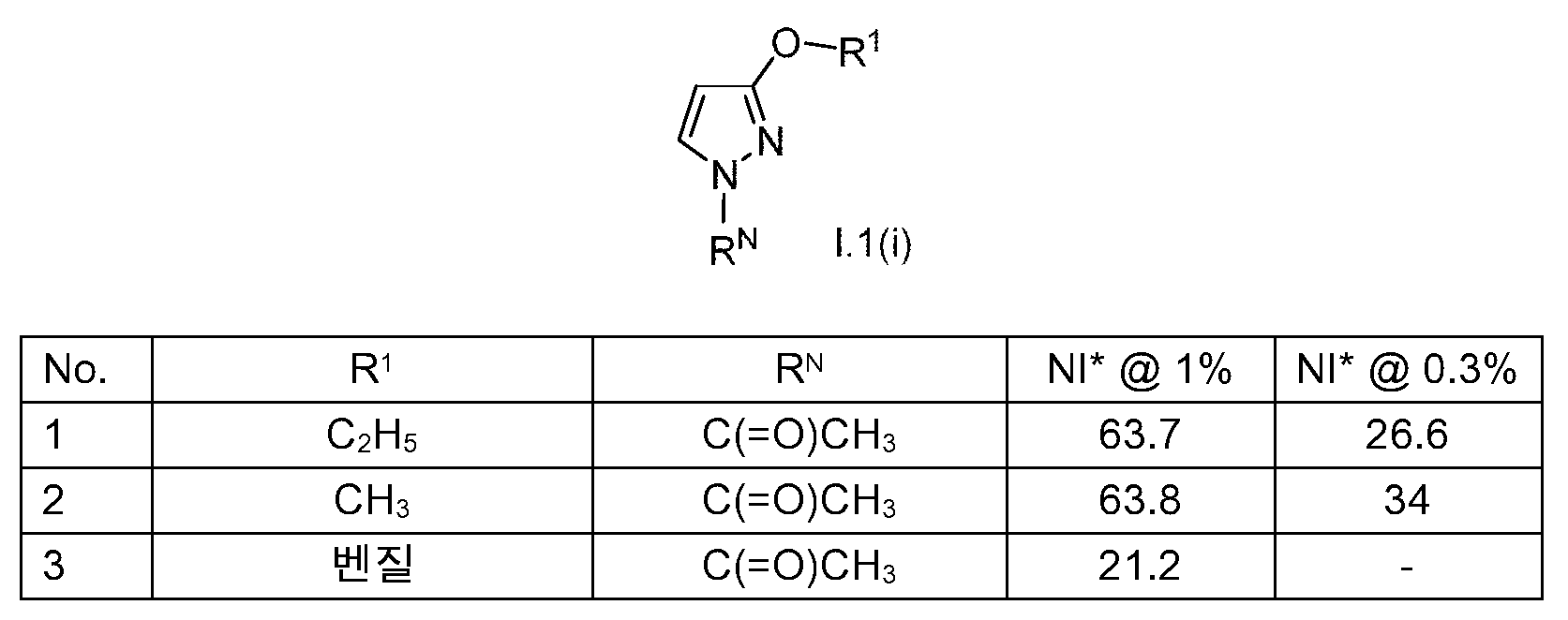
*각각의 경우, 최상의 수득된 NI 값이 제공된다 (값이 > 20 인 화합물만).*In each case, the best obtained NI value is given (only compounds with values > 20).
추가로, 일반식 I.3(i) 의 하기 화합물을 시험하였다.Additionally, the following compounds of general formula I.3(i) were tested.
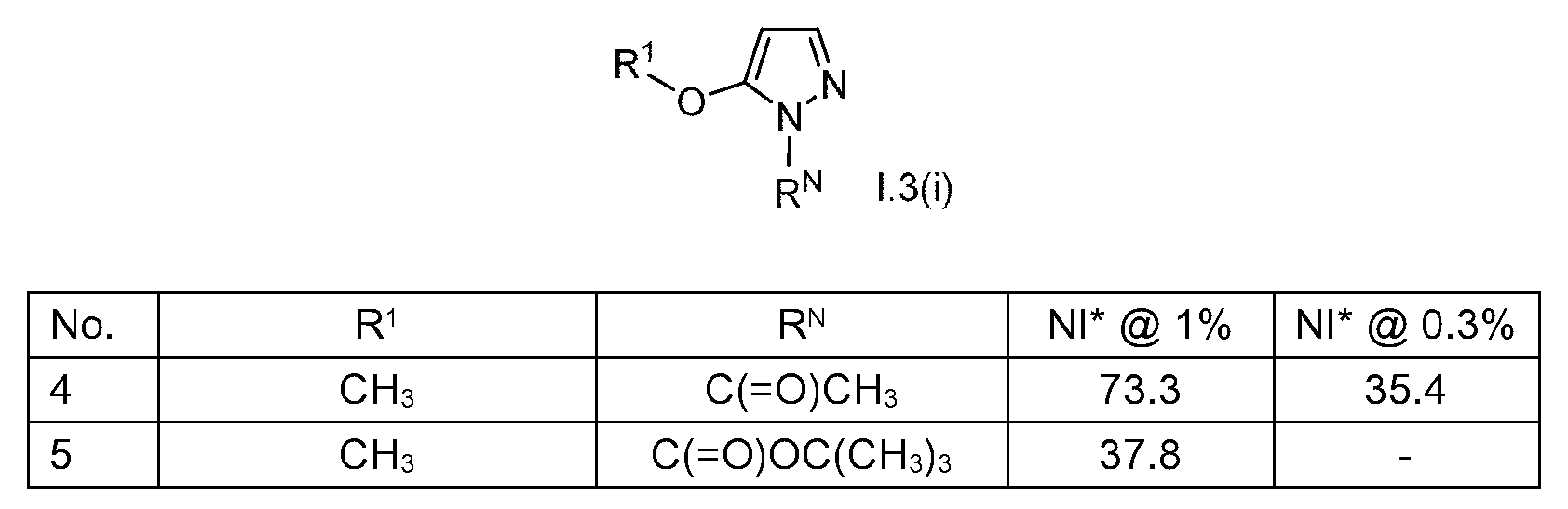
*각각의 경우, 최상의 수득된 NI 값이 제공된다 (값이 > 20 인 화합물만).*In each case, the best obtained NI value is given (only compounds with values > 20).
추가로, 일반식 I.3(ii) 의 하기 화합물을 시험하였다.Additionally, the following compounds of general formula I.3(ii) were tested.
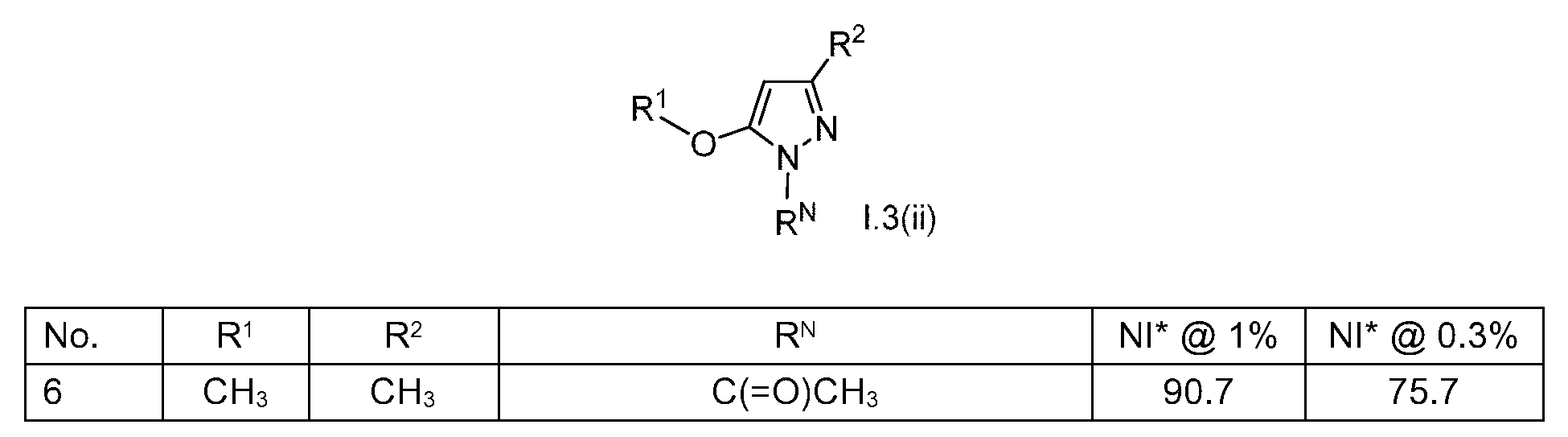
*각각의 경우, 최상의 수득된 NI 값이 제공된다 (값이 > 20 인 화합물만).*In each case, the best obtained NI value is given (only compounds with values > 20).
Claims (16)

[식 중,
R1 은 C1-C6-알킬, 벤질, 또는 알릴이고;
R2 는 할로겐, C1-C6-알킬, C3-C6-시클로알킬, 벤질, 알릴, 또는 페닐이고, 여기서 상기 페닐 기는 미치환되거나 하나 이상의, 동일하거나 상이한 치환기 Rx 로 치환되고;
RN 은 CH(C(=O)ORb)CH2(C(=O)ORb), C(=O)Rd, 또는 CHRaORb 이고;
Ra 는 H, C1-C4-알킬, C1-C4-할로알킬, C3-C8-시클로알킬, 페닐, 또는 페닐-C1-C2-알킬이고;
Rb 는 H, C1-C4-알킬, C1-C4-할로알킬, C3-C8-시클로알킬, 페닐, 또는 페닐-C1-C2-알킬이고;
Rd 는 H, C1-C8-알킬, C2-C8-알케닐, C2-C8-알키닐, 페닐, 또는 페닐-C1-C2-알킬이고, 여기서 이러한 기는 미치환되거나 기 COOH 로 치환되고;
Rx 는 할로겐, C1-C4-알킬, C1-C4-할로알킬, C1-C4-알콕시, 또는 C1-C4-할로알콕시이고;
n 은 0, 1, 또는 2 임].An N-functionalized alkoxy pyrazole compound of formula I or a salt, stereoisomer, tautomer or N-oxide thereof for use as a nitrification inhibitor:
[During the meal,
R 1 is C 1 -C 6 -alkyl, benzyl, or allyl;
R 2 is halogen, C 1 -C 6 -alkyl, C 3 -C 6 -cycloalkyl, benzyl, allyl, or phenyl, wherein the phenyl group is unsubstituted or substituted with one or more, identical or different, substituents R x ;
R N is CH(C(=O)OR b )CH 2 (C(=O)OR b ), C(=O)R d , or CHR a OR b ;
R a is H, C 1 -C 4 -alkyl, C 1 -C 4 -haloalkyl, C 3 -C 8 -cycloalkyl, phenyl, or phenyl-C 1 -C 2 -alkyl;
R b is H, C 1 -C 4 -alkyl, C 1 -C 4 -haloalkyl, C 3 -C 8 -cycloalkyl, phenyl, or phenyl-C 1 -C 2 -alkyl;
R d is H, C 1 -C 8 -alkyl, C 2 -C 8 -alkenyl, C 2 -C 8 -alkynyl, phenyl, or phenyl-C 1 -C 2 -alkyl, wherein such group is unsubstituted or substituted by the group COOH;
R x is halogen, C 1 -C 4 -alkyl, C 1 -C 4 -haloalkyl, C 1 -C 4 -alkoxy, or C 1 -C 4 -haloalkoxy;
n is 0, 1, or 2].
n 이 0 이고, 즉 R2 가 부재이거나;
n 이 1 이고, R2 가 C1-C3-알킬 또는 페닐인, 화합물.In paragraph 1,
n is 0, i.e. R 2 is absent;
A compound wherein n is 1 and R 2 is C 1 -C 3 -alkyl or phenyl.
Ra 가 H 이고;
Rb 가 H 또는 C1-C4-알킬이고;
Rd 가 C1-C3-알킬인, 화합물.In paragraph 1,
R a is H;
R b is H or C 1 -C 4 -alkyl;
A compound wherein R d is C 1 -C 3 -alkyl.
Applications Claiming Priority (3)
| Application Number | Priority Date | Filing Date | Title |
|---|---|---|---|
| EP18159321 | 2018-02-28 | ||
| EP18159321.1 | 2018-02-28 | ||
| PCT/EP2019/055006 WO2019166560A1 (en) | 2018-02-28 | 2019-02-28 | Use of n-functionalized alkoxy pyrazole compounds as nitrification inhibitors |
Publications (2)
| Publication Number | Publication Date |
|---|---|
| KR20200128405A KR20200128405A (en) | 2020-11-12 |
| KR102730587B1 true KR102730587B1 (en) | 2024-11-14 |
Family
ID=61526675
Family Applications (1)
| Application Number | Title | Priority Date | Filing Date |
|---|---|---|---|
| KR1020207026931A Active KR102730587B1 (en) | 2018-02-28 | 2019-02-28 | Use of N-functionalized alkoxy pyrazole compounds as nitrification inhibitors |
Country Status (15)
| Country | Link |
|---|---|
| US (3) | US11578012B2 (en) |
| EP (1) | EP3759097B1 (en) |
| JP (1) | JP7444780B2 (en) |
| KR (1) | KR102730587B1 (en) |
| CN (1) | CN111683938B (en) |
| AU (1) | AU2019226359B2 (en) |
| CA (1) | CA3093781A1 (en) |
| CL (1) | CL2020002216A1 (en) |
| IL (2) | IL276745B2 (en) |
| MX (1) | MX2020009023A (en) |
| MY (1) | MY208965A (en) |
| PE (1) | PE20211754A1 (en) |
| UA (1) | UA128309C2 (en) |
| WO (1) | WO2019166560A1 (en) |
| ZA (1) | ZA202005888B (en) |
Families Citing this family (4)
| Publication number | Priority date | Publication date | Assignee | Title |
|---|---|---|---|---|
| KR102730587B1 (en) * | 2018-02-28 | 2024-11-14 | 바스프 에스이 | Use of N-functionalized alkoxy pyrazole compounds as nitrification inhibitors |
| CN111517864A (en) * | 2020-05-26 | 2020-08-11 | 江西三品生物科技有限公司 | Special biological organic fertilizer for preventing and treating nematodes and preparation method thereof |
| US20240270658A1 (en) * | 2021-05-21 | 2024-08-15 | Basf Se | Use of an N-Functionalized Alkoxy Pyrazole Compound as Nitrification Inhibitor |
| CA3262357A1 (en) * | 2022-07-21 | 2024-01-25 | Corteva Agriscience Llc | Nitrification inhibiting heterocycles |
Citations (2)
| Publication number | Priority date | Publication date | Assignee | Title |
|---|---|---|---|---|
| WO2016124769A1 (en) * | 2015-02-06 | 2016-08-11 | Basf Se | Pyrazole compounds as nitrification inhibitors |
| JP2018504350A (en) * | 2014-12-18 | 2018-02-15 | ビーエーエスエフ ソシエタス・ヨーロピアBasf Se | Alkynylpyrazoles as nitrification inhibitors |
Family Cites Families (203)
| Publication number | Priority date | Publication date | Assignee | Title |
|---|---|---|---|---|
| US3060084A (en) | 1961-06-09 | 1962-10-23 | Du Pont | Improved homogeneous, readily dispersed, pesticidal concentrate |
| CH419721A (en) * | 1963-03-22 | 1966-08-31 | Geigy Ag J R | Pesticides and methods of making such an agent |
| US3415933A (en) * | 1963-03-22 | 1968-12-10 | Whitten & Co H A | Insecticidal method and compositions comprising heterocyclic carbamic acid esters |
| US3299566A (en) | 1964-06-01 | 1967-01-24 | Olin Mathieson | Water soluble film containing agricultural chemicals |
| US3325503A (en) | 1965-02-18 | 1967-06-13 | Diamond Alkali Co | Polychloro derivatives of mono- and dicyano pyridines and a method for their preparation |
| US3296272A (en) | 1965-04-01 | 1967-01-03 | Dow Chemical Co | Sulfinyl- and sulfonylpyridines |
| US3635690A (en) * | 1968-05-16 | 1972-01-18 | Dow Chemical Co | Soil treating method and composition for conserving nitrogen in soil by addition of a pyrazole thereto |
| US4144050A (en) | 1969-02-05 | 1979-03-13 | Hoechst Aktiengesellschaft | Micro granules for pesticides and process for their manufacture |
| US3920442A (en) | 1972-09-18 | 1975-11-18 | Du Pont | Water-dispersible pesticide aggregates |
| US4008200A (en) * | 1974-07-02 | 1977-02-15 | Sandoz Ltd. | Method of stabilizing organic materials employing pyrazole compounds and stabilized compositions thereof |
| DD133034A5 (en) * | 1976-10-02 | 1978-11-29 | Bayer Ag | INSECTICIDES MEDIUM |
| US4172714A (en) | 1976-12-20 | 1979-10-30 | E. I. Du Pont De Nemours And Company | Dry compactible, swellable herbicidal compositions and pellets produced therefrom |
| DE2912494A1 (en) * | 1979-03-29 | 1980-10-09 | Bayer Ag | N, N-DIMETHYL-0-PYRAZOLYL-CARBAMINIC ACID ESTER, METHOD FOR THE PRODUCTION THEREOF AND THEIR USE AS A PEST CONTROL |
| GB2095558B (en) | 1981-03-30 | 1984-10-24 | Avon Packers Ltd | Formulation of agricultural chemicals |
| DD222471A3 (en) * | 1982-09-06 | 1985-05-15 | Piesteritz Stickstoff | ACTIVE COMBINATION FOR INHIBITION BZW. REGULATION OF NITRIFICATION OF AMMONIUM NITROGEN IN CULTURED BODIES |
| DE3338292A1 (en) | 1983-10-21 | 1985-05-02 | Basf Ag, 6700 Ludwigshafen | 7-AMINO-AZOLO (1,5-A) -PYRIMIDINE AND FUNGICIDES CONTAINING THEM |
| CA1249832A (en) | 1984-02-03 | 1989-02-07 | Shionogi & Co., Ltd. | Azolyl cycloalkanol derivatives and agricultural fungicides |
| DE3409317A1 (en) * | 1984-03-14 | 1985-09-19 | Basf Ag, 6700 Ludwigshafen | NITRIFICATION-INHIBITING 1-HYDROXIPYRAZOLE DERIVATIVES |
| BR8600161A (en) | 1985-01-18 | 1986-09-23 | Plant Genetic Systems Nv | CHEMICAL GENE, HYBRID, INTERMEDIATE PLASMIDIO VECTORS, PROCESS TO CONTROL INSECTS IN AGRICULTURE OR HORTICULTURE, INSECTICIDE COMPOSITION, PROCESS TO TRANSFORM PLANT CELLS TO EXPRESS A PLANTINIDE TOXIN, PRODUCED BY CULTURES, UNITED BY BACILLA |
| DE3545319A1 (en) | 1985-12-20 | 1987-06-25 | Basf Ag | ACRYLIC ACID ESTERS AND FUNGICIDES THAT CONTAIN THESE COMPOUNDS |
| CN1015981B (en) | 1986-05-02 | 1992-03-25 | 施托福化学公司 | The preparation method of pyridyl imidate |
| DE256503T1 (en) | 1986-08-12 | 1990-02-08 | Mitsubishi Kasei Corp., Tokio/Tokyo | PYRIDINE CARBOXAMIDE DERIVATIVES AND THEIR USE AS A FUNGICIDAL AGENT. |
| ES2006447B3 (en) | 1987-03-17 | 1992-02-16 | Her Majesty In Right Of Canada As Represented By The Mini Of Agriculture Canada | METHODS AND COMPOSITIONS TO INCREASE THE AMOUNTS OF PHOSPHORUS AND / OR MICRONUTRIENTS USABLE BY PLANTS TAKEN FROM THE SOIL. |
| DE3731239A1 (en) | 1987-09-17 | 1989-03-30 | Basf Ag | METHOD FOR CONTROLLING MUSHROOMS |
| US5180587A (en) | 1988-06-28 | 1993-01-19 | E. I. Du Pont De Nemours And Company | Tablet formulations of pesticides |
| US5340731A (en) | 1988-07-08 | 1994-08-23 | University Of British Columbia | Method of preparing a B-1,4 glycan matrix containing a bound fusion protein |
| EP0374753A3 (en) | 1988-12-19 | 1991-05-29 | American Cyanamid Company | Insecticidal toxines, genes coding therefor, antibodies binding them, transgenic plant cells and plants expressing these toxines |
| ES2199931T3 (en) | 1989-03-24 | 2004-03-01 | Syngenta Participations Ag | TRANSGENIC PLANTS RESISTANT TO DISEASES. |
| ES2153817T3 (en) | 1989-08-03 | 2001-03-16 | Australian Technological Innov | MICONEMATICIDE. |
| ZW13690A1 (en) | 1989-08-30 | 1990-11-21 | Aeci Ltd | Active ingredient dosage device |
| ES2074547T3 (en) | 1989-11-07 | 1995-09-16 | Pioneer Hi Bred Int | LARVICID LECTINES, AND INDUCED RESISTANCE OF PLANTS TO INSECTS. |
| AU628229B2 (en) | 1989-11-10 | 1992-09-10 | Agro-Kanesho Co. Ltd. | Hexahydrotriazine compounds and insecticides |
| SK281286B6 (en) | 1989-11-17 | 2001-02-12 | Novo Nordisk A/S | BACILLUS THURINGIENSIS MICROORGANISM MUTANT DEPONED AS SUBSP. TENEBRIONIS DSM 5480, THE METHOD OF ITS PREPARATION AND THE PESTICIDITY OF THIS CONTAINS |
| AU651335B2 (en) | 1990-03-12 | 1994-07-21 | E.I. Du Pont De Nemours And Company | Water-dispersible or water-soluble pesticide granules from heat-activated binders |
| EP0480679B1 (en) | 1990-10-11 | 1996-09-18 | Sumitomo Chemical Company Limited | Pesticidal composition |
| JP2828186B2 (en) | 1991-09-13 | 1998-11-25 | 宇部興産株式会社 | Acrylate-based compounds, their preparation and fungicides |
| UA48104C2 (en) | 1991-10-04 | 2002-08-15 | Новартіс Аг | Dna fragment including sequence that codes an insecticide protein with optimization for corn, dna fragment providing directed preferable for the stem core expression of the structural gene of the plant related to it, dna fragment providing specific for the pollen expression of related to it structural gene in the plant, recombinant dna molecule, method for obtaining a coding sequence of the insecticide protein optimized for corn, method of corn plants protection at least against one pest insect |
| DE4211808A1 (en) | 1992-04-08 | 1993-10-14 | Wittenberg Stickstoff Ag | Active ingredient combination for inhibiting or regulating nitrification in cultivated soils or substrates |
| ATE505546T1 (en) | 1992-07-01 | 2011-04-15 | Cornell Res Foundation Inc | ELICITOR OF HYPERSENSITIVITY REACTIONS IN PLANTS |
| DE4322211A1 (en) | 1993-07-03 | 1995-01-12 | Basf Ag | Aqueous, multi-phase, stable ready-to-use formulation for crop protection agents and processes for their preparation |
| US5484464A (en) | 1993-12-29 | 1996-01-16 | Philom Bios, Inc.. | Methods and compositions for increasing the benefits of rhizobium inoculation to legume crop productivity |
| US5530195A (en) | 1994-06-10 | 1996-06-25 | Ciba-Geigy Corporation | Bacillus thuringiensis gene encoding a toxin active against insects |
| DE4446194A1 (en) * | 1994-12-23 | 1996-06-27 | Basf Ag | Use of pyrazole derivatives with hydrophobic residues as nitrification inhibitors |
| DE19502065C2 (en) | 1995-01-14 | 1996-05-02 | Prophyta Biolog Pflanzenschutz | Fungus isolate with fungicidal activity |
| DE19503827A1 (en) * | 1995-02-06 | 1996-08-08 | Basf Ag | Use of low volatility pyrazole derivatives with hydrophilic groups as nitrification inhibitors |
| US6406690B1 (en) | 1995-04-17 | 2002-06-18 | Minrav Industries Ltd. | Bacillus firmus CNCM I-1582 or Bacillus cereus CNCM I-1562 for controlling nematodes |
| FR2746035B1 (en) | 1996-03-15 | 1998-06-12 | COMPOSITE GEL MICROPARTICLES LIKELY TO BE USED AS VECTOR (S) OF ACTIVE INGREDIENT (S), ONE OF THEIR PREPARATION METHODS AND THEIR APPLICATIONS | |
| DE19631764A1 (en) * | 1996-08-06 | 1998-02-12 | Basf Ag | Use of poly acids to treat mineral fertilisers - where the fertiliser contains nitrification inhibitor in mineral fertiliser, especially new or known pyrazole compound, to reduce volatility |
| DE19650197A1 (en) | 1996-12-04 | 1998-06-10 | Bayer Ag | 3-thiocarbamoylpyrazole derivatives |
| NL1004759C2 (en) | 1996-12-12 | 1998-06-15 | Plantenkwekerij G N M Grootsch | Method for growing a plant using a cultivation block, cultivation block and apparatus for treating such blocks. |
| TW460476B (en) | 1997-04-14 | 2001-10-21 | American Cyanamid Co | Fungicidal trifluoromethylalkylamino-triazolopyrimidines |
| NZ503594A (en) | 1997-09-18 | 2001-08-31 | Basf Ag | (Phenyl, thienyl or pyrazolyl)-substituted and alkyl-substituted benzamidoxime derivatives, and benzonitrile intermediates, useful as fungicides |
| DE19750012A1 (en) | 1997-11-12 | 1999-05-20 | Bayer Ag | Isothiazole carboxamides |
| AU1621799A (en) | 1997-12-04 | 1999-06-16 | Dow Agrosciences Llc | Fungicidal compositions and methods, and compounds and methods for the preparation thereof |
| AU755538B2 (en) | 1998-11-17 | 2002-12-12 | Ihara Chemical Industry Co. Ltd. | Pyrimidinylbenzimidazole and triazinylbenzimidazole derivatives and agricultural/horticultural fungicides |
| IT1303800B1 (en) | 1998-11-30 | 2001-02-23 | Isagro Ricerca Srl | DIPEPTID COMPOUNDS HAVING HIGH FUNGICIDE AND AGRICULTURAL USE. |
| JP3417862B2 (en) | 1999-02-02 | 2003-06-16 | 新東工業株式会社 | Silica gel highly loaded with titanium oxide photocatalyst and method for producing the same |
| AU770077B2 (en) | 1999-03-11 | 2004-02-12 | Dow Agrosciences Llc | Heterocyclic substituted isoxazolidines and their use as fungicides |
| US6586617B1 (en) | 1999-04-28 | 2003-07-01 | Sumitomo Chemical Takeda Agro Company, Limited | Sulfonamide derivatives |
| UA73307C2 (en) | 1999-08-05 | 2005-07-15 | Куміаі Кемікал Індастрі Ко., Лтд. | Carbamate derivative and fungicide of agricultural/horticultural destination |
| NL1012918C2 (en) | 1999-08-26 | 2001-02-27 | Incotec Internat B V | Method for protecting seed to be germinated and pesticide-containing pill. |
| US20060150489A1 (en) | 1999-08-26 | 2006-07-13 | Legro Robert J | Protection of germinating seed and pills containing pesticides |
| DE10021412A1 (en) | 1999-12-13 | 2001-06-21 | Bayer Ag | Fungicidal active ingredient combinations |
| DK1250047T3 (en) | 2000-01-25 | 2005-05-30 | Syngenta Participations Ag | Herbicide agent |
| US6376548B1 (en) | 2000-01-28 | 2002-04-23 | Rohm And Haas Company | Enhanced propertied pesticides |
| IL167957A (en) | 2000-02-04 | 2009-07-20 | Sumitomo Chemical Co | Hydroxypyridine compound |
| CN1114590C (en) | 2000-02-24 | 2003-07-16 | 沈阳化工研究院 | Unsaturated oximino ether bactericide |
| CN100353846C (en) | 2000-08-25 | 2007-12-12 | 辛根塔参与股份公司 | New insecticidal toxins from Bacillus thuringiensis insecticidal crystal proteins |
| MXPA03002338A (en) | 2000-09-18 | 2003-09-10 | Du Pont | Pyridinyl amides and imides for use as fungicides. |
| NZ525744A (en) | 2000-11-17 | 2004-10-29 | Dow Agrosciences Llc | Compounds having fungicidal activity and processes to make and use same |
| AU2002255715B2 (en) | 2001-03-14 | 2008-05-01 | State Of Israel- Ministry Of Agriculture Agricultural Research Organisation | A novel antagonistic yeast useful in controlling spoilage of agricultural produce, methods of use thereof and compositions containing same |
| JP5034142B2 (en) | 2001-04-20 | 2012-09-26 | 住友化学株式会社 | Plant disease control composition |
| DE10136065A1 (en) | 2001-07-25 | 2003-02-13 | Bayer Cropscience Ag | pyrazolylcarboxanilides |
| AR037228A1 (en) | 2001-07-30 | 2004-11-03 | Dow Agrosciences Llc | ACID COMPOUNDS 6- (ARIL OR HETEROARIL) -4-AMYNOPYCOLINIC, HERBICIDE COMPOSITION THAT UNDERSTANDS AND METHOD TO CONTROL UNWANTED VEGETATION |
| FR2828196A1 (en) | 2001-08-03 | 2003-02-07 | Aventis Cropscience Sa | New iodochromone derivatives, useful for the prevention or cure of plant fungal disorders, especially in cereals, vines, fruits, legumes or ornamental plants |
| JPWO2003016286A1 (en) | 2001-08-17 | 2004-12-02 | 三共アグロ株式会社 | 3-phenoxy-4-pyridazinol derivative and herbicidal composition containing the same |
| BR0212034A (en) | 2001-08-20 | 2004-08-03 | Dainippon Ink & Chemicals | Tetrazoyloxime derivative and agricultural chemical containing same as active ingredient |
| US7230167B2 (en) | 2001-08-31 | 2007-06-12 | Syngenta Participations Ag | Modified Cry3A toxins and nucleic acid sequences coding therefor |
| US20070280981A1 (en) | 2006-06-02 | 2007-12-06 | The Andersons, Inc. | Adherent biologically active ingredient carrier granule |
| WO2003031477A1 (en) | 2001-10-03 | 2003-04-17 | Unilever N.V. | Carbohydrate binding domain containing fusion proteins for delivery of therapeutic and other agents, and compositions containing them |
| WO2003052073A2 (en) | 2001-12-17 | 2003-06-26 | Syngenta Participations Ag | Novel corn event |
| WO2003053145A1 (en) | 2001-12-21 | 2003-07-03 | Nissan Chemical Industries, Ltd. | Bactericidal composition |
| TWI327462B (en) | 2002-01-18 | 2010-07-21 | Sumitomo Chemical Co | Condensed heterocyclic sulfonyl urea compound, a herbicide containing the same, and a method for weed control using the same |
| DE10204390A1 (en) | 2002-02-04 | 2003-08-14 | Bayer Cropscience Ag | Disubstituted thiazolylcarboxanilides |
| HK1079785B (en) | 2002-03-05 | 2007-08-10 | 辛根塔参与股份公司 | O-cyclopropyl-carboxanilides and their use as fungicides |
| GB0227966D0 (en) | 2002-11-29 | 2003-01-08 | Syngenta Participations Ag | Organic Compounds |
| WO2004083193A1 (en) | 2003-03-17 | 2004-09-30 | Sumitomo Chemical Company, Limited | Amide compound and bactericide composition containing the same |
| CN1201657C (en) | 2003-03-25 | 2005-05-18 | 浙江省化工研究院 | Methoxy methyl acrylate compounds as bactericidal agent |
| TWI355894B (en) | 2003-12-19 | 2012-01-11 | Du Pont | Herbicidal pyrimidines |
| SI1717237T1 (en) | 2004-02-18 | 2011-03-31 | Ishihara Sangyo Kaisha | Anthranilamides, process for the production thereof, and pest controllers containing the same |
| HRP20100538T1 (en) | 2004-03-10 | 2010-12-31 | Basf Se | 5,6-dialkyl-7-amino-triazolopyrimidines, method for their production, their use for controlling pathogenic fungi and agents containing said compounds |
| JP2007527886A (en) | 2004-03-10 | 2007-10-04 | ビーエーエスエフ アクチェンゲゼルシャフト | 5,6-Dialkyl-7-aminotriazolopyrimidines, their preparation, and their use for controlling harmful fungi, and compositions containing these compounds |
| GB2413495A (en) | 2004-04-27 | 2005-11-02 | Micap Plc | Phytoactive composition |
| WO2005120234A2 (en) | 2004-06-03 | 2005-12-22 | E.I. Dupont De Nemours And Company | Fungicidal mixtures of amidinylphenyl compounds |
| GB0412974D0 (en) | 2004-06-10 | 2004-07-14 | Syngenta Participations Ag | Method of applying active ingredients |
| CA2471555C (en) | 2004-06-18 | 2011-05-17 | Thomas D. Johnson | Controlling plant pathogens with fungal/bacterial antagonist combinations comprising trichoderma virens and bacillus amyloliquefaciens |
| EP1761498A1 (en) | 2004-06-18 | 2007-03-14 | Basf Aktiengesellschaft | 1-methyl-3-difluoromethyl-pyrazol-4-carbonic acid-(ortho-phenyl)-anilides, and use thereof as a fungicide |
| ATE458722T1 (en) | 2004-06-18 | 2010-03-15 | Basf Se | 1-METHYL-3-TRIFLUORMETHYL-PYRAZOLE-4-CARBONIC ACID (ORTHO-PHENYL) ANILIDES AND THEIR USE AS A FUNGICIDE |
| GB0418048D0 (en) | 2004-08-12 | 2004-09-15 | Syngenta Participations Ag | Method for protecting useful plants or plant propagation material |
| CA2581725C (en) | 2004-10-20 | 2013-01-08 | Kumiai Chemical Industry Co., Ltd. | 3-triazolylphenyl sulfide derivative, and insecticide, miticide and nematicide containing it as an active ingredient |
| WO2006087325A1 (en) | 2005-02-16 | 2006-08-24 | Basf Aktiengesellschaft | 5-alkoxyalkyl-6-alkyl-7-amino-azolopyrimidines, method for their production, their use for controlling pathogenic fungi and agents containing said substances |
| DE102005007160A1 (en) | 2005-02-16 | 2006-08-24 | Basf Ag | Pyrazolecarboxylic acid anilides, process for their preparation and compositions containing them for controlling harmful fungi |
| DE102005008021A1 (en) | 2005-02-22 | 2006-08-24 | Bayer Cropscience Ag | New spiroketal-substituted cyclic ketoenol compounds used for combating animal parasites, undesired plant growth and/or undesired microorganisms |
| DE102005009458A1 (en) | 2005-03-02 | 2006-09-07 | Bayer Cropscience Ag | pyrazolylcarboxanilides |
| NL1028815C2 (en) | 2005-04-19 | 2006-10-20 | Grow Beheer B V | Planting plant material. |
| ATE520681T1 (en) | 2005-07-07 | 2011-09-15 | Basf Se | N-THIOANTHRANILAMIDE COMPOUNDS AND THEIR USE AS PESTICIDES |
| CN1907024A (en) | 2005-08-03 | 2007-02-07 | 浙江化工科技集团有限公司 | Methoxyl group displacement methyl acrylate compound bactericidal agent |
| DK1937664T3 (en) | 2005-10-14 | 2011-07-18 | Sumitomo Chemical Co | Hydrazide compound and pesticide use of the same |
| EP1795071A1 (en) | 2005-12-07 | 2007-06-13 | Incotec International B.V. | Modified active-ingredient-containing pellets/capsules |
| PL1973881T3 (en) | 2006-01-13 | 2010-04-30 | Dow Agrosciences Llc | 6-(poly-substituted aryl)-4-aminopicolinates and their use as herbicides |
| EP1983832A2 (en) | 2006-02-09 | 2008-10-29 | Syngeta Participations AG | A method of protecting a plant propagation material, a plant, and/or plant organs |
| EP1820788A1 (en) | 2006-02-16 | 2007-08-22 | BASF Aktiengesellschaft | Preparations with improved urease-inhibiting properties and those preparations containing urea based fertilizers. |
| DE102006015197A1 (en) | 2006-03-06 | 2007-09-13 | Bayer Cropscience Ag | Active ingredient combination with insecticidal properties |
| WO2007101369A1 (en) | 2006-03-09 | 2007-09-13 | East China University Of Science And Technology | Preparation method and use of compounds having high biocidal activities |
| CN101437806B (en) | 2006-05-08 | 2011-01-19 | 组合化学工业株式会社 | 1,2-Benzisothiazole derivatives and agricultural or horticultural plant disease control agent |
| WO2008013622A2 (en) | 2006-07-27 | 2008-01-31 | E. I. Du Pont De Nemours And Company | Fungicidal azocyclic amides |
| CN101134697A (en) * | 2006-09-01 | 2008-03-05 | 中国科学院沈阳应用生态研究所 | A kind of nitrification inhibitor and its application in stable fertilizer |
| DE102006057036A1 (en) | 2006-12-04 | 2008-06-05 | Bayer Cropscience Ag | New biphenyl substituted spirocyclic ketoenol derivatives useful for the manufacture of herbicides and for combating parasites |
| WO2008134969A1 (en) | 2007-04-30 | 2008-11-13 | Sinochem Corporation | Benzamide compounds and applications thereof |
| EP3262940A1 (en) | 2008-01-15 | 2018-01-03 | Bayer Intellectual Property GmbH | Pesticide composition comprising a tetrazolyloxime derivative and an insecticide active substance |
| HUE026195T2 (en) | 2008-01-22 | 2016-05-30 | Dow Agrosciences Llc | 4-amino-5-fluoro-pyrimidine derivatives as fungicides |
| MX2010008880A (en) | 2008-02-12 | 2010-09-24 | Dow Agrosciences Llc | Pesticidal compositions. |
| WO2009124707A2 (en) | 2008-04-07 | 2009-10-15 | Bayer Cropscience Ag | Combinations of biological control agents and insecticides or fungicides |
| CA2720739C (en) | 2008-04-07 | 2020-04-21 | Bayer Cropscience Lp | Stable aqueous bacillus firmus-containing spore formulations |
| WO2009153589A1 (en) | 2008-06-17 | 2009-12-23 | Astrazeneca Ab | Pyridine compounds |
| CN101333213B (en) | 2008-07-07 | 2011-04-13 | 中国中化股份有限公司 | 1-substituted pyridyl-pyrazol acid amide compounds and use thereof |
| EP2309857B1 (en) | 2008-07-17 | 2013-07-03 | Bayer CropScience AG | Heterocyclic compounds used as pesticides |
| EP2151433A1 (en) | 2008-08-05 | 2010-02-10 | Institut Pasteur | Alkoxypyrazoles and the process for their preparation |
| SI3081552T1 (en) | 2008-08-13 | 2021-07-30 | Mitsui Chemicals Agro, Inc. | Pest control agent containing an amide derivative and use of the pest control agent |
| UA103633C2 (en) | 2008-09-24 | 2013-11-11 | Басф Се | Pyrazole compounds for controlling invertebrate pests |
| CN101715774A (en) | 2008-10-09 | 2010-06-02 | 浙江化工科技集团有限公司 | Preparation and use of compound having insecticidal activity |
| CN101747276B (en) | 2008-11-28 | 2011-09-07 | 中国中化股份有限公司 | Ether compound with nitrogenous quinary alloy and application thereof |
| GB0823002D0 (en) | 2008-12-17 | 2009-01-28 | Syngenta Participations Ag | Isoxazoles derivatives with plant growth regulating properties |
| CN101747320B (en) | 2008-12-19 | 2013-10-16 | 华东理工大学 | Dialdehyde-constructed nitrogen- or oxygen-containing heterocyclic compound with insecticidal activity and preparation method thereof |
| US8551919B2 (en) | 2009-04-13 | 2013-10-08 | University Of Delaware | Methods for promoting plant health |
| US8431514B2 (en) | 2009-05-06 | 2013-04-30 | Syngenta Crop Protection Llc | 4-cyano-3-benzoylamino-N-phenyl-benzamides for use in pest control |
| CN101906075B (en) | 2009-06-05 | 2012-11-07 | 中国中化股份有限公司 | E-type phenyl acrylic acid ester compound containing substituted anilino pyrimidine group and applications thereof |
| MX2012002579A (en) | 2009-09-01 | 2012-07-23 | Dow Agrosciences Llc | Synergistic fungicidal compositions containing a 5-fluoropyrimidine derivative for fungal control in cereals. |
| MX2012004020A (en) | 2009-10-20 | 2012-05-08 | Cellzome Ltd | Heterocyclyl pyrazolopyrimidine analogues as jak inhibitors. |
| CN102093389B (en) | 2009-12-09 | 2014-11-19 | 华东理工大学 | Bilinked and oxygen-bridged heterocyclic neonicotinoid compound and its preparation method |
| PH12012501288A1 (en) | 2009-12-22 | 2013-01-07 | Mitsui Chemicals Crop & Life Solutions Inc | Plant disease control composition and method for controlling plant diseases by applying the same |
| AP3294A (en) | 2010-01-04 | 2015-05-31 | Nippon Soda Co | Nitrogen-containing heterocyclic compound and agricultural fungicide |
| WO2011085575A1 (en) | 2010-01-15 | 2011-07-21 | 江苏省农药研究所股份有限公司 | Ortho-heterocyclyl formanilide compounds, their synthesis methods and use |
| CN102126994B (en) | 2010-01-19 | 2014-07-09 | 中化蓝天集团有限公司 | Benzophenone hydrazone derivative and preparation method and application thereof |
| AR081721A1 (en) | 2010-02-25 | 2012-10-17 | Nippon Soda Co | CYCLING AND ACARICIDE AMINA COMPOUND |
| RU2610683C2 (en) | 2010-03-01 | 2017-02-14 | Юниверсити Оф Делавэр | Compositions and methods for increasing biomass, concentration of iron and plant resistance to pathogens |
| CN102858172A (en) | 2010-04-28 | 2013-01-02 | 住友化学株式会社 | Plant disease control composition and its use |
| RU2013103422A (en) | 2010-06-28 | 2014-08-10 | Байер Интеллектчуал Проперти Гмбх | Heteroaryl-Substituted Pyridine Compounds for Use as Pesticides |
| WO2012029672A1 (en) | 2010-08-31 | 2012-03-08 | Meiji Seikaファルマ株式会社 | Noxious organism control agent |
| CN101935291B (en) | 2010-09-13 | 2013-05-01 | 中化蓝天集团有限公司 | Cyano phthalic diamide compounds, preparation method thereof and use thereof as agricultural chemical pesticide |
| CN101967139B (en) | 2010-09-14 | 2013-06-05 | 中化蓝天集团有限公司 | Fluoro methoxylpyrazole-containing o-formylaminobenzamide compound, synthesis method and application thereof |
| WO2012063824A1 (en) | 2010-11-10 | 2012-05-18 | クミアイ化学工業株式会社 | Biological agrochemical composition |
| EP2648521B1 (en) | 2010-12-10 | 2020-02-05 | Auburn University | Inoculants including bacillus bacteria for inducing production of volatile organic compounds in plants |
| IT1403275B1 (en) | 2010-12-20 | 2013-10-17 | Isagro Ricerca Srl | HIGH-ACTIVITY INDANYLANILIDES FUNGICIDE AND THEIR PHYTOSANITARY COMPOSITIONS |
| WO2012084670A1 (en) | 2010-12-20 | 2012-06-28 | Basf Se | Pesticidal active mixtures comprising pyrazole compounds |
| AU2012230503B2 (en) | 2011-03-18 | 2016-07-07 | Bayer Intellectual Property Gmbh | N-(3-carbamoylphenyl)-1H-pyrazole-5-carboxamide derivatives and the use thereof for controlling animal pests |
| AU2012244846B2 (en) | 2011-04-21 | 2016-07-07 | Basf Se | Novel pesticidal pyrazole compounds |
| TWI583308B (en) | 2011-05-31 | 2017-05-21 | 組合化學工業股份有限公司 | Method for controlling rice disease |
| EP2532233A1 (en) | 2011-06-07 | 2012-12-12 | Bayer CropScience AG | Active compound combinations |
| WO2013003977A1 (en) | 2011-07-01 | 2013-01-10 | 合肥星宇化学有限责任公司 | Compound of 2,5-disubstituted-3-nitroimino-1,2,4-triazoline and preparation method and use as pesticide thereof |
| EA026736B1 (en) | 2011-07-13 | 2017-05-31 | Басф Агро Б.В. | Fungicidal substituted 2-[2-halogenalkyl-4-(phenoxy)phenyl]-1-[1,2,4]triazol-1-yl-ethanol compounds |
| EP2731438B1 (en) | 2011-07-15 | 2015-04-08 | Basf Se | Fungicidal alkyl-substituted 2-[2-chloro-4-(4-chloro-phenoxy)-phenyl]-1-[1,2,4]triazol-1-yl-ethanol compounds |
| IN2014CN00979A (en) | 2011-08-12 | 2015-04-10 | Basf Se | |
| IN2014CN01025A (en) | 2011-08-12 | 2015-04-10 | Basf Se | |
| AU2012301466B2 (en) | 2011-08-27 | 2015-07-23 | Marrone Bio Innovations, Inc. | Isolated bacterial strain of the genus Burkholderia and pesticidal metabolites therefrom-formulations and uses |
| WO2013047441A1 (en) | 2011-09-26 | 2013-04-04 | 日本曹達株式会社 | Agricultural and horticultural bactericide composition |
| HUE032086T2 (en) | 2011-09-29 | 2017-09-28 | Mitsui Chemicals Agro Inc | SAIB (Sucrose Acetate-Isobutyrate) Long-lasting Local Anesthetic Composition |
| WO2013050302A1 (en) | 2011-10-03 | 2013-04-11 | Syngenta Participations Ag | Isoxazoline derivatives as insecticidal compounds |
| WO2013050317A1 (en) | 2011-10-03 | 2013-04-11 | Syngenta Limited | Polymorphs of an isoxazoline derivative |
| TWI577286B (en) | 2011-10-13 | 2017-04-11 | 杜邦股份有限公司 | Solid forms of nematocidal sulfonamides |
| DE102011120098B4 (en) | 2011-12-02 | 2021-02-11 | Skw Stickstoffwerke Piesteritz Gmbh | N- (1H-pyrazolyl-methyl) formamides, process for their preparation and their use as nitrification inhibitors |
| WO2013092224A1 (en) | 2011-12-21 | 2013-06-27 | Basf Se | Use of strobilurin type compounds for combating phytopathogenic fungi resistant to qo inhibitors |
| TWI568721B (en) | 2012-02-01 | 2017-02-01 | 杜邦股份有限公司 | Fungicide pyrazole mixture |
| US8916183B2 (en) | 2012-02-02 | 2014-12-23 | Dow Agrosciences, Llc. | Pesticidal compositions and processes related thereto |
| UA113198C2 (en) | 2012-02-27 | 2016-12-26 | COMBINATIONS OF ACTIVE COMPOUNDS | |
| JP6107377B2 (en) | 2012-04-27 | 2017-04-05 | 住友化学株式会社 | Tetrazolinone compounds and uses thereof |
| US9282739B2 (en) | 2012-04-27 | 2016-03-15 | Dow Agrosciences Llc | Pesticidal compositions and processes related thereto |
| CN103387541B (en) | 2012-05-10 | 2016-02-10 | 中国中化股份有限公司 | A kind of preparation method of substituted pyrazolecarboxylic ether compound |
| BR112015003688B1 (en) | 2012-08-22 | 2020-09-24 | Basf Se | MIXTURE, AGRICULTURAL COMPOSITION, SEED, USE OF THE MIXTURE AND METHOD FOR THE CONTROL OF PHYTOPATHOGEN HARMFUL FUNGI |
| RS57284B1 (en) | 2012-08-31 | 2018-08-31 | Zoetis Services Llc | Crystalline forms of 1-(5'-(5-(3,5-dichloro-4-fluorophenyl)-5-(trifluoromethyl)-4,5-dihydroisoxazol-3-yl)-3'h-spiro[azetidine-3,1'-isobenzofuran]-1-yl)-2-(methylsulfonyl)ethanone |
| WO2014060177A1 (en) | 2012-10-16 | 2014-04-24 | Syngenta Participations Ag | Fungicidal compositions |
| WO2014090918A1 (en) | 2012-12-13 | 2014-06-19 | Novartis Ag | Process for the enantiomeric enrichment of diaryloxazoline derivatives |
| AU2014214623A1 (en) | 2013-02-11 | 2015-08-13 | Bayer Cropscience Lp | Compositions comprising gougerotin and a fungicide |
| JPWO2014126208A1 (en) | 2013-02-14 | 2017-02-02 | 日産化学工業株式会社 | Crystalline polymorph of isoxazoline-substituted benzamide compound and process for producing the same |
| BR112015029576B1 (en) | 2013-05-28 | 2020-09-15 | Syngenta Participations Ag | USE OF TETRAMIC ACID DERIVATIVES AS NEMATICIDES AND METHOD FOR REDUCING DAMAGE CAUSED BY NEMATODES TO A PLANT |
| TWI652014B (en) | 2013-09-13 | 2019-03-01 | 美商艾佛艾姆希公司 | Heterocyclic substituted bicycloazole insecticide |
| WO2015055497A1 (en) | 2013-10-16 | 2015-04-23 | Basf Se | Substituted pesticidal pyrazole compounds |
| WO2015059039A1 (en) | 2013-10-24 | 2015-04-30 | Syngenta Participations Ag | Method of protecting a plant propagation material |
| WO2015065922A1 (en) | 2013-10-28 | 2015-05-07 | Dexcom, Inc. | Devices used in connection with continuous analyte monitoring that provide the user with one or more notifications, and related methods |
| CN103814937B (en) | 2014-02-11 | 2015-10-07 | 深圳诺普信农化股份有限公司 | A kind of Pesticidal combination |
| EP2865265A1 (en) | 2014-02-13 | 2015-04-29 | Bayer CropScience AG | Active compound combinations comprising phenylamidine compounds and biological control agents |
| WO2015081349A2 (en) * | 2014-04-17 | 2015-06-04 | Basf Se | Combination of novel nitrification inhibitors and herbicides as well as combination of (thio)phosphoric acid triamides and herbicides |
| US9708341B2 (en) | 2014-06-09 | 2017-07-18 | Sumitomo Chemical Company, Limited | Method for producing pyridine compound |
| CA2956880C (en) | 2014-08-04 | 2023-04-25 | Basf Se | Antifungal paenibacillus strains, fusaricidin-type compounds, and their use |
| WO2016104516A1 (en) | 2014-12-22 | 2016-06-30 | 日本農薬株式会社 | Noxious organism control agent composition for agricultural and horticultural applications, and method for using said composition |
| WO2016174049A1 (en) | 2015-04-30 | 2016-11-03 | Bayer Animal Health Gmbh | Anti-parasitic combinations including halogen-substituted compounds |
| EP2910126A1 (en) | 2015-05-05 | 2015-08-26 | Bayer CropScience AG | Active compound combinations having insecticidal properties |
| CN105367557B (en) | 2015-11-23 | 2018-04-24 | 安徽千和新材料科技发展有限公司 | A kind of preparation method of epoxy quinoline |
| CN105481839B (en) | 2015-11-23 | 2018-05-11 | 安徽千和新材料科技发展有限公司 | A kind of preparation method of photolytic activity epoxy quinoline enantiomer |
| WO2017104592A1 (en) | 2015-12-16 | 2017-06-22 | 住友化学株式会社 | 2-(3-e thanesulfonyl pyridine-2-yl)-5-(trifluoromethanesulfonyl) benzoxazole crystal |
| US20190124917A1 (en) * | 2016-04-21 | 2019-05-02 | Koch Agronomic Services, Llc | Microbial inoculant compositions and uses thereof |
| KR102730587B1 (en) * | 2018-02-28 | 2024-11-14 | 바스프 에스이 | Use of N-functionalized alkoxy pyrazole compounds as nitrification inhibitors |
| PE20211753A1 (en) | 2018-02-28 | 2021-09-06 | Basf Se | USE OF ALCOXYPYRAZOLES AS NITRIFICATION INHIBITORS |
-
2019
- 2019-02-28 KR KR1020207026931A patent/KR102730587B1/en active Active
- 2019-02-28 MX MX2020009023A patent/MX2020009023A/en unknown
- 2019-02-28 MY MYPI2020003898A patent/MY208965A/en unknown
- 2019-02-28 JP JP2020544906A patent/JP7444780B2/en active Active
- 2019-02-28 EP EP19708824.8A patent/EP3759097B1/en active Active
- 2019-02-28 WO PCT/EP2019/055006 patent/WO2019166560A1/en not_active Ceased
- 2019-02-28 PE PE2020001296A patent/PE20211754A1/en unknown
- 2019-02-28 AU AU2019226359A patent/AU2019226359B2/en active Active
- 2019-02-28 CA CA3093781A patent/CA3093781A1/en active Pending
- 2019-02-28 IL IL276745A patent/IL276745B2/en unknown
- 2019-02-28 IL IL302719A patent/IL302719B2/en unknown
- 2019-02-28 UA UAA202005934A patent/UA128309C2/en unknown
- 2019-02-28 CN CN201980012036.2A patent/CN111683938B/en active Active
- 2019-02-28 US US16/969,030 patent/US11578012B2/en active Active
-
2020
- 2020-08-28 CL CL2020002216A patent/CL2020002216A1/en unknown
- 2020-09-23 ZA ZA2020/05888A patent/ZA202005888B/en unknown
-
2023
- 2023-01-18 US US18/156,209 patent/US12060308B2/en active Active
-
2024
- 2024-06-27 US US18/756,040 patent/US20240368051A1/en active Pending
Patent Citations (2)
| Publication number | Priority date | Publication date | Assignee | Title |
|---|---|---|---|---|
| JP2018504350A (en) * | 2014-12-18 | 2018-02-15 | ビーエーエスエフ ソシエタス・ヨーロピアBasf Se | Alkynylpyrazoles as nitrification inhibitors |
| WO2016124769A1 (en) * | 2015-02-06 | 2016-08-11 | Basf Se | Pyrazole compounds as nitrification inhibitors |
Also Published As
| Publication number | Publication date |
|---|---|
| MX2020009023A (en) | 2020-10-12 |
| WO2019166560A1 (en) | 2019-09-06 |
| US20240368051A1 (en) | 2024-11-07 |
| IL276745B2 (en) | 2023-10-01 |
| IL276745A (en) | 2020-10-29 |
| KR20200128405A (en) | 2020-11-12 |
| MY208965A (en) | 2025-06-13 |
| CL2020002216A1 (en) | 2020-11-27 |
| JP2021515751A (en) | 2021-06-24 |
| US12060308B2 (en) | 2024-08-13 |
| IL302719A (en) | 2023-07-01 |
| PE20211754A1 (en) | 2021-09-06 |
| US20230150896A1 (en) | 2023-05-18 |
| EP3759097B1 (en) | 2025-07-09 |
| US20210032176A1 (en) | 2021-02-04 |
| RU2020130972A (en) | 2022-03-28 |
| IL302719B1 (en) | 2025-06-01 |
| EP3759097A1 (en) | 2021-01-06 |
| IL302719B2 (en) | 2025-10-01 |
| AU2019226359A1 (en) | 2020-09-03 |
| JP7444780B2 (en) | 2024-03-06 |
| CN111683938A (en) | 2020-09-18 |
| CA3093781A1 (en) | 2019-09-06 |
| ZA202005888B (en) | 2025-12-17 |
| CN111683938B (en) | 2024-01-23 |
| IL276745B1 (en) | 2023-06-01 |
| UA128309C2 (en) | 2024-06-05 |
| US11578012B2 (en) | 2023-02-14 |
| BR112020016426A2 (en) | 2020-12-15 |
| AU2019226359B2 (en) | 2023-08-17 |
Similar Documents
| Publication | Publication Date | Title |
|---|---|---|
| US12484580B2 (en) | Use of alkoxypyrazoles as nitrification inhibitors | |
| US12151991B2 (en) | Use of a substituted thiazolidine compound as nitrification inhibitor | |
| KR102730587B1 (en) | Use of N-functionalized alkoxy pyrazole compounds as nitrification inhibitors | |
| CN111683528B (en) | Use of pyrazolidinopropyl ethers as nitrification inhibitors | |
| EP3826983A1 (en) | Use of substituted 2-thiazolines as nitrification inhibitors | |
| WO2020002472A1 (en) | Use of alkynylthiophenes as nitrification inhibitors | |
| KR102705587B1 (en) | Silylethynyl hetaryl compounds as nitrification inhibitors | |
| EP4341245A1 (en) | Use of ethynylpyridine compounds as nitrification inhibitors | |
| RU2838138C2 (en) | Use of n-functionalised alkoxypyrazole compounds as nitrification inhibitors | |
| RU2797246C2 (en) | Application of n-functionalized alkoxypyrazole compounds as nitrification inhibitors | |
| RU2794262C2 (en) | Use of alkoxypyrazoles as nitrification | |
| EP4341248A1 (en) | Use of an n-functionalized alkoxy pyrazole compound as nitrification inhibitor | |
| BR112020016426B1 (en) | USE OF AN N-FUNCTIONALIZED ALKOXY PYRAZOLE COMPOUND, NITRIFICATION REDUCING COMPOSITION, USE OF THE COMPOSITION, AGROCHEMICAL MIXTURE, METHOD FOR REDUCING NITRIFICATION AND METHOD FOR TREATING A FERTILIZER |
Legal Events
| Date | Code | Title | Description |
|---|---|---|---|
| PA0105 | International application |
St.27 status event code: A-0-1-A10-A15-nap-PA0105 |
|
| PG1501 | Laying open of application |
St.27 status event code: A-1-1-Q10-Q12-nap-PG1501 |
|
| PA0201 | Request for examination |
St.27 status event code: A-1-2-D10-D11-exm-PA0201 |
|
| R18-X000 | Changes to party contact information recorded |
St.27 status event code: A-3-3-R10-R18-oth-X000 |
|
| E902 | Notification of reason for refusal | ||
| PE0902 | Notice of grounds for rejection |
St.27 status event code: A-1-2-D10-D21-exm-PE0902 |
|
| P11-X000 | Amendment of application requested |
St.27 status event code: A-2-2-P10-P11-nap-X000 |
|
| P13-X000 | Application amended |
St.27 status event code: A-2-2-P10-P13-nap-X000 |
|
| E601 | Decision to refuse application | ||
| PE0601 | Decision on rejection of patent |
St.27 status event code: N-2-6-B10-B15-exm-PE0601 |
|
| P11-X000 | Amendment of application requested |
St.27 status event code: A-2-2-P10-P11-nap-X000 |
|
| P13-X000 | Application amended |
St.27 status event code: A-2-2-P10-P13-nap-X000 |
|
| PX0901 | Re-examination |
St.27 status event code: A-2-3-E10-E12-rex-PX0901 |
|
| PX0701 | Decision of registration after re-examination |
St.27 status event code: A-3-4-F10-F13-rex-PX0701 |
|
| X701 | Decision to grant (after re-examination) | ||
| GRNT | Written decision to grant | ||
| PR0701 | Registration of establishment |
St.27 status event code: A-2-4-F10-F11-exm-PR0701 |
|
| PR1002 | Payment of registration fee |
St.27 status event code: A-2-2-U10-U12-oth-PR1002 Fee payment year number: 1 |
|
| PG1601 | Publication of registration |
St.27 status event code: A-4-4-Q10-Q13-nap-PG1601 |