JP7116217B2 - Bicyclic peptide ligands specific for MT1-MMP - Google Patents
Bicyclic peptide ligands specific for MT1-MMP Download PDFInfo
- Publication number
- JP7116217B2 JP7116217B2 JP2021079208A JP2021079208A JP7116217B2 JP 7116217 B2 JP7116217 B2 JP 7116217B2 JP 2021079208 A JP2021079208 A JP 2021079208A JP 2021079208 A JP2021079208 A JP 2021079208A JP 7116217 B2 JP7116217 B2 JP 7116217B2
- Authority
- JP
- Japan
- Prior art keywords
- peptide
- bicyclic
- mmp
- bt17bdc
- acid
- Prior art date
- Legal status (The legal status is an assumption and is not a legal conclusion. Google has not performed a legal analysis and makes no representation as to the accuracy of the status listed.)
- Active
Links
Images


Classifications
-
- A—HUMAN NECESSITIES
- A61—MEDICAL OR VETERINARY SCIENCE; HYGIENE
- A61K—PREPARATIONS FOR MEDICAL, DENTAL OR TOILETRY PURPOSES
- A61K47/00—Medicinal preparations characterised by the non-active ingredients used, e.g. carriers or inert additives; Targeting or modifying agents chemically bound to the active ingredient
- A61K47/50—Medicinal preparations characterised by the non-active ingredients used, e.g. carriers or inert additives; Targeting or modifying agents chemically bound to the active ingredient the non-active ingredient being chemically bound to the active ingredient, e.g. polymer-drug conjugates
- A61K47/51—Medicinal preparations characterised by the non-active ingredients used, e.g. carriers or inert additives; Targeting or modifying agents chemically bound to the active ingredient the non-active ingredient being chemically bound to the active ingredient, e.g. polymer-drug conjugates the non-active ingredient being a modifying agent
- A61K47/62—Medicinal preparations characterised by the non-active ingredients used, e.g. carriers or inert additives; Targeting or modifying agents chemically bound to the active ingredient the non-active ingredient being chemically bound to the active ingredient, e.g. polymer-drug conjugates the non-active ingredient being a modifying agent the modifying agent being a protein, peptide or polyamino acid
- A61K47/64—Drug-peptide, drug-protein or drug-polyamino acid conjugates, i.e. the modifying agent being a peptide, protein or polyamino acid which is covalently bonded or complexed to a therapeutically active agent
-
- A—HUMAN NECESSITIES
- A61—MEDICAL OR VETERINARY SCIENCE; HYGIENE
- A61K—PREPARATIONS FOR MEDICAL, DENTAL OR TOILETRY PURPOSES
- A61K47/00—Medicinal preparations characterised by the non-active ingredients used, e.g. carriers or inert additives; Targeting or modifying agents chemically bound to the active ingredient
- A61K47/50—Medicinal preparations characterised by the non-active ingredients used, e.g. carriers or inert additives; Targeting or modifying agents chemically bound to the active ingredient the non-active ingredient being chemically bound to the active ingredient, e.g. polymer-drug conjugates
- A61K47/51—Medicinal preparations characterised by the non-active ingredients used, e.g. carriers or inert additives; Targeting or modifying agents chemically bound to the active ingredient the non-active ingredient being chemically bound to the active ingredient, e.g. polymer-drug conjugates the non-active ingredient being a modifying agent
- A61K47/62—Medicinal preparations characterised by the non-active ingredients used, e.g. carriers or inert additives; Targeting or modifying agents chemically bound to the active ingredient the non-active ingredient being chemically bound to the active ingredient, e.g. polymer-drug conjugates the non-active ingredient being a modifying agent the modifying agent being a protein, peptide or polyamino acid
- A61K47/64—Drug-peptide, drug-protein or drug-polyamino acid conjugates, i.e. the modifying agent being a peptide, protein or polyamino acid which is covalently bonded or complexed to a therapeutically active agent
- A61K47/645—Polycationic or polyanionic oligopeptides, polypeptides or polyamino acids, e.g. polylysine, polyarginine, polyglutamic acid or peptide TAT
-
- A—HUMAN NECESSITIES
- A61—MEDICAL OR VETERINARY SCIENCE; HYGIENE
- A61K—PREPARATIONS FOR MEDICAL, DENTAL OR TOILETRY PURPOSES
- A61K38/00—Medicinal preparations containing peptides
- A61K38/04—Peptides having up to 20 amino acids in a fully defined sequence; Derivatives thereof
- A61K38/10—Peptides having 12 to 20 amino acids
-
- A—HUMAN NECESSITIES
- A61—MEDICAL OR VETERINARY SCIENCE; HYGIENE
- A61K—PREPARATIONS FOR MEDICAL, DENTAL OR TOILETRY PURPOSES
- A61K31/00—Medicinal preparations containing organic active ingredients
- A61K31/185—Acids; Anhydrides, halides or salts thereof, e.g. sulfur acids, imidic, hydrazonic or hydroximic acids
- A61K31/19—Carboxylic acids, e.g. valproic acid
- A61K31/195—Carboxylic acids, e.g. valproic acid having an amino group
-
- A—HUMAN NECESSITIES
- A61—MEDICAL OR VETERINARY SCIENCE; HYGIENE
- A61K—PREPARATIONS FOR MEDICAL, DENTAL OR TOILETRY PURPOSES
- A61K47/00—Medicinal preparations characterised by the non-active ingredients used, e.g. carriers or inert additives; Targeting or modifying agents chemically bound to the active ingredient
- A61K47/50—Medicinal preparations characterised by the non-active ingredients used, e.g. carriers or inert additives; Targeting or modifying agents chemically bound to the active ingredient the non-active ingredient being chemically bound to the active ingredient, e.g. polymer-drug conjugates
- A61K47/51—Medicinal preparations characterised by the non-active ingredients used, e.g. carriers or inert additives; Targeting or modifying agents chemically bound to the active ingredient the non-active ingredient being chemically bound to the active ingredient, e.g. polymer-drug conjugates the non-active ingredient being a modifying agent
- A61K47/54—Medicinal preparations characterised by the non-active ingredients used, e.g. carriers or inert additives; Targeting or modifying agents chemically bound to the active ingredient the non-active ingredient being chemically bound to the active ingredient, e.g. polymer-drug conjugates the non-active ingredient being a modifying agent the modifying agent being an organic compound
-
- A—HUMAN NECESSITIES
- A61—MEDICAL OR VETERINARY SCIENCE; HYGIENE
- A61K—PREPARATIONS FOR MEDICAL, DENTAL OR TOILETRY PURPOSES
- A61K47/00—Medicinal preparations characterised by the non-active ingredients used, e.g. carriers or inert additives; Targeting or modifying agents chemically bound to the active ingredient
- A61K47/50—Medicinal preparations characterised by the non-active ingredients used, e.g. carriers or inert additives; Targeting or modifying agents chemically bound to the active ingredient the non-active ingredient being chemically bound to the active ingredient, e.g. polymer-drug conjugates
- A61K47/51—Medicinal preparations characterised by the non-active ingredients used, e.g. carriers or inert additives; Targeting or modifying agents chemically bound to the active ingredient the non-active ingredient being chemically bound to the active ingredient, e.g. polymer-drug conjugates the non-active ingredient being a modifying agent
- A61K47/54—Medicinal preparations characterised by the non-active ingredients used, e.g. carriers or inert additives; Targeting or modifying agents chemically bound to the active ingredient the non-active ingredient being chemically bound to the active ingredient, e.g. polymer-drug conjugates the non-active ingredient being a modifying agent the modifying agent being an organic compound
- A61K47/547—Chelates, e.g. Gd-DOTA or Zinc-amino acid chelates; Chelate-forming compounds, e.g. DOTA or ethylenediamine being covalently linked or complexed to the pharmacologically- or therapeutically-active agent
-
- A—HUMAN NECESSITIES
- A61—MEDICAL OR VETERINARY SCIENCE; HYGIENE
- A61K—PREPARATIONS FOR MEDICAL, DENTAL OR TOILETRY PURPOSES
- A61K51/00—Preparations containing radioactive substances for use in therapy or testing in vivo
- A61K51/02—Preparations containing radioactive substances for use in therapy or testing in vivo characterised by the carrier, i.e. characterised by the agent or material covalently linked or complexing the radioactive nucleus
- A61K51/04—Organic compounds
- A61K51/0474—Organic compounds complexes or complex-forming compounds, i.e. wherein a radioactive metal (e.g. 111In3+) is complexed or chelated by, e.g. a N2S2, N3S, NS3, N4 chelating group
- A61K51/0482—Organic compounds complexes or complex-forming compounds, i.e. wherein a radioactive metal (e.g. 111In3+) is complexed or chelated by, e.g. a N2S2, N3S, NS3, N4 chelating group chelates from cyclic ligands, e.g. DOTA
-
- A—HUMAN NECESSITIES
- A61—MEDICAL OR VETERINARY SCIENCE; HYGIENE
- A61K—PREPARATIONS FOR MEDICAL, DENTAL OR TOILETRY PURPOSES
- A61K51/00—Preparations containing radioactive substances for use in therapy or testing in vivo
- A61K51/02—Preparations containing radioactive substances for use in therapy or testing in vivo characterised by the carrier, i.e. characterised by the agent or material covalently linked or complexing the radioactive nucleus
- A61K51/04—Organic compounds
- A61K51/08—Peptides, e.g. proteins, carriers being peptides, polyamino acids, proteins
-
- A—HUMAN NECESSITIES
- A61—MEDICAL OR VETERINARY SCIENCE; HYGIENE
- A61P—SPECIFIC THERAPEUTIC ACTIVITY OF CHEMICAL COMPOUNDS OR MEDICINAL PREPARATIONS
- A61P35/00—Antineoplastic agents
-
- C—CHEMISTRY; METALLURGY
- C07—ORGANIC CHEMISTRY
- C07K—PEPTIDES
- C07K7/00—Peptides having 5 to 20 amino acids in a fully defined sequence; Derivatives thereof
- C07K7/02—Linear peptides containing at least one abnormal peptide link
-
- C—CHEMISTRY; METALLURGY
- C07—ORGANIC CHEMISTRY
- C07K—PEPTIDES
- C07K7/00—Peptides having 5 to 20 amino acids in a fully defined sequence; Derivatives thereof
- C07K7/04—Linear peptides containing only normal peptide links
- C07K7/08—Linear peptides containing only normal peptide links having 12 to 20 amino acids
-
- C—CHEMISTRY; METALLURGY
- C07—ORGANIC CHEMISTRY
- C07K—PEPTIDES
- C07K7/00—Peptides having 5 to 20 amino acids in a fully defined sequence; Derivatives thereof
- C07K7/64—Cyclic peptides containing only normal peptide links
Landscapes
- Health & Medical Sciences (AREA)
- Life Sciences & Earth Sciences (AREA)
- Chemical & Material Sciences (AREA)
- Proteomics, Peptides & Aminoacids (AREA)
- Medicinal Chemistry (AREA)
- General Health & Medical Sciences (AREA)
- Veterinary Medicine (AREA)
- Pharmacology & Pharmacy (AREA)
- Animal Behavior & Ethology (AREA)
- Public Health (AREA)
- Epidemiology (AREA)
- Organic Chemistry (AREA)
- Bioinformatics & Cheminformatics (AREA)
- Engineering & Computer Science (AREA)
- Molecular Biology (AREA)
- Physics & Mathematics (AREA)
- Optics & Photonics (AREA)
- Biochemistry (AREA)
- Biophysics (AREA)
- Genetics & Genomics (AREA)
- Chemical Kinetics & Catalysis (AREA)
- General Chemical & Material Sciences (AREA)
- Nuclear Medicine, Radiotherapy & Molecular Imaging (AREA)
- Immunology (AREA)
- Gastroenterology & Hepatology (AREA)
- Peptides Or Proteins (AREA)
- Medicines That Contain Protein Lipid Enzymes And Other Medicines (AREA)
- Medicinal Preparation (AREA)
- Pharmaceuticals Containing Other Organic And Inorganic Compounds (AREA)
- Medicines Containing Antibodies Or Antigens For Use As Internal Diagnostic Agents (AREA)
Description
本発明は、2個以上のペプチドループが分子足場への結合点の間に内在するように、分
子足場に共有結合しているポリペプチドに関する。具体的には、本発明は、膜型タイプ1
メタロプロテアーゼ(MT1-MMP)の高親和性結合剤であるペプチドを記載する。本
発明はまた、画像化および標的化がん治療で有用性を有する1つまたは複数のエフェクタ
ーおよび/または官能基に対してコンジュゲートしている、このようなペプチドを含む薬
物コンジュゲートも記載する。
The present invention relates to polypeptides that are covalently attached to a molecular scaffold such that two or more peptide loops reside between the points of attachment to the molecular scaffold. Specifically, the present invention provides a
Peptides that are high affinity binders of metalloproteases (MT1-MMP) are described. The present invention also describes drug conjugates comprising such peptides conjugated to one or more effectors and/or functional groups that have utility in imaging and targeted cancer therapy. .
環状ペプチドは、タンパク質標的に高い親和性および標的特異性で結合することができ
、したがって治療法の開発のために魅力的な分子クラスである。実際に、例えば、抗菌性
ペプチドのバンコマイシン、免疫抑制薬のシクロスポリンまたは抗がん薬のオクトレオチ
ド(octreotide)のように、数種の環状ペプチドが、既に診療所において使用することに
成功している(Driggers et al. (2008),Nat Rev Dr
ug Discov 7 (7), 608-24)。優れた結合特性は、ペプチドと標
的との間に形成された相対的に大きな相互作用表面と共に、環状構造のコンホメーション
上の柔軟性の低下に起因する。通常、大環状分子は、例えば、環状ペプチドCXCR4ア
ンタゴニストCVX15(400Å2;Wu et al. (2007), Scie
nce 330, 1066-71)、インテグリンαVb3に結合するArg-Gly
-Aspモチーフを有する環状ペプチド(355Å2)(Xiong et al. (
2002), Science 296 (5565), 151-5)またはウロキナ
ーゼ型プラスミノーゲン活性化因子に結合する環状ペプチド阻害剤ウパイン(upain)-
1(603Å2;Zhao et al. (2007), J Struct Bio
l 160 (1), 1-10)のように、数百平方オングストロームの表面に結合す
る。
Cyclic peptides can bind protein targets with high affinity and target specificity and are therefore an attractive class of molecules for the development of therapeutics. Indeed, several cyclic peptides have already been used successfully in the clinic, for example the antibacterial peptide vancomycin, the immunosuppressive drug cyclosporine or the anticancer drug octreotide. Driggers et al.(2008), Nat Rev Dr.
ug Discov 7 (7), 608-24). The superior binding properties are due to the relatively large interaction surface formed between the peptide and the target as well as the reduced conformational flexibility of the cyclic structure. Usually the macrocycle is, for example, the cyclic peptide CXCR4 antagonist CVX15 (400 Å 2 ; Wu et al. (2007), Scie
nce 330, 1066-71), Arg-Gly binding to integrin αVb3
- Cyclic peptide with Asp motif (355 Å 2 ) (Xiong et al. (
2002), Science 296 (5565), 151-5) or the cyclic peptide inhibitor upain that binds to urokinase-type plasminogen activator-
1 (603 Å 2 ; Zhao et al. (2007), J Struct Bio
Like l 160 (1), 1-10), it binds to surfaces of several hundred square Angstroms.
その環状立体配置のため、ペプチド大環状分子は、直鎖状ペプチドよりも柔軟性が低く
、標的への結合によるエントロピー損失がより小さくなり、より高い結合親和性をもたら
す。柔軟性の低下は、標的特異的コンホメーションをロックし、直鎖状ペプチドと比較し
て結合特異性を増加させる。このような効果は、その環が開環されると他のMMPに及ぶ
その選択性を失う、マトリックスメタロプロテイナーゼ8(MMP-8)の強力かつ選択
的な阻害剤により例証されてきた(Cherney et al. (1998), J
Med Chem 41 (11), 1749-51)。大環状化により達成される
有利な結合特性は、例えばバンコマイシン、ナイシンおよびアクチノマイシン等、2個以
上のペプチド環を有する多環性ペプチドにおいてさらにより明らかである。
Due to their cyclic configuration, peptide macrocycles are less flexible than linear peptides, resulting in less entropy loss upon binding to targets and higher binding affinities. Reduced flexibility locks target-specific conformation and increases binding specificity compared to linear peptides. Such effects have been exemplified by potent and selective inhibitors of matrix metalloproteinase 8 (MMP-8), which lose their selectivity over other MMPs when the ring is opened (Cherney et al. al.(1998), J.
Med Chem 41 (11), 1749-51). The advantageous binding properties achieved by macrocyclization are even more pronounced in polycyclic peptides with two or more peptide rings, such as vancomycin, nisin and actinomycin.
様々な研究チームが、今までに、システイン残基を有するポリペプチドを合成分子構造
に繋いでいる(Kemp and McNamara (1985), J. Org.
Chem; Timmerman et al. (2005), ChemBioC
hem)。Meloenおよび共同研究者らは、タンパク質表面の構造を模倣するために
、合成足場上への複数のペプチドループの迅速かつ定量的な環化のためにトリス(ブロモ
メチル)ベンゼンおよび関連分子を使用している(Timmerman et al.
(2005), ChemBioChem)。システイン含有ポリペプチドを分子足場、
例えばトリス(ブロモメチル)ベンゼンに連結させることによって作製される候補薬物化
合物を作製する方法は、WO2004/077062号およびWO2006/07816
1号に開示されている。
Various research teams have now tethered polypeptides with cysteine residues to synthetic molecular structures (Kemp and McNamara (1985), J. Org.
Chem; Timmerman et al. (2005), ChemBioC
hem). Meloen and coworkers used tris(bromomethyl)benzene and related molecules for rapid and quantitative cyclization of multiple peptide loops onto synthetic scaffolds to mimic the structure of protein surfaces. (Timmerman et al.
(2005), ChemBioChem). a cysteine-containing polypeptide as a molecular scaffold;
Methods for making candidate drug compounds made, for example, by conjugation to tris(bromomethyl)benzene are described in WO2004/077062 and WO2006/07816.
1 is disclosed.
ファージディスプレイベースのコンビナトリアルアプローチが開発され、目的の標的に
対する二環性ペプチドの大型のライブラリが生成されてスクリーニングされた(Hein
is et al. (2009), Nat Chem Biol 5 (7), 5
02-7およびWO2009/098450)。要約すると、3個のシステイン残基と、
2個のランダムな6アミノ酸領域とを含有する(Cys-(Xaa)6-Cys-(Xa
a)6-Cys)直鎖状ペプチドのコンビナトリアルライブラリをファージ上に提示させ
、システイン側鎖を小分子(トリス-(ブロモメチル)ベンゼン)に共有結合させること
により環化させた。
A phage display-based combinatorial approach was developed to generate and screen large libraries of bicyclic peptides against targets of interest (Hein
Is et al. (2009), Nat Chem Biol 5 (7), 5
02-7 and WO2009/098450). Briefly, three cysteine residues and
(Cys-(Xaa) 6 -Cys-(Xa
a) A combinatorial library of 6 -Cys) linear peptides was displayed on phage and cyclized by covalently attaching the cysteine side chain to a small molecule (tris-(bromomethyl)benzene).
本発明の第1の態様によれば、MT1-MMPに特異的なペプチドリガンドであって、
少なくとも2つのループ配列によって隔てられる少なくとも3つのシステイン残基を含む
ポリペプチド、および上記ポリペプチドの上記システイン残基と共有結合を形成する分子
足場を含み、その結果、少なくとも2つのポリペプチドループが上記分子足場上に形成さ
れ、上記ペプチドリガンドが、式(I)のアミノ酸配列
-Ci-X-U/O-X-X-G-Cii-E-D-F-Y-X-X-Ciii-(配
列番号1)(I)
もしくはその修飾誘導体、または薬学的に許容される塩を含み、
ここで、
Ci、CiiおよびCiiiはそれぞれ、第1、第2および第3のシステイン残基を表し
、
Xは、任意のアミノ酸残基を表し、
Uは、N、C、Q、M、SおよびTから選択される極性の非荷電のアミノ酸残基を表し、
Oは、G、A、I、L、PおよびVから選択される非極性の脂肪族アミノ酸残基を表す、
ペプチドリガンドが提供される。
According to a first aspect of the invention, a peptide ligand specific for MT1-MMP, comprising
a polypeptide comprising at least three cysteine residues separated by at least two loop sequences; and a molecular scaffold that forms covalent bonds with said cysteine residues of said polypeptide, such that at least two polypeptide loops are present in said molecule. Formed on a scaffold, the peptide ligand has the amino acid sequence of formula (I) -C i -XU/O-X-X-G-C ii -EDF-Y-X-X-C iii- (SEQ ID NO: 1) (I)
or a modified derivative thereof, or a pharmaceutically acceptable salt thereof,
here,
C i , C ii and C iii represent the first, second and third cysteine residues, respectively;
X represents any amino acid residue,
U represents a polar, uncharged amino acid residue selected from N, C, Q, M, S and T;
O represents a nonpolar aliphatic amino acid residue selected from G, A, I, L, P and V;
Peptide ligands are provided.
本発明のさらなる態様によれば、1つまたは複数のエフェクターおよび/または官能基
、例えば、細胞毒性剤、具体的には、DM1およびMMAEにコンジュゲートしている、
本明細書に定義されるペプチドリガンドを含む薬物コンジュゲートが提供される。
According to a further aspect of the invention, conjugated to one or more effectors and/or functional groups, such as cytotoxic agents, in particular DM1 and MMAE,
A drug conjugate is provided comprising a peptide ligand as defined herein.
本発明のさらなる態様によれば、1つまたは複数のエフェクターおよび/または官能基
、例えばキレーター基を保有する放射性核種、具体的には、DOTAにコンジュゲートし
ている、本明細書に定義されるペプチドリガンドを含むコンジュゲートが提供される。
According to a further aspect of the invention, conjugated to a radionuclide, in particular DOTA, carrying one or more effector and/or functional groups, e.g. chelator groups, as defined herein Conjugates comprising peptide ligands are provided.
本発明のさらなる態様によれば、本明細書に定義されるペプチドリガンドまたは薬物コ
ンジュゲートを1つまたは複数の薬学的に許容される賦形剤と組み合わせて含む医薬組成
物が提供される。
According to a further aspect of the invention there is provided a pharmaceutical composition comprising a peptide ligand or drug conjugate as defined herein in combination with one or more pharmaceutically acceptable excipients.
本発明のさらなる態様によれば、がん、具体的には、固形腫瘍、例えば、非小細胞肺が
んの予防、抑制または処置における使用のための、本明細書に定義されるペプチドリガン
ドが提供される。
According to a further aspect of the invention there is provided a peptide ligand as defined herein for use in the prevention, suppression or treatment of cancer, particularly solid tumors such as non-small cell lung cancer. be.
別段に定義しない限りは、本明細書中で使用する全ての技術用語および科学用語は、ペ
プチド化学、細胞培養およびファージディスプレイ、核酸化学ならびに生化学の分野など
の当業者に一般的に理解されるものと同じ意味を持つ。分子生物学、遺伝子学および生化
学的の方法には、本明細書中に参考として組み込まれている(Sambrook et
al., Molecular Cloning: A Laboratory Man
ual, 3rd ed., 2001, Cold Spring Harbor L
aboratory Press, Cold Spring Harbor, NY;
Ausubel et al., Short Protocols in Mole
cular Biology (1999) 4th ed., John Wiley
& Sons, Inc.を参照)標準の技法が使用される。
Unless otherwise defined, all technical and scientific terms used herein are commonly understood by those of skill in the arts such as peptide chemistry, cell culture and phage display, nucleic acid chemistry and biochemistry. have the same meaning as Methods of molecular biology, genetics and biochemistry are incorporated herein by reference (Sambrook et al.
al. , Molecular Cloning: A Laboratory Man
ual, 3rd ed. , 2001, Cold Spring Harbor L.
Agency Press, Cold Spring Harbor, NY;
Ausubel et al. , Short Protocols in Mole
Cular Biology (1999) 4th ed. , John Wiley
& Sons, Inc. ) standard techniques are used.
[命名法]
ナンバリング
式(I)の化合物内のアミノ酸残基位置を参照する場合、システイン残基(Ci、Ci
iおよびCiii)は、ナンバリングから省く。なぜなら、それらは不変であり、したが
って、式(I)の化合物内のアミノ酸残基のナンバリングは、下記のように
-Ci-X1-U/O2-X3-X4-G5-Cii-E6-D7-F8-Y9-X10
-X11-Ciii-(配列番号1)
と示される。本明細書の目的のために、全ての二環性ペプチドは、TBMB(1,3,5
-トリス(ブロモメチル)ベンゼン)と環化されて、三置換の1,3,5-トリスメチル
ベンゼン構造を生じるとみなされる。TBMBとの環化は、Ci、Cii、およびCii
i上で生じる。
[Nomenclature]
numbering
When referring to amino acid residue positions within compounds of formula (I), cysteine residues (C i , C i
i and Ciii ) are omitted from the numbering. Because they are invariant, the numbering of the amino acid residues within the compounds of formula (I) is thus -C i -X 1 -U/O 2 -X 3 -X 4 -G 5 - C ii -E 6 -D 7 -F 8 -Y 9 -X 10
-X 11 -C iii - (SEQ ID NO: 1)
is shown. For the purposes of this specification, all bicyclic peptides are defined as TBMB(1,3,5
-tris(bromomethyl)benzene) to give a
occurs on i .
二環性ペプチドコア配列
本明細書に開示される各々の二環性ペプチドは、第1のN末端システイン(Ci)と最
後のC末端システイン(Ciii)との間のアミノ酸配列として定義される、固有のコア
配列数を割り当てられた。識別子17-69-07の実施例では、コア配列は、CiYN
EFGCiiEDFYDICiii(配列番号2)であり、「17-69-07」または
「(17-69-07)」と呼ばれる。
Bicyclic Peptide Core Sequence Each bicyclic peptide disclosed herein is defined as the amino acid sequence between the first N-terminal cysteine (C i ) and the last C-terminal cysteine (C iii ). were assigned a unique number of core sequences. In the example of identifier 17-69-07, the core sequence is C i YN
EFGC ii EDFYDIC iii (SEQ ID NO: 2), referred to as "17-69-07" or "(17-69-07)".
ペプチドコード
本明細書に開示される特定の二環性ペプチドはまた、17-69-07-N241のよ
うなペプチドコードを用いて固有の識別子を割り当てられており、ここではN241は、
17-69-07二環コア配列の特定の誘導体を示す。17-69-07の種々の誘導体
は、異なるN数、すなわち、N001、N002、Nxxxを有する。
Peptide Code Certain bicyclic peptides disclosed herein have also been assigned a unique identifier using a peptide code such as 17-69-07-N241, where N241 is
Certain derivatives of the 17-69-07 bicyclic core sequence are shown. Various derivatives of 17-69-07 have different N numbers, ie N001, N002, Nxxx.
分子フォーマット
二環コア配列へのN末端伸長またはC末端伸長を、ハイフンで隔てて、コア配列の左側
または右側に加える。例えば、N末端のβAla-Sar10-Alaテールは、
βAla-Sar10-A-(17-69-07)
として示され、βAla-Sar10-A-CYNEFGCEDFYDIC(配列番号3
)という全長配列を有する。
N-terminal or C-terminal extensions to the molecular format bicyclic core sequence are added to the left or right of the core sequence, separated by hyphens. For example, the N-terminal βAla-Sar10-Ala tail is
βAla-Sar10-A-(17-69-07)
and βAla-Sar10-A-CYNEFGCEDFYDIC (SEQ ID NO: 3
).
改変
二環コア配列内の非天然のアミノ酸置換は、分子フォーマットの記載後に示す。例えば
、17-69-07中のチロシン1が、D-アラニンで置換され、この記載は、(17-
69-07)D-Ala1であり、全配列は、C(D-Ala1)NEFGCEDFYD
IC(配列番号4)として記載される。
Unnatural amino acid substitutions within the modified bicyclic core sequence are indicated after the molecular format description. For example,
69-07) D-Ala1 and the full sequence is C(D-Ala1)NEFGCEDFYD
It is described as IC (SEQ ID NO: 4).
N末端またはC末端テールを、コア配列に対する修飾をも含む二環性ペプチドに結合し
た場合、一例としては17-69-07-N241を用いることによって、この分子フォ
ーマットの記載は、
βAla-Sar10-A-(17-69-07)DAla1 1NAl4 DAla
5 tBuGly11である。
When the N-terminal or C-terminal tail is attached to a bicyclic peptide that also contains modifications to the core sequence, using 17-69-07-N241 as an example, this molecular format description is:
βAla-Sar10-A-(17-69-07)DAla1 1NA14 DAla
5 tBuGly11.
したがって、17-69-07-N241の全アミノ酸配列は、
βAla-Sar10-A-C(D-Ala)NE(1Nal)(D-Ala)CED
FYD(tBuGly)C(配列番号5)である。
Therefore, the entire amino acid sequence of 17-69-07-N241 is
βAla-Sar10-AC(D-Ala)NE(1Nal)(D-Ala)CED
FYD(tBuGly)C (SEQ ID NO: 5).
[ペプチドリガンド]
本明細書中で言及するペプチドリガンドとは、分子足場と共有結合したペプチドをいう
。典型的には、そのようなペプチドは、足場と共有結合を形成することができる2つ以上
の反応基(すなわちシステイン残基)、および、ペプチドが足場と結合した際にループを
形成することからループ配列と呼ばれる、前記反応基間に内在する配列を含む。本事例に
おいて、ペプチドは、少なくとも3個のシステイン残基(本明細書中で言及するCi、C
ii、およびCiii)を含み、足場上に少なくとも2個のループを形成する。
[Peptide ligand]
A peptide ligand as referred to herein refers to a peptide covalently attached to a molecular scaffold. Typically, such peptides have two or more reactive groups (i.e., cysteine residues) that are capable of forming covalent bonds with the scaffold and from forming a loop when the peptide is attached to the scaffold. Including sequences underlying the reactive groups, called loop sequences. In this case, the peptide has at least three cysteine residues (C i , C
ii , and Ciii ), forming at least two loops on the scaffold.
式(I)の1、3、4、10および11位のXは、アラニンスキャンの結果に従う任意
のアミノ酸(表5を参照のこと)、およびこれらの位置での十分耐容された置換を可能に
する選択アウトプット(図8)を表し得ることが当業者に理解される。
X at
一実施形態では、式(I)の1位のXは、アミノ酸、Y、M、FまたはVのうちのいず
れか1つから選択される。さらなる実施形態では、式(I)の1位のXは、Y、Mまたは
Fから選択される。なおさらなる実施形態では、式(I)の1位のXは、YまたはMから
選択される。なおまださらなる実施形態では、式(I)の1位のXは、Yから選択される
。
In one embodiment, X at
一実施形態では、式(I)の2位のU/Oは、U、例えばNから選択される。代替的な
実施形態では、式(I)の2位のU/Oは、O、例えばGから選択される。
In one embodiment, U/O at
一実施形態では、式(I)の3位のXは、UまたはZから選択され、ここでUは、N、
C、Q、M、SおよびTから選択される極性の非荷電のアミノ酸残基を表し、Zは、Dま
たはEから選択される極性の負に荷電されたアミノ酸残基を表す。さらなる実施形態では
、式(I)の3位のUは、Qから選択される。代替的な実施形態では、式(I)の3位の
Zは、Eから選択される。
In one embodiment, X at
represents a polar, uncharged amino acid residue selected from C, Q, M, S and T; Z represents a polar, negatively charged amino acid residue selected from D or E; In a further embodiment, U at
一実施形態では、式(I)の4位のXは、Jから選択され、ここでJは、F、Wおよび
Yから選択される非極性の芳香族アミノ酸残基を表す。さらなる実施形態では、式(I)
の4位のJは、Fから選択される。代替的な実施形態では、式(I)の4位のJは、Yか
ら選択される。代替的な実施形態では、式(I)の4位のJは、Wから選択される。
In one embodiment, X at
is selected from F. In an alternative embodiment, J at
一実施形態では、式(I)の10位のXは、Zから選択され、ここでZは、DまたはE
から選択される、極性の負に荷電されたアミノ酸残基を表す。一実施形態では、式(I)
の10位のZは、Dから選択される。
In one embodiment, X at
represents a polar, negatively charged amino acid residue selected from In one embodiment, formula (I)
is selected from D.
一実施形態では、式(I)の11位のXはOから選択され、ここでOは、G、A、I、
L、PおよびVから選択される非極性の脂肪族アミノ酸残基を表す。一実施形態では、式
(I)の11位のOは、Iから選択される。
In one embodiment, X at
Represents a non-polar, aliphatic amino acid residue selected from L, P and V. In one embodiment, O at
一実施形態では、式(I)の化合物は、式(Ia)の化合物、
-Ci-Y/M/F/V-U/O-U/Z-J-G-Cii-E-D-F-Y-Z-O-
Ciii-(配列番号6)(Ia);
であり、ここで
U、O、JおよびZは、本明細書において前に定義されるとおりである。
In one embodiment, the compound of formula (I) is a compound of formula (Ia)
-C i -Y/M/F/VU/OU/Z-JG-C ii -EDF-YZ-O-
C iii - (SEQ ID NO: 6) (Ia);
where U, O, J and Z are as previously defined herein.
一実施形態では、式(I)の化合物は、式(Ib)の化合物、
-Ci-Y/M/F/V-N/G-E/Q-F-G-Cii-E-D-F-Y-D-I
-Ciii-(配列番号7)(Ib)である。
In one embodiment, the compound of formula (I) is a compound of formula (Ib)
-C i -Y/M/F/VN/GE/QFGC ii -EDFYDI
-C iii - (SEQ ID NO: 7) (Ib).
一実施形態では、式(I)の化合物は、式(Ic)の化合物、
-Ci-Y/M/F-N/G-E/Q-F-G-Cii-E-D-F-Y-D-I-Ci
ii-(配列番号8)(Ic)である。
In one embodiment, the compound of formula (I) is a compound of formula (Ic)
-C i -Y/M/FN/GE/QFGC ii -EDFYDIC i
ii- (SEQ ID NO:8)(Ic).
一実施形態では、式(I)の化合物は、式(Id)の化合物、-Ci-Y/M-N-E
/Q-F-G-Cii-E-D-F-Y-D-I-Ciii-(配列番号9)(Id)で
ある。
In one embodiment, the compound of formula (I) is a compound of formula (Id), -C i -Y/MNE
/QFGC ii -EDFYDIC iii - (SEQ ID NO: 9) (Id).
一実施形態では、式(I)の化合物は、式(Ie)の化合物、-Ci-Y-N-E-F
-G-Cii-E-D-F-Y-D-I-Ciii-(17-69-07)(配列番号2
)(Ie)である。
In one embodiment, the compound of formula (I) is a compound of formula (Ie), -C i -YNEF
-GC ii -EDFYDIC iii -(17-69-07) (SEQ ID NO: 2
) (Ie).
なおさらなる実施形態では、式(I)のペプチドは、
-Ci-Y-N-E-F-G-Cii-E-D-F-Y-D-I-Ciii-(17-6
9-07)(配列番号2);
-Ci-M-N-Q-F-G-Cii-E-D-F-Y-D-I-Ciii-(17-6
9-12)(配列番号10);
-Ci-F-G-E-F-G-Cii-E-D-F-Y-D-I-Ciii-(17-6
9-02)(配列番号11);
-Ci-V-N-E-F-G-Cii-E-D-F-Y-D-I-Ciii-(17-6
9-03)(配列番号12);
-Ci-F-N-E-F-G-Cii-E-D-F-Y-D-I-Ciii-(17-6
9-04)(配列番号13);
-Ci-Y-N-E-Y-G-Cii-E-D-F-Y-D-I-Ciii-(17-6
9-07-N057)(配列番号14);および
-Ci-Y-N-E-W-G-Cii-E-D-F-Y-D-I-Ciii-(17-6
9-44-N002)(配列番号15)
から選択される配列を含む。
In a still further embodiment, the peptide of formula (I) is
-C i -YNEFGC ii -EDFYDIC iii -(17-6
9-07) (SEQ ID NO: 2);
-C i -MNQFGC ii -EDFYDIC iii -(17-6
9-12) (SEQ ID NO: 10);
-C i -FGEFGC ii -EDFYDIC iii -(17-6
9-02) (SEQ ID NO: 11);
-C i -VNEFGC ii -EDFYDIC iii -(17-6
9-03) (SEQ ID NO: 12);
-C i -FNEFG-C ii -EDFYDIC iii -(17-6
9-04) (SEQ ID NO: 13);
-C i -YNEYG-C ii -EDFYDIC iii -(17-6
9-07-N057) (SEQ ID NO: 14); and -C i -YNEWGC ii -EDFYDIC iii -(17-6
9-44-N002) (SEQ ID NO: 15)
contains a sequence selected from
この実施形態のペプチドは、MT1-MMPのヘモペキシンドメインに対する親和性成
熟後の強力な候補物であることが特定された(実施例1ならびに表1および8を参照のこ
と)。
The peptides of this embodiment were identified as strong candidates after affinity maturation for the hemopexin domain of MT1-MMP (see Example 1 and Tables 1 and 8).
なおさらなる実施形態では、式(I)のペプチドは、
-Ci-Y-N-E-F-G-Cii-E-D-F-Y-D-I-Ciii-(17-6
9-07)(配列番号2)、および
-Ci-M-N-Q-F-G-Cii-E-D-F-Y-D-I-Ciii-(17-6
9-12)(配列番号10)から選択される配列を含む。
In a still further embodiment, the peptide of formula (I) is
-C i -YNEFGC ii -EDFYDIC iii -(17-6
9-07) (SEQ ID NO: 2), and -C i -MNQFGC ii -EDFYDIC iii -(17-6
9-12) (SEQ ID NO: 10).
この実施形態のペプチドは、MT1-MMPのヘモペキシンドメインに対する親和性成
熟、コア二環配列の合成、および競合実験を用いる親和性の定量的測定後に、最高の親和
性候補であることが特定された(実施例1および表1~3を参照のこと)。
The peptides of this embodiment were identified as the best affinity candidates after affinity maturation for the hemopexin domain of MT1-MMP, synthesis of the core bicyclic sequence, and quantitative determination of affinity using competition experiments. (see Example 1 and Tables 1-3).
なおまださらなる実施形態では、式(I)のペプチドは、-Ci-Y-N-E-F-G
-Cii-E-D-F-Y-D-I-Ciii-(17-69-07)(配列番号2)か
ら選択される配列を含む。この実施形態のペプチドは、最も強力であり、式(I)内のペ
プチドリガンドのファミリーの安定なメンバーであることが特定された(実施例1~4を
参照のこと)。
In a still further embodiment, the peptide of formula (I) is -C i -YNEF-G
-C ii -EDFYDIC iii -(17-69-07) (SEQ ID NO: 2). The peptides of this embodiment were identified as the most potent and stable members of the family of peptide ligands within formula (I) (see Examples 1-4).
一実施形態では、本発明の特定のペプチドリガンドは、マウス、イヌ、カニクイザルお
よびヒトのMT1-MMPと完全に交差反応性である。さらなる実施形態では、本発明の
具体的に例示されたペプチドリガンドは、マウス、イヌ、カニクイザルおよびヒトMT1
-MMPと完全に交差反応性である。例えば、データをここに示しており、これによって
、17-69-07の非安定化誘導体および安定化誘導体(すなわち、17-69-07
-N219および17-69-07-N241)の両方が完全に交差反応性であることが
実証される(表13を参照のこと)。
In one embodiment, certain peptide ligands of the invention are fully cross-reactive with mouse, dog, cynomolgus monkey and human MT1-MMP. In further embodiments, specifically exemplified peptide ligands of the invention are murine, canine, cynomolgus monkey and human MT1
- Fully cross-reactive with MMPs. For example, data are presented here whereby the unstabilized and stabilized derivatives of 17-69-07 (i.e., 17-69-07
-N219 and 17-69-07-N241) are demonstrated to be fully cross-reactive (see Table 13).
なおさらなる実施形態では、本発明のペプチドリガンドは、MT1-MMPに関して選
択性であるが、MMP-1、MMP-2、MMP-15およびMMP-16とは交差反応
しない。デーを本明細書に示しており、ここでは、17-69-07コア配列、および安
定化されたバリアント17-69-07-N258は、MT1-MMPの固有の選択性で
あることが実証される(表14を参照のこと)。
In still further embodiments, the peptide ligands of the invention are selective for MT1-MMP, but do not cross-react with MMP-1, MMP-2, MMP-15 and MMP-16. Data are presented herein, where the 17-69-07 core sequence and stabilized variant 17-69-07-N258 were demonstrated to be intrinsically selective for MT1-MMP. (see Table 14).
[ペプチドリガンドの利点]
本発明の特定の二環性ペプチドは、多数の有利な特性を有しており、これによって、注
射、吸入、経鼻、眼、口腔または局所投与について適切な薬物様の分子とみなすことがで
きる。このような有利な特性としては以下が挙げられる。
- 種交差反応性。これは、前臨床の薬力学および薬物動態学的評価のための典型的な
要件である。
- プロテアーゼ安定性。二環性ペプチドリガンドは理想的には、血漿プロテアーゼ、
上皮(「膜アンカー型(membrane-anchored)」)プロテアーゼ、胃お
よび腸のプロテアーゼ、肺表面プロテアーゼ、細胞内プロテアーゼなどに対する安定性を
実証するべきである。プロテアーゼ安定性は、二環リード候補が動物モデルで開発可能で
あり、ヒトに信頼性をもって投与可能であるように、異なる種の間で維持されなければな
らない。
- 望ましい溶解度プロファイル。これは、製剤化および吸収の目的に重要である、荷
電および親水性対疎水性残基の割合、ならびに分子内/分子間のH結合の関数である。
- 循環中の最適血漿半減期。臨床指標および処置計画次第で、急性の疾患管理の状況
では、短い曝露用の二環性ペプチドを開発する必要がある場合もあるし、または循環中で
保持を増強している二環性ペプチドを開発する必要がある場合があり、したがって、より
慢性の疾患状態の管理に最適である。望ましい血漿半減期を誘導する他の要因は、薬剤の
持続性曝露に起因する、付随する毒物学に対する、最大の治療効率のための持続性曝露の
必要性である。
[Advantages of peptide ligands]
Certain bicyclic peptides of the present invention possess a number of advantageous properties, which may render them suitable drug-like molecules for injection, inhalation, nasal, ocular, buccal or topical administration. . Such advantageous properties include the following.
- Species cross-reactivity. This is a typical requirement for preclinical pharmacodynamic and pharmacokinetic evaluations.
- Protease stability. The bicyclic peptide ligand is ideally a plasma protease,
Stability against epithelial (“membrane-anchored”) proteases, gastric and intestinal proteases, lung surface proteases, intracellular proteases, etc. should be demonstrated. Protease stability must be maintained across different species so that bicyclic lead candidates can be developed in animal models and administered reliably to humans.
- Desirable solubility profile. This is a function of the ratio of charged and hydrophilic to hydrophobic residues and intra/intermolecular H-bonding, which are important for formulation and absorption purposes.
- Optimal plasma half-life in circulation. Depending on clinical indications and treatment regimens, acute disease management situations may require the development of short-exposure bicyclic peptides, or bicyclic peptides with enhanced retention in the circulation. It may need to be developed and is therefore best suited for managing more chronic disease states. Another factor that induces a desirable plasma half-life is the attendant toxicology resulting from prolonged exposure of the drug and the need for prolonged exposure for maximal therapeutic efficacy.
[薬学的に許容される塩]
塩形態は、本発明の範囲内であることが理解され、式(I)の化合物に対する言及はこ
のような化合物の塩形態を含む。
[Pharmaceutically acceptable salt]
Salt forms are understood to be within the scope of the invention and references to compounds of formula (I) include salt forms of such compounds.
本発明の塩は、Pharmaceutical Salts: Properties
, Selection,and Use, P. Heinrich Stahl (
Editor), Camille G. Wermuth (Editor), IS
BN: 3-90639-026-8, Hardcover, 388 pages,
August 2002に記載の方法などの従来の化学的方法によって、塩基性または
酸性の部分を含む親化合物から合成してもよい。一般には、このような塩は、これらの化
合物の遊離の酸または塩基形態と、適切な塩基または酸とを水中で、もしくは有機溶媒中
で、または2つの混合物中で反応させることによって調製され得る。
The salts of the present invention are listed in Pharmaceutical Salts: Properties
, Selection, and Use, P.S. Heinrich Stahl (
Editor), Camille G.; Wermuth (Editor), IS
BN: 3-90639-026-8, Hardcover, 388 pages,
They may be synthesized from parent compounds containing basic or acidic moieties by conventional chemical methods, such as those described in August 2002. Generally, such salts can be prepared by reacting the free acid or base form of these compounds with the appropriate base or acid in water or in an organic solvent or in a mixture of the two. .
酸付加塩(一塩または二塩)は、無機および有機の両方の広範な種々の酸と形成されて
もよい。酸付加塩の例としては、酢酸、2,2-ジクロロ酢酸、アジピン酸、アルギン酸
、アスコルビン酸(例えば、L-アスコルビン酸)、L-アスパラギン酸、ベンゼンスル
ホン酸、安息香酸、4-アセトアミド安息香酸、ブタン酸、(+)ショウノウ酸、ショウ
ノウ-スルホン酸、(+)-(1S)-ショウノウ-10-スルホン酸、カプリン酸、カ
プロン酸、カプリル酸、ケイ皮酸、クエン酸、シクラミン酸、ドデシル硫酸、エタン-1
,2-ジスルホン酸、エタンスルホン酸、2-ヒドロキシエタンスルホン酸、ギ酸、フマ
ル酸、ガラクタル酸、ゲンチシン酸、グルコヘプトン酸、D-グルコン酸、グルクロン酸
(例えば、D-グルクロン酸)、グルタミン酸(例えば、L-グルタミン酸)、α-オキ
ソグルタル酸、グリコール酸、馬尿酸、ハロゲン化水素酸(例えば、臭化水素酸、塩酸、
ヨウ化水素酸)、イセチオン酸、乳酸(例えば、(+)-L-乳酸および(±)-DL-
乳酸)、ラクトビオン酸、マレイン酸、リンゴ酸、(-)-L-リンゴ酸、マロン酸、(
±)-DL-マンデル酸、メタンスルホン酸、ナフタレン-2-スルホン酸、ナフタレン
-1,5-ジスルホン酸、1-ヒドロキシ-2-ナフトエ酸、ニコチン酸、硝酸、オレイ
ン酸、オロチン酸、シュウ酸、パルミチン酸、パモ酸、リン酸、プロピオン酸、ピルビン
酸、L-ピログルタミン酸、サリチル酸、4-アミノ-サリチル酸、セバシン酸、ステア
リン酸、コハク酸、硫酸、タンニン酸、(+)-L-酒石酸、チオシアン酸、p-トルエ
ンスルホン酸、ウンデシレン酸、および吉草酸からなる群から選択される酸、ならびにア
シル化アミノ酸および陽イオン交換樹脂を用いて形成された一塩または二塩が挙げられる
。
Acid addition salts (mono- or di-salts) may be formed with a wide variety of acids, both inorganic and organic. Examples of acid addition salts include acetic acid, 2,2-dichloroacetic acid, adipic acid, alginic acid, ascorbic acid (eg L-ascorbic acid), L-aspartic acid, benzenesulfonic acid, benzoic acid, 4-acetamidobenzoic acid. , butanoic acid, (+) camphor acid, camphor-sulfonic acid, (+)-(1S)-camphor-10-sulfonic acid, capric acid, caproic acid, caprylic acid, cinnamic acid, citric acid, cyclamic acid, dodecyl sulfuric acid, ethane-1
, 2-disulfonic acid, ethanesulfonic acid, 2-hydroxyethanesulfonic acid, formic acid, fumaric acid, galactaric acid, gentisic acid, glucoheptonic acid, D-gluconic acid, glucuronic acid (e.g., D-glucuronic acid), glutamic acid (e.g., , L-glutamic acid), α-oxoglutaric acid, glycolic acid, hippuric acid, hydrohalic acid (e.g., hydrobromic acid, hydrochloric acid,
hydroiodic acid), isethionic acid, lactic acid (e.g. (+)-L-lactic acid and (±)-DL-
lactic acid), lactobionic acid, maleic acid, malic acid, (-)-L-malic acid, malonic acid, (
±)-DL-mandelic acid, methanesulfonic acid, naphthalene-2-sulfonic acid, naphthalene-1,5-disulfonic acid, 1-hydroxy-2-naphthoic acid, nicotinic acid, nitric acid, oleic acid, orotic acid, oxalic acid , palmitic acid, pamoic acid, phosphoric acid, propionic acid, pyruvic acid, L-pyroglutamic acid, salicylic acid, 4-amino-salicylic acid, sebacic acid, stearic acid, succinic acid, sulfuric acid, tannic acid, (+)-L-tartaric acid , thiocyanic acid, p-toluenesulfonic acid, undecylenic acid, and valeric acid, and mono- or di-salts formed using acylated amino acids and cation exchange resins.
塩の具体的な1グループは、酢酸、塩酸、ヨウ化水素酸、リン酸、硝酸、硫酸、クエン
酸、乳酸、コハク酸、マレイン酸、リンゴ酸、イセチオン酸、フマル酸、ベンゼンスルホ
ン酸、トルエンスルホン酸、硫酸、メタンスルホン酸(メシラート)、エタンスルホン酸
、ナフタレンスルホン酸、吉草酸、プロパン酸、ブタン酸、マロン酸、グルクロン酸、お
よびラクトビオン酸から形成された塩からなる。1つの具体的な塩は、塩酸塩である。別
の具体的な塩は、酢酸塩である。
One specific group of salts is acetic acid, hydrochloric acid, hydroiodic acid, phosphoric acid, nitric acid, sulfuric acid, citric acid, lactic acid, succinic acid, maleic acid, malic acid, isethionic acid, fumaric acid, benzenesulfonic acid, toluene. It consists of salts formed from sulfonic acid, sulfuric acid, methanesulfonic acid (mesylate), ethanesulfonic acid, naphthalenesulfonic acid, valeric acid, propanoic acid, butanoic acid, malonic acid, glucuronic acid, and lactobionic acid. One specific salt is the hydrochloride. Another specific salt is the acetate salt.
化合物が陰イオン性であるか、または陰イオン性であり得る(例えば、-COOHは、
-COO-であってもよい)官能基を有する場合、塩が、有機塩基または無機塩基と形成
されて、適切な陽イオンを形成し得る。適切な無機陽イオンの例としては、限定されない
が、アルカリ金属イオン、例えば、Li+、Na+およびK+、アルカリ土類金属陽イオ
ン、例えば、Ca2+およびMg2+、ならびに他の陽イオン、例えば、Al3+または
Zn+が挙げられる。適切な有機陽イオンの例としては、限定されないが、アンモニウム
イオン(すなわち、NH4
+)および置換されているアンモニウムイオン(例えば、NH
3R+、NH2R2
+、NHR3
+、NR4
+)が挙げられる。いくつかの適切な置換さ
れたアンモニウムイオンの例は、メチルアミン、エチルアミン、ジエチルアミン、プロピ
ルアミン、ジシクロヘキシルアミン、トリエチルアミン、ブチルアミン、エチレンジアミ
ン、エタノールアミン、ジエタノールアミン、ピペラジン、ベンジルアミン、フェニルベ
ンジルアミン、コリン、メグルミン、およびトロメタミン、ならびにアミノ酸、例えば、
リジンおよびアルギニン由来のイオンである。一般的な第四級アンモニウムイオンの例は
、N(CH3)4
+である。
The compound is or can be anionic (e.g. -COOH is
--COO.sub.2-- ), a salt can be formed with an organic or inorganic base to form a suitable cation. Examples of suitable inorganic cations include, but are not limited to, alkali metal ions such as Li + , Na + and K + , alkaline earth metal cations such as Ca 2+ and Mg 2+ , and other cations, Examples include Al 3+ or Zn + . Examples of suitable organic cations include, but are not limited to, ammonium ions ( i.e., NH4 + ) and substituted ammonium ions (e.g., NH
3 R + , NH 2 R 2 + , NHR 3 + , NR 4 + ). Examples of some suitable substituted ammonium ions are methylamine, ethylamine, diethylamine, propylamine, dicyclohexylamine, triethylamine, butylamine, ethylenediamine, ethanolamine, diethanolamine, piperazine, benzylamine, phenylbenzylamine, choline, meglumine. , and tromethamine, and amino acids such as
Ions derived from lysine and arginine. An example of a common quaternary ammonium ion is N ( CH3 ) 4+ .
式(I)の化合物が、アミン機能を含む場合、これらは、例えば、当業者に周知の方法
によってアルキル化剤との反応によって、第四級アンモニウム塩を形成し得る。このよう
な第四級アンモニウム化合物は、式(I)の範囲内である。
Where compounds of formula (I) contain an amine function, they may form quaternary ammonium salts, for example by reaction with an alkylating agent by methods well known to those skilled in the art. Such quaternary ammonium compounds are within the scope of formula (I).
[修飾された誘導体]
本明細書に定義されるペプチドリガンドの修飾された誘導体は本発明の範囲内であるこ
とが理解される。このような修飾された誘導体として適した例としては、N末端および/
またはC末端修飾から選択される1つまたは複数の修飾、1つまたは複数の非天然のアミ
ノ酸残基による1つまたは複数のアミノ酸残基の置き換え(例えば、1つまたは複数の等
比体積または等電子アミノ酸による1つまたは複数の極性アミノ酸残基の置き換え;他の
天然でない等比体積または等電子アミノ酸での1つまたは複数の非極性のアミノ酸残基の
置き換え);スペーサー基の付加;1つまたは複数の酸化耐性アミノ酸残基による1つま
たは複数の酸化感受性アミノ酸残基の置き換え;アラニンによる1つまたは複数のアミノ
酸残基の置き換え、1つまたは複数のDアミノ酸残基による1つまたは複数のL-アミノ
酸残基の置き換え;二環のペプチドリガンド内の1つまたは複数のアミド結合のNアルキ
ル化;代用の結合による1つまたは複数のペプチド結合の置き換え;ペプチド骨格長の改
変;別の化学基による1つまたは複数のアミノ酸残基のα炭素上の水素の置換、前記アミ
ノ酸を官能化するための適切なアミン、チオール、カルボン酸およびフェノール反応性試
薬によるアミノ酸、例えば、システイン、リジン、グルタミン酸塩/アスパラギン酸塩お
よびチロシンの修飾、ならびに官能化に適切である直行性の反応性を誘導するアミノ酸、
例えば、それぞれ、アルキンまたはアジド保有部分による官能化を可能にする、アジドま
たはアルキン基保有アミノ酸の導入または置き換え、が挙げられる。
[Modified derivatives]
It is understood that modified derivatives of the peptide ligands defined herein are within the scope of the invention. Suitable examples of such modified derivatives include N-terminal and/or
or one or more modifications selected from C-terminal modifications, replacement of one or more amino acid residues by one or more unnatural amino acid residues (e.g., one or more isosteric or etc. replacement of one or more polar amino acid residues with electronic amino acids; replacement of one or more non-polar amino acid residues with other unnatural isosteric or isoelectronic amino acids); addition of a spacer group; or replacement of one or more oxidation-sensitive amino acid residues by multiple oxidation-resistant amino acid residues; replacement of one or more amino acid residues by alanine; replacement of one or more by one or more D-amino acid residues; replacement of L-amino acid residues; N-alkylation of one or more amide bonds within the bicyclic peptide ligand; replacement of one or more peptide bonds by surrogate bonds; modification of peptide backbone length; Substitution of the hydrogen on the alpha carbon of one or more amino acid residues by a group, amino acids with suitable amine-, thiol-, carboxylic acid- and phenol-reactive reagents to functionalize said amino acids, e.g. cysteine, lysine, glutamic acid salt/aspartate and tyrosine modifications and amino acids that induce orthogonal reactivity that are suitable for functionalization;
Examples include the introduction or replacement of an azide- or alkyne-group-bearing amino acid that allows functionalization with an alkyne- or azide-bearing moiety, respectively.
一実施形態では、この修飾された誘導体は、アミノ酸の1位および/または9位の修飾
を含む。データを本明細書に示しており、これによって、これらの位置、特にチロシンが
存在する位置が、タンパク質分解に最も感受性であることが示される。
In one embodiment, the modified derivative comprises modifications at
一実施形態では、この修飾された誘導体は、N末端および/またはC末端修飾を含む。
さらなる実施形態では、この修飾された誘導体が、適切なアミノ反応性化学を用いるN末
端修飾、および/または適切なカルボキシ反応性化学を用いるC末端修飾を含む。さらな
る実施形態では、前記N末端またはC末端修飾は、限定されないが、細胞毒性剤、ラジオ
キレーター(radiochelator)または発色団を含むエフェクター基の付加を
含む。
In one embodiment, the modified derivative comprises N-terminal and/or C-terminal modifications.
In further embodiments, the modified derivatives comprise N-terminal modifications using suitable amino-reactive chemistries and/or C-terminal modifications using suitable carboxy-reactive chemistries. In further embodiments, said N-terminal or C-terminal modifications include the addition of effector groups including, but not limited to, cytotoxic agents, radiochelators or chromophores.
さらなる実施形態では、修飾誘導体は、N末端修飾を含む。さらなる実施形態では、N
末端修飾は、N末端アセチル基、例えば本明細書に開示される17-69-07-N00
4を含む。この実施形態では、N末端システイン基(本明細書ではCiと呼ばれる基)は
、無水酢酸または他の適切な試薬で、ペプチド合成の間にキャップされて、N末端アセチ
ル化されている分子がもたらされる。この実施形態は、アミノペプチダーゼの潜在的認識
ポイントを除去するという利点を提供し、二環性ペプチドの分解の可能性を回避する。
In further embodiments, modified derivatives include N-terminal modifications. In a further embodiment N
Terminal modifications include the N-terminal acetyl group, such as 17-69-07-N00 disclosed herein.
including 4. In this embodiment, the N-terminal cysteine group (referred to herein as C i ) is capped with acetic anhydride or other suitable reagent during peptide synthesis, resulting in the molecule being N-terminally acetylated brought. This embodiment offers the advantage of removing potential recognition points for aminopeptidases and avoids potential degradation of the bicyclic peptide.
代替的な実施形態では、このN末端修飾は、Ala、G-Sar10-AまたはbAl
a-Sar10-A基などの、エフェクター基のコンジュゲーションおよびその標的に対
する二環性ペプチドの活性の保持を容易にする、分子スペーサー基の付加を含む。データ
を本明細書に示しており、これによって、二環性ペプチド17-69-07に対するこれ
らの基の付加が標的タンパク質に対する活性を変更しないことが示される(表11-12
)。
In alternative embodiments, the N-terminal modification is Ala, G-Sar10-A or bAl
Including the addition of molecular spacer groups, such as the a-Sar10-A group, that facilitate conjugation of effector groups and retention of the activity of the bicyclic peptide towards its target. The data are presented herein and show that the addition of these groups to bicyclic peptide 17-69-07 does not alter activity against target proteins (Tables 11-12
).
さらなる実施形態では、修飾誘導体は、C末端修飾を含む。さらなる実施形態では、C
末端修飾は、アミド基を含む。この実施形態では、C末端システイン基(本明細書ではC
iiiと呼ばれる基)は、ペプチド合成の間、アミドとして合成されて、C末端アミド化
されている分子がもたらされる。この実施形態は、カルボキシペプチダーゼの潜在的な認
識ポイントを除去するという利点を提供し、二環性ペプチドのタンパク質分解の可能性を
低下させる。
In further embodiments, modified derivatives include C-terminal modifications. In a further embodiment, C
Terminal modifications include amide groups. In this embodiment, the C-terminal cysteine group (herein C
iii ) are synthesized as amides during peptide synthesis, resulting in molecules that are C-terminally amidated. This embodiment offers the advantage of removing a potential recognition point for carboxypeptidases, reducing the proteolytic potential of bicyclic peptides.
一実施形態では、修飾誘導体は、1つまたは複数のアミノ酸残基の1つまたは複数の非
天然のアミノ酸残基での置換を含む。この実施形態では、分解性のプロテアーゼによって
認識もされず、標的活性になんの悪影響も有さない等比体積/等電子側鎖を有する非天然
のアミノ酸が選択され得る。
In one embodiment, modified derivatives comprise substitution of one or more amino acid residues with one or more non-naturally occurring amino acid residues. In this embodiment, unnatural amino acids can be selected that have isosteric/isoelectronic side chains that are neither recognized by degradative proteases nor have any adverse effect on target activity.
あるいは、近くのペプチド結合のタンパク質分解による加水分解がコンホメーション的
および立体的に妨害されるような、制約されたアミノ酸側鎖を有する非天然のアミノ酸を
用いてもよい。具体的には、これらは、プロリンアナログ、巨大な(bulky)側鎖、Cα
-二置換誘導体(例えば、アミノイソ酪酸、Aib)、およびシクロアミノ酸、単純な誘
導体(アミノ-シクロプロピルカルボン酸である)に関する。
Alternatively, unnatural amino acids with constrained amino acid side chains, such that proteolytic hydrolysis of nearby peptide bonds is both conformationally and sterically hindered, may be used. Specifically, these are proline analogues, bulky side chains, Cα
- for disubstituted derivatives (eg aminoisobutyric acid, Aib), and cycloamino acids, simple derivatives, which are amino-cyclopropylcarboxylic acids.
一実施形態では、非天然のアミノ酸残基は、4位で置換される。データを本明細書に示
しており、これによって、多数の非天然のアミノ酸残基が、この位置で十分耐容されるこ
とが示される(表8を参照のこと)。さらなる実施形態では、この非天然のアミノ酸残基
、例えば、4位に存在する残基は、1-ナフチルアラニン;2-ナフチルアラニン;シク
ロヘキシルグリシン、フェニルグリシン;tert-ブチルグリシン;3,4-ジクロロ
フェニルアラニン;シクロヘキシルアラニン;およびホモフェニルアラニンから選択され
る。
In one embodiment, the non-natural amino acid residue is substituted at
なおさらなる実施形態では、非天然のアミノ酸残基、例えば、4位に存在するアミノ酸
残基は、1-ナフチルアラニン;2-ナフチルアラニン;および3,4-ジクロロフェニ
ルアラニンから選択される。データを本明細書に示しており、これによって、これらの置
換が、親和性を、未修飾の野性型配列と比較して向上させたことが示される(表8を参照
のこと)。
In still further embodiments, the non-naturally occurring amino acid residue, eg, the amino acid residue present at
なおさらなる実施形態では、非天然のアミノ酸残基、例えば、4位に存在するアミノ酸
残基は、1-ナフチルアラニンから選択される。データを本明細書に示しており、これに
よって、この置換は、野性型と比較して親和性の最大レベルの向上(7倍より大きい)が
得られたことが示される(表8を参照のこと)。
In still further embodiments, the non-naturally occurring amino acid residue, eg, the amino acid residue present at
一実施形態では、非天然のアミノ酸残基を、9位および/または11位で導入する。デ
ータを本明細書に示しており、これによって、多数の非天然のアミノ酸残基がこれらの位
置で十分耐容されることが示される(表9を参照のこと)。
In one embodiment, non-naturally occurring amino acid residues are introduced at
さらなる実施形態では、非天然のアミノ酸残基、例えば、9位に存在するアミノ酸残基
は、4-ブロモフェニルアラニン、ペンタフルオロ-フェニルアラニンから選択される。
In a further embodiment, the non-naturally occurring amino acid residue, eg, the amino acid residue present at
さらなる実施形態では、非天然のアミノ酸残基、例えば、11位に存在するアミノ酸残
基は、tert-ブチルグリシンから選択される。
In a further embodiment, the non-naturally occurring amino acid residue, eg, the amino acid residue at
なおさらなる実施形態では、非天然のアミノ酸残基、例えば、9位存在するアミノ酸残
基は、4-ブロモフェニルアラニンから選択される。データを本明細書に示しており、こ
れによって、Tyr9タンパク質分解認識ポイントの変更が示される(表9を参照のこと
)。
In still further embodiments, the non-naturally occurring amino acid residue, eg, the amino acid residue present at
なおさらなる実施形態では、非天然のアミノ酸残基、例えば、11位に存在するアミノ
酸残基は、tert-ブチルグリシンから選択される。データを本明細書に示しており、
これによって、活性の増強が示され、立体的障害によってタンパク質分解性加水分解から
近接するアミノ酸骨格を強力に保護することが示される(表9を参照のこと)。
In still further embodiments, the non-natural amino acid residue, eg, the amino acid residue present at
This indicates enhanced activity and potent protection of the proximal amino acid backbone from proteolytic hydrolysis by steric hindrance (see Table 9).
一実施形態では、修飾された誘導体は、複数の上述の修飾、例えば、2、3、4または
5以上の修飾を含む。さらなる実施形態では、修飾された誘導体は、以下の修飾のうちの
2、3、4または5以上、例えば、以下の、1位および5位のD-アラニン、4位の1-
ナフチルアラニン、9位の4-ブロモフェニルアラニン、および11位のtert-ブチ
ルグリシンの5つの修飾のうちの全てを含む。データを本明細書に示しており、これによ
って、この多重置換(17-69-07-N252;17-69-07-N244および
17-69-07-N255)が、野性型よりも優れた活性にともなって耐容されること
が示される(表10~12を参照のこと)。なおさらなる実施形態では、この修飾された
誘導体は、以下の修飾、1位および5位のD-アラニン、4位の1-ナフチルアラニンお
よび11位のtert-ブチルグリシンを含む。データを本明細書に示しており、これに
よって、この多重置換(17-69-07-N239)が、野性型よりも優れた活性にと
もなって耐容されることが示される(表11を参照のこと)。
In one embodiment, a modified derivative comprises more than one of the above modifications,
Includes all five modifications of naphthylalanine, 4-bromophenylalanine at
一実施形態では、修飾誘導体は、スペーサー基の付加を含む。さらなる実施形態では、
修飾誘導体は、N末端システイン(Ci)および/またはC末端システイン(Ciii)
に対するスペーサー基の付加を含む。
In one embodiment, modified derivatives include the addition of spacer groups. In a further embodiment,
Modified derivatives are N-terminal cysteine (C i ) and/or C-terminal cysteine (C iii )
including the addition of a spacer group to
一実施形態では、修飾誘導体は、1つまたは複数の酸化感受性アミノ酸残基の1つまた
は複数の酸化耐性アミノ酸残基での置換を含む。さらなる実施形態では、修飾誘導体は、
トリプトファン残基のナフチルアラニンまたはアラニン残基での置換を含む。この実施形
態によって、得られた二環性ペプチドリガンドの医薬品安定性プロファイルを改善すると
いう利点が得られる。
In one embodiment, modified derivatives comprise replacement of one or more oxidation-sensitive amino acid residues with one or more oxidation-resistant amino acid residues. In a further embodiment, the modified derivative is
Including replacement of tryptophan residues with naphthylalanine or alanine residues. This embodiment provides the advantage of improving the pharmaceutical stability profile of the resulting bicyclic peptide ligand.
一実施形態では、修飾誘導体は、1つまたは複数の荷電アミノ酸残基の1つまたは複数
の疎水性アミノ酸残基での置換を含む。別の実施形態では、修飾誘導体は、1つまたは複
数の疎水性アミノ酸残基の1つまたは複数の荷電アミノ酸残基での置換を含む。荷電対疎
水性アミノ酸残基の正確な均衡は、二環性ペプチドリガンドの重要な特徴である。例えば
、疎水性アミノ酸残基は、血漿タンパク質結合の程度に対して影響を与え、これにより血
漿における遊離した利用できる画分の濃度に影響を与え、一方、荷電アミノ酸残基(特に
アルギニン)は、細胞表面におけるリン脂質膜とペプチドとの相互作用に影響を与え得る
。組み合わせた両者は、半減期、分布の体積およびペプチド薬物への曝露に影響を与える
ことができ、臨床エンドポイントに応じて目的に合わせて作製することができる。加えて
、荷電対疎水性アミノ酸残基の正確な組合せおよび数は、注射部位における刺激作用を低
下させることができる(ペプチド薬物を皮下投与した場合)。
In one embodiment, modified derivatives comprise replacement of one or more charged amino acid residues with one or more hydrophobic amino acid residues. In another embodiment, modified derivatives comprise replacement of one or more hydrophobic amino acid residues with one or more charged amino acid residues. A precise balance of charged to hydrophobic amino acid residues is an important feature of bicyclic peptide ligands. For example, hydrophobic amino acid residues influence the degree of plasma protein binding and thus the concentration of the free available fraction in plasma, while charged amino acid residues (especially arginine) It can affect the interaction of peptides with phospholipid membranes on the cell surface. Both combined can affect half-life, volume of distribution and exposure to peptide drugs and can be tailored according to clinical endpoints. In addition, the correct combination and number of charged versus hydrophobic amino acid residues can reduce irritation at the injection site (when peptide drugs are administered subcutaneously).
一実施形態では、修飾誘導体は、1つまたは複数のL-アミノ酸残基の1つまたは複数
のD-アミノ酸残基での置換を含む。この実施形態は、立体障害によって、およびD-ア
ミノ酸の傾向によって(βターンコンホメーションを安定化させる)タンパク質分解安定
性を増加させるためと考えられる(Tugyi et al (2005) PNAS,
102(2), 413-418)。
In one embodiment, modified derivatives comprise the replacement of one or more L-amino acid residues with one or more D-amino acid residues. This embodiment is thought to increase proteolytic stability through steric hindrance and through the propensity of D-amino acids (which stabilize the β-turn conformation) (Tugyi et al (2005) PNAS,
102(2), 413-418).
さらなる実施形態では、1位のアミノ酸残基は、D-アラニンなどのD-アミノ酸が置
換される。データを本明細書に示しており、これによって、結果としての分解なしで活性
の保持が実証される(表6を参照のこと)。
In a further embodiment, the amino acid residue at
さらなる実施形態では、5位のアミノ酸残基は、D-アミノ酸、例えば、D-アラニン
またはD-アルギニンが置換される。データを本明細書に示しており、これによって、結
果として分解させることなく、活性の保持が実証される(表7を参照のこと)。
In a further embodiment, the amino acid residue at
一実施形態では、修飾された誘導体は、任意のアミノ酸残基の除去、およびアラニンで
の置換を含む。この実施形態によって、潜在的なタンパク質分解性攻撃部位を除去すると
いう利点が得られる。
In one embodiment, modified derivatives include removal of any amino acid residue and substitution with alanine. This embodiment offers the advantage of eliminating potential proteolytic attack sites.
上述の修飾の各々は、ペプチドの効力または安定性を意図的に改善するために供される
ことに留意されたい。修飾に基づくさらなる活性改善は、以下の機序を通じて達成され得
る。
- より高い親和性が達成されるように、疎水性効果を活かし、より低いオフレートに
つながる疎水性部分を組み込むこと
- 長期にわたりイオン性相互作用を活用する荷電された基を組み込み、より速いオン
レートおよびより高い親和性をもたらすこと(例えば、Schreiber et al
,Rapid, electrostatically assisted assoc
iation of proteins (1996), Nature Struct
. Biol. 3, 427-31を参照のこと、および
- 例えば、エントロピーの損失が標的結合の際に最小であるように、アミノ酸の側鎖
を正確に制約すること、エントロピーの損失が標的結合の際に最小であるように、骨格の
二面角を制約すること、および同一の理由のために分子中に追加の環化を導入すること、
によって、ペプチドに追加的な制約を組み込むこと。
(総説のため、Gentilucci et al, Curr. Pharmace
utical Design, (2010), 16, 3185-203およびNe
stor et al, Curr. Medicinal Chem (2009),
16, 4399-418を参照)。
It should be noted that each of the modifications described above are intended to improve the potency or stability of the peptide. Further activity improvements based on modifications can be achieved through the following mechanisms.
- Incorporating hydrophobic moieties that exploit hydrophobic effects, leading to lower off-rates, such that higher affinities are achieved - Incorporating charged groups that exploit long-term ionic interactions, resulting in faster on-rates and resulting in higher affinities (e.g. Schreiber et al.
, Rapid, Electrostatically assisted assembly
ation of proteins (1996), Nature Struct
. Biol. 3, 427-31, and - precisely constraining the side chains of amino acids, e.g. constraining the dihedral angles of the backbone such that
Incorporating additional constraints into the peptide by
(For review, see Gentilucci et al, Curr. Pharmace
Technical Design, (2010), 16, 3185-203 and Ne
stor et al, Curr. Medicinal Chem (2009),
16, 4399-418).
[同位体変化]
本発明は、本発明の全ての薬学的に許容される(放射性)同位体標識化合物、すなわち
、式(I)の化合物(式中、1つまたは複数の原子が、同じ原子数を有する原子によって
置き換えられるが、原子質量または原子数が、自然に通常みられる原子質量または原子数
とは異なる)、および式(I)の化合物(式中、関連の(放射性)同位体を保持できる金
属キレート基が、結合される(「エフェクター」と命名)、および式(I)の化合物(式
中、特定の官能基が、関連の(放射性)同位体または同位体で標識された官能基で共有結
合的に置き換えられる)を含む。
[Isotopic change]
The present invention covers all pharmaceutically acceptable (radio)isotopically labeled compounds of the present invention, i.e. compounds of formula (I) wherein one or more atoms are replaced, but whose atomic mass or atomic number differs from that normally found in nature), and compounds of formula (I) in which metal chelating groups capable of carrying a (radioactive) isotope of interest is bound (termed "effector") and a compound of formula (I) (wherein a particular functional group is covalently bound with the relevant (radioactive) isotope or isotopically labeled functional group ).
本発明の化合物中に含むのに適切な同位体の例は、水素の同位体、例えば、2H(D)
および3H(T)、炭素の同位体、例えば、11C、13Cおよび14C、塩素の同位体
、例えば、36Cl、フッ素の同位体、例えば、18F、ヨウ素の同位体、例えば、12
3I、125Iおよび131I、窒素の同位体、例えば13Nおよび15N、酸素の同位
体、例えば15O、17Oおよび18O、リンの同位体、例えば32P、イオウの同位体
、例えば35S、銅の同位体、例えば64Cu、ガリウムの同位体、例えば67Gaまた
は68Ga、イットリウムの同位体、例えば90Y、およびルテチウムの同位体、例えば
177Lu、およびビスマスの同位体、例えば213Biを含む。
Examples of isotopes suitable for inclusion in the compounds of the invention are isotopes of hydrogen, e.g.2H (D)
and 3 H(T), isotopes of carbon such as 11 C, 13 C and 14 C, isotopes of chlorine such as 36 Cl, isotopes of fluorine such as 18 F, isotopes of iodine such as 12
3 I, 125 I and 131 I, isotopes of nitrogen such as 13 N and 15 N, isotopes of oxygen such as 15 O, 17 O and 18 O, isotopes of phosphorus such as 32 P, isotopes of sulfur, 35 S, an isotope of copper, such as 64 Cu, an isotope of gallium, such as 67 Ga or 68 Ga, an isotope of yttrium, such as 90 Y, and an isotope of lutetium, such as
177 Lu, and isotopes of bismuth, such as 213 Bi.
特定の同位体的に標識された式(I)の化合物、例えば、放射性同位体を組み込む化合
物は、薬物および/または基質の組織分布研究で有用であり、ならびに腫瘍および他の場
所などの疾患組織上のMT1-MMP標的の有無を臨床的に評価するために有用である。
式(I)の化合物はさらに、標識された化合物および他の分子、ペプチド、タンパク質、
酵素または受容体の間の複合体の形成を検出または特定するために用いられ得る有用な診
断特性をさらに有し得る。検出または特定する方法は、放射性同位体、酵素、蛍光物質、
発光性物質などの標識剤で標識される化合物を使用し得る(例えば、ルミノール、ルミノ
ール誘導体、ルシフェリン、エクオリンおよびルシフェラーゼ)などで標識される化合物
を使用してもよい。放射活性同位体トリチウム、すなわち、3H(T)、および炭素-1
4、すなわち、14Cは、組み込みの容易さ、およびすぐ検出できる手段であるという観
点で、この目的に特に有用である。
Certain isotopically-labeled compounds of formula (I), for example, those incorporating a radioactive isotope, are useful in drug and/or substrate tissue distribution studies and in diseased tissue, such as tumors and elsewhere. Useful for clinically assessing the presence or absence of MT1-MMP targets above.
Compounds of formula (I) are further labeled compounds and other molecules, peptides, proteins,
It may further have useful diagnostic properties that can be used to detect or identify complex formation between enzymes or receptors. Methods of detection or identification include radioisotopes, enzymes, fluorescent substances,
Compounds labeled with labeling agents such as luminescent substances may be used (eg, luminol, luminol derivatives, luciferin, aequorin and luciferase) and the like may be used. radioactive isotopes tritium, namely 3 H(T), and carbon-1
4, ie 14 C, is particularly useful for this purpose in view of its ease of incorporation and ready means of detection.
重水素、すなわち、2H(D)のような重い方の同位体による置換によって、より大き
い代謝安定性から生じる特定の治療利点、例えば、インビボ半減期の延長、または投薬必
要性の減少が生じ得、したがって、ある状況では好ましい場合がある。
Substitution with heavier isotopes such as deuterium, ie, 2 H(D), provides certain therapeutic advantages resulting from greater metabolic stability, e.g., increased in vivo half-life, or reduced dosing requirements. , and therefore may be preferred in some circumstances.
ポジトロン放出同位体、例えば、11C、18F、15Oおよび13Nなどによる置換
は、標的占有率を検査するために、ポジトロン放出断層撮影(PET)研究で有用であり
得る。
Substitution with positron emitting isotopes, such as 11 C, 18 F, 15 O and 13 N, can be useful in Positron Emission Topography (PET) studies for examining target occupancy.
64Cu、67Ga、68Ga、および177Luなどの、金属キレートエフェクター
基への同位体の組み込みは、PETまたはSPECT画像化を使用する腫瘍特異的抗原を
可視化するために有用であり得る。具体的には、このような生体内分布データは、本明細
書において実施例3に示す。
Incorporation of isotopes into metal chelating effector groups, such as 64 Cu, 67 Ga, 68 Ga, and 177 Lu, can be useful for visualizing tumor-specific antigens using PET or SPECT imaging. Specifically, such biodistribution data is presented in Example 3 herein.
限定さるものではないが、90Y、177Lu、および213Biなどの金属キレート
エフェクター基への同位体の組み込みは、標的放射線治療の選択肢であり得、それによっ
て式(I)の金属-キレーター保有化合物は、標的タンパク質および作用部位に対する治
療用の放射性核種を保持する。
Incorporation of isotopes into metal chelate effector groups, such as, but not limited to, 90 Y, 177 Lu, and 213 Bi, may be an option for targeted radiotherapy, thereby carrying metal-chelators of formula (I). The compound carries a therapeutic radionuclide against the target protein and site of action.
式(I)の同位体標識の化合物は、一般には、当業者に公知の従来技術によって、また
は以前に使用された非標識試薬の代わりに適切な同位体標識の試薬を用いて、添付の実施
例に記載のプロセスと同様のプロセスによって調製してもよい。
Isotopically-labeled compounds of formula (I) are generally prepared according to the accompanying procedures by conventional techniques known to those skilled in the art, or by substituting suitable isotopically-labeled reagents for previously used unlabeled reagents. They may be prepared by processes similar to those described in the examples.
[結合活性]
本明細書の文脈における特異性は、標的と類似の実体を除外したその同族標的と結合す
るか、さもなければ相互作用するリガンドの能力を指す。例えば、特異性は、ヒト酵素の
相互作用を阻害するが、異なる種由来の相同酵素の相互作用を阻害しないリガンドの能力
を指すことができる。本明細書に記載されているアプローチを用いて、企図される標的の
ホモログまたはパラログとリガンドがより相互作用できるようにまたはできなくなるよう
に、特異性が増加または減少するようモジュレートすることができる。特異性は、活性、
親和性またはアビディティーと同義であるとは企図されておらず、その標的におけるリガ
ンドの作用の効力(例えば、結合親和性または阻害のレベル等)は、必ずしもその特異性
に関係しない。
[Binding activity]
Specificity in the context of this specification refers to the ability of a ligand to bind or otherwise interact with its cognate target excluding entities similar to the target. For example, specificity can refer to the ability of a ligand to inhibit the interaction of a human enzyme, but not a homologous enzyme from a different species. The approaches described herein can be used to modulate increased or decreased specificity such that ligands are more or less able to interact with homologs or paralogs of the intended target. . Specificity is activity,
Affinity or avidity are not intended to be synonymous, and the potency of a ligand's action (eg, binding affinity or level of inhibition, etc.) at its target is not necessarily related to its specificity.
本明細書における結合活性は、例えば、本明細書に記載されている結合アッセイから得
られる定量的結合測定値を指す。したがって、結合活性は、所定の標的濃度で結合してい
るペプチドリガンドの量を指す。
Binding activity herein refers to quantitative binding measurements obtained, for example, from the binding assays described herein. Avidity thus refers to the amount of peptide ligand bound at a given target concentration.
多重特異性は、2種以上の標的に結合する能力である。通常、結合ペプチドは、そのコ
ンホメーション特性により、抗体の場合はエピトープ等、単一の標的と結合することがで
きる。しかし、2種以上の標的に結合することができるペプチド、例えば、上記のように
当技術分野において既知の通り、二重特異的抗体を開発することができる。本発明におい
て、ペプチドリガンドは、2種以上の標的に結合することができ、したがって多重特異的
となり得る。好適には、これは、2種の標的に結合し、二重特異的である。結合は、独立
的となることができ、これは、ペプチドにおける標的に対する結合部位が、標的の一方ま
たは他方の結合により構造的に妨げられないことを意味する。この場合、両方の標的が独
立的に結合していてよい。より一般的には、一方の標的の結合が、他方の結合を少なくと
も部分的に妨害するであろうと予想される。
Multispecificity is the ability to bind to more than one target. Generally, a binding peptide is capable of binding a single target, such as an epitope in the case of an antibody, due to its conformational properties. However, peptides capable of binding to more than one target can be developed, eg bispecific antibodies, as is known in the art as described above. In the present invention, peptide ligands can bind to more than one target and can therefore be multispecific. Preferably, it binds two targets and is bispecific. Binding can be independent, meaning that the binding site for the target on the peptide is not structurally hindered by the binding of one or the other of the targets. In this case both targets may be bound independently. More generally, it is expected that binding of one target will at least partially interfere with binding of the other.
二重特異的リガンドと2つの関連の標的を含む特異性を有するリガンドとの間に基本的
な相違が存在する。第1の事例では、リガンドは両方の標的について個々に特異的であり
、それぞれと特異的な様式で相互作用する。例えば、リガンド中の第1のループは、第1
の標的に結合し得、第2のループは第2の標的に結合し得る。第2の事例では、リガンド
は非特異的であり、これは、リガンドは、例えば、両方に共通の標的のエピトープと相互
作用することによって、2つの標的の間で違いがあることはないことによる。
There is a fundamental distinction between bispecific ligands and ligands with specificities involving two related targets. In the first case, the ligand is individually specific for both targets and interacts with each in a specific manner. For example, the first loop in the ligand is the first
and the second loop can bind to a second target. In the second case, the ligand is non-specific, because the ligand does not differ between the two targets, e.g., by interacting with an epitope of the target common to both. .
本発明の状況では、例えば、標的およびオルソログについて活性を有するリガンドは、
二重特異性リガンドであり得ることが可能である。しかし、一実施形態では、このリガン
ドは二重特異性ではなく、正確性の低い特異性を有し、その結果、このリガンドは、標的
と1つまたは複数のオルソログの両方に結合する。一般には、標的とそのオルソログの両
方に対して選択されていないリガンドは、二重特異性に向かう選択的圧力がないせいで、
二重特異性である可能性が低い。二環性ペプチドのループ長は、関連の少ないホモログに
対する高い選択性を維持したままで、良好な標的およびオルソログの交差反応性が得られ
るように適合された結合表面を提供するために決定的であり得る。
In the context of the present invention, for example, ligands having activity with respect to the target and orthologs are
It is possible that it may be a dual specific ligand. However, in one embodiment, the ligand has imprecise specificity rather than bispecificity, such that the ligand binds both the target and one or more orthologs. In general, ligands that are unselected for both the target and its orthologs are less selective due to the lack of selective pressure towards bispecificity.
Less likely to be bispecific. The loop length of the bicyclic peptide is critical to provide a binding surface adapted for good target and ortholog cross-reactivity while maintaining high selectivity for less related homologues. could be.
このリガンドが真に二重特異性である場合、一実施形態では、リガンドの標的特異性の
うちの少なくとも1つは、選択されるリガンドついて一般的であり、その特異性のレベル
は、本明細書に開示される方法によってモジュレートされ得る。第2のまたはさらなる特
異性は共有される必要はなく、本明細書に示される手順の対象となる必要もない。
If the ligand is truly bispecific, then in one embodiment at least one of the target specificities of the ligand is general for the selected ligand and the level of specificity is herein can be modulated by the methods disclosed in the literature. A second or further specificity need not be shared or subject to the procedures presented herein.
標的は、ペプチドリガンドが結合する、さもなければ相互作用する分子またはその一部
である。結合は、多くの種類の活性に必須のものと理解され、それ自体が活性となり得る
が、他の活性が想定される。よって、本発明は、直接的または間接的な結合の測定を必要
としない。
A target is a molecule or portion thereof to which a peptide ligand binds or otherwise interacts. Binding is understood to be essential for many types of activity, and can be an activity in and of itself, but other activities are envisioned. Thus, the present invention does not require direct or indirect binding measurements.
分子足場とは、複数の点でペプチドと接続して、ペプチドに1つまたは複数の構造的特
長を与えることができる、任意の分子である。好ましくは、分子足場は、足場反応基と呼
ばれる、ペプチドの結合点を少なくとも3つ含む。これらの基は、ペプチド上のシステイ
ン残基(Ci、Cii、およびCiii)と反応して共有結合を形成することができる。
それらは、単にジスルフィド結合(分子の還元性の切断および付随する分解に供される)
を形成するのではなく、安定な共有チオエーテル連結を形成する。分子足場の好ましい構
造を以下に記載する。
A molecular scaffold is any molecule that can be attached to a peptide at multiple points to impart one or more structural features to the peptide. Preferably, the molecular scaffold comprises at least three points of attachment of the peptide, called scaffold reactive groups. These groups can react with cysteine residues (C i , C ii , and C iii ) on peptides to form covalent bonds.
They are simply disulfide bonds (subject to reductive cleavage and concomitant decomposition of the molecule)
form a stable covalent thioether linkage instead of forming Preferred structures for molecular scaffolds are described below.
[分子足場]
分子足場は、例えば、WO2009/098450ならびにそこに引用されている参考
文献、特に、WO2004/077062およびWO2006/078161において記
載されている。
[Molecular scaffold]
Molecular scaffolds are described, for example, in WO2009/098450 and references cited therein, in particular WO2004/077062 and WO2006/078161.
前述の文書に記されている通り、分子足場は、有機小分子等、小分子でもよい。 As noted in the aforementioned documents, molecular scaffolds may be small molecules, such as small organic molecules.
一実施形態では、分子足場は、ヌクレオシド、糖、またはステロイドなどの天然の単量
体であり得る、またはそれに基づき得る。例えば、分子足場は、二量体または三量体など
の、そのような実体の短いポリマーを含み得る。
In one embodiment, the molecular scaffold can be or be based on naturally occurring monomers such as nucleosides, sugars, or steroids. For example, the molecular scaffold may comprise short polymers of such entities, such as dimers or trimers.
一実施形態では、分子足場は、既知の毒性、例えば低い毒性の化合物である。適切な化
合物の例には、コレステロール、ヌクレオチド、ステロイド、またはタマゼパム(tam
azepam)などの既存の薬物が含まれる。
In one embodiment, the molecular scaffold is a compound with known toxicity, eg, low toxicity. Examples of suitable compounds include cholesterol, nucleotides, steroids, or tamazepam (tam
existing drugs such as azepam).
一実施形態では、分子足場は巨大分子であり得る。一実施形態では、分子足場は、アミ
ノ酸、ヌクレオチドまたは炭水化物から構成される巨大分子である。
In one embodiment, the molecular scaffold can be a macromolecule. In one embodiment, the molecular scaffold is a macromolecule composed of amino acids, nucleotides or carbohydrates.
一実施形態では、分子足場は、ポリペプチドの官能基(複数可)と反応して共有結合を
形成することができる反応基を含む。
In one embodiment, the molecular scaffold comprises reactive groups that can react with the functional group(s) of the polypeptide to form covalent bonds.
分子足場は、アミン、チオール、アルコール、ケトン、アルデヒド、ニトリル、カルボ
ン酸、エステル、アルケン、アルキン、アジド、無水物、スクシンイミド、マレイミド、
アルキルハロゲン化物、およびアシルハロゲン化物などのペプチドと連結を形成する化学
基を含んでもよい。
Molecular scaffolds include amines, thiols, alcohols, ketones, aldehydes, nitriles, carboxylic acids, esters, alkenes, alkynes, azides, anhydrides, succinimides, maleimides,
It may also include chemical groups that form linkages with peptides such as alkyl halides, and acyl halides.
一実施形態では、分子足場は、トリス(ブロモメチル)ベンゼン、特に1,3,5-ト
リス(ブロモメチル)ベンゼン(「TBMB」)、またはその誘導体を含み得る、または
それからなり得る。
In one embodiment, the molecular scaffold may comprise or consist of tris(bromomethyl)benzene, particularly 1,3,5-tris(bromomethyl)benzene (“TBMB”), or derivatives thereof.
一実施形態では、分子足場は2,4,6-トリス(ブロモメチル)メシチレンである。
この分子は、1,3,5-トリス(ブロモメチル)ベンゼンに類似であるが、ベンゼン環
に結合した3つの追加的なメチル基を含有する。これは、追加的なメチル基が、ポリペプ
チドとのさらに別の接触を形成し、したがって追加的な構造的制約を加え得るという利点
を有する。
In one embodiment, the molecular scaffold is 2,4,6-tris(bromomethyl)mesitylene.
This molecule is similar to 1,3,5-tris(bromomethyl)benzene, but contains three additional methyl groups attached to the benzene ring. This has the advantage that additional methyl groups can form yet another contact with the polypeptide and thus impose additional structural constraints.
本発明の分子足場は、本発明のコードされたライブラリのポリペプチドの官能基が分子
足場と共有結合を形成することのできる化学基を含有する。前記化学基は、アミン、チオ
ール、アルコール、ケトン、アルデヒド、ニトリル、カルボン酸、エステル、アルケン、
アルキン、無水物、スクシンイミド、マレイミド、アジ化物、ハロゲン化アルキルおよび
ハロゲン化アシルを含む広範な官能基から選択される。
The molecular scaffolds of the invention contain chemical groups that allow the functional groups of the polypeptides of the encoded library of the invention to form covalent bonds with the molecular scaffold. Said chemical groups include amines, thiols, alcohols, ketones, aldehydes, nitriles, carboxylic acids, esters, alkenes,
Selected from a wide range of functional groups including alkynes, anhydrides, succinimides, maleimides, azides, alkyl halides and acyl halides.
システインのチオール基と反応させるために分子足場上で使用することができる足場反
応基は、アルキルハロゲン化物、(またはハロゲノアルカンもしくはハロアルカンとも命
名される)。
Scaffold-reactive groups that can be used on the molecular scaffold to react with cysteine thiol groups are alkyl halides (also named halogenoalkanes or haloalkanes).
具体例には、ブロモメチルベンゼン(TBMBにより例証される足場反応基)またはヨ
ードアセトアミドが含まれる。化合物をタンパク質中のシステインと選択的にカップリン
グさせるために使用される他の足場反応基はマレイミドである。本発明において分子足場
として使用され得るマレイミドの例には、トリス-(2-マレイミドエチル)アミン、ト
リス-(2-マレイミドエチル)ベンゼン、トリス-(マレイミド)ベンゼンが含まれる
。セレノシステインは、また、システインと類似の反応性を有しており、同じ反応に使用
することができる天然アミノ酸である。したがって、システインに言及する場合はいつで
も、文脈によりそうでないと示唆される場合以外は、セレノシステインを置換することが
典型的には許容される。
Specific examples include bromomethylbenzene (a scaffold reactive group exemplified by TBMB) or iodoacetamide. Another scaffold-reactive group that has been used to selectively couple compounds to cysteines in proteins is maleimide. Examples of maleimides that can be used as molecular scaffolds in the present invention include tris-(2-maleimidoethyl)amine, tris-(2-maleimidoethyl)benzene, tris-(maleimido)benzene. Selenocysteine is also a natural amino acid that has similar reactivity as cysteine and can be used in the same reactions. Thus, whenever cysteine is mentioned, it is typically acceptable to substitute selenocysteine unless the context suggests otherwise.
[エフェクターおよび官能基]
本発明のさらなる態様によれば、1つまたは複数のエフェクターおよび/または官能基
にコンジュゲートしている、本明細書に定義されるペプチドリガンドを含む薬物コンジュ
ゲートが提供される。
[Effector and Functional Group]
According to a further aspect of the invention there is provided a drug conjugate comprising a peptide ligand as defined herein conjugated to one or more effectors and/or functional groups.
エフェクターおよび/または官能基は、例えば、ポリペプチドのN末端および/または
C末端に、ポリペプチド内のアミノ酸に、または分子足場に結合され得る。
Effectors and/or functional groups can be attached, for example, to the N-terminus and/or C-terminus of a polypeptide, to an amino acid within a polypeptide, or to a molecular scaffold.
適切なエフェクター基は、抗体およびその部分または断片を含む。例えば、エフェクタ
ー基は、1種または複数種の定常領域ドメインに加えて、抗体軽鎖定常領域(CL)、抗
体CH1重鎖ドメイン、抗体CH2重鎖ドメイン、抗体CH3重鎖ドメインまたはこれら
のいずれかの組合せを含むことができる。エフェクター基は、抗体のヒンジ領域(IgG
分子のCH1およびCH2ドメインの間に通常存在する領域等)を含むこともできる。
Suitable effector groups include antibodies and parts or fragments thereof. For example, the effector group may be an antibody light chain constant region (CL), an antibody CH1 heavy chain domain, an antibody CH2 heavy chain domain, an antibody CH3 heavy chain domain, or any of these, in addition to one or more constant region domains. can include combinations of The effector group is the hinge region of the antibody (IgG
regions normally present between the CH1 and CH2 domains of the molecule).
本発明の本態様のさらなる実施形態では、本発明によるエフェクター基は、IgG分子
のFc領域である。有利には、本発明によるペプチドリガンドエフェクター基は、1日間
以上、2日間以上、3日間以上、4日間以上、5日間以上、6日間以上または7日間以上
のtβ半減期を有するペプチドリガンドFc融合体を含む、あるいはこれからなる。最も
有利には、本発明によるペプチドリガンドは、1日間以上のtβ半減期を有するペプチド
リガンドFc融合体を含む、あるいはこれからなる。
In a further embodiment of this aspect of the invention, the effector group according to the invention is the Fc region of an IgG molecule. Advantageously, the peptide ligand effector group according to the invention is a peptide ligand Fc fusion having a tβ half-life of 1 day or more, 2 days or more, 3 days or more, 4 days or more, 5 days or more, 6 days or more or 7 days or more. Containing or consisting of the body. Most advantageously, a peptide ligand according to the invention comprises or consists of a peptide ligand Fc fusion with a tβ half-life of 1 day or more.
官能基は、一般に、結合基、薬物、他の実体を付けるための反応基、細胞への大環状ペ
プチドの取り込みを助ける官能基その他を含む。
Functional groups generally include reactive groups for attaching binding groups, drugs, other entities, functional groups that aid in the uptake of macrocyclic peptides into cells, and the like.
細胞へと浸透するペプチドの能力は、細胞内標的に対するペプチドを有効なものとする
ことができる。細胞へと浸透する能力を有するペプチドによりアクセスされ得る標的は、
転写因子、チロシンキナーゼ等の細胞内シグナル伝達分子およびアポトーシス経路に関与
する分子を含む。細胞の浸透を可能にする官能基は、ペプチドまたは分子足場のいずれか
に付加されたペプチドまたは化学基を含む。VP22、HIV-Tat、ショウジョウバ
エ(Drosophila)のホメオボックスタンパク質(アンテナペディア)等に由来するペプチ
ド等、ペプチドは、例えば、Chen and Harrison, Biochemi
cal Society Transactions (2007) Volume 3
5巻, Part 4, p821;Gupta et al. in Advance
d Drug Discovery Reviews (2004) Volume 5
7 9637に記載されている。細胞膜を通した転位置において効率的であることが示さ
れた短いペプチドの例として、ショウジョウバエアンテナペディアタンパク質由来の16
アミノ酸ペネトラチン(penetratin)ペプチド(Derossi et al (199
4) J Biol. Chem. Volume 269 p10444頁)、18ア
ミノ酸「モデル両親媒性ペプチド」(Oehlke et al (1998) Bio
chim Biophys Acts Volume 1414 p127頁)およびH
IV TATタンパク質のアルギニンリッチ領域が挙げられる。非ペプチド性アプローチ
は、生体分子に容易に付けることができる小分子模倣物またはSMOCの使用を含む(O
kuyama et al (2007) Nature Methods Volum
e 4 p153)。分子にグアニジウム基を付加する他の化学的戦略も、細胞浸透を増
強させる(Elson-Scwab et al (2007) J Biol Che
m Volume 282 p13585)。ステロイド等、低分子量の分子を分子足場
に付加して、細胞への取り込みを増強させることができる。
The ability of peptides to penetrate cells can make them effective against intracellular targets. A target that can be accessed by a peptide that has the ability to penetrate cells is
Including intracellular signaling molecules such as transcription factors, tyrosine kinases and molecules involved in apoptotic pathways. Functional groups that allow cell penetration include peptides or chemical groups attached to either peptides or molecular scaffolds. Peptides, such as those derived from VP22, HIV-Tat, Drosophila homeobox protein (antennapedia), etc., are described in, for example, Chen and Harrison, Biochemi
Cal Society Transactions (2007)
5,
d Drug Discovery Reviews (2004)
7 9637. As an example of a short peptide that has been shown to be efficient in translocating across the cell membrane, 16 peptides from the Drosophila Antennapedia protein
The amino acid penetratin peptide (Derossi et al (199
4) J Biol. Chem. Volume 269 p10444), an 18 amino acid "model amphipathic peptide" (Oehlke et al (1998) Bio
chim Biophys Acts Volume 1414 p127) and H
Arginine-rich regions of the IV TAT protein are included. Non-peptidic approaches involve the use of small molecule mimetics or SMOCs, which can be readily attached to biomolecules (O
Kuyama et al. (2007) Nature Methods Volume
e4 p153). Other chemical strategies that add guanidinium groups to the molecule also enhance cell penetration (Elson-Scwab et al (2007) J Biol Che
m Volume 282 p13585). Low molecular weight molecules, such as steroids, can be added to the molecular scaffold to enhance cellular uptake.
ペプチドリガンドに付けることのできる官能基の一クラスは、抗体、およびFab、F
vまたはシングルドメイン断片等、その結合断片を含む。特に、インビボにおけるペプチ
ドリガンドの半減期を増加させることができるタンパク質に結合する抗体を用いることが
できる。
One class of functional groups that can be attached to peptide ligands are antibodies, and Fab, F
v or single domain fragments thereof, including binding fragments thereof. In particular, antibodies that bind proteins that can increase the half-life of peptide ligands in vivo can be used.
多くの細胞上に存在するインテグリンに結合するRGDペプチドを組み入れることもで
きる。
It is also possible to incorporate RGD peptides that bind to integrins present on many cells.
一実施形態では、本発明によるペプチドリガンドエフェクター基は、12時間以上、2
4時間以上、2日間以上、3日間以上、4日間以上、5日間以上、6日間以上、7日間以
上、8日間以上、9日間以上、10日間以上、11日間以上、12日間以上、13日間以
上、14日間以上、15日間以上または20日間以上からなる群から選択されるtβ半減
期を有する。有利には、本発明によるペプチドリガンドエフェクター基または組成物は、
12~60時間の範囲内のtβ半減期を有するであろう。さらに別の実施形態では、これ
は、1日間以上のtβ半減期を有するであろう。さらにまた別の実施形態では、これは、
12~26時間の範囲内であろう。
In one embodiment, a peptide ligand effector group according to the invention is administered for 2 hours or more for 12 hours or more.
4 hours or more, 2 days or more, 3 days or more, 4 days or more, 5 days or more, 6 days or more, 7 days or more, 8 days or more, 9 days or more, 10 days or more, 11 days or more, 12 days or more, 13 days has a tβ half-life selected from the group consisting of ≥14 days, ≥15 days, or ≥20 days. Advantageously, a peptide ligand effector group or composition according to the invention is
It will have a tβ half-life in the range of 12-60 hours. In yet another embodiment, it will have a tβ half-life of 1 day or longer. In yet another embodiment, this is
It will be in the range of 12-26 hours.
本発明の1つの特定の実施形態では、官能基は、医薬関連の複合金属放射性同位体に適
切な金属キレーターから選択される。このようなエフェクターは、前記放射性同位体と複
合された場合、がん治療について有用な薬剤であり得る。適切な例としては、DOTA、
NOTA、EDTA、DTPA、HEHA、SarArおよびその他が挙げられる(標的
放射線核種治療、Tod Speer,Wolters/Kluver Lippinc
ott Williams & Wilkins,2011)。
In one particular embodiment of the invention, the functional groups are selected from metal chelators suitable for pharmaceutical relevant complex metal radioisotopes. Such effectors can be useful agents for cancer therapy when conjugated with the radioisotope. Suitable examples include DOTA,
NOTA, EDTA, DTPA, HEHA, SarAr and others (Targeted Radionuclide Therapy, Tod Speer, Wolters/Kluver Lippinc
Ott Williams & Wilkins, 2011).
可能なエフェクター基としてはまた、酵素、例えば、酵素/プロドラッグ治療での使用
のためのカルボキシペプチダーゼG2などが挙げられ、ここでこのペプチドリガンドは、
ADEPTにおいては抗体と代えられる。
Possible effector groups also include enzymes such as carboxypeptidase G2 for use in enzyme/prodrug therapy, where the peptide ligand is
It is replaced by an antibody in ADEPT.
本発明の特定の実施形態では、官能基は、がん治療の細胞毒性剤のような薬物から選択
される。適切な例としては、シスプラチンおよびカルボプラチン等のアルキル化剤ならび
にオキサリプラチン、メクロレタミン、シクロホスファミド、クロラムブシル、イホスフ
ァミド;プリンアナログ、アザチオプリンおよびメルカプトプリンを含む抗代謝剤または
ピリミジンアナログ;ビンクリスチン、ビンブラスチン、ビノレルビンおよびビンデシン
等、ビンカアルカロイドを含む植物アルカロイドおよびテルペノイド;ポドフィロトキシ
ンおよびその誘導体エトポシドおよびテニポシド;元々はタキソールとして知られた、パ
クリタキセルを含むタキサン;カンプトテシンを含むトポイソメラーゼ阻害剤;イリノテ
カンおよびトポテカン、ならびにアムサクリン、エトポシド、エトポシドリン酸塩および
テニポシドを含むII型阻害剤などが挙げられる。さらに別の薬剤は、免疫抑制薬ダクチ
ノマイシン(腎臓移植において用いられる)、ドキソルビシン、エピルビシン、ブレオマ
イシン、カリケアマイシンなどを含む抗腫瘍抗生物質を含むことができる。
In certain embodiments of the invention, functional groups are selected from drugs such as cytotoxic agents for cancer therapy. Suitable examples include alkylating agents such as cisplatin and carboplatin and antimetabolites or pyrimidine analogues including oxaliplatin, mechlorethamine, cyclophosphamide, chlorambucil, ifosfamide; purine analogs, azathioprine and mercaptopurine; vincristine, vinblastine, vinorelbine. plant alkaloids and terpenoids, including vinca alkaloids, such as and vindesine; podophyllotoxin and its derivatives etoposide and teniposide; taxanes, including paclitaxel, originally known as taxol; topoisomerase inhibitors, including camptothecin; irinotecan and topotecan, and amsacrine. , etoposide, etoposide phosphate and type II inhibitors including teniposide. Still other agents can include antitumor antibiotics, including the immunosuppressive drugs dactinomycin (used in kidney transplantation), doxorubicin, epirubicin, bleomycin, calicheamicin, and the like.
本発明の1つのさらなる特定の実施形態では、細胞毒性剤は、メイタンシノイド(例え
ば、DM1)またはモノメチルオーリスタチン(例えば、MMAE)から選択される。
In one further particular embodiment of the invention, the cytotoxic agent is selected from maytansinoids (eg DM1) or monomethylauristatins (eg MMAE).
DM1は、メイタンシンのチオール含有誘導体であり、以下の構造、

モノメチルオーリスタチンE(MMAE)は、合成の抗悪性腫瘍剤であり、以下の構造
、

データは、実施例4および5において本明細書に示しており、これによって、DM1ま
たはMMAEを含有する毒素にコンジュゲートしているペプチドリガンドの効果が示され
る。
Data are presented herein in Examples 4 and 5, demonstrating the effect of peptide ligands conjugated to toxins containing DM1 or MMAE.
一実施形態では、細胞毒性剤は、ジスルフィド結合またはプロテアーゼ感受性結合など
の切断可能な結合によって二環性ペプチドに連結している。さらなる実施形態では、ジス
ルフィド結合に隣接する基は、ジスルフィド結合の妨害を制御するために、そしてこれに
よって切断の速度および細胞毒性剤の同時の放出を制御するために修飾される。
In one embodiment, the cytotoxic agent is linked to the bicyclic peptide by a cleavable bond such as a disulfide bond or a protease-sensitive bond. In a further embodiment, the groups flanking the disulfide bond are modified to control disruption of the disulfide bond and thereby control the rate of cleavage and concomitant release of the cytotoxic agent.
公開された研究によって、ジスルフィド結合のいずれかの側に対して立体障害を導入す
ることによって、還元に対するジスルフィド結合の感受性を改変する能力が確立された(
Kellogg et al(2011)Bioconjugate Chemistr
y,22,717)。立体障害の程度が大きいほど、細胞内グルタチオンおよびまた細胞
外(全身性)還元剤による還元の速度は低下し、結果として、毒素が、細胞の内側および
外側の両方で放出されにくくなる。したがって、循環中のジスルフィド安定性における最
適条件の選択(毒素の望ましくない副作用を最小限にする)に対する、細胞内環境におけ
る効率的な放出(治療効果を最大にする)は、ジスルフィド結合のいずれかの側における
妨害の程度を注意深く選択することによって達成され得る。
Published studies have established the ability to modify the susceptibility of disulfide bonds to reduction by introducing steric hindrance to either side of the disulfide bond (
Kellogg et al (2011) Bioconjugate Chemistr
y, 22, 717). The greater the degree of steric hindrance, the slower the rate of reduction by intracellular glutathione and also extracellular (systemic) reducing agents, resulting in less release of the toxin both inside and outside the cell. Therefore, efficient release in the intracellular milieu (maximizing therapeutic efficacy) versus selection of optimal conditions for disulfide stability in circulation (minimizing unwanted side effects of toxins) is either a disulfide bond can be achieved by carefully choosing the degree of disturbance on the side of
ジスルフィド結合のいずれかの側にある妨害は、分子構築物の標的化実体(ここでは、
二環性ペプチド)または毒素側のいずれかに対して1つまたは複数のメチル基を導入する
ことを通じてモジュレートされる。
Interference on either side of the disulfide bond is the targeting entity of the molecular construct (here,
(bicyclic peptides) or through the introduction of one or more methyl groups on either the toxin side.
したがって、一実施形態では、細胞毒性剤は、式(II)の化合物
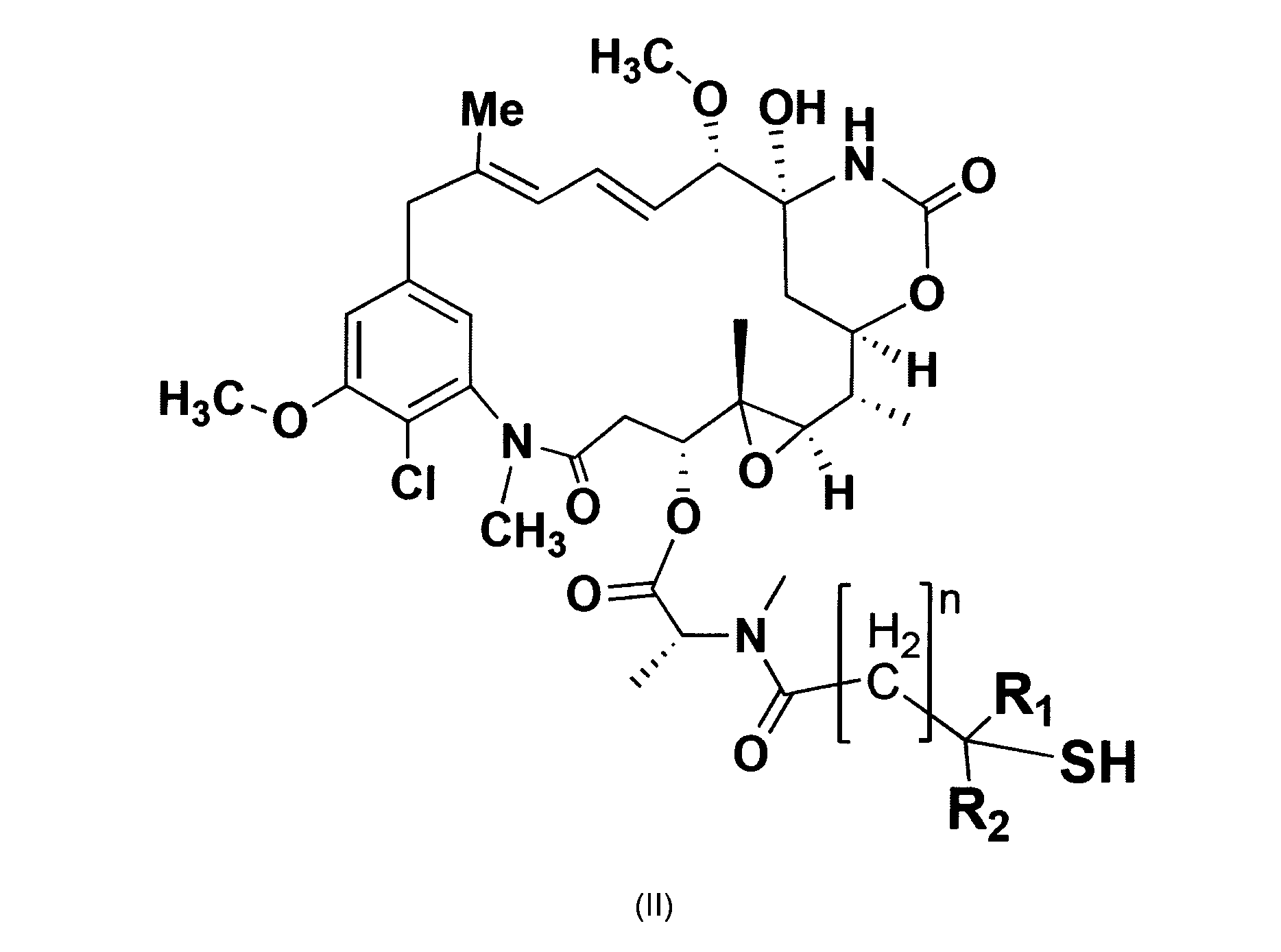
式中、nは、1~10から選択される整数を表し;
R1およびR2は独立して、水素、C1-6アルキル基またはカルボシクリル基またはヘ
テロシクリル基を表す。
Thus, in one embodiment the cytotoxic agent is a compound of formula (II)
wherein n represents an integer selected from 1 to 10;
R 1 and R 2 independently represent hydrogen, C 1-6 alkyl group, carbocyclyl group or heterocyclyl group.
本明細書において用いられるC1-6アルキルという用語は、それぞれ1~6個の炭素
原子を含む直鎖または分岐した飽和の炭化水素基を指す。このような基の例としては、メ
チル、エチル、n-プロピル、イソプロピル、n-ブチル、イソブチル、sec-ブチル
、tertブチル、n-ペンチル、イソペンチル、ネオペンチルまたはヘキシルなどが挙
げられる。
The term C 1-6 alkyl as used herein refers to a straight or branched chain saturated hydrocarbon group containing 1 to 6 carbon atoms each. Examples of such groups include methyl, ethyl, n-propyl, isopropyl, n-butyl, isobutyl, sec-butyl, tert-butyl, n-pentyl, isopentyl, neopentyl or hexyl and the like.
「ヘテロシクロル」および「カルボシクリル」という用語は本明細書において用いる場
合、文脈が他を示すのでない限り、芳香族および非芳香族の環系の両方を含むものとする
。したがって、例えば、「ヘテロシクロル基」および「カルボシクリル基」という用語は
、それらの範囲内に、芳香族、非芳香族の、不飽和の、部分的に飽和のおよび完全に飽和
のカルボシクリル環系またはヘテロシクリル環系を含む。一般には、文脈が他を示すので
ない限り、このような基は、単環式または二環性(縮合および架橋された二環性基を含む
)であってもよく、例えば、3~12環員、さらに一般的には5~10環員を含んでもよ
い。
The terms "heterocyclol" and "carbocyclyl" as used herein are intended to include both aromatic and non-aromatic ring systems unless the context indicates otherwise. Thus, for example, the terms "heterocyclol group" and "carbocyclyl group" include within their scope aromatic, non-aromatic, unsaturated, partially saturated and fully saturated carbocyclyl ring systems or heterocyclyl Including ring systems. Generally, unless the context indicates otherwise, such groups may be monocyclic or bicyclic (including fused and bridged bicyclic groups), for example, 3- to 12-ring ring members, more typically 5 to 10 ring members.
式(II)の化合物の一実施形態では、R1およびR2は独立して、水素またはメチル
を表す。
In one embodiment of the compounds of formula (II), R 1 and R 2 independently represent hydrogen or methyl.
式(II)の化合物の一実施形態では、nは1を表し、R1およびR2は両方とも水素
を表す(すなわち、メイタンシン誘導体DM1)。
In one embodiment of the compounds of formula (II), n represents 1 and R 1 and R 2 both represent hydrogen (ie maytansine derivative DM1).
式(II)の化合物の代替的な実施形態では、nは2を表し、R1は水素を表し、R2
はメチル基を表す(すなわち、メイタンシン誘導体DM3)。
In an alternative embodiment of compounds of formula (II), n represents 2, R 1 represents hydrogen and R 2
represents a methyl group (ie maytansine derivative DM3).
式(II)の化合物の一実施形態では、nは2を表し、R1およびR2は両方ともメチ
ル基を表す(すなわち、メイタンシン誘導体DM4)。
In one embodiment of the compounds of formula (II), n represents 2 and R 1 and R 2 both represent methyl groups (ie maytansine derivative DM4).
式(II)の細胞毒性剤は、ジスルフィド結合を形成し得、式(I)の二環性ペプチド
とのコンジュゲート構造では、チオール毒素(II)とチオール二環ペプチド(III)
との間のジスルフィド結合性は、いくつかの可能な合成スキーム(スキームIIおよびス
キームIIIに記載される2つ)を通じて導入されることが理解される。
Cytotoxic agents of formula (II) are capable of forming disulfide bonds, and in conjugate structures with bicyclic peptides of formula (I), thiol toxin (II) and thiol bicyclic peptide (III)
It is understood that disulfide connectivity between is introduced through several possible synthetic schemes (the two depicted in Scheme II and Scheme III).
一実施形態では、コンジュゲートの二環性ペプチド構成要素は、式(III)に示され
る構造

R3およびR4は独立して、水素、C1-6アルキル基またはカルボシクリル基またはヘ
テロシクリル基を表す。
In one embodiment, the bicyclic peptide component of the conjugate has the structure shown in formula (III)
R 3 and R 4 independently represent hydrogen, C 1-6 alkyl group, carbocyclyl group or heterocyclyl group.
式(III)の化合物の一実施形態では、R3およびR4は独立して、水素またはメチ
ルを表す。
In one embodiment of compounds of formula (III), R 3 and R 4 independently represent hydrogen or methyl.
R3およびR4が両方とも水素である、式(III)の化合物を、妨害されていないと
みなし、R3およびR4の一方または両方がメチルを表す式(III)の化合物を妨害さ
れているとみなす。
Compounds of formula (III) in which both R 3 and R 4 are hydrogen are considered unhindered, and compounds of formula (III) in which one or both of R 3 and R 4 represent methyl are considered to be hindered. assume there is.
式(III)の二環性ペプチドが、ジスルフィド結合および式(II)の細胞毒性剤と
のコンジュゲート構造を形成し得、チオール毒素(II)とチオール二環ペプチド(II
I)との間のジスルフィド結合性は、1つはスキームIIに記載されている、いくつかの
可能な合成スキームを通じて導入されることが理解される。
A bicyclic peptide of formula (III) can form a disulfide bond and a conjugate structure with a cytotoxic agent of formula (II) to form a thiol toxin (II) and a thiol bicyclic peptide (II
It is understood that disulfide connectivity between I) is introduced through several possible synthetic schemes, one of which is depicted in Scheme II.
一実施形態では、細胞毒性剤は、式(IV)

式中、R1、R2、R3およびR4は、水素、C1-6アルキル基またはカルボシクリル
基またはヘテロシクリル基を表し、
毒素は、本明細書に記載される任意の適切な細胞毒性剤を指し、
二環は、本明細書に定義される任意の適切な二環性ペプチドを表し、
nは、1~10から選択される整数を表し、
mは、1~10から選択される整数を表す。
In one embodiment, the cytotoxic agent is of formula (IV)
wherein R 1 , R 2 , R 3 and R 4 represent hydrogen, C 1-6 alkyl group or carbocyclyl group or heterocyclyl group;
Toxin refers to any suitable cytotoxic agent described herein,
bicyclic represents any suitable bicyclic peptide as defined herein;
n represents an integer selected from 1 to 10,
m represents an integer selected from 1-10.
一実施形態では、R1、R2、R3およびR4は、水素またはメチルを表す。 In one embodiment R 1 , R 2 , R 3 and R 4 represent hydrogen or methyl.
R1、R2、R3およびR4が各々水素である場合、ジスルフィド結合は、妨害が最小
であって、還元に対して最も感受性である。R1、R2、R3およびR4は、各々がメチ
ルであり、ジスルフィド結合は最も妨害されており、還元に対する感受性が最小である。
水素およびメチルの部分的置換によって、還元、ならびにそれにともなう切断および毒素
の放出に対する耐性の段階的な増大が生じる。
When R 1 , R 2 , R 3 and R 4 are each hydrogen, the disulfide bond is least disturbed and most susceptible to reduction. R 1 , R 2 , R 3 and R 4 are each methyl, the disulfide bond is the most disturbed and the least susceptible to reduction.
Partial substitution of hydrogen and methyl results in a stepwise increase in resistance to reduction and concomitant cleavage and toxin release.
一実施形態では、化合物(IV)の毒素は、メイタンシンであり、コンジュゲートは式
(V)の化合物、

クリル基またはヘテロシクリル基を表し、
二環は、本明細書に記載される任意の適切な二環性ペプチドを表し、
nは、1~10から選択される整数を表し、
mは、1~10から選択される整数を表す。
In one embodiment, the toxin of compound (IV) is maytansine and the conjugate is a compound of formula (V)
bicyclic represents any suitable bicyclic peptide described herein;
n represents an integer selected from 1 to 10,
m represents an integer selected from 1-10.
式(V)の化合物のさらなる実施形態では、nは1を表し、R1、R2、R3およびR
4の各々が水素、すなわち、式(V)aの化合物

each of 4 is hydrogen, i.e. compounds of formula (V) a
式(V)aのBDCは、BT17BDC-17として公知である。BDCであるBT1
7BDC-17の中の妨害されていないジスルフィドは、BT17BDC-9と等価であ
り、そのため、二環性ペプチド部分が異なる。BT17BDC-9は、非安定化配列(1
7-69-07-N219)を使用するが、BT17BDC-17は、毒素ジスルフィド
構築物に対してアミド結合される、安定化二環性ペプチドの対応物(17-69-07-
N241)を使用する。n=1であるメイタンシンのこの非妨害誘導体は、DM1と命名
される。
The BDC of formula (V) a is known as BT17BDC-17. BT1, which is a BDC
The unhindered disulfides in 7BDC-17 are equivalent to BT17BDC-9, so the bicyclic peptide portion is different. BT17BDC-9 has a non-stabilizing sequence (1
7-69-07-N219), while BT17BDC-17 is a stabilized bicyclic peptide counterpart (17-69-07-N219) amide-linked to the toxin disulfide construct (17-69-07-N219).
N241) is used. This non-interfering derivative of maytansine with n=1 is named DM1.
式(V)の化合物のさらなる実施形態では、nは1を表し、R1はメチルを表し、R2
、R3およびR4の各々は水素、すなわち、式(V)bの化合物
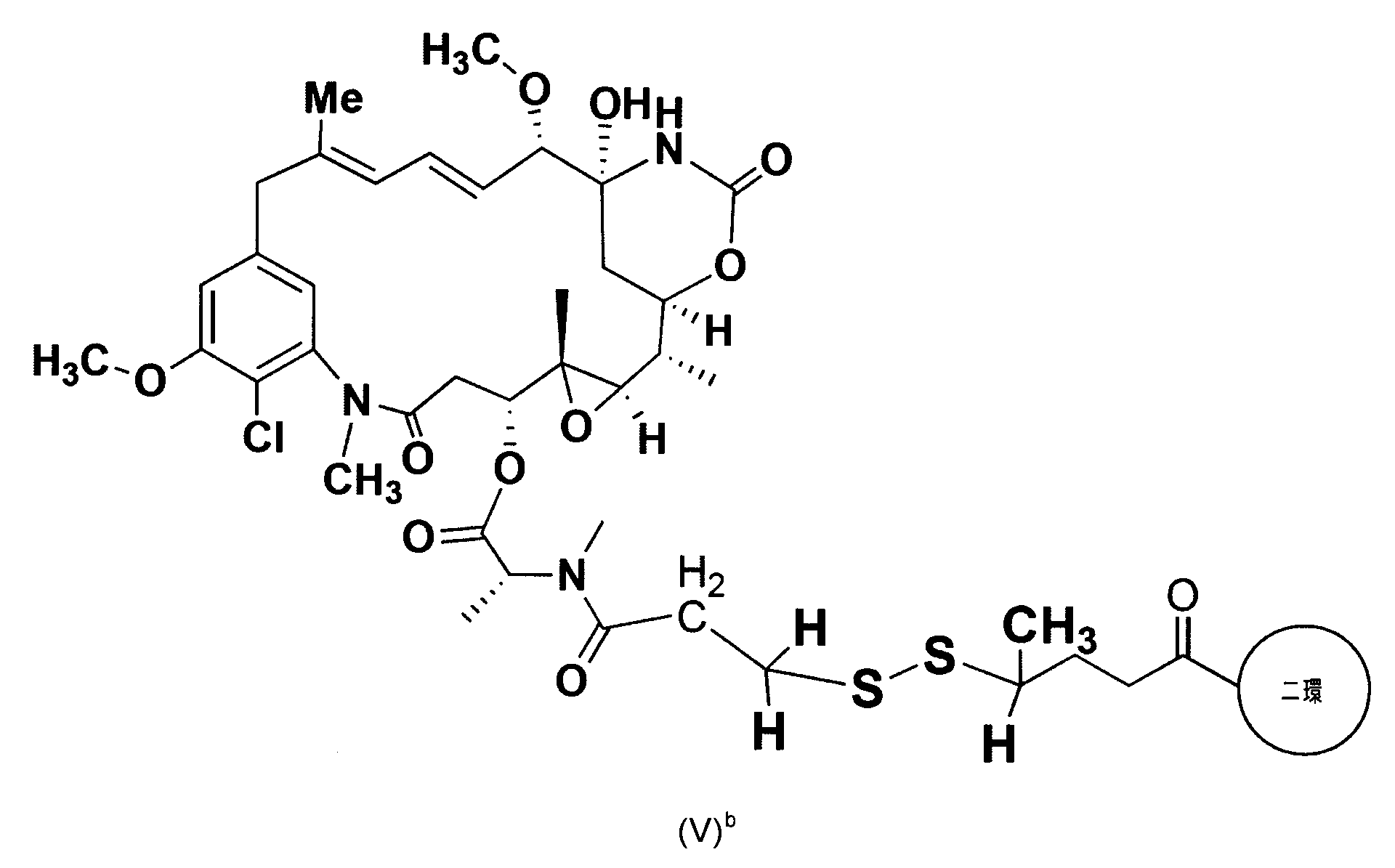
, R 3 and R 4 are each hydrogen, i.e. compounds of formula (V) b
式(V)bのBDCは、BT17BDC-18として公知であり、二環性ペプチド側に
単一の妨害性のメチル基を含み、抗体薬物コンジュゲートの状態では、還元剤、例えばジ
チオスレイトールに対してその感受性が7分の1に低下する(非妨害のジスルフィドと比
較して)(Kellogg et al(2011)Bioconjugate Che
mistry,22,717)。還元に対する感受性の低下は、毒素放出速度の低さと相
関している。n=1であるメイタンシンのこの非妨害の誘導体は、DM1と命名される。
BT17BDC-18は、毒素ジスルフィド構築物に対してアミド結合される安定化二環
性ペプチド対応物(17-69-07-N241)を使用する。
The BDC of formula (V) b , known as BT17BDC-18, contains a single interfering methyl group on the side of the bicyclic peptide and, in the antibody-drug conjugate state, can be added to a reducing agent such as dithiothreitol. 7-fold reduced sensitivity to (compared to unhindered disulfides) (Kellogg et al (2011) Bioconjugate Che
Mistry, 22, 717). Reduced susceptibility to reduction correlates with lower toxin release rates. This non-interfering derivative of maytansine with n=1 is named DM1.
BT17BDC-18 uses a stabilized bicyclic peptide counterpart (17-69-07-N241) that is amide-linked to the toxin disulfide construct.
式(V)の化合物のさらなる実施形態では、nは2を表し、R1およびR2は両方とも
水素を表し、R3およびR4は両方ともメチル、すなわち、式(V)cの化合物
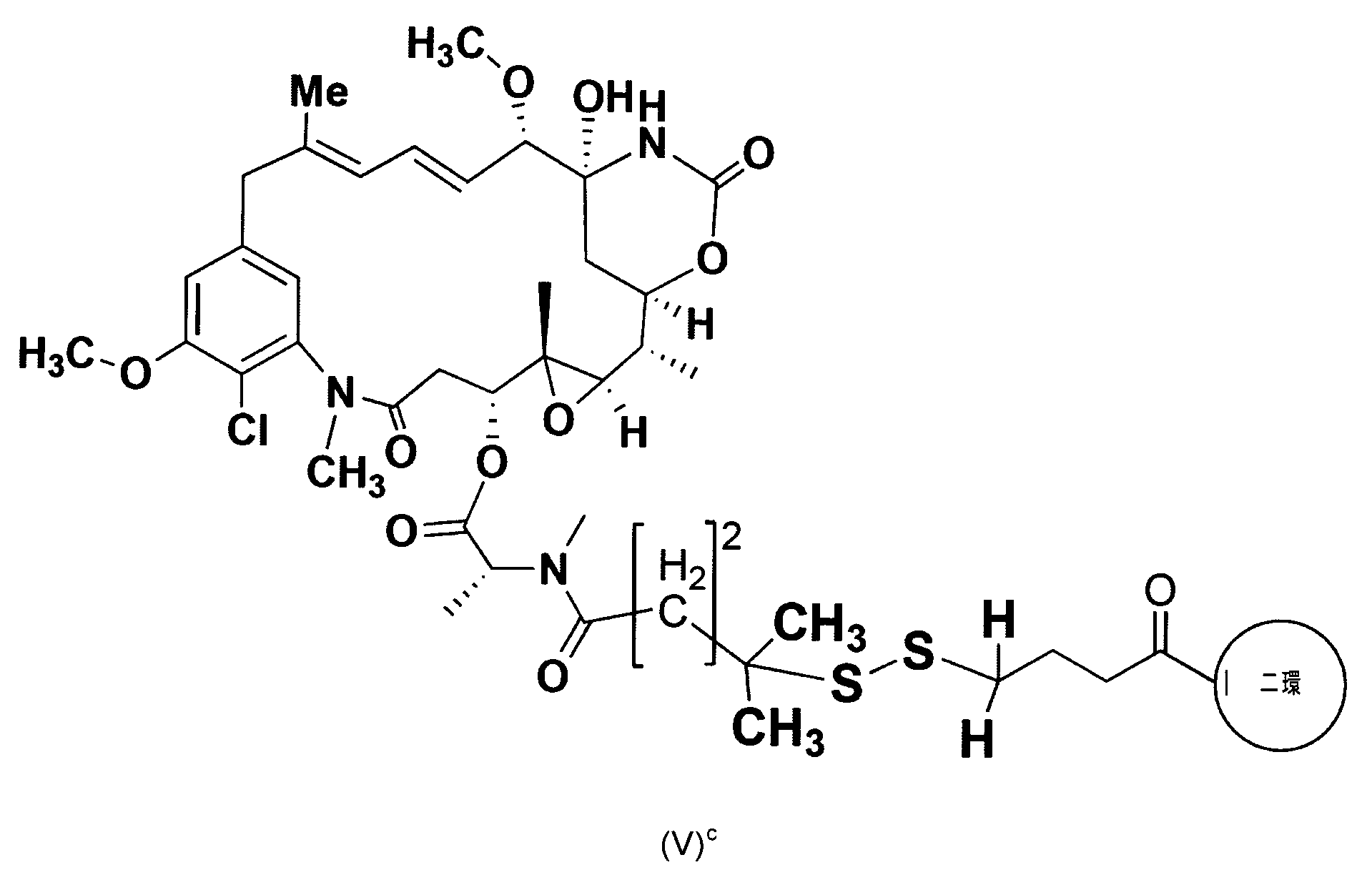
式(V)cのBDCは、BT17BDC-19として公知であり、メイタンシン側の上
に2つの妨害性メチルを含み、抗体薬物コンジュゲートの状態では、ジチオスレイトール
などの還元剤に対してその感受性が14分の1に低下する。還元に対する感受性の低下は
、毒素放出速度の低下と相関している。n=2であるメイタンシンの妨害された誘導体は
、DM4と命名される。BT17BDC-19は、毒素ジスルフィド構築物にアミド結合
される安定化二環性ペプチド対応物(17-69-07-N241)を使用する。
The BDC of formula (V) c , known as BT17BDC-19, contains two interfering methyls on the maytansine side and, in the antibody-drug conjugate state, its sensitivity to reducing agents such as dithiothreitol. is reduced by a factor of 14. Reduced susceptibility to reduction correlates with reduced toxin release rates. A hindered derivative of maytansine with n=2 is named DM4. BT17BDC-19 uses a stabilized bicyclic peptide counterpart (17-69-07-N241) that is amide-linked to the toxin disulfide construct.
式(V)の化合物のさらなる実施形態では、nは2を表し、R1およびR3は両方とも
メチルを表し、R2およびR4は両方とも水素、すなわち、式(V)dの化合物、

式(V)dのBDCは、BT17BDC-20として公知であり、メイタンシン側の1
つの妨害性メチル基、および二環ペプチド側の1つの妨害性メチル基を含み、そして抗体
薬物コンジュゲートの状態では、ジチオスレイトールのような還元剤に対して、その感受
性が170分の1に低下する。還元に対する感受性の低下は、毒素放出速度の低下と相関
する。n=2であるメイタンシンの妨害された誘導体は、DM3と命名される。BT17
BDC-20は、毒素ジスルフィド構築物にアミド結合される安定化二環性ペプチド対応
物(17-69-07-N241)を使用する。
The BDC of formula (V) d is known as BT17BDC-20 and is the 1
containing two interfering methyl groups and one interfering methyl group on the side of the bicyclic peptide, and in the antibody-drug conjugate state, its sensitivity to reducing agents such as dithiothreitol is reduced by 170-fold. descend. Reduced susceptibility to reduction correlates with reduced toxin release rates. A hindered derivative of maytansine with n=2 is named DM3. BT17
BDC-20 uses a stabilized bicyclic peptide counterpart (17-69-07-N241) that is amide-linked to the toxin disulfide construct.
実際、抗体薬物コンジュゲートの状態では、動物モデルにおける耐容性に対する有効性
のバランスによって、その最適条件は、あるレベルの妨害、すなわち、BT17BDC-
19中にも存在するDM4の妨害と関連することが示された(Kellogg et a
l(2011)Bioconjugate Chemistry, 22, 717)。
Indeed, in the context of antibody-drug conjugates, the balance of efficacy versus tolerability in animal models imposes a certain level of interference, namely BT17BDC-
was shown to be associated with interference with DM4, which is also present in 19 (Kellogg et al.
1 (2011) Bioconjugate Chemistry, 22, 717).
一実施形態では、このコンジュゲートは、BT17BDC-9、BT17BDC-17
(式(V)aの化合物)、BT17BDC-18(式(V)bの化合物)、BT17BD
C-19(式(V)cの化合物)およびBT17BDC-20(式(V)dの化合物)か
ら選択される。データは、実施例5ならびに表16および17に示しており、これによっ
て、BT17BDC-9、BT17BDC-17、BT17BDC-18、BT17BD
C-19およびBT17BDC-20の有益な特性が実証される。
In one embodiment, the conjugate is BT17BDC-9, BT17BDC-17
(compound of formula (V) a ), BT17BDC-18 (compound of formula (V) b ), BT17BD
C-19 (compound of formula (V) c ) and BT17BDC-20 (compound of formula (V) d ). Data are presented in Example 5 and Tables 16 and 17, whereby BT17BDC-9, BT17BDC-17, BT17BDC-18, BT17BD
Beneficial properties of C-19 and BT17BDC-20 are demonstrated.
さらなる実施形態では、このコンジュゲートは、BT17BDC-9、BT17BDC
-17(式(V)aの化合物)、BT17BDC-18(式(V)bの化合物)およびB
T17BDC-19(式(V)cの化合物)から選択される。データを実施例5ならびに
表16および17に示しており、これによって、これらのコンジュゲートが、標的化がん
治療における使用のための適切な分子とみなされたことが実証される。
In further embodiments, the conjugate is BT17BDC-9, BT17BDC
-17 (compound of formula (V) a ), BT17BDC-18 (compound of formula (V) b ) and B
selected from T17BDC-19 (compounds of formula (V) c ); Data are presented in Example 5 and Tables 16 and 17, demonstrating that these conjugates were considered suitable molecules for use in targeted cancer therapy.
さらなる実施形態では、このコンジュゲートは、BT17BDC-17(式(V)aの
化合物)、BT17BDC-18(式(V)bの化合物)およびBT17BDC-19(
式(V)cの化合物)から選択される。データは、実施例5ならびに表16および表17
に示しており、これによって、これらのコンジュゲートが、標的化がん治療における使用
のための適切な分子とみなされ、有効用量で十分耐容されることが実証される。
In further embodiments, the conjugate is BT17BDC-17 (compound of formula (V) a ), BT17BDC-18 (compound of formula (V) b ) and BT17BDC-19 (compound of formula (V) b)
(V) (a compound of formula (V) c ). Data are from Example 5 and Tables 16 and 17
, which demonstrates that these conjugates are considered suitable molecules for use in targeted cancer therapy and are well tolerated at effective doses.
[合成]
本発明のペプチドは、標準的な技術によって、続いてインビトロでの分子足場での反応
によって、合成的に製造されてもよい。これが行われる場合、標準的な化学が用いられて
もよい。これによって、さらなる下流の実験またはバリデーションのために可溶性の材料
の迅速な大規模調製が可能になる。このような方法は、Timmermanら(上述)に
開示されるもののような従来の化学を用いて達成され得る。
[Synthesis]
The peptides of the invention may be synthetically produced by standard techniques followed by reaction with molecular scaffolds in vitro. When this is done, standard chemistries may be used. This allows rapid large-scale preparation of soluble material for further downstream experiments or validation. Such methods can be accomplished using conventional chemistry, such as that disclosed in Timmerman et al. (supra).
したがって、本発明はまた、本明細書に示されるように選択されたポリペプチドまたは
コンジュゲートの製造であって、下に説明されるような任意選択のさらなるステップを含
む製造に関する。一実施形態では、これらのステップは、化学合成によって作製された最
終生成物のポリペプチド/コンジュゲートで行われる。
Accordingly, the present invention also relates to the manufacture of selected polypeptides or conjugates as set forth herein, comprising optional further steps as described below. In one embodiment, these steps are performed with the final product polypeptide/conjugate made by chemical synthesis.
任意選択的に、目的のポリペプチド中のアミノ酸残基は、コンジュゲートまたは複合体
を製造する場合に置換されてもよい。
Optionally, amino acid residues in the polypeptide of interest may be substituted when producing a conjugate or complex.
ペプチドはまた、例えば、別のループを組み込み、それによって複数の特異性を導入す
るために伸長されてもよい。
Peptides may also be lengthened, for example, to incorporate additional loops, thereby introducing multiple specificities.
ペプチドを伸長するために、標準的な固相または溶液相化学を用いてよく、直交的に保
護されたリジン(およびアナログ)を用いて、ループのN末端もしくはC末端において、
またはループ内で化学的に伸長されてもよい。標準の(バイオ)コンジュゲーション技術
を用いて、活性化または活性化可能なN末端またはC末端を導入してもよい。あるいは、
さらには、例えば(Dawson et al. 1994. Synthesis o
f Proteins by Native Chemical Ligation.
Science 266:776-779)に記載のように、断片縮合もしくは天然の化
学的ライゲーションによって、または酵素によって、例えば、(Chang et al
Proc Natl Acad Sci U S A. 1994 Dec 20;9
1(26):12544-8、またはHikari et al Bioorganic
& Medicinal Chemistry Letters Volume 18
, Issue 22, 15 November 2008, Pages 6000
-6003)に記載のようにサブチリガーゼを用いて行ってもよい。
Standard solid-phase or solution-phase chemistry may be used to extend the peptide, using orthogonally protected lysines (and analogues) at the N- or C-terminus of the loop to
Or it may be chemically extended within the loop. An activated or activatable N- or C-terminus may be introduced using standard (bio)conjugation techniques. or,
Furthermore, for example (Dawson et al. 1994. Synthesis o
f Proteins by Native Chemical Ligation.
Science 266:776-779), by fragment condensation or native chemical ligation, or enzymatically, for example (Chang et al.
Proc Natl Acad Sci USA. 1994
1(26):12544-8, or Hikari et al Bioorganic
& Medicinal
,
-6003) using a subtiligase.
あるいは、ペプチドは、ジスルフィド結合を通じてさらなるコンジュゲーションによっ
て伸長または修飾されてもよい。これは、細胞の還元環境に一度入れば、お互いから第1
のペプチドおよび第2のペプチドを解離させるという追加の利点を有する。この場合、分
子足場(例えば、TBMB)は、3つのシステイン基と反応するように第1のペプチドの
化学合成の間に添加され得る;次いで、さらなるシステインまたはチオールは、第1のペ
プチドのN末端またはC末端に付加され、その結果このシステインまたはチオールのみが
第2のペプチドの遊離のシステインまたはチオールと反応して、ジスルフィド連結された
二環性ペプチド-ペプチドコンジュゲートを形成する。
Alternatively, peptides may be extended or modified by further conjugation through disulfide bonds. This is because once in the reducing environment of the cell, the first
has the added advantage of dissociating the first peptide and the second peptide. In this case, a molecular scaffold such as TBMB can be added during chemical synthesis of the first peptide to react with the three cysteine groups; or C-terminally added so that only this cysteine or thiol reacts with the free cysteine or thiol of the second peptide to form a disulfide-linked bicyclic peptide-peptide conjugate.
同様の技術を、2つの二環性および二重特異性の大員環の合成/カップリングに等しく
適用して、可能性としては四重特異的な分子を作成する。
Similar techniques apply equally to the synthesis/coupling of two bicyclic and bispecific macrocycles to create potentially tetraspecific molecules.
さらに、他の官能基またはエフェクター基の追加は、適切な化学を用いて同じ方式で達
成され得、N末端もしくはC末端で、または側鎖を介してカップリングする。一実施形態
では、このカップリングは、これがいずれの実体の活性もブロックしないような方式で行
われる。
Additionally, addition of other functional groups or effector groups can be accomplished in the same manner using appropriate chemistry, coupled at the N- or C-terminus or via side chains. In one embodiment, this coupling is done in such a way that it does not block the activity of either entity.
本発明のさらなる態様によれば、スキームI、IIまたはIIIのいずれか1つに記載
の合成経路を含む、本明細書に定義される薬物コンジュゲートを調製するためのプロセス
が提供される。
According to a further aspect of the invention there is provided a process for preparing a drug conjugate as defined herein comprising a synthetic route according to any one of Schemes I, II or III.
[医薬組成物]
本発明のさらなる態様によれば、本明細書に定義されるペプチドリガンドまたは薬物コ
ンジュゲートを1つまたは複数の薬学的に許容される賦形剤と組み合わせて含む医薬組成
物が提供される。
[Pharmaceutical composition]
According to a further aspect of the invention there is provided a pharmaceutical composition comprising a peptide ligand or drug conjugate as defined herein in combination with one or more pharmaceutically acceptable excipients.
一般に、本発明のペプチドリガンドは、精製された形態で、薬理学的に適切な賦形剤ま
たは担体と共に利用される。典型的には、これらの賦形剤または担体には、生理食塩水お
よび/または緩衝媒体を含めた、水性またはアルコール/水性の溶液、乳濁液または懸濁
液が含まれる。非経口ビヒクルには、塩化ナトリウム溶液、リンゲルデキストロース、デ
キストロースおよび塩化ナトリウムならびに乳酸加リンゲルが含まれる。ポリペプチド複
合体を懸濁液に保つために必要な場合は、適切な生理的に許容されるアジュバントを、カ
ルボキシメチルセルロース、ポリビニルピロリドン、ゼラチンおよびアルギネートなどの
シックナーから選択し得る。
Generally, the peptide ligands of the invention are utilized in purified form together with pharmacologically suitable excipients or carriers. Typically, these excipients or carriers include aqueous or alcoholic/aqueous solutions, emulsions or suspensions, including saline and/or buffered media. Parenteral vehicles include sodium chloride solution, Ringer's dextrose, dextrose and sodium chloride and lactated Ringer's. Suitable physiologically acceptable adjuvants, if necessary to keep the polypeptide complex in suspension, may be selected from thickeners such as carboxymethylcellulose, polyvinylpyrrolidone, gelatin and alginates.
静脈内ビヒクルには、リンゲルデキストロースに基づくものなどの、体液および栄養素
補充液ならびに電解質補充液が含まれる。また、抗微生物、抗酸化剤、キレート化剤およ
び不活性ガスなどの保存料および他の添加剤も存在し得る(Mack (1982) R
emington’s Pharmaceutical Sciences, 16th
Edition)。
Intravenous vehicles include fluid and nutrient replenishers and electrolyte replenishers, such as those based on Ringer's dextrose. Preservatives and other additives such as antimicrobials, antioxidants, chelating agents and inert gases may also be present (Mack (1982) R
Emington's Pharmaceutical Sciences, 16th
Edition).
本発明のペプチドリガンドは、別々に投与する組成物として使用されてもよいし、また
は他の薬剤と併せて使用されてもよい。これらには、シルコスポリン、メトトレキサート
、アドリアマイシンまたはシスプラチン、および免疫毒素などの、抗体、抗体断片および
様々な免疫治療薬が含まれる場合がある。医薬組成物に様々な細胞毒性がある薬剤または
他の薬剤と、本発明のタンパク質リガンド、またはさらには標的リガンドを用いて選択さ
れたポリペプチドなどの様々な特異性を有する本発明によって選択されたポリペプチド)
の組み合わせとを併せた「カクテル」が含まれる場合があり、これらを投与前にプールす
るかどうかに拘らない。
The peptide ligands of the invention may be used as separately administered compositions or may be used in conjunction with other agents. These may include antibodies, antibody fragments and various immunotherapeutic agents such as circosporine, methotrexate, adriamycin or cisplatin, and immunotoxins. Various cytotoxic agents or other agents in the pharmaceutical composition and selected according to the invention with different specificities, such as polypeptides selected using protein ligands of the invention, or even targeting ligands. polypeptide)
may include "cocktails" that include combinations of , whether or not these are pooled prior to administration.
本発明による医薬組成物の投与経路は、当業者に一般的に知られているもののうちの任
意のものであり得る。限定されるものではないが、免疫療法を含む治療のために、本発明
のペプチドリガンドは、標準の技法に従って任意の患者に投与することができる。投与は
、非経口、静脈内、筋肉内、腹腔内、経皮、肺の経路、また、適切には、カテーテルを用
いた直接輸液によるものを含めた、任意の適切な様式であることができる。用量および投
与頻度は、患者の年齢、性別および状態、他の薬物の同時投与、対抗適応症ならびに臨床
家が考慮すべき他のパラメータに依存する。
The route of administration of pharmaceutical compositions according to the invention can be any of those commonly known to those of ordinary skill in the art. For therapy, including but not limited to immunotherapy, the peptide ligands of the invention can be administered to any patient according to standard techniques. Administration can be by any suitable manner, including parenteral, intravenous, intramuscular, intraperitoneal, transdermal, pulmonary routes and, suitably, by direct infusion using a catheter. . The dose and frequency of administration will depend on the age, sex and condition of the patient, co-administration of other drugs, competing indications and other parameters for the clinician to consider.
本発明のペプチドリガンドは、貯蔵用に凍結乾燥し、使用前に適切な担体で再構成する
ことができる。この技法は有効であることが示されており、当分野で知られている凍結乾
燥および再構成の技法を用いることができる。当業者には、凍結乾燥および再構成は様々
な度合の活性の損失をもたらす場合があり、補償するためにレベルを上方調節する必要が
あり得ることが理解されよう。
The peptide ligands of the invention can be lyophilized for storage and reconstituted with a suitable carrier prior to use. This technique has been shown to be effective and techniques of lyophilization and reconstitution known in the art can be used. Those skilled in the art will appreciate that lyophilization and reconstitution may result in varying degrees of loss of activity, and levels may need to be adjusted up to compensate.
本発明のペプチドリガンドまたはそのカクテルを含有する組成物は、予防的および/ま
たは治療的な処置のために投与することができる。特定の治療的な応用では、選択された
細胞の集団の少なくとも部分的な阻害、抑制、変調、死滅、または何らかの他の測定可能
なパラメータを達成するために十分な量は、「治療上有効な用量」として定義される。こ
の用量を達成するために必要な量は、疾患の重篤度および患者自身の免疫系の一般的状態
に依存するが、一般に体重1キログラム当たり0.005~5.0mgの選択されたペプ
チドリガンドの範囲であり、0.05~2.0mg/kg/用量の用量がより一般的に使
用される。予防的な応用では、本発明のペプチドリガンドまたはそのカクテルを含有する
組成物を、同様または僅かに低い用量で投与してもよい。
Compositions containing peptide ligands of the invention or cocktails thereof can be administered for prophylactic and/or therapeutic treatments. For certain therapeutic applications, an amount sufficient to achieve at least partial inhibition, suppression, modulation, killing, or some other measurable parameter of a selected population of cells is "therapeutically effective." defined as “dose”. The amount necessary to achieve this dose depends on the severity of the disease and the general state of the patient's own immune system, but generally 0.005-5.0 mg of the selected peptide ligand per kilogram of body weight. with doses of 0.05-2.0 mg/kg/dose being more commonly used. In prophylactic applications, compositions containing peptide ligands of the invention or cocktails thereof may be administered at similar or slightly lower doses.
本発明によるペプチドリガンドを含有する組成物は、哺乳動物における選択された標的
細胞集団の変更、不活性化、死滅または除去を支援するために、予防的および治療的な設
定で利用し得る。さらに、本明細書中に記載のペプチドリガンドは、不均一な細胞のコレ
クションから標的細胞集団を死滅、枯渇または他の様式で有効に除去するために、体外ま
たはインビトロで選択的に使用し得る。哺乳動物からの血液を体外で選択されたペプチド
リガンドと合わせ、これにより所望しない細胞を死滅させるか、または他の様式で血液か
ら除去して、標準の技法に従って哺乳動物に戻し得る。
Compositions containing peptide ligands according to the present invention may be utilized in prophylactic and therapeutic settings to assist in altering, inactivating, killing or eliminating selected target cell populations in mammals. Additionally, the peptide ligands described herein can be selectively used in vitro or in vitro to kill, deplete or otherwise effectively remove a target cell population from a heterogeneous collection of cells. Blood from the mammal can be combined extracorporeally with the selected peptide ligand, thereby killing or otherwise removing undesired cells from the blood and returned to the mammal according to standard techniques.
[治療的な使用]
本発明の二環性ペプチドは、膜型タイプ1メタロプロテアーゼ(MT1-MMP、MM
P14としても公知)の高親和性結合剤として特定の有用性を有する。MT1-MMPは
、直接的には、その構成要素のいくつかを分解することによって、および間接的には、プ
ロMMP2を活性化することによって、細胞外マトリックス再構築に主な役割を果たす膜
貫通メタロプロテアーゼである。MT1-MMPは、腫瘍血管形成(Sounni et
al(2002)FASEB J.16(6),555-564)にとって重要であり
、種々の固形腫瘍で過剰発現され、したがって、本発明のMT1-MMP結合性二環ペプ
チドは、がん、具体的には、固形腫瘍、例えば、非小細胞肺がんの標的処置において特定
の有用性を有する。一実施形態では、本発明の二環性ペプチドは、ヒトMT1-MMPに
特異的である。さらなる実施形態では、本発明の二環性ペプチドは、マウスMT1-MM
Pに特異的である。さらなる実施形態では、本発明の二環性ペプチドは、ヒトおよびマウ
スのMT1-MMPに特異的である。なおさらなる実施形態では、本発明の二環性ペプチ
ドは、ヒト、マウスおよびイヌのMT1-MMPに特異的である。
THERAPEUTIC USE
The bicyclic peptides of the present invention are
P14) has particular utility as a high affinity binder. MT1-MMP is a transmembrane that plays a major role in extracellular matrix remodeling, directly by degrading some of its components and indirectly by activating pro-MMP2 It is a metalloprotease. MT1-MMP inhibits tumor angiogenesis (Sounni et al.
al (2002) FASEBJ. 16(6), 555-564) and is overexpressed in a variety of solid tumors, thus the MT1-MMP-binding bicyclic peptides of the present invention may be useful in cancers, particularly solid tumors such as , have particular utility in targeted treatment of non-small cell lung cancer. In one embodiment, the bicyclic peptides of the invention are specific for human MT1-MMP. In a further embodiment, the bicyclic peptide of the invention is mouse MT1-MM
P-specific. In a further embodiment, the bicyclic peptides of the invention are specific for human and mouse MT1-MMP. In still further embodiments, the bicyclic peptides of the invention are specific for human, murine and canine MT1-MMP.
本発明の方法に従って選択されたポリペプチドリガンドは、インビボ治療および予防適
用、インビトロおよびインビボ診断適用、インビトロアッセイおよび試薬適用その他にお
いて用いることができる。選択されたレベルの特異性を有するリガンドは、交差反応性が
望ましい非ヒト動物における検査に関与する適用において、あるいはホモログまたはパラ
ログとの交差反応性が慎重に制御される必要がある診断適用において有用である。ワクチ
ン適用等、一部の適用において、所定の範囲の抗原に対する免疫応答を誘発する能力を活
用して、ワクチンを特異的疾患および病原体の目的に合わせることができる。
Polypeptide ligands selected according to the methods of the invention can be used in in vivo therapeutic and prophylactic applications, in vitro and in vivo diagnostic applications, in vitro assays and reagent applications, and the like. Ligands with selected levels of specificity are useful in applications involving testing in non-human animals where cross-reactivity is desirable, or in diagnostic applications where cross-reactivity with homologs or paralogs needs to be carefully controlled. is. In some applications, such as vaccine applications, the ability to elicit an immune response against a range of antigens can be exploited to tailor vaccines to specific disease and pathogen objectives.
少なくとも90~95%の均一性である実質的に純粋なペプチドリガンドが哺乳動物へ
の投与に好ましく、98~99%またはそれより高い均一性が、特に哺乳動物がヒトであ
る場合に、製薬的な使用に最も好ましい。所望に応じて部分的にまたは均一性まで精製し
た後、選択されたポリペプチドを、診断もしくは治療(体外が含まれる)において、また
はアッセイ手順、免疫蛍光染色などの展開および実行において使用し得る(Lefkov
ite and Pernis, (1979 and 1981) Immunolo
gical Methods, Volumes I and II, Academi
c Press, NY)。
Substantially pure peptide ligands of at least 90-95% homogeneity are preferred for administration to mammals, and 98-99% or more homogeneity are preferred for pharmaceutical administration, particularly when the mammal is a human. most preferred for use. After purification, partially or to homogeneity, as desired, the selected polypeptides may be used in diagnostics or therapeutics, including in vitro, or in developing and performing assay procedures, immunofluorescence staining, etc. Lefkov
ite and Pernis, (1979 and 1981) Immunolo
Gical Methods, Volumes I and II, Academy
C Press, NY).
本発明のペプチドリガンドのエフェクター基およびコンジュゲートは、典型的にはがん
の、具体的には、固形腫瘍、例えば、非小細胞肺がんの予防、抑制または処置における使
用が見出される。
The effector groups and conjugates of the peptide ligands of the invention find use in the prevention, suppression or treatment of cancer, typically solid tumors such as non-small cell lung cancer.
したがって、本発明のさらなる態様によれば、がん、具体的には、固形腫瘍、例えば、
非小細胞肺がんの予防、抑制または処置における使用のための本明細書に定義されるペプ
チドリガンドのエフェクター基および薬物コンジュゲートが提供される。
Thus, according to a further aspect of the invention, cancers, in particular solid tumors, such as
Effector groups and drug conjugates of peptide ligands as defined herein for use in the prevention, suppression or treatment of non-small cell lung cancer are provided.
本発明のさらなる態様によれば、がん、具体的には、固形腫瘍、例えば、非小細胞肺が
んを予防、抑制または処置する方法が提供され、これは、その必要な患者に対して、本明
細書に定義されるペプチドリガンドのエフェクター基および薬物コンジュゲートを投与す
ることを含む。
According to a further aspect of the invention, there is provided a method of preventing, inhibiting or treating cancer, particularly solid tumors such as non-small cell lung cancer, which comprises treating a patient in need thereof. This includes administering an effector group of a peptide ligand as defined herein and a drug conjugate.
処置され得る(または阻害され得る)がん(およびそれらの良性の対応物)の例として
は、限定されないが、上皮性起源の腫瘍(腺がん、扁平上皮がん、移行上皮がんおよび他
のがんを含む種々の種類の腺腫およびがん)、例えば、膀胱および尿路、乳房、消化管の
がん(例としては、食道、胃(胃がん)、小腸、結腸、直腸および肛門)、肝臓(肝細胞
がん)、胆嚢および胆管系、膵外分泌腺、腎臓、肺のがん(例えば、腺がん、小細胞肺が
ん、非小細胞肺がん、気管支肺胞がんおよび中皮腫)、頭頚部のがん(例えば、舌がん、
口腔がん、咽頭、喉頭、鼻咽頭、扁桃腺、唾液腺、鼻腔および副鼻腔)、卵巣、卵管、腹
膜、膣、外陰部、陰茎、子宮頸部、子宮筋、子宮内膜、甲状腺のがん(例えば、甲状腺濾
胞がん)、副腎、前立腺、皮膚および付属器のがん(例えば、黒色腫、基底細胞がん、扁
平上皮細胞がん、角化棘細胞腫、形成異常母斑);血液学的悪性腫瘍(すなわち、白血病
、リンパ腫)ならびに前がん状態血液学的障害および境界悪性腫瘍の障害、例としては、
血液学的悪性腫瘍およびリンパ系の関連の病態(例えば、急性リンパ球性白血病[ALL
]、慢性リンパ球性白血病[CLL]、B細胞リンパ腫、例えば、びまん性B細胞型リン
パ腫[DLBCL]、濾胞性リンパ腫、バーキットリンパ腫、マントル細胞リンパ腫、T
細胞リンパ腫および白血病、ナチュラルキラー[NK]細胞リンパ腫、ホジキンリンパ腫
、ヘアリー細胞白血病、意義不明の単クローン性免疫グロブリン血症、形質細胞腫、多発
性骨髄腫、および移植後リンパ球増殖性障害)、ならびに血液学的悪性腫瘍および骨髄系
列の関連状態(例えば、急性骨髄性白血病[AML]、慢性骨髄性白血病[CML]、慢
性骨髄単球性白血病[CMML]、好酸球増加症候群、骨髄増殖性障害、例えば、真性赤
血球増加症、本態性血小板血症および原発性骨髄線維症、骨髄増殖性症候群、骨髄異形成
症候群、および前骨髄球性白血病);間葉由来の腫瘍、例えば、軟部組織の肉腫、骨また
は軟骨、例えば、骨肉腫、線維肉腫、軟骨肉腫、横紋筋肉腫、平滑筋肉腫、脂肪肉腫、血
管肉腫、カポジ肉腫、ユーイング肉腫、滑膜肉腫、類上皮細胞肉腫、胃腸間質性腫瘍、良
性および悪性の組織球腫、および隆起性皮膚線維肉腫;中枢神経系または末梢神経系の腫
瘍(例えば、星状細胞腫、神経膠腫およびグリア芽細胞腫、髄膜腫、上衣細胞腫、松果体
腫瘍およびシュワン細胞腫);内分泌腫瘍(例えば、下垂体腫瘍、副腎腫瘍、島細胞腫瘍
、副甲状腺腫瘍、カルチノイド腫瘍および甲状腺の髄様がん);眼球および付属器の腫瘍
(例えば、網膜芽細胞腫);生殖細胞および栄養膜腫瘍(例えば、奇形腫、精上皮腫、未
分化胚細胞腫、胞状奇胎および絨毛がん);ならびに小児および胚の腫瘍(例えば、髄芽
細胞腫、神経芽細胞腫、ウィルムス腫瘍、および原始的な神経外胚葉性腫瘍);または、
先天性かそうでなければ、患者を悪性腫瘍にかかりやすくさせる症候群(例えば、色素性
乾皮症)が挙げられる。
Examples of cancers (and their benign counterparts) that may be treated (or inhibited) include, but are not limited to, tumors of epithelial origin (adenocarcinoma, squamous cell carcinoma, transitional cell carcinoma and other cancers). various types of adenoma and cancer, including cancer of the bladder and urinary tract, breast, gastrointestinal tract (e.g. esophagus, stomach (stomach cancer), small intestine, colon, rectum and anus), cancers of the liver (hepatocellular carcinoma), gallbladder and biliary system, pancreatic exocrine glands, kidney, lung (e.g. adenocarcinoma, small cell lung cancer, non-small cell lung cancer, bronchoalveolar carcinoma and mesothelioma), cancer of the head and neck (e.g. tongue cancer,
oral cancer, pharynx, larynx, nasopharynx, tonsils, salivary glands, nasal and sinus), ovary, fallopian tubes, peritoneum, vagina, vulva, penis, cervix, myometrium, endometrium, thyroid cancer (e.g. thyroid follicular carcinoma), adrenal gland, prostate, skin and adnexal cancers (e.g. melanoma, basal cell carcinoma, squamous cell carcinoma, keratoacanthocytoma, dysplastic nevus); Hematological malignancies (i.e. leukemia, lymphoma) as well as premalignant hematologic and borderline malignant disorders such as:
Hematologic malignancies and lymphoid-related conditions (e.g., acute lymphocytic leukemia [ALL
], chronic lymphocytic leukemia [CLL], B-cell lymphomas such as diffuse B-cell lymphoma [DLBCL], follicular lymphoma, Burkitt's lymphoma, mantle cell lymphoma, T
cellular lymphoma and leukemia, natural killer [NK] cell lymphoma, Hodgkin lymphoma, hairy cell leukemia, monoclonal immunoglobulinemia of unknown significance, plasmacytoma, multiple myeloma, and post-transplant lymphoproliferative disorder), and hematologic malignancies and myeloid lineage-related conditions (e.g. acute myelogenous leukemia [AML], chronic myelogenous leukemia [CML], chronic myelomonocytic leukemia [CMML], hypereosinophilic syndrome, myeloproliferative disorders such as polycythemia vera, essential thrombocythemia and primary myelofibrosis, myeloproliferative syndromes, myelodysplastic syndromes, and promyelocytic leukemia); tumors of mesenchymal origin, such as soft tissue sarcoma, bone or cartilage, e.g. osteosarcoma, fibrosarcoma, chondrosarcoma, rhabdomyosarcoma, leiomyosarcoma, liposarcoma, angiosarcoma, Kaposi's sarcoma, Ewing's sarcoma, synovial sarcoma, epithelioid sarcoma, gastrointestinal stroma benign and malignant histiocytomas, and dermatofibrosarcoma protuberans; tumors of the central or peripheral nervous system (e.g., astrocytomas, gliomas and glioblastomas, meningioma, ependymal cells) tumors, pineal tumors, and schwannoma); endocrine tumors (eg, pituitary, adrenal, islet cell, parathyroid, carcinoid, and medullary carcinomas of the thyroid); ocular and adnexal tumors ( retinoblastoma); germ cell and trophoblast tumors (e.g., teratoma, seminioma, dysgerminoma, hydatidiform mole and choriocarcinoma); and pediatric and embryonic tumors (e.g., medulloblastoma). cell tumor, neuroblastoma, Wilms tumor, and primitive neuroectodermal tumor); or
Syndromes that are congenital or otherwise predispose the patient to malignancies (eg, xeroderma pigmentosum).
本明細書における「予防」という用語の言及には、疾患の誘導前の保護的組成物の投与
を含む。「抑制」とは、誘導現象の後であるが、疾患の臨床的所見の前に組成物を投与す
ることをいう。「処置」とは、疾患の症状が顕性となった後に保護的組成物を投与するこ
とを含む。
Reference herein to the term "prevention" includes administration of a protective composition prior to induction of disease. "Suppression" refers to administering the composition after the induction event but before clinical manifestation of disease. "Treatment" includes administering a protective composition after symptoms of the disease become apparent.
疾患に対する保護、またはその処置におけるペプチドリガンドの有効性をスクリーニン
グするために使用できる動物モデル系が利用可能である。動物モデル系の使用は、本発明
により促進されて、ヒトおよび動物標的と交差反応し得るポリペプチドリガンドの開発を
可能にし、動物モデルの使用を可能にする。
Animal model systems are available that can be used to screen the efficacy of peptide ligands in protecting against or treating disease. The use of animal model systems is facilitated by the present invention to allow for the development of polypeptide ligands capable of cross-reacting with human and animal targets, allowing for the use of animal models.
次の実施例を参照することにより、次に、本発明をさらに説明する。 The invention will now be further described by reference to the following examples.
[材料および方法]
<ファージ選択>
6×6の二環ファージライブラリを、Heinis et al(2009)、Nat
Chem Biol 5(7)、502-507、WO2009/098450、WO
2013/050615およびWO2013/050616に記載のとおり作製した。フ
ァージディスプレイ選択は、ビオチン化ヒトMT1-MMPヘモペキシンドメインに対す
る前記6×6ファージライブラリを用いて行った。
[material and method]
<Phage selection>
A 6x6 bicyclic phage library was generated as described by Heinis et al (2009), Nat
Chem Biol 5(7), 502-507, WO2009/098450, WO
Prepared as described in 2013/050615 and WO2013/050616. Phage display selection was performed using the 6×6 phage library against the biotinylated human MT1-MMP hemopexin domain.
<タンパク質発現>
ヒト遺伝子由来の残基Cys319-Gly511であるMT1-MMPヘモペキシン
様リピート(MT1-MMPヘモペキシンドメインとしても公知)は、pEXPR-IB
A42(IBA)発現ベクターを用いて、分泌されたN末端His6タグ化可溶性タンパ
ク質として、HEK293細胞において一過性に発現された。発現後、タンパク質を、ゲ
ル濾過後にニッケル-NTAアフィニティークロマトグラフィーによって精製し、純度を
SDS-PAGEによってチェックした。バッチ間のばらつきはまた、ヘモペキシンドメ
イン結合性の二環の有無において蛍光熱シフト実験によってもモニターした。
<Protein expression>
The MT1-MMP hemopexin-like repeat (also known as the MT1-MMP hemopexin domain), residues Cys319-Gly511 from the human gene, is pEXPR-IB
It was transiently expressed in HEK293 cells as a secreted N-terminal His6-tagged soluble protein using the A42(IBA) expression vector. After expression, proteins were purified by nickel-NTA affinity chromatography after gel filtration and purity checked by SDS-PAGE. Batch-to-batch variability was also monitored by fluorescence thermal shift experiments in the presence or absence of the hemopexin domain-bound bicycle.
<ペプチド合成>
ペプチド合成は、Peptide Instrumentsが製造した、Sympho
nyペプチドシンセサイザー、およびMultiSynTechが製造したSyro I
Iシンセサイザーを用いた、Fmoc化学に基づいた。標準のFmoc-アミノ酸類を使
用し(Sigma、Merck)、以下の側鎖保護基を用いた、Arg(Pbf);As
n(Trt);Asp(OtBu);Cys(Trt);GIu(OtBu);Gln(
Trt);His(Trt);Lys(Boc);Ser(tBu);Thr(tBu)
;Trp(Boc)およびTyr(tBu)(Sigma)。カップリング試薬は、HC
TU(Pepceuticals)であって、ジイソプロピルエチルアミン(DIPEA
、Sigma)を、ベースとして使用し、脱保護は、DMF(AGTC)中の20%のピ
ペリジンで達成した。合成は、0.37mmol/grのFmoc-RinkアミドAM
樹脂(AGTC)を用いて行い、Fmoc-アミノ酸を4倍過剰で利用して、ベースはア
ミノ酸に関して4倍過剰であった。アミノ酸を0.2MでDMSO中に、HCTUを0.
4MでDMF中)、およびDIPEAを1.6MでN-メチルピロリドン(Alfa A
esar)中に溶解した。条件は、カップリング反応がDMF中に20~50%のDMS
Oを含むような条件であって、これによって、固相合成の間に凝集および欠失を低下させ
、収率を向上させた。カップリング時間は一般には30分であって、脱保護時間は2×5
分間であった。Fmoc-N-メチルグリシン(Fmoc-Sar-OH、Merck)
を、1時間カップリングして、以下の残基についての脱保護およびカップリング時間はそ
れぞれ20分および1時間であった。合成後、樹脂をジクロロメタンで洗浄して、乾燥し
た。側鎖保護基のおよび支持体からの切断は、10mLの95:2.5:2.5:2.5
(v/v/v/w)のTFA/H2O/iPr3SiH/ジチオスレイトールを用いて3
時間で行った。切断後、使用済みの樹脂を濾過によって取り除き、濾液を、-80℃で冷
却された35mLのジエチルエーテルに添加した。ペプチドペレットを遠心分離して、エ
ーテルの上清を廃棄して、冷エーテルを用いてペプチドペレットを2回以上洗浄した。次
いで、ペプチドを5~10mLのアセトニトリル-水中に再溶解して凍結乾燥した。わず
かな試料を、質量分析法(MALDI-TOF、Voyager DE(Applied
Biosystems))による粗生成物の純度の分析のために取り出した。凍結乾燥
後、ペプチド粉末を10mLの6M塩酸グアニジウム(H2O中に含まれる)中に採取し
、0.5mLの1Mのジチオスレイトールを補充し、C8 Luna分取HPLC カラ
ム(Phenomenex)上にロードした。溶媒(H2O、アセトニトリル)を0.1
%のヘプタフルオロ酪酸を用いて酸性化した。勾配は、Gilson分取HPLCシステ
ムを用いて、15~20mL/分の流速で、15分で30~70%のアセトニトリルにわ
たって行った。純粋な直鎖ペプチド物質を含有する画分(MALDIによって特定される
とおり)を混ぜ合わせて、1,3,5-トリス(ブロモメチル)ベンゼン(TBMB、S
igma)で修飾した。このために、直鎖ペプチドを、H2Oを用いて最大約35mLま
で希釈し、アセトニトリル中に含まれる約500μLの100mMのTBMBを添加して
、その反応を、H2Oに含まれる5mLの1MのNH4HCO3で開始した。その反応を
、RTで約30~60分間進行させて、一旦凍結乾燥させ、その反応を終わらせた(MA
LDIで判定)。凍結乾燥後、修飾されたペプチドを、上記のとおり精製したが、ただし
Luna C8はGemini C18カラム(Phenomenex)で置き換え、酸
は0.1%トリフルオロ酢酸に変えた。正確なTMB-修飾物質を含有する純粋な画分を
プールして、凍結乾燥して、貯蔵のために-20℃で保持した。
<Peptide synthesis>
Peptide synthesis was performed by Sympho, manufactured by Peptide Instruments.
ny peptide synthesizer, and Syro I manufactured by MultiSynTech
Based on Fmoc chemistry using the I synthesizer. Using standard Fmoc-amino acids (Sigma, Merck), with the following side chain protecting groups: Arg(Pbf);
n(Trt); Asp(OtBu); Cys(Trt); GIu(OtBu);
Trt); His (Trt); Lys (Boc); Ser (tBu); Thr (tBu)
Trp (Boc) and Tyr (tBu) (Sigma). The coupling reagent is HC
TU (Pepceuticals), diisopropylethylamine (DIPEA
Sigma) was used as the base and deprotection was accomplished with 20% piperidine in DMF (AGTC). Synthesis is Fmoc-Rink amide AM at 0.37 mmol/gr
A 4-fold excess of Fmoc-amino acids was used and the base was in 4-fold excess with respect to the amino acids, performed with a resin (AGTC). Amino acids at 0.2 M in DMSO and HCTU at 0.2 M in DMSO.
4 M in DMF), and DIPEA at 1.6 M in N-methylpyrrolidone (Alfa A
esar). The conditions were that the coupling reaction was 20-50% DMS in DMF.
conditions such as containing O, which reduced aggregation and deletion during solid phase synthesis and improved yields. Coupling times were typically 30 minutes and deprotection times were 2×5
It was a minute. Fmoc-N-methylglycine (Fmoc-Sar-OH, Merck)
was coupled for 1 hour, deprotection and coupling times for the following residues were 20 minutes and 1 hour, respectively. After synthesis, the resin was washed with dichloromethane and dried. Cleavage of the side chain protecting groups and from the support was 10 mL of 95:2.5:2.5:2.5
3 using (v/v/v/w) TFA/ H2O / iPr3SiH /dithiothreitol.
Went on time. After cleavage, the spent resin was removed by filtration and the filtrate was added to 35 mL of diethyl ether chilled at -80°C. The peptide pellet was centrifuged, the ether supernatant was discarded, and cold ether was used to wash the peptide pellet two more times. Peptides were then redissolved in 5-10 mL acetonitrile-water and lyophilized. A small sample was subjected to mass spectrometry (MALDI-TOF, Voyager DE (Applied
The crude product was taken for purity analysis by Biosystems). After lyophilization, the peptide powder was taken up in 10 mL 6M guanidinium hydrochloride (in H2O ), supplemented with 0.5 mL 1M dithiothreitol, and loaded onto a C8 Luna preparative HPLC column (Phenomenex). loaded. solvent (H 2 O, acetonitrile) to 0.1
% heptafluorobutyric acid. A gradient was run over 30-70% acetonitrile in 15 minutes at a flow rate of 15-20 mL/min using a Gilson preparative HPLC system. Fractions containing pure linear peptide material (as identified by MALDI) were combined and treated with 1,3,5-tris(bromomethyl)benzene (TBMB, S
igma). For this, the linear peptide was diluted up to about 35 mL with H 2 O, about 500 μL of 100 mM TBMB in acetonitrile was added, and the reaction was quenched in 5 mL of H 2 O. Started with 1M NH4HCO3 . The reaction was allowed to proceed for about 30-60 minutes at RT and once lyophilized to terminate the reaction (MA
determined by LDI). After lyophilization, the modified peptide was purified as above, except the Luna C8 was replaced with a Gemini C18 column (Phenomenex) and the acid was changed to 0.1% trifluoroacetic acid. Pure fractions containing the correct TMB-modifier were pooled, lyophilized and kept at -20°C for storage.
全てのアミノ酸は、他に注記しない限り、L-コンホメーションのものを用いた。 All amino acids were used in the L-conformation unless otherwise noted.
保護された前駆体DOTA(tBu)3(TCI、CAS 137076-54-1)
を用いて固相ペプチド合成の間、DOTAをペプチド鎖にカップリングした。
Protected precursor DOTA(tBu) 3 (TCI, CAS 137076-54-1)
was used to couple DOTA to the peptide chain during solid-phase peptide synthesis.
非天然のアミノ酸を、上記の一般的方法を用いてペプチド配列中に組み込んだ。 Unnatural amino acids were incorporated into the peptide sequence using the general method described above.
本明細書で使用される非天然のアミノ酸前駆体の列挙を、下の表にまとめる。
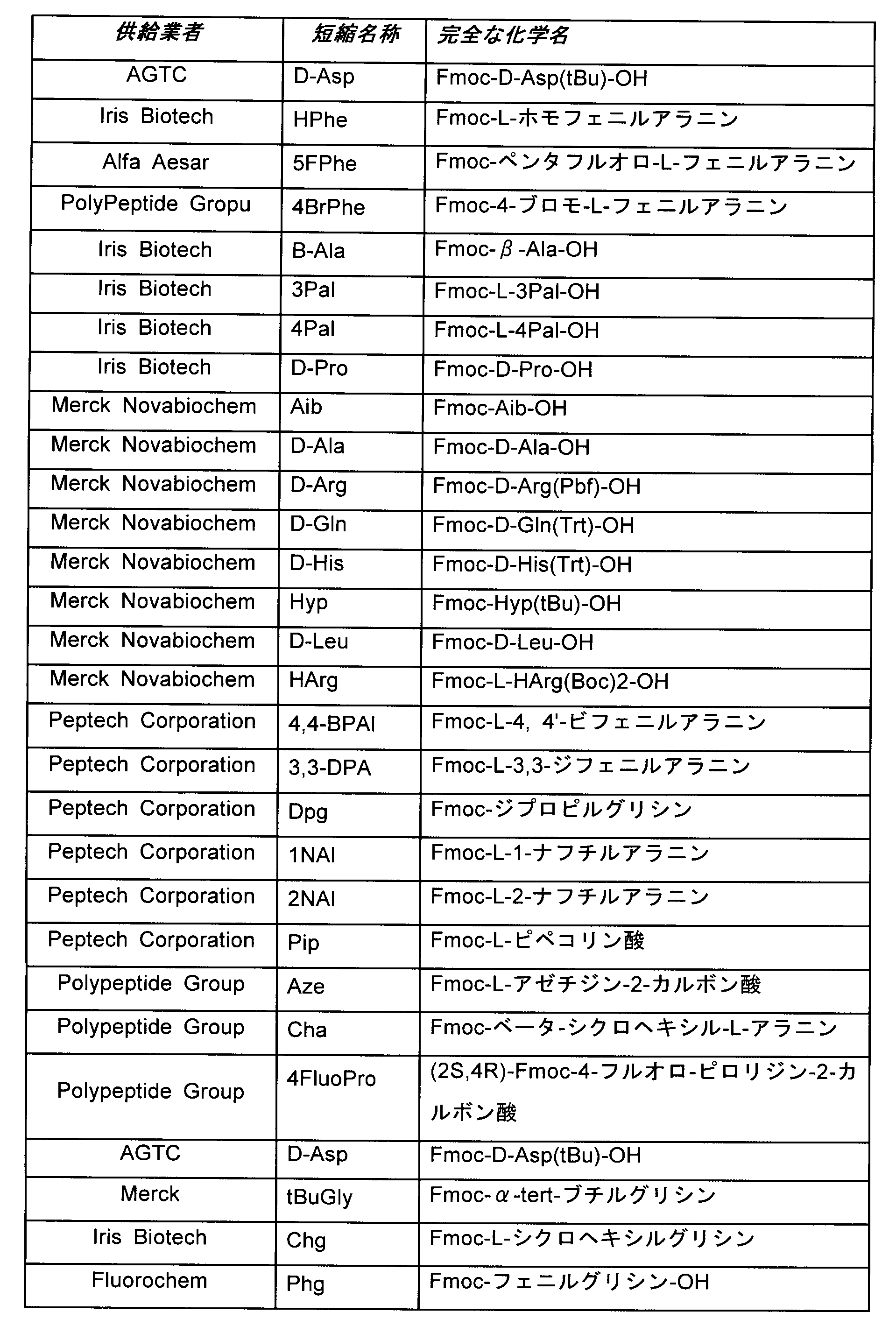

薬物動態学的研究に用いるペプチドは、水の中の0.1%TFAから凍結乾燥して、化
合物のTFA塩または遊離の酸を得た。
Peptides used for pharmacokinetic studies were lyophilized from 0.1% TFA in water to yield the TFA salt of the compound or the free acid.
<前駆体二環性ペプチドとして17-69-07-N219を用いたBDCの合成>
2つの二環薬物コンジュゲート(BDC)を、前駆体ペプチドとして17-69-07
-N219を用いて合成した。活性化されたvcMMAEまたはジスルフィド-DM1構
築物(DMSO中に溶解)を、水性条件(100リン酸ナトリウムpH8)中、17-6
9-07-N219を1.4×過剰で用いて直接コンジュゲートした(スキームIおよび
IIを参照のこと)。濃度は、9mg/mLペプチド以上であった。反応に続いてLC/
MSを行い、3.5時間後に完了と判定した。続いて、C18セミ分取カラムを用いた標
準逆相精製を行った。95%より大きい純度の画分を単離して、凍結乾燥した。この物質
は、測定できる量の遊離の毒素は含まなかった。インビトロおよびインビボの研究のため
に、凍結乾燥粉末を、濃縮DMSOストック(100mg/mL)として採取し、さらな
る使用のために適切な緩衝液中に希釈した。
<Synthesis of BDC using 17-69-07-N219 as precursor bicyclic peptide>
Two bicyclic drug conjugates (BDCs) were identified as 17-69-07 as precursor peptides.
-N219. Activated vcMMAE or disulfide-DM1 constructs (dissolved in DMSO) were treated in aqueous conditions (100 sodium phosphate pH 8) at 17-6
9-07-N219 was used in 1.4× excess for direct conjugation (see Schemes I and II). Concentrations were greater than or equal to 9 mg/mL peptide. LC/
MS was performed and judged complete after 3.5 hours. This was followed by standard reverse phase purification using a C18 semi-preparative column. Fractions with >95% purity were isolated and lyophilized. This material contained no measurable amounts of free toxin. For in vitro and in vivo studies, lyophilized powder was taken as a concentrated DMSO stock (100 mg/mL) and diluted into appropriate buffers for further use.
<前駆体二環性ペプチドとして17-69-07-N241を用いたBDCの合成>
BT17BDC-17、BT17BDC-18、BT17BDC-19およびBT17
BDC-20の合成のために、ジスルフィドメイタンシノイドのN-ヒドロキシスクシン
イミドエステル(NHSエステル)

17、BT17BDC-18、BT17BDC-19およびBT17BDC-20につい
て、式(V)a、(V)b、(V)c、(V)dの化合物について本明細書で上記された
とおりである。
<Synthesis of BDC using 17-69-07-N241 as precursor bicyclic peptide>
BT17BDC-17, BT17BDC-18, BT17BDC-19 and BT17
N-hydroxysuccinimide esters (NHS esters) of disulfide maytansinoids for the synthesis of BDC-20
17, BT17BDC-18, BT17BDC-19 and BT17BDC-20, as described herein above for compounds of formulas (V) a , (V) b , (V) c , (V) d .
BT17BDC-18はさらに、下に、およびスキームIIIに記載されるように、別
の経路を通じて合成した。ここで17-69-07-N277は、DMSO中で、17-
69-07-N241とSPP(N-スクシンイミジル4-(2-ピリジルジチオ)ペン
タノエート)とを反応させることによって合成した。17-69-07-N241の濃度
は、10mM以上であって、室温で、SPPは1.3倍過剰、ジイソプロピルエチルアミ
ンは20倍過剰であった。この反応は、LCMSで判定して、1時間で完全と判定された
。精製は、上記のように逆相によって行った。適切な画分を凍結乾燥した。
BT17BDC-18 was further synthesized through an alternative route as described below and in Scheme III. where 17-69-07-N277 is 17-
It was synthesized by reacting 69-07-N241 with SPP (N-succinimidyl 4-(2-pyridyldithio)pentanoate). The concentration of 17-69-07-N241 was 10 mM or higher, with a 1.3-fold excess of SPP and a 20-fold excess of diisopropylethylamine at room temperature. The reaction was judged complete in 1 hour as judged by LCMS. Purification was by reverse phase as described above. Appropriate fractions were lyophilized.
17-69-07-N277を、窒素ガスブランケット下で、室温で21時間、半水性
条件(50%ジメチルアセトアミドおよび50%の100mM酢酸ナトリウムpH5.0
に2mMのEDTAを補充)中、1.15当量のDM1(遊離のチオールとして)を用い
てジスルフィド交換した。反応物中の17-69-07-N277の濃度は、10mM以
上であった。これに続いて、C18セミ分取カラムを用いる標準的な逆相精製を行った。
95%を超える純度の画分を単離して凍結乾燥した。この物質は、測定可能な量の遊離の
毒素は含まなかった。インビトロおよびインビボの研究のために、凍結乾燥粉末を、上記
のとおり水性処方物中で可溶化するか、または適切な緩衝液中に直接採取した。
17-69-07-N277 was treated under semi-aqueous conditions (50% dimethylacetamide and 50% 100 mM sodium acetate pH 5.0) at room temperature for 21 hours under a blanket of nitrogen gas.
(supplemented with 2 mM EDTA) with 1.15 equivalents of DM1 (as free thiol) for disulfide exchange. The concentration of 17-69-07-N277 in the reaction was above 10 mM. This was followed by standard reverse phase purification using a C18 semi-preparative column.
Fractions with >95% purity were isolated and lyophilized. This material did not contain measurable amounts of free toxin. For in vitro and in vivo studies, lyophilized powders were either solubilized in aqueous formulations as described above or taken directly into appropriate buffers.
<MT1-MMPに対する二環性結合剤の解離速度定数の決定>
直接結合蛍光偏光(異方性)アッセイ
直接結合蛍光偏光または異方性アッセイは、一定濃度の蛍光トレーサー(ここでは、研
究すべき、フルオレセイン型二環性ペプチド)を、結合パートナー(ここでは、MT1-
MMPヘモペキシンドメイン)を用いて滴定することによって行った。結合パートナーの
濃度が滴定の間に増大するので、偏光シグナルは、結合および未結合の材料の画分に対す
る割合が変化する。これによって、解離速度(Kd)の決定が定量的に可能になる。アッ
セイデータは、標準的なリガンド結合式を用いて当てはめることができる。
<Determination of dissociation rate constant of bicyclic binder for MT1-MMP>
Direct binding fluorescence polarization (anisotropic) assay
Direct binding fluorescence polarization or anisotropy assays combine a fixed concentration of a fluorescent tracer (here, the fluorescein-type bicyclic peptide to be studied) with a binding partner (here, MT1-
MMP hemopexin domain). As the concentration of binding partner increases during the titration, the polarized signal changes in proportion to the fraction of bound and unbound material. This allows quantitative determination of the dissociation rate (Kd). Assay data can be fitted using standard ligand binding equations.
典型的には、トレーサーの濃度は、トレーサー:滴定剤の対のKdよりも理想的には十
分低く、選択される濃度は、通常は、約1nM以下である。滴定剤(結合パートナー)濃
度は、0.1nMから最大では通常5μMまで変化する。この範囲は、蛍光偏光の最大変
化が観察され得るように選択する。使用される緩衝液は、0.01%Tween含有リン
酸緩衝化生理食塩水である。実験は、ブラック384ウェル低結合/低容積プレート(C
orning3820)中で行い、蛍光偏光シグナルは、BMG Pherastar
FSプレートリーダーを用いて測定した。
Typically, the tracer concentration is ideally well below the Kd of the tracer:titrant pair, and the selected concentration is usually about 1 nM or less. Titrant (binding partner) concentrations vary from 0.1 nM up to typically 5 μM. This range is chosen such that the maximum change in fluorescence polarization can be observed. The buffer used is phosphate buffered saline containing 0.01% Tween. Experiments were performed in black 384-well low binding/low volume plates (C
orning 3820) and the fluorescence polarization signal was obtained on a BMG Pherastar
Measured using an FS plate reader.
本明細書中で呼ばれる蛍光トレーサーは、5,6-カルボキシフルオレセインを用いて
蛍光化された二環性ペプチドである。蛍光標識化は、サルコシンスペーサー(通常はSa
r5)によって、二環コア配列から隔てられる、ペプチドのN末端アミノ基で行ってもよ
い。これは、N末端アミノ基がペプチドに固有である場合、Fmoc固相合成の間に、ま
たは合成後(TBMEおよび精製での環化後)に行われ得る。蛍光標識化はまた、C末端
に、通常は、最初のC末端残基として導入されたリジンで行ってもよく、この残基は次に
、サルコシンスペーサー(通常はSar6)によって二環コア配列から隔てられている。
したがって、N末端トレーサーは、C末端蛍光標識化構築物について、Fluo-Gly
-Sar5-A(二環コア配列)および(二環コア配列)-A-Sar6-K(Fluo
)として記載された分子フォーマットを有してもよい。実施例で用いられる蛍光トレーサ
ーは、A-(17-69)-A-Sar6-K(Fluo)、A-(17-69-07)
-A-Sar6-K(Fluo)、およびA-(17-69-12)-A-Sar6-K
(Fluo)である。17-69蛍光ペプチドの酸性の性質に起因して、それらは、通常
は、濃縮DMSOストックとして調製され、それから希釈液を、100mMのTris
pH8緩衝液中で調製した。
Fluorescent tracers, as referred to herein, are bicyclic peptides that are fluoresced using 5,6-carboxyfluorescein. Fluorescent labeling is performed using a sarcosine spacer (usually Sa
It may be done at the N-terminal amino group of the peptide, which is separated from the bicyclic core sequence by r5). This can be done during Fmoc solid-phase synthesis or post-synthesis (after cyclization with TBME and purification) if the N-terminal amino group is unique to the peptide. Fluorescent labeling may also be accomplished with a lysine introduced at the C-terminus, usually as the first C-terminal residue, which is then separated from the bicyclic core sequence by a sarcosine spacer (usually Sar6). separated.
Therefore, the N-terminal tracer is Fluo-Gly
- Sar5-A (bicyclic core sequence) and (bicyclic core sequence) - A-Sar6-K (Fluo
). Fluorescent tracers used in the examples are A-(17-69)-A-Sar6-K (Fluo), A-(17-69-07)
-A-Sar6-K (Fluo), and A-(17-69-12)-A-Sar6-K
(Fluo). Due to the acidic nature of the 17-69 fluorescent peptides, they are usually prepared as concentrated DMSO stocks, from which dilutions are added to 100 mM Tris
Prepared in
蛍光偏光(異方性)を用いる競合アッセイ
MT1-MMPヘモペキシン(Hemopexin)ドメイン(PEX)に対するそれ
らの高い親和性に起因して、17-69-07および17-69-12の蛍光標識された
誘導体(それぞれ、17-69-07-N040および17-69-12-N005と示
される)を、競合実験(検出のためのFPを用いる)に用いてもよい。蛍光性PEX-結
合トレーサーとのPEXの事前に形成された複合体を、遊離の非蛍光標識された二環性ペ
プチドで滴定する。全ての17-69ベースのペプチドは、同じ部位で結合すると期待さ
れるので、滴定剤は、PEXから蛍光性トレーサーにとって代わる。複合体の解離は、定
量的に測定され得、標的タンパク質に対する競合因子(滴定剤)のKdが決定され得る。
競合方法の利点は、非蛍光標識の二環性ペプチドの親和性が、正確かつ迅速に決定され得
るということである。
Competition Assay Using Fluorescence Polarization (Anisotropy) Fluorescently Labeled Derivatives of 17-69-07 and 17-69-12 Due to Their High Affinity for the MT1-MMP Hemopexin Domain (PEX) (designated 17-69-07-N040 and 17-69-12-N005, respectively) may be used for competition experiments (using FP for detection). A preformed complex of PEX with a fluorescent PEX-conjugated tracer is titrated with free, non-fluorescently labeled bicyclic peptide. Since all 17-69-based peptides are expected to bind at the same site, the titrant replaces the fluorescent tracer from PEX. Dissociation of the complex can be quantitatively measured and the Kd of the competitor (titrant) for the target protein can be determined.
The advantage of the competition method is that the affinity of non-fluorescently labeled bicyclic peptides can be determined accurately and rapidly.
トレーサーの濃度は、通常は、Kd以下(ここでは、1nM)であり、結合タンパク質
(ここでは、MT1-MMPのヘモペキシン)は、15倍過剰であり、その結果トレーサ
ーの>90%が結合される。引き続き、非蛍光性競合因子二環性ペプチド(通常は、ほぼ
二環性コア配列)が滴定され、その結果、標的タンパク質の蛍光トレーサーにとって代わ
る。トレーサーの取り換えを、測定して、蛍光偏光の低下と関連付ける。蛍光偏光におけ
る低下は、非蛍光性滴定剤と結合した標的タンパク質の画分と比例しており、したがって
、標的タンパク質に対する滴定剤の親和性の尺度である。
The concentration of tracer is usually below the Kd (here, 1 nM) and the binding protein (here, MT1-MMP hemopexin) is in 15-fold excess so that >90% of the tracer is bound. . Subsequently, non-fluorescent competitor bicyclic peptides (usually near-bicyclic core sequences) are titrated, thus displacing the target protein's fluorescent tracer. Tracer replacement is measured and correlated with a decrease in fluorescence polarization. The decrease in fluorescence polarization is proportional to the fraction of target protein bound to the non-fluorescent titrant and is thus a measure of the titrant's affinity for the target protein.
生のデータは、蛍光トレーサー、滴定剤、および結合タンパク質の間の平衡を記載する
三次方程式の解析解にあてはめられる。このあてはめは、直接結合FP実験によって別々
に決定され得る(前のセクションを参照のこと)、標的タンパク質に対する蛍光トレーサ
ーの親和性の値を必要とする。曲線のあてはめは、Sigmaplot 12.0を用い
て行い、Zhi-Xin Wang(FEBS Letters 360(1995)1
11~114)に記載の式の適合したバージョンを用いた。
Raw data are fitted to analytical solutions of cubic equations describing the equilibrium between fluorescent tracer, titrant, and binding protein. This fit requires the affinity value of the fluorescent tracer to the target protein, which can be determined separately by direct binding FP experiments (see previous section). Curve fitting was performed using Sigmaplot 12.0 and was described by Zhi-Xin Wang (FEBS Letters 360 (1995) 1
11-114) were used.
<血漿安定性プロファイリング>
方法#1:
迅速な血漿安定性プロファイリングアッセイを開発し、これは、親の塊の質量分光測定
検出(MALDI-TOF、Voyager DE、Applied Biosyste
ms)、ならびにその血漿プロテアーゼ誘導性断片を使用した。断片の性質を評価するこ
とによって、好ましい切断部位を決定してもよい。ここでは、1~1.5mMのペプチド
ストック(DMSO中)を、直接マウス/ラット/ヒトの血漿に希釈して(Sera l
abs、抗凝血剤としてクエン酸塩を用いる)、50μMのペプチドという最終濃度を得
て、37℃で最大48時間インキュベートした。5μLの試料を適切な時点で採取して、
-80℃で凍結した。分析のために、試料を解凍して、25μLの3:3:1のアセトニ
トリル:メタノール:水と混合し、13kで5分間遠心分離した。5μLのペプチド含有
上清を吸引して、アセトニトリル:H2Oの1:1混合物中に含有される30mMの重炭
酸アンモニウムと混合した。次いで、この1μLを、MALDIプレート上にスポットし
て、乾燥し、マトリックス(αシアノけい皮酸、Sigma、0.1%トリフルオロ酢酸
を含有する1:1アセトニトリル:水中の飽和溶液として調製した)を、サンプル(1μ
L)の上に積層し、乾燥してMALDI TOFを用いて解析した。これは、異なる二環
ペプチド配列の間の血漿安定性における比較変化を検出するように作用し、かつ好ましい
切断部位を決定するように優れたツールとして機能する定量的アッセイであることに注目
すべきである。
<Plasma stability profiling>
Method #1:
A rapid plasma stability profiling assay was developed, which is based on mass spectrometric detection of the parental mass (MALDI-TOF, Voyager DE, Applied Biosystem
ms), as well as its plasma protease-inducible fragment was used. Preferred cleavage sites may be determined by evaluating the properties of the fragment. Here, 1-1.5 mM peptide stocks (in DMSO) were diluted directly into mouse/rat/human plasma (Sera l
abs, using citrate as anticoagulant), a final concentration of 50 μM peptide was obtained and incubated at 37° C. for up to 48 hours. 5 μL samples are taken at appropriate time points and
Frozen at -80°C. For analysis, samples were thawed, mixed with 25 μL of 3:3:1 acetonitrile:methanol:water and centrifuged at 13k for 5 minutes. 5 μL of peptide-containing supernatant was aspirated and mixed with 30 mM ammonium bicarbonate contained in a 1:1 mixture of acetonitrile:H 2 O. 1 μL of this was then spotted onto a MALDI plate, dried and matrix (alpha cyanocinnamic acid, Sigma, prepared as a saturated solution in 1:1 acetonitrile:water containing 0.1% trifluoroacetic acid). , the sample (1 μ
L), dried and analyzed using MALDI TOF. It should be noted that this is a quantitative assay that acts to detect comparative changes in plasma stability between different bicyclic peptide sequences and serves as an excellent tool to determine preferred cleavage sites. is.
方法#2
二環性ペプチドの血漿安定性を定量的に得るために、ペプチドストック溶液(DMSO
中200μM)を、最終濃度が10μMとなるように、血漿(ヒトまたはマウス)と混合
した。40μLのサンプルを、最大8時間まで周期的に採取し、-80℃で凍結した。L
C-MS解析の前に、サンプルを解凍して、3容積(ここでは、120μL)の1:1ア
セトニトリル/MeOH水と混合した。乳濁物を30分間、13000rpmで遠心分離
し、ペプチド含有上清を、参照として同じペプチドの血漿抽出標準曲線を用いながら、二
重/三重荷電の種、およびそのMS/MS断片について、Waters Xevo TQ
-D装置を用いて定量した。血漿中の分解の半減期を用いて、分子の比較の安定性を評価
した。
To quantitatively obtain the plasma stability of bicyclic peptides, peptide stock solutions (DMSO
200 μM medium) was mixed with plasma (human or mouse) to a final concentration of 10 μM. Samples of 40 μL were taken periodically up to 8 hours and frozen at -80°C. L.
Prior to C-MS analysis, samples were thawed and mixed with 3 volumes (here, 120 μL) of 1:1 acetonitrile/MeOH water. Emulsions were centrifuged at 13000 rpm for 30 minutes and peptide-containing supernatants were subjected to a Waters Xevo assay for doubly/triple charged species and their MS/MS fragments using the same peptide plasma extraction standard curve as a reference. TQ
Quantified using the -D instrument. The half-life of degradation in plasma was used to assess the comparative stability of the molecules.
<マウスにおける17-69-07の薬物動態、代謝の特定>
17-69-07-N004の薬物動態
マウスの薬物動態は、二環性ペプチド17-69-04-N004を用いて獲得し、こ
れは、1.19mg/mLの溶液の5mL/kgボーラスとして単回静脈内の5.925
mg/kg用量として12匹の雄性CD1マウスの1群に投与した。処方した溶液は、投
与の直前に1.9mLのリン酸緩衝化生理食塩水により希釈して、23.7mg/mLの
DMSOストックの100μLから調製し、PBS中の5%DMSOからなるビヒクルを
pH7.4で得た。血液サンプルは、投与後0.08、0.5、1、2および4時間で、
末端の麻酔下で心穿刺によって、1時点あたり2匹の動物から採取し、血漿を得るために
EDTAチューブに移した。血漿サンプルを-20℃で直ちに凍結した。分析のために、
サンプルを迅速に解凍し、50μLのアリコートを、3容積の抽出溶媒(分析の内部標準
を含む、10mMの重炭酸アンモニウム、pH8、アセトニトリルおよびメタノールの2
:9:9混合物)で処理した。沈殿したタンパク質を、遠心分離によって取り出し、上清
をLC-MS/MSによって解析した。サンプルの定量は、対照のマウス血漿で作成した
較正線を参照した。薬物動態パラメータは、Summit Research Serv
icesからソフトウェアパッケージPK Solutions 2.0を用いてノンコ
ンパートメント解析によって決定した。
<Identification of pharmacokinetics and metabolism of 17-69-07 in mice>
Pharmacokinetics of 17-69-07-N004
Mouse pharmacokinetics were obtained with the bicyclic peptide 17-69-04-N004, which was administered as a single intravenous 5 mL/kg bolus of a 1.19 mg/mL solution to 5.925
Groups of 12 male CD1 mice were administered as mg/kg doses. Formulated solutions were prepared from 100 μL of a 23.7 mg/mL DMSO stock by diluting with 1.9 mL of phosphate-buffered saline just prior to dosing, and a vehicle consisting of 5% DMSO in
Harvested from two animals per time point by cardiac puncture under terminal anesthesia and transferred to EDTA tubes to obtain plasma. Plasma samples were immediately frozen at -20°C. For analysis,
Samples were rapidly thawed and 50 μL aliquots were added to 3 volumes of extraction solvent (10 mM ammonium bicarbonate,
:9:9 mixture). Precipitated proteins were removed by centrifugation and the supernatant was analyzed by LC-MS/MS. Sample quantification was referenced to a calibration line generated with control mouse plasma. Pharmacokinetic parameters were analyzed using the Summit Research Serv
It was determined by non-compartmental analysis using the software package PK Solutions 2.0 from ices.
[用語の定義]
Cmax:最大の測定濃度;
Tmax:最大濃度測定の時間;
AUC 0-t:血漿薬物濃度下面積/時間曲線(0分から最終の定量化可能なデータ
ポイントまで);および
AUC 0-∞:血漿薬物濃度下面積/時間曲線(0分から最終半減期に基づいて最終デ
ータポイントを超えて推定)
[Definition of terms]
Cmax: maximum measured concentration;
Tmax: time of maximum concentration measurement;
AUC 0-t: Area Under Plasma Drug Concentration/Time Curve (0 min to last quantifiable data point); and AUC 0-∞: Area Under Plasma Drug Concentration/Time Curve (0 min based on terminal half-life) estimated beyond the final data point)
マウス血漿中の二環性ペプチド代謝物の特定
3つの血漿サンプルを、マウスにおける17-69-07-N004のインビボ代謝物
の可能性の解析のために(0.5、1および2時間)用いることが可能である。解析は、
HPLC-MS、およびHPLC-MS/MSによって、LTQ Orbitrap X
L質量分析計で行った。血液循環中のペプチド代謝物について調べるアプローチは、仮定
の代謝物の正確な量(10ppmウインドウ)を算出することであった(それぞれ、ルー
プ1および/またはループ2の切断のための1または2回の水(+18、+36)の添加
;その後、単一アミノ酸の喪失、またはループ1および/またはループ2からのアミノ酸
ストレッチの喪失)。第2に、ブランクのマウス血漿との総イオンクロマトグラムを比較
することによって、手技的なサーチを行った。
Identification of Bicyclic Peptide Metabolites in Mouse Plasma Three plasma samples are used (0.5, 1 and 2 hours) for analysis of potential in vivo metabolites of 17-69-07-N004 in mice. It is possible. The analysis is
LTQ Orbitrap X by HPLC-MS and HPLC-MS/MS
L mass spectrometer. An approach to investigate peptide metabolites in circulation was to calculate the exact amount (10 ppm window) of a hypothetical metabolite (1 or 2 times for cleavage of
HT-1080異種移植片マウスにおけるBT17BDC-1およびBT17BDC-9
の有効性
皮下HT-1080異種移植片腫瘍を保有するBalb/cヌードマウスを、BDCま
たはビヒクル(PBS)で処置した。BDCを、2週間の間毎週3回投与し、腫瘍が約1
50~200mm3と測定された時に投与を開始した。マウスをモニターして、腫瘍容積
の測定および体重は、週に3回記録した。
BT17BDC-1 and BT17BDC-9 in HT-1080 xenograft mice
Balb /c nude mice bearing subcutaneous HT-1080 xenograft tumors were treated with BDC or vehicle (PBS). BDC was administered three times weekly for two weeks and tumors were
Dosing began when 50-200 mm 3 was measured. Mice were monitored and tumor volume measurements and body weights were recorded three times weekly.
〔実施例1: MT1-MMPヘモペキシンドメインを用いる高親和性を有する二環性ペ
プチドの特定〕
二環性ペプチドファージライブラリを生成するために以前に確立された方法を使用して
、MT1-MMPのヒトヘモペキシンドメインに対して選択を行った。連続的に低下する
濃度の標的を使用するナイーブなライブラリからの3回の選択後、アウトプットに対して
配列決定を行った。二環性ペプチド17-69(CKNRGFGCEDFYDIC)(配
列番号16)が、最も豊富な配列アウトプットとして特定され、標的に対する定量的結合
は、Alphascreenによって検証した。
[Example 1: Identification of bicyclic peptides with high affinity using the MT1-MMP hemopexin domain]
Selections were made against the human hemopexin domain of MT1-MMP using previously established methods for generating bicyclic peptide phage libraries. After three rounds of selection from the naive library using successively decreasing concentrations of target, the outputs were subjected to sequencing. Bicyclic peptide 17-69 (CKNRGFGCEDFYDIC) (SEQ ID NO: 16) was identified as the most abundant sequence output and quantitative binding to target was verified by Alphascreen.
3つの小さいファージライブラリを生成して、17-69配列のうち3部分の各々の完
全な配列のカバーを得た。これらの3つのライブラリを、ヘモペキシンタンパク質に対す
る2回の選択に供した。興味深いことに、最も見込みのある配列決定アウトプットは、5
×6の二環性ペプチドであったが、出発するライブラリは、6×6フォーマットのもので
あった。標的タンパク質に対する二環性ペプチドの親和性が高いほど、短いループ長が選
択された可能性がある。ファージライブラリの構築の間に組み込まれるプライマーが不正
確に合成された結果、より短いループ長が生じる。
Three small phage libraries were generated to obtain complete sequence coverage of each of the three portions of the 17-69 sequence. These three libraries were subjected to two rounds of selection against the hemopexin protein. Interestingly, the most likely sequencing output is 5
Although it was a x6 bicyclic peptide, the starting library was in 6 x 6 format. Shorter loop lengths may have been chosen for the higher affinity of the bicyclic peptide for the target protein. Shorter loop lengths result from incorrectly synthesized primers that are incorporated during phage library construction.
主な配列決定アウトプットは、ペプチド17-69-07であって、配列CYNEFG
CEDFYDIC(配列番号2)を有する。
The main sequencing output was peptide 17-69-07 with the sequence CYNEFG
CEDFYDIC (SEQ ID NO: 2).
5×6フォーマットが最も有益であると思われたという観察、および5×6の結合剤と
の間の差異が必要であったという観察に基づいて、2つ以上のライブラリを生成して、二
環性ペプチド17-69-02、17-69-03、17-69-04および17-69
-12を生成した第1のループの意図的な短縮を試験する。これらは、図1に開示される
配列内に含まれる。
Based on the observation that the 5x6 format appeared to be most informative, and that differences between 5x6 binders were required, two or more libraries were generated to Cyclic peptides 17-69-02, 17-69-03, 17-69-04 and 17-69
Test for intentional shortening of the first loop that produced -12. These are contained within the sequences disclosed in FIG.
特定の残基についての傾向は見られたが、結合アッセイは、それらがアッセイの上限に
達したので、最良の結合剤との間を識別できなかった。
Although trends were seen for certain residues, the binding assay could not discriminate between the best binders as they hit the upper limit of the assay.
最も頻繁に生じる配列は、アルファスクリーニング(ここでは全てのシグナルは、もと
の17-69配列と比較して高かった)を用いて、ヘモペキシン結合についてアッセイし
た(表1を参照のこと)。
The most frequently occurring sequences were assayed for hemopexin binding using alpha screening (where all signals were higher compared to the original 17-69 sequence) (see Table 1).

17-69-ベースの親和性成熟クローンの全てが、アッセイ上限に近いシグナルを生
じたので、表1に示すプロットによっては、最良のクローンを明確に特定できない。した
がって、いくつかのペプチドを、蛍光標識された誘導体(17-69、17-69-07
および17-69-12)として合成し、直接結合蛍光性偏光(FP)実験に用いた。こ
こで、フルオレセインは、コア配列に対してN末端またはC末端のいずれかで、二環性配
列からリンカー(通常はSar6)によって隔てられる(表2)。
The plots shown in Table 1 do not clearly identify the best clones, as all of the 17-69-based affinity matured clones gave signals near the upper limit of the assay. Therefore, some peptides were labeled with fluorescently labeled derivatives (17-69, 17-69-07
and 17-69-12) and used for direct-coupled fluorescence polarization (FP) experiments. Here, the fluorescein is separated from the bicyclic sequence by a linker (usually Sar6) either N-terminally or C-terminally to the core sequence (Table 2).
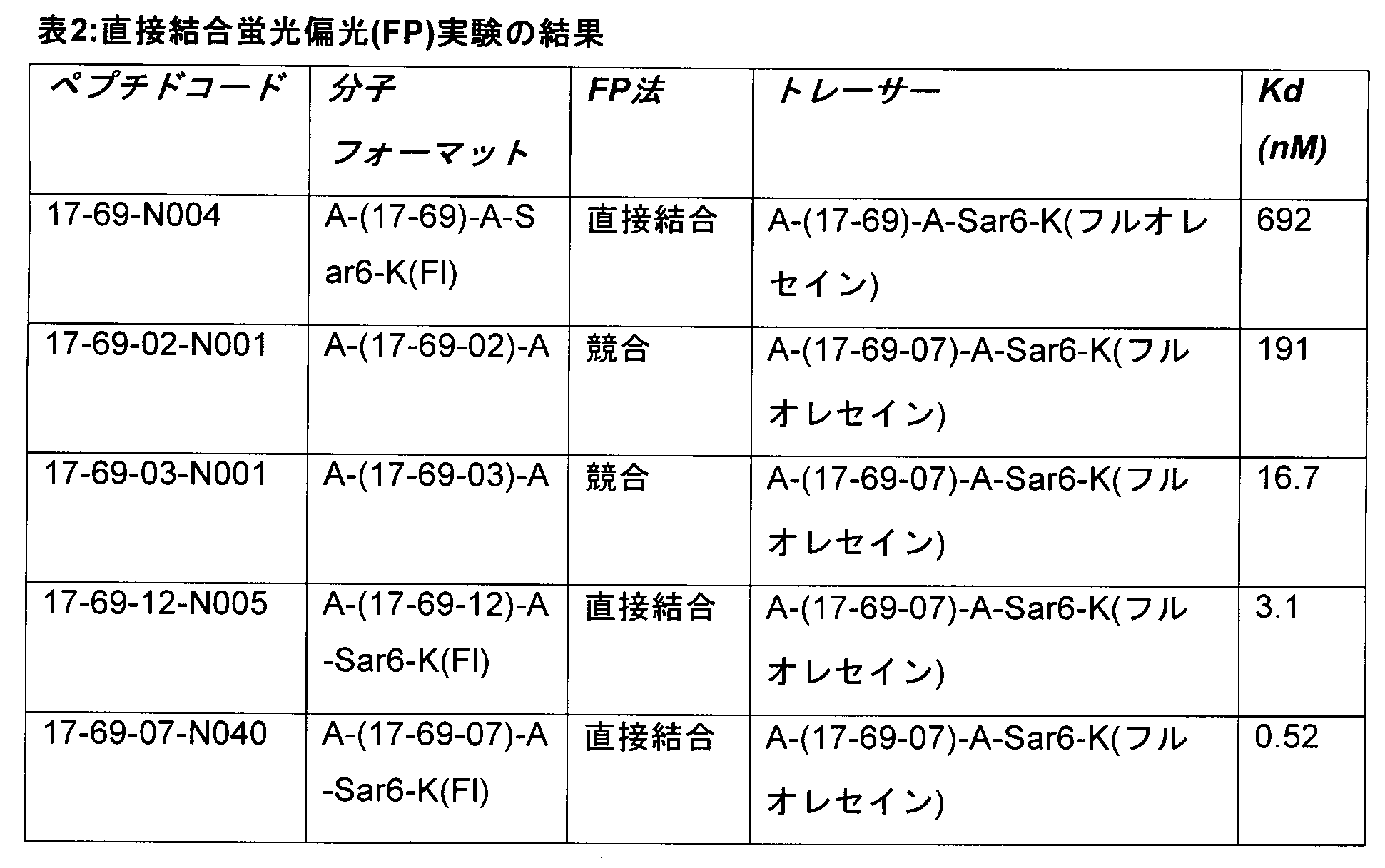
17-69-07および17-69-12の蛍光標識された誘導体(17-69-07
-N040および17-69-12-N005と示される)は、それぞれ、0.52およ
び3.1nMの解離速度で強力な結合を示した。それらは、もとの非成熟の17-69配
列(17-69-N004)よりも顕著に改善される。5×6フォーマットを含む配列は
、親和性成熟ライブラリの状況内で高親和性を誘導すると思われる。
Fluorescently labeled derivatives of 17-69-07 and 17-69-12 (17-69-07
-N040 and 17-69-12-N005) showed strong binding with off-rates of 0.52 and 3.1 nM, respectively. They are significantly improved over the original immature 17-69 sequence (17-69-N004). Sequences containing the 5x6 format are likely to induce high affinities within the context of affinity maturation libraries.
MT1-MMPヘモペキシンドメイン(PEX)に対するそれらの高い親和性に起因し
て、17-69-07および17-69-12の蛍光標識された誘導体(それぞれ、17
-69-07-N040および17-69-12-N005と呼ばれる)を、続く競合実
験(検出のためにFPを用いる)のために用いた。ここで、蛍光性PEX結合トレーサー
とのPEXの事前の形成された複合体を、遊離の蛍光標識されていない二環性ペプチドで
滴定する。全ての17-69ベースのペプチド(保存された第2のループモチーフCED
FYDIC;配列番号17を含有)は、同じ部位に結合すると期待されるので、滴定剤に
よりPEXから蛍光トレーサーに置き換えられることになる。複合体の解離は、定量的に
測定され得、競合因子(滴定剤)のKdが決定され得る。競合方法の利点は、蛍光標識さ
れていない二環性ペプチドの親和性が、正確かつ迅速に決定され得るということである。
Due to their high affinity for the MT1-MMP hemopexin domain (PEX), fluorescently labeled derivatives of 17-69-07 and 17-69-12 (17
-69-07-N040 and 17-69-12-N005) were used for subsequent competition experiments (using FP for detection). Here, a pre-formed complex of PEX with a fluorescent PEX-conjugated tracer is titrated with free non-fluorescently labeled bicyclic peptide. All 17-69 base peptides (conserved second loop motif CED
FYDIC; containing SEQ ID NO: 17) is expected to bind to the same site, thus displacing the fluorescent tracer from PEX by the titrant. Dissociation of the complex can be quantitatively measured and the Kd of the competitor (titrant) determined. An advantage of the competition method is that the affinity of non-fluorescently labeled bicyclic peptides can be determined accurately and rapidly.
ここでは、17-69-07および17-69-12コア配列が、PEXに対する高い
親和性を単独で担うことを検証することが重要であった。したがって、ペプチドを、N末
端およびC末端のアラニンを有するバリアントとして合成し、それによって、ファージ粒
子上で発現された配列を密接に模倣するが、蛍光標識された構築物で用いられたSar5
/6分子スペーサーを欠いている。
It was important here to verify that the 17-69-07 and 17-69-12 core sequences are solely responsible for the high affinity for PEX. Therefore, peptides were synthesized as variants with N- and C-terminal alanines, thereby closely mimicking the sequence expressed on phage particles, but the Sar5 used in the construct was fluorescently labeled.
It lacks the /6 molecular spacer.
競合実験によって決定された親和性は、蛍光標識された誘導体で得られたものとほとん
ど同一であって、これによってコア二環性配列が、PEXに対する高い親和性結合を担う
ことが明白に示された(表3)。さらに、この蛍光標識された構築物によって、分子スペ
ーサーおよびエフェクター基のC末端連結(ここでは、-A-Sar6-K(フルオレセ
イン)が耐容されることが示される。
The affinities determined by competition experiments were almost identical to those obtained with fluorescently labeled derivatives, clearly demonstrating that the core bicyclic sequence is responsible for high affinity binding to PEX. (Table 3). Furthermore, this fluorescently labeled construct is shown to tolerate the C-terminal linkage of molecular spacers and effector groups, here -A-Sar6-K (fluorescein).
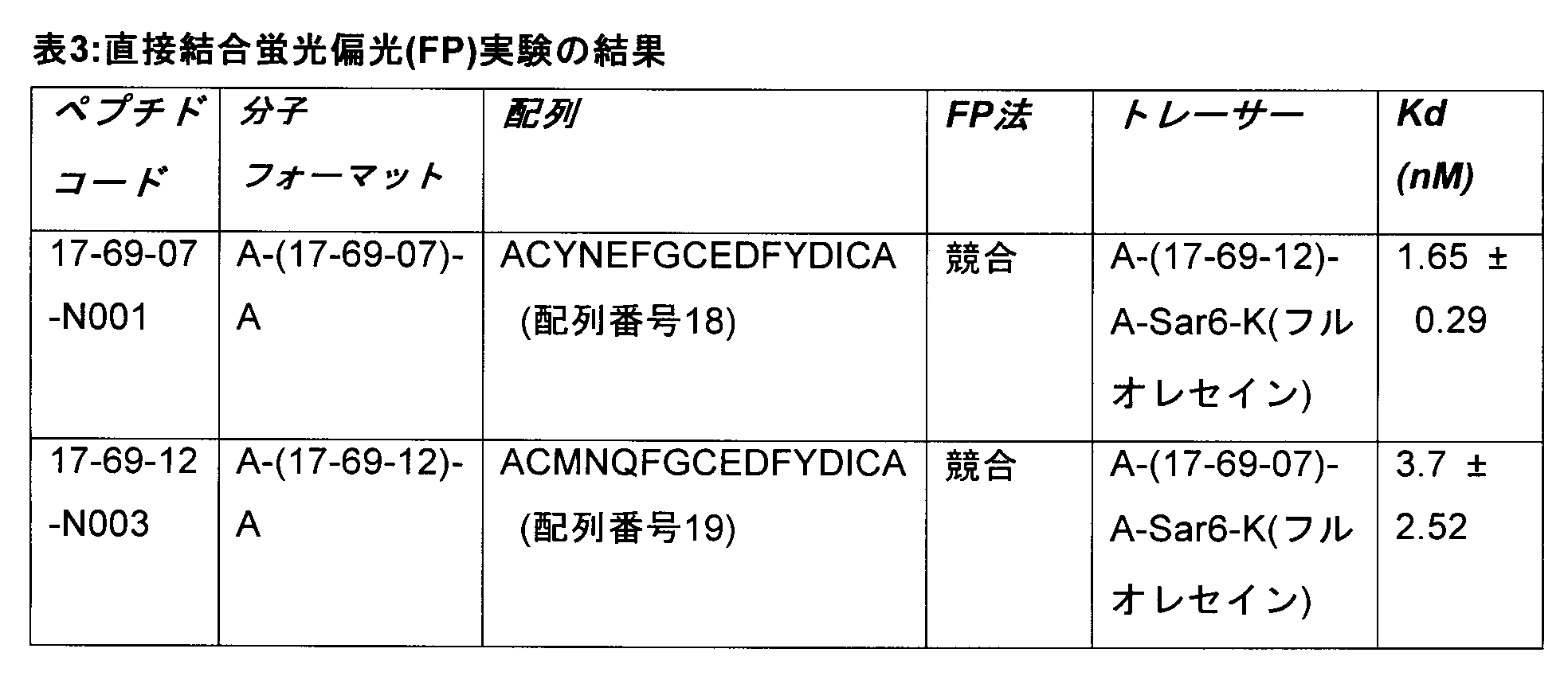
〔実施例2: 17-69-07コア配列のタンパク質分解性の安定性〕
[17-69-07のマウス血漿安定性]
男性における治療適用のために、および動物種における前臨床アセスメントのためには
、リード二環ペプチドが、静脈内投与後の循環中で十分に安定であることが妥当である。
十分なレベルの二環ペプチドが、その標的に結合し得、その生物学的機能を発揮するよう
な十分な安定性が必要である。
[Example 2: Proteolytic stability of 17-69-07 core sequence]
[Mouse plasma stability of 17-69-07]
For therapeutic application in males and for preclinical assessment in animal species, it is reasonable that the lead bicyclic peptide be sufficiently stable in the circulation after intravenous administration.
Sufficient stability is required so that sufficient levels of the bicyclic peptide can bind to its target and exert its biological function.
前臨床モデルでは、マウス、ラット、ウサギ、およびカニクイザルなどの種を使用する
場合が多い。第1の場合、二環性ペプチド17-69-07-N219を、本明細書で上
記される方法を用いてマウス血漿の存在下で安定性について評価した(方法#2)。二環
コア配列は、17-69-07配列のもとの天然のタンパク質を構成するアミノ酸を保持
し、さらに、エフェクター基のコンジュゲーションに用いられるN末端分子スペーサーを
含む(配列:G-Sar10-ACYNEFGCEDFYDIC;配列番号20)。PE
Xに対する17-69-07-N219の親和性は、分子スペーサーの存在にかかわらず
保持された(Kd=0.82nM)。
Preclinical models often use species such as mice, rats, rabbits, and cynomolgus monkeys. In the first case, bicyclic peptide 17-69-07-N219 was evaluated for stability in the presence of mouse plasma using the method described herein above (Method #2). The bicyclic core sequence retains the native proteinogenic amino acids of the original 17-69-07 sequence and additionally contains an N-terminal molecular spacer used for conjugation of effector groups (sequence: G-Sar10- ACYNEFGCEDFYDIC; SEQ ID NO: 20). PE
The affinity of 17-69-07-N219 for X was retained (Kd=0.82 nM) despite the presence of the molecular spacer.
この化合物は、6時間という半減期であるエクスビボのマウス血漿中で適度の安定性を
示した(図1を参照のこと)。
This compound showed moderate stability in ex vivo mouse plasma with a half-life of 6 hours (see Figure 1).
[17-69-07中のエクスビボ/インビボのタンパク質分解性切断部位の特定]
マウス血漿中の17-69-07-N219の分解の化学的性質を理解する労力では、
サンプルを、任意の潜在的な分解生成物についてMALDI-TOFを用いて解析した。
質量スペクトルによって、チロシンの損失の可能性が示され、これは、ループ開口(加水
分解)ならびにループ1のTyr1および/またはループ2のTy9の除去を意味する。
[Identification of ex vivo/in vivo proteolytic cleavage sites in 17-69-07]
In an effort to understand the chemistry of degradation of 17-69-07-N219 in mouse plasma,
Samples were analyzed using MALDI-TOF for any potential degradation products.
The mass spectrum indicates a possible loss of tyrosine, implying loop opening (hydrolysis) and removal of Tyr1 of loop1 and/or Ty9 of loop2.
17-69-07の最小のコア二環性ペプチドを構成する、最小の二環性ペプチド17
-69-07-N004(Ac-CYNEFGCEDFYDIC(配列番号2)を用いる
マウス薬物動態(PK)研究を行って、インビボ循環からのクリアランスおよび排出の速
度を確立した。得られた血液サンプルをさらに解析して、17-69-07-N004の
任意の潜在的なタンパク質分解生成物について血漿サンプルを分析した。
Minimal Bicyclic Peptide 17, Constituting the Minimal Core Bicyclic Peptide of 17-69-07
A mouse pharmacokinetic (PK) study with -69-07-N004 (Ac-CYNEFGCEDFYDIC (SEQ ID NO: 2) was performed to establish the rate of clearance and excretion from the in vivo circulation. Obtained blood samples were analyzed further. Plasma samples were analyzed for any potential proteolytic degradation products of 17-69-07-N004.
PKのプロファイルを図2に示す。 The PK profile is shown in FIG.

表4によって、ペプチドが14分という排泄半減期を有すること、および20.7mL
/分/kgで排出されることが示される。クリアランス速度は、マウスで観察される糸球
体濾過速度よりも大きく(Qi et al,American Journal of
Physiology-Renal Physiology(2004)Vol.28
6 no.3,F590-F596にまとめる)、これによって、ペプチドが、追加の手
段、例えば、血漿および内皮のプロテアーゼによって駆動されるタンパク質分解によって
排出されることが示される。
Table 4 shows that the peptide has an elimination half-life of 14 minutes and 20.7 mL
/min/kg is shown. The clearance rate is greater than the glomerular filtration rate observed in mice (Qi et al, American Journal of
Physiology-Renal Physiology (2004) Vol. 28
6 no. 3, F590-F596), which indicates that peptides are excreted by additional means, such as proteolysis driven by plasma and endothelial proteases.
インビボのタンパク質分解が、クリアランスに有意に寄与するか否かに取り組むため、
t=0.5、1および2時間でとった血漿サンプルを、LC-MS/MS技術を用いて二
環断片のための標的解析に供した。
To address whether in vivo proteolysis contributes significantly to clearance,
Plasma samples taken at t=0.5, 1 and 2 hours were subjected to target analysis for bicyclic fragments using LC-MS/MS techniques.
多数のタンパク質分解代謝物を特定してもよく、最も強力なシグナルを有する断片を、
降順で下に列挙する。
Ac-CiYNEFGCiiEDFYDICiii(配列番号2):
ループ1におけるYNEの切除;
ループ1におけるYNEF(配列番号21)の切除;
ループ1におけるYNEFG(配列番号22)の切除(ループ全体が除去される);
ループ1および/または2中のYの切除;
ループ2におけるYDの切除;
ループ2におけるFYDの切除;
ループ2におけるYDIの切除;および
ループ2におけるEDFYDI(配列番号23)の切除(ループ全体が除去される)
A number of proteolytic metabolites may be identified and the fragment with the strongest signal is
Listed below in descending order.
Ac-C i YNEFGC ii EDFYDIC iii (SEQ ID NO: 2):
excision of YNE in
excision of YNEF (SEQ ID NO: 21) in
excision of YNEFG (SEQ ID NO: 22) in loop 1 (the entire loop is removed);
excision of Y in
excision of YD in
excision of FYD in
excision of YDI in
上位3つの代謝物が中程度のシグナルレベルで存在する一方、それ以外の断片は微量で
しか検出できなかった。
The top three metabolites were present at moderate signal levels, while the other fragments were only detectable in trace amounts.
まとめると、エクスビボおよびインビボの両方の代謝物は、Tyr1/9でまたはその
付近での最初の切断に集中するようであり、その後に近傍での残基の連続的な除去が続く
。これによって最終的にループのいずれかまたは両方がその全体として除去される。
Taken together, both ex vivo and in vivo metabolites appear to focus on an initial cleavage at or near Tyr1/9, followed by successive removals of residues in the vicinity. This ultimately eliminates either or both loops in their entirety.
[17-69-07配列のタンパク質分解安定性および活性増強]
タンパク質分解からペプチド配列を安定化するためのアプローチは、多数ある(概説に
関しては、Gentilucci et al,Curr.Pharmaceutica
l Design,(2010),16,3185-203,およびNestor et
al,Curr.Medicinal Chem(2009),16,4399-41
8)、ならびにWO2009/098450、WO2013/050615およびWO2
013/050616を参照のこと)。要するに、それらは、プロテアーゼに対して認識
ポイントを提供するアミノ酸の置換、切断部位でのアミノ酸骨格の変更(すなわち、N-
メチル化、擬ペプチド結合など)、隣接する結合の立体的障害(すなわち、β置換のアミ
ノ酸)、およびD鏡像異性体アミノ酸の包含を含む。これらの修飾のいくつか(すなわち
、N-メチル化、D-アミノ酸)は、切断部位から最大2残基離れて位置する場合でさえ
、加水分解からタンパク質分解切断部位を保護/遮蔽し得る。これはタンパク質分解攻撃
から配列を保護するためには比較的単純な方法であるが、標的タンパク質に対する活性を
劇的に変更しないような安定化変更を組む込むことは、さらにかなり困難である。
[Enhanced proteolytic stability and activity of the 17-69-07 sequence]
There are many approaches to stabilize peptide sequences from proteolytic degradation (for review see Gentilucci et al, Curr. Pharmaceutica
l Design, (2010), 16, 3185-203, and Nestor et al.
al, Curr. Medicinal Chem (2009), 16, 4399-41
8), and WO2009/098450, WO2013/050615 and WO2
013/050616). In short, they are substitutions of amino acids that provide recognition points for proteases, alterations of the amino acid backbone at the cleavage site (i.e., N-
methylation, pseudopeptide bonds, etc.), steric hindrance of adjacent bonds (ie, amino acids in β substitutions), and inclusion of D enantiomeric amino acids. Some of these modifications (ie, N-methylation, D-amino acids) can protect/shield the proteolytic cleavage site from hydrolysis even when located up to two residues away from the cleavage site. Although this is a relatively simple way to protect a sequence from proteolytic attack, it is much more difficult to incorporate stabilizing changes that do not dramatically alter activity against the target protein.
前のセクションで示される17-69-07のエクスビボ/インビボのタンパク質分解
データから、Tyr1/9および近傍の残基は、二環性ペプチドの安定性に関する潜在的
部位であることが明らかである。ペプチドの首尾よい安定化を評価するための定量的手段
は、マウスおよびヒト血漿中でのその半減期の増大による。
From the ex vivo/in vivo proteolysis data for 17-69-07 presented in the previous section, it is clear that Tyr1/9 and nearby residues are potential sites for bicyclic peptide stability. A quantitative means for evaluating successful stabilization of a peptide is by increasing its half-life in mouse and human plasma.
最初の場合、各々の位置をアラニンで置き換えた、17-69-07の11個の誘導体
を生成した(「アラニンスキャン」と命名)。この種の情報は、特定の残基のエネルギー
的寄与および役割を示唆し、タンパク質分解認識ポイントを潜在的に除去する。
In the first case, 11 derivatives of 17-69-07 were generated, replacing each position with an alanine (named "alanine scan"). This kind of information suggests the energetic contribution and role of particular residues, potentially removing proteolytic recognition points.

17-69-07-N004は、キャッピングされたN末端を含む、野性型の、未修飾
のペプチド(N末端アセチル化、「Ac」と命名)である。Ala置換のいくつかは、特
に、配列内の1、3、4、10および11では十分耐容される。これらの残基の側鎖は、
標的に対する高い親和性結合のために必要ないので、これらの特定の配列位置における式
(I)の化合物は広く定義される。
17-69-07-N004 is a wild-type, unmodified peptide (N-terminal acetylated, designated "Ac") with a capped N-terminus. Some of the Ala substitutions are well tolerated, especially at 1, 3, 4, 10 and 11 within the sequence. The side chains of these residues are
Compounds of formula (I) at these specific sequence positions are broadly defined as they are not required for high affinity binding to the target.
これによって、残基1の置換(Tyr1)は極めて魅力的な可能性となる。なぜなら、
タンパク質分解性の認識ポイントの1つが除去され得るからである。Ala5によるGl
y5の置換は、化学的変化がわずか(メチル基の付加)であるにもかかわらず、活性の劇
的な低下を生じるので魅力的な置換である。Gly5は、一般的なRamachandr
onチャートの外のφ/ψ角度を採用することが可能である。これらの角度は、D-アミ
ノ酸によって潜在的に誘導され得る。追加の利点には、この部位に隣接するペプチド結合
の安定化がある。
This makes substitution of residue 1 (Tyr1) a very attractive possibility. because,
This is because one of the proteolytic recognition points can be removed. Gl by Ala5
Substitution of y5 is an attractive substitution as it results in a dramatic decrease in activity despite a minor chemical change (addition of a methyl group). Gly5 is a general Ramachandr
It is possible to employ φ/φ angles outside the on chart. These angles can potentially be induced by D-amino acids. An additional advantage is the stabilization of peptide bonds flanking this site.
この理由のために、部分的なD-アラニンスキャンを行って、活性の維持に関してそれ
らが耐容されるか否かを評価した。配列中のDアミノ酸の包含は、それらのタンパク質分
解について安定性の効果のおかげで極めて望ましい。
For this reason, partial D-alanine scans were performed to assess whether they were tolerated with respect to maintenance of activity. Inclusion of D-amino acids in the sequence is highly desirable due to their stabilizing effect on proteolysis.

Tyr1の代わりのD-Ala1は、野性型の10倍未満の親和性で結合する。それに
もかかわらず、活性の大きな損失を誘導することなくタンパク質分解性の認識ポイントで
あるTyr1が除去され、安定化アミノ酸によって置き換えられるので、関心を惹くもの
である。
D-Ala1 instead of Tyr1 binds with less than 10-fold less affinity than wild type. Nevertheless, it is of interest because the proteolytic recognition point Tyr1 is removed and replaced by a stabilizing amino acid without inducing a large loss of activity.
注目すべきは、D-Ala5によるGly5の置換は十分耐容され、なぜなら野性型と
比較した親和性は不変のままであるからである。
Of note, replacement of Gly5 by D-Ala5 was well tolerated, since affinity relative to wild type remained unchanged.
この状況では、D-Arg5もまた耐容され(したがって、D-Proを除く全てのD
アミノ酸である可能性が高い、表6を参照のこと)、これは、分子のさらなる開発の間に
、物理化学的特性が変化する必要があるか否かが関心となり得る(表7)。
In this situation, D-Arg5 is also tolerated (hence all D except D-Pro).
likely an amino acid, see Table 6), it may be of interest during further development of the molecule whether the physicochemical properties need to change (Table 7).

次に、配列の4位の疎水性アミノ酸および芳香族アミノ酸の特定の優先度を示すファー
ジの選択アウトプットに起因して、天然のチロシンおよびトリプトファンを含む、選択芳
香族アミノ酸を組み込む一連の誘導体を合成した(表8)。
A series of derivatives incorporating selected aromatic amino acids, including naturally occurring tyrosines and tryptophans, were then developed due to the selection output of the phage showing particular preference for hydrophobic and aromatic amino acids at
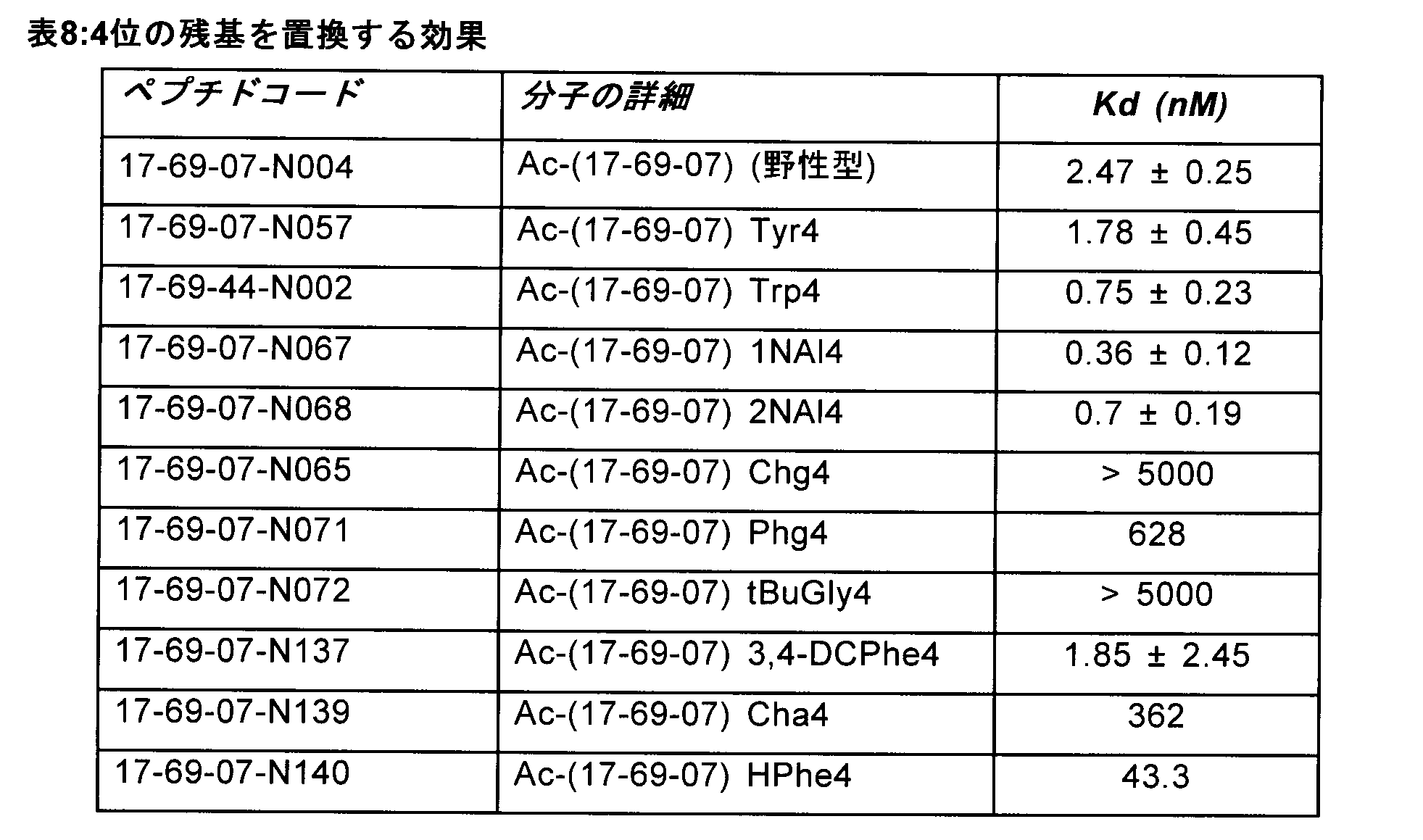
1Nal:1-ナフチルアラニン;2NAl:2-ナフチルアラニン;Chg:シクロ
ヘキシルグリシン、Phg:フェニルグリシン;tBuGly:tert-ブチルグリシ
ン;3,4-DCPhe4:3,4-ジクロロフェニルアラニン;Cha:シクロヘキシ
ルアラニン;およびHPhe:ホモフェニルアラニン。
1Nal: 1-naphthylalanine; 2NAl: 2-naphthylalanine; Chg: cyclohexylglycine, Phg: phenylglycine; tBuGly: tert-butylglycine; 3,4-DCPhe4: 3,4-dichlorophenylalanine; HPhe: homophenylalanine.
4位の置換のいくつかによって、野性型と比較して親和性が向上し、これらとしては、
チロシン、トリプトファン、1および2-ナフチルアラニン(1/2Nal)ならびに3
,4ジクロロフェニルアラニン(3,4-DCPhe)が挙げられる。最も強力な置換は
、1-ナフチルアラニンであり、これは親和性を7倍に向上させる。
Several of the substitutions at
Tyrosine, tryptophan, 1 and 2-naphthylalanine (1/2Nal) and 3
,4-dichlorophenylalanine (3,4-DCPhe). The most potent substitution is 1-naphthylalanine, which improves affinity by 7-fold.
17-69-07のループ2中の特定の残基を、分子の安定性を向上する目的で試験し
た。これらは、残基9を含み、この残基は、潜在的なTyr9認識ポイントを含む。残基
11はまた、置換を許容され(表5)、Tyr9認識ポイントに近接するので魅力的であ
る。
Specific residues in

興味深いのは、4-ブロモフェニルアラニン(4BrPhe)であり、これは、Tyr
9タンパク質分解認識ポイントおよびtert-ブチルグリシン(tBuGly)を変更
し、これが、親和性をわずかに向上させ、重要なことには、立体的障害によるタンパク質
分解性加水分解から近接するアミノ酸骨格を強力に保護する。
Of interest is 4-bromophenylalanine (4BrPhe), which is a Tyr
We modified the 9 proteolytic recognition points and tert-butylglycine (tBuGly), which slightly improved the affinity and, importantly, potently protected the proximal amino acid backbone from proteolytic hydrolysis due to steric hindrance. Protect.
[17-69-07の全体的タンパク質分解保護を達成するための多重部位置換]
以前のセクションは、タンパク質分解の安定性および/または親和性向上のアミノ酸の
包含を可能にする17-69-07配列内の多数の位置を開示した。
[Multiple site substitutions to achieve global proteolytic protection of 17-69-07]
Previous sections disclosed a number of positions within the 17-69-07 sequence that allow for the inclusion of proteolytic stability and/or affinity-enhancing amino acids.
単一の分子中でこれらの修飾を組み合わせる試みでは、Tyr1→D-Ala1、Ph
e4→1ナフチルアラニン4、Gly5→D-Ala5、Tyr9→4BrPhe9およ
びIle11→tBuGly11置換を組み込んだ分子を合成した。顕著に、全ての修飾
は呼応して耐容され、活性は、野性型分子のものよりも優れている(表10および11)
。
In an attempt to combine these modifications in a single molecule, Tyr1→D-Ala1, Ph
Molecules incorporating e4→1
.

分子のさらなる開発の間、このような二環性ペプチドに対するエフェクター基の結合を
予想して、N末端グリシンで開始され、C末端アラニンで終わるN末端サルコシン分子ス
ペーサー(10連続のSar、Sar10と示す)を有するバージョンを生成した。この
実験の目的に関して、N末端Glyを、アセチル基でキャッピングして、正の荷電を除去
した。
Anticipating the attachment of effector groups to such bicyclic peptides during further development of the molecule, an N-terminal sarcosine molecular spacer (10 consecutive Sars, designated Sar10) initiated with an N-terminal glycine and terminated with a C-terminal alanine ) to generate a version with For the purposes of this experiment, the N-terminal Gly was capped with an acetyl group to remove the positive charge.
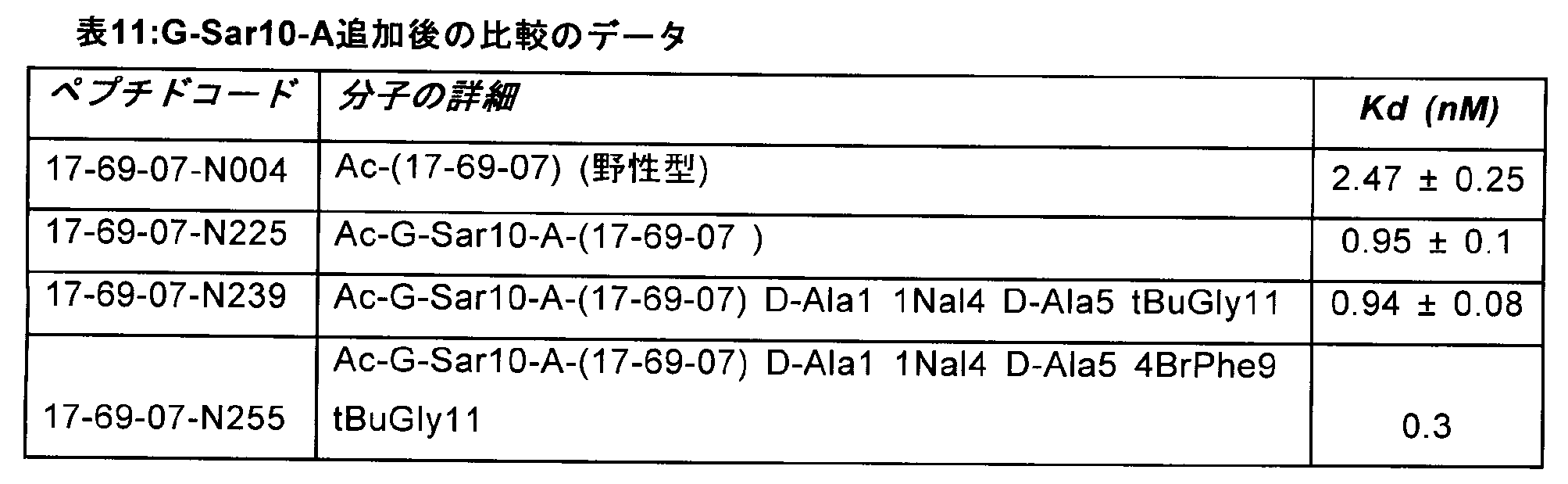
このデータによって、活性が保持されるか、または改善されるので、二環コア配列内の
分子スペーサー(示したとおり、N末端に結合)およびアミノ酸置換の両方ともが十分耐
容されることが示される。
This data indicates that both molecular spacers (attached to the N-terminus, as shown) and amino acid substitutions within the bicyclic core sequence are well tolerated, with either retention or improvement in activity. .
表12は、表11に示される分子の非アセチル化(非)安定化誘導体を示す。それらの
安定性を、マウスおよびヒトの血漿中で定量的に評価して、非安定化17-69-07-
N219と比較した改善を実証した(図1)。
Table 12 shows non-acetylated (un)stabilized derivatives of the molecules shown in Table 11. Their stability was quantitatively assessed in mouse and human plasma to give non-stabilized 17-69-07-
It demonstrated an improvement compared to N219 (Fig. 1).

図3Aは、もとの非安定化野性型分子17-69-07-N219と比較して、それぞ
れ、五置換および四置換された分子17-69-07-N244および17-69-07
-N231のマウス血漿安定性を示す。37℃のマウス血漿中におけるペプチドの半減期
は、非増強野性型分子についての6時間と比較して、>>20時間である。
FIG. 3A shows pentasubstituted and tetrasubstituted molecules 17-69-07-N244 and 17-69-07, respectively, compared to the original non-stabilized wild-type molecule 17-69-07-N219.
- shows mouse plasma stability of N231. The half-life of the peptide in mouse plasma at 37° C. is >>20 hours compared to 6 hours for the non-enhanced wild-type molecule.
図3Bは、もとの非安定化野性型分子17-69-07-N219と比較して、それぞ
れ、五置換および四置換された分子17-69-07-N244および17-69-07
-N231のヒト血漿安定性を示す。37℃のマウス血漿中におけるペプチドの半減期は
、非増強野性型分子についての6時間と比較して、>>20時間である。
FIG. 3B shows pentasubstituted and tetrasubstituted molecules 17-69-07-N244 and 17-69-07, respectively, compared to the original non-stabilized wild-type molecule 17-69-07-N219.
- shows the human plasma stability of N231. The half-life of the peptide in mouse plasma at 37° C. is >>20 hours compared to 6 hours for the non-enhanced wild-type molecule.
まとめると、17-69-07二環性コア配列(Tyr1→D-Ala1、Phe4→
1ナフチルアラニン4、Gly5→D-Ala5、Tyr9→4BrPhe9およびIl
e11→tBuGly11)中の最大5位置までの標的化置換によって、血漿安定性にお
いて、活性の向上および有意な改善がある優れた分子が生成された。
Taken together, the 17-69-07 bicyclic core sequence (Tyr1→D-Ala1, Phe4→
1
Targeted substitutions of up to 5 positions in e11→tBuGly11) generated superior molecules with enhanced activity and significant improvement in plasma stability.
[安定化17-69-07誘導体(17-69-07-N241)の選択性]
この安定化された、誘導体17-69-07-N241を含む分子スペーサーを、他の
種由来のMT1-MMPヘモペキシンドメインに対する親和性についてFP競合によって
試験した。データを表13にまとめる。
[Selectivity of stabilized 17-69-07 derivative (17-69-07-N241)]
This stabilized molecular spacer containing derivative 17-69-07-N241 was tested by FP competition for affinity to MT1-MMP hemopexin domains from other species. The data are summarized in Table 13.

17-69-07の非安定化および安定化誘導体の両方とも、完全に交差反応性である
。
Both non-stabilized and stabilized derivatives of 17-69-07 are fully cross-reactive.
17-69-07-N241N末端の蛍光標識された誘導体(配列:フルオレセイン-
(bAla)-Sar10-A-(17-69-07)D-Ala1 1Nal4 D-
Ala5 tBuGly11の17-69-07-N258と命名)を、関連するヒトメ
タロプロテイナーゼに対して試験した。このデータによって、17-69-07コア配列
、およびこの安定化バリアントが、MT1-MMPに関して固有に選択性であることが実
証される(表14)。
17-69-07-N241 N-terminal fluorescently labeled derivative (sequence: fluorescein-
(bAla)-Sar10-A-(17-69-07)D-Ala1 1Nal4 D-
Ala5 tBuGly11 (designated 17-69-07-N258) was tested against related human metalloproteinases. This data demonstrates that the 17-69-07 core sequence, and its stabilizing variants, are inherently selective for MT1-MMP (Table 14).
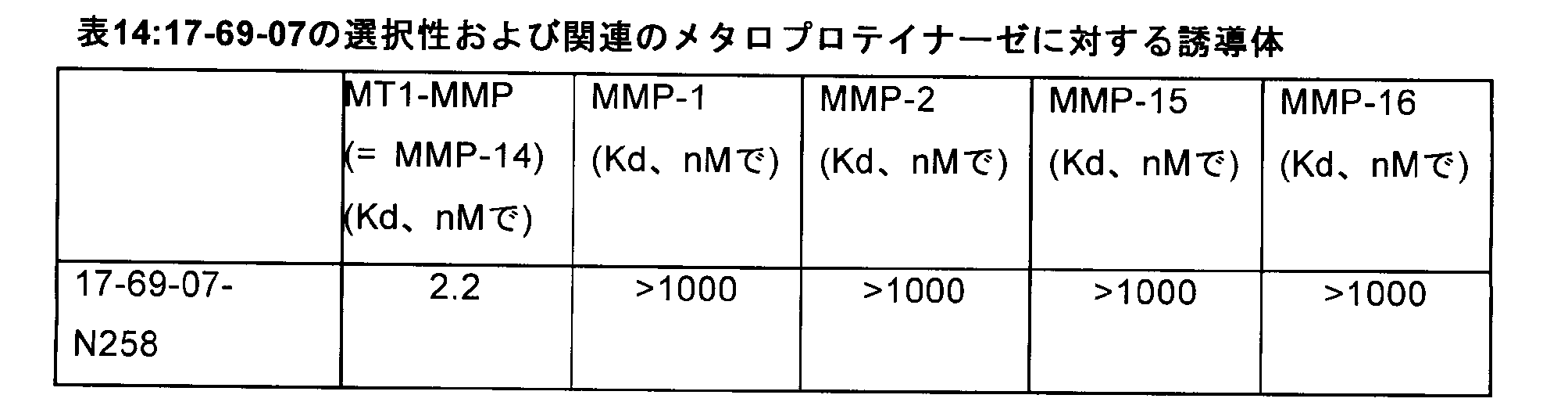
〔実施例3: キレーターにコンジュゲートしている17-69-07のタンパク質分解
に対して安定化されたバリアントのインビボでの解析〕
金属キレーターに連結されたペプチドは、診断および治療に複数の適用を有する。特定
の画像化用および治療用の放射性同位体は、キレーター上に「ロード」され得る一方で、
ペプチドは、前記同位体を標的へと運ぶ。この方法では、腫瘍特異的抗原は、例えば、P
ETおよびSPECTスキャナーを用いて可視化できる。標的化された放射線治療に関し
ては、治療のための放射性核種(例えば、90Yおよび177Lu)は、キレーター-ペ
プチド上にロードされて、腫瘍関連抗原に結合することにより腫瘍に対して選択的に運ば
れる。放射性核種は、それらが放射する高いエネルギー照射によって抗腫瘍活性を発揮す
る。
Example 3: In vivo analysis of proteolytically stabilized variants of 17-69-07 conjugated to chelators.
Peptides linked to metal chelators have multiple diagnostic and therapeutic applications. While certain imaging and therapeutic radioisotopes can be "loaded" onto chelators,
Peptides carry the isotope to the target. In this method, the tumor-specific antigen is, for example, P
It can be visualized using ET and SPECT scanners. For targeted radiotherapy, therapeutic radionuclides (eg, 90 Y and 177 Lu) are loaded onto chelator-peptides to selectively target tumors by binding to tumor-associated antigens. be carried. Radionuclides exert their anti-tumor activity through the high-energy radiation they emit.
[キレーター連結17-69-07二環性ペプチドの合成]
5つの誘導体を合成し、ここでは、金属キレーターDOTA(1,4,7,10-テト
ラアザシクロドデカン-1,4,7,10-四酢酸)を、17-69-07二環性ペプチ
ドのN末端アラニンに連結した。
[Synthesis of chelator-linked 17-69-07 bicyclic peptide]
Five derivatives were synthesized, here the metal chelator DOTA (1,4,7,10-tetraazacyclododecane-1,4,7,10-tetraacetic acid) was added to the 17-69-07 bicyclic peptide. Linked to the N-terminal alanine.

17-69-07-N144は、17-69-07の野性型配列であり、ここでDOT
Aは、1アミノ酸スペーサーとして機能するN末端アラニンに直接連結される。この分子
は、MT1-MMPに対する完全な活性を保持する。治療/画像化放射性核種をロードさ
れた場合に活性が保持されることを実証するため、キレーターに、自然の(コールド)1
75ルテニウムを、安全な置換としてロードした。活性は保持された。完全に安定化され
たバリアント、17-69-07-N248はまた、DOTAコンジュゲートの状況でも
活性が保持された。
17-69-07-N144 is the wild-type sequence of 17-69-07, where DOT
A is linked directly to the N-terminal alanine which acts as a one amino acid spacer. This molecule retains full activity against MT1-MMP. To demonstrate retention of activity when loaded with therapeutic/imaging radionuclides, the chelator was added to the native (cold) 1
75 Ruthenium was loaded as a safe substitution. Activity was retained. A fully stabilized variant, 17-69-07-N248, also retained activity in the DOTA conjugate context.
17-69-07-N144の完全D-アミノ酸等価物である、対照の分子、17-6
9-07-N246を調製した。Dアミノ酸に隣接するアミド結合は、プロテアーゼから
保護され、MT1-MMPに対する活性を欠いているため、この分子は、タンパク質分解
に対して完全に耐性である。重要なことに、このペプチドは、正確な同じ配列および化学
組成を保持する。
Control molecule, 17-6, which is the full D-amino acid equivalent of 17-69-07-N144
9-07-N246 was prepared. The amide bond adjacent to the D-amino acid is protected from proteases and lacks activity towards MT1-MMP, making this molecule completely resistant to proteolysis. Importantly, this peptide retains the exact same sequence and chemical composition.
[HT1080異種移植片マウス中の177Lu-ロード17-69-07-N144の
生体内分布]
HT-1080細胞(MT1-MMPを豊富に発現することが知られている)を雄性6
週齢BALB/c nu/nuマウスの右わき腹に皮下接種した。腫瘍を、約1週間増殖
させた。
[Biodistribution of 177 Lu-load 17-69-07-N144 in HT1080 xenograft mice]
HT-1080 cells (known to abundantly express MT1-MMP) were
Week-old BALB/c nu/nu mice were inoculated subcutaneously into the right flank. Tumors were allowed to grow for approximately one week.
150ピコモルの17-69-07-N144ペプチドに、標準の複合技術を用いて1
MBqのγ-およびβ-エミッタ177Luをロードした。次に、腫瘍保有マウス1匹あ
たり150ピコモルのロードされた17-69-07-N144を注射した(17μg/
kgの等価)。1時点あたり3匹の動物を安楽死させ、種々の臓器および腫瘍を切り出し
て、秤量し、続いて、腫瘍/臓器組織の1グラムあたりのγ放射カウントを決定した。得
られたプロットは、インビボのマウスにおいてペプチドの局在化の定量的指標を示す。具
体的には、HT1080腫瘍中の選択的蓄積は、インビボでMT1-MMP結合を示す。
150 pmoles of 17-69-07-N144 peptide was conjugated to 1 using standard conjugation techniques.
MBq of γ- and β-emitters 177 Lu were loaded. We then injected 150 pmoles of loaded 17-69-07-N144 per tumor-bearing mouse (17 μg/
kg equivalent). Three animals were euthanized per time point and various organs and tumors were dissected and weighed followed by determination of gamma emission counts per gram of tumor/organ tissue. The resulting plot shows a quantitative index of peptide localization in mice in vivo. Specifically, selective accumulation in HT1080 tumors indicates MT1-MMP binding in vivo.
図4は、生体内分布データをまとめる。顕著なことに、二環性ペプチドは、腫瘍に特異
的であって、14分の循環中の推定の半減期にかかわらず、最大24時間まで持続するよ
うである。これは、腫瘍細胞への取り込みを示す可能性が高い。有意な局在化は、腎臓で
可視化され、これは、ペプチドに一過性に結合する腎臓アミノ酸トランスポーターに起因
する可能性が高い。他の全ての臓器は、分子の有意な取り込みを示さない。注目すべきこ
とに、マウスヘモペキシンドメインは、ヒト対応物と完全な相同性を共有し、このことは
、マウスPEXが、他の場所で発現される場合、対応するシグナルが観察されることを示
している。
Figure 4 summarizes the biodistribution data. Strikingly, the bicyclic peptide appears to be tumor specific and persist for up to 24 hours, despite an estimated half-life in circulation of 14 minutes. This likely indicates uptake into tumor cells. A significant localization was visualized in the kidney, likely due to the kidney amino acid transporter transiently binding the peptide. All other organs show no significant uptake of the molecule. Remarkably, the murine hemopexin domain shares complete homology with its human counterpart, indicating that a corresponding signal is observed when murine PEX is expressed elsewhere. is shown.
異種移植片モデルにおける腫瘍取り込みが、選択性であり、PEX結合に起因するか否
かを評価するために、17-69-07-N144のD-アミノ酸対応物である、ペプチ
ド17-69-07-N246を用いて追加の研究を行った(図5)。
Peptide 17-69-07, the D-amino acid counterpart of 17-69-07-N144, was used to assess whether tumor uptake in xenograft models was selective and due to PEX binding. - Additional studies were performed with N246 (Fig. 5).
活性である二環性ペプチド17-69-07-N144により得られた生体内分布パタ
ーンと比較して、MT1-MMP非結合17-69-07-N246二環性ペプチドは腫
瘍を標的しないことが明確であり、これによって17-69-07-N144の腫瘍シグ
ナルは、インビボでMT1-MMP標的結合によって駆動されることが確認された。
Compared to the biodistribution pattern obtained with the active bicyclic peptide 17-69-07-N144, MT1-MMP non-binding 17-69-07-N246 bicyclic peptide may not target tumors. Clearly, this confirms that the tumor signal of 17-69-07-N144 is driven by MT1-MMP target binding in vivo.
最終的に、生体内分布に対する17-69-07配列のタンパク質分解性の安定性の効
果を評価するために、二環性ペプチド17-69-07-N248(DOTA-A-(1
7-69-07)D-Ala1 1Nal4 D-Ala5 4BrPhe9 tBuG
ly11)を、同一の生体内分布研究で使用した(図6)。
Finally, to assess the effect of the proteolytic stability of the 17-69-07 sequence on biodistribution, the bicyclic peptide 17-69-07-N248 (DOTA-A-(1
7-69-07) D-Ala1 1Nal4 D-Ala5 4BrPhe9 tBuG
ly11) was used in the same biodistribution study (FIG. 6).
著しいことに、ペプチドのタンパク質分解安定性の向上は、17-69-07-N14
4と比較して、任意の所定の時点において腫瘍取り込みの全体的な倍加につながり、これ
によって、もとの非安定化17-69-07配列と比較して分子の優れた特性が例証され
る。
Strikingly, improved proteolytic stability of the peptide was observed in 17-69-07-N14
lead to an overall doubling of tumor uptake at any given time point compared to 4, demonstrating the superior properties of the molecule compared to the original non-stabilized 17-69-07 sequence .
この効果は、この実施例に記載されるコンジュゲートを用いて、放射性核種標的化治療
について、および毒素コンジュゲートの二環性ペプチドの状況での両方ともで、有利な治
療係数を生じ得ると予想される(実施例4)。
It is anticipated that this effect may result in a favorable therapeutic index both for radionuclide-targeted therapy and in the context of bicyclic peptides of toxin conjugates with the conjugates described in this example. (Example 4).
〔実施例4: 細胞毒性剤との非安定化二環性ペプチドのコンジュゲーション〕
標的がん治療のために、極めて強力な細胞毒性薬を、標的化物(ここでは、二環性ペプ
チド)に対して切断可能リンカーを通じて結合し、この標的化物が、腫瘍関連の細胞表面
発現されたタンパク質に結合する。過剰発現された腫瘍関連細胞表面タンパク質標的は、
細胞の内側へと取り込まれるその能力について選択される。腫瘍関連の細胞表面タンパク
質に対する細胞毒性剤コンジュゲートの標的化物の結合の際、全体的な分子複合体は、細
胞の内側に取り込まれる。全身の循環から別個の細胞内環境への移行後、細胞毒性薬を細
胞内条件によって標的化物から切断し、次いで切断された薬物は、細胞周期停止を通じて
標的化細胞死を誘導し、それに続くアポトーシスによって、その抗腫瘍活性を発揮する。
Example 4 Conjugation of Unstabilized Bicyclic Peptides with Cytotoxic Agents
For targeted cancer therapy, a highly potent cytotoxic drug was conjugated through a cleavable linker to a targeting entity (here, a bicyclic peptide) that was expressed on the tumor-associated cell surface. Binds to proteins. Overexpressed tumor-associated cell surface protein targets are
It is selected for its ability to be taken inside cells. Upon binding of the target of the cytotoxic agent conjugate to tumor-associated cell surface proteins, the entire molecular complex is internalized inside the cell. After transition from systemic circulation to a distinct intracellular environment, intracellular conditions cleave the cytotoxic drug from its target entity, and the cleaved drug then induces targeted cell death through cell cycle arrest, followed by apoptosis. exerts its antitumor activity by
二環性ペプチド17-69-07-N219(実施例2および3を参照のこと)は、G
ly-Sar10-Ala分子スペーサー(G-Sar10-A-(17-69-07)
に対してN末端上に連結した野性型二環性コア配列から構成され、ここで全長の配列の記
載は、G-Sar10-A-CYNEFGCEDFYDIC;配列番号20)である。(
17-69-07)のこの誘導体は、0.8nMのKdでMT1-MMPに対して完全な
活性(表12)を保持する。分子スペーサーのN末端における遊離の固有のアミノ基を、
理想的には、極めて強力な細胞毒性物質などのエフェクター基とのコンジュゲーションの
ために配置する。N末端Gly上のコンジュゲーション部位と二環コア配列との間のSa
r10リンカーによって与えられる長い分子内距離が、有意な分子サイズのエフェクター
基とのコンジュゲーション後の標的結合活性の完全な保持を保証するために採用される。
標的タンパク質に対する二環コア配列の活性が保持される限り、さらに短い分子スペーサ
ーを随意に選択してもよい。
The bicyclic peptide 17-69-07-N219 (see Examples 2 and 3) is G
ly-Sar10-Ala molecular spacer (G-Sar10-A-(17-69-07)
consisting of a wild-type bicyclic core sequence linked N-terminally to , where the full length sequence description is G-Sar10-A-CYNEFGCEDFYDIC; SEQ ID NO:20). (
17-69-07) retains full activity (Table 12) against MT1-MMP with a Kd of 0.8 nM. The free unique amino group at the N-terminus of the molecular spacer is
Ideally, it is arranged for conjugation with effector groups such as very potent cytotoxic agents. Sa between the conjugation site on the N-terminal Gly and the bicyclic core sequence
The long intramolecular distance imparted by the r10 linker is employed to ensure full retention of target binding activity after conjugation with effector groups of significant molecular size.
Optionally, shorter molecular spacers may be selected as long as the activity of the bicyclic core sequence towards the target protein is retained.
MT1-MMPを標的する、二環性ペプチド薬物コンジュゲート(BDCと命名)によ
るコンセプトデータの確証を得るために、17-69-07-N219の2つのコンジュ
ゲートを調製し、これは、微小管重合阻害性毒素DM1(メイタンシン、N2’-デアセ
チル-N2’-(3-メルカプト-1-オキソプロピル)-メイタンシン)またはMMA
E(モノメチルオーリスタチンE、(S)-N-((3R,4S,5S)-1-((S)
-2-((1R,2R)-3-(((1S,2R)-1-ヒドロキシ-1-フェニルプロ
パン-2-イル)アミノ)-1-メトキシ-2-メチル-3-オキソプロピル)ピロリジ
ン-1-イル)-3-メトキシ-5-メチル-1-オキソヘプタン-4-イル)-N,3
-ジメチル-2-((S)-3-メチル-2-(メチルアミノ)ブタンアミド)ブタンア
ミドとしても公知)のいずれかを使用した。
To obtain confirmation of the concept data with bicyclic peptide drug conjugates (named BDC) targeting MT1-MMP, two conjugates of 17-69-07-N219 were prepared, which are associated with microtubule polymerization-inhibiting toxin DM1 (maytansine, N2'-deacetyl-N2'-(3-mercapto-1-oxopropyl)-maytansine) or MMA
E (monomethyl auristatin E, (S)-N-((3R,4S,5S)-1-((S)
-2-((1R,2R)-3-(((1S,2R)-1-hydroxy-1-phenylpropan-2-yl)amino)-1-methoxy-2-methyl-3-oxopropyl)pyrrolidine -1-yl)-3-methoxy-5-methyl-1-oxoheptan-4-yl)-N,3
-dimethyl-2-((S)-3-methyl-2-(methylamino)butanamide)butanamide) was used.
MMAEコンジュゲートは、BT17BDC-1と命名され、自己犠牲パラ-アミノベ
ンジル-カルボニル基(PABC)を含むバリン-シトルリン(Val-Cit)リンカ
ーによって、17-69-07-N219前駆体から分離される。Val-Citリンカ
ーは、細胞内リポソーム中で遭遇したカテプシンBリッチ環境によって選択的に切断され
(加水分解され)、加水分解後、PABCは犠牲になり、MMAEを活性な毒素種として
放出する。Val-Cit-PABCリンカーは、循環中で安定であり、したがって、細
胞内部移行の際にのみ毒素を放出する。
The MMAE conjugate is named BT17BDC-1 and is separated from the 17-69-07-N219 precursor by a valine-citrulline (Val-Cit) linker containing a self-immolative para-aminobenzyl-carbonyl group (PABC). . The Val-Cit linker is selectively cleaved (hydrolyzed) by the cathepsin B-rich environment encountered in intracellular liposomes, and after hydrolysis PABC is sacrificed, releasing MMAE as the active toxin species. The Val-Cit-PABC linker is stable in circulation and thus releases toxin only upon cellular internalization.
コンジュゲートの構造、およびBT17BDC-1の調製のための合成スキームをスキ
ームIに示す。

BDC17BDC-1の調製のための合成のストラテジー。完全に精製された、TMB
環化17-69-07-N219二環前駆体は、グルタリル-バリン-シトルリン-p-
アミノベンジルカルボニル-MMAE(一般には、vc-MMAEまたはVal-Cit
-PABC-MMAEとして略称される)のスクシンイミドエステルと反応し、コンジュ
ゲートBDC17BDC-1が生じる。
Synthetic strategy for the preparation of BDC17BDC-1. fully purified TMB
The cyclized 17-69-07-N219 bicyclic precursor is glutaryl-valine-citrulline-p-
aminobenzylcarbonyl-MMAE (generally vc-MMAE or Val-Cit
-PABC-MMAE) with the succinimide ester to give the conjugate BDC17BDC-1.
17-69-07-N219のDM1コンジュゲートは、BT17BDC-9と命名さ
れ、細胞内環境中で遭遇する還元環境によって切断可能であり得るジスルフィド結合によ
って17-69-07-N219前駆体から隔てられる。還元は、細胞の内側に約10m
Mの濃度で存在する、細胞内グルタチオンを通じて行われると考えられる。対照的に、血
液循環中のグルタチオンおよび遊離の還元剤の濃度はかなり低く(<10μM)、したが
って、毒素は、細胞内環境中で優先的に放出され、ここで、毒素は、その細胞殺傷活性を
明らかにし得る。
The DM1 conjugate of 17-69-07-N219 is designated BT17BDC-9 and is separated from the 17-69-07-N219 precursor by a disulfide bond that may be cleavable by the reducing environment encountered in the intracellular environment. . Reduction is about 10 m inside the cell
It is thought to occur through intracellular glutathione, which is present at concentrations of M. In contrast, the concentrations of glutathione and free reducing agents in the blood circulation are rather low (<10 μM), so the toxin is preferentially released in the intracellular milieu, where it exerts its cell-killing activity. can reveal
コンジュゲートの構造、およびBT17BDC-9の調製のための合成スキームを、ス
キームIIに示す。
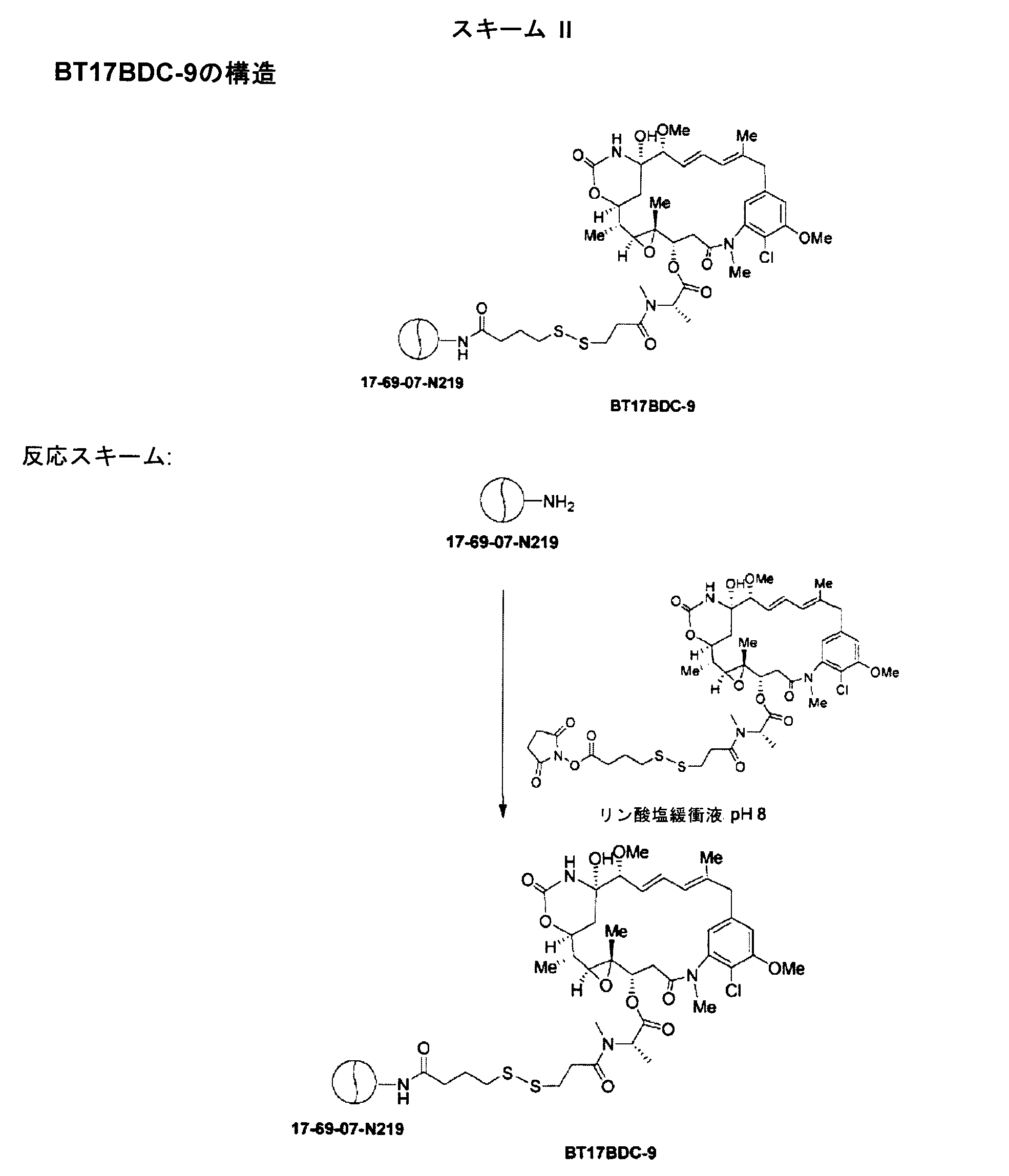
BDC17BDC-9の調製のための合成ストラテジー。完全に精製された、遊離のN
末端アミンを含む、TMB環化17-69-07-N219二環前駆体は、ジスルフィド
-DM1のスクシンイミドエステルと反応し(示した構造)、コンジュゲートBDC17
BDC-9を生じる。
Synthetic strategy for the preparation of BDC17BDC-9. Fully purified, free N
TMB cyclized 17-69-07-N219 bicyclic precursor containing a terminal amine reacted with the succinimide ester of disulfide-DM1 (structure shown) to give conjugate BDC17
yields BDC-9.
したがって、BDC17BDC-1およびBDC17BDC-9中の毒素の放出は、機
構として別個であり、すなわち、前者は、細胞内タンパク質分解条件を通じてであり、後
者は、細胞内還元条件による。
Thus, the release of toxins in BDC17BDC-1 and BDC17BDC-9 are distinct as mechanisms, the former through intracellular proteolytic conditions and the latter through intracellular reducing conditions.
2つのBDCを、インビトロの細胞毒性研究で使用して、HT1080のような細胞培
養物に対する低ナノモル/ピコモル活性を示した(データ示さず)。
Two BDCs were used in in vitro cytotoxicity studies and showed low nanomolar/picomolar activity against cell cultures such as HT1080 (data not shown).
インビボのマウス異種移植片モデル(HT1080腫瘍を保有する)では、両方のBD
Cとも、ビヒクルの対照と比較して、注射の9日後、腫瘍容積の有意な低下を生じた。こ
の投薬レジメンを図7(矢印)に示す。腫瘍は、触診によって判定されるとおり、両方の
BDCに関して14日で完全に消失した(図7)。著しいことに、BDC17BDC-1
およびBDC17BDC-9の両方に関する動物の重量は、概して安定であり、これは、
治療目的に十分であり得る治療ウインドウを示す。
In an in vivo mouse xenograft model (bearing HT1080 tumors), both BD
Both C produced a significant reduction in
Animal weights for both BDC17BDC-9 and BDC17BDC-9 were generally stable, indicating that
A therapeutic window that may be sufficient for therapeutic purposes is shown.
〔実施例5: 細胞毒性剤とのタンパク質分解的に安定化された二環性ペプチドのコンジ
ュゲーション〕
1位のD-アラニン、4位の1-ナフチルアラニン、5位のD-アラニン、および11
位のα-tert-ブチルグリシン(9位の4-ブロモフェニルアラニンの有無)という
修飾を含む二環性コア配列17-69-07は、エクスビボの血漿およびインビボにおい
て、タンパク質分解安定性が向上していた(実施例2、3)。
Example 5 Conjugation of Proteolytically Stabilized Bicyclic Peptides with Cytotoxic Agents
D-alanine at
The bicyclic core sequence 17-69-07 containing modifications α-tert-butylglycine (with or without 4-bromophenylalanine at position 9) at position 17-69-07 has improved proteolytic stability in ex vivo plasma and in vivo. (Examples 2 and 3).
二環薬物コンジュゲートの状況では、二環コア配列が安定であるほど、全身のクリアラ
ンスの低下およびタンパク質分解が亢進した腫瘍微小環境における安定性の増大に起因し
て、腫瘍露出がさらに大きくなり得る可能性が高い。細胞の内側へのBDCのMT1-M
MP駆動の取り込みの増大が生じ得、治療有効性の増大につながり得る。
In the context of bicyclic drug conjugates, a more stable bicyclic core sequence may result in greater tumor exposure due to decreased systemic clearance and increased stability in the proteolytic tumor microenvironment. Probability is high. MT1-M of BDCs inside cells
Increased MP-driven uptake may occur, leading to increased therapeutic efficacy.
安定化二環性ペプチド17-69-07-N241を、非安定化17-69-07-N
219に対して全体的に同様の分子レイアウトで設計した(実施例3および4に記載)。
これは、以下の配列:
(B-Ala)-Sar10-AC(D-Ala)NE(1Nal)(D-Ala)CE
DFYD(tBuGly)C(配列番号5)
を有し、これは、前のとおりTBMBと環化される。
Stabilized bicyclic peptide 17-69-07-N241 was modified to non-stabilized 17-69-07-N.
It was designed with a globally similar molecular layout to 219 (described in Examples 3 and 4).
This is the following array:
(B-Ala)-Sar10-AC(D-Ala)NE(1Nal)(D-Ala)CE
DFYD(tBuGly)C (SEQ ID NO: 5)
, which is cyclized with TBMB as before.
17-69-07-N219の中のように、前に使用したグリシンではなく、N-ヒド
ロキシスクシンイミド(NHS)エステル(Purdie et al(1973),J
.Chem.Soc.,Perkin Trans.2,1845)との、特にこの実施
例では細胞毒性剤のNHSエステルとの、カップリングの間のジケトピペラジン副生成物
形成を最小限にするために、N末端ベータ-アラニンを選択した(スキームI、II)。
As in 17-69-07-N219, the N-hydroxysuccinimide (NHS) ester (Purdie et al (1973), J.
. Chem. Soc. , Perkin Trans. 2, 1845), and specifically in this example with NHS esters of cytotoxic agents, the N-terminal beta-alanine was chosen to minimize diketopiperazine by-product formation ( Schemes I, II).
サルコシン十量体スペーサーを、17-69-07-N219中に保持し、それによっ
て、MT1-MMPのヘモペキシンドメインに対する二環ペプチドの結合の完全な保持を
確実にする。
A sarcosine decamer spacer is retained in 17-69-07-N219, thereby ensuring intact binding of the bicyclic peptide to the hemopexin domain of MT1-MMP.
メイタンシン毒素クラスは、実施例4に記載のマウス異種移植片モデルにおける有効性
および耐容性に基づいて、17-69-07-N241に対するコンジュゲーションにつ
いて選択し、ジスルフィド切断リンカーを再度選択した。
The maytansine toxin class was selected for conjugation to 17-69-07-N241 based on efficacy and tolerability in the mouse xenograft model described in Example 4, and the disulfide cleavage linker was again selected.
4つのBDCを(本明細書上記では、BT17BDC-17、BT17BDC-18、
BT17BDC-19およびBT17BDC-20と呼ぶ)を調製し、その結果、毒素お
よび17-69-07-N241はともに不変であったが、還元/切断に対するジスルフ
ィド結合の感受性は、イオウ原子に隣接する妨害の程度をモジュレートすることによって
変更された。
The four BDCs (herein above, BT17BDC-17, BT17BDC-18,
BT17BDC-19 and BT17BDC-20) were prepared and as a result, both the toxin and 17-69-07-N241 were unchanged, although the susceptibility of disulfide bonds to reduction/cleavage was affected by interference adjacent to the sulfur atom. changed by modulating the degree of
コンジュゲートに対する合成経路は、スキームIIに記載のとおりであり、ここでは、
17-69-07-N219が17-69-07-N241で置き換えられる。
A synthetic route to the conjugates is as described in Scheme II, where:
17-69-07-N219 is replaced with 17-69-07-N241.
BT17BDC-18については、DM1と反応させて完全なコンジュゲートを形成す
る、ピリジルジスルフィド二環前駆体(17-69-07-N277と命名)の生成のた
めの追加の経路を含んだ。この合成経路は、スキームIIIに記載される。

BT17BDC-18の調製のための合成ストラテジー。完全に精製したTMB環化1
7-69-07-N241二環前駆体(遊離のN末端アミンを含有)を、SPP(N-ス
クシンイミジル4-(2-ピリジルジチオ)ペンタノエート))と反応させて、中間体1
7-69-07-N277を得た。次いで、これを遊離のチオールとしてDM1と反応さ
せて、所望のコンジュゲートBT17BDC-18を得る。
Synthetic strategy for the preparation of BT17BDC-18. Fully purified
7-69-07-N241 bicyclic precursor (containing a free N-terminal amine) was reacted with SPP (N-succinimidyl 4-(2-pyridyldithio)pentanoate)) to give intermediate 1
7-69-07-N277 was obtained. It is then reacted with DM1 as the free thiol to give the desired conjugate BT17BDC-18.
[BT17BDC-17、BT17BDC-18、BT17BDC-19およびBT17
BDC-20のインビトロの特徴付け]
4つのBDCを、ヒトMT1-MMPヘモペキシンドメインに対する活性の保持、エク
スビボのマウス、ラットおよびヒト血漿における安定性、ならびにジチオスレイトールの
ような還元剤に対する安定性などのいくつかのインビトロのパラメータについて評価した
。
[BT17BDC-17, BT17BDC-18, BT17BDC-19 and BT17
In vitro characterization of BDC-20]
Four BDCs were tested for several in vitro parameters such as retention of activity against the human MT1-MMP hemopexin domain, stability in ex vivo mouse, rat and human plasma, and stability to reducing agents such as dithiothreitol. was evaluated.
データを下の表16にまとめる。
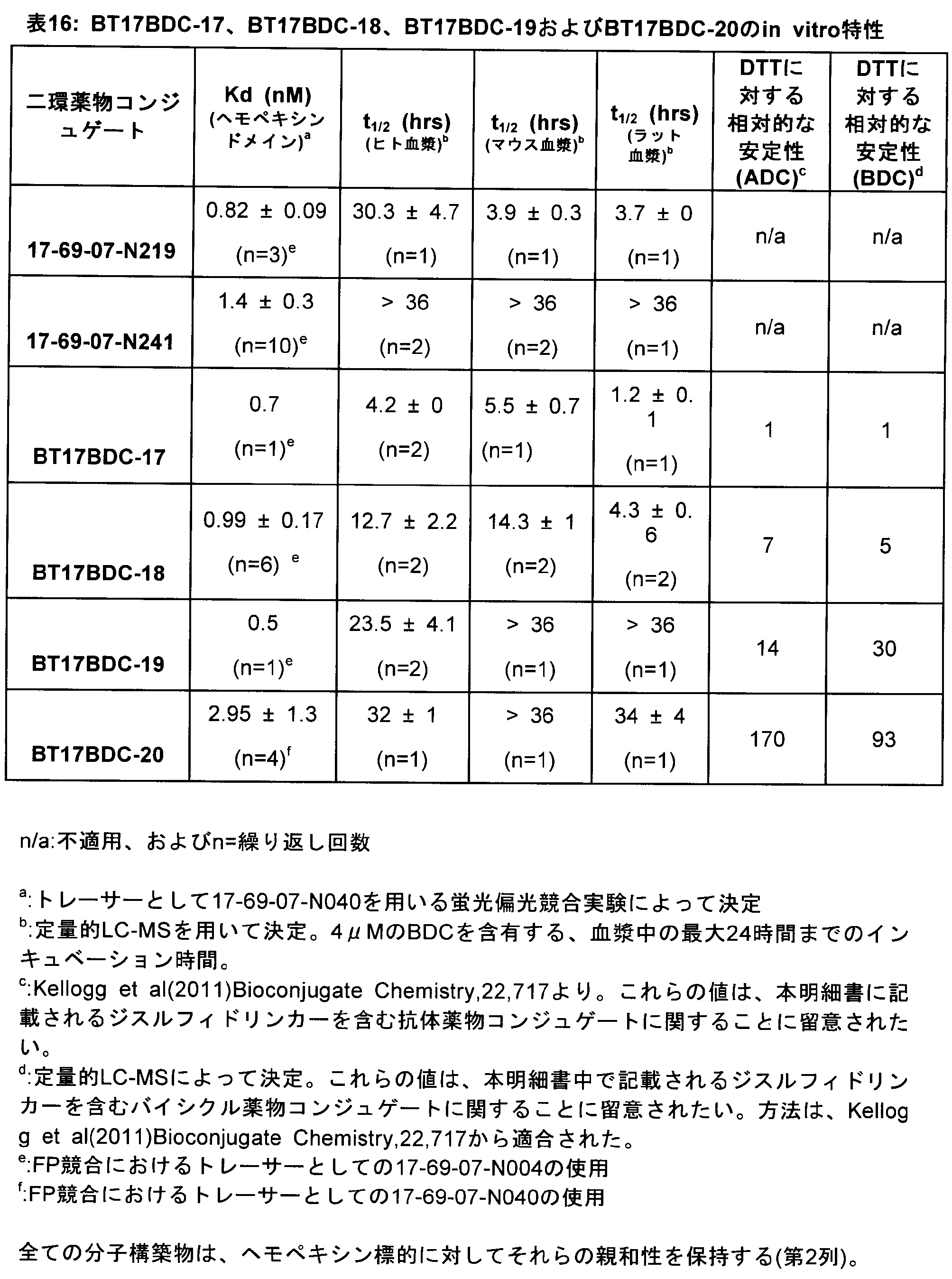
このデータによって、血漿安定性は、ジスルフィド結合の性質によって支配され(還元
に対する感受性によってモジュレートされるとおり)、二環性ペプチドの性質によっては
支配されないことが示された。なぜなら、全てのBDCが、試験された3つの種由来の血
漿中で安定である同じ二環性ペプチド(17-69-07-N241)を含んでいるから
である。
The data indicated that plasma stability was governed by the nature of the disulfide bond (as modulated by susceptibility to reduction) and not by the nature of the bicyclic peptide. This is because all BDCs contain the same bicyclic peptide (17-69-07-N241) that is stable in plasma from the three species tested.
さらに、ヒトにおける腎濾過により駆動されるこの分子サイズのペプチドの予想される
クリアランスは、ヒト血漿中のBDCの分解半減期よりも数倍早い、2~4時間の推定半
減期を有していることから(>14時間、BT17BDC-18/19/20、表16を
参照のこと)、BT17BDC-18、BT17BDC-19およびBT17BDC-2
0は、治療用途に適切なヒト血漿中における安定性を示す。したがって、BDCのバルク
は、腎臓でクリアランスされると予想され、ある画分のみが循環中で分解され、これらの
BDCは、可能性として治療目的に適切になる。
Moreover, the predicted clearance of this molecular-sized peptide driven by renal filtration in humans has an estimated half-life of 2-4 hours, several times faster than the degradation half-life of BDC in human plasma. (>14 hours, BT17BDC-18/19/20, see Table 16), BT17BDC-18, BT17BDC-19 and BT17BDC-2
0 indicates stability in human plasma suitable for therapeutic use. Therefore, a bulk of BDCs is expected to be cleared in the kidney and only a fraction is degraded in circulation, making these BDCs potentially suitable for therapeutic purposes.
[BT17BDC-17、BT17BDC-18、BT17BDC-19およびBT17
BDC-20のインビボ有効性]
安定化二環コア配列を含む全てのBDCを、ヒト肺扁平細胞がん株EBC-1を用いた
インビボのマウス異種移植片モデルにおいて、それらの有効性について試験した。
[BT17BDC-17, BT17BDC-18, BT17BDC-19 and BT17
In Vivo Efficacy of BDC-20]
All BDCs containing a stabilizing bicyclic core sequence were tested for their efficacy in an in vivo mouse xenograft model using the human lung squamous cell carcinoma line EBC-1.
BT17BDC-17、BT17BDC-18およびBT17BDC-19は、有効で
あって、9日で腫瘍を消失させた(図9、10および11)。BT17BDC-17は、
良好な有効性、ただし高用量ではある程度の体重低下を示した。BT17BDC-20は
、一定重量に基づいて耐容されたが、有効ではなく、腫瘍の大きさの最低限度の低下しか
生じなかった(図12)。
BT17BDC-17, BT17BDC-18 and BT17BDC-19 were effective and caused tumors to disappear in 9 days (FIGS. 9, 10 and 11). BT17BDC-17 is
It showed good efficacy, but some weight loss at higher doses. BT17BDC-20 was tolerated on a constant weight basis but was not effective and produced only minimal reduction in tumor size (FIG. 12).
経時的な腫瘍容積の曲線下面積(AUC)およびBDCをとって、対応する用量群に対
してプロットした(図13)。この結果から50%の腫瘍AUC低下を得るための有効用
量(ED50)を決定してもよく、これを表17にまとめる。
The area under the curve (AUC) and BDC of tumor volume over time were taken and plotted against the corresponding dose groups (Figure 13). From this result the effective dose (ED50) for obtaining a tumor AUC reduction of 50% may be determined and is summarized in Table 17.

したがって、BT17BDC-9、BT17BDC-17、BT17BDC-18およ
びBT17BDC-19は、有効性に基づいた標的がん治療での使用のための適切な分子
であり、BT17BDC-17、BT17BDC-18およびBT17BDC-19が、
有効性用量で十分耐容される。
Therefore, BT17BDC-9, BT17BDC-17, BT17BDC-18 and BT17BDC-19 are suitable molecules for use in efficacy-based targeted cancer therapy, and BT17BDC-17, BT17BDC-18 and BT17BDC- 19 is
Effective doses are well tolerated.
Claims (9)

BT17BDC-18
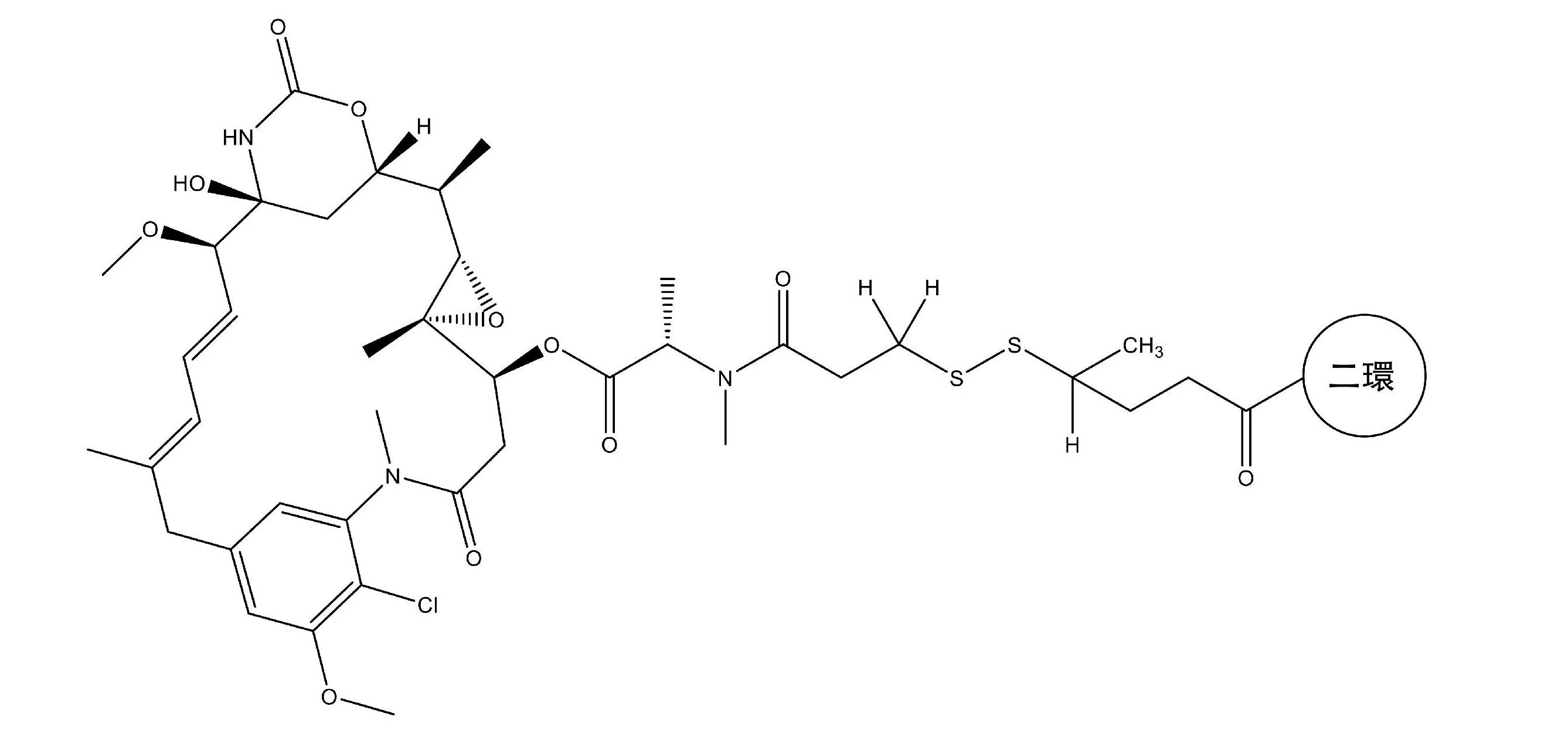
BT17BDC-19
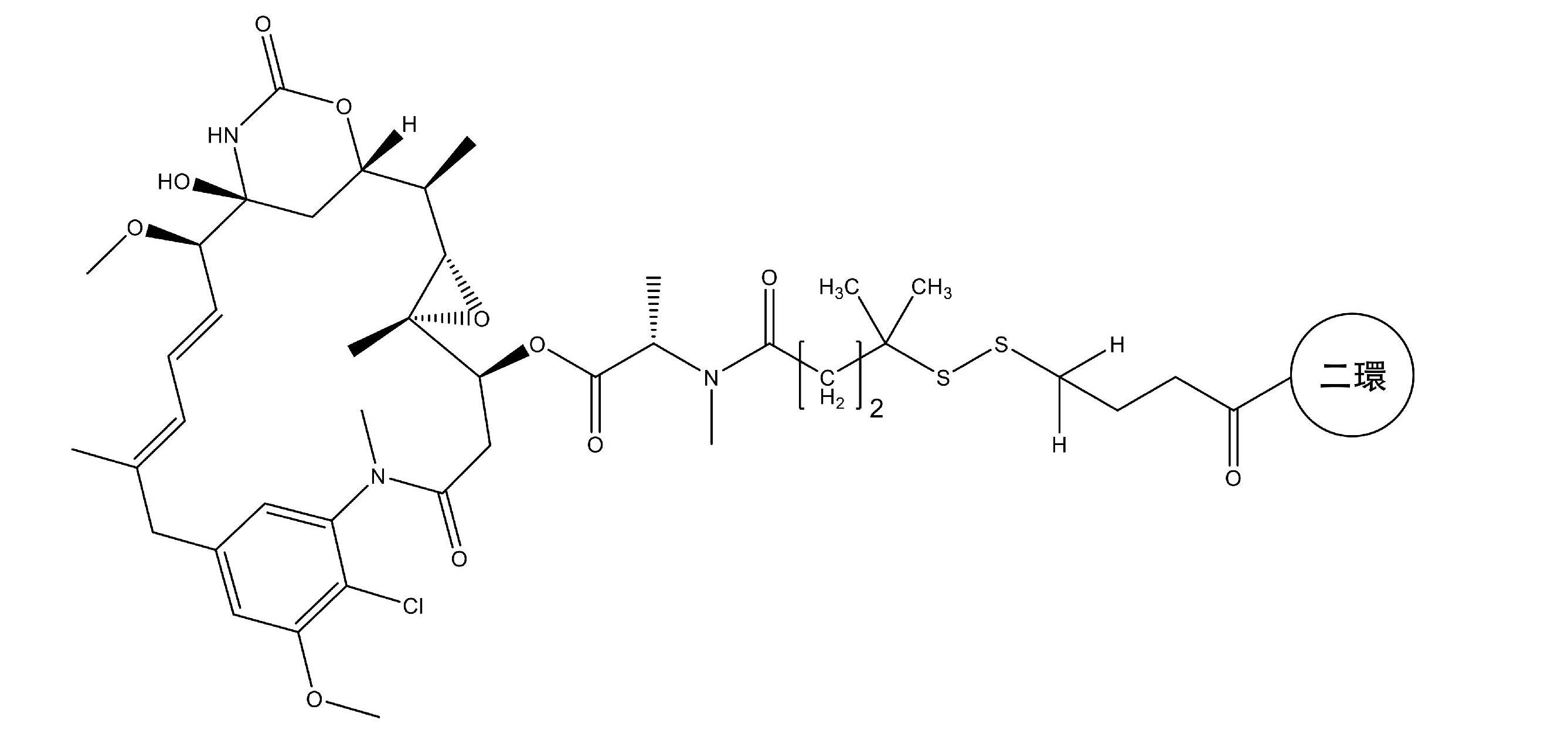
および
BT17BDC-20
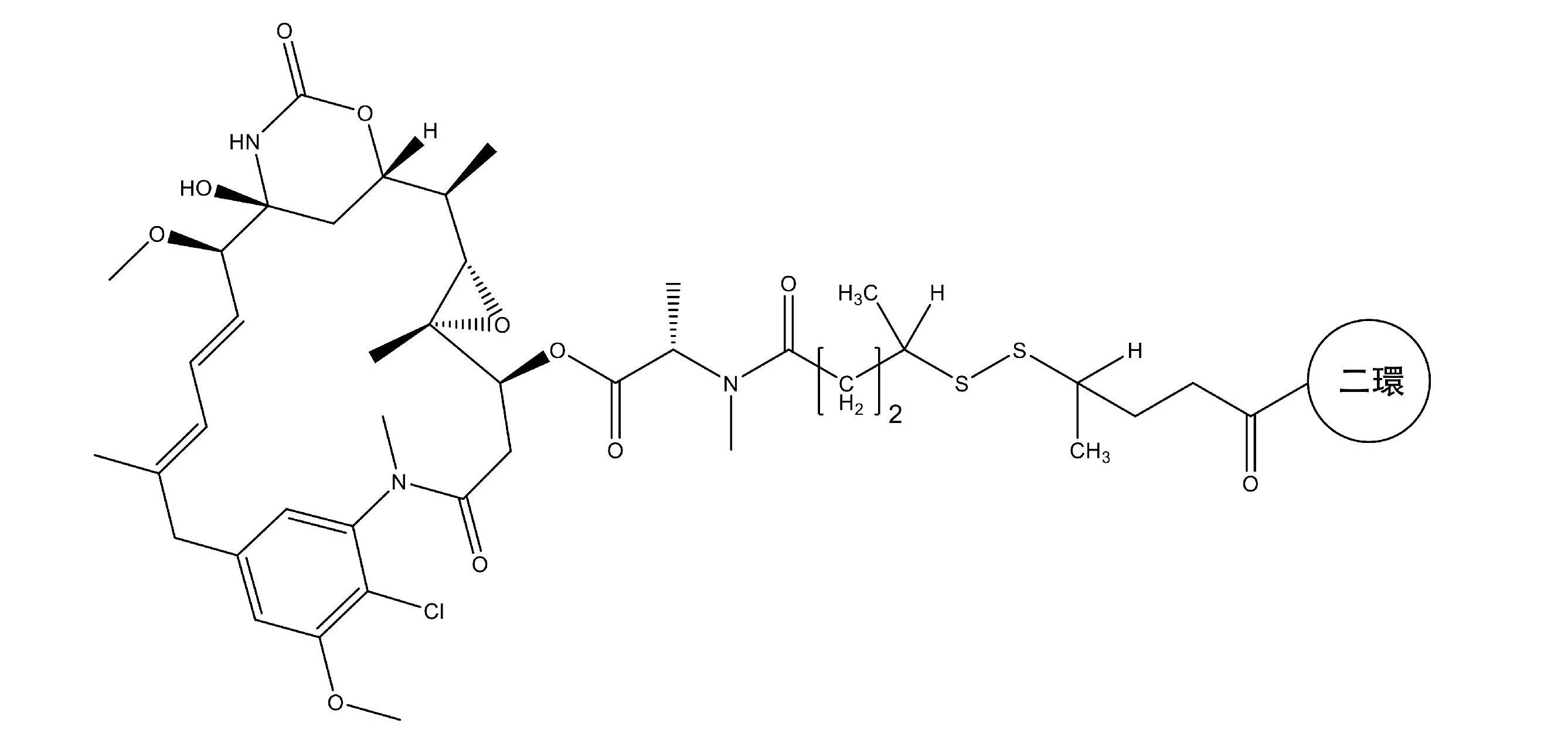
から選択される薬物コンジュゲートであって、式中、二環は、MT1-MMPに特異的なペプチドリガンドであって、少なくとも2つのループ配列によって隔てられる少なくとも3つのシステイン残基を含むポリペプチド、および前記ポリペプチドの前記システイン残基と共有結合を形成する分子足場であるTBMB(1,3,5-トリス(ブロモメチル)ベンゼン)を含み、その結果、少なくとも2つのポリペプチドループが前記分子足場上に形成され、前記ペプチドリガンドが、アミノ酸配列:
βAla-Sar10-A-C(D-Ala)NE(1Nal)(D-Ala)CEDFYD(tBuGly)C(配列番号5)
またはその薬学的に許容される塩を含む、薬物コンジュゲート。 BT17BDC-17
BT17BDC-18
BT17BDC-19
and BT17BDC-20
wherein the bicyclic is a peptide ligand specific for MT1-MMP, a polypeptide comprising at least three cysteine residues separated by at least two loop sequences; and TBMB (1,3,5-tris(bromomethyl)benzene), a molecular scaffold that forms covalent bonds with said cysteine residues of said polypeptide, so that at least two polypeptide loops are present on said molecular scaffold. formed, wherein the peptide ligand has the amino acid sequence:
βAla-Sar10-AC(D-Ala)NE(1Nal)(D-Ala)CEDFYD(tBuGly)C (SEQ ID NO: 5)
or a pharmaceutically acceptable salt thereof.

である薬物コンジュゲートであって、式中、二環は、MT1-MMPに特異的なペプチドリガンドであって、少なくとも2つのループ配列によって隔てられる少なくとも3つのシステイン残基を含むポリペプチド、および前記ポリペプチドの前記システイン残基と共有結合を形成する分子足場であるTBMB(1,3,5-トリス(ブロモメチル)ベンゼン)を含み、その結果、少なくとも2つのポリペプチドループが前記分子足場上に形成され、前記ペプチドリガンドが、アミノ酸配列:
βAla-Sar10-A-C(D-Ala)NE(1Nal)(D-Ala)CEDFYD(tBuGly)C(配列番号5)
またはその薬学的に許容される塩を含む、請求項1に記載の薬物コンジュゲート。 BT17BDC-18
wherein the bicyclic is a peptide ligand specific for MT1-MMP, a polypeptide comprising at least three cysteine residues separated by at least two loop sequences, and said TBMB (1,3,5-tris(bromomethyl)benzene), a molecular scaffold that forms covalent bonds with said cysteine residues of a polypeptide, so that at least two polypeptide loops are formed on said molecular scaffold. , wherein said peptide ligand has the amino acid sequence:
βAla-Sar10-AC(D-Ala)NE(1Nal)(D-Ala)CEDFYD(tBuGly)C (SEQ ID NO: 5)
or a pharmaceutically acceptable salt thereof.
Applications Claiming Priority (5)
| Application Number | Priority Date | Filing Date | Title |
|---|---|---|---|
| GB1419237.1 | 2014-10-29 | ||
| GBGB1419237.1A GB201419237D0 (en) | 2014-10-29 | 2014-10-29 | Novel polypeptides |
| GB1515245.7 | 2015-08-27 | ||
| GBGB1515245.7A GB201515245D0 (en) | 2015-08-27 | 2015-08-27 | Novel polypeptides |
| JP2017522660A JP6882978B2 (en) | 2014-10-29 | 2015-10-29 | Bicyclic peptide ligand specific for MT1-MMP |
Related Parent Applications (1)
| Application Number | Title | Priority Date | Filing Date |
|---|---|---|---|
| JP2017522660A Division JP6882978B2 (en) | 2014-10-29 | 2015-10-29 | Bicyclic peptide ligand specific for MT1-MMP |
Publications (2)
| Publication Number | Publication Date |
|---|---|
| JP2021130672A JP2021130672A (en) | 2021-09-09 |
| JP7116217B2 true JP7116217B2 (en) | 2022-08-09 |
Family
ID=54427796
Family Applications (2)
| Application Number | Title | Priority Date | Filing Date |
|---|---|---|---|
| JP2017522660A Active JP6882978B2 (en) | 2014-10-29 | 2015-10-29 | Bicyclic peptide ligand specific for MT1-MMP |
| JP2021079208A Active JP7116217B2 (en) | 2014-10-29 | 2021-05-07 | Bicyclic peptide ligands specific for MT1-MMP |
Family Applications Before (1)
| Application Number | Title | Priority Date | Filing Date |
|---|---|---|---|
| JP2017522660A Active JP6882978B2 (en) | 2014-10-29 | 2015-10-29 | Bicyclic peptide ligand specific for MT1-MMP |
Country Status (23)
| Country | Link |
|---|---|
| US (6) | US10532106B2 (en) |
| EP (2) | EP3215518B1 (en) |
| JP (2) | JP6882978B2 (en) |
| KR (3) | KR102754019B1 (en) |
| CN (1) | CN107148425B (en) |
| AU (1) | AU2015340300B2 (en) |
| BR (1) | BR112017008575B1 (en) |
| CA (2) | CA3220466A1 (en) |
| CY (1) | CY1124157T1 (en) |
| DK (1) | DK3215518T3 (en) |
| ES (1) | ES2870449T3 (en) |
| HR (1) | HRP20210809T8 (en) |
| HU (1) | HUE054526T2 (en) |
| LT (1) | LT3215518T (en) |
| NZ (1) | NZ731185A (en) |
| PL (1) | PL3215518T3 (en) |
| PT (1) | PT3215518T (en) |
| RS (1) | RS61853B1 (en) |
| RU (1) | RU2708459C2 (en) |
| SG (1) | SG11201702845QA (en) |
| SI (1) | SI3215518T1 (en) |
| SM (1) | SMT202100301T1 (en) |
| WO (1) | WO2016067035A1 (en) |
Families Citing this family (71)
| Publication number | Priority date | Publication date | Assignee | Title |
|---|---|---|---|---|
| HRP20210809T8 (en) | 2014-10-29 | 2021-09-17 | Bicyclerd Limited | Bicyclic peptide ligands specific for mt1-mmp |
| GB201600911D0 (en) * | 2016-01-18 | 2016-03-02 | Bicycle Therapeutics Ltd | Stabilized peptide derivatives |
| GB201607827D0 (en) * | 2016-05-04 | 2016-06-15 | Bicycle Therapeutics Ltd | Bicyclic peptide-toxin conjugates specific for MT1-MMP |
| US10441663B2 (en) | 2016-11-27 | 2019-10-15 | Bicyclerd Limited | Methods for treating cancer |
| JP7387440B2 (en) * | 2016-12-23 | 2023-11-28 | バイスクルテクス・リミテッド | Peptide ligand for binding to MT1-MMP |
| EP3559018A1 (en) | 2016-12-23 | 2019-10-30 | Bicyclerd Limited | Peptide derivatives having novel linkage structures |
| US10624968B2 (en) | 2017-01-06 | 2020-04-21 | Bicyclerd Limited | Compounds for treating cancer |
| CA3087881A1 (en) | 2017-01-17 | 2018-07-26 | Michael David FORREST | Therapeutic inhibitors of the reverse mode of atp synthase |
| GB201706477D0 (en) * | 2017-04-24 | 2017-06-07 | Bicycle Therapeutics Ltd | Modification of polypeptides |
| WO2018197893A1 (en) | 2017-04-27 | 2018-11-01 | Bicycletx Limited | Bicyclic peptide ligands and uses thereof |
| CN111032678A (en) * | 2017-06-26 | 2020-04-17 | 拜西克尔德有限公司 | Bicyclic peptide ligands with detectable moieties and uses thereof |
| CN118652215A (en) | 2017-07-13 | 2024-09-17 | 迈克尔·大卫·福雷斯特 | Therapeutic modulators of the reverse mode of ATP synthase |
| WO2019025811A1 (en) | 2017-08-04 | 2019-02-07 | Bicycletx Limited | Bicyclic peptide ligands specific for cd137 |
| US20200283482A1 (en) | 2017-08-14 | 2020-09-10 | Bicyclerd Limited | Bicyclic peptide ligand prr-a conjugates and uses thereof |
| US20200291096A1 (en) | 2017-08-14 | 2020-09-17 | Bicyclerd Limited | Bicyclic peptide ligand sting conjugates and uses thereof |
| GB201721265D0 (en) * | 2017-12-19 | 2018-01-31 | Bicyclerd Ltd | Bicyclic peptide ligands specific for EphA2 |
| TWI825046B (en) | 2017-12-19 | 2023-12-11 | 英商拜西可泰克斯有限公司 | Bicyclic peptide ligands specific for epha2 |
| MX2020008791A (en) | 2018-02-23 | 2021-01-08 | Bicycletx Ltd | Multimeric bicyclic peptide ligands. |
| JP7551500B2 (en) * | 2018-04-04 | 2024-09-17 | バイスクルテクス・リミテッド | Heterotandem bicyclic peptide conjugates |
| GB201810316D0 (en) * | 2018-06-22 | 2018-08-08 | Bicyclerd Ltd | Peptide ligands for binding to EphA2 |
| GB201810320D0 (en) * | 2018-06-22 | 2018-08-08 | Bicycletx Ltd | Peptide ligands for binding to CD38 |
| GB201810325D0 (en) * | 2018-06-22 | 2018-08-08 | Bicycletx Ltd | Peptide ligands for binding to PSMA |
| GB201810329D0 (en) | 2018-06-22 | 2018-08-08 | Bicycletx Ltd | Peptide ligands for binding to integrin avB3 |
| US11180531B2 (en) * | 2018-06-22 | 2021-11-23 | Bicycletx Limited | Bicyclic peptide ligands specific for Nectin-4 |
| GB201810327D0 (en) | 2018-06-22 | 2018-08-08 | Bicycletx Ltd | Peptide ligands for binding to IL-17 |
| EP3870597A1 (en) | 2018-10-23 | 2021-09-01 | BicycleTx Limited | Bicyclic peptide ligands and uses thereof |
| US20200129630A1 (en) | 2018-10-30 | 2020-04-30 | Bicyclerd Limited | Methods for treating cancer |
| GB201820325D0 (en) * | 2018-12-13 | 2019-01-30 | Bicyclerd Ltd | Bicyclic peptide ligands specific for psma |
| GB201820295D0 (en) * | 2018-12-13 | 2019-01-30 | Bicyclerd Ltd | Bicyclic peptide ligands specific for MT1-MMP |
| CA3122669A1 (en) * | 2018-12-13 | 2020-06-18 | Bicycletx Limited | Bicyclic peptide ligands specific for mt1-mmp |
| GB201820316D0 (en) | 2018-12-13 | 2019-01-30 | Bicyclerd Ltd | Bicyclic peptide ligands specific for IL-17 |
| GB201820288D0 (en) | 2018-12-13 | 2019-01-30 | Bicycle Tx Ltd | Bicycle peptide ligaands specific for MT1-MMP |
| GB201820320D0 (en) | 2018-12-13 | 2019-01-30 | Bicyclerd Ltd | Bicyclic peptide ligands specific for FAPalpha |
| JP7658902B2 (en) * | 2018-12-21 | 2025-04-08 | バイスクルアールディー・リミテッド | Bicyclic peptide ligand specific for PD-L1 |
| EP3897849A1 (en) | 2018-12-21 | 2021-10-27 | BicycleTx Limited | Bicyclic peptide ligands specific for pd-l1 |
| GB201900527D0 (en) | 2019-01-15 | 2019-03-06 | Bicycletx Ltd | Bicyclic peptide ligands specific for integrin avb3 |
| GB201900526D0 (en) | 2019-01-15 | 2019-03-06 | Bicyclerd Ltd | Bicyclic peptide ligands specific for caix |
| GB201900530D0 (en) | 2019-01-15 | 2019-03-06 | Bicyclerd Ltd | Bicyclic peptide ligands specific for CD38 |
| GB201900529D0 (en) * | 2019-01-15 | 2019-03-06 | Bicycletx Ltd | Bicyclic peptide ligands specific for CD38 |
| GB201900528D0 (en) * | 2019-01-15 | 2019-03-06 | Bicyclerd Ltd | Bicyclic peptide ligands specific for integrin AVB3 |
| GB201900525D0 (en) | 2019-01-15 | 2019-03-06 | Bicycletx Ltd | Bicyclic peptide ligands specific for caix |
| WO2020165600A1 (en) | 2019-02-14 | 2020-08-20 | Bicycletx Limited | Bicyclic peptide ligand sting conjugates and uses thereof |
| US20220135614A1 (en) | 2019-03-04 | 2022-05-05 | Bicyclerd Limited | Synthesis of bicycle toxin conjugates, and intermediates thereof |
| WO2020225577A1 (en) * | 2019-05-09 | 2020-11-12 | Bicycletx Limited | Bicyclic peptide ligands specific for ox40 |
| TWI869398B (en) | 2019-05-10 | 2025-01-11 | 英商拜西克爾德有限公司 | Methods for treating cancer |
| TWI862640B (en) | 2019-07-30 | 2024-11-21 | 英商拜西可泰克斯有限公司 | Heterotandem bicyclic peptide complex |
| GB201912320D0 (en) * | 2019-08-28 | 2019-10-09 | Bicycletx Ltd | PBP Binding Bicyclic Peptide Ligands |
| SMT202500247T1 (en) * | 2019-10-03 | 2025-09-12 | Bicycletx Ltd | Heterotandem bicyclic peptide complexes |
| GB201914872D0 (en) | 2019-10-15 | 2019-11-27 | Bicycletx Ltd | Bicyclic peptide ligand drug conjugates |
| EP4045075A1 (en) | 2019-10-16 | 2022-08-24 | Bicyclerd Limited | Methods for treating cancer |
| GB201918559D0 (en) * | 2019-12-16 | 2020-01-29 | Bicycle Tx Ltd | Bicyclic peptide ligands specific for IL-17 |
| GB201918557D0 (en) | 2019-12-16 | 2020-01-29 | Bicycle Tx Ltd | Bicyclic peptide ligands specific for IL-17 |
| US20230021419A1 (en) | 2019-12-16 | 2023-01-26 | Bicycletx Limited | Bicyclic peptide ligands specific for il-17 |
| GB201918558D0 (en) * | 2019-12-16 | 2020-01-29 | Bicycle Tx Ltd | Bicyclic peptide ligands specific for IL-17 |
| GB202002705D0 (en) * | 2020-02-26 | 2020-04-08 | Bicycletx Ltd | Anti-infective bicyclic peptide conjugates |
| CA3189761A1 (en) | 2020-08-03 | 2022-02-10 | Gemma Mudd | Peptide-based linkers |
| GB202016331D0 (en) | 2020-10-15 | 2020-12-02 | Bicyclerd Ltd | Bicyclic peptide ligand drug conjugates |
| WO2022148975A1 (en) | 2021-01-08 | 2022-07-14 | Bicycletx Limited | Heterotandem bicyclic peptide complexes |
| US20250186539A2 (en) | 2021-01-11 | 2025-06-12 | Bicycletx Limited | Methods for treating cancer |
| CN112852378B (en) * | 2021-01-13 | 2022-11-18 | 广东省京极盛新材料科技有限公司 | A reactive polyurethane hot melt adhesive |
| JP2025505052A (en) | 2021-01-24 | 2025-02-20 | デイヴィッド フォレスト マイケル | Inhibitors of ATP synthase - cosmetic and therapeutic uses |
| WO2023051396A1 (en) * | 2021-09-29 | 2023-04-06 | 南京明德新药研发有限公司 | Tricyclic polypeptide conjugated drug and use thereof |
| GB202114279D0 (en) | 2021-10-06 | 2021-11-17 | Bicycletx Ltd | Bicyclic peptide ligand drug conjugates |
| GB202114282D0 (en) | 2021-10-06 | 2021-11-17 | Bicyclerd Ltd | Bicyclic peptide ligand drug conjugates |
| WO2023088236A1 (en) * | 2021-11-16 | 2023-05-25 | 海思科医药集团股份有限公司 | Bicyclic peptide ligand of mt1-mmp and conjugate thereof |
| CN114656525B (en) * | 2022-04-25 | 2024-02-02 | 合肥师范学院 | RGD cyclic peptide for cancer cell integrins and its application in the preparation of tumor drugs |
| CN115028685B (en) * | 2022-06-24 | 2023-10-20 | 张金强 | Cationic bicyclic antibacterial peptide and application thereof |
| TW202504632A (en) | 2023-06-07 | 2025-02-01 | 日商肽夢想股份有限公司 | Peptide compositions targeting glypican-3 and uses thereof |
| WO2024261490A1 (en) | 2023-06-23 | 2024-12-26 | Bicycletx Limited | Bicyclic peptide ligands specific for nk cells |
| GB202312685D0 (en) | 2023-08-18 | 2023-10-04 | Bicycletx Ltd | Computer implemented method |
| GB202410566D0 (en) | 2024-07-19 | 2024-09-04 | Bicycletx Ltd | Computer implemented method |
Citations (4)
| Publication number | Priority date | Publication date | Assignee | Title |
|---|---|---|---|---|
| CN101497878A (en) | 2008-01-30 | 2009-08-05 | 房学迅 | Polypeptide of specific efficient affinity membrane type I substrate metal protease (MT1-MMP), protein and use |
| JP2013518807A (en) | 2010-02-04 | 2013-05-23 | メディカル リサーチ カウンシル | Multispecific peptide |
| JP2013518558A (en) | 2010-02-04 | 2013-05-23 | メディカル リサーチ カウンシル | Structured peptide processing |
| JP2014528245A (en) | 2011-10-07 | 2014-10-27 | バイサイクル・セラピューティクス・リミテッド | Modulating the specificity of structured polypeptides |
Family Cites Families (200)
| Publication number | Priority date | Publication date | Assignee | Title |
|---|---|---|---|---|
| US2642514A (en) | 1946-08-10 | 1953-06-16 | American Cyanamid Co | Ion exchange process with magnetic ion exchange resins |
| GB1239978A (en) | 1968-07-15 | 1971-07-21 | Permutt Company Ltd | Ion-exchange processes |
| US4650750A (en) | 1982-02-01 | 1987-03-17 | Giese Roger W | Method of chemical analysis employing molecular release tag compounds |
| US5650270A (en) | 1982-02-01 | 1997-07-22 | Northeastern University | Molecular analytical release tags and their use in chemical analysis |
| US5516931A (en) | 1982-02-01 | 1996-05-14 | Northeastern University | Release tag compounds producing ketone signal groups |
| US4709016A (en) | 1982-02-01 | 1987-11-24 | Northeastern University | Molecular analytical release tags and their use in chemical analysis |
| US5595756A (en) | 1993-12-22 | 1997-01-21 | Inex Pharmaceuticals Corporation | Liposomal compositions for enhanced retention of bioactive agents |
| US20020164788A1 (en) | 1994-12-02 | 2002-11-07 | The Wellcome Foundation Limited | Humanized antibodies to CD38 |
| DK1143006T3 (en) | 1995-08-18 | 2008-07-14 | Morphosys Ip Gmbh | Vectors / DNA sequences from human combinatorial antibody libraries |
| EP0941120A4 (en) | 1996-11-05 | 2004-08-18 | Bristol Myers Squibb Co | Branched peptide linkers |
| US6410275B1 (en) | 1997-05-02 | 2002-06-25 | Biomerieux, Inc. | Disposable test devices for performing nucleic acid amplification reactions |
| US6326144B1 (en) | 1998-09-18 | 2001-12-04 | Massachusetts Institute Of Technology | Biological applications of quantum dots |
| EP1115888B1 (en) | 1998-09-24 | 2008-03-12 | Indiana University Research and Technology Corporation | Water-soluble luminescent quantum dots and bioconjugates thereof |
| US6927203B1 (en) | 1999-08-17 | 2005-08-09 | Purdue Research Foundation | Treatment of metastatic disease |
| JP4078074B2 (en) | 1999-12-10 | 2008-04-23 | ファイザー・プロダクツ・インク | Pyrrolo [2,3-d] pyrimidine compound |
| PE20020354A1 (en) | 2000-09-01 | 2002-06-12 | Novartis Ag | HYDROXAMATE COMPOUNDS AS HISTONE-DESACETILASE (HDA) INHIBITORS |
| GB0105929D0 (en) * | 2001-03-09 | 2001-04-25 | Btg Int Ltd | Physiologically activated prodrugs |
| DE60217322T2 (en) | 2001-04-27 | 2007-10-04 | Zenyaku Kogyo K.K. | Heterocyclic compound and antitumor agent containing it as an active ingredient |
| TWI329105B (en) | 2002-02-01 | 2010-08-21 | Rigel Pharmaceuticals Inc | 2,4-pyrimidinediamine compounds and their uses |
| DK3031910T3 (en) | 2002-02-21 | 2017-10-23 | Inst Virology | MN / CA IX-SPECIFIC MONOCLONAL ANTIBODIES GENERATED BY MN / CA IX-DEFICIENT MOUSE AND METHODS OF USE |
| US20050276812A1 (en) * | 2004-06-01 | 2005-12-15 | Genentech, Inc. | Antibody-drug conjugates and methods |
| DK1536827T3 (en) | 2002-08-14 | 2009-04-20 | Silence Therapeutics Ag | Use of protein kinase N-beta |
| JP4614222B2 (en) | 2002-09-20 | 2011-01-19 | ザ・トラスティーズ・オブ・ザ・ユニバーシティ・オブ・ペンシルバニア | Compstatin analogs with improved activity |
| JP2006514104A (en) | 2002-12-12 | 2006-04-27 | テル アヴィヴ ユニヴァーシティ フューチャー テクノロジー ディヴェロップメント エル.ピー. | Glycogen synthase kinase-3 inhibitor |
| EP1452868A2 (en) | 2003-02-27 | 2004-09-01 | Pepscan Systems B.V. | Method for selecting a candidate drug compound |
| EA012240B1 (en) | 2003-04-03 | 2009-08-28 | Семафор Фармасьютикалз, Инк. | Pi-3 kinase inhibitor prodrugs |
| PL1644363T3 (en) | 2003-05-30 | 2012-07-31 | Gemin X Pharmaceuticals Canada Inc | Triheterocyclic compounds, compositions, and methods for treating cancer |
| AU2004257167B2 (en) | 2003-07-03 | 2012-03-29 | The Trustees Of The University Of Pennsylvania | Inhibition of Syk kinase expression |
| KR20140066259A (en) | 2004-02-06 | 2014-05-30 | 모르포시스 아게 | Anti-cd38 human antibodies and uses therefor |
| CA2505655C (en) | 2004-04-28 | 2013-07-09 | Warren Chan | Stable, water-soluble quantum dot, method of preparation and conjugates thereof |
| RS55551B1 (en) | 2004-05-13 | 2017-05-31 | Icos Corp | HINAZOLINONS AS HUMAN PHOSPHATIDYLINOSYTOL 3-KINASE DELTA INHIBITORS |
| TWI380996B (en) | 2004-09-17 | 2013-01-01 | Hoffmann La Roche | Anti-ox40l antibodies |
| KR101278397B1 (en) | 2005-01-19 | 2013-06-25 | 리겔 파마슈티칼스, 인크. | Prodrugs of 2,4-pyrimidinediamine compounds and their uses |
| AU2006206848B2 (en) | 2005-01-24 | 2012-05-31 | Pepscan Systems B.V. | Binding compounds, immunogenic compounds and peptidomimetics |
| EP1866328B1 (en) | 2005-03-22 | 2011-01-12 | Rohto Pharmaceutical Co., Ltd. | Peptides which increase collagen or hyaluronic acid production |
| CA2602777C (en) | 2005-03-25 | 2018-12-11 | Tolerrx, Inc. | Gitr binding molecules and uses therefor |
| NZ561609A (en) | 2005-05-12 | 2010-03-26 | Abbott Lab | 3-((trifluoromethyl)sulfonyl)benzenesulfonamide and 3-((chloro(difluoro)methyl)sulfonyl)benzenesulfonamide apoptosis promoters |
| GB0510390D0 (en) | 2005-05-20 | 2005-06-29 | Novartis Ag | Organic compounds |
| CN104356236B (en) | 2005-07-01 | 2020-07-03 | E.R.施贵宝&圣斯有限责任公司 | Human monoclonal antibody against programmed death ligand 1 (PD-L1) |
| US7402325B2 (en) | 2005-07-28 | 2008-07-22 | Phoenix Biotechnology, Inc. | Supercritical carbon dioxide extract of pharmacologically active components from Nerium oleander |
| AU2006287416A1 (en) | 2005-09-07 | 2007-03-15 | Medimmune, Llc | Toxin conjugated Eph receptor antibodies |
| CN103819416A (en) | 2005-10-07 | 2014-05-28 | 埃克塞里艾克西斯公司 | N-(3-amino-quinoxalin-2-yl)-sulfonamide derivatives and their use as phosphatidylinositol 3-kinase inhibitors |
| HUE028987T2 (en) | 2005-11-01 | 2017-01-30 | Targegen Inc | BI-aryl-meta-pyrimidine inhibitors of kinases |
| EP2343298B9 (en) | 2005-12-13 | 2020-05-06 | Incyte Holdings Corporation | Heteroaryl substituted pyrrolo[2,3-b]pyridines and pyrrolo[2,3-b]pyrimidines as Janus kinase inhibitors |
| JO2660B1 (en) | 2006-01-20 | 2012-06-17 | نوفارتيس ايه جي | PI-3 Kinase inhibitors and methods of their use |
| WO2007093836A1 (en) | 2006-02-13 | 2007-08-23 | Cellectis | Meganuclease variants cleaving a dna target sequence from a xp gene and uses thereof |
| AU2007246793B2 (en) | 2006-04-26 | 2013-02-07 | F. Hoffmann-La Roche Ag | Thieno [3, 2-D] pyrimidine derivative useful as PI3K inhibitor |
| JP5237283B2 (en) | 2006-09-15 | 2013-07-17 | シーメンス メディカル ソリューションズ ユーエスエー インコーポレイテッド | Cyclopeptide derivatives as imaging agents for integrins |
| ES2585902T3 (en) | 2006-09-22 | 2016-10-10 | Pharmacyclics Llc | Bruton tyrosine kinase inhibitors |
| CN101232326B (en) | 2007-01-22 | 2012-01-11 | 中兴通讯股份有限公司 | Dynamic bandwidth allocation apparatus for passive optical network system and implementing method thereof |
| DK2152701T3 (en) | 2007-03-12 | 2016-02-15 | Ym Biosciences Australia Pty | Phenylaminopyrimidinforbindelser and uses thereof |
| WO2008118802A1 (en) | 2007-03-23 | 2008-10-02 | Regents Of The University Of Minnesota | Therapeutic compounds |
| GB0707034D0 (en) | 2007-04-12 | 2007-05-23 | St Andrews The | Compounds |
| EP1987839A1 (en) | 2007-04-30 | 2008-11-05 | I.N.S.E.R.M. Institut National de la Sante et de la Recherche Medicale | Cytotoxic anti-LAG-3 monoclonal antibody and its use in the treatment or prevention of organ transplant rejection and autoimmune disease |
| US20090110662A1 (en) | 2007-04-30 | 2009-04-30 | Intezyne Technologies, Inc. | Modification of biological targeting groups for the treatment of cancer |
| PE20090717A1 (en) | 2007-05-18 | 2009-07-18 | Smithkline Beecham Corp | QUINOLINE DERIVATIVES AS PI3 KINASE INHIBITORS |
| CA2690449A1 (en) | 2007-06-18 | 2008-12-24 | Medimmune, Llc | Synergistic treatment of cells that express epha2 and erbb2 |
| ES2591281T3 (en) | 2007-07-12 | 2016-11-25 | Gitr, Inc. | Combination therapies that employ GITR binding molecules |
| EP2044949A1 (en) | 2007-10-05 | 2009-04-08 | Immutep | Use of recombinant lag-3 or the derivatives thereof for eliciting monocyte immune response |
| CA2932121A1 (en) | 2007-11-30 | 2009-06-11 | Newlink Genetics Corporation | Ido inhibitors |
| WO2009097397A2 (en) * | 2008-01-30 | 2009-08-06 | Dyax Corp. | Metalloproteinase binding proteins |
| AU2009211253B2 (en) | 2008-02-05 | 2014-11-06 | Bicyclerd Limited | Methods and compositions |
| KR101595138B1 (en) | 2008-02-27 | 2016-02-18 | 예다 리서치 앤드 디벨럽먼트 캄파니 리미티드 | Rgd(bacterio)chlorophyll conjugates for photodynamic therapy and imaging of necrotic tumors |
| MY165582A (en) | 2008-03-11 | 2018-04-05 | Incyte Holdings Corp | Azetidine and cyclobutane derivatives as jak inhibitors |
| US8293714B2 (en) | 2008-05-05 | 2012-10-23 | Covx Technology Ireland, Ltd. | Anti-angiogenic compounds |
| FR2932189A1 (en) | 2008-06-10 | 2009-12-11 | Commissariat Energie Atomique | BIOPUCES FOR THE DETECTION OF THE ENZYMATIC ACTIVITY OF AN ENZYME PROTEASE |
| US8338439B2 (en) | 2008-06-27 | 2012-12-25 | Celgene Avilomics Research, Inc. | 2,4-disubstituted pyrimidines useful as kinase inhibitors |
| AR072999A1 (en) | 2008-08-11 | 2010-10-06 | Medarex Inc | HUMAN ANTIBODIES THAT JOIN GEN 3 OF LYMPHOCYTARY ACTIVATION (LAG-3) AND THE USES OF THESE |
| EP4331604B9 (en) | 2008-12-09 | 2025-07-23 | F. Hoffmann-La Roche AG | Anti-pd-l1 antibodies and their use to enhance t-cell function |
| GB0913775D0 (en) | 2009-08-06 | 2009-09-16 | Medical Res Council | Multispecific peptides |
| CN102714296A (en) | 2009-05-19 | 2012-10-03 | Aic布莱博公司 | Composite current collector and method of forming same |
| GB0914110D0 (en) | 2009-08-12 | 2009-09-16 | Medical Res Council | Peptide libraries |
| CA2772613C (en) | 2009-09-03 | 2020-03-10 | Schering Corporation | Anti-gitr antibodies |
| WO2011056652A1 (en) | 2009-10-28 | 2011-05-12 | Newlink Genetics | Imidazole derivatives as ido inhibitors |
| CA2781402C (en) | 2009-11-23 | 2017-03-21 | Palatin Technologies, Inc. | Melanocortin-1 receptor-specific cyclic peptides |
| HUE044179T2 (en) | 2009-12-10 | 2019-10-28 | Hoffmann La Roche | Antibodies binding preferentially human csf1r extracellular domain 4 and their use |
| WO2011079015A1 (en) | 2009-12-21 | 2011-06-30 | The Regents Of The University Of California | Rgd-containing cyclic peptides |
| EP2343081A1 (en) | 2009-12-31 | 2011-07-13 | Rijksuniversiteit Groningen | Interferon analogs |
| SG10201604336VA (en) | 2010-03-04 | 2016-07-28 | Macrogenics Inc | Antibodies Reactive With B7-H3, Immunologically Active Fragments Thereof And Uses Thereof |
| US9169323B2 (en) | 2010-03-05 | 2015-10-27 | Hoffmann-La Roche Inc. | Antibodies against human CSF-1R |
| EP2542588A1 (en) | 2010-03-05 | 2013-01-09 | F. Hoffmann-La Roche AG | Antibodies against human csf-1r and uses thereof |
| NZ603193A (en) | 2010-05-04 | 2014-07-25 | Five Prime Therapeutics Inc | Antibodies that bind csf1r |
| MY177065A (en) | 2010-09-09 | 2020-09-03 | Pfizer | 4-1bb binding molecules |
| WO2012057624A1 (en) | 2010-10-25 | 2012-05-03 | Pepscan Systems B.V. | Novel bicyclic peptide mimetics |
| PH12013501201A1 (en) | 2010-12-09 | 2013-07-29 | Univ Pennsylvania | Use of chimeric antigen receptor-modified t cells to treat cancer |
| EP2673004B1 (en) | 2011-02-10 | 2018-01-24 | Ruprecht-Karls-Universität Heidelberg | Hydrophobic modified peptides and their use for liver specific targeting |
| US20130072598A1 (en) | 2011-03-18 | 2013-03-21 | Board Of Regents Of The University Of Nebraska | Thermoplastics from Distillers Dried Grains and Feathers |
| NO2694640T3 (en) | 2011-04-15 | 2018-03-17 | ||
| PT2699264T (en) | 2011-04-20 | 2018-05-23 | Medimmune Llc | ANTIBODIES AND OTHER MOLECULES CONNECTING B7-H1 AND PD-1 |
| GB201117428D0 (en) | 2011-10-07 | 2011-11-23 | Bicycle Therapeutics Ltd | Structured polypeptides with sarcosine linkers |
| ES2808152T3 (en) | 2011-11-28 | 2021-02-25 | Merck Patent Gmbh | Anti-PD-L1 antibodies and their uses |
| BR112014012624A2 (en) | 2011-12-15 | 2018-10-09 | F Hoffmann-La Roche Ag | antibodies, pharmaceutical composition, nucleic acid, expression vectors, host cell, method for producing a recombinant antibody and use of the antibody |
| CA2861122A1 (en) | 2012-02-06 | 2013-08-15 | Genentech, Inc. | Compositions and methods for using csf1r inhibitors |
| AR090263A1 (en) | 2012-03-08 | 2014-10-29 | Hoffmann La Roche | COMBINED ANTIBODY THERAPY AGAINST HUMAN CSF-1R AND USES OF THE SAME |
| HK1208233A1 (en) | 2012-05-11 | 2016-02-26 | 戊瑞治疗有限公司 | Methods of treating conditions with antibodies that bind colony stimulating factor 1 receptor (csf1r) |
| WO2013173755A1 (en) * | 2012-05-18 | 2013-11-21 | The Regents Of The University Of California | Modification of peptides using a bis(thioether)arylbridge approach |
| UY34887A (en) | 2012-07-02 | 2013-12-31 | Bristol Myers Squibb Company Una Corporacion Del Estado De Delaware | OPTIMIZATION OF ANTIBODIES THAT FIX THE LYMPHOCYTE ACTIVATION GEN 3 (LAG-3) AND ITS USES |
| HK1212214A1 (en) | 2012-08-31 | 2016-06-10 | 戊瑞治疗有限公司 | Methods of treating conditions with antibodies that bind colony stimulating factor 1 receptor (csf1r) |
| JP6321658B2 (en) | 2012-09-24 | 2018-05-09 | メディミューン リミテッド | Amino acid derivatives |
| US9587001B2 (en) | 2012-10-19 | 2017-03-07 | The Board Of Trustees Of The Leland Stanford Junior University | Conjugated knottin mini-proteins containing non-natural amino acids |
| MX378807B (en) | 2013-03-12 | 2025-03-11 | Molecular Templates Inc | CD20-BINDING IMMUNOTOXINS FOR INDUCING CELLULAR INTERNALIZATION AND METHODS USING THEM. |
| US20140274759A1 (en) | 2013-03-15 | 2014-09-18 | Bicycle Therapeutics Limited | Modification of polypeptides |
| JP6197865B2 (en) | 2013-03-15 | 2017-09-20 | 日本ゼオン株式会社 | Aqueous dispersion of hollow polymer particles and process for producing the same |
| EP2976362B1 (en) | 2013-03-19 | 2019-10-23 | Beijing Shenogen Pharma Group Ltd. | Antibodies and methods for treating estrogen receptor-associated diseases |
| GB201306623D0 (en) | 2013-04-11 | 2013-05-29 | Bicycle Therapeutics Ltd | Modulation of structured polypeptide specificity |
| WO2014190257A2 (en) | 2013-05-23 | 2014-11-27 | Ohio State Innovation Foundation | Chemical synthesis and screening of bicyclic peptide libraries |
| RU2715232C2 (en) | 2013-09-25 | 2020-02-26 | Сайтомкс Терапьютикс, Инк. | Substrates of matrix metalloproteinase and other cleavable moieties and methods for use thereof |
| NZ719510A (en) | 2013-10-28 | 2022-07-01 | Bicyclerd Ltd | Novel polypeptides |
| JP6466461B2 (en) | 2014-02-03 | 2019-02-06 | ヴァイティー ファーマシューティカルズ,インコーポレイテッド | Dihydropyrrolopyridine inhibitors of ROR gamma |
| US11474101B2 (en) | 2014-05-08 | 2022-10-18 | Novodiax, Inc. | Direct immunohistochemistry assay |
| PL3149025T3 (en) | 2014-05-21 | 2019-11-29 | Entrada Therapeutics Inc | Cell penetrating peptides and methods of making and using thereof |
| GB201416960D0 (en) | 2014-09-25 | 2014-11-12 | Antikor Biopharma Ltd | Biological materials and uses thereof |
| CN107001426A (en) | 2014-09-30 | 2017-08-01 | 波利弗尔股份公司 | β‑hairpin peptidomimetics |
| EP3209329A4 (en) | 2014-10-24 | 2018-03-28 | Research Corporation Technologies, Inc. | Small antibody-like polypeptides that bind to epha2 receptor |
| HRP20210809T8 (en) | 2014-10-29 | 2021-09-17 | Bicyclerd Limited | Bicyclic peptide ligands specific for mt1-mmp |
| JP2017537893A (en) | 2014-10-31 | 2017-12-21 | アッヴィ・バイオセラピューティクス・インコーポレイテッド | Anti-CS1 antibody and antibody drug conjugate |
| BR112017011773A2 (en) | 2014-12-04 | 2018-02-20 | Celgene Corporation | isolated compound, isolated conjugates, pharmaceutical compositions, and methods of treating a disorder in a mammal |
| IL237525A (en) | 2015-03-03 | 2017-05-29 | Shalom Eli | Method for labeling a prostate-specific membrane antigen ligand with a radioactive isotope |
| JP6401384B2 (en) | 2015-04-22 | 2018-10-10 | 三井化学株式会社 | Clothing provided with joint supporter, and knee supporter |
| WO2016171242A1 (en) | 2015-04-24 | 2016-10-27 | 第一三共株式会社 | Detection of epha2 |
| WO2016174103A1 (en) | 2015-04-28 | 2016-11-03 | Ecole polytechnique fédérale de Lausanne (EPFL) | Novel inhibitors of the enzyme activated factor xii (fxiia) |
| HK1253005A1 (en) | 2015-05-06 | 2019-06-06 | Janssen Biotech, Inc. | Prostate specific membrane antigen binding fibronectin type iii domains |
| EP3115066A1 (en) | 2015-07-07 | 2017-01-11 | Technische Universität München | Novel psma-specific binding proteins |
| US9963495B2 (en) | 2015-10-27 | 2018-05-08 | The Board Of Trustees Of The Leland Stanford Junior University | Polypeptides targeting vascular endothelial growth factor receptor and prostate specific membrane antigen |
| EP3181146A1 (en) | 2015-12-16 | 2017-06-21 | Ruprecht-Karls-Universität Heidelberg | Cyclic ntcp-targeting peptides and their uses as entry inhibitors |
| GB201600911D0 (en) | 2016-01-18 | 2016-03-02 | Bicycle Therapeutics Ltd | Stabilized peptide derivatives |
| US10765625B2 (en) | 2016-03-15 | 2020-09-08 | The Board Of Trustees Of The Leland Stanford Junior University | Knottin-drug conjugates and methods of using the same |
| WO2017161069A1 (en) | 2016-03-16 | 2017-09-21 | Merrimack Pharmaceuticals, Inc | Nanoliposomal targeting of ephrin receptor a2 (epha2) and related diagnosticss |
| MA45328A (en) | 2016-04-01 | 2019-02-06 | Avidity Biosciences Llc | NUCLEIC ACID-POLYPEPTIDE COMPOSITIONS AND USES THEREOF |
| AU2016322708B2 (en) | 2016-04-20 | 2020-08-20 | Hangzhou Dac Biotech Co, Ltd | Derivatives of Amanita toxins and their conjugation to a cell binding molecule |
| RU2018139339A (en) | 2016-04-22 | 2020-05-22 | Эллигейтор Биосайенс Аб | NEW SPECIFIC POLYPEPTIDES AGAINST CD137 |
| GB201607827D0 (en) | 2016-05-04 | 2016-06-15 | Bicycle Therapeutics Ltd | Bicyclic peptide-toxin conjugates specific for MT1-MMP |
| BR112018074453A2 (en) | 2016-05-27 | 2019-03-19 | Abbvie Biotherapeutics Inc. | bispecific binding proteins binding an immunomodulatory protein and a tumor antigen |
| US10441663B2 (en) | 2016-11-27 | 2019-10-15 | Bicyclerd Limited | Methods for treating cancer |
| JP7387440B2 (en) | 2016-12-23 | 2023-11-28 | バイスクルテクス・リミテッド | Peptide ligand for binding to MT1-MMP |
| EP3559018A1 (en) | 2016-12-23 | 2019-10-30 | Bicyclerd Limited | Peptide derivatives having novel linkage structures |
| US10624968B2 (en) | 2017-01-06 | 2020-04-21 | Bicyclerd Limited | Compounds for treating cancer |
| EP4389226A3 (en) | 2017-02-24 | 2024-12-18 | MacroGenics, Inc. | Bispecific binding molecules that are capable of binding cd137 and tumor antigens, and uses thereof |
| GB201706477D0 (en) | 2017-04-24 | 2017-06-07 | Bicycle Therapeutics Ltd | Modification of polypeptides |
| WO2018197893A1 (en) | 2017-04-27 | 2018-11-01 | Bicycletx Limited | Bicyclic peptide ligands and uses thereof |
| WO2018222987A1 (en) | 2017-06-01 | 2018-12-06 | Tarveda Therapeutics, Inc. | Targeted constructs |
| CN111032678A (en) | 2017-06-26 | 2020-04-17 | 拜西克尔德有限公司 | Bicyclic peptide ligands with detectable moieties and uses thereof |
| WO2019025811A1 (en) | 2017-08-04 | 2019-02-07 | Bicycletx Limited | Bicyclic peptide ligands specific for cd137 |
| US20200283482A1 (en) | 2017-08-14 | 2020-09-10 | Bicyclerd Limited | Bicyclic peptide ligand prr-a conjugates and uses thereof |
| US20200291096A1 (en) | 2017-08-14 | 2020-09-17 | Bicyclerd Limited | Bicyclic peptide ligand sting conjugates and uses thereof |
| WO2019084060A1 (en) | 2017-10-24 | 2019-05-02 | Silverback Therapeutics, Inc. | Conjugates and methods of use thereof for selective delivery of immune-modulatory agents |
| MX2020004691A (en) | 2017-11-07 | 2020-08-20 | Regeneron Pharma | Hydrophilic linkers for antibody drug conjugates. |
| GB201721265D0 (en) | 2017-12-19 | 2018-01-31 | Bicyclerd Ltd | Bicyclic peptide ligands specific for EphA2 |
| TWI825046B (en) | 2017-12-19 | 2023-12-11 | 英商拜西可泰克斯有限公司 | Bicyclic peptide ligands specific for epha2 |
| WO2019136442A1 (en) | 2018-01-08 | 2019-07-11 | Kleo Pharmaceuticals, Inc. | Cd16a binding agents and uses thereof |
| MX2020008791A (en) | 2018-02-23 | 2021-01-08 | Bicycletx Ltd | Multimeric bicyclic peptide ligands. |
| JP7551500B2 (en) | 2018-04-04 | 2024-09-17 | バイスクルテクス・リミテッド | Heterotandem bicyclic peptide conjugates |
| JP2021525243A (en) | 2018-05-21 | 2021-09-24 | コンパス セラピューティクス リミテッド ライアビリティ カンパニー | Compositions and Methods for Promoting Killing of Target Cells by NK Cells |
| GB201810325D0 (en) | 2018-06-22 | 2018-08-08 | Bicycletx Ltd | Peptide ligands for binding to PSMA |
| GB201810316D0 (en) | 2018-06-22 | 2018-08-08 | Bicyclerd Ltd | Peptide ligands for binding to EphA2 |
| GB201810329D0 (en) | 2018-06-22 | 2018-08-08 | Bicycletx Ltd | Peptide ligands for binding to integrin avB3 |
| US11180531B2 (en) | 2018-06-22 | 2021-11-23 | Bicycletx Limited | Bicyclic peptide ligands specific for Nectin-4 |
| GB201810327D0 (en) | 2018-06-22 | 2018-08-08 | Bicycletx Ltd | Peptide ligands for binding to IL-17 |
| GB201810320D0 (en) | 2018-06-22 | 2018-08-08 | Bicycletx Ltd | Peptide ligands for binding to CD38 |
| EP3870597A1 (en) | 2018-10-23 | 2021-09-01 | BicycleTx Limited | Bicyclic peptide ligands and uses thereof |
| US20200129630A1 (en) | 2018-10-30 | 2020-04-30 | Bicyclerd Limited | Methods for treating cancer |
| GB201820288D0 (en) | 2018-12-13 | 2019-01-30 | Bicycle Tx Ltd | Bicycle peptide ligaands specific for MT1-MMP |
| GB201820325D0 (en) | 2018-12-13 | 2019-01-30 | Bicyclerd Ltd | Bicyclic peptide ligands specific for psma |
| CA3122669A1 (en) | 2018-12-13 | 2020-06-18 | Bicycletx Limited | Bicyclic peptide ligands specific for mt1-mmp |
| GB201820295D0 (en) | 2018-12-13 | 2019-01-30 | Bicyclerd Ltd | Bicyclic peptide ligands specific for MT1-MMP |
| AU2019402097A1 (en) | 2018-12-17 | 2021-06-10 | Revitope Limited | Twin immune cell engager |
| JP7658902B2 (en) | 2018-12-21 | 2025-04-08 | バイスクルアールディー・リミテッド | Bicyclic peptide ligand specific for PD-L1 |
| EP3897849A1 (en) | 2018-12-21 | 2021-10-27 | BicycleTx Limited | Bicyclic peptide ligands specific for pd-l1 |
| US10882987B2 (en) | 2019-01-09 | 2021-01-05 | Nova Chemicals (International) S.A. | Ethylene interpolymer products having intermediate branching |
| GB201900528D0 (en) | 2019-01-15 | 2019-03-06 | Bicyclerd Ltd | Bicyclic peptide ligands specific for integrin AVB3 |
| GB201900530D0 (en) | 2019-01-15 | 2019-03-06 | Bicyclerd Ltd | Bicyclic peptide ligands specific for CD38 |
| GB201900527D0 (en) | 2019-01-15 | 2019-03-06 | Bicycletx Ltd | Bicyclic peptide ligands specific for integrin avb3 |
| GB201900526D0 (en) | 2019-01-15 | 2019-03-06 | Bicyclerd Ltd | Bicyclic peptide ligands specific for caix |
| GB201900525D0 (en) | 2019-01-15 | 2019-03-06 | Bicycletx Ltd | Bicyclic peptide ligands specific for caix |
| GB201900529D0 (en) | 2019-01-15 | 2019-03-06 | Bicycletx Ltd | Bicyclic peptide ligands specific for CD38 |
| WO2020165600A1 (en) | 2019-02-14 | 2020-08-20 | Bicycletx Limited | Bicyclic peptide ligand sting conjugates and uses thereof |
| US20220135614A1 (en) | 2019-03-04 | 2022-05-05 | Bicyclerd Limited | Synthesis of bicycle toxin conjugates, and intermediates thereof |
| WO2020201753A1 (en) | 2019-04-02 | 2020-10-08 | Bicycletx Limited | Bicycle toxin conjugates and uses thereof |
| WO2020225577A1 (en) | 2019-05-09 | 2020-11-12 | Bicycletx Limited | Bicyclic peptide ligands specific for ox40 |
| TWI869398B (en) | 2019-05-10 | 2025-01-11 | 英商拜西克爾德有限公司 | Methods for treating cancer |
| TWI862640B (en) | 2019-07-30 | 2024-11-21 | 英商拜西可泰克斯有限公司 | Heterotandem bicyclic peptide complex |
| CN114787197A (en) | 2019-08-13 | 2022-07-22 | 拜斯科技术开发有限公司 | Modified multimeric bicyclic peptide ligands |
| GB201912320D0 (en) | 2019-08-28 | 2019-10-09 | Bicycletx Ltd | PBP Binding Bicyclic Peptide Ligands |
| SMT202500247T1 (en) | 2019-10-03 | 2025-09-12 | Bicycletx Ltd | Heterotandem bicyclic peptide complexes |
| GB201914872D0 (en) | 2019-10-15 | 2019-11-27 | Bicycletx Ltd | Bicyclic peptide ligand drug conjugates |
| EP4045075A1 (en) | 2019-10-16 | 2022-08-24 | Bicyclerd Limited | Methods for treating cancer |
| WO2021105694A1 (en) | 2019-11-27 | 2021-06-03 | Bicycletx Limited | BICYCLIC PEPTIDE LIGANDS SPECIFIC FOR EphA2 AND USES THEREOF |
| IT202000001231A1 (en) | 2020-01-22 | 2021-07-22 | Celery S R L | NEW STRAINS OF LACTIC BACTERIA, FOOD COMPOSITION THAT INCLUDES THEM, PREPARATION OF THIS COMPOSITION |
| GB202002706D0 (en) | 2020-02-26 | 2020-04-08 | Bicycletx Ltd | Pbp3 binding bicyclic peptide ligands |
| GB202002705D0 (en) | 2020-02-26 | 2020-04-08 | Bicycletx Ltd | Anti-infective bicyclic peptide conjugates |
| US20230181749A1 (en) | 2020-05-20 | 2023-06-15 | Bicycle TX Limited | Bicyclic peptide ligands specific for nectin-4 and uses thereof |
| IL298868A (en) | 2020-06-12 | 2023-02-01 | Bicycletx Ltd | Treatment of diseases characterized by overexpression of erythropoietin-producing hepatocellular receptor a2 (epha2) |
| CA3189761A1 (en) | 2020-08-03 | 2022-02-10 | Gemma Mudd | Peptide-based linkers |
| MX2023001588A (en) | 2020-08-17 | 2023-05-03 | Bicycletx Ltd | Bicycle conjugates specific for nectin-4 and uses thereof. |
| WO2022148975A1 (en) | 2021-01-08 | 2022-07-14 | Bicycletx Limited | Heterotandem bicyclic peptide complexes |
| WO2022148974A2 (en) | 2021-01-08 | 2022-07-14 | Bicycletx Limited | Bicyclic peptide ligands specific for nk cells |
| JP2024504068A (en) | 2021-01-08 | 2024-01-30 | バイスクルテクス・リミテッド | Anti-infective bicyclic peptide ligand |
| US20250186539A2 (en) | 2021-01-11 | 2025-06-12 | Bicycletx Limited | Methods for treating cancer |
| JP2024533157A (en) | 2021-09-03 | 2024-09-12 | バイスクルテクス・リミテッド | Synthesis of bicyclic toxin conjugates and intermediates |
| IL312680A (en) | 2021-11-16 | 2024-07-01 | Bicycletx Ltd | Methods for treating cancer |
-
2015
- 2015-10-29 HR HRP20210809TT patent/HRP20210809T8/en unknown
- 2015-10-29 ES ES15790220T patent/ES2870449T3/en active Active
- 2015-10-29 SI SI201531609T patent/SI3215518T1/en unknown
- 2015-10-29 PL PL15790220T patent/PL3215518T3/en unknown
- 2015-10-29 DK DK15790220.6T patent/DK3215518T3/en active
- 2015-10-29 BR BR112017008575-5A patent/BR112017008575B1/en active IP Right Grant
- 2015-10-29 CA CA3220466A patent/CA3220466A1/en active Pending
- 2015-10-29 KR KR1020237030419A patent/KR102754019B1/en active Active
- 2015-10-29 KR KR1020177011671A patent/KR102746415B1/en active Active
- 2015-10-29 SG SG11201702845QA patent/SG11201702845QA/en unknown
- 2015-10-29 RS RS20210611A patent/RS61853B1/en unknown
- 2015-10-29 JP JP2017522660A patent/JP6882978B2/en active Active
- 2015-10-29 LT LTEP15790220.6T patent/LT3215518T/en unknown
- 2015-10-29 CN CN201580058618.6A patent/CN107148425B/en active Active
- 2015-10-29 KR KR1020257000673A patent/KR20250009586A/en active Pending
- 2015-10-29 EP EP15790220.6A patent/EP3215518B1/en active Active
- 2015-10-29 HU HUE15790220A patent/HUE054526T2/en unknown
- 2015-10-29 RU RU2017118326A patent/RU2708459C2/en active
- 2015-10-29 WO PCT/GB2015/053247 patent/WO2016067035A1/en not_active Ceased
- 2015-10-29 NZ NZ731185A patent/NZ731185A/en unknown
- 2015-10-29 US US15/523,266 patent/US10532106B2/en active Active
- 2015-10-29 EP EP21157735.8A patent/EP3882258A1/en active Pending
- 2015-10-29 PT PT157902206T patent/PT3215518T/en unknown
- 2015-10-29 AU AU2015340300A patent/AU2015340300B2/en active Active
- 2015-10-29 SM SM20210301T patent/SMT202100301T1/en unknown
- 2015-10-29 CA CA2965754A patent/CA2965754C/en active Active
-
2019
- 2019-12-06 US US16/705,446 patent/US11103591B2/en active Active
-
2020
- 2020-04-02 US US16/838,367 patent/US10792368B1/en active Active
-
2021
- 2021-05-07 JP JP2021079208A patent/JP7116217B2/en active Active
- 2021-05-19 CY CY20211100433T patent/CY1124157T1/en unknown
- 2021-07-22 US US17/443,222 patent/US11672868B2/en active Active
-
2023
- 2023-05-11 US US18/315,869 patent/US12318454B2/en active Active
-
2025
- 2025-05-02 US US19/197,288 patent/US20250255975A1/en active Pending
Patent Citations (4)
| Publication number | Priority date | Publication date | Assignee | Title |
|---|---|---|---|---|
| CN101497878A (en) | 2008-01-30 | 2009-08-05 | 房学迅 | Polypeptide of specific efficient affinity membrane type I substrate metal protease (MT1-MMP), protein and use |
| JP2013518807A (en) | 2010-02-04 | 2013-05-23 | メディカル リサーチ カウンシル | Multispecific peptide |
| JP2013518558A (en) | 2010-02-04 | 2013-05-23 | メディカル リサーチ カウンシル | Structured peptide processing |
| JP2014528245A (en) | 2011-10-07 | 2014-10-27 | バイサイクル・セラピューティクス・リミテッド | Modulating the specificity of structured polypeptides |
Non-Patent Citations (1)
| Title |
|---|
| Molecules,2012年,Vol. 17,pp. 14230-14248,ISSN 1420-3049 |
Also Published As
Similar Documents
| Publication | Publication Date | Title |
|---|---|---|
| JP7116217B2 (en) | Bicyclic peptide ligands specific for MT1-MMP | |
| JP2023081907A (en) | Bicyclic peptide ligands specific for CD137 | |
| KR102755988B1 (en) | The peptide ligand for the bond about MT1-MMP | |
| EP3452096B1 (en) | Bicyclic peptide-toxin conjugates specific for mt1-mmp | |
| US20220306689A9 (en) | Bicyclic peptide ligands specific for pd-l1 | |
| JP2025011099A (en) | Bicyclic peptide ligands specific for PSMA | |
| HK40058108A (en) | Bicyclic peptide ligands specific for mt1-mmp | |
| RU2824959C2 (en) | Bicyclic peptide ligands specific for mt1-mmp | |
| HK1243438B (en) | Bicyclic peptide ligands specific for mt1-mmp |
Legal Events
| Date | Code | Title | Description |
|---|---|---|---|
| A521 | Request for written amendment filed |
Free format text: JAPANESE INTERMEDIATE CODE: A523 Effective date: 20210603 |
|
| A621 | Written request for application examination |
Free format text: JAPANESE INTERMEDIATE CODE: A621 Effective date: 20210603 |
|
| TRDD | Decision of grant or rejection written | ||
| A01 | Written decision to grant a patent or to grant a registration (utility model) |
Free format text: JAPANESE INTERMEDIATE CODE: A01 Effective date: 20220701 |
|
| A61 | First payment of annual fees (during grant procedure) |
Free format text: JAPANESE INTERMEDIATE CODE: A61 Effective date: 20220728 |
|
| R150 | Certificate of patent or registration of utility model |
Ref document number: 7116217 Country of ref document: JP Free format text: JAPANESE INTERMEDIATE CODE: R150 |
|
| R250 | Receipt of annual fees |
Free format text: JAPANESE INTERMEDIATE CODE: R250 |