WO2007093836A1 - Meganuclease variants cleaving a dna target sequence from a xp gene and uses thereof - Google Patents
Meganuclease variants cleaving a dna target sequence from a xp gene and uses thereof Download PDFInfo
- Publication number
- WO2007093836A1 WO2007093836A1 PCT/IB2006/000589 IB2006000589W WO2007093836A1 WO 2007093836 A1 WO2007093836 A1 WO 2007093836A1 IB 2006000589 W IB2006000589 W IB 2006000589W WO 2007093836 A1 WO2007093836 A1 WO 2007093836A1
- Authority
- WO
- WIPO (PCT)
- Prior art keywords
- positions
- sequence
- gene
- variant
- anyone
- Prior art date
- Legal status (The legal status is an assumption and is not a legal conclusion. Google has not performed a legal analysis and makes no representation as to the accuracy of the status listed.)
- Ceased
Links
Classifications
-
- C—CHEMISTRY; METALLURGY
- C12—BIOCHEMISTRY; BEER; SPIRITS; WINE; VINEGAR; MICROBIOLOGY; ENZYMOLOGY; MUTATION OR GENETIC ENGINEERING
- C12N—MICROORGANISMS OR ENZYMES; COMPOSITIONS THEREOF; PROPAGATING, PRESERVING, OR MAINTAINING MICROORGANISMS; MUTATION OR GENETIC ENGINEERING; CULTURE MEDIA
- C12N9/00—Enzymes; Proenzymes; Compositions thereof; Processes for preparing, activating, inhibiting, separating or purifying enzymes
- C12N9/14—Hydrolases (3)
- C12N9/16—Hydrolases (3) acting on ester bonds (3.1)
- C12N9/22—Ribonucleases [RNase]; Deoxyribonucleases [DNase]
-
- A—HUMAN NECESSITIES
- A61—MEDICAL OR VETERINARY SCIENCE; HYGIENE
- A61P—SPECIFIC THERAPEUTIC ACTIVITY OF CHEMICAL COMPOUNDS OR MEDICINAL PREPARATIONS
- A61P17/00—Drugs for dermatological disorders
-
- A—HUMAN NECESSITIES
- A61—MEDICAL OR VETERINARY SCIENCE; HYGIENE
- A61P—SPECIFIC THERAPEUTIC ACTIVITY OF CHEMICAL COMPOUNDS OR MEDICINAL PREPARATIONS
- A61P17/00—Drugs for dermatological disorders
- A61P17/02—Drugs for dermatological disorders for treating wounds, ulcers, burns, scars, keloids, or the like
Definitions
- the invention relates to a meganuclease variant cleaving a DNA target sequence from a XP gene, to a vector encoding said variant, to a cell, an animal or a plant modified by said vector and to the use of said meganuclease variant and derived products for genome therapy, in vivo and ex vivo (gene cell therapy), and genome engineering.
- Xeroderma pigmentosum is a rare disease transmitted in an autosomal recessive manner (Hengge and Bardenheuer, Am J Med Genet C Semin Med Genet, 2004, 131C(I): 93-100; Magnaldo and Sarasin, Cells Tissues Organs, 2004, 177(3): 189-98; Cleaver, J. E., Nat. Rev. Cancer, 2005, 5(7): 564-73; Hengge, Clin Dermatol, 2005, 23(1): 107-14). Patients have an extreme sensitivity to sunlight and develop serious sunburns with onset of poikilodermia in the light-exposed skin.
- XP results from defects in the Nucleotide Excision Repair (NER) pathway, a DNA maintenance system conserved in all living cells. This repair pathway removes UV induced DNA damage such as cyclobutane pyrimidine dimers, pyrimidine-pyrimidone dimers, and nucleotides with bulk adducts.
- NER Nucleotide Excision Repair
- XP Patients were assigned to 7 complementation groups (XP-A to XP-G) by cell fusion experiments, and each complementation group turned out to result from mutations in a distinct NER gene.
- the human genes, and the encoded proteins were often named after the complementation group.
- the XPC gene (figure IA), mutated in the XP-C complementation group, codes for a DNA damage binding protein.
- XPC gene (figure IA)
- mutated in the XP-C complementation group codes for a DNA damage binding protein.
- Skin engraftment can be made locally, but with the general limitations of grafts, in term of immunological tolerance.
- gene and cell therapy represent a huge hope for this kind of disease. Since cells from the skin lineage can be easily manipulated in vitro, a possibility would be to manipulate patient cells and correct their genetic defect, before grafting them back on the patient.
- Homologous recombination is the best way to precisely engineer a given locus. Homologous gene targeting strategies have been used to knock out 6 000589
- meganucleases are by definition sequence-specific endonucleases recognizing large sequences. They can cleave unique sites in living cells, thereby enhancing gene targeting by 1000-fold or more in the vicinity of the cleavage site (Puchta et al., Nucleic Acids Res., 1993, 21(22): 5034-40; Rouet et al., MoI. Cell. Biol., 1994, 14, 8096-106; Choulika et al., MoI. Cell. Biol., 1995, 15, 1968-73; Puchta et al., Proc. Natl.
- ZFP Cys2-His2 type Zinc-Finger Proteins
- ZFPs The binding specificity of ZFPs is relatively easy to manipulate, and a repertoire of novel artificial ZFPs, able to bind many (g/a)nn(g/a)nn(g/a)nn sequences is now available (Pabo et al., Annu. Rev. Biochem, 2001, 70, 313-40; Segal and Barbas, Curr. Opin. Biotechnol., 2001, 12, 632-7; Isalan et al., Nat. Biotechnol., 2001, 19, 656-60).
- This last strategy allowed recently for the engineering of the IL2RG gene in vitro Urnov et al., Nature, 2005, 435, 646-651). Nevertheless, preserving a very narrow specificity is one of the major issues for genome engineering applications, and presently it is unclear whether ZFPs would fulfill the very strict requirements for therapeutic applications.
- Homing Endonucleases are a widespread family of natural meganucleases including hundreds of proteins (Chevalier and Stoddard, Nucleic Acids Res., 2001, 29, 3151-1 A). These proteins are encoded by mobile genetic elements which propagate by a process called "homing”: the endonuclease cleaves a cognate allele from which the mobile element is absent, thereby stimulating a homologous recombination event that duplicates the mobile DNA into the recipient locus (Kostriken et al., Cell; 1983, 35, 167-74; Jacquier and Dujon, Cell, 1985, 41, 383-94).
- LAGLIDADG refers to the only sequence actually conserved throughout the family and is found in one or (more often) two copies in the protein.
- Proteins with a single motif form homodimers and cleave palindromic or pseudo-palindromic DNA sequences, whereas the larger, double motif proteins, such as l-Scel are monomers and cleave non-palindromic targets.
- Seven different LAGLIDADG proteins have been crystallized, and they exhibit a very striking conservation of the core structure, that contrasts with the lack of similarity at the primary sequence level (Jurica et al., MoI. Cell., 1998, 2, 469-76; Chevalier et al., Nat. Struct. Biol., 2001, 8, 312-6 ; Chevalier et al. J. MoI.
- LAGLIDADG LAGLIDADG Homing Endonuclease Core Domains
- monomers or by two domains in double LAGLIDAG proteins
- DNA binding depends on the four ⁇ strands from each domain, folded into an antiparallel ⁇ -sheet, and forming a saddle on the DNA helix major groove (figure 2).
- Gimble et al. modified the additional DNA binding domain of Vl-Scel (J. MoI. Biol., 2003, 334, 993-1008); they obtained protein variants with altered binding specificity but no altered specificity and most of the variants maintained a lot of affinity for the wild-type target sequence.
- New meganucleases could be obtained by swapping LAGLIDADG
- residues Q44, R68 and R70 were mutagenized, and a collection of variants with altered specificity in positions ⁇ 3 to 5 were identified by screening.
- two different variants were combined and assembled in a functional heterodimeric endonuclease able to cleave a chimeric target resulting from the fusion of a different half of each variant DNA target sequence.
- a larger combinatorial approach is allowed by assembling four different subdomains (figure 4C: top right, middle left and right, bottom left) to form new heterodimeric molecules which are able to cleave non-palindromic chimeric targets (bottom right).
- the different subdomains can be modified separately and combine in one mega- nuclease variant (heterodimer or single-chain molecule) which is able to cleave a target from a gene of interest.
- the engineered variant can be used for gene correction via double-strand break induced recombination (figure IB and 1C).
- the Inventor has used this strategy to engineer I-Crel variants which are able to cleave a DNA target sequence from a XP gene and thus can be used for repairing the mutations associated with Xeroderma pigmentosum.
- Other potential applications include genome engineering at the XP genes loci.
- the invention relates to an 1-OeI variant which has at least two substitutions, one in each of the two functional subdomains of the LAGLIDADG core domain situated from positions 28 to 40 and 44 to 70 of l-Crel, and is able to cleave a DNA target sequence from a XP gene.
- the cleavage activity of the variant according to the invention may be measured by any well-known, in vitro or in vivo cleavage assay, such as those described in the International PCT Application WO 2004/067736 or in Arnould et al., J. MoI. Biol., 2006, 355(3): 443-58.
- the cleavage activity of the variant of the invention may be measured by a direct repeat recombination assay, in yeast or mammalian cells, using a reporter vector.
- the reporter vector comprises two truncated, non-functional copies of a reporter gene (direct repeats) and the genomic DNA target sequence within the intervening sequence, cloned in a yeast or a mammalian expression vector.
- Glutamine residue means Arg or Arginine residue and D means Asp or Aspartic acid residue.
- nucleosides are designated as follows: one-letter code is used for designating the base of a nucleoside: a is adenine, t is thymine, c is cytosine, and g is guanine.
- r represents g or a (purine nucleotides)
- k represents g or t
- s represents g or c
- w represents a or t
- m represents a or c
- y represents t or c (pyrimidine nucleotides)
- d represents g, a or t
- v represents g, a or c
- b represents g, t or c
- h represents a, t or c
- n represents g, a, t or c.
- l-Crel is intended the wild-type 1-OeI having the sequence SWISSPROT P05725 or pdb accession code Ig9y.
- I-Oel variant or “variant” is intended a protein obtained by replacement of at least one amino acid of l-Crel with a different amino acid.
- l-Crel variant which is able to cleave a DNA target, preferably a DNA target which is not cleaved by l-Crel.
- such variants have amino acid variation at positions contacting the DNA target sequence or interacting directly or indirectly with said DNA target.
- l-Crel sites include the wild-type (natural) non- palindromic l-Crel homing site and the derived palindromic sequences such as the sequence called C 1221 (figures 3 and 9).
- domain or “core domain” is intended the "LAGLIDADG Homing Endonuclease Core Domain” which is the characteristic a ⁇ a ⁇ o ⁇ fold of the homing endonucleases of the LAGLIDADG family, corresponding to a sequence of about one hundred amino acid residues.
- Said domain comprises four beta- strands (P 1, ⁇ 2; ⁇ 3> ⁇ 4 ) folded in an antiparallel beta-sheet which interacts with one half of the DNA target. This domain is able to associate with another LAGLIDADG Homing Endonuclease Core Domain which interacts with the other half of the DNA target to form a functional endonuclease able to cleave said DNA target.
- LAGLIDADG Homing Endonuclease Core Domain corresponds to the residues 6 to 94.
- subdomain is intended the region of a LAGLIDADG Homing
- Endonuclease Core Domain which interacts with a distinct part of a homing endonuclease DNA target half-site.
- Two different subdomains behave independently and the mutation in one subdomain does not alter the binding and cleavage properties of the other subdomain. Therefore, two subdomains bind distinct part of a homing endonuclease DNA target half-site.
- i - by "beta-hairpin" is intended two consecutive beta-strands of the antiparallel beta-sheet of a LAGLIDADG homing endonuclease core domain ( ⁇ i ⁇ 2 or , ⁇ 3 ⁇ 4 ) which are connected by a loop or a turn,
- DNA target is defined by the 5' to 3' sequence of one strand of the double-stranded polynucleotide.
- the palindromic DNA target sequence cleaved by wild-type I-Crel presented in figures 3 and 9 is defined by the sequence 5'- t,i 2 c -11 a -1 oa -9 a -8 a -7 c -6 g-5t -4 c -3 g -2 t_ 1 a +1 c+ 2 g+3a +4 c +5 g+ 6 t +7 t+st+ 9 t+iog+iia + i 2 (SEQ ID NO :25).
- DNA target half-site by "DNA target half-site", "half cleavage site” or half-site” is intended the portion of the DNA target which is bound by each LAGLIDADG homing endonuclease core domain.
- chimeric DNA target or “hybrid DNA target” is intended a DNA target, wherein at least one half of said target comprises the combination of nucleotides which are bound by at least two separate subdomains.
- DNA target sequence from a XP gene is intended a 20 to 24 bp sequence of a XP gene which is recognized and cleaved by a meganuclease variant.
- XP gene is intended one of the XP-A 1 XP-B, XP-C, XP-D, XP- E, XP-F and XP-G genes of a mammal.
- human XP genes are available in the NCBI database, under the indicated accession numbers: XPA: GeneID:7507, ACCESSION NC 000009 REGION: complement (97516747..97539194); XPB: GeneID:207]_, ACCESSION NC 000002 REGION: complement(127731096..127767982); XPC: GeneID:7508, ACCESSION NC 000003 REGION: complement(14161651..14195087); XPD: GeneID:2068, ACCESSION NC 000019 REGION: complement(50546686..50565669); XPE: GeneID:1642, ACCESSION NC 000011 REGION: complement (60823502..60857125);
- homologous is intended a sequence with enough identity to another one to lead to a homologous recombination between sequences, more particularly having at least 95 % identity, preferably 97 % identity and more prefera- bly 99 %.
- Identity refers to sequence identity between two nucleic acid molecules or polypeptides. Identity can be determined by comparing a position in each sequence which may be aligned for purposes of comparison. When a position in the compared sequence is occupied by the same base, then the molecules are identical at that position. A degree of similarity or identity between nucleic acid or amino acid sequences is a function of the number of identical or matching nucleotides at positions shared by the nucleic acid sequences.
- Various alignment algorithms and/or programs may be used to calculate the identity between two sequences, including FASTA, or BLAST which are available as a part of the GCG sequence analysis package (University of Wisconsin, Madison, Wis.), and can be used with, e.g., default settings.
- mammals as well as other vertebrates (e.g., birds, fish and reptiles).
- mammals e.g., birds, fish and reptiles.
- Examples of mammalian species include humans and other primates (e.g., monkeys, chimpanzees), rodents (e.g., rats, mice, guinea pigs) and ruminants (e.g., cows, pigs, horses).
- - by mutation is intended the substitution, deletion, addition of one or more nucleotides/amino acids in a polynucleotide (cDNA, gene) or a polypeptide sequence.
- Said mutation can affect the coding sequence of a gene or its regulatory sequence. It may also affect the structure of the genomic sequence or the structure/stability of the encoded mRNA.
- said substitution(s) in the subdomain situated from positions 44 to 70 of l-Crel are in positions 44, 68 and/or 70.
- said substitution(s) in the subdomain situated from positions 28 to 40 of l-Crel are in positions 28, 30, 32, 33, 38 and/or 40.
- said variant comprises one or more substitutions at additional positions contacting the DNA target sequence or interacting directly or indirectly with said DNA target.
- the I-C/-eI interacting residues are well-known in the art.
- the residues which are mutated may interact with the DNA backbone or with the nucleotide bases, directly or via water molecule.
- the additional residues which are mutated may be in position 26.
- said substitutions are replacement of the initial amino acids with amino acids selected from the group consisting of: A, D, E, G, H, K, N, P, Q, R, S, T, Y, C and W.
- it comprises one or more substitutions in positions: 73, 75, 24, 42, 77, 80 and 133 of l-Crel.
- the aspartic acid in position 75 is mutated in an uncharged amino acid, preferably an asparagine (D75N) or a valine (D75V).
- an uncharged amino acid preferably an asparagine (D75N) or a valine (D75V).
- the variant according to the present invention may be an homodimer which is able to cleave a palindromic or pseudo-palindromic DNA target sequence.
- said variant is an heterodimer, resulting from the association of a first and a second monomer having different mutations in positions 28 to 40 and 44 to 70 of l-Crel, said heterodimer being able to cleave a non-palindromic DNA target sequence from a XP gene.
- the DNA target sequence which is cleaved by said variant may be in an exon or in an intron of the XP gene. Preferably, it is located, either in the vicinity of a mutation, preferably within 500 bp of the mutation, or upstream of a mutation, preferably upstream of all the mutations of said XP gene.
- said DNA target sequence is from a human XP gene (XPA to XPG genes).
- DNA targets from each human XP gene are presented in Tables IX to XV and figures 16 to 22.
- sequences SEQ ID NO: 1 to 24 are DNA targets from the XPC gene ; SEQ ID NO: 1 to 23 are situated in or close to one of the exons and these sequences cover all the exons of the XP gene (Table XI and figure 18).
- the target sequence SEQ ID NO: 24 (XPC2.1) is situated in the third intron, upstream of the mutations (figure IA).
- Table I Sequence of heterodimeric l-Cre ⁇ variants having a DNA target site in or close to one exon of the XPA gene
- the sequence of each variant is defined by its amino acid residues at the indicated positions.
- the first heterodimeric variant of Table I consists of a first monomer having K, S, R, D, K, R, G and N in positions 28, 33, 38, 40, 44, 68, 70 and 75, respectively and a second monomer having R, D, R, K, A, S, N and I in positions 28, 30, 38, 44, 68, 70, 75 and 77, respectively.
- the positions are indicated by reference to l-Crel sequence SWISSPROT P05725 or pdb accession code Ig9y; I- OeI has I, Q, K, N, S, Y, Q, S, A, Q, R, R, D, I, E and A, in positions 24, 26, 28, 30, 32, 33, 38, 40, 42, 44, 68, 70, 75, 77, 80 and 133, respectively.
- the positions which are not indicated are not mutated and thus correspond to the wild-type l-Crel sequence.
- each heterodimeric variant is indicated in the last column of the Table.
- Table II Sequence of heterodimeric I-Cre ⁇ variants having a DNA target site in or close to one exon of the XPB gene
- Table IV Sequence of heterodimeric 1-CreI variants having a DNA target site in or close to one exon of the XPD gene
- Table VI Sequence of heterodimeric I-Crel variants having a DNA target site in or close to one exon of the XPF gene
- Table VII Sequence of heterodimeric I-Cre ⁇ variants having a DNA target site in or close to one exon of the XPG gene
- Table VIH Sequence of heterodimeric ⁇ -Crel variants having a DNA tar et site in one intron of the XPC ene
- variants of the invention may include one or more residues inserted at the NH 2 terminus and/or COOH terminus of the sequence.
- a tag epipe or polyhistidine sequence
- said tag is useful for the detection and/or the purification of said variant.
- the subject-matter of the present invention is also a single-chain chimeric endonuclease derived from an l-Cre ⁇ variant as defined above.
- the single- chain chimeric endonuclease may comprise two I-Cre ⁇ monomers, two l-Crel core domains (positions 6 to 94 of I-Crel) or a combination of both.
- the subject-matter of the present invention is also a polynucleotide fragment encoding a variant or a single-chain chimeric endonuclease as defined above; said polynucleotide may encode one monomer of an homodimeric or heterodimeric variant, or two domains/monomers of a single-chain chimeric endonuclease.
- the subject-matter of the present invention is also a recombinant vector for the expression of a variant or a single-chain molecule according to the invention.
- the recombinant vector comprises at least one polynucleotide fragment encoding a variant or a single-chain molecule, as defined above.
- said vector comprises two different polynucleotide fragments, each encoding one of the monomers of an heterodimeric variant.
- a vector which can be used in the present invention includes, but is not limited to, a viral vector, a plasmid, a RNA vector or a linear or circular DNA or RNA molecule which may consists of a chromosomal, non chromosomal, semisynthetic or synthetic DNA.
- Preferred vectors are those capable of autonomous replication (episomal vector) and/or expression of nucleic acids to which they are linked (expression vectors). Large numbers of suitable vectors are known to those of skill in the art and commercially available.
- Viral vectors include retrovirus, adenovirus, parvovirus (e. g. adeno- associated viruses), coronavirus, negative strand RNA viruses such as orthomyxovirus (e. g., influenza virus), rhabdovirus (e. g., rabies and vesicular stomatitis virus), paramyxovirus (e. g. measles and Sendai), positive strand RNA viruses such as picor- navirus and alphavirus, and double-stranded DNA viruses including adenovirus, herpesvirus (e. g., Herpes Simplex virus types 1 and 2, Epstein-Barr virus, cytomegalovirus), and poxvirus (e.
- orthomyxovirus e. g., influenza virus
- rhabdovirus e. g., rabies and vesicular stomatitis virus
- paramyxovirus e. g. measles and Sendai
- viruses include Norwalk virus, togavirus, flavivirus, reoviruses, papovavirus, hepadnavirus, and hepatitis virus, for example.
- retroviruses include: avian leukosis- sarcoma, mammalian C-type, B-type viruses, D type viruses, HTLV-BLV group, lentivirus, spumavirus (Coffin, J. M., Retroviridae: The viruses and their replication, In Fundamental Virology, Third Edition, B. N. Fields, et al., Eds., Lippincott-Raven Publishers, Philadelphia, 1996).
- Vectors can comprise selectable markers, for example: neomycin phosphotransferase, histidinol dehydrogenase, dihydrofolate reductase, hygromycin phosphotransferase, herpes simplex virus thymidine kinase, adenosine deaminase, glutamine synthetase, and hypoxanthine-guanine phosphoribosyl transferase for eukaryotic cell culture ; TRPl for S. cerevisiae; tetracycline, rifampicin or ampicillin resistance in E. coli.
- selectable markers for example: neomycin phosphotransferase, histidinol dehydrogenase, dihydrofolate reductase, hygromycin phosphotransferase, herpes simplex virus thymidine kinase, adenosine deaminase,
- said vectors are expression vectors, wherein the sequence(s) encoding the variant/single-chain molecule of the invention is placed under control of appropriate transcriptional and translational control elements to permit production or synthesis of said variant.
- said polynucleotide is comprised in an expression cassette. More particularly, the vector comprises a replication origin, a promoter operatively linked to said encoding polynucleotide, a ribosome-binding site, an RNA-splicing site (when genomic DNA is used), a polyadenylation site and a transcription termination site. It also can comprise an enhancer. Selection of the promoter will depend upon the cell in which the polypeptide is expressed.
- the two polynucleotides encoding each of the monomers are included in one vector which is able to drive the expression of both polynucleotides, simultaneously.
- Suitable promoters include tissue specific and/or inducible promoters. Examples of inducible promoters are: eukaryotic metallothionine promoter which is induced by increased levels of heavy metals, prokaryotic lacZ promoter which is induced in response to isopropyl- ⁇ - D-thiogalacto-pyranoside (IPTG) and eukaryotic heat shock promoter which is induced by increased temperature.
- tissue specific promoters are skeletal muscle creatine kinase, prostate-specific antigen (PSA), ⁇ -antitrypsin protease, human surfactant (SP) A and B proteins, ⁇ -casein and acidic whey protein genes.
- PSA prostate-specific antigen
- SP human surfactant
- said vector includes a targeting construct comprising sequences sharing homologies with the region surrounding the genomic DNA target cleavage site as defined above.
- the vector coding for a l-Crel variant and the vector comprising the targeting construct are different vectors.
- the vector, which includes a targeting construct comprises a sequence to be introduced flanked by sequences sharing homologies with the regions surrounding the genomic DNA cleavage sites of the variant as defined here after.
- said targeting DNA construct comprises: a) sequences sharing homologies with the region surrounding the genomic DNA cleavage site as defined above, and b) a sequence to be introduced flanked by sequences as in a).
- homologous sequences of at least 50 bp, preferably more than 100 bp and more preferably more than 200 bp are used.
- shared DNA homologies are located in regions flanking upstream and downstream the site of the break and the DNA sequence to be introduced should be located between the two arms.
- the sequence to be introduced is preferably a sequence which repairs a mutation in the gene of interest (gene correction or recovery of a functional gene), for the purpose of genome therapy.
- chromosomal DNA can be any other sequence used to alter the chromosomal DNA in some specific way including a sequence used to modify a specific sequence, to attenuate or activate the endogenous gene of interest, to inactivate or delete the endogenous gene of interest or part thereof, to introduce a mutation into a site of interest or to introduce an exogenous gene or part thereof.
- chromosomal DNA alterations are used for genome engineering (animal models).
- the targeting construct comprises a XP gene fragment which has at least 200 bp of homologous sequence flanking the target site (minimal repair matrix) for repairing the cleavage, and includes the correct sequence of the XP gene for repairing the mutation (figure IB). Consequently, the targeting construct for gene correction comprises or consists of the minimal repair matrix; it is preferably from 200 pb to 6000 pb, preferably from 1000 pb to 2000 pb.
- the target which is cleaved by each of the variant (Tables I to VIII ) and the minimal matrix for repairing the cleavage with each variant are indicated in Tables IX to XV and in figures 16 to 22.
- substitution PRO218HIS * variant : 28K,33N,38Q,40Q,44R,68Y,70S,75E,77I (first monomer)/ 28K,33T,38A,40Q,44K,68Q,70S,75N,77R (second monomer), and a targeting construct comprising at least positions 13051 to 13250 of the XPC gene, for efficient repair of the DNA double-strand break, and all sequences between the meganuclease cleavage site and the mutation site, for efficient repair of the mutation.
- deletion DELl 1132AA or insertion insVAL580 deletion DELl 1132AA or insertion insVAL580:
- substitution LYS822GLN * variant : 28Q,33S,38R,40K, 42T,44K,70S,75N,77Y (first monomer)/ 28R,33A,38Y,40Q,44A,68R,70S,75E,77R (second monomer), and a targeting construct comprising at least positions 30416 to 30615 of the XPC gene, for efficient repair of the DNA double-strand break, and all sequences between the meganuclease cleavage site and the mutation site, for efficient repair of the mutation.
- cleavage of the gene occurs upstream of a mutation, for example at position 9119 (target SEQ ID NO: 24).
- said mutation is the first known mutation in the sequence of the gene, so that all the downstream mutations of the gene can be corrected simultaneously.
- the targeting construct comprises the exons downstream of the cleavage site fused in frame (as in the cDNA) and with a polyadenylation site to stop transcription in 3 1 .
- exon knock-in construct The sequence to be introduced (exon knock-in construct) is flanked by introns or exons sequences surrounding the cleavage site, so as to allow the transcription of the engineered gene (exon knock-in gene) into a mRNA able to code for a functional protein (figure 1C).
- the exon knock-in construct is flanked by sequences upstream and downstream of the cleavage site, from a minimal repair matrix as defined above.
- the subject-matter of the present invention is also a composition characterized in that it comprises at least one variant, one single-chain chimeric endonuclease and/or at least one expression vector encoding said variant/single-chain molecule, as defined above.
- said composition comprises a targeting DNA construct comprising a sequence which repairs a mutation in the XP gene, flanked by sequences sharing homologies with the genomic DNA cleavage site of said variant, as defined above.
- the sequence which repairs the mutation is either a fragment of the gene with the correct sequence or an exon knock-in construct, as defined above.
- said targeting DNA construct is either included in a recombinant vector or it is included in an expression vector comprising the polynucleotide(s) encoding the variant/single-chain molecule according to the invention.
- the subject-matter of the present invention is also products containing a ⁇ -Crel variant expression vector as defined above and a vector which includes a targeting construct as defined above as a combined preparation for simultaneous, separate or sequential use in Xeroderma pigmentosum.
- the subject-matter of the present invention is also the use of at least one meganuclease variant and/or one expression vector, as defined above, for the preparation of a medicament for preventing, improving or curing a disease associated with Xeroderma pigmentosum in an individual in need thereof, said medicament being administrated by any means to said individual.
- the use of the meganuclease variant comprises at least the step of (a) inducing in somatic tissue(s) of the individual a double stranded cleavage at a site of interest comprising at least one recognition and cleavage site of said variant, and (b) introducing into the individual a targeting DNA, wherein said targeting DNA comprises (1) DNA sharing homologies to the region surrounding the cleavage site and (2) DNA which repairs the site of interest upon recombination between the targeting DNA and the chromosomal DNA.
- the targeting DNA is introduced into the individual under conditions appropriate for introduction of the targeting DNA into the site of interest.
- said double-stranded cleavage is induced, either in toto by administration of said meganuclease to an individual, or ex vivo by introduction of said meganuclease into somatic cells (skin cells) removed from an individual and returned into the individual after modification.
- the subject-matter of the present invention is also a method for preventing, improving or curing a disease associated with Xeroderma pigmentosum in an individual in need thereof, said method comprising at least the step of administering to said individual a composition as defined above, by any means.
- the meganuclease variant can be used either as a polypeptide or as a polynucleotide construct encoding said polypeptide. It is introduced into somatic cells of an individual, by any convenient mean well-known to those in the art, which is appropriate for the particular cell type, alone or in association with either at least an appropriate vehicle or carrier and/or with the targeting DNA.
- the meganuclease variant (polypeptide) is associated with:
- the sequence of the variant/single-chain molecule is fused with the sequence of a membrane translocating peptide (fusion protein).
- the meganuclease polynucleotide encoding said meganuclease
- the targeting DNA is inserted in a vector.
- Vectors comprising targeting DNA and/or nucleic acid encoding a meganuclease can be introduced into a cell by a variety of methods (e.g., injection, direct uptake, projectile bombardment, liposomes). Meganucleases can be stably or transiently expressed into cells using expression vectors. Techniques of expression in eukaryotic cells are well known to those in the art. (See Current Protocols in Human Genetics: Chapter 12 "Vectors For Gene Therapy” & Chapter 13 "Delivery Systems for Gene Therapy”). Optionally, it may be preferable to incorporate a nuclear localization signal into the recombinant protein to be sure that it is expressed within the nucleus.
- the meganuclease and if present, the vector comprising targeting DNA and/or nucleic acid encoding a meganuclease are imported or translocated by the cell from the cytoplasm to the site of action in the nucleus.
- the meganucleases and a pharmaceutically acceptable excipient are administered in a therapeutically effective amount.
- Such a combination is said to be administered in a "therapeutically effective amount” if the amount administered is physiologically significant.
- An agent is physiologically significant if its presence results in a detectable change in the physiology of the recipient.
- an agent is physiologically significant if its presence results in a decrease in the severity of one or more symptoms of the targeted disease and in a genome correction of the lesion or abnormality.
- the meganuclease is substantially non-immunogenic, i.e., engender little or no adverse immunological response.
- the meganuclease is substantially free of N-formyl methionine.
- Another way to avoid unwanted immunological reactions is to conjugate meganucleases to polyethylene glycol (“PEG”) or polypropylene glycol (“PPG”) (preferably of 500 to 20,000 daltons average molecular weight (MW)). Conjugation with PEG or PPG, as described by Davis et al., (US 4,179,337) for example, can provide non-immunogenic, physiologically active, water soluble endonuclease conju- gates with anti -viral activity. Similar methods also using a polyethylene— polypropylene glycol copolymer are described in Saifer et al. (US 5,006,333).
- the invention also concerns a prokaryotic or eukaryotic host cell which is modified by a polynucleotide or a vector as defined above, preferably an expression vector.
- the invention also concerns a non-human transgenic animal or a transgenic plant, characterized in that all or part of their cells are modified by a polynucleotide or a vector as defined above.
- a cell refers to a prokaryotic cell, such as a bacterial cell, or an eukaryotic cell, such as an animal, plant or yeast cell.
- the subject-matter of the present invention is further the use of a meganuclease variant as defined above, one or two polynucleotide(s), preferably included in expression vector(s), for genome engineering (animal models generation: knock-in or knock-out), for non-therapeutic purposes.
- said double-strand break is for: repairing a specific sequence, modifying a specific sequence, restoring a functional gene in place of a mutated one, attenuating or activating an endogenous gene of interest, introducing a mutation into a site of interest, introducing an exogenous gene or a part thereof, inactivating or deleting an endogenous gene or a part thereof, translocating a chromosomal arm, or leaving the DNA unrepaired and degraded.
- said variant, polynucleotide(s), vector are associated with a targeting DNA construct as defined above.
- the meganuclease variant comprises at least the following steps: 1) introducing a double-strand break at the genomic locus comprising at least one recognition and cleavage site of said meganuclease variant; 2) providing a targeting DNA construct comprising the sequence to be introduced flanked by sequences sharing homologies to the targeted locus.
- Said meganuclease variant can be provided directly to the cell or through an expression vector comprising the polynucleotide sequence encoding said meganuclease and suitable for its expression in the used cell. This strategy is used to introduce a DNA sequence at the target site, for example to generate knock-in or knock-out animal models or cell lines that can be used for drug testing.
- the subject-matter of the present invention is also the use of at least one homing endonuclease variant, as defined above, as a scaffold for making other meganucleases.
- a third round of mutagenesis and selection/screening can be performed on said variants, for the purpose of making novel, third generation homing endonucleases.
- the different uses of the homing endonuclease variant and the methods of using said homing endonuclease variant according to the present invention include also the use of the single-chain chimeric endonuclease derived from said variant, the polynucleotide(s), vector, cell, transgenic plant or non-human transgenic mammal encoding said variant or single-chain chimeric endonuclease, as defined above.
- the l-Crel variant according to the invention may be obtained by a method for engineering l-Crel variants able to cleave a genomic DNA target sequence from a mammalian gene, comprising at least the steps of:
- step (b) constructing a second series of I-Oel variants having at least one substitution in a second functional subdomain of the LAGLIDADG core domain situated from positions 44 to 70 of l-Crel.
- step (c) selecting and/or screening the variants from the first series of step (a) which are able to cleave a mutant l-Crel site wherein (i) the nucleotide triplet in positions -10 to -8 of the I-Od site has been replaced with the nucleotide triplet which is present in positions -10 to -8 of said genomic target and (ii) the nucleotide triplet in positions +8 to +10 has been replaced with the reverse complementary sequence of the nucleotide triplet which is present in positions -10 to -8 of said genomic target
- step (d) selecting and/or screening the variants from the second series of step (b) which are able to cleave a mutant l-Crel site wherein (i) the nucleotide triplet in positions -5 to -3 of the l-Crel site has been replaced with the nucleotide triplet which is present in positions -5 to -3 of said genomic target and (ii) the nucleotide triplet in positions +3 to +5 has been replaced with the reverse complementary sequence of the nucleotide triplet which is present in positions -5 to -3 of said genomic target
- step (e) selecting and/or screening the variants from the first series of step (a) which are able to cleave a mutant l-Crel site wherein (i) the nucleotide triplet in positions +8 to +10 of the 1-OeI site has been replaced with the nucleotide triplet which is present in positions +8 to +10 of said genomic target and (ii) the nucleotide triplet in positions -10 to -8 has been replaced with the reverse complementary sequence of the nucleotide triplet which is present in positions +8 to +10 of said genomic target
- step (f) selecting and/or screening the variants from the second series of step (b) which are able to cleave a mutant 1-CVeI site wherein (i) the nucleotide triplet in positions +3 to +5 of the l-Crel site has been replaced with the nucleotide triplet which is present in positions +3 to +5 of said genomic target and (ii) the nucleotide triplet in positions -5 to -3 has been replaced with the reverse complementary sequence of the nucleotide triplet which is present in positions +3 to +5 of said genomic target
- step (g) combining in a single variant, the mutation(s) in positions 28 to 40 and 44 to 70 of two variants from step (c) and step (d), to obtain a novel homodimeric l-Crel variant which cleaves a sequence wherein (i) the nucleotide triplet in positions -10 to -8 is identical to the nucleotide triplet which is present in positions -10 to -8 of said genomic target, (ii) the nucleotide triplet in positions +8 to +10 is identical to the reverse complementary sequence of the nucleotide triplet which is present in positions -10 to -8 of said genomic target, (iii) the nucleotide triplet in positions -5 to -3 is identical to the nucleotide triplet which is present in positions -5 to -3 of said genomic target and (iv) the nucleotide triplet in positions +3 to +5 is identi- cal to the reverse complementary sequence of the nucleotide triplet which is present in positions -5 to
- step (h) combining in a single variant, the mutation(s) in positions 28 to 40 and 44 to 70 of two variants from step (e) and step (f), to obtain a novel homodimeric I-Crel variant which cleaves a sequence wherein (i) the nucleotide triplet in positions +3 to +5 is identical to the nucleotide triplet which is present in positions +3 to +5 of said genomic target, (ii) the nucleotide triplet in positions -5 to - 3 is identical to the reverse complementary sequence of the nucleotide triplet which is present in positions +3 to +5 of said genomic target, (iii) the nucleotide triplet in positions +8 to +10 of the l-Crel site has been replaced with the nucleotide triplet which is present in positions +8 to +10 of said genomic target and (iv) the nucleotide triplet in positions -10 to -8 is identical to the reverse complementary sequence of the nucleotide triplet in positions +8
- Steps (i), (b), (g), (h) and (i) may comprise the additional step of introducing additional mutations in order to improve the binding and/or cleavage properties of the mutants, particularly at other positions contacting the DNA target sequence or interacting directly or indirectly with said DNA target. This additional step may be performed by generating a library of variants as described in the International PCT Application WO 2004/067736.
- the combination of mutations in steps (g) and (h) may be performed by amplifying overlapping fragments comprising each of the two subdomains, according to well-known overlapping PCR techniques.
- the combination of the variants in step (i) is performed by co- expressing one variant from step (g) with one variant from step (h), so as to allow the formation of heterodimers.
- host cells may be modified by one or two recombinant expression vector(s) encoding said variant(s). The cells are then cultured under conditions allowing the expression of the variant(s), so that heterodimers are formed in the host cells.
- steps (c), (d), (e), (f) and/or (j) may be performed by using a cleavage assay in vitro or in vivo, as described in the International PCT Application WO 2004/067736 or in Arnould et al., J. MoI. Biol., 2006, 355(3): 443-58.
- steps (c), (d), (e), (f) and/or (j) are performed in vivo, under conditions where the double-strand break in the mutated DNA target sequence which is generated by said variant leads to the activation of a positive selection marker or a reporter gene, or the inactivation of a negative selection marker or a reporter gene, by recombination- mediated repair of said DNA double-strand break.
- the polynucleotide sequence(s) encoding the variant as defined in the present invention may be prepared by any method known by the man skilled in the art. For example, they are amplified from a cDNA template, by polymerase chain reaction with specific primers. Preferably the codons of said cDNA are chosen to favour the expression of said protein in the desired expression system.
- the recombinant vector comprising said polynucleotides may be obtained and introduced in a host cell by the well-known recombinant DNA and genetic engineering techniques.
- the variant of the invention is produced by expressing the poly- peptide(s) as defined above; preferably said polypeptide(s) are expressed or co- expressed in a host cell modified by one or two expression vector(s), under conditions suitable for the expression or co-expression of the polypeptides, and the variant is recovered from the host cell culture.
- Single-chain chimeric endonucleases able to cleave a DNA target from the gene of interest are derived from the variants according to the invention by methods well-known in the art (Epinat et al., Nucleic Acids Res., 2003, 31, 2952-62; Chevalier et al., MoI. Cell., 2002, 10, 895-905; Steuer et al., Chembiochem., 2004, 5, 206-13; International PCT Applications WO 03/078619 and WO 2004/031346). Any of such methods, may be applied for constructing single-chain chimeric endonucleases derived from the variants as defined in the present invention.
- the invention further comprises other features which will emerge from the description which follows, which refers to examples illustrating the l-Crel meganuclease variants and their uses according to the invention, as well as to the appended drawings in which: - figure 1 represents the human XPC gene, and two different strategies for restoring a functional gene by meganuclease-induced recombination.
- - figure 1 represents the human XPC gene, and two different strategies for restoring a functional gene by meganuclease-induced recombination.
- the XPC gene CDS junctions are indicated (GeneID:7508, ACCESSION NC 000003 REGION: complement(14161651..14195087); the mutations found in the XP-C complementation group are featured by an arrow.
- the XPC2.1 sequence (position 9119, SEQ ID NO: 24) is found in an intronic sequence.
- - figure 2 illustrates the principle of the invention.
- A Structure of I- OeI bound to its target. Experimental data have shown that two independent subdomains (squares) could be identified in the DNA binding domain; each subdomain of the core domain binds a different half of the DNA target. B. One would like to identify smaller independent subdomains (squares), each binding a distinct part of a half DNA target. However, there is no structural or experimental data in favour of this hypothesis.
- - figure 3 represents the map of the base specific interactions of I-
- Crel with its DNA target C 1221 (SEQ ID NO: 25) (Chevalier and Stoddard, Nucleic Acids Res., 2001, 29, 3757-74 ; Chevalier et al. J. MoI. Biol., 2003, 329, 253-69).
- the inventors have identified novel 1-OeI derived endonucleases able to bind DNA targets modified in regions -10 to -8 and +8 to +10, or -5 to -3 and +3 to +5. These DNA regions are indicated in grey boxes.
- FIG. 4 illustrates the rationale of the combinatorial approach.
- A Given the separability of the two DNA binding subdomain (top left), one can combine different l-Cre ⁇ monomers binding different sequences derived from the 1-OeI target sequence (top right and bottom left) to obtain heterodimers or single chain fusion molecules cleaving non-palindromic chimeric targets (bottom right).
- B The identification of smaller independent subunit, i.e., subunit within a single monomer or ⁇ fold (top right and bottom left) would allow for the design of novel chimeric molecules (bottom right), by combination of mutations within the same monomer. Such molecules would cleave palindromic chimeric targets (bottom right).
- C Given the separability of the two DNA binding subdomain (top left), one can combine different l-Cre ⁇ monomers binding different sequences derived from the 1-OeI target sequence (top right and bottom left) to obtain heterodimers or single chain fusion molecules cleaving non-palindromic chi
- FIG. 5 represents the sequences of the I-Crel N75 scaffold protein and degenerated primers used for the Ulib4 and Ulib5 libraries construction.
- the scaffold (SEQ ID NO: 26) is the 1-OeI ORP including the D75N codon substitution and three additional codons (AAD) at the 3' end.
- B. Primers (SEQ ID NO: 27, 28, 29),
- FIG. 6 represents the cleavage patterns of the l-Crel variants in positions 28, 30, 33, 38 and/or 40.
- cleavage was monitored in yeast with the 64 targets derived from the C 1221 palindromic target cleaved by l-Crel, by substitution of the nucleotides in positions ⁇ 8 to lO.Targets are designated by three letters, corresponding to the nucleotides in position -10, -9 and -8.
- GGG corresponds to the tcgggacgtcgtacgacgtcccga target (SEQ ID NO: 30). Values correspond to the intensity of the cleavage, evaluated by an appropriate software after scanning of the filter. For each protein, observed cleavage (black box) or non observed cleavage (0) is shown for each one of the 64 targets. All the variants are mutated in position 75: D75N.
- FIG. 7 represents the cleavage patterns of the I-Crel variants in position 44, 68 and/or 70.
- cleavage was monitored in yeast with the 64 targets derived from the C 1221 palindromic target cleaved by 1-OeI, by substitution of the nucleotides in positions ⁇ 3 to 5.
- Targets are designated by three letters, corresponding to the nucleotides in position -5, -4 and -3.
- observed cleavage (1) or non observed cleavage (0) is shown for each one of the 64 targets. All the variants are mutated in position 75: D75N.
- FIG. 8 represents the localisation of the mutations in the protein and DNA target, on a l-Crel homodimer bound to its target.
- the two set of mutations (residues 44, 68 and 70; residues 28, 30, 33, 38 and 40 are shown in black on the monomer on the left.
- the two sets of mutations are clearly distinct spatially. However, there is no structural evidence for distinct subdomains. Cognate regions in the DNA target site (region -5 to -3; region -10 to -8) are shown in grey on one half site.
- C1221 (SEQ ID NO: 25) is one of the I-Crd palindromic target sequences.
- lOTGCJP, 10AGG_P, 5CCT_P and 5TTT (SEQ ID NO: 31, 32, 33, 34) are close derivatives found to be cleaved by 1-OeI mutants. They differ from C 1221 by the boxed motives.
- C 1221, 10TGC_P, 10AGG_P, 5CCT_P and 5TTT were first described as 24 bp sequences, but structural data suggest that only the 22 bp are relevant for protein/DNA interaction. However, positions ⁇ 12 are indicated in parenthesis.
- XPC2.1 (SEQ ID NO:24 ) is the DNA sequence located in the human XPC gene at position 9119.
- the TTGA sequence in the middle of the target is replaced with GTAC, the bases found in C1221.
- XPC2.3 (SEQ ID NO:36 ) is the palindromic sequence derived from the left part of XPC2.2
- XPC2.4 (SEQ ID NO:37) is the palindromic sequence derived from the right part of XPC2.2.
- the boxed motives from 10TGC_P, 10AGG_P, 5CCT_P and 5TTT are found in the XPC2 series of targets.
- - figure 10 represents the pCLS 1055 plasmid vector map.
- figure 11 represents the pCLS 10542 plasmid vector map.
- FIG. 12 illustrates the cleavage of the XPC2.3 target.
- the figure displays secondary screening of the I-Crel K28, N30, S33, R38, S40, S70 N75 (KNSRSSN) and ⁇ -Crel A28, N30, S33, R38, K40, S70 N75 (ANSRKSN) mutants W ⁇ hXPC2.1,XPC2.2, XPC2.3 and XPC2.4 targets (SEQ ID NO:24,35, 36, 37).
- - figure 13 illustrates the cleavage of the XPC2.4 target.
- the figure displays secondary screening of a series of combinatorial mutants among those described in Table XVI with XPC2.1, XPC2.2, XPC2.3 and XPC2.4 targets (SEQ ID NO:24,35, 36, 37).
- - figure 14 represents the pCLS 1107 vector map.
- FIG. 15 illustrates the cleavage of the XPC2.1 and XPC2.2 targets.
- a series of I-Crel N75 mutants cutting XPC2.4 are co-expressed with either KNSRSS (a) or ANSRKS (b).
- Cleavage is tested with the XPC 2.1, XPC 2.2, XPC 2.3 and XPC 2.4 targets (SEQ ID NO:24, 35, 36, 37). Mutants cleaving XPC2.1 are circled.
- FIG. 16 to 22 illustrate the DNA target sequences found in each exon of the human XP genes (XPA to XPG gene) and the corresponding I-Crel variant which is able to cleave said DNA target.
- the exons closest to the target sequences, and the exons junctions are indicated (columns 1 and T), the sequence of the DNA target is presented (column 3), with its position (column 4).
- the minimum repair matrix for repairing the cleavage at the target site is indicated by its first nucleotide (start, column 7) and last nucleotide (end, column 8).
- the sequence of each variant is defined by its amino acid residues at the indicated positions.
- the first heterodimeric variant of figure 16 consists of a first monomer having K, S, R 5 D 5 K, R, G and N in positions 28, 33, 38, 40, 44, 68, 70 and 75, respectively and a second monomer having R, D, R, K, A, S, N and I in positions 28, 30, 38, 44, 68, 70, 75 and 77, respectively.
- l-Crel has I, Q 5 K, N, S 5 Y 5 Q 5 S 5 A, Q, R, R, D, I 5 E and A, in positions 24, 26, 28, 30, 32, 33, 38, 40, 42, 44, 68, 70, 75, 77, 80 and 133, respectively.
- the positions which are not indicated are not mutated and thus correspond to the wild-type I-Crel sequence.
- Example 1 Engineering of l-Crel variants with modified specificity in positions +8 to ⁇ 10
- Fragments carrying combinations of the desired mutations were obtained by PCR, using a pair of degenerated primers (Ulib456for and Ulib4rev; Ulib456for and Ulib5rev, figure 5B) and as DNA template, the D75N open reading frame (ORF), (figure 5A).
- the corresponding PCR products were cloned back into the 1-OeI N75 ORF in the yeast replicative expression vector pCLS0542 (Epinat et al., precited), carrying a LEU2 auxotrophic marker gene.
- I-Crel variants are under the control of a galactose inducible promoter.
- SEQ ID NO: 25 is a repeat of the half-site of the nearly palindromic natural 1-OeI target (tcaaaacgtcgtgagacagtttgg, SEQ ID NO: 38). C1221 is cleaved as efficiently as the I-Crel natural target in vitro and ex vivo in both yeast and mammalian cells.
- the 64 palindromic targets were derived from C 1221 as follows: 64 pairs of oligonucleotides ((ggcatacaagtttcnnnacgtcgtacgacgtnnngacaatcgtctgtca (SEQ ID NO: 39) and reverse complementary sequences) were ordered form Sigma, annealed and cloned into pGEM-T Easy (PROMEGA) in the same orientation.
- yeast vector pFL39- ADH-L ACURAZ also called pCLS0042
- mammalian vector pcDNA3 derivative both described previously (Epinat et al., 2003, precited), resulting in 64 yeast reporter vectors (target plasmids).
- double-stranded target DNA generated by PCR amplification of the single stranded oligonucleotides, was cloned using the Gateway protocol (INVITROGEN) into yeast and mammalian reporter vectors.
- Gateway protocol IVITROGEN
- the library of meganuclease expression variants was transformed into the Ieu2 mutant haploid yeast strain FYC2-6A: alpha, trpl ⁇ 63, leu2 ⁇ l, his3 ⁇ 200.
- a classical chemical/heat choc protocol that routinely gives us 10 6 independent transformants per ⁇ g of DNA derived from (Gietz and Woods, Methods Enzymol., 2002, 350, 87-96), was used for transformation.
- Individual transformant (Leu + ) clones were individually picked in 96 wells microplates.13824 colonies were picked using a colony picker (QpixII, GENETIX), and grown in 144 microtiter plates.
- the 64 target plasmids were transformed using the same protocol, into the haploid yeast strain FYBL2-7B: a, ura3 ⁇ 851, trpl ⁇ 63, leu2 ⁇ l, lys2 ⁇ 202, resulting in 64 tester strains, d) Mating of meganuclease expressing clones and screening in yeast Meganuclease expressing clones were mated with each of the 64 target strains, and diploids were tested for beta-galactosidase activity, by using the screening assay illustrated on figure 2 of Arnould et al., 2006, precited.
- l-Crel variant clones as well as yeast reporter strains were stocked in glycerol (20%) and replicated in novel microplates. Mating was performed using a colony gridder (QpixII, GENETIX). Mutants were gridded on nylon filters covering YPD plates, using a high gridding density (about 20 spots/cm 2 ). A second gridding process was performed on the same filters to spot a second layer consisting of 64 different reporter-harboring yeast strains for each variant. Membranes were placed on solid agar YPD rich medium, and incubated at 30°C for one night, to allow mating.
- filters were transferred to synthetic medium, lacking leucine and tryptophan, with galactose (2 %) as a carbon source (and with G418 for coexpression experiments), and incubated for five days at 37°C, to select for diploids carrying the expression and target vectors. After 5 days, filters were placed on solid agarose medium with 0.02% X-GaI in 0.5 M sodium phosphate buffer, pH 7.0, 0.1% SDS, 6% dimethyl formamide (DMF), 7 mM ⁇ -mercaptoethanol, 1% agarose, and incubated at 37°C, to monitor ⁇ -galactosidase activity. After two days of incubation, positive clones were identified by scanning. The ⁇ -galactosidase activity of the clones was quantified using appropriate software.
- ORP open reading frame
- yeast pellet is resuspended in 10 ⁇ l of sterile water and used to perform PCR reaction in a final volume of 50 ⁇ l containing 1.5 ⁇ l of each specific primers (100 pmol/ ⁇ l).
- the PCR conditions were one cycle of denaturation for 10 minutes at 94 0 C, 35 cycles of denaturation for 30s at 94 0 C, annealing for 1 min at 55 0 C, extension for 1.5 min at 72°C, and a final extension for 5 min.
- the resulting PCR products were then sequenced. f) Re-Cloning of primary hits
- ORFs open reading frames
- ORFs The open reading frames (ORFs) of positive clones identified during the primary screening were recloned using the Gateway protocol (Invitrogen). ORFs were amplified by PCR on yeast colonies, as described in e). PCR products were then cloned in : (i) yeast gateway expression vector harboring a galactose inducible promoter, LEU2 or KanR as selectable marker and a 2 micron origin of replication, and (ii) a pET 24d(+) vector from NOVAGEN. Resulting clones were verified by sequencing (MILLEGEN). B) Results
- I-Crel is a dimeric homing endonuclease that cleaves a 22 bp pseudo-palindromic target.
- Analysis of 1-OeI structure bound to its natural target has shown that in each monomer, eight residues establish direct interactions with seven bases (Jurica et al., 1998, precited). According to these structural data, the bases of the nucleotides in positions ⁇ 8 to 10 establish specific contacts with l-Crel amino-acids N30, Y33 and Q38 (figure 3).
- novel proteins with mutations in positions 30, 33 and 38 could display novel cleavage profiles with the 64 targets resulting from substitutions in positions + 8, ⁇ 9 and ⁇ 10 of a palindromic target cleaved by 1-OeI.
- mutations might alter the number and positions of the residues involved in direct contact with the DNA bases. More specifically, positions other than 30, 33, 38, but located in the close vicinity on the folded protein, could be involved in the interaction with the same base pairs.
- Ulib4 library was constructed: residues 30, 33 and 38, were randomized, and the regular amino acids (N30, Y33, and Q38) replaced with one out of 12 amino acids (A,D,E,G,H,K,N,P,Q,R,S,T).
- the resulting library has a complexity of 1728 in terms of protein (5832 in terms of nucleic acids).
- Ulib5 and Lib4 two other libraries were constructed: Ulib5 and Lib4.
- residues 28, 30 and 38 were randomized, and the regular amino acids (K28, N30, and Q38) replaced with one out of 12 amino acids (ADEGHKNPQRST).
- the resulting library has a complexity of 1728 in terms of protein (5832 in terms of nucleic acids).
- Lib4 an Arginine in position 70 was first replaced with a Serine.
- positions 28, 33, 38 and 40 were randomized, and the regular amino acids (K28, Y33, Q38 and S40) replaced with one out of 10 amino acids (A,D,E,K,N,Q,R,S,T,Y).
- the resulting library has a complexity of 10000 in terms of proteins.
- the 141 validated clones showed very diverse patterns. Some of these new profiles shared some similarity with the wild type scaffold whereas many others were totally different. Results are summarized in figure 6. Homing endonucleases can usually accommodate some degeneracy in their target sequences, and the 1-OeI N75 scaffold protein itself cleaves a series of 4 targets, corresponding to the aaa, aac, aag, an aat triplets in positions ⁇ 10 to ⁇ 8. A strong cleavage activity is observed with aaa, aag and aat, whereas AAC is only faintly cut (and sometimes not observed).
- protein ⁇ -Cre ⁇ K28 R30 G33 T38 S40 R70 N75 is active on the "ggg" target, which was not cleaved by wild type protein, while l-Crel Q28 N30 Y33 Q38 R40 S70 N75 cleaves AAT, one of the targets cleaved by l-Crel N75.
- proteins cleave efficiently a series of different targets: for example, l-Crel N28 N30 S33 R38 K40 S70 N75 cleaves ggg, tgg and tgt, Crel K28 N30 H33 Q38 S40 R70 N75 cleaves aag, aat, gac, gag, gat, gga, ggc, ggg, and ggt.
- the number of cleaved sequences ranges from 1 to 10.
- 37 novel targets were cleaved by the mutants, including 34 targets which are not cleaved by l-Crel and 3 targets which are cleaved by l-Crel (aag, aat and aac, figure 6).
- Example 2 Strategy for engineering novel meganucleases cleaving a target from the XPC gene
- a first series of I-Crel variants having at least one substitution in positions 44, 68 and/or 70 of l-Crel and being able to cleave mutant I-Crel sites having variation in positions ⁇ 3 to 5 was identified previously (Arnould et al., J. MoI. Biol., 2006, 355, 443-458). The cleavage pattern of the variants is presented in figure 7.
- a second series of I-Crel variants having at least one substitution in positions 28, 30, 33 or 28, 33, 38 and 40 of l-Crel and being able to cleave mutant I- OeI sites having variation in positions ⁇ 8 to 10 was identified as described in example 1.
- the cleavage pattern of the variants is presented in figure 6.
- Positions 28, 30, 33, 38 and 40 on one hand, and 44, 68 and 70, on another hand are on a same DNA-binding fold, and there is no structural evidence that they should behave independently.
- the two sets of mutations are clearly on two spatially distinct regions of this fold (figure 8) located around different regions of the DNA target.
- the targets cleaved by the l-Crel variants are 24 bp derivatives of C 1221, a palindromic sequence cleaved by 1-OeI.
- the structure of I-Cre ⁇ bound to its DNA target suggests that the two external base pairs of these targets (positions -12 and 12) have no impact on binding and cleavage [Chevalier et al., Nat. Struct. Biol., 2001, 8(4): 312-6; Chevalier and Stoddard, Nucleic Acids Res., 2001, 29(18): 3757-74; Chevalier et al., 2003, J. MoI. Biol., 329, 253-69] and in this study, only positions -11 to 11 were considered. Consequently, the series of targets identified in the XPC gene were defined as 22 bp sequences instead of 24 bp.
- XPC2.1 is a 22 bp (non-palindromic) target located at position 9119 of the human XPC gene (accession number NC 000003 REGION: complement ⁇ 4161651-14195087) ; figures IA and 9).
- the meganucleases cleaving XPC2.1 could be used to correct mutations in the vicinity of the cleavage site (figure IB). Since the efficiency of gene correction decreases when the distance to the DSB increases (Elliott et al., MoI Cell Biol, 1998, 18(1): 93-101), this strategy would be most efficient with mutations located within 500 bp of the cleavage site.
- the same meganucleases could be used to knock-in exonic sequences that would restore a functional XPC gene at the XPC locus (figure 1C). This strategy could be used for any mutation downstream of the cleavage site.
- XPC2.1 is partly a patchwork of the 10TGC_P, 10AGG_P, 5TTT_P and 5CCT_P targets (figure 9) which are cleaved by previously identified meganucleases (figures 6 and 7). Thus, XPC2.1 could be cleaved by combinatorial mutants resulting from these previously identified meganucleases.
- Target sequences described in this example are 22 bp palindromic sequences. Therefore, they will be described only by the first 11 nucleotides, followed by the suffix _P; for example, target XPC2.3 will be noted also ctgccttttgt_P.
- XPC2.3 is similar to 5TTT_P in positions ⁇ 1, ⁇ 2, ⁇ 3, ⁇ 4, ⁇ 5 and ⁇ 11 and to IOTGC P in positions ⁇ 1, ⁇ 2, ⁇ 8, ⁇ 9, ⁇ 10 and ⁇ 11. It was hypothesized that positions ⁇ 6 and ⁇ 7 would have little effect on the binding and cleavage activity. Mutants able to cleave 5TTTJP were previously obtained by mutagenesis on l-Crel N75 at positions 44, 68 and 70 (Arnould et al., J. MoI. Biol., 2006, 355, 443-458; figure 7).
- Mutants able to cleave the 10TGC_P target were obtained by mutagenesis on l-Crel N75 at positions 28, 33, 38, 40 and 70 (example 1 and figure 6). Thus, combining such pairs of mutants would allow for the cleavage of the XPC2.3 target.
- A) Material and Methods a) Construction of target vector: The target was cloned as follows: oligonucleotide corresponding to the target sequence flanked by gateway cloning sequence was ordered from Proligo (as example: 5' tggcatacaagtttctgccttttgtacaaaggcagacaatcgtctgtca 3' (SEQ ID NO: 42, for the XPC2.3 target). Double-stranded target DNA, generated by PCR amplification of the single stranded oligonucleotide, was cloned using the Gateway 1 * protocol (INVITROGEN) into yeast reporter vector (pCLS1055, figure 10). Yeast reporter vector was transformed into S.
- Proligo as example: 5' tggcatacaagttttctgcctttttgtacaaaggcagacaatcgtctgtca 3' (SEQ ID NO: 42, for the
- PCR amplification is carried out using primers specific to the vector (pCLS0542, figure 11): GaIlOF or GaIlOR and primers specific to the I- OeI coding sequence for amino acids 39-43 (assF 5'-ctannnttgaccttt-3' (SEQ ID NO: 43) or assR 5'-aaaggtcaannntag-3' (SEQ ID NO: 44)) where NNN codes for residue 40.
- yeast DNA was extracted using standard protocols and used to transform E. coli. Sequencing of mutant ORF was then performed on the plasmids by MILLEGEN SA.
- ORFs were amplified from yeast DNA by PCR (Akada et al., Biotechniques, 2000, 28(4): 668-70, 672, 674) and sequencing was performed directly on PCR product by MILLEGEN SA.
- DNA target sequence derived from the right part of the XPC2.2 target in a palindromic form (figure 9). All target sequences described in this example are 22 bp palindromic sequences. Therefore, they will be described only by the first 11 nucleotides, followed by the suffix _P; for example, XPC 2.4 will be called taggatcctgt P (SEQ ID NO: 37).
- XPC2.4 is similar to 5CCT_P in positions ⁇ 1, ⁇ 2, ⁇ 3, ⁇ 4, ⁇ 5 and ⁇ 7 and to 10AGG_P in positions ⁇ 1, ⁇ 2, ⁇ 7, ⁇ 8, ⁇ 9 and ⁇ lO.It was hypothesized that positions ⁇ 6 and ⁇ 11 would have little effect on the binding and cleavage activity. Mutants able to cleave 5CCT_P were previously obtained by mutagenesis on l-Crel N75 at positions 44, 68 and 70, as described in Arnould et al., J. MoI. Biol., 2006, 355, 443-458 (figure 7).
- Mutants able to cleave the 10AGG_P target were obtained by mutagenesis on l-Crel N75 at positions 28, 30, 33, 38, 40 and 70, as described in example 1 (figure 6). Therefore, combining such pairs of mutants would allow for the cleavage of the XPC2.4 target. Both sets of proteins are mutated at position 70. However, it was hypothesized that l-Crel comprises two separable functional subdomains. That implies that this position has little impact on the specificity in base 10 to 8 of the target.
- Example 5 Making of meganucleases cleaving XPC2.2 and XPC2.1
- Mutants were amplified by PCR reaction using primers common for leucine vector (pCLS0542) and kanamycin vector (pCLSl 107) (GaIlOF and GaIlOR). Approximately 25ng of PCR fragment and 25ng of vector DNA (pCLS1107) linearized by digestion with DraIII and NgoMIV are used to transform the yeast Saccharomyces cerevisiae strain FYC2-6A (MAT ⁇ , trpl ⁇ 63, leu2 ⁇ l, his3 ⁇ 200) using a high efficiency LiAc transformation protocol. An intact coding sequence for the I-Crel mutant is generated by in vivo homologous recombination in yeast. b) Mutants coexpression:
- Yeast strain expressing a mutant cutting the XPC2.4 target was transformed with DNA coding for a mutant cutting the XPC2.3 target in pCLSl 107 expression vector.
- Transformants were selected on — L GIu + G418 medium, c) Mating of meganucleases coexpressing clones and screening in yeast: The experimental procedure is as described in example 1, except that a low gridding density (about 4 spots/cm 2 ) was used.
Landscapes
- Health & Medical Sciences (AREA)
- Life Sciences & Earth Sciences (AREA)
- Chemical & Material Sciences (AREA)
- Engineering & Computer Science (AREA)
- Bioinformatics & Cheminformatics (AREA)
- Organic Chemistry (AREA)
- Zoology (AREA)
- Molecular Biology (AREA)
- Medicinal Chemistry (AREA)
- General Health & Medical Sciences (AREA)
- Genetics & Genomics (AREA)
- Wood Science & Technology (AREA)
- General Engineering & Computer Science (AREA)
- Pharmacology & Pharmacy (AREA)
- Microbiology (AREA)
- Biotechnology (AREA)
- Biomedical Technology (AREA)
- Dermatology (AREA)
- Chemical Kinetics & Catalysis (AREA)
- General Chemical & Material Sciences (AREA)
- Nuclear Medicine, Radiotherapy & Molecular Imaging (AREA)
- Biochemistry (AREA)
- Animal Behavior & Ethology (AREA)
- Public Health (AREA)
- Veterinary Medicine (AREA)
- Micro-Organisms Or Cultivation Processes Thereof (AREA)
- Enzymes And Modification Thereof (AREA)
- Medicines That Contain Protein Lipid Enzymes And Other Medicines (AREA)
- Medicines Containing Material From Animals Or Micro-Organisms (AREA)
- Breeding Of Plants And Reproduction By Means Of Culturing (AREA)
Abstract
An I-CreI variant which has at least two substitutions, one in each of the two functional subdomains of the LAGLIDADG core domain situated from positions 28 to 40 and 44 to 70 of I-CreI, said variant being able to cleave a DNA target sequence from a XP gene. Use of said variant and derived products for the prevention and the treatment of the disease associated with Xeroderma pigmentosum.
Description
MEGANUCLEASEVARIANTS CLEAVINGADNATARGETSEQUENCE FROMAXP GENEANDUSESTHEREOF
The invention relates to a meganuclease variant cleaving a DNA target sequence from a XP gene, to a vector encoding said variant, to a cell, an animal or a plant modified by said vector and to the use of said meganuclease variant and derived products for genome therapy, in vivo and ex vivo (gene cell therapy), and genome engineering.
Xeroderma pigmentosum (XP) is a rare disease transmitted in an autosomal recessive manner (Hengge and Bardenheuer, Am J Med Genet C Semin Med Genet, 2004, 131C(I): 93-100; Magnaldo and Sarasin, Cells Tissues Organs, 2004, 177(3): 189-98; Cleaver, J. E., Nat. Rev. Cancer, 2005, 5(7): 564-73; Hengge, Clin Dermatol, 2005, 23(1): 107-14). Patients have an extreme sensitivity to sunlight and develop serious sunburns with onset of poikilodermia in the light-exposed skin. The three major types of skin cancers, squamous cell carcinomas, basal cell carcinomas and malignant melanomas already appear in childhood. The disease can also be associated with neurological defects. XP results from defects in the Nucleotide Excision Repair (NER) pathway, a DNA maintenance system conserved in all living cells. This repair pathway removes UV induced DNA damage such as cyclobutane pyrimidine dimers, pyrimidine-pyrimidone dimers, and nucleotides with bulk adducts. XP Patients were assigned to 7 complementation groups (XP-A to XP-G) by cell fusion experiments, and each complementation group turned out to result from mutations in a distinct NER gene. The human genes, and the encoded proteins were often named after the complementation group. For example, the XPC gene (figure IA), mutated in the XP-C complementation group, codes for a DNA damage binding protein. There is no treatment, and the majority of patients die before reaching adulthood because of metastases. Skin engraftment can be made locally, but with the general limitations of grafts, in term of immunological tolerance. Thus gene and cell therapy represent a huge hope for this kind of disease. Since cells from the skin lineage can be easily manipulated in vitro, a possibility would be to manipulate patient cells and correct their genetic defect, before grafting them back on the patient.
Homologous recombination is the best way to precisely engineer a given locus. Homologous gene targeting strategies have been used to knock out
6 000589
endogenous genes [Capecchi, M. R., Science, 1989, 244(4910): 1288-92; Smithies, Nat. Med., 2001, 7(10): 1083-6)] or knock-in exogenous sequences in the chromosome. It can as well be used for gene correction, and in principle, for the correction of mutations linked with monogenic diseases, such as XP. However, this application is in fact difficult, due to the low efficiency of the process (10"6 to 10"9 of transfected cells). In the last decade, several methods have been developed to enhance this yield. For example, chimeraplasty (De Semir et al. J. Gene Med., 2003, 5(7): 625-39) and Small Fragment Homologous Replacement (Goncz et al., Gene Ther, 2001, 8(12): 961-5; Bruscia, E., F. Sangiuolo, et al., Gene Ther., 2002, 9(11): 683-5; Sangiuolo et al., BMC Med. Genet., 2002, 3: 8; De Semir and Aran, Oligonucleotides, 2003, 13(4): 261-9) have both been used to try to correct CFTR mutations with various levels of success.
Another strategy to enhance the efficiency of recombination is to deliver a DNA double-strand break in the targeted locus, using meganucleases. Meganucleases are by definition sequence-specific endonucleases recognizing large sequences. They can cleave unique sites in living cells, thereby enhancing gene targeting by 1000-fold or more in the vicinity of the cleavage site (Puchta et al., Nucleic Acids Res., 1993, 21(22): 5034-40; Rouet et al., MoI. Cell. Biol., 1994, 14, 8096-106; Choulika et al., MoI. Cell. Biol., 1995, 15, 1968-73; Puchta et al., Proc. Natl. Acad. Sci. USA, 1996, 93, 5055-60; Sargent et al., MoL Cell. Biol., 1997, 17, 267-77; Donoho et al., MoI. Cell. Biol, 1998, 18, 4070-8; Elliott et al., MoI. Cell. Biol, 1998, 18, 93-101; Cohen-Tannoudji, Robine et al. 1998). However, the use of this technology is limited by the repertoire of natural meganucleases. For example, there is no cleavage site for a known natural meganuclease in human XP genes. Therefore, the making of meganucleases with tailored specificities is under intense investigation, and several laboratories have tried to alter the specificity of natural meganucleases or to make artificial endonuclease.
Recently, fusion of Cys2-His2 type Zinc-Finger Proteins (ZFP) with the catalytic domain of the Type IIS Fokl endonuclease were used to make functional sequence-specific artificial endonucleases (Smith et al., Nucleic Acids Res., 1999, 27(2): 674-81; Bibikova et al., Science, 2003, 300(5620): 764; Porteus and Baltimore, Science, 2003, 300(5620): 763). The binding specificity of ZFPs is relatively easy to
manipulate, and a repertoire of novel artificial ZFPs, able to bind many (g/a)nn(g/a)nn(g/a)nn sequences is now available (Pabo et al., Annu. Rev. Biochem, 2001, 70, 313-40; Segal and Barbas, Curr. Opin. Biotechnol., 2001, 12, 632-7; Isalan et al., Nat. Biotechnol., 2001, 19, 656-60). This last strategy allowed recently for the engineering of the IL2RG gene in vitro (Urnov et al., Nature, 2005, 435, 646-651). Nevertheless, preserving a very narrow specificity is one of the major issues for genome engineering applications, and presently it is unclear whether ZFPs would fulfill the very strict requirements for therapeutic applications.
Homing Endonucleases (HEs) are a widespread family of natural meganucleases including hundreds of proteins (Chevalier and Stoddard, Nucleic Acids Res., 2001, 29, 3151-1 A). These proteins are encoded by mobile genetic elements which propagate by a process called "homing": the endonuclease cleaves a cognate allele from which the mobile element is absent, thereby stimulating a homologous recombination event that duplicates the mobile DNA into the recipient locus (Kostriken et al., Cell; 1983, 35, 167-74; Jacquier and Dujon, Cell, 1985, 41, 383-94). Given their natural function and their exceptional cleavage properties in terms of efficacy and specificity, HEs provide ideal scaffolds to derive novel endonucleases for genome engineering. Data have been accumulated over the last decade, charac- terizating the LAGLIDADG family, the largest of the four HE families (Chevalier and Stoddard, precited). LAGLIDADG refers to the only sequence actually conserved throughout the family and is found in one or (more often) two copies in the protein. Proteins with a single motif, such as I-Crel, form homodimers and cleave palindromic or pseudo-palindromic DNA sequences, whereas the larger, double motif proteins, such as l-Scel are monomers and cleave non-palindromic targets. Seven different LAGLIDADG proteins have been crystallized, and they exhibit a very striking conservation of the core structure, that contrasts with the lack of similarity at the primary sequence level (Jurica et al., MoI. Cell., 1998, 2, 469-76; Chevalier et al., Nat. Struct. Biol., 2001, 8, 312-6 ; Chevalier et al. J. MoI. Biol., 2003, 329, 253-69; Moure et al., J. MoI. Biol, 2003, 334, 685-95; Moure et al., Nat. Struct. Biol, 2002, 9, 764- 70; Ichiyanagi et al., J. MoI. Biol., 2000, 300, 889-901 ; Duan et al., Cell, 1997, 89, 555-64; Bolduc et al., Genes Dev., 2003, 17, 2875-88; Silva et al., J. MoI. Biol., 1999, 286, 1123-36). In this core structure, two characteristic αββαββα folds, also called
LAGLIDADG Homing Endonuclease Core Domains, contributed by two monomers, or by two domains in double LAGLIDAG proteins, are facing each other with a twofold symmetry. DNA binding depends on the four β strands from each domain, folded into an antiparallel β-sheet, and forming a saddle on the DNA helix major groove (figure 2). Analysis of I-Crel structure bound to its natural target shows that in each monomer, eight residues (Y33, Q38, N30, K28, Q26, Q44, R68 and R70) establish direct interactions with seven bases at positions ± 3, 4, 5, 6, 7, 9 and 10 (Jurica et al., 1998, precited; figure 3). In addition, some residues establish water-mediated contact with several bases; for example S40 and N30 with the base pair at position +8 and -8 (Chevalier et al., 2003, precited). The catalytic core is central, with a contribution of both symmetric monomers/domains. In addition to this core structure, other domains can be found: for example, Pl-Scel, an intein, has a protein splicing domain, and an additional DNA-binding domain (Moure et al., 2002, precited; Grindl et al., Nucleic Acids Res., 1998, 26, 1857-62). Two approaches have been used to derive novel endonucleases with new specificities, from Homing Endonucleases:
- protein variants
Seligman and co-workers used a rational approach to substitute specific individual residues of the l-Crel αββαββα fold (Sussman et al., J. MoI. Biol., 2004, 342, 31-41; Seligman et al., Genetics, 1997, 147, 1653-64); substantial cleavage was observed for few l-Crel variants (Y33C, Y33H, Y33R, Y33L, Y33S, Y33T,
S32K, S32R) and only for a target modified in position ±10.
In a similar way, Gimble et al. modified the additional DNA binding domain of Vl-Scel (J. MoI. Biol., 2003, 334, 993-1008); they obtained protein variants with altered binding specificity but no altered specificity and most of the variants maintained a lot of affinity for the wild-type target sequence.
- hybrid or chimeric single-chain proteins
New meganucleases could be obtained by swapping LAGLIDADG
Homing Endonuclease Core Domains of different monomers (Epinat et al., Nucleic Acids Res., 2003, 31, 2952-62; Chevalier et al., MoI. Cell, 2002, 10, 895-905; Steuer et al., Chembiochem., 2004, 5, 206-13; International PCT Applications WO
03/078619 and WO 2004/031346). These single-chain chimeric meganucleases
wherein the two LAGLIDADG Homing Endonuclease Core Domains from different meganucleases are linked by a spacer, are able to cleave the hybrid target corresponding to the fusion of the two half parent DNA target sequences.
The construction of chimeric and single chain artificial HEs has suggested that a combinatorial approach could be used to obtain novel meganucleases cleaving novel (non-palindromic) target sequences: different monomers or core domains could be fused in a single protein, to achieve novel specificities. These results mean that the two DNA binding domains of an I-Crel dimer behave independently; each DNA binding domain binds a different half of the DNA target site (figure 2A). Recently, a two steps strategy was used to tailor the specificity of a natural HEs such as l-Crel (Arnould et al., J. MoI. Biol., 2006, 355(3): 443-58). In a first step, residues Q44, R68 and R70 were mutagenized, and a collection of variants with altered specificity in positions ± 3 to 5 were identified by screening. In a second step, two different variants were combined and assembled in a functional heterodimeric endonuclease able to cleave a chimeric target resulting from the fusion of a different half of each variant DNA target sequence.
The generation of collections of novel meganucleases, and the ability to combine them by assembling two different monomers/core domains considerably enriches the number of DNA sequences that can be targeted (figure 4A), but does not yet saturate all potential sequences.
To reach a larger number of sequences, it would be extremely valuable to be able to identify smaller independent subdomains that could be combined (figure 2B).
However, a combinatorial approach is much more difficult to apply within a single monomer or domain than between monomers since the structure of the binding interface is very compact and the two different ββ hairpins which are responsible for virtually all base-specific interactions do not constitute separate subdomains, but are part of a single fold. For example, in the internal part of the DNA binding regions of l-Crel, the gtc triplet is bound by one residue from the first hairpin (Q44), and two residues from the second hairpin (R68 and R70; see figure IB of Chevalier et al., 2003, precited).
In spite of this lack of apparent modularity at the structural level, the Inventor has identified separable functional subdomains, able to bind distinct parts of a homing endonuclease half-site (figure 3 and figure 4B). By assembling two subdomains from different monomers or core domains within the same monomer, the Inventor has engineered functional homing endonuclease (homodimeric) variants, which are able to cleave palindromic chimeric targets (figure 4B). Furthermore, a larger combinatorial approach is allowed by assembling four different subdomains (figure 4C: top right, middle left and right, bottom left) to form new heterodimeric molecules which are able to cleave non-palindromic chimeric targets (bottom right). The different subdomains can be modified separately and combine in one mega- nuclease variant (heterodimer or single-chain molecule) which is able to cleave a target from a gene of interest. The engineered variant can be used for gene correction via double-strand break induced recombination (figure IB and 1C).
The Inventor has used this strategy to engineer I-Crel variants which are able to cleave a DNA target sequence from a XP gene and thus can be used for repairing the mutations associated with Xeroderma pigmentosum. Other potential applications include genome engineering at the XP genes loci.
The invention relates to an 1-OeI variant which has at least two substitutions, one in each of the two functional subdomains of the LAGLIDADG core domain situated from positions 28 to 40 and 44 to 70 of l-Crel, and is able to cleave a DNA target sequence from a XP gene.
The cleavage activity of the variant according to the invention may be measured by any well-known, in vitro or in vivo cleavage assay, such as those described in the International PCT Application WO 2004/067736 or in Arnould et al., J. MoI. Biol., 2006, 355(3): 443-58. For example, the cleavage activity of the variant of the invention may be measured by a direct repeat recombination assay, in yeast or mammalian cells, using a reporter vector. The reporter vector comprises two truncated, non-functional copies of a reporter gene (direct repeats) and the genomic DNA target sequence within the intervening sequence, cloned in a yeast or a mammalian expression vector. Expression of the variant results in a functional endonuclease which is able to cleave the genomic DNA target sequence. This
cleavage induces homologous recombination between the direct repeats, resulting in a functional reporter gene, whose expression can be monitored by appropriate assay. Definitions
- Amino acid residues in a polypeptide sequence are designated herein according to the one-letter code, in which, for example, Q means GIn or
Glutamine residue, R means Arg or Arginine residue and D means Asp or Aspartic acid residue.
- Nucleotides are designated as follows: one-letter code is used for designating the base of a nucleoside: a is adenine, t is thymine, c is cytosine, and g is guanine. For the degenerated nucleotides, r represents g or a (purine nucleotides), k represents g or t, s represents g or c, w represents a or t, m represents a or c, y represents t or c (pyrimidine nucleotides), d represents g, a or t, v represents g, a or c, b represents g, t or c, h represents a, t or c, and n represents g, a, t or c.
- by "l-Crel" is intended the wild-type 1-OeI having the sequence SWISSPROT P05725 or pdb accession code Ig9y.
- by "I-Oel variant" or "variant" is intended a protein obtained by replacement of at least one amino acid of l-Crel with a different amino acid.
- by "functional 1-OeI variant" is intended a l-Crel variant which is able to cleave a DNA target, preferably a DNA target which is not cleaved by l-Crel. For example, such variants have amino acid variation at positions contacting the DNA target sequence or interacting directly or indirectly with said DNA target.
- by "1-OeI site" is intended a 22 to 24 bp double-stranded DNA sequence which is cleaved by l-Crel. l-Crel sites include the wild-type (natural) non- palindromic l-Crel homing site and the derived palindromic sequences such as the sequence called C 1221 (figures 3 and 9).
- by "domain" or "core domain" is intended the "LAGLIDADG Homing Endonuclease Core Domain" which is the characteristic a^^a^^o^ fold of the homing endonucleases of the LAGLIDADG family, corresponding to a sequence of about one hundred amino acid residues. Said domain comprises four beta- strands (P1, β2; β3> β4) folded in an antiparallel beta-sheet which interacts with one half of the DNA target. This domain is able to associate with another LAGLIDADG Homing Endonuclease Core Domain which interacts with the other half of the DNA
target to form a functional endonuclease able to cleave said DNA target. For example, in the case of the dimeric homing endonuclease I-Crel (163 amino acids), the LAGLIDADG Homing Endonuclease Core Domain corresponds to the residues 6 to 94. - by "subdomain" is intended the region of a LAGLIDADG Homing
Endonuclease Core Domain which interacts with a distinct part of a homing endonuclease DNA target half-site. Two different subdomains behave independently and the mutation in one subdomain does not alter the binding and cleavage properties of the other subdomain. Therefore, two subdomains bind distinct part of a homing endonuclease DNA target half-site. i - by "beta-hairpin" is intended two consecutive beta-strands of the antiparallel beta-sheet of a LAGLIDADG homing endonuclease core domain (βiβ2 or , β3β4) which are connected by a loop or a turn,
- by "DNA_target", "DNA target sequence", "target sequence" , "target-site", "target" , "site"; "site of interest"; "recognition site", "recognition sequence", "homing recognition site", "homing site", "cleavage site" is intended a 20 to 24 bp double-stranded palindromic, partially palindromic (pseudo-palindromic) or non-palindromic polynucleotide sequence that is recognized and cleaved by a LAGLIDADG homing endonuclease. These terms refer to a distinct DNA location, preferably a genomic location, at which a double stranded break (cleavage) is to be induced by the endonuclease. The DNA target is defined by the 5' to 3' sequence of one strand of the double-stranded polynucleotide. For example, the palindromic DNA target sequence cleaved by wild-type I-Crel presented in figures 3 and 9 is defined by the sequence 5'- t,i2c-11a-1oa-9a-8a-7c-6g-5t-4c-3g-2t_1a+1c+2g+3a+4c+5g+6t+7t+st+9t+iog+iia+i2 (SEQ ID NO :25).
- by "DNA target half-site", "half cleavage site" or half-site" is intended the portion of the DNA target which is bound by each LAGLIDADG homing endonuclease core domain.
- by "chimeric DNA target" or "hybrid DNA target" is intended a DNA target, wherein at least one half of said target comprises the combination of nucleotides which are bound by at least two separate subdomains.
- by "DNA target sequence from a XP gene" is intended a 20 to 24 bp sequence of a XP gene which is recognized and cleaved by a meganuclease variant.
-by "XP gene" is intended one of the XP-A1 XP-B, XP-C, XP-D, XP- E, XP-F and XP-G genes of a mammal. For example, the human XP genes are available in the NCBI database, under the indicated accession numbers: XPA: GeneID:7507, ACCESSION NC 000009 REGION: complement (97516747..97539194); XPB: GeneID:207]_, ACCESSION NC 000002 REGION: complement(127731096..127767982); XPC: GeneID:7508, ACCESSION NC 000003 REGION: complement(14161651..14195087); XPD: GeneID:2068, ACCESSION NC 000019 REGION: complement(50546686..50565669); XPE: GeneID:1642, ACCESSION NC 000011 REGION: complement (60823502..60857125); XPF: GeneID:2072, ACCESSION NC 000016 REGION: 13921524..13949705; XPG: GeneID:2073, ACCESSION NC 000013 REGION: 102296421..102326346. - by "vector" is intended a nucleic acid molecule capable of transporting another nucleic acid to which it has been linked.
- by "homologous" is intended a sequence with enough identity to another one to lead to a homologous recombination between sequences, more particularly having at least 95 % identity, preferably 97 % identity and more prefera- bly 99 %.
- "Identity" refers to sequence identity between two nucleic acid molecules or polypeptides. Identity can be determined by comparing a position in each sequence which may be aligned for purposes of comparison. When a position in the compared sequence is occupied by the same base, then the molecules are identical at that position. A degree of similarity or identity between nucleic acid or amino acid sequences is a function of the number of identical or matching nucleotides at positions shared by the nucleic acid sequences. Various alignment algorithms and/or programs may be used to calculate the identity between two sequences, including FASTA, or BLAST which are available as a part of the GCG sequence analysis package (University of Wisconsin, Madison, Wis.), and can be used with, e.g., default settings.
- "individual" includes mammals, as well as other vertebrates (e.g., birds, fish and reptiles). The terms "mammal" and "mammalian", as used herein, refer
to any vertebrate animal, including monotremes, marsupials and placental, that suckle their young and either give birth to living young (eutharian or placental mammals) or are egg-laying (metatharian or nonplacental mammals). Examples of mammalian species include humans and other primates (e.g., monkeys, chimpanzees), rodents (e.g., rats, mice, guinea pigs) and ruminants (e.g., cows, pigs, horses).
- by mutation is intended the substitution, deletion, addition of one or more nucleotides/amino acids in a polynucleotide (cDNA, gene) or a polypeptide sequence. Said mutation can affect the coding sequence of a gene or its regulatory sequence. It may also affect the structure of the genomic sequence or the structure/stability of the encoded mRNA.
In a preferred embodiment of said variant, said substitution(s) in the subdomain situated from positions 44 to 70 of l-Crel are in positions 44, 68 and/or 70.
In another preferred embodiment of said variant, said substitution(s) in the subdomain situated from positions 28 to 40 of l-Crel are in positions 28, 30, 32, 33, 38 and/or 40.
In another preferred embodiment of said variant, it comprises one or more substitutions at additional positions contacting the DNA target sequence or interacting directly or indirectly with said DNA target. The I-C/-eI interacting residues are well-known in the art. The residues which are mutated may interact with the DNA backbone or with the nucleotide bases, directly or via water molecule. For example, the additional residues which are mutated may be in position 26.
In another preferred embodiment of said variant, said substitutions are replacement of the initial amino acids with amino acids selected from the group consisting of: A, D, E, G, H, K, N, P, Q, R, S, T, Y, C and W. In yet another preferred embodiment of said variant, it comprises one or more substitutions in positions: 73, 75, 24, 42, 77, 80 and 133 of l-Crel.
Preferably, the aspartic acid in position 75, is mutated in an uncharged amino acid, preferably an asparagine (D75N) or a valine (D75V).
The variant according to the present invention may be an homodimer which is able to cleave a palindromic or pseudo-palindromic DNA target sequence. Alternatively, said variant is an heterodimer, resulting from the association of a first and a second monomer having different mutations in positions 28 to 40 and
44 to 70 of l-Crel, said heterodimer being able to cleave a non-palindromic DNA target sequence from a XP gene.
The DNA target sequence which is cleaved by said variant may be in an exon or in an intron of the XP gene. Preferably, it is located, either in the vicinity of a mutation, preferably within 500 bp of the mutation, or upstream of a mutation, preferably upstream of all the mutations of said XP gene.
In another preferred embodiment of said variant, said DNA target sequence is from a human XP gene (XPA to XPG genes).
DNA targets from each human XP gene are presented in Tables IX to XV and figures 16 to 22.
For example, the sequences SEQ ID NO: 1 to 24 are DNA targets from the XPC gene ; SEQ ID NO: 1 to 23 are situated in or close to one of the exons and these sequences cover all the exons of the XP gene (Table XI and figure 18). The target sequence SEQ ID NO: 24 (XPC2.1) is situated in the third intron, upstream of the mutations (figure IA).
Hererodimeric variants which cleave each DNA target are presented in Tables I to VIII and figures 16 to 22.
Table I: Sequence of heterodimeric l-Creϊ variants having a DNA target site in or close to one exon of the XPA gene

The sequence of each variant is defined by its amino acid residues at the indicated positions. For example, the first heterodimeric variant of Table I consists of a first monomer having K, S, R, D, K, R, G and N in positions 28, 33, 38, 40, 44, 68, 70 and 75, respectively and a second monomer having R, D, R, K, A, S, N and I in positions 28, 30, 38, 44, 68, 70, 75 and 77, respectively. The positions are indicated by reference to l-Crel sequence SWISSPROT P05725 or pdb accession code Ig9y; I- OeI has I, Q, K, N, S, Y, Q, S, A, Q, R, R, D, I, E and A, in positions 24, 26, 28, 30, 32, 33, 38, 40, 42, 44, 68, 70, 75, 77, 80 and 133, respectively. The positions which are not indicated are not mutated and thus correspond to the wild-type l-Crel sequence.
The target which is cleaved by each heterodimeric variant is indicated in the last column of the Table.
Table II; Sequence of heterodimeric I-Creϊ variants having a DNA target site in or close to one exon of the XPB gene

Table III; Sequence of heterodimeric 1-CreI variants having a DNA target site in or close to one exon of the XPC gene
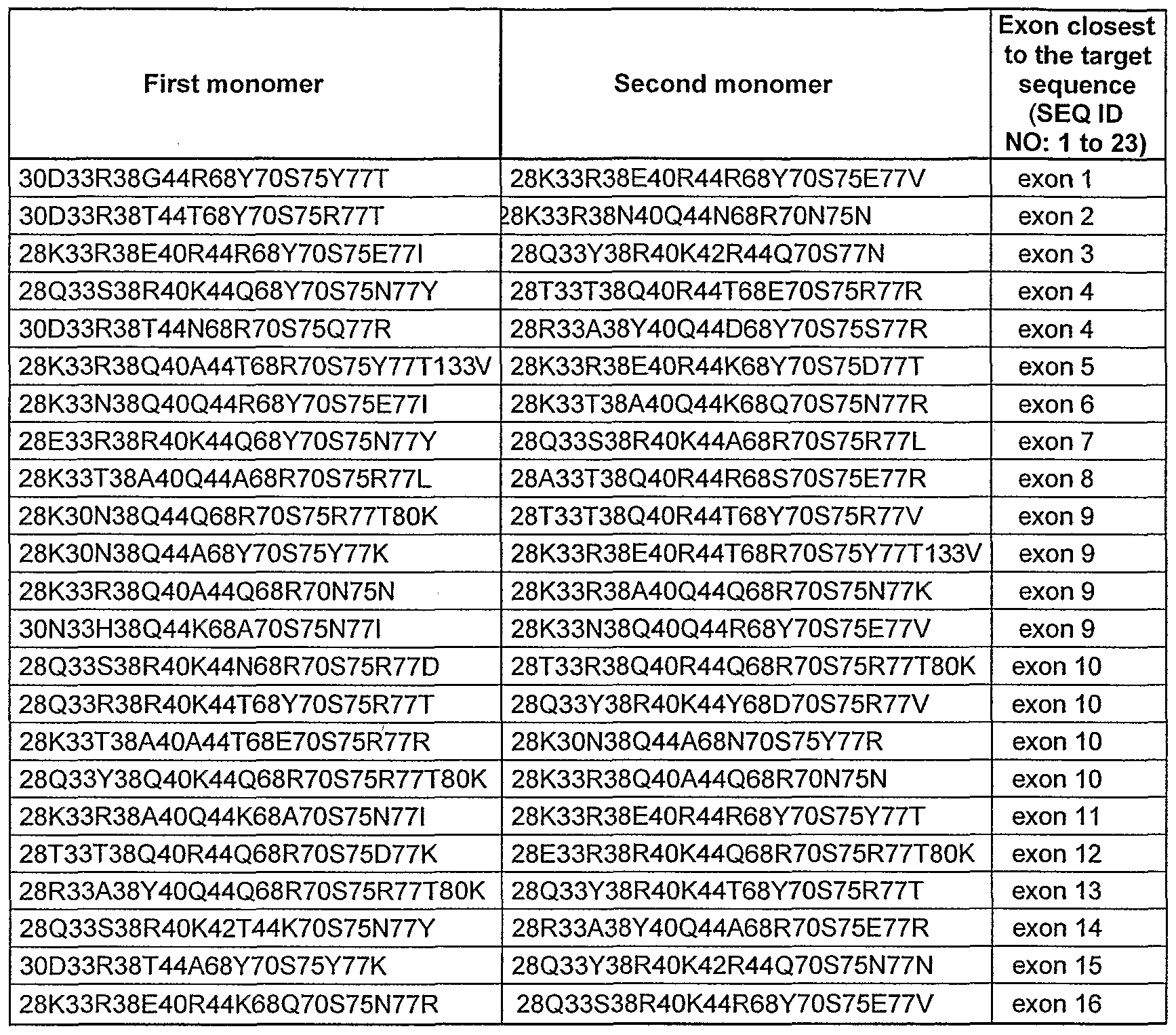
Table IV: Sequence of heterodimeric 1-CreI variants having a DNA target site in or close to one exon of the XPD gene


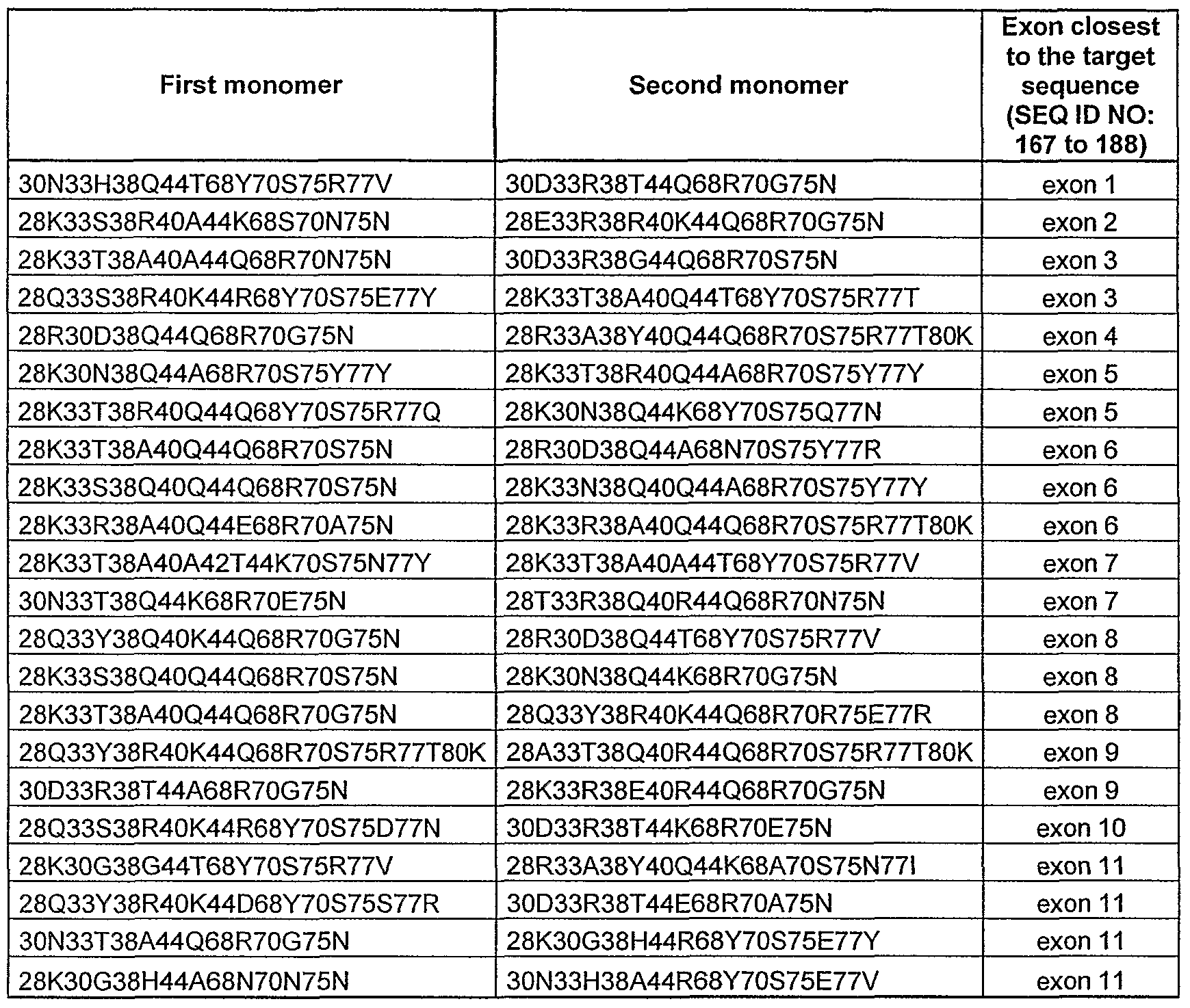
Table VII: Sequence of heterodimeric I-Creϊ variants having a DNA target site in or close to one exon of the XPG gene

Table VIH: Sequence of heterodimeric Ϊ-Crel variants having a DNA tar et site in one intron of the XPC ene

In addition, the variants of the invention may include one or more residues inserted at the NH2 terminus and/or COOH terminus of the sequence. For example, a tag (epitope or polyhistidine sequence) is introduced at the NH2 terminus and/or COOH terminus; said tag is useful for the detection and/or the purification of said variant.
The subject-matter of the present invention is also a single-chain chimeric endonuclease derived from an l-Creϊ variant as defined above. The single- chain chimeric endonuclease may comprise two I-Creϊ monomers, two l-Crel core domains (positions 6 to 94 of I-Crel) or a combination of both.
The subject-matter of the present invention is also a polynucleotide fragment encoding a variant or a single-chain chimeric endonuclease as defined above; said polynucleotide may encode one monomer of an homodimeric or
heterodimeric variant, or two domains/monomers of a single-chain chimeric endonuclease.
The subject-matter of the present invention is also a recombinant vector for the expression of a variant or a single-chain molecule according to the invention. The recombinant vector comprises at least one polynucleotide fragment encoding a variant or a single-chain molecule, as defined above. In a preferred embodiment, said vector comprises two different polynucleotide fragments, each encoding one of the monomers of an heterodimeric variant.
A vector which can be used in the present invention includes, but is not limited to, a viral vector, a plasmid, a RNA vector or a linear or circular DNA or RNA molecule which may consists of a chromosomal, non chromosomal, semisynthetic or synthetic DNA. Preferred vectors are those capable of autonomous replication (episomal vector) and/or expression of nucleic acids to which they are linked (expression vectors). Large numbers of suitable vectors are known to those of skill in the art and commercially available.
Viral vectors include retrovirus, adenovirus, parvovirus (e. g. adeno- associated viruses), coronavirus, negative strand RNA viruses such as orthomyxovirus (e. g., influenza virus), rhabdovirus (e. g., rabies and vesicular stomatitis virus), paramyxovirus (e. g. measles and Sendai), positive strand RNA viruses such as picor- navirus and alphavirus, and double-stranded DNA viruses including adenovirus, herpesvirus (e. g., Herpes Simplex virus types 1 and 2, Epstein-Barr virus, cytomegalovirus), and poxvirus (e. g., vaccinia, fowlpox and canarypox). Other viruses include Norwalk virus, togavirus, flavivirus, reoviruses, papovavirus, hepadnavirus, and hepatitis virus, for example. Examples of retroviruses include: avian leukosis- sarcoma, mammalian C-type, B-type viruses, D type viruses, HTLV-BLV group, lentivirus, spumavirus (Coffin, J. M., Retroviridae: The viruses and their replication, In Fundamental Virology, Third Edition, B. N. Fields, et al., Eds., Lippincott-Raven Publishers, Philadelphia, 1996).
Vectors can comprise selectable markers, for example: neomycin phosphotransferase, histidinol dehydrogenase, dihydrofolate reductase, hygromycin phosphotransferase, herpes simplex virus thymidine kinase, adenosine deaminase, glutamine synthetase, and hypoxanthine-guanine phosphoribosyl transferase for
eukaryotic cell culture ; TRPl for S. cerevisiae; tetracycline, rifampicin or ampicillin resistance in E. coli.
Preferably said vectors are expression vectors, wherein the sequence(s) encoding the variant/single-chain molecule of the invention is placed under control of appropriate transcriptional and translational control elements to permit production or synthesis of said variant. Therefore, said polynucleotide is comprised in an expression cassette. More particularly, the vector comprises a replication origin, a promoter operatively linked to said encoding polynucleotide, a ribosome-binding site, an RNA-splicing site (when genomic DNA is used), a polyadenylation site and a transcription termination site. It also can comprise an enhancer. Selection of the promoter will depend upon the cell in which the polypeptide is expressed. Preferably, when said variant is an heterodimer, the two polynucleotides encoding each of the monomers are included in one vector which is able to drive the expression of both polynucleotides, simultaneously. Suitable promoters include tissue specific and/or inducible promoters. Examples of inducible promoters are: eukaryotic metallothionine promoter which is induced by increased levels of heavy metals, prokaryotic lacZ promoter which is induced in response to isopropyl-β- D-thiogalacto-pyranoside (IPTG) and eukaryotic heat shock promoter which is induced by increased temperature. Examples of tissue specific promoters are skeletal muscle creatine kinase, prostate-specific antigen (PSA), α-antitrypsin protease, human surfactant (SP) A and B proteins, β-casein and acidic whey protein genes.
According to another advantageous embodiment of said vector, it includes a targeting construct comprising sequences sharing homologies with the region surrounding the genomic DNA target cleavage site as defined above. Alternatively, the vector coding for a l-Crel variant and the vector comprising the targeting construct are different vectors. In such a case the vector, which includes a targeting construct comprises a sequence to be introduced flanked by sequences sharing homologies with the regions surrounding the genomic DNA cleavage sites of the variant as defined here after. More preferably, said targeting DNA construct comprises: a) sequences sharing homologies with the region surrounding the genomic DNA cleavage site as defined above, and
b) a sequence to be introduced flanked by sequences as in a).
Preferably, homologous sequences of at least 50 bp, preferably more than 100 bp and more preferably more than 200 bp are used. Indeed, shared DNA homologies are located in regions flanking upstream and downstream the site of the break and the DNA sequence to be introduced should be located between the two arms. The sequence to be introduced is preferably a sequence which repairs a mutation in the gene of interest (gene correction or recovery of a functional gene), for the purpose of genome therapy. Alternatively, it can be any other sequence used to alter the chromosomal DNA in some specific way including a sequence used to modify a specific sequence, to attenuate or activate the endogenous gene of interest, to inactivate or delete the endogenous gene of interest or part thereof, to introduce a mutation into a site of interest or to introduce an exogenous gene or part thereof. Such chromosomal DNA alterations are used for genome engineering (animal models).
For correcting the XP gene, cleavage of the gene occurs in the vicinity of the mutation, preferably, within 500 bp of the mutation (figure IB). The targeting construct comprises a XP gene fragment which has at least 200 bp of homologous sequence flanking the target site (minimal repair matrix) for repairing the cleavage, and includes the correct sequence of the XP gene for repairing the mutation (figure IB). Consequently, the targeting construct for gene correction comprises or consists of the minimal repair matrix; it is preferably from 200 pb to 6000 pb, preferably from 1000 pb to 2000 pb.
For example, the target which is cleaved by each of the variant (Tables I to VIII ) and the minimal matrix for repairing the cleavage with each variant are indicated in Tables IX to XV and in figures 16 to 22.
Table IX ; XPA gene targets cleaved by l-Crel variants


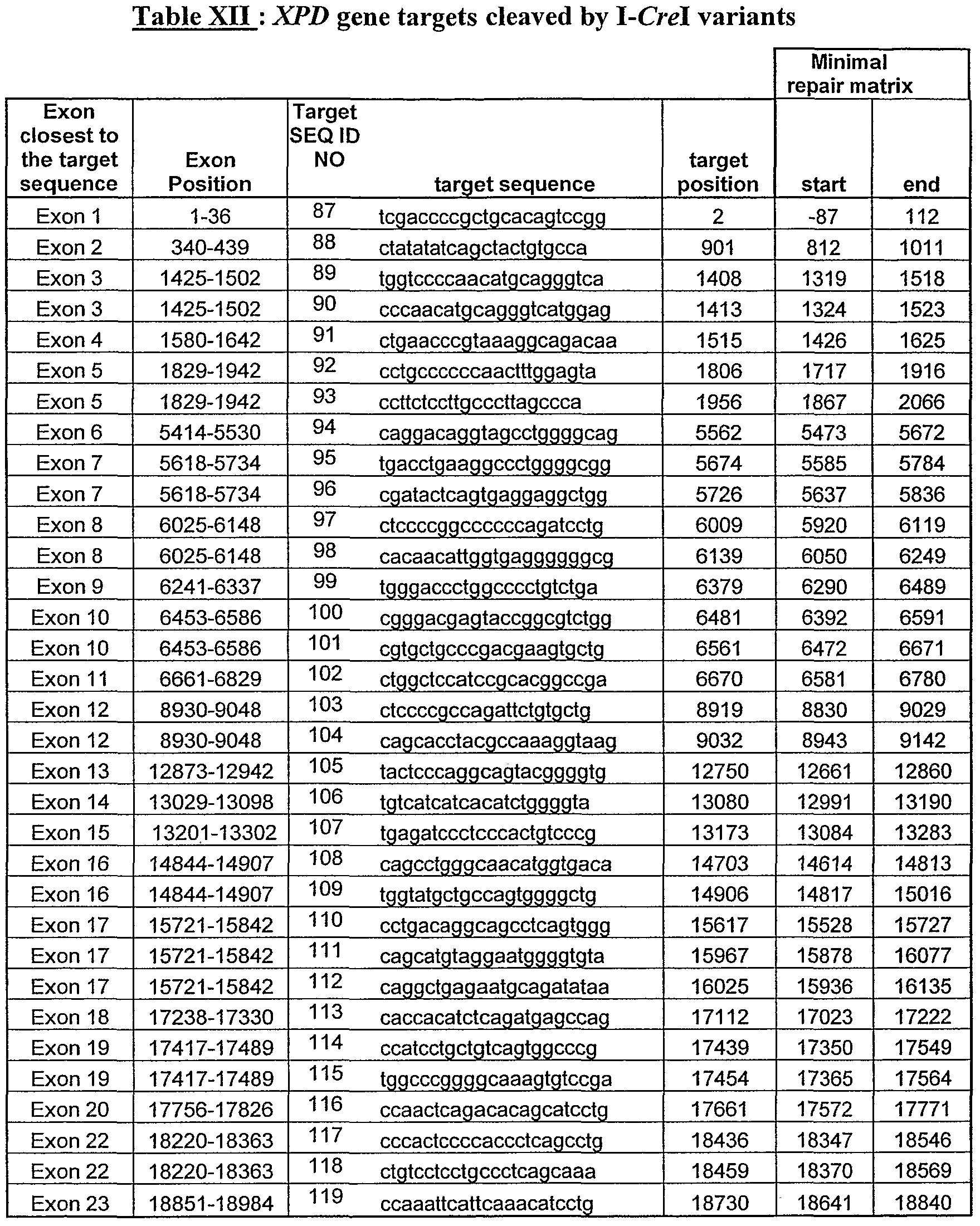


For example, for correcting some of the mutations in the XPC gene found in Xeroderma pigmentosum (XP), as indicated in figure IA, the following combinations of variants/targeting constructs may be used:
- ARG579TER (Exon 4; premature stop codon):
* variant : 28Q,33S,38R,40K,44Q,68Y,70S,75N,77Y (first monomer)/ 28T,33T,38Q,40R,44T,68E,70S,75R,77R (second monomer), and
a targeting construct comprising at least positions 9887 to 10086 of the XPC gene, for efficient repair of the DNA double-strand break, and all sequences between the meganuclease cleavage site and the mutation site, for efficient repair of the mutation. .* variant 30D,33R,38T,44N,68R,70S,75Q,77R (first monomer)/ 28R,33A,38Y,40Q,44D,68Y,70S,75S,77R (second monomer) and a targeting construct comprising at least positions 10173 to 10372 of the XPC gene, for efficient repair of the DNA double-strand break, and all sequences between the meganuclease cleavage site and the mutation site, for efficient repair of the mutation. - Exon 6: substitution PRO218HIS: * variant : 28K,33N,38Q,40Q,44R,68Y,70S,75E,77I (first monomer)/ 28K,33T,38A,40Q,44K,68Q,70S,75N,77R (second monomer), and a targeting construct comprising at least positions 13051 to 13250 of the XPC gene, for efficient repair of the DNA double-strand break, and all sequences between the meganuclease cleavage site and the mutation site, for efficient repair of the mutation. - Exon 9: deletion DELl 1132AA or insertion insVAL580:
* variant : 28K,30N,38Q,44Q,68R,70S,75R,77T,80K (first monomer)/ 28T,33T,38Q,40R,44T,68Y,70S,75R,77V (second monomer), and a targeting construct comprising at least positions 19580 to 19779 of the XPC gene, for efficient repair of the DNA double-strand break, and all sequences between the meganuclease cleavage site and the mutation site, for efficient repair of the mutation.
* variant : 28K,30N,38Q,44A,68Y,70S,75Y,77K (first monomer)/ 28K,33R,38E,40R,44T,68R,70S,75Y,77T,133V (second monomer), and a targeting construct comprising at least positions 20303 to 20502 of the XPC gene, for efficient repair of the DNA double-strand break, and all sequences between the meganuclease cleavage site and the mutation site, for efficient repair of the mutation.
* variant : 28K,33R,38Q,40A,44Q,68R,70N,75N (first monomer)/ 28K,33R,38A,40Q,44Q,68R,70S,75N,77K (second monomer), and a targeting construct comprising at least positions 20349 to 20548 of the XPC gene, for efficient repair of the DNA double-strand break, and all sequences between the meganuclease cleavage site and the mutation site, for efficient repair of the mutation.
* variant : 30N,33H,38Q,44K,68A,70S,75N,77I (first monomer)/ 28K,33N,38Q,40Q,44R,68Y,70S,75E,77V (second monomer), and a targeting
construct comprising at least positions 20389 to 20588 of the XPC gene, for efficient repair of the DNA double-strand break, and all sequences between the meganuclease cleavage site and the mutation site, for efficient repair of the mutation.
- Exon 14: substitution LYS822GLN: * variant : 28Q,33S,38R,40K, 42T,44K,70S,75N,77Y (first monomer)/ 28R,33A,38Y,40Q,44A,68R,70S,75E,77R (second monomer), and a targeting construct comprising at least positions 30416 to 30615 of the XPC gene, for efficient repair of the DNA double-strand break, and all sequences between the meganuclease cleavage site and the mutation site, for efficient repair of the mutation. Alternatively, for restoring a functional gene (figure 1C), cleavage of the gene occurs upstream of a mutation, for example at position 9119 (target SEQ ID NO: 24). Preferably said mutation is the first known mutation in the sequence of the gene, so that all the downstream mutations of the gene can be corrected simultaneously. The targeting construct comprises the exons downstream of the cleavage site fused in frame (as in the cDNA) and with a polyadenylation site to stop transcription in 31. The sequence to be introduced (exon knock-in construct) is flanked by introns or exons sequences surrounding the cleavage site, so as to allow the transcription of the engineered gene (exon knock-in gene) into a mRNA able to code for a functional protein (figure 1C). For example, when cleavage occurs in an exon, the exon knock-in construct is flanked by sequences upstream and downstream of the cleavage site, from a minimal repair matrix as defined above.
The subject-matter of the present invention is also a composition characterized in that it comprises at least one variant, one single-chain chimeric endonuclease and/or at least one expression vector encoding said variant/single-chain molecule, as defined above.
In a preferred embodiment of said composition, it comprises a targeting DNA construct comprising a sequence which repairs a mutation in the XP gene, flanked by sequences sharing homologies with the genomic DNA cleavage site of said variant, as defined above. The sequence which repairs the mutation is either a fragment of the gene with the correct sequence or an exon knock-in construct, as defined above.
Preferably, said targeting DNA construct is either included in a recombinant vector or it is included in an expression vector comprising the polynucleotide(s) encoding the variant/single-chain molecule according to the invention. In the case where two vectors may be used, the subject-matter of the present invention is also products containing a Ϊ-Crel variant expression vector as defined above and a vector which includes a targeting construct as defined above as a combined preparation for simultaneous, separate or sequential use in Xeroderma pigmentosum. The subject-matter of the present invention is also the use of at least one meganuclease variant and/or one expression vector, as defined above, for the preparation of a medicament for preventing, improving or curing a disease associated with Xeroderma pigmentosum in an individual in need thereof, said medicament being administrated by any means to said individual. In this case, the use of the meganuclease variant comprises at least the step of (a) inducing in somatic tissue(s) of the individual a double stranded cleavage at a site of interest comprising at least one recognition and cleavage site of said variant, and (b) introducing into the individual a targeting DNA, wherein said targeting DNA comprises (1) DNA sharing homologies to the region surrounding the cleavage site and (2) DNA which repairs the site of interest upon recombination between the targeting DNA and the chromosomal DNA. The targeting DNA is introduced into the individual under conditions appropriate for introduction of the targeting DNA into the site of interest.
According to the present invention, said double-stranded cleavage is induced, either in toto by administration of said meganuclease to an individual, or ex vivo by introduction of said meganuclease into somatic cells (skin cells) removed from an individual and returned into the individual after modification.
The subject-matter of the present invention is also a method for preventing, improving or curing a disease associated with Xeroderma pigmentosum in an individual in need thereof, said method comprising at least the step of administering to said individual a composition as defined above, by any means.
The meganuclease variant can be used either as a polypeptide or as a polynucleotide construct encoding said polypeptide. It is introduced into somatic cells of an individual, by any convenient mean well-known to those in the art, which is appropriate for the particular cell type, alone or in association with either at least an appropriate vehicle or carrier and/or with the targeting DNA.
According to an advantageous embodiment of the uses according to the invention, the meganuclease variant (polypeptide) is associated with:
- liposomes, polyethyleneimine (PEI); in such a case said association is administered and therefore introduced into somatic target cells. - membrane translocating peptides (Bonetta, 2002, The Scientist, 16,
38; Ford et al, Gene Ther, 2001, 8, 1-4 ; Wadia & Dowdy, 2002, Curr Opin Biotechnol, 13, 52-56); in such a case, the sequence of the variant/single-chain molecule is fused with the sequence of a membrane translocating peptide (fusion protein). According to another advantageous embodiment of the uses according to the invention, the meganuclease (polynucleotide encoding said meganuclease) and/or the targeting DNA is inserted in a vector. Vectors comprising targeting DNA and/or nucleic acid encoding a meganuclease can be introduced into a cell by a variety of methods (e.g., injection, direct uptake, projectile bombardment, liposomes). Meganucleases can be stably or transiently expressed into cells using expression vectors. Techniques of expression in eukaryotic cells are well known to those in the art. (See Current Protocols in Human Genetics: Chapter 12 "Vectors For Gene Therapy" & Chapter 13 "Delivery Systems for Gene Therapy"). Optionally, it may be preferable to incorporate a nuclear localization signal into the recombinant protein to be sure that it is expressed within the nucleus.
Once in a cell, the meganuclease and if present, the vector comprising targeting DNA and/or nucleic acid encoding a meganuclease are imported or translocated by the cell from the cytoplasm to the site of action in the nucleus.
For purposes of therapy, the meganucleases and a pharmaceutically acceptable excipient are administered in a therapeutically effective amount. Such a combination is said to be administered in a "therapeutically effective amount" if the amount administered is physiologically significant. An agent is physiologically
significant if its presence results in a detectable change in the physiology of the recipient. In the present context, an agent is physiologically significant if its presence results in a decrease in the severity of one or more symptoms of the targeted disease and in a genome correction of the lesion or abnormality. In one embodiment of the uses according to the present invention, the meganuclease is substantially non-immunogenic, i.e., engender little or no adverse immunological response. A variety of methods for ameliorating or eliminating deleterious immunological reactions of this sort can be used in accordance with the invention. In a preferred embodiment, the meganuclease is substantially free of N-formyl methionine. Another way to avoid unwanted immunological reactions is to conjugate meganucleases to polyethylene glycol ("PEG") or polypropylene glycol ("PPG") (preferably of 500 to 20,000 daltons average molecular weight (MW)). Conjugation with PEG or PPG, as described by Davis et al., (US 4,179,337) for example, can provide non-immunogenic, physiologically active, water soluble endonuclease conju- gates with anti -viral activity. Similar methods also using a polyethylene— polypropylene glycol copolymer are described in Saifer et al. (US 5,006,333).
The invention also concerns a prokaryotic or eukaryotic host cell which is modified by a polynucleotide or a vector as defined above, preferably an expression vector. The invention also concerns a non-human transgenic animal or a transgenic plant, characterized in that all or part of their cells are modified by a polynucleotide or a vector as defined above.
As used herein, a cell refers to a prokaryotic cell, such as a bacterial cell, or an eukaryotic cell, such as an animal, plant or yeast cell. The subject-matter of the present invention is further the use of a meganuclease variant as defined above, one or two polynucleotide(s), preferably included in expression vector(s), for genome engineering (animal models generation: knock-in or knock-out), for non-therapeutic purposes.
According to an advantageous embodiment of said use, it is for inducing a double-strand break in the gene of interest, thereby inducing a DNA recombination event, a DNA loss or cell death.
According to the invention, said double-strand break is for: repairing a specific sequence, modifying a specific sequence, restoring a functional gene in place of a mutated one, attenuating or activating an endogenous gene of interest, introducing a mutation into a site of interest, introducing an exogenous gene or a part thereof, inactivating or deleting an endogenous gene or a part thereof, translocating a chromosomal arm, or leaving the DNA unrepaired and degraded.
According to another advantageous embodiment of said use, said variant, polynucleotide(s), vector are associated with a targeting DNA construct as defined above. In a first embodiment of the use of the meganuclease variant according to the present invention, it comprises at least the following steps: 1) introducing a double-strand break at the genomic locus comprising at least one recognition and cleavage site of said meganuclease variant; 2) providing a targeting DNA construct comprising the sequence to be introduced flanked by sequences sharing homologies to the targeted locus. Said meganuclease variant can be provided directly to the cell or through an expression vector comprising the polynucleotide sequence encoding said meganuclease and suitable for its expression in the used cell. This strategy is used to introduce a DNA sequence at the target site, for example to generate knock-in or knock-out animal models or cell lines that can be used for drug testing.
The subject-matter of the present invention is also the use of at least one homing endonuclease variant, as defined above, as a scaffold for making other meganucleases. For example a third round of mutagenesis and selection/screening can be performed on said variants, for the purpose of making novel, third generation homing endonucleases.
The different uses of the homing endonuclease variant and the methods of using said homing endonuclease variant according to the present invention include also the use of the single-chain chimeric endonuclease derived from said variant, the polynucleotide(s), vector, cell, transgenic plant or non-human transgenic mammal encoding said variant or single-chain chimeric endonuclease, as defined above.
The l-Crel variant according to the invention may be obtained by a method for engineering l-Crel variants able to cleave a genomic DNA target sequence from a mammalian gene, comprising at least the steps of:
(a) constructing a first series of I-Oel variants having at least one substitution in a first functional subdomain of the LAGLIDADG core domain situated from positions 28 to 40 of l-Crel.
(b) constructing a second series of I-Oel variants having at least one substitution in a second functional subdomain of the LAGLIDADG core domain situated from positions 44 to 70 of l-Crel. (c) selecting and/or screening the variants from the first series of step (a) which are able to cleave a mutant l-Crel site wherein (i) the nucleotide triplet in positions -10 to -8 of the I-Od site has been replaced with the nucleotide triplet which is present in positions -10 to -8 of said genomic target and (ii) the nucleotide triplet in positions +8 to +10 has been replaced with the reverse complementary sequence of the nucleotide triplet which is present in positions -10 to -8 of said genomic target
(d) selecting and/or screening the variants from the second series of step (b) which are able to cleave a mutant l-Crel site wherein (i) the nucleotide triplet in positions -5 to -3 of the l-Crel site has been replaced with the nucleotide triplet which is present in positions -5 to -3 of said genomic target and (ii) the nucleotide triplet in positions +3 to +5 has been replaced with the reverse complementary sequence of the nucleotide triplet which is present in positions -5 to -3 of said genomic target
(e) selecting and/or screening the variants from the first series of step (a) which are able to cleave a mutant l-Crel site wherein (i) the nucleotide triplet in positions +8 to +10 of the 1-OeI site has been replaced with the nucleotide triplet which is present in positions +8 to +10 of said genomic target and (ii) the nucleotide triplet in positions -10 to -8 has been replaced with the reverse complementary sequence of the nucleotide triplet which is present in positions +8 to +10 of said genomic target
(f) selecting and/or screening the variants from the second series of step (b) which are able to cleave a mutant 1-CVeI site wherein (i) the nucleotide triplet
in positions +3 to +5 of the l-Crel site has been replaced with the nucleotide triplet which is present in positions +3 to +5 of said genomic target and (ii) the nucleotide triplet in positions -5 to -3 has been replaced with the reverse complementary sequence of the nucleotide triplet which is present in positions +3 to +5 of said genomic target
(g) combining in a single variant, the mutation(s) in positions 28 to 40 and 44 to 70 of two variants from step (c) and step (d), to obtain a novel homodimeric l-Crel variant which cleaves a sequence wherein (i) the nucleotide triplet in positions -10 to -8 is identical to the nucleotide triplet which is present in positions -10 to -8 of said genomic target, (ii) the nucleotide triplet in positions +8 to +10 is identical to the reverse complementary sequence of the nucleotide triplet which is present in positions -10 to -8 of said genomic target, (iii) the nucleotide triplet in positions -5 to -3 is identical to the nucleotide triplet which is present in positions -5 to -3 of said genomic target and (iv) the nucleotide triplet in positions +3 to +5 is identi- cal to the reverse complementary sequence of the nucleotide triplet which is present in positions -5 to -3 of said genomic target
(h) combining in a single variant, the mutation(s) in positions 28 to 40 and 44 to 70 of two variants from step (e) and step (f), to obtain a novel homodimeric I-Crel variant which cleaves a sequence wherein (i) the nucleotide triplet in positions +3 to +5 is identical to the nucleotide triplet which is present in positions +3 to +5 of said genomic target, (ii) the nucleotide triplet in positions -5 to - 3 is identical to the reverse complementary sequence of the nucleotide triplet which is present in positions +3 to +5 of said genomic target, (iii) the nucleotide triplet in positions +8 to +10 of the l-Crel site has been replaced with the nucleotide triplet which is present in positions +8 to +10 of said genomic target and (iv) the nucleotide triplet in positions -10 to -8 is identical to the reverse complementary sequence of the nucleotide triplet in positions +8 to +10 of said genomic target.
(i) combining the variants obtained in steps (g) and (h) to form heterodimers. (J) selecting and/or screening the heterodimers from step (i) which are able to cleave said genomic DNA target situated in a mammalian gene.
Steps (a), (b), (g), (h) and (i) may comprise the additional step of introducing additional mutations in order to improve the binding and/or cleavage properties of the mutants, particularly at other positions contacting the DNA target sequence or interacting directly or indirectly with said DNA target. This additional step may be performed by generating a library of variants as described in the International PCT Application WO 2004/067736.
The combination of mutations in steps (g) and (h) may be performed by amplifying overlapping fragments comprising each of the two subdomains, according to well-known overlapping PCR techniques. The combination of the variants in step (i) is performed by co- expressing one variant from step (g) with one variant from step (h), so as to allow the formation of heterodimers. For example, host cells may be modified by one or two recombinant expression vector(s) encoding said variant(s). The cells are then cultured under conditions allowing the expression of the variant(s), so that heterodimers are formed in the host cells.
The selection and/or screening in steps (c), (d), (e), (f) and/or (j) may be performed by using a cleavage assay in vitro or in vivo, as described in the International PCT Application WO 2004/067736 or in Arnould et al., J. MoI. Biol., 2006, 355(3): 443-58. According to another advantageous embodiment of said method, steps (c), (d), (e), (f) and/or (j) are performed in vivo, under conditions where the double-strand break in the mutated DNA target sequence which is generated by said variant leads to the activation of a positive selection marker or a reporter gene, or the inactivation of a negative selection marker or a reporter gene, by recombination- mediated repair of said DNA double-strand break.
The polynucleotide sequence(s) encoding the variant as defined in the present invention may be prepared by any method known by the man skilled in the art. For example, they are amplified from a cDNA template, by polymerase chain reaction with specific primers. Preferably the codons of said cDNA are chosen to favour the expression of said protein in the desired expression system.
The recombinant vector comprising said polynucleotides may be obtained and introduced in a host cell by the well-known recombinant DNA and genetic engineering techniques.
The variant of the invention is produced by expressing the poly- peptide(s) as defined above; preferably said polypeptide(s) are expressed or co- expressed in a host cell modified by one or two expression vector(s), under conditions suitable for the expression or co-expression of the polypeptides, and the variant is recovered from the host cell culture.
Single-chain chimeric endonucleases able to cleave a DNA target from the gene of interest are derived from the variants according to the invention by methods well-known in the art (Epinat et al., Nucleic Acids Res., 2003, 31, 2952-62; Chevalier et al., MoI. Cell., 2002, 10, 895-905; Steuer et al., Chembiochem., 2004, 5, 206-13; International PCT Applications WO 03/078619 and WO 2004/031346). Any of such methods, may be applied for constructing single-chain chimeric endonucleases derived from the variants as defined in the present invention.
In addition to the preceding features, the invention further comprises other features which will emerge from the description which follows, which refers to examples illustrating the l-Crel meganuclease variants and their uses according to the invention, as well as to the appended drawings in which: - figure 1 represents the human XPC gene, and two different strategies for restoring a functional gene by meganuclease-induced recombination. A. The XPC gene CDS junctions are indicated (GeneID:7508, ACCESSION NC 000003 REGION: complement(14161651..14195087); the mutations found in the XP-C complementation group are featured by an arrow. The XPC2.1 sequence (position 9119, SEQ ID NO: 24) is found in an intronic sequence. B. Gene correction. A mutation occurs within a known gene. Upon cleavage by a meganuclease and recombination with a repair matrix the deleterious mutation is corrected. C. Exonic sequences knock-in. A mutation occurs within a known gene. The mutated mRNA transcript is featured below the gene. In the repair matrix, exons located downstream of the cleavage site are fused in frame (as in a cDNA), with a polyadenylation site to stop transcription in 3'. Introns and exons sequences can be used as homologous
regions. Exonic sequences knock-in results into an engineered gene, transcribed into a mRNA able to code for a functional protein.
- figure 2 illustrates the principle of the invention. A: Structure of I- OeI bound to its target. Experimental data have shown that two independent subdomains (squares) could be identified in the DNA binding domain; each subdomain of the core domain binds a different half of the DNA target. B. One would like to identify smaller independent subdomains (squares), each binding a distinct part of a half DNA target. However, there is no structural or experimental data in favour of this hypothesis. - figure 3 represents the map of the base specific interactions of I-
Crel with its DNA target C 1221 (SEQ ID NO: 25) (Chevalier and Stoddard, Nucleic Acids Res., 2001, 29, 3757-74 ; Chevalier et al. J. MoI. Biol., 2003, 329, 253-69). The inventors have identified novel 1-OeI derived endonucleases able to bind DNA targets modified in regions -10 to -8 and +8 to +10, or -5 to -3 and +3 to +5. These DNA regions are indicated in grey boxes.
- figure 4 illustrates the rationale of the combinatorial approach. A. Given the separability of the two DNA binding subdomain (top left), one can combine different l-Creϊ monomers binding different sequences derived from the 1-OeI target sequence (top right and bottom left) to obtain heterodimers or single chain fusion molecules cleaving non-palindromic chimeric targets (bottom right). B. The identification of smaller independent subunit, i.e., subunit within a single monomer or αββαββα fold (top right and bottom left) would allow for the design of novel chimeric molecules (bottom right), by combination of mutations within the same monomer. Such molecules would cleave palindromic chimeric targets (bottom right). C. The combination of the two former steps would allow a larger combinatorial approach, involving four different subdomains (top right, middle left and right, bottom left) that could be combined in new molecules (bottom right). Thus, the identification of a small number of new cleavers for each subdomain would allow for the design of a very large number of novel endonucleases. - figure 5 represents the sequences of the I-Crel N75 scaffold protein and degenerated primers used for the Ulib4 and Ulib5 libraries construction. A. The
scaffold (SEQ ID NO: 26) is the 1-OeI ORP including the D75N codon substitution and three additional codons (AAD) at the 3' end. B. Primers (SEQ ID NO: 27, 28, 29),
- figure 6 represents the cleavage patterns of the l-Crel variants in positions 28, 30, 33, 38 and/or 40. For each of the 141 I-Crel variants obtained after screening, and defined by residues in position 28, 30, 33, 38, 40, 70 and 75, cleavage was monitored in yeast with the 64 targets derived from the C 1221 palindromic target cleaved by l-Crel, by substitution of the nucleotides in positions ± 8 to lO.Targets are designated by three letters, corresponding to the nucleotides in position -10, -9 and -8. For example GGG corresponds to the tcgggacgtcgtacgacgtcccga target (SEQ ID NO: 30). Values correspond to the intensity of the cleavage, evaluated by an appropriate software after scanning of the filter. For each protein, observed cleavage (black box) or non observed cleavage (0) is shown for each one of the 64 targets. All the variants are mutated in position 75: D75N.
- figure 7 represents the cleavage patterns of the I-Crel variants in position 44, 68 and/or 70. For each of the 292 l-Crel variants obtained after screening, and defined by residues in position 44, 68 and 70 (first three columns) cleavage was monitored in yeast with the 64 targets derived from the C 1221 palindromic target cleaved by 1-OeI, by substitution of the nucleotides in positions ± 3 to 5. Targets are designated by three letters, corresponding to the nucleotides in position -5, -4 and -3. For each protein, observed cleavage (1) or non observed cleavage (0) is shown for each one of the 64 targets. All the variants are mutated in position 75: D75N.
- figure 8 represents the localisation of the mutations in the protein and DNA target, on a l-Crel homodimer bound to its target. The two set of mutations (residues 44, 68 and 70; residues 28, 30, 33, 38 and 40 are shown in black on the monomer on the left. The two sets of mutations are clearly distinct spatially. However, there is no structural evidence for distinct subdomains. Cognate regions in the DNA target site (region -5 to -3; region -10 to -8) are shown in grey on one half site.
- figure 9 represents the XPC2 series of targets and close derivatives. C1221 (SEQ ID NO: 25) is one of the I-Crd palindromic target sequences. lOTGCJP, 10AGG_P, 5CCT_P and 5TTT (SEQ ID NO: 31, 32, 33, 34) are close derivatives found to be cleaved by 1-OeI mutants. They differ from C 1221 by the boxed motives. C 1221, 10TGC_P, 10AGG_P, 5CCT_P and 5TTT were first described as 24 bp
sequences, but structural data suggest that only the 22 bp are relevant for protein/DNA interaction. However, positions ±12 are indicated in parenthesis. XPC2.1 (SEQ ID NO:24 ) is the DNA sequence located in the human XPC gene at position 9119. In the XPC2.2 target (SEQ ID NO:35 ), the TTGA sequence in the middle of the target is replaced with GTAC, the bases found in C1221. XPC2.3 (SEQ ID NO:36 ) is the palindromic sequence derived from the left part of XPC2.2, and XPC2.4 (SEQ ID NO:37) is the palindromic sequence derived from the right part of XPC2.2. The boxed motives from 10TGC_P, 10AGG_P, 5CCT_P and 5TTT are found in the XPC2 series of targets. - figure 10 represents the pCLS 1055 plasmid vector map.
- figure 11 represents the pCLS 10542 plasmid vector map.
- figure 12 illustrates the cleavage of the XPC2.3 target. The figure displays secondary screening of the I-Crel K28, N30, S33, R38, S40, S70 N75 (KNSRSSN) and Ϊ-Crel A28, N30, S33, R38, K40, S70 N75 (ANSRKSN) mutants WύhXPC2.1,XPC2.2, XPC2.3 and XPC2.4 targets (SEQ ID NO:24,35, 36, 37).
- figure 13 illustrates the cleavage of the XPC2.4 target. The figure displays secondary screening of a series of combinatorial mutants among those described in Table XVI with XPC2.1, XPC2.2, XPC2.3 and XPC2.4 targets (SEQ ID NO:24,35, 36, 37). - figure 14 represents the pCLS 1107 vector map.
- figure 15 illustrates the cleavage of the XPC2.1 and XPC2.2 targets. A series of I-Crel N75 mutants cutting XPC2.4 are co-expressed with either KNSRSS (a) or ANSRKS (b). Cleavage is tested with the XPC 2.1, XPC 2.2, XPC 2.3 and XPC 2.4 targets (SEQ ID NO:24, 35, 36, 37). Mutants cleaving XPC2.1 are circled.
- figures 16 to 22 illustrate the DNA target sequences found in each exon of the human XP genes (XPA to XPG gene) and the corresponding I-Crel variant which is able to cleave said DNA target. The exons closest to the target sequences, and the exons junctions are indicated (columns 1 and T), the sequence of the DNA target is presented (column 3), with its position (column 4). The minimum repair matrix for repairing the cleavage at the target site is indicated by its first nucleotide (start, column 7) and last nucleotide (end, column 8). The sequence of each
variant is defined by its amino acid residues at the indicated positions. For example, the first heterodimeric variant of figure 16 consists of a first monomer having K, S, R5 D5 K, R, G and N in positions 28, 33, 38, 40, 44, 68, 70 and 75, respectively and a second monomer having R, D, R, K, A, S, N and I in positions 28, 30, 38, 44, 68, 70, 75 and 77, respectively. The positions are indicated by reference to 1-OeI sequence SWISSPROT P05725 or pdb accession code Ig9y; l-Crel has I, Q5 K, N, S5 Y5 Q5 S5 A, Q, R, R, D, I5 E and A, in positions 24, 26, 28, 30, 32, 33, 38, 40, 42, 44, 68, 70, 75, 77, 80 and 133, respectively. The positions which are not indicated are not mutated and thus correspond to the wild-type I-Crel sequence. Example 1: Engineering of l-Crel variants with modified specificity in positions +8 to ±10
The method for producing meganuclease variants and the assays based on cleavage-induced recombination in mammal or yeast cells, which are used for screening variants with altered specificity, are described in the International PCT Application WO 2004/067736 and in Arnould et al., J. MoI. Biol., 2006, 355, 443- 458. These assays result in a functional LacZ reporter gene which can be monitored by standard methods. A) Material and methods a) Construction of the Ulib4, Ulib5 and Lib4 libraries l-Crel wt and l-Crel D75N open reading frames were synthesized, as described previously (Epinat et al., N.A.R., 2003, 31, 2952-2962). Mutation D75N was introduced by replacing codon 75 with aac. Three combinatorial libraries (Ulib4, Ulib5 and Lib4) were derived from the 1-OeI D75N protein by replacing three different combinations of residues, potentially involved in the interactions with the bases in positions ± 8 to 10 of one DNA target half-site. The diversity of the meganuclease libraries was generated by PCR using degenerated primers harboring a unique degenerated codon (coding for 10 or 12 different amino acids), at each of the selected positions.
The three codons at positions N30, Y33 and Q38 (Ulib4 library) or K28, N30 and Q38 (Ulib5 library) were replaced by a degenerated codon VVK (18 codons) coding for 12 different amino acids: A5D5E, G,H,K,N,P,Q,R,S,T). In consequence, the maximal (theoretical) diversity of these protein libraries was 12 or 1728.
However, in terms of nucleic acids, the diversity was 183 or 5832. Fragments carrying combinations of the desired mutations were obtained by PCR, using a pair of degenerated primers (Ulib456for and Ulib4rev; Ulib456for and Ulib5rev, figure 5B) and as DNA template, the D75N open reading frame (ORF), (figure 5A). The corresponding PCR products were cloned back into the 1-OeI N75 ORF in the yeast replicative expression vector pCLS0542 (Epinat et al., precited), carrying a LEU2 auxotrophic marker gene. In this 2 micron-based replicative vector, I-Crel variants are under the control of a galactose inducible promoter.
In Lib4, ordered from BIOMETHODES, an arginine in position 70 was first replaced with a serine (R70S). Then positions 28, 33, 38 and 40 were randomized. The regular amino acids (K28, Y33, Q38 and S40) were replaced with one out of 10 amino acids (A,D,E,K,N,Q,R,S,T,Y). The resulting library has a theoretical complexity of 10000 in terms of proteins, b) Construction of target clones The C 1221 twenty-four bp palindrome (tcaaaacgtcgtacgacgttttga,
(SEQ ID NO: 25) is a repeat of the half-site of the nearly palindromic natural 1-OeI target (tcaaaacgtcgtgagacagtttgg, SEQ ID NO: 38). C1221 is cleaved as efficiently as the I-Crel natural target in vitro and ex vivo in both yeast and mammalian cells. The 64 palindromic targets were derived from C 1221 as follows: 64 pairs of oligonucleotides ((ggcatacaagtttcnnnacgtcgtacgacgtnnngacaatcgtctgtca (SEQ ID NO: 39) and reverse complementary sequences) were ordered form Sigma, annealed and cloned into pGEM-T Easy (PROMEGA) in the same orientation. Next, a 400 bp Pvulϊ fragment was excised and cloned into the yeast vector pFL39- ADH-L ACURAZ, also called pCLS0042, and the mammalian vector pcDNA3 derivative, both described previously (Epinat et al., 2003, precited), resulting in 64 yeast reporter vectors (target plasmids).
Alternatively, double-stranded target DNA, generated by PCR amplification of the single stranded oligonucleotides, was cloned using the Gateway protocol (INVITROGEN) into yeast and mammalian reporter vectors. c) Yeast strains
The library of meganuclease expression variants was transformed into the Ieu2 mutant haploid yeast strain FYC2-6A: alpha, trplΔ63, leu2Δl, his3Δ200.
A classical chemical/heat choc protocol that routinely gives us 106 independent transformants per μg of DNA derived from (Gietz and Woods, Methods Enzymol., 2002, 350, 87-96), was used for transformation. Individual transformant (Leu+) clones were individually picked in 96 wells microplates.13824 colonies were picked using a colony picker (QpixII, GENETIX), and grown in 144 microtiter plates.
The 64 target plasmids were transformed using the same protocol, into the haploid yeast strain FYBL2-7B: a, ura3Δ851, trplΔ63, leu2Δl, lys2Δ202, resulting in 64 tester strains, d) Mating of meganuclease expressing clones and screening in yeast Meganuclease expressing clones were mated with each of the 64 target strains, and diploids were tested for beta-galactosidase activity, by using the screening assay illustrated on figure 2 of Arnould et al., 2006, precited. l-Crel variant clones as well as yeast reporter strains were stocked in glycerol (20%) and replicated in novel microplates. Mating was performed using a colony gridder (QpixII, GENETIX). Mutants were gridded on nylon filters covering YPD plates, using a high gridding density (about 20 spots/cm2). A second gridding process was performed on the same filters to spot a second layer consisting of 64 different reporter-harboring yeast strains for each variant. Membranes were placed on solid agar YPD rich medium, and incubated at 30°C for one night, to allow mating. Next, filters were transferred to synthetic medium, lacking leucine and tryptophan, with galactose (2 %) as a carbon source (and with G418 for coexpression experiments), and incubated for five days at 37°C, to select for diploids carrying the expression and target vectors. After 5 days, filters were placed on solid agarose medium with 0.02% X-GaI in 0.5 M sodium phosphate buffer, pH 7.0, 0.1% SDS, 6% dimethyl formamide (DMF), 7 mM β-mercaptoethanol, 1% agarose, and incubated at 37°C, to monitor β-galactosidase activity. After two days of incubation, positive clones were identified by scanning. The β-galactosidase activity of the clones was quantified using appropriate software.
The clones showing an activity against at least one target were isolated (first screening). The spotting density was then reduced to 4 spots/cm2 and each positive clone was tested against the 64 reporter strains in quadruplicate, thereby creating complete profiles (secondary screening).
e) Sequence
The open reading frame (ORP) of positive clones identified during the first and/or secondary screening in yeast was amplified by PCR on yeast colonies using primers: PCR-GaIlO-F (gcaactttagtgctgacacatacagg, SEQ ID NO:40) and PCR- GaIlO-R (acaaccttgattgcagacttgacc, SEQ ID NO:41) from PROLIGO. Briefly, yeast colony is picked and resuspended in 100 μl of LGIu liquid medium and cultures overnight. After centrifugation, yeast pellet is resuspended in 10 μl of sterile water and used to perform PCR reaction in a final volume of 50 μl containing 1.5 μl of each specific primers (100 pmol/μl). The PCR conditions were one cycle of denaturation for 10 minutes at 940C, 35 cycles of denaturation for 30s at 940C, annealing for 1 min at 55 0C, extension for 1.5 min at 72°C, and a final extension for 5 min. The resulting PCR products were then sequenced. f) Re-Cloning of primary hits
The open reading frames (ORFs) of positive clones identified during the primary screening were recloned using the Gateway protocol (Invitrogen). ORFs were amplified by PCR on yeast colonies, as described in e). PCR products were then cloned in : (i) yeast gateway expression vector harboring a galactose inducible promoter, LEU2 or KanR as selectable marker and a 2 micron origin of replication, and (ii) a pET 24d(+) vector from NOVAGEN. Resulting clones were verified by sequencing (MILLEGEN). B) Results
I-Crel is a dimeric homing endonuclease that cleaves a 22 bp pseudo-palindromic target. Analysis of 1-OeI structure bound to its natural target has shown that in each monomer, eight residues establish direct interactions with seven bases (Jurica et al., 1998, precited). According to these structural data, the bases of the nucleotides in positions ± 8 to 10 establish specific contacts with l-Crel amino-acids N30, Y33 and Q38 (figure 3). Thus, novel proteins with mutations in positions 30, 33 and 38 could display novel cleavage profiles with the 64 targets resulting from substitutions in positions + 8, ± 9 and ± 10 of a palindromic target cleaved by 1-OeI. In addition, mutations might alter the number and positions of the residues involved in direct contact with the DNA bases. More specifically, positions other than 30, 33, 38,
but located in the close vicinity on the folded protein, could be involved in the interaction with the same base pairs.
An exhaustive protein library vs. target library approach was undertaken to engineer locally this part of the DNA binding interface. First, the 1-OeI scaffold was mutated from D75 to N. The D75N mutation did not affect the protein structure, but decreased the toxicity of I-Crel in overexpression experiments.
Next the Ulib4 library was constructed: residues 30, 33 and 38, were randomized, and the regular amino acids (N30, Y33, and Q38) replaced with one out of 12 amino acids (A,D,E,G,H,K,N,P,Q,R,S,T). The resulting library has a complexity of 1728 in terms of protein (5832 in terms of nucleic acids).
Then, two other libraries were constructed: Ulib5 and Lib4. In Ulib5, residues 28, 30 and 38 were randomized, and the regular amino acids (K28, N30, and Q38) replaced with one out of 12 amino acids (ADEGHKNPQRST). The resulting library has a complexity of 1728 in terms of protein (5832 in terms of nucleic acids). In Lib4? an Arginine in position 70 was first replaced with a Serine. Then, positions 28, 33, 38 and 40 were randomized, and the regular amino acids (K28, Y33, Q38 and S40) replaced with one out of 10 amino acids (A,D,E,K,N,Q,R,S,T,Y). The resulting library has a complexity of 10000 in terms of proteins.
In a primary screening experiment, 20000 clones from Ulib4, 10000 clones from Ulib5 and 20000 clones from Lib4 were mated with each one of the 64 tester strains, and diploids were tested for beta-galactosidase activity. All clones displaying cleavage activity with at least one out of the 64 targets were tested in a second round of screening against the 64 targets, in quadriplate, and each cleavage profile was established. Then, meganuclease ORF were amplified from each strain by PCR, and sequenced, and 141 different meganuclease variants were identified.
The 141 validated clones showed very diverse patterns. Some of these new profiles shared some similarity with the wild type scaffold whereas many others were totally different. Results are summarized in figure 6. Homing endonucleases can usually accommodate some degeneracy in their target sequences, and the 1-OeI N75 scaffold protein itself cleaves a series of 4 targets, corresponding to the aaa, aac, aag, an aat triplets in positions ±10 to ±8. A strong cleavage activity is observed with aaa, aag and aat, whereas AAC is only faintly cut (and sometimes not
observed). Similar pattern is found with other proteins, such as 1-OeI K28 N30 D33 Q38 S40 R70 N75, Ϊ-Crel K28 N30 Y33 Q38 S40 R70 N75. With several proteins, such as I-Crel R28 N30 N33 Q38 D40 S70 N75 and l-Crel K28 N30 N33 Q38 S40 R70 N75, aac is not cut anymore. However, a lot of proteins display very different patterns. With a few variants, cleavage of a unique sequence is observed. For example, protein Ϊ-Creϊ K28 R30 G33 T38 S40 R70 N75 is active on the "ggg" target, which was not cleaved by wild type protein, while l-Crel Q28 N30 Y33 Q38 R40 S70 N75 cleaves AAT, one of the targets cleaved by l-Crel N75. Other proteins cleave efficiently a series of different targets: for example, l-Crel N28 N30 S33 R38 K40 S70 N75 cleaves ggg, tgg and tgt, Crel K28 N30 H33 Q38 S40 R70 N75 cleaves aag, aat, gac, gag, gat, gga, ggc, ggg, and ggt. The number of cleaved sequences ranges from 1 to 10. Altogether, 37 novel targets were cleaved by the mutants, including 34 targets which are not cleaved by l-Crel and 3 targets which are cleaved by l-Crel (aag, aat and aac, figure 6).
Example 2: Strategy for engineering novel meganucleases cleaving a target from the XPC gene
A first series of I-Crel variants having at least one substitution in positions 44, 68 and/or 70 of l-Crel and being able to cleave mutant I-Crel sites having variation in positions ± 3 to 5 was identified previously (Arnould et al., J. MoI. Biol., 2006, 355, 443-458). The cleavage pattern of the variants is presented in figure 7.
A second series of I-Crel variants having at least one substitution in positions 28, 30, 33 or 28, 33, 38 and 40 of l-Crel and being able to cleave mutant I- OeI sites having variation in positions ± 8 to 10 was identified as described in example 1. The cleavage pattern of the variants is presented in figure 6.
Positions 28, 30, 33, 38 and 40 on one hand, and 44, 68 and 70, on another hand are on a same DNA-binding fold, and there is no structural evidence that they should behave independently. However, the two sets of mutations are clearly on two spatially distinct regions of this fold (figure 8) located around different regions of the DNA target. These data suggest that l-Crel comprises two independent functional subunits which could be combined to cleave novel chimeric targets. The chimeric
target comprises the nucleotides in positions ± 3 to 5 and ± 8 to 10 which are bound by each subdomain.
This hypothesis was verified by using targets situated in a gene of interest, the XPC gene. The targets cleaved by the l-Crel variants are 24 bp derivatives of C 1221, a palindromic sequence cleaved by 1-OeI. However, the structure of I-Creϊ bound to its DNA target suggests that the two external base pairs of these targets (positions -12 and 12) have no impact on binding and cleavage [Chevalier et al., Nat. Struct. Biol., 2001, 8(4): 312-6; Chevalier and Stoddard, Nucleic Acids Res., 2001, 29(18): 3757-74; Chevalier et al., 2003, J. MoI. Biol., 329, 253-69] and in this study, only positions -11 to 11 were considered. Consequently, the series of targets identified in the XPC gene were defined as 22 bp sequences instead of 24 bp.
XPC2.1 is a 22 bp (non-palindromic) target located at position 9119 of the human XPC gene (accession number NC 000003 REGION: complement^ 4161651-14195087) ; figures IA and 9). The meganucleases cleaving XPC2.1 could be used to correct mutations in the vicinity of the cleavage site (figure IB). Since the efficiency of gene correction decreases when the distance to the DSB increases (Elliott et al., MoI Cell Biol, 1998, 18(1): 93-101), this strategy would be most efficient with mutations located within 500 bp of the cleavage site. Alternatively, the same meganucleases could be used to knock-in exonic sequences that would restore a functional XPC gene at the XPC locus (figure 1C). This strategy could be used for any mutation downstream of the cleavage site.
XPC2.1 is partly a patchwork of the 10TGC_P, 10AGG_P, 5TTT_P and 5CCT_P targets (figure 9) which are cleaved by previously identified meganucleases (figures 6 and 7). Thus, XPC2.1 could be cleaved by combinatorial mutants resulting from these previously identified meganucleases.
Therefore, to verify this hypothesis, the ttga sequence in -2 to 2 of XPC 2. J was first substituted with the gtac sequence from C 1221, resulting in target XPC2.2 (figure 9). Then, two palindromic targets, XPC2.3 and XPC2.4, were derived from XPC2J (figure 9). Since XPC2.3 and XPC2.4 are palindromic, they should be cleaved by homodimeric proteins. In a first step, proteins able to cleave the XPC2.3 and XPC 2.4 sequences as homodimers were designed (examples 3 and 4). In a second
step, the proteins obtained in examples 3 and 4 were co-expressed to obtain heterodimers cleaving XPC2.2, and XPC2.1 also, for some heterodimers (example 5). Example 3: Making of meganucleases cleaving XPC2.3
This example shows that l-Crel mutants can cut the XPC2.3 DNA target sequence derived from the left part of the XPC2.2 target in a palindromic form
(figure 9). Target sequences described in this example are 22 bp palindromic sequences. Therefore, they will be described only by the first 11 nucleotides, followed by the suffix _P; for example, target XPC2.3 will be noted also ctgccttttgt_P.
XPC2.3 is similar to 5TTT_P in positions ±1, ±2, ±3, ±4, ±5 and ±11 and to IOTGC P in positions ±1, ±2, ±8, ±9, ±10 and ±11. It was hypothesized that positions ±6 and ±7 would have little effect on the binding and cleavage activity. Mutants able to cleave 5TTTJP were previously obtained by mutagenesis on l-Crel N75 at positions 44, 68 and 70 (Arnould et al., J. MoI. Biol., 2006, 355, 443-458; figure 7). Mutants able to cleave the 10TGC_P target were obtained by mutagenesis on l-Crel N75 at positions 28, 33, 38, 40 and 70 (example 1 and figure 6). Thus, combining such pairs of mutants would allow for the cleavage of the XPC2.3 target.
Both sets of proteins are mutated at position 70. However, it was hypothesized that two separable functional subdomains exist in l-Crel. That implies that this position has little impact on the specificity in bases 10 to 8 of the target. Therefore, to check whether combined mutants could cleave the XPC2.3 target, mutations at positions 44, 68 and 70 from proteins cleaving 5TTT_P were combined with the 28, 33, 38, 40 mutations from proteins cleaving 10TGC_P. A) Material and Methods a) Construction of target vector: The target was cloned as follows: oligonucleotide corresponding to the target sequence flanked by gateway cloning sequence was ordered from Proligo (as example: 5' tggcatacaagtttctgccttttgtacaaaaggcagacaatcgtctgtca 3' (SEQ ID NO: 42, for the XPC2.3 target). Double-stranded target DNA, generated by PCR amplification of the single stranded oligonucleotide, was cloned using the Gateway1* protocol (INVITROGEN) into yeast reporter vector (pCLS1055, figure 10). Yeast reporter vector was transformed into S. cerevisiae strain FYBL2-7B (MAT alpha, ura3Δ851, trplΔ63, leu2Δl, lys2Δ202).
b) Construction of combinatorial mutants: l-Crel mutants cleaving 10TGC_P or 5TTT_P were identified as described in example 1 and figure 6, and Arnould et al., J. MoI. Biol., 2006, 355, 443- 458 and figure 7, respectively for the 10TGC_P and the 5TTTJP targets. In order to generate l-Crel derived coding sequence containing mutations from both series, separate overlapping PCR reactions were carried out that amplify the 5' end (amino acid positions 1-43) or the 3' end (positions 39-167) of the l-Crel coding sequence. For both the 5' and 3' end, PCR amplification is carried out using primers specific to the vector (pCLS0542, figure 11): GaIlOF or GaIlOR and primers specific to the I- OeI coding sequence for amino acids 39-43 (assF 5'-ctannnttgaccttt-3' (SEQ ID NO: 43) or assR 5'-aaaggtcaannntag-3' (SEQ ID NO: 44)) where NNN codes for residue 40. Approximately 25 ng of each of the two overlapping PCR fragments and 25 ng of vector DNA (pCLS0542) linearized by digestion with Ncόl and Eagl were used to transform the yeast Saccharomyces cerevisiae strain FYC2-6A (M ATa, trplΔ63, leu2Δl, his3Δ200) using a high efficiency LiAc transformation protocol (Gietz and Woods, Methods Enzymol, 2002, 350: 87-96). An intact coding sequence containing both groups of mutations is generated by in vivo homologous recombination in yeast. c) Mating of meganuclease expressing clones and screening in yeast:
The experimental procedure is ad described in example 1, except that a low gridding density (about 4 spots/cm ) was used, c) Sequencing of mutants
To recover the mutant expressing plasmids, yeast DNA was extracted using standard protocols and used to transform E. coli. Sequencing of mutant ORF was then performed on the plasmids by MILLEGEN SA. Alternatively, ORFs were amplified from yeast DNA by PCR (Akada et al., Biotechniques, 2000, 28(4): 668-70, 672, 674) and sequencing was performed directly on PCR product by MILLEGEN SA. B) Results l-Crel N75 mutants cutting the 10TGC_P (CTGCACGTCGT_P) target (amino acids at positions 28-33-38-40-70 and 75 are indicated on figure 12) and l-Crel N75 (Q44, R68, R70) mutants cutting the 5TTT_P (CAAAACTTTGT_P) target were combined, resulting in two combinatorial mutants:
- l-Crel K28, N30, S33, R38, S40, S70 N75 (called KNSRSSN), obtained by combination of 1-OeI K28, N30, S33, R38, S40 and l-Crel S70 N75, and
- l-Crel A28, N30, S33, R38, K40, S70 N75 (called ANSRKSN), obtained by combination of l-Crel K28, N30, S33, R38, K40 and I-Crel S70 N75. The two combined mutants were screened against the XPC2.3 DNA target (CTGCCTTTTGT-P), and found to be both positives. Results were confirmed in a secondary screen (figure 12) and the predicted amino acid primary structure was confirmed by sequencing. Example 4: Making of meganucleases cleaving XPC2.4 This example shows that l-Crel variants can cleave the XPC2.4
DNA target sequence derived from the right part of the XPC2.2 target in a palindromic form (figure 9). All target sequences described in this example are 22 bp palindromic sequences. Therefore, they will be described only by the first 11 nucleotides, followed by the suffix _P; for example, XPC 2.4 will be called taggatcctgt P (SEQ ID NO: 37).
XPC2.4 is similar to 5CCT_P in positions ±1, ±2, ±3, ±4, ±5 and ±7 and to 10AGG_P in positions ±1, ±2, ±7, ±8, ±9 and ±lO.It was hypothesized that positions ±6 and ±11 would have little effect on the binding and cleavage activity. Mutants able to cleave 5CCT_P were previously obtained by mutagenesis on l-Crel N75 at positions 44, 68 and 70, as described in Arnould et al., J. MoI. Biol., 2006, 355, 443-458 (figure 7). Mutants able to cleave the 10AGG_P target were obtained by mutagenesis on l-Crel N75 at positions 28, 30, 33, 38, 40 and 70, as described in example 1 (figure 6). Therefore, combining such pairs of mutants would allow for the cleavage of the XPC2.4 target. Both sets of proteins are mutated at position 70. However, it was hypothesized that l-Crel comprises two separable functional subdomains. That implies that this position has little impact on the specificity in base 10 to 8 of the target. Therefore, to check whether combined mutants could cleave the XPC 2.4 target, mutations at positions 44, 68 and 70 from proteins cleaving 5CCT_P were combined with the 28, 30, 33, 38, 40 mutations from proteins cleaving 10AGG_P (Table XVI). A) Material and Methods
See example 3.
B) Results l-Crel N75 mutants cutting the 10AGG_P (caggacgtcgtJP; SEQ ID NO: 32) target (amino acids at positions 28, 30, 33, 38 and 40 are indicated) and I- Crel N75 mutants cutting the 5CCTJP (caaaaccctgt_P; SEQ ID NO: 34) target (amino acids at positions 44, 68 and 70 are indicated) used in example 4 are listed in Table XVI. 1-Creϊ combined mutants were constructed by associating mutations at positions 44, 68 and 70 with the 28, 30, 33, 38 and 40 mutations on the I-Crel N75 scaffold (Table XVI). Combined mutants were screened against the XPC2.4 DNA target (taggatcctgt_P; SEQ ID NO: 37), and after secondary screening and sequencing, 39 different cleavers were identified (figure 13 and Table XVI).

+: functional combination.
*all proteins have also a D75N mutation.
Example 5: Making of meganucleases cleaving XPC2.2 and XPC2.1
1-Creϊ mutants able to cleave each of the palindromic XPC2 derived targets (XPC2.3 and XPC2.4 were identified in examples 3 and 4. Pairs of such mutants (one cutting XPC2.3 and one cutting XPC2.4), were co-expressed in yeast. Upon co-expression, there should be three active molecular species, two homodimers, and one heterodimer. It was assayed whether the heterodimers that should be formed could cleave the XPC2.1 and XPC2.2 targets.
A) Material and Methods a) Cloning of mutants in kanamycin resistant vector: In order to co-express two I-Crel mutants in yeast, mutants cutting the XPC2.3 sequence were subcloned in a kanamycin resistant yeast expression vector (pCLS1107, figure 14).
Mutants were amplified by PCR reaction using primers common for leucine vector (pCLS0542) and kanamycin vector (pCLSl 107) (GaIlOF and GaIlOR). Approximately 25ng of PCR fragment and 25ng of vector DNA (pCLS1107) linearized by digestion with DraIII and NgoMIV are used to transform the yeast Saccharomyces cerevisiae strain FYC2-6A (MATα, trplΔ63, leu2Δl, his3Δ200) using a high efficiency LiAc transformation protocol. An intact coding sequence for the I-Crel mutant is generated by in vivo homologous recombination in yeast. b) Mutants coexpression:
Yeast strain expressing a mutant cutting the XPC2.4 target was transformed with DNA coding for a mutant cutting the XPC2.3 target in pCLSl 107 expression vector. Transformants were selected on — L GIu + G418 medium, c) Mating of meganucleases coexpressing clones and screening in yeast: The experimental procedure is as described in example 1, except that a low gridding density (about 4 spots/cm2) was used.
B) Results:
Co-expression of mutants cleaving the XPC2.3 and XPC2.4 resulted in efficient cleavage of the XPC2.2 target by heterodimeric meganucleases (figures 15a and 15b). Among such heterodimers, 12 combinations are also able to cut, although with a lower efficiency, the XPC 2.1 natural target that differs from the XPC
2.2 sequence just by positions ±1 and ±2. Functional combinations are summarized in
Tables XVII and XVIII. As a general rule, functional heterodimers cutting XPC2.1 sequence were always obtained when the two expressed proteins gave a strong signal as homodimer.
Table XVII: Combinations that resulted in cleavage of the XPC2.2 (+) or XPC2.2 and XPC2.1 (++) when expressed with KNSRSS
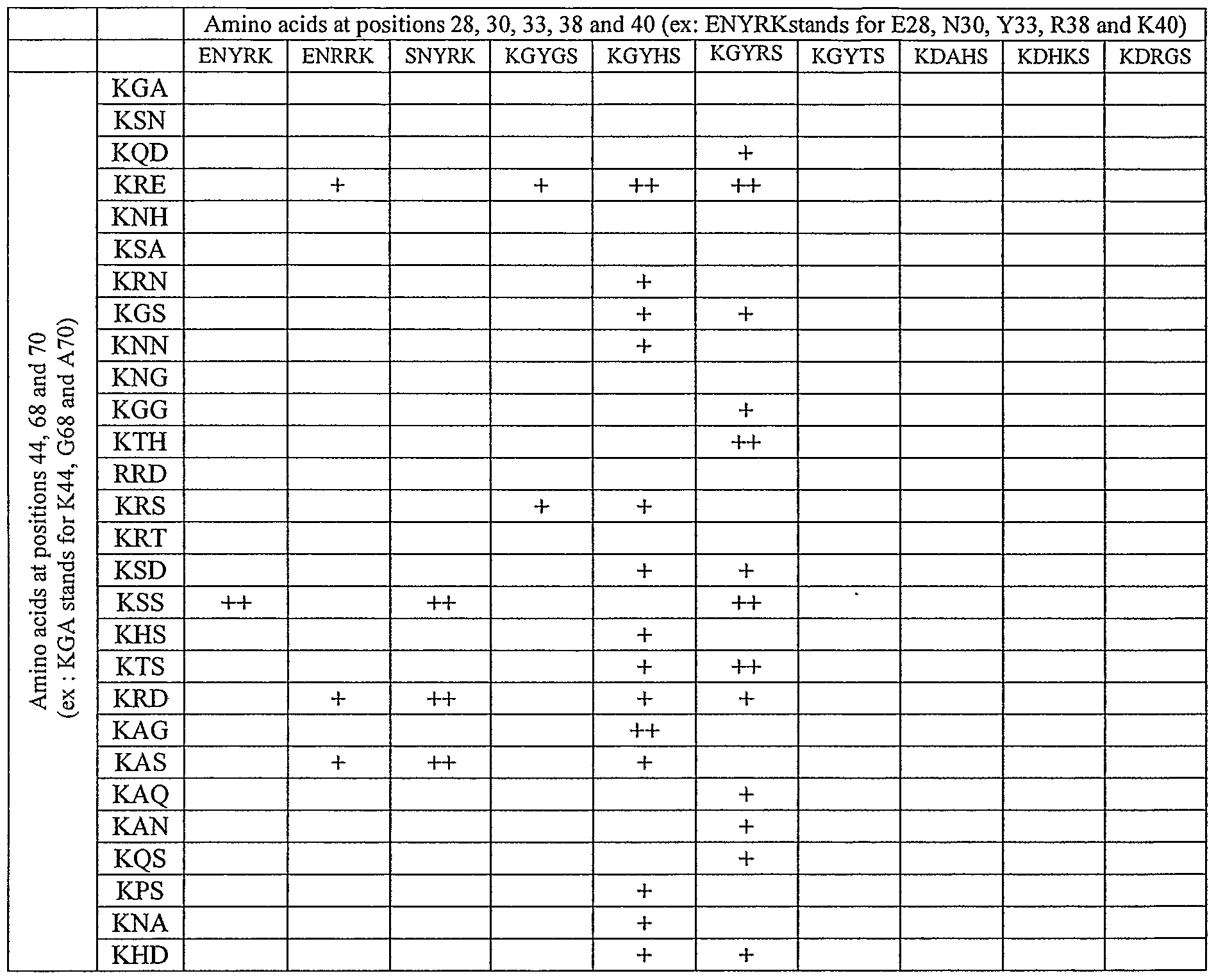
Table XVIII: Combinations that resulted in cleavage of the XPC2.2 (+) or XPC2.2 AND XPC2.1 (++) when expressed with ANSRKS

Claims
1°) An 1-OeI variant, characterized in that it has at least two substitutions, one in each of the two functional subdomains of the LAGLIDADG core domain situated from positions 28 to 40 and 44 to 70 of I-Crel, said variant being able to cleave a DNA target sequence from a XP gene, and being obtainable by a method comprising at least the steps of:
(a) constructing a first series of I-Oel variants having at least one substitution in a first functional subdomain of the LAGLIDADG core domain situated from positions 28 to 40 of l-Crel. (b) constructing a second series of 1-OeI variants having at least one substitution in a second functional subdomain of the LAGLIDADG core domain situated from positions 44 to 70 of I-Crel.
(c) selecting and/or screening the variants from the first series of step (a) which are able to cleave a mutant 1-OeI site wherein (i) the nucleotide triplet in positions -10 to -8 of the l-Crel site has been replaced with the nucleotide triplet which is present in position -10 to -8 of said genomic target and (ii) the nucleotide triplet in positions +8 to +10 has been replaced with the reverse complementary sequence of the nucleotide triplet which is present in position -10 to -8 of said genomic target (d) selecting and/or screening the variants from the second series of step (b) which are able to cleave a mutant 1-OeI site wherein (i) the nucleotide triplet in positions -5 to -3 of the I-Oel site has been replaced with the nucleotide triplet which is present in position -5 to -3 of said genomic target and (ii) the nucleotide triplet in positions +3 to +5 has been replaced with the reverse complementary sequence of the nucleotide triplet which is present in position -5 to -3 of said genomic target
(e) selecting and/or screening the variants from the first series of step (a) which are able to cleave a mutant I-Crd site wherein (i) the nucleotide triplet in positions +8 to +10 of the l-Crel site has been replaced with the nucleotide triplet which is present in positions +8 to +10 of said genomic target and (ii) the nucleotide triplet in positions -10 to -8 has been replaced with the reverse complementary sequence of the nucleotide triplet which is present in position +8 to +10 of said genomic target
(f) selecting and/or screening the variants from the second series of step (b) which are able to cleave a mutant I-Crel site wherein (i) the nucleotide triplet in positions +3 to +5 of the Ϊ-Crel site has been replaced with the nucleotide triplet which is present in positions +3 to +5 of said genomic target and (ii) the nucleotide triplet in positions -5 to -3 has been replaced with the reverse complementary sequence of the nucleotide triplet which is present in position +3 to +5 of said genomic target (g) combining in a single variant, the mutation(s) in positions 28 to
40 and 44 to 70 of two variants from step (c) and step (d), to obtain a novel homodimeric I-Crel variant which cleaves a sequence wherein (i) the nucleotide triplet in positions -10 to -8 is identical to the nucleotide triplet which is present in positions -10 to -8 of said genomic target, (ii) the nucleotide triplet in positions +8 to +10 is identical to the reverse complementary sequence of the nucleotide triplet which is present in positions -10 to -8 of said genomic target, (iii) the nucleotide triplet in positions -5 to -3 is identical to the nucleotide triplet which is present in positions -5 to -3 of said genomic target and (iv) the nucleotide triplet in positions +3 to +5 is identical to the reverse complementary sequence of the nucleotide triplet which is present in positions -5 to -3 of said genomic target
(h) combining in a single variant, the mutation(s) in positions 28 to 40 and 44 to 70 of two variants from step (e) and step (f), to obtain a novel homodimeric l-Crel variant which cleaves a sequence wherein (i) the nucleotide triplet in positions +3 to +5 is identical to the nucleotide triplet which is present in positions +3 to +5 of said genomic target, (ii) the nucleotide triplet in positions -5 to - 3 is identical to the reverse complementary sequence of the nucleotide triplet which is present in positions +3 to +5 of said genomic target, (iii) the nucleotide triplet in positions +8 to +10 of the l-Crel site has been replaced with the nucleotide triplet which is present in positions +8 to +10 of said genomic target and (iv) the nucleotide triplet in positions -10 to -8 is identical to the reverse complementary sequence of the nucleotide triplet in positions +8 to +10 of said genomic target. (i) combining the variants obtained in steps (g) and (h) to form heterodimers
(j) selecting and/or screening the heterodimers from step (i) which are able to cleave said DNA target sequence from a XP gene.
2°) The variant according to claim 1, wherein said substitution(s) in the subdomain situated from positions 44 to 70 of I-Crel are in positions 44, 68 and/or 70.
3°) The variant according to claim 1, wherein said substitution(s) in the subdomain situated from positions 28 to 40 of l-Crel are in positions 28, 30, 32, 33, 38 and/or 40.
4°) The variant according to anyone of claims 1 to 3, wherein said substitutions are replacement of the initial amino acids with amino acids selected in the group consisting of A, D, E, G, H, K, N, P, Q, R, S, T and Y.
5°) The variant according to anyone of claims 1 to 4, which comprises one or more substitutions in positions: 24, 26, 42, 75, 77, 80 and 133 of I- OeI.
6°) The variant according to claim 5, wherein the aspartic acid in position 75, is mutated in an uncharged amino acid.
7°) The variant according to claim 6, wherein said uncharged amino acid is an asparagine or a valine residue.
8°) The variant according to anyone of claims 1 to 7, which is an homodimer able to cleave a palindromic or pseudo-palindromic DNA target sequence from a XP gene.
9°) The variant according to anyone of claims 1 to 7, which is an heterodimer, resulting from the association of a first and a second monomer having different mutations in positions 28 to 40 and 44 to 70 of l-Crel, said heterodimer being able to cleave a non-palindromic DNA target sequence from aXP gene.
10°) The variant according to anyone of claims 1 to 9, wherein said DNA target sequence is from a human XP gene.
11°) The variant according to claim 9 or claim 10, wherein said
DNA target is a sequence from the human XPA gene, selected from the group consisting of the sequences SEQ ID NO: 45 to 57.
12°) The variant according to claim 9 or claim 10, wherein said DNA target is a sequence from the human XPB gene, selected from the group consisting of the sequences SEQ ID NO: 58 to 86.
13°) The variant according to claim 9 or claim 10, wherein said DNA target is a sequence from the human XPC gene, selected from the group consisting of the sequences SEQ ID NO: 1 to 24.
14°) The variant according to claim 9 or claim 10, wherein said DNA target is a sequence from the human XPD gene, selected from the group consisting of the sequences SEQ ID NO: 87 to 119.
15°) The variant according to claim 10, wherein said DNA target is a sequence from the human XPE gene, selected from the group consisting of the sequences SEQ ID NO: 120 to 166.
16°) The variant according to claim 9 or claim 10, wherein said DNA target is a sequence from the human XPF gene, selected from the group consisting of the sequences SEQ ID NO: 167 to 188.
17°) The variant according to claim 9 or claim 10, wherein said DNA target is a sequence from the human XPG gene, selected from the group consisting of the sequences SEQ ID NO: 189 to 216.
18°) The variant according to claim 11, which is an heterodimer, wherein the first and the second monomers have the sequences which are indicated in Table XIX:

19°) The variant according to claim 12, which is an heterodimer wherein the first and the second monomers have the sequences which are indicated in Table XX: 
20°) The variant according to claim 13, which is an heterodimer, the first and the second monomers have the sequences which are indicated in Table XXI:

21°) The variant according to claim 14, which is an heterodimer wherein the first and the second monomers have the sequences which are indicated in Table XXII:

22°) The variant according to claim 15, which is an heterodimer wherein the first and the second monomers have the sequences which are indicated in Table XXIII:

23°) The variant according to claim 16, which is an heterodimer wherein the first and the second monomers have the sequences which are indicated in Table XXIV:

24°) The variant according to claim 17, which is an heterodimer wherein the first and the second monomers have the sequences which are indicated in Table XXV:

25°) The variant according to anyone of claims 9, 10, 13, wherein the first monomer has amino acid residues in positions 28, 30, 33, 38, 40, 44, 68, 70 and 75 selected from the group consisting of:
K28,N30,S33,R38,S40,Q44,R68,S70,N75 and A28,N30,S33,R38,K40,Q44,R68,S70,N75, and the second monomer has amino acid residues in positions 28, 30, 33, 38, 40, 44, 68, 70 and 75 selected from the group consisting of : E28,N30,Y33,R38,K40,K44,S68,S70,N75 ; S28,N30,Y33,R38,K40,K44,S68,S70,N75 ; S28,N30,Y335R38,K40,K44,R68,D70,N75 ; S28,N30,Y335R38,K40,K44,A68,S70,N75 ; K28,G30,Y33,H38,S40,K44,R68,E70,N75 ; K28,G30,Y33,H38,S40,K44,A68,G70,N75 ; K28,G30,Y33,R38,S40,K44,R68,E70,N75 ; K28,G30,Y33,R38,S40,K44,T683H70,N75 ;' K28,G30,Y33,R38,S40,K44,S68,S70,N75, and K28,G30,Y33,R38,S40,K44,T68,S70,N75.
26°) A single-chain chimeric endonuclease derived from an I-C/-eI variant according to anyone of claims 1 to 25.
27°) A polynucleotide fragment encoding a variant according to anyone of claims 1 to 25 or a single-chain chimeric endonuclease according to claim 26.
28°) An expression vector comprising at least one polynucleotide fragment according to claim 27.
29°) The expression vector according to claim 28, which comprises two different polynucleotide fragments, each encoding one of the monomers of an heterodimeric variant as defined in anyone of claims 9 and 18 to 25.
30°) A vector, which includes a targeting construct comprising a sequence to be introduced flanked by sequences sharing homologies with the regions surrounding the genomic DNA cleavage sites of the variant as defined in anyone of claims 1 and 8 to 17.
31°) The vector according to claim 28 or claim 29, which includes a targeting construct comprising a sequence to be introduced flanked by sequences sharing homologies with the regions surrounding the genomic DNA cleavage sites of the variant as defined in anyone of claims 1 and 8 to 17.
32°) The vector according to claim 30 or to claim 31, wherein said sequence to be introduced is a sequence which repairs a mutation in a XP gene.
33°) The vector according to claim 32, wherein the sequence which repairs said mutation is the correct sequence of the XP gene.
34°) The vector according to claim 32, wherein the sequence which repairs said mutation comprises the exons downstream of the genomic cleavage site fused in frame, and a polyadenylation site to stop transcription in 3 ' .
35°) The vector according to anyone of claims 30 to 33, wherein said targeting construct comprises a sequence from the XPA gene which is able to repair a cleavage in exons 1 to 6 of the XPA gene and is selected from the group consisting of: positions 34 to 233, 201 to 400, 3493 to 3692, 7627 to 7826, 9994 to 10193, 10151 to 10350 12513 to 12712, 12531 to 12730, 21679 to 21878, 21844 to 22043, 21955 to 22154, 22228 to 22427 and 22234 to 22433.
36°) The vector according to anyone of claims 30 to 33, wherein said targeting construct comprises a sequence from the XPB gene which is able to repair a cleavage in exons 1 to 15 of the XPB gene and is selected from the group consisting of positions: - 40 to 159, 357 to 556, 1335 to 1534, 1336 to 1535, 1457 to 1656, 3624 to 3823, 4108 to 4307, 5015 to 5214, 5148 to 5347, 5284 to 5483, 5420 to 5619, 7377 to 7576, 13517 to 13716, 13552 to 13751, 13633 to 13832, 14697 to 14896, 14760 to 14959, 14881 to 15080, 21139 to 21338, 21207 to 21406, 22796 to 22995, 32378 to 32577, 33003 to 33202, 34481 to 34680, 34869 to 35068, 34891 to 35090, 36584 to 36783, 36634 to 36833, and 36639 to 36838.
37°) The vector according to anyone of claims 30 to 33, wherein said targeting construct comprises a sequence from the XPC gene which is able to repair a cleavage in exons 1 to 16 of the XPC gene and is selected from the group consisting of positions: 105 to 304, 5704 to 5903, 7973 to 8172, 9887 to 10086, 10173 to 10372, 11263 to 11462, 13051 to 13250, 13432 to 13631, 18619 to 18818, 19580 to 19779, 20303 to 20502, 20349 to 20548, 20389 to 20588, 21985 to 22184, 21990 to 22189, 22028 to 22227, 22102 to 22301, 26017 to 26216, 29566 to 29765, 29726 to 29925, 30416 to 30615, 31166 to 31365 and 32317 to 32516.
38°) The vector according to anyone of claims 30 to 33, wherein said targeting construct comprises a sequence from the XPD gene which is able to repair a cleavage in exons 1 to 23 of the XPD gene and is selected from the group consisting of positions: -87 to 112, 812 to 1011, 1319 to 1518, 1324 to 1523, 1426 to
■ 1625, 1717 to 1916, 1867 to 2066, 5473 to 5672, 5585 to 5784, 5637 to 5836, 5920 to
6119, 6050 to 6249, 6290 to 6489, 6392 to 6591, 6472 to 6671, 6581 to 6780, 8830 to
9029, 8943 to 9142, 12661 to 12860, 12991 to 13190, 13084 to 13283, 14614 to
14813, 14817 to 15016, 15528 to 15727, 15878 to 16077, 15936 to 16135, 17023 to 17222, 17350 to 17549, 17365 to 17564, 17572 to 17771, 18347 to 18546, 18370 to 18569, and 18641 to 18840.
39°) The vector according to anyone of claims 30 to 33, wherein said targeting construct comprises a sequence from the XPE gene which is able to repair a cleavage in exons 1 to 27 of the XPE gene and is selected from the group consisting of positions: 10-209, 1295-1494, 2899-3098, 3488-3687, 3616-3815, 6093- 6292, 6194-6393, 7034-7233, 7653-7852, 8753-8952, 9781-9980, 9966-10165, 10511-10710, 10665-10864, 11534-11733, 16439-16638, 16667-16866, 18268- 18647, 18757-18956, 18863-19062, 19179-19378, 19266-19465, 19596-19795, 20714-20913, 20938-21137, 21099-21298, 22568-22767, 22732-22931, 23173- 23372, 23181-23380, 23954-24153, 24000-24199, 29205-29404, 29651-29850, 30280-30479, 30355-30554, 30661-30860, 30685-30884, 32150-32349, 32753- 32592, 32770-32969, 32811-33010, 32836-33035, 32841-33040, 33230-33429, 33369-33568, and 33512-33711.
40°) The vector according to anyone of claims 30 to 33, wherein said targeting construct comprises a sequence from the XPF gene which is able to repair a cleavage in exons 1 to 21 of the XPF gene and is selected from the group consisting of positions: 244-443, 1731-1930, 6429-6628, 6486-6685, 7918-8117, 10500-10699, 10676-10875, 11885-12084, 11886-12085, 12176-12375, 14073- 14272, 14110-14309, 15336-15535, 15431-15630, 15574-15773, 17673-17872, 17677-17876, 24486, 24685, 27496-27695, 27822-28021, 27827-28026, and 27963- 28162.
41°) The vector according to anyone of claims 30 to 33, wherein said targeting construct comprises a sequence from the XPG gene which is able to repair a cleavage in exons 1 to 15 of the XPG gene and is selected from the group consisting of positions: 158-357, 5956-6155, 7961-7890, 8044-8243, 9977-10176, 12201-12400, 12289-12488, 15230-15429, 15803-16002, 16041-16240, 16146- 16345, 16174-16373, 16174-16373, 16394-16593, 16553-16732, 16887-17086, 19487-19686, 19727-19926, 19782-19981, 20207-20406, 20500-20699, 21890- 22089, 22117-22316, 25876-26075, 26450-26649, 26832-27031, 27258-27457, 29180-29379, and 29456-29655. 42°) The vector according to claims 30, 31 or 34, wherein the sequence which repairs said mutation is flanked by sequences as defined in anyone of claims 35 to 41. 43°) A composition comprising at least one variant according to anyone of claims 1 to 25, one single-chain chimeric endonuclease according to claim 26, and/or at least one expression vector according to anyone of claims 31 to 42.
44°) The composition according to claim 43, which comprises a targeting DNA construct comprising a sequence which repairs a mutation in the XP gene, flanked by sequences sharing homologies with the region surrounding the genomic DNA target cleavage site of said variant, as defined in anyone of claims 30 to
42.
45°) The composition according to claim 44, wherein said targeting DNA construct is included in a recombinant vector.
46°) Products containing a variant vector according to claims 28 or 29 and a vector which includes a targeting construct according to claims 30 to 42 as a combined preparation for simultaneous, separate or sequential use in Xeroderma pigmentosum 47°) The use of at least one variant according to anyone of claims 1 to 25, one single-chain chimeric endonuclease according to claim 26, and/or one expression vector according to anyone of claims 28 to 42, for the preparation of a medicament for preventing, improving or curing a disease associated with Xeroderma pigmentosum in an individual in need thereof. 48°) A host cell which is modified by a polynucleotide according to claim 27 or a vector according to anyone of claims 28 to 42.
49°) A non-human transgenic animal comprising one or two polynucleotide fragments as defined in anyone of claims 27 to 29.
50°) A transgenic plant comprising one or two polynucleotide fragments as defined in anyone of claims 27 to 29.
51°) Use of at least one variant according to anyone of claims 1 to 25, one single-chain chimeric endonuclease according to claim 26, one vector according to anyone of claims 28 to 42, for genome engineering, for non-therapeutic purposes. 52°) The use according to claim 51, wherein said variant, single- chain chimeric endonuclease, vector is associated with a targeting DNA construct as defined in anyone of claims 30 to 42.
Priority Applications (10)
| Application Number | Priority Date | Filing Date | Title |
|---|---|---|---|
| PCT/IB2006/000589 WO2007093836A1 (en) | 2006-02-13 | 2006-02-13 | Meganuclease variants cleaving a dna target sequence from a xp gene and uses thereof |
| AT07734243T ATE553192T1 (en) | 2006-02-13 | 2007-02-13 | A DNA TARGET SEQUENCE SEPARATING MEGANUCLEASE VARIANTS FROM A XERODERMA PIGMENTOSUM GENE AND THE USE THEREOF |
| PCT/IB2007/000924 WO2007093918A2 (en) | 2006-02-13 | 2007-02-13 | Meganuclease variants cleaving a dna target sequence from a xeroderma pigmentosum gene and uses thereof |
| EP07734243A EP1989299B1 (en) | 2006-02-13 | 2007-02-13 | Meganuclease variants cleaving a dna target sequence from a xeroderma pigmentosum gene and uses thereof |
| CA002639149A CA2639149A1 (en) | 2006-02-13 | 2007-02-13 | Meganuclease variants cleaving a dna target sequence from a xeroderma pigmentosum gene and uses thereof |
| US12/279,245 US20090222937A1 (en) | 2006-02-13 | 2007-02-13 | Meganuclease variants cleaving a dna target sequence from a xeroderma pigmentosum gene and uses thereof |
| JP2008553854A JP2009526521A (en) | 2006-02-13 | 2007-02-13 | Meganuclease variants that cleave DNA target sequences from xeroderma pigmentosum genes and uses thereof |
| CNA2007800051707A CN101384712A (en) | 2006-02-13 | 2007-02-13 | Meganuclease variants cleaving a DNA target sequence from xeroderma pigmentosum gene and uses thereof |
| AU2007216264A AU2007216264A1 (en) | 2006-02-13 | 2007-02-13 | Meganuclease variants cleaving a DNA target sequence from a xeroderma pigmentosum gene and uses thereof |
| US13/560,225 US20130061341A1 (en) | 2006-02-13 | 2012-07-27 | Meganuclease variants cleaving a dna target sequence from a xp gene and uses thereof |
Applications Claiming Priority (1)
| Application Number | Priority Date | Filing Date | Title |
|---|---|---|---|
| PCT/IB2006/000589 WO2007093836A1 (en) | 2006-02-13 | 2006-02-13 | Meganuclease variants cleaving a dna target sequence from a xp gene and uses thereof |
Publications (1)
| Publication Number | Publication Date |
|---|---|
| WO2007093836A1 true WO2007093836A1 (en) | 2007-08-23 |
Family
ID=36579794
Family Applications (2)
| Application Number | Title | Priority Date | Filing Date |
|---|---|---|---|
| PCT/IB2006/000589 Ceased WO2007093836A1 (en) | 2006-02-13 | 2006-02-13 | Meganuclease variants cleaving a dna target sequence from a xp gene and uses thereof |
| PCT/IB2007/000924 Ceased WO2007093918A2 (en) | 2006-02-13 | 2007-02-13 | Meganuclease variants cleaving a dna target sequence from a xeroderma pigmentosum gene and uses thereof |
Family Applications After (1)
| Application Number | Title | Priority Date | Filing Date |
|---|---|---|---|
| PCT/IB2007/000924 Ceased WO2007093918A2 (en) | 2006-02-13 | 2007-02-13 | Meganuclease variants cleaving a dna target sequence from a xeroderma pigmentosum gene and uses thereof |
Country Status (8)
| Country | Link |
|---|---|
| US (2) | US20090222937A1 (en) |
| EP (1) | EP1989299B1 (en) |
| JP (1) | JP2009526521A (en) |
| CN (1) | CN101384712A (en) |
| AT (1) | ATE553192T1 (en) |
| AU (1) | AU2007216264A1 (en) |
| CA (1) | CA2639149A1 (en) |
| WO (2) | WO2007093836A1 (en) |
Cited By (16)
| Publication number | Priority date | Publication date | Assignee | Title |
|---|---|---|---|---|
| WO2007093918A3 (en) * | 2006-02-13 | 2008-01-24 | Cellectis | Meganuclease variants cleaving a dna target sequence from a xeroderma pigmentosum gene and uses thereof |
| WO2008148559A1 (en) | 2007-06-05 | 2008-12-11 | Bayer Bioscience N.V. | Methods and means for exact replacement of target dna in eukaryotic organisms |
| WO2009095742A1 (en) * | 2008-01-31 | 2009-08-06 | Cellectis | New i-crei derived single-chain meganuclease and uses thereof |
| WO2010026443A1 (en) * | 2008-09-08 | 2010-03-11 | Cellectis | Meganuclease variants cleaving a dna target sequence from a glutamine synthetase gene and uses thereof |
| EP2180058A1 (en) * | 2008-10-23 | 2010-04-28 | Cellectis | Meganuclease recombination system |
| WO2011021166A1 (en) * | 2009-08-21 | 2011-02-24 | Cellectis | Meganuclease variants cleaving a dna target sequence from the human lysosomal acid alpha-glucosidase gene and uses thereof |
| WO2011135407A1 (en) * | 2010-04-30 | 2011-11-03 | Cellectis | I-crei variants with new specificity and methods of their generation |
| WO2011154158A1 (en) | 2010-06-09 | 2011-12-15 | Bayer Bioscience N.V. | Methods and means to modify a plant genome at a nucleotide sequence commonly used in plant genome engineering |
| WO2011154159A1 (en) | 2010-06-09 | 2011-12-15 | Bayer Bioscience N.V. | Methods and means to modify a plant genome at a nucleotide sequence commonly used in plant genome engineering |
| US8119381B2 (en) | 2005-10-18 | 2012-02-21 | Duke University | Rationally-designed meganucleases with altered sequence specificity and DNA-binding affinity |
| US8338157B2 (en) | 2008-03-11 | 2012-12-25 | Precision Biosciences, Inc. | Rationally-designed meganuclease variants of lig-34 and I-crei for maize genome engineering |
| WO2013026740A2 (en) | 2011-08-22 | 2013-02-28 | Bayer Cropscience Nv | Methods and means to modify a plant genome |
| US8445251B2 (en) | 2007-10-31 | 2013-05-21 | Precision Biosciences, Inc. | Rationally-designed single-chain meganucleases with non-palindromic recognition sequences |
| US8530214B2 (en) | 2003-01-28 | 2013-09-10 | Cellectis S.A. | Use of meganucleases for inducing homologous recombination ex vivo and in toto in vertebrate somatic tissues and application thereof |
| EP2770052A1 (en) | 2007-06-06 | 2014-08-27 | Cellectis | Method for enhancing the cleavage activity of I-CreI derived meganucleases |
| US9683257B2 (en) | 2008-07-14 | 2017-06-20 | Precision Biosciences, Inc. | Recognition sequences for I-CreI-derived meganucleases and uses thereof |
Families Citing this family (59)
| Publication number | Priority date | Publication date | Assignee | Title |
|---|---|---|---|---|
| EP2327773A1 (en) | 2005-03-15 | 2011-06-01 | Cellectis | I-crel meganuclease variants with modified specificity, method of preparation and uses thereof |
| WO2009019528A1 (en) * | 2007-08-03 | 2009-02-12 | Cellectis | Meganuclease variants cleaving a dna target sequence from the human interleukin-2 receptor gamma chain gene and uses thereof |
| WO2009074842A1 (en) * | 2007-12-13 | 2009-06-18 | Cellectis | Improved chimeric meganuclease enzymes and uses thereof |
| WO2011036510A1 (en) * | 2009-09-24 | 2011-03-31 | Cellectis | Meganuclease variants cleaving the genome of the herpes simplex virus and uses thereof |
| WO2010136981A2 (en) | 2009-05-26 | 2010-12-02 | Cellectis | Meganuclease variants cleaving the genome of a pathogenic non-integrating virus and uses thereof |
| WO2011007193A1 (en) | 2009-07-17 | 2011-01-20 | Cellectis | Viral vectors encoding a dna repair matrix and containing a virion-associated site specific meganuclease for gene targeting |
| WO2011036640A2 (en) | 2009-09-24 | 2011-03-31 | Cellectis | Meganuclease reagents of uses thereof for treating genetic diseases caused by frame shift/non sense mutations |
| EP2504439B1 (en) | 2009-11-27 | 2016-03-02 | BASF Plant Science Company GmbH | Optimized endonucleases and uses thereof |
| CA2781835A1 (en) | 2009-11-27 | 2011-06-03 | Basf Plant Science Company Gmbh | Chimeric endonucleases and uses thereof |
| CN102686726B (en) | 2009-11-27 | 2015-12-16 | 巴斯夫植物科学有限公司 | Chimeric endonucleases and uses thereof |
| JP2013520190A (en) * | 2010-02-26 | 2013-06-06 | セレクティス | Use of endonuclease for transgene insertion into the Safe Harbor locus |
| US20130183282A1 (en) | 2010-05-12 | 2013-07-18 | Cellectis | Meganuclease variants cleaving a DNA target sequence from the rhodopsin gene and uses thereof |
| CA2799095A1 (en) | 2010-05-12 | 2011-11-17 | Cellectis | Meganuclease variants cleaving a dna target sequence from the dystrophin gene and uses thereof |
| CA2802822A1 (en) | 2010-06-15 | 2012-01-05 | Cellectis | Method for improving cleavage of dna by endonuclease sensitive to methylation |
| WO2012004671A2 (en) | 2010-07-07 | 2012-01-12 | Cellectis | Meganucleases variants cleaving a dna target sequence in the nanog gene and uses thereof |
| WO2012010976A2 (en) | 2010-07-15 | 2012-01-26 | Cellectis | Meganuclease variants cleaving a dna target sequence in the tert gene and uses thereof |
| WO2012007848A2 (en) | 2010-07-16 | 2012-01-19 | Cellectis | Meganuclease variants cleaving a dna target sequence in the was gene and uses thereof |
| EP2633040B1 (en) | 2010-10-27 | 2019-07-10 | Cellectis | Method for increasing the efficiency of double-strand break-induced mutagenesis |
| US9044492B2 (en) | 2011-02-04 | 2015-06-02 | Cellectis Sa | Method for modulating the efficiency of double-strand break-induced mutagenesis |
| SG194115A1 (en) | 2011-04-05 | 2013-11-29 | Cellectis | Method for the generation of compact tale-nucleases and uses thereof |
| WO2012138901A1 (en) | 2011-04-05 | 2012-10-11 | Cellectis Sa | Method for enhancing rare-cutting endonuclease efficiency and uses thereof |
| WO2012158778A1 (en) | 2011-05-16 | 2012-11-22 | Cellectis S.A. | Doubly secure transgenic algae or cyanobacteria strains to prevent their establishment and spread in natural ecosystems |
| EP2729567B1 (en) | 2011-07-08 | 2016-10-05 | Cellectis | Method for increasing the efficiency of double-strand break-induced mutagenssis |
| EP2612918A1 (en) | 2012-01-06 | 2013-07-10 | BASF Plant Science Company GmbH | In planta recombination |
| SG10201707569YA (en) | 2012-12-12 | 2017-10-30 | Broad Inst Inc | Delivery, Engineering and Optimization of Systems, Methods and Compositions for Sequence Manipulation and Therapeutic Applications |
| BR112015031611A2 (en) | 2013-06-17 | 2017-12-12 | Massachusetts Inst Technology | application, manipulation and optimization of systems, methods and compositions for targeting and modeling post-mitotic cell diseases and disorders |
| JP6738728B2 (en) | 2013-06-17 | 2020-08-19 | ザ・ブロード・インスティテュート・インコーポレイテッド | Delivery and use of CRISPR-Cas systems, vectors and compositions for liver targeting and therapy |
| AU2014281031B2 (en) | 2013-06-17 | 2020-05-21 | Massachusetts Institute Of Technology | Delivery, use and therapeutic applications of the CRISPR-Cas systems and compositions for targeting disorders and diseases using viral components |
| JP2017501149A (en) | 2013-12-12 | 2017-01-12 | ザ・ブロード・インスティテュート・インコーポレイテッド | Delivery, use and therapeutic applications of CRISPR-CAS systems and compositions for targeting disorders and diseases using particle delivery components |
| MX374529B (en) | 2013-12-12 | 2025-03-06 | Broad Inst Inc | SUPPLY, USE AND THERAPEUTIC APPLICATIONS OF CRISPR-CAS SYSTEMS AND COMPOSITIONS FOR GENOME EDITING. |
| HRP20210809T8 (en) | 2014-10-29 | 2021-09-17 | Bicyclerd Limited | Bicyclic peptide ligands specific for mt1-mmp |
| WO2016094880A1 (en) | 2014-12-12 | 2016-06-16 | The Broad Institute Inc. | Delivery, use and therapeutic applications of crispr systems and compositions for genome editing as to hematopoietic stem cells (hscs) |
| EP3985115A1 (en) | 2014-12-12 | 2022-04-20 | The Broad Institute, Inc. | Protected guide rnas (pgrnas) |
| WO2016094874A1 (en) | 2014-12-12 | 2016-06-16 | The Broad Institute Inc. | Escorted and functionalized guides for crispr-cas systems |
| EP3230452B1 (en) | 2014-12-12 | 2025-06-11 | The Broad Institute, Inc. | Dead guides for crispr transcription factors |
| EP3237615B2 (en) | 2014-12-24 | 2023-07-26 | The Broad Institute, Inc. | Crispr having or associated with destabilization domains |
| AU2016279062A1 (en) | 2015-06-18 | 2019-03-28 | Omar O. Abudayyeh | Novel CRISPR enzymes and systems |
| EP3559018A1 (en) | 2016-12-23 | 2019-10-30 | Bicyclerd Limited | Peptide derivatives having novel linkage structures |
| WO2018197893A1 (en) | 2017-04-27 | 2018-11-01 | Bicycletx Limited | Bicyclic peptide ligands and uses thereof |
| WO2019025811A1 (en) | 2017-08-04 | 2019-02-07 | Bicycletx Limited | Bicyclic peptide ligands specific for cd137 |
| MX2020008791A (en) | 2018-02-23 | 2021-01-08 | Bicycletx Ltd | Multimeric bicyclic peptide ligands. |
| US11180531B2 (en) | 2018-06-22 | 2021-11-23 | Bicycletx Limited | Bicyclic peptide ligands specific for Nectin-4 |
| WO2020041380A1 (en) | 2018-08-20 | 2020-02-27 | The Broad Institute, Inc. | Methods and compositions for optochemical control of crispr-cas9 |
| GB201820325D0 (en) | 2018-12-13 | 2019-01-30 | Bicyclerd Ltd | Bicyclic peptide ligands specific for psma |
| GB201820288D0 (en) | 2018-12-13 | 2019-01-30 | Bicycle Tx Ltd | Bicycle peptide ligaands specific for MT1-MMP |
| GB201820295D0 (en) | 2018-12-13 | 2019-01-30 | Bicyclerd Ltd | Bicyclic peptide ligands specific for MT1-MMP |
| CA3124110A1 (en) | 2018-12-17 | 2020-06-25 | The Broad Institute, Inc. | Crispr-associated transposase systems and methods of use thereof |
| EP3897849A1 (en) | 2018-12-21 | 2021-10-27 | BicycleTx Limited | Bicyclic peptide ligands specific for pd-l1 |
| GB201900529D0 (en) | 2019-01-15 | 2019-03-06 | Bicycletx Ltd | Bicyclic peptide ligands specific for CD38 |
| TWI862640B (en) | 2019-07-30 | 2024-11-21 | 英商拜西可泰克斯有限公司 | Heterotandem bicyclic peptide complex |
| EP4038190A1 (en) | 2019-10-03 | 2022-08-10 | Artisan Development Labs, Inc. | Crispr systems with engineered dual guide nucleic acids |
| CN115175991A (en) | 2019-10-16 | 2022-10-11 | 博德研究所 | Engineered muscle targeting compositions |
| CA3189761A1 (en) | 2020-08-03 | 2022-02-10 | Gemma Mudd | Peptide-based linkers |
| EP4298212A1 (en) | 2021-02-25 | 2024-01-03 | Artisan Development Labs, Inc. | Compositions and methods for targeting, editing, or modifying genes |
| WO2022256448A2 (en) | 2021-06-01 | 2022-12-08 | Artisan Development Labs, Inc. | Compositions and methods for targeting, editing, or modifying genes |
| CA3237482A1 (en) | 2021-11-03 | 2023-05-11 | The J. David Gladstone Institutes, A Testamentary Trust Established Under The Will Of J. David Gladstone | Precise genome editing using retrons |
| WO2023141602A2 (en) | 2022-01-21 | 2023-07-27 | Renagade Therapeutics Management Inc. | Engineered retrons and methods of use |
| US20250388896A1 (en) | 2022-03-01 | 2025-12-25 | Celyntra Therapeutics Sa | Composition and methods for transgene insertion |
| WO2024044723A1 (en) | 2022-08-25 | 2024-02-29 | Renagade Therapeutics Management Inc. | Engineered retrons and methods of use |
Citations (2)
| Publication number | Priority date | Publication date | Assignee | Title |
|---|---|---|---|---|
| US6010908A (en) * | 1992-08-21 | 2000-01-04 | The Regents Of The University Of California | Gene therapy by small fragment homologous replacement |
| WO2004067736A2 (en) * | 2003-01-28 | 2004-08-12 | Cellectis | Custom-made meganuclease and use thereof |
Family Cites Families (2)
| Publication number | Priority date | Publication date | Assignee | Title |
|---|---|---|---|---|
| WO2007049095A1 (en) * | 2005-10-25 | 2007-05-03 | Cellectis | Laglidadg homing endonuclease variants having mutations in two functional subdomains and use thereof |
| WO2007093836A1 (en) * | 2006-02-13 | 2007-08-23 | Cellectis | Meganuclease variants cleaving a dna target sequence from a xp gene and uses thereof |
-
2006
- 2006-02-13 WO PCT/IB2006/000589 patent/WO2007093836A1/en not_active Ceased
-
2007
- 2007-02-13 EP EP07734243A patent/EP1989299B1/en not_active Not-in-force
- 2007-02-13 JP JP2008553854A patent/JP2009526521A/en not_active Withdrawn
- 2007-02-13 CN CNA2007800051707A patent/CN101384712A/en active Pending
- 2007-02-13 WO PCT/IB2007/000924 patent/WO2007093918A2/en not_active Ceased
- 2007-02-13 US US12/279,245 patent/US20090222937A1/en not_active Abandoned
- 2007-02-13 CA CA002639149A patent/CA2639149A1/en not_active Abandoned
- 2007-02-13 AU AU2007216264A patent/AU2007216264A1/en not_active Abandoned
- 2007-02-13 AT AT07734243T patent/ATE553192T1/en active
-
2012
- 2012-07-27 US US13/560,225 patent/US20130061341A1/en not_active Abandoned
Patent Citations (2)
| Publication number | Priority date | Publication date | Assignee | Title |
|---|---|---|---|---|
| US6010908A (en) * | 1992-08-21 | 2000-01-04 | The Regents Of The University Of California | Gene therapy by small fragment homologous replacement |
| WO2004067736A2 (en) * | 2003-01-28 | 2004-08-12 | Cellectis | Custom-made meganuclease and use thereof |
Non-Patent Citations (6)
| Title |
|---|
| ARNOULD ET AL: "Engineering of Large Numbers of Highly Specific Homing Endonucleases that Induce Recombination on Novel DNA Targets", JOURNAL OF MOLECULAR BIOLOGY, LONDON, GB, vol. 355, no. 3, 20 January 2006 (2006-01-20), pages 443 - 458, XP005206991, ISSN: 0022-2836 * |
| CHAMES PATRICK ET AL: "In vivo selection of engineered homing endonucleases using double-strand break induced homologous recombination", NUCLEIC ACIDS RESEARCH, vol. 33, no. 20, 2005, XP002378874, ISSN: 0305-1048 * |
| HENGGE U R: "Progress and prospects of skin gene therapy: a ten year history", CLINICS IN DERMATOLOGY, J.B. LIPPINCOTT, PHILADELPHIA, PA, US, vol. 23, no. 1, January 2005 (2005-01-01), pages 107 - 114, XP004749327, ISSN: 0738-081X * |
| MAGNALDO THIERRY ET AL: "Xeroderma pigmentosum: from symptoms and genetics to gene-based skin therapy.", CELLS, TISSUES, ORGANS. 2004, vol. 177, no. 3, 2004, pages 189 - 198, XP008065613, ISSN: 1422-6405 * |
| SELIGMAN L M ET AL: "Mutations altering the cleavage specificity of a homing endonuclease", NUCLEIC ACIDS RESEARCH, OXFORD UNIVERSITY PRESS, SURREY, GB, vol. 30, no. 17, 1 September 2002 (2002-09-01), pages 3870 - 3879, XP002282592, ISSN: 0305-1048 * |
| SUSSMAN D ET AL: "Isolation and Characterization of New Homing Endonuclease Specificities at Individual Target Site Positions", JOURNAL OF MOLECULAR BIOLOGY, LONDON, GB, vol. 342, no. 1, 3 September 2004 (2004-09-03), pages 31 - 41, XP004563015, ISSN: 0022-2836 * |
Cited By (52)
| Publication number | Priority date | Publication date | Assignee | Title |
|---|---|---|---|---|
| US8697395B2 (en) | 2003-01-28 | 2014-04-15 | Cellectis S.A. | Use of meganucleases for inducing homologous recombination ex vivo and in toto in vertebrate somatic tissues and application thereof |
| US8530214B2 (en) | 2003-01-28 | 2013-09-10 | Cellectis S.A. | Use of meganucleases for inducing homologous recombination ex vivo and in toto in vertebrate somatic tissues and application thereof |
| US8624000B2 (en) | 2003-01-28 | 2014-01-07 | Cellectis S.A. | Use of meganucleases for inducing homologous recombination ex vivo and in toto in vertebrate somatic tissues and application thereof |
| US8143015B2 (en) | 2005-10-18 | 2012-03-27 | Duke University | Methods of cleaving DNA with rationally-designed meganucleases |
| US8119381B2 (en) | 2005-10-18 | 2012-02-21 | Duke University | Rationally-designed meganucleases with altered sequence specificity and DNA-binding affinity |
| US8133697B2 (en) | 2005-10-18 | 2012-03-13 | Duke University | Methods of cleaving DNA with rationally-designed meganucleases |
| US8129134B2 (en) | 2005-10-18 | 2012-03-06 | Duke University | Methods of cleaving DNA with rationally-designed meganucleases |
| US8124369B2 (en) | 2005-10-18 | 2012-02-28 | Duke University | Method of cleaving DNA with rationally-designed meganucleases |
| US8377674B2 (en) | 2005-10-18 | 2013-02-19 | Duke University | Method for producing genetically-modified cells with rationally-designed meganucleases with altered sequence specificity |
| US8304222B1 (en) | 2005-10-18 | 2012-11-06 | Duke University | Rationally-designed meganucleases with altered sequence specificity and heterodimer formation |
| US8163514B2 (en) | 2005-10-18 | 2012-04-24 | Duke University | Methods of cleaving DNA with rationally-designed meganucleases |
| US8148098B2 (en) | 2005-10-18 | 2012-04-03 | Duke University | Methods of cleaving DNA with rationally-designed meganucleases |
| US8143016B2 (en) | 2005-10-18 | 2012-03-27 | Duke University | Methods of cleaving DNA with rationally-designed meganucleases |
| US8119361B2 (en) | 2005-10-18 | 2012-02-21 | Duke University | Methods of cleaving DNA with rationally-designed meganucleases |
| WO2007093918A3 (en) * | 2006-02-13 | 2008-01-24 | Cellectis | Meganuclease variants cleaving a dna target sequence from a xeroderma pigmentosum gene and uses thereof |
| US8765448B2 (en) | 2007-06-05 | 2014-07-01 | Bayer CropScience, N.V. | Methods and means for exact replacement of target DNA in eukaryotic organisms |
| WO2008148559A1 (en) | 2007-06-05 | 2008-12-11 | Bayer Bioscience N.V. | Methods and means for exact replacement of target dna in eukaryotic organisms |
| EP2770052A1 (en) | 2007-06-06 | 2014-08-27 | Cellectis | Method for enhancing the cleavage activity of I-CreI derived meganucleases |
| EP3098309A1 (en) | 2007-10-31 | 2016-11-30 | Precision Biosciences, Inc. | Rationally-designed single-chain meganucleases with non-palindromic recognition sequences |
| US8445251B2 (en) | 2007-10-31 | 2013-05-21 | Precision Biosciences, Inc. | Rationally-designed single-chain meganucleases with non-palindromic recognition sequences |
| US12351839B2 (en) | 2007-10-31 | 2025-07-08 | Precision Biosciences, Inc. | Rationally-designed single-chain meganucleases with non-palindromic recognition sequences |
| US9434931B2 (en) | 2007-10-31 | 2016-09-06 | Precision Biosciences, Inc. | Rationally-designed single-chain meganucleases with non-palindromic recognition sequences |
| US9340777B2 (en) | 2007-10-31 | 2016-05-17 | Precision Biosciences, Inc. | Rationally-designed single-chain meganucleases with non-palindromic recognition sequences |
| EP2660317A1 (en) | 2007-10-31 | 2013-11-06 | Precision Biosciences, Inc. | Rationally-designed single-chain meganucleases with non-palindromic recognition sequences |
| US10041053B2 (en) | 2007-10-31 | 2018-08-07 | Precision Biosciences, Inc. | Rationally-designed single-chain meganucleases with non-palindromic recognition sequences |
| WO2009095742A1 (en) * | 2008-01-31 | 2009-08-06 | Cellectis | New i-crei derived single-chain meganuclease and uses thereof |
| WO2009095793A1 (en) | 2008-01-31 | 2009-08-06 | Cellectis | New i-crei derived single-chain meganuclease and uses thereof |
| US8927247B2 (en) | 2008-01-31 | 2015-01-06 | Cellectis, S.A. | I-CreI derived single-chain meganuclease and uses thereof |
| US8338157B2 (en) | 2008-03-11 | 2012-12-25 | Precision Biosciences, Inc. | Rationally-designed meganuclease variants of lig-34 and I-crei for maize genome engineering |
| US10273524B2 (en) | 2008-07-14 | 2019-04-30 | Precision Biosciences, Inc. | Recognition sequences for I-CreI-derived meganucleases and uses thereof |
| US10287626B2 (en) | 2008-07-14 | 2019-05-14 | Precision Biosciences, Inc. | Recognition sequences for I-CreI-derived meganucleases and uses thereof |
| EP3211075A2 (en) | 2008-07-14 | 2017-08-30 | Precision Biosciences, Inc. | Recognition sequences for i-crei-derived meganucleases and uses thereof |
| US9683257B2 (en) | 2008-07-14 | 2017-06-20 | Precision Biosciences, Inc. | Recognition sequences for I-CreI-derived meganucleases and uses thereof |
| EP3495478A2 (en) | 2008-07-14 | 2019-06-12 | Precision Biosciences, Inc. | Recognition sequences for i-crei-derived meganucleases and uses thereof |
| EP4001408A2 (en) | 2008-07-14 | 2022-05-25 | Precision Biosciences, Inc. | Recognition sequences for i-crei-derived meganucleases and uses thereof |
| US9273296B2 (en) | 2008-09-08 | 2016-03-01 | Cellectis | Meganuclease variants cleaving a DNA target sequence from a glutamine synthetase gene and uses thereof |
| WO2010026443A1 (en) * | 2008-09-08 | 2010-03-11 | Cellectis | Meganuclease variants cleaving a dna target sequence from a glutamine synthetase gene and uses thereof |
| JP2012501641A (en) * | 2008-09-08 | 2012-01-26 | セレクティス | Meganuclease variants that cleave DNA target sequences from glutamine synthetase genes and uses thereof |
| US9365864B2 (en) | 2008-10-23 | 2016-06-14 | Cellectis | Meganuclease recombination system |
| EP2180058A1 (en) * | 2008-10-23 | 2010-04-28 | Cellectis | Meganuclease recombination system |
| US8476072B2 (en) | 2008-10-23 | 2013-07-02 | Cellectis | Meganuclease recombination system |
| WO2010046786A1 (en) * | 2008-10-23 | 2010-04-29 | Cellectis | Meganuclease recombination system |
| WO2011021166A1 (en) * | 2009-08-21 | 2011-02-24 | Cellectis | Meganuclease variants cleaving a dna target sequence from the human lysosomal acid alpha-glucosidase gene and uses thereof |
| WO2011021062A1 (en) * | 2009-08-21 | 2011-02-24 | Cellectis | Meganuclease variants cleaving a dna target sequence from the human lysosomal acid alpha-glucosidase gene and uses thereof |
| WO2011135407A1 (en) * | 2010-04-30 | 2011-11-03 | Cellectis | I-crei variants with new specificity and methods of their generation |
| US9593317B2 (en) | 2010-06-09 | 2017-03-14 | Bayer Cropscience Nv | Methods and means to modify a plant genome at a nucleotide sequence commonly used in plant genome engineering |
| US9574201B2 (en) | 2010-06-09 | 2017-02-21 | Bayer Cropscience Nv | Methods and means to modify a plant genome at a nucleotide sequence commonly used in plant genome engineering |
| WO2011154158A1 (en) | 2010-06-09 | 2011-12-15 | Bayer Bioscience N.V. | Methods and means to modify a plant genome at a nucleotide sequence commonly used in plant genome engineering |
| WO2011154159A1 (en) | 2010-06-09 | 2011-12-15 | Bayer Bioscience N.V. | Methods and means to modify a plant genome at a nucleotide sequence commonly used in plant genome engineering |
| US9670496B2 (en) | 2011-08-22 | 2017-06-06 | Bayer Cropscience N.V. | Methods and means to modify a plant genome |
| WO2013026740A2 (en) | 2011-08-22 | 2013-02-28 | Bayer Cropscience Nv | Methods and means to modify a plant genome |
| US10538774B2 (en) | 2011-08-22 | 2020-01-21 | Basf Agricultural Solutions Seed, Us Llc | Methods and means to modify a plant genome |
Also Published As
| Publication number | Publication date |
|---|---|
| JP2009526521A (en) | 2009-07-23 |
| AU2007216264A1 (en) | 2007-08-23 |
| WO2007093918A3 (en) | 2008-01-24 |
| US20130061341A1 (en) | 2013-03-07 |
| ATE553192T1 (en) | 2012-04-15 |
| US20090222937A1 (en) | 2009-09-03 |
| EP1989299B1 (en) | 2012-04-11 |
| CN101384712A (en) | 2009-03-11 |
| EP1989299A2 (en) | 2008-11-12 |
| CA2639149A1 (en) | 2007-08-23 |
| WO2007093918A2 (en) | 2007-08-23 |
Similar Documents
| Publication | Publication Date | Title |
|---|---|---|
| EP2046950B1 (en) | Meganuclease variants cleaving a DNA target sequence from a RAG1 gene and uses thereof | |
| EP1989299B1 (en) | Meganuclease variants cleaving a dna target sequence from a xeroderma pigmentosum gene and uses thereof | |
| US20100146651A1 (en) | Meganuclease variants cleaving a dna target sequence from the hprt gene and uses thereof | |
| US20140112904A9 (en) | Method for enhancing the cleavage activity of i-crei derived meganucleases | |
| WO2009001159A1 (en) | Method for enhancing the cleavage activity of i-crei derived meganucleases | |
| EP2121036A2 (en) | Meganuclease variants cleaving a dna target sequence from the beta-2-microglobulin gene and uses thereof | |
| WO2008149176A1 (en) | Meganuclease variants cleaving a dna target sequence from the mouse rosa26 locus and uses thereof | |
| CN101583711B (en) | Meganuclease variants cleaving a DNA target sequence from the HPRT gene and uses thereof | |
| US20110041194A1 (en) | I-msoi homing endonuclease variants having novel substrate specificity and use thereof |
Legal Events
| Date | Code | Title | Description |
|---|---|---|---|
| 121 | Ep: the epo has been informed by wipo that ep was designated in this application | ||
| NENP | Non-entry into the national phase |
Ref country code: DE |
|
| 122 | Ep: pct application non-entry in european phase |
Ref document number: 06710560 Country of ref document: EP Kind code of ref document: A1 |