ES2874306T3 - Conjugates of antibodies and drugs (CAF) that bind to 191P4D12 proteins - Google Patents
Conjugates of antibodies and drugs (CAF) that bind to 191P4D12 proteins Download PDFInfo
- Publication number
- ES2874306T3 ES2874306T3 ES18171803T ES18171803T ES2874306T3 ES 2874306 T3 ES2874306 T3 ES 2874306T3 ES 18171803 T ES18171803 T ES 18171803T ES 18171803 T ES18171803 T ES 18171803T ES 2874306 T3 ES2874306 T3 ES 2874306T3
- Authority
- ES
- Spain
- Prior art keywords
- antibody
- cancer
- amino acid
- antigen
- antibodies
- Prior art date
- Legal status (The legal status is an assumption and is not a legal conclusion. Google has not performed a legal analysis and makes no representation as to the accuracy of the status listed.)
- Active
Links
- 0 CC(CC(*1CCOCCOCC(C)=O)=O)C1=O Chemical compound CC(CC(*1CCOCCOCC(C)=O)=O)C1=O 0.000 description 8
Classifications
-
- A—HUMAN NECESSITIES
- A61—MEDICAL OR VETERINARY SCIENCE; HYGIENE
- A61K—PREPARATIONS FOR MEDICAL, DENTAL OR TOILETRY PURPOSES
- A61K47/00—Medicinal preparations characterised by the non-active ingredients used, e.g. carriers or inert additives; Targeting or modifying agents chemically bound to the active ingredient
- A61K47/50—Medicinal preparations characterised by the non-active ingredients used, e.g. carriers or inert additives; Targeting or modifying agents chemically bound to the active ingredient the non-active ingredient being chemically bound to the active ingredient, e.g. polymer-drug conjugates
- A61K47/51—Medicinal preparations characterised by the non-active ingredients used, e.g. carriers or inert additives; Targeting or modifying agents chemically bound to the active ingredient the non-active ingredient being chemically bound to the active ingredient, e.g. polymer-drug conjugates the non-active ingredient being a modifying agent
- A61K47/68—Medicinal preparations characterised by the non-active ingredients used, e.g. carriers or inert additives; Targeting or modifying agents chemically bound to the active ingredient the non-active ingredient being chemically bound to the active ingredient, e.g. polymer-drug conjugates the non-active ingredient being a modifying agent the modifying agent being an antibody, an immunoglobulin or a fragment thereof, e.g. an Fc-fragment
- A61K47/6835—Medicinal preparations characterised by the non-active ingredients used, e.g. carriers or inert additives; Targeting or modifying agents chemically bound to the active ingredient the non-active ingredient being chemically bound to the active ingredient, e.g. polymer-drug conjugates the non-active ingredient being a modifying agent the modifying agent being an antibody, an immunoglobulin or a fragment thereof, e.g. an Fc-fragment the modifying agent being an antibody or an immunoglobulin bearing at least one antigen-binding site
- A61K47/6851—Medicinal preparations characterised by the non-active ingredients used, e.g. carriers or inert additives; Targeting or modifying agents chemically bound to the active ingredient the non-active ingredient being chemically bound to the active ingredient, e.g. polymer-drug conjugates the non-active ingredient being a modifying agent the modifying agent being an antibody, an immunoglobulin or a fragment thereof, e.g. an Fc-fragment the modifying agent being an antibody or an immunoglobulin bearing at least one antigen-binding site the antibody targeting a determinant of a tumour cell
-
- C—CHEMISTRY; METALLURGY
- C07—ORGANIC CHEMISTRY
- C07K—PEPTIDES
- C07K16/00—Immunoglobulins [IGs], e.g. monoclonal or polyclonal antibodies
- C07K16/18—Immunoglobulins [IGs], e.g. monoclonal or polyclonal antibodies against material from animals or humans
- C07K16/28—Immunoglobulins [IGs], e.g. monoclonal or polyclonal antibodies against material from animals or humans against receptors, cell surface antigens or cell surface determinants
- C07K16/30—Immunoglobulins [IGs], e.g. monoclonal or polyclonal antibodies against material from animals or humans against receptors, cell surface antigens or cell surface determinants from tumour cells
-
- A—HUMAN NECESSITIES
- A61—MEDICAL OR VETERINARY SCIENCE; HYGIENE
- A61K—PREPARATIONS FOR MEDICAL, DENTAL OR TOILETRY PURPOSES
- A61K47/00—Medicinal preparations characterised by the non-active ingredients used, e.g. carriers or inert additives; Targeting or modifying agents chemically bound to the active ingredient
- A61K47/50—Medicinal preparations characterised by the non-active ingredients used, e.g. carriers or inert additives; Targeting or modifying agents chemically bound to the active ingredient the non-active ingredient being chemically bound to the active ingredient, e.g. polymer-drug conjugates
- A61K47/51—Medicinal preparations characterised by the non-active ingredients used, e.g. carriers or inert additives; Targeting or modifying agents chemically bound to the active ingredient the non-active ingredient being chemically bound to the active ingredient, e.g. polymer-drug conjugates the non-active ingredient being a modifying agent
- A61K47/68—Medicinal preparations characterised by the non-active ingredients used, e.g. carriers or inert additives; Targeting or modifying agents chemically bound to the active ingredient the non-active ingredient being chemically bound to the active ingredient, e.g. polymer-drug conjugates the non-active ingredient being a modifying agent the modifying agent being an antibody, an immunoglobulin or a fragment thereof, e.g. an Fc-fragment
- A61K47/6801—Drug-antibody or immunoglobulin conjugates defined by the pharmacologically or therapeutically active agent
-
- A—HUMAN NECESSITIES
- A61—MEDICAL OR VETERINARY SCIENCE; HYGIENE
- A61K—PREPARATIONS FOR MEDICAL, DENTAL OR TOILETRY PURPOSES
- A61K47/00—Medicinal preparations characterised by the non-active ingredients used, e.g. carriers or inert additives; Targeting or modifying agents chemically bound to the active ingredient
- A61K47/50—Medicinal preparations characterised by the non-active ingredients used, e.g. carriers or inert additives; Targeting or modifying agents chemically bound to the active ingredient the non-active ingredient being chemically bound to the active ingredient, e.g. polymer-drug conjugates
- A61K47/51—Medicinal preparations characterised by the non-active ingredients used, e.g. carriers or inert additives; Targeting or modifying agents chemically bound to the active ingredient the non-active ingredient being chemically bound to the active ingredient, e.g. polymer-drug conjugates the non-active ingredient being a modifying agent
- A61K47/68—Medicinal preparations characterised by the non-active ingredients used, e.g. carriers or inert additives; Targeting or modifying agents chemically bound to the active ingredient the non-active ingredient being chemically bound to the active ingredient, e.g. polymer-drug conjugates the non-active ingredient being a modifying agent the modifying agent being an antibody, an immunoglobulin or a fragment thereof, e.g. an Fc-fragment
- A61K47/6801—Drug-antibody or immunoglobulin conjugates defined by the pharmacologically or therapeutically active agent
- A61K47/6803—Drugs conjugated to an antibody or immunoglobulin, e.g. cisplatin-antibody conjugates
-
- A—HUMAN NECESSITIES
- A61—MEDICAL OR VETERINARY SCIENCE; HYGIENE
- A61K—PREPARATIONS FOR MEDICAL, DENTAL OR TOILETRY PURPOSES
- A61K47/00—Medicinal preparations characterised by the non-active ingredients used, e.g. carriers or inert additives; Targeting or modifying agents chemically bound to the active ingredient
- A61K47/50—Medicinal preparations characterised by the non-active ingredients used, e.g. carriers or inert additives; Targeting or modifying agents chemically bound to the active ingredient the non-active ingredient being chemically bound to the active ingredient, e.g. polymer-drug conjugates
- A61K47/51—Medicinal preparations characterised by the non-active ingredients used, e.g. carriers or inert additives; Targeting or modifying agents chemically bound to the active ingredient the non-active ingredient being chemically bound to the active ingredient, e.g. polymer-drug conjugates the non-active ingredient being a modifying agent
- A61K47/68—Medicinal preparations characterised by the non-active ingredients used, e.g. carriers or inert additives; Targeting or modifying agents chemically bound to the active ingredient the non-active ingredient being chemically bound to the active ingredient, e.g. polymer-drug conjugates the non-active ingredient being a modifying agent the modifying agent being an antibody, an immunoglobulin or a fragment thereof, e.g. an Fc-fragment
- A61K47/6801—Drug-antibody or immunoglobulin conjugates defined by the pharmacologically or therapeutically active agent
- A61K47/6803—Drugs conjugated to an antibody or immunoglobulin, e.g. cisplatin-antibody conjugates
- A61K47/68031—Drugs conjugated to an antibody or immunoglobulin, e.g. cisplatin-antibody conjugates the drug being an auristatin
-
- A—HUMAN NECESSITIES
- A61—MEDICAL OR VETERINARY SCIENCE; HYGIENE
- A61K—PREPARATIONS FOR MEDICAL, DENTAL OR TOILETRY PURPOSES
- A61K47/00—Medicinal preparations characterised by the non-active ingredients used, e.g. carriers or inert additives; Targeting or modifying agents chemically bound to the active ingredient
- A61K47/50—Medicinal preparations characterised by the non-active ingredients used, e.g. carriers or inert additives; Targeting or modifying agents chemically bound to the active ingredient the non-active ingredient being chemically bound to the active ingredient, e.g. polymer-drug conjugates
- A61K47/51—Medicinal preparations characterised by the non-active ingredients used, e.g. carriers or inert additives; Targeting or modifying agents chemically bound to the active ingredient the non-active ingredient being chemically bound to the active ingredient, e.g. polymer-drug conjugates the non-active ingredient being a modifying agent
- A61K47/68—Medicinal preparations characterised by the non-active ingredients used, e.g. carriers or inert additives; Targeting or modifying agents chemically bound to the active ingredient the non-active ingredient being chemically bound to the active ingredient, e.g. polymer-drug conjugates the non-active ingredient being a modifying agent the modifying agent being an antibody, an immunoglobulin or a fragment thereof, e.g. an Fc-fragment
- A61K47/6801—Drug-antibody or immunoglobulin conjugates defined by the pharmacologically or therapeutically active agent
- A61K47/6803—Drugs conjugated to an antibody or immunoglobulin, e.g. cisplatin-antibody conjugates
- A61K47/6811—Drugs conjugated to an antibody or immunoglobulin, e.g. cisplatin-antibody conjugates the drug being a protein or peptide, e.g. transferrin or bleomycin
-
- A—HUMAN NECESSITIES
- A61—MEDICAL OR VETERINARY SCIENCE; HYGIENE
- A61K—PREPARATIONS FOR MEDICAL, DENTAL OR TOILETRY PURPOSES
- A61K47/00—Medicinal preparations characterised by the non-active ingredients used, e.g. carriers or inert additives; Targeting or modifying agents chemically bound to the active ingredient
- A61K47/50—Medicinal preparations characterised by the non-active ingredients used, e.g. carriers or inert additives; Targeting or modifying agents chemically bound to the active ingredient the non-active ingredient being chemically bound to the active ingredient, e.g. polymer-drug conjugates
- A61K47/51—Medicinal preparations characterised by the non-active ingredients used, e.g. carriers or inert additives; Targeting or modifying agents chemically bound to the active ingredient the non-active ingredient being chemically bound to the active ingredient, e.g. polymer-drug conjugates the non-active ingredient being a modifying agent
- A61K47/68—Medicinal preparations characterised by the non-active ingredients used, e.g. carriers or inert additives; Targeting or modifying agents chemically bound to the active ingredient the non-active ingredient being chemically bound to the active ingredient, e.g. polymer-drug conjugates the non-active ingredient being a modifying agent the modifying agent being an antibody, an immunoglobulin or a fragment thereof, e.g. an Fc-fragment
- A61K47/6835—Medicinal preparations characterised by the non-active ingredients used, e.g. carriers or inert additives; Targeting or modifying agents chemically bound to the active ingredient the non-active ingredient being chemically bound to the active ingredient, e.g. polymer-drug conjugates the non-active ingredient being a modifying agent the modifying agent being an antibody, an immunoglobulin or a fragment thereof, e.g. an Fc-fragment the modifying agent being an antibody or an immunoglobulin bearing at least one antigen-binding site
- A61K47/6851—Medicinal preparations characterised by the non-active ingredients used, e.g. carriers or inert additives; Targeting or modifying agents chemically bound to the active ingredient the non-active ingredient being chemically bound to the active ingredient, e.g. polymer-drug conjugates the non-active ingredient being a modifying agent the modifying agent being an antibody, an immunoglobulin or a fragment thereof, e.g. an Fc-fragment the modifying agent being an antibody or an immunoglobulin bearing at least one antigen-binding site the antibody targeting a determinant of a tumour cell
- A61K47/6855—Medicinal preparations characterised by the non-active ingredients used, e.g. carriers or inert additives; Targeting or modifying agents chemically bound to the active ingredient the non-active ingredient being chemically bound to the active ingredient, e.g. polymer-drug conjugates the non-active ingredient being a modifying agent the modifying agent being an antibody, an immunoglobulin or a fragment thereof, e.g. an Fc-fragment the modifying agent being an antibody or an immunoglobulin bearing at least one antigen-binding site the antibody targeting a determinant of a tumour cell the tumour determinant being from breast cancer cell
-
- A—HUMAN NECESSITIES
- A61—MEDICAL OR VETERINARY SCIENCE; HYGIENE
- A61K—PREPARATIONS FOR MEDICAL, DENTAL OR TOILETRY PURPOSES
- A61K47/00—Medicinal preparations characterised by the non-active ingredients used, e.g. carriers or inert additives; Targeting or modifying agents chemically bound to the active ingredient
- A61K47/50—Medicinal preparations characterised by the non-active ingredients used, e.g. carriers or inert additives; Targeting or modifying agents chemically bound to the active ingredient the non-active ingredient being chemically bound to the active ingredient, e.g. polymer-drug conjugates
- A61K47/51—Medicinal preparations characterised by the non-active ingredients used, e.g. carriers or inert additives; Targeting or modifying agents chemically bound to the active ingredient the non-active ingredient being chemically bound to the active ingredient, e.g. polymer-drug conjugates the non-active ingredient being a modifying agent
- A61K47/68—Medicinal preparations characterised by the non-active ingredients used, e.g. carriers or inert additives; Targeting or modifying agents chemically bound to the active ingredient the non-active ingredient being chemically bound to the active ingredient, e.g. polymer-drug conjugates the non-active ingredient being a modifying agent the modifying agent being an antibody, an immunoglobulin or a fragment thereof, e.g. an Fc-fragment
- A61K47/6835—Medicinal preparations characterised by the non-active ingredients used, e.g. carriers or inert additives; Targeting or modifying agents chemically bound to the active ingredient the non-active ingredient being chemically bound to the active ingredient, e.g. polymer-drug conjugates the non-active ingredient being a modifying agent the modifying agent being an antibody, an immunoglobulin or a fragment thereof, e.g. an Fc-fragment the modifying agent being an antibody or an immunoglobulin bearing at least one antigen-binding site
- A61K47/6851—Medicinal preparations characterised by the non-active ingredients used, e.g. carriers or inert additives; Targeting or modifying agents chemically bound to the active ingredient the non-active ingredient being chemically bound to the active ingredient, e.g. polymer-drug conjugates the non-active ingredient being a modifying agent the modifying agent being an antibody, an immunoglobulin or a fragment thereof, e.g. an Fc-fragment the modifying agent being an antibody or an immunoglobulin bearing at least one antigen-binding site the antibody targeting a determinant of a tumour cell
- A61K47/6857—Medicinal preparations characterised by the non-active ingredients used, e.g. carriers or inert additives; Targeting or modifying agents chemically bound to the active ingredient the non-active ingredient being chemically bound to the active ingredient, e.g. polymer-drug conjugates the non-active ingredient being a modifying agent the modifying agent being an antibody, an immunoglobulin or a fragment thereof, e.g. an Fc-fragment the modifying agent being an antibody or an immunoglobulin bearing at least one antigen-binding site the antibody targeting a determinant of a tumour cell the tumour determinant being from lung cancer cell
-
- A—HUMAN NECESSITIES
- A61—MEDICAL OR VETERINARY SCIENCE; HYGIENE
- A61K—PREPARATIONS FOR MEDICAL, DENTAL OR TOILETRY PURPOSES
- A61K47/00—Medicinal preparations characterised by the non-active ingredients used, e.g. carriers or inert additives; Targeting or modifying agents chemically bound to the active ingredient
- A61K47/50—Medicinal preparations characterised by the non-active ingredients used, e.g. carriers or inert additives; Targeting or modifying agents chemically bound to the active ingredient the non-active ingredient being chemically bound to the active ingredient, e.g. polymer-drug conjugates
- A61K47/51—Medicinal preparations characterised by the non-active ingredients used, e.g. carriers or inert additives; Targeting or modifying agents chemically bound to the active ingredient the non-active ingredient being chemically bound to the active ingredient, e.g. polymer-drug conjugates the non-active ingredient being a modifying agent
- A61K47/68—Medicinal preparations characterised by the non-active ingredients used, e.g. carriers or inert additives; Targeting or modifying agents chemically bound to the active ingredient the non-active ingredient being chemically bound to the active ingredient, e.g. polymer-drug conjugates the non-active ingredient being a modifying agent the modifying agent being an antibody, an immunoglobulin or a fragment thereof, e.g. an Fc-fragment
- A61K47/6835—Medicinal preparations characterised by the non-active ingredients used, e.g. carriers or inert additives; Targeting or modifying agents chemically bound to the active ingredient the non-active ingredient being chemically bound to the active ingredient, e.g. polymer-drug conjugates the non-active ingredient being a modifying agent the modifying agent being an antibody, an immunoglobulin or a fragment thereof, e.g. an Fc-fragment the modifying agent being an antibody or an immunoglobulin bearing at least one antigen-binding site
- A61K47/6851—Medicinal preparations characterised by the non-active ingredients used, e.g. carriers or inert additives; Targeting or modifying agents chemically bound to the active ingredient the non-active ingredient being chemically bound to the active ingredient, e.g. polymer-drug conjugates the non-active ingredient being a modifying agent the modifying agent being an antibody, an immunoglobulin or a fragment thereof, e.g. an Fc-fragment the modifying agent being an antibody or an immunoglobulin bearing at least one antigen-binding site the antibody targeting a determinant of a tumour cell
- A61K47/6859—Medicinal preparations characterised by the non-active ingredients used, e.g. carriers or inert additives; Targeting or modifying agents chemically bound to the active ingredient the non-active ingredient being chemically bound to the active ingredient, e.g. polymer-drug conjugates the non-active ingredient being a modifying agent the modifying agent being an antibody, an immunoglobulin or a fragment thereof, e.g. an Fc-fragment the modifying agent being an antibody or an immunoglobulin bearing at least one antigen-binding site the antibody targeting a determinant of a tumour cell the tumour determinant being from liver or pancreas cancer cell
-
- A—HUMAN NECESSITIES
- A61—MEDICAL OR VETERINARY SCIENCE; HYGIENE
- A61K—PREPARATIONS FOR MEDICAL, DENTAL OR TOILETRY PURPOSES
- A61K47/00—Medicinal preparations characterised by the non-active ingredients used, e.g. carriers or inert additives; Targeting or modifying agents chemically bound to the active ingredient
- A61K47/50—Medicinal preparations characterised by the non-active ingredients used, e.g. carriers or inert additives; Targeting or modifying agents chemically bound to the active ingredient the non-active ingredient being chemically bound to the active ingredient, e.g. polymer-drug conjugates
- A61K47/51—Medicinal preparations characterised by the non-active ingredients used, e.g. carriers or inert additives; Targeting or modifying agents chemically bound to the active ingredient the non-active ingredient being chemically bound to the active ingredient, e.g. polymer-drug conjugates the non-active ingredient being a modifying agent
- A61K47/68—Medicinal preparations characterised by the non-active ingredients used, e.g. carriers or inert additives; Targeting or modifying agents chemically bound to the active ingredient the non-active ingredient being chemically bound to the active ingredient, e.g. polymer-drug conjugates the non-active ingredient being a modifying agent the modifying agent being an antibody, an immunoglobulin or a fragment thereof, e.g. an Fc-fragment
- A61K47/6835—Medicinal preparations characterised by the non-active ingredients used, e.g. carriers or inert additives; Targeting or modifying agents chemically bound to the active ingredient the non-active ingredient being chemically bound to the active ingredient, e.g. polymer-drug conjugates the non-active ingredient being a modifying agent the modifying agent being an antibody, an immunoglobulin or a fragment thereof, e.g. an Fc-fragment the modifying agent being an antibody or an immunoglobulin bearing at least one antigen-binding site
- A61K47/6851—Medicinal preparations characterised by the non-active ingredients used, e.g. carriers or inert additives; Targeting or modifying agents chemically bound to the active ingredient the non-active ingredient being chemically bound to the active ingredient, e.g. polymer-drug conjugates the non-active ingredient being a modifying agent the modifying agent being an antibody, an immunoglobulin or a fragment thereof, e.g. an Fc-fragment the modifying agent being an antibody or an immunoglobulin bearing at least one antigen-binding site the antibody targeting a determinant of a tumour cell
- A61K47/6861—Medicinal preparations characterised by the non-active ingredients used, e.g. carriers or inert additives; Targeting or modifying agents chemically bound to the active ingredient the non-active ingredient being chemically bound to the active ingredient, e.g. polymer-drug conjugates the non-active ingredient being a modifying agent the modifying agent being an antibody, an immunoglobulin or a fragment thereof, e.g. an Fc-fragment the modifying agent being an antibody or an immunoglobulin bearing at least one antigen-binding site the antibody targeting a determinant of a tumour cell the tumour determinant being from kidney or bladder cancer cell
-
- A—HUMAN NECESSITIES
- A61—MEDICAL OR VETERINARY SCIENCE; HYGIENE
- A61K—PREPARATIONS FOR MEDICAL, DENTAL OR TOILETRY PURPOSES
- A61K47/00—Medicinal preparations characterised by the non-active ingredients used, e.g. carriers or inert additives; Targeting or modifying agents chemically bound to the active ingredient
- A61K47/50—Medicinal preparations characterised by the non-active ingredients used, e.g. carriers or inert additives; Targeting or modifying agents chemically bound to the active ingredient the non-active ingredient being chemically bound to the active ingredient, e.g. polymer-drug conjugates
- A61K47/51—Medicinal preparations characterised by the non-active ingredients used, e.g. carriers or inert additives; Targeting or modifying agents chemically bound to the active ingredient the non-active ingredient being chemically bound to the active ingredient, e.g. polymer-drug conjugates the non-active ingredient being a modifying agent
- A61K47/68—Medicinal preparations characterised by the non-active ingredients used, e.g. carriers or inert additives; Targeting or modifying agents chemically bound to the active ingredient the non-active ingredient being chemically bound to the active ingredient, e.g. polymer-drug conjugates the non-active ingredient being a modifying agent the modifying agent being an antibody, an immunoglobulin or a fragment thereof, e.g. an Fc-fragment
- A61K47/6889—Conjugates wherein the antibody being the modifying agent and wherein the linker, binder or spacer confers particular properties to the conjugates, e.g. peptidic enzyme-labile linkers or acid-labile linkers, providing for an acid-labile immuno conjugate wherein the drug may be released from its antibody conjugated part in an acidic, e.g. tumoural or environment
-
- A—HUMAN NECESSITIES
- A61—MEDICAL OR VETERINARY SCIENCE; HYGIENE
- A61N—ELECTROTHERAPY; MAGNETOTHERAPY; RADIATION THERAPY; ULTRASOUND THERAPY
- A61N5/00—Radiation therapy
- A61N5/10—X-ray therapy; Gamma-ray therapy; Particle-irradiation therapy
- A61N5/1001—X-ray therapy; Gamma-ray therapy; Particle-irradiation therapy using radiation sources introduced into or applied onto the body; brachytherapy
-
- A—HUMAN NECESSITIES
- A61—MEDICAL OR VETERINARY SCIENCE; HYGIENE
- A61P—SPECIFIC THERAPEUTIC ACTIVITY OF CHEMICAL COMPOUNDS OR MEDICINAL PREPARATIONS
- A61P35/00—Antineoplastic agents
-
- A—HUMAN NECESSITIES
- A61—MEDICAL OR VETERINARY SCIENCE; HYGIENE
- A61P—SPECIFIC THERAPEUTIC ACTIVITY OF CHEMICAL COMPOUNDS OR MEDICINAL PREPARATIONS
- A61P43/00—Drugs for specific purposes, not provided for in groups A61P1/00-A61P41/00
-
- C—CHEMISTRY; METALLURGY
- C07—ORGANIC CHEMISTRY
- C07K—PEPTIDES
- C07K16/00—Immunoglobulins [IGs], e.g. monoclonal or polyclonal antibodies
- C07K16/18—Immunoglobulins [IGs], e.g. monoclonal or polyclonal antibodies against material from animals or humans
- C07K16/28—Immunoglobulins [IGs], e.g. monoclonal or polyclonal antibodies against material from animals or humans against receptors, cell surface antigens or cell surface determinants
- C07K16/2803—Immunoglobulins [IGs], e.g. monoclonal or polyclonal antibodies against material from animals or humans against receptors, cell surface antigens or cell surface determinants against the immunoglobulin superfamily
-
- C—CHEMISTRY; METALLURGY
- C07—ORGANIC CHEMISTRY
- C07K—PEPTIDES
- C07K16/00—Immunoglobulins [IGs], e.g. monoclonal or polyclonal antibodies
- C07K16/18—Immunoglobulins [IGs], e.g. monoclonal or polyclonal antibodies against material from animals or humans
- C07K16/28—Immunoglobulins [IGs], e.g. monoclonal or polyclonal antibodies against material from animals or humans against receptors, cell surface antigens or cell surface determinants
- C07K16/30—Immunoglobulins [IGs], e.g. monoclonal or polyclonal antibodies against material from animals or humans against receptors, cell surface antigens or cell surface determinants from tumour cells
- C07K16/3015—Breast
-
- C—CHEMISTRY; METALLURGY
- C07—ORGANIC CHEMISTRY
- C07K—PEPTIDES
- C07K16/00—Immunoglobulins [IGs], e.g. monoclonal or polyclonal antibodies
- C07K16/18—Immunoglobulins [IGs], e.g. monoclonal or polyclonal antibodies against material from animals or humans
- C07K16/28—Immunoglobulins [IGs], e.g. monoclonal or polyclonal antibodies against material from animals or humans against receptors, cell surface antigens or cell surface determinants
- C07K16/30—Immunoglobulins [IGs], e.g. monoclonal or polyclonal antibodies against material from animals or humans against receptors, cell surface antigens or cell surface determinants from tumour cells
- C07K16/3023—Lung
-
- C—CHEMISTRY; METALLURGY
- C07—ORGANIC CHEMISTRY
- C07K—PEPTIDES
- C07K16/00—Immunoglobulins [IGs], e.g. monoclonal or polyclonal antibodies
- C07K16/18—Immunoglobulins [IGs], e.g. monoclonal or polyclonal antibodies against material from animals or humans
- C07K16/28—Immunoglobulins [IGs], e.g. monoclonal or polyclonal antibodies against material from animals or humans against receptors, cell surface antigens or cell surface determinants
- C07K16/30—Immunoglobulins [IGs], e.g. monoclonal or polyclonal antibodies against material from animals or humans against receptors, cell surface antigens or cell surface determinants from tumour cells
- C07K16/3038—Kidney, bladder
-
- C—CHEMISTRY; METALLURGY
- C07—ORGANIC CHEMISTRY
- C07K—PEPTIDES
- C07K16/00—Immunoglobulins [IGs], e.g. monoclonal or polyclonal antibodies
- C07K16/18—Immunoglobulins [IGs], e.g. monoclonal or polyclonal antibodies against material from animals or humans
- C07K16/28—Immunoglobulins [IGs], e.g. monoclonal or polyclonal antibodies against material from animals or humans against receptors, cell surface antigens or cell surface determinants
- C07K16/30—Immunoglobulins [IGs], e.g. monoclonal or polyclonal antibodies against material from animals or humans against receptors, cell surface antigens or cell surface determinants from tumour cells
- C07K16/3069—Reproductive system, e.g. ovaria, uterus, testes, prostate
-
- A—HUMAN NECESSITIES
- A61—MEDICAL OR VETERINARY SCIENCE; HYGIENE
- A61K—PREPARATIONS FOR MEDICAL, DENTAL OR TOILETRY PURPOSES
- A61K39/00—Medicinal preparations containing antigens or antibodies
- A61K2039/505—Medicinal preparations containing antigens or antibodies comprising antibodies
-
- C—CHEMISTRY; METALLURGY
- C07—ORGANIC CHEMISTRY
- C07K—PEPTIDES
- C07K2317/00—Immunoglobulins specific features
- C07K2317/20—Immunoglobulins specific features characterized by taxonomic origin
- C07K2317/21—Immunoglobulins specific features characterized by taxonomic origin from primates, e.g. man
-
- C—CHEMISTRY; METALLURGY
- C07—ORGANIC CHEMISTRY
- C07K—PEPTIDES
- C07K2317/00—Immunoglobulins specific features
- C07K2317/30—Immunoglobulins specific features characterized by aspects of specificity or valency
- C07K2317/34—Identification of a linear epitope shorter than 20 amino acid residues or of a conformational epitope defined by amino acid residues
-
- C—CHEMISTRY; METALLURGY
- C07—ORGANIC CHEMISTRY
- C07K—PEPTIDES
- C07K2317/00—Immunoglobulins specific features
- C07K2317/50—Immunoglobulins specific features characterized by immunoglobulin fragments
- C07K2317/56—Immunoglobulins specific features characterized by immunoglobulin fragments variable (Fv) region, i.e. VH and/or VL
- C07K2317/565—Complementarity determining region [CDR]
-
- C—CHEMISTRY; METALLURGY
- C07—ORGANIC CHEMISTRY
- C07K—PEPTIDES
- C07K2317/00—Immunoglobulins specific features
- C07K2317/70—Immunoglobulins specific features characterized by effect upon binding to a cell or to an antigen
- C07K2317/73—Inducing cell death, e.g. apoptosis, necrosis or inhibition of cell proliferation
-
- C—CHEMISTRY; METALLURGY
- C07—ORGANIC CHEMISTRY
- C07K—PEPTIDES
- C07K2317/00—Immunoglobulins specific features
- C07K2317/90—Immunoglobulins specific features characterized by (pharmaco)kinetic aspects or by stability of the immunoglobulin
- C07K2317/92—Affinity (KD), association rate (Ka), dissociation rate (Kd) or EC50 value
Landscapes
- Health & Medical Sciences (AREA)
- Life Sciences & Earth Sciences (AREA)
- Chemical & Material Sciences (AREA)
- Immunology (AREA)
- Engineering & Computer Science (AREA)
- Bioinformatics & Cheminformatics (AREA)
- General Health & Medical Sciences (AREA)
- Medicinal Chemistry (AREA)
- Organic Chemistry (AREA)
- Cell Biology (AREA)
- Animal Behavior & Ethology (AREA)
- Public Health (AREA)
- Veterinary Medicine (AREA)
- Pharmacology & Pharmacy (AREA)
- Epidemiology (AREA)
- Molecular Biology (AREA)
- Proteomics, Peptides & Aminoacids (AREA)
- Biochemistry (AREA)
- Biophysics (AREA)
- Genetics & Genomics (AREA)
- Oncology (AREA)
- Nuclear Medicine, Radiotherapy & Molecular Imaging (AREA)
- General Chemical & Material Sciences (AREA)
- Chemical Kinetics & Catalysis (AREA)
- Urology & Nephrology (AREA)
- Biomedical Technology (AREA)
- Gastroenterology & Hepatology (AREA)
- Pulmonology (AREA)
- Radiology & Medical Imaging (AREA)
- Pathology (AREA)
- Reproductive Health (AREA)
- Pregnancy & Childbirth (AREA)
- Gynecology & Obstetrics (AREA)
- Peptides Or Proteins (AREA)
- Medicines Containing Antibodies Or Antigens For Use As Internal Diagnostic Agents (AREA)
- Medicines That Contain Protein Lipid Enzymes And Other Medicines (AREA)
- Medicinal Preparation (AREA)
- Micro-Organisms Or Cultivation Processes Thereof (AREA)
- Preparation Of Compounds By Using Micro-Organisms (AREA)
- Pharmaceuticals Containing Other Organic And Inorganic Compounds (AREA)
Abstract
Un anticuerpo anti-191P4D12 o un fragmento de unión a antígeno del mismo que comprende una región variable de cadena pesada y una región variable de cadena ligera, donde la región variable de cadena pesada comprende una CDRH1 que consiste en la secuencia de aminoácidos que varía de 45 a 52 de la SEQ ID NO: 7, una CDRH2 que consiste en la secuencia de aminoácidos que varía de 70 a 77 de la SEQ ID NO: 7, y una CDRH3 que consiste en la secuencia de aminoácidos que varía de 116 a 125 de la SEQ ID NO: 7, y donde la región variable de cadena ligera comprende una CDRL1 que consiste en la secuencia de aminoácidos que varía de 49 a 54 de la SEQ ID NO: 8, una CDRL2 que consiste en la secuencia de aminoácidos que varía de 72 a 74 de la SEQ ID NO: 8, y una CDRL3 que consiste en la secuencia de aminoácidos que varía de 111 a 119 de la SEQ ID NO: 8.An anti-191P4D12 antibody or an antigen-binding fragment thereof comprising a heavy chain variable region and a light chain variable region, wherein the heavy chain variable region comprises a CDRH1 consisting of the amino acid sequence ranging from 45 to 52 of SEQ ID NO: 7, a CDRH2 consisting of the amino acid sequence ranging from 70 to 77 of SEQ ID NO: 7, and a CDRH3 consisting of the amino acid sequence ranging from 116 to 125 of SEQ ID NO: 7, and where the light chain variable region comprises a CDRL1 consisting of the amino acid sequence ranging from 49 to 54 of SEQ ID NO: 8, a CDRL2 consisting of the amino acid sequence that ranges from 72 to 74 of SEQ ID NO: 8, and a CDRL3 consisting of the amino acid sequence ranging from 111 to 119 of SEQ ID NO: 8.
Description
DESCRIPCIÓNDESCRIPTION
Conjugados de anticuerpos y fármacos (CAF) que se unen a las proteínas 191P4D12Conjugates of antibodies and drugs (CAF) that bind to 191P4D12 proteins
La descripción técnica detallada que se da a continuación, en algunos aspectos puede ir más allá de la descripción de la invención per se, y también puede proporcionar antecedentes técnicos para desarrollos técnicos relacionados. Se apreciará que los antecedentes técnicos adicionales proporcionados no pretenden definir la invención como tal (la cual se define exclusivamente por las reivindicaciones), sino posicionarla en un contexto técnico más amplio. Por lo tanto, se apreciará que los términos “realizaciones” y “aspectos”, en el sentido que describen la materia objeto que cae fuera del alcance de la invención, reflejan detalles específicos de la descripción, y en tanto en cuanto se refieren a una parte de los antecedentes técnicos adicionales, no pretenden definir como parte de la invención materia objeto que no cae dentro del alcance de las reivindicaciones adjuntas.The detailed technical description given below may in some respects go beyond the description of the invention per se, and may also provide technical background for related technical developments. It will be appreciated that the additional technical background provided is not intended to define the invention as such (which is defined exclusively by the claims), but rather to position it in a broader technical context. Therefore, it will be appreciated that the terms "embodiments" and "aspects", as they describe subject matter falling outside the scope of the invention, reflect specific details of the description, and insofar as they refer to a part of the additional technical background, it is not intended to define as part of the invention subject matter which does not fall within the scope of the appended claims.
Campo de la invenciónField of the invention
La invención descrita en la presente memoria se refiere a anticuerpos, fragmentos de unión y conjugados de anticuerpo y fármaco (CAF) de los mismos, que se unen a proteínas, denominadas 191P4D12. La invención se refiere además a métodos y composiciones pronósticas, profilácticas y terapéuticas útiles en el tratamiento de cánceres que expresan 191P4D12.The invention described herein relates to antibodies, binding fragments, and antibody-drug (CAF) conjugates thereof, which bind to proteins, designated 191P4D12. The invention further relates to prognostic, prophylactic and therapeutic methods and compositions useful in the treatment of cancers expressing 191P4D12.
Antecedentes de la invenciónBackground of the invention
El cáncer es la segunda causa principal de muerte humana después de la enfermedad coronaria. En todo el mundo, millones de personas mueren de cáncer cada año. Solo en los Estados Unidos, según informa la Sociedad Estadounidense del Cáncer, el cáncer causa la muerte de más de medio millón de personas al año, con más de 1,2 millones de casos nuevos diagnosticados por año. Si bien las muertes por enfermedades del corazón han disminuido significativamente, las que resultan del cáncer generalmente están en aumento. En la primera parte del próximo siglo, se predice que el cáncer se convertirá en la principal causa de muerte.Cancer is the second leading cause of human death after coronary heart disease. Around the world, millions of people die from cancer each year. In the United States alone, as reported by the American Cancer Society, cancer kills more than half a million people a year, with more than 1.2 million new cases diagnosed each year. While deaths from heart disease have dropped significantly, those resulting from cancer are generally on the rise. In the early part of the next century, cancer is predicted to become the leading cause of death.
En todo el mundo, varios tipos de cáncer se destacan como las principales causas de muerte. En particular, los carcinomas de pulmón, próstata, mama, colon, páncreas, ovario y vejiga representan las principales causas de muerte por cáncer. Estos y casi todos los otros carcinomas comparten una característica letal común. Con muy pocas excepciones, la enfermedad metastásica de un carcinoma es fatal. Además, incluso para aquellos pacientes con cáncer que inicialmente sobreviven a sus cánceres primarios, la experiencia común ha demostrado que sus vidas están dramáticamente alteradas. Muchos pacientes con cáncer experimentan fuertes ansiedades impulsadas por la conciencia de la posibilidad de recurrencia o fracaso del tratamiento. Muchos pacientes con cáncer experimentan debilitaciones físicas después del tratamiento. Además, muchos pacientes con cáncer experimentan una recurrencia.Around the world, various types of cancer are highlighted as the leading causes of death. In particular, carcinomas of the lung, prostate, breast, colon, pancreas, ovary and bladder represent the main causes of death from cancer. These and almost all other carcinomas share a common lethal characteristic. With very few exceptions, metastatic disease from a carcinoma is fatal. Furthermore, even for those cancer patients who initially survive their primary cancers, common experience has shown that their lives are dramatically altered. Many cancer patients experience strong anxieties driven by awareness of the possibility of recurrence or treatment failure. Many cancer patients experience physical impairments after treatment. Also, many cancer patients experience a recurrence.
En todo el mundo, el cáncer de próstata es el cuarto cáncer más prevalente en los hombres. En América del Norte y el norte de Europa, es, con mucho, el cáncer más común en los hombres y es la segunda causa de muerte por cáncer en los hombres. Solo en los Estados Unidos, más de 30.000 hombres mueren anualmente de esta enfermedad, solo superada por el cáncer de pulmón. A pesar de la magnitud de estas cifras, todavía no existe un tratamiento efectivo para el cáncer de próstata metastásico. La prostatectomía quirúrgica, la radioterapia, la terapia de ablación hormonal, la castración quirúrgica y la quimioterapia continúan siendo las principales modalidades de tratamiento. Desafortunadamente, estos tratamientos son ineficaces para muchos y a menudo se asocian con consecuencias indeseables.Worldwide, prostate cancer is the fourth most prevalent cancer in men. In North America and Northern Europe, it is by far the most common cancer in men and the second leading cause of cancer death in men. In the United States alone, more than 30,000 men die annually from this disease, second only to lung cancer. Despite the magnitude of these numbers, there is still no effective treatment for metastatic prostate cancer. Surgical prostatectomy, radiation therapy, hormone ablation therapy, surgical castration, and chemotherapy remain the main treatment modalities. Unfortunately, these treatments are ineffective for many and are often associated with undesirable consequences.
En el frente diagnóstico, la falta de un marcador del tumor de próstata que pueda detectar con precisión los tumores localizados en estadio temprano sigue siendo una limitación significativa en el diagnóstico y tratamiento de esta enfermedad. Aunque el ensayo del antígeno específico de próstata en suero (PSA) ha sido una herramienta muy útil, su especificidad y utilidad general se considera ampliamente como carente en varios aspectos importantes.On the diagnostic front, the lack of a prostate tumor marker that can accurately detect early-stage localized tumors remains a significant limitation in the diagnosis and treatment of this disease. Although the serum prostate specific antigen (PSA) assay has been a very useful tool, its specificity and general utility are widely regarded as lacking in several important respects.
El progreso en la identificación de marcadores específicos adicionales para el cáncer de próstata se ha mejorado con la generación de xenoinjertos de cáncer de próstata que pueden recapitular diferentes etapas de la enfermedad en ratones. Los xenoinjertos LAPC (cáncer de próstata de Los Ángeles) son xenoinjertos de cáncer de próstata que han sobrevivido a pases en ratones inmunodeficientes combinados (SCID) y han demostrado la capacidad de imitar la transición de la dependencia de andrógenos a la independencia androgénica (Klein et al., 1997, Nat. Med. 3: 402). Los marcadores de cáncer de próstata más recientemente identificados incluyen PCTA-1 (Su et al., 1996, Proc. Natl. Acad. Sci. USA 93: 7252), antígeno de membrana específico de próstata (PSMA) (Pinto et al., Clin Cancer Res 1996 Sep. 2 (9): 1445 - 51), STEAP (Hubert, et al., Proc Natl Acad Sci USA, 1999, 7 de diciembre; 96 (25): 14523 - 8) y antígeno prostático de células madre (PSCA) (Reiter et al., 1998, Proc. Natl. Acad. Sci. USA 95: 1735).Progress in identifying additional specific markers for prostate cancer has been enhanced with the generation of prostate cancer xenografts that can recapitulate different stages of the disease in mice. LAPC (Los Angeles prostate cancer) xenografts are prostate cancer xenografts that have survived passages in combined immunodeficient (SCID) mice and have demonstrated the ability to mimic the transition from androgen dependence to androgen independence (Klein et al. al., 1997, Nat. Med. 3: 402). The most recently identified prostate cancer markers include PCTA-1 (Su et al., 1996, Proc. Natl. Acad. Sci. USA 93: 7252), prostate specific membrane antigen (PSMA) (Pinto et al., Clin Cancer Res 1996 Sep. 2 (9): 1445-51), STEAP (Hubert, et al., Proc Natl Acad Sci USA, 1999, Dec 7; 96 (25): 14523-8) and prostate cell antigen mother (PSCA) (Reiter et al., 1998, Proc. Natl. Acad. Sci. USA 95: 1735).
Mientras que los marcadores previamente identificados como PSA han facilitado los esfuerzos para diagnosticar y tratar el cáncer de próstata, existe la necesidad de identificar marcadores adicionales y dianas terapéuticas para la próstata y cánceres relacionados con el fin de mejorar aún más el diagnóstico y la terapia. Se estima que 130.200 casos de cáncer colorrectal ocurrieron en 2000 en los Estados Unidos, incluidos 93.800 casos de cáncer de colon y 36.400 de cáncer de recto. While markers previously identified as PSA have facilitated efforts to diagnose and treat prostate cancer, there is a need to identify additional markers and therapeutic targets for prostate and related cancers in order to further improve diagnosis and therapy. An estimated 130,200 cases of colorectal cancer occurred in 2000 in the United States, including 93,800 cases of colon cancer and 36,400 of rectal cancer.
Los cánceres colorrectales son el tercer tipo de cáncer más común en hombres y mujeres. Las tasas de incidencia disminuyeron significativamente durante 1992-1996 (-2,1% por año). La investigación sugiere que estas disminuciones se han debido a un aumento en el cribado y la eliminación de pólipos, lo que previene la progresión de pólipos a cánceres invasivos. Hubo una estimación de 56.300 muertes (47.700 por cáncer de colon, 8.600 por cáncer de recto) en 2000, lo que representa aproximadamente el 11% de todas las muertes por cáncer en los Estados Unidos.Colorectal cancers are the third most common type of cancer in men and women. Incidence rates decreased significantly during 1992-1996 (-2.1% per year). Research suggests that these decreases have been due to increased screening and removal of polyps, preventing the progression of polyps to invasive cancers. There was an estimated 56,300 deaths (47,700 from colon cancer, 8,600 from rectal cancer) in 2000, representing approximately 11% of all cancer deaths in the United States.
En la actualidad, la cirugía es la forma más común de terapia para el cáncer colorrectal, y para los cánceres que no se han dispersado, a menudo es curativa. La quimioterapia, o quimioterapia más radiación, se administra antes o después de la cirugía a la mayoría de los pacientes cuyo cáncer ha perforado profundamente la pared del intestino o se ha dispersado a los ganglios linfáticos. En ocasiones se necesita una colostomía permanente (creación de una abertura abdominal para la eliminación de los desechos corporales) para el cáncer de colon y con poca frecuencia se requiere para el cáncer de recto. Sigue existiendo la necesidad de modalidades efectivas de diagnóstico y tratamiento para el cáncer colorrectal.Today, surgery is the most common form of therapy for colorectal cancer, and for cancers that have not spread, it is often curative. Chemotherapy, or chemotherapy plus radiation, is given before or after surgery to most patients whose cancer has deeply pierced the wall of the intestine or has spread to the lymph nodes. A permanent colostomy (creating an abdominal opening for removal of body waste) is sometimes needed for colon cancer and is rarely required for rectal cancer. There remains a need for effective modalities of diagnosis and treatment for colorectal cancer.
De todos los casos nuevos de cáncer en los Estados Unidos, el cáncer de vejiga representa aproximadamente el 5 por ciento en los hombres (el quinto neoplasma más común) y el 3 por ciento en las mujeres (el octavo neoplasma más común). La incidencia aumenta lentamente, al mismo tiempo que aumenta la población de mayor edad. En 1998, se estimaba que había 54.500 casos, incluidos 39.500 en hombres y 15.000 en mujeres. La incidencia ajustada por edad en los Estados Unidos es de 32 por 100.000 para los hombres y ocho por 100.000 en las mujeres. La proporción histórica masculina/femenina de 3:1 puede estar disminuyendo en relación con los patrones de tabaquismo en las mujeres. Se estima que hubo 11.000 muertes por cáncer de vejiga en 1998 (7.800 en hombres y 3.900 en mujeres). La incidencia y la mortalidad del cáncer de vejiga aumentan fuertemente con la edad y será un problema creciente a medida que la población envejezca.Of all new cancer cases in the United States, bladder cancer accounts for about 5 percent in men (the fifth most common neoplasm) and 3 percent in women (the eighth most common neoplasm). The incidence increases slowly, at the same time as the older population increases. In 1998, there were an estimated 54,500 cases, including 39,500 in men and 15,000 in women. The age-adjusted incidence in the United States is 32 per 100,000 for men and 8 per 100,000 for women. The historical male / female ratio of 3: 1 may be declining in relation to smoking patterns in women. There were an estimated 11,000 deaths from bladder cancer in 1998 (7,800 in men and 3,900 in women). The incidence and mortality of bladder cancer increase strongly with age and will be a growing problem as the population ages.
La mayoría de los cánceres de vejiga se repiten en la vejiga. El cáncer de vejiga se trata con una combinación de resección transuretral de la vejiga (RTU) y quimioterapia o inmunoterapia intravesical. La naturaleza multifocal y recurrente del cáncer de vejiga señala las limitaciones de la RTU. La mayoría de los cánceres musculares invasivos no se curan con la RTU sola. La cistectomía radical y la derivación urinaria son los medios más efectivos para eliminar el cáncer, pero tienen un impacto innegable en la función urinaria y sexual. Sigue existiendo una necesidad significativa de modalidades de tratamiento que sean beneficiosas para los pacientes con cáncer de vejiga.Most bladder cancers recur in the bladder. Bladder cancer is treated with a combination of transurethral bladder resection (TUR) and intravesical chemotherapy or immunotherapy. The multifocal and recurrent nature of bladder cancer points to the limitations of TUR. Most invasive muscle cancers are not cured by TUR alone. Radical cystectomy and urinary diversion are the most effective means of eliminating cancer, but they have an undeniable impact on urinary and sexual function. There remains a significant need for treatment modalities that are beneficial for patients with bladder cancer.
Se estima que hubo 164.100 nuevos casos de cáncer de pulmón y bronquios en 2000, lo que representa el 14% de todos los diagnósticos de cáncer en los EE. UU. La tasa de incidencia del cáncer pulmonar y bronquial está disminuyendo significativamente en los hombres, desde un máximo de 86,5 por 100.000 en 1984 a 70,0 en 1996. En la década de 1990, la tasa de aumento entre las mujeres comenzó a disminuir. En 1996, la tasa de incidencia en mujeres fue de 42,3 por 100.000.There were an estimated 164,100 new cases of lung and bronchial cancer in 2000, representing 14% of all cancer diagnoses in the US The incidence rate of lung and bronchial cancer is significantly decreasing in men, from a peak of 86.5 per 100,000 in 1984 to 70.0 in 1996. In the 1990s, the rate of increase among women began to decline. In 1996, the incidence rate in women was 42.3 per 100,000.
El cáncer pulmonar y bronquial causó una estimación de 156.900 muertes en 2000, lo que representa el 28% de todas las muertes por cáncer. Durante 1992-1996, la mortalidad por cáncer de pulmón disminuyó significativamente entre los hombres (-1,7% por año) mientras que las tasas para las mujeres todavía estaban aumentando significativamente (0,9% por año). Desde 1987, han muerto más mujeres cada año por cáncer de pulmón que por cáncer de mama, que, durante más de 40 años, fue la principal causa de muerte por cáncer en las mujeres. La disminución de la incidencia del cáncer de pulmón y las tasas de mortalidad muy probablemente se debieron a la disminución de las tasas de tabaquismo en los últimos 30 años; sin embargo, la disminución de los patrones de tabaquismo entre las mujeres es inferior a la de los hombres. Es preocupante que, aunque el consumo de tabaco entre los adultos se ha reducido, el consumo de tabaco en los jóvenes está aumentando nuevamente.Lung and bronchial cancer caused an estimated 156,900 deaths in 2000, representing 28% of all cancer deaths. During 1992-1996, lung cancer mortality decreased significantly among men (-1.7% per year) while rates for women were still increasing significantly (0.9% per year). Since 1987, more women have died each year from lung cancer than from breast cancer, which, for more than 40 years, was the leading cause of cancer death in women. The decline in lung cancer incidence and mortality rates were most likely due to the decline in smoking rates over the past 30 years; however, the decline in smoking patterns among women is less than that of men. It is worrying that, although tobacco use among adults has declined, youth tobacco use is on the rise again.
Las opciones de tratamiento para el cáncer pulmonar y bronquial están determinadas por el tipo y el estadio del cáncer e incluyen cirugía, radioterapia y quimioterapia. Para muchos cánceres localizados, la cirugía suele ser el tratamiento de elección. Debido a que la enfermedad generalmente se ha diseminado cuando se descubre, a menudo se necesita radioterapia y quimioterapia en combinación con la cirugía. La quimioterapia sola o combinada con radiación es el tratamiento de elección para el cáncer de pulmón de células pequeñas; en este régimen, un gran porcentaje de pacientes experimentan remisión, que en algunos casos es de larga duración. Sin embargo, existe una necesidad constante de tratamiento efectivo y enfoques de diagnóstico para los cánceres de pulmón y bronquios.Treatment options for lung and bronchial cancer are determined by the type and stage of the cancer and include surgery, radiation therapy, and chemotherapy. For many localized cancers, surgery is often the treatment of choice. Because the disease has usually spread when discovered, radiation therapy and chemotherapy are often needed in combination with surgery. Chemotherapy alone or combined with radiation is the treatment of choice for small cell lung cancer; In this regimen, a large percentage of patients experience remission, which in some cases is long-lasting. However, there is a constant need for effective treatment and diagnostic approaches for lung and bronchial cancers.
Se calcula una estimación de que habrá 182.800 nuevos casos invasivos de cáncer de mama entre las mujeres en los Estados Unidos durante el año 2000. Además, se esperaba que cerca de 1.400 nuevos casos de cáncer de mama se diagnosticaran en hombres en 2000. Después de aumentar alrededor del 4% por año en la década de 1980, las tasas de incidencia del cáncer de mama en las mujeres se han estabilizado en la década de 1990 a alrededor de 110,6 casos por 100.000.An estimate is that there will be 182,800 new invasive cases of breast cancer among women in the United States during the year 2000. In addition, about 1,400 new cases of breast cancer were expected to be diagnosed in men in 2000. After Increasing about 4% per year in the 1980s, breast cancer incidence rates in women have stabilized in the 1990s at about 110.6 cases per 100,000.
Solo en los EE. UU. hubo una estimación de 41.200 muertes (40.800 mujeres, 400 hombres) en 2000 debido al cáncer de mama. El cáncer de mama ocupa el segundo lugar entre las muertes por cáncer en las mujeres. Según los datos más recientes, las tasas de mortalidad disminuyeron significativamente durante 1992-1996, siendo las mayores disminuciones en las mujeres más jóvenes, tanto blancas como negras. Estas disminuciones fueron probablemente el resultado de una detección más temprana y un tratamiento mejorado.In the US alone there was an estimate of 41,200 deaths (40,800 women, 400 men) in 2000 due to breast cancer. Breast cancer ranks second among cancer deaths in women. According to the most recent data, mortality rates decreased significantly during 1992-1996, with greater declines in younger women, both white and black. These decreases were likely the result of earlier detection and improved treatment.
Teniendo en cuenta las circunstancias médicas y las preferencias del paciente, el tratamiento del cáncer de mama puede incluir una tumorectomía (extirpación local del tumor) y la extirpación de los ganglios linfáticos debajo del brazo; mastectomía (extracción quirúrgica de la mama) y extirpación de los ganglios linfáticos debajo del brazo; radioterapia; quimioterapia; o terapia hormonal. A menudo, se usan dos o más métodos en combinación. Numerosos estudios han demostrado que, para la enfermedad en estadio temprano, las tasas de supervivencia a largo plazo después de la lumpectomía más la radioterapia son similares a las tasas de supervivencia después de la mastectomía radical modificada. Los avances significativos en las técnicas de reconstrucción proporcionan varias opciones para la reconstrucción mamaria después de la mastectomía. Recientemente, dicha reconstrucción se realizó al mismo tiempo que la mastectomía.Taking into account the medical circumstances and the patient's preferences, breast cancer treatment may include a lumpectomy (local removal of the tumor) and removal of the lymph nodes under the arm; mastectomy (surgical removal of the breast) and removal of the lymph nodes under the arm; radiotherapy; chemotherapy; or hormone therapy. Often two or more methods are used in combination. Numerous studies have shown that, for early stage disease, long-term survival rates after lumpectomy plus radiation therapy are similar to survival rates after modified radical mastectomy. Significant advances in reconstruction techniques provide several options for breast reconstruction after mastectomy. Recently, this reconstruction was performed at the same time as the mastectomy.
La extirpación local del carcinoma ductal in situ (CDIS) con cantidades adecuadas de tejido mamario circundante normal puede prevenir la recurrencia local del CDIS. La radiación en la mama y/o el tamoxifeno pueden reducir la posibilidad de que ocurra CDIS en el resto del tejido mamario. Esto es importante porque el CDIS, si no se trata, puede convertirse en un cáncer de mama invasivo. Sin embargo, hay serios efectos secundarios o secuelas de estos tratamientos. Por lo tanto, existe la necesidad de tratamientos eficaces contra el cáncer de mama.Local removal of ductal carcinoma in situ (DCIS) with adequate amounts of normal surrounding breast tissue can prevent local recurrence of DCIS. Radiation to the breast and / or tamoxifen can reduce the chance of DCIS occurring in the rest of the breast tissue. This is important because DCIS, if left untreated, can turn into invasive breast cancer. However, there are serious side effects or sequelae to these treatments. Therefore, there is a need for effective breast cancer treatments.
Se estima que hubo 23.100 nuevos casos de cáncer de ovario en los Estados Unidos en 2000. Representa el 4% de todos los cánceres entre las mujeres y ocupa el segundo lugar entre los cánceres ginecológicos. Durante 1992 1996, las tasas de incidencia del cáncer de ovario disminuyeron significativamente. Como consecuencia del cáncer de ovario, hubo una estimación de 14.000 muertes en 2000. El cáncer de ovario causa más muertes que cualquier otro cáncer del sistema reproductivo femenino.There were an estimated 23,100 new cases of ovarian cancer in the United States in 2000. It accounts for 4% of all cancers among women and ranks second among gynecologic cancers. During 1992-1996, the incidence rates of ovarian cancer decreased significantly. As a consequence of ovarian cancer, there were an estimated 14,000 deaths in 2000. Ovarian cancer causes more deaths than any other cancer of the female reproductive system.
La cirugía, la radioterapia y la quimioterapia son opciones de tratamiento para el cáncer de ovario. La cirugía generalmente incluye la extirpación de uno o ambos ovarios, las trompas de Falopio (salpingo-ooforectomía) y el útero (histerectomía). En algunos tumores muy tempranos, solo se eliminará el ovario involucrado, especialmente en mujeres jóvenes que desean tener hijos. Cuando la enfermedad está avanzada, se intenta eliminar toda la enfermedad intraabdominal para mejorar el efecto de la quimioterapia. Sigue existiendo una importante necesidad de opciones de tratamiento efectivas para el cáncer de ovario.Surgery, radiation therapy, and chemotherapy are treatment options for ovarian cancer. Surgery usually includes the removal of one or both ovaries, the fallopian tubes (salpingo-oophorectomy), and the uterus (hysterectomy). In some very early tumors, only the involved ovary will be removed, especially in young women who want to have children. When the disease is advanced, an attempt is made to eliminate all intra-abdominal disease to enhance the effect of chemotherapy. There remains a significant need for effective treatment options for ovarian cancer.
Se estima que hubo 28.300 nuevos casos de cáncer de páncreas en los Estados Unidos en 2000. En los últimos 20 años, las tasas de cáncer de páncreas han disminuido en los hombres. Las tasas entre las mujeres se han mantenido aproximadamente constantes, pero pueden estar empezando a disminuir. El cáncer de páncreas causó una estimación de 28.200 muertes en 2000 en los Estados Unidos. En los últimos 20 años, ha habido una ligera, pero significativa, disminución en las tasas de mortalidad entre los hombres (alrededor de -0,9% por año) mientras que las tasas han aumentado levemente entre las mujeres.There were an estimated 28,300 new cases of pancreatic cancer in the United States in 2000. In the past 20 years, rates of pancreatic cancer have decreased in men. Rates among women have remained roughly constant, but may be starting to decline. Pancreatic cancer caused an estimated 28,200 deaths in 2000 in the United States. In the last 20 years, there has been a slight, but significant, decrease in mortality rates among men (around -0.9% per year) while the rates have increased slightly among women.
La cirugía, la radioterapia y la quimioterapia son opciones de tratamiento para el cáncer de páncreas. Estas opciones de tratamiento pueden extender la supervivencia y/o aliviar los síntomas en muchos pacientes, pero es probable que no produzcan una cura para la mayoría. Existe una necesidad significativa de opciones terapéuticas y de diagnóstico adicionales para los cánceres. Éstas incluyen el uso de anticuerpos, vacunas y moléculas pequeñas como modalidades de tratamiento. Además, también existe la necesidad de utilizar estas modalidades como herramientas de investigación para diagnosticar, detectar, controlar y promover el estado del arte en todas las áreas de tratamiento y estudios del cáncer.Surgery, radiation therapy, and chemotherapy are treatment options for pancreatic cancer. These treatment options can extend survival and / or relieve symptoms in many patients, but are unlikely to produce a cure for most. There is a significant need for additional diagnostic and therapeutic options for cancers. These include the use of antibodies, vaccines, and small molecules as treatment modalities. In addition, there is also a need to use these modalities as research tools to diagnose, detect, monitor and promote the state of the art in all areas of cancer treatment and studies.
La utilidad terapéutica de los anticuerpos monoclonales (mAbs) (G. Kohler y C. Milstein, Nature 256: 495-497 (1975)) se está realizando. Los anticuerpos monoclonales ahora han sido aprobados como terapias en trasplantes, cáncer, enfermedades infecciosas, enfermedades cardiovasculares e inflamación. Los diferentes isotipos tienen diferentes funciones efectoras. Tales diferencias en la función se reflejan en distintas estructuras tridimensionales para los diferentes isotipos de inmunoglobulinas (P.M. Alzari et al., Annual Rev. Immunol., 6: 555 - 580 (1988)).The therapeutic utility of monoclonal antibodies (mAbs) (G. Kohler and C. Milstein, Nature 256: 495-497 (1975)) is being realized. Monoclonal antibodies have now been approved as therapies in transplantation, cancer, infectious diseases, cardiovascular diseases, and inflammation. Different isotypes have different effector functions. Such differences in function are reflected in different three-dimensional structures for different immunoglobulin isotypes (P.M. Alzari et al., Annual Rev. Immunol., 6: 555-580 (1988)).
Debido a que los ratones son convenientes para la inmunización y reconocen la mayoría de los antígenos humanos como extraños, los mAb contra dianas humanas con potencial terapéutico han sido típicamente de origen murino. Sin embargo, los mAbs murinos tienen desventajas inherentes como agentes terapéuticos humanos. Requieren una dosificación más frecuente ya que los mAbs tienen una semivida circulante más corta en humanos que los anticuerpos humanos. Más críticamente, la administración repetida de anticuerpos murinos para el sistema inmune humano hace que el sistema inmune humano responda al reconocer la proteína del ratón como extraña y generando una respuesta de anticuerpos humanos anti-ratón (HAMA). Dicha respuesta HAMA puede dar como resultado una reacción alérgica y la eliminación rápida del anticuerpo murino del sistema, lo que hace inútil el tratamiento con anticuerpos murinos. Para evitar tales efectos, se han intentado crear sistemas inmunes humanos en ratones.Because mice are convenient for immunization and recognize most human antigens as foreign, mAbs against human targets with therapeutic potential have typically been of murine origin. However, murine mAbs have inherent disadvantages as human therapeutic agents. They require more frequent dosing as mAbs have a shorter circulating half-life in humans than human antibodies. More critically, repeated administration of murine antibodies to the human immune system causes the human immune system to respond by recognizing the mouse protein as foreign and generating a human anti-mouse antibody (HAMA) response. Such a HAMA response can result in an allergic reaction and rapid clearance of the murine antibody from the system, rendering murine antibody treatment useless. To avoid such effects, attempts have been made to create human immune systems in mice.
Los intentos iniciales esperaban crear ratones transgénicos capaces de responder a antígenos con anticuerpos que tienen secuencias humanas (véase Bruggemann et al., Proc. Nat'l. Acad. Sci. USA 86: 6709-6713 (1989)), pero estaban limitados por la cantidad de ADN que podría mantenerse de manera estable por los vehículos de clonación disponibles. El uso de vectores de clonación del cromosoma artificial de levadura (YAC) condujo a la introducción de fragmentos de línea germinal grandes de locus de Ig humana en mamíferos transgénicos. Esencialmente, la mayoría de los genes de la región humana V, D y J dispuestos con el mismo espaciamiento encontrado en el genoma humano y las regiones constantes humanas se introdujeron en ratones usando YAC. Una de estas cepas de ratones transgénicos se conoce como ratones XenoMouse® y está disponible comercialmente en Amgen Fremont, Inc. (Fremont Calif.).Initial attempts hoped to create transgenic mice capable of responding to antigens with antibodies having human sequences (see Bruggemann et al., Proc. Nat'l. Acad. Sci. USA 86: 6709-6713 (1989)), but were limited by the amount of DNA that could be stably maintained by available cloning vehicles. The use of yeast artificial chromosome (YAC) cloning vectors led to the introduction of Large germline fragments of human Ig locus in transgenic mammals. Essentially, most of the human V, D, and J region genes arranged with the same spacing found in the human genome and human constant regions were introduced into mice using YAC. One of these transgenic mouse strains is known as XenoMouse® mice and is commercially available from Amgen Fremont, Inc. (Fremont Calif.).
La solicitud de patente AU 2008202217 A1 (Agensys In.), 5 de junio de 2008, describe el gen de 191P4D12 (b) y su proteína codificada. Los anticuerpos o las células T reactivas con 191P4D12(b) pueden usarse en inmunización activa o pasiva. Se menciona adicionalmente que los anticuerpos también pueden conjugarse con una enzima activadora anticancerosa pro-fármaco capaz de convertir el profármaco en su forma activa. Sin embargo, los anticuerpos no se caracterizan por sus secuencias y no se usan en combinación con monometil auristatinas como agente citotóxico como uno de los compuestos principales.Patent application AU 2008202217 A1 (Agensys In.), June 5, 2008, describes the 191P4D12 (b) gene and its encoded protein. Antibodies or 191P4D12 (b) reactive T cells can be used in active or passive immunization. It is further mentioned that the antibodies can also be conjugated to a pro-drug anti-cancer activating enzyme capable of converting the pro-drug to its active form. However, the antibodies are not characterized by their sequences and are not used in combination with monomethyl auristatins as a cytotoxic agent as one of the main compounds.
Sumario de la invenciónSummary of the invention
La invención proporciona anticuerpos, fragmentos de unión y conjugados de anticuerpo y fármaco (CAF) de los mismos que se unen a proteínas 191P4D12 y fragmentos de polipéptidos de proteínas 191P4D12. En algunas realizaciones, la invención comprende anticuerpos completamente humanos conjugados con un agente terapéutico. En ciertas realizaciones, hay una condición de que toda la secuencia de ácidos nucleicos de la FIG. 3 no está codificada y/o la secuencia de aminoácidos completa de la FIG. 2 no está preparada. En ciertas realizaciones, la secuencia de ácido nucleico completa de la FIG. 3 está codificada y/o la secuencia de aminoácidos completa de la FIG. 2 está preparada, cualquiera de los cuales están en formas de dosis unitarias humanas respectivas.The invention provides antibodies, binding fragments and antibody-drug (CAF) conjugates thereof that bind to 191P4D12 proteins and polypeptide fragments of 191P4D12 proteins. In some embodiments, the invention comprises fully human antibodies conjugated to a therapeutic agent. In certain embodiments, there is a condition that the entire nucleic acid sequence of FIG. 3 is not encoded and / or the complete amino acid sequence of FIG. 2 is not ready. In certain embodiments, the complete nucleic acid sequence of FIG. 3 is encoded and / or the complete amino acid sequence of FIG. 2 is prepared, any of which are in respective human unit dose forms.
La invención proporciona además diversas composiciones inmunogénicas o terapéuticas, tales como conjugados de anticuerpo y fármaco, y estrategias para tratar cánceres que expresan 191P4D12, tales como los cánceres de tejidos enumerados en la Tabla I.The invention further provides various immunogenic or therapeutic compositions, such as antibody-drug conjugates, and strategies for treating cancers expressing 191P4D12, such as the tissue cancers listed in Table I.
En un primer aspecto, la invención proporciona un anticuerpo anti-191P4D12 o un fragmento de unión a antígeno del mismo que comprende una región variable de cadena pesada y una región variable de cadena ligera, donde la región variable de cadena pesada comprende una CDRH1 que consiste en la secuencia de aminoácidos que varía de 45 a 52 de la SEQ ID NO: 7, una CDRH2 que consiste en la secuencia de aminoácidos que varía de 70 a 77 de la SEQ ID NO: 7, y una CDRH3 que consiste en la secuencia de aminoácidos que varía de 116 a 125 de la SEQ ID NO: 7, y donde la región variable de cadena ligera comprende una CDRL1 que consiste en la secuencia de aminoácidos que varía de 49 a 54 de la SEQ ID NO: 8, una CDRL2 que consiste en la secuencia de aminoácidos que varía de 72 a 74 de la SEQ ID NO: 8, y una CDRL3 que consiste en la secuencia de aminoácidos que varía de 111 a 119 de la SEQ ID NO: 8.In a first aspect, the invention provides an anti-191P4D12 antibody or antigen-binding fragment thereof comprising a heavy chain variable region and a light chain variable region, wherein the heavy chain variable region comprises a CDRH1 consisting of in the amino acid sequence ranging from 45 to 52 of SEQ ID NO: 7, a CDRH2 consisting of the amino acid sequence ranging from 70 to 77 of SEQ ID NO: 7, and a CDRH3 consisting of the sequence of amino acids ranging from 116 to 125 of SEQ ID NO: 7, and where the light chain variable region comprises a CDRL1 consisting of the amino acid sequence ranging from 49 to 54 of SEQ ID NO: 8, a CDRL2 consisting of the amino acid sequence ranging from 72 to 74 of SEQ ID NO: 8, and a CDRL3 consisting of the amino acid sequence ranging from 111 to 119 of SEQ ID NO: 8.
En una realización, la región variable de cadena pesada comprende el residuo de aminoácido 20 al residuo de aminoácido 136 de SEQ ID NO: 7 y la región variable de cadena ligera comprende el residuo de aminoácido 23 al residuo de aminoácido 130 de SEQ ID NO: 8. En otra realización, el anticuerpo comprende una cadena pesada que comprende el residuo de aminoácido 20 al residuo de aminoácido 466 de SEQ ID NO: 7 y una cadena ligera que comprende el residuo de aminoácido 23 al residuo de aminoácido 236 de SEQ ID NO: 8.In one embodiment, the heavy chain variable region comprises amino acid residue 20 to amino acid residue 136 of SEQ ID NO: 7 and the light chain variable region comprises amino acid residue 23 to amino acid residue 130 of SEQ ID NO: 8. In another embodiment, the antibody comprises a heavy chain comprising amino acid residue 20 to amino acid residue 466 of SEQ ID NO: 7 and a light chain comprising amino acid residue 23 to amino acid residue 236 of SEQ ID NO : 8.
En un segundo aspecto, la invención proporciona un anticuerpo o fragmento de unión a antígeno del mismo que comprende una región variable de cadena pesada que comprende la secuencia de aminoácidos de la región variable de cadena pesada de un anticuerpo producido por un hibridoma depositado bajo la Colección Americana de Cultivos Tipo (ATCC). PTA-11267, y una región variable de cadena ligera que comprende la secuencia de aminoácidos de la región variable de cadena ligera de un anticuerpo producido por un hibridoma depositado con el número de acceso ATCC PTA-11267.In a second aspect, the invention provides an antibody or antigen-binding fragment thereof comprising a heavy chain variable region comprising the amino acid sequence of the heavy chain variable region of an antibody produced by a hybridoma deposited under the Collection American Type Crops (ATCC). PTA-11267, and a light chain variable region comprising the amino acid sequence of the light chain variable region of an antibody produced by a deposited hybridoma with the ATCC accession number PTA-11267.
En una realización, el anticuerpo comprende una cadena pesada que comprende la secuencia de aminoácidos de la cadena pesada de un anticuerpo producido por un hibridoma depositado bajo el número de acceso ATCC. PTA-11267, y una cadena ligera que comprende la secuencia de aminoácidos de la cadena ligera de un anticuerpo producido por un hibridoma depositado bajo el número de acceso ATCC PTA-11267.In one embodiment, the antibody comprises a heavy chain comprising the amino acid sequence of the heavy chain of an antibody produced by a hybridoma deposited under the ATCC accession number. PTA-11267, and a light chain comprising the amino acid sequence of the light chain of an antibody produced by a hybridoma deposited under the accession number ATCC PTA-11267.
En una realización, el fragmento de unión a antígeno es un Fab, F(ab')2, Fv o scFv. En otra realización, el anticuerpo o fragmento de unión a antígeno del mismo es un anticuerpo o fragmento de unión a antígeno del mismo completamente humano.In one embodiment, the antigen-binding fragment is a Fab, F (ab ') 2, Fv, or scFv. In another embodiment, the antibody or antigen-binding fragment thereof is a fully human antibody or antigen-binding fragment thereof.
En un tercer aspecto, la invención proporciona un conjugado de anticuerpo-fármaco que comprende el anticuerpo o fragmento de unión a antígeno del mismo conjugado con monometil auristatina E (MMAE), en el que el conjugado de anticuerpo-fármaco tiene la siguiente estructura: In a third aspect, the invention provides an antibody-drug conjugate comprising the antibody or antigen-binding fragment thereof conjugated with monomethyl auristatin E (MMAE), wherein the antibody-drug conjugate has the following structure:
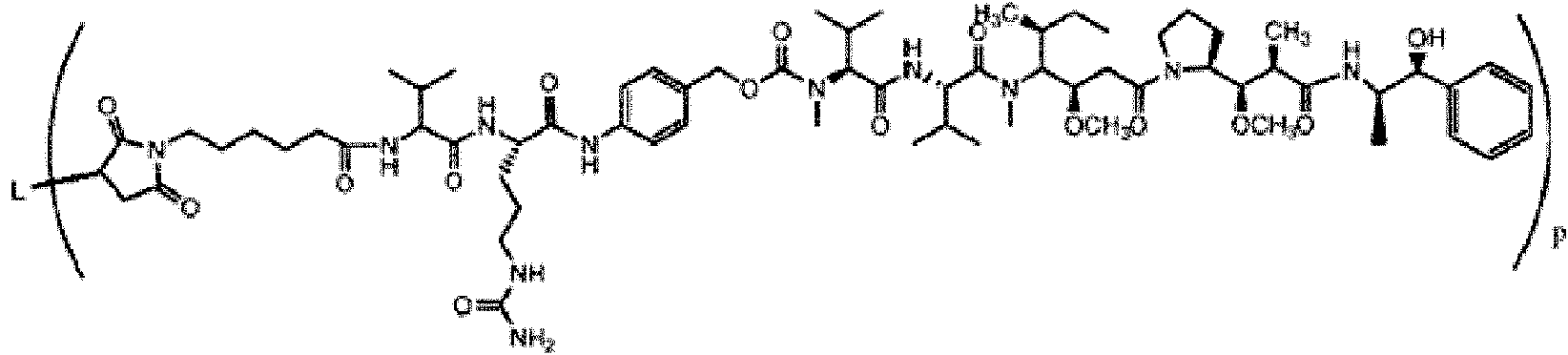
donde L es el anticuerpo, y donde p varía de aproximadamente 3 a aproximadamente 5. En una realización, p es aproximadamente 3,8.where L is the antibody, and where p ranges from about 3 to about 5. In one embodiment, p is about 3.8.
En un cuarto aspecto, la invención proporciona una composición farmacéutica que comprende el anticuerpo o fragmento de unión a antígeno del mismo, o el conjugado anticuerpo-fármaco de cualquier aspecto o realización anterior, y un excipiente farmacéuticamente aceptable.In a fourth aspect, the invention provides a pharmaceutical composition comprising the antibody or antigen-binding fragment thereof, or the antibody-drug conjugate of any preceding aspect or embodiment, and a pharmaceutically acceptable carrier.
En un quinto aspecto, la invención proporciona un anticuerpo o fragmento de unión a antígeno del mismo, o un conjugado de anticuerpo-fármaco como se define en cualquier aspecto o realización anterior para su uso en un método de tratamiento del cáncer.In a fifth aspect, the invention provides an antibody or antigen-binding fragment thereof, or an antibody-drug conjugate as defined in any preceding aspect or embodiment for use in a method of treating cancer.
En una realización, el cáncer expresa 191P4D12. En otra realización, el cáncer es cáncer de vejiga, cáncer de mama, cáncer de páncreas, cáncer de pulmón, cáncer de ovario, cáncer de esófago o cáncer de cabeza y cuello. En una realización particular, el cáncer es cáncer de vejiga. En una realización particular adicional, el cáncer de vejiga es un cáncer de vejiga avanzado.In one embodiment, the cancer expresses 191P4D12. In another embodiment, the cancer is bladder cancer, breast cancer, pancreatic cancer, lung cancer, ovarian cancer, esophageal cancer, or head and neck cancer. In a particular embodiment, the cancer is bladder cancer. In a further particular embodiment, the bladder cancer is advanced bladder cancer.
Breve descripción de las figurasBrief description of the figures
FIG. 1. El ADNc y la secuencia de aminoácidos de 191P4D12 se muestran en la FIG. 1. La metionina de inicio está subrayada. El marco de lectura abierto se extiende desde el ácido nucleico 264 - 1796 que incluye el codón de parada.FIG. 1. The cDNA and amino acid sequence of 191P4D12 are shown in FIG. 1. The starting methionine is underlined. The open reading frame extends from nucleic acid 264-1796 which includes the stop codon.
Figs. 2A-B. Secuencias de ácido nucleico y aminoácidos de anticuerpos 191P4D12. FIG. 2A. El ADNc y la secuencia de aminoácidos de la cadena pesada Ha22-2(2,4)6.1. El doble subrayado es la secuencia líder, subrayada está la región variable de la cadena pesada, y subrayada con una línea discontinua está la región constante IgG1 humana. FIG. 2B. El ADNc y la secuencia de aminoácidos de cadena ligera Ha22-2(2,4)6.1. El doble subrayado es la secuencia líder, subrayada está la región variable de la cadena ligera, y subrayada con una línea discontinua está la región constante kappa humana.Figs. 2A-B. Nucleic acid and amino acid sequences of 191P4D12 antibodies. FIG. 2A. The cDNA and the amino acid sequence of the heavy chain Ha22-2 (2,4) 6.1. The double underline is the leader sequence, underlined is the heavy chain variable region, and underlined with a broken line is the human IgG1 constant region. FIG. 2B. The cDNA and the light chain amino acid sequence Ha22-2 (2,4) 6.1. The double underline is the leader sequence, underlined is the light chain variable region, and underlined with a broken line is the human kappa constant region.
Figs. 3A-B. Secuencias de aminoácidos de anticuerpos 191P4D12. FIG. 3A. La secuencia de aminoácidos de la cadena pesada Ha22-2(2,4)6.1. El doble subrayado es la secuencia líder, subrayada está la región variable de la cadena pesada, y subrayada con una línea discontinua está la región constante IgG1 humana. FIG. 3B. La secuencia de aminoácidos de la cadena ligera Ha22-2(2,4)6.1. El doble subrayado es la secuencia líder, subrayada está la región variable de la cadena ligera, y subrayada con una línea discontinua está la región constante kappa humana.Figs. 3A-B. Amino acid sequences of 191P4D12 antibodies. FIG. 3A. The amino acid sequence of the heavy chain Ha22-2 (2,4) 6.1. The double underline is the leader sequence, underlined is the heavy chain variable region, and underlined with a broken line is the human IgG1 constant region. FIG. 3B. The amino acid sequence of the light chain Ha22-2 (2,4) 6.1. The double underline is the leader sequence, underlined is the light chain variable region, and underlined with a broken line is the human kappa constant region.
Figs. 4A-B. Alineación de anticuerpos Ha22-2(2,4)6.1 frente a la línea germinal de Ig humana. FIG. 4A. Alineación de la cadena pesada Ha22-2(2,4)6.1 con la línea germinal de Ig humana. FIG. 4B. Alineación de la cadena ligera Ha22-2(2,4)6.1 con la línea germinal de Ig humana.Figs. 4A-B. Alignment of Ha22-2 (2,4) 6.1 antibodies against human Ig germline. FIG. 4A. Alignment of the Ha22-2 (2,4) 6.1 heavy chain with the human Ig germline. FIG. 4B. Alignment of the Ha22-2 (2,4) 6.1 light chain with the human Ig germ line.
Figs. 5A-B. Ensayos de unión de MAb Ha22-2(2,4)6.1. FIG. 5A: Se tiñeron células RAT-control y RAT-191P4D12 con mAb Ha22-2(2,4)6.1 de células hibridomas o CHO. La unión se detectó mediante citometría de flujo. Los resultados muestran que Ha22-2(2,4)6.1 MAb expresado de forma recombinante en células CHO se secreta y se une específicamente a la superficie celular 191P4D12. FIG. 5B: El MAb Ha22-2(2,4)6.1 de células de hibridoma o CHO se ensayó para determinar la unión a la proteína extracelular purificada 191P4D12 recombinante mediante ELISA. Los resultados muestran que la unión de la proteína 191P4D12 a Ha22-2(2,4)6.1 derivada de CHO e hibridoma era idéntica.Figs. 5A-B. MAb Ha22-2 (2,4) binding assays 6.1. FIG. 5A: RAT-control and RAT-191P4D12 cells were stained with mAb Ha22-2 (2.4) 6.1 from hybridoma cells or CHO. Binding was detected by flow cytometry. The results show that Ha22-2 (2,4) 6.1 MAb recombinantly expressed in CHO cells is secreted and specifically binds to the 191P4D12 cell surface. FIG. 5B: MAb Ha22-2 (2,4) 6.1 from CHO or hybridoma cells was assayed for binding to recombinant 191P4D12 purified extracellular protein by ELISA. The results show that the binding of the 191P4D12 protein to Ha22-2 (2,4) 6.1 derived from CHO and hybridoma was identical.
FIG. 6. Determinación de la afinidad Ha22-2(2,4)6.1vcMMAE por FACS usando células PC3-Human-191P4D12. La afinidad es 0,69 Kd.FIG. 6. Determination of Ha22-2 (2,4) 6.1vcMMAE affinity by FACS using PC3-Human-191P4D12 cells. The affinity is 0.69 Kd.
FIG. 7. Determinación de la afinidad Ha22-2(2,4)6.1vcMMAE por FACS usando células PC3-Macaco Rhesus-191P4D12. La afinidad es 0,34 Kd.FIG. 7. Determination of Ha22-2 (2,4) 6.1vcMMAE affinity by FACS using PC3-Rhesus-191P4D12 Macaque cells. The affinity is 0.34 Kd.
FIG. 8. Determinación de la afinidad Ha22-2(2,4)6.1vcMMAE por FACS usando células PC3-Rat-191P4D12. La afinidad es de 1,6 Kd.FIG. 8. Determination of Ha22-2 (2,4) 6.1vcMMAE affinity by FACS using PC3-Rat-191P4D12 cells. The affinity is 1.6 Kd.
Figs. 9A-D. Citotoxicidad celular mediada por Ha22-2(2,4)6.1vcMMAE. FIG. 9A: Ensayo de citotoxicidad celular usando células PC3-Human-191P4D12. FIG. 9B: Ensayo de citotoxicidad celular usando células PC3-Macaco Rhesus-191P4D12. FIG. 9C: Ensayo de citotoxicidad celular usando células PC3-Rat-191P4D12. FIG. 9D: Ensayo de citotoxicidad celular usando células PC3-Neo.Figs. 9A-D. Ha22-2 (2.4) 6.1vcMMAE-mediated cellular cytotoxicity. FIG. 9A: Cell cytotoxicity assay using PC3-Human-191P4D12 cells. FIG. 9B: Cell cytotoxicity assay using PC3-Macaco cells Rhesus-191P4D12. FIG. 9C: Cellular cytotoxicity assay using PC3-Rat-191P4D12 cells. FIG. 9D: Cellular cytotoxicity assay using PC3-Neo cells.
FIG. 10. Mapeo de dominio de MAb Ha22-(2,4)6.1 por FACS.FIG. 10. Domain mapping of MAb Ha22- (2,4) 6.1 by FACS.
FIG. 11. Mapeo de dominio MAb Ha22-2(2,4)6.1 por análisis de transferencia Western.FIG. 11. Mapping of MAb Ha22-2 (2,4) 6.1 domain by Western blot analysis.
FIG. 12. Evaluación del mAb Ha22-2(2,4)6.1 en el modelo de formación de tumor subcutáneo de xenoinjerto de cáncer de pulmón humano AG-L4 en ratones SCID. Los resultados muestran que los MAbs de 191P4D12 no inhibieron significativamente el crecimiento tumoral en el xenoinjerto de cáncer de pulmón humano AG-L4 en ratones SCID.FIG. 12. Evaluation of mAb Ha22-2 (2,4) 6.1 in the AG-L4 human lung cancer xenograft subcutaneous tumor formation model in SCID mice. The results show that 191P4D12 MAbs did not significantly inhibit tumor growth in AG-L4 human lung cancer xenograft in SCID mice.
FIG. 13. Evaluación del mAb Ha22-2(2,4)6.1 en el modelo de formación tumoral subcutánea de xenoinjerto de cáncer pancreático humano HPAC en ratones SCID. Los resultados muestran que los MAbs de 191P4D12 no inhibieron el crecimiento tumoral en un xenoinjerto pancreático humano en ratones SCID en comparación con el anticuerpo de control.FIG. 13. Evaluation of mAb Ha22-2 (2,4) 6.1 in the HPAC human pancreatic cancer xenograft subcutaneous tumor formation model in SCID mice. The results show that 191P4D12 MAbs did not inhibit tumor growth in a human pancreatic xenograft in SCID mice compared to the control antibody.
FIG. 14. Evaluación del mAb Ha22-2(2,4)6.1 en el modelo de formación tumoral subcutánea de xenoinjerto de cáncer pancreático humano AG-Panc3 en ratones SCID. Los resultados muestran que los MAbs de 191P4D12 no inhibieron el crecimiento tumoral en un xenoinjerto pancreático humano en ratones SCID en comparación con el anticuerpo de control.FIG. 14. Evaluation of mAb Ha22-2 (2,4) 6.1 in the human pancreatic cancer xenograft subcutaneous tumor formation model AG-Panc3 in SCID mice. The results show that 191P4D12 MAbs did not inhibit tumor growth in a human pancreatic xenograft in SCID mice compared to the control antibody.
FIG. 15. Eficacia de Ha22-2(2,4)6.1-vcMMAE en xenoinjerto de cáncer de pulmón humano establecido por vía subcutánea AG-L4 en ratones SCID. Los resultados muestran que el tratamiento con Ha22-2(2,4)6.1-vcMMAE inhibió significativamente el crecimiento de xenoinjertos de cáncer de pulmón AG-L4 implantados por vía subcutánea en ratones atímicos en comparación con el control tratado y el no tratado.FIG. 15. Efficacy of Ha22-2 (2,4) 6.1-vcMMAE in human lung cancer xenograft established subcutaneously AG-L4 in SCID mice. The results show that Ha22-2 (2,4) 6.1-vcMMAE treatment significantly inhibited the growth of subcutaneously implanted AG-L4 lung cancer xenografts in nude mice compared to treated and untreated control.
FIG. 16. Eficacia de Ha22-2(2,4)6.1-vcMMAE en xenoinjerto de cáncer de mama humano subcutáneo BT-483 en ratones SCID. Los resultados muestran que el tratamiento con Ha22-2(2,4)6.1-vcMMAE inhibió significativamente el crecimiento de xenoinjertos de tumor de mama BT-483 implantados por vía subcutánea en ratones SCID en comparación con los CAFs de control tratados y no tratados.FIG. 16. Efficacy of Ha22-2 (2,4) 6.1-vcMMAE in BT-483 subcutaneous human breast cancer xenograft in SCID mice. The results show that Ha22-2 (2,4) 6.1-vcMMAE treatment significantly inhibited the growth of subcutaneously implanted BT-483 breast tumor xenografts in SCID mice compared to treated and untreated control CAFs.
FIG. 17. Eficacia de Ha22-2(2,4)6.1-vcMMAE en xenoinjerto de cáncer de vejiga humano establecido por vía subcutánea AG-B1 en ratones SCID. Los resultados muestran que el tratamiento con Ha22-2(2,4)6.1-vcMMAE inhibió significativamente el crecimiento de xenoinjertos de cáncer de vejiga AG-B1 en comparación con los CAF de control.FIG. 17. Efficacy of Ha22-2 (2,4) 6.1-vcMMAE in human bladder cancer xenograft established subcutaneously AG-B1 in SCID mice. The results show that Ha22-2 (2,4) 6.1-vcMMAE treatment significantly inhibited the growth of AG-B1 bladder cancer xenografts compared to control CAFs.
FIG. 18. Eficacia de Ha22-2(2,4)6.1-vcMMAE en el xenoinjerto de cáncer de páncreas humano establecido por vía subcutánea AG-Panc2 en ratones SCID. Los resultados muestran que el tratamiento con Ha22-2(2,4)6.1-vcMMAE inhibió significativamente el crecimiento de xenoinjertos de cáncer de páncreas AG-Panc2 en comparación con los CAF de control.FIG. 18. Efficacy of Ha22-2 (2,4) 6.1-vcMMAE in human pancreatic cancer xenograft established subcutaneously AG-Panc2 in SCID mice. The results show that Ha22-2 (2,4) 6.1-vcMMAE treatment significantly inhibited the growth of AG-Panc2 pancreatic cancer xenografts compared to control CAFs.
FIG. 19. Eficacia de Ha22-2(2,4)6.1-vcMMAE en xenoinjerto de cáncer de pulmón humano establecido por vía subcutánea AG-Panc4 en ratones SCID. Los resultados muestran que el tratamiento con Ha22-2(2,4)6.1-vcMMAE inhibió significativamente el crecimiento de xenoinjertos de cáncer de páncreas AG-Panc4 en comparación con los CAF de control.FIG. 19. Efficacy of Ha22-2 (2,4) 6.1-vcMMAE in human lung cancer xenograft established subcutaneously AG-Panc4 in SCID mice. The results show that Ha22-2 (2,4) 6.1-vcMMAE treatment significantly inhibited the growth of AG-Panc4 pancreatic cancer xenografts compared to control CAFs.
FIG. 20. Eficacia de Ha22-2(2,4)6.1-vcMMAE a dosis comparativa en xenoinjerto de cáncer de vejiga humano establecido por vía subcutánea AG-B8 en ratones SCID. Los resultados muestran que el tratamiento con Ha22-2(2,4)6.1vcMMAE a 10 mg/kg inhibió significativamente el crecimiento de xenoinjertos de cáncer de vejiga AG-B8 en comparación con Ha22-2(2,4)6.1vcMMAE a 5 mg/kg.FIG. 20. Efficacy of Ha22-2 (2,4) 6.1-vcMMAE at comparative dose in human bladder cancer xenograft established subcutaneously AG-B8 in SCID mice. The results show that treatment with Ha22-2 (2.4) 6.1vcMMAE at 10 mg / kg significantly inhibited the growth of AG-B8 bladder cancer xenografts compared to Ha22-2 (2.4) 6.1vcMMAE at 5 mg / kg.
Figs. 21A-N. Detección de proteína 191P4D12 en muestras de pacientes con cáncer por IHC. Figs. 21A-B muestran muestras de cáncer de vejiga. Figs. 21C-D muestran muestras de cáncer de mama. Figs. 21E-F muestran muestras de cáncer de páncreas. Figs. 21G-H muestran muestras de cáncer de pulmón. Figs. 21I-J muestran muestras de cáncer de ovario. Figs. 21K-L muestran muestras de cáncer de esófago. FIG. 21M-N muestran muestras de cáncer de esófago.Figs. 21A-N. Detection of 191P4D12 protein in samples from IHC cancer patients. Figs. 21A-B show samples of bladder cancer. Figs. 21C-D show samples of breast cancer. Figs. 21E-F show samples of pancreatic cancer. Figs. 21G-H show lung cancer samples. Figs. 21I-J show samples of ovarian cancer. Figs. 21K-L show samples of esophageal cancer. FIG. 21M-N show samples of esophageal cancer.
Figs. 22A-B. Muestra las curvas de unión utilizadas para determinar la afinidad de Mab Ha22-2(2,4)6.1 y Ha22-2(2,4)6.1vcMMAE a 191P4D12 recombinante purificado (aminoácidos ECD 1-348).Figs. 22A-B. It shows the binding curves used to determine the affinity of Mab Ha22-2 (2.4) 6.1 and Ha22-2 (2.4) 6.1vcMMAE to purified recombinant 191P4D12 (amino acids ECD 1-348).
Figs. 23A-D. Muestra la unión de Ha22-2(2,4)6.1 a células PC3 que expresan 191P4D12 (Figura 23A) y ortólogos de macaco cangrejero (Figura 23B), rata (Figura 23C) y ratón (Figura 23D).Figs. 23A-D. It shows the binding of Ha22-2 (2,4) 6.1 to PC3 cells expressing 191P4D12 (Figure 23A) and orthologs from crab macaque (Figure 23B), rat (Figure 23C) and mouse (Figure 23D).
Figs. 24A-D. Muestra la unión de Ha22-2(2,4)6.1 al doble mutante A76I, S91N es similar a la unión del ortólogo murino. Figs. 24A-D. It shows the binding of Ha22-2 (2,4) 6.1 to the double mutant A76I, S91N is similar to the binding of the murine ortholog.
FIG. 25. Muestra un modelo del dominio V de 191P4D12 basado en datos de la estructura cristalina publicados para miembros de la familia de proteínas que contienen el dominio Ig y 191P4D12 usando PyMOL. Se muestran las posiciones de Ala-76 (trazado punteado) y Ser-91 (trazado entramado).FIG. 25. Shows a model of the V domain of 191P4D12 based on published crystal structure data for protein family members containing the Ig domain and 191P4D12 using PyMOL. The positions of Ala-76 (dotted plot) and Ser-91 (hatched plot) are shown.
Figs. 26A-C. Muestra que la unión de Ha22-2(2,4)6.1 se une a células que expresan el dominio V (Figura 26A) así como a 191P4D12 de tipo salvaje (Figura 26B), pero no a las células que expresan el dominio C1C2 generadas anteriormente (Figura 26C).Figs. 26A-C. Shows that Ha22-2 (2,4) 6.1 binding binds to cells expressing the V domain (Figure 26A) as well as wild-type 191P4D12 (Figure 26B), but not to cells expressing the generated C1C2 domain. above (Figure 26C).
Descripción detallada de la invenciónDetailed description of the invention
Esquema de SeccionesSection Scheme
I. ) DefinicionesI.) Definitions
II. ) Anticuerpos 191P4D12II. ) 191P4D12 antibodies
III. ) Conjugados de fármaco de anticuerpo GeneralmenteIII. ) Antibody Drug Conjugates Generally
III (A). MaitansinoidesIII (A). Maytansinoids
III (B). Auristatinas y dolostatinasIII (B). Auristatins and dolostatins
III (C). CaliqueamicinaIII (C). Calicheamicin
III (D). Otros agentes citotóxicosIII (D). Other cytotoxic agents
IV. ) Conjugados de fármaco de anticuerpo que se unen a 191P4D12IV. ) Antibody drug conjugates that bind to 191P4D12
V. ) Unidades de enlaceV.) Link units
VI. ) La unidad de estiramientoSAW. ) The stretch unit
VII. ) La unidad de aminoácidoVII. ) The amino acid unit
VIII. ) La unidad espaciadoraVIII. ) The spacer unit
IX. ) La unidad de fármacoIX. ) The drug unit
X. ) Carga farmacéuticaX.) Pharmaceutical cargo
XI. ) Métodos para determinar el efecto citotóxico de los CAFXI. ) Methods to determine the cytotoxic effect of CAFs
XII. ) Tratamiento del cáncer o de los cánceres que expresan 191P4D12XII. ) Treatment of cancer or cancers expressing 191P4D12
XIII. ) 191P4D12 como un objetivo para la terapia basada en anticuerposXIII. ) 191P4D12 as a target for antibody-based therapy
XIV. ) Cócteles CAF 191P4D12XIV. ) Cocktails CAF 191P4D12
XV) Terapia de combinaciónXV) Combination therapy
XVI.) Kits/Artículos de fabricaciónXVI.) Kits / Articles of Manufacture
I.) Definiciones:I.) Definitions:
A menos que se defina lo contrario, todos los términos de la técnica, las anotaciones y otros términos científicos o terminología utilizados en la presente memoria pretenden tener los significados comúnmente entendidos por los expertos en la técnica a la que pertenece esta invención. En algunos casos, los términos con significados comúnmente entendidos se definen en este documento para mayor claridad y/o para una referencia rápida, y la inclusión de tales definiciones en el presente documento no debe interpretarse necesariamente como una diferencia sustancial con respecto a lo que generalmente se entiende en la técnica. Muchas de las técnicas y procedimientos descritos o referenciados en la presente son bien entendidos y comúnmente empleados usando metodología convencional por los expertos en la técnica, tales como, por ejemplo, las metodologías de clonación molecular ampliamente utilizadas descritas en Sambrook et al., Molecular Cloning: A Laboratory Manual 2a. edición (1989) Cold Spring Harbor Laboratory Press, Cold Spring Harbor, N.Y. Según corresponda, los procedimientos que implican el uso de kits y reactivos disponibles comercialmente generalmente se llevan a cabo de acuerdo con los protocolos y/o parámetros definidos por el fabricante, a menos que se indique lo contrario.Unless otherwise defined, all art terms, notations, and other scientific terms or terminology used herein are intended to have the meanings commonly understood by those of ordinary skill in the art to which this invention pertains. In some cases, terms with commonly understood meanings are defined herein for clarity and / or for quick reference, and the inclusion of such definitions herein should not necessarily be construed as a substantial difference from what is generally is understood in the art. Many of the techniques and procedures described or referenced herein are well understood and commonly employed using conventional methodology by those of skill in the art, such as, for example, the widely used molecular cloning methodologies described in Sambrook et al., Molecular Cloning : A Laboratory Manual 2a. edition (1989) Cold Spring Harbor Laboratory Press, Cold Spring Harbor, N.Y. As appropriate, procedures involving the use of commercially available kits and reagents are generally carried out according to the protocols and / or parameters defined by the manufacturer, unless otherwise noted.
Cuando se utiliza un nombre comercial en el presente documento, la referencia al nombre comercial también se refiere a la formulación del producto, el medicamento genérico y el/los ingrediente(s) farmacéutico(s) activo(s) del producto de nombre comercial, a menos que el contexto indique lo contrario. When a trade name is used herein, reference to the trade name also refers to the product formulation, the generic drug, and the active pharmaceutical ingredient (s) of the trade name product, unless the context indicates otherwise.
Las expresiones "cáncer avanzado", "cáncer avanzado localmente", "enfermedad avanzada" y "enfermedad localmente avanzada" significan cánceres que se han extendido a través de la cápsula de tejido relevante, y están destinados a incluir la enfermedad en estadio C según el sistema de la Asociación Americana de Urología (AUA), estadio de enfermedad C1-C2 bajo el sistema de Whitmore-Jewett, y la etapa T3-T4 y la enfermedad N+ bajo el sistema TNM (tumor, nodo, metástasis). En general, no se recomienda la cirugía para pacientes con enfermedad localmente avanzada, y estos pacientes tienen resultados sustancialmente menos favorables en comparación con pacientes que tienen cáncer clínicamente localizado (confinado al órgano).The terms "advanced cancer", "locally advanced cancer", "advanced disease" and "locally advanced disease" mean cancers that have spread through the relevant tissue capsule, and are intended to include stage C disease according to the American Urological Association (AUA) system, disease stage C1-C2 under the Whitmore-Jewett system, and stage T3-T4 and N + disease under the TNM system (tumor, node, metastasis). In general, surgery is not recommended for patients with locally advanced disease, and these patients have substantially less favorable outcomes compared to patients who have clinically localized (organ-confined) cancer.
La abreviatura "AFP" se refiere a dimetilvalina-valina-dolaisoleuina-dolaproína-fenilalanina-p-fenilendiamina (véase la Fórmula XVI infra).The abbreviation "AFP" refers to dimethylvaline-valine-dolaisoleuin-dolaproin-phenylalanine-p-phenylenediamine (see Formula XVI infra).
La abreviatura "MMAE" se refiere a monometil auristatina E (véase la Fórmula XI más adelante).The abbreviation "MMAE" refers to monomethyl auristatin E (see Formula XI below).
La abreviatura "AEB" se refiere a un éster producido haciendo reaccionar auristatina E con ácido paraacetilbenzoico (ver Fórmula XX infra).The abbreviation "AEB" refers to an ester produced by reacting auristatin E with paraacetylbenzoic acid (see Formula XX below).
La abreviatura "AEVB" se refiere a un éster producido haciendo reaccionar auristatina E con ácido benzoilvalérico (véase la Fórmula XXI infra).The abbreviation "AEVB" refers to an ester produced by reacting auristatin E with benzoylvaleric acid (see Formula XXI infra).
La abreviatura "MMAF" se refiere a dovalina-valina-dolaisoleuina-dolaproína-fenilalanina (véase la Fórmula XVIV infra).The abbreviation "MMAF" refers to dovaline-valine-dolaisoleuin-dolaproin-phenylalanine (see Formula XVIV infra).
A menos que se indique lo contrario, el término "alquilo" se refiere a un hidrocarburo saturado lineal o ramificado que tiene de aproximadamente 1 a aproximadamente 20 átomos de carbono (y todas las combinaciones y sub combinaciones de intervalos y números específicos de átomos de carbono en él), siendo preferidos desde aproximadamente 1 a aproximadamente 8 los átomos de carbono. Ejemplos de grupos alquilo son metilo, etilo, npropilo, iso-propilo, n-butilo, iso-butilo, sec-butilo, terc-butilo, n-pentilo, 2-pentilo, 3-pentilo, 2-metil-2-butilo, n-hexilo, n-heptilo, n-octilo, n-nonilo, n-decilo, 3-metil-2-butilo, 3-metil-1 -butilo, 2-metil-1 -butilo, 1-hexilo , 2-hexilo, 3-hexilo, 2-metil-2-pentilo, 3-metil-2-pentilo, 4-metil-2-pentilo, 3-metil-3-pentilo, 2-metil-3-pentilo, 2,3-dimetil-2-butilo y 3,3-dimetil-2-butilo.Unless otherwise indicated, the term "alkyl" refers to a straight or branched saturated hydrocarbon having from about 1 to about 20 carbon atoms (and all combinations and sub-combinations of specific ranges and numbers of carbon atoms therein), with from about 1 to about 8 carbon atoms being preferred. Examples of alkyl groups are methyl, ethyl, n-propyl, iso-propyl, n-butyl, iso-butyl, sec-butyl, tert-butyl, n-pentyl, 2-pentyl, 3-pentyl, 2-methyl-2-butyl , n-hexyl, n-heptyl, n-octyl, n-nonyl, n-decyl, 3-methyl-2-butyl, 3-methyl-1-butyl, 2-methyl-1-butyl, 1-hexyl, 2 -hexyl, 3-hexyl, 2-methyl-2-pentyl, 3-methyl-2-pentyl, 4-methyl-2-pentyl, 3-methyl-3-pentyl, 2-methyl-3-pentyl, 2,3 -dimethyl-2-butyl and 3,3-dimethyl-2-butyl.
Los grupos alquilo, ya sea solos o como parte de otro grupo, pueden estar opcionalmente sustituidos con uno o más grupos, preferiblemente de 1 a 3 grupos (y cualesquiera sustituyentes adicionales seleccionados de halógeno), que incluyen, pero sin limitación, -halógeno, -O-(alquilo C1-C8), -O-(alquenilo C2-C8), -O-(alquinilo C2-C8), -arilo, -C(O)R', -OC(O)R', -C(O)OR', -C(O)NH2, -C(O)NHR', -C(O)N(R')2, -NHC(O)R', -SR', -SO3 R', -S(O)2R', -S(O)R', -OH, =O, -N3, -NH2 , -NH(R'), -N(R')2 y -CN, donde cada R' se selecciona independientemente de -H, -alquilo C1-C8 , alquenilo -C2-C8, alquinilo-C2-C8 o -arilo, y en el que dicho -O-(alquilo C1-C8), -O-(alquenilo C2-C8), -O-(alquinilo C2-C8), -arilo, -alquilo C1-C8 , alquenilo -C2-C8 y grupos alquinilo -C2-C8 pueden estar opcionalmente sustituidos adicionalmente con uno o más grupos que incluyen, pero sin limitación, alquilo C1-C8 , alquenilo -C2-C8, alquinilo -C2-C8 , -halógeno, -O-(alquilo C1-C8), -O-(alquenilo C2-C8), -O-(alquinilo C2-C8), -arilo, -C(O)R", -OC(O)R", -C(O)OR", -C(O)NH2, -C(O)NHR" , -C(O)N(R")2 , -NHC(O)R", -SR", -SO3 R", -S(O)2 R", -S(O)R", -OH, -N3 , -NH2 , -NH(R"), -N(R")2 y -CN, donde cada R" se selecciona independientemente de -H, -alquilo C1-C8 , alquenilo-C2-C8 , alquinilo-C2-C8 , o -arilo. A menos que se indique lo contrario, los términos "alquenilo" y "alquinilo" se refieren a cadenas de carbono lineales y ramificadas que tienen de aproximadamente 2 a aproximadamente 20 átomos de carbono (y todas las combinaciones y sub-combinaciones de intervalos y números específicos de átomos de carbono en ellas), siendo preferido de aproximadamente 2 a aproximadamente 8 átomos de carbono. Una cadena de alquenilo tiene al menos un doble enlace en la cadena y una cadena de alquinilo tiene al menos un triple enlace en la cadena. Los ejemplos de grupos alquenilo incluyen, pero sin limitación, etileno o vinilo, alilo, -1-butenilo, -2-butenilo, -isobutilenilo, -1-pentenilo, -2-pentenilo, -3-metil-1-butenilo, -2-metil-2-butenilo y -2,3-dimetil-2-butenilo. Los ejemplos de grupos alquinilo incluyen, pero sin limitación, acetilénico, propargilo, acetilenilo, propinilo, -1 -butinilo, -2-butinilo, -1 -pentinilo, -2-pentinilo y -3-metil-1 -butinilo.Alkyl groups, either alone or as part of another group, may be optionally substituted with one or more groups, preferably 1 to 3 groups (and any additional substituents selected from halogen), including, but not limited to, -halogen, -O- (C 1 -C 8 alkyl), -O (alkenyl , C 2 -C 8), -O- (C 2 -C 8 alkynyl), -aryl, -C (O) R ', -OC ( O) R ', -C (O) OR', -C (O) NH2, -C (O) NHR ', -C (O) N (R') 2, -NHC (O) R ', -SR ', -SO 3 R', -S (O) 2R ', -S (O) R', -OH, = O, -N 3 , -NH 2 , -NH (R '), -N (R' ) 2 and -CN, where each R 'is independently selected from -H, -C 1 -C 8 alkyl, -C 2 -C8 alkenyl, C 2 -C 8 alkynyl, or -aryl, and wherein said -O - (C 1 -C 8 alkyl), -O- (C 2 -C 8 alkenyl), -O- (C 2 -C 8 alkynyl), -aryl, -C 1 -C 8 alkenyl C 2 - C 8 -C 2 -C alkynyl groups 8 may optionally be further substituted with one or more groups including, but not limited to , C 1 -C 8 alkyl, -C 2 -C 8 alkenyl, -C 2 -C 8 alkynyl , -halogen, -O- (alkyl or C 1 -C 8) -O- (C 2 -C 8 alkenyl), -O- (C 2 -C 8 alkynyl), -aryl, -C (O) R ", -OC (O) R" , -C (O) OR ", -C (O) NH 2 , -C (O) NHR", -C (O) N (R ") 2 , -NHC (O) R", -SR ", - SO 3 R ", -S (O) 2 R", -S (O) R ", -OH, -N 3 , -NH 2 , -NH (R"), -N (R ") 2 and -CN where each R "is independently selected from -H, C 1 -C 8 alkenyl-C 2 -C 8 alkynyl-C 2 -C 8, or -aryl. Unless otherwise indicated, the terms "alkenyl" and "alkynyl" refer to straight and branched carbon chains having from about 2 to about 20 carbon atoms (and all combinations and sub-combinations of ranges and numbers specific carbon atoms in them), with about 2 to about 8 carbon atoms being preferred. An alkenyl chain has at least one double bond in the chain and an alkynyl chain has at least one triple bond in the chain. Examples of alkenyl groups include, but are not limited to, ethylene or vinyl, allyl, -1-butenyl, -2-butenyl, -isobutylenyl, -1-pentenyl, -2-pentenyl, -3-methyl-1-butenyl, - 2-methyl-2-butenyl and -2,3-dimethyl-2-butenyl. Examples of alkynyl groups include, but are not limited to, acetylenic, propargyl, acetylenyl, propynyl, -1-butynyl, -2-butynyl, -1-pentynyl, -2-pentynyl, and -3-methyl-1-butynyl.
Los grupos alquenilo y alquinilo, ya sea solos o como parte de otro grupo, pueden estar opcionalmente sustituidos con uno o más grupos, preferiblemente de 1 a 3 grupos (y cualquier sustituyente adicional seleccionado de halógeno), que incluyen, pero sin limitación, -halógeno, -O-(alquilo C1-C8), -O-(alquenilo C2-C8), -O-(alquinilo C2-C8), -arilo, -C(O)R', -OC(O)R', -C(O)OR', -C(O)NH2, -C(O)NHR', -C(O)N(R')2 , -NHC(O)R', -SR', -SO3R', -S(O)2 R', -S(O)R', -OH, =O, -N3 , -NH2 , -NH(R'), -N(R')2 y -CN, donde cada R' es independientemente seleccionado entre -H, -alquilo C1-C8, alquenilo-C2-C8 , alquinilo-C2-C8, o -arilo y en el que dicho -O-(alquilo C1-C8), -O-(alquenilo C2-C8), -O-(alquinilo C2-C8), -arilo, -alquilo C1-C8 , alquenilo -C2-C8 y grupos alquinilo -C2-C8 pueden estar opcionalmente sustituidos adicionalmente con uno o más sustituyentes que incluyen, pero sin limitación, -alquilo C1-C8 , alquenilo C2-C8, alquinilo C2-C8 , -halógeno, -O-(alquilo C1-C8), -O-(alquenilo C2-C8), -O-(alquinilo -C2-C8), -arilo, -C(O)R", -OC(O)R", -C(O)OR", -C(O)NH2, -C(O)NHR", -C(O)N(R")2, -NHC(O)R", -SR", -SO3R", -S(O)2R", -S(O)R ", -OH, -N3, -NH2 , -NH(R"), -N(R")2 y -CN, donde cada R" se selecciona independientemente entre -H, -alquilo C1-C8, alquenilo -C2-C8, -alquinilo C2-C8 , o -arilo.Alkenyl and alkynyl groups, either alone or as part of another group, may be optionally substituted with one or more groups, preferably 1 to 3 groups (and any additional substituents selected from halogen), including, but not limited to, - halogen, -O- (C 1 -C 8 alkyl), -O- (C 2 -C 8 alkenyl), -O- (C 2 -C 8 alkynyl), -aryl, -C (O) R ', - OC (O) R ', -C (O) OR', -C (O) NH 2 , -C (O) NHR ', -C (O) N (R') 2 , -NHC (O) R ' , -SR ', -SO3R', -S (O) 2 R ', -S (O) R', -OH, = O, -N 3 , -NH 2 , -NH (R '), -N ( R ') 2 and -CN, where each R' is independently selected from -H, C 1 -C 8 alkenyl-C 2 -C 8 alkynyl-C 2 -C 8, or -aryl and wherein said -O- (C 1 -C 8 alkyl), -O (alkenyl , C 2 -C 8), -O- (C 2 -C 8 alkynyl), -aryl, -C 1 -C 8 alkenyl - C 2 -C 8 alkynyl and C 2 -C 8 groups may optionally be further substituted with one or more substituents including, but not limited to , -C 1 -C 8 -alkyl, C 2 -C 8 alkenyl, C 2 alkynyl - C 8 , -halogen, -O- (C 1 -C 8 alkyl), -O- (C 2 -C 8 alkenyl), -O- (-C 2 -C 8 alkynyl), -aryl, -C (O) R ", -OC (O) R", -C (O) OR ", -C (O) NH2, -C (O) NHR", -C (O) N (R ") 2, -NHC (O) R ", -SR", -SO3R ", -S (O) 2R", -S (O) R ", -OH, -N3, -NH 2 , -NH (R"), -N (R ") 2 and -CN, where each R "is independently selected from -H, C 1 -C 8 alkyl , -C 2 -C 8 -alkynyl , C 2 -C 8, or -aryl.
A menos que se indique lo contrario, el término "alquileno" se refiere a un radical hidrocarbonado saturado de cadena lineal o ramificada que tiene de aproximadamente 1 a aproximadamente 20 átomos de carbono (y todas las combinaciones y sub-combinaciones de intervalos y números específicos de átomos de carbono en el mismo), siendo preferido desde aproximadamente 1 aproximadamente 8 átomos de carbono y con dos centros de radicales monovalentes derivados por la eliminación de dos átomos de hidrógeno de los mismos o dos átomos de carbono diferentes de un alcano original. Los alquilenos típicos incluyen, pero sin limitación, metileno, etileno, propileno, butileno, pentileno, hexileno, heptileno, octileno, nonileno, decaleno, 1,4-ciclohexileno y similares. Los grupos alquileno, ya sea solos o como parte de otro grupo, pueden estar opcionalmente sustituidos con uno o más grupos, preferiblemente de 1 a 3 grupos (y cualquier sustituyente adicional seleccionado de halógeno), que incluyen, pero sin limitación, -halógeno, -O-(alquilo C1-Cs), -O-(alquenilo C2-C8), -O-(alquinilo C2-C8), -arilo, -C(O)R ', -OC(O)R', -C(O)O', -C(O)NH2 , -C(O)NHR', -C(O)N(R')2, -NHC(O)R', -SR', -SO3 R', -S(O)2 R', -S(O)R', -OH, = O, -N3 , -NH2 , -NH(R'), -N(R')2 y -CN, donde cada R' se selecciona independientemente de -H, -alquilo C1-C8 , alquenilo -C2-C8 , alquinilo-C2-C8, o -arilo y en el que dicho -O-(alquilo C1-C8), -O-(alquenilo C2-C8), -O-(alquinilo C2-C8), -arilo, -alquilo C1-C8, alquenilo -C2-C8 y grupos alquinilo -C2-C8 pueden estar opcionalmente sustituidos adicionalmente con uno o más sustituyentes que incluyen, pero sin limitación, -alquilo C1-C8 , alquenilo C2-C8 , alquinilo C2-C8 , -halógeno, -O-(alquilo C1-C8), -O-(alquenilo C2-C8), -O-(alquinilo C2-C8), -arilo, -C(O)R", -OC(O)R", -C(O)OR", -C(O)n H2, -C(O)NHR", -C(O)N(R")2, -NHC(O)R", -SR", -SO3 R", -S(O)2 R", -S(O)R", -OH, -N3 , -NH2 , -NH(R"), -N(R")2 y -CN, donde cada R" se selecciona independientemente entre -H, -alquilo C1-C8 , alquenilo-C2-C8 , -alquinilo C2-C8 , o -arilo. Unless otherwise indicated, the term "alkylene" refers to a straight or branched chain saturated hydrocarbon radical having from about 1 to about 20 carbon atoms (and all combinations and sub-combinations of ranges and specific numbers of carbon atoms therein), with from about 1 to about 8 carbon atoms being preferred and with two monovalent radical centers derived by the removal of two hydrogen atoms from the same or two different carbon atoms of an original alkane. Typical alkylenes include, but are not limited to, methylene, ethylene, propylene, butylene, pentylene, hexylene, heptylene, octylene, nonylene, decalene, 1,4-cyclohexylene, and the like. Alkylene groups, either alone or as part of another group, may be optionally substituted with one or more groups, preferably 1 to 3 groups (and any additional substituents selected from halogen), including, but not limited to, -halogen, -O- (C 1 -Cs alkyl), -O (alkenyl , C 2 -C 8), -O- (C 2 -C 8 alkynyl), -aryl, -C (O) R ', -OC (O ) R ', -C (O) O', -C (O) NH 2 , -C (O) NHR ', -C (O) N (R') 2 , -NHC (O) R ', -SR ', -SO 3 R', -S (O) 2 R ', -S (O) R', -OH, = O, -N 3 , -NH 2 , -NH (R '), -N (R ') 2 and -CN, where each R' is independently selected from -H, -C 1 -C 8 alkyl , -C 2 -C 8 alkynyl-C 2 -C 8, or -aryl and wherein said -O- (C 1 -C 8 alkyl), -O (alkenyl , C 2 -C 8), -O- (C 2 -C 8 alkynyl), -aryl, -C 1 -C 8 alkyl , -C -C 2 -C 8 alkynyl groups 2 -C 8 may optionally be further substituted with one or more substituents including, but not limited to , -C 1 -C 8 -alkyl, C 2 -C 8 alkenyl, C 2 -C alkynyl 8 , -halogen, - O- (C 1 -C 8 alkyl), -O (alkenyl , C 2 -C 8), -O- (C 2 -C 8 alkynyl), -aryl, -C (O) R ", -OC (O ) R ", -C (O) OR", -C (O) n H 2 , -C (O) NHR ", -C (O) N (R") 2 , -NHC (O) R ", - SR ", -SO 3 R", -S (O) 2 R ", -S (O) R", -OH, -N 3 , -NH 2 , -NH (R "), -N (R") 2 and -CN, where each R "is independently selected from -H, C 1 -C 8 alkenyl-C 2 -C 8 -alkynyl , C 2 -C 8, or -aryl.
A menos que se indique lo contrario, el término "alquenileno" se refiere a un grupo alquileno opcionalmente sustituido que contiene al menos un doble enlace carbono-carbono. Los ejemplos de grupos alquenileno incluyen, por ejemplo, etenileno (-CH=CH-) y propenileno (-CH=CHCH2-).Unless otherwise indicated, the term "alkenylene" refers to an optionally substituted alkylene group containing at least one carbon-carbon double bond. Examples of alkenylene groups include, for example, ethenylene (-CH = CH-) and propenylene (-CH = CHCH 2 -).
A menos que se indique lo contrario, el término "alquinileno" se refiere a un grupo alquileno opcionalmente sustituido que contiene al menos un triple enlace carbono-carbono. Los ejemplos de grupos alquinileno incluyen, por ejemplo, acetileno (-CeC-), propargilo (-CH2C E C-) y 4-pentinilo (-CH2CH2CH2C E CH-).Unless otherwise indicated, the term "alkynylene" refers to an optionally substituted alkylene group containing at least one carbon-carbon triple bond. Examples of alkynylene groups include, for example, acetylene (-CeC-), propargyl (-CH 2 C E C-) and 4-pentynyl (-CH 2 CH 2 CH 2 C E CH-).
A menos que se indique lo contrario, el término "arilo" se refiere a un radical hidrocarbonado aromático monovalente de 6-20 átomos de carbono (y todas las combinaciones y sub-combinaciones de intervalos y números específicos de átomos de carbono en él) derivado de la eliminación de un átomo de hidrógeno de un solo átomo de carbono de un sistema de anillo aromático parental. Algunos grupos arilo están representados en las estructuras ejemplares como "Ar". Los grupos arilo típicos incluyen, pero sin limitación, radicales derivados de benceno, benceno sustituido, fenilo, naftaleno, antraceno, bifenilo y similares.Unless otherwise indicated, the term "aryl" refers to a monovalent aromatic hydrocarbon radical of 6-20 carbon atoms (and all combinations and sub-combinations of specific ranges and numbers of carbon atoms in it) derived of the removal of a hydrogen atom from a single carbon atom from a parent aromatic ring system. Some aryl groups are represented in the exemplary structures as "Ar". Typical aryl groups include, but are not limited to, radicals derived from benzene, substituted benzene, phenyl, naphthalene, anthracene, biphenyl, and the like.
Un grupo arilo, ya sea solo o como parte de otro grupo, puede estar opcionalmente sustituido con uno o más, preferiblemente de 1 a 5, o incluso de 1 a 2 grupos que incluyen, pero sin limitación, -halógeno, alquilo C1-C8 , -alquenilo C2-C8 , alquinilo C2-C8 , -O-(alquilo C1-C8), -O-(alquenilo C2-C8), -O-(alquinilo C2-C8), -arilo, -C(O)R', -OC(O)R', -C(O)OR', -C(O)NH2, -C(O)NHR', -C(O)N(R')2, -NHC(O)R', -SR', -SO3R ', -S(O)2R', -S(O)R', -OH, -NO2, -N3 , -NH2, -NH(R'), -N(R')2 y -CN, donde cada R' se selecciona independientemente de -H, -alquilo C1-C8 , alquenilo-C2-C8, alquinilo-C2-C8 , o -arilo y en donde dicho alquilo C1-C8 , alquenilo-C2-C8, alquinilo C2-C8, O-(alquilo C1-C8), -O-(alquenilo C2-C8), -O-(alquinilo C2-C8) y -arilo pueden estar opcionalmente sustituidos adicionalmente con uno o más sustituyentes que incluyen, pero sin limitación, -alquilo C1-C8, alquenilo -C2-C8, alquinilo-C2-C8, -halógeno, -O-(alquilo C1-C8), -O-(alquenilo C2-C8)), -O-(alquinilo C2-C8), -arilo, -C(O)R", -OC(O)R", -C(O)OR ", -C(O)NH2 , -C(O)NHR", -C(O)N (R")2, -NHC(O)R", -SR", -SO3 R", -S(O)2 R", -S(O)R ", - OH, -N3 , -NH2 , -NH(R"), -N(R")2 y -CN, donde cada R" se selecciona independientemente entre -H, -alquilo C1-C8 , alquenilo-C2-C8 , alquinilo C2-C8 , o -arilo.An aryl group, either alone or as part of another group, may be optionally substituted with one or more, preferably 1 to 5, or even 1 to 2 groups including, but not limited to, -halogen, C 1 -alkyl - C 8 -alkenyl , C 2 -C 8 alkynyl , C 2 -C 8, -O- (C 1 -C 8 alkyl), -O- (C 2 -C 8 alkenyl), -O (alkynyl C 2 - C 8 ), -aryl, -C (O) R ', -OC (O) R', -C (O) OR ', -C (O) NH2, -C (O) NHR', -C (O ) N (R ') 2, -NHC (O) R', -SR ', -SO3R', -S (O) 2R ', -S (O) R', -OH, -NO2, -N 3 , -NH 2, -NH (R '), -N (R') 2 and -CN, where each R 'is independently selected from -H, C 1 -C 8 alkenyl-C 2 -C 8 alkynyl -C 2 -C 8, or -aryl and wherein said C 1 -C 8 alkyl, alkenyl-C 2 -C 8 alkynyl , C 2 -C 8 -alkynyl, O- (C 1 -C 8 alkyl), -O- (C 2 -C 8 alkenyl), -O- (C 2 -C 8 alkynyl) and -aryl may be optionally further substituted with one or more substituents including, but not limited to, -C 1 -C 8 alkyl, alkenyl - C 2 -C 8 , alkynyl-C 2 -C 8 , -halogen, -O- (alkyl C 1 -C 8 ), -O- (C 2 -C 8 alkenyl)), -O- (C 2 -C 8 alkynyl), -aryl, -C (O) R ", -OC (O) R" , -C (O) OR ", -C (O) NH 2 , -C (O) NHR", -C (O) N (R ") 2 , -NHC (O) R", -SR ", - SO 3 R ", -S (O) 2 R", -S (O) R ", - OH, -N 3 , -NH 2 , -NH (R"), -N (R ") 2 and -CN where each R "is independently selected from -H, C 1 -C 8 alkenyl-C 2 -C 8 alkynyl , C 2 -C 8, or -aryl.
A menos que se indique lo contrario, el término "arileno" se refiere a un grupo arilo opcionalmente sustituido que es divalente (es decir, derivado por la eliminación de dos átomos de hidrógeno del mismo o dos átomos de carbono diferentes de un sistema de anillo aromático original) y puede estar en el configuraciones orto, meta o para como se muestra en las siguientes estructuras con fenilo como el grupo arilo ejemplar.Unless otherwise indicated, the term "arylene" refers to an optionally substituted aryl group that is divalent (ie, derived by the removal of two hydrogen atoms from the same or two different carbon atoms from a ring system original aromatic) and may be in the ortho, meta or para configurations as shown in the following structures with phenyl as the exemplary aryl group.

Los grupos "-(alquileno C1-C8)arilo", "-(alquenileno C2-C8)arilo " y "-(alquinileno C2-C8)arilo" típicos incluyen, pero sin limitación, bencilo, 2-feniletan-1 -ilo, 2-fenileten-1-ilo, naftilmetilo, 2-naftilmetil-1-ilo, 2-naftileten-1 -ilo, naftobencilo, 2-naftofeniletan-1-ilo y similares.Typical "- (C 1 -C 8 alkylene) aryl", "- (C 2 -C 8 alkenylene) aryl" and "- (C 2 -C 8 alkynylene) aryl" groups include, but are not limited to, benzyl, 2 -phenylethane-1-yl, 2-phenylethene-1-yl, naphthylmethyl, 2-naphthylmethyl-1-yl, 2-naphthylethene-1-yl, naphthobenzyl, 2-naphthophenylethane-1-yl and the like.
A menos que se indique lo contrario, el término "heterociclo" se refiere a un sistema de anillo monocíclico, bicíclico o policíclico que tiene de 3 a 14 átomos en el anillo (también denominados miembros del anillo) donde al menos un átomo del anillo en al menos un anillo es un heteroátomo seleccionado entre N, O, P o S (y todas las combinaciones y sub-combinaciones de intervalos y números específicos de átomos de carbono y heteroátomos en él). El heterociclo puede tener de 1 a 4 heteroátomos en el anillo seleccionados independientemente de N, O, P o S. Uno o más átomos de N, C o S en un heterociclo pueden oxidarse. Un heterociclo monocíclico preferiblemente tiene de 3 a 7 miembros de anillo (por ejemplo, de 2 a 6 átomos de carbono y de 1 a 3 heteroátomos seleccionados independientemente de N, O, P o S), y un heterociclo bicíclico preferiblemente tiene de 5 a 10 miembros de anillo (por ejemplo, de 4 a 9 átomos de carbono y de 1 a 3 heteroátomos seleccionados independientemente entre N, O, P o S). El anillo que incluye el heteroátomo puede ser aromático o no aromático. A menos que se indique lo contrario, el heterociclo está unido a su grupo colgante en cualquier heteroátomo o átomo de carbono que dé como resultado una estructura estable.Unless otherwise indicated, the term "heterocycle" refers to a monocyclic, bicyclic, or polycyclic ring system having 3 to 14 ring atoms (also referred to as ring members) where at least one ring atom in at least one ring is a heteroatom selected from N, O, P, or S (and all combinations and sub-combinations of ranges and specific numbers of carbon atoms and heteroatoms in it). The heterocycle may have 1 to 4 ring heteroatoms independently selected from N, O, P, or S. One or more N, C, or S atoms in a heterocycle may be oxidized. A monocyclic heterocycle preferably has 3 to 7 ring members (eg, 2 to 6 carbon atoms and 1 to 3 heteroatoms independently selected from N, O, P, or S), and a bicyclic heterocycle preferably has 5 to 10 ring members (eg, of 4 to 9 carbon atoms and of 1 to 3 heteroatoms independently selected from N, O, P or S). The ring that includes the heteroatom can be aromatic or non-aromatic. Unless otherwise indicated, the heterocycle is attached to its pendant group at any heteroatom or carbon atom that results in a stable structure.
Los heterociclos se describen en Paquette, "Principles of Modern Heterocyclic Chemistry" (W. A. Benjamin, Nueva York, 1968), en particular los Capítulos 1, 3, 4, 6, 7 y 9; "The Chemistry of Heterocyclic Compounds, A series of Monographs" (John Wiley & Sons, Nueva York, desde 1950 hasta la actualidad), en particular los volúmenes 13, 14, 16, 19 y 28; y J. Am. Chem. Soc. 82:5566 (1960).Heterocycles are described in Paquette, "Principles of Modern Heterocyclic Chemistry" (W. A. Benjamin, New York, 1968), in particular Chapters 1, 3, 4, 6, 7 and 9; "The Chemistry of Heterocyclic Compounds, A series of Monographs" (John Wiley & Sons, New York, 1950 to the present), in particular volumes 13, 14, 16, 19 and 28; and J. Am. Chem. Soc. 82: 5566 (1960).
Los ejemplos de grupos "heterociclo" incluyen a modo de ejemplo y sin limitación piridilo, dihidropiridilo, tetrahidropiridilo (piperidilo), tiazolilo, pirimidinilo, furanilo, tienilo, pirrolilo, pirazolilo, imidazolilo, tetrazolilo, benzofuranilo, tianaftalenilo, indolilo, indolenilo, quinolinilo, isoquinolinilo, bencimidazolilo, piperidinilo, 4-piperidonilo, pirrolidinilo, 2-pirrolidonilo, pirrolinilo, tetrahidrofuranilo, bis-tetrahidrofuranilo, tetrahidropiranilo, bis-tetrahidropiranilo, tetrahidroquinolinilo, tetrahidroisoquinolinilo, decahidroquinolinilo, octahidroisoquinolinilo, azocinilo, triazinilo, 6H-1,2,5-tiadiazinilo, 2H,6H-1,5,2-ditiazinilo, tienilo, tiantrenilo, piranilo, isobenzofuranilo, cromenilo, xantenilo, fenoxatinilo, 2H-pirrolilo, isotiazolilo, isoxazolilo, pirazinilo, piridazinilo, indolizinilo, isoindolilo, 3H-indolilo, 1H-indazolilo, purinilo, 4H-quinolizinilo, ftalazinilo, naftiridinilo, quinoxalinilo, quinazolinilo, cinnolinilo, pteridinilo, 4H-carbazolilo, carbazolilo, p-carbolinilo, fenantridinilo, acridinilo, pirimidinilo, fenantrolinilo, fenazinilo, fenotiazinilo, furazanilo, fenoxazinilo, isocromanilo, cromanilo, imidazolidinilo, imidazolinilo, pirazolidinilo, pirazolinilo, piperazinilo, indolinilo, isoindolinilo, quinuclidinilo, morfolinilo, oxazolidinilo, benzotriazolilo, bencisoxazolilo, oxindolilo, benzoxazolinilo e isatinoilo. Los grupos "heterociclo" preferidos incluyen, pero sin limitación, benzofuranilo, benzotiofenilo, indolilo, benzopirazolilo, cumarinilo, isoquinolinilo, pirrolilo, tiofenilo, furanilo, tiazolilo, imidazolilo, pirazolilo, triazolilo, quinolinilo, pirimidinilo, piridinilo, piridonilo, pirazinilo, piridazinilo, isotiazolilo, isoxazolilo y tetrazolilo.Examples of "heterocycle" groups include by way of example and without limitation pyridyl, dihydropyridyl, tetrahydropyridyl (piperidyl), thiazolyl, pyrimidinyl, furanyl, thienyl, pyrrolyl, pyrazolyl, imidazolyl, tetrazolyl, benzofuranyl, thianaphthalenyl, indolyl, indolenyl, indolenyl isoquinolinyl, benzimidazolyl, piperidinyl, 4-piperidonyl, pyrrolidinyl, 2-pyrrolidonyl, pyrrolinyl, tetrahydrofuranyl, bis-tetrahydrofuranyl, tetrahydropyranyl, bis-tetrahydropyranyl, tetrahydroquinolinyl, tetrahydroisoquinolinyl, 2-pyrrolidonyl, 6-hypohydroquinolinyl, decahydroquinolinyl, 1,2-trinohydroquinolinyl, 1,2-trinohydrokinolinyl, thiadiazinyl, 2H, 6H-1,5,2-dithiazinyl, thienyl, thianthrenyl, pyranyl, isobenzofuranyl, chromenyl, xanthenyl, phenoxathinyl, 2H-pyrrolyl, isothiazolyl, isoxazolyl, pyrazinyl, pyridazinyl, indolizinyl, 1H-indolyl, 3-H-indolyl indazolyl, purinyl, 4H-quinolizinyl, phthalazinyl, naphthyridinyl, quinoxalinyl, quinazolinyl, cinnolinyl, pteridinyl, 4H-carbazolyl, c arbazolyl, p-carbolinyl, phenanthridinyl, acridinyl, pyrimidinyl, phenanthrolinyl, phenazinyl, phenothiazinyl, furazanyl, phenoxazinyl, isochromanyl, chromanyl, imidazolidinyl, imidazolinyl, pyrazolidinyl, pyrazolininyl, morrazolidinyl, pyrazolinyl, morrazzolidinyl, quinolinyl, morrazolidinyl, quinolinyl, piperazolidinyl, oxindolyl, benzoxazolinyl, and isatinoyl. Preferred "heterocycle" groups include, but are not limited to, benzofuranyl, benzothiophenyl, indolyl, benzopyrazolyl, coumarinyl, isoquinolinyl, pyrrolyl, thiophenyl, furanyl, thiazolyl, imidazolyl, pyrazolyl, triazolyl, quinolinyl, pyrimidinyl, pyridinyl, zinidonyl, pyridinyl, pyridonyl, pyridinyl, pyridonyl isothiazolyl, isoxazolyl and tetrazolyl.
Un grupo heterociclo, ya sea solo o como parte de otro grupo, puede estar opcionalmente sustituido con uno o más grupos, preferiblemente de 1 a 2 grupos, que incluyen, pero sin limitación, -alquilo C1-C8 , alquenilo -C2-C8 , alquinilo -C2-C8, -halógeno, -O-(alquilo C1-C8), -O-(alquenilo C2-C8), -O-(alquinilo C2-C8), -arilo, -C(O)R', -OC(O)R', -C(O)OR', -C(O)NH2 , -C(O)NHR', -C(O)N(R')2 , -NHC(O)R', -SR', -SO3 R', -S(O)2 R', -S(O)R', -OH, -N3 , -NH2 , -NH(R'), -N(R')2 y -CN, donde cada R' se selecciona independientemente de -H, -alquilo C1-C8 , alquenilo -C2-C8 , alquinilo-C2-C8 , o -arilo y en el que dicho -O-(alquilo C1-C8), -O-(alquenilo -C2-C8), -O-(alquinilo C2-C8), -alquilo C1-C8, alquenilo -C2-C8 , alquinilo -C2-C8 y grupos -arilo pueden estar adicionalmente opcionalmente sustituidos con uno o más sustituyentes que incluyen, pero no limitado a, -alquilo C1-C8 , alquenilo -C2-C8, alquinilo-C2-C8 , -halógeno, -O-(alquilo C1-C8), -O-(alquenilo C2-C8), O-(alquinilo C2-C8), -arilo, -C(O)R", -OC(O)R", -C(O)OR", -C(O)NH2 , -C(O)NHR" , -C(O)N(R")2 , -NHC(O)R", -SR", -SO3 R", -S(O)2 R", -S(O)R", -OH, -N3 , -NH2 , -NH(R"), -N(R" )2 y -CN, donde cada R" se selecciona independientemente de -H, -alquilo C1-C8 , alquenilo-C2-C8, alquinilo-C2-C8 o arilo.A heterocycle group, either alone or as part of another group, may be optionally substituted with one or more groups, preferably 1 to 2 groups, including, but not limited to, -C 1 -C 8 alkyl, -C 2 alkenyl -C 8 , -C 2 -C 8 alkynyl, -halogen, -O- (C 1 -C 8 alkyl), -O- (C 2 -C 8 alkenyl), -O- (C 2 -C 8 alkynyl) , -aryl, -C (O) R ', -OC (O) R', -C (O) OR ', -C (O) NH 2 , -C (O) NHR', -C (O) N (R ') 2 , -NHC (O) R', -SR ', -SO 3 R', -S (O) 2 R ', -S (O) R', -OH, -N 3 , -NH 2 , -NH (R '), -N (R ') 2, and -CN, where each R 'is independently selected from -H, -C 1 -C 8 alkyl, -C 2 -C 8 alkenyl, C-alkynyl 2 -C 8 , or -aryl and wherein said -O- (C 1 -C 8 alkyl), -O- (-C 2 -C 8 alkenyl), -O- (C 2 -C 8 alkynyl), C 1 -C 8 alkyl, -C 2 -C 8 alkenyl, -C 2 -C alkynyl and aryl groups 8 may further be optionally substituted with one or more substituents including, but not limited to, -C 1 - C 8 -C 2 -C 8 alkenyl, alkynyl-C 2 -C 8 -halo, -O- (C 1 -C 8 alkyl), -O- (C 2 -C 8 alkenyl), O- (C 2 -C 8 alkynyl), -aryl, -C (O) R ", -OC (O) R" , -C (O) OR ", -C (O) NH 2 , -C (O) NHR", -C (O) N (R ") 2 , -NHC (O) R", -SR ", - SO 3 R ", -S (O) 2 R", -S (O) R ", -OH, -N 3 , -NH 2 , -NH (R"), -N (R ") 2 and -CN where each R "is independently selected from -H, C 1 -C 8 alkenyl-C 2 -C 8 alkynyl-C 2 -C 8 or aryl.
A modo de ejemplo y no de limitación, los heterociclos unidos a carbono se pueden unir en las siguientes posiciones: posición 2, 3, 4, 5 ó 6 de una piridina; posición 3, 4, 5 ó 6 de una piridazina; posición 2, 4, 5 ó 6 de una pirimidina; posición 2, 3, 5 ó 6 de una pirazina; posición 2, 3, 4 ó 5 de un furano, tetrahidrofurano, tiofurano, tiofeno, pirrol o tetrahidropirrol; posición 2, 4 ó 5 de un oxazol, imidazol o tiazol; posición 3, 4 ó 5 de un isoxazol, pirazol o isotiazol; posición 2 ó 3 de una aziridina; posición 2, 3 ó 4 de una azetidina; posición 2, 3, 4, 5, 6, 7 u 8 de una quinolina; o posición 1, 3, 4, 5, 6, 7 u 8 de una isoquinolina. Aún más típicamente, los heterociclos unidos a carbono incluyen 2-piridilo, 3-piridilo, 4-piridilo, 5-piridilo, 6-piridilo, 3-piridazinilo, 4-piridazinilo, 5-piridazinilo, 6-piridazinilo, 2-pirimidinilo, 4-pirimidinilo, 5-pirimidinilo, 6-pirimidinilo, 2-pirazinilo, 3-pirazinilo, 5-pirazinilo, 6-pirazinilo, 2-tiazolilo, 4-tiazolilo o 5-tiazolilo.By way of example and not limitation, carbon-linked heterocycles can be attached at the following positions: position 2, 3, 4, 5, or 6 of a pyridine; position 3, 4, 5 or 6 of a pyridazine; position 2, 4, 5 or 6 of a pyrimidine; position 2, 3, 5 or 6 of a pyrazine; position 2, 3, 4 or 5 of a furan, tetrahydrofuran, thiofuran, thiophene, pyrrole or tetrahydropyrrole; position 2, 4 or 5 of an oxazole, imidazole or thiazole; position 3, 4 or 5 of an isoxazole, pyrazole or isothiazole; position 2 or 3 of an aziridine; position 2, 3 or 4 of an azetidine; position 2, 3, 4, 5, 6, 7 or 8 of a quinoline; or position 1, 3, 4, 5, 6, 7 or 8 of an isoquinoline. Even more typically, carbon-linked heterocycles include 2-pyridyl, 3-pyridyl, 4-pyridyl, 5-pyridyl, 6-pyridyl, 3-pyridazinyl, 4-pyridazinyl, 5-pyridazinyl, 6-pyridazinyl, 2-pyrimidinyl, 4-pyrimidinyl, 5-pyrimidinyl, 6-pyrimidinyl, 2-pyrazinyl, 3-pyrazinyl, 5-pyrazinyl, 6-pyrazinyl, 2-thiazolyl, 4-thiazolyl, or 5-thiazolyl.
A modo de ejemplo y sin limitación, los heterociclos unidos por nitrógeno se pueden unir en la posición 1 de una aziridina, azetidina, pirrol, pirrolidina, 2-pirrolina, 3-pirrolina, imidazol, imidazolidina, 2-imidazolina, 3-imidazolina, pirazol, pirazolina, 2-pirazolina, 3-pirazolina, piperidina, piperazina, indol, indolina o 1H-indazol; posición 2 de un isoindol, o isoindolina; posición 4 de una morfolina; y la posición 9 de un carbazol, o p-carbolina. Aún más típicamente, los heterociclos unidos por nitrógeno incluyen 1 -aziridilo, 1-azetedilo, 1 -pirrolilo, 1 -imidazolilo, 1-pirazolilo y 1 -piperidinilo.By way of example and without limitation, nitrogen-linked heterocycles can be attached at the 1-position of an aziridine, azetidine, pyrrole, pyrrolidine, 2-pyrroline, 3-pyrroline, imidazole, imidazolidine, 2-imidazoline, 3-imidazoline, pyrazole, pyrazoline, 2-pyrazoline, 3-pyrazoline, piperidine, piperazine, indole, indoline, or 1H-indazole; position 2 of an isoindole, or isoindoline; position 4 of a morpholine; and the 9 position of a carbazole, or p-carboline. Even more typically, nitrogen-linked heterocycles include 1 -aziridyl, 1-azetedyl, 1-pyrrolyl, 1-imidazolyl, 1-pyrazolyl, and 1-piperidinyl.
A menos que se indique lo contrario, el término "carbociclo" se refiere a un sistema de anillo monocíclico, bicíclico o policíclico no aromático saturado o insaturado que tiene de 3 a 14 átomos en el anillo (y todas las combinaciones y sub-combinaciones de intervalos y números específicos de átomos de carbono en él) en donde todos los átomos del anillo son átomos de carbono. Los carbociclos monocíclicos tienen preferiblemente de 3 a 6 átomos en el anillo, aún más preferiblemente 5 ó 6 átomos en el anillo. Los carbociclos bicíclicos preferiblemente tienen de 7 a 12 átomos en el anillo, por ejemplo, dispuestos como un sistema biciclo [4,5], [5,5], [5,6] o [6,6], o 9 ó 10 átomos en el anillo dispuestos como un sistema biciclo [5,6] o [6,6]. El término "carbociclo" incluye, por ejemplo, un anillo de carbociclo monocíclico condensado con un anillo de arilo (por ejemplo, un anillo de carbociclo monocíclico condensado con un anillo de benceno). Los carbohidratos preferiblemente tienen de 3 a 8 átomos de carbono en el anillo. Unless otherwise indicated, the term "carbocycle" refers to a saturated or unsaturated non-aromatic monocyclic, bicyclic, or polycyclic ring system having 3 to 14 ring atoms (and all combinations and sub-combinations of ranges and specific numbers of carbon atoms in it) where all ring atoms are carbon atoms. Monocyclic carbocycles preferably have 3 to 6 ring atoms, even more preferably 5 or 6 ring atoms. Bicyclic carbocycles preferably have 7 to 12 ring atoms, for example arranged as a bicyclo system [4,5], [5,5], [5,6] or [6,6], or 9 or 10 ring atoms arranged as a bicyclo [5,6] or [6,6] system. The term "carbocycle" includes, for example, a monocyclic carbocycle ring fused to an aryl ring (eg, a monocyclic carbocycle ring fused to a benzene ring). Carbohydrates preferably have 3 to 8 carbon atoms in the ring.
Los grupos carbocíclicos, ya sea solos o como parte de otro grupo, pueden ser opcionalmente sustituidos con, por ejemplo, uno o más grupos, preferiblemente 1 ó 2 grupos (y cualquier sustituyente adicional seleccionado de halógeno), que incluyen, pero sin limitación, -halógeno , -alquilo C1-C8 , alquenilo -C2-C8 , alquinilo-C2-C8 , -O-(alquiloCarbocyclic groups, either alone or as part of another group, can be optionally substituted with, for example, one or more groups, preferably 1 or 2 groups (and any additional substituents selected from halogen), including, but not limited to, -halogen, C 1 -C 8 alkenyl - C 2 -C 8 alkynyl-C 2 -C 8, -O- (alkyl
C1-C8), -O-(alquenilo C2-C8), -O-(alquinilo C2-C8), -arilo, -C(O)R', -OC(O)R', -C(O)OR', -C(O)NH2 , -C(O)NHR', -C(O)N(R')2 , -NHC(O)R', -SR', -SO3 R', -S(O)2 R', -S(O)R', -OH, =O, -N3, -NH2 , -NH(R'), -N(R')2 y -CN, donde cada R' se selecciona independientemente de -H, -alquilo C1-C8 , alquenilo -C2-C8 , alquinilo-C2-C8, o -arilo y en el que dicho -alquilo C1-C8 , alquenilo -C2-C8 , alquinilo -C2-C8 , -O-(alquilo C1-C8), -O-(alquenilo C2-C8), -O-(alquinilo C2-C grupos arilo pueden estar adicionalmente opcionalmente sustituidos con uno o más sustituyentes que incluyen, pero sin limitación, alquilo C1-C8 , alquenilo -C2-C8 , alquinilo C2-C8, -halógeno, -O-(alquilo C1-C8), -O-(alquenilo C2-C8), -O-(alquinilo C2-C8), -arilo, -C(O)R", - OC(O)R", -C(O)OR", -C(O)NH2, -C(O)NHR", -C(O)N(R")2 , -NHC(O)R", -SR", -SO3 R", -S(O)2 R", -S(O)R", -OH, -N3 , -NH2 , -NH(R"), -N(R")2 y -CN, donde cada R" se selecciona independientemente entre -H, -alquilo C1-C8 , alquenilo-C2-C8 , alquinilo-C2-C8 o -arilo.C 1 -C 8) -O- (C 2 -C 8 alkenyl), -O- (C 2 -C 8 alkynyl), -aryl, -C (O) R ', -OC (O) R', -C (O) OR ', -C (O) NH 2 , -C (O) NHR', -C (O) N (R ') 2 , -NHC (O) R', -SR ', -SO 3 R ', -S (O) 2 R', -S (O) R ', -OH, = O, -N 3 , -NH 2 , -NH (R'), -N (R ') 2 and -CN, where each R 'is independently selected from -H, -C 1 -C 8 alkyl , -C 2 -C 8 alkynyl-C 2 -C 8, or -aryl and wherein said C 1 -C -C 8 alkenyl - C 2 -C 8 alkynyl, -C 2 -C 8, -O- (C 1 -C 8 alkyl), -O (alkenyl , C 2 -C 8), -O (alkynyl C -C 2 aryl groups may further be optionally substituted with one or more substituents including, but not limited to , C 1 -C 8 alkyl, -C 2 -C 8 alkenyl, alkynyl C 2 -C 8 -halo, -O- (C 1 -C 8 alkyl), -O- (C 2 -C 8 alkenyl), -O- (C 2 -C 8 alkynyl), -aryl, -C (O) R ", - OC (O) R ", -C (O) OR", -C (O) NH 2 , -C (O) NHR ", -C (O) N (R") 2 , -NHC (O) R ", -SR", -SO 3 R ", -S (O) 2 R", -S (O) R ", -OH, -N 3 , -NH 2 , -NH (R"), -N (R ") 2 and - CN, where each R "is selected independently ently from -H, -C 1 -C 8 alkenyl-C 2 -C 8 alkynyl-C 2 -C 8 or -aryl.
Los ejemplos de sustituyentes carbocíclicos monocíclicos incluyen -ciclopropilo, -ciclobutilo, -ciclopentilo, -1-ciclopent-1-enilo, -1-ciclopent-2-enilo, -1-ciclopent-3-enilo, ciclohexilo, -1-ciclohex-1-enilo, -1-ciclohex-2-enilo, -1-ciclohex-3-enilo, -cicloheptilo, -ciclooctilo, -1,3-ciclohexadienilo, -1,4-ciclohexadienilo, -1,3-cicloheptadienilo, -1,3,5-cicloheptatrienilo y -ciclooctadienilo.Examples of monocyclic carbocyclic substituents include -cyclopropyl, -cyclobutyl, -cyclopentyl, -1-cyclopent-1-enyl, -1-cyclopent-2-enyl, -1-cyclopent-3-enyl, cyclohexyl, -1-cyclohex- 1-enyl, -1-cyclohex-2-enyl, -1-cyclohex-3-enyl, -cycloheptyl, -cyclooctyl, -1,3-cyclohexadienyl, -1,4-cyclohexadienyl, -1,3-cycloheptadienyl, - 1,3,5-cycloheptatrienyl and -cyclooctadienyl.
Un "carbociclo", ya sea solo o como parte de otro grupo, se refiere a un grupo carbociclo opcionalmente sustituido como se definió anteriormente que es divalente (es decir, derivado por la eliminación de dos átomos de hidrógeno del mismo o dos átomos de carbono diferentes de un sistema de anillo carbocíclico parenteral).A "carbocycle", either alone or as part of another group, refers to an optionally substituted carbocycle group as defined above that is divalent (ie, derived by the removal of two hydrogen atoms from the same or two carbon atoms different from a parenteral carbocyclic ring system).
A menos que se indique lo contrario por contexto, un guión (-) designa el punto de unión a la molécula colgante. Por consiguiente, el término "-(alquileno C1-C8)arilo" o "alquileno C1-C8(arilo)" se refiere a un radical alquileno C1-C8 como se define en la presente, en donde el radical alquileno está unido a la molécula colgante en cualquiera de los átomos de carbono del radical alquileno y uno de los átomos de hidrógeno unidos a un átomo de carbono del radical alquileno se reemplazan con un radical arilo como se define en este documento.Unless otherwise indicated by context, a dash (-) designates the point of attachment to the pendant molecule. Accordingly, the term "- (C 1 -C 8 alkylene) aryl" or "C 1 -C 8 alkylene (aryl)" refers to a C 1 -C 8 alkylene radical as defined herein, wherein the Alkylene radical is attached to the pendant molecule at any of the carbon atoms of the alkylene radical and one of the hydrogen atoms attached to a carbon atom of the alkylene radical is replaced with an aryl radical as defined herein.
Cuando un grupo particular está "sustituido", ese grupo puede tener uno o más sustituyentes, preferiblemente de uno a cinco sustituyentes, más preferiblemente de uno a tres sustituyentes, lo más preferiblemente de uno a dos sustituyentes, seleccionados independientemente de la lista de sustituyentes. El grupo puede, sin embargo, generalmente tener cualquier número de sustituyentes seleccionados de halógeno. Los grupos que están sustituidos están así indicados.When a particular group is "substituted", that group may have one or more substituents, preferably one to five substituents, more preferably one to three substituents, most preferably one to two substituents, independently selected from the list of substituents. The group can, however, generally have any number of substituents selected from halogen. Groups that are substituted are so indicated.
Se pretende que la definición de cualquier sustituyente o variable en una ubicación particular en una molécula sea independiente de sus definiciones en otra parte de esa molécula. Se entiende que los sustituyentes y los patrones de sustitución en los compuestos de esta invención pueden seleccionarse por un experto en la materia para proporcionar compuestos que sean químicamente estables y que se puedan sintetizar fácilmente mediante técnicas conocidas en la técnica, así como los métodos establecidos adelante en este documento.The definition of any substituent or variable at a particular location on a molecule is intended to be independent of its definitions elsewhere on that molecule. It is understood that the substituents and substitution patterns in the compounds of this invention can be selected by one of ordinary skill in the art to provide compounds that are chemically stable and that can be readily synthesized by techniques known in the art, as well as the methods set forth below. in this document.
Los grupos protectores, como se usan en la presente memoria, se refieren a grupos que bloquean selectivamente, temporal o permanentemente, un sitio reactivo en un compuesto multifuncional. Los grupos protectores de hidroxi adecuados para usar en la presente invención son farmacéuticamente aceptables y pueden o no necesitar ser escindidos del compuesto original después de la administración a un sujeto para que el compuesto sea activo. La escisión se realiza a través de procesos metabólicos normales dentro del cuerpo. Los grupos protectores hidroxi son bien conocidos en la técnica, véase, Protective Groups in Organic Synthesis, de TW Greene y PGM Wuts (John Wiley & sons, 3a Edición), incorporados en este documento como referencia en su totalidad y para todos los fines e incluyen, por ejemplo, éter (por ejemplo, éteres alquílicos y sililéteres que incluyen, por ejemplo, dialquilsililéter, trialquilsililéter, dialquilalcoxisililéter), éster, carbonato, carbamatos, sulfonato y grupos protectores de fosfato. Los ejemplos de grupos protectores de hidroxi incluyen, pero sin limitación, éter de metilo; metoximetil-éter, metiltiometiléter, (fenildimetilsilil) metoximetil-éter, benciloximetil-éter, p-metoxibenciloximetil-éter, p-nitrobenciloximetil-éter, onitrobenciloximetil-éter, (4-metoxifenoxi) metil-éter, guayacolmetil-éter, t-butoximetil-éter, 4-penteniloximetil-éter, siloximetil-éter, 2-metoxietoximetil-éter, 2,2,2-tricloroetoximetil-éter, bis(2-cloroetoxi)metil-éter, 2-(trimetilsilil)etoximetil-éter, mentoximetil-éter, tetrahidropiranil-éter, 1-metoxiciclohexil-éter, 4-metoxitetrahidrotiopiranil-éter, 4-metoxitetrahidrotiopiranil éter S,S-Dióxido, 1-[(2-cloro-4-metil)fenil]-4-metoxipiperidin-4-il-éter, 1 -(2-fluorofenil)-4-metoxipiperidin-4-il-éter, 1,4-dioxan-2-il-éter, tetrahidrofuranil-éter, tetrahidrotiofuranil-éter; éteres etílicos sustituidos tales como éter 1-etoxietilo, 1-(2-cloroetoxi)etil-éter, 1-[2-(trimetilsilil)etoxi]etil-éter, 1 -metil-1 -metoxietil-éter, 1 -metil-1 -benciloxietil-éter, 1 -metil-1 -benciloxi-2-fluoroetil-éter, 1 -metil-1-fenoxietil-éter, 2-trimetilsilil-éter, t-butil-éter, alil-éter, propargil-éteres, p-clorofenil-éter, p-metoxifenil-éter, bencil-éter, p-metoxibencil-éter, 3,4-dimetoxibencil-éter, trimetilsilil-éter, trietilsilil-éter, tripropilsililéter, dimetilisopropilsilil-éter, dietilisopropilsilil-éter, dimetilhexilsilil-éter, t-butildimetilsilil-éter, difenilmetilsilil-éter, éster de benzoilformiato, éster de acetato, éster de cloroacetato, éster de dicloroacetato, éster de tricloroacetato, éster de trifluoroacetato, éster de metoxiacetato, éster de trifenilmetoxietacetato, éster de fenilacetato, éster de benzoato, carbonato de metilo y alquilo, 9-fluorenilmetilcarbonato de alquilo, carbonato de etilo y alquilo, carbonato de alquilProtecting groups, as used herein, refer to groups that selectively, temporarily or permanently, block a reactive site on a multifunctional compound. Hydroxy protecting groups suitable for use in the present invention are pharmaceutically acceptable and may or may not need to be cleaved from the parent compound after administration to a subject for the compound to be active. The cleavage is done through normal metabolic processes within the body. Hydroxy protecting groups are well known in the art, see, Protective Groups in Organic Synthesis, by TW Greene and PGM Wuts (John Wiley & sons, 3rd Edition), incorporated herein by reference in its entirety and for all purposes and they include, for example, ether (eg, alkyl ethers and silyl ethers including, for example, dialkylsilyl ether, trialkylsilyl ether, dialkylalkoxysilyl ether), ester, carbonate, carbamates, sulfonate, and phosphate protecting groups. Examples of hydroxy protecting groups include, but are not limited to, methyl ether; methoxymethyl ether, methylthiomethyl ether, (phenyldimethylsilyl) methoxymethyl ether, benzyloxymethyl ether, p-methoxybenzyloxymethyl ether, p-nitrobenzyloxymethyl ether, onitrobenzyloxymethyl ether, (4-methoxyphenoxy) methylmethylmethyl ether, guayacol ether, guayacol ether Ether, 4-pentenyloxymethyl ether, siloxymethyl ether, 2-methoxyethoxymethyl ether, 2,2,2-trichloroethoxymethyl ether, bis (2-chloroethoxy) methyl ether, 2- (trimethylsilyl) ethoxymethyl ether, methoxymethyl ether , tetrahydropyranyl ether, 1-methoxycyclohexyl ether, 4-methoxytetrahydrothiopyranyl ether, 4-methoxytetrahydrothiopyranyl ether S, S-Dioxide, 1 - [(2-chloro-4-methyl) phenyl] -4-methoxypiperidin-4-yl- ether, 1 - (2-fluorophenyl) -4-methoxypiperidin-4-yl-ether, 1,4-dioxan-2-yl-ether, tetrahydrofuranyl-ether, tetrahydrothiofuranyl-ether; Substituted ethyl ethers such as 1-ethoxyethyl ether, 1- (2-chloroethoxy) ethyl ether, 1- [2- (trimethylsilyl) ethoxy] ethyl ether, 1-methyl-1-methoxyethyl ether, 1-methyl-1 -benzyloxyethyl-ether, 1-methyl-1-benzyloxy-2-fluoroethyl-ether, 1-methyl-1-phenoxyethyl-ether, 2-trimethylsilyl-ether, t-butyl-ether, allyl-ether, propargyl-ethers, p -chlorophenyl ether, p-methoxyphenyl ether, benzyl ether, p-methoxybenzyl ether, 3,4-dimethoxybenzyl ether, trimethylsilyl ether, triethylsilyl ether, tripropylsilyl ether, dimethylisopropylsilyl ether, diethylisopropylsilyl ether, diethylisopropylsilyl ether, diethylisopropylsilyl ether , t-butyldimethylsilyl ether, diphenylmethylsilyl ether, benzoylformiate ester, acetate ester, chloroacetate ester, dichloroacetate ester, trichloroacetate ester, trifluoroacetate ester, methoxyacetate ester, triphenylmethoxy ester, phenyl acetate ester, triphenylmethoxy ester , methyl alkyl carbonate, 9-fluorenylmethyl alkyl carbonate, ethyl alkyl carbonate, alkyl carbonate
2,2,2-tricloroetilo, carbonato de 1,1 -dimetil-2,2,2-tricloroetilo, alquilsulfonato, metanosulfonato, bencilsulfonato, tosilato, acetal de metileno, acetal de etilideno y acetal de t-butilmetilideno. Los grupos protectores preferidos están representados por las fórmulas - Ra, -Si(Ra)(Ra)(Ra), -C(O)Ra, -C(O)ORa, -C(O)NH(Ra), -S(O^Ra, -S(O)2OH, P(O)(OH)2 y -P(O)(OH)ORa, en donde Ra es alquilo C1-C20, alquenilo C2-C20, alquinilo C2-C20, alquileno C1-C20 (carbociclo), alquenileno -C2-C20 (carbociclo), alquinileno -C2-C20 (carbociclo), arilo -C6-C10, alquileno C1-C20 (arilo), alquenileno -C2-C20 (arilo), alquinileno -C2-C20 (arilo), alquileno -C1-C20 (heterociclo), -alquenileno -C2-C20 (heterociclo), o alquinileno -C2-C20 (heterociclo) donde dichos radicales alquilo, alquenilo, alquinilo, alquileno, alquenileno, alquinilino, arilo, carbociclo y heterociclo, ya sean solos o como parte de otro grupo, están opcionalmente sustituidos.2,2,2-trichloroethyl, 1,1-dimethyl-2,2,2-trichloroethyl carbonate, alkylsulfonate, methanesulfonate, benzylsulfonate, tosylate, methylene acetal, ethylidene acetal, and t-butylmethylidene acetal. Preferred protecting groups are represented by the formulas - Ra, -Si (Ra) (Ra) (Ra), -C (O) Ra, -C (O) ORa, -C (O) NH (Ra), -S (O ^ Ra, -S (O) 2 OH, P (O) (OH) 2 and -P (O) (OH) OR, wherein R is C 1 -C 20, alkenyl C 2 -C 20 alkynyl, C 2 -C 20 alkylene C 1 -C 20 (carbocycle), -C 2 -C 20 alkenylene (carbocycle), -C 2 -C 20 alkynylene (carbocycle), -C 6 -C 10 aryl, C 1 -C 20 (aryl) -C 2 -C alkenylene 20 (aryl), -C 2 -C 20 alkynylene (aryl), -C 1 -C 20 alkylene (heterocycle), -C 2 -C 20 alkenylene (heterocycle), or -C 2 -C 20 alkynylene (heterocycle) wherein said alkyl, alkenyl, alkynyl, alkylene, alkenylene, alkynyl, aryl, carbocycle and heterocycle radicals, either alone or as part of another group, are optionally substituted.
"Alterar el patrón de glicosilación nativo" pretende significar eliminar uno o más restos de carbohidrato encontrados en la secuencia nativa 191P4D12 (eliminando el sitio de glucosilación subyacente o eliminando la glicosilación por medios químicos y/o enzimáticos), y/o añadir uno o más sitios de glicosilación que no están presentes en la secuencia nativa 191P4D12. Además, la frase incluye cambios cualitativos en la glicosilación de las proteínas nativas, que implican un cambio en la naturaleza y las proporciones de los diversos restos de carbohidratos presentes."Altering the native glycosylation pattern" is intended to mean removing one or more carbohydrate residues found in the native sequence 191P4D12 (removing the underlying glycosylation site or removing glycosylation by chemical and / or enzymatic means), and / or adding one or more glycosylation sites that are not present in the native sequence 191P4D12. Furthermore, the phrase includes qualitative changes in the glycosylation of native proteins, involving a change in the nature and proportions of the various carbohydrate moieties present.
El término "análogo" se refiere a una molécula que es estructuralmente similar o comparte atributos similares o correspondientes con otra molécula (por ejemplo, una proteína relacionada con 191P4D12). Por ejemplo, un análogo de una proteína 191P4D12 puede unirse específicamente por un anticuerpo o célula T que se une específicamente a 191P4D12.The term "analog" refers to a molecule that is structurally similar or shares similar or corresponding attributes with another molecule (eg, a 191P4D12-related protein). For example, an analog of a 191P4D12 protein can be specifically bound by an antibody or T cell that specifically binds 191P4D12.
El término "anticuerpo" se usa en el sentido más amplio a menos que se indique claramente lo contrario. Por lo tanto, un "anticuerpo" puede ser de origen natural o artificial, tal como anticuerpos monoclonales producidos por tecnología de hibridoma convencional. Los anticuerpos 191P4D12 comprenden anticuerpos monoclonales y policlonales, así como fragmentos que contienen el dominio de unión a antígeno y/o una o más regiones determinantes de complementariedad de estos anticuerpos. Como se usa en este documento, el término "anticuerpo" se refiere a cualquier forma de anticuerpo o fragmento del mismo que se una específicamente a 191P4D12 y/o muestre la actividad biológica deseada y específicamente cubra anticuerpos monoclonales (incluyendo anticuerpos monoclonales de longitud completa), anticuerpos policlonales, anticuerpos multi-específicos (p. ej. , anticuerpos bi-específicos) y fragmentos de anticuerpos siempre que se unan específicamente a 191P4D12 y/o exhiban la actividad biológica deseada. Se puede usar cualquier anticuerpo específico en los métodos y composiciones proporcionados en este documento. Así, en una realización, el término "anticuerpo" abarca una molécula que comprende al menos una región variable de una molécula de inmunoglobulina de cadena ligera y al menos una región variable de una molécula de cadena pesada que, en combinación, forman un sitio de unión específico para el antígeno diana. En una realización, el anticuerpo es un anticuerpo IgG. Por ejemplo, el anticuerpo es un anticuerpo IgG 1, IgG2, IgG3 o IgG4. Los anticuerpos útiles en los presentes métodos y composiciones pueden generarse en cultivo celular, en fagos o en diversos animales, que incluyen, pero sin limitación, vacas, conejos, cabras, ratones, ratas, hámsters, conejillos de Indias, ovejas, perros, gatos, monos, chimpancés y simios. Por lo tanto, en una realización, un anticuerpo de la presente invención es un anticuerpo de mamífero. Las técnicas de fagos pueden usarse para aislar un anticuerpo inicial o para generar variantes con características de especificidad o avidez alteradas. Tales técnicas son rutinarias y bien conocidas en la técnica. En una realización, el anticuerpo se produce por medios recombinantes conocidos en la técnica. Por ejemplo, se puede producir un anticuerpo recombinante transfectando una célula huésped con un vector que comprenda una secuencia de ADN que codifica el anticuerpo. Se pueden usar uno o más vectores para transfectar la secuencia de ADN que expresa al menos una región VL y una VH en la célula huésped.The term "antibody" is used in the broadest sense unless clearly stated otherwise. Therefore, an "antibody" can be of natural or artificial origin, such as monoclonal antibodies produced by conventional hybridoma technology. The 191P4D12 antibodies comprise monoclonal and polyclonal antibodies, as well as fragments that contain the antigen-binding domain and / or one or more complementarity determining regions of these antibodies. As used herein, the term "antibody" refers to any form of antibody or fragment thereof that specifically binds to 191P4D12 and / or exhibits the desired biological activity and specifically covers monoclonal antibodies (including full-length monoclonal antibodies). , polyclonal antibodies, multi-specific antibodies (eg, bi-specific antibodies), and antibody fragments as long as they specifically bind 191P4D12 and / or exhibit the desired biological activity. Any specific antibody can be used in the methods and compositions provided herein. Thus, in one embodiment, the term "antibody" encompasses a molecule that comprises at least one variable region of a light chain immunoglobulin molecule and at least one variable region of a heavy chain molecule that, in combination, form a binding site. specific binding for the target antigen. In one embodiment, the antibody is an IgG antibody. For example, the antibody is an IgG 1, IgG2, IgG3, or IgG4 antibody. Antibodies useful in the present methods and compositions can be generated in cell culture, phage, or various animals, including, but not limited to, cows, rabbits, goats, mice, rats, hamsters, guinea pigs, sheep, dogs, cats. , monkeys, chimpanzees and apes. Therefore, in one embodiment, an antibody of the present invention is a mammalian antibody. Phage techniques can be used to isolate an initial antibody or to generate variants with altered specificity or avidity characteristics. Such techniques are routine and well known in the art. In one embodiment, the antibody is produced by recombinant means known in the art. For example, a recombinant antibody can be produced by transfecting a host cell with a vector comprising a DNA sequence encoding the antibody. One or more vectors can be used to transfect the DNA sequence that expresses at least one VL and one VH region into the host cell.
Las descripciones a modo de ejemplo de los medios recombinantes de generación y producción de anticuerpos incluyen Delves, ANTIBODY PRODUCTION: ESSENTIAL TECHNIQUES (Wiley, 1997); Shephard, et al., MONOCLONAL ANTIBODIES (Oxford University Press, 2000); Goding, MONOCLONAL ANTIBODIES: PRINCIPLES AND PRACTICE (Academic Press, 1993); and CURRENT PROTOCOLS IN IMMUNOLOGY (John Wiley & Sons, edición más reciente). Un anticuerpo de la presente invención puede modificarse por medios recombinantes para aumentar la eficacia del anticuerpo en la mediación de la función deseada. Por lo tanto, está dentro del alcance de la invención que los anticuerpos puedan modificarse mediante sustituciones usando medios recombinantes. Típicamente, las sustituciones serán sustituciones conservadoras. Por ejemplo, al menos un aminoácido en la región constante del anticuerpo puede reemplazarse por un residuo diferente. Ver, por ejemplo, la patente de los EE.UU. N° 5.624.821, la patente de EE.UU. N° 6.194.551, Solicitud N° WO 9958572; y Angal, et al., Mol. Immunol. 30: 105-08 (1993). La modificación en aminoácidos incluye deleciones, adiciones y sustituciones de aminoácidos. En algunos casos, dichos cambios se realizan para reducir las actividades no deseadas, por ejemplo, la citotoxicidad dependiente del complemento. Con frecuencia, los anticuerpos se marcan uniendo, ya sea de forma covalente o no covalente, una sustancia que proporciona una señal detectable. Se conoce una amplia variedad de marcadores y técnicas de conjugación, y se muestran ampliamente en la literatura científica y de patentes. Estos anticuerpos se pueden cribar para unirse a 191P4D12 normal o defectuoso. Ver, por ejemplo, Antibody Engineering: A Practical Approach (Oxford University Press, 1996). Los anticuerpos adecuados con las actividades biológicas deseadas se pueden identificar mediante los siguientes ensayos in vitro que incluyen, entre otros: proliferación, migración, adhesión, crecimiento de agar blando, angiogénesis, comunicación célula-célula, apoptosis, transporte, transducción de señales y lo siguiente ensayos in vivo tales como la inhibición del crecimiento tumoral. Los anticuerpos proporcionados en este documento también pueden ser útiles en aplicaciones de diagnóstico. Como anticuerpos de captura o no neutralizantes, pueden cribarse la capacidad de unirse al antígeno específico sin inhibir la unión del receptor o la actividad biológica del antígeno. Como anticuerpos neutralizantes, los anticuerpos pueden ser útiles en ensayos de unión competitiva. También se pueden usar para cuantificar el 191P4D12 o su receptor.Exemplary descriptions of recombinant means of antibody generation and production include Delves, ANTIBODY PRODUCTION: ESSENTIAL TECHNIQUES (Wiley, 1997); Shephard, et al., MONOCLONAL ANTIBODIES (Oxford University Press, 2000); Goding, MONOCLONAL ANTIBODIES: PRINCIPLES AND PRACTICE (Academic Press, 1993); and CURRENT PROTOCOLS IN IMMUNOLOGY (John Wiley & Sons, most recent edition). An antibody of the present invention can be modified recombinantly to increase the effectiveness of the antibody in mediating the desired function. Therefore, it is within the scope of the invention that antibodies can be modified by substitutions using recombinant means. Typically, the substitutions will be conservative substitutions. For example, at least one amino acid in the constant region of the antibody can be replaced by a different residue. See, for example, US Patent No. 5,624,821, US Patent No. 6,194,551, Application No. WO 9958572; and Angal, et al., Mol. Immunol. 30: 105-08 (1993). Modification in amino acids includes deletions, additions, and substitutions of amino acids. In some cases, such changes are made to reduce unwanted activities, for example, complement-dependent cytotoxicity. Antibodies are often labeled by binding, either covalently or noncovalently, a substance that provides a detectable signal. A wide variety of markers and conjugation techniques are known and widely shown in the scientific and patent literature. These antibodies can be screened for binding to normal or defective 191P4D12. See, for example, Antibody Engineering: A Practical Approach (Oxford University Press, 1996). Suitable antibodies with the desired biological activities can be identified by the following in vitro assays including, but not limited to: proliferation, migration, adhesion, soft agar growth, angiogenesis, cell-cell communication, apoptosis, transport, signal transduction, and the like. following in vivo tests such as tumor growth inhibition. The antibodies provided herein may also be useful in diagnostic applications. As capture or non-neutralizing antibodies, the ability to bind the specific antigen without inhibiting the binding of the antigen can be screened. receptor or biological activity of the antigen. As neutralizing antibodies, the antibodies can be useful in competitive binding assays. They can also be used to quantify 191P4D12 or its receptor.
La expresión "porción de unión a antígeno" o "fragmento de anticuerpo" de un anticuerpo (o simplemente "parte de anticuerpo"), como se usa en el presente documento, se refiere a uno o más fragmentos de un anticuerpo 191P4D12 que retienen la capacidad de unirse específicamente a un antígeno (por ejemplo, 191P4D12 y variantes; Figura 1). Se ha demostrado que la función de unión a antígeno de un anticuerpo puede realizarse mediante fragmentos de un anticuerpo de longitud completa. Los ejemplos de fragmentos de unión abarcados dentro de la expresión "porción de unión a antígeno" de un anticuerpo incluyen (i) un fragmento Fab, un fragmento monovalente que consiste en los dominios Vl, Vh, Cl y Cm; (ii) un fragmento F(ab')2 , un fragmento bivalente que comprende dos fragmentos Fab unidos por un puente disulfuro en la región bisagra; (iii) un fragmento Fd que consiste en los dominios Vh y Cm; (iv) un fragmento Fv que consiste en los dominios Vl y Vh de un único brazo de un anticuerpo, (v) un fragmento dAb (Ward et al., (1989) Nature 341: 544-546), que consiste en un dominio Vh; y (vi) una región determinante de complementariedad aislada (CDR). Además, aunque los dos dominios del fragmento Fv, Vl y Vh, están codificados por genes separados, se pueden unir, usando métodos recombinantes, mediante un enlazador sintético que les permita formarse como una sola cadena de proteína en la que las regiones Vl y Vh se aparean para formar moléculas monovalentes (conocidas como Fv de cadena única (scFv); véase, por ejemplo, Bird et al. (1988) Science 242: 423 - 426; y Huston et al. (1988) Proc. Natl. Acad. Sci. USA 85: 5879 - 5883). Dichos anticuerpos monocatenarios también pretenden incluirse dentro de la expresión "porción de unión a antígeno" de un anticuerpo. Estos fragmentos de anticuerpos se obtienen usando técnicas convencionales conocidas por los expertos en la técnica, y los fragmentos se criban para determinar su utilidad de la misma manera que los anticuerpos intactos. The term "antigen-binding portion" or "antibody fragment" of an antibody (or simply "antibody part"), as used herein, refers to one or more fragments of a 191P4D12 antibody that retain the ability to specifically bind to an antigen (eg, 191P4D12 and variants; Figure 1). It has been shown that the antigen-binding function of an antibody can be performed by fragments of a full-length antibody. Examples of binding fragments encompassed within the term "antigen-binding portion" of an antibody include (i) a Fab fragment, a monovalent fragment consisting of the Vl, Vh, Cl and Cm domains; (ii) an F (ab ') 2 fragment, a bivalent fragment comprising two Fab fragments linked by a disulfide bridge in the hinge region; (iii) an Fd fragment consisting of the Vh and Cm domains; (iv) an Fv fragment consisting of the V l and V h domains of a single arm of an antibody, (v) a dAb fragment (Ward et al., (1989) Nature 341: 544-546), consisting of a V h domain; and (vi) an isolated complementarity determining region (CDR). Furthermore, although the two domains of the Fv fragment, V l and V h , are encoded by separate genes, they can be joined, using recombinant methods, by a synthetic linker that allows them to form as a single protein chain in which the V regions I and V h pair to form monovalent molecules (known as single chain Fv (scFv); see, for example, Bird et al. (1988) Science 242: 423-426; and Huston et al. (1988) Proc. Natl. Acad. Sci. USA 85: 5879-5883). Such single chain antibodies are also intended to be included within the term "antigen-binding portion" of an antibody. These antibody fragments are obtained using standard techniques known to those of skill in the art, and the fragments are screened for their usefulness in the same manner as intact antibodies.
Como se usa en este documento, cualquier forma del "antígeno" puede usarse para generar un anticuerpo que sea específico para 191P4D12. Por lo tanto, el antígeno desencadenante puede ser un único epítopo, múltiples epítopos o la proteína completa sola o en combinación con uno o más agentes potenciadores de la inmunogenicidad conocidos en la técnica. El antígeno desencadenante puede ser una proteína aislada de longitud completa, una proteína de superficie celular (por ejemplo, inmunizando con células transfectadas con al menos una porción del antígeno), o una proteína soluble (por ejemplo, inmunizando únicamente con la porción de dominio extracelular de la proteína). El antígeno puede producirse en una célula genéticamente modificada. El ADN que codifica el antígeno puede ser genómico o no genómico (por ejemplo, ADNc) y codifica al menos una porción del dominio extracelular. Como se usa en este documento, el término "porción" se refiere al número mínimo de aminoácidos o ácidos nucleicos, según sea apropiado, que constituyen un epítopo inmunogénico del antígeno de interés. Se pueden emplear cualesquiera vectores genéticos adecuados para la transformación de las células de interés, que incluyen, pero sin limitación, vectores adenovíricos, plásmidos y vectores no virales, tales como lípidos catiónicos. En una realización, el anticuerpo de los métodos y composiciones de la presente memoria se unen específicamente al menos a una porción del dominio extracelular del 191P4D12 de interés.As used herein, any form of the "antigen" can be used to generate an antibody that is specific for 191P4D12. Thus, the trigger antigen can be a single epitope, multiple epitopes, or the entire protein alone or in combination with one or more immunogenicity enhancing agents known in the art. The trigger antigen can be a full-length isolated protein, a cell surface protein (eg, immunizing with cells transfected with at least a portion of the antigen), or a soluble protein (eg, immunizing only with the extracellular domain portion. protein). The antigen can be produced in a genetically modified cell. The DNA encoding the antigen can be genomic or non-genomic (eg, cDNA) and encodes at least a portion of the extracellular domain. As used herein, the term "portion" refers to the minimum number of amino acids or nucleic acids, as appropriate, that constitute an immunogenic epitope of the antigen of interest. Any suitable genetic vectors can be employed for the transformation of the cells of interest, including, but not limited to, adenoviral vectors, plasmids, and non-viral vectors, such as cationic lipids. In one embodiment, the antibody of the methods and compositions herein specifically bind to at least a portion of the extracellular domain of the 191P4D12 of interest.
Los anticuerpos o fragmentos de unión a antígeno de los mismos proporcionados en la presente pueden conjugarse con un "agente bioactivo". Como se usa en el presente documento, la expresión "agente bioactivo" se refiere a cualquier compuesto sintético o de origen natural que se una al antígeno y/o potencie o medie un efecto biológico deseado para mejorar las toxinas que destruyen las células. En una realización, los fragmentos de unión útiles en la presente invención son fragmentos biológicamente activos. Como se usa en este documento, la expresión "biológicamente activo" se refiere a un anticuerpo o fragmento de anticuerpo que es capaz de unirse al epítopo antigénico deseado y ejercer directa o indirectamente un efecto biológico. Los efectos directos incluyen, pero sin limitación, la modulación, estimulación y/o inhibición de una señal de crecimiento, la modulación, estimulación y/o inhibición de una señal antiapoptótica, la modulación, estimulación y/o inhibición de una señal apoptótica o necrótica, modulación, estimulación y/o inhibición de la cascada de ADCC, y modulación, estimulación y/o inhibición de la cascada de CDC.Antibodies or antigen-binding fragments thereof provided herein can be conjugated to a "bioactive agent." As used herein, the term "bioactive agent" refers to any naturally occurring or synthetic compound that binds antigen and / or enhances or mediates a desired biological effect to enhance cell-killing toxins. In one embodiment, the binding fragments useful in the present invention are biologically active fragments. As used herein, the term "biologically active" refers to an antibody or antibody fragment that is capable of binding to the desired antigenic epitope and directly or indirectly exerting a biological effect. Direct effects include, but are not limited to, modulation, stimulation, and / or inhibition of a growth signal, modulation, stimulation, and / or inhibition of an anti-apoptotic signal, modulation, stimulation, and / or inhibition of an apoptotic or necrotic signal. , modulation, stimulation and / or inhibition of the ADCC cascade, and modulation, stimulation and / or inhibition of the CDC cascade.
Los anticuerpos "bi-específicos" también son útiles en los presentes métodos y composiciones. Como se usa en el presente documento, la expresión "anticuerpo bi-específico" se refiere a un anticuerpo, típicamente un anticuerpo monoclonal, que tiene especificidades de unión para al menos dos epítopos antigénicos diferentes. En una realización, los epítopos son del mismo antígeno. En otra realización, los epítopos son de dos antígenos diferentes. Los métodos para producir anticuerpos bi-específicos son conocidos en la técnica. Por ejemplo, los anticuerpos biespecíficos pueden producirse de forma recombinante usando la co-expresión de dos pares de cadena pesada/cadena ligera de inmunoglobulina. Véase, por ejemplo, Milstein et al., Nature 305: 537 - 39 (1983). Alternativamente, los anticuerpos bi-específicos pueden prepararse usando un enlace químico. Véase, por ejemplo, Brennan, et al., Science 229: 81 (1985). Los anticuerpos bi-específicos incluyen fragmentos de anticuerpos biespecíficos. Ver, por ejemplo, Hollinger, et al., Proc. Natl. Acad. Sci. Sci. U.S.A. 90: 6444 - 48 (1993), Gruber, et al., J. Immunol. 152:5368 (1994)."Bi-specific" antibodies are also useful in the present methods and compositions. As used herein, the term "bi-specific antibody" refers to an antibody, typically a monoclonal antibody, that has binding specificities for at least two different antigenic epitopes. In one embodiment, the epitopes are from the same antigen. In another embodiment, the epitopes are from two different antigens. Methods for producing bi-specific antibodies are known in the art. For example, bispecific antibodies can be produced recombinantly using the co-expression of two immunoglobulin heavy chain / light chain pairs. See, for example, Milstein et al., Nature 305: 537-39 (1983). Alternatively, bispecific antibodies can be prepared using a chemical linkage. See, for example, Brennan, et al., Science 229: 81 (1985). Bi-specific antibodies include bispecific antibody fragments. See, for example, Hollinger, et al., Proc. Natl. Acad. Sci. Sci. U.S.A. 90: 6444-48 (1993), Gruber, et al., J. Immunol. 152: 5368 (1994).
Los anticuerpos monoclonales descritos en este documento incluyen específicamente anticuerpos "quiméricos" en los que una porción de la cadena pesada y/o ligera es idéntica u homóloga a secuencias correspondientes en anticuerpos derivados de una especie particular o que pertenecen a una clase o subclase de anticuerpo particular, mientras que el resto de la(s) cadena(s) es o son idénticas u homólogas a las secuencias correspondientes en anticuerpos derivados de otra especie particular o pertenecientes a otra clase o subclase de anticuerpos particular, así como a fragmentos de dichos anticuerpos, siempre que se unan específicamente al antígeno diana y/o exhiban la actividad biológica deseada (Patente de los Estados Unidos Núm. 4.816.567, y Morrison et al., Proc. Natl. Acad. Sci. USA 81: 6851 - 6855 (1984)).The monoclonal antibodies described herein specifically include "chimeric" antibodies in which a portion of the heavy and / or light chain is identical or homologous to corresponding sequences in antibodies derived from a particular species or belonging to a class or subclass of antibody. while the rest of the chain (s) is or are identical or homologous to the corresponding sequences in antibodies derived from another particular species or belonging to another particular class or subclass of antibodies, as well as fragments of said antibodies , as long as they specifically bind to the target antigen and / or exhibit the desired biological activity (US Patent No. 4,816,567, and Morrison et al., Proc. Natl. Acad. Sci. USA 81: 6851-6855 (1984)).
La expresión "agente quimioterapéutico" se refiere a todos los compuestos químicos que son eficaces en la inhibición del crecimiento tumoral. Los ejemplos no limitantes de agentes quimioterapéuticos incluyen agentes alquilantes; por ejemplo, mostazas nitrogenadas, compuestos de etilenimina y alquilsulfonatos; antimetabolitos, por ejemplo, antagonistas de ácido fólico, purina o pirimidina; inhibidores mitóticos, por ejemplo, agentes anti-tubulina tales como alcaloides de vinca, auristatinas y derivados de podofilotoxina; antibióticos citotóxicos; compuestos que dañan o interfieren con la expresión o replicación del ADN, por ejemplo, aglutinantes del surco de menor importancia para el ADN; y antagonistas del receptor del factor de crecimiento. Además, los agentes quimioterapéuticos incluyen agentes citotóxicos (como se definen en la presente memoria), anticuerpos, moléculas biológicas y moléculas pequeñas.The term "chemotherapeutic agent" refers to all chemical compounds that are effective in inhibiting tumor growth. Non-limiting examples of chemotherapeutic agents include alkylating agents; for example, nitrogen mustards, ethyleneimine compounds, and alkylsulfonates; antimetabolites, eg, folic acid, purine or pyrimidine antagonists; mitotic inhibitors, eg, anti-tubulin agents such as vinca alkaloids, auristatins, and podophyllotoxin derivatives; cytotoxic antibiotics; compounds that damage or interfere with DNA expression or replication, eg, minor groove binders for DNA; and growth factor receptor antagonists. In addition, chemotherapeutic agents include cytotoxic agents (as defined herein), antibodies, biological molecules, and small molecules.
El término "compuesto" se refiere y abarca el compuesto químico en sí mismo, así como, el explícitamente establecido o no, y a menos que el contexto aclare que deben excluirse los siguientes: formas amorfas y cristalinas del compuesto, incluyendo formas polimórficas, donde estas formas pueden ser parte de una mezcla o estar en aislamiento; formas de ácido libre y base libre del compuesto, que son típicamente las formas mostradas en las estructuras proporcionadas en este documento; isómeros del compuesto, los cuales se refieren a los isómeros ópticos, e isómeros tautoméricos, donde los isómeros ópticos incluyen enantiómeros y diastereómeros, isómeros quirales e isómeros no quirales, y los isómeros ópticos incluyen isómeros ópticos aislados, así como mezclas de isómeros ópticos, incluidas las mezclas racémicos y no racémicas; donde un isómero puede estar en forma aislada o en una mezcla con uno o más isómeros diferentes; isótopos del compuesto, que incluyen compuestos que contienen deuterio y tritio, e incluyen compuestos que contienen radioisótopos, que incluyen radioisótopos efectivos terapéutica y diagnósticamente; formas multiméricas del compuesto, que incluyen formas diméricas, triméricas, etc.; sales del compuesto, preferiblemente sales farmacéuticamente aceptables, que incluyen sales de adición de ácidos y sales de adición de bases, incluyendo sales que tienen contraiones orgánicos y contraiones inorgánicos, y que incluyen formas zwitteriónicas, donde si un compuesto está asociado con dos o más contraiones, los dos o más contraiones pueden ser los mismos o diferentes; y solvatos del compuesto, que incluyen hemisolvatos, monosolvatos, disolvatos, etc., que incluyen solvatos orgánicos y solvatos inorgánicos, incluyendo dichos solvatos inorgánicos hidratos; donde si un compuesto está asociado con dos o más moléculas de disolvente, las dos o más moléculas de disolvente pueden ser iguales o diferentes. En algunos casos, la referencia hecha en este documento a un compuesto de la invención incluirá una referencia explícita a una de las formas anteriores, por ejemplo, sales y/o solvatos; sin embargo, esta referencia es solo para énfasis, y no debe interpretarse como que excluye otras de las formas anteriores como se identificó anteriormente.The term "compound" refers to and encompasses the chemical compound itself, as well as, explicitly stated or not, and unless the context clarifies that the following should be excluded: amorphous and crystalline forms of the compound, including polymorphic forms, where these shapes can be part of a mix or be in isolation; free acid and free base forms of the compound, which are typically the forms shown in the structures provided herein; Compound isomers, which refer to optical isomers, and tautomeric isomers, where optical isomers include enantiomers and diastereomers, chiral isomers and non-chiral isomers, and optical isomers include isolated optical isomers, as well as mixtures of optical isomers, including racemic and non-racemic mixtures; where an isomer can be in isolation or in a mixture with one or more other isomers; isotopes of the compound, including deuterium and tritium-containing compounds, and include radioisotope-containing compounds, including therapeutically and diagnostically effective radioisotopes; multimeric forms of the compound, including dimeric, trimeric, etc .; salts of the compound, preferably pharmaceutically acceptable salts, including acid addition salts and base addition salts, including salts having organic counterions and inorganic counterions, and including zwitterionic forms, where if a compound is associated with two or more counterions , the two or more counterions can be the same or different; and solvates of the compound, including hemisolvates, monosolvates, dissolvates, etc., including organic solvates and inorganic solvates, said inorganic solvates including hydrates; where if a compound is associated with two or more solvent molecules, the two or more solvent molecules can be the same or different. In some cases, the reference made herein to a compound of the invention will include an explicit reference to one of the above forms, eg, salts and / or solvates; however, this reference is for emphasis only, and should not be construed to exclude other of the above forms as identified above.
Como se usa en el presente documento, la expresión "sustitución conservativa" se refiere a las sustituciones de aminoácidos que son conocidas por los expertos en esta técnica y pueden realizarse generalmente sin alterar la actividad biológica de la molécula resultante. Los expertos en esta técnica reconocen que, en general, las sustituciones de un único aminoácido en regiones no esenciales de un polipéptido no alteran sustancialmente la actividad biológica (véase, por ejemplo, Watson, et al., MOLECULAR BIOLOGY OF THE GENE, The Benjamin/Cummings Pub. Co., p. 224 (4a Edición 1987)). Dichas sustituciones a modo de ejemplo se realizan preferiblemente de acuerdo con los expuestos en la Tabla II y la(s) Tabla(s) III(a-b). Por ejemplo, tales cambios incluyen sustituir cualquiera de isoleucina (I), valina (V) y leucina (L) por cualquier otro de estos aminoácidos hidrófobos; ácido aspártico (D) para el ácido glutámico (E) y viceversa; glutamina (Q) para asparagina (N) y viceversa; y serina (S) para treonina (T) y viceversa. Otras sustituciones también pueden considerarse conservadoras, dependiendo del entorno del aminoácido particular y su papel en la estructura tridimensional de la proteína. Por ejemplo, la glicina (G) y la alanina (A) con frecuencia pueden ser intercambiables, al igual que la alanina (A) y la valina (V). La metionina (M), que es relativamente hidrofóbica, puede intercambiarse frecuentemente con leucina e isoleucina, y algunas veces con valina. La lisina (K) y la arginina (R) son frecuentemente intercambiables en lugares en los que la característica significativa del residuo de aminoácido es su carga y los diferentes pK de estos dos residuos de aminoácidos no son significativos. Aún otros cambios pueden considerarse "conservadores" en entornos particulares (ver, p. ej. Tabla III(a) en este documento; páginas 13-15 "Biochemistry" 2a ED. Lubert Stryer ed (Universidad de Stanford); Henikoff et al., PNAS 1992 Vol 89 10915-10919; Lei et al., J Biol Chem 1995, 19 de mayo; 270 (20): 11882 - 11886). Otras sustituciones también son permisibles y pueden determinarse empíricamente o de acuerdo con sustituciones conservadoras conocidas.As used herein, the term "conservative substitution" refers to amino acid substitutions that are known to those of skill in this art and can generally be made without altering the biological activity of the resulting molecule. Those skilled in the art recognize that, in general, single amino acid substitutions in nonessential regions of a polypeptide do not substantially alter biological activity (see, for example, Watson, et al., MOLECULAR BIOLOGY OF THE GENE, The Benjamin / Cummings Pub. Co., p. 224 (4th Edition 1987)). Such exemplary substitutions are preferably made in accordance with those set forth in Table II and Table (s) III (a-b). For example, such changes include substituting any of isoleucine (I), valine (V), and leucine (L) for any other of these hydrophobic amino acids; aspartic acid (D) for glutamic acid (E) and vice versa; glutamine (Q) to asparagine (N) and vice versa; and serine (S) for threonine (T) and vice versa. Other substitutions can also be considered conservative, depending on the environment of the particular amino acid and its role in the three-dimensional structure of the protein. For example, glycine (G) and alanine (A) can often be interchangeable, as can alanine (A) and valine (V). Methionine (M), which is relatively hydrophobic, can frequently be exchanged with leucine and isoleucine, and sometimes with valine. Lysine (K) and arginine (R) are frequently interchangeable in places where the significant characteristic of the amino acid residue is its charge and the different pKs of these two amino acid residues are not significant. Still other changes may be considered "conservative" in particular settings (see, eg, Table III (a) in this document; pages 13-15 "Biochemistry" 2nd ED, Lubert Stryer ed (Stanford University), Henikoff et al. , PNAS 1992 Vol 89 10915-10919; Lei et al., J Biol Chem 1995, May 19; 270 (20): 11882-11886). Other substitutions are also permissible and can be determined empirically or according to known conservative substitutions.
La expresión "agente citotóxico" se refiere a una sustancia que inhibe o previene la actividad de expresión de las células, la función de las células y/o causa la destrucción de las células. La expresión pretende incluir isótopos radiactivos, agentes quimioterapéuticos y toxinas tales como toxinas de molécula pequeña o toxinas enzimáticamente activas de origen bacteriano, fúngico, vegetal o animal, incluyendo fragmentos y/o variantes de los mismos. Los ejemplos de agentes citotóxicos incluyen, pero sin limitación, auristatinas (por ejemplo, auristatina E, auristatina F, MMAE y MMAF), auromicinas, maitansinoides, ricina, cadena A de ricina, combrestatina, duocarmicinas, dolastatinas, doxorrubicina, daunorrubicina, taxols, cisplatino, cc1065, bromuro de etidio, mitomicina, etopósido, tenopósido, vincristina, vinblastina, colchicina, dihidroxiantracindiona, actinomicina, toxina diftérica, exotoxina de Pseudomonas (PE) A, PE40, abrina, cadena de abrina A, cadena A de modeccina, alfa-sarcina, gelonina, mitogenina, reestrictocina, fenomicina, enomicina, curicina, crotina, caliqueamicina, inhibidor de Sapaonaria officinalis y glucocorticoides y otros agentes quimioterapéuticos, así como radioisótopos como At211, I131, I125, Y90, Re186, Re188, Sm153, Bi212 o 213, P32 e isótopos radiactivos de Lu que incluyen Lu177. Los anticuerpos también pueden conjugarse con una enzima activadora anticancerosa pro-fármaco capaz de convertir el profármaco en su forma activa.The term "cytotoxic agent" refers to a substance that inhibits or prevents the expression activity of cells, the function of cells, and / or causes the destruction of cells. The term is intended to include radioactive isotopes, chemotherapeutic agents and toxins such as small molecule toxins or enzymatically active toxins of bacterial, fungal, plant or animal origin, including fragments and / or variants thereof. Examples of cytotoxic agents include, but are not limited to, auristatins (eg, auristatin E, auristatin F, MMAE, and MMAF), auromycins, maytansinoids, ricin, ricin A-chain, combstatin, duocarmycins, dolastatins, doxorubicin, daunorubicin, taxa cisplatin, cc1065, ethidium bromide, mitomycin, etoposide, tenoposide, vincristine, vinblastine, colchicine, dihydroxyanthrazinedione, actinomycin, diphtheria toxin, Pseudomonas exotoxin (PE) A, PE40, abrin, abrin A chain, modeccin alpha chain, modeccin alpha chain -sarcin, gelonin, mitogenin, restrictocin, phenomycin, enomycin, curicin, crotin, calicheamicin, inhibitor of Sapaonaria officinalis and glucocorticoids and other chemotherapeutic agents, as well as radioisotopes such as At211, I131, 125 I, Y90, Re186, Re188, Sm153, Bi212 or 213, P32 and radioactive isotopes of Lu including Lu177. Antibodies can also be conjugated to a prodrug anticancer activating enzyme capable of converting the prodrug to its active form.
Como se usa en este documento, el término "diacuerpos" se refiere a pequeños fragmentos de anticuerpos con dos sitios de unión a antígeno, cuyos fragmentos comprenden un dominio variable de cadena pesada (Vh) conectado a un dominio variable de cadena ligera (Vl) en la misma cadena polipeptídica (Vh-Vl). Al usar un enlazador que es demasiado corto para permitir el emparejamiento entre los dos dominios en la misma cadena, los dominios se fuerzan a emparejarse con los dominios complementarios de otra cadena y crean dos sitios de unión al antígeno. Los diacuerpos se describen más completamente en, por ejemplo, el documento EP 404.097; WO 93/11161; y Hollinger et al., Proc. Natl. Acad. Sci. USA 90: 6444 - 48 (1993).As used herein, the term "diabodies" refers to small antibody fragments with two antigen-binding sites, the fragments of which comprise a heavy chain variable domain (Vh) connected to a light chain variable domain (Vl). in the same polypeptide chain (Vh-Vl). By using a linker that is too short to allow pairing between the two domains on the same chain, the domains are forced to pair with complementary domains on another chain and create two antigen-binding sites. Diabodies are more fully described in, for example, EP 404,097; WO 93/11161; and Hollinger et al., Proc. Natl. Acad. Sci. USA 90: 6444-48 (1993).
El término "agotar", en el contexto del efecto de un agente de unión a 191P4D12 en células que expresan 191P4D12, se refiere a una reducción o eliminación del número de células que expresan 191P4D12.The term "depletion", in the context of the effect of a 191P4D12 binding agent on cells expressing 191P4D12, refers to a reduction or elimination of the number of cells expressing 191P4D12.
La expresión "producto génico" se usa en el presente documento para indicar un péptido/proteína o ARNm. Por ejemplo, un "producto génico de la invención" a veces se denomina en este documento "secuencia de aminoácidos cancerígena", "proteína cancerosa", "proteína de un cáncer enumerado en la Tabla I", un "ARNm canceroso", "ARNm de un cáncer enumerado en la Tabla I", etc. En una realización, la proteína del cáncer está codificada por un ácido nucleico de la FIG. 1. La proteína del cáncer puede ser un fragmento, o alternativamente, ser la proteína de longitud completa codificada por los ácidos nucleicos de la FIG. 1. En una realización, se usa una secuencia de aminoácidos de cáncer para determinar la identidad o similitud de secuencia. En otra realización, las secuencias son variantes alélicas de origen natural de una proteína codificada por un ácido nucleico de la FIG. 1. En otra realización, las secuencias son variantes de secuencia como se describe adicionalmente en este documento.The term "gene product" is used herein to denote a peptide / protein or mRNA. For example, a "gene product of the invention" is sometimes referred to herein as a "carcinogenic amino acid sequence", "cancer protein", "protein from a cancer listed in Table I", a "cancer mRNA", "mRNA of a cancer listed in Table I ", etc. In one embodiment, the cancer protein is encoded by a nucleic acid of FIG. 1. The cancer protein can be a fragment, or alternatively, be the full-length protein encoded by the nucleic acids of FIG. 1. In one embodiment, a cancer amino acid sequence is used to determine sequence identity or similarity. In another embodiment, the sequences are naturally occurring allelic variants of a protein encoded by a nucleic acid of FIG. 1. In another embodiment, the sequences are sequence variants as further described herein.
Los anticuerpos "hetero-conjugados" son útiles en los presentes métodos y composiciones. Como se usa en el presente documento, la expresión "anticuerpo hetero-conjugado" se refiere a dos anticuerpos unidos covalentemente. Dichos anticuerpos se pueden preparar usando métodos conocidos en química de proteínas sintéticas, que incluyen el uso de agentes de reticulación. Ver, por ejemplo, la patente de los EE.UU. No. 4.676.980. El término "homólogo" se refiere a una molécula que exhibe homología con otra molécula, por ejemplo, que tiene secuencias de residuos químicos que son iguales o similares en las posiciones correspondientes."Hetero-conjugated" antibodies are useful in the present methods and compositions. As used herein, the term "hetero-conjugated antibody" refers to two covalently linked antibodies. Such antibodies can be prepared using known methods in synthetic protein chemistry, including the use of cross-linking agents. See, for example, US Patent No. 4,676,980. The term "homologous" refers to a molecule that exhibits homology to another molecule, for example, that has chemical residue sequences that are the same or similar at corresponding positions.
En una realización, el anticuerpo proporcionado en este documento es un "anticuerpo humano". Como se usa en el presente documento, la expresión "anticuerpo humano" se refiere a un anticuerpo en el que esencialmente las secuencias completas de las secuencias de cadena ligera y cadena pesada, que incluyen las regiones determinantes complementarias (CDR), son de genes humanos. En una realización, los anticuerpos monoclonales humanos se preparan mediante la técnica de trioma, la técnica de células B humanas (véase, por ejemplo, Kozbor, et al., Immunol. Today 4: 72 (1983), técnica de transformación de VEB (véase, por ejemplo, Cole et al., Monoclonal Antibodies And Cancer Therapy 77-96 (1985)), o usando presentación de fagos (véase, por ejemplo, Marks et al., J. Mol. Biol. 222:581 (1991)). En una realización específica, el anticuerpo humano se genera en un ratón transgénico. Las técnicas para fabricar tales anticuerpos de parcialmente a completamente humanos se conocen en la técnica y se puede usar cualquiera de tales técnicas. De acuerdo con una realización particularmente preferida, las secuencias de anticuerpo completamente humanas se preparan en un ratón transgénico diseñado por ingeniería genética para expresar genes de anticuerpos de cadena pesada y ligera humanos. Una descripción ejemplar de la preparación de ratones transgénicos que producen anticuerpos humanos encontrados en la Solicitud N° WO 02/43478 y en la Patente de EE.UU. N° 6.657.103 (Abgenix) y su progenie. Las células B de ratones transgénicos que producen el anticuerpo deseado se pueden fusionar para formar líneas celulares de hibridoma para la producción continua del anticuerpo. Ver, por ejemplo, la patente de los EE.UU. Nos. 5.569.825; 5.625.126; 5.633.425; 5.661.016; y 5.545.806; y Jakobovits, Adv. Drug Del. Rev. 31:33-42 (1998); Green, et al., J. Exp. Med.In one embodiment, the antibody provided herein is a "human antibody." As used herein, the term "human antibody" refers to an antibody in which essentially the entire sequences of the light chain and heavy chain sequences, including the complementary determining regions (CDRs), are from human genes. . In one embodiment, human monoclonal antibodies are prepared by the trioma technique, the human B-cell technique (see, for example, Kozbor, et al., Immunol. Today 4:72 (1983), EBV transformation technique ( see, for example, Cole et al., Monoclonal Antibodies And Cancer Therapy 77-96 (1985)), or using phage display (see, for example, Marks et al., J. Mol. Biol. 222: 581 (1991 )). In a specific embodiment, the human antibody is generated in a transgenic mouse. Techniques for making such partially to fully human antibodies are known in the art and any such technique can be used. In accordance with a particularly preferred embodiment , Fully human antibody sequences are prepared in a transgenic mouse engineered to express human heavy and light chain antibody genes An Exemplary Description of Preparation of Antibody-Producing Transgenic Mice Humans found in Application No. WO 02/43478 and in US Patent No. 6,657,103 (Abgenix) and their progeny. B cells from transgenic mice that produce the desired antibody can be fused to form hybridoma cell lines for continuous antibody production. See, for example, US Patent Nos. 5,569,825; 5,625,126; 5,633,425; 5,661,016; and 5,545,806; and Jakobovits, Adv. Drug Del. Rev. 31: 33-42 (1998); Green, et al., J. Exp. Med.
188:483-95 (1998).188: 483-95 (1998).
Como se usa en el presente documento, la expresión "anticuerpo humanizado" se refiere a formas de anticuerpos que contienen secuencias de anticuerpos no humanos (por ejemplo, murinos) así como anticuerpos humanos. Tales anticuerpos son anticuerpos quiméricos que contienen una secuencia mínima derivada de inmunoglobulina no humana. En general, el anticuerpo humanizado comprenderá sustancialmente todos al menos uno, y típicamente dos dominios variables, en los que todos o sustancialmente todos los bucles hipervariables corresponden a los de una inmunoglobulina no humana y todas o sustancialmente todas las regiones FR son los de una secuencia de inmunoglobulina humana. El anticuerpo humanizado opcionalmente también comprenderá al menos una porción de una región constante de inmunoglobulina (Fc), típicamente la de una inmunoglobulina humana. Véase, por ejemplo, Cabilly U.S. Pat. N° 4.816.567; Queen et al. (1989) Proc. Nat'l Acad. Sci. USA 86: 10029 - 10033; y Antibody Engineering: A Practical Approach (Oxford University Press 1996).As used herein, the term "humanized antibody" refers to forms of antibodies that contain non-human (eg, murine) antibody sequences as well as human antibodies. Such antibodies are chimeric antibodies that contain a minimal sequence derived from non-human immunoglobulin. In general, the humanized antibody will comprise substantially all of at least one, and typically two variable domains, in which all or substantially all of the hypervariable loops correspond to those of a non-human immunoglobulin and all or substantially all of the FR regions are those of a sequence. of human immunoglobulin. The humanized antibody will optionally also comprise at least a portion of an immunoglobulin constant region (Fc), typically that of a human immunoglobulin. See, for example, Cabilly U.S. Pat. No. 4,816,567; Queen et al. (1989) Proc. Nat'l Acad. Sci. USA 86: 10029-10033; and Antibody Engineering: A Practical Approach (Oxford University Press 1996).
Los términos "inhibir" o "inhibición de", tal como se usan en el presente documento, significan reducir en una cantidad medible, o prevenir completamente. The terms "inhibit" or "inhibit", as used herein, mean reduce by a measurable amount, or prevent completely.
Las frases "aislado" o "biológicamente puro" se refieren a un material que está sustancial o esencialmente libre de componentes que normalmente acompañan al material tal como se encuentra en su estado nativo. Por lo tanto, los péptidos aislados de acuerdo con la invención preferiblemente no contienen materiales normalmente asociados con los péptidos en su entorno in situ. Por ejemplo, se dice que un polinucleótido está "aislado" cuando está sustancialmente separado de polinucleótidos contaminantes que corresponden o son complementarios a genes distintos de los genes 191P4D12 o que codifican polipéptidos distintos del producto del gen 191P4D12 o fragmentos del mismo. Cualquier experto en la materia puede emplear fácilmente procedimientos de aislamiento de ácidos nucleicos para obtener un polinucleótido de 191P4D12 aislado. Se dice que una proteína está "aislada", por ejemplo, cuando se emplean métodos físicos, mecánicos o químicos para eliminar las proteínas 191P4D12 de los constituyentes celulares que normalmente están asociados con la proteína. Cualquier experto en la materia puede emplear fácilmente métodos de purificación convencionales para obtener una proteína 191P4D12 aislada. Alternativamente, una proteína aislada se puede preparar por medios químicos.The phrases "isolated" or "biologically pure" refer to a material that is substantially or essentially free of components that normally accompany the material as it is in its native state. Therefore, isolated peptides according to the invention preferably do not contain materials normally associated with peptides in their in situ environment. For example, a polynucleotide is said to be "isolated" when it is substantially separated from contaminating polynucleotides that correspond to or are complementary to genes other than the 191P4D12 genes or that encode polypeptides other than the 191P4D12 gene product or fragments thereof. Nucleic acid isolation procedures can easily be employed by anyone skilled in the art to obtain an isolated 191P4D12 polynucleotide. A protein is said to be "isolated", for example, when physical, mechanical, or chemical methods are employed to remove the 191P4D12 proteins from cellular constituents that are normally associated with the protein. Anyone skilled in the art can easily employ standard purification methods to obtain an isolated 191P4D12 protein. Alternatively, an isolated protein can be prepared chemically.
Los "marcadores" adecuados incluyen radionúclidos, enzimas, sustratos, cofactores, inhibidores, restos fluorescentes, restos quimio-luminiscentes, partículas magnéticas y similares. Las patentes que enseñan el uso de tales marcadores incluyen las patentes de EE.UU. Nos. 3.817.837; 3.850.752; 3.939.350; 3.996.345; 4.277.437; 4.275.149; y 4.366.241. Además, los anticuerpos proporcionados en este documento pueden ser útiles como el componente de unión a antígeno de fluoro-cuerpos. Ver, por ejemplo, Zeytun et al., Nat. Biotechnol. 21:1473-79 (2003).Suitable "labels" include radionuclides, enzymes, substrates, cofactors, inhibitors, fluorescent moieties, chemiluminescent moieties, magnetic particles, and the like. Patents teaching the use of such markers include US Patent Nos. 3,817,837; 3,850,752; 3,939,350; 3,996,345; 4,277,437; 4,275,149; and 4,366,241. Furthermore, the antibodies provided herein may be useful as the antigen-binding component of fluoro-bodies. See, for example, Zeytun et al., Nat. Biotechnol. 21: 1473-79 (2003).
El término "mamífero" se refiere a cualquier organismo clasificado como mamífero, que incluye ratones, ratas, conejos, perros, gatos, vacas, caballos y seres humanos. En una realización de la invención, el mamífero es un ratón. En otra realización de la invención, el mamífero es un ser humano.The term "mammal" refers to any organism classified as a mammal, including mice, rats, rabbits, dogs, cats, cows, horses, and humans. In one embodiment of the invention, the mammal is a mouse. In another embodiment of the invention, the mammal is a human.
Los términos "cáncer metastásico" y "enfermedad metastásica" se refieren a los cánceres que se han diseminado a los ganglios linfáticos regionales o a sitios distantes, y están destinados a incluir la enfermedad en estadio D bajo el sistema AUA y la etapa T x N x M en el sistema TNM.The terms "metastatic cancer" and "metastatic disease" refer to cancers that have spread to regional lymph nodes or distant sites, and are intended to include stage D disease under the AUA system and stage T x N x M in the TNM system.
El término "modulador" o la expresión "compuesto de prueba" o "candidato a fármaco" o los equivalentes gramaticales que se usan en el presente documento describen cualquier molécula, por ejemplo, proteína, oligopéptido, molécula orgánica pequeña, polisacárido, polinucleótido, etc., que se probará según su capacidad de alterar directamente o indirectamente el fenotipo de cáncer o la expresión de una secuencia de cáncer, por ejemplo, una secuencia de ácido nucleico o proteína, o efectos de secuencias de cáncer (por ejemplo, señalización, expresión génica, interacción de proteínas, etc.). En un aspecto, un modulador neutralizará el efecto de una proteína de cáncer de la invención. Por "neutralizar" se entiende que se inhibe o bloquea una actividad de una proteína, junto con el efecto consiguiente sobre la célula. En otro aspecto, un modulador neutralizará el efecto de un gen, y su proteína correspondiente, de la invención normalizando los niveles de dicha proteína. En realizaciones preferidas, los moduladores alteran los perfiles de expresión, o los ácidos nucleicos del perfil de expresión o las proteínas proporcionadas en este documento, o las rutas efectoras corriente abajo. En una realización, el modulador suprime un fenotipo del cáncer, p. ej., a una huella digital de tejido normal. En otra realización, un modulador indujo un fenotipo del cáncer. Generalmente, se ejecuta una pluralidad de mezclas de ensayo en paralelo con diferentes concentraciones de agente para obtener una respuesta diferencial a las diversas concentraciones. Típicamente, una de estas concentraciones sirve como un control negativo, es decir, a una concentración cero o por debajo del nivel de detección.The term "modulator" or the term "test compound" or "drug candidate" or the grammatical equivalents used herein describe any molecule, eg, protein, oligopeptide, small organic molecule, polysaccharide, polynucleotide, etc. ., to be tested for their ability to directly or indirectly alter the cancer phenotype or the expression of a cancer sequence, eg, a nucleic acid or protein sequence, or effects of cancer sequences (eg, signaling, expression gene, protein interaction, etc.). In one aspect, a modulator will neutralize the effect of a cancer protein of the invention. By "neutralize" it is meant that an activity of a protein is inhibited or blocked, along with the consequent effect on the cell. In another aspect, a modulator will neutralize the effect of a gene, and its corresponding protein, of the invention by normalizing the levels of said protein. In preferred embodiments, the modulators alter the expression profiles, or the nucleic acids of the expression profile or the proteins provided herein, or the downstream effector pathways. In one embodiment, the modulator suppresses a cancer phenotype, e.g. eg, to a normal tissue fingerprint. In another embodiment, a modulator induced a cancer phenotype. Generally, a plurality of test mixtures are run in parallel with different concentrations of agent to obtain a differential response at the various concentrations. Typically, one of these concentrations serves as a negative control, that is, at a concentration of zero or below the level of detection.
Los moduladores, los fármacos candidatos o los compuestos de ensayo abarcan numerosas clases químicas, aunque típicamente son moléculas orgánicas, preferiblemente pequeños compuestos orgánicos que tienen un peso molecular de más de 100 y menos de aproximadamente 2.500 Dalton. Las moléculas pequeñas preferidas son inferiores a 2000, o inferiores a 1500 o inferiores a 1000 o inferiores a 500 D. Los agentes candidatos comprenden grupos funcionales necesarios para la interacción estructural con proteínas, particularmente enlaces de hidrógeno, y típicamente incluyen al menos un grupo amina, carbonilo, hidroxilo o carboxilo, preferiblemente al menos dos de los grupos químicos funcionales. Los agentes candidatos a menudo comprenden estructuras cíclicas de carbono o heterocíclicas y/o estructuras aromáticas o poli-aromáticas sustituidas con uno o más de los grupos funcionales anteriores. Los moduladores también comprenden biomoléculas tales como péptidos, sacáridos, ácidos grasos, esteroides, purinas, pirimidinas, derivados, análogos estructurales o combinaciones de los mismos. Particularmente preferidos son los péptidos. Una clase de moduladores son los péptidos, por ejemplo, de aproximadamente cinco a aproximadamente 35 aminoácidos, prefiriéndose de aproximadamente cinco a aproximadamente 20 aminoácidos, y siendo particularmente preferido de aproximadamente 7 a aproximadamente 15. Preferiblemente, la proteína moduladora del cáncer es soluble, incluye una región no transmembrana, y/o tiene una Cys N-terminal para ayudar en la solubilidad. En una realización, el extremo C del fragmento se mantiene como un ácido libre y el extremo N es una amina libre para ayudar en el acoplamiento, es decir, a la cisteína. En una realización, una proteína de cáncer de la invención se conjuga con un agente inmunogénico como se describe en el presente documento. En una realización, la proteína del cáncer se conjuga con BSA. Los péptidos de la invención, por ejemplo, de longitudes preferidas, se pueden unir entre sí o con otros aminoácidos para crear un péptido/proteína más largo. Los péptidos moduladores pueden ser digeridos de proteínas de origen natural como se describe anteriormente, péptidos aleatorios o péptidos aleatorios "sesgados". En una realización preferida, los moduladores basados en péptido/proteína son anticuerpos, y fragmentos de los mismos, como se definen en este documento. Modulators, candidate drugs, or test compounds span numerous chemical classes, although they are typically organic molecules, preferably small organic compounds having a molecular weight of more than 100 and less than about 2,500 Daltons. Preferred small molecules are less than 2,000, or less than 1,500, or less than 1,000, or less than 500 D. Candidate agents comprise functional groups necessary for structural interaction with proteins, particularly hydrogen bonding, and typically include at least one amine group. , carbonyl, hydroxyl or carboxyl, preferably at least two of the functional chemical groups. Candidate agents often comprise carbon or heterocyclic cyclic structures and / or aromatic or poly-aromatic structures substituted with one or more of the above functional groups. Modulators also comprise biomolecules such as peptides, saccharides, fatty acids, steroids, purines, pyrimidines, derivatives, structural analogs, or combinations thereof. Particularly preferred are peptides. One class of modulators are peptides, for example, of about five to about 35 amino acids, with about five to about 20 amino acids being preferred, and about 7 to about 15 being particularly preferred. Preferably, the cancer modulator protein is soluble, includes a non-transmembrane region, and / or has an N-terminal Cys to aid in solubility. In one embodiment, the C-terminus of the fragment is kept as a free acid and the N-terminus is a free amine to aid in coupling, ie, to cysteine. In one embodiment, a cancer protein of the invention is conjugated to an immunogenic agent as described herein. In one embodiment, the cancer protein is conjugated to BSA. Peptides of the invention, for example of preferred lengths, can be linked together or with other amino acids to create a longer peptide / protein. Modulator peptides can be digested from naturally occurring proteins as described above, random peptides, or "biased" random peptides. In a preferred embodiment, the peptide / protein-based modulators are antibodies, and fragments thereof, as defined herein.
La expresión "anticuerpo monoclonal", como se usa en el presente documento, se refiere a un anticuerpo obtenido de una población de anticuerpos sustancialmente homogéneos, es decir, los anticuerpos individuales que comprenden la población son idénticos excepto por posibles mutaciones naturales que pueden estar presentes en cantidades menores. Los anticuerpos monoclonales son altamente específicos, estando dirigidos contra un único epítopo antigénico. Por el contrario, las preparaciones de anticuerpos convencionales (policlonales) incluyen típicamente una multitud de anticuerpos dirigidos contra (o específicos para) diferentes epítopos. En una realización, el anticuerpo policlonal contiene una pluralidad de anticuerpos monoclonales con diferentes especificidades de epítopo, afinidades o avideces dentro de un único antígeno que contiene múltiples epítopos antigénicos. El modificador "monoclonal" indica que el carácter del anticuerpo se obtiene a partir de una población sustancialmente homogénea de anticuerpos, y no se debe interpretar que requiera la producción del anticuerpo por ningún método particular. Por ejemplo, los anticuerpos monoclonales a usar de acuerdo con la presente invención se pueden preparar mediante el método de hibridoma descrito por primera vez por Kohler et al., Nature 256: 495 (1975), o se pueden preparar mediante métodos de ADN recombinante (véase, por ejemplo, la Patente de los Estados Unidos Núm. 4.816.567). Los "anticuerpos monoclonales" también pueden aislarse a partir de bibliotecas de anticuerpos de fagos usando las técnicas descritas en Clackson et al., Nature 352: 624-628 (1991) y Marks et al., J. Mol. Biol. 222: 581-597 (1991), por ejemplo. Estos anticuerpos monoclonales usualmente se unirán con al menos una Kd de aproximadamente 1 pM, más habitualmente de al menos aproximadamente 300 nM, típicamente de al menos aproximadamente 30 nM, preferiblemente de al menos aproximadamente 10 nM, más preferiblemente de al menos aproximadamente 3 nM o mejor, generalmente determinado por ELISA.The term "monoclonal antibody", as used herein, refers to an antibody obtained from a population of substantially homogeneous antibodies, that is, the individual antibodies that comprise the population are identical except for possible natural mutations that may be present. in smaller quantities. Monoclonal antibodies are highly specific, being directed against a single antigenic epitope. In contrast, conventional (polyclonal) antibody preparations typically include a multitude of antibodies directed against (or specific for) different epitopes. In one embodiment, the polyclonal antibody contains a plurality of monoclonal antibodies with different epitope specificities, affinities, or avidities within a single antigen that contains multiple antigenic epitopes. The modifier "monoclonal" indicates that the character of the antibody is derived from a substantially homogeneous population of antibodies, and should not be construed as requiring the production of the antibody by any particular method. For example, the monoclonal antibodies to be used in accordance with the present invention can be prepared by the hybridoma method first described by Kohler et al., Nature 256: 495 (1975), or they can be prepared by recombinant DNA methods ( see, for example, US Patent No. 4,816,567). "Monoclonal antibodies" can also be isolated from phage antibody libraries using the techniques described in Clackson et al., Nature 352: 624-628 (1991) and Marks et al., J. Mol. Biol. 222: 581-597 (1991), for example. These monoclonal antibodies will usually bind with at least a Kd of about 1 pM, more usually at least about 300 nM, typically at least about 30 nM, preferably at least about 10 nM, more preferably at least about 3 nM, or better, generally determined by ELISA.
Un "excipiente farmacéutico" comprende un material tal como un adyuvante, un vehículo, agentes de ajuste y de tampón del pH, agentes de ajuste de la tonicidad, agentes humectantes, conservantes y similares.A "pharmaceutical excipient" comprises a material such as an adjuvant, a carrier, pH adjusting and buffering agents, tonicity adjusting agents, wetting agents, preservatives, and the like.
"Farmacéuticamente aceptable" se refiere a una composición no tóxica, inerte y/o que es fisiológicamente compatible con humanos u otros mamíferos."Pharmaceutically acceptable" refers to a composition that is non-toxic, inert, and / or that is physiologically compatible with humans or other mammals.
El término "polinucleótido" significa una forma polimérica de nucleótidos de al menos 10 bases o pares de bases de longitud, ya sean ribonucleótidos o desoxinucleótidos o una forma modificada de cualquier tipo de nucleótido, y está destinado a incluir formas de ADN y/o ARN de cadena simple o doble. En la técnica, este término se usa a menudo de forma intercambiable con "oligonucleótido". Un polinucleótido puede comprender una secuencia de nucleótidos descrita en la presente memoria en la que la timidina (T), como se muestra, por ejemplo, en la FIG. 1, también puede ser uracilo (U); esta definición se refiere a las diferencias entre las estructuras químicas del ADN y ARN, en particular la observación de que una de las cuatro bases principales en el ARN es uracilo (U) en lugar de timidina (T).The term "polynucleotide" means a polymeric form of nucleotides of at least 10 bases or base pairs in length, either ribonucleotides or deoxynucleotides or a modified form of any type of nucleotide, and is intended to include forms of DNA and / or RNA single or double chain. In the art, this term is often used interchangeably with "oligonucleotide." A polynucleotide may comprise a nucleotide sequence described herein wherein thymidine (T), as shown, for example, in FIG. 1, can also be uracil (U); This definition refers to the differences between the chemical structures of DNA and RNA, in particular the observation that one of the four main bases in RNA is uracil (U) rather than thymidine (T).
El término "polipéptido" significa un polímero de al menos aproximadamente 4, 5, 6, 7 u 8 aminoácidos. A lo largo de la especificación, se usan designaciones estándar de tres letras o letras únicas para aminoácidos. En la técnica, este término se usa a menudo de forma intercambiable con "péptido" o "proteína".The term "polypeptide" means a polymer of at least about 4, 5, 6, 7, or 8 amino acids. Throughout the specification, standard three-letter or single letter designations are used for amino acids. In the art, this term is often used interchangeably with "peptide" or "protein."
Una molécula de ADN o ARN "recombinante" es una molécula de ADN o ARN que se ha sometido a manipulación molecular in vitro.A "recombinant" DNA or RNA molecule is a DNA or RNA molecule that has been subjected to molecular manipulation in vitro.
Como se usa en el presente documento, la expresión "Fv monocatenario" o "scFv" o anticuerpo "monocatenario" se refiere a fragmentos de anticuerpos que comprenden los dominios Vh y Vl del anticuerpo, en donde estos dominios están presentes en una sola cadena polipeptídica. Generalmente, el polipéptido Fv comprende además un enlazador polipeptídico entre los dominios Vh y Vl que permite que el sFv forme la estructura deseada para la unión al antígeno. Para una revisión de sFv, ver Pluckthun, The Pharmacology Of Monoclonal Antibodies, vol. 113, Rosenburg y Moore eds. Springer-Verlag, Nueva York, pp. 269-315 (1994).As used herein, the term "single chain Fv" or "scFv" or "single chain" antibody refers to antibody fragments comprising the Vh and Vl domains of the antibody, where these domains are present on a single polypeptide chain. . Generally, the Fv polypeptide further comprises a polypeptide linker between the Vh and Vl domains that allows the sFv to form the desired structure for antigen binding. For a review of sFv, see Pluckthun, The Pharmacology Of Monoclonal Antibodies, vol. 113, Rosenburg and Moore eds. Springer-Verlag, New York, pp. 269-315 (1994).
Como se usa en el presente documento, el término "específico", la expresión "se une específicamente" y la expresión "específicamente se une" se refieren a la unión selectiva del anticuerpo al epítopo del antígeno diana. Los anticuerpos pueden analizarse para determinar la especificidad de la unión comparando la unión al antígeno apropiado con la unión al antígeno irrelevante o a la mezcla de antígenos en un conjunto dado de condiciones. Si el anticuerpo se une al antígeno apropiado al menos 2, 5, 7, y preferiblemente 10 veces más que el antígeno irrelevante o la mezcla de antígenos, entonces se considera que es específico. En una realización, un anticuerpo específico es uno que solo se une al antígeno 191P4D12, pero que no se une al antígeno irrelevante. En otra realización, un anticuerpo específico es aquel que se une al antígeno 191P4D12 humano pero que no se une a un antígeno 191P4D12 no humano con 70%, 75%, 80%, 85%, 90%, 91%, 92%, 93%, 94%, 95%, 96%, 97%, 98%, 99% o mayor de homología de aminoácidos con el antígeno 191P4D12. En otra realización, un anticuerpo específico es uno que se une al antígeno 191P4D12 humano y se une al antígeno 191P4D12 murino, pero con un mayor grado de unión del antígeno humano. En otra realización, un anticuerpo específico es uno que se une al antígeno 191P4D12 humano y se une al antígeno 191P4D12 de los primates, pero con un mayor grado de unión del antígeno humano. En otra realización, el anticuerpo específico se une al antígeno 191P4D12 humano y a cualquier antígeno 191P4D12 no humano, pero con un mayor grado de unión del antígeno humano o cualquier combinación de los mismos.As used herein, the term "specific", the term "specifically binds" and the term "specifically binds" refer to the selective binding of the antibody to the epitope of the target antigen. Antibodies can be tested for specificity of binding by comparing binding to the appropriate antigen with binding to the irrelevant antigen or antigen mixture under a given set of conditions. If the antibody binds to the appropriate antigen at least 2, 5, 7, and preferably 10 times more than the irrelevant antigen or mixture of antigens, then it is considered to be specific. In one embodiment, a specific antibody is one that only binds to the 191P4D12 antigen, but does not bind to the irrelevant antigen. In another embodiment, a specific antibody is one that binds to human 191P4D12 antigen but does not bind to non-human 191P4D12 antigen with 70%, 75%, 80%, 85%, 90%, 91%, 92%, 93 %, 94%, 95%, 96%, 97%, 98%, 99% or greater amino acid homology to the 191P4D12 antigen. In another embodiment, a specific antibody is one that binds to human 191P4D12 antigen and binds to murine 191P4D12 antigen, but with a higher degree of human antigen binding. In another embodiment, a specific antibody is one that binds to human antigen 191P4D12 and binds to primate antigen 191P4D12, but with a higher degree of human antigen binding. In another embodiment, the specific antibody binds human 191P4D12 antigen and any non-human 191P4D12 antigen, but with a higher degree of human antigen binding or any combination thereof.
Como se usa en este documento "tratar" o "terapéutico" y términos gramaticalmente relacionados, se refiere a cualquier mejora de cualquier consecuencia de la enfermedad, tal como supervivencia prolongada, menos morbilidad y/o una disminución de los efectos secundarios que son los subproductos de una modalidad alternativa terapéutica; como se aprecia fácilmente en la técnica, la erradicación completa de la enfermedad es una opción preferida pero no obligatoria para un acto de tratamiento.As used herein "treat" or "therapeutic" and grammatically related terms, refers to any improvement of any consequence of the disease, such as prolonged survival, minus morbidity and / or a decrease in side effects that are the by-products of an alternative therapeutic modality; as is readily appreciated in the art, complete disease eradication is a preferred but not mandatory option for an act of treatment.
El término "variante" se refiere a una molécula que exhibe una variación de un tipo o norma descrito, tal como una proteína que tiene uno o más residuos de aminoácidos diferentes en la(s) posición(es) correspondiente(s) de una proteína específicamente descrita (por ejemplo, la proteína 191P4D12 mostrada en la figura 1). Un análogo es un ejemplo de una proteína variante. Las isoformas de empalme y corte y los polimorfismos de un solo nucleótido (SNP) son otros ejemplos de variantes.The term "variant" refers to a molecule that exhibits a variation of a described type or norm, such as a protein that has one or more different amino acid residues at the corresponding position (s) of a protein. specifically described (eg, the 191P4D12 protein shown in Figure 1). An analog is an example of a variant protein. Splicing and cutting isoforms and single nucleotide polymorphisms (SNPs) are other examples of variants.
Las "proteínas 191P4D12" y/o las "proteínas relacionadas con 191P4D12" de la invención incluyen las específicamente identificadas en la presente (véase la figura 1), así como variantes alélicas, variantes de sustitución conservativa, análogos y homólogos que se pueden aislar/generar y caracterizar sin experimentación indebida siguiendo los métodos descritos en este documento o fácilmente disponibles en la técnica. También se incluyen proteínas de fusión que combinan partes de diferentes proteínas 191P4D12 o fragmentos de las mismas, así como proteínas de fusión de una proteína 191P4D12 y un polipéptido heterólogo. Tales proteínas 191P4D12 se denominan colectivamente proteínas relacionadas con 191P4D12, las proteínas de la invención, o 191P4D12. La expresión "proteína relacionada con 191P4D12" se refiere a un fragmento de polipéptido o una secuencia de proteína 191P4D12 de 4, 5, 6, 7, 8, 9, 10, 11, 12, 13, 14, 15, 16, 17, 18, 19 , 20, 21, 22, 23, 24, 25 o más de 25 aminoácidos; o, al menos 30, 35, 40, 45, 50, 55, 60, 65, 70, 80, 85, 90, 95, 100, 105, 110, 115, 120, 125, 130, 135, 140, 145, 150, 155, 160, 165, 170, 175, 180, 185, 190, 195, 200, 225, 250, 275, 300, 325, 330, 335, 339 o más aminoácidos.The "191P4D12 proteins" and / or "191P4D12-related proteins" of the invention include those specifically identified herein (see Figure 1), as well as allelic variants, conservative substitution variants, analogs, and homologs that can be isolated / generate and characterize without undue experimentation following methods described herein or readily available in the art. Also included are fusion proteins that combine parts of different 191P4D12 proteins or fragments thereof, as well as fusion proteins of a 191P4D12 protein and a heterologous polypeptide. Such 191P4D12 proteins are collectively referred to as 191P4D12-related proteins, the proteins of the invention, or 191P4D12. The term "191P4D12-related protein" refers to a polypeptide fragment or a 191P4D12 protein sequence of 4, 5, 6, 7, 8, 9, 10, 11, 12, 13, 14, 15, 16, 17, 18, 19, 20, 21, 22, 23, 24, 25 or more than 25 amino acids; or, at least 30, 35, 40, 45, 50, 55, 60, 65, 70, 80, 85, 90, 95, 100, 105, 110, 115, 120, 125, 130, 135, 140, 145, 150, 155, 160, 165, 170, 175, 180, 185, 190, 195, 200, 225, 250, 275, 300, 325, 330, 335, 339 or more amino acids.
II.) Anticuerpos 191P4D12II.) 191P4D12 Antibodies
Otro aspecto de la invención proporciona anticuerpos que se unen a proteínas relacionadas con 191P4D12 (véase la figura 1). En una realización, el anticuerpo que se une a las proteínas relacionadas con 191P4D12 es un anticuerpo que se une específicamente a la proteína 191P4D12 que comprende la secuencia de aminoácidos de la SEQ ID NO: 2. El anticuerpo que se une específicamente a la proteína 191P4D12 que comprende la secuencia de aminoácidos de SEQ ID NO: 2 incluye anticuerpos que pueden unirse a otras proteínas relacionadas con 191P4D12. Por ejemplo, los anticuerpos que se unen a la proteína 191P4D12 que comprende la secuencia de aminoácidos de SEQ ID N°: 2 pueden unirse a proteínas relacionadas con 191P4D12 tales como las variantes de 191P4D12 y los homólogos o análogos de las mismas.Another aspect of the invention provides antibodies that bind to 191P4D12-related proteins (see Figure 1). In one embodiment, the antibody that binds 191P4D12-related proteins is an antibody that specifically binds 191P4D12 protein comprising the amino acid sequence of SEQ ID NO: 2. The antibody that specifically binds 191P4D12 protein comprising the amino acid sequence of SEQ ID NO: 2 includes antibodies that can bind to other 191P4D12-related proteins. For example, antibodies that bind to the 191P4D12 protein comprising the amino acid sequence of SEQ ID NO: 2 can bind to 191P4D12-related proteins such as 191P4D12 variants and homologues or analogs thereof.
Los anticuerpos 191P4D12 de la invención son particularmente útiles en ensayos de pronóstico de cáncer (véase, por ejemplo, Tabla I), imágenes y metodologías terapéuticas. De forma similar, dichos anticuerpos son útiles en el tratamiento y/o pronóstico del cáncer de colon y otros, en la medida en que 191P4D12 también se expresa o se sobreexpresa en estos otros cánceres. Además, los anticuerpos expresados intracelularmente (por ejemplo, anticuerpos monocatenarios) son terapéuticamente útiles en el tratamiento de cánceres en los que está implicada la expresión de 191P4D12, tales como cánceres de colon avanzados o metastásicos u otros cánceres avanzados o metastásicos.The 191P4D12 antibodies of the invention are particularly useful in cancer prognostic assays (see, for example, Table I), imaging, and therapeutic methodologies. Similarly, such antibodies are useful in the treatment and / or prognosis of colon and other cancers, insofar as 191P4D12 is also expressed or overexpressed in these other cancers. Furthermore, intracellularly expressed antibodies (eg, single chain antibodies) are therapeutically useful in the treatment of cancers in which the expression of 191P4D12 is implicated, such as advanced or metastatic colon cancers or other advanced or metastatic cancers.
Diversos métodos para la preparación de anticuerpos, específicamente anticuerpos monoclonales, son bien conocidos en la técnica. Por ejemplo, los anticuerpos se pueden preparar inmunizando un huésped mamífero adecuado usando una proteína, péptido o fragmento relacionado con 191P4D12, en forma aislada o inmunoconjugada (Antibodies: A Laboratory Manual, CSH Press, Eds., Harlow, y Lane (1988); Harlow, Antibodies, Cold Spring Harbor Press, NY (1989)). Además, también se pueden usar proteínas de fusión de 191P4D12, tales como una proteína de fusión GST 191P4D12. En una realización particular, una proteína de fusión de GST que comprende la totalidad o la mayoría de la secuencia de aminoácidos de la FIG. 1 se produce y luego se usa como un inmunógeno para generar anticuerpos apropiados. En otra realización, se sintetiza una proteína relacionada con 191P4D12 y se usa como un inmunógeno.Various methods for the preparation of antibodies, specifically monoclonal antibodies, are well known in the art. For example, antibodies can be prepared by immunizing a suitable mammalian host using a 191P4D12-related protein, peptide or fragment, in isolated or immunoconjugated form (Antibodies: A Laboratory Manual, CSH Press, Eds., Harlow, and Lane (1988); Harlow, Antibodies, Cold Spring Harbor Press, NY (1989)). In addition, 191P4D12 fusion proteins, such as a GST 191P4D12 fusion protein, can also be used. In a particular embodiment, a GST fusion protein that comprises all or most of the amino acid sequence of FIG. 1 is produced and then used as an immunogen to generate appropriate antibodies. In another embodiment, a 191P4D12-related protein is synthesized and used as an immunogen.
Además, se usan técnicas de inmunización con ADN desnudo conocidas en la técnica (con o sin proteína 191P4D12 purificada o células que expresan 191P4D12) para generar una respuesta inmune al inmunógeno codificado (para una revisión, véase Donnelly et al., 1997, Ann. Rev. Immunol. 15: 617-648).In addition, art-known naked DNA immunization techniques (with or without purified 191P4D12 protein or cells expressing 191P4D12) are used to generate an immune response to the encoded immunogen (for a review, see Donnelly et al., 1997, Ann. Rev. Immunol. 15: 617-648).
La secuencia de aminoácidos de una proteína 191P4D12 como se muestra en la FIG. 1 puede analizarse para seleccionar regiones específicas de la proteína 191P4D12 para generar anticuerpos. Por ejemplo, los análisis de hidrofobicidad e hidrofilicidad de una secuencia de aminoácidos de 191P4D12 se usan para identificar regiones hidrófilas en la estructura 191P4D12. Las regiones de una proteína 191P4D12 que muestran una estructura inmunogénica, así como otras regiones y dominios, pueden identificarse fácilmente usando otros diversos métodos conocidos en la técnica, tales como Chou-Fasman, Garnier-Robson, Kyte-Doolittle, Eisenberg, Karplus-Schultz o el análisis de Jameson-Wolf. Los perfiles de hidrofilicidad se pueden generar usando el método de Hopp, T. P. y Woods, K. R., 1981, Proc. Natl. Acad. Sci. U.S.A. 78: 3824-3828. Los perfiles de hidropática se pueden generar usando el método de Kyte, J. y Doolittle, R.F., 1982, J. Mol. Biol. 157:105-132. El porcentaje (%) de perfiles de Residuos Accesibles se puede generar usando el método de Janin J., 1979, Nature 277: 491-492. Los perfiles de flexibilidad promedio se pueden generar usando el método de Bhaskaran R., Ponnuswamy P. K., 1988, Int. J. Pept. The amino acid sequence of a 191P4D12 protein as shown in FIG. 1 can be analyzed to select specific regions of the 191P4D12 protein to generate antibodies. For example, hydrophobicity and hydrophilicity analyzes of an amino acid sequence of 191P4D12 are used to identify hydrophilic regions in the 191P4D12 structure. Regions of a 191P4D12 protein that display an immunogenic structure, as well as other regions and domains, can be easily identified using various other methods known in the art, such as Chou-Fasman, Garnier-Robson, Kyte-Doolittle, Eisenberg, Karplus-Schultz or the Jameson-Wolf analysis. Hydrophilicity profiles can be generated using the method of Hopp, TP and Woods, KR, 1981, Proc. Natl. Acad. Sci. USA 78: 3824-3828. Hydropathic profiles can be generated using the method of Kyte, J. and Doolittle, RF, 1982, J. Mol. Biol. 157: 105-132. The percentage (%) of Accessible Residues profiles can be generated using the method of Janin J., 1979, Nature 277: 491-492. Average flexibility profiles can be generated using the method of Bhaskaran R., Ponnuswamy PK, 1988, Int. J. Pept.
Protein Res. 32:242-255. Se pueden generar perfiles de viraje beta utilizando el método de Deleage, G., Roux B., 1987, Protein Engineering 1: 289-294. Por lo tanto, cada región identificada por cualquiera de estos programas o métodos está dentro del alcance de la presente invención. Los métodos preferidos para la generación de anticuerpos 191P4D12 se ilustran adicionalmente por medio de los ejemplos proporcionados en este documento. Los métodos para preparar una proteína o polipéptido para uso como un inmunógeno son bien conocidos en la técnica. También son bien conocidos en la técnica los métodos para preparar conjugados inmunogénicos de una proteína con un vehículo, tal como BSA, KLH u otra proteína transportadora. En algunas circunstancias, se usa la conjugación directa usando, por ejemplo, reactivos de carbodiimida; en otros casos, los reactivos de enlace tales como los suministrados por Pierce Chemical Co., Rockford, Ill., son efectivos. La administración de un inmunógeno de 191P4D12 a menudo se lleva a cabo mediante inyección durante un período de tiempo adecuado y con el uso de un adyuvante adecuado, como se entiende en la técnica. Durante el programa de inmunización, se pueden tomar títulos de anticuerpos para determinar la adecuación de la formación de anticuerpos.Protein Res. 32: 242-255. Beta turn profiles can be generated using the method of Deleage, G., Roux B., 1987, Protein Engineering 1: 289-294. Therefore, each region identified by any of these programs or methods is within the scope of the present invention. Preferred methods for the generation of 191P4D12 antibodies are further illustrated by the examples provided herein. Methods for preparing a protein or polypeptide for use as an immunogen are well known in the art. Methods for preparing immunogenic conjugates of a protein with a carrier, such as BSA, KLH, or other carrier protein are also well known in the art. In some circumstances, direct conjugation is used using, for example, carbodiimide reagents; in other cases, binding reagents such as those supplied by Pierce Chemical Co., Rockford, Ill., are effective. Administration of a 191P4D12 immunogen is often carried out by injection over a suitable period of time and with the use of a suitable adjuvant, as understood in the art. During the immunization program, antibody titers can be taken to determine the adequacy of antibody formation.
Los anticuerpos monoclonales 191P4D12 pueden producirse por diversos medios bien conocidos en la técnica. Por ejemplo, se preparan líneas celulares inmortalizadas que secretan un anticuerpo monoclonal deseado usando la tecnología de hibridoma estándar de Kohler y Milstein o modificaciones que inmortalizan células B productoras de anticuerpos, como se conoce en general. Las líneas celulares inmortalizadas que secretan los anticuerpos deseados se criban mediante inmunoensayo en el que el antígeno es una proteína relacionada con 191P4D12. Cuando se identifica el cultivo celular inmortalizado apropiado, las células se pueden expandir y los anticuerpos pueden producirse a partir de cultivos in vitro o de fluido de ascitis.Monoclonal antibodies 191P4D12 can be produced by various means well known in the art. For example, immortalized cell lines secreting a desired monoclonal antibody are prepared using standard hybridoma technology of Kohler and Milstein or modifications that immortalize antibody-producing B cells, as is generally known. Immortalized cell lines secreting the desired antibodies are screened by immunoassay in which the antigen is a 191P4D12-related protein. When the appropriate immortalized cell culture is identified, the cells can be expanded and antibodies can be produced from in vitro cultures or from ascites fluid.
Los anticuerpos o fragmentos de la invención también se pueden producir por medios recombinantes. Las regiones que se unen específicamente a las regiones deseadas de una proteína 191P4D12 también se pueden producir en el contexto de anticuerpos injertados de la región determinante de la complementariedad (CDR) o quiméricos con origen en múltiples especies. También se pueden producir anticuerpos humanizados o humanos de 191P4D12, y se prefieren para su uso en contextos terapéuticos. Los métodos para humanizar anticuerpos murinos y otros anticuerpos no humanos, sustituyendo una o más de las CDR de anticuerpos no humanos por secuencias de anticuerpos humanos correspondientes, son bien conocidos (véase, por ejemplo, Jones et al., 1986, Nature 321: 522-525; Riechmann et al., 1988, Nature 332: 323 - 327; Verhoeyen et al., 1988, Science 239: 1534 - 1536). Ver también, Carter et al., 1993, Proc. Natl. Acad. Sci. Sci. USA 89: 4285 y Sims et al., 1993, J. Immunol. 151: 2296. The antibodies or fragments of the invention can also be produced by recombinant means. Regions that specifically bind to desired regions of a 191P4D12 protein can also be produced in the context of chimeric or complementarity determining region (CDR) grafted antibodies of multiple species origin. Humanized or human antibodies to 191P4D12 can also be produced, and are preferred for use in therapeutic contexts. Methods for humanizing murine and other non-human antibodies, by substituting one or more of the non-human antibody CDRs for corresponding human antibody sequences, are well known (see, for example, Jones et al., 1986, Nature 321: 522 -525; Riechmann et al., 1988, Nature 332: 323-327; Verhoeyen et al., 1988, Science 239: 1534-1536). See also, Carter et al., 1993, Proc. Natl. Acad. Sci. Sci. USA 89: 4285 and Sims et al., 1993, J. Immunol. 151: 2296.
En una realización preferida, los anticuerpos de la presente invención comprenden anticuerpos 191P4D12 completamente humanos (MAb 191P4D12). Diversos métodos en la técnica proporcionan medios para producir MAb 191P4D12 completamente humanos. Por ejemplo, una realización preferida proporciona técnicas que usan ratones transgénicos, inactivados para la producción de anticuerpos, modificados genéticamente con loci de cadenas pesadas y ligeras humanas denominadas Xenomouse (Amgen Fremont, Inc.). Una descripción ejemplar de la preparación de ratones transgénicos que producen anticuerpos humanos se puede encontrar en la patente de EE.UU. No. 6.657.103. Ver, también, las patentes de los EE. UU. Nos. 5.569.825; 5.625.126; 5.633.425; 5.661.016; y 5.545.806; y Mendez, et. al. Nature Genetics, 15: 146 - 156 (1998); Kellerman, S. A. y Green, L. L., Curr. Opin. Biotechnol 13, 593 - 597 (2002).In a preferred embodiment, the antibodies of the present invention comprise fully human 191P4D12 antibodies (MAb 191P4D12). Various methods in the art provide means to produce fully human MAbs 191P4D12. For example, a preferred embodiment provides techniques using transgenic mice, inactivated for antibody production, genetically modified with human heavy and light chain loci designated Xenomouse (Amgen Fremont, Inc.). An exemplary description of the preparation of transgenic mice that produce human antibodies can be found in US Patent No. 6,657,103. See, also, US Patent Nos. 5,569,825; 5,625,126; 5,633,425; 5,661,016; and 5,545,806; and Mendez, et. to the. Nature Genetics, 15: 146-156 (1998); Kellerman, S. A. and Green, L. L., Curr. Opin. Biotechnol 13, 593-597 (2002).
Además, los anticuerpos humanos de la invención se pueden generar usando el ratón HuMAb (Medarex, Inc.) que contiene miniloci del gen de inmunoglobulina humana que codifica secuencias de inmunoglobulina pesadas (mu y gamma) humanas no reordenadas y ligeras kappa, junto con mutaciones dirigidas que inactivan los loci de la cadena mu y kappa endógenos (véase, por ejemplo, Lonberg, et al. (1994) Nature 368 (6474): 856 - 859).In addition, the human antibodies of the invention can be generated using the mouse HuMAb (Medarex, Inc.) containing miniloci of the human immunoglobulin gene encoding non-rearranged human heavy (mu and gamma) immunoglobulin sequences and kappa light, together with mutations targets that inactivate endogenous mu and kappa chain loci (see, eg, Lonberg, et al. (1994) Nature 368 (6474): 856-859).
En otra realización, se pueden generar anticuerpos completamente humanos de la invención usando un ratón que porta secuencias de inmunoglobulina humana en transgenes y transcromosomas, tales como un ratón que porta un transgén de cadena pesada humano y un transcromosoma de cadena ligera humana. Dichos ratones, denominados en la presente memoria "ratones KM", se describen en Tomizuka et al. (2000) Proc. Natl. Acad. Sci. USA 97: 722 727 y la publicación PCT WO 02/43478 de Tomizuka, et al.In another embodiment, fully human antibodies of the invention can be generated using a mouse that carries human immunoglobulin sequences in transgenes and transchromosomes, such as a mouse that carries a human heavy chain transgene and a human light chain transchromosome. Such mice, referred to herein as "KM mice," are described in Tomizuka et al. (2000) Proc. Natl. Acad. Sci. USA 97: 722 727 and Tomizuka, et al. PCT publication WO 02/43478.
Los anticuerpos monoclonales humanos de la invención también se pueden preparar usando métodos de presentación en fagos para explorar bibliotecas de genes de inmunoglobulina humana. Dichos métodos de presentación en fagos para aislar anticuerpos humanos se establecen en la técnica. Ver, por ejemplo: Pat. de EE. UU. Nos. 5.223.409; 5.403.484; y 5.571.698 de Ladner et al.; Pat. de EE. UU. Nos. 5.427.908 y 5.580.717 de Dower et al.; Pat. de EE. UU. Nos. 5.969.108 y 6.172.197 de McCafferty et al.; y la patente de los EE. UU. Nos. 5.885.793; 6.521.404; 6.544.731; 6.555.313; 6.582.915 y 6.593.081 de Griffiths et al.The human monoclonal antibodies of the invention can also be prepared using phage display methods to screen libraries of human immunoglobulin genes. Such phage display methods for isolating human antibodies are established in the art. See, for example: Pat. US Nos. 5,223,409; 5,403,484; and 5,571,698 to Ladner et al .; Pat. US Nos. 5,427,908 and 5,580,717 to Dower et al .; Pat. US Nos. 5,969,108 and 6,172,197 to McCafferty et al .; and US Patent Nos. 5,885,793; 6,521,404; 6,544,731; 6,555,313; 6,582,915 and 6,593,081 to Griffiths et al.
Los anticuerpos monoclonales humanos de la invención también se pueden preparar usando ratones SCID en los que las células inmunes humanas se han reconstituido de manera que se puede generar una respuesta de anticuerpos humanos tras la inmunización. Dichos ratones se describen, por ejemplo, en las patentes de EE.UU. Nos. 5.476.996 y 5.698.767 de Wilson et al.The human monoclonal antibodies of the invention can also be prepared using SCID mice in which human immune cells have been reconstituted so that a human antibody response can be generated after immunization. Such mice are described, for example, in US Patent Nos. 5,476,996 and 5,698,767 to Wilson et al.
En una realización preferida, los MAbs de 191P4D12 de la invención comprenden regiones variables de cadena pesada y ligera de un anticuerpo designado Ha22-2(2,4)6.1 producido por un hibridoma depositado en la Colección Americana de Cultivos Tipo (ATCC) N° de Acceso: PTA -11267 (véase, figura 3), o regiones variables pesadas y ligeras que comprenden secuencias de aminoácidos que son homologas a las secuencias de aminoácidos de las regiones variables de cadena pesada y ligera de Ha22-2(2,4)6.1, y en las que los anticuerpos retienen las propiedades funcionales deseadas de los MAb 191P4D12 de la invención. La región variable de la cadena pesada de Ha22-2(2,4)6.1 consiste en la secuencia de aminoácidos que varía desde el 20° residuo E hasta el 136° residuo de la SEQ ID N°: 7, y la región variable de la cadena ligera de Ha22-2(2,4)6.1 consiste en la secuencia de aminoácidos que varía desde el 23° residuo D hasta el 130° residuo R de la SEQ ID N°: 8. Como la región constante del anticuerpo de la invención, se puede elegir cualquier subclase de región constante. En una realización, se puede usar la región constante de IgG1 humana como la región constante de la cadena pesada y la región constante Ig kappa humana como la región constante de la cadena ligera.In a preferred embodiment, the 191P4D12 MAbs of the invention comprise heavy and light chain variable regions of an antibody designated Ha22-2 (2,4) 6.1 produced by a hybridoma deposited in the American Type Culture Collection (ATCC) No. Access: PTA -11267 (see, figure 3), or variable regions heavy and comprising amino acid sequences that are homologous to the amino acid sequences of the Ha22-2 (2,4) 6.1 heavy and light chain variable regions, and in which the antibodies retain the desired functional properties of the 191P4D12 MAbs the invention. The variable region of the heavy chain of Ha22-2 (2,4) 6.1 consists of the amino acid sequence that varies from the 20th residue E to the 136th residue of SEQ ID N °: 7, and the variable region of The light chain of Ha22-2 (2,4) 6.1 consists of the amino acid sequence that varies from the 23rd residue D to the 130th residue R of SEQ ID N °: 8. As the constant region of the antibody of the invention, any subclass of constant region can be chosen. In one embodiment, the human IgG1 constant region can be used as the heavy chain constant region and the human Ig kappa constant region as the light chain constant region.
Por ejemplo, la invención proporciona un anticuerpo monoclonal aislado, o una parte de unión a antígeno del mismo, que comprende una región variable de cadena pesada y una región variable de cadena ligera, en donde:For example, the invention provides an isolated monoclonal antibody, or an antigen-binding portion thereof, comprising a heavy chain variable region and a light chain variable region, wherein:
(a) la región variable de la cadena pesada comprende una secuencia de aminoácidos que es al menos un 80% homóloga a la secuencia de aminoácidos de la región variable de la cadena pesada expuesta en la FIG. 3; y (b) la región variable de la cadena ligera comprende una secuencia de aminoácidos que es al menos un 80% homóloga a la secuencia de aminoácidos de la región variable de la cadena ligera expuesta en la FIG. 3.(a) the heavy chain variable region comprises an amino acid sequence that is at least 80% homologous to the amino acid sequence of the heavy chain variable region set forth in FIG. 3; and (b) the light chain variable region comprises an amino acid sequence that is at least 80% homologous to the amino acid sequence of the light chain variable region set forth in FIG. 3.
En otras realizaciones, las secuencias de aminoácidos Vh y/o Vl pueden ser un 85%, 86%, 87%, 88%, 89%, 90%, 91%, 92%, 93%, 94%, 95%, 96%, 97%, 98% o 99% homólogas con las secuencias Vh y Vl expuestas en la FiG. 3. En otra realización, la invención proporciona un anticuerpo monoclonal aislado, o una porción de unión a antígeno del mismo, que comprende una región variable de cadena pesada humanizada y una región variable de cadena ligera humanizada, en donde:In other embodiments, the Vh and / or Vl amino acid sequences can be 85%, 86%, 87%, 88%, 89%, 90%, 91%, 92%, 93%, 94%, 95%, 96 %, 97%, 98% or 99% homologous with the Vh and Vl sequences shown in the FiG. 3. In another embodiment, the invention provides an isolated monoclonal antibody, or an antigen-binding portion thereof, comprising a humanized heavy chain variable region and a humanized light chain variable region, wherein:
(a) la región variable de la cadena pesada comprende regiones determinantes de la complementariedad (CDR) que tienen las secuencias de aminoácidos de las CDR de la región variable de la cadena pesada expuestas en la FIG. 3; (b) la región variable de la cadena ligera comprende las CDR que tienen las secuencias de aminoácidos de las CDR de la región variable de la cadena ligera expuestas en la FIG. 3.(a) The heavy chain variable region comprises complementarity determining regions (CDRs) having the amino acid sequences of the heavy chain variable region CDRs set forth in FIG. 3; (b) the light chain variable region comprises CDRs having the amino acid sequences of the light chain variable region CDRs set forth in FIG. 3.
Los anticuerpos modificados genéticamente de la invención incluyen aquellos en los que se han realizado modificaciones a restos de marco dentro de Vh y/o Vl (por ejemplo, para mejorar las propiedades del anticuerpo). Típicamente, tales modificaciones de estructura se realizan para disminuir la inmunogenicidad del anticuerpo. Por ejemplo, un enfoque es "revertir" uno o más residuos del marco a la secuencia correspondiente de la línea germinal. Más específicamente, un anticuerpo que ha sufrido una mutación somática puede contener residuos de estructura que difieren de la secuencia de la línea germinal a partir de la cual se deriva el anticuerpo. Dichos residuos pueden identificarse comparando las secuencias de marco de anticuerpo con las secuencias de la línea germinal a partir de las cuales se deriva el anticuerpo. Para devolver las secuencias de la región estructural a su configuración de línea germinal, las mutaciones somáticas pueden "retromutarse" a la secuencia de la línea germinal mediante, por ejemplo, mutagénesis dirigida a sitio o mutagénesis mediada por PCR (por ejemplo, "retromutado" de leucina a metionina). También se pretende abarcar tales anticuerpos "retromutados" por la invención.The genetically modified antibodies of the invention include those in which modifications have been made to framework residues within Vh and / or Vl (eg, to improve the properties of the antibody). Typically, such structural modifications are made to decrease the immunogenicity of the antibody. For example, one approach is to "revert" one or more framework residues to the corresponding germline sequence. More specifically, an antibody that has undergone a somatic mutation may contain structural residues that differ from the germline sequence from which the antibody is derived. Such residues can be identified by comparing the antibody framework sequences to the germline sequences from which the antibody is derived. To return the framework region sequences to their germline configuration, somatic mutations can be "back-mutated" to the germline sequence by, for example, site-directed mutagenesis or PCR-mediated mutagenesis (eg, "back-mutated" from leucine to methionine). Such "back mutated" antibodies are also intended to be encompassed by the invention.
Otro tipo de modificación de marco implica la mutación de uno o más residuos dentro de la región marco, o incluso dentro de una o más regiones CDR, para eliminar epítopos de células T y reducir así la inmunogenicidad potencial del anticuerpo. Este enfoque también se denomina "desinmunización" y se describe con más detalle en la Publicación de Patente de Estados Unidos N° 2003/0153043 de Carr et al.Another type of framework modification involves the mutation of one or more residues within the framework region, or even within one or more CDR regions, to remove T cell epitopes and thus reduce the potential immunogenicity of the antibody. This approach is also called "deimmunization" and is described in more detail in US Patent Publication No. 2003/0153043 to Carr et al.
Además, o alternativo a las modificaciones realizadas dentro de las regiones marco o CDR, los anticuerpos de la invención pueden diseñarse para incluir modificaciones dentro de la región Fc, típicamente para alterar una o más propiedades funcionales del anticuerpo, tales como semivida en suero, fijación del complemento, unión al receptor de Fc, y/o citotoxicidad celular dependiente de antígeno. Además, un MAb 191P4D12 de la invención puede modificarse químicamente (por ejemplo, uno o más restos químicos se pueden unir al anticuerpo) o modificarse para alterar su glicosilación, nuevamente para alterar una o más propiedades funcionales del MAb. Cada una de estas realizaciones se describe con más detalle a continuación.In addition, or alternative to modifications made within framework or CDR regions, the antibodies of the invention can be designed to include modifications within the Fc region, typically to alter one or more functional properties of the antibody, such as serum half-life, binding complement, Fc receptor binding, and / or antigen-dependent cellular cytotoxicity. In addition, a 191P4D12 MAb of the invention can be chemically modified (eg, one or more chemical moieties can be attached to the antibody) or modified to alter its glycosylation, again to alter one or more functional properties of the MAb. Each of these embodiments is described in more detail below.
En una realización, la región bisagra de CH1 se modifica de manera que el número de residuos de cisteína en la región bisagra se altera, por ejemplo, aumenta o disminuye. Este enfoque se describe adicionalmente en la patente de EE.UU. N° 5.677.425 de Bodmer et al. El número de restos de cisteína en la región bisagra de CH1 se altera para, por ejemplo, facilitar el ensamblaje de las cadenas ligera y pesada o aumentar o disminuir la estabilidad del MAb 191P4D12.In one embodiment, the hinge region of CH1 is modified such that the number of cysteine residues in the hinge region is altered, eg, increased or decreased. This approach is further described in US Patent No. 5,677,425 to Bodmer et al. The number of cysteine residues in the hinge region of CH1 is altered to, for example, facilitate the assembly of light and heavy chains or increase or decrease the stability of MAb 191P4D12.
En otra realización, la región de bisagra Fc de un anticuerpo está mutada para disminuir la semivida biológica del MAb 191P4D12. Más específicamente, se introducen una o más mutaciones de aminoácidos en la región de la interfaz del dominio CH2-CH3 del fragmento de bisagra de Fc de manera que el anticuerpo tiene un enlace de proteína A estafilocócico (SpA) deteriorado con respecto a la unión de SpA del dominio de bisagra nativo. Este enfoque se describe con más detalle en la patente de EE.UU. N° 6.165.745 por Ward et al. In another embodiment, the Fc hinge region of an antibody is mutated to decrease the biological half-life of MAb 191P4D12. More specifically, one or more amino acid mutations are introduced into the interface region of the CH2-CH3 domain of the Fc hinge fragment such that the antibody has impaired staphylococcal protein A (SpA) binding relative to binding of Native hinge domain SpA. This approach is described in more detail in US Patent No. 6,165,745 by Ward et al.
En otra realización, el MAb 191P4D12 se modifica para aumentar su semivida biológica. Varios enfoques son posibles. Por ejemplo, las mutaciones se pueden introducir como se describe en la patente de EE.UU. No. 6.277.375 a Ward. Alternativamente, para aumentar la semivida biológica, el anticuerpo puede alterarse dentro de la región CH1 o CL para contener un epítopo de unión al receptor natural tomado de dos bucles de un dominio CH2 de una región Fc de una IgG, como se describe en las patentes de EE.UU. Nos. 5.869.046 y 6.121.022 de Presta et al. En otras realizaciones más, la región Fc se altera reemplazando al menos un resto de aminoácido con un residuo de aminoácido diferente para alterar la función o funciones efectoras del MAb 191P4D12. Por ejemplo, uno o más aminoácidos seleccionados de residuos aminoácidos específicos pueden reemplazarse con un resto de aminoácido diferente de manera que el anticuerpo tenga una afinidad alterada por un ligando efector, pero retenga la capacidad de unión al antígeno del anticuerpo parental. El ligando efector al que se modifica la afinidad puede ser, por ejemplo, un receptor de Fc o el componente C1 de complemento. Este enfoque se describe con más detalle en las patentes de EE.UU. Nos. 5.624.821 y 5.648.260, ambas de Winter et al.In another embodiment, MAb 191P4D12 is modified to increase its biological half-life. Several approaches are possible. For example, mutations can be introduced as described in US Patent No. 6,277,375 to Ward. Alternatively, to increase the biological half-life, the antibody can be altered within the CH1 or CL region to contain a natural receptor binding epitope taken from two loops of a CH2 domain of an IgG Fc region, as described in the patents US Nos. 5,869,046 and 6,121,022 to Presta et al. In still other embodiments, the Fc region is altered by replacing at least one amino acid residue with a different amino acid residue to alter the effector function (s) of MAb 191P4D12. For example, one or more amino acids selected from specific amino acid residues can be replaced with a different amino acid residue such that the antibody has an altered affinity for an effector ligand, but retains the antigen-binding ability of the parent antibody. The effector ligand to which the affinity is modified can be, for example, an Fc receptor or the C1 component of complement. This approach is described in more detail in US Patent Nos. 5,624,821 and 5,648,260, both to Winter et al.
La reactividad de los anticuerpos 191P4D12 con una proteína relacionada con 191P4D12 puede establecerse mediante varios medios bien conocidos, que incluyen análisis de transferencia Western, inmunoprecipitación, ELISA y FACS usando, según sea apropiado, proteínas relacionadas con 191P4D12, células que expresan 191P4D12 o extractos de las mismas. Un anticuerpo 191P4D12 o un fragmento del mismo puede marcarse con un marcador detectable o conjugarse con una segunda molécula. Los marcadores detectables adecuados incluyen, pero sin limitación, un radioisótopo, un compuesto fluorescente, un compuesto bioluminiscente, un compuesto quimioluminiscente, un quelante de metales o una enzima. Además, se generan anticuerpos bi-específicos específicos para dos o más epítopos de 191P4D12 usando métodos generalmente conocidos en la técnica. Los anticuerpos homodiméricos también se pueden generar mediante técnicas de entrecruzamiento conocidas en la técnica (por ejemplo, Wolff et al., Cancer Res. 53: 2560-2565).The reactivity of 191P4D12 antibodies with a 191P4D12-related protein can be established by a number of well-known means, including Western blot analysis, immunoprecipitation, ELISA, and FACS using, as appropriate, 191P4D12-related proteins, cells expressing 191P4D12, or extracts of the same. A 191P4D12 antibody or a fragment thereof can be labeled with a detectable label or conjugated to a second molecule. Suitable detectable labels include, but are not limited to, a radioisotope, a fluorescent compound, a bioluminescent compound, a chemiluminescent compound, a metal chelator, or an enzyme. In addition, bi-specific antibodies specific for two or more epitopes of 191P4D12 are generated using methods generally known in the art. Homodimeric antibodies can also be generated by crosslinking techniques known in the art (eg, Wolff et al., Cancer Res. 53: 2560-2565).
En aún otra realización preferida, el MAb 191P4D12 de la invención es un anticuerpo que comprende una cadena pesada y ligera de un anticuerpo designado como Ha22-2(2,4)6.1. La cadena pesada de Ha22-2(2,4)6.1 consiste en la secuencia de aminoácidos que varía desde el 20° residuo E hasta el 466° residuo K de la SEQ ID NO: 7 y la cadena ligera de Ha22-2(2,4)6,1 consiste en una secuencia de aminoácidos que varía desde el 23° residuo D hasta el 236° residuo C de la secuencia SEQ ID NO: 8. La secuencia de los cuales se expone en la FIG. 2 y FIG. 3. En una realización preferida, Ha22-2(2,4)6.1 está conjugado con un agente citotóxico.In yet another preferred embodiment, the MAb 191P4D12 of the invention is an antibody comprising a heavy and light chain of an antibody designated Ha22-2 (2,4) 6.1. The heavy chain of Ha22-2 (2,4) 6.1 consists of the amino acid sequence ranging from the 20th residue E to the 466th residue K of SEQ ID NO: 7 and the light chain of Ha22-2 (2 , 4) 6.1 consists of an amino acid sequence ranging from the 23rd residue D to the 236th residue C of the sequence SEQ ID NO: 8. The sequence of which is set forth in FIG. 2 and FIG. 3. In a preferred embodiment, Ha22-2 (2,4) 6.1 is conjugated to a cytotoxic agent.
El hibridoma que produce el anticuerpo designado Ha22-2(2,4)6.1 se envió (a través de Federal Express) a la American Type Culture Collection (At Cc ), P.O. Box 1549, Manassas, Va. 20108 el 18 de agosto de 2010 y número de acceso asignado PTA-11267.The hybridoma producing the antibody designated Ha22-2 (2,4) 6.1 was submitted (via Federal Express) to the American Type Culture Collection (At Cc), P.O. Box 1549, Manassas, Va. 20108 on August 18, 2010 and assigned access number PTA-11267.
III.) Conjugados de anticuerpo y fármaco en generalIII.) Antibody-drug conjugates in general
En otro aspecto, la invención proporciona conjugados de anticuerpo-fármaco (CAFs), que comprenden un anticuerpo conjugado con un agente citotóxico tal como un agente quimioterapéutico, un fármaco, un agente inhibidor del crecimiento, una toxina (por ejemplo, una toxina enzimáticamente activa de bacterias, hongos, plantas o de origen animal, o fragmentos de los mismos) o un isótopo radiactivo (es decir, un radioconjugado). En otro aspecto, la invención proporciona además métodos para usar los CAF. En un aspecto, un CAF comprende cualquiera de los MAb 191P4D12 de la presente invención unidos covalentemente a un agente citotóxico o a un agente detectable. El uso de conjugados anticuerpo-fármaco para el suministro local de agentes citotóxicos o citostáticos, es decir, medicamentos para matar o inhibir células tumorales en el tratamiento del cáncer (Syrigos y Epenetos (1999) Anticancer Research 19: 605-614; Niculescu-Duvaz y Springer (1997) Adv. Drg Del. Rev. 26:151-172; Pat. U.S. N° 4.975.278) permite la administración dirigida del resto del fármaco a los tumores, y la acumulación intracelular en el mismo, donde la administración sistémica de estos fármacos sin conjugar puede dar como resultado niveles inaceptables de toxicidad para las células normales así como para las células tumorales que se buscan eliminar (Baldwin et al. al., (1986) Lancet pp. (Mar. 15, 1986): 603-05; Thorpe, (1985) "Antibody Carriers Of Cytotoxic Agents In Cancer Therapy: A Review", en "Monoclonal Antibodies '84: Biological And Clinical Applications", A. Pinchera et al. (eds.), pp. 475-506). Se busca la máxima eficacia con la toxicidad mínima. Se ha mostrado que tanto los anticuerpos policlonales como los anticuerpos monoclonales son útiles en estas estrategias (Rowland et al., (1986) Cancer Immunol. Immunother., 21: 183 - 87). Los fármacos usados en estos métodos incluyen daunomicina, doxorrubicina, metotrexato y vindesina (Rowland et al., (1986) supra). Las toxinas usadas en conjugados anticuerpo-toxina incluyen toxinas bacterianas tales como la toxina diftérica, toxinas vegetales tales como ricina, toxinas de molécula pequeña tales como geldanamicina (Mandler et al (2000) Jour. of the Nat. Cancer Inst. 92(19): 1573-1581; Mandler et al. (2000) Bioorganic & Med. Chem. Letters 10: 1025 - 1028; Mandler el al. (2002) Bioconjugate Chem. 13: 786 - 791), maitansinoides (documento EP 1391213; Liu et al., (1996) Proc. Natl. Acad. Sci. Sci. USA 93: 8618-8623) y caliqueamicina (Lode et al. (1998) Cancer Res. 58:2928; Hinman et al. (1993) Cancer Res. 53:3336-3342). Las toxinas pueden hacer valer sus efectos citotóxicos y citostáticos mediante mecanismos que incluyen la unión a tubulina, la unión al ADN o la inhibición de la topoisomerasa. Algunos fármacos citotóxicos tienden a ser inactivos o menos activos cuando se conjugan con anticuerpos grandes o ligandos de receptores de proteínas. In another aspect, the invention provides antibody-drug conjugates (CAFs), comprising an antibody conjugated to a cytotoxic agent such as a chemotherapeutic agent, a drug, a growth inhibitory agent, a toxin (eg, an enzymatically active toxin bacteria, fungi, plants or animal origin, or fragments thereof) or a radioactive isotope (i.e., a radioconjugate). In another aspect, the invention further provides methods for using CAFs. In one aspect, a CAF comprises any of the MAbs 191P4D12 of the present invention covalently linked to a cytotoxic agent or a detectable agent. The use of antibody-drug conjugates for the local delivery of cytotoxic or cytostatic agents, that is, drugs to kill or inhibit tumor cells in the treatment of cancer (Syrigos and Epenetos (1999) Anticancer Research 19: 605-614; Niculescu-Duvaz and Springer (1997) Adv. Drg Del. Rev. 26: 151-172; US Pat. No. 4,975,278) allows the targeted administration of the rest of the drug to tumors, and intracellular accumulation therein, where the administration Systemic use of these unconjugated drugs can result in unacceptable levels of toxicity to normal cells as well as to tumor cells that are sought to be killed (Baldwin et al., (1986) Lancet pp. (Mar. 15, 1986): 603-05; Thorpe, (1985) "Antibody Carriers Of Cytotoxic Agents In Cancer Therapy: A Review", in "Monoclonal Antibodies '84: Biological And Clinical Applications", A. Pinchera et al. (Eds.), Pp. 475 -506). Maximum efficacy is sought with minimal toxicity. Both polyclonal and monoclonal antibodies have been shown to be useful in these strategies (Rowland et al., (1986) Cancer Immunol. Immunother., 21: 183-87). Drugs used in these methods include daunomycin, doxorubicin, methotrexate, and vindesine (Rowland et al., (1986) supra). Toxins used in antibody-toxin conjugates include bacterial toxins such as diphtheria toxin, plant toxins such as ricin, small molecule toxins such as geldanamycin (Mandler et al (2000) Jour. Of the Nat. Cancer Inst. 92 (19) : 1573-1581; Mandler et al. (2000) Bioorganic & Med. Chem. Letters 10: 1025-1028; Mandler el al. (2002) Bioconjugate Chem. 13: 786-791), maytansinoids (EP 1391213; Liu et al., (1996) Proc. Natl. Acad. Sci. Sci. USA 93: 8618-8623) and calicheamicin (Lode et al. (1998) Cancer Res. 58: 2928; Hinman et al. (1993) Cancer Res. 53: 3336-3342). Toxins can exert their cytotoxic and cytostatic effects through mechanisms including tubulin binding, DNA binding, or topoisomerase inhibition. Some cytotoxic drugs tend to be inactive or less active when conjugated to large antibodies or protein receptor ligands.
Ejemplos de conjugados de fármacos con anticuerpos son ZEVALIN® (ibritumomab tiuxetan, Biogen/Idec) que es un conjugado anticuerpo-radioisótopo compuesto por un anticuerpo monoclonal IgG1 kappa murino dirigido contra el antígeno CD20 encontrado en la superficie de linfocitos B normales y malignos y radioisótopos 111In o 90Y unidos por un ligante-quelante de tiourea (Wiseman et al (2000) Eur. Jour. Nucl. Med. 27(7): 766-77; Wiseman et al. (2002) Blood 99 (12): 4336 - 42; Witzig et al. (2002) J. Clin. Oncol. 20(10): 2453-63; Witzig et al. (2002) J. Clin. Oncol.Examples of antibody drug conjugates are ZEVALIN® (ibritumomab tiuxetan, Biogen / Idec) which is an antibody-radioisotope conjugate composed of a murine kappa IgG1 monoclonal antibody directed against the CD20 antigen found on the surface of normal and malignant B lymphocytes and radioisotopes. 111In or 90Y bound by a thiourea binder-chelator (Wiseman et al (2000) Eur. Jour. Nucl. Med. 27 (7): 766-77; Wiseman et al. (2002) Blood 99 (12): 4336 - 42; Witzig et al. (2002) J. Clin. Oncol. 20 (10): 2453-63; Witzig et al. (2002) J. Clin. Oncol.
20(15):3262-69).20 (15): 3262-69).
Además, el MYLOTARG™ (gemtuzumab ozogamicina, Wyeth Pharmaceuticals), un conjugado de anticuerpo y fármaco compuesto de un anticuerpo hu CD33 unido a caliqueamicina, se aprobó en 2000 para el tratamiento de la leucemia mieloide aguda por inyección (Drugs of the Future (2000) 25 (7): 686; patentes de los EE. UU. Nos.Additionally, MYLOTARG ™ (gemtuzumab ozogamicin, Wyeth Pharmaceuticals), an antibody-drug conjugate composed of a hu CD33 antibody bound to calicheamicin, was approved in 2000 for the treatment of acute myeloid leukemia by injection (Drugs of the Future (2000 ) 25 (7): 686; US Patent Nos.
4.970.198; 5.079.233; 5.585.089; 5.606.040; 5.693.762; 5.739.116; 5.767.285; 5.773.001).4,970,198; 5,079,233; 5,585,089; 5,606,040; 5,693,762; 5,739,116; 5,767,285; 5,773,001).
Además, el Cantuzumab mertansine (Immunogen, Inc.), un conjugado de anticuerpo y fármaco compuesto por el anticuerpo huC242 unido mediante el enlazante disulfuro SPP al resto del fármaco maitansinoide, DM1, avanza a ensayos de Fase II para el tratamiento de cánceres que expresan CanAg, tales como de colon, pancreático, gástrico y otros.In addition, Cantuzumab mertansine (Immunogen, Inc.), an antibody-drug conjugate composed of the huC242 antibody bound via the disulfide linker SPP to the rest of the maytansinoid drug, DM1, is advancing to Phase II trials for the treatment of cancers that express CanAg, such as colon, pancreatic, gastric, and others.
Además, MLN-2704 (Millennium Pharm., BZL Biologics, Immunogen Inc.), un conjugado de fármaco y anticuerpo compuesto por el anticuerpo monoclonal anti-próstata específico de membrana (PSMA) vinculado al resto fármaco maytansinoide, DM1, está en desarrollo para el tratamiento potencial de tumores de próstata.Additionally, MLN-2704 (Millennium Pharm., BZL Biologics, Immunogen Inc.), an antibody-drug conjugate composed of the membrane-specific anti-prostate monoclonal antibody (PSMA) linked to the maytansinoid drug moiety, DM1, is in development to the potential treatment of prostate tumors.
Finalmente, los péptidos auristatina, auristatina E (AE) y monometilauristatina (MMAE), análogos sintéticos de dolastatina, se conjugaron con anticuerpos monoclonales quiméricos cBR96 (específicos para Lewis Y en carcinomas) y cAC10 (específicos para CD30 en neoplasias hematológicas) (Doronina et al. (2003) Nature Biotechnology 21 (7): 778-784) y se encuentran en desarrollo terapéutico.Finally, the peptides auristatin, auristatin E (AE) and monomethylauristatin (MMAE), synthetic analogs of dolastatin, were conjugated with chimeric monoclonal antibodies cBR96 (specific for Lewis Y in carcinomas) and cAC10 (specific for CD30 in hematological neoplasms) (Doronina et al. (2003) Nature Biotechnology 21 (7): 778-784) and are in therapeutic development.
Además, los agentes quimioterapéuticos útiles en la generación de CAFs se describen en este documento. Las toxinas enzimáticamente activas y fragmentos de las mismas que se pueden usar incluyen cadena de difteria A, fragmentos no enlazantes activos de toxina diftérica, cadena de exotoxina A (de Pseudomonas aeruginosa), cadena de ricina A, cadena A de abrina, cadena A de modeccina, alfa sarcina, proteínas de Aleurites fordii, proteínas diantininas, proteínas de Phytolaca americana (PAPI, PAPII y PAP-S), inhibidor de Momordica charantia, curcin, crotina, inhibidor de sapaonaria officinalis, gelonina, mitogenina, restrictocina, fenomicina, enomicina y tricotecenos. Véase, por ejemplo, el documento WO 93/21232 publicado el 28 octubre de 1993. Una variedad de radionucleidos están disponibles para la producción de anticuerpos radioconjugados. Los ejemplos incluyen 212Bi, 131I, 131In, 90Y y 186Re. Los conjugados del anticuerpo y el agente citotóxico se preparan usando una variedad de agentes de acoplamiento de proteínas bifuncionales tales como N-succinimidil-3-(2-piridilditio)propionato (SPDP), iminotiolano (IT), derivados bifuncionales de imidoésteres (tales como dimetil adipimidato HCl), ésteres activos (tales como suberato de disuccinimidilo), aldehídos (tales como glutaraldehído), compuestos bis-azido (como bis (pazidobenzoil)hexanodiamina), derivados de bis-diazonio (como bis-(p-diazoniumbenzoil)-etilendiamina), diisocianatos (tales como 2,6-diisocianato de tolueno) y compuestos de flúor bis-activos (tales como 1,5-difluoro-2,4-dinitrobenceno). Por ejemplo, se puede preparar una inmunotoxina de ricina como se describe en Vitetta et al. (1987) Science, 238: 1098. El ácido 1-isotiocianatobencil-3-metildietilén triaminapentaacético marcado con carbono-14 (MX-DTPA) es un agente quelante a modo de ejemplo para la conjugación del radionucleótido con el anticuerpo (documento WO94/11026).In addition, chemotherapeutic agents useful in the generation of CAFs are described herein. Enzymatically active toxins and fragments thereof that can be used include diphtheria A chain, non-binding active fragments of diphtheria toxin, exotoxin A chain (from Pseudomonas aeruginosa), ricin A chain, abrin A chain, A chain of modeccin, alpha sarcin, Aleurites fordii proteins, diantinin proteins, Phytolaca americana proteins (PAPI, PAPII and PAP-S), Momordica charantia inhibitor, curcin, crotin, sapaonaria officinalis inhibitor, gelonin, mitogenin, restrictocin, phenomycin, enomycin and trichothecenes. See, for example, WO 93/21232 published October 28, 1993. A variety of radionuclides are available for the production of radioconjugated antibodies. Examples include 212Bi, 131I, 131In, 90Y, and 186Re. Antibody and cytotoxic agent conjugates are prepared using a variety of bifunctional protein coupling agents such as N-succinimidyl-3- (2-pyridyldithio) propionate (SPDP), iminothiolane (IT), bifunctional derivatives of imidoesters (such as dimethyl adipimidate HCl), active esters (such as disuccinimidyl suberate), aldehydes (such as glutaraldehyde), bis-azido compounds (such as bis (pazidobenzoyl) hexanediamine), bis-diazonium derivatives (such as bis- (p-diazoniumbenzoyl) - ethylenediamine), diisocyanates (such as 2,6-toluene diisocyanate) and bis-active fluorine compounds (such as 1,5-difluoro-2,4-dinitrobenzene). For example, a ricin immunotoxin can be prepared as described in Vitetta et al. (1987) Science, 238: 1098. Carbon-14 labeled 1-isothiocyanatobenzyl-3-methyldiethylene triaminepentaacetic acid (MX-DTPA) is an exemplary chelating agent for conjugation of radionucleotide to antibody (WO94 / 11026 ).
Los conjugados de un anticuerpo y una o más toxinas de molécula pequeña, tales como una caliqueamicina, maitansinoides, dolastatinas, auristatinas, un tricoteceno y CC1065, y los derivados de estas toxinas que tienen actividad de toxina, también se contemplan en este documento.Conjugates of an antibody and one or more small molecule toxins, such as a calicheamicin, maytansinoids, dolastatins, auristatins, a trichothecene, and CC1065, and derivatives of these toxins that have toxin activity, are also contemplated herein.
III (A). MaitansinoidesIII (A). Maytansinoids
Los compuestos de maitansina adecuados para usar como restos de fármaco maitansinoide son bien conocidos en la técnica, y se pueden aislarse de fuentes naturales de acuerdo con métodos conocidos, producidos usando técnicas de ingeniería genética (véase Yu et al (2002) PNAS 99: 7968-7973), o análogos de maitansinol y de maitansinol preparados sintéticamente de acuerdo con métodos conocidos.Suitable maytansine compounds for use as maytansinoid drug moieties are well known in the art, and can be isolated from natural sources according to known methods, produced using genetic engineering techniques (see Yu et al (2002) PNAS 99: 7968 -7973), or maytansinol and maytansinol analogs prepared synthetically according to known methods.
Los restos de fármaco maitansinoide ilustrativos incluyen aquellos que tienen un anillo aromático modificado, tal como: C-19-declorado (Patente de Estados Unidos N° 4.256.746) (preparado por reducción con hidruro de litio y aluminio de ansamitocina P2); C-20-hidroxi (o C-20-desmetil) /- C-19-declorado (patente de EE.UU. Números 4.361.650 y 4.307.016) (preparado por desmetilación usando Streptomyces o Actinomyces o decloración usando LAH); y C-20-demetoxi, C-20-aciloxi (-OCOR), /- decloro (Patente de Estados Unidos N° 4.294.757) (preparado por acilación usando cloruros de acilo), y los que tienen modificaciones en otras posicionesIllustrative maytansinoid drug moieties include those having a modified aromatic ring, such as: C-19-dechlorinated (US Patent No. 4,256,746) (prepared by lithium aluminum hydride reduction of ansamitocin P2); C-20-hydroxy (or C-20-demethyl) / -C-19-dechlorinated (US Patent Nos. 4,361,650 and 4,307,016) (prepared by demethylation using Streptomyces or Actinomyces or dechlorination using LAH); and C-20-demethoxy, C-20-acyloxy (-OCOR), / - dechloro (US Patent No. 4,294,757) (prepared by acylation using acyl chlorides), and those with modifications at other positions
Los restos de fármaco de maitansinoide a modo de ejemplo también incluyen aquellos que tienen modificaciones tales como: C-9-SH (Patente de Estados Unidos N° 4.424.219) (preparada mediante la reacción de maitansinol con H2S o P2S5); C-14-alcoximetilo (demetoxi/CH2OR) (Patente de Estados Unidos N° 4.331.598); C-14-hidroximetilo o aciloximetilo (CH2OH o CH2OAc) (Patente de Estados Unidos N° 4.450.254) (preparado a partir de Nocardia); C-15-hidroxi/aciloxi (Patente de Estados Unidos N° 4.364.866) (preparada mediante la conversión de maitansinol por Streptomyces); C-15-metoxi (patente de Estados Unidos Nos. 4.313.946 y 4.315.929) (aislado de Trewia nudlflora); C-18-N-desmetilo (patente de Estados Unidos Nos. 4.362.663 y 4.322.348) (preparado por la desmetilación de maitansinol por Streptomyces); y 4,5-desoxi (Patente de Estados Unidos N° 4.371.533) (preparada por la reducción de tricloruro de titanio/LAH de maitansinol).Exemplary maytansinoid drug moieties also include those having modifications such as: C-9-SH (US Patent No. 4,424,219) (prepared by reacting maytansinol with H 2 S or P 2 S 5 ); C-14-alkoxymethyl (demethoxy / CH 2 OR) (US Patent No. 4,331,598); C-14-hydroxymethyl or acyloxymethyl (CH 2 OH or CH 2 OAc) (US Patent No. 4,450,254) (prepared from Nocardia); C-15-hydroxy / acyloxy (US Patent No. 4,364,866) (prepared by converting maytansinol by Streptomyces); C-15-methoxy (US Patent Nos. 4,313,946 and 4,315,929) (isolated from Trewia nudlflora); C-18-N-desmethyl (US Patent Nos. 4,362,663 and 4,322,348) (prepared by the demethylation of maytansinol by Streptomyces); and 4,5-deoxy (US Patent No. 4,371,533) (prepared by reduction of titanium trichloride / maytansinol LAH).
Los CAF que contienen maitansinoides, los métodos para prepararlos y su uso terapéutico se describen, por ejemplo, en la patente de EE.UU. Nos. 5.208.020; 5.416.064; 6.441.163 y la Patente Europea EP 0 425 235 B1, cuyas descripciones se incorporan expresamente en este documento por referencia. Liu et al., Proc. Natl. Acad. Sci. USA 93: 8618-8623 (1996) describió CAF que comprendían un maitansinoide designado como DM1 unido al anticuerpo monoclonal C242 dirigido contra el cáncer colorrectal humano. Se descubrió que el conjugado era altamente citotóxico para células de cáncer de colon cultivadas, y mostraba actividad antitumoral en un ensayo de crecimiento tumoral in vivo. Chari et al., Cancer Research 52: 127-131 (1992) describen CAFs en los que se conjugó un maitansinoide a través de un enlazador disulfuro con el anticuerpo murino A7 que se une a un antígeno en líneas celulares de cáncer de colon humano, o a otro anticuerpo monoclonal murino TA.1 que une el oncogén HER-2/neu. La citotoxicidad del conjugado TA.1-maitansonoide se probó in vitro en la línea celular de cáncer de mama humano SK-BR-3, que expresa 3x10⁵ antígenos de superficie HER-2 por célula. El conjugado de fármaco alcanzó un grado de citotoxicidad similar al fármaco de maitansinoide libre, que podría incrementarse aumentando el número de moléculas de maitansinoide por molécula de anticuerpo. El conjugado A7-maitansinoide mostró una baja citotoxicidad sistémica en ratones.Maytansinoid-containing CAFs, methods of preparing them, and their therapeutic use are described, for example, in US Patent Nos. 5,208,020; 5,416,064; 6,441,163 and European Patent EP 0 425 235 B1, the disclosures of which are expressly incorporated herein by reference. Liu et al., Proc. Natl. Acad. Sci. USA 93: 8618-8623 (1996) described CAFs comprising a maytansinoid designated DM1 linked to the monoclonal antibody C242 directed against human colorectal cancer. The conjugate was found to be highly cytotoxic to cultured colon cancer cells, and showed antitumor activity in an in vivo tumor growth assay. Chari et al., Cancer Research 52: 127-131 (1992) describe CAFs in which a maytansinoid was conjugated through a disulfide linker to the murine A7 antibody that binds to an antigen in human colon cancer cell lines, or to another murine TA.1 monoclonal antibody that binds the HER-2 / neu oncogene. The cytotoxicity of the TA.1-maytansonoid conjugate was tested in vitro in the human breast cancer cell line SK-BR-3, which expresses 3x10⁵ HER-2 surface antigens per cell. The drug conjugate achieved a degree of cytotoxicity similar to the free maytansinoid drug, which could be increased by increasing the number of maytansinoid molecules per antibody molecule. The A7-maytansinoid conjugate showed low systemic cytotoxicity in mice.
III (B). Auristatinas y DolastatinasIII (B). Auristatins and Dolastatins
En algunas realizaciones, el CAF comprende un anticuerpo de la invención conjugado con dolastatinas o análogos peptídicos de dolostatinas y derivados, las auristatinas (patente de EE.UU. Nos. 5.635.483; 5.780.588). Se ha demostrado que las dolastatinas y auristatinas interfieren con la dinámica de los microtúbulos, la hidrólisis de GTP y la división nuclear y celular (Woyke et al (2001) Antimicrob. Agents y Chemother. 45 (12): 3580-3584) y tienen actividad anticancerígena (Patente de Estados Unidos N° 5.663.149) y antifúngica (Pettit et al. (1998) Antimicrob. Agents Chemother. 42:2961 -2965). El resto del fármaco dolastatina o auristatina se puede unir al anticuerpo a través del extremo N (amino) o el extremo C (carboxilo) del resto del fármaco peptídico (documento WO 02/088172).In some embodiments, CAF comprises an antibody of the invention conjugated to dolastatins or peptide analogs of dolostatins and derivatives, the auristatins (US Patent Nos. 5,635,483; 5,780,588). Dolastatins and auristatins have been shown to interfere with microtubule dynamics, GTP hydrolysis, and nuclear and cell division (Woyke et al (2001) Antimicrob. Agents and Chemother. 45 (12): 3580-3584) and have anticancer (US Patent No. 5,663,149) and antifungal (Pettit et al. (1998) Antimicrob. Agents Chemother. 42: 2961-2965) activity. The remainder of the drug dolastatin or auristatin can be attached to the antibody through the N (amino) terminus or the C (carboxyl) terminus of the remainder of the peptide drug (WO 02/088172).
Ejemplos de realizaciones de auristatina incluyen las fracciones de fármaco de monometilauristatina unidas al extremo N DE y DF, descritas en "Senter et al, Proceedings of the American Association for Cancer Research", Volumen 45, Resumen Número 623, presentado el 28 de marzo de 2004 y descrito en Estados Unidos Publicación de Patente No. 2005/0238649, cuya descripción se incorpora expresamente por referencia en su totalidad.Examples of auristatin embodiments include the N-terminally linked monomethylauristatin drug fractions DE and DF, described in "Senter et al, Proceedings of the American Association for Cancer Research," Volume 45, Abstract Number 623, filed March 28, 2004 and described in United States Patent Publication No. 2005/0238649, the description of which is expressly incorporated by reference in its entirety.
Una realización de auristatina ejemplar es MMAE (en la que la línea ondulada indica la unión covalente a un enlazador (L) de un conjugado de fármaco y anticuerpo).An exemplary auristatin embodiment is MMAE (where the wavy line indicates covalent attachment to a linker (L) of a drug-antibody conjugate).

Otra realización ejemplar de auristatina es MMAF, en donde la línea ondulada indica la unión covalente a un enlazador (L) de un conjugado de anticuerpo y fármaco (documento US 2005/0238649):Another exemplary embodiment of auristatin is MMAF, where the wavy line indicates covalent binding to a linker (L) of an antibody-drug conjugate (US 2005/0238649):

Las realizaciones ejemplares adicionales que comprenden MMAE o MMAF y diversos componentes enlazadores (descritos adicionalmente en este documento) tienen las siguientes estructuras y abreviaturas (en donde Ab significa anticuerpo, S es un azufre del anticuerpo, y p es de 1 a aproximadamente 8): Additional exemplary embodiments comprising MMAE or MMAF and various linker components (further described herein) have the following structures and abbreviations (where Ab stands for antibody, S is a sulfur of the antibody, and p is from 1 to about 8):
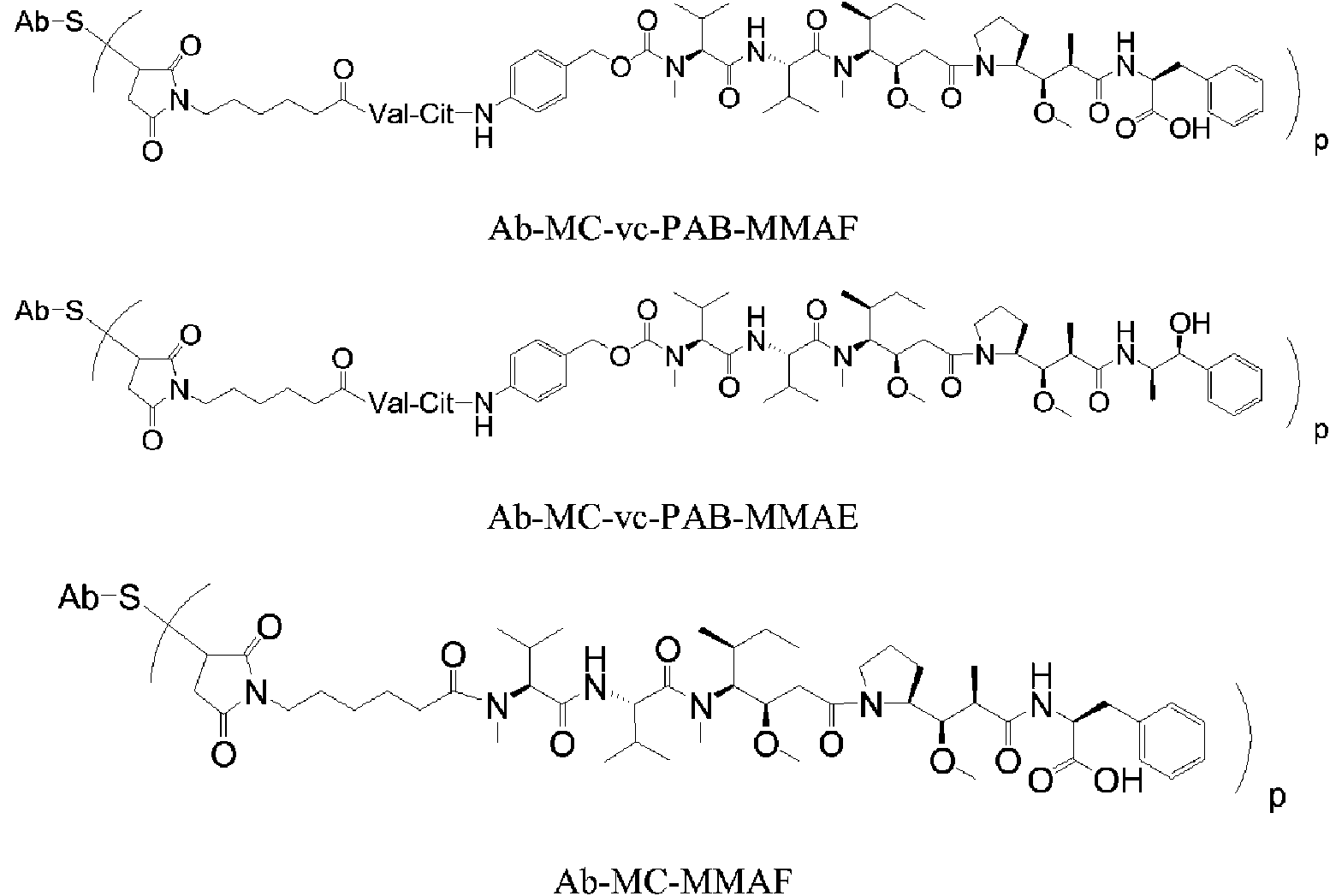
Típicamente, las fracciones de fármaco basadas en péptidos se pueden preparar formando un enlace peptídico entre dos o más aminoácidos y/o fragmentos peptídicos. Dichos enlaces peptídicos se pueden preparar, por ejemplo, de acuerdo con el método de síntesis en fase líquida (véase E. Schroder y K. Lübke, "The Peptides", volumen 1, páginas 76-136, 1965, Academic Press) que es bien conocido en el campo de la química de péptidos. Los restos de fármaco auristatina/dolastatina se pueden preparar de acuerdo con los métodos de: la patente de EE.UU. No. 5.635.483; Pat. de EE.UU. No. 5.780.588; Pettit et al. (1989) J. Am. Chem. Soc. 111:5463-5465; Pettit et al (1998) Anti-Cancer Drug Design 13: 243 - 277; Pettit, G.R., et al. Synthesis, 1996, 719 - 725; Pettit et al. (1996) J. Chem. Soc. Perkin Trans. 15: 859-863; y Doronina (2003) Nat Biotechnol 21 (7): 778-784.Typically, peptide-based drug moieties can be prepared by forming a peptide bond between two or more amino acids and / or peptide fragments. Such peptide bonds can be prepared, for example, according to the liquid phase synthesis method (see E. Schroder and K. Lübke, "The Peptides", volume 1, pages 76-136, 1965, Academic Press) which is well known in the field of peptide chemistry. Auristatin / dolastatin drug moieties can be prepared according to the methods of: US Patent No. 5,635,483; Pat. U.S. No. 5,780,588; Pettit et al. (1989) J. Am. Chem. Soc. 111: 5463-5465; Pettit et al (1998) Anti-Cancer Drug Design 13: 243-277; Pettit, G.R., et al. Synthesis, 1996, 719-725; Pettit et al. (1996) J. Chem. Soc. Perkin Trans. 15: 859-863; and Doronina (2003) Nat Biotechnol 21 (7): 778-784.
III (C). CaliqueamicinaIII (C). Calicheamicin
En otras realizaciones, el CAF comprende un anticuerpo de la invención conjugado con una o más moléculas de caliqueamicina. La familia de antibióticos caliqueamicina es capaz de producir roturas de ADN de doble cadena a concentraciones sub-picomolares. Para la preparación de conjugados de la familia de caliqueamicina, ver la patente de EE.UU. Nos. 5.712.374, 5.714.586, 5.739.116, 5.767.285, 5.770.701, 5.770.710, 5.773.001, 5.877.296 (todas de American Cyanamid Company). Los análogos estructurales de caliqueamicina que se pueden usar incluyen, pero sin limitación, Y11, a2 I, as1, N-acetil-y1I, PSAG y 0I1 (Hinman et al. al., Cancer Research 53: 3336 - 3342 (1993), Lode et al., Cancer Research 58: 2925 - 2928 (1998) y las patentes de EE. UU. antes mencionadas para American Cyanamid). Otro fármaco antitumoral que el anticuerpo puede conjugarse es QFA que es un antifolato. Tanto la caliqueamicina como el QFA tienen sitios de acción intracelulares y no cruzan fácilmente la membrana plasmática. Por lo tanto, la captación celular de estos agentes a través de la internalización mediada por anticuerpos aumenta en gran medida sus efectos citotóxicos.In other embodiments, the CAF comprises an antibody of the invention conjugated to one or more calicheamicin molecules. The calicheamicin family of antibiotics is capable of producing double-stranded DNA breaks at sub-picomolar concentrations. For the preparation of conjugates of the calicheamicin family, see US Patent Nos. 5,712,374, 5,714,586, 5,739,116, 5,767,285, 5,770,701, 5,770,710, 5,773,001, 5,877 .296 (all from American Cyanamid Company). Calicheamicin structural analogs that can be used include, but are not limited to, Y 1 1, a 2 I, as1, N-acetyl- y 1 I, PSAG, and 0I1 (Hinman et al., Cancer Research 53: 3336- 3342 (1993), Lode et al., Cancer Research 58: 2925-2928 (1998) and the aforementioned US patents for American Cyanamid). Another antitumor drug that the antibody can be conjugated to is QFA which is an antifolate. Calicheamicin and QFA both have intracellular sites of action and do not readily cross the plasma membrane. Therefore, the cellular uptake of these agents through antibody-mediated internalization greatly enhances their cytotoxic effects.
III (D). Otros agentes citotóxicosIII (D). Other cytotoxic agents
Otros agentes antitumorales que pueden conjugarse con los anticuerpos de la invención incluyen BCNU, estreptozoicina, vincristina y 5-fluorouracilo, la familia de agentes conocidos colectivamente como complejo LL-E33288 descrito en la patente de EE.UU. Nos. 5.053.394, 5.770.710, así como esperamicinas (Patente de Estados Unidos N25.877.296).Other antitumor agents that can be conjugated to the antibodies of the invention include BCNU, streptozoicin, vincristine, and 5-fluorouracil, the family of agents collectively known as the LL-E33288 complex described in US Patent Nos. 5,053,394, 5,770 .710, as well as esperamycins (US Patent No. 25,877,296).
Las toxinas enzimáticamente activas y fragmentos de las mismas que se pueden usar incluyen cadena diftérica A, fragmentos activos no enlazantes de toxina diftérica, cadena exotoxina A (de Pseudomonas aeruginosa), cadena A de ricina, cadena A de abrina, cadena A de modeccina, alfa-sarcina, proteínas Aleurites fordii, proteínas diantininas, proteínas Phytolaca americana (PAPI, PAPII y PAP-S), inhibidor de Momordica charantia, curcina, crotina, inhibidor de sapaonaria officinalis, gelonina, mitogenina, restrictocina, fenomicina, enomicina y tricotecenos. Véase, por ejemplo, el documento WO 93/21232 publicado el 28 de octubre de 1993.Enzymatically active toxins and fragments thereof that can be used include diphtheria A chain, non-binding active fragments of diphtheria toxin, exotoxin A chain (from Pseudomonas aeruginosa), ricin A chain, abrin A chain, modeccin A chain, alpha-sarcin, Aleurites fordii proteins, diantinin proteins, Phytolaca americana proteins (PAPI, PAPII and PAP-S), Momordica charantia inhibitor, curcin, crotin, sapaonaria officinalis inhibitor, gelonin, mitogenin, restrictocin, phenomycin, enomycin and trichothecenes. See, for example, WO 93/21232 published October 28, 1993.
La presente invención además contempla un CAF formado entre un anticuerpo y un compuesto con actividad nucleolítica (por ejemplo, una ribonucleasa o una ADN endonucleasa tal como una desoxirribonucleasa, DNasa). The present invention further contemplates a CAF formed between an antibody and a compound with nucleolytic activity (eg, a ribonuclease or a DNA endonuclease such as a deoxyribonuclease, DNase).
Para la destrucción selectiva del tumor, el anticuerpo puede comprender un átomo altamente radiactivo. Una variedad de isótopos radiactivos están disponibles para la producción de anticuerpos radioconjugados. Los ejemplos incluyen At211, I131, I125, Y90, Re186, Re188, Sm153, Bi212, P32, Pb212 e isótopos radiactivos de Lu. Cuando el conjugado se usa para la detección, puede comprender un átomo radiactivo para estudios gammagráficos, por ejemplo, tc99m o I123, o un marcador de espín para la resonancia magnética nuclear (RMN) (también conocida como resonancia magnética (IRM), tal como yodo-123 de nuevo, yodo-131, indio-111, flúor-19, carbono-13, nitrógeno-15, oxígeno-17, gadolinio, manganeso o hierro.For the selective destruction of the tumor, the antibody can comprise a highly radioactive atom. A variety of radioactive isotopes are available for the production of radioconjugated antibodies. Examples include At211, I131, I125, Y90, Re186, Re188, Sm153, Bi212, P32, Pb212, and radioactive isotopes of Lu. When the conjugate is used for detection, it may comprise a radioactive atom for scintigraphic studies, for example tc99m or 123 I, or a spin marker for nuclear magnetic resonance (NMR) (also known as magnetic resonance imaging (MRI), such as iodine-123 again, iodine-131, indium-111, fluorine-19, carbon-13, nitrogen-15, oxygen-17, gadolinium, manganese or iron.
Los radiomarcadores u otras se pueden incorporar en el conjugado de formas conocidas. Por ejemplo, el péptido puede biosintetizarse o puede sintetizarse mediante síntesis química de aminoácidos usando precursores de aminoácidos adecuados que implican, por ejemplo, flúor-19 en lugar de hidrógeno. Se pueden unir marcadores como tc99m o I123, Re186, Re188 e In111 a través de un residuo de cisteína en el péptido. El itrio-90 se puede unir a través de un residuo de lisina. El método IODOGEN (Fraker et al (1978) Biochem. Biophys. Res. Commun 80: 49-57 se puede usar para incorporar yodo-123. "Monoclonal Antibodies in Immunoscintigraphy" (Chatal, CRC Press 1989) describe otros métodos en detalle.Radiolabellers or others can be incorporated into the conjugate in known ways. For example, the peptide can be biosynthesized or it can be synthesized by chemical amino acid synthesis using suitable amino acid precursors involving, for example, fluorine-19 in place of hydrogen. Markers such as tc99m or 123I, Re186, Re188, and In111 can be attached through a cysteine residue in the peptide. Yttrium-90 can be attached through a lysine residue. The IODOGEN method (Fraker et al (1978) Biochem. Biophys. Res. Commun 80: 49-57 can be used to incorporate iodine-123. "Monoclonal Antibodies in Immunoscintigraphy" (Chatal, CRC Press 1989) describes other methods in detail.
IV.) Compuestos conjugados de anticuerpo y fármaco que se unen a 191P4D12IV.) Antibody-drug conjugated compounds that bind 191P4D12
La presente invención proporciona, entre otros, compuestos conjugados de anticuerpo y fármaco para la administración dirigida de fármacos. Los inventores han descubierto que los compuestos conjugados de anticuerpo y fármaco tienen una potente actividad citotóxica y/o citostática contra las células que expresan 191P4D12. Los compuestos conjugados de anticuerpo y fármaco comprenden una unidad de anticuerpo unida covalentemente a al menos una unidad de fármaco. Las unidades farmacéuticas se pueden unir covalentemente directamente o a través de una unidad enlazante (LU).The present invention provides, inter alia, antibody-drug conjugates for targeted drug delivery. The inventors have discovered that the antibody-drug conjugates have potent cytotoxic and / or cytostatic activity against cells expressing 191P4D12. Antibody-drug conjugated compounds comprise an antibody unit covalently linked to at least one drug unit. Pharmaceutical units can be covalently linked directly or through a linker unit (LU).
En algunas realizaciones, el compuesto conjugado de anticuerpo y fármaco tiene la siguiente fórmula:In some embodiments, the antibody-drug conjugate has the following formula:
L-(LU-D)p (I)L- (LU-D) p (I)
o una sal o solvato farmacéuticamente aceptable del mismo; donde:or a pharmaceutically acceptable salt or solvate thereof; where:
L es la unidad de anticuerpo, por ejemplo, MAb 191P4D12 de la presente invención, yL is the antibody unit, for example MAb 191P4D12 of the present invention, and
(LU-D) es un resto de una unidad enlazante-unidad de fármaco, en donde:(LU-D) is a residue of a binding unit-drug unit, where:
LU- es una unidad enlazante, yLU- is a binding unit, and
-D es una unidad de fármaco que tiene actividad citostática o citotóxica contra una célula diana; y p es un número entero de 1 a 20.-D is a drug unit having cytostatic or cytotoxic activity against a target cell; and p is an integer from 1 to 20.
En algunas realizaciones, p varía de 1 a 10, de 1 a 9, de 1 a 8, de 1 a 7, de 1 a 6, de 1 a 5, de 1 a 4, de 1 a 3 o de 1 a 2. En algunas realizaciones, p varía de 2 a 10, de 2 a 9, de 2 a 8, de 2 a 7, de 2 a 6, de 2 a 5, de 2 a 4 o de 2 a 3. En otras realizaciones, p es 1, 2, 3, 4, 5 ó 6. En algunas realizaciones, p es 2 ó 4.In some embodiments, p ranges from 1 to 10, 1 to 9, 1 to 8, 1 to 7, 1 to 6, 1 to 5, 1 to 4, 1 to 3, or 1 to 2. In some embodiments, p ranges from 2 to 10, 2 to 9, 2 to 8, 2 to 7, 2 to 6, 2 to 5, 2 to 4, or 2 to 3. In other embodiments , p is 1, 2, 3, 4, 5, or 6. In some embodiments, p is 2 or 4.
En algunas realizaciones, el compuesto conjugado de anticuerpo y fármaco tiene la siguiente fórmula:In some embodiments, the antibody-drug conjugate has the following formula:
L-(Aa-Ww-Yy-D)p (II)L- (Aa-Ww-Yy-D) p (II)
o una sal o solvato farmacéuticamente aceptable del mismo, en donde:or a pharmaceutically acceptable salt or solvate thereof, wherein:
L es la unidad de anticuerpo, por ejemplo, MAb 191P4D12; yL is the antibody unit, eg MAb 191P4D12; and
-Aa-Ww-Yy- es una unidad de Enlazador (LU), en la que:-Aa-Ww-Yy- is a Linker unit (LU), in which:
-A- es una unidad ensanchadora,-A- is a stretcher unit,
a es 0 ó 1,a is 0 or 1,
cada -W- es independientemente una unidad de aminoácido,each -W- is independently an amino acid unit,
w es un número entero que va desde 0 a 12,w is an integer ranging from 0 to 12,
-Y- es una unidad espaciadora autoinmolable,-Y- is a self-immovable spacer unit,
y es 0, 1 ó 2;y is 0, 1 or 2;
-D es una unidad farmacéutica que tiene actividad citostática o citotóxica contra la célula diana; y-D is a pharmaceutical unit having cytostatic or cytotoxic activity against the target cell; and
p es un número entero de 1 a 20. p is an integer from 1 to 20.
En algunas realizaciones, a es 0 ó 1, w es 0 ó 1, e y es 0, 1 ó 2. En algunas realizaciones, a es 0 ó 1, w es 0 ó 1, e y es 0 ó 1. En algunas realizaciones, p varía de 1 a 10, 1 a 9, 1 a 8, 1 a 7, 1 a 6, 1 a 5, 1 a 4, 1 a 3 ó 1 a 2. En algunas realizaciones, p varía de 2 a 8, de 2 a 7, de 2 a 6, de 2 a 5, de 2 a 4 o de 2 a 3. En otras realizaciones, p es 1, 2, 3, 4, 5 ó 6. En algunas realizaciones, p es 2 ó 4. En algunas realizaciones, cuando w no es cero, y es 1 ó 2. En algunas realizaciones, cuando w es 1 a 12, y es 1 ó 2. En algunas realizaciones, w es de 2 a 12 e y es 1 ó 2. En algunas realizaciones, a es 1 y w e y son 0.In some embodiments, a is 0 or 1, w is 0 or 1, and y is 0, 1, or 2. In some embodiments, a is 0 or 1, w is 0 or 1, and y is 0 or 1. In some embodiments, p ranges from 1 to 10, 1 to 9, 1 to 8, 1 to 7, 1 to 6, 1 to 5, 1 to 4, 1 to 3, or 1 to 2. In some embodiments, p ranges from 2 to 8, 2 to 7, 2 to 6, 2 to 5, 2 to 4, or 2 to 3. In other embodiments, p is 1, 2, 3, 4, 5, or 6. In some embodiments, p is 2 or 4. In some embodiments, when w is not zero, y is 1 or 2. In some embodiments, when w is 1 to 12, y is 1 or 2. In some embodiments, w is 2 to 12 and y is 1 or 2. In some embodiments, a is 1 and wey are 0.
Para las composiciones que comprenden una pluralidad de anticuerpos, la carga farmacéutica está representada por p, el número promedio de moléculas de fármaco por anticuerpo. La carga farmacéutica puede variar de 1 a 20 medicamentos (D) por anticuerpo. El número promedio de fármacos por anticuerpo en la preparación de reacciones de conjugación se puede caracterizar por medios convencionales tales como espectroscopia de masas, ensayo ELISA y HPLC. La distribución cuantitativa de conjugados de anticuerpo y fármaco en términos de p también puede determinarse. En algunos casos, la separación, purificación y caracterización de conjugados de anticuerpo-fármaco homogéneos donde p es un cierto valor de conjugados de anticuerpo-fármaco con otras cargas farmacéuticas se puede lograr por medios tales como HPLC de fase inversa o electroforesis. En realizaciones ejemplares, p es de 2 a 8.For compositions comprising a plurality of antibodies, the pharmaceutical loading is represented by p, the average number of drug molecules per antibody. The pharmaceutical load can vary from 1 to 20 drugs (D) per antibody. The average number of drugs per antibody in the preparation of conjugation reactions can be characterized by conventional means such as mass spectroscopy, ELISA, and HPLC. The quantitative distribution of antibody-drug conjugates in terms of p can also be determined. In some cases, the separation, purification and characterization of homogeneous antibody-drug conjugates where p is a certain value of antibody-drug conjugates with other pharmaceutical fillers can be accomplished by means such as reverse phase HPLC or electrophoresis. In exemplary embodiments, p is 2 to 8.
La generación de compuestos conjugados de anticuerpo y fármaco se puede llevar a cabo mediante cualquier técnica conocida por los expertos en la técnica. Brevemente, los compuestos conjugados de anticuerpo y fármaco comprenden MAb de 191P4D12 como la unidad de anticuerpo, un fármaco y, opcionalmente, un enlazante que se une al fármaco y al agente de unión. En una realización preferida, el anticuerpo es MAb 191P4D12 que comprende regiones variables de cadena pesada y ligera del anticuerpo designado como Ha22-2(2,4)6.1 descrito anteriormente. En una realización más preferida, el anticuerpo es 191P4D12 MAb que comprende la cadena pesada y ligera de un anticuerpo designado Ha22-2(2,4)6.1 descrito anteriormente. Están disponibles varias reacciones diferentes para la unión covalente de fármacos y/o enlazantes a agentes de unión. Esto se logra a menudo por la reacción de los residuos de aminoácidos del agente de unión, por ejemplo, una molécula de anticuerpo, que incluye los grupos amina de lisina, los grupos ácidos carboxílicos libres de ácido glutámico y aspártico, los grupos sulfhidrilo de cisteína y los diversos restos de los aminoácidos aromáticos. Uno de los métodos no específicos más comúnmente utilizados de unión covalente es la reacción de carbodiimida para unir un grupo carboxi (o amino) de un compuesto a grupos amino (o carboxi) del anticuerpo. Adicionalmente, se han usado agentes bifuncionales tales como dialdehídos o imidoésteres para unir el grupo amino de un compuesto a grupos amino de una molécula de anticuerpo. También está disponible para la unión de fármacos a agentes de unión la reacción de base de Schiff. Este método implica la oxidación con peryodato de un fármaco que contiene grupos glicol o hidroxi, formando así un aldehído que luego reacciona con el agente de unión. La unión se produce mediante la formación de una base de Schiff con grupos amino del agente de unión. Los isotiocianatos también se pueden usar como agentes de acoplamiento para unir covalentemente fármacos a agentes aglutinantes. Los expertos en la técnica conocen otras técnicas y están dentro del alcance de la presente invención.Generation of antibody-drug conjugates can be accomplished by any technique known to those of skill in the art. Briefly, antibody-drug conjugates comprise 191P4D12 MAbs as the antibody unit, a drug, and optionally a linker that binds the drug and the binding agent. In a preferred embodiment, the antibody is MAb 191P4D12 comprising heavy and light chain variable regions of the antibody designated as Ha22-2 (2,4) 6.1 described above. In a more preferred embodiment, the antibody is 191P4D12 MAb comprising the heavy and light chain of an antibody designated Ha22-2 (2,4) 6.1 described above. Several different reactions are available for the covalent attachment of drugs and / or binders to binding agents. This is often accomplished by the reaction of the amino acid residues of the binding agent, for example an antibody molecule, which includes the amine groups of lysine, the free carboxylic acid groups of glutamic and aspartic acid, the sulfhydryl groups of cysteine and the various residues of the aromatic amino acids. One of the most commonly used non-specific methods of covalent attachment is the carbodiimide reaction to attach a carboxy (or amino) group of a compound to amino (or carboxy) groups of the antibody. Additionally, bifunctional agents such as dialdehydes or imidoesters have been used to link the amino group of a compound to amino groups of an antibody molecule. The Schiff base reaction is also available for the binding of drugs to binders. This method involves periodate oxidation of a drug containing glycol or hydroxy groups, thus forming an aldehyde which then reacts with the binding agent. The binding occurs by the formation of a Schiff's base with amino groups of the binding agent. Isothiocyanates can also be used as coupling agents to covalently link drugs to binding agents. Other techniques are known to those skilled in the art and are within the scope of the present invention.
En ciertas realizaciones, un intermedio, que es el precursor del enlazante, se hace reaccionar con el fármaco en condiciones apropiadas. En ciertas realizaciones, se usan grupos reactivos en el fármaco y/o el intermedio. El producto de la reacción entre el fármaco y el intermedio, o el fármaco derivatizado, se hace reaccionar subsiguientemente con el MAb 191P4D12 en condiciones apropiadas.In certain embodiments, an intermediate, which is the binder precursor, is reacted with the drug under appropriate conditions. In certain embodiments, reactive groups are used on the drug and / or the intermediate. The product of the reaction between the drug and the intermediate, or the derivatized drug, is subsequently reacted with MAb 191P4D12 under appropriate conditions.
Cada una de las unidades particulares de los compuestos conjugados de anticuerpo y fármaco se describe con más detalle en el presente documento. La síntesis y estructura de las unidades de enlazante ejemplares, unidades del ensanchador, unidades de aminoácidos, unidad espaciadora autoinmolable y unidades farmacéuticas también se describen en las Publicaciones de Solicitud de Patente de los Estados Unidos Nos. 2003-0083263, 2005-0238649 y 2005-0009751, cada una de las cuales se incorpora a la presente memoria por referencia en su totalidad y para todos los fines.Each of the particular units of the antibody-drug conjugates is described in more detail herein. The synthesis and structure of exemplary linker units, spreader units, amino acid units, self-immolatable spacer unit, and pharmaceutical units are also described in US Patent Application Publication Nos. 2003-0083263, 2005-0238649 and 2005 -0009751, each of which is incorporated herein by reference in its entirety and for all purposes.
V.) Unidades de enlaceV.) Link units
Típicamente, los compuestos conjugados de anticuerpo-fármaco comprenden una unidad enlazante entre la unidad farmacéutica y la unidad de anticuerpo. En algunas realizaciones, el enlazante es escindible en condiciones intracelulares, de modo que la escisión del enlazante libera la unidad farmacéutica del anticuerpo en el entorno intracelular. En otras realizaciones más, la unidad enlazante no es escindible y el fármaco se libera, por ejemplo, por degradación del anticuerpo.Typically, antibody-drug conjugates comprise a binding unit between the pharmaceutical unit and the antibody unit. In some embodiments, the linker is cleavable under intracellular conditions, such that cleavage of the linker releases the antibody drug unit into the intracellular environment. In still other embodiments, the binding unit is not cleavable and the drug is released, for example, by degradation of the antibody.
En algunas realizaciones, el enlazante es escindible por un agente de escisión que está presente en el entorno intracelular (por ejemplo, dentro de un lisosoma o endosoma o caveolea). El enlazante puede ser, por ejemplo, un enlazante peptidilo que se escinde mediante una peptidasa o enzima de proteasa intracelular, que incluye, pero sin limitación, una proteasa lisosómica o endosómica. En algunas realizaciones, el enlazante de peptidilo tiene al menos dos aminoácidos de longitud o al menos tres aminoácidos de longitud. Los agentes de escisión pueden incluir catepsinas B y D y plasmina, todas las cuales se sabe que hidrolizan derivados de fármacos dipeptídicos dando como resultado la liberación del fármaco activo dentro de las células diana (véase, por ejemplo, Dubowchik y Walker, 1999, Pharm. Therapeutics 83: 67 - 123). Los más típicos son los enlazantes de peptidilo que son escindibles por las enzimas que están presentes en las células que expresan 191P4D12. Por ejemplo, se puede usar un enlazante de peptidilo escindible por la proteasa dependiente de tiol catepsina B, que está altamente expresada en tejido canceroso (p. ej., Un enlazante Phe-Leu o Gly-Phe-Leu-Gly (SEQ ID NO: 9)). Se describen otros ejemplos de dichos enlazantes, por ejemplo, en la patente de EE.UU. No. 6.214.345. En una realización específica, el enlazante peptídico escindible por una proteasa intracelular es un enlazante Val-Cit o un enlazante Phe-Lys (véase, por ejemplo, la Patente de Estados Unidos N° 6.214.345, que describe la síntesis de doxorrubicina con el enlazante Val-Cit). Una ventaja del uso de la liberación proteolítica intracelular del agente terapéutico es que el agente típicamente se atenúa cuando se conjuga y las estabilidades en suero de los conjugados son típicamente altas.In some embodiments, the linker is cleavable by a cleavage agent that is present in the intracellular environment (eg, within a lysosome or endosome or caveole). The linker can be, for example, a peptidyl linker that is cleaved by a peptidase or intracellular protease enzyme, including, but not limited to, an endosomal or lysosomal protease. In some embodiments, the peptidyl linker is at least two amino acids long or at least three amino acids long. Cleavage agents can include cathepsins B and D and plasmin, all of which are known to hydrolyze dipeptide drug derivatives resulting in the release of active drug within target cells (see, for example, Dubowchik and Walker, 1999, Pharm Therapeutics 83: 67-123). Most typical are peptidyl linkers that are cleavable by enzymes that are present in cells that express 191P4D12. For example, you can use a peptidyl linker cleavable by thiol-dependent protease cathepsin B, which is highly expressed in cancer tissue (eg, A Phe-Leu or Gly-Phe-Leu-Gly linker (SEQ ID NO: 9)). Other examples of such binders are described, for example, in US Patent No. 6,214,345. In a specific embodiment, the peptide linker cleavable by an intracellular protease is a Val-Cit linker or a Phe-Lys linker (see, for example, US Patent No. 6,214,345, which describes the synthesis of doxorubicin with the Val-Cit linker). An advantage of using intracellular proteolytic release of the therapeutic agent is that the agent typically attenuates when conjugated and the serum stabilities of the conjugates are typically high.
En otras realizaciones, el enlazante escindible es sensible al pH, es decir, sensible a la hidrólisis a ciertos valores de pH. Típicamente, el enlazante sensible al pH es hidrolizable en condiciones ácidas. Por ejemplo, se puede usar un enlazante lábil en ácido que sea hidrolizable en el lisosoma (por ejemplo, una hidrazona, semicarbazona, tiosemicarbazona, amida cis-aconítica, ortoéster, acetal, cetal o similares). (Véanse, por ejemplo, las patentes de EE.UU. Nos. 5.122.368; 5.824.805; 5.622.929; Dubowchik y Walker, 1999, Pharm. Therapeutics 83: 67 - 123; Neville et al., 1989, Biol. Chem. 264:14653-14661). Tales enlazantes son relativamente estables en condiciones de pH neutro, tales como los que se encuentran en la sangre, pero son inestables por debajo de pH 5,5 ó 5,0, el pH aproximado del lisosoma. En ciertas realizaciones, el enlazante hidrolizable es un enlazante de tioéter (tal como, por ejemplo, un tioéter unido al agente terapéutico a través de un enlace de acilhidrazona (véase, por ejemplo, la Patente de Estados Unidos N° 5.622.929).In other embodiments, the cleavable binder is pH sensitive, that is, sensitive to hydrolysis at certain pH values. Typically, the pH-sensitive binder is hydrolyzable under acidic conditions. For example, an acid-labile binder that is hydrolyzable in the lysosome (eg, a hydrazone, semicarbazone, thiosemicarbazone, cis-aconitic amide, orthoester, acetal, ketal, or the like) can be used. (See, for example, US Patent Nos. 5,122,368; 5,824,805; 5,622,929; Dubowchik and Walker, 1999, Pharm. Therapeutics 83: 67-123; Neville et al., 1989, Biol Chem. 264: 14653-14661). Such binders are relatively stable under neutral pH conditions, such as those found in blood, but are unstable below pH 5.5 or 5.0, the approximate pH of the lysosome. In certain embodiments, the hydrolyzable linker is a thioether linker (such as, for example, a thioether attached to the therapeutic agent through an acylhydrazone linkage (see, for example, US Patent No. 5,622,929).
En otras realizaciones más, el enlazante es escindible en condiciones reductoras (por ejemplo, un enlazante disulfuro). En la técnica se conocen diversos enlaces disulfuro, que incluyen, por ejemplo, aquellos que se pueden formar usando SATA (N-succinimidil-S-acetiltioacetato), SPDP (N-succinimidil-3-(2-piridilditio)propionato), SPDB (N-succinimidil-3-(2-piridilditio)butirato) y SMPT (N-succinimidil-oxicarbonil-alfa-metil-alfa-(2-piridil-ditio)tolueno), SPDB y SMPT. (Véase, por ejemplo, Thorpe et al., 1987, Cancer Res. 47:5924-5931; Wawrzynczak et al., en Immunoconjugates: Antibody Conjugates in Radioimagery and Therapy of Cancer (C. W. Vogel ed., Oxford U. Press, 1987. Ver también la patente de los EE.UU. No. 4.880.935).In still other embodiments, the linker is cleavable under reducing conditions (eg, a disulfide linker). Various disulfide bonds are known in the art, including, for example, those that can be formed using SATA (N-succinimidyl-S-acetylthioacetate), SPDP (N-succinimidyl-3- (2-pyridyldithio) propionate), SPDB ( N-succinimidyl-3- (2-pyridyldithio) butyrate) and SMPT (N-succinimidyl-oxycarbonyl-alpha-methyl-alpha- (2-pyridyl-dithio) toluene), SPDB and SMPT. (See, for example, Thorpe et al., 1987, Cancer Res. 47: 5924-5931; Wawrzynczak et al., In Immunoconjugates: Antibody Conjugates in Radioimagery and Therapy of Cancer (CW Vogel ed., Oxford U. Press, 1987 See also US Patent No. 4,880,935).
En aún otras realizaciones específicas, el enlazante es un enlazante de malonato (Johnson et al., 1995, Anticancer Res. 15: 1387 - 93), un enlazante de maleimidobenzoilo (Lau et al., 1995, Bioorg - Med - Chem. 3 (10): 1299-1304) o un análogo de 3'-N-amida (Lau et al., 1995, Bioorg-Med-Chem. 3(10): 1305-12).In still other specific embodiments, the linker is a malonate linker (Johnson et al., 1995, Anticancer Res. 15: 1387-93), a maleimidobenzoyl linker (Lau et al., 1995, Bioorg-Med-Chem. 3 (10): 1299-1304) or a 3'-N-amide analog (Lau et al., 1995, Bioorg-Med-Chem. 3 (10): 1305-12).
En otras realizaciones más, la unidad enlazante no es escindible y el fármaco se libera por la degradación del anticuerpo. (Véase la Publicación de Estados Unidos N° 2005/0238649).In still other embodiments, the binding unit is not cleavable and the drug is released by degradation of the antibody. (See United States Publication No. 2005/0238649).
Típicamente, el enlazante no es sustancialmente sensible al entorno extracelular. Como se usa en este documento, "no es sustancialmente sensible al entorno extracelular", en el contexto de un enlazante, significa que no más de aproximadamente 20%, típicamente no más de aproximadamente 15%, más típicamente no más de aproximadamente 10%, y aún más típicamente no más de aproximadamente 5%, no más de aproximadamente 3%, o no más de aproximadamente 1% de los enlazantes, en una muestra de compuesto conjugado de anticuerpo y fármaco, se escinden cuando el compuesto conjugado de anticuerpo y fármaco se presenta en un entorno extracelular (por ejemplo, en plasma). Que un enlazante no es sustancialmente sensible al entorno extracelular se puede determinar, por ejemplo, incubando con plasma el compuesto conjugado anticuerpo-fármaco durante un período de tiempo predeterminado (por ejemplo, 2, 4, 8, 16 ó 24 horas) y luego cuantificando la cantidad de fármaco libre presente en el plasma.Typically, the linker is not substantially sensitive to the extracellular environment. As used herein, "not substantially sensitive to the extracellular environment", in the context of a linker, means no more than about 20%, typically no more than about 15%, more typically no more than about 10%, and even more typically no more than about 5%, no more than about 3%, or no more than about 1% of the binders, in a sample of the antibody-drug conjugate, are cleaved when the antibody-drug conjugate It occurs in an extracellular environment (eg, in plasma). That a binder is not substantially sensitive to the extracellular environment can be determined, for example, by incubating the antibody-drug conjugate compound with plasma for a predetermined period of time (eg, 2, 4, 8, 16, or 24 hours) and then quantifying the amount of free drug present in the plasma.
En otras realizaciones no mutuamente excluyentes, el enlazante promueve la internalización celular. En ciertas realizaciones, el enlazante promueve la internalización celular cuando se conjuga con el agente terapéutico (es decir, en el medio del resto enlazante-agente terapéutico del compuesto conjugado anticuerpo-fármaco como se describe en este documento). En otras realizaciones más, el enlazante promueve la internalización celular cuando se conjuga tanto con el compuesto de auristatina como con el MAb 191P4D12.In other non-mutually exclusive embodiments, the linker promotes cell internalization. In certain embodiments, the linker promotes cellular internalization when conjugated to the therapeutic agent (ie, in the middle of the linker-therapeutic agent moiety of the antibody-drug conjugate compound as described herein). In still other embodiments, the linker promotes cellular internalization when conjugated to both the auristatin compound and MAb 191P4D12.
Se describen diversos enlazantes ejemplares que se pueden usar con las presentes composiciones y métodos en los documentos WO 2004-010957, publicación estadounidense n.° 2006/0074008, publicación estadounidense n.° 20050238649 y publicación estadounidense n.° 2006/0024317.Various exemplary binders that can be used with the present compositions and methods are described in WO 2004-010957, US Publication No. 2006/0074008, US Publication No. 20050238649, and US Publication No. 2006/0024317.
Una "unidad de enlazante" (LU) es un compuesto bifuncional que se puede usar para unir una unidad farmacéutica y una unidad de anticuerpo para formar un compuesto conjugado de anticuerpo y fármaco. En algunas realizaciones, la unidad de enlazante tiene la fórmula:A "linker unit" (LU) is a bifunctional compound that can be used to join a pharmaceutical unit and an antibody unit to form an antibody-drug conjugate compound. In some embodiments, the binder unit has the formula:
-Aa-Ww-Yyen donde: -A- es una unidad ensanchadora,-Aa-Ww-Yyen where: -A- is a stretcher unit,
a es 0 ó 1,a is 0 or 1,
cada -W- es independientemente una unidad de aminoácido, each -W- is independently an amino acid unit,
w es un número entero que va de 0 a 12,w is an integer ranging from 0 to 12,
-Y- es una unidad espaciadora auto-inmoladora, e-Y- is a self-immolating spacer unit, and
y es 0, 1 ó 2.y is 0, 1, or 2.
En algunas realizaciones, a es 0 ó 1, w es 0 ó 1, e y es 0, 1 ó 2. En algunas realizaciones, a es 0 ó 1, w es 0 ó 1, e y es 0 ó 1. En algunas realizaciones, cuando w es de 1 a 12, y es 1 ó 2. En algunas realizaciones, w es de 2 a 12 e y es 1 ó 2. En algunas realizaciones, a es 1 y w e y son 0.In some embodiments, a is 0 or 1, w is 0 or 1, and y is 0, 1, or 2. In some embodiments, a is 0 or 1, w is 0 or 1, and y is 0 or 1. In some embodiments, when w is 1 to 12, y is 1 or 2. In some embodiments, w is 2 to 12 and y is 1 or 2. In some embodiments, a is 1 and we and y are 0.
VI.) La unidad ensanchadoraVI.) The stretcher unit
La unidad ensanchadora (A), cuando está presente, es capaz de unir una unidad de anticuerpo a una unidad de aminoácido (-W-), si está presente, a una unidad espaciadora (-Y-), si está presente; o a una unidad de fármaco ( D). Grupos funcionales útiles que pueden estar presentes en un MAb 191P4D12 (p. ej. Ha22-2(2,4)6.1), ya sea de forma natural o mediante manipulación química, incluyen, pero sin limitación, sulfhidrilo, amino, hidroxilo, el grupo hidroxilo anomérico de un hidrato de carbono y carboxilo. Los grupos funcionales adecuados son sulfhidrilo y amino. En un ejemplo, los grupos sulfhidrilo pueden generarse por reducción de los enlaces disulfuro intramoleculares de un MAb 191P4D12. En otra realización, los grupos sulfhidrilo pueden generarse por la reacción de un grupo amino de un resto de lisina de un MAb 191P4D12 con 2-iminotiolano (reactivo de Traut) u otros reactivos que generan sulfhidrilo. En ciertas realizaciones, el MAb 191P4D12 es un anticuerpo recombinante y está diseñado para transportar una o más lisinas. En ciertas otras realizaciones, el MAb 191P4D12 recombinante se modifica por ingeniería genética para transportar grupos sulfhidrilo adicionales, por ejemplo, cisteínas adicionales.The spreader unit (A), when present, is capable of linking an antibody unit to an amino acid unit (-W-), if present, to a spacer unit (-Y-), if present; or to a drug unit (D). Useful functional groups that may be present on a MAb 191P4D12 (e.g. Ha22-2 (2,4) 6.1), either naturally or by chemical manipulation, include, but are not limited to, sulfhydryl, amino, hydroxyl, the anomeric hydroxyl group of a carbohydrate and carboxyl. Suitable functional groups are sulfhydryl and amino. In one example, sulfhydryl groups can be generated by reducing the intramolecular disulfide bonds of a MAb 191P4D12. In another embodiment, sulfhydryl groups can be generated by reacting an amino group of a lysine residue of a MAb 191P4D12 with 2-iminothiolane (Traut's reagent) or other sulfhydryl generating reagents. In certain embodiments, MAb 191P4D12 is a recombinant antibody and is designed to transport one or more lysines. In certain other embodiments, the recombinant MAb 191P4D12 is engineered to carry additional sulfhydryl groups, eg, additional cysteines.
En una realización, la unidad ensanchadora forma un enlace con un átomo de azufre de la unidad de anticuerpo. El átomo de azufre se puede derivar de un grupo sulfhidrilo de un anticuerpo. Las unidades representativas de ensanchador de esta realización se representan dentro de los corchetes de las fórmulas IIIa y 1 Ib, en donde L-, -W-, -Y-, -D, w e y son como se definieron anteriormente, y R17 se selecciona de -alquileno C1-C10-, -alquenileno C1-C10-, -alquinileno C1-C10-, carbociclo-, -O-(alquileno C1-C8)-, O-(alquenileno C1-C8)-, -O-(alquinileno C1-C8)-, arileno, alquileno C1-C10-arileno-, alquenileno C2-C10-arileno, alquinileno C2-C10-arileno, -arileno-alquileno C1-C10-, -arilenoalquenileno C2-C10-, -arileno-alquinileno C2-C10-, -alquileno C1-C10-(carbociclo)-, - alquenileno C2-C10-(carbociclo)-, -alquinileno C2-C10-(carbociclo)-, -(carbociclo)-alquileno C1-C10-, -(carbociclo)-alquenileno C2-C10, -(carbociclo)-alquinileno C2-C10, -heterociclo-, alquilen C1-C10-(heterociclo)-, alquenileno C2-C10-(heterociclo)-, alquinileno C2-C10-(heterociclo)-, -(heterociclo)-alquileno C1-C10-, -(heterociclo)-alquenileno C2-C10-, -(heterociclo)-alquinileno C1-C10-, -(CH2CH2OV- , o -(CH2CH2OV-CH2-, y r es un número entero que varía de 1-10, donde dichos radicales alquilo, alquenilo, alquinilo, alquileno, alquenileno, alquinileno, arilo, carbociclo, carbociclo, heterociclo y arileno, ya sean solos o como parte de otro grupo, están opcionalmente sustituidos. En algunas realizaciones, dichos radicales alquilo, alquenilo, alquinilo, alquileno, alquenileno, alquinileno, arilo, carbociclo, carbociclo, heterociclo y arileno, ya sean solos o como parte de otro grupo, no están sustituidos. En algunas realizaciones, R17 se selecciona de alquileno C1-C10, -carbociclo-, -O-(alquileno C1-C8) -, -arileno-, alquileno C1-C10-arileno-, -arileno-alquileno C1-C10-, alquilen C1-C10 (carbociclo)-, -(carbociclo)-alquileno C1-C10-, heterociclo- C3-C8, alquileno C1-C10-(heterociclo)-, -(heterociclo)-alquileno C1-C10-, -(CH2CH2OV- y -(CH2CH2OV-CH2-; y r es un número entero que varía de 1-10, en el que dichos grupos alquileno no están sustituidos y el resto de los grupos está opcionalmente sustituido.In one embodiment, the spreader unit forms a bond with a sulfur atom of the antibody unit. The sulfur atom can be derived from a sulfhydryl group of an antibody. Representative stretcher units of this embodiment are represented within the brackets of formulas IIIa and 1 Ib, where L-, -W-, -Y-, -D, we, and are as defined above, and R17 is selected from -alkylene C1 - C10 -, C1 - C10 alkenylene -, -alquinileno C1 - C10 -, carbociclo-, -O- (C 1 -C 8 alkylene) -, O- (C 1 alkenylene - C 8 ) -, -O- (C 1 -C 8 alkynylene) -, arylene, C 1 -C 10 -arylene- alkylene, C 2 -C 10 -arylene alkenylene, C 2 -C 10 -arylene alkynylene, -arylene -C 1 -C 10 alkylene -, -arylene C 2 -C 10 alkenylene -, -arylene-C 2 -C 10 alkynylene -, -C 1 -C 10 alkylene - (carbocycle) -, - C 2 -C 10 alkenylene - (carbocycle) -, -C 2 -C 10 alkynylene - (carbocycle) -, - (carbocycle) -C 1 -C 10 alkylene -, - (carbocycle) -C 2 -C 10 alkenylene, - (carbocycle) -alkynylene C 2 -C 10 , -heterocycle-, C 1 -C 10 alkylene - (heterocycle) -, C 2 -C 10 alkenylene - (heterocycle) -, C 2 -C 10 alkynylene - (heterocycle) -, - (heterocycle) - C 1 -C 10 alkylene -, - (he terocycle) -C 2 -C 10 alkenylene -, - (heterocycle) -C 1 -C 10 alkynylene -, - (CH 2 CH 2 OV-, or - (CH 2 CH 2 OV-CH 2 -, and r is a number An integer ranging from 1-10, wherein said alkyl, alkenyl, alkynyl, alkylene, alkenylene, alkynylene, aryl, carbocycle, carbocycle, heterocycle and arylene radicals, either alone or as part of another group, are optionally substituted. In some embodiments, said alkyl, alkenyl, alkynyl, alkylene, alkenylene, alkynylene, aryl, carbocycle, carbocycle, heterocycle, and arylene radicals, either alone or as part of another group, are unsubstituted. In some embodiments, R17 is selected from C 1 -C 10 alkylene, -carbocycle-, -O- (C 1 -C 8 alkylene) -, -arylene-, C 1 -C 10 alkylene-arylene-, -arylene-alkylene C 1 -C 10 -, C 1 -C 10 alkylene (carbocycle) -, - (carbocycle) -C 1 -C 10 alkylene -, heterocycle- C 3 -C 8 , C 1 -C 10 alkylene - (heterocycle) - , - (heterocycle) -C 1 -C 10 -alkylene -, - (CH 2 CH 2 OV- and - (CH 2 CH 2 OV-CH 2 -; and r is an integer ranging from 1-10, where said alkylene groups are unsubstituted and the rest of the groups are optionally substituted.
Debe entenderse a partir de todas las realizaciones ejemplares que incluso cuando no se indique expresamente, se pueden unir 1 a 20 restos de fármaco a un anticuerpo (p = 1-20).It should be understood from all exemplary embodiments that even when not expressly stated, 1 to 20 drug moieties can be linked to an antibody (p = 1-20).
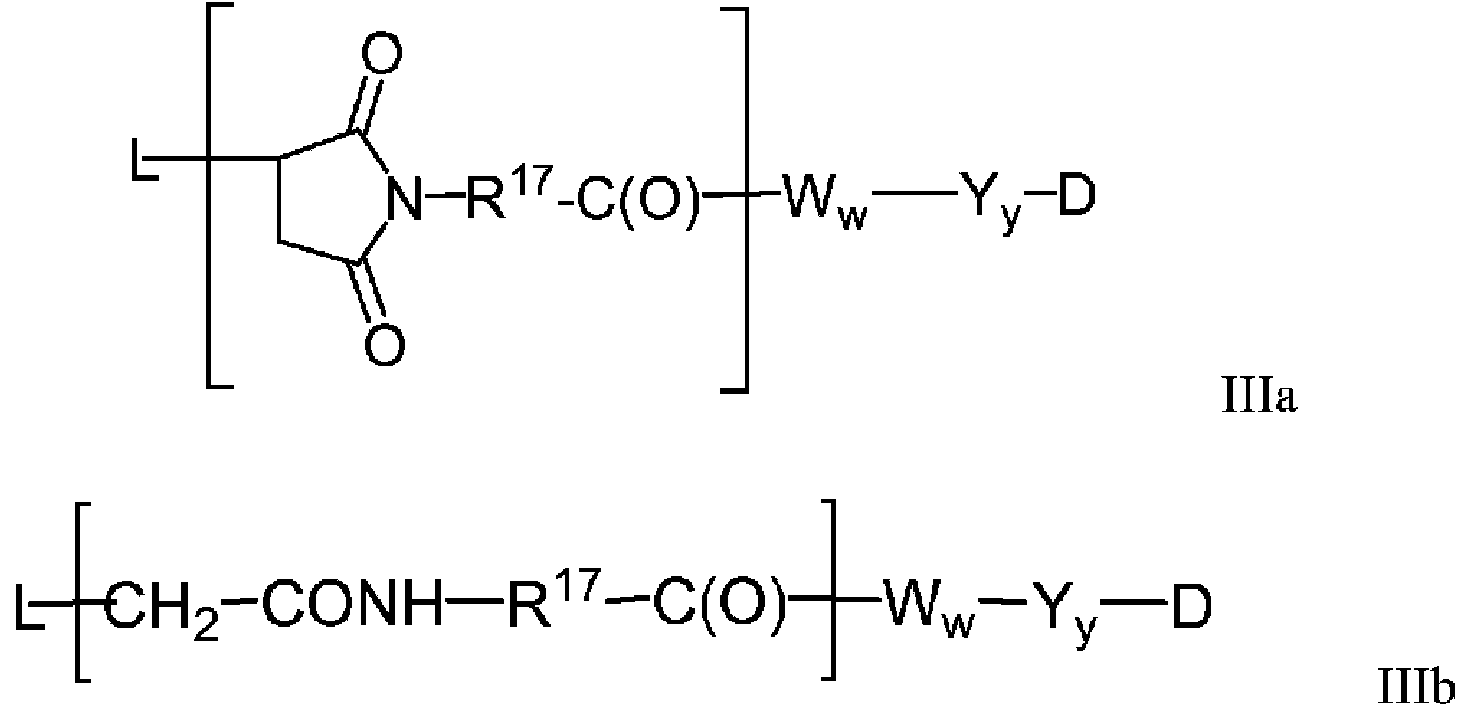
Una unidad de ensanchamiento ilustrativa es la de la Fórmula IIIa en la que R17 es -(CH2)5-: An illustrative spreading unit is that of Formula IIIa where R17 is - (CH2) 5-:
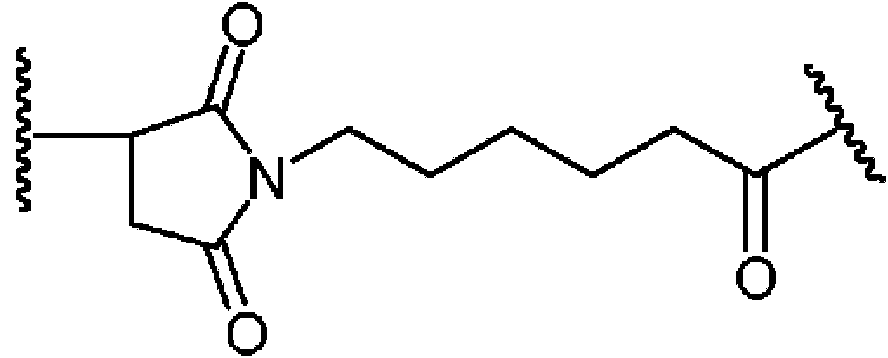
Otra unidad de Ensanchamiento ilustrativa es la de la Fórmula Illa en la que R15 *7 *20es -(CH2CH2O)r-CH2-; y r es 2:Another illustrative Spread unit is that of Formula Illa wherein R15 * 7 * 20 is - (CH 2 CH 2 O) r-CH 2 -; and r is 2:
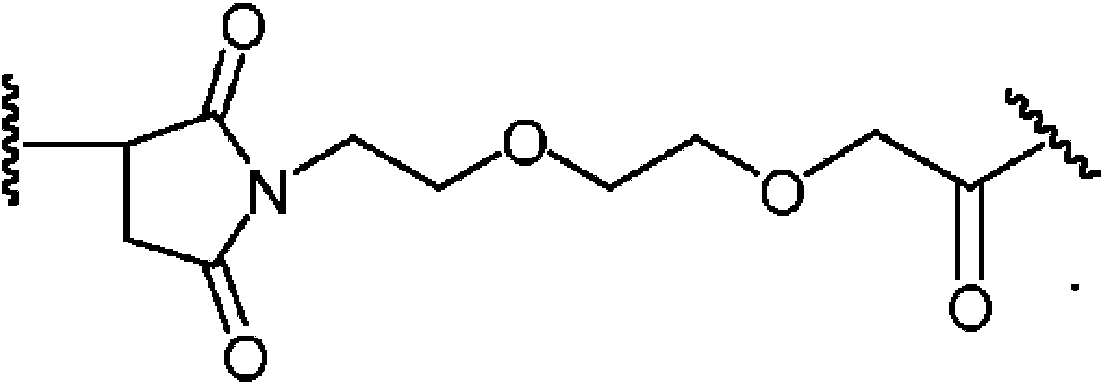
Una unidad de ensanchamiento ilustrativa es la de la Fórmula IIIa en donde R17 es arileno o arileno-alquileno C1-C10-. En algunas realizaciones, el grupo arilo es un grupo fenilo no sustituido.An illustrative broadening unit is that of Formula IIIa where R17 is arylene or arylene-C 1 -C 10 - alkylene. In some embodiments, the aryl group is an unsubstituted phenyl group.
Todavía otra unidad de ensanchamiento ilustrativa es la de la Fórmula 1 Ib en la que R17 es -(CH2)5-:Still another illustrative broadening unit is that of Formula 1 Ib where R17 is - (CH2) 5-:

En ciertas realizaciones, la unidad ensanchadora está unida a la unidad de anticuerpo a través de un enlace disulfuro entre un átomo de azufre de la unidad de anticuerpo y un átomo de azufre de la unidad ensanchadora. Una unidad ensanchadora representativa de esta realización se representa dentro de los corchetes de Fórmula IV, en donde R17, L-, -W-, -Y-, -D, w e y son como se han definido anteriormente.In certain embodiments, the spreader unit is attached to the antibody unit through a disulfide bond between a sulfur atom of the antibody unit and a sulfur atom of the spreader unit. A representative spreader unit of this embodiment is depicted within the brackets of Formula IV, where R17, L-, -W-, -Y-, -D, w and y are as defined above.

Debe observarse que, a lo largo de esta solicitud, el resto S en la fórmula siguiente se refiere a un átomo de azufre de la unidad de anticuerpo, a menos que se indique lo contrario por el contexto.It should be noted that, throughout this application, the S moiety in the following formula refers to a sulfur atom of the antibody unit, unless otherwise indicated by the context.
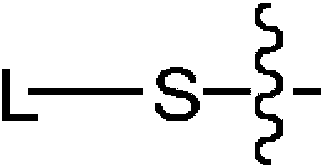
En otras realizaciones más, el ensanchador contiene un sitio reactivo que puede formar un enlace con un grupo amino primario o secundario de un anticuerpo. Los ejemplos de estos sitios reactivos incluyen, pero sin limitación, ésteres activados tales como ésteres de succinimida, ésteres de 4-nitrofenilo, ésteres de pentafluorofenilo, ésteres de tetrafluorofenilo, anhídridos, cloruros de ácido, cloruros de sulfonilo, isocianatos e isotiocianatos. Las unidades ensanchadoras representativas de esta realización se representan dentro de los corchetes de las fórmulas Va y Vb, en las que -R17-, L-, -W-, -Y-, -D, w e y son como se definieron anteriormente; In still other embodiments, the spreader contains a reactive site that can form a bond with a primary or secondary amino group of an antibody. Examples of these reactive sites include, but are not limited to, activated esters such as succinimide esters, 4-nitrophenyl esters, pentafluorophenyl esters, tetrafluorophenyl esters, anhydrides, acid chlorides, sulfonyl chlorides, isocyanates, and isothiocyanates. Representative spreader units of this embodiment are represented within the square brackets of formulas Va and Vb, where -R17-, L-, -W-, -Y-, -D, we, and are as defined above;

En algunas realizaciones, el ensanchador contiene un sitio reactivo que es reactivo con un grupo de carbohidratos modificados (-CHO) que puede estar presente en un anticuerpo. Por ejemplo, un carbohidrato se puede oxidar levemente usando un reactivo como el peryodato de sodio y la unidad resultante (-CHO) del carbohidrato oxidado se puede condensar con un ensanchador que contiene una funcionalidad como hidrazida, una oxima, una amina primaria o secundaria, una hidrazina, una tiosemicarbazona, un hidrazina carboxilato y una arilhidrazida tales como las descritas por Kaneko et al., 1991, Bioconjugate Chem. 2:133-41. Las unidades ensanchadoras representativas de esta realización se representan dentro de los corchetes de las Fórmulas VIa, VIb y VIc, en las que -R17-, L-, -W-, -Y-, -D, w e y se definen como encima.In some embodiments, the stretcher contains a reactive site that is reactive with a group of modified carbohydrates (-CHO) that may be present on an antibody. For example, a carbohydrate can be slightly oxidized using a reagent such as sodium periodate and the resulting unit (-CHO) of the oxidized carbohydrate can be condensed with a scavenger containing a functionality such as hydrazide, an oxime, a primary or secondary amine, a hydrazine, a thiosemicarbazone, a carboxylate hydrazine and an arylhydrazide such as those described by Kaneko et al., 1991, Bioconjugate Chem. 2: 133-41. Representative spreader units of this embodiment are depicted within the square brackets of Formulas VIa, VIb, and VIc, where -R17-, L-, -W-, -Y-, -D, w and are defined as above.

VII.) La unidad de aminoácidosVII.) The amino acid unit
La unidad de aminoácidos (-W-), cuando está presente, vincula la unidad ensanchadora con la unidad espaciadora si la unidad espaciadora está presente, vincula la unidad ensanchadora al resto farmacéutico si la unidad espaciadora está ausente, y vincula la unidad de anticuerpo a la unidad farmacéutica si la unidad ensanchadora y la unidad espaciadora están ausentes.The amino acid unit (-W-), when present, binds the spreader unit to the spacer unit if the spacer unit is present, binds the spreader unit to the pharmaceutical moiety if the spacer unit is absent, and binds the antibody unit to the pharmaceutical unit if the spreader unit and the spacer unit are absent.
Ww- puede ser, por ejemplo, una unidad de monopéptido, dipéptido, tripéptido, tetrapéptido, pentapéptido, hexapéptido, heptapéptido, octapéptido, nonapéptido, decapéptido, undecapéptido o dodecapéptido. Cada unidad -W- tiene independientemente la fórmula indicada a continuación entre corchetes, y w es un número entero que va de 0 a 12: Ww- can be, for example, a monopeptide, dipeptide, tripeptide, tetrapeptide, pentapeptide, hexapeptide, heptapeptide, octapeptide, nonapeptide, decapeptide, undecapeptide or dodecapeptide unit. Each -W- unit independently has the following formula in brackets, and w is an integer ranging from 0 to 12:

donde R19 es hidrógeno, metilo, isopropilo, isobutilo, sec-butilo, bencilo, p-hidroxibencilo, -CH2OH, -CH(OH)CH3, -CH2CH2SCH3 , -CH2CONH2 , -CH2COOH, -CH2CH2CONH2 , -CH2CH2COOH, -(CH2)3NHC(=NH)NH2, -(CH2)3NH2, -(CH2)3NHCOCH3, -(CH2)3NHCHO, -(CH2)4NHC(=NH)NH2, -(CH2)4NH2, -(CH2)4NHCOCH3, (CH2)4NHCHO, -(CH2)3NHCONH2, -(CH2)4NHCONH2, -CH2CH2CH(OH)CH2 NH2 , 2-piridilmetil-, 3-piridilmetil-, 4-piridilmetil-, fenilo, ciclohexilo,where R19 is hydrogen, methyl, isopropyl, isobutyl, sec-butyl, benzyl, p-hydroxybenzyl, -CH 2 OH, -CH (OH) CH3, -CH 2 CH 2 SCH 3 , -CH 2 CONH 2 , -CH 2 COOH, -CH 2 CH 2 CONH 2 , -CH 2 CH 2 COOH, - (CH2) 3NHC (= NH) NH2, - (CH2) 3NH2, - (CH2) 3NHCOCH3, - (CH2) 3NHCHO, - (CH2) 4NHC (= NH) NH2, - (CH2) 4NH2, - (CH2) 4NHCOCH3, (CH2) 4NHCHO, - (CH2) 3NHCONH2, - (CH2) 4NHCONH2, -CH 2 CH 2 CH (OH) CH 2 NH 2 , 2-pyridylmethyl-, 3-pyridylmethyl-, 4-pyridylmethyl-, phenyl, cyclohexyl,
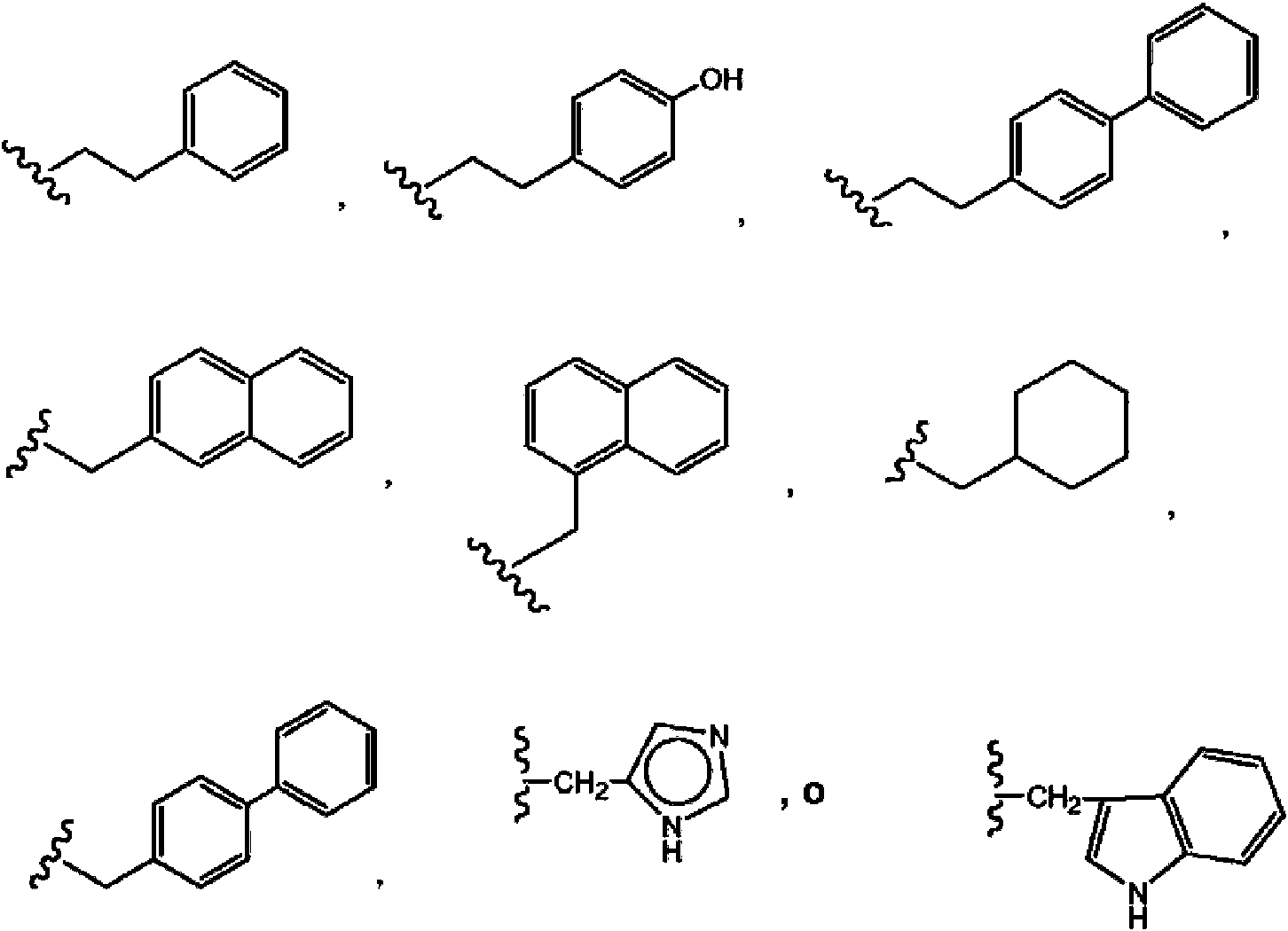
En algunas realizaciones, la unidad de aminoácido puede escindirse enzimáticamente por una o más enzimas, que incluyen una proteasa asociada a un cáncer o a un tumor, para liberar la unidad farmacéutica (-D), que en una realización se protona in vivo después de la liberación para proporcionar un fármaco (D).In some embodiments, the amino acid unit can be enzymatically cleaved by one or more enzymes, including a cancer or tumor associated protease, to release the pharmaceutical unit (-D), which in one embodiment is protonated in vivo after release to provide a drug (D).
En ciertas realizaciones, la unidad de aminoácido puede comprender aminoácidos naturales. En otras realizaciones, la unidad de aminoácido puede comprender aminoácidos no naturales. Las unidades Ww ilustrativas están representadas por las fórmulas (VII) -(IX):In certain embodiments, the amino acid unit can comprise natural amino acids. In other embodiments, the amino acid unit can comprise unnatural amino acids. Illustrative Ww units are represented by formulas (VII) - (IX):
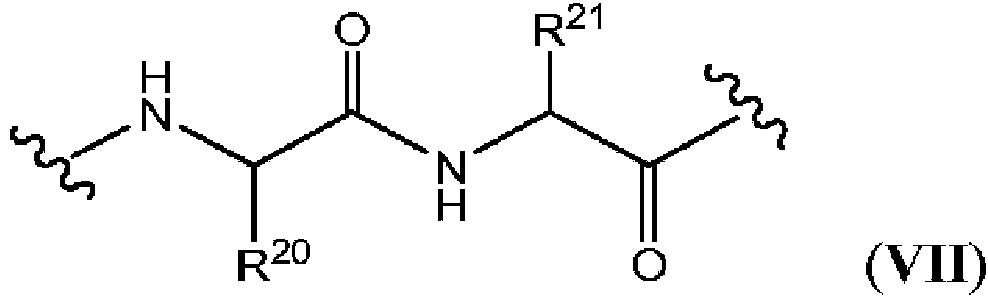
en donde R20 y R21 son
R20 R21R20 R21
Bencilo (CH2)4NH2;Benzyl (CH2) 4NH2;
Metilo (CH2)4NH2;Methyl (CH2) 4NH2;
Isopropilo (CH2)4NH2;Isopropyl (CH2) 4NH2;
Isopropilo (CH2)3NHCONH2;Isopropyl (CH2) 3NHCONH2;
Bencilo (CH2)3NHCONH2;Benzyl (CH2) 3NHCONH2;
Isobutilo (CH2)3NHCONH2;Isobutyl (CH2) 3NHCONH2;
Sec-butilo (CH2)3NHCONH2;Sec-butyl (CH2) 3NHCONH2;
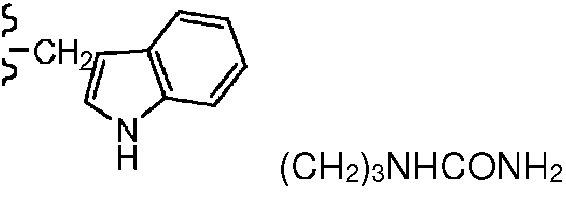
Bencilo Metilo;Benzyl Methyl;
Bencilo (CH2)3NHC(=NH)NH2;Benzyl (CH2) 3NHC (= NH) NH2;
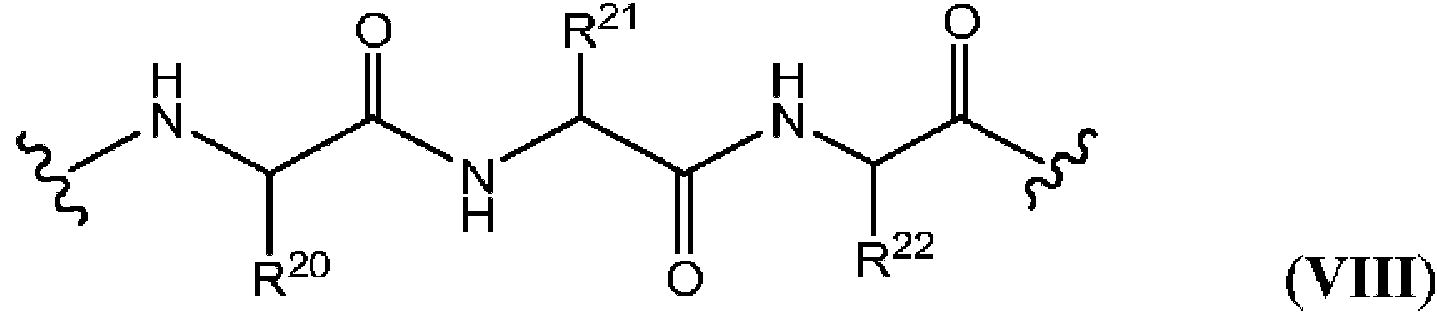
en donde R20, R21 y R22 son los siguientes:where R20, R21 and R22 are as follows:
R20 R21 R22R20 R21 R22
Bencilo Bencilo (CH2)4NH2;Benzyl Benzyl (CH2) 4NH2;
Isopropilo Bencilo (CH2)4NH2; yIsopropyl Benzyl (CH2) 4NH2; and
H Bencilo (CH2)4NH2;H Benzyl (CH2) 4NH2;
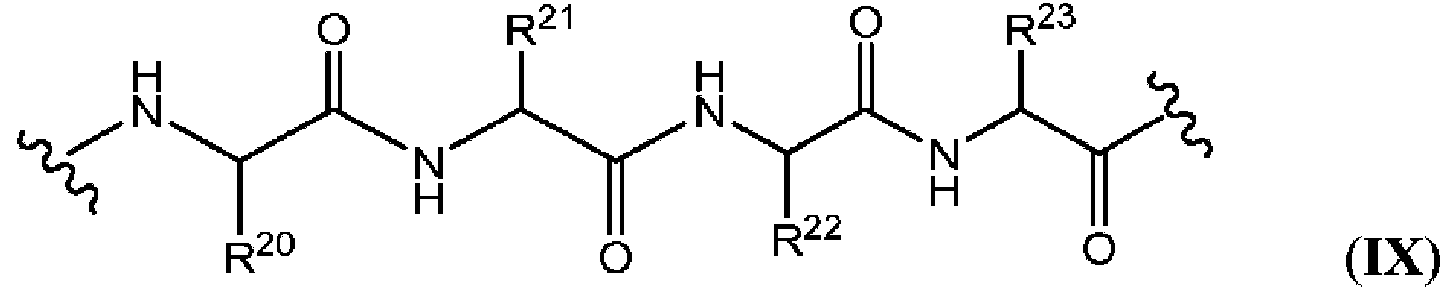
en donde R20, R21, R22 y R23 son los siguientes:where R20, R21, R22 and R23 are as follows:
R20 R21 R22 R23R20 R21 R22 R23
H Bencilo Isobutilo H; yH Benzyl Isobutyl H; and
Metilo Isobutilo Metilo IsobutiloMethyl Isobutyl Methyl Isobutyl
Las unidades ejemplares de aminoácidos incluyen, pero sin limitación, unidades de fórmula VII en la que: R20 es bencilo y R21 es -(CH2)4NH2; R20 es isopropilo y R21 es -(CH2)4NH2; o R20 es isopropilo y R21 es -(CH2)3NHCONH2. Otra unidad ejemplar de aminoácidos es una unidad de fórmula VIII en la que R20 es bencilo, R21 es bencilo, y R22 es -(CH2)4NH2.Exemplary amino acid units include, but are not limited to, units of formula VII wherein: R20 is benzyl and R21 is - (CH2) 4NH2; R20 is isopropyl and R21 is - (CH2) 4NH2; or R20 is isopropyl and R21 is - (CH2) 3NHCONH2. Another exemplary amino acid unit is a unit of formula VIII where R20 is benzyl, R21 is benzyl, and R22 is - (CH2) 4NH2.
Las unidades -Ww- útiles pueden diseñarse y optimizarse en su selectividad para la escisión enzimática por una enzima particular, por ejemplo, una proteasa asociada a tumor. En una realización, una unidad -Ww- es aquella cuya escisión está catalizada por la catepsina B, C y D, o una plasmina proteasa. Useful -Ww- units can be designed and optimized in their selectivity for enzymatic cleavage by a particular enzyme, eg, a tumor associated protease. In one embodiment, a -Ww- unit is one whose cleavage is catalyzed by cathepsin B, C, and D, or a plasmin protease.
En una realización, -Ww- es un dipéptido, tripéptido, tetrapéptido o pentapéptido. Cuando R19, R20, R21, R22 o R23 son distintos de hidrógeno, el átomo de carbono al que R19, R20, R21, R22 o R23 está unido es quiral.In one embodiment, -Ww- is a dipeptide, tripeptide, tetrapeptide, or pentapeptide. When R19, R20, R21, R22, or R23 are other than hydrogen, the carbon atom to which R19, R20, R21, R22, or R23 is attached is chiral.
Cada átomo de carbono al que están unidos R19, R20, R21, R22 o R23 está independientemente en la configuración (S) o (R).Each carbon atom to which R19, R20, R21, R22 or R23 are attached is independently in the (S) or (R) configuration.
En un aspecto de la unidad de aminoácidos, la unidad de aminoácidos es valina-citrulina (vc o Val-Cit). En otro aspecto, la unidad de aminoácido es fenilalanina-lisina (es decir, fk). En otro aspecto más de la unidad de aminoácidos, la unidad de aminoácidos es N-metilvalina-citrulina. En otro aspecto más, la unidad de aminoácidos es ácido 5-aminovalérico, homo fenilalanina lisina, tetraisoquinolincarboxilato lisina, ciclohexilalanina lisina, ácido isonipecótico lisina, beta-alanina lisina, glicina serina valina glutamina y ácido isonipecótico.In one aspect of the amino acid unit, the amino acid unit is valine-citrulline (vc or Val-Cit). In another aspect, the amino acid unit is phenylalanine-lysine (ie, fk). In yet another aspect of the amino acid unit, the amino acid unit is N-methylvaline-citrulline. In yet another aspect, the amino acid unit is 5-aminovaleric acid, homo phenylalanine lysine, tetraisoquinolinecarboxylate lysine, cyclohexylalanine lysine, isonipecotic acid lysine, beta-alanine lysine, glycine serine valine glutamine, and isonipecotic acid.
VIII.) La unidad espaciadoraVIII.) The spacer unit
La unidad espaciadora (-Y-), cuando está presente, vincula una unidad de aminoácidos con la unidad farmacéutica cuando está presente una unidad de aminoácidos. Alternativamente, la unidad espaciadora vincula la unidad ensanchadora con la unidad farmacéutica cuando la unidad de aminoácidos está ausente. La unidad espaciadora también vincula la unidad farmacéutica a la unidad de anticuerpo cuando están ausentes la unidad de aminoácidos y la unidad ensanchadora.The spacer unit (-Y-), when present, links an amino acid unit to the pharmaceutical unit when an amino acid unit is present. Alternatively, the spacer unit links the spreader unit to the pharmaceutical unit when the amino acid unit is absent. The spacer unit also links the pharmaceutical unit to the antibody unit when the amino acid unit and the spreader unit are absent.
Las unidades espaciales son de dos tipos generales: no autoinmolable o autoinmolable. Una unidad espaciadora no autoinmolable es una en la que una parte o la totalidad de la unidad espaciadora permanece unida al resto del fármaco después de la escisión, particularmente enzimática, de una unidad de aminoácido del conjugado anticuerpo-fármaco. Los ejemplos de una unidad espaciadora no autoinmolable incluyen, pero sin limitación, una unidad espaciadora (glicina-glicina) y una unidad espaciadora de glicina (ambas representadas en el Esquema 1) (infra). Cuando un conjugado que contiene una unidad espaciadora de glicina-glicina o una unidad espaciadora de glicina se somete a una escisión enzimática a través de una enzima (por ejemplo, una proteasa asociada a células tumorales, una proteasa asociada a células cancerígenas o una proteasa asociada a linfocitos), un resto glicinaglicina-fármaco o un resto glicina-fármaco se escinde de L-Aa-Ww-. En una realización, tiene lugar una reacción de hidrólisis independiente dentro de la célula diana, escindiendo el enlace del resto glicina-fármaco y liberando el fármaco.Spatial units are of two general types: non-self-immolating or self-immolating. A non-self-immolating spacer unit is one in which part or all of the spacer unit remains attached to the remainder of the drug after cleavage, particularly enzymatic, of an amino acid unit from the antibody-drug conjugate. Examples of a non-self-immolating spacer unit include, but are not limited to, a spacer unit (glycine-glycine) and a glycine spacer unit (both depicted in Scheme 1) (infra). When a conjugate containing a glycine-glycine spacer unit or a glycine spacer unit is subjected to enzymatic cleavage via an enzyme (for example, a tumor cell-associated protease, a cancer cell-associated protease, or an associated protease to lymphocytes), a glycine-glycine-drug residue or a glycine-drug residue is cleaved from L-Aa-Ww-. In one embodiment, an independent hydrolysis reaction occurs within the target cell, cleaving the glycine-drug moiety bond and releasing the drug.
Esquema 1Scheme 1

escisión escisióncleavage cleavage
enzimática enzimática 

Fármaco FármacoDrug Drug
En algunas realizaciones, una unidad espaciadora no autoinmolable (-Y-) es -Gly-. En algunas realizaciones, una unidad espaciadora no autoinmolable (-Y-) es -Gly-Gly-.In some embodiments, a non-self-immovable spacer unit (-Y-) is -Gly-. In some embodiments, a non-self-immolating spacer unit (-Y-) is -Gly-Gly-.
En una realización, se proporciona un conjugado de fármaco-enlazante en el que la unidad espaciadora está ausente (-Yy- cuando y = 0), o una sal o solvato farmacéuticamente aceptable del mismo.In one embodiment, a drug-linker conjugate is provided in which the spacer unit is absent (-Yy- when y = 0), or a pharmaceutically acceptable salt or solvate thereof.
Alternativamente, un conjugado que contiene una unidad espaciadora autoinmolable puede liberar -D. Como se usa en el presente documento, la expresión "espaciador autoinmolable" se refiere a un resto químico bifuncional que es capaz de unir de manera covalente dos restos químicos espaciados en una molécula tripartita estable. Se separará espontáneamente del segundo resto químico si se escinde su enlace al primer resto.Alternatively, a conjugate containing a self-immolating spacer unit can release -D. As used herein, the term "self-immolating spacer" refers to a bifunctional chemical moiety that is capable of covalently linking two spaced chemical moieties into a stable tripartite molecule. It will spontaneously separate from the second chemical moiety if its bond to the first moiety is cleaved.
En algunas realizaciones, -Yy- es una unidad de alcohol p-aminobencílico (PAB) (véanse los Esquemas 2 y 3) cuya porción de fenileno está sustituida con Qm, en donde Q es -alquilo C1-C8 , -alquenilo C1-C8 , -alquinilo C1-C8 , -O-(alquilo C1-C8), -O-(alquenilo C1-C8), -O-(alquinilo C1-C8), -halógeno, -nitro o -ciano; y m es un número entero que va de 0 a 4. Los grupos alquilo, alquenilo y alquinilo, ya sean solos o como parte de otro grupo, pueden estar opcionalmente sustituidos.In some embodiments, -Yy- is a p-aminobenzyl alcohol (PAB) unit (see Schemes 2 and 3) whose phenylene portion is substituted with Qm, where Q is -C 1 -C 8 alkyl, -alkenyl C 1 -C 8 -alkynyl C 1 -C 8 -alkyl, -O- (C 1 -C 8 alkyl), -O- (C 1 -C 8 alkenyl), -O- (C 1 -C 8 alkynyl), - halogen, -nitro or -cyan; and m is an integer ranging from 0 to 4. Alkyl, alkenyl, and alkynyl groups, either alone or as part of another group, may be optionally substituted.
En algunas realizaciones, -Y- es un grupo PAB que está unido a -Ww- a través del átomo de nitrógeno del amino del grupo PAB, y conectado directamente a -D a través de un grupo carbonato, carbamato o éter. Sin estar ligado a ninguna teoría o mecanismo particular, el esquema 2 representa un posible mecanismo de liberación de fármaco de un grupo PAB que está unido directamente a -D a través de un grupo carbamato o carbonato como se describe por Toki et al., 2002, J. Org. Chem. 67:1866-1872.In some embodiments, -Y- is a PAB group that is attached to -Ww- through the amino nitrogen atom of the PAB group, and directly attached to -D through a carbonate, carbamate, or ether group. Without being bound by any particular theory or mechanism, Scheme 2 represents a possible drug release mechanism from a PAB group that is directly attached to -D through a carbamate or carbonate group as described by Toki et al., 2002, J. Org. Chem. 67: 1866-1872.
Esquema 2Scheme 2
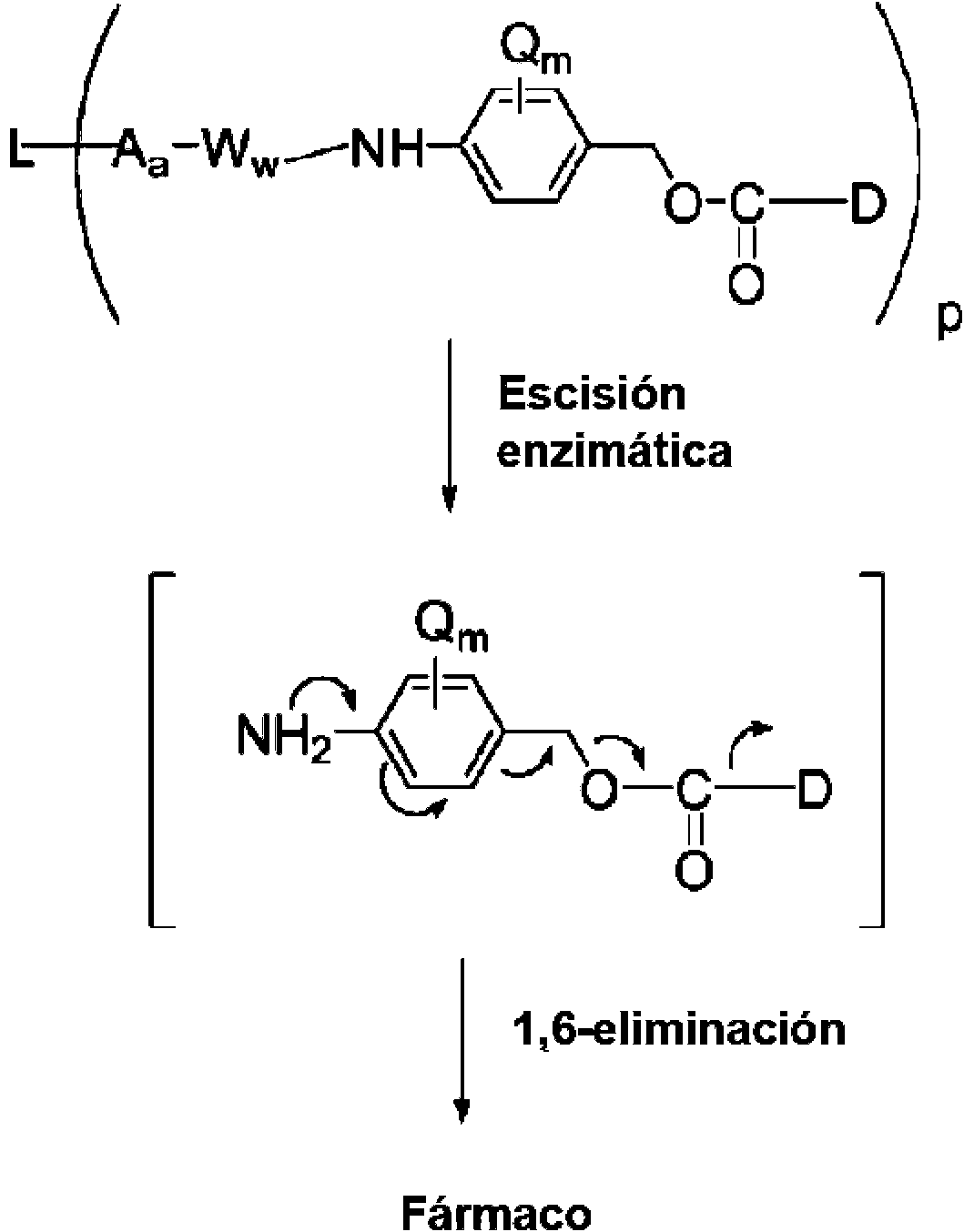
En el Esquema 2, Q es -alquilo Ci-Cs, -alquenilo Ci-Cs, -alquinilo Ci-Cs, -O-(alquilo Ci-Cs), -O-(alquenilo Ci-Cs), -O-(alquinilo Ci-Cs), -halógeno, -nitro o -ciano; m es un número entero que oscila entre 0-4; y p varía de i a aproximadamente 20. Los grupos alquilo, alquenilo y alquinilo, ya sean solos o como parte de otro grupo, pueden estar opcionalmente sustituidos.In Scheme 2, Q is -Ci-Cs alkyl, -Ci-Cs alkenyl, -Ci-Cs alkynyl, -O- (Ci-Cs alkyl), -O- (Ci-Cs alkenyl), -O- (alkynyl Ci-Cs), -halogen, -nitro or -cyan; m is an integer ranging from 0-4; and p ranges from i to about 20. Alkyl, alkenyl, and alkynyl groups, either alone or as part of another group, may be optionally substituted.
Sin estar sujeto a ninguna teoría o mecanismo particular, el Esquema 3 describe un posible mecanismo de liberación de fármaco de un grupo PAB que está unido directamente a -D a través de un enlace éter o amina, en donde D incluye el grupo de oxígeno o nitrógeno que es parte de la unidad farmacéutica. Without being bound by any particular theory or mechanism, Scheme 3 describes a possible drug release mechanism from a PAB group that is directly attached to -D via an ether or amine bond, where D includes the oxygen group or nitrogen that is part of the pharmaceutical unit.
Esquema 3Scheme 3
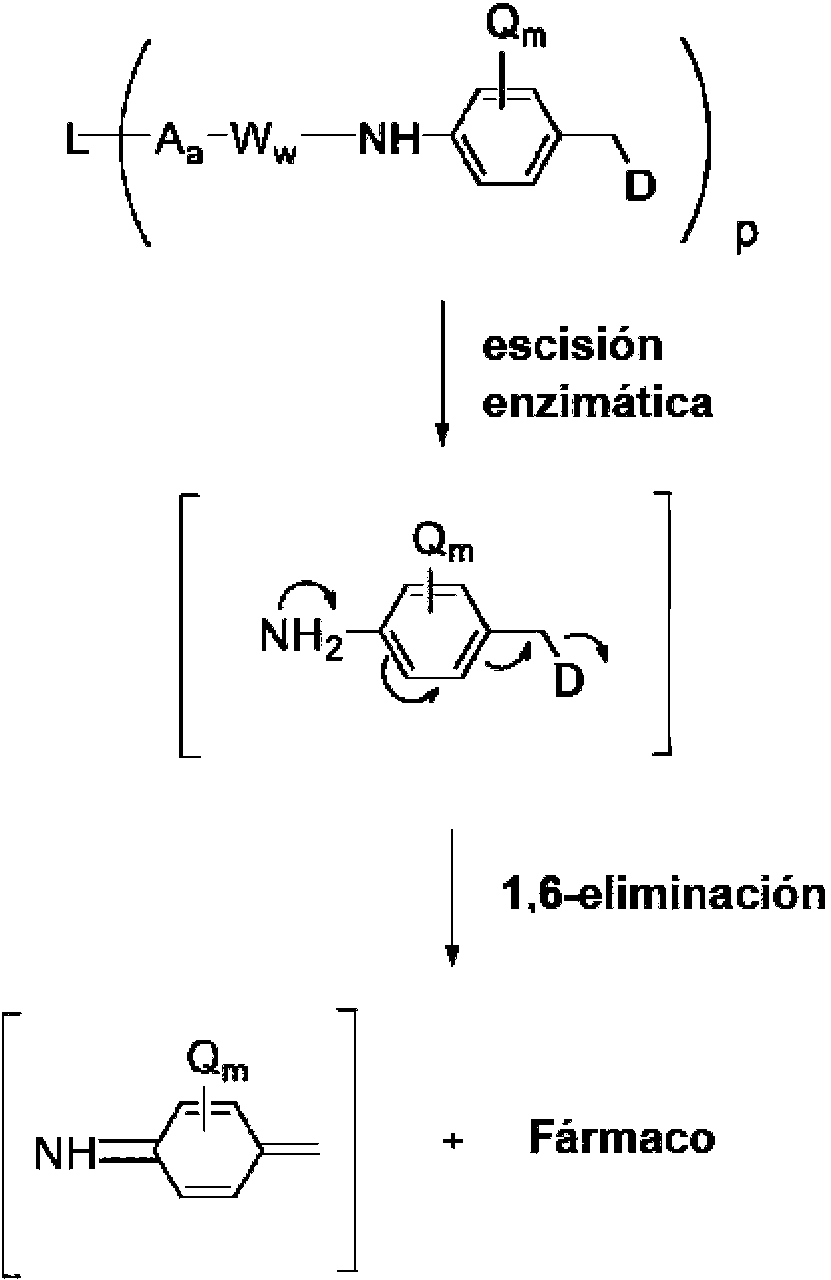
En el Esquema 3, Q es -alquilo Ci-Cs, alquenilo Ci-Cs, alquinilo Ci-Cs, -O-(alqu¡lo Ci-Cs), -O-(alquen¡lo Ci-Cs), -O-(alquinilo Ci-Cs), -halógeno, -nitro o -ciano; m es un número entero que oscila entre 0-4; y p varía de i a aproximadamente 20. Los grupos alquilo, alquenilo y alquinilo, ya sean solos o como parte de otro grupo, pueden estar opcionalmente sustituidos.In Scheme 3, Q is -Ci-Cs alkyl, Ci-Cs alkenyl, Ci-Cs alkynyl, -O- (Ci-Cs alkyl), -O- (Ci-Cs alkenyl), -O- (Ci-Cs alkynyl), -halogen, -nitro or -cyan; m is an integer ranging from 0-4; and p ranges from i to about 20. Alkyl, alkenyl, and alkynyl groups, either alone or as part of another group, may be optionally substituted.
Otros ejemplos de espaciadores autoinmolables incluyen, pero sin limitación, compuestos aromáticos que son electrónicamente similares al grupo PAB tales como derivados de 2-aminoimidazol-5-metanol (Hay et al., 1999, Bioorg. Med. Chem. Lett. 9: 2237) y orto o para-aminobencilacetales. Se pueden usar espaciadores que experimenten ciclación tras hidrólisis del enlace amida, tales como amidas de ácido 4-aminobutírico sustituidas y no sustituidas (Rodrigues et al., 1995, Chemistry Biology 2: 223), sistemas de anillo biciclo [2.2.i] y biciclo [2.2.2] apropiadamente sustituidos (Storm et al., 1972, J. Amer. Chem. Soc. 94: 5 s i5) y amidas del ácido 2-aminofenilpropiónico (Amsberry et al., i990, J. Org. Chem. 55:5367). La eliminación de fármacos que contienen aminas que están sustituidas en la posición a de glicina (Kingsbury et al., i9s4, J. Med. Chem. 27: i447) es también un ejemplo de espaciadores autoinmolables.Other examples of self-immolating spacers include, but are not limited to, aromatic compounds that are electronically similar to the PAB group such as 2-aminoimidazole-5-methanol derivatives (Hay et al., 1999, Bioorg. Med. Chem. Lett. 9: 2237 ) and ortho or para-aminobenzylacetals. Spacers that undergo cyclization upon hydrolysis of the amide bond can be used, such as substituted and unsubstituted 4-aminobutyric acid amides (Rodrigues et al., 1995, Chemistry Biology 2: 223), bicyclo [2.2.i] ring systems and appropriately substituted bicyclo [2.2.2] (Storm et al., 1972, J. Amer. Chem. Soc. 94: 5 s i5) and 2-aminophenylpropionic acid amides (Amsberry et al., 1990, J. Org. Chem 55: 5367). The elimination of drugs containing amines that are substituted at the glycine α-position (Kingsbury et al., 19s4, J. Med. Chem. 27: i447) is also an example of self-immolating spacers.
En una realización, la unidad espaciadora es una unidad ramificada de bis(hidroximetil)-estireno (BHMS) como se representa en el esquema 4, que puede usarse para incorporar y liberar múltiples fármacos. In one embodiment, the spacer unit is a branched bis (hydroxymethyl) styrene (BHMS) unit as depicted in Scheme 4, which can be used to incorporate and deliver multiple drugs.
Esquema 4Scheme 4
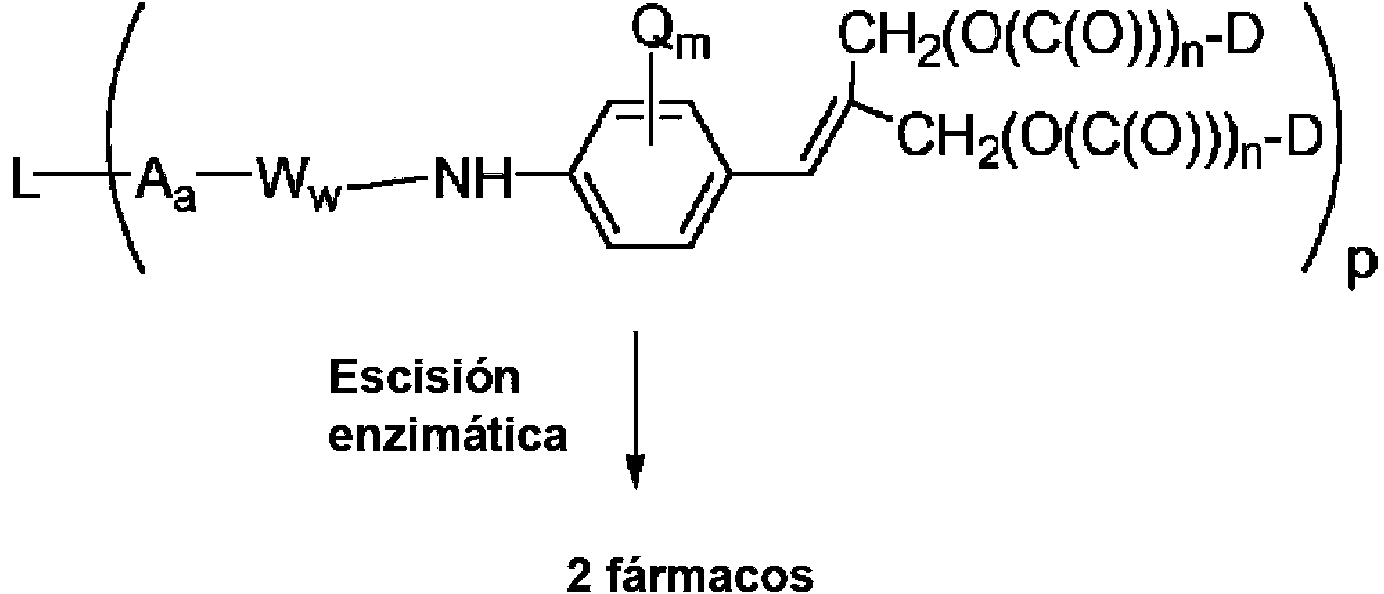
En el Esquema 4, Q es -alquilo Ci-Cs, alquenilo Ci-Cs, alquinilo Ci-Cs, -O-(alqu¡lo Ci-Cs), -O-(alquen¡lo Ci-Cs), -O-(alquinilo Ci-Cs), -halógeno, -nitro o -ciano; m es un número entero que oscila entre 0-4; n es 0 ó i; y p varía de i a aproximadamente 20. Los grupos alquilo, alquenilo y alquinilo, ya sean solos o como parte de otro grupo, pueden estar opcionalmente sustituidos.In Scheme 4, Q is -Ci-Cs alkyl, Ci-Cs alkenyl, Ci-Cs alkynyl, -O- (Ci-Cs alkyl), -O- (Ci-Cs alkenyl), -O- (Ci-Cs alkynyl), -halogen, -nitro or -cyan; m is an integer ranging from 0-4; n is 0 or i; and p ranges from i to about 20. Alkyl, alkenyl, and alkynyl groups, either alone or as part of another group, may be optionally substituted.
En algunas realizaciones, las fracciones -D son las mismas. En otra realización más, los restos -D son diferentes. In some embodiments, the -D fractions are the same. In yet another embodiment, the -D moieties are different.
En un aspecto, las unidades espaciadoras (-Yy-) están representadas por las fórmulas (X) - (XII):In one aspect, the spacer units (-Yy-) are represented by the formulas (X) - (XII):

donde Q es -alquilo Ci-Cs, alquenilo Ci-Cs, alquinilo Ci-Cs, -O-(alquilo Ci-Cs), -O-(alquenilo Ci-Cs), -O-(alquinilo Ci-Cs), -halógeno, -nitro o -ciano; y m es un número entero que va de 0 a 4. Los grupos alquilo, alquenilo y alquinilo, ya sean solos o como parte de otro grupo, pueden estar opcionalmente sustituidos.where Q is -Ci-Cs alkyl, Ci-Cs alkenyl, Ci-Cs alkynyl, -O- (Ci-Cs alkyl), -O- (Ci-Cs alkenyl), -O- (Ci-Cs alkynyl), - halogen, -nitro or -cyan; and m is an integer ranging from 0 to 4. Alkyl, alkenyl and alkynyl groups, either alone or as part of another group, may be optionally substituted.
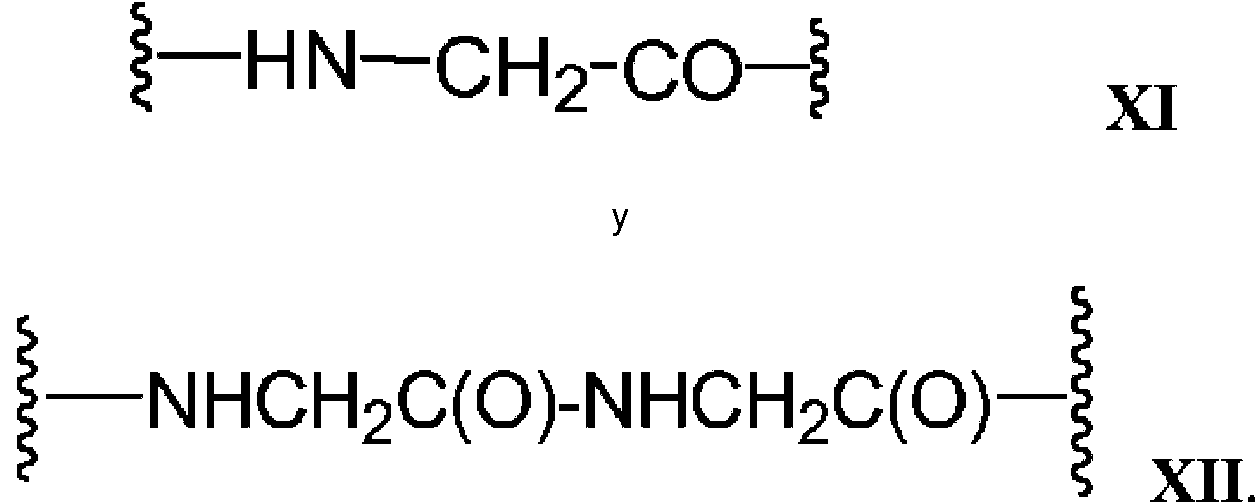
Las realizaciones de la Fórmula I y II, que comprenden compuestos conjugados de anticuerpo y fármaco, pueden incluir: The Formula I and II embodiments, comprising antibody-drug conjugates, may include:

donde w e y son cada uno 0, 1 o 2, ywhere w and y are each 0, 1, or 2, and
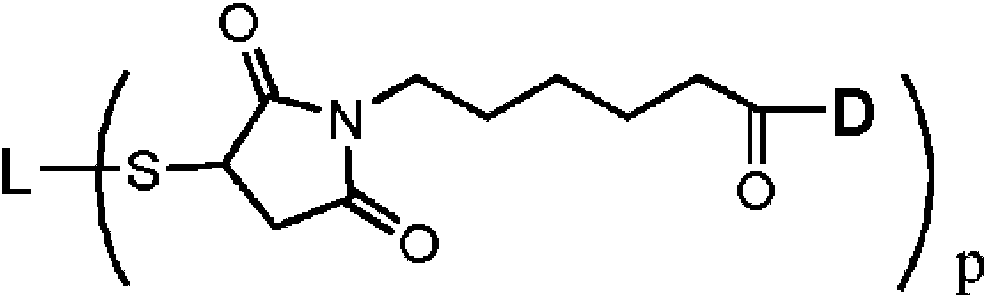
donde w e y son cada uno 0,where w and y are each 0,
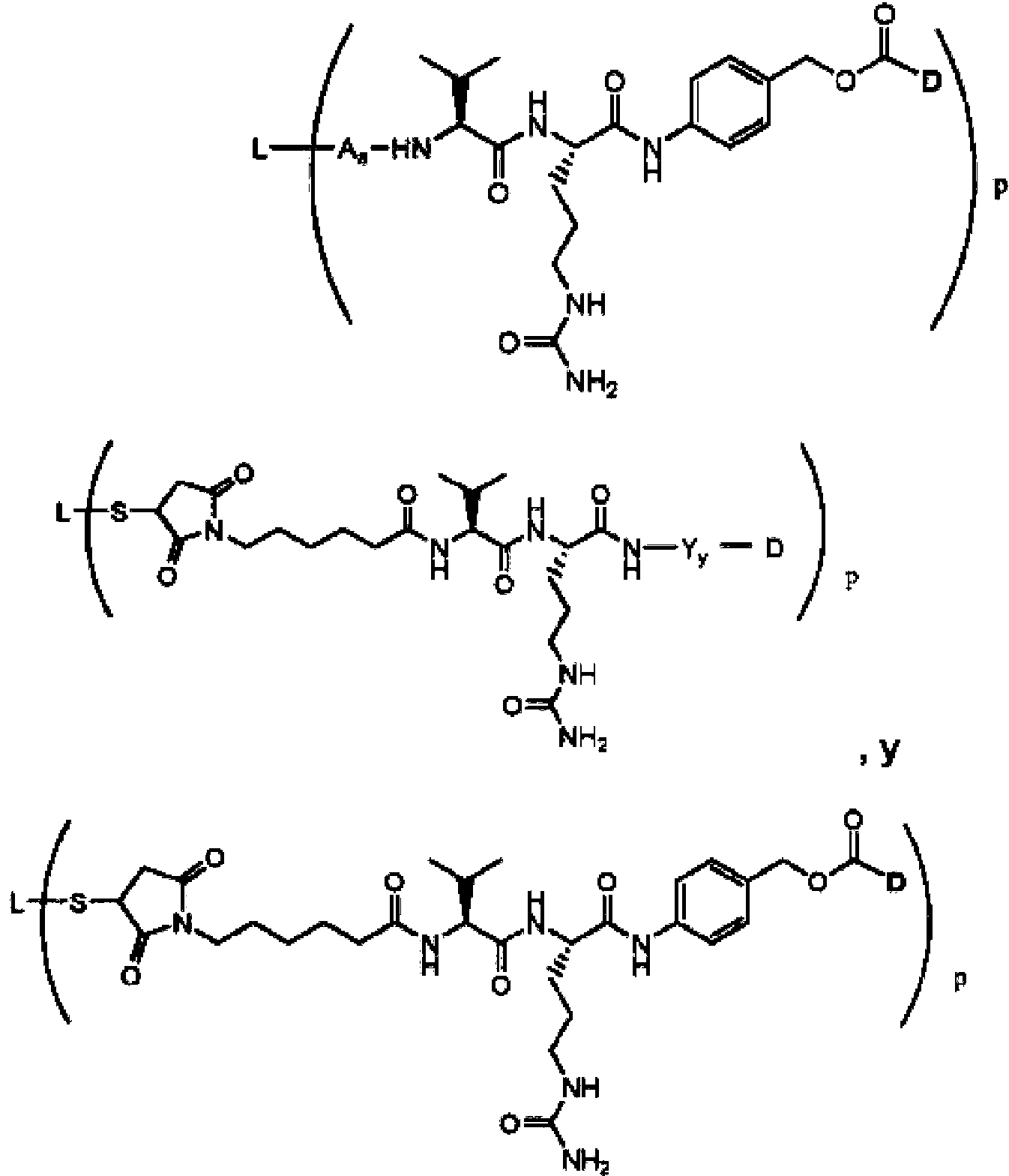
IX.) La unidad farmacéuticaIX.) The pharmaceutical unit
El resto de fármaco (D) puede ser cualquier fármaco citotóxico, citostático o inmunomodulador (por ejemplo, inmunosupresor). D es una unidad farmacéutica (fracción) que tiene un átomo que puede formar una unión con la unidad espaciadora, con la unidad de aminoácido, con la unidad ensanchadora o con la unidad de anticuerpo. En algunas realizaciones, la unidad farmacéutica D tiene un átomo de nitrógeno que puede formar un enlace con la unidad espaciadora. Como se usa en este documento, las expresiones "unidad farmacéutica" y "resto farmacéutico" son sinónimos y se usan de forma intercambiable.The drug moiety (D) can be any cytotoxic, cytostatic, or immunomodulatory (eg, immunosuppressive) drug. D is a pharmaceutical unit (moiety) having an atom that can form a bond with the spacer unit, with the amino acid unit, with the spreader unit, or with the antibody unit. In some embodiments, pharmaceutical unit D has a nitrogen atom that can form a bond with the spacer unit. As used herein, the terms "pharmaceutical unit" and "pharmaceutical moiety" are synonymous and are used interchangeably.
Las clases útiles de agentes citotóxicos, citostáticos o inmunomoduladores incluyen, por ejemplo, agentes antitubulina, aglutinantes de surco minoritario de ADN, inhibidores de replicación de ADN y agentes alquilantes. En algunas realizaciones, el fármaco es una auristatina, tal como auristatina E (también conocida en la técnica como un derivado de dolastatina-10) o un derivado de la misma. La auristatina puede ser, por ejemplo, un éster formado entre la auristatina E y un cetoácido. Por ejemplo, la auristatina E se puede hacer reaccionar con el ácido paraacetilbenzoico o el ácido benzoilvalérico para producir AEB y AEVB, respectivamente. Otras auristatinas típicas incluyen AFP, MMAF y MMAE. La síntesis y la estructura de auristatinas ejemplares se describen en la Publicación de la Solicitud de Patente de Estados Unidos N° 2003-0083263; la Publicación de Patente Internacional No. WO 04/010957, la Publicación de Patente Internacional No. WO 02/088172, y las Pat. U.S. Nos. 7.498.298, 6.884.869, 6.323.315; 6.239.104; 6.034.065; 5,780,588; 5,665,860; 5.663.149; 5,635,483; 5.599.902; 5.554.725; 5.530.097; 5.521.284; 5,504,191; 5.410.024; 5.138.036; 5.076.973; 4,986,988; 4.978.744; 4.879.278; 4.816.444; y 4.486.414, cada una de las cuales se incorpora por referencia en este documento en su totalidad y para todos los fines.Useful classes of cytotoxic, cytostatic, or immunomodulatory agents include, for example, antitubulin agents, DNA minor groove binders, DNA replication inhibitors, and alkylating agents. In some embodiments, the drug is an auristatin, such as auristatin E (also known in the art as a derivative of dolastatin-10) or a derivative thereof. Auristatin can be, for example, an ester formed between auristatin E and a keto acid. For example, auristatin E can be reacted with paraacetylbenzoic acid or benzoylvaleric acid to produce AEB and AEVB, respectively. Other typical auristatins include AFP, MMAF, and MMAE. The synthesis and structure of exemplary auristatins are described in US Patent Application Publication No. 2003-0083263; International Patent Publication No. WO 04/010957, International Patent Publication No. WO 02/088172, and US Pat. U.S. Nos. 7,498,298, 6,884,869, 6,323,315; 6,239,104; 6,034,065; 5,780,588; 5,665,860; 5,663,149; 5,635,483; 5,599,902; 5,554,725; 5,530,097; 5,521,284; 5,504,191; 5,410,024; 5,138,036; 5,076,973; 4,986,988; 4,978,744; 4,879,278; 4,816,444; and 4,486,414, each of which is incorporated by reference herein in its entirety and for all purposes.
Se ha demostrado que las auristatinas interfieren con la dinámica de los microtúbulos y la división nuclear y celular y tienen actividad anticancerígena. Las auristatinas se unen a la tubulina y pueden ejercer un efecto citotóxico o citostático sobre una célula que expresa 191P4D12. Hay varios ensayos diferentes, conocidos en la técnica, que se pueden usar para determinar si una auristatina o el conjugado de anticuerpo-fármaco resultante ejercen un efecto citostático o citotóxico sobre una línea celular deseada.Auristatins have been shown to interfere with microtubule dynamics and nuclear and cell division and have anticancer activity. Auristatins bind to tubulin and can exert a cytotoxic or cytostatic effect on a cell that expresses 191P4D12. There are several different assays, known in the art, that can be used to determine whether an auristatin or the resulting antibody-drug conjugate exerts a cytostatic or cytotoxic effect on a desired cell line.
Los métodos para determinar si un compuesto se une a tubulina son conocidos en la técnica. Ver, por ejemplo, Muller et al., Anal. Chem 2006, 78, 4390 - 4397; Hamel et al., Molecular Pharmacology, 1995, 47: 965 - 976; y Hamel et al., The Journal of Biological Chemistry, 1990, 265: 28, 17141-17149. Para los fines de la presente invención, puede determinarse la afinidad relativa de un compuesto por tubulina. Algunas auristatinas preferidas de la presente invención se unen a tubulina con una afinidad que varía desde 10 veces menor (afinidad más débil) que la afinidad de unión de MMAE a tubulina a 10 veces, 20 veces o incluso 100 veces mayor (mayor afinidad) que la afinidad de unión de MMAE a tubulina.Methods for determining whether a compound binds tubulin are known in the art. See, for example, Muller et al., Anal. Chem 2006, 78, 4390-4397; Hamel et al., Molecular Pharmacology, 1995, 47: 965-976; and Hamel et al., The Journal of Biological Chemistry, 1990, 265: 28, 17141-17149. For the purposes of the present invention, the relative affinity of a compound for tubulin can be determined. Some preferred auristatins of the present invention bind to tubulin with an affinity ranging from 10 times lower (weaker affinity) than the binding affinity of MMAE to tubulin to 10 times, 20 times or even 100 times higher (higher affinity) than the binding affinity of MMAE to tubulin.
En algunas realizaciones, -D es una auristatina de la fórmula De o Df:In some embodiments, -D is an auristatin of the formula D e or D f :
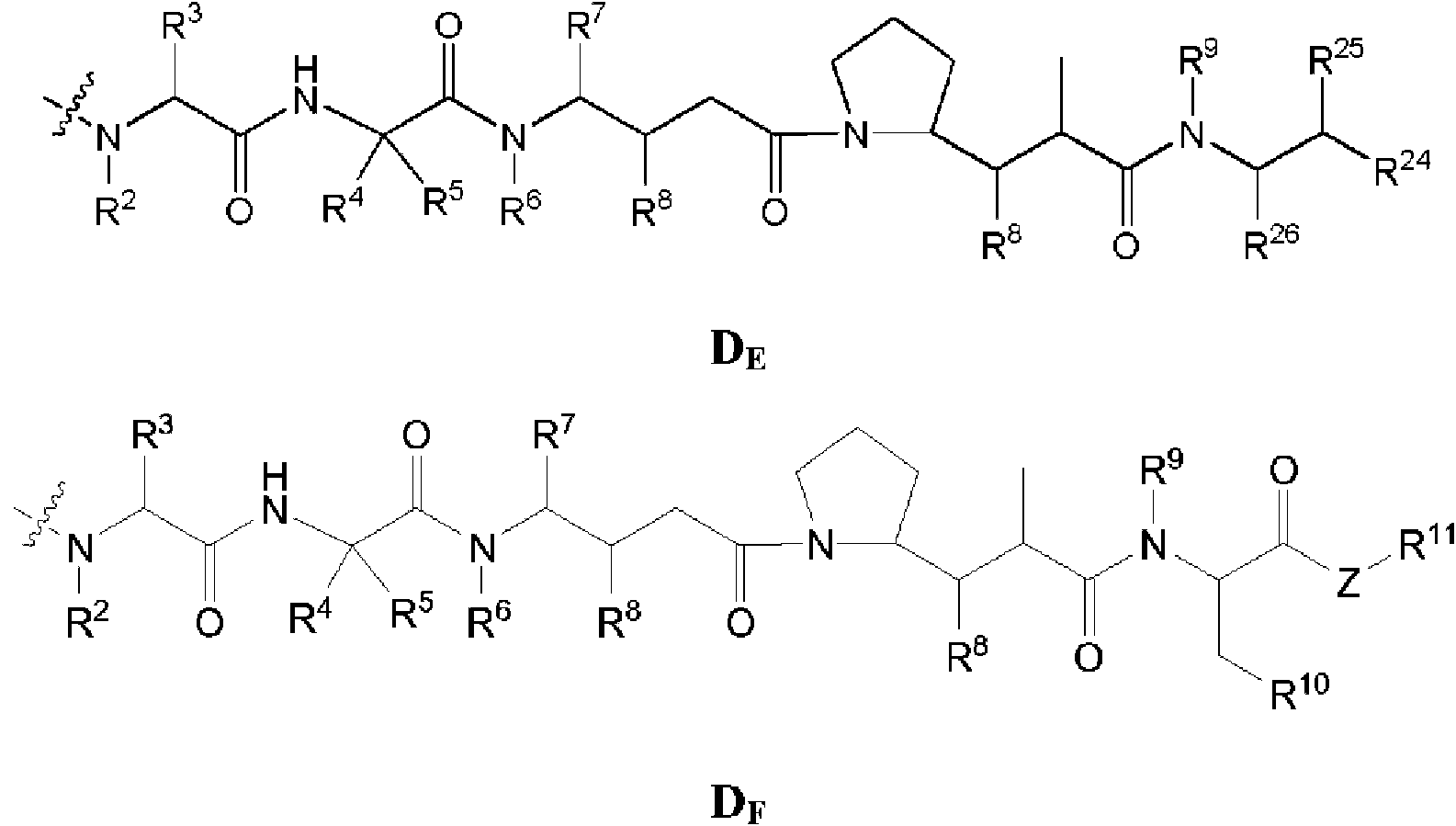
o una forma de sal o solvato farmacéuticamente aceptable del mismo; en donde, independientemente en cada ubicación:or a pharmaceutically acceptable salt or solvate form thereof; where, independently in each location:
la línea ondulada indica un enlace;wavy line indicates a link;
R2 es -alquilo C1-C20, -alquenilo C2-C20 o -alquinilo C2-C20;R2 is -C 1 -C 20 -alkenyl or C 2 -C 20 -alkynyl , C 2 -C 20;
R3 es -H, -alquilo C1-C20, -alquenilo C2-C20, -alquinilo C2-C20, -carbociclo, -alquileno C1-C20 (carbociclo), -alquenileno C2-C2ü(carbociclo), -alquinileno C2-C2ü(carbociclo), -arilo, -alquileno C1-C2ü(arilo), -alquenileno C2-C2ü(arilo), -alquinileno C2-C20(arilo), heterociclo, -alquileno C1-C20(heterociclo), -alquenileno C2-C20(heterociclo) o alquinileno C2-C20(heterociclo); R3 is -H, C 1 -C 20, alkenyl C 2 -C 20 -alkynyl , C 2 -C 20, -carbociclo, -alkylene C 1 -C 20 (carbocycle), C 2 -C 2 -alkenylene ü (carbocycle), C 2 -C -alquinileno 2U (carbocycle), -aryl, -alkylene C 1 -C 2 u (aryl), C 2 -C alkenylene 2U (aryl), C 2 -C -alquinileno 20 (aryl), heterocycle, -C 1 -C 20 alkylene (heterocycle), -C 2 -C 20 alkenylene (heterocycle) or C 2 -C 20 alkynylene (heterocycle);
R4 es -H, -alquilo C1-C20, -alquenilo C2-C20, -alquinilo C2-C20, carbociclo, alquileno Ci-C20(carbociclo), -alquenilenoR4 is -H, C 1 -C 20, alkenyl C 2 -C 20 -alkynyl , C 2 -C 20 carbocycle, Ci-C 20 alkylene (carbocycle), -alkenylene
C2-C20(carboc¡clo), -alquinileno C2-C20(carbociclo), arilo, alquileno C1-C20(arilo), -alquenileno C2-C20 (arilo), -alquinileno C2-C20(arilo), -heterociclo, alquileno C1-C20(heterociclo), -alquenileno C2-C20(heterociclo) o alquinileno C2-C20 (heterociclo);C 2 -C 20 (carbocycle), -C 2 -C 20 alkynylene (carbocycle), aryl, C 1 -C 20 alkylene (aryl), -C 2 -C 20 alkenylene (aryl), -C 2 -alkynylene C 20 (aryl), -heterocycle, C 1 -C 20 alkylene (heterocycle), -C 2 -C 20 alkenylene (heterocycle) or C 2 -C 20 alkynylene (heterocycle);
R5 es -H o -alquilo C1-C8 ; oR5 is -H or -C 1 -C 8 alkyl; or
R4 y R5 forman conjuntamente un anillo carbocíclico y tienen la fórmula -(CRaRb)s- en donde Ra y Rb son independientemente -H, -alquilo C1-C20, -alquenilo C2-C20, -alquinilo C2-C20, o -carbociclo y s es 2, 3, 4, 5 ó 6,R4 and R5 together form a carbocyclic ring and have the formula - (CRaRb) s- wherein Ra and Rb are independently -H, C 1 -C 20, alkenyl C 2 -C 20 -alkynyl , C 2 -C 20 , o -carbocycle and s is 2, 3, 4, 5 or 6,
R6 es -H, -alquilo C1-C20, -alquenilo C2-C20, o alquinilo C2-C20 ;R6 is -H, C 1 -C 20, alkenyl C 2 -C 20 alkynyl or C 2 -C 20;
R7 es -H, -alquilo C1-C20, -alquenilo C2-C20, -alquinilo C2-C20, carbociclo, -alquileno C1-C20 (carbociclo), -alquenilenoR7 is -H, C 1 -C 20, alkenyl C 2 -C 20 -alkynyl , C 2 -C 20 carbocycle, -alkylene C 1 -C 20 (carbocycle) -alkenylene
C2-C20 (carbociclo), -alquinileno C2-C20 (carbociclo), -arilo, alquileno C1-C20 (arilo), -alquenileno C2-C20 (arilo), -alquinileno C2-C20 (arilo), heterociclo, alquileno C1-C20 (heterociclo), -alquenileno C2-C20 (heterociclo) o alquinilenoC 2 -C 20 (carbocycle), C 2 -C 20 -alquinileno (carbocycle), -aryl, C1 - C20 alkylene (aryl), C 2 -C 20 alkenylene (aryl), C 2 -C -alquinileno 20 (aryl), heterocycle, C 1 -C 20 alkylene (heterocycle), -C 2 -C 20 -alkenylene (heterocycle) or alkynylene
C2-C20 (heterociclo);C 2 -C 20 (heterocycle);
cada R8 es independientemente -H, -OH, -alquilo C1-C20, -alquenilo C2-C20, -alquinilo C2-C20, -O-(alquilo C1-C20), -O-(alquenilo C2-C20) , -O-(alquinilo C1-C20) o -carbociclo;each R8 is independently -H, -OH, C 1 -C 20, alkenyl C 2 -C 20 -alkynyl , C 2 -C 20, -O- (C 1 -C 20), -O- ( C 2 -C 20 alkenyl), -O- (C 1 -C 20 alkynyl) or -carbocycle;
R9 es -H -alquilo C1-C20, -alquenilo C2-C20, o alquinilo C2-C20;R9 is -H -C 1 -C 20, alkenyl C 2 -C 20 alkynyl or C 2 -C 20;
R24 es -arilo, -heterociclo o -carbociclo;R24 is -aryl, -heterocycle, or -carbocycle;
R25 es -H, alquilo C1-C20, -alquenilo C2-C20, -alquinilo C2-C20, -carbociclo, -O-(alquilo C1-C20), -O-(alquenilo C2-C20), -O-(alquinilo C2-C20), u OR18, en donde R18 es -H, un grupo protector de hidroxilo, o un enlace directo donde OR18 representa =O;R25 is -H, C 1 -C 20 -alkenyl , C 2 -C 20 -alkynyl , C 2 -C 20, -carbociclo, -O- (C 1 -C 20), -O- (C 2 alkenyl -C 20 ), -O- (C 2 -C 20 alkynyl), or OR18, where R18 is -H, a hydroxyl protecting group, or a direct bond where OR18 represents = O;
R26 es -H, -alquilo C1-C20, -alquenilo C2-C20 o -alquinilo C2-C20, -arilo, -heterociclo o -carbociclo;R26 is -H, C 1 -C 20, alkenyl C 2 -C 20 -alkynyl or C 2 -C 20 -aryl, -heterocycle or -carbociclo;
R10 es -arilo o -heterociclo;R10 is -aryl or -heterocycle;
Z es -O, -S, -NH o -NR12, en donde R12 es alquilo C1-C20, -alquenilo C2-C20 o -alquinilo C2-C20 ;Z is -O, -S, -NH or -NR 12, wherein R 12 is C 1 -C 20 -alkenyl or C 2 -C 20 -alkynyl , C 2 -C 20;
R11 es -H, -alquilo C1-C20, -alquenilo C2-C20, -alquinilo C2-C20, -arilo, -heterociclo, -(R13O)m-R14, -(R13O)m-CH(R15)2 ;R11 is -H, C 1 -C 20, alkenyl C 2 -C 20 -alkynyl , C 2 -C 20, aryl, heterocycle, - (R13O) m-R14, - (R13O) m-CH (R15) 2 ;
m es un número entero que varía de 1 -1000 o m = 0-1000;m is an integer ranging from 1 -1000 or m = 0-1000;
R13 es -alquileno C2-C20, -alquenileno C2-C20 o -alquinileno C2-C20 ;R13 is C 2 -C 20 -alkylene, -alkenylene or C 2 -C 20 C 2 -C 20 -alquinileno;
R14 es -H, -alquilo C1-C20, -alquenilo C2-C20 o -alquinilo C2-C20 ;R14 is -H, C 1 -C 20 -alkenyl or C 2 -C 20 -alkynyl , C 2 -C 20;
cada aparición de R15 es independientemente -H, -COOH, -(CH2)n-N(R16)2 , -(CH2)n-SO3H, -(CH2)n-SO3-alquilo C1-C20, -(CH2)n-SO3-alquenilo C2-C20, o -(CH2)n-SO3-alquinilo C2-C20 ;each occurrence of R15 is independently -H, -COOH, - (CH 2 ) nN (R16) 2 , - (CH2) n-SO3H, - (CH2) n-SO3-C 1 -C 20 alkyl, - (CH2) n-SO3-C 2 -C 20 alkenyl, or - (CH2) n-SO3-C 2 -C 20 alkynyl;
cada aparición de R16 es independientemente -H, -alquilo C1-C20, -alquenilo C2-C20, -alquinilo C2-C20 o -(CH2)n-COOH; yeach occurrence of R16 is independently -H, C 1 -C 20, alkenyl C 2 -C 20 -alkynyl , C 2 -C 20 or - (CH 2) n-COOH; and
n es un número entero que varía de 0 a 6;n is an integer ranging from 0 to 6;
donde dichos radicales alquilo, alquenilo, alquinilo, alquileno, alquenileno, alquinileno, arilo, carbociclo y heterociclo, ya sean solos o como parte de otro grupo, están opcionalmente sustituidos.wherein said alkyl, alkenyl, alkynyl, alkylene, alkenylene, alkynylene, aryl, carbocycle and heterocycle radicals, either alone or as part of another group, are optionally substituted.
Las auristatinas de la fórmula De incluyen aquellas en las que dichos radicales alquilo, alquenilo, alquinilo, alquileno, alquenileno, alquinileno, arilo, carbociclo y heterociclo no están sustituidos.Auristatins of formula D and include those in which said alkyl radicals, alkenyl, alkynyl, alkylene, alkenylene, alkynylene, aryl, carbocycle and heterocycle are unsubstituted.
Las auristatinas de la fórmula De incluyen aquellas en las que los grupos de R2, R3, R4, R5, R6, R7, sustituidos y los grupos de R19, R20 y R21 están opcionalmente sustituidos como se describe en este documento.Auristatins of formula D and include those in which the substituted groups of R2, R3, R4, R5, R6, R7 and the groups of R19, R20 and R21 are optionally substituted as described herein.
Las auristatinas de la fórmula De incluyen aquellas en las queAuristatins in the De formula include those in which
R2 es alquilo C1-C8 ;R2 is C 1 -C 8 alkyl;
R3, R4 y R7 se seleccionan independientemente entre -H, -alquilo C1-C20, -alquenilo C2-C20, -alquinilo C2-C20, carbociclo C3-C6 monocíclico, alquileno C1-C20 (carbociclo C3-C6 monocíclico), -alquenileno C2-C20 (carbociclo C3-C6 monocíclico), -alquinileno C2-C20 (carbociclo C3-C6 monocíclico), arilo C6-C10, alquileno C1-C20 (arilo C6-C10), -alquenileno C2-C20 (arilo C6-C10), -alquinileno C2-C20 (arilo C6-C10), heterociclo, alquileno C1-C20 (heterociclo), -alquenileno C2-C20 (heterociclo) o -alquinileno C2-C20 (heterociclo); en donde dichos radicales alquilo, alquenilo, alquinilo, alquileno, alquenileno, alquinileno, carbociclo, arilo y heterociclo están opcionalmente sustituidos; R3, R4 and R7 are independently selected from -H, C 1 -C 20, alkenyl C 2 -C 20 -alkynyl , C 2 -C 20, C 3 -C 6 carbocycle monocyclic, C 1 -C 20 (carbocycle monocyclic C 3 -C 6) alkenylene C 2 -C 20 (carbocyclic C 3 -C 6 monocyclic), C 2 -C 20 -alquinileno (carbocyclic monocyclic C 3 -C 6), aryl C 6 -C 10 , C1 - C20 alkylene (aryl C 6 -C 10) alkenylene C 2 -C 20 (C 6 -C 10 aryl), C 2 -C 20 -alquinileno (aryl C 6 -C 10) heterocycle, C 1 -C 20 alkylene (heterocycle), -C 2 -C 20 alkenylene (heterocycle) or -C 2 -C 20 alkynylene (heterocycle); wherein said alkyl, alkenyl, alkynyl, alkylene, alkenylene, alkynylene, carbocycle, aryl and heterocycle radicals are optionally substituted;
R5 es -H;R5 is -H;
R6 es alquilo Ci-Cs;R6 is Ci-Cs alkyl;
cada R8 se selecciona independientemente de -OH, -O-(alquilo C1-C20), -O-(alquenilo C2-C20), o -O-(alquinilo C2-C20) en el que dichos radicales alquilo, alquenilo y alquinilo están opcionalmente sustituidos;each R8 is independently selected from -OH, -O- (C 1 -C 20 alkyl), -O- (C 2 -C 20 alkenyl), or -O- (C 2 -C 20 alkynyl) wherein said radicals alkyl, alkenyl, and alkynyl are optionally substituted;
R9 es -H o -alquilo C1-C8 ;R9 is -H or -C 1 -C 8 alkyl;
R24 es fenilo opcionalmente sustituido;R24 is optionally substituted phenyl;
R25 es -OR18; en donde R18 es H, un grupo protector de hidroxilo, o un enlace directo donde OR18 representa =O; R26 se selecciona de -H, -alquilo C1-C20, -alquenilo C2-C20, -alquinilo C2-C20 o -carbociclo; en donde dichos radicales alquilo, alquenilo, alquinilo y carbociclo están opcionalmente sustituidos; o una forma de sal o solvato farmacéuticamente aceptable del mismo.R25 is -OR18; wherein R18 is H, a hydroxyl protecting group, or a direct bond where OR18 represents = O; R26 is selected from -H, C 1 -C 20, alkenyl C 2 -C 20 -alkynyl or C 2 -C 20 -carbociclo; wherein said alkyl, alkenyl, alkynyl and carbocycle radicals are optionally substituted; or a pharmaceutically acceptable salt or solvate form thereof.
Las auristatinas de la fórmula De incluyen aquellas en las queAuristatins in the De formula include those in which
R2 es metilo;R2 is methyl;
R3 es -H, -alquilo C1-C8 , -alquenilo C2-C8 o -alquinilo C2-C8, donde dichos radicales alquilo, alquenilo y alquinilo están opcionalmente sustituidos;R3 is -H, C 1 -C 8 -alkenyl or C 2 -C 8 -alkynyl , C 2 -C 8, wherein said alkyl radicals, alkenyl and alkynyl are optionally substituted;
R4 es -H, -alquilo C1-C8 , -alquenilo C2-C8 , -alquinilo C2-C8 , carbociclo C3-C6 monocíclico, -arilo C6-C10, alquileno C1-C8 (arilo C6-C10), -alquenileno C2-C8 (arilo C6-C10), alquinileno C2-C8 (arilo C6-C10), alquileno C1-C8 (carbociclo C3-C6 monocíclico), alquenileno C2-C8 (carbociclo C3-C6 monocíclico), -alquinileno C2-C8 (carbociclo C3-C6 monocíclico); donde dichos radicales alquilo, alquenilo, alquinilo, alquileno, alquenileno, alquinileno, arilo y carbociclo, ya sean solos o como parte de otro grupo, están opcionalmente sustituidos;R4 is -H, C 1 -C 8 -alkenyl , C 2 -C 8 -alkynyl , C 2 -C 8 carbocycle monocyclic C 3 -C 6, C 6 -C 10 -aryl, C 1 -C 8 (aryl C 6 -C 10) -alkenylene C 2 -C 8 (aryl C 6 -C 10) alkynylene , C 2 -C 8 (aryl C 6 -C 10), C 1 -C 8 (C 3 carbocycle -C 6 monocyclic), C 2 -C 8 alkenylene (C 3 -C 6 monocyclic carbocycle), -C 2 -C 8 alkynylene (C 3 -C 6 monocyclic carbocycle); wherein said alkyl, alkenyl, alkynyl, alkylene, alkenylene, alkynylene, aryl and carbocycle radicals, either alone or as part of another group, are optionally substituted;
R5 es -H;R5 is -H;
R6 es metilo;R6 is methyl;
R7 es alquilo C1-C8, -alquenilo C2-C8 o -alquinilo C2-C8 ;R7 is C 1 -C 8 -alkenyl or C 2 -C 8 -alkynyl , C 2 -C 8;
cada R8 es metoxi;each R8 is methoxy;
R9 es -H o -alquilo C1-C8 ;R9 is -H or -C 1 -C 8 alkyl;
R24 es -fenilo;R24 is -phenyl;
R25 es -OR18; en donde R18 es H, un grupo protector de hidroxilo, o un enlace directo donde OR18 representa =O; R26 es metilo;R25 is -OR18; wherein R18 is H, a hydroxyl protecting group, or a direct bond where OR18 represents = O; R26 is methyl;
o una forma de sal farmacéuticamente aceptable del mismo.or a pharmaceutically acceptable salt form thereof.
Las auristatinas de la fórmula DE incluyen aquellas en donde:Auristatins in the DE formula include those where:
R2 es metilo; R3 es -H o alquilo C1-C3 ; R4 es alquilo C1-C5 ; R5 es -H; R6 es metilo; R7 es isopropilo o sec-butilo; R8 es metoxi; R9 es -H o -alquilo C1-C8 ; R24 es fenilo; R25 es -OR18; en donde R18 es -H, un grupo protector de hidroxilo, o un enlace directo donde OR18 representa =O; y R26 es metilo; o una forma de sal o solvato farmacéuticamente aceptable del mismo.R2 is methyl; R3 is -H or C 1 -C 3 alkyl; R4 is C 1 -C 5 alkyl; R5 is -H; R6 is methyl; R7 is isopropyl or sec-butyl; R8 is methoxy; R9 is -H or -C 1 -C 8 alkyl; R24 is phenyl; R25 is -OR18; wherein R18 is -H, a hydroxyl protecting group, or a direct bond where OR18 represents = O; and R26 is methyl; or a pharmaceutically acceptable salt or solvate form thereof.
Las auristatinas de la fórmula DE incluyen aquellas en las que:Auristatins in the DE formula include those in which:
R2 es metilo o alquilo C1-C3 ,R2 is methyl or C 1 -C 3 alkyl,
R3 es -H o -alquilo C1-C3 ;R3 is -H or -C 1 -C 3 alkyl;
R4 es alquilo C1-C5 ;R4 is C 1 -C 5 alkyl;
R5 es H;R5 is H;
R6 es alquilo C1-C3 ;R6 is C 1 -C 3 alkyl;
R7 es alquilo C1-C5 ;R7 is C 1 -C 5 alkyl;
R8 es -alcoxi C1-C3 ; R8 is -C 1 -C 3 alkoxy;
R9 es -H o -alquilo Ci-Cs;R9 is -H or -Ci-Cs alkyl;
R24 es fenilo;R24 is phenyl;
R25 es -OR18; en donde R18 es -H, un grupo protector de hidroxilo, o un enlace directo donde OR18 representa =O; y R26 es alquilo C1-C3 ;R25 is -OR18; wherein R18 is -H, a hydroxyl protecting group, or a direct bond where OR18 represents = O; and R26 is C 1 -C 3 alkyl;
o una forma de sal farmacéuticamente aceptable del mismo.or a pharmaceutically acceptable salt form thereof.
Las auristatinas de la fórmula Df incluyen aquellas en las queThe auristatins of the formula D f include those in which
R2 es metilo;R2 is methyl;
R3, R4 y R7 se seleccionan independientemente entre -H, -alquilo C1-C20, -alquenilo C2-C20, -alquinilo C2-C20, carbociclo C3-C6 monocíclico, -alquileno C1-C20 (carbociclo C3-C6 monocíclico), alquenileno C2-C20 (carbociclo C3-C6 monocíclico), alquinileno C2-C20 (carbociclo C3-C6 monocíclico), arilo C6-C10, alquileno C1-C20 (arilo C6-C10), alquenileno C2-C20 (arilo C6-C10), alquinileno C2-C20 (arilo C6-C10), heterociclo, alquileno C1-C20 (heterociclo), alquenileno C2-C20 (heterociclo) o -alquinileno C2-C20 (heterociclo); donde dichos radicales alquilo, alquenilo, alquinilo, alquileno, alquenileno, alquinileno, carbociclo, arilo y heterociclo, ya sean solos o como parte de otro grupo, están opcionalmente sustituidos;R3, R4 and R7 are independently selected from -H, C 1 -C 20, alkenyl C 2 -C 20 -alkynyl , C 2 -C 20, C 3 -C 6 carbocycle monocyclic, -alkylene C 1 -C 20 (C 3 -C 6 monocyclic carbocycle), C 2 -C 20 alkenylene (C 3 -C 6 monocyclic carbocycle), C 2 -C 20 alkynylene (C 3 -C 6 monocyclic carbocycle), C 6 -C 10 aryl, C 1 -C 20 alkylene (C 6 -C 10 aryl), C 2 -C 20 alkenylene (C 6 -C 10 aryl), C 2 -C 20 alkynylene (C 6 -C 10 aryl), heterocycle, C 1 alkylene -C 20 (heterocycle), C 2 -C 20 alkenylene (heterocycle) or -C 2 -C 20 alkynylene (heterocycle); wherein said alkyl, alkenyl, alkynyl, alkylene, alkenylene, alkynylene, carbocycle, aryl and heterocycle radicals, either alone or as part of another group, are optionally substituted;
R5 es -H;R5 is -H;
R6 es metilo;R6 is methyl;
cada R8 es metoxi;each R8 is methoxy;
R9 es -H -alquilo C1-C20, -alquenilo C2-C20, o -alquinilo C2-C20 ; en el que dicho radical alquilo, alquenilo y alquinilo están opcionalmente sustituidos;R9 is -H -C 1 -C 20, alkenyl C 2 -C 20 -alkynyl or C 2 -C 20; wherein said alkyl, alkenyl and alkynyl radical are optionally substituted;
R10 es arilo opcionalmente sustituido o heterociclo opcionalmente sustituido;R10 is optionally substituted aryl or optionally substituted heterocycle;
Z es -O-, -S-, -NH- o -NR12, en donde R12 es alquilo C1-C20, alquenilo C2-C20 o alquinilo C2-C20, cada uno de los cuales es opcionalmente sustituido;Z is -O-, -S-, -NH- or -NR 12, wherein R 12 is C 1 -C 20, alkenyl C 2 -C 20 alkynyl or C 2 -C 20, each of which is optionally substituted ;
R11 es -H, -alquilo C1-C20, -alquenilo C2-C20, -alquinilo C2-C20, -arilo, -heterociclo, -(R13O)m-R14, o -(R13O)m-CH(R15)2 , en donde dichos radicales alquilo, alquenilo, alquinilo, arilo y heterociclo están opcionalmente sustituidos;R11 is -H, C 1 -C 20, alkenyl C 2 -C 20 -alkynyl , C 2 -C 20, aryl, heterocycle, - (R13O) m-R14, or - (R13O) m- CH (R15) 2 , wherein said alkyl, alkenyl, alkynyl, aryl and heterocycle radicals are optionally substituted;
m es un número entero que varía de 1 -1000 o m = 0;m is an integer that varies from 1 -1000 or m = 0;
R13 es alquileno C2-C20, alquenileno C2-C20 o alquinileno C2-C20, cada uno de los cuales está opcionalmente sustituido;R13 is C 2 -C 20 alkenylene , C 2 -C 20 alkynylene or C 2 -C 20, each of which is optionally substituted;
R14 es -H -alquilo C1-C20, alquenilo C2-C20, o alquinilo C2-C20, en el que dichos radicales alquilo, alquenilo y alquinilo están opcionalmente sustituidos;R14 is -H -C 1 -C 20, alkenyl C 2 -C 20 alkynyl or C 2 -C 20, wherein said alkyl, alkenyl and alkynyl are optionally substituted;
cada aparición de R15 es independientemente -H, -COOH, -(CH2)n-N(R16)2 , -(CH2VSO 3H, -(CH2)n-SO3-alquilo C1-C20, -(CH2)n-SO3- alquenilo C2-C20, o -(CH2)n-SO3-alquinilo C2-C20 en el que dichos radicales alquilo, alquenilo y alquinilo están opcionalmente sustituidos;each occurrence of R15 is independently -H, -COOH, - (CH 2 ) nN (R16) 2 , - (CH 2 VSO 3 H, - (CH2) n-SO3-C 1 -C 20 alkyl, - (CH2) n-SO3-C 2 -C 20 alkenyl, or - (CH2) n-SO3-C 2 -C 20 alkynyl in which said alkyl, alkenyl and alkynyl radicals are optionally substituted;
cada aparición de R16 es independientemente -H, -alquilo C1-C20, alquenilo C2-C20, alquinilo C2-C20 o -(CH2)n-COOH en donde dichos radicales alquilo, alquenilo y alquinilo están opcionalmente sustituidos;each occurrence of R16 is independently -H, C 1 -C 20 alkyl , C 2 -C 20 alkynyl, C 2 -C 20 or - (CH 2) n-COOH wherein said alkyl radicals, alkenyl and alkynyl are optionally substituted;
n es un número entero que varía entre 0 y 6;n is an integer that varies between 0 and 6;
o una sal farmacéuticamente aceptable de los mismos.or a pharmaceutically acceptable salt thereof.
En algunas de estas realizaciones, R10 es fenilo opcionalmente sustituido.In some of these embodiments, R10 is optionally substituted phenyl.
Las auristatinas de fórmula DF incluyen aquellas en las que los grupos de R2, R3, R4, R5, R6, R7, R8 y R9 no están sustituidos y los grupos R10 y R11 son como se describen en este documento.Auristatins of formula DF include those in which the groups of R2, R3, R4, R5, R6, R7, R8 and R9 are unsubstituted and the groups R10 and R11 are as described herein.
Las auristatinas de fórmula DF incluyen aquellas en las que dichos radicales alquilo, alquenilo, alquinilo, alquileno, alquenileno, alquinileno, arilo, carbociclo y heterociclo no están sustituidos.Auristatins of formula DF include those in which said alkyl, alkenyl, alkynyl, alkylene, alkenylene, alkynylene, aryl, carbocycle and heterocycle radicals are unsubstituted.
Las auristatinas de fórmula DF incluyen aquellas en las queFormula DF auristatins include those in which
R2 es alquilo C1-C3 ; R3 es -H o alquilo C1-C3 ; R4 es alquilo C1-C5 ; R5 es -H; R6 es alquilo C1-C3 ; R7 es alquilo C1-C5 ; R8 es alcoxi C1-C3 ; R9 es -H o -alquilo C1-C8 ; R10 es fenilo opcionalmente sustituido; Z es -O-, -S- o -NH-; R11 es como se define en este documento; o una sal farmacéuticamente aceptable de los mismos. R2 is C 1 -C 3 alkyl; R3 is -H or C 1 -C 3 alkyl; R4 is C 1 -C 5 alkyl; R5 is -H; R6 is C 1 -C 3 alkyl; R7 is C 1 -C 5 alkyl; R8 is C 1 -C 3 alkoxy; R9 is -H or -C 1 -C 8 alkyl; R10 is optionally substituted phenyl; Z is -O-, -S- or -NH-; R11 is as defined in this document; or a pharmaceutically acceptable salt thereof.
Las auristatinas de fórmula Df incluyen aquellas en las queFormula D f auristatins include those in which
R2 es metilo; R3 es -H o alquilo C1-C3 ; R4 es alquilo C1-C5 ; R5 es -H; R6 es metilo; R7 es isopropilo o sec-butilo; R8 es metoxi; R9 es -H o -alquilo C1-C8 ; R10 es fenilo opcionalmente sustituido; Z es -O-, -S- o -NH-; y R11 es como se define en este documento; o una sal farmacéuticamente aceptable de los mismos.R2 is methyl; R3 is -H or C 1 -C 3 alkyl; R4 is C 1 -C 5 alkyl; R5 is -H; R6 is methyl; R7 is isopropyl or sec-butyl; R8 is methoxy; R9 is -H or -C 1 -C 8 alkyl; R10 is optionally substituted phenyl; Z is -O-, -S- or -NH-; and R11 is as defined herein; or a pharmaceutically acceptable salt thereof.
Las auristatinas de fórmula Df incluyen aquellas en las queFormula D f auristatins include those in which
R2 es metilo; R3 es -H o alquilo C1-C3 ; R4 es alquilo C1-C5 ; R5 es -H; R6 es metilo; R7 es isopropilo o sec-butilo; R8 es metoxi; R9 es -H o alquilo C1-C8 ; R10 es fenilo; y Z es -O- o -NH- y R11 son como se define en la presente memoria, preferiblemente hidrógeno; o una forma de sal farmacéuticamente aceptable del mismo.R2 is methyl; R3 is -H or C 1 -C 3 alkyl; R4 is C 1 -C 5 alkyl; R5 is -H; R6 is methyl; R7 is isopropyl or sec-butyl; R8 is methoxy; R9 is -H or C 1 -C 8 alkyl; R10 is phenyl; and Z is -O- or -NH- and R11 are as defined herein, preferably hydrogen; or a pharmaceutically acceptable salt form thereof.
Las auristatinas de fórmula Df incluyen aquellas en las queFormula Df auristatins include those in which
R2 es alquilo C1-C3 ; R3 es -H o alquilo C1-C3 ; R4 es alquilo C1-C5 ; R5 es -H; R6 es alquilo C1-C3 ; R7 es alquilo C1-C5 ; R8 es -alcoxi C1-C3 ; R9 es -H o -alquilo C1-C8 ; R10 es fenilo; y Z es -O- o -NH- y R11 es como se define en la presente memoria, preferiblemente hidrógeno; o una forma de sal farmacéuticamente aceptable del mismo.R2 is C 1 -C 3 alkyl; R3 is -H or C 1 -C 3 alkyl; R4 is C 1 -C 5 alkyl; R5 is -H; R6 is C 1 -C 3 alkyl; R7 is C 1 -C 5 alkyl; R8 is -C 1 -C 3 alkoxy; R9 is -H or -C 1 -C 8 alkyl; R10 is phenyl; and Z is -O- or -NH- and R11 is as defined herein, preferably hydrogen; or a pharmaceutically acceptable salt form thereof.
Las auristatinas de fórmula De o Df incluyen aquellas en las que R3, R4 y R7 son independientemente isopropilo o sec-butilo y R5 es -H. En una realización ejemplar, R3 y R4 son cada uno isopropilo, R5 es H y R7 es sec-butilo. El resto de los sustituyentes es como se define en este documento.Auristatins of formula De or Df include those in which R3, R4 and R7 are independently isopropyl or sec-butyl and R5 is -H. In an exemplary embodiment, R3 and R4 are each isopropyl, R5 is H, and R7 is sec-butyl. All other substituents are as defined herein.
Las Auristatinas de la fórmula De o Df incluyen aquellas en las que R2 y R6 son cada uno metilo, y R9 es H. El resto de los sustituyentes es como se define en este documento.Auristatins of the formula De or Df include those in which R2 and R6 are each methyl, and R9 is H. The remaining substituents are as defined herein.
Las auristatinas de fórmula De o Df incluyen aquellas en las que cada aparición de R8 es -OCH3. El resto de los sustituyentes es como se define en este documento.Auristatins of formula De or Df include those in which each occurrence of R8 is -OCH 3 . All other substituents are as defined herein.
Las auristatinas de fórmula De o Df incluyen aquellas en las que R3 y R4 son cada uno isopropilo, R2 y R6 son cada uno metilo, R5 es H, R7 es sec-butilo, cada aparición de R8 es -OCH3 , y R9 es H. El resto de los sustituyentes son como se define en este documento.Auristatins of formula D e or D f include those in which R3 and R4 are each isopropyl, R2 and R6 are each methyl, R5 is H, R7 is sec-butyl, each occurrence of R8 is -OCH 3 , and R9 is H. All other substituents are as defined herein.
Las auristatinas de fórmula Df incluyen aquellas en las que Z es -O- o -NH-. El resto de los sustituyentes son como se define en este documento.Auristatins of formula D f include those in which Z is -O- or -NH-. All other substituents are as defined herein.
Las auristatinas de fórmula Df incluyen aquellas en las que R10 es arilo. El resto de los sustituyentes son como se define en este documento.Auristatins of formula D f include those in which R10 is aryl. All other substituents are as defined herein.
Las auristatinas de fórmula Df incluyen aquellas en las que R10 es -fenilo. El resto de los sustituyentes son como se define en este documento.Auristatins of formula D f include those in which R10 is -phenyl. All other substituents are as defined herein.
Las auristatinas de fórmula Df incluyen aquellas en las que Z es -O-, y R11 es H, metilo o t-butilo. El resto de los sustituyentes son como se define en este documento.Auristatins of formula D f include those in which Z is -O-, and R11 is H, methyl or t-butyl. All other substituents are as defined herein.
Las auristatinas de fórmula Df incluyen aquellas en las que, cuando Z es -NH-, R11 es -(R13O)m-CH(R15)2 , en donde R15 es -(CH2)n-N(R16)2 , y R16 es alquilo C1-C8 o -(CH2)n-COOH. El resto de los sustituyentes son como se define en este documento.Auristatins of formula Df include those in which, when Z is -NH-, R11 is - (R13O) m-CH (R15) 2 , where R15 is - (CH 2 ) nN (R16) 2 , and R16 is C 1 -C 8 alkyl or - (CH 2 ) n-COOH. All other substituents are as defined herein.
Las auristatinas de fórmula Df incluyen aquellas en las que cuando Z es -NH-, R11 es -(R13O)m-CH(R15)2 , en donde R15 es -(CH2VSO 3H. El resto de los sustituyentes son como se define en este documento.Auristatins of formula D f include those in which when Z is -NH-, R11 is - (R13O) m-CH (R15) 2 , where R15 is - (CH 2 VSO 3 H. All other substituents are as defined in this document.
En realizaciones preferidas, cuando D es una auristatina de fórmula De, w es un número entero que varía de 1 a 12, preferiblemente de 2 a 12, y es 1 ó 2, y a es preferiblemente 1.In preferred embodiments, when D is an auristatin of formula D e , w is an integer ranging from 1 to 12, preferably 2 to 12, and is 1 or 2, and a is preferably 1.
En algunas realizaciones, en donde D es una auristatina de fórmula Df, a es 1 y w e y son 0.In some embodiments, where D is an auristatin of formula D f , a is 1 and we and y are 0.
Las unidades farmacéuticas ilustrativas (-D) incluyen las unidades farmacéuticas que tienen las siguientes estructuras: Illustrative pharmaceutical units (-D) include pharmaceutical units that have the following structures:
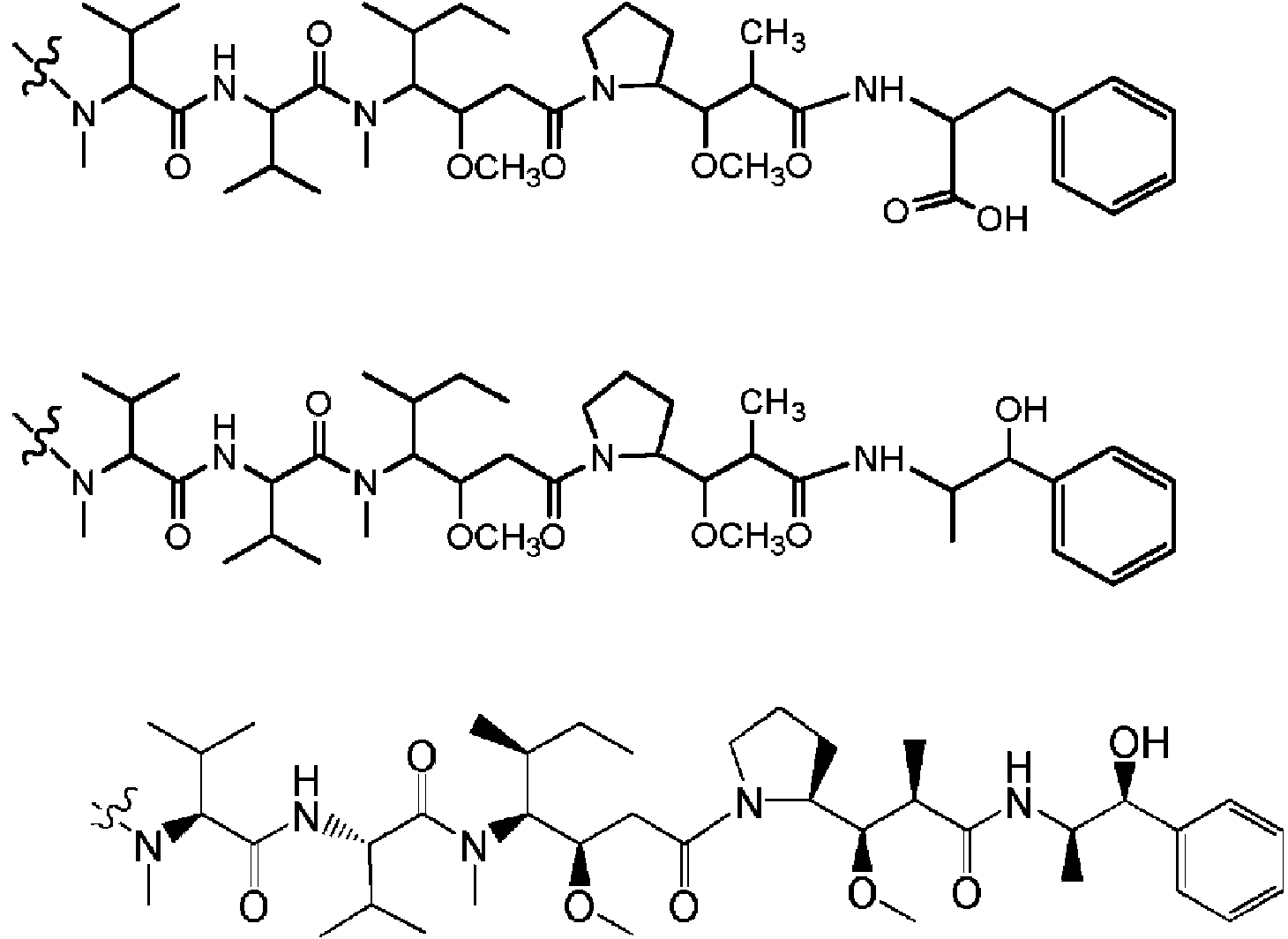
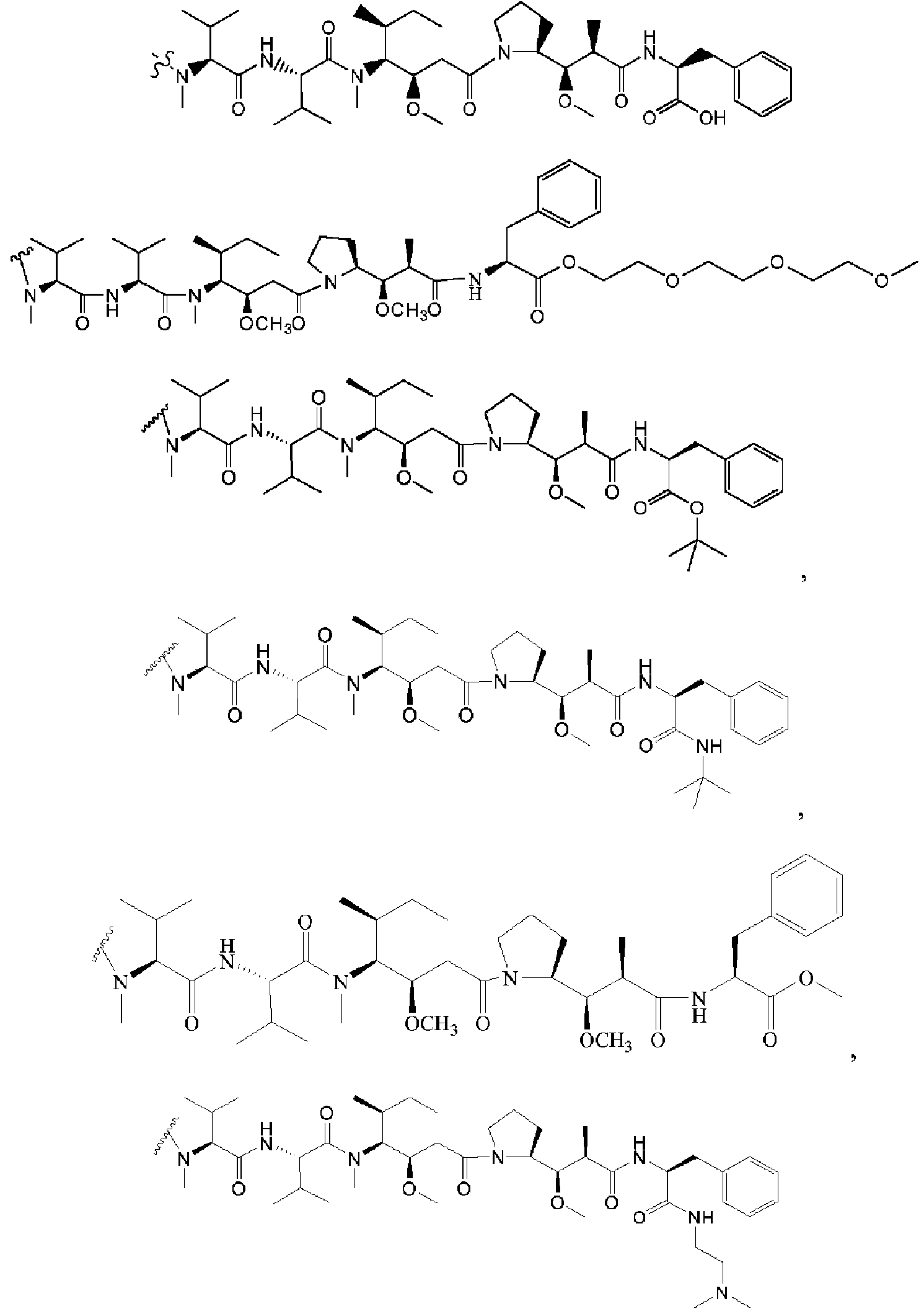
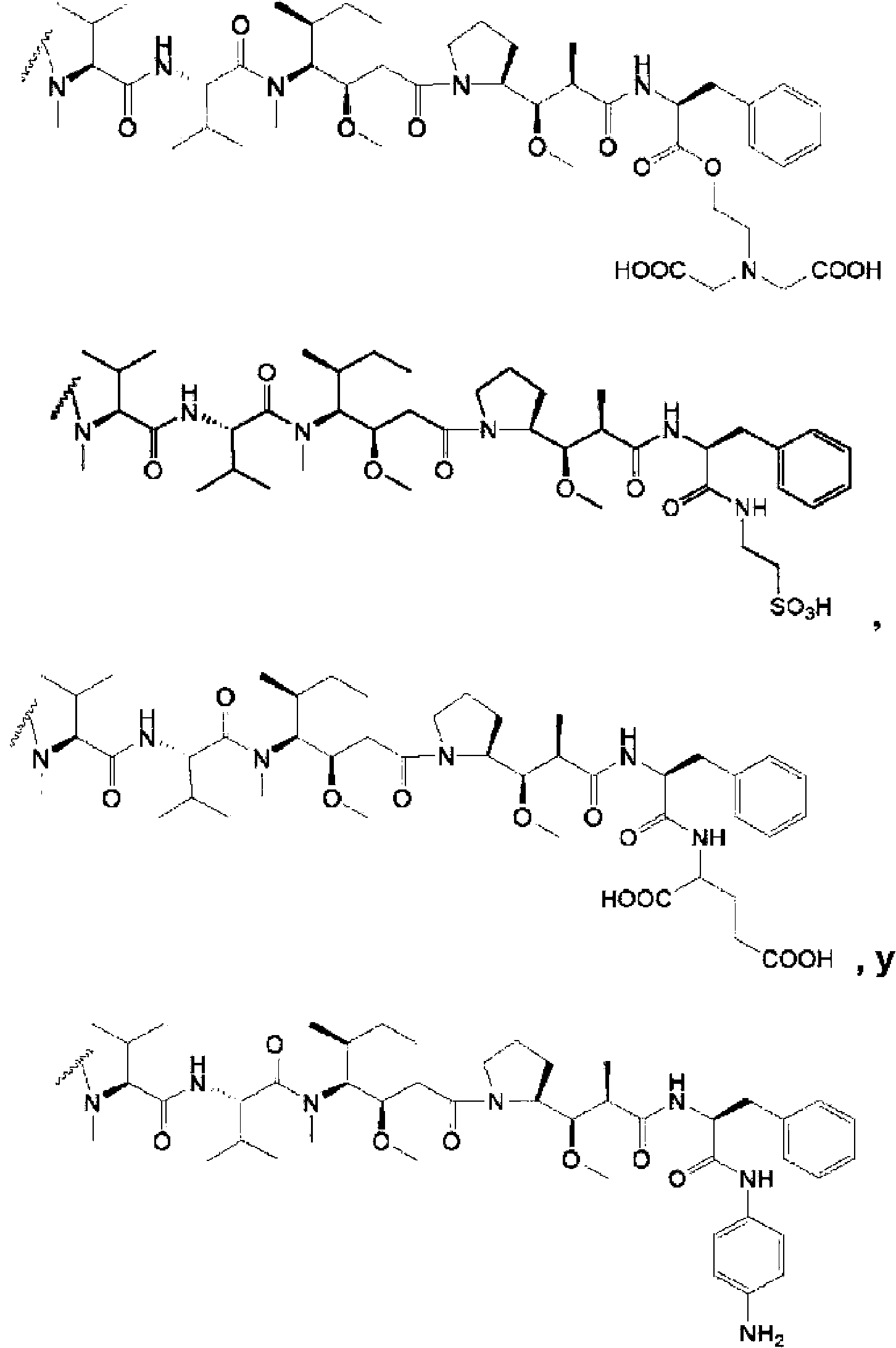
o sales o solvatos farmacéuticamente aceptables de los mismos.or pharmaceutically acceptable salts or solvates thereof.
En un aspecto, se pueden unir grupos hidrófilos, tales como, pero sin limitación, ésteres de trietilenglicol (TEG) a la unidad farmacéutica a R11. Sin estar sujetos a la teoría, los grupos hidrófilos ayudan a la internalización y a la no aglomeración de la unidad farmacéutica.In one aspect, hydrophilic groups, such as, but not limited to, triethylene glycol esters (TEG) can be attached to the pharmaceutical unit at R11. Without being bound by theory, hydrophilic groups aid internalization and non-agglomeration of the pharmaceutical unit.
En algunas realizaciones, la unidad farmacéutica no es TZT-1027. En algunas realizaciones, la unidad farmacéutica no es auristatina E, dolastatina 10 o auristatina PE.In some embodiments, the pharmaceutical unit is not TZT-1027. In some embodiments, the pharmaceutical unit is not auristatin E, dolastatin 10, or auristatin PE.
Los ejemplos de compuestos conjugados de anticuerpo y fármaco tienen las siguientes estructuras en las que "L" o "mAb-s-" representa un MAb 191P4D12 designado Ha22-2(2,4)6.1 expuesto en este documento: Examples of antibody-drug conjugated compounds have the following structures where "L" or "mAb-s-" represents a MAb 191P4D12 designated Ha22-2 (2,4) 6.1 disclosed herein:
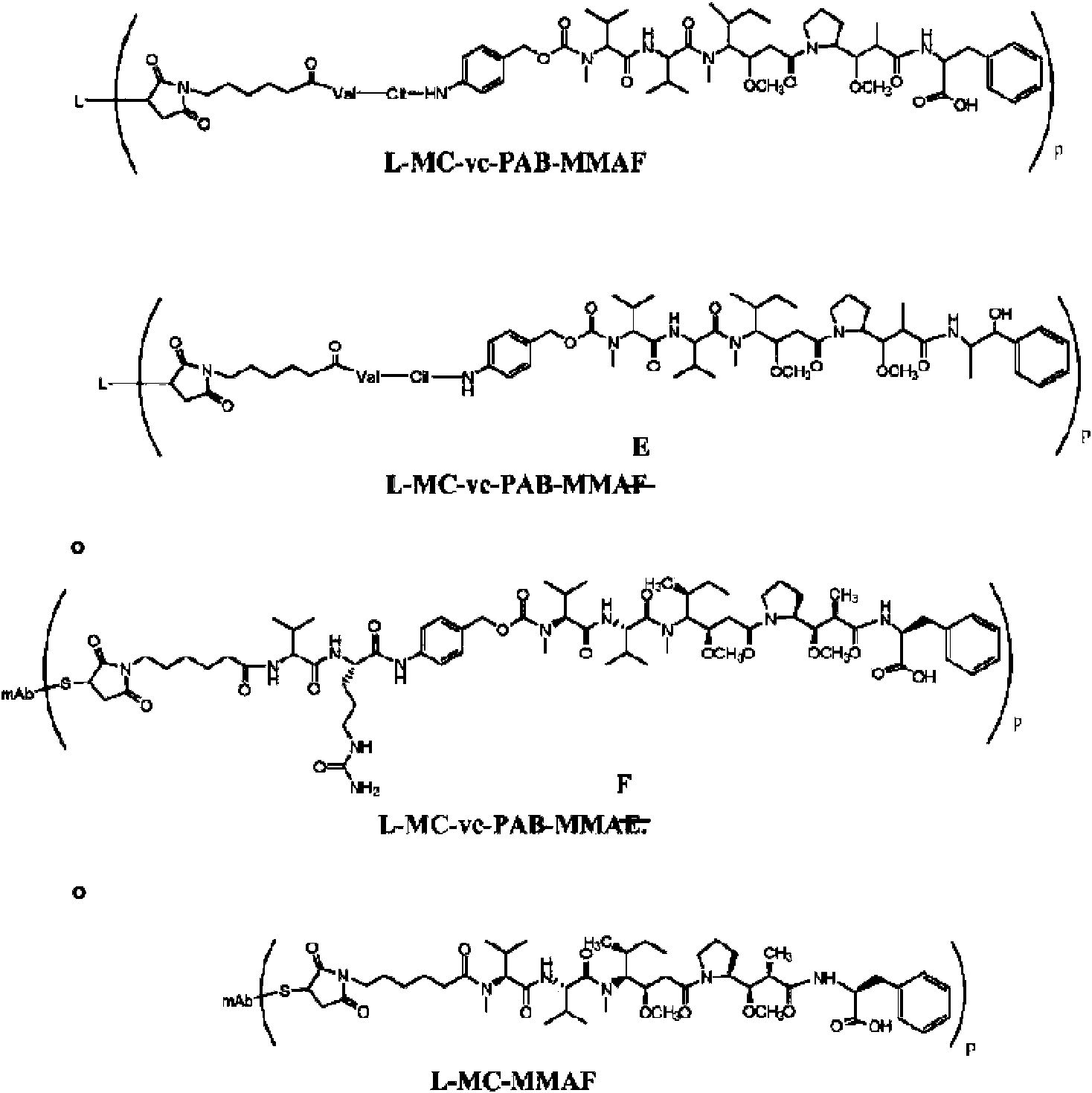
o una sal farmacéuticamente aceptable de los mismos.or a pharmaceutically acceptable salt thereof.
En algunas realizaciones, la unidad farmacéutica es una caliqueamicina, camptotecina, un maitansinoide o una antraciclina. En algunas realizaciones, el fármaco es un taxano, un inhibidor de topoisomerasa, un alcaloide de vinca o similar.In some embodiments, the pharmaceutical unit is a calicheamicin, camptothecin, a maytansinoid, or an anthracycline. In some embodiments, the drug is a taxane, a topoisomerase inhibitor, a vinca alkaloid, or the like.
En algunas realizaciones típicas, los agentes citotóxicos adecuados incluyen, por ejemplo, aglutinantes de surcos minoritarios de ADN (por ejemplo, enediinas y lexitropsinas, un compuesto de CBI, véase también la Patente de Estados Unidos N° 6.130.237), duocarmicinas, taxanos (por ejemplo, paclitaxel y docetaxel), puromicinas y alcaloides de la vinca. Otros agentes citotóxicos incluyen, por ejemplo, CC-1065, SN-38, topotecan, morfolinodoxorrubicina, rizoxina, cianomorfolino-doxorrubicina, equinomicina, combretastatina, netropsina, epotilona A y B, estramustina, criptofisina, cemadotina, maitansinoides, discodermolida, eleuterobina y mitoxantrona.In some typical embodiments, suitable cytotoxic agents include, for example, DNA minor groove binders (eg, enediins and lexitropsins, a CBI compound, see also US Patent No. 6,130,237), duocarmycins, taxanes (eg, paclitaxel and docetaxel), puromycins, and vinca alkaloids. Other cytotoxic agents include, for example, CC-1065, SN-38, topotecan, morpholinodoxorubicin, rhizoxin, cyanomorpholino-doxorubicin, echinomycin, combretastatin, netropsin, epothilone A and B, estramustine, cryptophysin, cemadotuterobondin, mitochondrion disc, cemadotuderonansinoid .
En algunas realizaciones, el fármaco es un agente anti-tubulina. Los ejemplos de agentes anti-tubulina incluyen, auristatinas, taxanos (por ejemplo, Taxol® (paclitaxel), Taxotere® (docetaxel)), T67 (Tularik) y alquiloides de vinca (por ejemplo, vincristina, vinblastina, vindesina y vinorelbina). Otros agentes antitubulínicos incluyen, por ejemplo, derivados de bacatina, análogos de taxanos (por ejemplo, epotilona A y B), nocodazol, colquicina y colcímido, estramustina, criptoficinas, cemadotina, maitansinoides, combretastatinas, discodermolida y eleuterobina.In some embodiments, the drug is an anti-tubulin agent. Examples of anti-tubulin agents include, auristatins, taxanes (eg, Taxol® (paclitaxel), Taxotere® (docetaxel)), T67 (Tularik), and vinca alkyloids (eg, vincristine, vinblastine, vindesine, and vinorelbine). Other antitubulin agents include, for example, baccatin derivatives, taxane analogs (eg, epothilone A and B), nocodazole, colchicine and colcimid, estramustine, cryptophycins, cemadotin, maytansinoids, combretastatins, discodermolide, and eleutherobine.
En ciertas realizaciones, el agente citotóxico es un maitansinoide, otro grupo de agentes anti-tubulina. Por ejemplo, en realizaciones específicas, el maitansinoide es maitansina o DM-1 (ImmunoGen, Inc., ver también Chari et al., 1992, Cancer Res. 52:127-131).20In certain embodiments, the cytotoxic agent is a maytansinoid, another group of anti-tubulin agents. For example, in specific embodiments, the maytansinoid is maytansine or DM-1 (ImmunoGen, Inc., see also Chari et al., 1992, Cancer Res. 52: 127-131) .20
En ciertas realizaciones, el agente citotóxico o citostático es una dolastatina. En ciertas realizaciones, el agente citotóxico o citostático es de la clase auristatina. Por lo tanto, en una realización específica, el agente citotóxico o citostático es MMAE (Fórmula XI). En otra realización específica, el agente citotóxico o citostático es AFP (Fórmula XVI). In certain embodiments, the cytotoxic or cytostatic agent is a dolastatin. In certain embodiments, the cytotoxic or cytostatic agent is of the auristatin class. Therefore, in a specific embodiment, the cytotoxic or cytostatic agent is MMAE (Formula XI). In another specific embodiment, the cytotoxic or cytostatic agent is AFP (Formula XVI).
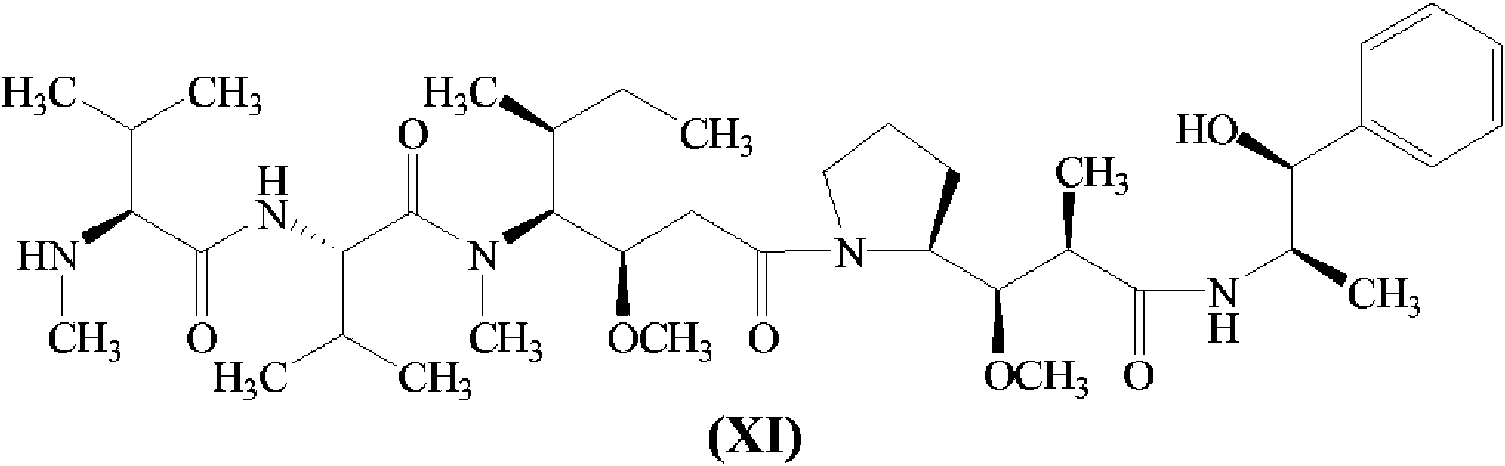
En ciertas realizaciones, el agente citotóxico o citostático es un compuesto de fórmulas XII-XXI o una sal farmacéuticamente aceptable del mismo: In certain embodiments, the cytotoxic or cytostatic agent is a compound of formulas XII-XXI or a pharmaceutically acceptable salt thereof:
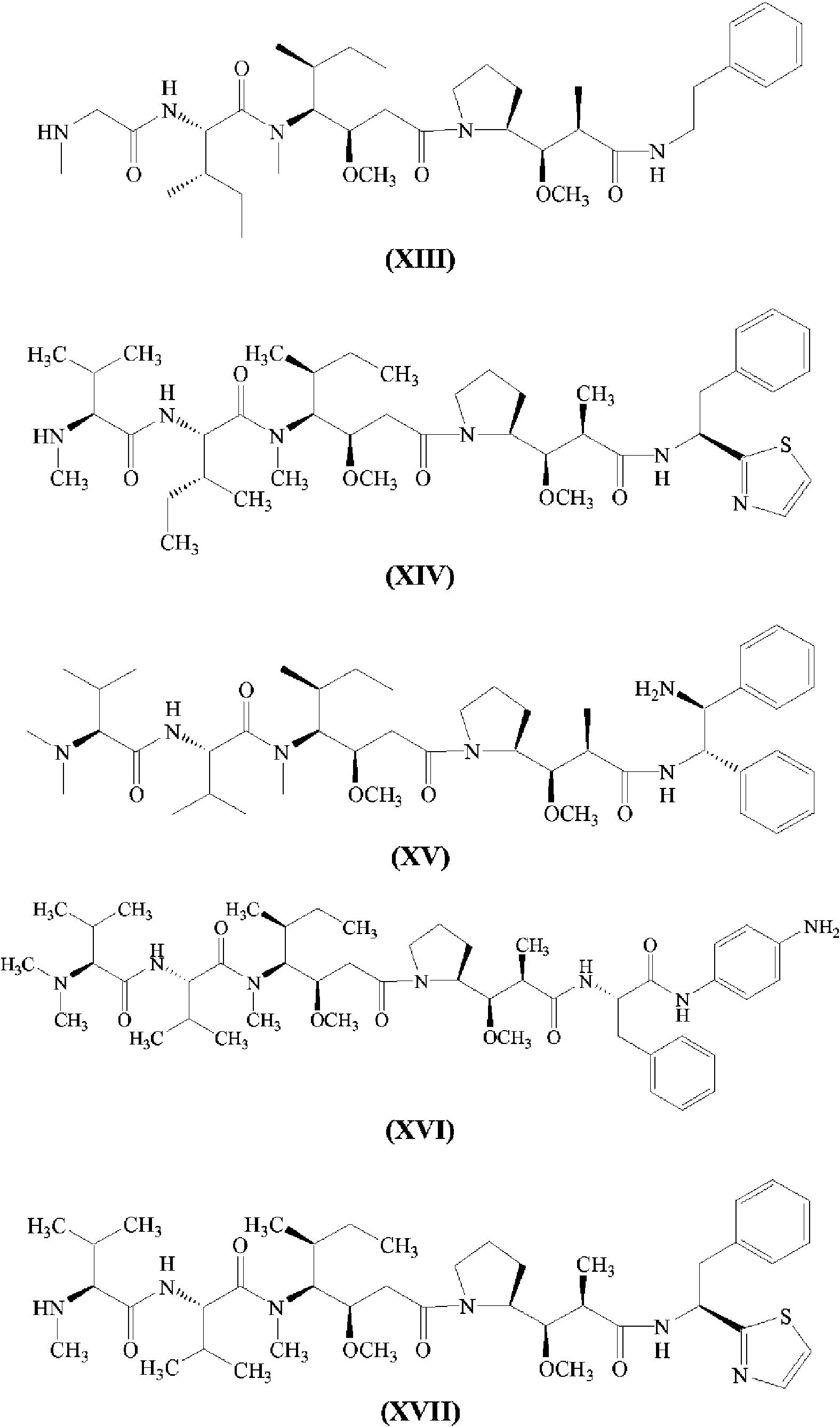
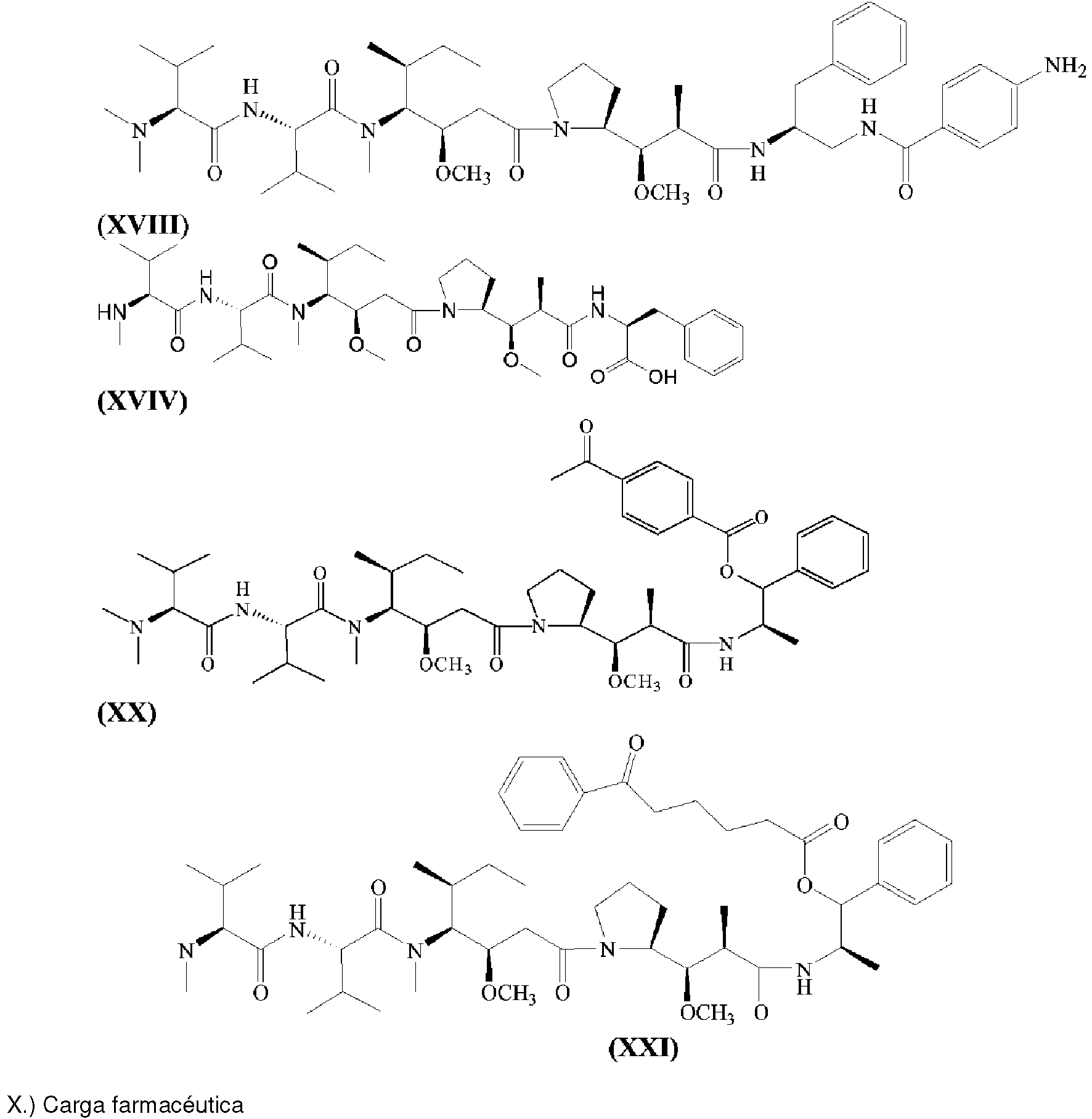
La carga farmacéutica está representada por p y es el número promedio de fracciones de fármaco por anticuerpo en una molécula. La carga farmacéutica puede variar de 1 a 20 restos de fármaco (D) por anticuerpo. Los CAF de la invención incluyen colecciones de anticuerpos conjugados con un intervalo de restos de fármaco de 1 a 20. El número medio de fracciones de fármaco por anticuerpo en las preparaciones de CAF a partir de reacciones de conjugación se puede caracterizar por medios convencionales tales como espectroscopia de masas y ensayo ELISA. La distribución cuantitativa de CAF en términos de p también puede determinarse. En algunos casos, la separación, purificación y caracterización de CAF homogéneo donde p es un cierto valor de CAF con otras cargas farmacéuticas se puede lograr por medios tales como electroforesis.Pharmaceutical loading is represented by p and is the average number of drug fractions per antibody in a molecule. The pharmaceutical loading can range from 1 to 20 drug residues (D) per antibody. The CAFs of the invention include collections of conjugated antibodies with a range of drug residues from 1 to 20. The average number of drug fractions per antibody in CAF preparations from conjugation reactions can be characterized by conventional means such as mass spectroscopy and ELISA assay. The quantitative distribution of CAF in terms of p can also be determined. In some cases, the separation, purification and characterization of homogeneous CAF where p is a certain value of CAF with other pharmaceutical fillers can be achieved by means such as electrophoresis.
Para algunos conjugados anticuerpo-fármaco, p puede estar limitado por el número de sitios de unión en el anticuerpo. Por ejemplo, cuando la unión es una cisteína tiol, como en las realizaciones ejemplares anteriores, un anticuerpo puede tener solo uno o varios grupos tiol de cisteína, o puede tener solo uno o varios grupos tiol suficientemente reactivos a través de los cuales se puede unir un enlazante. En ciertas realizaciones, una mayor carga farmacéutica, p. ej. p> 5, puede causar agregación, insolubilidad, toxicidad o pérdida de la permeabilidad celular de ciertos conjugados anticuerpo-fármaco. En ciertas realizaciones, la carga farmacéutica para un CAF de la invención varía de 1 a aproximadamente 8; de aproximadamente 2 a aproximadamente 6; de aproximadamente 3 a aproximadamente 5; de aproximadamente 3 a aproximadamente 4; de aproximadamente 3,1 a aproximadamente 3,9; de aproximadamente 3,2 a aproximadamente 3,8; de aproximadamente 3,2 a aproximadamente 3,7; de aproximadamente 3,2 a aproximadamente 3,6; de aproximadamente 3,3 a aproximadamente 3,8; o de aproximadamente 3,3 a aproximadamente 3,7. De hecho, se ha demostrado que para ciertos CAFs, la relación óptima de restos de fármaco por anticuerpo puede ser menor que 8, y puede ser de aproximadamente 2 a aproximadamente 5. Ver la patente de los EE. UU. No. 7.498.298 (incorporada en este documento como referencia en su totalidad). For some antibody-drug conjugates, p may be limited by the number of binding sites on the antibody. For example, when the binding is a thiol cysteine, as in the exemplary embodiments above, an antibody may have only one or more cysteine thiol groups, or it may have only one or more sufficiently reactive thiol groups through which it can bind. a binder. In certain embodiments, a higher pharmaceutical loading, e.g. ex. p> 5, can cause aggregation, insolubility, toxicity or loss of cell permeability of certain antibody-drug conjugates. In certain embodiments, the pharmaceutical loading for a CAF of the invention ranges from 1 to about 8; from about 2 to about 6; from about 3 to about 5; from about 3 to about 4; from about 3.1 to about 3.9; from about 3.2 to about 3.8; from about 3.2 to about 3.7; from about 3.2 to about 3.6; from about 3.3 to about 3.8; or from about 3.3 to about 3.7. In fact, it has been shown that for certain CAFs, the optimal ratio of drug residues per antibody can be less than 8, and can be from about 2 to about 5. See US Patent No. 7,498,298 (incorporated herein by reference in its entirety).
En ciertas realizaciones, menos del máximo teórico de fracciones de fármaco se conjugan con un anticuerpo durante una reacción de conjugación. Un anticuerpo puede contener, por ejemplo, residuos de lisina que no reaccionan con el intermedio de fármaco-enlazante o reactivo de enlazante, como se analiza a continuación. En general, los anticuerpos no contienen muchos grupos tiol de cisteína libres y reactivos que pueden estar unidos a un resto de fármaco; de hecho, la mayoría de los residuos tiol de cisteína en anticuerpos existen como puentes disulfuro. En ciertas realizaciones, se puede reducir un anticuerpo con un agente reductor tal como ditiotreitol (DTT) o tricarboniletilfosfina (TCEP), en condiciones de reducción parcial o total, para generar grupos tiol de cisteína reactivos. En ciertas realizaciones, se somete un anticuerpo a condiciones de desnaturalización para revelar grupos nucleofílicos reactivos tales como lisina o cisteína.In certain embodiments, less than the theoretical maximum of drug fractions are conjugated to an antibody during a conjugation reaction. An antibody may contain, for example, lysine residues that do not react with the drug-linker intermediate or linker reagent, as discussed below. In general, antibodies do not contain many free and reactive cysteine thiol groups that can be attached to a drug moiety; in fact, most of the cysteine thiol residues in antibodies exist as disulfide bridges. In certain embodiments, an antibody can be reduced with a reducing agent such as dithiothreitol (DTT) or tricarbonylethylphosphine (TCEP), under partial or total reduction conditions, to generate reactive cysteine thiol groups. In certain embodiments, an antibody is subjected to denaturing conditions to reveal reactive nucleophilic groups such as lysine or cysteine.
La carga (relación fármaco/anticuerpo) de un CAF puede controlarse de diferentes maneras, por ejemplo, mediante: (i) la limitación del exceso molar de fármaco-enlazante intermedio o reactivo enlazante en relación con el anticuerpo, (ii) la limitación del tiempo de reacción de conjugación o temperatura, (iii) condiciones reductoras parciales o limitantes para la modificación del tiol de cisteína, (iv) el diseño mediante técnicas recombinantes de la secuencia de aminoácidos del anticuerpo de modo que el número y la posición de residuos de cisteína se modifique para controlar el número y/o la posición de uniones de enlazante-fármaco (tales como tioMab o tioFab preparado como se describe en el presente documento y en el documento WO2006/034488 (incorporado en este documento como referencia en su totalidad)).The loading (drug / antibody ratio) of a CAF can be controlled in different ways, for example, by: (i) limiting the molar excess of drug-linker intermediate or binding reagent relative to the antibody, (ii) limiting the conjugation reaction time or temperature, (iii) partial or limiting reducing conditions for cysteine thiol modification, (iv) design by recombinant techniques of the antibody amino acid sequence so that the number and position of residues of cysteine is modified to control the number and / or position of linker-drug junctions (such as thioMab or thioFab prepared as described herein and in WO2006 / 034488 (incorporated herein by reference in its entirety) ).
Debe entenderse que cuando más de un grupo nucleófilo reacciona con un intermedio de fármaco-enlazante o reactivo de enlazante seguido del reactivo del resto de fármaco, entonces el producto resultante es una mezcla de compuestos de CAF con una distribución de uno o más restos de fármaco unidos a un anticuerpo. El número promedio de fármacos por anticuerpo puede calcularse a partir de la mezcla mediante un ensayo doble de anticuerpos ELISA, que es específico para anticuerpos y específico para el fármaco. Las moléculas de CAF individuales pueden identificarse en la mezcla por espectroscopía de masas y separarse por HPLC, p. ej. cromatografía de interacción hidrófoba (véase, por ejemplo, Hamblett, K. J., et al. "Effect of drug loading on the pharmacology, pharmacokinetics, and toxicity of an anti-CD30 antibody-drug conjugate", Resumen No. 624, Asociación Estadounidense para la Investigación del Cáncer, Reunión Anual 2004, Mar. 27-31,2004, Proceedings of the AACR, Volumen 45, marzo de 2004; Alley, S.C., et al. "Controlling the location of drug attachment in antibodydrug conjugates", Resumen No. 627, Asociación Estadounidense para la Investigación del Cáncer, Reunión Anual 2004, Mar. 27-31, 2004, Proceedings of the AACR, Volumen 45, marzo de 2004). En ciertas realizaciones, un CAF homogéneo con un único valor de carga se puede aislar de la mezcla de conjugación por electroforesis o cromatografía.It should be understood that when more than one nucleophilic group reacts with a drug-linker intermediate or linker reagent followed by the drug moiety reagent, then the resulting product is a mixture of CAF compounds with a distribution of one or more drug moieties. attached to an antibody. The average number of drugs per antibody can be calculated from the mixture by a double antibody ELISA assay, which is specific for antibodies and specific for the drug. Individual CAF molecules can be identified in the mixture by mass spectroscopy and separated by HPLC, e.g. ex. hydrophobic interaction chromatography (see, for example, Hamblett, KJ, et al. "Effect of drug loading on the pharmacology, pharmacokinetics, and toxicity of an anti-CD30 antibody-drug conjugate", Abstract No. 624, American Association for the Cancer Research, 2004 Annual Meeting, Mar. 27-31,2004, Proceedings of the AACR, Volume 45, March 2004; Alley, SC, et al. "Controlling the location of drug attachment in antibodydrug conjugates", Abstract No. 627, American Association for Cancer Research, 2004 Annual Meeting, Mar. 27-31, 2004, Proceedings of the AACR, Volume 45, March 2004). In certain embodiments, a homogeneous CAF with a single charge value can be isolated from the conjugation mixture by electrophoresis or chromatography.
XI.) Métodos para determinar el efecto citotóxico de los CAFsXI.) Methods to determine the cytotoxic effect of CAFs
Se conocen métodos para determinar si un conjugado de fármaco o anticuerpo-fármaco ejerce un efecto citostático y/o citotóxico sobre una célula. En general, la actividad citotóxica o citostática de un conjugado de anticuerpo y fármaco puede medirse por: la exposición de células de mamífero que expresan una proteína diana del conjugado de anticuerpo y fármaco en un medio de cultivo celular; el cultivo de las células durante un período de aproximadamente 6 horas a aproximadamente 5 días; y la medición de la viabilidad celular. Los ensayos in vitro basados en células pueden usarse para medir la viabilidad (proliferación), la citotoxicidad y la inducción de la apoptosis (activación de caspasas) del conjugado anticuerpo-fármaco.Methods are known to determine whether a drug or antibody-drug conjugate exerts a cytostatic and / or cytotoxic effect on a cell. In general, the cytotoxic or cytostatic activity of an antibody-drug conjugate can be measured by: exposing mammalian cells expressing a target protein of the antibody-drug conjugate in cell culture medium; culturing the cells for a period of from about 6 hours to about 5 days; and the measurement of cell viability. Cell-based in vitro assays can be used to measure the viability (proliferation), cytotoxicity, and induction of apoptosis (caspase activation) of the antibody-drug conjugate.
Para determinar si un conjugado de anticuerpo y fármaco ejerce un efecto citostático, se puede usar un ensayo de incorporación de timidina. Por ejemplo, las células cancerosas que expresan un antígeno diana a una densidad de 5.000 células/pocillo de un plaqueado de 96 pocillos pueden cultivarse durante un período de 72 horas y exponerse a 0,5 gC¡ de 3H-timidina durante las últimas 8 horas del período de 72 horas. La incorporación de 3H-timidina en las células del cultivo se mide en presencia y en ausencia del conjugado anticuerpo-fármaco.To determine whether an antibody-drug conjugate exerts a cytostatic effect, a thymidine incorporation assay can be used. For example, cancer cells expressing a target antigen at a density of 5,000 cells / well of a 96-well plate can be cultured for a period of 72 hours and exposed to 0.5 gC¡ of 3H-thymidine for the last 8 hours. of the 72 hour period. The incorporation of 3H-thymidine into the cells of the culture is measured in the presence and in the absence of the antibody-drug conjugate.
Para determinar la citotoxicidad, puede medirse la necrosis o la apoptosis (muerte celular programada). La necrosis suele ir acompañada de una mayor permeabilidad de la membrana plasmática; hinchazón de la célula y ruptura de la membrana plasmática. La apoptosis se caracteriza típicamente por la formación de vesículas en la membrana, la condensación del citoplasma y la activación de endonucleasas endógenas. La determinación de cualquiera de estos efectos sobre las células cancerosas indica que un conjugado de anticuerpo y fármaco es útil en el tratamiento de cánceres.To determine cytotoxicity, necrosis or apoptosis (programmed cell death) can be measured. Necrosis is usually accompanied by increased permeability of the plasma membrane; cell swelling and plasma membrane rupture. Apoptosis is typically characterized by membrane vesicle formation, cytoplasmic condensation, and activation of endogenous endonucleases. Determination of any of these effects on cancer cells indicates that an antibody-drug conjugate is useful in treating cancers.
La viabilidad celular puede medirse determinando en una célula la absorción de un colorante tal como rojo neutro, azul tripano o azul ALAMAR™ (véase, por ejemplo, Page et al., 1993, Intl. J. Oncology 3: 473-476). En tal ensayo, las células se incuban en medios que contienen el colorante, las células se lavan, y el colorante restante, que refleja la captación celular del colorante, se mide espectrofotométricamente. El colorante de unión a la proteína sulforrodamina B (SRB) también se puede usar para medir la citotoxicidad (Skehan et al., 1990, J. Natl. Inst. Cancer 82:1107-12).Cell viability can be measured by determining in a cell the uptake of a dye such as neutral red, trypan blue or ALAMAR ™ blue (see, eg, Page et al., 1993, Intl. J. Oncology 3: 473-476). In such an assay, cells are incubated in media containing the dye, the cells are washed, and the remaining dye, reflecting cellular uptake of the dye, is measured spectrophotometrically. Sulphorhodamine protein binding dye B (SRB) can also be used to measure cytotoxicity (Skehan et al., 1990, J. Natl. Inst. Cancer 82: 1107-12).
Alternativamente, se usa una sal de tetrazolio, tal como MTT, en un ensayo colorimétrico cuantitativo para la supervivencia y proliferación de células de mamífero detectando células vivas, pero no muertas (véase, por ejemplo, Mosmann, 1983, J. Immunol. Methods 65: 55 - 63). Alternatively, a tetrazolium salt, such as MTT, is used in a quantitative colorimetric assay for mammalian cell survival and proliferation detecting live, but not dead cells (see, for example, Mosmann, 1983, J. Immunol. Methods 65 : 55-63).
La apoptosis se puede cuantificar midiendo, por ejemplo, la fragmentación del ADN. Se encuentran disponibles métodos fotométricos comerciales para la determinación cuantitativa in vitro de la fragmentación del ADN. Ejemplos de tales ensayos, que incluyen TUNEL (que detecta la incorporación de nucleótidos marcados en ADN fragmentado) y ensayos basados en ELISA, se describen en Biochemica, 1999, no. 2, pp. 34-37 (Roche Molecular Biochemicals). La apoptosis también se puede determinar midiendo los cambios morfológicos en una célula. Por ejemplo, como con la necrosis, la pérdida de la integridad de la membrana plasmática puede determinarse midiendo la absorción de ciertos colorantes (por ejemplo, un colorante fluorescente tal como, por ejemplo, naranja de acridina o bromuro de etidio). Un método para medir el número de células apoptóticas ha sido descrito por Duke y Cohen, Current Protocols in Immunology (Coligan et al., Eds., 1992, págs. 3.17.1-3.17.16). Las células también se pueden marcar con un colorante de ADN (por ejemplo, naranja de acridina, bromuro de etidio o yoduro de propidio) y las células observadas para la condensación de la cromatina y la marginación a lo largo de la membrana nuclear interna. Otros cambios morfológicos que se pueden medir para determinar la apoptosis incluyen, por ejemplo, condensación citoplásmica, aumento de la formación de vesículas en la membrana y contracción celular.Apoptosis can be quantified by measuring, for example, DNA fragmentation. Commercial photometric methods are available for the quantitative in vitro determination of DNA fragmentation. Examples of such assays, including TUNEL (which detects the incorporation of labeled nucleotides in fragmented DNA) and ELISA-based assays, are described in Biochemica, 1999, no. 2, pp. 34-37 (Roche Molecular Biochemicals). Apoptosis can also be determined by measuring morphological changes in a cell. For example, as with necrosis, loss of plasma membrane integrity can be determined by measuring the absorption of certain dyes (eg, a fluorescent dye such as, for example, acridine orange or ethidium bromide). A method for measuring the number of apoptotic cells has been described by Duke and Cohen, Current Protocols in Immunology (Coligan et al., Eds., 1992, pp. 3.17.1-3.17.16). Cells can also be labeled with a DNA dye (eg, acridine orange, ethidium bromide, or propidium iodide) and cells observed for chromatin condensation and marginalization along the inner nuclear membrane. Other morphological changes that can be measured to determine apoptosis include, for example, cytoplasmic condensation, increased membrane vesicle formation, and cell contraction.
La presencia de células apoptóticas se puede medir tanto en los compartimientos adjuntos como "flotantes" de los cultivos. Por ejemplo, ambos compartimentos se pueden recoger eliminando el sobrenadante, tripsinizando las células unidas, combinando las preparaciones después de una etapa de lavado por centrifugación (por ejemplo, 10 minutos a 2000 rpm) y detectando la apoptosis (por ejemplo, midiendo la fragmentación de ADN). (Véase, por ejemplo, Piazza et al., 1995, Cancer Research 55: 3110 - 16).The presence of apoptotic cells can be measured both in the adjoining and "floating" compartments of the cultures. For example, both compartments can be harvested by removing the supernatant, trypsinizing attached cells, combining the preparations after a centrifugal wash step (eg, 10 minutes at 2000 rpm), and detecting apoptosis (eg, measuring fragmentation of DNA). (See, for example, Piazza et al., 1995, Cancer Research 55: 3110-16).
In vivo, el efecto de una composición terapéutica de 191P4D12 se puede evaluar en un modelo animal adecuado. Por ejemplo, pueden usarse modelos de cáncer xenogénico, en los que explantes de cáncer o tejidos de xenoinjerto pasados se introducen en animales inmunodeprimidos, tales como ratones desnudos o SCID (Klein et al., 1997, Nature Medicine 3: 402-408). Por ejemplo, la Solicitud de Patente PCT WO98/16628 y la Pat. U.S. N° 6.107.540 describen diversos modelos de xenoinjertos de cáncer de próstata humano capaces de recapitular el desarrollo de tumores primarios, micrometástasis y la formación de metástasis osteoblásticas características de la enfermedad en estadio tardío. La eficacia puede predecirse usando ensayos que miden la inhibición de la formación de tumores, la regresión del tumor o la metástasis, y similares.In vivo, the effect of a 191P4D12 therapeutic composition can be evaluated in a suitable animal model. For example, xenogeneic cancer models can be used, in which cancer explants or passed xenograft tissues are introduced into immunosuppressed animals, such as nude mice or SCID (Klein et al., 1997, Nature Medicine 3: 402-408). For example, PCT Patent Application WO98 / 16628 and US Pat. U.S. No. 6,107,540 describe various models of human prostate cancer xenografts capable of recapitulating the development of primary tumors, micrometastases, and the formation of osteoblastic metastases characteristic of late-stage disease. Efficacy can be predicted using assays that measure inhibition of tumor formation, tumor regression or metastasis, and the like.
Los ensayos in vivo que evalúan la promoción de la apoptosis son útiles para evaluar composiciones terapéuticas. En una realización, los xenoinjertos de ratones portadores de tumores tratados con la composición terapéutica pueden examinarse para determinar la presencia de focos apoptóticos y comparar con ratones portadores de xenoinjertos de control no tratados. El grado en que se encuentran los focos apoptóticos en los tumores de los ratones tratados proporciona una indicación de la eficacia terapéutica de la composición.In vivo assays evaluating the promotion of apoptosis are useful for evaluating therapeutic compositions. In one embodiment, xenografts from tumor bearing mice treated with the therapeutic composition can be examined for the presence of apoptotic foci and compared to untreated control xenograft bearing mice. The degree to which apoptotic foci are found in the tumors of treated mice provides an indication of the therapeutic efficacy of the composition.
Las composiciones terapéuticas usadas en la práctica de los métodos anteriores se pueden formular en composiciones farmacéuticas que comprenden un vehículo adecuado para el método de administración deseado. Los vehículos adecuados incluyen cualquier material que, cuando se combina con la composición terapéutica, retiene la función antitumoral de la composición terapéutica y generalmente no es reactivo con el sistema inmune del paciente. Los ejemplos incluyen, pero sin limitación, cualquiera de varios portadores farmacéuticos estándar tales como soluciones salinas tamponadas con fosfato estériles, agua bacteriostática y similares (véase, en general, Remington's Pharmaceutical Sciences, 16a Edición, A. Osal., Ed., 1980).Therapeutic compositions used in the practice of the above methods can be formulated into pharmaceutical compositions comprising a suitable carrier for the desired method of administration. Suitable carriers include any material that, when combined with the therapeutic composition, retains the antitumor function of the therapeutic composition and is generally not reactive with the immune system of the patient. Examples include, but are not limited to, any of a number of standard pharmaceutical carriers such as sterile phosphate buffered saline, bacteriostatic water, and the like (see, generally, Remington's Pharmaceutical Sciences, 16th Edition, A. Osal., Ed., 1980) .
Las formulaciones terapéuticas se pueden solubilizar y administrar a través de cualquier ruta capaz de administrar la composición terapéutica al sitio del tumor. Las vías de administración potencialmente efectivas incluyen, pero sin limitación, intravenosa, parenteral, intraperitoneal, intramuscular, intratumoral, intradérmica, intraorganica, ortotópica y similares. Una formulación preferida para la inyección intravenosa comprende la composición terapéutica en una solución de agua bacteriostática conservada, agua no conservada estéril, y/o diluida en bolsas de polivinilcloruro o polietileno que contienen 0,9% de cloruro sódico estéril para inyección, USP. Las preparaciones de proteínas terapéuticas pueden liofilizarse y almacenarse como polvos estériles, preferiblemente al vacío, y luego reconstituirse en agua bacteriostática (que contiene, por ejemplo, conservante de alcohol bencílico) o en agua estéril antes de la inyección.Therapeutic formulations can be solubilized and administered via any route capable of delivering the therapeutic composition to the tumor site. Potentially effective routes of administration include, but are not limited to, intravenous, parenteral, intraperitoneal, intramuscular, intratumoral, intradermal, intraorganic, orthotopic, and the like. A preferred formulation for intravenous injection comprises the therapeutic composition in a solution of preserved bacteriostatic water, sterile non-preserved water, and / or diluted in polyvinylchloride or polyethylene bags containing 0.9% sterile sodium chloride for injection, USP. Therapeutic protein preparations can be lyophilized and stored as sterile powders, preferably under vacuum, and then reconstituted in bacteriostatic water (containing, for example, benzyl alcohol preservative) or sterile water prior to injection.
Las dosis y los protocolos de administración para el tratamiento de cánceres usando los métodos anteriores variarán con el método y el cáncer diana, y generalmente dependerán de una serie de otros factores apreciados en la técnica.Doses and administration protocols for treating cancers using the above methods will vary with the method and the target cancer, and will generally depend on a number of other factors appreciated in the art.
XII.) Tratamiento del cáncer o de los cánceres que expresan 191P4D12XII.) Treatment of cancer or cancers expressing 191P4D12
La identificación de 191P4D12 como una proteína que normalmente se expresa en un conjunto restringido de tejidos, pero que también se expresa en cánceres tales como los enumerados en la Tabla I, abre una serie de enfoques terapéuticos para el tratamiento de tales cánceres.The identification of 191P4D12 as a protein that is normally expressed in a restricted set of tissues, but that is also expressed in cancers such as those listed in Table I, opens up a number of therapeutic approaches for the treatment of such cancers.
Es de destacar que las terapias antitumorales dirigidas han sido útiles incluso cuando la proteína diana se expresa en tejidos normales, incluso en tejidos vitales de órganos normales. Un órgano vital es aquel que es necesario para mantener la vida, como el corazón o el colon. Un órgano no vital es aquel que puede eliminarse, con lo cual el individuo aún puede sobrevivir. Ejemplos de órganos no vitales son el ovario, el seno y la próstata. Notably, targeted antitumor therapies have been useful even when the target protein is expressed in normal tissues, including vital tissues of normal organs. A vital organ is one that is necessary to maintain life, such as the heart or the colon. A non-vital organ is one that can be eliminated, with which the individual can still survive. Examples of non-vital organs are the ovary, breast, and prostate.
La expresión de una proteína diana en tejido normal, incluso tejido normal vital, no elimina la utilidad de un agente diana para la proteína como terapéutico para ciertos tumores en los que la proteína también está sobreexpresada. Por ejemplo, la expresión en órganos vitales no es en sí misma perjudicial. Además, los órganos que se consideran prescindibles, como la próstata y el ovario, se pueden extirpar sin afectar la mortalidad. Finalmente, algunos órganos vitales no se ven afectados por la expresión normal del órgano debido a una inmunodepresión. Los órganos inmunodeprimidos son órganos que están protegidos de la sangre por una barrera órgano sanguínea y, por lo tanto, no son accesibles a la inmunoterapia. Ejemplos de órganos inmunodeprimidos son el cerebro y los testículos.Expression of a target protein in normal tissue, including vital normal tissue, does not eliminate the utility of a target agent for the protein as a therapeutic for certain tumors in which the protein is also overexpressed. For example, expression in vital organs is not in itself harmful. In addition, organs that are considered expendable, such as the prostate and ovary, can be removed without affecting mortality. Finally, some vital organs are not affected by the normal expression of the organ due to immunosuppression. Immunosuppressed organs are organs that are protected from the blood by a blood organ barrier and, therefore, are not accessible to immunotherapy. Examples of immunosuppressed organs are the brain and testes.
Por consiguiente, los enfoques terapéuticos que inhiben la actividad de una proteína 191P4D12 son útiles para pacientes que padecen un cáncer que expresa 191P4D12. Estos enfoques terapéuticos generalmente se dividen en tres clases. La primera clase modula la función de 191P4D12 ya que se relaciona con el crecimiento de células tumorales que conduce a la inhibición o el retraso del crecimiento de células tumorales o la inducción de su muerte. La segunda clase comprende diversos métodos para inhibir la unión o asociación de una proteína 191P4D12 con su pareja de unión o con otras proteínas. La tercera clase comprende una variedad de métodos para inhibir la transcripción de un gen 191P4D12 o la traducción de ARNm de 191P4D12.Accordingly, therapeutic approaches that inhibit the activity of a 191P4D12 protein are useful for patients suffering from a 191P4D12-expressing cancer. These therapeutic approaches are generally divided into three classes. The first class modulates the function of 191P4D12 as it is related to tumor cell growth leading to inhibition or retardation of tumor cell growth or induction of their death. The second class comprises various methods of inhibiting the binding or association of a 191P4D12 protein with its binding partner or with other proteins. The third class comprises a variety of methods for inhibiting the transcription of a 191P4D12 gene or the translation of 191P4D12 mRNA.
Por consiguiente, los pacientes con cáncer pueden evaluarse para determinar la presencia y el nivel de expresión de 191P4D12, preferiblemente usando evaluaciones inmunohistoquímicas de tejido tumoral, imágenes cuantitativas de 191P4D12 u otras técnicas que indiquen de manera confiable la presencia y grado de expresión de 191P4D12. Se prefiere el análisis inmunohistoquímico de biopsias tumorales o muestras quirúrgicas para este propósito. Los métodos para el análisis inmunohistoquímico de los tejidos tumorales son bien conocidos en la técnica.Accordingly, cancer patients can be screened for the presence and level of expression of 191P4D12, preferably using immunohistochemical assessments of tumor tissue, quantitative imaging of 191P4D12, or other techniques that reliably indicate the presence and degree of expression of 191P4D12. Immunohistochemical analysis of tumor biopsies or surgical specimens is preferred for this purpose. Methods for immunohistochemical analysis of tumor tissues are well known in the art.
XIII.) 191P4D12 como un objetivo para la terapia basada en anticuerposXIII.) 191P4D12 as a target for antibody-based therapy
191P4D12 es un objetivo atractivo para estrategias terapéuticas basadas en anticuerpos. Se conocen en la técnica varias estrategias de anticuerpos para dirigir moléculas tanto extracelulares como intracelulares (véase, por ejemplo, el complemento y la muerte mediada por ADCC, así como el uso de intracuerpos). Debido a que 191P4D12 se expresa mediante células cancerosas de diversos linajes en relación con las células normales correspondientes, se prepara la administración sistémica de composiciones inmunorreactivas de 191P4D12 que exhiben una sensibilidad excelente sin efectos tóxicos, no específicos y/o no diana causados por la unión de la composición inmunorreactiva a órganos y tejidos no diana. Los anticuerpos específicamente reactivos con dominios de 191P4D12 son útiles para tratar cánceres que expresan 191P4D12 sistémicamente, preferiblemente como conjugados de anticuerpo y fármaco (es decir, CAFs) donde el conjugado está con una toxina o agente terapéutico.191P4D12 is an attractive target for antibody-based therapeutic strategies. Various antibody strategies for targeting both extracellular and intracellular molecules are known in the art (see, for example, complement and ADCC-mediated death, as well as the use of intrabodies). Because 191P4D12 is expressed by cancer cells of various lineages relative to the corresponding normal cells, systemic administration of 191P4D12 immunoreactive compositions is prepared that exhibit excellent sensitivity without toxic, non-specific and / or non-target effects caused by binding. of the composition immunoreactive to non-target organs and tissues. Antibodies specifically reactive with domains of 191P4D12 are useful for treating cancers that express 191P4D12 systemically, preferably as antibody-drug conjugates (ie, CAFs) where the conjugate is with a toxin or therapeutic agent.
Los expertos en la técnica entienden que los anticuerpos pueden usarse para dirigirse específicamente y unirse a moléculas inmunogénicas tales como una región inmunogénica de una secuencia de 191P4D12 mostrada en la FIG.It is understood by those of skill in the art that antibodies can be used to specifically target and bind immunogenic molecules such as an immunogenic region of a 191P4D12 sequence shown in FIG.
1. Además, los expertos en la materia entienden que es rutinario conjugar anticuerpos con agentes citotóxicos (véase, por ejemplo, Slevers et al. Blood 93:11 3678-3684 (Jun. 1, 1999)). Cuando los agentes citotóxicos y/o terapéuticos se administran directamente a las células, como por medio de su conjugación con anticuerpos específicos para una molécula expresada por esa célula (p. ej. 191P4D12), el agente citotóxico ejercerá su efecto biológico conocido (es decir, la citotoxicidad) sobre esas células.1. Furthermore, it is understood by those of skill in the art that it is routine to conjugate antibodies to cytotoxic agents (see, for example, Slevers et al. Blood 93:11 3678-3684 (Jun. 1, 1999)). When cytotoxic and / or therapeutic agents are administered directly to cells, such as by conjugation with antibodies specific for a molecule expressed by that cell (e.g. 191P4D12), the cytotoxic agent will exert its known biological effect (i.e. , cytotoxicity) on those cells.
En la técnica se conocen una amplia variedad de composiciones y métodos para usar conjugados de anticuerpo y agente citotóxico para matar células. En el contexto de los cánceres, los métodos típicos implican administrar a un mamífero que tiene un tumor una cantidad biológicamente eficaz de un conjugado que comprende un agente citotóxico y/o terapéutico seleccionado unido a un agente diana (por ejemplo, un MAb 191P4D12, preferiblemente Ha22-2(2,4)6.1) que se une a un antígeno (p. ej. 191P4D12) expresado, accesible para unirse o localizarse en las superficies de las células. Una realización típica es un método para administrar un agente citotóxico y/o terapéutico a una célula que expresa 191P4D12, que comprende conjugar el agente citotóxico con un anticuerpo que se une inmunoespecíficamente a un epítopo de 191P4D12 y exponer la célula al conjugado de anticuerpo y fármaco (CAF). Otra realización ilustrativa es un método para tratar a un individuo sospechoso de padecer cáncer metastásico, que comprende una etapa de administrar por vía parenteral a dicho individuo una composición farmacéutica que comprende una cantidad terapéuticamente eficaz de un anticuerpo conjugado con un agente citotóxico y/o terapéutico.A wide variety of compositions and methods are known in the art for using antibody-cytotoxic agent conjugates to kill cells. In the context of cancers, typical methods involve administering to a mammal having a tumor a biologically effective amount of a conjugate comprising a selected cytotoxic and / or therapeutic agent bound to a target agent (e.g., a MAb 191P4D12, preferably Ha22-2 (2,4) 6.1) that binds to an expressed antigen (eg 191P4D12), accessible to bind or localize on cell surfaces. A typical embodiment is a method of delivering a cytotoxic and / or therapeutic agent to a cell expressing 191P4D12, which comprises conjugating the cytotoxic agent with an antibody that immunospecifically binds to an epitope of 191P4D12 and exposing the cell to the antibody-drug conjugate. (CAF). Another illustrative embodiment is a method of treating an individual suspected of having metastatic cancer, comprising a step of parenterally administering to said individual a pharmaceutical composition comprising a therapeutically effective amount of an antibody conjugated to a cytotoxic and / or therapeutic agent. .
La inmunoterapia con cáncer que usa anticuerpos 191P4D12 puede realizarse de acuerdo con diversos enfoques que se han empleado con éxito en el tratamiento de otros tipos de cáncer, que incluyen, pero sin limitación, cáncer de colon (Arlen et al., 1998, Crit. Rev. Immunol. 18: 133-138), mieloma múltiple (Ozaki et al., 1997, Blood 90: 3179 3186, Tsunenari et al., 1997, Blood 90: 2437-2444), cáncer gástrico (Kasprzyk et al., 1992, Cancer. Res. 52:2771-2776), linfoma de células B (Funakoshi et al., 1996, J. Immunother. Emphasis Tumor Immunol. 19: 93-101), leucemia (Zhong et al., 1996, Leuk. Res. 20: 581-589), cáncer colorrectal (Moun et al., 1994, Cancer Res. 54:6160-6166; Velders et al., 1995, Cancer Res. 55: 4398-4403) y cáncer de mama (Shepard et al., 1991, J. Clin. Immunol. 11:117-127). Algunos enfoques terapéuticos implican la conjugación de anticuerpos desnudos a una toxina o radioisótopo, como la conjugación de 91Y o 131I con anticuerpos anti-CD20 (p. ej., Zevalin™, IDEC Pharmaceuticals Corp. o Bexxar™ Coulter Pharmaceuticals) respectivamente, mientras que otros implican la coadministración de anticuerpos y otros agentes terapéuticos, tales como Herceptin™ (MAb de trastuzu) con paclitaxel (Genentech, Inc.). En una realización preferida, los anticuerpos se conjugarán con un agente citotóxico, supra, preferiblemente un derivado de aurastatina designado MMAE (Seattle Genetics, Inc).Cancer immunotherapy using 191P4D12 antibodies can be performed according to various approaches that have been used successfully in the treatment of other types of cancer, including, but not limited to, colon cancer (Arlen et al., 1998, Crit. Rev. Immunol. 18: 133-138), multiple myeloma (Ozaki et al., 1997, Blood 90: 3179-3186, Tsunenari et al., 1997, Blood 90: 2437-2444), gastric cancer (Kasprzyk et al., 1992, Cancer. Res. 52: 2771-2776), B-cell lymphoma (Funakoshi et al., 1996, J. Immunother. Emphasis Tumor Immunol. 19: 93-101), leukemia (Zhong et al., 1996, Leuk Res. 20: 581-589), colorectal cancer (Moun et al., 1994, Cancer Res. 54: 6160-6166; Velders et al., 1995, Cancer Res. 55: 4398-4403) and breast cancer ( Shepard et al., 1991, J. Clin. Immunol. 11: 117-127). Some therapeutic approaches involve the conjugation of naked antibodies to a toxin or radioisotope, such as the conjugation of 91Y or 131I with anti-CD20 antibodies (eg, Zevalin ™, IDEC Pharmaceuticals Corp. or Bexxar ™ Coulter Pharmaceuticals) respectively, while others involve the co-administration of antibodies and other therapeutic agents, such as Herceptin ™ (MAb from trastuzu) with paclitaxel (Genentech, Inc.). In a Preferred embodiment, the antibodies will be conjugated to a cytotoxic agent, supra, preferably an aurastatin derivative designated MMAE (Seattle Genetics, Inc).
Aunque la terapia con anticuerpos 191P4D12 es útil para todas las etapas del cáncer, la terapia con anticuerpos puede ser particularmente apropiada en cánceres avanzados o metastásicos. El tratamiento con la terapia de anticuerpos de la invención está indicado para pacientes que han recibido una o más rondas de quimioterapia. Alternativamente, la terapia de anticuerpos de la invención se combina con un régimen quimioterapéutico o de radiación para pacientes que no han recibido tratamiento quimioterapéutico. Además, la terapia con anticuerpos puede permitir el uso de dosis reducidas de quimioterapia concomitante, particularmente para pacientes que no toleran muy bien la toxicidad del agente quimioterapéutico. Fan et al. (Cancer Res. 53:4637-4642, 1993), Prewett et al. (International J. of Onco. 9: 217 - 224, 1996), y Hancock et al. (Cancer Res. 51: 4575 - 4580, 1991) describen el uso de diversos anticuerpos junto con agentes quimioterapéuticos.Although 191P4D12 antibody therapy is useful for all stages of cancer, antibody therapy may be particularly appropriate in advanced or metastatic cancers. Treatment with the antibody therapy of the invention is indicated for patients who have received one or more rounds of chemotherapy. Alternatively, the antibody therapy of the invention is combined with a chemotherapeutic or radiation regimen for patients who have not received chemotherapeutic treatment. Furthermore, antibody therapy may allow the use of reduced doses of concomitant chemotherapy, particularly for patients who do not tolerate the toxicity of the chemotherapeutic agent very well. Fan et al. (Cancer Res. 53: 4637-4642, 1993), Prewett et al. (International J. of Onco. 9: 217-224, 1996), and Hancock et al. (Cancer Res. 51: 4575-4580, 1991) describe the use of various antibodies in conjunction with chemotherapeutic agents.
Los anticuerpos monoclonales 191P4D12 que tratan los cánceres expuestos en la Tabla I incluyen aquellos que inician una potente respuesta inmune contra el tumor o aquellos que son directamente citotóxicos. A este respecto, los anticuerpos monoclonales 191P4D12 (MAbs) pueden provocar lisis celular tumoral por mecanismos de citotoxicidad celular mediados por el complemento o dependientes de anticuerpos (ADCC), que requieren una porción Fc intacta de la molécula de inmunoglobulina para la interacción con sitios del receptor Fc de la célula efectora en las proteínas del complemento. Además, los MAb de 191P4D12 que ejercen un efecto biológico directo sobre el crecimiento tumoral son útiles para tratar cánceres que expresan 191P4D12. Los mecanismos por los cuales actúan directamente los MAbs citotóxicos incluyen: inhibición del crecimiento celular, modulación de la diferenciación celular, modulación de los perfiles del factor de angiogénesis tumoral e inducción de la apoptosis. El(los) mecanismo(s) por el(los) cual(es) un MAb de 191P4D12 particular ejerce un efecto antitumoral se evalúa usando cualquier cantidad de ensayos in vitro que evalúan la muerte celular tal como ADCC, lisis celular mediada por complemento, etc., como se conoce generalmente en la técnica.Monoclonal antibodies 191P4D12 that treat the cancers listed in Table I include those that initiate a potent immune response against the tumor or those that are directly cytotoxic. In this regard, monoclonal antibodies 191P4D12 (MAbs) can elicit tumor cell lysis by complement-mediated or antibody-dependent cellular cytotoxicity (ADCC) mechanisms, which require an intact Fc portion of the immunoglobulin molecule for interaction with sites of the immunoglobulin. effector cell Fc receptor on complement proteins. In addition, 191P4D12 MAbs that exert a direct biological effect on tumor growth are useful for treating 191P4D12-expressing cancers. Mechanisms by which cytotoxic MAbs act directly include: inhibition of cell growth, modulation of cell differentiation, modulation of tumor angiogenesis factor profiles, and induction of apoptosis. The mechanism (s) by which a particular 191P4D12 MAb exerts an antitumor effect is assessed using any number of in vitro assays that assess cell death such as ADCC, complement-mediated cell lysis, etc., as is generally known in the art.
Por consiguiente, los anticuerpos monoclonales preferidos usados en los métodos terapéuticos de la invención son aquellos que son completamente humanos y que se unen específicamente al antígeno 191P4D12 objetivo con alta afinidad.Accordingly, the preferred monoclonal antibodies used in the therapeutic methods of the invention are those that are fully human and that specifically bind to the 191P4D12 target antigen with high affinity.
XIV.) Cócteles CAF 191P4D12XIV.) Cocktails CAF 191P4D12
Los métodos terapéuticos de la invención contemplan la administración de CAF de 191P4D12 individuales, así como combinaciones o cócteles de diferentes MAbs (es decir, MAbs de 191P4D12 o Mabs que se unen a otra proteína). Dichos cócteles de MAb pueden tener ciertas ventajas en la medida en que contienen MAb que se dirigen a diferentes epítopos, explotan diferentes mecanismos efectores o combinan MAbs directamente citotóxicos con MAb que dependen de la funcionalidad del efector inmune. Dichos MAbs en combinación pueden exhibir efectos terapéuticos sinérgicos. Además, los MAb de 191P4D12 pueden administrarse de forma concomitante con otras modalidades terapéuticas, que incluyen, pero sin limitación, diversos agentes quimioterapéuticos y biológicos, bloqueadores de andrógenos, moduladores inmunes (por ejemplo, IL-2, GM-CSF), cirugía o radiación. En una realización preferida, los MAb de 191P4D12 se administran en forma conjugada.Therapeutic methods of the invention contemplate the administration of individual 191P4D12 CAFs, as well as combinations or cocktails of different MAbs (ie, 191P4D12 MAbs or Mabs that bind to another protein). Such MAb cocktails may have certain advantages insofar as they contain MAbs that target different epitopes, exploit different effector mechanisms, or combine directly cytotoxic MAbs with MAbs that depend on immune effector functionality. Such MAbs in combination can exhibit synergistic therapeutic effects. In addition, the 191P4D12 MAbs can be administered concomitantly with other therapeutic modalities, including, but not limited to, various chemotherapeutic and biological agents, androgen blockers, immune modulators (eg, IL-2, GM-CSF), surgery, or radiation. In a preferred embodiment, the 191P4D12 MAbs are administered in conjugate form.
Las formulaciones de CAF 191P4D12 se administran a través de cualquier ruta capaz de administrar los anticuerpos a una célula tumoral. Las rutas de administración incluyen, pero sin limitación, intravenosa, intraperitoneal, intramuscular, intratumoral, intradérmica y similares. El tratamiento generalmente implica la administración repetida de la preparación de CAF 191P4D12, a través de una vía de administración aceptable, como la inyección intravenosa (IV), típicamente en una dosis dentro del intervalo, que incluye, pero sin limitación, 0,1, 0,2, 0,3, 0,4, 0,5, 0,6,0,7, 0,8, 0,9, 1,2, 3, 4, 5, 6, 7, 8, 9, 10, 15, 20 ó 25 mg/kg de peso corporal. En general, las dosis en el intervalo de 10-1000 mg MAb por semana son efectivas y bien toleradas.CAF 191P4D12 formulations are administered via any route capable of delivering the antibodies to a tumor cell. Routes of administration include, but are not limited to, intravenous, intraperitoneal, intramuscular, intratumoral, intradermal, and the like. Treatment generally involves repeated administration of the CAF 191P4D12 preparation, via an acceptable route of administration, such as intravenous (IV) injection, typically at a dose within the range, including, but not limited to, 0.1, 0.2, 0.3, 0.4, 0.5, 0.6,0.7, 0.8, 0.9, 1.2, 3, 4, 5, 6, 7, 8, 9, 10, 15, 20 or 25 mg / kg of body weight. In general, doses in the range of 10-1000 mg MAb per week are effective and well tolerated.
En base a la experiencia clínica con Herceptin® (Trastuzumab) en el tratamiento del cáncer de mama metastásico, una dosis inicial de carga de aproximadamente 4 mg/kg de peso corporal del paciente IV, seguida de dosis semanales de aproximadamente 2 mg/kg IV de la preparación de MAb representa un régimen de dosificación aceptable. Preferiblemente, la dosis de carga inicial se administra como una infusión de 90 minutos o más. La dosis de mantenimiento periódico se administra como una infusión de 30 minutos o más, siempre que la dosis inicial haya sido bien tolerada. Como apreciarán los expertos en la técnica, diversos factores pueden influir en el régimen de dosis ideal en un caso particular. Dichos factores incluyen, por ejemplo, la afinidad de unión y la semivida de los MAb utilizados, el grado de expresión de 191P4D12 en el paciente, la cantidad de antígeno 191P4D12 vertido circulante, el nivel de concentración de anticuerpo en estado estacionario deseado, la frecuencia de tratamiento y la influencia de agentes quimioterapéuticos u otros agentes usados en combinación con el método de tratamiento de la invención, así como el estado de salud del paciente en particular.Based on clinical experience with Herceptin® (Trastuzumab) in the treatment of metastatic breast cancer, an initial loading dose of approximately 4 mg / kg of patient body weight IV, followed by weekly doses of approximately 2 mg / kg IV of the MAb preparation represents an acceptable dosage regimen. Preferably, the initial loading dose is administered as a 90 minute or longer infusion. The periodic maintenance dose is given as an infusion of 30 minutes or more, provided the initial dose has been well tolerated. As those skilled in the art will appreciate, various factors can influence the ideal dosage regimen in a particular case. Such factors include, for example, the binding affinity and half-life of the MAbs used, the degree of expression of 191P4D12 in the patient, the amount of circulating released 191P4D12 antigen, the desired steady-state antibody concentration level, the frequency of treatment and the influence of chemotherapeutic agents or other agents used in combination with the treatment method of the invention, as well as the health status of the particular patient.
Opcionalmente, los pacientes deben evaluarse para detectar los niveles de 191P4D12 en una muestra dada (por ejemplo, los niveles de antígeno 191P4D12 circulante y/o células que expresan 191P4D12) para ayudar en la determinación del régimen de dosificación más eficaz, etc. Dichas evaluaciones también se usan con propósitos de monitoreo durante la terapia y son útiles para medir el éxito terapéutico en combinación con la evaluación de otros parámetros (por ejemplo, citología de orina y/o niveles de ImmunoCyt en terapia del cáncer de vejiga, o por analogía, niveles séricos de PSA en la terapia del cáncer de próstata).Optionally, patients should be screened for levels of 191P4D12 in a given sample (eg, levels of circulating 191P4D12 antigen and / or cells expressing 191P4D12) to aid in determining the most effective dosing regimen, etc. Such evaluations are also used for monitoring purposes during therapy and are useful for measuring therapeutic success in combination with the evaluation of others. parameters (eg, urine cytology and / or ImmunoCyt levels in bladder cancer therapy, or by analogy, serum PSA levels in prostate cancer therapy).
Un objeto de la presente invención es proporcionar CAF 191P4D12, que inhiben o retardan el crecimiento de células tumorales que expresan 191P4D12. Un objeto adicional de esta invención es proporcionar métodos para inhibir la angiogénesis y otras funciones biológicas y reducir de ese modo el crecimiento tumoral en mamíferos, preferiblemente humanos, usando tales CAF 191P4D12 y, en particular, usando tales CAF 191P4D12 combinados con otros fármacos o tratamientos inmunológicamente activos.An object of the present invention is to provide CAF 191P4D12, which inhibit or retard the growth of tumor cells expressing 191P4D12. A further object of this invention is to provide methods for inhibiting angiogenesis and other biological functions and thereby reducing tumor growth in mammals, preferably humans, using such CAF 191P4D12 and, in particular, using such CAF 191P4D12 in combination with other drugs or treatments. immunologically active.
XV.) Terapia de combinaciónXV.) Combination therapy
En una realización, existe sinergia cuando los tumores, que incluyen tumores humanos, se tratan con CAF 191P4D12 junto con agentes quimioterapéuticos o radiación o combinaciones de los mismos. En otras palabras, la inhibición del crecimiento tumoral por un CAF de 191P4D12 mejora más de lo esperado cuando se combina con agentes quimioterapéuticos o radiación o combinaciones de los mismos. La sinergia se puede mostrar, por ejemplo, mediante una mayor inhibición del crecimiento tumoral con el tratamiento combinado de lo que se esperaría de un tratamiento de solo CAF 191P4D12 o el efecto aditivo del tratamiento con un CAF 191P4D12 y un agente quimioterapéutico o de radiación. Preferiblemente, la sinergia se demuestra mediante la remisión del cáncer en el que no se espera la remisión desde el tratamiento de un CAF de 191P4D12 o con el tratamiento usando una combinación aditiva de un CAF de 191P4D12 y un agente quimioterapéutico o de radiación.In one embodiment, synergy exists when tumors, including human tumors, are treated with CAF 191P4D12 in conjunction with chemotherapeutic agents or radiation or combinations thereof. In other words, inhibition of tumor growth by a 191P4D12 CAF improves more than expected when combined with chemotherapeutic agents or radiation or combinations thereof. Synergy can be shown, for example, by greater inhibition of tumor growth with combined treatment than would be expected from a CAF 191P4D12 treatment alone or the additive effect of treatment with a CAF 191P4D12 and a chemotherapeutic or radiation agent. Preferably, synergy is demonstrated by remission of cancer in which remission is not expected from treatment of a 191P4D12 CAF or with treatment using an additive combination of a 191P4D12 CAF and a chemotherapeutic or radiation agent.
El método para inhibir el crecimiento de células tumorales usando un CAF 191P4D12 y una combinación de quimioterapia o radiación o ambos comprende administrar el CAF 191P4D12 antes, durante o después de comenzar la quimioterapia o radioterapia, así como cualquier combinación de los mismos (es decir, antes y durante, antes y después, durante y después, o antes, durante y después de comenzar la quimioterapia y/o la radioterapia). Por ejemplo, el CAF 191P4D12 se administra típicamente entre 1 y 60 días, preferiblemente entre 3 y 40 días, más preferiblemente entre 5 y 12 días antes de comenzar la radioterapia y/o la quimioterapia. Sin embargo, dependiendo del protocolo de tratamiento y las necesidades específicas del paciente, el método se realiza de una manera que proporcionará el tratamiento más eficaz y, en última instancia, prolongará la vida del paciente.The method of inhibiting tumor cell growth using a CAF 191P4D12 and a combination of chemotherapy or radiation or both comprises administering the CAF 191P4D12 before, during, or after starting chemotherapy or radiation therapy, as well as any combination thereof (i.e. before and during, before and after, during and after, or before, during and after starting chemotherapy and / or radiation therapy). For example, CAF 191P4D12 is typically administered between 1 and 60 days, preferably between 3 and 40 days, more preferably between 5 and 12 days before starting radiotherapy and / or chemotherapy. However, depending on the treatment protocol and the specific needs of the patient, the method is performed in a way that will provide the most effective treatment and ultimately prolong the life of the patient.
La administración de agentes quimioterapéuticos se puede llevar a cabo de varias maneras, incluyendo, sistémicamente, mediante las vías enteral y parenteral. En una realización, los CAFs 191P4D12 y el agente quimioterapéutico se administran como moléculas separadas. Ejemplos particulares de agentes quimioterapéuticos o de quimioterapia incluyen cisplatino, dacarbazina (DTIC), dactinomicina, mecloretamina (mostaza nitrogenada), estreptozocina, ciclofosfamida, carmustina (BCNU), lomustina (CCNU), doxorrubicina (adriamicina), daunorrubicina, procarbazina, mitomicina, citarabina, etopósido, metotrexato, 5-fluorouracilo, vinblastina, vincristina, bleomicina, paclitaxel (taxol), docetaxel (taxotere), aldesleucina, asparaginasa, busulfán, carboplatino, cladribina, dacarbazina, floxuridina, fludarabina, hidroxiurea, ifosfamida, interferón alfa, leuprolida, megestrol, melfalán, mercaptopurina, plicamicina, mitotano, pegaspargasa, pentostatina, pipobromano, plicamicina, estreptozocina, tamoxifeno, tenipósido, testolactona, tioguanina, tiotepa, mostaza de uracilo, vinorelbina, gemcitabina, clorambucilo, taxol y combinaciones de los mismos.Administration of chemotherapeutic agents can be accomplished in a number of ways, including, systemically, via enteral and parenteral routes. In one embodiment, the CAFs 191P4D12 and the chemotherapeutic agent are administered as separate molecules. Particular examples of chemotherapeutic or chemotherapeutic agents include cisplatin, dacarbazine (DTIC), dactinomycin, mechlorethamine (nitrogen mustard), streptozocin, cyclophosphamide, carmustine (BCNU), lomustine (CCNU), doxorubicin (adruncarunycin), mitigin , etoposide, methotrexate, 5-fluorouracil, vinblastine, vincristine, bleomycin, paclitaxel (taxol), docetaxel (taxotere), aldesleucine, asparaginase, busulfan, carboplatin, cladribine, dacarbazine, floxuridine, fludarabon, interferon, alpha-hydroxy megestrol, melphalan, mercaptopurine, plicamycin, mitotane, pegaspargasse, pentostatin, pipobroman, plicamycin, streptozocin, tamoxifen, teniposide, testolactone, thioguanine, thiotepa, uracil mustard, vinorelbine, gemolmbucil, and combinations of the same combinations of the same.
La fuente de radiación, utilizada en combinación con un CAF 191P4D12, puede ser externa o interna para el paciente que se está tratando. Cuando la fuente es externa al paciente, la terapia se conoce como radioterapia de haz externo (EBRT). Cuando la fuente de radiación es interna para el paciente, el tratamiento se llama braquiterapia (BT).The radiation source, used in combination with a CAF 191P4D12, can be external or internal for the patient being treated. When the source is external to the patient, the therapy is known as external beam radiation therapy (EBRT). When the radiation source is internal to the patient, the treatment is called brachytherapy (BT).
Los regímenes terapéuticos descritos anteriormente pueden combinarse adicionalmente con agentes y/o regímenes adicionales de tratamiento del cáncer, por ejemplo, quimioterapia adicional, vacunas contra el cáncer, inhibidores de la señal de transducción, agentes útiles para tratar el crecimiento anormal de células o cáncer, anticuerpos (p. ej., anticuerpos anti-CTLA-4 como se describe en el documento WO/2005/092380 (Pfizer)) u otros ligandos que inhiben el crecimiento tumoral uniéndose a IGF-1R y citoquinas.The therapeutic regimens described above can be further combined with additional cancer treatment agents and / or regimens, eg, additional chemotherapy, cancer vaccines, signal transduction inhibitors, agents useful for treating abnormal cell growth or cancer, antibodies (eg, anti-CTLA-4 antibodies as described in WO / 2005/092380 (Pfizer)) or other ligands that inhibit tumor growth by binding to IGF-1R and cytokines.
Cuando el mamífero se somete a quimioterapia adicional, se pueden usar los agentes quimioterapéuticos descritos anteriormente. Además, se pueden usar inhibidores del factor de crecimiento, modificadores de la respuesta biológica, terapia antihormonal, moduladores selectivos del receptor de estrógenos (SERM), inhibidores de la angiogénesis y antiandrógenos. Por ejemplo, pueden usarse anti-hormonas, por ejemplo, anti-estrógenos tales como Nolvadex (tamoxifeno) o, anti-andrógenos tales como Casodex (4'-ciano-3-(4-fluorofenilsulfonil)-2-hidroxi-2-metil-3- '-(trifluorometil)propionanilida).When the mammal undergoes additional chemotherapy, the chemotherapeutic agents described above can be used. In addition, growth factor inhibitors, biological response modifiers, anti-hormonal therapy, selective estrogen receptor modulators (SERMs), angiogenesis inhibitors, and antiandrogens can be used. For example, anti-hormones can be used, for example, anti-estrogens such as Nolvadex (tamoxifen) or, anti-androgens such as Casodex (4'-cyano-3- (4-fluorophenylsulfonyl) -2-hydroxy-2-methyl -3- '- (trifluoromethyl) propionanilide).
Los enfoques terapéuticos anteriores se pueden combinar con cualquiera de una amplia variedad de regímenes quirúrgicos, de quimioterapia o radioterapia. Los enfoques terapéuticos de la invención pueden permitir el uso de dosis reducidas de quimioterapia (u otras terapias) y/o una administración menos frecuente, una ventaja para todos los pacientes y particularmente para aquellos que no toleran bien la toxicidad del agente quimioterapéutico. The above therapeutic approaches can be combined with any of a wide variety of surgical, chemotherapy, or radiation therapy regimens. The therapeutic approaches of the invention may allow the use of reduced doses of chemotherapy (or other therapies) and / or less frequent administration, an advantage for all patients and particularly for those who do not tolerate the toxicity of the chemotherapeutic agent well.
XVI.) Kits/Artículos de manufacturaXVI.) Kits / Articles of Manufacture
Para uso en las aplicaciones de laboratorio, de pronóstico, profilácticas, diagnósticas y terapéuticas descritas en este documento, los kits están dentro del alcance de la invención. Dichos kits pueden comprender un envase, paquete o recipiente que está compartimentado para alojar uno o más recipientes tales como viales, tubos y similares, comprendiendo cada uno de los recipientes uno de los elementos separados para ser usados en el método, junto con un marcador o inserto que comprende instrucciones de uso, tal como un uso descrito en este documento. Por ejemplo, el/los recipiente(s) puede(n) comprender un anticuerpo que es o puede estar marcado detectablemente. Los kits pueden comprender un recipiente que comprende una unidad farmacéutica. El kit puede incluir la totalidad o parte de las secuencias de aminoácidos en la FIG. 2, o la FIG. 3 o análogos de los mismos, o una molécula de ácido nucleico que codifica tales secuencias de aminoácidos.For use in the laboratory, prognostic, prophylactic, diagnostic, and therapeutic applications described herein, the kits are within the scope of the invention. Such kits may comprise a container, pack or container that is compartmentalized to house one or more containers such as vials, tubes and the like, each container comprising one of the separate elements to be used in the method, together with a marker or insert comprising instructions for use, such as a use described herein. For example, the container (s) may comprise an antibody that is or may be detectably labeled. Kits can comprise a container comprising a pharmaceutical unit. The kit can include all or part of the amino acid sequences in FIG. 2, or FIG. 3 or analogs thereof, or a nucleic acid molecule encoding such amino acid sequences.
El kit de la invención comprenderá típicamente el recipiente descrito anteriormente y uno o más de otros recipientes asociados con el mismo que comprenden materiales deseables desde el punto de vista comercial y del usuario, que incluyen tampones, diluyentes, filtros, agujas, jeringas; vehículos, paquetes, recipientes, etiquetas de viales y/o tubos que enumeran los contenidos y/o las instrucciones de uso, y los prospectos con instrucciones de uso.The kit of the invention will typically comprise the container described above and one or more other containers associated therewith comprising commercially and user-desirable materials, including buffers, diluents, filters, needles, syringes; vehicles, packages, containers, vial and / or tube labels that list the contents and / or instructions for use, and leaflets with instructions for use.
Un marcador puede estar presente en el recipiente o con éste para indicar que la composición se utiliza para una terapia específica o aplicación no terapéutica, como una aplicación de pronóstico, profiláctica, diagnóstica o de laboratorio, y también puede indicar instrucciones para su uso in vivo o in vitro, tal como los descritos en este documento. Las instrucciones u otra información también se pueden incluir en uno o varios prospectos o etiquetas que se incluyen dentro del kit o junto a éste. La etiqueta puede estar sobre el recipiente o asociada a éste. Se puede conseguir una etiqueta en un recipiente modelando o grabando las letras, los números u otros caracteres que forman la etiqueta en el propio recipiente; una etiqueta puede adjuntarse a un recipiente cuando está presente dentro de un receptáculo o soporte que también sostiene el recipiente, por ejemplo, como un prospecto del paquete. La etiqueta puede indicar que la composición se usa para diagnosticar, tratar, prevenir o pronosticar una afección, tal como un cáncer de un tejido expuesto en la Tabla I.A marker may be present on or with the container to indicate that the composition is used for a specific therapy or non-therapeutic application, such as a prognostic, prophylactic, diagnostic, or laboratory application, and may also indicate instructions for its use in vivo. or in vitro, such as those described in this document. Instructions or other information may also be included on one or more leaflets or labels that are included in or with the kit. The label may be on or associated with the container. A label can be made on a container by modeling or engraving the letters, numbers or other characters that make up the label on the container itself; A label may be attached to a container when it is present within a receptacle or holder that also holds the container, for example, as a package insert. The label may indicate that the composition is used to diagnose, treat, prevent, or predict a condition, such as a cancer of a tissue set forth in Table I.
Los términos "kit" y "artículo de fabricación" se pueden usar como sinónimos.The terms "kit" and "article of manufacture" can be used synonymously.
En otra realización de la invención, se proporcionan el artículo o artículos de fabricación que contiene composiciones, tales como anticuerpo(s), o conjugados de anticuerpo y fármaco (CAF), por ejemplo, materiales útiles para el diagnóstico, pronóstico, profilaxis y/o tratamiento de cánceres de tejidos tales como los expuestos en la Tabla I. El artículo de fabricación comprende típicamente al menos un recipiente y al menos un marcador. Los recipientes adecuados incluyen, por ejemplo, botellas, viales, jeringas y tubos de ensayo. Los recipientes se pueden formar a partir de una variedad de materiales tales como vidrio, metal o plástico. El recipiente puede contener secuencias de aminoácidos, moléculas pequeñas, secuencias de ácidos nucleicos, poblaciones de células y/o anticuerpos. En otra realización, un recipiente comprende un anticuerpo, fragmento de unión del mismo o proteína de unión específica para usar en la evaluación de la expresión de proteína de 191P4D12 en células y tejidos, o para fines relevantes de laboratorio, pronóstico, diagnóstico, profilácticos y terapéuticos; las indicaciones y/o directrices para tales usos se pueden incluir en dicho recipiente o con éste, al igual que los reactivos y otras composiciones o herramientas utilizadas para estos fines.In another embodiment of the invention, the article or articles of manufacture containing compositions, such as antibody (s), or antibody-drug conjugates (CAF), for example, materials useful for diagnosis, prognosis, prophylaxis and / or or treatment of tissue cancers such as those set forth in Table I. The article of manufacture typically comprises at least one container and at least one marker. Suitable containers include, for example, bottles, vials, syringes, and test tubes. Containers can be formed from a variety of materials such as glass, metal, or plastic. The container can contain amino acid sequences, small molecules, nucleic acid sequences, populations of cells, and / or antibodies. In another embodiment, a container comprises an antibody, binding fragment thereof, or specific binding protein for use in evaluating 191P4D12 protein expression in cells and tissues, or for relevant laboratory, prognostic, diagnostic, prophylactic and prophylactic purposes. therapeutic; indications and / or guidelines for such uses may be included on or with said container, as may reagents and other compositions or tools used for these purposes.
El recipiente puede contener alternativamente una composición que sea eficaz para tratar, diagnosticar, pronosticar o prevenir una afección y puede tener un puerto de acceso estéril (por ejemplo, el recipiente puede ser una bolsa de una solución intravenosa o un vial con un tapón perforable con una aguja de inyección hipodérmica). Los agentes activos en la composición pueden ser un anticuerpo capaz de unirse específicamente a 191P4D12 o un conjugado de anticuerpo y fármaco que se una específicamente a 191P4D12.The container may alternatively contain a composition that is effective to treat, diagnose, predict, or prevent a condition and may have a sterile access port (for example, the container may be a bag of an intravenous solution or a vial with a pierceable cap with a hypodermic injection needle). The active agents in the composition can be an antibody capable of specifically binding 191P4D12 or an antibody-drug conjugate that specifically binds 191P4D12.
El artículo de fabricación puede comprender además un segundo recipiente que comprenda un tampón farmacéuticamente aceptable, tal como una solución salina tamponada con fosfato, solución de Ringer y/o solución de dextrosa. Puede incluir además otros materiales deseables desde un punto de vista comercial y de usuario, que incluyen otros tampones, diluyentes, filtros, agitadores, agujas, jeringas y/o prospectos con indicaciones y/o instrucciones de uso.The article of manufacture may further comprise a second container comprising a pharmaceutically acceptable buffer, such as phosphate buffered saline, Ringer's solution, and / or dextrose solution. It may also include other materials desirable from a commercial and user point of view, including other buffers, diluents, filters, stirrers, needles, syringes and / or leaflets with indications and / or instructions for use.
EjemplosExamples
Diversos aspectos de la invención se describen e ilustran adicionalmente por medio de los diversos ejemplos que siguen, ninguno de los cuales pretende limitar el alcance de la invención.Various aspects of the invention are further described and illustrated by means of the various examples that follow, none of which are intended to limit the scope of the invention.
Ejemplo 1Example 1
El antígeno 191P4D12191P4D12 antigen
La secuencia del gen 191P4D12 se descubrió usando métodos de Hibridación Sustractiva por Supresión (SSH) conocidos en la técnica. La secuencia 191P4D12 SSH de 223 bp fue identificada a partir de ADNc de sentido negativo de un tumor de vejiga derivado de un conjunto de nueve (9) tejidos normales utilizando métodos estándar. Se aisló un clon de ADNc de longitud completa para 191P4D12 de una biblioteca de ADNc de cáncer de vejiga. El ADNc tiene una longitud de 3464 bp y codifica un ORF de 510 aminoácidos (véase la figura 1). El gen 191P4D12 muestra homología con el gen Nectin-4. Para una referencia adicional ver, el documento US2004/0083497 (Agensys, Inc., Santa Monica, CA) y la Publicación PCT WO2004/016799 (Agensys, Inc., Santa Monica, CA). Para realizaciones ejemplares del antígeno 191P4D12, véase la FIG. 1.The 191P4D12 gene sequence was discovered using Subtractive Suppression Hybridization (SSH) methods known in the art. The 223 bp 191P4D12 SSH sequence was identified from negative sense cDNA of a bladder tumor derived from a set of nine (9) normal tissues using standard methods. A full length cDNA clone for 191P4D12 was isolated from a bladder cancer cDNA library. The cDNA is 3464 bp in length and encodes a 510 amino acid ORF (see Figure 1). The 191P4D12 gene shows homology to the Nectin-4 gene. For an additional reference see document US2004 / 0083497 (Agensys, Inc., Santa Monica, CA) and PCT Publication WO2004 / 016799 (Agensys, Inc., Santa Monica, CA). For exemplary embodiments of the 191P4D12 antigen, see FIG. 1.
Ejemplo 2Example 2
Generación de anticuerpos monoclonales 191P4D12 (MAbs)Generation of monoclonal antibodies 191P4D12 (MAbs)
En una realización, los Anticuerpos Monoclonales terapéuticos (''MAb'') frente a las variantes 191P4D12 y 191P4D12 comprenden aquellos que reaccionan con epítopos específicos para cada proteína o que son específicos a secuencias en común entre las variantes que unirían, internalizarían, interrumpirían o modularían la función biológica de las variantes 191P4D12 o 191P4D12, por ejemplo, aquellas que interrumpirían la interacción con ligandos, sustratos y parejas de unión. Los inmunógenos para la generación de tales MAbs incluyen aquellos diseñados para codificar o contener los dominios extracelulares o la secuencia de proteína 191P4D12 completa, regiones que se predice que contienen motivos funcionales, y regiones de las variantes de proteína 191P4D12 predichas como antigénicas del análisis por computadora de la secuencia de aminoácidos. Los inmunógenos incluyen péptidos y proteínas recombinantes tales como tag5-191P4D12, una proteína marcada con His derivada de una célula de mamífero purificada. Además, las células diseñadas para expresar altos niveles de 191P4D12, como RAT1-191P4D12 ó 300.19-191 P4D12, se usan para inmunizar ratones.In one embodiment, Therapeutic Monoclonal Antibodies ("MAb") to the 191P4D12 and 191P4D12 variants comprise those that react with specific epitopes for each protein or that are specific to sequences in common between the variants that would bind, internalize, disrupt or they would modulate the biological function of the 191P4D12 or 191P4D12 variants, for example, those that would disrupt the interaction with ligands, substrates, and binding partners. Immunogens for the generation of such MAbs include those designed to encode or contain the extracellular domains or the entire 191P4D12 protein sequence, regions predicted to contain functional motifs, and regions of the 191P4D12 protein variants predicted as antigens from computer analysis. of the amino acid sequence. Immunogens include recombinant peptides and proteins such as tag5-191P4D12, a His-tagged protein derived from a purified mammalian cell. Furthermore, cells engineered to express high levels of 191P4D12, such as RAT1-191P4D12 or 300.19-191 P4D12, are used to immunize mice.
Se generaron MAbs para 191P4D12 usando XenoMouse technology® (Amgem Fremont) en donde los loci de la cadena ligera kappa y pesada murina se han inactivado y se han insertado la mayoría de los loci de inmunoglobulina de la cadena ligera kappa y pesada humana. El MAb designado como Ha22-2(2,4)6.1 se generó a partir de la inmunización de y1 humano que produce XenoMice con pTag5/mychis-191 P4D12 (aminoácidos 23-351).MAbs for 191P4D12 were generated using XenoMouse technology® (Amgem Fremont) where the murine heavy and kappa light chain loci have been inactivated and most human heavy and kappa light chain immunoglobulin loci have been inserted. The MAb designated Ha22-2 (2,4) 6.1 was generated from immunization of human y1 produced by XenoMice with pTag5 / mychis-191 P4D12 (amino acids 23-351).
El MAb Ha22-2(2,4)6.1 de 191P4D12 se une específicamente a la proteína pTag5/mychis-191P4D12 por ELISA, así como a las células que expresan 191P4D12 recombinante y a las líneas celulares de cáncer múltiples que expresan 191P4D12.The 191P4D12 MAb Ha22-2 (2,4) 6.1 specifically binds to the pTag5 / mychis-191P4D12 protein by ELISA, as well as cells expressing recombinant 191P4D12 and multiple cancer cell lines expressing 191P4D12.
El hibridoma que produce un anticuerpo designado como Ha22-2(2,4)6.1 se envió (a través de Federal Express) a la American Type Culture Collection (ATCC), P.O. Box 1549, Manassas, Va. 20108 el 18 de agosto de 2010 y número de acceso asignado PTA-11267.The hybridoma producing an antibody designated Ha22-2 (2,4) 6.1 was submitted (via Federal Express) to the American Type Culture Collection (ATCC), P.O. Box 1549, Manassas, Va. 20108 on August 18, 2010 and assigned access number PTA-11267.
Se determinaron secuencias codificantes de ADN para MAb Ha22-2(2,4)6.1 de 191P4D12 después de aislar el ARNm de las células de hibridoma respectivas con reactivo Trizol (Life Technologies, Gibco BRL).DNA coding sequences for 191P4D12 MAb Ha22-2 (2,4) 6.1 were determined after isolating mRNA from respective hybridoma cells with Trizol reagent (Life Technologies, Gibco BRL).
Se secuenciaron secuencias de ácidos nucleicos variables de cadena pesada y ligera anti-191P4D12 Ha22-2(2,4)6.1 a partir de las células de hibridoma utilizando el siguiente protocolo. Se lisaron células secretoras de hibridoma Ha22-2 (2,4)6.1 con reactivo Trizol (Life Technologies, Gibco BRL). El ARN total fue purificado y cuantificado. Los ADNc de la primera cadena se generaron a partir del ARN total con cebado de oligo (dT)12-18 usando el sistema Gibco-BRL Superscript Preamplification. El ADNc de la primera hebra se amplificó usando cebadores de cadena pesada variables de inmunoglobulina humana, y cebadores de cadena ligera variable de inmunoglobulina humana. Los productos de la PCR se secuenciaron y las regiones variables de cadena pesada y ligera se determinaron.Anti-191P4D12 Ha22-2 (2.4) 6.1 heavy and light chain variable nucleic acid sequences were sequenced from the hybridoma cells using the following protocol. Hybridoma secretory cells Ha22-2 (2.4) 6.1 were lysed with Trizol reagent (Life Technologies, Gibco BRL). Total RNA was purified and quantified. First strand cDNAs were generated from total RNA with oligo (dT) 12-1 8 priming using the Gibco-BRL Superscript Preamplification system. The first strand cDNA was amplified using human immunoglobulin variable heavy chain primers, and human immunoglobulin variable light chain primers. The PCR products were sequenced and the heavy and light chain variable regions were determined.
Las secuencias de ácido nucleico y de aminoácidos de las regiones de cadena pesada y ligera variables se enumeran en la FIG. 2 y FIG. 3. La alineación del mAb Ha22-2(2,4)6.1 con la línea germinal de Ig humana se expone en la FIG. 4A-4B.The nucleic acid and amino acid sequences of the variable heavy and light chain regions are listed in FIG. 2 and FIG. 3. The alignment of mAb Ha22-2 (2,4) 6.1 with the human Ig germline is set forth in FIG. 4A-4B.
Ejemplo 3Example 3
Expresión de Ha22-2(2,4)6.1 usando métodos de ADN recombinanteExpression of Ha22-2 (2,4) 6.1 using recombinant DNA methods
Para expresar Ha22-2(2,4)6.1 MAb de manera recombinante en células transfectadas, las secuencias Ha22-2(2,4)6.1 MAb de cadena pesada y ligera variables se clonaron cadena arriba de las regiones constantes de IgG1 de cadena pesada humana y IgK de cadena ligera humana, respectivamente. Se clonaron los casetes completos de cadenas pesadas y cadenas ligeras humanas de MAb Ha22-2(2,4)6.1 cadena abajo del promotor/potenciador de CMV en un vector de clonación. Se incluyó un sitio de poliadenilación cadena abajo de la secuencia de codificación MAb. Las construcciones de expresión de MAb recombinante Ha22-2(2,4)6.1 se transfectaron en células CHO. El MAb Ha22-2(2,4)6.1 secretado a partir de células recombinantes se evaluó para la unión a la superficie celular de 191P4D12 por citometría de flujo (Figura 5A). Las células RAT-control y RAT-191P4D12 se tiñeron con mAb Ha22-2(2,4)6.1 de cualquier hibridoma o de células CHO transfectadas con constructos de vector de cadena pesada y ligera Ha22-2(2,4)6.1. La unión se detectó mediante citometría de flujo.To express Ha22-2 (2,4) 6.1 MAb recombinantly in transfected cells, variable heavy and light chain Ha22-2 (2,4) 6.1 MAb sequences were cloned upstream of the constant regions of heavy chain IgG1 human and human light chain IgK, respectively. Complete human heavy chain and light chain cassettes of MAb Ha22-2 (2,4) 6.1 were cloned downstream of the CMV promoter / enhancer into a cloning vector. A polyadenylation site was included downstream of the MAb coding sequence. The Ha22-2 (2,4) 6.1 recombinant MAb expression constructs were transfected into CHO cells. The MAb Ha22-2 (2,4) 6.1 secreted from recombinant cells was evaluated for cell surface binding of 191P4D12 by flow cytometry (Figure 5A). RAT-control and RAT-191P4D12 cells were stained with mAb Ha22-2 (2.4) 6.1 from any hybridoma or from CHO cells transfected with Ha22-2 (2.4) 6.1 heavy and light chain vector constructs. Binding was detected by flow cytometry.
Los resultados muestran que el Ha22-2(2,4)6.1 expresado de forma recombinante expresado en células CHO se une a 191P4D12 de forma similar al Ha22-2(2,4)6.1 purificado a partir de hibridoma. El MAb Ha22-2(2,4)6.1 secretado a partir de células recombinantes también se evaluó para determinar la unión a la proteína recombinante 191P4D12 mediante ELISA. Como se muestra en la FIG. 5B, la unión de Ha22-2(2,4)6.1 a la proteína 191P4D12 fue idéntica entre el material MAb derivado de CHO y de las células de hibridoma. The results show that recombinantly expressed Ha22-2 (2.4) 6.1 expressed in CHO cells binds 191P4D12 in a similar manner to Ha22-2 (2.4) 6.1 purified from hybridoma. The MAb Ha22-2 (2,4) 6.1 secreted from recombinant cells was also evaluated for binding to recombinant 191P4D12 protein by ELISA. As shown in FIG. 5B, the binding of Ha22-2 (2,4) 6.1 to 191P4D12 protein was identical between CHO-derived MAb material and hybridoma cells.
Ejemplo 4Example 4
Conjugación de fármaco y anticuerpo de Ha22-2(2,4)6.1 MAbHa22-2 (2.4) 6.1 MAb Drug-Antibody Conjugation
El Ha22-2(2,4)6.1 Mab (Figura 2) se conjugó con un derivado de auristatina designado MMAE (Fórmula XI) usando un enlazante vc (Val-Cit) descrito en la presente para crear el conjugado de anticuerpo y fármaco (CAF) de la invención designada Ha22-2(2,4)6.1vcMMAE usando los siguientes protocolos. La conjugación del enlazante vc (Val-Cit) al MMAE (Seattle Genetics, Inc., Seattle, WA) se completó usando el método general expuesto en la Tabla IV para crear el vcMMAE citotóxico (véase la Patente de Estados Unidos N°. 7.659.241).Ha22-2 (2,4) 6.1 Mab (Figure 2) was conjugated to an auristatin derivative designated MMAE (Formula XI) using a vc linker (Val-Cit) described herein to create the antibody-drug conjugate ( CAF) of the invention designated Ha22-2 (2,4) 6.1vcMMAE using the following protocols. Conjugation of the vc linker (Val-Cit) to MMAE (Seattle Genetics, Inc., Seattle, WA) was completed using the general method set forth in Table IV to create the cytotoxic vcMMAE (see US Patent No. 7,659 .241).
A continuación, el conjugado de anticuerpo y fármaco (CAF) de la invención designado Ha22-2(2,4)6.1vcMMAE se realizó usando los siguientes protocolos.Next, the antibody drug conjugate (CAF) of the invention designated Ha22-2 (2,4) 6.1vcMMAE was made using the following protocols.
Brevemente, se agrega una solución de 15 mg/ml de Ha22-2(2,4)6.1MAb en acetato 10 mM a pH 5,0, 1% de sorbitol, 3% de L-arginina con un 20% de volumen de TrisCl 0,1 M a pH 8,4, EDTA 25 mM y NaCl 750 mM para ajustar el pH de la solución a 7,5, EDTA 5 mM y cloruro sódico 150 mM. A continuación, el MAb se reduce parcialmente añadiendo 2,3 equivalentes molares de TCEP (con relación a moles de MAb) y luego se agita a 37°C durante 2 horas. La solución MAb parcialmente reducida se enfría después a 5°C y se añaden 4,4 equivalentes molares de vcMMAE (con respecto a los moles de anticuerpo) como una solución al 6% (v/v) de DMSO. La mezcla se agita durante 60 minutos a 5°C, luego durante 15 minutos adicionales después de la adición de 1 equivalente molar de N-acetilcisteína con respecto a vcMMAE. El exceso de vcMMAE inactivado y otros componentes de la reacción se eliminan mediante ultrafiltración/diafiltración del conjugado de anticuerpo y fármaco (CAF) con 10 volúmenes de histidina 20 mM, pH 6,0.Briefly, add a solution of 15 mg / ml of Ha22-2 (2,4) 6.1MAb in 10 mM acetate at pH 5.0, 1% sorbitol, 3% L-arginine with 20% volume of 0.1 M TrisCl pH 8.4, 25 mM EDTA and 750 mM NaCl to adjust the pH of the solution to 7.5, 5 mM EDTA and 150 mM sodium chloride. The MAb is then partially reduced by adding 2.3 molar equivalents of TCEP (relative to moles of MAb) and then stirred at 37 ° C for 2 hours. The partially reduced MAb solution is then cooled to 5 ° C and 4.4 molar equivalents of vcMMAE (based on moles of antibody) are added as a 6% (v / v) solution of DMSO. The mixture is stirred for 60 minutes at 5 ° C, then for an additional 15 minutes after the addition of 1 molar equivalent of N-acetylcysteine relative to vcMMAE. Excess inactivated vcMMAE and other components of the reaction are removed by ultrafiltration / diafiltration of the antibody-drug conjugate (CAF) with 10 volumes of 20 mM histidine, pH 6.0.
El conjugado de fármaco y anticuerpo resultante (CAF) se denomina Ha22-2(2,4)6.1vcMMAE y tiene la siguiente fórmula:The resulting antibody-drug conjugate (CAF) is called Ha22-2 (2,4) 6.1vcMMAE and has the following formula:
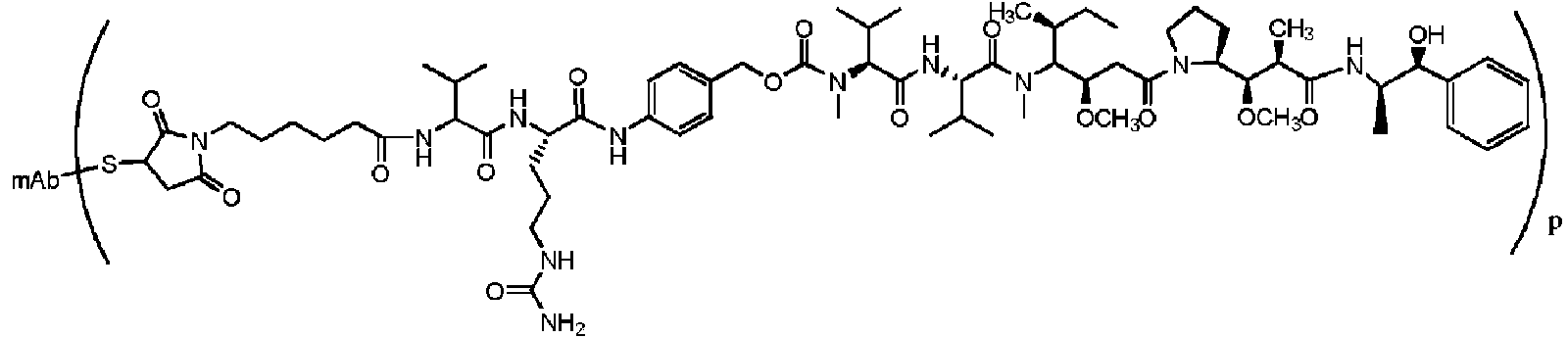
en donde MAb es Ha22-2(2,4)6.1 (Figura 2 y Figura 3) y p es de 1 a 8. El valor de p del conjugado de fármaco y anticuerpo expuesto en este ejemplo fue aproximadamente 3,8.where MAb is Ha22-2 (2.4) 6.1 (Figure 2 and Figure 3) and p is 1 to 8. The p-value of the drug-antibody conjugate set forth in this example was approximately 3.8.
Ejemplo 5Example 5
Caracterización de Ha22-2(2,4)6.1vcMMAECharacterization of Ha22-2 (2,4) 6.1vcMMAE
Los conjugados de fármaco y anticuerpo que se unen a 191P4D12 se generaron usando los procedimientos expuestos en el ejemplo titulado "Conjugación de fármaco y anticuerpo de MAb Ha22-2(2,4)6.1" y se rastrearon, identificaron y caracterizaron usando una combinación de ensayos conocidos en la técnica.Antibody-drug conjugates that bind to 191P4D12 were generated using the procedures set forth in the example titled "MAb Ha22-2 (2,4) 6.1 Drug-Antibody Conjugation" and screened, identified and characterized using a combination of tests known in the art.
A. Determinación de la afinidad por FACSA. Determination of affinity for FACS
Se evaluó Ha22-2(2,4)6.1vcMMAE para determinar su afinidad de unión a 191P4D12 expresado en la superficie de las células PC3-humana-191P4D12, PC3-macaco rhesus-191P4D12 y PC3-rata-191P4D12, respectivamente. Brevemente, se incubaron once (11) diluciones de Ha22-2(2,4)6,1vcMMAE con cada uno de los tipos de células (50.000 células por pocillo) durante la noche a 4°C a una concentración final de 160 nM a 0,011 nM. Al final de la incubación, las células se lavaron e incubaron con anticuerpo de detección anti-hIgG-PE durante 45 min a 4°C. Después de lavar los anticuerpos de detección no unidos, las células se analizaron mediante FACS. Los valores medios de intensidad de fluorescencia (MFI) se obtuvieron como se detalla en las Figs. 6-8. Los valores de MFI se introdujeron en el software Graphpad Prisim y se analizaron usando la ecuación de unión de un sitio (hipérbola) de Y = Bmax * X/(Kd X) para generar curvas de saturación de Ha22-2(2,4)6.1vcMMAE mostradas también en las FIGS.Ha22-2 (2,4) 6.1vcMMAE was evaluated for its binding affinity to 191P4D12 expressed on the surface of PC3-human-191P4D12, PC3-rhesus macaque-191P4D12, and PC3-rat-191P4D12 cells, respectively. Briefly, eleven (11) dilutions of Ha22-2 (2.4) 6.1vcMMAE were incubated with each of the cell types (50,000 cells per well) overnight at 4 ° C at a final concentration of 160 nM at 0.011 nM. At the end of the incubation, the cells were washed and incubated with anti-hIgG-PE detection antibody for 45 min at 4 ° C. After washing off unbound detection antibodies, cells were analyzed by FACS. Mean fluorescence intensity (MFI) values were obtained as detailed in Figs. 6-8. MFI values were entered into Graphpad Prisim software and analyzed using the one-site (hyperbola) binding equation of Y = Bmax * X / (Kd X) to generate Ha22-2 (2.4) saturation curves 6.1vcMMAE also shown in FIGS.
6-8 respectivamente. Bmax es el valor de IMF en la unión máxima de Ha22-2(2,4)6.1vcMMAE a 191P4D12; Kd es la afinidad de unión Ha22-2(2,4)6.1vcMMAE que es la concentración de Ha22-2(2,4)6.1vcMMAE requerida para alcanzar la mitad de la unión máxima.6-8 respectively. Bmax is the MFI value at the maximum binding of Ha22-2 (2.4) 6.1vcMMAE to 191P4D12; Kd is the Ha22-2 (2.4) 6.1vcMMAE binding affinity which is the concentration of Ha22-2 (2.4) 6.1vcMMAE required to reach half maximum binding.
La afinidad calculada (Kd) de Ha22-2(2,4)6.1vcMMAE a 191P4D12 expresada en la superficie de las células PC3-humana-191P4D12, PC3-macaco rhesus-191P4D12 y PC3-rata-191P4D12, respectivamente, es de 0,69 nM (Fig. 6), 0,34 nM (figura 7) y 1,6 nM (figura 8).The calculated affinity (Kd) of Ha22-2 (2.4) 6.1vcMMAE to 191P4D12 expressed on the surface of cells PC3-human-191P4D12, PC3-rhesus macaque-191P4D12 and PC3-rat-191P4D12, respectively, is 0 , 69 nM (FIG. 6), 0.34 nM (FIG. 7), and 1.6 nM (FIG. 8).
B. Determinación de afinidad por SPR B. Determination of affinity for SPR
La afinidad de Ha22-2(2,4)6.1 MAb y Ha22-2(2,4)6.1vcMMAE a 191P4D12 recombinante purificado (ECD aminoácidos 1-348) se realizó mediante Resonancia de Plasmón Superficie (SPR) (BIAcore). Brevemente, los anticuerpos policlonales Fcy de cabra antihumano (Jackson Immuno Research Labs, Inc.) se inmovilizaron covalentemente en la superficie de un chip sensor CM5 (Biacore). A continuación, se capturaron Ha22-2(2,4)6.1 MAb o Ha22-2 (2,4) 6,1vcMMAE purificados en la superficie de dicho chip. En promedio, se capturaron aproximadamente 300 rU de prueba Ha22-2(2,4)6.1 MAb o Ha22-2(2,4)6.1vcMMAE en cada ciclo. Posteriormente, se inyectó una serie de cinco (5) a seis (6) diluciones de 191P4D12 recombinante (ECD aminoácidos 1-348) que variaban de 1 nM a 100 nM sobre dicha superficie para generar curvas de unión (sensogramas) que se procesaron y ajustaron globalmente a un modelo de interacción 1:1 usando el software BIAevaluation 3.2 y CLAMP (Myszka y Morton, 1998) (Figura 22). La Tabla V resume las constantes de velocidad de asociación y disociación, así como las afinidades de Ha22-2(2,4)6.1 MAb y Ha22-2(2,4)6.1vcMMAE a 191P4D12 recombinante (Ec D aminoácidos 1-348). C. Asignación de dominios de Ha22-2(2,4)6.1 MAbThe affinity of Ha22-2 (2.4) 6.1 MAb and Ha22-2 (2.4) 6.1vcMMAE to purified recombinant 191P4D12 (ECD amino acids 1-348) was performed by Surface Plasmon Resonance (SPR) (BIAcore). Briefly, polyclonal goat anti-human Fcy antibodies (Jackson Immuno Research Labs, Inc.) were covalently immobilized on the surface of a CM5 sensor chip (Biacore). Next, purified Ha22-2 (2.4) 6.1 MAb or Ha22-2 (2.4) 6.1vcMMAE were captured on the surface of said chip. On average, they were captured approximately 300 r Ha22-2 U test (2.4) 6.1 MAb or Ha22-2 (2,4) 6.1vcMMAE each cycle. Subsequently, a series of five (5) to six (6) dilutions of recombinant 191P4D12 (ECD amino acids 1-348) ranging from 1 nM to 100 nM were injected onto said surface to generate binding curves (sensorgrams) that were processed and globally fitted to a 1: 1 interaction model using BIAevaluation 3.2 and CLAMP software (Myszka and Morton, 1998) (Figure 22). Table V summarizes the association and dissociation rate constants, as well as the affinities of Ha22-2 (2.4) 6.1 MAb and Ha22-2 (2.4) 6.1vcMMAE to recombinant 191P4D12 (Ec D amino acids 1-348) . C. Domain assignment of Ha22-2 (2,4) 6.1 MAb
Para mapear el sitio de unión del mAb Ha22-2(2,4)6.1 a un dominio específico de la proteína 191P4D12, se generaron varias líneas celulares recombinantes Rat1 (E) que expresaban tales dominios (o una combinación de los mismos) (Tabla VI). La unión de Ha22-2(2,4)6.1 a la superficie celular se evaluó mediante FACS usando protocolos estándar. Como se muestra en la FIG. 10, Ha22-2(2,4)6.1 MAb se une a las células que expresan el dominio VC1, así como a 191P4D12 de tipo salvaje, pero no a las células que expresan el dominio C1C2. Adicionalmente, otro MAb 191P4D12 denominado Ha22-8e6.1 reconoce el dominio C1C2 de 191P4D12 en la superficie celular, pero no el dominio VC1. Esto sugiere que el sitio de unión para Ha22-2(2,4)6.1 MAb está localizado en el dominio 1-147 aa de 191P4D12, pero que no todos los MAb que se unen a 191P4D12 reconocen este dominio.To map the binding site of mAb Ha22-2 (2,4) 6.1 to a specific domain of the 191P4D12 protein, several recombinant Rat1 (E) cell lines were generated that expressed such domains (or a combination thereof) (Table SAW). The binding of Ha22-2 (2,4) 6.1 to the cell surface was assessed by FACS using standard protocols. As shown in FIG. 10, Ha22-2 (2,4) 6.1 MAb binds to cells expressing the VC1 domain, as well as wild-type 191P4D12, but not to cells expressing the C1C2 domain. Additionally, another 191P4D12 MAb designated Ha22-8e6.1 recognizes the C1C2 domain of 191P4D12 on the cell surface, but not the VC1 domain. This suggests that the binding site for Ha22-2 (2,4) 6.1 MAb is located in the 1-147 aa domain of 191P4D12, but that not all MAbs that bind to 191P4D12 recognize this domain.
Para corroborar adicionalmente los resultados expuestos en la FIG. 10, se realizó un análisis de transferencia Western. Brevemente, toda la porción extracelular de 191P4D12 (longitud completa), así como los dominios específicos expuestos en la Tabla VI se expresaron en células 293T como proteínas de fusión Fc murinas y se purificaron. Se usaron anti-ratón-HRP de cabra como control. Como se muestra en la FIG. 11, cuando se resolvió en SDS-PAGE (no reducido) y se sondó con Ha22-2(2,4)6.1-biotina seguido de estreptavidina-HRP, se reconocieron las bandas correspondientes a 191P4D12 de longitud completa (carril 1), V (carril 2) y las construcciones de fusión de VC1 (carril 3), pero no se reconoció la construcción de fusión de C1C2 (carril 4). Esto sugiere además que el epítopo de unión para Ha22-2(2,4)6.1 MAb se encuentra dentro del dominio 1-147 aa de 191P4D12.To further corroborate the results set forth in FIG. 10, Western blot analysis was performed. Briefly, the entire extracellular portion of 191P4D12 (full length) as well as the specific domains listed in Table VI were expressed in 293T cells as murine Fc fusion proteins and purified. Goat anti-mouse-HRP was used as a control. As shown in FIG. 11, when resolved on SDS-PAGE (not reduced) and probed with Ha22-2 (2,4) 6.1-biotin followed by streptavidin-HRP, the bands corresponding to full-length 191P4D12 (lane 1), V (lane 2) and the VC1 fusion constructs (lane 3), but the C1C2 fusion construct (lane 4) was not recognized. This further suggests that the binding epitope for Ha22-2 (2,4) 6.1 MAb lies within the 1-147 aa domain of 191P4D12.
Ejemplo 6Example 6
Citotoxicidad celular mediada por Ha22-2(2,4)6.1vcMMAEHa22-2 (2.4) 6.1vcMMAE-mediated cellular cytotoxicity
La capacidad de Ha22-2(2,4)6.1vcMMAE para mediar en la citotoxicidad dependiente de 191P4D12 se evaluó en células PC3 modificadas genéticamente para expresar 191P4D12 humano, 191P4D12 de macaco Rhesus y 191P4D12 de rata. Brevemente, se sembraron células PC3-Neo, PC3-humana-191P4D12, PC3-macaco Rhesus-191P4D12 o PC3-rata-191P4D12 (1500 células/pocillo) en una placa de 96 pocillos el día 1. Al día siguiente, un volumen igual de medio que contenía la concentración indicada de Ha22-2(2,4)6,1vcMMAE o un MAb de control conjugado con vcMMAE (es decir, control-vcMMAE) se añadió a cada pocillo. Las células se dejaron incubar durante 4 días a 37°C. Al final del período de incubación, se añadió Alamar Blue a cada pocillo y la incubación continuó durante 4 horas adicionales. La fluorescencia resultante se detectó utilizando un lector de placas Biotek con una longitud de onda de excitación de 620 nM y una longitud de onda de emisión de 540 nM.The ability of Ha22-2 (2,4) 6.1vcMMAE to mediate 191P4D12-dependent cytotoxicity was evaluated in PC3 cells genetically modified to express human 191P4D12, Rhesus macaque 191P4D12, and rat 191P4D12. Briefly, PC3-Neo, PC3-human-191P4D12, PC3-Rhesus macaque-191P4D12, or PC3-rat-191P4D12 cells were seeded (1500 cells / well) in a 96-well plate on day 1. The next day, an equal volume of medium containing the indicated concentration of Ha22-2 (2,4) 6,1vcMMAE or a control MAb conjugated to vcMMAE (ie, control-vcMMAE) was added to each well. The cells were allowed to incubate for 4 days at 37 ° C. At the end of the incubation period, Alamar Blue was added to each well and the incubation continued for an additional 4 hours. The resulting fluorescence was detected using a Biotek plate reader with an excitation wavelength of 620 nM and an emission wavelength of 540 nM.
Los resultados en las Figuras 9A-9D muestran que la citotoxicidad mediada por Ha22-2(2,4)6,1vcMMAE en células PC3-humana-191P4D12 (Figura 9A), PC3-macaco Rhesus-191P4D12 (Figura 9B), y PC3-rata-191P4D12 (Fig. 9C) tuvo efecto mientras que una IgG humana de control conjugada con vcMMAE no la tuvo. La especificidad de Ha22-2(2,4)6.1vcMMAE se demostró adicionalmente por la falta de toxicidad para las células PC3-Neo que no expresan 191P4D12 (Figura 9D). Por lo tanto, estos resultados indican que Ha22-2(2,4)6.1vcMMAE puede administrar selectivamente un fármaco citotóxico a las células que expresan 191P4D12 que conducen a su destrucción.The results in Figures 9A-9D show that Ha22-2 (2,4) 6,1vcMMAE-mediated cytotoxicity in PC3-human-191P4D12 (Figure 9A), PC3-Rhesus-191P4D12 macaque (Figure 9B), and PC3 cells -rat-191P4D12 (Fig. 9C) had an effect while a control human IgG conjugated to vcMMAE did not. The specificity of Ha22-2 (2.4) 6.1vcMMAE was further demonstrated by the lack of toxicity for PC3-Neo cells that do not express 191P4D12 (Figure 9D). Therefore, these results indicate that Ha22-2 (2,4) 6.1vcMMAE can selectively deliver a cytotoxic drug to cells expressing 191P4D12 leading to their destruction.
Ejemplo 7Example 7
Ha22-2(2,4)6.1vcMMAE inhibe el crecimiento de tumores in vivoHa22-2 (2,4) 6.1vcMMAE inhibits tumor growth in vivo
La expresión significativa de 191P4D12 en la superficie celular de los tejidos tumorales, junto con su expresión restrictiva en tejidos normales, hace que 191P4D12 sea un buen objetivo para la terapia de anticuerpos y, de forma similar, la terapia a través de CAF. Por lo tanto, se evalúa la eficacia terapéutica de Ha22-2(2,4)6.1vcMMAE en modelos en ratón de xenoinjerto de cáncer de vejiga, pulmón, mama y páncreas humanos.The significant expression of 191P4D12 on the cell surface of tumor tissues, along with its restrictive expression in normal tissues, makes 191P4D12 a good target for antibody therapy and, similarly, therapy via CAF. Therefore, the therapeutic efficacy of Ha22-2 (2,4) 6.1vcMMAE is evaluated in mouse xenograft models of human bladder, lung, breast and pancreas cancer.
La eficacia del conjugado de anticuerpo y fármaco en el crecimiento tumoral y la formación de metástasis se estudia en modelos de xenoinjerto de cáncer de ratón (por ejemplo, subcutáneo y ortotópicamente).The efficacy of the antibody-drug conjugate in tumor growth and metastasis formation is studied in mouse cancer xenograft models (eg, subcutaneously and orthotopically).
Los tumores subcutáneos (s.c.) se generan por inyección de 5x10⁴ - 106 células cancerosas mezcladas en una dilución 1:1 con Matrigel (Collaborative Research) en el costado derecho de ratones SCID macho. Para evaluar la eficacia de CAF en la formación de tumores, las inyecciones de CAF se inician el mismo día que las inyecciones de las células tumorales. Como control, a los ratones se les inyecta IgG o PBS humanos purificados; o un MAb purificado que reconoce un antígeno irrelevante no expresado en células humanas. En estudios preliminares, no se encontraron diferencias entre el control de IgG o PBS en el crecimiento tumoral. Los tamaños de los tumores se determinan mediante medidas de calibre, y el volumen del tumor se calcula como ancho2 x Longitud/2, donde el ancho es la dimensión más pequeña y la longitud es la dimensión más grande. Se sacrifican los ratones con tumores subcutáneos mayores de 1,5 cm de diámetro.Subcutaneous (sc) tumors are generated by injecting 5x10⁴-106 cancer cells mixed in a 1: 1 dilution with Matrigel (Collaborative Research) into the right flank of male SCID mice. To evaluate the efficacy of CAF in tumor formation, CAF injections are started on the same day as CAF injections. tumor cells. As a control, mice are injected with purified human IgG or PBS; or a purified MAb that recognizes an irrelevant antigen not expressed in human cells. In preliminary studies, no differences were found between IgG or PBS control in tumor growth. Tumor sizes are determined by gauge measurements, and tumor volume is calculated as Width2 x Length / 2, where width is the smallest dimension and length is the largest dimension. Mice with subcutaneous tumors greater than 1.5 cm in diameter are sacrificed.
Los tumores de los ovarios a menudo se metastatizan y crecen dentro de la cavidad peritoneal. En consecuencia, el crecimiento intraperitoneal de tumores ováricos en ratones se realiza mediante inyección de 2 millones de células directamente en el peritoneo de ratones hembra. Los ratones son monitoreados en cuanto a salud general, actividad física y apariencia hasta que se vuelven moribundos. En el momento del sacrificio, la cavidad peritoneal se puede examinar para determinar la carga tumoral y los pulmones se recuperan para evaluar la metástasis en sitios distantes. Alternativamente, la muerte se puede usar como punto final. A continuación, los ratones se segregan en grupos para los tratamientos apropiados, con 191P4D12 o MAbs de control inyectados i.p.Ovarian tumors often metastasize and grow within the peritoneal cavity. Consequently, intraperitoneal growth of ovarian tumors in mice is accomplished by injecting 2 million cells directly into the peritoneum of female mice. The mice are monitored for general health, physical activity, and appearance until they become moribund. At the time of sacrifice, the peritoneal cavity can be examined for tumor burden and the lungs recovered to assess for metastasis to distant sites. Alternatively, death can be used as an end point. The mice are then segregated into groups for the appropriate treatments, with 191P4D12 or control MAbs injected i.p.
Una ventaja de los modelos de cáncer de xenoinjerto es la capacidad de estudiar la neovascularización y la angiogénesis. El crecimiento tumoral depende en parte del desarrollo de nuevos vasos sanguíneos. Aunque el sistema capilar y la red sanguínea en desarrollo es de origen huésped, la iniciación y la arquitectura de la neovasculatura está regulada por el tumor del xenoinjerto (Davidoff et al., Clin Cancer Res. (2001) 7:2870; Solesvik et al., Eur J Cancer Clin Oncol. (1984) 20:1295). El efecto del anticuerpo y de la molécula pequeña sobre la neovascularización se estudia de acuerdo con los procedimientos conocidos en la técnica, tales como el análisis IHC de tejidos tumorales y su microambiente circundante.An advantage of xenograft cancer models is the ability to study neovascularization and angiogenesis. Tumor growth depends in part on the development of new blood vessels. Although the capillary system and the developing blood network are of host origin, the initiation and architecture of the neovasculature is regulated by the xenograft tumor (Davidoff et al., Clin Cancer Res. (2001) 7: 2870; Solesvik et al. ., Eur J Cancer Clin Oncol. (1984) 20: 1295). The effect of the antibody and the small molecule on neovascularization is studied according to procedures known in the art, such as IHC analysis of tumor tissues and their surrounding microenvironment.
Ha22-2(2,4)6.1ADC inhibe la formación de xenoinjertos de cáncer de pulmón, vejiga, mama y cáncer de páncreas. Estos resultados indican la utilidad de Ha22-2(2,4)6.1ADC en el tratamiento de estadios locales y avanzados del cáncer y preferiblemente aquellos cánceres expuestos en la Tabla I.Ha22-2 (2,4) 6.1ADC inhibits the formation of lung, bladder, breast and pancreatic cancer xenografts. These results indicate the utility of Ha22-2 (2,4) 6.1ADC in the treatment of local and advanced stages of cancer and preferably those cancers shown in Table I.
CAF 191P4D12:CAF 191P4D12:
Se generaron anticuerpos monoclonales contra 191P4D12 como se describe en el Ejemplo titulado "Generación de anticuerpos monoclonales 191P4D12 (MAbs)". Además, los MAbs se conjugaron a una toxina como se describe en el Ejemplo titulado "Conjugación de Anticuerpo y Fármaco de MAb Ha22-2(2,4)6.1" para formar Ha22-2(2,4)6,1vcMMAE. El Ha22-2(2,4)6.1vcMMAE se caracteriza por FACS, y otros métodos conocidos en la técnica para determinar su capacidad para unir 191P4D12.Monoclonal antibodies against 191P4D12 were generated as described in the Example entitled "Generation of 191P4D12 Monoclonal Antibodies (MAbs)". Furthermore, the MAbs were conjugated to a toxin as described in the Example entitled "Antibody and Drug Conjugation of MAb Ha22-2 (2.4) 6.1" to form Ha22-2 (2.4) 6.1vcMMAE. Ha22-2 (2,4) 6.1vcMMAE is characterized by FACS, and other methods known in the art to determine its ability to bind 191P4D12.
Líneas celulares y xenoinjertos:Cell lines and xenografts:
Las células BT-483 y HPAC se mantienen en DMEM, complementado con L-glutamina y 10% de FBS, como se conoce en la técnica. Los xenoinjertos AG-B8, AG-Panc4, AG-Panc2, AG-B1, AG-L4 y AG-Panc3 se mantienen por propagación en serie en ratones SCID.BT-483 and HPAC cells are maintained in DMEM, supplemented with L-glutamine and 10% FBS, as is known in the art. The AG-B8, AG-Panc4, AG-Panc2, AG-B1, AG-L4 and AG-Panc3 xenografts are maintained by serial propagation in SCID mice.
Evaluación del mAb Ha22-2(2,4)6.1vcMMAE en el modelo de formación de tumores subcutáneos de xenoinjerto de cáncer de pulmón humano AG-L4 en ratones SCIDEvaluation of mAb Ha22-2 (2,4) 6.1vcMMAE in the AG-L4 human lung cancer xenograft subcutaneous tumor formation model in SCID mice
En este experimento, el xenoinjerto AG-L4 de cáncer de pulmón derivado del paciente se mantuvo mediante pases seriados en ratones SCID. Los tumores en existencia se cosecharon de forma estéril y se digirieron enzimáticamente en suspensiones de células individuales. Se implantaron dos (2) millones de células en el costado de ratones SCID individuales. Los animales se asignaron aleatoriamente a siete grupos: seis (6) grupos tratados con anticuerpo 191P4D12 y un grupo control de anticuerpo H3-1.10.1.2 (n = 10). Todos los anticuerpos se dosificaron por vía intraperitoneal a 750 pg/animal dos veces a la semana hasta el final del estudio. El crecimiento tumoral se controló usando medidas de calibre cada 3 a 4 días. El volumen del tumor se calculó como Ancho2 x Longitud/2, donde el ancho es la dimensión más pequeña y la longitud es la dimensión más grande.In this experiment, patient-derived lung cancer AG-L4 xenograft was maintained by serial passage in SCID mice. Stock tumors were harvested sterile and enzymatically digested into single cell suspensions. Two (2) million cells were implanted into the flank of individual SCID mice. Animals were randomly assigned to seven groups: six (6) 191P4D12 antibody treated groups and one H3-1.10.1.2 antibody control group (n = 10). All antibodies were dosed intraperitoneally at 750 pg / animal twice a week until the end of the study. Tumor growth was monitored using caliper measurements every 3 to 4 days. Tumor volume was calculated as Width2 x Length / 2, where width is the smallest dimension and length is the largest dimension.
Los resultados muestran que el MAb de 191P4D12 no inhibió significativamente el crecimiento tumoral en el xenoinjerto de cáncer de pulmón humano AG-L4 en ratones SCID. Además, otros MAbs de 191P4D12 se utilizaron en este estudio. Los resultados no se muestran. (Figura 12).The results show that the 191P4D12 MAb did not significantly inhibit tumor growth in the AG-L4 human lung cancer xenograft in SCID mice. In addition, other 191P4D12 MAbs were used in this study. Results are not displayed. (Figure 12).
Evaluación del MAb Ha22-2(2,4)6.1 en el modelo de formación tumoral subcutánea de xenoinjerto de cáncer de páncreas humano HPAC en ratones SCIDEvaluation of MAb Ha22-2 (2,4) 6.1 in the HPAC Human Pancreatic Cancer Xenograft Subcutaneous Tumor Formation Model in SCID Mice
En otro experimento, se inyectaron células HPAC de cáncer de páncreas humano (2,0 millones/ratón) en el costado de ratones SCID individuales. Los animales se asignaron aleatoriamente a ocho grupos: siete (7) grupos tratados con anticuerpo 191P4D12 y un grupo de anticuerpo de control H3-1.4.1.2 (n = 10). Todos los anticuerpos se dosificaron por vía intraperitoneal a 500 pg/animal dos veces a la semana hasta el final del estudio. El crecimiento tumoral se controló usando medidas de calibre cada 3 a 4 días. El volumen del tumor se calculó como Ancho2 x Longitud/2, donde el ancho es la dimensión más pequeña y la longitud es la dimensión más grande. In another experiment, human pancreatic cancer HPAC cells (2.0 million / mouse) were injected into the flank of individual SCID mice. Animals were randomly assigned to eight groups: seven (7) 191P4D12 antibody treated groups and one H3-1.4.1.2 control antibody group (n = 10). All antibodies were dosed intraperitoneally at 500 pg / animal twice a week until the end of the study. Tumor growth was monitored using caliper measurements every 3 to 4 days. Tumor volume was calculated as Width2 x Length / 2, where width is the smallest dimension and length is the largest dimension.
Los resultados muestran que el MAb 191P4D12 no inhibió el crecimiento tumoral en un xenoinjerto pancreático humano en ratones SCID en comparación con el anticuerpo de control. Además, otros MAbs de 191P4D12 se utilizaron en este estudio. Los resultados no se muestran. (Figura 13).The results show that MAb 191P4D12 did not inhibit tumor growth in a human pancreatic xenograft in SCID mice compared to the control antibody. In addition, other 191P4D12 MAbs were used in this study. Results are not displayed. (Figure 13).
Evaluación del MAb Ha22-2(2,4)6.1 en el modelo de formación tumoral subcutánea de xenoinjerto de cáncer pancreático humano AG-Panc3 en ratones SCID.Evaluation of MAb Ha22-2 (2,4) 6.1 in the human pancreatic cancer xenograft subcutaneous tumor formation model AG-Panc3 in SCID mice.
En otro experimento, el xenoinjerto de cáncer de páncreas AG-Panc3 derivado del paciente se mantuvo mediante pases seriados en ratones SCID. Los tumores en existencia se recogieron estérilmente y se trituraron en trozos de 1 mm3. Seis piezas se implantaron en el costado de ratones SCID individuales. Los animales se asignaron aleatoriamente a las siguientes cohortes (n = 10): dos (2) grupos tratados con MAb 191P4D12 y un grupo de anticuerpo de control H3-1.4.1.2. Todos los anticuerpos se dosificaron por vía intraperitoneal a 500 pg/animal dos veces a la semana hasta el final del estudio. El crecimiento tumoral se controló usando medidas de calibre cada 3 a 4 días. El volumen del tumor se calculó como Ancho2 x Longitud/2, donde el ancho es la dimensión más pequeña y la longitud es la dimensión más grande.In another experiment, the patient-derived AG-Panc3 pancreatic cancer xenograft was maintained by serial passage in SCID mice. Stock tumors were harvested sterile and ground into 1 mm 3 pieces. Six pieces were implanted into the flanks of individual SCID mice. Animals were randomly assigned to the following cohorts (n = 10): two (2) groups treated with MAb 191P4D12 and a control antibody group H3-1.4.1.2. All antibodies were dosed intraperitoneally at 500 pg / animal twice a week until the end of the study. Tumor growth was monitored using caliper measurements every 3 to 4 days. Tumor volume was calculated as Width2 x Length / 2, where width is the smallest dimension and length is the largest dimension.
Los resultados muestran que el MAb 191P4D12 no inhibió el crecimiento tumoral en un xenoinjerto pancreático humano en ratones SCID en comparación con el anticuerpo de control. Además, otros MAbs de 191P4D12 se utilizaron en este estudio. Los resultados no se muestran. (Figura 14).The results show that MAb 191P4D12 did not inhibit tumor growth in a human pancreatic xenograft in SCID mice compared to the control antibody. In addition, other 191P4D12 MAbs were used in this study. Results are not displayed. (Figure 14).
Eficacia de Ha22-2(2,4)6.1-vcMMAE en xenoinjerto de cáncer de pulmón humano establecido por vía subcutánea AG-L4 en ratones SCIDEfficacy of Ha22-2 (2,4) 6.1-vcMMAE in human lung cancer xenograft established subcutaneously AG-L4 in SCID mice
En otro experimento, el xenoinjerto AG-L13 de cáncer de pulmón derivado del paciente se mantuvo mediante pases seriados en ratones SCID. Los tumores en existencia se recogieron estérilmente y se trituraron en trozos de 1 mm3. Seis (6) piezas se implantaron en el costado de ratones SCID individuales. Los tumores se dejaron crecer sin tratar hasta que alcanzaron un volumen aproximado de 200 mm3. El Ha22-2(2,4)6.1vcMMAE y el control CAF se dosificaron a 10 mg/kg cada siete (7) días para dos dosis mediante inyección intravenosa en bolo. La cantidad de CAF administrada se basó en el peso corporal individual de cada animal obtenido inmediatamente antes de la dosificación. El crecimiento tumoral se controló usando medidas de calibre cada 3 a 4 días. El volumen del tumor se calculó como Ancho2 x Longitud/2, donde el ancho es la dimensión más pequeña y la longitud es la dimensión más grande.In another experiment, patient-derived lung cancer AG-L13 xenograft was maintained by serial passage in SCID mice. Stock tumors were harvested sterile and ground into 1 mm 3 pieces. Six (6) pieces were implanted into the flanks of individual SCID mice. The tumors were allowed to grow untreated until they reached a volume of approximately 200 mm3. The Ha22-2 (2.4) 6.1vcMMAE and the CAF control were dosed at 10 mg / kg every seven (7) days for two doses by intravenous bolus injection. The amount of CAF administered was based on the individual body weight of each animal obtained immediately prior to dosing. Tumor growth was monitored using caliper measurements every 3 to 4 days. Tumor volume was calculated as Width2 x Length / 2, where width is the smallest dimension and length is the largest dimension.
Los resultados muestran que el tratamiento con Ha22-2(2,4)6.1-vcMMAE inhibió significativamente el crecimiento de xenoinjertos de cáncer de pulmón AG-L4 implantados por vía subcutánea en ratones atímicos en comparación con el control de CAF. Además, otros MAbs de 191P4D12 se utilizaron en este estudio. Los resultados no se muestran. (Figura 15).The results show that Ha22-2 (2,4) 6.1-vcMMAE treatment significantly inhibited the growth of AG-L4 lung cancer xenografts implanted subcutaneously in nude mice compared to the CAF control. In addition, other 191P4D12 MAbs were used in this study. Results are not displayed. (Figure 15).
Eficacia de Ha22-2(2,4)6.1-vcMMAE en xenoinjerto de cáncer de mama humano subcutáneo BT-483 en ratones SCIDEfficacy of Ha22-2 (2,4) 6.1-vcMMAE in BT-483 subcutaneous human breast cancer xenograft in SCID mice
En este experimento, se usaron células BT-483 de cáncer de mama humano para generar xenoinjertos de reserva, que se mantuvieron mediante pases seriados en ratones SCID. Los tumores en existencia se recogieron estérilmente y se trituraron en trozos de 1 mm3. Seis (6) piezas se implantaron en el costado de ratones SCID individuales. Los tumores se dejaron crecer sin tratar hasta que alcanzaron un volumen aproximado de 100 mm3. El Ha22-2(2,4)6,1vcMMAE y el control CAF se dosificaron a 5 mg/kg cada cuatro (4) días para cuatro (4) dosis por inyección intravenosa en bolo. La cantidad de CAF administrada se basó en el peso corporal individual de cada animal obtenido inmediatamente antes de la dosificación. El crecimiento tumoral se controló usando medidas de calibre cada 3 a 4 días. El volumen del tumor se calculó como Ancho2 x Longitud/2, donde el ancho es la dimensión más pequeña y la longitud es la dimensión más grande.In this experiment, human breast cancer BT-483 cells were used to generate reserve xenografts, which were maintained by serial passage in SCID mice. Stock tumors were harvested sterile and ground into 1 mm 3 pieces. Six (6) pieces were implanted into the flanks of individual SCID mice. The tumors were allowed to grow untreated until they reached a volume of approximately 100 mm3. The Ha22-2 (2,4) 6,1vcMMAE and the CAF control were dosed at 5 mg / kg every four (4) days for four (4) doses by intravenous bolus injection. The amount of CAF administered was based on the individual body weight of each animal obtained immediately prior to dosing. Tumor growth was monitored using caliper measurements every 3 to 4 days. Tumor volume was calculated as Width2 x Length / 2, where width is the smallest dimension and length is the largest dimension.
Los resultados muestran que el tratamiento con Ha22-2(2,4)6.1-vcMMAE inhibió significativamente el crecimiento de xenoinjertos de tumor de mama BT-483 implantados por vía subcutánea en ratones SCID en comparación con el control de CAF. Además, otros MAbs de 191P4D12 se utilizaron en este estudio. Los resultados no se muestran. (Figura 16).The results show that Ha22-2 (2,4) 6.1-vcMMAE treatment significantly inhibited the growth of subcutaneously implanted BT-483 breast tumor xenografts in SCID mice compared to CAF control. In addition, other 191P4D12 MAbs were used in this study. Results are not displayed. (Figure 16).
Eficacia de Ha22-2(2,4)6.1-vcMMAE en xenoinjerto de cáncer de vejiga humano establecido por vía subcutánea AG-B1 en ratones SCIDEfficacy of Ha22-2 (2,4) 6.1-vcMMAE in subcutaneously established human bladder cancer xenograft AG-B1 in SCID mice
En otro experimento, el xenoinjerto de cáncer de vejiga derivado del paciente AG-B1 se mantuvo mediante pases seriados en ratones SCID. Los tumores en existencia se recogieron estérilmente y se trituraron en trozos de 1 mm3. Seis (6) piezas se implantaron en el costado de ratones SCID individuales. Los tumores se dejaron crecer sin tratar hasta que alcanzaron un volumen aproximado de 230 mm3. El Ha22-2(2,4)6.1vcMMAE y el control CAF se dosificaron a 4 mg/kg una vez mediante inyección en bolo intravenoso. La cantidad de CAF administrada se basó en el peso corporal individual de cada animal obtenido inmediatamente antes de la dosificación. El crecimiento tumoral se controló usando medidas de calibre cada 3 a 4 días. El volumen del tumor se calculó como Ancho2 x Longitud/2, donde el ancho es la dimensión más pequeña y la longitud es la dimensión más grande. In another experiment, the AG-B1 patient derived bladder cancer xenograft was maintained by serial passage in SCID mice. Stock tumors were harvested sterile and ground into 1 mm 3 pieces. Six (6) pieces were implanted into the flanks of individual SCID mice. The tumors were allowed to grow untreated until they reached a volume of approximately 230 mm3. Ha22-2 (2.4) 6.1vcMMAE and CAF control were dosed at 4 mg / kg once by intravenous bolus injection. The amount of CAF administered was based on the individual body weight of each animal obtained immediately prior to dosing. Tumor growth was monitored using caliper measurements every 3 to 4 days. Tumor volume was calculated as Width2 x Length / 2, where width is the smallest dimension and length is the largest dimension.
Los resultados muestran que el tratamiento con Ha22-2(2,4)6.1-vcMMAE inhibió significativamente el crecimiento de xenoinjertos de cáncer de vejiga AG-B1 en comparación con el control de CAF. Además, otros MAbs de 191P4D12 se utilizaron en este estudio. Los resultados no se muestran. (Figura 17).Results show that Ha22-2 (2,4) 6.1-vcMMAE treatment significantly inhibited the growth of AG-B1 bladder cancer xenografts compared to CAF control. In addition, other 191P4D12 MAbs were used in this study. Results are not displayed. (Figure 17).
Eficacia de Ha22-2(2,4)6.1-vcMMAE en el xenoinjerto del cáncer de páncreas humano establecido por vía subcutánea AG-Panc2 en ratones SCIDEfficacy of Ha22-2 (2,4) 6.1-vcMMAE in human pancreatic cancer xenograft established subcutaneously AG-Panc2 in SCID mice
En otro experimento, el xenoinjerto de cáncer de páncreas AG-Panc2 derivado del paciente se mantuvo mediante pases seriados en ratones SCID. Los tumores en existencia se recogieron estérilmente y se trituraron en trozos de 1 mm3. Se implantaron cinco (5) piezas en el costado de ratones SCID individuales. Los tumores se dejaron crecer sin tratar hasta que alcanzaron un volumen aproximado de 100 mm3. El Ha22-2(2,4)6.1vcMMAE y el control de CAF se dosificaron a 5 mg/kg cada cuatro (4) días para cuatro (4) dosis mediante inyección intravenosa en bolo. La cantidad de CAF administrada se basó en el peso corporal individual de cada animal obtenido inmediatamente antes de la dosificación. El crecimiento tumoral se controló usando medidas de calibre cada 3 a 4 días. El volumen del tumor se calculó como Ancho2 x Longitud/2, donde el ancho es la dimensión más pequeña y la longitud es la dimensión más grande.In another experiment, the patient-derived AG-Panc2 pancreatic cancer xenograft was maintained by serial passage in SCID mice. Stock tumors were harvested sterile and ground into 1 mm 3 pieces. Five (5) pieces were implanted into the flank of individual SCID mice. The tumors were allowed to grow untreated until they reached a volume of approximately 100 mm3. The Ha22-2 (2.4) 6.1vcMMAE and CAF control were dosed at 5 mg / kg every four (4) days for four (4) doses by intravenous bolus injection. The amount of CAF administered was based on the individual body weight of each animal obtained immediately prior to dosing. Tumor growth was monitored using caliper measurements every 3 to 4 days. Tumor volume was calculated as Width2 x Length / 2, where width is the smallest dimension and length is the largest dimension.
Los resultados muestran que el tratamiento con Ha22-2(2,4)6.1-vcMMAE inhibió significativamente el crecimiento de xenoinjertos de cáncer de páncreas AG-Panc2 en comparación con el control de CAF. Además, otros MAbs de 191P4D12 se utilizaron en este estudio. Los resultados no se muestran. (Figura 18).Results show that Ha22-2 (2,4) 6.1-vcMMAE treatment significantly inhibited the growth of AG-Panc2 pancreatic cancer xenografts compared to CAF control. In addition, other 191P4D12 MAbs were used in this study. Results are not displayed. (Figure 18).
Eficacia de Ha22-2(2,4)6.1-vcMMAE en el xenoinjerto de cáncer de páncreas humano establecido por vía subcutánea AG-Panc4 en ratones SCIDEfficacy of Ha22-2 (2,4) 6.1-vcMMAE in human pancreatic cancer xenograft established subcutaneously AG-Panc4 in SCID mice
En otro experimento, el xenoinjerto de cáncer de páncreas AG-Panc4 derivado del paciente se mantuvo mediante pases seriados en ratones SClD. Los tumores en existencia se recogieron estérilmente y se trituraron en trozos de 1 mm3. Seis (6) piezas se implantaron en el costado de ratones SCID individuales. E1Ha22-2(2,4)6.1vcMMAE y el control de CAF se dosificaron a 5 mg/kg cada siete (7) días para tres dosis mediante inyección en bolo intravenoso. La cantidad de CAF administrada se basó en el peso corporal individual de cada animal obtenido inmediatamente antes de la dosificación. El crecimiento tumoral se controló usando medidas de calibre cada 3 a 4 días. El volumen del tumor se calculó como Ancho2 x Longitud/2, donde el ancho es la dimensión más pequeña y la longitud es la dimensión más grande.In another experiment, the patient-derived AG-Panc4 pancreatic cancer xenograft was maintained by serial passage in SClD mice. Stock tumors were harvested sterile and ground into 1 mm 3 pieces. Six (6) pieces were implanted into the flanks of individual SCID mice. E1Ha22-2 (2.4) 6.1vcMMAE and CAF control were dosed at 5 mg / kg every seven (7) days for three doses by intravenous bolus injection. The amount of CAF administered was based on the individual body weight of each animal obtained immediately prior to dosing. Tumor growth was monitored using caliper measurements every 3 to 4 days. Tumor volume was calculated as Width2 x Length / 2, where width is the smallest dimension and length is the largest dimension.
Los resultados muestran que el tratamiento con Ha22-2(2,4)6.1-vcMMAE inhibió significativamente el crecimiento de xenoinjertos de cáncer de páncreas AG-Panc4 en comparación con el control de CAF. Además, otros MAbs de 191P4D12 se utilizaron en este estudio. Los resultados no se muestran. (Figura 19).The results show that Ha22-2 (2,4) 6.1-vcMMAE treatment significantly inhibited the growth of AG-Panc4 pancreatic cancer xenografts compared to the CAF control. In addition, other 191P4D12 MAbs were used in this study. Results are not displayed. (Figure 19).
Eficacia de Ha22-2(2,4)6.1-vcMMAE a dosificación comparativa en xenoinjerto de cáncer de vejiga humano establecido por vía subcutánea AG-B8 en ratones SCIDEfficacy of Ha22-2 (2,4) 6.1-vcMMAE at Comparative Dosage in AG-B8 Subcutaneously Established Human Bladder Cancer Xenograft in SCID Mice
En este experimento, el xenoinjerto AG-B8 de cáncer de vejiga derivado del paciente se mantuvo mediante pases seriados en ratones SCID. Los tumores en existencia se recogieron estérilmente y se trituraron en trozos de 1 mm3. Seis (6) piezas se implantaron en el costado de ratones SCID individuales. Los tumores se dejaron crecer sin tratamiento hasta que alcanzaron un volumen aproximado de 200 mm3. Los animales se asignaron aleatoriamente a las siguientes tres cohortes (n = 6): dos (2) grupos tratados con Ha22-2(2,4)6,1-vcMMAE y un grupo control CAF VCD37-5ce5p-vcMMAE. Se dosificó Ha22-2(2,4)6,1-vcMMAE a 5 mg/kg o 10 mg/kg y se administró el control CAF a 5 mg/kg. Todos los CAF se dosificaron una vez mediante inyección en bolo intravenoso. La cantidad de CAF administrada se basó en el peso corporal individual de cada animal obtenido inmediatamente antes de la dosificación. El crecimiento tumoral se controló usando medidas de calibre cada 3 a 4 días. El volumen del tumor se calculó como Ancho2 x Longitud/2, donde el ancho es la dimensión más pequeña y la longitud es la dimensión más grande.In this experiment, the patient derived AG-B8 bladder cancer xenograft was maintained by serial passage in SCID mice. Stock tumors were harvested sterile and ground into 1 mm 3 pieces. Six (6) pieces were implanted into the flanks of individual SCID mice. The tumors were allowed to grow without treatment until they reached a volume of approximately 200 mm3. Animals were randomly assigned to the following three cohorts (n = 6): two (2) groups treated with Ha22-2 (2,4) 6,1-vcMMAE and a control group CAF VCD37-5ce5p-vcMMAE. Ha22-2 (2,4) 6,1-vcMMAE was dosed at 5 mg / kg or 10 mg / kg and the CAF control was administered at 5 mg / kg. All CAFs were dosed once by intravenous bolus injection. The amount of CAF administered was based on the individual body weight of each animal obtained immediately prior to dosing. Tumor growth was monitored using caliper measurements every 3 to 4 days. Tumor volume was calculated as Width2 x Length / 2, where width is the smallest dimension and length is the largest dimension.
Los resultados muestran que el tratamiento con Ha22-2(2,4)6.1vcMMAE a 10 mg/kg inhibió el crecimiento de xenoinjertos de cáncer de vejiga AG-B8 en comparación con Ha22-2(2,4)6.1vcMMAE a 5 mg/kg. (Figura 20).The results show that treatment with Ha22-2 (2.4) 6.1vcMMAE at 10 mg / kg inhibited the growth of AG-B8 bladder cancer xenografts compared to Ha22-2 (2.4) 6.1vcMMAE at 5 mg. / kg. (Figure 20).
Conclusiónconclusion
En resumen, las Figs. 12-20 muestran que el CAF 191P4D12 denominado Ha22-2(2,4)6.1vcMMAE inhibió significativamente el crecimiento de células tumorales que expresaban 191P4D12 en comparación con el CAF de control. Por lo tanto, el Ha22-2(2,4)6.1vcMMAE puede usarse con fines terapéuticos para tratar y controlar los cánceres expuestos en la Tabla I.In summary, Figs. 12-20 show that CAF 191P4D12 designated Ha22-2 (2.4) 6.1vcMMAE significantly inhibited the growth of tumor cells expressing 191P4D12 compared to control CAF. Therefore, Ha22-2 (2,4) 6.1vcMMAE can be used therapeutically to treat and control the cancers listed in Table I.
Ejemplo 8Example 8
Ensayos clínicos en humanos para el tratamiento y el diagnóstico de carcinomas humanos mediante el uso de CAF 191P4D12s Human clinical trials for the treatment and diagnosis of human carcinomas using CAF 191P4D12s
Se usan CAF 191P4D12 de acuerdo con la presente invención que se unen específicamente a 191P4D12, y se usan en el tratamiento de ciertos tumores, preferiblemente los mencionados en la Tabla I. En conexión con cada una de estas indicaciones, se siguen dos enfoques clínicos con éxito.CAF 191P4D12 is used in accordance with the present invention that specifically binds 191P4D12, and is used in the treatment of certain tumors, preferably those mentioned in Table I. In connection with each of these indications, two clinical approaches are followed with success.
I. ) Terapia adyuvante: en la terapia adyuvante, los pacientes se tratan con CAF 191P4D12 en combinación con un agente quimioterapéutico o antineoplásico y/o radioterapia o una combinación de los mismos. Las dianas cancerosas primarias, como las enumeradas en la Tabla I, se tratan según protocolos estándar mediante la adición de CAF 191P4D12 a la terapia de primera y segunda línea estándar. Los diseños del protocolo abordan la efectividad evaluada mediante los siguientes ejemplos, que incluyen, entre otros, reducción en la masa tumoral de lesiones primarias o metastásicas, aumento de la supervivencia libre de progresión, supervivencia global, mejora de la salud del paciente, estabilización de la enfermedad, así como la capacidad de reducir dosis habituales de quimioterapia estándar y otros agentes biológicos. Estas reducciones de dosis permiten una terapia adicional y/o prolongada al reducir la toxicidad relacionada con la dosis del agente quimioterapéutico o biológico. Los CAF 191P4D12 se utilizan en varios ensayos clínicos complementarios en combinación con los agentes quimioterapéuticos o antineoplásicos.I.) Adjuvant therapy: In adjuvant therapy, patients are treated with CAF 191P4D12 in combination with a chemotherapeutic or antineoplastic agent and / or radiotherapy or a combination thereof. Primary cancer targets, such as those listed in Table I, are treated according to standard protocols by adding CAF 191P4D12 to standard first and second line therapy. The protocol designs address effectiveness assessed using the following examples, including, but not limited to, reduction in tumor mass of primary or metastatic lesions, increased progression-free survival, overall survival, improved patient health, stabilization of disease, as well as the ability to reduce routine doses of standard chemotherapy and other biological agents. These dose reductions allow for additional and / or prolonged therapy by reducing the dose-related toxicity of the chemotherapeutic or biological agent. CAF 191P4D12 are used in several complementary clinical trials in combination with chemotherapeutic or antineoplastic agents.
II. ) Monoterapia: en relación con el uso de los CAF 191P4D12 en monoterapia de tumores, los CAF 191P4D12 se administran a pacientes sin un agente quimioterapéutico o antineoplásico. En una realización, la monoterapia se lleva a cabo clínicamente en pacientes con cáncer en fase terminal con enfermedad metastásica extensa. Los diseños del protocolo abordan la efectividad evaluada mediante los siguientes ejemplos, que incluyen, entre otros, reducción en la masa tumoral de lesiones primarias o metastásicas, aumento de la supervivencia libre de progresión, supervivencia global, mejora de la salud del paciente, estabilización de la enfermedad, así como la capacidad de reducir dosis habituales de quimioterapia estándar y otros agentes biológicos.II. ) Monotherapy: In relation to the use of CAF 191P4D12 in tumor monotherapy, CAF 191P4D12 is administered to patients without a chemotherapeutic or antineoplastic agent. In one embodiment, monotherapy is carried out clinically in end-stage cancer patients with extensive metastatic disease. The protocol designs address effectiveness assessed using the following examples, including, but not limited to, reduction in tumor mass of primary or metastatic lesions, increased progression-free survival, overall survival, improved patient health, stabilization of disease, as well as the ability to reduce routine doses of standard chemotherapy and other biological agents.
DosificaciónDosage
Los regímenes de dosificación pueden ajustarse para proporcionar la respuesta óptima deseada. Por ejemplo, puede administrarse un único bolo, pueden administrarse varias dosis divididas a lo largo del tiempo o la dosis puede reducirse o aumentarse proporcionalmente según lo indicado por las exigencias de la situación terapéutica. Es especialmente ventajoso formular composiciones parenterales en forma de unidad de dosificación para facilitar la administración y uniformidad de la dosificación. La forma de unidad de dosificación, como se usa en el presente documento, se refiere a unidades físicamente discretas adecuadas como dosificaciones unitarias para los sujetos mamíferos a tratar; conteniendo cada unidad una cantidad predeterminada del compuesto activo calculada para producir el efecto terapéutico deseado en asociación con el vehículo farmacéutico requerido. La especificación para las formas de unidad de dosificación de la invención está dictada y depende directamente de (a) las características únicas del anticuerpo y/o CAF y el efecto terapéutico o profiláctico particular que se desea alcanzar, y (b) las limitaciones inherentes a la técnica de componer tal compuesto activo para el tratamiento de la sensibilidad en individuos.Dosage regimens can be adjusted to provide the optimal response desired. For example, a single bolus may be administered, several divided doses may be administered over time, or the dose may be proportionally reduced or increased as indicated by the exigencies of the therapeutic situation. It is especially advantageous to formulate parenteral compositions in dosage unit form for ease of administration and uniformity of dosage. Dosage unit form, as used herein, refers to physically discrete units suitable as unit dosages for mammalian subjects to be treated; each unit containing a predetermined quantity of the active compound calculated to produce the desired therapeutic effect in association with the required pharmaceutical carrier. The specification for the dosage unit forms of the invention is dictated and depends directly on (a) the unique characteristics of the antibody and / or CAF and the particular therapeutic or prophylactic effect that it is desired to achieve, and (b) the limitations inherent to the technique of composing such an active compound for the treatment of sensitivity in individuals.
Un intervalo ejemplar no limitativo para una cantidad terapéuticamente eficaz de un CAF 191P4D12 administrado en combinación de acuerdo con la invención es de aproximadamente 0,5 a aproximadamente 10 mg/kg, de aproximadamente 1 a aproximadamente 5 mg/kg, al menos 1 mg/kg, al menos 2 mg/kg, al menos 3 mg/kg o al menos 4 mg/kg. Otros intervalos ejemplares no limitantes son, por ejemplo, de aproximadamente 0,5 a aproximadamente 5 mg/kg, o por ejemplo de aproximadamente 0,8 a aproximadamente 5 mg/kg, o por ejemplo de aproximadamente 1 a aproximadamente 7,5 mg/kg. La realización de dosis alta de la invención se refiere a una dosificación de más de 10 mg/kg. Debe tenerse en cuenta que los valores de dosificación pueden variar con el tipo y la gravedad de la afección que se va a aliviar, y pueden incluir dosis únicas o múltiples. Debe entenderse además que, para cualquier sujeto particular, los regímenes de dosificación específicos deben ajustarse a lo largo del tiempo de acuerdo con la necesidad individual y el juicio profesional de la persona que administra o supervisa la administración de las composiciones, y que los intervalos de dosificación establecidos en este documento son ejemplares solo y no están destinados a limitar el alcance o la práctica de la composición reivindicada.An exemplary non-limiting range for a therapeutically effective amount of a CAF 191P4D12 administered in combination according to the invention is from about 0.5 to about 10 mg / kg, from about 1 to about 5 mg / kg, at least 1 mg / kg. kg, at least 2 mg / kg, at least 3 mg / kg or at least 4 mg / kg. Other exemplary non-limiting ranges are, for example, from about 0.5 to about 5 mg / kg, or for example from about 0.8 to about 5 mg / kg, or for example from about 1 to about 7.5 mg / kg. The high dose embodiment of the invention refers to a dosage of more than 10 mg / kg. It should be noted that dosage values may vary with the type and severity of the condition to be alleviated, and may include single or multiple doses. It should further be understood that, for any particular subject, specific dosage regimens must be adjusted over time according to the individual need and professional judgment of the person administering or supervising the administration of the compositions, and that the intervals of Dosages set forth herein are exemplary only and are not intended to limit the scope or practice of the claimed composition.
Plan de Desarrollo Clínico (CDP)Clinical Development Plan (CDP)
El CDP sigue y desarrolla tratamientos de CAF 191P4D12 en relación con la terapia adyuvante o la monoterapia. Los ensayos inicialmente demuestran seguridad y luego confirman la eficacia en dosis repetidas. Los ensayos son abiertos comparando la quimioterapia estándar con la terapia estándar más CAF 191P4D12. Como se apreciará, un criterio no limitante que se puede utilizar en relación con el enrolamiento de pacientes es la expresión de 191P4D12 en sus tumores según se determina mediante biopsia.CDP follows and develops CAF 191P4D12 treatments in conjunction with adjuvant therapy or monotherapy. Trials initially demonstrate safety and then confirm efficacy in repeated doses. The trials are open-label comparing standard chemotherapy with standard therapy plus CAF 191P4D12. As will be appreciated, a non-limiting criterion that can be used in relation to patient enrollment is the expression of 191P4D12 in their tumors as determined by biopsy.
Como con cualquier proteína o agente terapéutico basado en la infusión de anticuerpos, los problemas de seguridad están relacionados principalmente con (i) el síndrome de liberación de citocinas, es decir, hipotensión, fiebre, temblores, escalofríos; (ii) el desarrollo de una respuesta inmunogénica al material (es decir, el desarrollo de anticuerpos humanos por parte del paciente para el anticuerpo terapéutico, o respuesta HAMA); y, (iii) la toxicidad para células normales que expresan 191P4D12. Las pruebas estándar y el seguimiento se utilizan para monitorear cada uno de estos problemas de seguridad. Los CAF 191P4D12 se encuentran seguros en la administración humana. As with any protein or antibody infusion-based therapeutic agent, safety concerns are primarily related to (i) cytokine release syndrome, ie, hypotension, fever, tremors, chills; (ii) the development of an immunogenic response to the material (ie, the development of human antibodies by the patient to the therapeutic antibody, or HAMA response); and, (iii) toxicity to normal cells expressing 191P4D12. Standard tests and follow-up are used to monitor each of these security issues. CAF 191P4D12 are safe in human administration.
Ejemplo 9Example 9
Detección de la proteína 191P4D12 en muestras de pacientes con cáncer por IHCDetection of 191P4D12 protein in samples from IHC cancer patients
La expresión de la proteína 191P4D12 por inmunohistoquímica se probó en muestras de tumores de pacientes de (i) vejiga, (ii) de mama, (iii) de páncreas, (iv) de pulmón, (v) cáncer de ovario, (vi) esofágico y (vii) de cabeza y de cuello. Brevemente, los tejidos incrustados con cera de parafina, fijados con formalina, se cortaron en cuatro (4) micrómetros y se montaron en portaobjetos de vidrio. Las secciones se eliminaron con cera, se rehidrataron y se trataron con solución de recuperación de antígeno EDTA (Biogenex, San Ramon, CA) en el microondas EZ-Retriever (Biogenex, San Ramon, CA) durante 30 minutos a 95°C. Las secciones entonces se trataron con solución de peróxido de hidrógeno al 3% para inactivar la actividad de peroxidasa endógena. Se utilizó bloque de proteína libre de suero (Dako, Carpenteria, CA) para inhibir la unión no específica antes de la incubación con anticuerpo monoclonal de ratón anti-191P4D12 o un control de isotipo. Posteriormente, las secciones se trataron con el sistema de detección de polímero-peroxidasa de rábano picante (HRP) Super Sensitive™ que consiste en una incubación en reactivo Super Enhancer™ seguido de una incubación con conjugado de anticuerpo secundario polímero-HRP (BioGenex, San Ramon, CA). Las secciones se desarrollaron usando el kit DAB (BioGenex, San Ramon, California). Los núcleos se tiñeron usando hematoxilina y se analizaron mediante microscopía de campo brillante. Se detectó tinción específica en muestras de pacientes usando el anticuerpo inmunorreactivo 191P4D12, como se indica por la tinción marrón. (Ver, Figuras 21 (A), 21 (C), 21 (E), 21 (G), 21 (l), 21 (K) y 21 (M)). Por el contrario, el anticuerpo de control no tiñó ninguna de las muestras del paciente. (Ver, Figuras 21 (B), 21 (D), 21 (F), 21 (H), 21 (J), 21 (L) y 21 (N)).The expression of the 191P4D12 protein by immunohistochemistry was tested in tumor samples from patients of (i) bladder, (ii) breast, (iii) pancreas, (iv) lung, (v) ovarian cancer, (vi) esophageal and (vii) head and neck. Briefly, formalin-fixed, paraffin wax embedded tissues were cut to four (4) microns and mounted on glass slides. The sections were removed with wax, rehydrated and treated with EDTA antigen retrieval solution (Biogenex, San Ramon, CA) in the EZ-Retriever microwave (Biogenex, San Ramon, CA) for 30 minutes at 95 ° C. The sections were then treated with 3% hydrogen peroxide solution to inactivate endogenous peroxidase activity. Serum free protein block (Dako, Carpenteria, CA) was used to inhibit non-specific binding prior to incubation with mouse monoclonal anti-191P4D12 antibody or an isotype control. Subsequently, the sections were treated with the Super Sensitive ™ horseradish peroxidase (HRP) polymer detection system consisting of an incubation in Super Enhancer ™ reagent followed by an incubation with polymer-HRP secondary antibody conjugate (BioGenex, San Ramon, CA). Sections were developed using the DAB kit (BioGenex, San Ramon, California). Nuclei were stained using hematoxylin and analyzed by bright field microscopy. Specific staining was detected in patient samples using immunoreactive antibody 191P4D12, as indicated by brown staining. (See Figures 21 (A), 21 (C), 21 (E), 21 (G), 21 (I), 21 (K) and 21 (M)). In contrast, the control antibody did not stain any of the patient samples. (See Figures 21 (B), 21 (D), 21 (F), 21 (H), 21 (J), 21 (L) and 21 (N)).
Los resultados muestran la expresión de 191P4D12 en las células tumorales de tejidos de pacientes con cáncer de vejiga, mama, páncreas, pulmón, ovarios, esófago y cabeza y cuello. Estos resultados indican que 191P4D12 se expresa en cánceres humanos y que los anticuerpos dirigidos a este antígeno y al conjugado de anticuerpo y fármaco designado Ha22-2(2,4)6.1vcMMAE son útiles para fines de diagnóstico y terapéuticos. (Figura 21).The results show the expression of 191P4D12 in tumor cells from tissues of patients with cancer of the bladder, breast, pancreas, lung, ovaries, esophagus and head and neck. These results indicate that 191P4D12 is expressed in human cancers and that antibodies directed to this antigen and to the antibody-drug conjugate designated Ha22-2 (2,4) 6.1vcMMAE are useful for diagnostic and therapeutic purposes. (Figure 21).
Ejemplo 10Example 10
Determinación del epítopo de unión de MAb Ha22-2(2,4)6.1Determination of the binding epitope of MAb Ha22-2 (2,4) 6.1
La proteína 191P4D12 de origen humano, cinomólogo, rata y murino se sobreexpresó recombinantemente en una línea celular PC3 para determinar la reactividad cruzada de Ha22-2(2,4)6.1 con estos ortólogos. Se demostró que Ha22-2(2,4)6.1 tiene una fuerte reacción cruzada con ortólogos cinomólogos y de rata de 191P4D12 (Figura 23). Los valores de unión de EC50 se muestran en la Tabla VII. La unión de Ha22-2(2,4)6.1 a ortólogo murino muestra una reducción significativa en el valor de EC50 de unión, que muestra sustituciones de aminoácidos importantes en el dominio V (en comparación con las secuencias humanas y de rata) que afectan a la afinidad de Ha22-2(2,4)6.1 a 191P4D12.The 191P4D12 protein of human, cynomologous, rat and murine origin was recombinantly overexpressed in a PC3 cell line to determine the cross-reactivity of Ha22-2 (2,4) 6.1 with these orthologs. Ha22-2 (2,4) 6.1 was shown to strongly cross-react with cynomologous and rat orthologs of 191P4D12 (Figure 23). EC50 binding values are shown in Table VII. The binding of Ha22-2 (2,4) 6.1 to murine orthologue shows a significant reduction in the EC50 value of binding, showing important amino acid substitutions in domain V (compared to human and rat sequences) that affect to the affinity of Ha22-2 (2.4) 6.1 to 191P4D12.
La Tabla VIII muestra una alineación de secuencia de proteína 1-180 de ortólogos de 191P4D12 que contienen el dominio V. Solo dos aminoácidos en la secuencia de ortólogos de rata, Thr-75 y Ser-90, están sustituidos en la secuencia de ortólogos murinos por Ile y Asn, respectivamente (marcados en negrita). Debe observarse que los aminoácidos correspondientes en la secuencia humana son Ala-76 y Ser-91. Para determinar si estos aminoácidos comprenden el epítopo de unión de Ha22-2(2,4)6.1, se generaron varias construcciones mutantes de 191P4D12 y su ortólogo murino y se expresaron en células PC3 (Tabla IX). Se introdujeron aminoácidos "murinos" en lugar de una mutagénesis de sustitución de alanina estándar en la secuencia humana y viceversa en la secuencia de ratón. Se demostró que la mutación de Ser-91 a Asn en el 191P4D12 afecta gravemente a la unión de Ha22-2(2,4)6.1 confirmando que este aminoácido, Ser-91, es esencial para la unión y debe comprender el epítopo reconocido por el MAb Ha22-2(2,4)6.1. La mutación adicional de Ala en la posición 76 (A76I, doble mutante S91N) también se introdujo en 191P4D12. Se demostró que la unión de Ha22-2(2,4)6.1 al doble mutante A76I, S91N es muy similar a la unión de ortólogos murinos (Figura 24). Por el contrario, la mutación de Asn-90 en la secuencia murina a Ser mejora drásticamente la unión de Ha22-2(2,4)6.1 al ortólogo mutante murino confirmando además la importancia del aminoácido en esta posición para la unión de Ha22-2(2,4)6.1. La unión de Ha22-2(2,4)6.1 al mutante doble ortólogo murino A90S, I75A parece muy similar al ortólogo humano de 191P4D12.Table VIII shows a 1-180 protein sequence alignment of 191P4D12 orthologs containing the V domain. Only two amino acids in the rat ortholog sequence, Thr-75 and Ser-90, are substituted in the murine ortholog sequence. by Ile and Asn, respectively (marked in bold). It should be noted that the corresponding amino acids in the human sequence are Ala-76 and Ser-91. To determine whether these amino acids comprise the Ha22-2 (2,4) 6.1 binding epitope, several mutant constructs of 191P4D12 and its murine ortholog were generated and expressed in PC3 cells (Table IX). "Murine" amino acids were introduced in place of a standard alanine substitution mutagenesis in the human sequence and vice versa in the mouse sequence. The mutation from Ser-91 to Asn in 191P4D12 was shown to severely affect Ha22-2 (2,4) 6.1 binding, confirming that this amino acid, Ser-91, is essential for binding and must comprise the epitope recognized by the MAb Ha22-2 (2,4) 6.1. The additional Ala mutation at position 76 (A76I, S91N double mutant) was also introduced into 191P4D12. The binding of Ha22-2 (2,4) 6.1 to the double mutant A76I, S91N was shown to be very similar to the binding of murine orthologs (Figure 24). On the contrary, the mutation of Asn-90 in the murine sequence to Ser drastically improves the binding of Ha22-2 (2,4) 6.1 to the murine mutant ortholog, further confirming the importance of the amino acid in this position for the binding of Ha22-2 (2.4) 6.1. The binding of Ha22-2 (2,4) 6.1 to the murine A90S, I75A ortholog double mutant appears very similar to the human 191P4D12 ortholog.
Tomados en conjunto, estos datos demuestran que Ser-91 y Ala-76 desempeñan un papel crucial en la unión de la proteína Ha22-2(2,4)6.1 a 191P4D12 en la superficie celular y constituyen parte del epítopo reconocido por Ha22-2 (2, 4) 6.1 en la superficie de 191P4D12.Taken together, these data demonstrate that Ser-91 and Ala-76 play a crucial role in binding the Ha22-2 (2,4) 6.1 protein to 191P4D12 on the cell surface and constitute part of the epitope recognized by Ha22-2. (2, 4) 6.1 on the surface of 191P4D12.
Para visualizar este concepto, se generó un modelo informático del dominio V de 191P4D12 basado en los datos de la estructura cristalina publicados para miembros de familia de proteínas que contienen 191P4D12 y dominio Ig que usan PyMOL (Figura 25). Se muestran las posiciones de Ala-76 (punteado) y Ser-91 (rayado cruzado).To visualize this concept, a computer model of the V domain of 191P4D12 was generated based on published crystal structure data for protein family members containing 191P4D12 and Ig domain using PyMOL (Figure 25). The positions of Ala-76 (dotted) and Ser-91 (crosshatched) are shown.
Además, para refinar aún más el sitio de unión de Ha22-2(2,4)6.1 en la molécula 191P4D12, se diseñó y expresó un fragmento de 191P4D12 correspondiente al dominio V en la superficie de las células E de rata (1). La siguiente construcción se generó en el vector retroviral: Furthermore, to further refine the Ha22-2 (2,4) 6.1 binding site in the 191P4D12 molecule, a 191P4D12 fragment corresponding to domain V was designed and expressed on the surface of rat E cells (1). The following construct was generated in the retroviral vector:
191P4D12 (aa1-150, 347-510)191P4D12 (aa1-150, 347-510)
La unión de MAb Ha22-2(2,4)6.1 fue evaluada por FACS. Como se muestra en la FIG. 26, Ha22-2(2,4)6.1 se une a células que expresan el dominio V (A) así como también a 191P4D12 (B) de tipo salvaje, pero no a células que expresan el dominio C1C2 generadas anteriormente (C). Esto demuestra que el sitio de unión para este anticuerpo está localizado en el dominio V de 191P4D12 dentro de los primeros 150 aminoácidos.The binding of MAb Ha22-2 (2,4) 6.1 was evaluated by FACS. As shown in FIG. 26, Ha22-2 (2,4) 6.1 binds to cells expressing the V domain (A) as well as wild-type 191P4D12 (B), but not to cells expressing the C1C2 domain generated above (C). This demonstrates that the binding site for this antibody is located in the V domain of 191P4D12 within the first 150 amino acids.
Los resultados muestran que el MAb Ha22-2(2,4)6.1 se une al dominio v de la proteína 191P4D12 de la posición 1 150 aa y muestra adicionalmente que el epítopo específico que comprende el aa Ser-91 y aa Ala-76 es crítico para unir el mAb Ha22-2(2,4)6.1.The results show that the MAb Ha22-2 (2,4) 6.1 binds to the v domain of the 191P4D12 protein at position 1 150 aa and further shows that the specific epitope comprising the aa Ser-91 and aa Ala-76 is Critical for binding mAb Ha22-2 (2.4) 6.1.
A lo largo de esta solicitud, se hace referencia a diversos contenidos de sitios web, publicaciones, solicitudes de patente y patentes. (Los sitios web están referenciados por su localizador uniforme de recursos, o direcciones URL, en la World Wide Web). Las descripciones de cada una de estas referencias se incorporan a la presente memoria por referencia en su totalidad.Throughout this application, reference is made to various content from websites, publications, patent applications, and patents. (Websites are referenced by their uniform resource locator, or URL, on the World Wide Web.) The descriptions of each of these references are incorporated herein by reference in their entirety.
La presente invención no tiene un alcance limitado por las realizaciones descritas en este documento, que funcionan como ilustraciones únicas de aspectos individuales de la invención, y cualquiera que sea funcionalmente equivalente está dentro del alcance de la invención. Diversas modificaciones a los modelos y métodos de la invención, además de las descritas en la presente memoria, resultarán evidentes para los expertos en la técnica a partir de la descripción y las enseñanzas anteriores, y se pretende que entren de manera similar dentro del alcance de la invención. Tales modificaciones u otras realizaciones pueden practicarse sin apartarse del verdadero alcance y espíritu de la invención.The present invention is not limited in scope by the embodiments described herein, which function as sole illustrations of individual aspects of the invention, and any that are functionally equivalent are within the scope of the invention. Various modifications to the models and methods of the invention, in addition to those described herein, will be apparent to those skilled in the art from the foregoing description and teachings, and are intended to similarly fall within the scope of the invention. Such modifications or other embodiments can be practiced without departing from the true scope and spirit of the invention.
TablasBoards
Tabla I: Tejidos que expresan 191P4D12 cuando son malignos.Table I: Tissues that express 191P4D12 when malignant.
ColonColon
PáncreasPancreas
OvariosOvaries
MamaMother
PulmónLung
VejigaBladder
Tabla II: Abreviaturas de aminoácidosTable II: Amino Acid Abbreviations
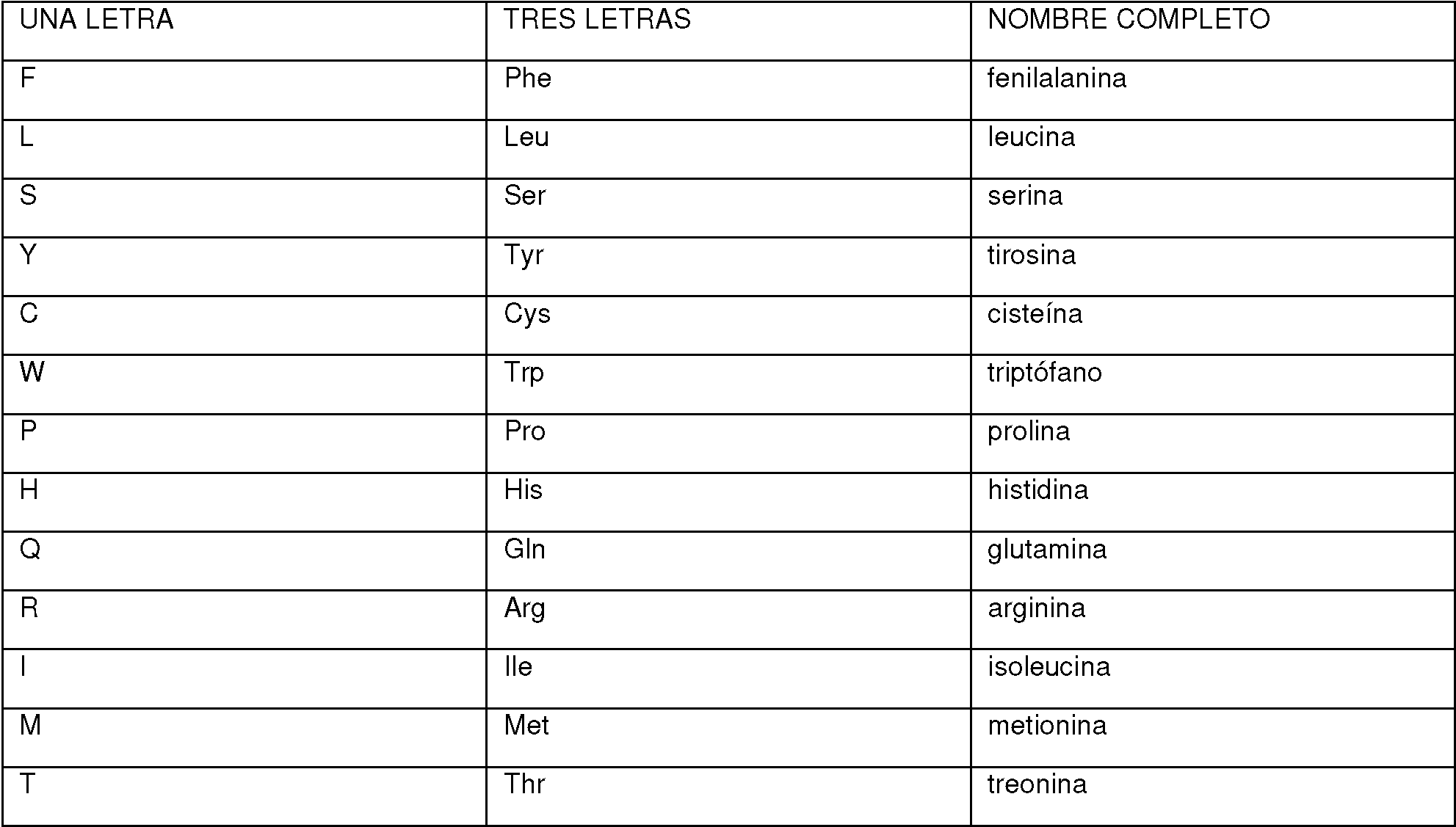

Tabla III: Matriz de sustitución de aminoácidosTable III: Amino acid substitution matrix
Adaptada de la matriz de sustitución de aminoácidos del programa GCG Software 9.0 BLOSUM62 (matriz de sustitución de bloques). Cuanto mayor sea el valor, más probable es que se encuentre una sustitución en las proteínas naturales relacionadas.Adapted from the amino acid substitution matrix of the GCG Software 9.0 BLOSUM62 program (block substitution matrix). The higher the value, the more likely it is that a substitution will be found in related natural proteins.
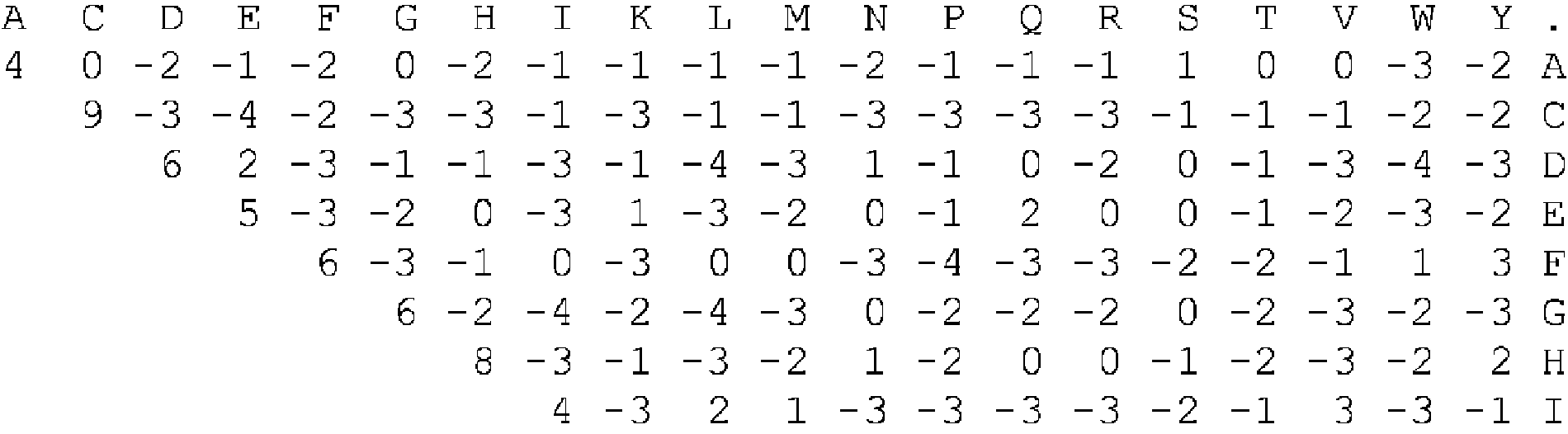
5 - 2 - 1 0 - 1 1 2 0 - 1 - 2 - 3 - 2 K 4 2 - 3 - 3 - 2 - 2 - 2 - 1 1 - 2 - 1 L 5 - 2 - 2 0 - 1 - 1 - 1 1 - 1 - 1 M 6 - 2 0 0 1 0 - 3 - 4 - 2 N 7 - 1 - 2 - 1 - 1 - 2 - 4 - 3 P 5 1 0 - 1 - 2 - 2 - 1 Q 5 - 1 - 1 - 3 - 3 - 2 R 4 1 - 2 - 3 - 2 S 5 0 - 2 - 2 T 4 - 3 - 1 V 11 2 W 7 Y TABLA IV: Método general para la síntesis de vcMMAE 5 - 2 - 1 0 - 1 1 2 0 - 1 - 2 - 3 - 2 K 4 2 - 3 - 3 - 2 - 2 - 2 - 1 1 - 2 - 1 L 5 - 2 - 2 0 - 1 - 1 - 1 1 - 1 - 1 M 6 - 2 0 0 1 0 - 3 - 4 - 2 N 7 - 1 - 2 - 1 - 1 - 2 - 4 - 3 P 5 1 0 - 1 - 2 - 2 - 1 Q 5 - 1 - 1 - 3 - 3 - 2 R 4 1 - 2 - 3 - 2 S 5 0 - 2 - 2 T 4 - 3 - 1 V 11 2 W 7 Y TABLE IV: General method for the synthesis of vcMMAE
Donde: AA1 = aminoácido 1Where: AA1 = amino acid 1
AA2 = aminoácido 2AA2 = amino acid 2
AA5 = Aminoácido 5AA5 = Amino Acid 5
DIL = DolaisoleuinaDIL = Dolaisoleuin
DAP = DolaproínaDAP = Dolaproin
Enlazante = Val-Cit (vc) Bonding = Val-Cit (vc)

Tabla V: Velocidades de asociación y disociación Biacore y cálculo de la afinidad resultanteTable V: Biacore association and dissociation rates and calculation of the resulting affinity
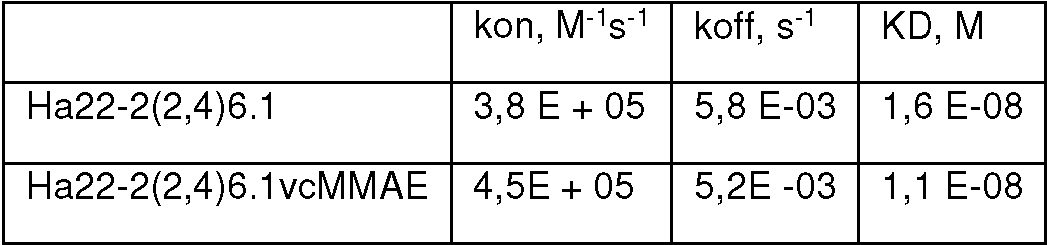
Tabla VI: Construcciones de 191P4D12 usadas en el ensayo de mapeo de dominio Construcciones NombreTable VI: 191P4D12 constructs used in the domain mapping assay Constructions Name
191P4D12 (1 -242 aa, 347-510) VC1, línea que expresa Rat1 (E)191P4D12 (1 -242 aa, 347-510) VC1, line expressing Rat1 (E)
191P4D12 (1-31 aa, 147-510) C1C2, línea que expresa Rat1 (E)191P4D12 (1-31 aa, 147-510) C1C2, line expressing Rat1 (E)
191P4D12 (1-242 aa) mFc-VC1, proteína de fusión191P4D12 (1-242 aa) mFc-VC1, fusion protein
191P4D12 (1-31 aa, 147-346) mFc-C1C2, proteína de fusión191P4D12 (1-31 aa, 147-346) mFc-C1C2, fusion protein
191P4D12 (1-141 aa) mFc-V, proteína de fusión191P4D12 (1-141 aa) mFc-V, fusion protein
Tabla VIITable VII

Tabla VIII (SEQ ID N°: 11-13, en orden de aparición)Table VIII (SEQ ID N °: 11-13, in order of appearance)
Ratón MPLSLGAEMWGPEAWLR-LLFLASFTGQYSAGELETSDVVTWLGQDAKLPCFYRGDPDE 59 Rata MPLSLGAEMWGPEAWLL-LLFLASFTGRYSAGELETSDLVTWLGQDAKLPCFYRGDPDE 59 Humano MPLSLGAEMWGPEAWLLLLLLLASFTGRCPAGELETSDWTWLGQDAKLPCFYRGDSGE 60 Mouse MPLSLGAEMWGPEAWLR-LLFLASFTGQYSAGELETSDVVTWLGQDAKLPCFYRGDPDE 59 Rat MPLSLGAEMWGPEAWLL-LLFLASFTGRYSAGELETSDLVTWLGQDAKLPCFYRGDPDE 59WEMLPGAFGFT Human MPLSLGAFGFT 60WGEAWLGAFT
A A A A A A A A A A A A A A A A A A A A A A A » A A A A A A A A A A A A A - A- A A A A AA A A A A A A A A A A A A A A A A A A A A A A »A A A A A A A A A A A A - A- A A A A A
Ratón QVGQVAWARVDPNEGIRELALLHSKYGLHVNPAYEDRVEQFPPPRDPLDGSVLLRNAVQA 119 Rata QVGQVAWARVDPNEGTRELALLHSKYGLHVSPAYEDRVEQPPPPRDPLDGSILLRNAVQA 119 Humano QVGQVAWARVDAGEGAQELALLHSKYGLHVSPAYEGRVEQPPPPRNPLDGSVLLRNAVQA 120 + it * * * AArAr‘A,‘A'ArArA''Ar«'A''AAAAr »'A''A'AAAr'A'A''A 119 QVGQVAWARVDPNEGIRELALLHSKYGLHVNPAYEDRVEQFPPPRDPLDGSVLLRNAVQA Mouse Rat Human QVGQVAWARVDAGEGAQELALLHSKYGLHVSPAYEGRVEQPPPPRNPLDGSVLLRNAVQA QVGQVAWARVDPNEGTRELALLHSKYGLHVSPAYEDRVEQPPPPRDPLDGSILLRNAVQA 119 120 + it * * * AArAr'A, 'A'ArArA''Ar''A''AAAAr''A''A'AAAr'A'A''A
Ratón DEGEYECRVSTFPAGSFQARMRLRVLVPPLPSLNPGPPLEEGQGLTLAASCTAEGSPAPS 179 Rata DEGEYECRVSTFPAGSFQARMRLRVLVPPLPSLNPGPPLEEGQGLTLAASCTAEGSPAPS 179 Humano DEGEYECRVSTFPAGSFQARLRLRVLVPPLPSLNPGPALEEGQGLTLAASCTAEGSPAPS 180 Mouse DEGEYECRVSTFPAGSFQARMRLRVLVPPLPSLNPGPPLEEGQGLTLAASCTAEGSPAPS 179 Rat DEGEYECRVSTFPAGSFQARMRLRVLVPPLPSLNPGPPLEEGQGLTLAASCTAEGSPAPSPLEEGQGLTLAASCTAEGSPAPS 179 Rat DEGEYECRVSTFPAGSFQARMRLRVLVPPLPSLNPGPPLEEGQGLTLAASCTAEGSPAPSPLEEGQGLTLAASCTAEGSPAPS 179Human DEGEYECRVSTFPAGSFQARMRLRVLVPPLPSLNPGPPLEEGQGLTLAASCTAEGSPAPS 179Human DEGEYECRQVPLFPLEPEGRVGLSPALE
A A A A A A A A A A A A A A A A A A A A • A A A A A A A A A A A A A A A A A A A A A A A A A A A A A A A A A A A A A AA A A A A A A A A A A A A A A A A A A A • A A A A A A A A A A A A A A A A A A A A A A A A A A A A A A A A A A A A A
Tabla IXTable IX

Claims (15)
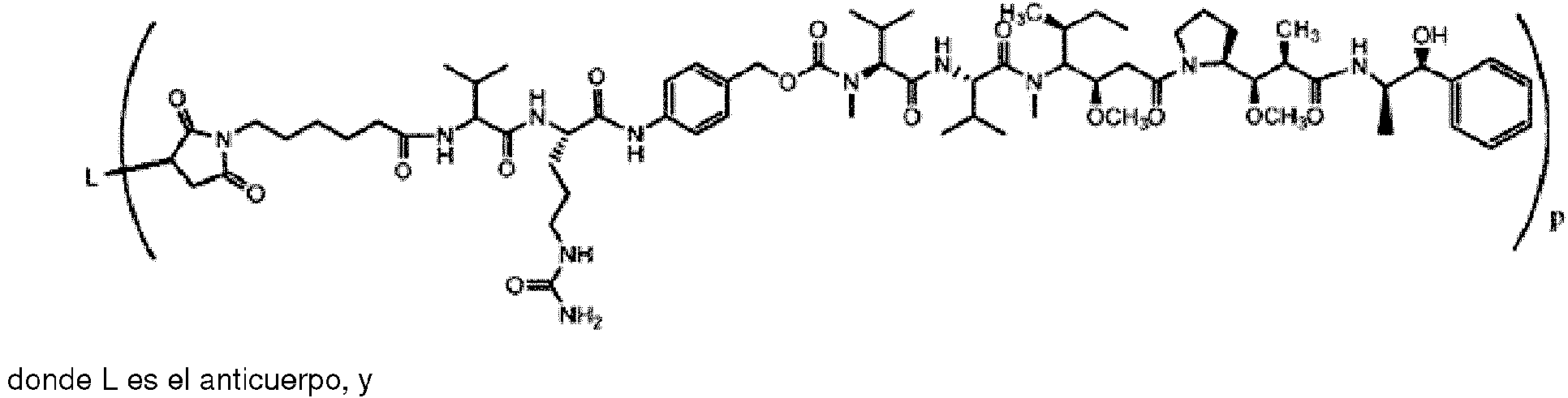
Applications Claiming Priority (1)
| Application Number | Priority Date | Filing Date | Title |
|---|---|---|---|
| US38793310P | 2010-09-29 | 2010-09-29 |
Publications (1)
| Publication Number | Publication Date |
|---|---|
| ES2874306T3 true ES2874306T3 (en) | 2021-11-04 |
Family
ID=45871300
Family Applications (2)
| Application Number | Title | Priority Date | Filing Date |
|---|---|---|---|
| ES18171803T Active ES2874306T3 (en) | 2010-09-29 | 2011-09-29 | Conjugates of antibodies and drugs (CAF) that bind to 191P4D12 proteins |
| ES11831345.1T Active ES2680624T3 (en) | 2010-09-29 | 2011-09-29 | Antibody and drug (CAF) conjugates that bind to 191P4D12 proteins |
Family Applications After (1)
| Application Number | Title | Priority Date | Filing Date |
|---|---|---|---|
| ES11831345.1T Active ES2680624T3 (en) | 2010-09-29 | 2011-09-29 | Antibody and drug (CAF) conjugates that bind to 191P4D12 proteins |
Country Status (30)
| Country | Link |
|---|---|
| US (8) | US8637642B2 (en) |
| EP (3) | EP3903812A1 (en) |
| JP (9) | JP6083871B2 (en) |
| KR (10) | KR102627947B1 (en) |
| CN (2) | CN105567717B (en) |
| AU (1) | AU2011312417B2 (en) |
| BR (1) | BR112013007309B1 (en) |
| CA (1) | CA2811644C (en) |
| CY (3) | CY1121023T1 (en) |
| DK (2) | DK3409287T5 (en) |
| EA (2) | EA027887B1 (en) |
| ES (2) | ES2874306T3 (en) |
| FR (1) | FR22C1050I2 (en) |
| HR (1) | HRP20181154T8 (en) |
| HU (3) | HUE054855T2 (en) |
| IL (6) | IL319612A (en) |
| LT (2) | LT2621526T (en) |
| LU (1) | LUC00280I2 (en) |
| MX (4) | MX347954B (en) |
| NL (1) | NL301198I2 (en) |
| NO (1) | NO2022039I1 (en) |
| PH (2) | PH12017501461B1 (en) |
| PL (2) | PL3409287T3 (en) |
| PT (2) | PT3409287T (en) |
| RS (1) | RS57483B1 (en) |
| SI (2) | SI2621526T1 (en) |
| SM (1) | SMT201800365T1 (en) |
| TW (8) | TWI764324B (en) |
| UA (1) | UA110495C2 (en) |
| WO (1) | WO2012047724A1 (en) |
Families Citing this family (84)
| Publication number | Priority date | Publication date | Assignee | Title |
|---|---|---|---|---|
| EP3903812A1 (en) | 2010-09-29 | 2021-11-03 | Agensys, Inc. | Antibody drug conjugates (adc) that bind to 191p4d12 proteins |
| US20130058947A1 (en) | 2011-09-02 | 2013-03-07 | Stem Centrx, Inc | Novel Modulators and Methods of Use |
| US20130116404A1 (en) | 2011-11-08 | 2013-05-09 | Case Western Reserve University | Targeted non-invasive imaging probes of egfr expressing cells |
| JP6089047B2 (en) | 2012-02-24 | 2017-03-01 | アッヴィ・ステムセントルクス・エル・エル・シー | DLL3 modulator and method of use |
| PH12020500604A1 (en) | 2012-02-24 | 2023-06-14 | Abbvie Stemcentrx Llc | Anti sez6 antibodies and methods of use |
| DK2887959T3 (en) * | 2012-08-23 | 2019-02-18 | Agensys Inc | ANTIBODY-PHARMACEUTICAL CONJUGATES (ADC) BINDING TO 158P1D7 PROTEINS |
| US9353150B2 (en) | 2012-12-04 | 2016-05-31 | Massachusetts Institute Of Technology | Substituted pyrazino[1′,2′:1 ,5]pyrrolo[2,3-b]-indole-1,4-diones for cancer treatment |
| HK1218930A1 (en) | 2013-02-08 | 2017-03-17 | Abbvie Stemcentrx Llc | Novel multispecific constructs |
| SMT201900339T1 (en) | 2013-02-22 | 2019-07-11 | Medimmune Ltd | Antidll3-antibody-pbd conjugates and uses thereof |
| JP2016538318A (en) | 2013-08-28 | 2016-12-08 | ステムセントリックス, インコーポレイテッド | New SEZ6 modulator and method of use |
| CA2922544A1 (en) * | 2013-08-28 | 2015-03-05 | Stemcentrx, Inc. | Engineered anti-dll3 conjugates and methods of use |
| EP3892294A1 (en) | 2013-08-28 | 2021-10-13 | AbbVie Stemcentrx LLC | Site-specific antibody conjugation methods and compositions |
| BR112016018891A2 (en) | 2014-02-21 | 2017-10-10 | Abbvie Stemcentrx Llc | anti-dll3 antibodies and drug conjugates for use in melanoma |
| KR20220025946A (en) * | 2014-03-21 | 2022-03-03 | 애브비 인코포레이티드 | Anti-egfr antibodies and antibody drug conjugates |
| CN104212698A (en) * | 2014-10-01 | 2014-12-17 | 南京飞马食品有限公司 | Germinated brown rice vinegar manufacturing method |
| MX382481B (en) | 2015-03-09 | 2025-03-13 | Agensys Inc | ANTIBODY-DRUG CONJUGATES (ADC) THAT BIND TO FLT3 PROTEINS. |
| HUE061408T2 (en) | 2015-06-29 | 2023-06-28 | Daiichi Sankyo Co Ltd | Method for selectively manufacturing antibody-drug conjugate |
| WO2017042210A1 (en) * | 2015-09-09 | 2017-03-16 | INSERM (Institut National de la Santé et de la Recherche Médicale) | Antibodies having specificity to nectin-4 and uses thereof |
| US10918627B2 (en) | 2016-05-11 | 2021-02-16 | Massachusetts Institute Of Technology | Convergent and enantioselective total synthesis of Communesin analogs |
| WO2018047154A1 (en) | 2016-09-07 | 2018-03-15 | Yissum Research Development Company Of The Hebrew University Of Jerusalem Ltd. | Anti-nkp46 antibodies and therapeutic use of same |
| MA50134A (en) | 2016-12-16 | 2020-07-29 | Bluefin Biomedicine Inc | ANTI-PROTEIN 1 ANTIBODY CONTAINING AN ANTI-CUB DOMAIN (CDCP1), ANTIBODY-DRUG CONJUGATES AND THEIR METHODS OF USE |
| EP3589654A1 (en) | 2017-03-02 | 2020-01-08 | INSERM (Institut National de la Santé et de la Recherche Médicale) | Antibodies having specificity to nectin-4 and uses thereof |
| US11932650B2 (en) | 2017-05-11 | 2024-03-19 | Massachusetts Institute Of Technology | Potent agelastatin derivatives as modulators for cancer invasion and metastasis |
| MX2019014318A (en) * | 2017-06-05 | 2020-08-13 | Agensys Inc | Nectin-4 binding proteins and methods of use thereof. |
| MX420258B (en) * | 2017-09-07 | 2025-02-10 | Dragonfly Therapeutics Inc | Proteins binding nkg2d, cd16 and a tumor-associated antigen |
| CA3075218A1 (en) | 2017-09-19 | 2019-03-28 | Paul Scherrer Institut | Transglutaminase conjugation method and linker |
| US10640508B2 (en) | 2017-10-13 | 2020-05-05 | Massachusetts Institute Of Technology | Diazene directed modular synthesis of compounds with quaternary carbon centers |
| WO2019183633A1 (en) | 2018-03-23 | 2019-09-26 | Case Western Reserve Univeristy | Psma targeted conjugate compounds and uses thereof |
| MX2020009842A (en) | 2018-03-23 | 2020-10-15 | Seattle Genetics Inc | Use of antibody drug conjugates comprising tubulin disrupting agents to treat solid tumor. |
| TWI851577B (en) | 2018-06-07 | 2024-08-11 | 美商思進公司 | Camptothecin conjugates |
| US11180531B2 (en) * | 2018-06-22 | 2021-11-23 | Bicycletx Limited | Bicyclic peptide ligands specific for Nectin-4 |
| JP7514834B2 (en) * | 2018-12-03 | 2024-07-11 | アジェンシス,インコーポレイテッド | Pharmaceutical compositions comprising anti-191P4D12 antibody drug conjugates and methods of use thereof |
| US11535634B2 (en) | 2019-06-05 | 2022-12-27 | Massachusetts Institute Of Technology | Compounds, conjugates, and compositions of epipolythiodiketopiperazines and polythiodiketopiperazines and uses thereof |
| KR20220054321A (en) * | 2019-08-13 | 2022-05-02 | 어젠시스 인코포레이티드 | Treatment of Cancer Using Antibody Drug Conjugates (ADCs) That Bind to 191P4D12 Protein |
| CA3162282A1 (en) * | 2019-11-25 | 2021-06-03 | Agensys, Inc. | Treatment of cancers with antibody drug conjugates (adc) that bind to 191p4d12 proteins |
| WO2021151984A1 (en) | 2020-01-31 | 2021-08-05 | Innate Pharma | Treatment of cancer |
| WO2021168274A1 (en) | 2020-02-21 | 2021-08-26 | Silverback Therapeutics, Inc. | Nectin-4 antibody conjugates and uses thereof |
| CN115103691B (en) * | 2020-03-25 | 2025-01-24 | 苏州盛迪亚生物医药有限公司 | A pharmaceutical composition containing an antibody-drug conjugate and its use |
| BR112022020332A2 (en) | 2020-04-10 | 2022-12-13 | Seagen Inc | ANTIBODY-DRUG CONJUGATE COMPOUND, COMPOSITION, METHOD OF TREATMENT OF CANCER AND AN AUTOIMMUNE DISORDER |
| EP4168453A4 (en) * | 2020-06-18 | 2024-11-20 | BioAtla, Inc. | CONDITIONALLY ACTIVE ANTI-NECTIN-4 ANTIBODIES |
| MX2022016232A (en) * | 2020-06-19 | 2023-03-14 | Agensys Inc | Markers for use in methods for treating cancers with antibody drug conjugates (adc). |
| CA3193584A1 (en) | 2020-09-04 | 2022-03-10 | Novarock Biotherapeutics, Ltd. | Nectin-4 antibodies and uses thereof |
| AU2021345721A1 (en) | 2020-09-16 | 2023-04-20 | Sichuan Kelun-Biotech Biopharmaceutical Co., Ltd. | Anti-nectin-4 antibody, conjugate including same, and application thereof |
| MX2023003059A (en) * | 2020-09-17 | 2023-06-02 | Agensys Inc | Methods for treating cancers with antibody drug conjugates (adc) that bind to 191p4d12 proteins. |
| WO2022076767A1 (en) * | 2020-10-11 | 2022-04-14 | Agensys, Inc. | Methods for treating cancers with antibody drug conjugates (adc) that bind to 191p4d12 proteins |
| EP4232095A1 (en) | 2020-10-25 | 2023-08-30 | Araris Biotech AG | Means and methods for producing antibody-linker conjugates |
| CA3200974A1 (en) | 2020-11-08 | 2022-05-12 | Seagen Inc. | Combination therapy |
| KR102408221B1 (en) * | 2020-11-10 | 2022-06-13 | 삼성메카닉스 (주) | Grid Coupling Molding Device |
| CA3196198A1 (en) | 2020-11-25 | 2022-06-02 | Manel KRAIEM | Treatment of cancer |
| WO2022182415A1 (en) | 2021-02-24 | 2022-09-01 | Massachusetts Institute Of Technology | Himastatin derivatives, and processes of preparation thereof, and uses thereof |
| AU2022238571A1 (en) | 2021-03-18 | 2023-09-14 | Seagen Inc. | Selective drug release from internalized conjugates of biologically active compounds |
| EP4086284A1 (en) | 2021-05-07 | 2022-11-09 | Emergence Therapeutics AG | Anti-nectin-4 antibody exatecan conjugates |
| JP7579991B2 (en) | 2021-03-31 | 2024-11-08 | エマージェンス セラピューティクス ゲーエムベーハー | Anti-nectin-4 antibody exatecan conjugate |
| AU2022253902A1 (en) | 2021-04-10 | 2023-11-02 | Genmab A/S | Folr1 binding agents, conjugates thereof and methods of using the same |
| JP7742892B2 (en) | 2021-04-23 | 2025-09-22 | ジェンマブ エー/エス | Anti-CD70 antibodies, conjugates thereof and methods of using same |
| JP2024515342A (en) | 2021-04-26 | 2024-04-09 | 江▲蘇▼恒瑞医▲薬▼股▲フン▼有限公司 | Anti-Nectin-4 antibody and anti-Nectin-4 antibody-drug conjugate and medical uses thereof |
| IL308795A (en) | 2021-05-28 | 2024-01-01 | Seagen Inc | Anthracycline antibody conjugates |
| WO2023019236A1 (en) * | 2021-08-13 | 2023-02-16 | Agensys, Inc. | Methods for treating non-muscle invasive bladder cancer (nmibc) with antibody drug conjugates (adc) that bind to 191p4d12 proteins |
| AU2022388735A1 (en) | 2021-11-09 | 2024-05-30 | Case Western Reserve University | Psma targeted conjugate compounds and uses thereof |
| EP4433096A1 (en) | 2021-11-19 | 2024-09-25 | Ardeagen Corporation | Gpc3 binding agents, conjugates thereof and methods of using the same |
| CN119278055A (en) | 2022-03-17 | 2025-01-07 | 思进公司 | Camptothecin conjugate |
| EP4496593A1 (en) | 2022-03-23 | 2025-01-29 | Synaffix B.V. | Antibody-conjugates for targeting of tumours expressing nectin-4 |
| JP7690922B2 (en) * | 2022-05-02 | 2025-06-11 | 株式会社三洋物産 | Gaming Machines |
| JP7740118B2 (en) * | 2022-05-02 | 2025-09-17 | 株式会社三洋物産 | gaming machines |
| WO2023221971A1 (en) | 2022-05-16 | 2023-11-23 | 江苏恒瑞医药股份有限公司 | Pharmaceutical composition containing anti-nectin-4 antibody drug conjugate and use thereof |
| EP4532020A1 (en) | 2022-05-25 | 2025-04-09 | Innate Pharma | Nectin-4 binding agents |
| WO2023235754A1 (en) | 2022-06-01 | 2023-12-07 | ALX Oncology Inc. | Combination therapies for treating urothelial carcinoma |
| EP4285935A1 (en) | 2022-06-03 | 2023-12-06 | Emergence Therapeutics AG | Novel anti-nectin-4 antibody camptothecin derivative conjugates |
| EP4309676A1 (en) | 2022-07-22 | 2024-01-24 | Emergence Therapeutics AG | Novel anti-nectin-4 antibody camptothecin derivative conjugates |
| EP4324849A1 (en) | 2022-08-18 | 2024-02-21 | Emergence Therapeutics AG | Humanized anti-nectin-4 antibodies |
| WO2024052503A1 (en) | 2022-09-08 | 2024-03-14 | Institut National de la Santé et de la Recherche Médicale | Antibodies having specificity to ltbp2 and uses thereof |
| EP4344707A1 (en) | 2022-09-29 | 2024-04-03 | Emergence Therapeutics AG | New anti-nectin-4 antibody drug conjugates |
| WO2024067841A1 (en) | 2022-09-30 | 2024-04-04 | 上海迪诺医药科技有限公司 | Benzazepine derivative, conjugate containing same, and use thereof |
| WO2024129756A1 (en) | 2022-12-13 | 2024-06-20 | Seagen Inc. | Site-specific engineered cysteine antibody drug conjugates |
| EP4461317A1 (en) | 2023-05-12 | 2024-11-13 | Emergence Therapeutics GmbH | Antibody-drug conjugates comprising an anti-nectin-4 antibody and belotecan or a derivative thereof |
| WO2024258743A1 (en) | 2023-06-13 | 2024-12-19 | Adcentrx Therapeutics, Inc. | Methods and compositions related to antibodies and antibody drug conjugates (adcs) that bind nectin-4 proteins |
| EP4534102A1 (en) | 2023-10-02 | 2025-04-09 | Eli Lilly and Company | Antibody drug conjugate (adc) targeting nectin 4 and comprising an exatecan payload |
| EP4534101A1 (en) | 2023-10-02 | 2025-04-09 | Eli Lilly and Company | Antibody drug conjugate (adc) targeting nectin 4 and comprising an exatecan payload |
| WO2025149947A1 (en) | 2024-01-12 | 2025-07-17 | Seagen Inc. | Antibody-drug conjugates |
| WO2025149667A1 (en) | 2024-01-12 | 2025-07-17 | Pheon Therapeutics Ltd | Antibody drug conjugates and uses thereof |
| WO2025162492A1 (en) * | 2024-01-29 | 2025-08-07 | 甘李药业股份有限公司 | Linker, ligand-drug conjugate and medical use thereof |
| WO2025195487A1 (en) * | 2024-03-21 | 2025-09-25 | 石药集团巨石生物制药有限公司 | Use of antibody-drug conjugate targeting nectin-4 |
| WO2025224297A1 (en) | 2024-04-26 | 2025-10-30 | Institut National de la Santé et de la Recherche Médicale | Antibodies having specificity to tgfbi and uses thereof |
| WO2025264533A1 (en) | 2024-06-17 | 2025-12-26 | Adcentrx Therapeutics Inc. | Methods and compositions related to antibody drug conjugates (adcs) that bind steap-1 proteins |
Family Cites Families (150)
| Publication number | Priority date | Publication date | Assignee | Title |
|---|---|---|---|---|
| NL154598B (en) | 1970-11-10 | 1977-09-15 | Organon Nv | PROCEDURE FOR DETERMINING AND DETERMINING LOW MOLECULAR COMPOUNDS AND PROTEINS THAT CAN SPECIFICALLY BIND THESE COMPOUNDS AND TEST PACKAGING. |
| US3817837A (en) | 1971-05-14 | 1974-06-18 | Syva Corp | Enzyme amplification assay |
| US3939350A (en) | 1974-04-29 | 1976-02-17 | Board Of Trustees Of The Leland Stanford Junior University | Fluorescent immunoassay employing total reflection for activation |
| US3996345A (en) | 1974-08-12 | 1976-12-07 | Syva Company | Fluorescence quenching with immunological pairs in immunoassays |
| US4307016A (en) | 1978-03-24 | 1981-12-22 | Takeda Chemical Industries, Ltd. | Demethyl maytansinoids |
| US4277437A (en) | 1978-04-05 | 1981-07-07 | Syva Company | Kit for carrying out chemically induced fluorescence immunoassay |
| US4275149A (en) | 1978-11-24 | 1981-06-23 | Syva Company | Macromolecular environment control in specific receptor assays |
| US4256746A (en) | 1978-11-14 | 1981-03-17 | Takeda Chemical Industries | Dechloromaytansinoids, their pharmaceutical compositions and method of use |
| JPS55102583A (en) | 1979-01-31 | 1980-08-05 | Takeda Chem Ind Ltd | 20-acyloxy-20-demethylmaytansinoid compound |
| JPS55162791A (en) | 1979-06-05 | 1980-12-18 | Takeda Chem Ind Ltd | Antibiotic c-15003pnd and its preparation |
| JPS5645483A (en) | 1979-09-19 | 1981-04-25 | Takeda Chem Ind Ltd | C-15003phm and its preparation |
| EP0028683A1 (en) | 1979-09-21 | 1981-05-20 | Takeda Chemical Industries, Ltd. | Antibiotic C-15003 PHO and production thereof |
| JPS5645485A (en) | 1979-09-21 | 1981-04-25 | Takeda Chem Ind Ltd | Production of c-15003pnd |
| US4366241A (en) | 1980-08-07 | 1982-12-28 | Syva Company | Concentrating zone method in heterogeneous immunoassays |
| WO1982001188A1 (en) | 1980-10-08 | 1982-04-15 | Takeda Chemical Industries Ltd | 4,5-deoxymaytansinoide compounds and process for preparing same |
| US4450254A (en) | 1980-11-03 | 1984-05-22 | Standard Oil Company | Impact improvement of high nitrile resins |
| US4313946A (en) | 1981-01-27 | 1982-02-02 | The United States Of America As Represented By The Secretary Of Agriculture | Chemotherapeutically active maytansinoids from Trewia nudiflora |
| US4315929A (en) | 1981-01-27 | 1982-02-16 | The United States Of America As Represented By The Secretary Of Agriculture | Method of controlling the European corn borer with trewiasine |
| JPS57192389A (en) | 1981-05-20 | 1982-11-26 | Takeda Chem Ind Ltd | Novel maytansinoid |
| US4486414A (en) | 1983-03-21 | 1984-12-04 | Arizona Board Of Reagents | Dolastatins A and B cell growth inhibitory substances |
| US4816567A (en) | 1983-04-08 | 1989-03-28 | Genentech, Inc. | Recombinant immunoglobin preparations |
| US4970198A (en) | 1985-10-17 | 1990-11-13 | American Cyanamid Company | Antitumor antibiotics (LL-E33288 complex) |
| US4676980A (en) | 1985-09-23 | 1987-06-30 | The United States Of America As Represented By The Secretary Of The Department Of Health And Human Services | Target specific cross-linked heteroantibodies |
| US4880935A (en) | 1986-07-11 | 1989-11-14 | Icrf (Patents) Limited | Heterobifunctional linking agents derived from N-succinimido-dithio-alpha methyl-methylene-benzoates |
| US5079233A (en) | 1987-01-30 | 1992-01-07 | American Cyanamid Company | N-acyl derivatives of the LL-E33288 antitumor antibiotics, composition and methods for using the same |
| WO1988007089A1 (en) | 1987-03-18 | 1988-09-22 | Medical Research Council | Altered antibodies |
| US4816444A (en) | 1987-07-10 | 1989-03-28 | Arizona Board Of Regents, Arizona State University | Cell growth inhibitory substance |
| US4975278A (en) | 1988-02-26 | 1990-12-04 | Bristol-Myers Company | Antibody-enzyme conjugates in combination with prodrugs for the delivery of cytotoxic agents to tumor cells |
| US5677425A (en) | 1987-09-04 | 1997-10-14 | Celltech Therapeutics Limited | Recombinant antibody |
| US5606040A (en) | 1987-10-30 | 1997-02-25 | American Cyanamid Company | Antitumor and antibacterial substituted disulfide derivatives prepared from compounds possessing a methyl-trithio group |
| US5770701A (en) | 1987-10-30 | 1998-06-23 | American Cyanamid Company | Process for preparing targeted forms of methyltrithio antitumor agents |
| US5053394A (en) | 1988-09-21 | 1991-10-01 | American Cyanamid Company | Targeted forms of methyltrithio antitumor agents |
| IL106992A (en) | 1988-02-11 | 1994-06-24 | Bristol Myers Squibb Co | Acylhydrazone derivatives of anthracycline and methods for their preparation |
| US5476996A (en) | 1988-06-14 | 1995-12-19 | Lidak Pharmaceuticals | Human immune system in non-human animal |
| US5223409A (en) | 1988-09-02 | 1993-06-29 | Protein Engineering Corp. | Directed evolution of novel binding proteins |
| US5076973A (en) | 1988-10-24 | 1991-12-31 | Arizona Board Of Regents | Synthesis of dolastatin 3 |
| US5530101A (en) | 1988-12-28 | 1996-06-25 | Protein Design Labs, Inc. | Humanized immunoglobulins |
| US4978744A (en) | 1989-01-27 | 1990-12-18 | Arizona Board Of Regents | Synthesis of dolastatin 10 |
| US4879278A (en) | 1989-05-16 | 1989-11-07 | Arizona Board Of Regents | Isolation and structural elucidation of the cytostatic linear depsipeptide dolastatin 15 |
| US4986988A (en) | 1989-05-18 | 1991-01-22 | Arizona Board Of Regents | Isolation and structural elucidation of the cytostatic linear depsipeptides dolastatin 13 and dehydrodolastatin 13 |
| DE3920358A1 (en) | 1989-06-22 | 1991-01-17 | Behringwerke Ag | BISPECIFIC AND OLIGO-SPECIFIC, MONO- AND OLIGOVALENT ANTI-BODY CONSTRUCTS, THEIR PRODUCTION AND USE |
| CA2026147C (en) | 1989-10-25 | 2006-02-07 | Ravi J. Chari | Cytotoxic agents comprising maytansinoids and their therapeutic use |
| US5208020A (en) | 1989-10-25 | 1993-05-04 | Immunogen Inc. | Cytotoxic agents comprising maytansinoids and their therapeutic use |
| US5138036A (en) | 1989-11-13 | 1992-08-11 | Arizona Board Of Regents Acting On Behalf Of Arizona State University | Isolation and structural elucidation of the cytostatic cyclodepsipeptide dolastatin 14 |
| US6657103B1 (en) | 1990-01-12 | 2003-12-02 | Abgenix, Inc. | Human antibodies derived from immunized xenomice |
| US5427908A (en) | 1990-05-01 | 1995-06-27 | Affymax Technologies N.V. | Recombinant library screening methods |
| US6172197B1 (en) | 1991-07-10 | 2001-01-09 | Medical Research Council | Methods for producing members of specific binding pairs |
| GB9015198D0 (en) | 1990-07-10 | 1990-08-29 | Brien Caroline J O | Binding substance |
| US5633425A (en) | 1990-08-29 | 1997-05-27 | Genpharm International, Inc. | Transgenic non-human animals capable of producing heterologous antibodies |
| US5545806A (en) | 1990-08-29 | 1996-08-13 | Genpharm International, Inc. | Ransgenic non-human animals for producing heterologous antibodies |
| US5625126A (en) | 1990-08-29 | 1997-04-29 | Genpharm International, Inc. | Transgenic non-human animals for producing heterologous antibodies |
| US5661016A (en) | 1990-08-29 | 1997-08-26 | Genpharm International Inc. | Transgenic non-human animals capable of producing heterologous antibodies of various isotypes |
| JP2938569B2 (en) | 1990-08-29 | 1999-08-23 | ジェンファーム インターナショナル,インコーポレイティド | Method for producing xenogeneic immunoglobulin and transgenic mouse |
| WO1993011161A1 (en) | 1991-11-25 | 1993-06-10 | Enzon, Inc. | Multivalent antigen-binding proteins |
| DE69233782D1 (en) | 1991-12-02 | 2010-05-20 | Medical Res Council | Preparation of Autoantibodies on Phage Surfaces Starting from Antibody Segment Libraries |
| US5622929A (en) | 1992-01-23 | 1997-04-22 | Bristol-Myers Squibb Company | Thioether conjugates |
| ZA932522B (en) | 1992-04-10 | 1993-12-20 | Res Dev Foundation | Immunotoxins directed against c-erbB-2(HER/neu) related surface antigens |
| AU4116793A (en) | 1992-04-24 | 1993-11-29 | Board Of Regents, The University Of Texas System | Recombinant production of immunoglobulin-like domains in prokaryotic cells |
| ATE139900T1 (en) | 1992-11-13 | 1996-07-15 | Idec Pharma Corp | THERAPEUTIC USE OF CHIMERIC AND LABELED ANTIBODIES AGAINST HUMAN B LYMPHOCYTE RESTRICTED DIFFERENTIATION ANTIGEN FOR THE TREATMENT OF B CELL LYMPHOMA |
| US6034065A (en) | 1992-12-03 | 2000-03-07 | Arizona Board Of Regents | Elucidation and synthesis of antineoplastic tetrapeptide phenethylamides of dolastatin 10 |
| US5635483A (en) | 1992-12-03 | 1997-06-03 | Arizona Board Of Regents Acting On Behalf Of Arizona State University | Tumor inhibiting tetrapeptide bearing modified phenethyl amides |
| US5410024A (en) | 1993-01-21 | 1995-04-25 | Arizona Board Of Regents Acting On Behalf Of Arizona State University | Human cancer inhibitory pentapeptide amides |
| US5780588A (en) | 1993-01-26 | 1998-07-14 | Arizona Board Of Regents | Elucidation and synthesis of selected pentapeptides |
| US6214345B1 (en) | 1993-05-14 | 2001-04-10 | Bristol-Myers Squibb Co. | Lysosomal enzyme-cleavable antitumor drug conjugates |
| US5773001A (en) | 1994-06-03 | 1998-06-30 | American Cyanamid Company | Conjugates of methyltrithio antitumor agents and intermediates for their synthesis |
| US7625697B2 (en) | 1994-06-17 | 2009-12-01 | The Board Of Trustees Of The Leland Stanford Junior University | Methods for constructing subarrays and subarrays made thereby |
| US5521284A (en) | 1994-08-01 | 1996-05-28 | Arizona Board Of Regents Acting On Behalf Of Arizona State University | Human cancer inhibitory pentapeptide amides and esters |
| US5504191A (en) | 1994-08-01 | 1996-04-02 | Arizona Board Of Regents Acting On Behalf Of Arizona State University | Human cancer inhibitory pentapeptide methyl esters |
| US5530097A (en) | 1994-08-01 | 1996-06-25 | Arizona Board Of Regents Acting On Behalf Of Arizona State University | Human cancer inhibitory peptide amides |
| US5554725A (en) | 1994-09-14 | 1996-09-10 | Arizona Board Of Regents Acting On Behalf Of Arizona State University | Synthesis of dolastatin 15 |
| US5599902A (en) | 1994-11-10 | 1997-02-04 | Arizona Board Of Regents Acting On Behalf Of Arizona State University | Cancer inhibitory peptides |
| US5663149A (en) | 1994-12-13 | 1997-09-02 | Arizona Board Of Regents Acting On Behalf Of Arizona State University | Human cancer inhibitory pentapeptide heterocyclic and halophenyl amides |
| US5869046A (en) | 1995-04-14 | 1999-02-09 | Genentech, Inc. | Altered polypeptides with increased half-life |
| US6121022A (en) | 1995-04-14 | 2000-09-19 | Genentech, Inc. | Altered polypeptides with increased half-life |
| US5714586A (en) | 1995-06-07 | 1998-02-03 | American Cyanamid Company | Methods for the preparation of monomeric calicheamicin derivative/carrier conjugates |
| US5712374A (en) | 1995-06-07 | 1998-01-27 | American Cyanamid Company | Method for the preparation of substantiallly monomeric calicheamicin derivative/carrier conjugates |
| WO1997023243A1 (en) | 1995-12-22 | 1997-07-03 | Bristol-Myers Squibb Company | Branched hydrazone linkers |
| US6130237A (en) | 1996-09-12 | 2000-10-10 | Cancer Research Campaign Technology Limited | Condensed N-aclyindoles as antitumor agents |
| EP0953039B1 (en) | 1996-10-15 | 2007-08-29 | The Regents Of The University Of California | Animal models of human prostate cancer progression |
| JP2001509679A (en) | 1997-01-21 | 2001-07-24 | ヒューマン・ジェノム・サイエンシズ・インコーポレイテッド | Polynucleotides and polypeptides encoding the receptor |
| US6239104B1 (en) | 1997-02-25 | 2001-05-29 | Arizona Board Of Regents | Isolation and structural elucidation of the cytostatic linear and cyclo-depsipeptides dolastatin 16, dolastatin 17, and dolastatin 18 |
| US6277375B1 (en) | 1997-03-03 | 2001-08-21 | Board Of Regents, The University Of Texas System | Immunoglobulin-like domains with increased half-lives |
| ATE319745T1 (en) | 1997-05-21 | 2006-03-15 | Biovation Ltd | METHOD FOR PRODUCING NON-IMMUNOGENIC PROTEINS |
| US20030065156A1 (en) | 1997-12-23 | 2003-04-03 | Williams Lewis T. | Novel human genes and gene expression products I |
| US6194551B1 (en) | 1998-04-02 | 2001-02-27 | Genentech, Inc. | Polypeptide variants |
| ES2272061T5 (en) | 1998-04-15 | 2012-02-24 | Merck Serono Biodevelopment | GENOMIC SEQUENCE OF THE 5-LIPOXYGENASE ACTIVATING PROTEIN (FLAP), SAME POLYMORPHIC MARKERS AND METHODS FOR ASTHMA DETECTION. |
| GB9809951D0 (en) | 1998-05-08 | 1998-07-08 | Univ Cambridge Tech | Binding molecules |
| US6264949B1 (en) | 1998-09-29 | 2001-07-24 | Mount Sinai School Of Medicine Of New York University | Noninvasive agents for diagnosis and prognosis of the progression of fibrosis |
| US20020137160A1 (en) | 1998-12-17 | 2002-09-26 | Byatt John C | Nucleic acid and other molecules associated with lactation and muscle and fat deposition |
| US7160694B2 (en) | 1999-06-14 | 2007-01-09 | Millennium Pharmaceuticals, Inc. | Nucleic acids encoding TANGO405 and functional fragments and uses thereof |
| EP1194549A2 (en) | 1999-07-02 | 2002-04-10 | Chiron Corporation | Human genes and gene expression products |
| EP1074617A3 (en) | 1999-07-29 | 2004-04-21 | Research Association for Biotechnology | Primers for synthesising full-length cDNA and their use |
| CA2382161A1 (en) | 1999-09-03 | 2001-03-15 | Human Genome Sciences, Inc. | Immunoglobulin superfamily polynucleotides, polypeptides, and antibodies |
| EP1218392A4 (en) | 1999-09-10 | 2003-04-09 | Millennium Pharm Inc | Novel genes encoding proteins having prognostic, diagnostic, preventive, therapeutic, and other uses |
| US6323315B1 (en) | 1999-09-10 | 2001-11-27 | Basf Aktiengesellschaft | Dolastatin peptides |
| AU7721500A (en) | 1999-09-29 | 2001-04-30 | Human Genome Sciences, Inc. | Colon and colon cancer associated polynucleotides and polypeptides |
| AU2001229340A1 (en) | 2000-01-14 | 2001-07-24 | Millennium Pharmaceuticals, Inc. | Genes compositions, kits, and methods for identification, assessment, prevention, and therapy of breast cancer |
| US20030013649A1 (en) | 2000-01-31 | 2003-01-16 | Rosen Craig A. | Nucleic acids, proteins, and antibodies |
| US20020168711A1 (en) | 2000-01-31 | 2002-11-14 | Rosen Craig A. | Nucleic acids, proteins, and antibodies |
| CA2397407A1 (en) | 2000-01-31 | 2001-08-02 | Human Genome Sciences, Inc. | Nucleic acids, proteins, and antibodies |
| AU2001243142A1 (en) | 2000-02-03 | 2001-08-14 | Hyseq, Inc. | Novel nucleic acids and polypeptides |
| AU2001241541A1 (en) | 2000-02-17 | 2001-08-27 | Millennium Predictive Medicine, Inc. | Novel genes, compositions, kits, and methods for identification, assessment, prevention, and therapy of human prostate cancer |
| CN1169954C (en) | 2000-03-09 | 2004-10-06 | 上海市肿瘤研究所 | Polynucleotide encoding a human protein with the function of inhibiting the growth of cancer cells |
| AU4592601A (en) | 2000-03-21 | 2001-10-03 | Millennium Predictive Medicine | Novel genes, compositions, kits, and method for identification, assessment, prevention, and therapy of ovarian cancer |
| US6436703B1 (en) | 2000-03-31 | 2002-08-20 | Hyseq, Inc. | Nucleic acids and polypeptides |
| WO2001090304A2 (en) | 2000-05-19 | 2001-11-29 | Human Genome Sciences, Inc. | Nucleic acids, proteins, and antibodies |
| WO2001094629A2 (en) | 2000-06-05 | 2001-12-13 | Avalon Pharmaceuticals | Cancer gene determination and therapeutic screening using signature gene sets |
| JP2004508019A (en) | 2000-07-28 | 2004-03-18 | コンピュジェン インコーポレイテッド | Oligonucleotide libraries for detecting RNA transcripts and splice variants occupying locations in the transcriptome |
| MXPA03002479A (en) | 2000-10-05 | 2004-05-24 | Immunex Corp | Nectin polypeptides, polynucleotides, methods of making and use thereof. |
| EP1916303B1 (en) | 2000-11-30 | 2013-02-27 | Medarex, Inc. | Nucleic acids encoding rearranged human immunoglobulin sequences from transgenic transchromosomal mice |
| CN1297700C (en) * | 2000-12-20 | 2007-01-31 | 帝人株式会社 | Method for manufacturing polyester mixed fiber yarn |
| US20040029114A1 (en) | 2001-01-24 | 2004-02-12 | Eos Technology, Inc. | Methods of diagnosis of breast cancer, compositions and methods of screening for modulators of breast cancer |
| WO2002059377A2 (en) | 2001-01-24 | 2002-08-01 | Protein Design Labs | Methods of diagnosis of breast cancer, compositions and methods of screening for modulators of breast cancer |
| AU2002251841A1 (en) | 2001-01-30 | 2002-08-12 | Corixa Corporation | Compositions and methods for the therapy and diagnosis of pancreatic cancer |
| US7271240B2 (en) | 2001-03-14 | 2007-09-18 | Agensys, Inc. | 125P5C8: a tissue specific protein highly expressed in various cancers |
| AU2002338431A1 (en) | 2001-04-04 | 2002-11-05 | Quark Biotech, Inc. | Sequence characteristics of bladder cancer |
| JP2005527180A (en) | 2001-04-18 | 2005-09-15 | プロテイン デザイン ラブス, インコーポレイテッド | Lung cancer diagnosis method, composition of lung cancer modifier and screening method |
| US6884869B2 (en) | 2001-04-30 | 2005-04-26 | Seattle Genetics, Inc. | Pentapeptide compounds and uses related thereto |
| US20030083263A1 (en) | 2001-04-30 | 2003-05-01 | Svetlana Doronina | Pentapeptide compounds and uses related thereto |
| US6794501B2 (en) | 2001-05-04 | 2004-09-21 | Ludwig Institute For Cancer Research | Colon cancer antigen panel |
| US6441163B1 (en) | 2001-05-31 | 2002-08-27 | Immunogen, Inc. | Methods for preparation of cytotoxic conjugates of maytansinoids and cell binding agents |
| EP1572872A2 (en) | 2001-06-05 | 2005-09-14 | Exelixis, Inc. | Igs as modifiers of the p53 pathway and methods of use |
| US7189507B2 (en) | 2001-06-18 | 2007-03-13 | Pdl Biopharma, Inc. | Methods of diagnosis of ovarian cancer, compositions and methods of screening for modulators of ovarian cancer |
| CA2451465A1 (en) | 2001-06-18 | 2002-12-27 | Eos Biotechnology Inc. | Methods of diagnosis of ovarian cancer, compositions and methods of screening for modulators of ovarian cancer |
| US7171311B2 (en) | 2001-06-18 | 2007-01-30 | Rosetta Inpharmatics Llc | Methods of assigning treatment to breast cancer patients |
| US20040076955A1 (en) | 2001-07-03 | 2004-04-22 | Eos Biotechnology, Inc. | Methods of diagnosis of bladder cancer, compositions and methods of screening for modulators of bladder cancer |
| US20030099974A1 (en) | 2001-07-18 | 2003-05-29 | Millennium Pharmaceuticals, Inc. | Novel genes, compositions, kits and methods for identification, assessment, prevention, and therapy of breast cancer |
| KR101005130B1 (en) | 2001-07-19 | 2011-01-04 | 니목스 코포레이션 | Peptides effective for the treatment of other diseases that require the removal or destruction of tumors and cells |
| EP2143438B1 (en) | 2001-09-18 | 2011-07-13 | Genentech, Inc. | Compositions and methods for the diagnosis and treatment of tumors |
| JP4200100B2 (en) * | 2001-11-07 | 2008-12-24 | アジェンシス,インコーポレイテッド | Nucleic acids and corresponding proteins referred to as 161P2F10B useful in cancer treatment and detection |
| WO2003042661A2 (en) | 2001-11-13 | 2003-05-22 | Protein Design Labs, Inc. | Methods of diagnosis of cancer, compositions and methods of screening for modulators of cancer |
| US20030232350A1 (en) | 2001-11-13 | 2003-12-18 | Eos Biotechnology, Inc. | Methods of diagnosis of cancer, compositions and methods of screening for modulators of cancer |
| AU2003245488A1 (en) | 2002-06-13 | 2003-12-31 | Regulome Corporation | Functional sites |
| EP2353611B1 (en) | 2002-07-31 | 2015-05-13 | Seattle Genetics, Inc. | Drug conjugates and their use for treating cancer, an autoimmune disease or an infectious disease |
| US20040081653A1 (en) * | 2002-08-16 | 2004-04-29 | Raitano Arthur B. | Nucleic acids and corresponding proteins entitled 251P5G2 useful in treatment and detection of cancer |
| AU2008202217B2 (en) * | 2002-08-16 | 2012-07-26 | Agensys, Inc. | Nucleic acids and corresponding proteins entitled 191PAD12(b) useful in treatment and detection of cancer |
| EP1391213A1 (en) | 2002-08-21 | 2004-02-25 | Boehringer Ingelheim International GmbH | Compositions and methods for treating cancer using maytansinoid CD44 antibody immunoconjugates and chemotherapeutic agents |
| CA2496923A1 (en) | 2002-08-29 | 2004-03-11 | University Of Massachusetts | Utilization of emulsion interface engineering to produce oxidatively stable lipid delivery systems |
| AR045563A1 (en) * | 2003-09-10 | 2005-11-02 | Warner Lambert Co | ANTIBODIES DIRECTED TO M-CSF |
| PT2489364E (en) | 2003-11-06 | 2015-04-16 | Seattle Genetics Inc | Monomethylvaline compounds conjugated to antibodies |
| WO2005092380A2 (en) | 2004-03-26 | 2005-10-06 | Pfizer Products Inc | Uses of anti-ctla-4 antibodies |
| WO2005111076A1 (en) | 2004-05-12 | 2005-11-24 | Institut National De La Sante Et De La Recherche Medicale (Inserm) | Nectin 4 (n4) as a marker for cancer prognosis |
| US7691962B2 (en) | 2004-05-19 | 2010-04-06 | Medarex, Inc. | Chemical linkers and conjugates thereof |
| NZ553500A (en) | 2004-09-23 | 2009-11-27 | Genentech Inc Genentech Inc | Cysteine engineered antibodies and conjugates withCysteine engineered antibodies and conjugates with a free cysteine amino acid in the heavy chain a free cysteine amino acid in the heavy chain |
| CN101500590A (en) * | 2005-03-31 | 2009-08-05 | 阿根西斯公司 | Antibodies and related molecules that bind to 161P2F10B protein |
| WO2006105488A2 (en) | 2005-03-31 | 2006-10-05 | Agensys, Inc. | Antibodies and related molecules that bind to 161p2f10b proteins |
| EP2078732B1 (en) * | 2006-07-10 | 2015-09-16 | Fujita Health University | Method of identifying a candidate diagnostic or therapeutic antibody using flow cytometry |
| LT2845866T (en) | 2006-10-27 | 2017-07-10 | Genentech, Inc. | Antibodies and immunoconjugates and uses therefor |
| JP5394246B2 (en) | 2007-03-30 | 2014-01-22 | ジェネンテック, インコーポレイテッド | Antibodies and immunoconjugates and methods for their use |
| EP3903812A1 (en) * | 2010-09-29 | 2021-11-03 | Agensys, Inc. | Antibody drug conjugates (adc) that bind to 191p4d12 proteins |
-
2011
- 2011-09-29 EP EP21166650.8A patent/EP3903812A1/en active Pending
- 2011-09-29 LT LTEP11831345.1T patent/LT2621526T/en unknown
- 2011-09-29 SM SM20180365T patent/SMT201800365T1/en unknown
- 2011-09-29 WO PCT/US2011/054054 patent/WO2012047724A1/en not_active Ceased
- 2011-09-29 TW TW109135992A patent/TWI764324B/en active
- 2011-09-29 TW TW107103146A patent/TWI674112B/en active
- 2011-09-29 CN CN201510519846.0A patent/CN105567717B/en active Active
- 2011-09-29 KR KR1020237028203A patent/KR102627947B1/en active Active
- 2011-09-29 KR KR1020227001399A patent/KR102504750B1/en active Active
- 2011-09-29 PH PH1/2017/501461A patent/PH12017501461B1/en unknown
- 2011-09-29 UA UAA201305358A patent/UA110495C2/en unknown
- 2011-09-29 MX MX2016003743A patent/MX347954B/en unknown
- 2011-09-29 KR KR1020137011094A patent/KR20130130709A/en not_active Abandoned
- 2011-09-29 TW TW104140581A patent/TWI651096B/en active
- 2011-09-29 PT PT181718032T patent/PT3409287T/en unknown
- 2011-09-29 IL IL319612A patent/IL319612A/en unknown
- 2011-09-29 EA EA201300411A patent/EA027887B1/en unknown
- 2011-09-29 IL IL311145A patent/IL311145B2/en unknown
- 2011-09-29 PT PT118313451T patent/PT2621526T/en unknown
- 2011-09-29 KR KR1020247001866A patent/KR102801509B1/en active Active
- 2011-09-29 KR KR1020257013489A patent/KR20250058780A/en active Pending
- 2011-09-29 SI SI201131535T patent/SI2621526T1/en unknown
- 2011-09-29 SI SI201131986T patent/SI3409287T1/en unknown
- 2011-09-29 EP EP11831345.1A patent/EP2621526B1/en active Active
- 2011-09-29 KR KR1020237006492A patent/KR102595129B1/en active Active
- 2011-09-29 KR KR1020197004139A patent/KR102166408B1/en active Active
- 2011-09-29 PL PL18171803T patent/PL3409287T3/en unknown
- 2011-09-29 TW TW114101352A patent/TW202543678A/en unknown
- 2011-09-29 CN CN201180056969.5A patent/CN103402538B/en active Active
- 2011-09-29 DK DK18171803.2T patent/DK3409287T5/en active
- 2011-09-29 ES ES18171803T patent/ES2874306T3/en active Active
- 2011-09-29 TW TW107143990A patent/TWI720377B/en active
- 2011-09-29 TW TW111117461A patent/TWI814373B/en active
- 2011-09-29 IL IL290591A patent/IL290591B2/en unknown
- 2011-09-29 KR KR1020177031187A patent/KR101851746B1/en active Active
- 2011-09-29 EP EP18171803.2A patent/EP3409287B9/en active Active
- 2011-09-29 TW TW112112533A patent/TWI882308B/en active
- 2011-09-29 US US13/249,111 patent/US8637642B2/en not_active Ceased
- 2011-09-29 KR KR1020207028941A patent/KR102295534B1/en active Active
- 2011-09-29 ES ES11831345.1T patent/ES2680624T3/en active Active
- 2011-09-29 HR HRP20181154TT patent/HRP20181154T8/en unknown
- 2011-09-29 DK DK11831345.1T patent/DK2621526T3/en active
- 2011-09-29 EA EA201790850A patent/EA201790850A1/en unknown
- 2011-09-29 BR BR112013007309-8A patent/BR112013007309B1/en active IP Right Grant
- 2011-09-29 PL PL11831345T patent/PL2621526T3/en unknown
- 2011-09-29 JP JP2013531875A patent/JP6083871B2/en active Active
- 2011-09-29 TW TW100135340A patent/TWI524901B/en active
- 2011-09-29 MX MX2013003419A patent/MX337873B/en active IP Right Grant
- 2011-09-29 MX MX2017006479A patent/MX369679B/en unknown
- 2011-09-29 AU AU2011312417A patent/AU2011312417B2/en active Active
- 2011-09-29 KR KR1020217026806A patent/KR102353283B1/en active Active
- 2011-09-29 RS RS20180854A patent/RS57483B1/en unknown
- 2011-09-29 HU HUE18171803A patent/HUE054855T2/en unknown
- 2011-09-29 CA CA2811644A patent/CA2811644C/en active Active
- 2011-09-29 HU HUE11831345A patent/HUE038908T2/en unknown
- 2011-09-29 PH PH1/2013/500542A patent/PH12013500542A1/en unknown
-
2013
- 2013-03-14 US US13/830,899 patent/US9078931B2/en active Active
- 2013-03-22 MX MX2019013655A patent/MX2019013655A/en unknown
- 2013-03-24 IL IL225460A patent/IL225460B/en active IP Right Grant
-
2015
- 2015-07-13 US US14/798,302 patent/US9314538B2/en active Active
-
2016
- 2016-03-14 US US15/069,853 patent/US9962454B2/en active Active
- 2016-12-15 JP JP2016243252A patent/JP2017110002A/en not_active Withdrawn
-
2017
- 2017-09-06 US US15/697,146 patent/USRE48389E1/en active Active
-
2018
- 2018-04-02 US US15/943,527 patent/US10894090B2/en active Active
- 2018-07-31 CY CY181100790T patent/CY1121023T1/en unknown
- 2018-10-02 IL IL262073A patent/IL262073B/en active IP Right Grant
- 2018-11-02 JP JP2018207044A patent/JP2019055958A/en active Pending
- 2018-11-02 JP JP2018207426A patent/JP6726258B2/en active Active
- 2018-11-02 JP JP2018207295A patent/JP2019031563A/en active Pending
-
2020
- 2020-06-26 JP JP2020110083A patent/JP7042872B2/en active Active
- 2020-11-13 IL IL278696A patent/IL278696B/en unknown
- 2020-12-15 US US17/122,786 patent/US11559582B2/en active Active
-
2021
- 2021-05-18 CY CY20211100429T patent/CY1124166T1/en unknown
-
2022
- 2022-03-15 JP JP2022039841A patent/JP7370405B2/en active Active
- 2022-09-28 NL NL301198C patent/NL301198I2/en unknown
- 2022-09-29 NO NO2022039C patent/NO2022039I1/en unknown
- 2022-10-04 HU HUS2200043C patent/HUS2200043I1/en unknown
- 2022-10-05 FR FR22C1050C patent/FR22C1050I2/en active Active
- 2022-10-05 CY CY2022029C patent/CY2022029I2/en unknown
- 2022-10-05 LT LTPA2022012C patent/LTC2621526I2/lt unknown
- 2022-10-06 LU LU00280C patent/LUC00280I2/fr unknown
- 2022-12-14 US US18/066,156 patent/US20230346968A1/en not_active Abandoned
-
2023
- 2023-10-17 JP JP2023178591A patent/JP7688088B6/en active Active
-
2025
- 2025-05-22 JP JP2025085582A patent/JP2025113404A/en active Pending
Also Published As
Similar Documents
| Publication | Publication Date | Title |
|---|---|---|
| JP7688088B2 (en) | Antibody Drug Conjugates (ADCs) that Bind to 191P4D12 Protein | |
| DK2887959T3 (en) | ANTIBODY-PHARMACEUTICAL CONJUGATES (ADC) BINDING TO 158P1D7 PROTEINS | |
| US20130136756A1 (en) | Antibody drug conjugates (adc) that bind to 24p4c12 proteins | |
| AU2020201153B2 (en) | Antibody drug conjugates (ADC) that bind to 191P4D12 proteins | |
| EA040277B1 (en) | ANTIBODY DRUG CONJUGATES (ADC) 191P4D12 PROTEIN BINDING |