US10918627B2 - Convergent and enantioselective total synthesis of Communesin analogs - Google Patents
Convergent and enantioselective total synthesis of Communesin analogs Download PDFInfo
- Publication number
- US10918627B2 US10918627B2 US15/592,090 US201715592090A US10918627B2 US 10918627 B2 US10918627 B2 US 10918627B2 US 201715592090 A US201715592090 A US 201715592090A US 10918627 B2 US10918627 B2 US 10918627B2
- Authority
- US
- United States
- Prior art keywords
- compound
- heteroaryl
- pharmaceutically acceptable
- alkyl
- tautomer
- Prior art date
- Legal status (The legal status is an assumption and is not a legal conclusion. Google has not performed a legal analysis and makes no representation as to the accuracy of the status listed.)
- Active
Links
- 0 CC.CC.[1*]N1CC[C@@]23C4=C(C=CC=C4)N([3*])[C@]4([H])N([4*])C5=CC=CC6=C5[C@@]42CC[N@](C6([6*])[H])[C@@]13[H].[2*]C.[8*]C Chemical compound CC.CC.[1*]N1CC[C@@]23C4=C(C=CC=C4)N([3*])[C@]4([H])N([4*])C5=CC=CC6=C5[C@@]42CC[N@](C6([6*])[H])[C@@]13[H].[2*]C.[8*]C 0.000 description 47
- GKQLEZIWGSTOGT-BSWSSELBSA-N C/C=C/C=C/C(C)(C)C Chemical compound C/C=C/C=C/C(C)(C)C GKQLEZIWGSTOGT-BSWSSELBSA-N 0.000 description 8
- DXXSZEHQVGTHRO-UHFFFAOYSA-N CC.CC1OC1(C)C Chemical compound CC.CC1OC1(C)C DXXSZEHQVGTHRO-UHFFFAOYSA-N 0.000 description 6
- ZIKNXBYJTDTRQA-UHFFFAOYSA-N CCCC(O)CC(C)(C)C Chemical compound CCCC(O)CC(C)(C)C ZIKNXBYJTDTRQA-UHFFFAOYSA-N 0.000 description 4
- CRSOQBOWXPBRES-UHFFFAOYSA-N CC(C)(C)C Chemical compound CC(C)(C)C CRSOQBOWXPBRES-UHFFFAOYSA-N 0.000 description 2
- XVSVEPVSDXQWAX-UHFFFAOYSA-N CC(C)(C)C[Y] Chemical compound CC(C)(C)C[Y] XVSVEPVSDXQWAX-UHFFFAOYSA-N 0.000 description 2
- AJJLPQWQXPZZFR-UHFFFAOYSA-N CC.CC=C(C)C Chemical compound CC.CC=C(C)C AJJLPQWQXPZZFR-UHFFFAOYSA-N 0.000 description 2
- MDCQGUSSMLOSLN-RQIFQPJOSA-N [H][C@@]1([C@H]2OC2(C)C)C2=C3C(=CC=C2)N(C)[C@@]2([H])NC4=C(C=CC=C4)[C@@]45CCN(C(=O)C[C@@H](O)CCC)[C@]4([H])N1CC[C@]325 Chemical compound [H][C@@]1([C@H]2OC2(C)C)C2=C3C(=CC=C2)N(C)[C@@]2([H])NC4=C(C=CC=C4)[C@@]45CCN(C(=O)C[C@@H](O)CCC)[C@]4([H])N1CC[C@]325 MDCQGUSSMLOSLN-RQIFQPJOSA-N 0.000 description 2
- GMUPNVKSMFRMFF-WXGGYGAESA-N [H][C@]12CCC[C@]13C1=C(C=CC=C1)N[C@]1([H])N(C)C4=CC=CC5=C4[C@@]13CC[N@]2[C@]5([H])C=C(C)C Chemical compound [H][C@]12CCC[C@]13C1=C(C=CC=C1)N[C@]1([H])N(C)C4=CC=CC5=C4[C@@]13CC[N@]2[C@]5([H])C=C(C)C GMUPNVKSMFRMFF-WXGGYGAESA-N 0.000 description 2
- NCOFVLGWHVPOFZ-FCPFGFBMSA-L C#N.CC.CC.CC.CC.CC.CC.CC.CC.CC.CC#N.C[Pd](Cl)Cl.[H][C@]12OC(C)(C)N(S(=O)(=O)C3=CC=C([N+](=O)[O-])C=C3)[C@@]1(CCNC(=O)OC(C)(C)C)C1=C(/C=C/C(C)(C)O)C=CC=C1N2C(=O)C1CCCN1C(=O)OC(C)(C)C.[H][C@]12OC(C)(C)N(S(=O)(=O)C3=CC=C([N+](=O)[O-])C=C3)[C@]13CCC[C@H](C=C(C)C)C1=C3C(=CC=C1)N2C(=O)[C@@H]1CCCN1C(=O)OC(C)(C)C Chemical compound C#N.CC.CC.CC.CC.CC.CC.CC.CC.CC.CC#N.C[Pd](Cl)Cl.[H][C@]12OC(C)(C)N(S(=O)(=O)C3=CC=C([N+](=O)[O-])C=C3)[C@@]1(CCNC(=O)OC(C)(C)C)C1=C(/C=C/C(C)(C)O)C=CC=C1N2C(=O)C1CCCN1C(=O)OC(C)(C)C.[H][C@]12OC(C)(C)N(S(=O)(=O)C3=CC=C([N+](=O)[O-])C=C3)[C@]13CCC[C@H](C=C(C)C)C1=C3C(=CC=C1)N2C(=O)[C@@H]1CCCN1C(=O)OC(C)(C)C NCOFVLGWHVPOFZ-FCPFGFBMSA-L 0.000 description 1
- CCIXPCMWPLYFNU-UHFFFAOYSA-N C.C.C.CC(=O)C(C)(C)C.CC(=O)C(C)(C)C.CC(C)(C)C(=O)C(F)(F)F.CC(C)(C)C(=O)C1=CC=CC=C1.CC(C)(C)C(=O)OCC1=CC=CC=C1.CC(C)(C)CC1=CC=CC=C1 Chemical compound C.C.C.CC(=O)C(C)(C)C.CC(=O)C(C)(C)C.CC(C)(C)C(=O)C(F)(F)F.CC(C)(C)C(=O)C1=CC=CC=C1.CC(C)(C)C(=O)OCC1=CC=CC=C1.CC(C)(C)CC1=CC=CC=C1 CCIXPCMWPLYFNU-UHFFFAOYSA-N 0.000 description 1
- LVVFFYWWFPSONQ-UHFFFAOYSA-N C.C.C.CC(=O)C(C)(C)C.CC(=O)C(C)(C)C.CC(C)(C)C.CC(C)(C)C(=O)C(F)(F)F.CC(C)(C)C(=O)C1=CC=CC=C1.CC(C)(C)C(=O)OCC1=CC=CC=C1.CC(C)(C)CC1=CC=CC=C1 Chemical compound C.C.C.CC(=O)C(C)(C)C.CC(=O)C(C)(C)C.CC(C)(C)C.CC(C)(C)C(=O)C(F)(F)F.CC(C)(C)C(=O)C1=CC=CC=C1.CC(C)(C)C(=O)OCC1=CC=CC=C1.CC(C)(C)CC1=CC=CC=C1 LVVFFYWWFPSONQ-UHFFFAOYSA-N 0.000 description 1
- SXSLLZYGSGBXEL-LPFSSLAZSA-N C.C.C.CC.CC(C)(C)OC(=O)NCCC1=CN(C(=O)[C@@H]2CCCN2C(=O)OC(C)(C)C)C2=CC=CC(Br)=C12.CC(C)(C)[S@](=O)/N=C1\C(=O)NC2=CC=CC(Br)=C21.CN.N=N/N=N/N=N/N.[H][C@]1(C=C(C)C)CCC[C@]2(N)C3=C1C=CC=C3N(C)[C@@H]2C#N Chemical compound C.C.C.CC.CC(C)(C)OC(=O)NCCC1=CN(C(=O)[C@@H]2CCCN2C(=O)OC(C)(C)C)C2=CC=CC(Br)=C12.CC(C)(C)[S@](=O)/N=C1\C(=O)NC2=CC=CC(Br)=C21.CN.N=N/N=N/N=N/N.[H][C@]1(C=C(C)C)CCC[C@]2(N)C3=C1C=CC=C3N(C)[C@@H]2C#N SXSLLZYGSGBXEL-LPFSSLAZSA-N 0.000 description 1
- AMCWXHGYUCQMFU-YMHVTBBYSA-N C.[H][C@@]12CCC[C@]1([C@@]13CCC[C@H](C=C(C)C)C4=C1C(=CC=C4)N(C)[C@@H]3C#N)C1=CC=CC=C1N2S(=O)(=O)C1=CC=CC=C1.[H][C@]12N(C(C)=O)CC[C@]13C1=C(C=CC=C1)N(S(=O)(=O)C1=CC=CC=C1)[C@]1([H])N(C)C4=CC=CC5=C4[C@@]13CCN2[C@@H]5C=C(C)C Chemical compound C.[H][C@@]12CCC[C@]1([C@@]13CCC[C@H](C=C(C)C)C4=C1C(=CC=C4)N(C)[C@@H]3C#N)C1=CC=CC=C1N2S(=O)(=O)C1=CC=CC=C1.[H][C@]12N(C(C)=O)CC[C@]13C1=C(C=CC=C1)N(S(=O)(=O)C1=CC=CC=C1)[C@]1([H])N(C)C4=CC=CC5=C4[C@@]13CCN2[C@@H]5C=C(C)C AMCWXHGYUCQMFU-YMHVTBBYSA-N 0.000 description 1
- XUCMRSRGTVRYEG-IFPAAECQSA-N C=CC(C)(C)O.CC(C)(C)OC(=O)NCCC1=CN(C(=O)[C@@H]2CCCN2C(=O)OC(C)(C)C)C2=CC=CC(Br)=C12.CC(C)(O)/C=C/C1=C2C(CCNC(=O)OC(C)(C)C)=CN(C(=O)[C@@H]3CCCN3C(=O)OC(C)(C)C)C2=CC=C1 Chemical compound C=CC(C)(C)O.CC(C)(C)OC(=O)NCCC1=CN(C(=O)[C@@H]2CCCN2C(=O)OC(C)(C)C)C2=CC=CC(Br)=C12.CC(C)(O)/C=C/C1=C2C(CCNC(=O)OC(C)(C)C)=CN(C(=O)[C@@H]3CCCN3C(=O)OC(C)(C)C)C2=CC=C1 XUCMRSRGTVRYEG-IFPAAECQSA-N 0.000 description 1
- LGHVEYXTLLIGSD-XAHASIEISA-N CC(C)(C(=O)O)C1=CC=CC=C1.NS(=O)(=O)OC1=C(F)C=CC=C1F.[H][C@@]12N(C(=O)OC(C)(C)C)CC[C@]1(NS(=O)(=O)OC1=C(F)C=CC=C1F)C1=CC=CC=C1N2S(=O)(=O)C1=CC=CC=C1.[H][C@@]12N(C(=O)OC(C)(C)C)CC[C@]1([H])C1=CC=CC=C1N2S(=O)(=O)C1=CC=CC=C1 Chemical compound CC(C)(C(=O)O)C1=CC=CC=C1.NS(=O)(=O)OC1=C(F)C=CC=C1F.[H][C@@]12N(C(=O)OC(C)(C)C)CC[C@]1(NS(=O)(=O)OC1=C(F)C=CC=C1F)C1=CC=CC=C1N2S(=O)(=O)C1=CC=CC=C1.[H][C@@]12N(C(=O)OC(C)(C)C)CC[C@]1([H])C1=CC=CC=C1N2S(=O)(=O)C1=CC=CC=C1 LGHVEYXTLLIGSD-XAHASIEISA-N 0.000 description 1
- SMZCOESXRVWOOM-CDLWKOIHSA-N CC(C)(C)OC(=O)N1CCC[C@H]1C(=O)OC1=CC=C([N+](=O)[O-])C=C1.CC(C)(C)OC(=O)NCCC1=CN(C(=O)[C@@H]2CCCN2C(=O)OC(C)(C)C)C2=CC=CC(Br)=C12.CC(C)(C)OC(=O)NCCC1=CNC2=CC=CC(Br)=C12.S=S=S=S.S=S=S=S=S Chemical compound CC(C)(C)OC(=O)N1CCC[C@H]1C(=O)OC1=CC=C([N+](=O)[O-])C=C1.CC(C)(C)OC(=O)NCCC1=CN(C(=O)[C@@H]2CCCN2C(=O)OC(C)(C)C)C2=CC=CC(Br)=C12.CC(C)(C)OC(=O)NCCC1=CNC2=CC=CC(Br)=C12.S=S=S=S.S=S=S=S=S SMZCOESXRVWOOM-CDLWKOIHSA-N 0.000 description 1
- OUXSULLRNVEVBA-UHFFFAOYSA-N CC(C)(C)S(=O)(=O)CCC1OCCCO1 Chemical compound CC(C)(C)S(=O)(=O)CCC1OCCCO1 OUXSULLRNVEVBA-UHFFFAOYSA-N 0.000 description 1
- ARJCGVGQGHEPMN-BLIFRSQTSA-N CC(C)=C[C@H]1CCC[C@]2(N)C3=C1C=CC=C3N(C)[C@@H]2C#N.[H][C@@]12CCC[C@]1(NS(=O)(=O)N[C@@]13CCC[C@H](C=C(C)C)C4=C1C(=CC=C4)N(C)[C@@H]3C#N)C1=CC=CC=C1N2S(=O)(=O)C1=CC=CC=C1.[H][C@@]12N(C(=O)OC(C)(C)C)CC[C@]1(NS(=O)(=O)OC1=C(F)C=CC=C1F)C1=CC=CC=C1N2S(=O)(=O)C1=CC=CC=C1 Chemical compound CC(C)=C[C@H]1CCC[C@]2(N)C3=C1C=CC=C3N(C)[C@@H]2C#N.[H][C@@]12CCC[C@]1(NS(=O)(=O)N[C@@]13CCC[C@H](C=C(C)C)C4=C1C(=CC=C4)N(C)[C@@H]3C#N)C1=CC=CC=C1N2S(=O)(=O)C1=CC=CC=C1.[H][C@@]12N(C(=O)OC(C)(C)C)CC[C@]1(NS(=O)(=O)OC1=C(F)C=CC=C1F)C1=CC=CC=C1N2S(=O)(=O)C1=CC=CC=C1 ARJCGVGQGHEPMN-BLIFRSQTSA-N 0.000 description 1
- IUCBCWKQZWEROS-QMPBVCMFSA-N CC(C)=C[C@H]1CCC[C@]2(N)C3=C1C=CC=C3N(C)[C@@H]2C#N.[H][C@]12OC(C)(C)C[C@]13CCC[C@H](C=C(C)C)C1=C3C(=CC=C1)N2C Chemical compound CC(C)=C[C@H]1CCC[C@]2(N)C3=C1C=CC=C3N(C)[C@@H]2C#N.[H][C@]12OC(C)(C)C[C@]13CCC[C@H](C=C(C)C)C1=C3C(=CC=C1)N2C IUCBCWKQZWEROS-QMPBVCMFSA-N 0.000 description 1
- ANHQEMGZBXAXQK-FXEJTDCQSA-N CC.CC.CC.CC.CC.CC.CC.CC.CC.CC(C)(O)/C=C/C1=C2C(CCNC(=O)OC(C)(C)C)=CN(C(=O)C3CCCN3C(=O)OC(C)(C)C)C2=CC=C1.CC1(C)CO1.S=S=S=S=S=S.[H][C@]12OC(C)(C)N(S(=O)(=O)C3=CC=C([N+](=O)[O-])C=C3)[C@@]1(CCNC(=O)OC(C)(C)C)C1=C(/C=C/C(C)(C)O)C=CC=C1N2C(=O)C1CCCN1C(=O)OC(C)(C)C Chemical compound CC.CC.CC.CC.CC.CC.CC.CC.CC.CC(C)(O)/C=C/C1=C2C(CCNC(=O)OC(C)(C)C)=CN(C(=O)C3CCCN3C(=O)OC(C)(C)C)C2=CC=C1.CC1(C)CO1.S=S=S=S=S=S.[H][C@]12OC(C)(C)N(S(=O)(=O)C3=CC=C([N+](=O)[O-])C=C3)[C@@]1(CCNC(=O)OC(C)(C)C)C1=C(/C=C/C(C)(C)O)C=CC=C1N2C(=O)C1CCCN1C(=O)OC(C)(C)C ANHQEMGZBXAXQK-FXEJTDCQSA-N 0.000 description 1
- JDJVWTPVYMPOEM-BHDKMZAYSA-N CC.CC.CC.CC.CC.CC.CC.[2H]B[U].[H][C@@]12NC3=CC=CC4=C3[C@]1(CCC[C@@H]4C=C(C)C)N(S(=O)(=O)C1=CC=C([N+](=O)[O-])C=C1)C(C)(C)O2.[H][C@]12OC(C)(C)N(S(=O)(=O)C3=CC=C([N+](=O)[O-])C=C3)[C@]13CCC[C@H](C=C(C)C)C1=C3C(=CC=C1)N2C(=O)[C@@H]1CCCN1C(=O)OC(C)(C)C.[H][C@]12OC(C)(C)N(S(=O)(=O)C3=CC=C([N+](=O)[O-])C=C3)[C@]13CCC[C@H](C=C(C)C)C1=C3C(=CC=C1)N2C(O)[C@@H]1CCCN1C(=O)OC(C)(C)C Chemical compound CC.CC.CC.CC.CC.CC.CC.[2H]B[U].[H][C@@]12NC3=CC=CC4=C3[C@]1(CCC[C@@H]4C=C(C)C)N(S(=O)(=O)C1=CC=C([N+](=O)[O-])C=C1)C(C)(C)O2.[H][C@]12OC(C)(C)N(S(=O)(=O)C3=CC=C([N+](=O)[O-])C=C3)[C@]13CCC[C@H](C=C(C)C)C1=C3C(=CC=C1)N2C(=O)[C@@H]1CCCN1C(=O)OC(C)(C)C.[H][C@]12OC(C)(C)N(S(=O)(=O)C3=CC=C([N+](=O)[O-])C=C3)[C@]13CCC[C@H](C=C(C)C)C1=C3C(=CC=C1)N2C(O)[C@@H]1CCCN1C(=O)OC(C)(C)C JDJVWTPVYMPOEM-BHDKMZAYSA-N 0.000 description 1
- CBCOXIIGASZLPU-UHFNNOCPSA-N CC.CC.CC.CC.CC.CC.CC.[H]C(=O)N1C2=CC=CC3=C2[C@]2(CCC[C@@H]3C=C(C)C)N(S(=O)(=O)C3=CC=C([N+](=O)[O-])C=C3)C(C)(C)O[C@]12[H].[H][C@@]12NC3=CC=CC4=C3[C@]1(CCC[C@@H]4C=C(C)C)N(S(=O)(=O)C1=CC=C([N+](=O)[O-])C=C1)C(C)(C)O2 Chemical compound CC.CC.CC.CC.CC.CC.CC.[H]C(=O)N1C2=CC=CC3=C2[C@]2(CCC[C@@H]3C=C(C)C)N(S(=O)(=O)C3=CC=C([N+](=O)[O-])C=C3)C(C)(C)O[C@]12[H].[H][C@@]12NC3=CC=CC4=C3[C@]1(CCC[C@@H]4C=C(C)C)N(S(=O)(=O)C1=CC=C([N+](=O)[O-])C=C1)C(C)(C)O2 CBCOXIIGASZLPU-UHFNNOCPSA-N 0.000 description 1
- YDIFAGIQHQEHKZ-LCGWLDDGSA-N CC.CC.CC.CC.CC.CC.CC.[H]C(=O)N1C2=CC=CC3=C2[C@]2(CCC[C@@H]3C=C(C)C)N(S(=O)(=O)C3=CC=C([N+](=O)[O-])C=C3)C(C)(C)O[C@]12[H].[H][C@]12OC(C)(C)N(S(=O)(=O)C3=CC=C([N+](=O)[O-])C=C3)[C@]13CCC[C@H](C=C(C)C)C1=C3C(=CC=C1)N2C Chemical compound CC.CC.CC.CC.CC.CC.CC.[H]C(=O)N1C2=CC=CC3=C2[C@]2(CCC[C@@H]3C=C(C)C)N(S(=O)(=O)C3=CC=C([N+](=O)[O-])C=C3)C(C)(C)O[C@]12[H].[H][C@]12OC(C)(C)N(S(=O)(=O)C3=CC=C([N+](=O)[O-])C=C3)[C@]13CCC[C@H](C=C(C)C)C1=C3C(=CC=C1)N2C YDIFAGIQHQEHKZ-LCGWLDDGSA-N 0.000 description 1
- PRGZYKBNJHDSGD-KKKXHSPTSA-N CC.CC.CC.[H][C@@]12CCC[C@]1(N)C1=CC=CC=C1N2S(=O)(=O)C1=CC=CC=C1.[H][C@@]12CCC[C]1C1=CC=CC=C1N2S(=O)(=O)C1=CC=CC=C1.[H][C@]1(C=C(C)C)CCC[C@@]2([C@@]3(C4=C(N=S(=O)(O)C5=CC=CC=C5)C=CC=C4)C=NCC3)/C=N(/C)C3=CC=CC1=C32.[H][C@]1(C=C(C)C)CCC[C@]2(/N=N/[C@]34CCC[C@@]3([H])N(S(=O)(=O)C3=CC=CC=C3)C3=CC=CC=C34)C3=C1C=CC=C3N(C)[C@@H]2C#N.[H][C@]1(C=C(C)C)CCC[C@]2(N)C3=C1C=CC=C3N(C)[C@@H]2C#N.[H][C@]1(C=C(C)C)CCC[C@]2([C@]34CCC[C@@]3([H])N(S(=O)(=O)C3=CC=CC=C3)C3=CC=CC=C34)C3=C1C=CC=C3N(C)[C@@H]2C#N.[H][C@]1(C=C(C)C)CCC[C]2C3=C1C=CC=C3N(C)[C@@H]2C#N.[H][C@]12CCC[C@]13C1=C(C=CC=C1)N[C@]1([H])N(C)C4=CC=CC5=C4[C@@]13CC[N@]2[C@]5([H])C=C(C)C Chemical compound CC.CC.CC.[H][C@@]12CCC[C@]1(N)C1=CC=CC=C1N2S(=O)(=O)C1=CC=CC=C1.[H][C@@]12CCC[C]1C1=CC=CC=C1N2S(=O)(=O)C1=CC=CC=C1.[H][C@]1(C=C(C)C)CCC[C@@]2([C@@]3(C4=C(N=S(=O)(O)C5=CC=CC=C5)C=CC=C4)C=NCC3)/C=N(/C)C3=CC=CC1=C32.[H][C@]1(C=C(C)C)CCC[C@]2(/N=N/[C@]34CCC[C@@]3([H])N(S(=O)(=O)C3=CC=CC=C3)C3=CC=CC=C34)C3=C1C=CC=C3N(C)[C@@H]2C#N.[H][C@]1(C=C(C)C)CCC[C@]2(N)C3=C1C=CC=C3N(C)[C@@H]2C#N.[H][C@]1(C=C(C)C)CCC[C@]2([C@]34CCC[C@@]3([H])N(S(=O)(=O)C3=CC=CC=C3)C3=CC=CC=C34)C3=C1C=CC=C3N(C)[C@@H]2C#N.[H][C@]1(C=C(C)C)CCC[C]2C3=C1C=CC=C3N(C)[C@@H]2C#N.[H][C@]12CCC[C@]13C1=C(C=CC=C1)N[C@]1([H])N(C)C4=CC=CC5=C4[C@@]13CC[N@]2[C@]5([H])C=C(C)C PRGZYKBNJHDSGD-KKKXHSPTSA-N 0.000 description 1
- ZDGCUCXUDCMJHV-JKQNAPNKSA-N CC.CC.[H][C@@]12N(C)C3=CC=CC4=C3[C@@]13CC[N@@]([C@@]1([H])CCC[C@]13C1=C(C=CC=C1)N2S(=O)(=O)C1=CC=CC=C1)[C@]4([H])C=C(C)C.[H][C@@]12N(C)C3=CC=CC4=C3[C@@]13CC[N@@]([C@@]1([H])N(C(C)=O)CC[C@]13C1=C(C=CC=C1)N2S(=O)(=O)C1=CC=CC=C1)[C@]4([H])C=C(C)C.[H][C@]1(C=C(C)C)CCC[C@@]2([C@@]3(C4=C(N=S(=O)(O)C5=CC=CC=C5)C=CC=C4)C=NCC3)/C=N(/C)C3=CC=CC1=C32.[H][C@]1(C=C(C)C)CCC[C@]2([C@]34CCC[C@@]3([H])N(S(=O)(=O)C3=CC=CC=C3)C3=CC=CC=C34)C3=C1C=CC=C3N(C)[C@@H]2C#N.[H][C@]1(C=C(C)C)CCC[C@]2([C@]34CCC[C@@]3([H])N(S(=O)(=O)C3=CC=CC=C3)C3=CC=CC=C34)C3=C1C=CC=C3N(C)[C@@H]2C#N.[H][C@]12N(C(C)=O)CC[C@]13C1=C(C=CC=C1)N[C@]1([H])N(C)C4=CC=CC5=C4[C@@]13CC[N@]2[C@]5([H])C=C(C)C Chemical compound CC.CC.[H][C@@]12N(C)C3=CC=CC4=C3[C@@]13CC[N@@]([C@@]1([H])CCC[C@]13C1=C(C=CC=C1)N2S(=O)(=O)C1=CC=CC=C1)[C@]4([H])C=C(C)C.[H][C@@]12N(C)C3=CC=CC4=C3[C@@]13CC[N@@]([C@@]1([H])N(C(C)=O)CC[C@]13C1=C(C=CC=C1)N2S(=O)(=O)C1=CC=CC=C1)[C@]4([H])C=C(C)C.[H][C@]1(C=C(C)C)CCC[C@@]2([C@@]3(C4=C(N=S(=O)(O)C5=CC=CC=C5)C=CC=C4)C=NCC3)/C=N(/C)C3=CC=CC1=C32.[H][C@]1(C=C(C)C)CCC[C@]2([C@]34CCC[C@@]3([H])N(S(=O)(=O)C3=CC=CC=C3)C3=CC=CC=C34)C3=C1C=CC=C3N(C)[C@@H]2C#N.[H][C@]1(C=C(C)C)CCC[C@]2([C@]34CCC[C@@]3([H])N(S(=O)(=O)C3=CC=CC=C3)C3=CC=CC=C34)C3=C1C=CC=C3N(C)[C@@H]2C#N.[H][C@]12N(C(C)=O)CC[C@]13C1=C(C=CC=C1)N[C@]1([H])N(C)C4=CC=CC5=C4[C@@]13CC[N@]2[C@]5([H])C=C(C)C ZDGCUCXUDCMJHV-JKQNAPNKSA-N 0.000 description 1
- UKLOQWOFUJYCQX-FZYDAYPYSA-N CN(Cl)C(=O)C1=CC=CC=C1.[H][C@@]12CCC[C@]1(/N=N/[C@@]13CCC[C@H](C=C(C)C)C4=C1C(=CC=C4)N(C)[C@@H]3C#N)C1=CC=CC=C1N2S(=O)(=O)C1=CC=CC=C1.[H][C@@]12CCC[C@]1(NS(=O)(=O)N[C@@]13CCC[C@H](C=C(C)C)C4=C1C(=CC=C4)N(C)[C@@H]3C#N)C1=CC=CC=C1N2S(=O)(=O)C1=CC=CC=C1.[H][C@@]12CCC[C@]1([C@@]13CCC[C@H](C=C(C)C)C4=C1C(=CC=C4)N(C)[C@@H]3C#N)C1=CC=CC=C1N2S(=O)(=O)C1=CC=CC=C1 Chemical compound CN(Cl)C(=O)C1=CC=CC=C1.[H][C@@]12CCC[C@]1(/N=N/[C@@]13CCC[C@H](C=C(C)C)C4=C1C(=CC=C4)N(C)[C@@H]3C#N)C1=CC=CC=C1N2S(=O)(=O)C1=CC=CC=C1.[H][C@@]12CCC[C@]1(NS(=O)(=O)N[C@@]13CCC[C@H](C=C(C)C)C4=C1C(=CC=C4)N(C)[C@@H]3C#N)C1=CC=CC=C1N2S(=O)(=O)C1=CC=CC=C1.[H][C@@]12CCC[C@]1([C@@]13CCC[C@H](C=C(C)C)C4=C1C(=CC=C4)N(C)[C@@H]3C#N)C1=CC=CC=C1N2S(=O)(=O)C1=CC=CC=C1 UKLOQWOFUJYCQX-FZYDAYPYSA-N 0.000 description 1
- DBAWGFMSMWNCTF-KMUDMRTISA-N CN.CN.[H]C.[H][C@@]12N(C(=O)OC(C)(C)C)CC[C@]1(Br)C1=CC=CC=C1N2S(=O)(=O)C1=CC=CC=C1.[H][C@@]12N(C(=O)OC(C)(C)C)CC[C@]1(NS(=O)(=O)OC1=C(F)C=CC=C1F)C1=CC=CC=C1N2S(=O)(=O)C1=CC=CC=C1.[H][C@@]12N(C(=O)OC(C)(C)C)CC[C@]1([H])C1=CC=CC=C1N2S(=O)(=O)C1=CC=CC=C1 Chemical compound CN.CN.[H]C.[H][C@@]12N(C(=O)OC(C)(C)C)CC[C@]1(Br)C1=CC=CC=C1N2S(=O)(=O)C1=CC=CC=C1.[H][C@@]12N(C(=O)OC(C)(C)C)CC[C@]1(NS(=O)(=O)OC1=C(F)C=CC=C1F)C1=CC=CC=C1N2S(=O)(=O)C1=CC=CC=C1.[H][C@@]12N(C(=O)OC(C)(C)C)CC[C@]1([H])C1=CC=CC=C1N2S(=O)(=O)C1=CC=CC=C1 DBAWGFMSMWNCTF-KMUDMRTISA-N 0.000 description 1
- MESLKKRGECNXLK-KNXAFICWSA-N COC(=O)[C@@H](CC1=CN(S(=O)(=O)C2=CC=CC=C2)C2=CC=CC=C12)NC(=O)OC(C)(C)C.S=S=S.[H][C@@]12N(C(=O)OC(C)(C)C)[C@@H](C(=O)OC)C[C@]1(Br)C1=CC=CC=C1N2S(=O)(=O)C1=CC=CC=C1 Chemical compound COC(=O)[C@@H](CC1=CN(S(=O)(=O)C2=CC=CC=C2)C2=CC=CC=C12)NC(=O)OC(C)(C)C.S=S=S.[H][C@@]12N(C(=O)OC(C)(C)C)[C@@H](C(=O)OC)C[C@]1(Br)C1=CC=CC=C1N2S(=O)(=O)C1=CC=CC=C1 MESLKKRGECNXLK-KNXAFICWSA-N 0.000 description 1
- OZWRYLWYZXIRAP-UPMAHDAMSA-N CO[Na].[H][C@]12NC3=CC=CC(/C=C/C(C)(C)O)=C3[C@@]1(NS(=O)(=O)C1=CC=C([N+](=O)[O-])C=C1)CCN2C(=O)OC(C)(C)C.[H][C@]12OC(C)(C)N(S(=O)(=O)C3=CC=C([N+](=O)[O-])C=C3)[C@@]1(CCNC(=O)OC(C)(C)C)C1=C(/C=C/C(C)(C)O)C=CC=C1N2C(=O)C1CCCN1C(=O)OC(C)(C)C Chemical compound CO[Na].[H][C@]12NC3=CC=CC(/C=C/C(C)(C)O)=C3[C@@]1(NS(=O)(=O)C1=CC=C([N+](=O)[O-])C=C1)CCN2C(=O)OC(C)(C)C.[H][C@]12OC(C)(C)N(S(=O)(=O)C3=CC=C([N+](=O)[O-])C=C3)[C@@]1(CCNC(=O)OC(C)(C)C)C1=C(/C=C/C(C)(C)O)C=CC=C1N2C(=O)C1CCCN1C(=O)OC(C)(C)C OZWRYLWYZXIRAP-UPMAHDAMSA-N 0.000 description 1
- HTSOLGRBZCYCRI-HEJNAGSWSA-N NS(=O)(=O)OC1=C(F)C=CC=C1F.[H][C@@]12N(C(=O)OCC3=CC=CC=C3)CC[C@]1(Br)C1=CC=CC=C1N2S(=O)(=O)C1=CC=CC=C1.[H][C@@]12N(C(=O)OCC3=CC=CC=C3)CC[C@]1(NS(=O)(=O)OC1=C(F)C=CC=C1F)C1=CC=CC=C1N2S(=O)(=O)C1=CC=CC=C1.[H][C@]12[C+](CCN1C(=O)OCC1=CC=CC=C1)C1=CC=CC=C1N2S(=O)(=O)C1=CC=CC=C1 Chemical compound NS(=O)(=O)OC1=C(F)C=CC=C1F.[H][C@@]12N(C(=O)OCC3=CC=CC=C3)CC[C@]1(Br)C1=CC=CC=C1N2S(=O)(=O)C1=CC=CC=C1.[H][C@@]12N(C(=O)OCC3=CC=CC=C3)CC[C@]1(NS(=O)(=O)OC1=C(F)C=CC=C1F)C1=CC=CC=C1N2S(=O)(=O)C1=CC=CC=C1.[H][C@]12[C+](CCN1C(=O)OCC1=CC=CC=C1)C1=CC=CC=C1N2S(=O)(=O)C1=CC=CC=C1 HTSOLGRBZCYCRI-HEJNAGSWSA-N 0.000 description 1
- RUSANRCBGYOOOB-VBHGUWSXSA-K O=S(=O)(O[Sc](OS(=O)(=O)C(F)(F)F)OS(=O)(=O)C(F)(F)F)C(F)(F)F.[H][C@@]12CCC[C@]1([C@@]13CCC[C@H](C=C(C)C)C4=C1C(=CC=C4)N(C)[C@@H]3C#N)C1=CC=CC=C1N2S(=O)(=O)C1=CC=CC=C1.[H][C@@]12CCC[C@]1([C@@]13CCC[C@H](C=C(C)C)C4=C1C(=CC=C4)N(C)[C@@H]3C#N)C1=CC=CC=C1N2S(=O)(=O)C1=CC=CC=C1 Chemical compound O=S(=O)(O[Sc](OS(=O)(=O)C(F)(F)F)OS(=O)(=O)C(F)(F)F)C(F)(F)F.[H][C@@]12CCC[C@]1([C@@]13CCC[C@H](C=C(C)C)C4=C1C(=CC=C4)N(C)[C@@H]3C#N)C1=CC=CC=C1N2S(=O)(=O)C1=CC=CC=C1.[H][C@@]12CCC[C@]1([C@@]13CCC[C@H](C=C(C)C)C4=C1C(=CC=C4)N(C)[C@@H]3C#N)C1=CC=CC=C1N2S(=O)(=O)C1=CC=CC=C1 RUSANRCBGYOOOB-VBHGUWSXSA-K 0.000 description 1
- IEEMWTFWZKCTBX-UBUQMYLZSA-N [H][C@@]12N(C(=O)OC(C)(C)C)CC[C@]1(NS(=O)(=O)OC1=C(F)C=CC=C1F)C1=CC=CC=C1N2S(=O)(=O)C1=CC=CC=C1.[H][C@]1(C=C(C)C)CCC[C@]2(/N=N/[C@]34CCC[C@@]3([H])N(S(=O)(=O)C3=CC=CC=C3)C3=CC=CC=C34)C3=C1C=CC=C3N(C)[C@@H]2C#N.[H][C@]1(C=C(C)C)CCC[C@]2(N)C3=C1C=CC=C3N(C)[C@@H]2C#N.[H][C@]1(C=C(C)C)CCC[C@]2(NS(=O)(=O)N[C@]34CCC[C@@]3([H])N(S(=O)(=O)C3=CC=CC=C3)C3=CC=CC=C34)C3=C1C=CC=C3N(C)[C@@H]2C#N.[H][C@]1(C=C(C)C)CCC[C@]2([C@]34CCC[C@@]3([H])N(S(=O)(=O)C3=CC=CC=C3)C3=CC=CC=C34)C3=C1C=CC=C3N(C)[C@@H]2C#N Chemical compound [H][C@@]12N(C(=O)OC(C)(C)C)CC[C@]1(NS(=O)(=O)OC1=C(F)C=CC=C1F)C1=CC=CC=C1N2S(=O)(=O)C1=CC=CC=C1.[H][C@]1(C=C(C)C)CCC[C@]2(/N=N/[C@]34CCC[C@@]3([H])N(S(=O)(=O)C3=CC=CC=C3)C3=CC=CC=C34)C3=C1C=CC=C3N(C)[C@@H]2C#N.[H][C@]1(C=C(C)C)CCC[C@]2(N)C3=C1C=CC=C3N(C)[C@@H]2C#N.[H][C@]1(C=C(C)C)CCC[C@]2(NS(=O)(=O)N[C@]34CCC[C@@]3([H])N(S(=O)(=O)C3=CC=CC=C3)C3=CC=CC=C34)C3=C1C=CC=C3N(C)[C@@H]2C#N.[H][C@]1(C=C(C)C)CCC[C@]2([C@]34CCC[C@@]3([H])N(S(=O)(=O)C3=CC=CC=C3)C3=CC=CC=C34)C3=C1C=CC=C3N(C)[C@@H]2C#N IEEMWTFWZKCTBX-UBUQMYLZSA-N 0.000 description 1
- PTACZMCHOOYMEE-PGAQYOHVSA-N [H][C@@]12N(C(=O)OC(C)(C)C)CC[C@]1([H])C1=CC=CC=C1N2S(=O)(=O)C1=CC=CC=C1.[H][C@@]12N(C(=O)OC(C)(C)C)[C@@H](C(=O)OC)C[C@]1([H])C1=CC=CC=C1N2S(=O)(=O)C1=CC=CC=C1 Chemical compound [H][C@@]12N(C(=O)OC(C)(C)C)CC[C@]1([H])C1=CC=CC=C1N2S(=O)(=O)C1=CC=CC=C1.[H][C@@]12N(C(=O)OC(C)(C)C)[C@@H](C(=O)OC)C[C@]1([H])C1=CC=CC=C1N2S(=O)(=O)C1=CC=CC=C1 PTACZMCHOOYMEE-PGAQYOHVSA-N 0.000 description 1
- PZSNAWYAFSXXKD-OAKLRRHUSA-N [H][C@@]12N(C(=O)OC(C)(C)C)[C@@H](C(=O)OC)C[C@]1(Br)C1=CC=CC=C1N2S(=O)(=O)C1=CC=CC=C1.[H][C@@]12N(C(=O)OC(C)(C)C)[C@@H](C(=O)OC)C[C@]1([H])C1=CC=CC=C1N2S(=O)(=O)C1=CC=CC=C1 Chemical compound [H][C@@]12N(C(=O)OC(C)(C)C)[C@@H](C(=O)OC)C[C@]1(Br)C1=CC=CC=C1N2S(=O)(=O)C1=CC=CC=C1.[H][C@@]12N(C(=O)OC(C)(C)C)[C@@H](C(=O)OC)C[C@]1([H])C1=CC=CC=C1N2S(=O)(=O)C1=CC=CC=C1 PZSNAWYAFSXXKD-OAKLRRHUSA-N 0.000 description 1
- ZHTAXFSGAKCKNU-CKWNSANZSA-N [H][C@]12N(C(=O)COCCOCC#C)CC[C@]13C1=C(C=CC=C1)N[C@]1([H])N(C)C4=CC=CC5=C4[C@@]13CC[N@]2[C@]5([H])C=C(C)C Chemical compound [H][C@]12N(C(=O)COCCOCC#C)CC[C@]13C1=C(C=CC=C1)N[C@]1([H])N(C)C4=CC=CC5=C4[C@@]13CC[N@]2[C@]5([H])C=C(C)C ZHTAXFSGAKCKNU-CKWNSANZSA-N 0.000 description 1
- WHRDOIAWBOITTH-JWOFQCGRSA-N [H][C@]12N(C(C)=O)CC[C@]13C1=C(C=CC=C1)N(S(=O)(=O)C1=CC=CC=C1)[C@]1([H])N(C)C4=CC=CC5=C4[C@@]13CCN2[C@@H]5C=C(C)C.[H][C@]12N(C(C)=O)CC[C@]13C1=C(C=CC=C1)N[C@]1([H])N(C)C4=CC=CC5=C4[C@@]13CCN2[C@@H]5C=C(C)C Chemical compound [H][C@]12N(C(C)=O)CC[C@]13C1=C(C=CC=C1)N(S(=O)(=O)C1=CC=CC=C1)[C@]1([H])N(C)C4=CC=CC5=C4[C@@]13CCN2[C@@H]5C=C(C)C.[H][C@]12N(C(C)=O)CC[C@]13C1=C(C=CC=C1)N[C@]1([H])N(C)C4=CC=CC5=C4[C@@]13CCN2[C@@H]5C=C(C)C WHRDOIAWBOITTH-JWOFQCGRSA-N 0.000 description 1
- MRSIBLPQXQMXGT-QEEBDSPVSA-N [H][C@]12OC(C)(C)C[C@]13CCC[C@H](C=C(C)C)C1=C3C(=CC=C1)N2C.[H][C@]12OC(C)(C)N(S(=O)(=O)C3=CC=C([N+](=O)[O-])C=C3)[C@]13CCC[C@H](C=C(C)C)C1=C3C(=CC=C1)N2C Chemical compound [H][C@]12OC(C)(C)C[C@]13CCC[C@H](C=C(C)C)C1=C3C(=CC=C1)N2C.[H][C@]12OC(C)(C)N(S(=O)(=O)C3=CC=C([N+](=O)[O-])C=C3)[C@]13CCC[C@H](C=C(C)C)C1=C3C(=CC=C1)N2C MRSIBLPQXQMXGT-QEEBDSPVSA-N 0.000 description 1
Images


Classifications
-
- A—HUMAN NECESSITIES
- A61—MEDICAL OR VETERINARY SCIENCE; HYGIENE
- A61K—PREPARATIONS FOR MEDICAL, DENTAL OR TOILETRY PURPOSES
- A61K31/00—Medicinal preparations containing organic active ingredients
- A61K31/33—Heterocyclic compounds
- A61K31/395—Heterocyclic compounds having nitrogen as a ring hetero atom, e.g. guanethidine or rifamycins
- A61K31/435—Heterocyclic compounds having nitrogen as a ring hetero atom, e.g. guanethidine or rifamycins having six-membered rings with one nitrogen as the only ring hetero atom
- A61K31/4353—Heterocyclic compounds having nitrogen as a ring hetero atom, e.g. guanethidine or rifamycins having six-membered rings with one nitrogen as the only ring hetero atom ortho- or peri-condensed with heterocyclic ring systems
- A61K31/437—Heterocyclic compounds having nitrogen as a ring hetero atom, e.g. guanethidine or rifamycins having six-membered rings with one nitrogen as the only ring hetero atom ortho- or peri-condensed with heterocyclic ring systems the heterocyclic ring system containing a five-membered ring having nitrogen as a ring hetero atom, e.g. indolizine, beta-carboline
-
- A—HUMAN NECESSITIES
- A61—MEDICAL OR VETERINARY SCIENCE; HYGIENE
- A61K—PREPARATIONS FOR MEDICAL, DENTAL OR TOILETRY PURPOSES
- A61K31/00—Medicinal preparations containing organic active ingredients
- A61K31/33—Heterocyclic compounds
- A61K31/395—Heterocyclic compounds having nitrogen as a ring hetero atom, e.g. guanethidine or rifamycins
- A61K31/40—Heterocyclic compounds having nitrogen as a ring hetero atom, e.g. guanethidine or rifamycins having five-membered rings with one nitrogen as the only ring hetero atom, e.g. sulpiride, succinimide, tolmetin, buflomedil
- A61K31/407—Heterocyclic compounds having nitrogen as a ring hetero atom, e.g. guanethidine or rifamycins having five-membered rings with one nitrogen as the only ring hetero atom, e.g. sulpiride, succinimide, tolmetin, buflomedil condensed with other heterocyclic ring systems, e.g. ketorolac, physostigmine
-
- A—HUMAN NECESSITIES
- A61—MEDICAL OR VETERINARY SCIENCE; HYGIENE
- A61K—PREPARATIONS FOR MEDICAL, DENTAL OR TOILETRY PURPOSES
- A61K31/00—Medicinal preparations containing organic active ingredients
- A61K31/33—Heterocyclic compounds
- A61K31/395—Heterocyclic compounds having nitrogen as a ring hetero atom, e.g. guanethidine or rifamycins
- A61K31/55—Heterocyclic compounds having nitrogen as a ring hetero atom, e.g. guanethidine or rifamycins having seven-membered rings, e.g. azelastine, pentylenetetrazole
-
- A—HUMAN NECESSITIES
- A61—MEDICAL OR VETERINARY SCIENCE; HYGIENE
- A61K—PREPARATIONS FOR MEDICAL, DENTAL OR TOILETRY PURPOSES
- A61K45/00—Medicinal preparations containing active ingredients not provided for in groups A61K31/00 - A61K41/00
- A61K45/06—Mixtures of active ingredients without chemical characterisation, e.g. antiphlogistics and cardiaca
-
- C—CHEMISTRY; METALLURGY
- C07—ORGANIC CHEMISTRY
- C07D—HETEROCYCLIC COMPOUNDS
- C07D487/00—Heterocyclic compounds containing nitrogen atoms as the only ring hetero atoms in the condensed system, not provided for by groups C07D451/00 - C07D477/00
- C07D487/22—Heterocyclic compounds containing nitrogen atoms as the only ring hetero atoms in the condensed system, not provided for by groups C07D451/00 - C07D477/00 in which the condensed system contains four or more hetero rings
-
- Y—GENERAL TAGGING OF NEW TECHNOLOGICAL DEVELOPMENTS; GENERAL TAGGING OF CROSS-SECTIONAL TECHNOLOGIES SPANNING OVER SEVERAL SECTIONS OF THE IPC; TECHNICAL SUBJECTS COVERED BY FORMER USPC CROSS-REFERENCE ART COLLECTIONS [XRACs] AND DIGESTS
- Y02—TECHNOLOGIES OR APPLICATIONS FOR MITIGATION OR ADAPTATION AGAINST CLIMATE CHANGE
- Y02A—TECHNOLOGIES FOR ADAPTATION TO CLIMATE CHANGE
- Y02A50/00—TECHNOLOGIES FOR ADAPTATION TO CLIMATE CHANGE in human health protection, e.g. against extreme weather
- Y02A50/30—Against vector-borne diseases, e.g. mosquito-borne, fly-borne, tick-borne or waterborne diseases whose impact is exacerbated by climate change
Definitions
- the core structures of the sessins share a unique heptacyclic skeleton containing two aminals and at least five stereogenic centers, of which two are vicinal and quaternary ( FIG. 1 ).
- the total synthesis of ( ⁇ )-communesin F (1) has been completed by Qin, Weinreb, and Funk, in addition to a formal synthesis by Stoltz. Ma's total synthesis of ( ⁇ )-communesin F (1) remains the only enantioselective solution for this archetypical alkaloid.
- these total syntheses are complex, low yielding, and do not readily lend themselves to the synthesis of analogs or derivatives of ( ⁇ ) ⁇ 1, which would be necessary to support a rational drug development program.
- inventive embodiments are disclosed that are generally directed to a highly convergent biomimetic enantioselective synthesis of alkaloid compounds of Formula (I), as well as compounds and methods of use of Formula (I), as described herein.
- the present disclosure relates to compounds of Formula (I):
- R 1 , R 3 , and R 4 are each independently selected from H, C 1 -C 12 alkyl, C 2 -C 12 alkenyl, C 2 -C 12 alkynyl, —C( ⁇ O)R 9 , —C( ⁇ O)NR 9 R 10 , —S( ⁇ O) u R 12 , aryl, heteroaryl, carbocyclyl, or heterocyclyl, wherein R 3 and R 4 taken together with the carbon atoms to which they are attached form an aryl, heteroaryl, carbocyclic, or heterocyclic ring; R 2 and R 5 are each independently selected from F, Cl, Br, I, —OH, —OR 9 , —OC( ⁇ O)R 9 , —S( ⁇ O)R 12 , —NR 9 R 10 , C 1 -C 12 alkyl, C 2 -C 12 alkenyl, C 2
- R 11 is Me, Et, n-Pr,
- R 4 is Me; m, n, r, and s are 0; t and u are 1; then R 6 is not
- R 11 is Me; R 4 is Me; m, n, r, and s are 0; t and u are 1; then R 6 is not
- R 11 is Me, or
- R 4 is H; m, n, r, and s are 0; t and u are 1; then R 6 is not
- R 4 is —CHO; m, n, r, and s are 0; t and u are 1; and R 6 is not
- the present disclosure relates to a pharmaceutical composition
- a pharmaceutical composition comprising a compound of Formula (I) and a pharmaceutically acceptable excipient.
- the present disclosure provides a method of treating a disease or condition comprising administering an effective amount of the pharmaceutical composition to a subject.
- the disease or condition is cancer.
- the disease or condition is a bacterial infection.
- the disease or condition is a fungal infection.
- the disease or condition is a viral infection.
- the disease or condition is abnormal cardiovascular function.
- the pharmaceutical compositions are used to treat insect infestations.
- the disclosure provides a method of making compounds of Formula (I) by a rearrangement of:
- the present disclosure provides a method of making compounds of Formula (V) by a radical recombination reaction of, e.g., by photochemical degradation of the azo group:
- the present disclosure provides a method of making compounds of Formula (VI) by the extrusion of sulfur dioxide from:
- the present disclosure provides a method of making compounds of Formula (VII) by a reaction (e.g., nucleophilic substitution reaction) between compounds of Formula (III) and Formula (VIII):
- the first biomimetic enantioselective total synthesis of ( ⁇ )-communesin F based on a late-stage heterodimerization and aminal exchange is described. It is to be understood that these methods and approaches can be generalized and applied to the synthesis of a variety of compounds, including various sessin derivatives, such as those represented by Formula (I).
- FIG. 1 shows the chemical structures of the naturally occurring sessin alkaloids.
- FIG. 2 is a 1 H NMR spectrum for ( ⁇ )-communesin F prepared by the methods described herein.
- FIG. 3 is a 13 C NMR spectrum for ( ⁇ )-communesin F prepared by the methods described herein.
- FIG. 4 shows the positional numbering system used for the ( ⁇ )-communesin F core.
- FIG. 5 shows Scheme 8 depicting Sulfinimine Allylation Approach to Tricycle (+)-24 a .
- a Reagents and conditions (a) allylMgBr, MgBr 2 , CH 2 Cl 2 , ⁇ 78° C., >98:2 dr; (b) O 3 , MeOH, ⁇ 78° C.; NaBH 4 , ⁇ 78 ⁇ 23° C.; (c) o-NsNHBoc, diisopropyl azodicarboxylate, polystyrene-PPh 3 , THF, 50° C.; PhSH, Cs 2 CO 3 , 50° C.; (d) Me 2 C(OH)CH ⁇ CHSn(n-Bu) 3 , PdCl 2 (PPh 3 ) 2 , PhMe, THF, 110° C.; (e) PdCl 2 (MeCN) 2 , MeCN, 80° C.; (f) (i) LiBH 4 , MeOH,
- the phrase “at least one,” in reference to a list of one or more elements, should be understood to mean at least one element selected from any one or more of the elements in the list of elements, but not necessarily including at least one of each and every element specifically listed within the list of elements and not excluding any combinations of elements in the list of elements.
- This definition also allows that elements may optionally be present other than the elements specifically identified within the list of elements to which the phrase “at least one” refers, whether related or unrelated to those elements specifically identified.
- “at least one of A and B” can refer, in one embodiment, to at least one, optionally including more than one, A, with no B present (and optionally including elements other than B); in another embodiment, to at least one, optionally including more than one, B, with no A present (and optionally including elements other than A); in yet another embodiment, to at least one, optionally including more than one, A, and at least one, optionally including more than one, B (and optionally including other elements); etc.
- Alkyl or “alkyl group” refers to a fully saturated, straight or branched hydrocarbon chain radical, and which is attached to the rest of the molecule by a single bond. Alkyls comprising any number of carbon atoms from 1 to 12 are included. An alkyl comprising up to 12 carbon atoms is a C 1 -C 12 alkyl, an alkyl comprising up to 10 carbon atoms is a C 1 -C 10 alkyl, an alkyl comprising up to 6 carbon atoms is a C 1 -C 6 alkyl and an alkyl comprising up to 5 carbon atoms is a C 1 -C 5 alkyl.
- a C 1 -C 5 alkyl includes C 5 alkyls, C 4 alkyls, C 3 alkyls, C 2 alkyls and C 1 alkyl (i.e., methyl).
- a C 1 -C 6 alkyl includes all moieties described above for C 1 -C 5 alkyls but also includes C 6 alkyls.
- a C 1 -C 10 alkyl includes all moieties described above for C 1 -C 5 alkyls and C 1 -C 6 alkyls, but also includes C 7 , C 8 , C 9 and C 10 alkyls.
- a C 1 -C 12 alkyl includes all the foregoing moieties, but also includes C 11 and C 12 alkyls.
- Non-limiting examples of C 1 -C 12 alkyl include methyl, ethyl, n-propyl, i-propyl, sec-propyl, n-butyl, i-butyl, sec-butyl, t-butyl, n-pentyl, t-amyl, n-hexyl, n-heptyl, n-octyl, n-nonyl, n-decyl, n-undecyl, and n-dodecyl.
- an alkyl group can be optionally substituted.
- Alkylene or “alkylene chain” refers to a fully saturated, straight or branched divalent hydrocarbon chain radical. Alkylenes comprising any number of carbon atoms from 1 to 12 are included. Non-limiting examples of C 1 -C 12 alkylene include methylene, ethylene, propylene, n-butylene, ethenylene, propenylene, n-butenylene, propynylene, n-butynylene, and the like.
- the alkylene chain is attached to the rest of the molecule through a single bond and to the radical group through a single bond. The points of attachment of the alkylene chain to the rest of the molecule and to the radical group can be through one carbon or any two carbons within the chain. Unless stated otherwise specifically in the specification, an alkylene chain can be optionally substituted.
- Alkenyl or “alkenyl group” refers to a straight or branched hydrocarbon chain radical having from two to twelve carbon atoms, and having one or more carbon-carbon double bonds. Each alkenyl group is attached to the rest of the molecule by a single bond. Alkenyl group comprising any number of carbon atoms from 2 to 12 are included.
- An alkenyl group comprising up to 12 carbon atoms is a C 2 -C 12 alkenyl
- an alkenyl comprising up to 10 carbon atoms is a C 2 -C 10 alkenyl
- an alkenyl group comprising up to 6 carbon atoms is a C 2 -C 6 alkenyl
- an alkenyl comprising up to 5 carbon atoms is a C 2 -C 5 alkenyl.
- a C 2 -C 5 alkenyl includes C 5 alkenyls, C 4 alkenyls, C 3 alkenyls, and C 2 alkenyls.
- a C 2 -C 6 alkenyl includes all moieties described above for C 2 -C 5 alkenyls but also includes C 6 alkenyls.
- a C 2 -C 10 alkenyl includes all moieties described above for C 2 -C 5 alkenyls and C 2 -C 6 alkenyls, but also includes C 7 , C 8 , C 9 and C 10 alkenyls.
- a C 2 -C 12 alkenyl includes all the foregoing moieties, but also includes C 11 and C 12 alkenyls.
- Non-limiting examples of C 2 -C 12 alkenyl include ethenyl (vinyl), 1-propenyl, 2-propenyl (allyl), iso-propenyl, 2-methyl-1-propenyl, 1-butenyl, 2-butenyl, 3-butenyl, 1-pentenyl, 2-pentenyl, 3-pentenyl, 4-pentenyl, 1-hexenyl, 2-hexenyl, 3-hexenyl, 4-hexenyl, 5-hexenyl, 1-heptenyl, 2-heptenyl, 3-heptenyl, 4-heptenyl, 5-heptenyl, 6-heptenyl, 1-octenyl, 2-octenyl, 3-octenyl, 4-octenyl, 5-octenyl, 6-octenyl, 7-octenyl, 1-nonenyl, 2-nonenyl, 3-nonenyl, 4-noneny
- Examples of C 1 -C 3 alkyl includes methyl, ethyl, n-propyl, and i-propyl.
- Examples of C 1 -C 4 alkyl includes methyl, ethyl, n-propyl, i-propyl, n-butyl, i-butyl, and sec-butyl. Unless stated otherwise specifically in the specification, an alkyl group can be optionally substituted.
- alkenylene or “alkenylene chain” refers to a straight or branched divalent hydrocarbon chain radical, having from two to twelve carbon atoms, and having one or more carbon-carbon double bonds.
- C 2 -C 12 alkenylene include ethene, propene, butene, and the like.
- the alkenylene chain is attached to the rest of the molecule through a single bond and to the radical group through a single bond.
- the points of attachment of the alkenylene chain to the rest of the molecule and to the radical group can be through one carbon or any two carbons within the chain. Unless stated otherwise specifically in the specification, an alkenylene chain can be optionally substituted.
- Alkynyl or “alkynyl group” refers to a straight or branched hydrocarbon chain radical having from two to twelve carbon atoms, and having one or more carbon-carbon triple bonds. Each alkynyl group is attached to the rest of the molecule by a single bond. Alkynyl groups comprising any number of carbon atoms from 2 to 12 are included.
- An alkynyl group comprising up to 12 carbon atoms is a C 2 -C 12 alkynyl
- an alkynyl comprising up to 10 carbon atoms is a C 2 -C 10 alkynyl
- an alkynyl group comprising up to 6 carbon atoms is a C 2 -C 6 alkynyl
- an alkynyl comprising up to 5 carbon atoms is a C 2 -C 5 alkynyl.
- a C 2 -C 5 alkynyl includes C 5 alkynyls, C 4 alkynyls, C 3 alkynyls, and C 2 alkynyls.
- a C 2 -C 6 alkynyl includes all moieties described above for C 2 -C 5 alkynyls but also includes C 6 alkynyls.
- a C 2 -C 10 alkynyl includes all moieties described above for C 2 -C 5 alkynyls and C 2 -C 6 alkynyls, but also includes C 7 , C 8 , C 9 and C 10 alkynyls.
- a C 2 -C 12 alkynyl includes all the foregoing moieties, but also includes Cu and C 12 alkynyls.
- Non-limiting examples of C 2 -C 12 alkenyl include ethynyl, propynyl, butynyl, pentynyl and the like. Unless stated otherwise specifically in the specification, an alkyl group can be optionally substituted.
- Alkynylene or “alkynylene chain” refers to a straight or branched divalent hydrocarbon chain radical, having from two to twelve carbon atoms, and having one or more carbon-carbon triple bonds.
- C 2 -C 12 alkynylene include ethynylene, propargylene and the like.
- the alkynylene chain is attached to the rest of the molecule through a single bond and to the radical group through a single bond. The points of attachment of the alkynylene chain to the rest of the molecule and to the radical group can be through one carbon or any two carbons within the chain. Unless stated otherwise specifically in the specification, an alkynylene chain can be optionally substituted.
- Alkoxy refers to a radical of the formula —OR a where R a is an alkyl, alkenyl or alknyl radical as defined above containing one to twelve carbon atoms. Unless stated otherwise specifically in the specification, an alkoxy group can be optionally substituted.
- Alkylamino refers to a radical of the formula —NHR a or —NR a R a where each R a is, independently, an alkyl, alkenyl or alkynyl radical as defined above containing one to twelve carbon atoms. Unless stated otherwise specifically in the specification, an alkylamino group can be optionally substituted.
- Alkylcarbonyl refers to the —C( ⁇ O)R a moiety, wherein R a is an alkyl, alkenyl or alkynyl radical as defined above.
- R a is an alkyl, alkenyl or alkynyl radical as defined above.
- a non-limiting example of an alkyl carbonyl is the methyl carbonyl (“acetal”) moiety.
- Alkylcarbonyl groups can also be referred to as “Cw-Cz acyl” where w and z depicts the range of the number of carbon in R a , as defined above.
- C 1 -C 10 acyl refers to alkylcarbonyl group as defined above, where R a is C 1 -C 10 alkyl, C 1 -C 10 alkenyl, or C 1 -C 10 alkynyl radical as defined above. Unless stated otherwise specifically in the specification, an alkyl carbonyl group can be optionally substituted.
- Aryl refers to a hydrocarbon ring system radical comprising hydrogen, 6 to 18 carbon atoms and at least one aromatic ring.
- the aryl radical can be a monocyclic, bicyclic, tricyclic or tetracyclic ring system, which can include fused or bridged ring systems.
- Aryl radicals include, but are not limited to, aryl radicals derived from aceanthrylene, acenaphthylene, acephenanthrylene, anthracene, azulene, benzene, chrysene, fluoranthene, fluorene, as-indacene, s-indacene, indane, indene, naphthalene, phenalene, phenanthrene, pleiadene, pyrene, and triphenylene.
- aryl is meant to include aryl radicals that are optionally substituted.
- Alkyl refers to a radical of the formula —R b —R c where R b is an alkylene, alkenylene or alkynylene group as defined above and R c is one or more aryl radicals as defined above, for example, benzyl, diphenylmethyl and the like. Unless stated otherwise specifically in the specification, an aralkyl group can be optionally substituted.
- Carbocyclyl “carbocyclic ring” or “carbocycle” refers to a rings structure, wherein the atoms which form the ring are each carbon. Carbocyclic rings can comprise from 3 to 20 carbon atoms in the ring. Carbocyclic rings include aryls and cycloalkyl. cycloalkenyl and cycloalkynyl as defined herein. Unless stated otherwise specifically in the specification, a carbocyclyl group can be optionally substituted.
- Cycloalkyl refers to a stable non-aromatic monocyclic or polycyclic fully saturated hydrocarbon radical consisting solely of carbon and hydrogen atoms, which can include fused or bridged ring systems, having from three to twenty carbon atoms, preferably having from three to ten carbon atoms, and which is attached to the rest of the molecule by a single bond.
- Monocyclic cycloalkyl radicals include, for example, cyclopropyl, cyclobutyl, cyclopentyl, cyclohexyl, cycloheptyl, and cyclooctyl.
- Polycyclic cycloalkyl radicals include, for example, adamantyl, norbornyl, decalinyl, 7,7-dimethyl-bicyclo[2.2.1]heptanyl, and the like. Unless otherwise stated specifically in the specification, a cycloalkyl group can be optionally substituted.
- “Cycloalkenyl” refers to a stable non-aromatic monocyclic or polycyclic hydrocarbon radical consisting solely of carbon and hydrogen atoms, having one or more carbon-carbon double bonds, which can include fused or bridged ring systems, having from three to twenty carbon atoms, preferably having from three to ten carbon atoms, and which is attached to the rest of the molecule by a single bond.
- Monocyclic cycloalkenyl radicals include, for example, cyclopentenyl, cyclohexenyl, cycloheptenyl, cycloctenyl, and the like.
- Polycyclic cycloalkenyl radicals include, for example, bicyclo[2.2.1]hept-2-enyl and the like. Unless otherwise stated specifically in the specification, a cycloalkenyl group can be optionally substituted.
- Cycloalkynyl refers to a stable non-aromatic monocyclic or polycyclic hydrocarbon radical consisting solely of carbon and hydrogen atoms, having one or more carbon-carbon triple bonds, which can include fused or bridged ring systems, having from three to twenty carbon atoms, preferably having from three to ten carbon atoms, and which is attached to the rest of the molecule by a single bond.
- Monocyclic cycloalkynyl radicals include, for example, cycloheptynyl, cyclooctynyl, and the like. Unless otherwise stated specifically in the specification, a cycloalkynyl group can be optionally substituted.
- Cycloalkylalkyl refers to a radical of the formula —R b —R d where R b is an alkylene, alkenylene, or alkynylene group as defined above and R d is a cycloalkyl, cycloalkenyl, cycloalkynyl radical as defined above. Unless stated otherwise specifically in the specification, a cycloalkylalkyl group can be optionally substituted.
- Haloalkyl refers to an alkyl radical, as defined above, that is substituted by one or more halo radicals, as defined above, e.g., trifluoromethyl, difluoromethyl, trichloromethyl, 2,2,2-trifluoroethyl, 1,2-difluoroethyl, 3-bromo-2-fluoropropyl, 1,2-dibromoethyl, and the like. Unless stated otherwise specifically in the specification, a haloalkyl group can be optionally substituted.
- Haloalkenyl refers to an alkenyl radical, as defined above, that is substituted by one or more halo radicals, as defined above, e.g., 1-fluoropropenyl, 1,1-difluorobutenyl, and the like. Unless stated otherwise specifically in the specification, a haloalkenyl group can be optionally substituted.
- Haloalkynyl refers to an alkynyl radical, as defined above, that is substituted by one or more halo radicals, as defined above, e.g., 1-fluoropropynyl, 1-fluorobutynyl, and the like. Unless stated otherwise specifically in the specification, a haloalkenyl group can be optionally substituted.
- Heterocyclyl refers to a stable 3- to 20-membered non-aromatic ring radical which consists of two to twelve carbon atoms and from one to six heteroatoms selected from the group consisting of nitrogen, oxygen and sulfur. Heterocyclyl or heterocyclic rings include heteroaryls as defined below.
- the heterocyclyl radical can be a monocyclic, bicyclic, tricyclic or tetracyclic ring system, which can include fused or bridged ring systems; and the nitrogen, carbon or sulfur atoms in the heterocyclyl radical can be optionally oxidized; the nitrogen atom can be optionally quaternized; and the heterocyclyl radical can be partially or fully saturated.
- heterocyclyl radicals include, but are not limited to, dioxolanyl, thienyl[1,3]dithianyl, decahydroisoquinolyl, imidazolinyl, imidazolidinyl, isothiazolidinyl, isoxazolidinyl, morpholinyl, octahydroindolyl, octahydroisoindolyl, 2-oxopiperazinyl, 2-oxopiperidinyl, 2-oxopyrrolidinyl, oxazolidinyl, piperidinyl, piperazinyl, 4-piperidonyl, pyrrolidinyl, pyrazolidinyl, quinuclidinyl, thiazolidinyl, tetrahydrofuryl, trithianyl, tetrahydropyranyl, thiomorpholinyl, thiamorpholinyl, 1-oxo-thio
- N-heterocyclyl refers to a heterocyclyl radical as defined above containing at least one nitrogen and where the point of attachment of the heterocyclyl radical to the rest of the molecule is through a nitrogen atom in the heterocyclyl radical. Unless stated otherwise specifically in the specification, a N-heterocyclyl group can be optionally substituted.
- Heterocyclylalkyl refers to a radical of the formula —R b —R e where R b is an alkylene, alkenylene, or alkynylene chain as defined above and R e is a heterocyclyl radical as defined above, and if the heterocyclyl is a nitrogen-containing heterocyclyl, the heterocyclyl can be attached to the alkyl, alkenyl, alkynyl radical at the nitrogen atom. Unless stated otherwise specifically in the specification, a heterocyclylalkyl group can be optionally substituted.
- Heteroaryl refers to a 5- to 20-membered ring system radical comprising hydrogen atoms, one to thirteen carbon atoms, one to six heteroatoms selected from the group consisting of nitrogen, oxygen and sulfur, and at least one aromatic ring.
- the heteroaryl radical can be a monocyclic, bicyclic, tricyclic or tetracyclic ring system, which can include fused or bridged ring systems; and the nitrogen, carbon or sulfur atoms in the heteroaryl radical can be optionally oxidized; the nitrogen atom can be optionally quaternized.
- Examples include, but are not limited to, azepinyl, acridinyl, benzimidazolyl, benzothiazolyl, benzindolyl, benzodioxolyl, benzofuranyl, benzooxazolyl, benzothiazolyl, benzothiadiazolyl, benzo[b][1,4]dioxepinyl, 1,4-benzodioxanyl, benzonaphthofuranyl, benzoxazolyl, benzodioxolyl, benzodioxinyl, benzopyranyl, benzopyranonyl, benzofuranyl, benzofuranonyl, benzothienyl (benzothiophenyl), benzotriazolyl, benzo[4,6]imidazo[1,2-a]pyridinyl, carbazolyl, cinnolinyl, dibenzofuranyl, dibenzothiophenyl, furany
- N-heteroaryl refers to a heteroaryl radical as defined above containing at least one nitrogen and where the point of attachment of the heteroaryl radical to the rest of the molecule is through a nitrogen atom in the heteroaryl radical. Unless stated otherwise specifically in the specification, an N-heteroaryl group can be optionally substituted.
- Heteroarylalkyl refers to a radical of the formula —R b —R f where R b is an alkylene, alkenylene, or alkynylene chain as defined above and R f is a heteroaryl radical as defined above. Unless stated otherwise specifically in the specification, a heteroarylalkyl group can be optionally substituted.
- Thioalkyl refers to a radical of the formula —SR a where R a is an alkyl, alkenyl, or alkynyl radical as defined above containing one to twelve carbon atoms. Unless stated otherwise specifically in the specification, a thioalkyl group can be optionally substituted.
- substituted means any of the above groups (i.e., alkyl, alkylene, alkenyl, alkenylene, alkynyl, alkynylene, alkoxy, alkylamino, alkylcarbonyl, thioalkyl, aryl, aralkyl, carbocyclyl, cycloalkyl, cycloalkenyl, cycloalkynyl, cycloalkylalkyl, haloalkyl, heterocyclyl, N-heterocyclyl, heterocyclylalkyl, heteroaryl, N-heteroaryl and/or heteroarylalkyl) wherein at least one hydrogen atom is replaced by a bond to a non-hydrogen atoms such as, but not limited to: a halogen atom such as F, Cl, Br, and I; an oxygen atom in groups such as hydroxyl groups, alkoxy groups, and ester groups; a sulfur atom in groups such as hydroxyl groups
- “Substituted” also means any of the above groups in which one or more hydrogen atoms are replaced by a higher-order bond (e.g., a double- or triple-bond) to a heteroatom such as oxygen in oxo, carbonyl, carboxyl, and ester groups; and nitrogen in groups such as imines, oximes, hydrazones, and nitriles.
- a higher-order bond e.g., a double- or triple-bond
- nitrogen in groups such as imines, oximes, hydrazones, and nitriles.
- substituted includes any of the above groups in which one or more hydrogen atoms are replaced with —NR g C( ⁇ O)OR h , —NR g SO 2 R h , —OC( ⁇ O)NR g R h , —OR g , —SR g , —SOR g , —SO 2 R g , —OSO 2 R g , —SO 2 OR g , ⁇ NSO 2 R g , and —SO 2 NR g R h .
- “Substituted also means any of” the above groups in which one or more hydrogen atoms are replaced with —C( ⁇ O)R g , —C( ⁇ O)OR g , —C( ⁇ O)NR g R h , —CH 2 SO 2 R g , —CH 2 SO 2 NR g R h .
- R g and R h are the same or different and independently hydrogen, alkyl, alkenyl, alkynyl, alkoxy, alkylamino, thioalkyl, aryl, aralkyl, cycloalkyl, cycloalkenyl, cycloalkynyl, cycloalkylalkyl, haloalkyl, haloalkenyl, haloalkynyl, heterocyclyl, N-heterocyclyl, heterocyclylalkyl, heteroaryl, N-heteroaryl and/or heteroarylalkyl.
- “Substituted” further means any of the above groups in which one or more hydrogen atoms are replaced by a bond to an amino, cyano, hydroxyl, imino, nitro, oxo, thioxo, halo, alkyl, alkenyl, alkynyl, alkoxy, alkylamino, thioalkyl, aryl, aralkyl, cycloalkyl, cycloalkenyl, cycloalkynyl, cycloalkylalkyl, haloalkyl, haloalkenyl, haloalkynyl, heterocyclyl, N-heterocyclyl, heterocyclylalkyl, heteroaryl, N-heteroaryl and/or heteroarylalkyl group.
- each of the foregoing substituents can also be optionally substituted with one or more of the above substituents.
- a point of attachment bond denotes a bond that is a point of attachment between two chemical entities, one of which is depicted as being attached to the point of attachment bond and the other of which is not depicted as being attached to the point of attachment bond.
- fused refers to any ring structure described herein which is fused to an existing ring structure in the compounds of the invention.
- the fused ring is a heterocyclyl ring or a heteroaryl ring
- any carbon atom on the existing ring structure which becomes part of the fused heterocyclyl ring or the fused heteroaryl ring can be replaced with a nitrogen atom.
- Optional or “optionally” means that the subsequently described event of circumstances can or cannot occur, and that the description includes instances where said event or circumstance occurs and instances in which it does not.
- optionally substituted aryl means that the aryl radical can or cannot be substituted and that the description includes both substituted aryl radicals and aryl radicals having no substitution.
- Total synthesis refers to the complete chemical synthesis of a complex molecule, typically a natural product or a structurally similar analog or derivative thereof, starting from commercially available precursor compounds. It is often desirable to perform total syntheses in a “convergent” manner, where efficiency and overall chemical yield are improved by synthesizing several complex individual components in stage one, followed by combination of the components in a subsequent stage to yield a more advanced compound or final product. While convergent synthetic methods are desirable, for complex molecular frameworks such as sessins generally, or ( ⁇ )-communesins specifically, there can be many different possible convergent approaches. The success of any particular approach is highly unpredictable.
- the compounds of the invention, or their pharmaceutically acceptable salts can contain one or more asymmetric centers and can thus give rise to enantiomers, diastereomers, and other stereoisomeric forms that can be defined, in terms of absolute stereochemistry, as (R)- or (S)- or, as (D)- or (L)- for amino acids.
- the present invention is meant to include all such possible isomers, as well as their racemic and optically pure forms whether or not they are specifically depicted herein.
- Optically active (+) and ( ⁇ ), (R)- and (S)-, or (D)- and (L)-isomers can be prepared using chiral synthons or chiral reagents, or resolved using conventional techniques, for example, chromatography and fractional crystallization.
- Conventional techniques for the preparation/isolation of individual enantiomers include chiral synthesis from a suitable optically pure precursor or resolution of the racemate (or the racemate of a salt or derivative) using, for example, chiral high pressure liquid chromatography (HPLC).
- HPLC high pressure liquid chromatography
- stereoisomer refers to a compound made up of the same atoms bonded by the same bonds but having different three-dimensional structures, which are not interchangeable.
- the present invention contemplates various stereoisomers and mixtures thereof and includes “enantiomers”, which refers to two stereoisomers whose molecules are nonsuperimposable mirror images of one another.
- a “tautomer” refers to a proton shift from one atom of a molecule to another atom of the same molecule.
- the present invention includes tautomers of any said compounds.
- “Pharmaceutically acceptable carrier, diluent or excipient” includes without limitation any adjuvant, carrier, excipient, glidant, sweetening agent, diluent, preservative, dye/colorant, flavor enhancer, surfactant, wetting agent, dispersing agent, suspending agent, stabilizer, isotonic agent, solvent, or emulsifier which has been approved by the United States Food and Drug Administration as being acceptable for use in humans or domestic animals.
- “Pharmaceutically acceptable salt” includes both acid and base addition salts.
- “Pharmaceutically acceptable acid addition salt” refers to those salts which retain the biological effectiveness and properties of the free bases, which are not biologically or otherwise undesirable, and which are formed with inorganic acids such as, but are not limited to, hydrochloric acid, hydrobromic acid, sulfuric acid, nitric acid, phosphoric acid and the like, and organic acids such as, but not limited to, acetic acid, 2,2-dichloroacetic acid, adipic acid, alginic acid, ascorbic acid, aspartic acid, benzenesulfonic acid, benzoic acid, 4-acetamidobenzoic acid, camphoric acid, camphor-10-sulfonic acid, capric acid, caproic acid, caprylic acid, carbonic acid, cinnamic acid, citric acid, cyclamic acid, dodecylsulfuric acid, ethane-1,2-disulfonic acid, ethanesulfonic acid, 2-hydroxyethanesulfonic
- “Pharmaceutically acceptable base addition salt” refers to those salts which retain the biological effectiveness and properties of the free acids, which are not biologically or otherwise undesirable. These salts are prepared from addition of an inorganic base or an organic base to the free acid. Salts derived from inorganic bases include, but are not limited to, the sodium, potassium, lithium, ammonium, calcium, magnesium, iron, zinc, copper, manganese, aluminum salts and the like. Preferred inorganic salts are the ammonium, sodium, potassium, calcium, and magnesium salts.
- Salts derived from organic bases include, but are not limited to, salts of primary, secondary, and tertiary amines, substituted amines including naturally occurring substituted amines, cyclic amines and basic ion exchange resins, such as ammonia, isopropylamine, trimethylamine, diethylamine, triethylamine, tripropylamine, diethanolamine, ethanolamine, deanol, 2-dimethylaminoethanol, 2-diethylaminoethanol, dicyclohexylamine, lysine, arginine, histidine, caffeine, procaine, hydrabamine, choline, betaine, benethamine, benzathine, ethylenediamine, glucosamine, methylglucamine, theobromine, triethanolamine, tromethamine, purines, piperazine, piperidine, N-ethylpiperidine, polyamine resins and the like.
- Particularly preferred organic bases are isoprop
- Crystallization is a method commonly used to isolate a reaction product, for example one of the compounds disclosed herein, in purified form. Often, crystallization produces a solvate of the compound of the invention.
- the term “solvate” refers to an aggregate that comprises one or more molecules of a compound of the invention with one or more molecules of solvent, typically in co-crystallized form.
- the solvent can be water, in which case the solvate can be a hydrate.
- the solvent can be an organic solvent.
- the compounds of the present invention can exist as a hydrate, including a monohydrate, dihydrate, hemihydrate, sesquihydrate, trihydrate, tetrahydrate and the like, as well as the corresponding solvated forms.
- the compound of the invention can be true solvates, while in other cases, the compound of the invention can merely retain adventitious water or be a mixture of water plus some adventitious solvent.
- the invention disclosed herein is also meant to encompass the in vivo metabolic products of the disclosed compounds. Such products can result from, for example, the oxidation, reduction, hydrolysis, amidation, esterification, and the like of the administered compound, primarily due to enzymatic processes. Accordingly, the invention includes compounds produced by a process comprising administering a compound of this invention to a mammal for a period of time sufficient to yield a metabolic product thereof. Such products are typically identified by administering a radiolabeled compound of the invention in a detectable dose to an animal, such as rat, mouse, guinea pig, monkey, or to human, allowing sufficient time for metabolism to occur, and isolating its conversion products from the urine, blood or other biological samples.
- an animal such as rat, mouse, guinea pig, monkey, or to human
- Solid compound and “stable structure” are meant to indicate a compound that is sufficiently robust to survive isolation to a useful degree of purity from a reaction mixture, and formulation into an efficacious therapeutic agent.
- a “subject” can be a human, non-human primate, mammal, rat, mouse, cow, horse, pig, sheep, goat, dog, cat, insect and the like.
- the subject can be suspected of having or at risk for having a cancer, such as a blood cancer, or another disease or condition. Diagnostic methods for various cancers, and the clinical delineation of cancer, are known to those of ordinary skill in the art.
- the subject can also be suspected of having an infection or abnormal cardiovascular function.
- “Mammal” includes humans and both domestic animals such as laboratory animals and household pets (e.g., cats, dogs, swine, cattle, sheep, goats, horses, rabbits), and non-domestic animals such as wildlife and the like.
- a “pharmaceutical composition” refers to a formulation of a compound of the invention and a medium generally accepted in the art for the delivery of the biologically active compound to mammals, e.g., humans.
- a medium includes all pharmaceutically acceptable carriers, diluents or excipients therefor.
- an “effective amount” refers to a therapeutically effective amount or a prophylactically effective amount.
- a “therapeutically effective amount” refers to an amount effective, at dosages and for periods of time necessary, to achieve the desired therapeutic result, such as reduced tumor size, increased life span or increased life expectancy.
- a therapeutically effective amount of a compound can vary according to factors such as the disease state, age, sex, and weight of the subject, and the ability of the compound to elicit a desired response in the subject. Dosage regimens can be adjusted to provide the optimum therapeutic response.
- a therapeutically effective amount is also one in which any toxic or detrimental effects of the compound are outweighed by the therapeutically beneficial effects.
- a “prophylactically effective amount” refers to an amount effective, at dosages and for periods of time necessary, to achieve the desired prophylactic result, such as smaller tumors, increased life span, increased life expectancy or prevention of the progression of prostate cancer to a castration-resistant form.
- a prophylactic dose is used in subjects prior to or at an earlier stage of disease, so that a prophylactically effective amount can be less than a therapeutically effective amount.
- Treating covers the treatment of the disease or condition of interest in a mammal, preferably a human, having the disease or condition of interest, and includes (but is not limited to):
- the terms “about” and/or “approximately” can be used in conjunction with numerical values and/or ranges.
- the term “about” is understood to mean those values near to a recited value.
- “about 40 [units]” can mean within ⁇ 25% of 40 (e.g., from 30 to 50), within ⁇ 20%, ⁇ 15%, ⁇ 10%, ⁇ 9%, ⁇ 8%, ⁇ 7%, ⁇ 6%, ⁇ 5%, ⁇ 4%, ⁇ 3%, 2%, 1%, less than ⁇ 1%, or any other value or range of values therein or therebelow.
- the phrases “less than about [a value]” or “greater than about [a value]” should be understood in view of the definition of the term “about” provided herein.
- the terms “about” and “approximately” can be used interchangeably.
- ranges are provided for certain quantities. It is to be understood that these ranges comprise all subranges therein. Thus, the range “from 50 to 80” includes all possible ranges therein (e.g., 51-79, 52-78, 53-77, 54-76, 55-75, 60-70, etc.). Furthermore, all values within a given range can be an endpoint for the range encompassed thereby (e.g., the range 50-80 includes the ranges with endpoints such as 55-80, 50-75, etc.).
- the present disclosure relates to compounds of Formula (I):
- R 1 , R 3 , and R 4 are each independently selected from H, C 1 -C 12 alkyl, C 2 -C 12 alkenyl, C 2 -C 12 alkynyl, —C( ⁇ O)R 9 , —C( ⁇ O)NR 9 R 10 , —S( ⁇ O)R 12 , aryl, heteroaryl, carbocyclyl, or heterocyclyl, wherein R 3 and R 4 taken together with the carbon atoms to which they are attached form an aryl, heteroaryl, carbocyclic, or heterocyclic ring; R 2 and R 5 are each independently selected from F, Cl, Br, I, —OH, —OR 9 , —OC( ⁇ O)R 9 , —S( ⁇ O) u R 12 , —NR 9 R 10 , C 1 -C 12 alkyl, C 2 -C 12 alkenyl, C 2
- R 11 is Me, Et, n-Pr,
- R 4 is Me; m, n, r, and s are 0; t and u are 1; then R 6 is not
- R 11 is Me; R 4 is Me; m, n, r, and s are 0; t and u are 1; then R 6 is not
- R 11 is Me, or
- R 4 is H; m, n, r, and s are 0; t and u are 1; then R 6 is not
- R 4 is —CHO; m, n, r, and s are 0; t and u are 1; and R 6 is not
- R 1 , R 3 , and R 4 are each independently selected from H, C 1 -C 12 alkyl, C 2 -C 12 alkenyl, C 2 -C 12 alkynyl, —C( ⁇ O)R 9 , —C( ⁇ O)NR 9 R 10 , —S( ⁇ O) u R 12 , aryl, heteroaryl, carbocyclyl, or heterocyclyl, wherein R 3 and R 4 taken together with the carbon atoms to which they are attached form an aryl, heteroaryl, carbocyclic, or heterocyclic ring; R 2 and R 5 are each independently selected from F, Cl, Br, I, —OH, —OR 9 , —OC( ⁇ O)R 9 , —S( ⁇ O) u R 12 , —NR 9 R 1 , C 1 -C 12 alkyl, C 2 -C 12 alkenyl,
- R 6 is H, C 1 -C 12 alkyl, C 1 -C 12 alkenyl, aryl, heteroaryl, carbocyclyl, or heterocyclyl.
- R 4 is H, —C( ⁇ O)R 9 , C 1 -C 12 alkyl, aryl or heteroaryl.
- R 3 is H, C 1 -C 12 alkyl, or —S( ⁇ O)R 12 , wherein R 12 is Ph or —(CH) 2 SiMe 3 .
- R 2 and R 5 are each independently F, Br, Cl, I, C 1 -C 12 alkyl, aryl or heteroaryl.
- R 6 is
- R 1 is —C( ⁇ O)R 9 .
- R 9 of a —C( ⁇ O)R 9 group is Me, Et, n-Pr,
- R 6 is
- X is O, NR 9 , or —S( ⁇ O) u R 12 .
- the present disclosure relates to a pharmaceutical composition
- a pharmaceutical composition comprising a compound of Formula (I) and a pharmaceutically acceptable excipient.
- the present disclosure relates to compounds of Formula (V):
- R 4 is independently selected from H, C 1 -C 12 alkyl, C 2 -C 12 alkenyl, C 2 -C 12 alkynyl, —C( ⁇ O)R 9 , —C( ⁇ O)NR 9 R 10 , —S( ⁇ O) u R 12 , aryl, heteroaryl, carbocyclyl, or heterocyclyl, wherein R 3 and R 4 taken together with the carbon atoms to which they are attached form an aryl, heteroaryl, carbocyclic, or heterocyclic ring; R 2 and R 5 are each independently selected from F, Cl, Br, I, —OH, —OR 9 , —OC( ⁇ O)R 9 , —S( ⁇ O) u R 12 , —NR 9 R 10 , C 1 -C 12 alkyl, C 2 -C 12 alkenyl, C 2 -C 12 alkyny
- R 14 is —OH, —OR 9 , —NR 9 R 10 , S(O)R 12 , or P(O)OR 9 ; m and t are each independently an integer from 0 to 3; n, r, s, and v are each independently an integer from 0 to 4; and u is 0, 1, or 2.
- —S( ⁇ O) u R 12 is
- the present disclosure provides a method of treating a disease or condition comprising administering an effective amount of a compound of Formula (I), or a pharmaceutical composition thereof to a subject.
- the subject is a mammal.
- the mammal is a human.
- the disease or condition being treated with a compound of Formula (I) is cancer.
- the cancer is a cancer of the blood.
- the cancer of the blood to be treated can be selected from leukemias, lymphomas, Hodgkin's disease, myeloma, acute lymphocytic leukemia (ALL), acute myeloid leukemia (AML), acute promyelocytic leukemia (APL), chronic lymphocytic leukemia (CLL), chronic myeloid leukemia (CML), chronic neutrophilic leukemia (CNL), acute undifferentiated leukemia (AUL), anaplastic large-cell lymphoma (ALCL), prolymphocytic leukemia (PML), juvenile myelomonocytic leukemia (JMML), adult T-cell ALL, AML, with trilineage myelodysplasia (AMLITMDS), mixed lineage leukemia (MLL), myelodysplastic syndromes (AMLITMDS), mixed lineage leukemia
- the cancer of the blood is histiocytic leukemia, monocytic leukemia, Burkitt's lymphoma, Hodgkin's' lymphoma, T-cell leukemia, or B-cell leukemia.
- Cancers of the blood also termed hematologic cancers, begin in the blood forming tissue, such as bone marrow, or in cells of the immune system, and affects the production and function of blood cells. These abnormal blood cells, or cancerous cells, prevent the blood from performing many of its functions, like fighting off infections or preventing serious bleeding. Mutated forms can be resistant to currently available treatments, thus discovery and development of novel therapeutic agents is of critical importance.
- the disease or condition being treated with a compound of Formula (I), or pharmaceutical compositions thereof is a bacterial infection.
- Bacterial infections can be gram-positive or gram-negative with either type capable of high pathogenicity.
- the treatment is for gram-positive infections.
- the treatment is for gram-negative infections.
- the bacterial infection treated is an infection of Escherichia coli, Klebsiella pneumoniae, Pseudomonas aeruginosa, Acinetobacter baumanii, Neisseria gonorrhoeae , or Bacillus subtilis.
- Drug-resistant Gram-negative infections such as Klebsiella, Pseudomonas , and Acinetobacter , have emerged as major concerns in hospitals, nursing homes, other healthcare settings, and more recently in the community. These types of infections disproportionately affect the very ill and the elderly, and often there are limited or no treatment options.
- the compounds of Formula (I) are suitable for treating such infections.
- the disease or condition being treated with a compound of Formula (I), or pharmaceutical compositions thereof is a fungal infection.
- the fungal infections occur in subjects with a normal immune systems.
- the fungal infections occur in subjects with weakened immune systems.
- the infection occurs on the skin, nails, genitals, esophagus, or other internal organs.
- the fungal infection treated with a compound of Formula (I) is a fungal infection of Candida albicans, Trichophyton mentagrophytes , or Amorphotheca resinae .
- treatment of the fungal infections is by oral dosage or topical administration.
- the disease or condition being treated with a compound of Formula (I), or pharmaceutical compositions thereof is a viral infection.
- the viral infection is Herpes simplex type 1.
- the disease or condition being treated with a compound of Formula (I), or pharmaceutical compositions thereof is abnormal cardiovascular function.
- the abnormal cardiovascular function is bradycardia.
- insect infestations are treated with a compound of Formula (I), or an insecticidal composition thereof.
- insect infestation to be treated is silkworms at the third instar larval stage.
- the third instar is a development stage of arthropod larvae characterized by changes in changes in body proportions, colors, patterns, number of body segments, and/or head width.
- the present disclosure is directed to synthetic methods including the expedient diazene-directed assembly of two advanced fragments described herein, to secure the congested C3a-C3a′ linkage of the sessin framework in three steps, followed by a highly efficient aminal reorganization to access the heptacyclic sessin core in only two additional steps.
- Enantioselective syntheses of the two fragments were developed, with highlights including the catalytic asymmetric halocyclization and diastereoselective oxyamination reactions of tryptamine derivatives, a stereoselective sulfinimine allylation, and an efficient cyclotryptamine-C3a-sulfamate synthesis by either a new silver-promoted nucleophilic amination or a rhodium-catalyzed C—H amination protocol.
- the present disclosure provides a method of making compounds of Formula (I) by a rearrangement of compounds of Formula (V):
- the present disclosure provides a method of making compounds of Formula (V) by a radical recombination reaction of Formula (VI):
- the present disclosure provides a method of making compounds of Formula (VI) by the extrusion of sulfur from compounds of Formula (VII):
- the present disclosure provides a method of making compounds of Formula (VII) by a nucleophilic substitution reaction between a compound of Formula (III) and a compound of Formula (VIII):
- the first biomimetic enantioselective total synthesis of ( ⁇ )-communesin F based on a late-stage heterodimerization and aminal exchange is provided. It is to be understood that these methods and approaches can be generalized and applied to the synthesis of a variety of compounds, such as those represented by Formula (I).
- the pharmaceutical compositions of the present disclosure can be formulated for administration by a variety of means including orally, parenterally, by inhalation spray, topically, or rectally in formulations containing pharmaceutically acceptable carriers, adjuvants and vehicles.
- parenteral as used here includes subcutaneous, intravenous, intramuscular, and intraarterial injections with a variety of infusion techniques.
- Intraarterial and intravenous injection as used herein includes administration through catheters.
- the effective amount of a compound of Formula (I), pharmaceutically acceptable salts, esters, prodrugs, hydrates, solvates and isomers thereof, or a pharmaceutical composition comprising a compound of Formula (I) or a pharmaceutically acceptable salt thereof may be determined by one skilled in the art based on known methods.
- a pharmaceutical composition or a pharmaceutical formulation of the present disclosure comprises a compound of Formula (I) or a pharmaceutically acceptable salt thereof, and a pharmaceutically acceptable carrier, diluent, and/or excipient.
- Pharmaceutically acceptable carriers, diluents or excipients include without limitation any adjuvant, carrier, excipient, glidant, sweetening agent, diluent, preservative, dye/colorant, flavor enhancer, surfactant, wetting agent, dispersing agent, suspending agent, stabilizer, isotonic agent, solvent, or emulsifier which has been approved by the United States Food and Drug Administration as being acceptable for use in humans or domestic animals.
- suitable pharmaceutically acceptable carriers include, but are not limited to, inert solid fillers or diluents and sterile aqueous or organic solutions.
- Pharmaceutically acceptable carriers are well known to those skilled in the art and include, but are not limited to, from about 0.01 to about 0.1 M and preferably 0.05M phosphate buffer or 0.8% saline.
- Such pharmaceutically acceptable carriers can be aqueous or non-aqueous solutions, suspensions and emulsions.
- non-aqueous solvents suitable for use in the present application include, but are not limited to, propylene glycol, polyethylene glycol, vegetable oils such as olive oil, and injectable organic esters such as ethyl oleate.
- Aqueous carriers suitable for use in the present application include, but are not limited to, water, ethanol, alcoholic/aqueous solutions, glycerol, emulsions or suspensions, including saline and buffered media.
- Oral carriers can be elixirs, syrups, capsules, tablets and the like.
- Liquid carriers suitable for use in the present application can be used in preparing solutions, suspensions, emulsions, syrups, elixirs and pressurized compounds.
- the active ingredient can be dissolved or suspended in a pharmaceutically acceptable liquid carrier such as water, an organic solvent, a mixture of both or pharmaceutically acceptable oils or fats.
- the liquid carrier can contain other suitable pharmaceutical additives such as solubilizers, emulsifiers, buffers, preservatives, sweeteners, flavoring agents, suspending agents, thickening agents, colors, viscosity regulators, stabilizers or osmo-regulators.
- Liquid carriers suitable for use in the present application include, but are not limited to, water (partially containing additives as above, e.g. cellulose derivatives, preferably sodium carboxymethyl cellulose solution), alcohols (including monohydric alcohols and polyhydric alcohols, e.g. glycols) and their derivatives, and oils (e.g. fractionated coconut oil and arachis oil).
- the carrier can also include an oily ester such as ethyl oleate and isopropyl myristate.
- Sterile liquid carriers are useful in sterile liquid form comprising compounds for parenteral administration.
- the liquid carrier for pressurized compounds disclosed herein can be halogenated hydrocarbon or other pharmaceutically acceptable propellant.
- Solid carriers suitable for use in the present application include, but are not limited to, inert substances such as lactose, starch, glucose, methyl-cellulose, magnesium stearate, dicalcium phosphate, mannitol and the like.
- a solid carrier can further include one or more substances acting as flavoring agents, lubricants, solubilizers, suspending agents, fillers, glidants, compression aids, binders or tablet-disintegrating agents; it can also be an encapsulating material.
- the carrier can be a finely divided solid which is in admixture with the finely divided active compound.
- the active compound is mixed with a carrier having the necessary compression properties in suitable proportions and compacted in the shape and size desired.
- the powders and tablets preferably contain up to 99% of the active compound.
- suitable solid carriers include, for example, calcium phosphate, magnesium stearate, talc, sugars, lactose, dextrin, starch, gelatin, cellulose, polyvinylpyrrolidine, low melting waxes and ion exchange resins.
- a tablet may be made by compression or molding, optionally with one or more accessory ingredients.
- Compressed tablets may be prepared by compressing in a suitable machine the active ingredient in a free flowing form such as a powder or granules, optionally mixed with a binder (e.g., povidone, gelatin, hydroxypropylmethyl cellulose), lubricant, inert diluent, preservative, disintegrant (e.g., sodium starch glycolate, cross-linked povidone, cross-linked sodium carboxymethyl cellulose) surface active or dispersing agent.
- Molded tablets may be made by molding in a suitable machine a mixture of the powdered compound moistened with an inert liquid diluent.
- the tablets may optionally be coated or scored and may be formulated so as to provide slow or controlled release of the active ingredient therein using, for example, hydroxypropyl methylcellulose in varying proportions to provide the desired release profile. Tablets may optionally be provided with an enteric coating, to provide release in parts of the gut other than the stomach.
- Parenteral carriers suitable for use in the present application include, but are not limited to, sodium chloride solution, Ringer's dextrose, dextrose and sodium chloride, lactated Ringer's and fixed oils.
- Intravenous carriers include fluid and nutrient replenishers, electrolyte replenishers such as those based on Ringer's dextrose and the like.
- Preservatives and other additives can also be present, such as, for example, antimicrobials, antioxidants, chelating agents, inert gases and the like.
- Carriers suitable for use in the present application can be mixed as needed with disintegrants, diluents, granulating agents, lubricants, binders and the like using conventional techniques known in the art.
- the carriers can also be sterilized using methods that do not deleteriously react with the compounds, as is generally known in the art.
- Diluents may be added to the formulations of the present invention. Diluents increase the bulk of a solid pharmaceutical composition and/or combination, and may make a pharmaceutical dosage form containing the composition and/or combination easier for the patient and care giver to handle. Diluents for solid compositions and/or combinations include, for example, microcrystalline cellulose (e.g., AVICEL), microfine cellulose, lactose, starch, pregelatinized starch, calcium carbonate, calcium sulfate, sugar, dextrates, dextrin, dextrose, dibasic calcium phosphate dihydrate, tribasic calcium phosphate, kaolin, magnesium carbonate, magnesium oxide, maltodextrin, mannitol, polymethacrylates (e.g., EUDRAGIT®), potassium chloride, powdered cellulose, sodium chloride, sorbitol, and talc.
- microcrystalline cellulose e.g., AVICEL
- microfine cellulose lactose
- the pharmaceutical composition of the present invention may be prepared into any type of formulation and drug delivery system by using any of the conventional methods well-known in the art.
- the inventive pharmaceutical composition may be formulated into injectable formulations, which may be administered by routes including intrathecal, intraventricular, intravenous, intraperitoneal, intranasal, intraocular, intramuscular, subcutaneous or intraosseous. Also, it may also be administered orally, or parenterally through the rectum, the intestines or the mucous membrane in the nasal cavity (see Gennaro, A. R., ed. (1995) Remington's Pharmaceutical Sciences).
- the composition is administered topically, instead of enterally.
- the composition may be injected, or delivered via a targeted drug delivery system such as a reservoir formulation or a sustained release formulation.
- compositions of the present invention may be prepared by any well-known methods in the art, such as mixing, dissolving, granulating, dragee-making, levigating, emulsifying, encapsulating, entrapping, or lyophilizing processes.
- the compositions of the present invention may include one or more physiologically acceptable carriers such as excipients and adjuvants that facilitate processing of active molecules into preparations for pharmaceutical use.
- the composition may be formulated in an aqueous solution, preferably in physiologically compatible buffers such as Hank's solution, Ringer's solution, or physiological saline buffer.
- physiologically compatible buffers such as Hank's solution, Ringer's solution, or physiological saline buffer.
- penetrants appropriate to the barrier to be permeated are used in the formulation. Such penetrants are generally known in the art.
- the inventive compound may be prepared in an oral formulation.
- the compounds can be formulated readily by combining the active compounds with pharmaceutically acceptable carriers known in the art.
- Such carriers enable the disclosed compound to be formulated as tablets, pills, dragees, capsules, liquids, gels, syrups, slurries, suspensions and the like, for oral ingestion by a subject.
- the compounds may also be formulated in rectal compositions such as suppositories or retention enemas, e.g., containing conventional suppository bases such as cocoa butter or other glycerides.
- compositions for oral use may be obtained as solid excipients, optionally grinding a resulting mixture, and processing the mixture of granules, after adding suitable adjuvants, if desired, to obtain tablets or dragee cores.
- suitable excipients may be, in particular, fillers such as sugars, including lactose, sucrose, mannitol, or sorbitol; cellulose formulation such as maize starch, wheat starch, rice starch, potato starch, gelatin, gum tragacanth, methyl cellulose, hydroxypropylmethyl-cellulose, sodium carboxymethylcellulose, and/or polyvinylpyrrolidone (PVP) formulation.
- fillers such as sugars, including lactose, sucrose, mannitol, or sorbitol
- cellulose formulation such as maize starch, wheat starch, rice starch, potato starch, gelatin, gum tragacanth, methyl cellulose, hydroxypropylmethyl-cellulose, sodium carboxymethylcellulose, and
- disintegrating agents such as cross-linked polyvinylpyrrolidone, agar, or alginic acid or a salt thereof such as sodium alginate.
- wetting agents such as sodium dodecyl sulfate and the like, may be added.
- Dragee cores are provided with suitable coatings.
- suitable coatings For this purpose, concentrated sugar solutions may be used, which may optionally contain gum arabic, talc, polyvinylpyrrolidone, carbopol gel, polyethylene glycol, and/or titanium dioxide, lacquer solutions, and suitable organic solvents or solvent mixtures.
- Dyestuffs or pigments may be added to the tablets or dragee coatings for identification or to characterize different combinations of active compounds doses.
- the present disclosure is in various embodiments directed to a unified and convergent approach to the communesin alkaloids involving the stereocontrolled oxidative union of two dissimilar tryptamine derivatives followed by reorganization of a C3a-C3a′ linked heterodimer, reminiscent of the pathways leading to the related calycanthoids (Scheme 1).
- This method involves the directed and stereocontrolled union of two dissimilar fragments followed by selective reorganization of a C3a-C3a′ linked heterodimer 19 to a single constitutional isomer consistent with the sessin skeleton (Scheme 2).
- the challenging C3a-C3a′ linkage of heterodimer 20 required a directed and stereocontrolled union of a cyclotryptamine fragment 21 and aurantioclavine derivative 22 to simultaneously secure the two critical quaternary stereocenters.
- Our diazene-based strategy for directed complex fragment assembly provided the essential framework to explore this exciting and convergent approach to ( ⁇ )-communesin F (1). While we believe the C8a′-stereochemistry of the cyclotryptamine moiety may guide the desired C3a′-stereochemical outcome in this union, the potential level of stereochemical control at C3a during carbon-carbon bond formation was not known.
- Formula (II) compounds exemplified by tricyclic indoline 28 (Scheme 3), can be prepared according to the methods described herein and used for the synthesis of compounds of Formula (I), wherein R 2 , R 7 , R 2 , R 13 , n, s, and t are each defined herein.
- the general strategy and representative examples are highlighted in Schemes 3-5.
- the C2-aminonitrile proved to be an ideal trigger for late stage hemiaminal formation while providing adequate stability for the implementation of an efficient fragment assembly.
- Transient intermediates of Formula (IV), represented by ( ⁇ )-52 can be prepared according to the methods described herein and subsequently converted to compounds of Formula (I), wherein R 1 -R 8 , R 12 , R 13 , m, n, r, s, t, and u are each defined herein.
- the electron-withdrawing N8′-sulfonamide permitted an examination of basic conditions to selectively open the cyclotryptamine substructure.
- Treatment of heterodimer (+)-20 with lithium tert-butoxide in methanol provided clean and complete conversion to the desired heptacyclic structure 52 within 1 h at 50° C. as observed by in situ 1 H-NMR spectroscopy.
- Scheme 11 summarizes a representative strategy for assembling members of the communesin family and other analogs where the substituents at R 1 , R 4 , and R 6 are sensitive groups incompatible with the methods described above.
- N-Cbz can replace N-Boc (Scheme 11, R 13 ), so that the conversion of a Formula (V) to Formula (IX) can be carried out with a mild reagent such as Pd(OH) 2 /C that is well-suited for the complex environment.
- Appendix 1 of U.S. Provisional Application No. 62/334,826, incorporated by reference herein, provides Supporting Information including experimental procedures, spectroscopic data, crystal structure of (+)-48 (CIF), and copies of NMR spectra. Color representations of some of the above figures, formulas, and schemes, as well as color representations of selected information from Appendix 1 are included in the attached color drawings.
- a highly convergent enantioselective total synthesis of ( ⁇ )-communesin F (1) with late-stage chemistry that parallels the latest insights and hypotheses concerning the biogenesis of these alkaloids is described.
- This synthesis involves the union of fragments (+)-24 and (+)-27 to provide complex sulfamide (+)-50 on gram-scale.
- This advanced intermediate is converted to alkaloid ( ⁇ )-1 in only five additional steps (Schemes 9 and 10) which include the application of our diazene-directed fragment assembly strategy to secure the congested C3a-C3a′ linkage, and a guided biomimetic rearrangement to selectively provide the heptacyclic core of these alkaloids.
- Highlights of our synthesis include an efficient cyclotryptamine-C3a-sulfamate synthesis by either a new silver-promoted nucleophilic amination or rhodium-catalyzed C—H amination protocol, application of catalytic asymmetric halocyclization and diastereoselective oxyamination reactions in complex settings, a stereoselective sulfinimine allylation, and efficient assembly and utility of a richly functional diazene for complex fragment coupling.
- the successful implementation of this synthetic strategy and the versatile synthesis of the fragments, along with a final stage acylation of the communesin core provide a foundation for a unified synthetic route to access structurally related complex alkaloids and derivatives.
- inventive embodiments are presented by way of example only and that, within the scope of the appended claims and equivalents thereto; inventive embodiments may be practiced otherwise than as specifically described and claimed.
- inventive embodiments of the present disclosure are directed to each individual feature, system, article, material, kit, and/or method described herein.
- inventive concepts can be implemented in any of numerous ways. Also, various inventive concepts may be embodied as one or more methods, of which an example has been provided. The acts performed as part of the method may be ordered in any suitable way. Accordingly, embodiments may be constructed in which acts are performed in an order different than illustrated, which may include performing some acts simultaneously, even though shown as sequential acts in illustrative embodiments.
- substitution at C10 as described above can be combined with substitution at C2/3, and/or C2′/3′ and/or N8, etc.
- substitution at C2/3, and/or C2′/3′ and/or N8, etc. can be evaluated to identify derivatives with enhanced potency for particular indications, as mechanistic probes, or for use in targeted therapy.
- a modification as shown below can provide a “functional handle” for conjugation with an antibody (targeted delivery), for use in pull-down experiments, or as a means to attach an affinity tag or fluorophore (probe):
- N-bromosuccinimide (4.04 g, 22.7 mmol, 1.05 equiv) was added to a solution of tryptophan derivative S3 (9.90 g, 21.6 mmol, 1 equiv) and pyridinium ptoluenesulfonate (5.70 g, 22.7 mmol, 1.05 equiv) in dichloromethane (216 mL) at 23° C.
- the diastereomeric ratio was further enriched by recrystallization from 27% ethyl acetate in hexanes to yield bromocyclotryptophan (+)-32 (9.13 g over two batches, 78.7%, >99:1 dr) as colorless plates.
- Triethylborane (1.0 M in THF, 1.7 mL, 1.7 mmol, 0.10 equiv) was added via syringe to a solution of bromocyclotryptophan (+)-32 (9.01 g, 16.7 mmol, 1 equiv) and tris(trimethylsilyl)silane (15.5 mL, 50.1 mmol, 3.00 equiv) in tetrahydrofuran (129 mL) at 23° C. under an air atmosphere. After 10 min, the homogeneous colorless solution was diluted with a saturated aqueous sodium bicarbonate solution (130 mL).
- the heterogeneous biphasic mixture was diluted with deionized water (100 mL) then extracted with dichloromethane (3 ⁇ 200 mL). The combined organic extracts were dried over anhydrous sodium sulfate, were filtered, and were concentrated under reduced pressure to yield a colorless semi-solid suspended in a colorless oil. The colorless oil was decanted and the remaining residue was purified via flash chromatography on silica gel (eluent: 25% ⁇ 32% ethyl acetate in hexanes) to afford cyclotryptophan (+)-33 (7.27 g, 94.9%, >99:1 dr) as a white foam.
- the reaction flask was subsequently removed from the ice bath, covered in aluminum foil, and charged with triethylamine (8.80 mL, 63.0 mmol, 4.00 equiv) in a slow stream over 30 s while the reaction mixture was still cold. After 2.75 h, tert-butyl mercaptan (8.90 mL, 78.7 mmol, 5.00 equiv) was added via syringe. The aluminum foil was then removed from the flask and the resulting green suspension was irradiated with a flood lamp (500 W). To maintain an internal temperature of 23° C., the flask was immersed in a 20° C. water bath.
- a flood lamp 500 W
- a round bottom flask equipped with a stir bar was charged with crushed 5 ⁇ molecular sieves (1.06 g, 200 mg/mmol of 28), and magnesium oxide (853 mg, 21.2 mmol, 4.00 equiv).
- the flask and its contents were flame-dried under vacuum for 7 min.
- the reaction vessel was allowed to cool to 23° C. and was then backfilled with argon.
- the filtrate was concentrated under reduced pressure and the resulting residue was purified by flash column chromatography on silica gel (eluent: 20 ⁇ 30% acetone in hexanes) to afford a mixture of the desired sulfamate ester (+)-27 along with a minor amount of the regioisomeric C2 amination product (5.4:1).
- the mixture was further purified by recrystallization from dichloromethane, hexanes, and diethyl ether (1:1:1, 4.5 mL) at 5° C. to afford exclusively the sulfamate ester (+)-27 (1.26 g, 39.2%) as an off-white solid.
- Acetonitrile (42 mL) and N,N-diisopropylethylamine (6.40 mL, 46.8 mmol, 4.50 equiv) were then added.
- the resulting bright yellow heterogeneous mixture was sonicated for 1 h and then the flask was immersed in a pre-heated oil bath at 50° C. and stirred vigorously for 16 h.
- the reaction mixture was concentrated under reduced pressure.
- Acetonitrile (10.8 mL), triethylamine (2.00 mL, 14.5 mmol, 1.50 equiv), and 1,1-dimethylallyl alcohol (4.65 mL, 43.6 mmol, 4.50 equiv) were sequentially added to a 100 mL pressure tube containing palladium(II) acetate (174 mg, 0.78 mmol, 0.0800 equiv), tri(o-tolyl) phosphine (590 mg, 1.94 mmol, 0.200 equiv), and amide ( ⁇ )-34 (5.20 g, 9.69 mmol, 1 equiv).
- the reaction tube was sealed under an argon atmosphere and immersed in a pre-heated oil bath at 95° C. After 3.5 h, the reaction mixture was cooled to 23° C. and was filtered through a pad of silica gel. The filter cake was washed with ethyl acetate (100 mL) and the filtrate was concentrated under reduced pressure. The thick orange oil was purified by flash column chromatography on silica gel (eluent: 10% ⁇ 75% acetone in hexanes).
- the resulting yellow sticky foam was purified by flash column chromatography on silica gel (eluent: 10% ⁇ 40% ethyl acetate in hexanes) to afford allylic alcohol ( ⁇ )-36 (4.40 g, 83.8%) as a white foam.
- the resulting yellow film was purified by flash column chromatography on silica gel (eluent: 10% ⁇ 40% ethyl acetate in hexanes) to afford aminocyclotryptamine (+)-S7 (4.40 g, 83.8%, 89:11 er) as a yellow solid.
- Acetonitrile 70 mL was added to a pressure tube containing bis(acetonitrile)-dichloropalladium(II) (190 mg, 720 ⁇ mol, 0.15 equiv) and oxazoline ( ⁇ )-37 (89:11 dr, 3.85 g, 4.81 mmol, 1 equiv).
- the tube was sealed under an argon atmosphere and was immersed in a pre-heated oil bath at 82° C. After 4 h, the orange solution was cooled to 21° C. and the solvent was then removed under reduced pressure.
- the resulting white suspension was diluted with deionized water (55 mL) and was extracted with ethyl acetate (3 ⁇ 120 mL). The combined organic extracts were dried over anhydrous sodium sulfate, were filtered, and were concentrated under reduced pressure. The residue was purified by flash column chromatography on silica gel (eluent: 20% ethyl acetate in hexanes) to afford N-methyl indoline ( ⁇ )-40 (1.22 g, 73.5%) as a yellow solid.
- a Pressure Tube Containing Hemiaminal ( ⁇ )-41 (62 mg, 0.15 Mmol, 1 Equiv) was Cooled to 0° C. and was charged sequentially with trimethylsilyl cyanide (58 ⁇ L, 0.45 mmol, 3.0 equiv), anhydrous hexafluoroisopropanol (58 ⁇ L, 0.54 mmol, 3.6 equiv), and water (8.1 ⁇ L, 0.45 mmol, 3.0 equiv). The mixture was warmed to 21° C. and the tube was quickly sealed under an argon atmosphere.
Landscapes
- Health & Medical Sciences (AREA)
- Chemical & Material Sciences (AREA)
- Organic Chemistry (AREA)
- Medicinal Chemistry (AREA)
- Pharmacology & Pharmacy (AREA)
- Epidemiology (AREA)
- Life Sciences & Earth Sciences (AREA)
- Animal Behavior & Ethology (AREA)
- General Health & Medical Sciences (AREA)
- Public Health (AREA)
- Veterinary Medicine (AREA)
- Pharmaceuticals Containing Other Organic And Inorganic Compounds (AREA)
Abstract

or a pharmaceutically acceptable salt, tautomer or stereoisomer thereof, wherein R1-R8 and m, n, r, s, t, and u are as defined herein, is provided. Methods of making such compounds are also disclosed as are methods for the treatment of cancer, various infectious diseases, and abnormal cardiovascular function.
Description

or a pharmaceutically acceptable salt, tautomer or stereoisomer thereof is described, wherein:
R1, R3, and R4 are each independently selected from H, C1-C12 alkyl, C2-C12 alkenyl, C2-C12 alkynyl, —C(═O)R9, —C(═O)NR9R10, —S(═O)uR12, aryl, heteroaryl, carbocyclyl, or heterocyclyl, wherein R3 and R4 taken together with the carbon atoms to which they are attached form an aryl, heteroaryl, carbocyclic, or heterocyclic ring;
R2 and R5 are each independently selected from F, Cl, Br, I, —OH, —OR9, —OC(═O)R9, —S(═O)R12, —NR9R10, C1-C12 alkyl, C2-C12 alkenyl, C2-C12 alkynyl, aryl, heteroaryl, carbocyclyl, or heterocyclyl;
R6 is independently H, —OH, —OR9, —OC(═O)R9, —S(═O)R12, —NR9R10, C1-C12 alkyl, C1-C12 alkyl, C2-C12 alkenyl, C2-C12 alkynyl aryl, heteroaryl, carbocyclyl, or heterocyclyl;
R7 and R8 are each independently selected from H, C1-C12 alkyl; C2-C12 alkenyl, C2-C12 alkynyl, —C(═O)R9, —C(═O)NR9R10, —S(═O)uR12, —OH, —OR9, —OC(═O)R9, —NR9R10, aryl, heteroaryl, carbocyclyl, or heterocyclyl, wherein two R7 or two R8 groups taken together with the carbon atoms to which they are attached form an aryl, heteroaryl, carbocyclic, or heterocyclic ring;
R9 and R10 are each independently selected from H, C1-C12 alkyl, C2-C12 alkenyl, C2-C12 alkynyl, aryl, heteroaryl, carbocyclyl, or heterocyclyl, wherein R9 and R10 taken together with the carbon atoms to which they are attached form an aryl, heteroaryl, carbocyclic, or heterocyclic ring;
R12 is C1-C12 alkyl, C2-C12 alkenyl, C2-C12 alkynyl, aryl, heteroaryl, carbocyclyl, heterocyclyl, —(CH2)nSiMe3, or —(CH2)nR9.
m and t are each independently an integer from 0 to 3;
n, r, s, and v are each independently an integer from 0 to 4; and
u is 0, 1, or 2;
with the following provisos:
when R1 is

wherein R11 is Me, Et, n-Pr,

or

R4 is Me;
m, n, r, and s are 0;
t and u are 1; then
R6 is not

and
when R1 is

wherein R11 is Me;
R4 is Me;
m, n, r, and s are 0;
t and u are 1; then
R6 is not

and
when R1 is
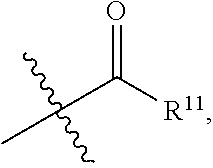
wherein R11 is Me, or

R4 is H;
m, n, r, and s are 0;
t and u are 1; then
R6 is not
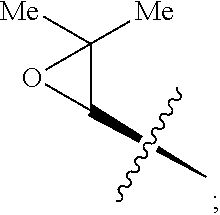
and
when R1 is
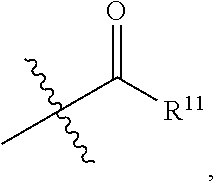
wherein R11 is
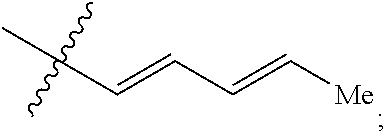
R4 is —CHO;
m, n, r, and s are 0;
t and u are 1; and
R6 is not

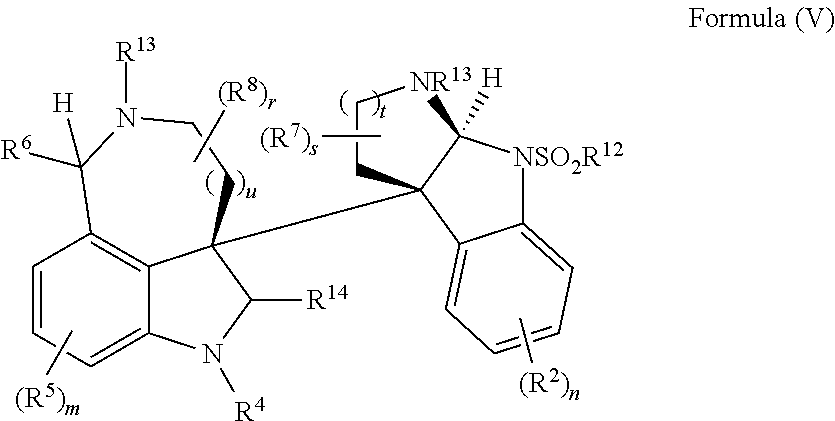
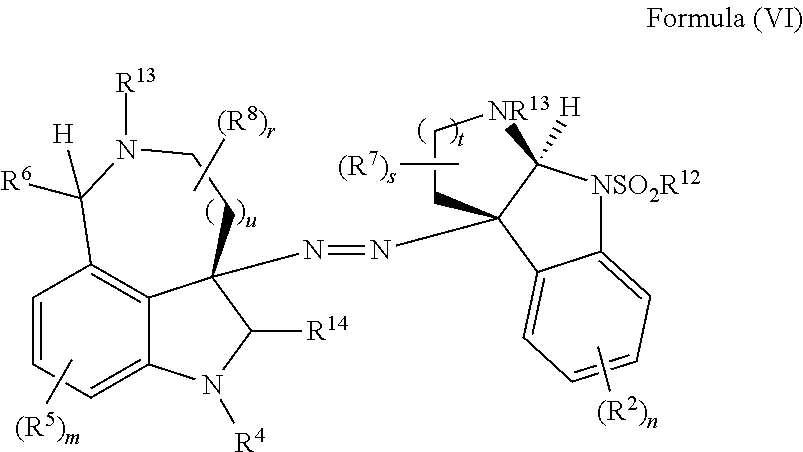

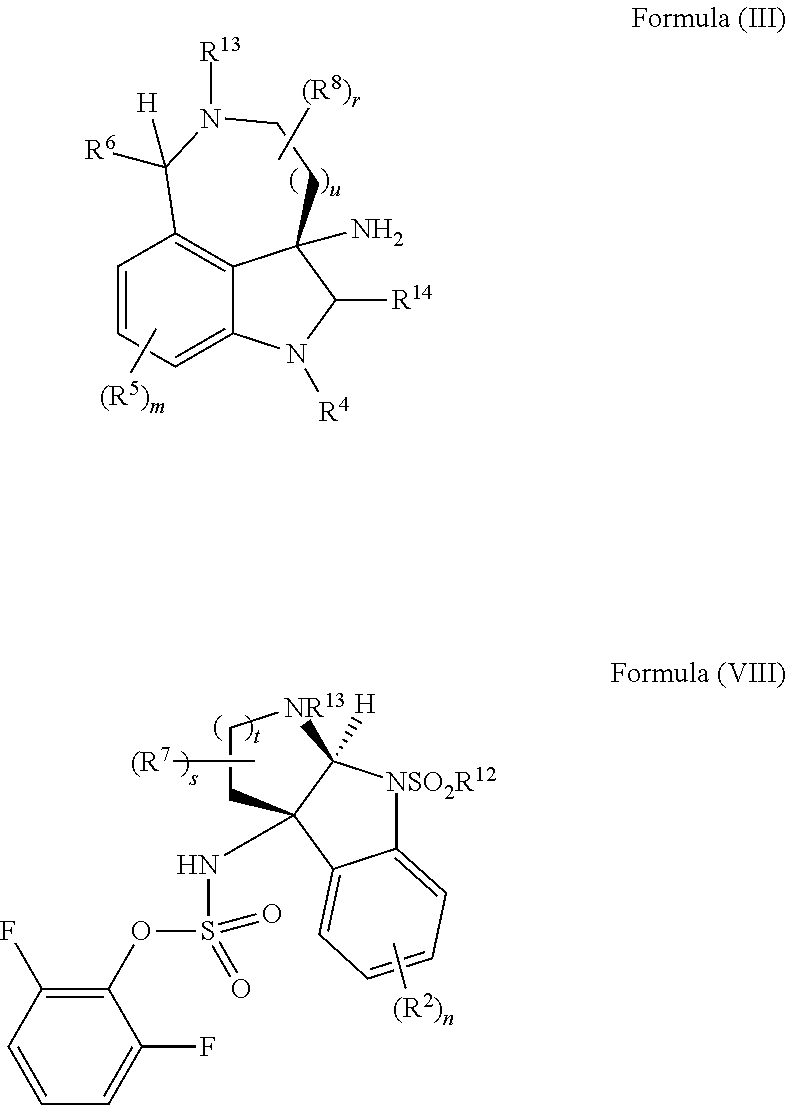
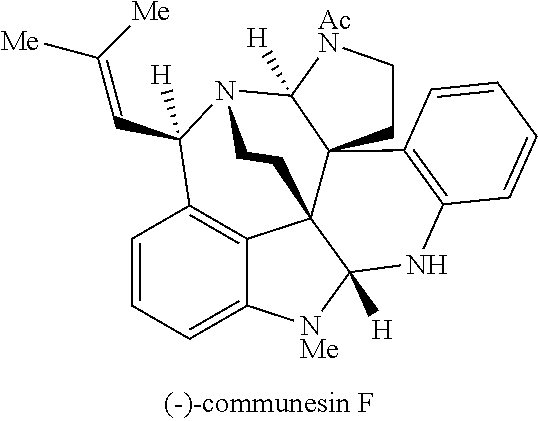

(hereinafter can be referred to as “a point of attachment bond”) denotes a bond that is a point of attachment between two chemical entities, one of which is depicted as being attached to the point of attachment bond and the other of which is not depicted as being attached to the point of attachment bond. For example,

indicates that the chemical entity “XY” is bonded to another chemical entity via the point of attachment bond. Furthermore, the specific point of attachment to the non-depicted chemical entity can be specified by inference. For example, the compound CH3—R3, wherein R3 is H or

infers that when R3 is “XY”, the point of attachment bond is the same bond as the bond by which R3 is depicted as being bonded to CH3.
-
- 1. preventing the disease or condition from occurring in a mammal, in particular, when such mammal is predisposed to the condition but has not yet been diagnosed as having it;
- 2. inhibiting the disease or condition, i.e., arresting its development;
- 3. relieving the disease or condition, i.e., causing regression of the disease or condition (ranging from reducing the severity of the disease or condition to curing the disease of condition); or
- 4. relieving the symptoms resulting from the disease or condition, i.e., relieving pain without addressing the underlying disease or condition. As used herein, the terms “disease” and “condition” can be used interchangeably or can be different in that the particular malady or condition cannot have a known causative agent (so that etiology has not yet been worked out) and it is therefore not yet recognized as a disease but only as an undesirable condition or syndrome, wherein a more or less specific set of symptoms have been identified by clinicians.
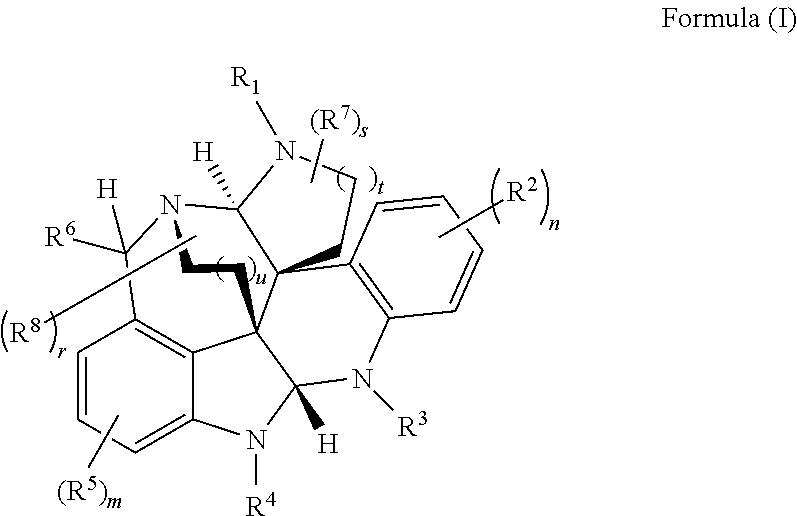
or a pharmaceutically acceptable salt, tautomer or stereoisomer thereof is described, wherein:
R1, R3, and R4 are each independently selected from H, C1-C12 alkyl, C2-C12 alkenyl, C2-C12 alkynyl, —C(═O)R9, —C(═O)NR9R10, —S(═O)R12, aryl, heteroaryl, carbocyclyl, or heterocyclyl, wherein R3 and R4 taken together with the carbon atoms to which they are attached form an aryl, heteroaryl, carbocyclic, or heterocyclic ring;
R2 and R5 are each independently selected from F, Cl, Br, I, —OH, —OR9, —OC(═O)R9, —S(═O)uR12, —NR9R10, C1-C12 alkyl, C2-C12 alkenyl, C2-C12 alkynyl, aryl, heteroaryl, carbocyclyl, or heterocyclyl;
R6 is independently H, —OH, —OR9, —OC(═O)R9, —S(═O)uR12, —NR9R10, C1-C12 alkyl, C1-C12 alkyl, C2-C12 alkenyl, C2-C12 alkynyl aryl, heteroaryl, carbocyclyl, or heterocyclyl;
R7 and R8 are each independently selected from H, C1-C12 alkyl; C2-C12 alkenyl, C2-C12 alkynyl, —C(═O)R9, —C(═O)NR9R10, —S(═O)uR12, —OH, —OR9, —OC(═O)R9, —NR9R10, aryl, heteroaryl, carbocyclyl, or heterocyclyl, wherein two R7 or two R8 groups taken together with the carbon atoms to which they are attached form an aryl, heteroaryl, carbocyclic, or heterocyclic ring;
R9 and R10 are each independently selected from H, C1-C12 alkyl, C2-C12 alkenyl, C2-C12 alkynyl, aryl, heteroaryl, carbocyclyl, or heterocyclyl, wherein R9 and R10 taken together with the carbon atoms to which they are attached form an aryl, heteroaryl, carbocyclic, or heterocyclic ring;
R12 is C1-C12 alkyl, C2-C12 alkenyl, C2-C12 alkynyl, aryl, heteroaryl, carbocyclyl, heterocyclyl, —(CH2)nSiMe3, —(CH2)nR9;
m and t are each independently an integer from 0 to 3;
n, r, s, and v are each independently an integer from 0 to 4; and
u is 0, 1, or 2;
with the following provisos:
when R1 is
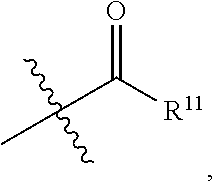
wherein R11 is Me, Et, n-Pr,

or;
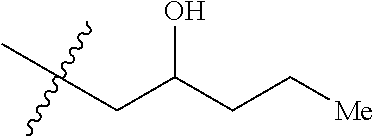
R4 is Me;
m, n, r, and s are 0;
t and u are 1; then
R6 is not

and
when R1 is
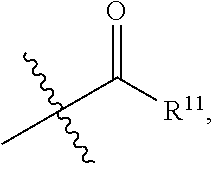
wherein R11 is Me;
R4 is Me;
m, n, r, and s are 0;
t and u are 1; then
R6 is not

and
when R1 is

wherein R11 is Me, or

R4 is H;
m, n, r, and s are 0;
t and u are 1; then
R6 is not
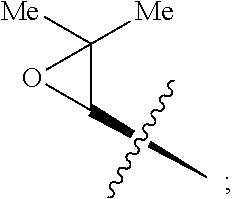
and
when R1 is

wherein R11 is

R4 is —CHO;
m, n, r, and s are 0;
t and u are 1; and
R6 is not

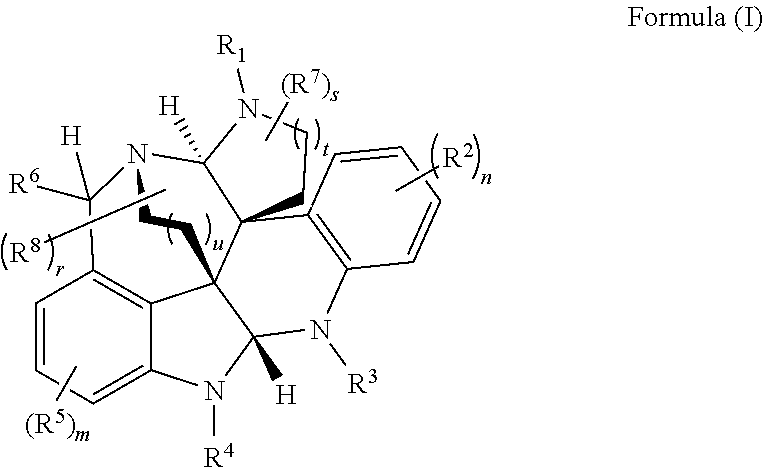
or a pharmaceutically acceptable salt, tautomer or stereoisomer thereof is described, wherein:
R1, R3, and R4 are each independently selected from H, C1-C12 alkyl, C2-C12 alkenyl, C2-C12 alkynyl, —C(═O)R9, —C(═O)NR9R10, —S(═O)uR12, aryl, heteroaryl, carbocyclyl, or heterocyclyl, wherein R3 and R4 taken together with the carbon atoms to which they are attached form an aryl, heteroaryl, carbocyclic, or heterocyclic ring;
R2 and R5 are each independently selected from F, Cl, Br, I, —OH, —OR9, —OC(═O)R9, —S(═O)uR12, —NR9R1, C1-C12 alkyl, C2-C12 alkenyl, C2-C12 alkynyl, aryl, heteroaryl, carbocyclyl, or heterocyclyl;
R6 is independently H, —OH, —OR9, —OC(═O)R9, —S(═O)uR12, —NR9R10, C1-C12 alkyl, C1-C12 alkyl, C2-C12 alkenyl, C2-C12 alkynyl aryl, heteroaryl, carbocyclyl, or heterocyclyl;
R7 and R8 are each independently selected from H, C1-C12 alkyl; C2-C12 alkenyl, C2-C12 alkynyl, —C(═O)R9, —C(═O)NR9R10, —S(═O)uR12, —OH, —OR9, —OC(═O)R9, —NR9R10, aryl, heteroaryl, carbocyclyl, or heterocyclyl, wherein two R7 or two R5 groups taken together with the carbon atoms to which they are attached form an aryl, heteroaryl, carbocyclic, or heterocyclic ring;
R9 and R10 are each independently selected from H, C1-C12 alkyl, C2-C12 alkenyl, C2-C12 alkynyl, aryl, heteroaryl, carbocyclyl, or heterocyclyl, wherein R9 and R10 taken together with the carbon atoms to which they are attached form an aryl, heteroaryl, carbocyclic, or heterocyclic ring;
R12 is C1-C12 alkyl, C2-C12 alkenyl, C2-C12 alkynyl, aryl, heteroaryl, carbocyclyl, heterocyclyl, —(CH2)nSiMe3, —(CH2)nR9;
m and t are each independently an integer from 0 to 3;
n, r, s, and v are each independently an integer from 0 to 4; and
u is 0, 1, or 2;
with the proviso that the compound of Formula (I) is not (−)-communesin A, (−)-communesin B, (−)-communesin C, (+)-communesin D, (−)-communesin E, (−)-communesin F, (−)-communesin G, or (−)-communesin H.
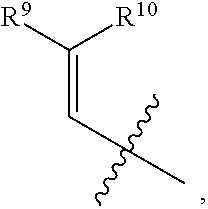
or
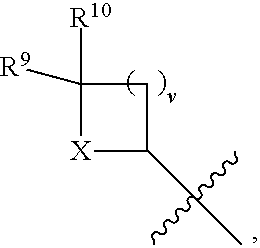
and wherein X is O, NR9, or —S(═O)nR12. In still other embodiments, R1 is —C(═O)R9. In some embodiments, R9 of a —C(═O)R9 group is Me, Et, n-Pr,

or

In various embodiments, R6 is
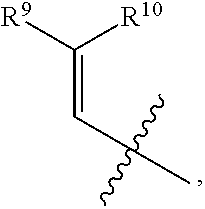
or
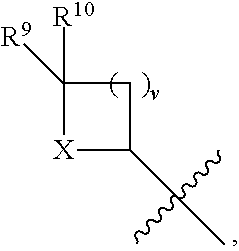
wherein X is O, NR9, or —S(═O)uR12.

or a pharmaceutically acceptable salt, tautomer or stereoisomer thereof is described, wherein:
R4 is independently selected from H, C1-C12 alkyl, C2-C12 alkenyl, C2-C12 alkynyl, —C(═O)R9, —C(═O)NR9R10, —S(═O)uR12, aryl, heteroaryl, carbocyclyl, or heterocyclyl, wherein R3 and R4 taken together with the carbon atoms to which they are attached form an aryl, heteroaryl, carbocyclic, or heterocyclic ring;
R2 and R5 are each independently selected from F, Cl, Br, I, —OH, —OR9, —OC(═O)R9, —S(═O)uR12, —NR9R10, C1-C12 alkyl, C2-C12 alkenyl, C2-C12 alkynyl, aryl, heteroaryl, carbocyclyl, or heterocyclyl;
R6 is independently H, —OH, —OR9, —OC(═O)R9, —S(═O)uR12, —NR9R10, C1-C12 alkyl, C1-C12 alkyl, C2-C12 alkenyl, C2-C12 alkynyl aryl, heteroaryl, carbocyclyl, or heterocyclyl;
R7 and R8 are each independently selected from H, C1-C12 alkyl; C2-C12 alkenyl, C2-C12 alkynyl, —C(═O)R9, —C(═O)NR9R10, —S(═O)uR12, —OH, —OR9, —OC(═O)R9, —NR9R10, aryl, heteroaryl, carbocyclyl, or heterocyclyl, wherein two R7 or two R8 groups taken together with the carbon atoms to which they are attached form an aryl, heteroaryl, carbocyclic, or heterocyclic ring;
R9 and R10 are each independently selected from H, C1-C12 alkyl, C2-C12 alkenyl, C2-C12 alkynyl, aryl, heteroaryl, carbocyclyl, or heterocyclyl, wherein R9 and R10 taken together with the carbon atoms to which they are attached form an aryl, heteroaryl, carbocyclic, or heterocyclic ring;
R12 is C1-C12 alkyl, C2-C12 alkenyl, C2-C12 alkynyl, aryl, heteroaryl, carbocyclyl, heterocyclyl, —(CH2)nSiMe3, —(CH2)nR9;
R13 is

or

R14 is —OH, —OR9, —NR9R10, S(O)R12, or P(O)OR9;
m and t are each independently an integer from 0 to 3;
n, r, s, and v are each independently an integer from 0 to 4; and
u is 0, 1, or 2.

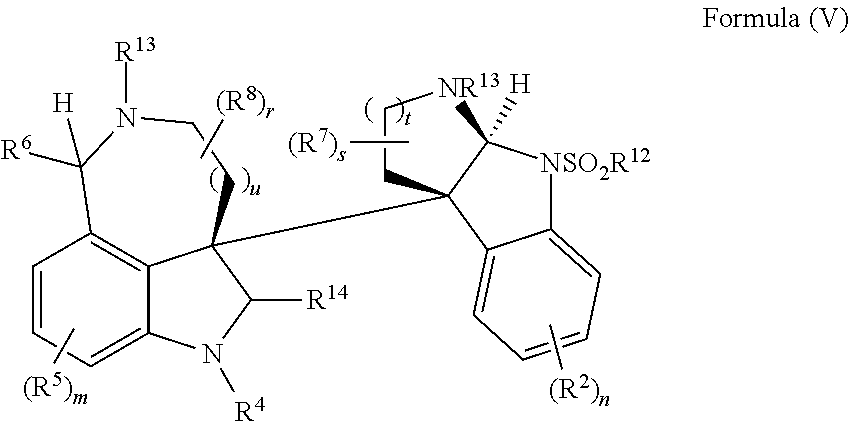
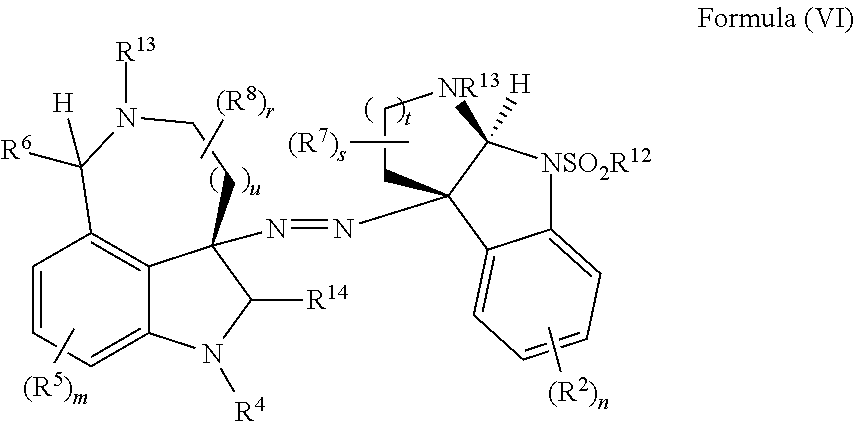

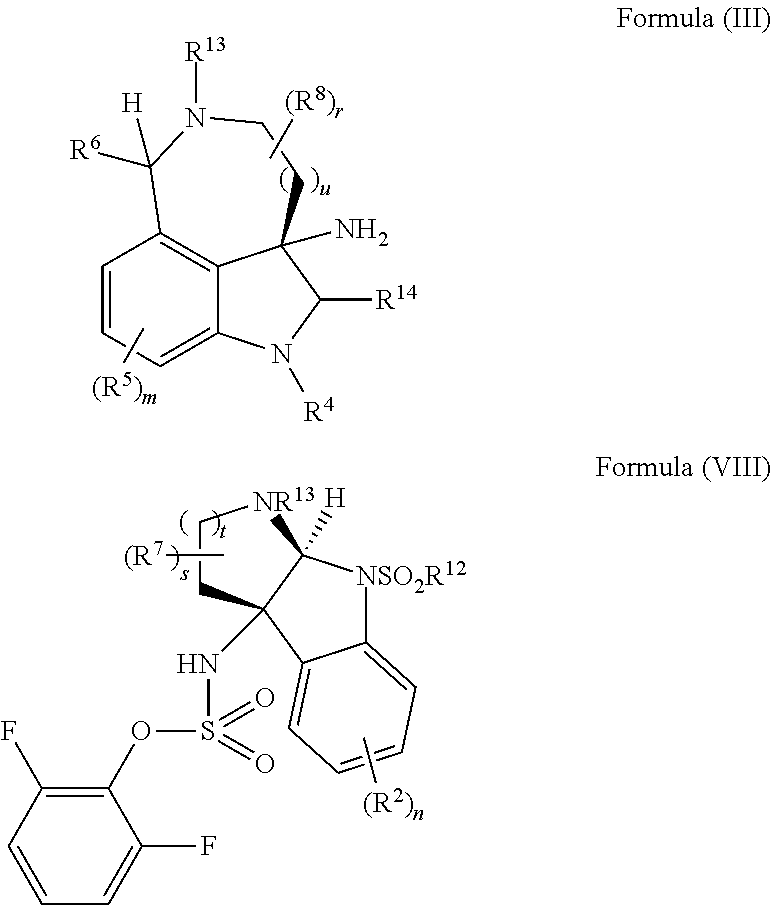


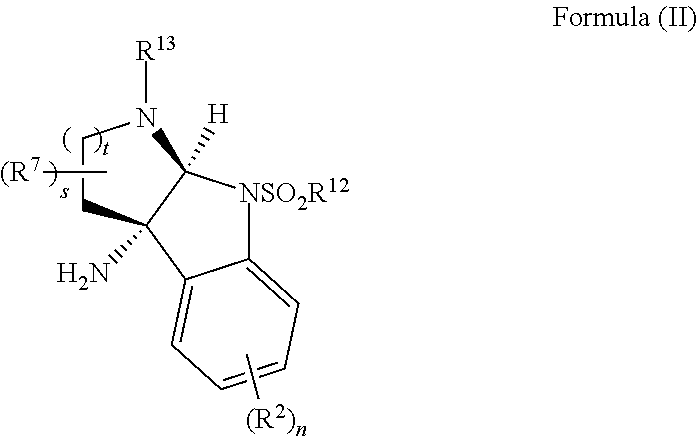
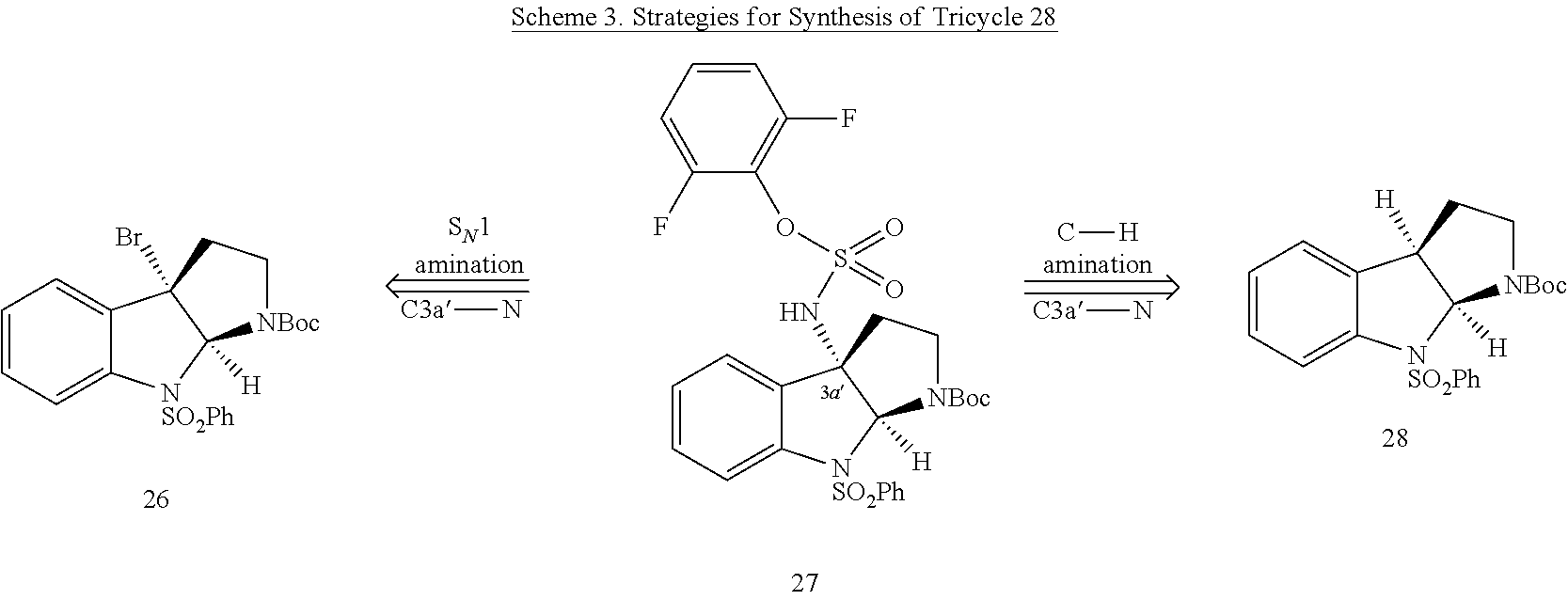
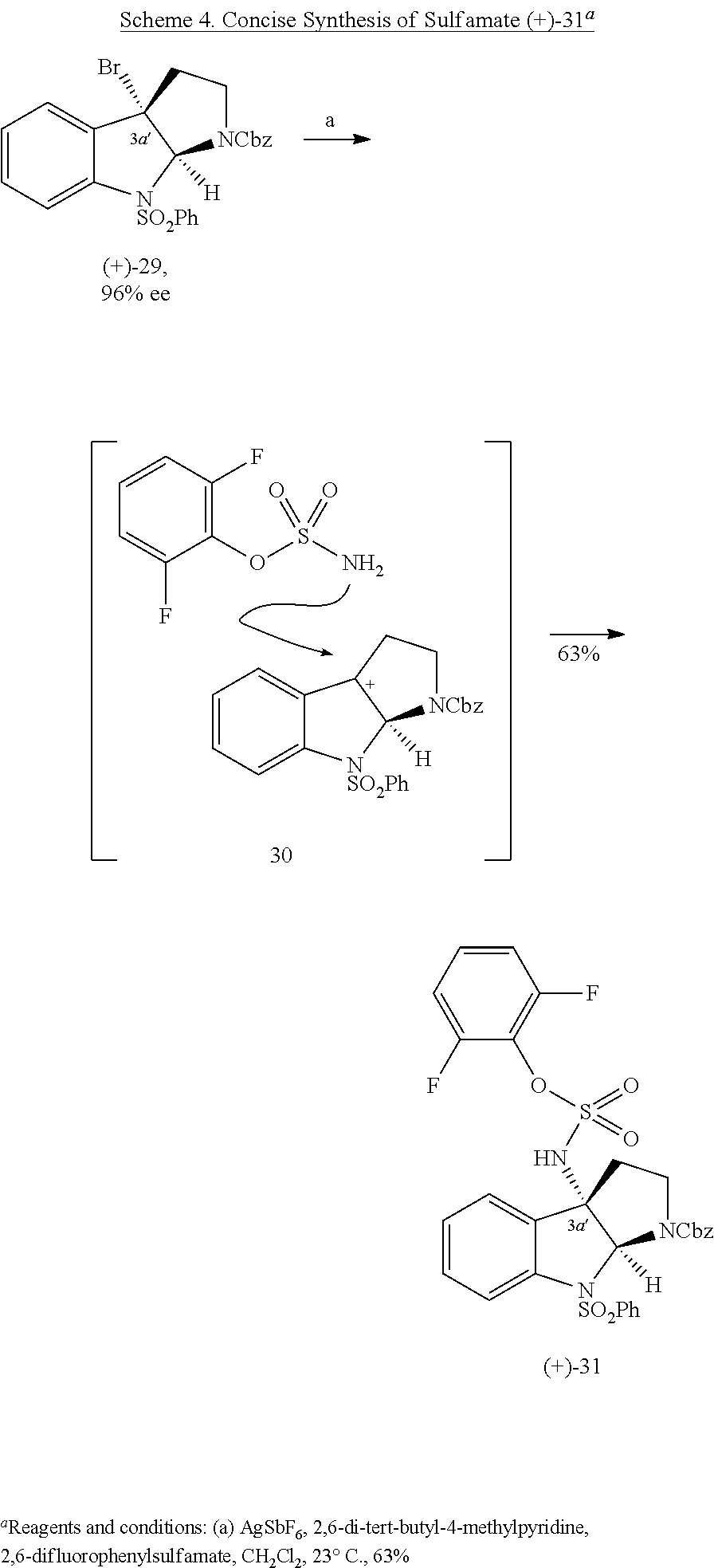


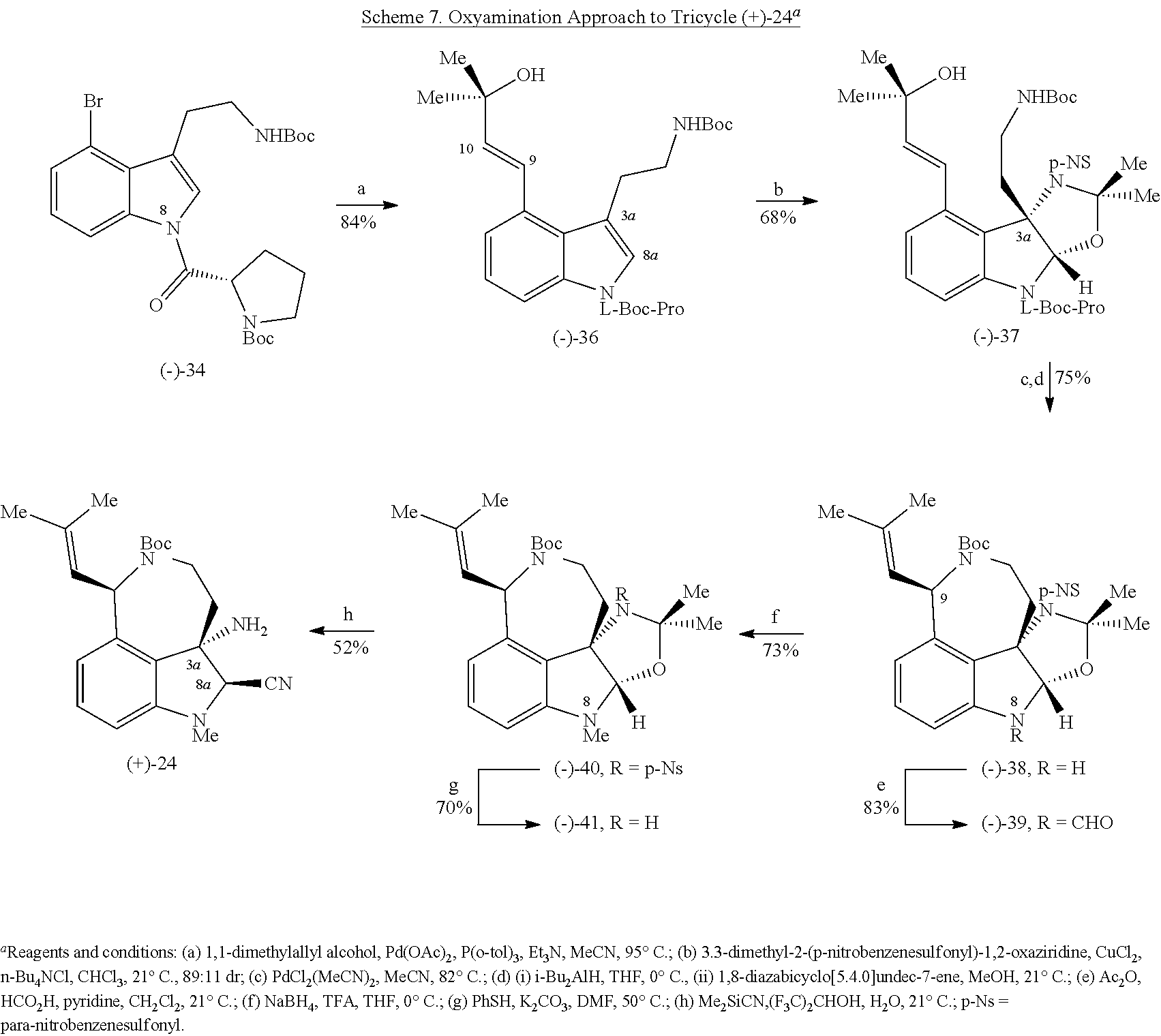


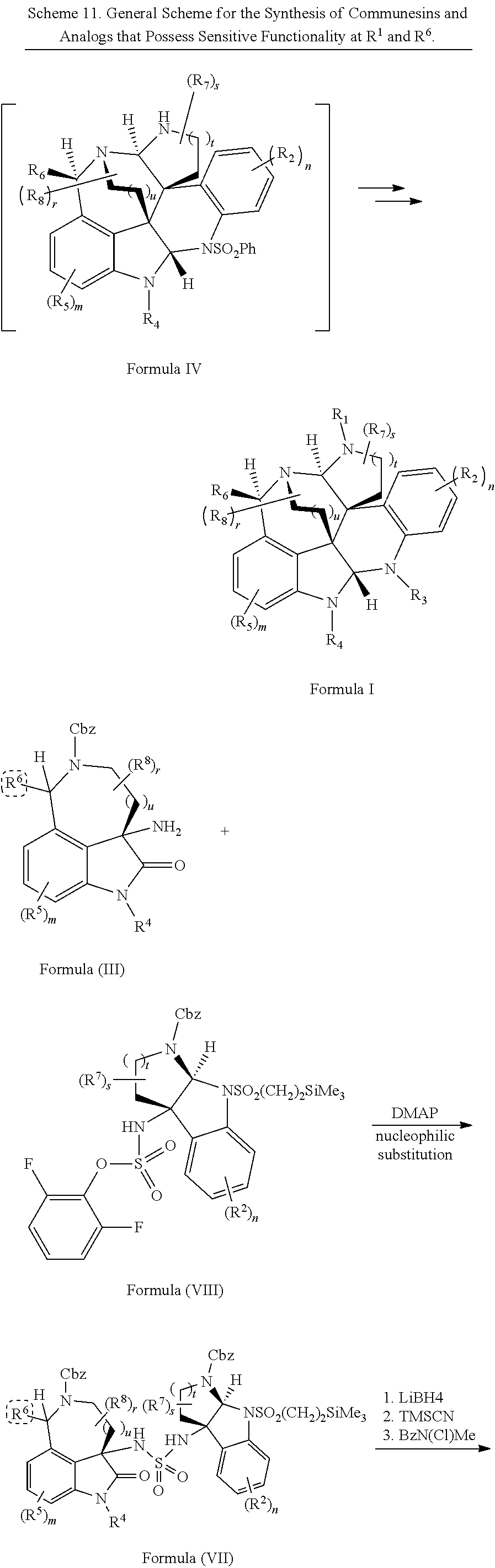

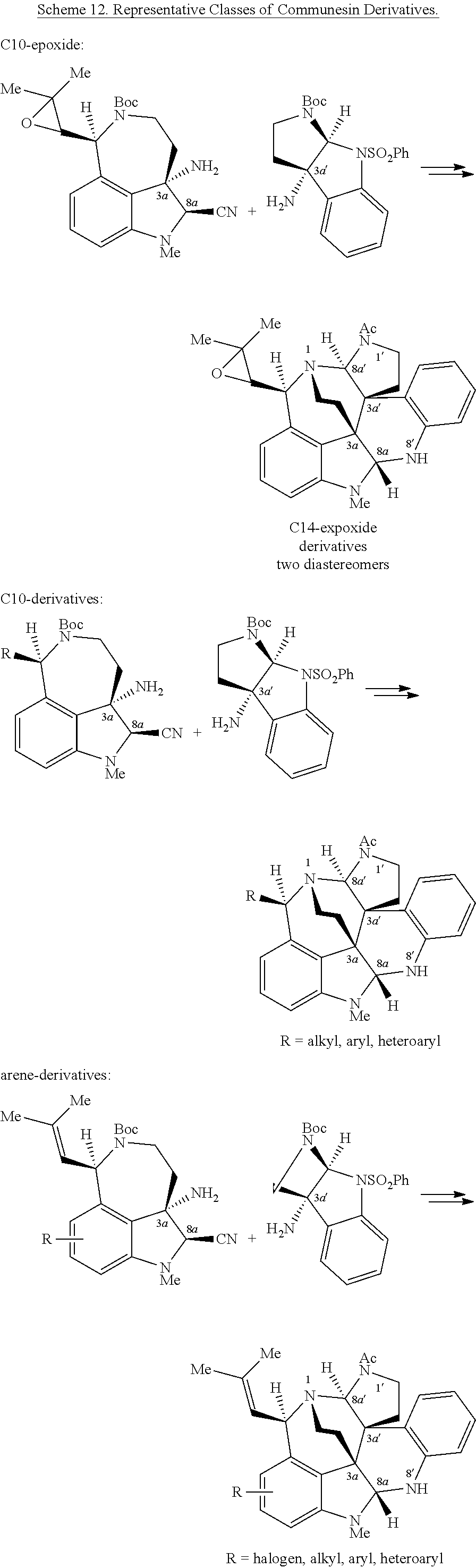

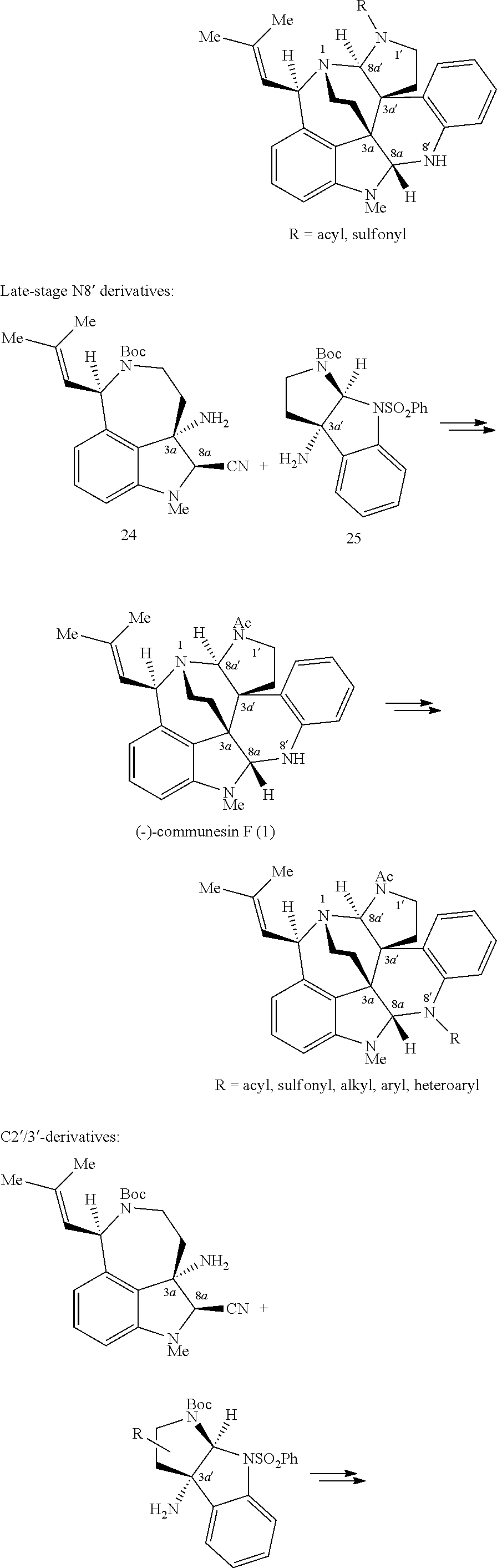

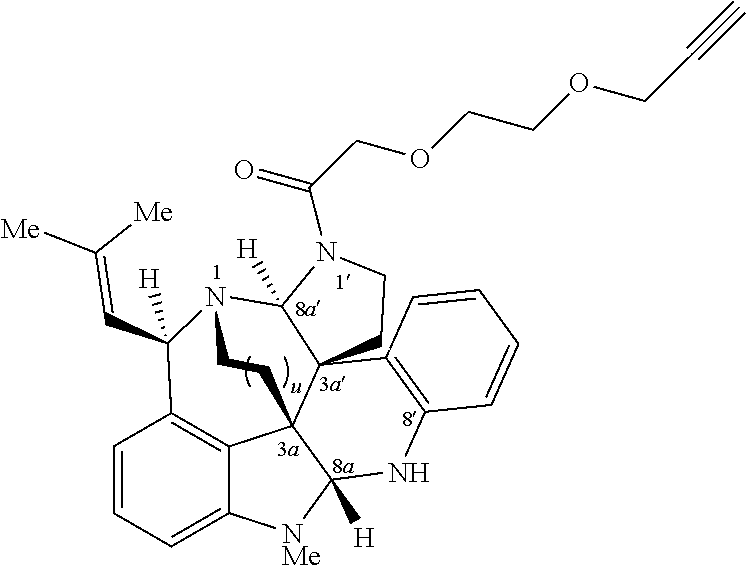

Bromocyclotryptophan (+)-32:

Cyclotryptophan (+)-33:

Cyclotryptamine (+)-28:

Sulfamate Ester (+)-27:

Amide (−)-34:

Allylic Alcohol (−)-36:

Oxazoline (−)-37:

Aminocyclotryptamine(+)-S7:
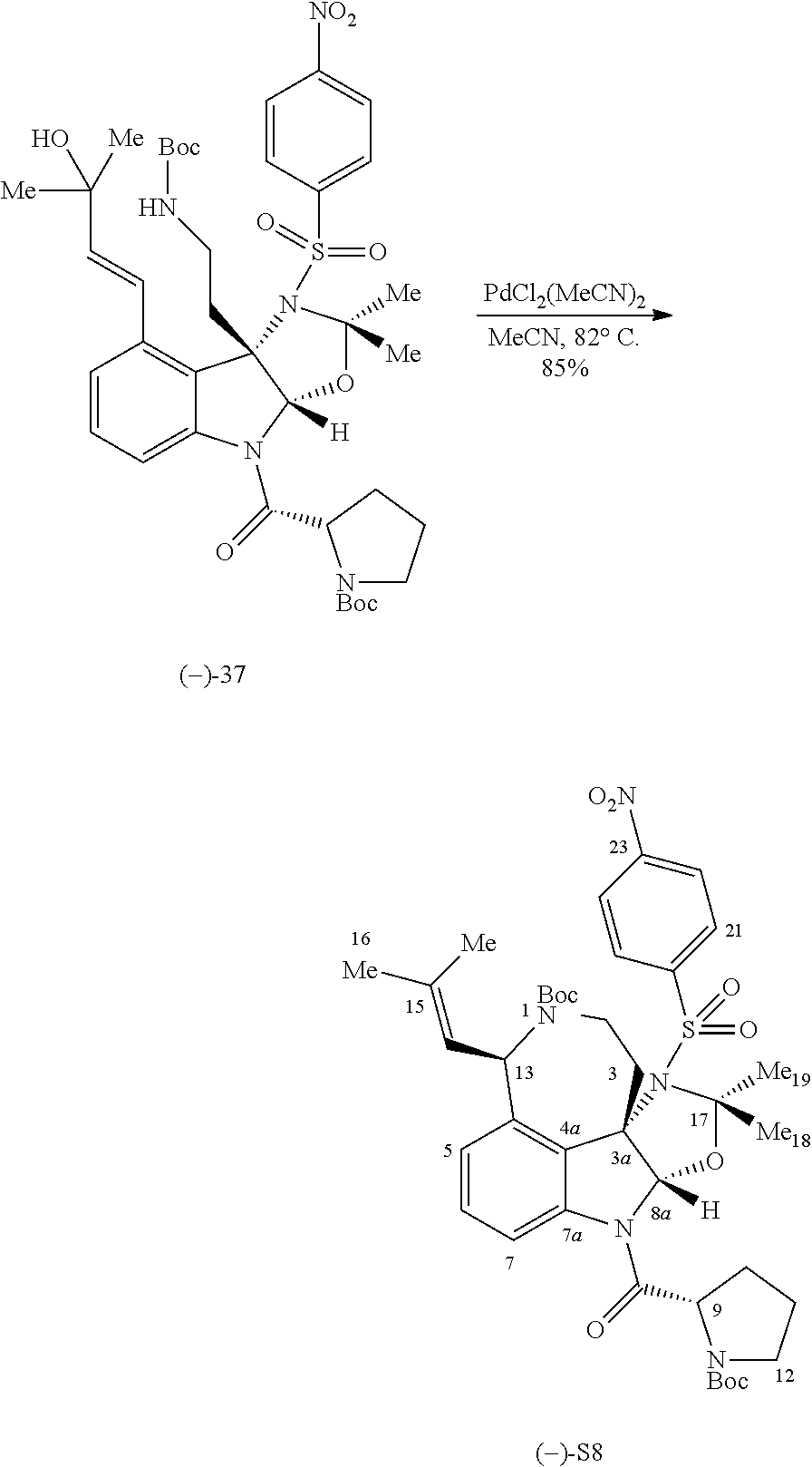
Azepine (−)-S8:

Indoline (−)-38:
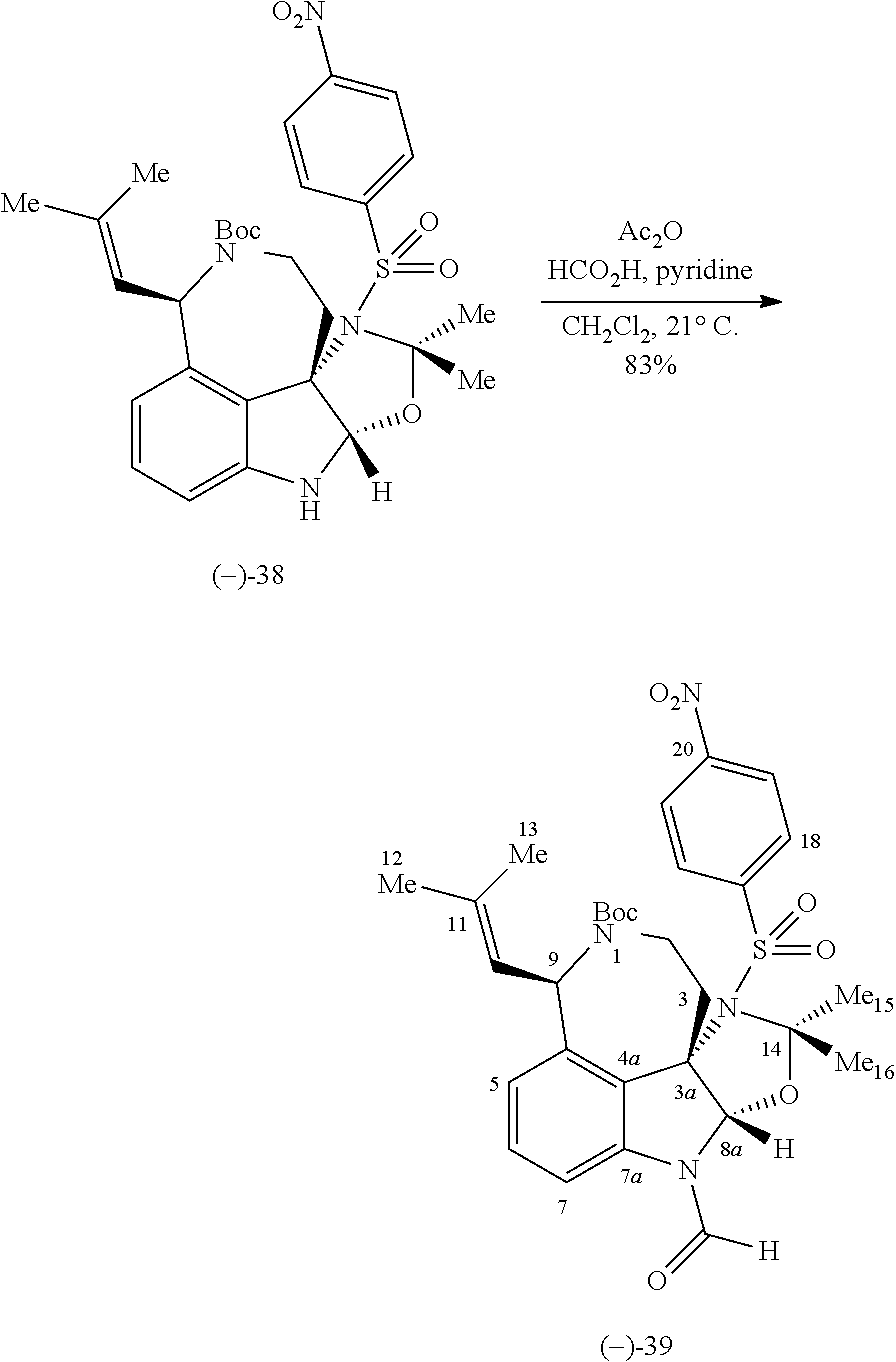
Formamide (−)-39:
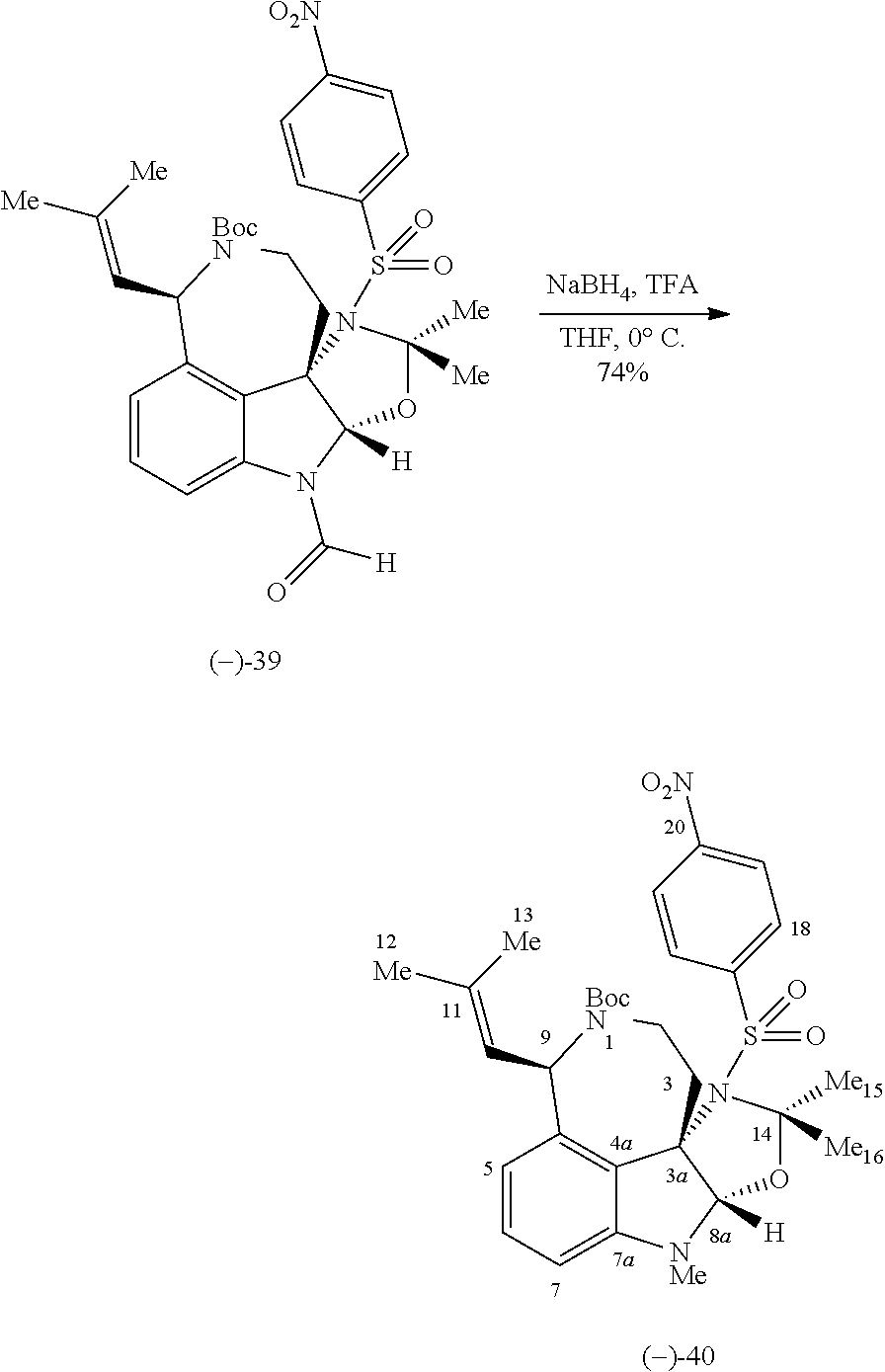
N-Methyl Indoline (−)-40:
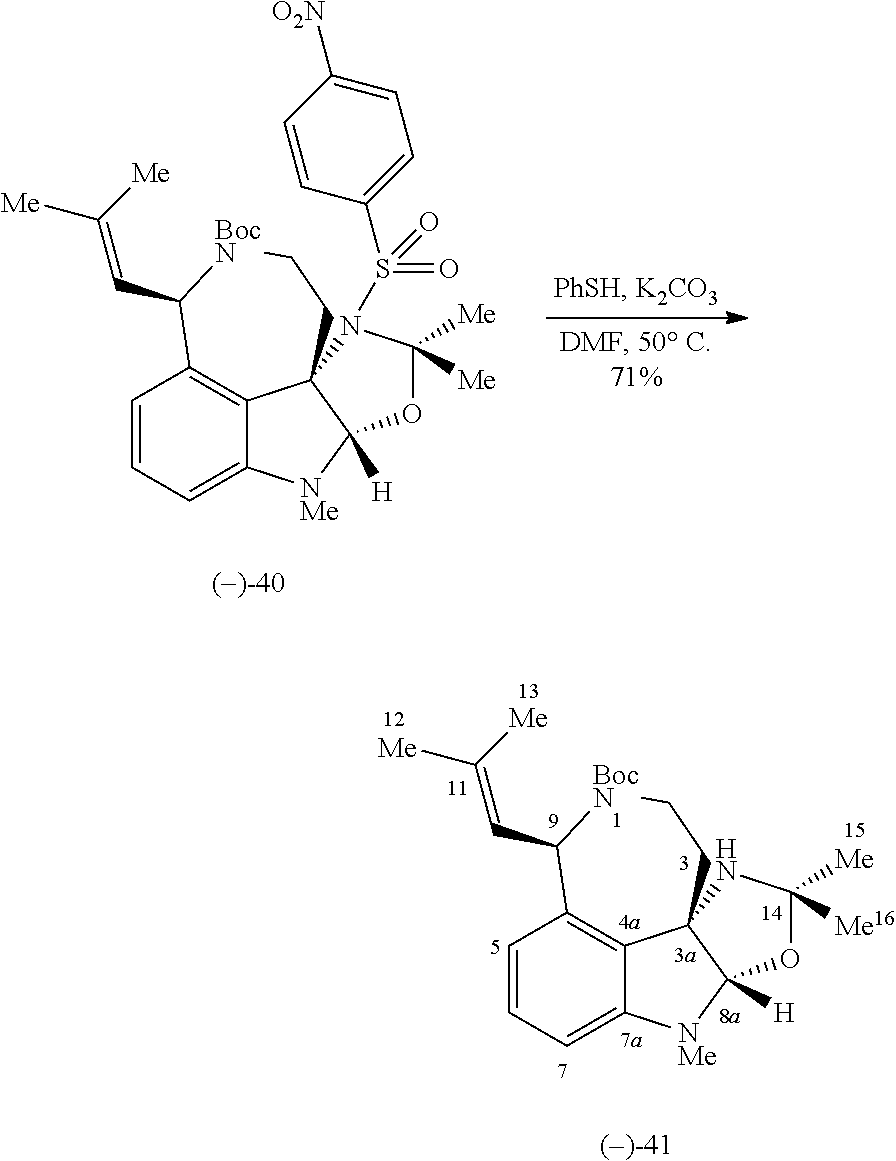
Hemiaminal (−)-41:

Tricyclic Amine (+)-24:

Sulfamide (+)-50:

Heterodimer (+)-51:

Heterodimeric Diamine (+)-20:
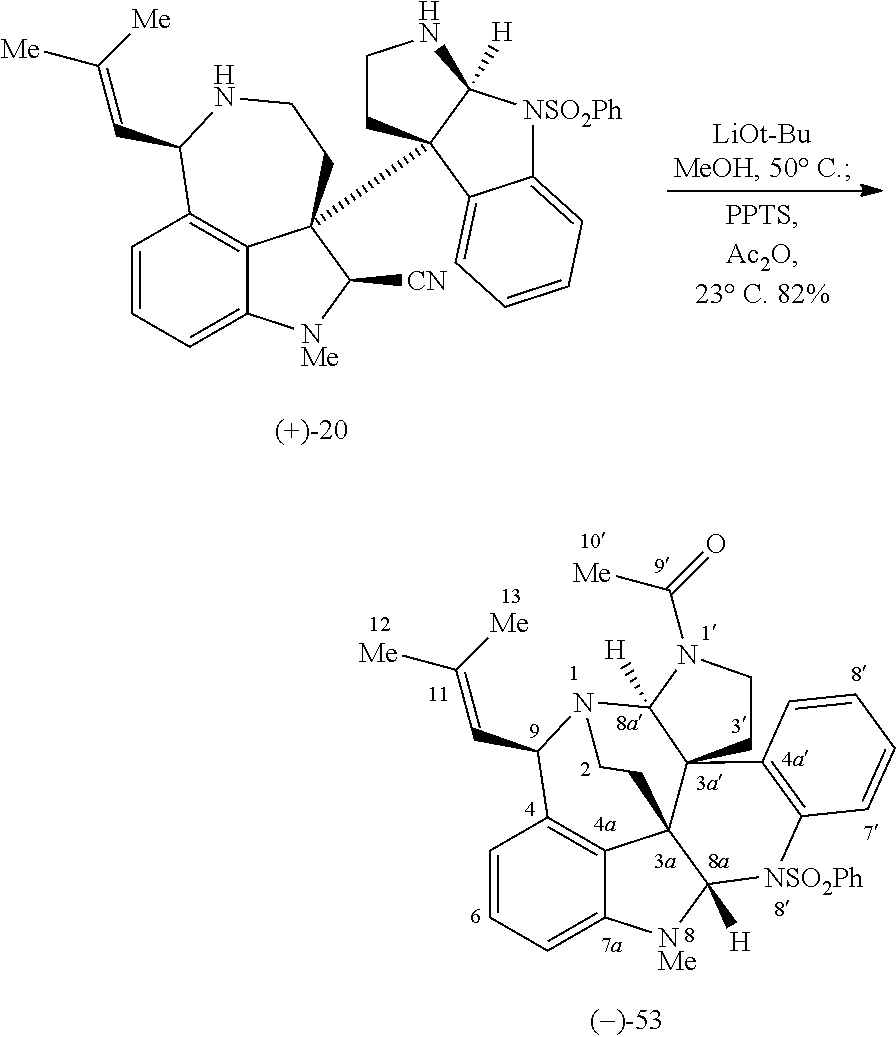
N8′-Benzenesulfonyl Communesin F (−)-53:

(−)-Communesin F (1):
Claims (24)

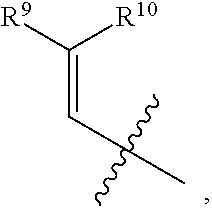
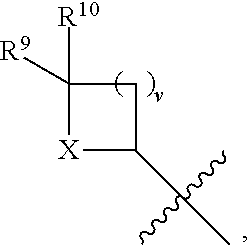


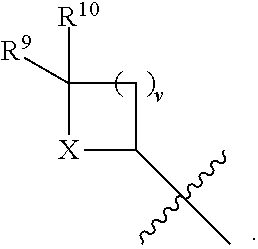
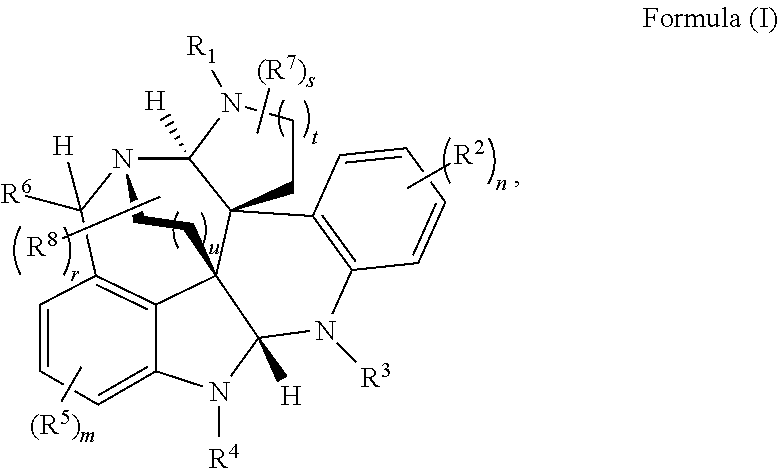
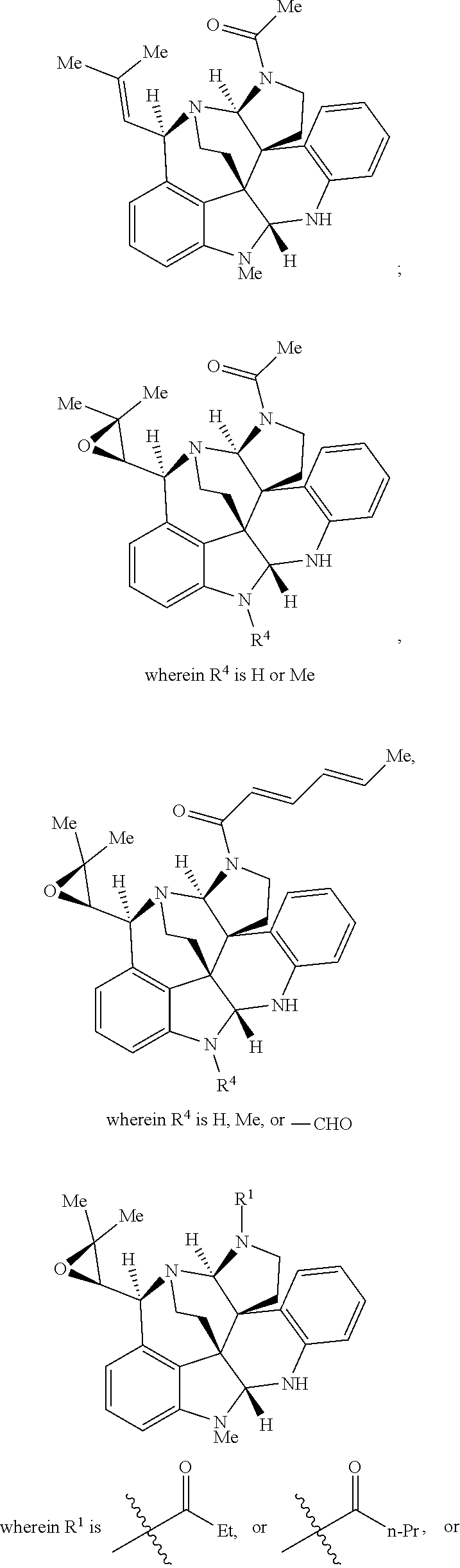


Priority Applications (1)
| Application Number | Priority Date | Filing Date | Title |
|---|---|---|---|
| US15/592,090 US10918627B2 (en) | 2016-05-11 | 2017-05-10 | Convergent and enantioselective total synthesis of Communesin analogs |
Applications Claiming Priority (2)
| Application Number | Priority Date | Filing Date | Title |
|---|---|---|---|
| US201662334826P | 2016-05-11 | 2016-05-11 | |
| US15/592,090 US10918627B2 (en) | 2016-05-11 | 2017-05-10 | Convergent and enantioselective total synthesis of Communesin analogs |
Publications (2)
| Publication Number | Publication Date |
|---|---|
| US20170333405A1 US20170333405A1 (en) | 2017-11-23 |
| US10918627B2 true US10918627B2 (en) | 2021-02-16 |
Family
ID=60267459
Family Applications (1)
| Application Number | Title | Priority Date | Filing Date |
|---|---|---|---|
| US15/592,090 Active US10918627B2 (en) | 2016-05-11 | 2017-05-10 | Convergent and enantioselective total synthesis of Communesin analogs |
Country Status (2)
| Country | Link |
|---|---|
| US (1) | US10918627B2 (en) |
| WO (1) | WO2017197045A1 (en) |
Cited By (3)
| Publication number | Priority date | Publication date | Assignee | Title |
|---|---|---|---|---|
| US11535634B2 (en) | 2019-06-05 | 2022-12-27 | Massachusetts Institute Of Technology | Compounds, conjugates, and compositions of epipolythiodiketopiperazines and polythiodiketopiperazines and uses thereof |
| US11932650B2 (en) | 2017-05-11 | 2024-03-19 | Massachusetts Institute Of Technology | Potent agelastatin derivatives as modulators for cancer invasion and metastasis |
| US12030888B2 (en) | 2021-02-24 | 2024-07-09 | Massachusetts Institute Of Technology | Himastatin derivatives, and processes of preparation thereof, and uses thereof |
Families Citing this family (2)
| Publication number | Priority date | Publication date | Assignee | Title |
|---|---|---|---|---|
| US9353150B2 (en) | 2012-12-04 | 2016-05-31 | Massachusetts Institute Of Technology | Substituted pyrazino[1′,2′:1 ,5]pyrrolo[2,3-b]-indole-1,4-diones for cancer treatment |
| US10640508B2 (en) | 2017-10-13 | 2020-05-05 | Massachusetts Institute Of Technology | Diazene directed modular synthesis of compounds with quaternary carbon centers |
Citations (267)
| Publication number | Priority date | Publication date | Assignee | Title |
|---|---|---|---|---|
| WO1983003679A1 (en) | 1982-04-12 | 1983-10-27 | Hybritech Inc | Antibodies having dual specificities, their preparation and uses therefor |
| EP0171496A2 (en) | 1984-08-15 | 1986-02-19 | Research Development Corporation of Japan | Process for the production of a chimera monoclonal antibody |
| EP0173494A2 (en) | 1984-08-27 | 1986-03-05 | The Board Of Trustees Of The Leland Stanford Junior University | Chimeric receptors by DNA splicing and expression |
| WO1986001533A1 (en) | 1984-09-03 | 1986-03-13 | Celltech Limited | Production of chimeric antibodies |
| EP0184187A2 (en) | 1984-12-04 | 1986-06-11 | Teijin Limited | Mouse-human chimaeric immunoglobulin heavy chain, and chimaeric DNA encoding it |
| WO1987002671A1 (en) | 1985-11-01 | 1987-05-07 | International Genetic Engineering, Inc. | Modular assembly of antibody genes, antibodies prepared thereby and use |
| WO1988003145A1 (en) | 1986-10-27 | 1988-05-05 | International Genetic Engineering, Inc. | Chimeric antibody with specificity to human tumor antigen |
| US4816397A (en) | 1983-03-25 | 1989-03-28 | Celltech, Limited | Multichain polypeptides or proteins and processes for their production |
| US4816567A (en) | 1983-04-08 | 1989-03-28 | Genentech, Inc. | Recombinant immunoglobin preparations |
| US4906562A (en) | 1984-12-21 | 1990-03-06 | Oncogen | Monocolonal antibodies and antigen for human non-small cell lung carcinomas |
| US4935495A (en) | 1984-12-21 | 1990-06-19 | Oncogen | Monoclonal antibodies to the L6 glycolipid antigenic determinant found on human non-small cell lung carcinomas |
| EP0375562A2 (en) | 1988-12-22 | 1990-06-27 | Oncogen Limited Partnership | Novel monoclonal antibody to human carcinomas |
| US4940726A (en) | 1989-04-26 | 1990-07-10 | Arizona Board Of Regents | Cell growth inhibitory macrocyclic lactones denominated Combretastatin D-1 and Combretastatin D-2 |
| US4946778A (en) | 1987-09-21 | 1990-08-07 | Genex Corporation | Single polypeptide chain binding molecules |
| WO1991000295A1 (en) | 1989-06-30 | 1991-01-10 | Oncogen Limited Partnership | Novel antibodies reactive with human carcinomas |
| US4996237A (en) | 1987-01-06 | 1991-02-26 | Arizona Board Of Regents | Combretastatin A-4 |
| EP0217577B1 (en) | 1985-09-12 | 1992-06-10 | Hybritech Incorporated | Antibody complexes of hapten-modified diagnostic or therapeutic agents |
| WO1992016486A1 (en) | 1991-03-22 | 1992-10-01 | Aston Molecules Limited | Substituted diphenylethylenes and analogues or derivatives thereof |
| WO1993008829A1 (en) | 1991-11-04 | 1993-05-13 | The Regents Of The University Of California | Compositions that mediate killing of hiv-infected cells |
| US5225539A (en) | 1986-03-27 | 1993-07-06 | Medical Research Council | Recombinant altered antibodies and methods of making altered antibodies |
| WO1994004690A1 (en) | 1992-08-17 | 1994-03-03 | Genentech, Inc. | Bispecific immunoadhesins |
| WO1994014787A1 (en) | 1992-12-23 | 1994-07-07 | Bristol-Myers Squibb Company | Novel sidechain-bearing taxanes and intermediates thereof |
| US5338845A (en) | 1992-12-02 | 1994-08-16 | Sterling Winthrop Inc. | Aspergillus species, cyclic dimeric dipeptide derivative substance P antagonist biosynthetic products thereof, and process for preparation thereof |
| WO1995004535A1 (en) | 1993-08-06 | 1995-02-16 | The Children's Medical Center Corporation | Estrogenic compounds as anti-mitotic agents |
| US5409953A (en) | 1987-01-06 | 1995-04-25 | Arizona Board Of Regents Acting On Behalf Of Arizona State University | Isolation, structural elucidation and synthesis of novel antineoplastic substances denominated "combretastatins" |
| US5423753A (en) | 1993-06-30 | 1995-06-13 | Baxter International Inc. | Vial adapter |
| US5430062A (en) | 1992-05-21 | 1995-07-04 | Research Corporation Technologies, Inc. | Stilbene derivatives as anticancer agents |
| US5475092A (en) | 1992-03-25 | 1995-12-12 | Immunogen Inc. | Cell binding agent conjugates of analogues and derivatives of CC-1065 |
| US5525632A (en) | 1993-09-08 | 1996-06-11 | Ajinomoto Co., Ltd. | Stilbene derivatives and pharmaceutical compositions containing them |
| US5545806A (en) | 1990-08-29 | 1996-08-13 | Genpharm International, Inc. | Ransgenic non-human animals for producing heterologous antibodies |
| US5561122A (en) | 1994-12-22 | 1996-10-01 | Arizona Board Of Regents Acting On Behalf Of Arizona State University | Combretastatin A-4 prodrug |
| US5569825A (en) | 1990-08-29 | 1996-10-29 | Genpharm International | Transgenic non-human animals capable of producing heterologous antibodies of various isotypes |
| US5585089A (en) | 1988-12-28 | 1996-12-17 | Protein Design Labs, Inc. | Humanized immunoglobulins |
| US5625126A (en) | 1990-08-29 | 1997-04-29 | Genpharm International, Inc. | Transgenic non-human animals for producing heterologous antibodies |
| US5633425A (en) | 1990-08-29 | 1997-05-27 | Genpharm International, Inc. | Transgenic non-human animals capable of producing heterologous antibodies |
| US5646176A (en) | 1992-12-24 | 1997-07-08 | Bristol-Myers Squibb Company | Phosphonooxymethyl ethers of taxane derivatives |
| US5661016A (en) | 1990-08-29 | 1997-08-26 | Genpharm International Inc. | Transgenic non-human animals capable of producing heterologous antibodies of various isotypes |
| WO1997034631A1 (en) | 1996-03-18 | 1997-09-25 | Board Of Regents, The University Of Texas System | Immunoglobin-like domains with increased half lives |
| US5674906A (en) | 1995-03-07 | 1997-10-07 | Ajinomoto Co., Inc. | Stilbene compounds and pharmaceutical compositions containing them |
| US5731353A (en) | 1993-09-08 | 1998-03-24 | Ajinomoto Co., Inc. | Stilbene derivatives and pharmaceutical compositions containing them |
| WO1998039323A1 (en) | 1997-03-06 | 1998-09-11 | Baylor University | Anti-mitotic agents which inhibit tubulin polymerization |
| US5821337A (en) | 1991-06-14 | 1998-10-13 | Genentech, Inc. | Immunoglobulin variants |
| WO1999002166A1 (en) | 1997-07-08 | 1999-01-21 | Angiogene Pharmaceuticals Ltd. | Use of colchinol derivatives as vascular damaging agents |
| WO1999002514A2 (en) | 1997-07-08 | 1999-01-21 | Bristol-Myers Squibb Company | Epothilone derivatives |
| US5877158A (en) | 1993-09-22 | 1999-03-02 | Behringwerke Aktiengesellschaft | Pro-prodrugs, their production and use |
| WO1999035150A1 (en) | 1998-01-09 | 1999-07-15 | Arizona Board Of Regents, A Body Corporate, Acting On Behalf Of Arizona State University | Synthesis of combretastatin a-4 prodrugs and trans-isomers thereo f |
| WO1999034788A1 (en) | 1998-01-09 | 1999-07-15 | Arizona Board Of Regents, A Body Corporate, Acting On Behalf Of Arizona State University | Synthesis of phenstatin and prodrugs thereof |
| WO1999035164A1 (en) | 1998-01-09 | 1999-07-15 | Arizona Board Of Regents, A Body Corporate, Acting On Behalf Of Arizona State University | Anti-cryptococcal peptides |
| US5929211A (en) | 1992-08-05 | 1999-07-27 | Genentech, Inc. | Carbohydrate-directed cross-linking reagents |
| WO1999048495A1 (en) | 1998-03-25 | 1999-09-30 | Biosource Technologies, Inc. | Benzoates derivatives for inhibiting angiogenesis |
| WO1999051224A1 (en) | 1998-04-02 | 1999-10-14 | Asta Medica Aktiengesellschaft | Indolyl-3-glyoxylic acid derivatives with antitumoral activity |
| WO1999051246A1 (en) | 1998-04-03 | 1999-10-14 | Ajinomoto Co., Inc. | Antitumor agents |
| US5985837A (en) | 1998-07-08 | 1999-11-16 | Basf Aktiengesellschaft | Dolastatin 15 derivatives |
| WO2000000514A2 (en) | 1998-06-29 | 2000-01-06 | Parker Hughes Institute | Synthetic spiroketal pyranes as potent anti-cancer agents |
| WO2000006556A1 (en) | 1998-07-27 | 2000-02-10 | Abbott Laboratories | Substituted oxazolines as antiproliferative agents |
| US6054297A (en) | 1991-06-14 | 2000-04-25 | Genentech, Inc. | Humanized antibodies and methods for making them |
| WO2000026229A1 (en) | 1998-10-29 | 2000-05-11 | Teikoku Hormone Mfg. Co., Ltd. | 2-substituted-d-homooxasteroid derivatives |
| WO2000035865A2 (en) | 1998-12-17 | 2000-06-22 | Tularik Inc. | Tubulin-binding agents |
| WO2000040529A1 (en) | 1999-01-07 | 2000-07-13 | Angiogene Pharmaceuticals Ltd. | Colchinol derivatives as vascular damaging agents |
| WO2000041669A2 (en) | 1999-01-15 | 2000-07-20 | Angiogene Pharmaceuticals Ltd. | Benzimidazole vascular damaging agents |
| US6103236A (en) | 1995-05-10 | 2000-08-15 | Kyowa Hakko Kogyo Co., Ltd. | Toxin conjugates |
| WO2000048591A1 (en) | 1999-02-16 | 2000-08-24 | Angiogene Pharmaceuticals Ltd. | Combinations for the treatment of diseases involving angiogenesis |
| WO2000048590A1 (en) | 1999-02-16 | 2000-08-24 | Angiogene Pharmaceuticals Ltd. | Substituted stilbene compounds with vascular damaging activity |
| US6147076A (en) | 1995-11-15 | 2000-11-14 | Sloan-Kettering Institute For Cancer Research | Analogues of N-acetylardeemin, method of preparation and uses thereof |
| WO2000073264A1 (en) | 1999-05-28 | 2000-12-07 | Abbott Laboratories | Cell proliferation inhibitors |
| US6162930A (en) | 1998-03-06 | 2000-12-19 | Baylor University | Anti-mitotic agents which inhibit tubulin polymerization |
| US6162810A (en) | 1997-11-17 | 2000-12-19 | The Regents Of The University Of California | Inadone and tetralone compounds for inhibiting cell proliferation |
| US6169104B1 (en) | 1997-03-26 | 2001-01-02 | Large Scale Biology Corporation | Di-aryl ethers and their derivatives as anti-cancer agents |
| WO2001009103A2 (en) | 1999-08-02 | 2001-02-08 | Abbott Laboratories | Imidazole antiproliferative agents |
| WO2001012579A2 (en) | 1999-08-12 | 2001-02-22 | Angiogene Pharmaceuticals Ltd. | New stilbenes with vascular damaging activity |
| WO2001019794A2 (en) | 1999-09-17 | 2001-03-22 | Baylor University | Indole-containing and combretastatin-related anti-mitotic and anti-tubulin polymerization agents |
| WO2001022954A2 (en) | 1999-09-28 | 2001-04-05 | Baxter Healthcare Sa | Indolyl-3-glyoxylic acid derivatives serving as antitumor agents |
| US6214345B1 (en) | 1993-05-14 | 2001-04-10 | Bristol-Myers Squibb Co. | Lysosomal enzyme-cleavable antitumor drug conjugates |
| WO2001024763A2 (en) | 1999-10-01 | 2001-04-12 | Immunogen, Inc. | Compositions and methods for treating cancer using immunoconjugates and chemotherapeutic agents |
| WO2001030803A1 (en) | 1999-10-26 | 2001-05-03 | The Government Of The United States Of America As Represented By The Secretary, Department Of Health And Human Services | B-homoestra-1,3,5(10)-trienes as modulators of tubulin polymerization |
| WO2001040309A2 (en) | 1999-10-29 | 2001-06-07 | Genentech, Inc. | Anti-prostate stem cell antigen (psca) antibody compositions and methods of use |
| WO2001040268A2 (en) | 1999-11-30 | 2001-06-07 | The Regents Of The University Of California | Beryllofluoride analogues of acyl phosphate polypeptides |
| US6262094B1 (en) | 1999-02-22 | 2001-07-17 | Bristol-Myers Squibb Company | C-21 modified epothilones |
| US6268488B1 (en) | 1999-05-25 | 2001-07-31 | Barbas, Iii Carlos F. | Prodrug activation using catalytic antibodies |
| US6271220B1 (en) | 1998-03-11 | 2001-08-07 | Allergan Sales, Inc. | Anti-angiogenic agents |
| WO2001068654A2 (en) | 2000-03-10 | 2001-09-20 | Baylor University | Tubulin binding ligands and corresponding prodrug constructs |
| WO2001081288A1 (en) | 2000-04-27 | 2001-11-01 | Arizona Board Of Regents, A Body Corporate Of The State Of Arizona, Acting For And On Behalf Of Arizona State University | Hydroxyphenstatin and the prodrugs thereof |
| WO2001081355A1 (en) | 2000-04-27 | 2001-11-01 | Arizona Board Of Regents, A Body Corporate Of The State Of Arizona,Acting For And On Behalf Of Arizona State University | Combretastatin a-1 phosphate and combretastatin b-1 phosphate prodrugs |
| WO2001082909A2 (en) | 2000-04-28 | 2001-11-08 | Baxter Healthcare Sa | 2-acyl indol derivatives and their use as anti-tumour agents |
| WO2001084929A1 (en) | 2000-05-09 | 2001-11-15 | Arizona Board Of Regents, Acting For And On Behalf Of Arizona State University | Antitubulin assembly and cell growth inhibitor denominated 'dioxostatin' |
| WO2001092224A1 (en) | 2000-05-31 | 2001-12-06 | Astrazeneca Ab | Indole derivatives with vascular damaging activity |
| US6329420B1 (en) | 1998-06-29 | 2001-12-11 | Parker Hughes Institute | Tubulin binding compounds (COBRA) |
| US6335364B1 (en) | 1998-06-29 | 2002-01-01 | Parker Hughes Institute | Synthetic spiroketal pyranes as potent anti-cancer agents |
| WO2002004434A1 (en) | 2000-07-07 | 2002-01-17 | Angiogene Pharmaceuticals Limited | Colchinol derivatives as vascular damaging agents |
| WO2002006267A2 (en) | 2000-07-19 | 2002-01-24 | University Of Pittsburgh | Synthesis and biological evaluation of analogs of the antimitotic marine natural product curacin a |
| WO2002008213A1 (en) | 2000-07-07 | 2002-01-31 | Angiogene Pharmaceuticals Limited | Colchinol derivatives as angiogenesis inhibitors |
| WO2002012228A1 (en) | 2000-08-09 | 2002-02-14 | Astrazeneca Ab | Cinnoline compounds |
| WO2002014329A1 (en) | 2000-08-15 | 2002-02-21 | Angiogene Pharmaceuticals Ltd. | Compositions with vascular damaging activity |
| WO2002016429A2 (en) | 2000-08-24 | 2002-02-28 | Genentech, Inc. | Compositions and methods for the diagnosis and treatment of tumor |
| WO2002016581A2 (en) | 2000-08-24 | 2002-02-28 | Genentech, Inc. | Compositions and methods for the diagnosis and treatment of tumor |
| US6358957B1 (en) | 1998-11-12 | 2002-03-19 | Nereus Pharmaceuticals, Inc. | Phenylahistin and the phenylahistin analogs, a new class of anti-tumor compounds |
| WO2002022626A1 (en) | 2000-09-14 | 2002-03-21 | Bristol-Myers Squibb Company | Combretastatin a-4 phosphate prodrug salts with nitrogen-containing compounds |
| WO2002022576A2 (en) | 2000-09-15 | 2002-03-21 | Abbott Laboratories | 3-substituted indole carbohydrazides useful as cell proliferation and angiogenesis inhibitors |
| WO2002042319A2 (en) | 2000-11-27 | 2002-05-30 | Entremed, Inc. | 2-substituted estrogens as antiangiogenic agents |
| WO2002043661A2 (en) | 2000-11-28 | 2002-06-06 | Seattle Genetics, Inc. | Recombinant anti-cd30 antibodies and uses thereof |
| WO2002047604A2 (en) | 2000-12-13 | 2002-06-20 | Aventis Pharma S.A. | Novel use of chalcone class compounds for inhibiting tumoral mass vascularization |
| WO2002050007A2 (en) | 2000-12-21 | 2002-06-27 | Cancer Research Technology Limited | Substituted stilbenes, their reactions and anticancer activity |
| WO2002060872A1 (en) | 2001-02-01 | 2002-08-08 | The Australian National University | Synthesis for the preparation of compounds for screening as potential tubulin binding agents |
| US6433012B1 (en) | 1998-03-25 | 2002-08-13 | Large Scale Biology Corp. | Method for inhibiting inflammatory disease |
| WO2002088172A2 (en) | 2001-04-30 | 2002-11-07 | Seattle Genetics, Inc. | Pentapeptide compounds and uses related thereto |
| WO2002098883A1 (en) | 2001-05-31 | 2002-12-12 | Immunogen, Inc. | Methods for preparation of cytotoxic conjugates of maytansinoids and cell binding agents |
| WO2003000113A2 (en) | 2001-06-20 | 2003-01-03 | Genentech, Inc. | Compositions and methods for the diagnosis and treatment of tumor |
| WO2003024392A2 (en) | 2001-09-18 | 2003-03-27 | Genentech, Inc. | Compositions and methods for the diagnosis and treatment of tumor |
| WO2003026577A2 (en) | 2001-09-24 | 2003-04-03 | Seattle Genetics, Inc. | P-amidobenzylethers in drug delivery agents |
| US20030096743A1 (en) | 2001-09-24 | 2003-05-22 | Seattle Genetics, Inc. | p-Amidobenzylethers in drug delivery agents |
| WO2003043583A2 (en) | 2001-11-20 | 2003-05-30 | Seattle Genetics, Inc. | Treatment of immunological disorders using anti-cd30 antibodies |
| US20030149003A1 (en) | 2001-10-26 | 2003-08-07 | Chaplin David J. | Functionalized stilbene derivatives as improved vascular targeting agents |
| WO2003068144A2 (en) | 2001-12-21 | 2003-08-21 | Immunogen, Inc. | Cytotoxic agents |
| US6620976B2 (en) | 2001-03-27 | 2003-09-16 | Nof Corporation | Polyethylene glycol and process for producing the same |
| WO2003106621A2 (en) | 2002-06-14 | 2003-12-24 | Immunogen, Inc. | Anti-igf-i receptor antibody |
| WO2004005470A2 (en) | 2002-07-03 | 2004-01-15 | Immunogen, Inc. | Antibodies to non-shed muc1 and muc16, and uses thereof |
| WO2004010957A2 (en) | 2002-07-31 | 2004-02-05 | Seattle Genetics, Inc. | Drug conjugates and their use for treating cancer, an autoimmune disease or an infectious disease |
| WO2004013093A2 (en) | 2002-08-02 | 2004-02-12 | Immunogen, Inc. | Cytotoxic agents containing novel potent taxanes and their therapeutic use |
| WO2004016225A2 (en) | 2002-08-19 | 2004-02-26 | Genentech, Inc. | Compositions and methods for the diagnosis and treatment of tumor |
| WO2004016801A2 (en) | 2002-08-16 | 2004-02-26 | Immunogen, Inc. | Cross-linkers with high reactivity and solubility and their use in the preparation of conjugates for targeted delivery of small molecule drugs |
| WO2004032828A2 (en) | 2002-07-31 | 2004-04-22 | Seattle Genetics, Inc. | Anti-cd20 antibody-drug conjugates for the treatment of cancer and immune disorders |
| WO2004043493A1 (en) | 2002-11-14 | 2004-05-27 | Syntarga B.V. | Prodrugs built as multiple self-elimination-release spacers |
| WO2004043344A2 (en) | 2002-11-07 | 2004-05-27 | Immunogen, Inc. | Anti-cd33 antibodies and method for treatment of acute myeloid leukemia using the same |
| WO2004045516A2 (en) | 2002-11-15 | 2004-06-03 | Genentech, Inc. | Compositions and methods for the diagnosis and treatment of tumor |
| WO2004050867A1 (en) | 2002-12-02 | 2004-06-17 | Seattle Genetics, Inc. | MODIFIED L49-sFv EXHIBITING INCREASED STABILITY AND METHODS OF USE THEREOF |
| US6759509B1 (en) | 1996-11-05 | 2004-07-06 | Bristol-Myers Squibb Company | Branched peptide linkers |
| WO2004090113A2 (en) | 2003-03-31 | 2004-10-21 | Seattle Genetics, Inc. | L53, a lung cancer associated antigen and uses thereof |
| US6815530B2 (en) | 2001-06-04 | 2004-11-09 | Nobex Corporation | Substantiallymonodispersed mixtures of polymers having polyethylene glycol moieties |
| WO2004106343A2 (en) | 2003-05-30 | 2004-12-09 | Ufc Limited | Agelastatin derivatives of antitumour and gsk-3beta-inhibiting alkaloids |
| WO2004110498A2 (en) | 2003-05-14 | 2004-12-23 | Immunogen, Inc. | Drug conjugate composition |
| WO2005001038A2 (en) | 2003-05-28 | 2005-01-06 | Seattle Genetics, Inc. | Recombinant anti-cd30 antibodies and uses thereof |
| WO2005009369A2 (en) | 2003-07-21 | 2005-02-03 | Immunogen, Inc. | A ca6 antigen-specific cytotoxic conjugate and methods of using the same |
| US6855689B2 (en) | 1999-05-14 | 2005-02-15 | Boehringer Ingelheim Pharmaceuticals, Inc. | Enzyme-activated anti-tumor prodrug compounds |
| US6858580B2 (en) | 2001-06-04 | 2005-02-22 | Nobex Corporation | Mixtures of drug-oligomer conjugates comprising polyalkylene glycol, uses thereof, and methods of making same |
| US6870033B1 (en) | 1997-02-21 | 2005-03-22 | Genentech, Inc. | Antibody fragment-polymer conjugates and humanized anti-IL-8 monoclonal antibodies |
| WO2005037992A2 (en) | 2003-10-10 | 2005-04-28 | Immunogen, Inc. | Method of targeting specific cell populations using cell-binding agent maytansinoid conjugates linked via a non-cleavable linker, said conjugates, and methods of making said conjugates |
| US6897034B2 (en) | 2001-06-11 | 2005-05-24 | Medarex, Inc. | CD10-activated prodrug compounds |
| US20050143429A1 (en) | 2002-08-23 | 2005-06-30 | Danishefsky Samuel J. | Synthesis of epothilones, intermediates thereto, analogues and uses thereof |
| WO2005070026A2 (en) | 2004-01-23 | 2005-08-04 | Seattle Genetics, Inc. | Drug immunoconjugate combination therapy |
| WO2005077090A2 (en) | 2004-02-05 | 2005-08-25 | Seattle Genetics, Inc. | Improved methods of producing antibody conjugates |
| WO2005081711A2 (en) | 2003-11-06 | 2005-09-09 | Seattle Genetics, Inc. | Monomethylvaline compounds capable of conjugation to ligands |
| WO2005082023A2 (en) | 2004-02-23 | 2005-09-09 | Genentech, Inc. | Heterocyclic self-immolative linkers and conjugates |
| WO2005084390A2 (en) | 2004-03-02 | 2005-09-15 | Seattle Genetics, Inc. | Partially loaded antibodies and methods of their conjugation |
| US7018809B1 (en) | 1991-09-19 | 2006-03-28 | Genentech, Inc. | Expression of functional antibody fragments |
| US7030082B2 (en) | 2001-09-07 | 2006-04-18 | Nobex Corporation | Pharmaceutical compositions of drug-oligomer conjugates and methods of treating disease therewith |
| WO2006044643A2 (en) | 2004-10-15 | 2006-04-27 | Seattle Genetics, Inc. | Anti-cd70 antibody and its use for the treatment and prevention of cancer and immune disorders |
| WO2006055578A2 (en) | 2004-11-16 | 2006-05-26 | Temple University - Of The Commonwealth Systems Of Higher Education | Asymmetric synthesis of (-)-agelastatin a |
| WO2006065533A2 (en) | 2004-11-29 | 2006-06-22 | Seattle Genetics, Inc. | Engineered antibodies and immunoconjugates |
| US7087840B2 (en) | 2004-12-03 | 2006-08-08 | Hubbell Incorporated | Cable management system with patch panel |
| WO2006086733A2 (en) | 2005-02-11 | 2006-08-17 | Immunogen, Inc. | Process for preparing maytansinoid antibody conjugates |
| US7115573B2 (en) | 2000-06-14 | 2006-10-03 | Medarex, Inc. | Prodrug compounds with an isoleucine |
| US7122636B1 (en) | 1997-02-21 | 2006-10-17 | Genentech, Inc. | Antibody fragment-polymer conjugates and uses of same |
| WO2006113909A2 (en) | 2005-04-19 | 2006-10-26 | Seattle Genetics, Inc. | Humanized anti-cd70 binding agents and uses thereof |
| WO2006128103A2 (en) | 2005-05-26 | 2006-11-30 | Seattle Genetics, Inc. | Humanized anti-cd40 antibodies and their methods of use |
| WO2006132670A2 (en) | 2004-11-12 | 2006-12-14 | Seattle Genetics, Inc. | Auristatins having an aminobenzoic acid unit at the n terminus |
| WO2007008603A1 (en) | 2005-07-07 | 2007-01-18 | Seattle Genetics, Inc. | Monomethylvaline compounds having phenylalanine side-chain modifications at the c-terminus |
| WO2007008848A2 (en) | 2005-07-07 | 2007-01-18 | Seattle Genetics, Inc. | Monomethylvaline compounds having phenylalanine carboxy modifications at the c-terminus |
| WO2007011968A2 (en) | 2005-07-18 | 2007-01-25 | Seattle Genetics, Inc. | Beta-glucuronide-linker drug conjugates |
| WO2007019232A2 (en) | 2005-08-03 | 2007-02-15 | Immunogen, Inc. | Immunoconjugate formulations |
| US7183076B2 (en) | 1997-05-02 | 2007-02-27 | Genentech, Inc. | Method for making multispecific antibodies having heteromultimeric and common components |
| WO2007024536A2 (en) | 2005-08-24 | 2007-03-01 | Immunogen, Inc. | Process for preparing maytansinoid antibody conjugates |
| WO2007024222A1 (en) | 2005-08-22 | 2007-03-01 | Immunogen, Inc. | A ca6 antigen-specific cytotoxic conjugate and methods of using the same |
| WO2007030642A2 (en) | 2005-09-07 | 2007-03-15 | Medimmune, Inc. | Toxin conjugated eph receptor antibodies |
| US7214663B2 (en) | 2000-06-14 | 2007-05-08 | Medarex, Inc. | Tripeptide prodrug compounds |
| US7223837B2 (en) | 2001-03-23 | 2007-05-29 | Syntarga B.V. | Elongated and multiple spacers in activatible prodrugs |
| WO2007062138A2 (en) | 2005-11-23 | 2007-05-31 | Applera Corporation | Methods and compositions for treating diseases targeting human prominin-1(cd133) |
| WO2007075326A2 (en) | 2005-12-09 | 2007-07-05 | Seattle Genetics, Inc. | Methods of using cd40 binding agents |
| WO2007089149A2 (en) | 2006-02-02 | 2007-08-09 | Syntarga B.V. | Water-soluble cc-1065 analogs and their conjugates |
| US7256257B2 (en) | 2001-04-30 | 2007-08-14 | Seattle Genetics, Inc. | Pentapeptide compounds and uses related thereto |
| WO2007103288A2 (en) | 2006-03-02 | 2007-09-13 | Seattle Genetics, Inc. | Engineered antibody drug conjugates |
| WO2007137170A2 (en) | 2006-05-20 | 2007-11-29 | Seattle Genetics, Inc. | Anti-glypican-3 antibody drug conjugates |
| US7319139B2 (en) | 2001-01-29 | 2008-01-15 | Biogen Idec, Inc. | TAG-72 specific CH2 domain deleted antibodies |
| US20080050310A1 (en) | 2006-05-30 | 2008-02-28 | Genentech, Inc. | Antibodies and immunoconjugates and uses therefor |
| WO2008025020A2 (en) | 2006-08-25 | 2008-02-28 | Seattle Genetics, Inc. | Cd30 binding agents and uses thereof |
| WO2008070593A2 (en) | 2006-12-01 | 2008-06-12 | Seattle Genetics, Inc. | Variant target binding agents and uses thereof |
| WO2008078109A2 (en) | 2006-12-22 | 2008-07-03 | The Queen's University Of Belfast | Medicament |
| US7427399B2 (en) | 2001-11-07 | 2008-09-23 | Agensys, Inc. | Antibodies and related molecules that bind to 161P2F10B proteins |
| US20080267981A1 (en) | 2004-06-30 | 2008-10-30 | The Scripps Research Institute | Compositions and Methods for Delivery of Antitumor Agents |
| US7479544B2 (en) | 2002-10-25 | 2009-01-20 | Genentech Inc. | Anti-PRO87299 antibodies |
| WO2009017394A1 (en) | 2007-08-01 | 2009-02-05 | Syntarga B.V. | Substituted cc-1065 analogs and their conjugates |
| US7494646B2 (en) | 2001-09-06 | 2009-02-24 | Agensys, Inc. | Antibodies and molecules derived therefrom that bind to STEAP-1 proteins |
| US20090068202A1 (en) | 2007-07-16 | 2009-03-12 | Genentech, Inc. | Humanized Anti-CD79B Antibodies and Immunoconjugates and Methods of Use |
| WO2009048967A1 (en) | 2007-10-12 | 2009-04-16 | Seattle Genetics, Inc. | Combination therapy with antibody-drug conjugates |
| US7521541B2 (en) | 2004-09-23 | 2009-04-21 | Genetech Inc. | Cysteine engineered antibodies and conjugates |
| WO2009052431A2 (en) | 2007-10-19 | 2009-04-23 | Seattle Genetics, Inc. | Cd19 binding agents and uses thereof |
| US7541442B2 (en) | 2003-05-30 | 2009-06-02 | Agensys, Inc. | Antibodies and related molecules that bind to PSCA proteins |
| US7547768B2 (en) | 2001-06-20 | 2009-06-16 | Genentech, Inc. | Anti-TAT 113 antibodies |
| WO2009080831A1 (en) | 2007-12-26 | 2009-07-02 | Biotest Ag | Method of decreasing cytotoxic side-effects and improving efficacy of immunoconjugates |
| WO2009080830A1 (en) | 2007-12-26 | 2009-07-02 | Biotest Ag | Immunoconjugates targeting cd138 and uses thereof |
| WO2009080832A1 (en) | 2007-12-26 | 2009-07-02 | Biotest Ag | Methods and agents for improving targeting of cd138 expressing tumor cells |
| US20090203584A1 (en) | 2001-07-10 | 2009-08-13 | Alan Cuthbertson | Peptide-based Compounds |
| US7585834B2 (en) | 2001-02-16 | 2009-09-08 | The Board Of Trustees Of The Leland Stanford Junior University | Transporters comprising spaced arginine moieties |
| WO2009117531A1 (en) | 2008-03-18 | 2009-09-24 | Seattle Genetics, Inc. | Auristatin drug linker conjugates |
| US7595379B2 (en) | 2003-05-30 | 2009-09-29 | Agensys, Inc. | Antibodies and related molecules that bind to PSCA proteins |
| WO2009134952A2 (en) | 2008-04-30 | 2009-11-05 | Immunogen, Inc | Potent conjugates and hydrophilic linkers |
| WO2009135181A2 (en) | 2008-05-02 | 2009-11-05 | Seattle Genetics, Inc. | Methods and compositions for making antibodies and antibody derivatives with reduced core fucosylation |
| WO2009134977A1 (en) | 2008-04-30 | 2009-11-05 | Immunogen, Inc. | Cross-linkers and their uses |
| WO2009134870A1 (en) | 2008-04-30 | 2009-11-05 | Immunogen, Inc. | Potent cell-binding agent drug conjugates |
| US20090280056A1 (en) | 2006-10-27 | 2009-11-12 | Dennis Mark S | Antibodies and immunoconjugates and uses therefor |
| WO2010008726A1 (en) | 2008-06-16 | 2010-01-21 | Immunogen Inc. | Novel synergistic effects |
| US7662936B2 (en) | 2004-04-07 | 2010-02-16 | Genentech, Inc. | Mass spectrometry of antibody conjugates |
| WO2010025272A1 (en) | 2008-08-27 | 2010-03-04 | The Trustees Of Columbia University In The City Of New York | Compounds, compositions and methods for reducing toxicity and treating or preventing diseases |
| US7691962B2 (en) | 2004-05-19 | 2010-04-06 | Medarex, Inc. | Chemical linkers and conjugates thereof |
| US7714016B2 (en) | 2005-04-08 | 2010-05-11 | Medarex, Inc. | Cytotoxic compounds and conjugates with cleavable substrates |
| US20100125065A1 (en) | 2004-03-15 | 2010-05-20 | Young-Choon Moon | Carboline derivatives useful in the inhibition of angiogenesis |
| US7723485B2 (en) | 2007-05-08 | 2010-05-25 | Genentech, Inc. | Cysteine engineered anti-MUC16 antibodies and antibody drug conjugates |
| WO2010062171A2 (en) | 2008-11-03 | 2010-06-03 | Syntarga B.V. | Novel cc-1065 analogs and their conjugates |
| US7749504B2 (en) | 2001-06-20 | 2010-07-06 | Genentech, Inc. | Anti-TAT188 antibodies |
| US7750116B1 (en) | 2006-02-18 | 2010-07-06 | Seattle Genetics, Inc. | Antibody drug conjugate metabolites |
| US7754441B2 (en) | 2003-11-17 | 2010-07-13 | Genentech, Inc. | Compositions and methods for the treatment of tumor of hematopoietic origin |
| WO2010081004A1 (en) | 2009-01-09 | 2010-07-15 | Seattle Genetics, Inc. | Weekly dosing regimens for anti-cd30 vc-pab-mmae antibody drug-conjugates |
| US20100210543A1 (en) | 2009-02-17 | 2010-08-19 | David Rabuka | Aldehyde-Tagged Protein-Based Drug Carriers and Methods of Use |
| US20100215669A1 (en) | 2008-01-31 | 2010-08-26 | Genentech, Inc. | Anti-cd79b antibodies and immunoconjugates and methods of use |
| WO2010111018A1 (en) | 2009-03-06 | 2010-09-30 | Agensys, Inc. | Antibody drug conjugates (adc) that bind to 24p4c12 proteins |
| US7811565B2 (en) | 2005-03-31 | 2010-10-12 | Agensys, Inc. | Antibodies and related molecules that bind to 161P2F10B proteins |
| WO2010126551A1 (en) | 2009-04-30 | 2010-11-04 | Immunogen, Inc. | Potent conjugates and hydrophilic linkers |
| WO2010126552A1 (en) | 2009-04-30 | 2010-11-04 | Immunogen, Inc. | Potent cell-binding agent drug conjugates |
| WO2010128087A2 (en) | 2009-05-06 | 2010-11-11 | Biotest Ag | Uses of immunoconjugates targeting cd138 |
| US7834154B2 (en) | 2007-02-09 | 2010-11-16 | Genentech, Inc. | Anti-ROBO4 antibodies and uses therefor |
| US7846893B2 (en) | 2005-02-16 | 2010-12-07 | Rutgers, The State University Of New Jersey | Drug-polymer conjugates coupled to a peptidic carrier |
| WO2010141566A1 (en) | 2009-06-03 | 2010-12-09 | Immunogen, Inc. | Conjugation methods |
| US7858759B2 (en) | 2007-10-04 | 2010-12-28 | Zymogenetics, Inc. | Anti-zB7H6 antibody-drug conjugates |
| US7888536B2 (en) | 2004-02-13 | 2011-02-15 | Quanta Biodesign, Ltd. | Selective and specific preparation of discrete PEG compounds |
| US7893023B2 (en) | 2000-08-24 | 2011-02-22 | Medarex, Inc. | Prodrugs activated by plasmin and their use in cancer chemotherapy |
| WO2011038159A2 (en) | 2009-09-24 | 2011-03-31 | Seattle Genetics, Inc. | Dr5 ligand drug conjugates |
| WO2011050180A1 (en) | 2009-10-21 | 2011-04-28 | Immunogen, Inc. | Novel dosing regimen and method of treatment |
| US20110118480A1 (en) | 2008-07-14 | 2011-05-19 | Biocon Limited | method of synthesizing a substantially monodispersed mixture of oligomers |
| US20110135667A1 (en) | 2007-07-16 | 2011-06-09 | Genentech, Inc. | Anti-cd79b antibodies and immunoconjugates and methods of use |
| US7968090B2 (en) | 2001-03-14 | 2011-06-28 | Agensys, Inc. | Nucleic acids and corresponding proteins entitled 191P4D12(b) useful in treatment and detection of cancer |
| WO2011091286A1 (en) | 2010-01-21 | 2011-07-28 | Immunogen, Inc. | Compositions and methods for treatment of ovarian cancer |
| US7989595B2 (en) | 2005-06-20 | 2011-08-02 | Genentech, Inc. | Compositions and methods for the diagnosis and treatment of tumor |
| US20110195022A1 (en) | 2010-02-10 | 2011-08-11 | Immunogen Inc. | Cd20 antibodies and uses thereof |
| US20110195021A1 (en) | 2010-02-10 | 2011-08-11 | Immunogen Inc. | Cd20 antibodies and uses thereof |
| WO2011106528A1 (en) | 2010-02-24 | 2011-09-01 | Immunogen, Inc. | Folate receptor 1 antibodies and immunoconjugates and uses thereof |
| US8012978B2 (en) | 2006-03-07 | 2011-09-06 | Immunogen, Inc. | Prodrugs of CC-A1065 analogs |
| WO2011112978A1 (en) | 2010-03-12 | 2011-09-15 | Immunogen, Inc. | Cd37-binding molecules and immunoconjugates thereof |
| WO2011130613A1 (en) | 2010-04-15 | 2011-10-20 | Seattle Genetics, Inc. | Targeted pyrrolobenzodiazapine conjugates |
| WO2011133039A2 (en) | 2010-04-21 | 2011-10-27 | Syntarga B.V. | Novel conjugates of cc-1065 analogs and bifunctional linkers |
| US20110269972A1 (en) | 2008-09-03 | 2011-11-03 | Nanyang Technological University | Novel tricyclic chiral compounds and their use in asymmetric catalysis |
| WO2011162933A1 (en) | 2010-06-04 | 2011-12-29 | Immunogen, Inc. | Anti-integrin immunoconjugate dosing regimens |
| WO2012019024A2 (en) | 2010-08-04 | 2012-02-09 | Immunogen, Inc. | Her3-binding molecules and immunoconjugates thereof |
| WO2012047724A1 (en) | 2010-09-29 | 2012-04-12 | Agensys, Inc. | Antibody drug conjugates (adc) that bind to 191p4d12 proteins |
| US8158590B2 (en) | 2005-08-05 | 2012-04-17 | Syntarga B.V. | Triazole-containing releasable linkers, conjugates thereof, and methods of preparation |
| WO2012054748A2 (en) | 2010-10-22 | 2012-04-26 | Seattle Genetics, Inc. | Synergistic effects between auristatin-based antibody drug conjugates and inhibitors of the pi3k-akt mtor pathway |
| WO2012058592A2 (en) | 2010-10-29 | 2012-05-03 | Immunogen, Inc. | Non-antagonistic egfr-binding molecules and immunoconjugates thereof |
| WO2012061590A1 (en) | 2010-11-03 | 2012-05-10 | Immunogen, Inc. | Cytotoxic agents comprising new ansamitocin derivatives |
| WO2012078688A2 (en) | 2010-12-06 | 2012-06-14 | Seattle Genetics, Inc. | Humanized antibodies to liv-1 and use of same to treat cancer |
| US20120183566A1 (en) | 2011-01-14 | 2012-07-19 | Barfield Robyn M | Aldehyde-Tagged Immunoglobulin Polypeptides and Methods of Use Thereof |
| WO2012112708A1 (en) | 2011-02-15 | 2012-08-23 | Immunogen, Inc. | Cytotoxic benzodiazepine derivatives and methods of preparation |
| WO2012135517A2 (en) | 2011-03-29 | 2012-10-04 | Immunogen, Inc. | Preparation of maytansinoid antibody conjugates by a one-step process |
| WO2012135740A2 (en) | 2011-04-01 | 2012-10-04 | Immunogen, Inc. | Cd37-binding molecules and immunoconjugates thereof |
| WO2012135675A2 (en) | 2011-04-01 | 2012-10-04 | Immunogen, Inc. | Methods for increasing efficacy of folr1 cancer therapy |
| WO2012138749A1 (en) | 2011-04-04 | 2012-10-11 | Immunogen, Inc. | Methods for decreasing ocular toxicity of antibody drug conjugates |
| WO2012138537A1 (en) | 2011-04-01 | 2012-10-11 | Immunogen, Inc. | Compositions and methods for treatment of ovarian, peritoneal, and fallopian tube cancer |
| WO2012145112A2 (en) | 2011-04-18 | 2012-10-26 | Immunogen, Inc. | Novel maytansinoid derivatives with sulfoxide linker |
| WO2012149412A2 (en) | 2011-04-29 | 2012-11-01 | Immunogen Inc. | Anti-endoglin (cd105) antibodies, immunoconjugates, and uses thereof |
| US8337856B2 (en) | 2000-03-16 | 2012-12-25 | Immunogen, Inc. | Methods of treatment using anti-ERBB antibody-maytansinoid conjugates |
| WO2012177837A2 (en) | 2011-06-21 | 2012-12-27 | Immunogen, Inc. | Novel maytansinoid derivatives with peptide linker and conjugates thereof |
| WO2013049410A1 (en) | 2011-09-29 | 2013-04-04 | Seattle Genetics, Inc. | Intact mass determination of protein conjugated agent compounds |
| WO2013055993A1 (en) | 2011-10-14 | 2013-04-18 | Seattle Genetics, Inc. | Pyrrolobenzodiazepines and targeted conjugates |
| WO2013055990A1 (en) | 2011-10-14 | 2013-04-18 | Seattle Genetics, Inc. | Pyrrolobenzodiazepines and targeted conjugates |
| WO2014059314A1 (en) | 2012-10-12 | 2014-04-17 | Mayo Foundation For Medical Education And Research | Treating brain cancer using agelastatin a (aa) and analogues thereof |
| US20140187500A1 (en) | 2012-12-04 | 2014-07-03 | The Board Of Trustees Of The University Of Illinois | Compounds, conjugates and compositions of epipolythiodiketopiperazines and polythiodiketopiperazines |
| US20150080405A1 (en) | 2013-09-19 | 2015-03-19 | Massachusetts Institute Of Technology | Compounds, compositions and methods of agelastatin alkaloids |
| CN105198885A (en) | 2015-10-12 | 2015-12-30 | 国家海洋局第一海洋研究所 | Compound communesin I with anti-arrhythmias activity, and preparation method and application thereof |
| US20170342077A1 (en) | 2016-05-24 | 2017-11-30 | Mohammad Movassaghi | Diazene directed modular synthesis of compounds with quaternary carbon centers |
| US20190119286A1 (en) | 2017-10-13 | 2019-04-25 | Massachusetts Institute Of Technology | Diazene directed modular synthesis of compounds with quaternary carbon centers |
-
2017
- 2017-05-10 US US15/592,090 patent/US10918627B2/en active Active
- 2017-05-10 WO PCT/US2017/032040 patent/WO2017197045A1/en not_active Ceased
Patent Citations (326)
| Publication number | Priority date | Publication date | Assignee | Title |
|---|---|---|---|---|
| EP0105360A1 (en) | 1982-04-12 | 1984-04-18 | Hybritech Incorporated | Antibodies having dual specificities, their preparation and uses therefor |
| WO1983003679A1 (en) | 1982-04-12 | 1983-10-27 | Hybritech Inc | Antibodies having dual specificities, their preparation and uses therefor |
| US4816397A (en) | 1983-03-25 | 1989-03-28 | Celltech, Limited | Multichain polypeptides or proteins and processes for their production |
| US4816567A (en) | 1983-04-08 | 1989-03-28 | Genentech, Inc. | Recombinant immunoglobin preparations |
| EP0171496A2 (en) | 1984-08-15 | 1986-02-19 | Research Development Corporation of Japan | Process for the production of a chimera monoclonal antibody |
| EP0173494A2 (en) | 1984-08-27 | 1986-03-05 | The Board Of Trustees Of The Leland Stanford Junior University | Chimeric receptors by DNA splicing and expression |
| WO1986001533A1 (en) | 1984-09-03 | 1986-03-13 | Celltech Limited | Production of chimeric antibodies |
| EP0184187A2 (en) | 1984-12-04 | 1986-06-11 | Teijin Limited | Mouse-human chimaeric immunoglobulin heavy chain, and chimaeric DNA encoding it |
| US4906562A (en) | 1984-12-21 | 1990-03-06 | Oncogen | Monocolonal antibodies and antigen for human non-small cell lung carcinomas |
| US4935495A (en) | 1984-12-21 | 1990-06-19 | Oncogen | Monoclonal antibodies to the L6 glycolipid antigenic determinant found on human non-small cell lung carcinomas |
| EP0217577B1 (en) | 1985-09-12 | 1992-06-10 | Hybritech Incorporated | Antibody complexes of hapten-modified diagnostic or therapeutic agents |
| WO1987002671A1 (en) | 1985-11-01 | 1987-05-07 | International Genetic Engineering, Inc. | Modular assembly of antibody genes, antibodies prepared thereby and use |
| US5225539A (en) | 1986-03-27 | 1993-07-06 | Medical Research Council | Recombinant altered antibodies and methods of making altered antibodies |
| WO1988003145A1 (en) | 1986-10-27 | 1988-05-05 | International Genetic Engineering, Inc. | Chimeric antibody with specificity to human tumor antigen |
| US5409953A (en) | 1987-01-06 | 1995-04-25 | Arizona Board Of Regents Acting On Behalf Of Arizona State University | Isolation, structural elucidation and synthesis of novel antineoplastic substances denominated "combretastatins" |
| US5569786A (en) | 1987-01-06 | 1996-10-29 | Arizona Board Of Regents Acting On Behalf Of Arizona State University | Isolation, structural elucidation and synthesis of novel antineoplastic substances denominated "combretastatins" |
| US4996237A (en) | 1987-01-06 | 1991-02-26 | Arizona Board Of Regents | Combretastatin A-4 |
| US4946778A (en) | 1987-09-21 | 1990-08-07 | Genex Corporation | Single polypeptide chain binding molecules |
| EP0375562A2 (en) | 1988-12-22 | 1990-06-27 | Oncogen Limited Partnership | Novel monoclonal antibody to human carcinomas |
| US5242824A (en) | 1988-12-22 | 1993-09-07 | Oncogen | Monoclonal antibody to human carcinomas |
| US5585089A (en) | 1988-12-28 | 1996-12-17 | Protein Design Labs, Inc. | Humanized immunoglobulins |
| US4940726A (en) | 1989-04-26 | 1990-07-10 | Arizona Board Of Regents | Cell growth inhibitory macrocyclic lactones denominated Combretastatin D-1 and Combretastatin D-2 |
| WO1991000295A1 (en) | 1989-06-30 | 1991-01-10 | Oncogen Limited Partnership | Novel antibodies reactive with human carcinomas |
| US5633425A (en) | 1990-08-29 | 1997-05-27 | Genpharm International, Inc. | Transgenic non-human animals capable of producing heterologous antibodies |
| US5569825A (en) | 1990-08-29 | 1996-10-29 | Genpharm International | Transgenic non-human animals capable of producing heterologous antibodies of various isotypes |
| US5625126A (en) | 1990-08-29 | 1997-04-29 | Genpharm International, Inc. | Transgenic non-human animals for producing heterologous antibodies |
| US5661016A (en) | 1990-08-29 | 1997-08-26 | Genpharm International Inc. | Transgenic non-human animals capable of producing heterologous antibodies of various isotypes |
| US5545806A (en) | 1990-08-29 | 1996-08-13 | Genpharm International, Inc. | Ransgenic non-human animals for producing heterologous antibodies |
| WO1992016486A1 (en) | 1991-03-22 | 1992-10-01 | Aston Molecules Limited | Substituted diphenylethylenes and analogues or derivatives thereof |
| US6054297A (en) | 1991-06-14 | 2000-04-25 | Genentech, Inc. | Humanized antibodies and methods for making them |
| US5821337A (en) | 1991-06-14 | 1998-10-13 | Genentech, Inc. | Immunoglobulin variants |
| US6407213B1 (en) | 1991-06-14 | 2002-06-18 | Genentech, Inc. | Method for making humanized antibodies |
| US6639055B1 (en) | 1991-06-14 | 2003-10-28 | Genentech, Inc. | Method for making humanized antibodies |
| US7018809B1 (en) | 1991-09-19 | 2006-03-28 | Genentech, Inc. | Expression of functional antibody fragments |
| WO1993008829A1 (en) | 1991-11-04 | 1993-05-13 | The Regents Of The University Of California | Compositions that mediate killing of hiv-infected cells |
| US5475092A (en) | 1992-03-25 | 1995-12-12 | Immunogen Inc. | Cell binding agent conjugates of analogues and derivatives of CC-1065 |
| US5430062A (en) | 1992-05-21 | 1995-07-04 | Research Corporation Technologies, Inc. | Stilbene derivatives as anticancer agents |
| US5929211A (en) | 1992-08-05 | 1999-07-27 | Genentech, Inc. | Carbohydrate-directed cross-linking reagents |
| US6582928B1 (en) | 1992-08-05 | 2003-06-24 | Genentech, Inc. | Carbohydrate-directed cross-linking reagents |
| WO1994004690A1 (en) | 1992-08-17 | 1994-03-03 | Genentech, Inc. | Bispecific immunoadhesins |
| US5338845A (en) | 1992-12-02 | 1994-08-16 | Sterling Winthrop Inc. | Aspergillus species, cyclic dimeric dipeptide derivative substance P antagonist biosynthetic products thereof, and process for preparation thereof |
| WO1994014787A1 (en) | 1992-12-23 | 1994-07-07 | Bristol-Myers Squibb Company | Novel sidechain-bearing taxanes and intermediates thereof |
| US5646176A (en) | 1992-12-24 | 1997-07-08 | Bristol-Myers Squibb Company | Phosphonooxymethyl ethers of taxane derivatives |
| US6214345B1 (en) | 1993-05-14 | 2001-04-10 | Bristol-Myers Squibb Co. | Lysosomal enzyme-cleavable antitumor drug conjugates |
| US5423753A (en) | 1993-06-30 | 1995-06-13 | Baxter International Inc. | Vial adapter |
| US6528676B1 (en) | 1993-08-06 | 2003-03-04 | The Children's Medical Center Corporation | Estrogenic compounds as anti-mitotic agents |
| US5661143A (en) | 1993-08-06 | 1997-08-26 | The Children's Medical Center Corp. | Estrogenic compounds as anti-mitotic agents |
| US5504074A (en) | 1993-08-06 | 1996-04-02 | Children's Medical Center Corporation | Estrogenic compounds as anti-angiogenic agents |
| WO1995004535A1 (en) | 1993-08-06 | 1995-02-16 | The Children's Medical Center Corporation | Estrogenic compounds as anti-mitotic agents |
| US5892069A (en) | 1993-08-06 | 1999-04-06 | The Children's Medical Center Corporation | Estrogenic compounds as anti-mitotic agents |
| US5731353A (en) | 1993-09-08 | 1998-03-24 | Ajinomoto Co., Inc. | Stilbene derivatives and pharmaceutical compositions containing them |
| US5525632A (en) | 1993-09-08 | 1996-06-11 | Ajinomoto Co., Ltd. | Stilbene derivatives and pharmaceutical compositions containing them |
| US5877158A (en) | 1993-09-22 | 1999-03-02 | Behringwerke Aktiengesellschaft | Pro-prodrugs, their production and use |
| US5561122A (en) | 1994-12-22 | 1996-10-01 | Arizona Board Of Regents Acting On Behalf Of Arizona State University | Combretastatin A-4 prodrug |
| US5674906A (en) | 1995-03-07 | 1997-10-07 | Ajinomoto Co., Inc. | Stilbene compounds and pharmaceutical compositions containing them |
| US6103236A (en) | 1995-05-10 | 2000-08-15 | Kyowa Hakko Kogyo Co., Ltd. | Toxin conjugates |
| US6147076A (en) | 1995-11-15 | 2000-11-14 | Sloan-Kettering Institute For Cancer Research | Analogues of N-acetylardeemin, method of preparation and uses thereof |
| WO1997034631A1 (en) | 1996-03-18 | 1997-09-25 | Board Of Regents, The University Of Texas System | Immunoglobin-like domains with increased half lives |
| US6759509B1 (en) | 1996-11-05 | 2004-07-06 | Bristol-Myers Squibb Company | Branched peptide linkers |
| US6870033B1 (en) | 1997-02-21 | 2005-03-22 | Genentech, Inc. | Antibody fragment-polymer conjugates and humanized anti-IL-8 monoclonal antibodies |
| US7122636B1 (en) | 1997-02-21 | 2006-10-17 | Genentech, Inc. | Antibody fragment-polymer conjugates and uses of same |
| WO1998039323A1 (en) | 1997-03-06 | 1998-09-11 | Baylor University | Anti-mitotic agents which inhibit tubulin polymerization |
| US5886025A (en) | 1997-03-06 | 1999-03-23 | Baylor University | Anti-mitotic agents which inhibit tubulin polymerization |
| US6169104B1 (en) | 1997-03-26 | 2001-01-02 | Large Scale Biology Corporation | Di-aryl ethers and their derivatives as anti-cancer agents |
| US7183076B2 (en) | 1997-05-02 | 2007-02-27 | Genentech, Inc. | Method for making multispecific antibodies having heteromultimeric and common components |
| US6423753B1 (en) | 1997-07-08 | 2002-07-23 | Angiogene Pharmaceuticals Ltd. | Use of colchinol derivatives as vascular damaging agents |
| WO1999002514A2 (en) | 1997-07-08 | 1999-01-21 | Bristol-Myers Squibb Company | Epothilone derivatives |
| WO1999002166A1 (en) | 1997-07-08 | 1999-01-21 | Angiogene Pharmaceuticals Ltd. | Use of colchinol derivatives as vascular damaging agents |
| US6162810A (en) | 1997-11-17 | 2000-12-19 | The Regents Of The University Of California | Inadone and tetralone compounds for inhibiting cell proliferation |
| WO1999035164A1 (en) | 1998-01-09 | 1999-07-15 | Arizona Board Of Regents, A Body Corporate, Acting On Behalf Of Arizona State University | Anti-cryptococcal peptides |
| WO1999034788A1 (en) | 1998-01-09 | 1999-07-15 | Arizona Board Of Regents, A Body Corporate, Acting On Behalf Of Arizona State University | Synthesis of phenstatin and prodrugs thereof |
| WO1999035150A1 (en) | 1998-01-09 | 1999-07-15 | Arizona Board Of Regents, A Body Corporate, Acting On Behalf Of Arizona State University | Synthesis of combretastatin a-4 prodrugs and trans-isomers thereo f |
| US6162930A (en) | 1998-03-06 | 2000-12-19 | Baylor University | Anti-mitotic agents which inhibit tubulin polymerization |
| US6271220B1 (en) | 1998-03-11 | 2001-08-07 | Allergan Sales, Inc. | Anti-angiogenic agents |
| US6150407A (en) | 1998-03-25 | 2000-11-21 | Large Scale Biology Corporation | Methods for inhibiting angiogenesis |
| WO1999048495A1 (en) | 1998-03-25 | 1999-09-30 | Biosource Technologies, Inc. | Benzoates derivatives for inhibiting angiogenesis |
| US6433012B1 (en) | 1998-03-25 | 2002-08-13 | Large Scale Biology Corp. | Method for inhibiting inflammatory disease |
| WO1999051224A1 (en) | 1998-04-02 | 1999-10-14 | Asta Medica Aktiengesellschaft | Indolyl-3-glyoxylic acid derivatives with antitumoral activity |
| US6232327B1 (en) | 1998-04-02 | 2001-05-15 | Asta Medica Aktiengesellschaft | Indolyl-3-glyoxylic acid derivatives having antitumor action |
| WO1999051246A1 (en) | 1998-04-03 | 1999-10-14 | Ajinomoto Co., Inc. | Antitumor agents |
| US6335364B1 (en) | 1998-06-29 | 2002-01-01 | Parker Hughes Institute | Synthetic spiroketal pyranes as potent anti-cancer agents |
| US6329420B1 (en) | 1998-06-29 | 2001-12-11 | Parker Hughes Institute | Tubulin binding compounds (COBRA) |
| WO2000000514A2 (en) | 1998-06-29 | 2000-01-06 | Parker Hughes Institute | Synthetic spiroketal pyranes as potent anti-cancer agents |
| US5985837A (en) | 1998-07-08 | 1999-11-16 | Basf Aktiengesellschaft | Dolastatin 15 derivatives |
| WO2000006556A1 (en) | 1998-07-27 | 2000-02-10 | Abbott Laboratories | Substituted oxazolines as antiproliferative agents |
| WO2000026229A1 (en) | 1998-10-29 | 2000-05-11 | Teikoku Hormone Mfg. Co., Ltd. | 2-substituted-d-homooxasteroid derivatives |
| US6358957B1 (en) | 1998-11-12 | 2002-03-19 | Nereus Pharmaceuticals, Inc. | Phenylahistin and the phenylahistin analogs, a new class of anti-tumor compounds |
| WO2000035865A2 (en) | 1998-12-17 | 2000-06-22 | Tularik Inc. | Tubulin-binding agents |
| WO2000040529A1 (en) | 1999-01-07 | 2000-07-13 | Angiogene Pharmaceuticals Ltd. | Colchinol derivatives as vascular damaging agents |
| WO2000041669A2 (en) | 1999-01-15 | 2000-07-20 | Angiogene Pharmaceuticals Ltd. | Benzimidazole vascular damaging agents |
| US7214776B2 (en) | 1999-01-21 | 2007-05-08 | Genentech, Inc. | Antibody fragment-polymer conjugates and uses of same |
| US7507405B2 (en) | 1999-01-21 | 2009-03-24 | Genentech, Inc. | Antibody fragment-polymer conjugates and uses of same |
| US7842789B2 (en) | 1999-01-21 | 2010-11-30 | Genentech, Inc. | Antibody fragment-polymer conjugates and uses of same |
| WO2000048590A1 (en) | 1999-02-16 | 2000-08-24 | Angiogene Pharmaceuticals Ltd. | Substituted stilbene compounds with vascular damaging activity |
| WO2000048591A1 (en) | 1999-02-16 | 2000-08-24 | Angiogene Pharmaceuticals Ltd. | Combinations for the treatment of diseases involving angiogenesis |
| US6262094B1 (en) | 1999-02-22 | 2001-07-17 | Bristol-Myers Squibb Company | C-21 modified epothilones |
| US6855689B2 (en) | 1999-05-14 | 2005-02-15 | Boehringer Ingelheim Pharmaceuticals, Inc. | Enzyme-activated anti-tumor prodrug compounds |
| US6268488B1 (en) | 1999-05-25 | 2001-07-31 | Barbas, Iii Carlos F. | Prodrug activation using catalytic antibodies |
| US6677435B2 (en) | 1999-05-25 | 2004-01-13 | The Scripps Research Institute | Prodrug activation using catalytic antibodies |
| WO2000073264A1 (en) | 1999-05-28 | 2000-12-07 | Abbott Laboratories | Cell proliferation inhibitors |
| WO2001009103A2 (en) | 1999-08-02 | 2001-02-08 | Abbott Laboratories | Imidazole antiproliferative agents |
| US6201001B1 (en) | 1999-08-02 | 2001-03-13 | Abbott Laboratories | Imidazole antiproliferative agents |
| WO2001012579A2 (en) | 1999-08-12 | 2001-02-22 | Angiogene Pharmaceuticals Ltd. | New stilbenes with vascular damaging activity |
| WO2001019794A2 (en) | 1999-09-17 | 2001-03-22 | Baylor University | Indole-containing and combretastatin-related anti-mitotic and anti-tubulin polymerization agents |
| WO2001022954A2 (en) | 1999-09-28 | 2001-04-05 | Baxter Healthcare Sa | Indolyl-3-glyoxylic acid derivatives serving as antitumor agents |
| WO2001024763A2 (en) | 1999-10-01 | 2001-04-12 | Immunogen, Inc. | Compositions and methods for treating cancer using immunoconjugates and chemotherapeutic agents |
| WO2001030803A1 (en) | 1999-10-26 | 2001-05-03 | The Government Of The United States Of America As Represented By The Secretary, Department Of Health And Human Services | B-homoestra-1,3,5(10)-trienes as modulators of tubulin polymerization |
| WO2001040309A2 (en) | 1999-10-29 | 2001-06-07 | Genentech, Inc. | Anti-prostate stem cell antigen (psca) antibody compositions and methods of use |
| WO2001040268A2 (en) | 1999-11-30 | 2001-06-07 | The Regents Of The University Of California | Beryllofluoride analogues of acyl phosphate polypeptides |
| US6350777B2 (en) | 1999-12-03 | 2002-02-26 | Baylor University | Description anti-mitotic agents which inhibit tubulin polymerization |
| WO2001068654A2 (en) | 2000-03-10 | 2001-09-20 | Baylor University | Tubulin binding ligands and corresponding prodrug constructs |
| US8337856B2 (en) | 2000-03-16 | 2012-12-25 | Immunogen, Inc. | Methods of treatment using anti-ERBB antibody-maytansinoid conjugates |
| WO2001081355A1 (en) | 2000-04-27 | 2001-11-01 | Arizona Board Of Regents, A Body Corporate Of The State Of Arizona,Acting For And On Behalf Of Arizona State University | Combretastatin a-1 phosphate and combretastatin b-1 phosphate prodrugs |
| WO2001081288A1 (en) | 2000-04-27 | 2001-11-01 | Arizona Board Of Regents, A Body Corporate Of The State Of Arizona, Acting For And On Behalf Of Arizona State University | Hydroxyphenstatin and the prodrugs thereof |
| WO2001082909A2 (en) | 2000-04-28 | 2001-11-08 | Baxter Healthcare Sa | 2-acyl indol derivatives and their use as anti-tumour agents |
| WO2001084929A1 (en) | 2000-05-09 | 2001-11-15 | Arizona Board Of Regents, Acting For And On Behalf Of Arizona State University | Antitubulin assembly and cell growth inhibitor denominated 'dioxostatin' |
| WO2001092224A1 (en) | 2000-05-31 | 2001-12-06 | Astrazeneca Ab | Indole derivatives with vascular damaging activity |
| US7115573B2 (en) | 2000-06-14 | 2006-10-03 | Medarex, Inc. | Prodrug compounds with an isoleucine |
| US7696313B2 (en) | 2000-06-14 | 2010-04-13 | Medarex, Inc. | Prodrug compounds with isoleucine |
| US7816317B2 (en) | 2000-06-14 | 2010-10-19 | Medarex, Inc. | Tripeptide prodrug compounds |
| US7214663B2 (en) | 2000-06-14 | 2007-05-08 | Medarex, Inc. | Tripeptide prodrug compounds |
| WO2002008213A1 (en) | 2000-07-07 | 2002-01-31 | Angiogene Pharmaceuticals Limited | Colchinol derivatives as angiogenesis inhibitors |
| WO2002004434A1 (en) | 2000-07-07 | 2002-01-17 | Angiogene Pharmaceuticals Limited | Colchinol derivatives as vascular damaging agents |
| WO2002006267A2 (en) | 2000-07-19 | 2002-01-24 | University Of Pittsburgh | Synthesis and biological evaluation of analogs of the antimitotic marine natural product curacin a |
| WO2002012228A1 (en) | 2000-08-09 | 2002-02-14 | Astrazeneca Ab | Cinnoline compounds |
| WO2002014329A1 (en) | 2000-08-15 | 2002-02-21 | Angiogene Pharmaceuticals Ltd. | Compositions with vascular damaging activity |
| US7893023B2 (en) | 2000-08-24 | 2011-02-22 | Medarex, Inc. | Prodrugs activated by plasmin and their use in cancer chemotherapy |
| WO2002016581A2 (en) | 2000-08-24 | 2002-02-28 | Genentech, Inc. | Compositions and methods for the diagnosis and treatment of tumor |
| WO2002016429A2 (en) | 2000-08-24 | 2002-02-28 | Genentech, Inc. | Compositions and methods for the diagnosis and treatment of tumor |
| WO2002022626A1 (en) | 2000-09-14 | 2002-03-21 | Bristol-Myers Squibb Company | Combretastatin a-4 phosphate prodrug salts with nitrogen-containing compounds |
| WO2002022576A2 (en) | 2000-09-15 | 2002-03-21 | Abbott Laboratories | 3-substituted indole carbohydrazides useful as cell proliferation and angiogenesis inhibitors |
| WO2002042319A2 (en) | 2000-11-27 | 2002-05-30 | Entremed, Inc. | 2-substituted estrogens as antiangiogenic agents |
| WO2002043661A2 (en) | 2000-11-28 | 2002-06-06 | Seattle Genetics, Inc. | Recombinant anti-cd30 antibodies and uses thereof |
| WO2002047604A2 (en) | 2000-12-13 | 2002-06-20 | Aventis Pharma S.A. | Novel use of chalcone class compounds for inhibiting tumoral mass vascularization |
| WO2002050007A2 (en) | 2000-12-21 | 2002-06-27 | Cancer Research Technology Limited | Substituted stilbenes, their reactions and anticancer activity |
| US7319139B2 (en) | 2001-01-29 | 2008-01-15 | Biogen Idec, Inc. | TAG-72 specific CH2 domain deleted antibodies |
| WO2002060872A1 (en) | 2001-02-01 | 2002-08-08 | The Australian National University | Synthesis for the preparation of compounds for screening as potential tubulin binding agents |
| US7585834B2 (en) | 2001-02-16 | 2009-09-08 | The Board Of Trustees Of The Leland Stanford Junior University | Transporters comprising spaced arginine moieties |
| US7968090B2 (en) | 2001-03-14 | 2011-06-28 | Agensys, Inc. | Nucleic acids and corresponding proteins entitled 191P4D12(b) useful in treatment and detection of cancer |
| US7223837B2 (en) | 2001-03-23 | 2007-05-29 | Syntarga B.V. | Elongated and multiple spacers in activatible prodrugs |
| US6620976B2 (en) | 2001-03-27 | 2003-09-16 | Nof Corporation | Polyethylene glycol and process for producing the same |
| WO2002088172A2 (en) | 2001-04-30 | 2002-11-07 | Seattle Genetics, Inc. | Pentapeptide compounds and uses related thereto |
| US7256257B2 (en) | 2001-04-30 | 2007-08-14 | Seattle Genetics, Inc. | Pentapeptide compounds and uses related thereto |
| WO2002098883A1 (en) | 2001-05-31 | 2002-12-12 | Immunogen, Inc. | Methods for preparation of cytotoxic conjugates of maytansinoids and cell binding agents |
| US6815530B2 (en) | 2001-06-04 | 2004-11-09 | Nobex Corporation | Substantiallymonodispersed mixtures of polymers having polyethylene glycol moieties |
| US6835802B2 (en) | 2001-06-04 | 2004-12-28 | Nobex Corporation | Methods of synthesizing substantially monodispersed mixtures of polymers having polyethylene glycol moieties |
| US7119162B2 (en) | 2001-06-04 | 2006-10-10 | Nobex Corporation | Substantially monodispersed mixtures of polymers having polyethylene glycol moieties |
| US6858580B2 (en) | 2001-06-04 | 2005-02-22 | Nobex Corporation | Mixtures of drug-oligomer conjugates comprising polyalkylene glycol, uses thereof, and methods of making same |
| US7304032B2 (en) | 2001-06-11 | 2007-12-04 | Medarex, Inc. | CD-10 activated prodrug compounds |
| US6897034B2 (en) | 2001-06-11 | 2005-05-24 | Medarex, Inc. | CD10-activated prodrug compounds |
| US7749504B2 (en) | 2001-06-20 | 2010-07-06 | Genentech, Inc. | Anti-TAT188 antibodies |
| US7803915B2 (en) | 2001-06-20 | 2010-09-28 | Genentech, Inc. | Antibody compositions for the diagnosis and treatment of tumor |
| WO2003000113A2 (en) | 2001-06-20 | 2003-01-03 | Genentech, Inc. | Compositions and methods for the diagnosis and treatment of tumor |
| US7547768B2 (en) | 2001-06-20 | 2009-06-16 | Genentech, Inc. | Anti-TAT 113 antibodies |
| US20090203584A1 (en) | 2001-07-10 | 2009-08-13 | Alan Cuthbertson | Peptide-based Compounds |
| US7494646B2 (en) | 2001-09-06 | 2009-02-24 | Agensys, Inc. | Antibodies and molecules derived therefrom that bind to STEAP-1 proteins |
| US7030082B2 (en) | 2001-09-07 | 2006-04-18 | Nobex Corporation | Pharmaceutical compositions of drug-oligomer conjugates and methods of treating disease therewith |
| WO2003024392A2 (en) | 2001-09-18 | 2003-03-27 | Genentech, Inc. | Compositions and methods for the diagnosis and treatment of tumor |
| US20030096743A1 (en) | 2001-09-24 | 2003-05-22 | Seattle Genetics, Inc. | p-Amidobenzylethers in drug delivery agents |
| US20030130189A1 (en) | 2001-09-24 | 2003-07-10 | Senter Peter D. | P-amidobenzylethers in drug delivery agents |
| WO2003026577A2 (en) | 2001-09-24 | 2003-04-03 | Seattle Genetics, Inc. | P-amidobenzylethers in drug delivery agents |
| US7553816B2 (en) | 2001-09-24 | 2009-06-30 | Seattle Genetics, Inc. | p-amidobenzylethers in drug delivery agents |
| US7091186B2 (en) | 2001-09-24 | 2006-08-15 | Seattle Genetics, Inc. | p-Amidobenzylethers in drug delivery agents |
| US20030149003A1 (en) | 2001-10-26 | 2003-08-07 | Chaplin David J. | Functionalized stilbene derivatives as improved vascular targeting agents |
| US7427399B2 (en) | 2001-11-07 | 2008-09-23 | Agensys, Inc. | Antibodies and related molecules that bind to 161P2F10B proteins |
| WO2003043583A2 (en) | 2001-11-20 | 2003-05-30 | Seattle Genetics, Inc. | Treatment of immunological disorders using anti-cd30 antibodies |
| WO2003068144A2 (en) | 2001-12-21 | 2003-08-21 | Immunogen, Inc. | Cytotoxic agents |
| WO2003106621A2 (en) | 2002-06-14 | 2003-12-24 | Immunogen, Inc. | Anti-igf-i receptor antibody |
| WO2004005470A2 (en) | 2002-07-03 | 2004-01-15 | Immunogen, Inc. | Antibodies to non-shed muc1 and muc16, and uses thereof |
| US7851437B2 (en) | 2002-07-31 | 2010-12-14 | Seattle Genetics Inc. | Drug conjugates and their use for treating cancer, an autoimmune disease or an infectious disease |
| US7659241B2 (en) | 2002-07-31 | 2010-02-09 | Seattle Genetics, Inc. | Drug conjugates and their use for treating cancer, an autoimmune disease or an infectious disease |
| WO2004032828A2 (en) | 2002-07-31 | 2004-04-22 | Seattle Genetics, Inc. | Anti-cd20 antibody-drug conjugates for the treatment of cancer and immune disorders |
| US7829531B2 (en) | 2002-07-31 | 2010-11-09 | Seattle Genetics Inc. | Drug conjugates and their use for treating cancer, an autoimmune disease or an infectious disease |
| WO2004010957A2 (en) | 2002-07-31 | 2004-02-05 | Seattle Genetics, Inc. | Drug conjugates and their use for treating cancer, an autoimmune disease or an infectious disease |
| WO2004013093A2 (en) | 2002-08-02 | 2004-02-12 | Immunogen, Inc. | Cytotoxic agents containing novel potent taxanes and their therapeutic use |
| WO2004016801A2 (en) | 2002-08-16 | 2004-02-26 | Immunogen, Inc. | Cross-linkers with high reactivity and solubility and their use in the preparation of conjugates for targeted delivery of small molecule drugs |
| WO2004016225A2 (en) | 2002-08-19 | 2004-02-26 | Genentech, Inc. | Compositions and methods for the diagnosis and treatment of tumor |
| US20050143429A1 (en) | 2002-08-23 | 2005-06-30 | Danishefsky Samuel J. | Synthesis of epothilones, intermediates thereto, analogues and uses thereof |
| US7479544B2 (en) | 2002-10-25 | 2009-01-20 | Genentech Inc. | Anti-PRO87299 antibodies |
| WO2004043344A2 (en) | 2002-11-07 | 2004-05-27 | Immunogen, Inc. | Anti-cd33 antibodies and method for treatment of acute myeloid leukemia using the same |
| US7705045B2 (en) | 2002-11-14 | 2010-04-27 | Syntarga, B.V. | Prodrugs built as multiple self-elimination-release spacers |
| WO2004043493A1 (en) | 2002-11-14 | 2004-05-27 | Syntarga B.V. | Prodrugs built as multiple self-elimination-release spacers |
| WO2004045516A2 (en) | 2002-11-15 | 2004-06-03 | Genentech, Inc. | Compositions and methods for the diagnosis and treatment of tumor |
| WO2004050867A1 (en) | 2002-12-02 | 2004-06-17 | Seattle Genetics, Inc. | MODIFIED L49-sFv EXHIBITING INCREASED STABILITY AND METHODS OF USE THEREOF |
| US20110124844A1 (en) | 2003-02-14 | 2011-05-26 | Davis Paul D | Selective and Specific Preparation of Discrete Peg Compounds |
| WO2004090113A2 (en) | 2003-03-31 | 2004-10-21 | Seattle Genetics, Inc. | L53, a lung cancer associated antigen and uses thereof |
| WO2004110498A2 (en) | 2003-05-14 | 2004-12-23 | Immunogen, Inc. | Drug conjugate composition |
| WO2005001038A2 (en) | 2003-05-28 | 2005-01-06 | Seattle Genetics, Inc. | Recombinant anti-cd30 antibodies and uses thereof |
| US7595379B2 (en) | 2003-05-30 | 2009-09-29 | Agensys, Inc. | Antibodies and related molecules that bind to PSCA proteins |
| US7541442B2 (en) | 2003-05-30 | 2009-06-02 | Agensys, Inc. | Antibodies and related molecules that bind to PSCA proteins |
| WO2004106343A2 (en) | 2003-05-30 | 2004-12-09 | Ufc Limited | Agelastatin derivatives of antitumour and gsk-3beta-inhibiting alkaloids |
| WO2005009369A2 (en) | 2003-07-21 | 2005-02-03 | Immunogen, Inc. | A ca6 antigen-specific cytotoxic conjugate and methods of using the same |
| WO2005037992A2 (en) | 2003-10-10 | 2005-04-28 | Immunogen, Inc. | Method of targeting specific cell populations using cell-binding agent maytansinoid conjugates linked via a non-cleavable linker, said conjugates, and methods of making said conjugates |
| US7964567B2 (en) | 2003-11-06 | 2011-06-21 | Seattle Genetics, Inc. | Monomethylvaline compounds capable of conjugation to ligands |
| WO2005081711A2 (en) | 2003-11-06 | 2005-09-09 | Seattle Genetics, Inc. | Monomethylvaline compounds capable of conjugation to ligands |
| US7745394B2 (en) | 2003-11-06 | 2010-06-29 | Seattle Genetics, Inc. | Monomethylvaline compounds capable of conjugation to ligands |
| US7964566B2 (en) | 2003-11-06 | 2011-06-21 | Seattle Genetics, Inc. | Monomethylvaline compounds capable of conjugation to ligands |
| US7754441B2 (en) | 2003-11-17 | 2010-07-13 | Genentech, Inc. | Compositions and methods for the treatment of tumor of hematopoietic origin |
| WO2005070026A2 (en) | 2004-01-23 | 2005-08-04 | Seattle Genetics, Inc. | Drug immunoconjugate combination therapy |
| WO2005077090A2 (en) | 2004-02-05 | 2005-08-25 | Seattle Genetics, Inc. | Improved methods of producing antibody conjugates |
| US7888536B2 (en) | 2004-02-13 | 2011-02-15 | Quanta Biodesign, Ltd. | Selective and specific preparation of discrete PEG compounds |
| US7375078B2 (en) | 2004-02-23 | 2008-05-20 | Genentech, Inc. | Heterocyclic self-immolative linkers and conjugates |
| WO2005082023A2 (en) | 2004-02-23 | 2005-09-09 | Genentech, Inc. | Heterocyclic self-immolative linkers and conjugates |
| US7989434B2 (en) | 2004-02-23 | 2011-08-02 | Seattle Genetics, Inc. | Heterocyclic self-immolative linkers and conjugates |
| US7754681B2 (en) | 2004-02-23 | 2010-07-13 | Seattle Genetics, Inc. | Heterocyclic self-immolative linkers and conjugates |
| WO2005084390A2 (en) | 2004-03-02 | 2005-09-15 | Seattle Genetics, Inc. | Partially loaded antibodies and methods of their conjugation |
| US20100125065A1 (en) | 2004-03-15 | 2010-05-20 | Young-Choon Moon | Carboline derivatives useful in the inhibition of angiogenesis |
| US7662936B2 (en) | 2004-04-07 | 2010-02-16 | Genentech, Inc. | Mass spectrometry of antibody conjugates |
| US7691962B2 (en) | 2004-05-19 | 2010-04-06 | Medarex, Inc. | Chemical linkers and conjugates thereof |
| US20080267981A1 (en) | 2004-06-30 | 2008-10-30 | The Scripps Research Institute | Compositions and Methods for Delivery of Antitumor Agents |
| US7521541B2 (en) | 2004-09-23 | 2009-04-21 | Genetech Inc. | Cysteine engineered antibodies and conjugates |
| US7855275B2 (en) | 2004-09-23 | 2010-12-21 | Genentech, Inc. | Cysteine engineered antibodies and conjugates |
| US20110137017A1 (en) | 2004-09-23 | 2011-06-09 | Eigenbrot Charles W | Cysteine engineered antibodies and conjugates |
| WO2006044643A2 (en) | 2004-10-15 | 2006-04-27 | Seattle Genetics, Inc. | Anti-cd70 antibody and its use for the treatment and prevention of cancer and immune disorders |
| WO2006132670A2 (en) | 2004-11-12 | 2006-12-14 | Seattle Genetics, Inc. | Auristatins having an aminobenzoic acid unit at the n terminus |
| WO2006055578A2 (en) | 2004-11-16 | 2006-05-26 | Temple University - Of The Commonwealth Systems Of Higher Education | Asymmetric synthesis of (-)-agelastatin a |
| WO2006065533A2 (en) | 2004-11-29 | 2006-06-22 | Seattle Genetics, Inc. | Engineered antibodies and immunoconjugates |
| US7087840B2 (en) | 2004-12-03 | 2006-08-08 | Hubbell Incorporated | Cable management system with patch panel |
| WO2006086733A2 (en) | 2005-02-11 | 2006-08-17 | Immunogen, Inc. | Process for preparing maytansinoid antibody conjugates |
| US7846893B2 (en) | 2005-02-16 | 2010-12-07 | Rutgers, The State University Of New Jersey | Drug-polymer conjugates coupled to a peptidic carrier |
| US7811565B2 (en) | 2005-03-31 | 2010-10-12 | Agensys, Inc. | Antibodies and related molecules that bind to 161P2F10B proteins |
| US7714016B2 (en) | 2005-04-08 | 2010-05-11 | Medarex, Inc. | Cytotoxic compounds and conjugates with cleavable substrates |
| WO2006113909A2 (en) | 2005-04-19 | 2006-10-26 | Seattle Genetics, Inc. | Humanized anti-cd70 binding agents and uses thereof |
| WO2006128103A2 (en) | 2005-05-26 | 2006-11-30 | Seattle Genetics, Inc. | Humanized anti-cd40 antibodies and their methods of use |
| US7989595B2 (en) | 2005-06-20 | 2011-08-02 | Genentech, Inc. | Compositions and methods for the diagnosis and treatment of tumor |
| WO2007008603A1 (en) | 2005-07-07 | 2007-01-18 | Seattle Genetics, Inc. | Monomethylvaline compounds having phenylalanine side-chain modifications at the c-terminus |
| WO2007008848A2 (en) | 2005-07-07 | 2007-01-18 | Seattle Genetics, Inc. | Monomethylvaline compounds having phenylalanine carboxy modifications at the c-terminus |
| WO2007011968A2 (en) | 2005-07-18 | 2007-01-25 | Seattle Genetics, Inc. | Beta-glucuronide-linker drug conjugates |
| WO2007019232A2 (en) | 2005-08-03 | 2007-02-15 | Immunogen, Inc. | Immunoconjugate formulations |
| US8158590B2 (en) | 2005-08-05 | 2012-04-17 | Syntarga B.V. | Triazole-containing releasable linkers, conjugates thereof, and methods of preparation |
| WO2007024222A1 (en) | 2005-08-22 | 2007-03-01 | Immunogen, Inc. | A ca6 antigen-specific cytotoxic conjugate and methods of using the same |
| WO2007024536A2 (en) | 2005-08-24 | 2007-03-01 | Immunogen, Inc. | Process for preparing maytansinoid antibody conjugates |
| WO2007030642A2 (en) | 2005-09-07 | 2007-03-15 | Medimmune, Inc. | Toxin conjugated eph receptor antibodies |
| WO2007062138A2 (en) | 2005-11-23 | 2007-05-31 | Applera Corporation | Methods and compositions for treating diseases targeting human prominin-1(cd133) |
| WO2007075326A2 (en) | 2005-12-09 | 2007-07-05 | Seattle Genetics, Inc. | Methods of using cd40 binding agents |
| WO2007089149A2 (en) | 2006-02-02 | 2007-08-09 | Syntarga B.V. | Water-soluble cc-1065 analogs and their conjugates |
| US7750116B1 (en) | 2006-02-18 | 2010-07-06 | Seattle Genetics, Inc. | Antibody drug conjugate metabolites |
| WO2007103288A2 (en) | 2006-03-02 | 2007-09-13 | Seattle Genetics, Inc. | Engineered antibody drug conjugates |
| US8012978B2 (en) | 2006-03-07 | 2011-09-06 | Immunogen, Inc. | Prodrugs of CC-A1065 analogs |
| WO2007137170A2 (en) | 2006-05-20 | 2007-11-29 | Seattle Genetics, Inc. | Anti-glypican-3 antibody drug conjugates |
| US20080050310A1 (en) | 2006-05-30 | 2008-02-28 | Genentech, Inc. | Antibodies and immunoconjugates and uses therefor |
| US20110142859A1 (en) | 2006-05-30 | 2011-06-16 | Genentech, Inc. | Antibodies and immunoconjugates and uses therefor |
| WO2008025020A2 (en) | 2006-08-25 | 2008-02-28 | Seattle Genetics, Inc. | Cd30 binding agents and uses thereof |
| US20090280056A1 (en) | 2006-10-27 | 2009-11-12 | Dennis Mark S | Antibodies and immunoconjugates and uses therefor |
| WO2008070593A2 (en) | 2006-12-01 | 2008-06-12 | Seattle Genetics, Inc. | Variant target binding agents and uses thereof |
| WO2008078109A2 (en) | 2006-12-22 | 2008-07-03 | The Queen's University Of Belfast | Medicament |
| US7834154B2 (en) | 2007-02-09 | 2010-11-16 | Genentech, Inc. | Anti-ROBO4 antibodies and uses therefor |
| US7723485B2 (en) | 2007-05-08 | 2010-05-25 | Genentech, Inc. | Cysteine engineered anti-MUC16 antibodies and antibody drug conjugates |
| US20110135667A1 (en) | 2007-07-16 | 2011-06-09 | Genentech, Inc. | Anti-cd79b antibodies and immunoconjugates and methods of use |
| US20090068202A1 (en) | 2007-07-16 | 2009-03-12 | Genentech, Inc. | Humanized Anti-CD79B Antibodies and Immunoconjugates and Methods of Use |
| WO2009017394A1 (en) | 2007-08-01 | 2009-02-05 | Syntarga B.V. | Substituted cc-1065 analogs and their conjugates |
| US7858759B2 (en) | 2007-10-04 | 2010-12-28 | Zymogenetics, Inc. | Anti-zB7H6 antibody-drug conjugates |
| WO2009048967A1 (en) | 2007-10-12 | 2009-04-16 | Seattle Genetics, Inc. | Combination therapy with antibody-drug conjugates |
| WO2009052431A2 (en) | 2007-10-19 | 2009-04-23 | Seattle Genetics, Inc. | Cd19 binding agents and uses thereof |
| WO2009080830A1 (en) | 2007-12-26 | 2009-07-02 | Biotest Ag | Immunoconjugates targeting cd138 and uses thereof |
| WO2009080831A1 (en) | 2007-12-26 | 2009-07-02 | Biotest Ag | Method of decreasing cytotoxic side-effects and improving efficacy of immunoconjugates |
| WO2009080832A1 (en) | 2007-12-26 | 2009-07-02 | Biotest Ag | Methods and agents for improving targeting of cd138 expressing tumor cells |
| US20100215669A1 (en) | 2008-01-31 | 2010-08-26 | Genentech, Inc. | Anti-cd79b antibodies and immunoconjugates and methods of use |
| WO2009117531A1 (en) | 2008-03-18 | 2009-09-24 | Seattle Genetics, Inc. | Auristatin drug linker conjugates |
| WO2009134976A1 (en) | 2008-04-30 | 2009-11-05 | Immunogen, Inc | Potent conjugates and hydrophilic linkers |
| WO2009134952A2 (en) | 2008-04-30 | 2009-11-05 | Immunogen, Inc | Potent conjugates and hydrophilic linkers |
| WO2009134870A1 (en) | 2008-04-30 | 2009-11-05 | Immunogen, Inc. | Potent cell-binding agent drug conjugates |
| WO2009134977A1 (en) | 2008-04-30 | 2009-11-05 | Immunogen, Inc. | Cross-linkers and their uses |
| WO2009135181A2 (en) | 2008-05-02 | 2009-11-05 | Seattle Genetics, Inc. | Methods and compositions for making antibodies and antibody derivatives with reduced core fucosylation |
| WO2010008726A1 (en) | 2008-06-16 | 2010-01-21 | Immunogen Inc. | Novel synergistic effects |
| US20110118480A1 (en) | 2008-07-14 | 2011-05-19 | Biocon Limited | method of synthesizing a substantially monodispersed mixture of oligomers |
| WO2010025272A1 (en) | 2008-08-27 | 2010-03-04 | The Trustees Of Columbia University In The City Of New York | Compounds, compositions and methods for reducing toxicity and treating or preventing diseases |
| US20110269972A1 (en) | 2008-09-03 | 2011-11-03 | Nanyang Technological University | Novel tricyclic chiral compounds and their use in asymmetric catalysis |
| WO2010062171A2 (en) | 2008-11-03 | 2010-06-03 | Syntarga B.V. | Novel cc-1065 analogs and their conjugates |
| WO2010081004A1 (en) | 2009-01-09 | 2010-07-15 | Seattle Genetics, Inc. | Weekly dosing regimens for anti-cd30 vc-pab-mmae antibody drug-conjugates |
| US20100210543A1 (en) | 2009-02-17 | 2010-08-19 | David Rabuka | Aldehyde-Tagged Protein-Based Drug Carriers and Methods of Use |
| WO2010111018A1 (en) | 2009-03-06 | 2010-09-30 | Agensys, Inc. | Antibody drug conjugates (adc) that bind to 24p4c12 proteins |
| WO2010126552A1 (en) | 2009-04-30 | 2010-11-04 | Immunogen, Inc. | Potent cell-binding agent drug conjugates |
| WO2010126551A1 (en) | 2009-04-30 | 2010-11-04 | Immunogen, Inc. | Potent conjugates and hydrophilic linkers |
| WO2010128087A2 (en) | 2009-05-06 | 2010-11-11 | Biotest Ag | Uses of immunoconjugates targeting cd138 |
| WO2010141566A1 (en) | 2009-06-03 | 2010-12-09 | Immunogen, Inc. | Conjugation methods |
| WO2011038159A2 (en) | 2009-09-24 | 2011-03-31 | Seattle Genetics, Inc. | Dr5 ligand drug conjugates |
| WO2011050180A1 (en) | 2009-10-21 | 2011-04-28 | Immunogen, Inc. | Novel dosing regimen and method of treatment |
| WO2011091286A1 (en) | 2010-01-21 | 2011-07-28 | Immunogen, Inc. | Compositions and methods for treatment of ovarian cancer |
| WO2011100398A1 (en) | 2010-02-10 | 2011-08-18 | Immunogen, Inc. | Cd20 antibodies and uses thereof |
| WO2011100403A1 (en) | 2010-02-10 | 2011-08-18 | Immunogen, Inc | Cd20 antibodies and uses thereof |
| US20110195021A1 (en) | 2010-02-10 | 2011-08-11 | Immunogen Inc. | Cd20 antibodies and uses thereof |
| US20110195022A1 (en) | 2010-02-10 | 2011-08-11 | Immunogen Inc. | Cd20 antibodies and uses thereof |
| WO2011106528A1 (en) | 2010-02-24 | 2011-09-01 | Immunogen, Inc. | Folate receptor 1 antibodies and immunoconjugates and uses thereof |
| WO2011112978A1 (en) | 2010-03-12 | 2011-09-15 | Immunogen, Inc. | Cd37-binding molecules and immunoconjugates thereof |
| WO2011130613A1 (en) | 2010-04-15 | 2011-10-20 | Seattle Genetics, Inc. | Targeted pyrrolobenzodiazapine conjugates |
| WO2011133039A2 (en) | 2010-04-21 | 2011-10-27 | Syntarga B.V. | Novel conjugates of cc-1065 analogs and bifunctional linkers |
| WO2011162933A1 (en) | 2010-06-04 | 2011-12-29 | Immunogen, Inc. | Anti-integrin immunoconjugate dosing regimens |
| WO2012019024A2 (en) | 2010-08-04 | 2012-02-09 | Immunogen, Inc. | Her3-binding molecules and immunoconjugates thereof |
| WO2012047724A1 (en) | 2010-09-29 | 2012-04-12 | Agensys, Inc. | Antibody drug conjugates (adc) that bind to 191p4d12 proteins |
| WO2012054748A2 (en) | 2010-10-22 | 2012-04-26 | Seattle Genetics, Inc. | Synergistic effects between auristatin-based antibody drug conjugates and inhibitors of the pi3k-akt mtor pathway |
| WO2012058592A2 (en) | 2010-10-29 | 2012-05-03 | Immunogen, Inc. | Non-antagonistic egfr-binding molecules and immunoconjugates thereof |
| WO2012061590A1 (en) | 2010-11-03 | 2012-05-10 | Immunogen, Inc. | Cytotoxic agents comprising new ansamitocin derivatives |
| WO2012078688A2 (en) | 2010-12-06 | 2012-06-14 | Seattle Genetics, Inc. | Humanized antibodies to liv-1 and use of same to treat cancer |
| US20120183566A1 (en) | 2011-01-14 | 2012-07-19 | Barfield Robyn M | Aldehyde-Tagged Immunoglobulin Polypeptides and Methods of Use Thereof |
| WO2012128868A1 (en) | 2011-02-15 | 2012-09-27 | Immunogen, Inc. | Cytotoxic benzodiazepine derivatives |
| WO2012112687A1 (en) | 2011-02-15 | 2012-08-23 | Immunogen, Inc. | Methods of preparation of conjugates |
| WO2012112708A1 (en) | 2011-02-15 | 2012-08-23 | Immunogen, Inc. | Cytotoxic benzodiazepine derivatives and methods of preparation |
| WO2012135517A2 (en) | 2011-03-29 | 2012-10-04 | Immunogen, Inc. | Preparation of maytansinoid antibody conjugates by a one-step process |
| WO2012135522A2 (en) | 2011-03-29 | 2012-10-04 | Immunogen, Inc. | Process for manufacturing conjugates of improved homogeneity |
| WO2012135740A2 (en) | 2011-04-01 | 2012-10-04 | Immunogen, Inc. | Cd37-binding molecules and immunoconjugates thereof |
| WO2012135675A2 (en) | 2011-04-01 | 2012-10-04 | Immunogen, Inc. | Methods for increasing efficacy of folr1 cancer therapy |
| WO2012138537A1 (en) | 2011-04-01 | 2012-10-11 | Immunogen, Inc. | Compositions and methods for treatment of ovarian, peritoneal, and fallopian tube cancer |
| WO2012138749A1 (en) | 2011-04-04 | 2012-10-11 | Immunogen, Inc. | Methods for decreasing ocular toxicity of antibody drug conjugates |
| WO2012145112A2 (en) | 2011-04-18 | 2012-10-26 | Immunogen, Inc. | Novel maytansinoid derivatives with sulfoxide linker |
| WO2012149412A2 (en) | 2011-04-29 | 2012-11-01 | Immunogen Inc. | Anti-endoglin (cd105) antibodies, immunoconjugates, and uses thereof |
| WO2012177837A2 (en) | 2011-06-21 | 2012-12-27 | Immunogen, Inc. | Novel maytansinoid derivatives with peptide linker and conjugates thereof |
| WO2013049410A1 (en) | 2011-09-29 | 2013-04-04 | Seattle Genetics, Inc. | Intact mass determination of protein conjugated agent compounds |
| WO2013055993A1 (en) | 2011-10-14 | 2013-04-18 | Seattle Genetics, Inc. | Pyrrolobenzodiazepines and targeted conjugates |
| WO2013055990A1 (en) | 2011-10-14 | 2013-04-18 | Seattle Genetics, Inc. | Pyrrolobenzodiazepines and targeted conjugates |
| US20150274742A1 (en) | 2012-10-12 | 2015-10-01 | Mayo Foundation For Medical Education And Research | Treating Brain Cancer using Agelastatin A (AA) and Analogues Thereof |
| WO2014059314A1 (en) | 2012-10-12 | 2014-04-17 | Mayo Foundation For Medical Education And Research | Treating brain cancer using agelastatin a (aa) and analogues thereof |
| US9464093B2 (en) | 2012-10-12 | 2016-10-11 | Mayo Foundation For Medical Education And Research | Substituted imidazo[4',5':4,5]cyclopenta[1,2-e]pyrrolo[1,2-a]pyrazines and oxazolo[4',5':4,5]cyclopenta[1,2-e]pyrrolo[1,2-a]pyrazines for treating brain cancer |
| US9353150B2 (en) | 2012-12-04 | 2016-05-31 | Massachusetts Institute Of Technology | Substituted pyrazino[1′,2′:1 ,5]pyrrolo[2,3-b]-indole-1,4-diones for cancer treatment |
| US20140187500A1 (en) | 2012-12-04 | 2014-07-03 | The Board Of Trustees Of The University Of Illinois | Compounds, conjugates and compositions of epipolythiodiketopiperazines and polythiodiketopiperazines |
| US20160354483A1 (en) | 2012-12-04 | 2016-12-08 | Massachusetts Institute Of Technology | Compounds, conjugates and compositions of epipolythiodiketopiperazines and polythiodiketopiperazines |
| US10220099B2 (en) | 2012-12-04 | 2019-03-05 | Massachusetts Institute Of Technology | Substituted pyrazino[1′,2′:1 ,5]pyrrolo[2,3-b]indole-1,4-diones for cancer treatment |
| US20190255187A1 (en) | 2012-12-04 | 2019-08-22 | Massachusetts Institute Of Technology | Substituted pyrazino[1',2':1,5]pyrrolo[2,3-b]indole-1,4-diones for cancer treatment |
| US20150080405A1 (en) | 2013-09-19 | 2015-03-19 | Massachusetts Institute Of Technology | Compounds, compositions and methods of agelastatin alkaloids |
| US9434736B2 (en) | 2013-09-19 | 2016-09-06 | Massachusetts Institute Of Technology | Compounds, compositions and methods of agelastatin alkaloids |
| US20170143708A1 (en) | 2013-09-19 | 2017-05-25 | Massachusetts Institute Of Technology | Compounds, compositions and methods of agelastatin alkaloids |
| US9962383B2 (en) | 2013-09-19 | 2018-05-08 | Massachusetts Institute Of Technology | Compounds, compositions and methods of agelastatin alkaloids |
| US20180360830A1 (en) | 2013-09-19 | 2018-12-20 | Massachusetts Institute Of Technology | Compounds, compositions and methods of agelastatin alkaloids |
| CN105198885A (en) | 2015-10-12 | 2015-12-30 | 国家海洋局第一海洋研究所 | Compound communesin I with anti-arrhythmias activity, and preparation method and application thereof |
| US20170342077A1 (en) | 2016-05-24 | 2017-11-30 | Mohammad Movassaghi | Diazene directed modular synthesis of compounds with quaternary carbon centers |
| US20190119286A1 (en) | 2017-10-13 | 2019-04-25 | Massachusetts Institute Of Technology | Diazene directed modular synthesis of compounds with quaternary carbon centers |
Non-Patent Citations (491)
Cited By (4)
| Publication number | Priority date | Publication date | Assignee | Title |
|---|---|---|---|---|
| US11932650B2 (en) | 2017-05-11 | 2024-03-19 | Massachusetts Institute Of Technology | Potent agelastatin derivatives as modulators for cancer invasion and metastasis |
| US11535634B2 (en) | 2019-06-05 | 2022-12-27 | Massachusetts Institute Of Technology | Compounds, conjugates, and compositions of epipolythiodiketopiperazines and polythiodiketopiperazines and uses thereof |
| US12180228B2 (en) | 2019-06-05 | 2024-12-31 | Massachusetts Institute Of Technology | Compounds, conjugates, and compositions of epipolythiodiketopiperazines and polythiodiketopiperazines and uses thereof |
| US12030888B2 (en) | 2021-02-24 | 2024-07-09 | Massachusetts Institute Of Technology | Himastatin derivatives, and processes of preparation thereof, and uses thereof |
Also Published As
| Publication number | Publication date |
|---|---|
| US20170333405A1 (en) | 2017-11-23 |
| WO2017197045A1 (en) | 2017-11-16 |
Similar Documents
| Publication | Publication Date | Title |
|---|---|---|
| US10918627B2 (en) | Convergent and enantioselective total synthesis of Communesin analogs | |
| JP6359560B2 (en) | Heterocyclic compounds and methods of use thereof | |
| JPS63190857A (en) | 8-substituted 2-aminotetralins | |
| KR100551183B1 (en) | Process for preparing 1,3-substituted indene and aryl-fused azapolycyclic compounds | |
| EP1221443A1 (en) | Substituted imidazolidinone derivatives | |
| CA2950300A1 (en) | Synthesis of polycyclic-carbamoylpyridone compounds | |
| WO2000034284A1 (en) | 2,5-diazabicyclo[2.2.1]heptane derivatives, their preparation and therapeutic uses | |
| SK284689B6 (en) | Benzopyrano[3,4-f]quinoline compound and medicament comprising thereof | |
| HU229794B1 (en) | Phenylethylamines and condensed rings variants as prodrugs of catecholamines, and their use and pharmaceutical compositions containing them | |
| US7851620B2 (en) | Methods for preparing diazonamides | |
| BRPI0610279A2 (en) | n, unsubstituted 3-aminopyrrolidine compounds useful as monoamine resorption inhibitors | |
| JP2024510939A (en) | Aryl sulfonamides as orexin receptor agonists | |
| FR2574793A1 (en) | INDOLE DERIVATIVE COMPOUNDS, PHARMACEUTICAL COMPOSITIONS CONTAINING SAME, AND PROCESS FOR THEIR PREPARATION | |
| HUE025873T2 (en) | Heterocyclic compounds for treating or preventing disorders caused by reduced neurotransmission of serotonin, norephnephrine or dopamine. | |
| US20250270173A1 (en) | Pyridine derivatives for treating psychiatric disorders | |
| JP2005530691A (en) | Novel tyroindicins and related processes, pharmaceutical compositions and methods | |
| AU2020270992B2 (en) | D3 receptor agonist compounds; methods of preparation; intermediates thereof; and methods of use thereof | |
| FR2761072A1 (en) | 2,3-DIHYDROFURO [3,2-B] PYRIDINE DERIVATIVES, THEIR PREPARATION AND THERAPEUTIC USE THEREOF | |
| WO2021263171A1 (en) | Selective histone deacetylase 6 inhibitors | |
| AU2023403190A1 (en) | Adar1 inhibitors and methods of using the same | |
| RU2282615C2 (en) | Method for preparing indane-1,3-dicarboxylic acid | |
| JP6889186B2 (en) | Deuterium compounds for treating pain | |
| CN119731161A (en) | Lysergic acid derivatives and methods | |
| EA003991B1 (en) | 2-aminopyridines derivatives, nitric oxide synthase inhibiting method, pharmaceutical compositions and method of treating | |
| CN108864082A (en) | One kind has the indolizine class compound and its derivative of anticancer activity |
Legal Events
| Date | Code | Title | Description |
|---|---|---|---|
| AS | Assignment |
Owner name: MASSACHUSETTS INSTITUTE OF TECHNOLOGY, MASSACHUSETTS Free format text: ASSIGNMENT OF ASSIGNORS INTEREST;ASSIGNORS:MOVASSAGHI, MOHAMMAD;LATHROP, STEPHEN PAUL;POMPEO, MATTHEW M.;AND OTHERS;SIGNING DATES FROM 20170615 TO 20170620;REEL/FRAME:043537/0932 Owner name: MASSACHUSETTS INSTITUTE OF TECHNOLOGY, MASSACHUSET Free format text: ASSIGNMENT OF ASSIGNORS INTEREST;ASSIGNORS:MOVASSAGHI, MOHAMMAD;LATHROP, STEPHEN PAUL;POMPEO, MATTHEW M.;AND OTHERS;SIGNING DATES FROM 20170615 TO 20170620;REEL/FRAME:043537/0932 |
|
| STPP | Information on status: patent application and granting procedure in general |
Free format text: NON FINAL ACTION MAILED |
|
| AS | Assignment |
Owner name: NATIONAL INSTITUTES OF HEALTH (NIH), U.S. DEPT. OF Free format text: CONFIRMATORY LICENSE;ASSIGNOR:MASSACHUSETTS INSTITUTE OF TECHNOLOGY;REEL/FRAME:050139/0339 Effective date: 20180607 Owner name: NATIONAL INSTITUTES OF HEALTH (NIH), U.S. DEPT. OF HEALTH AND HUMAN SERVICES (DHHS), U.S. GOVERNMENT, MARYLAND Free format text: CONFIRMATORY LICENSE;ASSIGNOR:MASSACHUSETTS INSTITUTE OF TECHNOLOGY;REEL/FRAME:050139/0339 Effective date: 20180607 |
|
| STPP | Information on status: patent application and granting procedure in general |
Free format text: RESPONSE TO NON-FINAL OFFICE ACTION ENTERED AND FORWARDED TO EXAMINER |
|
| STPP | Information on status: patent application and granting procedure in general |
Free format text: FINAL REJECTION MAILED |
|
| STPP | Information on status: patent application and granting procedure in general |
Free format text: ADVISORY ACTION MAILED |
|
| STPP | Information on status: patent application and granting procedure in general |
Free format text: DOCKETED NEW CASE - READY FOR EXAMINATION |
|
| STPP | Information on status: patent application and granting procedure in general |
Free format text: NON FINAL ACTION MAILED |
|
| STPP | Information on status: patent application and granting procedure in general |
Free format text: RESPONSE TO NON-FINAL OFFICE ACTION ENTERED AND FORWARDED TO EXAMINER |
|
| STPP | Information on status: patent application and granting procedure in general |
Free format text: PUBLICATIONS -- ISSUE FEE PAYMENT RECEIVED |
|
| STCF | Information on status: patent grant |
Free format text: PATENTED CASE |
|
| CC | Certificate of correction | ||
| MAFP | Maintenance fee payment |
Free format text: PAYMENT OF MAINTENANCE FEE, 4TH YR, SMALL ENTITY (ORIGINAL EVENT CODE: M2551); ENTITY STATUS OF PATENT OWNER: SMALL ENTITY Year of fee payment: 4 |