US11535634B2 - Compounds, conjugates, and compositions of epipolythiodiketopiperazines and polythiodiketopiperazines and uses thereof - Google Patents
Compounds, conjugates, and compositions of epipolythiodiketopiperazines and polythiodiketopiperazines and uses thereof Download PDFInfo
- Publication number
- US11535634B2 US11535634B2 US16/839,064 US202016839064A US11535634B2 US 11535634 B2 US11535634 B2 US 11535634B2 US 202016839064 A US202016839064 A US 202016839064A US 11535634 B2 US11535634 B2 US 11535634B2
- Authority
- US
- United States
- Prior art keywords
- substituted
- unsubstituted
- compound
- independently
- nitrogen
- Prior art date
- Legal status (The legal status is an assumption and is not a legal conclusion. Google has not performed a legal analysis and makes no representation as to the accuracy of the status listed.)
- Active
Links
- 0 *C12CC3(C(=O)N1[1*])N(C2=O)C1([5*])N([3*])c2ccccc2C1([4*])C3(*)[6*].CC Chemical compound *C12CC3(C(=O)N1[1*])N(C2=O)C1([5*])N([3*])c2ccccc2C1([4*])C3(*)[6*].CC 0.000 description 102
- HIIBZFKVMXEQMR-UHFFFAOYSA-N CC(C)COC(C)C Chemical compound CC(C)COC(C)C HIIBZFKVMXEQMR-UHFFFAOYSA-N 0.000 description 16
- PAVANTJGMHEILL-UHFFFAOYSA-N CC(C)CCOC(C)C.CC(C)CCOC(C)C.CC(C)COCC(C)C Chemical compound CC(C)CCOC(C)C.CC(C)CCOC(C)C.CC(C)COCC(C)C PAVANTJGMHEILL-UHFFFAOYSA-N 0.000 description 9
- SQDJMAPNQCRHEZ-UHFFFAOYSA-N CC(C)Oc1ccc(C(C)C)cc1 Chemical compound CC(C)Oc1ccc(C(C)C)cc1 SQDJMAPNQCRHEZ-UHFFFAOYSA-N 0.000 description 6
- SPPWGCYEYAMHDT-UHFFFAOYSA-N CC(C)c1ccc(C(C)C)cc1 Chemical compound CC(C)c1ccc(C(C)C)cc1 SPPWGCYEYAMHDT-UHFFFAOYSA-N 0.000 description 6
- OXTCTDISOWTFQG-UHFFFAOYSA-N CC(C)(C)OC(=O)n1c(C(C)(C)C)cc2ccccc21 Chemical compound CC(C)(C)OC(=O)n1c(C(C)(C)C)cc2ccccc21 OXTCTDISOWTFQG-UHFFFAOYSA-N 0.000 description 3
- BIKZHHCAQSOKAB-UHFFFAOYSA-N CC(C)(C)OC(=O)n1c([Si](C)(C)OC(C)(C)C)cc2ccccc21 Chemical compound CC(C)(C)OC(=O)n1c([Si](C)(C)OC(C)(C)C)cc2ccccc21 BIKZHHCAQSOKAB-UHFFFAOYSA-N 0.000 description 3
- QWTDNUCVQCZILF-UHFFFAOYSA-N CCC(C)C Chemical compound CCC(C)C QWTDNUCVQCZILF-UHFFFAOYSA-N 0.000 description 3
- WIQKATACTMUMFQ-UHFFFAOYSA-N C=P(C)(C)C.CP(C)C Chemical compound C=P(C)(C)C.CP(C)C WIQKATACTMUMFQ-UHFFFAOYSA-N 0.000 description 2
- WXRGABKACDFXMG-UHFFFAOYSA-N CB(C)C Chemical compound CB(C)C WXRGABKACDFXMG-UHFFFAOYSA-N 0.000 description 2
- OLIIILCEFQKZOK-UHFFFAOYSA-N CC(C)C.CC(C)Cc1ccccc1 Chemical compound CC(C)C.CC(C)Cc1ccccc1 OLIIILCEFQKZOK-UHFFFAOYSA-N 0.000 description 2
- GETQZCLCWQTVFV-UHFFFAOYSA-N CN(C)C Chemical compound CN(C)C GETQZCLCWQTVFV-UHFFFAOYSA-N 0.000 description 2
- GZAFNQZSSRJWNU-UHFFFAOYSA-M Cc1ccc(CSC(=S)[Na]S)cc1 Chemical compound Cc1ccc(CSC(=S)[Na]S)cc1 GZAFNQZSSRJWNU-UHFFFAOYSA-M 0.000 description 2
- AMWRBSOFICNMFU-YDCOLLMFSA-N [H][C@@]12N3C(=O)[C@@]4(C)O[Si](C(C)C)(C(C)C)O[C@]3(C[C@]1([C@]13C[C@]56O[Si](C(C)C)(C(C)C)O[C@](C)(C(=O)N5[C@@]1([H])Cc1ccccc13)N(C)C6=O)c1ccccc1N2S(=O)(=O)c1ccccc1)C(=O)N4CCCCN=[N+]=[N-].[H][C@@]12N3C(=O)[C@]4(C)SS[C@@]3(C[C@]1([C@]13C[C@@]56SS[C@@](C)(C(=O)N5[C@@]1([H])Cc1ccccc13)N(C)C6=O)c1ccccc1N2S(=O)(=O)c1ccccc1)C(=O)N4CCCCN=[N+]=[N-] Chemical compound [H][C@@]12N3C(=O)[C@@]4(C)O[Si](C(C)C)(C(C)C)O[C@]3(C[C@]1([C@]13C[C@]56O[Si](C(C)C)(C(C)C)O[C@](C)(C(=O)N5[C@@]1([H])Cc1ccccc13)N(C)C6=O)c1ccccc1N2S(=O)(=O)c1ccccc1)C(=O)N4CCCCN=[N+]=[N-].[H][C@@]12N3C(=O)[C@]4(C)SS[C@@]3(C[C@]1([C@]13C[C@@]56SS[C@@](C)(C(=O)N5[C@@]1([H])Cc1ccccc13)N(C)C6=O)c1ccccc1N2S(=O)(=O)c1ccccc1)C(=O)N4CCCCN=[N+]=[N-] AMWRBSOFICNMFU-YDCOLLMFSA-N 0.000 description 2
- SKTWQNJRDOZONS-UICNEAPMSA-N [H][C@@]12N3C(=O)[C@]4(C)SS[C@@]3(C[C@]1([C@]13C[C@@]56SS[C@@](C)(C(=O)N5[C@@]1([H])Cc1ccccc13)N(C)C6=O)c1ccccc1N2S(=O)(=O)c1ccccc1)C(=O)N4CCCCn1cc(COCCOCCOCCN)cn1 Chemical compound [H][C@@]12N3C(=O)[C@]4(C)SS[C@@]3(C[C@]1([C@]13C[C@@]56SS[C@@](C)(C(=O)N5[C@@]1([H])Cc1ccccc13)N(C)C6=O)c1ccccc1N2S(=O)(=O)c1ccccc1)C(=O)N4CCCCn1cc(COCCOCCOCCN)cn1 SKTWQNJRDOZONS-UICNEAPMSA-N 0.000 description 2
- KTIWUHQTLIFOOU-ABYARXGNSA-N [H][C@@]12N3C(=O)[C@]4(C)SS[C@@]3(C[C@]1(c1ccc(OCCCN=[N+]=[N-])cc1)c1ccccc1N2S(=O)(=O)c1ccccc1)C(=O)N4C Chemical compound [H][C@@]12N3C(=O)[C@]4(C)SS[C@@]3(C[C@]1(c1ccc(OCCCN=[N+]=[N-])cc1)c1ccccc1N2S(=O)(=O)c1ccccc1)C(=O)N4C KTIWUHQTLIFOOU-ABYARXGNSA-N 0.000 description 2
- OVHUTIJPHWTHKJ-UHFFFAOYSA-N *.CC(C)C.CCC Chemical compound *.CC(C)C.CCC OVHUTIJPHWTHKJ-UHFFFAOYSA-N 0.000 description 1
- ATSNSAHSNVOILC-UHFFFAOYSA-N *.CC(C)C.CCC(C)C Chemical compound *.CC(C)C.CCC(C)C ATSNSAHSNVOILC-UHFFFAOYSA-N 0.000 description 1
- XVDNJVLNOABQCM-UHFFFAOYSA-N *.CC(C)C.CCCCC Chemical compound *.CC(C)C.CCCCC XVDNJVLNOABQCM-UHFFFAOYSA-N 0.000 description 1
- MBOVPGQEFPCCOX-DSBYOVGXSA-N B.C.C.S=S=S=S=S=S=S=S=S=S=S=S=S=S.[H][C@@]12N3C(=O)[C@]([H])(S)N(C)C(=O)[C@@]3(S)C[C@]1(c1ccc(C)cc1)c1ccccc1N2S(=O)(=O)c1ccccc1.[H][C@@]12N3C(=O)[C@]4([H])SSSS[C@@]3(C[C@]1(c1ccc(C)cc1)c1ccccc1N2S(=O)(=O)c1ccccc1)C(=O)N4C.[H][C@@]12N3C(=O)[C@]4([H])SS[C@@]3(C[C@]1(c1ccc(C)cc1)c1ccccc1N2S(=O)(=O)c1ccccc1)C(=O)N4C.[NaH] Chemical compound B.C.C.S=S=S=S=S=S=S=S=S=S=S=S=S=S.[H][C@@]12N3C(=O)[C@]([H])(S)N(C)C(=O)[C@@]3(S)C[C@]1(c1ccc(C)cc1)c1ccccc1N2S(=O)(=O)c1ccccc1.[H][C@@]12N3C(=O)[C@]4([H])SSSS[C@@]3(C[C@]1(c1ccc(C)cc1)c1ccccc1N2S(=O)(=O)c1ccccc1)C(=O)N4C.[H][C@@]12N3C(=O)[C@]4([H])SS[C@@]3(C[C@]1(c1ccc(C)cc1)c1ccccc1N2S(=O)(=O)c1ccccc1)C(=O)N4C.[NaH] MBOVPGQEFPCCOX-DSBYOVGXSA-N 0.000 description 1
- DSCJIXOYHYZSPB-KQWTZLEJSA-N BP(F)/[SH]=[SH]/PBF.BP(F)/[SH]=[SH]/PBF.FBPS.FBPS.[H][C@@]12N3C(=O)[C@](C)(SSCc4ccc(F)cc4)N(C)C(=O)[C@@]3(SSCc3ccc(F)cc3)C[C@]1(c1ccc(C)cc1)c1ccccc1N2S(=O)(=O)c1ccccc1.[H][C@@]12N3C(=O)[C@]4(C)SS[C@@]3(C[C@]1(c1ccc(C)cc1)c1ccccc1N2S(=O)(=O)c1ccccc1)C(=O)N4C.[H][C@@]12N3C(=O)[C@]4(C)SS[C@@]3(C[C@]1(c1ccc(C)cc1)c1ccccc1N2S(=O)(=O)c1ccccc1)C(=O)N4C Chemical compound BP(F)/[SH]=[SH]/PBF.BP(F)/[SH]=[SH]/PBF.FBPS.FBPS.[H][C@@]12N3C(=O)[C@](C)(SSCc4ccc(F)cc4)N(C)C(=O)[C@@]3(SSCc3ccc(F)cc3)C[C@]1(c1ccc(C)cc1)c1ccccc1N2S(=O)(=O)c1ccccc1.[H][C@@]12N3C(=O)[C@]4(C)SS[C@@]3(C[C@]1(c1ccc(C)cc1)c1ccccc1N2S(=O)(=O)c1ccccc1)C(=O)N4C.[H][C@@]12N3C(=O)[C@]4(C)SS[C@@]3(C[C@]1(c1ccc(C)cc1)c1ccccc1N2S(=O)(=O)c1ccccc1)C(=O)N4C DSCJIXOYHYZSPB-KQWTZLEJSA-N 0.000 description 1
- YTHLLEHQBWHVQT-VHDVLVQESA-N BP(F)/[SH]=[SH]/PBF.C.C.FBPS.[H][C@@]12N3C(=O)[C@](C)(SSCc4ccc(F)cc4)N(C)C(=O)[C@@]3(SSCc3ccc(F)cc3)C[C@]1(c1ccc(C)cc1)c1ccccc1N2S(=O)(=O)c1ccccc1.[H][C@@]12N3C(=O)[C@]4(C)SS[C@@]3(C[C@]1(c1ccc(C)cc1)c1ccccc1N2S(=O)(=O)c1ccccc1)C(=O)N4C Chemical compound BP(F)/[SH]=[SH]/PBF.C.C.FBPS.[H][C@@]12N3C(=O)[C@](C)(SSCc4ccc(F)cc4)N(C)C(=O)[C@@]3(SSCc3ccc(F)cc3)C[C@]1(c1ccc(C)cc1)c1ccccc1N2S(=O)(=O)c1ccccc1.[H][C@@]12N3C(=O)[C@]4(C)SS[C@@]3(C[C@]1(c1ccc(C)cc1)c1ccccc1N2S(=O)(=O)c1ccccc1)C(=O)N4C YTHLLEHQBWHVQT-VHDVLVQESA-N 0.000 description 1
- JHEGCVGVSQNHLA-DHSQPULCSA-N BP(F)/[SH]=[SH]/PBF.C.C.FBPS.[H][C@@]12N3C(=O)[C@]([H])(SSCc4ccc(F)cc4)N(C)C(=O)[C@@]3(SSCc3ccc(F)cc3)C[C@]1(c1ccc(C)cc1)c1ccccc1N2S(=O)(=O)c1ccccc1.[H][C@@]12N3C(=O)[C@]4([H])SS[C@@]3(C[C@]1(c1ccc(C)cc1)c1ccccc1N2S(=O)(=O)c1ccccc1)C(=O)N4C Chemical compound BP(F)/[SH]=[SH]/PBF.C.C.FBPS.[H][C@@]12N3C(=O)[C@]([H])(SSCc4ccc(F)cc4)N(C)C(=O)[C@@]3(SSCc3ccc(F)cc3)C[C@]1(c1ccc(C)cc1)c1ccccc1N2S(=O)(=O)c1ccccc1.[H][C@@]12N3C(=O)[C@]4([H])SS[C@@]3(C[C@]1(c1ccc(C)cc1)c1ccccc1N2S(=O)(=O)c1ccccc1)C(=O)N4C JHEGCVGVSQNHLA-DHSQPULCSA-N 0.000 description 1
- XIVNJBFCRPWMGQ-GQSUQGRRSA-N BrCC#CCOCc1ccccc1.[H][C@@]12N3C(=O)CN(CC#CCOCc4ccccc4)C(=O)[C@]3([H])C[C@]1(c1ccc(C)cc1)c1ccccc1N2S(=O)(=O)c1ccccc1.[H][C@@]12N3C(=O)CNC(=O)[C@]3([H])C[C@]1(c1ccc(C)cc1)c1ccccc1N2S(=O)(=O)c1ccccc1 Chemical compound BrCC#CCOCc1ccccc1.[H][C@@]12N3C(=O)CN(CC#CCOCc4ccccc4)C(=O)[C@]3([H])C[C@]1(c1ccc(C)cc1)c1ccccc1N2S(=O)(=O)c1ccccc1.[H][C@@]12N3C(=O)CNC(=O)[C@]3([H])C[C@]1(c1ccc(C)cc1)c1ccccc1N2S(=O)(=O)c1ccccc1 XIVNJBFCRPWMGQ-GQSUQGRRSA-N 0.000 description 1
- CPJICPHUMMPVTP-WEPHGABBSA-N C#CCNC(=O)OC(C)(C)C.[H][C@@]12N3C(=O)[C@]4([H])SS[C@@]3(C[C@]1(c1ccc(OCCCN=[N+]=[N-])cc1)c1ccccc1N2S(=O)(=O)c1ccccc1)C(=O)N4C.[H][C@@]12N3C(=O)[C@]4([H])SS[C@@]3(C[C@]1(c1ccc(OCCCn3cc(CNC(=O)OC(C)(C)C)nn3)cc1)c1ccccc1N2S(=O)(=O)c1ccccc1)C(=O)N4C Chemical compound C#CCNC(=O)OC(C)(C)C.[H][C@@]12N3C(=O)[C@]4([H])SS[C@@]3(C[C@]1(c1ccc(OCCCN=[N+]=[N-])cc1)c1ccccc1N2S(=O)(=O)c1ccccc1)C(=O)N4C.[H][C@@]12N3C(=O)[C@]4([H])SS[C@@]3(C[C@]1(c1ccc(OCCCn3cc(CNC(=O)OC(C)(C)C)nn3)cc1)c1ccccc1N2S(=O)(=O)c1ccccc1)C(=O)N4C CPJICPHUMMPVTP-WEPHGABBSA-N 0.000 description 1
- AJYVDFYBCXAXPJ-OZZHLEGYSA-N C#CCNC(=O)OC(C)(C)C.[H][C@@]12N3C(=O)[C@]4([H])SS[C@@]3(C[C@]1(c1ccc(OCCCN=[N+]=[N-])cc1)c1ccccc1N2S(=O)(=O)c1ccccc1)C(=O)N4C.[H][C@@]12N3C(=O)[C@]4([H])SS[C@@]3(C[C@]1(c1ccc(OCCCn3cc(CNC(=O)OC(C)(C)C)nn3)cc1)c1ccccc1N2S(=O)(=O)c1ccccc1)C(=O)N4C.[H][C@@]12N3C(=O)[C@]4([H])SS[C@@]3(C[C@]1(c1ccc(OCCCn3cc(CNC(=O)c5ccccc5)nn3)cc1)c1ccccc1N2S(=O)(=O)c1ccccc1)C(=O)N4C.[H][C@@]12N3C(=O)[C@]4([H])SS[C@@]3(C[C@]1(c1ccc(OCCCn3cc(CNCl)nn3)cc1)c1ccccc1N2S(=O)(=O)c1ccccc1)C(=O)N4C Chemical compound C#CCNC(=O)OC(C)(C)C.[H][C@@]12N3C(=O)[C@]4([H])SS[C@@]3(C[C@]1(c1ccc(OCCCN=[N+]=[N-])cc1)c1ccccc1N2S(=O)(=O)c1ccccc1)C(=O)N4C.[H][C@@]12N3C(=O)[C@]4([H])SS[C@@]3(C[C@]1(c1ccc(OCCCn3cc(CNC(=O)OC(C)(C)C)nn3)cc1)c1ccccc1N2S(=O)(=O)c1ccccc1)C(=O)N4C.[H][C@@]12N3C(=O)[C@]4([H])SS[C@@]3(C[C@]1(c1ccc(OCCCn3cc(CNC(=O)c5ccccc5)nn3)cc1)c1ccccc1N2S(=O)(=O)c1ccccc1)C(=O)N4C.[H][C@@]12N3C(=O)[C@]4([H])SS[C@@]3(C[C@]1(c1ccc(OCCCn3cc(CNCl)nn3)cc1)c1ccccc1N2S(=O)(=O)c1ccccc1)C(=O)N4C AJYVDFYBCXAXPJ-OZZHLEGYSA-N 0.000 description 1
- LEULAXMVVYCMNC-PWWUIDGUSA-N C#CCOCCOCCOCCNC(=O)OC(C)(C)C.[H][C@@]12N3C(=O)[C@]4(C)SS[C@@]3(C[C@]1([C@]13C[C@@]56SS[C@@](C)(C(=O)N5[C@@]1([H])Cc1ccccc13)N(C)C6=O)c1ccccc1N2S(=O)(=O)c1ccccc1)C(=O)N4CCCCN=[N+]=[N-].[H][C@@]12N3C(=O)[C@]4(C)SS[C@@]3(C[C@]1([C@]13C[C@@]56SS[C@@](C)(C(=O)N5[C@@]1([H])Cc1ccccc13)N(C)C6=O)c1ccccc1N2S(=O)(=O)c1ccccc1)C(=O)N4CCCCn1cc(COCCOCCOCCC)nn1.[U][U][U][U][U][U][U][U][U][U][U][U] Chemical compound C#CCOCCOCCOCCNC(=O)OC(C)(C)C.[H][C@@]12N3C(=O)[C@]4(C)SS[C@@]3(C[C@]1([C@]13C[C@@]56SS[C@@](C)(C(=O)N5[C@@]1([H])Cc1ccccc13)N(C)C6=O)c1ccccc1N2S(=O)(=O)c1ccccc1)C(=O)N4CCCCN=[N+]=[N-].[H][C@@]12N3C(=O)[C@]4(C)SS[C@@]3(C[C@]1([C@]13C[C@@]56SS[C@@](C)(C(=O)N5[C@@]1([H])Cc1ccccc13)N(C)C6=O)c1ccccc1N2S(=O)(=O)c1ccccc1)C(=O)N4CCCCn1cc(COCCOCCOCCC)nn1.[U][U][U][U][U][U][U][U][U][U][U][U] LEULAXMVVYCMNC-PWWUIDGUSA-N 0.000 description 1
- FETPUHODIIZKNK-JXRLUGDDSA-N C#Cc1ccc(OC)cc1.[H][C@@]12N3C(=O)[C@]4([H])SS[C@@]3(C[C@]1(c1ccc(C)cc1)c1ccccc1N2S(=O)(=O)c1ccc(OCCCN=[N+]=[N-])cc1)C(=O)N4C.[H][C@@]12N3C(=O)[C@]4([H])SS[C@@]3(C[C@]1(c1ccc(C)cc1)c1ccccc1N2S(=O)(=O)c1ccc(OCCCn2cc(-c3ccc(C)cc3)nn2)cc1)C(=O)N4C Chemical compound C#Cc1ccc(OC)cc1.[H][C@@]12N3C(=O)[C@]4([H])SS[C@@]3(C[C@]1(c1ccc(C)cc1)c1ccccc1N2S(=O)(=O)c1ccc(OCCCN=[N+]=[N-])cc1)C(=O)N4C.[H][C@@]12N3C(=O)[C@]4([H])SS[C@@]3(C[C@]1(c1ccc(C)cc1)c1ccccc1N2S(=O)(=O)c1ccc(OCCCn2cc(-c3ccc(C)cc3)nn2)cc1)C(=O)N4C FETPUHODIIZKNK-JXRLUGDDSA-N 0.000 description 1
- WVFNGSVCPYCSPI-JXRLUGDDSA-N C#Cc1ccc(OC)cc1.[H][C@@]12N3C(=O)[C@]4([H])SS[C@@]3(C[C@]1(c1ccc(C)cc1)c1ccccc1N2S(=O)(=O)c1ccccc1)C(=O)N4CCCCN=[N+]=[N-].[H][C@@]12N3C(=O)[C@]4([H])SS[C@@]3(C[C@]1(c1ccc(C)cc1)c1ccccc1N2S(=O)(=O)c1ccccc1)C(=O)N4CCCCn1cc(-c2ccc(OC)cc2)nn1 Chemical compound C#Cc1ccc(OC)cc1.[H][C@@]12N3C(=O)[C@]4([H])SS[C@@]3(C[C@]1(c1ccc(C)cc1)c1ccccc1N2S(=O)(=O)c1ccccc1)C(=O)N4CCCCN=[N+]=[N-].[H][C@@]12N3C(=O)[C@]4([H])SS[C@@]3(C[C@]1(c1ccc(C)cc1)c1ccccc1N2S(=O)(=O)c1ccccc1)C(=O)N4CCCCn1cc(-c2ccc(OC)cc2)nn1 WVFNGSVCPYCSPI-JXRLUGDDSA-N 0.000 description 1
- BPSGLDRRKUFWMB-OTVYGXGLSA-N C#Cc1ccc(OC)cc1.[H][C@@]12N3C(=O)[C@]4([H])SS[C@@]3(C[C@]1(c1ccc(OCCCN=[N+]=[N-])cc1)c1ccccc1N2S(=O)(=O)c1ccccc1)C(=O)N4C.[H][C@@]12N3C(=O)[C@]4([H])SS[C@@]3(C[C@]1(c1ccc(OCCCn3cc(-c5ccc(OC)cc5)nn3)cc1)c1ccccc1N2S(=O)(=O)c1ccccc1)C(=O)N4C Chemical compound C#Cc1ccc(OC)cc1.[H][C@@]12N3C(=O)[C@]4([H])SS[C@@]3(C[C@]1(c1ccc(OCCCN=[N+]=[N-])cc1)c1ccccc1N2S(=O)(=O)c1ccccc1)C(=O)N4C.[H][C@@]12N3C(=O)[C@]4([H])SS[C@@]3(C[C@]1(c1ccc(OCCCn3cc(-c5ccc(OC)cc5)nn3)cc1)c1ccccc1N2S(=O)(=O)c1ccccc1)C(=O)N4C BPSGLDRRKUFWMB-OTVYGXGLSA-N 0.000 description 1
- GTMDMZQVDRHDOS-FQQIIKKSSA-N C.C#CCOCCOCCOCCNC(=O)OC(C)(C)C.[H][C@@]12N3C(=O)[C@]4(C)SS[C@@]3(C[C@]1(c1ccc(OCCCN=[N+]=[N-])cc1)c1ccccc1N2S(=O)(=O)c1ccccc1)C(=O)N4C.[H][C@@]12N3C(=O)[C@]4(C)SS[C@@]3(C[C@]1(c1ccc(OCCCn3cc(COCCOCCOCCCC(=O)OC(C)(C)C)nn3)cc1)c1ccccc1N2S(=O)(=O)c1ccccc1)C(=O)N4C Chemical compound C.C#CCOCCOCCOCCNC(=O)OC(C)(C)C.[H][C@@]12N3C(=O)[C@]4(C)SS[C@@]3(C[C@]1(c1ccc(OCCCN=[N+]=[N-])cc1)c1ccccc1N2S(=O)(=O)c1ccccc1)C(=O)N4C.[H][C@@]12N3C(=O)[C@]4(C)SS[C@@]3(C[C@]1(c1ccc(OCCCn3cc(COCCOCCOCCCC(=O)OC(C)(C)C)nn3)cc1)c1ccccc1N2S(=O)(=O)c1ccccc1)C(=O)N4C GTMDMZQVDRHDOS-FQQIIKKSSA-N 0.000 description 1
- XNJPGSHOXLKTPQ-NUPVJRHNSA-N C.C.C.[H][C@@]12N3C(=O)[C@@](C)(O)N(C)C(=O)[C@]3(O)C[C@]1(c1ccc(OCCCN=[N+]=[N-])cc1)c1ccccc1N2S(=O)(=O)c1ccccc1.[H][C@@]12N3C(=O)[C@H](C)N(C)C(=O)[C@]3([H])C[C@]1(c1ccc(OCCCN=[N+]=[N-])cc1)c1ccccc1N2S(=O)(=O)c1ccccc1.[H][C@@]12N3C(=O)[C@]4(C)SS[C@@]3(C[C@]1(c1ccc(OCCCN=[N+]=[N-])cc1)c1ccccc1N2S(=O)(=O)c1ccccc1)C(=O)N4C Chemical compound C.C.C.[H][C@@]12N3C(=O)[C@@](C)(O)N(C)C(=O)[C@]3(O)C[C@]1(c1ccc(OCCCN=[N+]=[N-])cc1)c1ccccc1N2S(=O)(=O)c1ccccc1.[H][C@@]12N3C(=O)[C@H](C)N(C)C(=O)[C@]3([H])C[C@]1(c1ccc(OCCCN=[N+]=[N-])cc1)c1ccccc1N2S(=O)(=O)c1ccccc1.[H][C@@]12N3C(=O)[C@]4(C)SS[C@@]3(C[C@]1(c1ccc(OCCCN=[N+]=[N-])cc1)c1ccccc1N2S(=O)(=O)c1ccccc1)C(=O)N4C XNJPGSHOXLKTPQ-NUPVJRHNSA-N 0.000 description 1
- DQPOMNRTSMAWFK-UHFFFAOYSA-N C.C.C=CCC(C)(C)C.CC(C)(C)C.CC(C)(C)C.CC(C)(C)COCc1ccccc1.CC(C)CN=[N+]=[N-].CCC(C)(C)C Chemical compound C.C.C=CCC(C)(C)C.CC(C)(C)C.CC(C)(C)C.CC(C)(C)COCc1ccccc1.CC(C)CN=[N+]=[N-].CCC(C)(C)C DQPOMNRTSMAWFK-UHFFFAOYSA-N 0.000 description 1
- VCUCSZVMCPWAIX-PGXXMNIQSA-N C.C.CC.CC.CC.CC.CC(C)(C)C1CCCN1C(C)(C)C.CC(C)(C)C1[C@@H](O)CCN1C(C)(C)C.C[C@@H]1CCN(C(C)(C)C)C1C(C)(C)C.C[C@@H]1CCN(C(C)(C)C)C1C(C)(C)C.C[C@@H]1CCN(C(C)(C)C)[C@@H]1C.C[C@@H]1CCN(C(C)(C)C)[C@H]1C.C[C@@H]1[C@@H](C)CCN1C(C)(C)C.C[C@H]1CCN(C(C)(C)C)C1C(C)(C)C.C[C@H]1CCN(C(C)(C)C)[C@H]1C Chemical compound C.C.CC.CC.CC.CC.CC(C)(C)C1CCCN1C(C)(C)C.CC(C)(C)C1[C@@H](O)CCN1C(C)(C)C.C[C@@H]1CCN(C(C)(C)C)C1C(C)(C)C.C[C@@H]1CCN(C(C)(C)C)C1C(C)(C)C.C[C@@H]1CCN(C(C)(C)C)[C@@H]1C.C[C@@H]1CCN(C(C)(C)C)[C@H]1C.C[C@@H]1[C@@H](C)CCN1C(C)(C)C.C[C@H]1CCN(C(C)(C)C)C1C(C)(C)C.C[C@H]1CCN(C(C)(C)C)[C@H]1C VCUCSZVMCPWAIX-PGXXMNIQSA-N 0.000 description 1
- UGQDYLKACOHFHC-ZULTVMSMSA-N C.C.[Cl-].[H][C@@]12N3C(=O)[C@]4(C)SS[C@@]3(C[C@]1([C@]13C[C@@]56SS[C@@](C)(C(=O)N5[C@@]1([H])Cc1ccccc13)N(C)C6=O)c1ccccc1N2S(=O)(=O)c1ccccc1)C(=O)N4CCCCn1cc(COCCOCCOCCN)cn1.[H][C@@]12N3C(=O)[C@]4(C)SS[C@@]3(C[C@]1(c1ccc(OCCCn3cc(COCCOCCOCCC)nn3)cc1)c1ccccc1N2S(=O)(=O)c1ccccc1)C(=O)N4C.[H][C@@]12N3C(=O)[C@]4([H])SS[C@@]3(C[C@]1(c1ccc(OCCCn3cc(CN)nn3)cc1)c1ccccc1N2S(=O)(=O)c1ccccc1)C(=O)N4C Chemical compound C.C.[Cl-].[H][C@@]12N3C(=O)[C@]4(C)SS[C@@]3(C[C@]1([C@]13C[C@@]56SS[C@@](C)(C(=O)N5[C@@]1([H])Cc1ccccc13)N(C)C6=O)c1ccccc1N2S(=O)(=O)c1ccccc1)C(=O)N4CCCCn1cc(COCCOCCOCCN)cn1.[H][C@@]12N3C(=O)[C@]4(C)SS[C@@]3(C[C@]1(c1ccc(OCCCn3cc(COCCOCCOCCC)nn3)cc1)c1ccccc1N2S(=O)(=O)c1ccccc1)C(=O)N4C.[H][C@@]12N3C(=O)[C@]4([H])SS[C@@]3(C[C@]1(c1ccc(OCCCn3cc(CN)nn3)cc1)c1ccccc1N2S(=O)(=O)c1ccccc1)C(=O)N4C UGQDYLKACOHFHC-ZULTVMSMSA-N 0.000 description 1
- PFEZNTOALRIVLT-KYOQMKNCSA-M C.Cc1ccc(CSC(=S)S[Na])cc1.S=S=S=S=S=S=S=S=S=S=S=S=S=S=S.S=S=S=S=S=S=S=S=S=S=S=S=S=S=S=S.[H][C@@]12N3C(=O)[C@@](C)(O)N(C)C(=O)[C@]3(O[Si](C)(C)C(C)(C)C)C[C@]1(c1ccc(C)cc1)c1ccccc1N2S(=O)(=O)c1ccccc1.[H][C@@]12N3C(=O)[C@@](C)(O[Si](C)(C)C(C)(C)C)N(C)C(=O)[C@]3(O)C[C@]1(c1ccc(C)cc1)c1ccccc1N2S(=O)(=O)c1ccccc1.[H][C@@]12N3C(=O)[C@]4(C)SC(=S)S[C@@]3(C[C@]1(c1ccc(C)cc1)c1ccccc1N2S(=O)(=O)c1ccccc1)C(=O)N4C Chemical compound C.Cc1ccc(CSC(=S)S[Na])cc1.S=S=S=S=S=S=S=S=S=S=S=S=S=S=S.S=S=S=S=S=S=S=S=S=S=S=S=S=S=S=S.[H][C@@]12N3C(=O)[C@@](C)(O)N(C)C(=O)[C@]3(O[Si](C)(C)C(C)(C)C)C[C@]1(c1ccc(C)cc1)c1ccccc1N2S(=O)(=O)c1ccccc1.[H][C@@]12N3C(=O)[C@@](C)(O[Si](C)(C)C(C)(C)C)N(C)C(=O)[C@]3(O)C[C@]1(c1ccc(C)cc1)c1ccccc1N2S(=O)(=O)c1ccccc1.[H][C@@]12N3C(=O)[C@]4(C)SC(=S)S[C@@]3(C[C@]1(c1ccc(C)cc1)c1ccccc1N2S(=O)(=O)c1ccccc1)C(=O)N4C PFEZNTOALRIVLT-KYOQMKNCSA-M 0.000 description 1
- UNNLQFZIKXASLL-WMMUFXPJSA-N C.S=S=S=S=S=S=S=S=S=S=S=S.S=S=S=S=S=S=S=S=S=S=S=S=S.[H][C@@]12N3C(=O)[C@@H](O)N(C)C(=O)[C@@]3(SSSC(c3ccccc3)(c3ccccc3)c3ccccc3)C[C@]1(c1ccc(C)cc1)c1ccccc1N2S(=O)(=O)c1ccccc1.[H][C@@]12N3C(=O)[C@@H](O)N(C)C(=O)[C@]3(O)C[C@]1(c1ccc(C)cc1)c1ccccc1N2S(=O)(=O)c1ccccc1.[H][C@@]12N3C(=O)[C@]4([H])SSS[C@@]3(C[C@]1(c1ccc(C)cc1)c1ccccc1N2S(=O)(=O)c1ccccc1)C(=O)N4C Chemical compound C.S=S=S=S=S=S=S=S=S=S=S=S.S=S=S=S=S=S=S=S=S=S=S=S=S.[H][C@@]12N3C(=O)[C@@H](O)N(C)C(=O)[C@@]3(SSSC(c3ccccc3)(c3ccccc3)c3ccccc3)C[C@]1(c1ccc(C)cc1)c1ccccc1N2S(=O)(=O)c1ccccc1.[H][C@@]12N3C(=O)[C@@H](O)N(C)C(=O)[C@]3(O)C[C@]1(c1ccc(C)cc1)c1ccccc1N2S(=O)(=O)c1ccccc1.[H][C@@]12N3C(=O)[C@]4([H])SSS[C@@]3(C[C@]1(c1ccc(C)cc1)c1ccccc1N2S(=O)(=O)c1ccccc1)C(=O)N4C UNNLQFZIKXASLL-WMMUFXPJSA-N 0.000 description 1
- SQSMIMNIVSDJPP-FQJWTZOSSA-N C.S=S=S=S=S=S=S=S=S=S=S=S=S=S=S=S=S=S.[H][C@@]12N3C(=O)[C@H](C)N(C)C(=O)[C@]3([H])C[C@]1(c1ccc(OCCCN=[N+]=[N-])cc1)c1ccccc1N2S(=O)(=O)c1ccccc1.[H][C@@]12N3C(=O)[C@H](C)N(C)C(=O)[C@]3([H])C[C@]1(c1ccc(OCCCOS(=O)(=O)c3ccc(C)cc3)cc1)c1ccccc1N2S(=O)(=O)c1ccccc1 Chemical compound C.S=S=S=S=S=S=S=S=S=S=S=S=S=S=S=S=S=S.[H][C@@]12N3C(=O)[C@H](C)N(C)C(=O)[C@]3([H])C[C@]1(c1ccc(OCCCN=[N+]=[N-])cc1)c1ccccc1N2S(=O)(=O)c1ccccc1.[H][C@@]12N3C(=O)[C@H](C)N(C)C(=O)[C@]3([H])C[C@]1(c1ccc(OCCCOS(=O)(=O)c3ccc(C)cc3)cc1)c1ccccc1N2S(=O)(=O)c1ccccc1 SQSMIMNIVSDJPP-FQJWTZOSSA-N 0.000 description 1
- QTVMEQGAICZOGU-YNYBSAQVSA-N C.[H][C@@]12N3C(=O)CN(C)C(=O)[C@]3([H])C[C@]1(c1ccc(C)cc1)c1ccccc1N2S(=O)(=O)c1ccc(OCCCN=[N+]=[N-])cc1.[H][C@@]12N3C(=O)[C@@H](O)N(C)C(=O)[C@]3(O)C[C@]1(c1ccc(C)cc1)c1ccccc1N2S(=O)(=O)c1ccc(OCCCN=[N+]=[N-])cc1 Chemical compound C.[H][C@@]12N3C(=O)CN(C)C(=O)[C@]3([H])C[C@]1(c1ccc(C)cc1)c1ccccc1N2S(=O)(=O)c1ccc(OCCCN=[N+]=[N-])cc1.[H][C@@]12N3C(=O)[C@@H](O)N(C)C(=O)[C@]3(O)C[C@]1(c1ccc(C)cc1)c1ccccc1N2S(=O)(=O)c1ccc(OCCCN=[N+]=[N-])cc1 QTVMEQGAICZOGU-YNYBSAQVSA-N 0.000 description 1
- AUKJLMSPWZQVNK-YNYBSAQVSA-N C.[H][C@@]12N3C(=O)CN(CCCCN=[N+]=[N-])C(=O)[C@]3([H])C[C@]1(c1ccc(C)cc1)c1ccccc1N2S(=O)(=O)c1ccccc1.[H][C@@]12N3C(=O)[C@@H](O)N(CCCCN=[N+]=[N-])C(=O)[C@]3(O)C[C@]1(c1ccc(C)cc1)c1ccccc1N2S(=O)(=O)c1ccccc1 Chemical compound C.[H][C@@]12N3C(=O)CN(CCCCN=[N+]=[N-])C(=O)[C@]3([H])C[C@]1(c1ccc(C)cc1)c1ccccc1N2S(=O)(=O)c1ccccc1.[H][C@@]12N3C(=O)[C@@H](O)N(CCCCN=[N+]=[N-])C(=O)[C@]3(O)C[C@]1(c1ccc(C)cc1)c1ccccc1N2S(=O)(=O)c1ccccc1 AUKJLMSPWZQVNK-YNYBSAQVSA-N 0.000 description 1
- BMJFCPPMYBKZHX-LDMGNXJMSA-N C.[H][C@@]12N3C(=O)[C@](C)(SSC[C@H](NC(=O)CC[C@H](N)C(=O)O)C(=O)CCC(=O)O)N(C)C(=O)[C@@]3(SSC[C@H](CC(=O)CC[C@H](N)C(C)=O)C(=O)NCC(=O)O)C[C@]1(c1ccc(C)cc1)c1ccccc1N2S(=O)(=O)c1ccccc1.[H][C@@]12N3C(=O)[C@](C)(SSCc4ccc(C)cc4)N(C)C(=O)[C@@]3(SSCc3ccc(F)cc3)C[C@]1(c1ccc(C)cc1)c1ccccc1N2S(=O)(=O)c1ccccc1.[H][C@@]12N3C(=O)[C@]([H])(SSCc4ccc(C)cc4)N(C)C(=O)[C@@]3(SSCc3ccc(F)cc3)C[C@]1(c1ccc(C)cc1)c1ccccc1N2S(=O)(=O)c1ccccc1 Chemical compound C.[H][C@@]12N3C(=O)[C@](C)(SSC[C@H](NC(=O)CC[C@H](N)C(=O)O)C(=O)CCC(=O)O)N(C)C(=O)[C@@]3(SSC[C@H](CC(=O)CC[C@H](N)C(C)=O)C(=O)NCC(=O)O)C[C@]1(c1ccc(C)cc1)c1ccccc1N2S(=O)(=O)c1ccccc1.[H][C@@]12N3C(=O)[C@](C)(SSCc4ccc(C)cc4)N(C)C(=O)[C@@]3(SSCc3ccc(F)cc3)C[C@]1(c1ccc(C)cc1)c1ccccc1N2S(=O)(=O)c1ccccc1.[H][C@@]12N3C(=O)[C@]([H])(SSCc4ccc(C)cc4)N(C)C(=O)[C@@]3(SSCc3ccc(F)cc3)C[C@]1(c1ccc(C)cc1)c1ccccc1N2S(=O)(=O)c1ccccc1 BMJFCPPMYBKZHX-LDMGNXJMSA-N 0.000 description 1
- LFLPGCXEJPJBAL-KJJCJNIASA-N C.[H][C@@]12N3C(=O)[C@]4(C)SC(=S)S[C@@]3(C[C@]1(c1ccc(C)cc1)c1ccccc1N2S(=O)(=O)c1ccccc1)C(=O)N4C.[H][C@@]12N3C(=O)[C@]4(C)SSSS[C@@]3(C[C@]1(c1ccc(C)cc1)c1ccccc1N2S(=O)(=O)c1ccccc1)C(=O)N4C Chemical compound C.[H][C@@]12N3C(=O)[C@]4(C)SC(=S)S[C@@]3(C[C@]1(c1ccc(C)cc1)c1ccccc1N2S(=O)(=O)c1ccccc1)C(=O)N4C.[H][C@@]12N3C(=O)[C@]4(C)SSSS[C@@]3(C[C@]1(c1ccc(C)cc1)c1ccccc1N2S(=O)(=O)c1ccccc1)C(=O)N4C LFLPGCXEJPJBAL-KJJCJNIASA-N 0.000 description 1
- CXJMRFLRNNTLLF-KJJCJNIASA-N C.[H][C@@]12N3C(=O)[C@]4(C)SC(=S)S[C@@]3(C[C@]1(c1ccc(C)cc1)c1ccccc1N2S(=O)(=O)c1ccccc1)C(=O)N4C.[H][C@@]12N3C(=O)[C@]4(C)SSS[C@@]3(C[C@]1(c1ccc(C)cc1)c1ccccc1N2S(=O)(=O)c1ccccc1)C(=O)N4C Chemical compound C.[H][C@@]12N3C(=O)[C@]4(C)SC(=S)S[C@@]3(C[C@]1(c1ccc(C)cc1)c1ccccc1N2S(=O)(=O)c1ccccc1)C(=O)N4C.[H][C@@]12N3C(=O)[C@]4(C)SSS[C@@]3(C[C@]1(c1ccc(C)cc1)c1ccccc1N2S(=O)(=O)c1ccccc1)C(=O)N4C CXJMRFLRNNTLLF-KJJCJNIASA-N 0.000 description 1
- JELMKGMLIGZFGH-KJJCJNIASA-N C.[H][C@@]12N3C(=O)[C@]4(C)SC(=S)S[C@@]3(C[C@]1(c1ccc(C)cc1)c1ccccc1N2S(=O)(=O)c1ccccc1)C(=O)N4C.[H][C@@]12N3C(=O)[C@]4(C)SS[C@@]3(C[C@]1(c1ccc(C)cc1)c1ccccc1N2S(=O)(=O)c1ccccc1)C(=O)N4C Chemical compound C.[H][C@@]12N3C(=O)[C@]4(C)SC(=S)S[C@@]3(C[C@]1(c1ccc(C)cc1)c1ccccc1N2S(=O)(=O)c1ccccc1)C(=O)N4C.[H][C@@]12N3C(=O)[C@]4(C)SS[C@@]3(C[C@]1(c1ccc(C)cc1)c1ccccc1N2S(=O)(=O)c1ccccc1)C(=O)N4C JELMKGMLIGZFGH-KJJCJNIASA-N 0.000 description 1
- JMJVELNQKJZIBU-VDTRIIIRSA-N C.[H][C@@]12N3C(=O)[C@]4(C)SS[C@@]3(C[C@]1(c1ccc(OCCCn3cc(COCCOCCOCCC)nn3)cc1)c1ccccc1N2S(=O)(=O)c1ccccc1)C(=O)N4C.[H][C@@]12N3C(=O)[C@]4([H])SS[C@@]3(C[C@]1(c1ccc(C)cc1)c1ccccc1N2S(=O)(=O)c1ccc(OCCCn2cc(-c3ccc(C)cc3)nn2)cc1)C(=O)N4C Chemical compound C.[H][C@@]12N3C(=O)[C@]4(C)SS[C@@]3(C[C@]1(c1ccc(OCCCn3cc(COCCOCCOCCC)nn3)cc1)c1ccccc1N2S(=O)(=O)c1ccccc1)C(=O)N4C.[H][C@@]12N3C(=O)[C@]4([H])SS[C@@]3(C[C@]1(c1ccc(C)cc1)c1ccccc1N2S(=O)(=O)c1ccc(OCCCn2cc(-c3ccc(C)cc3)nn2)cc1)C(=O)N4C JMJVELNQKJZIBU-VDTRIIIRSA-N 0.000 description 1
- DOHKDAKMVDVHIS-IZKPRSHTSA-N C.[H][C@@]12N3C(=O)[C@]4(C)SS[C@@]3(C[C@]1(c1ccc(OCCCn3cc(COCCOCCOCCC)nn3)cc1)c1ccccc1N2S(=O)(=O)c1ccccc1)C(=O)N4C.[H][C@@]12N3C(=O)[C@]4([H])SS[C@@]3(C[C@]1(c1ccc(OCCCn3cc(CC)nn3)cc1)c1ccccc1N2S(=O)(=O)c1ccccc1)C(=O)N4C Chemical compound C.[H][C@@]12N3C(=O)[C@]4(C)SS[C@@]3(C[C@]1(c1ccc(OCCCn3cc(COCCOCCOCCC)nn3)cc1)c1ccccc1N2S(=O)(=O)c1ccccc1)C(=O)N4C.[H][C@@]12N3C(=O)[C@]4([H])SS[C@@]3(C[C@]1(c1ccc(OCCCn3cc(CC)nn3)cc1)c1ccccc1N2S(=O)(=O)c1ccccc1)C(=O)N4C DOHKDAKMVDVHIS-IZKPRSHTSA-N 0.000 description 1
- BPUBRRRSVZRDRN-QXCQKOQTSA-N C.[H][C@@]12N3C(=O)[C@]4([H])SS[C@@]3(C[C@]1(c1ccc(OCCCn3cc(CN)nn3)cc1)c1ccccc1N2S(=O)(=O)c1ccccc1)C(=O)N4C.[H][C@@]12N3C(=O)[C@]4([H])SS[C@@]3(C[C@]1(c1ccc(OCCCn3cc(COCCOCCOCCC)nn3)cc1)c1ccccc1N2S(=O)(=O)c1ccccc1)C(=O)N4C Chemical compound C.[H][C@@]12N3C(=O)[C@]4([H])SS[C@@]3(C[C@]1(c1ccc(OCCCn3cc(CN)nn3)cc1)c1ccccc1N2S(=O)(=O)c1ccccc1)C(=O)N4C.[H][C@@]12N3C(=O)[C@]4([H])SS[C@@]3(C[C@]1(c1ccc(OCCCn3cc(COCCOCCOCCC)nn3)cc1)c1ccccc1N2S(=O)(=O)c1ccccc1)C(=O)N4C BPUBRRRSVZRDRN-QXCQKOQTSA-N 0.000 description 1
- JJGQZQFWBNGTEJ-UHFFFAOYSA-N CC(=O)CS(=O)(=O)C(C)(C)C.CC(=O)c1ccc(S(=O)(=O)C(C)(C)C)cc1.CC(C)(C)C(=O)OCc1ccccc1.CC(C)(C)S(=O)(=O)CC1c2ccccc2-c2ccccc21.CC(C)(C)S(=O)(=O)CCCl.CC(C)(C)S(=O)(=O)Cc1ccccc1.CC(C)(C)S(=O)(=O)c1c(F)c(F)c(F)c(F)c1F.CC(C)(C)S(=O)(=O)c1c2ccccc2cc2ccccc12.CC(C)(C)S(C)(=O)=O.CC(CS(=O)(=O)C(C)(C)C)c1ccccc1.CCCS(=O)(=O)C(C)(C)C.CCCS(=O)(=O)C(C)(C)C.CCCS(=O)(=O)C(C)(C)C.CCOC(=O)C(C)(C)C.CCOS(=O)(=O)C(C)(C)C.Cc1ccc(S(=O)(=O)C(C)(C)C)cc1.Cc1ccccc1S(=O)(=O)C(C)(C)C Chemical compound CC(=O)CS(=O)(=O)C(C)(C)C.CC(=O)c1ccc(S(=O)(=O)C(C)(C)C)cc1.CC(C)(C)C(=O)OCc1ccccc1.CC(C)(C)S(=O)(=O)CC1c2ccccc2-c2ccccc21.CC(C)(C)S(=O)(=O)CCCl.CC(C)(C)S(=O)(=O)Cc1ccccc1.CC(C)(C)S(=O)(=O)c1c(F)c(F)c(F)c(F)c1F.CC(C)(C)S(=O)(=O)c1c2ccccc2cc2ccccc12.CC(C)(C)S(C)(=O)=O.CC(CS(=O)(=O)C(C)(C)C)c1ccccc1.CCCS(=O)(=O)C(C)(C)C.CCCS(=O)(=O)C(C)(C)C.CCCS(=O)(=O)C(C)(C)C.CCOC(=O)C(C)(C)C.CCOS(=O)(=O)C(C)(C)C.Cc1ccc(S(=O)(=O)C(C)(C)C)cc1.Cc1ccccc1S(=O)(=O)C(C)(C)C JJGQZQFWBNGTEJ-UHFFFAOYSA-N 0.000 description 1
- BQDNXMYJTBXUKT-UHFFFAOYSA-N CC(=O)OCC(C)(C)C.CC(C)(C)C.CC(C)(C)C.CC(C)(C)C.CC(C)(C)C.CC(C)(C)C.CC(C)(C)COC(=O)C(C)(Cl)Cl.CC(C)(C)COC(=O)C(C)(F)F.CC(C)(C)COC(=O)c1ccccc1.CC(C)(C)COC(=O)n1cccc1.CC(C)(C)COC(C)(C)C.CC(C)(C)COCc1ccccc1.CC(C)(C)COP1Oc2ccccc2O1.CCC(=O)OCC(C)(C)C.CCOC(C)(C)OCC(C)(C)C.COCC(C)(C)C.COCC(C)(C)C.COCC(C)(C)C.COCC(C)(C)C.COCC(C)(C)C.COCC(C)(C)C.Cc1ccc(C(=O)OCC(C)(C)C)cc1 Chemical compound CC(=O)OCC(C)(C)C.CC(C)(C)C.CC(C)(C)C.CC(C)(C)C.CC(C)(C)C.CC(C)(C)C.CC(C)(C)COC(=O)C(C)(Cl)Cl.CC(C)(C)COC(=O)C(C)(F)F.CC(C)(C)COC(=O)c1ccccc1.CC(C)(C)COC(=O)n1cccc1.CC(C)(C)COC(C)(C)C.CC(C)(C)COCc1ccccc1.CC(C)(C)COP1Oc2ccccc2O1.CCC(=O)OCC(C)(C)C.CCOC(C)(C)OCC(C)(C)C.COCC(C)(C)C.COCC(C)(C)C.COCC(C)(C)C.COCC(C)(C)C.COCC(C)(C)C.COCC(C)(C)C.Cc1ccc(C(=O)OCC(C)(C)C)cc1 BQDNXMYJTBXUKT-UHFFFAOYSA-N 0.000 description 1
- YMZYTPVRQQQOSX-UHFFFAOYSA-N CC(C)(C)C1CCCN1C(C)(C)C Chemical compound CC(C)(C)C1CCCN1C(C)(C)C YMZYTPVRQQQOSX-UHFFFAOYSA-N 0.000 description 1
- NYJORHQLUNPZKG-UHFFFAOYSA-N CC(C)(C)COC(=O)Oc1ccccc1.CCOC(=O)OCC(C)(C)C Chemical compound CC(C)(C)COC(=O)Oc1ccccc1.CCOC(=O)OCC(C)(C)C NYJORHQLUNPZKG-UHFFFAOYSA-N 0.000 description 1
- XAUYIIMJLWFYFA-PDXJGHQNSA-N CC(C)(C)OC(=O)N[C@@H](Cc1c[nH]c2ccccc12)C(=O)O.CC(C)(C)OC(=O)N[C@@H](Cc1cn(S(=O)(=O)c2ccc(OCCCN=[N+]=[N-])cc2)c2ccccc12)C(=O)O Chemical compound CC(C)(C)OC(=O)N[C@@H](Cc1c[nH]c2ccccc12)C(=O)O.CC(C)(C)OC(=O)N[C@@H](Cc1cn(S(=O)(=O)c2ccc(OCCCN=[N+]=[N-])cc2)c2ccccc12)C(=O)O XAUYIIMJLWFYFA-PDXJGHQNSA-N 0.000 description 1
- DYUQOSZLPNYMOY-UILBNYRYSA-N CC(C)(C)OC(=O)N[C@@H](Cc1cn(S(=O)(=O)c2ccc(OCCCN=[N+]=[N-])cc2)c2ccccc12)C(=O)O.CNCC(=O)OC.COC(=O)CN(C)C(=O)[C@H](Cc1cn(S(=O)(=O)c2ccc(OCCCN=[N+]=[N-])cc2)c2ccccc12)NC(=O)OC(C)(C)C.Cl Chemical compound CC(C)(C)OC(=O)N[C@@H](Cc1cn(S(=O)(=O)c2ccc(OCCCN=[N+]=[N-])cc2)c2ccccc12)C(=O)O.CNCC(=O)OC.COC(=O)CN(C)C(=O)[C@H](Cc1cn(S(=O)(=O)c2ccc(OCCCN=[N+]=[N-])cc2)c2ccccc12)NC(=O)OC(C)(C)C.Cl DYUQOSZLPNYMOY-UILBNYRYSA-N 0.000 description 1
- GQWMODYSRKQDGY-XVWMDXKBSA-N CC(C)(C)OC(=O)N[C@@H](Cc1cn(S(=O)(=O)c2ccccc2)c2ccccc12)C(=O)O.COC(=O)CNC(=O)[C@H](Cc1cn(S(=O)(=O)c2ccccc2)c2ccccc12)NC(=O)OC(C)(C)C.O=C1CCC(=O)[C@H](Cc2cn(S(=O)(=O)c3ccccc3)c3ccccc23)N1 Chemical compound CC(C)(C)OC(=O)N[C@@H](Cc1cn(S(=O)(=O)c2ccccc2)c2ccccc12)C(=O)O.COC(=O)CNC(=O)[C@H](Cc1cn(S(=O)(=O)c2ccccc2)c2ccccc12)NC(=O)OC(C)(C)C.O=C1CCC(=O)[C@H](Cc2cn(S(=O)(=O)c3ccccc3)c3ccccc23)N1 GQWMODYSRKQDGY-XVWMDXKBSA-N 0.000 description 1
- AOCZAYOXPAHGEF-UHFFFAOYSA-N CC(C)(C)OC(=O)n1cc(C(C)(C)C)c2ccccc21 Chemical compound CC(C)(C)OC(=O)n1cc(C(C)(C)C)c2ccccc21 AOCZAYOXPAHGEF-UHFFFAOYSA-N 0.000 description 1
- AUOFHAUJEMZEMF-UHFFFAOYSA-N CC(C)C(=O)c1ccc(OCN=[N+]=[N-])cc1.CC(C)C(=O)c1ccc(OCN=[N+]=[N-])cc1.CC(C)C(=O)c1ccc(OCN=[N+]=[N-])cc1.CC(C)S(=O)(=O)c1ccc(OCN=[N+]=[N-])cc1.CC(C)S(=O)(=O)c1ccc(OCN=[N+]=[N-])cc1.CC(C)S(=O)(=O)c1ccc(OCN=[N+]=[N-])cc1 Chemical compound CC(C)C(=O)c1ccc(OCN=[N+]=[N-])cc1.CC(C)C(=O)c1ccc(OCN=[N+]=[N-])cc1.CC(C)C(=O)c1ccc(OCN=[N+]=[N-])cc1.CC(C)S(=O)(=O)c1ccc(OCN=[N+]=[N-])cc1.CC(C)S(=O)(=O)c1ccc(OCN=[N+]=[N-])cc1.CC(C)S(=O)(=O)c1ccc(OCN=[N+]=[N-])cc1 AUOFHAUJEMZEMF-UHFFFAOYSA-N 0.000 description 1
- DWHBJAWSAUMAJH-UHFFFAOYSA-N CC(C)Cc1ccccc1.CF Chemical compound CC(C)Cc1ccccc1.CF DWHBJAWSAUMAJH-UHFFFAOYSA-N 0.000 description 1
- FMKOJHQHASLBPH-UHFFFAOYSA-N CC(C)I Chemical compound CC(C)I FMKOJHQHASLBPH-UHFFFAOYSA-N 0.000 description 1
- WLUYCZLPFKFTMZ-UHFFFAOYSA-N CC(C)N1C(=O)C(C(C)C)(C(C)C)N(C(C)C)C(=O)C1(C(C)C)C(C)C Chemical compound CC(C)N1C(=O)C(C(C)C)(C(C)C)N(C(C)C)C(=O)C1(C(C)C)C(C)C WLUYCZLPFKFTMZ-UHFFFAOYSA-N 0.000 description 1
- AIIADHOSYKQRFB-UHFFFAOYSA-N CC(C)[Si](OCCCOc1ccccc1)(C(C)C)C(C)C.OCCCOc1ccccc1.S Chemical compound CC(C)[Si](OCCCOc1ccccc1)(C(C)C)C(C)C.OCCCOc1ccccc1.S AIIADHOSYKQRFB-UHFFFAOYSA-N 0.000 description 1
- NDITXZMIZSKMJE-WDFBQYPZSA-N CC(C)[Si](OCCCOc1ccccc1)(C(C)C)C(C)C.[H][C@@]12N3C(=O)CN(C)C(=O)[C@]3([H])C[C@]1(Br)c1ccccc1N2S(=O)(=O)c1ccccc1.[H][C@@]12N3C(=O)CN(C)C(=O)[C@]3([H])C[C@]1(c1ccc(OCCCO[Si](C(C)C)(C(C)C)C(C)C)cc1)c1ccccc1N2S(=O)(=O)c1ccccc1 Chemical compound CC(C)[Si](OCCCOc1ccccc1)(C(C)C)C(C)C.[H][C@@]12N3C(=O)CN(C)C(=O)[C@]3([H])C[C@]1(Br)c1ccccc1N2S(=O)(=O)c1ccccc1.[H][C@@]12N3C(=O)CN(C)C(=O)[C@]3([H])C[C@]1(c1ccc(OCCCO[Si](C(C)C)(C(C)C)C(C)C)cc1)c1ccccc1N2S(=O)(=O)c1ccccc1 NDITXZMIZSKMJE-WDFBQYPZSA-N 0.000 description 1
- HPUPVWBXHPPGHI-VQMVGTEJSA-N CC(C)[Si](OCCCOc1ccccc1)(C(C)C)C(C)C.[H][C@@]12N3C(=O)[C@H](C)N(C)C(=O)[C@]3([H])C[C@]1(c1ccc(OCCCO[Si](C(C)C)(C(C)C)C(C)C)cc1)c1ccccc1N2S(=O)(=O)c1ccccc1.[H][C@@]12N3C(=O)[C@]([H])(C)N(C)C(=O)[C@]3([H])C[C@]1(Br)c1ccccc1N2S(=O)(=O)c1ccccc1 Chemical compound CC(C)[Si](OCCCOc1ccccc1)(C(C)C)C(C)C.[H][C@@]12N3C(=O)[C@H](C)N(C)C(=O)[C@]3([H])C[C@]1(c1ccc(OCCCO[Si](C(C)C)(C(C)C)C(C)C)cc1)c1ccccc1N2S(=O)(=O)c1ccccc1.[H][C@@]12N3C(=O)[C@]([H])(C)N(C)C(=O)[C@]3([H])C[C@]1(Br)c1ccccc1N2S(=O)(=O)c1ccccc1 HPUPVWBXHPPGHI-VQMVGTEJSA-N 0.000 description 1
- IWBQFCLXAYEUKX-UHFFFAOYSA-N CC(C)c1ccc(OCN=[N+]=[N-])cc1.CC(C)c1ccc(OCN=[N+]=[N-])cc1.CC(C)c1ccc(OCN=[N+]=[N-])cc1 Chemical compound CC(C)c1ccc(OCN=[N+]=[N-])cc1.CC(C)c1ccc(OCN=[N+]=[N-])cc1.CC(C)c1ccc(OCN=[N+]=[N-])cc1 IWBQFCLXAYEUKX-UHFFFAOYSA-N 0.000 description 1
- WKFWDRVWEFBPDD-UHFFFAOYSA-N CC.CSCC(=S)SCc1ccccc1 Chemical compound CC.CSCC(=S)SCc1ccccc1 WKFWDRVWEFBPDD-UHFFFAOYSA-N 0.000 description 1
- LGAQJENWWYGFSN-UHFFFAOYSA-N CC=CC(C)C Chemical compound CC=CC(C)C LGAQJENWWYGFSN-UHFFFAOYSA-N 0.000 description 1
- DQDZDIJGLILRPL-ZYDXUORFSA-N CCN(CC)CC.[H][C@@]12N3C(=O)C(=C)N(C)C(=O)[C@@]3([H])C[C@]1(c1ccc(C)cc1)c1ccccc1N2S(=O)(=O)c1ccccc1.[H][C@@]12N3C(=O)C(=S)N(C)C(=O)[C@@]3(S)C[C@]1(c1ccc(C)cc1)c1ccccc1N2S(=O)(=O)c1ccccc1.[H][C@@]12N3C(=O)[C@]4([H])SCS[C@@]3(C[C@]1(c1ccc(C)cc1)c1ccccc1N2S(=O)(=O)c1ccccc1)C(=O)N4C.[H][C@@]12N3C(=O)[C@]4([H])SS[C@@]3(C[C@]1(c1ccc(C)cc1)c1ccccc1N2S(=O)(=O)c1ccccc1)C(=O)N4C.[H][C@]12N(S(=O)(=O)c3ccccc3)c3ccccc3[C@@]1(c1ccc(C)cc1)C=c1c(=O)n(C)c(=C)c(=O)n12 Chemical compound CCN(CC)CC.[H][C@@]12N3C(=O)C(=C)N(C)C(=O)[C@@]3([H])C[C@]1(c1ccc(C)cc1)c1ccccc1N2S(=O)(=O)c1ccccc1.[H][C@@]12N3C(=O)C(=S)N(C)C(=O)[C@@]3(S)C[C@]1(c1ccc(C)cc1)c1ccccc1N2S(=O)(=O)c1ccccc1.[H][C@@]12N3C(=O)[C@]4([H])SCS[C@@]3(C[C@]1(c1ccc(C)cc1)c1ccccc1N2S(=O)(=O)c1ccccc1)C(=O)N4C.[H][C@@]12N3C(=O)[C@]4([H])SS[C@@]3(C[C@]1(c1ccc(C)cc1)c1ccccc1N2S(=O)(=O)c1ccccc1)C(=O)N4C.[H][C@]12N(S(=O)(=O)c3ccccc3)c3ccccc3[C@@]1(c1ccc(C)cc1)C=c1c(=O)n(C)c(=C)c(=O)n12 DQDZDIJGLILRPL-ZYDXUORFSA-N 0.000 description 1
- YQESOBWQVBBPSE-ZAJBSXPZSA-N CN1CC(=O)N[C@@H](Cc2cn(S(=O)(=O)c3ccc(OCCCN=[N+]=[N-])cc3)c3ccccc23)C1=O.COC(=O)CN(C)C(=O)[C@H](Cc1cn(S(=O)(=O)c2ccc(OCCCN=[N+]=[N-])cc2)c2ccccc12)NC(=O)OC(C)(C)C Chemical compound CN1CC(=O)N[C@@H](Cc2cn(S(=O)(=O)c3ccc(OCCCN=[N+]=[N-])cc3)c3ccccc23)C1=O.COC(=O)CN(C)C(=O)[C@H](Cc1cn(S(=O)(=O)c2ccc(OCCCN=[N+]=[N-])cc2)c2ccccc12)NC(=O)OC(C)(C)C YQESOBWQVBBPSE-ZAJBSXPZSA-N 0.000 description 1
- DQPOONCTVQECOD-HZTYFVBTSA-N CN1CC(=O)N[C@@H](Cc2cn(S(=O)(=O)c3ccc(OCCCN=[N+]=[N-])cc3)c3ccccc23)C1=O.[H]c1cccc2c1[C@@]1(Br)C([H])([H])[C@@]3([H])C(=O)N(C)CC(=O)N3[C@@]1([H])N2S(=O)(=O)c1ccc(OCCCN=[N+]=[N-])cc1 Chemical compound CN1CC(=O)N[C@@H](Cc2cn(S(=O)(=O)c3ccc(OCCCN=[N+]=[N-])cc3)c3ccccc23)C1=O.[H]c1cccc2c1[C@@]1(Br)C([H])([H])[C@@]3([H])C(=O)N(C)CC(=O)N3[C@@]1([H])N2S(=O)(=O)c1ccc(OCCCN=[N+]=[N-])cc1 DQPOONCTVQECOD-HZTYFVBTSA-N 0.000 description 1
- WJFPXPBPGOVJEW-UHFFFAOYSA-N CSn1cc(C(C)(C)C)c2ccccc21 Chemical compound CSn1cc(C(C)(C)C)c2ccccc21 WJFPXPBPGOVJEW-UHFFFAOYSA-N 0.000 description 1
- AZJPCLCGHPEOTQ-KWJAAHCJSA-N Cc1ccc(-c2cn(CCCOc3ccccc3)nn2)cc1.[H][C@@]12N3C(=O)[C@]4([H])SS[C@@]3(C[C@]1(c1ccc(C)cc1)c1ccccc1N2S(=O)(=O)c1ccccc1)C(=O)N4C Chemical compound Cc1ccc(-c2cn(CCCOc3ccccc3)nn2)cc1.[H][C@@]12N3C(=O)[C@]4([H])SS[C@@]3(C[C@]1(c1ccc(C)cc1)c1ccccc1N2S(=O)(=O)c1ccccc1)C(=O)N4C AZJPCLCGHPEOTQ-KWJAAHCJSA-N 0.000 description 1
- QSQZZXYAXDAWTG-UHFFFAOYSA-M Cc1ccc(CS)cc1.Cc1ccc(CSC(=S)S[Na])cc1 Chemical compound Cc1ccc(CS)cc1.Cc1ccc(CSC(=S)S[Na])cc1 QSQZZXYAXDAWTG-UHFFFAOYSA-M 0.000 description 1
- ZWNHZOQIZVRREE-ZJYAXALNSA-N Cl.Cl.[H][C@@]12N3C(=O)[C@]4([H])SS[C@@]3(C[C@]1(c1ccc(OCCCn3cc(CNC(=O)OC(C)(C)C)nn3)cc1)c1ccccc1N2S(=O)(=O)c1ccccc1)C(=O)N4C.[H][C@@]12N3C(=O)[C@]4([H])SS[C@@]3(C[C@]1(c1ccc(OCCCn3cc(CNC(=O)c5ccccc5)nn3)cc1)c1ccccc1N2S(=O)(=O)c1ccccc1)C(=O)N4C.[H][C@@]12N3C(=O)[C@]4([H])SS[C@@]3(C[C@]1(c1ccc(OCCCn3cc(N)nn3)cc1)c1ccccc1N2S(=O)(=O)c1ccccc1)C(=O)N4C Chemical compound Cl.Cl.[H][C@@]12N3C(=O)[C@]4([H])SS[C@@]3(C[C@]1(c1ccc(OCCCn3cc(CNC(=O)OC(C)(C)C)nn3)cc1)c1ccccc1N2S(=O)(=O)c1ccccc1)C(=O)N4C.[H][C@@]12N3C(=O)[C@]4([H])SS[C@@]3(C[C@]1(c1ccc(OCCCn3cc(CNC(=O)c5ccccc5)nn3)cc1)c1ccccc1N2S(=O)(=O)c1ccccc1)C(=O)N4C.[H][C@@]12N3C(=O)[C@]4([H])SS[C@@]3(C[C@]1(c1ccc(OCCCn3cc(N)nn3)cc1)c1ccccc1N2S(=O)(=O)c1ccccc1)C(=O)N4C ZWNHZOQIZVRREE-ZJYAXALNSA-N 0.000 description 1
- IYUIOVWGEQJQOC-QONFUEQISA-N Cl.[Cl-].[H][C@@]12N3C(=O)[C@]4(C)SS[C@@]3(C[C@]1([C@]13C[C@@]56SS[C@@](C)(C(=O)N5[C@@]1([H])Cc1ccccc13)N(C)C6=O)c1ccccc1N2S(=O)(=O)c1ccccc1)C(=O)N4CCCCn1cc(COCCOCCOCCC)nn1.[H][C@@]12N3C(=O)[C@]4(C)SS[C@@]3(C[C@]1([C@]13C[C@@]56SS[C@@](C)(C(=O)N5[C@@]1([H])Cc1ccccc13)N(C)C6=O)c1ccccc1N2S(=O)(=O)c1ccccc1)C(=O)N4CCCCn1cc(COCCOCCOCCN)nn1 Chemical compound Cl.[Cl-].[H][C@@]12N3C(=O)[C@]4(C)SS[C@@]3(C[C@]1([C@]13C[C@@]56SS[C@@](C)(C(=O)N5[C@@]1([H])Cc1ccccc13)N(C)C6=O)c1ccccc1N2S(=O)(=O)c1ccccc1)C(=O)N4CCCCn1cc(COCCOCCOCCC)nn1.[H][C@@]12N3C(=O)[C@]4(C)SS[C@@]3(C[C@]1([C@]13C[C@@]56SS[C@@](C)(C(=O)N5[C@@]1([H])Cc1ccccc13)N(C)C6=O)c1ccccc1N2S(=O)(=O)c1ccccc1)C(=O)N4CCCCn1cc(COCCOCCOCCN)nn1 IYUIOVWGEQJQOC-QONFUEQISA-N 0.000 description 1
- IBLQXHRXWDEPPY-KUEYCFJDSA-N ClB(Cl)Cl.[H][C@@]12N3C(=O)[C@]([H])(C)N(CC#CCOCc4ccccc4)C(=O)[C@]3([H])C[C@]1(Br)c1ccccc1N2S(=O)(=O)c1ccccc1.[H][C@@]12N3C(=O)[C@]([H])(C)N(CCCCO)C(=O)[C@]3([H])C[C@]1(Br)c1ccccc1N2S(=O)(=O)c1ccccc1.[H][C@@]12N3C(=O)[C@]([H])(C)N(CCCCOCc4ccccc4)C(=O)[C@]3([H])C[C@]1(Br)c1ccccc1N2S(=O)(=O)c1ccccc1.[U][U][U][U] Chemical compound ClB(Cl)Cl.[H][C@@]12N3C(=O)[C@]([H])(C)N(CC#CCOCc4ccccc4)C(=O)[C@]3([H])C[C@]1(Br)c1ccccc1N2S(=O)(=O)c1ccccc1.[H][C@@]12N3C(=O)[C@]([H])(C)N(CCCCO)C(=O)[C@]3([H])C[C@]1(Br)c1ccccc1N2S(=O)(=O)c1ccccc1.[H][C@@]12N3C(=O)[C@]([H])(C)N(CCCCOCc4ccccc4)C(=O)[C@]3([H])C[C@]1(Br)c1ccccc1N2S(=O)(=O)c1ccccc1.[U][U][U][U] IBLQXHRXWDEPPY-KUEYCFJDSA-N 0.000 description 1
- GQLDQVSCIBSVPK-MTLSEHEVSA-M Cl[Co].[H][C@@]12N3C(=O)[C@]([H])(C)N(C)C(=O)[C@]3([H])C[C@]1(Br)c1ccccc1N2S(=O)(=O)c1ccccc1.[H][C@@]12N3C(=O)[C@]([H])(C)N(CCCCO)C(=O)[C@]3([H])C[C@]1(Br)c1ccccc1N2S(=O)(=O)c1ccccc1.[H][C@@]12N3C(=O)[C@]([H])(C)N(CCCCO)C(=O)[C@]3([H])C[C@]1([C@]13C[C@@]4([H])C(=O)N(C)[C@@]([H])(C)C(=O)N4[C@@]1([H])Cc1ccccc13)c1ccccc1N2S(=O)(=O)c1ccccc1.c1ccc(P(c2ccccc2)c2ccccc2)cc1.c1ccc(P(c2ccccc2)c2ccccc2)cc1.c1ccc(P(c2ccccc2)c2ccccc2)cc1 Chemical compound Cl[Co].[H][C@@]12N3C(=O)[C@]([H])(C)N(C)C(=O)[C@]3([H])C[C@]1(Br)c1ccccc1N2S(=O)(=O)c1ccccc1.[H][C@@]12N3C(=O)[C@]([H])(C)N(CCCCO)C(=O)[C@]3([H])C[C@]1(Br)c1ccccc1N2S(=O)(=O)c1ccccc1.[H][C@@]12N3C(=O)[C@]([H])(C)N(CCCCO)C(=O)[C@]3([H])C[C@]1([C@]13C[C@@]4([H])C(=O)N(C)[C@@]([H])(C)C(=O)N4[C@@]1([H])Cc1ccccc13)c1ccccc1N2S(=O)(=O)c1ccccc1.c1ccc(P(c2ccccc2)c2ccccc2)cc1.c1ccc(P(c2ccccc2)c2ccccc2)cc1.c1ccc(P(c2ccccc2)c2ccccc2)cc1 GQLDQVSCIBSVPK-MTLSEHEVSA-M 0.000 description 1
- ODFLQQKEBUCIKV-ADBPTKJLSA-N ICC#CCOCc1ccccc1.[H][C@@]12C[C@]3(Br)c4ccccc4C[C@]3([H])N1C(=O)[C@H](C)N(C)C2=O.[H][C@@]12N3C(=O)[C@@](C)(O)N(CCCCN=[N+]=[N-])C(=O)[C@]3(O)C[C@]1(C[C@]13C[C@@]4(O)C(=O)N(C)[C@](C)(O)C(=O)N4[C@@]1([H])Cc1ccccc13)c1ccccc1N2S(=O)(=O)c1ccccc1.[H][C@@]12N3C(=O)[C@@]4(C)O[Si](C(C)C)(C(C)C)O[C@]3(C[C@]1(C[C@]13C[C@]56O[Si](C(C)C)(C(C)C)O[C@](C)(C(=O)N5[C@@]1([H])Cc1ccccc13)N(C)C6=O)c1ccccc1N2S(=O)(=O)c1ccccc1)C(=O)N4CCCCN=[N+]=[N-].[H][C@@]12N3C(=O)[C@H](C)N(CC#CCOCc4ccccc4)C(=O)[C@]3([H])C[C@]1(Br)c1ccccc1N2S(=O)(=O)c1ccccc1.[H][C@@]12N3C(=O)[C@H](C)N(CCCCN=[N+]=[N-])C(=O)[C@]3([H])C[C@]1(C[C@]13C[C@@]4([H])C(=O)N(C)[C@@H](C)C(=O)N4[C@@]1([H])Cc1ccccc13)c1ccccc1N2S(=O)(=O)c1ccccc1.[H][C@@]12N3C(=O)[C@H](C)N(CCCCO)C(=O)[C@]3([H])C[C@]1(Br)c1ccccc1N2S(=O)(=O)c1ccccc1.[H][C@@]12N3C(=O)[C@H](C)NC(=O)[C@]3([H])C[C@]1(Br)c1ccccc1N2S(=O)(=O)c1ccccc1.[H][C@@]12N3C(=O)[C@]4(C)SS[C@@]3(C[C@]1(C[C@]13C[C@@]56SS[C@@](C)(C(=O)N5[C@@]1([H])Cc1ccccc13)N(C)C6=O)c1ccccc1N2S(=O)(=O)c1ccccc1)C(=O)N4CCCCN=[N+]=[N-] Chemical compound ICC#CCOCc1ccccc1.[H][C@@]12C[C@]3(Br)c4ccccc4C[C@]3([H])N1C(=O)[C@H](C)N(C)C2=O.[H][C@@]12N3C(=O)[C@@](C)(O)N(CCCCN=[N+]=[N-])C(=O)[C@]3(O)C[C@]1(C[C@]13C[C@@]4(O)C(=O)N(C)[C@](C)(O)C(=O)N4[C@@]1([H])Cc1ccccc13)c1ccccc1N2S(=O)(=O)c1ccccc1.[H][C@@]12N3C(=O)[C@@]4(C)O[Si](C(C)C)(C(C)C)O[C@]3(C[C@]1(C[C@]13C[C@]56O[Si](C(C)C)(C(C)C)O[C@](C)(C(=O)N5[C@@]1([H])Cc1ccccc13)N(C)C6=O)c1ccccc1N2S(=O)(=O)c1ccccc1)C(=O)N4CCCCN=[N+]=[N-].[H][C@@]12N3C(=O)[C@H](C)N(CC#CCOCc4ccccc4)C(=O)[C@]3([H])C[C@]1(Br)c1ccccc1N2S(=O)(=O)c1ccccc1.[H][C@@]12N3C(=O)[C@H](C)N(CCCCN=[N+]=[N-])C(=O)[C@]3([H])C[C@]1(C[C@]13C[C@@]4([H])C(=O)N(C)[C@@H](C)C(=O)N4[C@@]1([H])Cc1ccccc13)c1ccccc1N2S(=O)(=O)c1ccccc1.[H][C@@]12N3C(=O)[C@H](C)N(CCCCO)C(=O)[C@]3([H])C[C@]1(Br)c1ccccc1N2S(=O)(=O)c1ccccc1.[H][C@@]12N3C(=O)[C@H](C)NC(=O)[C@]3([H])C[C@]1(Br)c1ccccc1N2S(=O)(=O)c1ccccc1.[H][C@@]12N3C(=O)[C@]4(C)SS[C@@]3(C[C@]1(C[C@]13C[C@@]56SS[C@@](C)(C(=O)N5[C@@]1([H])Cc1ccccc13)N(C)C6=O)c1ccccc1N2S(=O)(=O)c1ccccc1)C(=O)N4CCCCN=[N+]=[N-] ODFLQQKEBUCIKV-ADBPTKJLSA-N 0.000 description 1
- PFRVCZODWXGKRK-LCYKRKHHSA-N O=C1CCC(=O)[C@H](Cc2cn(S(=O)(=O)c3ccccc3)c3ccccc23)N1.[H]c1cccc2c1[C@@]1(Br)C([H])([H])[C@@]3([H])C(=O)NCC(=O)N3[C@@]1([H])N2S(=O)(=O)c1ccccc1 Chemical compound O=C1CCC(=O)[C@H](Cc2cn(S(=O)(=O)c3ccccc3)c3ccccc23)N1.[H]c1cccc2c1[C@@]1(Br)C([H])([H])[C@@]3([H])C(=O)NCC(=O)N3[C@@]1([H])N2S(=O)(=O)c1ccccc1 PFRVCZODWXGKRK-LCYKRKHHSA-N 0.000 description 1
- PLKHMKGZMHWJFK-FCCMLMAISA-N O=S=O.[H][C@@]12N3C(=O)[C@]4(C)SS[C@@]3(C[C@]1([C@]13C[C@@]56SS[C@@](C)(C(=O)N5[C@@]1(S)N(c1ccccc1)c1ccccc13)N(C)C6=O)c1ccccc1N2S(=O)(=O)c1ccccc1)C(=O)N4CCCCC.[H][C@@]12N3C(=O)[C@]4(C)SS[C@@]3(C[C@]1(c1ccc(OCCCN=[N+]=[N-])cc1)c1ccccc1N2S(=O)(=O)c1ccccc1)C(=O)N4C.[H][C@@]12N3C(=O)[C@]4([H])SS[C@@]3(C[C@]1(c1ccc(C)cc1)c1ccccc1N2S(=O)(=O)c1ccc(OCCCN=[N+]=[N-])cc1)C(=O)N4C.[H][C@@]12N3C(=O)[C@]4([H])SS[C@@]3(C[C@]1(c1ccc(C)cc1)c1ccccc1N2S(=O)(=O)c1ccccc1)C(=O)N4CCCCC.[H][C@@]12N3C(=O)[C@]4([H])SS[C@@]3(C[C@]1(c1ccc(OCCCN=[N+]=[N-])cc1)c1ccccc1N2S(=O)(=O)c1ccccc1)C(=O)N4C Chemical compound O=S=O.[H][C@@]12N3C(=O)[C@]4(C)SS[C@@]3(C[C@]1([C@]13C[C@@]56SS[C@@](C)(C(=O)N5[C@@]1(S)N(c1ccccc1)c1ccccc13)N(C)C6=O)c1ccccc1N2S(=O)(=O)c1ccccc1)C(=O)N4CCCCC.[H][C@@]12N3C(=O)[C@]4(C)SS[C@@]3(C[C@]1(c1ccc(OCCCN=[N+]=[N-])cc1)c1ccccc1N2S(=O)(=O)c1ccccc1)C(=O)N4C.[H][C@@]12N3C(=O)[C@]4([H])SS[C@@]3(C[C@]1(c1ccc(C)cc1)c1ccccc1N2S(=O)(=O)c1ccc(OCCCN=[N+]=[N-])cc1)C(=O)N4C.[H][C@@]12N3C(=O)[C@]4([H])SS[C@@]3(C[C@]1(c1ccc(C)cc1)c1ccccc1N2S(=O)(=O)c1ccccc1)C(=O)N4CCCCC.[H][C@@]12N3C(=O)[C@]4([H])SS[C@@]3(C[C@]1(c1ccc(OCCCN=[N+]=[N-])cc1)c1ccccc1N2S(=O)(=O)c1ccccc1)C(=O)N4C PLKHMKGZMHWJFK-FCCMLMAISA-N 0.000 description 1
- OFKINKMYFFKKRJ-CHJASEFHSA-N O=S=O.[H][C@@]12N3C(=O)[C@]4(C)SS[C@@]3(C[C@]1([C@]13C[C@@]56SS[C@@](C)(C(=O)N5[C@@]1([H])N(c1ccccc1)c1ccccc13)N(C)C6=O)c1ccccc1N2S(=O)(=O)c1ccccc1)C(=O)N4CCCCC.[H][C@@]12N3C(=O)[C@]4(C)SS[C@@]3(C[C@]1(c1ccc(OCCCN=[N+]=[N-])cc1)c1ccccc1N2S(=O)(=O)c1ccccc1)C(=O)N4C.[H][C@@]12N3C(=O)[C@]4([H])SS[C@@]3(C[C@]1(c1ccc(C)cc1)c1ccccc1N2S(=O)(=O)c1ccc(OCCCN=[N+]=[N-])cc1)C(=O)N4C.[H][C@@]12N3C(=O)[C@]4([H])SS[C@@]3(C[C@]1(c1ccc(C)cc1)c1ccccc1N2S(=O)(=O)c1ccccc1)C(=O)N4CCCCC.[H][C@@]12N3C(=O)[C@]4([H])SS[C@@]3(C[C@]1(c1ccc(OCCCN=[N+]=[N-])cc1)c1ccccc1N2S(=O)(=O)c1ccccc1)C(=O)N4C Chemical compound O=S=O.[H][C@@]12N3C(=O)[C@]4(C)SS[C@@]3(C[C@]1([C@]13C[C@@]56SS[C@@](C)(C(=O)N5[C@@]1([H])N(c1ccccc1)c1ccccc13)N(C)C6=O)c1ccccc1N2S(=O)(=O)c1ccccc1)C(=O)N4CCCCC.[H][C@@]12N3C(=O)[C@]4(C)SS[C@@]3(C[C@]1(c1ccc(OCCCN=[N+]=[N-])cc1)c1ccccc1N2S(=O)(=O)c1ccccc1)C(=O)N4C.[H][C@@]12N3C(=O)[C@]4([H])SS[C@@]3(C[C@]1(c1ccc(C)cc1)c1ccccc1N2S(=O)(=O)c1ccc(OCCCN=[N+]=[N-])cc1)C(=O)N4C.[H][C@@]12N3C(=O)[C@]4([H])SS[C@@]3(C[C@]1(c1ccc(C)cc1)c1ccccc1N2S(=O)(=O)c1ccccc1)C(=O)N4CCCCC.[H][C@@]12N3C(=O)[C@]4([H])SS[C@@]3(C[C@]1(c1ccc(OCCCN=[N+]=[N-])cc1)c1ccccc1N2S(=O)(=O)c1ccccc1)C(=O)N4C OFKINKMYFFKKRJ-CHJASEFHSA-N 0.000 description 1
- SHBCHMODLFKSPC-QXQWGZQMSA-N O=S=O.[H][C@@]12N3C(=O)[C@]4(C)SS[C@@]3(C[C@]1([C@]13C[C@@]56SS[C@@](C)(C(=O)N5[C@@]1([H])N(c1ccccc1)c1ccccc13)N(C)C6=O)c1ccccc1N2S(=O)(=O)c1ccccc1)C(=O)N4CCCCC.[H][C@@]12N3C(=O)[C@]4([H])SS[C@@]3(C[C@]1(c1ccc(OCCCN=[N+]=[N-])cc1)c1ccccc1N2S(=O)(=O)c1ccccc1)C(=O)N4C Chemical compound O=S=O.[H][C@@]12N3C(=O)[C@]4(C)SS[C@@]3(C[C@]1([C@]13C[C@@]56SS[C@@](C)(C(=O)N5[C@@]1([H])N(c1ccccc1)c1ccccc13)N(C)C6=O)c1ccccc1N2S(=O)(=O)c1ccccc1)C(=O)N4CCCCC.[H][C@@]12N3C(=O)[C@]4([H])SS[C@@]3(C[C@]1(c1ccc(OCCCN=[N+]=[N-])cc1)c1ccccc1N2S(=O)(=O)c1ccccc1)C(=O)N4C SHBCHMODLFKSPC-QXQWGZQMSA-N 0.000 description 1
- ISPLYNZWIQKBGU-IJQYKHSGSA-N S.S=S=S.[H][C@@]12N3C(=O)[C@@H](O)N(C)C(=O)[C@]3(O)C[C@]1(c1ccc(OCCCN=[N+]=[N-])cc1)c1ccccc1N2S(=O)(=O)c1ccccc1.[H][C@@]12N3C(=O)[C@H](S)N(C)C(=O)[C@@]3(S)C[C@]1(c1ccc(OCCCN=[N+]=[N-])cc1)c1ccccc1N2S(=O)(=O)c1ccccc1.[H][C@@]12N3C(=O)[C@]4([H])SS[C@@]3(C[C@]1(c1ccc(OCCCN=[N+]=[N-])cc1)c1ccccc1N2S(=O)(=O)c1ccccc1)C(=O)N4C Chemical compound S.S=S=S.[H][C@@]12N3C(=O)[C@@H](O)N(C)C(=O)[C@]3(O)C[C@]1(c1ccc(OCCCN=[N+]=[N-])cc1)c1ccccc1N2S(=O)(=O)c1ccccc1.[H][C@@]12N3C(=O)[C@H](S)N(C)C(=O)[C@@]3(S)C[C@]1(c1ccc(OCCCN=[N+]=[N-])cc1)c1ccccc1N2S(=O)(=O)c1ccccc1.[H][C@@]12N3C(=O)[C@]4([H])SS[C@@]3(C[C@]1(c1ccc(OCCCN=[N+]=[N-])cc1)c1ccccc1N2S(=O)(=O)c1ccccc1)C(=O)N4C ISPLYNZWIQKBGU-IJQYKHSGSA-N 0.000 description 1
- QRIGPXZUJKQDKN-BLXSQFFUSA-N S.S=S=S=S=S=S=S.[H][C@@]12N3C(=O)[C@@H](O)N(CCCCN=[N+]=[N-])C(=O)[C@]3(O)C[C@]1(c1ccc(C)cc1)c1ccccc1N2S(=O)(=O)c1ccccc1.[H][C@@]12N3C(=O)[C@H](S)N(CCCCN=[N+]=[N-])C(=O)[C@@]3(S)C[C@]1(c1ccc(C)cc1)c1ccccc1N2S(=O)(=O)c1ccccc1.[H][C@@]12N3C(=O)[C@]4([H])SS[C@@]3(C[C@]1(c1ccc(C)cc1)c1ccccc1N2S(=O)(=O)c1ccccc1)C(=O)N4CCCCN=[N+]=[N-] Chemical compound S.S=S=S=S=S=S=S.[H][C@@]12N3C(=O)[C@@H](O)N(CCCCN=[N+]=[N-])C(=O)[C@]3(O)C[C@]1(c1ccc(C)cc1)c1ccccc1N2S(=O)(=O)c1ccccc1.[H][C@@]12N3C(=O)[C@H](S)N(CCCCN=[N+]=[N-])C(=O)[C@@]3(S)C[C@]1(c1ccc(C)cc1)c1ccccc1N2S(=O)(=O)c1ccccc1.[H][C@@]12N3C(=O)[C@]4([H])SS[C@@]3(C[C@]1(c1ccc(C)cc1)c1ccccc1N2S(=O)(=O)c1ccccc1)C(=O)N4CCCCN=[N+]=[N-] QRIGPXZUJKQDKN-BLXSQFFUSA-N 0.000 description 1
- CCOGRYZDRQLYPT-UHFFFAOYSA-N S=S=S=S=S=S=S=S.S=S=S=S=S=S=S=S=S.[N-]=[N+]=NCCCOc1ccc(S(=O)(=O)Cl)cc1.[N-]=[N+]=NCCCOc1ccc(S(=O)(=O)O)cc1.[N-]=[N+]=NCCCOc1ccccc1 Chemical compound S=S=S=S=S=S=S=S.S=S=S=S=S=S=S=S=S.[N-]=[N+]=NCCCOc1ccc(S(=O)(=O)Cl)cc1.[N-]=[N+]=NCCCOc1ccc(S(=O)(=O)O)cc1.[N-]=[N+]=NCCCOc1ccccc1 CCOGRYZDRQLYPT-UHFFFAOYSA-N 0.000 description 1
- ZHVMWBYMJJCAGZ-SAMNQGBDSA-N S=S=S=S=S=S=S=S=S=S=S=S=S=S=S.S=S=S=S=S=S=S=S=S=S=S=S=S=S=S=S.[H][C@@]12N3C(=O)[C@@](C)(O)N(C)C(=O)[C@]3(O[Si](C)(C)C(C)(C)C)C[C@]1(c1ccc(C)cc1)c1ccccc1N2S(=O)(=O)c1ccccc1.[H][C@@]12N3C(=O)[C@@](C)(O[Si](C)(C)C(C)(C)C)N(C)C(=O)[C@]3(O)C[C@]1(c1ccc(C)cc1)c1ccccc1N2S(=O)(=O)c1ccccc1.[H][C@@]12N3C(=O)[C@]([H])(C)N(C)C(=O)[C@]3(O)C[C@]1(c1ccc(C)cc1)c1ccccc1N2S(=O)(=O)c1ccccc1 Chemical compound S=S=S=S=S=S=S=S=S=S=S=S=S=S=S.S=S=S=S=S=S=S=S=S=S=S=S=S=S=S=S.[H][C@@]12N3C(=O)[C@@](C)(O)N(C)C(=O)[C@]3(O[Si](C)(C)C(C)(C)C)C[C@]1(c1ccc(C)cc1)c1ccccc1N2S(=O)(=O)c1ccccc1.[H][C@@]12N3C(=O)[C@@](C)(O[Si](C)(C)C(C)(C)C)N(C)C(=O)[C@]3(O)C[C@]1(c1ccc(C)cc1)c1ccccc1N2S(=O)(=O)c1ccccc1.[H][C@@]12N3C(=O)[C@]([H])(C)N(C)C(=O)[C@]3(O)C[C@]1(c1ccc(C)cc1)c1ccccc1N2S(=O)(=O)c1ccccc1 ZHVMWBYMJJCAGZ-SAMNQGBDSA-N 0.000 description 1
- JORNTLIBGJLWBM-FNBAPIFJSA-N S=S=S=S=S=S=S=S=S=S=S=S=S=S=S=S=S=S.[H][C@@]12N3C(=O)[C@]([H])(C)N(C)C(=O)[C@]3([H])C[C@]1(c1ccc(OCCCO)cc1)c1ccccc1N2S(=O)(=O)c1ccccc1.[H][C@@]12N3C(=O)[C@]([H])(C)N(C)C(=O)[C@]3([H])C[C@]1(c1ccc(OCCCOS(=O)(=O)c3ccc(C)cc3)cc1)c1ccccc1N2S(=O)(=O)c1ccccc1 Chemical compound S=S=S=S=S=S=S=S=S=S=S=S=S=S=S=S=S=S.[H][C@@]12N3C(=O)[C@]([H])(C)N(C)C(=O)[C@]3([H])C[C@]1(c1ccc(OCCCO)cc1)c1ccccc1N2S(=O)(=O)c1ccccc1.[H][C@@]12N3C(=O)[C@]([H])(C)N(C)C(=O)[C@]3([H])C[C@]1(c1ccc(OCCCOS(=O)(=O)c3ccc(C)cc3)cc1)c1ccccc1N2S(=O)(=O)c1ccccc1 JORNTLIBGJLWBM-FNBAPIFJSA-N 0.000 description 1
- HKDXYMDUTXAXSK-YFEUNPHZSA-N [H]N1C(=O)[C@@H]2C[C@]3([C@]45C[C@H]6C(=O)N([H])[C@@H](Cc7ccccc7)C(=O)N6[C@@]4([H])Nc4ccccc45)c4ccccc4C[C@]3([H])N2C(=O)[C@@H]1Cc1ccccc1.[H][C@@]12N3C(=O)[C@]4([H])SS[C@@]3(C[C@]1(c1ccc(C)cc1)c1ccccc1N2S(=O)(=O)c1ccc(OCCCN=[N+]=[N-])cc1)C(=O)N4C.[H][C@@]12N3C(=O)[C@]4([H])SS[C@@]3(C[C@]1(c1ccc(C)cc1)c1ccccc1N2S(=O)(=O)c1ccccc1)C(=O)N4CCCCN=[N+]=[N-].[H][C@@]12N3C(=O)[C@]4([H])SS[C@@]3(C[C@]1(c1ccc(OCCCN=[N+]=[N-])cc1)c1ccccc1N2S(=O)(=O)c1ccccc1)C(=O)N4C Chemical compound [H]N1C(=O)[C@@H]2C[C@]3([C@]45C[C@H]6C(=O)N([H])[C@@H](Cc7ccccc7)C(=O)N6[C@@]4([H])Nc4ccccc45)c4ccccc4C[C@]3([H])N2C(=O)[C@@H]1Cc1ccccc1.[H][C@@]12N3C(=O)[C@]4([H])SS[C@@]3(C[C@]1(c1ccc(C)cc1)c1ccccc1N2S(=O)(=O)c1ccc(OCCCN=[N+]=[N-])cc1)C(=O)N4C.[H][C@@]12N3C(=O)[C@]4([H])SS[C@@]3(C[C@]1(c1ccc(C)cc1)c1ccccc1N2S(=O)(=O)c1ccccc1)C(=O)N4CCCCN=[N+]=[N-].[H][C@@]12N3C(=O)[C@]4([H])SS[C@@]3(C[C@]1(c1ccc(OCCCN=[N+]=[N-])cc1)c1ccccc1N2S(=O)(=O)c1ccccc1)C(=O)N4C HKDXYMDUTXAXSK-YFEUNPHZSA-N 0.000 description 1
- AQGGGZPNNYVFPA-XHPKHIEESA-N [H][C@@]12N3C(=O)CN(C)C(=O)[C@]3([H])C[C@]1(Br)c1ccccc1N2S(=O)(=O)c1ccc(OCCCN=[N+]=[N-])cc1.[H][C@@]12N3C(=O)CN(C)C(=O)[C@]3([H])C[C@]1(c1ccc(C)cc1)c1ccccc1N2S(=O)(=O)c1ccc(OCCCN=[N+]=[N-])cc1 Chemical compound [H][C@@]12N3C(=O)CN(C)C(=O)[C@]3([H])C[C@]1(Br)c1ccccc1N2S(=O)(=O)c1ccc(OCCCN=[N+]=[N-])cc1.[H][C@@]12N3C(=O)CN(C)C(=O)[C@]3([H])C[C@]1(c1ccc(C)cc1)c1ccccc1N2S(=O)(=O)c1ccc(OCCCN=[N+]=[N-])cc1 AQGGGZPNNYVFPA-XHPKHIEESA-N 0.000 description 1
- JHLYUJPEDDTEKZ-GUJIKLEDSA-N [H][C@@]12N3C(=O)CN(C)C(=O)[C@]3([H])C[C@]1(c1ccc(OCCCN=[N+]=[N-])cc1)c1ccccc1N2S(=O)(=O)c1ccccc1.[H][C@@]12N3C(=O)CN(C)C(=O)[C@]3([H])C[C@]1(c1ccc(OCCCO)cc1)c1ccccc1N2S(=O)(=O)c1ccccc1 Chemical compound [H][C@@]12N3C(=O)CN(C)C(=O)[C@]3([H])C[C@]1(c1ccc(OCCCN=[N+]=[N-])cc1)c1ccccc1N2S(=O)(=O)c1ccccc1.[H][C@@]12N3C(=O)CN(C)C(=O)[C@]3([H])C[C@]1(c1ccc(OCCCO)cc1)c1ccccc1N2S(=O)(=O)c1ccccc1 JHLYUJPEDDTEKZ-GUJIKLEDSA-N 0.000 description 1
- LXQOTKWTJKXICG-ZUSYRRJISA-N [H][C@@]12N3C(=O)CN(C)C(=O)[C@]3([H])C[C@]1(c1ccc(OCCCN=[N+]=[N-])cc1)c1ccccc1N2S(=O)(=O)c1ccccc1.[H][C@@]12N3C(=O)[C@@H](O)N(C)C(=O)[C@]3(O)C[C@]1(c1ccc(OCCCN=[N+]=[N-])cc1)c1ccccc1N2S(=O)(=O)c1ccccc1 Chemical compound [H][C@@]12N3C(=O)CN(C)C(=O)[C@]3([H])C[C@]1(c1ccc(OCCCN=[N+]=[N-])cc1)c1ccccc1N2S(=O)(=O)c1ccccc1.[H][C@@]12N3C(=O)[C@@H](O)N(C)C(=O)[C@]3(O)C[C@]1(c1ccc(OCCCN=[N+]=[N-])cc1)c1ccccc1N2S(=O)(=O)c1ccccc1 LXQOTKWTJKXICG-ZUSYRRJISA-N 0.000 description 1
- OUVLOZSXQTWNRY-HPXAKYIHSA-N [H][C@@]12N3C(=O)CN(C)C(=O)[C@]3([H])C[C@]1(c1ccc(OCCCO)cc1)c1ccccc1N2S(=O)(=O)c1ccccc1.[H][C@@]12N3C(=O)CN(C)C(=O)[C@]3([H])C[C@]1(c1ccc(OCCCO[Si](C(C)C)(C(C)C)C(C)C)cc1)c1ccccc1N2S(=O)(=O)c1ccccc1 Chemical compound [H][C@@]12N3C(=O)CN(C)C(=O)[C@]3([H])C[C@]1(c1ccc(OCCCO)cc1)c1ccccc1N2S(=O)(=O)c1ccccc1.[H][C@@]12N3C(=O)CN(C)C(=O)[C@]3([H])C[C@]1(c1ccc(OCCCO[Si](C(C)C)(C(C)C)C(C)C)cc1)c1ccccc1N2S(=O)(=O)c1ccccc1 OUVLOZSXQTWNRY-HPXAKYIHSA-N 0.000 description 1
- QVQYOMSIMYZTRI-DXCOSJEASA-N [H][C@@]12N3C(=O)CN(CC#CCOCc4ccccc4)C(=O)[C@]3([H])C[C@]1(c1ccc(C)cc1)c1ccccc1N2S(=O)(=O)c1ccccc1.[H][C@@]12N3C(=O)CN(CCCCO)C(=O)[C@]3([H])C[C@]1(c1ccc(C)cc1)c1ccccc1N2S(=O)(=O)c1ccccc1 Chemical compound [H][C@@]12N3C(=O)CN(CC#CCOCc4ccccc4)C(=O)[C@]3([H])C[C@]1(c1ccc(C)cc1)c1ccccc1N2S(=O)(=O)c1ccccc1.[H][C@@]12N3C(=O)CN(CCCCO)C(=O)[C@]3([H])C[C@]1(c1ccc(C)cc1)c1ccccc1N2S(=O)(=O)c1ccccc1 QVQYOMSIMYZTRI-DXCOSJEASA-N 0.000 description 1
- GCSQGCBEVDQVSL-HVVAPHNBSA-N [H][C@@]12N3C(=O)CN(CCCCN=[N+]=[N-])C(=O)[C@]3([H])C[C@]1(c1ccc(C)cc1)c1ccccc1N2S(=O)(=O)c1ccccc1.[H][C@@]12N3C(=O)CN(CCCCO)C(=O)[C@]3([H])C[C@]1(c1ccc(C)cc1)c1ccccc1N2S(=O)(=O)c1ccccc1 Chemical compound [H][C@@]12N3C(=O)CN(CCCCN=[N+]=[N-])C(=O)[C@]3([H])C[C@]1(c1ccc(C)cc1)c1ccccc1N2S(=O)(=O)c1ccccc1.[H][C@@]12N3C(=O)CN(CCCCO)C(=O)[C@]3([H])C[C@]1(c1ccc(C)cc1)c1ccccc1N2S(=O)(=O)c1ccccc1 GCSQGCBEVDQVSL-HVVAPHNBSA-N 0.000 description 1
- DMGUGIKVYLYSPK-JLTQBYJWSA-N [H][C@@]12N3C(=O)CNC(=O)[C@]3([H])C[C@]1(Br)c1ccccc1N2S(=O)(=O)c1ccccc1.[H][C@@]12N3C(=O)CNC(=O)[C@]3([H])C[C@]1(c1ccc(C)cc1)c1ccccc1N2S(=O)(=O)c1ccccc1 Chemical compound [H][C@@]12N3C(=O)CNC(=O)[C@]3([H])C[C@]1(Br)c1ccccc1N2S(=O)(=O)c1ccccc1.[H][C@@]12N3C(=O)CNC(=O)[C@]3([H])C[C@]1(c1ccc(C)cc1)c1ccccc1N2S(=O)(=O)c1ccccc1 DMGUGIKVYLYSPK-JLTQBYJWSA-N 0.000 description 1
- DHQPLXHPZIOLTB-ZKJUEPCWSA-N [H][C@@]12N3C(=O)[C@@](C)(O)N(C)C(=O)[C@]3(O)C[C@]1(c1ccc(C)cc1)c1ccccc1N2S(=O)(=O)c1ccccc1.[H][C@@]12N3C(=O)[C@]([H])(C)N(C)C(=O)[C@]3([H])C[C@]1(c1ccc(C)cc1)c1ccccc1N2S(=O)(=O)c1ccccc1 Chemical compound [H][C@@]12N3C(=O)[C@@](C)(O)N(C)C(=O)[C@]3(O)C[C@]1(c1ccc(C)cc1)c1ccccc1N2S(=O)(=O)c1ccccc1.[H][C@@]12N3C(=O)[C@]([H])(C)N(C)C(=O)[C@]3([H])C[C@]1(c1ccc(C)cc1)c1ccccc1N2S(=O)(=O)c1ccccc1 DHQPLXHPZIOLTB-ZKJUEPCWSA-N 0.000 description 1
- GNKWNECDRODMLX-BYOGWVGJSA-N [H][C@@]12N3C(=O)[C@@](C)(O)N(CCCCN=[N+]=[N-])C(=O)[C@]3(O)C[C@]1([C@]13C[C@@]4(O)C(=O)N(C)[C@](C)(O)C(=O)N4[C@@]1([H])Cc1ccccc13)c1ccccc1N2S(=O)(=O)c1ccccc1.[H][C@@]12N3C(=O)[C@@]4(C)O[Si](C(C)C)(C(C)C)O[C@]3(C[C@]1([C@]13C[C@]56O[Si](C(C)C)(C(C)C)O[C@](C)(C(=O)N5[C@@]1([H])Cc1ccccc13)N(C)C6=O)c1ccccc1N2S(=O)(=O)c1ccccc1)C(=O)N4CCCCN=[N+]=[N-].[H][C@@]12N3C(=O)[C@]([H])(C)N(CCCCN=[N+]=[N-])C(=O)[C@]3([H])C[C@]1([C@]13C[C@@]4([H])C(=O)N(C)[C@@]([H])(C)C(=O)N4[C@@]1([H])Cc1ccccc13)c1ccccc1N2S(=O)(=O)c1ccccc1 Chemical compound [H][C@@]12N3C(=O)[C@@](C)(O)N(CCCCN=[N+]=[N-])C(=O)[C@]3(O)C[C@]1([C@]13C[C@@]4(O)C(=O)N(C)[C@](C)(O)C(=O)N4[C@@]1([H])Cc1ccccc13)c1ccccc1N2S(=O)(=O)c1ccccc1.[H][C@@]12N3C(=O)[C@@]4(C)O[Si](C(C)C)(C(C)C)O[C@]3(C[C@]1([C@]13C[C@]56O[Si](C(C)C)(C(C)C)O[C@](C)(C(=O)N5[C@@]1([H])Cc1ccccc13)N(C)C6=O)c1ccccc1N2S(=O)(=O)c1ccccc1)C(=O)N4CCCCN=[N+]=[N-].[H][C@@]12N3C(=O)[C@]([H])(C)N(CCCCN=[N+]=[N-])C(=O)[C@]3([H])C[C@]1([C@]13C[C@@]4([H])C(=O)N(C)[C@@]([H])(C)C(=O)N4[C@@]1([H])Cc1ccccc13)c1ccccc1N2S(=O)(=O)c1ccccc1 GNKWNECDRODMLX-BYOGWVGJSA-N 0.000 description 1
- DKVUIFYMHLBSCI-GESGYCCDSA-N [H][C@@]12N3C(=O)[C@H](C)N(C)C(=O)[C@]3([H])C[C@]1(c1ccc(OCCCO)cc1)c1ccccc1N2S(=O)(=O)c1ccccc1.[H][C@@]12N3C(=O)[C@H](C)N(C)C(=O)[C@]3([H])C[C@]1(c1ccc(OCCCO[Si](C(C)C)(C(C)C)C(C)C)cc1)c1ccccc1N2S(=O)(=O)c1ccccc1 Chemical compound [H][C@@]12N3C(=O)[C@H](C)N(C)C(=O)[C@]3([H])C[C@]1(c1ccc(OCCCO)cc1)c1ccccc1N2S(=O)(=O)c1ccccc1.[H][C@@]12N3C(=O)[C@H](C)N(C)C(=O)[C@]3([H])C[C@]1(c1ccc(OCCCO[Si](C(C)C)(C(C)C)C(C)C)cc1)c1ccccc1N2S(=O)(=O)c1ccccc1 DKVUIFYMHLBSCI-GESGYCCDSA-N 0.000 description 1
- WNVFCFOQNAACJR-JBOMUVCDSA-N [H][C@@]12N3C(=O)[C@](C)(SSC[C@H](NC(=O)CC[C@H](N)C(=O)O)C(=O)CCC(=O)O)N(C)C(=O)[C@@]3(SSC[C@H](CC(=O)CC[C@H](N)C(=O)O)C(=O)NCC(=O)O)C[C@]1(c1ccc(C)cc1)c1ccccc1N2S(=O)(=O)c1ccccc1.[H][C@@]12N3C(=O)[C@](C)(SSCc4ccc(F)cc4)N(C)C(=O)[C@@]3(SSCc3ccc(F)cc3)C[C@]1(c1ccc(C)cc1)c1ccccc1N2S(=O)(=O)c1ccccc1.[H][C@@]12N3C(=O)[C@]([H])(SSCc4ccc(F)cc4)N(C)C(=O)[C@@]3(SSCc3ccc(F)cc3)C[C@]1(c1ccc(C)cc1)c1ccccc1N2S(=O)(=O)c1ccccc1.[H][C@@]12N3C(=O)[C@]4([H])SCS[C@@]3(C[C@]1(c1ccc(C)cc1)c1ccccc1N2S(=O)(=O)c1ccccc1)C(=O)N4C Chemical compound [H][C@@]12N3C(=O)[C@](C)(SSC[C@H](NC(=O)CC[C@H](N)C(=O)O)C(=O)CCC(=O)O)N(C)C(=O)[C@@]3(SSC[C@H](CC(=O)CC[C@H](N)C(=O)O)C(=O)NCC(=O)O)C[C@]1(c1ccc(C)cc1)c1ccccc1N2S(=O)(=O)c1ccccc1.[H][C@@]12N3C(=O)[C@](C)(SSCc4ccc(F)cc4)N(C)C(=O)[C@@]3(SSCc3ccc(F)cc3)C[C@]1(c1ccc(C)cc1)c1ccccc1N2S(=O)(=O)c1ccccc1.[H][C@@]12N3C(=O)[C@]([H])(SSCc4ccc(F)cc4)N(C)C(=O)[C@@]3(SSCc3ccc(F)cc3)C[C@]1(c1ccc(C)cc1)c1ccccc1N2S(=O)(=O)c1ccccc1.[H][C@@]12N3C(=O)[C@]4([H])SCS[C@@]3(C[C@]1(c1ccc(C)cc1)c1ccccc1N2S(=O)(=O)c1ccccc1)C(=O)N4C WNVFCFOQNAACJR-JBOMUVCDSA-N 0.000 description 1
- VUQMTEJRGXXXTO-DHQXMXBYSA-N [H][C@@]12N3C(=O)[C@](C)(SSC[C@H](NC(=O)CC[C@H](N)C(=O)O)C(=O)NCC(=O)O)N(C)C(=O)[C@@]3(SSC[C@H](NC(=O)CC[C@H](N)C(=O)O)C(=O)NCC(=O)O)C[C@]1(c1ccc(OC)cc1)c1ccccc1N2S(=O)(=O)c1ccccc1.[H][C@@]12N3C(=O)[C@](C)(SSCc4ccc(C)cc4)N(C)C(=O)[C@@]3(SSCc3ccc(F)cc3)C[C@]1(c1ccc(OC)cc1)c1ccccc1N2S(=O)(=O)c1ccccc1.[H][C@@]12N3C(=O)[C@]([H])(SSCc4ccc(C)cc4)N(C)C(=O)[C@@]3(SSCc3ccc(F)cc3)C[C@]1(c1ccc(OC)cc1)c1ccccc1N2S(=O)(=O)c1ccccc1 Chemical compound [H][C@@]12N3C(=O)[C@](C)(SSC[C@H](NC(=O)CC[C@H](N)C(=O)O)C(=O)NCC(=O)O)N(C)C(=O)[C@@]3(SSC[C@H](NC(=O)CC[C@H](N)C(=O)O)C(=O)NCC(=O)O)C[C@]1(c1ccc(OC)cc1)c1ccccc1N2S(=O)(=O)c1ccccc1.[H][C@@]12N3C(=O)[C@](C)(SSCc4ccc(C)cc4)N(C)C(=O)[C@@]3(SSCc3ccc(F)cc3)C[C@]1(c1ccc(OC)cc1)c1ccccc1N2S(=O)(=O)c1ccccc1.[H][C@@]12N3C(=O)[C@]([H])(SSCc4ccc(C)cc4)N(C)C(=O)[C@@]3(SSCc3ccc(F)cc3)C[C@]1(c1ccc(OC)cc1)c1ccccc1N2S(=O)(=O)c1ccccc1 VUQMTEJRGXXXTO-DHQXMXBYSA-N 0.000 description 1
- DMIZSVMVUIYMPH-SOYLQYQQSA-N [H][C@@]12N3C(=O)[C@]([H])(C)N(C)C(=O)[C@]3([H])C[C@]1(Br)c1ccccc1N2S(=O)(=O)c1ccccc1.[H][C@@]12N3C(=O)[C@]([H])(C)N(C)C(=O)[C@]3([H])C[C@]1(c1ccc(C)cc1)c1ccccc1N2S(=O)(=O)c1ccccc1 Chemical compound [H][C@@]12N3C(=O)[C@]([H])(C)N(C)C(=O)[C@]3([H])C[C@]1(Br)c1ccccc1N2S(=O)(=O)c1ccccc1.[H][C@@]12N3C(=O)[C@]([H])(C)N(C)C(=O)[C@]3([H])C[C@]1(c1ccc(C)cc1)c1ccccc1N2S(=O)(=O)c1ccccc1 DMIZSVMVUIYMPH-SOYLQYQQSA-N 0.000 description 1
- TYYHMDWZQJDLDD-PEQCSWNXSA-N [H][C@@]12N3C(=O)[C@]([H])(C)N(CCCCN=[N+]=[N-])C(=O)[C@]3([H])C[C@]1([C@]13C[C@@]4([H])C(=O)N(C)[C@@]([H])(C)C(=O)N4[C@@]1([H])Cc1ccccc13)c1ccccc1N2S(=O)(=O)c1ccccc1.[H][C@@]12N3C(=O)[C@]([H])(C)N(CCCCO)C(=O)[C@]3([H])C[C@]1([C@]13C[C@@]4([H])C(=O)N(C)[C@@]([H])(C)C(=O)N4[C@@]1([H])Cc1ccccc13)c1ccccc1N2S(=O)(=O)c1ccccc1 Chemical compound [H][C@@]12N3C(=O)[C@]([H])(C)N(CCCCN=[N+]=[N-])C(=O)[C@]3([H])C[C@]1([C@]13C[C@@]4([H])C(=O)N(C)[C@@]([H])(C)C(=O)N4[C@@]1([H])Cc1ccccc13)c1ccccc1N2S(=O)(=O)c1ccccc1.[H][C@@]12N3C(=O)[C@]([H])(C)N(CCCCO)C(=O)[C@]3([H])C[C@]1([C@]13C[C@@]4([H])C(=O)N(C)[C@@]([H])(C)C(=O)N4[C@@]1([H])Cc1ccccc13)c1ccccc1N2S(=O)(=O)c1ccccc1 TYYHMDWZQJDLDD-PEQCSWNXSA-N 0.000 description 1
- JIJBRFIIKWJJJR-NFYDWBRFSA-N [H][C@@]12N3C(=O)[C@]4(C)SS[C@@]3(C[C@]1([C@]13C[C@@]56SS[C@@](C)(C(=O)N5[C@@]1([H])Cc1ccccc13)N(C)C6=O)c1ccccc1N2S(=O)(=O)c1ccccc1)C(=O)N4CCCCN=[N+]=[N-] Chemical compound [H][C@@]12N3C(=O)[C@]4(C)SS[C@@]3(C[C@]1([C@]13C[C@@]56SS[C@@](C)(C(=O)N5[C@@]1([H])Cc1ccccc13)N(C)C6=O)c1ccccc1N2S(=O)(=O)c1ccccc1)C(=O)N4CCCCN=[N+]=[N-] JIJBRFIIKWJJJR-NFYDWBRFSA-N 0.000 description 1
- XZMQXTYJLIWGTE-KWEKMBCCSA-N [H][C@@]12N3C(=O)[C@]4(C)SS[C@@]3(C[C@]1([C@]13C[C@@]56SS[C@@](C)(C(=O)N5[C@@]1([H])Cc1ccccc13)N(C)C6=O)c1ccccc1N2S(=O)(=O)c1ccccc1)C(=O)N4CCCCn1cc(COCCOCCOCCC)cn1 Chemical compound [H][C@@]12N3C(=O)[C@]4(C)SS[C@@]3(C[C@]1([C@]13C[C@@]56SS[C@@](C)(C(=O)N5[C@@]1([H])Cc1ccccc13)N(C)C6=O)c1ccccc1N2S(=O)(=O)c1ccccc1)C(=O)N4CCCCn1cc(COCCOCCOCCC)cn1 XZMQXTYJLIWGTE-KWEKMBCCSA-N 0.000 description 1
- WXKXMOYYUAPPFA-JLHFAJHVSA-N [H][C@@]12N3C(=O)[C@]4(C)SS[C@@]3(C[C@]1([C@]13C[C@@]56SS[C@@](C)(C(=O)N5[C@@]1([H])Cc1ccccc13)N(C)C6=O)c1ccccc1N2S(=O)(=O)c1ccccc1)C(=O)N4CCCCn1cc(COCCOCCOCCN)cn1.[H][C@@]12N3C(=O)[C@]4(C)SS[C@@]3(C[C@]1([C@]13C[C@@]56SS[C@@](C)(C(=O)N5[C@@]1([H])Cc1ccccc13)N(C)C6=O)c1ccccc1N2S(=O)(=O)c1ccccc1)C(=O)N4CCCCn1cc(COCCOCCOCCNC(=O)OC(C)(C)C)cn1.[H][C@@]12N3C(=O)[C@]4([H])SS[C@@]3(C[C@]1(c1ccc(OC)cc1)c1ccccc1N2S(=O)(=O)c1ccc(OCCCn2cc(-c3ccc(OC)cc3)nn2)cc1)C(=O)N4C.[H][C@@]12N3C(=O)[C@]4([H])SS[C@@]3(C[C@]1(c1ccc(OC)cc1)c1ccccc1N2S(=O)(=O)c1ccccc1)C(=O)N4Cn1cc(-c2ccc(OC)cc2)nn1 Chemical compound [H][C@@]12N3C(=O)[C@]4(C)SS[C@@]3(C[C@]1([C@]13C[C@@]56SS[C@@](C)(C(=O)N5[C@@]1([H])Cc1ccccc13)N(C)C6=O)c1ccccc1N2S(=O)(=O)c1ccccc1)C(=O)N4CCCCn1cc(COCCOCCOCCN)cn1.[H][C@@]12N3C(=O)[C@]4(C)SS[C@@]3(C[C@]1([C@]13C[C@@]56SS[C@@](C)(C(=O)N5[C@@]1([H])Cc1ccccc13)N(C)C6=O)c1ccccc1N2S(=O)(=O)c1ccccc1)C(=O)N4CCCCn1cc(COCCOCCOCCNC(=O)OC(C)(C)C)cn1.[H][C@@]12N3C(=O)[C@]4([H])SS[C@@]3(C[C@]1(c1ccc(OC)cc1)c1ccccc1N2S(=O)(=O)c1ccc(OCCCn2cc(-c3ccc(OC)cc3)nn2)cc1)C(=O)N4C.[H][C@@]12N3C(=O)[C@]4([H])SS[C@@]3(C[C@]1(c1ccc(OC)cc1)c1ccccc1N2S(=O)(=O)c1ccccc1)C(=O)N4Cn1cc(-c2ccc(OC)cc2)nn1 WXKXMOYYUAPPFA-JLHFAJHVSA-N 0.000 description 1
- HWOHIXRVTRZFMG-WHHDSKRTSA-N [H][C@@]12N3C(=O)[C@]4(C)SS[C@@]3(C[C@]1(c1ccc(C)cc1)c1ccccc1N2S(=O)(=O)c1ccccc1)C(=O)N4C Chemical compound [H][C@@]12N3C(=O)[C@]4(C)SS[C@@]3(C[C@]1(c1ccc(C)cc1)c1ccccc1N2S(=O)(=O)c1ccccc1)C(=O)N4C HWOHIXRVTRZFMG-WHHDSKRTSA-N 0.000 description 1
- MFRWSYGQMOYMDP-QPCAVWMZSA-N [H][C@@]12N3C(=O)[C@]4(C)SS[C@@]3(C[C@]1(c1ccc(OCCCn3cc(COCCCOCCCN)nn3)cc1)c1ccccc1N2S(=O)(=O)c1ccccc1)C(=O)N4C.[H][C@@]12N3C(=O)[C@]4(C)SS[C@@]3(C[C@]1(c1ccc(OCCCn3cc(COCCCOCCCNC(=O)OC(C)(C)C)nn3)cc1)c1ccccc1N2S(=O)(=O)c1ccccc1)C(=O)N4C.[H][C@@]12N3C(=O)[C@]4([H])SS[C@@]3(C[C@]1(c1ccc(OC)cc1)c1ccccc1N2S(=O)(=O)c1ccccc1)C(=O)N4Cn1cc(-c2ccc(OC)cc2)nn1 Chemical compound [H][C@@]12N3C(=O)[C@]4(C)SS[C@@]3(C[C@]1(c1ccc(OCCCn3cc(COCCCOCCCN)nn3)cc1)c1ccccc1N2S(=O)(=O)c1ccccc1)C(=O)N4C.[H][C@@]12N3C(=O)[C@]4(C)SS[C@@]3(C[C@]1(c1ccc(OCCCn3cc(COCCCOCCCNC(=O)OC(C)(C)C)nn3)cc1)c1ccccc1N2S(=O)(=O)c1ccccc1)C(=O)N4C.[H][C@@]12N3C(=O)[C@]4([H])SS[C@@]3(C[C@]1(c1ccc(OC)cc1)c1ccccc1N2S(=O)(=O)c1ccccc1)C(=O)N4Cn1cc(-c2ccc(OC)cc2)nn1 MFRWSYGQMOYMDP-QPCAVWMZSA-N 0.000 description 1
- IHEXFVZWBDGHFI-BKRVGUTHSA-N [H][C@@]12N3C(=O)[C@]4([H])SS[C@@]3(C[C@]1(c1ccc(C)cc1)c1ccccc1N2S(=O)(=O)c1ccccc1)C(=O)N4CCCCn1cc(-c2ccc(C)cc2)nn1.[H][C@@]12N3C(=O)[C@]4([H])SS[C@@]3(C[C@]1(c1ccc(C)cc1)c1ccccc1N2S(=O)(=O)c1ccccc1)C(=O)N4CCCCn1cc(-c2ccc(C)cc2)nn1.[H][C@@]12N3C(=O)[C@]4([H])SS[C@@]3(C[C@]1(c1ccc(OCCCn3cc(-c5ccc(C)cc5)nn3)cc1)c1ccccc1N2S(=O)(=O)c1ccccc1)C(=O)N4C.[H][C@@]12N3C(=O)[C@]4([H])SS[C@@]3(C[C@]1(c1ccc(OCCCn3cc(CNC(=O)OC(C)(C)C)nn3)cc1)c1ccccc1N2S(=O)(=O)c1ccccc1)C(=O)N4C Chemical compound [H][C@@]12N3C(=O)[C@]4([H])SS[C@@]3(C[C@]1(c1ccc(C)cc1)c1ccccc1N2S(=O)(=O)c1ccccc1)C(=O)N4CCCCn1cc(-c2ccc(C)cc2)nn1.[H][C@@]12N3C(=O)[C@]4([H])SS[C@@]3(C[C@]1(c1ccc(C)cc1)c1ccccc1N2S(=O)(=O)c1ccccc1)C(=O)N4CCCCn1cc(-c2ccc(C)cc2)nn1.[H][C@@]12N3C(=O)[C@]4([H])SS[C@@]3(C[C@]1(c1ccc(OCCCn3cc(-c5ccc(C)cc5)nn3)cc1)c1ccccc1N2S(=O)(=O)c1ccccc1)C(=O)N4C.[H][C@@]12N3C(=O)[C@]4([H])SS[C@@]3(C[C@]1(c1ccc(OCCCn3cc(CNC(=O)OC(C)(C)C)nn3)cc1)c1ccccc1N2S(=O)(=O)c1ccccc1)C(=O)N4C IHEXFVZWBDGHFI-BKRVGUTHSA-N 0.000 description 1
- RLGBULVPCYJZQX-IZVAWUQISA-N [H][C@@]12N3C(=O)[C@]4([H])SS[C@@]3(C[C@]1(c1ccc(C)cc1)c1ccccc1N2S(=O)(=O)c1ccccc1)C(=O)N4Cn1cc(-c2ccc(OC)cc2)nn1 Chemical compound [H][C@@]12N3C(=O)[C@]4([H])SS[C@@]3(C[C@]1(c1ccc(C)cc1)c1ccccc1N2S(=O)(=O)c1ccccc1)C(=O)N4Cn1cc(-c2ccc(OC)cc2)nn1 RLGBULVPCYJZQX-IZVAWUQISA-N 0.000 description 1
- HVFTUVKWCNSGDR-OVBQHIIOSA-N [H][C@@]12N3C(=O)[C@]4([H])SS[C@@]3(C[C@]1(c1ccc(COCCn3cc(-c5ccc(OC)cc5)nn3)cc1)c1ccccc1N2S(=O)(=O)c1ccccc1)C(=O)N4C Chemical compound [H][C@@]12N3C(=O)[C@]4([H])SS[C@@]3(C[C@]1(c1ccc(COCCn3cc(-c5ccc(OC)cc5)nn3)cc1)c1ccccc1N2S(=O)(=O)c1ccccc1)C(=O)N4C HVFTUVKWCNSGDR-OVBQHIIOSA-N 0.000 description 1
- PWZQSMLOMKAQIL-FRUFVZBWSA-N [H][C@@]12N3C(=O)[C@]4([H])SS[C@@]3(C[C@]1(c1ccc(OCCCn3cc(-c5ccc(OC)cc5)nn3)cc1)c1ccccc1N2S(=O)(=O)c1ccccc1)C(=O)N4C.[H][C@@]12N3C(=O)[C@]4([H])SS[C@@]3(C[C@]1(c1ccc(OCCCn3cc(CN)nn3)cc1)c1ccccc1N2S(=O)(=O)c1ccccc1)C(=O)N4C.[H][C@@]12N3C(=O)[C@]4([H])SS[C@@]3(C[C@]1(c1ccc(OCCCn3cc(CNC(=O)OC(C)(C)C)nn3)cc1)c1ccccc1N2S(=O)(=O)c1ccccc1)C(=O)N4C Chemical compound [H][C@@]12N3C(=O)[C@]4([H])SS[C@@]3(C[C@]1(c1ccc(OCCCn3cc(-c5ccc(OC)cc5)nn3)cc1)c1ccccc1N2S(=O)(=O)c1ccccc1)C(=O)N4C.[H][C@@]12N3C(=O)[C@]4([H])SS[C@@]3(C[C@]1(c1ccc(OCCCn3cc(CN)nn3)cc1)c1ccccc1N2S(=O)(=O)c1ccccc1)C(=O)N4C.[H][C@@]12N3C(=O)[C@]4([H])SS[C@@]3(C[C@]1(c1ccc(OCCCn3cc(CNC(=O)OC(C)(C)C)nn3)cc1)c1ccccc1N2S(=O)(=O)c1ccccc1)C(=O)N4C PWZQSMLOMKAQIL-FRUFVZBWSA-N 0.000 description 1
Images


Classifications
-
- C—CHEMISTRY; METALLURGY
- C07—ORGANIC CHEMISTRY
- C07D—HETEROCYCLIC COMPOUNDS
- C07D513/00—Heterocyclic compounds containing in the condensed system at least one hetero ring having nitrogen and sulfur atoms as the only ring hetero atoms, not provided for in groups C07D463/00, C07D477/00 or C07D499/00 - C07D507/00
- C07D513/22—Heterocyclic compounds containing in the condensed system at least one hetero ring having nitrogen and sulfur atoms as the only ring hetero atoms, not provided for in groups C07D463/00, C07D477/00 or C07D499/00 - C07D507/00 in which the condensed system contains four or more hetero rings
-
- C—CHEMISTRY; METALLURGY
- C07—ORGANIC CHEMISTRY
- C07D—HETEROCYCLIC COMPOUNDS
- C07D519/00—Heterocyclic compounds containing more than one system of two or more relevant hetero rings condensed among themselves or condensed with a common carbocyclic ring system not provided for in groups C07D453/00 or C07D455/00
-
- A—HUMAN NECESSITIES
- A61—MEDICAL OR VETERINARY SCIENCE; HYGIENE
- A61P—SPECIFIC THERAPEUTIC ACTIVITY OF CHEMICAL COMPOUNDS OR MEDICINAL PREPARATIONS
- A61P35/00—Antineoplastic agents
Definitions
- Epipolythiodiketopiperazine (ETP) alkaloids comprise a structurally diverse and biologically active family of fungal metabolites characterized by a polysulfide bridged 2,5-diketopiperazine moiety. 1,2 These natural products have demonstrated potent biological activities including anticancer, antibacterial, and antiviral properties, 3 and thus have attracted considerable interest from synthetic chemists. 4,5 While the mode of action of these compounds is still not precisely understood, several studies have unequivocally demonstrated the central role of the polysulfide bridge for bioactivity. 3h,i Recently, an extensive SAR study of 60 structurally diverse natural and synthetic pyrroloindoline-containing ETP derivatives for cytotoxic activity against multiple human cancer cell lines was reported.
- the present disclosure provides derivatized ETP compounds. These compounds may be biologically active and used to treat and prevent diseases. In some aspects, the derivative ETP compounds may improve the delivery of the compound, or a fragment thereof, to a subject, cell, tissue, or biological sample. The compounds may be advantageous over known ETP compounds for treating or preventing diseases. In another aspect, the present disclosure provides compositions, kits, methods of preparation, and methods of treating or preventing a disease.
- the present disclosure describes the design and synthesis of derivatized ETPs possessing a chemical handle for conjugation to a desired coupling partner. 6 Copper(I)-catalyzed azide-alkyne cycloaddition (CuAAC) reactions of azido ETPs proceed smoothly even in the presence of the highly sensitive epidisulfide functionality. Furthermore, the disclosure details the nanomolar cytotoxic activities of derivatized ETPs across human cancer cell lines.
- a first aspect of the disclosure is directed to compounds of the formula:
- R 1 , R 3 , and R 4 comprises R wherein R is -L 2 -R H -L 3 -D.
- R 1 , R 2 , R 3 , R 4 , R 5 , R 6 , R 6′ , R 7 , R, R H , L 1 , L 2 , L 3 , D, , and n are as described herein.
- R 1 , R 3 , and R 4 comprises R wherein R is -L 2 -R H1 , R 1 , R 2 , R 3 , R 4 , R 5 , R 6 , R 6′ , R 7 , R H1 , L 1 , L 2 , , and n are as described herein.
- a compound of Formula (I) comprising reacting a compound of Formula (II), or a salt thereof, with a compound of Formula (III): R H2 -L 3 -D (III), or a salt thereof, wherein R H2 , L 3 , and D are as described herein.
- the disclosure is directed to compounds of the formula:
- Exemplary compounds of Formula (I) are of the formula:
- compositions comprising a compound as described herein, or a salt thereof, and optionally an excipient.
- kits comprising a compound as described herein, or a salt thereof, or composition as described herein; and instructions for using the compound, or a salt thereof, or the composition.
- a disease is a cancer, autoimmune disease or infectious disease.
- a disease is cancer.
- a disease is an autoimmune disease.
- a disease is an infectious disease.
- a provided compound is a compound of formula I.
- a provided compound is a compound of formula II.
- a provided compound is a compound of formula V.
- the present disclosure provides methods for inducing apoptosis of a cell, a cell in a subject, a cell in a tissue, or a cell in biological sample. In some embodiments, the present disclosure provides methods for inhibiting proliferation of a cell, a cell in a subject, a cell in a tissue, or a cell in biological sample. In some embodiments, the present disclosure provides methods for generating reactive oxygen species in a subject, cell, tissue, or biological sample. In some embodiments, the present disclosure provides methods for inhibiting a protein in a subject, cell, tissue, or biological sample. In some embodiments, the present disclosure provides methods for disrupting structures of proteins containing a Zn 2+ in a subject, cell, tissue, or biological sample. In some embodiments, a provided compound is a compound of formula I. In some embodiments, a provided compound is a compound of formula II. In some embodiments, a provided compound is a compound of formula V.
- R X and R Y are defined herein.
- methods of cyclization using compounds of Formula (X), which may be employed in the synthesis of derivatized ETPs are also provided herein.
- Compounds described herein can include one or more asymmetric centers, and thus can exist in various stereoisomeric forms, e.g., enantiomers and/or diastereomers.
- the compounds described herein can be in the form of an individual enantiomer, diastereomer or geometric isomer, or can be in the form of a mixture of stereoisomers, including racemic mixtures and mixtures enriched in one or more stereoisomer.
- Isomers can be isolated from mixtures by methods known to those skilled in the art, including chiral high pressure liquid chromatography (HPLC) and the formation and crystallization of chiral salts; or preferred isomers can be prepared by asymmetric syntheses.
- HPLC high pressure liquid chromatography
- C 1 -C 6 alkyl is intended to encompass, C 1 , C 2 , C 3 , C 4 , C 5 , C 6 , C 1 -C 6 , C 1 -C 5 , C 1 -C 4 , C 1 -C 3 , C 1 -C 2 , C 2 -C 6 , C 2 -C 5 , C 2 -C 4 , C 2 -C 3 , C 3 -C 6 , C 3 -C 5 , C 3 -C 4 , C 4 -C 6 , C 4 -C 5 , and C 5 -C 6 alkyl.
- aliphatic or “aliphatic group”, as used herein, means a straight-chain (i.e., unbranched) or branched, substituted or unsubstituted hydrocarbon chain that is completely saturated or that contains one or more units of unsaturation, or a monocyclic hydrocarbon, bicyclic hydrocarbon, or polycyclic hydrocarbon that is completely saturated or that contains one or more units of unsaturation, but which is not aromatic (also referred to herein as “carbocycle,” “cycloaliphatic” or “cycloalkyl”), that has, unless otherwise specified, a single point of attachment to the rest of the molecule. Unless otherwise specified, aliphatic groups contain 1-30 aliphatic carbon atoms.
- aliphatic groups contain 1-20 aliphatic carbon atoms. In other embodiments, aliphatic groups contain 1-10 aliphatic carbon atoms. In still other embodiments, aliphatic groups contain 1-5 aliphatic carbon atoms, and in yet other embodiments, aliphatic groups contain 1, 2, 3, or 4 aliphatic carbon atoms.
- Suitable aliphatic groups include, but are not limited to, linear or branched, substituted or unsubstituted alkyl, alkenyl, alkynyl groups and hybrids thereof such as (cycloalkyl)alkyl, (cycloalkenyl)alkyl or (cycloalkyl)alkenyl.
- cycloaliphatic refers to saturated or partially unsaturated cyclic aliphatic monocyclic, bicyclic, or polycyclic ring systems, as described herein, having from 3 to 14 members, wherein the aliphatic ring system is optionally substituted as defined above and described herein.
- Cycloaliphatic groups include, without limitation, cyclopropyl, cyclobutyl, cyclopentyl, cyclopentenyl, cyclohexyl, cyclohexenyl, cycloheptyl, cycloheptenyl, cyclooctyl, cyclooctenyl, norbornyl, adamantyl, and cyclooctadienyl.
- the cycloalkyl has 3-6 carbons.
- cycloaliphatic may also include aliphatic rings that are fused to one or more aromatic or nonaromatic rings, such as decahydronaphthyl or tetrahydronaphthyl, where the radical or point of attachment is on the aliphatic ring.
- a carbocyclic group is bicyclic.
- a carbocyclic group is tricyclic.
- a carbocyclic group is polycyclic.
- cycloaliphatic refers to a monocyclic C 3 -C 6 hydrocarbon, or a C 8 -C 10 bicyclic hydrocarbon that is completely saturated or that contains one or more units of unsaturation, but which is not aromatic, that has a single point of attachment to the rest of the molecule, or a C 9 -C 6 tricyclic hydrocarbon that is completely saturated or that contains one or more units of unsaturation, but which is not aromatic, that has a single point of attachment to the rest of the molecule.
- alkyl is given its ordinary meaning in the art and may include saturated aliphatic groups, including straight-chain alkyl groups, branched-chain alkyl groups, cycloalkyl (alicyclic) groups, alkyl substituted cycloalkyl groups, and cycloalkyl substituted alkyl groups.
- a straight chain or branched chain alkyl has about 1-20 carbon atoms in its backbone (e.g., C 1 -C 20 for straight chain, C 3 -C 20 for branched chain), and alternatively, about 1-10.
- a cycloalkyl ring has from about 3-10 carbon atoms in their ring structure where such rings are monocyclic, bicyclic or polycyclic, and alternatively about 5, 6 or 7 carbons in the ring structure.
- an alkyl group may be a lower alkyl group, wherein a lower alkyl group comprises 1-4 carbon atoms (e.g., C 1 -C 4 for straight chain lower alkyls).
- alkyl refers to a radical of a straight-chain or branched saturated hydrocarbon group.
- an alkyl group has 1 to 1000 carbon atoms (“C 1 -C 1000 alkyl”), 1 to 900 carbon atoms (“C 1 -C 900 alkyl”), 1 to 800 carbon atoms (“C 1 -C 800 alkyl”), 1 to 700 carbon atoms (“C 1 -C 700 alkyl”), 1 to 600 carbon atoms (“C 1 -C 600 alkyl”), 1 to 500 carbon atoms (“C 1 -C 500 alkyl”), 1 to 400 carbon atoms (“C 1 -C 400 alkyl”), 1 to 300 carbon atoms (“C 1 -C 300 alkyl”), 1 to 200 carbon atoms (“C 1 -C 200 alkyl”), 1 to 100 carbon atom (“C 1 -C 100 alkyl”).
- an alkyl group has 1 to 10 carbon atoms (“C 1 -C 10 alkyl”), 1 to 9 carbon atoms (“C 1 -C 9 alkyl”), 1 to 8 carbon atoms (“C 1 -C 8 alkyl”), 1 to 7 carbon atoms (“C 1 -C 7 alkyl”), 1 to 6 carbon atoms (“C 1 -C 6 alkyl”), 1 to 5 carbon atoms (“C 1 -C 5 alkyl”), 1 to 4 carbon atoms (“C 1 -C 4 alkyl”), 1 to 3 carbon atoms (“C 1 -C 3 alkyl”), 1 to 2 carbon atoms (“C 1 -C 2 alkyl”), or 1 carbon atom (“C 1 alkyl”).
- C 1 -C 6 alkyl groups include methyl (C 1 ), ethyl (C 2 ), n-propyl (C 3 ), isopropyl (C 3 ), n-butyl (C 4 ), tert-butyl (C 4 ), sec-butyl (C 4 ), iso-butyl (C 4 ), n-pentyl (C 5 ), 3-pentanyl (C 5 ), amyl (C 5 ), neopentyl (C 5 ), 3-methyl-2-butanyl (C 5 ), tertiary amyl (C 5 ), and n-hexyl (C 6 ).
- alkyl groups include n-heptyl (C 7 ), n-octyl (C 8 ) and the like. Unless otherwise specified, each instance of an alkyl group is independently unsubstituted (an “unsubstituted alkyl”) or substituted (a “substituted alkyl”) with one or more substituents.
- alkenyl refers to an alkyl group, as defined herein, having one or more double bonds.
- alkenyl refers to a radical of a straight-chain or branched hydrocarbon group having from 2 to 1000 carbon atoms and one or more carbon-carbon double bonds (e.g., 1, 2, 3, or 4 double bonds).
- an alkenyl group has 2 to 1000 carbon atoms (“C 2 -C 1000 alkenyl”), 2 to 900 carbon atoms (“C 2 -C 900 alkenyl”), 2 to 800 carbon atoms (“C 2 -C 800 alkenyl”), 2 to 700 carbon atoms (“C 2 -C 700 alkenyl”), 2 to 600 carbon atoms (“C 2 -C 600 alkenyl”), 2 to 500 carbon atoms (“C 2 -C 500 alkenyl”), 2 to 400 carbon atoms (“C 2 -C 400 alkenyl”), 2 to 300 carbon atoms (“C 2 -C 30 alkenyl”), 2 to 200 carbon atoms (“C 2 -C 200 alkenyl”), 2 to 100 carbon atom (“C 2 -C 100 alkenyl”).
- an alkenyl group has 2 to 9 carbon atoms (“C 2-9 alkenyl”). In some embodiments, an alkenyl group has 2 to 8 carbon atoms (“C 2-8 alkenyl”). In some embodiments, an alkenyl group has 2 to 7 carbon atoms (“C 2-7 alkenyl”). In some embodiments, an alkenyl group has 2 to 6 carbon atoms (“C 2-6 alkenyl”). In some embodiments, an alkenyl group has 2 to 5 carbon atoms (“C 2-5 alkenyl”). In some embodiments, an alkenyl group has 2 to 4 carbon atoms (“C 2-4 alkenyl”).
- an alkenyl group has 2 to 3 carbon atoms (“C 2-3 alkenyl”). In some embodiments, an alkenyl group has 2 carbon atoms (“C 2 alkenyl”). The one or more carbon-carbon double bonds can be internal (such as in 2-butenyl) or terminal (such as in 1-butenyl). Examples of C 2-4 alkenyl groups include ethenyl (C 2 ), 1-propenyl (C 3 ), 2-propenyl (C 3 ), 1-butenyl (C 4 ), 2-butenyl (C 4 ), butadienyl (C 4 ), and the like.
- C 2-6 alkenyl groups include the aforementioned C 2-4 alkenyl groups as well as pentenyl (C 5 ), pentadienyl (C 5 ), hexenyl (C 6 ), and the like. Unless otherwise specified, each instance of an alkenyl group is independently unsubstituted (an “unsubstituted alkenyl”) or substituted (a “substituted alkenyl”) with one or more substituents. In an alkenyl group, a C ⁇ C double bond for which the stereochemistry is not specified (e.g., —CH ⁇ CHCH 3 ,
- alkynyl refers to an alkyl group, as defined herein, having one or more triple bonds.
- alkynyl refers to a radical of a straight-chain or branched hydrocarbon group having from 2 to 1000 carbon atoms and one or more carbon-carbon triple bonds (e.g., 1, 2, 3, or 4 triple bonds).
- an alkynyl group has 2 to 1000 carbon atoms (“C 2 -C 1000 alkynyl”), 2 to 900 carbon atoms (“C 2 -C 900 alkynyl”), 2 to 800 carbon atoms (“C 2 -C 800 alkynyl”), 2 to 700 carbon atoms (“C 2 -C 700 alkynyl”), 2 to 600 carbon atoms (“C 2 -C 600 alkynyl”), 2 to 500 carbon atoms (“C 2 -C 500 alkynyl”), 2 to 400 carbon atoms (“C 2 -C 400 alkynyl”), 2 to 300 carbon atoms (“C 2 -C 300 alkynyl”), 2 to 200 carbon atoms (“C 2 -C 200 alkynyl”), 2 to 100 carbon atom (“C 2 -C 100 alkynyl”).
- an alkynyl group has 2 to 9 carbon atoms (“C 2-9 alkynyl”), 2 to 8 carbon atoms (“C 2-8 alkynyl”), 2 to 7 carbon atoms (“C 2-7 alkynyl”), 2 to 6 carbon atoms (“C 2-6 alkynyl”), 2 to 5 carbon atoms (“C 2-5 alkynyl”), 2 to 4 carbon atoms (“C 2-4 alkynyl”), 2 to 3 carbon atoms (“C 2-3 alkynyl”), or 2 carbon atoms (“C 2 alkynyl”).
- the one or more carbon-carbon triple bonds can be internal (such as in 2-butynyl) or terminal (such as in 1-butynyl).
- Examples of C 2-4 alkynyl groups include, without limitation, ethynyl (C 2 ), 1-propynyl (C 3 ), 2-propynyl (C 3 ), 1-butynyl (C 4 ), 2-butynyl (C 4 ), and the like.
- Examples of C 2-6 alkenyl groups include the aforementioned C 2-4 alkynyl groups as well as pentynyl (C 5 ), hexynyl (C 6 ), and the like. Unless otherwise specified, each instance of an alkynyl group is independently unsubstituted (an “unsubstituted alkynyl”) or substituted (a “substituted alkynyl”) with one or more substituents.
- heteroalkyl is given its ordinary meaning in the art and refers to alkyl groups as described herein in which at least one carbon atom, optionally with one or more attached hydrogen atoms, is replaced with a heteroatom (e.g., oxygen, nitrogen, sulfur, phosphorus, selenium, boron and the like).
- heteroalkyl groups include, but are not limited to, alkoxy, polyethylene glycol)-, alkyl-substituted amino, tetrahydrofuranyl, piperidinyl, morpholinyl, etc.
- heteroatom may be oxidized (e.g., —S(O)—, —S(O) 2 —, —N(O)—, —P(O)— and the like).
- heteroalkyl refers to an alkyl group which further includes at least one heteroatom (e.g., 1, 2, 3, or 4 heteroatoms) selected from oxygen, nitrogen, phosphorus, or sulfur within (i.e., inserted between adjacent carbon atoms of) and/or placed at one or more terminal position(s) of the parent chain.
- a heteroalkyl group refers to a saturated group having from 1 to 1000 carbon atoms and 1 or more heteroatoms within the parent chain (“C 1 -C 1000 heteroalkyl”), 1 to 900 carbon atoms and 1 or more heteroatoms within the parent chain (“C 1 -C 900 heteroalkyl”), 1 to 800 carbon atoms and 1 or more heteroatoms within the parent chain (“C 1 -C 800 heteroalkyl”), 1 to 700 carbon atoms and 1 or more heteroatoms within the parent chain (“C 1 -C 700 heteroalkyl”), 1 to 600 carbon atoms and 1 or more heteroatoms within the parent chain (“C 1 -C 600 heteroalkyl”), 1 to 500 carbon atoms and 1 or more heteroatoms within the parent chain (“C 1 -C 500 heteroalkyl”), 1 to 400 carbon atoms and 1 or more heteroatoms within the parent chain (“C 1 -C 400 heteroalkyl”), 1 to 300 carbon atoms and 1 or more heteroatoms within the parent chain (“
- a heteroalkyl group refers to a saturated group having from 1 to 10 carbon atoms and 1 or more heteroatoms within the parent chain (“C 1 -C 10 heteroalkyl”), 1 to 9 carbon atoms and 1 or more heteroatoms within the parent chain (“C 1 -C 9 heteroalkyl”), 1 to 8 carbon atoms and 1 or more heteroatoms within the parent chain (“C 1 -C 8 heteroalkyl”), 1 to 7 carbon atoms and 1 or more heteroatoms within the parent chain (“C 1 -C 7 heteroalkyl”), 1 to 6 carbon atoms and 1 or more heteroatoms within the parent chain (“C 1 -C 6 heteroalkyl”), 1 to 5 carbon atoms and 1 or more heteroatoms within the parent chain (“C 1 -C 5 heteroalkyl”), 1 to 4 carbon atoms and 1 or more heteroatoms within the parent chain (“C 1 -C 4 heteroalkyl”), 1 to 3 carbon atoms and 1 or more heteroatoms within the parent chain
- heteroalkenyl refers to an alkenyl group, which further includes at least one heteroatom (e.g., 1, 2, 3, or 4 heteroatoms) selected from oxygen, nitrogen, and sulfur within (i.e., inserted between adjacent carbon atoms of) and/or placed at one or more terminal position(s) of the parent chain.
- heteroatom e.g., 1, 2, 3, or 4 heteroatoms
- a heteroalkenyl group refers to a saturated group having from 1 to 1000 carbon atoms and 1 or more heteroatoms within the parent chain (“heteroC 1 -C 1000 alkenyl”), 1 to 900 carbon atoms and 1 or more heteroatoms within the parent chain (“heteroC 1 -C 900 alkenyl”), 1 to 800 carbon atoms and 1 or more heteroatoms within the parent chain (“heteroC 1 -C 800 alkenyl”), 1 to 700 carbon atoms and 1 or more heteroatoms within the parent chain (“heteroC 1 -C 700 alkenyl”), 1 to 600 carbon atoms and 1 or more heteroatoms within the parent chain (“heteroC 1 -C 600 alkenyl”), 1 to 500 carbon atoms and 1 or more heteroatoms within the parent chain (“heteroC 1 -C 500 alkenyl”), 1 to 400 carbon atoms and 1 or more heteroatoms within the parent chain (“heteroC 1 -C 1000 alkeny
- a heteroalkenyl group refers to a group having from 2 to 10 carbon atoms, at least one double bond, and 1 or more heteroatoms within the parent chain (“heteroC 2 -m alkenyl”). In some embodiments, a heteroalkenyl group has 2 to 9 carbon atoms at least one double bond, and 1 or more heteroatoms within the parent chain (“heteroC 2-9 alkenyl”). In some embodiments, a heteroalkenyl group has 2 to 8 carbon atoms, at least one double bond, and 1 or more heteroatoms within the parent chain (“heteroC 2-8 alkenyl”).
- a heteroalkenyl group has 2 to 7 carbon atoms, at least one double bond, and 1 or more heteroatoms within the parent chain (“heteroC 2-7 alkenyl”). In some embodiments, a heteroalkenyl group has 2 to 6 carbon atoms, at least one double bond, and 1 or more heteroatoms within the parent chain (“heteroC 2-6 alkenyl”). In some embodiments, a heteroalkenyl group has 2 to 5 carbon atoms, at least one double bond, and 1 or 2 heteroatoms within the parent chain (“heteroC 2-5 alkenyl”).
- a heteroalkenyl group has 2 to 4 carbon atoms, at least one double bond, and 1 or 2 heteroatoms within the parent chain (“heteroC 2-4 alkenyl”). In some embodiments, a heteroalkenyl group has 2 to 3 carbon atoms, at least one double bond, and 1 heteroatom within the parent chain (“heteroC 2-3 alkenyl”). In some embodiments, a heteroalkenyl group has 2 to 6 carbon atoms, at least one double bond, and 1 or 2 heteroatoms within the parent chain (“heteroC 2-6 alkenyl”).
- each instance of a heteroalkenyl group is independently unsubstituted (an “unsubstituted heteroalkenyl”) or substituted (a “substituted heteroalkenyl”) with one or more substituents.
- the heteroalkenyl group is an unsubstituted heteroC 2 -m alkenyl.
- the heteroalkenyl group is a substituted heteroC 2-10 alkenyl.
- heteroalkynyl refers to an alkynyl group, which further includes at least one heteroatom (e.g., 1, 2, 3, or 4 heteroatoms) selected from oxygen, nitrogen, and sulfur within (i.e., inserted between adjacent carbon atoms of) and/or placed at one or more terminal position(s) of the parent chain.
- heteroatom e.g., 1, 2, 3, or 4 heteroatoms
- a heteroalkynyl group refers to a saturated group having from 1 to 1000 carbon atoms and 1 or more heteroatoms within the parent chain (“heteroC 1 -C 1000 alkynyl”), 1 to 900 carbon atoms and 1 or more heteroatoms within the parent chain (“heteroC 1 -C 900 alkynyl”), 1 to 800 carbon atoms and 1 or more heteroatoms within the parent chain (“heteroC 1 -C 800 alkynyl”), 1 to 700 carbon atoms and 1 or more heteroatoms within the parent chain (“heteroC 1 -C 700 alkynyl), 1 to 600 carbon atoms and 1 or more heteroatoms within the parent chain (“heteroC 1 -C 600 alkynyl”), 1 to 500 carbon atoms and 1 or more heteroatoms within the parent chain (“heteroC 1 -C 500 alkynyl”), 1 to 400 carbon atoms and 1 or more heteroatoms within the parent chain (“heteroC 1
- a heteroalkynyl group refers to a group having from 2 to 10 carbon atoms, at least one triple bond, and 1 or more heteroatoms within the parent chain (“heteroC 2-10 alkynyl”). In some embodiments, a heteroalkynyl group has 2 to 9 carbon atoms, at least one triple bond, and 1 or more heteroatoms within the parent chain (“heteroC 2-9 alkynyl”). In some embodiments, a heteroalkynyl group has 2 to 8 carbon atoms, at least one triple bond, and 1 or more heteroatoms within the parent chain (“heteroC 2-8 alkynyl”).
- a heteroalkynyl group has 2 to 7 carbon atoms, at least one triple bond, and 1 or more heteroatoms within the parent chain (“heteroC 2-7 alkynyl”). In some embodiments, a heteroalkynyl group has 2 to 6 carbon atoms, at least one triple bond, and 1 or more heteroatoms within the parent chain (“heteroC 2-6 alkynyl”). In some embodiments, a heteroalkynyl group has 2 to 5 carbon atoms, at least one triple bond, and 1 or 2 heteroatoms within the parent chain (“heteroC 2-5 alkynyl”).
- a heteroalkynyl group has 2 to 4 carbon atoms, at least one triple bond, and 1 or 2 heteroatoms within the parent chain (“heteroC 2-4 alkynyl”). In some embodiments, a heteroalkynyl group has 2 to 3 carbon atoms, at least one triple bond, and 1 heteroatom within the parent chain (“heteroC 2-3 alkynyl”). In some embodiments, a heteroalkynyl group has 2 to 6 carbon atoms, at least one triple bond, and 1 or 2 heteroatoms within the parent chain (“heteroC 2-6 alkynyl”).
- each instance of a heteroalkynyl group is independently unsubstituted (an “unsubstituted heteroalkynyl”) or substituted (a “substituted heteroalkynyl”) with one or more substituents.
- the heteroalkynyl group is an unsubstituted heteroC 2-20 alkynyl. In certain embodiments, the heteroalkynyl group is a substituted heteroC 2-10 alkynyl.
- Carbocyclyl or “carbocyclic” or “cycloalkyl” refers to a radical of a non-aromatic cyclic hydrocarbon group having from 3 to 10 ring carbon atoms (“C 3-10 carbocyclyl”) and zero heteroatoms in the non-aromatic ring system.
- a carbocyclyl group has 3 to 8 ring carbon atoms (“C 3-8 carbocyclyl”), 3 to 7 ring carbon atoms (“C 3-7 carbocyclyl”), 3 to 6 ring carbon atoms (“C 3-6 carbocyclyl”), 4 to 6 ring carbon atoms (“C 4-6 carbocyclyl”), 5 to 6 ring carbon atoms (“C 5-6 carbocyclyl”), or 5 to 10 ring carbon atoms (“C 5-10 carbocyclyl”).
- Exemplary C 3-6 carbocyclyl groups include, without limitation, cyclopropyl (C 3 ), cyclopropenyl (C 3 ), cyclobutyl (C 4 ), cyclobutenyl (C 4 ), cyclopentyl (C 5 ), cyclopentenyl (C 5 ), cyclohexyl (C 6 ), cyclohexenyl (C 6 ), cyclohexadienyl (C 6 ), and the like.
- Exemplary C 3-8 carbocyclyl groups include, without limitation, the aforementioned C 3-6 carbocyclyl groups as well as cycloheptyl (C 7 ), cycloheptenyl (C 7 ), cycloheptadienyl (C 7 ), cycloheptatrienyl (C 7 ), cyclooctyl (C 8 ), cyclooctenyl (C 8 ), bicyclo[2.2.1]heptanyl (C 7 ), bicyclo[2.2.2]octanyl (C 8 ), and the like.
- Exemplary C 3-10 carbocyclyl groups include, without limitation, the aforementioned C 3-8 carbocyclyl groups as well as cyclononyl (C 9 ), cyclononenyl (C 9 ), cyclodecyl (C 10 ), cyclodecenyl (C 10 ), octahydro-1H-indenyl (C 9 ), decahydronaphthalenyl (C 10 ), spiro[4.5]decanyl (C 10 ), and the like.
- the carbocyclyl group is either monocyclic (“monocyclic carbocyclyl”) or polycyclic (e.g., containing a fused, bridged or spiro ring system such as a bicyclic system (“bicyclic carbocyclyl”) or tricyclic system (“tricyclic carbocyclyl”)) and can be saturated or can contain one or more carbon-carbon double or triple bonds.
- Carbocyclyl also includes ring systems wherein the carbocyclyl ring, as defined above, is fused with one or more aryl or heteroaryl groups wherein the point of attachment is on the carbocyclyl ring, and in such instances, the number of carbons continue to designate the number of carbons in the carbocyclic ring system. Unless otherwise specified, each instance of a carbocyclyl group is independently unsubstituted (an “unsubstituted carbocyclyl”) or substituted (a “substituted carbocyclyl”) with one or more substituents.
- aryl used alone or as part of a larger moiety as in “aralkyl,” “aralkoxy,” or “aryloxyalkyl,” refers to monocyclic, bicyclic or polycyclic ring systems having a total of five to fourteen ring members, wherein at least one ring in the system is aromatic and wherein each ring in the system contains 3 to 7 ring members.
- aryl may be used interchangeably with the term “aryl ring.”
- “aryl” refers to an aromatic ring system which includes, but not limited to, phenyl, biphenyl, naphthyl, binaphthyl, anthracyl and the like, which may bear one or more substituents.
- aryl is a group in which an aromatic ring is fused to one or more non-aromatic rings, such as indanyl, phthalimidyl, naphthimidyl, phenanthridinyl, or tetrahydronaphthyl, and the like.
- aryl refers to a radical of a monocyclic or polycyclic (e.g., bicyclic or tricyclic) 4n+2 aromatic ring system (e.g., having 6, 10, or 14 ⁇ electrons shared in a cyclic array) having 6-14 ring carbon atoms and zero heteroatoms provided in the aromatic ring system (“C 6-14 aryl”).
- an aryl group has 6 ring carbon atoms (“C 6 aryl”; e.g., phenyl). In some embodiments, an aryl group has 10 ring carbon atoms (“C 10 aryl”; e.g., naphthyl such as 1-naphthyl and 2-naphthyl). In some embodiments, an aryl group has 14 ring carbon atoms (“C 14 aryl”; e.g., anthracyl).
- Aryl also includes ring systems wherein the aryl ring, as defined above, is fused with one or more carbocyclyl or heterocyclyl groups wherein the radical or point of attachment is on the aryl ring, and in such instances, the number of carbon atoms continue to designate the number of carbon atoms in the aryl ring system.
- each instance of an aryl group is independently unsubstituted (an “unsubstituted aryl”) or substituted (a “substituted aryl”) with one or more substituents.
- heteroaryl and “heteroar-,” used alone or as part of a larger moiety, e.g., “heteroaralkyl” or “heteroaralkoxy,” refer to groups having 5 to 10 ring atoms (i.e., monocyclic or bicyclic), in some embodiments 5, 6, 9, or 10 ring atoms. In some embodiments, such rings have 6, 10, or 14 ⁇ electrons shared in a cyclic array; and having, in addition to carbon atoms, from one to five heteroatoms.
- heteroatom refers to nitrogen, oxygen, or sulfur, and includes any oxidized form of nitrogen or sulfur, and any quaternized form of a basic nitrogen.
- Heteroaryl groups include, without limitation, thienyl, furanyl, pyrrolyl, imidazolyl, pyrazolyl, triazolyl, tetrazolyl, oxazolyl, isoxazolyl, oxadiazolyl, thiazolyl, isothiazolyl, thiadiazolyl, pyridyl, pyridazinyl, pyrimidinyl, pyrazinyl, indolizinyl, purinyl, naphthyridinyl, and pteridinyl.
- a heteroaryl is a heterobiaryl group, such as bipyridyl and the like.
- heteroaryl and “heteroar-”, as used herein, also include groups in which a heteroaromatic ring is fused to one or more aryl, cycloaliphatic, or heterocyclyl rings, where the radical or point of attachment is on the heteroaromatic ring.
- Non-limiting examples include indolyl, isoindolyl, benzothienyl, benzofuranyl, dibenzofuranyl, indazolyl, benzimidazolyl, benzthiazolyl, quinolyl, isoquinolyl, cinnolinyl, phthalazinyl, quinazolinyl, quinoxalinyl, 4H quinolizinyl, carbazolyl, acridinyl, phenazinyl, phenothiazinyl, phenoxazinyl, tetrahydroquinolinyl, tetrahydroisoquinolinyl, and pyrido[2,3-b]-1,4-oxazin-3(4H)-one.
- heteroaryl group may be mono- or bicyclic.
- heteroaryl may be used interchangeably with the terms “heteroaryl ring,” “heteroaryl group,” or “heteroaromatic,” any of which terms include rings that are optionally substituted.
- heteroarylkyl refers to an alkyl group substituted by a heteroaryl, wherein the alkyl and heteroaryl portions independently are optionally substituted.
- heteroaryl refers to a radical of a 5-14 membered monocyclic or polycyclic (e.g., bicyclic, tricyclic) 4n+2 aromatic ring system (e.g., having 6, 10, or 14 ⁇ electrons shared in a cyclic array) having ring carbon atoms and 1-4 ring heteroatoms provided in the aromatic ring system, wherein each heteroatom is independently selected from nitrogen, oxygen, and sulfur (“5-14 membered heteroaryl”).
- the point of attachment can be a carbon or nitrogen atom, as valency permits.
- Heteroaryl polycyclic ring systems can include one or more heteroatoms in one or both rings.
- Heteroaryl includes ring systems wherein the heteroaryl ring, as defined above, is fused with one or more carbocyclyl or heterocyclyl groups wherein the point of attachment is on the heteroaryl ring, and in such instances, the number of ring members continue to designate the number of ring members in the heteroaryl ring system. “Heteroaryl” also includes ring systems wherein the heteroaryl ring, as defined above, is fused with one or more aryl groups wherein the point of attachment is either on the aryl or heteroaryl ring, and in such instances, the number of ring members designates the number of ring members in the fused polycyclic (aryl/heteroaryl) ring system.
- Polycyclic heteroaryl groups wherein one ring does not contain a heteroatom e.g., indolyl, quinolinyl, carbazolyl, and the like
- the point of attachment can be on either ring, i.e., either the ring bearing a heteroatom (e.g., 2-indolyl) or the ring that does not contain a heteroatom (e.g., 5-indolyl).
- a heteroaryl group be monovalent or may have more than one point of attachment to another moiety (e.g., it may be divalent, trivalent, etc.), although the valency may be specified directly in the name of the group.
- triazoldiyl and “triazolylene” refer to a divalent triazolyl moiety.
- a heteroaryl group is a 5-10 membered aromatic ring system having ring carbon atoms and 1-4 ring heteroatoms provided in the aromatic ring system, wherein each heteroatom is independently selected from nitrogen, oxygen, and sulfur (“5-10 membered heteroaryl”).
- a heteroaryl group is a 5-8 membered aromatic ring system having ring carbon atoms and 1-4 ring heteroatoms provided in the aromatic ring system, wherein each heteroatom is independently selected from nitrogen, oxygen, and sulfur (“5-8 membered heteroaryl”).
- a heteroaryl group is a 5-6 membered aromatic ring system having ring carbon atoms and 1-4 ring heteroatoms provided in the aromatic ring system, wherein each heteroatom is independently selected from nitrogen, oxygen, and sulfur (“5-6 membered heteroaryl”).
- the 5-6 membered heteroaryl has 1-3 ring heteroatoms selected from nitrogen, oxygen, and sulfur.
- the 5-6 membered heteroaryl has 1-2 ring heteroatoms selected from nitrogen, oxygen, and sulfur.
- the 5-6 membered heteroaryl has 1 ring heteroatom selected from nitrogen, oxygen, and sulfur.
- each instance of a heteroaryl group is independently unsubstituted (an “unsubstituted heteroaryl”) or substituted (a “substituted heteroaryl”) with one or more substituents.
- Exemplary 5-membered heteroaryl groups containing 1 heteroatom include, without limitation, pyrrolyl, furanyl, and thiophenyl.
- Exemplary 5-membered heteroaryl groups containing 2 heteroatoms include, without limitation, imidazolyl, pyrazolyl, oxazolyl, isoxazolyl, thiazolyl, and isothiazolyl.
- Exemplary 5-membered heteroaryl groups containing 3 heteroatoms include, without limitation, triazolyl, oxadiazolyl, and thiadiazolyl.
- Exemplary 5-membered heteroaryl groups containing 4 heteroatoms include, without limitation, tetrazolyl.
- Exemplary 6-membered heteroaryl groups containing 1 heteroatom include, without limitation, pyridinyl.
- Exemplary 6-membered heteroaryl groups containing 2 heteroatoms include, without limitation, pyridazinyl, pyrimidinyl, and pyrazinyl.
- Exemplary 6-membered heteroaryl groups containing 3 or 4 heteroatoms include, without limitation, triazinyl and tetrazinyl, respectively.
- Exemplary 7-membered heteroaryl groups containing 1 heteroatom include, without limitation, azepinyl, oxepinyl, and thiepinyl.
- Exemplary 5,6-bicyclic heteroaryl groups include, without limitation, indolyl, isoindolyl, indazolyl, benzotriazolyl, benzothiophenyl, isobenzothiophenyl, benzofuranyl, benzoisofuranyl, benzimidazolyl, benzoxazolyl, benzisoxazolyl, benzoxadiazolyl, benzthiazolyl, benzisothiazolyl, benzthiadiazolyl, indolizinyl, and purinyl.
- Exemplary 6,6-bicyclic heteroaryl groups include, without limitation, naphthyridinyl, pteridinyl, quinolinyl, isoquinolinyl, cinnolinyl, quinoxalinyl, phthalazinyl, and quinazolinyl.
- Exemplary tricyclic heteroaryl groups include, without limitation, phenanthridinyl, dibenzofuranyl, carbazolyl, acridinyl, phenothiazinyl, phenoxazinyl and phenazinyl.
- heterocycle As used herein, the terms “heterocycle,” “heterocyclyl,” “heterocyclic radical,” and “heterocyclic ring” are used interchangeably and refer to a stable 5- to 7-membered monocyclic or 7-10-membered bicyclic heterocyclic moiety that is either saturated or partially unsaturated, and having, in addition to carbon atoms, one or more, preferably one to four, heteroatoms, as defined above.
- nitrogen includes a substituted nitrogen.
- heterocyclyl or “heterocyclic” refers to a radical of a 3- to 14-membered non-aromatic ring system having ring carbon atoms and 1 to 4 ring heteroatoms, wherein each heteroatom is independently selected from nitrogen, oxygen, phosphorus, and sulfur (“3-14 membered heterocyclyl”).
- heterocyclyl groups that contain one or more nitrogen atoms, the point of attachment can be a carbon or nitrogen atom, as valency permits.
- a heterocyclyl group can either be monocyclic (“monocyclic heterocyclyl”) or polycyclic (e.g., fused, bridged or spiro ring system such as a bicyclic system (“bicyclic heterocyclyl”) or tricyclic system (“tricyclic heterocyclyl”)), and can be saturated or can contain one or more carbon-carbon double or triple bonds.
- heterocyclyl polycyclic ring systems can include one or more heteroatoms in one or both rings.
- Heterocyclyl also includes ring systems wherein the heterocyclyl ring, as defined above, is fused with one or more carbocyclyl groups wherein the point of attachment is either on the carbocyclyl or heterocyclyl ring, or ring systems wherein the heterocyclyl ring, as defined above, is fused with one or more aryl or heteroaryl groups, wherein the point of attachment is on the heterocyclyl ring, and in such instances, the number of ring members continue to designate the number of ring members in the heterocyclyl ring system.
- each instance of heterocyclyl is independently unsubstituted (an “unsubstituted heterocyclyl”) or substituted (a “substituted heterocyclyl”) with one or more substituents.
- a heterocyclyl group is a 5-10 membered non-aromatic ring system having ring carbon atoms and 1-4 ring heteroatoms, wherein each heteroatom is independently selected from nitrogen, oxygen, phosphorus, and sulfur (“5-10 membered heterocyclyl”).
- a heterocyclyl group is a 5-8 membered non-aromatic ring system having ring carbon atoms and 1-4 ring heteroatoms, wherein each heteroatom is independently selected from nitrogen, oxygen, phosphorus, and sulfur (“5-8 membered heterocyclyl”).
- a heterocyclyl group is a 5-6 membered non-aromatic ring system having ring carbon atoms and 1-4 ring heteroatoms, wherein each heteroatom is independently selected from nitrogen, oxygen, phosphorus, and sulfur (“5-6 membered heterocyclyl”).
- the 5-6 membered heterocyclyl has 1-3 ring heteroatoms selected from nitrogen, oxygen, phosphorus, and sulfur.
- the 5-6 membered heterocyclyl has 1-2 ring heteroatoms selected from nitrogen, oxygen, phosphorus, and sulfur.
- the 5-6 membered heterocyclyl has 1 ring heteroatom selected from nitrogen, oxygen, phosphorus, and sulfur.
- Exemplary 3-membered heterocyclyl groups containing 1 heteroatom include, without limitation, azirdinyl, oxiranyl, and thiiranyl.
- Exemplary 4-membered heterocyclyl groups containing 1 heteroatom include, without limitation, azetidinyl, oxetanyl and thietanyl.
- Exemplary 5-membered heterocyclyl groups containing 1 heteroatom include, without limitation, tetrahydrofuranyl, dihydrofuranyl, tetrahydrothiophenyl, dihydrothiophenyl, pyrrolidinyl, dihydropyrrolyl, and pyrrolyl-2,5-dione.
- Exemplary 5-membered heterocyclyl groups containing 2 heteroatoms include, without limitation, dioxolanyl, oxathiolanyl and dithiolanyl.
- Exemplary 5-membered heterocyclyl groups containing 3 heteroatoms include, without limitation, triazolinyl, oxadiazolinyl, and thiadiazolinyl.
- Exemplary 6-membered heterocyclyl groups containing 1 heteroatom include, without limitation, piperidinyl, tetrahydropyranyl, dihydropyridinyl, and thianyl.
- Exemplary 6-membered heterocyclyl groups containing 2 heteroatoms include, without limitation, piperazinyl, morpholinyl, dithianyl, and dioxanyl.
- Exemplary 6-membered heterocyclyl groups containing 3 heteroatoms include, without limitation, triazinanyl.
- Exemplary 7-membered heterocyclyl groups containing 1 heteroatom include, without limitation, azepanyl, oxepanyl, and thiepanyl.
- Exemplary 8-membered heterocyclyl groups containing 1 heteroatom include, without limitation, azocanyl, oxecanyl and thiocanyl.
- bicyclic heterocyclyl groups include, without limitation, indolinyl, isoindolinyl, dihydrobenzofuranyl, dihydrobenzothienyl, tetrahydrobenzothienyl, tetrahydrobenzofuranyl, tetrahydroindolyl, tetrahydroquinolinyl, tetrahydroisoquinolinyl, decahydroquinolinyl, decahydroisoquinolinyl, octahydrochromenyl, octahydroisochromenyl, decahydronaphthyridinyl, decahydro-1,8-naphthyridinyl, octahydropyrrolo[3,2-b]pyrrole, indolinyl, phthalimidyl, naphthalimidyl, chromanyl, chromenyl, 1H-benzo[e][1,4-
- a heterocyclic ring can be attached to its pendant group at any heteroatom or carbon atom that results in a stable structure and any of the ring atoms can be optionally substituted.
- saturated or partially unsaturated heterocyclic radicals include, without limitation, tetrahydrofuranyl, tetrahydrothienyl pyrrolidinyl, piperidinyl, pyrrolinyl, tetrahydroquinolinyl, tetrahydroisoquinolinyl, decahydroquinolinyl, oxazolidinyl, piperazinyl, dioxanyl, dioxolanyl, diazepinyl, oxazepinyl, thiazepinyl, morpholinyl, and quinuclidinyl.
- heterocycle refers to an alkyl group substituted by a heterocyclyl, wherein the alkyl and heterocyclyl portions independently are optionally substituted.
- partially unsaturated refers to a ring moiety that includes at least one double or triple bond.
- partially unsaturated is intended to encompass rings having multiple sites of unsaturation, but is not intended to include aryl or heteroaryl moieties, as herein defined.
- heteroatom means one or more of boron, oxygen, sulfur, selenium, nitrogen, phosphorus, or silicon (including, any oxidized form of nitrogen, sulfur, selenium, phosphorus, or silicon; the quaternized form of any basic nitrogen; or a substitutable nitrogen of a heterocyclic ring, for example N (as in 3,4-dihydro-2H-pyrrolyl), NH (as in pyrrolidinyl) or NR + (as in N-substituted pyrrolidinyl)).
- unsaturated means that a moiety has one or more units of unsaturation.
- Affixing the suffix “ene” to a group indicates the group is a polyvalent (e.g., bivalent, trivalent, tetravalent, or pentavalent) moiety.
- affixing the suffix “ene” to a group indicates the group is a bivalent moiety (e.g., carbocyclene refers to a carbocyclic ring which is bivalent (e.g., C 6 alkyl-carbocyclyl-C 6 alkyl)).
- halo or halogen refers to fluorine (fluoro, —F), chlorine (chloro, —Cl), bromine (bromo, —Br), or iodine (iodo, —I).
- hydroxyl or “hydroxy” refers to the group —OH.
- thiol or “thio” refers to the group —SH.
- amine or “amino” refers to the group —NH— or —NH 2 .
- compounds of the disclosure may contain “optionally substituted” moieties.
- substituted whether preceded by the term “optionally” or not, means that one or more hydrogen atoms of the designated moiety are replaced with a suitable substituent.
- an “optionally substituted” group may have a suitable substituent at each substitutable position of the group, and when more than one position in any given structure may be substituted with more than one substituent selected from a specified group, the substituent may be either the same or different at every position.
- Combinations of substituents envisioned by this disclosure are preferably those that result in the formation of stable or chemically feasible compounds.
- stable refers to compounds that are not substantially altered when subjected to conditions to allow for their production, detection, and, in certain embodiments, their recovery, purification, and use for one or more of the purposes disclosed herein.
- Suitable monovalent substituents on a substitutable carbon atom of an “optionally substituted” group are independently halogen; —(CH 2 ) 0-4 R ⁇ ; —(CH 2 ) 0-4 OR ⁇ ; —(CH 2 ) 0-4 SR ⁇ ; —(CH 2 ) 0-4 S(O)R ⁇ ; —O(CH 2 ) 0-4 R ⁇ , —O—(CH 2 ) 0-4 C(O)OR ⁇ ; —(CH 2 ) 0-4 CH(OR ⁇ ) 2 ; —(CH 2 ) 0-4 Ph, which may be substituted with R ⁇ ; —(CH 2 ) 0-4 O(CH 2 ) 0-1 Ph which may be substituted with R ⁇ ; —CH ⁇ CHPh, which may be substituted with R ⁇ ; —(CH 2 ) 0-4 O(CH 2 ) 0-1 -pyridyl which may be
- Suitable monovalent substituents on R ⁇ are independently halogen, —(CH 2 ) 0-2 R ⁇ , -(haloR ⁇ ), —(CH 2 ) 0-2 OH, —(CH 2 ) 0-2 OR ⁇ , —(CH 2 ) 0-2 CH(OR ⁇ ) 2 ; —O(haloR ⁇ ), —CN, —N 3 , —(CH 2 ) 0-2 C(O)R ⁇ , —(CH 2 ) 0-2 C(O)OH, —(CH 2 ) 0-2 C(O)OR ⁇ , —(CH 2 ) 0-2 SR ⁇ , (CH 2 ) 0-2 SH, —(CH 2 ) 0-2 NH 2 , —(CH 2 ) 0-2 NHR ⁇ , —(CH 2 )
- Suitable divalent substituents on a suitable carbon atom of an “optionally substituted” group include the following: ⁇ O, ⁇ S, ⁇ NNR* 2 , ⁇ NNHC(O)R*, ⁇ NNHC(O)OR*, ⁇ NNHS(O) 2 R*, ⁇ NR*, ⁇ NOR*, —O(C(R* 2 )) 2-3 O—, or —S(C(R* 2 )) 2-3 S—, wherein each independent occurrence of R* is selected from hydrogen, C 1-6 aliphatic which may be substituted as defined below, or an unsubstituted 5-6-membered saturated, partially unsaturated, or aryl ring having 0-4 heteroatoms independently selected from nitrogen, oxygen, or sulfur.
- Suitable divalent substituents that are bound to vicinal substitutable carbons of an “optionally substituted” group include. —O(CR* 2 ) 2-3 O—, wherein each independent occurrence of R* is selected from hydrogen, C 1-6 aliphatic which may be substituted as defined below, or an unsubstituted 5-6-membered saturated, partially unsaturated, or aryl ring having 0-4 heteroatoms independently selected from nitrogen, oxygen, or sulfur.
- Suitable substituents on the aliphatic group of R* include halogen, —R ⁇ , -(haloR ⁇ ), —OH, —OR ⁇ , —O(haloR ⁇ ), —CN, —C(O)OH, —C(O)OR ⁇ , —NH 2 , —NHR ⁇ , —NR ⁇ 2 , or —NO 2 , wherein each R ⁇ is unsubstituted or where preceded by “halo” is substituted only with one or more halogens, and is independently C 1-4 aliphatic, —CH 2 Ph, —O(CH 2 ) 0-1 Ph, or a 5-6-membered saturated, partially unsaturated, or aryl ring having 0-4 heteroatoms independently selected from nitrogen, oxygen, or sulfur.
- Suitable substituents on a substitutable nitrogen of an “optionally substituted” group include —R ⁇ , —NR ⁇ 2 , —C(O)R ⁇ , —C(O)OR ⁇ , —C(O)C(O)R ⁇ , —C(O)CH 2 C(O)R ⁇ , —S(O) 2 R ⁇ , —S(O) 2 NR ⁇ 2 , —C(S)NR ⁇ 2 , —C(NH)NR ⁇ 2 , or —N(R ⁇ )S(O) 2 R ⁇ ; wherein each R ⁇ is independently hydrogen, C 1-6 aliphatic which may be substituted as defined below, unsubstituted —OPh, or an unsubstituted 5-6-membered saturated, partially unsaturated, or aryl ring having 0-4 heteroatoms independently selected from nitrogen, oxygen, and sulfur, or, notwithstanding the definition above, two independent occurrence
- Suitable substituents on the aliphatic group of R ⁇ are independently halogen, —R ⁇ , -(haloR ⁇ ), —OH, —OR ⁇ , —O(haloR ⁇ ), —CN, —C(O)OH, —C(O)OR ⁇ , —NH 2 , —NHR ⁇ , —NR ⁇ 2 , or —NO 2 , wherein each R ⁇ is unsubstituted or where preceded by “halo” is substituted only with one or more halogens, and is independently C 1-4 aliphatic, —CH 2 Ph, —O(CH 2 ) 0-1 Ph, or a 5-6-membered saturated, partially unsaturated, or aryl ring having 0-4 heteroatoms independently selected from nitrogen, oxygen, or sulfur.
- the carbon atom substituents are independently halogen, —CN, —NO 2 , —N 3 , —SO 2 H, —SO 3 H, —OH, —OR aa , —ON(R bb ) 2 , —N(R bb ) 2 , —N(R bb ) 3 + X ⁇ , —N(OR cc )R bb , —SH, —SR aa , —SSR cc , —C( ⁇ O)R aa , —CO 2 H, —CHO, —C(OR cc ) 2 , —CO 2 R aa , —OC( ⁇ O)R aa , —OCO 2 R aa , —C( ⁇ O)N(R bb ) 2 , —OC( ⁇ O)N(R bb ) 2 , —NR bb C( ⁇ O
- R aa is, independently, selected from C 1-10 alkyl, C 1-10 perhaloalkyl, C 2-10 alkenyl, C 2-10 alkynyl, heteroC 1-10 alkyl, heteroC 2-10 alkenyl, heteroC 2-10 alkynyl, C 3-10 carbocyclyl, 3-14 membered heterocyclyl, C 6-14 aryl, and 5-14 membered heteroaryl, or two R aa groups are joined to form a 3-14 membered heterocyclyl or 5-14 membered heteroaryl ring, wherein each of the alkyl, alkenyl, alkynyl, heteroalkyl, heteroalkenyl, heteroalkynyl, carbocyclyl, heterocyclyl, aryl, and heteroaryl is independently substituted with 0, 1, 2, 3, 4, or 5 R dd groups;
- each instance of R bb is, independently, selected from hydrogen, —OH, —OR aa , —N(R cc ) 2 , —CN, —C( ⁇ O)R aa , —C( ⁇ O)N(R cc ) 2 , —CO 2 R aa , —SO 2 R aa , —C( ⁇ NR cc )OR aa , —C( ⁇ NR cc )N(R cc ) 2 , —SO 2 N(R cc ) 2 , —SO 2 R cc , —SO 2 OR cc , —SOR aa , —C( ⁇ S)N(R cc ) 2 , —C( ⁇ O)SR cc , —C( ⁇ S)SR cc , —P( ⁇ O)R aa ) 2 , —P( ⁇ O)(OR cc ) 2
- each instance of R cc is, independently, selected from hydrogen, C 1-10 alkyl, C 1-10 perhaloalkyl, C 2-10 alkenyl, C 2-10 alkynyl, heteroC 1-10 alkyl, heteroC 2-10 alkenyl, heteroC 2-10 alkynyl, C 3-10 carbocyclyl, 3-14 membered heterocyclyl, C 6-14 aryl, and 5-14 membered heteroaryl, or two R cc groups are joined to form a 3-14 membered heterocyclyl or 5-14 membered heteroaryl ring, wherein each of the alkyl, alkenyl, alkynyl, heteroalkyl, heteroalkenyl, heteroalkynyl, carbocyclyl, heterocyclyl, aryl, and heteroaryl is independently substituted with 0, 1, 2, 3, 4, or 5 R dd groups;
- each instance of R* 1 is, independently, selected from halogen, —CN, —NO 2 , —N 3 , —SO 2 H, —SO 3 H, —OH, —OR ee , —ON(R ff ) 2 , —N(R ff ) 2 , —N(R ff ) 3 + X ⁇ , —N(OR ee )R ff , —SH, —SR ee , —SSR ee , —C( ⁇ O)R ee , —CO 2 H, —CO 2 R ee , —OC( ⁇ O)R ee , —OCO 2 R ee , C( ⁇ O)N(R ff ) 2 , OC( ⁇ O)N(R ff ) 2 , —NR ff C( ⁇ )R ee , —NR ff CO 2 R ee ,
- each instance of R ee is, independently, selected from C 1-6 alkyl, C 1-6 perhaloalkyl, C 2-6 alkenyl, C 2-6 alkynyl, heteroC 1-6 alkyl, heteroC 2-6 alkenyl, heteroC 2-6 alkynyl, C 3-10 carbocyclyl, C 6-10 aryl, 3-10 membered heterocyclyl, and 3-10 membered heteroaryl, wherein each of the alkyl, alkenyl, alkynyl, heteroalkyl, heteroalkenyl, heteroalkynyl, carbocyclyl, heterocyclyl, aryl, and heteroaryl is independently substituted with 0, 1, 2, 3, 4, or 5 R gg groups;
- each instance of R ff is, independently, selected from hydrogen, C 1-6 alkyl, C 1-6 perhaloalkyl, C 2-6 alkenyl, C 2-6 alkynyl, heteroC 1-6 alkyl, heteroC 2-6 alkenyl, heteroC 2-6 alkynyl, C 3-10 carbocyclyl, 3-10 membered heterocyclyl, C 6-10 aryl, and 5-10 membered heteroaryl, or two R ff groups are joined to form a 3-10 membered heterocyclyl or 5-10 membered heteroaryl ring, wherein each of the alkyl, alkenyl, alkynyl, heteroalkyl, heteroalkenyl, heteroalkynyl, carbocyclyl, heterocyclyl, aryl, and heteroaryl is independently substituted with 0, 1, 2, 3, 4, or 5 R gg groups;
- each instance of R gg is, independently, halogen, —CN, —NO 2 , —N 3 , —SO 2 H, —SO 3 H, —OH, —OC 1-6 alkyl, —ON(C 1-6 alkyl) 2 , —N(C 1-6 alkyl) 2 , —N(C 1-6 alkyl) 3 + X ⁇ , —NH(C 1-6 alkyl) 2 + X ⁇ , —NH 2 (C 1-6 alkyl) + X ⁇ , —NH 3 + X ⁇ , —N(OC 1-6 alkyl)(C 1-6 alkyl), —N(OH)(C 1-6 alkyl), —NH(OH), —SH, —SC 1-6 alkyl, SS(C 1-6 alkyl), —C( ⁇ O)(C 1-6 alkyl), —CO 2 H, CO 2 (C 1-6 alkyl), —OC( ⁇ O)(C
- each instance of X ⁇ is a counterion.
- the carbon atom substituents are independently halogen, substituted (e.g., substituted with one or more halogen) or unsubstituted C 1-6 alkyl, —OR aa , —SR aa , —N(R bb ) 2 , —CN, —SCN, —NO 2 , —C( ⁇ O)R aa , —CO 2 R aa , —C( ⁇ O)N(R bb ) 2 , —OC( ⁇ O)R aa , —OCO 2 R 8a , —OC( ⁇ O)N(R bb ) 2 , —NR bb C( ⁇ O)R aa , —NR bb CO 2 R aa , or —NR bb C( ⁇ O)N(R bb ) 2 .
- the carbon atom substituents are independently halogen, substituted (e.g., substituted with one or more halogen) or unsubstituted C 1-6 alkyl, —OR aa , —SR aa , —N(R bb ) 2 , —CN, —SCN, —NO 2 , —C( ⁇ O)R aa , —CO 2 R aa , —C( ⁇ O)N(R bb ) 2 , —OC( ⁇ O)R aa , —OCO 2 R aa , —OC( ⁇ O)N(R bb ) 2 , —NR bb C( ⁇ O)R aa , —NR bb CO 2 R aa , or —NR bb C( ⁇ O)N(R bb ) 2 , wherein R aa is hydrogen, substituted (e.g., substituted with one or more
- the carbon atom substituents are independently halogen, substituted (e.g., substituted with one or more halogen) or unsubstituted C 1-6 alkyl, —OR aa , —SR aa , —N(R bb ) 2 , —CN, —SCN, or —NO 2 .
- the carbon atom substituents are independently halogen, substituted (e.g., substituted with one or more halogen moieties) or unsubstituted CM alkyl, —OR aa , —SR aa , —N(R bb ) 2 , —CN, —SCN, or —NO 2 , wherein R aa is hydrogen, substituted (e.g., substituted with one or more halogen) or unsubstituted C 1-6 alkyl, an oxygen protecting group when attached to an oxygen atom, or a sulfur protecting group (e.g., acetamidomethyl, t-Bu, 3-nitro-2-pyridine sulfenyl, 2-pyridine-sulfenyl, or triphenylmethyl) when attached to a sulfur atom; and each R bb is independently hydrogen, substituted (e.g., substituted with one or more halogen) or unsubstituted C 1-6 alkyl,
- a “counterion” or “anionic counterion” is a negatively charged group associated with a positively charged group in order to maintain electronic neutrality.
- An anionic counterion may be monovalent (i.e., including one formal negative charge).
- An anionic counterion may also be multivalent (i.e., including more than one formal negative charge), such as divalent or trivalent.
- Exemplary counterions include halide ions (e.g., F ⁇ , Cl ⁇ , Br ⁇ , I ⁇ ), NO 3 ⁇ , ClO 4 ⁇ , OH ⁇ , H 2 PO 4 ⁇ , HCO 3 ⁇ , HSO 4 ⁇ , sulfonate ions (e.g., methansulfonate, trifluoromethanesulfonate, p-toluenesulfonate, benzenesulfonate, 10-camphor sulfonate, naphthalene-2-sulfonate, naphthalene-1-sulfonic acid-5-sulfonate, ethan-1-sulfonic acid-2-sulfonate, and the like), carboxylate ions (e.g., acetate, propanoate, benzoate, glycerate, lactate, tartrate, glycolate, gluconate, and the like), BF 4
- Exemplary counterions which may be multivalent include CO 3 2 ⁇ , HPO 4 2 ⁇ , PO 4 3 ⁇ , B 4 O 7 2 ⁇ , SO 4 2 ⁇ , S 2 O 3 2 ⁇ , carboxylate anions (e.g., tartrate, citrate, fumarate, maleate, malate, malonate, gluconate, succinate, glutarate, adipate, pimelate, suberate, azelate, sebacate, salicylate, phthalates, aspartate, glutamate, and the like), and carboranes.
- carboxylate anions e.g., tartrate, citrate, fumarate, maleate, malate, malonate, gluconate, succinate, glutarate, adipate, pimelate, suberate, azelate, sebacate, salicylate, phthalates, aspartate, glutamate, and the like
- carboranes e.g., tartrate, citrate, fumarate, maleate, mal
- chiral is given its ordinary meaning in the art and refers to a molecule that is not superimposable with its mirror image, wherein the resulting non-superimposable mirror images are known as “enantiomers” and are labeled as either an (R) enantiomer or an (S) enantiomer.
- enantiomers typically, chiral molecules lack a plane of symmetry.
- achiral is given its ordinary meaning in the art and refers to a molecule that is superimposable with its mirror image. Typically, achiral molecules possess a plane of symmetry.
- an electron-withdrawing group is given its ordinary meaning in the art and refers to an atom or group that draws electron density from a neighboring atom or group, usually by resonance and/or inductive effects. In some embodiments, an electron-withdrawing group withdraws electron density from an aromatic ring system by resonance and/or inductive effects. In some embodiments, an electron-withdrawing group withdraws electron density from an aromatic ring system by resonance and inductive effects. In some embodiments, an electron-withdrawing group lowers the electron density of an aromatic ring system such as phenyl.
- Exemplary electron-withdrawing groups are extensively described in the art, including but not limited to halogen, carbonyl moieties (e.g., aldehyde and ketone groups), —COOH and its derivatives (e.g., ester and amide moieties), protonated amines, quaternary ammonium groups, —CN, —NO 2 , —S(O)— moieties, —P(O)— moieties and —S(O) 2 — moieties.
- an electron-withdrawing group comprises one or more —C(O)—, —C( ⁇ N—), —C(S)—, —S(O)—, —S(O) 2 — or —P(O)— groups, and is connected to the rest of a molecule via one or more —C(O)—, —C( ⁇ N—), —C(S)—, —S(O)—, —S(O) 2 — or —P(O)— groups.
- an electron-withdrawing group is halogen.
- an electron-withdrawing group is —F.
- an electron-withdrawing group is —Cl.
- an electron-withdrawing group is —Br.
- an electron-withdrawing group is —I.
- hydrogen is used as reference and regarded as having no effect.
- protecting group refers to temporary substituents which protect a potentially reactive functional group from undesired chemical transformations.
- protecting groups include esters of carboxylic acids, silyl ethers of alcohols, and acetals and ketals of aldehydes and ketones, respectively.
- Si protecting group is a protecting group comprising a Si atom, such as Si-trialkyl (e.g., trimethylsilyl, tributylsilyl, t-butyldimethylsilyl), Si-triaryl, Si-alkyl-diphenyl (e.g., t-butyldiphenylsilyl), or Si-aryl-dialkyl (e.g., Si-phenyldialkyl).
- Si-trialkyl e.g., trimethylsilyl, tributylsilyl, t-butyldimethylsilyl
- Si-triaryl Si-alkyl-diphenyl (e.g., t-butyldiphenylsilyl), or Si-aryl-dialkyl (e.g., Si-phenyldialkyl).
- Si-trialkyl e.g., trimethylsilyl, tributylsilyl, t-buty
- the substituent present on the nitrogen atom is a nitrogen protecting group (also referred to herein as an “amino protecting group”).
- Nitrogen protecting groups include, but are not limited to, —OH, —OR aa , —N(R cc ) 2 , —C( ⁇ O)R aa , —C( ⁇ O)N(R cc ) 2 , —CO 2 R aa , —SO 2 R aa , —C( ⁇ NR cc )R aa , —C( ⁇ NR cc )OR aa , —C( ⁇ NR cc )N(R cc ) 2 , —SO 2 N(R cc ) 2 , —SO 2 R cc , —SO 2 OR cc , —SOR aa , —C( ⁇ S)N(R cc ) 2 , —C( ⁇ O)SR cc ,
- Nitrogen protecting groups are well known in the art and include those described in detail in Protecting Groups in Organic Synthesis, T. W. Greene and P. G. M. Wuts, 3 rd edition, John Wiley & Sons, 1999, incorporated herein by reference.
- nitrogen protecting groups such as amide groups (e.g., —C( ⁇ O)R aa ) include, but are not limited to, formamide, acetamide, chloroacetamide, trichloroacetamide, trifluoroacetamide, phenylacetamide, 3-phenylpropanamide, picolinamide, 3-pyridylcarboxamide, N-benzoylphenylalanyl derivative, benzamide, p-phenylbenzamide, o-nitophenylacetamide, o-nitrophenoxyacetamide, acetoacetamide, (N′-dithiobenzyloxyacylamino)acetamide, 3-(p-hydroxyphenyl)propanamide, 3-(o-nitrophenyl)propanamide, 2-methyl-2-(o-nitrophenoxy)propanamide, 2-methyl-2-(o-phenylazophenoxy)propanamide, 4-chlorobutanamide, 3-methyl-3-nitrobutanamide, o-nitro
- Nitrogen protecting groups such as carbamate groups include, but are not limited to, methyl carbamate, ethyl carbamate, 9-fluorenylmethyl carbamate (Fmoc), 9-(2-sulfo)fluorenylmethyl carbamate, 9-(2,7-dibromo)fluoroenylmethyl carbamate, 2,7-di-t-butyl-[9-(10,10-dioxo-10,10,10,10-tetrahydrothioxanthyl)]methyl carbamate (DBD-Tmoc), 4-methoxyphenacyl carbamate (Phenoc), 2,2,2-trichloroethyl carbamate (Troc), 2-trimethylsilylethyl carbamate (Teoc), 2-phenylethyl carbamate (hZ), 1-(1-adamantyl)-1-methylethyl carbamate
- Nitrogen protecting groups such as sulfonamide groups include, but are not limited to, p-toluenesulfonamide (Ts), benzenesulfonamide, 2,3,6-trimethyl-4-methoxybenzenesulfonamide (Mtr), 2,4,6-trimethoxybenzenesulfonamide (Mtb), 2,6-dimethyl-4-methoxybenzenesulfonamide (Pme), 2,3,5,6-tetramethyl-4-methoxybenzenesulfonamide (Mte), 4-methoxybenzenesulfonamide (Mbs), 2,4,6-trimethylbenzenesulfonamide (Mts), 2,6-dimethoxy-4-methylbenzenesulfonamide (iMds), 2,2,5,7,8-pentamethylchroman-6-sulfonamide (Pmc), methanesulfonamide
- Ts p-toluenesulfonamide
- nitrogen protecting groups include, but are not limited to, phenothiazinyl-(10)-acyl derivative, N′-p-toluenesulfonylaminoacyl derivative, N′-phenylaminothioacyl derivative, N-benzoylphenylalanyl derivative, N-acetylmethionine derivative, 4,5-diphenyl-3-oxazolin-2-one, N-phthalimide, N-dithiasuccinimide (Dts), N-2,3-diphenylmaleimide, N-2,5-dimethylpyrrole, N-1,1,4,4-tetramethyldisilylazacyclopentane adduct (STABASE), 5-substituted 1,3-dimethyl-1,3,5-triazacyclohexan-2-one, 5-substituted 1,3-dibenzyl-1,3,5-triazacyclohexan-2-one, 1-substituted 3,5-dinitro-4
- the substituent present on an oxygen atom is an oxygen protecting group (also referred to herein as an “hydroxyl protecting group”).
- Oxygen protecting groups include, but are not limited to, —R aa , —N(R bb ) 2 , —C( ⁇ O)SR aa , —C( ⁇ O)R aa , —CO 2 R aa , —C( ⁇ O)N(R bb ) 2 , —C( ⁇ NR bb )R aa , —C( ⁇ NR bb )OR aa , —C( ⁇ NR bb )N(R bb ) 2 , —S( ⁇ O)R aa , —SO 2 R aa , —Si(R aa ) 3 , —P(R cc ) 2 , —P(R cc ) 3 + X ⁇ , —P(OR cc
- Oxygen protecting groups are well known in the art and include those described in detail in Protecting Groups in Organic Synthesis, T. W. Greene and P. G. M. Wuts, 3 rd edition, John Wiley & Sons, 1999, incorporated herein by reference.
- oxygen protecting groups include, but are not limited to, methyl, methoxylmethyl (MOM), methylthiomethyl (MTM), t-butylthiomethyl, (phenyldimethylsilyl)methoxymethyl (SMOM), benzyloxymethyl (BOM), p-methoxybenzyloxymethyl (PMBM), (4-methoxyphenoxy)methyl (p-AOM), guaiacolmethyl (GUM), t-butoxymethyl, 4-pentenyloxymethyl (POM), siloxymethyl, 2-methoxyethoxymethyl (MEM), 2,2,2-trichloroethoxymethyl, bis(2-chloroethoxy)methyl, 2-(trimethylsilyl)ethoxymethyl (SEMOR), tetrahydropyranyl (THP), 3-bromotetrahydropyranyl, tetrahydrothiopyranyl, 1-methoxycyclohexyl, 4-methoxytetrahydropyranyl (MTHP), 4-meth
- the substituent present on a sulfur atom is a sulfur protecting group (also referred to as a “thiol protecting group”).
- Sulfur protecting groups include, but are not limited to, —R aa , —N(R bb ) 2 , —C( ⁇ O)SR aa , —C( ⁇ O)R aa , —CO 2 R aa , —C( ⁇ O)N(R bb ) 2 , —C( ⁇ NR bb )R aa , —C( ⁇ NR bb )OR aa , —C( ⁇ NR bb )N(R bb ) 2 , —S( ⁇ O)R aa , —SO 2 R aa , —Si(R aa ) 3 , —P(R cc ) 2 , —P(R cc ) 3 + X ⁇ , —P(OR c
- Sulfur protecting groups are well known in the art and include those described in detail in Protecting Groups in Organic Synthesis, T. W. Greene and P. G. M. Wuts, 3 rd edition, John Wiley & Sons, 1999, incorporated herein by reference.
- Protected hydroxyl groups are well known in the art and include those described in detail in Protecting Groups in Organic Synthesis , T. W. Greene and P. G. M. Wuts, 3 rd edition, John Wiley & Sons, 1999, the entirety of which is incorporated herein by reference.
- Examples of suitably protected hydroxyl groups further include, but are not limited to, esters, carbonates, sulfonates allyl ethers, ethers, silyl ethers, alkyl ethers, arylalkyl ethers, and alkoxyalkyl ethers.
- suitable esters include formates, acetates, proprionates, pentanoates, crotonates, and benzoates.
- esters include formate, benzoyl formate, chloroacetate, trifluoroacetate, methoxyacetate, triphenylmethoxyacetate, p-chlorophenoxyacetate, 3-phenylpropionate, 4-oxopentanoate, 4,4-(ethylenedithio)pentanoate, pivaloate (trimethylacetate), crotonate, 4-methoxy-crotonate, benzoate, p-benzylbenzoate, 2,4,6-trimethylbenzoate.
- suitable carbonates include 9-fluorenylmethyl, ethyl, 2,2,2-trichloroethyl, 2-(trimethylsilyl)ethyl, 2-(phenylsulfonyl)ethyl, vinyl, allyl, and p-nitrobenzyl carbonate.
- suitable silyl ethers include trimethylsilyl, triethylsilyl, t-butyldimethylsilyl, t-butyldiphenylsilyl, triisopropylsilyl ether, and other trialkylsilyl ethers.
- alkyl ethers examples include methyl, benzyl, p-methoxybenzyl, 3,4-dimethoxybenzyl, trityl, t-butyl, and allyl ether, or derivatives thereof.
- Alkoxyalkyl ethers include acetals such as methoxymethyl, methylthiomethyl, (2-methoxyethoxy)methyl, benzyloxymethyl, beta-(trimethylsilyl)ethoxymethyl, and tetrahydropyran-2-yl ether.
- Suitable arylalkyl ethers include benzyl, p-methoxybenzyl (MPM), 3,4-dimethoxybenzyl, O-nitrobenzyl, p-nitrobenzyl, p-halobenzyl, 2,6-dichlorobenzyl, p-cyanobenzyl, 2- and 4-picolyl ethers.
- Protected amines are well known in the art and include those described in detail in Greene (1999). Suitable mono-protected amines further include, but are not limited to, aralkylamines, carbamates, allyl amines, amides, and the like.
- Suitable mono-protected amino moieties include t-butyloxycarbonylamino (—NHBOC), ethyloxycarbonylamino, methyloxycarbonylamino, trichloroethyloxycarbonylamino, allyloxycarbonylamino (—NHAlloc), benzyloxycarbonylamino (—NHCBZ), allylamino, benzylamino (—NHBn), fluorenylmethylcarbonyl (—NHFmoc), formamido, acetamido, chloroacetamido, dichloroacetamido, trichloroacetamido, phenylacetamido, trifluoroacetamido, benzamido, t-butyldiphenylsilyl, and the like.
- Suitable di-protected amines include amines that are substituted with two substituents independently selected from those described above as mono-protected amines, and further include cyclic imides, such as phthalimide, maleimide, succinimide, and the like. Suitable di-protected amines also include pyrroles and the like, 2,2,5,5-tetramethyl-[1,2,5]azadisilolidine and the like, and azide.
- Protected aldehydes are well known in the art and include those described in detail in Greene (1999). Suitable protected aldehydes further include, but are not limited to, acyclic acetals, cyclic acetals, hydrazones, imines, and the like. Examples of such groups include dimethyl acetal, diethyl acetal, diisopropyl acetal, dibenzyl acetal, bis(2-nitrobenzyl) acetal, 1,3-dioxanes, 1,3-dioxolanes, semicarbazones, and derivatives thereof.
- Suitable protected carboxylic acids are well known in the art and include those described in detail in Greene (1999). Suitable protected carboxylic acids further include, but are not limited to, optionally substituted C 1-6 aliphatic esters, optionally substituted aryl esters, silyl esters, activated esters, amides, hydrazides, and the like. Examples of such ester groups include methyl, ethyl, propyl, isopropyl, butyl, isobutyl, benzyl, and phenyl ester, wherein each group is optionally substituted. Additional suitable protected carboxylic acids include oxazolines and ortho esters.
- Protected thiols are well known in the art and include those described in detail in Greene (1999). Suitable protected thiols further include, but are not limited to, disulfides, thioethers, silyl thioethers, thioesters, thiocarbonates, and thiocarbamates, and the like. Examples of such groups include, but are not limited to, alkyl thioethers, benzyl and substituted benzyl thioethers, triphenylmethyl thioethers, and trichloroethoxycarbonyl thioester, to name but a few.
- “Click chemistry” refers to a chemical approach to conjugation introduced by Sharpless in 2001 and describes chemistry tailored to generate substances quickly and reliably by joining units together. See, e.g., Kolb, Finn and Sharpless Angewandte Chemie International Edition 2001 40, 2004-2021; Evans, Australian Journal of Chemistry 2007 60, 384-395).
- Exemplary coupling reactions include, but are not limited to, formation of esters, thioesters, amides (e.g., such as peptide coupling) from activated acids or acyl halides; nucleophilic displacement reactions (e.g., such as nucleophilic displacement of a halide or ring opening of strained ring systems); azide-alkyne Huisgen cycloaddition; thiol-yne addition; imine formation; Michael additions (e.g., maleimide addition reactions); and Diels-Alder reactions (e.g., tetrazine [4+2] cycloaddition).
- nucleophilic displacement reactions e.g., such as nucleophilic displacement of a halide or ring opening of strained ring systems
- azide-alkyne Huisgen cycloaddition thiol-yne addition
- imine formation Michael additions (e.g., maleimide addition reactions)
- click chemistry reactions and click-chemistry handles can be found in, e.g., Kolb, H. C.; Finn, M. G. and Sharpless, K. B. Angew. Chem. Int. Ed. 2001, 40, 2004-2021. Kolb, H. C. and Sharless, K. B. Drug Disc. Today, 2003, 8, 112-1137; Rostovtsev, V. V.; Green L. G.; Fokin, V. V. and Shrapless, K. B. Angew. Chem. Int. Ed. 2002, 41, 2596-2599, Tomoe, C. W., Christensen, C. and Meldal, M. J. Org. Chem. 2002, 67, 3057-3064.
- a compound of Formula (I) comprises a polymeric moiety, dendrimeric moiety, antibody, particle, bead, nanostructure, liposome, micelle, or vesicle.
- the polymeric moiety, dendrimeric moiety, antibody, particle, bead, nanostructure, liposome, micelle, or vesicle may aid in the delivery of therapeutically effective ETPs.
- a polymeric moiety, dendrimeric moiety, antibody, particle, bead, nanostructure, liposome, micelle, or vesicle may comprise a click chemistry handle, which can react with an orthogonal click chemistry handle on a functionalized ETP (e.g., a compound of Formula (II)), thereby covalently linking the two fragments.
- a functionalized ETP e.g., a compound of Formula (II)
- one or more instances of a polymeric moiety, dendrimeric moiety, antibody, particle, bead, nanostructure, liposome, micelle, or vesicle are conjugated to the targeting agent via click chemistry.
- the linker comprises a moiety derived from a click chemistry reaction (e.g., triazole, diazole, diazine, sulfide bond, maleimide ring, succinimide ring, ester, amide).
- click-chemistry may be useful for introducing a reaction handle (e.g., a reaction handle that is not azide, alkenyl, and/or alkynyl) for subsequent reactions (e.g., conjugation or functionalization).
- click-chemistry may be useful for introducing —NH 2 , mono-substituted amino, —OH, carboxyl, aldehyde, thiol, O-alkyl hydroxyl amino, alkenyl, or alkynyl for subsequent reactions. In certain embodiments, click-chemistry may be useful for introducing —NH 2 for subsequent reactions.
- structures depicted herein are also meant to include all isomeric (e.g., enantiomeric, diastereomeric, and geometric (or conformational)) forms of the structure; for example, the R and S configurations for each asymmetric center, (Z) and (E) double bond isomers, and (Z) and (E) conformational isomers. Therefore, single stereochemical isomers as well as enantiomeric, diastereomeric, and geometric (or conformational) mixtures of the present compounds are within the scope of the disclosure.
- structures depicted herein are also meant to include compounds that differ only in the presence of one or more isotopically enriched atoms.
- compounds having the present structures except for the replacement of hydrogen by deuterium or tritium, or the replacement of a carbon by a 11 C- or 13 C- or 14 C-enriched carbon are within the scope of this disclosure. Such compounds are useful, for example, as analytical tools or probes in biological assays.
- in vitro refers to events that occur in an artificial environment, e.g., in a test tube or reaction vessel, in cell culture, etc., rather than within an organism (e.g., animal, plant, and/or microbe).
- in vivo refers to events that occur within an organism (e.g., animal, plant, and/or microbe).
- administer refers to implanting, absorbing, ingesting, injecting, inhaling, or otherwise introducing a compound described herein, or a composition thereof, in or on a subject.
- parenteral administration and “administered parenterally” as used herein have their art-understood meaning referring to modes of administration other than enteral and topical administration, usually by injection, and include, without limitation, intravenous, intramuscular, intraarterial, intrathecal, intracapsular, intraorbital, intracardiac, intradermal, intraperitoneal, transtracheal, subcutaneous, subcuticular, intraarticulare, subcapsular, subarachnoid, intraspinal, and intrasternal injection and infusion.
- composition and “formulation” are used interchangeably.
- composition refers to an active agent, formulated together with one or more pharmaceutically acceptable carriers.
- active agent is present in unit dose amount appropriate for administration in a therapeutic regimen that shows a statistically significant probability of achieving a predetermined therapeutic effect when administered to a relevant population.
- compositions may be specially formulated for administration in solid or liquid form, including those adapted for the following: oral administration, for example, drenches (aqueous or non-aqueous solutions or suspensions), tablets, e.g., those targeted for buccal, sublingual, and systemic absorption, boluses, powders, granules, pastes for application to the tongue; parenteral administration, for example, by subcutaneous, intramuscular, intravenous or epidural injection as, for example, a sterile solution or suspension, or sustained-release formulation; topical application, for example, as a cream, ointment, or a controlled-release patch or spray applied to the skin, lungs, or oral cavity; intravaginally or intrarectally, for example, as a pessary, cream, or foam, sublingually; ocularly; transderm ally, or nasally, pulmonary, and to other mucosal surfaces.
- oral administration for example, drenches (aqueous or non-aqueous solutions
- the phrase “pharmaceutically acceptable” refers to those compounds, materials, compositions, and/or dosage forms which are, within the scope of sound medical judgment, suitable for use in contact with the tissues of human beings and animals without excessive toxicity, irritation, allergic response, or other problem or complication, commensurate with a reasonable benefit/risk ratio.
- the term “pharmaceutically acceptable carrier” means a pharmaceutically-acceptable material, composition or vehicle, such as a liquid or solid filler, diluent, excipient, or solvent encapsulating material, involved in carrying or transporting the subject compound from one organ, or portion of the body, to another organ, or portion of the body.
- a pharmaceutically-acceptable material such as a liquid or solid filler, diluent, excipient, or solvent encapsulating material, involved in carrying or transporting the subject compound from one organ, or portion of the body, to another organ, or portion of the body.
- Each carrier must be “acceptable” in the sense of being compatible with the other ingredients of the formulation and not injurious to the patient.
- materials which can serve as pharmaceutically-acceptable carriers include, sugars, such as lactose, glucose and sucrose; starches, such as corn starch and potato starch; cellulose, and its derivatives, such as sodium carboxymethyl cellulose, ethyl cellulose and cellulose acetate; powdered tragacanth; malt; gelatin; talc; excipients, such as cocoa butter and suppository waxes; oils, such as peanut oil, cottonseed oil, safflower oil, sesame oil, olive oil, corn oil and soybean oil, glycols, such as propylene glycol; polyols, such as glycerin, sorbitol, mannitol and polyethylene glycol; esters, such as ethyl oleate and ethyl laurate; agar; buffering agents, such as magnesium hydroxide and aluminum hydroxide; alginic acid; pyrogen-free water; isotonic saline; Ring
- salt refers to ionic compounds that result from the neutralization reaction of an acid and a base.
- a salt is composed of one or more cations (positively charged ions) and one or more anions (negative ions) so that the salt is electrically neutral (without a net charge).
- Salts of the compounds of this disclosure include those derived from inorganic and organic acids and bases.
- acid addition salts are salts of an amino group formed with inorganic acids such as hydrochloric acid, hydrobromic acid, phosphoric acid, sulfuric acid, and perchloric acid, or with organic acids such as acetic acid, oxalic acid, maleic acid, tartaric acid, citric acid, succinic acid, or malonic acid or by using other methods known in the art such as ion exchange.
- inorganic acids such as hydrochloric acid, hydrobromic acid, phosphoric acid, sulfuric acid, and perchloric acid
- organic acids such as acetic acid, oxalic acid, maleic acid, tartaric acid, citric acid, succinic acid, or malonic acid or by using other methods known in the art such as ion exchange.
- salts include adipate, alginate, ascorbate, aspartate, benzenesulfonate, benzoate, bisulfate, borate, butyrate, camphorate, camphorsulfonate, citrate, cyclopentanepropionate, digluconate, dodecylsulfate, ethanesulfonate, formate, fumarate, glucoheptonate, glycerophosphate, gluconate, hemisulfate, heptanoate, hexanoate, hydroiodide, 2-hydroxy-ethanesulfonate, lactobionate, lactate, laurate, lauryl sulfate, malate, maleate, malonate, methanesulfonate, 2-naphthalene sulfonate, nicotinate, nitrate, oleate, oxalate, palmitate, pamoate, pectinate, pers
- Salts derived from appropriate bases include alkali metal, alkaline earth metal, ammonium and N + (C 1-4 alkyl) 4 salts.
- Representative alkali or alkaline earth metal salts include sodium, lithium, potassium, calcium, magnesium, and the like.
- Further salts include ammonium, quaternary ammonium, and amine cations formed using counterions such as halide, hydroxide, carboxylate, sulfate, phosphate, nitrate, lower alkyl sulfonate, and aryl sulfonate.
- pharmaceutically acceptable salt refers to those salts which are, within the scope of sound medical judgment, suitable for use in contact with the tissues of humans and lower animals without undue toxicity, irritation, allergic response, and the like, and are commensurate with a reasonable benefit/risk ratio.
- Pharmaceutically acceptable salts are well known in the art. For example, Berge et al., describe pharmaceutically acceptable salts in detail in J. Pharmaceutical Sciences, 1977, 66, 1-19, incorporated herein by reference.
- Pharmaceutically acceptable salts of the compounds of this disclosure include those derived from suitable inorganic and organic acids and bases.
- Examples of pharmaceutically acceptable, nontoxic acid addition salts are salts of an amino group formed with inorganic acids, such as hydrochloric acid, hydrobromic acid, phosphoric acid, sulfuric acid, and perchloric acid or with organic acids, such as acetic acid, oxalic acid, maleic acid, tartaric acid, citric acid, succinic acid, or malonic acid or by using other methods known in the art such as ion exchange.
- inorganic acids such as hydrochloric acid, hydrobromic acid, phosphoric acid, sulfuric acid, and perchloric acid
- organic acids such as acetic acid, oxalic acid, maleic acid, tartaric acid, citric acid, succinic acid, or malonic acid or by using other methods known in the art such as ion exchange.
- salts include adipate, alginate, ascorbate, aspartate, benzenesulfonate, benzoate, bisulfate, borate, butyrate, camphorate, camphorsulfonate, citrate, cyclopentanepropionate, digluconate, dodecyl sulfate, ethanesulfonate, formate, fumarate, glucoheptonate, glycerophosphate, gluconate, hemisulfate, heptanoate, hexanoate, hydroiodide, 2-hydroxy-ethanesulfonate, lactobionate, lactate, laurate, lauryl sulfate, malate, maleate, malonate, methanesulfonate, 2-naphthalenesulfonate, nicotinate, nitrate, oleate, oxalate, palmitate, pamoate, pectinate
- Salts derived from appropriate bases include alkali metal, alkaline earth metal, ammonium, and N + (C 1-4 alkyl) 4 ⁇ salts.
- Representative alkali or alkaline earth metal salts include sodium, lithium, potassium, calcium, magnesium, and the like.
- Further pharmaceutically acceptable salts include, when appropriate, nontoxic ammonium, quaternary ammonium, and amine cations formed using counterions such as halide, hydroxide, carboxylate, sulfate, phosphate, nitrate, lower alkyl sulfonate, and aryl sulfonate.
- a “prodrug,” as that term is used herein and as is understood in the art, is an entity that, when administered to an organism, is metabolized in the body to deliver an active (e.g., therapeutic or diagnostic) agent of interest. Typically, such metabolism involves removal of at least one “prodrug moiety” so that the active agent is formed.
- active agents e.g., therapeutic or diagnostic
- prodrug moieties see.
- prodrugs may be provided in any of a variety of forms, e.g., crystal forms, salt forms etc. In some embodiments, prodrugs are provided as pharmaceutically acceptable salts thereof.
- proteins refers to a polypeptide (i.e., a string of at least two amino acids linked to one another by peptide bonds).
- proteins include only naturally-occurring amino acids.
- proteins include one or more non-naturally-occurring amino acids (e.g., moieties that form one or more peptide bonds with adjacent amino acids).
- one or more residues in a protein chain contain a non-amino-acid moiety (e.g., a glycan, etc.).
- a protein includes more than one polypeptide chain, for example linked by one or more disulfide bonds or associated by other means.
- proteins contain 1-amino acids, d-amino acids, or both, in some embodiments, proteins contain one or more amino acid modifications or analogs known in the art. Useful modifications include, e.g., terminal acetylation, amidation, methylation, etc.
- the term “peptide” is generally used to refer to a polypeptide having a length of less than about 100 amino acids, less than about 50 amino acids, less than 20 amino acids, or less than 10 amino acids.
- proteins are antibodies, antibody fragments, biologically active portions thereof, and/or characteristic portions thereof.
- the term “subject” or “test subject” refers to any organism to which a provided compound or composition is administered in accordance with the present disclosure e.g., for experimental, diagnostic, prophylactic, and/or therapeutic purposes. Typical subjects include animals (e.g., mammals such as mice, rats, rabbits, non-human primates, and humans; insects; worms; etc.). In some embodiments, a subject may be suffering from, and/or susceptible to a disease, disorder, and/or condition. In some embodiments, a subject is human.
- a “subject” to which administration is contemplated refers to a human (i.e., male or female of any age group, e.g., pediatric subject (e.g., infant, child, or adolescent) or adult subject (e.g., young adult, middle-aged adult, or senior adult)) or non-human animal.
- the non-human animal is a mammal (e.g., primate (e.g., cynomolgus monkey or rhesus monkey), commercially relevant mammal (e.g., cattle, pig, horse, sheep, goat, cat, or dog), or bird (e.g., commercially relevant bird, such as chicken, duck, goose, or turkey)).
- the non-human animal is a fish, reptile, or amphibian.
- the non-human animal may be a male or female at any stage of development.
- the non-human animal may be a transgenic animal or genetically engineered animal.
- the term “substantially” refers to the qualitative condition of exhibiting total or near-total extent or degree of a characteristic or property of interest.
- One of ordinary skill in the biological arts will understand that biological and chemical phenomena rarely, if ever, go to completion and/or proceed to completeness or achieve or avoid an absolute result.
- the term “substantially” is therefore used herein to capture the potential lack of completeness inherent in many biological and/or chemical phenomena.
- An individual who is “suffering from” a disease, disorder, and/or condition has been diagnosed with and/or displays one or more symptoms of a disease, disorder, and/or condition
- An individual who is “susceptible to” a disease, disorder, and/or condition is one who has a higher risk of developing the disease, disorder, and/or condition than does a member of the general public.
- an individual who is susceptible to a disease, disorder and/or condition may not have been diagnosed with the disease, disorder, and/or condition.
- an individual who is susceptible to a disease, disorder, and/or condition may exhibit symptoms of the disease, disorder, and/or condition.
- an individual who is susceptible to a disease, disorder, and/or condition may not exhibit symptoms of the disease, disorder, and/or condition.
- an individual who is susceptible to a disease, disorder, and/or condition will develop the disease, disorder, and/or condition.
- an individual who is susceptible to a disease, disorder, and/or condition will not develop the disease, disorder, and/or condition.
- systemic administration “administered systemically,” “peripheral administration,” and “administered peripherally” as used herein have their art-understood meaning referring to administration of a compound or composition such that it enters the recipient's system.
- the term “agent” means a molecule, group of molecules, complex or substance administered to an organism for diagnostic, therapeutic, preventative medical, or veterinary purposes.
- the agent is a pharmaceutical agent (e.g., a therapeutic agent, a diagnostic agent, or a prophylactic agent).
- the compounds, conjugates, or particles disclosed herein comprise an agent(s), e.g., a first therapeutic agent (e.g., at least one (including, e.g., at least two, at least three).
- the compositions e.g., compounds, conjugates, or particles
- the agent(s) can be coupled to the conjugate or particle. In other embodiments, the agent(s) can be associated with a conjugate or particle. In some embodiments, a first agent can be coupled to the conjugate or particle, and a second agent, targeting moiety, and/or diagnostic moiety can be non-covalently associated with the conjugate or particle. Any of the agents disclosed herein can be used in the compounds, conjugates, particles and other compositions and methods disclosed herein.
- a therapeutic agent refers to any agent that, when administered to a subject, has a therapeutic effect and/or elicits a desired biological and/or pharmacological effect.
- a therapeutic agent is any substance that can be used to alleviate, ameliorate, relieve, inhibit, prevent, delay onset of, reduce severity of, and/or reduce incidence of one or more symptoms or features of a disease, disorder, and/or condition.
- the term “therapeutic agent” includes an agent that is capable of providing a local or systemic biological, physiological, or therapeutic effect in the biological system to which it is applied.
- a therapeutic agent can act to control tumor growth, control infection or inflammation, act as an analgesic, promote anti-cell attachment, and enhance bone growth, among other functions.
- suitable therapeutic agents can include anti-viral agents, hormones, antibodies, or therapeutic proteins.
- Other therapeutic agents include prodrugs, which are agents that are not biologically active when administered but, upon administration to a subject are converted to biologically active agents through metabolism or some other mechanism.
- An agent e.g., a therapeutic agent
- chemical compounds and mixtures of chemical compounds e.g., small organic or inorganic molecules, saccharines; oligosaccharides, polysaccharides; biological macromolecules, e.g., peptides, proteins, and peptide analogs and derivatives; peptidomimetics; antibodies and antigen binding fragments thereof; nucleic acids; nucleic acid
- the agent is in the form of a prodrug.
- prodrug refers to a compound that becomes active, e.g., by solvolysis, reduction, oxidation, or under physiological conditions, to provide a pharmaceutically active compound, e.g., in vivo.
- a prodrug can include a derivative of a pharmaceutically active compound, such as, for example, to form an ester by reaction of the acid, or acid anhydride, or mixed anhydrides moieties of the prodrug moiety with the hydroxyl moiety of the pharmaceutical active compound, or to form an amide prepared by the acid, or acid anhydride, or mixed anhydrides moieties of the prodrug moiety with a substituted or unsubstituted amine of the pharmaceutically active compound.
- Simple aliphatic or aromatic esters, amides, and anhydrides derived from acidic groups may comprise prodrugs.
- the conjugate or particle described herein incorporates one therapeutic agent or prodrug thereof.
- a prodrug is a bisdisulfide.
- a prodrug is an ETP bisdisulfide.
- a prodrug is a compound of Formula (V).
- a prodrug is able to be cleaved in vivo (e.g., under physiological conditions (e.g., with a half-life of between 1 hours and 6 hours, between 6 hours and 1 day, between 1 day and 3 days, or between 3 days and 1 week) to release its corresponding pharmaceutically active ingredient (API, e.g., epidisulfide).
- API pharmaceutically active ingredient
- the prodrug increases the activity (e.g., potency and/or efficacy), increases bioavailability, reduces toxicity, increases safety, increases therapeutic window, reduces drug resistance, reduces and/or modifies metabolism, inhibits excretion, modifies distribution, and/or increases the compliance of the subject.
- the prodrug is advantageous (e.g., for the reasons provided immediately above) over the corresponding API in inhibiting the proliferation and/or killing aggressive cell lines (e.g., cancer cell lines) with higher extracellular thiol concentrations (e.g., higher extracellular thiol concentrations than the extracellular thiol concentrations in none-cancerous cells).
- extracellular thiol concentrations are concentrations of extracellular thiol-containing compounds.
- the prodrug changes (e.g., increases) the uptakes ability of the corresponding API into aggressive cell lines.
- the agent e.g., a therapeutic agent, a small molecule.
- small molecule can refer to compounds that are “natural product-like.” However, the term “small molecule” is not limited to “natural product-like” compounds. Rather, a small molecule is typically characterized in that it contains several carbon-carbon bonds, and has a molecular weight of less than 5000 Daltons (5 kDa), preferably less than 3 kDa, still more preferably less than 2 kDa, and most preferably less than 1 kDa. In some cases it is preferred that a small molecule have a molecular weight equal to or less than 700 Daltons.
- Exemplary agents e.g., a therapeutic agents
- Agents e.g., therapeutic agents, include the herein disclosed categories and specific examples. It is not intended that the category be limited by the specific examples. Those of ordinary skill in the art will recognize also numerous other compounds that fall within the categories and that are useful according to the present disclosure.
- therapeutic agents include, but are not limited to, antimicrobial agents, analgesics, antiinflammatory agents, counterirritants, coagulation modifying agents, diuretics, sympathomimetics, anorexics, antacids and other gastrointestinal agents; antiparasitics, antidepressants, anti-hypertensives, anticholinergics, stimulants, antihormones, central and respiratory stimulants, drug antagonists, lipid-regulating agents, uricosurics, cardiac glycosides, electrolytes, ergot and derivatives thereof, expectorants, hypnotics and sedatives, antidiabetic agents, dopaminergic agents, antiemetics, muscle relaxants, para-sympathomimetics, anticonvulsants, antihistamines, beta-blockers, purgatives, antiarrhythmics, contrast materials, radiopharmaceuticals, antiallergic agents, tranquilizers, vasodilators, antiviral agents, and antineoplastic or cytostatic agents or
- Suitable therapeutic agents include contraceptives and vitamins as well as micro- and macronutrients.
- Still other examples include antiinfectives such as antibiotics and antiviral agents; analgesics and analgesic combinations, anorexics; antihelmintics, antiarthritics, antiasthmatic agents; anticonvulsants; antidepressants; antidiuretic agents; antidiarrleals; antihistamines; antiinflammatory agents; antimigraine preparations; antinauseants; antineoplastics, antiparkinsonism drugs; antipruritics; antipsychotics; antipyretics, antispasmodics; anticholinergics; sympathomimetics; xanthine derivatives; cardiovascular preparations including calcium channel blockers and beta-blockers such as pindolol and antiarrhythmics; anti-hypertensives; diuretics; vasodilators including general coronary, peripheral and cerebral; central nervous system stimulants; cough and cold preparations, including decongestant
- the agent is a diagnostic agent.
- a diagnostic agent is an imaging agent or contrast agent.
- imaging agent and contrast agent refer to a substance used to enhance the contrast of structures or fluids within the body in medical imaging. It is commonly used to enhance the visibility of blood vessels and the gastrointestinal tract in medical imaging.
- a therapeutically effective amount means an amount of a substance (e.g., a therapeutic agent, composition, and/or formulation) that elicits a desired biological response when administered as part of a therapeutic regimen.
- a therapeutically effective amount of a substance is an amount that is sufficient, when administered to a subject suffering from or susceptible to a disease, disorder, and/or condition, to treat, diagnose, prevent, and/or delay the onset of the disease, disorder, and/or condition.
- the effective amount of a substance may vary depending on such factors as the desired biological endpoint, the substance to be delivered, the target cell or tissue, etc.
- the effective amount of compound in a formulation to treat a disease, disorder, and/or condition is the amount that alleviates, ameliorates, relieves, inhibits, prevents, delays onset of, reduces severity of and/or reduces incidence of one or more symptoms or features of the disease, disorder, and/or condition.
- a therapeutically effective amount is administered in a single dose; in some embodiments, multiple unit doses are required to deliver a therapeutically effective amount.
- treat refers to any method used to partially or completely alleviate, ameliorate, relieve, inhibit, prevent, delay onset of, reduce severity of, and/or reduce incidence of one or more symptoms or features of a disease, disorder, and/or condition.
- Treatment may be administered to a subject who does not exhibit signs of a disease, disorder, and/or condition.
- treatment may be administered to a subject who exhibits only early signs of the disease, disorder, and/or condition, for example for the purpose of decreasing the risk of developing pathology associated with the disease, disorder, and/or condition.
- treatment refers to reversing, alleviating, delaying the onset of, or inhibiting the progress of a disease described herein.
- treatment may be administered after one or more signs or symptoms of the disease have developed or have been observed.
- treatment may be administered in the absence of signs or symptoms of the disease.
- treatment may be administered to a susceptible subject prior to the onset of symptoms (e.g., in light of a history of symptoms and/or in light of exposure to a pathogen). Treatment may also be continued after symptoms have resolved, for example, to delay and/or prevent recurrence.
- prevent refers to a prophylactic treatment of a subject who is not and was not with a disease but is at risk of developing the disease or who was with a disease, is not with the disease, but is at risk of regression of the disease.
- the subject is at a higher risk of developing the disease or at a higher risk of regression of the disease than an average healthy member of a population of subjects.
- unit dose refers to an amount administered as a single dose and/or in a physically discrete unit of a pharmaceutical composition.
- a unit dose contains a predetermined quantity of an active agent.
- a unit dose contains an entire single dose of the agent.
- more than one unit dose is administered to achieve a total single dose.
- administration of multiple unit doses is required, or expected to be required, in order to achieve an intended effect.
- a unit dose may be, for example, a volume of liquid (e.g., an acceptable carrier) containing a predetermined quantity of one or more therapeutic agents, a predetermined amount of one or more therapeutic agents in solid form, a sustained release formulation or drug delivery device containing a predetermined amount of one or more therapeutic agents, etc. It will be appreciated that a unit dose may be present in a formulation that includes any of a variety of components in addition to the therapeutic agent(s). For example, acceptable carriers (e.g., pharmaceutically acceptable carriers), diluents, stabilizers, buffers, preservatives, etc., may be included as described infra.
- acceptable carriers e.g., pharmaceutically acceptable carriers
- diluents e.g., diluents, stabilizers, buffers, preservatives, etc.
- a total appropriate daily dosage of a particular therapeutic agent may comprise a portion, or a plurality, of unit doses, and may be decided, for example, by the attending physician within the scope of sound medical judgment.
- the specific effective dose level for any particular subject or organism may depend upon a variety of factors including the disorder being treated and the severity of the disorder; activity of specific active compound employed; specific composition employed; age, body weight, general health, sex and diet of the subject; time of administration, and rate of excretion of the specific active compound employed, duration of the treatment; drugs and/or additional therapies used in combination or coincidental with specific compound(s) employed, and like factors well known in the medical arts.
- the terms “effective amount” and “effective dose” refer to any amount or dose of a compound or composition that is sufficient to fulfill its intended purpose(s), i.e., a desired biological or medicinal response in a tissue or subject at an acceptable benefit/risk ratio.
- the relevant intended purpose may be objective (i.e., measurable by some test or marker) or subjective (i.e., subject gives an indication of or feels an effect).
- An “effective amount” of a compound described herein refers to an amount sufficient to elicit the desired biological response.
- An effective amount of a compound described herein may vary depending on such factors as the desired biological endpoint, the pharmacokinetics of the compound, the condition being treated, the mode of administration, and the age and health of the subject.
- an effective amount is a therapeutically effective amount. In certain embodiments, an effective amount is a prophylactically effective amount. In certain embodiments, an effective amount is the amount of a compound or pharmaceutical composition described herein in a single dose. In certain embodiments, an effective amount is the combined amounts of a compound or pharmaceutical composition described herein in multiple doses.
- a “therapeutically effective amount” of a compound described herein is an amount sufficient to provide a therapeutic benefit in the treatment of a condition or to delay or minimize one or more symptoms associated with the condition.
- a therapeutically effective amount of a compound means an amount of therapeutic agent, alone or in combination with other therapies, which provides a therapeutic benefit in the treatment of the condition.
- the term “therapeutically effective amount” can encompass an amount that improves overall therapy, reduces or avoids symptoms, signs, or causes of the condition, and/or enhances the therapeutic efficacy of another therapeutic agent.
- a therapeutically effective amount is an amount that, when administered to a population of subjects that meet certain clinical criteria for a disease or disorder (for example, as determined by symptoms manifested, disease progression/stage, genetic profile, etc.), a statistically significant therapeutic response is obtained among the population.
- a therapeutically effective amount is commonly administered in a dosing regimen that may comprise multiple unit doses.
- a therapeutically effective amount (and/or an appropriate unit dose within an effective dosing regimen) may vary, for example, depending on route of administration, on combination with other pharmaceutical agents.
- the specific therapeutically effective amount (and/or unit dose) for any particular patient may depend upon a variety of factors including the disorder being treated and the severity of the disorder; the activity of the specific pharmaceutical agent employed; the specific composition employed; the age, body weight, general health, sex and diet of the patient; the time of administration, route of administration, and/or rate of excretion or metabolism of the specific pharmaceutical agent employed; the duration of the treatment, and like factors as is well known in the medical arts.
- a unit dosage may be considered to contain an effective amount if it contains an amount appropriate for administration in the context of a dosage regimen correlated with a positive outcome.
- a “prophylactically effective amount” of a compound described herein is an amount sufficient to prevent a condition, or one or more symptoms associated with the condition or prevent its recurrence.
- a prophylactically effective amount of a compound means an amount of a therapeutic agent, alone or in combination with other agents, which provides a prophylactic benefit in the prevention of the condition.
- the term “prophylactically effective amount” can encompass an amount that improves overall prophylaxis or enhances the prophylactic efficacy of another prophylactic agent.
- Epipolythiodiketopiperazine As used herein, “epipolythiodiketopiperazine,” “epipolythiodioxopiperazine,” and “ETP” are used interchangeably.
- Epipolythiodiketopiperazines may include epidithiodiketopiperazines, a subset of epipolythiodiketopiperazines.
- epipolythiodiketopiperazine (ETP) alkaloids are characterized by a polysulfide bridged 2,5-diketopiperazine moiety.
- epipolythiodiketopiperazine alkaloids constitute a large (ca.
- ETPs are characterized by the incorporation of an intramolecular polysulfide bridge at the ⁇ , ⁇ ′-positions of a cyclo-dipeptide (or diketopiperazine—DKP (e.g., 2,5-DKP
- FIG. 1 shows exemplary epithiodiketopiperazines.
- FIG. 2 shows design of structurally diverse conjugatable ETP probes.
- FIG. 3 shows the ratio of (+)-42 to (+)-45b.
- FIG. 4 shows the ratio of (+)-42 to (+)-45b.
- FIG. 5 shows the proposed mechanism of base-catalyzed decomposition of glycine-derived ETP.
- the present disclosure provides a compound having the structure of Formula (I):
- each instance of the variable is independent from one another (i.e., each instance of the variable is independently selected from the definition of the variable as described herein).
- at least two instances of a variable are different from each other.
- all instances of a variable are different from each other.
- all instances of a variable are the same.
- a compound of Formula (I) is of the formula:
- each R 1 is independently R, —C(O)R, —C(O)N(R) 2 , —S(O)R, —S(O) 2 R, —S(O) 2 OR, —C(R) 2 OR, or —S(O) 2 N(R) 2 , or R 1 and R 2 are taken together with their intervening atoms to form an optionally substituted 4-7 membered heterocyclic ring having, in addition to the nitrogen atom to which R 1 is attached, 0-2 heteroatoms independently selected from oxygen, nitrogen, and sulfur.
- each R 1 is independently R, —C(O)R, —C(O)N(R) 2 , —S(O)R, —S(O) 2 R, —S(O) 2 OR, —CH 2 OR, or —S(O) 2 N(R) 2 , or R 1 and R 2 are taken together with their intervening atoms to form an optionally substituted 4-7 membered heterocyclic ring having, in addition to the nitrogen atom to which R 1 is attached, 0-2 heteroatoms independently selected from oxygen, nitrogen, and sulfur.
- each R 1 is independently R, —C(O)R, —C(O)N(R) 2 , —S(O)R, —S(O) 2 R, —S(O) 2 OR, —C(R) 2 OR, or —S(O) 2 N(R) 2 , or R 1 and R 2 are taken together with their intervening atoms to form an optionally substituted 4-7 membered heterocyclic ring having, in addition to the nitrogen atom to which R 1 is attached, 0-2 heteroatoms independently selected from oxygen, nitrogen, and sulfur.
- R 1 is R, —C(O)R, —C(O)N(R) 2 , —S(O)R, —S(O) 2 R, —S(O) 2 OR, or —S(O) 2 N(R) 2 .
- R 1 is R.
- R 1 is —C(O)R.
- R 1 is —C(O)N(R) 2 .
- R 1 is —S(O)R.
- R 1 is —S(O) 2 R.
- R 1 is —S(O) 2 OR.
- R 1 is —C(R) 2 OR.
- R 1 is —CH 2 OR In some embodiments, R 1 is —S(O) 2 N(R) 2 . In some embodiments, a provided compound has more than one R 1 groups. In some embodiments, each R 1 of a provided compound is the same. In some embodiments, at least one R 1 is different from the other R 1 .
- R 1 is R. In some embodiments, R 1 is hydrogen. In some embodiments, R 1 is optionally substituted C 1-20 alkyl. In some embodiments, R 1 is optionally substituted C 1-10 alkyl. In some embodiments, R 1 is optionally substituted C 1-6 alkyl. In some embodiments, R 1 is optionally substituted C 1-6 alkyl. In some embodiments, R 1 is optionally substituted hexyl, pentyl, butyl, propyl, ethyl or methyl. In some embodiments, R 1 is optionally substituted hexyl. In some embodiments, R 1 is optionally substituted pentyl. In some embodiments, R 1 is optionally substituted butyl.
- R 1 is optionally substituted propyl. In some embodiments, R 1 is optionally substituted ethyl. In some embodiments, R 1 is optionally substituted methyl. In some embodiments, R 1 is hexyl. In some embodiments, R 1 is pentyl. In some embodiments, R 1 is butyl. In some embodiments, R 1 is propyl. In some embodiments, R 1 is ethyl. In some embodiments, R 1 is methyl. In some embodiments, R 1 is isopropyl. In some embodiments, R 1 is n-propyl. In some embodiments, R 1 is tert-butyl. In some embodiments, R 1 is sec-butyl.
- R 1 is n-butyl. In some embodiments, R 1 is benzyloxymethyl. In some embodiments, R 1 is benzyl. In some embodiments, R 1 is allyl. In some embodiments, R 1 comprises an —OH, —NHR or —SH.
- R 1 is methyl, R 3 is not Boc (tert-butyloxycarbonyl) and CF 3 C(O)—. In some embodiments, R 1 is methyl, R 3 is not CF 3 C(O)—. In some embodiments, R 1 is methyl, R 3 is not Boc (tert-butyloxy carbonyl) and CF 3 C(O). In some embodiments, R 1 is other than methyl. In some embodiments, R 1 is methyl, R 3 is Boc (tert-butyloxycarbonyl) or CF 3 C(O)—. In some embodiments, R 1 is methyl, R 3 is CF 3 C(O)—. In some embodiments, R 1 is methyl, R 3 is Boc (tert-butyloxycarbonyl) or CF 3 C(O)—. In some embodiments, R 1 is methyl.
- R 1 is N-(2-aminoethyl)-2-aminoethyl-N-(2-aminoethyl)-2-aminoethyl-N-(2-aminoethyl)-2-aminoethyl-N-(2-aminoethyl)-2-aminoethyl-N-(2-aminoethyl)-2-aminoethyl
- R 1 is N-(2-aminoethyl)-2-aminoethyl-N-(2-aminoethyl)-2-aminoethyl-N-(2-aminoethyl)-2-aminoethyl-N-(2-aminoethyl)-2-aminoethyl-N-(2-aminoethyl)-2-aminoethyl
- R 1 is N-(2-aminoethyl)-2-aminoethyl-N-(2-aminoethyl)-2-aminoethyl-N-(2-aminoethyl)-2-aminoethyl-N-(2-aminoethyl)-2-aminoethyl-N-(2-aminoethyl)-2-aminoethyl
- each R is independently optionally substituted group selected from C 1-20 alkyl, C 1-20 heteroalkyl, phenyl, a 3-7 membered saturated or partially unsaturated, carbocyclic ring, an 8-14 membered bicyclic or polycyclic, saturated carbocyclic ring, partially unsaturated carbocyclic ring, or aryl ring, a 5-6 membered monocyclic heteroaryl ring having 1-4 heteroatoms independently selected from nitrogen, oxygen, and sulfur, a 3-7 membered saturated or partially unsaturated, heterocyclic ring having 1-3 heteroatoms independently selected from nitrogen, oxygen, and sulfur, a 7-14 membered bicyclic or polycyclic, saturated or partially unsaturated, heterocyclic ring having 1-5 heteroatoms independently selected from nitrogen, oxygen, and sulfur, and an 8-14 membered bicyclic or polycyclic heteroaryl ring having 1-5 heteroatoms independently selected from nitrogen, oxygen, and sulfur.
- two R groups are optionally taken together with their intervening atoms to form an optionally substituted 3-14 membered, saturated, partially unsaturated, or aryl ring having, in addition to the intervening atoms, 0-4 heteroatoms independently selected from nitrogen, oxygen, and sulfur.
- R is optionally substituted C 1-20 alkyl. In some embodiments, R is optionally substituted C 1-15 alkyl. In some embodiments, R is optionally substituted C 1-10 alkyl. In some embodiments, R is optionally substituted C 1-6 alkyl. In some embodiments, R is optionally substituted C 1-6 alkyl. In some embodiments, R is optionally substituted hexyl, pentyl, butyl, propyl, ethyl or methyl. In some embodiments, R is optionally substituted hexyl. In some embodiments, R is optionally substituted pentyl. In some embodiments, R is optionally substituted butyl. In some embodiments, R is optionally substituted propyl.
- R is optionally substituted ethyl. In some embodiments, R is optionally substituted methyl. In some embodiments, R is halogen substituted methyl. In some embodiments, R is —CF 3 . In some embodiments, R is hexyl. In some embodiments, R is pentyl. In some embodiments, R is butyl. In some embodiments, R is propyl. In some embodiments, R is ethyl. In some embodiments, R is methyl. In some embodiments, R is isopropyl. In some embodiments, R is n-propyl. In some embodiments, R is tert-butyl. In some embodiments, R is sec-butyl.
- R is n-butyl. In some embodiments, R is benzyloxymethyl. In some embodiments, R is benzyl. In some embodiments, R is allyl. In some embodiments, R is not hydrogen. In some embodiments, R is not alkyl.
- R is optionally substituted C 1-20 heteroalkyl. In some embodiments, R is optionally substituted C 1-20 heteroalkyl comprising 1-6 heteroatoms independently selected from nitrogen, sulfur, phosphorus selenium, silicon and boron within the C 1-20 heteroalkyl backbone. In some embodiments, R is optionally substituted C 1-20 heteroalkyl comprising 1-6 heteroatoms independently selected from nitrogen, sulfur, phosphorus, selenium, silicon and boron within the C 1-20 heteroalkyl backbone, optionally including one or more oxidized forms of nitrogen, sulfur, phosphorus, selenium, silicon or boron within the C 1-20 heteroalkyl backbone. In some embodiments, R is optionally substituted C 1-20 heteroalkyl comprising 1-6 groups independently selected from
- R is not heteroalkyl.
- R is methoxymethyl.
- R is benzyloxymethyl.
- R is optionally substituted phenyl. In some embodiments, R is optionally substituted phenyl wherein one or more substituents are halogen. In some embodiments, R is optionally substituted phenyl wherein one or more substituents are —F. In some embodiments, R is optionally substituted phenyl wherein one or more substituents are —Cl. In some embodiments, R is optionally substituted phenyl wherein one or more substituents are —Br. In some embodiments, R is optionally substituted phenyl wherein one or more substituents are —I. In some embodiments, R is phenyl.
- R is an optionally substituted 3-7 membered saturated or partially unsaturated carbocyclic ring. In some embodiments, R is an optionally substituted 3-membered saturated or partially unsaturated carbocyclic ring. In some embodiments, R is an optionally substituted 4-membered saturated or partially unsaturated carbocyclic ring. In some embodiments, R is an optionally substituted 5-membered saturated or partially unsaturated carbocyclic ring. In some embodiments, R is an optionally substituted 6-membered saturated or partially unsaturated carbocyclic ring. In some embodiments, R is an optionally substituted 7-membered saturated or partially unsaturated carbocyclic ring.
- R is optionally substituted cycloheptyl. In some embodiments, R is cycloheptyl. In some embodiments, R is optionally substituted cyclohexyl. In some embodiments, R is cyclohexyl. In some embodiments, R is optionally substituted cyclopentyl. In some embodiments, R is cyclopentyl. In some embodiments, R is optionally substituted cyclobutyl. In some embodiments, R is cyclobutyl. In some embodiments, R is optionally substituted cyclopropyl. In some embodiments, R is cyclopropyl.
- R is an optionally substituted 8-14 membered bicyclic or polycyclic saturated, partially unsaturated or aryl ring. In some embodiments, R is an optionally substituted 8-14 membered bicyclic or polycyclic saturated ring. In some embodiments, R is an optionally substituted 8-14 membered bicyclic or polycyclic partially saturated ring. In some embodiments, R is an optionally substituted 8-14 membered bicyclic or polycyclic aryl ring. In some embodiments, R is an optionally substituted 8-10 membered bicyclic saturated, partially unsaturated or aryl ring. In some embodiments, R is an optionally substituted 8-10 membered bicyclic saturated ring.
- R is an optionally substituted 8-10 membered bicyclic partially unsaturated ring. In some embodiments, R is an optionally substituted 8-10 membered bicyclic aryl ring. In some embodiments, R is optionally substituted naphthyl. In some embodiments, R is optionally substituted anthracenyl. In some embodiments, R is optionally substituted 9-anthracenyl.
- R is optionally substituted biaryl wherein each aryl group is independently an optionally substituted group selected from phenyl, 5-6 membered monocyclic heteroaryl ring having 1-4 heteroatoms independently selected from nitrogen, oxygen, and sulfur, an 8-10 membered bicyclic aryl ring, or an 8-10 membered bicyclic heteroaryl ring having 1-5 heteroatoms independently selected from nitrogen, oxygen, or sulfur.
- R is optionally substituted biaryl wherein each aryl group is independently an optionally substituted group selected from phenyl, 5-6 membered monocyclic heteroaryl ring having 1-4 heteroatoms independently selected from nitrogen, oxygen, and sulfur, an 8-10 membered bicyclic aryl ring, or an 8-10 membered bicyclic heteroaryl ring having 1-5 heteroatoms independently selected from nitrogen, oxygen, and sulfur, and wherein at least one aryl group is optionally substituted phenyl.
- R is optionally substituted biaryl wherein each aryl group is independently an optionally substituted group selected from phenyl, 5-6 membered monocyclic heteroaryl ring having 1-4 heteroatoms independently selected from nitrogen, oxygen, and sulfur, an 8-10 membered bicyclic aryl ring, or an 8-10 membered bicyclic heteroaryl ring having 1-5 heteroatoms independently selected from nitrogen, oxygen, and sulfur, and wherein at least one aryl group is an optionally substituted 5-6 membered monocyclic heteroaryl ring having 1-4 heteroatoms independently selected from nitrogen, oxygen, or sulfur.
- R is optionally substituted biaryl wherein each aryl group is independently an optionally substituted group selected from phenyl, 5-6 membered monocyclic heteroaryl ring having 1-4 heteroatoms independently selected from nitrogen, oxygen, and sulfur, an 8-10 membered bicyclic aryl ring, or an 8-10 membered bicyclic heteroaryl ring having 1-5 heteroatoms independently selected from nitrogen, oxygen, and sulfur, and wherein at least one aryl group is an optionally substituted 8-10 membered bicyclic aryl ring.
- R is optionally substituted biaryl wherein each aryl group is independently an optionally substituted group selected from phenyl, 5-6 membered monocyclic heteroaryl ring having 1-4 heteroatoms independently selected from nitrogen, oxygen, and sulfur, an 8-10 membered bicyclic aryl ring, or an 8-10 membered bicyclic heteroaryl ring having 1-5 heteroatoms independently selected from nitrogen, oxygen, and sulfur, and wherein at least one aryl group is optionally substituted naphthyl.
- R is optionally substituted biaryl wherein each aryl group is independently an optionally substituted group selected from phenyl, 5-6 membered monocyclic heteroaryl ring having 1-4 heteroatoms independently selected from nitrogen, oxygen, and sulfur, an 8-10 membered bicyclic aryl ring, or an 8-10 membered bicyclic heteroaryl ring having 1-5 heteroatoms independently selected from nitrogen, oxygen, and sulfur, and wherein at least one aryl group is an optionally substituted 8-10 membered bicyclic heteroaryl ring having 1-5 heteroatoms independently selected from nitrogen, oxygen, and sulfur.
- R is optionally substituted biaryl wherein each aryl group is independently optionally substituted phenyl.
- R is optionally substituted biaryl wherein each aryl group is independently optionally substituted phenyl, or an optionally substituted 5-6 membered monocyclic heteroaryl ring having 1-4 heteroatoms independently selected from nitrogen, oxygen.
- R is optionally substituted biaryl wherein each aryl group is independently an optionally substituted 8-10 membered bicyclic aryl ring.
- R is optionally substituted biaryl wherein one aryl group is optionally substituted naphthyl, and the other aryl group is independently an optionally substituted 8-10 membered bicyclic aryl ring.
- R is optionally substituted biaryl wherein each aryl group is optionally substituted naphthyl. In some embodiments, R is optionally substituted biaryl wherein one aryl group is optionally substituted naphthyl, and the other aryl group is an optionally substituted 8-10 membered bicyclic heteroaryl ring having 1-5 heteroatoms independently selected from nitrogen, oxygen, and sulfur.
- R is an optionally substituted 5-6 membered monocyclic heteroaryl ring having 1-4 heteroatoms independently selected from nitrogen, oxygen, and sulfur. In some embodiments, R is a substituted 5-6 membered monocyclic heteroaryl ring having 1-4 heteroatoms independently selected from nitrogen, oxygen, and sulfur. In some embodiments, R is an unsubstituted 5-6 membered monocyclic heteroaryl ring having 1-4 heteroatoms independently selected from nitrogen, oxygen, and sulfur.
- R is an optionally substituted 5-membered monocyclic heteroaryl ring having 1-4 heteroatoms independently selected from nitrogen, oxygen or sulfur. In some embodiments, R is an optionally substituted 6-membered monocyclic heteroaryl ring having 1-4 heteroatoms independently selected from nitrogen, oxygen, and sulfur.
- R is an optionally substituted 5-membered monocyclic heteroaryl ring having one heteroatom selected from nitrogen, oxygen, and sulfur. In some embodiments, R is selected from optionally substituted pyrrolyl, furanyl, or thienyl.
- R is an optionally substituted 5-membered heteroaryl ring having two heteroatoms independently selected from nitrogen, oxygen, and sulfur. In certain embodiments, R is an optionally substituted 5-membered heteroaryl ring having one nitrogen atom, and an additional heteroatom selected from sulfur or oxygen.
- Exemplary R groups include but are not limited to optionally substituted pyrazolyl, imidazolyl, thiazolyl, isothiazolyl, oxazolyl or isoxazolyl.
- R is an optionally substituted 5-membered heteroaryl ring having three heteroatoms independently selected from nitrogen, oxygen, and sulfur.
- exemplary R groups include but are not limited to optionally substituted triazolyl, oxadiazolyl or thiadiazolyl.
- R is an optionally substituted 5-membered heteroaryl ring having four heteroatoms independently selected from nitrogen, oxygen, and sulfur.
- exemplary R groups include but are not limited to optionally substituted tetrazolyl, oxatriazolyl and thiatriazolyl.
- R is an optionally substituted 6-membered heteroaryl ring having 1-4 nitrogen atoms. In some embodiments, R is an optionally substituted 6-membered heteroaryl ring having 1-3 nitrogen atoms. In other embodiments, R is an optionally substituted 6-membered heteroaryl ring having 1-2 nitrogen atoms. In some embodiments, R is an optionally substituted 6-membered heteroaryl ring having four nitrogen atoms. In some embodiments, R is an optionally substituted 6-membered heteroaryl ring having three nitrogen atoms. In some embodiments, R is an optionally substituted 6-membered heteroaryl ring having two nitrogen atoms.
- R is an optionally substituted 6-membered heteroaryl ring having one nitrogen atom.
- exemplary R groups include but are not limited to optionally substituted pyridinyl, pyrimidinyl, pyrazinyl, pyridazinyl, triazinyl, or tetrazinyl.
- R is an optionally substituted 3-7 membered saturated or partially unsaturated heterocyclic ring having 1-3 heteroatoms independently selected from nitrogen, oxygen, and sulfur. In some embodiments, R is a substituted 3-7 membered saturated or partially unsaturated heterocyclic ring having 1-3 heteroatoms independently selected from nitrogen, oxygen, and sulfur. In some embodiments, R is an unsubstituted 3-7 membered saturated or partially unsaturated heterocyclic ring having 1-3 heteroatoms independently selected from nitrogen, oxygen, and sulfur.
- R is optionally substituted 3-membered heterocyclic ring having one heteroatom selected from nitrogen, oxygen or sulfur.
- Exemplary R groups include but are not limited to optionally substituted aziridinyl, thiiranyl or oxiranyl.
- R is optionally substituted 4-membered heterocyclic ring having 1-3 heteroatoms independently selected from nitrogen, oxygen, and sulfur.
- Exemplary R groups include but are not limited to optionally substituted azetidinyl, oxetanyl, thietanyl, oxazetidinyl, thiazetidinyl, or diazetidinyl.
- R is optionally substituted 5-membered heterocyclic ring having 1-3 heteroatoms independently selected from nitrogen, oxygen, and sulfur.
- exemplary R groups include but are not limited to optionally substituted pyrrolidinyl, tetrahydrofuranyl, tetrahydrothienyl, oxazolidinyl, dioxolanyl, oxathiolanyl, thiazolidinyl, dithiolanyl, imidazolidinyl, isothiazolidinyl, pyrazolidinyl, isoxazolidinyl, isothiazolidinyl, triazolidinyl, oxadiazolidinyl, thiadiazolidinyl, oxadiazolidinyl, dioxazolidinyl, oxathiazolidinyl, thiadiazolidinyl or dithiazolidinyl.
- R is optionally substituted 6-membered heterocyclic ring having 1-3 heteroatoms independently selected from nitrogen, oxygen, and sulfur.
- exemplary R groups include but are not limited to optionally substituted piperidinyl, tetrahydropyranyl, tetrahydrothiopyranyl, piperazinyl, morpholinyl, thiomorpholinyl, dithianyl, dioxanyl, oxathianyl, triazinanyl, oxadiazinanyl, thiadiazinanyl, dithiazinanyl, dioxazinanyl, oxathiazinanyl, oxadithianyl, trioxanyl, dioxathianyl or trithianyl.
- R is optionally substituted 7-membered heterocyclic ring having 1-3 heteroatoms independently selected from nitrogen, oxygen, and sulfur.
- exemplary R groups include but are not limited to optionally substituted azepanyl, oxepanyl, thiepanyl, diazepanyl, oxazepanyl, thiazepanyl, dioxepanyl, oxathiepanyl, dithiepanyl, triazepanyl, oxadiazepanyl, thiadiazepanyl, dioxazepanyl, oxathiazepanyl, dithiazepanyl, trioxepanyl, dioxathiepanyl, oxadithiepanyl or trithiepanyl.
- R is an optionally substituted 5-7 membered partially unsaturated monocyclic ring having 1-3 heteroatoms independently selected from nitrogen, oxygen, and sulfur. In certain embodiments, R is an optionally substituted 5-6 membered partially unsaturated monocyclic ring having 1-3 heteroatoms independently selected from nitrogen, oxygen, and sulfur. In certain embodiments, R is an optionally substituted 5-membered partially unsaturated monocyclic ring having 1-3 heteroatoms independently selected from nitrogen, oxygen, and sulfur. Exemplary R groups include but are not limited to optionally substituted dihydroimidazolyl, dihydrothiazolyl, dihydrooxazolyl, or oxazolinyl.
- R is an optionally substituted 6-membered partially unsaturated monocyclic ring having 1-3 heteroatoms independently selected from nitrogen, oxygen, and sulfur.
- exemplary R groups include but are not limited to optionally substituted dihydropyridinyl, tetrahydropyridinyl, dihydropyrimidinyl, tetrahydropyrimidinyl, dihydropyrazinyl, tetrohydropyrazinyl, dihydrotriazinyl, tetrahydrotriazinyl, dihydrodioxinyl, dihydrooxathiinyl, dihydrooxazinyl, dihydrodithiine, dihydrothiazine, dioxinyl, oxathiinyl, oxazinyl, dithiinyl, or thiazinyl.
- R is an optionally substituted 7-membered partially unsaturated monocyclic ring having 1-3 heteroatoms independently selected from nitrogen, oxygen, and sulfur.
- exemplary R groups include but are not limited to optionally substituted azepiyl, oxepinyl, thiepinyl, diazepinyl, oxazepinyl, thiazepinyl, triazepinyl, oxadiazepinyl, thiadiazepinyl, dihydroazepiyl, dihydrooxepinyl, dihydrothiepinyl, dihydrodiazepinyl, dihydrooxazepinyl, dihydrothiazepinyl, dihydrotriazepinyl, dihydrooxadiazepinyl, dihydrothiadiazepinyl, tetrahydroazepinyl, tetrahydrooxepinyl, tetrahydrothiepinyl, tetra
- R is optionally substituted oxiranyl, oxetanyl, tetrahydrofuranyl, tetrahydropyranyl, oxepaneyl, aziridineyl, azetidineyl, pyrrolidinyl, piperidinyl, azepanyl, thiiranyl, thietanyl, tetrahydrothienyl, tetrahydrothiopyranyl, thiepanyl, dioxolanyl, oxathiolanyl, oxazolidinyl, imidazolidinyl, thiazolidinyl, dithiolanyl, dioxanyl, morpholinyl, oxathianyl, piperazinyl, thiomorpholinyl, dithianyl, dioxepanyl, ox azepanyl, oxathiepanyl, dithiepany
- R is an optionally substituted 7-14 membered bicyclic or polycyclic saturated or partially unsaturated heterocyclic ring having 1-5 heteroatoms independently selected from nitrogen, oxygen, and sulfur. In some embodiments, R is an optionally substituted 7-10 membered bicyclic saturated or partially unsaturated heterocyclic ring having 1-5 heteroatoms independently selected from nitrogen, oxygen, and sulfur. In some embodiments, R is optionally substituted indolinyl. In some embodiments, R is optionally substituted isoindolinyl. In some embodiments, R is optionally substituted 1, 2, 3, 4-tetrahydroquinolinyl. In some embodiments, R is optionally substituted 1, 2, 3, 4-tetrahydroisoquinolinyl. In some embodiments, R is an optionally substituted azabicyclo[3.2.1]octanyl.
- R is an optionally substituted 8-14 membered bicyclic or polycyclic heteroaryl ring having 1-5 heteroatoms independently selected from nitrogen, oxygen, and sulfur. In some embodiments, R is an optionally substituted 8-14 membered bicyclic or tricyclic heteroaryl ring having 1-5 heteroatoms independently selected from nitrogen, oxygen, and sulfur. In some embodiments, R is an 8-10 membered bicyclic heteroaryl ring having 1-5 heteroatoms independently selected from nitrogen, oxygen, and sulfur.
- R is an optionally substituted 5,6-fused heteroaryl ring having 1-5 heteroatoms independently selected from nitrogen, oxygen, and sulfur. In some embodiments, R is an optionally substituted 5,6-fused heteroaryl ring having 1-4 heteroatoms independently selected from nitrogen, oxygen, and sulfur. In some embodiments, R is an optionally substituted 5,6-fused heteroaryl ring having 1-3 heteroatoms independently selected from nitrogen, oxygen, and sulfur. In some embodiments, R is an optionally substituted 5,6-fused heteroaryl ring having two heteroatoms independently selected from nitrogen, oxygen, and sulfur.
- R is optionally substituted 1,4-dihydropyrrolo[3,2-b]pyrrolyl, 4H-furo[3,2-b]pyrrolyl, 4H-thieno[3,2-b]pyrrolyl, furo[3,2-b]furanyl, thieno[3,2-b]furanyl, thieno[3,2-b]thienyl, 1H-pyrrolo[1,2-a]imidazolyl, pyrrolo[2,1-b]oxazolyl or pyrrolo[2,1-b]thiazolyl.
- R is an optionally substituted 5,6-fused heteroaryl ring having three heteroatoms independently selected from nitrogen, oxygen, and sulfur.
- R is optionally substituted dihydropyrroloimidazolyl, 1H-furoimidazolyl, 1H-thienoimidazolyl, furooxazolyl, furoisoxazolyl, 4H-pyrrolooxazolyl, 4H-pyrroloisoxazolyl, thienooxazolyl, thienoisoxazolyl, 4H-pyrrolothiazolyl, furothiazolyl, thienothiazolyl, 1H-imidazoimidazolyl, imidazooxazolyl or imidazo[5,1-b]thiazolyl.
- R is an optionally substituted 5,6-fused heteroaryl ring having four heteroatoms independently selected from nitrogen, oxygen, and sulfur. In some embodiments, R is an optionally substituted 5,6-fused heteroaryl ring having five heteroatoms independently selected from nitrogen, oxygen, and sulfur.
- R is an optionally substituted 5,6-fused heteroaryl ring having 1-5 heteroatoms independently selected from nitrogen, oxygen, and sulfur. In other embodiments, R is an optionally substituted 5,6-fused heteroaryl ring having 1-2 heteroatoms independently selected from nitrogen, oxygen, and sulfur. In certain embodiments, R is an optionally substituted 5,6-fused heteroaryl ring having one heteroatom independently selected from nitrogen, oxygen, and sulfur. In some embodiments, R is optionally substituted indolyl. In some embodiments, R is optionally substituted benzofuranyl. In some embodiments, R is optionally substituted benzo[6]thienyl.
- R is an optionally substituted 5,6-fused heteroaryl ring having two heteroatoms independently selected from nitrogen, oxygen, and sulfur.
- R is optionally substituted azaindolyl.
- R is optionally substituted benzimidazolyl.
- R is optionally substituted benzothiazolyl.
- R is optionally substituted benzoxazolyl.
- R is an optionally substituted indazolyl.
- R is an optionally substituted 5,6-fused heteroaryl ring having three heteroatoms independently selected from nitrogen, oxygen, and sulfur.
- R is optionally substituted oxazolopyridiyl, thiazolopyridinyl or imidazopyridinyl.
- R is an optionally substituted 5,6-fused heteroaryl ring having four heteroatoms independently selected from nitrogen, oxygen, and sulfur.
- R is optionally substituted purinyl, oxazolopyrimidinyl, thiazolopyrimidinyl, oxazolopyrazinyl, thiazolopyrazinyl, imidazopyrazinyl, oxazolopyridazinyl, thiazolopyridazinyl or imidazopyridazinyl.
- R is an optionally substituted 5,6-fused heteroaryl ring having five heteroatoms independently selected from nitrogen, oxygen, and sulfur.
- R is an optionally substituted 6,6-fused heteroaryl ring having 1-5 heteroatoms independently selected from nitrogen, oxygen, and sulfur. In some embodiments, R is an optionally substituted 6,6-fused heteroaryl ring having 1-2 heteroatoms independently selected from nitrogen, oxygen, and sulfur. In other embodiments, R is an optionally substituted 6,6-fused heteroaryl ring having one heteroatom selected from nitrogen, oxygen, and sulfur. In some embodiments, R is optionally substituted quinolinyl. In some embodiments, R is optionally substituted isoquinolinyl. In some embodiments, R is an optionally substituted 6,6-fused heteroaryl ring having two heteroatoms independently selected from nitrogen, oxygen, and sulfur.
- R is optionally substituted quinazolinyl, phthalazinyl, quinoxalinyl or naphthyridinyl.
- R is an optionally substituted 6,6-fused heteroaryl ring having three heteroatoms independently selected from nitrogen, oxygen, and sulfur.
- R is optionally substituted pyridopyrimidinyl, pyridopyridazinyl, pyridopyrazinyl, or benzotriazinyl.
- R is an optionally substituted 6,6-fused heteroaryl ring having four heteroatoms independently selected from nitrogen, oxygen, and sulfur.
- R is optionally substituted pyridotriazinyl, pteridinyl, pyrazinopyrazinyl, pyrazinopyridazinyl, pyridazinopyridazinyl, pyrimidopyridazinyl or pyrimidopyrimidinyl.
- R is an optionally substituted 6,6-fused heteroaryl ring having five heteroatoms independently selected from nitrogen, oxygen, and sulfur.
- R is optionally substituted heterobiaryl wherein each heteroaryl group is independently an optionally substituted group selected from a 5-6 membered monocyclic heteroaryl ring having 1-4 heteroatoms independently selected from nitrogen, oxygen, and sulfur, or an 8-10 membered bicyclic heteroaryl ring having 1-5 heteroatoms independently selected from nitrogen, oxygen, and sulfur.
- R is optionally substituted heterobiaryl wherein each aryl group is an optionally substituted 8-10 membered bicyclic heteroaryl ring having 1-5 heteroatoms independently selected from nitrogen, oxygen, and sulfur.
- two R groups are optionally taken together with their intervening atoms to form an optionally substituted 3-14 membered, saturated, partially unsaturated, or aryl ring having, in addition to the intervening atoms, 0-4 heteroatoms independently selected from nitrogen, oxygen, and sulfur.
- two R groups on the same atom are optionally taken together with the atom to which they are attached to form an optionally substituted 3-14 membered, saturated, partially unsaturated, or aryl ring having 0-4 heteroatoms independently selected from nitrogen, oxygen, and sulfur.
- two R groups on the same carbon atom are optionally taken together with the carbon atom to form an optionally substituted 3-14 membered, saturated, partially unsaturated, or aryl ring having 0-4 heteroatoms independently selected from nitrogen, oxygen, and sulfur.
- two R groups on the same nitrogen atom are optionally taken together with the nitrogen atom to form an optionally substituted 3-14 membered, saturated, partially unsaturated, or aryl ring having 1-5 heteroatoms independently selected from nitrogen, oxygen, and sulfur.
- two R groups on the same sulfur atom are optionally taken together with the sulfur atom to form an optionally substituted 3-14 membered, saturated, partially unsaturated, or aryl ring having 1-5 heteroatoms independently selected from nitrogen, oxygen, and sulfur.
- two R groups on the same oxygen atom are optionally taken together with the oxygen atom to form an optionally substituted 3-14 membered, saturated, partially unsaturated, or aryl ring having 1-5 heteroatoms independently selected from nitrogen, oxygen, and sulfur.
- two R groups on the same phosphorus atom are optionally taken together with the phosphorus atom to form an optionally substituted 3-14 membered, monocyclic or bicyclic, saturated, partially unsaturated, or aryl ring having, in addition to the phosphorus atom, 0-4 heteroatoms independently selected from nitrogen, oxygen, and sulfur.
- two R groups are optionally taken together with their intervening atoms to form an optionally substituted 3-14 membered, saturated, partially unsaturated, or aryl ring having, in addition to the intervening atoms, 0-4 heteroatoms independently selected from nitrogen, oxygen, and sulfur, wherein the two R groups are attached to two different atoms.
- two R groups are optionally taken together with their intervening atoms to form an optionally substituted 3-14 membered, saturated, partially unsaturated, or aryl ring having, in addition to the intervening atoms, 0-4 heteroatoms independently selected from nitrogen, oxygen, and sulfur.
- two R groups are taken together to form an optionally substituted saturated ring.
- two R groups are taken together to form an optionally substituted partially unsaturated ring.
- two R groups are taken together to form an optionally substituted carbocyclic ring.
- two R groups are taken together to form an optionally substituted aryl ring.
- two R groups are taken together to form an optionally substituted phenyl ring. In some embodiments, two R groups are taken together to form an optionally substituted heterocyclic ring. In some embodiments, two R groups are taken together to form an optionally substituted heteroaryl ring.
- a ring formed by taking two R groups together is monocyclic, bicyclic or tricyclic. In some embodiments, a ring formed by taking two R groups together is monocyclic. In some embodiments, a ring formed by taking two R groups together is bicyclic. In some embodiments, a ring formed by taking two R groups together is monocyclic or bicyclic. In some embodiments, a ring formed by taking two R groups together is tricyclic. In some embodiments, a ring formed by taking two R groups together is monocyclic, bicyclic or tricyclic.
- R is -L 2 -R H -L 3 -D. In some embodiments, each instance of R is -L 2 -R H -L 3 -D. In certain embodiments, two of R 1 , R 2 , R 3 , R 4 , R 6 , R 6′ , R 7 comprise -L 2 -R H -L 3 -D. In certain embodiments, only one of R 1 , R 2 , R 3 , R 4 , R 6 , R 6′ , R 7 comprise -L 2 -R H -L 3 -D.
- At least one instance of R 1 , R 3 , and R 4 comprise R wherein R is -L 2 -R H -L 3 -D. In certain embodiments, at least one instance of R 1 comprises R wherein R is -L 2 -R H -L 3 -D. In some embodiments, at least one instance of R 1 is -L 2 -R H -L 3 -D. In certain embodiments, at least one instance of R 3 comprises R wherein R is -L 2 -R H -L 3 -D. In certain embodiments, at least one instance of R 3 is —S(O) 2 R wherein R is -L 2 -R H -L 3 -D.
- R 3 is —C(O)R wherein R is -L 2 -R H -L 3 -D.
- R 4 comprises R wherein R is -L 2 -R H -L 3 -D. In some embodiments, R 4 is -L 2 -R H -L 3 -D.
- each L 2 is independently substituted or unsubstituted, C 1-20 alkylene, substituted or unsubstituted, C 2-20 alkenylene, substituted or unsubstituted, C 2-20 alkynylene, substituted or unsubstituted, C 1-20 heteroalkylene, substituted or unsubstituted, C 2-20 heteroalkenylene, or C 2-20 heteroalkynylene, wherein optionally one or more backbone carbons in each instance of the substituted or unsubstituted, C 1-20 alkyl ene, substituted or unsubstituted, C 2-20 alkenylene, substituted or unsubstituted, C 2-20 alkynylene, substituted or unsubstituted, C 1-20 heteroalkylene, substituted or unsubstituted, C 2-20 heteroalkenylene, and C 2-20 heteroalkynylene are independently replaced with —C( ⁇ O)—, substituted or unsubstituted carb
- each L 2 is independently substituted or unsubstituted, C 1-20 alkylene, substituted or unsubstituted, C 2-20 alkenylene, substituted or unsubstituted, C 2-20 alkynylene, substituted or unsubstituted, C 1-20 heteroalkylene, substituted or unsubstituted, C 2-20 heteroalkenylene, or C 2-20 heteroalkynylene, wherein optionally one or more backbone heteroatoms in each instance of the substituted or unsubstituted, C 1-20 heteroalkylene, substituted or unsubstituted, C 2-20 heteroalkenylene, and substituted or unsubstituted, C 2-20 heteroalkynylene are independently replaced with substituted or unsubstituted carbocyclylene, substituted or unsubstituted heterocyclylene, substituted or unsubstituted arylene, or substituted or unsubstituted heteroarylene.
- L 2 is substituted or unsubstituted, C 1-20 alkylene. In some embodiments, L 2 is substituted or unsubstituted, C 1-20 alkylene, wherein optionally 1, 2, or 3 backbone carbons in each instance of the substituted or unsubstituted, C 1-20 alkylene are independently replaced with —C( ⁇ O)—, substituted or unsubstituted carbocyclylene, substituted or unsubstituted heterocyclylene, substituted or unsubstituted arylene, or substituted or unsubstituted heteroarylene. In some embodiments, L 2 is substituted or unsubstituted, C 1-20 alkylene wherein one or more backbone carbon atoms are replaced with substituted or unsubstituted arylene.
- L 2 is substituted or unsubstituted, C 1-20 heteroalkylene. In some embodiments, L 2 is substituted or unsubstituted, C 1-20 heteroalkylene, wherein optionally 1, 2, or 3 backbone carbons in each instance of the substituted or unsubstituted, C 1-20 heteroalkylene are independently replaced with —C( ⁇ O)—, substituted or unsubstituted carbocyclylene, substituted or unsubstituted heterocyclylene, substituted or unsubstituted arylene, or substituted or unsubstituted heteroarylene.
- L 2 is substituted or unsubstituted, C 1-20 heteroalkylene, wherein optionally 1, 2, or 3 backbone carbons in each instance of the substituted or unsubstituted, C 1-20 heteroalkylene are independently replaced with substituted or unsubstituted carbocyclylene, substituted or unsubstituted heterocyclylene, substituted or unsubstituted arylene, or substituted or unsubstituted heteroarylene.
- L 2 is substituted or unsubstituted, C 1-20 heteroarylene wherein one or more backbone carbon atoms are replaced with substituted or unsubstituted arylene.
- L 2 comprises
- each instance of L 2′ is independently substituted or unsubstituted, C 1-20 alkylene, substituted or unsubstituted, C 2-20 alkenylene, substituted or unsubstituted, C 2-20 alkynylene, substituted or unsubstituted, C 1-20 heteroalkylene, substituted or unsubstituted, C 1-20 heteroalkenylene, or C 2-20 heteroalkynylene.
- L 2′ is substituted or unsubstituted, C 1-20 alkylene.
- L 2′ is substituted or unsubstituted, C 1-20 heteroalkylene.
- L 2′ is substituted or unsubstituted, C 1-20 heteroalkylene comprising one or more backbone oxygen atoms.
- L 2′ is
- L 2′ is
- L 2′ is
- L 2′ is
- each instance of Ring A is independently selected from the group consisting of substituted or unsubstituted phenylene, substituted or unsubstituted indolylene, substituted or unsubstituted pyrrolylene, substituted or unsubstituted imidazolylene, substituted or unsubstituted pyridinylene, substituted or unsubstituted quinolinylene, substituted or unsubstituted oxazolylene, substituted or unsubstituted isooxazolylene, substituted or unsubstituted thiazolylene, substituted or unsubstituted isothiazolylene, substituted or unsubstituted benzimidazolylene, substituted or unsubstituted thiadiazolylene, and substituted or unsubstituted quinazdylene.
- Ring A is substituted or unsubstituted phenylene, substituted or unsubstituted indolylene, or substituted or unsubstituted pyrrolylene. In some embodiments, Ring A is substituted or unsubstituted indolylene. In some embodiments, Ring A is indolylene substituted with 1-4 substituents each independently selected from —F, —Br, —OH, —OCH 3 , —NO 2 , —SCH 3 , and -Boc. In certain embodiments, Ring A is substituted or unsubstituted pyrrolylene.
- Ring A is pyrrolylene substituted with 1-3 substituents each independently selected from —F, —Br, —OH, —OCH 3 , —NO 2 , —SCH 3 , and -Boc. In certain embodiments, Ring A is substituted or unsubstituted phenylene. In certain embodiments, Ring A is phenylene substituted with 1-4 substituents each independently selected from —F, —Br, —OH, —OCH 3 , —NO 2 , and —SCH 3 .
- each instance of R H is independently selected from substituted or unsubstituted triazolylene, —O—, —S—, —NR A —, —C( ⁇ O)O—, —C( ⁇ NR A )O—, —S( ⁇ O)O—, —S( ⁇ O) 2 O—, —C( ⁇ O)NR A —, —C( ⁇ NR A )NR A —, —S( ⁇ O)NR A —, —S( ⁇ O) 2 NR A —, —OC( ⁇ O)—, —OC( ⁇ NR A )—, —OS( ⁇ O)—, —OS( ⁇ O) 2 —, —NR A C( ⁇ O)—, —NR A C( ⁇ NR A )—, —NR A S( ⁇ O)—, —NR A S( ⁇ O) 2 —, —OC( ⁇ NR A )O—, —OS( ⁇ O)O—, —OS( ⁇ O)O—
- R H is substituted or unsubstituted triazolylene. In certain embodiments, R H is substituted or unsubstituted 1,5-triazolylene. In certain embodiments, R H is substituted or unsubstituted 1,4-triazolylene. In some embodiments, R H is unsubstituted triazolylene. In some embodiments, R H is unsubstituted 1,4-triazolylene. In some embodiments, R H is —C( ⁇ O)NR A —. In certain embodiments, R H is —NR A C( ⁇ O)—. In certain embodiments, R H is —NR A —.
- each instance of R A is independently hydrogen, substituted or unsubstituted C 1-6 alkyl, substituted or unsubstituted C 1-6 heteroalkyl, substituted or unsubstituted C 2-6 alkenyl, substituted or unsubstituted C 2-6 alkynyl, substituted or unsubstituted carbocyclyl, substituted or unsubstituted heterocyclyl, substituted or unsubstituted aryl, substituted or unsubstituted heteroaryl, or a nitrogen protecting group.
- R A is hydrogen.
- R A is methyl, ethyl, or propyl.
- each instance of L 3 is independently selected from substituted or unsubstituted, C 1-20 alkylene, substituted or unsubstituted, C 2-20 alkenylene, substituted or unsubstituted, C 2-20 alkynylene, substituted or unsubstituted, C 1-20 heteroalkylene, substituted or unsubstituted, C 2-20 heteroalkenylene, or C 2-20 heteroalkynylene, wherein optionally one or more backbone carbons in each instance of the substituted or unsubstituted, CI-M alkylene, substituted or unsubstituted, C 2-20 alkenylene, substituted or unsubstituted, C 2-20 alkynylene, substituted or unsubstituted, C 1-20 heteroalkylene, substituted or unsubstituted, C 2-20 heteroalkenylene, and C 2-20 heteroalkynylene are independently replaced with substituted or unsubstituted carbocyclylene, substituted
- each instance of L 3 is independently selected from substituted or unsubstituted, C 1-20 heteroalkylene, substituted or unsubstituted, C 2-20 heteroalkenylene, or C 2-20 heteroalkynylene, wherein optionally one or more backbone heteroatoms in each instance of the substituted or unsubstituted, C 1-20 heteroalkylene, substituted or unsubstituted, C 2-20 heteroalkenylene, and substituted or unsubstituted, C 2-20 heteroalkynylene are independently replaced with substituted or unsubstituted carbocyclylene, substituted or unsubstituted heterocyclylene, substituted or unsubstituted arylene, or substituted or unsubstituted heteroarylene.
- L 3 is substituted or unsubstituted, C 1-20 alkylene. In some embodiments, L 3 is substituted or unsubstituted, C 1-20 alkylene, wherein optionally 1, 2, or 3 backbone carbons in each instance of the substituted or unsubstituted, C 1-20 alkylene are independently replaced with —C( ⁇ O)—, substituted or unsubstituted carbocyclylene, substituted or unsubstituted heterocyclylene, substituted or unsubstituted arylene, or substituted or unsubstituted heteroarylene.
- L 3 is substituted or unsubstituted, C 1-20 alkylene wherein one or more backbone carbon atoms are replaced with substituted or unsubstituted arylene. In some embodiments, L 3 is substituted or unsubstituted, C 1-20 alkylene. In certain embodiments, L 3 is substituted C 1-20 alkylene. In certain embodiments, L 3 is substituted C 1-20 alkylene wherein at least one substituent on the C 1-20 alkylene is —NHBoc. In certain embodiments, L 3 is substituted C 1-20 alkylene wherein at least one substituent on the C 1-20 alkylene is —NH 2 .
- L 3 is substituted or unsubstituted, C 1-20 heteroalkylene. In some embodiments, L 3 is substituted or unsubstituted, C 1-20 heteroalkylene, wherein optionally 1, 2, or 3 backbone carbons in each instance of the substituted or unsubstituted, C 1-20 heteroalkylene are independently replaced with —C( ⁇ O)—, substituted or unsubstituted carbocyclylene, substituted or unsubstituted heterocyclylene, substituted or unsubstituted arylene, or substituted or unsubstituted heteroarylene.
- L 3 is substituted or unsubstituted, C 1-20 heteroalkylene, wherein optionally 1, 2, or 3 backbone carbons in each instance of the substituted or unsubstituted, C 1-20 heteroalkylene are independently replaced with substituted or unsubstituted carbocyclylene, substituted or unsubstituted heterocyclylene, substituted or unsubstituted arylene, or substituted or unsubstituted heteroarylene.
- L 3 is substituted or unsubstituted, C 1-20 heteroarylene wherein one or more backbone carbon atoms are replaced with substituted or unsubstituted arylene.
- L 3 is substituted or unsubstituted, C 1-20 heteroalkylene with one or more backbone atoms selected from oxygen and nitrogen. In some embodiments, L 3 is substituted or unsubstituted, C 1-20 heteroalkylene comprising at least one backbone carbon atom and at least one backbone nitrogen atom. In certain embodiments, L is
- g is an integer from 1 to 10, inclusive.
- L 3 is
- L 3 is
- L 3 comprises phenylene. In certain embodiments, L 3 comprises substituted or unsubstituted,
- L 3 comprises substituted or unsubstituted
- L 3 is a substituted C 1-20 heteroalkylene with one or more backbone atoms selected from oxygen and nitrogen and a backbone substituted or unsubstituted phenylene. In some embodiments, L 3 is a substituted C 1-20 heteroalkylene wherein at least one substituent on the C 1-20 heteroalkylene is —NHBoc. In certain embodiments, L 3 is a substituted C 1-20 heteroalkylene with one or more backbone atoms selected from oxygen and nitrogen and a backbone substituted or unsubstituted phenylene, wherein at least one substituent on the C 1-20 heteroalkylene is —NHBoc.
- L 3 is a substituted C 1-20 heteroalkylene wherein at least one substituent on the C 1-20 heteroalkylene is —NH 2 .
- L 3 is a substituted C 1-20 heteroalkylene with one or more backbone atoms selected from oxygen and nitrogen and a backbone substituted or unsubstituted phenylene, wherein at least one substituent on the C 1-20 heteroalkylene is —NH 2 .
- g is 1. In some embodiments, g is 2. In certain embodiments, g is 3. In some embodiments, g is 4, 5, or 6. In certain embodiments, g is 7, 8, or 9.
- D is a polymeric moiety, dendrimeric moiety, antibody, nanostructure, liposome, micelle, or vesicle. In certain embodiments, D is a polymeric moiety. In some embodiments, D is a brush polymeric moiety. In certain embodiments D is a brush-arm star polymeric moiety. In some embodiments, D is a dendrimeric moiety. In some embodiments, D is a particle or bead. In certain embodiments, D is nanostructure (e.g., nanoparticle, nanoflake). In some embodiments, D is a microparticle. In certain embodiments, D is a supraparticle. In some embodiments, D is liposome, micelle, or vesicle.
- D is a polymeric moiety. In some embodiments, D is a brush polymeric moiety. In certain embodiments D is a brush-arm star polymeric moiety. In some embodiments, D is a dendrimeric moiety. In some embodiments, D is a particle
- D is an antibody. In certain embodiments, D is not an antibody. In some embodiments, D facilitates endocytosis delivery of an derivatized ETP, improves bioavailability, or/and reduces cell toxicity by lowering the concentration of ETP needed for treatment.
- D is absent, and L 3 is substituted or unsubstituted, C 1-20 alkyl, substituted or unsubstituted, C 2-20 alkenyl, substituted or unsubstituted, C 2-20 alkynyl, substituted or unsubstituted, C 1-20 heteroalkyl, substituted or unsubstituted, C 2-20 heteroalkenyl, or C 2-20 heteroalkynyl, wherein, optionally one or more backbone carbons in each instance of the substituted or unsubstituted, C 1-20 alkyl, substituted or unsubstituted, C 2-20 alkenyl, substituted or unsubstituted, C 2-20 alkynyl, substituted or unsubstituted, C 1-20 heteroalkyl, substituted or unsubstituted, C 2-20 heteroalkenyl, and C 2-20 heteroalkynyl are independently replaced with substituted or unsubstituted carbocyclylene, substituted or
- D is absent, and L 3 is substituted or unsubstituted, C 1-20 alkyl, substituted or unsubstituted, C 2-20 alkenyl, substituted or unsubstituted, C 2-20 alkynyl, substituted or unsubstituted, C 1-20 heteroalkyl, substituted or unsubstituted, C 2-20 heteroalkenyl, or C 2-20 heteroalkynyl.
- D is absent, and L 3 is substituted or unsubstituted, C 1-20 alkyl.
- D is absent, and L 3 is substituted or unsubstituted, C 1-20 alkyl, wherein optionally 1, 2, or 3 backbone carbons in each instance of the substituted or unsubstituted, C 1-20 alkyl are independently replaced with —C( ⁇ O)—, substituted or unsubstituted carbocyclylene, substituted or unsubstituted heterocyclylene, substituted or unsubstituted arylene, or substituted or unsubstituted heteroarylene.
- D is absent, and L 3 is substituted or unsubstituted, C 1-20 alkyl wherein one or more backbone carbon atoms are replaced with substituted or unsubstituted arylene.
- D is absent, and L 3 is substituted C 1-20 alkyl.
- D is absent, and L 3 is substituted C 1-20 alkyl wherein at least one substituent on the C 1-20 is —NHBoc.
- D is absent, and L 3 is substituted C 1-20 alkyl wherein at least one substituent on the C 1-20 alkylene is —NH 2 .
- D is absent, and L 3 is substituted or unsubstituted, C 1-20 heteroalkyl.
- D is absent, and L 3 is substituted or unsubstituted, C 1-20 heteroalkyl, wherein optionally 1, 2, or 3 backbone carbons in each instance of the substituted or unsubstituted, C 1-20 heteroalkyl are independently replaced with —C( ⁇ O)—, substituted or unsubstituted carbocyclylene, substituted or unsubstituted heterocyclylene, substituted or unsubstituted arylene, or substituted or unsubstituted heteroarylene.
- D is absent, and L 3 is substituted or unsubstituted, C 1-20 heteroalkyl, wherein optionally 1, 2, or 3 backbone carbons in each instance of the substituted or unsubstituted, C 1-20 heteroalkyl are independently replaced with substituted or unsubstituted carbocyclylene, substituted or unsubstituted heterocyclylene, substituted or unsubstituted arylene, or substituted or unsubstituted heteroarylene.
- D is absent, and L 3 is substituted or unsubstituted, C 1-20 heteroaryl wherein one or more backbone carbon atoms are replaced with substituted or unsubstituted arylene.
- D is absent, and L 3 is substituted or unsubstituted, C 1-20 heteroalkyl with one or more backbone atoms selected from oxygen and nitrogen. In some embodiments, D is absent, and L 3 is substituted or unsubstituted, C 1-20 heteroalkyl comprising at least one backbone carbon atom and at least one backbone nitrogen atom.
- D is absent, and L 3 is substituted or unsubstituted, C 1-20 heteroalkyl comprising substituted or unsubstituted phenylene. In some embodiments, D is absent, and L 3 comprises a phenylene. In certain embodiments, D is absent, and L 3 comprises substituted or unsubstituted,
- D is absent, and L 3 comprises substituted or unsubstituted,
- each R 2 is independently R, —[C(R) 2 ] q —OR, —[C(R) 2 ] q —N(R) 2 , —[C(R) 2 ] q —SR, —[C(R) 2 ] q —OSi(R) 3 , —[C(R) 2 ] q —OC(O)R, —[C(R) 2 ] q —OC(O)OR, —[C(R) 2 ] q —OC(O)N(R) 2 , —[C(R) 2 ] q —OC(O)N(R)—SO 2 R or —[C(R) 2 ] q —OP(OR) 2 , or R 1 and R 2 are taken together with their intervening atoms to form an optionally substituted 4-7 membered heterocyclic ring having, in addition to the nitrogen atom to which R 1 is attached, 0-2 heteroatoms
- R 2 is R, —[C(R) 2 ] q —OR, —[C(R) 2 ] q —N(R) 2 , —[C(R) 2 ] q —SR, —[C(R) 2 ] q —OSi(R) 3 , —[C(R) 2 ] q —OC(O)R, —[C(R) 2 ] q —OC(O)OR, —[C(R) 2 ] q —OC(O)N(R) 2 , —[C(R) 2 ] q —OC(O)N(R)—SO 2 R or —[C(R) 2 ] q —OP(OR) 2 .
- R 1 and R 2 are taken together with their intervening atoms to form an optionally substituted 4-7 membered heterocyclic ring having, in addition to the nitrogen atom to which R 1 is attached, 0-2 heteroatoms independently selected from oxygen, nitrogen, and sulfur.
- R 2 is R. In some embodiments, R 2 is hydrogen. In some embodiments, R 2 is optionally substituted C 1-20 alkyl. In some embodiments, R 2 is optionally substituted C 1-15 alkyl. In some embodiments, R 2 is optionally substituted C 1-10 alkyl. In some embodiments, R 2 is optionally substituted C 1-6 alkyl. In some embodiments, R 2 is optionally substituted C 1-6 alkyl. In some embodiments, R 2 is optionally substituted hexyl, pentyl, butyl, propyl, ethyl or methyl. In some embodiments, R 2 is optionally substituted hexyl. In some embodiments, R 2 is optionally substituted pentyl.
- R 2 is optionally substituted butyl. In some embodiments, R 2 is optionally substituted propyl. In some embodiments, R 2 is optionally substituted ethyl. In some embodiments, R 2 is optionally substituted methyl. In some embodiments, R 2 is hexyl. In some embodiments, R 2 is pentyl. In some embodiments, R 2 is butyl. In some embodiments, R 2 is propyl. In some embodiments, R 2 is ethyl. In some embodiments, R 2 is methyl. In some embodiments, R 2 is isopropyl. In some embodiments, R 2 is n-propyl. In some embodiments, R 2 is tert-butyl. In some embodiments, R 2 is sec-butyl. In some embodiments, R 2 is n-butyl. In some embodiments, R 2 is benzyloxymethyl. In some embodiments, R 2 is benzyl.
- R 2 is optionally substituted C 1-20 heteroalkyl. In some embodiments, R 2 is optionally substituted C 1-20 heteroalkyl having 1-6 heteroatoms independently selected from nitrogen, sulfur, phosphorus selenium, silicon or boron. In some embodiments, R 2 is optionally substituted C 1-20 heteroalkyl having 1-6 heteroatoms independently selected from nitrogen, sulfur, phosphorus, selenium, silicon or boron, optionally including one or more oxidized forms of nitrogen, sulfur, phosphorus, selenium, silicon or boron.
- R 2 is —[C(R) 2 ] q —OR. In some embodiments, R 2 is —OR. In some embodiments, R 2 is —OH. In some embodiments, R 2 is —CH 2 OR. In some embodiments, R 2 is —[C(R) 2 ] q —N(R) 2 . In some embodiments, R 2 is —CH 2 N(R) 2 . In some embodiments, R 2 is —CH 2 NHR. In some embodiments, R 2 is —[C(R) 2 ] q —SR. In some embodiments, R 2 is —CH 2 SR.
- R 2 is —[C(R) 2 ] q —OSi(R) 3 . In some embodiments, R 2 is —CH 2 OSi(R) 3 . In some embodiments, R 2 is —[C(R) 2 ] q —OC(O)R. In some embodiments, R 2 is —CH 2 OC(O)R. In some embodiments, R 2 is [C(R) 2 ] q —OC(O)OR. In some embodiments, R 2 is —CH 2 OC(O)OR. In some embodiments, R 2 is —[C(R) 2 ] q —OC(O)N(R) 2 .
- R 2 is —CH 2 OC(O)N(R) 2 . In some embodiments, R 2 is —CH 2 OC(O)NHR. In some embodiments, R 2 is —[C(R) 2 ] q —OC(O)N(R)—SO 2 R. In some embodiments, R 2 is —CH 2 OC(O)N(R)—SO 2 R. In some embodiments, R 2 is —CH 2 OC(O)NHSO 2 R. In some embodiments, R 2 is —[C(R) 2 ] q —OP(OR) 2 . In some embodiments, R 2 is —CH 2 OP(OR) 2 . In some embodiments, R 2 comprises an —OH, —NHR or —SH group.
- R 2 groups are depicted below:
- R 1 and R 2 are taken together with their intervening atoms to form an optionally substituted 4-7 membered heterocyclic ring having, in addition to the nitrogen atom to which R 1 is attached, 0-2 heteroatoms independently selected from oxygen, nitrogen, and sulfur.
- R 1 and R 2 are taken together with their intervening atoms to form an optionally substituted 4-membered heterocyclic ring having, in addition to the nitrogen atom to which R 1 is attached, 0-2 heteroatoms independently selected from oxygen, nitrogen, and sulfur.
- R 1 and R 2 are taken together with their intervening atoms to form an optionally substituted 5-membered heterocyclic ring having, in addition to the nitrogen atom to which R 1 is attached, 0-2 heteroatoms independently selected from oxygen, nitrogen, and sulfur.
- R 1 and R 2 are taken together with their intervening atoms to form an optionally substituted 6-membered heterocyclic ring having, in addition to the nitrogen atom to which R 1 is attached, 0-2 heteroatoms independently selected from oxygen, nitrogen, and sulfur.
- R 1 and R 2 are taken together with their intervening atoms to form an optionally substituted 7-membered heterocyclic ring having, in addition to the nitrogen atom to which R 1 is attached, 0-2 heteroatoms independently selected from oxygen, nitrogen, and sulfur. In some embodiments, R 1 and R 2 are taken together with their intervening atoms to form
- R 1 and R are taken together with their intervening atoms to form substituted or unsubstituted
- each q is independently 0, 1, 2, 3 or 4. In some embodiments, q is 0. In some embodiments, q is 1. In some embodiments, q is 2. In some embodiments, q is 3. In some embodiments, q is 4.
- R 3 is —S(O) 2 R, —S(O) 2 —[C(R) 2 ] q —R, —S(O) 2 —[C(R) 2 ] q —B(OR) 2 , —S(O) 2 —[C(R) 2 ] q —Si(R) 3 , —S(O) 2 OR, —S(O) 2 N(R) 2 , —S(O)R, —C(O)R, —C(O)OR, —C(O)N(R) 2 , —C(O)N(R)—OR, —P(O)(R) 2 , —P(O)(OR) 2 , or —P(O)[N(R) 2 ] 2 .
- At least one instance of R 3 is —S(O) 2 —[C(R) 2 ] q —R. —S(O) 2 —[C(R) 2 ] q —B(OR) 2 , —S(O) 2 —[C(R) 2 ] q —Si(R) 3 , —S(O) 2 OR, —S(O) 2 N(R) 2 , or —S(O)R.
- at least one instance of R 3 is —S(O) 2 R.
- at least one instance of R 3 is —S(O) 2 (substituted phenyl).
- At least one instance of R 3 is —S(O) 2 (unsubstituted phenyl). In certain embodiments, at least one instance of R 3 is —C(O)OR, —C(O)N(R) 2 , or —C(O)N(R)—OR. In certain embodiments, at least one instance of R 3 is —C(O)R. In certain embodiments, at least one instance of R 3 is —C(O)(substituted phenyl). In certain embodiments, at least one instance of R 3 is —C(O)(unsubstituted phenyl). In certain embodiments, at least one instance of R 3 is —P(O)(R) 2 , —P(O)(OR) 2 , or —P(O)[N(R) 2 ] 2 . Exemplary R 3 groups include:
- R 4 is absent when is a double bond. In some other embodiments, is a single bond and R 4 is R or halogen.
- R 4 is R. In some embodiments, R 4 is hydrogen. In some embodiments, R 4 is an optionally substituted group selected from C 1-20 alkyl, C 1-20 heteroalkyl, phenyl, a 3-7 membered saturated or partially unsaturated carbocyclic ring, an 8-14 membered bicyclic or polycyclic saturated, partially unsaturated or aryl ring, a 5-6 membered monocyclic heteroaryl ring having 1-4 heteroatoms independently selected from nitrogen, oxygen, and sulfur, a 3-7 membered saturated or partially unsaturated heterocyclic ring having 1-3 heteroatoms independently selected from nitrogen, oxygen, and sulfur, a 7-14 membered bicyclic or polycyclic saturated or partially unsaturated heterocyclic ring having 1-5 heteroatoms independently selected from nitrogen, oxygen, and sulfur, or an 8-14 membered bicyclic or polycyclic heteroaryl ring having 1-5 heteroatoms independently selected from nitrogen, oxygen, and sulfur.
- R 4 is an optionally substituted C 1-20 alkyl. In some embodiments, R 4 is an optionally substituted C 1-10 alkyl. In some embodiments, R 4 is an optionally substituted C 1-6 alkyl. In some embodiments, R 4 is optionally substituted C 1-6 alkyl. In some embodiments, R 4 is optionally substituted hexyl, pentyl, butyl, propyl, ethyl or methyl. In some embodiments, R 4 is optionally substituted hexyl. In some embodiments, R 4 is optionally substituted pentyl. In some embodiments, R 4 is optionally substituted butyl. In some embodiments, R 4 is optionally substituted propyl.
- R 4 is optionally substituted ethyl. In some embodiments, R 4 is optionally substituted methyl. In some embodiments, R 4 is hexyl. In some embodiments, R 4 is pentyl. In some embodiments, R 4 is butyl. In some embodiments, R 4 is propyl. In some embodiments, R 4 is ethyl. In some embodiments, R 4 is methyl. In some embodiments, R 4 is isopropyl. In some embodiments, R 4 is n-propyl. In some embodiments, R 4 is tert-butyl. In some embodiments, R 4 is sec-butyl. In some embodiments, R 4 is n-butyl.
- R 4 is benzyloxymethyl. In some embodiments, R 4 is benzyl. In some embodiments, R 4 is an optionally substituted C 1-6 alkyl. In some embodiments, R 4 is optionally substituted allyl. In some embodiments, R 4 is ally. In some embodiments, R 4 is styrenyl. In some embodiments, R 4 is other than hydrogen.
- R 4 is optionally substituted C 1-20 heteroalkyl. In some embodiments, R 4 is optionally substituted C 1-10 heteroalkyl. In some embodiments, R 4 is optionally substituted CM heteroalkyl.
- R 4 is optionally substituted phenyl. In some embodiments, R 4 is substituted phenyl. In some embodiments, R 4 is unsubstituted phenyl. In some embodiments, R 4 is p-MeOPh.
- R 4 is an optionally substituted 3-7 membered saturated or partially unsaturated carbocyclic ring. In some embodiments, R 4 is an optionally substituted 3-membered saturated ring. In some embodiments, R 4 is an optionally substituted 4-membered saturated or partially unsaturated carbocyclic ring. In some embodiments, R 4 is an optionally substituted 5-membered saturated or partially unsaturated carbocyclic ring. In some embodiments, R 4 is an optionally substituted 6-membered saturated or partially unsaturated carbocyclic ring. In some embodiments, R 4 is an optionally substituted 7-membered saturated or partially unsaturated carbocyclic ring.
- R 4 is an optionally substituted 8-14 membered bicyclic or polycyclic saturated, partially unsaturated or aryl ring. In some embodiments, R 4 is an optionally substituted an 8-14 membered bicyclic or polycyclic saturated ring. In some embodiments, R 4 is an optionally substituted 8-14 membered bicyclic or polycyclic partially unsaturated ring. In some embodiments, R 4 is an optionally substituted 8-14 membered bicyclic or polycyclic aryl ring. In some embodiments, R 4 is an optionally substituted 10-membered bicyclic aryl ring. In some embodiments, R 4 is an optionally substituted 14-membered tricyclic aryl ring.
- R 4 is an optionally substituted 5-6 membered monocyclic heteroaryl ring having 1-4 heteroatoms independently selected from nitrogen, oxygen, and sulfur. In some embodiments, R 4 is optionally substituted pyrrolyl. In some embodiments, R 4 is optionally substituted pyrrol-3-yl. In some embodiments, R 4 is A-TIPS-pyrrol-3-yl. In some embodiments, R 4 is pyrrol-3-yl.
- R 4 is an optionally substituted 3-7 membered saturated or partially unsaturated heterocyclic ring having 1-3 heteroatoms independently selected from nitrogen, oxygen, and sulfur. In some embodiments, R 4 is an optionally substituted 3-7 membered saturated heterocyclic ring having 1-3 heteroatoms independently selected from nitrogen, oxygen, and sulfur. In some embodiments, R 4 is an optionally substituted 3-7 membered partially unsaturated heterocyclic ring having 1-3 heteroatoms independently selected from nitrogen, oxygen, and sulfur.
- R 4 is an optionally substituted 8-14 membered bicyclic or polycyclic heteroaryl ring having 1-5 heteroatoms independently selected from nitrogen, oxygen, and sulfur. In some embodiments, R 4 is an optionally substituted 8-membered bicyclic or polycyclic heteroaryl ring having 1-5 heteroatoms independently selected from nitrogen, oxygen, and sulfur. In some embodiments, R 4 is an optionally substituted 8-membered bicyclic heteroaryl ring having 1-5 heteroatoms independently selected from nitrogen, oxygen, and sulfur. In some embodiments, R 4 is an optionally substituted 9-membered bicyclic or polycyclic heteroaryl ring having 1-5 heteroatoms independently selected from nitrogen, oxygen, and sulfur.
- R 4 is an optionally substituted 9-membered bicyclic heteroaryl ring having 1-5 heteroatoms independently selected from nitrogen, oxygen, and sulfur. In some embodiments, R 4 is an optionally substituted 10-membered bicyclic or polycyclic heteroaryl ring having 1-5 heteroatoms independently selected from nitrogen, oxygen, and sulfur. In some embodiments, R 4 is an optionally substituted 10-membered bicyclic heteroaryl ring having 1-5 heteroatoms independently selected from nitrogen, oxygen, and sulfur. In some embodiments, R 4 is an optionally substituted 11-membered bicyclic or polycyclic heteroaryl ring having 1-5 heteroatoms independently selected from nitrogen, oxygen, and sulfur.
- R 4 is an optionally substituted 11-membered tricyclic heteroaryl ring having 1-5 heteroatoms independently selected from nitrogen, oxygen, and sulfur. In some embodiments, R 4 is an optionally substituted 12-membered bicyclic or polycyclic heteroaryl ring having 1-5 heteroatoms independently selected from nitrogen, oxygen, and sulfur. In some embodiments, R 4 is an optionally substituted 12-membered tricyclic heteroaryl ring having 1-5 heteroatoms independently selected from nitrogen, oxygen, and sulfur. In some embodiments, R 4 is an optionally substituted 13-membered bicyclic or polycyclic heteroaryl ring having 1-5 heteroatoms independently selected from nitrogen, oxygen, and sulfur.
- R 4 is an optionally substituted 13-membered tricyclic heteroaryl ring having 1-5 heteroatoms independently selected from nitrogen, oxygen, and sulfur. In some embodiments, R 4 is an optionally substituted 14-membered bicyclic or polycyclic heteroaryl ring having 1-5 heteroatoms independently selected from nitrogen, oxygen, and sulfur. In some embodiments, R 4 is an optionally substituted 14-membered tricyclic heteroaryl ring having 1-5 heteroatoms independently selected from nitrogen, oxygen, and sulfur. In some embodiments, R 4 is optionally substituted indolyl. In some embodiments, R 4 is optionally substituted indol-3-yl. In some embodiments, R 4 is indol-3-yl. In some embodiments, R 4 is
- R 4 is
- R 4 is an optionally substituted group selected from phenyl, a 8-14 membered bicyclic or tricyclic aryl ring, a 5-6 membered monocyclic heteroaryl ring having 1-4 heteroatoms independently selected from nitrogen, oxygen, and sulfur, or an 8-14 membered bicyclic or tricyclic heteroaryl ring having 1-5 heteroatoms independently selected from nitrogen, oxygen, and sulfur.
- exemplary R 4 substituents include
- R 4 is halogen. In some embodiments, R 4 is —F. In some embodiments, R 4 is —Cl. In some embodiments, R 4 is —Br. In some embodiments, R 4 is —I. In some embodiments, R 4 comprises an —OH, —NHR or —SH group.
- R 4 is
- R 4 is
- a compound of Formula (I) is of the formula:
- a compound of Formula (I) is of the formula:
- R 5 is absent when is a double bond.
- each R 5 is independently hydrogen or an optionally substituted C 1-6 aliphatic.
- R 5 is hydrogen.
- R 5 is optionally substituted C 1-6 aliphatic.
- R 5 is a substituted C 1-6 aliphatic comprising an —OH, —NHR or —SH group.
- each of R 6 and R 6′ is independently R, halogen, —CN, —NO 2 , —OR, —SR, —N(R) 2 , —S(O) 2 R, —S(O) 2 N(R) 2 .
- R 6 and R 6′ are taken together to form ⁇ O, ⁇ C(R) 2 or ⁇ NR.
- each of R 6 and R 6′ is hydrogen. In some embodiments, each of R 6 and R 6′ is independently R.
- one of R 6 and R 6′ is hydrogen, and the other is R, halogen, —CN, —NO 2 , —OR, —SR, —N(R) 2 , —S(O) 2 R, —S(O) 2 N(R) 2 , —S(O)R, —C(O)R, —C(O)OR, —C(O)N(R) 2 , —C(O)N(R)—OR, —N(R)C(O)OR, —N(R)C(O)OR, —N(R)C(O)N(R) 2 , —N(R)S(O) 2 R, or —OSi(R) 3 .
- one of R 6 and R 6′ is hydrogen, and the other is R. In some embodiments, one of R 6 and R 6′ is hydrogen, and the other is halogen. In some embodiments, one of R 6 and R 6′ is hydrogen, and the other is —CN. In some embodiments, one of R 6 and R 6′ is hydrogen, and the other is —NO 2 . In some embodiments, one of R 6 and R 6′ is hydrogen, and the other is —OR. In some embodiments, one of R 6 and R 6′ is hydrogen, and the other is —SR. In some embodiments, one of R 6 and R 6′ is hydrogen, and the other is —N(R) 2 .
- one of R 6 and R 6′ is hydrogen, and the other is —S(O) 2 R. In some embodiments, one of R 6 and R 6′ is hydrogen, and the other is —S(O) 2 N(R) 2 . In some embodiments, one of R 6 and R 6′ is hydrogen, and the other is —S(O)R. In some embodiments, one of R 6 and R 6′ is hydrogen, and the other is —C(O)R. In some embodiments, one of R 6 and R 6′ is hydrogen, and the other is —C(O)OR. In some embodiments, one of R 6 and R 6′ is hydrogen, and the other is —C(O)N(R) 2 .
- one of R 6 and R 6′ is hydrogen, and the other is —C(O)N(R)—OR. In some embodiments, one of R 6 and R 6′ is hydrogen, and the other is —N(R)C(O)OR. In some embodiments, one of R 6 and R 6′ is hydrogen, and the other is —N(R)C(O)N(R) 2 . In some embodiments, one of R 6 and R 6′ is hydrogen, and the other is —N(R)S(O) 2 R. In some embodiments, one of R 6 and R 6′ is hydrogen, and the other is —OSi(R) 3 .
- one of R 6 and R 6′ is hydrogen, and the other is —OSi(R) 3 , wherein one R is optionally substituted indolyl. In some embodiments, one of R 6 and R 6′ is hydrogen, and the other is —OSi(R) 3 , wherein one R is optionally substituted indol-2-yl. In some embodiments, one of R 6 and R 6′ is hydrogen, and the other is —OSi(R) 3 , wherein one R is optionally substituted
- one of R 6 and R 6′ is hydrogen, and the other is
- R 6 and R 6′ are taken together to form ⁇ O, ⁇ C(R) 2 or ⁇ NR. In some embodiments, R 6 and R 6′ are taken together to form ⁇ O. In some embodiments, R 6 and R 6′ are taken together to form ⁇ C(R) 2 . In some embodiments, R 6 and R 6′ are taken together to form ⁇ NR.
- R 6 is R. In some embodiments, R 6 is hydrogen. In some embodiments, R 6 is an optionally substituted group selected from C 1-20 alkyl, C 1-20 heteroalkyl, phenyl, a 3-7 membered saturated or partially unsaturated carbocyclic ring, an 8-14 membered bicyclic or polycyclic saturated, partially unsaturated or aryl ring, a 5-6 membered monocyclic heteroaryl ring having 1-4 heteroatoms independently selected from nitrogen, oxygen, and sulfur, a 3-7 membered saturated or partially unsaturated heterocyclic ring having 1-3 heteroatoms independently selected from nitrogen, oxygen, and sulfur, a 7-14 membered bicyclic or polycyclic saturated or partially unsaturated heterocyclic ring having 1-5 heteroatoms independently selected from nitrogen, oxygen, and sulfur, or an 8-14 membered bicyclic or polycyclic heteroaryl ring having 1-5 heteroatoms independently selected from nitrogen, oxygen, and sulfur.
- R 6 is halogen. In some embodiments, R 6 is —F. In some embodiments, R 6 is —Cl. In some embodiments, R 6 is —Br. In some embodiments, R 6 is —I.
- R 6 is —CN. In some embodiments, R 6 comprises an —OH, —NHR or —SH group. In some embodiments, R 6 is —NO 2 . In some embodiments, R 6 is —OR. In some embodiments, R 6 is —SR. In some embodiments, R 6 is —N(R) 2 . In some embodiments, R 6 is —S(O) 2 R. In some embodiments, R 6 is —S(O) 2 N(R) 2 . In some embodiments, R 6 is —S(O)R. In some embodiments, R 6 is —C(O)R. In some embodiments, R 6 is —C(O)OR.
- R 6 is —C(O)N(R) 2 . In some embodiments, R 6 is —C(O)N(R)—OR. In some embodiments, R 6 is —N(R)C(O)OR. In some embodiments, R 6 is —N(R)C(O)N(R) 2 . In some embodiments, R 6 is —N(R)S(O) 2 R. In some embodiments, R 6 is —OSi(R) 3 . In some embodiments, R 6 is —OSi(R) 3 , wherein one R is optionally substituted indolyl. In some embodiments, R 6 is —OSi(R) 3 , wherein one R is optionally substituted indol-2-yl. In some embodiments, R 6 is —OSi(R) 3 , wherein one R is
- R 6 is
- R 6 is hydrogen
- R 6′ is R, halogen, —CN, —NO 2 , —OR, —SR, —N(R) 2 , —S(O) 2 R, —S(O) 2 N(R) 2 , —S(O)R, —C(O)R, —C(O)OR, —C(O)N(R) 2 , —C(O)N(R)—OR, —N(R)C(O)OR, —N(R)C(O)N(R) 2 , —N(R)S(O) 2 R, or —OSi(R) 3 .
- R 6 is R. In some embodiments, R 6′ is hydrogen. In some embodiments, R 6 is an optionally substituted group selected from C 1-20 alkyl, C 1-20 heteroalkyl, phenyl, a 3-7 membered saturated or partially unsaturated carbocyclic ring, an 8-14 membered bicyclic or polycyclic saturated, partially unsaturated or aryl ring, a 5-6 membered monocyclic heteroaryl ring having 1-4 heteroatoms independently selected from nitrogen, oxygen, and sulfur, a 3-7 membered saturated or partially unsaturated heterocyclic ring having 1-3 heteroatoms independently selected from nitrogen, oxygen, and sulfur, a 7-14 membered bicyclic or polycyclic saturated or partially unsaturated heterocyclic ring having 1-5 heteroatoms independently selected from nitrogen, oxygen, and sulfur, or an 8-14 membered bicyclic or polycyclic heteroaryl ring having 1-5 heteroatoms independently selected from nitrogen, oxygen, and sulfur.
- R 6′ is halogen. In some embodiments, R 6′ is —F. In some embodiments, R 6′ is —Cl. In some embodiments, R 6′ is —Br. In some embodiments, R 6′ is —I.
- R 6′ is —CN. In some embodiments, R 6′ comprises an —OH, —NHR or —SH group. In some embodiments, R 6′ is —NO 2 . In some embodiments, R 6′ is —OR. In some embodiments, R 6′ is —SR. In some embodiments, R 6′ is —N(R) 2 . In some embodiments, R 6′ is —S(O) 2 R. In some embodiments, R 6′ is —S(O) 2 N(R) 2 . In some embodiments, R 6′ is —S(O)R. In some embodiments, R 6′ is —C(O)R. In some embodiments, R 6′ is —C(O)OR.
- R 6′ is —C(O)N(R) 2 . In some embodiments, R 6′ is —C(O)N(R)—OR. In some embodiments, R 6′ is —N(R)C(O)OR. In some embodiments, R 6′ is —N(R)C(O)N(R) 2 . In some embodiments, R 6′ is —N(R)S(O) 2 R. In some embodiments, R 6′ is —OSi(R) 3 . In some embodiments, R 6′ is —OSi(R) 3 , wherein one R is optionally substituted indolyl. In some embodiments, R 6′ is —OSi(R) 3 , wherein one R is optionally substituted indol-2-yl. In some embodiments, R 6′ is —OSi(R) 3 , wherein one R is
- R 6′ is
- n is 0, 1, 2, 3 or 4. In some embodiments, n is 0. In some embodiments, n is 1-4. In some embodiments, n is 1. In some embodiments, n is 2. In some embodiments, n is 3. In some embodiments, n is 4.
- each R 7 is independently R, halogen, —CN, —NO 2 , —OR, —OSi(R) 3 , —SR, —N(R) 2 , —S(O) 2 R, —S(O) 2 OR, —S(O) 2 N(R) 2 .
- each R 7 is independently R, halogen, —CN, —NO 2 , —OR, —OSi(R) 3 , —SR, —N(R) 2 , —S(O) 2 R, —S(O) 2 OR, —S(O) 2 N(R) 2 .
- R 7 is R. In some embodiments, R 7 is hydrogen. In some embodiments, R 7 is independently hydrogen or an optionally substituted group selected from C 1-20 alkyl, C 1-20 heteroalkyl, phenyl, a 3-7 membered saturated or partially unsaturated carbocyclic ring, an 8-14 membered bicyclic or polycyclic saturated, partially unsaturated or aryl ring, a 5-6 membered monocyclic heteroaryl ring having 1-4 heteroatoms independently selected from nitrogen, oxygen, and sulfur, a 3-7 membered saturated or partially unsaturated heterocyclic ring having 1-3 heteroatoms independently selected from nitrogen, oxygen, and sulfur, a 7-14 membered bicyclic or polycyclic saturated or partially unsaturated heterocyclic ring having 1-5 heteroatoms independently selected from nitrogen, oxygen, and sulfur, or an 8-14 membered bicyclic or polycyclic heteroaryl ring having 1-5 heteroatoms independently selected from nitrogen, oxygen, and sulfur.
- R 7 is halogen. In some embodiments, R 7 is —F. In some embodiments, R 7 is —Cl. In some embodiments, R 7 is —Br. In some embodiments, R 7 is —I.
- R 7 is —CN. In some embodiments, R 7 comprises an —OH, —NHR, or —SH group. In some embodiments, R 7 is —NO 2 . In some embodiments, R 7 is —OR. In some embodiments, R 7 is —OSi(R) 3 . In some embodiments, R 7 is —SR. In some embodiments, R 7 is —N(R) 2 . In some embodiments, R 7 is —S(O) 2 R. In some embodiments, R 7 is —S(O) 2 OR. In some embodiments, R 7 is —S(O) 2 N(R) 2 . In some embodiments, R 7 is —S(O)R.
- R 7 is —C(O)R. In some embodiments, R 7 is —C(O)OR. In some embodiments, R 7 is —C(O)N(R) 2 . In some embodiments, R 7 is —C(O)N(R)—OR. In some embodiments, R 7 is —N(R)C(O)OR. In some embodiments, R 7 is —N(R)C(O)N(R) 2 . In some embodiments, R 7 is —N(R)S(O) 2 R. In some embodiments, R 7 is —P(R) 2 . In some embodiments, R 7 is —P(OR) 2 .
- R 7 is —P(O)(R) 2 . In some embodiments, R 7 is —P(O)(OR) 2 . In some embodiments, R 7 is —P(O)[N(R) 2 ] 2 . In some embodiments, R 7 is —B(R) 2 . In some embodiments, R 7 is —B(OR) 2 . In some embodiments, R 7 is —Si(R) 3 .
- R 7 is an electron-withdrawing group. In some embodiments, R 7 is an electron-donating group.
- n 1, 2, 3 or 4, and at least one R 7 is not hydrogen.
- each L 1 is independently —S—, —(S) m —[C(R) 2 ] q —(S) p —, —(S) m —(S) p —, —(S) m —C(O)—(S) p —, —(S) m —C(S)—(S) p —, —(S) m —S(O)—(S) p —, or —(S) m —S(O) 2 —(S) p —.
- each L 1 is independently —S—, —(S) m —[C(R) 2 ] q —(S) p —, —(S) m —(S) p —, —(S) m —C(O)—(S) p —, —(S) m —C(S)—(S) p —, —(S) m —S(O)—(S) p —, or —(S) m —S(O) 2 —(S) p —.
- each L 1 is independently —S—, —(S) m —C(R) 2 —(S) p —, —(S) m —(S) p —, —(S) m —C(O)—(S) p —, —(S) m —C(S)—(S) p —, —(S) m —S(O)—(S) p —, or —(S) m —S(O) 2 —(S) p —.
- each L 1 is independently —(S) m —(S) p —, —(S) m —C(O)—(S) p —, —(S) m —C(S)—(S) p —, —(S) m —S(O)—(S) p —, or —(S) m —S(O) 2 —(S) p —.
- each L 1 is independently —S—.
- each L 1 is independently —S—S—.
- each L 1 is independently —(S) m —[C(R) 2 ] q —(S) p —.
- each L 1 is independently —(S) m —C(R) 2 —(S) p —. In some embodiments, each L 1 is independently —(S) m —CH 2 —(S) p —. In some embodiments, each L 1 is independently —S—CH 2 —S—. In some embodiments, each L 1 is independently —(S) m —(S) p —. In some embodiments, each L 1 is independently —S—S—. In some embodiments, each L 1 is independently —S—S—S—. In some embodiments, each L 1 is independently —S—S—S—. In some embodiments, each L 1 is independently —S—S—S—. In some embodiments, each L 1 is independently —S—S—S—S—.
- each L 1 is independently —(S) m —C(O)—(S) p —. In some embodiments, each L 1 is independently —S—C(O)—S—. In some embodiments, each L 1 is independently —(S) m —C(S)—(S) p —. In some embodiments, each L 1 is independently —S—C(S)—S—. In some embodiments, each L 1 is independently —(S) m —S(O)—(S) p —. In some embodiments, each L 1 is independently —S—S(O)—S—.
- each L 1 is independently —(S) m —S(O) 2 —(S) p —. In some embodiments, each L 1 is independently —S—S(O) 2 —S—. In certain embodiments, each L 1 can be cleaved. In some embodiments, each L 1 can be cleaved when administered to a subject.
- m is 1. In some embodiments, m is 2-3. In some embodiments, m is 2. In some embodiments, m is 3.
- p is 1. In some embodiments, p is 2-3. In some embodiments, p is 2. In some embodiments, p is 3.
- R 1 is R, wherein R is -L 2 -R H -L 3 -D.
- a compound of Formula (I) is of the formula:
- a compound of Formula (I) is of the formula:
- L 2 is substituted or unsubstituted C 1-20 heteroalkylene comprising one or more backbone oxygen atoms. In certain embodiments of a compound of formula (I-c), L 2 is substituted or unsubstituted C 1-20 alkylene. In certain embodiments of a compound of formula (I-c), L 2 is
- L 2 is
- a compound of Formula (I) is of the formula:
- a compound of Formula (I) is of the formula:
- a compound of Formula (I) is of the formula:
- a compound of Formula (I) is of the formula:
- L 3 comprises phenylene. In certain embodiments of a compound of formula (I-c) or (I-c′), L 3 comprises substituted or unsubstituted,
- L 3 comprises substituted or unsubstituted
- L 3 comprises a C 1-20 heteroalkylene. In certain embodiments of a compound of formula (I-c) or (I-c′), L 3 comprises substituted or unsubstituted, C 1-20 heteroalkylene with one or more backbone atoms selected from oxygen and nitrogen. In certain embodiments of a compound of formula (I-c) or (I-c′), L 3 comprises
- L 3 comprises substituted or unsubstituted phenylene.
- L 3 comprises a substituted C 1-20 heteroalkylene with one or more backbone atoms selected from oxygen and nitrogen and a backbone substituted or unsubstituted phenylene.
- D is absent, and L 3 comprises phenylene.
- D is absent, and L 3 comprises a C 1-20 heteroalkyl.
- D is absent, and L 3 comprises substituted or unsubstituted, C 1-20 heteroalkyl with one or more backbone atoms selected from oxygen and nitrogen.
- D is absent, and L 3 comprises
- g is 1, 2, or 3.
- D is absent, and L 3 comprises a substituted C 1-20 heteroalkyl with one or more backbone atoms selected from oxygen and nitrogen and a backbone substituted or unsubstituted phenylene.
- D is absent, and L 3 is para-methoxy phenyl.
- h is 1. In some embodiments, h is 2. In certain embodiments, h is 3. In some embodiments, h is 4, 5, or 6. In certain embodiments, h is 7, 8, or 9.
- R 3 comprises R, wherein R is -L 2 -R H -L 3 -D. In certain embodiments, R 3 is —S(O) 2 R, wherein R is -L 2 -R H -L 3 -D. In some embodiments, R 3 is —C( ⁇ O)R, wherein R is -L 2 -R H -L 3 -D. In certain embodiments, a compound of Formula (I) is of the formula:
- a compound of Formula (I) is of the formula:
- a compound of Formula (I) is of the formula:
- a compound of Formula (I) is of the formula:
- Ring A is substituted or unsubstituted phenylene, substituted or unsubstituted indolylene, or substituted or unsubstituted pyrrolylene.
- Ring A is substituted or unsubstituted phenylene.
- L 2 is substituted or unsubstituted C 1-20 heteroalkylene comprising one or more backbone oxygen atoms.
- L 2 is substituted or unsubstituted C 1-20 alkylene. In certain embodiments of a compound of formula (I-b) or (I-b-i), L 2 is
- L 2 is
- a compound of Formula (I) is of the formula:
- a compound of Formula (I) is of the formula:
- a compound of Formula (I) is of the formula:
- a compound of Formula (I) is of the formula:
- L 3 comprises phenylene. In certain embodiments of a compound of formula (I-b), (I-b-i), (I-b′) or (I-b-i′), L 3 comprises substituted or unsubstituted,
- L 3 comprises substituted or unsubstituted
- L 3 comprises a C 1-20 heteroalkylene. In certain embodiments of a compound of formula (I-b), (I-b-i), (I-b′) or (I-b-i′), L 3 comprises substituted or unsubstituted, C 1-20 heteroalkylene with one or more backbone atoms selected from oxygen and nitrogen. In certain embodiments of a compound of formula (I-b), (I-b-i), (I-b′) or (I-b-i′), L 3 comprises
- L 3 comprises substituted or unsubstituted phenylene.
- L 3 comprises a substituted C 1-20 heteroalkylene with one or more backbone atoms selected from oxygen and nitrogen and a backbone substituted or unsubstituted phenylene.
- D is absent, and L 3 comprises phenylene.
- L 3 comprises a C 1-20 heteroalkyl.
- L 3 comprises substituted or unsubstituted, C 1-20 heteroalkyl with one or more backbone atoms selected from oxygen and nitrogen.
- D is absent, and L 3 comprises a substituted C 1-20 heteroalkyl with one or more backbone atoms selected from oxygen and nitrogen and a backbone substituted or unsubstituted phenylene.
- L 3 is para-methoxyphenyl.
- R 4 is R, wherein R is -L 2 -R H -L 3 -D.
- a compound of Formula (I) is of the formula:
- a compound of Formula (I) is of the formula:
- Ring A is substituted or unsubstituted phenylene, substituted or unsubstituted indolylene, or substituted or unsubstituted pyrrolylene. In certain embodiments of a compound of formula (I-a), Ring A is substituted or unsubstituted phenylene. In certain embodiments of a compound of formula (I-a), L 2 is substituted or unsubstituted C 1-20 heteroalkylene comprising one or more backbone oxygen atoms. In certain embodiments of a compound of formula (I-a), L 2 is substituted or unsubstituted C 1-20 alkylene. In certain embodiments of a compound of formula (I-a), L 2 is
- L 2 is
- a compound of Formula (I) is of the formula:
- a compound of Formula (I) is of the formula:
- L 3 comprises phenylene. In certain embodiments of a compound of formula (I-a) or (I-a′), L 3 comprises a C 1-20 heteroalkylene. In certain embodiments of a compound of formula (I-a) or (I-a′), L 3 comprises substituted or unsubstituted, C 1-20 heteroalkylene with one or more backbone atoms selected from oxygen and nitrogen. In certain embodiments of a compound of formula (I-a) or (I-a′), L 3 comprises
- L 3 comprises substituted or unsubstituted phenylene.
- L 3 comprises a substituted C 1-20 heteroalkylene with one or more backbone atoms selected from oxygen and nitrogen and a backbone substituted or unsubstituted phenylene.
- L 3 comprises substituted or unsubstituted,
- L 3 comprises substituted or unsubstituted
- L 3 is a substituted C 1-20 alkylene, wherein at least one substituent on the C 1-20 alkylene is —NHBoc. In some embodiments of a compound of formula (I-a) or (I-a′), L 3 is a substituted C 1-20 heteroalkyl wherein at least one substituent on the C 1-20 heteroalkylene is —NHBoc.
- L 3 is a substituted C 1-20 heteroalkylene with one or more backbone atoms selected from oxygen and nitrogen and a backbone substituted or unsubstituted phenylene, wherein at least one substituent on the C 1-20 heteroalkylene is —NHBoc.
- L 3 is a substituted C 1-20 alkylene, wherein at least one substituent on the C 1-20 alkylene is —NH 2 .
- L 3 is a substituted C 1-20 heteroalkyl wherein at least one substituent on the C 1-20 heteroalkylene is —NH 2 .
- L 3 is a substituted C 1-20 heteroalkylene with one or more backbone atoms selected from oxygen and nitrogen and a backbone substituted or unsubstituted phenylene, wherein at least one substituent on the C 1-20 heteroalkylene is —NH 2 .
- D is absent, and L 3 comprises phenylene.
- D is absent, and L 3 comprises a C 1-20 heteroalkyl.
- D is absent, and L 3 comprises substituted or unsubstituted, C 1-20 heteroalkyl with one or more backbone atoms selected from oxygen and nitrogen.
- D is absent, and L 3 comprises
- g is 1, 2, or 3.
- D is absent, and L 3 comprises a substituted C 1-20 heteroalkyl with one or more backbone atoms selected from oxygen and nitrogen and a backbone substituted or unsubstituted phenylene.
- D is absent, and L 3 comprises substituted or unsubstituted
- D is absent, and L 3 comprises substituted or unsubstituted
- D is absent, and L 3 is a substituted C 1-20 alkyl wherein at least one substituent on the C 1-20 alkyl is —NHBoc.
- D is absent, and L 3 is a substituted C 1-20 heteroalkyl wherein at least one substituent on the C 1-20 heteroalkyl is —NHBoc.
- D is absent, and L 3 is a substituted C 1-20 heteroalkyl with one or more backbone atoms selected from oxygen and nitrogen and a backbone substituted or unsubstituted phenylene, wherein at least one substituent on the C 1-20 heteroalkyl is —NHBoc.
- D is absent, and L 3 is a substituted C 1-20 alkyl wherein at least one substituent on the C 1-20 alkyl is —NH 2 .
- D is absent, and L 3 is a substituted C 1-20 heteroalkyl wherein at least one substituent on the C 1-20 heteroalkyl is —NH 2 .
- D is absent, and L 3 is a substituted C 1-20 heteroalkyl with one or more backbone atoms selected from oxygen and nitrogen and a backbone substituted or unsubstituted phenylene, wherein at least one substituent on the C 1-20 heteroalkyl is —NH 2 .
- D is absent, and L 3 is para-methoxyphenyl.
- a compound of Formula (I) is of the formula:
- a compound of Formula (I) is of the formula:
- the present disclosure provides a compound having the structure of Formula (II):
- R 1 , R and R 4 comprises R wherein R is -L 2 -R H1 ;
- a compound of Formula (II) is of the formula:
- a compound of Formula (II) is of the formula:
- a compound of Formula (II) is of the formula:
- R is -L 2 -R H1 . In some embodiments, each instance of R is -L 2 -R H1 . In certain embodiments, two of R 1 , R 2 , R 3 , R 4 , R 6 , R 6′ , and R 7 comprise -L 2 -R H1 . In certain embodiments, only one of R 1 , R 2 , R 3 , R 4 , R 6 , R 6′ , and R 7 comprise -L 2 -R H1 . In certain embodiments, at least one instance of R 1 , R 3 , and R 4 comprise R wherein R is -L 2 -R H1 .
- At least one instance of R 1 comprises R wherein R is -L 2 -R H1 . In some embodiments, at least one instance of R 1 is -L 2 -R H1 . In certain embodiments, at least one instance of R 3 comprises R wherein R is -L 2 -R H1 . In certain embodiments, at least one instance of R 3 is —S(O) 2 R wherein R is -L 2 -R H1 . In certain embodiments, at least one instance of R 3 is —C(O)R wherein R is -L 2 -R H1 . In certain embodiments, R 4 comprises R wherein R is -L 2 -R H1 . In some embodiments, R 4 is -L 2 -R H1 .
- each R H1 is independently selected from a first click-chemistry handle, a nucleophile, an electrophile, a leaving group, substituted or unsubstituted alkenyl, substituted or unsubstituted alkynyl, halogen, —OH, —SH, —NHR A , —N 3 , —C( ⁇ O)OH, —C( ⁇ NR A )OH, —S( ⁇ O)OH, —S( ⁇ O) 2 OH, —C( ⁇ O)-(a leaving group), —C( ⁇ NR A )-(a leaving group), —S( ⁇ O)-(a leaving group), and —S( ⁇ O) 2 -(a leaving group).
- R H1 is not —OCH 3 . In some embodiments, R H1 is not —NR A C( ⁇ O)R A In certain embodiments, R H1 is a first click-chemistry handle. In certain embodiments, R H1 is —N 3 . In certain embodiments, R H1 is —C ⁇ CH. In certain embodiments, at least one instance of R H1 is a first click-chemistry handle. In certain embodiments, at least one instance of R H1 is —N 3 . In certain embodiments, at least one instance of R H1 is —C ⁇ CH. In certain embodiments, R H1 is a leaving group. In certain embodiments, R H1 is a metathesis handle.
- a compound of Formula (II) is of the formula:
- a compound of Formula (II) is of the formula.
- Ring A is substituted or unsubstituted phenylene, substituted or unsubstituted indolylene, or substituted or unsubstituted pyrrolylene. In certain embodiments of a compound of formula (II-a), Ring A is substituted or unsubstituted phenylene. In certain embodiments of a compound of formula (II-a), L 2′ is substituted or unsubstituted C 1-20 heteroalkylene comprising one or more backbone oxygen atoms. In certain embodiments of a compound of formula (II-a), L 2′ is substituted or unsubstituted C 1-20 alkylene. In certain embodiments of a compound of formula (II-a), L 2′ is
- L 2′ is
- a compound of Formula (II) is of the formula:
- a compound of Formula (II) is of the formula:
- a compound of Formula (II) is of the formula:
- a compound of Formula (II) is of the formula:
- a compound of Formula (II) is of the formula:
- a compound of Formula (II) is of the formula:
- Ring A is substituted or unsubstituted phenylene, substituted or unsubstituted indolylene, or substituted or unsubstituted pyrrolylene. In certain embodiments of a compound of formula (II-b) or (II-b-i), Ring A is substituted or unsubstituted phenylene. In certain embodiments of a compound of formula (II-b) or (II-b-i), L 2′ is substituted or unsubstituted C 1-20 heteroalkylene comprising one or more backbone oxygen atoms.
- L 2′ is substituted or unsubstituted C 1-20 alkylene. In certain embodiments of a compound of formula (II-b) or (II-b-i), L 2′ is
- L 2′ is
- a compound of Formula (II) is of the formula:
- a compound of Formula (II) is of the formula:
- a compound of Formula (II) is of the formula:
- a compound of Formula (II) is of the formula:
- L 2′ is substituted or unsubstituted C 1-20 heteroalkylene comprising one or more backbone oxygen atoms. In certain embodiments of a compound of formula (II-c), L 2′ is substituted or unsubstituted C 1-20 alkylene. In certain embodiments of a compound of formula (II-c), L 2′ is
- L 2′ is
- a compound of Formula (II) is of the formula:
- a compound of Formula (II) is of the formula:
- h is an integer from 0 to 10, inclusive. In certain embodiments of a compound of formula (II-c′), h is 1. In certain embodiments of a compound of formula (II-c′), h is 2. In certain embodiments of a compound of formula (II-c′), h is 3.
- a compound of Formula (II) is of the formula:
- R H2 -L 3 -D (III), or a salt thereof wherein R H2 is a reaction handle, wherein the reaction handle is able to react with R H1 to form R H .
- R H2 is a second click-chemistry handle, a nucleophile, an electrophile, a leaving group, substituted or unsubstituted alkenyl, substituted or unsubstituted alkynyl, halogen, —OH, —SH, —NHR A , —N 3 , —C( ⁇ O)OH, —C( ⁇ NR A )OH, —S( ⁇ O)OH, —S( ⁇ O) 2 OH, —C( ⁇ O)-(a leaving group), —C( ⁇ NR A )-(a leaving group), —S( ⁇ O)-(a leaving group), or —S( ⁇ O) 2 -(a leaving group).
- R H2 is —C ⁇ CH. In some embodiments, R H2 is —N 3 . In certain embodiments, R H2 is a nucleophile. In certain embodiments, R H2 is a leaving group. In some embodiments, R H2 is —C( ⁇ O)-(a leaving group).
- R H1 is —N 3
- R H2 is —C ⁇ CH.
- R H1 is —C ⁇ CH
- R H2 is —N 3
- R H1 is a leaving group
- R H2 is —N 3
- R H1 is a leaving group
- R H1 is a leaving group
- R H2 is a nucleophile.
- R H1 is a nucleophile
- R H2 is a leaving group.
- R H1 is —NH 2
- R H2 is —C( ⁇ O)-(a leaving group).
- a compound of Formula (V) is of the formula:
- a compound of Formula (V) is of the formula:
- a compound of Formula (V) is of the formula:
- each instance of R Z is the same. In certain embodiments, each instance of R Z is different.
- R Z is not hydrogen. In certain embodiments, R Z is hydrogen. In some embodiments, R Z is a substituted methyl. In certain embodiments, R Z is —CH 2 F, —CHF 2 , —CF 3 , or benzyl. In some embodiments, R Z is -L 2 -R H1 . In some embodiments, R Z is -L 2 -R H , and L 2 comprises a substituted or unsubstituted,
- R Z is -L 2 -R H
- L 2 comprises
- -L 2 -R H1 comprises
- R Z is -L 2 -R H -L 3 -D. In certain embodiments, R Z is -(L 2 ) 1 -R P . In certain embodiments, R Z is —R P .
- R Z is optionally substituted C 2-20 alkyl. In some embodiments, R Z is optionally substituted C 2-15 alkyl. In some embodiments, R Z is optionally substituted C 2-10 alkyl. In some embodiments, R Z is optionally substituted C 2-6 alkyl. In some embodiments, R Z is optionally substituted C 2-6 alkyl. In some embodiments, R Z is optionally substituted hexyl, pentyl, butyl, propyl, ethyl or methyl. In some embodiments, R Z is optionally substituted hexyl. In some embodiments, R Z is optionally substituted pentyl. In some embodiments, R Z is optionally substituted butyl.
- R Z is optionally substituted propyl. In some embodiments, R Z is optionally substituted ethyl. In some embodiments, R Z is hexyl. In some embodiments, R Z is pentyl. In some embodiments, R Z is butyl. In some embodiments, R Z is propyl. In some embodiments, R Z is ethyl. In some embodiments, R Z is methyl. In some embodiments, R Z is isopropyl. In some embodiments, R Z is n-propyl. In some embodiments, R Z is tert-butyl. In some embodiments, R Z is sec-butyl. In some embodiments, R Z is n-butyl.
- R Z is benzyloxymethyl. In some embodiments, R Z is benzyl. In some embodiments, R Z is allyl. In some embodiments, R Z is not hydrogen. In some embodiments, R Z is not alkyl.
- R Z is optionally substituted C 1-20 heteroalkyl. In some embodiments, R Z is optionally substituted C 1-20 heteroalkyl comprising 1-6 heteroatoms independently selected from nitrogen, sulfur, phosphorus selenium, silicon and boron within the C 1-20 heteroalkyl backbone. In some embodiments, R Z is optionally substituted C 1-20 heteroalkyl comprising 1-6 heteroatoms independently selected from nitrogen, sulfur, phosphorus, selenium, silicon and boron within the C 1-20 heteroalkyl backbone, optionally including one or more oxidized forms of nitrogen, sulfur, phosphorus, selenium, silicon or boron within the C 1-20 heteroalkyl backbone. In some embodiments, R Z is optionally substituted C 1-20 heteroalkyl comprising 1-6 groups independently selected from
- R Z is not heteroalkyl. In some embodiments, R Z is methoxymethyl. In some embodiments, R Z is benzyloxymethyl.
- R Z is optionally substituted phenyl. In some embodiments, R Z is optionally substituted phenyl wherein one or more substituents are halogen. In some embodiments, R Z is optionally substituted phenyl wherein one or more substituents are —F. In some embodiments, R Z is optionally substituted phenyl wherein one or more substituents are —Cl. In some embodiments, R Z is optionally substituted phenyl wherein one or more substituents are —Br. In some embodiments, R Z is optionally substituted phenyl wherein one or more substituents are —I. In some embodiments, R Z is phenyl.
- R Z is an optionally substituted 3-7 membered saturated or partially unsaturated carbocyclic ring. In some embodiments, R Z is an optionally substituted 3-membered saturated or partially unsaturated carbocyclic ring. In some embodiments, R Z is an optionally substituted 4-membered saturated or partially unsaturated carbocyclic ring. In some embodiments, R Z is an optionally substituted 5-membered saturated or partially unsaturated carbocyclic ring. In some embodiments, R Z is an optionally substituted 6-membered saturated or partially unsaturated carbocyclic ring. In some embodiments, R Z is an optionally substituted 7-membered saturated or partially unsaturated carbocyclic ring.
- R Z is optionally substituted cycloheptyl. In some embodiments, R Z is cycloheptyl. In some embodiments, R Z is optionally substituted cyclohexyl. In some embodiments, R Z is cyclohexyl. In some embodiments, R Z is optionally substituted cyclopentyl. In some embodiments, R Z is cyclopentyl. In some embodiments, R Z is optionally substituted cyclobutyl. In some embodiments, R Z is cyclobutyl. In some embodiments, R Z is optionally substituted cyclopropyl. In some embodiments, R Z is cyclopropyl.
- R Z is an optionally substituted 8-14 membered bicyclic or polycyclic saturated, partially unsaturated or aryl ring. In some embodiments, R Z is an optionally substituted 8-14 membered bicyclic or polycyclic saturated ring. In some embodiments, R Z is an optionally substituted 8-14 membered bicyclic or polycyclic partially saturated ring. In some embodiments, R Z is an optionally substituted 8-14 membered bicyclic or polycyclic aryl ring. In some embodiments, R Z is an optionally substituted 8-10 membered bicyclic saturated, partially unsaturated or aryl ring. In some embodiments, R Z is an optionally substituted 8-10 membered bicyclic saturated ring.
- R Z is an optionally substituted 8-10 membered bicyclic partially unsaturated ring. In some embodiments, R Z is an optionally substituted 8-10 membered bicyclic aryl ring. In some embodiments, R Z is optionally substituted naphthyl. In some embodiments, R Z is optionally substituted anthracenyl. In some embodiments, R Z is optionally substituted 9-anthracenyl.
- R Z is optionally substituted biaryl wherein each aryl group is independently an optionally substituted group selected from phenyl, 5-6 membered monocyclic heteroaryl ring having 1-4 heteroatoms independently selected from nitrogen, oxygen, and sulfur, an 8-10 membered bicyclic aryl ring, or an 8-10 membered bicyclic heteroaryl ring having 1-5 heteroatoms independently selected from nitrogen, oxygen, or sulfur.
- R Z is optionally substituted biaryl wherein each aryl group is independently an optionally substituted group selected from phenyl, 5-6 membered monocyclic heteroaryl ring having 1-4 heteroatoms independently selected from nitrogen, oxygen, and sulfur, an 8-10 membered bicyclic aryl ring, or an 8-10 membered bicyclic heteroaryl ring having 1-5 heteroatoms independently selected from nitrogen, oxygen, and sulfur, and wherein at least one aryl group is optionally substituted phenyl.
- R Z is optionally substituted biaryl wherein each aryl group is independently an optionally substituted group selected from phenyl, 5-6 membered monocyclic heteroaryl ring having 1-4 heteroatoms independently selected from nitrogen, oxygen, and sulfur, an 8-10 membered bicyclic aryl ring, or an 8-10 membered bicyclic heteroaryl ring having 1-5 heteroatoms independently selected from nitrogen, oxygen, and sulfur, and wherein at least one aryl group is an optionally substituted 5-6 membered monocyclic heteroaryl ring having 1-4 heteroatoms independently selected from nitrogen, oxygen, or sulfur.
- R Z is optionally substituted biaryl wherein each aryl group is independently an optionally substituted group selected from phenyl, 5-6 membered monocyclic heteroaryl ring having 1-4 heteroatoms independently selected from nitrogen, oxygen, and sulfur, an 8-10 membered bicyclic aryl ring, or an 8-10 membered bicyclic heteroaryl ring having 1-5 heteroatoms independently selected from nitrogen, oxygen, and sulfur, and wherein at least one aryl group is an optionally substituted 8-10 membered bicyclic aryl ring.
- R Z is optionally substituted biaryl wherein each aryl group is independently an optionally substituted group selected from phenyl, 5-6 membered monocyclic heteroaryl ring having 1-4 heteroatoms independently selected from nitrogen, oxygen, and sulfur, an 8-10 membered bicyclic aryl ring, or an 8-10 membered bicyclic heteroaryl ring having 1-5 heteroatoms independently selected from nitrogen, oxygen, and sulfur, and wherein at least one aryl group is optionally substituted naphthyl.
- R Z is optionally substituted biaryl wherein each aryl group is independently an optionally substituted group selected from phenyl, 5-6 membered monocyclic heteroaryl ring having 1-4 heteroatoms independently selected from nitrogen, oxygen, and sulfur, an 8-10 membered bicyclic aryl ring, or an 8-10 membered bicyclic heteroaryl ring having 1-5 heteroatoms independently selected from nitrogen, oxygen, and sulfur, and wherein at least one aryl group is an optionally substituted 8-10 membered bicyclic heteroaryl ring having 1-5 heteroatoms independently selected from nitrogen, oxygen, and sulfur.
- R Z is optionally substituted biaryl wherein each aryl group is independently optionally substituted phenyl.
- R Z is optionally substituted biaryl wherein each aryl group is independently optionally substituted phenyl, or an optionally substituted 5-6 membered monocyclic heteroaryl ring having 1-4 heteroatoms independently selected from nitrogen, oxygen.
- R Z is optionally substituted biaryl wherein each aryl group is independently an optionally substituted 8-10 membered bicyclic aryl ring.
- R Z is optionally substituted biaryl wherein one aryl group is optionally substituted naphthyl, and the other aryl group is independently an optionally substituted 8-10 membered bicyclic aryl ring.
- R Z is optionally substituted biaryl wherein each aryl group is optionally substituted naphthyl. In some embodiments, R Z is optionally substituted biaryl wherein one aryl group is optionally substituted naphthyl, and the other aryl group is an optionally substituted 8-10 membered bicyclic heteroaryl ring having 1-5 heteroatoms independently selected from nitrogen, oxygen, and sulfur.
- R Z is an optionally substituted 5-6 membered monocyclic heteroaryl ring having 1-4 heteroatoms independently selected from nitrogen, oxygen, and sulfur. In some embodiments, R Z is a substituted 5-6 membered monocyclic heteroaryl ring having 1-4 heteroatoms independently selected from nitrogen, oxygen, and sulfur. In some embodiments, R Z is an unsubstituted 5-6 membered monocyclic heteroaryl ring having 1-4 heteroatoms independently selected from nitrogen, oxygen, and sulfur.
- R Z is an optionally substituted 5-membered monocyclic heteroaryl ring having 1-4 heteroatoms independently selected from nitrogen, oxygen or sulfur. In some embodiments, R Z is an optionally substituted 6-membered monocyclic heteroaryl ring having 1-4 heteroatoms independently selected from nitrogen, oxygen, and sulfur.
- R Z is an optionally substituted 5-membered monocyclic heteroaryl ring having one heteroatom selected from nitrogen, oxygen, and sulfur. In some embodiments, R Z is selected from optionally substituted pyrrolyl, furanyl, or thienyl.
- R Z is an optionally substituted 5-membered heteroaryl ring having two heteroatoms independently selected from nitrogen, oxygen, and sulfur. In certain embodiments, R Z is an optionally substituted 5-membered heteroaryl ring having one nitrogen atom, and an additional heteroatom selected from sulfur or oxygen. Exemplary R Z groups include but are not limited to optionally substituted pyrazolyl, imidazolyl, thiazolyl, isothiazolyl, oxazolyl or isoxazolyl.
- R Z is an optionally substituted 5-membered heteroaryl ring having three heteroatoms independently selected from nitrogen, oxygen, and sulfur.
- exemplary R Z groups include but are not limited to optionally substituted triazolyl, oxadiazolyl or thiadiazolyl.
- R Z is an optionally substituted 5-membered heteroaryl ring having four heteroatoms independently selected from nitrogen, oxygen, and sulfur.
- exemplary R Z groups include but are not limited to optionally substituted tetrazolyl, oxatriazolyl and thiatriazolyl.
- R Z is an optionally substituted 6-membered heteroaryl ring having 1-4 nitrogen atoms. In some embodiments, R Z is an optionally substituted 6-membered heteroaryl ring having 1-3 nitrogen atoms. In other embodiments, R Z is an optionally substituted 6-membered heteroaryl ring having 1-2 nitrogen atoms. In some embodiments, R Z is an optionally substituted 6-membered heteroaryl ring having four nitrogen atoms. In some embodiments, R Z is an optionally substituted 6-membered heteroaryl ring having three nitrogen atoms. In some embodiments, R Z is an optionally substituted 6-membered heteroaryl ring having two nitrogen atoms.
- R Z is an optionally substituted 6-membered heteroaryl ring having one nitrogen atom.
- exemplary R Z groups include but are not limited to optionally substituted pyridinyl, pyrimidinyl, pyrazinyl, pyridazinyl, triazinyl, or tetrazinyl.
- R Z is an optionally substituted 3-7 membered saturated or partially unsaturated heterocyclic ring having 1-3 heteroatoms independently selected from nitrogen, oxygen, and sulfur. In some embodiments, R Z is a substituted 3-7 membered saturated or partially unsaturated heterocyclic ring having 1-3 heteroatoms independently selected from nitrogen, oxygen, and sulfur. In some embodiments, R Z is an unsubstituted 3-7 membered saturated or partially unsaturated heterocyclic ring having 1-3 heteroatoms independently selected from nitrogen, oxygen, and sulfur.
- R Z is optionally substituted 3-membered heterocyclic ring having one heteroatom selected from nitrogen, oxygen or sulfur.
- Exemplary R Z groups include but are not limited to optionally substituted aziridinyl, thiiranyl or oxiranyl.
- R Z is optionally substituted 4-membered heterocyclic ring having 1-3 heteroatoms independently selected from nitrogen, oxygen, and sulfur.
- Exemplary R Z groups include but are not limited to optionally substituted azetidinyl, oxetanyl, thietanyl, oxazetidinyl, thiazetidinyl, or diazetidinyl.
- R Z is optionally substituted 5-membered heterocyclic ring having 1-3 heteroatoms independently selected from nitrogen, oxygen, and sulfur.
- exemplary R Z groups include but are not limited to optionally substituted pyrrolidinyl, tetrahydrofuranyl, tetrahydrothienyl, oxazolidinyl, dioxolanyl, oxathiolanyl, thiazolidinyl, dithiolanyl, imidazolidinyl, isothiazolidinyl, pyrazolidinyl, isoxazolidinyl, isothiazolidinyl, triazolidinyl, oxadiazolidinyl, thiadiazolidinyl, oxadiazolidinyl, dioxazolidinyl, oxathiazolidinyl, thiadiazolidinyl or dithiazolidinyl.
- R Z is optionally substituted 6-membered heterocyclic ring having 1-3 heteroatoms independently selected from nitrogen, oxygen, and sulfur.
- exemplary R Z groups include but are not limited to optionally substituted piperidinyl, tetrahydropyranyl, tetrahydrothiopyranyl, piperazinyl, morpholinyl, thiomorpholinyl, dithianyl, dioxanyl, oxathianyl, triazinanyl, oxadiazinanyl, thiadiazinanyl, dithiazinanyl, dioxazinanyl, oxathiazinanyl, oxadithianyl, trioxanyl, dioxathianyl or trithianyl.
- R Z is optionally substituted 7-membered heterocyclic ring having 1-3 heteroatoms independently selected from nitrogen, oxygen, and sulfur.
- Exemplary R Z groups include but are not limited to optionally substituted azepanyl, oxepanyl, thiepanyl, diazepanyl, oxazepanyl, thiazepanyl, dioxepanyl, oxathiepanyl, dithiepanyl, triazepanyl, oxadiazepanyl, thiadiazepanyl, dioxazepanyl, oxathiazepanyl, dithiazepanyl, trioxepanyl, dioxathiepanyl, oxadithiepanyl or trithiepanyl.
- R Z is an optionally substituted 5-7 membered partially unsaturated monocyclic ring having 1-3 heteroatoms independently selected from nitrogen, oxygen, and sulfur. In certain embodiments, R Z is an optionally substituted 5-6 membered partially unsaturated monocyclic ring having 1-3 heteroatoms independently selected from nitrogen, oxygen, and sulfur. In certain embodiments, R Z is an optionally substituted 5-membered partially unsaturated monocyclic ring having 1-3 heteroatoms independently selected from nitrogen, oxygen, and sulfur. Exemplary R Z groups include but are not limited to optionally substituted dihydroimidazolyl, dihydrothiazolyl, dihydrooxazolyl, or oxazolinyl.
- R Z is an optionally substituted 6-membered partially unsaturated monocyclic ring having 1-3 heteroatoms independently selected from nitrogen, oxygen, and sulfur.
- exemplary R Z groups include but are not limited to optionally substituted dihydropyridinyl, tetrahydropyridinyl, dihydropyrimidinyl, tetrahydropyrimidinyl, dihydropyrazinyl, tetrohydropyrazinyl, dihydrotriazinyl, tetrahydrotriazinyl, dihydrodioxinyl, dihydrooxathiinyl, dihydrooxazinyl, dihydrodithiine, dihydrothiazine, dioxinyl, oxathiinyl, oxazinyl, dithiinyl, or thiazinyl.
- R Z is an optionally substituted 7-membered partially unsaturated monocyclic ring having 1-3 heteroatoms independently selected from nitrogen, oxygen, and sulfur.
- exemplary R Z groups include but are not limited to optionally substituted azepiyl, oxepinyl, thiepinyl, diazepinyl, oxazepinyl, thiazepinyl, triazepinyl, oxadiazepinyl, thiadiazepinyl, dihydroazepiyl, dihydrooxepinyl, dihydrothiepinyl, dihydrodiazepinyl, dihydrooxazepinyl, dihydrothiazepinyl, dihydrotriazepinyl, dihydrooxadiazepinyl, dihydrothiadiazepinyl, tetrahydroazepinyl, tetrahydrooxepinyl, tetrahydrothiepinyl,
- R Z is optionally substituted oxiranyl, oxetanyl, tetrahydrofuranyl, tetrahy dropyranyl, oxepaneyl, aziridineyl, azetidineyl, pyrrolidinyl, piperidinyl, azepanyl, thiiranyl, thietanyl, tetrahydrothienyl, tetrahydrothiopyranyl, thiepanyl, dioxolanyl, oxathiolanyl, oxazolidinyl, imidazolidinyl, thiazolidinyl, dithiolanyl, dioxanyl, morpholinyl, oxathianyl, piperazinyl, thiomorpholinyl, dithianyl, dioxepanyl, oxazepanyl, oxathiepanyl, dithie
- R Z is an optionally substituted 7-14 membered bicyclic or polycyclic saturated or partially unsaturated heterocyclic ring having 1-5 heteroatoms independently selected from nitrogen, oxygen, and sulfur. In some embodiments, R Z is an optionally substituted 7-10 membered bicyclic saturated or partially unsaturated heterocyclic ring having 1-5 heteroatoms independently selected from nitrogen, oxygen, and sulfur. In some embodiments, R Z is optionally substituted indolinyl. In some embodiments, R Z is optionally substituted isoindolinyl. In some embodiments, R Z is optionally substituted 1, 2, 3, 4-tetrahydroquinolinyl. In some embodiments, R Z is optionally substituted 1, 2, 3, 4-tetrahydroisoquinolinyl. In some embodiments, R Z is an optionally substituted azabicyclo[3.2.1]octanyl.
- R Z is an optionally substituted 8-14 membered bicyclic or polycyclic heteroaryl ring having 1-5 heteroatoms independently selected from nitrogen, oxygen, and sulfur. In some embodiments, R Z is an optionally substituted 8-14 membered bicyclic or tricyclic heteroaryl ring having 1-5 heteroatoms independently selected from nitrogen, oxygen, and sulfur. In some embodiments, R Z is an 8-10 membered bicyclic heteroaryl ring having 1-5 heteroatoms independently selected from nitrogen, oxygen, and sulfur.
- R Z is an optionally substituted 5,6-fused heteroaryl ring having 1-5 heteroatoms independently selected from nitrogen, oxygen, and sulfur. In some embodiments, R Z is an optionally substituted 5,6-fused heteroaryl ring having 1-4 heteroatoms independently selected from nitrogen, oxygen, and sulfur. In some embodiments, R Z is an optionally substituted 5,6-fused heteroaryl ring having 1-3 heteroatoms independently selected from nitrogen, oxygen, and sulfur. In some embodiments, R Z is an optionally substituted 5,6-fused heteroaryl ring having two heteroatoms independently selected from nitrogen, oxygen, and sulfur.
- R Z is optionally substituted 1,4-dihydropyrrolo[3,2-b]pyrrolyl, 4H-furo[3,2-b]pyrrolyl, 4H-thieno[3,2-b]pyrrolyl, furo[3,2-b]furanyl, thieno[3,2-b]furanyl, thieno[3,2-b]thienyl, 1H-pyrrolo[1,2-a]imidazolyl, pyrrolo[2,1-b]oxazolyl or pyrrolo[2,1-b]thiazolyl.
- R Z is an optionally substituted 5,6-fused heteroaryl ring having three heteroatoms independently selected from nitrogen, oxygen, and sulfur.
- R Z is optionally substituted dihydropyrroloimidazolyl, 1H-furoimidazolyl, 1H-thienoimidazolyl, furooxazolyl, furoisoxazolyl, 4H-pyrrolooxazolyl, 4H-pyrroloisoxazolyl, thienooxazolyl, thienoisoxazolyl, 4H-pyrrolothiazolyl, furothiazolyl, thienothiazolyl, 1H-imidazoimidazolyl, imidazooxazolyl or imidazo[5,1-b]thiazolyl.
- R Z is an optionally substituted 5,6-fused heteroaryl ring having four heteroatoms independently selected from nitrogen, oxygen, and sulfur. In some embodiments, R Z is an optionally substituted 5,6-fused heteroaryl ring having five heteroatoms independently selected from nitrogen, oxygen, and sulfur.
- R Z is an optionally substituted 5,6-fused heteroaryl ring having 1-5 heteroatoms independently selected from nitrogen, oxygen, and sulfur. In other embodiments, R Z is an optionally substituted 5,6-fused heteroaryl ring having 1-2 heteroatoms independently selected from nitrogen, oxygen, and sulfur. In certain embodiments, R Z is an optionally substituted 5,6-fused heteroaryl ring having one heteroatom independently selected from nitrogen, oxygen, and sulfur. In some embodiments, R Z is optionally substituted indolyl. In some embodiments, R Z is optionally substituted benzofuranyl. In some embodiments, R Z is optionally substituted benzo[b]thienyl.
- R Z is an optionally substituted 5,6-fused heteroaryl ring having two heteroatoms independently selected from nitrogen, oxygen, and sulfur. In some embodiments, R Z is optionally substituted azaindolyl. In some embodiments, R Z is optionally substituted benzimidazolyl. In some embodiments, R Z is optionally substituted benzothiazolyl. In some embodiments, R Z is optionally substituted benzoxazolyl. In some embodiments, R Z is an optionally substituted indazolyl. In certain embodiments, R Z is an optionally substituted 5,6-fused heteroaryl ring having three heteroatoms independently selected from nitrogen, oxygen, and sulfur.
- R Z is optionally substituted oxazolopyridiyl, thiazolopyridinyl or imidazopyridinyl.
- R Z is an optionally substituted 5,6-fused heteroaryl ring having four heteroatoms independently selected from nitrogen, oxygen, and sulfur.
- R Z is optionally substituted purinyl, oxazolopyrimidinyl, thiazolopyrimidinyl, oxazolopyrazinyl, thiazolopyrazinyl, imidazopyrazinyl, oxazolopyridazinyl, thiazolopyridazinyl or imidazopyridazinyl.
- R Z is an optionally substituted 5,6-fused heteroaryl ring having five heteroatoms independently selected from nitrogen, oxygen, and sulfur.
- R Z is an optionally substituted 6,6-fused heteroaryl ring having 1-5 heteroatoms independently selected from nitrogen, oxygen, and sulfur. In some embodiments, R Z is an optionally substituted 6,6-fused heteroaryl ring having 1-2 heteroatoms independently selected from nitrogen, oxygen, and sulfur. In other embodiments, R Z is an optionally substituted 6,6-fused heteroaryl ring having one heteroatom selected from nitrogen, oxygen, and sulfur. In some embodiments, R Z is optionally substituted quinolinyl. In some embodiments, R Z is optionally substituted isoquinolinyl. In some embodiments, R Z is an optionally substituted 6,6-fused heteroaryl ring having two heteroatoms independently selected from nitrogen, oxygen, and sulfur.
- R Z is optionally substituted quinazolinyl, phthalazinyl, quinoxalinyl or naphthyridinyl. In some embodiments, R Z is an optionally substituted 6,6-fused heteroaryl ring having three heteroatoms independently selected from nitrogen, oxygen, and sulfur. In some embodiments, R Z is optionally substituted pyridopyrimidinyl, pyridopyridazinyl, pyridopyrazinyl, or benzotriazinyl. In some embodiments, R Z is an optionally substituted 6,6-fused heteroaryl ring having four heteroatoms independently selected from nitrogen, oxygen, and sulfur.
- R Z is optionally substituted pyridotriazinyl, pteridinyl, pyrazinopyrazinyl, pyrazinopyridazinyl, pyridazinopyridazinyl, pyrimidopyridazinyl or pyrimidopyrimidinyl.
- R Z is an optionally substituted 6,6-fused heteroaryl ring having five heteroatoms independently selected from nitrogen, oxygen, and sulfur.
- R Z is optionally substituted heterobiaryl wherein each heteroaryl group is independently an optionally substituted group selected from a 5-6 membered monocyclic heteroaryl ring having 1-4 heteroatoms independently selected from nitrogen, oxygen, and sulfur, or an 8-10 membered bicyclic heteroaryl ring having 1-5 heteroatoms independently selected from nitrogen, oxygen, and sulfur.
- R Z is optionally substituted heterobiaryl wherein each aryl group is an optionally substituted 8-10 membered bicyclic heteroaryl ring having 1-5 heteroatoms independently selected from nitrogen, oxygen, and sulfur.
- two R Z groups are optionally taken together with their intervening atoms to form an optionally substituted 3-14 membered, saturated, partially unsaturated, or aryl ring having, in addition to the intervening atoms, 0-4 heteroatoms independently selected from nitrogen, oxygen, and sulfur.
- two R Z groups on the same atom are optionally taken together with the atom to which they are attached to form an optionally substituted 3-14 membered, saturated, partially unsaturated, or aryl ring having 0-4 heteroatoms independently selected from nitrogen, oxygen, and sulfur.
- two R Z groups on the same carbon atom are optionally taken together with the carbon atom to form an optionally substituted 3-14 membered, saturated, partially unsaturated, or aryl ring having 0-4 heteroatoms independently selected from nitrogen, oxygen, and sulfur.
- two R Z groups on the same nitrogen atom are optionally taken together with the nitrogen atom to form an optionally substituted 3-14 membered, saturated, partially unsaturated, or aryl ring having 1-5 heteroatoms independently selected from nitrogen, oxygen, and sulfur.
- two R Z groups on the same sulfur atom are optionally taken together with the sulfur atom to form an optionally substituted 3-14 membered, saturated, partially unsaturated, or aryl ring having 1-5 heteroatoms independently selected from nitrogen, oxygen, and sulfur.
- two R Z groups on the same oxygen atom are optionally taken together with the oxygen atom to form an optionally substituted 3-14 membered, saturated, partially unsaturated, or aryl ring having 1-5 heteroatoms independently selected from nitrogen, oxygen, and sulfur.
- two R Z groups on the same phosphorus atom are optionally taken together with the phosphorus atom to form an optionally substituted 3-14 membered, monocyclic or bicyclic, saturated, partially unsaturated, or aryl ring having, in addition to the phosphorus atom, 0-4 heteroatoms independently selected from nitrogen, oxygen, and sulfur.
- two R Z groups are optionally taken together with their intervening atoms to form an optionally substituted 3-14 membered, saturated, partially unsaturated, or aryl ring having, in addition to the intervening atoms, 0-4 heteroatoms independently selected from nitrogen, oxygen, and sulfur, wherein the two R Z groups are attached to two different atoms.
- two R Z groups are optionally taken together with their intervening atoms to form an optionally substituted 3-14 membered, saturated, partially unsaturated, or aryl ring having, in addition to the intervening atoms, 0-4 heteroatoms independently selected from nitrogen, oxygen, and sulfur.
- two R Z groups are taken together to form an optionally substituted saturated ring.
- two R Z groups are taken together to form an optionally substituted partially unsaturated ring.
- two R Z groups are taken together to form an optionally substituted carbocyclic ring.
- two R Z groups are taken together to form an optionally substituted aryl ring.
- two R Z groups are taken together to form an optionally substituted phenyl ring. In some embodiments, two R Z groups are taken together to form an optionally substituted heterocyclic ring. In some embodiments, two R Z groups are taken together to form an optionally substituted heteroaryl ring.
- a ring formed by taking two R Z groups together is monocyclic, bicyclic or tricyclic. In some embodiments, a ring formed by taking two R Z groups together is monocyclic. In some embodiments, a ring formed by taking two R Z groups together is bicyclic. In some embodiments, a ring formed by taking two R Z groups together is monocyclic or bicyclic. In some embodiments, a ring formed by taking two R Z groups together is tricyclic. In some embodiments, a ring formed by taking two R Z groups together is monocyclic, bicyclic or tricyclic.
- R P is an amino acid. In certain embodiments, R P is a peptide. In some embodiments, R P is a peptide comprising 2 to 10 amino acids. In some embodiments, R P is a peptide comprising 2 to 5 amino acids. In some embodiments, R P is a peptide comprising glutamic acid, cysteine, and glycine.
- an amino acid is selected from the group consisting alanine, arginine, asparagine, aspartic acid, cysteine, glutamine, glutamic acid, glycine, histidine, isoleucine, leucine, lysine, methionine, phenylalanine, proline, serine, threonine, tryptophan, tyrosine, and valine.
- R P is a peptide bound through the N-terminus.
- R P is a peptide bound through the C-terminus.
- R P is a peptide bound through a side chain.
- a compound of Formula (V) is of the formula:
- a compound of Formula I, II, or V is deprotected. In certain embodiments, a compound of Formula I, II, or V is a free base. In certain embodiments, a compound of Formula I, II, or V is a salt. In some embodiments, a compound of Formula I is of the formula:
- a compound of Formula I is a salt of
- the scope of this disclosure also includes the in vivo metabolic products of compounds described herein, e.g., compounds of Formula I, II, or V. Such products may result for example from the oxidation, reduction, hydrolysis, amidation, esterification, enzymatic cleavage, and the like, of the administered compound. Accordingly, the disclosure includes compounds produced by a process comprising contacting a provided compound, e.g., a compound of Formula I, n, or V, with a subject for a period of time sufficient to yield a metabolic product thereof.
- a provided compound e.g., a compound of Formula I, n, or V
- a provided compound generates reactive oxygen species (ROS).
- ROS reactive oxygen species
- Exemplary ROS includes superoxide radical anion, hydroxyl radical and hydrogen peroxide.
- the present disclosure provides compounds capable of generating reactive oxygen species in a subject.
- a provided compound conjugates with and/or inhibits cellular proteins by forming mixed disulfides between cysteine residues.
- a provided compound conjugates with and/or inhibits cellular proteins by catalytic formation of intramolecular disulfide bonds between cysteine residues.
- the present disclosure provides compounds capable of conjugating with and/or inhibiting cellular proteins.
- a provided compound disrupts tertiary structure of proteins containing a thiol or disulfide in the active site.
- a provided compound disrupts the tertiary structure of proteins containing a metal (e.g., metal ion).
- the metal is Na, K, Mg, Ca, Fe, Mn, Co, Cu, Zn, or Mo.
- the metal is Fe.
- the metal is Cu.
- the metal is Zn (e.g., Zn(II)).
- a provided compound disrupts tertiary structure of proteins containing a Zn 2+ -binding cysteine-histidine rich protein domain.
- the present disclosure provides compounds capable of disrupting tertiary structures of proteins containing a Zn 2+ -binding cysteine-histidine rich protein domain.
- a provided compound ejects Zn 2+ ions from a protein.
- the present disclosure provides compounds capable of ejecting a Zn 2+ ion from a protein.
- a provided compound induces caspase-dependent apoptosis.
- the present disclosure provides compounds capable of inducing apoptosis.
- the present disclosure provides compounds capable of inducing caspase-dependent apoptosis.
- R X is unsubstituted alkyl, —Si(R S ) 3 , —Sn(R S ) 3 , substituted or unsubstituted benzyl, or M X ;
- R Y is unsubstituted alkyl, —Si(R S ) 3 , —Sn(R S ) 3 , substituted or unsubstituted benzyl, hydrogen, or M Y ;
- each R S is independently hydrogen, halogen, hydroxyl, substituted or unsubstituted Cu, alkyl, substituted or unsubstituted C 1-6 heteroalkyl, substituted or unsubstituted C 2-6 alkenyl, substituted or unsubstituted C 2-6 alkynyl, substituted or unsubstituted carbocyclyl, substituted or unsubstituted heterocyclyl, substituted or unsubstituted aryl, or substituted or unsubstituted heteroaryl;
- M X is a metal selected from the group consisting of sodium, potassium, lithium, rubidium, and cesium;
- M Y is a metal selected from the group consisting of sodium, potassium, lithium, rubidium, and cesium.
- a compound of formula (X) is not sodium benzhydryl trithiocarbonate. In some embodiments, a compound of formula (X) is not sodium p-methoxybenzhydryl trithiocarbonate.
- R X is unsubstituted alkyl. In some embodiments, R X is unsubstituted methyl, ethyl, propyl, iso-propyl, butyl, tert-butyl, or pentyl. In certain embodiments, R X is —Si(R S ) 3 , and R S is methyl. In some embodiments, R X is —Sn(R S ) 3 , and R S is methyl. In some embodiments, R X is substituted benzyl. In certain embodiments, R X is unsubstituted benzyl. In some embodiments, R X is M X .
- R Y is unsubstituted alkyl. In some embodiments, R Y is unsubstituted methyl, ethyl, propyl, iso-propyl, butyl, tert-butyl, or pentyl. In certain embodiments, R Y is —Si(R S ) 3 , and R S is methyl. In some embodiments, R Y is —Sn(R S ) 3 , and R S is methyl. In some embodiments, R Y is substituted benzyl. In certain embodiments, R Y is unsubstituted benzyl. In some embodiments, R Y is M Y .
- R S is hydrogen. In certain embodiments, R S is halogen. In certain embodiments, R S is hydroxyl. In certain embodiments, R S is substituted or unsubstituted C 1-6 alkyl. In certain embodiments, R S is methyl. In certain embodiments, R S is C 1-6 heteroalkyl. In certain embodiments, R S is —OCH 3 .
- M X is sodium. In some embodiments, M X is potassium. In certain embodiments, M X is lithium. In some embodiments, M X is rubidium. In certain embodiments, M X is cesium.
- M Y is sodium. In certain embodiments, M Y is potassium. In certain embodiments, M Y is lithium. In certain embodiments, M Y is rubidium. In certain embodiments, M Y is cesium. In certain embodiments, M X and M Y are not both sodium and are not both potassium.
- a compound of Formula (X) is of the formula:
- a compound of Formula (X) is of the formula:
- R U and R V is hydrogen, and the other one of R U and R V is an oxygen protecting group or —Si(R S ) 3 ;
- each R S is independently hydrogen, halogen, hydroxyl, substituted or unsubstituted C 1-6 alkyl, substituted or unsubstituted CM heteroalkyl, substituted or unsubstituted C 2-6 alkenyl, substituted or unsubstituted CM alkynyl, substituted or unsubstituted carbocyclyl, substituted or unsubstituted heterocyclyl, substituted or unsubstituted aryl, or substituted or unsubstituted heteroaryl.
- a compound of Formula (XII) comprises only one —OH.
- a compound of Formula (XII) is of the formula:
- a compound of Formula (XII) is of the formula:
- a compound of Formula (XII) is of the formula:
- R U is hydrogen. In certain embodiments, R U is an oxygen protecting group. In some embodiments, R U is an oxygen protecting group selected from the group consisting of acetyl, benzoyl, m ethoxy methyl ether, or pivaloyl. In some embodiments, R U is —Si(R S ) 3 . In some embodiments, R U is —Si(Me) 3 , —Si(iPr) 3 , or —Si(tBu)(Me) 2 .
- R V is hydrogen. In certain embodiments, R V is an oxygen protecting group. In some embodiments, R V is an oxygen protecting group selected from the group consisting of acetyl, benzoyl, methoxymethyl ether, or pivaloyl. In some embodiments, R V is —Si(R S ) 3 . In some embodiments, R V is —Si(Me) 3 , —Si(iPr) 3 , or —Si(tBu)(Me) 2 .
- R U is hydrogen, and R V is —Si(Me) 3 . In certain embodiments, R V is hydrogen, and R U is —Si(Me) 3 . In certain embodiments, R U is hydrogen, and R V is —Si(tBu)(Me) 2 . In certain embodiments, R V is hydrogen, and R U is —Si(tBu)(Me) 2 .
- R U and R V are each attached to the same
- R U and R V are joined to form a ring that comprises
- the present disclosure provides methods of making a compound of Formula (I), or a salt thereof, comprising reacting a compound of Formula (II), or a salt thereof, with a compound of Formula (III): R H2 -L 3 -D (III), or a salt thereof, wherein R H2 is a reaction handle, wherein the reaction handle is able to react with R H1 of Formula (II) to form R H of Formula (I).
- the step of reacting comprises a click-chemistry reaction.
- the step of reacting comprises a metathesis reaction.
- the step of reacting comprises a condensation reaction.
- the step of reacting comprises a nucleophilic substitution reaction.
- the step of reacting comprises an addition reaction. In some embodiments, the step of reacting comprises an elimination reaction. In certain embodiments, the step of reacting comprises a substitution reaction. In certain embodiments, the step of reacting comprises a rearrangement reaction. In some embodiments, the step of reacting comprises photochemical reaction. In certain embodiments, the step of reacting comprises redox reaction.
- R U and R V is hydrogen
- R U and R V is an oxygen protecting group or —Si(R S ) 3
- each R S is independently hydrogen, halogen, hydroxyl, substituted or unsubstituted C 1-6 alkyl, substituted or unsubstituted C 1-6 heteroalkyl, substituted or unsubstituted C 2-6 alkenyl, substituted or unsubstituted C 2-6 alkynyl, substituted or unsubstituted carbocyclyl, substituted or unsubstituted heterocyclyl, substituted or unsubstituted aryl, or substituted or unsubstituted heteroaryl.
- R 1 , R 2 , R 3 , R 4 , R 5 , R 6 , R 6′ , R 7 , R U , R V , , and n are as defined herein.
- R 4 is absent when is a double bond or is R or halogen; and R, R 1 , R 2 , R 3 , R 5 , R 6 , R 6′ , R 7 , R U , R V , , and n are as defined herein.
- the compound of Formula (X) is of the formula:
- R U is hydrogen, and R V is —Si(Me) 3 . In certain embodiments, R V is hydrogen, and R U is —Si(Me) 3 . In certain embodiments, R U is hydrogen, and R V is —Si(tBuXMe) 2 . In certain embodiments, R V is hydrogen, and R U is —Si(tBuXMe) 2 . In certain embodiments, a compound of Formula (XII) comprises only one —OH. In some embodiments, a compound of formula (XI) is of the formula:
- each instance of R S is unsubstituted alkyl (e.g., isopropyl).
- the dihydroxypiperazinedione is a substituted or unsubstituted 3,6-dihydroxypiperazine-2,5-dione.
- the piperazinedione is a substituted or unsubstituted piperazine-2,5-dione.
- the dihydroxypiperazinedione is a substituted or unsubstituted 3,6-dihydroxypiperazine-2,5-dione and the piperazinedione is a substituted or unsubstituted piperazine-2,5-dione.
- the piperazinedione is of the formula:
- the dihydroxypiperazinedione is of the formula:
- the piperazinedione is of the formula:
- a piperazinedione is of the formula:
- a dihydroxypiperazinedione is of the formula:
- the present disclosure recognizes the challenges for preparing ETP or thiodiketopiperazine alkaloids or derivatives or analogs thereof.
- the present disclosure provides a method for preparing ETP or thiodiketopiperazine alkaloids or derivatives or analogs thereof.
- the present disclosure provides a method for preparing a provided compound.
- the present disclosure provides new reagents for preparing ETP or thiodiketopiperazine alkaloids or derivatives or analogs thereof.
- the present disclosure provides new reagents for preparing a provided compound.
- a provided method and/or reagent provides unexpectedly high synthetic efficiency, for example, in terms of product yield and/or purity.
- the present disclosure provides methods for flexible and scalable synthesis of ETP or thiodiketopiperazine alkaloids or derivatives or analogs thereof, for example, a provided compound of formula I, II, or V.
- the present disclosure provides a method for scalable synthesis, e.g., >5 g, >6 g, >7 g, >8 g, >9 g, >10 g, >11 g, >12 g, >13 g, >14 g, >15 g, >16 g, >17 g, >18 g, >19 g, or >20 g, >15 g or >20 g scale, of an erythro- ⁇ -hydroxytryptophan compound, an intermediate useful for the preparation of ETP or thiodiketopiperazine compounds, or derivatives or analogs thereof.
- compositions comprising a compound or conjugate as described herein, and optionally an excipient (e.g., pharmaceutically acceptable excipient).
- the composition is a pharmaceutical composition.
- the excipient is a pharmaceutically acceptable excipient.
- the pharmaceutical compositions are useful for delivering an agent (e.g., to a subject or cell). In certain embodiments, the pharmaceutical compositions are useful for treating a disease in a subject in need thereof. In certain embodiments, the pharmaceutical compositions are useful for preventing a disease in a subject. In certain embodiments, the pharmaceutical compositions are useful for diagnosing a disease in a subject.
- the compound or conjugate described herein is provided in an effective amount in the pharmaceutical composition.
- the effective amount is a therapeutically effective amount.
- the effective amount is a prophylactically effective amount.
- the effective amount is an amount effective for treating a proliferative disease in a subject in need thereof.
- the effective amount is an amount effective for preventing a proliferative disease in a subject in need thereof.
- the effective amount is an amount effective for treating a cancer in a subject in need thereof.
- the effective amount is an amount effective for preventing cancer in a subject in need thereof.
- the cancer is cervical cancer, lung cancer, breast cancer, colorectal cancer, or prostate cancer. In certain embodiments, the cancer is metastatic. In certain embodiments, the cancer is characterized by higher extracellular thiol concentrations. In certain embodiments, the effective amount is an amount effective for treating an autoimmune disease in a subject in need thereof. In certain embodiments, the effective amount is an amount effective for preventing an autoimmune disease in a subject in need thereof. In certain embodiments, the effective amount is an amount effective for treating an infectious disease in a subject in need thereof. In certain embodiments, the effective amount is an amount effective for preventing an infectious disease in a subject in need thereof. In certain embodiments, the effective amount is an amount effective for generating reactive oxygen species in a subject in need thereof.
- the effective amount is an amount effective for generating reactive oxygen species in a cell, tissue, or biological sample. In certain embodiments, the effective amount is an amount effective for inhibiting a protein in a subject in need thereof. In certain embodiments, the effective amount is an amount effective for inhibiting a protein in a cell, tissue, or biological sample. In certain embodiments, the effective amount is an amount effective for disrupting structures of proteins containing a thiol or disulfide in the active site in a subject in need thereof. In certain embodiments, the effective amount is an amount effective for disrupting structures of proteins containing a thiol or disulfide in the active site in a cell, tissue, or biological sample.
- the effective amount is an amount effective for disrupting structures of proteins containing a metal (e.g., a metal ion) (e.g., Na, K, Mg, Ca, Fe, Mn, Co, Cu, Zn, or Mo (e.g., Zn, Fe, or Cu) in a subject in need thereof.
- the effective amount is an amount effective for disrupting structures of proteins containing a metal (e.g., Na, K, Mg, Ca, Fe, Mn, Co, Cu, Zn, or Mo (e.g., Zn, Fe, or Cu) in a cell, tissue, or biological sample.
- the effective amount is an amount effective for disrupting structures of proteins containing a Zn 2+ in a subject in need thereof. In certain embodiments, the effective amount is an amount effective for disrupting structures of proteins containing a Zn 2+ in a cell, tissue, or biological sample. In certain embodiments, the effective amount is an amount effective for inducing apoptosis of a cell. In certain embodiments, the effective amount is an amount effective for inducing apoptosis of a cell in a subject. In certain embodiments, the effective amount is an amount effective for inducing apoptosis of a cell in a tissue or biological sample. In certain embodiments, the effective amount is an amount effective for inhibiting proliferation of a cell.
- the effective amount is an amount effective for inhibiting proliferation of a cell in a subject. In certain embodiments, the effective amount is an amount effective for inhibiting proliferation of a cell in a tissue or biological sample. In certain embodiments, the effective amount is an amount effective for reducing the risk of developing a disease (e.g., proliferative disease, autoimmune disease, hematological disease, neurological disease, painful condition, psychiatric disorder, or metabolic disorder) in a subject in need thereof. In certain embodiments, the effective amount is an amount effective for preventing a disease in a subject in need thereof. In certain embodiments, the effective amount is an amount effective for diagnosing a disease in a subject in need thereof.
- a disease e.g., proliferative disease, autoimmune disease, hematological disease, neurological disease, painful condition, psychiatric disorder, or metabolic disorder
- the effective amount is an amount effective for delivering a pharmaceutical agent to a biological sample or cell.
- the cell is in vitro. In certain embodiments, the cell is in vivo. In certain embodiments, the cell is a malignant cell. In some embodiments, the cell is a premalignant cell.
- compositions described herein can be prepared by any method known in the art of pharmacology.
- preparatory methods include bringing the compound or conjugate described herein (which may include a therapeutic agent (the “active ingredient”)) into association with a carrier or excipient, and/or one or more other accessory ingredients, and then, if necessary and/or desirable, shaping, and/or packaging the product into a desired single- or multi-dose unit.
- compositions can be prepared, packaged, and/or sold in bulk, as a single unit dose, and/or as a plurality of single unit doses.
- a “unit dose” is a discrete amount of the pharmaceutical composition comprising a predetermined amount of the active ingredient.
- the amount of the active ingredient is generally equal to the dosage of the active ingredient which would be administered to a subject and/or a convenient fraction of such a dosage, such as one-half or one-third of such a dosage.
- Relative amounts of the active ingredient, the pharmaceutically acceptable excipient, and/or any additional ingredients in a pharmaceutical composition described herein will vary, depending upon the identity, size, and/or condition of the subject treated and further depending upon the route by which the composition is to be administered.
- the composition may comprise between 0.1% and 100% (w/w) active ingredient.
- compositions used in the manufacture of provided pharmaceutical compositions include inert diluents, dispersing and/or granulating agents, surface active agents and/or emulsifiers, disintegrating agents, binding agents, preservatives, buffering agents, lubricating agents, and/or oils.
- Excipients such as cocoa butter and suppository waxes, coloring agents, coating agents, sweetening, flavoring, and perfuming agents, may also be present in the composition.
- Exemplary diluents include calcium carbonate, sodium carbonate, calcium phosphate, dicalcium phosphate, calcium sulfate, calcium hydrogen phosphate, sodium phosphate lactose, sucrose, cellulose, microcrystalline cellulose, kaolin, mannitol, sorbitol, inositol, sodium chloride, dry starch, cornstarch, powdered sugar, and mixtures thereof.
- Exemplary granulating and/or dispersing agents include potato starch, corn starch, tapioca starch, sodium starch glycolate, clays, alginic acid, guar gum, citrus pulp, agar, bentonite, cellulose, and wood products, natural sponge, cation-exchange resins, calcium carbonate, silicates, sodium carbonate, cross-linked poly(vinyl-pyrrolidone) (crospovidone), sodium carboxymethyl starch (sodium starch glycolate), carboxymethyl cellulose, cross-linked sodium carboxymethyl cellulose (croscarmellose), methylcellulose, pregelatinized starch (starch 1500), microcrystalline starch, water insoluble starch, calcium carboxymethyl cellulose, magnesium aluminum silicate (Veegum), sodium lauryl sulfate, quaternary ammonium compounds, and mixtures thereof.
- crospovidone cross-linked poly(vinyl-pyrrolidone)
- sodium carboxymethyl starch sodium starch glycolate
- Exemplary surface active agents and/or emulsifiers include natural emulsifiers (e.g., acacia, agar, alginic acid, sodium alginate, tragacanth, chondrux, cholesterol, xanthan, pectin, gelatin, egg yolk, casein, wool fat, cholesterol, wax, and lecithin), colloidal clays (e.g., bentonite (aluminum silicate) and Veegum (magnesium aluminum silicate)), long chain amino acid derivatives, high molecular weight alcohols (e.g., stearyl alcohol, cetyl alcohol, oleyl alcohol, triacetin monostearate, ethylene glycol distearate, glyceryl monostearate, and propylene glycol monostearate, polyvinyl alcohol), carbomers (e.g., carboxy polymethylene, polyacrylic acid, acrylic acid polymer, and carboxy vinyl polymer), carrageenan, cellulosic derivative
- Exemplary binding agents include starch (e.g., cornstarch and starch paste), gelatin, sugars (e.g., sucrose, glucose, dextrose, dextrin, molasses, lactose, lactitol, mannitol, etc.), natural and synthetic gums (e.g., acacia, sodium alginate, extract of Irish moss, panwar gum, ghatti gum, mucilage of isapol husks, carboxymethylcellulose, methylcellulose, ethylcellulose, hydroxyethylcellulose, hydroxypropyl cellulose, hydroxypropyl methylcellulose, microcrystalline cellulose, cellulose acetate, poly(vinyl-pyrrolidone), magnesium aluminum silicate (Veegum®), and larch arabogalactan), alginates, polyethylene oxide, polyethylene glycol, inorganic calcium salts, silicic acid, polymethacrylates, waxes, water, alcohol, and/or mixtures
- Exemplary preservatives include antioxidants, chelating agents, antimicrobial preservatives, antifungal preservatives, antiprotozoan preservatives, alcohol preservatives, acidic preservatives, and other preservatives.
- the preservative is an antioxidant.
- the preservative is a chelating agent.
- antioxidants include alpha tocopherol, ascorbic acid, acorbyl palmitate, butylated hydroxyanisole, butylated hydroxytoluene, monothioglycerol, potassium metabisulfite, propionic acid, propyl gallate, sodium ascorbate, sodium bisulfite, sodium metabisulfite, and sodium sulfite.
- Exemplary chelating agents include ethylenediaminetetraacetic acid (EDTA) and salts and hydrates thereof (e.g., sodium edetate, disodium edetate, trisodium edetate, calcium disodium edetate, dipotassium edetate, and the like), citric acid and salts and hydrates thereof (e.g., citric acid monohydrate), fumaric acid and salts and hydrates thereof, malic acid and salts and hydrates thereof, phosphoric acid and salts and hydrates thereof, and tartaric acid and salts and hydrates thereof.
- EDTA ethylenediaminetetraacetic acid
- salts and hydrates thereof e.g., sodium edetate, disodium edetate, trisodium edetate, calcium disodium edetate, dipotassium edetate, and the like
- citric acid and salts and hydrates thereof e.g., citric acid mono
- antimicrobial preservatives include benzalkonium chloride, benzethonium chloride, benzyl alcohol, bronopol, cetrimide, cetylpyridinium chloride, chlorhexidine, chlorobutanol, chlorocresol, chloroxylenol, cresol, ethyl alcohol, glycerin, hexetidine, imidurea, phenol, phenoxyethanol, phenylethyl alcohol, phenylmercuric nitrate, propylene glycol, and thimerosal.
- antifungal preservatives include butyl paraben, methyl paraben, ethyl paraben, propyl paraben, benzoic acid, hydroxy benzoic acid, potassium benzoate, potassium sorbate, sodium benzoate, sodium propionate, and sorbic acid.
- Exemplary alcohol preservatives include ethanol, polyethylene glycol, phenol, phenolic compounds, bisphenol, chlorobutanol, hydroxybenzoate, and phenylethyl alcohol.
- Exemplary acidic preservatives include vitamin A, vitamin C, vitamin E, beta-carotene, citric acid, acetic acid, dehydroacetic acid, ascorbic acid, sorbic acid, and phytic acid.
- preservatives include tocopherol, tocopherol acetate, deteroxime mesylate, cetrimide, butylated hydroxyanisol (BHA), butylated hydroxytoluened (BHT), ethylenediamine, sodium lauryl sulfate (SLS), sodium lauryl ether sulfate (SLES), sodium bisulfite, sodium metabisulfite, potassium sulfite, potassium metabisulfite, Glydant® Plus, Phenonip®, methyl paraben, Germall® 115, Germaben® II, Neolone®, Kathon®, and Euxyl®.
- Exemplary buffering agents include citrate buffer solutions, acetate buffer solutions, phosphate buffer solutions, ammonium chloride, calcium carbonate, calcium chloride, calcium citrate, calcium glubionate, calcium gluceptate, calcium gluconate, D-gluconic acid, calcium glycerophosphate, calcium lactate, propanoic acid, calcium levulinate, pentanoic acid, dibasic calcium phosphate, phosphoric acid, tribasic calcium phosphate, calcium hydroxide phosphate, potassium acetate, potassium chloride, potassium gluconate, potassium mixtures, dibasic potassium phosphate, monobasic potassium phosphate, potassium phosphate mixtures, sodium acetate, sodium bicarbonate, sodium chloride, sodium citrate, sodium lactate, dibasic sodium phosphate, monobasic sodium phosphate, sodium phosphate mixtures, tromethamine, magnesium hydroxide, aluminum hydroxide, alginic acid, pyrogen-free water, isotonic saline, Ringer
- Exemplary lubricating agents include magnesium stearate, calcium stearate, stearic acid, silica, talc, malt, glyceryl behanate, hydrogenated vegetable oils, polyethylene glycol, sodium benzoate, sodium acetate, sodium chloride, leucine, magnesium lauryl sulfate, sodium lauryl sulfate, and mixtures thereof.
- Exemplary natural oils include almond, apricot kernel, avocado, babassu, bergamot, black current seed, borage, cade, camomile, canola, caraway, camauba, castor, cinnamon, cocoa butter, coconut, cod liver, coffee, corn, cotton seed, emu, eucalyptus, evening primrose, fish, flaxseed, geraniol, gourd, grape seed, hazel nut, hyssop, isopropyl myristate, jojoba, kukui nut, lavandin, lavender, lemon, litsea cubeba, macademia nut, mallow, mango seed, meadowfoam seed, mink, nutmeg, olive, orange, orange roughy, palm, palm kernel, peach kernel, peanut, poppy seed, pumpkin seed, rape seed, rice bran, rosemary, safflower, sandalwood, sasquana, savoury, sea buckthorn,
- Exemplary synthetic oils include butyl stearate, caprylic triglyceride, capric triglyceride, cyclomethicone, diethyl sebacate, dimethicone 360, isopropyl myristate, mineral oil, octyldodecanol, oleyl alcohol, silicone oil, and mixtures thereof.
- Liquid dosage forms for oral and parenteral administration include pharmaceutically acceptable emulsions, microemulsions, solutions, suspensions, syrups and elixirs.
- the liquid dosage forms may comprise inert diluents commonly used in the art such as, for example, water or other solvents, solubilizing agents and emulsifiers such as ethyl alcohol, isopropyl alcohol, ethyl carbonate, ethyl acetate, benzyl alcohol, benzyl benzoate, propylene glycol, 1,3-butylene glycol, dimethylformamide, oils (e.g., cottonseed, groundnut, corn, germ, olive, castor, and sesame oils), glycerol, tetrahydrofurfuryl alcohol, polyethylene glycols and fatty acid esters of sorbitan, and mixtures thereof.
- inert diluents commonly used in the art such as, for example, water or other solvents, so
- the oral compositions can include adjuvants such as wetting agents, emulsifying and suspending agents, sweetening, flavoring, and perfuming agents.
- adjuvants such as wetting agents, emulsifying and suspending agents, sweetening, flavoring, and perfuming agents.
- the conjugates described herein are mixed with solubilizing agents such as Cremophor®, alcohols, oils, modified oils, glycols, polysorbates, cyclodextrins, polymers, and mixtures thereof.
- sterile injectable aqueous or oleaginous suspensions can be formulated according to the known art using suitable dispersing or wetting agents and suspending agents.
- the sterile injectable preparation can be a sterile injectable solution, suspension, or emulsion in a nontoxic parenterally acceptable diluent or solvent, for example, as a solution in 1,3-butanediol.
- acceptable vehicles and solvents that can be employed are water, Ringer's solution, U.S.P., and isotonic sodium chloride solution.
- sterile, fixed oils are conventionally employed as a solvent or suspending medium.
- any bland fixed oil can be employed including synthetic mono- or di-glycerides.
- fatty acids such as oleic acid are used in the preparation of injectables.
- the injectable formulations can be sterilized, for example, by filtration through a bacterial-retaining filter, or by incorporating sterilizing agents in the form of sterile solid compositions which can be dissolved or dispersed in sterile water or other sterile injectable medium prior to use.
- compositions for rectal or vaginal administration are typically suppositories which can be prepared by mixing the conjugates described herein with suitable non-irritating excipients or carriers such as cocoa butter, polyethylene glycol, or a suppository wax which are solid at ambient temperature but liquid at body temperature and therefore melt in the rectum or vaginal cavity and release the active ingredient.
- suitable non-irritating excipients or carriers such as cocoa butter, polyethylene glycol, or a suppository wax which are solid at ambient temperature but liquid at body temperature and therefore melt in the rectum or vaginal cavity and release the active ingredient.
- Solid dosage forms for oral administration include capsules, tablets, pills, powders, and granules.
- the active ingredient is mixed with at least one inert, pharmaceutically acceptable excipient or carrier such as sodium citrate or dicalcium phosphate and/or (a) fillers or extenders such as starches, lactose, sucrose, glucose, mannitol, and silicic acid, (b) binders such as, for example, carboxymethylcellulose, alginates, gelatin, polyvinylpyrrolidinone, sucrose, and acacia, (c) humectants such as glycerol, (d) disintegrating agents such as agar, calcium carbonate, potato or tapioca starch, alginic acid, certain silicates, and sodium carbonate, (e) solution retarding agents such as paraffin, (f) absorption accelerators such as quaternary ammonium compounds, (g) wetting agents such as, for example, cetyl alcohol and glycerol mono
- Solid compositions of a similar type can be employed as fillers in soft and hard-filled gelatin capsules using such excipients as lactose or milk sugar as well as high molecular weight polyethylene glycols and the like.
- the solid dosage forms of tablets, dragees, capsules, pills, and granules can be prepared with coatings and shells such as enteric coatings and other coatings well known in the art of pharmacology. They may optionally comprise opacifying agents and can be of a composition that they release the active ingredient(s) only, or preferentially, in a certain part of the intestinal tract, optionally, in a delayed manner.
- encapsulating compositions which can be used include polymeric substances and waxes.
- Solid compositions of a similar type can be employed as fillers in soft and hard-filled gelatin capsules using such excipients as lactose or milk sugar as well as high molecular weight polyethylene glycols and the like.
- the active ingredient can be in a micro-encapsulated form with one or more excipients as noted above.
- the solid dosage forms of tablets, dragees, capsules, pills, and granules can be prepared with coatings and shells such as enteric coatings, release controlling coatings, and other coatings well known in the pharmaceutical formulating art.
- the active ingredient can be admixed with at least one inert diluent such as sucrose, lactose, or starch.
- Such dosage forms may comprise, as is normal practice, additional substances other than inert diluents, e.g., tableting lubricants and other tableting aids such a magnesium stearate and microcrystalline cellulose.
- the dosage forms may comprise buffering agents. They may optionally comprise opacifying agents and can be of a composition that they release the active ingredients) only, or preferentially, in a certain part of the intestinal tract, optionally, in a delayed manner.
- encapsulating agents which can be used include polymeric substances and waxes.
- Dosage forms for topical and/or transdermal administration of a compound or conjugate described herein may include ointments, pastes, creams, lotions, gels, powders, solutions, sprays, inhalants, and/or patches.
- the active ingredient is admixed under sterile conditions with a pharmaceutically acceptable carrier or excipient and/or any needed preservatives and/or buffers as can be required.
- the present disclosure contemplates the use of transdermal patches, which often have the added advantage of providing controlled delivery of an active ingredient to the body.
- Such dosage forms can be prepared, for example, by dissolving and/or dispensing the active ingredient in the proper medium.
- the rate can be controlled by either providing a rate controlling membrane and/or by dispersing the active ingredient in a polymer matrix and/or gel.
- Suitable devices for use in delivering intradermal pharmaceutical compositions described herein include short needle devices.
- Intradermal compositions can be administered by devices which limit the effective penetration length of a needle into the skin.
- conventional syringes can be used in the classical mantoux method of intradermal administration.
- Jet injection devices which deliver liquid formulations to the dermis via a liquid jet injector and/or via a needle which pierces the stratum corneum and produces a jet which reaches the dermis are suitable.
- Ballistic powder/particle delivery devices which use compressed gas to accelerate the polymer in powder form through the outer layers of the skin to the dermis are suitable.
- Formulations suitable for topical administration include liquid and/or semi-liquid preparations such as liniments, lotions, oil-in-water and/or water-in-oil emulsions such as creams, ointments, and/or pastes, and/or solutions and/or suspensions.
- Topically administrate formulations may, for example, comprise from about 1% to about 10% (w/w) active ingredient, although the concentration of the active ingredient can be as high as the solubility limit of the active ingredient in the solvent.
- Formulations for topical administration may further comprise one or more of the additional ingredients described herein.
- a pharmaceutical composition described herein can be prepared, packaged, and/or sold in a formulation suitable for pulmonary administration via the buccal cavity.
- a formulation may comprise dry particles which comprise the active ingredient and which have a diameter in the range from about 0.5 to about 7 nanometers, or from about 1 to about 6 nanometers.
- Such compositions are conveniently in the form of dry powders for administration using a device comprising a dry powder reservoir to which a stream of propellant can be directed to disperse the powder and/or using a self-propelling solvent/powder dispensing container such as a device comprising the active ingredient dissolved and/or suspended in a low-boiling propellant in a sealed container.
- Such powders comprise particles wherein at least 98% of the particles by weight have a diameter greater than 0.5 nanometers and at least 95% of the particles by number have a diameter less than 7 nanometers. Alternatively, at least 95% of the particles by weight have a diameter greater than 1 nanometer and at least 90% of the particles by number have a diameter less than 6 nanometers.
- Dry powder compositions may include a solid fine powder diluent such as sugar and are conveniently provided in a unit dose form.
- Low boiling propellants generally include liquid propellants having a boiling point of below 65° F. at atmospheric pressure. Generally the propellant may constitute 50 to 99.9% (w/w) of the composition, and the active ingredient may constitute 0.1 to 20% (w/w) of the composition.
- the propellant may further comprise additional ingredients such as a liquid non-ionic and/or solid anionic surfactant and/or a solid diluent (which may have a particle size of the same order as particles comprising the active ingredient).
- compositions described herein formulated for pulmonary delivery may provide the active ingredient in the form of droplets of a solution and/or suspension.
- Such formulations can be prepared, packaged, and/or sold as aqueous and/or dilute alcoholic solutions and/or suspensions, optionally sterile, comprising the active ingredient, and may conveniently be administered using any nebulization and/or atomization device.
- Such formulations may further comprise one or more additional ingredients including a flavoring agent such as saccharin sodium, a volatile oil, a buffering agent, a surface active agent, and/or a preservative such as methylhydroxybenzoate.
- Formulations described herein as being useful for pulmonary delivery are useful for intranasal delivery of a pharmaceutical composition described herein.
- Another formulation suitable for intranasal administration is a coarse powder comprising the active ingredient and having an average particle from about 0.2 to 500 micrometers. Such a formulation is administered by rapid inhalation through the nasal passage from a container of the powder held close to the nares.
- Formulations for nasal administration may, for example, comprise from about as little as 0.1% (w/w) to as much as 100% (w/w) of the active ingredient, and may comprise one or more of the additional ingredients described herein.
- a pharmaceutical composition described herein can be prepared, packaged, and/or sold in a formulation for buccal administration.
- Such formulations may, for example, be in the form of tablets and/or lozenges made using conventional methods, and may contain, for example, 0.1 to 20% (w/w) active ingredient, the balance comprising an orally dissolvable and/or degradable composition and, optionally, one or more of the additional ingredients described herein.
- formulations for buccal administration may comprise a powder and/or an aerosolized and/or atomized solution and/or suspension comprising the active ingredient.
- Such powdered, aerosolized, and/or aerosolized formulations when dispersed, may have an average particle and/or droplet size in the range from about 0.1 to about 200 nanometers, and may further comprise one or more of the additional ingredients described herein.
- a pharmaceutical composition described herein can be prepared, packaged, and/or sold in a formulation for ophthalmic administration.
- Such formulations may, for example, be in the form of eye drops including, for example, a 0.1-1.0% (w/w) solution and/or suspension of the active ingredient in an aqueous or oily liquid carrier or excipient.
- Such drops may further comprise buffering agents, salts, and/or one or more other of the additional ingredients described herein.
- Other opthalmically-administrable formulations which are useful include those which comprise the active ingredient in microcrystalline form and/or in a liposomal preparation. Ear drops and/or eye drops are also contemplated as being within the scope of this disclosure.
- compositions suitable for administration to humans are principally directed to pharmaceutical compositions which are suitable for administration to humans, it will be understood by the skilled artisan that such compositions are generally suitable for administration to animals of all sorts. Modification of pharmaceutical compositions suitable for administration to humans in order to render the compositions suitable for administration to various animals is well understood, and the ordinarily skilled veterinary pharmacologist can design and/or perform such modification with ordinary experimentation.
- compositions described herein are typically formulated in dosage unit form for ease of administration and uniformity of dosage. It will be understood, however, that the total daily usage of the compositions described herein will be decided by a physician within the scope of sound medical judgment.
- the specific therapeutically effective dose level for any particular subject or organism will depend upon a variety of factors including the disease being treated and the severity of the disorder; the activity of the specific active ingredient employed; the specific composition employed; the age, body weight, general health, sex, and diet of the subject; the time of administration, route of administration, and rate of excretion of the specific active ingredient employed; the duration of the treatment, drugs used in combination or coincidental with the specific active ingredient employed; and like factors well known in the medical arts.
- the compounds, conjugates, and compositions provided herein can be administered by any route, including enteral (e.g., oral), parenteral, intravenous, intramuscular, intra-arterial, intramedullary, intrathecal, subcutaneous, intraventricular, transdermal, interdermal, rectal, intravaginal, intraperitoneal, topical (as by powders, ointments, creams, and/or drops), mucosal, nasal, bucal, sublingual; by intratracheal instillation, bronchial instillation, and/or inhalation; and/or as an oral spray, nasal spray, and/or aerosol.
- enteral e.g., oral
- parenteral intravenous, intramuscular, intra-arterial, intramedullary
- intrathecal subcutaneous, intraventricular, transdermal, interdermal, rectal, intravaginal, intraperitoneal
- topical as by powders, ointments, creams, and/or drops
- Specifically contemplated routes are oral administration, intravenous administration (e.g., systemic intravenous injection), regional administration via blood and/or lymph supply, and/or direct administration to an affected site.
- intravenous administration e.g., systemic intravenous injection
- regional administration via blood and/or lymph supply e.g., via blood and/or lymph supply
- direct administration to an affected site.
- the most appropriate route of administration will depend upon a variety of factors including the nature of the agent (e.g., its stability in the environment of the gastrointestinal tract), and/or the condition of the subject (e.g., whether the subject is able to tolerate oral administration).
- the compound, conjugate, or pharmaceutical compositions described herein is suitable for topical administration to the eye of a subject.
- provided pharmaceutical formulations of provided compounds or conjugates are typically prepared for parenteral administration, i.e.
- the compounds or conjugates having the desired degree of purity is optionally mixed with pharmaceutically acceptable diluents, carriers, excipients or stabilizers (Remington's Pharmaceutical Sciences (1980) 16th edition, Osol, A. Ed.), in the form of a lyophilized formulation or an aqueous solution.
- Formulations suitable for parenteral administration include aqueous and non-aqueous sterile injection solutions which may contain anti-oxidants, buffers, bacteriostats and solutes which render the formulation isotonic with the blood of the intended recipient, and aqueous and non-aqueous sterile suspensions which may include suspending agents and thickening agents.
- a provided pharmaceutical composition may be in the form of a sterile injectable preparation, such as a sterile injectable aqueous or oleaginous suspension.
- This suspension may be formulated according to the known art using those suitable dispersing or wetting agents and suspending agents which have been mentioned above.
- the sterile injectable preparation may also be a sterile injectable solution or suspension in a non-toxic parenterally acceptable diluent or solvent, such as a solution in 1,3-butane-diol or prepared as a lyophilized powder.
- the acceptable vehicles and solvents that may be employed are water, Ringer's solution and isotonic sodium chloride solution.
- sterile fixed oils may conventionally be employed as a solvent or suspending medium.
- any bland fixed oil may be employed including synthetic mono- or diglycerides.
- fatty acids such as oleic acid may likewise be used in the preparation of injectables.
- any two doses of the multiple doses include different or substantially the same amounts of a compound or conjugate described herein.
- the frequency of administering the multiple doses to the subject or applying the multiple doses to the tissue or cell is three doses a day, two doses a day, one dose a day, one dose every other day, one dose every third day, one dose every week, one dose every two weeks, one dose every three weeks, or one dose every four weeks.
- the frequency of administering the multiple doses to the subject or applying the multiple doses to the tissue or cell is one dose per day. In certain embodiments, the frequency of administering the multiple doses to the subject or applying the multiple doses to the tissue or cell is two doses per day.
- the frequency of administering the multiple doses to the subject or applying the multiple doses to the tissue or cell is three doses per day.
- the duration between the first dose and last dose of the multiple doses is one day, two days, four days, one week, two weeks, three weeks, one month, two months, three months, four months, six months, nine months, one year, two years, three years, four years, five years, seven years, ten years, fifteen years, twenty years, or the lifetime of the subject, tissue, or cell.
- the duration between the first dose and last dose of the multiple doses is three months, six months, or one year.
- the duration between the first dose and last dose of the multiple doses is the lifetime of the subject, tissue, or cell.
- a dose (e.g., a single dose, or any dose of multiple doses) described herein includes independently between 0.1 ⁇ g and 1 ⁇ g, between 0.001 mg and 0.01 mg, between 0.01 mg and 0.1 mg, between 0.1 mg and 1 mg, between 1 mg and 3 mg, between 3 mg and 10 mg, between 10 mg and 30 mg, between 30 mg and 100 mg, between 100 mg and 300 mg, between 300 mg and 1,000 mg, or between 1 g and 10 g, inclusive, of a compound or conjugate described herein.
- a dose described herein includes independently between 1 mg and 3 mg, inclusive, of a compound or conjugate described herein. In certain embodiments, a dose described herein includes independently between 3 mg and 10 mg, inclusive, of a compound or conjugate described herein. In certain embodiments, a dose described herein includes independently between 10 mg and 30 mg, inclusive, of a compound or conjugate described herein. In certain embodiments, a dose described herein includes independently between 30 mg and 100 mg, inclusive, of a compound or conjugate described herein.
- Dose ranges as described herein provide guidance for the administration of provided pharmaceutical compositions to an adult.
- the amount to be administered to, for example, a child or an adolescent can be determined by a medical practitioner or person skilled in the art and can be lower or the same as that administered to an adult.
- a dose described herein is a dose to an adult human whose body weight is 70 kg.
- a compound, conjugate, or composition as described herein can be administered in combination with one or more additional pharmaceutical agents (e.g., therapeutically and/or prophylactically active agents).
- the compound, conjugate, or composition can be administered in combination with additional pharmaceutical agents that improve their activity (e.g., activity (e.g., potency and/or efficacy) in treating a disease in a subject in need thereof, in preventing a disease in a subject in need thereof, in reducing the risk to develop a disease in a subject in need thereof, and/or in diagnosing a disease in a subject in need thereof), improve bioavailability, improve safety, reduce drug resistance, reduce and/or modify metabolism, inhibit excretion, and/or modify distribution in a subject or cell.
- additional pharmaceutical agents e.g., therapeutically and/or prophylactically active agents.
- additional pharmaceutical agents that improve their activity (e.g., activity (e.g., potency and/or efficacy) in treating a disease in a subject in need thereof, in
- the compound, conjugate, or compositions can be administered concurrently with, prior to, or subsequent to one or more additional pharmaceutical agents, which are different from the compound, conjugate, or composition and may be useful as, e.g., combination therapies.
- Pharmaceutical agents include therapeutically active agents.
- Pharmaceutical agents also include prophylactically active agents.
- Pharmaceutical agents include small organic molecules such as drug compounds (e.g., compounds approved for human or veterinary use by the U.S.
- CFR Code of Federal Regulations
- proteins proteins, carbohydrates, monosaccharides, oligosaccharides, polysaccharides, nucleoproteins, mucoproteins, lipoproteins, synthetic polypeptides or proteins, small molecules linked to proteins, glycoproteins, steroids, nucleic acids, DNAs, RNAs, nucleotides, nucleosides, oligonucleotides, antisense oligonucleotides, lipids, hormones, vitamins, and cells.
- CFR Code of Federal Regulations
- the additional pharmaceutical agent is a pharmaceutical agent useful for treating and/or preventing a disease (e.g., proliferative disease, hematological disease, neurological disease, painful condition, psychiatric disorder, or metabolic disorder).
- a disease e.g., proliferative disease, hematological disease, neurological disease, painful condition, psychiatric disorder, or metabolic disorder.
- Each additional pharmaceutical agent may be administered at a dose and/or on a time schedule determined for that pharmaceutical agent.
- the additional pharmaceutical agents may also be administered together with each other and/or with the compound, conjugate, or composition described herein in a single dose or administered separately in different doses.
- the particular combination to employ in a regimen will take into account compatibility of the compound or conjugate described herein with the additional pharmaceutical agent(s) and/or the desired therapeutic and/or prophylactic effect to be achieved.
- it is expected that the additional pharmaceutical agent(s) in combination be utilized at levels that do not exceed the levels at which they are utilized individually. In some embodiments, the levels
- the additional pharmaceutical agents include anti-proliferative agents, anti-cancer agents, cytotoxic agents, anti-angiogenesis agents, anti-inflammatory agents, immunosuppressants, anti-bacterial agents, anti-viral agents, cardiovascular agents, cholesterol-lowering agents, anti-diabetic agents, anti-allergic agents, contraceptive agents, and pain-relieving agents.
- the additional pharmaceutical agent is an anti-proliferative agent.
- the additional pharmaceutical agent is an anti-cancer agent.
- the additional pharmaceutical agent is an anti-viral agent.
- the additional pharmaceutical agent is a binder or inhibitor of a protein kinase.
- the additional pharmaceutical agent is selected from the group consisting of epigenetic or transcriptional modulators (e.g., DNA methyltransferase inhibitors, histone deacetylase inhibitors (HDAC inhibitors), lysine methyltransferase inhibitors), antimitotic drugs (e.g., taxanes and vinca alkaloids), hormone receptor modulators (e.g., estrogen receptor modulators and androgen receptor modulators), cell signaling pathway inhibitors (e.g., tyrosine protein kinase inhibitors), modulators of protein stability (e.g., proteasome inhibitors), Hsp90 inhibitors, glucocorticoids, all-treats retinoic acids, and other agents that promote differentiation.
- epigenetic or transcriptional modulators e.g., DNA methyltransferase inhibitors, histone deacetylase inhibitors (HDAC inhibitors), lysine methyltransferase inhibitors
- antimitotic drugs e.g., taxanes and
- the compounds or conjugates described herein or pharmaceutical compositions can be administered in combination with an anti-cancer therapy including surgery, radiation therapy, transplantation (e.g., stem cell transplantation, bone marrow transplantation), immunotherapy, and chemotherapy.
- an anti-cancer therapy including surgery, radiation therapy, transplantation (e.g., stem cell transplantation, bone marrow transplantation), immunotherapy, and chemotherapy.
- the compounds or conjugates described herein or pharmaceutical compositions can be administered in combination with an additional therapy.
- the compounds or conjugates described herein or pharmaceutical compositions can be administered in combination with radiation therapy.
- kits e.g., pharmaceutical packs.
- the kits provided may comprise a pharmaceutical composition, compound, or conjugate described herein and instructions for use.
- the kits may further comprise a container (e.g., a vial, ampule, bottle, syringe, and/or dispenser package, or other suitable container).
- a container e.g., a vial, ampule, bottle, syringe, and/or dispenser package, or other suitable container.
- provided kits may optionally further include a second container comprising a pharmaceutical excipient for dilution or suspension of a pharmaceutical composition, compound, or conjugate described herein.
- the pharmaceutical composition, compound, or conjugate described herein provided in the first container and the second container are combined to form one unit dosage form.
- the percentage of the conjugate that comprise an agent is between about 1 and about 100% (e.g., about 1%, about 2%, about 3%, about 4%, about 5%, about 10%, about 15%, about 20%, about 30%, about 40%, about 50%, about 60%, about 70%, about 80%, about 90%, or about 100%). In some embodiments, the percentage of the conjugate that comprise an agent is less than about 50%, e.g., less than about 40%, less than about 35%, less than about 30%, less than about 25%, less than about 20%, less than about 15%, or less than about 10%.
- the percentage of the conjugate that comprise an agent is between about 5% and about 50%, about 5% and about 40%, about 5% and about 30%, about 5% and about 25%, or about 5% and about 20%. In some embodiments, the percentage of the conjugate that comprise an agent is between about 5% and 90%. In some embodiments, the percentage of the conjugate that comprise an agent is between about 5% and about 75%. In the some embodiments, the conjugate that comprise an agent is between about 5% and about 50%. In the some embodiments, the percentage of the conjugate that comprise an agent is between about 10% and about 25%.
- the total amount of the agent present in the conjugate is greater than about 5% (e.g., about 6%, about 7%, about 8%, about 9%, about 10%, about 12%, about 15%, about 20%, about 25%, about 30%, or more) of the total size or weight of the conjugate. In some embodiments, the total amount of the agent present in the conjugate is greater than about 10% (e.g., about 12%, about 15%, about 20%, about 25%, about 30%, or more) of the total size or weight of the conjugate.
- the conjugate disclosed herein may improve the efficiency of an agent by one or more of increasing the localization and/or release (e.g., preferential release) of the agent to a target cell (e.g., a cancer cell), or increasing the half-life of the agent, thus resulting in a significantly higher amount of a released agent at a target site (e.g., a tumor or liver (e.g., cirrhotic cell).
- a target site e.g., a tumor or liver (e.g., cirrhotic cell.
- the conjugates disclosed herein can be more effective therapeutically than the free agent (e.g., due to enhanced drug uptake in the target tissue) and/or allow for a lower therapeutic dose of the agent, e.g., without substantially compromising the resulting drug concentration at a target tissue.
- the conjugates disclosed herein can reduce the adverse effect associated with systemic administration of an agent in free form (e.g., not coupled to polymer, conjugate or particle described herein).
- a lower dose or amount of the agent can be administered (e.g., through local sustained delivery) compared to the agent in free form.
- the agent-containing conjugates are administered at a dose or amount of the agent that is less than the dose or amount of said agent in free form to have a desired effect (e.g., a desired therapeutic effect).
- the agent is incorporated into a conjugate at a dose that is less than the dose or amount of said agent in free form to have a desired effect (e.g., a desired therapeutic effect), e.g., the standard of care dose for the intended use of the free agent.
- a desired effect e.g., a desired therapeutic effect
- the agent is incorporated into the conjugate at a dose or amount of the agent that is less than the standard of care dose of the agent for a desired therapy (e.g., a dose that is less than about 0.01, about 0.02, about 0.03, about 0.04, about 0.05, about 0.06, about 0.07, about 0.08, about 0.09, about 0.1, about 0.2, about 0.3, about 0.4, about 0.5, about 0.6, about 0.7, about 0.8, about 0.9, or about 0.95 that of the standard of care dose of the agent).
- a dose that is less than about 0.01, about 0.02, about 0.03, about 0.04, about 0.05, about 0.06, about 0.07, about 0.08, about 0.09, about 0.1, about 0.2, about 0.3, about 0.4, about 0.5, about 0.6, about 0.7, about 0.8, about 0.9, or about 0.95 that of the standard of care dose of the agent e.g., a dose that is less than about 0.01, about 0.02, about 0.0
- the agent is incorporated into a conjugate at a dose equivalent to the dose or amount of said agent in free form to have a desired effect (e.g., a desired therapeutic effect), e.g., the standard of care dose for the intended use of the free agent.
- a desired effect e.g., a desired therapeutic effect
- the conjugate produces a greater therapeutic effect and/or a less adverse effect than the free agent.
- the conjugate increases the amount of the agent delivered to a tissue or cell in need thereof and reduces the amount of the agent exposed to a non-target tissue or cell, as compared to the free agent.
- the agent is incorporated into a conjugate at a dose higher than the dose or amount of said agent in free form to have a desired effect (e.g., a desired therapeutic effect), e.g., the standard of care dose for the intended use of the free agent.
- the agent is incorporated into a conjugate at a dose higher than the dose or amount of said agent in free form that would produce an adverse effect by systemic administration (e.g., a reduction in blood pressure).
- systemic administration e.g., a reduction in blood pressure
- the conjugate described herein releases the agent at a target site based on pH microenvironment, other non-target sites (e.g., blood vessels) with different pH would be less likely to be exposed to the agent.
- kits including a first container comprising a compound, conjugate, or pharmaceutical composition described herein.
- the kits are useful for delivering an agent (e.g., to a subject, cell, biological sample,).
- the kits are useful for treating a disease (e.g., proliferative disease, autoimmune disease, infectious disease, hematological disease, neurological disease, painful condition, psychiatric disorder, or metabolic disorder) in a subject in need thereof.
- the kits are useful for preventing a disease (e.g., proliferative disease, autoimmune disease, infectious disease, hematological disease, neurological disease, painful condition, psychiatric disorder, or metabolic disorder) in a subject in need thereof.
- kits are useful for reducing the risk of developing a disease (e.g., proliferative disease, autoimmune disease, infectious disease, hematological disease, neurological disease, painful condition, psychiatric disorder, or metabolic disorder) in a subject in need thereof.
- a disease e.g., proliferative disease, autoimmune disease, infectious disease, hematological disease, neurological disease, painful condition, psychiatric disorder, or metabolic disorder
- the kits are useful for inhibiting the activity (e.g., aberrant activity, such as increased activity) of a protein in a subject or cell, tissue, or biological sample.
- the kits are useful for generating a reactive oxygen species in a subject, cell, tissue or biological sample.
- the kits are useful for disrupting structures of proteins in a subject, cell, tissue or biological sample.
- kits are useful for disrupting structures of proteins containing a Zn 2+ in a subject, cell, tissue or biological sample. In certain embodiments, the kits are useful for inducing apoptosis of a cell, a cell in a subject, or a cell in a tissue or biological sample. In certain embodiments, the kits are useful for inhibiting proliferation of a cell, a cell in a subject, or a cell in a tissue or biological sample.
- kits described herein further includes instructions for using the kit.
- a kit described herein may also include information as required by a regulatory agency such as the U.S. Food and Drug Administration (FDA).
- a kit comprises a compound, conjugate, or composition as described herein and instructions for using the polymer or composition.
- the information included in the kits is prescribing information.
- the kits and instructions provide for delivering an agent.
- the kits and instructions provide for treating a disease (e.g., proliferative disease, autoimmune disease, infectious disease, hematological disease, neurological disease, painful condition, psychiatric disorder, or metabolic disorder) in a subject in need thereof.
- a disease e.g., proliferative disease, autoimmune disease, infectious disease, hematological disease, neurological disease, painful condition, psychiatric disorder, or metabolic disorder
- kits and instructions provide for preventing a disease (e.g., proliferative disease, autoimmune disease, infectious disease, hematological disease, neurological disease, painful condition, psychiatric disorder, or metabolic disorder) in a subject in need thereof.
- a disease e.g., proliferative disease, autoimmune disease, infectious disease, hematological disease, neurological disease, painful condition, psychiatric disorder, or metabolic disorder
- the kits and instructions provide for reducing the risk of developing a disease (e.g., proliferative disease, autoimmune disease, infectious disease, hematological disease, neurological disease, painful condition, psychiatric disorder, or metabolic disorder) in a subject in need thereof.
- the kits and instructions provide for inhibiting the activity (e.g., aberrant activity, such as increased activity) of a protein in a subject, cell, tissue, or biological sample.
- kits are useful for generating a reactive oxygen species in a subject, cell, tissue or biological sample. In certain embodiments, the kits are useful for disrupting structures of proteins containing a Zn 2+ in a subject, cell, tissue or biological sample. In certain embodiments, the kits are useful for inducing apoptosis of a cell, a cell in a subject, or a cell in a tissue or biological sample. In certain embodiments, the kits are useful for inhibiting proliferation of a cell, a cell in a subject, or a cell in a tissue or biological sample.
- a kit described herein may include one or more additional pharmaceutical agents described herein as a separate composition.
- the present disclosure provides veterinary compositions comprising at least one active ingredient as above defined together with a veterinary carrier therefore.
- Veterinary carriers are materials useful for the purpose of administering the composition and may be solid, liquid or gaseous materials which are otherwise inert or acceptable in the veterinary art and are compatible with the active ingredient. These veterinary compositions may be administered parenterally, orally or by any other desired route.
- the present disclosure provides methods for treating or preventing a cancer, an autoimmune disease, or infectious disease in a subject in need thereof.
- the present disclosure provides methods for generating reactive oxygen species in a subject in need thereof.
- the present disclosure provides methods for generating reactive oxygen species in a cell, tissue, or biological sample.
- the present disclosure provides methods for inhibiting a protein in a subject in need thereof.
- the present disclosure provides methods for inhibiting a protein in a cell, tissue, or biological sample.
- the present disclosure provides methods for disrupting structures of proteins containing a thiol or disulfide in the active site in a subject in need thereof. In certain embodiments, the present disclosure provides methods for disrupting structures of proteins containing a thiol or disulfide in the active site in a cell, tissue, or biological sample. In certain embodiments, the present disclosure provides methods for disrupting structures of proteins containing an iron or copper in a subject in need thereof. In certain embodiments, the present disclosure provides methods for disrupting structures of proteins containing an iron or copper in a cell, tissue, or biological sample. In certain embodiments, the present disclosure provides methods for disrupting structures of proteins containing a Zn 2+ in a subject in need thereof.
- the present disclosure provides methods for disrupting structures of proteins containing a Zn 2+ in a cell, tissue, or biological sample. In certain embodiments, the present disclosure provides methods for inducing apoptosis of a cell. In certain embodiments, the present disclosure provides methods for inducing apoptosis of a cell in a subject. In certain embodiments, the present disclosure provides methods for inducing apoptosis of a cell in a tissue or biological sample. In certain embodiments, the present disclosure provides methods for inhibiting proliferation of a cell. In certain embodiments, the present disclosure provides methods for inhibiting proliferation of a cell in a subject. In certain embodiments, the present disclosure provides methods for inhibiting proliferation of a cell in a tissue or biological sample.
- the present disclosure provides methods for reducing the risk of developing a disease (e.g., proliferative disease, autoimmune disease, hematological disease, neurological disease, painful condition, psychiatric disorder, or metabolic disorder) in a subject in need thereof.
- a disease e.g., proliferative disease, autoimmune disease, hematological disease, neurological disease, painful condition, psychiatric disorder, or metabolic disorder
- the present disclosure provides methods for preventing a disease in a subject in need thereof.
- the present disclosure provides methods for diagnosing a disease in a subject in need thereof.
- a provided compound or composition of the present disclosure may be used to treat various diseases or disorders, e.g. characterized by the overexpression of an antigen such as a cancer antigen.
- the disease is cervical cancer, lung cancer, breast cancer, colorectal cancer, or prostate cancer.
- Exemplary conditions or hyperproliferative disorders include benign or malignant tumors; leukemia and lymphoid malignancies.
- Others include neuronal, glial, astrocytal, hypothalamic, glandular, macrophagal, epithelial, stromal, blastocoelic, inflammatory, angiogenic and immunologic, including autoimmune, disorders.
- the present disclosure provides a method for killing or inhibiting proliferation of cells comprising treating the cells with an amount of a provided compound, or a pharmaceutically acceptable salt thereof, being effective to kill or inhibit proliferation of the cells.
- the cells are tumor cells or cancer cells.
- the present disclosure provides a method of treating a disease, comprising administering to a subject in need an effective amount of a provided compound or a pharmaceutically acceptable salt thereof.
- the present disclosure provides a method of treating a disease, comprising administering to a subject suffering therefrom or susceptible thereto an effective amount of a provided compound or pharmaceutically salt thereof.
- a disease is a cancer, autoimmune disease or infectious disease.
- a disease is cancer.
- a disease is an autoimmune disease. In some embodiments, a disease is an infectious disease. In some embodiments, a provided is a compound of formula I. In some embodiments, a provided is a compound of formula II. In some embodiments, a provided is a compound of formula V.
- a provided compound of the disclosure may be combined in a pharmaceutical combination formulation, or dosing regimen as combination therapy, with a second compound having therapeutic properties.
- a second compound of the pharmaceutical combination formulation or dosing regimen preferably has complementary activities to a provided compound of the combination such that they do not adversely affect each other.
- a second compound is a chemotherapeutic agent, cytotoxic agent, cytokine, growth inhibitory agent, anti-hormonal, a drug for an autoimmune disease, a drug for an infectious disease, and/or cardioprotectant.
- chemotherapeutic agent cytotoxic agent, cytokine, growth inhibitory agent, anti-hormonal, a drug for an autoimmune disease, a drug for an infectious disease, and/or cardioprotectant.
- Such molecules are suitably present in combination in amounts that are effective for the purpose intended.
- a combination therapy may be administered as a simultaneous or sequential regimen.
- the combination may be administered in two or more administrations.
- the combined administration includes co-administration, using separate formulations or a single pharmaceutical formulation, and consecutive administration in either order, wherein preferably there is a time period while both (or all) active agents simultaneously exert their biological activities.
- Suitable dosages for co-administered agents are those presently used and may be lowered due to the combined action (synergy) of the newly identified agent and other chemotherapeutic agents or treatments.
- a provided combination therapy may provide “synergy” and prove “synergistic”, i.e. the effect achieved when the active ingredients used together is greater than the sum of the effects that results from using the compounds separately.
- a synergistic effect may be attained when the active ingredients are: (1) co-formulated and administered or delivered simultaneously in a combined, unit dosage formulation; (2) delivered by alternation or in parallel as separate formulations, or (3) by some other regimen.
- a synergistic effect may be attained when the compounds are administered or delivered sequentially, e.g. by different injections in separate syringes.
- an effective dosage of each active ingredient is administered sequentially, i.e. serially, whereas in combination therapy, effective dosages of two or more active ingredients are administered together.
- the present disclosure provides methods of treating cancer. In some embodiments, the present disclosure provides a method of treating cancer in a subject suffering therefrom, comprising administering to the subject a therapeutically effective amount of a provided compound. In some embodiments, a provided compound has the structure of formula I. In some embodiments, a provided compound has the structure of formula II. In some embodiments, a provided compound has the structure of formula V.
- Provided compounds and/or compositions are useful for inhibiting the multiplication of a tumor cell or cancer cell, causing apoptosis in a tumor or cancer cell, or for treating cancer in a subject.
- Provided compounds and compositions can be used in a variety of settings for the treatment of cancers.
- a provided conjugate compound e.g., a compound of formula I, can be used to deliver a drug to a tumor cell or cancer cell.
- a portion of a conjugate o binds to or associates with a cancer-cell or a tumor-cell-associated antigen, and a provided compound can be taken up inside a tumor cell or cancer cell through receptor-mediated endocytosis.
- An antigen can be attached to a tumor cell or cancer cell or can be an extracellular matrix protein associated with the tumor cell or cancer cell.
- a conjugate compound is cleaved, for example, one or more specific peptide sequences within a linker unit are hydrolytically cleaved by one or more tumor-cell or cancer-cell-associated proteases, resulting in release of a drug comprising part or all of the drug unit and optionally part or all of the linker unit. A released drug is then free to migrate within the cell and induce cytotoxic or cytostatic activities.
- a provided conjugate compound is cleaved outside a tumor cell or cancer cell, and a drug or drug-linker compound subsequently penetrates the cell.
- a portion of a conjugate binds to a tumor cell or cancer cell. In some embodiments, a portion of a conjugate binds to a tumor cell or cancer cell antigen which is on the surface of the tumor cell or cancer cell. In some embodiments, a portion of a conjugate binds to a tumor cell or cancer cell antigen which is an extracellular matrix protein associated with a tumor cell or cancer cell. In some embodiments, the specificity of a portion of a conjugate for a particular tumor cell or cancer cell can be important for determining those tumors or cancers that are most effectively treated.
- a provided conjugate compound having a BR96 Ligand unit can be useful for treating antigen positive carcinomas including those of the lung, breast, colon, ovaries, and pancreas.
- a provided conjugate compound having an Anti-CD30 or an anti-CD40 Ligand unit can be useful for treating hematologic malignancies.
- the proliferative disease is a benign neoplasm. All types of benign neoplasms disclosed herein or known in the art are contemplated as being within the scope of the disclosure.
- the proliferative disease is associated with angiogenesis. All types of angiogenesis disclosed herein or known in the art are contemplated as being within the scope of the disclosure.
- the proliferative disease is an inflammatory disease. All types of inflammatory diseases disclosed herein or known in the art are contemplated as being within the scope of the disclosure.
- the inflammatory disease is rheumatoid arthritis.
- the proliferative disease is an autoinflammatory disease.
- the proliferative disease is an autoimmune disease. All types of autoimmune diseases disclosed herein or known in the art are contemplated as being within the scope of the disclosure.
- the compounds and conjugates described herein, or a pharmaceutical composition thereof are useful for treating a cancer including, but not limited to, acoustic neuroma, adenocarcinoma, adrenal gland cancer, anal cancer, angiosarcoma (e.g., lymphangiosarcoma, lymphangioendotheliosarcoma, hemangiosarcoma), appendix cancer, benign monoclonal gammopathy, biliary cancer (e.g., cholangiocarcinoma), bladder cancer, breast cancer (e.g., adenocarcinoma of the breast, papillary carcinoma of the breast, mammary cancer, medullary carcinoma of the breast), brain cancer (e.g., meningioma; glioma, e.g., astrocytoma, oligodendroglioma; medulloblastoma), bronchus cancer, carcinoid tumor, cervical cancer (e.g.,
- HCC hepatocellular cancer
- SCLC small cell lung cancer
- NSCLC non-small cell lung cancer
- MDS myelodysplastic syndrome
- MDS myelodysplastic syndrome
- MMD myeloproliferative disorder
- myelofibrosis MF
- chronic idiopathic myelofibrosis chronic myelocytic leukemia (CML), chronic neutrophilic leukemia (CNL), hypereosinophilic syndrome (HES)
- neuroblastoma e.g., neurofibromatosis (NF) type 1 or type 2, schwannomatosis
- neuroendocrine cancer e.g., gastroenteropancreatic neuroendocrine tumor (GEP-NET), carcinoid tumor
- osteosarcoma ovarian cancer
- cystadenocarcinoma ovarian embryonal carcinoma, ovarian adenocarcinoma
- papillary adenocarcinoma pancreatic cancer
- pancreatic cancer e.g., pancreatic andenocarcinoma, intraductal papillary mucinous neoplasm (IPMN), islet cell tumors
- penile cancer e.g., Paget's disease of the penis
- Solid tumors including but not limited to: fibrosarcoma, myxosarcoma, liposarcoma, chondrosarcoma, osteogenic sarcoma, chordoma, angiosarcoma, endotheliosarcoma, lymphangiosarcoma, lymphangioendotheliosarcoma, synovioma, mesothelioma, Ewing's tumor, leiomyosarcoma, rhabdomyosarcoma, colon cancer, colorectal cancer, kidney cancer, pancreatic cancer, bone cancer, breast cancer, ovarian cancer, prostate cancer, esophogeal cancer, stomach cancer, oral cancer, nasal cancer, throat cancer, squamous cell carcinoma, basal cell carcinoma, adenocarcinoma, sweat gland carcinoma, sebaceous gland carcinoma, papillary carcinoma, papillary
- Blood-borne cancers including but not limited to: acute lymphoblastic leukemia “ALL”, acute lymphoblastic B-cell leukemia, acute lymphoblastic T-cell leukemia, acute myeloblastic leukemia AML”, acute promyelocytic leukemia “APL”, acute monoblastic leukemia, acute eiythroleukemic leukemia, acute megakaiyoblastic leukemia, acute myelomonocytic leukemia, acute nonlymphocyctic leukemia, acute undifferentiated leukemia, chronic myelocytic leukemia “CML”, chronic lymphocytic leukemia “CLL”, hairy cell leukemia, multiple myeloma, acute and chronic leukemias, lymphoblastic, myelogenous, lymphocytic and myelocytic leukemias. Lymphomas: Hodgkin's disease, non-Hodgkin's Lymphoma, Multiple myeloma, Waldenström
- the cancer is cervical cancer, lung cancer, breast cancer, colorectal cancer, or prostate cancer. In some embodiments, the cancer is leukemia or lymphoma. In some embodiments, the cancer is cervical cancer, lung cancer, breast cancer, colorectal cancer, prostate cancer, leukemia, or lymphoma.
- the cancer is leukemia.
- the cancer is chronic myelogenous leukemia (CML) (also known as chronic myeloid leukemia).
- CML chronic myelogenous leukemia
- the cancer is acute T cell leukemia.
- the cancer is lymphoma. In certain embodiments, the cancer is non-Hodgkin's lymphoma. In certain embodiments, the cancer is non-Hodgkin's B cell lymphoma. In some embodiments, the cancer is diffuse large cell lymphoma.
- a cancer being treated is carcinoma, lymphoma, blastoma, sarcoma, leukemia or lymphoid malignancies. More particular examples of such cancers include squamous cell cancer (e.g. epithelial squamous cell cancer), lung cancer including small-cell lung cancer, non-small cell lung cancer, adenocarcinoma of the lung and squamous carcinoma of the lung, cancer of the peritoneum, hepatocellular cancer, gastric or stomach cancer including gastrointestinal cancer, pancreatic cancer, glioblastoma, cervical cancer, ovarian cancer, liver cancer, bladder cancer, hepatoma, breast cancer, colon cancer, rectal cancer, colorectal cancer, endometrial or uterine carcinoma, salivary gland carcinoma, kidney or renal cancer, prostate cancer, vulval cancer, thyroid cancer, hepatic carcinoma, anal carcinoma, penile carcinoma, as well as head and neck cancer.
- squamous cell cancer e.g. epithelial squa
- a provided conjugate compound provides conjugation-specific tumor or cancer targeting, thus reducing general toxicity of these compounds.
- a linker unit stabilizes a provided compound in blood, yet are cleavable by tumor-specific proteases within the cell, liberating a drug unit optionally comprising part of the linker unit.
- Cancers including, but not limited to, a tumor, metastasis, or other disease or disorder characterized by uncontrolled cell growth, can be treated or prevented by administration of a provided compound or composition.
- a provided compound or composition is administered with another cancer treatment.
- the other cancer treatment is an agent including, but not limited to, abiraterone acetate, ABVD, ABVE, ABVE-PC, AC, AC-T, ADE, ado-trastuzumab emtansine, afatinib dimaleate, aldesleukin, alemtuzumab, anastrozole, arsenic trioxide, asparaginase Erwinia chrysanthemi, axitinib, azacitidine, BEACOPP, belinostat, bendamustine hydrochloride, BEP, bevacizumab, bicalutamide, bleomycin, blinatumomab, bortezomib, bosutinib, brentuximab vedotin, busulfan, cabazitaxel, cabozantinib-s-mal
- Anti-cancer agents encompass biotherapeutic anti-cancer agents as well as chemotherapeutic agents.
- biotherapeutic anti-cancer agents include, but are not limited to, interferons, cytokines (e.g., tumor necrosis factor, interferon ⁇ , interferon ⁇ ), vaccines, hematopoietic growth factors, monoclonal serotherapy, immunostimulants and/or immunodulatory agents (e.g., IL-1, 2, 4, 6, or 12), immune cell growth factors (e.g., GM-CSF) and antibodies (e.g.
- HERCEPTIN (trastuzumab), T-DM1, AVASTIN (bevacizumab), ERBITUX (cetuximab), VECTIBIX (panitumumab), RITUXAN (rituximab), BEXXAR (tositumomab)).
- chemotherapeutic agents include, but are not limited to, anti-estrogens (e.g. tamoxifen, raloxifene, and megestrol), LHRH agonists (e.g. goscrclin and leuprolide), anti-androgens (e.g. flutamide and bicalutamide), photodynamic therapies (e.g.
- vertoporfin BPD-MA
- phthalocyanine phthalocyanine
- photosensitizer Pc4 demethoxy-hypocrellin A (2BA-2-DMHA)
- nitrogen mustards e.g. cyclophosphamide, ifosfamide, trofosfamide, chlorambucil, estramustine, and melphalan
- nitrosoureas e.g. carmustine (BCNU) and lomustine (CCNU)
- alkylsulphonates e.g. busulfan and treosulfan
- triazenes e.g. dacarbazine, temozolomide
- platinum containing compounds e.g.
- paclitaxel or a paclitaxel equivalent such as nanoparticle albumin-bound paclitaxel (ABRAXANE), docosahexaenoic acid bound-paclitaxel (DHA-paclitaxel, Taxoprexin), polyglutamate bound-paclitaxel (PG-paclitaxel, paclitaxel poliglumex, CT-2103, XYOTAX), the tumor-activated prodrug (TAP) ANG1005 (Angiopep-2 bound to three molecules of paclitaxel), paclitaxel-EC-1 (paclitaxel bound to the erbB2-recognizing peptide EC-1), and glucose-conjugated paclitaxel, e.g., 2′-paclitaxel methyl 2-glucopy
- etoposide etoposide phosphate, teniposide, topotecan, 9-aminocamptothecin, camptoirinotecan, irinotecan, crisnatol, mytomycin C
- anti-metabolites DHFR inhibitors (e.g. methotrexate, dichioromethotrexate, trimetrexate, edatrexate), IMP dehydrogenase inhibitors (e.g. mycophenolic acid, tiazofurin, ribavirin, and EICAR), ribonucleotide reductase inhibitors (e.g.
- uracil analogs e.g., 5-fluorouracil (5-FU), floxuridine, doxifluridine, ratitrexed, tegafur-uracil, capecitabine
- cytosine analogs e.g. cytarabine (ara C), cytosine arabinoside, and fludarabine
- purine analogs e.g., mercaptopurine and Thioguanine
- Vitamin D3 analogs e.g. EB 1089, CB 1093, and KH 1060
- isoprenylation inhibitors e.g. lovastatin
- dopaminergic neurotoxins e.g.
- cell cycle inhibitors e.g. staurosporine
- actinomycin e.g. actinomycin D, dactinomycin
- bleomycin e.g. bleomycin A2, bleomycin B2, peplomycin
- anthracycline e.g. daunorubicin, doxorubicin, pegylated liposomal doxorubicin, idarubicin, epirubicin, pirarubicin, zorubicin, mitoxantrone
- MDR inhibitors e.g. verapamil
- Ca 2+ ATPase inhibitors e.g.
- thapsigargin imatinib, thalidomide, lenalidomide, tyrosine kinase inhibitors (e.g., axitinib (AG013736), bosutinib (SKI-606), cediranib (RECENTINTM, AZD2171), dasatinib (SPRYCEL®, BMS-354825), erlotinib (TARCEVA®), gefitinib (IRESSA®), imatinib (Gleevec®, CGP57148B, STI-571), lapatinib (TYKERB®, TYVERB®), lestaurtinib (CEP-701), neratinib (HKI-272), nilotinib (TASIGNA®), semaxanib (semaxinib, SU5416), sunitinib (SUTENT®, SU11248), toceranib (PALLADIA®), vandetanib
- methods for treating or preventing cancer comprising administering to a subject in need thereof an effective amount of a provided compound or composition.
- a provided compound is administered prior to, concurrently with, or subsequent to, a chemotherapeutic agent.
- a chemotherapeutic agent is that with which treatment of the cancer has not been found to be refractory.
- a chemotherapeutic agent is that with which the treatment of cancer has been found to be refractory.
- a provided compound is administered to a patient that has also undergone surgery as treatment for the cancer.
- an additional method of treatment is radiation therapy.
- a provided compound or composition is administered prior to, concurrently with or subsequent to radiation.
- a provided compound or composition is administered concurrently with a chemotherapeutic agent or with radiation therapy.
- a chemotherapeutic agent or radiation therapy is administered prior or subsequent to administration of a provided compound or composition.
- a chemotherapeutic agent or radiation therapy is administered concurrently with administration of a provided compound or composition.
- a provided compound or composition is administered at least one hour, five hours, 12 hours, a day, a week, a month, or several months (e.g., up to three months), prior or subsequent to administration of a provided compound or composition.
- a chemotherapeutic agent can be administered over a series of sessions. Any one or a combination of the chemotherapeutic agents can be administered.
- Exemplary chemotherapy drugs are widely known in the art, including but not limited to tubulin-binding drugs, kinase inhibitors, alkylating agents, DNA topoisomerase inhibitors, anti-folates, pyrimidine analogs, purine analogs, DNA antimetabolites, hormonal therapies, retinoids/deltoids, photodynamic therapies, cytokines, angiogenesis inhibitors, histone modifying enzyme inhibitors, and antimitotic agents. Examples are extensively described in the art, including but not limited to those in PCT Application Publication No. WO2010/025272.
- tubulin-binding drug refers to a ligand of tubulin or to a compound capable of binding a or p-tubulin monomers or oligomers thereof, ⁇ -tubulin heterodimers or oligomers thereof, or polymerized microtubules.
- Exemplary tubulin-binding drugs include, but are not limited to: (a) Combretastatins or other stilbene analogs (e.g., described in Pettit et al, Can. J. Chem., 1982, Pettit et al, J. Org. Chem., 1985; Pettit et al, J. Nat.
- Epothilones such as Epothilones A, B, C, D, and Desoxyepothilones A and B, Fludelone (e.g., described in Chou et al. Cancer Res.
- Taxanes such as Paclitaxel (TAXOL®), Docetaxel (TAXOTERE®), and Paclitaxel derivatives (e.g., described in U.S. Pat. No. 5,646,176, WIPO Publication No. WO 94/14787, guitarist, J. Nat. Prod., 1990, Schiff et al, Nature, 1979; Swindell et al, J.
- Vinca Alkaloids such as Vinblastine, Vincristine, Vindesine, Vinflunine, Vinorelbine (NAVELBINE®) (e.g., described in Owellen et al, Cancer Res., 1976; Lavielle et al, J. Med. Chem., 1991; Holwell et al, Br. J. Cancer., 2001); and (y) Welwistatin (e.g., described in Zhang et al, Molecular Pharmacology, 1996, the entirety of which is hereby incorporated by reference).
- tubulin-binding drugs include, but are not limited to, allocolchicine, amphethinile, chelidonine, colchicide, colchicine, combrestatin A1, combretastin A4, combretastain A4 phosphate, combrestatin 3, combrestatin 4, cryptophycin, curacin A, deo-dolastatin 10, desoxyepothilone A, desoxyepothilone B, dihydroxypentamethoxyflananone, docetaxel, dolastatin 10, dolastatin 15, epidophyllotoxin, epothilone A, epothilone B, epothilone C, epothilone D, etoposide, 9,10-dehydro-desoxyepothilone B (dehydelone), iso-oxazole-dehydelone (17-isooxazole-dehydelone), fludell
- exemplary chemotherapy drugs include but are not limited to nitrogen mustards, nitrosoureas, alkylsulphonates, triazenes, platinum complexes, epipodophyllins, mitomycins, DHFR inhibitors, IMP dehydrogenase inhibitors, ribonucleotide reductase inhibitors, uracil analogs, cytosine analogs, purine analogs, receptor antagonists (for example, anti-estrogen, LHRH agonists, anti-androgens), vitamin derivative or analogs, isoprenylation inhibitors, dopaminergic neurotoxins, cell cycle inhibitors, actinomycins, bleomycins, anthracyclines, MDR inhibitors, Ca 2+ ATPase inhibitors, and anti-metastatis agents.
- tubulin-binding drugs include, but are not limited to, Cyclophosphamide, Ifosfamide, Trofosfamide, Chlorambucil, Carmustine, Lomustine, Busulfan, Treosulfan, dacarbazine, Procarbazine, Temozolomide, Cisplatin, Carboplatin, Aroplatin, Oxaliplatin, Topotecan, Irinotecan, 9-aminocamptothecin, Camptothecin, Crisnatol, Mitomycin C, Methotrexate, Trimetrexate, Mycophenolic acid, Tiazofurin, Ribavirin, 5-Ethynyl-1-beta-D-ribofuranosylimidazole-4-carboxamide (EICAR), Hydroxyurea, Deferoxamine, 5-Fluorouracil, Fluoxuridine, Doxifluridine, Ralitrexed, Cytarabine
- a provided compound or composition is administered prior to, concurrently with or subsequent to a polypeptide or protein.
- a polypeptide or protein is a recombinant polypeptide or protein.
- Exemplary polypeptides or proteins include but are not limited to cytokines, interferon alfa-2b, interleukin 2, filgrastim, rasburicase, secretin, asparaginase Erwinia chrysanthemi , and ziv-aflibercept.
- a polypeptide or protein comprises an antibody or a fragment of an antibody.
- a polypeptide or protein is an antibody or a fragment of an antibody.
- a polypeptide or protein is chemically modified.
- a polypeptide or protein is conjugated to a drug.
- an antibody or an antibody fragment is conjugated to a payload drug, forming an antibody-drug conjugate.
- a payload drug is cytotoxic.
- Exemplary antibody-drug conjugates include but are not limited to gemtuzumab ozogamicin, brentuximab vedotin, and ado-trastuzumab emtansine.
- a cancer treatment comprises the use of a vaccine.
- Exemplary vaccines for cancer treatment are well known in the art, for example but not limited to sipuleucel-T.
- a provided compound may be combined with an anti-hormonal compound; e.g., an anti-estrogen compound such as tamoxifen, an anti-progesterone such as onapristone (EP 616812); or an anti-androgen such as flutamide, in dosages known for such molecules.
- an anti-hormonal compound e.g., an anti-estrogen compound such as tamoxifen, an anti-progesterone such as onapristone (EP 616812); or an anti-androgen such as flutamide
- an anti-hormonal compound such as tamoxifen, an anti-progesterone such as onapristone (EP 616812); or an anti-androgen such as flutamide
- an anti-hormonal compound e.g., an anti-estrogen compound such as tamoxifen, an anti-progesterone such as onapristone (EP 616812); or an anti-androgen such as flutamide
- the cancer to be treated is
- any radiation therapy protocol can be used depending upon the type of cancer to be treated.
- X-ray radiation can be administered; in some embodiments, high-energy megavoltage (radiation of greater that 1 MeV energy) can be used for deep tumors, and electron beam and orthovoltage x-ray radiation can be used for skin cancers.
- Gamma-ray emitting radioisotopes such as radioactive isotopes of radium, cobalt and other elements, can also be administered.
- methods of treatment of cancer with a provided compound or composition are provided as an alternative to chemotherapy or radiation therapy where the chemotherapy or the radiation therapy has proven or can prove too toxic, e.g., results in unacceptable or unbearable side effects, for a subject being treated.
- a subject being treated can, optionally, be treated with another cancer treatment such as surgery, radiation therapy or chemotherapy, depending on which treatment is found to be acceptable or bearable.
- a provided compound or composition can be used in an in vitro or ex vivo fashion, such as for the treatment of certain cancers, including, but not limited to leukemias and lymphomas.
- a treatment involves autologous stem cell transplants.
- this can involve a multi-step process in which a subject's autologous hematopoietic stem cells are harvested and purged of all cancer cells, a subject's remaining bone-marrow cell population is then eradicated via the administration of a high dose of a provided compound or composition with or without accompanying high dose radiation therapy, and the stem cell graft is infused back into the animal. Supportive care is then provided while bone marrow function is restored and a subject recovers.
- the present disclosure provides methods for treating an autoimmune disease, comprising administering to a subject suffering therefrom or susceptible thereto an effective amount of a provided compound or a pharmaceutically acceptable salt thereof.
- a subject is suffering from an autoimmune disease.
- a provided compound is useful for killing or inhibiting replication of a cell that produces an autoimmune disease or for treating an autoimmune disease.
- a provided compound or composition can be used in a variety of settings for the treatment of an autoimmune disease in a patient.
- a provided compound can be used to deliver a drug to a target cell.
- a provided conjugate compound associates with an antigen on the surface of a target cell, and a provided conjugate compound is then taken up inside a target-cell through receptor-mediated endocytosis. Once inside the cell, a provided conjugate compound can be cleaved.
- one or more specific peptide sequences within the linker unit are enzymatically or hydrolytically cleaved, resulting in release of a drug comprising all or part of the drug unit and optionally part or all of the linker unit. A released drug is then free to migrate in the cytosol and induce cytotoxic or cytostatic activities.
- a conjugate compound is cleaved and a drug is released outside the target cell, and the drug subsequently penetrates the cell.
- a ligand unit binds to an autoimmune antigen.
- an antigen is on the surface of a cell involved in an autoimmune condition.
- a ligand unit binds to an autoimmune antigen which is on the surface of a cell.
- a ligand binds to activated lymphocytes that are associated with the autoimmune disease state.
- a provided compound kills or inhibits the multiplication of cells that produce an autoimmune antibody associated with a particular autoimmune disease.
- autoimmune diseases that can be treated with provided compounds or compositions include, but are not limited to, Th2 lymphocyte related disorders (e.g., atopic dermatitis, atopic asthma, rhinoconjunctivitis, allergic rhinitis, Omenn's syndrome, systemic sclerosis, and graft versus host disease); Th1 lymphocyte-related disorders (e.g., rheumatoid arthritis, multiple sclerosis, psoriasis, Sjorgren's syndrome, Hashimoto's thyroiditis, Grave's disease, primary biliary cirrhosis, Wegener's granulomatosis, and tuberculosis); activated B lymphocyte-related disorders (e.g., systemic lupus erythematosus, Goodpasture's syndrome, rheumatoid arthritis, and type I diabetes); and those selected from the group consisting of: Active Chronic Hepatitis, Addison's Disease, Allergic Alveolitis
- an autoimmune disease being treated is selected from rheumatologic disorders (such as, for example, rheumatoid arthritis, Sjogren's syndrome, scleroderma, lupus such as SLE and lupus nephritis, polymyositis/dermatomyositis, cryoglobulinemia, anti-phospholipid antibody syndrome, and psoriatic arthritis), osteoarthritis, autoimmune gastrointestinal and liver disorders (such as, for example, inflammatory bowel diseases (e.g., ulcerative colitis and Crohn's disease), autoimmune gastritis and pernicious anemia, autoimmune hepatitis, primary biliary cirrhosis, primary sclerosing cholangitis, and celiac disease), vasculitis (such as, for example, ANCA-associated vasculitis, including Churg-Strauss vasculitis, Wegener's granulomatosis, and polyarteriitis),
- More preferred such diseases include, for example, rheumatoid arthritis, ulcerative colitis, ANCA-associated vasculitis, lupus, multiple sclerosis, Sjogren's syndrome, Graves' disease, IDDM, pernicious anemia, thyroiditis, and glomerulonephritis.
- the present disclosure provides methods for treating an autoimmune disease, comprising administering to a subject suffering therefrom an effective amount of a provided compound or composition.
- a provided method comprises administering an effective amount of a provided compound or composition and another therapeutic agent known for treatment of an autoimmune disease.
- Exemplary therapeutic agents are widely known in the art, including but not limited to cyclosporine, cyclosporine A, mycophenylate mofetil, sirolimus, tacrolimus, enanercept, prednisone, azathioprine, methotrexate cyclophosphamide, prednisone, aminocaproic acid, chloroquine, hydroxychloroquine, hydrocortisone, dexamethasone, chlorambucil, DHEA, danazol, bromocriptine, meloxicam and infliximab.
- the present disclosure provides methods for treating an infectious disease, comprising administering to a subject suffering therefrom or susceptible thereto an effective amount of a provided compound or a pharmaceutically acceptable salt thereof.
- a provided compound or composition is useful for killing or inhibiting the multiplication of a cell that produces an infectious disease or for treating an infectious disease.
- a provided compound can be used in a variety of settings for the treatment of an infectious disease in a subject.
- a provided conjugate compound is used to deliver a drug to a target cell.
- a ligand unit binds to the infectious disease cell.
- a provided compound kills or inhibits the multiplication of cells that produce a particular infectious disease.
- Exemplary types of infectious diseases include, but are not limited to: Bacterial Diseases such as Diphtheria, Pertussis, Occult Bacteremia, Urinary Tract Infection, Gastroenteritis, Cellulitis, Epiglottitis, Tracheitis, Adenoid Hypertrophy, Retropharyngeal Abcess, Impetigo, Ecthyma, Pneumonia, Endocarditis, Septic Arthritis, Pneumococcal, Peritonitis, Bactermia, Meningitis, Acute Purulent Meningitis, Urethritis, Cervicitis, Proctitis, Pharyngitis, Salpingitis, Epididymitis, Gonorrhea, Syphilis, Listeriosis, Anthrax, Nocardiosis, Salmonella, Typhoid Fever, Dysentery, Conjunctivitis, Sinusitis, Brucellosis, Tullaremia, Cholera
- the present disclosure provides methods for treating an infectious disease, comprising administering to a subject suffering therefrom an effective amount of a provided compound or composition.
- a provided method comprises administering an effective amount of a provided compound or composition and another therapeutic agent known for treatment of an infectious disease.
- a provided method for treating an infectious disease includes administering to a patient in need thereof a provided compound and another therapeutic agent that is an anti-infectious disease agent.
- anti-infectious disease agents are widely known in the art, including but not limited to p-Lactam Antibiotics such as Penicillin G, Penicillin V, Cloxacilliin, Dicloxacillin, Methicillin, Nafcillin, Oxacillin, Ampicillin, moxicillin, Bacampicillin, Azlocillin, Carbenicillin, Mezlocillin, Piperacillin and Ticarcillin; Aminoglycosides: Amikacin, Gentamicin, Kanamycin, Neomycin, Netilmicin, Streptomycin and Tobramycin; Macrolides such as Azithromycin, Clarithromycin, Erythromycin, Lincomycinand Clindamycin; Tetracyclines such as Demeclocycline, Doxycycline, Minocycline, Oxytetracycline and Tetracycline; Quin
- the present disclosure recognizes, among other things, that there is a continuing demand for compounds, compositions and methods for treating various diseases, for example, cancer.
- the present disclosure provides such compounds, compositions and methods.
- the present disclosure provides methods and uses for such compounds and compositions. Exemplary but non-limiting examples are described herein.
- the epipolythiodiketopiperazine (ETP) alkaloids are a highly complex class of compounds.
- the present disclosure provides methods for flexible and scalable synthesis of ETP alkaloids or thiodiketopiperazines, or derivatives and analogs thereof, for example, a provided compound of formula I, II, or V.
- Thin layer chromatography plates were visualized by exposure to short wave ultraviolet light (254 nm) and/or irreversibly stained by treatment with an aqueous solution of ceric ammonium molybdate (CAM), an ethanolic solution of phosphomolybdic acid (PMA), an aqueous solution of silver nitrate (AgNCb), Ellman's reagent (5,5′-dithiobis-(2-nitrobenzoic acid), DTNB) in dimethylformamide, 12 or an aqueous solution of potassium permanganate (KMnO 4 ), followed by heating ( ⁇ 1 min) on a hot plate ( ⁇ 250° C.). Organic solutions were concentrated at 30° C. on rotary evaporators capable of achieving a minimum pressure of ⁇ 2 Torr.
- CAM ceric ammonium molybdate
- PMA ethanolic solution of phosphomolybdic acid
- AgNCb silver nitrate
- Ellman's reagent (5,5′-dithi
- Acetone 1,3-dimethyl-3,4,5,6-tetrahydro-2-pyrimidinone was dried by distillation over calcium hydride under an inert nitrogen atmosphere.
- 1-Ethyl-3-(3-dimethylaminopropyl) carbodiimide hydrochloride and 1-[bis(dimethylamino)-methylene]-1H-1,2,3-triazolo[4,5-b]pyridinium 3-oxide hexafluorophosphate (HATU) were purchased from Oakwood Products, Inc.; N-hydroxybenzotriazole was purchased from Aroz Technologies.
- Proton nuclear magnetic resonance ( 1 H NMR) spectra were recorded with a Bruker AVANCE 600 spectrometer, a Bruker AVANCE NEO 500 spectrometer, a Varian inverse probe 500 INOVA spectrometer, a Bruker AVANCE III 400 spectrometer, or a JEOL ECZR 500 spectrometer. Chemical shifts are recorded in parts per million on the 8 scale and are referenced from the residual protium in the NMR solvent (CHCl 3 : ⁇ 7.26, CD 2 HCN: 1.94, CD 2 HOD: 3.31, CD3SOCD2H: 2.50, H 2 O: 4.79).
- Optical Rotations were recorded on a Jasco P-1010 Polarimeter and specific rotations are reported as follows: [wavelength of light, temperature (° C.), specific rotation, concentration in grams/100 mL of solution, solvent].
- High resolution mass spectra were recorded on a Bruker Daltonics AP EXIV 4.7 Tesla FT-ICR-MS using using electrospray (ESI) (m/z) ionization source or direct analysis in real time (DART), an Agilent 6545 Q-TOF LC/MS using electrospray (ESI) (tnz) ionization source, or a JEOL AccuTOF LC-plus 4G using direct analysis in real time (DART).
- Cells were grown in media supplemented with fetal bovine serum (FBS) and antibiotics (100 ⁇ g/mL penicillin and 100 U/mL streptomycin). Specifically, experiments were performed using the following cell lines and media compositions: HeLa (cervical adenocarcimona) and A549 (lung carcinoma) were grown in RPMI-1640+10% FBS; HCT-116 (colorectal carcinoma) was grown in DMEM+10% FBS; DU-145 (prostate carcinoma) and MCF7 (breast adenocarcinoma) were grown in EMEM+10% FBS. Cells were incubated at 37° C. in a 5% CO 2 , 95% humidity atmosphere.
- FBS fetal bovine serum
- antibiotics 100 ⁇ g/mL penicillin and 100 U/mL streptomycin.
- Cells were plated at 250 cells/well into duplicate assay plates in 50 ⁇ L media into 384-well white, opaque, tissue-culture treated plates and allowed to adhere overnight at 37° C./5% CO 2 .
- Compounds were solubilized in DMSO as 1000 ⁇ stocks and 100 nl was pin-transferred to cells (V&P pin tool mounted on Tecan Freedom Evo MCA96). Compounds were tested in 10-pt, 2-fold dilution with concentrations tested between 1 nM-20 ⁇ M for most compounds, except where indicated.
- DMSO 32 wells of 384-wells was used as vehicle control.
- Cell Titer-Glo (Promega) was added to each well and plates were incubated at room temperature for 10 minutes before the luminescence was read on a Tecan M1000 plate reader. Cell Titer-Glo measures ATP levels of cells as a surrogate for cell viability. All compound-treated wells was normalized to the DMSO control averages and expressed as a % of DMSO viability. IC50 values were determined from the dose curves using Spotfire (Perkin Elmer).
- Cells were grown in RPMI-1640+10% FBS+Pen/Strep and all are suspension cell lines. Each were plated at 250 cells per well in 50 ⁇ L of media in a 384 well plate and 50 nL of compounds was added via pin-tool (same as our usual procedure). Compounds were tested at 20 ⁇ M starting assay concentration in 20-pt, 2-fold dose in duplicate on the same assay plate. Cells were incubated with compound for 72 hours and viability was read out with CellTiter-Glo.
- alkyne (+)-18 was subjected to 5% Pd/C in ethyl acetate over 1 atmosphere of hydrogen for 30 min which resulted in complete reduction of the alkyne moiety but preserved the benzyloxy group. Subsequently, the reaction mixture was diluted with ethanol and stirred for an additional 1 h to remove the benzyl protecting group affording alcohol (+)-19 in 93% yield.
- ETP (+)-9a Utilizlogous to the synthesis of ETP (+)-9a, utilization of the Bose-Mitsunobu protocol with polymer-supported triphenylphosphine transformed alcohol (+)-19 into azide (+)-20 in 67% yield.
- N-Boc-propargylamine was coupled to ETP azide (+)-9a using the standard CuAAC reaction conditions to afford amino ETP (+)-29 in 89% yield.
- N-Boc ETP (+)-29 was treated with anhydrous HCl in dioxane followed by addition of benzoyl chloride as a model acyl donor to afford ETP amide (+)-30 in 87% yield (Scheme 5).
- Monosodium trithiocarbonate 39 could achieve the same transformation in 60% yield under the same conditions (85% after optimization). From dithiepanethione (+)-41, access to all bioactive sulfur congeners (di-, tri-, and tetrasulfide) was obtained. Accordingly, dithiepanethione (+)-41 was deprotected via mild transcarbamation to give a bisthiol, which was oxidized to the epidisulfide (+)-42 with triiodide (91%), or converted to epitrisulfide 43 with sulfur dichloride (25%) or to epitetrasulfide 44 with disulfur dichloride (66%).
- ETPs The SAR profile of ETPs confirmed the importance of C11 and C15 sulfuration for anticancer activity, and further demonstrated that potentially labile sulfur derivatives, such as mixed bis-disulfides, also served as competent anticancer agents. 3p It was hypothesized that these species might act as prodrugs, being converted to their corresponding epidisulfide pharmacophores under biological conditions, which are then concentrated within the cell via a glutathione-dependent mechanism. 33 Given that one of the proposed mechanisms of ETP toxicity invokes reactivity with cellular thiols, 2,34 the conversion of ETPs (+)-8 and (+)-42 into mixed bis-disulfides was studied.
- the first study involved thiol-disulfide exchange of ETPs in organic solvents using a surrogate thiol, and then transitioned to more biologically informative aqueous conditions involving glutathione (Scheme 9).
- Exposure of epidisulfide (+)-8 to 4-fluorobenzyl mercaptan (PFB-SH) and its corresponding disulfide (PFB-SS-PFB) indeed resulted in the formation of bisdisulfide ( ⁇ )-45a.
- PFB-SH 4-fluorobenzyl mercaptan
- PFB-SS-PFB 4-fluorobenzyl mercaptan
- ⁇ bisdisulfide
- alanine-derived epidisulfide (+)-42 permitted a more robust investigation of the thiol-disulfide exchange chemistry, as it did not decompose when exposed to basic conditions (see Scheme 9). Far slower and lower conversion ( ⁇ 25%) to corresponding bisdisulfide (+)-45b was observed, however the formation of tri sulfide 43 or tetrasulfide 44 was not observed.
- Epidisulfide (+)-42 and bisdisulfide 46 were both soluble in a mixture of D 2 O and CD 3 CN, and addition of glutathione facilitated the quantitative reversion of bisdisulfide 46 to ETP (+)-42, in a matter of minutes with base or days without. In the absence of additional thiol or base, it was observed the same reversion of bisdisulfide 46 to epidisulfide (+)-46 in de-DMSO, with a 1:1 ratio after a week that progressed to >15:1 ETP after 3 weeks.
- epidisulfide probe (+)-9d was conjugated with ethylene glycol-derived alkyne 50 using an CuAAC coupling strategy to give triazolyl ETP 51 in 92% yield, which can be subjected to downstream acylation as demonstrated in Scheme 5.
- Model monomeric and dimeric ETPs (+)-8, (+)-42, and (+)-7, designed azido ETPs (+)-9a-d, the ETP triazolyl cycloadducts (+)-28a-c, (+)-29, and 51, and bisdisulfides ( ⁇ )-45a, (+)-45b, and 46 were evaluated for cytotoxic activity against cervical (HeLa), lung (A549), breast (MCF7), colorectal (HCT116), and prostate (DU-145) carcinoma cell lines. Across all five cell lines, the model and designed ETPs displayed similar patterns of potency in the form of low nanomolar cytotoxicity (Table 1).
- the latent functional handle was introduced by N-alkylation of known tetracyclic bromide 52 with propargylic iodide 53 using trisdimethylaminosulfonium trimethylsilyldifluoride (TASF) as a source of anhydrous fluoride to give alkyne 54 in 84% yield.
- TASF trisdimethylaminosulfonium trimethylsilyldifluoride
- Oxidation with bispyridyl silver permanganate provided tetrad 58 in 60% yield.
- This sensitive intermediate was tethered with dichlorodiisopropylsilane to give dioxasilane 59, which exhibited more controlled reactivity in the key thiolation step by reducing the rate of competitive elimination.
- bis-sulfidation using tritylhydrodisulfane provided direct access to functionalized heterodimeric ETP probe 60 in 39% yield.
- Heterodimeric ETP probe 60 retains low nanomolar activity against five human cancer cell lines (Table 1), making it a promising candidate for further investigations including protein target identification and antibody-drug conjugation.
- Triisopropylsilyl chloride (5.84 mL, 27.3 mmol, 1.00 equiv) was added via syringe to a solution of 3-phenoxypropan-1-ol 40 (4.16 g, 27.3 mmol, 1 equiv) and imidazole (2.42 g, 62.3 mmol, 2.30 equiv) in ACV-dimethylformamide (45 mL) at 23° C. After 18 h, the reaction mixture was diluted with ethyl acetate (300 mL) and was slowly poured into saturated aqueous sodium bicarbonate solution (100 mL).
- Endo-tetracyclic bromide (+)-10 41 (1.67 g, 3.50 mmol, 1 equiv)
- 2,6-di-tert-butyl-4-methylpyridine (DTBMP, 1.81 g, 8.80 mmol, 2.51 equiv)
- (3-phenoxypropoxy)triisopropylsilane 11 (2.16 g, 6.99 mmol, 2.00 equiv) were azeotropically dried by concentration from anhydrous benzene (30 mL) under reduced pressure.
- Diisopropyl azodicarboxylate (DIAD, 256 ⁇ L, 1.28 mmol, 1.50 equiv) and diphenylphosphoryl azide (DPPA, 276 ⁇ L, 1.28 mmol, 1.50 equiv) were added dropwise via syringe to a suspension of alcohol (+)-12 (466 mg, 851 ⁇ mol, 1 equiv) and resin-bound triphenylphosphine (1.31 mmol/g on 100-200 mesh polystyrene cross-linked with 1% divinylbenzene, 973 mg, 1.28 mmol, 1.50 equiv) in tetrahydrofuran (20 mL) at 0° C.
- Tetra-n-butylammonium permanganate 42 (807 mg, 2.23 mmol, 5.05 equiv) was added as a solid to a solution of azide (+)-13 (253 mg, 442 ⁇ mol, 1 equiv) in 1,2-dichloroethane (16 mL) at 23° C. After 1 h, the reaction mixture was diluted with a saturated aqueous sodium sulfite solution (50 mL) and with ethyl acetate-hexanes (9:1,200 mL).
- the resulting mixture was washed with a saturated aqueous sodium bicarbonate solution (50 mL), the layers were separated, and the organic layer was washed sequentially with a saturated aqueous sodium bicarbonate solution (50 mL), with deionized water (50 mL), and with a saturated aqueous sodium chloride solution (25 mL).
- the combined aqueous layers were extracted with ethyl acetate-hexanes (9:1, 2 ⁇ 50 mL), and the combined organic extracts were dried over anhydrous sodium sulfate, were filtered, and were concentrated under reduced pressure.
Landscapes
- Chemical & Material Sciences (AREA)
- Organic Chemistry (AREA)
- Health & Medical Sciences (AREA)
- General Chemical & Material Sciences (AREA)
- Medicinal Chemistry (AREA)
- Nuclear Medicine, Radiotherapy & Molecular Imaging (AREA)
- Chemical Kinetics & Catalysis (AREA)
- Pharmacology & Pharmacy (AREA)
- Life Sciences & Earth Sciences (AREA)
- Animal Behavior & Ethology (AREA)
- General Health & Medical Sciences (AREA)
- Public Health (AREA)
- Veterinary Medicine (AREA)
- Pharmaceuticals Containing Other Organic And Inorganic Compounds (AREA)
- Plural Heterocyclic Compounds (AREA)
Abstract
Description
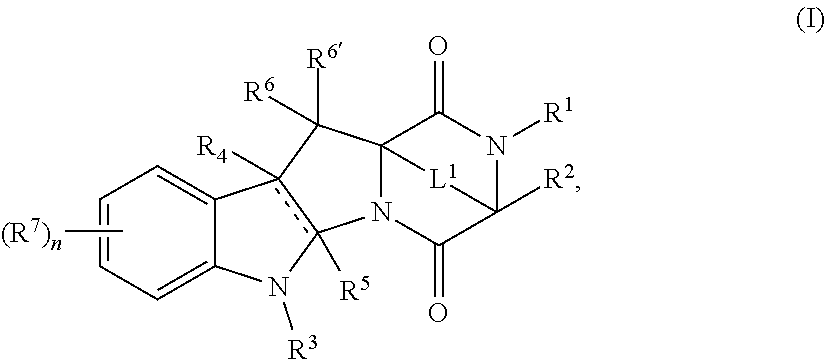
or a salt thereof, wherein at least one instance of R1, R3, and R4 comprises R wherein R is -L2-RH-L3-D. R1, R2, R3, R4, R5, R6, R6′, R7, R, RH, L1, L2, L3, D,


or a salt thereof, wherein at least one instance of R1, R3, and R4 comprises R wherein R is -L2-RH1, R1, R2, R3, R4, R5, R6, R6′, R7, RH1, L1, L2,
RH2-L3-D (III),
or a salt thereof, wherein RH2, L3, and D are as described herein.

or a salt thereof, wherein R1, R2, R3, R4, R5, R6, R6′, R7, RZ,


or salt thereof, wherein RX and RY are defined herein. Also provided herein are methods of cyclization using compounds of Formula (X), which may be employed in the synthesis of derivatized ETPs.

may be in the (E)- or (Z)-configuration.
-
- a) Design of Prodrugs, edited by H. Bundgaard, (Elsevier, 1985) and Methods in Enzymology, 42:309-396, edited by K. Widder, et al. (Academic Press, 1985);
- b) Prodrugs and Targeted Delivery, edited by by J. Rautio (Wiley, 2011);
- c) Prodrugs and Targeted Delivery, edited by by J. Rautio (Wiley, 2011);
- d) A Textbook of Drug Design and Development, edited by Krogsgaard-Larsen;
- e) Bundgaard,
Chapter 5 “Design and Application of Prodrugs”, by H. Bundgaard, p. 113-191 (1991); - f) Bundgaard, Advanced Drug Delivery Reviews, 8:1-38(1992);
- g) Bundgaard, et al., Journal of Pharmaceutical Sciences, 77:285 (1988); and
- h) Kakeya, et al., Chem. Pharm. Bull., 32:692 (1984).

Although mono-, di-, tri-, and tetrasulfide members are naturally occurring, the disulfides are most prevalent.

- or a salt thereof; wherein
- each is independently a single bond or a double bond, as valency permits;

- each R1 is independently R, —C(O)R, —C(O)N(R)2, —S(O)R, —S(O)2R, —S(O)2OR, —C(R)2OR, or —S(O)2N(R)2;
- each R is independently hydrogen, -L2-RH-L3-D, or an optionally substituted group selected from C1-20 alkyl, C1-20 heteroalkyl, phenyl, a 3-7 membered saturated or partially unsaturated, carbocyclic ring, an 8-14 membered bicyclic or polycyclic, saturated carbocyclic ring, partially unsaturated carbocyclic ring, or aryl ring, a 5-6 membered monocyclic heteroaryl ring having 1-4 heteroatoms independently selected from nitrogen, oxygen, and sulfur, a 3-7 membered saturated or partially unsaturated, heterocyclic ring having 1-3 heteroatoms independently selected from nitrogen, oxygen, and sulfur, a 7-14 membered bicyclic or polycyclic, saturated or partially unsaturated, heterocyclic ring having 1-5 heteroatoms independently selected from nitrogen, oxygen, and sulfur, and an 8-14 membered bicyclic or polycyclic heteroaryl ring having 1-5 heteroatoms independently selected from nitrogen, oxygen, and sulfur; or:
- two R groups are optionally taken together with their intervening atoms to form an optionally substituted 3-14 membered, saturated, partially unsaturated, or aryl ring having, in addition to the intervening atoms, 0-4 heteroatoms independently selected from nitrogen, oxygen, and sulfur;
- each R2 is independently R, —[C(R)2]q—OR, —[C(R)2]q—N(R)2, —[C(R)2]q—SR, —[C(R)2]q—OSi(R)3, —[C(R)2]q—OC(O)R, —[C(R)2]q—OC(O)OR, —[C(R)2]q—OC(O)N(R)2, —[C(R)2]q—OC(O)N(R)—S(═O)2R, or —[C(R)2]q—OP(OR)2; or
- R1 and R2 are taken together with their intervening atoms to form an optionally substituted 4-7 membered heterocyclic ring having, in addition to the nitrogen atom to which R1 is attached, 0-2 heteroatoms independently selected from oxygen, nitrogen, and sulfur;
- each q is independently 0, 1, 2, 3, or 4;
- each R3 is independently —S(O)2R, —S(O)2—[C(R)2]q—R, —S(O)2—[C(R)2]q—B(OR)2, —S(O)2—[C(R)2]q—Si(R)3, —S(O)2OR, —S(O)2N(R)2, —S(O)R, —C(O)R, —C(O)OR, —C(O)N(R)2, —C(O)N(R)—OR, —P(O)(R)2, —P(O)(OR)2, or —P(O)[N(R)2]2;
- R4 is absent when is a double bond or is selected from R, halogen, and

wherein
- at least one instance of R1, R3, and R4 comprises R wherein R is -L2-RH-L3-D;
- each L2 is independently substituted or unsubstituted, C1-20 alkylene, substituted or unsubstituted, C2-20 alkenylene, substituted or unsubstituted, C2-20 alkynylene, substituted or unsubstituted, C1-20 heteroalkylene, substituted or unsubstituted, C2-20 heteroalkenyl ene, or C2-20 heteroalkynylene, wherein:
- optionally one or more backbone carbons in each instance of the substituted or unsubstituted, C1-20 alkylene, substituted or unsubstituted, C2-20 alkenylene, substituted or unsubstituted, C2-20 alkynylene, substituted or unsubstituted, C1-20 heteroalkylene, substituted or unsubstituted, C2-20 heteroalkenylene, and C2-20 heteroalkynylene are independently replaced with —C(═O)—, substituted or unsubstituted carbocyclylene, substituted or unsubstituted heterocyclylene, substituted or unsubstituted arylene, or substituted or unsubstituted heteroarylene, and
- optionally one or more backbone heteroatoms in each instance of the substituted or unsubstituted, C1-20 heteroalkylene, substituted or unsubstituted, C2-20 heteroalkenylene, and substituted or unsubstituted, C2-20 heteroalkynylene are independently replaced with substituted or unsubstituted carbocyclylene, substituted or unsubstituted heterocyclylene, substituted or unsubstituted arylene, or substituted or unsubstituted heteroarylene;
- each RH is independently substituted or unsubstituted triazolylene, —O—, —S—, —NRA—, —C(═O)O—, —C(═NRA)O—, —S(═O)O—, —S(═O)2O—, —C(═O)NRA—, —C(═NRA)NRA—, —S(═O)NRA—, —S(═O)2NRA—, —OC(═O)—, —OC(═NRA)—, —OS(═O)—, —OS(═O)2—, —NRAC(═O)—, —NRAC(═NRA)—, —NRAS(═O)—, —NRAS(═O)2—, —OC(═O)O—, —OC(═NRA)O—, —OS(═O)O—, —OS(═O)2O—, NRAC(═O)O—, —NRAC(═NRA)O—, —NRAS(═O)O—, —NRAS(═O)2O—, —OC(═O)NRA—, —OC(═NRA)NRA—, —OS(═O)NRA—, —OS(═O)2NRA—, —NRAC(═O)NRA—, —NRAC(═NRA)NRA—, —NRAS(═O)NRA—, —NRAS(═O)2NRA—, —C(═O)—, —C(═NRA)—, —S(═O)—, —S(═O)2—, substituted or unsubstituted carbocyclylene, substituted or unsubstituted heterocyclylene, substituted or unsubstituted arylene, or substituted or unsubstituted heteroarylene;
- each RA is independently hydrogen, substituted or unsubstituted C1-6 alkyl, substituted or unsubstituted CM heteroalkyl, substituted or unsubstituted C2-6 alkenyl, substituted or unsubstituted C2-6 alkynyl, substituted or unsubstituted carbocyclyl, substituted or unsubstituted heterocyclyl, substituted or unsubstituted aryl, substituted or unsubstituted heteroaryl, or a nitrogen protecting group;
- each L3 is independently substituted or unsubstituted, C1-20 alkylene, substituted or unsubstituted, C2-20 alkenylene, substituted or unsubstituted, C2-20 alkynylene, substituted or unsubstituted, C1-20 heteroalkylene, substituted or unsubstituted, C2-20 heteroalkenylene, or C2-20 heteroalkynylene, wherein:
- optionally one or more backbone carbons in each instance of the substituted or unsubstituted, C1-20 alkylene, substituted or unsubstituted, C2-20 alkenylene, substituted or unsubstituted, C2-20 alkynylene, substituted or unsubstituted, C1-20 heteroalkylene, substituted or unsubstituted, C2-20 heteroalkenylene, and C2-20 heteroalkynylene are independently replaced with substituted or unsubstituted carbocyclylene, substituted or unsubstituted heterocyclylene, substituted or unsubstituted arylene, or substituted or unsubstituted heteroarylene; and
- optionally one or more backbone heteroatoms in each instance of the substituted or unsubstituted, C1-20 heteroalkylene, substituted or unsubstituted, C2-20 heteroalkenylene, and substituted or unsubstituted, C2-20 heteroalkynylene are independently replaced with substituted or unsubstituted carbocyclylene, substituted or unsubstituted heterocyclylene, substituted or unsubstituted arylene, or substituted or unsubstituted heteroarylene;
- each D is independently absent, polymeric moiety, dendrimeric moiety, antibody, particle, bead, nanostructure, liposome, micelle, or vesicle;
- each R5 is absent when is a double bond or is independently hydrogen or an optionally substituted C1-6 aliphatic group,
- each of R6 and R6′ is independently R, halogen, —CN, —NO2, —OR, —SR, —N(R)2, —S(O)2R, —S(O)2N(R)2, —S(O)R, —C(O)R, —C(O)OR, —C(O)N(R)2, —C(O)N(R)—OR, —N(R)C(O)OR, —N(R)C(O)N(R)2, —N(R)S(O)2R, or —OSi(R)3; or
- R6 and R6′ are taken together to form ═O, ═C(R)2 or ═NR,
- each n is independently 0, 1, 2, 3, or 4;
- each R7 is independently R, halogen, —CN, —NO2, —OR, —OSi(R)3, —SR, —N(R)2, —S(O)2R, —S(O)2OR, —S(O)2N(R)2, —S(O)R, —C(O)R, —C(O)OR, —C(O)N(R)2, —C(O)N(R)—OR, —N(R)C(O)OR, —N(R)C(O)N(R)2, —N(R)S(O)2R, —P(R)2, —P(OR)2, —P(O)(R)2, —P(O)(OR)2, —P(O)[N(R)2]2, —B(R)2, —B(OR)2, or —Si(R)3; or;
- two R7 are taken together with their intervening atoms to form an optionally substituted 4-7 membered ring having 0-2 heteroatoms independently selected from nitrogen, oxygen, and sulfur;
- each L1 independently is —S—, —(S)m—[C(R)2]q—(S)p—, —(S)m—(S)p—, —(S)m—C(O)—(S)p—, —(S)m—C(S)—(S)p—, —(S)m—S(O)—(S)p—, or —(S)m—S(O)2—(S)p—;
- each m is independently 1, 2, or 3; and
- each p is independently 1, 2, or 3.

or stereoisomer thereof.


In certain embodiments, R1 is

In certain embodiments, R1 is

In some embodiments, each R is independently optionally substituted group selected from C1-20 alkyl, C1-20 heteroalkyl, phenyl, a 3-7 membered saturated or partially unsaturated, carbocyclic ring, an 8-14 membered bicyclic or polycyclic, saturated carbocyclic ring, partially unsaturated carbocyclic ring, or aryl ring, a 5-6 membered monocyclic heteroaryl ring having 1-4 heteroatoms independently selected from nitrogen, oxygen, and sulfur, a 3-7 membered saturated or partially unsaturated, heterocyclic ring having 1-3 heteroatoms independently selected from nitrogen, oxygen, and sulfur, a 7-14 membered bicyclic or polycyclic, saturated or partially unsaturated, heterocyclic ring having 1-5 heteroatoms independently selected from nitrogen, oxygen, and sulfur, and an 8-14 membered bicyclic or polycyclic heteroaryl ring having 1-5 heteroatoms independently selected from nitrogen, oxygen, and sulfur. In certain embodiments, two R groups are optionally taken together with their intervening atoms to form an optionally substituted 3-14 membered, saturated, partially unsaturated, or aryl ring having, in addition to the intervening atoms, 0-4 heteroatoms independently selected from nitrogen, oxygen, and sulfur.

—N═, ≡N, —S—, —S(O)—, —S(O)2—, —O—, ═O,

—Se—, —Se(O)—, and

within the C1-20 heteroalkyl backbone. In some embodiments, R is not heteroalkyl. In some embodiments, R is methoxymethyl. In some embodiments, R is benzyloxymethyl.


In certain embodiments, L2′ is

In some embodiments, L2′ is

In some embodiments, L2′ is


wherein g is an integer from 1 to 10, inclusive. In certain embodiments, L3 is

wherein g is 1, 2, or 3. In certain embodiments, L3 is

wherein g is 1. In certain embodiments, L3 is

wherein g is 3.

In some embodiments, L3 comprises substituted or unsubstituted,

In certain embodiments, L3 is a substituted C1-20 heteroalkylene with one or more backbone atoms selected from oxygen and nitrogen and a backbone substituted or unsubstituted phenylene. In some embodiments, L3 is a substituted C1-20 heteroalkylene wherein at least one substituent on the C1-20 heteroalkylene is —NHBoc. In certain embodiments, L3 is a substituted C1-20 heteroalkylene with one or more backbone atoms selected from oxygen and nitrogen and a backbone substituted or unsubstituted phenylene, wherein at least one substituent on the C1-20 heteroalkylene is —NHBoc. In some embodiments, L3 is a substituted C1-20 heteroalkylene wherein at least one substituent on the C1-20 heteroalkylene is —NH2. In certain embodiments, L3 is a substituted C1-20 heteroalkylene with one or more backbone atoms selected from oxygen and nitrogen and a backbone substituted or unsubstituted phenylene, wherein at least one substituent on the C1-20 heteroalkylene is —NH2.

In some embodiments, D is absent, and L3 comprises substituted or unsubstituted,


In some embodiments, R1 and R are taken together with their intervening atoms to form substituted or unsubstituted


—CO2Me, —CO2Et, —CHO, —C(O)CF3,


In some embodiments, R4 is


In certain embodiments, R4 is


In some embodiments, a compound of Formula (I) is of the formula:

or stereoisomer thereof.


In some embodiments, one of R6 and R6′ is hydrogen,
and the other is


In some embodiments, R6 is


In some embodiments, R6′ is


In certain embodiments, a compound of Formula (I) is of the formula:

In certain embodiments of a compound of formula (I-c), L2 is substituted or unsubstituted C1-20 heteroalkylene comprising one or more backbone oxygen atoms. In certain embodiments of a compound of formula (I-c), L2 is substituted or unsubstituted C1-20 alkylene. In certain embodiments of a compound of formula (I-c), L2 is

In certain embodiments of a compound of formula (I-c), L2 is


wherein h is an integer 0 to 10, inclusive. In certain embodiments, a compound of Formula (I) is of the formula:

In certain embodiments, a compound of Formula (I) is of the formula:

wherein h is an integer 0 to 10, inclusive. In certain embodiments, a compound of Formula (I) is of the formula:

wherein h is 3.

In some embodiments of a compound of formula (I-c) or (I-c′), L3 comprises substituted or unsubstituted,

In certain embodiments of a compound of formula (I-c) or (I-c′), L3 comprises a C1-20 heteroalkylene. In certain embodiments of a compound of formula (I-c) or (I-c′), L3 comprises substituted or unsubstituted, C1-20 heteroalkylene with one or more backbone atoms selected from oxygen and nitrogen. In certain embodiments of a compound of formula (I-c) or (I-c′), L3 comprises

wherein g is 1, 2, or 3. In certain embodiments of a compound of formula (I-c) or (I-c′), L3 comprises substituted or unsubstituted phenylene. In certain embodiments of a compound of formula (I-c) or (I-c′), L3 comprises a substituted C1-20 heteroalkylene with one or more backbone atoms selected from oxygen and nitrogen and a backbone substituted or unsubstituted phenylene.

wherein g is 1, 2, or 3. In certain embodiments of a compound of formula (I-c) or (I-c′), D is absent, and L3 comprises a substituted C1-20 heteroalkyl with one or more backbone atoms selected from oxygen and nitrogen and a backbone substituted or unsubstituted phenylene. In certain embodiments of a compound of formula (I-c) or (I-c′), D is absent, and L3 is para-methoxy phenyl.

In some embodiments, a compound of Formula (I) is of the formula:

In certain embodiments, a compound of Formula (I) is of the formula:

In some embodiments, a compound of Formula (I) is of the formula:

In certain embodiments of a compound of formula (I-b) or (I-b-i), Ring A is substituted or unsubstituted phenylene, substituted or unsubstituted indolylene, or substituted or unsubstituted pyrrolylene. In certain embodiments of a compound of formula (I-b) or (I-b-i), Ring A is substituted or unsubstituted phenylene. In certain embodiments of a compound of formula (I-b) or (I-b-i), L2 is substituted or unsubstituted C1-20 heteroalkylene comprising one or more backbone oxygen atoms. In certain embodiments of a compound of formula (I-b) or (I-b-i), L2 is substituted or unsubstituted C1-20 alkylene. In certain embodiments of a compound of formula (I-b) or (I-b-i), L2 is

In certain embodiments of a compound of formula (I-b) or (I-b-i), L2 is


In some embodiments, a compound of Formula (I) is of the formula:

In certain embodiments, a compound of Formula (I) is of the formula:

In some embodiments, a compound of Formula (I) is of the formula:


In some embodiments of a compound of formula (I-b), (I-b-i), (I-b′) or (I-b-i′), L3 comprises substituted or unsubstituted,

In certain embodiments of a compound of formula (I-b), (I-b-i), (I-b′) or (I-b-i′), L3 comprises a C1-20 heteroalkylene. In certain embodiments of a compound of formula (I-b), (I-b-i), (I-b′) or (I-b-i′), L3 comprises substituted or unsubstituted, C1-20 heteroalkylene with one or more backbone atoms selected from oxygen and nitrogen. In certain embodiments of a compound of formula (I-b), (I-b-i), (I-b′) or (I-b-i′), L3 comprises

wherein g is 1, 2, or 3. In certain embodiments of a compound of formula (I-b), (I-b-i), (I-b′) or (I-b-i′), L3 comprises substituted or unsubstituted phenylene. In certain embodiments of a compound of formula (I-b), (I-b-i), (I-b′) or (I-b-i′), L3 comprises a substituted C1-20 heteroalkylene with one or more backbone atoms selected from oxygen and nitrogen and a backbone substituted or unsubstituted phenylene.

In certain embodiments, a compound of Formula (I) is of the formula:

In certain embodiments of a compound of formula (I-a), Ring A is substituted or unsubstituted phenylene, substituted or unsubstituted indolylene, or substituted or unsubstituted pyrrolylene. In certain embodiments of a compound of formula (I-a), Ring A is substituted or unsubstituted phenylene. In certain embodiments of a compound of formula (I-a), L2 is substituted or unsubstituted C1-20 heteroalkylene comprising one or more backbone oxygen atoms. In certain embodiments of a compound of formula (I-a), L2 is substituted or unsubstituted C1-20 alkylene. In certain embodiments of a compound of formula (I-a), L2 is

In certain embodiments of a compound of formula (I-a), L2 is


In certain embodiments, a compound of Formula (I) is of the formula:


wherein g is 1, 2, or 3. In certain embodiments of a compound of formula (I-a) or (I-a′), L3 comprises substituted or unsubstituted phenylene. In certain embodiments of a compound of formula (I-a) or (I-a′), L3 comprises a substituted C1-20 heteroalkylene with one or more backbone atoms selected from oxygen and nitrogen and a backbone substituted or unsubstituted phenylene. In certain embodiments of a compound of formula (I-a) or (I-a′), L3 comprises substituted or unsubstituted,

In some embodiments of a compound of formula (I-a) or (I-a′), L3 comprises substituted or unsubstituted

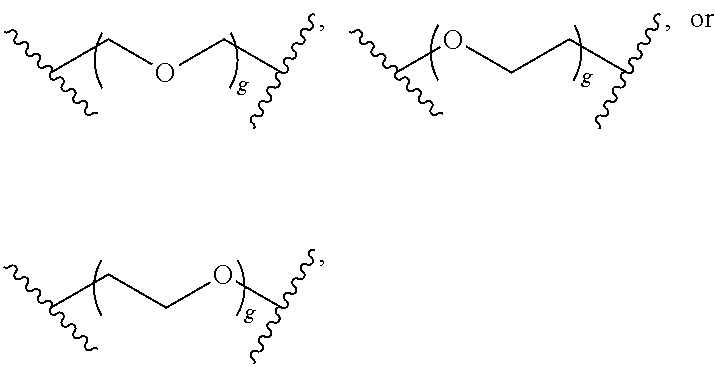
wherein g is 1, 2, or 3. In certain embodiments of a compound of formula (I-a) or (I-a′), D is absent, and L3 comprises a substituted C1-20 heteroalkyl with one or more backbone atoms selected from oxygen and nitrogen and a backbone substituted or unsubstituted phenylene. In certain embodiments of a compound of formula (I-aa) or (I-a′), D is absent, and L3 comprises substituted or unsubstituted

In some embodiments of a compound of formula (I-a) or (I-a′), D is absent, and L3 comprises substituted or unsubstituted

In some embodiments of a compound of formula (I-a) or (I-a′), D is absent, and L3 is a substituted C1-20 alkyl wherein at least one substituent on the C1-20 alkyl is —NHBoc. In some embodiments of a compound of formula (I-a) or (I-a′), D is absent, and L3 is a substituted C1-20 heteroalkyl wherein at least one substituent on the C1-20 heteroalkyl is —NHBoc. In certain embodiments of a compound of formula (I-a) or (I-a′), D is absent, and L3 is a substituted C1-20 heteroalkyl with one or more backbone atoms selected from oxygen and nitrogen and a backbone substituted or unsubstituted phenylene, wherein at least one substituent on the C1-20 heteroalkyl is —NHBoc. In some embodiments of a compound of formula (I-a) or (I-a′), D is absent, and L3 is a substituted C1-20 alkyl wherein at least one substituent on the C1-20 alkyl is —NH2. In some embodiments of a compound of formula (I-a) or (I-a′), D is absent, and L3 is a substituted C1-20 heteroalkyl wherein at least one substituent on the C1-20 heteroalkyl is —NH2. In certain embodiments of a compound of formula (I-a) or (I-a′), D is absent, and L3 is a substituted C1-20 heteroalkyl with one or more backbone atoms selected from oxygen and nitrogen and a backbone substituted or unsubstituted phenylene, wherein at least one substituent on the C1-20 heteroalkyl is —NH2. In certain embodiments of a compound of formula (I-a) or (I-a′), D is absent, and L3 is para-methoxyphenyl.


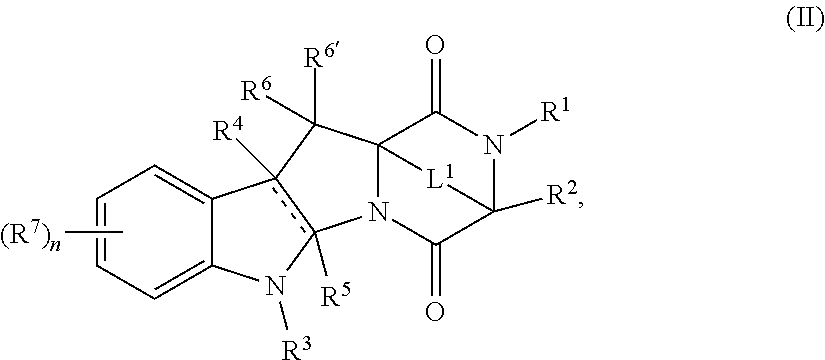
or a salt thereof, wherein:
- each is independently a single bond or a double bond, as valency permits;
- each R1 is independently R, —C(O)R, —C(O)N(R)2, —S(O)R, —S(O)2R, —S(O)2OR, —C(R)2OR, or —S(O)2N(R)2;
- each R is independently hydrogen, -L2-RH1, or an optionally substituted group selected from C1-20 alkyl, C1-20 heteroalkyl, phenyl, a 3-7 membered saturated or partially unsaturated, carbocyclic ring, an 8-14 membered bicyclic or polycyclic, saturated carbocyclic ring, partially unsaturated carbocyclic ring, or aryl ring, a 5-6 membered monocyclic heteroaryl ring having 1-4 heteroatoms independently selected from nitrogen, oxygen, and sulfur, a 3-7 membered saturated or partially unsaturated, heterocyclic ring having 1-3 heteroatoms independently selected from nitrogen, oxygen, and sulfur, a 7-14 membered bicyclic or polycyclic, saturated or partially unsaturated, heterocyclic ring having 1-5 heteroatoms independently selected from nitrogen, oxygen, and sulfur, and an 8-14 membered bicyclic or polycyclic heteroaryl ring having 1-5 heteroatoms independently selected from nitrogen, oxygen, and sulfur; or:
- two R groups are optionally taken together with their intervening atoms to form an optionally substituted 3-14 membered, saturated, partially un saturated, or aryl ring having, in addition to the intervening atoms, 0-4 heteroatoms independently selected from nitrogen, oxygen, and sulfur,
- each R2 is independently R, —[C(R)2]q—OR, —[C(R)2]q—N(R)2, —[C(R)2]q—SR, —[C(R)2]q—OSi(R)3, —[C(R)2]q—OC(O)R, —[C(R)2]q—OC(O)OR, —[C(R)2]q—OC(O)N(R)2, —[C(R)2]q—OC(O)N(R)—S(═O)2R or —[C(R)2]q—OP(OR)2; or
- R1 and R2 are taken together with their intervening atoms to form an optionally substituted 4-7 membered heterocyclic ring having, in addition to the nitrogen atom to which R1 is attached, 0-2 heteroatoms independently selected from oxygen, nitrogen, and sulfur;
- each q is independently 0, 1, 2, 3, or 4;
- each R3 is independently —S(O)2R, —S(O)2—[C(R)2]q—R, —S(O)2—[C(R)2]q—B(OR)2, —S(O)2—[C(R)2]q—Si(R)3, —S(O)2OR, —S(O)2N(R)2, —S(O)R, —C(O)R, —C(O)OR, —C(O)N(R)2, —C(O)N(R)—OR, —P(O)(R)2, —P(O)(OR)2, or —P(O)[N(R)2]2;
- each R4 is absent when is a double bond or is independently R, halogen, or

at least one instance of R1, R and R4 comprises R wherein R is -L2-RH1;
-
- each L2 is independently substituted or unsubstituted, C1-20 alkylene, substituted or unsubstituted, C2-20 alkenylene, substituted or unsubstituted, C2-20 alkynylene, substituted or unsubstituted, C1-20 heteroalkylene, substituted or unsubstituted, C2-20 heteroalkenylene, or C2-20 heteroalkynylene, wherein:
- optionally one or more backbone carbons in each instance of the substituted or unsubstituted, C1-20 alkylene, substituted or unsubstituted, C2-20 alkenylene, substituted or unsubstituted, C2-20 alkynylene, substituted or unsubstituted, C1-20 heteroalkylene, substituted or unsubstituted, C2-20 heteroalkenylene, and C2-20 heteroalkynylene are independently replaced with —C(═O)—, substituted or unsubstituted carbocyclylene, substituted or unsubstituted heterocyclylene, substituted or unsubstituted arylene, or substituted or unsubstituted heteroarylene, and
- optionally one or more backbone heteroatoms in each instance of the substituted or unsubstituted, C1-20 heteroalkylene, substituted or unsubstituted, C2-20 heteroalkenylene, and substituted or unsubstituted, C2-20 heteroalkynylene are independently replaced with substituted or unsubstituted carbocyclylene, substituted or unsubstituted heterocyclylene, substituted or unsubstituted arylene, or substituted or unsubstituted heteroarylene;
- each RH1 is independently a first click-chemistry handle, a nucleophile, an electrophile, a leaving group, substituted or unsubstituted alkenyl, substituted or unsubstituted alkynyl, halogen, —OH, —SH, —NHRA, —N3, —C(═O)OH, —C(═NRA)OH, —S(═O)OH, —S(═O)2OH, —C(═O)-(a leaving group), —C(═NRA)-(a leaving group), —S(═O)-(a leaving group), or —S(═O)2-(a leaving group), provided that each RH1 is not-OCH3 or —NRAC(═O)RA;
- each RA is independently hydrogen, substituted or unsubstituted C1-5 alkyl, substituted or unsubstituted C1-6 heteroalkyl, substituted or unsubstituted C2-6, alkenyl, substituted or unsubstituted C2-6 alkynyl, substituted or unsubstituted carbocyclyl, substituted or unsubstituted heterocyclyl, substituted or unsubstituted aryl, substituted or unsubstituted heteroaryl, or a nitrogen protecting group,
- each R5 is absent when is a double bond or is independently hydrogen or an optionally substituted C1-4 aliphatic group;
- each of R6 and R6′ is independently R, halogen, —CN, —NO2, —OR, —SR, —N(R)2, —S(O)2R, —S(O)2N(R)2, —S(O)R, —C(O)R, —C(O)OR, —C(O)N(R)2, —C(O)N(R)—OR, —N(R)C(O)OR, —N(R)C(O)N(R)2, —N(R)S(O)2R, or —OSi(R)3; or
- R6 and R6′ are taken together to form ═O, ═C(R)2 or ═NR,
- each n is independently 0, 1, 2, 3, or 4;
- each R7 is independently R, halogen, —CN, —NO2, —OR, —OSi(R)3, —SR, —N(R)2, —S(O)2R, —S(O)2OR, —S(O)2N(R)2, —S(O)R, —C(O)R, —C(O)OR, —C(O)N(R)2, —C(O)N(R)—OR, —N(R)C(O)OR, —N(R)C(O)N(R)2, —N(R)S(O)2R, —P(R)2, —P(OR)2, —P(O)(R)2, —P(O)(OR)2, —P(O)[N(R)2]2, —B(R)2, —B(OR)2, or —Si(R)3; or:
- two R7 are taken together with their intervening atoms to form an optionally substituted 4-7 membered ring having 0-2 heteroatoms independently selected from nitrogen, oxygen, and sulfur;
- each L1 is independently —S—, —(S)m—[C(R)2]q—(S)p—, —(S)m—(S)p—, —(S)m—C(O)—(S)p—, —(S)m—C(S)—(S)p—, —(S)m—S(O)—(S)p—, or —(S)m—S(O)2—(S)p—;
- each m is independently 1, 2, or 3; and
- each p is independently 1, 2, or 3.

or stereoisomer thereof.

In certain embodiments, a compound of Formula (II) is of the formula:

or stereoisomer thereof.

In some embodiments, a compound of Formula (II) is of the formula.

In certain embodiments of a compound of formula (II-a), Ring A is substituted or unsubstituted phenylene, substituted or unsubstituted indolylene, or substituted or unsubstituted pyrrolylene. In certain embodiments of a compound of formula (II-a), Ring A is substituted or unsubstituted phenylene. In certain embodiments of a compound of formula (II-a), L2′ is substituted or unsubstituted C1-20 heteroalkylene comprising one or more backbone oxygen atoms. In certain embodiments of a compound of formula (II-a), L2′ is substituted or unsubstituted C1-20 alkylene. In certain embodiments of a compound of formula (II-a), L2′ is

In certain embodiments of a compound of formula (II-a), L2′ is

In some embodiments, a compound of Formula (II) is of the formula:

In some embodiments, a compound of Formula (II) is of the formula:


In some embodiments, a compound of Formula (II) is of the formula:

In some embodiments, a compound of Formula (II) is of the formula:

In some embodiments, a compound of Formula (II) is of the formula:

In certain embodiments of a compound of formula (II-b) or (II-b-i), Ring A is substituted or unsubstituted phenylene, substituted or unsubstituted indolylene, or substituted or unsubstituted pyrrolylene. In certain embodiments of a compound of formula (II-b) or (II-b-i), Ring A is substituted or unsubstituted phenylene. In certain embodiments of a compound of formula (II-b) or (II-b-i), L2′ is substituted or unsubstituted C1-20 heteroalkylene comprising one or more backbone oxygen atoms. In certain embodiments of a compound of formula (II-b) or (II-b-i), L2′ is substituted or unsubstituted C1-20 alkylene. In certain embodiments of a compound of formula (II-b) or (II-b-i), L2′ is

In certain embodiments of a compound of formula (II-b) or (II-b-i), L2′ is

In certain embodiments, a compound of Formula (II) is of the formula:

In certain embodiments, a compound of Formula (II) is of the formula:


In certain embodiments, a compound of Formula (II) is of the formula:

In certain embodiments of a compound of formula (II-c), L2′ is substituted or unsubstituted C1-20 heteroalkylene comprising one or more backbone oxygen atoms. In certain embodiments of a compound of formula (II-c), L2′ is substituted or unsubstituted C1-20 alkylene. In certain embodiments of a compound of formula (II-c), L2′ is

In certain embodiments of a compound of formula (II-c), L2′ is

In certain embodiments, a compound of Formula (II) is of the formula:

wherein h is an integer from 0 to 10, inclusive. In certain embodiments, a compound of Formula (II) is of the formula:

wherein h is an integer from 0 to 10, inclusive. In certain embodiments of a compound of formula (II-c′), h is 1. In certain embodiments of a compound of formula (II-c′), h is 2. In certain embodiments of a compound of formula (II-c′), h is 3.

RH2-L3-D (III),
or a salt thereof, wherein RH2 is a reaction handle, wherein the reaction handle is able to react with RH1 to form RH.

- or salt thereof, wherein:
- each is independently a single bond or a double bond, as valency permits;
- each R1 is independently R, —C(O)R, —C(O)N(R)2, —S(O)R, —S(O)2R, —S(O)2OR, —C(R)2OR, or —S(O)2N(R)2;
- each R is independently hydrogen or an optionally substituted group selected from C1-20 alkyl, C1-20 heteroalkyl, phenyl, a 3-7 membered saturated or partially unsaturated, carbocyclic ring, an 8-14 membered bicyclic or polycyclic, saturated carbocyclic ring, partially unsaturated carbocyclic ring, or aryl ring, a 5-6 membered monocyclic heteroaryl ring having 1-4 heteroatoms independently selected from nitrogen, oxygen, and sulfur, a 3-7 membered saturated or partially unsaturated, heterocyclic ring having 1-3 heteroatoms independently selected from nitrogen, oxygen, and sulfur, a 7-14 membered bicyclic or polycyclic, saturated or partially unsaturated, heterocyclic ring having 1-5 heteroatoms independently selected from nitrogen, oxygen, and sulfur, and an 8-14 membered bicyclic or polycyclic heteroaryl ring having 1-5 heteroatoms independently selected from nitrogen, oxygen, and sulfur; or:
- two R groups are optionally taken together with their intervening atoms to form an optionally substituted 3-14 membered, saturated, partially unsaturated, or aryl ring having, in addition to the intervening atoms, 0-4 heteroatoms independently selected from nitrogen, oxygen, and sulfur;
- each R2 is independently R, —[C(R)2]q—OR, —[C(R)2]q—N(R)2, —[C(R)2]q—SR, —[C(R)2]q—OSi(R)3, —[C(R)2]q—OC(O)R, —[C(R)2]q—OC(O)OR, —[C(R)2]q—OC(O)N(R)2, —[C(R)2]q—OC(O)N(R)—S(═O)2R, or —[C(R)2]q—OP(OR)2; or
- R1 and R2 are taken together with their intervening atoms to form an optionally substituted 4-7 membered heterocyclic ring having, in addition to the nitrogen atom to which R1 is attached, 0-2 heteroatoms independently selected from oxygen, nitrogen, and sulfur;
- each q is independently 0, 1, 2, 3, or 4;
- each R3 is independently —S(O)2R, —S(O)2—[C(R)2]q—R, —S(O)2—[C(R)2]q—B(OR)2, —S(O)2—[C(R)2]q—Si(R)3, —S(O)2OR, —S(O)2N(R)2, —S(O)R, —C(O)R, —C(O)OR, —C(O)N(R)2, —C(O)N(R)—OR, —P(O)(R)2, —P(O)(OR)2, or —P(O)[N(R)2]2;
- R4 is absent when is a double bond or is selected from R, halogen, and

- each R5 is absent when is a double bond or is independently hydrogen or an optionally substituted C1-6 aliphatic group;
- each of R6 and R6′ is independently R, halogen, —CN, —NO2, —OR, —SR, —N(R)2, —S(O)2R, —S(O)2N(R)2, —S(O)R, —C(O)R, —C(O)OR, —C(O)N(R)2, —C(O)N(R)—OR, —N(R)C(O)OR, —N(R)C(O)N(R)2, —N(R)S(O)2R, or —OSi(R)3; or
- R6 and R6′ are taken together to form ═O, ═C(R)2, or ═NR;
- each n is independently 0, 1, 2, 3, or 4;
- each R7 is independently R, halogen, —CN, —NO2, —OR, —OSi(R)3, —SR, —N(R)2, —S(O)2R, —S(O)2OR, —S(O)2N(R)2, —S(O)R, —C(O)R, —C(O)OR, —C(O)N(R)2, —C(O)N(R)—OR, —N(R)C(O)OR, —N(R)C(O)N(R)2, —N(R)S(O)2R, —P(R)2, —P(OR)2, —P(O)(R)2, —P(O)(OR)2, —P(O)[N(R)2]2, —B(R)2, —B(OR)2, or —Si(R)3; or:
- two R7 are taken together with their intervening atoms to form an optionally substituted 4-7 membered ring having 0-2 heteroatoms independently selected from nitrogen, oxygen, and sulfur;
- each RZ is independently hydrogen, -L2-RH1, -L2-RH-L3-D, -(L2)0-1-RP, substituted methyl, or an optionally substituted group selected from C2-20 alkyl, C1-20 heteroalkyl, phenyl, a 3-7 membered saturated or partially unsaturated, carbocyclic ring, an 8-14 membered bicyclic or polycyclic, saturated carbocyclic ring, partially unsaturated carbocyclic ring, or aryl ring, a 5-6 membered monocyclic heteroaryl ring having 1-4 heteroatoms independently selected from nitrogen, oxygen, and sulfur, a 3-7 membered saturated or partially unsaturated, heterocyclic ring having 1-3 heteroatoms independently selected from nitrogen, oxygen, and sulfur, a 7-14 membered bicyclic or polycyclic, saturated or partially unsaturated, heterocyclic ring having 1-5 heteroatoms independently selected from nitrogen, oxygen, and sulfur, and an 8-14 membered bicyclic or polycyclic heteroaryl ring having 1-5 heteroatoms independently selected from nitrogen, oxygen, and sulfur;
- wherein at least one instance of RZ is not hydrogen,
- each L2 is independently substituted or unsubstituted, C1-20 alkylene, substituted or unsubstituted, C2-20 alkenylene, substituted or unsubstituted, C2-20 alkynylene, substituted or unsubstituted, C1-20 heteroalkylene, substituted or unsubstituted, C2-20 heteroalkenylene, or C2-20 heteroalkynylene, wherein:
- optionally one or more backbone carbons in each instance of the substituted or unsubstituted, C1-20 alkylene, substituted or unsubstituted, C2-20 alkenylene, substituted or unsubstituted, C2-20 alkynylene, substituted or unsubstituted, C1-20 heteroalkylene, substituted or unsubstituted, C2-20 heteroalkenylene, and C2-20 heteroalkynylene are independently replaced with —C(═O)—, substituted or unsubstituted carbocyclylene, substituted or unsubstituted heterocyclylene, substituted or unsubstituted arylene, or substituted or unsubstituted heteroarylene; and
- optionally one or more backbone heteroatoms in each instance of the substituted or unsubstituted, C1-20 heteroalkylene, substituted or unsubstituted, C2-20 heteroalkenylene, and substituted or unsubstituted, C2-20 heteroalkynylene are independently replaced with substituted or unsubstituted carbocyclylene, substituted or unsubstituted heterocyclylene, substituted or unsubstituted arylene, or substituted or unsubstituted heteroarylene,
- each RH1 is independently a first click-chemistry handle, a nucleophile, an electrophile, a leaving group, substituted or unsubstituted alkenyl, substituted or unsubstituted alkynyl, halogen, —OH, —SH, —NHRA, —N3, —C(═O)OH, —C(═NRA)OH, —S(═O)OH, —S(═O)2OH, —C(═O)-(a leaving group), —C(═NRA)-(a leaving group), —S(═O)-(a leaving group), or —S(═O)2-(a leaving group);
- each RH is independently substituted or unsubstituted triazolylene, —O—, —S—, —NRA—, —C(═O)O—, —C(═NRA)O—, —S(═O)O—, —S(═O)2O—, —C(═O)NRA—, —C(═NRA)NRA—, —S(═O)NRA—, —S(═O)2NRA—, —OC(═O)—, —OC(═NRA), —OS(═O)—, —OS(═O)2—, —NRAC(═O)—, —NRAC(═NRA)—, —NRAS(═O)—, —NRAS(═O)2—, —OC(═O)O—, —OC(═NRA)O—, —OS(═O)O—, —OS(═O)2O—, —NRAC(═O)O—, —NRAC(═NRA)O—, —NRAS(═O)O—, —NRAS(═O)2O—, —OC(═O)NRA—, —OC(═NRA)NRA—, —OS(═O)NRA—, —OS(═O)2NRA—, —NRAC(═O)NRA—, —NRAC(═NRA)NRA—, —NRAS(═O)NRA—, —NRAS(═O)2NRA—, —C(═O)—, —C(═NRA)—, —S(═O)—, —S(═O)2—, substituted or unsubstituted carbocyclylene, substituted or unsubstituted heterocyclylene, substituted or unsubstituted arylene, or substituted or unsubstituted heteroarylene;
- each RA is independently hydrogen, substituted or unsubstituted C1-6 alkyl, substituted or unsubstituted C1-6 heteroalkyl, substituted or unsubstituted C2-6 alkenyl, substituted or unsubstituted C2-6 alkynyl, substituted or unsubstituted carbocyclyl, substituted or unsubstituted heterocyclyl, substituted or unsubstituted aryl, substituted or unsubstituted heteroaryl, or a nitrogen protecting group;
- each L3 is independently substituted or unsubstituted, C1-20 alkylene, substituted or unsubstituted, C2-20 alkenylene, substituted or unsubstituted, C2-20 alkynylene, substituted or unsubstituted, C1-20 heteroalkylene, substituted or unsubstituted, C2-20 heteroalkenylene, or C2-20 heteroalkynylene, wherein:
- optionally (Hie or more backbone carbons in each instance of the substituted or unsubstituted, C1-20 alkylene, substituted or unsubstituted, C2-20 alkenylene, substituted or unsubstituted, C2-20 alkynylene, substituted or unsubstituted, C1-20 heteroalkylene, substituted or unsubstituted, C2-20 heteroalkenylene, and C2-20 heteroalkynylene are independently replaced with substituted or unsubstituted carbocyclylene, substituted or unsubstituted heterocyclylene, substituted or unsubstituted arylene, or substituted or unsubstituted heteroarylene, and
- optionally one or more backbone heteroatoms in each instance of the substituted or unsubstituted, C1-20 heteroalkylene, substituted or unsubstituted, C2-20 heteroalkenylene, and substituted or unsubstituted, C2-20 heteroalkynylene are independently replaced with substituted or unsubstituted carbocyclylene, substituted or unsubstituted heterocyclylene, substituted or unsubstituted arylene, or substituted or unsubstituted heteroarylene;
- each D is independently absent, polymeric moiety, dendrimeric moiety, antibody, particle, bead, nanostructure, liposome, micelle, or vesicle; and
- RP is an amino acid, a peptide, or a polypeptide.
- wherein at least one instance of RZ is not hydrogen,

or stereoisomer thereof. In certain embodiments, a compound of Formula (V) is of the formula:

In certain embodiments, a compound of Formula (V) is of the formula:

or stereoisomer thereof.

In some embodiments, RZ is -L2-RH, and L2 comprises

substituted with halogen. In some embodiments, -L2-RH1 comprises

In certain embodiments, RZ is -L2-RH-L3-D. In certain embodiments, RZ is -(L2)1-RP. In certain embodiments, RZ is —RP.

—N═, ═N, —S—, —S(O)—, —S(O)2—, —O—, ═O,

—Se—, —Se(O)—, and

within the C1-20 heteroalkyl backbone. In some embodiments, RZ is not heteroalkyl. In some embodiments, RZ is methoxymethyl. In some embodiments, RZ is benzyloxymethyl.


In some embodiments, a compound of Formula I is a salt of


or salt thereof, wherein

In certain embodiments, a compound of Formula (X) is of the formula:


or a salt thereof, wherein:

to form a ring; and

In certain embodiments, a compound of Formula (XII) is of the formula:

In certain embodiments, a compound of Formula (XII) is of the formula:


to form a ring (e.g., RU and RV are joined to form a ring that comprises

in the ring system, wherein the two attachment points of

are attached to the two oxygen atoms to which RU and RV are attached, respectively).
RH2-L3-D (III),
or a salt thereof, wherein RH2 is a reaction handle, wherein the reaction handle is able to react with RH1 of Formula (II) to form RH of Formula (I). In some embodiments, the step of reacting comprises a click-chemistry reaction. In certain embodiments, the step of reacting comprises a metathesis reaction. In certain embodiments, the step of reacting comprises a condensation reaction. In certain embodiments, the step of reacting comprises a nucleophilic substitution reaction. In certain embodiments, the step of reacting comprises an addition reaction. In some embodiments, the step of reacting comprises an elimination reaction. In certain embodiments, the step of reacting comprises a substitution reaction. In certain embodiments, the step of reacting comprises a rearrangement reaction. In some embodiments, the step of reacting comprises photochemical reaction. In certain embodiments, the step of reacting comprises redox reaction.

or salt thereof, comprising reacting a compound of the formula:

or a salt thereof, with a compound of Formula (X), or a salt thereof, wherein, one of RU and RV is hydrogen, and the other one of RU and RV is an oxygen protecting group or —Si(RS)3; and each RS is independently hydrogen, halogen, hydroxyl, substituted or unsubstituted C1-6 alkyl, substituted or unsubstituted C1-6 heteroalkyl, substituted or unsubstituted C2-6 alkenyl, substituted or unsubstituted C2-6 alkynyl, substituted or unsubstituted carbocyclyl, substituted or unsubstituted heterocyclyl, substituted or unsubstituted aryl, or substituted or unsubstituted heteroaryl. In certain embodiments, R1, R2, R3, R4, R5, R6, R6′, R7, RU, RV,

In certain embodiments, RU is hydrogen, and RV is —Si(Me)3. In certain embodiments, RV is hydrogen, and RU is —Si(Me)3. In certain embodiments, RU is hydrogen, and RV is —Si(tBuXMe)2. In certain embodiments, RV is hydrogen, and RU is —Si(tBuXMe)2. In certain embodiments, a compound of Formula (XII) comprises only one —OH. In some embodiments, a compound of formula (XI) is of the formula:


or salt thereof, comprising reacting a compound of the formula:

or salt thereof, with tritylhydrodisulfane. In some embodiments, a compound of the formula:

or stereoisomer or salt thereof, is formed by reacting a compound of the formula:

with tritylhydrodisulfane. In certain embodiments, each instance of RS is unsubstituted alkyl (e.g., isopropyl).

or salt thereof, wherein R1, R2, R3, R4, R5, R6, R6′, R7,

or salt thereof, wherein R1, R2, R3, R4, R5, R6, R6′, R7,

or salt thereof, and the dihydroxypiperazinedione is of the formula:

or salt thereof, wherein R1, R2, R3, R4, R5, R6, R6′, R7,

or salt thereof, by reacting a dihydroxypiperazinedione of the formula:

or salt thereof, wherein R1, R2, R3, R4, R5, R6, R6′, R7,

In some embodiments, a dihydroxypiperazinedione is of the formula:


Cell Culture Information (HeLa, A549, HCT-116, DU-145, and MCF7)


| Scheme 4: Conjugation of designed ETPs with model alkyne |
 |
 |
| Entry | ETP | Product | Yield |
| 1 | (+)-9a |
 |
94% |
| 2 | (+)-9b |
 |
85% |
| 3 | (+)-9c |
 |
57% |


| TABLE 1 |
| Assessment of designed ETPs for cytotoxicity in five human cancer cell |
| lines {HeLa (cervical carcinoma), A549 (alveolar adenocarcinoma), IMF7 (breast |
| adenocarcinoma), HCT116 (colorectal carcinoma), and DU-145 (prostate carcinoma)}.a |
| HeLa | A549 | MCF7 | IICT116 | DU-145 | |
| Alanine-derived dimer with epipolystilfide bridge |
| (+) −7 | 0.11 ± 0.14 | 0.46 ± 0.45 | 0.30 ± 0.44 | 0.24 ± 0.29 | 0.18 ± 0.18 |
| 60 | 6.2 | 19 | 10.9 | 14.6 | 10 |
| Glycine-derived monomers with epipolysulfide bridges |
| (+) −8 | 5.5 ± 1.7 | 16 ± 9.8 | 9.2 ± 3.1 | 6.9 ± 2.9 | 3.4 ± 4.2 |
| (+) −9a | 5.3 ± 0.2 | 8.8 ± 2.6 | 7.8 ± 3.6 | 5.7 ± 0.2 | 6.9 ± 2.1 |
| (+) −28a | 7.9 ± 3.7 | 25 ± 7.7 | 7.8 ± 5.9 | 11 ± 6.3 | 15 ± 5.6 |
| (+) −29 | 61 ± 46 | 753 ± 13 | 148 ± 58 | 119 ± 30 | 80 ± 25 |
| (+) −9b | 44 ± 25 | 143 ± 16 | 51 ± 7.1 | 101 ± 7.5 | 63 ± 22 |
| (+) −28b | 14 ± 11 | 78 ± 15 | 14 ± 3.3 | 23 ± 1.9 | 22 ± 3.5 |
| (+) −9c | 15 ± 12 | 76 ± 35 | 53 ± 48 | 37 ± 21 | 44 ± 46 |
| (+) −28c | 6.3 ± 5.9 | 39 ± 12 | 19 ± 15 | 20 ± 8.6 | 16 ± 14 |
| Glycine-derived monomer with bisdisulfide |
| (−) −45a | 4.0 ± 0.1 | 21 ± 1.1 | 5.0 ± 2.3 | 6.9 ± 1.6 | 5.4 ± 1.9 |
| Alanine-derived monomers with epipolysulfide bridges |
| (+) −42 | 32 ± 37 | 92 ± 87 | 81 ± 64 | 374 ± 83 | 36 ± 43 |
| (+) −9d | 136 ± 84 | 251 ± 307 | 86 ± 113 | 348 ± 442 | 306 ± 385 |
| 51 | 24 ± 29 | 116 ± 102 | 82 ± 105 | 148 ± 148 | 62 ± 75 |
| Alanine-derived monomers with bisdisulfides |
| (+) −45b | 81 ± 26 | 141 ± 68 | 90 ± 23 | 141 ± 20 | 88 ± 50 |
| 46 | 508 ± 75 | 910 ± 324 | 500 ± 152 | 1096 ± 540 | 580 ± 216 |
a Cytotoxicity IC50 values (in nM) after 72 h of compound treatment as determined by Cell Titer-Glo (Promega) which measures ATP levels as a surrogate for cell viability. Error is standard deviation of the mean, n≥2, IC50=half maximal inhibitory concentration.

| TABLE 2 | ||
| Compound | Cell Line | IC50 (μM) |
 |
Jurkat K-562 Toledo | 0.00647 0.01971 0.00829 |
| 60 | ||
 |
Jurkat K-562 Toledo | 0.41937 1.28054 1.81121 |
| (+)-9d | ||


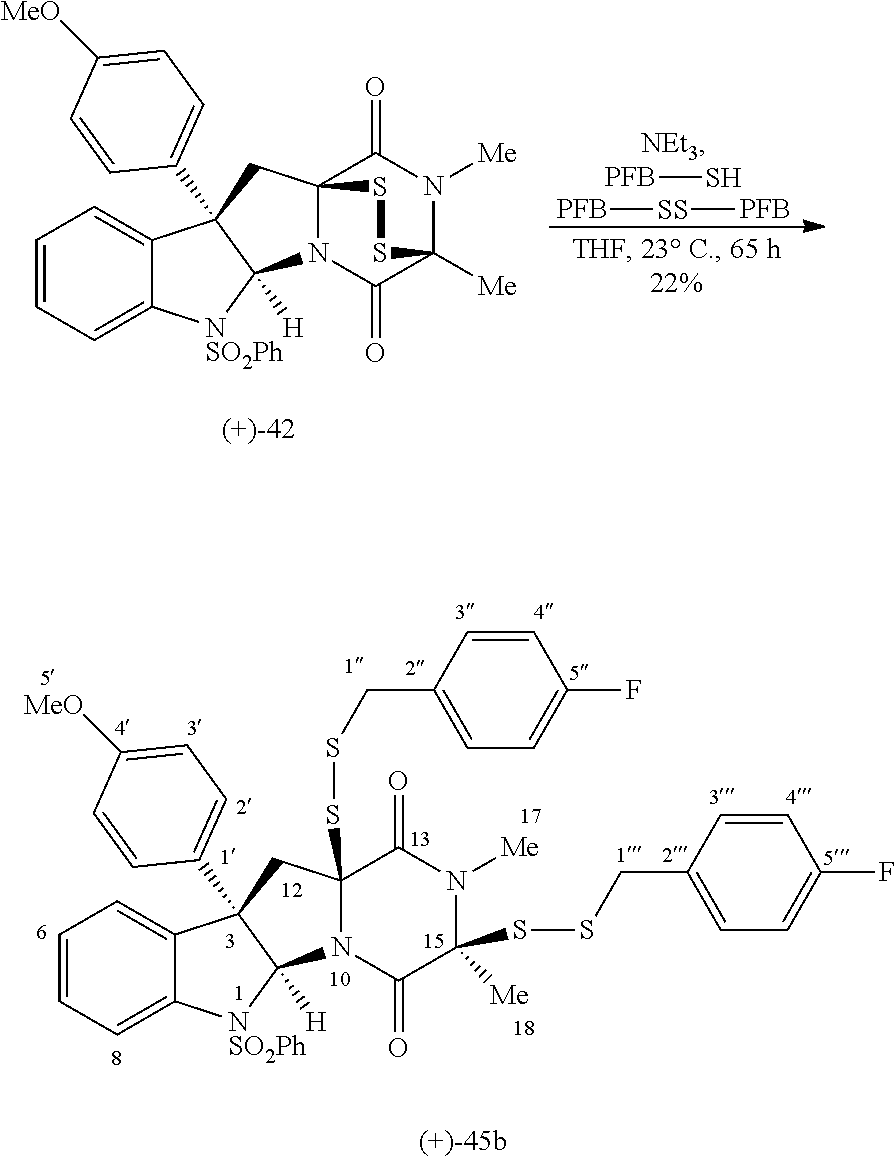


Alkyne (+)-54

Alcohol (+)-55

Heterodimeric Diketopiperazine Alcohol (+)-56

Heterodimeric Diketopiperazine Azide (+)-57

Heterodimeric Diaxasilane (+)-59:

Alternative Synthesis of

Epithiodiketopiperazine Triazole (+)-61

Epithiodiketopiperazine Ammonium Salt (+)-62

Equilibration of Epidisulfide (+)-42 and Bisdisulfide (+)-45b
- 1. U. Anthoni, C. Christophersen and P. H. Nielsen, in Alkaloids: Chemical and Biological Perspectives, ed. S. W. Pelletier, Pergamon Press, London, 1999, vol. 13, ch. 2, pp. 163-236; T. Hino and M. Nakagawa, in The Alkaloids: Chemistry and Pharmacology, ed. A. Brossi, Academic Press, New York, 1989, vol. 34, ch. 1, pp. 1-75.
- 2. (a) Gardiner, D. M.; Waring P.; Hewlett, B. J. Microbiology, 2005, 151, 1021. (b) Patron, N. J.; Waller, R. F., Cozijnsen, A. J., Straney, D. C., Gardiner, D. M.; Nierman W. C., Hewlett, B. J. BMC Evol. Biol., 2007, 7,174. (c) Steven, A.; Overman, L. E. Angew. Chem., Int. Ed. 2007, 46, 5488. (d) Huang, R.; Zhou, X; Xu, T.; Yang, X; Liu, Y. Chem. Biodiversity, 2010, 7, 2809. (e) Iwasa, E.; Hamashima Y., Sodeoka, M. Isr. J. Chem., 2011, 51,420. (f) Kim, J.; Movassaghi, M. Acc. Chem. Res. 2015, 48, 1159. (g) Waring, P.; Beaver, J. Gen. Pharmacol, 1996, 27, 1311
- 3. (a) Vigushin, D. M.; Mirsaidi, N.; Brooke, G.; Sun, C.; Pace, P.; Inman, L.; Moody, C. J.; Coombes, R. C. Med. Oncol. 2004, 21, 21. (b) Greiner, D.; Bonaldi, T.; Eskeland, R.; Roemer, E., Imhof, A. Nat. Chem. Biol. 2005, 1, 143. (c) Yanagihara, M.; Sasaki-Takahashi, N.; Sugahara, T.; Yamamoto, S.; Shinomi, M.; Yamashita, I.; Hayashida, M.; Yamanoha, B.; Numata, A.; Yamori, T.; Andoh, T. Cancer Sci. 2005, 96, 816. (d) Zheng, C. J., Kim, C. J.; Bae, K. S.; Kim, Y H.; Kim, W. G. J. Nat. Prod. 2006, 69, 1816. (e) Isham, C R.; Tibodeau, J. D.; Jin, W.; Xu, R.; Timm, M. M.; Bible, K. C. Blood 2007,109, 2579. (f) Cherrier, T.; Suzanne, S.; Redel, L.; Calao, M.; Marban, C.; Samah, B.; Mukeijee, R.; Schwartz, C., Gras, G.; Sawaya, B. E.; Zeichner, S. L.; Aunis, D.; Van Lint, C.; Rohr, O. Oncogene 2009, 28, 3380. (g) Chen, Y; Guo, H.; Du, Z; Liu, X Z, Che, Y.; Ye, X.
Cell Proliferation 2009, 42, 838. (h) Cook, K. M.; Hilton, S. T.; Mecinovic, J.; Motherwell, W. B.; Figg, W. D.; Schofield, C. J. J. Bio. Chem. 2009, 39, 26831. (i) Isham, C. R.; Tibodeau, J. D.; Jin, W.; Timm, M. M.; Bible, K. C. Blood 2010, 109, 2579. (j) Jiana, C. S.; Guo, Y. W. Mini-Rev. Med. Chem. 2011, 9, 728 (k) Liu, F.; Liu, Q.; Yang, D.; Bollag, W B.; Roberston, K.; Wu, P.; Liu, L. Cancer. Res. 2011, 71, 6807 (l) Yano, K., Horinaka, M.; Yoshida, T.; Yasuda, T., Taniguchi, H.; Goda, A. E.; Wakada, M.; Yoshikawa, S.; Nakamura, T.; Kawauchi, A.; Miki, T.; Sakai, T. Int. J. Oncol. 2011, 38, 365. (m) Chaib, H., Nebbioso, A.; Prebet, T.; Castellano, R.; Gaibit, S.; Restouin, A.; Vey, N.; Altucci, L.; Collette, Y. Leukemia 2012, 26, 662. (n) Isham, C. R., Tibodeau, J. D.; Bossou, A. R., Merchan, J. R.; Bible, K. C. Br. J. Cancer 2012, 106, 314. (o) Takahashi, M.; Takemoto, Y.; Shimazu, T.; Kawasaki, H.; Tachibana, M.; Shinkai, Y.; Takagi, M.; Shin-ya, K.; Igarashi, Y.; Ito, A.; Yoshida, M. J. Antibiot. 2012, 65, 263. (p) Boyer, N.; Morrison K. C.; Kim, J.; Hergenrother, P. J.; Movassaghi M. Chem. Sci. 2013, 4, 1646. (q) Baumann, M.; Dieskau, A. P.; Loertscher, B. M.; Walton, M. C.; Nam, S.; Xie, J.; Home, D.; Overman, L. E. J. Chem. Sci. 2015, 6, 4451. - 4. For representative syntheses of epipolythiodiketopiperazines, see: (a) Trown, P. W. Biochem. Biophys. Res. Commun. 1968, 33, 402. (b) Hino, T.; Sato, T. Tetrahedron Lett. 1971, 12, 3127. (c) Poisel, H.; Schmidt, U. Chem. Ber. 1971, 104, 1714. (d) Ohler, E.; Tataruch, F.; Schmidt, U. Chem. Ber. 1973, 106, 396. (e) Ottenheijm, H. C. J., Herscheid, J. D. M.; Kerkhoff, G. P. C; Spande, T. F. J. Org. Chem. 1976, 41, 3433. (f) Coffen, D. L.; Katonak, D. A.; Nelson, N. R., Sancilio, F. D. J. Org. Chem. 1977, 42, 948. (g) Herscheid, J. D. M.; Nivard, R. J. F.; Tijhuis, M. W.; Scholten, H. P. H.; Ottenheijm, H. C. J. J. Org. Chem. 1980, 45, 1885. (h) Williams, R. M.; Rastetter, W. H. J. Org. Chem. 1980, 45, 2625. (i) Aliev, A. E.; Hilton, S. T.; Motherwell, W. B.; Selwood, D. L. Tetrahedron Lett. 2006, 47, 2387. (j) Overman, L. E.; Sato, T. Org. Lett. 2007, 9, 5267. (k) Polaske, N. W.; Dubey, R.; Nichol, G. S.; Olenyuk, B. Tetrahedron:
Asymmetry 2009, 20, 2742. (1) Ruff, B. M., Zhong, S.; Nieger, M.; Brase, S. Org. Biomol. Chem. 2012, 10, 935. (m) Nicolaou, K. C.; Giguere, D.; Totokotsopoulos, S.; Sun, Y.-P. Angew. Chem., Int. Ed. 2012, 51, 728. (n) Codelli, J. A.; Puchlopek, A. L.; Reisman, S. E. J. Am. Chem. Soc. 2012,134, 1930. (o) Takeuchi, R., Shimokawa, J.; Fukuyama, T. Chem. Sci. 2014, 5, 2003. - 5. For representative syntheses of epipolythiodiketopiperazines from our laboratory, see: (a) Kim, J.; Ashenhurst, J. A.; Movassaghi, M. Science 2009, 324, 238. (b) Kim, J.; Movassaghi, M. J. Am. Chem. Soc. 2010, 132, 14376 (c) Boyer, N.; Movassaghi, M. Chem. Sci., 2012, 3, 1798. (d) Coste, A.; Kim, J.; Adams, T. C.; Movassaghi, M. Chem. Sci. 2013, 4, 3191. (e) Adams, T. C.; Payette, J. N.; Cheah, J. H.; Movassaghi, M. Org. Lett. 2015, 17, 4268.
- 6. (a) Hein, J E., Fokin, V V. Chem. Soc. Rev. 2010, 39, 1302. (b) Berg, R, Straub, B. F. Beilstein J. Org. Chem. 2013, 9, 2715.
- 7. Smith I.; Collins, I. Future Med. Chem. 2015, 7, 159.
- 8. Ghosh, B.; Jones, L. H. Med. Chem. Commun. 2014, 5, 247.
- 9. Larson, N.; Ghandehari, H. Chem. Mater. 2012, 24, 840.
- 10. (a) Flygare, J. A.; Pillow, T. H.; Aristoff, P. Chem. Biol. Drug Des. 2013, 81, 113. (b) Chari, R. V J.; Miller, M. L.; Widdison, W C Angew. Chem. Int. Ed. 2014, 53, 3796.
- 11. Still, W. C; Kahn, M.; Mitra, A. J. Org. Chem. 1978, 43, 2923.
- 12. Murdock, K C. J. Med. Chem. 1974, 77(8), 827.
- 13. Pangbom, A. B.; Giardello, M. A.; Grubbs, R. H.; Rosen, R. K; Timmers,
F. Organometallics 1996, 15, 1518. - 14. Fulmer, G. R.; Miller, A. J. M.; Sherden, N. H.; Gottlieb, H. E.; Nudelman, A.; Stoltz, B. M.; Bercaw, J. E.; Goldberg, K. I. Organometallics 2010, 29, 2176.
- 15. a) Yates, P., MacLachlan, F. N.; Rae, I. D., Rosenberger, M., Szabo, A. G.; Willis, C. R.; Cava, M. P.; Behforouz, M.; Lakshmikantham, M. V.; Zeiger, W. J. Am. Chem. Soc. 1973, 95, 7842; b) Saxton, J. E. The Alkaloids, Chem. and Biol. 1998, 51, 1.
- 16. (a) Hein, J. E.; Fokin, V. V Chem. Soc. Rev. 2010, 39, 1302. (b) Beig, R.; Straub, B. F. Beilstein J. Org. Chem. 2013, 9, 2715.
- 17. Smith I.; Collins, I. Future Med. Chem. 2015, 7, 159.
- 18. Ghosh, B.; Jones, L. H. Med. Chem. Commun. 2014, 3, 247.
- 19. Larson, N.; Ghandehari, H. Chem. Mater. 2012, 24, 840.
- 20. (a) Flygare, J. A.; Pillow, T. H.; Aristoff, P. Chem. Biol. Drug Des. 2013, 81, 113. (b) Chari, R. V. J.; Miller, M. L.; Widdison, W. C Angew. Chem. Int. Ed. 2014, 53, 3796.
- 21. See the Examples section for details.
- 22. Lai, B.; Pramanik, B. N.; Manhas, M. S.; Bose, A. K. Tetrahedron Lett. 1977, 18, 1977.
- 23. Karaman, H.; Barton, R. J., Robertson, B. E., Lee, D. G. J. Org. Chem. 1984, 49, 4509.
- 24. For the preparation of bromide (+)-15 described in the Examples section.
- 25. Hulce, M, Chapdelaine, M. C. Nucleophilic Addition-Electrophilic Coupling with a Carbanion Intermediate. In Comprehensive Organic Synthesis, Trost, B. M.; Fleming, I., Eds.; Pergamon: London, 1991; Vol. 4, pp 273-268.
- 26. (a) Okada, K.; Murakami, K.; Tanino, H., Kakoi, H, Inoue, S. Heterocycles 1996, 43, 1735. (b) Fanning, K. N.; Sutherland, A. Tetrahedron Lett. 2007, 48, 8479.
- 27. Use of CH2Cl2 as solvent in the CuAAC reaction of ETP (+)-9b and 4-ethynylanisole X gave cycloadduct (+)-28b in 73% yield whereas use of toluene gave cycloadduct (+)-28b in 85% yield.
- 28. Shao, C.; Wang, X; Zhang, Q.; Luo, S.; Zhao, J.; Hu, Y J. Org. Chem. 2011, 76,6832.
- 29. Firouzabadi, H., Sardarian, A., Naderi, M.; Vessal, B. Synth. Commun 1984, 40(23), 5001.
- 30. For a procedure using potassium trithiocarbonate, see references 3p and 5a.
- 31. Chou, T.-H, Hsu, Y.-L., Lo, L.-C. J. Chinese Chem. Soc. 2014, 61 (6), 707.
- 32. Christophersen, C., Holm, A. Acta Chim. Scandinavia, 1971, 25, 2015.
- 33. (a) Bernardo, P. H.; Chai, C. L. L.; Deeble, G. J.; Liu, X.-M.; Waring, P. Bioorg. & Med. Chem. Lett., 2001, 11, 483. (b) Bernardo, P. H.; Brasch, N., Chai, C. L. L., Waring, P; J. Biol. Chem. 2003, 278(47), 46549.
- 34. (a) Bertling, A.; Niemann, S.; Uekötter, A.; Fegeler, W., Lass-Flörl, C.; von EifF, C.; Kehrel, B. E. Thromb. Haemost., 2010, 104, 270. (b) Block, K. M.; Wang, H.; Szabo, L. Z.; Polaske, N. W.; Henchey, L. K.; Dubey, R., Kushal, S., László, C. F., Makhoul, J., Song, Z.; Meuillet, E. J.; Olenyuk, B. Z. J. Am. Chem. Soc., 2009, 131, 18078; (c) Kushal, S.; Wang, H.; Laszlo, C. F.; Szabo, L. Z.; Olenyuk, B. Z. Biopolymers, 2011, 95, 8. (d) Srinivasan, U.; Bala, A.; Jao, S.-C.; Starke, D. W., Jordan, T. W., Mieyal, J. J. Biochemistry, 2006, 45 (29), 8978. (e) Chai, C. L. L.; Waring, P. Redox Rep., 2000, 5, 257.
- 35. The sensitivity to concentration in the presence of base was confirmed by removing polymer-bound base from the reaction mixture by filtration prior to concentration. The reactivity upon exposure to silica is due to the presence of unidentified reactive intermediates. For example, when epidisulfide (+)-8 was exposed to PFB-SH (0.5 equiv) in CDCl3 [0.02 M], after 18 h we observed only 48% remaining epidisulfide (+)-8 and 21% of an unknown intermediate by in situ 1H NMR spectroscopy. However, upon exposure we observed the appearance of 29% epitrisulfide 31.
- 36. See the Examples section for further details.
- 37. Hart, T. W. Tet. Lett. 1985, 26 (16), 2013.
- 38. (a) Jonas, C. R.; Ziegler, T. R.; Gu, L. H.; Jones, D. P. Free Radical Bio. & Med. 2002, 33 (11), 1499. (b) Ramirez, A., Ramadan, B.; Ritzenthaler, J. D.; Rivera, H. N.; Jones, D. P; Roman, J. Am. J. Physiol. Lung Cell Mol. Physiol. 2007, 293, 972. (c) Rubartelli A.; Lotze, M. T. TRENDS in Immunology, 2007, 28(10), 429-436. (d) Chaiswing, L.; Zhong, W., Cullen, J. J.; Oberley, L. W.; Oberley, T. D. Cancer Research, 2008, 68 (14), 5820.
- 39. (a) Movassaghi, M.; Schmidt, M. A., Angew. Chem. Int. Ed. 2007, 46, 3725. (b) Movassaghi, M.; Schmidt, M. A.; Ashenhurst, J. A.; Angew. Chem. Int. Ed. 2008, 47,1485.
- 40. Muthyala, M. K.; Choudary, S.; Pandey, K.; Shelke, G. M.; Jha, M.; Kumar, A. Eur. J. Org. Chem. 2014, 2365.
- 41. Boyer, N.; Movassaghi, M. Chem. Sci. 2012, 3, 1798.
- 42. Karaman, H.; Barton, R. J., Robertson, B. E., Lee, D. G. J. Org. Chem. 1984, 49,4509.
- 43. Prepared from potassium iodide (200 mg, 1.20 mmol) and iodine (305 mg, 1.20 mmol) in pyridine (5 mL).
- 44. The relative stereochemistry of the epidisulfide (+)-9a was confirmed by key NOESY cross-peaks on the corresponding bis(methylthioether). Our assignment is supported by key NOESY signals (1H, 1H) in ppm: (3.12, 7.10-7.04), (3.12, 1.88), (2.97, 6.88). This derivative was prepared in one step using our chemistry developed to access (+)-gliocladin B (Boyer, N.; Movassaghi M. Chem Sci. 2012, 3, 1798). The corresponding bis(methylthioether) of epidisulfide (+)-9a was characterized as follows. 1H NMR (400 MHz, CDCl3, 25° C.): δ 7.86 (d, J=8.4 Hz, 2H, SO2Ph-o-H), 7.51 (d, J=8.1 Hz, 1H, C8H), 7.47 (t, J=7.5 Hz, 1H, SO2Ph-p-H), 7.35 (t, J=8.1 Hz, 2H, SO2Ph-m-H), 7.27 (ddd, J=2.4, 6.4, 8.6 Hz, 1H, C7H), 7.10-7.04 (m, 2H, C5H, C6H), 6.88 (d, J=8.8 Hz, 2H, C2′H), 6.67 (d, J=8.8 Hz, 2H, C3′H), 6.63 (s, 1H, C2H), 4.46 (s, 1H, C15H), 3.96 (t, J=6.0 Hz, 2H, C5′H), 3.47 (t, J=6.6 Hz, 2H, C7′H), 3.12 (d, J=14.3 Hz, 1H, C12Ha), 3.03 (s, 3H, C17H), 2.97 (d, J=14.3 Hz, 1H, C12Hb), 2.17 (s, 3H, C15SCH3), 2.00 (p, J=6.2 Hz, 2H, C6′H), 1.88 (s, 3H, C11SCH3). 13C NMR (100 MHz, CDCl3, 25° C.): δ 165.1 (C13), 162.3 (C16), 158.0 (C4′), 142.4 (C9), 140.2 (SO2Ph-ipso-C), 136.7 (C4), 134.6 (C1′), 132.9 (SO2Ph-p-C), 129.1 (C7), 129.1 (SO2Ph-m-C), 127.1 (C2′), 127.0 (SO2Ph-o-C), 124.9 (C6), 123.8 (C5), 117.0 (C8), 115.0 (C3′), 85.7 (C2), 69.8 (C2′), 67.6 (C15), 64.7 (C5′), 57.0 (C3), 48.3 (C7′), 45.7 (C12), 32.5 (C17), 28.9 (C6′), 17.1 (C15SCH3), 15.5 (C11SCH3). HRMS (ESI) (m/z): calc'd for C31H32N6NaO5S3 [M+Na]+: 687.1489, found 687.1501.
- 45. Movassaghi, M.; Schmidt M. A.; Ashenhurst, J. A.; Angew. Chemie. Int. Ed. 2008, 47 (18), 1485-1487.
- 46. An analytical sample of amide (−)-S5 was obtained by flash column chromatography on silica gel (eluent. 50% ethyl acetate in hexanes). The amide (−)-S5 was characterized as follows: 1H NMR (400 MHz, CDCl3, 25° C.): δ 7.93 (d, J=8.3 Hz, 1H, C8H), 7.82 (d, J=7.6 Hz, 2H, SO2Ph-o-H), 7.52-7.46 (m, 2H, C5H, SO2Ph-p-H), 7.44 (s, 1H, C2H), 7.38 (t, J=7.9 Hz, 2H, SO2Ph-m-H), 7.27 (t, J=7.6 Hz, 1H, C7H), 7.19 (J=7.6 Hz, 1H, C6H), 6.62 (br-s, 1H, NH), 5.20 (d, J=8.2 Hz, 1H, NHCO2C(CH3)3), 4.47 (br-s, 1H, C11H), 3.97-3.84 (m, 2H, C15H), 3.67 (s, 3H, OCH3), 3.21-3.04 (m, 2H, C12H), 1.36 (s, 9H, OCCH3)13C NMR (100 MHz, CDCl3, 25° C.): δ 171.6 (C13), 170.0 (C16), 155.6 (NHCO2C(CH3)3), 138.3 (SO2Ph-ipso-C), 135.3 (C9), 133.9 (SO2Ph-p-C), 130.9 (C4), 129.4 (SO2Ph-m-C), 126.9 (SO2Ph-o-C), 125.1 (C2), 124.7 (C7), 123.5 (C6), 119.7 (C5), 118.0 (C3), 113.8 (C8), 80.6 (OC(CH3)3), 54.3 (C11), 52.5 (OCH3), 41.3 (C15), 28.4 (OC(CH3)3), 28.0 (C12). FTIR (thin film) cm−1: 3309 (m), 2977 (w), 1748 (m), 1662 (s), 1520 (s), 1447 (m), 1365 (s), 1278 (s), 746 (m). HRMS (ESI) (m/z): calc'd for C25H29N3NaO7S [M+Na]+. 538.1618, found 538.1624. [α]D 23: −5.0 (c=0.20, CHCl3). TLC (100% ethyl acetate), IV: 0.74 (UV, CAM).
- 47. Kern, N.; Blanc, A.; Weibel, J.-M.; Pale, P. Chem Commun., 2011, 47, 6665.
- 48. The relative stereochemistry of the epidisulfide (+)-9b was confirmed by key NOESY cross-peaks on the corresponding bis(methylthioether). Our assignment is supported by key NOESY signals (1H, 1H) in ppm: (3.12, 7.09-7.04), (3.12, 1.88), (2.96, 6.88). This derivatized compound was prepared in one step using our methodology developed to access (+)-gliocladin B (Boyer, N.; Movassaghi M. Chem Sci. 2012, 3, 1798). The corresponding bis(methy 1 thioether) of epidisulfide (+)-9b was characterized as follows: 1H NMR (400 MHz, CDCl3, 25° C.): δ 7.86 (d, J=8.0 Hz, 2H, SO2Ph-o-H), 7.52 (d, J=8.2 Hz, 1H, C8H), 7.47 (t, J=7.4 Hz, 1H, SO2Ph-p-H,) 7.35 (t, J=8.0 Hz, 2H, SO2Ph-m-H), 7.27 (ddd, J=2.2, 6.5, 8.6 Hz, 1H, C7H), 7.09-7.04 (m, 2H, C5H, C6H), 6.88 (d, J=8.8 Hz, 2H, C2H), 6.68 (d, J=8.9 Hz, 2H, C5′H), 6.63 (s, 1H, C2H), 4.49 (s, 1H, C15H), 3.73 (s, 3H, C5′H), 3.66-3.58 (m, 1H, C17Ha), 3.34-3.28 (m, 1H, C17Hb), 3.30 (t, J=6.7 Hz, 2H, C20H), 3.12 (d, J=14.3 Hz, 1H, C12Ha), 2.96 (J=14.3 Hz, 1H, C12Hb), 2.16 (s, 3H, C15SCHs), 1.88 (s, 3H, CH11SCH3), 1.75-1.68 (m, 2H, C18H), 1.63-1.55 (m, 2H, C19H). 13C NMR (100 MHz, CDCl3, 25° C.): δ 165.3 (C13), 162.3 (C16), 158.9 (C4′), 142.2 (C9), 140.2 (SO2Ph-ipso-C), 136.8 (C4), 134.3 (C1′), 132.9 (SO2Ph-p-C), 129.2 (C7, SO2Ph-m-C), 127.0 (C2′, SO2Ph-o-C), 124.9 (C6), 123.8 (C5), 117.0 (C8), 114.5 (C3′), 85.7 (C2), 69.8 (C11), 65.7 (C15), 57.0 (C3), 55.5 (C5′), 51.1 (C20), 45.7 (C12), 44.9 (C17), 26.3 (C19), 24.9 (C18), 17.1 (C15SCH3), 15.4 (C11SCH3). HRMS (ESI) (m/z): calc'd for C32H34N6NaO5S3 [M+Na]+: 701.1645, found 701.1649.
- 49. Maury, J., Feray, L.; Bertrand, M. P.; Kapat, A.; Renaud, P. Tetrahedron, 2012, 68, 9606.
- 50. To remove residual acetic acid, pooled fractions containing vV-sulfonylated tryptophan (−)-22 were concentrated under reduced pressure to approximately 10% of the volume, then diluted with benzene (100 mL) and concentrated. This process was repeated two more times.
- 51. The relative stereochemistry of epidisulfide (+)-9c has been confirmed by key NOESY cross-peaks on the corresponding bis(methylthioether). Our assignment is supported by key NOESY signals 1H, 1H) in ppm: (3.09-3.04, 7.10-7.06), (3.09-3.04, 1.86), (2.93, 6.82), (2.93, 6.55). This derivatized compound was prepared in one step using our methodology developed to access (+)-gliocladin B (Boyer, N.; Movassaghi M. Chem Sci. 2012, 3, 1798). The corresponding bis(methylthioether) of epidisulfide (+)-9c was characterized as follows: 1H NMR (400 MHz, CDCl3, 25° C.): δ 7.67 (d, J=8.8 Hz, 2H, C2′H), 7.56 (d, J=8.1 Hz, 1H, C8H), 7.29 (ddd, J=3.0, 5.8, 8.4, 1H, C7H), 7.10-7.06 (m, 2H, C6H, C5H), 6.82 (d, J=8.8 Hz, 2H, C2′H), 6.70 (d, J=8.9 Hz, 2H, C3′H), 6.65 (d, J=8.8 Hz, 2H, C3′H), 6.55 (s, 1H, C2H), 4.51 (s, 1H, C15H), 4.00 (t, J=5.9 Hz, 2H, C5″H), 3.73 (s, 3H, C5′H), 3.49 (t, J=6.5 Hz, 2H, C7′H), 3.09-3.04 (m, 4H, C15Ha, C17H) 2.93 (d, J=15.5 Hz, 1H, C12Hb), 2.27 (s, 3H, C15SCH3), 2.03 (p, J=6.2 Hz, 2H, C6″H) 1.86 (s, 3H, C11SCH3). 13C NMR (100 MHz, CDCl3, 25° C.): δ 165.2 (C13), 162.3 (C4″H or C16), 162.3 (C4″H or C16), 158.7 (C4′), 142.6 (C9), 136.6 (C4), 134.2 (C1′), 129.4 (C1′H), 129.4 (C2″H), 129.1 (C7), 127.2 (C2′), 125.0 (C6), 124.1 (C5), 117.6 (C8), 114.5 (C3′ or C3″), 114.3 (C3′ or C3″), 86.2 (C2), 69.9 (C11), 67.8 (C15), 65.0 (C5″H), 57.1 (C3), 55.5 (C5′), 48.2 (C7″H), 46.4 (C12), 32.5 (C17), 28.7 (C6″H), 17.2 (C15SCH3), 15.5 (C11SCH3). HRMS (ESI) (m/z): calc'd for C32H34N6NaO6S3 [M+Na]+: 717.1594, found 717.1588.
- 52. For the preparation of did S12 and the corresponding methodology, see Boyer, N.; Morrison, K. C.; Kim, J.; Hergenrother, P. J.; Movassaghi, M. Chem. Sci., 2013, 4, 1646.
- 53. The C11-hemithioaminal has been characterized by NMR. 1H NMR (500 MHz, CDCl3, 25° C.): δ 7.75 (d, J=8.1 Hz, 1H, C8H), 7.47 (d, J=8.0 Hz, 2H, SO2Ph-o-H), 7.42 (t, J=8.3, C7H), 7.35 (t, J=7.4 Hz, SO2Ph-p-H), 7.29-7.22 (m, 2H, C5H, C6H), 7.11 (t, J=7.8 Hz, 2H, SO2Ph-m-H), 6.69 (d, J=8.6 Hz, 2H, C2′H), 6.60 (d, J=8.4 Hz, 2H, C3′H), 6.44 (s, 1H, C2H), 5.33 (d, J=4.7 Hz, 1H, C15H), 4.64 (d, J=4.8 Hz, C15OH), 3.76 (s, 3H, C5′H), 3.39 (d, J=14.6 Hz, 1H, C12Ha), 3.11 (d, J=14.7 Hz, 1H, C12Hb), 3.08 (s, 3H, C17H), 2.45 (s, 1H, C11SH). 13C NMR (125 MHz, CDCl3, 25° C.): δ 166.0 (C13), 165.3 (C16), 158.7 (C4′), 141.6 (C9), 137.9 (SO2Ph-ipso-C), 135.3 (C4), 133.2 (SO2Ph-p-C), 132.0 (C1′), 129.7 (C7), 128.7 (SO2Ph-m-C), 127.6 (C2′), 127.3 (SO2Ph-o-C), 126.2 (C5), 126.1 (C6), 118.5 (C8), 114.4 (C3′), 86.8 (C2), 76.9 (C15), 69.3 (C11), 57.6 (C3), 55.4 (C5′), 53.45 (C12), 29.0 (C17). TLC (25% acetone in dichloromethane), Rf: 0.23 (UV, CAM, AgNO3).
- 54. The C11-triphenylmethanetrisulfide S13 has been characterized by NMR: 1H NMR (500 MHz, CDCl3, 25° C.): δ 7.59 (d, J=8.1 Hz, 1H, C8H), 7.48 (d, J=7.4 Hz, 2R SO2Ph-o-H), 7.35 (t, J=7.5 Hz, 1H, SO2Ph-p-H), 7.30-7.22 (m, 9H, Ph-m-H, Ph-p-H), 7.18-7.13 (m, 6H, Ph-o-H), 7.11 (t, J=7.9 Hz, 2H, SO2Ph-m-H), 7.05 (d, J=7.0 Hz, 1H, C5H), 6.98 (t, J=7.4 Hz, 1H, C6H), 6.62 (d, J=8.9 Hz, 2H, C2′H), 6.56 (d, J=8.9 Hz, 2H, C3′H), 6.44 (s, 1H, C2H), 5.36 (d, J=4.0 Hz, 1H, C15H), 4.23 (d, J=4.0 Hz, 1H, C15OH), 3.75 (s, 3H, C5′H), 3.21 (d, J=15.1 Hz, 1H, C12Ha), 3.11 (d, J=15.1 Hz, 1H, C12Hb), 3.02 (s, 3H, C17H). 13C NMR (100 MHz, CDCl3, 25° C.): δ 165.7 (C16), 163.7 (C13), 158.7 (C4′), 143.0 (C(Ph-ipso-C)3), 141.5 (C9), 138.1 (SO2Ph-ipso-C), 135.4 (C4), 133.2 (SO2Ph-p-C), 132.6 (C1′), 130.3 (C(Ph-m-C)3), 129.5 (C7), 128.8 (SO2Ph-m-C), 128.1 (C(Ph-o-C)3), 127.5 (C2′), 127.5 (C(Ph-p-C)3), 127.3 (SO2Ph-o-C), 125.9 (C5), 125.9 (C6), 118.1 (C8), 114.4 (C3′), 87.0 (C2), 77.0 (C15), 75.9 (C11), 73.6 (C(Ph)3), 57.5 (C3), 55.5 (C5′), 49.2 (C12), 29.6 (C17). TLC (10% acetone in dichloromethane), RF: 0.38 (UV, CAM, AgNCb, Ellman's Reagent).
- 55. Kim, J.; Ashenhurst, J. A.; Movassaghi, M. Science, 2009, 324, 238-241.
- 56. Firouzabadi, H.; Naderi, M., Sardarian, A.; Vessal, B. Synth. Commun. 1983,13, 611.
- 57. The relative stereochemistry of epidisulfide (+)-42 was confirmed by key NOESY cross-peaks on the corresponding bis(methylthioether). Our assignment is supported by key NOESY signals (1H, 1H) in ppm: (2.07, 3.18), (3.18, 7.11-7.03), (2.95, 6.70), (2.95, 6.76). This derivatized compound was prepared in one step using our methodology developed to access (+)-gliocladin B (Boyer, N., Movassaghi M. Chem Sci. 2012, 3, 1798). The corresponding bis(methylthioether) of epidisulfide (+)-42 was characterized as follows: 1H NMR (400 MHz, CDCl3, 25° C.): δ 7.94 (d, J=7.3 Hz, 2H, SO2Ph-o-H), 7.61 (d, J=8.2 Hz, 1H, C8H), 7.52 (t, J=7.5 Hz, 1H, SO2Ph-p-H), 740 (t, J=7.8 Hz, 2H, SO2Ph-m-H), 7.33-7.25 (m, 2H, C7H), 7.11-7.03 (m, 2H, C5H, C6H), 6.76 (d, J=8.9 Hz, 2H, C2′H), 6.70 (s, 1H, C2H), 6.65 (d, J=8.9 Hz, 2H, C3′H), 3.74 (s, 2H, C5′H), 3.18 (d, J=14.1 Hz, 1H, C12Ha), 3.07 (s, 3H, C17H), 2.95 (d, J=14.2 Hz, 1H, C12Hb), 2.07 (s, 3H, C11SCH3), 1.91 (s, 3H, C15SCH3), 1.84 (s, 3H, C18H). 13C NMR (100 MHz, CDCl3): δ 165.7 (C13), 163.3 (C16), 158.7 (C4′), 142.6 (C9), 139.7 (SO2Ph-ipso-C), 136.7 (C4), 134.8 (C1′), 133.0 (SO2Ph-p-C), 129.2 (SO2Ph-m-C), 129.0 (C7), 127.1 (SO2Ph-o-C), 126.9 (C2′), 124.7 (C5/6), 123.8 (C5/6), 116.7 (C8), 114.4 (C3′), 86.1 (C2), 70.0 (C11), 67.4 (C15), 56.7 (C3), 55.4 (C5′), 46.2 (C12), 29.3 (C17), 23.7 (C18), 15.8 (C15SCH3), 14.4 (C11SCH3). HRMS (ESI) (m/z): calc'd for C30H31N3NaO5S3 [M+Na]+: 632.1318, found 632.1315.
- 58. As measured by crude 1H NMR (CDCl3) analysis, the ratio of tetrasulfide 44:trisulfide 43:disulfide (+)-42 epithiodiketopiperazines was 1:2:12 before chromatography.
- 59. Hart, T. Tetrahedron Lett. 1985, 26, 2013-2016.
- 60. When pure D2O was used, signal broadening was observed.
- 61. Diol 49 has been characterized by 1H NMR (500 MHz, CDCl3, 25° C.): δ 7.62 (d, J=8.1 Hz, 1H, C8H), 7.36-7.27 (m, 4H), 7.22-7.14 (m, 2H), 7.02 (t, J=7.8 Hz, 2H, SO2Ph-m-H), 6.78 (app-d, J=8.8 Hz, 2H, C2′H), 6.55 (app-d, J=8.9 Hz, 2H, C3H), 6.35 (s, 1H, C2H), 5.65-5.40 (br-s, OH), 3.99 (t, J=5.9 Hz, 2H, C5′H), 3.54 (t, J=6.5 Hz, 2H, C7′H), 3.37 (d, J=15.1 Hz, 1H, C15Ha), 3.00 (s, 3H, C17H), 2.92 (d, J=15.2 Hz, 1R C12Hb), 2.10-2.01 (m, 2H, C6H), 1.82 (s, 3H, C15H). TLC (20% acetone in dichloromethane), Rf: 0.34 (UV, CAM).
- 62. O-TBS protected monoalcohols S22 and S23 have been characterized by 1H NMR (500 MHz, CDCl3, 25° C., 1.1:1 mixture of regioisomers): δ 7.63-7.57 (m), 7.34-7.29 (m), 7.31-7.24 (m), 7.22-7.13 (m), 7.05-6.96 (m), 6.77-6.69 (m), 6.57 (t, J=9.2 Hz), 6.42 (s), 6.30 (s), 4.01 (t, d, J=5.9, 2.4 Hz), 3.85 (s), 3.57-3.52 (m), 3.51 (s), 3.37 (dd, J=15.2, 1.5 Hz), 2.97 (s), 2.93 (s), 2.85 (d, J=14.6 Hz), 2.78 (d, J=15.1 Hz), 2.06 (p, J=6.1 Hz), 1.83 (s), 1.65 (s), 0.97 (s), 0.92 (s, 3H), 0.33 (s), 0.32 (s), 0.24 (s), 0.23 (s). TLC (40% acetone in hexanes), Rf: 0.51 and 0.58 (UV, CAM).
- 63. The relative stereochemistry of the epidithiodiketopiperazine (+)-9d was confirmed by key NOE correlations on the corresponding bis(methylthioether). Our assignment is supported by key NOE signals (1H, 1H) in ppm: (7.34, 3.29), (3.29, 1.88), (6.94, 3.03). This derivatized compound was prepared in one step using our methodology developed to access (+)-gliocladin B (Boyer, N.; Movassaghi M. Chem Sci. 2012, 3, 1798). The corresponding bis(methylthioether) of epidithiodiketopiperazine (+)-9d was characterized as follows. 1H NMR (500 MHz, acetone-d6) δ 8.00 (d, J=7.3 Hz, 2H, SO2Ph-o-H), 7.69 (t, J=7.5 Hz, 1H, SO2Ph-p-H), 7.56 (t, J=7.9 Hz, 2H, SO2Ph-m-H), 7.52 (d, J=8.1 Hz, 1H, C8H), 7.34 (d, J=7.6 Hz, 1H, C5H), 7.30 (t, J=7.8 Hz, 1H, C7H), 7.10 (t, J=7.9 Hz, 1H, C6H), 6.94 (d, J=8.8 Hz, 2H, C2′H), 6.77 (d, J=8.8 Hz, 2H, C3′H), 6.75 (s, 1H, C2H), 4.05 (t, J=6.0 Hz, 2H, C5′H), 3.54 (t, J=6.7 Hz, 2H, C7′H), 3.29 (d, J=14.1 Hz, 1H, C12Hβ), 3.03 (d, J=14.1 Hz, 1H, C12Hα), 2.99 (s, 3R C17H), 2.06-2.03 (m, 2H, C6′H), 2.02 (s, 3H, C18H), 1.88 (s, 3a C11SCH3), 1.80 (s, 3H, C15SCH3).
- 64. Grimes, K. D.; Aldrich, C. C. Analytical Biochemistry, 2011, 417 (2), 264-273.
Claims (64)


RH2-L3-D (III),


Priority Applications (3)
| Application Number | Priority Date | Filing Date | Title |
|---|---|---|---|
| US16/839,064 US11535634B2 (en) | 2019-06-05 | 2020-04-02 | Compounds, conjugates, and compositions of epipolythiodiketopiperazines and polythiodiketopiperazines and uses thereof |
| US18/146,294 US12180228B2 (en) | 2019-06-05 | 2022-12-23 | Compounds, conjugates, and compositions of epipolythiodiketopiperazines and polythiodiketopiperazines and uses thereof |
| US18/939,230 US20250084103A1 (en) | 2019-06-05 | 2024-11-06 | Compounds, conjugates, and compositions of epipolythiodiketopiperazines and polythiodiketopiperazines and uses thereof |
Applications Claiming Priority (2)
| Application Number | Priority Date | Filing Date | Title |
|---|---|---|---|
| US201962857716P | 2019-06-05 | 2019-06-05 | |
| US16/839,064 US11535634B2 (en) | 2019-06-05 | 2020-04-02 | Compounds, conjugates, and compositions of epipolythiodiketopiperazines and polythiodiketopiperazines and uses thereof |
Related Child Applications (1)
| Application Number | Title | Priority Date | Filing Date |
|---|---|---|---|
| US18/146,294 Division US12180228B2 (en) | 2019-06-05 | 2022-12-23 | Compounds, conjugates, and compositions of epipolythiodiketopiperazines and polythiodiketopiperazines and uses thereof |
Publications (2)
| Publication Number | Publication Date |
|---|---|
| US20200385407A1 US20200385407A1 (en) | 2020-12-10 |
| US11535634B2 true US11535634B2 (en) | 2022-12-27 |
Family
ID=70465466
Family Applications (3)
| Application Number | Title | Priority Date | Filing Date |
|---|---|---|---|
| US16/839,064 Active US11535634B2 (en) | 2019-06-05 | 2020-04-02 | Compounds, conjugates, and compositions of epipolythiodiketopiperazines and polythiodiketopiperazines and uses thereof |
| US18/146,294 Active 2040-04-02 US12180228B2 (en) | 2019-06-05 | 2022-12-23 | Compounds, conjugates, and compositions of epipolythiodiketopiperazines and polythiodiketopiperazines and uses thereof |
| US18/939,230 Pending US20250084103A1 (en) | 2019-06-05 | 2024-11-06 | Compounds, conjugates, and compositions of epipolythiodiketopiperazines and polythiodiketopiperazines and uses thereof |
Family Applications After (2)
| Application Number | Title | Priority Date | Filing Date |
|---|---|---|---|
| US18/146,294 Active 2040-04-02 US12180228B2 (en) | 2019-06-05 | 2022-12-23 | Compounds, conjugates, and compositions of epipolythiodiketopiperazines and polythiodiketopiperazines and uses thereof |
| US18/939,230 Pending US20250084103A1 (en) | 2019-06-05 | 2024-11-06 | Compounds, conjugates, and compositions of epipolythiodiketopiperazines and polythiodiketopiperazines and uses thereof |
Country Status (2)
| Country | Link |
|---|---|
| US (3) | US11535634B2 (en) |
| WO (1) | WO2020247054A1 (en) |
Cited By (2)
| Publication number | Priority date | Publication date | Assignee | Title |
|---|---|---|---|---|
| US12030888B2 (en) | 2021-02-24 | 2024-07-09 | Massachusetts Institute Of Technology | Himastatin derivatives, and processes of preparation thereof, and uses thereof |
| US12180228B2 (en) * | 2019-06-05 | 2024-12-31 | Massachusetts Institute Of Technology | Compounds, conjugates, and compositions of epipolythiodiketopiperazines and polythiodiketopiperazines and uses thereof |
Families Citing this family (2)
| Publication number | Priority date | Publication date | Assignee | Title |
|---|---|---|---|---|
| US11932650B2 (en) | 2017-05-11 | 2024-03-19 | Massachusetts Institute Of Technology | Potent agelastatin derivatives as modulators for cancer invasion and metastasis |
| CN115385916B (en) * | 2021-07-01 | 2023-08-15 | 江苏师范大学 | Chiral indoline pyrrole compound and synthesis method thereof |
Citations (237)
| Publication number | Priority date | Publication date | Assignee | Title |
|---|---|---|---|---|
| EP0217577A2 (en) | 1985-09-12 | 1987-04-08 | Hybritech Incorporated | Antibody complexes of hapten-modified diagnostic or therapeutic agents |
| US4816397A (en) | 1983-03-25 | 1989-03-28 | Celltech, Limited | Multichain polypeptides or proteins and processes for their production |
| US4816567A (en) | 1983-04-08 | 1989-03-28 | Genentech, Inc. | Recombinant immunoglobin preparations |
| US4906562A (en) | 1984-12-21 | 1990-03-06 | Oncogen | Monocolonal antibodies and antigen for human non-small cell lung carcinomas |
| US4935495A (en) | 1984-12-21 | 1990-06-19 | Oncogen | Monoclonal antibodies to the L6 glycolipid antigenic determinant found on human non-small cell lung carcinomas |
| US4940726A (en) | 1989-04-26 | 1990-07-10 | Arizona Board Of Regents | Cell growth inhibitory macrocyclic lactones denominated Combretastatin D-1 and Combretastatin D-2 |
| US4946778A (en) | 1987-09-21 | 1990-08-07 | Genex Corporation | Single polypeptide chain binding molecules |
| US4996237A (en) | 1987-01-06 | 1991-02-26 | Arizona Board Of Regents | Combretastatin A-4 |
| WO1992016486A1 (en) | 1991-03-22 | 1992-10-01 | Aston Molecules Limited | Substituted diphenylethylenes and analogues or derivatives thereof |
| US5225539A (en) | 1986-03-27 | 1993-07-06 | Medical Research Council | Recombinant altered antibodies and methods of making altered antibodies |
| US5242824A (en) | 1988-12-22 | 1993-09-07 | Oncogen | Monoclonal antibody to human carcinomas |
| WO1994014787A1 (en) | 1992-12-23 | 1994-07-07 | Bristol-Myers Squibb Company | Novel sidechain-bearing taxanes and intermediates thereof |
| US5338845A (en) | 1992-12-02 | 1994-08-16 | Sterling Winthrop Inc. | Aspergillus species, cyclic dimeric dipeptide derivative substance P antagonist biosynthetic products thereof, and process for preparation thereof |
| WO1995004535A1 (en) | 1993-08-06 | 1995-02-16 | The Children's Medical Center Corporation | Estrogenic compounds as anti-mitotic agents |
| US5409953A (en) | 1987-01-06 | 1995-04-25 | Arizona Board Of Regents Acting On Behalf Of Arizona State University | Isolation, structural elucidation and synthesis of novel antineoplastic substances denominated "combretastatins" |
| US5423753A (en) | 1993-06-30 | 1995-06-13 | Baxter International Inc. | Vial adapter |
| US5430062A (en) | 1992-05-21 | 1995-07-04 | Research Corporation Technologies, Inc. | Stilbene derivatives as anticancer agents |
| US5475092A (en) | 1992-03-25 | 1995-12-12 | Immunogen Inc. | Cell binding agent conjugates of analogues and derivatives of CC-1065 |
| US5525632A (en) | 1993-09-08 | 1996-06-11 | Ajinomoto Co., Ltd. | Stilbene derivatives and pharmaceutical compositions containing them |
| US5545806A (en) | 1990-08-29 | 1996-08-13 | Genpharm International, Inc. | Ransgenic non-human animals for producing heterologous antibodies |
| US5561122A (en) | 1994-12-22 | 1996-10-01 | Arizona Board Of Regents Acting On Behalf Of Arizona State University | Combretastatin A-4 prodrug |
| US5569825A (en) | 1990-08-29 | 1996-10-29 | Genpharm International | Transgenic non-human animals capable of producing heterologous antibodies of various isotypes |
| US5585089A (en) | 1988-12-28 | 1996-12-17 | Protein Design Labs, Inc. | Humanized immunoglobulins |
| US5625126A (en) | 1990-08-29 | 1997-04-29 | Genpharm International, Inc. | Transgenic non-human animals for producing heterologous antibodies |
| US5633425A (en) | 1990-08-29 | 1997-05-27 | Genpharm International, Inc. | Transgenic non-human animals capable of producing heterologous antibodies |
| US5646176A (en) | 1992-12-24 | 1997-07-08 | Bristol-Myers Squibb Company | Phosphonooxymethyl ethers of taxane derivatives |
| US5661016A (en) | 1990-08-29 | 1997-08-26 | Genpharm International Inc. | Transgenic non-human animals capable of producing heterologous antibodies of various isotypes |
| US5674906A (en) | 1995-03-07 | 1997-10-07 | Ajinomoto Co., Inc. | Stilbene compounds and pharmaceutical compositions containing them |
| US5731353A (en) | 1993-09-08 | 1998-03-24 | Ajinomoto Co., Inc. | Stilbene derivatives and pharmaceutical compositions containing them |
| WO1998039323A1 (en) | 1997-03-06 | 1998-09-11 | Baylor University | Anti-mitotic agents which inhibit tubulin polymerization |
| US5821337A (en) | 1991-06-14 | 1998-10-13 | Genentech, Inc. | Immunoglobulin variants |
| WO1999002514A2 (en) | 1997-07-08 | 1999-01-21 | Bristol-Myers Squibb Company | Epothilone derivatives |
| WO1999002166A1 (en) | 1997-07-08 | 1999-01-21 | Angiogene Pharmaceuticals Ltd. | Use of colchinol derivatives as vascular damaging agents |
| US5877158A (en) | 1993-09-22 | 1999-03-02 | Behringwerke Aktiengesellschaft | Pro-prodrugs, their production and use |
| WO1999035164A1 (en) | 1998-01-09 | 1999-07-15 | Arizona Board Of Regents, A Body Corporate, Acting On Behalf Of Arizona State University | Anti-cryptococcal peptides |
| WO1999035150A1 (en) | 1998-01-09 | 1999-07-15 | Arizona Board Of Regents, A Body Corporate, Acting On Behalf Of Arizona State University | Synthesis of combretastatin a-4 prodrugs and trans-isomers thereo f |
| WO1999034788A1 (en) | 1998-01-09 | 1999-07-15 | Arizona Board Of Regents, A Body Corporate, Acting On Behalf Of Arizona State University | Synthesis of phenstatin and prodrugs thereof |
| US5929211A (en) | 1992-08-05 | 1999-07-27 | Genentech, Inc. | Carbohydrate-directed cross-linking reagents |
| WO1999048495A1 (en) | 1998-03-25 | 1999-09-30 | Biosource Technologies, Inc. | Benzoates derivatives for inhibiting angiogenesis |
| WO1999051246A1 (en) | 1998-04-03 | 1999-10-14 | Ajinomoto Co., Inc. | Antitumor agents |
| WO1999051224A1 (en) | 1998-04-02 | 1999-10-14 | Asta Medica Aktiengesellschaft | Indolyl-3-glyoxylic acid derivatives with antitumoral activity |
| US5985837A (en) | 1998-07-08 | 1999-11-16 | Basf Aktiengesellschaft | Dolastatin 15 derivatives |
| WO2000000514A2 (en) | 1998-06-29 | 2000-01-06 | Parker Hughes Institute | Synthetic spiroketal pyranes as potent anti-cancer agents |
| WO2000006556A1 (en) | 1998-07-27 | 2000-02-10 | Abbott Laboratories | Substituted oxazolines as antiproliferative agents |
| US6054297A (en) | 1991-06-14 | 2000-04-25 | Genentech, Inc. | Humanized antibodies and methods for making them |
| WO2000026229A1 (en) | 1998-10-29 | 2000-05-11 | Teikoku Hormone Mfg. Co., Ltd. | 2-substituted-d-homooxasteroid derivatives |
| WO2000035865A2 (en) | 1998-12-17 | 2000-06-22 | Tularik Inc. | Tubulin-binding agents |
| WO2000040529A1 (en) | 1999-01-07 | 2000-07-13 | Angiogene Pharmaceuticals Ltd. | Colchinol derivatives as vascular damaging agents |
| WO2000041669A2 (en) | 1999-01-15 | 2000-07-20 | Angiogene Pharmaceuticals Ltd. | Benzimidazole vascular damaging agents |
| US6103236A (en) | 1995-05-10 | 2000-08-15 | Kyowa Hakko Kogyo Co., Ltd. | Toxin conjugates |
| WO2000048590A1 (en) | 1999-02-16 | 2000-08-24 | Angiogene Pharmaceuticals Ltd. | Substituted stilbene compounds with vascular damaging activity |
| US6147076A (en) | 1995-11-15 | 2000-11-14 | Sloan-Kettering Institute For Cancer Research | Analogues of N-acetylardeemin, method of preparation and uses thereof |
| WO2000073264A1 (en) | 1999-05-28 | 2000-12-07 | Abbott Laboratories | Cell proliferation inhibitors |
| US6162810A (en) | 1997-11-17 | 2000-12-19 | The Regents Of The University Of California | Inadone and tetralone compounds for inhibiting cell proliferation |
| US6162930A (en) | 1998-03-06 | 2000-12-19 | Baylor University | Anti-mitotic agents which inhibit tubulin polymerization |
| US6169104B1 (en) | 1997-03-26 | 2001-01-02 | Large Scale Biology Corporation | Di-aryl ethers and their derivatives as anti-cancer agents |
| WO2001009103A2 (en) | 1999-08-02 | 2001-02-08 | Abbott Laboratories | Imidazole antiproliferative agents |
| WO2001012579A2 (en) | 1999-08-12 | 2001-02-22 | Angiogene Pharmaceuticals Ltd. | New stilbenes with vascular damaging activity |
| WO2001019794A2 (en) | 1999-09-17 | 2001-03-22 | Baylor University | Indole-containing and combretastatin-related anti-mitotic and anti-tubulin polymerization agents |
| WO2001022954A2 (en) | 1999-09-28 | 2001-04-05 | Baxter Healthcare Sa | Indolyl-3-glyoxylic acid derivatives serving as antitumor agents |
| US6214345B1 (en) | 1993-05-14 | 2001-04-10 | Bristol-Myers Squibb Co. | Lysosomal enzyme-cleavable antitumor drug conjugates |
| WO2001024763A2 (en) | 1999-10-01 | 2001-04-12 | Immunogen, Inc. | Compositions and methods for treating cancer using immunoconjugates and chemotherapeutic agents |
| WO2001030803A1 (en) | 1999-10-26 | 2001-05-03 | The Government Of The United States Of America As Represented By The Secretary, Department Of Health And Human Services | B-homoestra-1,3,5(10)-trienes as modulators of tubulin polymerization |
| WO2001040268A2 (en) | 1999-11-30 | 2001-06-07 | The Regents Of The University Of California | Beryllofluoride analogues of acyl phosphate polypeptides |
| US6262094B1 (en) | 1999-02-22 | 2001-07-17 | Bristol-Myers Squibb Company | C-21 modified epothilones |
| US6268488B1 (en) | 1999-05-25 | 2001-07-31 | Barbas, Iii Carlos F. | Prodrug activation using catalytic antibodies |
| US6271220B1 (en) | 1998-03-11 | 2001-08-07 | Allergan Sales, Inc. | Anti-angiogenic agents |
| WO2001068654A2 (en) | 2000-03-10 | 2001-09-20 | Baylor University | Tubulin binding ligands and corresponding prodrug constructs |
| WO2001081288A1 (en) | 2000-04-27 | 2001-11-01 | Arizona Board Of Regents, A Body Corporate Of The State Of Arizona, Acting For And On Behalf Of Arizona State University | Hydroxyphenstatin and the prodrugs thereof |
| WO2001081355A1 (en) | 2000-04-27 | 2001-11-01 | Arizona Board Of Regents, A Body Corporate Of The State Of Arizona,Acting For And On Behalf Of Arizona State University | Combretastatin a-1 phosphate and combretastatin b-1 phosphate prodrugs |
| WO2001082909A2 (en) | 2000-04-28 | 2001-11-08 | Baxter Healthcare Sa | 2-acyl indol derivatives and their use as anti-tumour agents |
| WO2001084929A1 (en) | 2000-05-09 | 2001-11-15 | Arizona Board Of Regents, Acting For And On Behalf Of Arizona State University | Antitubulin assembly and cell growth inhibitor denominated 'dioxostatin' |
| WO2001092224A1 (en) | 2000-05-31 | 2001-12-06 | Astrazeneca Ab | Indole derivatives with vascular damaging activity |
| US6329420B1 (en) | 1998-06-29 | 2001-12-11 | Parker Hughes Institute | Tubulin binding compounds (COBRA) |
| US6335364B1 (en) | 1998-06-29 | 2002-01-01 | Parker Hughes Institute | Synthetic spiroketal pyranes as potent anti-cancer agents |
| WO2002004434A1 (en) | 2000-07-07 | 2002-01-17 | Angiogene Pharmaceuticals Limited | Colchinol derivatives as vascular damaging agents |
| WO2002006267A2 (en) | 2000-07-19 | 2002-01-24 | University Of Pittsburgh | Synthesis and biological evaluation of analogs of the antimitotic marine natural product curacin a |
| WO2002008213A1 (en) | 2000-07-07 | 2002-01-31 | Angiogene Pharmaceuticals Limited | Colchinol derivatives as angiogenesis inhibitors |
| WO2002012228A1 (en) | 2000-08-09 | 2002-02-14 | Astrazeneca Ab | Cinnoline compounds |
| WO2002014329A1 (en) | 2000-08-15 | 2002-02-21 | Angiogene Pharmaceuticals Ltd. | Compositions with vascular damaging activity |
| US6358957B1 (en) | 1998-11-12 | 2002-03-19 | Nereus Pharmaceuticals, Inc. | Phenylahistin and the phenylahistin analogs, a new class of anti-tumor compounds |
| WO2002022626A1 (en) | 2000-09-14 | 2002-03-21 | Bristol-Myers Squibb Company | Combretastatin a-4 phosphate prodrug salts with nitrogen-containing compounds |
| WO2002022576A2 (en) | 2000-09-15 | 2002-03-21 | Abbott Laboratories | 3-substituted indole carbohydrazides useful as cell proliferation and angiogenesis inhibitors |
| WO2002042319A2 (en) | 2000-11-27 | 2002-05-30 | Entremed, Inc. | 2-substituted estrogens as antiangiogenic agents |
| WO2002047604A2 (en) | 2000-12-13 | 2002-06-20 | Aventis Pharma S.A. | Novel use of chalcone class compounds for inhibiting tumoral mass vascularization |
| WO2002050007A2 (en) | 2000-12-21 | 2002-06-27 | Cancer Research Technology Limited | Substituted stilbenes, their reactions and anticancer activity |
| WO2002060872A1 (en) | 2001-02-01 | 2002-08-08 | The Australian National University | Synthesis for the preparation of compounds for screening as potential tubulin binding agents |
| US6433012B1 (en) | 1998-03-25 | 2002-08-13 | Large Scale Biology Corp. | Method for inhibiting inflammatory disease |
| WO2002088172A2 (en) | 2001-04-30 | 2002-11-07 | Seattle Genetics, Inc. | Pentapeptide compounds and uses related thereto |
| WO2002098883A1 (en) | 2001-05-31 | 2002-12-12 | Immunogen, Inc. | Methods for preparation of cytotoxic conjugates of maytansinoids and cell binding agents |
| WO2003026577A2 (en) | 2001-09-24 | 2003-04-03 | Seattle Genetics, Inc. | P-amidobenzylethers in drug delivery agents |
| US20030096743A1 (en) | 2001-09-24 | 2003-05-22 | Seattle Genetics, Inc. | p-Amidobenzylethers in drug delivery agents |
| WO2003043583A2 (en) | 2001-11-20 | 2003-05-30 | Seattle Genetics, Inc. | Treatment of immunological disorders using anti-cd30 antibodies |
| US20030149003A1 (en) | 2001-10-26 | 2003-08-07 | Chaplin David J. | Functionalized stilbene derivatives as improved vascular targeting agents |
| WO2003068144A2 (en) | 2001-12-21 | 2003-08-21 | Immunogen, Inc. | Cytotoxic agents |
| US6620976B2 (en) | 2001-03-27 | 2003-09-16 | Nof Corporation | Polyethylene glycol and process for producing the same |
| WO2004010957A2 (en) | 2002-07-31 | 2004-02-05 | Seattle Genetics, Inc. | Drug conjugates and their use for treating cancer, an autoimmune disease or an infectious disease |
| WO2004013093A2 (en) | 2002-08-02 | 2004-02-12 | Immunogen, Inc. | Cytotoxic agents containing novel potent taxanes and their therapeutic use |
| WO2004016801A2 (en) | 2002-08-16 | 2004-02-26 | Immunogen, Inc. | Cross-linkers with high reactivity and solubility and their use in the preparation of conjugates for targeted delivery of small molecule drugs |
| WO2004032828A2 (en) | 2002-07-31 | 2004-04-22 | Seattle Genetics, Inc. | Anti-cd20 antibody-drug conjugates for the treatment of cancer and immune disorders |
| WO2004043493A1 (en) | 2002-11-14 | 2004-05-27 | Syntarga B.V. | Prodrugs built as multiple self-elimination-release spacers |
| WO2004043344A2 (en) | 2002-11-07 | 2004-05-27 | Immunogen, Inc. | Anti-cd33 antibodies and method for treatment of acute myeloid leukemia using the same |
| US6759509B1 (en) | 1996-11-05 | 2004-07-06 | Bristol-Myers Squibb Company | Branched peptide linkers |
| US6815530B2 (en) | 2001-06-04 | 2004-11-09 | Nobex Corporation | Substantiallymonodispersed mixtures of polymers having polyethylene glycol moieties |
| WO2004106343A2 (en) | 2003-05-30 | 2004-12-09 | Ufc Limited | Agelastatin derivatives of antitumour and gsk-3beta-inhibiting alkaloids |
| WO2005001038A2 (en) | 2003-05-28 | 2005-01-06 | Seattle Genetics, Inc. | Recombinant anti-cd30 antibodies and uses thereof |
| WO2005009369A2 (en) | 2003-07-21 | 2005-02-03 | Immunogen, Inc. | A ca6 antigen-specific cytotoxic conjugate and methods of using the same |
| US6855689B2 (en) | 1999-05-14 | 2005-02-15 | Boehringer Ingelheim Pharmaceuticals, Inc. | Enzyme-activated anti-tumor prodrug compounds |
| US6858580B2 (en) | 2001-06-04 | 2005-02-22 | Nobex Corporation | Mixtures of drug-oligomer conjugates comprising polyalkylene glycol, uses thereof, and methods of making same |
| US6870033B1 (en) | 1997-02-21 | 2005-03-22 | Genentech, Inc. | Antibody fragment-polymer conjugates and humanized anti-IL-8 monoclonal antibodies |
| WO2005037992A2 (en) | 2003-10-10 | 2005-04-28 | Immunogen, Inc. | Method of targeting specific cell populations using cell-binding agent maytansinoid conjugates linked via a non-cleavable linker, said conjugates, and methods of making said conjugates |
| US6897034B2 (en) | 2001-06-11 | 2005-05-24 | Medarex, Inc. | CD10-activated prodrug compounds |
| US20050143429A1 (en) | 2002-08-23 | 2005-06-30 | Danishefsky Samuel J. | Synthesis of epothilones, intermediates thereto, analogues and uses thereof |
| WO2005081711A2 (en) | 2003-11-06 | 2005-09-09 | Seattle Genetics, Inc. | Monomethylvaline compounds capable of conjugation to ligands |
| WO2005082023A2 (en) | 2004-02-23 | 2005-09-09 | Genentech, Inc. | Heterocyclic self-immolative linkers and conjugates |
| WO2005084390A2 (en) | 2004-03-02 | 2005-09-15 | Seattle Genetics, Inc. | Partially loaded antibodies and methods of their conjugation |
| US7018809B1 (en) | 1991-09-19 | 2006-03-28 | Genentech, Inc. | Expression of functional antibody fragments |
| US7030082B2 (en) | 2001-09-07 | 2006-04-18 | Nobex Corporation | Pharmaceutical compositions of drug-oligomer conjugates and methods of treating disease therewith |
| WO2006055578A2 (en) | 2004-11-16 | 2006-05-26 | Temple University - Of The Commonwealth Systems Of Higher Education | Asymmetric synthesis of (-)-agelastatin a |
| WO2006065533A2 (en) | 2004-11-29 | 2006-06-22 | Seattle Genetics, Inc. | Engineered antibodies and immunoconjugates |
| US7087840B2 (en) | 2004-12-03 | 2006-08-08 | Hubbell Incorporated | Cable management system with patch panel |
| WO2006086733A2 (en) | 2005-02-11 | 2006-08-17 | Immunogen, Inc. | Process for preparing maytansinoid antibody conjugates |
| US7115573B2 (en) | 2000-06-14 | 2006-10-03 | Medarex, Inc. | Prodrug compounds with an isoleucine |
| US7122636B1 (en) | 1997-02-21 | 2006-10-17 | Genentech, Inc. | Antibody fragment-polymer conjugates and uses of same |
| WO2006132670A2 (en) | 2004-11-12 | 2006-12-14 | Seattle Genetics, Inc. | Auristatins having an aminobenzoic acid unit at the n terminus |
| WO2007008603A1 (en) | 2005-07-07 | 2007-01-18 | Seattle Genetics, Inc. | Monomethylvaline compounds having phenylalanine side-chain modifications at the c-terminus |
| WO2007008848A2 (en) | 2005-07-07 | 2007-01-18 | Seattle Genetics, Inc. | Monomethylvaline compounds having phenylalanine carboxy modifications at the c-terminus |
| WO2007011968A2 (en) | 2005-07-18 | 2007-01-25 | Seattle Genetics, Inc. | Beta-glucuronide-linker drug conjugates |
| WO2007019232A2 (en) | 2005-08-03 | 2007-02-15 | Immunogen, Inc. | Immunoconjugate formulations |
| US7183076B2 (en) | 1997-05-02 | 2007-02-27 | Genentech, Inc. | Method for making multispecific antibodies having heteromultimeric and common components |
| WO2007024222A1 (en) | 2005-08-22 | 2007-03-01 | Immunogen, Inc. | A ca6 antigen-specific cytotoxic conjugate and methods of using the same |
| WO2007024536A2 (en) | 2005-08-24 | 2007-03-01 | Immunogen, Inc. | Process for preparing maytansinoid antibody conjugates |
| WO2007030642A2 (en) | 2005-09-07 | 2007-03-15 | Medimmune, Inc. | Toxin conjugated eph receptor antibodies |
| US7214663B2 (en) | 2000-06-14 | 2007-05-08 | Medarex, Inc. | Tripeptide prodrug compounds |
| US7223837B2 (en) | 2001-03-23 | 2007-05-29 | Syntarga B.V. | Elongated and multiple spacers in activatible prodrugs |
| WO2007062138A2 (en) | 2005-11-23 | 2007-05-31 | Applera Corporation | Methods and compositions for treating diseases targeting human prominin-1(cd133) |
| WO2007089149A2 (en) | 2006-02-02 | 2007-08-09 | Syntarga B.V. | Water-soluble cc-1065 analogs and their conjugates |
| US7256257B2 (en) | 2001-04-30 | 2007-08-14 | Seattle Genetics, Inc. | Pentapeptide compounds and uses related thereto |
| WO2007103288A2 (en) | 2006-03-02 | 2007-09-13 | Seattle Genetics, Inc. | Engineered antibody drug conjugates |
| WO2007137170A2 (en) | 2006-05-20 | 2007-11-29 | Seattle Genetics, Inc. | Anti-glypican-3 antibody drug conjugates |
| US7319139B2 (en) | 2001-01-29 | 2008-01-15 | Biogen Idec, Inc. | TAG-72 specific CH2 domain deleted antibodies |
| US20080050310A1 (en) | 2006-05-30 | 2008-02-28 | Genentech, Inc. | Antibodies and immunoconjugates and uses therefor |
| WO2008070593A2 (en) | 2006-12-01 | 2008-06-12 | Seattle Genetics, Inc. | Variant target binding agents and uses thereof |
| WO2008078109A2 (en) | 2006-12-22 | 2008-07-03 | The Queen's University Of Belfast | Medicament |
| US7427399B2 (en) | 2001-11-07 | 2008-09-23 | Agensys, Inc. | Antibodies and related molecules that bind to 161P2F10B proteins |
| US20080267981A1 (en) | 2004-06-30 | 2008-10-30 | The Scripps Research Institute | Compositions and Methods for Delivery of Antitumor Agents |
| US7479544B2 (en) | 2002-10-25 | 2009-01-20 | Genentech Inc. | Anti-PRO87299 antibodies |
| WO2009017394A1 (en) | 2007-08-01 | 2009-02-05 | Syntarga B.V. | Substituted cc-1065 analogs and their conjugates |
| US7494646B2 (en) | 2001-09-06 | 2009-02-24 | Agensys, Inc. | Antibodies and molecules derived therefrom that bind to STEAP-1 proteins |
| US20090068202A1 (en) | 2007-07-16 | 2009-03-12 | Genentech, Inc. | Humanized Anti-CD79B Antibodies and Immunoconjugates and Methods of Use |
| WO2009048967A1 (en) | 2007-10-12 | 2009-04-16 | Seattle Genetics, Inc. | Combination therapy with antibody-drug conjugates |
| US7521541B2 (en) | 2004-09-23 | 2009-04-21 | Genetech Inc. | Cysteine engineered antibodies and conjugates |
| WO2009052431A2 (en) | 2007-10-19 | 2009-04-23 | Seattle Genetics, Inc. | Cd19 binding agents and uses thereof |
| US7541442B2 (en) | 2003-05-30 | 2009-06-02 | Agensys, Inc. | Antibodies and related molecules that bind to PSCA proteins |
| US7547768B2 (en) | 2001-06-20 | 2009-06-16 | Genentech, Inc. | Anti-TAT 113 antibodies |
| WO2009080831A1 (en) | 2007-12-26 | 2009-07-02 | Biotest Ag | Method of decreasing cytotoxic side-effects and improving efficacy of immunoconjugates |
| WO2009080832A1 (en) | 2007-12-26 | 2009-07-02 | Biotest Ag | Methods and agents for improving targeting of cd138 expressing tumor cells |
| WO2009080830A1 (en) | 2007-12-26 | 2009-07-02 | Biotest Ag | Immunoconjugates targeting cd138 and uses thereof |
| US20090203584A1 (en) | 2001-07-10 | 2009-08-13 | Alan Cuthbertson | Peptide-based Compounds |
| US7585834B2 (en) | 2001-02-16 | 2009-09-08 | The Board Of Trustees Of The Leland Stanford Junior University | Transporters comprising spaced arginine moieties |
| WO2009117531A1 (en) | 2008-03-18 | 2009-09-24 | Seattle Genetics, Inc. | Auristatin drug linker conjugates |
| US7595379B2 (en) | 2003-05-30 | 2009-09-29 | Agensys, Inc. | Antibodies and related molecules that bind to PSCA proteins |
| WO2009135181A2 (en) | 2008-05-02 | 2009-11-05 | Seattle Genetics, Inc. | Methods and compositions for making antibodies and antibody derivatives with reduced core fucosylation |
| WO2009134977A1 (en) | 2008-04-30 | 2009-11-05 | Immunogen, Inc. | Cross-linkers and their uses |
| WO2009134952A2 (en) | 2008-04-30 | 2009-11-05 | Immunogen, Inc | Potent conjugates and hydrophilic linkers |
| WO2009134870A1 (en) | 2008-04-30 | 2009-11-05 | Immunogen, Inc. | Potent cell-binding agent drug conjugates |
| US20090280056A1 (en) | 2006-10-27 | 2009-11-12 | Dennis Mark S | Antibodies and immunoconjugates and uses therefor |
| WO2010008726A1 (en) | 2008-06-16 | 2010-01-21 | Immunogen Inc. | Novel synergistic effects |
| US7662936B2 (en) | 2004-04-07 | 2010-02-16 | Genentech, Inc. | Mass spectrometry of antibody conjugates |
| WO2010025272A1 (en) | 2008-08-27 | 2010-03-04 | The Trustees Of Columbia University In The City Of New York | Compounds, compositions and methods for reducing toxicity and treating or preventing diseases |
| US7691962B2 (en) | 2004-05-19 | 2010-04-06 | Medarex, Inc. | Chemical linkers and conjugates thereof |
| US7714016B2 (en) | 2005-04-08 | 2010-05-11 | Medarex, Inc. | Cytotoxic compounds and conjugates with cleavable substrates |
| US20100125065A1 (en) | 2004-03-15 | 2010-05-20 | Young-Choon Moon | Carboline derivatives useful in the inhibition of angiogenesis |
| US7723485B2 (en) | 2007-05-08 | 2010-05-25 | Genentech, Inc. | Cysteine engineered anti-MUC16 antibodies and antibody drug conjugates |
| WO2010062171A2 (en) | 2008-11-03 | 2010-06-03 | Syntarga B.V. | Novel cc-1065 analogs and their conjugates |
| US7749504B2 (en) | 2001-06-20 | 2010-07-06 | Genentech, Inc. | Anti-TAT188 antibodies |
| US7750116B1 (en) | 2006-02-18 | 2010-07-06 | Seattle Genetics, Inc. | Antibody drug conjugate metabolites |
| US7754441B2 (en) | 2003-11-17 | 2010-07-13 | Genentech, Inc. | Compositions and methods for the treatment of tumor of hematopoietic origin |
| WO2010081004A1 (en) | 2009-01-09 | 2010-07-15 | Seattle Genetics, Inc. | Weekly dosing regimens for anti-cd30 vc-pab-mmae antibody drug-conjugates |
| US20100210543A1 (en) | 2009-02-17 | 2010-08-19 | David Rabuka | Aldehyde-Tagged Protein-Based Drug Carriers and Methods of Use |
| US20100215669A1 (en) | 2008-01-31 | 2010-08-26 | Genentech, Inc. | Anti-cd79b antibodies and immunoconjugates and methods of use |
| WO2010111018A1 (en) | 2009-03-06 | 2010-09-30 | Agensys, Inc. | Antibody drug conjugates (adc) that bind to 24p4c12 proteins |
| US7811565B2 (en) | 2005-03-31 | 2010-10-12 | Agensys, Inc. | Antibodies and related molecules that bind to 161P2F10B proteins |
| WO2010126552A1 (en) | 2009-04-30 | 2010-11-04 | Immunogen, Inc. | Potent cell-binding agent drug conjugates |
| WO2010126551A1 (en) | 2009-04-30 | 2010-11-04 | Immunogen, Inc. | Potent conjugates and hydrophilic linkers |
| WO2010128087A2 (en) | 2009-05-06 | 2010-11-11 | Biotest Ag | Uses of immunoconjugates targeting cd138 |
| US7834154B2 (en) | 2007-02-09 | 2010-11-16 | Genentech, Inc. | Anti-ROBO4 antibodies and uses therefor |
| US7846893B2 (en) | 2005-02-16 | 2010-12-07 | Rutgers, The State University Of New Jersey | Drug-polymer conjugates coupled to a peptidic carrier |
| WO2010141566A1 (en) | 2009-06-03 | 2010-12-09 | Immunogen, Inc. | Conjugation methods |
| US7858759B2 (en) | 2007-10-04 | 2010-12-28 | Zymogenetics, Inc. | Anti-zB7H6 antibody-drug conjugates |
| US7888536B2 (en) | 2004-02-13 | 2011-02-15 | Quanta Biodesign, Ltd. | Selective and specific preparation of discrete PEG compounds |
| US7893023B2 (en) | 2000-08-24 | 2011-02-22 | Medarex, Inc. | Prodrugs activated by plasmin and their use in cancer chemotherapy |
| WO2011038159A2 (en) | 2009-09-24 | 2011-03-31 | Seattle Genetics, Inc. | Dr5 ligand drug conjugates |
| WO2011050180A1 (en) | 2009-10-21 | 2011-04-28 | Immunogen, Inc. | Novel dosing regimen and method of treatment |
| US20110118480A1 (en) | 2008-07-14 | 2011-05-19 | Biocon Limited | method of synthesizing a substantially monodispersed mixture of oligomers |
| US20110135667A1 (en) | 2007-07-16 | 2011-06-09 | Genentech, Inc. | Anti-cd79b antibodies and immunoconjugates and methods of use |
| US7968090B2 (en) | 2001-03-14 | 2011-06-28 | Agensys, Inc. | Nucleic acids and corresponding proteins entitled 191P4D12(b) useful in treatment and detection of cancer |
| WO2011091286A1 (en) | 2010-01-21 | 2011-07-28 | Immunogen, Inc. | Compositions and methods for treatment of ovarian cancer |
| US7989595B2 (en) | 2005-06-20 | 2011-08-02 | Genentech, Inc. | Compositions and methods for the diagnosis and treatment of tumor |
| US20110195022A1 (en) | 2010-02-10 | 2011-08-11 | Immunogen Inc. | Cd20 antibodies and uses thereof |
| US20110195021A1 (en) | 2010-02-10 | 2011-08-11 | Immunogen Inc. | Cd20 antibodies and uses thereof |
| WO2011106528A1 (en) | 2010-02-24 | 2011-09-01 | Immunogen, Inc. | Folate receptor 1 antibodies and immunoconjugates and uses thereof |
| US8012978B2 (en) | 2006-03-07 | 2011-09-06 | Immunogen, Inc. | Prodrugs of CC-A1065 analogs |
| WO2011112978A1 (en) | 2010-03-12 | 2011-09-15 | Immunogen, Inc. | Cd37-binding molecules and immunoconjugates thereof |
| WO2011130613A1 (en) | 2010-04-15 | 2011-10-20 | Seattle Genetics, Inc. | Targeted pyrrolobenzodiazapine conjugates |
| WO2011133039A2 (en) | 2010-04-21 | 2011-10-27 | Syntarga B.V. | Novel conjugates of cc-1065 analogs and bifunctional linkers |
| US20110269972A1 (en) | 2008-09-03 | 2011-11-03 | Nanyang Technological University | Novel tricyclic chiral compounds and their use in asymmetric catalysis |
| WO2011162933A1 (en) | 2010-06-04 | 2011-12-29 | Immunogen, Inc. | Anti-integrin immunoconjugate dosing regimens |
| WO2012019024A2 (en) | 2010-08-04 | 2012-02-09 | Immunogen, Inc. | Her3-binding molecules and immunoconjugates thereof |
| WO2012047724A1 (en) | 2010-09-29 | 2012-04-12 | Agensys, Inc. | Antibody drug conjugates (adc) that bind to 191p4d12 proteins |
| US8158590B2 (en) | 2005-08-05 | 2012-04-17 | Syntarga B.V. | Triazole-containing releasable linkers, conjugates thereof, and methods of preparation |
| WO2012054748A2 (en) | 2010-10-22 | 2012-04-26 | Seattle Genetics, Inc. | Synergistic effects between auristatin-based antibody drug conjugates and inhibitors of the pi3k-akt mtor pathway |
| WO2012058592A2 (en) | 2010-10-29 | 2012-05-03 | Immunogen, Inc. | Non-antagonistic egfr-binding molecules and immunoconjugates thereof |
| WO2012061590A1 (en) | 2010-11-03 | 2012-05-10 | Immunogen, Inc. | Cytotoxic agents comprising new ansamitocin derivatives |
| WO2012078688A2 (en) | 2010-12-06 | 2012-06-14 | Seattle Genetics, Inc. | Humanized antibodies to liv-1 and use of same to treat cancer |
| US20120183566A1 (en) | 2011-01-14 | 2012-07-19 | Barfield Robyn M | Aldehyde-Tagged Immunoglobulin Polypeptides and Methods of Use Thereof |
| WO2012112687A1 (en) | 2011-02-15 | 2012-08-23 | Immunogen, Inc. | Methods of preparation of conjugates |
| WO2012135522A2 (en) | 2011-03-29 | 2012-10-04 | Immunogen, Inc. | Process for manufacturing conjugates of improved homogeneity |
| WO2012135740A2 (en) | 2011-04-01 | 2012-10-04 | Immunogen, Inc. | Cd37-binding molecules and immunoconjugates thereof |
| WO2012138749A1 (en) | 2011-04-04 | 2012-10-11 | Immunogen, Inc. | Methods for decreasing ocular toxicity of antibody drug conjugates |
| WO2012138537A1 (en) | 2011-04-01 | 2012-10-11 | Immunogen, Inc. | Compositions and methods for treatment of ovarian, peritoneal, and fallopian tube cancer |
| WO2012145112A2 (en) | 2011-04-18 | 2012-10-26 | Immunogen, Inc. | Novel maytansinoid derivatives with sulfoxide linker |
| WO2012149412A2 (en) | 2011-04-29 | 2012-11-01 | Immunogen Inc. | Anti-endoglin (cd105) antibodies, immunoconjugates, and uses thereof |
| US8337856B2 (en) | 2000-03-16 | 2012-12-25 | Immunogen, Inc. | Methods of treatment using anti-ERBB antibody-maytansinoid conjugates |
| WO2012177837A2 (en) | 2011-06-21 | 2012-12-27 | Immunogen, Inc. | Novel maytansinoid derivatives with peptide linker and conjugates thereof |
| WO2013055990A1 (en) | 2011-10-14 | 2013-04-18 | Seattle Genetics, Inc. | Pyrrolobenzodiazepines and targeted conjugates |
| WO2013055993A1 (en) | 2011-10-14 | 2013-04-18 | Seattle Genetics, Inc. | Pyrrolobenzodiazepines and targeted conjugates |
| WO2014059314A1 (en) | 2012-10-12 | 2014-04-17 | Mayo Foundation For Medical Education And Research | Treating brain cancer using agelastatin a (aa) and analogues thereof |
| WO2014089177A2 (en) | 2012-12-04 | 2014-06-12 | Massachusetts Institute Of Technology | Compounds, conjugates and compositions of epipolythiodiketopiperazines and polythiodiketopiperazines |
| US20150080405A1 (en) | 2013-09-19 | 2015-03-19 | Massachusetts Institute Of Technology | Compounds, compositions and methods of agelastatin alkaloids |
| CN104447755A (en) | 2014-11-07 | 2015-03-25 | 北京大学深圳研究生院 | Hexahydropyrrole[2,3-b]indole carboxylate compound and synthesis method thereof |
| CN105198885A (en) | 2015-10-12 | 2015-12-30 | 国家海洋局第一海洋研究所 | Compound communesin I with anti-arrhythmias activity, and preparation method and application thereof |
| US20170333405A1 (en) | 2016-05-11 | 2017-11-23 | Mohammad Movassaghi | Convergent and enantioselective total synthesis of communesin analogs |
| US20170342077A1 (en) | 2016-05-24 | 2017-11-30 | Mohammad Movassaghi | Diazene directed modular synthesis of compounds with quaternary carbon centers |
| US20190119286A1 (en) | 2017-10-13 | 2019-04-25 | Massachusetts Institute Of Technology | Diazene directed modular synthesis of compounds with quaternary carbon centers |
| US20200062771A1 (en) | 2017-05-11 | 2020-02-27 | Massachusetts Institute Of Technology | Potent agelastatin derivatives as modulators for cancer invasion and metastasis |
| US20210329919A9 (en) | 2019-07-01 | 2021-10-28 | Massachusetts Institute Of Technology | Synthesis and anti-cancer activity of communesin alkaloids |
Family Cites Families (8)
| Publication number | Priority date | Publication date | Assignee | Title |
|---|---|---|---|---|
| US4197311A (en) * | 1978-09-15 | 1980-04-08 | American Cyanamid Company | Cyanomethyl trithiocarbonate compounds useful as ovicidal agents |
| EP0616812B1 (en) | 1993-03-24 | 1999-11-03 | Berlex Biosciences | Combination with anti-hormonal compounds and binding molecules for the treatment of cancer |
| GB9903404D0 (en) | 1999-02-16 | 1999-04-07 | Angiogene Pharm Ltd | Methods of treatment and compositions useful for the treatment of diseases involving angiogenesis |
| JP2019085484A (en) | 2017-11-07 | 2019-06-06 | 国立大学法人山形大学 | Polymer and compound |
| US11957050B2 (en) | 2018-02-09 | 2024-04-09 | Universal Display Corporation | Organic electroluminescent materials and devices |
| CN109021080B (en) | 2018-07-19 | 2021-09-24 | 中国科学院微生物研究所 | A kind of antitumor antibacterial compound and its application |
| US11535634B2 (en) | 2019-06-05 | 2022-12-27 | Massachusetts Institute Of Technology | Compounds, conjugates, and compositions of epipolythiodiketopiperazines and polythiodiketopiperazines and uses thereof |
| WO2022182415A1 (en) | 2021-02-24 | 2022-09-01 | Massachusetts Institute Of Technology | Himastatin derivatives, and processes of preparation thereof, and uses thereof |
-
2020
- 2020-04-02 US US16/839,064 patent/US11535634B2/en active Active
- 2020-04-02 WO PCT/US2020/026415 patent/WO2020247054A1/en not_active Ceased
-
2022
- 2022-12-23 US US18/146,294 patent/US12180228B2/en active Active
-
2024
- 2024-11-06 US US18/939,230 patent/US20250084103A1/en active Pending
Patent Citations (298)
| Publication number | Priority date | Publication date | Assignee | Title |
|---|---|---|---|---|
| US4816397A (en) | 1983-03-25 | 1989-03-28 | Celltech, Limited | Multichain polypeptides or proteins and processes for their production |
| US4816567A (en) | 1983-04-08 | 1989-03-28 | Genentech, Inc. | Recombinant immunoglobin preparations |
| US4906562A (en) | 1984-12-21 | 1990-03-06 | Oncogen | Monocolonal antibodies and antigen for human non-small cell lung carcinomas |
| US4935495A (en) | 1984-12-21 | 1990-06-19 | Oncogen | Monoclonal antibodies to the L6 glycolipid antigenic determinant found on human non-small cell lung carcinomas |
| EP0217577A2 (en) | 1985-09-12 | 1987-04-08 | Hybritech Incorporated | Antibody complexes of hapten-modified diagnostic or therapeutic agents |
| US5225539A (en) | 1986-03-27 | 1993-07-06 | Medical Research Council | Recombinant altered antibodies and methods of making altered antibodies |
| US4996237A (en) | 1987-01-06 | 1991-02-26 | Arizona Board Of Regents | Combretastatin A-4 |
| US5569786A (en) | 1987-01-06 | 1996-10-29 | Arizona Board Of Regents Acting On Behalf Of Arizona State University | Isolation, structural elucidation and synthesis of novel antineoplastic substances denominated "combretastatins" |
| US5409953A (en) | 1987-01-06 | 1995-04-25 | Arizona Board Of Regents Acting On Behalf Of Arizona State University | Isolation, structural elucidation and synthesis of novel antineoplastic substances denominated "combretastatins" |
| US4946778A (en) | 1987-09-21 | 1990-08-07 | Genex Corporation | Single polypeptide chain binding molecules |
| US5242824A (en) | 1988-12-22 | 1993-09-07 | Oncogen | Monoclonal antibody to human carcinomas |
| US5585089A (en) | 1988-12-28 | 1996-12-17 | Protein Design Labs, Inc. | Humanized immunoglobulins |
| US4940726A (en) | 1989-04-26 | 1990-07-10 | Arizona Board Of Regents | Cell growth inhibitory macrocyclic lactones denominated Combretastatin D-1 and Combretastatin D-2 |
| US5661016A (en) | 1990-08-29 | 1997-08-26 | Genpharm International Inc. | Transgenic non-human animals capable of producing heterologous antibodies of various isotypes |
| US5633425A (en) | 1990-08-29 | 1997-05-27 | Genpharm International, Inc. | Transgenic non-human animals capable of producing heterologous antibodies |
| US5625126A (en) | 1990-08-29 | 1997-04-29 | Genpharm International, Inc. | Transgenic non-human animals for producing heterologous antibodies |
| US5545806A (en) | 1990-08-29 | 1996-08-13 | Genpharm International, Inc. | Ransgenic non-human animals for producing heterologous antibodies |
| US5569825A (en) | 1990-08-29 | 1996-10-29 | Genpharm International | Transgenic non-human animals capable of producing heterologous antibodies of various isotypes |
| WO1992016486A1 (en) | 1991-03-22 | 1992-10-01 | Aston Molecules Limited | Substituted diphenylethylenes and analogues or derivatives thereof |
| US5821337A (en) | 1991-06-14 | 1998-10-13 | Genentech, Inc. | Immunoglobulin variants |
| US6639055B1 (en) | 1991-06-14 | 2003-10-28 | Genentech, Inc. | Method for making humanized antibodies |
| US6407213B1 (en) | 1991-06-14 | 2002-06-18 | Genentech, Inc. | Method for making humanized antibodies |
| US6054297A (en) | 1991-06-14 | 2000-04-25 | Genentech, Inc. | Humanized antibodies and methods for making them |
| US7018809B1 (en) | 1991-09-19 | 2006-03-28 | Genentech, Inc. | Expression of functional antibody fragments |
| US5475092A (en) | 1992-03-25 | 1995-12-12 | Immunogen Inc. | Cell binding agent conjugates of analogues and derivatives of CC-1065 |
| US5430062A (en) | 1992-05-21 | 1995-07-04 | Research Corporation Technologies, Inc. | Stilbene derivatives as anticancer agents |
| US5929211A (en) | 1992-08-05 | 1999-07-27 | Genentech, Inc. | Carbohydrate-directed cross-linking reagents |
| US6582928B1 (en) | 1992-08-05 | 2003-06-24 | Genentech, Inc. | Carbohydrate-directed cross-linking reagents |
| US5338845A (en) | 1992-12-02 | 1994-08-16 | Sterling Winthrop Inc. | Aspergillus species, cyclic dimeric dipeptide derivative substance P antagonist biosynthetic products thereof, and process for preparation thereof |
| WO1994014787A1 (en) | 1992-12-23 | 1994-07-07 | Bristol-Myers Squibb Company | Novel sidechain-bearing taxanes and intermediates thereof |
| US5646176A (en) | 1992-12-24 | 1997-07-08 | Bristol-Myers Squibb Company | Phosphonooxymethyl ethers of taxane derivatives |
| US6214345B1 (en) | 1993-05-14 | 2001-04-10 | Bristol-Myers Squibb Co. | Lysosomal enzyme-cleavable antitumor drug conjugates |
| US5423753A (en) | 1993-06-30 | 1995-06-13 | Baxter International Inc. | Vial adapter |
| WO1995004535A1 (en) | 1993-08-06 | 1995-02-16 | The Children's Medical Center Corporation | Estrogenic compounds as anti-mitotic agents |
| US5661143A (en) | 1993-08-06 | 1997-08-26 | The Children's Medical Center Corp. | Estrogenic compounds as anti-mitotic agents |
| US5892069A (en) | 1993-08-06 | 1999-04-06 | The Children's Medical Center Corporation | Estrogenic compounds as anti-mitotic agents |
| US5504074A (en) | 1993-08-06 | 1996-04-02 | Children's Medical Center Corporation | Estrogenic compounds as anti-angiogenic agents |
| US6528676B1 (en) | 1993-08-06 | 2003-03-04 | The Children's Medical Center Corporation | Estrogenic compounds as anti-mitotic agents |
| US5731353A (en) | 1993-09-08 | 1998-03-24 | Ajinomoto Co., Inc. | Stilbene derivatives and pharmaceutical compositions containing them |
| US5525632A (en) | 1993-09-08 | 1996-06-11 | Ajinomoto Co., Ltd. | Stilbene derivatives and pharmaceutical compositions containing them |
| US5877158A (en) | 1993-09-22 | 1999-03-02 | Behringwerke Aktiengesellschaft | Pro-prodrugs, their production and use |
| US5561122A (en) | 1994-12-22 | 1996-10-01 | Arizona Board Of Regents Acting On Behalf Of Arizona State University | Combretastatin A-4 prodrug |
| US5674906A (en) | 1995-03-07 | 1997-10-07 | Ajinomoto Co., Inc. | Stilbene compounds and pharmaceutical compositions containing them |
| US6103236A (en) | 1995-05-10 | 2000-08-15 | Kyowa Hakko Kogyo Co., Ltd. | Toxin conjugates |
| US6147076A (en) | 1995-11-15 | 2000-11-14 | Sloan-Kettering Institute For Cancer Research | Analogues of N-acetylardeemin, method of preparation and uses thereof |
| US6759509B1 (en) | 1996-11-05 | 2004-07-06 | Bristol-Myers Squibb Company | Branched peptide linkers |
| US7122636B1 (en) | 1997-02-21 | 2006-10-17 | Genentech, Inc. | Antibody fragment-polymer conjugates and uses of same |
| US6870033B1 (en) | 1997-02-21 | 2005-03-22 | Genentech, Inc. | Antibody fragment-polymer conjugates and humanized anti-IL-8 monoclonal antibodies |
| WO1998039323A1 (en) | 1997-03-06 | 1998-09-11 | Baylor University | Anti-mitotic agents which inhibit tubulin polymerization |
| US5886025A (en) | 1997-03-06 | 1999-03-23 | Baylor University | Anti-mitotic agents which inhibit tubulin polymerization |
| US6169104B1 (en) | 1997-03-26 | 2001-01-02 | Large Scale Biology Corporation | Di-aryl ethers and their derivatives as anti-cancer agents |
| US7183076B2 (en) | 1997-05-02 | 2007-02-27 | Genentech, Inc. | Method for making multispecific antibodies having heteromultimeric and common components |
| WO1999002166A1 (en) | 1997-07-08 | 1999-01-21 | Angiogene Pharmaceuticals Ltd. | Use of colchinol derivatives as vascular damaging agents |
| WO1999002514A2 (en) | 1997-07-08 | 1999-01-21 | Bristol-Myers Squibb Company | Epothilone derivatives |
| US6423753B1 (en) | 1997-07-08 | 2002-07-23 | Angiogene Pharmaceuticals Ltd. | Use of colchinol derivatives as vascular damaging agents |
| US6162810A (en) | 1997-11-17 | 2000-12-19 | The Regents Of The University Of California | Inadone and tetralone compounds for inhibiting cell proliferation |
| WO1999034788A1 (en) | 1998-01-09 | 1999-07-15 | Arizona Board Of Regents, A Body Corporate, Acting On Behalf Of Arizona State University | Synthesis of phenstatin and prodrugs thereof |
| WO1999035150A1 (en) | 1998-01-09 | 1999-07-15 | Arizona Board Of Regents, A Body Corporate, Acting On Behalf Of Arizona State University | Synthesis of combretastatin a-4 prodrugs and trans-isomers thereo f |
| WO1999035164A1 (en) | 1998-01-09 | 1999-07-15 | Arizona Board Of Regents, A Body Corporate, Acting On Behalf Of Arizona State University | Anti-cryptococcal peptides |
| US6162930A (en) | 1998-03-06 | 2000-12-19 | Baylor University | Anti-mitotic agents which inhibit tubulin polymerization |
| US6271220B1 (en) | 1998-03-11 | 2001-08-07 | Allergan Sales, Inc. | Anti-angiogenic agents |
| US6150407A (en) | 1998-03-25 | 2000-11-21 | Large Scale Biology Corporation | Methods for inhibiting angiogenesis |
| WO1999048495A1 (en) | 1998-03-25 | 1999-09-30 | Biosource Technologies, Inc. | Benzoates derivatives for inhibiting angiogenesis |
| US6433012B1 (en) | 1998-03-25 | 2002-08-13 | Large Scale Biology Corp. | Method for inhibiting inflammatory disease |
| WO1999051224A1 (en) | 1998-04-02 | 1999-10-14 | Asta Medica Aktiengesellschaft | Indolyl-3-glyoxylic acid derivatives with antitumoral activity |
| US6232327B1 (en) | 1998-04-02 | 2001-05-15 | Asta Medica Aktiengesellschaft | Indolyl-3-glyoxylic acid derivatives having antitumor action |
| WO1999051246A1 (en) | 1998-04-03 | 1999-10-14 | Ajinomoto Co., Inc. | Antitumor agents |
| WO2000000514A2 (en) | 1998-06-29 | 2000-01-06 | Parker Hughes Institute | Synthetic spiroketal pyranes as potent anti-cancer agents |
| US6335364B1 (en) | 1998-06-29 | 2002-01-01 | Parker Hughes Institute | Synthetic spiroketal pyranes as potent anti-cancer agents |
| US6329420B1 (en) | 1998-06-29 | 2001-12-11 | Parker Hughes Institute | Tubulin binding compounds (COBRA) |
| US5985837A (en) | 1998-07-08 | 1999-11-16 | Basf Aktiengesellschaft | Dolastatin 15 derivatives |
| WO2000006556A1 (en) | 1998-07-27 | 2000-02-10 | Abbott Laboratories | Substituted oxazolines as antiproliferative agents |
| WO2000026229A1 (en) | 1998-10-29 | 2000-05-11 | Teikoku Hormone Mfg. Co., Ltd. | 2-substituted-d-homooxasteroid derivatives |
| US6358957B1 (en) | 1998-11-12 | 2002-03-19 | Nereus Pharmaceuticals, Inc. | Phenylahistin and the phenylahistin analogs, a new class of anti-tumor compounds |
| WO2000035865A2 (en) | 1998-12-17 | 2000-06-22 | Tularik Inc. | Tubulin-binding agents |
| WO2000040529A1 (en) | 1999-01-07 | 2000-07-13 | Angiogene Pharmaceuticals Ltd. | Colchinol derivatives as vascular damaging agents |
| WO2000041669A2 (en) | 1999-01-15 | 2000-07-20 | Angiogene Pharmaceuticals Ltd. | Benzimidazole vascular damaging agents |
| US7507405B2 (en) | 1999-01-21 | 2009-03-24 | Genentech, Inc. | Antibody fragment-polymer conjugates and uses of same |
| US7214776B2 (en) | 1999-01-21 | 2007-05-08 | Genentech, Inc. | Antibody fragment-polymer conjugates and uses of same |
| US7842789B2 (en) | 1999-01-21 | 2010-11-30 | Genentech, Inc. | Antibody fragment-polymer conjugates and uses of same |
| WO2000048590A1 (en) | 1999-02-16 | 2000-08-24 | Angiogene Pharmaceuticals Ltd. | Substituted stilbene compounds with vascular damaging activity |
| US6262094B1 (en) | 1999-02-22 | 2001-07-17 | Bristol-Myers Squibb Company | C-21 modified epothilones |
| US6855689B2 (en) | 1999-05-14 | 2005-02-15 | Boehringer Ingelheim Pharmaceuticals, Inc. | Enzyme-activated anti-tumor prodrug compounds |
| US6677435B2 (en) | 1999-05-25 | 2004-01-13 | The Scripps Research Institute | Prodrug activation using catalytic antibodies |
| US6268488B1 (en) | 1999-05-25 | 2001-07-31 | Barbas, Iii Carlos F. | Prodrug activation using catalytic antibodies |
| WO2000073264A1 (en) | 1999-05-28 | 2000-12-07 | Abbott Laboratories | Cell proliferation inhibitors |
| WO2001009103A2 (en) | 1999-08-02 | 2001-02-08 | Abbott Laboratories | Imidazole antiproliferative agents |
| US6201001B1 (en) | 1999-08-02 | 2001-03-13 | Abbott Laboratories | Imidazole antiproliferative agents |
| WO2001012579A2 (en) | 1999-08-12 | 2001-02-22 | Angiogene Pharmaceuticals Ltd. | New stilbenes with vascular damaging activity |
| WO2001019794A2 (en) | 1999-09-17 | 2001-03-22 | Baylor University | Indole-containing and combretastatin-related anti-mitotic and anti-tubulin polymerization agents |
| WO2001022954A2 (en) | 1999-09-28 | 2001-04-05 | Baxter Healthcare Sa | Indolyl-3-glyoxylic acid derivatives serving as antitumor agents |
| WO2001024763A2 (en) | 1999-10-01 | 2001-04-12 | Immunogen, Inc. | Compositions and methods for treating cancer using immunoconjugates and chemotherapeutic agents |
| WO2001030803A1 (en) | 1999-10-26 | 2001-05-03 | The Government Of The United States Of America As Represented By The Secretary, Department Of Health And Human Services | B-homoestra-1,3,5(10)-trienes as modulators of tubulin polymerization |
| WO2001040268A2 (en) | 1999-11-30 | 2001-06-07 | The Regents Of The University Of California | Beryllofluoride analogues of acyl phosphate polypeptides |
| US6350777B2 (en) | 1999-12-03 | 2002-02-26 | Baylor University | Description anti-mitotic agents which inhibit tubulin polymerization |
| WO2001068654A2 (en) | 2000-03-10 | 2001-09-20 | Baylor University | Tubulin binding ligands and corresponding prodrug constructs |
| US8337856B2 (en) | 2000-03-16 | 2012-12-25 | Immunogen, Inc. | Methods of treatment using anti-ERBB antibody-maytansinoid conjugates |
| WO2001081355A1 (en) | 2000-04-27 | 2001-11-01 | Arizona Board Of Regents, A Body Corporate Of The State Of Arizona,Acting For And On Behalf Of Arizona State University | Combretastatin a-1 phosphate and combretastatin b-1 phosphate prodrugs |
| WO2001081288A1 (en) | 2000-04-27 | 2001-11-01 | Arizona Board Of Regents, A Body Corporate Of The State Of Arizona, Acting For And On Behalf Of Arizona State University | Hydroxyphenstatin and the prodrugs thereof |
| WO2001082909A2 (en) | 2000-04-28 | 2001-11-08 | Baxter Healthcare Sa | 2-acyl indol derivatives and their use as anti-tumour agents |
| WO2001084929A1 (en) | 2000-05-09 | 2001-11-15 | Arizona Board Of Regents, Acting For And On Behalf Of Arizona State University | Antitubulin assembly and cell growth inhibitor denominated 'dioxostatin' |
| WO2001092224A1 (en) | 2000-05-31 | 2001-12-06 | Astrazeneca Ab | Indole derivatives with vascular damaging activity |
| US7115573B2 (en) | 2000-06-14 | 2006-10-03 | Medarex, Inc. | Prodrug compounds with an isoleucine |
| US7816317B2 (en) | 2000-06-14 | 2010-10-19 | Medarex, Inc. | Tripeptide prodrug compounds |
| US7696313B2 (en) | 2000-06-14 | 2010-04-13 | Medarex, Inc. | Prodrug compounds with isoleucine |
| US7214663B2 (en) | 2000-06-14 | 2007-05-08 | Medarex, Inc. | Tripeptide prodrug compounds |
| WO2002008213A1 (en) | 2000-07-07 | 2002-01-31 | Angiogene Pharmaceuticals Limited | Colchinol derivatives as angiogenesis inhibitors |
| WO2002004434A1 (en) | 2000-07-07 | 2002-01-17 | Angiogene Pharmaceuticals Limited | Colchinol derivatives as vascular damaging agents |
| WO2002006267A2 (en) | 2000-07-19 | 2002-01-24 | University Of Pittsburgh | Synthesis and biological evaluation of analogs of the antimitotic marine natural product curacin a |
| WO2002012228A1 (en) | 2000-08-09 | 2002-02-14 | Astrazeneca Ab | Cinnoline compounds |
| WO2002014329A1 (en) | 2000-08-15 | 2002-02-21 | Angiogene Pharmaceuticals Ltd. | Compositions with vascular damaging activity |
| US7893023B2 (en) | 2000-08-24 | 2011-02-22 | Medarex, Inc. | Prodrugs activated by plasmin and their use in cancer chemotherapy |
| WO2002022626A1 (en) | 2000-09-14 | 2002-03-21 | Bristol-Myers Squibb Company | Combretastatin a-4 phosphate prodrug salts with nitrogen-containing compounds |
| WO2002022576A2 (en) | 2000-09-15 | 2002-03-21 | Abbott Laboratories | 3-substituted indole carbohydrazides useful as cell proliferation and angiogenesis inhibitors |
| WO2002042319A2 (en) | 2000-11-27 | 2002-05-30 | Entremed, Inc. | 2-substituted estrogens as antiangiogenic agents |
| WO2002047604A2 (en) | 2000-12-13 | 2002-06-20 | Aventis Pharma S.A. | Novel use of chalcone class compounds for inhibiting tumoral mass vascularization |
| WO2002050007A2 (en) | 2000-12-21 | 2002-06-27 | Cancer Research Technology Limited | Substituted stilbenes, their reactions and anticancer activity |
| US7319139B2 (en) | 2001-01-29 | 2008-01-15 | Biogen Idec, Inc. | TAG-72 specific CH2 domain deleted antibodies |
| WO2002060872A1 (en) | 2001-02-01 | 2002-08-08 | The Australian National University | Synthesis for the preparation of compounds for screening as potential tubulin binding agents |
| US7585834B2 (en) | 2001-02-16 | 2009-09-08 | The Board Of Trustees Of The Leland Stanford Junior University | Transporters comprising spaced arginine moieties |
| US7968090B2 (en) | 2001-03-14 | 2011-06-28 | Agensys, Inc. | Nucleic acids and corresponding proteins entitled 191P4D12(b) useful in treatment and detection of cancer |
| US7223837B2 (en) | 2001-03-23 | 2007-05-29 | Syntarga B.V. | Elongated and multiple spacers in activatible prodrugs |
| US6620976B2 (en) | 2001-03-27 | 2003-09-16 | Nof Corporation | Polyethylene glycol and process for producing the same |
| US7256257B2 (en) | 2001-04-30 | 2007-08-14 | Seattle Genetics, Inc. | Pentapeptide compounds and uses related thereto |
| WO2002088172A2 (en) | 2001-04-30 | 2002-11-07 | Seattle Genetics, Inc. | Pentapeptide compounds and uses related thereto |
| WO2002098883A1 (en) | 2001-05-31 | 2002-12-12 | Immunogen, Inc. | Methods for preparation of cytotoxic conjugates of maytansinoids and cell binding agents |
| US6858580B2 (en) | 2001-06-04 | 2005-02-22 | Nobex Corporation | Mixtures of drug-oligomer conjugates comprising polyalkylene glycol, uses thereof, and methods of making same |
| US7119162B2 (en) | 2001-06-04 | 2006-10-10 | Nobex Corporation | Substantially monodispersed mixtures of polymers having polyethylene glycol moieties |
| US6815530B2 (en) | 2001-06-04 | 2004-11-09 | Nobex Corporation | Substantiallymonodispersed mixtures of polymers having polyethylene glycol moieties |
| US6835802B2 (en) | 2001-06-04 | 2004-12-28 | Nobex Corporation | Methods of synthesizing substantially monodispersed mixtures of polymers having polyethylene glycol moieties |
| US6897034B2 (en) | 2001-06-11 | 2005-05-24 | Medarex, Inc. | CD10-activated prodrug compounds |
| US7304032B2 (en) | 2001-06-11 | 2007-12-04 | Medarex, Inc. | CD-10 activated prodrug compounds |
| US7803915B2 (en) | 2001-06-20 | 2010-09-28 | Genentech, Inc. | Antibody compositions for the diagnosis and treatment of tumor |
| US7547768B2 (en) | 2001-06-20 | 2009-06-16 | Genentech, Inc. | Anti-TAT 113 antibodies |
| US7749504B2 (en) | 2001-06-20 | 2010-07-06 | Genentech, Inc. | Anti-TAT188 antibodies |
| US20090203584A1 (en) | 2001-07-10 | 2009-08-13 | Alan Cuthbertson | Peptide-based Compounds |
| US7494646B2 (en) | 2001-09-06 | 2009-02-24 | Agensys, Inc. | Antibodies and molecules derived therefrom that bind to STEAP-1 proteins |
| US7030082B2 (en) | 2001-09-07 | 2006-04-18 | Nobex Corporation | Pharmaceutical compositions of drug-oligomer conjugates and methods of treating disease therewith |
| US20030130189A1 (en) | 2001-09-24 | 2003-07-10 | Senter Peter D. | P-amidobenzylethers in drug delivery agents |
| US20030096743A1 (en) | 2001-09-24 | 2003-05-22 | Seattle Genetics, Inc. | p-Amidobenzylethers in drug delivery agents |
| US7091186B2 (en) | 2001-09-24 | 2006-08-15 | Seattle Genetics, Inc. | p-Amidobenzylethers in drug delivery agents |
| WO2003026577A2 (en) | 2001-09-24 | 2003-04-03 | Seattle Genetics, Inc. | P-amidobenzylethers in drug delivery agents |
| US7553816B2 (en) | 2001-09-24 | 2009-06-30 | Seattle Genetics, Inc. | p-amidobenzylethers in drug delivery agents |
| US20030149003A1 (en) | 2001-10-26 | 2003-08-07 | Chaplin David J. | Functionalized stilbene derivatives as improved vascular targeting agents |
| US7427399B2 (en) | 2001-11-07 | 2008-09-23 | Agensys, Inc. | Antibodies and related molecules that bind to 161P2F10B proteins |
| WO2003043583A2 (en) | 2001-11-20 | 2003-05-30 | Seattle Genetics, Inc. | Treatment of immunological disorders using anti-cd30 antibodies |
| WO2003068144A2 (en) | 2001-12-21 | 2003-08-21 | Immunogen, Inc. | Cytotoxic agents |
| US7851437B2 (en) | 2002-07-31 | 2010-12-14 | Seattle Genetics Inc. | Drug conjugates and their use for treating cancer, an autoimmune disease or an infectious disease |
| WO2004032828A2 (en) | 2002-07-31 | 2004-04-22 | Seattle Genetics, Inc. | Anti-cd20 antibody-drug conjugates for the treatment of cancer and immune disorders |
| WO2004010957A2 (en) | 2002-07-31 | 2004-02-05 | Seattle Genetics, Inc. | Drug conjugates and their use for treating cancer, an autoimmune disease or an infectious disease |
| US7829531B2 (en) | 2002-07-31 | 2010-11-09 | Seattle Genetics Inc. | Drug conjugates and their use for treating cancer, an autoimmune disease or an infectious disease |
| US7659241B2 (en) | 2002-07-31 | 2010-02-09 | Seattle Genetics, Inc. | Drug conjugates and their use for treating cancer, an autoimmune disease or an infectious disease |
| WO2004013093A2 (en) | 2002-08-02 | 2004-02-12 | Immunogen, Inc. | Cytotoxic agents containing novel potent taxanes and their therapeutic use |
| WO2004016801A2 (en) | 2002-08-16 | 2004-02-26 | Immunogen, Inc. | Cross-linkers with high reactivity and solubility and their use in the preparation of conjugates for targeted delivery of small molecule drugs |
| US20050143429A1 (en) | 2002-08-23 | 2005-06-30 | Danishefsky Samuel J. | Synthesis of epothilones, intermediates thereto, analogues and uses thereof |
| US7479544B2 (en) | 2002-10-25 | 2009-01-20 | Genentech Inc. | Anti-PRO87299 antibodies |
| WO2004043344A2 (en) | 2002-11-07 | 2004-05-27 | Immunogen, Inc. | Anti-cd33 antibodies and method for treatment of acute myeloid leukemia using the same |
| WO2004043493A1 (en) | 2002-11-14 | 2004-05-27 | Syntarga B.V. | Prodrugs built as multiple self-elimination-release spacers |
| US7705045B2 (en) | 2002-11-14 | 2010-04-27 | Syntarga, B.V. | Prodrugs built as multiple self-elimination-release spacers |
| US20110124844A1 (en) | 2003-02-14 | 2011-05-26 | Davis Paul D | Selective and Specific Preparation of Discrete Peg Compounds |
| WO2005001038A2 (en) | 2003-05-28 | 2005-01-06 | Seattle Genetics, Inc. | Recombinant anti-cd30 antibodies and uses thereof |
| US7595379B2 (en) | 2003-05-30 | 2009-09-29 | Agensys, Inc. | Antibodies and related molecules that bind to PSCA proteins |
| WO2004106343A2 (en) | 2003-05-30 | 2004-12-09 | Ufc Limited | Agelastatin derivatives of antitumour and gsk-3beta-inhibiting alkaloids |
| US7541442B2 (en) | 2003-05-30 | 2009-06-02 | Agensys, Inc. | Antibodies and related molecules that bind to PSCA proteins |
| WO2005009369A2 (en) | 2003-07-21 | 2005-02-03 | Immunogen, Inc. | A ca6 antigen-specific cytotoxic conjugate and methods of using the same |
| WO2005037992A2 (en) | 2003-10-10 | 2005-04-28 | Immunogen, Inc. | Method of targeting specific cell populations using cell-binding agent maytansinoid conjugates linked via a non-cleavable linker, said conjugates, and methods of making said conjugates |
| US7964567B2 (en) | 2003-11-06 | 2011-06-21 | Seattle Genetics, Inc. | Monomethylvaline compounds capable of conjugation to ligands |
| US7964566B2 (en) | 2003-11-06 | 2011-06-21 | Seattle Genetics, Inc. | Monomethylvaline compounds capable of conjugation to ligands |
| WO2005081711A2 (en) | 2003-11-06 | 2005-09-09 | Seattle Genetics, Inc. | Monomethylvaline compounds capable of conjugation to ligands |
| US7745394B2 (en) | 2003-11-06 | 2010-06-29 | Seattle Genetics, Inc. | Monomethylvaline compounds capable of conjugation to ligands |
| US7754441B2 (en) | 2003-11-17 | 2010-07-13 | Genentech, Inc. | Compositions and methods for the treatment of tumor of hematopoietic origin |
| US7888536B2 (en) | 2004-02-13 | 2011-02-15 | Quanta Biodesign, Ltd. | Selective and specific preparation of discrete PEG compounds |
| US7375078B2 (en) | 2004-02-23 | 2008-05-20 | Genentech, Inc. | Heterocyclic self-immolative linkers and conjugates |
| US7989434B2 (en) | 2004-02-23 | 2011-08-02 | Seattle Genetics, Inc. | Heterocyclic self-immolative linkers and conjugates |
| US7754681B2 (en) | 2004-02-23 | 2010-07-13 | Seattle Genetics, Inc. | Heterocyclic self-immolative linkers and conjugates |
| WO2005082023A2 (en) | 2004-02-23 | 2005-09-09 | Genentech, Inc. | Heterocyclic self-immolative linkers and conjugates |
| WO2005084390A2 (en) | 2004-03-02 | 2005-09-15 | Seattle Genetics, Inc. | Partially loaded antibodies and methods of their conjugation |
| US20100125065A1 (en) | 2004-03-15 | 2010-05-20 | Young-Choon Moon | Carboline derivatives useful in the inhibition of angiogenesis |
| US7662936B2 (en) | 2004-04-07 | 2010-02-16 | Genentech, Inc. | Mass spectrometry of antibody conjugates |
| US7691962B2 (en) | 2004-05-19 | 2010-04-06 | Medarex, Inc. | Chemical linkers and conjugates thereof |
| US20080267981A1 (en) | 2004-06-30 | 2008-10-30 | The Scripps Research Institute | Compositions and Methods for Delivery of Antitumor Agents |
| US7521541B2 (en) | 2004-09-23 | 2009-04-21 | Genetech Inc. | Cysteine engineered antibodies and conjugates |
| US7855275B2 (en) | 2004-09-23 | 2010-12-21 | Genentech, Inc. | Cysteine engineered antibodies and conjugates |
| US20110137017A1 (en) | 2004-09-23 | 2011-06-09 | Eigenbrot Charles W | Cysteine engineered antibodies and conjugates |
| WO2006132670A2 (en) | 2004-11-12 | 2006-12-14 | Seattle Genetics, Inc. | Auristatins having an aminobenzoic acid unit at the n terminus |
| WO2006055578A2 (en) | 2004-11-16 | 2006-05-26 | Temple University - Of The Commonwealth Systems Of Higher Education | Asymmetric synthesis of (-)-agelastatin a |
| WO2006065533A2 (en) | 2004-11-29 | 2006-06-22 | Seattle Genetics, Inc. | Engineered antibodies and immunoconjugates |
| US7087840B2 (en) | 2004-12-03 | 2006-08-08 | Hubbell Incorporated | Cable management system with patch panel |
| WO2006086733A2 (en) | 2005-02-11 | 2006-08-17 | Immunogen, Inc. | Process for preparing maytansinoid antibody conjugates |
| US7846893B2 (en) | 2005-02-16 | 2010-12-07 | Rutgers, The State University Of New Jersey | Drug-polymer conjugates coupled to a peptidic carrier |
| US7811565B2 (en) | 2005-03-31 | 2010-10-12 | Agensys, Inc. | Antibodies and related molecules that bind to 161P2F10B proteins |
| US7714016B2 (en) | 2005-04-08 | 2010-05-11 | Medarex, Inc. | Cytotoxic compounds and conjugates with cleavable substrates |
| US7989595B2 (en) | 2005-06-20 | 2011-08-02 | Genentech, Inc. | Compositions and methods for the diagnosis and treatment of tumor |
| WO2007008848A2 (en) | 2005-07-07 | 2007-01-18 | Seattle Genetics, Inc. | Monomethylvaline compounds having phenylalanine carboxy modifications at the c-terminus |
| WO2007008603A1 (en) | 2005-07-07 | 2007-01-18 | Seattle Genetics, Inc. | Monomethylvaline compounds having phenylalanine side-chain modifications at the c-terminus |
| WO2007011968A2 (en) | 2005-07-18 | 2007-01-25 | Seattle Genetics, Inc. | Beta-glucuronide-linker drug conjugates |
| WO2007019232A2 (en) | 2005-08-03 | 2007-02-15 | Immunogen, Inc. | Immunoconjugate formulations |
| US8158590B2 (en) | 2005-08-05 | 2012-04-17 | Syntarga B.V. | Triazole-containing releasable linkers, conjugates thereof, and methods of preparation |
| WO2007024222A1 (en) | 2005-08-22 | 2007-03-01 | Immunogen, Inc. | A ca6 antigen-specific cytotoxic conjugate and methods of using the same |
| WO2007024536A2 (en) | 2005-08-24 | 2007-03-01 | Immunogen, Inc. | Process for preparing maytansinoid antibody conjugates |
| WO2007030642A2 (en) | 2005-09-07 | 2007-03-15 | Medimmune, Inc. | Toxin conjugated eph receptor antibodies |
| WO2007062138A2 (en) | 2005-11-23 | 2007-05-31 | Applera Corporation | Methods and compositions for treating diseases targeting human prominin-1(cd133) |
| WO2007089149A2 (en) | 2006-02-02 | 2007-08-09 | Syntarga B.V. | Water-soluble cc-1065 analogs and their conjugates |
| US7750116B1 (en) | 2006-02-18 | 2010-07-06 | Seattle Genetics, Inc. | Antibody drug conjugate metabolites |
| WO2007103288A2 (en) | 2006-03-02 | 2007-09-13 | Seattle Genetics, Inc. | Engineered antibody drug conjugates |
| US8012978B2 (en) | 2006-03-07 | 2011-09-06 | Immunogen, Inc. | Prodrugs of CC-A1065 analogs |
| WO2007137170A2 (en) | 2006-05-20 | 2007-11-29 | Seattle Genetics, Inc. | Anti-glypican-3 antibody drug conjugates |
| US20110142859A1 (en) | 2006-05-30 | 2011-06-16 | Genentech, Inc. | Antibodies and immunoconjugates and uses therefor |
| US20080050310A1 (en) | 2006-05-30 | 2008-02-28 | Genentech, Inc. | Antibodies and immunoconjugates and uses therefor |
| US20090280056A1 (en) | 2006-10-27 | 2009-11-12 | Dennis Mark S | Antibodies and immunoconjugates and uses therefor |
| WO2008070593A2 (en) | 2006-12-01 | 2008-06-12 | Seattle Genetics, Inc. | Variant target binding agents and uses thereof |
| WO2008078109A2 (en) | 2006-12-22 | 2008-07-03 | The Queen's University Of Belfast | Medicament |
| US7834154B2 (en) | 2007-02-09 | 2010-11-16 | Genentech, Inc. | Anti-ROBO4 antibodies and uses therefor |
| US7723485B2 (en) | 2007-05-08 | 2010-05-25 | Genentech, Inc. | Cysteine engineered anti-MUC16 antibodies and antibody drug conjugates |
| US20090068202A1 (en) | 2007-07-16 | 2009-03-12 | Genentech, Inc. | Humanized Anti-CD79B Antibodies and Immunoconjugates and Methods of Use |
| US20110135667A1 (en) | 2007-07-16 | 2011-06-09 | Genentech, Inc. | Anti-cd79b antibodies and immunoconjugates and methods of use |
| WO2009017394A1 (en) | 2007-08-01 | 2009-02-05 | Syntarga B.V. | Substituted cc-1065 analogs and their conjugates |
| US7858759B2 (en) | 2007-10-04 | 2010-12-28 | Zymogenetics, Inc. | Anti-zB7H6 antibody-drug conjugates |
| WO2009048967A1 (en) | 2007-10-12 | 2009-04-16 | Seattle Genetics, Inc. | Combination therapy with antibody-drug conjugates |
| WO2009052431A2 (en) | 2007-10-19 | 2009-04-23 | Seattle Genetics, Inc. | Cd19 binding agents and uses thereof |
| WO2009080830A1 (en) | 2007-12-26 | 2009-07-02 | Biotest Ag | Immunoconjugates targeting cd138 and uses thereof |
| WO2009080831A1 (en) | 2007-12-26 | 2009-07-02 | Biotest Ag | Method of decreasing cytotoxic side-effects and improving efficacy of immunoconjugates |
| WO2009080832A1 (en) | 2007-12-26 | 2009-07-02 | Biotest Ag | Methods and agents for improving targeting of cd138 expressing tumor cells |
| US20100215669A1 (en) | 2008-01-31 | 2010-08-26 | Genentech, Inc. | Anti-cd79b antibodies and immunoconjugates and methods of use |
| WO2009117531A1 (en) | 2008-03-18 | 2009-09-24 | Seattle Genetics, Inc. | Auristatin drug linker conjugates |
| WO2009134976A1 (en) | 2008-04-30 | 2009-11-05 | Immunogen, Inc | Potent conjugates and hydrophilic linkers |
| WO2009134952A2 (en) | 2008-04-30 | 2009-11-05 | Immunogen, Inc | Potent conjugates and hydrophilic linkers |
| WO2009134977A1 (en) | 2008-04-30 | 2009-11-05 | Immunogen, Inc. | Cross-linkers and their uses |
| WO2009134870A1 (en) | 2008-04-30 | 2009-11-05 | Immunogen, Inc. | Potent cell-binding agent drug conjugates |
| WO2009135181A2 (en) | 2008-05-02 | 2009-11-05 | Seattle Genetics, Inc. | Methods and compositions for making antibodies and antibody derivatives with reduced core fucosylation |
| WO2010008726A1 (en) | 2008-06-16 | 2010-01-21 | Immunogen Inc. | Novel synergistic effects |
| US20110118480A1 (en) | 2008-07-14 | 2011-05-19 | Biocon Limited | method of synthesizing a substantially monodispersed mixture of oligomers |
| WO2010025272A1 (en) | 2008-08-27 | 2010-03-04 | The Trustees Of Columbia University In The City Of New York | Compounds, compositions and methods for reducing toxicity and treating or preventing diseases |
| US20110269972A1 (en) | 2008-09-03 | 2011-11-03 | Nanyang Technological University | Novel tricyclic chiral compounds and their use in asymmetric catalysis |
| WO2010062171A2 (en) | 2008-11-03 | 2010-06-03 | Syntarga B.V. | Novel cc-1065 analogs and their conjugates |
| WO2010081004A1 (en) | 2009-01-09 | 2010-07-15 | Seattle Genetics, Inc. | Weekly dosing regimens for anti-cd30 vc-pab-mmae antibody drug-conjugates |
| US20100210543A1 (en) | 2009-02-17 | 2010-08-19 | David Rabuka | Aldehyde-Tagged Protein-Based Drug Carriers and Methods of Use |
| WO2010111018A1 (en) | 2009-03-06 | 2010-09-30 | Agensys, Inc. | Antibody drug conjugates (adc) that bind to 24p4c12 proteins |
| WO2010126552A1 (en) | 2009-04-30 | 2010-11-04 | Immunogen, Inc. | Potent cell-binding agent drug conjugates |
| WO2010126551A1 (en) | 2009-04-30 | 2010-11-04 | Immunogen, Inc. | Potent conjugates and hydrophilic linkers |
| WO2010128087A2 (en) | 2009-05-06 | 2010-11-11 | Biotest Ag | Uses of immunoconjugates targeting cd138 |
| WO2010141566A1 (en) | 2009-06-03 | 2010-12-09 | Immunogen, Inc. | Conjugation methods |
| WO2011038159A2 (en) | 2009-09-24 | 2011-03-31 | Seattle Genetics, Inc. | Dr5 ligand drug conjugates |
| WO2011050180A1 (en) | 2009-10-21 | 2011-04-28 | Immunogen, Inc. | Novel dosing regimen and method of treatment |
| WO2011091286A1 (en) | 2010-01-21 | 2011-07-28 | Immunogen, Inc. | Compositions and methods for treatment of ovarian cancer |
| WO2011100398A1 (en) | 2010-02-10 | 2011-08-18 | Immunogen, Inc. | Cd20 antibodies and uses thereof |
| WO2011100403A1 (en) | 2010-02-10 | 2011-08-18 | Immunogen, Inc | Cd20 antibodies and uses thereof |
| US20110195021A1 (en) | 2010-02-10 | 2011-08-11 | Immunogen Inc. | Cd20 antibodies and uses thereof |
| US20110195022A1 (en) | 2010-02-10 | 2011-08-11 | Immunogen Inc. | Cd20 antibodies and uses thereof |
| WO2011106528A1 (en) | 2010-02-24 | 2011-09-01 | Immunogen, Inc. | Folate receptor 1 antibodies and immunoconjugates and uses thereof |
| WO2011112978A1 (en) | 2010-03-12 | 2011-09-15 | Immunogen, Inc. | Cd37-binding molecules and immunoconjugates thereof |
| WO2011130613A1 (en) | 2010-04-15 | 2011-10-20 | Seattle Genetics, Inc. | Targeted pyrrolobenzodiazapine conjugates |
| WO2011133039A2 (en) | 2010-04-21 | 2011-10-27 | Syntarga B.V. | Novel conjugates of cc-1065 analogs and bifunctional linkers |
| WO2011162933A1 (en) | 2010-06-04 | 2011-12-29 | Immunogen, Inc. | Anti-integrin immunoconjugate dosing regimens |
| WO2012019024A2 (en) | 2010-08-04 | 2012-02-09 | Immunogen, Inc. | Her3-binding molecules and immunoconjugates thereof |
| WO2012047724A1 (en) | 2010-09-29 | 2012-04-12 | Agensys, Inc. | Antibody drug conjugates (adc) that bind to 191p4d12 proteins |
| WO2012054748A2 (en) | 2010-10-22 | 2012-04-26 | Seattle Genetics, Inc. | Synergistic effects between auristatin-based antibody drug conjugates and inhibitors of the pi3k-akt mtor pathway |
| WO2012058592A2 (en) | 2010-10-29 | 2012-05-03 | Immunogen, Inc. | Non-antagonistic egfr-binding molecules and immunoconjugates thereof |
| WO2012061590A1 (en) | 2010-11-03 | 2012-05-10 | Immunogen, Inc. | Cytotoxic agents comprising new ansamitocin derivatives |
| WO2012078688A2 (en) | 2010-12-06 | 2012-06-14 | Seattle Genetics, Inc. | Humanized antibodies to liv-1 and use of same to treat cancer |
| US20120183566A1 (en) | 2011-01-14 | 2012-07-19 | Barfield Robyn M | Aldehyde-Tagged Immunoglobulin Polypeptides and Methods of Use Thereof |
| WO2012112687A1 (en) | 2011-02-15 | 2012-08-23 | Immunogen, Inc. | Methods of preparation of conjugates |
| WO2012112708A1 (en) | 2011-02-15 | 2012-08-23 | Immunogen, Inc. | Cytotoxic benzodiazepine derivatives and methods of preparation |
| WO2012128868A1 (en) | 2011-02-15 | 2012-09-27 | Immunogen, Inc. | Cytotoxic benzodiazepine derivatives |
| WO2012135522A2 (en) | 2011-03-29 | 2012-10-04 | Immunogen, Inc. | Process for manufacturing conjugates of improved homogeneity |
| WO2012135517A2 (en) | 2011-03-29 | 2012-10-04 | Immunogen, Inc. | Preparation of maytansinoid antibody conjugates by a one-step process |
| WO2012135740A2 (en) | 2011-04-01 | 2012-10-04 | Immunogen, Inc. | Cd37-binding molecules and immunoconjugates thereof |
| WO2012138537A1 (en) | 2011-04-01 | 2012-10-11 | Immunogen, Inc. | Compositions and methods for treatment of ovarian, peritoneal, and fallopian tube cancer |
| WO2012138749A1 (en) | 2011-04-04 | 2012-10-11 | Immunogen, Inc. | Methods for decreasing ocular toxicity of antibody drug conjugates |
| WO2012145112A2 (en) | 2011-04-18 | 2012-10-26 | Immunogen, Inc. | Novel maytansinoid derivatives with sulfoxide linker |
| WO2012149412A2 (en) | 2011-04-29 | 2012-11-01 | Immunogen Inc. | Anti-endoglin (cd105) antibodies, immunoconjugates, and uses thereof |
| WO2012177837A2 (en) | 2011-06-21 | 2012-12-27 | Immunogen, Inc. | Novel maytansinoid derivatives with peptide linker and conjugates thereof |
| WO2013055990A1 (en) | 2011-10-14 | 2013-04-18 | Seattle Genetics, Inc. | Pyrrolobenzodiazepines and targeted conjugates |
| WO2013055993A1 (en) | 2011-10-14 | 2013-04-18 | Seattle Genetics, Inc. | Pyrrolobenzodiazepines and targeted conjugates |
| US9464093B2 (en) | 2012-10-12 | 2016-10-11 | Mayo Foundation For Medical Education And Research | Substituted imidazo[4',5':4,5]cyclopenta[1,2-e]pyrrolo[1,2-a]pyrazines and oxazolo[4',5':4,5]cyclopenta[1,2-e]pyrrolo[1,2-a]pyrazines for treating brain cancer |
| WO2014059314A1 (en) | 2012-10-12 | 2014-04-17 | Mayo Foundation For Medical Education And Research | Treating brain cancer using agelastatin a (aa) and analogues thereof |
| US20150274742A1 (en) | 2012-10-12 | 2015-10-01 | Mayo Foundation For Medical Education And Research | Treating Brain Cancer using Agelastatin A (AA) and Analogues Thereof |
| US10220099B2 (en) | 2012-12-04 | 2019-03-05 | Massachusetts Institute Of Technology | Substituted pyrazino[1′,2′:1 ,5]pyrrolo[2,3-b]indole-1,4-diones for cancer treatment |
| US20140187500A1 (en) | 2012-12-04 | 2014-07-03 | The Board Of Trustees Of The University Of Illinois | Compounds, conjugates and compositions of epipolythiodiketopiperazines and polythiodiketopiperazines |
| US20190255187A1 (en) | 2012-12-04 | 2019-08-22 | Massachusetts Institute Of Technology | Substituted pyrazino[1',2':1,5]pyrrolo[2,3-b]indole-1,4-diones for cancer treatment |
| WO2014089177A2 (en) | 2012-12-04 | 2014-06-12 | Massachusetts Institute Of Technology | Compounds, conjugates and compositions of epipolythiodiketopiperazines and polythiodiketopiperazines |
| US9353150B2 (en) * | 2012-12-04 | 2016-05-31 | Massachusetts Institute Of Technology | Substituted pyrazino[1′,2′:1 ,5]pyrrolo[2,3-b]-indole-1,4-diones for cancer treatment |
| US20160354483A1 (en) | 2012-12-04 | 2016-12-08 | Massachusetts Institute Of Technology | Compounds, conjugates and compositions of epipolythiodiketopiperazines and polythiodiketopiperazines |
| US9434736B2 (en) | 2013-09-19 | 2016-09-06 | Massachusetts Institute Of Technology | Compounds, compositions and methods of agelastatin alkaloids |
| US9962383B2 (en) | 2013-09-19 | 2018-05-08 | Massachusetts Institute Of Technology | Compounds, compositions and methods of agelastatin alkaloids |
| US20150080405A1 (en) | 2013-09-19 | 2015-03-19 | Massachusetts Institute Of Technology | Compounds, compositions and methods of agelastatin alkaloids |
| US20170143708A1 (en) | 2013-09-19 | 2017-05-25 | Massachusetts Institute Of Technology | Compounds, compositions and methods of agelastatin alkaloids |
| US20180360830A1 (en) | 2013-09-19 | 2018-12-20 | Massachusetts Institute Of Technology | Compounds, compositions and methods of agelastatin alkaloids |
| CN104447755A (en) | 2014-11-07 | 2015-03-25 | 北京大学深圳研究生院 | Hexahydropyrrole[2,3-b]indole carboxylate compound and synthesis method thereof |
| CN104447755B (en) | 2014-11-07 | 2016-06-29 | 北京大学深圳研究生院 | A kind of hexahydropyrrolo [2,3-b] indole-carboxylic acid ester compounds and synthetic method thereof |
| CN105198885A (en) | 2015-10-12 | 2015-12-30 | 国家海洋局第一海洋研究所 | Compound communesin I with anti-arrhythmias activity, and preparation method and application thereof |
| US20170333405A1 (en) | 2016-05-11 | 2017-11-23 | Mohammad Movassaghi | Convergent and enantioselective total synthesis of communesin analogs |
| US10918627B2 (en) | 2016-05-11 | 2021-02-16 | Massachusetts Institute Of Technology | Convergent and enantioselective total synthesis of Communesin analogs |
| US20170342077A1 (en) | 2016-05-24 | 2017-11-30 | Mohammad Movassaghi | Diazene directed modular synthesis of compounds with quaternary carbon centers |
| US20200062771A1 (en) | 2017-05-11 | 2020-02-27 | Massachusetts Institute Of Technology | Potent agelastatin derivatives as modulators for cancer invasion and metastasis |
| US20190119286A1 (en) | 2017-10-13 | 2019-04-25 | Massachusetts Institute Of Technology | Diazene directed modular synthesis of compounds with quaternary carbon centers |
| US10640508B2 (en) | 2017-10-13 | 2020-05-05 | Massachusetts Institute Of Technology | Diazene directed modular synthesis of compounds with quaternary carbon centers |
| US20210329919A9 (en) | 2019-07-01 | 2021-10-28 | Massachusetts Institute Of Technology | Synthesis and anti-cancer activity of communesin alkaloids |
Non-Patent Citations (450)
| Title |
|---|
| Adam et al., Photochemistry of the Azoalkanes 2,3-Diazabicyclo[2.2.1 ]hept-2-ene and Spiro[cyclopropane-1, 7-[2,3]diazabicyclo[2.2.1 ]hept-2-ene]: On the Questions of One-Bond vs. Two-Bond Cleavage during the Denitrogenation, Cyclization vs. Rearrangement of the 1,3-Diradicals, and Double Inversion, J. Org. Chem. 1985, 50, pp. 3303-3312. |
| Adams et al., Concise Total Synthesis of (+)-Luteoalbusins A and B. Organic Letters Aug. 2015;17(17):4268-4271. DOI: 10.1021/acs.orglett.5b02059. |
| Adjibade et al., In Vitro Cytotoxicity of Polyindolenine Alkaloids on Rat Hepatoma Cell Lines. Structure Activity Relationships, Journal of Ethnopharmacology 1990, 29, pp. 127-136. |
| Aleksandrzak et al., Antimitotic activity of diaryl compounds with structural features resembling combretastatin A-4. Anticancer Drugs. Jul. 1998; 9(6):545-50. |
| Aliev et al., A concise approach to the epidithiodiketopiperazine (ETP) core. Tetrahedron Lett. 2006; 47(14):2387-2390. |
| Amador et al., Antinociceptive Profile of Hodgkinsine, Planta Med 2000, 66:770-772. |
| Amir et al., Self-immolative dendrimers. Angew Chem Int Ed Engl. Sep. 29, 2003; 42(37):4494-9. |
| Amsberry et al., The lactonization of 2′-hydroxyhydrocinnamic acid amides: a potential prodrug for amines. J. Org. Chem. 1990; 55(23):5867-5877. |
| Andersen et al., Penicillium expansum: consistent production of patulin, chaetoglobosins, and other secondary metabolites in culture and their natural occurrence in fruit products. J Agric Food Chem. Apr. 21, 2004;52(8):2421-8. |
| Anderson et al., Studies on Total Synthesis of the Cytotoxic Marine Alkaloid Agelastatin A, J. Org. Chem., 63:7594-7595 (1998). |
| Andres et al., Combretatropones—hybrids of combretastatin and colchicine. Synthesis and biochemical evaluation Bioorganic. Med. Chem. Lett. 1993; 3(4):571-576. |
| Anet et al., Hodgkinsine, the Alkaloid of Hodgkinsonia Frutescens F. Muell, J. Chem. 1961, 14, pp. 173-174. |
| Anthoni et al., Naturally Occurring Cyclotryptophans and Cyclotryptamines, Alkaloids: Chemical and Biological Perspectives, Pelletier, S. W., Ed.; Pergamon: London, 1999; vol. 13, pp. 163-236. |
| Aoyagi et al., Mild and Efficient One-Step Synthesis of Trithiocarbonates Using Minimum Amount of CS2. Synlett. 2006;636-638. |
| Bacher et al., D-24851, a novel synthetic microtubule inhibitor, exerts curative antitumoral activity in vivo, shows efficacy toward multidrug-resistant tumor cells, and lacks neurotoxicity. Cancer Res. Jan. 1, 2001; 61(1):392-9. |
| Bai et al., Interaction of dolastatin 10 with tubulin: induction of aggregation and binding and dissociation reactions. Molecular Pharmacology May 1995; 47(5):965-976. |
| Baldwin et al., Azo Anions in Synthesis. Use of Trityl- and Diphenyl-4-Pyridylmenthylhydrazones for Reductive C-C Bond Formation, Tetrahedron 1986, vol. 42, No. 15, pp. 4235-4246. |
| Banwell et al., Synthesis, X-Ray Crystal Structure and Tubulin- Binding Properties of a Benzofuran Analogue of the Potent Cytotoxic Agent Combretastatin A4. Australian Journal of Chemistry 1999; 52(8):767-774. |
| Barrow et al., WIN 64821, a new competitive antagonist to substance P, isolated from an Aspergillus species: structure determination and solution conformation. J. Org. Chem. 1993; 58(22):6016-6021. |
| Beck et al., Mild Aerobic Oxidative Palladium (II) Catalyzed C—H Bond Functionalization: Regioselective and Switchable C—H Alkenylation and Annulation of Pyrroles. J. Am. Chem. Soc. 2006; 128(8):2528-2529. |
| Bedford et al., Synthesis of water-soluble prodrugs of the cytotoxic agent Combretastatin A4. Bioorganic. Med. Chem. Lett. 1996; 6(2):157-160. |
| Behenna et al., Confirmation of the absolute configuration of (−)-aurantioclavine. Tetrahedron Letters Apr. 2011;52(17):2152-2154. |
| Belmar et al., Total Synthesis of (±)-Communesin F via a Cycloaddition with Indol-2-one. J. Am. Chem. Soc., 2012;134(41):16941-16943. DOI: 10.1021/ja307277w. |
| Belmar, Total Synthesis of (±)-isophellibiline and (±)-communesin F, and Design, Synthesis and Pharmacological Evaluation of Dihydro-β-erythroidine (DHβE) Analogs. Pennslyvania State University Dissertation 2012. |
| Benkovics et al., Oxaziridine-mediated oxyamination of indoles: an approach to 3-aminoindoles and enantiomerically enriched 3-aminopyrroloindolines. Angew Chem Int Ed Engl. Nov. 22, 2010;49(48):9153-7. doi: 10.1002/anie.201004635. |
| Beretz, A et al., Polyindolinic Alkaloids from Psychotria forsteriana. Potent Inhibitors of the Aggregation of Human Platelets, Planta Med. 1985, 51, pp. 300-303. |
| Bernardo et al., A Novel Redox Mechanism for the Glutathione-dependent Reversible Uptake of a Fungal Toxin in Cells. J Biol. Chem. 2003; 278(47):46549-46555. |
| Bertling et al., Candida albicans and its metabolite gliotoxin inhibit platelet function via interaction with thiols. Thromb Haemost. Aug. 2010;104(2):270-8. |
| Blokhin et al., Characterization of the interaction of the marine cyanobacterial natural product curacin A with the colchicine site of tubulin and initial structure-activity studies with analogues. Molecular Pharmacology Sep. 1995; 48(3):523-531. |
| Boger et al., Synthesis of the lower subunit of rhizoxin. J. Org. Chem. 1992; 57(8):2235-2244. |
| Boyer et al. Synthesis and Anticancer Activity of Epipolythiodiketopiperazine Alkaloids. Chem Sci. 2013;4(4):1646-1657. doi:10.1039/C3SC50174D. |
| Boyer et al., Concise Total Synthesis of (+)-Gliocladins B and C. Chem Sci. Jan. 1, 2012;3(6):1798-1803. Epub Mar. 30, 2012. |
| Brak et al., Total Synthesis of (−)-Aurantioclavine. Org. Lett., 2010;12(9):2004-2007. DOI: 10.1021/ol100470g. |
| Brown et al., Investigation of various N-heterocyclic substituted piperazine versions of 5/7-{[2-(4-aryl-piperazin-1-yl)-ethyl]-propyl-amino}-5,6,7,8-tetrahydro-naphthalen-2-ol: effect on affinity and selectivity for dopamine D3 receptor. Bioorg Med Chem. Jun. 1, 2009;17(11):3923-33. |
| Bundgaard, (C) Means to enhance penetration: (1) Prodrugs as a means to improve the delivery of peptide drugs. Advanced Drug Delivery Revieivs. 1992; 8(1):1-38. |
| Canham, S. M. et al., Stereocontrolled enantioselective total synthesis of the [2+2] quadrigeminealkaloids, Tetrahedron 2015, 71, pp. 6424-6436. |
| Chaib et al., Anti-leukemia activity of chaetocin via death receptor-dependent apoptosis and dual modulation of the histone methyl-transferase SUV39H1. Leukemia. Apr. 2012;26(4):662-74. |
| Chang et al., Heterocyclic Compounds. Part 15. NN′-Di-t-Butylthiadiaziridine 1, 1-Dioxide:Synthesis and Reactions, J. Chem. Soc., Perkin Trans. 1, 1977, pp. 1601-1605. |
| Chen et al., Ecology-based screen identifies new metabolites from a Cordyceps-colonizing fungus as cancer cell proliferation inhibitors and apoptosis inducers. Cell Prolif. Dec. 2009;42(6):838-47. |
| Cherblanc et al., On the Determination of the Stereochemistry of Semisynthetic Natural Product Analogues using Chiroptical Spectroscopy: Desulfurization of Epidithiodioxopiperazine Fungal Metabolites. Chem.—Eur. J. 2011; 17(42):11868-11875. |
| Choi et al., Agelastatin A (AgA), a Marine Sponge Derived Alkaloid, Inhibits Wnt/Beta-Catenin Signaling and Selectively Induces Apoptosis in Chronic Lymphocytic Leukemia Independently of p53, Blood (ASH Annual Meeting Abstracts), 118:Abstract1786, 2 pages (2011). |
| Chou et al., Therapeutic Cure against Human Tumor Xenografts inNude Mice by a Microtubule Stabilization Agent,Fludelone, via Parenteral or Oral Route. Cancer Res. 2005; 65(20):9445-9454. |
| Codelli et al., Enantioselective Total Synthesis of (−)-Acetylaranotin, a Dihydrooxepine Epidithiodiketopiperazine. J. Am. Chem. Soc. 2012; 134(4):1930-1933. |
| Coffen et al., A short synthesis of aromatic analogues of the aranotins. J. Org. Chem. Mar. 18, 1977;42(6):948-52. |
| Cogan et al., Asymmetric synthesis of chiral amines by highly diastereoselective 1,2-additions of organometallic reagents to N-tert-butanesulfinyl imines. Tetrahedron Jul. 1999;55(29):8883-8904. |
| Coleman et al., Antifungal activity of microbial secondary metabolites. PLoS One. 2011;6(9):e25321. |
| Collet, F. et al., Catalytic C—H amination: recent progress and future directions, Chem. Commun. 2009, pp. 5061-5074. |
| Combeau et al., RPR112378 and RPR115781: Two Representatives of a New Family of Microtubule Assembly Inhibitors. Molecular Pharmacology Mar. 2000; 57(3):553-563. |
| Cook et al., Epidithiodiketopiperazines Block the Interaction between Hypoxia-inducible Factor-1α (HIE-1α) and p300 by a Zinc Ejection Mechanism. J Biol. Chem. 2009; 284:26831-26838. |
| Cordell et al., Bisindole Alkaloids, The Alkaloids: Chemistry and Physiology, Manske R. H. F., Rodrigo, R. G. A., Ed.; Academic Press: New York, 1981; vol. 20, pp. 3-295. |
| Coretese et al., Podophyllotoxin as a probe for the colchicine binding site of tubulin. J Biol Chem. Feb. 25, 1977;252(4):1134-40. |
| Corey et al., Enantioselective Total Synthesis of Ecteinascidin 743, J. Am. Chem. Soc. 1996, 118, pp. 9202-9203. |
| Coste et al., Concise Total Synthesis of (+)-Bionectins A and C. Chem Sci. 2013;4(8):3191-3197. doi:10.1039/C3SC51150B. |
| Crawley et al., A Synthetic Approach to Nomofungin/Communesin B. Org. Lett., 2003, 5 (18), pp. 3169-3171. DOI: 10.1021/ol034407v. |
| Crich et al., Expedient Synthesis of threo-β-Hydroxy-α-amino Acid Derivatives: Phenylalanine, Tyrosine, Histidine, and Tryptophan. J. Org. Chem. 2006; 71(18):7106-7109. |
| Crich, D. et al., Chemistry of the Hexahydropyrrolo[2,3-b]indoles: Configuration, Conformation, Reactivity, and Applications in Synthesis, Acc. Chem. Res. 2007, 40, pp. 151-161. |
| Cushman et al., Synthesis and evaluation of stilbene and dihydrostilbene derivatives as potential anticancer agents that inhibit tubulin polymerization. J. Med. Chem. 1991; 34(8):2579-2588. |
| Cushman et al., Synthesis of Analogs of 2-Methoxyestradiol with Enhanced Inhibitory Effects on Tubulin Polymerization and Cancer Cell Growth. J. Med. Chem. 1997; 40(15):2323-2334. |
| Dalsgaard et al., Communesins G and H, New Alkaloids from the Psychrotolerant Fungus Penicillium rivulum, J. Nat. Prod. 2005, 68, pp. 258-261. |
| D'Ambrosia et al., Agelastatin A, a New Skeleton Cytotoxic Alkaloid of the Oroidin Family. Isolation from the Axinellid Sponge Agelas dendromorpha of the Coral Sea, J. Chem. Soc., Chem. Commun., pp. 1305-1306 (1993). |
| D'Ambrosio et al., The Active Centres of Agelastatin A, a Strongly Cytotoxic Alkaloid of the Coral Sea Axinellid Sponge Agelas dendromorpha, as Determined by Comparative Bioassays with Semisynthetic Derivatives, Helv. Chem. Acta, 79:727-735(1996). |
| Davis, F. A. et al., Adventures in Sulfur-Nitrogen Chemistry, J. Org. Chem. 2006, 71, pp. 8993-9003. |
| Davis, F. A. et al., Asymmetric synthesis of amino acids using sulfinimines (thiooxime S-oxides), Chem. Soc. Rev. 1998, 27, pp. 13-18. |
| De Groot et al., Cascade-release dendrimers liberate all end groups upon a single triggering event in the dendritic core. Angew Chem Int Ed Engl. Sep. 29, 2003; 42(37):4490-4. |
| De Groot et al., Design, Synthesis, and Biological Evaluation of a Dual Tumor-specific Motive Containing Integrin-targeted Plasmin-cleavable Doxorubicin Prodrug. Molecular Cancer Therapeutics 2002; 1(11):901-911. |
| De Groot et al., Synthesis and Biological Evaluation of Novel Prodrugs of Anthracyclines for Selective Activation by the Tumor-Associated Protease Plasmin. J. Med. Chem. 1999; 42(25):5277-5283. |
| De Loera, D. et al., Efficient Aziridine Synthesis in Metastable Crystalline Phases by Photoinduced Denitrogenation of Crystalline Triazolines, Org. Lett. 2012, vol. 14, No. 15, pp. 3874-3877. |
| De Loera, D. et al., Photoinduced and Thermal Denitrogenation of Bulky Triazoline Crystals: Insights into Solid-to-Solid Transformation, J. Am. Chem. Soc. 2013, 135, pp. 6626-6632. |
| Delfourne, E, Marine natural products and other derivatives as potent indoleamine 2,3-dioxygenase inhibitors. Mini Rev Med Chem. 2012;12(10):988-996. doi:10.2174/138955712802762374. |
| Delorbe et al., Enantioselective Total Synthesis of (+)-Gliocladine C: Convergent Construction of Cyclotryptamine-Fused Polyoxopiperazines and a General Approach for Preparing Epidithiodioxopiperazines from Trioxopiperazine Precursors. J Am Chem Soc. Apr. 7, 2011;133(17):6549-52. |
| DeLorbe et al., General Approach for Preparing Epidithiodioxopiperazines from Trioxopiperazine Precursors: Enantioselective Total Syntheses of (+)- and (−)-Gliocladine C, (+)-Leptosin D, (+)-T988C, (+)-Bionectin A, and (+)-Gliocladin A. J. Am. Chem. Soc. 2013; 135(10):4117-4128. |
| Denmark et al., Palladium-Catalyzed Cross-Coupling Reactions of 2-Indolyldimethylsilanols with Substituted Aryl Halides. Org. Lett. 2004; 6(20):3649-3652. |
| Depew et al., Total Synthesis of 5-N-Acetylardeemin and Amauromine: Practical Routes to Potential MDR Reversal Agents. J. Am. Chem. Soc.1999; 121(51):11953-11963. |
| DePorter, S. M. et al., N-Nosyl oxaziridines as terminal oxidants in copper(II)-catalyzed olefinoxyaminations, Tetrahedron 2010, 51, pp. 5223-5225. |
| Dong et al., Nematicidal epipolysulfanyldioxopiperazines from Gliocladium roseum. J Nat Prod. Oct. 2005;68(10):1510-3. |
| Dorr et al., Antitumor activity of combretastatin-A4 phosphate, a natural product tubulin inhibitor. Invest. New Drugs Jun. 1996; 14(2):131-137. |
| Du Bois, J., Rhodium-Catalyzed C—H Amination. An Enabling Method for Chemical Synthesis, Org. Process Res. Dev. 2011, 15, pp. 758-762. |
| Dubey et al., Direct organocatalytic coupling of carboxylated piperazine-2,5-diones with indoles through conjugate addition of carbon nucleophiles to indolenine intermediates. Tetrahedron Lett. 2010;51(4):609-612. doi: 10.1016/j.tetlet.2009.11.068. |
| Dubowchik et al., Monomethoxytrityl (MMT) as a versatile amino protecting group for complex prodrugs of anticancer compounds sensitive to strong acids, bases and nucleophiles. Tetrahedron Letters 1997; 38(30):5257-60. |
| Dubs et al., Eine neue Methode zur Herstellung gemischter Disulfide. Vorläufige Mitteilung Helv. Chim. Acta 1976; 59(4):1307-1311. |
| Ducki et al., Potent antimitotic and cell growth inhibitory properties of substituted chaicones. Bioorg Med Chem Lett. May 5, 1998; 8(9):1051-6. |
| Engel, P. S. et al., Thermolysis of Free-Radical Initiators: tert-Butylazocumene and Its 1,3- and 1,4-Bisazo and 1,3,5-Trisazo Analogues, J. Am. Chem. Soc. 2001, 123, pp. 3706-3715. |
| Engel, P. S., Mechanism of the Thermal and Photochemical Decomposition of Azoalkanes, Chemical Reviews Apr. 1980, vol. 80, No. 2, 52 pages. |
| Engel, P. S., Photochemistry of Aliphatic Azo Compounds in Solution, Accounts of Chemical Research 1973, vol. 6, pp. 275-281. |
| Erkel et al., Induction of differentiation in acute promyelocytic leukemia cells (HL-60) by the verticillin derivative Sch 52900. Z Naturforsch C J Biosci. Jul.-Aug. 2002;57(7-8):759-67. doi: 10.1515/znc-2002-7-834. |
| Espino, C. G. et al., A Rh-Catalyzed C—H Insertion Reaction for the Oxidative Conversion ofCarbamates to Oxazolidinones, Angew. Chem. Int. Ed. 2001, 40:3, pp. 598-600. |
| Espino, C. G. et al., Expanding the Scope of C—H Amination through Catalyst Design, J. Am. Chem. Soc. 2004, 126, pp. 15378-15379. |
| Eto et al., Conformation of aromatic rings in isolable atropisomers of 2-arylindoline derivatives and kinetic evidences for T-T interaction. Tetrahedron Lett. Jan. 23, 2010;66(4):898-903. |
| Fan, Y.-Q. et al., Alkaloids with Cardiovascular Effects from the Marine-Derived Fungus Penicilliumexpansum Y32, Mar. Drugs 2015, 13, pp. 6489-6504. |
| Fang, C.-L. et al., Dimerization of a 3-Substituted Oxindole at C-3 and Its Application to the Synthesis of (±)-Folicanthine, J. Am. Chem. Soc. 1994, 116, pp. 9480-9486. |
| Fink et al., Mercaptoacyl Dipeptides as Orally Active Dual Inhibitors of Angiotensin-Converting Enzyme and Neutral Endopeptidase. J. Med. Chem.1996; 39(16):3158-3168. |
| Fiori, K. W. et al., A mechanistic analysis of the Rh-catalyzed intramolecular C—H amination reaction, Tetrahedron 2009, 65, pp. 3042-3051. |
| Fiori, K. W. et al., Catalytic Intermolecular Amination of C—H Bonds: Method Development and Mechanistic Insights, J. Am. Chem. Soc. 2007, 129, pp. 562-568. |
| Firouzabadi et al., Bispyridinesilver permanganate[Ag(C5H5N)2]MnO4: an efficient oxidizing reagent for organic substrates. Tetrahedron Lett. 1982; 23(17): 1847-1850. |
| Flynn et al., The synthesis and tubulin binding activity of thiophene-based analogues of combretastatin A-4. Bioorg Med Chem Lett. Sep. 3, 2001; 11(17):2341-3. |
| Foo, K. et al., Total Synthesis-Guided Structure Elucidation of (+)-Psychotetramine, Angew. Chem. Int. Ed. Engl. 2011, 50(12), pp. 2716-2719. |
| Fotsis et al., The endogenous oestrogen metabolite 2-methoxyoestradiol inhibits angiogenesis and suppresses tumour growth. Nature. Mar. 17, 1994; 368(6468):237-9. |
| Frisch et al., Synthesis of Short Polyoxyethylene-Based Heterobifunctional Cross-Linking Reagents. Application to the Coupling of Peptides to Liposomes. Bioconjugate Chem., 1996, 7(2), pp. 180-186. |
| Fuchs et al., Total Synthesis of (±)-Perophoramidine, J. Am. Chem. Soc. 2004, 126, pp. 5068-5069. |
| Fukuyama et al., A total synthesis of gliotoxin. J. Am. Chem. Soc. 1976; 98(21):6723-6724. |
| Furst, L. et al., Total Synthesis of (+)-Gliocladin C Enabled by Visible-Light Photoredox Catalysis, Angew. Chem. Int. Ed. 2011, 50, pp. 9655-9659. |
| Gardiner et al., The epipolythiodioxopiperazine (ETP) class of fungal toxins: distribution, mode of action, functions and biosynthesis. Microbiology. Apr. 2005; 151(Pt 4):1021-32. |
| Gardner et al., Understanding C—H bond oxidations: H. and H-transfer in the oxidation of toluene by permanganate. Science. Sep. 29, 1995; 269(5232):1849-51. |
| Gastpar et al., Methoxy-Substituted 3-Formyl-2-phenylindoles Inhibit Tubulin Polymerization. J. Med. Chem.1998; 41(25):4965-4972. |
| Gerwick et al., Structure of Curacin A, a Novel Antimitotic, Antiproliferative and Brine Shrimp Toxic Natural Product from the Marine Cyanobacterium Lyngbya majuscula. J. Org. Chem. 1994; 59(6):1243-1245. |
| Getahun et al., Synthesis of alkoxy-substituted diaryl compounds and correlation of ring separation with inhibition of tubulin polymerization: differential enhancement of inhibitory effects under suboptimal polymerization reaction conditions. J. Med. Chem. 1992; 35(6):1058-1067. |
| Gilow et al., Sulfenylation of some pyrroles and indoles. J Heterocyclic Chem. 1991, 28(4):1025-1034. |
| Golitz, P. et al., A New Method for the Introduction of Trifluoromethyl Groups, Angew. Chem. Int. Ed. Engl. 1977, 16, No. 12:854-855. |
| Govek, S. P. et al., Total Synthesis of (+)-asperazine, Tetrahedron 2007, 63:8499-8513. |
| Greene et al., Greene's Protective Groups in Organic Synthesis, Fifth Edition, Wiley, New York, NY 2014, Chapter 7, Protection for the Amino Group, 299 pages (Parts 1 & 2). |
| Greiner et al., Identification of a specific inhibitor of the histone methyltransferase SU(VAR)3-9. Nat Chem Biol. Aug. 2005;1(3):143-5. |
| Gueritte-Voegelein, F. et al., Alkaloids From Psychotria Oleoides with Activity on Growth Hormone Release, J. Nat. Prod. 1992, 55:923-930. |
| Gwaltney et al., Novel sulfonate derivatives: potent antimitotic agents. Bioorg Med Chem Lett. Jul. 9, 2001; 11(13):1671-3. |
| Hadimani et al., Synthesis, in vitro, and in vivo evaluation of phosphate ester derivatives of combretastatin A-4. Bioorg. Med. Chem. Lett. 2003; 13(9):1505-1508. |
| Hale et al., Enantiospecific Formal Total Synthesis of the Tumor and GSK-3b Inhibiting Alkaloid, (−)-Agelastatin A, Org. Lett., 5(16):2927-2930 (2003). |
| Hall, E. S. et al., Biogenetic-Type Synthesis of the Calycanthaceous Alkaloids, Tetrahedron 1967, 23:4131-4141. |
| Hamada et al., Selective removal of electron-accepting p-toluene- and naphthalenesulfonyl protecting groups for amino function via photoinduced donor acceptor ion pairs with electron-donating aromatics. J. Am. Chem. Soc. 1986; 108(1):140-145. |
| Hammonds et al., Studies to show that with podophyllotoxin the early replicative stages of herpes simplex virus type 1 depend upon functional cytoplasmic microtubules. J Med Microbiol. Sep. 1996; 45(3):167-72. |
| Han et al., A Diastereodivergent Synthetic Strategy for the Syntheses of Communesin F andPerophoramidine, Org. Lett. 2014, 16, pp. 3316-3319. |
| Han et al., Synthesis and Anticancer Activity of All Known (−)-Agelastatin Alkaloids, The Journal of Organic Chemistry, 78, p. 11970-11984 (2013). |
| Han, S.-J. et al., Evolution of a Unified, Sterodivergent Approach to the Synthesis of Communesin F and Perophoramidine, J. Org. Chem. 2015, 80, pp. 528-547. |
| Hansen et al., A stereoselective synthetic approach to (2S,3R)-N-(1′,1′-dimethyl-2′,3′-epoxypropyl)-3-hydroxytryptophan, a component of cyclomarin A. Tetrahedron: Asymmetry 2006; 17(1):15-21. |
| Hatanaka et al., Novel B-ring modified combretastatin analogues: syntheses and antineoplastic activity. Bioorg Med Chem Lett. Dec. 1, 1998; 8(23):3371-4. |
| Hay et al., A 2-nitroimidazole carbate prodrug of 5-amino-1-(chloromethyl)-3-[(5,6,7-trimethoxyindol-2-yl)carbonyl]-1,2-dihydro-3H-benz[e]indole (amino-seco-CBI-TMI) for use with ADEPT and GDEPT. Bioorg. Med. Chem. Lett. 1999; 9:2237-2242. |
| Hayashi, H. et al., New Insecticidal Compounds, Communesins C, D and E, from Penicillium expansum Link MK-57, Biosci. Biotechnol. Biochem. 2004, 68, pp. 753-756. |
| He et al., Total Syntheses of (−)-Asperlicin and (−)-Asperlicin C. J Am Chem Soc. Jun. 11, 1998;120(25):6417-8. |
| Hegedus, L. S. et al., Palladium-Catalyzed Reactions in the Synthesis of 3- and 4-Substituted Indoles. 3. Total Synthesis of(±)-Aurantioclavine, J. Org. Chem. 1987, 52, pp. 3319-3322. |
| Hendrickson, J. B. et al., Total Synthesis of the Calycanthaceous Alkaloids. Chimonanthine, R. Proc. Chem. Soc. 1962:383-384. |
| Hendrickson, J.B. et al., Total Synthesis of the Calycanthaceous Alkaloids, Tetrahedron 1964, vol. 20, pp. 565-579. |
| Herscheid et al., Biosynthesis of gliotoxin. Synthesis of sulfur-bridged dioxopiperazines from N-hydroxyamino acids. J. Org. Chem. 1980; 45(10):1885-1888. |
| Herzon et al., Enantioselective Synthesis of Stephacidin B, J. Am. Chem. Soc. 2005, 127, pp. 5342-5344. |
| Higuchi et al., First Total Synthesis of Hinckdentine A. Org Lett. 2009; 11(1):197-9. |
| Higuchi et al., Preparation of 2,2-disubstituted 1,2-dihydro-3H-indol-3-ones via oxidation of 2-substituted indoles and Mannich-type reaction. Tetrahedron Lett. Feb. 6, 2010;66(6):1236-43. |
| Hino et al., Synthesis of 3,6-diethoxycarbonyl-3,6-epipolythia-2,5-piperazinedione derivatives. Tetrahedron Lett. 1971; 12(33):3127-3129. |
| Hino, T. et al., Chemistry and Reactions of Cyclic Tautomers of Tryptamines and Tryptophans, The Alkaloids: Chemistry and Pharmacology, Brossi, A., Ed.; Academic Press: New York, 1989; vol. 34, pp. 1-75. |
| Hino, T. et al., Oxidative Dimerization of Nb-Methoxycarbonyltryptamines by Dye-Sensitized Photooxygenation in Formic Acid. Synthesis of (±)-Folicanthine and (±)-Chimonanthine, Tetrahedron Letters 1978, 49, pp. 4913-4916. |
| Hino, T. et al., Total Synthesis of (±)-Folicanthine, Tetrahedron Letters 1963, 25, pp. 1757-1760. |
| Hoffmann, S. et al., A Powerful Bronsted Acid Catalyst for the Organocatalytic Asymmetric Transfer Hydrogenation of Imines, Angew. Chem. Int. Ed. 2005, 44, pp. 7424-7427. |
| Hoijemberg, P. A. et al., Photolysis of an asymmetrically substituted diazene in solution and in the crystalline state, Photochem. Photobiol. Sci. 2009, 8, pp. 961-969. |
| Holwell et al., Anti-vascular effects of vinflunine in the MAC 15A transplantable adenocarcinoma model. Br. J. Cancer., 2001; 84:290-295. |
| Hossain, T. Md. et al., Synthesis of Bisbicyclo[1.1.1]pentyldiazene. The Smallest Brigehead Diazene, J. Org. Chem. 2001, 66, pp. 6282-6285. |
| Hsieh et al., Structure-activity and crystallographic analysis of benzophenone derivatives—the potential anticancer agents. Bioorg Med Chem Lett. 2002; 13(1):101-105. |
| Huang et al., Diketopiperazines from Marine Organisms. Chem. Biodiv. 2010; 7(12):2809-2829. |
| Huard, K. et al., N-Tosyloxycarbamates as Reagents in Rhodium-Catalyzed C—H Amination Reactions, Chem. Eur. J. 2008, 14, pp. 6222-6230. |
| Ikeda, H. et al., Evidence for Significant Through-Space and Through-Bond Electronic Coupling in the 1,4-Diphenylcyclohexane-1,4-diyl Radical Cation Gained by Absorption Spectroscopy and OFT Calculations, Chem. Eur. J. 2007, 13, DD. 9207-9215. |
| International Preliminary Report on Patentability for PCT/US2013/073062, dated Jun. 9, 2015. |
| International Preliminary Report on Patentability for PCT/US2014/056263, dated Mar. 22, 2016. |
| International Preliminary Report on Patentability for PCT/US2017/032040, dated Nov. 22, 2018. |
| International Preliminary Report on Patentability for PCT/US2017/034327, dated Dec. 6, 2018. |
| International Preliminary Report on Patentability for PCT/US2018/032327, dated Nov. 21, 2019. |
| International Preliminary Report on Patentability, dated Dec. 16, 2021, in connection with Application No. PCT/US2020/026415. |
| International Search Report and Written Opinion for PCT/US2013/073062, dated May 20, 2014. |
| International Search Report and Written Opinion for PCT/US2014/056263, dated Dec. 4, 2014. |
| International Search Report and Written Opinion for PCT/US2017/032040, dated Aug. 11, 2017. |
| International Search Report and Written Opinion for PCT/US2017/034327, dated Sep. 1, 2017. |
| International Search Report and Written Opinion for PCT/US2018/032327, dated Sep. 21, 2018. |
| International Search Report and Written Opinion for PCT/US2020/026415, dated Sep. 7, 2020. |
| Invitation to Pay Additional Fees for PCT/US2018/032327, dated Jul. 23, 2018. |
| Invitation to Pay Additional Fees for PCT/US2020/026415, dated Jul. 1, 2020. |
| Isham et al., Chaetocin: a promising new antimyeloma agent with in vitro and in vivo activity mediated via imposition of oxidative stress. Blood. Mar. 15, 2007;109(6):2579-88. |
| Isham et al., The anticancer effects of chaetocin are independent of programmed cell death and hypoxia, and are associated with inhibition of endothelial cell proliferation. Br J Cancer. Jan. 17, 2012;106(2):314-23. |
| Ishikawa, H. et al., Dimerization of indole derivatives with hypervalent iodines(III): a new entry for the concise total synthesis of rac- and meso-chimonanthines, Tetrahedron Lett. 2002, 43, pp. 5637-5639. |
| Iwasa et al., Total Synthesis of (+)-Chaetocin and its Analogues: Their Histone Methyltransferase G9a Inhibitory Activity. J. Am. Chem. Soc. 2010; 132(12):4078-4079. |
| Iwasa, et al., Epipolythiodiketopiperazine Alkaloids: Total Syntheses and Biological Activities. Isr. J Chem. 2011; 51(3-4):420-433. |
| Jabri et al., Enantioselective Total Synthesis of Plectosphaeroic Acid B and C. J. Org. Chem. Aug. 27, 2013;78(17):8766-8788. doi: 10.1021/jo4015479. |
| Jadulco, R. C., Isolation and Structure Elucidation of Bioactive Secondary Metabolites from Marine Sponges and Sponge-derived Fungi, 2002, 88 pages. |
| Jadulco, R. et al., New Communesin Derivatives from the Fungus Penicillium sp. Derived from theMediterranean Sponge Axinella verrucosa, J. Nat. Prod. 2004, 67, pp. 78-81. |
| Jamison, C. R. et al., Enantioselective Synthesis of Polypyrrolo-indolines by Controlled Oligomerization, Nat. Chem. 2017, doi: 10.1038/nchem.2825, 1 page. |
| Janik et al., Synthesis and antimicrobtubule activity of combretatropone derivatives. Bioorg. Med. Chem. Lett. 2002; 10:1895-1903. |
| Jannic, V. et al., Pyrrolidinoindoline alkaloids from Psychotria oleoides and Psychotria lyciiflora. J Nat Prod. Jun. 1999;62(6):838-43. |
| Jiang et al., Disulfide- and Multisulfide-Containing Metabolites from Marine Organisms. Chem. Rev. 2012; 112(4):2179-2207. |
| Jiang et al., Epipolythiodioxopiperazines from fungi: chemistry and bioactivities. Mini Rev Med Chem. Aug. 2011;11(9):728-45. |
| Jiang et al., Synthesis and biological evaluation of 2-styrylquinazolin-4(3H)-ones, a new class of antimitotic anticancer agents which inhibit tubulin polymerization. J. Med. Chem. 1990; 33(6):1721-1728. |
| Jordan et al., Fungal epipolythiodioxopiperazine toxins have therapeutic potential and roles in disease. Trends Pharmacol. Sci. 8, 144-149. |
| Jouanneau et al., Derivatization of agelastatin A leading to bioactive analogs and a trifunctional probe, Bioorganic & Medicinal Chemistry Letters, 26, p. 2092-2097 (2016). |
| Kakeya, et al., Studies on Prodrugs of Cephalosporins. I. Synthesis and Biological Properties of Glycyloxybenzoyloxymethyl and Glycylaminobenzoyloxymethyl Esters of 7β-[2-(2-Aminothiazol-4-yl)-(Z)-2-methoxyiminoacetamido]-3-methyl-3-cephem-4-carboxylic Acid. Chem. Pharm. Bull. 1984 32(2):692-698. |
| Kaneko et al., New hydrazone derivatives of Adriamycin and their immunoconjugates—a correlation between acid stability and cytotoxicity. Bioconjugate Chem.1991; 2(3):133-141. |
| Kanoh et al., (−)-Phenylahistin arrests cells in mitosis by inhibiting tubulin polymerization. J Antibiot (Tokyo). Feb. 1999; 52(2):134-41. |
| Kapoor, Inhibition of osteopontin dependent carcinogenesis, J. Cancer Res. Clin. Oncol., 134, p. 927-928 (2008). |
| Karaman et al., Preparation and properties of quaternary ammonium and phosphonium permanganates. J. Org. Chem. 1984; 49(23):4509-4516. |
| Kerzaon et al., Structural investigation and elucidation of new communesins from a marine-derived Penicillium expansum Link by liquid chromatography/electrospray ionization mass spectrometry. Rapid Commun Mass Spectrom. Dec. 2009;23(24):3928-38. doi: 10.1002/rcm.4330. |
| Kieffer et al., Copper-Catalyzed Diastereoselective Arylation of Tryptophan Derivatives: Total Synthesis of (+)-Naseseazines A and B, J. Am. Chem. Soc. 2013, 135(15), pp. 5557-5560. |
| Kim et al., Alkylthiolation of allylic sulfides. [2,3] Sigmatropic rearrangement of thiosulfonium ions. J. Org. Chem. 1979; 44(12):1897-1904. |
| Kim et al., Biogenetically inspired syntheses of alkaloid natural products. Chem Soc Rev. Nov. 2009;38(11):3035-50. doi: 10.1039/b819925f. Epub Sep. 23, 2009. |
| Kim et al., Concise Total Synthesis and Stereochemical Revision of (+)-Naseseazines A and B: Regioselective Arylative Dimerization of Diketopiperazine Alkaloids. J. Am. Chem. Soc. 2011; 133(38):14940-14943. |
| Kim et al., General approach to epipolythiodiketopiperazine alkaloids: total synthesis of (+)-chaetocins A and C and (+)-12,12′-dideoxychetracin A. J Am Chem Soc. Oct. 20, 2010;132(41):14376-8. doi: 10.1021/ja106869s. |
| Kim et al., Total synthesis of (+)-11, 11′-dideoxyverticillin A, Science. 2009;324(5924):238-41. |
| KIM et al., Transition-Metal-Mediated Direct C—H Amination of Hydrocarbons with Amine Reactants: The Most Desirable but Challenging C—N Bond-Formation Approach, ACS Cata/. 2016, 6, pp. 2341-2351. |
| Kim, J. et al., Biogenetically-lnspired Total Synthesis of Epidithiodiketopiperazines, Acc. Chem. Res. 2015, 48, pp. 1159-1171. |
| King et al., Facile synthesis of maleimide bifuntional linkers, Tetrahedron Lett. 2002; 43:1987-1990. |
| Kingsbury et al., A novel peptide delivery system involving peptidase activated prodrugs as antimicrobial agents. Synthesis and biological activity of peptidyl derivatives of 5-fluorouracil. J. Med. Chem. 1984; 27:1447-1451. |
| Kingston et al., The Chemistry of Taxol, a Clinically Useful Anticancer Agent. J. Nat. Prod. 1990;53(1):1-12. |
| Kishi et al., Total synthesis of dehydrogliotoxin. J. Am. Chem. Soc. 1973; 95(19):6492-6493. |
| Kitir, B. et al., Total synthesis and structural validation of cyclodepsipeptides solonamide A and B, Tetrahedron 2014, 70, pp. 7721-7732. |
| Kobayashi et al., Synthetic study on an antitumor antibiotic rhizoxin by using an enzymatic process on prochiral β-substituted glutarates. Pure Appl. Chem. 1992; 64(8):1121-1124. |
| Kodanko et al., Enantioselective Total Syntheses of the Cyclotryptamine Alkaloids Hodgkinsine and Hodgkinsine B, Angew. Chem. Int. Ed. 2003, 42, pp. 2528-2531. |
| Kodanko et al., Synthesis of All Low-energy Stereoisomers of the Tris(pyrrolidinoindoline) Alkaloid Hodgkinsine and Preliminary Assessment of Their Antinociceptive Activity, J. Org. Chem. 2007, 72:7909-7914. |
| Kosower, E. M., Monosubstituted Diazenes (Diimides). Suprising Intermediates, Accounts ofChemical Research 1971, vol. 1, No. 6:193-198. |
| Kricheldorf, H.R. Synthese von Isothiocyanatocarbonsaurechloriden aus Lactamen. Angew. Chem. 1975; 87(14):517. |
| Krishnan, S. et al., Pd-Catalyzed Enantioselective Aerobic Oxidation of Secondary Alcohols Applications to the Total Synthesis of Alkaloids, J. Am. Chem. Soc. 2008, 130, pp. 13745-13754. |
| Kroutil et al., First preparative biocatalytic hydrolysis and S-methylation of cyclic trithiocarbonates. Tetrahedron 2002; 58(13):2589-2592. |
| Ksander et al., Chemie der α-Aminonitrile 1. Mitteilung Einleitung und Wege zu Uroporphyrinogen-octanitrilen. Helv Chim Acta. Jul. 8, 1987;70(4):1115-72. |
| Kung et al., Small molecule blockade of transcriptional coactivation of the hypoxia-inducible factor pathway. Cancer Cell. Jul. 2004;6(1):33-43. |
| Kurokawa, T. et al., Synthesis of 1,3-Diamines Through Rhodium-Catalyzed C—H Insertion, Angew. Chem. Int. Ed. 2009, 48, pp. 2777-2779. |
| Laguzza et al., New antitumor monoclonal antibody-vinca conjugates LY203725 and related compounds: design, preparation, and representative in vivo activity. J. Med. Chem. 1989; 32(3):548-555. |
| Lathrop et al., Radical-mediated dimerization and oxidation reactions for the synthesis of complex alkaloids. Chimia (Aarau). 2012;66(6):389-93. doi: 10.2533/chimia.2012.389. |
| Lathrop, S. P. et al., Application of diazene-directed fragment assembly to the total synthesis and stereochemical assignment of ( +)-desmethyl-meso-chimonanthine and related heterodimeric alkaloids, Chem. Sci. 2014, 5, DD. 333-340. |
| Lavielle et al., New .alpha.-amino phosphonic acid derivatives of vinblastine: chemistry and antitumor activity. J. Med. Chem.1991; 34(7):1998-2003. |
| Lawrence et al., The interaction of chaicones with tubulin. Anticancer Drug Des. Apr. 2000; 15(2):135-41. |
| Lebsack, A. D. et al., Enantioselective Total Synthesis of Quadrigemine C and Psycholeine, J. Am. Chem. Soc. 2002, 124, pp. 9008-9009. |
| Lee et al., Antihepatoma activity of chaetocin due to deregulated splicing of hypoxia-inducible factor 1α pre-mRNA in mice and in vitro. Hepatology. Jan. 2011;53(1):171-80. |
| Leoni et al., Indanocine, a microtubule-binding indanone and a selective inducer of apoptosis in multidrug-resistant cancer cells. J Natl Cancer Inst. Feb. 2, 2000;92(3):217-24. |
| Li et al., An integrated approach to the discovery of potent agelastatin A analogues for brain tumors: chemical synthesis and biological, physicochemical and CNS pharmacokinetic analyses, Med. Chem. Commun., 4, p. 1093-1098 (2013). |
| Li et al., Cytotoxic metabolites from the antarctic psychrophilic fungus Oidiodendron truncatum. J Nat Prod. May 25, 2012;75(5):920-7. doi: 10.1021/np3000443. Epub May 14, 2012. |
| Li et al., General Approach for the Synthesis of Ajmaline/Sarpagine Indole Alkaloids: Enantiospecific Total Synthesis of (+)-Ajmaline, Alkaloid G, and Norsuaveoline via the Asymmetric Pictet-Spengler Reaction. J Am Chem Soc. Jul. 16, 1999;121(30):6998-7010. |
| Li et al., Ligand-based targeted therapy: a novel strategy for hepatocellular carcinoma. Int J Nanomedicine. Oct. 31, 2016;11:5645-5669. eCollection 2016. |
| Li et al., Pharmacokinetics of Agelastatin A in the central nervous system. Med. Chem. Commun. 2012;3:233-237. |
| Liang et al., Organocatalytic stereoselective conjugate addition of 3-substituted oxindoles with in situ generated ortho-quinone methides. Tetrahedron Lett. May 2, 2018;59(18):1742-7. |
| Libot, F. et al., Biomimetic Transformation of Hodgkinsine, a Pyrrolidinoindoline Alkaloids, Heterocycles 1988, 27, pp. 2381-2386. |
| Libot, F. et al., Rubiacees D'Oceanie: Alcalo'ldes de Psychotria Oleoides de Nouvelle-Caledonie et de Calycodendron Milnei du Vanuatu (Nouvelles-Hebrides), Journal of Natural Products 1987, vol. 50, No. 3, pp. 468-473. |
| Lim, Y.-K. et al., Novel Route to Azobenzenes via Pd-Catalyzed Coupling Reactions of Aryl Hydrazides with Aryl Halides, Followed by Direct Oxidations, Org. Lett. 2003, vol. 5, No. 7, pp. 979-982. |
| Lin et al., Antimitotic natural products combretastatin A-4 and combretastatin A-2: studies on the mechanism of their inhibition of the binding of colchicine to tubulin. Biochemistry 1989; 28(17):6984-6991. |
| Lin, H.-C. et al., Elucidation of the Concise Biosynthetic Pathway of the Communesin Indole Alkaloids, Angew. Chem. Int. Ed. 2015, 54, pp. 3004-3007. |
| Lin, H.-C. et al., P450-Mediated Coupling of Indole Fragments to Forge Communesin and Unnatural Isomers, J. Am. Chem. Soc. 2016, 138, pp. 4002-4005. |
| Lindovska, P. et al., Concise Synthesis of (−)-Hodgkinsine, (−)-Calycosidine, (−)-Hodgkinsine B, (−)-Quadrigemine C, and (−)-Psycholeine via Convergent and Directed Modular Assembly of Cyclotryptamines, https://www.ncbi.nlm.nih.gov/m/pubmed/29058431, 2017, 7 paqes. |
| Link, J. T. et al., Stereocontrolled Total Syntheses of meso-Chimonanthine and meso-Calycanthine via a Novel Samarium Mediated Reductive Dialkylation, J. Am. Chem. Soc. 1996, 118, pp. 8166-8167. |
| Little, R. D. et al., Total Synthesis of the Marine Natural Product il9(12l-Capnellene. Reversal ofRegiochemistry in the Intramolecular 1,3-Diyl Trapping Reaction, J. Am. Chem. Soc. 1983, 105, pp. 928-932. |
| Little, R. D., Diyl Trapping and Electroreductive Cyclization Reactions, Chem. Rev. 1996, 96:93-114. |
| Liu et al., Verticillin A overcomes apoptosis resistance in human colon carcinoma through DNA methylation-dependent upregulation of BNIP3. Cancer Res. Nov. 1, 2011;71(21):6807-16. |
| Liu, P. et al., Total Synthesis of the Polycyclic Fungal Metabolite (±)-Communesin F, Angew. Chem. Int. Ed. 2010, 49, pp. 2000-2003. |
| Loach, R. P. et al., Concise Total Synthesis of (+)-Asperazine, (+)-Pestalazine A, and (+)-iso-Pestalazine A. Structure Revision of ( +)-Pestalazine A, J. Am. Chem. Soc. 2016, 138(3), pp. 1057-1064. |
| Mahboobi et al., Synthetic 2-Aroylindole Derivatives as a New Class of Potent Tubulin-Inhibitory, Antimitotic Agents. J. Med. Chem. 2001; 44(26):4535-4553. |
| Mannila et al., Combretastatin Analogs via Hydration of Stilbene Derivatives. Liebigs. Ann. Chem. 1993; 1993(9):1037-1039. |
| Mascitti, V. et al., Total Synthesis of (±)-Pentacycloanammoxic Acid, J. Am. Chem. Soc. 2004, 126, pp. 15664-15665. |
| Mason et al., Agelastatin A: a novel inhibitor of osteopontin-mediated adhesion, invasion, and colony formation, Mol. Cancer Ther., 7:548-558 (2008). |
| Matano et al., Synthesis and Charge-Carrier Transport Properties of Poly(phosphole P-alkanesulfonylimide)s, Org. Lett., 2013, 15 (4), pp. 932-935. |
| Matsuda, Y. et al., Total Synthesis and Structure Reinvestigation of So-Called Isochimonanthine, Heterocycles 2005, 65, pp. 1031-1033. |
| May, J. A. et al., Biomimetic approach to communesin B (a.k.a. nomofungin), Tetrahedron Letters 2003, 44, pp. 1203-1205. |
| May, J. A. et al., The structural and synthetic implications of the biosynthesis of the calycanthaceous alkaloids, the communesins, and nomofungin, Tetrahedron 2006, 62, pp. 5262-5271. |
| McMahon et al. (2000). * |
| Medarde et al., Synthesis and antineoplastic activity of combretastatin analogues: Heterocombretastatins. Eur. J. Med. Chem., 1998; 33(1)71-77. |
| Medarde et al., Synthesis and pharmacological activity of combretastatin analogues. Naphthylcombretastatins and related compounds. Bioorganic. Med. Chem. Lett. 1995; 5(3):229-232. |
| Medarde et al., Synthesis and pharmacological activity of diarylindole derivatives. Cytotoxic agents based on combretastatins. Bioorg Med Chem Lett. Aug. 1, 1999; 9(16):2303-2308. |
| Medina et al., Novel antineoplastic agents with efficacy against multi drug resistant tumor cells. Bioorg Med Chem Lett. Oct. 6, 1998; 8(19):2653-6. |
| Michaelis, D. J. et al., Oxaziridine-mediated enantioselective aminohydroxylation of styrenes catalyzed by copper(II) bis(oxazoline) complexes, Tetrahedron 2009, 65, pp. 5118-5124. |
| Miknis et al., Total synthesis of (.+−.)-aspirochlorine. J. Am. Chem. Soc. 1993; 115(2):536-547. |
| Miller et al., Specific Inhibition of Viral Ribonucleic Acid Replication by Gliotoxin. Science Jan. 26, 1968; 159(3813):431-432. |
| Moody et al., Dirhodium(II) tetraacetate catalysed reactions of diazo thioamides: isolation and cycloaddition of anhydro-4-hydroxy-1,3-thiazolium hydroxides (thioisomünchnones), an approach to analogues of dehydrogliotoxin. Org. Biomol. Chem. 2003;1(15):2716-2722. |
| Morton, D. et al., Chiral non-racemic sulfinimines: versatile reagents for asymmetric synthesis,Tetrahedron 2006, 62, pp. 8869-8905. |
| Movassaghi et al., Chem Science (2013) NPL 2. * |
| Movassaghi et al., Chem Science (2013). * |
| Movassaghi et al., Total Synthesis of All (−)-Agelastatin Alkaloids Asymmetric Synthesis Ii: More Methods and Applications. 2013;391-396. DOI: 10.1002/9783527652235.ch49. |
| Movassaghi et al., Total synthesis of all (−)-agelastatin alkaloids. Chem. Sci. 2010;1:561-66. |
| Movassaghi, M et al., Concise Total Synthesis of (+)-WIN 64821 and (−)-Ditryptophenaline, Angew. Chem. Int. Ed. 2008, 47, pp. 1485-1487. |
| Movassaghi, M. et al., Concise Total Synthesis of (−)-Calycanthine, (+)-Chimonanthine, and(+)-Folicanthine, Angew. Chem. Int. Ed. 2007, 46, pp. 3725-3728. |
| Movassaghi, M. et al., Directed Heterodimerization: Stereocontrolled Assembly via Solvent-Caged Unsymmetrical Diazene Fragmentation, J. Am. Chem. Soc. 2011, 133, pp. 13002-13005. |
| Mu et al, Synthesis, anticancer activity, and inhibition of tubulin polymerization by conformationally restricted analogues of lavendustin A. J Med Chem. Apr. 24, 2003; 46(9):1670-82. |
| Müllbacher et al., Structural relationship of epipolythiodioxopiperazines and their immunomodulating activity. Molec. Immunol. Feb. 1986; 23(2):231-235. |
| Myers et al., A Concise, Stereocontrolled Synthesis of (−)-Saframycin A by the Directed Condensation of α-Amino Aldehyde Precursors. J Am Chem Soc. Nov. 5, 1999;121(46):10828-29. |
| Nakada et al., The first total synthesis of the antitumor macrolide, rhizoxin. Tetrahedron Lett., 1993; 34(6):1039-1042. |
| Nakagawa, M. et al., Oxidative Dimerization of Nb-Acyltryptophans Total Synthesis and Absolute Configuration of Ditryptophenaline, Tetrahedron Letters 1981, vol. 22, No. 52, pp. 5323-5326. |
| Nam et al., Synthesis and anti-tumor activity of novel combretastatins: combretocyclopentenones and related analogues. Bioorg Med Chem Lett. 2002; 12(15):1955-1958. |
| Nam, Combretastatin A-4 analogues as antimitotic antitumor agents. Curr Med Chem. Sep. 2003; 10(17):1697-722. |
| Nascimento et al., New Alkaloids from Margaritopsis carrascoana (Rubiaceae), J. Braz. Chem. Soc. 2015, vol. 26, No. 6, pp. 1152-1159. |
| Nelsen, S. F. et al., Azocumene. I. Preparation and Decomposition of Azocumene. Unsymmetrical Coupling Products of the Cumyl Radical, Journal of the American Chemical Society, Jan. 5, 1966, 88:1, pp. 137-143. |
| Nelson, H. M. et al., Chiral Anion Phase Transfer of Aryldiazonium Cations: An EnantioselectiveSynthesis of C3-Diazenated Pyrroloindolines, Angew. Chem. Int. Ed. 2014, 53, pp. 5600-5603. |
| Neuman, R. C. et al., cis-Diazenes. Viscosity Effects, One-Bond Scission, and Cis-Trans Isomerization, J. Org. Chem. 1990, 55, pp. 2682-2688. |
| Nguyen-Hai et al., Combretoxazolones: synthesis, cytotoxicity and antitumor activity. Bioorg. Med. Chem. Lett. 2001; 11(23):3073-3076. |
| Nicolaou et al., A Practical Sulfenylation of 2,5-Diketopiperazines. Angem. Chem. Int. Ed. 2012; 51(3):728-732. |
| Nicolaou et al., Synthesis of epothilones A and B in solid and solution phase. Nature. May 15, 1997;387(6630):268-72. |
| Nicolaou et al., Total Synthesis of Epicoccin G. J. Am. Chem. Soc. 2011; 133(21):8150-8153. |
| Nielsen et al., Glycolamide Esters as Biolabile Prodrugs of Carboxylic Acid Agents: Synthesis, Stability, Bioconversion, and Physicochemical Properties. J. Pharma. Sciences. 1988; 77(4):285-298. |
| Nishida et al., Fungal metabolite gliotoxin targets flavocytochrome b558 in the activation of the human neutrophil NADPH oxidase. Infect Immun. Jan. 2005;73(1):235-44. |
| Numata, A. et al., Communesins, Cytotoxic Metabolites of a Fungus Isolated from a Marine Alga, Tetrahedron Lett. 1993, 34, pp. 2355-2358. |
| Oguri et al., Amino Acids and Peptides. XXIX. A New Efficient Asymmetric Synthesis of α-Amino Acid Derivatives with Recycle of a Chiral Reagent-Asymmetric Alkylation of a Chiral Schiff Base from Glycine. Chem. Pharm. Bull. 1978; 26(3):803-808. |
| Ohme, R. et al., Preparation of Azo Compounds from N,N′-Dialkylsulfamides, Angew. Chem. Internat. Edit. 1965, vol. 4, No. 5, p. 433. |
| Ohsumi et al., Novel Combretastatin Analogues Effective against Murine Solid Tumors: Design and Structure-Activity Relationships. J. Med. Chem.1998; 41(16):3022-3032. |
| Ohsumi et al., Syntheses and antitumor activity of cis-restricted combretastatins: 5-membered heterocyclic analogues. Bioorg Med Chem Lett. Nov. 17, 1998; 8(22):3153-8. |
| Okoth et al., End-labeled amino terminated monotelechelic glycopolymers generated by ROMP and Cu(I)-catalyzed azide-alkyne cycloaddition, Beilstein J. Org. Chem. 2013, 9, 608-612. |
| Olsson et al., Synthesis of Potent Cytotoxic Epidithiodiketopiperazines Designed for Derivatization. J Org Chem. Apr. 3, 2020;85(7):4648-4662. doi: 10.1021/acs.joc.9b03371. Epub Mar. 19, 2020. PMID: 32126173; PMCID: PMC7127967. |
| Ottenheijm et al., Approaches to analogs of dehydrogliotoxin. 6. An efficient synthesis of a gliotoxin analog with anti-reverse transcriptase activity. J. Org. Chem. 1976: 41(21):3433-3438. |
| Overman et al., Construction of Epidithiodioxopiperazines by Directed Oxidation of Hydroxyproline-Derived Dioxopiperazines. Org. Lett. 2007; 9(25):5267-5270. |
| Overman et al., The cyanomethyl group for nitrogen protection and iminium ion generation in ring-enlarging pyrrolidine annulation. A short synthesis of the amaryllidaceae alkaloid d,1-crinine. Tetrahedron Lett. 1982;23(27):2741-4. |
| Overman, L. E. et al., Direct Stereo- and Enantiocontrolled Synthesis of Vicinal Stereogenic Quaternary Carbon Centers. Total Synthesis of meso- and (−)-Chimonanthine and (+)-Calycanthine, J. Am. Chem. Soc. 1999, 121, pp. 7702-7703. |
| Overman, L. E. et al., Enantioselective Construction of Vicinal Stereogenic Quaternary Centers by Dialkylation: Practical Total Syntheses of(+)- and meso-Chimonanthine, Angew. Chem. Int. Ed. 2000, vol. 39, No. 1, pp. 213-215. |
| Overman, L. E. et al., Enantioselective synthesis of (−)-idiospermuline, Tetrahedron 2003, 59, pp. 6905-6919. |
| Overman, L. E. et al., Enantioselective Total Synthesis of (+)-Gliocladin C, Org. Lett. 2007, 9(2), pp. 339-341. |
| Overman, L. E. et al., Enantioselective Total Synthesis of the Cyclotryptamine Alkaloid Idiospermuline, Angew. Chem. Int. Ed. 2003, 42, pp. 2525-2528. |
| Owellen et al., Inhibition of tubulin-microtubule polymerization by drugs of the Vinca alkaloid class. Cancer Res. Apr. 1976; 36(4):1499-502. |
| Pahl et al., The immunosuppressive fungal metabolite gliotoxin specifically inhibits transcription factor NF-kappaB. J Exp Med. Apr. 1, 1996; 183(4): 1829-1840. |
| Patel et al., Straightforward access to protected syn alpha-amino-beta-hydroxy acid derivatives. Angew Chem Int Ed Engl. 2008; 47(22):4224-7. |
| Patron et al., Origin and distribution of epipolythiodioxopiperazine (ETP) gene clusters in filamentous ascomycetes. BMC Evolutionary Biology 2007; 7:174. |
| PCT/US2013/073062, Jun. 9, 2015, International Preliminary Report on Patentability. |
| PCT/US2013/073062, May 20, 2014, International Search Report and Written Opinion. |
| PCT/US2014/056263, Dec. 4, 2014, International Search Report and Written Opinion. |
| PCT/US2014/056263, May 22, 2016, International Preliminary Report on Patentability. |
| PCT/US2017/032040, Aug. 11, 2017, International Search Report and Written Opinion. |
| PCT/US2017/032040, Nov. 22, 2018, International Preliminary Report on Patentability. |
| PCT/US2017/034327, Dec. 6, 2018, International Preliminary Report on Patentability. |
| PCT/US2017/034327, Sep. 1, 2017, International Search Report and Written Opinion. |
| PCT/US2018/032327, Jul. 23, 2018, Invitation to Pay Additional Fees. |
| PCT/US2018/032327, Nov. 21, 2019, International Preliminary Report on Patentability. |
| PCT/US2018/032327, Sep. 21, 2018, International Search Report and Written Opinion. |
| PCT/US2020/026415, Jul. 1, 2020, Invitation to Pay Additional Fees. |
| Perez-Balado, C. et al., Expedient Total Synthesis of WIN 64745 and WIN 64821, Org. Lett. 2008, vol. 10, No. 17, pp. 3701-3704. |
| Perez-Balado, C. et al., Stereocontrolled and Versatile Total Synthesis of Bispyrrolidinoindoline Diketopiperazine Alkaloids: Structural Revision of the Fungal Isolate (+)-Asperdimin, Chem. Eur. J. 2009, 15, pp. 9928-9937. |
| Pettit et al., Antineoplastic agents 365. Dolastatin 10 SAR probes. Anticancer Drug Des. Jun. 1998; 13(4):243-77. |
| Pettit et al., Antineoplastic Agents, 122. Constituents of Combretum caffrum. J. Nat. Prod. 1987; 50(3):386-391. |
| Pettit et al., Antineoplastic agents. 113. Synthesis of natural (−)-combretastatin. J. Org. Chem. 1985; 50(18):3404-3406. |
| Pettit et al., Antineoplastic agents. 257. Isolation and structure of spongistatin 1. J. Org. Chem. 1993; 58(6):1302-1304. |
| Pettit et al., Antineoplastic Agents. 291. Isolation and Synthesis of Combretastatins A-4, A-5, and A-6. J. Med. Chem. 1995; 38(10):1666-1672. |
| Pettit et al., Antineoplastic Agents. 443. Synthesis of the Cancer Cell Growth Inhibitor Hydroxyphenstatin and Its Sodium Diphosphate Prodrug. J. Med. Chem. 2000; 43(14):2731-2737. |
| Pettit et al., Antineoplastic agents. 487. Synthesis and biological evaluation of the antineoplastic agent 3,4-methylenedioxy-5,4′-dimethoxy-3′-amino-Z-stilbene and derived amino acid amides. J Med Chem. Feb. 13, 2003; 46(4):525-31. |
| Pettit et al., cation salts, combretastatin A-3, diphosphate, prodrugs. Anti-Cancer Drug Design 2000: 15(6):397-403. |
| Pettit et al., Isolation and structure of combretastatin. Canadian Journal of Chemistry, 1982, 60(11): 1374-137. |
| Pettit et al., The isolation and structure of a remarkable marine animal antineoplastic constituent: dolastatin 10. J. Am. Chem. Soc. 1987; 109(22):6883-6885. |
| Pindedo et al. (2000). * |
| Pinney et al., A new anti-tubulin agent containing the benzo[b]thiophene ring system. Bioorg Med Chem Lett. Apr. 19, 1999; 9(8):1081-6. |
| Pinney et al., Synthesis and biological evaluation of aryl azide derivatives of combretastatin A-4 as molecular probes for tubulin. Bioorg Med Chem. Oct. 2000; 8(10):2417-25. |
| Poisel et al., Syntheseversuche in der Reihe der 3.6-Epidithio-2.5-dioxo-piperazin-Antibiotika Gliotoxin, Sporidesmin, Aranotinund Chaetocin, II. Chem. Ber., 1971; 104(6):17141721. |
| Polaske et al., Enantioselective organocatalytic a-sulfenylation of substituted diketopiperazines. Tetrahedron: Asym. 2009; 20(23):2742-2750. |
| Porter, N. A. et al., Diazenyl Radicals: A 15N CIDNP and Radical Trapping Study of Unsymmetric Diazenes, Journal of the American Chemical Society Feb. 1, 1978, 100:3, pp. 920-925. |
| Porter, N. A. et al., Photolysis of Unsymmetric Azo Compounds. Cis Azo Compound Intermediates, Journal of the American Chemical Society Jun. 27, 1973, 95:13, pp. 4361-4367. |
| PubChem CID 161244 deposited on Mar. 27, 2005, pp. 1-15. |
| PubChem CID 18624123 deposited on Dec. 4, 2007, pp. 1-12. |
| PubChem CID 69829071 deposited on Dec. 1, 2012, pp. 1-12. |
| Rao et al., Radical mediated enantioselective construction of C-1 to C-9 segment of rhizoxin. Tetrahedron Lett. 1992; 33(27):3907-3910. |
| Rao et al., Studies directed towards the total synthesis of rhizoxin: Stereoselective synthesis of C-12 to C-18 segment. Tetrahedron Lett. 1993; 34(4):707-710. |
| Rasolonjanahary, R. et al., Psycholeine, a natural alkaloid extracted from Psychotria oleoides, acts as a weak antagonist of somatostatin, European Journal of Pharmacology 1995, 285, pp. 19-23. |
| Reece et al., Epidithiodiketopiperazines (ETPs) exhibit in vitro antiangiogenic and in vivo antitumor activity by disrupting the HIF-1α/p300 complex in a preclinical model of prostate cancer. Mol Cancer. Apr. 28, 2014;13:91. doi: 10.1186/1476-4598-13-91. |
| Rezanka et al., Pharmacologically Active Sulfur-Containing Compounds. Anti-Infect. Agents Med. Chem., 2006; 5(2):187-224. |
| Ried et al., Uber Synthese und Reaktionen neuer vinyloger Chlorf ormamidine. Liebigs Ann Chem. 1986:389-394. |
| Rightsel et al., Antiviral Activity of Gliotoxin and Gliotoxin Acetate. Nature. Dec. 26, 1964;204:1333-4. |
| Robak, M. T. et al., Synthesis and Applications of tert-Butanesulfinamide, Chem. Rev. 2010, 110, pp. 3600-3637 40 (Parts 1 & 2). |
| Robinson, R. et al., Calcycanthine and Calycanthidine, Chem. Ind. 1954, 27, pp. 783-784. |
| Rodrigues et al., Synthesis and beta-lactamase-mediated activation of a cephalosporin-taxol prodrug. Chem Biol. Apr. 1995; 2(4):223-7. |
| Roizen, J. L. et al., Metal Catalyzed Nitrogen-Atom Transfer methods for the Oxidation of Aliphatic C—H Bonds, Accounts of Chemical Research, Jan. 10, 2012, vol. 45, No. 6, pp. 911-922. |
| Roizen, J. L. et al., Selective Intermolecular Amination of C—H Bonds at Tertiary Carbon Centers, Angew. Chem. Int. Ed. 2013, 52, pp. 11343-11346. |
| Ross et al., The Chemistry of Methyl Vinyl Ketone. II. Reactions with Esters, β-Keto Esters, Malonic Ester, Amines, Tar Bases, and Inorganic Salts. J. Org. Chem. 1964; 29(8):2346-2350. |
| Ruff et al., Thiolation of symmetrical and unsymmetrical diketopiperazines. Org. Biomol. Chem. 2012; 10(5):935-940. |
| Saad, H.-E. A. et al., Biological Activities of Pyrrolidinoindoline Alkaloids from Calycodendron milnei, Planta Med. 1995, 61, pp. 313-316. |
| Sala et al., Tetrabutylammonium permanganate: an efficient oxidant for organic substrates. J. Chem. Soc., Chem. Commun. 1978; 253-254. |
| Salayova et al., Stereoselective synthesis of 1-methoxyspiroindoline phytoalexins and their amino analogues. Tetrahedron: Asymmetry. Sep. 15, 2014;24(16-17):1221-33. |
| Schammel, A. W. et al., Exploration of the interrupted Fischer indolization reaction, Tetrahedron 2010, 66, pp. 4687-4695. |
| Schiff et al., Promotion of microtubule assembly in vitro by taxol. Nature 1979; 277:665-667. |
| Schmidt. M.A. et al., New Strategies for the Synthesis of Hexahydropyrroloindole Alkaloids Inspired by Biosynthetic Hypotheses, Synlett 2008, 3, pp. 0313-0324. |
| Schumacher et al., Potent Antitumor Activity of 2-Methoxyestradiol in Human Pancreatic Cancer Cell Lines. Clin. Cancer Res. 1999; 5(3):493-499. |
| Scott et al., Reaction Pathways in the Photochemical Conversion of Diphenylamines toCarbazoles, J. Am. Chem. Soc. 1964, 86, pp. 302-303. |
| Senanayake, C.H. et al., Enantiopure Sulfoxides and Sulfinamides: Recent Developments in Their Stereoselective Synthesis and Applications to Asymmetric Synthesis, Aldrichim. Acta 2005, 38, pp. 93-104. |
| Seo, J. H. et al., Synthetic Studies on Perophoramidine and the Communesins: Construction of the Vicinal Quaternary Stereocenters, J. Org. Chem. 2006, 71, pp. 8891-8900. |
| Sevier et al., Formation and transfer of disulphide bonds in living cells. Nat Rev Mol Cell Biol. Nov. 2002;3(11):836-47. |
| Shamis et al., Bioactivation of Self-immolative Dendritic Prodrugs by Catalytic Antibody 38C2, J. Am. Chem. Soc. 2004; 126 (6):1726-1731. |
| Shan et al., Selective, covalent modification of β-tubulin residue Cys-239 by T138067, an antitumor agent with in vivo efficacy against multidrug-resistant tumors. Proc. Nat. Acad. Sci. USA May 11, 1999; 96(10):5686-5691. |
| Shi et al., Distinct reactivity differences of metal oxo and its corresponding hydroxo moieties in oxidations: implications from a manganese(IV) complex having dihydroxide ligand. Angew Chem Int Ed Engl. Aug. 1, 2011; 50(32):7321-4. |
| Shi et al., Synthesis and Reactions of 2-(Alkylthio )-4,4-dimenthyl-1,3-thiazole-5( 4H)-thiones. Helvetica Chemica Acta. 1994;77:1903-1920. |
| Shin et al., Transition-Metal-Catalyzed C—N Bond Forming Reactions Using Organic Azides as the Nitrogen Source: A Journey for the Mild and Versatile C—H Amination. Acc. Chem. Res. 2015;48:1040-1052. |
| Shirai et al., Asymmetric synthesis of antimitotic combretadioxolane with potent antitumor activity against multi-drug resistant cells. Bioorg Med Chem Lett. Aug. 4, 1998; 8(15):1997-2000. |
| Shirai et al., Synthesis and nti-tubulin activity of aza-combretastatins. Bioorganic. Med. Chem. Lett. 1994; 4(5):699-704. |
| Shiraki et al., The synthesis and stereospecific solid-state photodecarbonylation of hexasubstituted mesa- and d,/-ketones. Photochem. Photobiol. Sci. 2011;10:1480-1487. |
| Shiraki, S. et al., Solid-state photochemistry of crystalline pyrazolines: reliable generation and reactivity control of 1,3-biradicals and their potential for the green chemistry sysnthesis of substitutedcyclopropanes, Photochem. Photobiol. Sci. 2012, 11, pp. 1929-1937. |
| Singh et al., Antineoplastic agents. 166. Isolation, structure, and synthesis of combretastatin C-1. J. Org. Chem. 1989; 54(17):4105-4114. |
| Singh et al., Recent trends in targeted anticancer prodrug and conjugate design. Curr Med Chem. 2008;15(18):1802-26. |
| Snell et al., Catalytic Enantioselective Total Synthesis of Hodgkinsine B. Angew. Chem. Int. Ed. 2011;50:9116-9119. |
| Soledade et al., Minor phytotoxins from the blackleg fungus Phoma lingam. Phytonchem. 1990; 29(3):777-782. |
| Solladie-Cavallo et al., A Four-Step Diastereoselective Synthesis of D-erythro-Sphingosine by an Enantioselective Aldol Reaction Using a Titanium Enolate Derived from a Chiral Iminoglycinate. J. Org. Chem. 1994; 59(11):3240-3242. |
| Solladie-Cavallo et al., A four-step synthesis of erythro-m-chloro-3-hydroxytyrosine ethyl ester enantiomerically pure. Tetrahedron Lett., 1998; 39(15):2191-2194. |
| Solladie-Cavallo et al., Diastereoselective monoalkylation of lithium and potassium enolates of a chiral imine of ethyl glycinate: the role of added salts. Organometallics1993; 12(9):3743-3747. |
| Solladie-Cavallo et al., Enantioselective synthesis of optically pure natural S(+) or unnatural R(−) DABA. Tetrahedron Lett. 1989;30(44):6011-6014. |
| Somei et al., Preparations of melatonin and 1-hydroxymelatonin, and its novel nucleophilicdimerization to (±)-3a,3a′-bispyrrolo[2,3-b]indoles. Heterocycles. 1999;51(6):1237-1242. |
| Somei, M. et al., A novel reductive amino-cyclization method and its application for the total syntheses of (±)-aurantio-clavine and (±)-lophocerine, Heterocycles 2007, 7 4, pp. 943-950. |
| Speth et al., Gliotoxin as putative virulence factor and immunotherapeutic target in a cell culture model of cerebral aspergillosis. Mol Immunol. Sep. 2011;48(15-16):2122-9. |
| Springer et al., The structure of ditryptophenaline—a new metabolite of aspergillusflavus. Tetrahedron Lett. 1977: 18(28):2403-2406. |
| Steininger, Synthesis of 5-Chloromethyl-2,dinitrotetrahydrofuran. Angew. Chem. Internat. Edit.1965;4(5):433. |
| Stephens, D. E. et al., Straightforward Access to Hexahydropyrrolo[2,3-b]indole Core by aRegioselective C3-Azo Coupling Reaction of Arenediazonium Compounds with Tryptamines, Eur. J. Org. Chem. 2014, pp. 3662-3670. |
| Steven, A. et al., Total Synthesis of Complex Cyclotryptamine Alkaloids: Stereocontrolled Construction of Quaternary Carbon Stereocenters, Angew. Chem. Int. Ed. 2007, 46, pp. 5488-5508. |
| Stork, The stereospecific synthesis of reserpine. Pure Appl Chem. 1989;61(3):439-42. |
| Storm et al., Effect of small changes in orientation on reaction rate. J. Am. Chem. Soc. 1972; 94(16):5815-5825. |
| Stout et al., Potent Fluorinated Agelastatin Analogues for Chronic Lymphocytic Leukemia: Design, Synthesis, and Pharmacokinetic Studies, J. Med. Chem., 57, p. 5085-5093 (2014). |
| Strassner et al., Mechanism of Permanganate Oxidation of Alkanes: Hydrogen Abstraction and Oxygen Rebound J. Am. Chem. Soc. 2000; 122(32):7821-7822. |
| Stueber et al, Carbonates, Thiocarbonates, and the Corresponding Monoalkyl Derivatives. 1. Their Preparation and Isotropic 13C NMR Chemical Shifts. Inorg. Chem. 2001; 40(8):1902-1911. |
| Suetsugu, S. et al., Asymmetric Synthesis of (−)-Aurantioclavine via Palladium-Catalyzedlntramolecular Allylic Amination, Org. Lett. 2014, 16, pp. 996-999. |
| Sugiyama et al., Syntheses of four unusual amino acids, constituents of cyclomarin A. Tetrahedron Lett. 2002: 43(19):3489-2492. |
| Sumiyoshi, T. et al., Laser Flash Photolysis of Azocumenes. Direct Observation of StepwiseDecomposition, Bull. Chem. Soc. Jpn. 1987, 60, pp. 77-81. |
| Sun et al., Construction of 3-oxyindoles via hypervalent iodine mediated tandem cyclization-acctoxylation of o-acyl anilines. Chem Commun. 2010;46(36):6834-6. |
| Sun et al., Enabling ScFvs as multi-drug carriers: A dendritic approach, Bioorganic & Medicinal Chemistry Letters 2003; 11:1761-1768. |
| Sun et al., Syntheses of Dendritic Linkers Containing Chlorambucil Residues for the Preparation of Antibody-Multidrug Immunoconjugates, Bioorganic & Medicinal Chemistry Letters 2002; 12:2213-2215. |
| Szalai et al., Geometric disassembly of dendrimers: dendritic amplification. J Am Chem Soc. Dec. 24, 2003;125(51):15688-9. |
| Tadano et al., Bio-Inspired Dimerization Reaction of Tryptophan Derivatives in Aqueous AcidicMedia: Three-Step Syntheses of (+)-WIN 64821, (−)-Ditryptophenaline, and (+)-Naseseazine B. Angew. Chem. Int. Ed. 2013;52:7990-7994. |
| Takahashi et al., Inhibition of histone H3K9 methyltransferases by gliotoxin and related epipolythiodioxopiperazines. J Antibiot (Tokyo). May 2012;65(5):263-5. |
| Teng et al., Unnatural enantiomer of chaetocin shows strong apoptosis-inducing activity through caspase-8/caspase-3 activation. Bioorg. Med. Chem. Lett. 2010; 20(17):5085-5088. |
| Teniou et al., (+)(1R,2R,5R) 2-Hydroxy-3-pinanone as Chiral Auxiliary in Erythro-selective Aldol Reactions. Asian J Chem. 2006; 18:2487-2490. |
| Tibodeau et al., The anticancer agent chaetocin is a competitive substrate and inhibitor of thioredoxin reductase. Antioxid Redox Signal. May 2009; 11(5):1097-106. |
| Tilvi et al., Agelastatin E, Agelastatin F, and Benzosceptrin C from the Marine Sponge Agelas dendromorpha, J. Nat. Prod., 73, p. 720-723 (2010). |
| Timberlake et al., Thiadiaziridine 1, 1-Dioxides: Synthesis and Chemistry. J. Org. Chem. 1981;46:2082-2089. |
| Toki et al., Protease-Mediated Fragmentation of p-Amidobenzyl Ethers: A New Strategy for the Activation of Anticancer Prodrugs. J. Org. Chem. 2002; 67(6):1866-1872. |
| Trail et al., Cure of xenografted human carcinomas by BR96-doxorubicin immunoconjugates. Science Jul. 9, 1993; 261(5118):212-215. |
| Trail et al., Effect of Linker Variation on the Stability, Potency, and Efficacy of Carcinoma-reactive BR64-Doxornbicin Immunoconjugates. Cancer Research 1997; 57:100-105. |
| Traunecker et al., Bispecific single chain molecules (Janusins) target cytotoxic lymphocytes on HIV infected cells. EMBO J. Dec. 1991; 10(12): 3655-3659. |
| Trost, B. M. et al., Recent Advances on the Total Syntheses of Communesin Alkaloids andPerophoramidine, Chem. Eur. J. 2015, 21, pp. 16318-16343. |
| Trown, P.W, Antiviral activity of N, N′-dimethyl-epidithiapiperazinedione, a synthetic compound related to the gliotoxins, LL-S88alpha and beta, chetomin and the sporidesmins. Biochem Biophys Res Commun. Nov. 8, 1968;33(3):402-7. |
| Tsuji, T. et al., Diazenes. VI. Alkyldizenes, Journal of the American Chemical Society 1971, 93(8), pp. 1992-1999. |
| Uckun et al., Structure-based design of a novel synthetic spiroketal pyran as a pharmacophore for the marine natural product spongistatin 1. Bioorg Med Chem Lett. Mar. 20, 2000; 10(6):541-5. |
| Uraguchi, D. et al., Catalytic Asymmetric Oxidation of N-Sulfonyl I mines with HydrogenPeroxide-Trichloroacetonitrile System, J. Am. Chem. Soc. 2013, 135, pp. 8161-8164. |
| Usami et al., Gliocladins A—C and Glioperazine ; Cytotoxic Dioxo- or Trioxopiperazine Metabolites from a Gliocladium Sp. Separated from a Sea Hare. Heterocycles 2004; 63(5):2004:1123-1129. |
| Verbitski, S. M. et al., Isolation, Structure Determination, and Biological Activity of a Novel Alkaloid, Perophoramidine, from the Philippine Ascidian Perophora namei, J. Org. Chem. 2002, 67, pp. 7124-7126. |
| Verdier-Pinard et al., A Steroid Derivative with Paclitaxel-Like Effects on Tubulin Polymerization. Molecular Pharmacology Mar. 2000: 57(3):568-575. |
| Verdier-Pinard et al., Biosynthesis of radiolabeled curacin A and its rapid and apparently irreversible binding to the colchicine site of tubulin. Arch Biochem Biophys. Oct. 1, 1999; 370(1):51-8. |
| Verotta, L. et al., Pyrrolidinoindoline Alkaloids from Psychotria colorata, J. Nat. Prod. 1998, 61, pp. 392-396. |
| Verotta, L. et al., Synthesis and Antinociceptive Activity of Chimonanthines and Pyrrolidinoindoline-Type Alkaloids, Bioorganic & Medicinal Chemistry 2002, 10, pp. 2133-2142. |
| Vingushin et al., Gliotoxin is a dual inhibitor of farnesyltransferase and geranylgeranyltransferase I with antitumor activity against breast cancer in vivo. Med Oncol. 2004;21(1):21-30. |
| Walker et al., A High Yielding Synthesis of N-Alkyl Maleimides Using a Novel Modification of the Mitsunobu Reaction. J. Org. Chem., 1995; 60(16):5352-5355. |
| Wang et al., Potent, Orally Active Heterocycle-Based Combretastatin A-4 Analogues: Synthesis, Structure-Activity Relationship, Pharmacokinetics, and In Vivo Antitumor Activity Evaluation. J. Med. Chem. 2002; 45(8):1697-1711. |
| Wang et al., Synthesis of B-ring homologated estradiol analogues that modulate tubulin polymerization and microtubule stability. J Med Chem. Jun. 15, 2000; 43(12):2419-29. |
| Wantanabe et al., Reaction of 1-Acyl and Aroyl-2-hydroxy-3,3-dimethylindolines with Arylamines Catalyzed by BF3⋅ Etherate. Formation of Dihydroindolo[1,2-c]quinazoline. Heterocycles. 2007;71(2):343-59. |
| Waring et al., Gliotoxin and related epipolythiodioxopiperazines. Gen Pharmacol. Dec. 1996;27(8):1311-6. |
| Waring et al., The chemistry and biology of the immunomodulating agent gliotoxin and related epipolythiodioxopiperazines. Med Res Rev. Dec.-Oct. 1988;8(4):499-524. |
| Wen et al., Synthesis of a fully protected (2S,3R)-N-(1′,1′-dimethyl-2′-propenyl)-3-hydroxytryptophan from tryptophan. Tetrahedron Lett. 2002: 43(30):5291-5294. |
| Wen et al., Total Synthesis of Cyclomarin C. Org. Lett. 2004; 6(16):2721-2724. |
| Wender, P. A. et al., Practical Synthesis of Prostratin, OPP, and Their Analogs, Adjuvant Leads Against Latent HIV, Science May 8, 2008, 320(5876), pp. 649-652. |
| Wenkert et al., Five-membered aromatic heterocycles as dienophiles in Diels-Alder reactions. Furan, pyrrole, and indole. J. Am. Chem. Soc. 1988; 110(21):7188-7194. |
| White, K. L. et al., Concise Total Syntheses of (+)-Haplocidine and (+)-Haplocine Via Late-StageOxidation of ( +)-Fendleridine Derivatives, J. Am. Chem. Soc. 2016, 138(35), pp. 11383-11389. |
| Wigley, L. J. et al., Natural and directed biosynthesis of communesin alkaloids, Phytochemistry 2006, 67, pp. 561-569. |
| Williams et al., Divergent, generalized synthesis of unsymmetrically substituted 2,5-piperazinediones. J. Am. Chem. Soc. 1985; 107(11):3246-3253. |
| Williams et al., Syntheses of the fungal metabolites (.+−.)-gliovictin and (.+−.)-hyalodendrin. J. Org. Chem. 1980; 45(13):2625-2631. |
| Williamson, K. S. et al., Iron Catalyzed Asymmetric Oxyamination of Olefins, J. Am. Chem. Soc. 2012, 134, pp. 12370-12373. |
| Williamson, K. S. et al., Iron-Catalyzed Aminohydroxylation of Olefins, J. Am. Chem. Soc. 2010, 132, pp. 4570-4571. |
| Woods et al., The interaction with tubulin of a series of stilbenes based on combretastatin A-4. Br J Cancer. Apr. 1995; 71(4):705-11. |
| Woodward, R. B. et al., Calycanthine: The Structure of the Alkaloid and its Degradation Product, Calycanine, Proc. Chem. Soc. 1960, pp. 76-78. |
| Wu-Wong et al., Identification and Characterization of A-105972, an Antineoplastic Agent. Cancer Res. 2001; 61:1486-1492. |
| Xie, W. et al., Highly Enantioselective Bromocyclization of Tryptamines and Its Application in theSynthesis of(−)-Chimonanthine, Angew. Chem. Int. Ed. 2013, 52, pp. 12924-12927. |
| Xu, J.-B. et al., Studies on the Alkaloids of the Calycanthaceae and Their Syntheses, Molecules 2015, 20, pp. 6715-6738. |
| Xu, L. et al., lridium(111)-Catalyzed Regioselective C7-Amination of N-Pivaloylindoles with Sulfonoazides, J. Org. Chem. 2016, 81, pp. 10476-10483. |
| Xu, Z. et al., Total Synthesis of Clavicipitic Acid and Aurantioclavine: Stereochemistry of Clavicipitic Acid Revisited, J. Org. Chem. 2010, 75, pp. 7626-7635. |
| Yamada, F. et al., A Total and Practical Synthesis of Ergot Alkaloid, (±)-Aurantioclavine, Chem. Pharm. Bull. 1985, 33, pp. 2162-2163. |
| Yamada, K. et al., Concise Synthesis of (±)-Aurantioclavine through a Base-Promoted Pictet-Spengler Reaction, Eur. J. Org. Chem. 2009, pp. 5752-5759. |
| Yanagihara et al., Leptosins isolated from marine fungus Leptoshaeria species inhibit DNA topoisomerases I and/or II and induce apoptosis by inactivation of Akt/protein kinase B. Cancer Sci. Nov. 2005;96(11):816-24. |
| Yang, J. et al., Total Synthesis of (±)-Communesin F, J. Am. Chem. Soc. 2007, 129, pp. 13794-13795. |
| Yano et al., Chetomin induces degradation of XIAP and enhances TRAIL sensitivity in urogenital cancer cells. Int J Oncol. Feb. 2011;38(2):365-74. |
| Yu et al., A General Strategy for the Synthesis of Vincamajine-Related Indole Alkaloids: Stereocontrolled Total Synthesis of (+)-Dehydrovoachalotine, (−)-Vincamajinine, and (−)-11-Methoxy-17-epivincamajine as Well as the Related Quebrachidine Diol, Vincamajine Diol, and Vincarinol1. J Org Chem. Apr. 19, 2005;70(10):3963-79. |
| Yu et al., A new epipolythiodioxopiperazine with antibacterial and cytotoxic activities from the endophytic fungus Chaetomium sp. M336. Nat Prod Res. 2018;32(6):689-694. doi:10.1080/14786419.2017.1338285. |
| YU et al., Stereocontrolled Total Synthesis of (−)-Vincamajinine and (−)-11-Methoxy-17-epivincamajine. J Am Chem Soc. Jan. 21, 2004;126(5):1358-9. |
| Zalatan, D. N. et al., Metal-Catalyzed Oxidations of C—H to C—N Bonds, Top. Curr. Chem. 2010, 292, pp. 347-378. |
| Zalatan, D. N. et al., Understanding the Differential Performance of Rh2,(esp)2 as a Catalyst for C—H Amination, J. Am. Chem. Soc. 2009, 131, pp. 7558-7559. |
| Zhang et al., Microtubule effects of welwistatin, a cyanobacterial indolinone that circumvents multiple drug resistance. Molecular Pharmacology Feb. 1996; 49(2):288-294. |
| Zhang et al., PARP and RIP 1 are required for autophagy induced by 11′-deoxyverticillin A, which precedes caspase-dependent apoptosis. Autophagy. Jun. 2011;7(6):598-612. |
| Zheng et al., Bionectins A—C, Epidithiodioxopiperazines with Anti-MRSA Activity, from Bionectra byssicola F120, J. Nat. Prod., 2006, 69 (12), pp. 1816-1819. |
| Zhou, P. et al., Recent advances in asymmetric reactions using sulfinimines (N-sulfinyl imines),Tetrahedron 2004, 60:8003-8030. |
| Zhu et al., Aptamer-Drug Conjugates. Bioconjug Chem. Nov. 18, 2015;26(11):2186-97. doi: 10.1021/acs.bioconjchem.5b00291. Epub Jul. 14, 2015. |
| Zuo et al., Enantioselective Total Syntheses of Communesins A and B, Angew. Chem. Int. Ed. 2011, 50:12008-12011. |
| Zuo et al., Total Synthesis and Absolute Stereochemical Assignment of (−)-Communesin F, J. Am. Chem. Soc. 2010, 132:13226-13228. |
Cited By (2)
| Publication number | Priority date | Publication date | Assignee | Title |
|---|---|---|---|---|
| US12180228B2 (en) * | 2019-06-05 | 2024-12-31 | Massachusetts Institute Of Technology | Compounds, conjugates, and compositions of epipolythiodiketopiperazines and polythiodiketopiperazines and uses thereof |
| US12030888B2 (en) | 2021-02-24 | 2024-07-09 | Massachusetts Institute Of Technology | Himastatin derivatives, and processes of preparation thereof, and uses thereof |
Also Published As
| Publication number | Publication date |
|---|---|
| US20250084103A1 (en) | 2025-03-13 |
| US20200385407A1 (en) | 2020-12-10 |
| US20230212195A1 (en) | 2023-07-06 |
| WO2020247054A1 (en) | 2020-12-10 |
| US12180228B2 (en) | 2024-12-31 |
Similar Documents
| Publication | Publication Date | Title |
|---|---|---|
| US12180228B2 (en) | Compounds, conjugates, and compositions of epipolythiodiketopiperazines and polythiodiketopiperazines and uses thereof | |
| US10799594B2 (en) | Drug delivery polymer and uses thereof | |
| EP3737362B1 (en) | Combination of a selective histone deacetylase 3 (hdac3) inhibitor and an immunotherapy agent for the treatment of cancer | |
| US10711036B2 (en) | MALT1 inhibitors and uses thereof | |
| EP3535254A1 (en) | Compounds for malt1 degradation | |
| US12084415B2 (en) | Biomolecule-polymer-pharmaceutical agent conjugates for delivering the pharmaceutical agent | |
| US20190144466A1 (en) | Max binders as myc modulators and uses thereof | |
| US20210000119A1 (en) | Synthesis and anti-cancer activity of communesin alkaloids | |
| AU2016306694A1 (en) | Phenylsulfonamido-benzofuran derivatives and uses thereof in the treatment of proliferative diseases | |
| WO2016077581A1 (en) | Isosteviol triazoles and uses thereof | |
| WO2020033377A1 (en) | Histone demethylase 5 inhibitors and uses thereof | |
| WO2019094732A1 (en) | Inhibitors of cyclic-amp response element-binding protein | |
| US11014876B2 (en) | Polyamine sulfonamides and uses thereof |
Legal Events
| Date | Code | Title | Description |
|---|---|---|---|
| FEPP | Fee payment procedure |
Free format text: ENTITY STATUS SET TO UNDISCOUNTED (ORIGINAL EVENT CODE: BIG.); ENTITY STATUS OF PATENT OWNER: SMALL ENTITY |
|
| FEPP | Fee payment procedure |
Free format text: ENTITY STATUS SET TO SMALL (ORIGINAL EVENT CODE: SMAL); ENTITY STATUS OF PATENT OWNER: SMALL ENTITY |
|
| STPP | Information on status: patent application and granting procedure in general |
Free format text: NON FINAL ACTION MAILED |
|
| STPP | Information on status: patent application and granting procedure in general |
Free format text: RESPONSE TO NON-FINAL OFFICE ACTION ENTERED AND FORWARDED TO EXAMINER |
|
| STPP | Information on status: patent application and granting procedure in general |
Free format text: NON FINAL ACTION MAILED |
|
| STPP | Information on status: patent application and granting procedure in general |
Free format text: RESPONSE TO NON-FINAL OFFICE ACTION ENTERED AND FORWARDED TO EXAMINER |
|
| STPP | Information on status: patent application and granting procedure in general |
Free format text: EX PARTE QUAYLE ACTION MAILED |
|
| STPP | Information on status: patent application and granting procedure in general |
Free format text: DOCKETED NEW CASE - READY FOR EXAMINATION |
|
| STPP | Information on status: patent application and granting procedure in general |
Free format text: NON FINAL ACTION MAILED |
|
| AS | Assignment |
Owner name: MASSACHUSETTS INSTITUTE OF TECHNOLOGY, MASSACHUSETTS Free format text: ASSIGNMENT OF ASSIGNORS INTEREST;ASSIGNORS:MOVASSAGHI, MOHAMMAD;OLSSON, CHASE ROBERT;SCOTT, TONY Z.;AND OTHERS;SIGNING DATES FROM 20200908 TO 20211116;REEL/FRAME:059435/0637 |
|
| STPP | Information on status: patent application and granting procedure in general |
Free format text: NOTICE OF ALLOWANCE MAILED -- APPLICATION RECEIVED IN OFFICE OF PUBLICATIONS |
|
| STPP | Information on status: patent application and granting procedure in general |
Free format text: AWAITING TC RESP., ISSUE FEE NOT PAID |
|
| STPP | Information on status: patent application and granting procedure in general |
Free format text: PUBLICATIONS -- ISSUE FEE PAYMENT RECEIVED |
|
| STPP | Information on status: patent application and granting procedure in general |
Free format text: PUBLICATIONS -- ISSUE FEE PAYMENT VERIFIED |
|
| STCF | Information on status: patent grant |
Free format text: PATENTED CASE |
|
| CC | Certificate of correction |