EP0028683A1 - Antibiotic C-15003 PHO and production thereof - Google Patents
Antibiotic C-15003 PHO and production thereof Download PDFInfo
- Publication number
- EP0028683A1 EP0028683A1 EP80105163A EP80105163A EP0028683A1 EP 0028683 A1 EP0028683 A1 EP 0028683A1 EP 80105163 A EP80105163 A EP 80105163A EP 80105163 A EP80105163 A EP 80105163A EP 0028683 A1 EP0028683 A1 EP 0028683A1
- Authority
- EP
- European Patent Office
- Prior art keywords
- compound
- pho
- carbon atoms
- hydrogen
- isobutyryl
- Prior art date
- Legal status (The legal status is an assumption and is not a legal conclusion. Google has not performed a legal analysis and makes no representation as to the accuracy of the status listed.)
- Withdrawn
Links
- 230000003115 biocidal effect Effects 0.000 title abstract description 4
- 238000004519 manufacturing process Methods 0.000 title description 9
- 150000001875 compounds Chemical class 0.000 claims abstract description 141
- 125000004423 acyloxy group Chemical group 0.000 claims abstract description 25
- 125000002887 hydroxy group Chemical group [H]O* 0.000 claims abstract description 25
- 238000005917 acylation reaction Methods 0.000 claims abstract description 18
- 230000010933 acylation Effects 0.000 claims abstract description 12
- 125000005193 alkenylcarbonyloxy group Chemical group 0.000 claims abstract description 12
- 125000005199 aryl carbonyloxy group Chemical group 0.000 claims abstract description 12
- 230000020176 deacylation Effects 0.000 claims abstract description 3
- 238000005947 deacylation reaction Methods 0.000 claims abstract description 3
- -1 formyloxy Chemical group 0.000 claims description 122
- 125000004432 carbon atom Chemical group C* 0.000 claims description 50
- 238000000034 method Methods 0.000 claims description 37
- 244000005700 microbiome Species 0.000 claims description 13
- 241000187747 Streptomyces Species 0.000 claims description 9
- 125000003668 acetyloxy group Chemical group [H]C([H])([H])C(=O)O[*] 0.000 claims description 5
- 241000203590 Streptosporangium Species 0.000 claims description 4
- 125000002777 acetyl group Chemical group [H]C([H])([H])C(*)=O 0.000 claims description 3
- 125000001501 propionyl group Chemical group O=C([*])C([H])([H])C([H])([H])[H] 0.000 claims description 3
- 229910052739 hydrogen Inorganic materials 0.000 claims 19
- 239000001257 hydrogen Substances 0.000 claims 19
- 125000004435 hydrogen atom Chemical group [H]* 0.000 claims 19
- 125000001589 carboacyl group Chemical group 0.000 claims 5
- 125000001231 benzoyloxy group Chemical group C(C1=CC=CC=C1)(=O)O* 0.000 claims 1
- 239000008194 pharmaceutical composition Substances 0.000 claims 1
- 230000000842 anti-protozoal effect Effects 0.000 abstract description 5
- 239000003904 antiprotozoal agent Substances 0.000 abstract description 5
- 239000002246 antineoplastic agent Substances 0.000 abstract description 3
- XEKOWRVHYACXOJ-UHFFFAOYSA-N Ethyl acetate Chemical compound CCOC(C)=O XEKOWRVHYACXOJ-UHFFFAOYSA-N 0.000 description 112
- OKKJLVBELUTLKV-UHFFFAOYSA-N Methanol Chemical compound OC OKKJLVBELUTLKV-UHFFFAOYSA-N 0.000 description 51
- 238000006243 chemical reaction Methods 0.000 description 51
- JUJWROOIHBZHMG-UHFFFAOYSA-N Pyridine Chemical compound C1=CC=NC=C1 JUJWROOIHBZHMG-UHFFFAOYSA-N 0.000 description 38
- 239000000203 mixture Substances 0.000 description 38
- RTZKZFJDLAIYFH-UHFFFAOYSA-N Diethyl ether Chemical compound CCOCC RTZKZFJDLAIYFH-UHFFFAOYSA-N 0.000 description 34
- YMWUJEATGCHHMB-UHFFFAOYSA-N Dichloromethane Chemical compound ClCCl YMWUJEATGCHHMB-UHFFFAOYSA-N 0.000 description 30
- 230000002829 reductive effect Effects 0.000 description 28
- 239000002904 solvent Substances 0.000 description 25
- 239000011541 reaction mixture Substances 0.000 description 22
- VYPSYNLAJGMNEJ-UHFFFAOYSA-N Silicium dioxide Chemical compound O=[Si]=O VYPSYNLAJGMNEJ-UHFFFAOYSA-N 0.000 description 20
- UMJSCPRVCHMLSP-UHFFFAOYSA-N pyridine Natural products COC1=CC=CN=C1 UMJSCPRVCHMLSP-UHFFFAOYSA-N 0.000 description 19
- XLYOFNOQVPJJNP-UHFFFAOYSA-N water Substances O XLYOFNOQVPJJNP-UHFFFAOYSA-N 0.000 description 19
- WFDIJRYMOXRFFG-UHFFFAOYSA-N Acetic anhydride Chemical compound CC(=O)OC(C)=O WFDIJRYMOXRFFG-UHFFFAOYSA-N 0.000 description 18
- 239000000741 silica gel Substances 0.000 description 17
- 229910002027 silica gel Inorganic materials 0.000 description 17
- 229960001866 silicon dioxide Drugs 0.000 description 17
- 239000002609 medium Substances 0.000 description 16
- 239000000243 solution Substances 0.000 description 16
- HEDRZPFGACZZDS-UHFFFAOYSA-N Chloroform Chemical compound ClC(Cl)Cl HEDRZPFGACZZDS-UHFFFAOYSA-N 0.000 description 14
- UIIMBOGNXHQVGW-UHFFFAOYSA-M Sodium bicarbonate Chemical compound [Na+].OC([O-])=O UIIMBOGNXHQVGW-UHFFFAOYSA-M 0.000 description 14
- 238000000746 purification Methods 0.000 description 14
- 125000002252 acyl group Chemical group 0.000 description 13
- 150000001732 carboxylic acid derivatives Chemical class 0.000 description 13
- 230000003247 decreasing effect Effects 0.000 description 13
- LFQSCWFLJHTTHZ-UHFFFAOYSA-N Ethanol Chemical compound CCO LFQSCWFLJHTTHZ-UHFFFAOYSA-N 0.000 description 12
- PEDCQBHIVMGVHV-UHFFFAOYSA-N Glycerine Chemical compound OCC(O)CO PEDCQBHIVMGVHV-UHFFFAOYSA-N 0.000 description 12
- VEXZGXHMUGYJMC-UHFFFAOYSA-N Hydrochloric acid Chemical compound Cl VEXZGXHMUGYJMC-UHFFFAOYSA-N 0.000 description 12
- 239000013078 crystal Substances 0.000 description 12
- 239000000126 substance Substances 0.000 description 11
- FAPWRFPIFSIZLT-UHFFFAOYSA-M Sodium chloride Chemical compound [Na+].[Cl-] FAPWRFPIFSIZLT-UHFFFAOYSA-M 0.000 description 10
- 239000012043 crude product Substances 0.000 description 10
- ZMXDDKWLCZADIW-UHFFFAOYSA-N N,N-Dimethylformamide Chemical compound CN(C)C=O ZMXDDKWLCZADIW-UHFFFAOYSA-N 0.000 description 9
- 101100083259 Neurospora crassa (strain ATCC 24698 / 74-OR23-1A / CBS 708.71 / DSM 1257 / FGSC 987) pho-4 gene Proteins 0.000 description 9
- 239000007788 liquid Substances 0.000 description 9
- VLKZOEOYAKHREP-UHFFFAOYSA-N n-Hexane Chemical compound CCCCCC VLKZOEOYAKHREP-UHFFFAOYSA-N 0.000 description 9
- 239000000047 product Substances 0.000 description 9
- VHYFNPMBLIVWCW-UHFFFAOYSA-N 4-Dimethylaminopyridine Chemical compound CN(C)C1=CC=NC=C1 VHYFNPMBLIVWCW-UHFFFAOYSA-N 0.000 description 8
- WYURNTSHIVDZCO-UHFFFAOYSA-N Tetrahydrofuran Chemical compound C1CCOC1 WYURNTSHIVDZCO-UHFFFAOYSA-N 0.000 description 8
- 238000012360 testing method Methods 0.000 description 8
- QWPXBEHQFHACTK-KZVYIGENSA-N (10e,12e)-86-chloro-12,14,4-trihydroxy-85,14-dimethoxy-33,2,7,10-tetramethyl-15,16-dihydro-14h-7-aza-1(6,4)-oxazina-3(2,3)-oxirana-8(1,3)-benzenacyclotetradecaphane-10,12-dien-6-one Chemical compound CN1C(=O)CC(O)C2(C)OC2C(C)C(OC(=O)N2)CC2(O)C(OC)\C=C\C=C(C)\CC2=CC(OC)=C(Cl)C1=C2 QWPXBEHQFHACTK-KZVYIGENSA-N 0.000 description 7
- 101100083253 Caenorhabditis elegans pho-1 gene Proteins 0.000 description 7
- QWPXBEHQFHACTK-UHFFFAOYSA-N Maytansinol Natural products CN1C(=O)CC(O)C2(C)OC2C(C)C(OC(=O)N2)CC2(O)C(OC)C=CC=C(C)CC2=CC(OC)=C(Cl)C1=C2 QWPXBEHQFHACTK-UHFFFAOYSA-N 0.000 description 7
- 125000000217 alkyl group Chemical group 0.000 description 7
- 229940041514 candida albicans extract Drugs 0.000 description 7
- 239000003054 catalyst Substances 0.000 description 7
- 239000000284 extract Substances 0.000 description 7
- 235000017557 sodium bicarbonate Nutrition 0.000 description 7
- 229910000030 sodium bicarbonate Inorganic materials 0.000 description 7
- 239000012138 yeast extract Substances 0.000 description 7
- OISVCGZHLKNMSJ-UHFFFAOYSA-N 2,6-dimethylpyridine Chemical compound CC1=CC=CC(C)=N1 OISVCGZHLKNMSJ-UHFFFAOYSA-N 0.000 description 6
- QTBSBXVTEAMEQO-UHFFFAOYSA-N Acetic acid Chemical class CC(O)=O QTBSBXVTEAMEQO-UHFFFAOYSA-N 0.000 description 6
- CSCPPACGZOOCGX-UHFFFAOYSA-N Acetone Chemical compound CC(C)=O CSCPPACGZOOCGX-UHFFFAOYSA-N 0.000 description 6
- WEVYAHXRMPXWCK-UHFFFAOYSA-N Acetonitrile Chemical compound CC#N WEVYAHXRMPXWCK-UHFFFAOYSA-N 0.000 description 6
- UHOVQNZJYSORNB-UHFFFAOYSA-N Benzene Chemical compound C1=CC=CC=C1 UHOVQNZJYSORNB-UHFFFAOYSA-N 0.000 description 6
- QOSSAOTZNIDXMA-UHFFFAOYSA-N Dicylcohexylcarbodiimide Chemical compound C1CCCCC1N=C=NC1CCCCC1 QOSSAOTZNIDXMA-UHFFFAOYSA-N 0.000 description 6
- WQZGKKKJIJFFOK-GASJEMHNSA-N Glucose Natural products OC[C@H]1OC(O)[C@H](O)[C@@H](O)[C@@H]1O WQZGKKKJIJFFOK-GASJEMHNSA-N 0.000 description 6
- ZMANZCXQSJIPKH-UHFFFAOYSA-N Triethylamine Chemical compound CCN(CC)CC ZMANZCXQSJIPKH-UHFFFAOYSA-N 0.000 description 6
- 150000001718 carbodiimides Chemical class 0.000 description 6
- 238000004587 chromatography analysis Methods 0.000 description 6
- 239000012141 concentrate Substances 0.000 description 6
- 239000011521 glass Substances 0.000 description 6
- 239000008103 glucose Substances 0.000 description 6
- 125000002496 methyl group Chemical group [H]C([H])([H])* 0.000 description 6
- 150000003839 salts Chemical class 0.000 description 6
- 239000007858 starting material Substances 0.000 description 6
- 238000003756 stirring Methods 0.000 description 6
- 239000004375 Dextrin Substances 0.000 description 5
- 229920001353 Dextrin Polymers 0.000 description 5
- 239000001888 Peptone Substances 0.000 description 5
- 108010080698 Peptones Proteins 0.000 description 5
- PMZURENOXWZQFD-UHFFFAOYSA-L Sodium Sulfate Chemical compound [Na+].[Na+].[O-]S([O-])(=O)=O PMZURENOXWZQFD-UHFFFAOYSA-L 0.000 description 5
- 241000187090 Streptomyces sclerotialus Species 0.000 description 5
- 239000002585 base Substances 0.000 description 5
- 235000019425 dextrin Nutrition 0.000 description 5
- 238000000605 extraction Methods 0.000 description 5
- 230000002401 inhibitory effect Effects 0.000 description 5
- 239000000543 intermediate Substances 0.000 description 5
- 235000013372 meat Nutrition 0.000 description 5
- 235000019319 peptone Nutrition 0.000 description 5
- 239000003208 petroleum Substances 0.000 description 5
- 239000011780 sodium chloride Substances 0.000 description 5
- 238000011282 treatment Methods 0.000 description 5
- IJGRMHOSHXDMSA-UHFFFAOYSA-N Atomic nitrogen Chemical compound N#N IJGRMHOSHXDMSA-UHFFFAOYSA-N 0.000 description 4
- 241000894006 Bacteria Species 0.000 description 4
- OKTJSMMVPCPJKN-UHFFFAOYSA-N Carbon Chemical compound [C] OKTJSMMVPCPJKN-UHFFFAOYSA-N 0.000 description 4
- IAZDPXIOMUYVGZ-UHFFFAOYSA-N Dimethylsulphoxide Chemical compound CS(C)=O IAZDPXIOMUYVGZ-UHFFFAOYSA-N 0.000 description 4
- 241000196324 Embryophyta Species 0.000 description 4
- 241001465754 Metazoa Species 0.000 description 4
- XSQUKJJJFZCRTK-UHFFFAOYSA-N Urea Chemical compound NC(N)=O XSQUKJJJFZCRTK-UHFFFAOYSA-N 0.000 description 4
- 239000002253 acid Substances 0.000 description 4
- 239000003463 adsorbent Substances 0.000 description 4
- 230000000259 anti-tumor effect Effects 0.000 description 4
- 230000001580 bacterial effect Effects 0.000 description 4
- WORJEOGGNQDSOE-UHFFFAOYSA-N chloroform;methanol Chemical compound OC.ClC(Cl)Cl WORJEOGGNQDSOE-UHFFFAOYSA-N 0.000 description 4
- 238000001816 cooling Methods 0.000 description 4
- 238000000855 fermentation Methods 0.000 description 4
- 230000004151 fermentation Effects 0.000 description 4
- 150000008282 halocarbons Chemical class 0.000 description 4
- 239000012280 lithium aluminium hydride Substances 0.000 description 4
- 238000001953 recrystallisation Methods 0.000 description 4
- 239000010802 sludge Substances 0.000 description 4
- 239000002689 soil Substances 0.000 description 4
- YLQBMQCUIZJEEH-UHFFFAOYSA-N tetrahydrofuran Natural products C=1C=COC=1 YLQBMQCUIZJEEH-UHFFFAOYSA-N 0.000 description 4
- ZWEHNKRNPOVVGH-UHFFFAOYSA-N 2-Butanone Chemical compound CCC(C)=O ZWEHNKRNPOVVGH-UHFFFAOYSA-N 0.000 description 3
- VTYYLEPIZMXCLO-UHFFFAOYSA-L Calcium carbonate Chemical compound [Ca+2].[O-]C([O-])=O VTYYLEPIZMXCLO-UHFFFAOYSA-L 0.000 description 3
- 102000008109 Mixed Function Oxygenases Human genes 0.000 description 3
- 108010074633 Mixed Function Oxygenases Proteins 0.000 description 3
- SJRJJKPEHAURKC-UHFFFAOYSA-N N-Methylmorpholine Chemical compound CN1CCOCC1 SJRJJKPEHAURKC-UHFFFAOYSA-N 0.000 description 3
- 241000813884 Streptomyces castaneus Species 0.000 description 3
- 241000933809 Streptomyces niger Species 0.000 description 3
- 125000005196 alkyl carbonyloxy group Chemical group 0.000 description 3
- PNEYBMLMFCGWSK-UHFFFAOYSA-N aluminium oxide Inorganic materials [O-2].[O-2].[O-2].[Al+3].[Al+3] PNEYBMLMFCGWSK-UHFFFAOYSA-N 0.000 description 3
- VSCWAEJMTAWNJL-UHFFFAOYSA-K aluminium trichloride Chemical compound Cl[Al](Cl)Cl VSCWAEJMTAWNJL-UHFFFAOYSA-K 0.000 description 3
- 239000007864 aqueous solution Substances 0.000 description 3
- 125000003118 aryl group Chemical group 0.000 description 3
- 230000008901 benefit Effects 0.000 description 3
- 239000004202 carbamide Substances 0.000 description 3
- 229910052799 carbon Inorganic materials 0.000 description 3
- 125000003178 carboxy group Chemical group [H]OC(*)=O 0.000 description 3
- 238000001514 detection method Methods 0.000 description 3
- 125000001495 ethyl group Chemical group [H]C([H])([H])C([H])([H])* 0.000 description 3
- 238000001914 filtration Methods 0.000 description 3
- 125000002485 formyl group Chemical group [H]C(*)=O 0.000 description 3
- 239000000499 gel Substances 0.000 description 3
- 229910052736 halogen Inorganic materials 0.000 description 3
- 150000002367 halogens Chemical class 0.000 description 3
- 239000012535 impurity Substances 0.000 description 3
- 125000000959 isobutyl group Chemical group [H]C([H])([H])C([H])(C([H])([H])[H])C([H])([H])* 0.000 description 3
- 150000002576 ketones Chemical class 0.000 description 3
- NRTYQRNSFIFOAX-UHFFFAOYSA-N maytanbutacine Natural products CN1C(=O)CC(OC(=O)C(C)C)C2(C)OC2C(C)C(OC(=O)N2)CC2(O)C(OC)C=CC=C(C)C(OC(C)=O)C2=CC(OC)=C(Cl)C1=C2 NRTYQRNSFIFOAX-UHFFFAOYSA-N 0.000 description 3
- 125000004372 methylthioethyl group Chemical group [H]C([H])([H])SC([H])([H])C([H])([H])* 0.000 description 3
- 125000004108 n-butyl group Chemical group [H]C([H])([H])C([H])([H])C([H])([H])C([H])([H])* 0.000 description 3
- 230000007935 neutral effect Effects 0.000 description 3
- DUCKXCGALKOSJF-UHFFFAOYSA-N pentanoyl pentanoate Chemical compound CCCCC(=O)OC(=O)CCCC DUCKXCGALKOSJF-UHFFFAOYSA-N 0.000 description 3
- 229940088417 precipitated calcium carbonate Drugs 0.000 description 3
- 230000002441 reversible effect Effects 0.000 description 3
- 125000002914 sec-butyl group Chemical group [H]C([H])([H])C([H])([H])C([H])(*)C([H])([H])[H] 0.000 description 3
- 239000007787 solid Substances 0.000 description 3
- 125000000999 tert-butyl group Chemical group [H]C([H])([H])C(*)(C([H])([H])[H])C([H])([H])[H] 0.000 description 3
- 238000004809 thin layer chromatography Methods 0.000 description 3
- 239000003643 water by type Substances 0.000 description 3
- RYHBNJHYFVUHQT-UHFFFAOYSA-N 1,4-Dioxane Chemical compound C1COCCO1 RYHBNJHYFVUHQT-UHFFFAOYSA-N 0.000 description 2
- LMDZBCPBFSXMTL-UHFFFAOYSA-N 1-ethyl-3-(3-dimethylaminopropyl)carbodiimide Chemical compound CCN=C=NCCCN(C)C LMDZBCPBFSXMTL-UHFFFAOYSA-N 0.000 description 2
- LYUPJHVGLFETDG-UHFFFAOYSA-N 1-phenylbutan-2-ol Chemical compound CCC(O)CC1=CC=CC=C1 LYUPJHVGLFETDG-UHFFFAOYSA-N 0.000 description 2
- XWKFPIODWVPXLX-UHFFFAOYSA-N 2-methyl-5-methylpyridine Natural products CC1=CC=C(C)N=C1 XWKFPIODWVPXLX-UHFFFAOYSA-N 0.000 description 2
- LOLKAJARZKDJTD-UHFFFAOYSA-N 4-Ethoxy-4-oxobutanoic acid Chemical compound CCOC(=O)CCC(O)=O LOLKAJARZKDJTD-UHFFFAOYSA-N 0.000 description 2
- RGUKYNXWOWSRET-UHFFFAOYSA-N 4-pyrrolidin-1-ylpyridine Chemical compound C1CCCN1C1=CC=NC=C1 RGUKYNXWOWSRET-UHFFFAOYSA-N 0.000 description 2
- ZCYVEMRRCGMTRW-UHFFFAOYSA-N 7553-56-2 Chemical compound [I] ZCYVEMRRCGMTRW-UHFFFAOYSA-N 0.000 description 2
- KDCGOANMDULRCW-UHFFFAOYSA-N 7H-purine Chemical compound N1=CNC2=NC=NC2=C1 KDCGOANMDULRCW-UHFFFAOYSA-N 0.000 description 2
- NLXLAEXVIDQMFP-UHFFFAOYSA-N Ammonia chloride Chemical compound [NH4+].[Cl-] NLXLAEXVIDQMFP-UHFFFAOYSA-N 0.000 description 2
- 241000193755 Bacillus cereus Species 0.000 description 2
- KZMGYPLQYOPHEL-UHFFFAOYSA-N Boron trifluoride etherate Chemical compound FB(F)F.CCOCC KZMGYPLQYOPHEL-UHFFFAOYSA-N 0.000 description 2
- WKBOTKDWSSQWDR-UHFFFAOYSA-N Bromine atom Chemical compound [Br] WKBOTKDWSSQWDR-UHFFFAOYSA-N 0.000 description 2
- ZAMOUSCENKQFHK-UHFFFAOYSA-N Chlorine atom Chemical compound [Cl] ZAMOUSCENKQFHK-UHFFFAOYSA-N 0.000 description 2
- 241000588724 Escherichia coli Species 0.000 description 2
- DHMQDGOQFOQNFH-UHFFFAOYSA-N Glycine Chemical compound NCC(O)=O DHMQDGOQFOQNFH-UHFFFAOYSA-N 0.000 description 2
- CPELXLSAUQHCOX-UHFFFAOYSA-N Hydrogen bromide Chemical compound Br CPELXLSAUQHCOX-UHFFFAOYSA-N 0.000 description 2
- XEEYBQQBJWHFJM-UHFFFAOYSA-N Iron Chemical class [Fe] XEEYBQQBJWHFJM-UHFFFAOYSA-N 0.000 description 2
- 241000588747 Klebsiella pneumoniae Species 0.000 description 2
- 229930126263 Maytansine Natural products 0.000 description 2
- 241000186367 Mycobacterium avium Species 0.000 description 2
- JLTDJTHDQAWBAV-UHFFFAOYSA-N N,N-dimethylaniline Chemical compound CN(C)C1=CC=CC=C1 JLTDJTHDQAWBAV-UHFFFAOYSA-N 0.000 description 2
- LRHPLDYGYMQRHN-UHFFFAOYSA-N N-Butanol Chemical compound CCCCO LRHPLDYGYMQRHN-UHFFFAOYSA-N 0.000 description 2
- PVNIIMVLHYAWGP-UHFFFAOYSA-N Niacin Chemical compound OC(=O)C1=CC=CN=C1 PVNIIMVLHYAWGP-UHFFFAOYSA-N 0.000 description 2
- PXHVJJICTQNCMI-UHFFFAOYSA-N Nickel Chemical class [Ni] PXHVJJICTQNCMI-UHFFFAOYSA-N 0.000 description 2
- NBIIXXVUZAFLBC-UHFFFAOYSA-N Phosphoric acid Chemical class OP(O)(O)=O NBIIXXVUZAFLBC-UHFFFAOYSA-N 0.000 description 2
- 241000588770 Proteus mirabilis Species 0.000 description 2
- 241000588767 Proteus vulgaris Species 0.000 description 2
- 241000589517 Pseudomonas aeruginosa Species 0.000 description 2
- 241000607715 Serratia marcescens Species 0.000 description 2
- CDBYLPFSWZWCQE-UHFFFAOYSA-L Sodium Carbonate Chemical compound [Na+].[Na+].[O-]C([O-])=O CDBYLPFSWZWCQE-UHFFFAOYSA-L 0.000 description 2
- 241000191967 Staphylococcus aureus Species 0.000 description 2
- 241000970232 Streptomyces flavochromogenes Species 0.000 description 2
- 241000970900 Streptomyces olivaceiscleroticus Species 0.000 description 2
- 241000203587 Streptosporangium roseum Species 0.000 description 2
- QAOWNCQODCNURD-UHFFFAOYSA-N Sulfuric acid Chemical compound OS(O)(=O)=O QAOWNCQODCNURD-UHFFFAOYSA-N 0.000 description 2
- 241000248418 Tetrahymena pyriformis Species 0.000 description 2
- 229910021627 Tin(IV) chloride Inorganic materials 0.000 description 2
- DTQVDTLACAAQTR-UHFFFAOYSA-N Trifluoroacetic acid Chemical compound OC(=O)C(F)(F)F DTQVDTLACAAQTR-UHFFFAOYSA-N 0.000 description 2
- 238000002441 X-ray diffraction Methods 0.000 description 2
- 239000003377 acid catalyst Substances 0.000 description 2
- 150000007513 acids Chemical class 0.000 description 2
- 125000003342 alkenyl group Chemical group 0.000 description 2
- 125000003282 alkyl amino group Chemical group 0.000 description 2
- 238000004458 analytical method Methods 0.000 description 2
- MQYZCKOGTWYJAZ-UHFFFAOYSA-N ansamitocin P1 Natural products CN1C(=O)CC(OC(C)=O)C2(C)OC2C(C)C(OC(=O)N2)CC2(O)C(OC)C=CC=C(C)CC2=CC(OC)=C(Cl)C1=C2 MQYZCKOGTWYJAZ-UHFFFAOYSA-N 0.000 description 2
- DGBBXVWXOHSLTG-UMDRASRXSA-N ansamitocin p 2 Chemical compound C([C@@H]([C@@]1(O[C@H]1[C@@H]1C)C)OC(=O)CC)C(=O)N(C)C(C(=C(OC)C=2)Cl)=CC=2C\C(C)=C\C=C\[C@@H](OC)[C@]2(O)NC(=O)O[C@H]1C2 DGBBXVWXOHSLTG-UMDRASRXSA-N 0.000 description 2
- 239000003242 anti bacterial agent Substances 0.000 description 2
- 230000000845 anti-microbial effect Effects 0.000 description 2
- 229940088710 antibiotic agent Drugs 0.000 description 2
- 229940041181 antineoplastic drug Drugs 0.000 description 2
- 150000004945 aromatic hydrocarbons Chemical class 0.000 description 2
- 238000003556 assay Methods 0.000 description 2
- 239000012911 assay medium Substances 0.000 description 2
- 229960000074 biopharmaceutical Drugs 0.000 description 2
- GDTBXPJZTBHREO-UHFFFAOYSA-N bromine Substances BrBr GDTBXPJZTBHREO-UHFFFAOYSA-N 0.000 description 2
- 229910052794 bromium Inorganic materials 0.000 description 2
- 238000002815 broth microdilution Methods 0.000 description 2
- 125000002915 carbonyl group Chemical group [*:2]C([*:1])=O 0.000 description 2
- 230000001413 cellular effect Effects 0.000 description 2
- 239000003795 chemical substances by application Substances 0.000 description 2
- 239000000460 chlorine Substances 0.000 description 2
- 229910052801 chlorine Inorganic materials 0.000 description 2
- 125000002603 chloroethyl group Chemical group [H]C([*])([H])C([H])([H])Cl 0.000 description 2
- ORTQZVOHEJQUHG-UHFFFAOYSA-L copper(II) chloride Chemical compound Cl[Cu]Cl ORTQZVOHEJQUHG-UHFFFAOYSA-L 0.000 description 2
- 238000011161 development Methods 0.000 description 2
- GGSUCNLOZRCGPQ-UHFFFAOYSA-N diethylaniline Chemical compound CCN(CC)C1=CC=CC=C1 GGSUCNLOZRCGPQ-UHFFFAOYSA-N 0.000 description 2
- XBDQKXXYIPTUBI-UHFFFAOYSA-N dimethylselenoniopropionate Chemical class CCC(O)=O XBDQKXXYIPTUBI-UHFFFAOYSA-N 0.000 description 2
- 239000012153 distilled water Substances 0.000 description 2
- 230000000694 effects Effects 0.000 description 2
- 238000010828 elution Methods 0.000 description 2
- 150000002148 esters Chemical class 0.000 description 2
- 150000002170 ethers Chemical class 0.000 description 2
- UREBWPXBXRYXRJ-UHFFFAOYSA-N ethyl acetate;methanol Chemical compound OC.CCOC(C)=O UREBWPXBXRYXRJ-UHFFFAOYSA-N 0.000 description 2
- 230000007717 exclusion Effects 0.000 description 2
- 239000012530 fluid Substances 0.000 description 2
- 210000003918 fraction a Anatomy 0.000 description 2
- 210000000540 fraction c Anatomy 0.000 description 2
- 125000000524 functional group Chemical group 0.000 description 2
- 230000009036 growth inhibition Effects 0.000 description 2
- 150000004820 halides Chemical class 0.000 description 2
- 238000010438 heat treatment Methods 0.000 description 2
- 239000007924 injection Substances 0.000 description 2
- 238000002347 injection Methods 0.000 description 2
- 229910052740 iodine Inorganic materials 0.000 description 2
- 239000011630 iodine Substances 0.000 description 2
- 239000003456 ion exchange resin Substances 0.000 description 2
- 229920003303 ion-exchange polymer Polymers 0.000 description 2
- 238000002955 isolation Methods 0.000 description 2
- 125000001449 isopropyl group Chemical group [H]C([H])([H])C([H])(*)C([H])([H])[H] 0.000 description 2
- HSZCZNFXUDYRKD-UHFFFAOYSA-M lithium iodide Chemical compound [Li+].[I-] HSZCZNFXUDYRKD-UHFFFAOYSA-M 0.000 description 2
- WKPWGQKGSOKKOO-RSFHAFMBSA-N maytansine Chemical compound CO[C@@H]([C@@]1(O)C[C@](OC(=O)N1)([C@H]([C@@H]1O[C@@]1(C)[C@@H](OC(=O)[C@H](C)N(C)C(C)=O)CC(=O)N1C)C)[H])\C=C\C=C(C)\CC2=CC(OC)=C(Cl)C1=C2 WKPWGQKGSOKKOO-RSFHAFMBSA-N 0.000 description 2
- BDAGIHXWWSANSR-UHFFFAOYSA-N methanoic acid Natural products OC=O BDAGIHXWWSANSR-UHFFFAOYSA-N 0.000 description 2
- 239000012046 mixed solvent Substances 0.000 description 2
- 239000012452 mother liquor Substances 0.000 description 2
- 125000004123 n-propyl group Chemical group [H]C([H])([H])C([H])([H])C([H])([H])* 0.000 description 2
- 150000002825 nitriles Chemical class 0.000 description 2
- 229910052757 nitrogen Inorganic materials 0.000 description 2
- LYGJENNIWJXYER-UHFFFAOYSA-N nitromethane Chemical compound C[N+]([O-])=O LYGJENNIWJXYER-UHFFFAOYSA-N 0.000 description 2
- 235000015097 nutrients Nutrition 0.000 description 2
- 239000003921 oil Substances 0.000 description 2
- 235000019198 oils Nutrition 0.000 description 2
- 150000007524 organic acids Chemical class 0.000 description 2
- 235000005985 organic acids Nutrition 0.000 description 2
- 239000003960 organic solvent Substances 0.000 description 2
- 238000005192 partition Methods 0.000 description 2
- VLTRZXGMWDSKGL-UHFFFAOYSA-N perchloric acid Chemical compound OCl(=O)(=O)=O VLTRZXGMWDSKGL-UHFFFAOYSA-N 0.000 description 2
- 125000001997 phenyl group Chemical group [H]C1=C([H])C([H])=C(*)C([H])=C1[H] 0.000 description 2
- 239000008363 phosphate buffer Substances 0.000 description 2
- 239000002504 physiological saline solution Substances 0.000 description 2
- 239000002798 polar solvent Substances 0.000 description 2
- NROKBHXJSPEDAR-UHFFFAOYSA-M potassium fluoride Chemical compound [F-].[K+] NROKBHXJSPEDAR-UHFFFAOYSA-M 0.000 description 2
- 108010009004 proteose-peptone Proteins 0.000 description 2
- 229940007042 proteus vulgaris Drugs 0.000 description 2
- 238000011160 research Methods 0.000 description 2
- 239000011347 resin Substances 0.000 description 2
- 229920005989 resin Polymers 0.000 description 2
- 238000000926 separation method Methods 0.000 description 2
- 238000001179 sorption measurement Methods 0.000 description 2
- 125000001424 substituent group Chemical group 0.000 description 2
- 125000000547 substituted alkyl group Chemical group 0.000 description 2
- HXJUTPCZVOIRIF-UHFFFAOYSA-N sulfolane Chemical compound O=S1(=O)CCCC1 HXJUTPCZVOIRIF-UHFFFAOYSA-N 0.000 description 2
- 239000004094 surface-active agent Substances 0.000 description 2
- 150000003512 tertiary amines Chemical class 0.000 description 2
- HPGGPRDJHPYFRM-UHFFFAOYSA-J tin(iv) chloride Chemical compound Cl[Sn](Cl)(Cl)Cl HPGGPRDJHPYFRM-UHFFFAOYSA-J 0.000 description 2
- JOXIMZWYDAKGHI-UHFFFAOYSA-N toluene-4-sulfonic acid Chemical compound CC1=CC=C(S(O)(=O)=O)C=C1 JOXIMZWYDAKGHI-UHFFFAOYSA-N 0.000 description 2
- 125000002023 trifluoromethyl group Chemical group FC(F)(F)* 0.000 description 2
- 239000006150 trypticase soy agar Substances 0.000 description 2
- 229940070710 valerate Drugs 0.000 description 2
- 239000002351 wastewater Substances 0.000 description 2
- JIAARYAFYJHUJI-UHFFFAOYSA-L zinc dichloride Chemical compound [Cl-].[Cl-].[Zn+2] JIAARYAFYJHUJI-UHFFFAOYSA-L 0.000 description 2
- 125000004178 (C1-C4) alkyl group Chemical group 0.000 description 1
- 125000006272 (C3-C7) cycloalkyl group Chemical group 0.000 description 1
- NWUYHJFMYQTDRP-UHFFFAOYSA-N 1,2-bis(ethenyl)benzene;1-ethenyl-2-ethylbenzene;styrene Chemical compound C=CC1=CC=CC=C1.CCC1=CC=CC=C1C=C.C=CC1=CC=CC=C1C=C NWUYHJFMYQTDRP-UHFFFAOYSA-N 0.000 description 1
- BOSWPVRACYJBSJ-UHFFFAOYSA-N 1,3-di(p-tolyl)carbodiimide Chemical compound C1=CC(C)=CC=C1N=C=NC1=CC=C(C)C=C1 BOSWPVRACYJBSJ-UHFFFAOYSA-N 0.000 description 1
- OWEGMIWEEQEYGQ-UHFFFAOYSA-N 100676-05-9 Natural products OC1C(O)C(O)C(CO)OC1OCC1C(O)C(O)C(O)C(OC2C(OC(O)C(O)C2O)CO)O1 OWEGMIWEEQEYGQ-UHFFFAOYSA-N 0.000 description 1
- XYHKNCXZYYTLRG-UHFFFAOYSA-N 1h-imidazole-2-carbaldehyde Chemical compound O=CC1=NC=CN1 XYHKNCXZYYTLRG-UHFFFAOYSA-N 0.000 description 1
- SMZOUWXMTYCWNB-UHFFFAOYSA-N 2-(2-methoxy-5-methylphenyl)ethanamine Chemical compound COC1=CC=C(C)C=C1CCN SMZOUWXMTYCWNB-UHFFFAOYSA-N 0.000 description 1
- PAWQVTBBRAZDMG-UHFFFAOYSA-N 2-(3-bromo-2-fluorophenyl)acetic acid Chemical compound OC(=O)CC1=CC=CC(Br)=C1F PAWQVTBBRAZDMG-UHFFFAOYSA-N 0.000 description 1
- FALRKNHUBBKYCC-UHFFFAOYSA-N 2-(chloromethyl)pyridine-3-carbonitrile Chemical compound ClCC1=NC=CC=C1C#N FALRKNHUBBKYCC-UHFFFAOYSA-N 0.000 description 1
- NIXOWILDQLNWCW-UHFFFAOYSA-N 2-Propenoic acid Natural products OC(=O)C=C NIXOWILDQLNWCW-UHFFFAOYSA-N 0.000 description 1
- 125000006276 2-bromophenyl group Chemical group [H]C1=C([H])C(Br)=C(*)C([H])=C1[H] 0.000 description 1
- 125000004182 2-chlorophenyl group Chemical group [H]C1=C([H])C(Cl)=C(*)C([H])=C1[H] 0.000 description 1
- 125000001731 2-cyanoethyl group Chemical group [H]C([H])(*)C([H])([H])C#N 0.000 description 1
- 125000004198 2-fluorophenyl group Chemical group [H]C1=C([H])C(F)=C(*)C([H])=C1[H] 0.000 description 1
- 125000006304 2-iodophenyl group Chemical group [H]C1=C([H])C(I)=C(*)C([H])=C1[H] 0.000 description 1
- 125000004204 2-methoxyphenyl group Chemical group [H]C1=C([H])C(*)=C(OC([H])([H])[H])C([H])=C1[H] 0.000 description 1
- DGMOBVGABMBZSB-UHFFFAOYSA-N 2-methylpropanoyl chloride Chemical compound CC(C)C(Cl)=O DGMOBVGABMBZSB-UHFFFAOYSA-N 0.000 description 1
- WTLKTXIHIHFSGU-UHFFFAOYSA-N 2-nitrosoguanidine Chemical compound NC(N)=NN=O WTLKTXIHIHFSGU-UHFFFAOYSA-N 0.000 description 1
- 125000000094 2-phenylethyl group Chemical group [H]C1=C([H])C([H])=C(C([H])=C1[H])C([H])([H])C([H])([H])* 0.000 description 1
- 125000003903 2-propenyl group Chemical group [H]C([*])([H])C([H])=C([H])[H] 0.000 description 1
- 125000005809 3,4,5-trimethoxyphenyl group Chemical group [H]C1=C(OC([H])([H])[H])C(OC([H])([H])[H])=C(OC([H])([H])[H])C([H])=C1* 0.000 description 1
- 125000003762 3,4-dimethoxyphenyl group Chemical group [H]C1=C([H])C(OC([H])([H])[H])=C(OC([H])([H])[H])C([H])=C1* 0.000 description 1
- GWYFCOCPABKNJV-UHFFFAOYSA-M 3-Methylbutanoic acid Natural products CC(C)CC([O-])=O GWYFCOCPABKNJV-UHFFFAOYSA-M 0.000 description 1
- 125000006275 3-bromophenyl group Chemical group [H]C1=C([H])C(Br)=C([H])C(*)=C1[H] 0.000 description 1
- 125000004179 3-chlorophenyl group Chemical group [H]C1=C([H])C(*)=C([H])C(Cl)=C1[H] 0.000 description 1
- 125000004180 3-fluorophenyl group Chemical group [H]C1=C([H])C(*)=C([H])C(F)=C1[H] 0.000 description 1
- 125000006305 3-iodophenyl group Chemical group [H]C1=C([H])C(I)=C([H])C(*)=C1[H] 0.000 description 1
- OSWFIVFLDKOXQC-UHFFFAOYSA-N 4-(3-methoxyphenyl)aniline Chemical compound COC1=CC=CC(C=2C=CC(N)=CC=2)=C1 OSWFIVFLDKOXQC-UHFFFAOYSA-N 0.000 description 1
- IGIJSFNBEUBMGB-UHFFFAOYSA-N 4-(cyclohexyliminomethylideneamino)-n,n-diethylcyclohexan-1-amine Chemical compound C1CC(N(CC)CC)CCC1N=C=NC1CCCCC1 IGIJSFNBEUBMGB-UHFFFAOYSA-N 0.000 description 1
- 125000004800 4-bromophenyl group Chemical group [H]C1=C([H])C(*)=C([H])C([H])=C1Br 0.000 description 1
- 125000004801 4-cyanophenyl group Chemical group [H]C1=C([H])C(C#N)=C([H])C([H])=C1* 0.000 description 1
- 125000001255 4-fluorophenyl group Chemical group [H]C1=C([H])C(*)=C([H])C([H])=C1F 0.000 description 1
- 125000006306 4-iodophenyl group Chemical group [H]C1=C([H])C(*)=C([H])C([H])=C1I 0.000 description 1
- 125000004172 4-methoxyphenyl group Chemical group [H]C1=C([H])C(OC([H])([H])[H])=C([H])C([H])=C1* 0.000 description 1
- GUBGYTABKSRVRQ-XLOQQCSPSA-N Alpha-Lactose Chemical compound O[C@@H]1[C@@H](O)[C@@H](O)[C@@H](CO)O[C@H]1O[C@@H]1[C@@H](CO)O[C@H](O)[C@H](O)[C@H]1O GUBGYTABKSRVRQ-XLOQQCSPSA-N 0.000 description 1
- USFZMSVCRYTOJT-UHFFFAOYSA-N Ammonium acetate Chemical compound N.CC(O)=O USFZMSVCRYTOJT-UHFFFAOYSA-N 0.000 description 1
- 239000005695 Ammonium acetate Substances 0.000 description 1
- NOWKCMXCCJGMRR-UHFFFAOYSA-N Aziridine Chemical compound C1CN1 NOWKCMXCCJGMRR-UHFFFAOYSA-N 0.000 description 1
- 241000193830 Bacillus <bacterium> Species 0.000 description 1
- CPELXLSAUQHCOX-UHFFFAOYSA-M Bromide Chemical compound [Br-] CPELXLSAUQHCOX-UHFFFAOYSA-M 0.000 description 1
- OYPRJOBELJOOCE-UHFFFAOYSA-N Calcium Chemical class [Ca] OYPRJOBELJOOCE-UHFFFAOYSA-N 0.000 description 1
- VEXZGXHMUGYJMC-UHFFFAOYSA-M Chloride anion Chemical compound [Cl-] VEXZGXHMUGYJMC-UHFFFAOYSA-M 0.000 description 1
- FBPFZTCFMRRESA-FSIIMWSLSA-N D-Glucitol Natural products OC[C@H](O)[C@H](O)[C@@H](O)[C@H](O)CO FBPFZTCFMRRESA-FSIIMWSLSA-N 0.000 description 1
- FBPFZTCFMRRESA-KVTDHHQDSA-N D-Mannitol Chemical compound OC[C@@H](O)[C@@H](O)[C@H](O)[C@H](O)CO FBPFZTCFMRRESA-KVTDHHQDSA-N 0.000 description 1
- FBPFZTCFMRRESA-JGWLITMVSA-N D-glucitol Chemical compound OC[C@H](O)[C@@H](O)[C@H](O)[C@H](O)CO FBPFZTCFMRRESA-JGWLITMVSA-N 0.000 description 1
- 108010016626 Dipeptides Proteins 0.000 description 1
- 108090000790 Enzymes Proteins 0.000 description 1
- 102000004190 Enzymes Human genes 0.000 description 1
- 239000004593 Epoxy Chemical group 0.000 description 1
- 241000282326 Felis catus Species 0.000 description 1
- PXGOKWXKJXAPGV-UHFFFAOYSA-N Fluorine Chemical compound FF PXGOKWXKJXAPGV-UHFFFAOYSA-N 0.000 description 1
- BDAGIHXWWSANSR-UHFFFAOYSA-M Formate Chemical compound [O-]C=O BDAGIHXWWSANSR-UHFFFAOYSA-M 0.000 description 1
- 241000287828 Gallus gallus Species 0.000 description 1
- WHUUTDBJXJRKMK-UHFFFAOYSA-N Glutamic acid Natural products OC(=O)C(N)CCC(O)=O WHUUTDBJXJRKMK-UHFFFAOYSA-N 0.000 description 1
- 239000004471 Glycine Substances 0.000 description 1
- DGAQECJNVWCQMB-PUAWFVPOSA-M Ilexoside XXIX Chemical class C[C@@H]1CC[C@@]2(CC[C@@]3(C(=CC[C@H]4[C@]3(CC[C@@H]5[C@@]4(CC[C@@H](C5(C)C)OS(=O)(=O)[O-])C)C)[C@@H]2[C@]1(C)O)C)C(=O)O[C@H]6[C@@H]([C@H]([C@@H]([C@H](O6)CO)O)O)O.[Na+] DGAQECJNVWCQMB-PUAWFVPOSA-M 0.000 description 1
- ONIBWKKTOPOVIA-BYPYZUCNSA-N L-Proline Chemical compound OC(=O)[C@@H]1CCCN1 ONIBWKKTOPOVIA-BYPYZUCNSA-N 0.000 description 1
- QNAYBMKLOCPYGJ-REOHCLBHSA-N L-alanine Chemical compound C[C@H](N)C(O)=O QNAYBMKLOCPYGJ-REOHCLBHSA-N 0.000 description 1
- CKLJMWTZIZZHCS-REOHCLBHSA-N L-aspartic acid Chemical compound OC(=O)[C@@H](N)CC(O)=O CKLJMWTZIZZHCS-REOHCLBHSA-N 0.000 description 1
- WHUUTDBJXJRKMK-VKHMYHEASA-N L-glutamic acid Chemical compound OC(=O)[C@@H](N)CCC(O)=O WHUUTDBJXJRKMK-VKHMYHEASA-N 0.000 description 1
- KDXKERNSBIXSRK-YFKPBYRVSA-N L-lysine Chemical compound NCCCC[C@H](N)C(O)=O KDXKERNSBIXSRK-YFKPBYRVSA-N 0.000 description 1
- FFEARJCKVFRZRR-BYPYZUCNSA-N L-methionine Chemical compound CSCC[C@H](N)C(O)=O FFEARJCKVFRZRR-BYPYZUCNSA-N 0.000 description 1
- GUBGYTABKSRVRQ-QKKXKWKRSA-N Lactose Natural products OC[C@H]1O[C@@H](O[C@H]2[C@H](O)[C@@H](O)C(O)O[C@@H]2CO)[C@H](O)[C@@H](O)[C@H]1O GUBGYTABKSRVRQ-QKKXKWKRSA-N 0.000 description 1
- 239000002841 Lewis acid Substances 0.000 description 1
- KDXKERNSBIXSRK-UHFFFAOYSA-N Lysine Natural products NCCCCC(N)C(O)=O KDXKERNSBIXSRK-UHFFFAOYSA-N 0.000 description 1
- 239000004472 Lysine Substances 0.000 description 1
- FYYHWMGAXLPEAU-UHFFFAOYSA-N Magnesium Chemical class [Mg] FYYHWMGAXLPEAU-UHFFFAOYSA-N 0.000 description 1
- GUBGYTABKSRVRQ-PICCSMPSSA-N Maltose Natural products O[C@@H]1[C@@H](O)[C@H](O)[C@@H](CO)O[C@@H]1O[C@@H]1[C@@H](CO)OC(O)[C@H](O)[C@H]1O GUBGYTABKSRVRQ-PICCSMPSSA-N 0.000 description 1
- 229930195725 Mannitol Natural products 0.000 description 1
- NTIZESTWPVYFNL-UHFFFAOYSA-N Methyl isobutyl ketone Chemical compound CC(C)CC(C)=O NTIZESTWPVYFNL-UHFFFAOYSA-N 0.000 description 1
- UIHCLUNTQKBZGK-UHFFFAOYSA-N Methyl isobutyl ketone Natural products CCC(C)C(C)=O UIHCLUNTQKBZGK-UHFFFAOYSA-N 0.000 description 1
- 241001441728 Molidae Species 0.000 description 1
- 239000007832 Na2SO4 Substances 0.000 description 1
- 241000187681 Nocardia sp. Species 0.000 description 1
- ZLMJMSJWJFRBEC-UHFFFAOYSA-N Potassium Chemical class [K] ZLMJMSJWJFRBEC-UHFFFAOYSA-N 0.000 description 1
- ONIBWKKTOPOVIA-UHFFFAOYSA-N Proline Natural products OC(=O)C1CCCN1 ONIBWKKTOPOVIA-UHFFFAOYSA-N 0.000 description 1
- CZPWVGJYEJSRLH-UHFFFAOYSA-N Pyrimidine Chemical compound C1=CN=CN=C1 CZPWVGJYEJSRLH-UHFFFAOYSA-N 0.000 description 1
- 240000004808 Saccharomyces cerevisiae Species 0.000 description 1
- VMHLLURERBWHNL-UHFFFAOYSA-M Sodium acetate Chemical compound [Na+].CC([O-])=O VMHLLURERBWHNL-UHFFFAOYSA-M 0.000 description 1
- UIIMBOGNXHQVGW-DEQYMQKBSA-M Sodium bicarbonate-14C Chemical compound [Na+].O[14C]([O-])=O UIIMBOGNXHQVGW-DEQYMQKBSA-M 0.000 description 1
- 229920002472 Starch Polymers 0.000 description 1
- 241000970935 Streptomyces minutiscleroticus Species 0.000 description 1
- CZMRCDWAGMRECN-UGDNZRGBSA-N Sucrose Chemical compound O[C@H]1[C@H](O)[C@@H](CO)O[C@@]1(CO)O[C@@H]1[C@H](O)[C@@H](O)[C@H](O)[C@@H](CO)O1 CZMRCDWAGMRECN-UGDNZRGBSA-N 0.000 description 1
- 229930006000 Sucrose Natural products 0.000 description 1
- 240000008042 Zea mays Species 0.000 description 1
- 235000005824 Zea mays ssp. parviglumis Nutrition 0.000 description 1
- 235000002017 Zea mays subsp mays Nutrition 0.000 description 1
- 230000000397 acetylating effect Effects 0.000 description 1
- 150000008065 acid anhydrides Chemical class 0.000 description 1
- 230000002378 acidificating effect Effects 0.000 description 1
- 230000000274 adsorptive effect Effects 0.000 description 1
- 235000004279 alanine Nutrition 0.000 description 1
- 150000001298 alcohols Chemical class 0.000 description 1
- 229910001508 alkali metal halide Inorganic materials 0.000 description 1
- 150000008045 alkali metal halides Chemical class 0.000 description 1
- 125000002905 alkanoylamido group Chemical group 0.000 description 1
- 125000005090 alkenylcarbonyl group Chemical group 0.000 description 1
- 125000003545 alkoxy group Chemical group 0.000 description 1
- 125000004453 alkoxycarbonyl group Chemical group 0.000 description 1
- 125000004414 alkyl thio group Chemical group 0.000 description 1
- 229910000147 aluminium phosphate Inorganic materials 0.000 description 1
- 235000001014 amino acid Nutrition 0.000 description 1
- 150000001413 amino acids Chemical class 0.000 description 1
- 235000019257 ammonium acetate Nutrition 0.000 description 1
- 229940043376 ammonium acetate Drugs 0.000 description 1
- 235000019270 ammonium chloride Nutrition 0.000 description 1
- 150000003863 ammonium salts Chemical class 0.000 description 1
- BFNBIHQBYMNNAN-UHFFFAOYSA-N ammonium sulfate Chemical compound N.N.OS(O)(=O)=O BFNBIHQBYMNNAN-UHFFFAOYSA-N 0.000 description 1
- 229910052921 ammonium sulfate Inorganic materials 0.000 description 1
- 235000011130 ammonium sulphate Nutrition 0.000 description 1
- 229940072049 amyl acetate Drugs 0.000 description 1
- PGMYKACGEOXYJE-UHFFFAOYSA-N anhydrous amyl acetate Natural products CCCCCOC(C)=O PGMYKACGEOXYJE-UHFFFAOYSA-N 0.000 description 1
- 229940069428 antacid Drugs 0.000 description 1
- 239000003159 antacid agent Substances 0.000 description 1
- 230000001458 anti-acid effect Effects 0.000 description 1
- VMPVEPPRYRXYNP-UHFFFAOYSA-I antimony(5+);pentachloride Chemical compound Cl[Sb](Cl)(Cl)(Cl)Cl VMPVEPPRYRXYNP-UHFFFAOYSA-I 0.000 description 1
- 125000005129 aryl carbonyl group Chemical group 0.000 description 1
- 235000003704 aspartic acid Nutrition 0.000 description 1
- 230000001420 bacteriolytic effect Effects 0.000 description 1
- SRSXLGNVWSONIS-UHFFFAOYSA-N benzenesulfonic acid Chemical compound OS(=O)(=O)C1=CC=CC=C1 SRSXLGNVWSONIS-UHFFFAOYSA-N 0.000 description 1
- 229940092714 benzenesulfonic acid Drugs 0.000 description 1
- PASDCCFISLVPSO-UHFFFAOYSA-N benzoyl chloride Chemical compound ClC(=O)C1=CC=CC=C1 PASDCCFISLVPSO-UHFFFAOYSA-N 0.000 description 1
- 125000001797 benzyl group Chemical group [H]C1=C([H])C([H])=C(C([H])=C1[H])C([H])([H])* 0.000 description 1
- WQZGKKKJIJFFOK-VFUOTHLCSA-N beta-D-glucose Chemical compound OC[C@H]1O[C@@H](O)[C@H](O)[C@@H](O)[C@@H]1O WQZGKKKJIJFFOK-VFUOTHLCSA-N 0.000 description 1
- OQFSQFPPLPISGP-UHFFFAOYSA-N beta-carboxyaspartic acid Natural products OC(=O)C(N)C(C(O)=O)C(O)=O OQFSQFPPLPISGP-UHFFFAOYSA-N 0.000 description 1
- GUBGYTABKSRVRQ-QUYVBRFLSA-N beta-maltose Chemical compound OC[C@H]1O[C@H](O[C@H]2[C@H](O)[C@@H](O)[C@H](O)O[C@@H]2CO)[C@H](O)[C@@H](O)[C@@H]1O GUBGYTABKSRVRQ-QUYVBRFLSA-N 0.000 description 1
- GWYFCOCPABKNJV-UHFFFAOYSA-N beta-methyl-butyric acid Natural products CC(C)CC(O)=O GWYFCOCPABKNJV-UHFFFAOYSA-N 0.000 description 1
- 230000004071 biological effect Effects 0.000 description 1
- 230000015572 biosynthetic process Effects 0.000 description 1
- 230000037396 body weight Effects 0.000 description 1
- KGBXLFKZBHKPEV-UHFFFAOYSA-N boric acid Chemical class OB(O)O KGBXLFKZBHKPEV-UHFFFAOYSA-N 0.000 description 1
- 239000004327 boric acid Chemical class 0.000 description 1
- 125000005997 bromomethyl group Chemical group 0.000 description 1
- 239000000872 buffer Substances 0.000 description 1
- YHASWHZGWUONAO-UHFFFAOYSA-N butanoyl butanoate Chemical compound CCCC(=O)OC(=O)CCC YHASWHZGWUONAO-UHFFFAOYSA-N 0.000 description 1
- 125000006226 butoxyethyl group Chemical group 0.000 description 1
- 125000004063 butyryl group Chemical group O=C([*])C([H])([H])C([H])([H])C([H])([H])[H] 0.000 description 1
- 239000011575 calcium Chemical class 0.000 description 1
- 229910052791 calcium Inorganic materials 0.000 description 1
- 239000011203 carbon fibre reinforced carbon Chemical group 0.000 description 1
- 125000002057 carboxymethyl group Chemical group [H]OC(=O)C([H])([H])[*] 0.000 description 1
- 230000003197 catalytic effect Effects 0.000 description 1
- 238000005119 centrifugation Methods 0.000 description 1
- 239000003153 chemical reaction reagent Substances 0.000 description 1
- FOCAUTSVDIKZOP-UHFFFAOYSA-N chloroacetic acid Chemical compound OC(=O)CCl FOCAUTSVDIKZOP-UHFFFAOYSA-N 0.000 description 1
- 125000004218 chloromethyl group Chemical group [H]C([H])(Cl)* 0.000 description 1
- 125000000490 cinnamyl group Chemical group C(C=CC1=CC=CC=C1)* 0.000 description 1
- 239000010941 cobalt Chemical class 0.000 description 1
- 229910017052 cobalt Inorganic materials 0.000 description 1
- GUTLYIVDDKVIGB-UHFFFAOYSA-N cobalt atom Chemical class [Co] GUTLYIVDDKVIGB-UHFFFAOYSA-N 0.000 description 1
- GVPFVAHMJGGAJG-UHFFFAOYSA-L cobalt dichloride Chemical compound [Cl-].[Cl-].[Co+2] GVPFVAHMJGGAJG-UHFFFAOYSA-L 0.000 description 1
- 238000004440 column chromatography Methods 0.000 description 1
- 235000005822 corn Nutrition 0.000 description 1
- 235000012343 cottonseed oil Nutrition 0.000 description 1
- 239000002385 cottonseed oil Substances 0.000 description 1
- LDHQCZJRKDOVOX-NSCUHMNNSA-N crotonic acid Chemical compound C\C=C\C(O)=O LDHQCZJRKDOVOX-NSCUHMNNSA-N 0.000 description 1
- 238000002425 crystallisation Methods 0.000 description 1
- 230000008025 crystallization Effects 0.000 description 1
- 238000012364 cultivation method Methods 0.000 description 1
- 238000012786 cultivation procedure Methods 0.000 description 1
- 229960003280 cupric chloride Drugs 0.000 description 1
- 125000004093 cyano group Chemical group *C#N 0.000 description 1
- 238000000354 decomposition reaction Methods 0.000 description 1
- WGLUMOCWFMKWIL-UHFFFAOYSA-N dichloromethane;methanol Chemical compound OC.ClCCl WGLUMOCWFMKWIL-UHFFFAOYSA-N 0.000 description 1
- 235000014113 dietary fatty acids Nutrition 0.000 description 1
- 239000003814 drug Substances 0.000 description 1
- 238000001035 drying Methods 0.000 description 1
- 239000003480 eluent Substances 0.000 description 1
- 238000005516 engineering process Methods 0.000 description 1
- 239000002024 ethyl acetate extract Substances 0.000 description 1
- 239000003925 fat Substances 0.000 description 1
- 229930195729 fatty acid Natural products 0.000 description 1
- 239000000194 fatty acid Substances 0.000 description 1
- 239000000706 filtrate Substances 0.000 description 1
- 235000013312 flour Nutrition 0.000 description 1
- 229910052731 fluorine Inorganic materials 0.000 description 1
- 239000011737 fluorine Substances 0.000 description 1
- 125000003784 fluoroethyl group Chemical group [H]C([H])(F)C([H])([H])* 0.000 description 1
- 125000004216 fluoromethyl group Chemical group [H]C([H])(F)* 0.000 description 1
- 235000019253 formic acid Nutrition 0.000 description 1
- 210000002196 fr. b Anatomy 0.000 description 1
- 239000012634 fragment Substances 0.000 description 1
- 230000005251 gamma ray Effects 0.000 description 1
- 238000005227 gel permeation chromatography Methods 0.000 description 1
- 235000013922 glutamic acid Nutrition 0.000 description 1
- 239000004220 glutamic acid Substances 0.000 description 1
- 235000011187 glycerol Nutrition 0.000 description 1
- 238000000227 grinding Methods 0.000 description 1
- 239000001963 growth medium Substances 0.000 description 1
- 238000003306 harvesting Methods 0.000 description 1
- MNWFXJYAOYHMED-UHFFFAOYSA-M heptanoate Chemical compound CCCCCCC([O-])=O MNWFXJYAOYHMED-UHFFFAOYSA-M 0.000 description 1
- 125000004051 hexyl group Chemical group [H]C([H])([H])C([H])([H])C([H])([H])C([H])([H])C([H])([H])C([H])([H])* 0.000 description 1
- 238000004128 high performance liquid chromatography Methods 0.000 description 1
- 229910000042 hydrogen bromide Inorganic materials 0.000 description 1
- IXCSERBJSXMMFS-UHFFFAOYSA-N hydrogen chloride Substances Cl.Cl IXCSERBJSXMMFS-UHFFFAOYSA-N 0.000 description 1
- 229910000041 hydrogen chloride Inorganic materials 0.000 description 1
- 238000006460 hydrolysis reaction Methods 0.000 description 1
- 239000005457 ice water Substances 0.000 description 1
- 229910052742 iron Inorganic materials 0.000 description 1
- 125000004491 isohexyl group Chemical group C(CCC(C)C)* 0.000 description 1
- 125000001972 isopentyl group Chemical group [H]C([H])([H])C([H])(C([H])([H])[H])C([H])([H])C([H])([H])* 0.000 description 1
- 125000005928 isopropyloxycarbonyl group Chemical group [H]C([H])([H])C([H])(OC(*)=O)C([H])([H])[H] 0.000 description 1
- 239000008101 lactose Substances 0.000 description 1
- 239000010699 lard oil Substances 0.000 description 1
- 150000007517 lewis acids Chemical class 0.000 description 1
- 125000000040 m-tolyl group Chemical group [H]C1=C([H])C(*)=C([H])C(=C1[H])C([H])([H])[H] 0.000 description 1
- 239000011777 magnesium Chemical class 0.000 description 1
- 229910052749 magnesium Inorganic materials 0.000 description 1
- WJZHMLNIAZSFDO-UHFFFAOYSA-N manganese zinc Chemical class [Mn].[Zn] WJZHMLNIAZSFDO-UHFFFAOYSA-N 0.000 description 1
- 239000000594 mannitol Substances 0.000 description 1
- 235000010355 mannitol Nutrition 0.000 description 1
- 238000001819 mass spectrum Methods 0.000 description 1
- 239000000463 material Substances 0.000 description 1
- 239000002207 metabolite Substances 0.000 description 1
- 229910052751 metal Inorganic materials 0.000 description 1
- 239000002184 metal Substances 0.000 description 1
- 229910052987 metal hydride Inorganic materials 0.000 description 1
- 150000004681 metal hydrides Chemical class 0.000 description 1
- 229930182817 methionine Natural products 0.000 description 1
- 125000004184 methoxymethyl group Chemical group [H]C([H])([H])OC([H])([H])* 0.000 description 1
- 125000006216 methylsulfinyl group Chemical group [H]C([H])([H])S(*)=O 0.000 description 1
- 125000004170 methylsulfonyl group Chemical group [H]C([H])([H])S(*)(=O)=O 0.000 description 1
- 125000004092 methylthiomethyl group Chemical group [H]C([H])([H])SC([H])([H])* 0.000 description 1
- 230000000813 microbial effect Effects 0.000 description 1
- 230000002906 microbiologic effect Effects 0.000 description 1
- 150000007522 mineralic acids Chemical class 0.000 description 1
- 125000004573 morpholin-4-yl group Chemical group N1(CCOCC1)* 0.000 description 1
- 239000003471 mutagenic agent Substances 0.000 description 1
- JCNCSCMYYGONLU-UHFFFAOYSA-N n,n'-bis(2-methylphenyl)methanediimine Chemical compound CC1=CC=CC=C1N=C=NC1=CC=CC=C1C JCNCSCMYYGONLU-UHFFFAOYSA-N 0.000 description 1
- CMESPBFFDMPSIY-UHFFFAOYSA-N n,n'-diphenylmethanediimine Chemical compound C1=CC=CC=C1N=C=NC1=CC=CC=C1 CMESPBFFDMPSIY-UHFFFAOYSA-N 0.000 description 1
- IDVWLLCLTVBSCS-UHFFFAOYSA-N n,n'-ditert-butylmethanediimine Chemical compound CC(C)(C)N=C=NC(C)(C)C IDVWLLCLTVBSCS-UHFFFAOYSA-N 0.000 description 1
- 229910052759 nickel Inorganic materials 0.000 description 1
- 229960003512 nicotinic acid Drugs 0.000 description 1
- 235000001968 nicotinic acid Nutrition 0.000 description 1
- 239000011664 nicotinic acid Substances 0.000 description 1
- 125000000449 nitro group Chemical group [O-][N+](*)=O 0.000 description 1
- 239000012454 non-polar solvent Substances 0.000 description 1
- 238000000655 nuclear magnetic resonance spectrum Methods 0.000 description 1
- 150000007523 nucleic acids Chemical class 0.000 description 1
- 102000039446 nucleic acids Human genes 0.000 description 1
- 108020004707 nucleic acids Proteins 0.000 description 1
- 125000003261 o-tolyl group Chemical group [H]C1=C([H])C(*)=C(C([H])=C1[H])C([H])([H])[H] 0.000 description 1
- 235000014593 oils and fats Nutrition 0.000 description 1
- 125000004043 oxo group Chemical group O=* 0.000 description 1
- 125000003854 p-chlorophenyl group Chemical group [H]C1=C([H])C(*)=C([H])C([H])=C1Cl 0.000 description 1
- 125000000636 p-nitrophenyl group Chemical group [H]C1=C([H])C(=C([H])C([H])=C1*)[N+]([O-])=O 0.000 description 1
- 125000001037 p-tolyl group Chemical group [H]C1=C([H])C(=C([H])C([H])=C1*)C([H])([H])[H] 0.000 description 1
- 125000001147 pentyl group Chemical group C(CCCC)* 0.000 description 1
- 229920000172 poly(styrenesulfonic acid) Polymers 0.000 description 1
- 229940005642 polystyrene sulfonic acid Drugs 0.000 description 1
- 229910052700 potassium Inorganic materials 0.000 description 1
- 239000011591 potassium Chemical class 0.000 description 1
- 239000011698 potassium fluoride Substances 0.000 description 1
- 235000003270 potassium fluoride Nutrition 0.000 description 1
- 239000002244 precipitate Substances 0.000 description 1
- 238000012746 preparative thin layer chromatography Methods 0.000 description 1
- 238000003825 pressing Methods 0.000 description 1
- 108090000765 processed proteins & peptides Proteins 0.000 description 1
- 102000004196 processed proteins & peptides Human genes 0.000 description 1
- 235000019260 propionic acid Nutrition 0.000 description 1
- WYVAMUWZEOHJOQ-UHFFFAOYSA-N propionic anhydride Chemical compound CCC(=O)OC(=O)CC WYVAMUWZEOHJOQ-UHFFFAOYSA-N 0.000 description 1
- 238000010298 pulverizing process Methods 0.000 description 1
- 238000010791 quenching Methods 0.000 description 1
- 230000000171 quenching effect Effects 0.000 description 1
- IUVKMZGDUIUOCP-BTNSXGMBSA-N quinbolone Chemical class O([C@H]1CC[C@H]2[C@H]3[C@@H]([C@]4(C=CC(=O)C=C4CC3)C)CC[C@@]21C)C1=CCCC1 IUVKMZGDUIUOCP-BTNSXGMBSA-N 0.000 description 1
- 230000035484 reaction time Effects 0.000 description 1
- 238000011084 recovery Methods 0.000 description 1
- 238000006894 reductive elimination reaction Methods 0.000 description 1
- 238000010992 reflux Methods 0.000 description 1
- 229920006395 saturated elastomer Polymers 0.000 description 1
- 239000011734 sodium Substances 0.000 description 1
- 229910052708 sodium Inorganic materials 0.000 description 1
- 239000001632 sodium acetate Substances 0.000 description 1
- 235000017281 sodium acetate Nutrition 0.000 description 1
- 229910000029 sodium carbonate Inorganic materials 0.000 description 1
- 229910052938 sodium sulfate Inorganic materials 0.000 description 1
- 238000000638 solvent extraction Methods 0.000 description 1
- 239000000600 sorbitol Substances 0.000 description 1
- 235000010356 sorbitol Nutrition 0.000 description 1
- 239000003549 soybean oil Substances 0.000 description 1
- 235000012424 soybean oil Nutrition 0.000 description 1
- 239000008107 starch Substances 0.000 description 1
- 235000019698 starch Nutrition 0.000 description 1
- 125000005504 styryl group Chemical group 0.000 description 1
- 125000005017 substituted alkenyl group Chemical group 0.000 description 1
- 125000003107 substituted aryl group Chemical group 0.000 description 1
- 229940014800 succinic anhydride Drugs 0.000 description 1
- 239000005720 sucrose Substances 0.000 description 1
- 230000004083 survival effect Effects 0.000 description 1
- 238000003786 synthesis reaction Methods 0.000 description 1
- 125000000464 thioxo group Chemical group S=* 0.000 description 1
- 231100000419 toxicity Toxicity 0.000 description 1
- 230000001988 toxicity Effects 0.000 description 1
- LDHQCZJRKDOVOX-UHFFFAOYSA-N trans-crotonic acid Natural products CC=CC(O)=O LDHQCZJRKDOVOX-UHFFFAOYSA-N 0.000 description 1
- 238000012546 transfer Methods 0.000 description 1
- 230000009466 transformation Effects 0.000 description 1
- IMFACGCPASFAPR-UHFFFAOYSA-N tributylamine Chemical compound CCCCN(CCCC)CCCC IMFACGCPASFAPR-UHFFFAOYSA-N 0.000 description 1
- YNJBWRMUSHSURL-UHFFFAOYSA-N trichloroacetic acid Chemical compound OC(=O)C(Cl)(Cl)Cl YNJBWRMUSHSURL-UHFFFAOYSA-N 0.000 description 1
- 238000002211 ultraviolet spectrum Methods 0.000 description 1
- 125000000391 vinyl group Chemical group [H]C([*])=C([H])[H] 0.000 description 1
- 229920002554 vinyl polymer Polymers 0.000 description 1
- 235000013343 vitamin Nutrition 0.000 description 1
- 239000011782 vitamin Substances 0.000 description 1
- 229940088594 vitamin Drugs 0.000 description 1
- 229930003231 vitamin Natural products 0.000 description 1
- 239000011592 zinc chloride Substances 0.000 description 1
- 235000005074 zinc chloride Nutrition 0.000 description 1
Classifications
-
- C—CHEMISTRY; METALLURGY
- C07—ORGANIC CHEMISTRY
- C07D—HETEROCYCLIC COMPOUNDS
- C07D498/00—Heterocyclic compounds containing in the condensed system at least one hetero ring having nitrogen and oxygen atoms as the only ring hetero atoms
- C07D498/12—Heterocyclic compounds containing in the condensed system at least one hetero ring having nitrogen and oxygen atoms as the only ring hetero atoms in which the condensed system contains three hetero rings
- C07D498/18—Bridged systems
-
- C—CHEMISTRY; METALLURGY
- C12—BIOCHEMISTRY; BEER; SPIRITS; WINE; VINEGAR; MICROBIOLOGY; ENZYMOLOGY; MUTATION OR GENETIC ENGINEERING
- C12N—MICROORGANISMS OR ENZYMES; COMPOSITIONS THEREOF; PROPAGATING, PRESERVING, OR MAINTAINING MICROORGANISMS; MUTATION OR GENETIC ENGINEERING; CULTURE MEDIA
- C12N1/00—Microorganisms, e.g. protozoa; Compositions thereof; Processes of propagating, maintaining or preserving microorganisms or compositions thereof; Processes of preparing or isolating a composition containing a microorganism; Culture media therefor
- C12N1/20—Bacteria; Culture media therefor
- C12N1/205—Bacterial isolates
-
- C—CHEMISTRY; METALLURGY
- C12—BIOCHEMISTRY; BEER; SPIRITS; WINE; VINEGAR; MICROBIOLOGY; ENZYMOLOGY; MUTATION OR GENETIC ENGINEERING
- C12P—FERMENTATION OR ENZYME-USING PROCESSES TO SYNTHESISE A DESIRED CHEMICAL COMPOUND OR COMPOSITION OR TO SEPARATE OPTICAL ISOMERS FROM A RACEMIC MIXTURE
- C12P17/00—Preparation of heterocyclic carbon compounds with only O, N, S, Se or Te as ring hetero atoms
- C12P17/18—Preparation of heterocyclic carbon compounds with only O, N, S, Se or Te as ring hetero atoms containing at least two hetero rings condensed among themselves or condensed with a common carbocyclic ring system, e.g. rifamycin
- C12P17/188—Heterocyclic compound containing in the condensed system at least one hetero ring having nitrogen atoms and oxygen atoms as the only ring heteroatoms
-
- C—CHEMISTRY; METALLURGY
- C12—BIOCHEMISTRY; BEER; SPIRITS; WINE; VINEGAR; MICROBIOLOGY; ENZYMOLOGY; MUTATION OR GENETIC ENGINEERING
- C12R—INDEXING SCHEME ASSOCIATED WITH SUBCLASSES C12C - C12Q, RELATING TO MICROORGANISMS
- C12R2001/00—Microorganisms ; Processes using microorganisms
- C12R2001/01—Bacteria or Actinomycetales ; using bacteria or Actinomycetales
- C12R2001/14—Chainia
-
- C—CHEMISTRY; METALLURGY
- C12—BIOCHEMISTRY; BEER; SPIRITS; WINE; VINEGAR; MICROBIOLOGY; ENZYMOLOGY; MUTATION OR GENETIC ENGINEERING
- C12R—INDEXING SCHEME ASSOCIATED WITH SUBCLASSES C12C - C12Q, RELATING TO MICROORGANISMS
- C12R2001/00—Microorganisms ; Processes using microorganisms
- C12R2001/01—Bacteria or Actinomycetales ; using bacteria or Actinomycetales
- C12R2001/465—Streptomyces
-
- C—CHEMISTRY; METALLURGY
- C12—BIOCHEMISTRY; BEER; SPIRITS; WINE; VINEGAR; MICROBIOLOGY; ENZYMOLOGY; MUTATION OR GENETIC ENGINEERING
- C12R—INDEXING SCHEME ASSOCIATED WITH SUBCLASSES C12C - C12Q, RELATING TO MICROORGANISMS
- C12R2001/00—Microorganisms ; Processes using microorganisms
- C12R2001/01—Bacteria or Actinomycetales ; using bacteria or Actinomycetales
- C12R2001/62—Streptosporangium
-
- Y—GENERAL TAGGING OF NEW TECHNOLOGICAL DEVELOPMENTS; GENERAL TAGGING OF CROSS-SECTIONAL TECHNOLOGIES SPANNING OVER SEVERAL SECTIONS OF THE IPC; TECHNICAL SUBJECTS COVERED BY FORMER USPC CROSS-REFERENCE ART COLLECTIONS [XRACs] AND DIGESTS
- Y10—TECHNICAL SUBJECTS COVERED BY FORMER USPC
- Y10S—TECHNICAL SUBJECTS COVERED BY FORMER USPC CROSS-REFERENCE ART COLLECTIONS [XRACs] AND DIGESTS
- Y10S435/00—Chemistry: molecular biology and microbiology
- Y10S435/8215—Microorganisms
- Y10S435/822—Microorganisms using bacteria or actinomycetales
- Y10S435/872—Nocardia
Definitions
- This invention relates to Antibiotic C-15003 FHO and the production thereof.
- the research undertaken by the present inventors to develop a method for microbiological transformation of a maytansinoid compound into other compounds led to the discovery that a hydroxyl group could be introduced into the 15-position of a certain maytansinoid compound by permitting a culture of a certain microorganism or a processed matter derived therefrom to act upon said maytansinoid compound and that a compound having a hydroxyl group in 3-position could be obtained by deacylating the resulting compound. And the present inventors also discovered that the acyl derivatives obtained by acylation of said compounds have excellent biological activity and conducted further studies on the above finding. This invention has been accomplished on the strength of the above findings and studies.
- This invention is concerned with:
- the alkanoyl group of not more than 5 carbon atoms may for example be formyl (-CHO), acetyl (-COCH 3 ), propionyl (-COCH 2 CH 3 ), butyryl (-COCH 2 CH 2 CH 3 ), isobutyryl valeryl (-COCH2CH2CH2CH3), isovaleryl or the like.
- the alkenyl group in the alkenylcarbonyloxy of 3 to 5 carbon atoms is, for example, vinyl, allyl, 1-methylvinyl or 2-methylvinyl.
- the aryl group in the arylcarbonyloxy includes phenyl, benzyl, cinnamyl, phenethyl, styryl, etc.
- alkyl, alkenyl and aryl may be substituted by at most three substituents which may be the same or different.
- substituents are C l -C 4 alkoxy (e.g. methoxy, ethoxy, propoxy, iso-propoxy, n-butoxy, iso-butoxy, sec-butoxy, tert-butoxy), C 2 -C 4 alkanoyl (e.g. acetyl, propionyl, n-butyryl, iso-butyryl), C 2 -C 4 alkanoyloxy (e . g .
- the aryl mentioned above may be substituted by C 1 -C 4 alkyl (e.g. methyl, ethyl, n-propyl, iso-propyl, n-butyl, iso-butyl, see-butyl, tert-butyl).
- Examples of the substituted alkyl group in the substituted alkanoyloxy of 2 to 7 carbon atoms are methoxymethyl, butoxymethyl, methylthiomethyl, methylthioethyl, ethylthioethyl, isopropylthioethyl, butylthioethyl, isobutylthioethyl, acetyloxymethyl, acetyloxyethyl, ethoxycarbonylmethyl, ethoxycarbonylethyl, butoxycarbonylethyl, fluoromethyl, chloromethyl, chloroethyl, 3-chloropropyl, 4-chlorobutyl, 3,3,3-trichloropropyl, trifluoromethyl, bromomethyl, 4-bromobutyl, 5-bromopentyl, iodomethyl, 2-iodoethyl, 1,1-dimethyl-2,2-dichloroethyl, 2-ch
- Examples of the substituted alkyl group in the substituted alkanoyloxy of 3 to 7 carbon atoms are methoxyethyl, butoxyethyl, methylthioethyl, methylthioethyl, ethylthioethyl, isopropylthioethyl, butylthioethyl, isobutylthioethyl, acetyloxyethyl, ethoxycarbonylethyl, butoxycarbonylethyl, fluoroethyl, chloroethyl, 3-chloropropyl, 4-chlorobutyl, 3,3,3-trichloropropyl, 4-bromobutyl, 5-bromopentyl, 2-iodoethyl, 1,1-dimethyl-2,2-dichloroethyl, 2-chloro-l-chloromethyl-l-methylethyl, cyanoethyl,
- the substituted alkenyl group in the substituted alkenylcarbonyloxy of 3 to 5 carbon atoms is, for example, 1-chlorovinyl.
- Examples of the substituted aryl group in the substituted arylcarbonyloxy are 2-, 3- or 4-methylphenyl, 4-tert-butylphenyl, 2-, 3- or 4-chlorophenyl, 2-, 3- or 4-bromophenyl, 2-, 3- or 4-iodophenyl, 2-, 3- or 4-fluorophenyl, 2- or 4-methoxyphenyl, 4-butoxyphenyl, 4-methoxycarbonylphenyl, 3-acetylphenyl, 2-, 3- or 4-nitrophenyl, 3- or 4-cyanophenyl, 4-dimethylaminophenyl, 4-diethylaminophenyl, 4-acetoxyphenyl, 4-butyryloxyphenyl, 2,4-, 2,5-, 2,6-, 3,4- or 3,5-dichlorophenyl, 3,4-dimethoxyphenyl, 3,4,5-trimethoxyphenyl, 3,4-methylenedioxyphenyl, 3-trifluoromethylphenyl
- C-15003 PHO or, simply, “PHO” as used throughout this specification means all of the compounds of the formula (I) wherein R 1 is OH and R 2 is H, its derivatives, a mixture of two or more of such compounds or any one of the compounds.
- the compound (I) wherein R 1 is OH, R 2 is H and R 3 is H will be referred to as "C-15003 PHO-0" or briefly as “PHO-0”; the compound (I) wherein R 1 and R 2 are as defined above and.R 3 is -COCH 3 will be referred to as "C-15003 PHO-1” or briefly as “PHO-1”; the compound (I) wherein R 1 and R 2 are as defined above and R 3 is -COCH 2 CH 3 will be referred to as "C-15003 PHO-2" or briefly as "PHO-2”; the compound (I') wherein R 1 ' is OH, R; is H and R 3 ' is will be referred to as "C-15003 PHO-3" or briefly as “PHO-1”; and the compound (I) wherein R 1 and R 2 are as defined above and R 3 is will be referred to as "C-15003 PHO-4" or briefly as "PHO-4".
- C-15003 epi-PHO means all of the compounds of general formula (I) wherein R 1 is H and R 2 is OH, its derivative,a mixture of two or more of such compounds or any one of the same compounds.
- the compounds of general formula . (I) wherein R 1 if H, R 2 is OH and R 3 is H will hereinafter be referred to as "C-15003 epi-PHO-0" or briefly as “epi-PHO-0"; the compound (I) wherein R 1 and R 2 are as defined above and R3 is -COCH 3 will hereinafter be referred to as "C-15003 epi-PHO-1" or briefly as "epi-PHO-1”; the compound (I) wherein R 1 and R 2 are as defined above and R 3 is -COCH 2 CH 3 will be referred to as "C-15003 epi-PHO-2” or briefly as “epi-PHO-2”; the compound (I) wherein R, and R 2 are as defined above and R 3 is will
- P-2 maytansinol propionate
- the compound (II) wherein R 3 ' is will be referred to as "C-15003 P-3” or briefly as “P-3”
- the compound (II) wherein R 3 ' is -COCH 2 CH 2 CH 3 will be referred to as "C-15003 P-3"' or briefly as “P-3”'
- the compound (II) wherein R 3 ' is will be referred to as "C-15003 P-4" or briefly as "P-4".
- P-0, P-1, P-2, P-3, P-3' and P-4 can be obtained by cultivating a microorganism, for example Nocardia sp. No. C-15003 (deposited at Fermentation Research Institute, Agency of Industrial Science and Technology, Japan under the number of FERM-P No. 3992; Institute for Fermentation, Osaka, Japan under the number of IFO 13726; and The American Type Culture Collection, U.S.A. under the number of ATCC 31281), in a culture medium and harvesting and purifying them from the fermentation broth (Nature vol. 270, p. 721 (1977), Tetrahedron 35, 1079 (1979), U.S.Patent No. 4,151,042, U.S.Patent No. 4,162,940].
- the straim ATCC 31281 is listed on "The American Type Culture Collection Catalogue of Strains I (Fourteenth edition 1980)".
- P-0 can also be obtained by deacylating P-3, P-3' and/or P-4 (Nature, vol. 270, p.721 (1977), Tetrahedron 35, 1079 (1979), U.S.Patent No. 4,162,940).
- the compounds of general formula (II) wherein R3 is alkanoyl containing not more than 5 carbon atoms can be produced by reacting P-0 with an acid anhydride of general formula: (wherein R 4 is alkanoyl containing not more than 5 carbon atoms) derived from the corresponding carboxylic acid or with an acid halide of general formula: [wherein R 4 is as defined above; X is halogen) which is also derived from the corresponding carboxylic acid.
- the halogen X may for example be chlorine, bromine or iodine.
- the above reaction is preferably carried out in the presence of a base.
- a base may be mentioned tertiary amines such as triethylamine, tributylamine, pyridine, 4-dimethylaminopyridine, ⁇ -, ⁇ - or y-picoline, 2,6- lutidine, dimethylaniline, diethylaniline, N-methylmorpholine, etc.
- the above reaction may be conducted in an appropriate solvent which may for example be esters (e.g. ethyl acetate), ethers (e.g. diethyl ether, dioxane, tetrahydrofuran), halogenated hydrocarbons (e.g.
- the microorganism employed in the method of the reaction from the compound (II) to the compound (III) may be any organism belonging to one of the genera Streptomyces, Chainia and Streptosporangium which is capable of introducing a hydroxyl group into the 15-position of the compound (II), inclusive of variants and mutants thereof.
- Streptomyces sclerotialus IFO 12246 ATCC 15721
- Streptomyces castaneus IFO 13670 Streptomyces flavochromogenes IFO 13443
- Streptomyces olivaceiscleroticus IFO 13484 ATCC 15722
- Streptomyces flaviscleroticus IFO 13357 ATCC 19347
- Chainia nigra IFO 13362 ATCC 17756
- Streptosporangium roseum IFO 3776 ATCC 15721
- Streptomyces castaneus IFO 13670 ATCC 14841
- Streptomyces olivaceiscleroticus IFO 13484 ATCC 15722
- Streptomyces flaviscleroticus IFO 13357 ATCC 19347
- Chainia nigra IFO 13362 ATCC 17756
- Streptosporangium roseum IFO 3776 ATCC 15721
- organisms of the genera Streptomyces, Chainia and Streptosporangium are highly variable in characteristics and can be mutated by artificial means such as X-ray UV, gamma-ray or other irradiation or with a mutagenic agent (e.g. nitrosoguanidine, ethyleneimine, etc.). Even such mutants can also be employed for the purposes of this invention only if they are still able to introduce a hydroxyl group into the 15-position of maytansinoid compound (II).
- a mutagenic agent e.g. nitrosoguanidine, ethyleneimine, etc.
- the medium used for the cultivation of said microorganism in the method according to this invention may be a liquid medium or a solid medium, when it contains sources of nutrients which said microorganism can utilize, although a liquid medium is preferred for high production runs.
- the carbon sources which said organism can assimilate the nitrogen sources which it can digest, inorganic substances, trace nutrients and so forth in suitable proportions.
- the carbon sources may include, among others, glucose, lactose, sucrose, maltose, dextrin, starch, glycerol, mannitol, sorbitol, etc., oils and fats (e.g. soybean oil, lard oil, chicken oil, etc.), etc.
- the nitrogen sources may include, among others, meat extract, yeast extract, dried yeast, sobyean flour, corn steep liquor, peptone, cottonseed oil, spent molases, urea, ammonium salts (e.g. ammonium sulfate, ammonium chloride, ammonium nitrate, ammonium acetate, etc.) and the like.
- ammonium salts e.g. ammonium sulfate, ammonium chloride, ammonium nitrate, ammonium acetate, etc.
- use may also be made of salts of sodium, potassium, calcium, magnesium, etc., metal salts such as salts of iron, manganese zinc, cobalt, nickel, etc; salts of phosphoric acid, boric acid, etc; and salts of organic acids such as salts of acetic acid, propionic acid, etc. It is further possible to incorporate amino acids (e.g.
- inorganic or organic acids, alkalis, buffers, etc. for the purpose of adjusting the pH of medium or to add a suitable amount of fats and oils, surfactants, etc. for defoaming purposes.
- the cultivation method may be stationary culture shake culture or aerated stirring culture. For high production runs, the so-called submerged aerobic culture is of course desirable. While cultivation conditions depend upon the condition and composition of medium, the particular strain of organism, cultural method employed and so forth, generally the cultivation is desirably carried out at a temperature in the range of 20°C to 45°C and at an initial pH level of near neutral. It is especially desirable to maintain the temperature at 24°C to 37°C at intermediate stages of cultivation and start the cultivation at a pH of 6.5 to 8.5.
- the cultivation time may range from 6 to 100 hours and the range of 16 to 48 hours is particularly desirable.
- culture broth as used in this specification means the broth obtained by the above-described cultivation procedure.
- processed matter means the mycelial or cellular products obtained from said culture broth by a physical or/and-chemical treatments, e.g. filtration, centrifugation, supersonication, French-pressing, grinding with alumina, bacteriolytic enzyme treatment, treatment with a surfactant or organic solvent, etc. or a equivalent milled product containing a hydroxylase. It is also possible to employ the corresponding hydroxylase obtained-by a conventional purification procedure or the mycelial or cellular product or hydroxylase immobilized by a conventional procedure.
- the method of this invention is carried into practice by contacting the starting compound (II) with the culture broth or processed matter as obtained or derived from the above-mentioned microorganism.
- concentration of said starting compound (II) in the reaction system is preferably in the range of 1 to 500 ⁇ g/ml.
- the reaction temperature and pH are desirably 20 to 50°C and pH 5 to 10, and more desirably about 24 to 40°C and pH 6 to 9.
- the reaction time is 1 to 200 hours and, more desirably 24 to 72 hours.
- the reaction may be conducted under stationary; shake, aerated or stirring conditions, although shake, aerated or stirring conditions are preferred.
- the product obtainable in the above manner can be detected by thin-layer chromatography (TLC hereinafter).
- TLC thin-layer chromatography
- the reaction mixture is extracted with ethyl acetate concentrated to one-hundredth by volume and subjected to TLC on a silica gel glass plate (E.Merck, Germany, silicagel 60F 254 , 0.25 mm, 20 x 20 cm) with a solvent system of chloroform and methanol (9:1).
- the zone 0 absorbing in ultraviolet light at 2537A is scraped off to obtain the desired fraction.
- the desired compound can be isolated from the reaction system by means of the isolation and purification procedures commonly used in the recovery of microbial metabolites.
- Such procedures are exemplified by procedures utilizing differences in solubility with respect to impurities, procedures utilizing differences in adsorptive affinity for various adsorbents such as activated carbon, macroporous nonionic resin, silica gel, alumina, etc., and procedures for removing impurities with ion exchange resins, and these procedures may be used either independently, in combination or in repetition.
- the suitable solvent for use in procedures utilizing a solubility difference include, for example, fatty acid esters (e.g.
- the extraction is carried out near neutral pH and a preferred procedure comprises adjusting the broth filtrate to pH 7 and extracting it with ethyl acetate.
- the extract is then washed with water and concentrated under reduced pressure, and a nonpolar solvent such as petroleum ether or hexane is added.
- a nonpolar solvent such as petroleum ether or hexane is added.
- adsorption chromatographic techniques can be successfully utilized. While the adsorbents may be those commonly employed, e.g. silica gel, alumina, nacroporous nonionic adsorbent resin, etc., silica gel is most effective for purification from crude product (i).
- the adsorbent column is developed first with, for example, petroleum ether or/and n-hexane and, then, with the addition of a polar solvent or solvent system such as ethyl acetate, acetone, ethanol or/and methanol, whereby the desired compound (III) are eluted.
- a polar solvent or solvent system such as ethyl acetate, acetone, ethanol or/and methanol
- the eluate is scanned by TLC and the fractions containing the compound (III) are combined, concentrated under reduced pressure and treated with petroleum ether or n-hexane to recover a crude product (ii). If this product still contains much impurities, it is further purified.
- additional purification can be performed on second silica gel column with a different solvent system.
- the developing solvents the column is developed first with a halogenated hydrocarbon such as dichloromethane, chloroform, etc. and then with addition of a polar solvent or solvent system such as alcohol (e.g. ethanol, methanol, etc.) or/and ketone (e.g.
- first and second silica gel columns may be reversed or identical. It is also possible to use other common organic solvents in various combinations.
- the resulting crude product (iii) contains the compound (III) wherein R l is H and R 2 is OH in addition to the compound (III) wherein R 1 is OH and R 2 is H, it is further subjected to the following purification procedure.
- the above-mentioned adsorption chromatographic techniques and partition chromatographic techniques can be utilized with advantage, but to further purify the crude product (iii), reverse phase partition gel chromatography is very useful.
- the eluent may be a water-miscible alcohol or ketone solvent.
- preparative separation is carried out by high performance liquid chromatography, i.e.
- the compound (III) can be used also as intermediate materials for the synthesis of pharmaceutically useful compounds.
- deacylating the compound (III) there can be obtained a compound of the formula (IV) having a hydroxyl group in 3-position.
- R" 1 and R" 2 are as defined above.
- the conventional reductive hydrolysis reaction can be employed with advantage.
- a metal hydride complex compound e.g. lithium aluminum hydride (LiAlH 4 )
- the 0-ester bond in 3-position can be hydrolyzed without affecting other functional groups, e.g. the carbonyl, epoxy, carbon-carbon double bond, etc., so as to yield a compound (IV) of the formula (IV).
- the isolation and purification of the compound (IV) can be performed in the same manner as described hereinbefore.
- Tables 1 and 2 show the physico-chemical properties of PHO-0 as obtained in Example 5, PHO-1 as obtained in Example 7, PHO-2 as obtained in Example 9, PHO-3 as obtained in Example 3, PHO-4 as obtained in Example 11, epi-PHO-0 as obtained in Example 5, epi-PHO-1 as obtained in Example 7, epi-PHO-2 as obtained in Example 9, epi-PHO-3 as obtained in Example 3 and epi-PHO-4 as obtained in Example 11, all of said Examples appearing hereinafter.
- epi-PHO-3 is a compound formed on the introduction of hydroxyl group into PHO.
- nuclear magnetic resonance spectrum a singlet assignable to the 15-hydrogen atom is found at 65.37 for PHO-3 and at 65.11 for epi-PHO-3.
- epi-PHO-3 is a stereo-isomer at 15-position of PHO-3 and, therefore, that epi-PHO-3 is a novel compound.
- X-ray analysis has shown that the absolute configuration of C 15 of epi-PHO-3 is S-configuration.
- Comparison of other the compound (III) with PHO-3 and epi-PHO-3 indicates that the structural formulas of these compounds are as shown in Figs. 1 and 2, respectively.
- P-0 maytansinol
- P-0 maytansinol
- maytansinol which is the nucleus of maytansine (Nature 270, 721-722 (1977), Tetrahedron 35, 1079-1085 (1979)) and as mentioned hereinbefore
- P-0, P-1 and P-2 respectively correspond to maytansinol, maytanacine and maytansinol propionate which are described in Journal of the American Chemical Society 97, 5294 (1975).
- Maytanbutacine which is obtainable by acetylating C-15003 PHO-3 with acetic anhydride in the per se conventional manner (the Journal of Organic Chemistry 42, 2349 (1977)) has been shown to have antitumor activity as mentioned in Journal of Medicinal Chemistry 21, 31 (1978).
- the compound (III) are valuable intermediates in the production of various derivative compounds.
- maytanbutacine from plants is available only from limited varieties of plants and its production from such plants involves a great deal of cost, equipment and time for the stages of cultivation and felling of plants, drying, pulverization, and extraction and purification of the compound. Moreover, its yield is very low.
- this invention enables one to produce its precusor PHO-3 by means of a microorganism with expedience, at desired times and in quantities.
- the compound (III), which can thus be produced in accordance with this invention, have antitumor and antiprotozoal activities.
- the antimicrobial activity of these compounds will be described below.
- trypticase-soy-agar (Baltimore Biologicals, U.S.A.) as a test medium
- the minimal inhibitory concentrations of each compound against the following microorganisms were determined by the paper disk method.
- growth inhibition was investigated using paper disks (Toyo Roshi Corp., Japan, thin-type, diam. 8 mm) imbibed with 0.02 ml of a 300 ⁇ g/ml solution of PHO-3 or epi-PHO-3. The study showed that these compounds did not exhibit activity against the following microorganisms.
- Escherichia coli Proteus vulgaris, Proteus mirabilis, Pseudomonas aeruginosa, Staphylococcus aureus, Bacillus subtitis, Bacillus cereus, Klebsiella pneumoniae, Serratia marcescens, Mycobacterium avium,
- Tetrahymena pyriformis W strain as a test organism, was cultivated on an assay medium (Proteose-peptone (Difco) 20 g, yeast extract 1 g, glucose 2 g, distilled water 1000 ml, 1 M phosphate buffer (pH 7.0) 10 ml) at 28°C for 44 hours and the minimal inhibitory concentrations of the antibiotics against said organism were determined by the serial broth dilution method. It was thus found that PHO-3 and epi-PHO-3 inhibit growth of the above organism at the concentrations of 16 to 32 ⁇ g/ml and 16 to 32 ⁇ g/ml, respectively.
- an assay medium Proteose-peptone (Difco) 20 g, yeast extract 1 g, glucose 2 g, distilled water 1000 ml, 1 M phosphate buffer (pH 7.0) 10 ml
- the compound (III) can be used as antiprotozoal agents.
- the compound (III) can be advantageously used as a testing agent for the assay of bacterial ecology in a soil, activated sludge, animal fluid or other sample.
- the above compounds can be utilized to permit selective growth of bacterial life without allowing concomitant protosoas in the specimen to grow.
- An exemplary specific procedure comprises adding the specimen to a liquid or solid medium, adding 0,1 ml of a 1 % aqueous solution of methanol containing 1000 ⁇ g/ml of the compound (III) to each ml of the medium and incubating the mixture.
- the compound (III) which can be obtained by the method of this invention, can be acylated at the 15-OH function to give a 15-acyl compound which has antitumor and antiprotozoal activities. Therefore, the compound (III) is useful as an intermediate for the production of a medicine. And the compound (IV) is also useful as an intermediate for the production of a useful compound,
- the acylation reaction can be accomplished for example by reacting the compound (III) with a carboxylic acid (VIII) of the formula: wherein R 5 is formyl or alkanoyl of 2 to 7 carbon atoms, alkenylcarbonyl of 3 to 5 carbon atoms or arylcarbonyl, which may optionally be substituted or a reactive derivative of carboxyl group thereof.
- VIII carboxylic acid
- An exemplary acylation procedure comprises acylating the compound (III) with said carboxylic acid (VIII) in the presence of a carbodiimide.
- the carboxylic acid (VIII) may be used in a proportion of about 1 to 500 molar equivalents, preferably about 1 to 30 molar equivalents.
- said carbodiimide may be used in a proportion of about 1 to ?00 molar equivalents and, preferably, about 1 to 50 equivalents.
- organic residues R 6 and R 1 there may be mentioned C 3-7 cycloalkyl groups which may optionally have di-lower (C 1-6 ; the same applies hereinafter) alkyl amino; lower alkyl groups which may optionally have di-lower alkylamino or morpholino, and phenyl groups which may optionally have lower alkyl.
- the carbodiimide preferred for commercial production is dicyclohexylcarbodiimide, although use may also be made of diphenylcarbodiimide, di-o-tolylcarbodiimide,di-p-tolylcarbodiimide, di-tert-butylcarbodiimide, l-cyclohexyl-3-(2-morpholinoethyl)-carbodiimide, 1-cyclohexyl-3-(4-diethylaminocyclohexyl)-carbodiimide, l-ethyl-3-(2-diethylaminopropyl)carbodiimide, 1-ethyl-3-(3-dimethylaminopropyl)carbodiimide, etc.
- This acylation reaction may be carried out in an appropriate solvent, such as esters (e.g. ethyl acetate), ethers (e.g. diethyl ether, dioxane, tetrahydrofuran), halogenated hydrocarbons (e.g. methylene chloride, chloroform), nitriles (e.g. acetonitrile), aromatic hydrocarbons (e.g. benzene), nitromethane, pyridine, dimethylformamide, dimethylformamide, dimethyl sulfoxide, sulfolane, etc. inclusive of suitable mixtures of such solvents.
- esters e.g. ethyl acetate
- ethers e.g. diethyl ether, dioxane, tetrahydrofuran
- halogenated hydrocarbons e.g. methylene chloride, chloroform
- nitriles e.g. acetonitrile
- the acylation reaction may be carried out at a suitable temperature, usually from ice-cooling up to the reflux temperature of the reaction system.
- a basic catalyst or an acid catalyst may be utilized.
- the basic catalyst is exemplified by tertiary amines (such as aliphatic tertiary amines, e.g. triethylamine; and aromatic tertiary amines, e.g. pyridine, a-, ⁇ - or y-picoline, 2,6-lutidine, 4-dimethylaminopyridine, 4-(l-pyrrolidinyl)pyridine, dimethylaniline, diethylaniline), alkali metal halides (e.g.
- the acid catalyst is exemplified by Lewis acids (e.g. zinc chloride anhydrate aluminum chloride anhydrate (AlCl 3 ), tin tetrachloride (SnCl 4 ), antimony pentachloride, cobalt chloride, cupric chloride, boron trifluoride etherate), inorganic strong acids (e.g. sulfuric acid, perchloric acid, hydrogen chloride, hydrogen bromide), organic strong acids(e.g.
- Lewis acids e.g. zinc chloride anhydrate aluminum chloride anhydrate (AlCl 3 ), tin tetrachloride (SnCl 4 ), antimony pentachloride, cobalt chloride, cupric chloride, boron trifluoride etherate
- inorganic strong acids e.g. sulfuric acid, perchloric acid, hydrogen chloride, hydrogen bromide
- organic strong acids e.g.
- benzenesulfonic acid p-toluenesulfonic acid, trifluoroacetic acid, trichloroacetic acid), acidic ion exchange resin (e.g. polystyrenesulfonic acid), etc.
- acidic ion exchange resin e.g. polystyrenesulfonic acid
- 4-dimethylaminopyridine, 4-(1-pyrrolidinyl)pyridine, etc. are preferred.
- the catalyst may be used in a catalytic amount i.e. an amount sufficient to promote the acylation of the compound (III) with carboxylic acid (VIII), i . e . usually from about 0 . 001 to 10 molar equivalents and preferably from about 0 . 01 to 1 molar equivalent based on compound (VIII) .
- a catalytic amount i.e. an amount sufficient to promote the acylation of the compound (III) with carboxylic acid (VIII), i . e . usually from about 0 . 001 to 10 molar equivalents and preferably from about 0 . 01 to 1 molar equivalent based on compound (VIII) .
- VIII carboxylic acid
- the acylation reaction using a reactive derivative of carboxyl group of carboxylic acid (VIII) may for example be an acylation with a derivative having a functional group capable of acylating the 15-hydroxyl group of starting compound (III), such as antacid anhydride or acid halide (e.g. chloride, bromide), of carboxylic acid (VIII).
- the solvent and catalyst for this acylation procedure may be those mentioned for acylation in the presence of a carbodiimide reagent.
- the reaction temperature may usually range from about -40°C to +100 ° C, preferably about 20°C to +40°C, although further heating may be applied in order to increase the reaction rate.
- the compound produced in the above acylation can be isolated from the reaction mixture by the known procedure such as concentration, extraction with a solvent, chromatography, recrystallization, etc. With the above acylation, a compound (V) is produced.
- R 1 is H, formyloxy, alkanoyloxy of 2 to 5 carbon atoms, alkenylcarbonyloxy of 3 to 5 carbon atoms or arylcarbonyloxy, which may optionally be substituted;
- the compound (V) which can thus be produced in accordance with this invention have antitumor and antiprotozoal activities.
- the antimicrobial activity of these compounds will be described below.
- trypticase-soy-agar (Baltimore Biologicals, U . S . A . ) as a test medium
- the minimal inhibitory concentrations of each compound against the following microorganisms were determined by the paper disk method.
- growth inhibition was investigated using paper disks (Toyo Roshi Corp., Japan, thin-type, diam. 8 mm) imbibed with 0.02 ml of a 300 ⁇ g/ml solution of PHO-3 15-valerate or epi-PHO-3 15-acetate. The study showed that these compound did not exhibit activity against the following microorganisms.
- Escherichia coli Proteus vulgaris, Proteus mirabilis Pseudomonas aeruginosa, Staphylococcus aureus, Bacilus subtilis, Bacillus cereus, Klebsiella pneumoniae, Serratia marcescens, Mycobacterium avium,
- Tetrahymena pyriformis W strain as a test organism, was cultivated on an assay medium (Proteose-peptone (Difco) 20g,yeast extract 1 g, glucose 2 g, distilled water 1000 ml, 1 M phosphate buffer (pH 7 . 0) 10 ml) at 28°C for 44 to 48 hours and the minimal inhibitory concentrations of the antibiotics against said organism were determined by the serial broth dilution method. The minimal inhibitory concentrations were as follows.
- PHO-3 15-n-valerate 4 ⁇ g/ml
- PHO-3 15-formate 32 ⁇ g/ml
- PHO-3 15-propionate 8 ⁇ g/ml
- PHO-3 15-n-butyrate 4 ⁇ g/ml
- PHO-3 15-benzoate 8-16 ⁇ g/ml
- PHO -3 15-succinate 32 ⁇ g/ml
- PHO-3 15-ethylsuccznate -4-8 ⁇ g/ml
- PHO- 3 15-monochloroacetate 8 ⁇ g/ml
- PHO-3 15-acrylate 4-8 ⁇ g/ml
- PHO-3 15-crotonate 2 ⁇ g/ml
- FHO-3 15-i-valerate 4 ⁇ g/ml
- PHO-3 15-i-butyrate 4 ⁇ g/ml
- PHO-0 15-n-valerate > 16 ⁇ g/ml
- Compound (V) have antiprotozoal activity and can therefore be used as antiprotozoal agents.
- each of these compounds can be advantageously used as a testing agent for the assay of bacterial ecology in a soil, activated sludge, animal fluid or other sample.
- the above compounds can be utilized to permit selective growth of bacterial life without allowing concomitant protozoa in the specimen to grow.
- An exemplary specific procedure comprises adding the specimen to a liquid or solid medium, then adding 0.1 ml of a 1 % aqueous solution of methanol containing 100-500 ⁇ g/ml of said compound to each ml of the medium and incubating the mixture.
- compound (V) prolong the survival times of warm-blooded animals (e.g, mouse, rat, dog, cat, etc.), these compounds can be used as antitumor drugs.
- warm-blooded animals e.g, mouse, rat, dog, cat, etc.
- each compound (V) can be administered parenterally or orally.
- parenteral routes injection is preferred.
- compound (V) may be administered subcutaneously, intraperitoneally, intravenously or intramuscularly, for instance.
- the dosage may range from about 12.5 to 1000 ⁇ g/kg body weight/one dose, for instance, and be varied with reference to condition, animal species, etc.
- Such an injection can be prepared in the conventional manner.
- about 100 ⁇ g to 3000 ⁇ g of the compound (V) of this invention is dissolved in about 0.5 ml of alcohol (e.g. methanol, ethanol), followed by addition of physiological saline to make a total of 10 ml .
- alcohol e.g. methanol, ethanol
- Streptomyces sclerotialus IFO 12246 was inoculated into a medium (pH 7.5) containing 2 % dextrin, 0.5 % peptone, 0.5 % yeast extract and 0.5 % meat extract, and cultivation was carried out under shaking at 28°C for 16 hours. To 20 e of the resulting culture was added 4 g of P-3 and the reaction was carried out under shaking at 28°C for 48 hours. Thin-layer chromatography of this reaction broth showed that P-3 had decreased in amount and, instead, PHO-3 and epi-PHO-3 had been produced.
- Example 2 To 22 e of the reaction broth obtained in Example 1 were added 2 . 2 kg of sodium chloride and 11 e of ethyl acetate, and extraction was carried out under stirring. This procedure was repeated twice. The ethyl acetate layers were combined and washed with 6 e of 1/200 N hydrochloric acid, twice with 6 e portions of 1/10 M aqueous sodium carbonate and twice with 6 l portions of water. The solution was dried over anhydrous sodium sulfate and concentrated under reduced pressure, followed by addition of petroleum ether, whereupon 2.34 g of crude product (i) was obtained.
- This crude product (i) (2.34 g) was dissolved in a small amount of chloroform and applied to the top of a column containing 200 ml of silica gel (E.Merck, Germany, 0.063-0.2 mm). Then, 200 ml of chloroform, 300 ml of chloroform-methanol (50:1) and 300 ml of chloroform-methanol (25.1) were passed through the column and the eluate was collected in 10 ml fractions. Each fraction was spotted on a silica gel glass plate (Merck, Germany, silicagel 60F254, 0.25 mm, 20 x 20 cm) and developed with chloroform-methanol (9:1) .
- Fraction C fraction from 55 to 73 minutes
- Fraction W fraction from 73 to 77 minutes
- Fraction D fraction from 77 to 93 minutes
- a 10 ml portion of each recovered fraction was concentrated to dryness, and ater 0.1 ml of methanol was added, the residue was spotted on a reverse phase gel glass plate (E.Merck, Germany, RP-18F 254 , 10 x 10 cm). After development with 80 % aqueous methanol, detection was carried out with ultraviolet light (2537A). The Fraction A and C absorbing at Rf 0.68 were combined and the Fractions B and D absorbing at Rf 0.64 were combined.
- Example 4 The reaction broth obtained in Example 4 was subjected to purification procedure in the manner as Examples 2 and 3 to obtain epi-PHO-0 (37 mg) and PHO-0 (128 mg).
- Example 6 The reaction broth obtained in Example 6 was subjected to purification procedure in the manner as Examples 2 and 3 to obtain epi-PHO-1 (41 mg) and PHO-1 (114 mg),
- Example 2 To 5 l of the culture of Streptomyces sclerotialus IFO 12246 obtained in Example 1 was added 1 g of P-2 and the reaction was carried out under shaking at 28°C for 48 hours. TIC of this reaction broth showed that P-2 had decreased in amount and, instead, PHO-2 and epi-PHO-2 had been produced.
- Example 8 The reaction broth obtained in Example 8 was subjected to purification procedure in the manner as Examples 2 and 3 to obtain epi-PHO-2 (22 mg) and PHO-2 (108 mg).
- Example 10 The reaction broth obtained in Example 10 was subjected to purification procedure in the manner as Examples 2 and 3 to obtain epi-PHO-4 (43 mg) and PHO-4 (134 mg).
- Streptomyces castaneus IFO 13670 was inoculated into 10 l of a medium (pH 7.2) containing 1 % dextrin, 1 % glucose, 1 % glycerol, 0.5 % peptone, 0.5 % yeast extract, 0.5 % meat extract, 0.3 % sodium chloride and 0.5 % precipitated calcium carbonate.
- 1 g of P-3 was added and the reaction was carried out under shaking at 28°C for 96 hours. TIC of this reaction broth showed that P-3 had decreased in amount and, instead PHO-3 had been produced.
- Example 12 The reaction broth (10 l) obtained in Example 12 was subjected to purification procedure in the manner as Example 2 to obtain crystals of PHO-3 (670 mg). Reverse-phase gel thin-layer chromatography (glass plate: Kieselgel 60F 254 , O.25-mm, 20 x 20 cm; developing solvent: chloroform-methanol (9:1) of these crystals reveals a single spot at Rf 0.64.
- a mutant strain of Streptomyces castaneus IFO 13670 was inoculated into 5 l of a midium (pH 7.2). containing 1 % dextrin, 1 % glucose, 1 % glycerol, 0.5 % peptone, 0.5 % yeast extract, 0.5 % meat extract, 0.3 % sodium chloride and 0.5 % precipitated calcium carbonate, and at the same time 500 mg of P-4 is added. The reaction was carried out under shaking at 28°C for 96 hours. TLC of the resulting reaction broth showed that P-4 had decreased in amount and, instead, PHO-4 had been produced.
- Streptomyces flavochromogenes IFQ 13443 was inoculated into a medium (pH 7.2) containing 1 % dextrin, 1 % glucose, 1 % glycerol, 0.5 % peptone, 0.5 % yeast extract, 0.5 % meat extract, 0.3 % sodium chloride and 0.5 % precipitated calcium carbonate, and cultivation was carried out under shaking at 28°C for 18 hours. To 4 l of the resulting culture broth was added 200 mg of P -3 and the reaction was carried out under shaking at 28°C for 72 hours. TLC of the above reaction broth showed that P-3 had decreased in amount and, instead, PHO-3 had been produced.
- Streptomyces olivaceiscleroticus IFO 13484 was cultivated in the manner as Example 15 and 1 g of P-3 was added to 5 l of the resulting culture broth. The reaction was conducted under shaking at 28°C for 72 hours to obtain a reaction broth. TLC of this reaction broth showed that P-3 had decreased in amount and, instead, PHO-3 had been produced.
- Strertomyces flaviscleroticus IFO 13357 was cultivated in the manner as Example 15 and 1 g of P-3 is added to 5 l of the resulting culture broth. The reaction was carried out under shaking at 28°C for 72 hours to obtain a reaction broth. TLC of this reaction broth showed that P-3 had decreased in amount and, instead, PHO-3 had been produced,
- Chainia nigra IFO 13362 was cultivated in the manner as Example 15 and 1 g of P-3 was added to 5 l of the resulting culture broth. The reaction was conducted under shaking at 28°C for 72 hours to obtain a reaction broth. TLC of this reaction broth showed that P had decreased in amount and, instead, PHO-3 had been produced.
- Chainia nigra IFO 13362 was cultivated in the manner as Example 15 and 1 g of P-0 was added to 5 l of the resulting culture broth. The reaction was conducted under shaking at 28°C for 72 hours to obtain a reaction broth. TLC of this reaction broth showed that P-0 had decreased in amount and, instead, PHO-0 had been produced.
- Streptosporangium roseum IFO 3776 was cultivated in the manner as Example 1 and 200 mg of P-3 was added to 4 l of the culture broth. The reaction was carried out under shaking at 28°C for 72 hours to obtain a reaction broth. TLC of this reaction broth showed that P-3 had decreased in amount and, instead, PHO-3, had been produced.
- the concentrate was applied to the top of a silica gel column (30 ml) and elution was carried out with ethyl acetate, ethyl acetate-methanol (20:1) and ethyl acetate-methanol (10:1) in that order, Each fraction was spotted on a silica gel glass place (Kieselgel 60F254 , 0 .25 mm, 20 x 20 cm) and developed with H 2 O-saturated ethyl acetate. Then, detection was carried out by ultraviolet light and the fractions absorbing in the neighborhood of Rf 0.10 were collected and concentrated under reduced pressure. The concentrate was allowed to stand, whereupon crystals of PHO-0 were obtained (163 mg). The physico-chemical properties of this product were in agreement with those of PHO-0 according to Example 5.
- PHO-3 (50 mg) was dissolved in 1 ml of pyridine, then 0.5 ml of acetic anhydride was added, and the mixture was allowed to stand at room temperature overnight. Methanol (1 ml) was added to the reaction mixture so as to cause decomposition of excess acetic anhydride. The resulting mixture was concentrated under reduced pressure and the concentrate was dissolved in 100 ml of ethyl acetate. The ethyl acetate. solution was washed in sequence with diluted hydrochloric acid, aqueous sodium bicarbonate solution and water and then dried over Na 2 SO 4 , and the solvent was distilled off under reduced pressure. The residue was crystallized from a mixture of methylene chloride and diethyl ether to give 47 mg of PHO-3 15-acetate. m.p. 253-255°C UV spectrum
- TLC sica gel glass plate, Kieselgel 60F 254 , 0.25 mm; developing solvent: water-saturated ethyl acetate): Rf: 0 . 41 .
- PHO-3 50 mg was dissolved in 0.8 ml of pyridine, and the solution was cooled on an ice bath. Four (4) drops of acetic formic anhydride cooled in advance to 0°C were added, and the mixture was stirred at 0°C for 15 minutes. The liquid reaction mixture was concentrated under reduced pressure, 20 ml of petroleum ether was added to the concentrate and the resulting precipitate was collected by filtration and crystallized from a mixture of ethyl acetate and diethyl ether to give 27 mg of PHO-3 15-formate. m.p. 236 to 238°C. TLC (under the same conditions as in Example 23):
- PHO-3 50 mg was dissolved in 20 ml of dried methylene chloride, 1 ml of pyridine was added, and the mixture was cooled on an ice bath. Four (4) drops of benzoyl chloride was added, and the mixture was stirred first at 0°C for 10 minutes and then at room temperature for 2 hours. The liquid reaction mixture was washed in sequence with diluted hydrochloric acid, aqueous sodium bicarbonate solution and water, and dried. The solvent was evaporated to dryness under reduced pressure, and the residue was crystallized from ethyl acetate to give 49 mg of PHO-3 15- benzoate. m.p. > 270°C, TLC (under the same conditions as in Example 23):
- PHO-3 50 mg was dissolved in 20 ml methylene chloride, then 50 mg of crotonic acid, 130 mg of dicyclohexylcarbodiimide and 50 mg of4-dimethylaminopyridine were added, and the mixture was stirred at room temperature for an hour.
- the reaction mixture was washed in sequence with diluted hydrochloric acid, aqueous sodium bicarbonate solution and water, the solvent was evaporated to dryness under reduced pressure, ethyl acetate was added to the residue, the insoluble matters were filtered off, and the solvent was distilled off under reduced pressure to give 46 mg of PHO -3 15-crotonate.
- m.P. 257 to 259°C TLC (under the same conditions as in Example 23):
- PHO-3 (40 mg) was dissolved in 2 ml of pyridine 0.5 ml of acrylic acid and 130 mg of dicyclohexylcarbodiimide were added, and the mixture was allowed to stand at room temperature overnight. Methanol (2 ml) was added to the liquid reaction mixture, the whole mixture was concentrated under reduced pressure, 50 ml of ethyl acetate was added to the residue, the insoluble matter was filtered off, and the mother liquor was concentrated under reduced pressure to give 33 mg of PHO-3 15-acrylate. m.p. 240 to 242°C TLC (under the same conditions as in Example 23):
- Example 3 In 1 ml of pyridine was dissolved 33 mg of the epi-PHO-3 obtained in Example 3 followed by addition of 4 drops of acetic anhydride. The mixture was allowed to stand at room temperature overnight. Thereafter, the mixture was worked up in the manner as Example 23 to obtain crystals of epi-PHO-3 15-acetate (23 mg).
Landscapes
- Chemical & Material Sciences (AREA)
- Organic Chemistry (AREA)
- Engineering & Computer Science (AREA)
- Life Sciences & Earth Sciences (AREA)
- Health & Medical Sciences (AREA)
- Zoology (AREA)
- Wood Science & Technology (AREA)
- Genetics & Genomics (AREA)
- Bioinformatics & Cheminformatics (AREA)
- Biotechnology (AREA)
- General Health & Medical Sciences (AREA)
- Biochemistry (AREA)
- General Engineering & Computer Science (AREA)
- Microbiology (AREA)
- Chemical Kinetics & Catalysis (AREA)
- General Chemical & Material Sciences (AREA)
- Medicinal Chemistry (AREA)
- Tropical Medicine & Parasitology (AREA)
- Virology (AREA)
- Biomedical Technology (AREA)
- Pharmaceuticals Containing Other Organic And Inorganic Compounds (AREA)
- Preparation Of Compounds By Using Micro-Organisms (AREA)
Abstract
Antibiotic C-15003 PHO of the formula:

wherein R1 is H, hydroxyl, alkanoyloxy, alkenylcarbonyloxy or arylcarbonyloxy; R2 is H, hydroxyl or alkanoyloxy; R3 is H or alkanoyloxy is produced by introducing a hydroxyl group into 15-position of a maytansinoid compound, and, if desired, thus obtained compound is subjected to deacylation or acylation.
Antibiotic C-15003 PHO is useful as antiprotozoal or antitumor agent.
Description
- This invention relates to Antibiotic C-15003 FHO and the production thereof.
- The research undertaken by the present inventors to develop a method for microbiological transformation of a maytansinoid compound into other compounds led to the discovery that a hydroxyl group could be introduced into the 15-position of a certain maytansinoid compound by permitting a culture of a certain microorganism or a processed matter derived therefrom to act upon said maytansinoid compound and that a compound having a hydroxyl group in 3-position could be obtained by deacylating the resulting compound. And the present inventors also discovered that the acyl derivatives obtained by acylation of said compounds have excellent biological activity and conducted further studies on the above finding. This invention has been accomplished on the strength of the above findings and studies.
- This invention is concerned with:
- (1) A maytansinoid compound (I) of the formula:
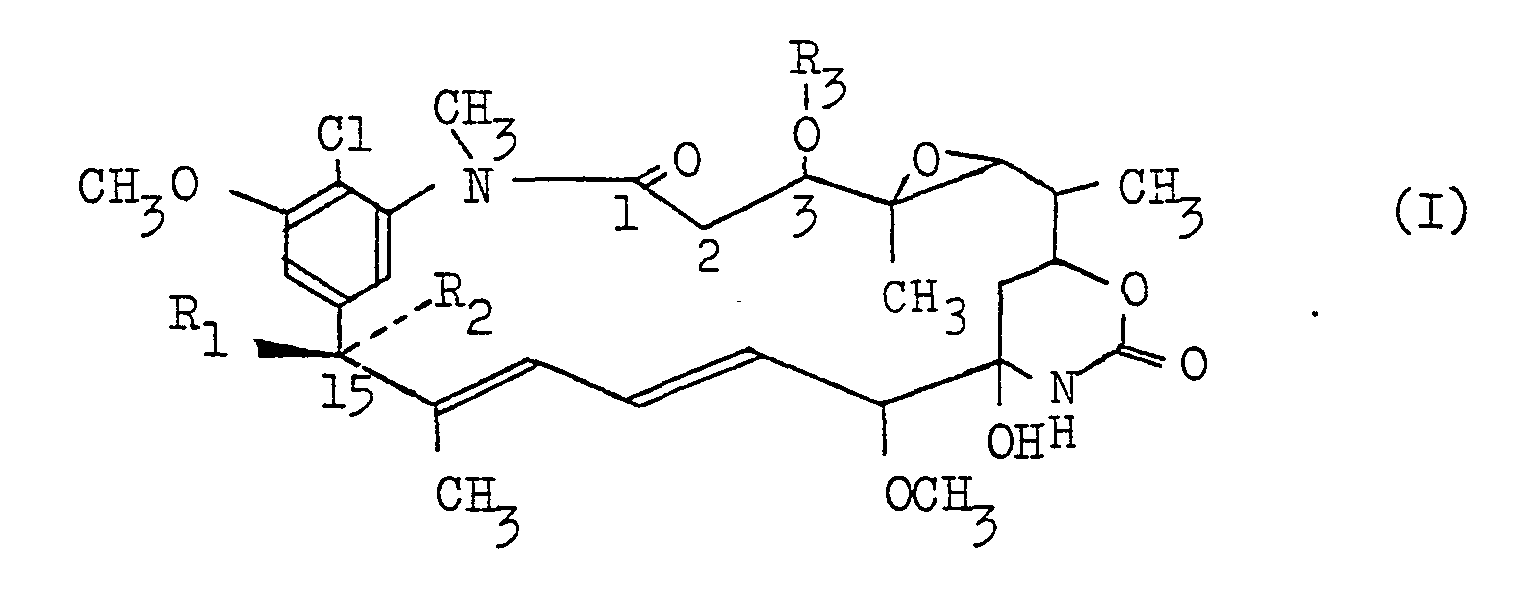


or R3 means H or alkanoyl containing not more than 5 carbon atoms when R1 is H and R2 is alkanoyloxy of 2 to 5 carbon atoms,
and (2) A method of producing a maytansinoid compound (I') of the formula: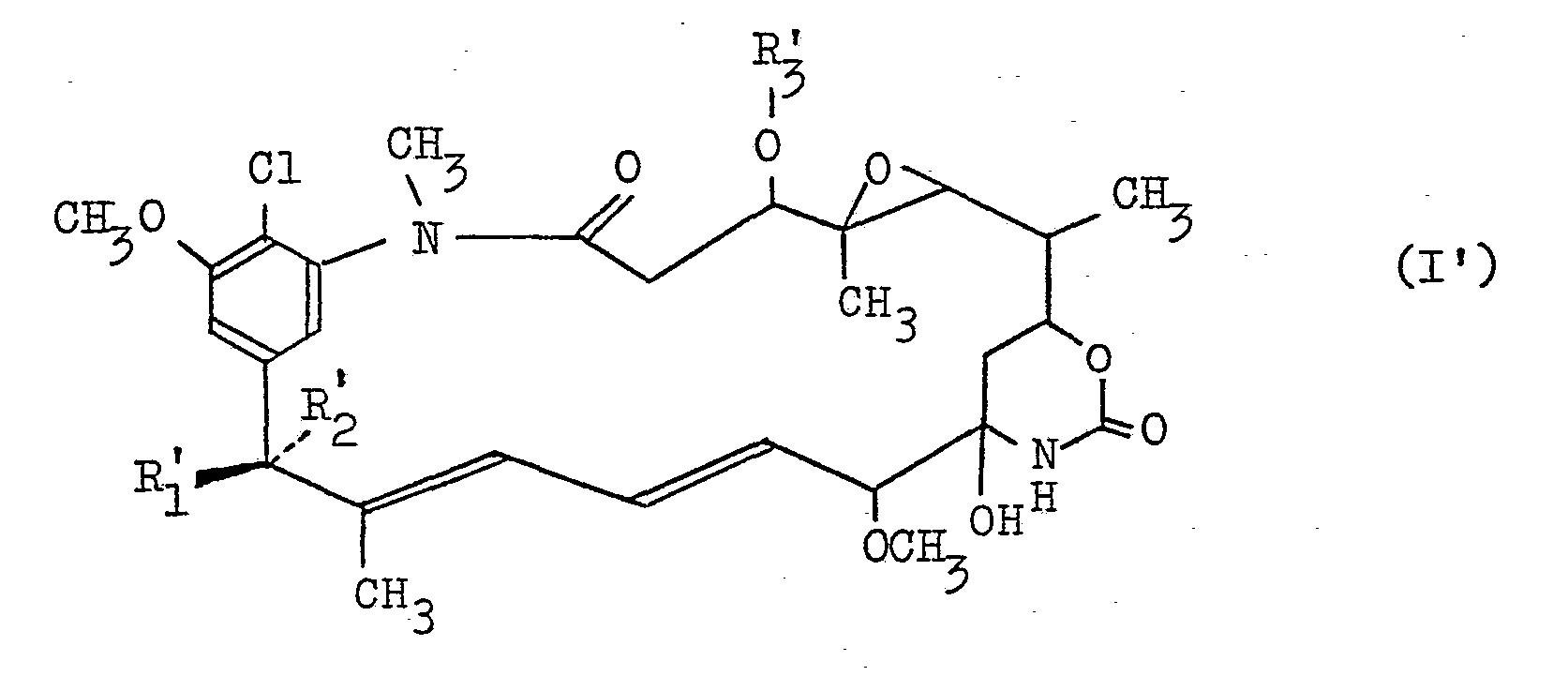

and, if desired, thus obtained compound (III) of the formula:
- Referring to the above general formulas, the alkanoyl group of not more than 5 carbon atoms may for example be formyl (-CHO), acetyl (-COCH3), propionyl (-COCH2CH3), butyryl (-COCH2CH2CH3), isobutyryl
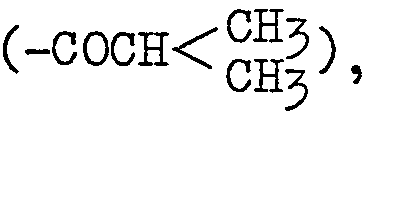

- The alkyl group in the alkanoyloxy (=alkylcarbonyloxy) of 2 to 7 carbon atoms may be straight or branched and includes methyl, ethyl, n-propyl, isopropyl, n-butyl, isobutyl, sec-butyl, tert-butyl, pentyl, isopentyl, 1-methylpropyl, hexyl, isohexyl etc. The alkyl group in the alkanoyloxy (=alkylcarbonyloxy) of 3 to 7 carbon atoms may be straight or branched. Examples are such ones as mentioned above for the alkyl other than methyl. Examples of the alkyl group in the alkanoyloxy (=alkylcarbonyloxy) of 2 to 5 carbon atoms are methyl, ethyl, n-propyl,isopropyl, n-butyl, isobutyl, sec-butyl and tert-butyl.
- The alkenyl group in the alkenylcarbonyloxy of 3 to 5 carbon atoms is, for example, vinyl, allyl, 1-methylvinyl or 2-methylvinyl.
- The aryl group in the arylcarbonyloxy includes phenyl, benzyl, cinnamyl, phenethyl, styryl, etc.
- The above-mentioned alkyl, alkenyl and aryl may be substituted by at most three substituents which may be the same or different. Examples of the substituents are Cl-C4 alkoxy (e.g. methoxy, ethoxy, propoxy, iso-propoxy, n-butoxy, iso-butoxy, sec-butoxy, tert-butoxy), C2-C4 alkanoyl (e.g. acetyl, propionyl, n-butyryl, iso-butyryl), C2-C4 alkanoyloxy (e.g. acetyloxy, propionyloxy, n-butyryloxy, isobutyryloxy), C2-C4 alkoxycarbonyl (e.g. methoxycarbonyl ethoxycarbonyl, n-propoxycarbonyl, iso-propoxycarbonyl), halogen (e.g. chlorine, fluorine, bromine, iodine), nitro, cyano, trifluoromethyl, di-Cl-4-alkylamino (e.g. dimethylamino, diethylamino, dipropylamino, diisopropylamino, dibutylamino), C1-C4 alkylthio (e.g. methylthio, ethylthio, n-propylthio, isopropylthio, n-butylthio, isobutylthio, sec-butylthio, tert-butylthio), methylsulfinyl, methylsulfonyl, oxo, thioxo, C1-C4 alkanoylamido (e.g. formamido, acetamido, propionylamido, butyrylamido, isobutyrylamido) and carboxyl. The aryl mentioned above may be substituted by C1-C4 alkyl (e.g. methyl, ethyl, n-propyl, iso-propyl, n-butyl, iso-butyl, see-butyl, tert-butyl).
- Examples of the substituted alkyl group in the substituted alkanoyloxy of 2 to 7 carbon atoms are methoxymethyl, butoxymethyl, methylthiomethyl, methylthioethyl, ethylthioethyl, isopropylthioethyl, butylthioethyl, isobutylthioethyl, acetyloxymethyl, acetyloxyethyl, ethoxycarbonylmethyl, ethoxycarbonylethyl, butoxycarbonylethyl, fluoromethyl, chloromethyl, chloroethyl, 3-chloropropyl, 4-chlorobutyl, 3,3,3-trichloropropyl, trifluoromethyl, bromomethyl, 4-bromobutyl, 5-bromopentyl, iodomethyl, 2-iodoethyl, 1,1-dimethyl-2,2-dichloroethyl, 2-chloro-l-chloromethyl-1-methylethyl, cyanomethyl, methylsulfinylethyl, methylsulfonylmethyl, carboxymethyl and carboxyethyl.
- Examples of the substituted alkyl group in the substituted alkanoyloxy of 3 to 7 carbon atoms are methoxyethyl, butoxyethyl, methylthioethyl, methylthioethyl, ethylthioethyl, isopropylthioethyl, butylthioethyl, isobutylthioethyl, acetyloxyethyl, ethoxycarbonylethyl, butoxycarbonylethyl, fluoroethyl, chloroethyl, 3-chloropropyl, 4-chlorobutyl, 3,3,3-trichloropropyl, 4-bromobutyl, 5-bromopentyl, 2-iodoethyl, 1,1-dimethyl-2,2-dichloroethyl, 2-chloro-l-chloromethyl-l-methylethyl, cyanoethyl, methylsulfinylethyl, 2-methylsulfonylethyl and carboxyethyl.
- The substituted alkenyl group in the substituted alkenylcarbonyloxy of 3 to 5 carbon atoms is, for example, 1-chlorovinyl.
- Examples of the substituted aryl group in the substituted arylcarbonyloxy are 2-, 3- or 4-methylphenyl, 4-tert-butylphenyl, 2-, 3- or 4-chlorophenyl, 2-, 3- or 4-bromophenyl, 2-, 3- or 4-iodophenyl, 2-, 3- or 4-fluorophenyl, 2- or 4-methoxyphenyl, 4-butoxyphenyl, 4-methoxycarbonylphenyl, 3-acetylphenyl, 2-, 3- or 4-nitrophenyl, 3- or 4-cyanophenyl, 4-dimethylaminophenyl, 4-diethylaminophenyl, 4-acetoxyphenyl, 4-butyryloxyphenyl, 2,4-, 2,5-, 2,6-, 3,4- or 3,5-dichlorophenyl, 3,4-dimethoxyphenyl, 3,4,5-trimethoxyphenyl, 3,4-methylenedioxyphenyl, 3-trifluoromethylphenyl, 4-methylthiophenyl, 4-methylsulfonylphenyl and 4-acetamidophenyl.
- The term "C-15003 PHO" or, simply, "PHO" as used throughout this specification means all of the compounds of the formula (I) wherein R1 is OH and R2 is H, its derivatives, a mixture of two or more of such compounds or any one of the compounds. Among the compounds of general formula (I), the compound (I) wherein R1 is OH, R2 is H and R3 is H will be referred to as "C-15003 PHO-0" or briefly as "PHO-0"; the compound (I) wherein R1 and R2 are as defined above and.R3 is -COCH3 will be referred to as "C-15003 PHO-1" or briefly as "PHO-1"; the compound (I) wherein R1 and R2 are as defined above and R3 is -COCH2CH3 will be referred to as "C-15003 PHO-2" or briefly as "PHO-2"; the compound (I') wherein R1' is OH, R; is H and R3' is


- The term "C-15003 epi-PHO" means all of the compounds of general formula (I) wherein R1 is H and R2 is OH, its derivative,a mixture of two or more of such compounds or any one of the same compounds. The compounds of general formula . (I) wherein R1 if H, R2 is OH and R3 is H will hereinafter be referred to as "C-15003 epi-PHO-0" or briefly as "epi-PHO-0"; the compound (I) wherein R1 and R2 are as defined above and R3 is -COCH3 will hereinafter be referred to as "C-15003 epi-PHO-1" or briefly as "epi-PHO-1"; the compound (I) wherein R1 and R2 are as defined above and R3 is -COCH2CH3 will be referred to as "C-15003 epi-PHO-2" or briefly as "epi-PHO-2"; the compound (I) wherein R, and R2 are as defined above and R3 is


- The compound of general formula (II) wherein R3' is H, i.e. maytansinol, will hereinafter be referred to as "P-0"; the compound (II) wherein R3' is -COCH3, i.e. maytanacine, will be referred to as "P-1"; the compound (II) wherein R3 is -COCH2CH3, i.e. maytansinol propionate, will be referred to as "P-2"; the compound (II) wherein R3' is


- P-0, P-1, P-2, P-3, P-3' and P-4 can be obtained by cultivating a microorganism, for example Nocardia sp. No. C-15003 (deposited at Fermentation Research Institute, Agency of Industrial Science and Technology, Japan under the number of FERM-P No. 3992; Institute for Fermentation, Osaka, Japan under the number of IFO 13726; and The American Type Culture Collection, U.S.A. under the number of ATCC 31281), in a culture medium and harvesting and purifying them from the fermentation broth (Nature vol. 270, p. 721 (1977), Tetrahedron 35, 1079 (1979), U.S.Patent No. 4,151,042, U.S.Patent No. 4,162,940]. The straim ATCC 31281 is listed on "The American Type Culture Collection Catalogue of Strains I (Fourteenth edition 1980)".
- P-0 can also be obtained by deacylating P-3, P-3' and/or P-4 (Nature, vol. 270, p.721 (1977), Tetrahedron 35, 1079 (1979), U.S.Patent No. 4,162,940).
- The compounds of general formula (II) wherein R3 is alkanoyl containing not more than 5 carbon atoms can be produced by reacting P-0 with an acid anhydride of general formula:
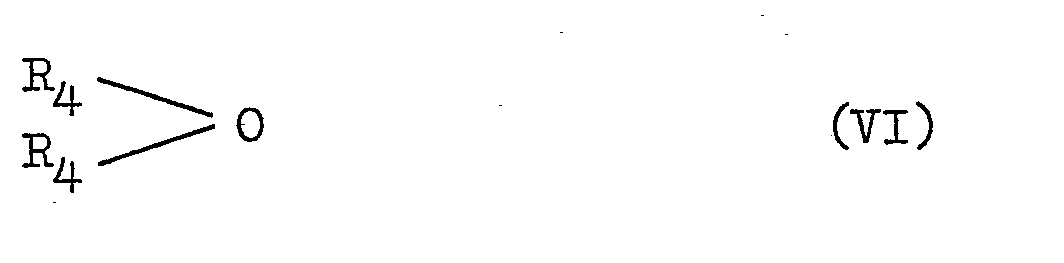
derived from the corresponding carboxylic acid or with an acid halide of general formula:
which is also derived from the corresponding carboxylic acid. - Referring to the above general formula (VII), the halogen X may for example be chlorine, bromine or iodine.
- There are cases in which the above reaction is preferably carried out in the presence of a base. As examples of the base may be mentioned tertiary amines such as triethylamine, tributylamine, pyridine, 4-dimethylaminopyridine, α-, β- or y-picoline, 2,6- lutidine, dimethylaniline, diethylaniline, N-methylmorpholine, etc. Also, the above reaction may be conducted in an appropriate solvent which may for example be esters (e.g. ethyl acetate), ethers (e.g. diethyl ether, dioxane, tetrahydrofuran), halogenated hydrocarbons (e.g. methylene chloride, chloroform), nitriles (e.g. acetonitrile), aromatic hydrocarbons (e.g. benzene), nitromethane, dimethylformamide, dimethyl sulfoxide, sulfolane, etc. as well as mixture of such solvents. It is also possible to employ the above-mentioned base as the solvent or a mixture of the base with the solvent mentioned above. While the reaction temperature is not particularly critical, the reaction is desirably carried out at -20°C to +40°C. The resulting compound of general formula (II) wherein R3 is alkanoyl containing not more than 5 carbon atoms can be purified by routine separation and purification procedures such as solvent extraction, chromatography, recrystallization, etc.
- The microorganism employed in the method of the reaction from the compound (II) to the compound (III) may be any organism belonging to one of the genera Streptomyces, Chainia and Streptosporangium which is capable of introducing a hydroxyl group into the 15-position of the compound (II), inclusive of variants and mutants thereof. Thus, as examples of organisms which can be employed in the practice of this invention there may be mentioned Streptomyces sclerotialus IFO 12246 (ATCC 15721), Streptomyces castaneus IFO 13670, Streptomyces flavochromogenes IFO 13443 (ATCC 14841), Streptomyces olivaceiscleroticus IFO 13484 (ATCC 15722), Streptomyces flaviscleroticus IFO 13357 (ATCC 19347), Chainia nigra IFO 13362 (ATCC 17756) and Streptosporangium roseum IFO 3776.
- The above-mentioned strains are listed on "Institute for Fermentation Osaka List of Cultures (1978 sixth edition)", and the strains referred with ATCC numbers are listed on "The American Type Culture Collection Catalogue of Strains I (Thi$teenth Edition 1978)".
- Generally, organisms of the genera Streptomyces, Chainia and Streptosporangium are highly variable in characteristics and can be mutated by artificial means such as X-ray UV, gamma-ray or other irradiation or with a mutagenic agent (e.g. nitrosoguanidine, ethyleneimine, etc.). Even such mutants can also be employed for the purposes of this invention only if they are still able to introduce a hydroxyl group into the 15-position of maytansinoid compound (II).
- The medium used for the cultivation of said microorganism in the method according to this invention may be a liquid medium or a solid medium, when it contains sources of nutrients which said microorganism can utilize, although a liquid medium is preferred for high production runs. In the medium are incorporated the carbon sources which said organism can assimilate, the nitrogen sources which it can digest, inorganic substances, trace nutrients and so forth in suitable proportions. The carbon sources may include, among others, glucose, lactose, sucrose, maltose, dextrin, starch, glycerol, mannitol, sorbitol, etc., oils and fats (e.g. soybean oil, lard oil, chicken oil, etc.), etc. The nitrogen sources may include, among others, meat extract, yeast extract, dried yeast, sobyean flour, corn steep liquor, peptone, cottonseed oil, spent molases, urea, ammonium salts (e.g. ammonium sulfate, ammonium chloride, ammonium nitrate, ammonium acetate, etc.) and the like. In addition, use may also be made of salts of sodium, potassium, calcium, magnesium, etc., metal salts such as salts of iron, manganese zinc, cobalt, nickel, etc; salts of phosphoric acid, boric acid, etc; and salts of organic acids such as salts of acetic acid, propionic acid, etc. It is further possible to incorporate amino acids (e.g. glutamic acid, aspartic acid, alanine, glycine, lysine, methionine, proline, etc.), peptides (e.g. dipeptides, tripeptides, etc.), vitamins (e.g. B1, B2, nicotinic acid, B12, C, E, etc.), nucleic acids (e.g. purine, pyrimidine and their derivatives) and so forth. Of course, it is possible to add inorganic or organic acids, alkalis, buffers, etc. for the purpose of adjusting the pH of medium or to add a suitable amount of fats and oils, surfactants, etc. for defoaming purposes.
- The cultivation method may be stationary culture shake culture or aerated stirring culture. For high production runs, the so-called submerged aerobic culture is of course desirable. While cultivation conditions depend upon the condition and composition of medium, the particular strain of organism, cultural method employed and so forth, generally the cultivation is desirably carried out at a temperature in the range of 20°C to 45°C and at an initial pH level of near neutral. It is especially desirable to maintain the temperature at 24°C to 37°C at intermediate stages of cultivation and start the cultivation at a pH of 6.5 to 8.5. The cultivation time may range from 6 to 100 hours and the range of 16 to 48 hours is particularly desirable.
- The term "culture broth" as used in this specification means the broth obtained by the above-described cultivation procedure.
- The term "processed matter" means the mycelial or cellular products obtained from said culture broth by a physical or/and-chemical treatments, e.g. filtration, centrifugation, supersonication, French-pressing, grinding with alumina, bacteriolytic enzyme treatment, treatment with a surfactant or organic solvent, etc. or a equivalent milled product containing a hydroxylase. It is also possible to employ the corresponding hydroxylase obtained-by a conventional purification procedure or the mycelial or cellular product or hydroxylase immobilized by a conventional procedure.
- The method of this invention is carried into practice by contacting the starting compound (II) with the culture broth or processed matter as obtained or derived from the above-mentioned microorganism. The concentration of said starting compound (II) in the reaction system is preferably in the range of 1 to 500 µg/ml. The reaction temperature and pH are desirably 20 to 50°C and pH 5 to 10, and more desirably about 24 to 40°C and pH 6 to 9. The reaction time is 1 to 200 hours and, more desirably 24 to 72 hours. The reaction may be conducted under stationary; shake, aerated or stirring conditions, although shake, aerated or stirring conditions are preferred.
- The product obtainable in the above manner can be detected by thin-layer chromatography (TLC hereinafter). Thus, the reaction mixture is extracted with ethyl acetate concentrated to one-hundredth by volume and subjected to TLC on a silica gel glass plate (E.Merck, Germany, silicagel 60F254, 0.25 mm, 20 x 20 cm) with a solvent system of chloroform and methanol (9:1). The zone 0 absorbing in ultraviolet light at 2537A is scraped off to obtain the desired fraction.
- Since the product substance group is neutral lipophilic, the desired compound can be isolated from the reaction system by means of the isolation and purification procedures commonly used in the recovery of microbial metabolites. Such procedures are exemplified by procedures utilizing differences in solubility with respect to impurities, procedures utilizing differences in adsorptive affinity for various adsorbents such as activated carbon, macroporous nonionic resin, silica gel, alumina, etc., and procedures for removing impurities with ion exchange resins, and these procedures may be used either independently, in combination or in repetition. The suitable solvent for use in procedures utilizing a solubility difference include, for example, fatty acid esters (e.g. ethyl acetate, amyl acetate, etc.), alcohols (e.g. butanol, etc.), halogenated hydrocarbons (e.g. chloroform, etc.), and ketones (e.g. methyl isobutyl ketone, etc.). The extraction is carried out near neutral pH and a preferred procedure comprises adjusting the broth filtrate to pH 7 and extracting it with ethyl acetate. The extract is then washed with water and concentrated under reduced pressure, and a nonpolar solvent such as petroleum ether or hexane is added. The crude product (i) containing active sabstances is thus obtained. Since the TLC of this crude product gives many'spots other than the desired compound (III), the following stepwise purification process is applied. Thus, as routine nethods, various adsorption chromatographic techniques can be successfully utilized. While the adsorbents may be those commonly employed, e.g. silica gel, alumina, nacroporous nonionic adsorbent resin, etc., silica gel is most effective for purification from crude product (i). The adsorbent column is developed first with, for example, petroleum ether or/and n-hexane and, then, with the addition of a polar solvent or solvent system such as ethyl acetate, acetone, ethanol or/and methanol, whereby the desired compound (III) are eluted. As an example, column chromatography on silica gel (E.Merck, Germany, 0.05-0.2 mm) is carried out and the chromatogram is developed with sequential increases in the ratio of ethyl acetate to n-hexane. The eluate is scanned by TLC and the fractions containing the compound (III) are combined, concentrated under reduced pressure and treated with petroleum ether or n-hexane to recover a crude product (ii). If this product still contains much impurities, it is further purified. By way of example, such additional purification can be performed on second silica gel column with a different solvent system. As to the developing solvents, the column is developed first with a halogenated hydrocarbon such as dichloromethane, chloroform, etc. and then with addition of a polar solvent or solvent system such as alcohol (e.g. ethanol, methanol, etc.) or/and ketone (e.g. acetone, methyl ethyl ketone, etc.), whereby the desired compound (III) is isolated. The solvents for said first and second silica gel columns may be reversed or identical. It is also possible to use other common organic solvents in various combinations.
- When the resulting crude product (iii) contains the compound (III) wherein Rl is H and R2 is OH in addition to the compound (III) wherein R1 is OH and R2 is H, it is further subjected to the following purification procedure. Thus, the above-mentioned adsorption chromatographic techniques and partition chromatographic techniques can be utilized with advantage, but to further purify the crude product (iii), reverse phase partition gel chromatography is very useful. The eluent may be a water-miscible alcohol or ketone solvent. As an example, preparative separation is carried out by high performance liquid chromatography, i.e. Prep LC/system 500 (Waters Associates Inc., U.S.A.) on reverse-phase gel C18 (Water Associates Inc., U.S.A., Prep PAK-500/C18). When aqueous methanol is used as the solvent, the compound (III) wherein R1 is H and R2 is OH and the compound (III) wherein R1 is OH and R2 is H emerge in that order. After detection by reverse-phase TLC (E.Merck, Germany), the fraction of the compound (III) wherein R1 is H and R2 is OH and the fraction of the compound (III) wherein R1 is OH and R2 is H are respectively concentrated under reduced pressure. Each concentrate is extracted with ethyl acetate, concentrated under reduced pressure and, after addition of a small amount of methanol, allowed to stand, whereupon colorless crystals of the corresponding compounds are obtained.
- The compound (III) can be used also as intermediate materials for the synthesis of pharmaceutically useful compounds. Thus, by deacylating the compound (III), there can be obtained a compound of the formula (IV) having a hydroxyl group in 3-position.
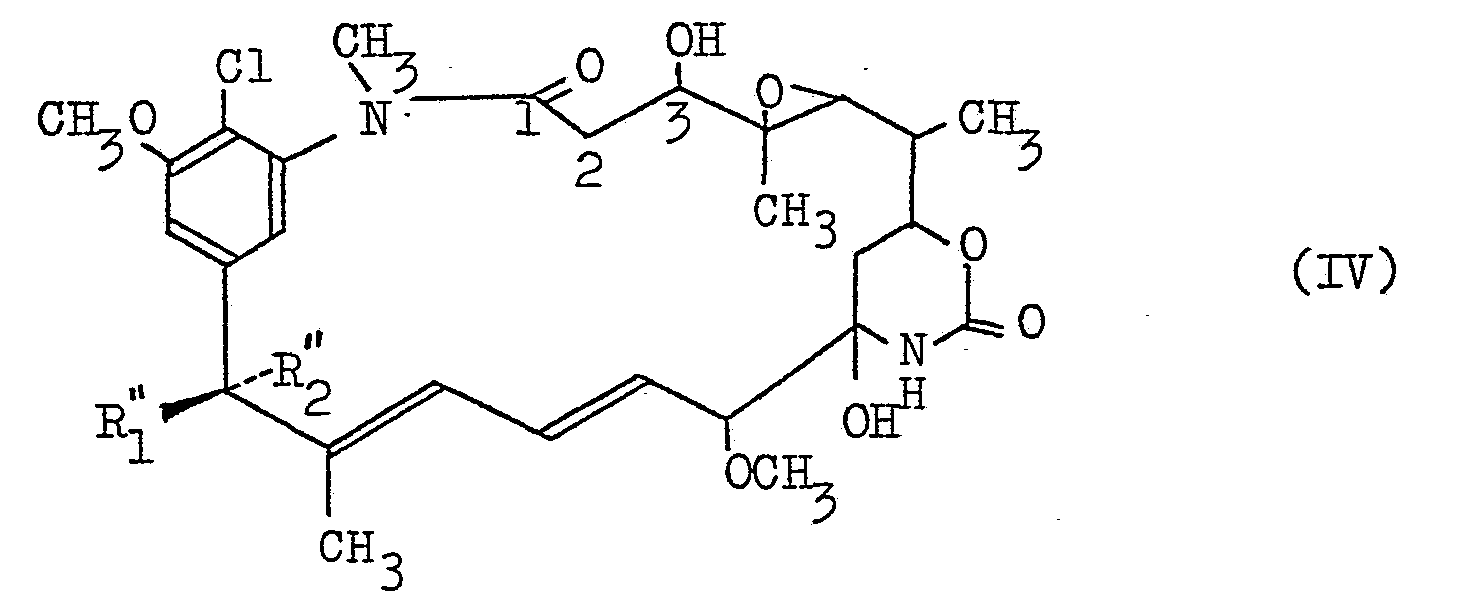
- R"1 and R"2 are as defined above.
- In this case, because the acyl group is in the position beta to the carbonyl group, the conventional reductive hydrolysis reaction can be employed with advantage. Thus, by using a metal hydride complex compound (e.g. lithium aluminum hydride (LiAlH4)) at a low temperature (e.g. -20°C to 0°C), the 0-ester bond in 3-position can be hydrolyzed without affecting other functional groups, e.g. the carbonyl, epoxy, carbon-carbon double bond, etc., so as to yield a compound (IV) of the formula (IV). The isolation and purification of the compound (IV) can be performed in the same manner as described hereinbefore.
- Tables 1 and 2 show the physico-chemical properties of PHO-0 as obtained in Example 5, PHO-1 as obtained in Example 7, PHO-2 as obtained in Example 9, PHO-3 as obtained in Example 3, PHO-4 as obtained in Example 11, epi-PHO-0 as obtained in Example 5, epi-PHO-1 as obtained in Example 7, epi-PHO-2 as obtained in Example 9, epi-PHO-3 as obtained in Example 3 and epi-PHO-4 as obtained in Example 11, all of said Examples appearing hereinafter.


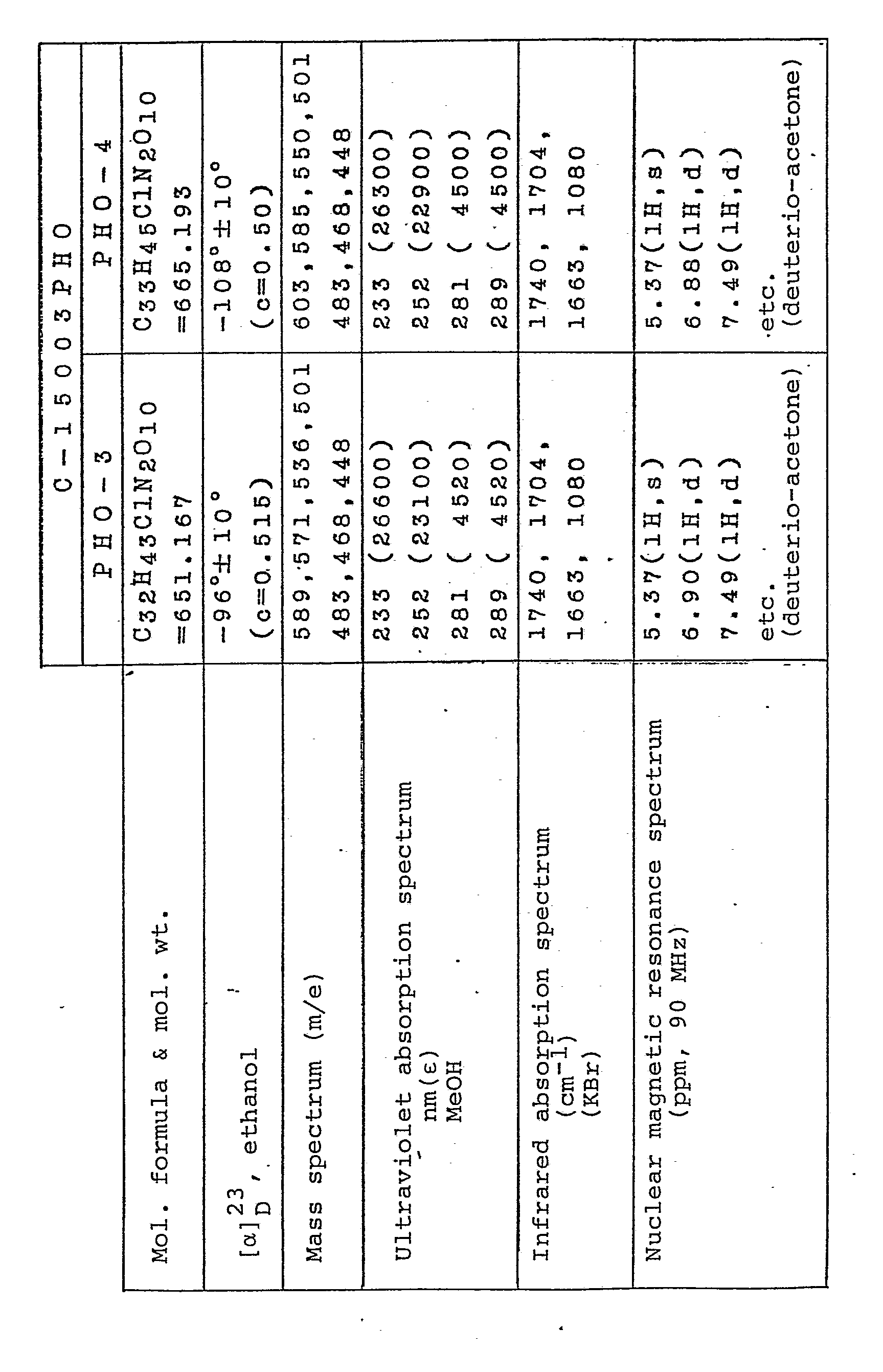


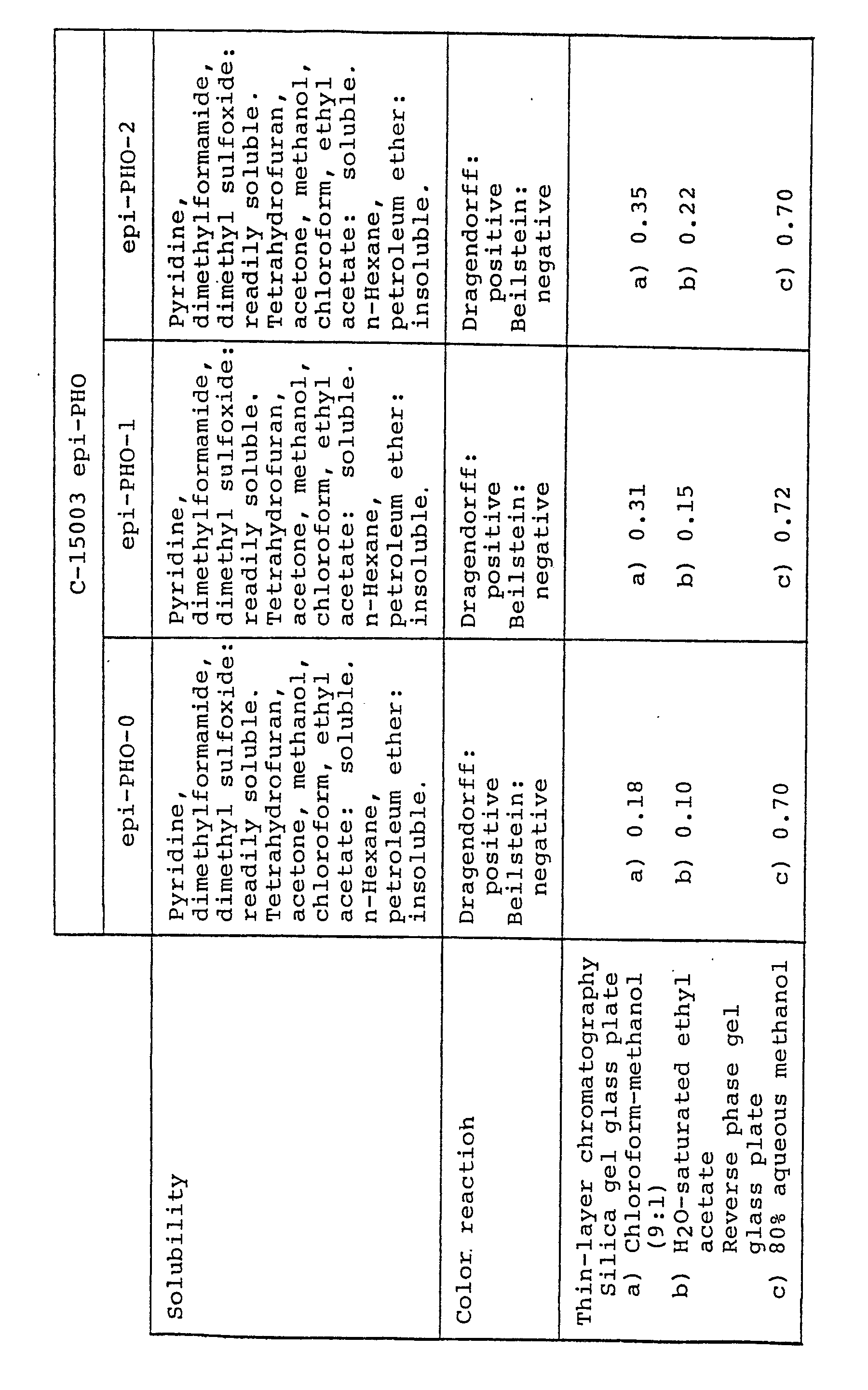

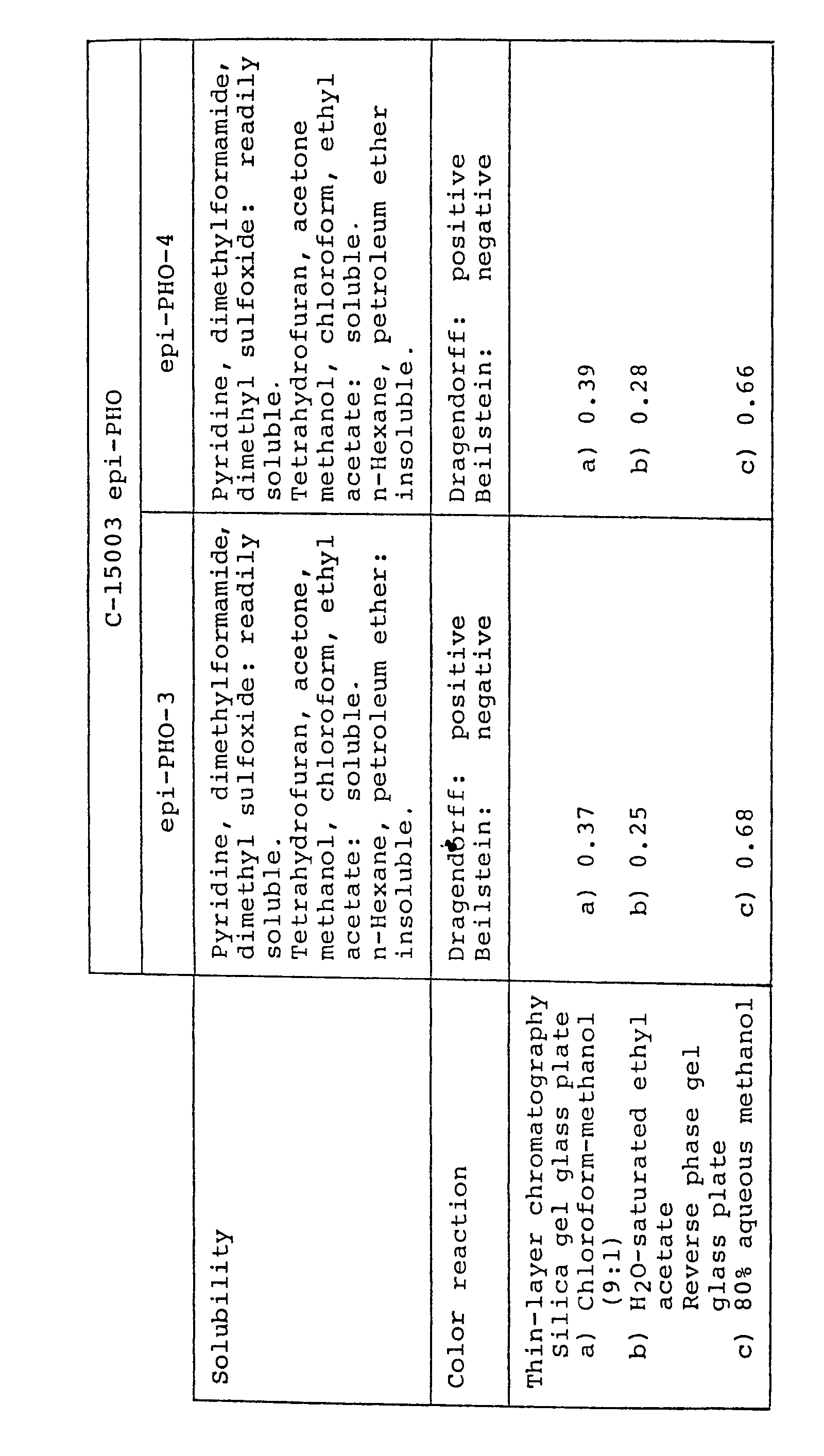
- Comparison of the above physico-chemical properties with the properties of the known maytansinoid compounds has shown that the properties of PHO-3 are in good agreement with those of deacetylmaytanbutacine as described in the Journal of Organic Chemistry 42, 2349 (1977). Further, when PHO-3 is acetylated, the product compound showed physico-chemical properties in good agreement with those described for maytanbutacine in the above-mentioned literature. However, there was no compound corresponding to any of other the compound (III). Therefore, epi-PHO-3 will now be compared with PHO-3. Since the same fragment is detected in mass spectra, it is easy to presume that like PHO-3, epi-PHO-3 is a compound formed on the introduction of hydroxyl group into PHO. In nuclear magnetic resonance spectrum, a singlet assignable to the 15-hydrogen atom is found at 65.37 for PHO-3 and at 65.11 for epi-PHO-3. This fact suggests that epi-PHO-3 is a stereo-isomer at 15-position of PHO-3 and, therefore, that epi-PHO-3 is a novel compound. Furthermore, X-ray analysis has shown that the absolute configuration of C15 of epi-PHO-3 is S-configuration. Comparison of other the compound (III) with PHO-3 and epi-PHO-3 indicates that the structural formulas of these compounds are as shown in Figs. 1 and 2, respectively.

- PHO R
- PHO-0 H
- PHO-1 -CO-CH3
- PHO-2 -CO-CH2-CH3
- PHO-3

- PHO-4
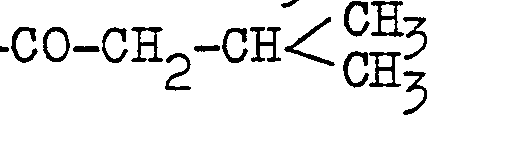

- epi-PHO R
- epi-PHO-0 H
- epi-PHO-1 -CO-CH3
- epi-PHO-2 -CO-CH2-CH3
- epi-PHO-3

- epi-PHO-4

- P-0 (maytansinol) which is obtainable by reductive cleavage reaction of P-l, P-2, P-3, P-3' or P-4 is identical with maytansinol which is the nucleus of maytansine (Nature 270, 721-722 (1977), Tetrahedron 35, 1079-1085 (1979)) and as mentioned hereinbefore, P-0, P-1 and P-2 respectively correspond to maytansinol, maytanacine and maytansinol propionate which are described in Journal of the American Chemical Society 97, 5294 (1975). Therefore, the absolute configuration of asymmetric carbon atoms C3, C4, C5, C6, C 7, C 9 and C10 contained in P-0 (maytansinol) are the same as those of maytansine as reported in Journal of the American Chemical Society 94, 1354-1356 (1972). Thus, the absolute configurations of such asymmetric carbon atoms in the compound (III) are all the same as the above and the data from the above-mentioned X-ray analysis of the compound (III) wherein Rl is H and R2 is OH indicate also that the configurations are 3S, 4S, 5S, 6R, 7S, 9S and 10R.
- Maytanbutacine which is obtainable by acetylating C-15003 PHO-3 with acetic anhydride in the per se conventional manner (the Journal of Organic Chemistry 42, 2349 (1977)) has been shown to have antitumor activity as mentioned in Journal of Medicinal Chemistry 21, 31 (1978). Thus, the compound (III) are valuable intermediates in the production of various derivative compounds. According to the published literature, maytanbutacine from plants is available only from limited varieties of plants and its production from such plants involves a great deal of cost, equipment and time for the stages of cultivation and felling of plants, drying, pulverization, and extraction and purification of the compound. Moreover, its yield is very low. In contrast, this invention enables one to produce its precusor PHO-3 by means of a microorganism with expedience, at desired times and in quantities.
- The compound (III), which can thus be produced in accordance with this invention, have antitumor and antiprotozoal activities. The antimicrobial activity of these compounds will be described below.
- Using trypticase-soy-agar (Baltimore Biologicals, U.S.A.) as a test medium, the minimal inhibitory concentrations of each compound against the following microorganisms were determined by the paper disk method. Thus, on plate media containing the following organisms growth inhibition was investigated using paper disks (Toyo Roshi Corp., Japan, thin-type, diam. 8 mm) imbibed with 0.02 ml of a 300 µg/ml solution of PHO-3 or epi-PHO-3. The study showed that these compounds did not exhibit activity against the following microorganisms.
- Escherichia coli, Proteus vulgaris, Proteus mirabilis, Pseudomonas aeruginosa, Staphylococcus aureus, Bacillus subtitis, Bacillus cereus, Klebsiella pneumoniae, Serratia marcescens, Mycobacterium avium,
- On the other hand, Tetrahymena pyriformis W strain, as a test organism, was cultivated on an assay medium (Proteose-peptone (Difco) 20 g, yeast extract 1 g, glucose 2 g, distilled water 1000 ml, 1 M phosphate buffer (pH 7.0) 10 ml) at 28°C for 44 hours and the minimal inhibitory concentrations of the antibiotics against said organism were determined by the serial broth dilution method. It was thus found that PHO-3 and epi-PHO-3 inhibit growth of the above organism at the concentrations of 16 to 32 µg/ml and 16 to 32 µg/ml, respectively.
- Therefore, the compound (III) can be used as antiprotozoal agents. As an antiprotozoal agent, the compound (III) can be advantageously used as a testing agent for the assay of bacterial ecology in a soil, activated sludge, animal fluid or other sample. Thus, for the purpose of separating useful bacteria from soil smaples or for testing the actions of bacteria to the exclusion of protozoas in the operation and analysis of an active sludge system used in the treatment of waste water, the above compounds can be utilized to permit selective growth of bacterial life without allowing concomitant protosoas in the specimen to grow. An exemplary specific procedure comprises adding the specimen to a liquid or solid medium, adding 0,1 ml of a 1 % aqueous solution of methanol containing 1000 µg/ml of the compound (III) to each ml of the medium and incubating the mixture.
- It should also be noted that the compound (III) shows an increased solubility behavior in water.
- The compound (III), which can be obtained by the method of this invention, can be acylated at the 15-OH function to give a 15-acyl compound which has antitumor and antiprotozoal activities. Therefore, the compound (III) is useful as an intermediate for the production of a medicine. And the compound (IV) is also useful as an intermediate for the production of a useful compound,
- The acylation reaction can be accomplished for example by reacting the compound (III) with a carboxylic acid (VIII) of the formula:

- An exemplary acylation procedure comprises acylating the compound (III) with said carboxylic acid (VIII) in the presence of a carbodiimide.
- Based on starting compound (III), the carboxylic acid (VIII) may be used in a proportion of about 1 to 500 molar equivalents, preferably about 1 to 30 molar equivalents.
- Based on starting compound (III), said carbodiimide may be used in a proportion of about 1 to ?00 molar equivalents and, preferably, about 1 to 50 equivalents. The carbodiimide that can be employed is any compound containing a carbodiimide bond (-N=C=N-) which is convertible to a urea bond in the course of reaction, and may for example be a compound of the following formula:

- As examples of organic residues R6 and R1 there may be mentioned C3-7 cycloalkyl groups which may optionally have di-lower (C1-6; the same applies hereinafter) alkyl amino; lower alkyl groups which may optionally have di-lower alkylamino or morpholino, and phenyl groups which may optionally have lower alkyl. The carbodiimide preferred for commercial production is dicyclohexylcarbodiimide, although use may also be made of diphenylcarbodiimide, di-o-tolylcarbodiimide,di-p-tolylcarbodiimide, di-tert-butylcarbodiimide, l-cyclohexyl-3-(2-morpholinoethyl)-carbodiimide, 1-cyclohexyl-3-(4-diethylaminocyclohexyl)-carbodiimide, l-ethyl-3-(2-diethylaminopropyl)carbodiimide, 1-ethyl-3-(3-dimethylaminopropyl)carbodiimide, etc.
- This acylation reaction may be carried out in an appropriate solvent, such as esters (e.g. ethyl acetate), ethers (e.g. diethyl ether, dioxane, tetrahydrofuran), halogenated hydrocarbons (e.g. methylene chloride, chloroform), nitriles (e.g. acetonitrile), aromatic hydrocarbons (e.g. benzene), nitromethane, pyridine, dimethylformamide, dimethylformamide, dimethyl sulfoxide, sulfolane, etc. inclusive of suitable mixtures of such solvents.
- The acylation reaction may be carried out at a suitable temperature, usually from ice-cooling up to the reflux temperature of the reaction system.
- The acylation reaction proceeds with further advantage in the presence of a catalyst assisting in acylation. Thus, for example, a basic catalyst or an acid catalyst may be utilized. The basic catalyst is exemplified by tertiary amines (such as aliphatic tertiary amines, e.g. triethylamine; and aromatic tertiary amines, e.g. pyridine, a-, β- or y-picoline, 2,6-lutidine, 4-dimethylaminopyridine, 4-(l-pyrrolidinyl)pyridine, dimethylaniline, diethylaniline), alkali metal halides (e.g. potassium fluoride, lithium iodide anhydrate), organic acid salts (e.g. sodium acetate) and so on. The acid catalyst is exemplified by Lewis acids (e.g. zinc chloride anhydrate aluminum chloride anhydrate (AlCl3), tin tetrachloride (SnCl4), antimony pentachloride, cobalt chloride, cupric chloride, boron trifluoride etherate), inorganic strong acids (e.g. sulfuric acid, perchloric acid, hydrogen chloride, hydrogen bromide), organic strong acids(e.g. benzenesulfonic acid, p-toluenesulfonic acid, trifluoroacetic acid, trichloroacetic acid), acidic ion exchange resin (e.g. polystyrenesulfonic acid), etc. Among the above catalysts, 4-dimethylaminopyridine, 4-(1-pyrrolidinyl)pyridine, etc. are preferred.
- The catalyst may be used in a catalytic amount i.e. an amount sufficient to promote the acylation of the compound (III) with carboxylic acid (VIII), i.e. usually from about 0.001 to 10 molar equivalents and preferably from about 0.01 to 1 molar equivalent based on compound (VIII). In many instaces, the use of such a catalyst causes a substantial increase in the yield of the objective compound. It also helps realize savings in the amount of carboxylic acid (VIII); for example, to reduce the amount of (VIII) to about 1 to 10 molar equivalents relative to starting compound (III),
- The acylation reaction using a reactive derivative of carboxyl group of carboxylic acid (VIII) may for example be an acylation with a derivative having a functional group capable of acylating the 15-hydroxyl group of starting compound (III), such as antacid anhydride or acid halide (e.g. chloride, bromide), of carboxylic acid (VIII). The solvent and catalyst for this acylation procedure may be those mentioned for acylation in the presence of a carbodiimide reagent. The reaction temperature may usually range from about -40°C to +100°C, preferably about 20°C to +40°C, although further heating may be applied in order to increase the reaction rate.
- The compound produced in the above acylation can be isolated from the reaction mixture by the known procedure such as concentration, extraction with a solvent, chromatography, recrystallization, etc. With the above acylation, a compound (V) is produced.

- R2 is H or alkanoyloxy of 2 to 5 carbon atoms;
- R3 is as defined above.
- The compound (V) which can thus be produced in accordance with this invention have antitumor and antiprotozoal activities. The antimicrobial activity of these compounds will be described below.
- Using trypticase-soy-agar (Baltimore Biologicals, U.S.A.) as a test medium, the minimal inhibitory concentrations of each compound against the following microorganisms were determined by the paper disk method. Thus, on plate media containing the following organisms, growth inhibition was investigated using paper disks (Toyo Roshi Corp., Japan, thin-type, diam. 8 mm) imbibed with 0.02 ml of a 300 µg/ml solution of PHO-3 15-valerate or epi-PHO-3 15-acetate. The study showed that these compound did not exhibit activity against the following microorganisms.
- Escherichia coli, Proteus vulgaris, Proteus mirabilis Pseudomonas aeruginosa, Staphylococcus aureus, Bacilus subtilis, Bacillus cereus, Klebsiella pneumoniae, Serratia marcescens, Mycobacterium avium,
- On the other hand, Tetrahymena pyriformis W strain, as a test organism, was cultivated on an assay medium (Proteose-peptone (Difco) 20g,yeast extract 1 g, glucose 2 g, distilled water 1000 ml, 1 M phosphate buffer (pH 7.0) 10 ml) at 28°C for 44 to 48 hours and the minimal inhibitory concentrations of the antibiotics against said organism were determined by the serial broth dilution method. The minimal inhibitory concentrations were as follows. PHO-3 15-n-valerate: 4 µg/ml, PHO-3 15-formate: 32 µg/ml, PHO-3 15-propionate: 8 µg/ml, PHO-3 15-n-butyrate: 4 µg/ml, PHO-3 15-benzoate: 8-16 µg/ml, PHO-3 15-succinate: 32 µg/ml, PHO-3 15-ethylsuccznate:-4-8 µg/ml, PHO-3 15-monochloroacetate: 8 µg/ml, PHO-3 15-acrylate: 4-8 µg/ml, PHO-3 15-crotonate: 2 µg/ml, FHO-3 15-i-valerate: 4 µg/ml, PHO-3 15-i-butyrate: 4 µg/ml, PHO-0 15-n-valerate: > 16 µg/ml, epi-PHO-3 15-acetate: 8-16 µg/ml.
- Compound (V) have antiprotozoal activity and can therefore be used as antiprotozoal agents. As an antiprotozoal agent, each of these compounds can be advantageously used as a testing agent for the assay of bacterial ecology in a soil, activated sludge, animal fluid or other sample. Thus, for the purpose of separating useful bacteria from soil samples or for testing the actions of bacteria to the exclusion of protozoas in the operation and analysis of an active sludge system used in the treatment of waste water, the above compounds can be utilized to permit selective growth of bacterial life without allowing concomitant protozoa in the specimen to grow. An exemplary specific procedure comprises adding the specimen to a liquid or solid medium, then adding 0.1 ml of a 1 % aqueous solution of methanol containing 100-500 µg/ml of said compound to each ml of the medium and incubating the mixture.
- Because compound (V) prolong the survival times of warm-blooded animals (e.g, mouse, rat, dog, cat, etc.), these compounds can be used as antitumor drugs.
- As an antitumor drug, each compound (V) can be administered parenterally or orally. Among parenteral routes, injection is preferred. Thus, compound (V) may be administered subcutaneously, intraperitoneally, intravenously or intramuscularly, for instance. The dosage may range from about 12.5 to 1000 µg/kg body weight/one dose, for instance, and be varied with reference to condition, animal species, etc. Such an injection can be prepared in the conventional manner. Thus, for example, about 100 µg to 3000 µg of the compound (V) of this invention is dissolved in about 0.5 ml of alcohol (e.g. methanol, ethanol), followed by addition of physiological saline to make a total of 10 ml. When the dose is small, the solution can be diluted with physiological saline.
- And toxicity of the compound (V) is low.
- The following Reference Examples and Examples are further ilustrative of the present invention. The percent' means weight/volume percent otherwise indicated.
- In 1.0 ml of dichloromethane was dissolved 23.5 mg of P-0 and at about 22°C, 70.5 mg (about 10 mol equivalents) of acetic-formic anhydride (prepared by cooling 2 ml of acetic anhydride to -5°C to 0°C, adding 1 ml of 99 % formic acid thereto under stirring at -5 c to 0°C over a period of about 10 minutes, heating the mixture at 50°C for 15 minutes and quenching it to 0°C) and 11.7 mg of 4-dimethylaminopyridine. The mixture was stirred at room temperature (about 22°C) overnight. Then, 10 drops of methanol were added to the reaction mixture and after stirring at room temperature for 3 hours, the reaction mixture was concentrated to dryness under reduced pressure. The residue was spotted on a silica gel preparative thin-layer chromatographic plate and developed twice with H20-saturated ethyl acetate. The silica gel at about 6.0 to 8.0 cm from the base line was scraped off and extracted with 10 % methanol- dichloromethane. The solvent was then distilled off under reduced pressure to obtain maytansinol formate (compound (II) where R3 = CHO) as a colorless glass-like substance.
- The procedure of Reference Example 1 was applied to P-0 and valeric anhydride to obtain maytansinol 3-n-valerate (compound (II) where R3 = -COCH2CH2CH2CH3), m.p. 165-168°C.
- Streptomyces sclerotialus IFO 12246 was inoculated into a medium (pH 7.5) containing 2 % dextrin, 0.5 % peptone, 0.5 % yeast extract and 0.5 % meat extract, and cultivation was carried out under shaking at 28°C for 16 hours. To 20 e of the resulting culture was added 4 g of P-3 and the reaction was carried out under shaking at 28°C for 48 hours. Thin-layer chromatography of this reaction broth showed that P-3 had decreased in amount and, instead, PHO-3 and epi-PHO-3 had been produced.
- To 22 e of the reaction broth obtained in Example 1 were added 2.2 kg of sodium chloride and 11 e of ethyl acetate, and extraction was carried out under stirring. This procedure was repeated twice. The ethyl acetate layers were combined and washed with 6 e of 1/200 N hydrochloric acid, twice with 6 e portions of 1/10 M aqueous sodium carbonate and twice with 6 ℓ portions of water. The solution was dried over anhydrous sodium sulfate and concentrated under reduced pressure, followed by addition of petroleum ether, whereupon 2.34 g of crude product (i) was obtained. This crude product (i) (2.34 g) was dissolved in a small amount of chloroform and applied to the top of a column containing 200 ml of silica gel (E.Merck, Germany, 0.063-0.2 mm). Then, 200 ml of chloroform, 300 ml of chloroform-methanol (50:1) and 300 ml of chloroform-methanol (25.1) were passed through the column and the eluate was collected in 10 ml fractions. Each fraction was spotted on a silica gel glass plate (Merck, Germany, silicagel 60F254, 0.25 mm, 20 x 20 cm) and developed with chloroform-methanol (9:1). The fractions absorbing in ultraviolet light (2537A) were investigated and the fractions Nos. 55 through 72 at Rf 0.37 to 0.38 were collected and concentrated under reduced pressure to a volume of about 10 ml, The above procedure provided 1,4 g of crude product (ii). This crude product (ii) (1.4 g) was dissolved in a small amount of warm ethyl acetate and the solution was allowed to stand at room temperature. By this procedure were obtained 1.309 g of mixed crystals of PHO-3 and epi-PHO-3.
- In 2 ml of methanol were dissolved 300 mg of the mixed crystals obtained in Example 2 and the solution was subjected to preparative high performance chromatography using Prep LC/System 500 (Waters Associates Inc., U.S.A.). Using a reverse phase column (Waters Associates Inc., U.S.A., Prep PAK-500/C18, 5.7 cm x 30 cm), 55 % aqueous methanol as the solvent was passed at the flow rate of 50 ml/min. and the fraction (Fraction A) emerging during the period of 20 to 25 minutes from the start of elution was recovered. The fraction from 25 to 35 minutes was recycled and the fraction from 35 to 47 minutes (Fraction B) was recovered. Then, the fraction from 55 to 73 minutes (Fraction C) was recovered. The fraction from 73 to 77 minutes (Fraction W) and the fraction from 77 to 93 minutes (Fraction D) were recovered. A 10 ml portion of each recovered fraction was concentrated to dryness, and ater 0.1 ml of methanol was added, the residue was spotted on a reverse phase gel glass plate (E.Merck, Germany, RP-18F254, 10 x 10 cm). After development with 80 % aqueous methanol, detection was carried out with ultraviolet light (2537A). The Fraction A and C absorbing at Rf 0.68 were combined and the Fractions B and D absorbing at Rf 0.64 were combined. Each mixture was concentrated under reduced pressure to remove the methanol. Each of the concentrates was extracted twice with 200 ml portions of ethyl acetate. Each ethyl acetate solution was dried over anhydrous sodium sulfate concentrated under reduced pressure and allowed to stand. The above procedure yielded crystals of epi-PHO-3 (52 mg) from Fractions A and C and crystals of PHO-3 (134 mg) from Fractions B and D.
- To 5 ℓ of the culture broth of Streptomyces screlotialus IFO 12246 prepared in Example 1 was added 1 g of P-0 and the reaction was carried out under shaking at 28 °C for 48 hours. TLC of this reaction broth showed that P-0 had decreased in amount and, ihstead, PHO-0 and epI-PFIO-O had been produced.
- The reaction broth obtained in Example 4 was subjected to purification procedure in the manner as Examples 2 and 3 to obtain epi-PHO-0 (37 mg) and PHO-0 (128 mg).
- To 5 ℓ of the culture broth of Streptomyces sclerotialus IFO 12246 was added 1 g of P-1 and the reaction was carried out under shaking at 28°C for 48 hours. TLC of this reaction broth showed that P-1 had decreased in amount and instead, PHO-1 and epi-PHO-1 had been produced.
- The reaction broth obtained in Example 6 was subjected to purification procedure in the manner as Examples 2 and 3 to obtain epi-PHO-1 (41 mg) and PHO-1 (114 mg),
- To 5 ℓ of the culture of Streptomyces sclerotialus IFO 12246 obtained in Example 1 was added 1 g of P-2 and the reaction was carried out under shaking at 28°C for 48 hours. TIC of this reaction broth showed that P-2 had decreased in amount and, instead, PHO-2 and epi-PHO-2 had been produced.
- The reaction broth obtained in Example 8 was subjected to purification procedure in the manner as Examples 2 and 3 to obtain epi-PHO-2 (22 mg) and PHO-2 (108 mg).
- To 5 ℓ of the culture broth of Streptomyces sclerotialus IFO 12246 was added 1 g of P-4 and the reaction was carried out under shaking at 28°C for 48 hours. TIC of the reaction broth showed that P-4 haf decreased and instead PHO-4 and epi-PHO-4 had been produced.
- The reaction broth obtained in Example 10 was subjected to purification procedure in the manner as Examples 2 and 3 to obtain epi-PHO-4 (43 mg) and PHO-4 (134 mg).
- Streptomyces castaneus IFO 13670 was inoculated into 10 ℓ of a medium (pH 7.2) containing 1 % dextrin, 1 % glucose, 1 % glycerol, 0.5 % peptone, 0.5 % yeast extract, 0.5 % meat extract, 0.3 % sodium chloride and 0.5 % precipitated calcium carbonate. At the same time, 1 g of P-3 was added and the reaction was carried out under shaking at 28°C for 96 hours. TIC of this reaction broth showed that P-3 had decreased in amount and, instead PHO-3 had been produced.
- The reaction broth (10 ℓ) obtained in Example 12 was subjected to purification procedure in the manner as Example 2 to obtain crystals of PHO-3 (670 mg). Reverse-phase gel thin-layer chromatography (glass plate: Kieselgel 60F254, O.25-mm, 20 x 20 cm; developing solvent: chloroform-methanol (9:1) of these crystals reveals a single spot at Rf 0.64.
- A mutant strain of Streptomyces castaneus IFO 13670 was inoculated into 5 ℓ of a midium (pH 7.2). containing 1 % dextrin, 1 % glucose, 1 % glycerol, 0.5 % peptone, 0.5 % yeast extract, 0.5 % meat extract, 0.3 % sodium chloride and 0.5 % precipitated calcium carbonate, and at the same time 500 mg of P-4 is added. The reaction was carried out under shaking at 28°C for 96 hours. TLC of the resulting reaction broth showed that P-4 had decreased in amount and, instead, PHO-4 had been produced.
- Streptomyces flavochromogenes IFQ 13443 was inoculated into a medium (pH 7.2) containing 1 % dextrin, 1 % glucose, 1 % glycerol, 0.5 % peptone, 0.5 % yeast extract, 0.5 % meat extract, 0.3 % sodium chloride and 0.5 % precipitated calcium carbonate, and cultivation was carried out under shaking at 28°C for 18 hours. To 4 ℓ of the resulting culture broth was added 200 mg of P-3 and the reaction was carried out under shaking at 28°C for 72 hours. TLC of the above reaction broth showed that P-3 had decreased in amount and, instead, PHO-3 had been produced.
- Streptomyces olivaceiscleroticus IFO 13484 was cultivated in the manner as Example 15 and 1 g of P-3 was added to 5 ℓ of the resulting culture broth. The reaction was conducted under shaking at 28°C for 72 hours to obtain a reaction broth. TLC of this reaction broth showed that P-3 had decreased in amount and, instead, PHO-3 had been produced.
- Strertomyces flaviscleroticus IFO 13357 was cultivated in the manner as Example 15 and 1 g of P-3 is added to 5 ℓ of the resulting culture broth. The reaction was carried out under shaking at 28°C for 72 hours to obtain a reaction broth. TLC of this reaction broth showed that P-3 had decreased in amount and, instead, PHO-3 had been produced,
- Chainia nigra IFO 13362 was cultivated in the manner as Example 15 and 1 g of P-3 was added to 5 ℓ of the resulting culture broth. The reaction was conducted under shaking at 28°C for 72 hours to obtain a reaction broth. TLC of this reaction broth showed that P had decreased in amount and, instead, PHO-3 had been produced.
- Chainia nigra IFO 13362 was cultivated in the manner as Example 15 and 1 g of P-0 was added to 5 ℓ of the resulting culture broth. The reaction was conducted under shaking at 28°C for 72 hours to obtain a reaction broth. TLC of this reaction broth showed that P-0 had decreased in amount and, instead, PHO-0 had been produced.
- Streptosporangium roseum IFO 3776 was cultivated in the manner as Example 1 and 200 mg of P-3 was added to 4 ℓ of the culture broth. The reaction was carried out under shaking at 28°C for 72 hours to obtain a reaction broth. TLC of this reaction broth showed that P-3 had decreased in amount and, instead, PHO-3, had been produced.
- In 10 ml of tetrahydrofuran were dissolved 300 mg of the PHO-3 crystals obtained in Example 13 and after cooling to -5°C, 300 mg of lithium aluminum hydride was added. The reaction mixture was transferred to an ice-water bath and stirred for 30 minutes, Then, 30 ml of ethyl acetate and 20 ml of 1/200 N HC1 were added, followed by extraction with 200 ml of ethyl acetate. The ethyl acetate layer was washed with a saturated aqueous solution of sodium chloride, washed with water, dried over anhydrous sodium sulfate and concentrated under reduced pressure. The concentrate was applied to the top of a silica gel column (30 ml) and elution was carried out with ethyl acetate, ethyl acetate-methanol (20:1) and ethyl acetate-methanol (10:1) in that order, Each fraction was spotted on a silica gel glass place (Kieselgel 60F254, 0.25 mm, 20 x 20 cm) and developed with H2O-saturated ethyl acetate. Then, detection was carried out by ultraviolet light and the fractions absorbing in the neighborhood of Rf 0.10 were collected and concentrated under reduced pressure. The concentrate was allowed to stand, whereupon crystals of PHO-0 were obtained (163 mg). The physico-chemical properties of this product were in agreement with those of PHO-0 according to Example 5.
- In 2 ml of tetrahydrofuran were dissolved 20 mg of the epi-PHO-4 crystals obtained in Example 11 and after cooling to -5°C, 20 mg of lithium aluminum hydride was added. This reaction mixture was treated as in Example 21 and subjected to preparative TLC on silica gel. After development with H2O-saturated ethyl acetate over a distance of 17 cm, the zone absorbing in the neighborhood of Rf 0.10 was scraped off, extracted with ethyl acetate containing a small amount of water, washed with water, dried over anhydrous sodium sulfate and concentrated under reduced pressure. This procedure provided epi-PHO-0 (8 mg), the physico-chemical properties of which were in agreement with those of epi-PHO-O according to Example 5.
- PHO-3 (50 mg) was dissolved in 1 ml of pyridine, then 0.5 ml of acetic anhydride was added, and the mixture was allowed to stand at room temperature overnight. Methanol (1 ml) was added to the reaction mixture so as to cause decomposition of excess acetic anhydride. The resulting mixture was concentrated under reduced pressure and the concentrate was dissolved in 100 ml of ethyl acetate. The ethyl acetate. solution was washed in sequence with diluted hydrochloric acid, aqueous sodium bicarbonate solution and water and then dried over Na2SO4, and the solvent was distilled off under reduced pressure. The residue was crystallized from a mixture of methylene chloride and diethyl ether to give 47 mg of PHO-3 15-acetate. m.p. 253-255°C UV spectrum

- TLC (silica gel glass plate, Kieselgel 60F254, 0.25 mm; developing solvent: water-saturated ethyl acetate): Rf: 0.41.
- PHO-3 (50 mg) was dissolved in 1 ml of pyridine, then 0.5 ml of propionic anhydride was added, and the mixture was allowed to stand at room temperature overnight. The reaction mixture was treated by the procedure of Example 23. Crystallization from a mixture of ethyl acetate and diethyl ether gave 47 mg of PHO-3 15-propionate. m.p. > 270°C TLC (under the same conditions as in Example 23): Rf: 0.49.
- PHO-3 (50 mg) was dissolved in 1 ml of pyridine, 0.5 ml of n-butyric anhydride was added, and the mixture was allowed to stand at room temperature overnight. The reaction mixture was treated by the procedure of Example 23 to give 46 mg of PHO-3 15-n-butyrate. m.p. 243 to 245°C. TLC (under the same conditions as in Example 23):
- Rf: 0.53.
- PHO-3 (50 mg) was dissolved in 1 ml of pyridine, 0,5 ml of n-valeric anhydride was added, and the mixture was allowed to stand at room temperature overnight. The reaction mixture was treated by the procedure of Example 23 to give 45 mg of PHO-3 15-n-valerate. m.p. 223 to 225°C TLC (under the same conditions as in Example 23):
- Rf : 0.54.
- PHO-4 (30 mg) was dissolved in 1 ml of pyridine, 0.5 ml of acetic anhydride was added, and the mixture was allowed to stand at room temperature overnight. The reaction mixture was treated by the procedure of Example 23 to give 24 mg of PHO-4 15-acetate. TLC (under the same conditions as in Example 23):
- Rf: 0.47.
- PHO-2 (20 mg) was dissolved in 1 ml of pyridine, 0.5 ml of acetic acid was added, and the mixture was allowed to stand at room temperature overnight. The reaction mixture was treated by the procedure of Example 23 to give 16 mg of PHO-2 15-acetate. TLC (under the same conditions as in Example 23):
- Rf: 0.36.
- PHO-3 (50 mg) was dissolved in 1 ml of pyridine 50 mg of succinic anhydride was added, and the mixture was allowed to stand at room temperature overnight. To the liquid reaction mixture was added 100 ml of ethyl acetate, and the ethyl acetate solution was washed with diluted hydrochloric acid and then shaken with two 50 ml portions of 2 % aqueous sodium bicarbonate solution so as to transfer the objective product to the aqueous layer. The aqueous layers were combined, adjusted to pH 3 with diluted hydrochloric acid and extracted two 50 ml portions of ethyl acetate. The ethyl acetate extracts were washed with water, dried and concentrated under reduced pressure to give 34 mg of PHO-3 15-succinate. TLC (under the same conditions as in Example 23):
- Rf: 0.12.
- PHO-3 (50 mg) was dissolved in 0.8 ml of pyridine, and the solution was cooled on an ice bath. Four (4) drops of acetic formic anhydride cooled in advance to 0°C were added, and the mixture was stirred at 0°C for 15 minutes. The liquid reaction mixture was concentrated under reduced pressure, 20 ml of petroleum ether was added to the concentrate and the resulting precipitate was collected by filtration and crystallized from a mixture of ethyl acetate and diethyl ether to give 27 mg of PHO-3 15-formate. m.p. 236 to 238°C. TLC (under the same conditions as in Example 23):
- Rf: 0.42,
- PHO-3 (50 mg) was dissolved in 20 ml of dried methylene chloride, 1 ml of pyridine was added, and the mixture was cooled on an ice bath. Four (4) drops of benzoyl chloride was added, and the mixture was stirred first at 0°C for 10 minutes and then at room temperature for 2 hours. The liquid reaction mixture was washed in sequence with diluted hydrochloric acid, aqueous sodium bicarbonate solution and water, and dried. The solvent was evaporated to dryness under reduced pressure, and the residue was crystallized from ethyl acetate to give 49 mg of PHO-3 15-benzoate. m.p. > 270°C, TLC (under the same conditions as in Example 23):
- Rf: 0.55.
- PHO-3 (35 mg) was dissolved in 2 ml of pyridine, 45 mg of monochloroacetic acid and 130 mg of dicyclohexylcarbodiimide were added, and the mixture was allowed to stand at room temperature overnight. Methanol (2 ml) was added to the liquid reaction mixture, the resulting mixture was concentrated under reduced pressure, and 50 ml of ethyl acetate was added to the residue. The insoluble matter was filtered off, and the ethyl acetate solution was washed in sequence with diluted hydrochloric acid, aqueous sodium bicarbonate solution and water, dried and evaporated to dryness under reduced pressure. The residue was crystallized from ethyl acetate to give 27 mg of PHO-3 15-monochloroacetate. TLC (under the same conditions as in Example 23):
- Rf: 0.52.
- PHO-3 (50 mg) was dissolved in 20 ml methylene chloride, then 50 mg of crotonic acid, 130 mg of dicyclohexylcarbodiimide and 50 mg of4-dimethylaminopyridine were added, and the mixture was stirred at room temperature for an hour. The reaction mixture was washed in sequence with diluted hydrochloric acid, aqueous sodium bicarbonate solution and water, the solvent was evaporated to dryness under reduced pressure, ethyl acetate was added to the residue, the insoluble matters were filtered off, and the solvent was distilled off under reduced pressure to give 46 mg of PHO-3 15-crotonate. m.P. 257 to 259°C TLC (under the same conditions as in Example 23):
- Rf : 0.48.
- PHO-3 (40 mg) was dissolved in 2 ml of pyridine 0.5 ml of acrylic acid and 130 mg of dicyclohexylcarbodiimide were added, and the mixture was allowed to stand at room temperature overnight. Methanol (2 ml) was added to the liquid reaction mixture, the whole mixture was concentrated under reduced pressure, 50 ml of ethyl acetate was added to the residue, the insoluble matter was filtered off, and the mother liquor was concentrated under reduced pressure to give 33 mg of PHO-3 15-acrylate. m.p. 240 to 242°C TLC (under the same conditions as in Example 23):
- Rf: 0.46.
- PHO-3 (50 mg) was dissolved in 2 ml of pyridine, 60 mg of monoethyl succinate and 130 mg of dicyclohexylcarbodiimide were added, and the mixture was allowed to stand at room temperature overnight. The reaction mixture was treated by the procedure of Example 34 to give 37 mg of PHO-3 15-ethylsuccinate. TLC (under the same conditions as in Example 23):
- Rf: 0.47.
- In 20 ml of dried methylene chloride was dissolved 200 mg of PHO-3, followed by addition of 1 ml of pyridine. The mixture was cooled in an ice-bath. To the mixture thus obtained was added 0.5 ml of isobutyric chloride, and the mixture was stirred for 20 minutes. The reaction mixture was cooled in an ice-bath, and extracted with 50 ml of methylene chloride. The extract was washed with diluted hydrochloric acid, sodium bicarbonate, and water in that order and dried, followed by concentration under reduced pressure. The residue was subjected to recrystallization with a mixed solvent of ethyl acetate and diethyl ether, whereby 180 mg of crystals of PHO-3 15-isobutyrate was obtained. m.P. 241-243°C TLC (under the same conditions as in Example 23):
- Rf: 0.53.
- In 30 ml of methylene chloride was dissolved 150 mg of PHO-3, followed by addition of 0.5 ml of isovaleric acid, 400 mg of dicyclohexylcarbodiimide, 1 ml of pyridine and 10 mg of 4-dimethlamzriopyridine. The mixture was stirred at a room temperature for 2 hours. The reaction mixture was washed with diluted hydrochloric acid, sodium bicarbonate and water in that order and dried followed by concentration under reduced pressure. To thus obtained residue was added 100 ml of ethyl acetate, and insoluble matters were removed by filtration. The mother liquor was concentrated, followed by addition of a small amount of diethyl ether to give 103 mg of PHO-3 15-isovalerate. m.P. 208 to 210°C TLC (under the same conditions as in Example 23):
- Rf: 0.54
- In 0.5 ml of pyridine was dissolved 50 mg PHO-0, followed by addition of 4 drops of n-valeric anhydride. The mixture was allowed to stand at room temperature for 6 hours, To the reaction mixture was added 30 ml of ethyl acetate. The ethyl acetate layer was recovered and washed with diluted hydrochloric acid, sodium bicarbonate and water in that order and dried, followed by concentration under reduced pressure. Thus obtained residue was subjected to recrystallization with a mixed solvent of ethyl acetate and diethyl ether, whereby 36 mg of PHO-0 15-n-valerate was obtained. m.p. 187 to 189°C TLC (under the same conditions as in Example 23):
- Rf: 0.27
- In 1 ml of pyridine was dissolved 33 mg of the epi-PHO-3 obtained in Example 3 followed by addition of 4 drops of acetic anhydride. The mixture was allowed to stand at room temperature overnight. Thereafter, the mixture was worked up in the manner as Example 23 to obtain crystals of epi-PHO-3 15-acetate (23 mg).

- TLC Rf=0.39 (under the same conditions as in Example 23).
Claims (7)
1. A maytansinoid compound of the formula:

wherein R2 means H or alkanoyl containing not more than 5 carbon atoms except

when R1 is OH and R2 is H; R3 means H or alkanoyl containing not more than 5 carbon atoms when R1 is H and R2 is hydroxyl; R2 means H or alkanoyl of 2 to 5 carbon atoms other than

when R1 is formyloxy, alkanoyloxy of 2 to 7 carbon atoms, alkenylcarbonyloxy of 3 to 5 carbon atoms or arylcarbonyloxy, which may optionally be substituted and R2 is H; R3 means

when R1 is formyloxy, alkanoyloxy of 3 to 7 carbon atoms, alkenylcarbonyloxy of 3 to 5 carbon atoms or arylcarbonyloxy, which optionally be substituted or substituted acetoxy and R2 is H; or R3 means H or alkanoyl containing not more than 5 carbon atoms when R1 is H and R2 is alkanoyloxy of 2 to 5 carbon atoms.
2. A compound as claimed in Claim 1, wherein R1 is alkanoyloxy of 2 to 7 carbon atoms, alkenylcarbonyloxy of 3 to 5 carbon atoms or arylcarbonyloxy, R2 is hydrogen and R3 is isovaleryl.
3. A compound as claimed in Claim 1, wherein R1 is alkanoyloxy of 3 to 7 carbon atoms, alkenylcarbonyloxy of 3 to 5 carbon atoms, arylcarbonyloxy or halogenated acetoxy, R2 is alkanoyloxy of 2 to 5 carbon atoms and R3 is isobutyryl.
4. A compound as claimed in Claim 1, wherein R1 is hydrogen, R2 is alkanoyloxy of 2 to 5 carbon atoms and R3 is isobutyryl.
5. A compound as claimed in Claim 1, namely
the compound wherein R1 is hydroxyl, R2 is hydrogen and R3 is hydrogen,
the compound wherein R1 is hydroxyl, R2 is hydrogen and R3 is acetyl,
the compound wherein R1 is hydroxyl, R2 is hydrogen and R3 is propionyl,
the compound wherein R1 is hydroxyl, R2 is hydrogen and R3 is isovaleryl,
the compound wherein R1 is hydrogen, R2 is hydroxyl and R3 is isobutyryl,
the compound wherein R1 is propionyloxy, R2 is hydrogen and R3 is isobutyryl,
the compound wherein R1 is n-butyryloxy, R2 is hydrogen and R3 is isobutyryl,
the compound wherein R1 is n-valeryloxy, R2 is hydrogen and R3 is isobutyryl,
the compound wherein R1 is acetoxy, R2 is hydrogen and R3 is isovaleryl,
the compound wherein R1 is benzoyloxy, R2 is hydrogen and R3 is isobutyryl,
the compound wherein R1 is monochloroacetoxy, R2 is hydrogen and R3 is isobutyryl,
the compound wherein R1 is crotonoyloxy, R2 is hydrogen and R3 is isobutyryl,
the compound wherein R1 is acryloyloxy, R2 is hydrogen and R3 is isobutyryl,
the compound wherein R1 is isobutyryloxy, R2 is hydrogen and R3 is isobutyryl,
the compound wherein R1 is isovaleryloxy, R2 is hydrogen and R3 is isobutyryl,
the compound wherein R1 is hydrogen, R2 is acetoxy and R3 is isobutyryl.
6. A method of producing a maytansinoid compound of the formula:

wherein R1 is H, hydroxyl, formyloxy, alkanoyloxy of 2 to 5 carbon atoms, alkenylcarbonyloxy of 3 to 5 carbon atoms or arylcarbonyloxy, which may optionally be substituted; R2 is H or hydroxy or alkanoyloxy of 2 to 5 carbon atoms; R3 is H or alkanoyl containing not more than 5 carbon atoms
characterized by contacting a maytansinoid compound of the formula: 
wherein R3 is as defined above
with a culture, or a processed matter derived therefrom, of a microorganism belonging to one of the genera Streptomyces, Chainia and Streptosporangium and capable of introducing a hydroxyl group into the 15-position of the compound,
and, if desired, thus obtained compound of the formula: 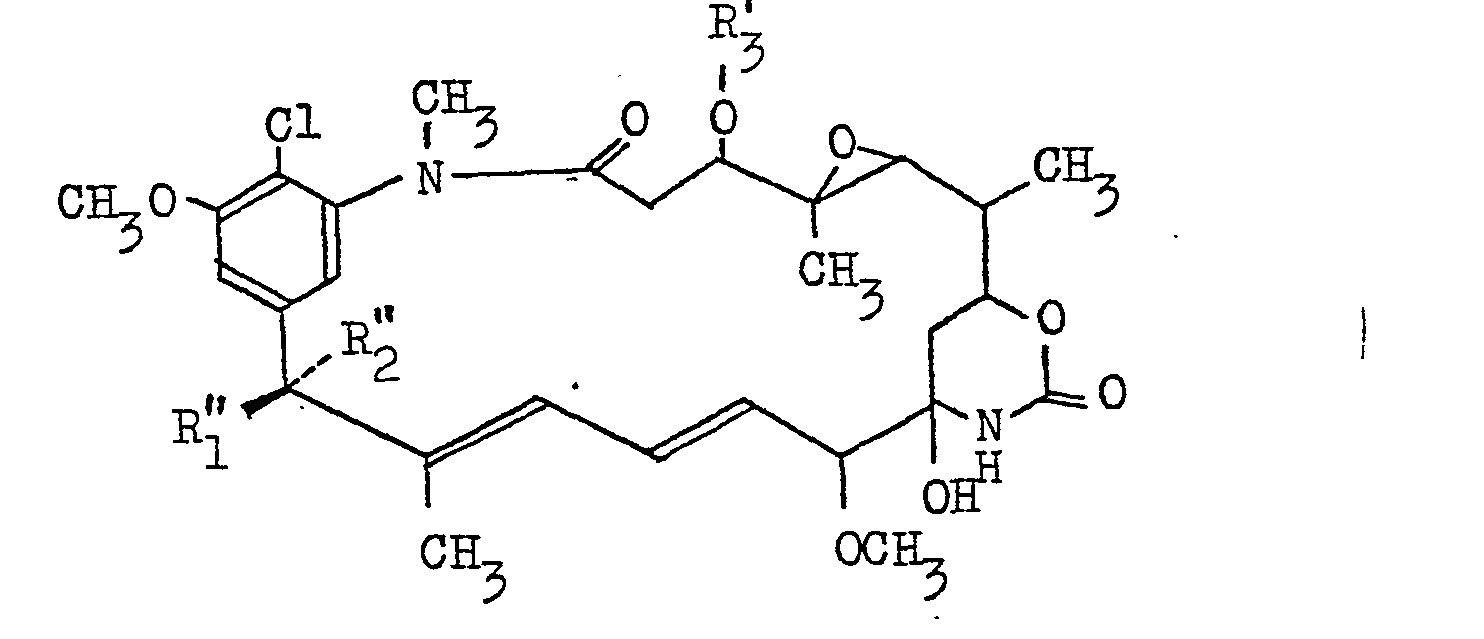
wherein R1 is H or hydroxyl, R2 is H or hydroxyl, and R3 is as defined above
is subjected to deacylation,
and further, if desired, the above-obtained compound is subjected to acylation.
characterized by contacting a maytansinoid compound of the formula:
with a culture, or a processed matter derived therefrom, of a microorganism belonging to one of the genera Streptomyces, Chainia and Streptosporangium and capable of introducing a hydroxyl group into the 15-position of the compound,
and, if desired, thus obtained compound of the formula:
is subjected to deacylation,
and further, if desired, the above-obtained compound is subjected to acylation.
7, Pharmaceutical composition containing a compound of claims 1 to 5.
Applications Claiming Priority (4)
| Application Number | Priority Date | Filing Date | Title |
|---|---|---|---|
| JP122216/79 | 1979-09-21 | ||
| JP12221679A JPS5645484A (en) | 1979-09-21 | 1979-09-21 | C-15003pho and its preparation |
| JP150908/79 | 1979-11-20 | ||
| JP15090879A JPS5681590A (en) | 1979-11-20 | 1979-11-20 | 15-acyl c-15003pho and its preparation |
Publications (1)
| Publication Number | Publication Date |
|---|---|
| EP0028683A1 true EP0028683A1 (en) | 1981-05-20 |
Family
ID=26459384
Family Applications (1)
| Application Number | Title | Priority Date | Filing Date |
|---|---|---|---|
| EP80105163A Withdrawn EP0028683A1 (en) | 1979-09-21 | 1980-08-29 | Antibiotic C-15003 PHO and production thereof |
Country Status (3)
| Country | Link |
|---|---|
| US (1) | US4364866A (en) |
| EP (1) | EP0028683A1 (en) |
| CA (1) | CA1146887A (en) |
Families Citing this family (431)
| Publication number | Priority date | Publication date | Assignee | Title |
|---|---|---|---|---|
| US5208020A (en) * | 1989-10-25 | 1993-05-04 | Immunogen Inc. | Cytotoxic agents comprising maytansinoids and their therapeutic use |
| PT2283866E (en) | 1999-06-25 | 2015-07-20 | Genentech Inc | Methods of treatment using anti-erbb antibody-maytansinoid conjugates |
| EP1229934B1 (en) | 1999-10-01 | 2014-03-05 | Immunogen, Inc. | Compositions and methods for treating cancer using immunoconjugates and chemotherapeutic agents |
| US7097840B2 (en) | 2000-03-16 | 2006-08-29 | Genentech, Inc. | Methods of treatment using anti-ErbB antibody-maytansinoid conjugates |
| US20100056762A1 (en) | 2001-05-11 | 2010-03-04 | Old Lloyd J | Specific binding proteins and uses thereof |
| US20110313230A1 (en) | 2001-05-11 | 2011-12-22 | Terrance Grant Johns | Specific binding proteins and uses thereof |
| PT1392359E (en) | 2001-05-11 | 2010-01-27 | Ludwig Inst For Cancer Res Ltd | Specific binding proteins and uses thereof |
| US6441163B1 (en) | 2001-05-31 | 2002-08-27 | Immunogen, Inc. | Methods for preparation of cytotoxic conjugates of maytansinoids and cell binding agents |
| US20070160576A1 (en) | 2001-06-05 | 2007-07-12 | Genentech, Inc. | IL-17A/F heterologous polypeptides and therapeutic uses thereof |
| KR100788092B1 (en) | 2001-06-20 | 2007-12-21 | 제넨테크, 인크. | Compositions and Methods for the Diagnosis and Treatment of Tumor |
| US7803915B2 (en) | 2001-06-20 | 2010-09-28 | Genentech, Inc. | Antibody compositions for the diagnosis and treatment of tumor |
| US20040235068A1 (en) * | 2001-09-05 | 2004-11-25 | Levinson Arthur D. | Methods for the identification of polypeptide antigens associated with disorders involving aberrant cell proliferation and compositions useful for the treatment of such disorders |
| EP2143438B1 (en) | 2001-09-18 | 2011-07-13 | Genentech, Inc. | Compositions and methods for the diagnosis and treatment of tumors |
| US20110045005A1 (en) | 2001-10-19 | 2011-02-24 | Craig Crowley | Compositions and methods for the treatment of tumor of hematopoietic origin |
| EP2067472A1 (en) | 2002-01-02 | 2009-06-10 | Genentech, Inc. | Compositions and methods for the diagnosis and treatment of tumor |
| AU2003230874A1 (en) | 2002-04-16 | 2003-11-03 | Genentech, Inc. | Compositions and methods for the diagnosis and treatment of tumor |
| US20090068178A1 (en) * | 2002-05-08 | 2009-03-12 | Genentech, Inc. | Compositions and Methods for the Treatment of Tumor of Hematopoietic Origin |
| US20050276812A1 (en) * | 2004-06-01 | 2005-12-15 | Genentech, Inc. | Antibody-drug conjugates and methods |
| AU2004239301B2 (en) | 2003-05-09 | 2010-08-19 | Diadexus, Inc. | OVR110 antibody compositions and methods of use |
| US8088387B2 (en) | 2003-10-10 | 2012-01-03 | Immunogen Inc. | Method of targeting specific cell populations using cell-binding agent maytansinoid conjugates linked via a non-cleavable linker, said conjugates, and methods of making said conjugates |
| CA2525130C (en) | 2003-05-20 | 2014-04-15 | Immunogen, Inc. | Improved cytotoxic agents comprising new maytansinoids |
| ES2751414T5 (en) | 2003-07-08 | 2024-04-23 | Novartis Pharma Ag | Antagonist antibodies to heterologous IL-17 A/F polypeptides |
| KR20060069825A (en) * | 2003-08-01 | 2006-06-22 | 제넨테크, 인크. | Antibody CDR Polypeptide Sequences with Limited Diversity |
| DK2161283T3 (en) | 2003-11-17 | 2014-09-01 | Genentech Inc | COMPOSITIONS CONTAINING ANTIBODIES AGAINST CD79b CONJUGED TO A GROWTH INHIBITOR OR CYTOTOXIC AGENT, AND METHODS FOR TREATING TUMOR OF HEMATOPOIETIC ORIGIN |
| EP1718677B1 (en) | 2003-12-19 | 2012-04-18 | Genentech, Inc. | Monovalent antibody fragments useful as therapeutics |
| US7838519B2 (en) * | 2004-04-14 | 2010-11-23 | The Ohio State University Research Foundation | Maytansinoid analogs as antitumor agents |
| ZA200701183B (en) | 2004-07-20 | 2008-05-28 | Genentech Inc | Inhibitors of angiopoietin-like 4 protein, combinations, an their use |
| CA2570323C (en) | 2004-07-26 | 2014-08-26 | Genentech, Inc. | Methods and compositions for modulating hepatocyte growth factor activation |
| US20060045877A1 (en) * | 2004-08-30 | 2006-03-02 | Goldmakher Viktor S | Immunoconjugates targeting syndecan-1 expressing cells and use thereof |
| HUE028441T2 (en) * | 2004-09-03 | 2016-12-28 | Genentech Inc | Humanized anti-beta7 antagonists and uses therefor |
| NZ553500A (en) | 2004-09-23 | 2009-11-27 | Genentech Inc Genentech Inc | Cysteine engineered antibodies and conjugates withCysteine engineered antibodies and conjugates with a free cysteine amino acid in the heavy chain a free cysteine amino acid in the heavy chain |
| US20090311259A1 (en) * | 2004-11-17 | 2009-12-17 | Victoria Smith | Compositions and Methods for Treatment of Tumor of Hematopoietic Origin |
| EP2230517A1 (en) | 2005-01-07 | 2010-09-22 | Diadexus, Inc. | OVR110 antibody compositions and methods of use |
| EP2468304A3 (en) | 2005-02-11 | 2012-09-26 | ImmunoGen, Inc. | Process for preparing stable drug conjugates |
| US20110166319A1 (en) * | 2005-02-11 | 2011-07-07 | Immunogen, Inc. | Process for preparing purified drug conjugates |
| EP1871163A2 (en) | 2005-06-06 | 2008-01-02 | Genentech, Inc. | Transgenic models for different genes and their use for gene characterization |
| EP1995321A2 (en) | 2005-08-15 | 2008-11-26 | Genentech, Inc. | Gene disruptions, compositions and methods relating thereto |
| CA2893252C (en) | 2005-08-24 | 2018-05-29 | Immunogen, Inc. | Process for preparing antibody maytansinoid conjugates |
| EP1957531B1 (en) | 2005-11-07 | 2016-04-13 | Genentech, Inc. | Binding polypeptides with diversified and consensus vh/vl hypervariable sequences |
| EP2002714A1 (en) | 2005-11-21 | 2008-12-17 | Genentech, Inc. | Novel gene disruptions, compositions and methods relating thereto |
| EP3006466B1 (en) | 2005-12-02 | 2018-08-01 | Genentech, Inc. | Compositions and methods for the treatment of diseases and disorders associated with cytokine signaling involving antibodies that bind to il-22 and il-22r |
| KR101434682B1 (en) * | 2005-12-02 | 2014-08-27 | 제넨테크, 인크. | Binding polypeptides and uses thereof |
| JP5358187B2 (en) | 2005-12-15 | 2013-12-04 | ジェネンテック, インコーポレイテッド | Methods and compositions targeting polyubiquitin |
| EP3156418A1 (en) | 2006-01-05 | 2017-04-19 | Genentech, Inc. | Anti-ephb4 antibodies and methods using same |
| RU2451031C2 (en) | 2006-01-20 | 2012-05-20 | Дженентек, Инк. | Ephrine b2 antibodies and methods for using them |
| ZA200807714B (en) | 2006-02-17 | 2010-01-27 | Genentech Inc | Gene disruptions, compositions and methods relating thereto |
| AR059851A1 (en) | 2006-03-16 | 2008-04-30 | Genentech Inc | ANTIBODIES OF EGFL7 AND METHODS OF USE |
| AU2007243946B2 (en) | 2006-04-05 | 2012-11-29 | Curis, Inc. | Method for using BOC/CDO to modulate hedgehog signaling |
| AU2007297565A1 (en) | 2006-04-19 | 2008-03-27 | Genentech, Inc. | Novel gene disruptions, compositions and methods relating thereto |
| RS54163B1 (en) | 2006-05-30 | 2015-12-31 | Genentech Inc. | ANTI-CD22 ANTIBODIES, THEIR IMMUNCONJUGATES AND THEIR USE |
| WO2008010101A2 (en) | 2006-07-18 | 2008-01-24 | Sanofi-Aventis | Antagonist antibody against epha2 for the treatment of cancer |
| ES2530438T3 (en) | 2006-09-12 | 2015-03-02 | Genentech Inc | Procedures and compositions for the diagnosis and treatment of lung cancer using the KIT or KDR gene as a genetic marker |
| EP1914242A1 (en) | 2006-10-19 | 2008-04-23 | Sanofi-Aventis | Novel anti-CD38 antibodies for the treatment of cancer |
| LT2845866T (en) | 2006-10-27 | 2017-07-10 | Genentech, Inc. | Antibodies and immunoconjugates and uses therefor |
| AU2007325838B2 (en) | 2006-11-22 | 2013-09-19 | Bristol-Myers Squibb Company | Targeted therapeutics based on engineered proteins for tyrosine kinases receptors, including IGF-IR |
| CA2670696A1 (en) | 2006-11-27 | 2008-06-05 | Diadexus, Inc. | Ovr110 antibody compositions and methods of use |
| MX338185B (en) | 2007-01-25 | 2016-04-05 | Dana Farber Cancer Inst Inc | Use of anti-egfr antibodies in treatment of egfr mutant mediated disease. |
| ATE516814T1 (en) | 2007-02-02 | 2011-08-15 | Bristol Myers Squibb Co | 10FN3 DOMAIN FOR THE TREATMENT OF DISEASES ACCOMPANIED BY UNDESIRABLE ANGIOGENESIS |
| AU2008216495A1 (en) | 2007-02-09 | 2008-08-21 | Genentech, Inc. | Anti-Robo4 antibodies and uses therefor |
| AU2008227123B2 (en) | 2007-03-15 | 2014-03-27 | Ludwig Institute For Cancer Research Ltd. | Treatment method using EGFR antibodies and src inhibitors and related formulations |
| US7960139B2 (en) | 2007-03-23 | 2011-06-14 | Academia Sinica | Alkynyl sugar analogs for the labeling and visualization of glycoconjugates in cells |
| CA2680237C (en) | 2007-03-27 | 2018-11-06 | Sea Lane Biotechnologies, Llc | Constructs and libraries comprising antibody surrogate light chain sequences |
| PE20090321A1 (en) | 2007-06-04 | 2009-04-20 | Genentech Inc | ANTI-NOTCH1 NRR ANTIBODIES, METHOD OF PREPARATION AND PHARMACEUTICAL COMPOSITION |
| WO2009012256A1 (en) | 2007-07-16 | 2009-01-22 | Genentech, Inc. | Humanized anti-cd79b antibodies and immunoconjugates and methods of use |
| DK2176296T3 (en) | 2007-07-16 | 2012-05-21 | Genentech Inc | Anti-CD79B antibodies and immune conjugates and methods of use. |
| JP5532486B2 (en) | 2007-08-14 | 2014-06-25 | ルードヴィッヒ インスティテュート フォー キャンサー リサーチ | Monoclonal antibody 175 targeting EGF receptor and derivatives and uses thereof |
| MX2010001975A (en) | 2007-08-29 | 2010-03-10 | Sanofi Aventis | Humanized anti-cxcr5 antibodies, derivatives thereof and their uses. |
| EP2050764A1 (en) * | 2007-10-15 | 2009-04-22 | sanofi-aventis | Novel polyvalent bispecific antibody format and uses thereof |
| US20110033476A1 (en) * | 2007-11-12 | 2011-02-10 | Theraclone Sciences Inc. | Compositions and methods for the therapy and diagnosis of influenza |
| DK2220116T3 (en) * | 2007-11-12 | 2012-11-26 | Theraclone Sciences Inc | COMPOSITIONS AND PROCEDURES FOR THE THERAPY AND DIAGNOSTICATION OF INFLUENZA |
| AR069501A1 (en) | 2007-11-30 | 2010-01-27 | Genentech Inc | ANTI-VEGF ANTIBODIES (VASCULAR ENDOTELIAL GROWTH FACTOR) |
| EP2238168B8 (en) * | 2007-12-26 | 2014-07-23 | Biotest AG | Agents targeting cd138 and uses thereof |
| ES2526433T3 (en) * | 2007-12-26 | 2015-01-12 | Biotest Ag | Immunoconjugates directed to CD138 and uses thereof |
| AR069979A1 (en) * | 2007-12-26 | 2010-03-03 | Biotest Ag | METHOD FOR DECREASING SECONDARY CYTOTOXIC EFFECTS AND IMPROVING THE EFFECTIVENESS OF IMMUNOCATE PLAYERS |
| EP2240516B1 (en) * | 2007-12-26 | 2015-07-08 | Biotest AG | Methods and agents for improving targeting of cd138 expressing tumor cells |
| US8133488B2 (en) | 2008-01-18 | 2012-03-13 | Genentech, Inc. | Methods and compositions for targeting polyubiquitin |
| DK2247620T3 (en) | 2008-01-31 | 2016-08-22 | Genentech Inc | ANTI-CD79b ANTIBODIES AND IMMUNOCONJUGATES AND METHODS OF USE |
| JP5544309B2 (en) | 2008-03-10 | 2014-07-09 | セラクローン サイエンシーズ, インコーポレイテッド | Compositions and methods for treatment and diagnosis of cytomegalovirus infection |
| WO2009114813A1 (en) * | 2008-03-13 | 2009-09-17 | Electronic Theatre Controls, Inc. | Uniform wash lighting fixture and lens |
| MY166446A (en) | 2008-03-18 | 2018-06-27 | Genentech Inc | Combinations of an anti-her2 antibody-drug conjugate and chemotherapeutic agents,and methods of use |
| HUE036780T2 (en) | 2008-04-09 | 2018-07-30 | Genentech Inc | New compositions and methods for treating immunologically related diseases |
| CN104524590B (en) | 2008-04-30 | 2019-06-21 | 伊缪诺金公司 | The purposes of crosslinking agent and they |
| US20100255508A1 (en) * | 2008-05-16 | 2010-10-07 | Thomas Richard Gelzleichter | Use of biomarkers for assessing treatment of gastrointestinal inflammatory disorders with beta7 integrin antagonists |
| AR071874A1 (en) | 2008-05-22 | 2010-07-21 | Bristol Myers Squibb Co | ARMAZON DOMAIN PROTEINS BASED ON MULTIVALENT FIBRONECTINE |
| DK2318832T3 (en) | 2008-07-15 | 2014-01-20 | Academia Sinica | Glycan arrays on PTFE-like aluminum coated slides and related methods |
| BRPI0823049A2 (en) | 2008-09-07 | 2015-06-16 | Glyconex Inc | Anti-extended type 1 glycosphingolipid antibodies, derivatives thereof and use. |
| PE20120080A1 (en) | 2008-10-01 | 2012-02-17 | Genentech Inc | ANTI-NOTCH2 ANTIBODIES AND METHODS OF USE |
| US20120027722A1 (en) | 2008-12-17 | 2012-02-02 | Medical Research Council | Hepatitis c virus combination therapy |
| SI3260136T1 (en) | 2009-03-17 | 2021-05-31 | Theraclone Sciences, Inc. | Human immunodeficiency virus (hiv) -neutralizing antibodies |
| ES2572728T3 (en) | 2009-03-20 | 2016-06-02 | F. Hoffmann-La Roche Ag | Bispecific anti-HER antibodies |
| DK3702371T5 (en) | 2009-03-25 | 2024-08-26 | Genentech Inc | Anti-FGFR3 antibodies and methods of using them |
| CN102471380B (en) | 2009-04-01 | 2015-01-14 | 霍夫曼-拉罗奇有限公司 | Anti-fcrh5 antibodies and immunoconjugates and methods of use |
| KR101431318B1 (en) | 2009-04-02 | 2014-08-20 | 로슈 글리카트 아게 | Multispecific antibodies comprising full length antibodies and single chain fab fragments |
| CN102459340A (en) * | 2009-04-23 | 2012-05-16 | 特罗科隆科学有限公司 | Granulocyte-macrophage colony-stimulating factor (gm-csf) neutralizing antibodies |
| US8481694B2 (en) | 2009-04-29 | 2013-07-09 | Bio-Rad Laboratories, Inc. | Purification of immunoconjugates |
| UY32560A (en) | 2009-04-29 | 2010-11-30 | Bayer Schering Pharma Ag | IMMUNOCONJUGADOS OF ANTIMESOTELINA AND USES OF THE SAME |
| CN102482345A (en) | 2009-05-13 | 2012-05-30 | 航道生物技术有限责任公司 | Neutralizing molecules to influenza viruses |
| CA2762302A1 (en) | 2009-05-20 | 2010-11-25 | Theraclone Sciences, Inc. | Compositions and methods for the therapy and diagnosis of influenza |
| KR102444399B1 (en) | 2009-06-03 | 2022-09-16 | 이뮤노젠 아이엔씨 | Manufacturing method of maytansinoids |
| EP2896404B1 (en) | 2009-06-04 | 2017-08-02 | Novartis AG | Methods for identification of sites for IgG conjugation |
| AU2010270979B2 (en) | 2009-06-22 | 2015-04-23 | Medimmune, Llc | Engineered Fc regions for site-specific conjugation |
| WO2011014750A1 (en) | 2009-07-31 | 2011-02-03 | Genentech, Inc. | Inhibition of tumor metastasis using bv8- or g-csf-antagonists |
| WO2011028952A1 (en) | 2009-09-02 | 2011-03-10 | Xencor, Inc. | Compositions and methods for simultaneous bivalent and monovalent co-engagement of antigens |
| ES2599076T3 (en) | 2009-09-02 | 2017-01-31 | Genentech, Inc. | Smoothened mutant and methods of use thereof |
| CA2781519A1 (en) | 2009-09-16 | 2011-03-24 | Genentech, Inc. | Coiled coil and/or tether containing protein complexes and uses thereof |
| US20110076232A1 (en) | 2009-09-29 | 2011-03-31 | Ludwig Institute For Cancer Research | Specific binding proteins and uses thereof |
| TW201116297A (en) | 2009-10-02 | 2011-05-16 | Sanofi Aventis | Antibodies that specifically bind to the EphA2 receptor |
| KR20120106940A (en) * | 2009-10-19 | 2012-09-27 | 제넨테크, 인크. | Modulators of hepatocyte growth factor activator |
| WO2011050194A1 (en) | 2009-10-22 | 2011-04-28 | Genentech, Inc. | Methods and compositions for modulating hepsin activation of macrophage-stimulating protein |
| TW201121566A (en) | 2009-10-22 | 2011-07-01 | Genentech Inc | Anti-hepsin antibodies and methods using same |
| WO2011056502A1 (en) | 2009-10-26 | 2011-05-12 | Genentech, Inc. | Bone morphogenetic protein receptor type ii compositions and methods of use |
| WO2011056497A1 (en) | 2009-10-26 | 2011-05-12 | Genentech, Inc. | Activin receptor type iib compositions and methods of use |
| WO2011056494A1 (en) | 2009-10-26 | 2011-05-12 | Genentech, Inc. | Activin receptor-like kinase-1 antagonist and vegfr3 antagonist combinations |
| WO2011057120A1 (en) | 2009-11-05 | 2011-05-12 | Genentech, Inc. | Methods and composition for secretion of heterologous polypeptides |
| CN102741294A (en) | 2009-11-30 | 2012-10-17 | 霍夫曼-拉罗奇有限公司 | Antibodies for the treatment and diagnosis of tumors expressing SLC34A2 (TAT211=SEQID2) |
| US11377485B2 (en) | 2009-12-02 | 2022-07-05 | Academia Sinica | Methods for modifying human antibodies by glycan engineering |
| US10087236B2 (en) | 2009-12-02 | 2018-10-02 | Academia Sinica | Methods for modifying human antibodies by glycan engineering |
| EP3778917A3 (en) | 2009-12-04 | 2021-06-09 | F. Hoffmann-La Roche AG | Multispecific antibodies, antibody analogs, compositions, and methods |
| AR078377A1 (en) | 2009-12-11 | 2011-11-02 | Genentech Inc | ANTI-VEGF-C ANTIBODIES (ISOLATED ANTI-VASCULAR ENDOTELIAL GROWTH FACTOR C) AND ITS METHODS OF USE |
| EP2516465B1 (en) | 2009-12-23 | 2016-05-18 | F.Hoffmann-La Roche Ag | Anti-bv8 antibodies and uses thereof |
| WO2011082187A1 (en) | 2009-12-30 | 2011-07-07 | Genentech, Inc. | Methods for modulating a pdgf-aa mediated biological response |
| KR20130009760A (en) | 2010-02-10 | 2013-01-23 | 이뮤노젠 아이엔씨 | Cd20 antibodies and uses thereof |
| WO2011106297A2 (en) | 2010-02-23 | 2011-09-01 | Genentech, Inc. | Compositions and methods for the diagnosis and treatment of tumor |
| CA3014767C (en) | 2010-02-24 | 2023-08-29 | Immunogen, Inc. | Folate receptor 1 antibodies and immunoconjugates and uses thereof |
| CN106046159B (en) | 2010-03-12 | 2020-06-16 | 德彪发姆国际有限公司 | CD37 binding molecules and immunoconjugates thereof |
| TW201138821A (en) | 2010-03-26 | 2011-11-16 | Roche Glycart Ag | Bispecific antibodies |
| WO2011130332A1 (en) | 2010-04-12 | 2011-10-20 | Academia Sinica | Glycan arrays for high throughput screening of viruses |
| TW201742925A (en) | 2010-04-23 | 2017-12-16 | 建南德克公司 | Production of heteromultimeric proteins |
| AU2011248354A1 (en) | 2010-05-03 | 2012-11-08 | Genentech, Inc. | Compositions and methods for the diagnosis and treatment of tumor |
| MX336109B (en) | 2010-06-03 | 2016-01-08 | Genentech Inc | FORMATION OF IMMUNE-TEP IMAGES OF ANTIBODIES AND IMMUNOCUSES AND USES OF THE SAME. |
| US9000130B2 (en) | 2010-06-08 | 2015-04-07 | Genentech, Inc. | Cysteine engineered antibodies and conjugates |
| AU2011283694B2 (en) | 2010-07-29 | 2017-04-13 | Xencor, Inc. | Antibodies with modified isoelectric points |
| WO2012019024A2 (en) | 2010-08-04 | 2012-02-09 | Immunogen, Inc. | Her3-binding molecules and immunoconjugates thereof |
| WO2012021786A2 (en) | 2010-08-12 | 2012-02-16 | Theraclone Sciences, Inc. | Anti-hemagglutinin antibody compositions and methods of use thereof |
| EP2609111B1 (en) | 2010-08-24 | 2017-11-01 | F. Hoffmann-La Roche AG | Bispecific antibodies comprising a disulfide stabilized-fv fragment |
| AU2011296065B2 (en) | 2010-08-31 | 2016-01-28 | International Aids Vaccine Initiative | Human immunodeficiency virus (HIV)-neutralizing antibodies |
| RU2013115927A (en) | 2010-09-10 | 2014-10-20 | Апексиджен, Инк. | ANTIBODIES AGAINST IL-1β AND METHODS OF APPLICATION |
| EP3903812A1 (en) | 2010-09-29 | 2021-11-03 | Agensys, Inc. | Antibody drug conjugates (adc) that bind to 191p4d12 proteins |
| EP3219731A1 (en) | 2010-10-01 | 2017-09-20 | Oxford BioTherapeutics Ltd | Anti-ror1 antibodies |
| DK2625197T3 (en) | 2010-10-05 | 2016-10-03 | Genentech Inc | Smoothened MUTANT AND METHODS OF USING THE SAME |
| BR112013010569A2 (en) | 2010-10-29 | 2017-07-04 | Immunogen Inc | non-antagonistic and immunoconjugated egfr binding molecules thereof |
| BR112013010544A2 (en) | 2010-10-29 | 2016-08-02 | Immunogen Inc | egfr and immunoconjugate binding molecules thereof |
| JP5766296B2 (en) | 2010-12-23 | 2015-08-19 | エフ.ホフマン−ラ ロシュ アーゲーF. Hoffmann−La Roche Aktiengesellschaft | Polypeptide-polynucleotide complexes and their use in targeted delivery of effector components |
| JOP20210044A1 (en) | 2010-12-30 | 2017-06-16 | Takeda Pharmaceuticals Co | Anti-CD38 . antibody |
| WO2012092539A2 (en) | 2010-12-31 | 2012-07-05 | Takeda Pharmaceutical Company Limited | Antibodies to dll4 and uses thereof |
| US10689447B2 (en) | 2011-02-04 | 2020-06-23 | Genentech, Inc. | Fc variants and methods for their production |
| KR101913448B1 (en) | 2011-02-04 | 2018-10-30 | 제넨테크, 인크. | Fc VARIANTS AND METHODS FOR THEIR PRODUCTION |
| AU2012217867A1 (en) | 2011-02-14 | 2013-09-05 | Theraclone Sciences, Inc. | Compositions and methods for the therapy and diagnosis of influenza |
| CN103502274B (en) | 2011-03-03 | 2016-01-06 | 埃派斯进有限公司 | Anti-IL-6 receptor antibodies and methods of use thereof |
| CA2829968A1 (en) | 2011-03-15 | 2012-09-20 | Theraclone Sciences, Inc. | Compositions and methods for the therapy and diagnosis of influenza |
| TWI700093B (en) | 2011-03-16 | 2020-08-01 | 法商賽諾菲公司 | Uses of a dual v region antibody-like protein |
| CN107537040A (en) | 2011-03-29 | 2018-01-05 | 伊缪诺金公司 | Class maytansine antibody conjugates are prepared by one-step method |
| SG193996A1 (en) | 2011-03-29 | 2013-11-29 | Immunogen Inc | Preparation of maytansinoid antibody conjugates by a one-step process |
| US8778345B2 (en) | 2011-04-29 | 2014-07-15 | Apexigen, Inc. | Anti-CD40 antibodies |
| CN103648523A (en) | 2011-05-09 | 2014-03-19 | 弗吉尼亚大学专利基金会 | Compositions and methods for treating cancer |
| HUE063461T2 (en) | 2011-05-27 | 2024-01-28 | Glaxo Group Ltd | BCMA (CD269/TNFRSF17)-binding proteins |
| KR102087854B1 (en) | 2011-06-10 | 2020-03-12 | 메르사나 테라퓨틱스, 인코포레이티드 | Protein-Polymer-Drug Conjugates |
| EP2723389A2 (en) | 2011-06-21 | 2014-04-30 | Immunogen, Inc. | Novel maytansinoid derivatives with peptide linker and conjugates thereof |
| CA2842860A1 (en) | 2011-07-28 | 2013-01-31 | Sea Lane Biotechnologies, Llc | Sur-binding proteins |
| WO2013022855A1 (en) | 2011-08-05 | 2013-02-14 | Xencor, Inc. | Antibodies with modified isoelectric points and immunofiltering |
| EP2744825A1 (en) | 2011-08-17 | 2014-06-25 | F.Hoffmann-La Roche Ag | Inhibition of angiogenesis in refractory tumors |
| US8822651B2 (en) | 2011-08-30 | 2014-09-02 | Theraclone Sciences, Inc. | Human rhinovirus (HRV) antibodies |
| MY173865A (en) | 2011-09-22 | 2020-02-25 | Amgen Inc | Cd27l antigen binding proteins |
| US10851178B2 (en) | 2011-10-10 | 2020-12-01 | Xencor, Inc. | Heterodimeric human IgG1 polypeptides with isoelectric point modifications |
| US12466897B2 (en) | 2011-10-10 | 2025-11-11 | Xencor, Inc. | Heterodimeric human IgG1 polypeptides with isoelectric point modifications |
| WO2013055809A1 (en) | 2011-10-10 | 2013-04-18 | Xencor, Inc. | A method for purifying antibodies |
| AU2012328980A1 (en) | 2011-10-28 | 2014-04-24 | Genentech, Inc. | Therapeutic combinations and methods of treating melanoma |
| TWI571473B (en) | 2011-11-02 | 2017-02-21 | 埃派斯進有限公司 | Anti-kdr antibodies and methods of use |
| BR112014012155A2 (en) | 2011-11-21 | 2017-05-30 | Immunogen Inc | method of treating tumors that are resistant to egfr therapies by egfr antibody cytotoxic agent conjugate |
| RU2632108C2 (en) | 2011-12-08 | 2017-10-02 | Биотест Аг | Applications of immunoconjugates, the target of which is cd138 |
| EP2793940B1 (en) | 2011-12-22 | 2018-11-14 | i2 Pharmaceuticals, Inc. | Surrogate binding proteins |
| CA2859755C (en) | 2011-12-23 | 2021-04-20 | Pfizer Inc. | Engineered antibody constant regions for site-specific conjugation and methods and uses therefor |
| US20140050720A1 (en) | 2012-01-09 | 2014-02-20 | The Scripps Research Institute | Ultralong complementarity determining regions and uses thereof |
| CA2862979A1 (en) | 2012-01-09 | 2013-07-18 | The Scripps Research Institute | Humanized antibodies with ultralong cdr3s |
| JP2015505537A (en) | 2012-01-20 | 2015-02-23 | シー レーン バイオテクノロジーズ, エルエルシー | Binding molecule conjugate |
| EP2812357B1 (en) | 2012-02-10 | 2020-11-04 | F.Hoffmann-La Roche Ag | Single-chain antibodies and other heteromultimers |
| WO2013130093A1 (en) | 2012-03-02 | 2013-09-06 | Genentech, Inc. | Biomarkers for treatment with anti-tubulin chemotherapeutic compounds |
| MX2014010750A (en) | 2012-03-08 | 2015-02-05 | Halozyme Inc | Conditionally active anti-epidermal growth factor receptor antibodies and methods of use thereof. |
| US9592289B2 (en) | 2012-03-26 | 2017-03-14 | Sanofi | Stable IgG4 based binding agent formulations |
| AR090549A1 (en) | 2012-03-30 | 2014-11-19 | Genentech Inc | ANTI-LGR5 AND IMMUNOCATE PLAYERS |
| US10130714B2 (en) | 2012-04-14 | 2018-11-20 | Academia Sinica | Enhanced anti-influenza agents conjugated with anti-inflammatory activity |
| AU2013256596A1 (en) | 2012-05-01 | 2014-10-09 | Genentech, Inc. | Anti-PMEL17 antibodies and immunoconjugates |
| CN102731526B (en) * | 2012-05-14 | 2014-09-10 | 福建省微生物研究所 | New ansamitocin compounds and preparation method thereof |
| UY34813A (en) | 2012-05-18 | 2013-11-29 | Amgen Inc | ANTIGEN UNION PROTEINS DIRECTED AGAINST ST2 RECEIVER |
| RU2639287C2 (en) | 2012-06-27 | 2017-12-20 | Ф. Хоффманн-Ля Рош Аг | Method for selection and obtaining of highly selective and multispecific targeting groups with specified properties, including at least two different binding groups, and their applications |
| KR20150030744A (en) | 2012-06-27 | 2015-03-20 | 에프. 호프만-라 로슈 아게 | Method for making antibody fc-region conjugates comprising at least one binding entity that specifically binds to a target and uses thereof |
| JP6302909B2 (en) | 2012-08-18 | 2018-03-28 | アカデミア シニカAcademia Sinica | Cell-permeable probes for sialidase identification and imaging |
| DK2887959T3 (en) | 2012-08-23 | 2019-02-18 | Agensys Inc | ANTIBODY-PHARMACEUTICAL CONJUGATES (ADC) BINDING TO 158P1D7 PROTEINS |
| SG11201502429YA (en) | 2012-10-04 | 2015-04-29 | Immunogen Inc | Use of a pvdf membrane to purify cell-binding agent cytotoxic agent conjugates |
| WO2014070934A1 (en) | 2012-10-30 | 2014-05-08 | Apexigen, Inc. | Anti-cd40 antibodies and methods of use |
| TWI664192B (en) | 2012-11-20 | 2019-07-01 | 法商賽諾菲公司 | anti-CEACAM5 antibody and use thereof |
| JP6133431B2 (en) | 2012-11-24 | 2017-05-24 | ハンジョウ ディーエーシー バイオテック シーオー.,エルティディ.Hangzhou Dac Biotech Co.,Ltd. | Use of hydrophilic conjugates and conjugation reactions between drug molecules and cell binding molecules |
| TW201425336A (en) | 2012-12-07 | 2014-07-01 | Amgen Inc | BCMA antigen binding proteins |
| CA2892863C (en) | 2012-12-10 | 2022-03-15 | Mersana Therapeutics, Inc. | Polymeric scaffold based on phf for targeted drug delivery |
| WO2014093640A1 (en) | 2012-12-12 | 2014-06-19 | Mersana Therapeutics,Inc. | Hydroxy-polmer-drug-protein conjugates |
| JP6441232B2 (en) | 2012-12-27 | 2018-12-19 | サノフイSanofi | Anti-LAMP1 antibodies and antibody drug conjugates and uses thereof |
| US10487155B2 (en) | 2013-01-14 | 2019-11-26 | Xencor, Inc. | Heterodimeric proteins |
| US10738132B2 (en) | 2013-01-14 | 2020-08-11 | Xencor, Inc. | Heterodimeric proteins |
| US10131710B2 (en) | 2013-01-14 | 2018-11-20 | Xencor, Inc. | Optimized antibody variable regions |
| US9605084B2 (en) | 2013-03-15 | 2017-03-28 | Xencor, Inc. | Heterodimeric proteins |
| US9701759B2 (en) | 2013-01-14 | 2017-07-11 | Xencor, Inc. | Heterodimeric proteins |
| US11053316B2 (en) | 2013-01-14 | 2021-07-06 | Xencor, Inc. | Optimized antibody variable regions |
| US10968276B2 (en) | 2013-03-12 | 2021-04-06 | Xencor, Inc. | Optimized anti-CD3 variable regions |
| US9738722B2 (en) | 2013-01-15 | 2017-08-22 | Xencor, Inc. | Rapid clearance of antigen complexes using novel antibodies |
| EP2948478B1 (en) | 2013-01-25 | 2019-04-03 | Amgen Inc. | Antibodies targeting cdh19 for melanoma |
| US9498532B2 (en) | 2013-03-13 | 2016-11-22 | Novartis Ag | Antibody drug conjugates |
| US9562099B2 (en) | 2013-03-14 | 2017-02-07 | Genentech, Inc. | Anti-B7-H4 antibodies and immunoconjugates |
| EP3299391B1 (en) | 2013-03-14 | 2019-12-04 | Genentech, Inc. | Anti-b7-h4 antibodies and immunoconjugates |
| US10858417B2 (en) | 2013-03-15 | 2020-12-08 | Xencor, Inc. | Heterodimeric proteins |
| US10519242B2 (en) | 2013-03-15 | 2019-12-31 | Xencor, Inc. | Targeting regulatory T cells with heterodimeric proteins |
| EP3421495A3 (en) | 2013-03-15 | 2019-05-15 | Xencor, Inc. | Modulation of t cells with bispecific antibodies and fc fusions |
| CN111138543B (en) | 2013-03-15 | 2024-06-11 | Xencor股份有限公司 | Heterodimer protein |
| JP6333943B2 (en) | 2013-03-15 | 2018-05-30 | ノバルティス アーゲー | Antibody drug conjugate |
| US10106624B2 (en) | 2013-03-15 | 2018-10-23 | Xencor, Inc. | Heterodimeric proteins |
| CA2910945A1 (en) | 2013-05-08 | 2014-11-13 | Zymeworks Inc. | Bispecific her2 and her3 antigen binding constructs |
| KR101882366B1 (en) | 2013-05-30 | 2018-07-30 | 키닉사 파마슈티컬스, 리미티드 | Oncostatin m receptor antigen binding proteins |
| WO2014210397A1 (en) | 2013-06-26 | 2014-12-31 | Academia Sinica | Rm2 antigens and use thereof |
| EP3013347B1 (en) | 2013-06-27 | 2019-12-11 | Academia Sinica | Glycan conjugates and use thereof |
| WO2015017146A2 (en) | 2013-07-18 | 2015-02-05 | Fabrus, Inc. | Antibodies with ultralong complementarity determining regions |
| CN111518199A (en) | 2013-07-18 | 2020-08-11 | 图鲁斯生物科学有限责任公司 | Humanized antibodies with ultralong complementarity determining regions |
| EP3747465A1 (en) | 2013-07-31 | 2020-12-09 | BioNTech AG | Diagnosis and therapy of cancer involving cancer stem cells |
| JP6510518B2 (en) | 2013-08-01 | 2019-05-08 | アジェンシス,インコーポレイテッド | Antibody-drug conjugate (ADC) that binds to the CD37 protein |
| CN104341504B (en) | 2013-08-06 | 2017-10-24 | 百奥泰生物科技(广州)有限公司 | Bispecific antibody |
| CA2923579C (en) | 2013-09-06 | 2023-09-05 | Academia Sinica | Human inkt cell activation using glycolipids with altered glycosyl groups |
| HK1226081A1 (en) | 2013-09-12 | 2017-09-22 | Halozyme, Inc. | Modified anti-epidermal growth factor receptor antibodies and methods of use thereof |
| JP2016537399A (en) | 2013-09-17 | 2016-12-01 | ジェネンテック, インコーポレイテッド | Method using anti-LGR5 antibody |
| NZ757964A (en) | 2013-10-08 | 2022-07-01 | Immunogen Inc | Anti-folr1 immunoconjugate dosing regimens |
| US10316080B2 (en) | 2013-10-11 | 2019-06-11 | Asana Biosciences, Llc | Protein-polymer-drug conjugates |
| ES2960807T3 (en) | 2013-10-11 | 2024-03-06 | Us Health | Antibodies against TEM8 and their use |
| KR102087850B1 (en) | 2013-10-11 | 2020-03-12 | 메르사나 테라퓨틱스, 인코포레이티드 | Protein-Polymer-Drug Conjugates |
| RS61620B1 (en) | 2013-10-11 | 2021-04-29 | Oxford Bio Therapeutics Ltd | Conjugated antibodies against ly75 for the treatment of cancer |
| US20160280798A1 (en) | 2013-11-06 | 2016-09-29 | The United States Of America, As Represented By The Secretary Department Of Health & Human Service | Alk antibodies, conjugates, and chimeric antigen receptors, and their use |
| US10273303B2 (en) | 2013-11-13 | 2019-04-30 | Zymeworks Inc. | Monovalent antigen binding constructs targeting EGFR and/or HER2 and uses thereof |
| SG11201604784XA (en) | 2013-12-13 | 2016-07-28 | Genentech Inc | Anti-cd33 antibodies and immunoconjugates |
| BR112016013861A2 (en) | 2013-12-16 | 2017-10-10 | Genentech Inc | drug and antibody conjugates, compounds, treatment method and pharmaceutical composition |
| US10150818B2 (en) | 2014-01-16 | 2018-12-11 | Academia Sinica | Compositions and methods for treatment and detection of cancers |
| JP2017507118A (en) | 2014-01-16 | 2017-03-16 | アカデミア シニカAcademia Sinica | Compositions and methods for the treatment and detection of cancer |
| KR20160111469A (en) | 2014-01-24 | 2016-09-26 | 제넨테크, 인크. | Methods of using anti-STEAP1 antibodies and immunoconjugates |
| CA2937539A1 (en) | 2014-02-04 | 2015-08-13 | Genentech, Inc. | Mutant smoothened and methods of using the same |
| US10464955B2 (en) | 2014-02-28 | 2019-11-05 | Hangzhou Dac Biotech Co., Ltd. | Charged linkers and their uses for conjugation |
| CN106415244B (en) | 2014-03-27 | 2020-04-24 | 中央研究院 | Reactive marker compounds and uses thereof |
| LT3122781T (en) | 2014-03-28 | 2020-03-25 | Xencor, Inc. | Bispecific antibodies that bind to cd38 and cd3 |
| US10160812B2 (en) | 2014-04-11 | 2018-12-25 | Medimmune, Llc | Bispecific HER2 antibodies |
| HRP20231139T1 (en) | 2014-05-06 | 2024-01-05 | F. Hoffmann - La Roche Ag | Production of heteromultimeric proteins using mammalian cells |
| WO2015179658A2 (en) | 2014-05-22 | 2015-11-26 | Genentech, Inc. | Anti-gpc3 antibodies and immunoconjugates |
| US10118969B2 (en) | 2014-05-27 | 2018-11-06 | Academia Sinica | Compositions and methods relating to universal glycoforms for enhanced antibody efficacy |
| WO2015184008A1 (en) | 2014-05-27 | 2015-12-03 | Academia Sinica | Fucosidase from bacteroides and methods using the same |
| KR20170003720A (en) | 2014-05-27 | 2017-01-09 | 아카데미아 시니카 | Anti-cd20 glycoantibodies and uses thereof |
| CA2950440A1 (en) | 2014-05-27 | 2015-12-03 | Academia Sinica | Anti-her2 glycoantibodies and uses thereof |
| CN106714829A (en) | 2014-05-28 | 2017-05-24 | 中央研究院 | anti-TNF-alpha carbohydrate antibodies and uses thereof |
| WO2016014984A1 (en) | 2014-07-24 | 2016-01-28 | Xencor, Inc. | Rapid clearance of antigen complexes using novel antibodies |
| BR112017001588A2 (en) | 2014-08-12 | 2017-11-21 | Novartis Ag | cdh6 antibody / drug conjugates |
| MX2017002605A (en) | 2014-08-28 | 2017-05-19 | Bioatla Llc | Conditionally active chimeric antigen receptors for modified t-cells. |
| CN109147874A (en) | 2014-09-02 | 2019-01-04 | 伊缪诺金公司 | Method for preparing antibody drug conjugate composition |
| EP3191500A4 (en) | 2014-09-08 | 2018-04-11 | Academia Sinica | HUMAN iNKT CELL ACTIVATION USING GLYCOLIPIDS |
| CN113698485A (en) | 2014-09-12 | 2021-11-26 | 基因泰克公司 | anti-B7-H4 antibodies and immunoconjugates |
| PE20170935A1 (en) | 2014-09-12 | 2017-07-13 | Genentech Inc | ANTI-HER2 AND IMMUNOCONJUGATED ANTIBODIES |
| MX2017003123A (en) | 2014-09-12 | 2017-05-12 | Genentech Inc | Cysteine engineered antibodies and conjugates. |
| BR112017004802A2 (en) | 2014-09-12 | 2017-12-12 | Genentech Inc | anti-cll-1 and immunoconjugate antibodies |
| AU2015320678B2 (en) | 2014-09-23 | 2021-07-22 | Genentech, Inc. | Method of using anti-CD79b immunoconjugates |
| JP6863888B2 (en) | 2014-10-01 | 2021-04-21 | メディミューン,エルエルシー | How to conjugate a polypeptide |
| KR20170080675A (en) | 2014-11-05 | 2017-07-10 | 제넨테크, 인크. | Anti-fgfr2/3 antibodies and methods using same |
| AU2015349985A1 (en) | 2014-11-19 | 2017-05-25 | Immunogen, Inc. | Process for preparing cell-binding agent-cytotoxic agent conjugates |
| TN2017000223A1 (en) | 2014-11-26 | 2018-10-19 | Xencor Inc | Heterodimeric antibodies that bind cd3 and tumor antigens |
| IL252467B (en) | 2014-11-26 | 2022-06-01 | Xencor Inc | Heterodimeric antibodies that bind cd3 and cd38 |
| US10259887B2 (en) | 2014-11-26 | 2019-04-16 | Xencor, Inc. | Heterodimeric antibodies that bind CD3 and tumor antigens |
| JP6721590B2 (en) | 2014-12-03 | 2020-07-15 | エフ.ホフマン−ラ ロシュ アーゲーF. Hoffmann−La Roche Aktiengesellschaft | Multispecific antibody |
| BR112017011773A2 (en) | 2014-12-04 | 2018-02-20 | Celgene Corporation | isolated compound, isolated conjugates, pharmaceutical compositions, and methods of treating a disorder in a mammal |
| US10428155B2 (en) | 2014-12-22 | 2019-10-01 | Xencor, Inc. | Trispecific antibodies |
| US9975965B2 (en) | 2015-01-16 | 2018-05-22 | Academia Sinica | Compositions and methods for treatment and detection of cancers |
| US10495645B2 (en) | 2015-01-16 | 2019-12-03 | Academia Sinica | Cancer markers and methods of use thereof |
| EP3248005B1 (en) | 2015-01-24 | 2020-12-09 | Academia Sinica | Novel glycan conjugates and methods of use thereof |
| CN107430127B (en) | 2015-01-24 | 2020-08-28 | 中央研究院 | Cancer markers and methods of use thereof |
| EP3253784B1 (en) | 2015-02-04 | 2020-05-06 | Genentech, Inc. | Mutant smoothened and methods of using the same |
| US10227411B2 (en) | 2015-03-05 | 2019-03-12 | Xencor, Inc. | Modulation of T cells with bispecific antibodies and FC fusions |
| CA2979895A1 (en) | 2015-03-18 | 2016-09-22 | Immunobiochem Corporation | Conjugates for the treatment of cancer targeted at intracellular tumor-associated antigens |
| WO2016165762A1 (en) | 2015-04-15 | 2016-10-20 | Ganymed Pharmaceuticals Ag | Drug conjugates comprising antibodies against claudin 18.2 |
| JP6952605B2 (en) | 2015-04-24 | 2021-10-20 | ジェネンテック, インコーポレイテッド | Multispecific antigen binding protein |
| AU2016277121C1 (en) | 2015-06-12 | 2022-07-14 | Lentigen Technology, Inc. | Method to treat cancer with engineered T-cells |
| US20190194315A1 (en) | 2015-06-17 | 2019-06-27 | Novartis Ag | Antibody drug conjugates |
| EP3319936B1 (en) | 2015-07-12 | 2025-12-17 | Hangzhou Dac Biotech Co., Ltd. | Bridge linkers for conjugation of cell-binding molecules |
| US9839687B2 (en) | 2015-07-15 | 2017-12-12 | Suzhou M-Conj Biotech Co., Ltd. | Acetylenedicarboxyl linkers and their uses in specific conjugation of a cell-binding molecule |
| CN108601828B (en) | 2015-09-17 | 2023-04-28 | 伊缪诺金公司 | Therapeutic Combinations Comprising Anti-FOLR1 Immunoconjugates |
| US11078286B2 (en) | 2015-09-20 | 2021-08-03 | The United States Of America, As Represented By The Secretary, Department Of Health And Human Services | Monoclonal antibodies specific for fibroblast growth factor receptor 4 (FGFR4) and methods of their use |
| US10421810B2 (en) | 2015-10-09 | 2019-09-24 | Lentigen Technology, Inc. | Chimeric antigen receptors and methods of use |
| WO2017066714A1 (en) | 2015-10-16 | 2017-04-20 | Compugen Ltd. | Anti-vsig1 antibodies and drug conjugates |
| MA43354A (en) | 2015-10-16 | 2018-08-22 | Genentech Inc | CONJUGATE DRUG CONJUGATES WITH CLOUDY DISULPHIDE |
| KR20180085800A (en) | 2015-12-07 | 2018-07-27 | 젠코어 인코포레이티드 | CD3 and heterodimeric antibodies that bind to PSMA |
| BR112018015259A2 (en) | 2016-01-27 | 2018-12-18 | Medimmune Llc | Methods for preparing antibodies with a defined glycosylation standard |
| WO2017136558A1 (en) | 2016-02-04 | 2017-08-10 | Curis, Inc. | Mutant smoothened and methods of using the same |
| CA3013125A1 (en) | 2016-02-05 | 2017-08-10 | Immunogen, Inc. | Efficient process for preparing cell-binding agent-cytotoxic agent conjugates |
| CN109195996A (en) | 2016-03-08 | 2019-01-11 | 中央研究院 | Modular synthesis method of N-glycan and array thereof |
| WO2017161206A1 (en) | 2016-03-16 | 2017-09-21 | Halozyme, Inc. | Conjugates containing conditionally active antibodies or antigen-binding fragments thereof, and methods of use |
| RU2018137110A (en) | 2016-04-13 | 2020-05-13 | Оримабс Лтд. | ANTIBODIES AGAINST PSMA AND THEIR APPLICATION |
| MX395074B (en) | 2016-04-15 | 2025-03-24 | Bioatla Llc | Anti-AXL antibodies, antibody fragments and their immunoconjugates and their uses |
| WO2017196847A1 (en) | 2016-05-10 | 2017-11-16 | The United States Of America, As Represented By The Secretary, Department Of Health And Human Services | Variable new antigen receptor (vnar) antibodies and antibody conjugates targeting tumor and viral antigens |
| TW201808336A (en) | 2016-05-11 | 2018-03-16 | 賽諾菲公司 | Treatment regimen using anti-MUC1 maytansinoid immunoconjugate antibody for the treatment of tumors |
| PL3455261T3 (en) | 2016-05-13 | 2022-12-12 | Bioatla, Inc. | ANTI-ROR2 ANTIBODY, ANTIBODY FRAGMENTS, THEIR IMMUNOCJUGATES AND THEIR APPLICATIONS |
| JP7022080B2 (en) | 2016-05-27 | 2022-02-17 | ジェネンテック, インコーポレイテッド | Biochemical analytical methods for the characterization of site-specific antibody-drug conjugates |
| WO2017214182A1 (en) | 2016-06-07 | 2017-12-14 | The United States Of America. As Represented By The Secretary, Department Of Health & Human Services | Fully human antibody targeting pdi for cancer immunotherapy |
| MA45255A (en) | 2016-06-14 | 2019-04-17 | Xencor Inc | BISPECIFIC CONTROL POINT INHIBITORS ANTIBODIES |
| EP3474901B1 (en) | 2016-06-27 | 2025-08-06 | Tagworks Pharmaceuticals B.V. | Cleavable tetrazine used in bio-orthogonal drug activation |
| CA3029328A1 (en) | 2016-06-28 | 2018-01-04 | Xencor, Inc. | Heterodimeric antibodies that bind somatostatin receptor 2 |
| EP3494135A1 (en) | 2016-08-02 | 2019-06-12 | The United States of America, as represented by The Secretary, Department of Health and Human Services | Monoclonal antibodies targeting glypican-2 (gpc2) and use thereof |
| WO2018027204A1 (en) | 2016-08-05 | 2018-02-08 | Genentech, Inc. | Multivalent and multiepitopic anitibodies having agonistic activity and methods of use |
| CN109963868B (en) | 2016-08-22 | 2023-11-14 | 醣基生医股份有限公司 | Antibodies, binding fragments and methods of use |
| US10793632B2 (en) | 2016-08-30 | 2020-10-06 | Xencor, Inc. | Bispecific immunomodulatory antibodies that bind costimulatory and checkpoint receptors |
| JP7160482B2 (en) | 2016-09-02 | 2022-10-25 | レンティジェン・テクノロジー・インコーポレイテッド | Compositions and methods for treating cancer with DUOCAR |
| JP7142630B2 (en) | 2016-10-14 | 2022-09-27 | ゼンコア インコーポレイテッド | IL15/IL15Rα heterodimeric FC-fusion protein |
| JP2020510608A (en) | 2016-11-02 | 2020-04-09 | デビオファーム インターナショナル, エス. アー. | Method for improving anti-CD37 immunoconjugate therapy |
| KR20220147721A (en) | 2016-11-14 | 2022-11-03 | 항저우 디에이씨 바이오테크 씨오, 엘티디 | Conjugation linkers, cell binding molecule-drug conjugates containing the likers, methods of making and uses such conjugates with the linkers |
| JP7313684B2 (en) | 2016-11-21 | 2023-07-25 | キュレアブ ゲーエムベーハー | Anti-GP73 antibodies and immunoconjugates |
| US11135307B2 (en) | 2016-11-23 | 2021-10-05 | Mersana Therapeutics, Inc. | Peptide-containing linkers for antibody-drug conjugates |
| AU2017382883B2 (en) | 2016-12-21 | 2024-07-04 | The United States Of America, As Represented By The Secretary, Department Of Health And Human Services | Human monoclonal antibodies specific for FLT3 and uses thereof |
| JP6706394B1 (en) | 2017-01-09 | 2020-06-03 | レンティジェン・テクノロジー・インコーポレイテッドLentigen Technology, Inc. | Compositions and methods for treating cancer by anti-mesothelin immunotherapy |
| JOP20190187A1 (en) | 2017-02-03 | 2019-08-01 | Novartis Ag | Anti-ccr7 antibody drug conjugates |
| GB201703876D0 (en) | 2017-03-10 | 2017-04-26 | Berlin-Chemie Ag | Pharmaceutical combinations |
| CA3057838A1 (en) | 2017-03-24 | 2018-09-27 | Lentigen Technology, Inc. | Compositions and methods for treating cancer with anti-cd33 immunotherapy |
| WO2018185618A1 (en) | 2017-04-03 | 2018-10-11 | Novartis Ag | Anti-cdh6 antibody drug conjugates and anti-gitr antibody combinations and methods of treatment |
| EP3625256A1 (en) | 2017-05-19 | 2020-03-25 | The U.S.A. as represented by the Secretary, Department of Health and Human Services | Human monoclonal antibody targeting tnfr2 for cancer immunotherapy |
| AR111963A1 (en) | 2017-05-26 | 2019-09-04 | Univ California | METHOD AND MOLECULES |
| JP7320458B2 (en) | 2017-06-22 | 2023-08-03 | メルサナ セラピューティクス インコーポレイテッド | Methods of making drug-loaded polymer scaffolds and protein-polymer-drug conjugates |
| CA3066953A1 (en) | 2017-06-30 | 2019-01-03 | Lentigen Technology, Inc. | Human monoclonal antibodies specific for cd33 and methods of their use |
| AU2018291497A1 (en) | 2017-06-30 | 2020-01-16 | Xencor, Inc. | Targeted heterodimeric Fc fusion proteins containing IL-15/IL-15Ra and antigen binding domains |
| WO2019005208A1 (en) | 2017-06-30 | 2019-01-03 | The United States Of America, As Represented By The Secretary, Department Of Health And Human Services | Human mesothelin antibodies and uses in cancer therapy |
| EP3661964A1 (en) | 2017-07-31 | 2020-06-10 | Lentigen Technology, Inc. | Compositions and methods for treating cancer with anti-cd19/cd20 immunotherapy |
| CN107446050A (en) | 2017-08-11 | 2017-12-08 | 百奥泰生物科技(广州)有限公司 | The compound and method of Trop2 positive diseases treatment |
| US11524082B2 (en) | 2017-08-22 | 2022-12-13 | Purdue Research Foundation | FBSA-based therapeutic and radioimaging conjugates targeting carbonic anhydrase positive cancers |
| AU2018331517B2 (en) | 2017-09-15 | 2024-10-03 | Lentigen Technology, Inc. | Compositions and methods for treating cancer with anti-CD19 immunotherapy |
| JP7275118B2 (en) | 2017-10-16 | 2023-05-17 | レンティジェン・テクノロジー・インコーポレイテッド | Compositions and methods for treating cancer with anti-CD22 immunotherapy |
| AU2018354189A1 (en) | 2017-10-24 | 2020-04-23 | Crispr Therapeutics Ag | Compositions and methods for the depletion of CD117+ cells |
| WO2019090110A1 (en) | 2017-11-03 | 2019-05-09 | Lentigen Technology, Inc. | Compositions and methods for treating cancer with anti-ror1 immunotherapy |
| US11312770B2 (en) | 2017-11-08 | 2022-04-26 | Xencor, Inc. | Bispecific and monospecific antibodies using novel anti-PD-1 sequences |
| US10981992B2 (en) | 2017-11-08 | 2021-04-20 | Xencor, Inc. | Bispecific immunomodulatory antibodies that bind costimulatory and checkpoint receptors |
| CA3082310A1 (en) | 2017-11-29 | 2019-06-06 | Magenta Therapeutics, Inc. | Compositions and methods for the depletion of cd5+ cells |
| CN112204048A (en) | 2017-12-15 | 2021-01-08 | 朱诺治疗学股份有限公司 | Anti-CCT5 binding molecules and methods of use |
| JP7765181B2 (en) | 2017-12-19 | 2025-11-06 | ゼンコア インコーポレイテッド | Modified IL-2 FC fusion proteins |
| US10894819B2 (en) | 2017-12-20 | 2021-01-19 | Lentigen Technology, Inc. | Compositions and methods for treating HIV/AIDS with immunotherapy |
| MX2020009842A (en) | 2018-03-23 | 2020-10-15 | Seattle Genetics Inc | Use of antibody drug conjugates comprising tubulin disrupting agents to treat solid tumor. |
| US10982006B2 (en) | 2018-04-04 | 2021-04-20 | Xencor, Inc. | Heterodimeric antibodies that bind fibroblast activation protein |
| CA3097741A1 (en) | 2018-04-18 | 2019-10-24 | Xencor, Inc. | Tim-3 targeted heterodimeric fusion proteins containing il-15/il-15ra fc-fusion proteins and tim-3 antigen binding domains |
| CN112867734A (en) | 2018-04-18 | 2021-05-28 | Xencor股份有限公司 | PD-1 targeting heterodimeric fusion proteins comprising an IL-15/IL-15Ra Fc fusion protein and a PD-1 antigen binding domain and uses thereof |
| CA3099421C (en) | 2018-05-04 | 2025-05-06 | Tagworks Pharmaceuticals B.V. | Compounds comprising a linker for increasing transcyclooctene stability |
| US20210299286A1 (en) | 2018-05-04 | 2021-09-30 | Tagworks Pharmaceuticals B.V. | Tetrazines for high click conjugation yield in vivo and high click release yield |
| CN112218662A (en) | 2018-05-30 | 2021-01-12 | 德彪发姆国际有限公司 | anti-CD 37 immunoconjugate dosing regimen |
| GB201809746D0 (en) | 2018-06-14 | 2018-08-01 | Berlin Chemie Ag | Pharmaceutical combinations |
| JP7633810B2 (en) | 2018-07-02 | 2025-02-20 | アムジェン インコーポレイテッド | Anti-STEAP1 antigen-binding protein |
| WO2020014482A1 (en) | 2018-07-12 | 2020-01-16 | The United States Of America, As Represented By The Secretary, Department Of Health And Human Services | Affinity matured cd22-specific monoclonal antibody and uses thereof |
| JP2021532116A (en) | 2018-07-23 | 2021-11-25 | マジェンタ セラピューティクス インコーポレイテッドMagenta Therapeutics, Inc. | Use of anti-CD5 antibody drug conjugate (ADC) in allogeneic cell therapy |
| CA3106544A1 (en) | 2018-08-08 | 2020-02-13 | Mitchell Ho | High affinity monoclonal antibodies targeting glypican-2 and uses thereof |
| WO2020061498A1 (en) | 2018-09-20 | 2020-03-26 | Lentigen Technology, Inc. | Compositions and methods for treating cancer with anti-cd123 immunotherapy |
| CN113286607B (en) | 2018-09-26 | 2024-07-12 | 莱蒂恩技术公司 | Compositions and methods for treating cancer with anti-CD 19/CD22 immunotherapy |
| AU2019355971B2 (en) | 2018-10-03 | 2025-05-08 | Xencor, Inc. | IL-12 heterodimeric Fc-fusion proteins |
| CN113365664A (en) | 2018-10-29 | 2021-09-07 | 梅尔莎纳医疗公司 | Cysteine engineered antibody-drug conjugates with peptide-containing linkers |
| US11103533B2 (en) | 2018-11-30 | 2021-08-31 | Lentigen Technology, Inc. | Compositions and methods for treating cancer with anti-CD38 immunotherapy |
| CA3119798A1 (en) | 2018-12-06 | 2020-06-11 | Genentech, Inc. | Combination therapy of diffuse large b-cell lymphoma comprising an anti-cd79b immunoconjugates, an alkylating agent and an anti-cd20 antibody |
| CA3125484A1 (en) | 2019-01-08 | 2020-07-16 | The United States Of America, As Represented By The Secretary, Department Of Health And Human Services | Cross-species single domain antibodies targeting mesothelin for treating solid tumors |
| EP3883971A1 (en) | 2019-01-22 | 2021-09-29 | The United States of America, as represented by the Secretary, Department of Health and Human Services | High affinity monoclonal antibodies targeting glypican-1 and methods of use |
| EP3693023A1 (en) | 2019-02-11 | 2020-08-12 | Sanofi | Use of anti-ceacam5 immunoconjugates for treating lung cancer |
| BR112021014636A2 (en) | 2019-02-07 | 2021-12-21 | Sanofi Sa | Use of anti-ceacam5 immunoconjugates for lung cancer treatment |
| BR112021016955A2 (en) | 2019-03-01 | 2021-11-23 | Xencor Inc | Composition, nucleic acid composition, expression vector composition, expression vector, host cell, methods of producing an ectonucleotide pyrophosphatase/phosphodiesterase family 3 member binding domain and of treating a cancer, anti-enpp3 antibody , and, heterodimeric antibody |
| WO2020181164A1 (en) | 2019-03-06 | 2020-09-10 | Lentigen Technology, Inc. | Compositions and methods for treating cancer with self-driving chimeric antigen receptors |
| TW202108178A (en) | 2019-05-14 | 2021-03-01 | 美商建南德克公司 | METHODS OF USING ANTI-CD79b IMMUNOCONJUGATES TO TREAT FOLLICULAR LYMPHOMA |
| CN114364801B (en) | 2019-05-30 | 2024-04-19 | 莱蒂恩技术公司 | Compositions and methods for treating cancer with anti-BCMA immunotherapy |
| DK3983363T3 (en) | 2019-06-17 | 2024-06-24 | Tagworks Pharmaceuticals B V | CONNECTIONS FOR QUICK AND EFFECTIVE CLICK RELEASE |
| IL289094A (en) | 2019-06-17 | 2022-02-01 | Tagworks Pharmaceuticals B V | Tetrazines for high click release speed and yield |
| EP3994173A1 (en) | 2019-07-02 | 2022-05-11 | The United States of America, as represented by the Secretary, Department of Health and Human Services | Monoclonal antibodies that bind egfrviii and their use |
| WO2021010326A1 (en) | 2019-07-12 | 2021-01-21 | 中外製薬株式会社 | Anti-mutation type fgfr3 antibody and use therefor |
| CN118557750A (en) | 2019-10-18 | 2024-08-30 | 基因泰克公司 | Methods of treating diffuse large B-cell lymphoma using anti-CD79b immunoconjugates |
| CN119899265A (en) | 2019-10-22 | 2025-04-29 | 美国政府(由卫生和人类服务部的部长所代表) | High-affinity nanobodies targeting B7H3 (CD276) for the treatment of various solid tumors |
| AU2020402752A1 (en) | 2019-12-12 | 2022-06-30 | The United States Of America, As Represented By The Secretary, Department Of Health And Human Services | Antibody-drug conjugates specific for CD276 and uses thereof |
| AU2021259861A1 (en) | 2020-04-24 | 2022-11-17 | Genentech, Inc. | Methods of using anti-CD79b immunoconjugates |
| IL297311A (en) | 2020-04-24 | 2022-12-01 | Sanofi Sa | Antitumor combinations containing anti-ceacam5 antibody conjugates and folfox |
| CA3180872A1 (en) | 2020-04-24 | 2021-10-28 | Sanofi | Antitumor combinations containing anti-ceacam5 antibody conjugates and cetuximab |
| MX2022013404A (en) | 2020-04-24 | 2022-11-14 | Sanofi Sa | Antitumor combinations containing anti-ceacam5 antibody conjugates, trifluridine and tipiracil. |
| JP2023522392A (en) | 2020-04-24 | 2023-05-30 | サノフイ | Anti-tumor combination containing anti-CEACAM5 antibody conjugate and forfili |
| US20230181756A1 (en) | 2020-04-30 | 2023-06-15 | Novartis Ag | Ccr7 antibody drug conjugates for treating cancer |
| US11919956B2 (en) | 2020-05-14 | 2024-03-05 | Xencor, Inc. | Heterodimeric antibodies that bind prostate specific membrane antigen (PSMA) and CD3 |
| EP4168437A1 (en) | 2020-06-22 | 2023-04-26 | Lentigen Technology, Inc. | Compositions and methods for treating cancer with tslpr-cd19 or tslpr-cd22 immunotherapy |
| WO2022093745A1 (en) | 2020-10-26 | 2022-05-05 | The United States Of America, As Represented By The Secretary, Department Of Health And Human Services | Single domain antibodies targeting sars coronavirus spike protein and uses thereof |
| CN116801898A (en) | 2020-11-05 | 2023-09-22 | 莱蒂恩技术公司 | Compositions and methods for treating cancer with anti-CD 19/CD22 immunotherapy |
| CA3200974A1 (en) | 2020-11-08 | 2022-05-12 | Seagen Inc. | Combination therapy |
| US11739144B2 (en) | 2021-03-09 | 2023-08-29 | Xencor, Inc. | Heterodimeric antibodies that bind CD3 and CLDN6 |
| KR20230154311A (en) | 2021-03-10 | 2023-11-07 | 젠코어 인코포레이티드 | Heterodimeric antibodies binding to CD3 and GPC3 |
| AU2022253902A1 (en) | 2021-04-10 | 2023-11-02 | Genmab A/S | Folr1 binding agents, conjugates thereof and methods of using the same |
| JP7742892B2 (en) | 2021-04-23 | 2025-09-22 | ジェンマブ エー/エス | Anti-CD70 antibodies, conjugates thereof and methods of using same |
| WO2022232612A1 (en) | 2021-04-29 | 2022-11-03 | The United States Of America, As Represented By The Secretary, Department Of Health And Human Services | Lassa virus-specific nanobodies and methods of their use |
| TW202310876A (en) | 2021-05-12 | 2023-03-16 | 美商建南德克公司 | Methods of using anti-cd79b immunoconjugates to treat diffuse large b-cell lymphoma |
| WO2022248870A1 (en) | 2021-05-28 | 2022-12-01 | Glaxosmithkline Intellectual Property Development Limited | Combination therapies for treating cancer |
| US20240270851A1 (en) | 2021-06-09 | 2024-08-15 | The U.S.A., As Represented By The Secretary, Department Of Health And Human Services | Cross species single domain antibodies targeting pd-l1 for treating solid tumors |
| US11807685B2 (en) | 2021-08-05 | 2023-11-07 | The Uab Research Foundation | Anti-CD47 antibody and uses thereof |
| US20240336697A1 (en) | 2021-08-07 | 2024-10-10 | Genentech, Inc. | Methods of using anti-cd79b immunoconjugates to treat diffuse large b-cell lymphoma |
| WO2023031445A2 (en) | 2021-09-06 | 2023-03-09 | Veraxa Biotech Gmbh | Novel aminoacyl-trna synthetase variants for genetic code expansion in eukaryotes |
| CA3233953A1 (en) | 2021-10-05 | 2023-04-13 | Matthew Bruce | Combination therapies for treating cancer |
| AU2021362997A1 (en) | 2021-11-03 | 2024-05-16 | Hangzhou Dac Biotech Co., Ltd. | Specific conjugation of an antibody |
| WO2023079057A1 (en) | 2021-11-05 | 2023-05-11 | Sanofi | Antitumor combinations containing anti-ceacam5 antibody-drug conjugates and anti-vegfr-2 antibodies |
| JP2024540451A (en) | 2021-11-18 | 2024-10-31 | オックスフォード バイオセラピューティックス リミテッド | Combination Medicine |
| EP4433096A1 (en) | 2021-11-19 | 2024-09-25 | Ardeagen Corporation | Gpc3 binding agents, conjugates thereof and methods of using the same |
| CA3238627A1 (en) | 2021-11-25 | 2023-06-01 | Christine Kohler | Improved antibody-payload conjugates (apcs) prepared by site-specific conjugation utilizing genetic code expansion |
| DK4186529T3 (en) | 2021-11-25 | 2025-08-25 | Veraxa Biotech Gmbh | IMPROVED ANTIBODY-PAYLOAD CONJUGATES (APC) MANUFACTURED BY SITE-SPECIFIC CONJUGATION USING GENETIC CODE EXPANSION |
| IL313224A (en) | 2021-12-02 | 2024-07-01 | Sanofi Sa | Cea assay for patient selection in cancer therapy |
| US20250154250A1 (en) | 2021-12-02 | 2025-05-15 | Sanofi | Ceacam5 adc-anti-pd1/pd-l1 combination therapy |
| EP4444356A1 (en) | 2021-12-08 | 2024-10-16 | European Molecular Biology Laboratory | Hydrophilic tetrazine-functionalized payloads for preparation of targeting conjugates |
| IL314951B2 (en) | 2022-02-15 | 2025-07-01 | Tagworks Pharmaceuticals B V | Masked interleukin 12 protein |
| US20230338424A1 (en) | 2022-03-02 | 2023-10-26 | Lentigen Technology, Inc. | Compositions and Methods for Treating Cancer with Anti-CD123 Immunotherapy |
| US11590169B1 (en) | 2022-03-02 | 2023-02-28 | Lentigen Technology, Inc. | Compositions and methods for treating cancer with anti-CD123 immunotherapy |
| EP4554624A1 (en) | 2022-07-15 | 2025-05-21 | Pheon Therapeutics Ltd | Antibody-drug conjugates |
| AU2023314413A1 (en) | 2022-07-28 | 2025-02-13 | Lentigen Technology, Inc. | Chimeric antigen receptor therapies for treating solid tumors |
| AU2023329412A1 (en) | 2022-08-26 | 2025-03-20 | Lentigen Technology, Inc. | Compositions and methods for treating cancer with fully human anti-cd20/cd19 immunotherapy |
| EP4602023A1 (en) | 2022-10-12 | 2025-08-20 | Tagworks Pharmaceuticals B.V. | Strained bicyclononenes |
| WO2024153789A1 (en) | 2023-01-20 | 2024-07-25 | Basf Se | Stabilized biopolymer composition, their manufacture and use |
| KR20250154496A (en) | 2023-03-01 | 2025-10-28 | 사노피 | Use of anti-CEACAM5 immunoconjugates for treating neuroendocrine cancers expressing CEACAM5 |
| EP4427763A1 (en) | 2023-03-06 | 2024-09-11 | Sanofi | Antitumor combinations containing anti-ceacam5 antibody-drug conjugates, anti-vegfr-2 antibodies and anti-pd1/pd-l1 antibodies |
| KR20250169530A (en) | 2023-03-10 | 2025-12-03 | 태그웍스 파마슈티컬스 비.브이. | Trans-cyclooctene with improved T-linker |
| KR20250169564A (en) | 2023-03-23 | 2025-12-03 | 사노피 | CEACAM5 mRNA assay for patient selection in cancer therapy |
| WO2024218345A1 (en) | 2023-04-21 | 2024-10-24 | Glaxosmithkline Intellectual Property Development Limited | Cytotoxicity targeting chimeras for antibody-drug conjugates and bispecific antibodies |
| WO2024251733A1 (en) | 2023-06-05 | 2024-12-12 | Sanofi | Antitumor combinations containing anti-ceacam5 antibody-drug conjugates, anti-pd1/pd-l1 antibodies and anti-ctla4 antibodies |
| WO2024254455A1 (en) | 2023-06-08 | 2024-12-12 | Genentech, Inc. | Macrophage signatures for diagnostic and therapeutic methods for lymphoma |
| AU2024296940A1 (en) | 2023-07-07 | 2026-01-29 | The United States Of America, As Represented By The Secretary, Department Of Health And Human Services | Humanized 40h3 antibody |
| WO2025019228A1 (en) | 2023-07-20 | 2025-01-23 | The United States Of America, As Represented By The Secretary, Department Of Health And Human Services | Fully human monoclonal antibodies and chimeric antigen receptors against cd276 for the treatment of solid tumors |
| AU2024300552A1 (en) | 2023-07-27 | 2026-01-29 | Veraxa Biotech Gmbh | Hydrophilic trans-cyclooctene (hytco) compounds, constructs and conjugates containing the same |
| WO2025056807A1 (en) | 2023-09-15 | 2025-03-20 | Basf Se | Stabilized biopolymer composition, their manufacture and use |
| AR133955A1 (en) | 2023-09-26 | 2025-11-19 | Profoundbio Us Co | PTK7 BINDING AGENTS, CONJUGATES THEREOF AND METHODS OF USE THEREOF |
| WO2025094146A1 (en) | 2023-11-02 | 2025-05-08 | Immunogen Switzerland Gmbh | Vasconstrictors for reducing ocular toxicity of antibody-maytansinoid conjugates |
| WO2025149661A1 (en) | 2024-01-10 | 2025-07-17 | Genmab A/S | Slitrk6 binding agents, conjugates thereof and methods of using the same |
| WO2025149667A1 (en) | 2024-01-12 | 2025-07-17 | Pheon Therapeutics Ltd | Antibody drug conjugates and uses thereof |
| WO2025169012A1 (en) | 2024-02-06 | 2025-08-14 | Sanofi | Methods of treating ceacam5-expressing cancers |
| WO2025171238A1 (en) | 2024-02-07 | 2025-08-14 | The United States Of America, As Represented By The Secretary, Department Of Health And Human Services | Monoclonal antibodies that bind the juxta-membrane region of mesothelin and uses thereof |
| WO2025174248A1 (en) | 2024-02-16 | 2025-08-21 | Tagworks Pharmaceuticals B.V. | Trans-cyclooctenes with "or gate" release |
| US20250381289A1 (en) | 2024-02-29 | 2025-12-18 | Genmab A/S | Egfr and c-met bispecific binding agents, conjugates thereof and methods of using the same |
| US20260000765A1 (en) | 2024-06-27 | 2026-01-01 | Lentigen Technology, Inc. | CHIMERIC ANTIGEN RECEPTOR THERAPIES FOR TREATING CANCER WITH IL7Fc ARMORED CAR-T CELLS |
Citations (3)
| Publication number | Priority date | Publication date | Assignee | Title |
|---|---|---|---|---|
| DE2746253A1 (en) * | 1977-03-31 | 1978-10-05 | Takeda Chemical Industries Ltd | PROCESS FOR THE PRODUCTION OF MAYTANSINOL AND ITS DERIVATIVES |
| US4162940A (en) * | 1977-03-31 | 1979-07-31 | Takeda Chemical Industries, Ltd. | Method for producing Antibiotic C-15003 by culturing nocardia |
| EP0004466A1 (en) * | 1978-03-24 | 1979-10-03 | Takeda Chemical Industries, Ltd. | Demethyl maytansinoids and methods for producing them |
-
1980
- 1980-08-29 EP EP80105163A patent/EP0028683A1/en not_active Withdrawn
- 1980-09-17 US US06/188,238 patent/US4364866A/en not_active Expired - Lifetime
- 1980-09-18 CA CA000360469A patent/CA1146887A/en not_active Expired
Patent Citations (3)
| Publication number | Priority date | Publication date | Assignee | Title |
|---|---|---|---|---|
| DE2746253A1 (en) * | 1977-03-31 | 1978-10-05 | Takeda Chemical Industries Ltd | PROCESS FOR THE PRODUCTION OF MAYTANSINOL AND ITS DERIVATIVES |
| US4162940A (en) * | 1977-03-31 | 1979-07-31 | Takeda Chemical Industries, Ltd. | Method for producing Antibiotic C-15003 by culturing nocardia |
| EP0004466A1 (en) * | 1978-03-24 | 1979-10-03 | Takeda Chemical Industries, Ltd. | Demethyl maytansinoids and methods for producing them |
Also Published As
| Publication number | Publication date |
|---|---|
| CA1146887A (en) | 1983-05-24 |
| US4364866A (en) | 1982-12-21 |
Similar Documents
| Publication | Publication Date | Title |
|---|---|---|
| US4364866A (en) | Maytansinoids | |
| EP0025898B1 (en) | Antibiotic c-15003 pnd-0 and production of antibiotic c-15003 pnd | |
| US4331598A (en) | Maytansinoids | |
| US4294757A (en) | 20-O-Acylmaytansinoids | |
| US4361650A (en) | Fermentation process of preparing demethyl maytansinoids | |
| US4225494A (en) | Maytansinol esters | |
| US4265814A (en) | Matansinol 3-n-hexadecanoate | |
| CA1131144A (en) | Antibiotic c-15003 pnd | |
| EP0031430B1 (en) | A method for the production of antibiotic c-15003 p-3 | |
| US4228239A (en) | Method for producing antibiotic C-15003 P-3 | |
| EP0004466B1 (en) | Demethyl maytansinoids and methods for producing them | |
| US4366247A (en) | Process for preparing tylactone | |
| US4229533A (en) | Method for producing antibiotic C-15003 P-4 | |
| US5158938A (en) | Rebeccamycin | |
| US4362881A (en) | Tylactone | |
| GB1586688A (en) | Antibiotic c-15003 | |
| JPH0613499B2 (en) | Patchoulide and its manufacturing method | |
| KR820001589B1 (en) | Process for preparing demethyl maytansinoids | |
| CA1121814A (en) | Antibiotic c-15003 | |
| EP0195872A2 (en) | Novel cell-cidal antibiotic 82-85-8A and its production | |
| JPS6213958B2 (en) | ||
| JPH0343266B2 (en) | ||
| JPS6361951B2 (en) | ||
| NZ197869A (en) | 5-0-mycarosyl-20-dihydro-20,23-dideoxytylonolide derivatives | |
| JPH04120087A (en) | New antitumor antibiotic substance sf2587c and production thereof |
Legal Events
| Date | Code | Title | Description |
|---|---|---|---|
| PUAI | Public reference made under article 153(3) epc to a published international application that has entered the european phase |
Free format text: ORIGINAL CODE: 0009012 |
|
| AK | Designated contracting states |
Designated state(s): AT BE CH DE FR GB IT LI LU NL SE |
|
| 17P | Request for examination filed |
Effective date: 19811001 |
|
| RAP1 | Party data changed (applicant data changed or rights of an application transferred) |
Owner name: TAKEDA CHEMICAL INDUSTRIES, LTD. |
|
| STAA | Information on the status of an ep patent application or granted ep patent |
Free format text: STATUS: THE APPLICATION HAS BEEN WITHDRAWN |
|
| 18W | Application withdrawn |
Withdrawal date: 19840215 |
|
| RIN1 | Information on inventor provided before grant (corrected) |
Inventor name: NAKAHAMA, KAZUO Inventor name: IZAWA, MOTOWO Inventor name: ASAI, MITSUKO |